ES2729405T3 - C4-monomethyl triterpenoid derivatives and methods of use thereof - Google Patents
C4-monomethyl triterpenoid derivatives and methods of use thereof Download PDFInfo
- Publication number
- ES2729405T3 ES2729405T3 ES12709768T ES12709768T ES2729405T3 ES 2729405 T3 ES2729405 T3 ES 2729405T3 ES 12709768 T ES12709768 T ES 12709768T ES 12709768 T ES12709768 T ES 12709768T ES 2729405 T3 ES2729405 T3 ES 2729405T3
- Authority
- ES
- Spain
- Prior art keywords
- compound
- mmol
- alkyl
- alkoxy
- groups
- Prior art date
- Legal status (The legal status is an assumption and is not a legal conclusion. Google has not performed a legal analysis and makes no representation as to the accuracy of the status listed.)
- Active
Links
- 238000000034 method Methods 0.000 title description 29
- 150000001875 compounds Chemical class 0.000 claims abstract description 353
- 229910052739 hydrogen Inorganic materials 0.000 claims abstract description 84
- 239000001257 hydrogen Substances 0.000 claims abstract description 83
- -1 hydroxy, amino Chemical group 0.000 claims abstract description 74
- 125000000217 alkyl group Chemical group 0.000 claims abstract description 71
- 125000003118 aryl group Chemical group 0.000 claims abstract description 68
- 125000004435 hydrogen atom Chemical class [H]* 0.000 claims abstract description 62
- 125000003545 alkoxy group Chemical group 0.000 claims abstract description 59
- 125000003282 alkyl amino group Chemical group 0.000 claims abstract description 55
- 125000001072 heteroaryl group Chemical group 0.000 claims abstract description 49
- 125000004423 acyloxy group Chemical group 0.000 claims abstract description 43
- 125000000304 alkynyl group Chemical group 0.000 claims abstract description 39
- 125000003342 alkenyl group Chemical group 0.000 claims abstract description 38
- 125000004104 aryloxy group Chemical group 0.000 claims abstract description 38
- 125000003710 aryl alkyl group Chemical group 0.000 claims abstract description 37
- 125000001769 aryl amino group Chemical group 0.000 claims abstract description 35
- 125000004429 atom Chemical group 0.000 claims abstract description 35
- 125000004663 dialkyl amino group Chemical group 0.000 claims abstract description 35
- 125000000592 heterocycloalkyl group Chemical group 0.000 claims abstract description 35
- 125000004656 alkyl sulfonylamino group Chemical group 0.000 claims abstract description 32
- 125000005553 heteroaryloxy group Chemical group 0.000 claims abstract description 28
- 125000003368 amide group Chemical group 0.000 claims abstract description 26
- 125000004356 hydroxy functional group Chemical group O* 0.000 claims abstract description 26
- 150000003839 salts Chemical class 0.000 claims abstract description 26
- 125000004432 carbon atom Chemical group C* 0.000 claims abstract description 24
- 125000002924 primary amino group Chemical group [H]N([H])* 0.000 claims abstract description 23
- 125000003302 alkenyloxy group Chemical group 0.000 claims abstract description 20
- 125000006323 alkenyl amino group Chemical group 0.000 claims abstract description 16
- 125000001691 aryl alkyl amino group Chemical group 0.000 claims abstract description 14
- 125000004122 cyclic group Chemical group 0.000 claims abstract description 11
- 125000005035 acylthio group Chemical group 0.000 claims abstract description 10
- 125000004414 alkyl thio group Chemical group 0.000 claims abstract description 10
- 125000005241 heteroarylamino group Chemical group 0.000 claims abstract description 10
- 125000000446 sulfanediyl group Chemical group *S* 0.000 claims abstract description 10
- 125000004043 oxo group Chemical group O=* 0.000 claims abstract description 3
- 125000001475 halogen functional group Chemical group 0.000 claims abstract 17
- 125000005265 dialkylamine group Chemical group 0.000 claims abstract 5
- 208000037265 diseases, disorders, signs and symptoms Diseases 0.000 claims description 46
- 201000010099 disease Diseases 0.000 claims description 34
- UFHFLCQGNIYNRP-UHFFFAOYSA-N Hydrogen Chemical compound [H][H] UFHFLCQGNIYNRP-UHFFFAOYSA-N 0.000 claims description 23
- 206010028980 Neoplasm Diseases 0.000 claims description 12
- 201000011510 cancer Diseases 0.000 claims description 12
- 208000035475 disorder Diseases 0.000 claims description 11
- 208000002193 Pain Diseases 0.000 claims description 9
- 230000001684 chronic effect Effects 0.000 claims description 8
- 206010012601 diabetes mellitus Diseases 0.000 claims description 8
- 208000023275 Autoimmune disease Diseases 0.000 claims description 7
- 230000001154 acute effect Effects 0.000 claims description 7
- 239000008194 pharmaceutical composition Substances 0.000 claims description 6
- 208000024172 Cardiovascular disease Diseases 0.000 claims description 5
- 206010052779 Transplant rejections Diseases 0.000 claims description 5
- 206010015037 epilepsy Diseases 0.000 claims description 5
- 125000002496 methyl group Chemical group [H]C([H])([H])* 0.000 claims description 5
- 230000002265 prevention Effects 0.000 claims description 5
- 238000001959 radiotherapy Methods 0.000 claims description 5
- 201000004624 Dermatitis Diseases 0.000 claims description 4
- 208000022559 Inflammatory bowel disease Diseases 0.000 claims description 4
- 206010053159 Organ failure Diseases 0.000 claims description 4
- 208000001647 Renal Insufficiency Diseases 0.000 claims description 4
- 206010040047 Sepsis Diseases 0.000 claims description 4
- 201000006370 kidney failure Diseases 0.000 claims description 4
- 208000015122 neurodegenerative disease Diseases 0.000 claims description 4
- 201000008482 osteoarthritis Diseases 0.000 claims description 4
- 239000000126 substance Substances 0.000 claims description 4
- 125000004206 2,2,2-trifluoroethyl group Chemical group [H]C([H])(*)C(F)(F)F 0.000 claims description 3
- 208000000094 Chronic Pain Diseases 0.000 claims description 3
- 208000009329 Graft vs Host Disease Diseases 0.000 claims description 3
- 206010019280 Heart failures Diseases 0.000 claims description 3
- 206010028116 Mucosal inflammation Diseases 0.000 claims description 3
- 201000010927 Mucositis Diseases 0.000 claims description 3
- 208000001132 Osteoporosis Diseases 0.000 claims description 3
- 206010063837 Reperfusion injury Diseases 0.000 claims description 3
- 238000002512 chemotherapy Methods 0.000 claims description 3
- 125000001995 cyclobutyl group Chemical group [H]C1([H])C([H])([H])C([H])(*)C1([H])[H] 0.000 claims description 3
- 125000001559 cyclopropyl group Chemical group [H]C1([H])C([H])([H])C1([H])* 0.000 claims description 3
- 230000003412 degenerative effect Effects 0.000 claims description 3
- 208000030533 eye disease Diseases 0.000 claims description 3
- 208000024908 graft versus host disease Diseases 0.000 claims description 3
- 230000005865 ionizing radiation Effects 0.000 claims description 3
- 208000012947 ischemia reperfusion injury Diseases 0.000 claims description 3
- 230000004770 neurodegeneration Effects 0.000 claims description 3
- 239000000546 pharmaceutical excipient Substances 0.000 claims description 3
- 238000002560 therapeutic procedure Methods 0.000 claims description 3
- 208000020084 Bone disease Diseases 0.000 claims description 2
- 206010020751 Hypersensitivity Diseases 0.000 claims description 2
- 230000007815 allergy Effects 0.000 claims description 2
- 125000001495 ethyl group Chemical group [H]C([H])([H])C([H])([H])* 0.000 claims description 2
- 125000006002 1,1-difluoroethyl group Chemical group 0.000 claims 1
- 150000003973 alkyl amines Chemical class 0.000 claims 1
- 125000001280 n-hexyl group Chemical group C(CCCCC)* 0.000 claims 1
- 230000000241 respiratory effect Effects 0.000 claims 1
- 125000004093 cyano group Chemical group *C#N 0.000 abstract description 15
- 125000002023 trifluoromethyl group Chemical group FC(F)(F)* 0.000 abstract description 6
- 125000000229 (C1-C4)alkoxy group Chemical group 0.000 abstract description 2
- XEKOWRVHYACXOJ-UHFFFAOYSA-N Ethyl acetate Chemical compound CCOC(C)=O XEKOWRVHYACXOJ-UHFFFAOYSA-N 0.000 description 552
- VLKZOEOYAKHREP-UHFFFAOYSA-N n-Hexane Chemical class CCCCCC VLKZOEOYAKHREP-UHFFFAOYSA-N 0.000 description 315
- 235000019439 ethyl acetate Nutrition 0.000 description 276
- 239000000203 mixture Substances 0.000 description 219
- 239000000243 solution Substances 0.000 description 200
- 239000007787 solid Substances 0.000 description 187
- VYPSYNLAJGMNEJ-UHFFFAOYSA-N Silicium dioxide Chemical compound O=[Si]=O VYPSYNLAJGMNEJ-UHFFFAOYSA-N 0.000 description 180
- 239000000741 silica gel Substances 0.000 description 170
- 229910002027 silica gel Inorganic materials 0.000 description 170
- 238000004440 column chromatography Methods 0.000 description 150
- 238000006243 chemical reaction Methods 0.000 description 134
- XLYOFNOQVPJJNP-UHFFFAOYSA-N water Substances O XLYOFNOQVPJJNP-UHFFFAOYSA-N 0.000 description 132
- OKKJLVBELUTLKV-UHFFFAOYSA-N Methanol Chemical compound OC OKKJLVBELUTLKV-UHFFFAOYSA-N 0.000 description 123
- 239000000284 extract Substances 0.000 description 104
- VEXZGXHMUGYJMC-UHFFFAOYSA-N Hydrochloric acid Chemical compound Cl VEXZGXHMUGYJMC-UHFFFAOYSA-N 0.000 description 103
- 238000005160 1H NMR spectroscopy Methods 0.000 description 102
- LFQSCWFLJHTTHZ-UHFFFAOYSA-N Ethanol Chemical compound CCO LFQSCWFLJHTTHZ-UHFFFAOYSA-N 0.000 description 100
- 239000011734 sodium Substances 0.000 description 88
- 238000003756 stirring Methods 0.000 description 68
- YXFVVABEGXRONW-UHFFFAOYSA-N Toluene Chemical compound CC1=CC=CC=C1 YXFVVABEGXRONW-UHFFFAOYSA-N 0.000 description 60
- JUJWROOIHBZHMG-UHFFFAOYSA-N Pyridine Chemical compound C1=CC=NC=C1 JUJWROOIHBZHMG-UHFFFAOYSA-N 0.000 description 52
- 239000006260 foam Substances 0.000 description 48
- WQDUMFSSJAZKTM-UHFFFAOYSA-N Sodium methoxide Chemical compound [Na+].[O-]C WQDUMFSSJAZKTM-UHFFFAOYSA-N 0.000 description 46
- 229910052799 carbon Inorganic materials 0.000 description 41
- 239000003607 modifier Substances 0.000 description 37
- ZMANZCXQSJIPKH-UHFFFAOYSA-N Triethylamine Chemical compound CCN(CC)CC ZMANZCXQSJIPKH-UHFFFAOYSA-N 0.000 description 36
- 239000012267 brine Substances 0.000 description 35
- HPALAKNZSZLMCH-UHFFFAOYSA-M sodium;chloride;hydrate Chemical compound O.[Na+].[Cl-] HPALAKNZSZLMCH-UHFFFAOYSA-M 0.000 description 35
- 230000004054 inflammatory process Effects 0.000 description 31
- VHYFNPMBLIVWCW-UHFFFAOYSA-N 4-Dimethylaminopyridine Chemical compound CN(C)C1=CC=NC=C1 VHYFNPMBLIVWCW-UHFFFAOYSA-N 0.000 description 30
- MWUXSHHQAYIFBG-UHFFFAOYSA-N Nitric oxide Chemical compound O=[N] MWUXSHHQAYIFBG-UHFFFAOYSA-N 0.000 description 28
- QTBSBXVTEAMEQO-UHFFFAOYSA-N Acetic acid Chemical compound CC(O)=O QTBSBXVTEAMEQO-UHFFFAOYSA-N 0.000 description 27
- BZLVMXJERCGZMT-UHFFFAOYSA-N Methyl tert-butyl ether Chemical compound COC(C)(C)C BZLVMXJERCGZMT-UHFFFAOYSA-N 0.000 description 27
- UMJSCPRVCHMLSP-UHFFFAOYSA-N pyridine Natural products COC1=CC=CN=C1 UMJSCPRVCHMLSP-UHFFFAOYSA-N 0.000 description 26
- 206010061218 Inflammation Diseases 0.000 description 25
- OKTJSMMVPCPJKN-UHFFFAOYSA-N Carbon Chemical compound [C] OKTJSMMVPCPJKN-UHFFFAOYSA-N 0.000 description 24
- 150000002431 hydrogen Chemical class 0.000 description 23
- UHOVQNZJYSORNB-UHFFFAOYSA-N Benzene Chemical compound C1=CC=CC=C1 UHOVQNZJYSORNB-UHFFFAOYSA-N 0.000 description 21
- 230000037396 body weight Effects 0.000 description 21
- 230000036542 oxidative stress Effects 0.000 description 21
- 239000011541 reaction mixture Substances 0.000 description 21
- 230000001225 therapeutic effect Effects 0.000 description 21
- 0 CC(C1)([C@]1(CC*1(C)[C@](C)(CC2)[C@@]34O*[C@]22C3CCC(C)(C)CC2)[C@](C)(C=C2C#N)C1=CC4=O)C2=O Chemical compound CC(C1)([C@]1(CC*1(C)[C@](C)(CC2)[C@@]34O*[C@]22C3CCC(C)(C)CC2)[C@](C)(C=C2C#N)C1=CC4=O)C2=O 0.000 description 19
- 238000010438 heat treatment Methods 0.000 description 18
- 238000004519 manufacturing process Methods 0.000 description 18
- 125000000956 methoxy group Chemical group [H]C([H])([H])O* 0.000 description 18
- CTSLXHKWHWQRSH-UHFFFAOYSA-N oxalyl chloride Chemical compound ClC(=O)C(Cl)=O CTSLXHKWHWQRSH-UHFFFAOYSA-N 0.000 description 18
- 238000000746 purification Methods 0.000 description 18
- VRLDVERQJMEPIF-UHFFFAOYSA-N dbdmh Chemical compound CC1(C)N(Br)C(=O)N(Br)C1=O VRLDVERQJMEPIF-UHFFFAOYSA-N 0.000 description 17
- 230000000670 limiting effect Effects 0.000 description 17
- IJGRMHOSHXDMSA-UHFFFAOYSA-N nitrogen Substances N#N IJGRMHOSHXDMSA-UHFFFAOYSA-N 0.000 description 17
- 238000010992 reflux Methods 0.000 description 17
- UGFAIRIUMAVXCW-UHFFFAOYSA-N Carbon monoxide Chemical compound [O+]#[C-] UGFAIRIUMAVXCW-UHFFFAOYSA-N 0.000 description 16
- 229910002091 carbon monoxide Inorganic materials 0.000 description 16
- 239000003795 chemical substances by application Substances 0.000 description 16
- 125000005843 halogen group Chemical group 0.000 description 16
- 239000002904 solvent Substances 0.000 description 16
- 229960000549 4-dimethylaminophenol Drugs 0.000 description 15
- FAPWRFPIFSIZLT-UHFFFAOYSA-M Sodium chloride Chemical compound [Na+].[Cl-] FAPWRFPIFSIZLT-UHFFFAOYSA-M 0.000 description 15
- HEMHJVSKTPXQMS-UHFFFAOYSA-M Sodium hydroxide Chemical compound [OH-].[Na+] HEMHJVSKTPXQMS-UHFFFAOYSA-M 0.000 description 15
- 239000012043 crude product Substances 0.000 description 15
- 230000000694 effects Effects 0.000 description 15
- 229910052757 nitrogen Inorganic materials 0.000 description 14
- QFLWZFQWSBQYPS-AWRAUJHKSA-N (3S)-3-[[(2S)-2-[[(2S)-2-[5-[(3aS,6aR)-2-oxo-1,3,3a,4,6,6a-hexahydrothieno[3,4-d]imidazol-4-yl]pentanoylamino]-3-methylbutanoyl]amino]-3-(4-hydroxyphenyl)propanoyl]amino]-4-[1-bis(4-chlorophenoxy)phosphorylbutylamino]-4-oxobutanoic acid Chemical compound CCCC(NC(=O)[C@H](CC(O)=O)NC(=O)[C@H](Cc1ccc(O)cc1)NC(=O)[C@@H](NC(=O)CCCCC1SC[C@@H]2NC(=O)N[C@H]12)C(C)C)P(=O)(Oc1ccc(Cl)cc1)Oc1ccc(Cl)cc1 QFLWZFQWSBQYPS-AWRAUJHKSA-N 0.000 description 13
- 102000011779 Nitric Oxide Synthase Type II Human genes 0.000 description 13
- 108010076864 Nitric Oxide Synthase Type II Proteins 0.000 description 13
- 238000001914 filtration Methods 0.000 description 13
- 125000000325 methylidene group Chemical group [H]C([H])=* 0.000 description 13
- CSCPPACGZOOCGX-UHFFFAOYSA-N Acetone Chemical compound CC(C)=O CSCPPACGZOOCGX-UHFFFAOYSA-N 0.000 description 12
- 125000003178 carboxy group Chemical group [H]OC(*)=O 0.000 description 12
- 210000004027 cell Anatomy 0.000 description 12
- 125000000449 nitro group Chemical group [O-][N+](*)=O 0.000 description 12
- 230000007170 pathology Effects 0.000 description 12
- 239000002244 precipitate Substances 0.000 description 12
- 239000000725 suspension Substances 0.000 description 12
- WZZBNLYBHUDSHF-DHLKQENFSA-N 1-[(3s,4s)-4-[8-(2-chloro-4-pyrimidin-2-yloxyphenyl)-7-fluoro-2-methylimidazo[4,5-c]quinolin-1-yl]-3-fluoropiperidin-1-yl]-2-hydroxyethanone Chemical compound CC1=NC2=CN=C3C=C(F)C(C=4C(=CC(OC=5N=CC=CN=5)=CC=4)Cl)=CC3=C2N1[C@H]1CCN(C(=O)CO)C[C@@H]1F WZZBNLYBHUDSHF-DHLKQENFSA-N 0.000 description 11
- 238000005481 NMR spectroscopy Methods 0.000 description 11
- 150000001721 carbon Chemical group 0.000 description 11
- 239000000706 filtrate Substances 0.000 description 11
- 239000000047 product Substances 0.000 description 11
- 238000001816 cooling Methods 0.000 description 10
- RAXXELZNTBOGNW-UHFFFAOYSA-N imidazole Natural products C1=CNC=N1 RAXXELZNTBOGNW-UHFFFAOYSA-N 0.000 description 10
- 230000002757 inflammatory effect Effects 0.000 description 10
- LMDZBCPBFSXMTL-UHFFFAOYSA-N 1-Ethyl-3-(3-dimethylaminopropyl)carbodiimide Substances CCN=C=NCCCN(C)C LMDZBCPBFSXMTL-UHFFFAOYSA-N 0.000 description 9
- FPQQSJJWHUJYPU-UHFFFAOYSA-N 3-(dimethylamino)propyliminomethylidene-ethylazanium;chloride Chemical compound Cl.CCN=C=NCCCN(C)C FPQQSJJWHUJYPU-UHFFFAOYSA-N 0.000 description 9
- IAZDPXIOMUYVGZ-UHFFFAOYSA-N Dimethylsulphoxide Chemical compound CS(C)=O IAZDPXIOMUYVGZ-UHFFFAOYSA-N 0.000 description 9
- KWYUFKZDYYNOTN-UHFFFAOYSA-M Potassium hydroxide Chemical compound [OH-].[K+] KWYUFKZDYYNOTN-UHFFFAOYSA-M 0.000 description 9
- 108090000623 proteins and genes Proteins 0.000 description 9
- 229910052717 sulfur Inorganic materials 0.000 description 9
- 210000001519 tissue Anatomy 0.000 description 9
- RTZKZFJDLAIYFH-UHFFFAOYSA-N Diethyl ether Chemical compound CCOCC RTZKZFJDLAIYFH-UHFFFAOYSA-N 0.000 description 8
- 230000004913 activation Effects 0.000 description 8
- 230000003078 antioxidant effect Effects 0.000 description 8
- 239000011203 carbon fibre reinforced carbon Substances 0.000 description 8
- 239000012074 organic phase Substances 0.000 description 8
- 125000006413 ring segment Chemical group 0.000 description 8
- 229920006395 saturated elastomer Polymers 0.000 description 8
- 239000011780 sodium chloride Substances 0.000 description 8
- 102000010907 Cyclooxygenase 2 Human genes 0.000 description 7
- 108010037462 Cyclooxygenase 2 Proteins 0.000 description 7
- 101000588302 Homo sapiens Nuclear factor erythroid 2-related factor 2 Proteins 0.000 description 7
- 102100031701 Nuclear factor erythroid 2-related factor 2 Human genes 0.000 description 7
- NINIDFKCEFEMDL-UHFFFAOYSA-N Sulfur Chemical compound [S] NINIDFKCEFEMDL-UHFFFAOYSA-N 0.000 description 7
- 125000002252 acyl group Chemical group 0.000 description 7
- 125000001931 aliphatic group Chemical group 0.000 description 7
- 230000003110 anti-inflammatory effect Effects 0.000 description 7
- 239000003963 antioxidant agent Substances 0.000 description 7
- 235000006708 antioxidants Nutrition 0.000 description 7
- QVGXLLKOCUKJST-UHFFFAOYSA-N atomic oxygen Chemical compound [O] QVGXLLKOCUKJST-UHFFFAOYSA-N 0.000 description 7
- 229910052760 oxygen Inorganic materials 0.000 description 7
- 239000001301 oxygen Substances 0.000 description 7
- 238000002360 preparation method Methods 0.000 description 7
- 102000004169 proteins and genes Human genes 0.000 description 7
- 239000011593 sulfur Substances 0.000 description 7
- 238000005406 washing Methods 0.000 description 7
- HUWSZNZAROKDRZ-RRLWZMAJSA-N (3r,4r)-3-azaniumyl-5-[[(2s,3r)-1-[(2s)-2,3-dicarboxypyrrolidin-1-yl]-3-methyl-1-oxopentan-2-yl]amino]-5-oxo-4-sulfanylpentane-1-sulfonate Chemical compound OS(=O)(=O)CC[C@@H](N)[C@@H](S)C(=O)N[C@@H]([C@H](C)CC)C(=O)N1CCC(C(O)=O)[C@H]1C(O)=O HUWSZNZAROKDRZ-RRLWZMAJSA-N 0.000 description 6
- UNILWMWFPHPYOR-KXEYIPSPSA-M 1-[6-[2-[3-[3-[3-[2-[2-[3-[[2-[2-[[(2r)-1-[[2-[[(2r)-1-[3-[2-[2-[3-[[2-(2-amino-2-oxoethoxy)acetyl]amino]propoxy]ethoxy]ethoxy]propylamino]-3-hydroxy-1-oxopropan-2-yl]amino]-2-oxoethyl]amino]-3-[(2r)-2,3-di(hexadecanoyloxy)propyl]sulfanyl-1-oxopropan-2-yl Chemical compound O=C1C(SCCC(=O)NCCCOCCOCCOCCCNC(=O)COCC(=O)N[C@@H](CSC[C@@H](COC(=O)CCCCCCCCCCCCCCC)OC(=O)CCCCCCCCCCCCCCC)C(=O)NCC(=O)N[C@H](CO)C(=O)NCCCOCCOCCOCCCNC(=O)COCC(N)=O)CC(=O)N1CCNC(=O)CCCCCN\1C2=CC=C(S([O-])(=O)=O)C=C2CC/1=C/C=C/C=C/C1=[N+](CC)C2=CC=C(S([O-])(=O)=O)C=C2C1 UNILWMWFPHPYOR-KXEYIPSPSA-M 0.000 description 6
- HBAQYPYDRFILMT-UHFFFAOYSA-N 8-[3-(1-cyclopropylpyrazol-4-yl)-1H-pyrazolo[4,3-d]pyrimidin-5-yl]-3-methyl-3,8-diazabicyclo[3.2.1]octan-2-one Chemical class C1(CC1)N1N=CC(=C1)C1=NNC2=C1N=C(N=C2)N1C2C(N(CC1CC2)C)=O HBAQYPYDRFILMT-UHFFFAOYSA-N 0.000 description 6
- 108090000695 Cytokines Proteins 0.000 description 6
- 102000004127 Cytokines Human genes 0.000 description 6
- PEDCQBHIVMGVHV-UHFFFAOYSA-N Glycerine Chemical compound OCC(O)CO PEDCQBHIVMGVHV-UHFFFAOYSA-N 0.000 description 6
- MHAJPDPJQMAIIY-UHFFFAOYSA-N Hydrogen peroxide Chemical compound OO MHAJPDPJQMAIIY-UHFFFAOYSA-N 0.000 description 6
- 125000002015 acyclic group Chemical group 0.000 description 6
- 238000011161 development Methods 0.000 description 6
- 230000018109 developmental process Effects 0.000 description 6
- 239000012535 impurity Substances 0.000 description 6
- 208000014674 injury Diseases 0.000 description 6
- 210000002540 macrophage Anatomy 0.000 description 6
- 239000003921 oil Substances 0.000 description 6
- 235000019198 oils Nutrition 0.000 description 6
- 235000018102 proteins Nutrition 0.000 description 6
- QAEDZJGFFMLHHQ-UHFFFAOYSA-N trifluoroacetic anhydride Chemical compound FC(F)(F)C(=O)OC(=O)C(F)(F)F QAEDZJGFFMLHHQ-UHFFFAOYSA-N 0.000 description 6
- ASGMFNBUXDJWJJ-JLCFBVMHSA-N (1R,3R)-3-[[3-bromo-1-[4-(5-methyl-1,3,4-thiadiazol-2-yl)phenyl]pyrazolo[3,4-d]pyrimidin-6-yl]amino]-N,1-dimethylcyclopentane-1-carboxamide Chemical compound BrC1=NN(C2=NC(=NC=C21)N[C@H]1C[C@@](CC1)(C(=O)NC)C)C1=CC=C(C=C1)C=1SC(=NN=1)C ASGMFNBUXDJWJJ-JLCFBVMHSA-N 0.000 description 5
- GHYOCDFICYLMRF-UTIIJYGPSA-N (2S,3R)-N-[(2S)-3-(cyclopenten-1-yl)-1-[(2R)-2-methyloxiran-2-yl]-1-oxopropan-2-yl]-3-hydroxy-3-(4-methoxyphenyl)-2-[[(2S)-2-[(2-morpholin-4-ylacetyl)amino]propanoyl]amino]propanamide Chemical compound C1(=CCCC1)C[C@@H](C(=O)[C@@]1(OC1)C)NC([C@H]([C@@H](C1=CC=C(C=C1)OC)O)NC([C@H](C)NC(CN1CCOCC1)=O)=O)=O GHYOCDFICYLMRF-UTIIJYGPSA-N 0.000 description 5
- IUSARDYWEPUTPN-OZBXUNDUSA-N (2r)-n-[(2s,3r)-4-[[(4s)-6-(2,2-dimethylpropyl)spiro[3,4-dihydropyrano[2,3-b]pyridine-2,1'-cyclobutane]-4-yl]amino]-3-hydroxy-1-[3-(1,3-thiazol-2-yl)phenyl]butan-2-yl]-2-methoxypropanamide Chemical compound C([C@H](NC(=O)[C@@H](C)OC)[C@H](O)CN[C@@H]1C2=CC(CC(C)(C)C)=CN=C2OC2(CCC2)C1)C(C=1)=CC=CC=1C1=NC=CS1 IUSARDYWEPUTPN-OZBXUNDUSA-N 0.000 description 5
- VCUXVXLUOHDHKK-UHFFFAOYSA-N 2-(2-aminopyrimidin-4-yl)-4-(2-chloro-4-methoxyphenyl)-1,3-thiazole-5-carboxamide Chemical compound ClC1=CC(OC)=CC=C1C1=C(C(N)=O)SC(C=2N=C(N)N=CC=2)=N1 VCUXVXLUOHDHKK-UHFFFAOYSA-N 0.000 description 5
- NGNBDVOYPDDBFK-UHFFFAOYSA-N 2-[2,4-di(pentan-2-yl)phenoxy]acetyl chloride Chemical compound CCCC(C)C1=CC=C(OCC(Cl)=O)C(C(C)CCC)=C1 NGNBDVOYPDDBFK-UHFFFAOYSA-N 0.000 description 5
- TVTJUIAKQFIXCE-HUKYDQBMSA-N 2-amino-9-[(2R,3S,4S,5R)-4-fluoro-3-hydroxy-5-(hydroxymethyl)oxolan-2-yl]-7-prop-2-ynyl-1H-purine-6,8-dione Chemical compound NC=1NC(C=2N(C(N(C=2N=1)[C@@H]1O[C@@H]([C@H]([C@H]1O)F)CO)=O)CC#C)=O TVTJUIAKQFIXCE-HUKYDQBMSA-N 0.000 description 5
- WEVYAHXRMPXWCK-UHFFFAOYSA-N Acetonitrile Chemical compound CC#N WEVYAHXRMPXWCK-UHFFFAOYSA-N 0.000 description 5
- WPTTVJLTNAWYAO-KPOXMGGZSA-N Bardoxolone methyl Chemical group C([C@@]12C)=C(C#N)C(=O)C(C)(C)[C@@H]1CC[C@]1(C)C2=CC(=O)[C@@H]2[C@@H]3CC(C)(C)CC[C@]3(C(=O)OC)CC[C@]21C WPTTVJLTNAWYAO-KPOXMGGZSA-N 0.000 description 5
- 229940127007 Compound 39 Drugs 0.000 description 5
- YMWUJEATGCHHMB-UHFFFAOYSA-N Dichloromethane Chemical compound ClCCl YMWUJEATGCHHMB-UHFFFAOYSA-N 0.000 description 5
- 241000282414 Homo sapiens Species 0.000 description 5
- 229910010082 LiAlH Inorganic materials 0.000 description 5
- 239000002253 acid Substances 0.000 description 5
- 229940125797 compound 12 Drugs 0.000 description 5
- 229940125851 compound 27 Drugs 0.000 description 5
- 229940125807 compound 37 Drugs 0.000 description 5
- 230000006378 damage Effects 0.000 description 5
- 239000006185 dispersion Substances 0.000 description 5
- 230000028709 inflammatory response Effects 0.000 description 5
- 239000003112 inhibitor Substances 0.000 description 5
- 230000002401 inhibitory effect Effects 0.000 description 5
- ZLVXBBHTMQJRSX-VMGNSXQWSA-N jdtic Chemical compound C1([C@]2(C)CCN(C[C@@H]2C)C[C@H](C(C)C)NC(=O)[C@@H]2NCC3=CC(O)=CC=C3C2)=CC=CC(O)=C1 ZLVXBBHTMQJRSX-VMGNSXQWSA-N 0.000 description 5
- 125000004433 nitrogen atom Chemical group N* 0.000 description 5
- 239000013612 plasmid Substances 0.000 description 5
- 230000003389 potentiating effect Effects 0.000 description 5
- 230000000770 proinflammatory effect Effects 0.000 description 5
- GLGNXYJARSMNGJ-VKTIVEEGSA-N (1s,2s,3r,4r)-3-[[5-chloro-2-[(1-ethyl-6-methoxy-2-oxo-4,5-dihydro-3h-1-benzazepin-7-yl)amino]pyrimidin-4-yl]amino]bicyclo[2.2.1]hept-5-ene-2-carboxamide Chemical compound CCN1C(=O)CCCC2=C(OC)C(NC=3N=C(C(=CN=3)Cl)N[C@H]3[C@H]([C@@]4([H])C[C@@]3(C=C4)[H])C(N)=O)=CC=C21 GLGNXYJARSMNGJ-VKTIVEEGSA-N 0.000 description 4
- STBLNCCBQMHSRC-BATDWUPUSA-N (2s)-n-[(3s,4s)-5-acetyl-7-cyano-4-methyl-1-[(2-methylnaphthalen-1-yl)methyl]-2-oxo-3,4-dihydro-1,5-benzodiazepin-3-yl]-2-(methylamino)propanamide Chemical compound O=C1[C@@H](NC(=O)[C@H](C)NC)[C@H](C)N(C(C)=O)C2=CC(C#N)=CC=C2N1CC1=C(C)C=CC2=CC=CC=C12 STBLNCCBQMHSRC-BATDWUPUSA-N 0.000 description 4
- FQMZXMVHHKXGTM-UHFFFAOYSA-N 2-(1-adamantyl)-n-[2-[2-(2-hydroxyethylamino)ethylamino]quinolin-5-yl]acetamide Chemical compound C1C(C2)CC(C3)CC2CC13CC(=O)NC1=CC=CC2=NC(NCCNCCO)=CC=C21 FQMZXMVHHKXGTM-UHFFFAOYSA-N 0.000 description 4
- QBWKPGNFQQJGFY-QLFBSQMISA-N 3-[(1r)-1-[(2r,6s)-2,6-dimethylmorpholin-4-yl]ethyl]-n-[6-methyl-3-(1h-pyrazol-4-yl)imidazo[1,2-a]pyrazin-8-yl]-1,2-thiazol-5-amine Chemical compound N1([C@H](C)C2=NSC(NC=3C4=NC=C(N4C=C(C)N=3)C3=CNN=C3)=C2)C[C@H](C)O[C@H](C)C1 QBWKPGNFQQJGFY-QLFBSQMISA-N 0.000 description 4
- MIJYXULNPSFWEK-GTOFXWBISA-N 3beta-hydroxyolean-12-en-28-oic acid Chemical compound C1C[C@H](O)C(C)(C)[C@@H]2CC[C@@]3(C)[C@]4(C)CC[C@@]5(C(O)=O)CCC(C)(C)C[C@H]5C4=CC[C@@H]3[C@]21C MIJYXULNPSFWEK-GTOFXWBISA-N 0.000 description 4
- 201000001320 Atherosclerosis Diseases 0.000 description 4
- 108091003079 Bovine Serum Albumin Proteins 0.000 description 4
- JKLISIRFYWXLQG-UHFFFAOYSA-N Epioleonolsaeure Natural products C1CC(O)C(C)(C)C2CCC3(C)C4(C)CCC5(C(O)=O)CCC(C)(C)CC5C4CCC3C21C JKLISIRFYWXLQG-UHFFFAOYSA-N 0.000 description 4
- 102000016761 Haem oxygenases Human genes 0.000 description 4
- 108050006318 Haem oxygenases Proteins 0.000 description 4
- KFZMGEQAYNKOFK-UHFFFAOYSA-N Isopropanol Chemical compound CC(C)O KFZMGEQAYNKOFK-UHFFFAOYSA-N 0.000 description 4
- YNAVUWVOSKDBBP-UHFFFAOYSA-N Morpholine Chemical compound C1COCCN1 YNAVUWVOSKDBBP-UHFFFAOYSA-N 0.000 description 4
- 108020000284 NAD(P)H dehydrogenase (quinone) Proteins 0.000 description 4
- YBRJHZPWOMJYKQ-UHFFFAOYSA-N Oleanolic acid Natural products CC1(C)CC2C3=CCC4C5(C)CCC(O)C(C)(C)C5CCC4(C)C3(C)CCC2(C1)C(=O)O YBRJHZPWOMJYKQ-UHFFFAOYSA-N 0.000 description 4
- MIJYXULNPSFWEK-UHFFFAOYSA-N Oleanolinsaeure Natural products C1CC(O)C(C)(C)C2CCC3(C)C4(C)CCC5(C(O)=O)CCC(C)(C)CC5C4=CCC3C21C MIJYXULNPSFWEK-UHFFFAOYSA-N 0.000 description 4
- MUBZPKHOEPUJKR-UHFFFAOYSA-N Oxalic acid Chemical compound OC(=O)C(O)=O MUBZPKHOEPUJKR-UHFFFAOYSA-N 0.000 description 4
- 208000006011 Stroke Diseases 0.000 description 4
- OUUQCZGPVNCOIJ-UHFFFAOYSA-M Superoxide Chemical compound [O-][O] OUUQCZGPVNCOIJ-UHFFFAOYSA-M 0.000 description 4
- 108091023040 Transcription factor Proteins 0.000 description 4
- 102000040945 Transcription factor Human genes 0.000 description 4
- 208000027418 Wounds and injury Diseases 0.000 description 4
- SMNRFWMNPDABKZ-WVALLCKVSA-N [[(2R,3S,4R,5S)-5-(2,6-dioxo-3H-pyridin-3-yl)-3,4-dihydroxyoxolan-2-yl]methoxy-hydroxyphosphoryl] [[[(2R,3S,4S,5R,6R)-4-fluoro-3,5-dihydroxy-6-(hydroxymethyl)oxan-2-yl]oxy-hydroxyphosphoryl]oxy-hydroxyphosphoryl] hydrogen phosphate Chemical compound OC[C@H]1O[C@H](OP(O)(=O)OP(O)(=O)OP(O)(=O)OP(O)(=O)OC[C@H]2O[C@H]([C@H](O)[C@@H]2O)C2C=CC(=O)NC2=O)[C@H](O)[C@@H](F)[C@@H]1O SMNRFWMNPDABKZ-WVALLCKVSA-N 0.000 description 4
- 150000001335 aliphatic alkanes Chemical class 0.000 description 4
- 238000003556 assay Methods 0.000 description 4
- XRWSZZJLZRKHHD-WVWIJVSJSA-N asunaprevir Chemical compound O=C([C@@H]1C[C@H](CN1C(=O)[C@@H](NC(=O)OC(C)(C)C)C(C)(C)C)OC1=NC=C(C2=CC=C(Cl)C=C21)OC)N[C@]1(C(=O)NS(=O)(=O)C2CC2)C[C@H]1C=C XRWSZZJLZRKHHD-WVWIJVSJSA-N 0.000 description 4
- 230000008901 benefit Effects 0.000 description 4
- 210000004369 blood Anatomy 0.000 description 4
- 239000008280 blood Substances 0.000 description 4
- 230000003197 catalytic effect Effects 0.000 description 4
- 238000002648 combination therapy Methods 0.000 description 4
- 229940125773 compound 10 Drugs 0.000 description 4
- 229940125758 compound 15 Drugs 0.000 description 4
- 229940125961 compound 24 Drugs 0.000 description 4
- 229940125846 compound 25 Drugs 0.000 description 4
- 229940125878 compound 36 Drugs 0.000 description 4
- 230000003831 deregulation Effects 0.000 description 4
- CSJLBAMHHLJAAS-UHFFFAOYSA-N diethylaminosulfur trifluoride Chemical compound CCN(CC)S(F)(F)F CSJLBAMHHLJAAS-UHFFFAOYSA-N 0.000 description 4
- 238000001704 evaporation Methods 0.000 description 4
- 230000008020 evaporation Effects 0.000 description 4
- 239000012091 fetal bovine serum Substances 0.000 description 4
- 238000001727 in vivo Methods 0.000 description 4
- 230000006698 induction Effects 0.000 description 4
- 230000001939 inductive effect Effects 0.000 description 4
- 239000004615 ingredient Substances 0.000 description 4
- 239000000463 material Substances 0.000 description 4
- 244000005700 microbiome Species 0.000 description 4
- 239000012452 mother liquor Substances 0.000 description 4
- 229940100243 oleanolic acid Drugs 0.000 description 4
- 229940094443 oxytocics prostaglandins Drugs 0.000 description 4
- CMFNMSMUKZHDEY-UHFFFAOYSA-M peroxynitrite Chemical compound [O-]ON=O CMFNMSMUKZHDEY-UHFFFAOYSA-M 0.000 description 4
- 239000000843 powder Substances 0.000 description 4
- HZLWUYJLOIAQFC-UHFFFAOYSA-N prosapogenin PS-A Natural products C12CC(C)(C)CCC2(C(O)=O)CCC(C2(CCC3C4(C)C)C)(C)C1=CCC2C3(C)CCC4OC1OCC(O)C(O)C1O HZLWUYJLOIAQFC-UHFFFAOYSA-N 0.000 description 4
- 229910052708 sodium Inorganic materials 0.000 description 4
- 125000000547 substituted alkyl group Chemical group 0.000 description 4
- 230000009885 systemic effect Effects 0.000 description 4
- 150000003648 triterpenes Chemical class 0.000 description 4
- UAOUIVVJBYDFKD-XKCDOFEDSA-N (1R,9R,10S,11R,12R,15S,18S,21R)-10,11,21-trihydroxy-8,8-dimethyl-14-methylidene-4-(prop-2-enylamino)-20-oxa-5-thia-3-azahexacyclo[9.7.2.112,15.01,9.02,6.012,18]henicosa-2(6),3-dien-13-one Chemical compound C([C@@H]1[C@@H](O)[C@@]23C(C1=C)=O)C[C@H]2[C@]12C(N=C(NCC=C)S4)=C4CC(C)(C)[C@H]1[C@H](O)[C@]3(O)OC2 UAOUIVVJBYDFKD-XKCDOFEDSA-N 0.000 description 3
- AOSZTAHDEDLTLQ-AZKQZHLXSA-N (1S,2S,4R,8S,9S,11S,12R,13S,19S)-6-[(3-chlorophenyl)methyl]-12,19-difluoro-11-hydroxy-8-(2-hydroxyacetyl)-9,13-dimethyl-6-azapentacyclo[10.8.0.02,9.04,8.013,18]icosa-14,17-dien-16-one Chemical compound C([C@@H]1C[C@H]2[C@H]3[C@]([C@]4(C=CC(=O)C=C4[C@@H](F)C3)C)(F)[C@@H](O)C[C@@]2([C@@]1(C1)C(=O)CO)C)N1CC1=CC=CC(Cl)=C1 AOSZTAHDEDLTLQ-AZKQZHLXSA-N 0.000 description 3
- ABJSOROVZZKJGI-OCYUSGCXSA-N (1r,2r,4r)-2-(4-bromophenyl)-n-[(4-chlorophenyl)-(2-fluoropyridin-4-yl)methyl]-4-morpholin-4-ylcyclohexane-1-carboxamide Chemical compound C1=NC(F)=CC(C(NC(=O)[C@H]2[C@@H](C[C@@H](CC2)N2CCOCC2)C=2C=CC(Br)=CC=2)C=2C=CC(Cl)=CC=2)=C1 ABJSOROVZZKJGI-OCYUSGCXSA-N 0.000 description 3
- SZUVGFMDDVSKSI-WIFOCOSTSA-N (1s,2s,3s,5r)-1-(carboxymethyl)-3,5-bis[(4-phenoxyphenyl)methyl-propylcarbamoyl]cyclopentane-1,2-dicarboxylic acid Chemical compound O=C([C@@H]1[C@@H]([C@](CC(O)=O)([C@H](C(=O)N(CCC)CC=2C=CC(OC=3C=CC=CC=3)=CC=2)C1)C(O)=O)C(O)=O)N(CCC)CC(C=C1)=CC=C1OC1=CC=CC=C1 SZUVGFMDDVSKSI-WIFOCOSTSA-N 0.000 description 3
- GCTFTMWXZFLTRR-GFCCVEGCSA-N (2r)-2-amino-n-[3-(difluoromethoxy)-4-(1,3-oxazol-5-yl)phenyl]-4-methylpentanamide Chemical compound FC(F)OC1=CC(NC(=O)[C@H](N)CC(C)C)=CC=C1C1=CN=CO1 GCTFTMWXZFLTRR-GFCCVEGCSA-N 0.000 description 3
- YJLIKUSWRSEPSM-WGQQHEPDSA-N (2r,3r,4s,5r)-2-[6-amino-8-[(4-phenylphenyl)methylamino]purin-9-yl]-5-(hydroxymethyl)oxolane-3,4-diol Chemical compound C=1C=C(C=2C=CC=CC=2)C=CC=1CNC1=NC=2C(N)=NC=NC=2N1[C@@H]1O[C@H](CO)[C@@H](O)[C@H]1O YJLIKUSWRSEPSM-WGQQHEPDSA-N 0.000 description 3
- IWZSHWBGHQBIML-ZGGLMWTQSA-N (3S,8S,10R,13S,14S,17S)-17-isoquinolin-7-yl-N,N,10,13-tetramethyl-2,3,4,7,8,9,11,12,14,15,16,17-dodecahydro-1H-cyclopenta[a]phenanthren-3-amine Chemical compound CN(C)[C@H]1CC[C@]2(C)C3CC[C@@]4(C)[C@@H](CC[C@@H]4c4ccc5ccncc5c4)[C@@H]3CC=C2C1 IWZSHWBGHQBIML-ZGGLMWTQSA-N 0.000 description 3
- UDQTXCHQKHIQMH-KYGLGHNPSA-N (3ar,5s,6s,7r,7ar)-5-(difluoromethyl)-2-(ethylamino)-5,6,7,7a-tetrahydro-3ah-pyrano[3,2-d][1,3]thiazole-6,7-diol Chemical compound S1C(NCC)=N[C@H]2[C@@H]1O[C@H](C(F)F)[C@@H](O)[C@@H]2O UDQTXCHQKHIQMH-KYGLGHNPSA-N 0.000 description 3
- YQOLEILXOBUDMU-KRWDZBQOSA-N (4R)-5-[(6-bromo-3-methyl-2-pyrrolidin-1-ylquinoline-4-carbonyl)amino]-4-(2-chlorophenyl)pentanoic acid Chemical compound CC1=C(C2=C(C=CC(=C2)Br)N=C1N3CCCC3)C(=O)NC[C@H](CCC(=O)O)C4=CC=CC=C4Cl YQOLEILXOBUDMU-KRWDZBQOSA-N 0.000 description 3
- XBZYWSMVVKYHQN-MYPRUECHSA-N (4as,6as,6br,8ar,9r,10s,12ar,12br,14bs)-10-hydroxy-2,2,6a,6b,9,12a-hexamethyl-9-[(sulfooxy)methyl]-1,2,3,4,4a,5,6,6a,6b,7,8,8a,9,10,11,12,12a,12b,13,14b-icosahydropicene-4a-carboxylic acid Chemical compound C1C[C@H](O)[C@@](C)(COS(O)(=O)=O)[C@@H]2CC[C@@]3(C)[C@]4(C)CC[C@@]5(C(O)=O)CCC(C)(C)C[C@H]5C4=CC[C@@H]3[C@]21C XBZYWSMVVKYHQN-MYPRUECHSA-N 0.000 description 3
- KQZLRWGGWXJPOS-NLFPWZOASA-N 1-[(1R)-1-(2,4-dichlorophenyl)ethyl]-6-[(4S,5R)-4-[(2S)-2-(hydroxymethyl)pyrrolidin-1-yl]-5-methylcyclohexen-1-yl]pyrazolo[3,4-b]pyrazine-3-carbonitrile Chemical compound ClC1=C(C=CC(=C1)Cl)[C@@H](C)N1N=C(C=2C1=NC(=CN=2)C1=CC[C@@H]([C@@H](C1)C)N1[C@@H](CCC1)CO)C#N KQZLRWGGWXJPOS-NLFPWZOASA-N 0.000 description 3
- ONBQEOIKXPHGMB-VBSBHUPXSA-N 1-[2-[(2s,3r,4s,5r)-3,4-dihydroxy-5-(hydroxymethyl)oxolan-2-yl]oxy-4,6-dihydroxyphenyl]-3-(4-hydroxyphenyl)propan-1-one Chemical compound O[C@@H]1[C@H](O)[C@@H](CO)O[C@H]1OC1=CC(O)=CC(O)=C1C(=O)CCC1=CC=C(O)C=C1 ONBQEOIKXPHGMB-VBSBHUPXSA-N 0.000 description 3
- QXOGPTXQGKQSJT-UHFFFAOYSA-N 1-amino-4-[4-(3,4-dimethylphenyl)sulfanylanilino]-9,10-dioxoanthracene-2-sulfonic acid Chemical compound Cc1ccc(Sc2ccc(Nc3cc(c(N)c4C(=O)c5ccccc5C(=O)c34)S(O)(=O)=O)cc2)cc1C QXOGPTXQGKQSJT-UHFFFAOYSA-N 0.000 description 3
- FMKGJQHNYMWDFJ-CVEARBPZSA-N 2-[[4-(2,2-difluoropropoxy)pyrimidin-5-yl]methylamino]-4-[[(1R,4S)-4-hydroxy-3,3-dimethylcyclohexyl]amino]pyrimidine-5-carbonitrile Chemical class FC(COC1=NC=NC=C1CNC1=NC=C(C(=N1)N[C@H]1CC([C@H](CC1)O)(C)C)C#N)(C)F FMKGJQHNYMWDFJ-CVEARBPZSA-N 0.000 description 3
- YSUIQYOGTINQIN-UZFYAQMZSA-N 2-amino-9-[(1S,6R,8R,9S,10R,15R,17R,18R)-8-(6-aminopurin-9-yl)-9,18-difluoro-3,12-dihydroxy-3,12-bis(sulfanylidene)-2,4,7,11,13,16-hexaoxa-3lambda5,12lambda5-diphosphatricyclo[13.2.1.06,10]octadecan-17-yl]-1H-purin-6-one Chemical compound NC1=NC2=C(N=CN2[C@@H]2O[C@@H]3COP(S)(=O)O[C@@H]4[C@@H](COP(S)(=O)O[C@@H]2[C@@H]3F)O[C@H]([C@H]4F)N2C=NC3=C2N=CN=C3N)C(=O)N1 YSUIQYOGTINQIN-UZFYAQMZSA-N 0.000 description 3
- NPRYCHLHHVWLQZ-TURQNECASA-N 2-amino-9-[(2R,3S,4S,5R)-4-fluoro-3-hydroxy-5-(hydroxymethyl)oxolan-2-yl]-7-prop-2-ynylpurin-8-one Chemical compound NC1=NC=C2N(C(N(C2=N1)[C@@H]1O[C@@H]([C@H]([C@H]1O)F)CO)=O)CC#C NPRYCHLHHVWLQZ-TURQNECASA-N 0.000 description 3
- LFOIDLOIBZFWDO-UHFFFAOYSA-N 2-methoxy-6-[6-methoxy-4-[(3-phenylmethoxyphenyl)methoxy]-1-benzofuran-2-yl]imidazo[2,1-b][1,3,4]thiadiazole Chemical compound N1=C2SC(OC)=NN2C=C1C(OC1=CC(OC)=C2)=CC1=C2OCC(C=1)=CC=CC=1OCC1=CC=CC=C1 LFOIDLOIBZFWDO-UHFFFAOYSA-N 0.000 description 3
- XFJBGINZIMNZBW-CRAIPNDOSA-N 5-chloro-2-[4-[(1r,2s)-2-[2-(5-methylsulfonylpyridin-2-yl)oxyethyl]cyclopropyl]piperidin-1-yl]pyrimidine Chemical compound N1=CC(S(=O)(=O)C)=CC=C1OCC[C@H]1[C@@H](C2CCN(CC2)C=2N=CC(Cl)=CN=2)C1 XFJBGINZIMNZBW-CRAIPNDOSA-N 0.000 description 3
- 108700032225 Antioxidant Response Elements Proteins 0.000 description 3
- 206010003805 Autism Diseases 0.000 description 3
- 208000020706 Autistic disease Diseases 0.000 description 3
- 208000020925 Bipolar disease Diseases 0.000 description 3
- 229940126657 Compound 17 Drugs 0.000 description 3
- 229940126639 Compound 33 Drugs 0.000 description 3
- FEWJPZIEWOKRBE-JCYAYHJZSA-N Dextrotartaric acid Chemical compound OC(=O)[C@H](O)[C@@H](O)C(O)=O FEWJPZIEWOKRBE-JCYAYHJZSA-N 0.000 description 3
- 108090000331 Firefly luciferases Proteins 0.000 description 3
- WQZGKKKJIJFFOK-GASJEMHNSA-N Glucose Natural products OC[C@H]1OC(O)[C@H](O)[C@@H](O)[C@@H]1O WQZGKKKJIJFFOK-GASJEMHNSA-N 0.000 description 3
- 101100189356 Mus musculus Papolb gene Proteins 0.000 description 3
- OPFJDXRVMFKJJO-ZHHKINOHSA-N N-{[3-(2-benzamido-4-methyl-1,3-thiazol-5-yl)-pyrazol-5-yl]carbonyl}-G-dR-G-dD-dD-dD-NH2 Chemical compound S1C(C=2NN=C(C=2)C(=O)NCC(=O)N[C@H](CCCN=C(N)N)C(=O)NCC(=O)N[C@H](CC(O)=O)C(=O)N[C@H](CC(O)=O)C(=O)N[C@H](CC(O)=O)C(N)=O)=C(C)N=C1NC(=O)C1=CC=CC=C1 OPFJDXRVMFKJJO-ZHHKINOHSA-N 0.000 description 3
- 229910019142 PO4 Inorganic materials 0.000 description 3
- DNIAPMSPPWPWGF-UHFFFAOYSA-N Propylene glycol Chemical compound CC(O)CO DNIAPMSPPWPWGF-UHFFFAOYSA-N 0.000 description 3
- PNUZDKCDAWUEGK-CYZMBNFOSA-N Sitafloxacin Chemical compound C([C@H]1N)N(C=2C(=C3C(C(C(C(O)=O)=CN3[C@H]3[C@H](C3)F)=O)=CC=2F)Cl)CC11CC1 PNUZDKCDAWUEGK-CYZMBNFOSA-N 0.000 description 3
- VMHLLURERBWHNL-UHFFFAOYSA-M Sodium acetate Chemical compound [Na+].CC([O-])=O VMHLLURERBWHNL-UHFFFAOYSA-M 0.000 description 3
- 206010060872 Transplant failure Diseases 0.000 description 3
- 102100040247 Tumor necrosis factor Human genes 0.000 description 3
- LJOOWESTVASNOG-UFJKPHDISA-N [(1s,3r,4ar,7s,8s,8as)-3-hydroxy-8-[2-[(4r)-4-hydroxy-6-oxooxan-2-yl]ethyl]-7-methyl-1,2,3,4,4a,7,8,8a-octahydronaphthalen-1-yl] (2s)-2-methylbutanoate Chemical compound C([C@H]1[C@@H](C)C=C[C@H]2C[C@@H](O)C[C@@H]([C@H]12)OC(=O)[C@@H](C)CC)CC1C[C@@H](O)CC(=O)O1 LJOOWESTVASNOG-UFJKPHDISA-N 0.000 description 3
- LNUFLCYMSVYYNW-ZPJMAFJPSA-N [(2r,3r,4s,5r,6r)-2-[(2r,3r,4s,5r,6r)-6-[(2r,3r,4s,5r,6r)-6-[(2r,3r,4s,5r,6r)-6-[[(3s,5s,8r,9s,10s,13r,14s,17r)-10,13-dimethyl-17-[(2r)-6-methylheptan-2-yl]-2,3,4,5,6,7,8,9,11,12,14,15,16,17-tetradecahydro-1h-cyclopenta[a]phenanthren-3-yl]oxy]-4,5-disulfo Chemical compound O([C@@H]1[C@@H](COS(O)(=O)=O)O[C@@H]([C@@H]([C@H]1OS(O)(=O)=O)OS(O)(=O)=O)O[C@@H]1[C@@H](COS(O)(=O)=O)O[C@@H]([C@@H]([C@H]1OS(O)(=O)=O)OS(O)(=O)=O)O[C@@H]1[C@@H](COS(O)(=O)=O)O[C@H]([C@@H]([C@H]1OS(O)(=O)=O)OS(O)(=O)=O)O[C@@H]1C[C@@H]2CC[C@H]3[C@@H]4CC[C@@H]([C@]4(CC[C@@H]3[C@@]2(C)CC1)C)[C@H](C)CCCC(C)C)[C@H]1O[C@H](COS(O)(=O)=O)[C@@H](OS(O)(=O)=O)[C@H](OS(O)(=O)=O)[C@H]1OS(O)(=O)=O LNUFLCYMSVYYNW-ZPJMAFJPSA-N 0.000 description 3
- 230000009471 action Effects 0.000 description 3
- 150000001336 alkenes Chemical class 0.000 description 3
- 150000001412 amines Chemical class 0.000 description 3
- 150000003974 aralkylamines Chemical class 0.000 description 3
- 230000004071 biological effect Effects 0.000 description 3
- 230000003833 cell viability Effects 0.000 description 3
- 230000001413 cellular effect Effects 0.000 description 3
- 210000003169 central nervous system Anatomy 0.000 description 3
- 239000003153 chemical reaction reagent Substances 0.000 description 3
- KRKNYBCHXYNGOX-UHFFFAOYSA-N citric acid Chemical compound OC(=O)CC(O)(C(O)=O)CC(O)=O KRKNYBCHXYNGOX-UHFFFAOYSA-N 0.000 description 3
- 229940126543 compound 14 Drugs 0.000 description 3
- 229940126142 compound 16 Drugs 0.000 description 3
- 229940125810 compound 20 Drugs 0.000 description 3
- 229940126086 compound 21 Drugs 0.000 description 3
- 229940127204 compound 29 Drugs 0.000 description 3
- 229940126214 compound 3 Drugs 0.000 description 3
- 229940125877 compound 31 Drugs 0.000 description 3
- 229940126540 compound 41 Drugs 0.000 description 3
- 229940125936 compound 42 Drugs 0.000 description 3
- 229940125844 compound 46 Drugs 0.000 description 3
- 229940126545 compound 53 Drugs 0.000 description 3
- 229940125900 compound 59 Drugs 0.000 description 3
- 230000002354 daily effect Effects 0.000 description 3
- XBDQKXXYIPTUBI-UHFFFAOYSA-N dimethylselenoniopropionate Natural products CCC(O)=O XBDQKXXYIPTUBI-UHFFFAOYSA-N 0.000 description 3
- 230000006806 disease prevention Effects 0.000 description 3
- 239000003814 drug Substances 0.000 description 3
- GWNFQAKCJYEJEW-UHFFFAOYSA-N ethyl 3-[8-[[4-methyl-5-[(3-methyl-4-oxophthalazin-1-yl)methyl]-1,2,4-triazol-3-yl]sulfanyl]octanoylamino]benzoate Chemical compound CCOC(=O)C1=CC(NC(=O)CCCCCCCSC2=NN=C(CC3=NN(C)C(=O)C4=CC=CC=C34)N2C)=CC=C1 GWNFQAKCJYEJEW-UHFFFAOYSA-N 0.000 description 3
- 238000009472 formulation Methods 0.000 description 3
- 239000000499 gel Substances 0.000 description 3
- 238000007429 general method Methods 0.000 description 3
- 239000008103 glucose Substances 0.000 description 3
- JAXFJECJQZDFJS-XHEPKHHKSA-N gtpl8555 Chemical compound OC(=O)C[C@H](N)C(=O)N[C@@H](CCC(O)=O)C(=O)N[C@@H](C(C)C)C(=O)N[C@@H](C(C)C)C(=O)N1CCC[C@@H]1C(=O)N[C@H](B1O[C@@]2(C)[C@H]3C[C@H](C3(C)C)C[C@H]2O1)CCC1=CC=C(F)C=C1 JAXFJECJQZDFJS-XHEPKHHKSA-N 0.000 description 3
- 239000008241 heterogeneous mixture Substances 0.000 description 3
- 125000002883 imidazolyl group Chemical group 0.000 description 3
- 208000015181 infectious disease Diseases 0.000 description 3
- 230000004968 inflammatory condition Effects 0.000 description 3
- 230000005764 inhibitory process Effects 0.000 description 3
- SUMDYPCJJOFFON-UHFFFAOYSA-N isethionic acid Chemical compound OCCS(O)(=O)=O SUMDYPCJJOFFON-UHFFFAOYSA-N 0.000 description 3
- 125000003253 isopropoxy group Chemical group [H]C([H])([H])C([H])(O*)C([H])([H])[H] 0.000 description 3
- 150000002576 ketones Chemical class 0.000 description 3
- 239000002502 liposome Substances 0.000 description 3
- RENRQMCACQEWFC-UGKGYDQZSA-N lnp023 Chemical compound C1([C@H]2N(CC=3C=4C=CNC=4C(C)=CC=3OC)CC[C@@H](C2)OCC)=CC=C(C(O)=O)C=C1 RENRQMCACQEWFC-UGKGYDQZSA-N 0.000 description 3
- 230000007246 mechanism Effects 0.000 description 3
- 208000010125 myocardial infarction Diseases 0.000 description 3
- YCJZWBZJSYLMPB-UHFFFAOYSA-N n-(2-chloropyrimidin-4-yl)-2,5-dimethyl-1-phenylimidazole-4-carboxamide Chemical compound CC=1N(C=2C=CC=CC=2)C(C)=NC=1C(=O)NC1=CC=NC(Cl)=N1 YCJZWBZJSYLMPB-UHFFFAOYSA-N 0.000 description 3
- YGBMCLDVRUGXOV-UHFFFAOYSA-N n-[6-[6-chloro-5-[(4-fluorophenyl)sulfonylamino]pyridin-3-yl]-1,3-benzothiazol-2-yl]acetamide Chemical compound C1=C2SC(NC(=O)C)=NC2=CC=C1C(C=1)=CN=C(Cl)C=1NS(=O)(=O)C1=CC=C(F)C=C1 YGBMCLDVRUGXOV-UHFFFAOYSA-N 0.000 description 3
- 125000004123 n-propyl group Chemical group [H]C([H])([H])C([H])([H])C([H])([H])* 0.000 description 3
- IOMMMLWIABWRKL-WUTDNEBXSA-N nazartinib Chemical compound C1N(C(=O)/C=C/CN(C)C)CCCC[C@H]1N1C2=C(Cl)C=CC=C2N=C1NC(=O)C1=CC=NC(C)=C1 IOMMMLWIABWRKL-WUTDNEBXSA-N 0.000 description 3
- 210000000056 organ Anatomy 0.000 description 3
- 230000037361 pathway Effects 0.000 description 3
- 230000000144 pharmacologic effect Effects 0.000 description 3
- 235000021317 phosphate Nutrition 0.000 description 3
- 230000008569 process Effects 0.000 description 3
- 230000002035 prolonged effect Effects 0.000 description 3
- 208000020016 psychiatric disease Diseases 0.000 description 3
- 239000000377 silicon dioxide Substances 0.000 description 3
- 230000000451 tissue damage Effects 0.000 description 3
- 231100000827 tissue damage Toxicity 0.000 description 3
- JOXIMZWYDAKGHI-UHFFFAOYSA-N toluene-4-sulfonic acid Chemical compound CC1=CC=C(S(O)(=O)=O)C=C1 JOXIMZWYDAKGHI-UHFFFAOYSA-N 0.000 description 3
- 230000008733 trauma Effects 0.000 description 3
- 238000001665 trituration Methods 0.000 description 3
- 239000003981 vehicle Substances 0.000 description 3
- WWTBZEKOSBFBEM-SPWPXUSOSA-N (2s)-2-[[2-benzyl-3-[hydroxy-[(1r)-2-phenyl-1-(phenylmethoxycarbonylamino)ethyl]phosphoryl]propanoyl]amino]-3-(1h-indol-3-yl)propanoic acid Chemical compound N([C@@H](CC=1C2=CC=CC=C2NC=1)C(=O)O)C(=O)C(CP(O)(=O)[C@H](CC=1C=CC=CC=1)NC(=O)OCC=1C=CC=CC=1)CC1=CC=CC=C1 WWTBZEKOSBFBEM-SPWPXUSOSA-N 0.000 description 2
- MPDDTAJMJCESGV-CTUHWIOQSA-M (3r,5r)-7-[2-(4-fluorophenyl)-5-[methyl-[(1r)-1-phenylethyl]carbamoyl]-4-propan-2-ylpyrazol-3-yl]-3,5-dihydroxyheptanoate Chemical compound C1([C@@H](C)N(C)C(=O)C2=NN(C(CC[C@@H](O)C[C@@H](O)CC([O-])=O)=C2C(C)C)C=2C=CC(F)=CC=2)=CC=CC=C1 MPDDTAJMJCESGV-CTUHWIOQSA-M 0.000 description 2
- UUFQTNFCRMXOAE-UHFFFAOYSA-N 1-methylmethylene Chemical compound C[CH] UUFQTNFCRMXOAE-UHFFFAOYSA-N 0.000 description 2
- HZAXFHJVJLSVMW-UHFFFAOYSA-N 2-Aminoethan-1-ol Chemical compound NCCO HZAXFHJVJLSVMW-UHFFFAOYSA-N 0.000 description 2
- PYRKKGOKRMZEIT-UHFFFAOYSA-N 2-[6-(2-cyclopropylethoxy)-9-(2-hydroxy-2-methylpropyl)-1h-phenanthro[9,10-d]imidazol-2-yl]-5-fluorobenzene-1,3-dicarbonitrile Chemical compound C1=C2C3=CC(CC(C)(O)C)=CC=C3C=3NC(C=4C(=CC(F)=CC=4C#N)C#N)=NC=3C2=CC=C1OCCC1CC1 PYRKKGOKRMZEIT-UHFFFAOYSA-N 0.000 description 2
- LOKDIDVKVVVVHK-UHFFFAOYSA-N 3-hydroxy-4-methyl-1,3-thiazole-2-thione Chemical compound CC1=CSC(=S)N1O LOKDIDVKVVVVHK-UHFFFAOYSA-N 0.000 description 2
- XMIIGOLPHOKFCH-UHFFFAOYSA-N 3-phenylpropionic acid Chemical compound OC(=O)CCC1=CC=CC=C1 XMIIGOLPHOKFCH-UHFFFAOYSA-N 0.000 description 2
- WYFCZWSWFGJODV-MIANJLSGSA-N 4-[[(1s)-2-[(e)-3-[3-chloro-2-fluoro-6-(tetrazol-1-yl)phenyl]prop-2-enoyl]-5-(4-methyl-2-oxopiperazin-1-yl)-3,4-dihydro-1h-isoquinoline-1-carbonyl]amino]benzoic acid Chemical compound O=C1CN(C)CCN1C1=CC=CC2=C1CCN(C(=O)\C=C\C=1C(=CC=C(Cl)C=1F)N1N=NN=C1)[C@@H]2C(=O)NC1=CC=C(C(O)=O)C=C1 WYFCZWSWFGJODV-MIANJLSGSA-N 0.000 description 2
- IJJWOSAXNHWBPR-HUBLWGQQSA-N 5-[(3as,4s,6ar)-2-oxo-1,3,3a,4,6,6a-hexahydrothieno[3,4-d]imidazol-4-yl]-n-(6-hydrazinyl-6-oxohexyl)pentanamide Chemical compound N1C(=O)N[C@@H]2[C@H](CCCCC(=O)NCCCCCC(=O)NN)SC[C@@H]21 IJJWOSAXNHWBPR-HUBLWGQQSA-N 0.000 description 2
- 208000024827 Alzheimer disease Diseases 0.000 description 2
- CIWBSHSKHKDKBQ-JLAZNSOCSA-N Ascorbic acid Chemical compound OC[C@H](O)[C@H]1OC(=O)C(O)=C1O CIWBSHSKHKDKBQ-JLAZNSOCSA-N 0.000 description 2
- 208000006096 Attention Deficit Disorder with Hyperactivity Diseases 0.000 description 2
- BPYKTIZUTYGOLE-IFADSCNNSA-N Bilirubin Chemical compound N1C(=O)C(C)=C(C=C)\C1=C\C1=C(C)C(CCC(O)=O)=C(CC2=C(C(C)=C(\C=C/3C(=C(C=C)C(=O)N\3)C)N2)CCC(O)=O)N1 BPYKTIZUTYGOLE-IFADSCNNSA-N 0.000 description 2
- JGLMVXWAHNTPRF-CMDGGOBGSA-N CCN1N=C(C)C=C1C(=O)NC1=NC2=CC(=CC(OC)=C2N1C\C=C\CN1C(NC(=O)C2=CC(C)=NN2CC)=NC2=CC(=CC(OCCCN3CCOCC3)=C12)C(N)=O)C(N)=O Chemical compound CCN1N=C(C)C=C1C(=O)NC1=NC2=CC(=CC(OC)=C2N1C\C=C\CN1C(NC(=O)C2=CC(C)=NN2CC)=NC2=CC(=CC(OCCCN3CCOCC3)=C12)C(N)=O)C(N)=O JGLMVXWAHNTPRF-CMDGGOBGSA-N 0.000 description 2
- 101100167062 Caenorhabditis elegans chch-3 gene Proteins 0.000 description 2
- 201000003883 Cystic fibrosis Diseases 0.000 description 2
- RGHNJXZEOKUKBD-SQOUGZDYSA-N D-gluconic acid Chemical compound OC[C@@H](O)[C@@H](O)[C@H](O)[C@@H](O)C(O)=O RGHNJXZEOKUKBD-SQOUGZDYSA-N 0.000 description 2
- 208000002249 Diabetes Complications Diseases 0.000 description 2
- ROSDSFDQCJNGOL-UHFFFAOYSA-N Dimethylamine Chemical compound CNC ROSDSFDQCJNGOL-UHFFFAOYSA-N 0.000 description 2
- AOJJSUZBOXZQNB-TZSSRYMLSA-N Doxorubicin Chemical compound O([C@H]1C[C@@](O)(CC=2C(O)=C3C(=O)C=4C=CC=C(C=4C(=O)C3=C(O)C=21)OC)C(=O)CO)[C@H]1C[C@H](N)[C@H](O)[C@H](C)O1 AOJJSUZBOXZQNB-TZSSRYMLSA-N 0.000 description 2
- 102000004190 Enzymes Human genes 0.000 description 2
- 108090000790 Enzymes Proteins 0.000 description 2
- QUSNBJAOOMFDIB-UHFFFAOYSA-N Ethylamine Chemical compound CCN QUSNBJAOOMFDIB-UHFFFAOYSA-N 0.000 description 2
- 206010016654 Fibrosis Diseases 0.000 description 2
- VZCYOOQTPOCHFL-OWOJBTEDSA-N Fumaric acid Chemical compound OC(=O)\C=C\C(O)=O VZCYOOQTPOCHFL-OWOJBTEDSA-N 0.000 description 2
- 208000010412 Glaucoma Diseases 0.000 description 2
- AEMRFAOFKBGASW-UHFFFAOYSA-N Glycolic acid Chemical compound OCC(O)=O AEMRFAOFKBGASW-UHFFFAOYSA-N 0.000 description 2
- 229910004373 HOAc Inorganic materials 0.000 description 2
- 206010019663 Hepatic failure Diseases 0.000 description 2
- 241000282412 Homo Species 0.000 description 2
- 101000973778 Homo sapiens NAD(P)H dehydrogenase [quinone] 1 Proteins 0.000 description 2
- WTDHULULXKLSOZ-UHFFFAOYSA-N Hydroxylamine hydrochloride Chemical compound Cl.ON WTDHULULXKLSOZ-UHFFFAOYSA-N 0.000 description 2
- 108010002352 Interleukin-1 Proteins 0.000 description 2
- XEEYBQQBJWHFJM-UHFFFAOYSA-N Iron Chemical compound [Fe] XEEYBQQBJWHFJM-UHFFFAOYSA-N 0.000 description 2
- 239000003810 Jones reagent Substances 0.000 description 2
- 241000254158 Lampyridae Species 0.000 description 2
- AFVFQIVMOAPDHO-UHFFFAOYSA-N Methanesulfonic acid Chemical compound CS(O)(=O)=O AFVFQIVMOAPDHO-UHFFFAOYSA-N 0.000 description 2
- BAVYZALUXZFZLV-UHFFFAOYSA-N Methylamine Chemical compound NC BAVYZALUXZFZLV-UHFFFAOYSA-N 0.000 description 2
- IMNFDUFMRHMDMM-UHFFFAOYSA-N N-Heptane Chemical class CCCCCCC IMNFDUFMRHMDMM-UHFFFAOYSA-N 0.000 description 2
- LVDRREOUMKACNJ-BKMJKUGQSA-N N-[(2R,3S)-2-(4-chlorophenyl)-1-(1,4-dimethyl-2-oxoquinolin-7-yl)-6-oxopiperidin-3-yl]-2-methylpropane-1-sulfonamide Chemical compound CC(C)CS(=O)(=O)N[C@H]1CCC(=O)N([C@@H]1c1ccc(Cl)cc1)c1ccc2c(C)cc(=O)n(C)c2c1 LVDRREOUMKACNJ-BKMJKUGQSA-N 0.000 description 2
- 102100022365 NAD(P)H dehydrogenase [quinone] 1 Human genes 0.000 description 2
- 208000018737 Parkinson disease Diseases 0.000 description 2
- ISWSIDIOOBJBQZ-UHFFFAOYSA-N Phenol Chemical compound OC1=CC=CC=C1 ISWSIDIOOBJBQZ-UHFFFAOYSA-N 0.000 description 2
- NBIIXXVUZAFLBC-UHFFFAOYSA-N Phosphoric acid Chemical compound OP(O)(O)=O NBIIXXVUZAFLBC-UHFFFAOYSA-N 0.000 description 2
- 201000004681 Psoriasis Diseases 0.000 description 2
- LCTONWCANYUPML-UHFFFAOYSA-N Pyruvic acid Chemical compound CC(=O)C(O)=O LCTONWCANYUPML-UHFFFAOYSA-N 0.000 description 2
- 241000700159 Rattus Species 0.000 description 2
- 108010052090 Renilla Luciferases Proteins 0.000 description 2
- CDBYLPFSWZWCQE-UHFFFAOYSA-L Sodium Carbonate Chemical compound [Na+].[Na+].[O-]C([O-])=O CDBYLPFSWZWCQE-UHFFFAOYSA-L 0.000 description 2
- UIIMBOGNXHQVGW-UHFFFAOYSA-M Sodium bicarbonate Chemical compound [Na+].OC([O-])=O UIIMBOGNXHQVGW-UHFFFAOYSA-M 0.000 description 2
- 235000021355 Stearic acid Nutrition 0.000 description 2
- QAOWNCQODCNURD-UHFFFAOYSA-N Sulfuric acid Chemical compound OS(O)(=O)=O QAOWNCQODCNURD-UHFFFAOYSA-N 0.000 description 2
- 108060008682 Tumor Necrosis Factor Proteins 0.000 description 2
- SPXSEZMVRJLHQG-XMMPIXPASA-N [(2R)-1-[[4-[(3-phenylmethoxyphenoxy)methyl]phenyl]methyl]pyrrolidin-2-yl]methanol Chemical compound C(C1=CC=CC=C1)OC=1C=C(OCC2=CC=C(CN3[C@H](CCC3)CO)C=C2)C=CC=1 SPXSEZMVRJLHQG-XMMPIXPASA-N 0.000 description 2
- 230000002159 abnormal effect Effects 0.000 description 2
- 238000010521 absorption reaction Methods 0.000 description 2
- 150000007513 acids Chemical class 0.000 description 2
- 239000004480 active ingredient Substances 0.000 description 2
- 208000038016 acute inflammation Diseases 0.000 description 2
- 230000006022 acute inflammation Effects 0.000 description 2
- 150000007824 aliphatic compounds Chemical class 0.000 description 2
- 150000001345 alkine derivatives Chemical class 0.000 description 2
- 150000001351 alkyl iodides Chemical class 0.000 description 2
- 125000004390 alkyl sulfonyl group Chemical group 0.000 description 2
- 125000001118 alkylidene group Chemical group 0.000 description 2
- 238000010171 animal model Methods 0.000 description 2
- 150000001450 anions Chemical class 0.000 description 2
- 239000007864 aqueous solution Substances 0.000 description 2
- 208000029560 autism spectrum disease Diseases 0.000 description 2
- SRSXLGNVWSONIS-UHFFFAOYSA-N benzenesulfonic acid Chemical compound OS(=O)(=O)C1=CC=CC=C1 SRSXLGNVWSONIS-UHFFFAOYSA-N 0.000 description 2
- WPYMKLBDIGXBTP-UHFFFAOYSA-N benzoic acid Chemical compound OC(=O)C1=CC=CC=C1 WPYMKLBDIGXBTP-UHFFFAOYSA-N 0.000 description 2
- 125000001797 benzyl group Chemical group [H]C1=C([H])C([H])=C(C([H])=C1[H])C([H])([H])* 0.000 description 2
- QGJZLNKBHJESQX-FZFNOLFKSA-N betulinic acid Chemical compound C1C[C@H](O)C(C)(C)[C@@H]2CC[C@@]3(C)[C@]4(C)CC[C@@]5(C(O)=O)CC[C@@H](C(=C)C)[C@@H]5[C@H]4CC[C@@H]3[C@]21C QGJZLNKBHJESQX-FZFNOLFKSA-N 0.000 description 2
- 230000015572 biosynthetic process Effects 0.000 description 2
- 210000004556 brain Anatomy 0.000 description 2
- 230000005587 bubbling Effects 0.000 description 2
- 150000001768 cations Chemical class 0.000 description 2
- OSASVXMJTNOKOY-UHFFFAOYSA-N chlorobutanol Chemical compound CC(C)(O)C(Cl)(Cl)Cl OSASVXMJTNOKOY-UHFFFAOYSA-N 0.000 description 2
- 208000020832 chronic kidney disease Diseases 0.000 description 2
- 229940125782 compound 2 Drugs 0.000 description 2
- 229940126208 compound 22 Drugs 0.000 description 2
- 229940127573 compound 38 Drugs 0.000 description 2
- 229940127271 compound 49 Drugs 0.000 description 2
- 229940127113 compound 57 Drugs 0.000 description 2
- GTBRTGPZZALPNS-MXHVRSFHSA-N cyanoketone Chemical compound C1C=C2C(C)(C)C(=O)[C@H](C#N)C[C@]2(C)[C@@H]2[C@@H]1[C@@H]1CC[C@](C)(O)[C@@]1(C)CC2 GTBRTGPZZALPNS-MXHVRSFHSA-N 0.000 description 2
- 125000000753 cycloalkyl group Chemical group 0.000 description 2
- 230000007423 decrease Effects 0.000 description 2
- 230000002074 deregulated effect Effects 0.000 description 2
- 239000003085 diluting agent Substances 0.000 description 2
- ZUOUZKKEUPVFJK-UHFFFAOYSA-N diphenyl Chemical compound C1=CC=CC=C1C1=CC=CC=C1 ZUOUZKKEUPVFJK-UHFFFAOYSA-N 0.000 description 2
- 239000002612 dispersion medium Substances 0.000 description 2
- 239000002552 dosage form Substances 0.000 description 2
- 229940079593 drug Drugs 0.000 description 2
- 150000002085 enols Chemical class 0.000 description 2
- 150000002148 esters Chemical class 0.000 description 2
- 239000002024 ethyl acetate extract Substances 0.000 description 2
- 230000004761 fibrosis Effects 0.000 description 2
- 229910052731 fluorine Inorganic materials 0.000 description 2
- 239000011737 fluorine Substances 0.000 description 2
- 125000001153 fluoro group Chemical group F* 0.000 description 2
- 125000003709 fluoroalkyl group Chemical group 0.000 description 2
- 108010023700 galanin-(1-13)-bradykinin-(2-9)-amide Proteins 0.000 description 2
- 125000001188 haloalkyl group Chemical group 0.000 description 2
- 230000007062 hydrolysis Effects 0.000 description 2
- 238000006460 hydrolysis reaction Methods 0.000 description 2
- 125000002887 hydroxy group Chemical group [H]O* 0.000 description 2
- 201000001421 hyperglycemia Diseases 0.000 description 2
- 210000002865 immune cell Anatomy 0.000 description 2
- 238000011065 in-situ storage Methods 0.000 description 2
- 238000001802 infusion Methods 0.000 description 2
- 150000007529 inorganic bases Chemical class 0.000 description 2
- 239000012948 isocyanate Substances 0.000 description 2
- 150000002513 isocyanates Chemical group 0.000 description 2
- JVTAAEKCZFNVCJ-UHFFFAOYSA-N lactic acid Chemical compound CC(O)C(O)=O JVTAAEKCZFNVCJ-UHFFFAOYSA-N 0.000 description 2
- 239000007788 liquid Substances 0.000 description 2
- AMXOYNBUYSYVKV-UHFFFAOYSA-M lithium bromide Chemical compound [Li+].[Br-] AMXOYNBUYSYVKV-UHFFFAOYSA-M 0.000 description 2
- 208000007903 liver failure Diseases 0.000 description 2
- 231100000835 liver failure Toxicity 0.000 description 2
- 238000003670 luciferase enzyme activity assay Methods 0.000 description 2
- 210000004072 lung Anatomy 0.000 description 2
- 206010025135 lupus erythematosus Diseases 0.000 description 2
- 208000002780 macular degeneration Diseases 0.000 description 2
- 208000024714 major depressive disease Diseases 0.000 description 2
- OIRDBPQYVWXNSJ-UHFFFAOYSA-N methyl trifluoromethansulfonate Chemical compound COS(=O)(=O)C(F)(F)F OIRDBPQYVWXNSJ-UHFFFAOYSA-N 0.000 description 2
- 210000000274 microglia Anatomy 0.000 description 2
- TXXHDPDFNKHHGW-UHFFFAOYSA-N muconic acid Chemical compound OC(=O)C=CC=CC(O)=O TXXHDPDFNKHHGW-UHFFFAOYSA-N 0.000 description 2
- 201000006417 multiple sclerosis Diseases 0.000 description 2
- 201000006938 muscular dystrophy Diseases 0.000 description 2
- 125000004108 n-butyl group Chemical group [H]C([H])([H])C([H])([H])C([H])([H])C([H])([H])* 0.000 description 2
- FUZZWVXGSFPDMH-UHFFFAOYSA-N n-hexanoic acid Natural products CCCCCC(O)=O FUZZWVXGSFPDMH-UHFFFAOYSA-N 0.000 description 2
- 208000004296 neuralgia Diseases 0.000 description 2
- 208000021722 neuropathic pain Diseases 0.000 description 2
- QIQXTHQIDYTFRH-UHFFFAOYSA-N octadecanoic acid Chemical compound CCCCCCCCCCCCCCCCCC(O)=O QIQXTHQIDYTFRH-UHFFFAOYSA-N 0.000 description 2
- OQCDKBAXFALNLD-UHFFFAOYSA-N octadecanoic acid Natural products CCCCCCCC(C)CCCCCCCCC(O)=O OQCDKBAXFALNLD-UHFFFAOYSA-N 0.000 description 2
- PIDFDZJZLOTZTM-KHVQSSSXSA-N ombitasvir Chemical compound COC(=O)N[C@@H](C(C)C)C(=O)N1CCC[C@H]1C(=O)NC1=CC=C([C@H]2N([C@@H](CC2)C=2C=CC(NC(=O)[C@H]3N(CCC3)C(=O)[C@@H](NC(=O)OC)C(C)C)=CC=2)C=2C=CC(=CC=2)C(C)(C)C)C=C1 PIDFDZJZLOTZTM-KHVQSSSXSA-N 0.000 description 2
- 150000007530 organic bases Chemical class 0.000 description 2
- 150000002894 organic compounds Chemical class 0.000 description 2
- 125000004430 oxygen atom Chemical group O* 0.000 description 2
- 230000008506 pathogenesis Effects 0.000 description 2
- 125000001997 phenyl group Chemical group [H]C1=C([H])C([H])=C(*)C([H])=C1[H] 0.000 description 2
- WJCXADMLESSGRI-UHFFFAOYSA-N phenyl selenohypochlorite Chemical compound Cl[Se]C1=CC=CC=C1 WJCXADMLESSGRI-UHFFFAOYSA-N 0.000 description 2
- NBIIXXVUZAFLBC-UHFFFAOYSA-K phosphate Chemical compound [O-]P([O-])([O-])=O NBIIXXVUZAFLBC-UHFFFAOYSA-K 0.000 description 2
- 239000010452 phosphate Substances 0.000 description 2
- 229920001223 polyethylene glycol Polymers 0.000 description 2
- 230000003244 pro-oxidative effect Effects 0.000 description 2
- 239000000651 prodrug Substances 0.000 description 2
- 229940002612 prodrug Drugs 0.000 description 2
- 230000001737 promoting effect Effects 0.000 description 2
- UQOQENZZLBSFKO-POPPZSFYSA-N prostaglandin J2 Chemical compound CCCCC[C@H](O)\C=C\[C@@H]1[C@@H](C\C=C/CCCC(O)=O)C=CC1=O UQOQENZZLBSFKO-POPPZSFYSA-N 0.000 description 2
- 150000003180 prostaglandins Chemical class 0.000 description 2
- JQRYUMGHOUYJFW-UHFFFAOYSA-N pyridine;trihydrobromide Chemical compound [Br-].[Br-].[Br-].C1=CC=[NH+]C=C1.C1=CC=[NH+]C=C1.C1=CC=[NH+]C=C1 JQRYUMGHOUYJFW-UHFFFAOYSA-N 0.000 description 2
- 230000035484 reaction time Effects 0.000 description 2
- 239000003642 reactive oxygen metabolite Substances 0.000 description 2
- 230000001105 regulatory effect Effects 0.000 description 2
- 238000011160 research Methods 0.000 description 2
- 208000023504 respiratory system disease Diseases 0.000 description 2
- 230000004044 response Effects 0.000 description 2
- 210000001525 retina Anatomy 0.000 description 2
- 206010039073 rheumatoid arthritis Diseases 0.000 description 2
- YGSDEFSMJLZEOE-UHFFFAOYSA-N salicylic acid Chemical compound OC(=O)C1=CC=CC=C1O YGSDEFSMJLZEOE-UHFFFAOYSA-N 0.000 description 2
- 201000000980 schizophrenia Diseases 0.000 description 2
- 125000002914 sec-butyl group Chemical group [H]C([H])([H])C([H])([H])C([H])(*)C([H])([H])[H] 0.000 description 2
- 230000019491 signal transduction Effects 0.000 description 2
- 239000008259 solid foam Substances 0.000 description 2
- 241000894007 species Species 0.000 description 2
- 239000008117 stearic acid Substances 0.000 description 2
- 238000003860 storage Methods 0.000 description 2
- UCSJYZPVAKXKNQ-HZYVHMACSA-N streptomycin Chemical compound CN[C@H]1[C@H](O)[C@@H](O)[C@H](CO)O[C@H]1O[C@@H]1[C@](C=O)(O)[C@H](C)O[C@H]1O[C@@H]1[C@@H](NC(N)=N)[C@H](O)[C@@H](NC(N)=N)[C@H](O)[C@H]1O UCSJYZPVAKXKNQ-HZYVHMACSA-N 0.000 description 2
- 125000004434 sulfur atom Chemical group 0.000 description 2
- 230000001629 suppression Effects 0.000 description 2
- 208000024891 symptom Diseases 0.000 description 2
- 208000011580 syndromic disease Diseases 0.000 description 2
- 239000003826 tablet Substances 0.000 description 2
- 229940095064 tartrate Drugs 0.000 description 2
- 238000003419 tautomerization reaction Methods 0.000 description 2
- 238000012360 testing method Methods 0.000 description 2
- VZCYOOQTPOCHFL-UHFFFAOYSA-N trans-butenedioic acid Natural products OC(=O)C=CC(O)=O VZCYOOQTPOCHFL-UHFFFAOYSA-N 0.000 description 2
- 238000001890 transfection Methods 0.000 description 2
- 230000024883 vasodilation Effects 0.000 description 2
- QBYIENPQHBMVBV-HFEGYEGKSA-N (2R)-2-hydroxy-2-phenylacetic acid Chemical compound O[C@@H](C(O)=O)c1ccccc1.O[C@@H](C(O)=O)c1ccccc1 QBYIENPQHBMVBV-HFEGYEGKSA-N 0.000 description 1
- VIJSPAIQWVPKQZ-BLECARSGSA-N (2s)-2-[[(2s)-2-[[(2s)-2-[[(2s)-2-[[(2s)-2-[[(2s)-2-acetamido-5-(diaminomethylideneamino)pentanoyl]amino]-4-methylpentanoyl]amino]-4,4-dimethylpentanoyl]amino]-4-methylpentanoyl]amino]propanoyl]amino]-5-(diaminomethylideneamino)pentanoic acid Chemical compound NC(=N)NCCC[C@@H](C(O)=O)NC(=O)[C@H](C)NC(=O)[C@H](CC(C)C)NC(=O)[C@H](CC(C)(C)C)NC(=O)[C@H](CC(C)C)NC(=O)[C@H](CCCNC(N)=N)NC(C)=O VIJSPAIQWVPKQZ-BLECARSGSA-N 0.000 description 1
- FNHHVPPSBFQMEL-KQHDFZBMSA-N (3S)-5-N-[(1S,5R)-3-hydroxy-6-bicyclo[3.1.0]hexanyl]-7-N,3-dimethyl-3-phenyl-2H-1-benzofuran-5,7-dicarboxamide Chemical compound CNC(=O)c1cc(cc2c1OC[C@@]2(C)c1ccccc1)C(=O)NC1[C@H]2CC(O)C[C@@H]12 FNHHVPPSBFQMEL-KQHDFZBMSA-N 0.000 description 1
- OOKAZRDERJMRCJ-KOUAFAAESA-N (3r)-7-[(1s,2s,4ar,6s,8s)-2,6-dimethyl-8-[(2s)-2-methylbutanoyl]oxy-1,2,4a,5,6,7,8,8a-octahydronaphthalen-1-yl]-3-hydroxy-5-oxoheptanoic acid Chemical compound C1=C[C@H](C)[C@H](CCC(=O)C[C@@H](O)CC(O)=O)C2[C@@H](OC(=O)[C@@H](C)CC)C[C@@H](C)C[C@@H]21 OOKAZRDERJMRCJ-KOUAFAAESA-N 0.000 description 1
- AAWZDTNXLSGCEK-LNVDRNJUSA-N (3r,5r)-1,3,4,5-tetrahydroxycyclohexane-1-carboxylic acid Chemical class O[C@@H]1CC(O)(C(O)=O)C[C@@H](O)C1O AAWZDTNXLSGCEK-LNVDRNJUSA-N 0.000 description 1
- STPKWKPURVSAJF-LJEWAXOPSA-N (4r,5r)-5-[4-[[4-(1-aza-4-azoniabicyclo[2.2.2]octan-4-ylmethyl)phenyl]methoxy]phenyl]-3,3-dibutyl-7-(dimethylamino)-1,1-dioxo-4,5-dihydro-2h-1$l^{6}-benzothiepin-4-ol Chemical compound O[C@H]1C(CCCC)(CCCC)CS(=O)(=O)C2=CC=C(N(C)C)C=C2[C@H]1C(C=C1)=CC=C1OCC(C=C1)=CC=C1C[N+]1(CC2)CCN2CC1 STPKWKPURVSAJF-LJEWAXOPSA-N 0.000 description 1
- MIOPJNTWMNEORI-GMSGAONNSA-N (S)-camphorsulfonic acid Chemical compound C1C[C@@]2(CS(O)(=O)=O)C(=O)C[C@@H]1C2(C)C MIOPJNTWMNEORI-GMSGAONNSA-N 0.000 description 1
- BJEPYKJPYRNKOW-REOHCLBHSA-N (S)-malic acid Chemical compound OC(=O)[C@@H](O)CC(O)=O BJEPYKJPYRNKOW-REOHCLBHSA-N 0.000 description 1
- DEVSOMFAQLZNKR-RJRFIUFISA-N (z)-3-[3-[3,5-bis(trifluoromethyl)phenyl]-1,2,4-triazol-1-yl]-n'-pyrazin-2-ylprop-2-enehydrazide Chemical compound FC(F)(F)C1=CC(C(F)(F)F)=CC(C2=NN(\C=C/C(=O)NNC=3N=CC=NC=3)C=N2)=C1 DEVSOMFAQLZNKR-RJRFIUFISA-N 0.000 description 1
- WBYWAXJHAXSJNI-VOTSOKGWSA-M .beta-Phenylacrylic acid Natural products [O-]C(=O)\C=C\C1=CC=CC=C1 WBYWAXJHAXSJNI-VOTSOKGWSA-M 0.000 description 1
- KKHFRAFPESRGGD-UHFFFAOYSA-N 1,3-dimethyl-7-[3-(n-methylanilino)propyl]purine-2,6-dione Chemical compound C1=NC=2N(C)C(=O)N(C)C(=O)C=2N1CCCN(C)C1=CC=CC=C1 KKHFRAFPESRGGD-UHFFFAOYSA-N 0.000 description 1
- RYHBNJHYFVUHQT-UHFFFAOYSA-N 1,4-Dioxane Chemical compound C1COCCO1 RYHBNJHYFVUHQT-UHFFFAOYSA-N 0.000 description 1
- AMMPLVWPWSYRDR-UHFFFAOYSA-N 1-methylbicyclo[2.2.2]oct-2-ene-4-carboxylic acid Chemical compound C1CC2(C(O)=O)CCC1(C)C=C2 AMMPLVWPWSYRDR-UHFFFAOYSA-N 0.000 description 1
- IIZPXYDJLKNOIY-JXPKJXOSSA-N 1-palmitoyl-2-arachidonoyl-sn-glycero-3-phosphocholine Chemical compound CCCCCCCCCCCCCCCC(=O)OC[C@H](COP([O-])(=O)OCC[N+](C)(C)C)OC(=O)CCC\C=C/C\C=C/C\C=C/C\C=C/CCCCC IIZPXYDJLKNOIY-JXPKJXOSSA-N 0.000 description 1
- LYUPJHVGLFETDG-UHFFFAOYSA-N 1-phenylbutan-2-ol Chemical compound CCC(O)CC1=CC=CC=C1 LYUPJHVGLFETDG-UHFFFAOYSA-N 0.000 description 1
- GRNOZCCBOFGDCL-UHFFFAOYSA-N 2,2,2-trichloroacetyl isocyanate Chemical compound ClC(Cl)(Cl)C(=O)N=C=O GRNOZCCBOFGDCL-UHFFFAOYSA-N 0.000 description 1
- CXCHEKCRJQRVNG-UHFFFAOYSA-N 2,2,2-trifluoroethanesulfonyl chloride Chemical compound FC(F)(F)CS(Cl)(=O)=O CXCHEKCRJQRVNG-UHFFFAOYSA-N 0.000 description 1
- NSFIAKFOCAEBER-UHFFFAOYSA-N 2,3-dihydroxy-2,3-bis(4-methylphenyl)butanedioic acid Chemical class C1=CC(C)=CC=C1C(O)(C(O)=O)C(O)(C(O)=O)C1=CC=C(C)C=C1 NSFIAKFOCAEBER-UHFFFAOYSA-N 0.000 description 1
- HVHZEKKZMFRULH-UHFFFAOYSA-N 2,6-ditert-butyl-4-methylpyridine Chemical compound CC1=CC(C(C)(C)C)=NC(C(C)(C)C)=C1 HVHZEKKZMFRULH-UHFFFAOYSA-N 0.000 description 1
- OZAIFHULBGXAKX-UHFFFAOYSA-N 2-(2-cyanopropan-2-yldiazenyl)-2-methylpropanenitrile Chemical compound N#CC(C)(C)N=NC(C)(C)C#N OZAIFHULBGXAKX-UHFFFAOYSA-N 0.000 description 1
- YGTUPRIZNBMOFV-UHFFFAOYSA-N 2-(4-hydroxybenzoyl)benzoic acid Chemical compound OC(=O)C1=CC=CC=C1C(=O)C1=CC=C(O)C=C1 YGTUPRIZNBMOFV-UHFFFAOYSA-N 0.000 description 1
- FICQFRCPSFCFBY-UHFFFAOYSA-N 2-[bis(methylsulfanyl)methylidene]propanedinitrile Chemical compound CSC(SC)=C(C#N)C#N FICQFRCPSFCFBY-UHFFFAOYSA-N 0.000 description 1
- VVCMGAUPZIKYTH-VGHSCWAPSA-N 2-acetyloxybenzoic acid;[(2s,3r)-4-(dimethylamino)-3-methyl-1,2-diphenylbutan-2-yl] propanoate;1,3,7-trimethylpurine-2,6-dione Chemical compound CC(=O)OC1=CC=CC=C1C(O)=O.CN1C(=O)N(C)C(=O)C2=C1N=CN2C.C([C@](OC(=O)CC)([C@H](C)CN(C)C)C=1C=CC=CC=1)C1=CC=CC=C1 VVCMGAUPZIKYTH-VGHSCWAPSA-N 0.000 description 1
- UPHOPMSGKZNELG-UHFFFAOYSA-N 2-hydroxynaphthalene-1-carboxylic acid Chemical compound C1=CC=C2C(C(=O)O)=C(O)C=CC2=C1 UPHOPMSGKZNELG-UHFFFAOYSA-N 0.000 description 1
- XEPXDMNZXBUSOI-UHFFFAOYSA-N 2-methoxyacetohydrazide Chemical compound COCC(=O)NN XEPXDMNZXBUSOI-UHFFFAOYSA-N 0.000 description 1
- 125000000094 2-phenylethyl group Chemical group [H]C1=C([H])C([H])=C(C([H])=C1[H])C([H])([H])C([H])([H])* 0.000 description 1
- 125000003903 2-propenyl group Chemical group [H]C([*])([H])C([H])=C([H])[H] 0.000 description 1
- KSNKQSPJFRQSEI-UHFFFAOYSA-N 3,3,3-trifluoropropanoic acid Chemical compound OC(=O)CC(F)(F)F KSNKQSPJFRQSEI-UHFFFAOYSA-N 0.000 description 1
- YYVPZQADFREIFR-UHFFFAOYSA-N 3,3-difluoropyrrolidine;hydrochloride Chemical compound [Cl-].FC1(F)CC[NH2+]C1 YYVPZQADFREIFR-UHFFFAOYSA-N 0.000 description 1
- JHUUPUMBZGWODW-UHFFFAOYSA-N 3,6-dihydro-1,2-dioxine Chemical compound C1OOCC=C1 JHUUPUMBZGWODW-UHFFFAOYSA-N 0.000 description 1
- QGJZLNKBHJESQX-UHFFFAOYSA-N 3-Epi-Betulin-Saeure Natural products C1CC(O)C(C)(C)C2CCC3(C)C4(C)CCC5(C(O)=O)CCC(C(=C)C)C5C4CCC3C21C QGJZLNKBHJESQX-UHFFFAOYSA-N 0.000 description 1
- BMYNFMYTOJXKLE-UHFFFAOYSA-N 3-azaniumyl-2-hydroxypropanoate Chemical compound NCC(O)C(O)=O BMYNFMYTOJXKLE-UHFFFAOYSA-N 0.000 description 1
- ZRPLANDPDWYOMZ-UHFFFAOYSA-N 3-cyclopentylpropionic acid Chemical compound OC(=O)CCC1CCCC1 ZRPLANDPDWYOMZ-UHFFFAOYSA-N 0.000 description 1
- CLOUCVRNYSHRCF-UHFFFAOYSA-N 3beta-Hydroxy-20(29)-Lupen-3,27-oic acid Natural products C1CC(O)C(C)(C)C2CCC3(C)C4(C(O)=O)CCC5(C)CCC(C(=C)C)C5C4CCC3C21C CLOUCVRNYSHRCF-UHFFFAOYSA-N 0.000 description 1
- RJWBTWIBUIGANW-UHFFFAOYSA-N 4-chlorobenzenesulfonic acid Chemical compound OS(=O)(=O)C1=CC=C(Cl)C=C1 RJWBTWIBUIGANW-UHFFFAOYSA-N 0.000 description 1
- AWQSAIIDOMEEOD-UHFFFAOYSA-N 5,5-Dimethyl-4-(3-oxobutyl)dihydro-2(3H)-furanone Chemical compound CC(=O)CCC1CC(=O)OC1(C)C AWQSAIIDOMEEOD-UHFFFAOYSA-N 0.000 description 1
- RSIWALKZYXPAGW-NSHDSACASA-N 6-(3-fluorophenyl)-3-methyl-7-[(1s)-1-(7h-purin-6-ylamino)ethyl]-[1,3]thiazolo[3,2-a]pyrimidin-5-one Chemical compound C=1([C@@H](NC=2C=3N=CNC=3N=CN=2)C)N=C2SC=C(C)N2C(=O)C=1C1=CC=CC(F)=C1 RSIWALKZYXPAGW-NSHDSACASA-N 0.000 description 1
- ZCYVEMRRCGMTRW-UHFFFAOYSA-N 7553-56-2 Chemical compound [I] ZCYVEMRRCGMTRW-UHFFFAOYSA-N 0.000 description 1
- OZAIFHULBGXAKX-VAWYXSNFSA-N AIBN Substances N#CC(C)(C)\N=N\C(C)(C)C#N OZAIFHULBGXAKX-VAWYXSNFSA-N 0.000 description 1
- 208000004476 Acute Coronary Syndrome Diseases 0.000 description 1
- 206010002198 Anaphylactic reaction Diseases 0.000 description 1
- 208000000103 Anorexia Nervosa Diseases 0.000 description 1
- 208000037260 Atherosclerotic Plaque Diseases 0.000 description 1
- DGAKHGXRMXWHBX-ONEGZZNKSA-N Azoxymethane Chemical compound C\N=[N+](/C)[O-] DGAKHGXRMXWHBX-ONEGZZNKSA-N 0.000 description 1
- 241000894006 Bacteria Species 0.000 description 1
- 239000005711 Benzoic acid Substances 0.000 description 1
- DIZWSDNSTNAYHK-XGWVBXMLSA-N Betulinic acid Natural products CC(=C)[C@@H]1C[C@H]([C@H]2CC[C@]3(C)[C@H](CC[C@@H]4[C@@]5(C)CC[C@H](O)C(C)(C)[C@@H]5CC[C@@]34C)[C@@H]12)C(=O)O DIZWSDNSTNAYHK-XGWVBXMLSA-N 0.000 description 1
- GWZYPXHJIZCRAJ-UHFFFAOYSA-N Biliverdin Natural products CC1=C(C=C)C(=C/C2=NC(=Cc3[nH]c(C=C/4NC(=O)C(=C4C)C=C)c(C)c3CCC(=O)O)C(=C2C)CCC(=O)O)NC1=O GWZYPXHJIZCRAJ-UHFFFAOYSA-N 0.000 description 1
- RCNSAJSGRJSBKK-NSQVQWHSSA-N Biliverdin IX Chemical compound N1C(=O)C(C)=C(C=C)\C1=C\C1=C(C)C(CCC(O)=O)=C(\C=C/2C(=C(C)C(=C/C=3C(=C(C=C)C(=O)N=3)C)/N\2)CCC(O)=O)N1 RCNSAJSGRJSBKK-NSQVQWHSSA-N 0.000 description 1
- 241000283690 Bos taurus Species 0.000 description 1
- JQUCWIWWWKZNCS-LESHARBVSA-N C(C1=CC=CC=C1)(=O)NC=1SC[C@H]2[C@@](N1)(CO[C@H](C2)C)C=2SC=C(N2)NC(=O)C2=NC=C(C=C2)OC(F)F Chemical compound C(C1=CC=CC=C1)(=O)NC=1SC[C@H]2[C@@](N1)(CO[C@H](C2)C)C=2SC=C(N2)NC(=O)C2=NC=C(C=C2)OC(F)F JQUCWIWWWKZNCS-LESHARBVSA-N 0.000 description 1
- ZSKIWSWEZHHVGY-ZOMCTKCLSA-N CC(C)(CC1)CC(C([C@@](C)(CC2)[C@](C)(CC[C@@H](C3(C)C)[C@]4(C)CCC3=O)C4=C3)C3=O)[C@]12C(OC)=O Chemical compound CC(C)(CC1)CC(C([C@@](C)(CC2)[C@](C)(CC[C@@H](C3(C)C)[C@]4(C)CCC3=O)C4=C3)C3=O)[C@]12C(OC)=O ZSKIWSWEZHHVGY-ZOMCTKCLSA-N 0.000 description 1
- QKAMYQLSGDTCPK-KDYBHTLQSA-N CCC(C)(C)CC[C@](CC[C@@]1(C)CC)(CC1C(/C=C(\CCC[C@H]1[C@H](C)C2=O)/[C@@]1(C)C=C2C#N)=O)C(O)=O Chemical compound CCC(C)(C)CC[C@](CC[C@@]1(C)CC)(CC1C(/C=C(\CCC[C@H]1[C@H](C)C2=O)/[C@@]1(C)C=C2C#N)=O)C(O)=O QKAMYQLSGDTCPK-KDYBHTLQSA-N 0.000 description 1
- DYRDFNMAIJSQMC-FRPWECJUSA-N CCC(N[C@@](CCC(C)(C)C1)(CC[C@@]2(C)[C@](C)(CC[C@@H]([C@H](C)C3=O)[C@]4(C)C=C3C#N)C4=C3)C1C2C3=O)=O Chemical compound CCC(N[C@@](CCC(C)(C)C1)(CC[C@@]2(C)[C@](C)(CC[C@@H]([C@H](C)C3=O)[C@]4(C)C=C3C#N)C4=C3)C1C2C3=O)=O DYRDFNMAIJSQMC-FRPWECJUSA-N 0.000 description 1
- GPDNAKQBDXGESM-GGVRHBCESA-N CCCCCCC(N[C@@](CCC(C)(C)C1)(CC[C@@]2(C)[C@](C)(CC[C@@H]([C@H](C)C3=O)[C@]4(C)C=C3C#N)C4=C3)C1C2C3=O)=O Chemical compound CCCCCCC(N[C@@](CCC(C)(C)C1)(CC[C@@]2(C)[C@](C)(CC[C@@H]([C@H](C)C3=O)[C@]4(C)C=C3C#N)C4=C3)C1C2C3=O)=O GPDNAKQBDXGESM-GGVRHBCESA-N 0.000 description 1
- VPQIECJKNDKKTI-RAQPRRBNSA-N CCCCNC([C@@](CCC(C)(C)C1)(CC[C@@]2(C)[C@](C)(CC[C@@H]([C@H](C)C3=O)[C@]4(C)C=C3C#N)C4=C3)C1C2C3=O)=O Chemical compound CCCCNC([C@@](CCC(C)(C)C1)(CC[C@@]2(C)[C@](C)(CC[C@@H]([C@H](C)C3=O)[C@]4(C)C=C3C#N)C4=C3)C1C2C3=O)=O VPQIECJKNDKKTI-RAQPRRBNSA-N 0.000 description 1
- BLBBYVGPGLNGHV-UBRRCXSASA-N CCNC(N[C@@](CCC(C)(C)C1)(CC[C@@]2(C)[C@](C)(CC[C@@H]([C@H](C)C3=O)[C@]4(C)C=C3C#N)C4=C3)C1C2C3=O)=O Chemical compound CCNC(N[C@@](CCC(C)(C)C1)(CC[C@@]2(C)[C@](C)(CC[C@@H]([C@H](C)C3=O)[C@]4(C)C=C3C#N)C4=C3)C1C2C3=O)=O BLBBYVGPGLNGHV-UBRRCXSASA-N 0.000 description 1
- ABHPXNHHJFKEEG-OFGYNQOVSA-N CCNC(OCCC[C@@](CCC(C)(C)C1)(CC[C@@]2(C)[C@](C)(CC[C@@H]([C@H](C)C3=O)[C@]4(C)C=C3C#N)C4=C3)C1[C@@H]2C3=O)=O Chemical compound CCNC(OCCC[C@@](CCC(C)(C)C1)(CC[C@@]2(C)[C@](C)(CC[C@@H]([C@H](C)C3=O)[C@]4(C)C=C3C#N)C4=C3)C1[C@@H]2C3=O)=O ABHPXNHHJFKEEG-OFGYNQOVSA-N 0.000 description 1
- WRAFWTJWOCWLKT-PXLFARNBSA-N CCNC([C@@](CCC(C)(C)C1)(CC[C@@]2(C)[C@](C)(CC[C@H]3[C@H](C)C4=O)[C@H](C5)[C@@]3(C)C=C4C#N)[C@H]1C2C5=O)=O Chemical compound CCNC([C@@](CCC(C)(C)C1)(CC[C@@]2(C)[C@](C)(CC[C@H]3[C@H](C)C4=O)[C@H](C5)[C@@]3(C)C=C4C#N)[C@H]1C2C5=O)=O WRAFWTJWOCWLKT-PXLFARNBSA-N 0.000 description 1
- 101150071146 COX2 gene Proteins 0.000 description 1
- GQTHEYNHIDOFLY-AILXLTOWSA-N C[C@@H](C(CC[C@@]1(C)[C@@]2(C)C3[C@@H](CC(C)(C)CC4)[C@@]4(CCCOC(C)=O)CC2)[C@](C)(C=C2C#N)C1=CC3=O)C2=O Chemical compound C[C@@H](C(CC[C@@]1(C)[C@@]2(C)C3[C@@H](CC(C)(C)CC4)[C@@]4(CCCOC(C)=O)CC2)[C@](C)(C=C2C#N)C1=CC3=O)C2=O GQTHEYNHIDOFLY-AILXLTOWSA-N 0.000 description 1
- UKSPABZGEDDBDS-GMTNDASOSA-N C[C@@H](C(CC[C@@]1(C)[C@](C)(CC2)C3C(CC(C)(C)CC4)C24C(N2C=CNC2)=O)C(C)(C=C2C#N)C1=CC3=O)C2=O Chemical compound C[C@@H](C(CC[C@@]1(C)[C@](C)(CC2)C3C(CC(C)(C)CC4)C24C(N2C=CNC2)=O)C(C)(C=C2C#N)C1=CC3=O)C2=O UKSPABZGEDDBDS-GMTNDASOSA-N 0.000 description 1
- RKAADBZKISXHQZ-VEZNECKMSA-N C[C@@H](C(CC[C@@]1(C)[C@](C)(CC2)C3C(CC(C)(C)CC4)[C@@]24C([n]2c(C)nc(C)c2)=O)[C@](C)(C=C2C#N)C1=CC3=O)C2=O Chemical compound C[C@@H](C(CC[C@@]1(C)[C@](C)(CC2)C3C(CC(C)(C)CC4)[C@@]24C([n]2c(C)nc(C)c2)=O)[C@](C)(C=C2C#N)C1=CC3=O)C2=O RKAADBZKISXHQZ-VEZNECKMSA-N 0.000 description 1
- DRFALVWKMWCZID-IZSBISIWSA-N C[C@@H](C(CC[C@@]1(C)[C@](C)(CC2)C3[C@@H](CC(C)(C)CC4)[C@@]24F)[C@](C)(C=C2C#N)C1=CC3=O)C2=O Chemical compound C[C@@H](C(CC[C@@]1(C)[C@](C)(CC2)C3[C@@H](CC(C)(C)CC4)[C@@]24F)[C@](C)(C=C2C#N)C1=CC3=O)C2=O DRFALVWKMWCZID-IZSBISIWSA-N 0.000 description 1
- DJXJTVNJNSOEFD-WUMQVCMVSA-N C[C@@H](CC[C@@](C)([C@@]1(C)C2C(CC(C)(C)CC3)[C@@]3(CCCOC)CC1)C(C/C=C1/C#N)=CC2=O)[C@H](C)C1O Chemical compound C[C@@H](CC[C@@](C)([C@@]1(C)C2C(CC(C)(C)CC3)[C@@]3(CCCOC)CC1)C(C/C=C1/C#N)=CC2=O)[C@H](C)C1O DJXJTVNJNSOEFD-WUMQVCMVSA-N 0.000 description 1
- ATVMNVINGPEKRQ-HBXYBEMRSA-N C[C@@H]([C@H](CCC1(C)[C@@]2(C)C3CC(CC(C)(C)CC4)[C@@]4(CCc4nnc(C)[o]4)CC2)[C@](C)(C=C2C#N)C1=CC3=O)C2=O Chemical compound C[C@@H]([C@H](CCC1(C)[C@@]2(C)C3CC(CC(C)(C)CC4)[C@@]4(CCc4nnc(C)[o]4)CC2)[C@](C)(C=C2C#N)C1=CC3=O)C2=O ATVMNVINGPEKRQ-HBXYBEMRSA-N 0.000 description 1
- SVONCXXMSQEHRZ-VYNVAKCRSA-N C[C@@H]([C@H](CC[C@@]1(C)[C@@]2(C)C3C(CC(C)(C)CC4)C4CC2)[C@](C)(C=C2C#N)C1=CC3=O)C2=O Chemical compound C[C@@H]([C@H](CC[C@@]1(C)[C@@]2(C)C3C(CC(C)(C)CC4)C4CC2)[C@](C)(C=C2C#N)C1=CC3=O)C2=O SVONCXXMSQEHRZ-VYNVAKCRSA-N 0.000 description 1
- CIXFJTJOWGTGFQ-YUTMNEEISA-N C[C@@H]([C@H](CC[C@@]1(C)[C@@]2(C)C3C(CC(C)(C)CC4)[C@@]4(CCC(OC)=O)CC2)[C@](C)(C=C2C#N)C1=CC3=O)C2=O Chemical compound C[C@@H]([C@H](CC[C@@]1(C)[C@@]2(C)C3C(CC(C)(C)CC4)[C@@]4(CCC(OC)=O)CC2)[C@](C)(C=C2C#N)C1=CC3=O)C2=O CIXFJTJOWGTGFQ-YUTMNEEISA-N 0.000 description 1
- YZDBEJCJHIUPJV-ZLRYMWOUSA-N C[C@@H]([C@H](CC[C@@]1(C)[C@@]2(C)C3C(CC(C)(C)CC4)[C@@]4(CO)CC2)[C@](C)(C=C2C#N)C1=C[C@H]3O)C2=O Chemical compound C[C@@H]([C@H](CC[C@@]1(C)[C@@]2(C)C3C(CC(C)(C)CC4)[C@@]4(CO)CC2)[C@](C)(C=C2C#N)C1=C[C@H]3O)C2=O YZDBEJCJHIUPJV-ZLRYMWOUSA-N 0.000 description 1
- XGACRLYKIWTBLQ-REGCXQARSA-N C[C@@H]([C@H](CC[C@@]1(C)[C@@]2(C)C3C(CC(C)(C)CC4)[C@@]4(COC(CNC(OC(C)(C)C)=O)=O)CC2)[C@](C)(C=C2C#N)C1=CC3=O)C2=O Chemical compound C[C@@H]([C@H](CC[C@@]1(C)[C@@]2(C)C3C(CC(C)(C)CC4)[C@@]4(COC(CNC(OC(C)(C)C)=O)=O)CC2)[C@](C)(C=C2C#N)C1=CC3=O)C2=O XGACRLYKIWTBLQ-REGCXQARSA-N 0.000 description 1
- GZZNXQCYHNQSCN-PBJTXNNBSA-N C[C@@H]([C@H](CC[C@@]1(C)[C@@]2(C)[C@@H]3C(CC(C)(C)CC4)[C@@]4(COC(CN)=O)CC2)[C@](C)(C=C2C#N)C1=CC3=O)C2=O Chemical compound C[C@@H]([C@H](CC[C@@]1(C)[C@@]2(C)[C@@H]3C(CC(C)(C)CC4)[C@@]4(COC(CN)=O)CC2)[C@](C)(C=C2C#N)C1=CC3=O)C2=O GZZNXQCYHNQSCN-PBJTXNNBSA-N 0.000 description 1
- PPIYZBBGEDXMKJ-WDPAWIMBSA-N C[C@@H]([C@H](CC[C@@]1(C)[C@](C)(CC2)C3C(CC(C)(C)CC4)[C@@]24C#N)[C@](C)(C=C2C#N)C1=CC3=O)C2=O Chemical compound C[C@@H]([C@H](CC[C@@]1(C)[C@](C)(CC2)C3C(CC(C)(C)CC4)[C@@]24C#N)[C@](C)(C=C2C#N)C1=CC3=O)C2=O PPIYZBBGEDXMKJ-WDPAWIMBSA-N 0.000 description 1
- IYBXRZPJHCGIJV-WAPFSFKCSA-N C[C@@H]([C@H](CC[C@@]1(C)[C@](C)(CC2)C3C(CC(C)(C)CC4)[C@@]24C(Cl)=O)C(C)(C=C2C#N)C1=CC3=O)C2=O Chemical compound C[C@@H]([C@H](CC[C@@]1(C)[C@](C)(CC2)C3C(CC(C)(C)CC4)[C@@]24C(Cl)=O)C(C)(C=C2C#N)C1=CC3=O)C2=O IYBXRZPJHCGIJV-WAPFSFKCSA-N 0.000 description 1
- JWMAUMZMEGFMQZ-UBRRCXSASA-N C[C@@H]([C@H](CC[C@@]1(C)[C@](C)(CC2)C3C(CC(C)(C)CC4)[C@@]24C(N(C)C)=O)[C@](C)(C=C2C#N)C1=CC3=O)C2=O Chemical compound C[C@@H]([C@H](CC[C@@]1(C)[C@](C)(CC2)C3C(CC(C)(C)CC4)[C@@]24C(N(C)C)=O)[C@](C)(C=C2C#N)C1=CC3=O)C2=O JWMAUMZMEGFMQZ-UBRRCXSASA-N 0.000 description 1
- DULXITKKGXKOGO-RAQPRRBNSA-N C[C@@H]([C@H](CC[C@@]1(C)[C@](C)(CC2)C3C(CC(C)(C)CC4)[C@@]24C(N2CCCC2)=O)[C@](C)(C=C2C#N)C1=CC3=O)C2=O Chemical compound C[C@@H]([C@H](CC[C@@]1(C)[C@](C)(CC2)C3C(CC(C)(C)CC4)[C@@]24C(N2CCCC2)=O)[C@](C)(C=C2C#N)C1=CC3=O)C2=O DULXITKKGXKOGO-RAQPRRBNSA-N 0.000 description 1
- FWGUXNYUFGLCJC-XYHHSPJWSA-N C[C@@H]([C@H](CC[C@@]1(C)[C@](C)(CC2)C3C(CC(C)(C)CC4)[C@@]24C(N2CCCCC2)=O)[C@](C)(C=C2C#N)C1=CC3=O)C2=O Chemical compound C[C@@H]([C@H](CC[C@@]1(C)[C@](C)(CC2)C3C(CC(C)(C)CC4)[C@@]24C(N2CCCCC2)=O)[C@](C)(C=C2C#N)C1=CC3=O)C2=O FWGUXNYUFGLCJC-XYHHSPJWSA-N 0.000 description 1
- JTOCBZRMRNUJAR-RAQPRRBNSA-N C[C@@H]([C@H](CC[C@@]1(C)[C@](C)(CC2)C3C(CC(C)(C)CC4)[C@@]24C(N2CCOCC2)=O)[C@](C)(C=C2C#N)C1=CC3=O)C2=O Chemical compound C[C@@H]([C@H](CC[C@@]1(C)[C@](C)(CC2)C3C(CC(C)(C)CC4)[C@@]24C(N2CCOCC2)=O)[C@](C)(C=C2C#N)C1=CC3=O)C2=O JTOCBZRMRNUJAR-RAQPRRBNSA-N 0.000 description 1
- ZYLKYSYNMHZOBI-HZCQYKMZSA-N C[C@@H]([C@H](CC[C@@]1(C)[C@](C)(CC2)C3C(CC(C)(C)CC4)[C@@]24C(NC)=O)[C@](C)(C=C2C#N)C1=CC3=O)C2=O Chemical compound C[C@@H]([C@H](CC[C@@]1(C)[C@](C)(CC2)C3C(CC(C)(C)CC4)[C@@]24C(NC)=O)[C@](C)(C=C2C#N)C1=CC3=O)C2=O ZYLKYSYNMHZOBI-HZCQYKMZSA-N 0.000 description 1
- SCMAVBOCVZRFHZ-QEDMOAIOSA-N C[C@@H]([C@H](CC[C@@]1(C)[C@](C)(CC2)C3C(CC(C)(C)CC4)[C@@]24C(NC2COC2)=O)[C@](C)(C=C2C#N)C1=CC3=O)C2=O Chemical compound C[C@@H]([C@H](CC[C@@]1(C)[C@](C)(CC2)C3C(CC(C)(C)CC4)[C@@]24C(NC2COC2)=O)[C@](C)(C=C2C#N)C1=CC3=O)C2=O SCMAVBOCVZRFHZ-QEDMOAIOSA-N 0.000 description 1
- STLGSNXFWSOASI-HZCQYKMZSA-N C[C@@H]([C@H](CC[C@@]1(C)[C@](C)(CC2)C3C(CC(C)(C)CC4)[C@@]24C(NCC(F)(F)F)=O)[C@](C)(C2)C1=CC3=O)c1c2cn[o]1 Chemical compound C[C@@H]([C@H](CC[C@@]1(C)[C@](C)(CC2)C3C(CC(C)(C)CC4)[C@@]24C(NCC(F)(F)F)=O)[C@](C)(C2)C1=CC3=O)c1c2cn[o]1 STLGSNXFWSOASI-HZCQYKMZSA-N 0.000 description 1
- UUSRHFZIDKYJIV-HZCQYKMZSA-N C[C@@H]([C@H](CC[C@@]1(C)[C@](C)(CC2)C3C(CC(C)(C)CC4)[C@@]24C(NCC(F)(F)F)=O)[C@](C)(C=C2C#N)C1=CC3=O)C2=O Chemical compound C[C@@H]([C@H](CC[C@@]1(C)[C@](C)(CC2)C3C(CC(C)(C)CC4)[C@@]24C(NCC(F)(F)F)=O)[C@](C)(C=C2C#N)C1=CC3=O)C2=O UUSRHFZIDKYJIV-HZCQYKMZSA-N 0.000 description 1
- FJBWLGYUTRWNKI-ZIDZLGNXSA-N C[C@@H]([C@H](CC[C@@]1(C)[C@](C)(CC2)C3C(CC(C)(C)CC4)[C@@]24C(NNC(COC)=O)=O)[C@](C)(C=C2C#N)C1=CC3=O)C2=O Chemical compound C[C@@H]([C@H](CC[C@@]1(C)[C@](C)(CC2)C3C(CC(C)(C)CC4)[C@@]24C(NNC(COC)=O)=O)[C@](C)(C=C2C#N)C1=CC3=O)C2=O FJBWLGYUTRWNKI-ZIDZLGNXSA-N 0.000 description 1
- NMIPXJHJEIAEAR-KFKBKNFWSA-N C[C@@H]([C@H](CC[C@@]1(C)[C@](C)(CC2)C3C(CC(C)(C)CC4)[C@@]24C(OC)=O)[C@](C)(C=C2C(O)=O)C1=CC3=O)C2=O Chemical compound C[C@@H]([C@H](CC[C@@]1(C)[C@](C)(CC2)C3C(CC(C)(C)CC4)[C@@]24C(OC)=O)[C@](C)(C=C2C(O)=O)C1=CC3=O)C2=O NMIPXJHJEIAEAR-KFKBKNFWSA-N 0.000 description 1
- XIINZXBLOLHFHO-VWVUQIQBSA-N C[C@@H]([C@H](CC[C@@]1(C)[C@](C)(CC2)C3C(CC(C)(C)CC4)[C@@]24NC(C)=O)[C@](C)(C=C2C#N)C1=CC3=O)C2=O Chemical compound C[C@@H]([C@H](CC[C@@]1(C)[C@](C)(CC2)C3C(CC(C)(C)CC4)[C@@]24NC(C)=O)[C@](C)(C=C2C#N)C1=CC3=O)C2=O XIINZXBLOLHFHO-VWVUQIQBSA-N 0.000 description 1
- ROFPOJDZYFGVBV-NYISWMCPSA-N C[C@@H]([C@H](CC[C@@]1(C)[C@](C)(CC2)C3C(CC(C)(C)CC4)[C@@]24NC(C2CC2)=O)[C@](C)(C=C2C#N)C1=CC3=O)C2O Chemical compound C[C@@H]([C@H](CC[C@@]1(C)[C@](C)(CC2)C3C(CC(C)(C)CC4)[C@@]24NC(C2CC2)=O)[C@](C)(C=C2C#N)C1=CC3=O)C2O ROFPOJDZYFGVBV-NYISWMCPSA-N 0.000 description 1
- NJILSBRBAKXCDT-UBRRCXSASA-N C[C@@H]([C@H](CC[C@@]1(C)[C@](C)(CC2)C3C(CC(C)(C)CC4)[C@@]24NC(N(C)C)=O)[C@](C)(C=C2C#N)C1=CC3=O)C2=O Chemical compound C[C@@H]([C@H](CC[C@@]1(C)[C@](C)(CC2)C3C(CC(C)(C)CC4)[C@@]24NC(N(C)C)=O)[C@](C)(C=C2C#N)C1=CC3=O)C2=O NJILSBRBAKXCDT-UBRRCXSASA-N 0.000 description 1
- USCAUPRFVABXEJ-HZCQYKMZSA-N C[C@@H]([C@H](CC[C@@]1(C)[C@](C)(CC2)C3C(CC(C)(C)CC4)[C@@]24NC(NC)=O)[C@](C)(C=C2C#N)C1=CC3=O)C2=O Chemical compound C[C@@H]([C@H](CC[C@@]1(C)[C@](C)(CC2)C3C(CC(C)(C)CC4)[C@@]24NC(NC)=O)[C@](C)(C=C2C#N)C1=CC3=O)C2=O USCAUPRFVABXEJ-HZCQYKMZSA-N 0.000 description 1
- ZERGBWJHVOXKGA-HZCQYKMZSA-N C[C@@H]([C@H](CC[C@@]1(C)[C@](C)(CC2)C3C(CC(C)(C)CC4)[C@@]24NC(OC)=O)[C@](C)(C=C2C#N)C1=CC3=O)C2=O Chemical compound C[C@@H]([C@H](CC[C@@]1(C)[C@](C)(CC2)C3C(CC(C)(C)CC4)[C@@]24NC(OC)=O)[C@](C)(C=C2C#N)C1=CC3=O)C2=O ZERGBWJHVOXKGA-HZCQYKMZSA-N 0.000 description 1
- KMVIILCOQPXHDH-VWVUQIQBSA-N C[C@@H]([C@H](CC[C@@]1(C)[C@](C)(CC2)C3C(CC(C)(C)CC4)[C@@]24OC(C)=O)[C@](C)(C=C2C#N)C1=CC3=O)C2=O Chemical compound C[C@@H]([C@H](CC[C@@]1(C)[C@](C)(CC2)C3C(CC(C)(C)CC4)[C@@]24OC(C)=O)[C@](C)(C=C2C#N)C1=CC3=O)C2=O KMVIILCOQPXHDH-VWVUQIQBSA-N 0.000 description 1
- KSANRXKAWFODJW-ZOVAJEIZSA-N C[C@@H]([C@H](CC[C@@]1(C)[C@](C)(CC2)C3C4C2(CCC(O)=O)CCC(C)(C)CC4)C(C)(C=C2C#N)C1=CC3=O)C2=O Chemical compound C[C@@H]([C@H](CC[C@@]1(C)[C@](C)(CC2)C3C4C2(CCC(O)=O)CCC(C)(C)CC4)C(C)(C=C2C#N)C1=CC3=O)C2=O KSANRXKAWFODJW-ZOVAJEIZSA-N 0.000 description 1
- RJMLWPVDZUZRTP-OSFHWNPJSA-N C[C@@H]([C@H](CC[C@@]1(C)[C@](C)(CC2)C3[C@@H](CC(C)(C)CC4)[C@@]24NC(C(C)(F)F)=O)[C@](C)(C=C2C#N)C1=CC3=O)C2=O Chemical compound C[C@@H]([C@H](CC[C@@]1(C)[C@](C)(CC2)C3[C@@H](CC(C)(C)CC4)[C@@]24NC(C(C)(F)F)=O)[C@](C)(C=C2C#N)C1=CC3=O)C2=O RJMLWPVDZUZRTP-OSFHWNPJSA-N 0.000 description 1
- NOCRHMKPGIZADX-VAJXGOOWSA-N C[C@@H]([C@H](CC[C@@]1(C)[C@](C)(CC2)C3[C@@H](CC(C)(C)CC4)[C@@]24O)[C@](C)(C=C2C#N)C1=CC3=O)C2=O Chemical compound C[C@@H]([C@H](CC[C@@]1(C)[C@](C)(CC2)C3[C@@H](CC(C)(C)CC4)[C@@]24O)[C@](C)(C=C2C#N)C1=CC3=O)C2=O NOCRHMKPGIZADX-VAJXGOOWSA-N 0.000 description 1
- REZBJZMHHWQLJI-FOGAIWJDSA-N C[C@@H]([C@H](CC[C@@]1(C)[C@](C)(CC2)[C@@H]3C(CC(C)(C)CC4)[C@@]24C(NCC(F)(F)F)=O)[C@](C)(C2)C1=CC3=O)C(O)=C2C#N Chemical compound C[C@@H]([C@H](CC[C@@]1(C)[C@](C)(CC2)[C@@H]3C(CC(C)(C)CC4)[C@@]24C(NCC(F)(F)F)=O)[C@](C)(C2)C1=CC3=O)C(O)=C2C#N REZBJZMHHWQLJI-FOGAIWJDSA-N 0.000 description 1
- AHHTYTKGRKAKQG-ZSLNGWKESA-N C[C@@H]([C@H](CC[C@@]1(C)[C@](C)(CC2)[C@@H]3C(CC(C)(C)CC4)[C@@]24C(O)=O)[C@](C)(C2)C1=CC3=O)c1c2cn[o]1 Chemical compound C[C@@H]([C@H](CC[C@@]1(C)[C@](C)(CC2)[C@@H]3C(CC(C)(C)CC4)[C@@]24C(O)=O)[C@](C)(C2)C1=CC3=O)c1c2cn[o]1 AHHTYTKGRKAKQG-ZSLNGWKESA-N 0.000 description 1
- XXQOWJCRVWMUCI-GPRUREAZSA-N C[C@@H]([C@H](CC[C@@]1(C)[C@](C)(CC2)[C@@H]3C(CC(C)(C)CC4)[C@@]24C(OC)=O)[C@](C)(C=C2C(N)=O)C1=CC3=O)C2=O Chemical compound C[C@@H]([C@H](CC[C@@]1(C)[C@](C)(CC2)[C@@H]3C(CC(C)(C)CC4)[C@@]24C(OC)=O)[C@](C)(C=C2C(N)=O)C1=CC3=O)C2=O XXQOWJCRVWMUCI-GPRUREAZSA-N 0.000 description 1
- LLYZGHSNILUVDV-KHZLUMQNSA-N C[C@@H]([C@H](CC[C@@]1(C)[C@](C)(CC2)[C@@H]3C(CC(C)(C)CC4)[C@@]24C(OC)=O)[C@](C)(C=C2I)C1=CC3=O)C2=O Chemical compound C[C@@H]([C@H](CC[C@@]1(C)[C@](C)(CC2)[C@@H]3C(CC(C)(C)CC4)[C@@]24C(OC)=O)[C@](C)(C=C2I)C1=CC3=O)C2=O LLYZGHSNILUVDV-KHZLUMQNSA-N 0.000 description 1
- KTZVUOLDABJGHO-FBIKJCAFSA-N C[C@@H]([C@H](CC[C@@]1(C)[C@](C)(CC2)[C@@H]3C(CC(C)(C)CC4)[C@@]24NC=O)[C@](C)(C=C2C#N)C1=CC3=O)C2=O Chemical compound C[C@@H]([C@H](CC[C@@]1(C)[C@](C)(CC2)[C@@H]3C(CC(C)(C)CC4)[C@@]24NC=O)[C@](C)(C=C2C#N)C1=CC3=O)C2=O KTZVUOLDABJGHO-FBIKJCAFSA-N 0.000 description 1
- HWPHISXMFVRPIZ-ZSLNGWKESA-N C[C@@H]([C@H](CC[C@@]1(C)[C@](C)(CC2)[C@@H]3C(CC(C)(C)CC4)[C@@]24OC(N)=O)[C@](C)(C=C2C#N)C1=CC3=O)C2=O Chemical compound C[C@@H]([C@H](CC[C@@]1(C)[C@](C)(CC2)[C@@H]3C(CC(C)(C)CC4)[C@@]24OC(N)=O)[C@](C)(C=C2C#N)C1=CC3=O)C2=O HWPHISXMFVRPIZ-ZSLNGWKESA-N 0.000 description 1
- UOXBZJSMEFTCFN-IGTTUYQDSA-N C[C@@H]([C@H](CC[C@@]1(C)[C@](C)(CC[C@@]2(C3CC(C)(C)CC2)C(OC)=O)C3=CCC11)[C@]1(C)C=C1C#N)C1=O Chemical compound C[C@@H]([C@H](CC[C@@]1(C)[C@](C)(CC[C@@]2(C3CC(C)(C)CC2)C(OC)=O)C3=CCC11)[C@]1(C)C=C1C#N)C1=O UOXBZJSMEFTCFN-IGTTUYQDSA-N 0.000 description 1
- JHHSREBFVYJQOV-KTJDQGGISA-N C[C@@H]([C@H](CC[C@@]1(C)[C@](C)(CC[C@@]2(C3CC(C)(C)CC2)C(OC)=O)[C@@]32O)[C@](C)(C=C3C#N)C1=CC2=O)C3=O Chemical compound C[C@@H]([C@H](CC[C@@]1(C)[C@](C)(CC[C@@]2(C3CC(C)(C)CC2)C(OC)=O)[C@@]32O)[C@](C)(C=C3C#N)C1=CC2=O)C3=O JHHSREBFVYJQOV-KTJDQGGISA-N 0.000 description 1
- LCGLPEXOAOPESR-LEDSFQGKSA-N C[C@@H]([C@H](CC[C@](C)([C@@H]1C2)[C@](C)(CC[C@@]3(C4CC(C)(C)CC3)C(OC)=O)C4C2=O)[C@]1(C)C=C1C#N)C1=O Chemical compound C[C@@H]([C@H](CC[C@](C)([C@@H]1C2)[C@](C)(CC[C@@]3(C4CC(C)(C)CC3)C(OC)=O)C4C2=O)[C@]1(C)C=C1C#N)C1=O LCGLPEXOAOPESR-LEDSFQGKSA-N 0.000 description 1
- OVSYKRDVDNHHOH-IXKHWUAYSA-N C[C@@H]([C@H](CC[C@](C)([C@@H]1C2)[C@](C)(CC[C@]3(CO)C4CC(C)(C)CC3)C4C2=O)[C@]1(C)C=C1C#N)C1=O Chemical compound C[C@@H]([C@H](CC[C@](C)([C@@H]1C2)[C@](C)(CC[C@]3(CO)C4CC(C)(C)CC3)C4C2=O)[C@]1(C)C=C1C#N)C1=O OVSYKRDVDNHHOH-IXKHWUAYSA-N 0.000 description 1
- PQABRVXHNINUCH-RSDLOEPBSA-N C[C@@H]([C@H](CC[C@](C)([C@@H]1C2)[C@](C)(CC[C@]3(COC(C)=O)C4CC(C)(C)CC3)C4C2=O)[C@]1(C)C=C1C#N)C1=O Chemical compound C[C@@H]([C@H](CC[C@](C)([C@@H]1C2)[C@](C)(CC[C@]3(COC(C)=O)C4CC(C)(C)CC3)C4C2=O)[C@]1(C)C=C1C#N)C1=O PQABRVXHNINUCH-RSDLOEPBSA-N 0.000 description 1
- ACFQYJRAVYWERR-FHFJFIRKSA-N C[C@@H]([C@](C)(CC[C@@]1(C)[C@](C)(CC2)C3CC(CCCC4)C24C(O)Cl)C(C)(C=C2C#N)C1=CC3=O)C2=O Chemical compound C[C@@H]([C@](C)(CC[C@@]1(C)[C@](C)(CC2)C3CC(CCCC4)C24C(O)Cl)C(C)(C=C2C#N)C1=CC3=O)C2=O ACFQYJRAVYWERR-FHFJFIRKSA-N 0.000 description 1
- YUPMECWCXDDXPS-BQJZHCMOSA-N C[C@@](C1)([C@]1(CC[C@@]1(C)[C@@]2(C)C3C(CC(C)(C)CC4)C4(CCC(NNC(C)=O)=O)CC2)[C@](C)(C=C2C#N)C1=CC3=O)C2=O Chemical compound C[C@@](C1)([C@]1(CC[C@@]1(C)[C@@]2(C)C3C(CC(C)(C)CC4)C4(CCC(NNC(C)=O)=O)CC2)[C@](C)(C=C2C#N)C1=CC3=O)C2=O YUPMECWCXDDXPS-BQJZHCMOSA-N 0.000 description 1
- PKMUHQIDVVOXHQ-HXUWFJFHSA-N C[C@H](C1=CC(C2=CC=C(CNC3CCCC3)S2)=CC=C1)NC(C1=C(C)C=CC(NC2CNC2)=C1)=O Chemical compound C[C@H](C1=CC(C2=CC=C(CNC3CCCC3)S2)=CC=C1)NC(C1=C(C)C=CC(NC2CNC2)=C1)=O PKMUHQIDVVOXHQ-HXUWFJFHSA-N 0.000 description 1
- 206010006895 Cachexia Diseases 0.000 description 1
- 101100005001 Caenorhabditis elegans cah-5 gene Proteins 0.000 description 1
- 101100114534 Caenorhabditis elegans ctc-2 gene Proteins 0.000 description 1
- 241000283707 Capra Species 0.000 description 1
- WWZKQHOCKIZLMA-UHFFFAOYSA-N Caprylic acid Natural products CCCCCCCC(O)=O WWZKQHOCKIZLMA-UHFFFAOYSA-N 0.000 description 1
- 206010007558 Cardiac failure chronic Diseases 0.000 description 1
- 241000700199 Cavia porcellus Species 0.000 description 1
- 241000282693 Cercopithecidae Species 0.000 description 1
- 208000006545 Chronic Obstructive Pulmonary Disease Diseases 0.000 description 1
- WBYWAXJHAXSJNI-SREVYHEPSA-N Cinnamic acid Chemical compound OC(=O)\C=C/C1=CC=CC=C1 WBYWAXJHAXSJNI-SREVYHEPSA-N 0.000 description 1
- 208000035473 Communicable disease Diseases 0.000 description 1
- 208000011231 Crohn disease Diseases 0.000 description 1
- FBPFZTCFMRRESA-FSIIMWSLSA-N D-Glucitol Natural products OC[C@H](O)[C@H](O)[C@@H](O)[C@H](O)CO FBPFZTCFMRRESA-FSIIMWSLSA-N 0.000 description 1
- FBPFZTCFMRRESA-KVTDHHQDSA-N D-Mannitol Chemical compound OC[C@@H](O)[C@@H](O)[C@H](O)[C@H](O)CO FBPFZTCFMRRESA-KVTDHHQDSA-N 0.000 description 1
- FBPFZTCFMRRESA-JGWLITMVSA-N D-glucitol Chemical compound OC[C@H](O)[C@@H](O)[C@H](O)[C@H](O)CO FBPFZTCFMRRESA-JGWLITMVSA-N 0.000 description 1
- RGHNJXZEOKUKBD-UHFFFAOYSA-N D-gluconic acid Natural products OCC(O)C(O)C(O)C(O)C(O)=O RGHNJXZEOKUKBD-UHFFFAOYSA-N 0.000 description 1
- YZCKVEUIGOORGS-OUBTZVSYSA-N Deuterium Chemical compound [2H] YZCKVEUIGOORGS-OUBTZVSYSA-N 0.000 description 1
- 208000007342 Diabetic Nephropathies Diseases 0.000 description 1
- 208000035762 Disorder of lipid metabolism Diseases 0.000 description 1
- 239000006144 Dulbecco’s modified Eagle's medium Substances 0.000 description 1
- 208000030814 Eating disease Diseases 0.000 description 1
- 206010048554 Endothelial dysfunction Diseases 0.000 description 1
- 206010015866 Extravasation Diseases 0.000 description 1
- 208000019454 Feeding and Eating disease Diseases 0.000 description 1
- 241000282326 Felis catus Species 0.000 description 1
- PXGOKWXKJXAPGV-UHFFFAOYSA-N Fluorine Chemical compound FF PXGOKWXKJXAPGV-UHFFFAOYSA-N 0.000 description 1
- 241000233866 Fungi Species 0.000 description 1
- 108010010803 Gelatin Proteins 0.000 description 1
- 108700028146 Genetic Enhancer Elements Proteins 0.000 description 1
- 108700039691 Genetic Promoter Regions Proteins 0.000 description 1
- WHUUTDBJXJRKMK-UHFFFAOYSA-N Glutamic acid Natural products OC(=O)C(N)CCC(O)=O WHUUTDBJXJRKMK-UHFFFAOYSA-N 0.000 description 1
- 241000195626 Hanusia phi Species 0.000 description 1
- 208000023105 Huntington disease Diseases 0.000 description 1
- 206010058490 Hyperoxia Diseases 0.000 description 1
- 208000013016 Hypoglycemia Diseases 0.000 description 1
- 206010021143 Hypoxia Diseases 0.000 description 1
- HEFNNWSXXWATRW-UHFFFAOYSA-N Ibuprofen Chemical compound CC(C)CC1=CC=C(C(C)C(O)=O)C=C1 HEFNNWSXXWATRW-UHFFFAOYSA-N 0.000 description 1
- 201000009794 Idiopathic Pulmonary Fibrosis Diseases 0.000 description 1
- 206010065390 Inflammatory pain Diseases 0.000 description 1
- 206010022489 Insulin Resistance Diseases 0.000 description 1
- 108090001005 Interleukin-6 Proteins 0.000 description 1
- 101150116862 KEAP1 gene Proteins 0.000 description 1
- WHUUTDBJXJRKMK-VKHMYHEASA-N L-glutamic acid Chemical compound OC(=O)[C@@H](N)CCC(O)=O WHUUTDBJXJRKMK-VKHMYHEASA-N 0.000 description 1
- 229910010084 LiAlH4 Inorganic materials 0.000 description 1
- 239000012097 Lipofectamine 2000 Substances 0.000 description 1
- 206010024715 Liver transplant rejection Diseases 0.000 description 1
- 108060001084 Luciferase Proteins 0.000 description 1
- 239000005089 Luciferase Substances 0.000 description 1
- 208000019693 Lung disease Diseases 0.000 description 1
- 229930195725 Mannitol Natural products 0.000 description 1
- 206010027476 Metastases Diseases 0.000 description 1
- 241001465754 Metazoa Species 0.000 description 1
- 208000019695 Migraine disease Diseases 0.000 description 1
- TXXHDPDFNKHHGW-CCAGOZQPSA-N Muconic acid Natural products OC(=O)\C=C/C=C\C(O)=O TXXHDPDFNKHHGW-CCAGOZQPSA-N 0.000 description 1
- 241000699666 Mus <mouse, genus> Species 0.000 description 1
- 206010028289 Muscle atrophy Diseases 0.000 description 1
- 241000238367 Mya arenaria Species 0.000 description 1
- FUSGACRLAFQQRL-UHFFFAOYSA-N N-Ethyl-N-nitrosourea Chemical compound CCN(N=O)C(N)=O FUSGACRLAFQQRL-UHFFFAOYSA-N 0.000 description 1
- MBBZMMPHUWSWHV-BDVNFPICSA-N N-methylglucamine Chemical compound CNC[C@H](O)[C@@H](O)[C@H](O)[C@H](O)CO MBBZMMPHUWSWHV-BDVNFPICSA-N 0.000 description 1
- QOVYHDHLFPKQQG-NDEPHWFRSA-N N[C@@H](CCC(=O)N1CCC(CC1)NC1=C2C=CC=CC2=NC(NCC2=CN(CCCNCCCNC3CCCCC3)N=N2)=N1)C(O)=O Chemical compound N[C@@H](CCC(=O)N1CCC(CC1)NC1=C2C=CC=CC2=NC(NCC2=CN(CCCNCCCNC3CCCCC3)N=N2)=N1)C(O)=O QOVYHDHLFPKQQG-NDEPHWFRSA-N 0.000 description 1
- GRYLNZFGIOXLOG-UHFFFAOYSA-N Nitric acid Chemical compound O[N+]([O-])=O GRYLNZFGIOXLOG-UHFFFAOYSA-N 0.000 description 1
- CTQNGGLPUBDAKN-UHFFFAOYSA-N O-Xylene Chemical compound CC1=CC=CC=C1C CTQNGGLPUBDAKN-UHFFFAOYSA-N 0.000 description 1
- 101150000187 PTGS2 gene Proteins 0.000 description 1
- 206010033645 Pancreatitis Diseases 0.000 description 1
- 241001494479 Pecora Species 0.000 description 1
- 229930182555 Penicillin Natural products 0.000 description 1
- JGSARLDLIJGVTE-MBNYWOFBSA-N Penicillin G Chemical compound N([C@H]1[C@H]2SC([C@@H](N2C1=O)C(O)=O)(C)C)C(=O)CC1=CC=CC=C1 JGSARLDLIJGVTE-MBNYWOFBSA-N 0.000 description 1
- 241000009328 Perro Species 0.000 description 1
- OAICVXFJPJFONN-UHFFFAOYSA-N Phosphorus Chemical compound [P] OAICVXFJPJFONN-UHFFFAOYSA-N 0.000 description 1
- 239000002202 Polyethylene glycol Substances 0.000 description 1
- 241000288906 Primates Species 0.000 description 1
- OFOBLEOULBTSOW-UHFFFAOYSA-N Propanedioic acid Natural products OC(=O)CC(O)=O OFOBLEOULBTSOW-UHFFFAOYSA-N 0.000 description 1
- 208000028017 Psychotic disease Diseases 0.000 description 1
- 101710149118 Quinone oxidoreductase 1 Proteins 0.000 description 1
- IWYDHOAUDWTVEP-UHFFFAOYSA-N R-2-phenyl-2-hydroxyacetic acid Natural products OC(=O)C(O)C1=CC=CC=C1 IWYDHOAUDWTVEP-UHFFFAOYSA-N 0.000 description 1
- 239000012980 RPMI-1640 medium Substances 0.000 description 1
- 241000242739 Renilla Species 0.000 description 1
- 208000017442 Retinal disease Diseases 0.000 description 1
- 206010038923 Retinopathy Diseases 0.000 description 1
- BUGBHKTXTAQXES-UHFFFAOYSA-N Selenium Chemical group [Se] BUGBHKTXTAQXES-UHFFFAOYSA-N 0.000 description 1
- 206010040070 Septic Shock Diseases 0.000 description 1
- 201000003176 Severe Acute Respiratory Syndrome Diseases 0.000 description 1
- XUIMIQQOPSSXEZ-UHFFFAOYSA-N Silicon Chemical group [Si] XUIMIQQOPSSXEZ-UHFFFAOYSA-N 0.000 description 1
- KDYFGRWQOYBRFD-UHFFFAOYSA-N Succinic acid Natural products OC(=O)CCC(O)=O KDYFGRWQOYBRFD-UHFFFAOYSA-N 0.000 description 1
- FEWJPZIEWOKRBE-UHFFFAOYSA-N Tartaric acid Natural products [H+].[H+].[O-]C(=O)C(O)C(O)C([O-])=O FEWJPZIEWOKRBE-UHFFFAOYSA-N 0.000 description 1
- 208000009205 Tinnitus Diseases 0.000 description 1
- GSEJCLTVZPLZKY-UHFFFAOYSA-N Triethanolamine Chemical compound OCCN(CCO)CCO GSEJCLTVZPLZKY-UHFFFAOYSA-N 0.000 description 1
- DTQVDTLACAAQTR-UHFFFAOYSA-N Trifluoroacetic acid Chemical group OC(=O)C(F)(F)F DTQVDTLACAAQTR-UHFFFAOYSA-N 0.000 description 1
- YZCKVEUIGOORGS-NJFSPNSNSA-N Tritium Chemical compound [3H] YZCKVEUIGOORGS-NJFSPNSNSA-N 0.000 description 1
- 206010054094 Tumour necrosis Diseases 0.000 description 1
- 206010046851 Uveitis Diseases 0.000 description 1
- 206010052428 Wound Diseases 0.000 description 1
- PSLUFJFHTBIXMW-WYEYVKMPSA-N [(3r,4ar,5s,6s,6as,10s,10ar,10bs)-3-ethenyl-10,10b-dihydroxy-3,4a,7,7,10a-pentamethyl-1-oxo-6-(2-pyridin-2-ylethylcarbamoyloxy)-5,6,6a,8,9,10-hexahydro-2h-benzo[f]chromen-5-yl] acetate Chemical compound O([C@@H]1[C@@H]([C@]2(O[C@](C)(CC(=O)[C@]2(O)[C@@]2(C)[C@@H](O)CCC(C)(C)[C@@H]21)C=C)C)OC(=O)C)C(=O)NCCC1=CC=CC=N1 PSLUFJFHTBIXMW-WYEYVKMPSA-N 0.000 description 1
- XJLXINKUBYWONI-DQQFMEOOSA-N [[(2r,3r,4r,5r)-5-(6-aminopurin-9-yl)-3-hydroxy-4-phosphonooxyoxolan-2-yl]methoxy-hydroxyphosphoryl] [(2s,3r,4s,5s)-5-(3-carbamoylpyridin-1-ium-1-yl)-3,4-dihydroxyoxolan-2-yl]methyl phosphate Chemical compound NC(=O)C1=CC=C[N+]([C@@H]2[C@H]([C@@H](O)[C@H](COP([O-])(=O)OP(O)(=O)OC[C@@H]3[C@H]([C@@H](OP(O)(O)=O)[C@@H](O3)N3C4=NC=NC(N)=C4N=C3)O)O2)O)=C1 XJLXINKUBYWONI-DQQFMEOOSA-N 0.000 description 1
- SORGEQQSQGNZFI-UHFFFAOYSA-N [azido(phenoxy)phosphoryl]oxybenzene Chemical compound C=1C=CC=CC=1OP(=O)(N=[N+]=[N-])OC1=CC=CC=C1 SORGEQQSQGNZFI-UHFFFAOYSA-N 0.000 description 1
- 150000001242 acetic acid derivatives Chemical class 0.000 description 1
- OFLXLNCGODUUOT-UHFFFAOYSA-N acetohydrazide Chemical compound C\C(O)=N\N OFLXLNCGODUUOT-UHFFFAOYSA-N 0.000 description 1
- WETWJCDKMRHUPV-UHFFFAOYSA-N acetyl chloride Chemical compound CC(Cl)=O WETWJCDKMRHUPV-UHFFFAOYSA-N 0.000 description 1
- 125000002777 acetyl group Chemical group [H]C([H])([H])C(*)=O 0.000 description 1
- 125000003668 acetyloxy group Chemical group [H]C([H])([H])C(=O)O[*] 0.000 description 1
- 230000002378 acidificating effect Effects 0.000 description 1
- 231100000569 acute exposure Toxicity 0.000 description 1
- 208000005298 acute pain Diseases 0.000 description 1
- 125000004442 acylamino group Chemical group 0.000 description 1
- 239000000443 aerosol Substances 0.000 description 1
- 230000032683 aging Effects 0.000 description 1
- 125000002723 alicyclic group Chemical group 0.000 description 1
- 125000005137 alkenylsulfonyl group Chemical group 0.000 description 1
- 125000000033 alkoxyamino group Chemical group 0.000 description 1
- 125000005277 alkyl imino group Chemical group 0.000 description 1
- 125000004644 alkyl sulfinyl group Chemical group 0.000 description 1
- 125000005133 alkynyloxy group Chemical group 0.000 description 1
- 125000005139 alkynylsulfonyl group Chemical group 0.000 description 1
- 208000026935 allergic disease Diseases 0.000 description 1
- BJEPYKJPYRNKOW-UHFFFAOYSA-N alpha-hydroxysuccinic acid Natural products OC(=O)C(O)CC(O)=O BJEPYKJPYRNKOW-UHFFFAOYSA-N 0.000 description 1
- WNROFYMDJYEPJX-UHFFFAOYSA-K aluminium hydroxide Chemical compound [OH-].[OH-].[OH-].[Al+3] WNROFYMDJYEPJX-UHFFFAOYSA-K 0.000 description 1
- 229910000147 aluminium phosphate Inorganic materials 0.000 description 1
- 150000001408 amides Chemical class 0.000 description 1
- 235000001014 amino acid Nutrition 0.000 description 1
- 125000003277 amino group Chemical group 0.000 description 1
- 206010002026 amyotrophic lateral sclerosis Diseases 0.000 description 1
- 230000036783 anaphylactic response Effects 0.000 description 1
- 208000003455 anaphylaxis Diseases 0.000 description 1
- 208000007502 anemia Diseases 0.000 description 1
- 230000033115 angiogenesis Effects 0.000 description 1
- 239000000730 antalgic agent Substances 0.000 description 1
- 239000003242 anti bacterial agent Substances 0.000 description 1
- 230000000844 anti-bacterial effect Effects 0.000 description 1
- 230000001093 anti-cancer Effects 0.000 description 1
- 230000001773 anti-convulsant effect Effects 0.000 description 1
- 230000001430 anti-depressive effect Effects 0.000 description 1
- 230000002924 anti-infective effect Effects 0.000 description 1
- 229940121363 anti-inflammatory agent Drugs 0.000 description 1
- 239000002260 anti-inflammatory agent Substances 0.000 description 1
- 229940124599 anti-inflammatory drug Drugs 0.000 description 1
- 230000001028 anti-proliverative effect Effects 0.000 description 1
- 229940124346 antiarthritic agent Drugs 0.000 description 1
- 239000000924 antiasthmatic agent Substances 0.000 description 1
- 239000003529 anticholesteremic agent Substances 0.000 description 1
- 229940127226 anticholesterol agent Drugs 0.000 description 1
- 239000003146 anticoagulant agent Substances 0.000 description 1
- 239000001961 anticonvulsive agent Substances 0.000 description 1
- 239000000935 antidepressant agent Substances 0.000 description 1
- 229940005513 antidepressants Drugs 0.000 description 1
- 239000003472 antidiabetic agent Substances 0.000 description 1
- 229940125708 antidiabetic agent Drugs 0.000 description 1
- 229960003965 antiepileptics Drugs 0.000 description 1
- 239000003429 antifungal agent Substances 0.000 description 1
- 229940121375 antifungal agent Drugs 0.000 description 1
- 229940030600 antihypertensive agent Drugs 0.000 description 1
- 239000002220 antihypertensive agent Substances 0.000 description 1
- 239000002246 antineoplastic agent Substances 0.000 description 1
- 239000000164 antipsychotic agent Substances 0.000 description 1
- 239000003435 antirheumatic agent Substances 0.000 description 1
- 229960004676 antithrombotic agent Drugs 0.000 description 1
- 239000012062 aqueous buffer Substances 0.000 description 1
- 239000008346 aqueous phase Substances 0.000 description 1
- 238000010936 aqueous wash Methods 0.000 description 1
- 125000005140 aralkylsulfonyl group Chemical group 0.000 description 1
- 125000004391 aryl sulfonyl group Chemical group 0.000 description 1
- 125000000732 arylene group Chemical group 0.000 description 1
- 235000010323 ascorbic acid Nutrition 0.000 description 1
- 229960005070 ascorbic acid Drugs 0.000 description 1
- 239000011668 ascorbic acid Substances 0.000 description 1
- 208000006673 asthma Diseases 0.000 description 1
- HGQULGDOROIPJN-UHFFFAOYSA-N azetidin-1-ium;chloride Chemical compound Cl.C1CNC1 HGQULGDOROIPJN-UHFFFAOYSA-N 0.000 description 1
- 125000002393 azetidinyl group Chemical group 0.000 description 1
- 150000001540 azides Chemical class 0.000 description 1
- 125000000852 azido group Chemical group *N=[N+]=[N-] 0.000 description 1
- 125000004069 aziridinyl group Chemical group 0.000 description 1
- 229950002483 bardoxolone Drugs 0.000 description 1
- 230000003542 behavioural effect Effects 0.000 description 1
- 230000009286 beneficial effect Effects 0.000 description 1
- 229940092714 benzenesulfonic acid Drugs 0.000 description 1
- 235000010233 benzoic acid Nutrition 0.000 description 1
- PASDCCFISLVPSO-UHFFFAOYSA-N benzoyl chloride Chemical compound ClC(=O)C1=CC=CC=C1 PASDCCFISLVPSO-UHFFFAOYSA-N 0.000 description 1
- KGNDCEVUMONOKF-UGPLYTSKSA-N benzyl n-[(2r)-1-[(2s,4r)-2-[[(2s)-6-amino-1-(1,3-benzoxazol-2-yl)-1,1-dihydroxyhexan-2-yl]carbamoyl]-4-[(4-methylphenyl)methoxy]pyrrolidin-1-yl]-1-oxo-4-phenylbutan-2-yl]carbamate Chemical compound C1=CC(C)=CC=C1CO[C@H]1CN(C(=O)[C@@H](CCC=2C=CC=CC=2)NC(=O)OCC=2C=CC=CC=2)[C@H](C(=O)N[C@@H](CCCCN)C(O)(O)C=2OC3=CC=CC=C3N=2)C1 KGNDCEVUMONOKF-UGPLYTSKSA-N 0.000 description 1
- GONOPSZTUGRENK-UHFFFAOYSA-N benzyl(trichloro)silane Chemical compound Cl[Si](Cl)(Cl)CC1=CC=CC=C1 GONOPSZTUGRENK-UHFFFAOYSA-N 0.000 description 1
- QBUVFDKTZJNUPP-UHFFFAOYSA-N biliverdin-IXalpha Natural products N1C(=O)C(C)=C(C=C)C1=CC1=C(C)C(CCC(O)=O)=C(C=C2C(=C(C)C(C=C3C(=C(C=C)C(=O)N3)C)=N2)CCC(O)=O)N1 QBUVFDKTZJNUPP-UHFFFAOYSA-N 0.000 description 1
- 230000031018 biological processes and functions Effects 0.000 description 1
- 230000033228 biological regulation Effects 0.000 description 1
- 230000002051 biphasic effect Effects 0.000 description 1
- 239000012455 biphasic mixture Substances 0.000 description 1
- 239000004305 biphenyl Substances 0.000 description 1
- 235000010290 biphenyl Nutrition 0.000 description 1
- 210000004204 blood vessel Anatomy 0.000 description 1
- 210000001124 body fluid Anatomy 0.000 description 1
- 239000010839 body fluid Substances 0.000 description 1
- 210000000988 bone and bone Anatomy 0.000 description 1
- 239000006189 buccal tablet Substances 0.000 description 1
- KDYFGRWQOYBRFD-NUQCWPJISA-N butanedioic acid Chemical compound O[14C](=O)CC[14C](O)=O KDYFGRWQOYBRFD-NUQCWPJISA-N 0.000 description 1
- AXCZMVOFGPJBDE-UHFFFAOYSA-L calcium dihydroxide Chemical compound [OH-].[OH-].[Ca+2] AXCZMVOFGPJBDE-UHFFFAOYSA-L 0.000 description 1
- 239000000920 calcium hydroxide Substances 0.000 description 1
- 229910001861 calcium hydroxide Inorganic materials 0.000 description 1
- 229940022399 cancer vaccine Drugs 0.000 description 1
- 238000009566 cancer vaccine Methods 0.000 description 1
- 230000000711 cancerogenic effect Effects 0.000 description 1
- 239000002775 capsule Substances 0.000 description 1
- 125000003917 carbamoyl group Chemical group [H]N([H])C(*)=O 0.000 description 1
- CREMABGTGYGIQB-UHFFFAOYSA-N carbon carbon Chemical compound C.C CREMABGTGYGIQB-UHFFFAOYSA-N 0.000 description 1
- BVKZGUZCCUSVTD-UHFFFAOYSA-N carbonic acid Chemical compound OC(O)=O BVKZGUZCCUSVTD-UHFFFAOYSA-N 0.000 description 1
- 125000002915 carbonyl group Chemical group [*:2]C([*:1])=O 0.000 description 1
- 231100000357 carcinogen Toxicity 0.000 description 1
- 239000003183 carcinogenic agent Substances 0.000 description 1
- 230000007211 cardiovascular event Effects 0.000 description 1
- 239000003054 catalyst Substances 0.000 description 1
- RZEKVGVHFLEQIL-UHFFFAOYSA-N celecoxib Chemical compound C1=CC(C)=CC=C1C1=CC(C(F)(F)F)=NN1C1=CC=C(S(N)(=O)=O)C=C1 RZEKVGVHFLEQIL-UHFFFAOYSA-N 0.000 description 1
- 229960000590 celecoxib Drugs 0.000 description 1
- 230000005754 cellular signaling Effects 0.000 description 1
- 238000012512 characterization method Methods 0.000 description 1
- 125000003636 chemical group Chemical group 0.000 description 1
- 238000001311 chemical methods and process Methods 0.000 description 1
- 238000007385 chemical modification Methods 0.000 description 1
- 239000012829 chemotherapy agent Substances 0.000 description 1
- 229960004926 chlorobutanol Drugs 0.000 description 1
- 208000037976 chronic inflammation Diseases 0.000 description 1
- 230000006020 chronic inflammation Effects 0.000 description 1
- 208000022831 chronic renal failure syndrome Diseases 0.000 description 1
- 235000013985 cinnamic acid Nutrition 0.000 description 1
- 229930016911 cinnamic acid Natural products 0.000 description 1
- 150000001860 citric acid derivatives Chemical class 0.000 description 1
- 238000010367 cloning Methods 0.000 description 1
- 239000011248 coating agent Substances 0.000 description 1
- 238000000576 coating method Methods 0.000 description 1
- 208000029742 colonic neoplasm Diseases 0.000 description 1
- 229940125904 compound 1 Drugs 0.000 description 1
- 229940125833 compound 23 Drugs 0.000 description 1
- 229940126179 compound 72 Drugs 0.000 description 1
- 239000000470 constituent Substances 0.000 description 1
- 230000001186 cumulative effect Effects 0.000 description 1
- JFWMYCVMQSLLOO-UHFFFAOYSA-N cyclobutanecarbonyl chloride Chemical compound ClC(=O)C1CCC1 JFWMYCVMQSLLOO-UHFFFAOYSA-N 0.000 description 1
- 125000000113 cyclohexyl group Chemical group [H]C1([H])C([H])([H])C([H])([H])C([H])(*)C([H])([H])C1([H])[H] 0.000 description 1
- 125000004210 cyclohexylmethyl group Chemical group [H]C([H])(*)C1([H])C([H])([H])C([H])([H])C([H])([H])C([H])([H])C1([H])[H] 0.000 description 1
- HCAJEUSONLESMK-UHFFFAOYSA-N cyclohexylsulfamic acid Chemical class OS(=O)(=O)NC1CCCCC1 HCAJEUSONLESMK-UHFFFAOYSA-N 0.000 description 1
- 125000001511 cyclopentyl group Chemical group [H]C1([H])C([H])([H])C([H])([H])C([H])(*)C1([H])[H] 0.000 description 1
- YMGUBTXCNDTFJI-UHFFFAOYSA-N cyclopropanecarboxylic acid Chemical compound OC(=O)C1CC1 YMGUBTXCNDTFJI-UHFFFAOYSA-N 0.000 description 1
- 125000000151 cysteine group Chemical group N[C@@H](CS)C(=O)* 0.000 description 1
- 230000001120 cytoprotective effect Effects 0.000 description 1
- 229940127089 cytotoxic agent Drugs 0.000 description 1
- 238000011393 cytotoxic chemotherapy Methods 0.000 description 1
- 230000001934 delay Effects 0.000 description 1
- 230000003111 delayed effect Effects 0.000 description 1
- 230000001066 destructive effect Effects 0.000 description 1
- 229910052805 deuterium Inorganic materials 0.000 description 1
- 208000033679 diabetic kidney disease Diseases 0.000 description 1
- 150000001991 dicarboxylic acids Chemical class 0.000 description 1
- 235000005911 diet Nutrition 0.000 description 1
- 230000037213 diet Effects 0.000 description 1
- ZBCBWPMODOFKDW-UHFFFAOYSA-N diethanolamine Chemical compound OCCNCCO ZBCBWPMODOFKDW-UHFFFAOYSA-N 0.000 description 1
- 150000004683 dihydrates Chemical class 0.000 description 1
- PZXJOHSZQAEJFE-UHFFFAOYSA-N dihydrobetulinic acid Natural products C1CC(O)C(C)(C)C2CCC3(C)C4(C)CCC5(C(O)=O)CCC(C(C)C)C5C4CCC3C21C PZXJOHSZQAEJFE-UHFFFAOYSA-N 0.000 description 1
- 125000002147 dimethylamino group Chemical group [H]C([H])([H])N(*)C([H])([H])[H] 0.000 description 1
- XEYBRNLFEZDVAW-ARSRFYASSA-N dinoprostone Chemical compound CCCCC[C@H](O)\C=C\[C@H]1[C@H](O)CC(=O)[C@@H]1C\C=C/CCCC(O)=O XEYBRNLFEZDVAW-ARSRFYASSA-N 0.000 description 1
- 208000037765 diseases and disorders Diseases 0.000 description 1
- 235000014632 disordered eating Nutrition 0.000 description 1
- MOTZDAYCYVMXPC-UHFFFAOYSA-N dodecyl hydrogen sulfate Chemical compound CCCCCCCCCCCCOS(O)(=O)=O MOTZDAYCYVMXPC-UHFFFAOYSA-N 0.000 description 1
- 229960004679 doxorubicin Drugs 0.000 description 1
- 239000003937 drug carrier Substances 0.000 description 1
- 230000004064 dysfunction Effects 0.000 description 1
- 239000000839 emulsion Substances 0.000 description 1
- 150000002081 enamines Chemical class 0.000 description 1
- 230000008694 endothelial dysfunction Effects 0.000 description 1
- BJXYHBKEQFQVES-NWDGAFQWSA-N enpatoran Chemical compound N[C@H]1CN(C[C@H](C1)C(F)(F)F)C1=C2C=CC=NC2=C(C=C1)C#N BJXYHBKEQFQVES-NWDGAFQWSA-N 0.000 description 1
- AFAXGSQYZLGZPG-UHFFFAOYSA-N ethanedisulfonic acid Chemical compound OS(=O)(=O)CCS(O)(=O)=O AFAXGSQYZLGZPG-UHFFFAOYSA-N 0.000 description 1
- CCIVGXIOQKPBKL-UHFFFAOYSA-M ethanesulfonate Chemical compound CCS([O-])(=O)=O CCIVGXIOQKPBKL-UHFFFAOYSA-M 0.000 description 1
- CCIVGXIOQKPBKL-UHFFFAOYSA-N ethanesulfonic acid Chemical class CCS(O)(=O)=O CCIVGXIOQKPBKL-UHFFFAOYSA-N 0.000 description 1
- 125000001301 ethoxy group Chemical group [H]C([H])([H])C([H])([H])O* 0.000 description 1
- WBJINCZRORDGAQ-UHFFFAOYSA-N ethyl formate Chemical compound CCOC=O WBJINCZRORDGAQ-UHFFFAOYSA-N 0.000 description 1
- WUDNUHPRLBTKOJ-UHFFFAOYSA-N ethyl isocyanate Chemical compound CCN=C=O WUDNUHPRLBTKOJ-UHFFFAOYSA-N 0.000 description 1
- 230000003203 everyday effect Effects 0.000 description 1
- 230000036251 extravasation Effects 0.000 description 1
- 210000003754 fetus Anatomy 0.000 description 1
- 230000003176 fibrotic effect Effects 0.000 description 1
- 239000012530 fluid Substances 0.000 description 1
- 125000004785 fluoromethoxy group Chemical group [H]C([H])(F)O* 0.000 description 1
- 239000011888 foil Substances 0.000 description 1
- 230000037406 food intake Effects 0.000 description 1
- 235000012631 food intake Nutrition 0.000 description 1
- XZBIXDPGRMLSTC-UHFFFAOYSA-N formohydrazide Chemical compound NNC=O XZBIXDPGRMLSTC-UHFFFAOYSA-N 0.000 description 1
- 238000004108 freeze drying Methods 0.000 description 1
- 239000001530 fumaric acid Substances 0.000 description 1
- 125000002541 furyl group Chemical group 0.000 description 1
- 239000008273 gelatin Substances 0.000 description 1
- 229920000159 gelatin Polymers 0.000 description 1
- 239000007903 gelatin capsule Substances 0.000 description 1
- 235000019322 gelatine Nutrition 0.000 description 1
- 235000011852 gelatine desserts Nutrition 0.000 description 1
- 239000000174 gluconic acid Substances 0.000 description 1
- 235000012208 gluconic acid Nutrition 0.000 description 1
- 239000004220 glutamic acid Substances 0.000 description 1
- 235000013922 glutamic acid Nutrition 0.000 description 1
- 230000012010 growth Effects 0.000 description 1
- 229940093915 gynecological organic acid Drugs 0.000 description 1
- 150000003278 haem Chemical class 0.000 description 1
- 229910052736 halogen Inorganic materials 0.000 description 1
- 150000002367 halogens Chemical class 0.000 description 1
- UCVODTZQZHMTPN-UHFFFAOYSA-N heptanoyl chloride Chemical compound CCCCCCC(Cl)=O UCVODTZQZHMTPN-UHFFFAOYSA-N 0.000 description 1
- 125000005143 heteroarylsulfonyl group Chemical group 0.000 description 1
- 239000012456 homogeneous solution Substances 0.000 description 1
- ZTUJDPKOHPKRMO-UHFFFAOYSA-N hydron;2,2,2-trifluoroethanamine;chloride Chemical compound Cl.NCC(F)(F)F ZTUJDPKOHPKRMO-UHFFFAOYSA-N 0.000 description 1
- 150000002440 hydroxy compounds Chemical class 0.000 description 1
- 125000002349 hydroxyamino group Chemical group [H]ON([H])[*] 0.000 description 1
- 230000000222 hyperoxic effect Effects 0.000 description 1
- 230000002218 hypoglycaemic effect Effects 0.000 description 1
- 230000007954 hypoxia Effects 0.000 description 1
- 229960001680 ibuprofen Drugs 0.000 description 1
- 150000002466 imines Chemical class 0.000 description 1
- 125000001841 imino group Chemical group [H]N=* 0.000 description 1
- 230000028993 immune response Effects 0.000 description 1
- 210000000987 immune system Anatomy 0.000 description 1
- 230000001976 improved effect Effects 0.000 description 1
- 230000002779 inactivation Effects 0.000 description 1
- 125000003453 indazolyl group Chemical group N1N=C(C2=C1C=CC=C2)* 0.000 description 1
- 125000001041 indolyl group Chemical group 0.000 description 1
- 239000003701 inert diluent Substances 0.000 description 1
- 230000002458 infectious effect Effects 0.000 description 1
- 208000027866 inflammatory disease Diseases 0.000 description 1
- 230000008798 inflammatory stress Effects 0.000 description 1
- 206010022000 influenza Diseases 0.000 description 1
- 239000007972 injectable composition Substances 0.000 description 1
- 238000002347 injection Methods 0.000 description 1
- 239000007924 injection Substances 0.000 description 1
- 150000002484 inorganic compounds Chemical class 0.000 description 1
- 229910010272 inorganic material Inorganic materials 0.000 description 1
- 229940079322 interferon Drugs 0.000 description 1
- 239000000543 intermediate Substances 0.000 description 1
- 208000036971 interstitial lung disease 2 Diseases 0.000 description 1
- 238000007912 intraperitoneal administration Methods 0.000 description 1
- 238000001990 intravenous administration Methods 0.000 description 1
- 229910052740 iodine Inorganic materials 0.000 description 1
- 239000011630 iodine Substances 0.000 description 1
- 229910052742 iron Inorganic materials 0.000 description 1
- 230000007794 irritation Effects 0.000 description 1
- 208000028867 ischemia Diseases 0.000 description 1
- 125000000959 isobutyl group Chemical group [H]C([H])([H])C([H])(C([H])([H])[H])C([H])([H])* 0.000 description 1
- 239000007951 isotonicity adjuster Substances 0.000 description 1
- 230000000155 isotopic effect Effects 0.000 description 1
- 125000000842 isoxazolyl group Chemical group 0.000 description 1
- 210000003734 kidney Anatomy 0.000 description 1
- 208000017169 kidney disease Diseases 0.000 description 1
- 150000003893 lactate salts Chemical class 0.000 description 1
- 239000004310 lactic acid Substances 0.000 description 1
- 235000014655 lactic acid Nutrition 0.000 description 1
- 239000000787 lecithin Substances 0.000 description 1
- 235000010445 lecithin Nutrition 0.000 description 1
- 229940067606 lecithin Drugs 0.000 description 1
- 231100001231 less toxic Toxicity 0.000 description 1
- 210000000265 leukocyte Anatomy 0.000 description 1
- 150000002632 lipids Chemical class 0.000 description 1
- 239000012280 lithium aluminium hydride Substances 0.000 description 1
- 210000004185 liver Anatomy 0.000 description 1
- 238000004020 luminiscence type Methods 0.000 description 1
- 239000001095 magnesium carbonate Substances 0.000 description 1
- 229910000021 magnesium carbonate Inorganic materials 0.000 description 1
- 238000012423 maintenance Methods 0.000 description 1
- VZCYOOQTPOCHFL-UPHRSURJSA-N maleic acid Chemical compound OC(=O)\C=C/C(O)=O VZCYOOQTPOCHFL-UPHRSURJSA-N 0.000 description 1
- 239000011976 maleic acid Substances 0.000 description 1
- 150000002688 maleic acid derivatives Chemical class 0.000 description 1
- 239000001630 malic acid Substances 0.000 description 1
- 235000011090 malic acid Nutrition 0.000 description 1
- 150000002690 malonic acid derivatives Chemical class 0.000 description 1
- 210000004962 mammalian cell Anatomy 0.000 description 1
- 229960002510 mandelic acid Drugs 0.000 description 1
- 239000000594 mannitol Substances 0.000 description 1
- 235000010355 mannitol Nutrition 0.000 description 1
- 230000009401 metastasis Effects 0.000 description 1
- AFVFQIVMOAPDHO-UHFFFAOYSA-M methanesulfonate group Chemical class CS(=O)(=O)[O-] AFVFQIVMOAPDHO-UHFFFAOYSA-M 0.000 description 1
- 229940098779 methanesulfonic acid Drugs 0.000 description 1
- DVLGIQNHKLWSRU-UHFFFAOYSA-N methyl 1h-imidazole-5-carboxylate Chemical compound COC(=O)C1=CN=CN1 DVLGIQNHKLWSRU-UHFFFAOYSA-N 0.000 description 1
- 150000004702 methyl esters Chemical class 0.000 description 1
- WBYWAXJHAXSJNI-UHFFFAOYSA-N methyl p-hydroxycinnamate Natural products OC(=O)C=CC1=CC=CC=C1 WBYWAXJHAXSJNI-UHFFFAOYSA-N 0.000 description 1
- 230000006724 microglial activation Effects 0.000 description 1
- 206010027599 migraine Diseases 0.000 description 1
- 150000007522 mineralic acids Chemical class 0.000 description 1
- 230000004065 mitochondrial dysfunction Effects 0.000 description 1
- 238000012986 modification Methods 0.000 description 1
- 230000004048 modification Effects 0.000 description 1
- 239000002808 molecular sieve Substances 0.000 description 1
- 150000004682 monohydrates Chemical class 0.000 description 1
- 239000004050 mood stabilizer Substances 0.000 description 1
- 229940127237 mood stabilizer Drugs 0.000 description 1
- 125000002757 morpholinyl group Chemical group 0.000 description 1
- 210000004877 mucosa Anatomy 0.000 description 1
- 201000000585 muscular atrophy Diseases 0.000 description 1
- 239000003471 mutagenic agent Substances 0.000 description 1
- 231100000707 mutagenic chemical Toxicity 0.000 description 1
- 230000003505 mutagenic effect Effects 0.000 description 1
- AEXITZJSLGALNH-UHFFFAOYSA-N n'-hydroxyethanimidamide Chemical compound CC(N)=NO AEXITZJSLGALNH-UHFFFAOYSA-N 0.000 description 1
- KVBGVZZKJNLNJU-UHFFFAOYSA-N naphthalene-2-sulfonic acid Chemical compound C1=CC=CC2=CC(S(=O)(=O)O)=CC=C21 KVBGVZZKJNLNJU-UHFFFAOYSA-N 0.000 description 1
- 125000001624 naphthyl group Chemical group 0.000 description 1
- 125000001971 neopentyl group Chemical group [H]C([*])([H])C(C([H])([H])[H])(C([H])([H])[H])C([H])([H])[H] 0.000 description 1
- MQYXUWHLBZFQQO-UHFFFAOYSA-N nepehinol Natural products C1CC(O)C(C)(C)C2CCC3(C)C4(C)CCC5(C)CCC(C(=C)C)C5C4CCC3C21C MQYXUWHLBZFQQO-UHFFFAOYSA-N 0.000 description 1
- 210000004498 neuroglial cell Anatomy 0.000 description 1
- 230000003961 neuronal insult Effects 0.000 description 1
- 210000000440 neutrophil Anatomy 0.000 description 1
- 229930027945 nicotinamide-adenine dinucleotide Natural products 0.000 description 1
- 229910017604 nitric acid Inorganic materials 0.000 description 1
- QJGQUHMNIGDVPM-UHFFFAOYSA-N nitrogen group Chemical group [N] QJGQUHMNIGDVPM-UHFFFAOYSA-N 0.000 description 1
- 125000006574 non-aromatic ring group Chemical group 0.000 description 1
- 238000010606 normalization Methods 0.000 description 1
- OIPZNTLJVJGRCI-UHFFFAOYSA-M octadecanoyloxyaluminum;dihydrate Chemical compound O.O.CCCCCCCCCCCCCCCCCC(=O)O[Al] OIPZNTLJVJGRCI-UHFFFAOYSA-M 0.000 description 1
- 230000003287 optical effect Effects 0.000 description 1
- 150000007524 organic acids Chemical class 0.000 description 1
- 235000005985 organic acids Nutrition 0.000 description 1
- 238000012261 overproduction Methods 0.000 description 1
- 125000001715 oxadiazolyl group Chemical group 0.000 description 1
- 150000003891 oxalate salts Chemical class 0.000 description 1
- 235000006408 oxalic acid Nutrition 0.000 description 1
- 125000002971 oxazolyl group Chemical group 0.000 description 1
- ZGNYUQSBJCCWGF-UHFFFAOYSA-N oxetan-3-amine;hydrochloride Chemical compound Cl.NC1COC1 ZGNYUQSBJCCWGF-UHFFFAOYSA-N 0.000 description 1
- 150000002923 oximes Chemical class 0.000 description 1
- 229910052763 palladium Inorganic materials 0.000 description 1
- 210000000496 pancreas Anatomy 0.000 description 1
- FJKROLUGYXJWQN-UHFFFAOYSA-N papa-hydroxy-benzoic acid Natural products OC(=O)C1=CC=C(O)C=C1 FJKROLUGYXJWQN-UHFFFAOYSA-N 0.000 description 1
- 230000003071 parasitic effect Effects 0.000 description 1
- 239000002245 particle Substances 0.000 description 1
- 244000052769 pathogen Species 0.000 description 1
- 230000007310 pathophysiology Effects 0.000 description 1
- 229940049954 penicillin Drugs 0.000 description 1
- 230000002093 peripheral effect Effects 0.000 description 1
- 230000002688 persistence Effects 0.000 description 1
- 238000009522 phase III clinical trial Methods 0.000 description 1
- 229960003742 phenol Drugs 0.000 description 1
- 150000003013 phosphoric acid derivatives Chemical class 0.000 description 1
- 229910052698 phosphorus Inorganic materials 0.000 description 1
- 239000011574 phosphorus Substances 0.000 description 1
- 230000004962 physiological condition Effects 0.000 description 1
- 125000004193 piperazinyl group Chemical group 0.000 description 1
- 125000003386 piperidinyl group Chemical group 0.000 description 1
- IUGYQRQAERSCNH-UHFFFAOYSA-N pivalic acid Chemical group CC(C)(C)C(O)=O IUGYQRQAERSCNH-UHFFFAOYSA-N 0.000 description 1
- 229920005862 polyol Polymers 0.000 description 1
- 150000003077 polyols Chemical class 0.000 description 1
- 239000004810 polytetrafluoroethylene Substances 0.000 description 1
- 229920001343 polytetrafluoroethylene Polymers 0.000 description 1
- 208000028173 post-traumatic stress disease Diseases 0.000 description 1
- WSHYKIAQCMIPTB-UHFFFAOYSA-M potassium;2-oxo-3-(3-oxo-1-phenylbutyl)chromen-4-olate Chemical compound [K+].[O-]C=1C2=CC=CC=C2OC(=O)C=1C(CC(=O)C)C1=CC=CC=C1 WSHYKIAQCMIPTB-UHFFFAOYSA-M 0.000 description 1
- 230000036515 potency Effects 0.000 description 1
- 239000003755 preservative agent Substances 0.000 description 1
- 230000002335 preservative effect Effects 0.000 description 1
- RZWZRACFZGVKFM-UHFFFAOYSA-N propanoyl chloride Chemical compound CCC(Cl)=O RZWZRACFZGVKFM-UHFFFAOYSA-N 0.000 description 1
- 235000019260 propionic acid Nutrition 0.000 description 1
- OSFBJERFMQCEQY-UHFFFAOYSA-N propylidene Chemical compound [CH]CC OSFBJERFMQCEQY-UHFFFAOYSA-N 0.000 description 1
- 125000004309 pyranyl group Chemical group O1C(C=CC=C1)* 0.000 description 1
- 125000003373 pyrazinyl group Chemical group 0.000 description 1
- 125000004076 pyridyl group Chemical group 0.000 description 1
- 125000000714 pyrimidinyl group Chemical group 0.000 description 1
- 125000000719 pyrrolidinyl group Chemical group 0.000 description 1
- 125000000168 pyrrolyl group Chemical group 0.000 description 1
- 229940107700 pyruvic acid Drugs 0.000 description 1
- 238000011158 quantitative evaluation Methods 0.000 description 1
- 125000002294 quinazolinyl group Chemical group N1=C(N=CC2=CC=CC=C12)* 0.000 description 1
- IUVKMZGDUIUOCP-BTNSXGMBSA-N quinbolone Chemical compound O([C@H]1CC[C@H]2[C@H]3[C@@H]([C@]4(C=CC(=O)C=C4CC3)C)CC[C@@]21C)C1=CCCC1 IUVKMZGDUIUOCP-BTNSXGMBSA-N 0.000 description 1
- 125000005493 quinolyl group Chemical group 0.000 description 1
- 150000003254 radicals Chemical class 0.000 description 1
- 239000007845 reactive nitrogen species Substances 0.000 description 1
- 230000007115 recruitment Effects 0.000 description 1
- 230000002829 reductive effect Effects 0.000 description 1
- 230000022983 regulation of cell cycle Effects 0.000 description 1
- 230000008844 regulatory mechanism Effects 0.000 description 1
- 230000008439 repair process Effects 0.000 description 1
- 230000010410 reperfusion Effects 0.000 description 1
- 230000002441 reversible effect Effects 0.000 description 1
- 150000003873 salicylate salts Chemical class 0.000 description 1
- 229960004889 salicylic acid Drugs 0.000 description 1
- 239000004576 sand Substances 0.000 description 1
- 239000012047 saturated solution Substances 0.000 description 1
- 230000036573 scar formation Effects 0.000 description 1
- 229910052711 selenium Inorganic materials 0.000 description 1
- 230000001953 sensory effect Effects 0.000 description 1
- 230000036303 septic shock Effects 0.000 description 1
- 230000011664 signaling Effects 0.000 description 1
- 238000009097 single-agent therapy Methods 0.000 description 1
- 208000017520 skin disease Diseases 0.000 description 1
- URGAHOPLAPQHLN-UHFFFAOYSA-N sodium aluminosilicate Chemical compound [Na+].[Al+3].[O-][Si]([O-])=O.[O-][Si]([O-])=O URGAHOPLAPQHLN-UHFFFAOYSA-N 0.000 description 1
- 235000017557 sodium bicarbonate Nutrition 0.000 description 1
- 229910000030 sodium bicarbonate Inorganic materials 0.000 description 1
- 229910000029 sodium carbonate Inorganic materials 0.000 description 1
- 239000007962 solid dispersion Substances 0.000 description 1
- 239000000600 sorbitol Substances 0.000 description 1
- 239000012086 standard solution Substances 0.000 description 1
- 230000001954 sterilising effect Effects 0.000 description 1
- 238000004659 sterilization and disinfection Methods 0.000 description 1
- 230000004936 stimulating effect Effects 0.000 description 1
- 229960005322 streptomycin Drugs 0.000 description 1
- 238000007920 subcutaneous administration Methods 0.000 description 1
- 125000005017 substituted alkenyl group Chemical group 0.000 description 1
- 125000005415 substituted alkoxy group Chemical group 0.000 description 1
- 150000003890 succinate salts Chemical class 0.000 description 1
- 235000000346 sugar Nutrition 0.000 description 1
- 150000005846 sugar alcohols Polymers 0.000 description 1
- 150000008163 sugars Chemical class 0.000 description 1
- PXQLVRUNWNTZOS-UHFFFAOYSA-N sulfanyl Chemical compound [SH] PXQLVRUNWNTZOS-UHFFFAOYSA-N 0.000 description 1
- 125000000475 sulfinyl group Chemical group [*:2]S([*:1])=O 0.000 description 1
- 125000000472 sulfonyl group Chemical group *S(*)(=O)=O 0.000 description 1
- 239000004094 surface-active agent Substances 0.000 description 1
- 230000008961 swelling Effects 0.000 description 1
- 238000003786 synthesis reaction Methods 0.000 description 1
- 239000006188 syrup Substances 0.000 description 1
- 235000020357 syrup Nutrition 0.000 description 1
- 235000002906 tartaric acid Nutrition 0.000 description 1
- 239000011975 tartaric acid Substances 0.000 description 1
- 150000003892 tartrate salts Chemical class 0.000 description 1
- 125000000999 tert-butyl group Chemical group [H]C([H])([H])C(*)(C([H])([H])[H])C([H])([H])[H] 0.000 description 1
- 125000003718 tetrahydrofuranyl group Chemical group 0.000 description 1
- 125000001412 tetrahydropyranyl group Chemical group 0.000 description 1
- 125000003831 tetrazolyl group Chemical group 0.000 description 1
- RTKIYNMVFMVABJ-UHFFFAOYSA-L thimerosal Chemical compound [Na+].CC[Hg]SC1=CC=CC=C1C([O-])=O RTKIYNMVFMVABJ-UHFFFAOYSA-L 0.000 description 1
- 229940033663 thimerosal Drugs 0.000 description 1
- 125000003441 thioacyl group Chemical group 0.000 description 1
- 125000002813 thiocarbonyl group Chemical group *C(*)=S 0.000 description 1
- 231100000886 tinnitus Toxicity 0.000 description 1
- 208000037816 tissue injury Diseases 0.000 description 1
- 230000007838 tissue remodeling Effects 0.000 description 1
- 125000003944 tolyl group Chemical group 0.000 description 1
- 231100000419 toxicity Toxicity 0.000 description 1
- 230000001988 toxicity Effects 0.000 description 1
- 230000002103 transcriptional effect Effects 0.000 description 1
- 239000012096 transfection reagent Substances 0.000 description 1
- 238000012546 transfer Methods 0.000 description 1
- 230000009261 transgenic effect Effects 0.000 description 1
- 238000002054 transplantation Methods 0.000 description 1
- 125000001425 triazolyl group Chemical group 0.000 description 1
- GGUBFICZYGKNTD-UHFFFAOYSA-N triethyl phosphonoacetate Chemical compound CCOC(=O)CP(=O)(OCC)OCC GGUBFICZYGKNTD-UHFFFAOYSA-N 0.000 description 1
- LENZDBCJOHFCAS-UHFFFAOYSA-N tris Chemical compound OCC(N)(CO)CO LENZDBCJOHFCAS-UHFFFAOYSA-N 0.000 description 1
- 229910052722 tritium Inorganic materials 0.000 description 1
- 229960000281 trometamol Drugs 0.000 description 1
- 230000005740 tumor formation Effects 0.000 description 1
- 208000001072 type 2 diabetes mellitus Diseases 0.000 description 1
- 238000001291 vacuum drying Methods 0.000 description 1
- 210000003556 vascular endothelial cell Anatomy 0.000 description 1
- 235000015112 vegetable and seed oil Nutrition 0.000 description 1
- 239000008158 vegetable oil Substances 0.000 description 1
- 125000000391 vinyl group Chemical group [H]C([*])=C([H])[H] 0.000 description 1
- 229920002554 vinyl polymer Polymers 0.000 description 1
- 235000012431 wafers Nutrition 0.000 description 1
- 230000003442 weekly effect Effects 0.000 description 1
- 208000016261 weight loss Diseases 0.000 description 1
- 230000004580 weight loss Effects 0.000 description 1
- 230000029663 wound healing Effects 0.000 description 1
- 239000008096 xylene Substances 0.000 description 1
Classifications
-
- C—CHEMISTRY; METALLURGY
- C07—ORGANIC CHEMISTRY
- C07J—STEROIDS
- C07J63/00—Steroids in which the cyclopenta(a)hydrophenanthrene skeleton has been modified by expansion of only one ring by one or two atoms
- C07J63/008—Expansion of ring D by one atom, e.g. D homo steroids
-
- C—CHEMISTRY; METALLURGY
- C07—ORGANIC CHEMISTRY
- C07J—STEROIDS
- C07J63/00—Steroids in which the cyclopenta(a)hydrophenanthrene skeleton has been modified by expansion of only one ring by one or two atoms
-
- A—HUMAN NECESSITIES
- A61—MEDICAL OR VETERINARY SCIENCE; HYGIENE
- A61P—SPECIFIC THERAPEUTIC ACTIVITY OF CHEMICAL COMPOUNDS OR MEDICINAL PREPARATIONS
- A61P1/00—Drugs for disorders of the alimentary tract or the digestive system
- A61P1/04—Drugs for disorders of the alimentary tract or the digestive system for ulcers, gastritis or reflux esophagitis, e.g. antacids, inhibitors of acid secretion, mucosal protectants
-
- A—HUMAN NECESSITIES
- A61—MEDICAL OR VETERINARY SCIENCE; HYGIENE
- A61P—SPECIFIC THERAPEUTIC ACTIVITY OF CHEMICAL COMPOUNDS OR MEDICINAL PREPARATIONS
- A61P1/00—Drugs for disorders of the alimentary tract or the digestive system
- A61P1/18—Drugs for disorders of the alimentary tract or the digestive system for pancreatic disorders, e.g. pancreatic enzymes
-
- A—HUMAN NECESSITIES
- A61—MEDICAL OR VETERINARY SCIENCE; HYGIENE
- A61P—SPECIFIC THERAPEUTIC ACTIVITY OF CHEMICAL COMPOUNDS OR MEDICINAL PREPARATIONS
- A61P11/00—Drugs for disorders of the respiratory system
-
- A—HUMAN NECESSITIES
- A61—MEDICAL OR VETERINARY SCIENCE; HYGIENE
- A61P—SPECIFIC THERAPEUTIC ACTIVITY OF CHEMICAL COMPOUNDS OR MEDICINAL PREPARATIONS
- A61P13/00—Drugs for disorders of the urinary system
- A61P13/12—Drugs for disorders of the urinary system of the kidneys
-
- A—HUMAN NECESSITIES
- A61—MEDICAL OR VETERINARY SCIENCE; HYGIENE
- A61P—SPECIFIC THERAPEUTIC ACTIVITY OF CHEMICAL COMPOUNDS OR MEDICINAL PREPARATIONS
- A61P17/00—Drugs for dermatological disorders
- A61P17/06—Antipsoriatics
-
- A—HUMAN NECESSITIES
- A61—MEDICAL OR VETERINARY SCIENCE; HYGIENE
- A61P—SPECIFIC THERAPEUTIC ACTIVITY OF CHEMICAL COMPOUNDS OR MEDICINAL PREPARATIONS
- A61P21/00—Drugs for disorders of the muscular or neuromuscular system
- A61P21/02—Muscle relaxants, e.g. for tetanus or cramps
-
- A—HUMAN NECESSITIES
- A61—MEDICAL OR VETERINARY SCIENCE; HYGIENE
- A61P—SPECIFIC THERAPEUTIC ACTIVITY OF CHEMICAL COMPOUNDS OR MEDICINAL PREPARATIONS
- A61P21/00—Drugs for disorders of the muscular or neuromuscular system
- A61P21/04—Drugs for disorders of the muscular or neuromuscular system for myasthenia gravis
-
- A—HUMAN NECESSITIES
- A61—MEDICAL OR VETERINARY SCIENCE; HYGIENE
- A61P—SPECIFIC THERAPEUTIC ACTIVITY OF CHEMICAL COMPOUNDS OR MEDICINAL PREPARATIONS
- A61P25/00—Drugs for disorders of the nervous system
-
- A—HUMAN NECESSITIES
- A61—MEDICAL OR VETERINARY SCIENCE; HYGIENE
- A61P—SPECIFIC THERAPEUTIC ACTIVITY OF CHEMICAL COMPOUNDS OR MEDICINAL PREPARATIONS
- A61P25/00—Drugs for disorders of the nervous system
- A61P25/04—Centrally acting analgesics, e.g. opioids
-
- A—HUMAN NECESSITIES
- A61—MEDICAL OR VETERINARY SCIENCE; HYGIENE
- A61P—SPECIFIC THERAPEUTIC ACTIVITY OF CHEMICAL COMPOUNDS OR MEDICINAL PREPARATIONS
- A61P25/00—Drugs for disorders of the nervous system
- A61P25/06—Antimigraine agents
-
- A—HUMAN NECESSITIES
- A61—MEDICAL OR VETERINARY SCIENCE; HYGIENE
- A61P—SPECIFIC THERAPEUTIC ACTIVITY OF CHEMICAL COMPOUNDS OR MEDICINAL PREPARATIONS
- A61P25/00—Drugs for disorders of the nervous system
- A61P25/08—Antiepileptics; Anticonvulsants
-
- A—HUMAN NECESSITIES
- A61—MEDICAL OR VETERINARY SCIENCE; HYGIENE
- A61P—SPECIFIC THERAPEUTIC ACTIVITY OF CHEMICAL COMPOUNDS OR MEDICINAL PREPARATIONS
- A61P25/00—Drugs for disorders of the nervous system
- A61P25/14—Drugs for disorders of the nervous system for treating abnormal movements, e.g. chorea, dyskinesia
-
- A—HUMAN NECESSITIES
- A61—MEDICAL OR VETERINARY SCIENCE; HYGIENE
- A61P—SPECIFIC THERAPEUTIC ACTIVITY OF CHEMICAL COMPOUNDS OR MEDICINAL PREPARATIONS
- A61P25/00—Drugs for disorders of the nervous system
- A61P25/14—Drugs for disorders of the nervous system for treating abnormal movements, e.g. chorea, dyskinesia
- A61P25/16—Anti-Parkinson drugs
-
- A—HUMAN NECESSITIES
- A61—MEDICAL OR VETERINARY SCIENCE; HYGIENE
- A61P—SPECIFIC THERAPEUTIC ACTIVITY OF CHEMICAL COMPOUNDS OR MEDICINAL PREPARATIONS
- A61P25/00—Drugs for disorders of the nervous system
- A61P25/18—Antipsychotics, i.e. neuroleptics; Drugs for mania or schizophrenia
-
- A—HUMAN NECESSITIES
- A61—MEDICAL OR VETERINARY SCIENCE; HYGIENE
- A61P—SPECIFIC THERAPEUTIC ACTIVITY OF CHEMICAL COMPOUNDS OR MEDICINAL PREPARATIONS
- A61P25/00—Drugs for disorders of the nervous system
- A61P25/24—Antidepressants
-
- A—HUMAN NECESSITIES
- A61—MEDICAL OR VETERINARY SCIENCE; HYGIENE
- A61P—SPECIFIC THERAPEUTIC ACTIVITY OF CHEMICAL COMPOUNDS OR MEDICINAL PREPARATIONS
- A61P25/00—Drugs for disorders of the nervous system
- A61P25/28—Drugs for disorders of the nervous system for treating neurodegenerative disorders of the central nervous system, e.g. nootropic agents, cognition enhancers, drugs for treating Alzheimer's disease or other forms of dementia
-
- A—HUMAN NECESSITIES
- A61—MEDICAL OR VETERINARY SCIENCE; HYGIENE
- A61P—SPECIFIC THERAPEUTIC ACTIVITY OF CHEMICAL COMPOUNDS OR MEDICINAL PREPARATIONS
- A61P27/00—Drugs for disorders of the senses
- A61P27/02—Ophthalmic agents
-
- A—HUMAN NECESSITIES
- A61—MEDICAL OR VETERINARY SCIENCE; HYGIENE
- A61P—SPECIFIC THERAPEUTIC ACTIVITY OF CHEMICAL COMPOUNDS OR MEDICINAL PREPARATIONS
- A61P27/00—Drugs for disorders of the senses
- A61P27/02—Ophthalmic agents
- A61P27/06—Antiglaucoma agents or miotics
-
- A—HUMAN NECESSITIES
- A61—MEDICAL OR VETERINARY SCIENCE; HYGIENE
- A61P—SPECIFIC THERAPEUTIC ACTIVITY OF CHEMICAL COMPOUNDS OR MEDICINAL PREPARATIONS
- A61P29/00—Non-central analgesic, antipyretic or antiinflammatory agents, e.g. antirheumatic agents; Non-steroidal antiinflammatory drugs [NSAID]
-
- A—HUMAN NECESSITIES
- A61—MEDICAL OR VETERINARY SCIENCE; HYGIENE
- A61P—SPECIFIC THERAPEUTIC ACTIVITY OF CHEMICAL COMPOUNDS OR MEDICINAL PREPARATIONS
- A61P3/00—Drugs for disorders of the metabolism
- A61P3/08—Drugs for disorders of the metabolism for glucose homeostasis
- A61P3/10—Drugs for disorders of the metabolism for glucose homeostasis for hyperglycaemia, e.g. antidiabetics
-
- A—HUMAN NECESSITIES
- A61—MEDICAL OR VETERINARY SCIENCE; HYGIENE
- A61P—SPECIFIC THERAPEUTIC ACTIVITY OF CHEMICAL COMPOUNDS OR MEDICINAL PREPARATIONS
- A61P35/00—Antineoplastic agents
-
- A—HUMAN NECESSITIES
- A61—MEDICAL OR VETERINARY SCIENCE; HYGIENE
- A61P—SPECIFIC THERAPEUTIC ACTIVITY OF CHEMICAL COMPOUNDS OR MEDICINAL PREPARATIONS
- A61P37/00—Drugs for immunological or allergic disorders
-
- A—HUMAN NECESSITIES
- A61—MEDICAL OR VETERINARY SCIENCE; HYGIENE
- A61P—SPECIFIC THERAPEUTIC ACTIVITY OF CHEMICAL COMPOUNDS OR MEDICINAL PREPARATIONS
- A61P37/00—Drugs for immunological or allergic disorders
- A61P37/02—Immunomodulators
- A61P37/06—Immunosuppressants, e.g. drugs for graft rejection
-
- A—HUMAN NECESSITIES
- A61—MEDICAL OR VETERINARY SCIENCE; HYGIENE
- A61P—SPECIFIC THERAPEUTIC ACTIVITY OF CHEMICAL COMPOUNDS OR MEDICINAL PREPARATIONS
- A61P37/00—Drugs for immunological or allergic disorders
- A61P37/08—Antiallergic agents
-
- A—HUMAN NECESSITIES
- A61—MEDICAL OR VETERINARY SCIENCE; HYGIENE
- A61P—SPECIFIC THERAPEUTIC ACTIVITY OF CHEMICAL COMPOUNDS OR MEDICINAL PREPARATIONS
- A61P39/00—General protective or antinoxious agents
- A61P39/06—Free radical scavengers or antioxidants
-
- A—HUMAN NECESSITIES
- A61—MEDICAL OR VETERINARY SCIENCE; HYGIENE
- A61P—SPECIFIC THERAPEUTIC ACTIVITY OF CHEMICAL COMPOUNDS OR MEDICINAL PREPARATIONS
- A61P9/00—Drugs for disorders of the cardiovascular system
- A61P9/10—Drugs for disorders of the cardiovascular system for treating ischaemic or atherosclerotic diseases, e.g. antianginal drugs, coronary vasodilators, drugs for myocardial infarction, retinopathy, cerebrovascula insufficiency, renal arteriosclerosis
-
- C—CHEMISTRY; METALLURGY
- C07—ORGANIC CHEMISTRY
- C07J—STEROIDS
- C07J71/00—Steroids in which the cyclopenta(a)hydrophenanthrene skeleton is condensed with a heterocyclic ring
- C07J71/0005—Oxygen-containing hetero ring
Landscapes
- Health & Medical Sciences (AREA)
- Chemical & Material Sciences (AREA)
- Organic Chemistry (AREA)
- General Health & Medical Sciences (AREA)
- Engineering & Computer Science (AREA)
- Bioinformatics & Cheminformatics (AREA)
- Life Sciences & Earth Sciences (AREA)
- Chemical Kinetics & Catalysis (AREA)
- General Chemical & Material Sciences (AREA)
- Medicinal Chemistry (AREA)
- Nuclear Medicine, Radiotherapy & Molecular Imaging (AREA)
- Pharmacology & Pharmacy (AREA)
- Animal Behavior & Ethology (AREA)
- Public Health (AREA)
- Veterinary Medicine (AREA)
- Neurology (AREA)
- Biomedical Technology (AREA)
- Neurosurgery (AREA)
- Pain & Pain Management (AREA)
- Immunology (AREA)
- Psychiatry (AREA)
- Diabetes (AREA)
- Ophthalmology & Optometry (AREA)
- Urology & Nephrology (AREA)
- Physical Education & Sports Medicine (AREA)
- Orthopedic Medicine & Surgery (AREA)
- Psychology (AREA)
- Pulmonology (AREA)
- Biochemistry (AREA)
- Hematology (AREA)
- Rheumatology (AREA)
- Cardiology (AREA)
- Vascular Medicine (AREA)
- Toxicology (AREA)
- Emergency Medicine (AREA)
- Transplantation (AREA)
- Obesity (AREA)
- Hospice & Palliative Care (AREA)
- Dermatology (AREA)
- Heart & Thoracic Surgery (AREA)
Abstract
Un compuesto de la fórmula:**Fórmula** en donde: X1 y X2 son independientemente hidrógeno, halo, hidroxi, amino u oxo, siempre que X1 no sea oxo cuando los átomos de carbono 12 y 13 están conectados entre sí con un doble enlace, además siempre que X2 no sea oxo cuando los átomos de carbono 9 y 11 están conectados entre sí con un doble enlace; R1 es -H, -CN, halo, -CF3, o -C(O)Ra, en donde Ra es -OH, alcoxi(C1-4), -NH2, alquilamino(C1-4), o -NH-S(O)2-alquilo(C1- 4); R2 es hidrógeno o R2 está ausente cuando el átomo al que está unido forma parte de un doble enlace; R2" es = CH2, o alquilo(C-8); R3 y R4 son cada uno independientemente hidrógeno, hidroxi, metilo o como se define a continuación cuando cualquiera de estos grupos se toma junto con el grupo Rc; e Y es: -H, -OH, -SH, -CN, -F, -CF3, -NH2 o -NCO; alquilo(C-8), alquenilo(C-8), alquinilo(C-8), arilo(C-12), aralquilo(C-2), heteroarilo(C-8), heterocicloalquilo(C-2), alcoxi(C-8), ariloxi(C-12), acilox(C-8), alquilamino(C-8), dialquilamino(C-8), alquenilamino(C-8), arilamino(C-8), aralquilami-no(C-8), alquiltio(C-8), aciltio(C-8), alquilsulfonilamino(C-8), o versiones sustituidas de cualquiera de estos grupos; -alcanodiilo(C-8)- Rb, -alquenodiilo(C-8)-Rb, o una versión sustituida de cualquiera de estos grupos, en donde Rb es: hidrógeno, hidroxi, halo, amino o tio; o heteroarilo(C-8), alcoxi(C-8), alqueniloxi(C-8), ariloxi(C-8), aralcoxi(C-8), heteroariloxi(C-8), aciloxi(C-8), alquilamino(C-8), dialquilamino(C-8), alquenilamino(C-8), arilamino(C-8), aralquilamino(C-8), heteroarilamino(C-8), alquilsulfonilamino(C-8), amido(C-8), -OC(O)NH-alquilo(C-8), -OC(O)CH2NHC(O)O-t-butilo, -OCH2-alquiltio(C-8), o una versión sustituida de cualquiera de estos grupos; -(CH2)mC(O)Rc, en donde m es 0-6 y Rc es: hidrógeno, hidroxi, halo, amino, -NHOH, tio; o alquilo(C-8), alquenilo(C-8), alquinilo(C-8), arilo(C-8), aralquilo(C-58), heteroarilo(C-8), heterocicloalquilo(C-8), alcoxi(C-8), alqueniloxi(C-8), aritoxi(C-8), aralcoxi(C-58), heteroariloxi(C-8), aciloxi(C-8), alquilamino(C-58), dialquilamino(C-58), arilamino(C-8), alquilsulfonilamino(C-8), amido(C-8), -NH-alcoxi(C-8), -NH-heterocicloalquilo(C-8), -NHC(NOH)-alquilo(C-8), - NH-amido(C-8), o una versión sustituida de cualquiera de estos grupos; Rc y R3, tomados juntos, son -O- o -NRd-, en donde Rd es hidrógeno o alquilo(C-4); o Rc y R4, tomados juntos, son -O- o -NRd-, en donde Rd es hidrógeno o alquilo(C-4); o -NHC(O)Re, en donde Re es: hidrógeno, hidroxi, amino; o alquilo(C-8), alquenilo(C-8), alquinilo(C-8), arilo(C-8), aralquilo(C-58), heteroarilo(C-8), heterocicloalquilo(C-8), alcoxi(C-8), ariloxi(C-8), aralcoxi(C-58), heteroariloxi(C-8), aciloxi(C-8), alquilamino(C-58), dialquilamina(C-58), arilamino(C-8), o una versión sustituida de cualquiera de estos grupos; en donde los términos alquilo, alquenilo, alquinilo, alcanodiilo y alquenodiilo también cubren las versiones cíclicas y cíclicas de estos grupos; una sal o tautómero farmacéuticamente aceptable de los mismosA compound of the formula: ** Formula ** wherein: X1 and X2 are independently hydrogen, halo, hydroxy, amino or oxo, provided that X1 is not oxo when carbon atoms 12 and 13 are connected to each other with a double bond, also provided that X2 is not oxo when carbon atoms 9 and 11 are connected to each other with a double bond; R1 is -H, -CN, halo, -CF3, or -C (O) Ra, wherein Ra is -OH, (C1-4) alkoxy, -NH2, (C1-4) alkylamino, or -NH-S (O) 2-C 1-4 alkyl; R2 is hydrogen or R2 is absent when the atom to which it is attached is part of a double bond; R2 "is = CH2, or (C-8) alkyl; R3 and R4 are each independently hydrogen, hydroxy, methyl or as defined below when any of these groups is taken together with the Rc group; and Y is: - H, -OH, -SH, -CN, -F, -CF3, -NH2 or -NCO; (C-8) alkyl, (C-8) alkenyl, (C-8) alkynyl, (C-12) aryl , aralkyl (C-2), heteroaryl (C-8), heterocycloalkyl (C-2), alkoxy (C-8), aryloxy (C-12), acylox (C-8), alkylamino (C-8), dialkylamino (C-8), alkenylamino (C-8), arylamino (C-8), aralkylamino (C-8), alkylthio (C-8), acylthio (C-8), alkylsulfonylamino (C-8) , or substituted versions of any of these groups; -alkanediyl (C-8) -Rb, -alkenodiyl (C-8) -Rb, or a substituted version of any of these groups, wherein Rb is: hydrogen, hydroxy, halo , amino or thio; or heteroaryl (C-8), alkoxy (C-8), alkenyloxy (C-8), aryloxy (C-8), aralkoxy (C-8), heteroaryloxy (C-8), acyloxy ( C-8), alkylamino (C-8), dialkylamino (C-8), alkenylamino (C-8), arylamino (C-8), aralkylamino (C-8), heteroarylamino (C-8), alkylsulfonylamino (C-8), amido (C-8), -OC (O) NH-alkyl (C-8), -OC (O) CH2NHC (O) Ot-butyl, -OCH2-alkylthio (C-8) , or a substituted version of any of these groups; - (CH2) mC (O) Rc, where m is 0-6 and Rc is: hydrogen, hydroxy, halo, amino, -NHOH, thio; or (C-8) alkyl, (C-8) alkenyl, (C-8) alkynyl, (C-8) aryl, (C-58) aralkyl, (C-8) heteroaryl, (C-8) heterocycloalkyl, alkoxy (C-8), alkenyloxy (C-8), aryloxy (C-8), aralkoxy (C-58), heteroaryloxy (C-8), acyloxy (C-8), alkylamino (C-58), dialkylamino (C-58), arylamino (C-8), alkylsulfonylamino (C-8), amido (C-8), -NH-alkoxy (C-8), -NH-heterocycloalkyl (C-8), -NHC ( NOH) -alkyl (C-8), - NH-amido (C-8), or a substituted version of any of these groups; Rc and R3, taken together, are -O- or -NRd-, where Rd is hydrogen or (C-4) alkyl; or Rc and R4, taken together, are -O- or -NRd-, where Rd is hydrogen or (C-4) alkyl; or -NHC (O) Re, where Re is: hydrogen, hydroxy, amino; or (C-8) alkyl, (C-8) alkenyl, (C-8) alkynyl, (C-8) aryl, (C-58) aralkyl, (C-8) heteroaryl, (C-8) heterocycloalkyl, alkoxy (C-8), aryloxy (C-8), aralkoxy (C-58), heteroaryloxy (C-8), acyloxy (C-8), alkylamino (C-58), dialkylamine (C-58), arylamino (C-8), or a substituted version of any of these groups; wherein the terms alkyl, alkenyl, alkynyl, alkanediyl and alkenodiyl also cover the cyclic and cyclic versions of these groups; a pharmaceutically acceptable salt or tautomer thereof
Description
DESCRIPCIÓNDESCRIPTION
Derivados triterpenoides de C4-monometilo y métodos de uso de los mismosC4-monomethyl triterpenoid derivatives and methods of use thereof
Antecedentes de la invenciónBackground of the invention
La presente solicitud reivindica el beneficio de prioridad de la Solicitud Provisional de EE.UU. 61/452 ,017, presentada el 11 de marzo de 2011.The present application claims the priority benefit of the US Provisional Application. 61/452, 017, filed on March 11, 2011.
I. Campo de la invenciónI. Field of the invention
La presente invención se refiere generalmente a los campos de la biología y la medicina. Más particularmente, se refiere a compuestos, composiciones y métodos para el tratamiento y prevención de enfermedades tales como las asociadas con el estrés oxidativo y la inflamación.The present invention generally relates to the fields of biology and medicine. More particularly, it refers to compounds, compositions and methods for the treatment and prevention of diseases such as those associated with oxidative stress and inflammation.
II. Descripción de la técnica relacionadaII. Description of the related technique
La actividad antiinflamatoria y antiproliferativa del triterpenoide natural, el ácido oleanólico, ha sido mejorada por modificaciones químicas. Por ejemplo, se han desarrollado ácido 2-ciano-3 ,12-diooxooleana-1,9(11)-dien-28-oico (CDDO) y compuestos relacionados (Honda et al., 1997; Honda et al., 1998; Honda et al., 1999; Honda et al., 2000a; Honda et al., 2000b; Honda et al., 2002 ; Suh et al. 1998; Suh et al., 1999; Place et al., 2003 ; Liby et al., 2005). El éster metílico, bardoxolona metilo (CDDO-Me), se está evaluando actualmente en ensayos clínicos de fase III para el tratamiento de la nefropatía diabética y la enfermedad renal crónica.The anti-inflammatory and antiproliferative activity of the natural triterpenoid, oleanolic acid, has been enhanced by chemical modifications. For example, 2-cyano-3, 12-diooxoolean-1,9 (11) -dien-28-oic acid (CDDO) and related compounds (Honda et al., 1997; Honda et al., 1998; Honda et al., 1999; Honda et al., 2000a; Honda et al., 2000b; Honda et al., 2002; Suh et al. 1998; Suh et al., 1999; Place et al., 2003; Liby et al., 2005). Methyl ester, bardoxolone methyl (CDDO-Me), is currently being evaluated in phase III clinical trials for the treatment of diabetic nephropathy and chronic kidney disease.
También se ha demostrado que los análogos triterpenoides sintéticos del ácido oleanólico son inhibidores de los procesos inflamatorios celulares, como la inducción por IFN-y de la sintasa de óxido nítrico inducible (iNOS) y de la CO X -2 en macrófagos de ratón. Véase Honda et al. (2000a); Honda et al. (2000b), y Honda et al. (2002). También se ha demostrado que los derivados sintéticos de otro triterpenoide, el ácido betulínico, inhiben los procesos inflamatorios celulares, aunque estos compuestos se han caracterizado menos ampliamente (Honda et al., 2006). La farmacología de estas moléculas triterpenoides sintéticas es compleja. Se ha demostrado que los compuestos derivados del ácido oleanólico afectan la función de múltiples dianas proteicas y, por lo tanto, modulan la actividad de varias vías de señalización celular importantes relacionadas con el estrés oxidativo, el control del ciclo celular y la inflamación (por ejemplo, Dinkova-Kostova et al., 2005 ; Ahmad et al., 2006 ; Ahmad et al., 2008 ; Liby et al., 2007a). Los derivados del ácido betulínico, aunque han mostrado propiedades antiinflamatorias comparables, también parecen tener diferencias significativas en su farmacología en comparación con los compuestos derivados de OA (Liby et al., 2007b). Dado que los perfiles de actividad biológica de los derivados triterpenoides conocidos varían, y en vista de la amplia variedad de enfermedades que se pueden tratar o prevenir con compuestos que tienen potentes efectos antioxidantes y antiinflamatorios, y el alto grado de necesidad médica no cubierta representada dentro de esta variedad de enfermedades, es deseable sintetizar nuevos compuestos con diversas estructuras que puedan tener perfiles de actividad biológica mejorados para el tratamiento de una o más indicaciones.It has also been shown that synthetic triterpenoid analogs of oleanolic acid are inhibitors of cellular inflammatory processes, such as induction by IFN- and inducible nitric oxide synthase (iNOS) and CO X -2 in mouse macrophages. See Honda et al. (2000a); Honda et al. (2000b), and Honda et al. (2002). It has also been shown that synthetic derivatives of another triterpenoid, betulinic acid, inhibit cellular inflammatory processes, although these compounds have been less widely characterized (Honda et al., 2006). The pharmacology of these synthetic triterpenoid molecules is complex. Compounds derived from oleanolic acid have been shown to affect the function of multiple protein targets and, therefore, modulate the activity of several important cell signaling pathways related to oxidative stress, cell cycle control and inflammation ( for example , Dinkova-Kostova et al., 2005; Ahmad et al., 2006; Ahmad et al., 2008; Liby et al., 2007a). Betulinic acid derivatives, although they have shown comparable anti-inflammatory properties, also appear to have significant differences in their pharmacology compared to OA-derived compounds (Liby et al., 2007b). Since the biological activity profiles of known triterpenoid derivatives vary, and in view of the wide variety of diseases that can be treated or prevented with compounds that have potent antioxidant and anti-inflammatory effects, and the high degree of uncovered medical need represented within of this variety of diseases, it is desirable to synthesize new compounds with various structures that may have improved biological activity profiles for the treatment of one or more indications.
Sumario de la invenciónSummary of the invention
La presente descripción proporciona nuevos derivados sintéticos de triterpenoides, con propiedades antiinflamatorias y/o antioxidantes, composiciones farmacéuticas y métodos para su fabricación y métodos para su uso.The present description provides new synthetic derivatives of triterpenoids, with anti-inflammatory and / or antioxidant properties, pharmaceutical compositions and methods for their manufacture and methods for their use.
En un aspecto, se proporcionan compuestos de la fórmula: In one aspect, compounds of the formula are provided:

en donde:where:
X i y X2 son independientemente hidrógeno, halo, hidroxi, amino u oxo, siempre que X1 no es oxo cuando los átomos de carbono 12 y 13 están conectados entre sí con un doble enlace, además siempre que X2 no es oxo cuando los átomos de carbono 9 y 11 están conectados entre sí con un doble enlace;X i and X2 are independently hydrogen, halo, hydroxy, amino or oxo, provided that X1 is not oxo when carbon atoms 12 and 13 are connected to each other with a double bond, also provided that X2 is not oxo when carbon atoms 9 and 11 are connected to each other with a double link;
R1 es -H, -CN, halo, -CF3, o -C(O)Ra, en donde Ra es -OH, alcoxi(C1-4), -NH2, alquilamino(C1-4), o -NH-S(O)2-alquilo(C1-4); R2 es hidrógeno o R2 está ausente cuando el átomo al que está unido forma parte de un doble enlace;R1 is -H, -CN, halo, -CF3, or -C (O) Ra, wherein Ra is -OH, (C1-4) alkoxy, -NH2, (C1-4) alkylamino, or -NH-S (O) 2-C 1-4 alkyl; R2 is hydrogen or R2 is absent when the atom to which it is attached is part of a double bond;
R2' es = CH2 o alquilo(C<8);R2 'is = CH2 or (C <8) alkyl;
R3 y R4 son cada uno independientemente hidrógeno, hidroxi, metilo o como se define a continuación cuando cualquiera de estos grupos se toma junto con el grupo Rc; yR3 and R4 are each independently hydrogen, hydroxy, methyl or as defined below when any of these groups is taken together with the Rc group; Y
Y es:And it is:
-H, -OH, -SH, -CN, -F, -CF3, -NH2 o -NCO;-H, -OH, -SH, -CN, -F, -CF3, -NH2 or -NCO;
alquilo(C<8), alquenilo(C<8), alquinilo(C<8), arilo(C<12), aralquilo(C<12), heteroarilo(C<8), heterocicloalquilo(C<12), alcoxi(C<8), ariloxi(C<12), aciloxi(C<8), alquilamino(C<8), dialquilamino(C<8), alquilamino(C<8), arilamino(C<8), aralquilamina(C<8), alquiltio(C<8), aciltio(C<8), alquilsulfonilamino(C<8), o versiones sustituidas de cualquiera de estos grupos -alcanodiilo(C<8)-Rb, -alendiilo(C<8)-Rb, o una versión sustituida de cualquiera de estos grupos, en donde Rb es:alkyl (C <8), alkenyl (C <8), alkynyl (C <8), aryl (C <12), aralkyl (C <12), heteroaryl (C <8), heterocycloalkyl (C <12), alkoxy (C <8), aryloxy (C <12), acyloxy (C <8), alkylamino (C <8), dialkylamino (C <8), alkylamino (C <8), arylamino (C <8), aralkylamine ( C <8), alkylthio (C <8), acylthio (C <8), alkylsulfonylamino (C <8), or substituted versions of any of these groups -alkanediyl (C <8) -Rb, -alendiyl (C <8 ) -Rb, or a substituted version of any of these groups, where Rb is:
hidrógeno, hidroxi, halo, amino o tio; ohydrogen, hydroxy, halo, amino or thio; or
heteroarilo(C<8), alcoxi(C<8), alqueniloxi(C<8), ariloxi(C<8), aralcoxi(C<8), heteroariloxi(C<8), aciloxi(C<8), alquilamino(C<8), dialquilamino(C<8), alquenilamino(C<8), arilamino(C<8), aralquilamino(C<8), heteroarilamino(C<8), alquilsulfonilamino(C<8), amido(C<8), -OC(O)NH-alquilo(C<8), -OC(O)CH2NHC(O)-O-f-butilo, -OCH2-alquiltiO(C<8), o una versión sustituida de cualquiera de estos grupos;heteroaryl (C <8), alkoxy (C <8), alkenyloxy (C <8), aryloxy (C <8), aralkoxy (C <8), heteroaryloxy (C <8), acyloxy (C <8), alkylamino (C <8), dialkylamino (C <8), alkenylamino (C <8), arylamino (C <8), aralkylamino (C <8), heteroarylamino (C <8), alkylsulfonylamino (C <8), amido ( C <8), -OC (O) NH-alkyl (C <8), -OC (O) CH2NHC (O) -Of-butyl, -OCH2-alkylthiO (C <8), or a substituted version of any of These groups;
-(CH2)mC(O)Rc, en donde m es 0-6 y Rc es:- (CH2) mC (O) Rc, where m is 0-6 and Rc is:
hidrógeno, hidroxi, halo, amino, -NHOH,hydrogen, hydroxy, halo, amino, -NHOH,
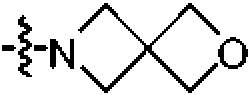
tio; ouncle; or
alquilo(C<8), alquenilo(C<8), alquinilo(C<8), arilo(C<8), aralquilo(C<8), heteroarilo(C<8), heterocicloalquilo(C<8), alcoxi(C<8), alqueniloxi(C<8), ariloxi(C<8), aralcoxi(C<8), heteroariloxi(C<8), aciloxi(C<8), alquilamino(C<8), dialquilami-no(C<8), arilamino(C<8), alquilsulfonilamino(C<8), amido(C<8), -NH-alcoxi(C<8), -NH-heterocicloalquilo(C<8), -NHC(NOH)-alquilo(C<8), -NH-amido(C<8), o una versión sustituida de cualquiera de estos grupos;alkyl (C <8), alkenyl (C <8), alkynyl (C <8), aryl (C <8), aralkyl (C <8), heteroaryl (C <8), heterocycloalkyl (C <8), alkoxy (C <8), alkenyloxy (C <8), aryloxy (C <8), aralkoxy (C <8), heteroaryloxy (C <8), acyloxy (C <8), alkylamino (C <8), dialkylamino- no (C <8), arylamino (C <8), alkylsulfonylamino (C <8), amido (C <8), -NH-alkoxy (C <8), -NH-heterocycloalkyl (C <8), -NHC (NOH) -alkyl (C <8), -NH-amido (C <8), or a substituted version of any of these groups;
Rc y R3, en conjunto, son -O - o -NRd-, en donde Rd es hidrógeno o alquilo(C<4); o Rc and R3, taken together, are -O - or -NRd-, where Rd is hydrogen or (C <4) alkyl; or
Rc y R4, tomados juntos, son -O - o -NRd-, en donde Rd es hidrógeno o alquilo(c<4); oRc and R4, taken together, are -O- or -NRd-, where Rd is hydrogen or alkyl (c <4); or
-NHC(O)Re, en donde Re es:-NHC (O) Re, where Re is:
hidrógeno, hidroxi, amino; ohydrogen, hydroxy, amino; or
alquilo(c<8), alquenilo(c<8), alquinilo(c<8), arilo(c<8), aralquilo(c<8), heteroarilo(c<8), heterocicloalquilo(c<8), alcoxi(c<8), ariloxi(c<8), aralcoxi(c<8), heteroariloxi(c<8), aciloxi(c<8), alquilamino(c<8), dialquilamino(c<8), arilami-no(c<8), o una sustituida de cualquiera de estos grupos;alkyl (c <8), alkenyl (c <8), alkynyl (c <8), aryl (c <8), aralkyl (c <8), heteroaryl (c <8), heterocycloalkyl (c <8), alkoxy (c <8), aryloxy (c <8), aralkoxy (c <8), heteroaryloxy (c <8), acyloxy (c <8), alkylamino (c <8), dialkylamino (c <8), arylami- no (c <8), or a substitute for any of these groups;
una sal o tautómero farmacéuticamente aceptable de los mismos.a pharmaceutically acceptable salt or tautomer thereof.
En algunas realizaciones los compuestos se definen adicionalmente por la fórmula:In some embodiments the compounds are further defined by the formula:

en donde:where:
R1 es -H, -cN , halo, - c F3, o -c(O)Ra, en donde Ra es -OH, alcoxi(ci-4), -NH2, alquilamino(ci-4), o -NH-S(O)2-alquilo(ci-4); R2 es hidrógeno o R2 está ausente cuando el átomo al que está unido forma parte de un doble enlace; yR1 is -H, -cN, halo, -c F3, or -c (O) Ra, wherein Ra is -OH, alkoxy (ci-4), -NH2, alkylamino (ci-4), or -NH- S (O) 2-alkyl (Ci-4); R2 is hydrogen or R2 is absent when the atom to which it is attached is part of a double bond; Y
Y es:And it is:
-H, -OH, -SH, -cN , -F, -cF3, -NH2 o -NcO;-H, -OH, -SH, -cN, -F, -cF3, -NH2 or -NcO;
alquilo(c<8), alquenilo(c<8), alquinilo(c<8), arilo(c<i2), aralquilo(c<i2), heteroarilo(c<8), heterocicloalquilo(c<i2), alcoxi(c<8), ariloxi(c<i2), aciloxi(c<8), alquilamino(c<8), dialquilamino(c<8), alquilamino(c<8), arilamino(c<8), aralquilamina(c<8), alquiltio(c<8), aciltio(c<8), alquilsulfonilamino(c<8), o versiones sustituidas de cualquiera de estos grupos -alcanodiilo(c<8)-Rb, -alendiilo(c<8)-Rb, o una versión sustituida de cualquiera de estos grupos, en donde Rb es:alkyl (c <8), alkenyl (c <8), alkynyl (c <8), aryl (c <i2), aralkyl (c <i2), heteroaryl (c <8), heterocycloalkyl (c <i2), alkoxy (c <8), aryloxy (c <i2), acyloxy (c <8), alkylamino (c <8), dialkylamino (c <8), alkylamino (c <8), arylamino (c <8), aralkylamine ( c <8), alkylthio (c <8), acylthio (c <8), alkylsulfonylamino (c <8), or substituted versions of any of these groups -alkanediyl (c <8) -Rb, -alendiyl (c <8 ) -Rb, or a substituted version of any of these groups, where Rb is:
hidrógeno, hidroxi, halo, amino o tio; ohydrogen, hydroxy, halo, amino or thio; or
heteroarilo(c<8), alcoxi(c<8), alqueniloxi(c<8), ariloxi(c<8), aralcoxi(c<8), heteroariloxi(c<8), aciloxi(c<8), alquilamino(c<8), dialquilamino(c<8), alquenilamino(c<8), arilamino(c<8), aralquilamino(c<8), heteroarilamino(c<8), alquilsulfonilamino(c<8), amido(c<8), -Oc(O)NH-alquilo(c<8), -Oc(O)cH2NHc(O)-O-f-butilo, -OcH2-alquiltio(c<8), o una versión sustituida de cualquiera de estos grupos;heteroaryl (c <8), alkoxy (c <8), alkenyloxy (c <8), aryloxy (c <8), aralkoxy (c <8), heteroaryloxy (c <8), acyloxy (c <8), alkylamino (c <8), dialkylamino (c <8), alkenylamino (c <8), arylamino (c <8), aralkylamino (c <8), heteroarylamino (c <8), alkylsulfonylamino (c <8), amido ( c <8), -Oc (O) NH-alkyl (c <8), -Oc (O) cH2NHc (O) -Of-butyl, -OcH2-alkylthio (c <8), or a substituted version of any of These groups;
-(cH2)mc(O)Rc, en donde m es 0-6 y Rc es:- (cH2) mc (O) Rc, where m is 0-6 and Rc is:
hidrógeno, hidroxi, halo, amino, -NHOH,hydrogen, hydroxy, halo, amino, -NHOH,

tio; ouncle; or
alquilo(c<8), alquenilo(c<8), alquinilo(c<8), arilo(c<8), aralquilo(c<8), heteroarilo(c<8), heterocicloalquilo(c<8), alcoxi(c<8), alqueniloxi(c<8), ariloxi(c<8), aralcoxi(c<8), heteroariloxi(c<8), aciloxi(c<8), alquilamino(c<8), dialquilami-no(c<8), arilamino(c<8), alquilsulfonilamino(c<8), amido(c<8), -NH-alcoxi(c<8), -NH-heterocicloalquilo(c<8), -NHc(NOH)-alquilo(c<8), -NH-amido(c<8), o una versión sustituida de cualquiera de estos grupos; oalkyl (c <8) , alkenyl (c <8) , alkynyl (c <8) , aryl (c <8) , aralkyl (c <8) , heteroaryl (c <8) , heterocycloalkyl (c <8) , alkoxy (c <8) , alkenyloxy (c <8) , aryloxy (c <8) , aralkoxy (c <8) , heteroaryloxy (c <8) , acyloxy (c <8) , alkylamino (c <8) , dialkylamino- no (c <8) , arylamino (c <8) , alkylsulfonylamino (c <8) , amido (c <8) , -NH-alkoxy (c <8) , -NH-heterocycloalkyl (c <8) , -NHc (NOH) -alkyl (c <8) , -NH- amido (c <8) , or a substituted version of any of these groups; or
-NHC(O)Re, en donde Re es:-NHC (O) R e , where R e is:
hidrógeno, hidroxi, amino; ohydrogen, hydroxy, amino; or
alquilo(c<8), alquenilo(c<8), alquinilo(c<8), arilo(c<8), aralquilo(c<8), heteroarilo(c<8), heterocicloalquilo(c<8), alcoxi(c<8), ariloxi(c<8), aralcoxi(c<8), heteroariloxi(c<8), aciloxi(c<8), alquilamino(c<8), dialquilamino(c<8), arilami-no(c<8), o una versión sustituida de cualquiera de estos grupos;alkyl (c <8), alkenyl (c <8), alkynyl (c <8), aryl (c <8), aralkyl (c <8), heteroaryl (c <8), heterocycloalkyl (c <8), alkoxy (c <8), aryloxy (c <8), aralkoxy (c <8), heteroaryloxy (c <8), acyloxy (c <8), alkylamino (c <8), dialkylamino (c <8), arylami- no (c <8), or a substituted version of any of these groups;
una sal o tautómero farmacéuticamente aceptable de los mismos.a pharmaceutically acceptable salt or tautomer thereof.
En algunas realizaciones, los compuestos se definen adicionalmente mediante la fórmula:In some embodiments, the compounds are further defined by the formula:

en donde:where:
Ri es -H, -cN , halo, - c F3, o -c(O)Ra, en donde Ra es -OH, alcoxi(ci-4), -NH2, alquilaminopc-M), o -NH-S(O)2-alquilo(ci-4); y Y es:Ri is -H, -cN, halo, -c F3, or -c (O) Ra, where Ra is -OH, alkoxy (ci-4), -NH2, alkylaminopc-M), or -NH-S ( O) 2-Ci-4 alkyl; and Y is:
-H, -OH, -SH, -cN , -F, -cF3, -NH2 o -NcO;-H, -OH, -SH, -cN, -F, -cF3, -NH2 or -NcO;
alquilo(c<8), alquenilo(c<8), alquinilo(c<8), arilo(c<i2), aralquilo(c<i2), heteroarilo(c<8), heterocicloalquilo(c<i2), alcoxi(c<8), ariloxi(c<i2), aciloxi(c<8), alquilamino(c<8), dialquilamino(c<8), alquilamino(c<8), arilamino(c<8), aralquilamina(c<8), alquiltio(c<8), aciltio(c<8), alquilsulfonilamino(c<8), o versiones sustituidas de cualquiera de estos grupos -alcanodiilo(c<8)-Rb, -alendiilo(c<8)-Rb, o una versión sustituida de cualquiera de estos grupos, en donde Rb es:alkyl (c <8), alkenyl (c <8), alkynyl (c <8), aryl (c <i2), aralkyl (c <i2), heteroaryl (c <8), heterocycloalkyl (c <i2), alkoxy (c <8), aryloxy (c <i2), acyloxy (c <8), alkylamino (c <8), dialkylamino (c <8), alkylamino (c <8), arylamino (c <8), aralkylamine ( c <8), alkylthio (c <8), acylthio (c <8), alkylsulfonylamino (c <8), or substituted versions of any of these groups -alkanediyl (c <8) -Rb, -alendiyl (c <8 ) -Rb, or a substituted version of any of these groups, where Rb is:
hidrógeno, hidroxi, halo, amino o tio; ohydrogen, hydroxy, halo, amino or thio; or
heteroarilo(c<8), alcoxi(c<8), alqueniloxi(c<8), ariloxi(c<8), aralcoxi(c<8), heteroariloxi(c<8), aciloxi(c<8), alquilamino(c<8), dialquilamino(c<8), alquenilamino(c<8), arilamino(c<8), aralquilamino(c<8), heteroarilamino(c<8), alquilsulfonilamino(c<8), amido(c<8), -Oc(O)NH-alquilo(c<8), -Oc(O)cH2NHc(O)-O-f-butilo, -OcH2-alquiltio(c<8), o una versión sustituida de cualquiera de estos grupos;heteroaryl (c <8), alkoxy (c <8), alkenyloxy (c <8), aryloxy (c <8), aralkoxy (c <8), heteroaryloxy (c <8), acyloxy (c <8), alkylamino (c <8), dialkylamino (c <8), alkenylamino (c <8), arylamino (c <8), aralkylamino (c <8), heteroarylamino (c <8), alkylsulfonylamino (c <8), amido ( c <8), -Oc (O) NH-alkyl (c <8), -Oc (O) cH2NHc (O) -Of-butyl, -OcH2-alkylthio (c <8), or a substituted version of any of These groups;
-(cH2)mc(O)Rc, en donde m es 0-6 y Rc es:- (cH2) mc (O) Rc, where m is 0-6 and Rc is:
hidrógeno, hidroxi, halo, amino, -NHOH,hydrogen, hydroxy, halo, amino, -NHOH,

tio; ouncle; or
alquilo(c<8), alquenilo(c<8), alquinilo(c<8), arilo(c<8), aralquilo(c<8), heteroarilo(c<8), heterocicloalquilo(c<8), alcoxi(c<8), alqueniloxi(c<8), ariloxi(c<8), aralcoxi(c<8), heteroariloxi(c<8), aciloxi(c<8), alquilamino(c<8), dialquilamino(c<8), arilamino(c<8), alquilsulfonilamino(c<8), amido(c<8), -NH-alcoxi(c<8), -NH-heterocicloalquilo(c<8), -NHC(NOH), .a lq u ilo ^ ), -NH-amido(c<8), o una versión sustituida de cualquiera de estos grupos; oalkyl (c <8) , alkenyl (c <8) , alkynyl (c <8) , aryl (c <8) , aralkyl (c <8) , heteroaryl (c <8) , heterocycloalkyl (c <8) , alkoxy (c <8) , alkenyloxy (c <8) , aryloxy (c <8) , aralkoxy (c <8) , heteroaryloxy (c <8) , acyloxy (c <8) , alkylamino (c <8) , dialkylamino ( c <8) , arylamino (c <8) , alkylsulfonylamino (c <8), amido (c <8), -NH-alkoxy (c <8), -NH-heterocycloalkyl (c <8), -NHC (NOH). a lq u ilo ^ ) , -NH-amido (c <8) , or a substituted version of any of these groups; or
-NHC(O)Re en donde Re es:-NHC (O) R e where R e is:
hidrógeno, hidroxi, amino; ohydrogen, hydroxy, amino; or
alquilo(c<8), alquenilo(c<8), alquinilo(c<8), arilo(c<8), aralquilo(c<8), heteroarilo(c<8), heterocicloalquilo(c<8), alcoxi(c<8), ariloxi(c<8), aralcoxi(c<8), heteroariloxi(c<8), aciloxi(c<8), alquilamino(c<8), dialquilamino(c<8), arilamida(c<8), o una versión sustituida de cualquiera de estos grupos;alkyl (c <8), alkenyl (c <8), alkynyl (c <8), aryl (c <8), aralkyl (c <8), heteroaryl (c <8), heterocycloalkyl (c <8), alkoxy (c <8), aryloxy (c <8), aralkoxy (c <8), heteroaryloxy (c <8), acyloxy (c <8), alkylamino (c <8), dialkylamino (c <8), arylamide ( c <8), or a substituted version of any of these groups;
una sal o tautómero farmacéuticamente aceptable de los mismos.a pharmaceutically acceptable salt or tautomer thereof.
En algunas realizaciones los compuestos se definen adicionalmente por la fórmula:In some embodiments the compounds are further defined by the formula:

en donde:where:
Ri es -H, -cN , halo, - c F3, o -c(O)Ra, en donde Ra es -OH, alcoxi(ci-4), -NH2, alquilaminopcM), o -NH-S(O)2-alquilo(ci-4); e Y es:Ri is -H, -cN, halo, -c F3, or -c (O) Ra, where Ra is -OH, alkoxy (ci-4), -NH2, alkylaminopcM), or -NH-S (O) 2-alkyl (ci-4); e Y is:
-H, -OH, -SH, -cN , -F, -cF3, -NH2 o -NcO;-H, -OH, -SH, -cN, -F, -cF3, -NH2 or -NcO;
alquilo(c<8), alquenilo(c<8), alquinilo(c<8), arilo(c<i2), aralquilo(c<i2), heteroarilo(c<8), heterocicloalquilo(c<i2), alcoxi(c<8), ariloxi(c<i2), aciloxi(c<8), alquilamino(c<8), dialquilamino(c<8), alquenilamino(c<8), arilamino(c<8), aralquilami-no(c<8), amido(c<8), alquiltio(c<8), aciltio(c<8), alquilsulfonilamino(c<8), o versiones sustituidas de cualquiera de estos grupos; -alcanodiilo(c<8)-Rb, -alendiilo(c<8)-Rb, o una versión sustituida de cualquiera de estos grupos, en donde Rb es: hidrógeno, hidroxi, halo, amino o tio; oalkyl (c <8), alkenyl (c <8), alkynyl (c <8), aryl (c <i2), aralkyl (c <i2), heteroaryl (c <8), heterocycloalkyl (c <i2), alkoxy (c <8), aryloxy (c <i2), acyloxy (c <8), alkylamino (c <8), dialkylamino (c <8), alkenylamino (c <8), arylamino (c <8), aralkylamino- no (c <8), amido (c <8), alkylthio (c <8), acylthio (c <8), alkylsulfonylamino (c <8), or substituted versions of any of these groups; -alkanediyl (c <8) -Rb, -alendiyl (c <8) -Rb, or a substituted version of any of these groups, wherein Rb is: hydrogen, hydroxy, halo, amino or thio; or
heteroarilo(c<8), alcoxi(c<8), alqueniloxi(c<8), ariloxi(c<8), aralcoxi(c<8), heteroariloxi(c<8), aciloxi(c<8), alquilamino(c<8), dialquilamino(c<8), alquenilamino(c<8), arilamino(c<8), aralquilamino(c<8), heteroarilamino(c<8), alquilsulfonilamino(c<8), amido(c<8), -Oc(O)NH-alquilo(c<8), -Oc(O)cH2NHc(O)-O-f-butilo, -OcH2-alquiltio(c<8), o una versión sustituida de cualquiera de estos grupos;heteroaryl (c <8), alkoxy (c <8), alkenyloxy (c <8), aryloxy (c <8), aralkoxy (c <8), heteroaryloxy (c <8), acyloxy (c <8), alkylamino (c <8), dialkylamino (c <8), alkenylamino (c <8), arylamino (c <8), aralkylamino (c <8), heteroarylamino (c <8), alkylsulfonylamino (c <8), amido ( c <8), -Oc (O) NH-alkyl (c <8), -Oc (O) cH2NHc (O) -Of-butyl, -OcH2-alkylthio (c <8), or a substituted version of any of These groups;
-(cH2)mc(O)Rc, en donde m es 0-6 y Rc es:- (cH2) mc (O) Rc, where m is 0-6 and Rc is:
hidrógeno, hidroxi, halo, amino, -NHOH,hydrogen, hydroxy, halo, amino, -NHOH,

tio; ouncle; or
alquilo(c<8), alquenilo(c<8), alquinilo(c<8), arilo(c<8), aralquilo(c<8), heteroarilo(c<8), heterocicloalquilo(c<8), alcoxi(c<8), alqueniloxi(c<8), ariloxi(c<8), aralcoxi(c<8), heteroariloxi(c<8), aciloxi(c<8), alquilamino(c<8), dialquilami-no(c<8), arilamino(c<8), alquilsulfonilamino(c<8), amido(c<8), -NH-alcoxi(c<8), -NH-heterocicloalquilo(c<8), -NHc(NOH)-alquilo(c<8), -NH-amido(c<8), o una versión sustituida de cualquiera de estos grupos; oalkyl (c <8) , alkenyl (c <8) , alkynyl (c <8) , aryl (c <8) , aralkyl (c <8) , heteroaryl (c <8) , heterocycloalkyl (c <8) , alkoxy (c <8) , alkenyloxy (c <8) , aryloxy (c <8) , aralkoxy (c <8) , heteroaryloxy (c <8) , acyloxy (c <8) , alkylamino (c <8) , dialkylamino- no (c <8) , arylamino (c <8) , alkylsulfonylamino (c <8) , amido (c <8) , -NH-alkoxy (c <8) , -NH-heterocycloalkyl (c <8) , -NHc (NOH) -alkyl (c <8) , -NH- amido (c <8) , or a substituted version of any of these groups; or
-NHC(O)Re, en donde Re es:-NHC (O) R e , where R e is:
hidrógeno, hidroxi, amino; ohydrogen, hydroxy, amino; or
alquilo(c<8), alquenilo(c<8), alquinilo(c<8), arilo(c<8), aralquilo(c<8), heteroarilo(c<8), heterocicloalquilo(c<8), alcoxi(c<8), ariloxi(c<8), aralcoxi(c<8), heteroariloxi(c<8), aciloxi(c<8), alquilamino(c<8), dialquilamino(c<8), arilami-no(c<8), o una versión sustituida de cualquiera de estos grupos;alkyl (c <8), alkenyl (c <8), alkynyl (c <8), aryl (c <8), aralkyl (c <8), heteroaryl (c <8), heterocycloalkyl (c <8), alkoxy (c <8), aryloxy (c <8), aralkoxy (c <8), heteroaryloxy (c <8), acyloxy (c <8), alkylamino (c <8), dialkylamino (c <8), arylami- no (c <8), or a substituted version of any of these groups;
una sal o tautómero farmacéuticamente aceptable de los mismos.a pharmaceutically acceptable salt or tautomer thereof.
En algunas realizaciones, el enlace entre los átomos de carbono 4 y 5 es un enlace sencillo. En algunas realizaciones, el enlace entre los átomos de carbono 4 y 5 es un doble enlace. En algunas realizaciones, el enlace entre los átomos de carbono 9 y 11 es un doble enlace.In some embodiments, the bond between carbon atoms 4 and 5 is a single bond. In some embodiments, the bond between carbon atoms 4 and 5 is a double bond. In some embodiments, the bond between carbon atoms 9 and 11 is a double bond.
En algunas realizaciones, el enlace entre los átomos de carbono 9 y 11 es un enlace sencillo.In some embodiments, the bond between carbon atoms 9 and 11 is a single bond.
En algunas realizaciones, X i es oxo En algunas realizaciones, X i es hidrogeno En algunas realizaciones, X i es hidroxi. En algunas realizaciones, X2 es oxo En algunas realizaciones, X2 es hidrogenoIn some embodiments, X i is oxo In some embodiments, X i is hydrogen In some embodiments, X i is hydroxy. In some embodiments, X2 is oxo In some embodiments, X2 is hydrogen
En algunas realizaciones, Ri es -cN . En algunas realizaciones, Ri es -c(O)Ra, en donde Ra es -OH, alcoxi(ci-4), -NH2, alquilamino(ci-4), o -NH-S(O)2-alquilo(ci-4). En algunas realizaciones, Ra es -OH. En algunas realizaciones, Ra es alcoxi(ci-4). En algunas realizaciones, Ra es metoxi. En algunas realizaciones, Ra es -NH2. En algunas realizaciones, Ri es -H. En algunas realizaciones, Ri es halo. En algunas realizaciones, Ri es yodo.In some embodiments, Ri is -cN. In some embodiments, Ri is -c (O) Ra, wherein Ra is -OH, alkoxy (ci-4), -NH2, alkylamino (ci-4), or -NH-S (O) 2-alkyl (ci -4). In some embodiments, Ra is -OH. In some embodiments, Ra is alkoxy (ci-4). In some embodiments, Ra is methoxy. In some embodiments, Ra is -NH2. In some embodiments, Ri is -H. In some embodiments, Ri is halo. In some embodiments, Ri is iodine.
En algunas realizaciones, R2 es hidrogeno. En algunas realizaciones, R2 está ausente. En algunas realizaciones, R2' es alquilo(c<8). En algunas realizaciones, R2' es metilo. En algunas realizaciones, R2' es =c H2.In some embodiments, R2 is hydrogen. In some embodiments, R2 is absent. In some embodiments, R2 'is alkyl (c <8). In some embodiments, R2 'is methyl. In some embodiments, R2 'is = c H2.
En algunas realizaciones, R3 es metilo. En algunas realizaciones, R3 es hidrogeno. En algunas realizaciones, R4 es hidrogeno. En algunas realizaciones, R4 es metilo. En algunas realizaciones, R4 es hidroxi.In some embodiments, R3 is methyl. In some embodiments, R3 is hydrogen. In some embodiments, R4 is hydrogen. In some embodiments, R4 is methyl. In some embodiments, R4 is hydroxy.
En algunas realizaciones, Y es -(cH2)mc(O)Rc, en donde m es 0-6 y Rc es hidrógeno, hidroxi, amino, -NHOH, alquilo(c<8), alquenilo(c<8), alquinilo(c<8), arilo(c<8), aralquilo(c<8), heteroarilo(c<8), heterocicloalquilo(c<8), alcoxi(c<8), alqueniloxi(c<8), ariloxi(c<8), aralcoxi(c<8), aciloxi(c<8), alquilamino(c<8), dialquilamino(c<8), arilamino(c<8), alquilsulfonilamina(c<8), amido(c<8), -NH-alcoxi(c<8), -NH-heterocicloalquilo(c<8), -NHc(NOH)-alquilo(c<8), -NH-amido(c<8), o una versión sustituida de cualquiera de estos grupos distintos de hidrógeno, hidroxi, amino y -NHOH.In some embodiments, Y is - (cH2) mc (O) Rc, where m is 0-6 and Rc is hydrogen, hydroxy, amino, -NHOH, alkyl (c <8), alkenyl (c <8), alkynyl (c <8), aryl (c <8), aralkyl (c <8), heteroaryl (c <8), heterocycloalkyl (c <8), alkoxy (c <8), alkenyloxy (c <8), aryloxy ( c <8), aralkoxy (c <8), acyloxy (c <8), alkylamino (c <8), dialkylamino (c <8), arylamino (c <8), alkylsulfonylamine (c <8), amido (c <8), -NH-alkoxy (c <8), -NH-heterocycloalkyl (c <8), -NHc (NOH) -alkyl (c <8), -NH-amido (c <8), or a version substituted of any of these groups other than hydrogen, hydroxy, amino and -NHOH.
En algunas realizaciones, Rc es alcoxi(c<8). En algunas realizaciones, Rc es metoxi, etoxi o isopropoxi. En algunas realizaciones, Rc es hidroxi. En algunas realizaciones, Rc es amino. En algunas realizaciones, Rc es alquilamino(c<8) o alquilamino sustituido^). En algunas realizaciones, Rc es metilamino, etilamino, n-butilamino o 2 ,2 ,2-trifluoroetilamino. En algunas realizaciones, Rc es heteroarilo(c<8). En algunas realizaciones, Rc es imidazolilo o dimetilimidazolilo. En algunas realizaciones, Rc es -NHOH o -NHOcH3. En algunas realizaciones, Rc es heterocicloalquilo(c<8) o heterocicloalquilo(c<8) sustituido. En algunas realizaciones, Rc es M-pirrolidinilo, M-morfolinilo, M-piperidinilo o M-azetidinilo. En algunas realizaciones, Rc es -NH-heterocicloalquilo(c<8). En algunas realizaciones, Rc es -NH-arnido(c<8) o una versión sustituida del mismo. En algunas realizaciones, Rc es -NHNHc(O)H, -NHNHc(O)cH3 o -NHNHc(O)cH2OcH3. En algunas realizaciones, Rc es -NHc (NOH)c H3. En algunas realizaciones, m es 0. En algunas realizaciones, m es 2.In some embodiments, Rc is alkoxy (c <8). In some embodiments, Rc is methoxy, ethoxy or isopropoxy. In some embodiments, Rc is hydroxy. In some embodiments, Rc is amino. In some embodiments, Rc is alkylamino (c <8) or substituted alkylamino ^). In some embodiments, Rc is methylamino, ethylamino, n-butylamino or 2,2,2-trifluoroethylamino. In some embodiments, Rc is heteroaryl (c <8). In some embodiments, Rc is imidazolyl or dimethylimidazolyl. In some embodiments, Rc is -NHOH or -NHOcH3. In some embodiments, Rc is heterocycloalkyl (c <8) or substituted heterocycloalkyl (c <8). In some embodiments, Rc is M-pyrrolidinyl, M-morpholinyl, M-piperidinyl or M-azetidinyl. In some embodiments, Rc is -NH-heterocycloalkyl (c <8). In some embodiments, Rc is -NH-arnido (c <8) or a substituted version thereof. In some embodiments, Rc is -NHNHc (O) H, -NHNHc (O) cH3 or -NHNHc (O) cH2OcH3. In some embodiments, Rc is -NHc (NOH) c H3. In some embodiments, m is 0. In some embodiments, m is 2.
En algunas realizaciones, Y es alcanodiilo(c<8)-Rb. En algunas realizaciones, Y es -cH2-Rb. En algunas realizaciones, Rb es hidroxi. En algunas realizaciones, Rb es aciloxi(c<8) o aciloxi sustituido^). En algunas realizaciones, Rb es acetiloxi, o trifluoroacetiloxi, -Oc(O)cH2NH2. En algunas realizaciones, Rb es alcoxi(c<8) o alcoxi sustituido^). En algunas realizaciones, Rb es metoxi o fluorometoxi. En algunas realizaciones, Rb es heteroarilo(c<8). En algunas realizaciones, Rb es -Oc(O)NH-alquilo(c<8), -Oc(O)cH2NHc(O)O-t-butilo, o -OcH2-alquiltio(c<8).In some embodiments, Y is alkanediyl (c <8) -Rb. In some embodiments, Y is -cH2-Rb. In some embodiments, Rb is hydroxy. In some embodiments, Rb is acyloxy (c <8) or substituted acyloxy ^). In some embodiments, Rb is acetyloxy, or trifluoroacetyloxy, -Oc (O) cH2NH2. In some embodiments, Rb is alkoxy (c <8) or substituted alkoxy ^). In some embodiments, Rb is methoxy or fluoromethoxy. In some embodiments, Rb is heteroaryl (c <8). In some embodiments, Rb is -Oc (O) NH-alkyl (c <8), -Oc ( O) cH2NHc ( O) Ot-butyl, or -OcH2-alkylthio (c <8).
En algunas realizaciones, Y es -cN . En algunas realizaciones, Y es isocianato. En algunas realizaciones, Y es flúor. En algunas realizaciones, Y es alquilsulfonilamino(c<8) o alquilsulfonilamino(c<8) sustituido. En algunas realizaciones, Y es -NHS(O)2c H3 o -NHS(O)2c H2c F3. En algunas realizaciones, Y es heteroarilo(c<8). En algunas realizaciones, Y es oxadiazolilo, metiloxadiazolilo. o metoximetiloxadiazolilo. En otras realizaciones, Y es amido (c<8), acilo(c<8), o versiones sustituidas de cualquier grupo.In some embodiments, Y is -cN. In some embodiments, Y is isocyanate. In some embodiments, Y is fluorine. In some embodiments, Y is alkylsulfonylamino (c <8) or substituted alkylsulfonylamino (c <8). In some embodiments, Y is -NHS (O) 2c H3 or -NHS (O) 2c H2c F3. In some embodiments, Y is heteroaryl (c <8). In some embodiments, Y is oxadiazolyl, methyloxadiazolyl. or methoxymethyloxadiazolyl. In other embodiments, Y is amido (c <8), acyl (c <8), or substituted versions of any group.
En algunas realizaciones, Y es -NHc(O)Re, en en donde Re es hidrogeno, hidroxi, amino, alquilo(c<8), arilo(c<8), alcoxi(c<8), aciloxi(c<8), alquilamino(c<8), dialquilamino(c<8), o una versión sustituida de cualquiera de estos grupos distintos al hidrógeno, hidroxi y amino. En algunas realizaciones, Re es hidrogeno. En algunas realizaciones, Re es amino. En algunas realizaciones, Re es alquilo(c<8), o alquilo sustituido^). En algunas realizaciones, Re es metil etilo, ciclopropilo, ciclobutilo, n -hexilo, i,i-difluoroetilo, o 2 ,2 ,2-trifluoroetilo. En algunas realizaciones, Re es arilo(c<8). En algunas realizaciones, Re es alcoxi(c<8). En algunas realizaciones, Re es metoxi, etoxi o isopropoxi. En algunas realizaciones, Re es alquilamino(c<8), o dialquilamino(c<8). En algunas realizaciones, Re es metilamino, etilamino, o dimetilamino.In some embodiments, Y is -NHc (O) Re, wherein Re is hydrogen, hydroxy, amino, alkyl (c <8), aryl (c <8), alkoxy (c <8), acyloxy (c <8 ), alkylamino (c <8), dialkylamino (c <8), or a substituted version of any of these groups other than hydrogen, hydroxy and amino. In some embodiments, Re is hydrogen. In some embodiments, Re is amino. In some embodiments, Re is alkyl (c <8), or substituted alkyl ^). In some embodiments, Re is methyl ethyl, cyclopropyl, cyclobutyl, n- hexyl, i, i-difluoroethyl, or 2,2,2-trifluoroethyl. In some embodiments, Re is aryl (c <8). In some embodiments, Re is alkoxy (c <8). In some embodiments, Re is methoxy, ethoxy or isopropoxy. In some embodiments, Re is alkylamino (c <8), or dialkylamino (c <8). In some embodiments, Re is methylamino, ethylamino, or dimethylamino
En algunas realizaciones, Y es -(CH2)mC(O)Rc, en donde m es 0 y en donde Rc y R3 se toman juntos y son -O-. En algunas realizaciones, Y es -(CH2)mC(O)Rc, en donde m es 0 y en donde Rc y R4 se toman juntos y son -O-.In some embodiments, Y is - (CH2) mC (O) Rc, where m is 0 and where Rc and R3 are taken together and are -O-. In some embodiments, Y is - (CH2) mC (O) Rc, where m is 0 and where Rc and R4 are taken together and are -O-.
En realizaciones que tienen un hidrógeno en el átomo de carbono 13, el hidrógeno está en la orientación beta. En otros es la orientación alfa. En algunas realizaciones, el hidrógeno en el átomo de carbono 18 está en la orientación beta; en otras realizaciones, está en la orientación alfa. Por ejemplo, en algunas realizaciones, hay átomos de hidrógeno en ambos átomos de carbono 13 y 18, y ambos están en las orientaciones beta.In embodiments that have a hydrogen in carbon atom 13, the hydrogen is in the beta orientation. In others it is the alpha orientation. In some embodiments, the hydrogen in carbon atom 18 is in the beta orientation; In other embodiments, it is in the alpha orientation. For example, in some embodiments, there are hydrogen atoms in both carbon atoms 13 and 18, and both are in the beta orientations.
En algunas realizaciones, la invención proporciona compuestos de las fórmulas: In some embodiments, the invention provides compounds of the formulas:


y sales y tautómeros farmacéuticamente aceptables de los mismos.and pharmaceutically acceptable salts and tautomers thereof.
En algunos aspectos, se proporcionan composiciones farmacéuticas que comprenden uno o más de los compuestos anteriores y un excipiente. En otros aspectos, se proporcionan métodos para tratar y/o prevenir una enfermedad o un trastorno en pacientes que lo necesitan, que comprenden administrar adichos pacientes uno o más de los compuestos anteriores en una cantidad suficiente para tratar y/o prevenir la enfermedad o trastorno.In some aspects, pharmaceutical compositions comprising one or more of the above compounds and an excipient are provided. In other aspects, methods are provided to treat and / or prevent a disease or disorder in patients in need thereof, which comprise administering said patients one or more of the above compounds in an amount sufficient to treat and / or prevent the disease or disorder. .
Otros objetos, características y ventajas de la presente descripción se harán evidentes a partir de la siguiente descripción detallada. Debe entenderse, sin embargo, que la descripción detallada y los ejemplos específicos, aunque indican realizaciones específicas de la invención, se proporcionan solo a modo de ilustración. Tenga en cuenta que simplemente porque un compuesto en particular se atribuye a una fórmula genérica particular no significa que no pueda pertenecer a otra fórmula genérica.Other objects, features and advantages of the present description will become apparent from the following detailed description. It should be understood, however, that the detailed description and specific examples, although indicating specific embodiments of the invention, are provided by way of illustration only. Note that simply because a particular compound is attributed to a particular generic formula does not mean that it cannot belong to another generic formula.
Descripción de realizaciones ilustrativasDescription of illustrative embodiments
En el presente documento se describen nuevos compuestos y composiciones con propiedades antoxidantes y/o antiinflamatorias, métodos para su fabricación y métodos para su uso, incluyendo para el tratamiento y/o prevención de enfermedades.This document describes new compounds and compositions with anti-oxidant and / or anti-inflammatory properties, methods for their manufacture and methods for their use, including for the treatment and / or prevention of diseases.
I. DefinicionesI. Definitions
Cuando se usa en el contexto de un grupo químico, "hidrógeno" significa -H; "hidroxi" significa -OH; "oxo" significa =O; "halo" significa independientemente -F, -Cl, -Br o -I; "amino" significa -NH2; "hidroxiamino" significa -NHOH; "nitro" significa -NO2; imino significa =NH; "ciano" significa -CN; "isocianato" significa -N=C=O; "azido" significa -N3; en un contexto monovalente, "fosfato" significa -OP(O)(OH)2 o una forma desprotonada del mismo; en un contexto divalente, "fosfato" significa -OP(O)(OH)O- o una forma desprotonada del mismo; "mercapto" significa -SH; "tio" significa =S; "sulfonilo" significa -S(O)2-; y "sulfinilo" significa -S(O)-.When used in the context of a chemical group, "hydrogen" means -H; "hydroxy" means -OH; "oxo" means = O; "halo" independently means -F, -Cl, -Br or -I; "amino" means -NH2; "hydroxyamino" means -NHOH; "nitro" means -NO2; imino means = NH; "cyano" means -CN; "isocyanate" means -N = C = O; "azido" means -N3; in a monovalent context, "phosphate" means -OP (O) (OH) 2 or a deprotonated form thereof; in a divalent context, "phosphate" means -OP (O) (OH) O- or a deprotonated form thereof; "mercapto" means -SH; "uncle" means = S; "sulfonyl" means -S (O) 2-; and "sulfinyl" means -S (O) -.
En el contexto de las fórmulas químicas, el símbolo "-" significa un enlace simple, "=" significa un enlace doble; y '=" significa triple enlace. El símbolo "—" representa un enlace opcional, que si está presente es simple o doble. El símbolo "==" representa un enlace simple o un enlace doble. Así, por ejemplo, la estructuraIn the context of chemical formulas, the symbol "-" means a single bond, "=" means a double bond; and '= "means triple bond. The symbol" - "represents an optional link, which if present is single or double. The symbol" == "represents a single link or a double bond. Thus, for example, the structure

incluye las estructuras includes structures

Como entenderá un experto en la técnica, ninguno de tales átomos anulares forma parte de más de un doble enlace. El símbolo "''w'", cuando se dibuja perpendicularmente a través de un enlace indica un punto de unión del grupo. Se tiene en cuenta que, por lo general, el punto de conexión solo se identifica de esta manera para grupos más grandes con el fin de ayudar al lector a identificar de manera rápida y sin ambigüedades un punto de conexión. El símbolo " - w significa un enlace sencillo donde el grupo unido al extremo grueso de la cuña está "fuera de la página". El símbolo " i" significa un enlace sencillo donde el grupo unido al extremo grueso de la cuña está "en la página". El símbolo " 'w v " significa un enlace sencillo donde la conformación (p. Ej., R o S) o la geometría no está definida (p. Ej., E o Z).As one skilled in the art will understand, none of such ring atoms is part of more than one double bond. The symbol "'' w '", when drawn perpendicularly through a link indicates a point of union of the group. It is taken into account that, in general, the connection point is only identified in this way for larger groups in order to help the reader quickly and unambiguously identify a connection point. The symbol "-w means a simple link where the group attached to the thick end of the wedge is" off the page. "The symbol" i "means a simple link where the group attached to the thick end of the wedge is" in the page ". The symbol"'wv"means a simple link where the conformation ( eg, R or S) or the geometry is not defined ( eg, E or Z).
Cualquier valencia indefinida en un átomo de una estructura mostrada en esta solicitud representa implícitamente un átomo de hidrógeno unido al átomo. Cuando un grupo "R" se representa como un "grupo flotante" en un sistema anular, por ejemplo, en la fórmula:Any indefinite valence in an atom of a structure shown in this application implicitly represents a hydrogen atom attached to the atom. When a group "R" is represented as a "floating group" in an annular system, for example, in the formula:

entonces R puede reemplazar cualquier átomo de hidrógeno conectado a cualquiera de los átomos del anillo, incluido un hidrógeno representado, implícito o expresamente definido, siempre que se forme una estructura estable. Cuando un grupo "R" se representa como un "grupo flotante" en un sistema anular fusionado, como por ejemplo en la fórmula:then R can replace any hydrogen atom connected to any of the ring atoms, including a hydrogen represented, implicitly or expressly defined, provided a stable structure is formed. When a group "R" is represented as a "floating group" in a fused ring system, such as in the formula:

entonces R puede reemplazar cualquier hidrógeno unido a cualquiera de los átomos del anillo de cualquiera de los anillos fusionados, a menos que se especifique lo contrario. Los hidrógenos reemplazables incluyen los hidrógenos representados (por ejemplo, el hidrógeno unido al nitrógeno en la fórmula anterior), los hidrógenos implicados (por ejemplo, un hidrógeno de la fórmula anterior que no se muestra pero se entiende que está presente), definido expresamente hidrógenos e hidrógenos opcionales cuya presencia depende de la identidad de un átomo del anillo (por ejemplo, un hidrógeno unido al grupo X, cuando X es igual a -CH-), siempre que se forme una estructura estable. En el ejemplo representado, R puede residir en el anillo de 5 miembros o en el anillo de 6 miembros del sistema anular fusionado. En la fórmula anterior, la letra de subíndice "y" que sigue inmediatamente al grupo "R" entre paréntesis, representa una variable numérica. A menos que se especifique lo contrario, esta variable puede ser 0 , 1 ,2 o cualquier número entero mayor que 2, solo limitado por el número máximo de átomos de hidrógeno reemplazables del anillo o sistema anular.then R can replace any hydrogen attached to any of the ring atoms of any of the fused rings, unless otherwise specified. Replaceable hydrogens include the hydrogens represented (for example, hydrogen bound to nitrogen in the above formula), the hydrogens involved (for example, a hydrogen of the above formula not shown but understood to be present), expressly defined hydrogens and optional hydrogens whose presence depends on the identity of a ring atom (for example, a hydrogen attached to the group X, when X is equal to -CH-), provided that a stable structure is formed. In the example shown, R may reside in the 5-member ring or in the 6-member ring of the fused ring system. In the above formula, the subscript letter "y" that immediately follows the group "R" in parentheses, represents a numerical variable. Unless otherwise specified, this variable can be 0, 1, 2 or any integer greater than 2, only limited by the maximum number of replaceable hydrogen atoms in the ring or annular system.
Para los grupos y clases a continuación, los siguientes subíndices entre paréntesis definen el grupo/clase de la siguiente manera: "(Cn)" define el número exacto (n) de átomos de carbono en el grupo/clase. "(C<n)" define el número máximo (n) de átomos de carbono que puede estar en el grupo/clase, con el número mínimo lo más pequeño posible para el grupo en cuestión, por ejemplo, se entiende que el número mínimo de Los átomos de carbono en el grupo "alquenilo(C<8)" o la clase "alqueno(C<8)" son dos. Por ejemplo, "alcoxi(C<i0)" designa aquellos grupos alcoxi que tienen de 1 a 10 átomos de carbono (por ejemplo, 1, 2 , 3 , 4 , 5 , 6, 7 , 8, 9 o 10, o cualquier intervalo derivado en ellos (por ejemplo, de 3 a 10 átomos de carbono). (Cn-n') define el número mínimo (n) y máximo (n') de átomos de carbono en el grupo. De manera similar, "alquilo(C2-10)" designa aquellos grupos alquilo que tienen de 2 a 10 átomos de carbono (por ejemplo, 2 , 3 , 4 , 5, 6, 7 , 8, 9 o 10, o cualquier intervalo derivado de ellos (por ejemplo, 3 a 10 átomos de carbono)). For the groups and classes below, the following subscripts in parentheses define the group / class as follows: "(Cn)" defines the exact number (n) of carbon atoms in the group / class. "(C <n)" defines the maximum number (n) of carbon atoms that may be in the group / class, with the minimum number as small as possible for the group in question, for example, it is understood that the minimum number of The carbon atoms in the group "alkenyl (C <8)" or the class "alkene (C <8)" are two. For example, "alkoxy (C <i0)" means those alkoxy groups having 1 to 10 carbon atoms (for example, 1, 2, 3, 4, 5, 6, 7, 8, 9 or 10, or any range derived from them (for example, from 3 to 10 carbon atoms). (Cn-n ') defines the minimum (n) and maximum (n') number of carbon atoms in the group. Similarly, "alkyl (C2-10) "means those alkyl groups having 2 to 10 carbon atoms (for example, 2, 3, 4, 5, 6, 7, 8, 9 or 10, or any range derived from them (for example , 3 to 10 carbon atoms)).
El término "saturado" como se usa en este documento significa que el compuesto o grupo así modificado no tiene dobles enlaces carbono-carbono ni triples carbono-carbono, excepto como se indica a continuación. El término no excluye los enlaces múltiples carbono-heteroátomo, por ejemplo un doble enlace oxígeno-carbono o un doble enlace nitrógeno-carbono. Además, no excluye un doble enlace carbono-carbono que pueda ocurrir como parte del tautomerismo ceto-enol o el tautomerismo imina/enamina.The term "saturated" as used herein means that the compound or group so modified does not have carbon-carbon double bonds or carbon-carbon triple bonds, except as indicated below. The term does not exclude multiple carbon-heteroatom bonds, for example an oxygen-carbon double bond or a nitrogen-carbon double bond. In addition, it does not exclude a carbon-carbon double bond that may occur as part of keto-enol tautomerism or imine / enamine tautomerism.
El término "alifático" cuando se usa sin el modificador "sustituido" significa que el compuesto/grupo así modificado es un compuesto o grupo de hidrocarburo acíclico o cíclico, pero no aromático. En los compuestos/grupos alifáticos, los átomos de carbono pueden unirse entre sí en cadenas rectas, cadenas ramificadas o anillos no aromáticos (alicíclicos). Los compuestos/grupos alifáticos pueden estar saturados, que están unidos por enlaces simples (alcanos/alquilo), o insaturados, con uno o más enlaces dobles (alquenos/alquenilo) o con uno o más enlaces triples (alquinos/alquinilo). Cuando el término "alifático" se usa sin el modificador "sustituido", solo están presentes los átomos de carbono e hidrógeno. Cuando el término se usa con el modificador "sustituido" uno o más átomo de hidrógeno ha sido reemplazado independientemente por -OH, -F, -Cl, -Br, -I, -NH2, -NO2, -CO2H, -CO2CH3, -CN, -SH, -OCH3, -OCH2CH3, -C(O )CH3, -N (CH3)2, -C(O)NH2, -OC(O)CH3, o -S(O)2NH2.The term "aliphatic" when used without the "substituted" modifier means that the compound / group so modified is an acyclic or cyclic hydrocarbon compound or group, but not aromatic. In the aliphatic compounds / groups, the Carbon atoms can be linked together in straight chains, branched chains or non-aromatic (alicyclic) rings. The aliphatic compounds / groups may be saturated, which are linked by single bonds (alkanes / alkyl), or unsaturated, with one or more double bonds (alkenes / alkenyl) or with one or more triple bonds (alkynes / alkynyl). When the term "aliphatic" is used without the "substituted" modifier, only carbon and hydrogen atoms are present. When the term is used with the "substituted" modifier one or more hydrogen atom has been independently replaced by -OH, -F, -Cl, -Br, -I, -NH2, -NO2, -CO2H, -CO2CH3, - CN, -SH, -OCH3, -OCH2CH3, -C (O) CH3, -N (CH3) 2, -C (O) NH2, -OC (O) CH3, or -S (O) 2NH2.
El término "alquilo" cuando se usa sin el modificador "sustituido" se refiere a un grupo alifático saturado monovalente con un átomo de carbono como punto de unión, una estructura lineal o ramificada, ciclo, cíclica o acíclica, y ningún otro átomo que no sea carbono e hidrógeno. Por lo tanto, como se usa en este documento, cicloalquilo es un subconjunto de alquilo. Los grupos -CH3(Me), -CH2CH3(Et), -CH2CH2CH3 (n-Pr), -CH(CH3)2 (iso-Pr), -CH(CH2)2 (ciclopropilo), -CH2CH2CH2CH3 (n-Bu), -CH(CH3)CH2CH3 (sec-butilo), -CH2CH(CH3)2 (iso-butilo), -C(CH3)3 (tercbutilo), -CH2C(CH3)3 (neo-pentilo), ciclobutilo, ciclopentilo, ciclohexilo, ciclohexilmetilo y son ejemplos no limitativos de grupos alquilo. El término "alcanodiilo" cuando se usa sin el modificador "sustituido" se refiere a un grupo alifático saturado divalente, con uno o dos átomo(s) de carbono saturado(s) como el(los) punto(s) de unión, un ciclo lineal o ramificado, ciclo, cíclico o acíclico estructura, sin dobles o triples enlaces carbono-carbono, y sin átomos distintos del carbono e hidrógeno. Los grupos, -CH2-(metileno), -CH2CH2-, -CH2C(CH3)2CH2-, -CH2CH2CH2-, yThe term "alkyl" when used without the "substituted" modifier refers to a monovalent saturated aliphatic group with a carbon atom as a point of attachment, a linear or branched, cycle, cyclic or acyclic structure, and no other atom that does not be carbon and hydrogen. Therefore, as used herein, cycloalkyl is a subset of alkyl. The groups -CH3 (Me), -CH2CH3 (Et), -CH2CH2CH3 (n-Pr), -CH (CH3) 2 ( iso-Pr), -CH (CH2) 2 (cyclopropyl), -CH2CH2CH2CH3 ( n-Bu ), -CH (CH3) CH2CH3 (sec-butyl), -CH2CH (CH3) 2 (iso-butyl), -C (CH3) 3 (tertbutyl ), -CH2C (CH3) 3 (neo-pentyl), cyclobutyl, cyclopentyl, cyclohexyl, cyclohexylmethyl and are non-limiting examples of alkyl groups. The term "alkanediyl" when used without the "substituted" modifier refers to a divalent saturated aliphatic group, with one or two saturated carbon atom (s) as the junction point (s), a linear or branched cycle, cycle, cyclic or acyclic structure, without double or triple carbon-carbon bonds, and without atoms other than carbon and hydrogen. The groups, -CH2- (methylene), -CH2CH2-, -CH2C (CH3) 2CH2-, -CH2CH2CH2-, and

son ejemplos no limitativos de grupos alcanodiilo. El término "alquilideno" cuando se usa sin el modificador "sustituido" se refiere al grupo divalente =CRR' en el que R y R' son independientemente hidrógeno, alquilo, o R y R 'se toman juntos para representar un alcanodiilo que tiene al menos dos carbonos átomos. Los ejemplos no limitantivos de grupos alquilideno incluyen: =CH2, =CH(CH2CH3) y =C(CH3)2. Cuando cualquiera de estos términos se utiliza con el modificador "sustituido" uno o más átomo de hidrógeno ha sido reemplazado independientemente por -OH, -F, -Cl, -Br, -I, -NH2, -NO2, -CO2H, -CO2CH3, -CN, -SH, -OCH3, -OCH2CH3, -C(O )CH3, -N(CH3)2, -C(O)NH2, -OC(O)CH3, o -S(O)2NH2. Los siguientes grupos son ejemplos no limitativos de grupos alquilo sustituidos: -CH2OH -CH2Cl, -CF3, -CH2CN, -C H 2C(O)OH, -C H 2C(O)OCH3, -C H 2C(O)NH2, -C H 2C(O)CH3, -C H 2-O CH 3, -C H 2-OC(O)CH3, -C H 2-NH2, -C H 2-N(CH3)2, y -CH2CH2CL El término "haloalquilo" es un subconjunto de alquilo sustituido, en el que uno o más átomos de hidrógeno se han sustituido con un grupo halo y no hay otros átomos aparte del carbono, hidrógeno y halógeno. El grupo, -CH2O es un ejemplo no limitativo de un haloalquilo. Un "alcano" se refiere al compuesto H-R, en donde R es alquilo. El término "fluoroalquilo" es un subconjunto de alquilo sustituido, en el que uno o más hidrógeno se ha sustituido con un grupo flúor y no hay otros átomos aparte del carbono, hidrógeno y flúor. Los grupos, -CH2F, -CF3, y -CH2CF3 son ejemplos no limitativos de grupos fluoroalquilo. Un "alcano" se refiere al compuesto H-R, en donde R es alquilo.they are non-limiting examples of alkanediyl groups. The term "alkylidene" when used without the "substituted" modifier refers to the divalent group = CRR 'in which R and R' are independently hydrogen, alkyl, or R and R 'are taken together to represent an alkanediyl having the minus two carbon atoms. Non-limiting examples of alkylidene groups include: = CH2, = CH (CH2CH3) and = C (CH3) 2. When any of these terms is used with the "substituted" modifier one or more hydrogen atoms has been independently replaced by -OH, -F, -Cl, -Br, -I, -NH2, -NO2, -CO2H, -CO2CH3 , -CN, -SH, -OCH3, -OCH2CH3, -C (O) CH3, -N (CH3) 2, -C (O) NH2, -OC (O) CH3, or -S (O) 2NH2. The following groups are non-limiting examples of substituted alkyl groups: -CH2OH -CH2Cl, -CF3, -CH2CN, -CH 2C (O) OH, -CH 2C (O) OCH3, -CH 2C (O) NH2, -CH 2C (O) CH3, -CH 2-O CH 3, -CH 2-OC (O) CH3, -CH 2-NH2, -CH 2-N (CH3) 2, and -CH2CH2CL The term "haloalkyl" is a subset of substituted alkyl, in which one or more hydrogen atoms have been substituted with a halo group and there are no atoms other than carbon, hydrogen and halogen. The group, -CH2O is a non-limiting example of a haloalkyl. An "alkane" refers to the compound H-R, wherein R is alkyl. The term "fluoroalkyl" is a subset of substituted alkyl, in which one or more hydrogen has been substituted with a fluorine group and there are no atoms other than carbon, hydrogen and fluorine. The groups, -CH2F, -CF3, and -CH2CF3 are non-limiting examples of fluoroalkyl groups. An "alkane" refers to the compound H-R, wherein R is alkyl.
El término "alquenilo" cuando se usa sin el modificador "sustituido" se refiere a un grupo alifático insaturado monovalente con un átomo de carbono como punto de unión, una estructura lineal o ramificada, ciclo, cíclica o acíclica, al menos un doble enlace carbono-carbono no aromático, sin enlaces triples carbono-carbono, y ningún otro átomo que no sea carbono e hidrógeno. Ejemplos de grupos alquenilo no limitativos incluyen: -CH=CH2 (vinilo), -CH=CHCH3, -CH=CHCH2CH3, -CH2-CH=CH2 (alilo), -CH2-CH=CHCH3, y -CH=CH-CaH5. El término "alquenodiilo" cuando se usa sin el modificador "sustituido" se refiere a un grupo alifático insaturado divalente, con dos átomos de carbono como puntos de unión, una estructura lineal o ramificada, ciclo, cíclica o acíclica, al menos un doble enlace carbono-carbono no aromático, sin enlaces triples carbono-carbono, y ningún otro átomo que no sea carbono e hidrógeno. Los grupos, -CH =CH -, -CH=C(CH3)CH2-, -CH=CHCH2-, yThe term "alkenyl" when used without the "substituted" modifier refers to a monovalent unsaturated aliphatic group with a carbon atom as a point of attachment, a linear or branched, cycle, cyclic or acyclic structure, at least one carbon double bond. -Non-aromatic carbon, without triple carbon-carbon bonds, and no other atom other than carbon and hydrogen. Examples of non-limiting alkenyl groups include: -CH = CH2 (vinyl), -CH = CHCH3, -CH = CHCH2CH3, -CH2-CH = CH2 (allyl), -CH2-CH = CHCH3, and -CH = CH-CaH5 . The term "alkenodiyl" when used without the "substituted" modifier refers to a divalent unsaturated aliphatic group, with two carbon atoms as junction points, a linear or branched, cycle, cyclic or acyclic structure, at least one double bond. non-aromatic carbon-carbon, without triple carbon-carbon bonds, and no other atom other than carbon and hydrogen. The groups, -CH = CH -, -CH = C (CH3) CH2-, -CH = CHCH2-, and

son ejemplos no limitativos de grupos alquenodiilo. Cuando estos términos se utilizan con el modificador "sustituido" uno o más átomo de hidrógeno ha sido reemplazado independientemente por -OH, -F, -Cl, -Br, -I, -NH2, -NO2, -CO2H, -CO2CH3, -CN, -SH, -OCH3, -OCH2CH3, -C(O )CH3, -N (CH3)2, -C(O)NH2, -OC(O)CH3, o -S(O)2NH2. Los grupos, -CH=CHF, -CH =CH Cl y -CH=CHBr, son ejemplos no limitativos de grupos alquenilo sustituidos. Un "alqueno" se refiere al compuesto H-R, en donde R es alquenilo.they are non-limiting examples of alkenodiyl groups. When these terms are used with the "substituted" modifier one or more hydrogen atom has been independently replaced by -OH, -F, -Cl, -Br, -I, -NH2, -NO2, -CO2H, -CO2CH3, - CN, -SH, -OCH3, -OCH2CH3, -C (O) CH3, -N (CH3) 2, -C (O) NH2, -OC (O) CH3, or -S (O) 2NH2. The groups, -CH = CHF, -CH = CH Cl and -CH = CHBr, are non-limiting examples of substituted alkenyl groups. An "alkene" refers to the compound H-R, where R is alkenyl.
El término "alquinilo" cuando se usa sin el modificador "sustituido" se refiere a un grupo alifático insaturado monovalente con un átomo de carbono como punto de unión, una estructura lineal o ramificada, ciclo, cíclica o acíclica, al menos un triple enlace carbono-carbono, y ningún otro átomo que no sea carbono e hidrógeno. Como se usa en el presente documento, el término alquinilo no excluye la presencia de uno o más dobles enlaces carbono-carbono no aromáticos. Los grupos, -C=CH , -CECCH3, y -CH2CECCH3, son ejemplos no limitativos de grupos alquinilo. Cuando alquinilo se utiliza con el modificador "sustituido" uno o más átomos de hidrógeno han sido reemplazados independientemente por -OH, -F, -Cl, -Br, -I, -NH2, -NO2, -CO2H, -CO2CH3, -CN, -SH, -OCH3, -OCH2CH3, -C(O)CH3, -N(CH3)2, -C(O)NH2, -OC(O)CH3, o -S(O)2NH2. Un "alquino" se refiere al compuesto H-R, en el que R es alquinilo. The term "alkynyl" when used without the "substituted" modifier refers to a monovalent unsaturated aliphatic group with a carbon atom as a point of attachment, a linear or branched, cycle, cyclic or acyclic structure, at least one carbon triple bond -carbon, and no other atom other than carbon and hydrogen. As used herein, the term "alkynyl" does not exclude the presence of one or more non-aromatic carbon-carbon double bonds. The groups, -C = CH, -CECCH3, and -CH2CECCH3, are non-limiting examples of alkynyl groups. When alkynyl is used with the "substituted" modifier, one or more hydrogen atoms have been independently replaced by -OH, -F, -Cl, -Br, -I, -NH2, -NO2, -CO2H, -CO2CH3, -CN , -SH, -OCH3, -OCH2CH3, -C (O) CH3, -N (CH3) 2, -C (O) NH2, -OC (O) CH3, or -S (O) 2NH2. An "alkyne" refers to the compound HR, wherein R is alkynyl.
El término "arilo" cuando se usa sin el modificador "sustituido" se refiere a un grupo aromático insaturado monovalente con un átomo de carbono aromático como el punto de unión, dicho átomo de carbono forma parte de uno o más de una estructura de anillo aromático de seis miembros, en donde los átomos del anillo son todos carbono, y en donde el grupo consiste en ningún otro átomo que no sea carbono e hidrógeno. Si hay más de un anillo presente, los anillos pueden estar fusionados o no. Como se usa en el presente documento, el término no excluye la presencia de uno o más grupos alquilo (si la limitación del número de carbono lo permite) unido al primer anillo aromático o cualquier anillo aromático adicional presente. Los ejemplos no limitativos de grupos arilo incluyen fenilo (Ph), metilfenilo, (dimetil)fenilo, -C6H4CH2CH3 (etilfenil), naftilo, y el grupo monovalente derivado de bifenilo. El término "arenediilo" cuando se usa sin el modificador "sustituido" se refiere a un grupo aromático divalente, con dos átomos de carbono aromáticos como puntos de unión, dichos átomos de carbono forman parte de una o más estructura(s) anular(es) aromática(s) de seis miembros en donde los átomos del anillo son todos carbono, y en donde el grupo monovalente consiste en ningún otro átomo que no sea carbono e hidrógeno. Como se usa en el presente documento, el término no excluye la presencia de uno o más grupos alquilo (si la limitación del número de carbono lo permite) unido al primer anillo aromático o cualquier anillo aromático adicional presente. Si hay más de un anillo presente, los anillos pueden estar fusionados o no. Ejemplos no limitativos de grupos arendiilo incluyen:The term "aryl" when used without the "substituted" modifier refers to a monovalent unsaturated aromatic group with an aromatic carbon atom as the point of attachment, said carbon atom forms part of one or more of an aromatic ring structure of six members, where the atoms of the ring are all carbon, and where the group consists of no other atom other than carbon and hydrogen. If more than one ring is present, the rings may be fused or not. As used herein, the term does not exclude the presence of one or more alkyl groups (if the limitation of the carbon number permits) attached to the first aromatic ring or any additional aromatic ring present. Non-limiting examples of aryl groups include phenyl (Ph), methylphenyl, (dimethyl) phenyl, -C6H4CH2CH3 (ethylphenyl), naphthyl, and the monovalent group derived from biphenyl. The term "arenediyl" when used without the "substituted" modifier refers to a divalent aromatic group, with two aromatic carbon atoms as junction points, said carbon atoms are part of one or more annular structure (s). ) six-member aromatic (s) in which the ring atoms are all carbon, and where the monovalent group consists of no other atom other than carbon and hydrogen. As used herein, the term does not exclude the presence of one or more alkyl groups (if the limitation of the carbon number permits) attached to the first aromatic ring or any additional aromatic ring present. If more than one ring is present, the rings may be fused or not. Non-limiting examples of arendiyl groups include:

Cuando estos términos se utilizan con el modificador "sustituido" uno o más átomos de hidrógeno ha sido reemplazado independientemente por -OH, -F, -Cl, -Br, -I, -NH2, -NO2, -CO2H, -CO2CH3, -CN, -SH, -OCH3, -OCH2CH3, -C(O)CH3, -N(CH3)2, -C(O)NH2, -OC(O)CH3, o -S(O)2NH2. Un "areno" se refiere al compuesto H-R, en donde R es arilo.When these terms are used with the "substituted" modifier one or more hydrogen atoms has been independently replaced by -OH, -F, -Cl, -Br, -I, -NH2, -NO2, -CO2H, -CO2CH3, - CN, -SH, -OCH3, -OCH2CH3, -C (O) CH3, -N (CH3) 2, -C (O) NH2, -OC (O) CH3, or -S (O) 2NH2. A "sand" refers to the compound H-R, where R is aryl.
El término "aralquilo" cuando se usa sin el modificador "sustituido" se refiere al grupo monovalente alcanodiil-arilo, en el que los términos alcanodiilo y arilo se usan cada uno de manera consistente con las definiciones proporcionadas anteriormente. Ejemplos no limitativos de aralquilos son: fenilmetilo (bencilo, Bn) y 2-fenil-etilo. Cuando el término se usa con el modificador "sustituido" uno o más átomos de hidrógeno del alcanodiilo y/o el arilo se ha reemplazado independientemente por -OH, -F, -Cl, -Br, -I, -NH2, -NO2, -CO2H, -CO2CH3, -CN, -SH, -OCH3, -OCH2CH3, -C(O)CH3, -N(CH3)2, -C(O)NH2, -O c (O)CH3 o -S(O)2NH2. Ejemplos no limitativos de aralquilos sustituidos son: (3-clorofenil)-metilo, y 2-cloro-2-fenil-et-1-ilo.The term "aralkyl" when used without the "substituted" modifier refers to the monovalent alkanediyl-aryl group, in which the terms alkanediyl and aryl are each used in a manner consistent with the definitions provided above. Non-limiting examples of aralkyl are: phenylmethyl (benzyl, Bn) and 2-phenyl-ethyl. When the term is used with the "substituted" modifier one or more hydrogen atoms of the alkanediyl and / or the aryl has been independently replaced by -OH, -F, -Cl, -Br, -I, -NH2, -NO2, -CO2H, -CO2CH3, -CN, -SH, -OCH3, -OCH2CH3, -C (O) CH3, -N (CH3) 2, -C (O) NH2, -O c (O) CH3 or -S ( O) 2NH2. Non-limiting examples of substituted aralkyl are: (3-chlorophenyl) -methyl, and 2-chloro-2-phenyl-et-1-yl.
El término "heteroarilo" cuando se usa sin el modificador "sustituido" se refiere a un grupo aromático monovalente con un átomo de carbono aromático o un átomo de nitrógeno como punto de unión, dicho átomo de carbono o átomo de nitrógeno que forma parte de una o más estructuras anulares aromáticas en donde al menos uno de los átomos del anillo es nitrógeno, oxígeno o azufre, y en donde el grupo heteroarilo consiste en ningún otro átomo que no sea carbono, hidrógeno, nitrógeno aromático, oxígeno aromático y azufre aromático. Como se usa en este documento, el término no excluye la presencia de uno o más grupos alquilo, arilo y/o aralquilo (si la limitación del número de carbono lo permite) unidos al anillo aromático o al sistema anular aromático. Si hay más de un anillo presente, los anillos pueden estar fusionados o no. Entre los ejemplos no limitativos de grupos heteroarilo se incluyen furanilo, imidazolilo, indolilo, indazolilo (Im), isoxazolilo, metilpiridinilo, oxazolilo, fenilpiridinilo, piridinilo, pirrolilo, pirimidinilo, pirazinilo, quinolilo, quinazolilo, quinoxalinilo, triazinilo, tetrazolilo, tiazolilo, tieno y triazolilo El término "heteroarendiilo" cuando se usa sin el modificador "sustituido" se refiere a un grupo aromático divalente, con dos átomos de carbono aromáticos, dos átomos de nitrógeno aromático, o un átomo de carbono aromático y un átomo de nitrógeno aromático como los dos puntos de unión, dichos átomos formando parte de una o más estructura(s) anular(es) aromática(s) en donde al menos uno de los átomos del anillo es nitrógeno, oxígeno o azufre, y en donde el grupo divalente no tiene otros átomos que no sean carbono, hidrógeno, nitrógeno aromático, oxígeno aromático y azufre aromático. Como se usa en este documento, el término no excluye la presencia de uno o más grupos alquilo, arilo y/o aralquilo (si la limitación del número de carbono lo permite) unidos al anillo aromático o al sistema anular aromático. Si hay más de un anillo presente, los anillos pueden estar fusionados o no. Los ejemplos no limitativos de grupos heteroarendiilo incluyen:The term "heteroaryl" when used without the "substituted" modifier refers to a monovalent aromatic group with an aromatic carbon atom or a nitrogen atom as a point of attachment, said carbon atom or nitrogen atom that is part of a or more aromatic ring structures where at least one of the ring atoms is nitrogen, oxygen or sulfur, and where the heteroaryl group consists of no other atom other than carbon, hydrogen, aromatic nitrogen, aromatic oxygen and aromatic sulfur. As used herein, the term does not exclude the presence of one or more alkyl, aryl and / or aralkyl groups (if the limitation of the carbon number permits) attached to the aromatic ring or the aromatic ring system. If more than one ring is present, the rings may be fused or not. Non-limiting examples of heteroaryl groups include furanyl, imidazolyl, indolyl, indazolyl (Im), isoxazolyl, methylpyridinyl, oxazolyl, phenylpyridinyl, pyridinyl, pyrrolyl, pyrimidinyl, pyrazinyl, quinolyl, quinazolyl, trinoxalynyl, tetrazolyl, thiozinyl, thiozinyl, thiozinyl, thiozinyl, thiozinyl, thiozinyl, thiozinyl, tinoxinyl, thioxinyl, thiozinylazoyl and triazolyl The term "heteroarendiyl" when used without the "substituted" modifier refers to a divalent aromatic group, with two aromatic carbon atoms, two aromatic nitrogen atoms, or an aromatic carbon atom and an aromatic nitrogen atom as the two junction points, said atoms forming part of one or more aromatic ring structure (s) where at least one of the ring atoms is nitrogen, oxygen or sulfur, and where the divalent group does not It has other atoms than carbon, hydrogen, aromatic nitrogen, aromatic oxygen and aromatic sulfur. As used herein, the term does not exclude the presence of one or more alkyl, aryl and / or aralkyl groups (if the limitation of the carbon number permits) attached to the aromatic ring or the aromatic ring system. If more than one ring is present, the rings may be fused or not. Non-limiting examples of heteroarendiyl groups include:

Cuando estos términos se utilizan con el modificador "sustituido" uno o más átomos de hidrógeno ha sido reemplazado independientemente por -OH, -F, -Cl, -Br, -I, -NH2 -NO2 -CO2H, -CO2CH3, -CN, -SH, -OCH3, -OCH2CH3, -C(O)CH3, -N(CH3)2, -C(O)NH2, -OC(O)CH3, o -S(O)2NH2.When these terms are used with the "substituted" modifier one or more hydrogen atoms has been independently replaced by -OH, -F, -Cl, -Br, -I, -NH2 -NO2 -CO2H, -CO2CH3, -CN, -SH, -OCH3, -OCH2CH3, -C (O) CH3, -N (CH3) 2, -C (O) NH2, -OC (O) CH3, or -S (O) 2NH2.
El término "heterocicloalquilo" cuando se usa sin el modificador "sustituido" se refiere a un grupo no aromático monovalente con un átomo de carbono o átomo de nitrógeno como punto de unión, dicho átomo de carbono o átomo de nitrógeno que forma parte de uno o más anillos no aromáticos estructuras en donde al menos uno de los átomos del anillo es nitrógeno, oxígeno o azufre, y en donde el grupo heterocicloalquilo no consiste en átomos distintos del carbono, hidrógeno, nitrógeno, oxígeno y azufre. Como se usa en el presente documento, el término no excluye la presencia de uno o más grupos alquilo (si la limitación del número de carbono lo permite) unidos al anillo o al sistema anular. Si hay más de un anillo presente, los anillos pueden estar fusionados o no. Ejemplos no limitativos de grupos heterocicloalquilo incluyen aziridinilo, azetidinilo, pirrolidinilo, piperidinilo, piperazinilo, morfolinilo, tioforfolinilo, tetrahidrofuranilo, tetrahidrotiofuranilo, tetrahidropiranilo y piranilo. Cuando el término "heterocicloalquilo" se utiliza con el modificador "sustituido" uno o más átomos de hidrógeno han sido reemplazados independientemente po-OH, -F, -Cl, -Br, -I, -NH2, -NO2 -CO2H, -CO2CH3, -CN, -SH, -OCH3, -OCH2CH3,-C(O)CH3, -N(CH3)2, -C(O)NH2, -OC(O)CH3, o -S(O)2NH2.The term "heterocycloalkyl" when used without the "substituted" modifier refers to a non-aromatic group monovalent with a carbon atom or nitrogen atom as a point of attachment, said carbon atom or nitrogen atom that is part of one or more non-aromatic rings structures where at least one of the ring atoms is nitrogen, oxygen or sulfur , and wherein the heterocycloalkyl group does not consist of atoms other than carbon, hydrogen, nitrogen, oxygen and sulfur. As used herein, the term does not exclude the presence of one or more alkyl groups (if the limitation of the number of carbon permits) attached to the ring or the annular system. If more than one ring is present, the rings may be fused or not. Non-limiting examples of heterocycloalkyl groups include aziridinyl, azetidinyl, pyrrolidinyl, piperidinyl, piperazinyl, morpholinyl, thioforpholinyl, tetrahydrofuranyl, tetrahydrothiofuranyl, tetrahydropyranyl and pyranyl. When the term "heterocycloalkyl" is used with the "substituted" modifier one or more hydrogen atoms have been independently replaced po-OH, -F, -Cl, -Br, -I, -NH2, -NO2 -CO2H, -CO2CH3 , -CN, -SH, -OCH3, -OCH2CH3, -C (O) CH3, -N (CH3) 2, -C (O) NH2, -OC (O) CH3, or -S (O) 2NH2.
El término "acilo" cuando se usa sin el modificador "sustituido" se refiere al grupo -C(O)R, en el que R es hidrógeno, alquilo, arilo, aralquilo o heteroarilo, tal como se definen anteriormente. Los grupos, -CHO, -C(O)CH3 (acetilo, Ac), -C(O)CH2CH3, -C(O )CH2CH2CH3, -C(O)CH(CH3)2, -C(O)CH(CH2)2, -C(O)CaH5, -C(O)CaH4CH3, -C(O )CH2CaH5, -C(O)(imidazolil) son ejemplos no limitativos de grupos acilo. Un "tioacilo" se define de manera análoga, excepto que el átomo de oxígeno del grupo -C(O)R se ha reemplazado con un átomo de azufre, -C(S)R. Cuando cualquiera de estos términos se usa con el modificador "sustituido", uno o más átomos de hidrógeno (incluido el átomo de hidrógeno unido directamente al grupo carbonilo o tiocarbonilo) se ha reemplazado independientemente por -OH, -F, -Cl, -Br, -I, -NH2, -NO2, -CO2H, -CO2CH3, -CN, -SH, -OCH3, -OCH2CH3, -C(O )CH3, -N(CH3)2, -C(O)NH2, -O C (O)CH3, o -S(O)2NH2. Los grupos, -C(O)CH2CF3, -CO2H (carboxilo), -CO2CH3 (methylcarboxyl), -CO2CH2CH3, -C(O )n H2 (carbamoil), y -CON(CH3)2, son ejemplos no limitativos de grupos acilo sustituidos.The term "acyl" when used without the "substituted" modifier refers to the group -C (O) R, wherein R is hydrogen, alkyl, aryl, aralkyl or heteroaryl, as defined above. The groups, -CHO, -C (O) CH3 (acetyl, Ac), -C (O) CH2CH3, -C (O) CH2CH2CH3, -C (O) CH (CH3) 2, -C (O) CH ( CH2) 2, -C (O) CaH5, -C (O) CaH4CH3, -C (O) CH2CaH5, -C (O) (imidazolyl) are non-limiting examples of acyl groups. A "thioacyl" is defined analogously, except that the oxygen atom of the group -C (O) R has been replaced with a sulfur atom, -C (S) R. When any of these terms is used with the "substituted" modifier, one or more hydrogen atoms (including the hydrogen atom attached directly to the carbonyl or thiocarbonyl group) has been independently replaced by -OH, -F, -Cl, -Br , -I, -NH2, -NO2, -CO2H, -CO2CH3, -CN, -SH, -OCH3, -OCH2CH3, -C (O) CH3, -N (CH3) 2, -C (O) NH2, - OC (O) CH3, or -S (O) 2NH2. The groups, -C (O) CH2CF3, -CO2H (carboxyl), -CO2CH3 (methylcarboxyl), -CO2CH2CH3, -C (O) n H2 (carbamoyl), and -CON (CH3) 2, are non-limiting examples of groups substituted acyl.
El término "alcoxi" cuando se usa sin el modificador "sustituido" se refiere al grupo -OR, en el que R es un alquilo, como se define anteriormente ese término. Los ejemplos no limitativos de grupos alcoxi incluyen: -OCH3 (metoxi), -OCH2CH3 (etoxi), -OCH2CH2CH3, -OCH(CH3)2 (isopropoxi), -OCH(CH2)2, -O-ciclopentilo, y -O-ciclohexilo. Los términos "alqueniloxi", "alquiniloxi", "ariloxi", "aralcoxi", "heteroariloxi" y "aciloxi", cuando se usan sin el modificador "sustituido", se refieren a grupos, definidos como -OR, en los cuales R es alquenilo, alquinilo, arilo, aralquilo, heteroarilo y acilo, respectivamente. El término "alcoxidilo" se refiere al grupo divalente -O-alcanodiil-, -O-alcanodiil-O-, o alcanodiil-O-alcanodiilo-. El término "alquiltio" y "aciltio" cuando se usa sin el modificador "sustituido" se refiere al grupo -SR, en el que R es un alquilo y acilo, respectivamente. Cuando cualquiera de estos términos se utiliza con el modificador "sustituido" uno o más átomo de hidrógeno ha sido reemplazado independientemente por -OH, -F, -Cl, -Br, -I, -NH2, -NO2, -CO2H, -CO2CH3, -CN, -SH, -OCH3, -OCH2CH3, -C(O)CH3, -N(CH3)2, -C(O)NH2, -OC(O)CH3, o -S(O)2NH2. El término "alcohol" corresponde a un alcano, como se definió anteriormente, en donde al menos uno de los átomos de hidrógeno se ha reemplazado con un grupo hidroxi.The term "alkoxy" when used without the "substituted" modifier refers to the -OR group, in which R is an alkyl, as that term is defined above. Non-limiting examples of alkoxy groups include: -OCH3 (methoxy), -OCH2CH3 (ethoxy), -OCH2CH2CH3, -OCH (CH3) 2 (isopropoxy), -OCH (CH2) 2, -O-cyclopentyl, and -O- cyclohexyl The terms "alkenyloxy", "alkynyloxy", "aryloxy", "aralkoxy", "heteroaryloxy" and "acyloxy", when used without the "substituted" modifier, refer to groups, defined as -OR, in which R it is alkenyl, alkynyl, aryl, aralkyl, heteroaryl and acyl, respectively. The term "alkoxidyl" refers to the divalent group -O-alkanediyl-, -O-alkanediyl-O-, or alkanediyl-O-alkanediyl-. The term "alkylthio" and "acylthio" when used without the "substituted" modifier refers to the group -SR, in which R is an alkyl and acyl, respectively. When any of these terms is used with the "substituted" modifier one or more hydrogen atoms has been independently replaced by -OH, -F, -Cl, -Br, -I, -NH2, -NO2, -CO2H, -CO2CH3 , -CN, -SH, -OCH3, -OCH2CH3, -C (O) CH3, -N (CH3) 2, -C (O) NH2, -OC (O) CH3, or -S (O) 2NH2. The term "alcohol" corresponds to an alkane, as defined above, where at least one of the hydrogen atoms has been replaced with a hydroxy group.
El término "alquilamino" cuando se usa sin el modificador "sustituido" se refiere al grupo -NHR, en el que R es un alquilo, como ese término se define anteriormente. Los ejemplos no limitativos de grupos alquilamino incluyen: -NHCH3 y -NHCH2CH3. El término "dialquilamino" cuando se usa sin el modificador "sustituido" se refiere al grupo -NRR', en el que R y R' pueden ser grupos alquilo iguales o diferentes, o R y R 'se pueden tomar juntos para representar un alcanodiilo. Los ejemplos no limitativos de grupos dialquilamino incluyen: -N(CH3)2, -N(CH3)(CH2CH3), y N -pirrolidinil. Los términos "alcoxiamino", "alquenilamino", "alquinilamino", "arilamino", "aralquilamino", "heteroarilamino" y "alquilsulfonilamino" cuando se usan sin el modificador "sustituido", se refieren a los grupos, definidos como -NHR, en los cuales R es alcoxi, alquenilo, alquinilo, arilo, aralquilo, heteroarilo y alquilsulfonilo, respectivamente. Un ejemplo no limitativo de un grupo arilamino es -NHC6H5. El término "amido" (acilamino), cuando se usa sin el modificador "sustituido", se refiere al grupo -NHR, en el que R es acilo, tal como se define anteriormente. Un ejemplo no limitativo de un grupo amido es -NHC(O)CH3. El término "alquilimino" cuando se usa sin el modificador "sustituido" se refiere al grupo divalente =NR, en el que R es un alquilo, tal como se define anteriormente. El término "alquilaminodiilo" se refiere al grupo divalente -NH-alcanodiil-, -NH-alcanodiil-NH-, o -alcanodiil-NH-alcanodiílo-. Cuando cualquiera de estos términos se utiliza con el modificador "sustituido" uno o más átomo de hidrógeno ha sido reemplazado independientemente por -OH, -F, -Cl, -Br, -I, -NH2, -NO2, -CO2H, -CO2CH3, -CN, -SH, -OCH3, -OCH2CH3, -C(O)CH3, -N(CH3)2, -C(O)NH2, -OC(O)CH3, o -S(O)2NH2. Los grupos -NHC(O)OCH3 y -NHC(O)NHCH3 son ejemplos no limitativos de grupos amido sustituidos.The term "alkylamino" when used without the "substituted" modifier refers to the group -NHR, in which R is an alkyl, as that term is defined above. Non-limiting examples of alkylamino groups include: -NHCH3 and -NHCH2CH3. The term "dialkylamino" when used without the "substituted" modifier refers to the group -NRR ', in which R and R' can be the same or different alkyl groups, or R and R 'can be taken together to represent an alkanediyl . Non-limiting examples of dialkylamino groups include: -N (CH3) 2, -N (CH3) (CH2CH3), and N -pyrrolidinyl. The terms "alkoxyamino", "alkenylamino", "alkylamino", "arylamino", "aralkylamino", "heteroarylamino" and "alkylsulfonylamino" when used without the "substituted" modifier, refer to the groups, defined as -NHR, in which R is alkoxy, alkenyl, alkynyl, aryl, aralkyl, heteroaryl and alkylsulfonyl, respectively. A non-limiting example of an arylamino group is -NHC6H5. The term "amido" (acylamino), when used without the "substituted" modifier, refers to the group -NHR, in which R is acyl, as defined above. A non-limiting example of an amido group is -NHC (O) CH3. The term "alkylimino" when used without the "substituted" modifier refers to the divalent group = NR, in which R is an alkyl, as defined above. The term "alkylaminodiyl" refers to the divalent group -NH-alkanediyl-, -NH-alkanediyl-NH-, or -alkanediyl-NH-alkanediyl-. When any of these terms is used with the "substituted" modifier one or more hydrogen atoms has been independently replaced by -OH, -F, -Cl, -Br, -I, -NH2, -NO2, -CO2H, -CO2CH3 , -CN, -SH, -OCH3, -OCH2CH3, -C (O) CH3, -N (CH3) 2, -C (O) NH2, -OC (O) CH3, or -S (O) 2NH2. The -NHC (O) OCH3 and -NHC (O) NHCH3 groups are non-limiting examples of substituted amido groups.
Los términos "alquilsulfonilo" y "alquilsulfinilo" cuando se usa sin el modificador "sustituido" se refiere a los grupos -S(O)2R y -S(O)R, respectivamente, en los que R es un alquilo, como se define ese término encima. Los términos "alquenilsulfonilo", "alquinilsulfonilo", "arilsulfonilo", "aralquilsulfonilo" y "heteroarilsulfonilo", se definen de manera análoga. Cuando cualquiera de estos términos se utiliza con el modificador "sustituido" uno o más átomo de hidrógeno ha sido reemplazado independientemente por -OH, -F, -Cl, -Br, -I, -NH2, -NO2, -CO2H, -CO2CH3, -CN, -SH, -OCH3, -OCH2CH3, -C(O)CH3, -N(CH3)2, -C(O)NH2, -OC(O)CH3, o -S(O)2NH2.The terms "alkylsulfonyl" and "alkylsulfinyl" when used without the "substituted" modifier refers to the groups -S (O) 2R and -S (O) R, respectively, in which R is an alkyl, as defined That term is over. The terms "alkenylsulfonyl", "alkynylsulfonyl", "arylsulfonyl", "aralkylsulfonyl" and "heteroarylsulfonyl", are defined analogously. When any of these terms is used with the "substituted" modifier one or more hydrogen atoms has been independently replaced by -OH, -F, -Cl, -Br, -I, -NH2, -NO2, -CO2H, -CO2CH3 , -CN, -SH, -OCH3, -OCH2CH3, -C (O) CH3, -N (CH3) 2, -C (O) NH2, -OC (O) CH3, or -S (O) 2NH2.
Como se usa en el presente documento, un "auxiliar quiral" se refiere a un grupo quiral removible que es capaz de influir en la estereoselectividad de una reacción. Los expertos en la técnica están familiarizados con tales compuestos, y muchos están disponibles comercialmente.As used herein, a "chiral auxiliary" refers to a removable chiral group that is capable of influencing the stereoselectivity of a reaction. Those skilled in the art are familiar with such compounds, and many are commercially available.
El uso de la palabra «un" o «una" cuando se usa junto con el término "que comprende" en las reivindicaciones y/o la memoria descriptiva puede significar "uno", pero también es consistente con el significado de "uno o más, « " al menos uno "y" uno o más de uno".The use of the word "a" or "a" when used in conjunction with the term "comprising" in the claims and / or the specification may mean "one," but is also consistent with the meaning of "one or more. , "" at least one "and" one or more than one ".
A lo largo de esta aplicación, el término "aproximadamente" se usa para indicar que un valor incluye la variación de error inherente para el dispositivo, el método que se emplea para determinar el valor o la variación que existe entre los objetos de estudio.Throughout this application, the term "approximately" is used to indicate that a value includes the variation of error inherent in the device, the method used to determine the value or variation that exists between the objects of study.
Los términos "comprender", "tener" e "incluir" son verbos de enlace abiertos. Todas las formas o tiempos verbales de uno o más de estos verbos, como "comprende", "que comprende", "tiene", "que tiene", "incluye" y "que incluye", también tienen un fin abierto. Por ejemplo, cualquier método que "comprende", "tiene" o "incluye" una o más etapas no se limita a poseer solo una o más etapas y también cubre otras etapas no listadas.The terms "understand", "have" and "include" are open link verbs. All verb forms or tenses of one or more of these verbs, such as "understand," "understand," "have," "have," "include," and "include," also have an open end. For example, any method that "comprises", "has" or "includes" one or more stages is not limited to owning only one or more stages and also covers other unlisted stages.
El término "efectivo", tal como se usa en la memoria descriptiva y/o las reivindicaciones, significa que es adecuado para lograr un resultado deseado, esperado o esperado.The term "effective", as used in the specification and / or the claims, means that it is suitable for achieving a desired, expected or expected result.
El término "hidrato" cuando se usa como modificador de un compuesto significa que el compuesto tiene menos de una (por ejemplo, hemihidrato), una (por ejemplo, monohidrato) o más de una (por ejemplo, dihidrato) moléculas de agua asociadas con cada molécula de compuesto, tal como en formas sólidas del compuesto.The term "hydrate" when used as a modifier of a compound means that the compound has less than one (for example, hemihydrate), one (for example, monohydrate) or more than one (for example, dihydrate) water molecules associated with each molecule of compound, such as in solid forms of the compound.
Como se usa en el presente documento, el término "IC50" se refiere a una dosis inhibitoria que es el 50% de la respuesta máxima obtenida. Esta medida cuantitativa indica qué cantidad de un fármaco particular u otra sustancia (inhibidor) se necesita para inhibir un proceso biológico, bioquímico o químico dado (o componente de un proceso, es decir, una enzima, célula, receptor celular o microorganismo) a la mitad.As used herein, the term "IC50" refers to an inhibitory dose that is 50% of the maximum response obtained. This quantitative measure indicates how much of a particular drug or other substance (inhibitor) is needed to inhibit a given biological, biochemical or chemical process (or component of a process, that is, an enzyme, cell, cell receptor or microorganism) at half.
Un "isómero" de un primer compuesto es un compuesto separado en el que cada molécula contiene los mismos átomos constituyentes que el primer compuesto, pero donde la configuración de esos átomos en tres dimensiones es diferente.An "isomer" of a first compound is a separate compound in which each molecule contains the same constituent atoms as the first compound, but where the configuration of those atoms in three dimensions is different.
Como se usa en el presente documento, el término "paciente" o "sujeto" se refiere a un organismo mamífero vivo, tal como un humano, mono, vaca, oveja, cabra, perro, gato, ratón, rata, cobaya o especies transgénicas de los mismos. En ciertas realizaciones, el paciente o sujeto es un primate. Ejemplos no limitativos de sujetos humanos son adultos, jóvenes, bebés y fetos.As used herein, the term "patient" or "subject" refers to a living mammalian organism, such as a human, monkey, cow, sheep, goat, dog, cat, mouse, rat, guinea pig or transgenic species. thereof. In certain embodiments, the patient or subject is a primate. Non-limiting examples of human subjects are adults, youth, babies and fetuses.
Como se usa generalmente en el presente documento, "farmacéuticamente aceptable" se refiere a aquellos compuestos, materiales, composiciones y/o formas de dosificación que, dentro del alcance del buen juicio médico, son adecuados para su uso en contacto con los tejidos, órganos y/o fluidos corporales de seres humanos y animales sin excesiva toxicidad, irritación, respuesta alérgica u otros problemas o complicaciones acordes con una relación razonable de riesgo/beneficio.As generally used herein, "pharmaceutically acceptable" refers to those compounds, materials, compositions and / or dosage forms that, within the scope of good medical judgment, are suitable for use in contact with tissues, organs and / or body fluids of humans and animals without excessive toxicity, irritation, allergic response or other problems or complications consistent with a reasonable risk / benefit ratio.
"Sales farmacéuticamente aceptables" significa sales de compuestos de la presente invención que son farmacéuticamente aceptables, como se definió anteriormente, y que poseen la actividad farmacológica deseada. Dichas sales incluyen sales de adición de ácido formadas con ácidos inorgánicos tales como ácido clorhídrico, ácido bromhídrico, ácido sulfúrico, ácido nítrico, ácido fosfórico y similares; o con ácidos orgánicos como ácido 1,2 -etanodisulfónico, ácido 2-hidroxietanosulfónico, ácido 2-naftalinasulfónico, ácido 3-fenilpropiónico, ácido 4 ,4 '-metilenebis(3-hidroxi-2-eno-1-carboxílico), ácido 4-metilbiciclo[2.2.2] oct-2-eno-1-carboxílico, ácido acético, ácidos mono- y dicarboxílicos alifáticos, ácidos sulfúricos alifáticos, ácidos sulfúricos aromáticos, ácido bencenosulfónico, ácido benzoico, ácido canforsulfónico, ácido carbónico, ácido cinámico, ácido cítrico, ácido ciclopentanopropiónico, ácido etanosulfónico, ácido fumárico, ácido glucoheptónico, ácido glucónico, ácido glutámico, ácido glicólico, ácido heptanoico, ácido hexanoico, ácido hidroxinaftoico, ácido láctico, ácido laurilsulfúrico, ácido maleico, ácido málico, ácido cónico, ácido mandélico, ácido metanosulfónico, ácido mucónico, ácido o-(4-hidroxibenzoil)benzoico, ácido oxálico, ácido p-clorobencenosulfónico, ácidos alcanoicos sustituidos con fenilo, ácido propiónico, ácido p -toluenosulfónico, ácido pirúvico, ácido salicílico, ácido esteárico, ácido esteárico, ácido succínico, ácido tartárico, butilo terciario ácido acético, ácido trimetilacético y similares. Las sales farmacéuticamente aceptables también incluyen sales de adición de bases que pueden formarse cuando los protones ácidos presentes son capaces de reaccionar con bases orgánicas o inorgánicas. Las bases inorgánicas aceptables incluyen hidróxido de sodio, carbonato de sodio, hidróxido de potasio, hidróxido de aluminio e hidróxido de calcio. Las bases orgánicas aceptables incluyen etanolamina, dietanolamina, trietanolamina, trometamina, N -metilglucamina y similares. Debe reconocerse que el anión o catión particular que forma parte de cualquier sal de esta invención no es crítico, siempre que la sal, en su totalidad, sea farmacológicamente aceptable. Ejemplos adicionales de sales farmacéuticamente aceptables y sus métodos de preparación y uso se presentan en Handbook of Pharmaceutical Salts: Properties, and Use (P. H. Stahl & C. G. Wermuth eds., Verlag Helvetica Chimica Acta, 2002)."Pharmaceutically acceptable salts" means salts of compounds of the present invention that are pharmaceutically acceptable, as defined above, and which possess the desired pharmacological activity. Such salts include acid addition salts formed with inorganic acids such as hydrochloric acid, hydrobromic acid, sulfuric acid, nitric acid, phosphoric acid and the like; or with organic acids such as 1,2-ethanedisulfonic acid, 2-hydroxyethanesulfonic acid, 2-naphthalene sulfonic acid, 3-phenylpropionic acid, 4, 4'-methylenebis (3-hydroxy-2-ene-1-carboxylic acid), 4 -methylbicyclo [2.2.2] oct-2-ene-1-carboxylic acid, acetic acid, aliphatic mono- and dicarboxylic acids, aliphatic sulfuric acids, aromatic sulfuric acids, benzenesulfonic acid, benzoic acid, camphorsulfonic acid, carbonic acid, cinnamic acid, citric acid, cyclopentanepropionic acid, ethanesulfonic acid, fumaric acid, glucoheptonic acid, gluconic acid, glutamic acid, glycolic acid, heptanoic acid, hexanoic acid, hydroxynaphthoic acid, lactic acid, lauryl sulfuric acid, maleic acid, malic acid, conical acid, mandelic acid , methanesulfonic acid, muconic acid, o- (4-hydroxybenzoyl) benzoic acid, oxalic acid, p-chlorobenzenesulfonic acid, substituted alkanoic acids with phenyl, propionic acid, p- toluenesulfonic acid, pyruvic acid, salicylic acid, stearic acid, stearic acid, succinic acid, tartaric acid, tertiary butyl acetic acid, trimethylacetic acid and the like. Pharmaceutically acceptable salts also include base addition salts that can be formed when the acidic protons present are capable of reacting with organic or inorganic bases. Acceptable inorganic bases include sodium hydroxide, sodium carbonate, potassium hydroxide, aluminum hydroxide and calcium hydroxide. Acceptable organic bases include ethanolamine, diethanolamine, triethanolamine, tromethamine, N- methylglucamine and the like. It should be recognized that the particular anion or cation that is part of any salt of this invention is not critical, provided that the salt, in its entirety, is pharmacologically acceptable. Additional examples of pharmaceutically acceptable salts and their methods of preparation and use are presented in Handbook of Pharmaceutical Salts: Properties, and Use (PH Stahl & CG Wermuth eds., Verlag Helvetica Chimica Acta, 2002).
"Prevención" o "prevenir" incluye: (1) inhibir la aparición de una enfermedad en un sujeto o paciente que puede estar en riesgo y/o predispuesto a la enfermedad pero aún no experimenta ni muestra ninguna o toda la patología o sintomatología de la enfermedad, y/o (2) retrasar el inicio de la patología o la sintomatología de una enfermedad en un sujeto o paciente que puede estar en riesgo y/o predispuesto a la enfermedad pero aún no experimenta o muestra ninguno o toda la patología o sintomatología de la enfermedad."Prevention" or "prevent" includes: (1) inhibiting the onset of a disease in a subject or patient who may be at risk and / or predisposed to the disease but does not yet experience or show any or all of the pathology or symptomatology of the disease. disease, and / or (2) delay the onset of the pathology or symptomatology of a disease in a subject or patient who may be at risk and / or predisposed to the disease but does not yet experience or show any or all of the pathology or symptomatology of the illness.
"Profármaco" significa un compuesto que se puede convertir metabólicamente in vivo en un inhibidor de acuerdo con la presente invención. El propio profármaco puede o no tener actividad con respecto a una proteína diana dada. Por ejemplo, un compuesto que comprende un grupo hidroxi puede administrarse como un éster que se convierte por hidrólisis in vivo en el compuesto hidroxilado. Los ésteres adecuados que pueden convertirse in vivo en compuestos hidroxi incluyen acetatos, citratos, lactatos, fosfatos, tartratos, malonatos, oxalatos, salicilatos, propionatos, succinatos, fumaratos, maleatos, metilen-bis-(p-hidroxinaftoato, gentisatos, isetionatos, di-p-toluiltartratos, metanosulfonatos, etanosulfonatos, bencenosulfonatos, p-toluenosulfonatos, ciclohexilsulfamatos, quinatos, ésteres de aminoácidos, y similares. De manera similar, un compuesto que comprende un grupo amina puede administrarse como una amida que se convierte por hidrólisis in vivo en el compuesto de amina."Prodrug" means a compound that can be converted metabolically in vivo into an inhibitor according to The present invention. The prodrug itself may or may not have activity with respect to a given target protein. For example, a compound comprising a hydroxy group can be administered as an ester that is converted by hydrolysis in vivo into the hydroxylated compound. Suitable esters that can be converted in vivo into hydroxy compounds include acetates, citrates, lactates, phosphates, tartrates, malonates, oxalates, salicylates, propionates, succinates, smokers, maleates, methylene bis- (p-hydroxynaphthoate, gentates, isethionates, di -p-toluyltartrates, methanesulfonates, ethanesulfonates, benzenesulfonates, p-toluenesulfonates, cyclohexylsulfamates, quinates, amino acid esters, and the like, similarly, a compound comprising an amine group can be administered as an amide that is converted by hydrolysis in vivo into the amine compound.
El término "saturado" cuando se refiere a un átomo significa que el átomo está conectado a otros átomos solo por medio de enlaces simples.The term "saturated" when referring to an atom means that the atom is connected to other atoms only through simple bonds.
Un "estereoisómero" o "isómero óptico" es un isómero de un compuesto dado en el que los mismos átomos están unidos a los mismos átomos, pero donde la configuración de esos átomos en tres dimensiones es diferente. Los "enantiómeros" son estereoisómeros de un compuesto dado que son imágenes especulares entre sí, como las manos izquierda y derecha. Los "diastereómeros" son estereoisómeros de un compuesto dado que no son enantiómeros. Las moléculas quirales contienen un centro quiral, también conocido como un estereocentro o centro estereogénico, que es cualquier punto, aunque no necesariamente un átomo, en una molécula que lleva grupos, de modo que un intercambio de dos grupos cualquiera conduce a un estereoisómero. En los compuestos orgánicos, el centro quiral es típicamente un átomo de carbono, fósforo o azufre, aunque también es posible que otros átomos sean estereocentros en compuestos orgánicos e inorgánicos. Una molécula puede tener múltiples estereocentros, dándole muchos estereoisómeros. En compuestos cuyo estereoisomerismo se debe a centros estereogénicos tetraédricos (por ejemplo, carbono tetraédrico), el número total de estereoisómeros hipotéticamente posibles no excederá de 2n, donde n es el número de estereocentros tetraédricos. Las moléculas con simetría a menudo tienen menos del máximo número posible de estereoisómeros. Una mezcla 50:50 de enantiómeros se denomina mezcla racémica. Alternativamente, una mezcla de enantiómeros puede enriquecerse enantioméricamente de modo que un enantiómero esté presente en una cantidad superior al 50% . Típicamente, los enantiómeros y/o diasterómeros pueden resolverse o separarse usando técnicas conocidas en la técnica. Se contempla que para cualquier estereocentro o eje de quiralidad para el cual no se haya definido la estereoquímica, dicho estereocentro o eje de quiralidad puede estar presente en su forma R, forma S, o como una mezcla de las formas R y S, incluida la racémica y mezclas no racémicas. Como se usa en el presente documento, la frase "sustancialmente libre de otros estereoisómeros" significa que la composición contiene <15% , más preferiblemente <10% , incluso más preferiblemente <5% , o lo más preferiblemente <1% de otro(s) estereoisómero(s).A "stereoisomer" or "optical isomer" is an isomer of a given compound in which the same atoms are attached to the same atoms, but where the configuration of those atoms in three dimensions is different. The "enantiomers" are stereoisomers of a compound since they are mirror images of each other, such as the left and right hands. "Diastereomers" are stereoisomers of a compound since they are not enantiomers. The chiral molecules contain a chiral center, also known as a stereocenter or stereogenic center, which is any point, although not necessarily an atom, in a molecule that carries groups, so that an exchange of any two groups leads to a stereoisomer. In organic compounds, the chiral center is typically a carbon, phosphorus or sulfur atom, although it is also possible that other atoms are stereocenters in organic and inorganic compounds. A molecule can have multiple stereocenters, giving it many stereoisomers. In compounds whose stereoisomerism is due to tetrahedral stereogenic centers (for example, tetrahedral carbon), the total number of hypothetically possible stereoisomers will not exceed 2n, where n is the number of tetrahedral stereocenters. Symmetry molecules often have less than the maximum possible number of stereoisomers. A 50:50 mixture of enantiomers is called a racemic mixture. Alternatively, a mixture of enantiomers can be enantiomerically enriched so that an enantiomer is present in an amount greater than 50%. Typically, enantiomers and / or diasteromers can be resolved or separated using techniques known in the art. It is contemplated that for any stereocenter or chirality axis for which the stereochemistry has not been defined, said stereocenter or chirality axis may be present in its R form, S form, or as a mixture of R and S forms, including the racemic and non-racemic mixtures. As used herein, the phrase "substantially free of other stereoisomers" means that the composition contains <15%, more preferably <10%, even more preferably <5%, or most preferably <1% of other (s). ) stereoisomer (s).
"Cantidad efectiva", "Cantidad terapéuticamente efectiva" o "cantidad farmacéuticamente efectiva" significa la cantidad que, cuando se administra a un sujeto o paciente para tratar una enfermedad, es suficiente para efectuar dicho tratamiento para la enfermedad."Effective amount", "Therapeutically effective amount" or "pharmaceutically effective amount" means the amount that, when administered to a subject or patient to treat a disease, is sufficient to effect said treatment for the disease.
"Tratamiento" o "tratar" incluye (1) inhibir una enfermedad en un sujeto o paciente que experimenta o muestra la patología o sintomatología de la enfermedad (por ejemplo, Detener el desarrollo adicional de la patología y/o la sintomatología), (2) mejorar una enfermedad en un sujeto o paciente que está experimentando o mostrando la patología o sintomatología de la enfermedad (por ejemplo, revertir la patología y/o sintomatología), y/o (3) efectuar cualquier disminución medible en una enfermedad en un sujeto o paciente que experimenta o muestra la patología o sintomatología de la enfermedad."Treatment" or "treat" includes (1) inhibiting a disease in a subject or patient who experiences or shows the disease pathology or symptomatology (eg, Stop the further development of the pathology and / or the symptomatology), (2 ) improve a disease in a subject or patient who is experiencing or showing the pathology or symptomatology of the disease (for example, reverse the pathology and / or symptomatology), and / or (3) effect any measurable decrease in a disease in a subject or patient who experiences or shows the disease pathology or symptomatology.
Otras abreviaturas usadas en el presente documento son las siguientes: DMSO, dimetilsulfóxido; NO, óxido nítrico; iNOS, sintasa de óxido nítrico inducible; CO X -2 , ciclooxigenasa-2 ; FBS, suero fetal bovino; IFNy o IFN-y , interferón-y; TNFa, o TNF-a, factor de necrosis tumoral-a; IL-1p, interleucina-1p; H O -1, hemo oxigenasa inducible.Other abbreviations used herein are the following: DMSO, dimethylsulfoxide; NO, nitric oxide; iNOS, inducible nitric oxide synthase; CO X -2, cyclooxygenase-2; FBS, fetal bovine serum; IFNy or IFN-y, interferon-y; TNFa, or TNF-a, tumor necrosis factor-a; IL-1p, interleukin-1p; H O -1, inducible heme oxygenase.
Las definiciones anteriores reemplazan cualquier definición conflictiva en cualquiera de las referencias que se incorporan aquí como referencia. El hecho de que se definan ciertos términos, sin embargo, no debe considerarse como indicativo de que cualquier término que no esté definido es indefinido. Más bien, se cree que todos los términos utilizados describen la invención en términos tales que un experto en la materia puede apreciar el alcance y la práctica de la presente invención.The above definitions replace any conflicting definition in any of the references that are incorporated herein by reference. The fact that certain terms are defined, however, should not be considered as indicative that any term that is not defined is undefined. Rather, it is believed that all terms used describe the invention in terms such that one skilled in the art can appreciate the scope and practice of the present invention.
II. Compuestos y Métodos SintéticosII. Synthetic Compounds and Methods
Los compuestos proporcionados por la presente descripción se muestran anteriormente en el sumario de la sección de la invención y en las reivindicaciones a continuación. Se pueden hacer utilizando y optimizando los principios y técnicas de química orgánica aplicados por un experto en la técnica. Tales principios y técnicas se enseñan, por ejemplo, en March's Advanced Organic Chemistry: Reactions, Mechanisms, and Structure (2007), que se incorpora aquí como referencia.The compounds provided by the present description are shown above in the summary of the section of the invention and in the claims below. They can be done using and optimizing the principles and techniques of organic chemistry applied by a person skilled in the art. Such principles and techniques are taught, for example, in March's Advanced Organic Chemistry: Reactions, Mechanisms, and Structure (2007), which is incorporated herein by reference.
Los compuestos empleados en los métodos de la invención pueden contener uno o más átomos de carbono o nitrógeno asimétricamente sustituidos, y pueden aislarse en forma ópticamente activa o racémica. Por lo tanto, todas las formas quiral, diastereomérica, racémica, epimérica y todas las formas isoméricas geométricas de una estructura están destinadas, a menos que la estereoquímica específica o la forma isomérica estén específicamente indicadas. The compounds employed in the methods of the invention may contain one or more asymmetrically substituted carbon or nitrogen atoms, and may be isolated in optically active or racemic form. Therefore, all chiral, diastereomeric, racemic, epimeric, and all geometric isomeric forms of a structure are intended, unless the specific stereochemistry or isomeric form is specifically indicated.
Los compuestos pueden aparecer como racematos y mezclas racémicas, enantiómeros individuales, mezclas diastereoméricas y diastereómeros individuales. En algunas realizaciones, se obtiene un único diastereómero. Los centros quirales de los compuestos de la presente invención pueden tener la configuración S o R, como se define en las Recomendaciones IUPAC 1974. Por ejemplo, las mezclas de estereoisómeros pueden separarse utilizando las técnicas que se enseñan en la sección de ejemplos a continuación, así como las modificaciones de los mismos. Los átomos que forman los compuestos de la presente invención pretenden incluir todas las formas isotópicas de dichos átomos. Los compuestos de la presente invención incluyen aquellos con uno o más átomos que han sido modificados o enriquecidos isotópicamente, en particular aquellos con isótopos farmacéuticamente aceptables o aquellos que son útiles para investigación farmacéutica. Los isótopos, como se usan en este documento, incluyen aquellos átomos que tienen el mismo número atómico pero diferente número másico. A modo de ejemplo general y sin limitación, los isótopos de hidrógeno incluyen deuterio y tritio, y los isótopos de carbono incluyen 13C y 14C. De manera similar, se contempla que uno o más átomos de carbono de un compuesto de la presente invención pueden reemplazarse por uno o más átomos de silicio. Además, se contempla que uno o más átomo(s) de oxígeno de un compuesto de la presente invención se pueden reemplazar por un(os) átomo(s) de azufre o selenio.The compounds may appear as racemates and racemic mixtures, individual enantiomers, diastereomeric mixtures and individual diastereomers. In some embodiments, a single diastereomer is obtained. The chiral centers of the compounds of the present invention may have the S or R configuration , as defined in IUPAC 1974. For example, mixtures of stereoisomers can be separated using the techniques taught in the examples section below, as well as their modifications. The atoms that form the compounds of the present invention are intended to include all isotopic forms of said atoms. The compounds of the present invention include those with one or more atoms that have been modified or isotopically enriched, in particular those with pharmaceutically acceptable isotopes or those that are useful for pharmaceutical research. Isotopes, as used herein, include those atoms that have the same atomic number but different mass number. By way of general example and without limitation, hydrogen isotopes include deuterium and tritium, and carbon isotopes include 13C and 14C. Similarly, it is contemplated that one or more carbon atoms of a compound of the present invention may be replaced by one or more silicon atoms. In addition, it is contemplated that one or more oxygen atom (s) of a compound of the present invention may be replaced by a sulfur or selenium atom (s).
Debe reconocerse que el anión o catión particular que forma parte de cualquier sal de esta invención no es crítico, siempre que la sal, en su totalidad, sea farmacológicamente aceptable. Ejemplos adicionales de sales farmacéuticamente aceptables y sus métodos de preparación y uso se presentan en Handbook of Pharmaceutical Salts: Properties, and Use (2002), que se incorpora aquí como referencia.It should be recognized that the particular anion or cation that is part of any salt of this invention is not critical, provided that the salt, in its entirety, is pharmacologically acceptable. Additional examples of pharmaceutically acceptable salts and their methods of preparation and use are presented in Handbook of Pharmaceutical Salts: Properties, and Use (2002), which is incorporated herein by reference.
Los compuestos de la invención también pueden tener la ventaja de que pueden ser más eficaces que, ser menos tóxicos que, ser más prolongados que, ser más potentes que, producir menos efectos secundarios que, ser más fáciles de absorber y/o tener una mejor perfil farmacocinético (p. ej., mayor biodisponibilidad oral y/o menor aclaramiento) que, y/o tener otras propiedades farmacológicas, físicas o químicas útiles sobre compuestos conocidos en la técnica anterior, ya sea para uso en las indicaciones indicadas en este documento o de otra manera.The compounds of the invention may also have the advantage that they may be more effective than, be less toxic than, be more prolonged than, be more potent than, produce less side effects than, be easier to absorb and / or have a better Pharmacokinetic profile ( e.g., greater oral bioavailability and / or less clearance) than, and / or having other useful pharmacological, physical or chemical properties on compounds known in the prior art, whether for use in the indications indicated herein or otherwise.
III. Actividad biológicaIII. Biological activity
Los resultados de los ensayos para la supresión de la producción de NO inducida por IFNy se muestran para varios de los compuestos de la presente invención en laTabla 1 a continuación. En la columna de la derecha de esta tabla bajo el encabezado RAW264.7 , los resultados se comparan con los de la bardoxolona metílica (RTA 402 , CDDO-Me). En la última columna se muestran los resultados disponibles del ensayo del indicador de luciferasa NQO1-ARE. Los detalles con respecto a ambos ensayos se proporcionan en la sección de ejemplos a continuación. Los compuestos de referencia están marcados con "*". The results of the tests for suppression of IFN-induced NO production and are shown for several of the compounds of the present invention in Table 1 below. In the right column of this table under the heading RAW264.7, the results are compared with those of methyl bardoxolone (RTA 402, CDDO-Me). The last column shows the results of the NQO1-ARE luciferase indicator assay. Details regarding both tests are provided in the examples section below. Reference compounds are marked with "*".


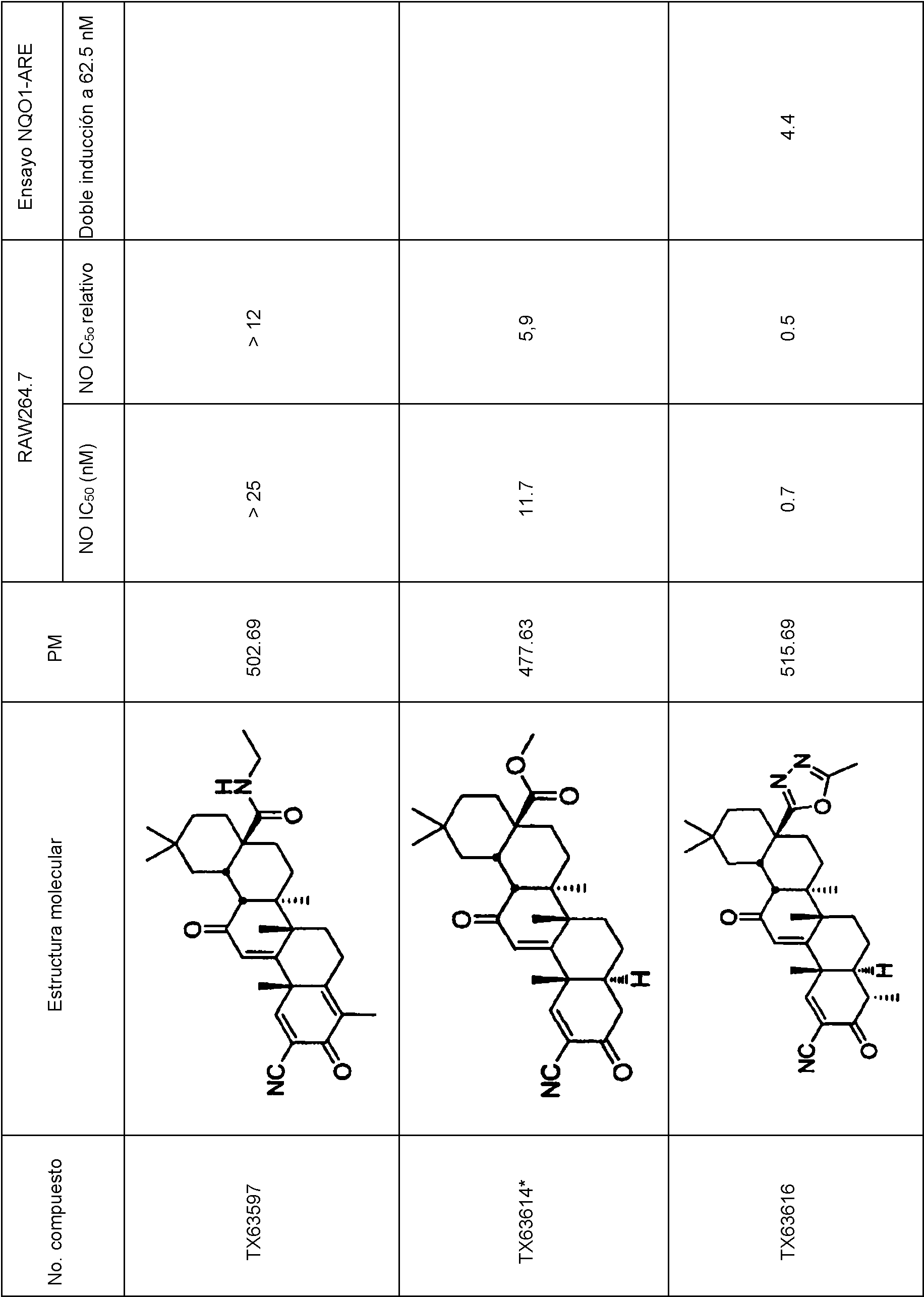


IV. Enfermedades asociadas a la inflamación y/o estrés oxidativoIV. Diseases associated with inflammation and / or oxidative stress
La inflamación es un proceso biológico que proporciona resistencia a los organismos infecciosos o parasitarios y la reparación del tejido dañado. La inflamación se caracteriza comúnmente por vasodilatación localizada, enrojecimiento, hinchazón y dolor, el reclutamiento de leucocitos en el sitio de la infección o lesión, la producción de citoquinas inflamatorias como TN F-a e IL-1, y la producción de especies de oxígeno o nitrógeno reactivoa tales como peróxido de hidrógeno, superóxido y peroxinitrito. En etapas posteriores de la inflamación, la remodelación del tejido, la angiogénesis y la formación de cicatrices (fibrosis) pueden ocurrir como parte del proceso de curación de la herida. En circunstancias normales, la respuesta inflamatoria está regulada y es temporal y se resuelve de manera orquestada una vez que la infección o lesión se ha tratado adecuadamente. Sin embargo, la inflamación aguda puede volverse excesiva y potencialmente mortal si los mecanismos reguladores fallan. Alternativamente, la inflamación puede volverse crónica y causar daño tisular acumulativo o complicaciones sistémicas. Basado al menos en la evidencia presentada anteriormente, los compuestos de esta invención pueden usarse en el tratamiento o prevención de la inflamación o enfermedades asociadas con la inflamación.Inflammation is a biological process that provides resistance to infectious or parasitic organisms and the repair of damaged tissue. Inflammation is commonly characterized by localized vasodilation, redness, swelling and pain, leukocyte recruitment at the site of infection or injury, the production of inflammatory cytokines such as TN Fa and IL-1, and the production of oxygen or nitrogen species reagent such as hydrogen peroxide, superoxide and peroxynitrite. In later stages of inflammation, tissue remodeling, angiogenesis and scar formation (fibrosis) can occur as part of the wound healing process. Under normal circumstances, the inflammatory response is regulated and temporary and is resolved in an orchestrated manner once the infection or injury has been adequately treated. However, acute inflammation can become excessive and life-threatening if regulatory mechanisms fail. Alternatively, the inflammation may become chronic and cause cumulative tissue damage or systemic complications. Based on at least the evidence presented above, the compounds of this invention can be used in the treatment or prevention of inflammation or diseases associated with inflammation.
Muchas enfermedades humanas graves e intratables implican la desregulación de los procesos inflamatorios, incluidas enfermedades como el cáncer, la aterosclerosis y la diabetes, que tradicionalmente no se consideraban enfermedades inflamatorias. En el caso del cáncer, los procesos inflamatorios están asociados con la formación de tumores, la progresión, la metástasis y la resistencia a la terapia. La aterosclerosis, considerada durante mucho tiempo como un trastorno del metabolismo de los lípidos, ahora se entiende principalmente como una afección inflamatoria, con los macrófagos activados que juegan un papel importante en la formación y eventual ruptura de las placas ateroscleróticas. También se ha demostrado que la activación de las vías de señalización inflamatoria desempeña un papel en el desarrollo de la resistencia a la insulina, así como en el daño del tejido periférico asociado con la hiperglucemia diabética. La producción excesiva de especies reactivas de oxígeno y especies reactivas de nitrógeno tales como el superóxido, el peróxido de hidrógeno, el óxido nítrico y el peroxinitrito es un sello distintivo de las condiciones inflamatorias. Se ha reportado evidencia de producción de peroxinitrito desregulado en una amplia variedad de enfermedades (Szabo et al., 2007; Schulz et al., 2008; Forstermann, 2006; Pall, 2007).Many serious and intractable human diseases involve the deregulation of inflammatory processes, including diseases such as cancer, atherosclerosis and diabetes, which traditionally were not considered inflammatory diseases. In the case of cancer, inflammatory processes are associated with tumor formation, progression, metastasis and resistance to therapy. Atherosclerosis, considered for a long time as a disorder of lipid metabolism, is now primarily understood as an inflammatory condition, with activated macrophages that play an important role in the formation and eventual rupture of atherosclerotic plaques. It has also been shown that the activation of inflammatory signaling pathways plays a role in the development of insulin resistance, as well as in the damage of peripheral tissue associated with diabetic hyperglycemia. Excessive production of reactive oxygen species and reactive nitrogen species such as superoxide, hydrogen peroxide, nitric oxide and peroxynitrite is a hallmark of inflammatory conditions. Evidence of deregulated peroxynitrite production has been reported in a wide variety of diseases (Szabo et al., 2007; Schulz et al., 2008; Forstermann, 2006; Pall, 2007).
Las enfermedades autoinmunes, como la artritis reumatoide, el lupus, la psoriasis y la esclerosis múltiple implican una activación inadecuada y crónica de los procesos inflamatorios en los tejidos afectados, que surgen de la disfunción del auto vs. no auto-reconocimiento y mecanismos de respuesta en el sistema inmunológico. En las enfermedades neurodegenerativas, como la enfermedad de Alzheimer y la enfermedad de Parkinson, el daño neuronal se correlaciona con la activación de la microglía y los niveles elevados de proteínas proinflamatorias, como la óxido nítrico sintasa inducible (iNOS). La insuficiencia orgánica crónica, como la insuficiencia renal, la insuficiencia cardíaca, la insuficiencia hepática y la enfermedad pulmonar obstructiva crónica están estrechamente asociadas con la presencia de estrés oxidativo crónico e inflamación, lo que lleva al desarrollo de fibrosis y la posible pérdida de la función de los órganos. El estrés oxidativo en las células endoteliales vasculares, que recubren los vasos sanguíneos mayores y menores, puede conducir a disfunción endotelial y se cree que es un factor importante que contribuye al desarrollo de la enfermedad cardiovascular sistémica, las complicaciones de la diabetes, la enfermedad renal crónica y otras formas de insuficiencia orgánica, y una serie de otras enfermedades relacionadas con el envejecimiento, incluidas las enfermedades degenerativas del sistema nervioso central y la retina.Autoimmune diseases, such as rheumatoid arthritis, lupus, psoriasis and multiple sclerosis, imply an inadequate and chronic activation of the inflammatory processes in the affected tissues, which arise from auto vs. dysfunction. no self-recognition and response mechanisms in the immune system. In neurodegenerative diseases, such as Alzheimer's disease and Parkinson's disease, neuronal damage correlates with the activation of microglia and elevated levels of proinflammatory proteins, such as inducible nitric oxide synthase (iNOS). Chronic organic insufficiency, such as kidney failure, heart failure, liver failure and chronic obstructive pulmonary disease are closely associated with the presence of chronic oxidative stress and inflammation, leading to the development of fibrosis and possible loss of function. of the organs. Oxidative stress in vascular endothelial cells, which line the major and minor blood vessels, can lead to endothelial dysfunction and is believed to be an important factor contributing to the development of systemic cardiovascular disease, diabetes complications, kidney disease chronic and other forms of organ failure, and a number of other diseases related to aging, including degenerative diseases of the central nervous system and the retina.
Muchos otros trastornos implican estrés oxidativo e inflamación en los tejidos afectados, incluida la enfermedad inflamatoria intestinal; enfermedades inflamatorias de la piel; mucositis relacionada con la radioterapia y la quimioterapia; enfermedades oculares como la uveítis, el glaucoma, la degeneración macular y diversas formas de retinopatía; fracaso del trasplante y rechazo; lesión por isquemia-reperfusión; dolor crónico; afecciones degenerativas de los huesos y articulaciones, incluida la osteoartritis y la osteoporosis; asma y fibrosis quística; trastornos convulsivos; y afecciones neuropsiquiátricas que incluyen esquizofrenia, depresión, trastorno bipolar, trastorno por estrés postraumático, trastornos por déficit de atención, trastornos del espectro autista y trastornos de la alimentación como la anorexia nerviosa. Se cree que la desregulación de las vías de señalización inflamatoria es un factor importante en la patología de las enfermedades de desgaste muscular, incluida la distrofia muscular y diversas formas de caquexia.Many other disorders involve oxidative stress and inflammation in the affected tissues, including inflammatory bowel disease; inflammatory skin diseases; mucositis related to radiotherapy and chemotherapy; eye diseases such as uveitis, glaucoma, macular degeneration and various forms of retinopathy; transplant failure and rejection; ischemia reperfusion injury; chronic pain; degenerative conditions of the bones and joints, including osteoarthritis and osteoporosis; asthma and cystic fibrosis; seizure disorders; and neuropsychiatric conditions that include schizophrenia, depression, bipolar disorder, post-traumatic stress disorder, attention deficit disorders, autism spectrum disorders and eating disorders such as anorexia nervosa. It is believed that deregulation of inflammatory signaling pathways is an important factor in the pathology of muscle wasting diseases, including muscular dystrophy and various forms of cachexia.
Una variedad de trastornos agudos potencialmente mortales también involucra señalización inflamatoria desregulada, incluyendo insuficiencia orgánica aguda que afecta al páncreas, riñones, hígado o pulmones, infarto de miocardio o síndrome coronario agudo, accidente cerebrovascular, shock séptico, traumatismo, quemaduras graves y anafilaxis. A variety of life-threatening acute disorders also involve deregulated inflammatory signaling, including acute organ failure that affects the pancreas, kidneys, liver or lungs, myocardial infarction or acute coronary syndrome, stroke, septic shock, trauma, severe burns and anaphylaxis.
Muchas complicaciones de las enfermedades infecciosas también implican la desregulación de las respuestas inflamatorias. Aunque una respuesta inflamatoria puede matar a los patógenos invasores, una respuesta inflamatoria excesiva también puede ser bastante destructiva y, en algunos casos, puede ser una fuente primaria de daño en los tejidos infectados. Además, una respuesta inflamatoria excesiva también puede conducir a complicaciones sistémicas debido a la sobreproducción de citoquinas inflamatorias tales como TN F-a e IL-1. Se cree que esto es un factor en la mortalidad derivada de la gripe grave, el síndrome respiratorio agudo severo y la sepsis.Many complications of infectious diseases also involve deregulation of inflammatory responses. Although an inflammatory response can kill invading pathogens, an excessive inflammatory response can also be quite destructive and, in some cases, can be a primary source of damage to infected tissues. In addition, an excessive inflammatory response can also lead to systemic complications due to the overproduction of inflammatory cytokines such as TN F-a and IL-1. It is believed that this is a factor in mortality from severe influenza, severe acute respiratory syndrome and sepsis.
La expresión anormal o excesiva de iNOS o ciclooxigenasa-2 (COX-2) se ha implicado en la patogénesis de muchos procesos de enfermedad. Por ejemplo, está claro que el NO es un potente mutágeno (Tamir y Tannebaum, 1996), y que el óxido nítrico también puede activar la CO X-2 (Salvemini et al., 1994). Además, hay un marcado aumento de iNOS en los tumores de colon en ratas inducidos por el carcinógeno, azoximetano (Takahashi et al., 1997). Se ha demostrado que una serie de análogos triterpenoides sintéticos del ácido oleanólico son inhibidores potentes de los procesos inflamatorios celulares, como la inducción por IFN-y de la óxido nítrico sintasa inducible (iNOS) de CO X-2 en macrófagos de ratón. Véase Honda et al. (2000a); Honda et al. (2000b), y Honda et al. (2002), que se incorporan aquí como referencia.Abnormal or excessive expression of iNOS or cyclooxygenase-2 (COX-2) has been implicated in the pathogenesis of many disease processes. For example, it is clear that NO is a potent mutagen (Tamir and Tannebaum, 1996), and that nitric oxide can also activate CO X-2 (Salvemini et al., 1994). In addition, there is a marked increase in iNOS in colon tumors in rats induced by the carcinogen, azoxymethane (Takahashi et al., 1997). It has been shown that a series of synthetic triterpenoid analogs of oleanolic acid are potent inhibitors of cellular inflammatory processes, such as induction by IFN- and inducible nitric oxide synthase (iNOS) of CO X-2 in mouse macrophages. See Honda et al. (2000a); Honda et al. (2000b), and Honda et al. (2002), which are incorporated herein by reference.
En un aspecto, los compuestos descritos en el presente documento se caracterizan por su capacidad para inhibir la producción de óxido nítrico en células RAW 264.7 derivadas de macrófagos inducida por exposición a interferón-Y. Además, se caracterizan por su capacidad para inducir la expresión de proteínas antioxidantes como la NQO1 y reducir la expresión de proteínas proinflamatorias como la CO X-2 y la óxido nítrico sintasa inducible (iNOS). Estas propiedades son relevantes para el tratamiento de una amplia gama de enfermedades y trastornos que implican estrés oxidativo y desregulación de los procesos inflamatorios, incluido el cáncer, las complicaciones de la exposición local o total del cuerpo a la radiación ionizante, la mucositis resultante de la radioterapia o la quimioterapia, las enfermedades autoinmunes y las enfermedades cardiovasculares. Enfermedades como aterosclerosis, lesión por isquemia-reperfusión, insuficiencia orgánica aguda e insuficiencia renal crónica e insuficiencia cardíaca, enfermedades respiratorias, diabetes y complicaciones de la diabetes, alergias severas, rechazo de trasplantes, enfermedad de injerto contra huésped, enfermedades neurodegenerativas, enfermedades oculares y de y retina, dolor agudo y crónico, enfermedades óseas degenerativas que incluyen osteoartritis y osteoporosis, enfermedades inflamatorias del intestino, dermatitis y otras enfermedades de la piel, sepsis, quemaduras, trastornos convulsivos y trastornos neuropsiquiátricos.In one aspect, the compounds described herein are characterized by their ability to inhibit the production of nitric oxide in macrophage-derived RAW 264.7 cells induced by Y-interferon exposure. In addition, they are characterized by their ability to induce the expression of antioxidant proteins such as NQO1 and reduce the expression of proinflammatory proteins such as CO X-2 and inducible nitric oxide synthase (iNOS). These properties are relevant for the treatment of a wide range of diseases and disorders that involve oxidative stress and deregulation of inflammatory processes, including cancer, complications of local or total exposure of the body to ionizing radiation, mucositis resulting from radiotherapy or chemotherapy, autoimmune diseases and cardiovascular diseases. Diseases such as atherosclerosis, ischemia-reperfusion injury, acute organic insufficiency and chronic renal failure and heart failure, respiratory diseases, diabetes and diabetes complications, severe allergies, transplant rejection, graft versus host disease, neurodegenerative diseases, eye diseases and of and retina, acute and chronic pain, degenerative bone diseases that include osteoarthritis and osteoporosis, inflammatory bowel diseases, dermatitis and other skin diseases, sepsis, burns, seizure disorders and neuropsychiatric disorders.
Sin pretender imponer ninguna teoría, se cree que la activación la vía del antioxidante/antiinflamatorio Keap1/Nrf2/ARE está implicada en las propiedades antiinflamatorias y anticancerígenas de los compuestos descritos en el presente documento.Without intending to impose any theory, it is believed that activation of the antioxidant / anti-inflammatory pathway Keap1 / Nrf2 / ARE is implicated in the anti-inflammatory and anti-cancer properties of the compounds described herein.
En otro aspecto, los compuestos descritos en el presente documento pueden usarse para tratar a un sujeto que tiene una afección causada por niveles elevados de estrés oxidativo en uno o más tejidos. El estrés oxidativo resulta de niveles anormalmente altos o prolongados de especies reactivas de oxígeno como el superóxido, el peróxido de hidrógeno, el óxido nítrico y el peroxinitrito (formado por la reacción del óxido nítrico y el superóxido). El estrés oxidativo puede ir acompañado de inflamación aguda o crónica. El estrés oxidativo puede ser causado por disfunción mitocondrial, por activación de células inmunes como macrófagos y neutrófilos, por exposición aguda a un agente externo como radiación ionizante o un agente de quimioterapia citotóxica (por ejemplo, doxorubicina), por trauma u otra lesión tisular aguda, por isquemia/reperfusión, por mala circulación o anemia, por hipoxia o hiperoxia localizada o sistémica, por niveles elevados de citoquinas inflamatorias y otras proteínas relacionadas con la inflamación, y/o por otros estados fisiológicos anormales como hiperglucemia o hipoglucemia.In another aspect, the compounds described herein can be used to treat a subject who has a condition caused by elevated levels of oxidative stress in one or more tissues. Oxidative stress results from abnormally high or prolonged levels of reactive oxygen species such as superoxide, hydrogen peroxide, nitric oxide and peroxynitrite (formed by the reaction of nitric oxide and superoxide). Oxidative stress may be accompanied by acute or chronic inflammation. Oxidative stress can be caused by mitochondrial dysfunction, by activation of immune cells such as macrophages and neutrophils, by acute exposure to an external agent such as ionizing radiation or a cytotoxic chemotherapy agent (for example, doxorubicin), trauma or other acute tissue injury , due to ischemia / reperfusion, poor circulation or anemia, hypoxia or localized or systemic hyperoxia, high levels of inflammatory cytokines and other proteins related to inflammation, and / or other abnormal physiological conditions such as hyperglycemia or hypoglycemia.
En modelos animales de muchas de estas condiciones, se ha demostrado que la expresión estimulante de hemo oxigenasa inducible (HO-1), un gen diana de la vía Nrf2, tiene un efecto terapéutico significativo que incluye modelos de infarto de miocardio, insuficiencia renal, fracaso del trasplante y rechazo, accidente cerebrovascular, enfermedad cardiovascular y enfermedad autoinmune (por ejemplo, Sacerdoti et al., 2005; Abraham & Kappas, 2005; Bach, 2006; Araujo et al., 2003; Liu et al., 2006; Ishikawa et al., 2001; Kruger et al., 2006; Satoh et al., 2006; Zhou et al., 2005; Morse y Choi, 2005; Morse y Choi, 2002). Esta enzima rompe el hemo libre en hierro, monóxido de carbono (CO) y biliverdina (que posteriormente se convierte en la potente molécula antioxidante, la bilirrubina).In animal models of many of these conditions, it has been shown that stimulant expression of inducible heme oxygenase (HO-1), a target gene of the Nrf2 pathway, has a significant therapeutic effect that includes models of myocardial infarction, renal failure, transplant failure and rejection, stroke, cardiovascular disease and autoimmune disease (for example, Sacerdoti et al., 2005; Abraham & Kappas, 2005; Bach, 2006; Araujo et al., 2003; Liu et al., 2006; Ishikawa et al., 2001; Kruger et al., 2006; Satoh et al., 2006; Zhou et al., 2005; Morse and Choi, 2005; Morse and Choi, 2002). This enzyme breaks free heme into iron, carbon monoxide (CO) and biliverdin (which later becomes the potent antioxidant molecule, bilirubin).
En otro aspecto, los compuestos de esta invención se pueden usar para prevenir o tratar daño tisular o insuficiencia orgánica aguda y crónica, resultante del estrés oxidativo exacerbado por la inflamación. Los ejemplos de enfermedades que se incluyen en esta categoría incluyen: insuficiencia cardíaca, insuficiencia hepática, insuficiencia y rechazo del trasplante, insuficiencia renal, pancreatitis, enfermedades pulmonares fibróticas (fibrosis quística, EPO C y fibrosis pulmonar idiopática, entre otras), diabetes (incluidas complicaciones), aterosclerosis, lesión por isquemiareperfusión, glaucoma, accidente cerebrovascular, enfermedad autoinmune, autismo, degeneración macular y distrofia muscular. Por ejemplo, en el caso del autismo, los estudios sugieren que el aumento del estrés oxidativo en el sistema nervioso central puede contribuir al desarrollo de la enfermedad (Chauhan y Chauhan, 2006).In another aspect, the compounds of this invention can be used to prevent or treat tissue damage or acute and chronic organ failure, resulting from oxidative stress exacerbated by inflammation. Examples of diseases that fall into this category include: heart failure, liver failure, transplant rejection and failure, kidney failure, pancreatitis, fibrotic lung diseases (cystic fibrosis, EPO C and idiopathic pulmonary fibrosis, among others), diabetes (including complications), atherosclerosis, ischemiarefusion injury, glaucoma, stroke, autoimmune disease, autism, macular degeneration and muscular dystrophy. For example, in the case of autism, studies suggest that increased oxidative stress in the central nervous system may contribute to the development of the disease (Chauhan and Chauhan, 2006).
La evidencia también vincula el estrés oxidativo y la inflamación con el desarrollo y la patología de muchos otros trastornos del sistema nervioso central, incluidos los trastornos psiquiátricos como la psicosis, la depresión mayor y el trastorno bipolar; trastornos convulsivos como la epilepsia; dolor y síndromes sensoriales como migraña, dolor neuropático o tinnitus; y síndromes de comportamiento como los trastornos por déficit de atención. Véase, por ejemplo, Dickerson et al., 2007; Hanson et al., 2005; Kendall-Tackett, 2007; Lencz et al., 2007; Dudhgaonkar et al., 2006; Lee et al., 2007; Morris et al., 2002; Ruster et al., 2005; McIver et al., 2005; Sarchielli et al., 2006; Kawakami et al., 2006; Ross et al., 2003, que se incorporan todos como referencia en el presente documento. Por ejemplo, los niveles elevados de citoquinas inflamatorias, que incluyen TNF, interferón-y e IL-6, se asocian con enfermedades mentales mayores (Dickerson et al., 2007). La activación microglial también se ha relacionado con enfermedades mentales mayores. Por lo tanto, la regulación negativa de las citoquinas y la inhibición de la activación excesiva de la microglía podrían ser beneficiosas en pacientes con esquizofrenia, depresión mayor, trastorno bipolar, trastornos del espectro autista y otros trastornos neuropsiquiátricos.The evidence also links oxidative stress and inflammation with the development and pathology of many other disorders of the central nervous system, including psychiatric disorders such as psychosis, major depression and bipolar disorder; seizure disorders such as epilepsy; pain and sensory syndromes such as migraine, neuropathic pain or tinnitus; and behavioral syndromes such as attention deficit disorders. See, for example, Dickerson et al., 2007; Hanson et al., 2005; Kendall-Tackett, 2007; Lencz et al., 2007; Dudhgaonkar et al., 2006; Lee et al., 2007; Morris et al., 2002; Ruster et al., 2005; McIver et al., 2005; Sarchielli et al., 2006; Kawakami et al., 2006; Ross et al., 2003, which are all incorporated by reference in this document. For example, elevated levels of inflammatory cytokines, which include TNF, interferon-y and IL-6, are associated with major mental illnesses (Dickerson et al., 2007). Microglial activation has also been linked to major mental illnesses. Therefore, negative cytokine regulation and inhibition of excessive microglia activation could be beneficial in patients with schizophrenia, major depression, bipolar disorder, autism spectrum disorders and other neuropsychiatric disorders.
Por consiguiente, en patologías que implican estrés oxidativo solo o estrés oxidativo exacerbado por la inflamación, el tratamiento puede comprender administrar a un sujeto una cantidad terapéuticamente eficaz de un compuesto de esta invención, tal como los descritos anteriormente o a lo largo de esta memoria descriptiva. El tratamiento puede administrarse preventivamente, antes de un estado predecible de estrés oxidativo (p. Ej., Trasplante de órganos o la administración de radioterapia a un paciente con cáncer), o puede administrarse terapéuticamente en entornos que impliquen un estrés oxidativo establecido e inflamación.Therefore, in pathologies that involve oxidative stress alone or oxidative stress exacerbated by inflammation, the Treatment may comprise administering to a subject a therapeutically effective amount of a compound of this invention, such as those described above or throughout this specification. The treatment can be administered preventively, before a predictable state of oxidative stress ( e.g., organ transplantation or the administration of radiotherapy to a cancer patient), or it can be administered therapeutically in environments that involve established oxidative stress and inflammation.
Los compuestos descritos en el presente documento pueden aplicarse generalmente al tratamiento de afecciones inflamatorias, tales como sepsis, dermatitis, enfermedades autoinmunes y osteoartritis. En un aspecto, los compuestos de esta invención se pueden usar para tratar el dolor inflamatorio y/o el dolor neuropático, por ejemplo, induciendo Nrf2 y/o inhibiendo N F-kB.The compounds described herein can generally be applied to the treatment of inflammatory conditions, such as sepsis, dermatitis, autoimmune diseases and osteoarthritis. In one aspect, the compounds of this invention can be used to treat inflammatory pain and / or neuropathic pain, for example, inducing Nrf2 and / or inhibiting N F- k B.
En algunas realizaciones, los compuestos descritos en el presente documento pueden usarse en el tratamiento y prevención de enfermedades tales como cáncer, inflamación, enfermedad de Alzheimer, enfermedad de Parkinson, esclerosis múltiple, autismo, esclerosis lateral amiotrófica, enfermedad de Huntington, enfermedades autoinmunes tales como artritis reumatoide, lupus, enfermedad de Crohn y psoriasis, enfermedad inflamatoria intestinal, todas las demás enfermedades cuya patogenia se cree que involucra la producción excesiva de óxido nítrico o prostaglandinas, y patologías que involucran el estrés oxidativo solo o el estrés oxidativo exacerbado por la inflamación.In some embodiments, the compounds described herein can be used in the treatment and prevention of diseases such as cancer, inflammation, Alzheimer's disease, Parkinson's disease, multiple sclerosis, autism, amyotrophic lateral sclerosis, Huntington's disease, autoimmune diseases such such as rheumatoid arthritis, lupus, Crohn's disease and psoriasis, inflammatory bowel disease, all other diseases whose pathogenesis is believed to involve the excessive production of nitric oxide or prostaglandins, and pathologies that involve oxidative stress alone or oxidative stress exacerbated by inflammation.
Otro aspecto de la inflamación es la producción de prostaglandinas inflamatorias como la prostaglandina E. Estas moléculas promueven la vasodilatación, la extravasación de plasma, el dolor localizado, la temperatura elevada y otros síntomas de inflamación. La forma inducible de la enzima CO X -2 está asociada con su producción, y se encuentran altos niveles de CO X-2 en los tejidos inflamados. En consecuencia, la inhibición de la CO X-2 puede aliviar muchos síntomas de inflamación y varios fármacos antiinflamatorios importantes (p. Ej., ibuprofeno y celecoxib) actúan inhibiendo la actividad de la CO X-2. Investigaciones recientes, sin embargo, han demostrado que una clase de prostaglandinas de ciclopentenona (cyPGs) (por ejemplo, la prostaglandina J2 15-deoxi, también conocida como PGJ2) desempeña un papel en la estimulación de la resolución orquestada de la inflamación (por ejemplo, Rajakariar et al., 2007). La CO X-2 también está asociada con la producción de prostaglandinas de ciclopentenona. En consecuencia, la inhibición de la C O X -2 puede interferir con la resolución completa de la inflamación, lo que potencialmente promueve la persistencia de las células inmunitarias activadas en los tejidos y conduce a una inflamación crónica "latente". Este efecto puede ser responsable de la mayor incidencia de enfermedades cardiovasculares en pacientes que usan inhibidores selectivos de la CO X-2 durante largos períodos de tiempo. En un aspecto, los compuestos descritos en el presente documento pueden usarse para controlar la producción de citoquinas proinflamatorias dentro de la célula mediante la activación selectiva de residuos de cisteína reguladores (RCR) en proteínas que regulan la actividad de los factores de transcripción sensibles a redox. Se ha demostrado que la activación de los RCR por parte de los cyPG inicia un programa de resolución proactiva en el que la actividad del factor de transcripción antioxidante y citoprotector Nrf2 se induce de manera potente y las actividades de los factores de transcripción prooxidante y proinflamatorio N F-kB y las STAT se suprimen. En algunas realizaciones, esto aumenta la producción de moléculas antioxidantes y reductoras (NQO1, HO-1, SO D 1, y-G CS) y disminuye el estrés oxidativo y la producción de moléculas prooxidantes y proinflamatorias (iNOS, COX-2, TNF-a). En algunas realizaciones, los compuestos de esta invención pueden hacer que las células que portan el evento inflamatorio vuelvan a un estado no inflamatorio promoviendo la resolución de la inflamación y limitando el daño tisular excesivo al huésped.Another aspect of inflammation is the production of inflammatory prostaglandins such as prostaglandin E. These molecules promote vasodilation, plasma extravasation, localized pain, elevated temperature and other symptoms of inflammation. The inducible form of the enzyme CO X -2 is associated with its production, and high levels of CO X-2 are found in inflamed tissues. Consequently, inhibition of CO X-2 can relieve many symptoms of inflammation and several important anti-inflammatory drugs (e.g. , ibuprofen and celecoxib) act by inhibiting the activity of CO X-2. Recent research, however, has shown that a class of cyclopentenone prostaglandins (cyPGs) (for example, prostaglandin J2 15-deoxy, also known as PGJ2) plays a role in stimulating the orchestrated resolution of inflammation ( for example , Rajakariar et al., 2007). CO X-2 is also associated with the production of cyclopentenone prostaglandins. Consequently, COX -2 inhibition may interfere with the complete resolution of inflammation, potentially promoting the persistence of activated immune cells in tissues and leading to chronic "latent" inflammation. This effect may be responsible for the higher incidence of cardiovascular diseases in patients who use selective CO-X-2 inhibitors for long periods of time. In one aspect, the compounds described herein can be used to control the production of proinflammatory cytokines within the cell by selective activation of regulatory cysteine residues (RCRs) in proteins that regulate the activity of redox-sensitive transcription factors. . It has been shown that RCR activation by cyPG initiates a proactive resolution program in which the activity of the antioxidant and cytoprotective transcription factor Nrf2 is potently induced and the activities of prooxidant and proinflammatory transcription factors N F- B and STAT k are deleted. In some embodiments, this increases the production of antioxidant and reducing molecules (NQO1, HO-1, SO D 1, and G CS) and decreases oxidative stress and the production of prooxidant and proinflammatory molecules (iNOS, COX-2, TNF-a ). In some embodiments, the compounds of this invention can cause the cells carrying the inflammatory event to return to a non-inflammatory state by promoting resolution of inflammation and limiting excessive tissue damage to the host.
V. Formulaciones farmacéuticas y vías de administraciónV. Pharmaceutical formulations and routes of administration
Los compuestos de la presente descripción se pueden administrar por una variedad de métodos, por ejemplo, por vía oral o por inyección (por ejemplo, subcutánea, intravenosa, intraperitoneal, etc.). Dependiendo de la vía de administración, los compuestos activos pueden recubrirse en un material para proteger el compuesto de la acción de los ácidos y otras condiciones naturales que pueden inactivar el compuesto. También pueden administrarse por perfusión/infusión continua de una enfermedad o sitio de la herida.The compounds of the present description can be administered by a variety of methods, for example, orally or by injection (eg, subcutaneous, intravenous, intraperitoneal, etc.). Depending on the route of administration, the active compounds may be coated in a material to protect the compound from the action of acids and other natural conditions that may inactivate the compound. They can also be administered by continuous infusion / infusion of a disease or wound site.
Para administrar el compuesto terapéutico por otra administración que no sea parenteral, puede ser necesario recubrir el compuesto con, o coadministrar el compuesto con, un material para prevenir su inactivación. Por ejemplo, el compuesto terapéutico se puede administrar a un paciente en un vehículo apropiado, por ejemplo, liposomas o un diluyente. Los diluyentes farmacéuticamente aceptables incluyen soluciones salinas y disoluciones tampón acuosas. Los liposomas incluyen emulsiones de C G F de agua en aceite en agua, así como liposomas convencionales (Strejan et al., 1984).To administer the therapeutic compound by another administration other than parenteral, it may be necessary to coat the compound with, or co-administer the compound with, a material to prevent its inactivation. For example, the therapeutic compound can be administered to a patient in an appropriate vehicle, for example, liposomes or a diluent. Pharmaceutically acceptable diluents include saline solutions and aqueous buffer solutions. Liposomes include water-in-water-in-water CGF emulsions, as well as conventional liposomes (Strejan et al., 1984).
El compuesto terapéutico también puede administrarse por vía parenteral, intraperitoneal, intraespinal o intracerebral. Las dispersiones se pueden preparar en glicerol, polietilenglicoles líquidos y mezclas de los mismos y en aceites. En condiciones normales de almacenamiento y uso, estas preparaciones pueden contener un conservante para prevenir el crecimiento de microorganismos.The therapeutic compound can also be administered parenterally, intraperitoneally, intraspinally or intracerebrally. Dispersions can be prepared in glycerol, liquid polyethylene glycols and mixtures thereof and in oils. Under normal conditions of storage and use, these preparations may contain a preservative to prevent the growth of microorganisms.
Las composiciones farmacéuticas adecuadas para uso inyectable incluyen disoluciones acuosas estériles (cuando son solubles en agua) o dispersiones y polvos estériles para la preparación extemporánea de disoluciones o dispersiones estériles inyectables. Véase, por ejemplo, la solicitud de patente de EE.UU. de J. Zhang, titulada "Amorphous Solid Dispersions of CDDO-Me for Delayed Release Oral Dosage Compositions," presentada el 13 de febrero de 2009, que se incorpora aquí como referencia. En todos los casos, la composición debe ser estéril y debe ser fluida en la medida en que exista una fácil jeringabilidad. Debe ser estable en las condiciones de fabricación y almacenamiento y debe conservarse contra la acción contaminante de microorganismos como bacterias y hongos. El vehículo puede ser un disolvente o medio de dispersión que contenga, por ejemplo, agua, etanol, poliol (como glicerol, propilenglicol y polietilenglicol líquido, y similares), mezclas adecuadas de los mismos y aceites vegetales. La fluidez adecuada se puede mantener, por ejemplo, mediante el uso de un recubrimiento como la lecitina, mediante el mantenimiento del tamaño de partícula requerido en el caso de la dispersión y mediante el uso de tensioactivos. La prevención de la acción de los microorganismos se puede lograr mediante diversos agentes antibacterianos y antifúngicos, por ejemplo, parabenos, clorobutanol, fenol, ácido ascórbico, timerosal y similares. En muchos casos, será preferible incluir agentes isotónicos, por ejemplo, azúcares, cloruro de sodio o polialcoholes tales como manitol y sorbitol, en la composición. La absorción prolongada de las composiciones inyectables se puede lograr incluyendo en la composición un agente que retrasa la absorción, por ejemplo, monoestearato de aluminio o gelatina.Pharmaceutical compositions suitable for injectable use include sterile aqueous solutions (when water soluble) or sterile dispersions and powders for the extemporaneous preparation of sterile injectable solutions or dispersions. See, for example, the US patent application. by J. Zhang, entitled "Amorphous Solid Dispersions of CDDO-Me for Delayed Release Oral Dosage Compositions," filed on 13 February 2009, which is incorporated here by reference. In all cases, the composition must be sterile and must be fluid to the extent that there is easy syringeability. It must be stable under the conditions of manufacture and storage and must be preserved against the contaminating action of microorganisms such as bacteria and fungi. The carrier may be a solvent or dispersion medium containing, for example, water, ethanol, polyol (such as glycerol, propylene glycol and liquid polyethylene glycol, and the like), suitable mixtures thereof and vegetable oils. Adequate fluidity can be maintained, for example, by the use of a coating such as lecithin, by the maintenance of the required particle size in the case of dispersion and by the use of surfactants. The prevention of the action of microorganisms can be achieved by various antibacterial and antifungal agents, for example, parabens, chlorobutanol, phenol, ascorbic acid, thimerosal and the like. In many cases, it will be preferable to include isotonic agents, for example, sugars, sodium chloride or polyalcohols such as mannitol and sorbitol, in the composition. Prolonged absorption of the injectable compositions can be achieved by including in the composition an agent that delays absorption, for example, aluminum monostearate or gelatin.
Las disoluciones inyectables estériles se pueden preparar incorporando el compuesto terapéutico en la cantidad requerida en un disolvente apropiado con uno o una combinación de los ingredientes enumerados anteriormente, según se requiera, seguido de esterilización por filtración. En general, las dispersiones se preparan incorporando el compuesto terapéutico en un vehículo estéril que contiene un medio de dispersión básico y los otros ingredientes requeridos de los enumerados anteriormente. En el caso de polvos estériles para la preparación de disoluciones inyectables estériles, los métodos preferidos de preparación son el secado al vacío y la liofilización, que produce un polvo del ingrediente activo (es decir, el compuesto terapéutico) más cualquier ingrediente adicional deseado de una disolución previamente esterilizada y filtrada del mismo.Sterile injectable solutions can be prepared by incorporating the therapeutic compound in the required amount in an appropriate solvent with one or a combination of the ingredients listed above, as required, followed by sterilization by filtration. In general, the dispersions are prepared by incorporating the therapeutic compound into a sterile vehicle containing a basic dispersion medium and the other required ingredients from those listed above. In the case of sterile powders for the preparation of sterile injectable solutions, the preferred methods of preparation are vacuum drying and lyophilization, which produces a powder of the active ingredient ( i.e. the therapeutic compound) plus any additional desired ingredient of a previously sterilized and filtered solution thereof.
El compuesto terapéutico puede administrarse por vía oral, por ejemplo, con un diluyente inerte o un vehículo comestible asimilable. El compuesto terapéutico y otros ingredientes también pueden incluirse en una cápsula de gelatina de cubierta dura o blanda, comprimirse en comprimidos o incorporarse directamente en la dieta del sujeto. Para la administración terapéutica oral, el compuesto terapéutico puede incorporarse con excipientes y usarse en forma de comprimidos ingeribles, comprimidos bucales, trociscos, cápsulas, elixires, suspensiones, jarabes, obleas y similares. El porcentaje del compuesto terapéutico en las composiciones y preparaciones puede, por supuesto, variarse. La cantidad del compuesto terapéutico en tales composiciones terapéuticamente útiles es tal que se obtendrá una dosis adecuada.The therapeutic compound can be administered orally, for example, with an inert diluent or an assimilable edible carrier. The therapeutic compound and other ingredients may also be included in a hard or soft shell gelatin capsule, compressed into tablets or incorporated directly into the subject's diet. For oral therapeutic administration, the therapeutic compound can be incorporated with excipients and used in the form of ingestible tablets, buccal tablets, troches, capsules, elixirs, suspensions, syrups, wafers and the like. The percentage of the therapeutic compound in the compositions and preparations can, of course, be varied. The amount of the therapeutic compound in such therapeutically useful compositions is such that a suitable dose will be obtained.
Es especialmente ventajoso formular composiciones parenterales en forma de unidad de dosificación para facilitar la administración y uniformidad de la dosificación. La forma de unidad de dosificación como se usa en este documento se refiere a unidades físicamente discretas adecuadas como dosificaciones unitarias para los sujetos a tratar; cada unidad contiene una cantidad predeterminada de compuesto terapéutico calculada para producir el efecto terapéutico deseado en asociación con el vehículo farmacéutico requerido. La especificación de las formas unitarias de dosificación de la invención está dictada por (a) las características únicas del compuesto terapéutico y el efecto terapéutico particular que se va a lograr, y (b) las limitaciones inherentes a la técnica de composición de dicho tipo de compuesto terapéutico para el tratamiento de una condición seleccionada en un paciente.It is especially advantageous to formulate parenteral compositions in the form of a dosage unit to facilitate the administration and uniformity of the dosage. The dosage unit form as used herein refers to physically discrete units suitable as unit dosages for the subjects to be treated; Each unit contains a predetermined amount of therapeutic compound calculated to produce the desired therapeutic effect in association with the required pharmaceutical vehicle. The specification of the unit dosage forms of the invention is dictated by (a) the unique characteristics of the therapeutic compound and the particular therapeutic effect to be achieved, and (b) the limitations inherent in the composition technique of said type of therapeutic compound for the treatment of a selected condition in a patient.
El compuesto terapéutico también se puede administrar por vía tópica en la piel, los ojos o la mucosa. Alternativamente, si se desea un suministro local a los pulmones, el compuesto terapéutico puede administrarse por inhalación en una formulación en polvo seco o en aerosol.The therapeutic compound can also be administered topically to the skin, eyes or mucosa. Alternatively, if a local supply to the lungs is desired, the therapeutic compound can be administered by inhalation in a dry powder or aerosol formulation.
Los compuestos activos se administran en una dosis terapéuticamente eficaz suficiente para tratar una afección asociada con una afección en un paciente. Por ejemplo, la eficacia de un compuesto puede evaluarse en un sistema modelo animal que puede ser predictivo de la eficacia en el tratamiento de la enfermedad en seres humanos, como los sistemas modelo que se muestran en los ejemplos y dibujos.The active compounds are administered in a therapeutically effective dose sufficient to treat a condition associated with a condition in a patient. For example, the efficacy of a compound can be evaluated in an animal model system that can be predictive of the efficacy in the treatment of disease in humans, such as the model systems shown in the examples and drawings.
La cantidad de dosificación real de un compuesto de la presente descripción o composición que comprende un compuesto de la presente descripción administrada a un sujeto puede determinarse por factores físicos y fisiológicos tales como edad, sexo, peso corporal, gravedad de la afección, el tipo de enfermedad siendo tratada, intervenciones terapéuticas previas o concurrentes, idiopatía del sujeto y en la vía de administración. Estos factores pueden ser determinados por un experto en la técnica. El profesional responsable de la administración determinará típicamente la concentración de ingrediente(s) activo(s) en una composición y dosis apropiadas para el sujeto individual. La dosificación puede ser ajustada por el médico individual en caso de cualquier complicación.The actual dosage amount of a compound of the present description or composition comprising a compound of the present description administered to a subject can be determined by physical and physiological factors such as age, sex, body weight, severity of the condition, the type of disease being treated, previous or concurrent therapeutic interventions, idiopathy of the subject and in the route of administration. These factors can be determined by one skilled in the art. The professional responsible for administration will typically determine the concentration of active ingredient (s) in a composition and dose appropriate for the individual subject. The dosage can be adjusted by the individual doctor in case of any complications.
Una cantidad efectiva típicamente variará de aproximadamente 0.001 mg/kg a aproximadamente 1000 mg/kg, de aproximadamente 0.01 mg/kg a aproximadamente 750 mg/kg, de aproximadamente 100 mg/kg a aproximadamente 500 mg/kg, de aproximadamente 1.0 mg/kg a aproximadamente 250 mg/kg, desde aproximadamente 10.0 mg/kg a aproximadamente 150 mg/kg en una o más administraciones de dosis diarias, durante uno o varios días (dependiendo del curso del modo de administración y los factores mencionados anteriormente). Otros intervalos de dosis adecuados incluyen 1 mg a 10000 mg por día, 100 mg a 10000 mg por día, 500 mg a 10000 mg por día y 500 mg a 1000 mg por día. En algunas realizaciones particulares, la cantidad es inferior a 10000 mg por día con un intervalo de 750 mg a 9000 mg por día.An effective amount will typically range from about 0.001 mg / kg to about 1000 mg / kg, from about 0.01 mg / kg to about 750 mg / kg, from about 100 mg / kg to about 500 mg / kg, from about 1.0 mg / kg at about 250 mg / kg, from about 10.0 mg / kg to about 150 mg / kg in one or more daily dose administrations, for one or several days (depending on the course of the mode of administration and the factors mentioned above). Other suitable dose ranges include 1 mg to 10,000 mg per day, 100 mg to 10,000 mg per day, 500 mg to 10,000 mg per day and 500 mg to 1000 mg per day. In some particular embodiments, the amount is less than 10,000 mg per day with a range of 750 mg to 9,000 mg per day.
La cantidad efectiva puede ser inferior a 1 mg/kg/día, inferior a 500 mg/kg/día, inferior a 250 mg/kg/día, inferior a 100 mg/kg/día, inferior a 50 mg/kg/día, menos de 25 mg/kg/día o menos de 10 mg/kg/día. Alternativamente, puede estar en el intervalo de 1 mg/kg/día a 200 mg/kg/día. Por ejemplo, con respecto al tratamiento de pacientes diabéticos, la dosificación unitaria puede ser una cantidad que reduce la glucosa en sangre en al menos un 40 % en comparación con un sujeto no tratado. En otra realización, la dosis unitaria es una cantidad que reduce la glucosa en sangre a un nivel que es ± 10 % del nivel de glucosa en sangre de un sujeto no diabético.The effective amount may be less than 1 mg / kg / day, less than 500 mg / kg / day, less than 250 mg / kg / day, less than 100 mg / kg / day, less than 50 mg / kg / day, less than 25 mg / kg / day or less than 10 mg / kg / day. Alternatively, it may be in the range of 1 mg / kg / day to 200 mg / kg / day. For example, with respect to the treatment of diabetic patients, the unit dosage may be an amount that reduces blood glucose by at least 40% compared to an untreated subject. In another embodiment, the unit dose is an amount that reduces blood glucose to a level that is ± 10% of the blood glucose level of a non-diabetic subject.
En otros ejemplos no limitativos, una dosis también puede comprender de aproximadamente 1 microgramo/kg/peso corporal, aproximadamente 5 microgramos/kg/peso corporal, aproximadamente 10 microgramos/kg/peso corporal, aproximadamente 50 microgramos/kg/peso corporal, aproximadamente 100 microgramos/kg/peso corporal, aproximadamente 200 microgramos/kg/peso corporal, aproximadamente 350 microgramos/kg/peso corporal, aproximadamente 500 microgramos/kg/peso corporal, aproximadamente 1 miligramo/kg/peso corporal, aproximadamente 5 miligramos/kg/peso corporal, aproximadamente 10 miligramos/kg/peso corporal, aproximadamente 50 miligramos/kg/peso corporal, aproximadamente 100 miligramos/kg/peso corporal, aproximadamente 200 miligramos/kg/peso corporal, aproximadamente 350 miligramos/kg/peso corporal, aproximadamente 500 miligramos/kg/peso corporal, a aproximadamente 1000 mg/kg/peso corporal o más por administración, y cualquier intervalo derivado de ellos. En los ejemplos no limitativos de un intervalo derivable de los números aquí enumerados, un intervalo de aproximadamente 5 mg/kg/peso corporal a aproximadamente 100 mg/kg/ peso corporal, aproximadamente 5 microgramos/kg/peso corporal a aproximadamente 500 miligramos/kg/peso corporal, etc., se puede administrar según los números descritos anteriormente.In other non-limiting examples, a dose may also comprise about 1 microgram / kg / body weight, about 5 micrograms / kg / body weight, about 10 micrograms / kg / body weight, about 50 micrograms / kg / body weight, about 100 micrograms / kg / body weight, approximately 200 micrograms / kg / body weight, approximately 350 micrograms / kg / body weight, approximately 500 micrograms / kg / body weight, approximately 1 milligram / kg / body weight, approximately 5 milligrams / kg / weight body, about 10 milligrams / kg / body weight, about 50 milligrams / kg / body weight, about 100 milligrams / kg / body weight, about 200 milligrams / kg / body weight, about 350 milligrams / kg / body weight, about 500 milligrams / kg / body weight, at approximately 1000 mg / kg / body weight or more per administration, and any interval derived from them. In the non-limiting examples of a range derived from the numbers listed here, a range of about 5 mg / kg / body weight to about 100 mg / kg / body weight, about 5 micrograms / kg / body weight at about 500 milligrams / kg / body weight, etc., can be administered according to the numbers described above.
En ciertas realizaciones, una composición farmacéutica de la presente descripción puede comprender, por ejemplo, al menos aproximadamente el 0 ,1 % de un compuesto de la presente descripción. En otras realizaciones, el compuesto de la presente descripción puede comprender entre aproximadamente el 2 % y aproximadamente el 75 % del peso de la unidad, o entre aproximadamente el 25 % y aproximadamente el 60%, por ejemplo, y cualquier intervalo derivado de la misma.In certain embodiments, a pharmaceutical composition of the present disclosure may comprise, for example, at least about 0.1% of a compound of the present disclosure. In other embodiments, the compound of the present disclosure may comprise between about 2% and about 75% of the weight of the unit, or between about 25% and about 60%, for example, and any range derived therefrom. .
Se contemplan dosis únicas o múltiples de los agentes. Los intervalos de tiempo deseados para la administración de dosis múltiples pueden ser determinados por un experto en la técnica que no emplee más que la experimentación rutinaria. Como ejemplo, a los sujetos se les pueden administrar dos dosis diarias a intervalos de aproximadamente 12 horas. En algunas realizaciones, el agente se administra una vez al día.Single or multiple doses of the agents are contemplated. The desired time intervals for the administration of multiple doses can be determined by one skilled in the art who does not use more than routine experimentation. As an example, subjects can be given two daily doses at intervals of approximately 12 hours. In some embodiments, the agent is administered once a day.
El(los) agente(s) se puede(n) administrar en un programa de rutina. Como se usa en este documento, un programa de rutina se refiere a un período de tiempo designado predeterminado. El programa de rutina puede abarcar períodos de tiempo idénticos o que difieran en longitud, siempre que el programa esté predeterminado. Por ejemplo, el programa de rutina puede implicar la administración dos veces al día, todos los días, cada dos días, cada tres días, cada cuatro días, cada cinco días, cada seis días, semanalmente, mensualmente o cualquier número de días o semanas establecidos entre ellos. Alternativamente, el programa de rutina predeterminado puede implicar la administración dos veces al día durante la primera semana, seguido de una base diaria durante varios meses, etc. En otras realizaciones, la invención establece que el(los) agente(s) pueden tomarse por vía oral y que el tiempo de los cuales depende o no de la ingesta de alimentos Así, por ejemplo, el agente se puede tomar todas las mañanas y/o todas las tardes, independientemente de cuándo el sujeto haya comido o vaya a comer.The agent (s) can be administered in a routine program. As used herein, a routine program refers to a predetermined designated period of time. The routine program may cover periods of time that are identical or that differ in length, provided the program is predetermined. For example, the routine program may involve administration twice a day, every day, every two days, every three days, every four days, every five days, every six days, weekly, monthly or any number of days or weeks established among them. Alternatively, the predetermined routine program may involve administration twice a day during the first week, followed by a daily basis for several months, etc. In other embodiments, the invention states that the agent (s) can be taken orally and that the time on which it depends or not depends on food intake Thus, for example, the agent can be taken every morning and / or every afternoon, regardless of when the subject has eaten or is going to eat.
VI. Terapia de combinaciónSAW. Combination therapy
Además de usarse como monoterapia, los compuestos de la presente invención también pueden encontrar uso en terapias de combinación. La terapia de combinación efectiva se puede lograr con una composición única o una formulación farmacológica que incluya ambos agentes, o con dos composiciones o formulaciones distintas, administradas al mismo tiempo, en donde una composición incluye un compuesto de esta invención, y la otra incluye el(los) segundo(s) agente(s). Alternativamente, la terapia puede preceder o seguir al otro agente de tratamiento por intervalos que varían desde minutos a meses.In addition to being used as monotherapy, the compounds of the present invention may also find use in combination therapies. Effective combination therapy can be achieved with a single composition or a pharmacological formulation that includes both agents, or with two different compositions or formulations, administered at the same time, wherein one composition includes a compound of this invention, and the other includes the (the) second agent (s). Alternatively, the therapy may precede or follow the other treatment agent at intervals ranging from minutes to months.
Los ejemplos no limitativos de dicha terapia de combinación incluyen la combinación de uno o más compuestos de la invención con otro agente antiinflamatorio, un agente quimioterapéutico, radioterapia, un antidepresivo, un agente antipsicótico, un anticonvulsivo, un estabilizador del estado de ánimo, un agente antiinfeccioso, un agente antihipertensivo, un agente reductor de colesterol u otro modulador de los lípidos en la sangre, un agente para promover la pérdida de peso, un agente antitrombótico, un agente para tratar o prevenir eventos cardiovasculares como el infarto de miocardio o un derrame cerebral, un agente antidiabético, un agente para reducir rechazo de trasplante o enfermedad de injerto contra huésped, un agente antiartrítico, un agente analgésico, un agente antiasmático u otro tratamiento para enfermedades respiratorias, o un agente para el tratamiento o la prevención de trastornos de la piel. Los compuestos de la invención pueden combinarse con agentes diseñados para mejorar la respuesta inmune del paciente al cáncer, que incluye (pero no se limita a) vacunas contra el cáncer. Véase Lu et al. (2011), que se incorpora aquí por referencia.Non-limiting examples of such combination therapy include the combination of one or more compounds of the invention with another anti-inflammatory agent, a chemotherapeutic agent, radiotherapy, an antidepressant, an antipsychotic agent, an anticonvulsant, a mood stabilizer, an agent. anti-infective, an antihypertensive agent, a cholesterol lowering agent or other lipid modulator in the blood, an agent to promote weight loss, an antithrombotic agent, an agent to treat or prevent cardiovascular events such as myocardial infarction or a stroke brain, an antidiabetic agent, an agent to reduce transplant rejection or graft versus host disease, an antiarthritic agent, an analgesic agent, an antiasthmatic agent or other treatment for respiratory diseases, or an agent for the treatment or prevention of disorders of the skin. The compounds of the invention may be combined with agents designed to improve the patient's immune response to cancer, which includes (but is not limited to) cancer vaccines. See Lu et al. (2011), which is incorporated here by reference.
VII. EjemplosVII. Examples
Los siguientes ejemplos se incluyen para demostrar realizaciones preferidas de la invención. Los expertos en la técnica deberían apreciar que las técnicas descritas en los ejemplos que siguen representan técnicas descubiertas por el inventor para que funcionen bien en la práctica de la invención, y por lo tanto se puede considerar que constituyen modos preferidos para su práctica.The following examples are included to demonstrate preferred embodiments of the invention. Those skilled in the art should appreciate that the techniques described in the following examples represent techniques discovered by the inventor so that they work well in the practice of the invention, and therefore can be considered to be preferred modes for its practice.
Métodos y materialesMethods and materials
Producción de óxido nítrico y viabilidad celular Se sembraron macrófagos de ratón RAW264.7 en placas de 96 pocillos a 30000 células/pocillo por triplicado en RPMI1640 FBS al 0.5 % y se incubaron a 37 °C con 5 % de CO 2. Al día siguiente, las células se trataron previamente con DMSO o fármaco (intervalo de dosis de 0-200 nM) durante 2 horas y después se trataron con IFNy de ratón recombinante (R&D Systems) durante 24 horas. La concentración de óxido nítrico en los medios se determinó utilizando el sistema reactivo de Griess (Promega). La viabilidad celular se determinó utilizando el reactivo W ST-1 (Roche). Los valores de CI50 se determinaron en base a la supresión de la producción de óxido nítrico inducida por IFNy normalizada a la viabilidad celular.Production of nitric oxide and cell viability RAW264.7 mouse macrophages were seeded in 96-well plates at 30,000 cells / well in triplicate in 0.5% RPMI1640 FBS and incubated at 37 ° C with 5% CO 2 . The next day, the cells were pretreated with DMSO or drug (0-200 nM dose range) for 2 hours and then treated with recombinant mouse IFNy (R&D Systems) for 24 hours. The concentration of nitric oxide in the media was determined using the Griess reactive system (Promega). Cell viability was determined using reagent W ST-1 (Roche). IC 50 values were determined based on suppression of IFN-induced nitric oxide production and normalized to cell viability.
Ensayo de luciferasa indicadora N Q O 1-ARE Este ensayo permite la evaluación cuantitativa de la actividad endógena del factor de transcripción Nrf2 en células de mamíferos cultivadas. La expresión de luciferasa de luciérnaga del plásmido informador de luciferasa N Q O 1-ARE se controla mediante la unión de Nrf2 a una secuencia potenciadora específica correspondiente al elemento de respuesta antioxidante (ARE) que se identificó en la región promotora del gen humano NADPH: quinona oxidorreductasa 1 (NQ O 1) (Xie et al., 1995). El plásmido se construyó insertando una secuencia:NQO 1-ARE indicator luciferase assay This assay allows quantitative evaluation of the endogenous activity of the Nrf2 transcription factor in cultured mammalian cells. The firefly luciferase expression of the NQO 1-ARE reporter plasmid is controlled by binding Nrf2 to a specific enhancer sequence corresponding to the antioxidant response element (ARE) that was identified in the promoter region of the NADPH human gene: quinone oxidoreductase 1 ( NQ O 1) (Xie et al., 1995). The plasmid was constructed by inserting a sequence:
5'- CA G TC A C A G TG A C TC A G C A G A A TC TG -3 '(SEC ID NO: 1) que abarca el N Q O 1-ARE humano en el vector pLuc-MCS utilizando sitios de clonación HindIII/XhoI (GenScript Corp., Piscataway, NJ). El ensayo se realiza en células HuH7 mantenidas en DMEM (Invitrogen) suplementado con FBS al 10 % y 100U/ml (cada uno) de penicilina y estreptomicina. Para el ensayo, las células se colocan en placas de 96 pocillos a 17000 células por pocillo. Veinticuatro horas más tarde, las células se cotransfectan con 50 ng de cada uno de los plásmidos informadores N Q O 1-ARE y el plásmido pRL-TK utilizando el reactivo de transfección Lipofectamine 2000 (Invitrogen). El plásmido pRL-TK expresa de forma constitutiva luciferasa de renilla y se utiliza como control interno para la normalización de los niveles de transfección. Treinta horas después de la transfección, las células se tratan con compuestos (en concentraciones que varían entre 0 y 1 pM) durante dieciocho horas. La actividad de luciferasa de luciérnaga y renilla se analiza mediante el ensayo de luciferasa de Glo-doble (Promega Corp., Madison, WI), la señal de luminiscencia se mide en un luminómetro L-Max II (Molecular Devices). La actividad de luciferasa de luciérnaga se normaliza a la actividad de renilla, y se calcula la inducción del plegamiento sobre un control de vehículo (DMSO) de la actividad normal de luciérnaga. La inducción del pliegue a una concentración de 62,5 nM se usa para comparar las potencias relativas de los compuestos para inducir la actividad transcripcional de Nrf2. Ver Xie et al., 1995.5'- CA G TC ACAG TG AC TC AGCAGAA TC TG -3 '(SEQ ID NO: 1) covering the human NQO 1-ARE in the pLuc-MCS vector using HindIII / XhoI cloning sites (GenScript Corp., Piscataway , NJ). The assay is performed on HuH7 cells maintained in DMEM (Invitrogen) supplemented with 10% FBS and 100U / ml (each) of penicillin and streptomycin. For the assay, the cells are placed in 96-well plates at 17,000 cells per well. Twenty-four hours later, the cells are co-transfected with 50 ng of each of the NQO 1-ARE reporter plasmids and the pRL-TK plasmid using the Lipofectamine 2000 transfection reagent (Invitrogen). Plasmid pRL-TK constitutively expresses renilla luciferase and is used as an internal control for normalization of transfection levels. Thirty hours after transfection, the cells are treated with compounds (in concentrations ranging between 0 and 1 pM) for eighteen hours. The activity of firefly and renilla luciferase is analyzed by the Glo-double luciferase assay (Promega Corp., Madison, WI), the luminescence signal is measured on an L-Max II (Molecular Devices) luminometer. The firefly luciferase activity is normalized to the renilla activity , and the induction of folding over a vehicle control (DMSO) of the normal firefly activity is calculated . The induction of the fold at a concentration of 62.5 nM is used to compare the relative potencies of the compounds to induce the transcriptional activity of Nrf2. See Xie et al., 1995.
Esquemas sintéticos, reactivos y rendimientos Synthetic schemes, reagents and yields


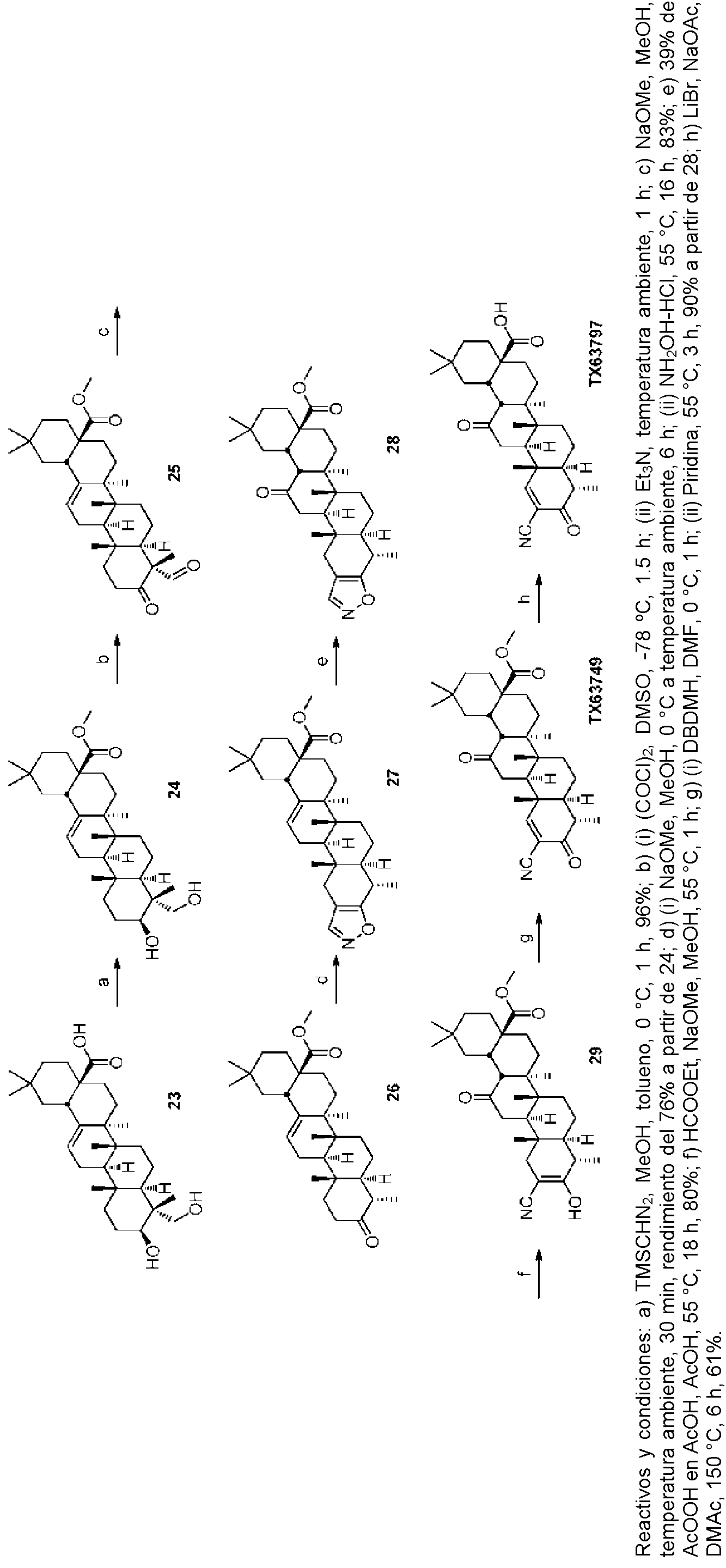


o < -£ 005 Q-C£ (D
oCM (ü E o3 o (/>- 


o(ü or (ü
O 00 . oo s -JZ O O)) ° r£ " l P o LO T_ LO 0 Or 00 . o o s - JZ O O ) ) ° r £ "l P o LO T_ LO 0

Q ~ (ü 0 Q ~ (ü 0
C O) . o 2 o -"O C T- o _ ° >* O° C o0 L LOO á x" « 0 O 0 oc 2
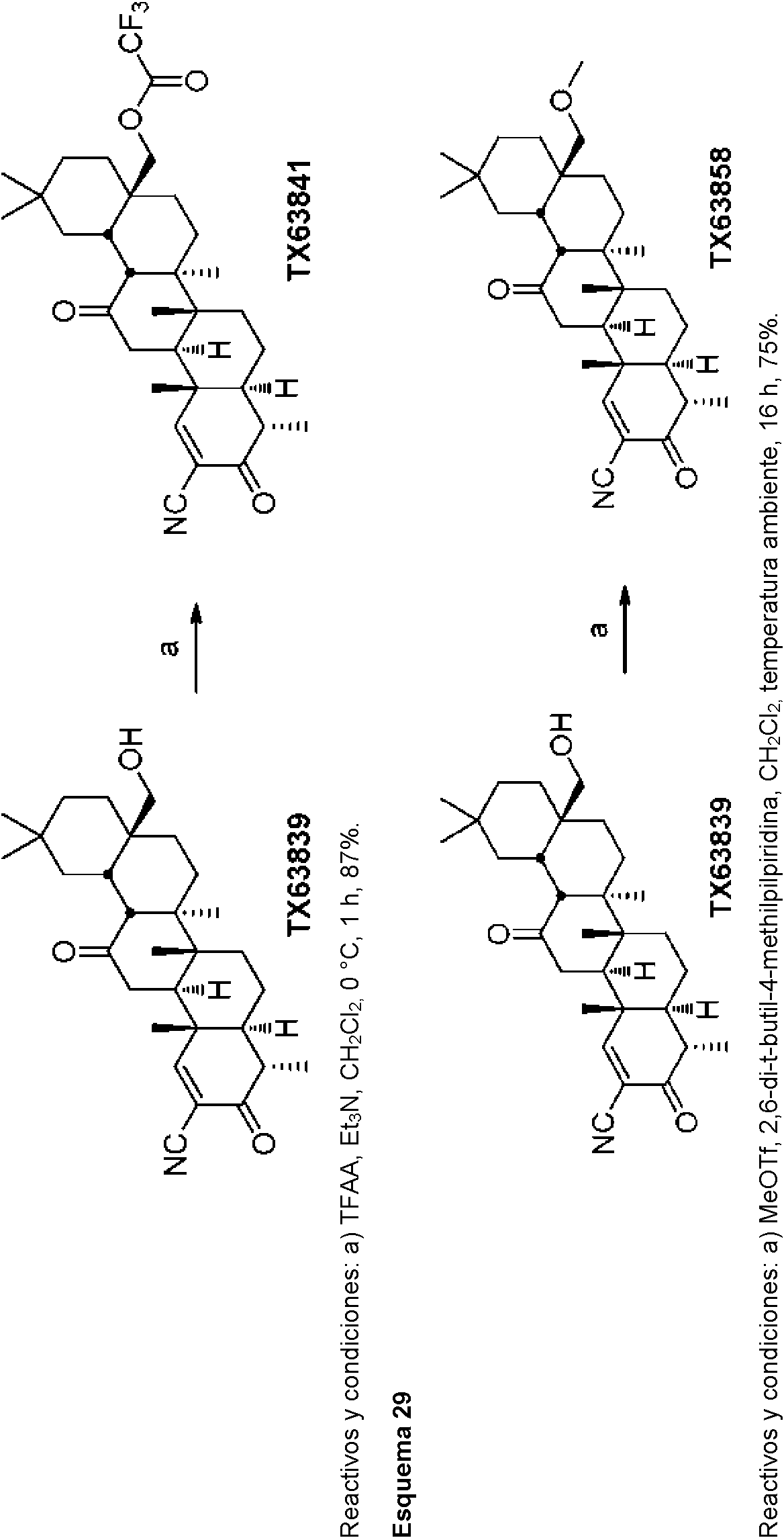


0 Q_ 0 0-* CM 0 Q_ 0 0- * CM
0 0 Q_0 0 Q_
0 E0 0 0 Q_ E0 E0 0 0 Q_ E
0-* x~ o0 oo<N 0 - * x ~ o0 o o <N
CMCM
0~ c-* 0 Ero ro 0 o . 0 ~ c- * 0 Ero ro 0 o.
E0 OCME0 OCM
XX
o o o' X o o o 'X
oo 

CM Oo CM Oo

o o ir Í2

10 # C£ V lo 


JO


cho-c h o-
0 E(D (D 0 E (D (D
0Q_ E 0Q_ E
0-* Óc" 0 _3 +O-* 
'en 'in
o o T C D T or C or D
OOR o or
o > -I—< 0 (D 0 01 


OCM O LO00 OCM OR LO 00
0O 
CDCD
i" 0 01 i "0 01
c0o c o o TD c 0 o c o or TD
C 0 O > 00 01 OC\l C\l <D 0 C 0 O > 0 0 01 OC \ l C \ l <D 0
E(D (ü E (D (ü
20Q_ E 2 0 Q_ E
0-* (D oo O 0- * (D o O
XX
XX

o ~o c o o > , coo > -I—< 0 (D 0 01 
0(O0 0 (or 0
Oo o Oo o
OOR
<LU 
XX
c0o CO c0o C O
o T C D or T C D
OOR o or
o -I>—< o (0ü a:

Síntesis y caracterización de compuestos e intermediosSynthesis and characterization of compounds and intermediates
Compuesto 2: El compuesto 1 (40 g, 83.0 mmol), NH2OH-HCI (13.33 g, 191.8 mmol), NaOAc (15.60 g, 190.2 mmol), CH 2 CI2 (400 ml) y MeOH (400 ml) se mezclaron en un matraz de 2 L. La mezcla de reacción heterogénea se agitó a 70 °C (temperatura del baño de aceite) durante 1.5 horas y después se enfrió a temperatura ambiente. El disolvente se eliminó en un rotavapor. El residuo se disolvió en CH 2 Ch, y se lavó con agua. El extracto orgánico se secó con MgSO4, y se concentró para dar el producto bruto como un sólido de espuma blanca. El producto bruto se disolvió en CH 2 C l2 , y la disolución se filtró a través de un lecho de 5.08 cm (2 pulgadas) de gel de sílice eluyendo con CH 2 Ch/EtOAc (1:1, 1 L). El filtrado y los lavados se combinaron y se concentraron para dar la oxima 2 (43.44 g) en forma de un sólido de espuma blanca: m/z 498,3 (M+1).Compound 2: Compound 1 (40 g, 83.0 mmol), NH 2 OH-HCI (13.33 g, 191.8 mmol), NaOAc (15.60 g, 190.2 mmol), CH 2 CI 2 (400 ml) and MeOH (400 ml) they were mixed in a 2L flask. The heterogeneous reaction mixture was stirred at 70 ° C (oil bath temperature) for 1.5 hours and then cooled to room temperature. The solvent was removed on a rotary evaporator. The residue was dissolved in CH 2 Ch, and washed with water. The organic extract was dried with MgSO 4 , and concentrated to give the crude product as a white foam solid. The crude product was dissolved in CH 2 C l 2 , and the solution was filtered through a 5.08 cm (2 inch) bed of silica gel eluting with CH 2 Ch / EtOAc (1: 1, 1 L). The filtrate and washings were combined and concentrated to give the oxime 2 (43.44 g) as a white foam solid: m / z 498.3 (M + 1).
Compuesto 3: El Compuesto 2 (43.44 g, 87.22 mmol) obtenido anteriormente se disolvió en AcOH (217 mL) y Ac2O (217 mL), y la reacción se agitó a temperatura ambiente durante 2 h. Se añadieron PhI(OAc)2 (42.13 g, 131 mmol) y Pd(OAc)2 (0.98 g, 4.37 mmol, 0.05 eq.). El matraz se cerró herméticamente y la mezcla se calentó en un baño de aceite a 60 °C durante 24 h. Después de enfriar a temperatura ambiente, se añadió tolueno y la mayor parte del AcOH se eliminó mediante evaporación azeotrópica con tolueno en un rotavapor. El aceite rojo obtenido se vertió lentamente en una suspensión de NaHCO3 (150 g) en agua (500 mL). Después la mezcla se agitó a temperatura ambiente durante 15 min, se extrajo con CH 2 O 2. Los extractos orgánicos combinados se lavaron con NaHCOa ac., se secó con MgSO4 y se concentró. El residuo se purificó por cromatografía en columna (gel de sílice, eluyendo con 0 % a 50 % de EtOAc en hexanos) para dar el producto 3 (23.56 g, 47.5 % de rendimiento de 1) como un sólido de espuma amarilla. El compuesto 3 es una mezcla 4.4:1 de diastereoisómeros C4: m/z 598.4 (M+1), 538.4 (M-OAc).Compound 3: Compound 2 (43.44 g, 87.22 mmol) obtained above was dissolved in AcOH (217 mL) and Ac 2 O (217 mL), and the reaction was stirred at room temperature for 2 h. PhI (OAc) 2 (42.13 g, 131 mmol) and Pd (OAc) 2 (0.98 g, 4.37 mmol, 0.05 eq.) Were added. The flask was tightly closed and the mixture was heated in an oil bath at 60 ° C for 24 h. After cooling to room temperature, toluene was added and most of the AcOH was removed by azeotropic evaporation with toluene in a rotary evaporator. The red oil obtained was slowly poured into a suspension of NaHCO 3 (150 g) in water (500 mL). After the mixture was stirred at room temperature for 15 min, it was extracted with CH 2 O 2 . The combined organic extracts were washed with aq. NaHCOa, dried with MgSO 4 and concentrated. The residue was purified by column chromatography (silica gel, eluting with 0% to 50% EtOAc in hexanes) to give product 3 (23.56 g, 47.5% yield of 1) as a yellow foam solid. Compound 3 is a 4.4: 1 mixture of C4 diastereoisomers: m / z 598.4 (M + 1), 538.4 (M-OAc).
Compuestos 4 y 5: K2 CO 3 (27.38 g, 197.1 mmol) se añadió a una disolución del compuesto 3 (23.56 g, 39.4 mmol) en MeOH (390 mL) a 0 °C. Después de agitar la reacción a temperatura ambiente durante 1 h, el disolvente se eliminó en un rotavapor. El residuo se trató con CH 2 O 2 y HCl 12 N (33 mL, 396 mmol). Después la mezcla se agitó durante 5 min, se transfirió a un embudo de decantación, que se extrajo con CH 2 O 2. Los extractos orgánicos combinados se lavaron con agua, se secaron con MgSO4, y se concentraron. El producto bruto se purificó por cromatografía en columna (gel de sílice, eluyendo con 0 % a 70 % de EtOAc en hexanos) para dar el producto 4 (15.25 g, 75 % de rendimiento) como un sólido amarillo claro: m/z 514.1 (M+1). De la columna, también se obtiene el producto 5 (2.20 g, 11 % de rendimiento) como una espuma amarilla: m/z 514.1 (M+1).Compounds 4 and 5: K 2 CO 3 (27.38 g, 197.1 mmol) was added to a solution of compound 3 (23.56 g, 39.4 mmol) in MeOH (390 mL) at 0 ° C. After stirring the reaction at room temperature for 1 h, the solvent was removed on a rotary evaporator. The residue was treated with CH 2 O 2 and 12 N HCl (33 mL, 396 mmol). After the mixture was stirred for 5 min, it was transferred to a separatory funnel, which was extracted with CH 2 O 2 . The combined organic extracts were washed with water, dried with MgSO 4 , and concentrated. The crude product was purified by column chromatography (silica gel, eluting with 0% to 70% EtOAc in hexanes) to give product 4 (15.25 g, 75% yield) as a light yellow solid: m / z 514.1 (M + 1). From the column, product 5 (2.20 g, 11% yield) is also obtained as a yellow foam: m / z 514.1 (M + 1).
Compuesto 6: El compuesto 4 (17.25 g, 33.6 mmol), NaHSO3 (12.21 g, 117.4 mmol), EtOH (135 mL) y agua (68 mL) se mezclaron, y se calentaron en un baño de aceite a 80 °C durante 3 h. Cantidad adicional de NaHSOa (3.49 g, 33.6 mmol) se añadió, y la reacción se calentó durante 1 hora más. Después de eliminar el EtOH en un rotavapor, el residuo se extrajo con EtOAc. Los extractos orgánicos combinados se lavaron con agua, se secaron con MgSO4, y se concentraron para dar el producto bruto, que se disolvió en CH 2 C l2 , y se filtró a través de una almohadilla de 2.54 cm (1 pulgada) de gel de sílice, eluyendo con CH 2 Ch/EtOAc (1:1, 800 mL). El filtrado se concentró para dar el Compuesto 6 (14.20 g, rendimiento del 85%) como un sólido blanco: m/z 499.3 (M+1).Compound 6: Compound 4 (17.25 g, 33.6 mmol), NaHSO 3 (12.21 g, 117.4 mmol), EtOH (135 mL) and water (68 mL) were mixed, and heated in an oil bath at 80 ° C for 3 h. Additional amount of NaHSOa (3.49 g, 33.6 mmol) was added, and the reaction was heated for a further 1 hour. After removing EtOH in a rotary evaporator, the residue was extracted with EtOAc. The combined organic extracts were washed with water, dried with MgSO 4 , and concentrated to give the crude product, which was dissolved in CH 2 C 2 , and filtered through a pad of 2.54 cm (1 inch) of silica gel, eluting with CH 2 Ch / EtOAc (1: 1, 800 mL). The filtrate was concentrated to give Compound 6 (14.20 g, 85% yield) as a white solid: m / z 499.3 (M + 1).
Compuesto 7: El compuesto 6 (14.20 g, 28.5 mmol) se disolvió en xileno (600 mL) y se calentó a reflujo durante 28 horas. Después de enfriar la reacción a temperatura ambiente, el disolvente se eliminó en un rotavapor para dar el producto bruto 7 en forma de un sólido amarillo. El bruto 7 se disolvió en CH 2 C l2 (50 mL) y EtOH (50 mL), y la disolución se evaporó en un rotavapor hasta que la mayor parte del CH 2 C l2 fue eliminado. Se añadió una cantidad adicional de EtOH (25 mL). La mezcla heterogénea se calentó a reflujo durante 10 minutos, después de lo cual, se dejó reposar a temperatura ambiente durante 1 hora. El precipitado se recogió por filtración, se lavó con EtOH y se secó a vacío durante 16 horas para dar el compuesto 7 (11.40 g, 85 % de rendimiento) como un sólido blanco. El compuesto 7 es una mezcla 15:1 de los dos epímeros C4: m/z 469.3 (M+1).Compound 7: Compound 6 (14.20 g, 28.5 mmol) was dissolved in xylene (600 mL) and heated at reflux for 28 hours. After cooling the reaction to room temperature, the solvent was removed on a rotary evaporator to give the crude product 7 as a yellow solid. The crude 7 was dissolved in CH 2 C l 2 (50 mL) and EtOH (50 mL), and the solution was evaporated on a rotary evaporator until most of the CH 2 C l 2 was removed. An additional amount of EtOH (25 mL) was added. The heterogeneous mixture was heated at reflux for 10 minutes, after which it was allowed to stand at room temperature for 1 hour. The precipitate was collected by filtration, washed with EtOH and dried in vacuo for 16 hours to give compound 7 (11.40 g, 85% yield) as a white solid. Compound 7 is a 15: 1 mixture of the two C4 epimers: m / z 469.3 (M + 1).
Compuesto 8: Se añadió NaOMe (29.40 mL, 128.6 mmol) a una disolución del compuesto 7 (4.02 g, 8.57 mmol) en THF (8.6 mL) a 0 °C. Después de agitar la reacción durante 10 min, se trató con H CO 2 Et (20.70 mL, 257.4 mmol) y se agitó a temperatura ambiente durante 2.5 h. Después de enfriar la mezcla a 0 °C, se añadieron MTBE (90 mL) y HCl 12 N (11 mL). La mezcla se agitó durante 2 minutos y se repartió entre agua y EtOAc. El extracto orgánico se lavó con agua, se secó con MgSO4 y se concentró para dar el compuesto 8 como una sólido de espuma rosa: m/z 497.3 (M+1).Compound 8: NaOMe (29.40 mL, 128.6 mmol) was added to a solution of compound 7 (4.02 g, 8.57 mmol) in THF (8.6 mL) at 0 ° C. After stirring the reaction for 10 min, it was treated with H CO 2 Et (20.70 mL, 257.4 mmol) and stirred at room temperature for 2.5 h. After cooling the mixture to 0 ° C, MTBE (90 mL) and 12 N HCl (11 mL) were added. The mixture was stirred for 2 minutes and partitioned between water and EtOAc. The organic extract was washed with water, dried with MgSO 4 and concentrated to give compound 8 as a pink foam solid: m / z 497.3 (M + 1).
Compuesto 9: El compuesto 8 obtenido anteriormente, NH2OH-HCl (900 mg, 12.9 mmol), EtOH (86 mL) y agua (8.6 mL) se mezclaron, y se calentaron a 55 °C durante 3 horas. Después, el EtOH se eliminó en un rotavapor, el residuo se extrajo con CH 2 C l2. Los extractos orgánicos combinados se lavaron con agua, se secaron con MgSO4, y se concentraron. El producto bruto se trituró con EtOH (20 mL) a reflujo durante 20 minutos, y la mezcla se dejó reposar a temperatura ambiente durante 2 horas. El precipitado se recogió por filtración, se lavó con EtOH y se secó a vacío durante 16 horas para dar el compuesto 9 (2.40 g, 57 % de rendimiento a partir de 7) como un sólido blanco. Las aguas madres se concentraron y el residuo se purificó por cromatografía en columna (gel de sílice, eluyendo con 0 % a 25 % de EtOAc en hexanos) para dar una segunda cosecha del producto 9 (820 mg, 19 % de rendimiento de 7) como un sólido blanco. Compuesto 9: m/z 494.3 (M+1).Compound 9: The compound 8 obtained above, NH 2 OH-HCl (900 mg, 12.9 mmol), EtOH (86 mL) and water (8.6 mL) were mixed, and heated at 55 ° C for 3 hours. Then, the EtOH was removed on a rotary evaporator, the residue was extracted with CH 2 C l 2 . The combined organic extracts were washed with water, dried with MgSO 4 , and concentrated. The crude product was triturated with EtOH (20 mL) at reflux for 20 minutes, and the mixture was allowed to stand at room temperature for 2 hours. The precipitate was collected by filtration, washed with EtOH and dried in vacuo for 16 hours to give compound 9 (2.40 g, 57% yield from 7) as a white solid. The mother liquors were concentrated and the residue was purified by column chromatography (silica gel, eluting with 0% to 25% EtOAc in hexanes) to give a second crop of product 9 (820 mg, 19% yield of 7) Like a white solid Compound 9: m / z 494.3 (M + 1).
Compuesto 10 (TX63778): Se añadió NaOMe (2.05 mL, 8.96 mmol) a una suspensión del compuesto 9 (3.195 g, 6.47 mmol) en MeOH (65 mL) a temperatura ambiente. Después de calentar la reacción a 55 °C durante 2 horas, se enfrió a temperatura ambiente. Se añadió MTBE y la mezcla se transfirió a un embudo de decantación, que se lavó con HCl 1 N ac., y agua. El extracto orgánico se secó con MgSO4 y se concentró para dar el compuesto 10 en forma de un sólido blanquecino: m/z 494.3 (M+1); RMN 1H (500 MHz, CDCh) 85.82 (s, 1H), 3.72 (dd, 1H, J = 5.7, 13.6 Hz), 3.69 (s, 3H), 3.03 (m, 1H), 2.91 (d, 1H, J = 4.5 Hz), 2.68 (dd, 1H, J = 5.6, 13.1 Hz), 2.43 (m, 1H), 2.01 (dd, 1H, J = 13.2, 13.4 Hz), 1.41 (s, 3H), 1.31 (s, 3H), 1.13 (d, 3H, J = 6.4 Hz), 1.10 -1.95 (m, 15H), 1,00 (s, 3H), 1,00 (s, 3H), 0.90 (s, 3H).Compound 10 (TX63778): NaOMe (2.05 mL, 8.96 mmol) was added to a suspension of compound 9 (3.195 g, 6.47 mmol) in MeOH (65 mL) at room temperature. After heating the reaction at 55 ° C for 2 hours, it was cooled at room temperature. MTBE was added and the mixture was transferred to a separatory funnel, which was washed with aq. 1N HCl, and water. The organic extract was dried with MgSO 4 and concentrated to give compound 10 as an off-white solid: m / z 494.3 (M + 1); 1H NMR (500 MHz, CDCh) 85.82 (s, 1H), 3.72 (dd, 1H, J = 5.7, 13.6 Hz), 3.69 (s, 3H), 3.03 (m, 1H), 2.91 (d, 1H, J = 4.5 Hz), 2.68 (dd, 1H, J = 5.6, 13.1 Hz), 2.43 (m, 1H), 2.01 (dd, 1H, J = 13.2, 13.4 Hz), 1.41 (s, 3H), 1.31 (s , 3H), 1.13 (d, 3H, J = 6.4 Hz), 1.10 -1.95 (m, 15H), 1.00 (s, 3H), 1.00 (s, 3H), 0.90 (s, 3H).
Compuesto TX63435: Se añadió una disolución de 1,3-dibromo-5,5-dimetilhidantoína (939 mg, 3.28 mmol) en DMF (10 mL) a una disolución del compuesto 10 obtenido anteriormente en DMF (25 mL) a 0 °C. Después de agitar la reacción a 0 °C durante 1 hora, se añadió piridina (1.68 mL, 20.8 mmol). La reacción se calentó a 55 °C durante 3.5 h, y se enfrió a temperatura ambiente. La mezcla se diluyó con EtOAc y se transfirió a un embudo de decantación, que se lavó con HCl 1 N ac., disolución de Na2 SO 3 ac., y agua. El extracto orgánico se secó con MgSO4 y se concentró. El residuo se purificó por cromatografía en columna (gel de sílice, eluyendo con 0 % a 30 % de EtOAc en hexanos) para dar TX63435 (2.727 g, 85 % de rendimiento a partir de 9) como un sólido blanco: RMN 1H (500 MHz, CDCh) 88.03 (s, 1H), 6.026 (s, 1H), 3.71 (s, 3H), 3.05 (m, 1H), 2.96 (d, 1H, J = 4.5 Hz), 2.48 (m, 1H), 1.45 (s, 3H), 1.33 (s, 3H), 1.26 (d, 3H, J = 6.5 Hz), 1.20-1.95 (m, 15H), 1.02 (s, 3H), 1.01 (s, 3H), 0.91 (s, 3H); m/z 492.3 (M+1).Compound TX63435: A solution of 1,3-dibromo-5,5-dimethylhydantoin (939 mg, 3.28 mmol) in DMF (10 mL) was added to a solution of compound 10 previously obtained in DMF (25 mL) at 0 ° C . After stirring the reaction at 0 ° C for 1 hour, pyridine (1.68 mL, 20.8 mmol) was added. The reaction was heated at 55 ° C for 3.5 h, and cooled to room temperature. The mixture was diluted with EtOAc and transferred to a separatory funnel, which was washed with 1 N aq. HCl, aq. Na 2 SO 3 solution, and water. The organic extract was dried with MgSO 4 and concentrated. The residue was purified by column chromatography (silica gel, eluting with 0% to 30% EtOAc in hexanes) to give TX63435 (2,727 g, 85% yield from 9) as a white solid: 1 H NMR (500 MHz, CDCh) 88.03 (s, 1H), 6.026 (s, 1H), 3.71 (s, 3H), 3.05 (m, 1H), 2.96 (d, 1H, J = 4.5 Hz), 2.48 (m, 1H) , 1.45 (s, 3H), 1.33 (s, 3H), 1.26 (d, 3H, J = 6.5 Hz), 1.20-1.95 (m, 15H), 1.02 (s, 3H), 1.01 (s, 3H), 0.91 (s, 3H); m / z 492.3 (M + 1).
Compuesto TX63520: Se añadió Lil (14.85 g, 110.8 mmol) a una disolución del compuesto 10 (2.727 g, 5.54 mmol) en DMF (40 mL) a temperatura ambiente. Después de que la reacción se calentó a 150 °C con ^burbujeado durante 4 horas, se enfrió y se diluyó con EtOAc. La mezcla se lavó con HCl 1 N ac., y agua. Los lavados ac. se extrajeron de nuevo con EtOAc. Los extractos de EtOAc combinados se lavaron con Na2 SO 3 ac. y agua, se secó con Na2 SO 4 y se concentró. El residuo se purificó por cromatografía en columna (gel de sílice, eluyendo con 0 % a 10 % de MeOH en CH2Cl2) para dar TX63520 (1.700 g, rendimiento del 64%) como un sólido blanco: RMN 1H (400 MHz, CDCh) 88.02 (s, 1H), 6.03 (s, 1H), 3.01-3.05 (m, 2H), 2.47 (m, 1H), 1.44 (s, 3H), 1.35 (s, 3H), 1.25 (d, 3H) J = 6.8 Hz), 1.18 -1.97 (m, 15H), 1.02 (s, 3H), 1.00 (s, 3H), 0.90 (s, 3H); m/z 478.3 (M+1).Compound TX63520: Lil (14.85 g, 110.8 mmol) was added to a solution of compound 10 (2.727 g, 5.54 mmol) in DMF (40 mL) at room temperature. After the reaction was heated at 150 ° C with bubbling for 4 hours, it was cooled and diluted with EtOAc. The mixture was washed with 1 N aq. HCl, and water. The washings ac. they were extracted again with EtOAc. The combined EtOAc extracts were washed with Na 2 SO 3 aq. and water, dried with Na 2 SO 4 and concentrated. The residue was purified by column chromatography (silica gel, eluting with 0% to 10% MeOH in CH2Cl2) to give TX63520 (1,700 g, 64% yield) as a white solid: 1H NMR (400 MHz, CDCh) 88.02 (s, 1H), 6.03 (s, 1H), 3.01-3.05 (m, 2H), 2.47 (m, 1H), 1.44 (s, 3H), 1.35 (s, 3H), 1.25 (d, 3H) J = 6.8 Hz), 1.18 -1.97 (m, 15H), 1.02 (s, 3H), 1.00 (s, 3H), 0.90 (s, 3H); m / z 478.3 (M + 1).
Compuesto TX63521: Se añadieron secuencialmente cloruro de oxalilo (0.35 mL, 4,13 mmol) y DMF (11 mL, 0.14 mmol) a una disolución de TX63520 (660 mg, 1.38 mmol) en CH 2 C l2 (28 mL) a 0 °C. Después de agitar la reacción a temperatura ambiente durante 2 horas, se concentró en un rotavapor. El residuo se evaporó junto con tolueno (3 X 10 mL) para eliminar el cloruro de oxalilo residual. El compuesto 11 se obtuvo como un sólido de espuma amarilla clara. El cloruro de ácido 11 se disolvió en CH 2 C l2 (14 mL), y se enfrió a 0 °C. Se añadió EtNH2 (disolución 2.0 M en THF, 2.07 mL, 4.14 mmol). Después de agitar la reacción a 0 °C durante 30 minutos, se transfirió a un embudo de decantación, que se lavó con agua. El extracto orgánico se secó con Na2 SO 4 y se concentró. El residuo se purificó mediante cromatografía en columna (gel de sílice, eluyendo con 0 % a 100 % de EtOAc en hexanos) para dar TX63521 (704 mg, 100 % de rendimiento) como un sólido blanco, que se contaminó con una pequeña cantidad de impurezas. El TX63521 obtenido se purificó adicionalmente mediante trituración con EtOH (5 mL) a 55 °C durante 10 min. Después de dejar reposar la mezcla a temperatura ambiente durante 1 h, el precipitado blanco se recogió por filtración, se lavó con EtOH y se secó a vacío durante 16 h para dar TX63521 (504 mg) como un sólido blanco: RMN 1H (600 MHz, CDCla) 88.01 (s, 1H), 6.01 (s, 1H), 5,74 (t, 1H, J = 5.4 Hz), 3.30 (m, 2H), 3.06 (d, 1H, J = 4.2 Hz), 2.84 (m, 1H), 2.46 (m, 1H), 1.43 (s, 3H), 1.32 (s, 3H), 1.24 (d, 3H, J = 6.6 Hz), 1.14 -1.96 (m, 15H), 1.12 (t, 3H, J = 7.2 Hz), 1.01 (s, 3H), 0.99 (s, 3H), 0.89 (s, 3H); m/z 505.3 (M+1).Compound TX63521: Oxalyl chloride (0.35 mL, 4.13 mmol) and DMF (11 mL, 0.14 mmol) were added sequentially to a solution of TX63520 (660 mg, 1.38 mmol) in CH 2 C l 2 (28 mL) at 0 ° C After stirring the reaction at room temperature for 2 hours, it was concentrated on a rotary evaporator. The residue was evaporated together with toluene (3 X 10 mL) to remove residual oxalyl chloride. Compound 11 was obtained as a light yellow foam solid. The acid chloride 11 was dissolved in CH 2 C l 2 (14 mL), and cooled to 0 ° C. EtNH 2 (2.0 M solution in THF, 2.07 mL, 4.14 mmol) was added. After stirring the reaction at 0 ° C for 30 minutes, it was transferred to a separatory funnel, which was washed with water. The organic extract was dried with Na 2 SO 4 and concentrated. The residue was purified by column chromatography (silica gel, eluting with 0% to 100% EtOAc in hexanes) to give TX63521 (704 mg, 100% yield) as a white solid, which was contaminated with a small amount of impurities The TX63521 obtained was further purified by trituration with EtOH (5 mL) at 55 ° C for 10 min. After allowing the mixture to stand at room temperature for 1 h, the white precipitate was collected by filtration, washed with EtOH and dried in vacuo for 16 h to give TX63521 (504 mg) as a white solid: 1 H NMR (600 MHz , CDCla) 88.01 (s, 1H), 6.01 (s, 1H), 5.74 (t, 1H, J = 5.4 Hz), 3.30 (m, 2H), 3.06 (d, 1H, J = 4.2 Hz), 2.84 (m, 1H), 2.46 (m, 1H), 1.43 (s, 3H), 1.32 (s, 3H), 1.24 (d, 3H, J = 6.6 Hz), 1.14 -1.96 (m, 15H), 1.12 (t, 3H, J = 7.2 Hz), 1.01 (s, 3H), 0.99 (s, 3H), 0.89 (s, 3H); m / z 505.3 (M + 1).
Compuesto 12: Se añadió Lil (67.89 g, 506.6 mmol) a una disolución del compuesto 7 (11.88 g, 25.3 mmol) en DMF (180 mL) a temperatura ambiente. La mezcla se calentó a 150 °C con N2 burbujeado durante 7.5 h. Después de enfriar la reacción, se diluyó con EtOAc y se lavó con HCl 1 N ac., y agua. Los lavados acuosos se extrajeron de nuevo con EtOAc. Los extractos de EtOAc combinados se lavaron con Na2 SO 3 ac. y agua, se secaron sobre Na2 SO 4 y se concentraron en un rotavapor hasta aproximadamente 40 mL. La mezcla heterogénea amarilla se sometió a reflujo durante 20 minutos, después de lo cual, se dejó en reposo a temperatura ambiente durante 5 horas. El precipitado se recogió por filtración, se lavó con EtOAc/hexano (1:1) y se secó a vacío durante 16 h para dar el compuesto 12 (9.15 g, 79 % de rendimiento) como un sólido blanco. Las aguas madres se concentraron y el residuo se purificó por cromatografía en columna (gel de sílice, eluyendo con 0 % a 35 % de EtOAc en CH 2 O 2 ) para dar una segunda cosecha de compuesto 12 (1.65 g, 14 % de rendimiento) como un sólido blanco. Compuesto 12: m/z 455.3 (M+1).Compound 12: Lil (67.89 g, 506.6 mmol) was added to a solution of compound 7 (11.88 g, 25.3 mmol) in DMF (180 mL) at room temperature. The mixture was heated at 150 ° C with bubbled N 2 for 7.5 h. After cooling the reaction, it was diluted with EtOAc and washed with 1 N aq. HCl, and water. The aqueous washings were extracted again with EtOAc. The combined EtOAc extracts were washed with Na 2 SO 3 aq. and water, dried over Na 2 SO 4 and concentrated on a rotary evaporator to approximately 40 mL. The heterogeneous yellow mixture was refluxed for 20 minutes, after which it was allowed to stand at room temperature for 5 hours. The precipitate was collected by filtration, washed with EtOAc / hexane (1: 1) and dried under vacuum for 16 h to give compound 12 (9.15 g, 79% yield) as a white solid. The mother liquor was concentrated and the residue was purified by column chromatography (silica gel, eluting with 0% to 35% EtOAc in CH 2 O 2 ) to give a second crop of compound 12 (1.65 g, 14% yield ) as a white solid. Compound 12: m / z 455.3 (M + 1).
Compuesto 13: Se añadió NaOMe (87 mL, 380.5 mmol) a una suspensión del compuesto 12 (11.54 g, 25.4 mmol) en HCO 2 Et (61 mL, 758.4 mmol) a 0 °C. Después de agitar la reacción a temperatura ambiente durante 1 h, se enfrió a 0 °C. Se añadieron secuencialmente MTBE (250 mL) y HCl 6 N ac. (67.6 mL, 405.6 mmol). Después de agitar durante 5 min, la mezcla se transfirió a un embudo de decantación y se extrajo con EtOAc. Los extractos orgánicos combinados se lavaron con HCl 1 N ac., y agua, se secaron con Na2 SO 4, y se concentraron.Compound 13: NaOMe (87 mL, 380.5 mmol) was added to a suspension of compound 12 (11.54 g, 25.4 mmol) in HCO 2 Et (61 mL, 758.4 mmol) at 0 ° C. After stirring the reaction at room temperature for 1 h, it was cooled to 0 ° C. MTBE (250 mL) and 6 N HCl aq were added sequentially. (67.6 mL, 405.6 mmol). After stirring for 5 min, the mixture was transferred to a separatory funnel and extracted with EtOAc. The combined organic extracts were washed with 1 N aq. HCl, and water, dried with Na 2 SO 4 , and concentrated.
El residuo se mezcló con NH2OH-HCl (2.66 g, 38.3 mmol), EtOH (250 mL) y agua (25 mL), y se calentó a 55 °C durante 3 h. Después el EtOH se eliminó en un rotavapor, el residuo se extrajo con CH 2 O 2. Los extractos orgánicos combinados se lavaron con agua, se secaron con Na2 SO 4, y se concentraron para dar el producto bruto como un sólido de color rosa. El bruto 7 se trituró con EtOAc (25 mL) a reflujo durante 10 min, y la mezcla se dejó reposar a temperatura ambiente durante 2 h. El precipitado se recogió por filtración, se lavó con EtOAc/hexano (1:1) y se secó a vacío durante 16 h para dar el compuesto 13 (9.70 g, 80 % de rendimiento) como un sólido rosa claro: m/z 480.3 (M+1). The residue was mixed with NH 2 OH-HCl (2.66 g, 38.3 mmol), EtOH (250 mL) and water (25 mL), and heated at 55 ° C for 3 h. After EtOH was removed on a rotary evaporator, the residue was extracted with CH 2 O 2 . The combined organic extracts were washed with water, dried with Na 2 SO 4 , and concentrated to give the crude product as a pink solid. The crude 7 was triturated with EtOAc (25 mL) at reflux for 10 min, and the mixture was allowed to stand at room temperature for 2 h. The precipitate was collected by filtration, washed with EtOAc / hexane (1: 1) and dried under vacuum for 16 h to give compound 13 (9.70 g, 80% yield) as a light pink solid: m / z 480.3 (M + 1).
Compuesto 14: Se añadieron secuencialmente cloruro de oxalilo (3.31 mL, 39.0 mmol) y DMF (0.10 mL, 1.29 mmol) a una disolución del compuesto 13 (6.25 g, 13.0 mmol) en CH 2 C l2 (130 mL) a 0 °C. Después de agitar la reacción a temperatura ambiente durante 2 h, se concentró en un rotavapor. El residuo se evaporó junto con tolueno (3 X 50 mL) para eliminar el cloruro de oxalilo residual. El cloruro de ácido bruto se obtuvo como un sólido marrón claro.Compound 14: Oxalyl chloride (3.31 mL, 39.0 mmol) and DMF (0.10 mL, 1.29 mmol) were added sequentially to a solution of compound 13 (6.25 g, 13.0 mmol) in CH 2 C l 2 (130 mL) at 0 ° C. After stirring the reaction at room temperature for 2 h, it was concentrated on a rotary evaporator. The residue was evaporated together with toluene (3 X 50 mL) to remove residual oxalyl chloride. The crude acid chloride was obtained as a light brown solid.
El cloruro de ácido se disolvió en CH 2 C l2 (130 mL) y se enfrió a 0 °C. Se añadió EtNH2 (disolución 2.0 M en THF, 19.5 mL, 39.0 mmol) y la reacción se agitó a 0 °C durante 40 min. La mezcla se transfirió a un embudo de decantación, que se lavó con agua. El extracto orgánico se secó con Na2 SO 4 y se concentró. El producto bruto se disolvió en la cantidad mínima de CH 2 C l2 , y se añadió EtOH (10 mL). Después la mezcla se calentó a reflujo durante 10 min para evaporar el CH 2 C l2 , se dejó en reposo a 4 °C durante 16 h. El precipitado se recogió por filtración, se lavó con EtOH y se secó a vacío durante 16 h para dar el compuesto 14 (5.66 g, 86 % de rendimiento) como un sólido blanco: m/z 507.3 (M+1). Compuesto 15: Se añadió NaOMe (5.11 mL, 22.3 mmol) a una disolución del compuesto 14 (5.66 g, 11.2 mmol) en MeOH (112 mL) a temperatura ambiente. Después de calentar la reacción a 55 °C durante 2 h, se enfrió a temperatura ambiente. Se añadió MTBE (200 mL) y la mezcla se transfirió a un embudo de decantación, que se lavó con HCl 1 N ac., y agua. Los lavados acuosos se extrajeron de nuevo con EtOAc. Los extractos orgánicos combinados se secaron con Na2 SO 4, y se concentraron para dar el producto bruto 15 como un sólido blanco. El bruto 15 se trituró con EtOAc (20 mL) a reflujo durante 5 min, y se dejó reposar a temperatura ambiente durante 2 h. El precipitado se recogió por filtración, se lavó con EtOAc y se secó a vacío durante 16 h para dar el compuesto 15 (5.22 g, rendimiento del 92%) como un sólido blanco. El compuesto 15 es una mezcla 1.75:1 de isómeros de enol y cetona en el anillo A: m/z 507.3 (M+1).The acid chloride was dissolved in CH 2 C l 2 (130 mL) and cooled to 0 ° C. EtNH 2 (2.0 M solution in THF, 19.5 mL, 39.0 mmol) was added and the reaction was stirred at 0 ° C for 40 min. The mixture was transferred to a separatory funnel, which was washed with water. The organic extract was dried with Na 2 SO 4 and concentrated. The crude product was dissolved in the minimum amount of CH 2 C l 2 , and EtOH (10 mL) was added. After the mixture was heated at reflux for 10 min to evaporate the CH 2 C l 2 , it was allowed to stand at 4 ° C for 16 h. The precipitate was collected by filtration, washed with EtOH and dried in vacuo for 16 h to give compound 14 (5.66 g, 86% yield) as a white solid: m / z 507.3 (M + 1). Compound 15: NaOMe (5.11 mL, 22.3 mmol) was added to a solution of compound 14 (5.66 g, 11.2 mmol) in MeOH (112 mL) at room temperature. After heating the reaction at 55 ° C for 2 h, it was cooled to room temperature. MTBE (200 mL) was added and the mixture was transferred to a separatory funnel, which was washed with aq. 1N HCl, and water. The aqueous washings were extracted again with EtOAc. The combined organic extracts were dried with Na 2 SO 4 , and concentrated to give the crude product as a white solid. The crude 15 was triturated with EtOAc (20 mL) at reflux for 5 min, and allowed to stand at room temperature for 2 h. The precipitate was collected by filtration, washed with EtOAc and dried in vacuo for 16 h to give compound 15 (5.22 g, 92% yield) as a white solid. Compound 15 is a 1.75: 1 mixture of enol and ketone isomers in ring A: m / z 507.3 (M + 1).
Compuestos TX63521 y TX63597: Se añadió una disolución de 1,3-dibromo-5,5-dimetilhidantoína (1.472 g, 5.15 mmol) en DMF (26 mL) a una disolución del compuesto 15 (5.218 g, 10.3 mmol) en DMF (25 mL) a 0 °C. Después de agitar la reacción a 0 °C durante 1 h, se añadió piridina (2.50 mL, 31.0 mmol) y la mezcla se calentó a 55 °C durante 3 h. Después de enfriar a temperatura ambiente, la reacción se diluyó con EtOAc (300 mL) y se transfirió a un embudo de decantación, que se lavó con HCl 1 N ac., Na2 SO 3 , ac y agua. El extracto orgánico se secó con Na2 SO 4 y se concentró. El residuo se filtró a través de una almohadilla de gel de sílice, eluyendo con 1:1 EtOAc: CH 2 C l2 (400 mL). El filtrado se concentró para dar el producto bruto, que se trituró en CH 2 Ch/EtOH para dar TX63521 (4.37 g, 84 % de rendimiento) como un sólido blanco: m/z 505.3 (M+1). Las aguas madres estaban concentradas. El residuo se purificó por cromatografía en columna (gel de sílice, eluyendo con 0 % a 100 % de EtOAc en (10:1 hexanos:CH2 C l2 )) para dar una segunda cosecha de TX63521 (0.67 g, 12 % de rendimiento) como un sólido blanco. De las aguas madres, también se obtuvo el compuesto TX63597 (12 mg, 2 % de rendimiento) como un sólido blanco: m/z = 503.3 (M+1); RMN 1H (500 MHz, CDCla) 87.85 (s, 1H), 5.95 (s, 1H), 5.76 (t, 1H, J = 5.3 Hz), 3.33 (m, 2H), 3.13 (d, 1H, J = 4.5 Hz), 2.94 (m, 1H), 2.86 (m, 1H), 2.60 (m, 1H), 2.01 (s, 3H), 1.95 (m, 1H), 1.65 (s, 3H), 1.50 (s, 3H), 1.15 -1.85 (m, 11H), 1.15 (t, 3H, J = 7.2 Hz), 1.00 (s, 3H), 0.90 (s, 3H), 0.86 (s, 3H).Compounds TX63521 and TX63597: A solution of 1,3-dibromo-5,5-dimethylhydantoin (1,472 g, 5.15 mmol) in DMF (26 mL) was added to a solution of compound 15 (5,218 g, 10.3 mmol) in DMF ( 25 mL) at 0 ° C. After stirring the reaction at 0 ° C for 1 h, pyridine (2.50 mL, 31.0 mmol) was added and the mixture was heated at 55 ° C for 3 h. After cooling to room temperature, the reaction was diluted with EtOAc (300 mL) and transferred to a separatory funnel, which was washed with 1 N aq. HCl, Na 2 SO 3 , aq and water. The organic extract was dried with Na 2 SO 4 and concentrated. The residue was filtered through a pad of silica gel, eluting with 1: 1 EtOAc: CH 2 C l 2 (400 mL). The filtrate was concentrated to give the crude product, which was triturated in CH 2 Ch / EtOH to give TX63521 (4.37 g, 84% yield) as a white solid: m / z 505.3 (M + 1). The mother liquors were concentrated. The residue was purified by column chromatography (silica gel, eluting with 0% to 100% EtOAc in (10: 1 hexanes: CH 2 C 2 )) to give a second crop of TX63521 (0.67 g, 12% of yield) as a white solid. From the mother liquor, compound TX63597 (12 mg, 2% yield) was also obtained as a white solid: m / z = 503.3 (M + 1); 1H NMR (500 MHz, CDCla) 87.85 (s, 1H), 5.95 (s, 1H), 5.76 (t, 1H, J = 5.3 Hz), 3.33 (m, 2H), 3.13 (d, 1H, J = 4.5 Hz), 2.94 (m, 1H), 2.86 (m, 1H), 2.60 (m, 1H), 2.01 (s, 3H), 1.95 (m, 1H), 1.65 (s, 3H), 1.50 (s, 3H ), 1.15 -1.85 (m, 11H), 1.15 (t, 3H, J = 7.2 Hz), 1.00 (s, 3H), 0.90 (s, 3H), 0.86 (s, 3H).
Compuesto TX63522: Se añadió imidazol (75 mg, 1.10 mmol) a una disolución del compuesto 11 (184 mg, 0.37 mmol) en benceno (3.7 mL) a 10 °C. Después de agitar la reacción durante 40 minutos, se añadió una cantidad adicional de imidazol (25 mg, 0.37 mmol). Después de que la reacción se continuó agitando durante otros 30 minutos, se diluyó con EtOAc. La mezcla se transfirió a un embudo de decantación, que se lavó con agua. El extracto orgánico se secó con Na2 SO 4 y se concentró. El residuo se purificó por cromatografía en columna (gel de sílice, eluyendo con 0 % a 100 % de EtOAc en CH 2 O 2 ) para dar TX63522 (150 mg, 77 % de rendimiento) como una sólido de espuma blanca: RMN 1H (600 MHz, CDCla) 88.32 (s, 1H), 8.00 (s, 1H), 7.61 (s, 1H), 7.08 (s, 1H), 6.02 (s, 1H), 3.19-3.22 (m, 2H), 2.45 (m, 1H), 2.23 (m, 1H), 1.43 (s, 3H), 1.27 (s, 3H), 1.23 (d, 3H, J = 7.2 Hz), 1.20-2.04 (m, 14H), 1.04 (s, 6H), 0.95 (s, 3H); m/z 528.3 (M+1).Compound TX63522: Imidazole (75 mg, 1.10 mmol) was added to a solution of compound 11 (184 mg, 0.37 mmol) in benzene (3.7 mL) at 10 ° C. After stirring the reaction for 40 minutes, an additional amount of imidazole (25 mg, 0.37 mmol) was added. After the reaction was continued stirring for another 30 minutes, it was diluted with EtOAc. The mixture was transferred to a separatory funnel, which was washed with water. The organic extract was dried with Na 2 SO 4 and concentrated. The residue was purified by column chromatography (silica gel, eluting with 0% to 100% EtOAc in CH 2 O 2 ) to give TX63522 (150 mg, 77% yield) as a white foam solid: 1 H NMR ( 600 MHz, CDCla) 88.32 (s, 1H), 8.00 (s, 1H), 7.61 (s, 1H), 7.08 (s, 1H), 6.02 (s, 1H), 3.19-3.22 (m, 2H), 2.45 (m, 1H), 2.23 (m, 1H), 1.43 (s, 3H), 1.27 (s, 3H), 1.23 (d, 3H, J = 7.2 Hz), 1.20-2.04 (m, 14H), 1.04 ( s, 6H), 0.95 (s, 3H); m / z 528.3 (M + 1).
Compuesto TX63523: Se añadió C F 3CH 2 NH2 (359 mg, 3.62 mmol) a una disolución del compuesto 11 (600 mg, 1.21 mmol) en CH 2 O 2 (12 mL) a temperatura ambiente. Después de agitar la reacción durante 1 h, se diluyó con EtOAc, se transfirió a un embudo de decantación, que se lavó con agua. El extracto orgánico se secó con Na2 SO 4 y se concentró. El residuo se trituró con EtOH a 55 °C durante 10 min. Después de dejar reposar la mezcla a temperatura ambiente durante 1 h, el precipitado blanco se recogió por filtración, se lavó con EtOH y se secó a vacío durante 16 h para dar TX63523 (320 mg, 47 % de rendimiento) como un sólido blanco. Las aguas madres se concentraron y el residuo se purificó por cromatografía en columna (gel de sílice, eluyendo con 0 % a 100 % de EtOAc en hexanos) para dar una segunda cosecha de TX63523 (235 mg, 35 % de rendimiento) como un sólido blanco. Compuesto TX63523: RMN 1H (600 MHz, CDCls) 88.01 (s, 1H), 6.02 (s, 1H), 5.99 (t, 1H, J = 6.6 Hz), 3.88-4.05 (m, 2H), 3.05 (d, 1H, J = 4.8 Hz), 2.92 (m, 1H), 2.46 (m, 1H), 2.03 (m, 1H), 1.43 (s, 3H), 1.30 (s, 3H), 1.24 (d, 3H, J = 6.0 Hz), 1.18 -1.89 (m, 14H), 1.02 (s, 3H), 0.99 (s, 3H), 0.90 (s, 3H); m/z 559.3 (M+1).Compound TX63523: CF 3 CH 2 NH 2 (359 mg, 3.62 mmol) was added to a solution of compound 11 (600 mg, 1.21 mmol) in CH 2 O 2 (12 mL) at room temperature. After stirring the reaction for 1 h, it was diluted with EtOAc, transferred to a separatory funnel, which was washed with water. The organic extract was dried with Na 2 SO 4 and concentrated. The residue was triturated with EtOH at 55 ° C for 10 min. After allowing the mixture to stand at room temperature for 1 h, the white precipitate was collected by filtration, washed with EtOH and dried in vacuo for 16 h to give TX63523 (320 mg, 47% yield) as a white solid. The mother liquor was concentrated and the residue was purified by column chromatography (silica gel, eluting with 0% to 100% EtOAc in hexanes) to give a second crop of TX63523 (235 mg, 35% yield) as a solid. White. Compound TX63523: 1H NMR (600 MHz, CDCls) 88.01 (s, 1H), 6.02 (s, 1H), 5.99 (t, 1H, J = 6.6 Hz), 3.88-4.05 (m, 2H), 3.05 (d, 1H, J = 4.8 Hz), 2.92 (m, 1H), 2.46 (m, 1H), 2.03 (m, 1H), 1.43 (s, 3H), 1.30 (s, 3H), 1.24 (d, 3H, J = 6.0 Hz), 1.18 -1.89 (m, 14H), 1.02 (s, 3H), 0.99 (s, 3H), 0.90 (s, 3H); m / z 559.3 (M + 1).
Compuesto 16: Se añadieron secuencialmente cloruro de oxalilo (2.10 mL, 24.8 mmol) y una cantidad catalítica de DMF a una disolución del compuesto 13 (3.99 g, 8.32 mmol) en CH 2 C l2 (83 mL) a 0 °C. Después de agitar la reacción a temperatura ambiente durante 2 h, se concentró en un rotavapor. El residuo se evaporó junto con tolueno (3 x 30 mL) para eliminar el cloruro de oxalilo residual. El cloruro de ácido bruto se obtuvo como un sólido marrón claro. El cloruro de ácido se disolvió en CH2Cl2 (83 mL) y se enfrió a 0 °C. Se añadió CF3CH2NH2 (1.90 mL, 24.9 mmol) y la reacción se agitó a 0 °C durante 90 min. La mezcla se transfirió a un embudo de decantación, que se lavó con agua. El extracto orgánico se secó con Na2SO4 y se concentró. El residuo se purificó por cromatografía en columna (gel de sílice, eluyendo con 0 % a 50 % de EtOAc en hexano) para dar el compuesto 16 (3.95 g, 85 % de rendimiento) como un sólido blanco: m/z 561.3 (M+1).Compound 16: Oxalyl chloride (2.10 mL, 24.8 mmol) and a catalytic amount of DMF were added sequentially to a solution of compound 13 (3.99 g, 8.32 mmol) in CH 2 C 2 (83 mL) at 0 ° C. After stirring the reaction at room temperature for 2 h, it was concentrated on a rotary evaporator. The residue was evaporated together with toluene (3 x 30 mL) to remove residual oxalyl chloride. The crude acid chloride was obtained as a light brown solid. The acid chloride was dissolved in CH 2 Cl 2 (83 mL) and cooled to 0 ° C. CF 3 CH 2 NH 2 (1.90 mL, 24.9 mmol) was added and the reaction was stirred at 0 ° C for 90 min. The mixture was transferred to a separatory funnel, which was washed with water. The organic extract was dried with Na 2 SO 4 and concentrated. The residue was purified by column chromatography (gel silica, eluting with 0% to 50% EtOAc in hexane) to give compound 16 (3.95 g, 85% yield) as a white solid: m / z 561.3 (M + 1).
Compuesto 17: Se añadió NaOMe (2.30 mL, 10.1 mmol) a una disolución del compuesto 16 (3.95 g, 7.04 mmol) en MeOH (70 mL) a temperatura ambiente. Después de calentar la reacción a 55 °C durante 2 h, se enfrió a temperatura ambiente. Se añadió MTBE (200 mL) y la mezcla se transfirió a un embudo de decantación, que se lavó con HCl 1 N ac., y agua. El extracto orgánico se secó con Na2 SO 4 y se concentró. El residuo se purificó por cromatografía en columna (gel de sílice, eluyendo con 0 % a 60 % de EtOAc en hexano) para dar el compuesto 17 (3.18 g, 81 % de rendimiento) como un sólido blanco: m/z 561.3 (M+1).Compound 17: NaOMe (2.30 mL, 10.1 mmol) was added to a solution of compound 16 (3.95 g, 7.04 mmol) in MeOH (70 mL) at room temperature. After heating the reaction at 55 ° C for 2 h, it was cooled to room temperature. MTBE (200 mL) was added and the mixture was transferred to a separatory funnel, which was washed with aq. 1N HCl, and water. The organic extract was dried with Na 2 SO 4 and concentrated. The residue was purified by column chromatography (silica gel, eluting with 0% to 60% EtOAc in hexane) to give compound 17 (3.18 g, 81% yield) as a white solid: m / z 561.3 (M +1).
Compuesto TX63523: Se añadió una disolución de 1,3-dibromo-5,5-dimetilhidantoína (1.22 g, 4.27 mmol) en DMF (15 mL) a una disolución del compuesto 17 (4.80 g, 8.55 mmol) en DMF (20 mL) a 0 °C mediante una jeringa. La jeringa se enjuagó con DMF (8 mL) y se añadió a la mezcla de reacción. Después de agitar la reacción a 0 °C durante 1 h, se añadió piridina (2.07 mL, 25.7 mmol) y la mezcla se calentó a 55 °C durante 3 h. Después de enfriar a temperatura ambiente, la reacción se diluyó con EtOAc y se transfirió a un embudo de decantación, que se lavó con HCl 1 N ac., Na2 SO 3 , ac. y agua. El extracto orgánico se secó con Na2 SO 4 y se concentró para dar el compuesto bruto TX63523 (4.70 g, 98 % de rendimiento) como un sólido de color amarillo claro. El compuesto bruto TX63523 se disolvió en CH 2 C l2 (30 mL) y EtOH (15 mL). La disolución se evaporó en un rotavapor hasta que se eliminó la mayor parte del CH 2 C l2. La mezcla heterogénea se calentó a reflujo durante 20 min, y se dejó reposar a temperatura ambiente durante 1 h. El precipitado se recogió por filtración, se lavó con EtOH y se secó a vacío durante 16 h para dar el compuesto TX63523 (4.04 g, 86 % de rendimiento) como un sólido blanco: m/z 559.2 (M+1).Compound TX63523: A solution of 1,3-dibromo-5,5-dimethylhydantoin (1.22 g, 4.27 mmol) in DMF (15 mL) was added to a solution of compound 17 (4.80 g, 8.55 mmol) in DMF (20 mL ) at 0 ° C using a syringe. The syringe was rinsed with DMF (8 mL) and added to the reaction mixture. After stirring the reaction at 0 ° C for 1 h, pyridine (2.07 mL, 25.7 mmol) was added and the mixture was heated at 55 ° C for 3 h. After cooling to room temperature, the reaction was diluted with EtOAc and transferred to a separatory funnel, which was washed with 1 N aq. HCl, Na 2 SO 3 , aq. and water. The organic extract was dried with Na 2 SO 4 and concentrated to give crude compound TX63523 (4.70 g, 98% yield) as a light yellow solid. The crude compound TX63523 was dissolved in CH 2 C l 2 (30 mL) and EtOH (15 mL). The solution was evaporated on a rotary evaporator until most of the CH 2 C 2 was removed. The heterogeneous mixture was heated at reflux for 20 min, and allowed to stand at room temperature for 1 h. The precipitate was collected by filtration, washed with EtOH and dried under vacuum for 16 h to give compound TX63523 (4.04 g, 86% yield) as a white solid: m / z 559.2 (M + 1).
Compuesto 18: Se añadió LiAlH4 (2.0 M en THF, 0.30 mL, 0.60 mmol) a una disolución del compuesto 9 (100 mg, 0.20 mmol) en THF (4.0 mL) a 0 °C. Después de agitar la reacción a 0 °C durante 4 horas, se añadió una cantidad adicional de LiAlH4 (2.0 M en THF, 0.10 mL, 0.20 mmol). Después de agitar la reacción durante otras 2 horas, se detuvo mediante la adición de EtOH. Se añadió EtOAc, y la mezcla se lavó con HCl 1N ac. y agua. El extracto orgánico se secó con MgSO4 y se concentró. El residuo se purificó por cromatografía en columna (gel de sílice, eluyendo con 0 % a 80 % de EtOAc en hexano) para dar el compuesto 18 (56 mg, 59 % de rendimiento) como un sólido de espuma blanca: m/z 468.3 (M+1).Compound 18: LiAlH 4 (2.0 M in THF, 0.30 mL, 0.60 mmol) was added to a solution of compound 9 (100 mg, 0.20 mmol) in THF (4.0 mL) at 0 ° C. After stirring the reaction at 0 ° C for 4 hours, an additional amount of LiAlH 4 (2.0 M in THF, 0.10 mL, 0.20 mmol) was added. After stirring the reaction for another 2 hours, it was stopped by the addition of EtOH. EtOAc was added, and the mixture was washed with 1N aq. HCl. and water. The organic extract was dried with MgSO 4 and concentrated. The residue was purified by column chromatography (silica gel, eluting with 0% to 80% EtOAc in hexane) to give compound 18 (56 mg, 59% yield) as a white foam solid: m / z 468.3 (M + 1).
Compuesto 19: Se añadió NBS (30 mg, 0.17 mmol) a una disolución del compuesto 18 (53 mg, 0.11 mmol) en DME (1 mL) y agua (0.1 mL) a temperatura ambiente. Después de que la reacción se agitó a temperatura ambiente mientras se protegía de la luz durante 25 minutos, se añadió Na2 SO 3 ac. La mezcla se transfirió a un embudo de decantación, que se extrajo con EtOAc. El extracto orgánico se secó con MgSO4 y se concentró. El residuo se purificó por cromatografía en columna (gel de sílice, eluyendo con 0 % a 60 % de EtOAc en hexano) para dar el compuesto 19 (50 mg, 94 % de rendimiento) como un sólido de espuma blanca: m/z 466.3 (M+1).Compound 19: NBS (30 mg, 0.17 mmol) was added to a solution of compound 18 (53 mg, 0.11 mmol) in DME (1 mL) and water (0.1 mL) at room temperature. After the reaction was stirred at room temperature while protecting from light for 25 minutes, Na 2 SO 3 aq was added. The mixture was transferred to a separatory funnel, which was extracted with EtOAc. The organic extract was dried with MgSO 4 and concentrated. The residue was purified by column chromatography (silica gel, eluting with 0% to 60% EtOAc in hexane) to give compound 19 (50 mg, 94% yield) as a white foam solid: m / z 466.3 (M + 1).
Compuesto 20: Se añadió NaOMe (37 mL, 0.16 mmol) a una disolución del compuesto 19 (50 mg, 0.11 mmol) en MeOH (1.1 mL) a temperatura ambiente. Después de calentar la reacción a 55 °C durante 1 h, se enfrió a temperatura ambiente. Se añadió MTBE y la mezcla se transfirió a un embudo de decantación, que se lavó con HCl 1 N ac., y agua. El extracto orgánico se secó con MgSO4 y se concentró. El residuo se purificó por cromatografía en columna (gel de sílice, eluyendo con 0 % a 80 % de EtOAc en hexano) para dar el compuesto 20 (47 mg, 94 % de rendimiento) como un sólido de espuma blanca: m/z 466.3 (M+1).Compound 20: NaOMe (37 mL, 0.16 mmol) was added to a solution of compound 19 (50 mg, 0.11 mmol) in MeOH (1.1 mL) at room temperature. After heating the reaction at 55 ° C for 1 h, it was cooled to room temperature. MTBE was added and the mixture was transferred to a separatory funnel, which was washed with aq. 1N HCl, and water. The organic extract was dried with MgSO 4 and concentrated. The residue was purified by column chromatography (silica gel, eluting with 0% to 80% EtOAc in hexane) to give compound 20 (47 mg, 94% yield) as a white foam solid: m / z 466.3 (M + 1).
Compuesto TX63545: Se añadió una disolución de 1,3-dibromo-5,5-dimetilhidantoína (14 mg, 0.049 mmol) en DMF (0.2 ml) a una disolución del compuesto 20 (46 mg, 0.099 mmol) en DMF (0.3 mL) a 0 °C. Después de agitar la reacción a 0 °C durante 1 h, se añadió piridina (24 mL, 0.30 mmol). La reacción se calentó a 55 °C durante 3 horas y se enfrió a temperatura ambiente. La mezcla se diluyó con EtOAc y se lavó con HCl 1 N ac., disolución de Na2 SO 3 ac, y agua. El extracto orgánico se secó con MgSO4 y se concentró. El residuo se purificó por cromatografía en columna (gel de sílice, eluyendo con 0 % a 80 % de EtOAc en hexanos) para dar TX63545 (37 mg, 80 % de rendimiento) como un sólido blanco: RMN 1H (500 MHz, CDCh) 88.04 (s, 1H), 6.05 (s, 1H), 3.63 (dd, 1H, J = 6.5, 10.8 Hz), 3.54 (dd, 1H, J = 4.6, 10.8 Hz), 2.97 (d, 1H, J = 4.6 Hz), 2.50 (m, 1H), 2.38 (m, 1H), 1.47 (s, 6H), 1.27 (d, 3H, J = 6.7 Hz), 1.10 -1.93 (m, 16H), 1.04 (s, 3H), 0.96 (s, 3H), 0.90 (s, 3H); m/z 464.3 (M+1).Compound TX63545: A solution of 1,3-dibromo-5,5-dimethylhydantoin (14 mg, 0.049 mmol) in DMF (0.2 ml) was added to a solution of compound 20 (46 mg, 0.099 mmol) in DMF (0.3 mL ) at 0 ° C. After stirring the reaction at 0 ° C for 1 h, pyridine (24 mL, 0.30 mmol) was added. The reaction was heated at 55 ° C for 3 hours and cooled to room temperature. The mixture was diluted with EtOAc and washed with 1 N aq. HCl, aq. Na 2 SO 3 solution, and water. The organic extract was dried with MgSO 4 and concentrated. The residue was purified by column chromatography (silica gel, eluting with 0% to 80% EtOAc in hexanes) to give TX63545 (37 mg, 80% yield) as a white solid: 1H NMR (500 MHz, CDCh) 88.04 (s, 1H), 6.05 (s, 1H), 3.63 (dd, 1H, J = 6.5, 10.8 Hz), 3.54 (dd, 1H, J = 4.6, 10.8 Hz), 2.97 (d, 1H, J = 4.6 Hz), 2.50 (m, 1H), 2.38 (m, 1H), 1.47 (s, 6H), 1.27 (d, 3H, J = 6.7 Hz), 1.10 -1.93 (m, 16H), 1.04 (s, 3H), 0.96 (s, 3H), 0.90 (s, 3H); m / z 464.3 (M + 1).
Compuesto TX63546: Se añadió Ac2O (11 mL, 0.12 mmol) a una disolución del compuesto TX63545 (10.7 mg, 0.023 mmol) y piridina (19 mL, 0.23 mmol) en CH 2 O 2 (0.23 mL) a temperatura ambiente. Después de agitar la reacción a temperatura ambiente durante 3 h, se añadió NaHCO 3 ac. La mezcla se transfirió a un embudo de decantación, que se extrajo con EtOAc. El extracto orgánico se lavó con HCl 1 N ac., y agua, se secó con MgSO4 y se concentró. El residuo se purificó por cromatografía en columna (gel de sílice, eluyendo con 0 % a 80 % de EtOAc en hexanos) para dar TX63546 (9 mg, 77 % de rendimiento) como un sólido de espuma blanca: RMN 1H (500 MHz, CDCh) 88.02 (s, 1H), 6.03 (s, 1H), 4.11 (d, 1H, J = 11.2 Hz), 4.01 (d, 1H, J = 11.2 Hz), 3.00 (d, 1H, J = 4.6 Hz), 2.48 (m, 1H), 2.38 (m, 1H), 2.09 (s, 3H), 1.51 (s, 3H), 1.46 (s, 3H), 1.25 (d, 3H, J = 6.8 Hz), 1.10 -1.91 (m, 15H), 1.02 (s, 3H), 0.94 (s, 3H), 0.88 (s, 3H); m/z 506.3 (M+1).Compound TX63546: Ac 2 O (11 mL, 0.12 mmol) was added to a solution of compound TX63545 (10.7 mg, 0.023 mmol) and pyridine (19 mL, 0.23 mmol) in CH 2 O 2 (0.23 mL) at room temperature. After stirring the reaction at room temperature for 3 h, NaHCO 3 aq. The mixture was transferred to a separatory funnel, which was extracted with EtOAc. The organic extract was washed with 1 N aq. HCl, and water, dried over MgSO 4 and concentrated. The residue was purified by column chromatography (silica gel, eluting with 0% to 80% EtOAc in hexanes) to give TX63546 (9 mg, 77% yield) as a white foam solid: 1H NMR (500 MHz, CDCh) 88.02 (s, 1H), 6.03 (s, 1H), 4.11 (d, 1H, J = 11.2 Hz), 4.01 (d, 1H, J = 11.2 Hz), 3.00 (d, 1H, J = 4.6 Hz ), 2.48 (m, 1H), 2.38 (m, 1H), 2.09 (s, 3H), 1.51 (s, 3H), 1.46 (s, 3H), 1.25 (d, 3H, J = 6.8 Hz), 1.10 -1.91 (m, 15H), 1.02 (s, 3H), 0.94 (s, 3H), 0.88 (s, 3H); m / z 506.3 (M + 1).
Los compuestos TX63555 y TX63556: TX63520 (65 mg, 0.14 mmol), IPh(OH)(OTs) (64 mg, 0.16 mmol) y CH 2 O 2 (2.7 mL) se mezclaron y se calentaron a reflujo durante 1 hora. Después de enfriar a temperatura ambiente, la mezcla se purificó por cromatografía en columna (gel de sílice, eluyendo con 0 % a 70 % de EtOAc en hexanos) para dar TX63555 (34 mg, 53% de rendimiento) como un sólido blanco: RMN 1H (500 MHz), CDCI3) 5 7.99 (s, 1H), 6.25 (s, 1H), 2.98 (m, 1H), 2.52 (m, 1H), 2.11 (m, 1H), 1.53 (s, 3H), 1.53 (s, 3H), 1.27 (d, 3H, J = 6.8 Hz), 1.22-1.93 (m, 14H), 1.02 (s, 3H), 0.97 (s, 6H); m/z 476.2 (M+1).Compounds TX63555 and TX63556: TX63520 (65 mg, 0.14 mmol), IPh (OH) (OTs) (64 mg, 0.16 mmol) and CH 2 O 2 (2.7 mL) were mixed and heated at reflux for 1 hour. After cooling to room temperature, the mixture was purified by column chromatography (silica gel, eluting with 0% to 70% EtOAc in hexanes) to give TX63555 (34 mg, 53% yield) as a white solid: 1H NMR (500 MHz), CDCI3) 5 7.99 (s, 1H), 6.25 (s, 1H), 2.98 (m, 1H), 2.52 (m, 1H ), 2.11 (m, 1H), 1.53 (s, 3H), 1.53 (s, 3H), 1.27 (d, 3H, J = 6.8 Hz), 1.22-1.93 (m, 14H), 1.02 (s, 3H) , 0.97 (s, 6H); m / z 476.2 (M + 1).
De la columna, también se obtuvo TX63556 (24 mg, 37 % ) como un sólido blanco: RMN 1H (500 MHz, CD CI3 ) 57.95 (s, 1H), 5.92 (s, 1H), 2.97 (t, 1H, J = 8.4 Hz), 2.49 (m, 1H), 2.37 (m, 1H), 1.56 (s, 3H), 1.47 (s, 3H), 1.22-2.02 (m, 14H), 1.20 (d, 3H) J = 6 .8 Hz), 1.17 (s, 3H), 1.02 (s, 3H), 0.99 (s, 3H); m/z 476.3 (M+1).From the column, TX63556 (24 mg, 37%) was also obtained as a white solid: 1H NMR (500 MHz, CD CI 3 ) 57.95 (s, 1H), 5.92 (s, 1H), 2.97 (t, 1H, J = 8.4 Hz), 2.49 (m, 1H), 2.37 (m, 1H), 1.56 (s, 3H), 1.47 (s, 3H), 1.22-2.02 (m, 14H), 1.20 (d, 3H) J = 6 .8 Hz), 1.17 (s, 3H), 1.02 (s, 3H), 0.99 (s, 3H); m / z 476.3 (M + 1).
Compuesto TX63557: Se añadió NH3 (2.0 M en MeOH, 0.50 mL, 1.00 mmol) a una disolución del compuesto 11 (104 mg, 0.21 mmol) en THF (2.1 mL) a 0 °C . Después de agitar la reacción a 0 °C durante 30 minutos, se añadió EtOAc. La mezcla se transfirió a un embudo de decantación, que se lavó con agua. El extracto orgánico se secó con MgSO4 y se concentró. El residuo se purificó por cromatografía en columna (gel de sílice, eluyendo con 0 % a 100 % de EtOAc en hexanos) para dar TX63557 (95 mg, 95 % de rendimiento) como un sólido blanco: RMN 1H (500 MHz, CDCh) 5 8.04 (s, 1H), 6.04 (s, 1H), 5.74 (bs, 1H), 5.31 (bs, 1H), 3.15 (d, 1H, J = 4.5 Hz), 2.88 (m, 1H), 2.48 (m, 1H), 1.46 (s, 3H), 1.38 (s, 3H), 1.27 (d, 3H, J = 6.7 Hz), 1.19-2.04 (m, 15H), 1.04 (s, 3H), 1.02 (s, 3H), 0,92 (s, 3H); m/z 477.3 (M+1). Compuesto TX63558: Se añadieron secuencialmente Et3 N (51 mL, 0.37 mmol) y TFAA (30 mL, 0.22 mmol) a una disolución de TX63557 (70 mg, 0.15 mmol) en CH 2 O 2 a 0 °C . Después de que la reacción se agitó a 0 °C durante 15 min, se añadió NaHCO3 ac. La mezcla se transfirió a un embudo de decantación, que se extrajo con CH 2 O 2. Los extractos orgánicos combinados se lavaron con agua, se secaron con MgSO4, y se concentraron. El residuo se purificó por cromatografía en columna (gel de sílice, eluyendo con 0 % a 35 % de EtOAc en hexanos) para dar TX63558 (51 mg, 83 % de rendimiento) como un sólido blanco: RMN 1H (500 MHz, CDCh) 58.03 (s, 1H), 6.07 (s, 1H), 3.29 (d, 1H, J = 4.7 Hz), 2.80 (m, 1H), 2.50 (m, 1H), 2.21 (m, 1H), 1.57 (s, 3H), 1.50 (s, 3H), 1.27 (d, 3H, J = 6.9 Hz), 1.18-2.08 (m, 14H), 1.03 (s, 3H), 1.02 (s, 3H), 0.92 (s, 3H); m/z 459.2 (M+1).Compound TX63557: NH 3 (2.0 M in MeOH, 0.50 mL, 1.00 mmol) was added to a solution of compound 11 (104 mg, 0.21 mmol) in THF (2.1 mL) at 0 ° C. After stirring the reaction at 0 ° C for 30 minutes, EtOAc was added. The mixture was transferred to a separatory funnel, which was washed with water. The organic extract was dried with MgSO 4 and concentrated. The residue was purified by column chromatography (silica gel, eluting with 0% to 100% EtOAc in hexanes) to give TX63557 (95 mg, 95% yield) as a white solid: 1H NMR (500 MHz, CDCh) 5 8.04 (s, 1H), 6.04 (s, 1H), 5.74 (bs, 1H), 5.31 (bs, 1H), 3.15 (d, 1H, J = 4.5 Hz), 2.88 (m, 1H), 2.48 ( m, 1H), 1.46 (s, 3H), 1.38 (s, 3H), 1.27 (d, 3H, J = 6.7 Hz), 1.19-2.04 (m, 15H), 1.04 (s, 3H), 1.02 (s , 3H), 0.92 (s, 3H); m / z 477.3 (M + 1). Compound TX63558: Et 3 N (51 mL, 0.37 mmol) and TFAA (30 mL, 0.22 mmol) were added sequentially to a solution of TX63557 (70 mg, 0.15 mmol) in CH 2 O 2 at 0 ° C. After the reaction was stirred at 0 ° C for 15 min, aq NaHCO 3 was added. The mixture was transferred to a separatory funnel, which was extracted with CH 2 O 2 . The combined organic extracts were washed with water, dried with MgSO 4 , and concentrated. The residue was purified by column chromatography (silica gel, eluting with 0% to 35% EtOAc in hexanes) to give TX63558 (51 mg, 83% yield) as a white solid: 1H NMR (500 MHz, CDCh) 58.03 (s, 1H), 6.07 (s, 1H), 3.29 (d, 1H, J = 4.7 Hz), 2.80 (m, 1H), 2.50 (m, 1H), 2.21 (m, 1H), 1.57 (s , 3H), 1.50 (s, 3H), 1.27 (d, 3H, J = 6.9 Hz), 1.18-2.08 (m, 14H), 1.03 (s, 3H), 1.02 (s, 3H), 0.92 (s, 3H); m / z 459.2 (M + 1).
Compuesto 21: Una mezcla del compuesto 11 (176 mg, 0.35 mmol) en éter (3.0 mL) se enfrió a 0 °C. Se añadieron secuencialmente Et3 N (99 mL, 0.71 mmol) y AcNHNH2 (40 mg, 0.53 mmol) en CH 2 C l2 ( 8 mL). La reacción se agitó a temperatura ambiente durante 30 minutos, después de lo cual, se añadió una cantidad adicional de AcNHNH2 (40 mg, 0.53 mmol). Después de agitar durante otras 2 h, la mezcla se diluyó con EtOAc y se transfirió a un embudo de decantación, que se lavó con IN ac. HCl y agua. El extracto orgánico se secó con MgSO4 y se concentró. El residuo se purificó por cromatografía en columna (gel de sílice, eluyendo con 0 % a 100 % de EtOAc en hexanos) para dar el compuesto 21 (130 mg, 6 8 % de rendimiento) como un sólido de espuma blanca: m/z 534.2 (M+1).Compound 21: A mixture of compound 11 (176 mg, 0.35 mmol) in ether (3.0 mL) was cooled to 0 ° C. Et 3 N (99 mL, 0.71 mmol) and AcNHNH 2 (40 mg, 0.53 mmol) in CH 2 C l 2 (8 mL) were added sequentially. The reaction was stirred at room temperature for 30 minutes, after which an additional amount of AcNHNH 2 (40 mg, 0.53 mmol) was added. After stirring for another 2 h, the mixture was diluted with EtOAc and transferred to a separatory funnel, which was washed with aq. HCl and water. The organic extract was dried with MgSO 4 and concentrated. The residue was purified by column chromatography (silica gel, eluting with 0% to 100% EtOAc in hexanes) to give compound 21 (130 mg, 6 8 % yield) as a white foam solid: m / z 534.2 (M + 1).
Compuesto TX63616: Una mezcla del compuesto 21 (28 mg, 0.052 mmol), T sO H H 2O (5 mg, 0.026 mmol) y tolueno ( 2 mL) se calentó a reflujo con un aparato Dean-Stark durante 2 h. La mezcla se transfirió a un embudo de decantación, que se lavó con NaHCO 3 ac. y agua. El extracto orgánico se secó con MgSO4 y se concentró. El residuo se purificó por cromatografía en columna (gel de sílice, eluyendo con 0 % a 65 % de EtOAc en hexanos) para dar el compuesto TX63616 (20 mg, 74 % de rendimiento) como un sólido de espuma blanca: RMN 1H (500 MHz, CDCh) 58.02 (s, 1H), 6.02 (s, 1H), 3.15 (m, 1H), 2.97 (d, 1H, J = 4.6 Hz), 2.54 (s, 3H), 2.47 (m, 1H), 2.19 (m, 1H), 1.42 (s, 3H), 1.26 (d, 3H, J = 6.7 Hz), 1.20-2.03 (m, 14H), 1.20 (s, 3H), 1.07 (s, 3H), 1.06 (s, 3H), 0.96 (s, 3H); m/z 516.2 (M+1).Compound TX63616: A mixture of compound 21 (28 mg, 0.052 mmol), T sO HH 2 O (5 mg, 0.026 mmol) and toluene (2 mL) was heated at reflux with a Dean-Stark apparatus for 2 h. The mixture was transferred to a separatory funnel, which was washed with aq NaHCO 3 . and water. The organic extract was dried with MgSO 4 and concentrated. The residue was purified by column chromatography (silica gel, eluting with 0% to 65% EtOAc in hexanes) to give compound TX63616 (20 mg, 74% yield) as a white foam solid: 1 H NMR (500 MHz, CDCh) 58.02 (s, 1H), 6.02 (s, 1H), 3.15 (m, 1H), 2.97 (d, 1H, J = 4.6 Hz), 2.54 (s, 3H), 2.47 (m, 1H) , 2.19 (m, 1H), 1.42 (s, 3H), 1.26 (d, 3H, J = 6.7 Hz), 1.20-2.03 (m, 14H), 1.20 (s, 3H), 1.07 (s, 3H), 1.06 (s, 3H), 0.96 (s, 3H); m / z 516.2 (M + 1).
Compuesto 22: Se añadieron secuencialmente Et3 N (0.44 mL, 3.16 mmol) y DPPA (103 mL, 0.48 mmol) a una disolución del compuesto TX63520 (76 mg, 0.16 mmol) en tolueno (1.6 mL) a 0 °C. Después de agitar la reacción a temperatura ambiente durante 4 h, el disolvente se eliminó por evaporación. El residuo se purificó mediante cromatografía en columna (gel de sílice, EtOAc al 0 a 30 % en hexanos) para dar la azida 22 (63 mg, 79 % ) como un sólido de espuma blanca: m/z 503.2 (M+1).Compound 22: Et 3 N (0.44 mL, 3.16 mmol) and DPPA (103 mL, 0.48 mmol) were added sequentially to a solution of compound TX63520 (76 mg, 0.16 mmol) in toluene (1.6 mL) at 0 ° C. After stirring the reaction at room temperature for 4 h, the solvent was removed by evaporation. The residue was purified by column chromatography (silica gel, 0 to 30% EtOAc in hexanes) to give azide 22 (63 mg, 79%) as a white foam solid: m / z 503.2 (M + 1) .
Compuesto TX63618: Una disolución del compuesto 22 (63 mg, 0.13 mmol) en tolueno (5 mL) se calentó a 80 °C durante 3 h. El disolvente se eliminó, y el residuo se purificó por cromatografía en columna (gel de sílice, 0 a 3 % de EtOAc en CH 2 O 2) para dar el compuesto TX63618 (54 mg, 91% ) como un sólido de espuma blanca: RMN 1H (500 MHz, C D Cl3 ) 5 8.03 (s, 1H), 6.06 (s, 1H), 3.30 (d, 1H, J = 4.7 Hz), 2.54 (m, 1H), 2.50 (m, 1H), 1.53 (s, 3H), 1.49 (s, 3H), 1.28 (d, 3H, J = 6.7 Hz), 1.15 -2.14 (m, 15H), 1.04 (s, 3H), 1.01 (s, 3H), 0.92 (s, 3H); m/z 475.2 (M+1).Compound TX63618: A solution of compound 22 (63 mg, 0.13 mmol) in toluene (5 mL) was heated at 80 ° C for 3 h. The solvent was removed, and the residue was purified by column chromatography (silica gel, 0 to 3% EtOAc in CH 2 O 2 ) to give compound TX63618 (54 mg, 91%) as a white foam solid: 1H NMR (500 MHz, CD Cl 3 ) 5 8.03 (s, 1H), 6.06 (s, 1H), 3.30 (d, 1H, J = 4.7 Hz), 2.54 (m, 1H), 2.50 (m, 1H) , 1.53 (s, 3H), 1.49 (s, 3H), 1.28 (d, 3H, J = 6.7 Hz), 1.15 -2.14 (m, 15H), 1.04 (s, 3H), 1.01 (s, 3H), 0.92 (s, 3H); m / z 475.2 (M + 1).
Compuesto TX63620: Se añadió HCl 12 N ac., (0.5 mL, 6.00 mmol) a una disolución del compuesto TX63618 (49 mg, 0.10 mmol) en MeCN (0.5 ml) a 0 °C, y la reacción se agitó a temperatura ambiente durante 1 hora y se añadieron CH 2 C l2 y 10 % ac. NaOH (2.4 mL, 6.00 mmol). La mezcla se transfirió a un embudo de decantación, que se lavó con NaHCO 3 ac. y agua. El extracto orgánico se secó con MgSO4, y se concentró para dar el compuesto TX63620 (45 mg, 9 7 % de rendimiento) como una sólido de espuma blanquecina: RMN 1H (500 MHz, CDCh) 58.05 (s, 1H), 6.04 (s, 1H), 3.65 (d, 1H, J = 4.4 Hz), 2.50 (m, 1H), 2.23 (m, 1H), 1.52 (s, 3H), 1.48 (s, 3H), 1.28 (d, 3H, J = 6.7 Hz), 1.00 (s, 6 H), 0.98-2.14 (m, 15 H), 0.90 (s, 3H); m/z 449.2 (M+1).Compound TX63620: Ac 12 N HCl (0.5 mL, 6.00 mmol) was added to a solution of compound TX63618 (49 mg, 0.10 mmol) in MeCN (0.5 mL) at 0 ° C, and the reaction was stirred at room temperature for 1 hour and CH 2 C l 2 and 10% aq were added. NaOH (2.4 mL, 6.00 mmol). The mixture was transferred to a separatory funnel, which was washed with aq NaHCO 3 . and water. The organic extract was dried with MgSO 4 , and concentrated to give compound TX63620 (45 mg, 9.7% yield) as an off-white foam solid: 1H NMR (500 MHz, CDCh) 58.05 (s, 1H), 6.04 (s, 1H), 3.65 (d, 1H, J = 4.4 Hz), 2.50 (m, 1H), 2.23 (m, 1H), 1.52 (s, 3H), 1.48 (s, 3H), 1.28 (d, 3H, J = 6.7 Hz), 1.00 (s, 6 H), 0.98-2.14 (m, 15 H), 0.90 (s, 3H); m / z 449.2 (M + 1).
Compuesto TX63621: Se añadieron secuencialmente Et3 N (59 mL, 0.42 mmol) y MeSO2 Cl (5 mL, 0.064 mmol) a una disolución del compuesto TX63620 (19 mg, 0.042 mmol) en CH 2 C l2 (0.42 mL) a 0 °C. Después de que la reacción se agitó a 0 °C durante 1 h, se añadió NaHCO 3 ac. La mezcla se transfirió a un embudo de decantación, que se extrajo con EtOAc. El extracto orgánico se lavó con agua, se secó con MgSO4 y se concentró. El residuo se purificó por cromatografía en columna (gel de sílice, 0 a 70 % de EtOAc en hexanos) para dar el compuesto TX63621 ( 8 mg, 36%) como sólido de espuma blanca: RMN 1H (500 MHz, CDCh) 58.05 (s, 1H), 6.15 (s, 1H), 4.27 (s, 1H), 3.22 (d, 1H, J = 4.4 Hz), 3.11 (s, 3H), 2.54 (m, 1H), 2.50 (m, 1H), 1.51 (s, 3H), 1.46 (s, 3H), 1.27 (d, 3H, J = 6.7 Hz), 1.05 (s, 3H), 1.03 (s, 3H), 0.95-2.18 (m, 15H), 0.93 (s, 3H); m/z 432.2 (M-MeSO2 ).Compound TX63621: Et 3 N (59 mL, 0.42 mmol) and MeSO 2 Cl (5 mL, 0.064 mmol) were added sequentially to a solution of compound TX63620 (19 mg, 0.042 mmol) in CH 2 C l 2 (0.42 mL) at 0 ° C. After the reaction was stirred at 0 ° C for 1 h, aq NaHCO 3 was added. The mixture was transferred to a separatory funnel, which was extracted with EtOAc. The organic extract was washed with water, dried with MgSO 4 and concentrated. The residue was purified by column chromatography (silica gel, 0 to 70% EtOAc in hexanes) to give compound TX63621 (8 mg, 36%) as a white foam solid: 1H NMR (500 MHz, CDCh) 58.05 ( s, 1H), 6.15 (s, 1H), 4.27 (s, 1H), 3.22 (d, 1H, J = 4.4 Hz), 3.11 (s, 3H), 2.54 (m, 1H), 2.50 (m, 1H), 1.51 (s, 3H), 1.46 (s, 3H), 1.27 (d, 3H, J = 6.7 Hz) , 1.05 (s, 3H), 1.03 (s, 3H), 0.95-2.18 (m, 15H), 0.93 (s, 3H); m / z 432.2 (M-MeSO 2 ).
Compuesto TX63622: Se añadieron secuencialmente Et3 N (18 mL, 0.13 mmol) y AcCl (6 ilL, 0.085 mmol) a una disolución del compuesto TX63620 (19 mg, 0.042 mmol) en CH 2 C l2 (0.42 mL) a 0 °C . Después de que la reacción se agitó a 0 °C durante 30 minutos, se añadió NaHCO 3 ac. La mezcla se transfirió a un embudo de decantación, que se extrajo con EtOAc. El extracto orgánico se lavó con agua, se secó con MgSO4 y se concentró. El residuo se purificó por cromatografía en columna (gel de sílice, 0 a 70 % de EtOAc en hexanos) para dar el compuesto TX63622 (20 mg, 96%) sólido de espuma blanca: RMN 1H (500 MHz, CDCh) 88.03 (s, 1H), 6.06 (s, 1H), 5.00 (s, 1H), 3.10 (d, 1H, J = 4.7 Hz), 2.60 (m, 1H), 2.49 (m, 1H), 2.29 (m, 1H), 1.97 (s, 3H), 1.47 (s, 3H), 1.45 (s, 3H), 1.28 (d, 3H, J = 6.5 Hz), 1.15 2.15 (m, 14H), 1.04 (s, 6H), 0.91 (s, 3H); m/z 491.2 (M+1).Compound TX63622: Et 3 N (18 mL, 0.13 mmol) and AcCl (6 ilL, 0.085 mmol) were added sequentially to a solution of compound TX63620 (19 mg, 0.042 mmol) in CH 2 C l 2 (0.42 mL) at 0 ° C. After the reaction was stirred at 0 ° C for 30 minutes, aq NaHCO 3 was added. The mixture was transferred to a separatory funnel, which was extracted with EtOAc. The organic extract was washed with water, dried with MgSO 4 and concentrated. The residue was purified by column chromatography (silica gel, 0 to 70% EtOAc in hexanes) to give solid foam compound TX63622 (20 mg, 96%): 1H NMR (500 MHz, CDCh) 88.03 (s , 1H), 6.06 (s, 1H), 5.00 (s, 1H), 3.10 (d, 1H, J = 4.7 Hz), 2.60 (m, 1H), 2.49 (m, 1H), 2.29 (m, 1H) , 1.97 (s, 3H), 1.47 (s, 3H), 1.45 (s, 3H), 1.28 (d, 3H, J = 6.5 Hz), 1.15 2.15 (m, 14H), 1.04 (s, 6H), 0.91 (s, 3H); m / z 491.2 (M + 1).
Compuesto TX63682: TX63620: (77 mg, 0.17 mmol), CH 3C F 2 C O 2 H (22.7 mg, 0.21 mmol) se disolvieron en CH 2 O 2 (2 mL). Se añadieron D CC (53 mg, 0.26 mmol) y DMAP (8.4 mg, 0.069 mmol). La reacción se agitó a temperatura ambiente durante 16 h. La mezcla de reacción se filtró. El filtrado se purificó por cromatografía en columna (gel de sílice, eluyendo con EtOAc al 0 -40% en hexanos) para dar TX63682 (75 mg, 81 % de rendimiento) como un sólido blanco: RMN 1H (600 MHz, CDCh) 88.02 ( s, 1H), 6.05 (s, 1H), 5.92 (s, 1H), 3.02 (d, 1H, J = 4.2 Hz), 2.79 (m, 1H), 2.48 (m, 1H), 1.78 (t, 3H), J = 19.3 Hz), 1.46 (s, 3H), 1.42 (s, 3H), 1.27 (d, 3H, J = 6.5 Hz), 1.17 -2.35 (m, 15 H), 1.06 (s, 3H), 1.04 (s, 3H), 0.91 (s, 3H); m/z = 541.3 (M+1).Compound TX63682: TX63620: (77 mg, 0.17 mmol), CH 3 CF 2 CO 2 H (22.7 mg, 0.21 mmol) were dissolved in CH 2 O 2 (2 mL). D CC (53 mg, 0.26 mmol) and DMAP (8.4 mg, 0.069 mmol) were added. The reaction was stirred at room temperature for 16 h. The reaction mixture was filtered. The filtrate was purified by column chromatography (silica gel, eluting with 0-40% EtOAc in hexanes) to give TX63682 (75 mg, 81% yield) as a white solid: 1H NMR (600 MHz, CDCh) 88.02 (s, 1H), 6.05 (s, 1H), 5.92 (s, 1H), 3.02 (d, 1H, J = 4.2 Hz), 2.79 (m, 1H), 2.48 (m, 1H), 1.78 (t, 3H), J = 19.3 Hz), 1.46 (s, 3H), 1.42 (s, 3H), 1.27 (d, 3H, J = 6.5 Hz), 1.17 -2.35 (m, 15 H), 1.06 (s, 3H ), 1.04 (s, 3H), 0.91 (s, 3H); m / z = 541.3 (M + 1).
Compuesto TX63984: Se añadió Pd/C al 10 % (30 mg) a una disolución de TX63682 (100 mg, 0.18 mmol) en EtOAc (2 mL). Después de que la mezcla se hidrogenó (globo) durante 2 horas a temperatura ambiente, el catalizador se eliminó por filtración a través de una capa de gel de sílice. El filtrado se concentró. El residuo se purificó por cromatografía en columna (gel de sílice, eluyendo con EtOAc al 0 -30 % en hexanos) para dar TX63984 (85 mg, 85 % de rendimiento) como un sólido blanco: 3:1 mezcla de isómeros cetona:enol, m/z = 543.3 (M+1); isómero cetona: RMN 1H (400 MHz, C D C l3) 85.89 (s ancho, 1H), 5.84 (s, 1H), 3.72 (dd, 1H, J = 5.8, 13.6 Hz), 2.97 (d, 1H, J = 4.6 Hz), 2.74 (m, 1H), 2.67 (dd, 1H, J = 5.9, 13.2 Hz), 2.46 (m, 1H), 1.76 (t, 3H, J = 19.3 Hz), 1.41 (s, 3H), 1.39 (s, 3H), 1.12 (d, 3H, J = 6.6 Hz), 1.10 -2.15 (m, 16H), 1.04 (s, 3H), 1.00 (s, 3H), 0.89 (s, 3H).Compound TX63984: 10% Pd / C (30 mg) was added to a solution of TX63682 (100 mg, 0.18 mmol) in EtOAc (2 mL). After the mixture was hydrogenated (balloon) for 2 hours at room temperature, the catalyst was removed by filtration through a layer of silica gel. The filtrate was concentrated. The residue was purified by column chromatography (silica gel, eluting with 0-30% EtOAc in hexanes) to give TX63984 (85 mg, 85% yield) as a white solid: 3: 1 ketone isomer mixture: enol , m / z = 543.3 (M + 1); ketone isomer: 1H NMR (400 MHz, CDC 3 ) 85.89 (broad s, 1H), 5.84 (s, 1H), 3.72 (dd, 1H, J = 5.8, 13.6 Hz), 2.97 (d, 1H, J = 4.6 Hz), 2.74 (m, 1H), 2.67 (dd, 1H, J = 5.9, 13.2 Hz), 2.46 (m, 1H), 1.76 (t, 3H, J = 19.3 Hz), 1.41 (s, 3H) , 1.39 (s, 3H), 1.12 (d, 3H, J = 6.6 Hz), 1.10 -2.15 (m, 16H), 1.04 (s, 3H), 1.00 (s, 3H), 0.89 (s, 3H).
Compuesto 24: Se añadió TM SCHN 2 (disolución 2.0 M en éter, 10.60 mL, 21.20 mmol) a una mezcla del compuesto 23 (10.00 g, 21.16 mmol) en tolueno (150 mL) y MeOH (50 mL) a 0 °C. Después de que la mezcla de reacción heterogénea se agitó a 0-10 °C durante 1 h, se añadió una cantidad adicional de TM SCHN 2 (disolución 2.0 M en éter, 5.30 mL, 10.60 mmol). Después de 1 h más, la reacción se detuvo con AcOH. Se añadió EtOAc. La mezcla se transfirió a un embudo de decantación, que se lavó con NaHCO3 ac. y agua. El extracto orgánico se separó, se secó con MgSO4, se filtró y se concentró. El residuo se recristalizó con EtOH para dar el compuesto 24 (5.20 g, 51 % de rendimiento) como un sólido blanco. Las aguas madres se concentraron y el residuo se purificó por cromatografía en columna (gel de sílice, EtOAc al 0 a 70 % en hexanos) para dar una segunda cosecha del compuesto 24 (4.60 g, 45 % de rendimiento) como un sólido blanco: m/z 487.3 (M+1), 451.4.Compound 24: TM SCHN 2 (2.0 M solution in ether, 10.60 mL, 21.20 mmol) was added to a mixture of compound 23 (10.00 g, 21.16 mmol) in toluene (150 mL) and MeOH (50 mL) at 0 ° C . After the heterogeneous reaction mixture was stirred at 0-10 ° C for 1 h, an additional amount of TM SCHN 2 (2.0 M solution in ether, 5.30 mL, 10.60 mmol) was added. After 1 h more, the reaction was stopped with AcOH. EtOAc was added. The mixture was transferred to a separatory funnel, which was washed with aq NaHCO 3 . and water. The organic extract was separated, dried with MgSO 4 , filtered and concentrated. The residue was recrystallized with EtOH to give compound 24 (5.20 g, 51% yield) as a white solid. The mother liquor was concentrated and the residue was purified by column chromatography (silica gel, 0 to 70% EtOAc in hexanes) to give a second crop of compound 24 (4.60 g, 45% yield) as a white solid: m / z 487.3 (M + 1), 451.4.
Compuesto 25: Se añadió gota a gota DMSO (6.75 mL, 95.03 mmol) a una disolución de cloruro de oxalilo (4.02 mL, 47.51 mmol) en CH 2 C l2 (50 mL) a -78 °C. Después de agitar durante 30 min, el compuesto 24 (4.63 g, 9,51 mmol) en CH 2 C l2 (45 mL) se añadió a -78 °C. Después de agitar durante 1 h, la reacción se trató con Et3 N (26.5 mL, 190.2 mmol), y continuó la agitación durante 30 min a temperatura ambiente. Se añadió EtOAc. La mezcla se transfirió a un embudo de decantación, que se lavó con NaHCO 3 ac. y agua. El extracto orgánico se separó, se secó con MgSO4 y se concentró para dar el compuesto 25: m/z = 483.3 (M+1). El compuesto 25 se usó en la siguiente etapa sin purificación adicional.Compound 25: DMSO (6.75 mL, 95.03 mmol) was added dropwise to a solution of oxalyl chloride (4.02 mL, 47.51 mmol) in CH 2 C 2 (50 mL) at -78 ° C. After stirring for 30 min, compound 24 (4.63 g, 9.51 mmol) in CH 2 C l 2 (45 mL) was added at -78 ° C. After stirring for 1 h, the reaction was treated with Et 3 N (26.5 mL, 190.2 mmol), and stirring continued for 30 min at room temperature. EtOAc was added. The mixture was transferred to a separatory funnel, which was washed with aq NaHCO 3 . and water. The organic extract was separated, dried with MgSO 4 and concentrated to give compound 25: m / z = 483.3 (M + 1). Compound 25 was used in the next step without further purification.
Compuesto 26: Se añadió NaOMe (3.30 mL, 14.43 mmol) a una mezcla del compuesto 25 en MeOH (95 mL) a temperatura ambiente. Después de agitar durante 30 min, la reacción se enfrió a 0 °C. Se añadieron MTBE y HCl 6 N ac. (2.50 mL, 15.00 mmol). La mezcla se transfirió a un embudo de decantación, que se lavó con agua. El lavado acuoso se extrajo con EtOAc. Los extractos orgánicos combinados se secaron con MgSO4, se filtraron, y se concentraron. El residuo se disolvió en CH 2 Ch (30 mL) y EtOH (30 mL). La disolución se evaporó en un rotavapor para eliminar el CH 2 O 2. Después de dejar reposar la suspensión blanca a temperatura ambiente durante 60 h, el precipitado se recogió por filtración y se lavó con EtOH para dar el compuesto 26 (3.29 g, 76 % de rendimiento a partir de 24) como un sólido blanco: m/z = 455.3 (M+1).Compound 26: NaOMe (3.30 mL, 14.43 mmol) was added to a mixture of compound 25 in MeOH (95 mL) at room temperature. After stirring for 30 min, the reaction was cooled to 0 ° C. MTBE and 6 N aq HCl were added. (2.50 mL, 15.00 mmol). The mixture was transferred to a separatory funnel, which was washed with water. The aqueous wash was extracted with EtOAc. The combined organic extracts were dried with MgSO 4 , filtered, and concentrated. The residue was dissolved in CH 2 Ch (30 mL) and EtOH (30 mL). The solution was evaporated on a rotary evaporator to remove CH 2 O 2 . After allowing the white suspension to stand at room temperature for 60 h, the precipitate was collected by filtration and washed with EtOH to give compound 26 (3.29 g, 76% yield from 24) as a white solid: m / z = 455.3 (M + 1).
Compuesto 27: Se añadió NaOMe (24.80 mL, 108.5 mmoles) a una mezcla del compuesto 26 (3.29 g, 7.24 mmoles) y HCO 2 Et (17.4 mL, 216.3 mmoles) a 0 °C. Después de agitar la reacción a temperatura ambiente durante 1 h, se añadió THF (5 mL). Después de otras 2 h, se añadió nuevamente THF (5 mL) y la reacción se agitó durante otras 3 h. La reacción se enfrió a 0 °C. Se añadieron MTBE y HCl 6 N (19 mL, 114 mmol). La mezcla se transfirió a un embudo de decantación, que se extrajo con EtOAc. El extracto orgánico se lavó con agua, se secó con MgSO4 y se concentró. El residuo se mezcló con NH2OH-HCl (760 mg, 10.94 mmol), EtOH (162 mL) y agua (8 mL), y la reacción se agitó a 55 °C durante 16 h. Después de eliminar el EtOH en un rotavapor, el residuo se extrajo con EtOAc. Los extractos orgánicos combinados se lavaron con agua, se secaron con MgSO4 y se concentraron. El producto bruto se trituró con MeOH (10 ml) a reflujo durante 10 minutos, y la mezcla se dejó reposar a temperatura ambiente durante 1 hora. El precipitado se recogió por filtración, se lavó con MeOH y se secó a vacío durante 16 h para dar el compuesto 27 (2.87 g, 83 % de rendimiento) como un sólido blanquecino: m/z 480.3 (M+1). Compound 27: NaOMe (24.80 mL, 108.5 mmol) was added to a mixture of compound 26 (3.29 g, 7.24 mmol) and HCO 2 Et (17.4 mL, 216.3 mmol) at 0 ° C. After stirring the reaction at room temperature for 1 h, THF (5 mL) was added. After another 2 h, THF (5 mL) was added again and the reaction was stirred for another 3 h. The reaction was cooled to 0 ° C. MTBE and 6 N HCl (19 mL, 114 mmol) were added. The mixture was transferred to a separatory funnel, which was extracted with EtOAc. The organic extract was washed with water, dried with MgSO 4 and concentrated. The residue was mixed with NH 2 OH-HCl (760 mg, 10.94 mmol), EtOH (162 mL) and water (8 mL), and the reaction was stirred at 55 ° C for 16 h. After removing EtOH in a rotary evaporator, the residue was extracted with EtOAc. The combined organic extracts were washed with water, dried with MgSO 4 and concentrated. The crude product was triturated with MeOH (10 ml) at reflux for 10 minutes, and the mixture was allowed to stand at room temperature for 1 hour. The precipitate was collected by filtration, washed with MeOH and dried in vacuo for 16 h to give compound 27 (2.87 g, 83% yield) as an off-white solid: m / z 480.3 (M + 1).
Compuesto 28: Se añadió ACO2 H (39% en AcOH, 410 mL, 3.15 mmol) a una disolución del compuesto 27 (1.00 g, 2.08 mmol) en AcOH (10.4 mL) a temperatura ambiente. Después de calentar a 55 °C durante 18 h, la reacción se enfrió a temperatura ambiente y se trató con una disolución Na2 SO 3 ac. El producto se extrajo con CH 2 O 2. Los extractos orgánicos combinados se lavaron con Na2 SO 3 ac., y NaHCO3 ac., se secaron con MgSO4 y se concentraron. El residuo se purificó por cromatografía en columna (gel de sílice, eluyendo con EtOAc al 0 -25 % en hexanos) para dar el compuesto 28 (825 mg, 80 % de rendimiento) como un sólido blanco: m/z = 496.3 (M+1).Compound 28: 2 H ACO (39% in AcOH, 410 mL, 3.15 mmol) was added to a solution of compound 27 (1.00 g, 2.08 mmol) in AcOH (10.4 mL) at room temperature. After heating at 55 ° C for 18 h, the reaction was cooled to room temperature and treated with a solution Na 2 SO 3 aq. The product was extracted with CH 2 O 2 . The combined organic extracts were washed with aq. Na 2 SO 3 , and aq. NaHCO 3 , dried with MgSO 4 and concentrated. The residue was purified by column chromatography (silica gel, eluting with 0-25% EtOAc in hexanes) to give compound 28 (825 mg, 80% yield) as a white solid: m / z = 496.3 (M +1).
Compuesto 29: Se añadió NaOMe (570 mL, 2.49 mmol) a una mezcla del compuesto 28 (823 mg, 1.67 mmol) y MeOH (17 mL) a temperatura ambiente. Después de calentar la reacción a 55 °C durante 1 h, se añadió MTBE. La mezcla se transfirió a un embudo de decantación, que se lavó con HCl 1N ac. y agua. El extracto orgánico se secó con MgSO4, y se concentró para dar el compuesto 29 como un sólido blanco: m/z = 496.3 (M+1). El compuesto 29 se usó en la siguiente etapa sin purificación adicional.Compound 29: NaOMe (570 mL, 2.49 mmol) was added to a mixture of compound 28 (823 mg, 1.67 mmol) and MeOH (17 mL) at room temperature. After heating the reaction at 55 ° C for 1 h, MTBE was added. The mixture was transferred to a separatory funnel, which was washed with 1N aq. HCl. and water. The organic extract was dried with MgSO 4 , and concentrated to give compound 29 as a white solid: m / z = 496.3 (M + 1). Compound 29 was used in the next step without further purification.
Compuesto TX63749: Se añadió una disolución de DBDMH (236 mg, 0.83 mmol) en DMF (4 mL) a una disolución de cianocetona 29 en DMF (4.25 mL) a 0 °C. Después de agitar a 0 °C durante 1 h, se añadió piridina (0.40 mL, 4.96 mmol). Después de que la reacción se calentó a 55 °C durante 3 h, se añadió EtOAc. La mezcla se transfirió a un embudo de decantación, que se lavó con HCl 1N ac., Na2 SO 3 ac. y agua. El extracto orgánico se separó, se secó con MgSO4, se filtró y se concentró. El residuo se trituró con CH 2 Ch/EtOH para dar el compuesto TX63749 (744 mg, rendimiento del 90 % a partir de 28) como un sólido blanco: m/z 494.3 (M+1), 434.3 (M-CO2 Me); RMN 1H (600 MHz, C D Cl3 ) 8 7.63 (s, 1H), 3.68 (s, 3H), 2.81 (m, 1H), 2.68 (d, 1H, J = 3.8 Hz), 2.48 (dd, 1H, J = 4.4, 16.3 Hz), 2.33-2.46 (m, 2H), 1.21 (d, 3H, J = 6.7 Hz), 1.14 (s, 3H), 1.09-2.00 (m, 16H), 1.07 (s, 3H), 0.97 (s, 3H), 0.95 (s, 3H), 0.90 (s, 3H). Compuesto TX63797: Se añadió LiBr (1.20 g, 13.82 mmol) a una mezcla de TX63749 (684 mg, 1.39 mmol), NaOAc (280 mg, 3.41 mmol) y DMAc (14 mL) a temperatura ambiente. La mezcla heterogénea se calentó a 150 °C con N2 burbujeado durante 6 h. La reacción se enfrió y se diluyó con EtOAc. La mezcla se transfirió a un embudo de decantación, que se lavó con HCl 1N ac., y agua. El extracto orgánico se separó, se secó con MgSO4, se filtró y se concentró. El residuo se purificó por cromatografía en columna (gel de sílice, eluyendo con EtOAc al 0 -30% en hexanos y después, MeOH al 0 -5 % en CH 2 O 2 ) para dar el compuesto TX63797 (404 mg, 61 % de rendimiento) como un sólido blanco blanco: m/z = 480.3 (M+1); RMN 1H (500 MHz, CDCh) 8 7.65 (s, 1H), 2.80 (m, 1H), 2.76 (d, 1H, J = 3.9 Hz), 2.51 (dd, 1H, J = 4.5, 16.4 Hz), 2.35-2.47 (m, 2H), 1.20 (d, 3H, J = 6.7 Hz), 1.15 -2.05 (m, 16H), 1.15 (s, 3H), 1.12 (s, 3H), 0.99 (s, 3H), 0,97 (s, 3H), 0.92 (s, 3H).Compound TX63749: A solution of DBDMH (236 mg, 0.83 mmol) in DMF (4 mL) was added to a solution of cyanoketone 29 in DMF (4.25 mL) at 0 ° C. After stirring at 0 ° C for 1 h, pyridine (0.40 mL, 4.96 mmol) was added. After the reaction was heated at 55 ° C for 3 h, EtOAc was added. The mixture was transferred to a separatory funnel, which was washed with 1N HCl aq., Na 2 SO 3 aq. and water. The organic extract was separated, dried with MgSO 4 , filtered and concentrated. The residue was triturated with CH 2 Ch / EtOH to give compound TX63749 (744 mg, 90% yield from 28) as a white solid: m / z 494.3 (M + 1), 434.3 (M-CO 2 Me ); 1H NMR (600 MHz, CD Cl 3 ) 8 7.63 (s, 1H), 3.68 (s, 3H), 2.81 (m, 1H), 2.68 (d, 1H, J = 3.8 Hz), 2.48 (dd, 1H, J = 4.4, 16.3 Hz), 2.33-2.46 (m, 2H), 1.21 (d, 3H, J = 6.7 Hz), 1.14 (s, 3H), 1.09-2.00 (m, 16H), 1.07 (s, 3H ), 0.97 (s, 3H), 0.95 (s, 3H), 0.90 (s, 3H). Compound TX63797: LiBr (1.20 g, 13.82 mmol) was added to a mixture of TX63749 (684 mg, 1.39 mmol), NaOAc (280 mg, 3.41 mmol) and DMAc (14 mL) at room temperature. The heterogeneous mixture was heated at 150 ° C with bubbled N 2 for 6 h. The reaction was cooled and diluted with EtOAc. The mixture was transferred to a separatory funnel, which was washed with 1N aq. HCl, and water. The organic extract was separated, dried with MgSO 4 , filtered and concentrated. The residue was purified by column chromatography (silica gel, eluting with 0-30% EtOAc in hexanes and then, 0-5% MeOH in CH 2 O 2 ) to give compound TX63797 (404 mg, 61% of yield) as a white white solid: m / z = 480.3 (M + 1); 1H NMR (500 MHz, CDCh) 8 7.65 (s, 1H), 2.80 (m, 1H), 2.76 (d, 1H, J = 3.9 Hz), 2.51 (dd, 1H, J = 4.5, 16.4 Hz), 2.35 -2.47 (m, 2H), 1.20 (d, 3H, J = 6.7 Hz), 1.15 -2.05 (m, 16H), 1.15 (s, 3H), 1.12 (s, 3H), 0.99 (s, 3H), 0.97 (s, 3H), 0.92 (s, 3H).
Compuesto 30: Se añadieron secuencialmente cloruro de oxalilo (0.22 mL, 2.60 mmol) y una cantidad catalítica de DMF a una disolución de TX63797 (407 mg, 0.85 mmol) en C H 2 C l2 (17 mL) a 0 °C . Después de agitar la reacción a temperatura ambiente durante 2 h, se concentró en un rotavapor. El residuo se destiló azeotrópicamente con tolueno (3 x 10 mL) para eliminar el cloruro de oxalilo residual. El compuesto 30 (490 mg) se obtuvo en forma de un sólido de espuma amarilla clara. El compuesto 30 se usó en las siguientes etapas sin purificación adicional.Compound 30: Oxalyl chloride (0.22 mL, 2.60 mmol) and a catalytic amount of DMF were added sequentially to a solution of TX63797 (407 mg, 0.85 mmol) in CH 2 C 2 (17 mL) at 0 ° C. After stirring the reaction at room temperature for 2 h, it was concentrated on a rotary evaporator. The residue was azeotropically distilled with toluene (3 x 10 mL) to remove residual oxalyl chloride. Compound 30 (490 mg) was obtained as a light yellow foam solid. Compound 30 was used in the following steps without further purification.
Compuesto TX63680: Se añadió EtNH2 (disolución 2.0 M en THF, mL, mmol) a una disolución del compuesto 30 (mg, mmol) en CH 2 O 2 (mL) a 0 °C . Después de agitar a 0 °C durante 30 minutos, la reacción se transfirió a un embudo de decantación, que se lavó con agua. El extracto orgánico se secó con Na2 SO 4, se filtró, y se concentró. El residuo se purificó mediante cromatografía en columna (gel de sílice, eluyendo con 0 % a 70 % de EtOAc en hexanos) para dar TX63680 (18 mg, 8 8 % de rendimiento) como un sólido blanco: m/z = 507.3 (M+1); RMN 1H (500 MHz, CDCla) 8 7.66 (s, 1H), 5.66 (t, 1H, J = 5.4 Hz), 3.33 (m, 2H), 2.87 (d, 1H, J = 3.9 Hz), 2.75 (m, 1H), 2.50 (dd, 1H, J = 4.5, 16.2 Hz), 2.34-2.47 (m, 2H), 1.94-2.10 (m, 3H), 1.72-1.84 (m, 3H), 1.14 -1.65 (m, 13H), 1.21 (d, 3H, J = 6.7 Hz), 1.16 (s, 3H), 1.11 (s, 3H), 1.00 (s, 3H), 0.98 (s, 3H), 0.93 (s, 3H).Compound TX63680: EtNH 2 (2.0 M solution in THF, mL, mmol) was added to a solution of compound 30 (mg, mmol) in CH 2 O 2 (mL) at 0 ° C. After stirring at 0 ° C for 30 minutes, the reaction was transferred to a separatory funnel, which was washed with water. The organic extract was dried with Na 2 SO 4 , filtered, and concentrated. The residue was purified by column chromatography (silica gel, eluting with 0% to 70% EtOAc in hexanes) to give TX63680 (18 mg, 8 8 % yield) as a white solid: m / z = 507.3 (M +1); 1H NMR (500 MHz, CDCla) 8 7.66 (s, 1H), 5.66 (t, 1H, J = 5.4 Hz), 3.33 (m, 2H), 2.87 (d, 1H, J = 3.9 Hz), 2.75 (m , 1H), 2.50 (dd, 1H, J = 4.5, 16.2 Hz), 2.34-2.47 (m, 2H), 1.94-2.10 (m, 3H), 1.72-1.84 (m, 3H), 1.14 -1.65 (m , 13H), 1.21 (d, 3H, J = 6.7 Hz), 1.16 (s, 3H), 1.11 (s, 3H), 1.00 (s, 3H), 0.98 (s, 3H), 0.93 (s, 3H) .
Compuesto 31: Se añadió NaOMe (71 mL, 0.31 mmol) a una mezcla del compuesto 27 (100 mg, 0.21 mmol) y MeOH (2.1 mL) a temperatura ambiente. Después de calentar la reacción a 55 °C durante 10 minutos, se añadió THF (0.4 mL). La reacción se calentó durante otras 2 h, y se enfrió a temperatura ambiente. Se añadió MTBE. La mezcla se transfirió a un embudo de decantación, que se lavó con HCl 1N ac. y agua. El extracto orgánico se secó con MgSO4 y se concentró. El residuo se purificó por cromatografía en columna (gel de sílice, eluyendo con 0 -30 % de EtOAc en hexanos) para dar el compuesto 31 (95 mg, 95 % de rendimiento) como un sólido blanco: m/z = 480.3 (M+1).Compound 31: NaOMe (71 mL, 0.31 mmol) was added to a mixture of compound 27 (100 mg, 0.21 mmol) and MeOH (2.1 mL) at room temperature. After heating the reaction at 55 ° C for 10 minutes, THF (0.4 mL) was added. The reaction was heated for another 2 h, and cooled to room temperature. MTBE was added. The mixture was transferred to a separatory funnel, which was washed with 1N aq. HCl. and water. The organic extract was dried with MgSO 4 and concentrated. The residue was purified by column chromatography (silica gel, eluting with 0-30% EtOAc in hexanes) to give compound 31 (95 mg, 95% yield) as a white solid: m / z = 480.3 (M +1).
Compuestos TX63779 y TX63795: Se añadió DDQ (47 mg, 0,21 mmol) a una disolución del compuesto 31 (95 mg, 19.8 mmol) en benceno (2 mL) a temperatura ambiente. Después de que la reacción se calentó a reflujo durante 20 min, se enfrió a temperatura ambiente. Se añadió MTBE. La mezcla se transfirió a un embudo de decantación, que se lavó con NaHCO3 ac. hasta que la fase orgánica era casi incolora. El extracto orgánico se separó, se secó con MgSO4 y se filtró a través de una capa de gel de sílice, que se eluyó con EtOAc/hexanos (1/1). El filtrado se concentró. El residuo se disolvió en CH 2 O 2 (0.5 mL) y se trató con Ac2O (0.1 mL, 1.06 mmol), piridina (0.2 mL, 2.48 mmol) y una cantidad catalítica de DMAP. Después de que la reacción se agitó a temperatura ambiente durante 20 min, se añadió NaHCO 3 ac. La mezcla se transfirió a un embudo de decantación, que se lavó con HCl 1N ac., NaHCO 3 ac., y agua. El extracto orgánico se secó con MgSO4 y se concentró. El residuo se purificó mediante cromatografía en columna (gel de sílice, eluyendo con EtOAc al 0 -25 % en hexanos) para dar el compuesto TX63779 (26 mg, 27 % de rendimiento) como un sólido blanco: m/z = 478.3 (M+1); RMN 1H (500 MHz, CDCh) 8 7.75 (s, 1H), 5.36 (t, 1H, J = 3.4 Hz), 3.64 (s, 3H), 2.91 (m, 1H), 2.44 (m, 1H), 1.87-2.18 (m, 4H), 1.07-1.75 (m, 14H), 1.21 (s, 3H), 1.20 (d, 3H, J = 6 .8 Hz), 1.14 (s, 3H), 0.94 (s, 3H), 0.91 (s, 3H), 0.85 (s, 3H). Compounds TX63779 and TX63795: DDQ (47 mg, 0.21 mmol) was added to a solution of compound 31 (95 mg, 19.8 mmol) in benzene (2 mL) at room temperature. After the reaction was heated at reflux for 20 min, it was cooled to room temperature. MTBE was added. The mixture was transferred to a separatory funnel, which was washed with aq NaHCO 3 . until the organic phase was almost colorless. The organic extract was separated, dried with MgSO 4 and filtered through a layer of silica gel, which was eluted with EtOAc / hexanes (1/1). The filtrate was concentrated. The residue was dissolved in CH 2 O 2 (0.5 mL) and treated with Ac 2 O (0.1 mL, 1.06 mmol), pyridine (0.2 mL, 2.48 mmol) and a catalytic amount of DMAP. After the reaction was stirred at room temperature for 20 min, aq NaHCO 3 was added. The mixture was transferred to a separatory funnel, which was washed with 1N aq. HCl, aq. NaHCO 3 , and water. The organic extract was dried with MgSO 4 and concentrated. The residue was purified by column chromatography (silica gel, eluting with 0-25% EtOAc in hexanes) to give compound TX63779 (26 mg, 27% yield) as a white solid: m / z = 478.3 (M +1); 1H NMR (500 MHz, CDCh) 8 7.75 (s, 1H), 5.36 (t, 1H, J = 3.4 Hz), 3.64 (s, 3H), 2.91 (m, 1H), 2.44 (m, 1H), 1.87 -2.18 (m, 4H), 1.07-1.75 (m, 14H), 1.21 (s, 3H), 1.20 (d, 3H, J = 6 .8 Hz), 1.14 (s, 3H), 0.94 (s, 3H ), 0.91 (s, 3H), 0.85 (s, 3H).
De la columna, también se obtiene el compuesto TX63795 (44 mg, 43 % de rendimiento) como un sólido blanco: m/z = 522.3 (M+1); RMN 1H (500 MHz, CD C^)8 5.33 (t, 1H, J = 3.4 Hz), 3.63 (s, 1H), 2.89 (m, 1H), 2.25 (s, 3H), 2.22 (m, 1H), 1.86-2.08 (m, 4H), 1.00-1.74 (m, 18H), 1.13 (s, 3H), 1.06 (d, 3H, J = 6.8 Hz), 0.96 (s, 3H), 0.94 (s, 3H), 0.91 (s, 3H), 0.78 (s, 3H).From the column, compound TX63795 (44 mg, 43% yield) is also obtained as a white solid: m / z = 522.3 (M + 1); 1H NMR (500 MHz, CD C ^) 8 5.33 (t, 1H, J = 3.4 Hz), 3.63 (s, 1H), 2.89 (m, 1H), 2.25 (s, 3H), 2.22 (m, 1H) , 1.86-2.08 (m, 4H), 1.00-1.74 (m, 18H), 1.13 (s, 3H), 1.06 (d, 3H, J = 6.8 Hz), 0.96 (s, 3H), 0.94 (s, 3H ), 0.91 (s, 3H), 0.78 (s, 3H).
Compuesto TX63807: Se añadió C F 3CH 2 NH2 (19 mL, 0.24 mmol) a una disolución del compuesto 30 (40 mg, 0.08 mmol) en CH 2 O 2 (0.80 mL) a 0 °C . Después de agitar a temperatura ambiente durante 2 h, la mezcla de reacción se purificó por cromatografía en columna (gel de sílice, eluyendo con 0 % a 15 % de EtOAc en CH 2 Ch) para dar TX63807 (28 mg, 62 % de rendimiento) como un sólido blanco: m/z = 561.3 (M+1); RMN 1H (500 MHz, CDCh) 87.65 (s, 1H), 5.93 (t, 1H, J = 6.3 Hz), 4.08 (m, 1H), 3.84 (m, 1H), 2.84 (d, 1H, J = 4.1 Hz), 2.78 (m, 1H), 2.49 (dd, 1H, J = 4.6, 16.3 Hz), 2.34-2.47 (m, 2H), 2.11 (ddd, 1H, J = 4.0, 14.2, 14.2 Hz), 1.98 (m, 2H), 1.22 -1.85 (m, 13H), 1.21 (d, 3H, J = 6.8 Hz), 1.15 (s, 3H), 1.07 (s, 3H), 0.99 (s, 3H), 0.98 (s, 3H), 0.93 (s, 3H).Compound TX63807: CF 3 CH 2 NH 2 (19 mL, 0.24 mmol) was added to a solution of compound 30 (40 mg, 0.08 mmol) in CH 2 O 2 (0.80 mL) at 0 ° C. After stirring at room temperature for 2 h, the reaction mixture was purified by column chromatography (silica gel, eluting with 0% to 15% EtOAc in CH 2 Ch) to give TX63807 (28 mg, 62% yield ) as a white solid: m / z = 561.3 (M + 1); 1H NMR (500 MHz, CDCh) 87.65 (s, 1H), 5.93 (t, 1H, J = 6.3 Hz), 4.08 (m, 1H), 3.84 (m, 1H), 2.84 (d, 1H, J = 4.1 Hz), 2.78 (m, 1H), 2.49 (dd, 1H, J = 4.6, 16.3 Hz), 2.34-2.47 (m, 2H), 2.11 (ddd, 1H, J = 4.0, 14.2, 14.2 Hz), 1.98 (m, 2H), 1.22 -1.85 (m, 13H), 1.21 (d, 3H, J = 6.8 Hz), 1.15 (s, 3H), 1.07 (s, 3H), 0.99 (s, 3H), 0.98 ( s, 3H), 0.93 (s, 3H).
Compuesto TX63811: Se añadió imidazol (16 mg, 0.24 mmol) a una disolución del compuesto 30 (40 mg, 0.08 mmol) en benceno (0.80 mL) a 0 °C. Después de agitar a temperatura ambiente durante 2 h, la mezcla de reacción se purificó por cromatografía en columna (gel de sílice, eluyendo con EtOAc al 0 % a 65 % en hexanos) para dar TX63811 (34 mg, 80 % de rendimiento) como un sólido blanco: m/z = 530.3 (M+1); RMN 1H (500 MHz, CDCla) 88.32 (s, 1H), 7,64 (s, 1H), 7.60 (s, 1H), 7.09 (s, 1H), 2.99 (m, 1H), 2.95 (d, 1H, J = 4.1 Hz), 2.51 (dd, 1H, J = 4.6, 16.4 Hz), 2.34-2.47 (m, 2H), 2.26 (ddd, 1H, J = 3.6, 14.3, 14.3 Hz), 2.10 (m, 1H), 1.93-2.03 (m, 3H), 1.72-1.92 (m, 3H), 1.30-1.62 (m, 8H), 1.19 (d, 3H, J = 6.7 Hz), 1.15 (s, 3H), 1.04 (s, 3H), 1.04 (s, 3H), 1.00 (s, 3H), 0.98 (s, 3H).Compound TX63811: Imidazole (16 mg, 0.24 mmol) was added to a solution of compound 30 (40 mg, 0.08 mmol) in benzene (0.80 mL) at 0 ° C. After stirring at room temperature for 2 h, the reaction mixture was purified by column chromatography (silica gel, eluting with 0% to 65% EtOAc in hexanes) to give TX63811 (34 mg, 80% yield) as a white solid: m / z = 530.3 (M + 1); 1H NMR (500 MHz, CDCla) 88.32 (s, 1H), 7.64 (s, 1H), 7.60 (s, 1H), 7.09 (s, 1H), 2.99 (m, 1H), 2.95 (d, 1H , J = 4.1 Hz), 2.51 (dd, 1H, J = 4.6, 16.4 Hz), 2.34-2.47 (m, 2H), 2.26 (ddd, 1H, J = 3.6, 14.3, 14.3 Hz), 2.10 (m, 1H), 1.93-2.03 (m, 3H), 1.72-1.92 (m, 3H), 1.30-1.62 (m, 8H), 1.19 (d, 3H, J = 6.7 Hz), 1.15 (s, 3H), 1.04 (s, 3H), 1.04 (s, 3H), 1.00 (s, 3H), 0.98 (s, 3H).
Compuesto TX63812: Se añadió morfolina (27 pL, 0.25 mmol) a una disolución del compuesto 30 (40 mg, 0.08 mmol) en CH 2 C l2 (0.80 mL) a 0 °C. Después de agitar a temperatura ambiente durante 1 h, la mezcla de reacción se purificó por cromatografía en columna (gel de sílice, eluyendo con EtOAc al 0 % a 60 % en hexanos) para dar TX63812 (30 mg, 68 % de rendimiento) como un sólido blanco: m/z = 549.3 (M+1); RMN 1H (500 MHz, CDCh) 87.66 (s, 1H), 3.61-3.77 (m, 8H), 3.16 (bs, 1H), 2,92 (m, 1H), 2.34-2.50 (m, 3H), 1.95-2.10 (m, 3H), 1.12 -1.85 (m, 13H), 1.21 (d, 3H, J = 6.7 Hz), 1.15 (s, 3H), 1.08 (s, 3H), 0.99 (s, 3H), 0.97 (s, 3H), 0.92 (s, 3H).Compound TX63812: Morpholine (27 pL, 0.25 mmol) was added to a solution of compound 30 (40 mg, 0.08 mmol) in CH 2 C 2 (0.80 mL) at 0 ° C. After stirring at room temperature for 1 h, the reaction mixture was purified by column chromatography (silica gel, eluting with 0% EtOAc at 60% in hexanes) to give TX63812 (30 mg, 68% yield) as a white solid: m / z = 549.3 (M + 1); 1H NMR (500 MHz, CDCh) 87.66 (s, 1H), 3.61-3.77 (m, 8H), 3.16 (bs, 1H), 2.92 (m, 1H), 2.34-2.50 (m, 3H), 1.95 -2.10 (m, 3H), 1.12 -1.85 (m, 13H), 1.21 (d, 3H, J = 6.7 Hz), 1.15 (s, 3H), 1.08 (s, 3H), 0.99 (s, 3H), 0.97 (s, 3H), 0.92 (s, 3H).
Compuesto TX63814: Se añadieron secuencialmente Et3 N (56 pL, 0.40 mmol) y NH2OH-HQ (21 mg, 0.30 mmol) a una disolución del compuesto 30 (50 mg, 0.10 mmol) en THF (1 mL) y agua (0.1 mL) a temperatura ambiente. Después de agitar la reacción durante 1 h, se añadió EtOAc. La mezcla se transfirió a un embudo de decantación, que se lavó con HCl 1 N ac. y agua. El extracto orgánico se secó con MgSO4 y se concentró. El residuo se purificó por cromatografía en columna (gel de sílice, eluyendo con EtOAc con 0 % a 100 % en hexanos) para dar TX63814 que estaba contaminado con algunas impurezas. El compuesto se purificó de nuevo por cromatografía en columna (gel de sílice, eluyendo con 0 % a 5 % de MeOH en C H 2 Ch) para dar TX63814 (24 mg, 48 % de rendimiento) como un sólido blanco: m/z = 495.2 (M+1); RMN 1H (500 MHz, CDCh) 88.53 (s, 1H), 7.65 (s, 1H), 7.42 (bs, 1H), 2.79 (d, 1H, J = 4.1 Hz), 2.75 (m, 1H), 2.52 (dd, 1H, J = 4.5, 16.4 Hz), 2.35-2.48 (m, 2H), 1.72 -2.14 (m, 6H), 1.21-1.63 (m, 10H), 1.21 (d, 3H, J = 6.7 Hz), 1.15 (s, 3H), 1.11 (s, 3H), 0.99 (s, 3H), 0.98 (s, 3H), 0.93 (s, 3H).Compound TX63814: Et 3 N (56 pL, 0.40 mmol) and NH 2 OH-HQ (21 mg, 0.30 mmol) were added sequentially to a solution of compound 30 (50 mg, 0.10 mmol) in THF (1 mL) and water (0.1 mL) at room temperature. After stirring the reaction for 1 h, EtOAc was added. The mixture was transferred to a separatory funnel, which was washed with 1 N aq. HCl. and water. The organic extract was dried with MgSO 4 and concentrated. The residue was purified by column chromatography (silica gel, eluting with 0% to 100% EtOAc in hexanes) to give TX63814 that was contaminated with some impurities. The compound was purified again by column chromatography (silica gel, eluting with 0% to 5% MeOH in CH 2 Ch) to give TX63814 (24 mg, 48% yield) as a white solid: m / z = 495.2 (M + 1); 1H NMR (500 MHz, CDCh) 88.53 (s, 1H), 7.65 (s, 1H), 7.42 (bs, 1H), 2.79 (d, 1H, J = 4.1 Hz), 2.75 (m, 1H), 2.52 ( dd, 1H, J = 4.5, 16.4 Hz), 2.35-2.48 (m, 2H), 1.72 -2.14 (m, 6H), 1.21-1.63 (m, 10H), 1.21 (d, 3H, J = 6.7 Hz) , 1.15 (s, 3H), 1.11 (s, 3H), 0.99 (s, 3H), 0.98 (s, 3H), 0.93 (s, 3H).
Compuesto TX63815: Se añadieron secuencialmente Et3 N (56 pL, 0.40 mmol) y NH2OMe-HCl (25 mg, 0.30 mmol) a una disolución del compuesto 30 (50 mg, 0.10 mmol) en THF (1 mL) y agua (0.1 mL) a temperatura ambiente. Después de agitar la reacción durante 1 h, se añadió EtOAc. La mezcla se transfirió a un embudo de decantación, que se lavó con HCl 1N ac. y agua. El extracto orgánico se secó con MgSO4 y se concentró. El residuo se purificó por cromatografía en columna (gel de sílice, eluyendo con 0 % a 65 % de EtOAc en hexanos) para dar TX63815 (31 mg, 61 % de rendimiento) como un sólido blanco: m/z = 509.3 (M+1); RMN 1H (500 MHz, CDCh) 88.39 (s, 1H), 7.65 (s, 1H), 3.77 (s, 3H), 2.87 (d, 1H, J = 4.1 Hz), 2.73 (m, 1H), 2.35-2.53 (m, 3H), 1.75-2.10 (m, 6H), 1.22-1.63 (m, 10H), 1.21 (d, 3H, J = 6.7 Hz), 1.15 (s, 3H), 1.14 (s, 3H), 0.99 (s, 3H), 0.97 (s, 3H), 0.92 (s, 3H).Compound TX63815: Et 3 N (56 pL, 0.40 mmol) and NH 2 OMe-HCl (25 mg, 0.30 mmol) were added sequentially to a solution of compound 30 (50 mg, 0.10 mmol) in THF (1 mL) and water (0.1 mL) at room temperature. After stirring the reaction for 1 h, EtOAc was added. The mixture was transferred to a separatory funnel, which was washed with 1N aq. HCl. and water. The organic extract was dried with MgSO 4 and concentrated. The residue was purified by column chromatography (silica gel, eluting with 0% to 65% EtOAc in hexanes) to give TX63815 (31 mg, 61% yield) as a white solid: m / z = 509.3 (M + 1); 1H NMR (500 MHz, CDCh) 88.39 (s, 1H), 7.65 (s, 1H), 3.77 (s, 3H), 2.87 (d, 1H, J = 4.1 Hz), 2.73 (m, 1H), 2.35- 2.53 (m, 3H), 1.75-2.10 (m, 6H), 1.22-1.63 (m, 10H), 1.21 (d, 3H, J = 6.7 Hz), 1.15 (s, 3H), 1.14 (s, 3H) , 0.99 (s, 3H), 0.97 (s, 3H), 0.92 (s, 3H).
Compuesto TX63816: Se añadió NH3 (2.0 M en MeOH, 0.45 mL, 0.90 mmol) a una disolución del compuesto 30 (150 mg, 0.30 mmol) en MTBE (3 mL) y CH 2 O 2 (3 mL) a 0 °C. La reacción se agitó a 0°C y después a temperatura ambiente durante 1 h. Se añadió EtOAc. La mezcla se transfirió a un embudo de decantación, que se lavó con agua, HCl 1 N ac., y agua. El extracto orgánico se secó con MgSO4 y se concentró. El residuo se purificó mediante cromatografía en columna (gel de sílice, eluyendo con 0 % a 100 % de EtOAc en hexanos) para dar TX63816 (120 mg, 83 % de rendimiento) como un sólido blanco: m/z = 479.3 (M+1); RMN 1H (500 MHz, CDCh) 87.65 (s, 1H), 5.64 (bs, 1H), 5.30 (bs, 1H), 2,91 (d, 1H, J = 4.1 Hz), 2.72 (m, 1H), 2.35-2.53 (m, 3H), 1.76-2.10 (m, 6H), 1.22-1.63 (m, 10H), 1.21 (d, 3H, J = 6.7 Hz), 1.16 (s, 3H), 1.14 (s, 3H), 0.99 (s, 3H), 0.98 (s, 3H), 0.93 (s, 3H).Compound TX63816: NH 3 (2.0 M in MeOH, 0.45 mL, 0.90 mmol) was added to a solution of compound 30 (150 mg, 0.30 mmol) in MTBE (3 mL) and CH 2 O 2 (3 mL) at 0 ° C. The reaction was stirred at 0 ° C and then at room temperature for 1 h. EtOAc was added. The mixture was transferred to a separatory funnel, which was washed with water, 1 N aq. HCl, and water. The organic extract was dried with MgSO 4 and concentrated. The residue was purified by column chromatography (silica gel, eluting with 0% to 100% EtOAc in hexanes) to give TX63816 (120 mg, 83% yield) as a white solid: m / z = 479.3 (M + 1); 1H NMR (500 MHz, CDCh) 87.65 (s, 1H), 5.64 (bs, 1H), 5.30 (bs, 1H), 2.91 (d, 1H, J = 4.1 Hz), 2.72 (m, 1H), 2.35-2.53 (m, 3H), 1.76-2.10 (m, 6H), 1.22-1.63 (m, 10H), 1.21 (d, 3H, J = 6.7 Hz), 1.16 (s, 3H), 1.14 (s, 3H), 0.99 (s, 3H), 0.98 (s, 3H), 0.93 (s, 3H).
Compuesto TX63817: Se añadieron secuencialmente Et3 N (65 pL, 0.47 mmol) y TFAA (39 pL, 0.28 mmol) a una disolución de TX63816 (90 mg, 0.19 mmol) en CH 2 O 2 (1.9 mL) a 0 °C. Después de que la reacción se agitó a 0°C durante 30 minutos, se añadió NaHCO 3 ac. La mezcla se transfirió a un embudo de decantación, que se extrajo con CH 2 C l2. Los extractos orgánicos combinados se secaron con MgSO4 y se concentraron. El residuo se purificó mediante cromatografía en columna (gel de sílice, eluyendo con 0 % a 35 % de EtOAc en hexanos) para dar TX63817 (65 mg, 75 % de rendimiento) como un sólido blanco: m/z = 461.3 (M+1); RMN 1H (600 MHz, CDCh) 87.65 (s, 1H), 3.05 (d, 1H, J = 4.2 Hz), 2.42-2.59 (m, 4H), 1.98-2.21 (m, 4H), 1.94 (m, 1H), 1.74-1.86 (m, 2H), 1.45-1.65 (m, 5H), 1.34 (s, 3H), 1.15 -1.32 (m, 4H), 1.22 (d, 3H, J = 6.7 Hz), 1.20 (s, 3H), 1.00 (s, 3H), 0.96 (s, 3H), 0.93 (s, 3H).Compound TX63817: Et 3 N (65 pL, 0.47 mmol) and TFAA (39 pL, 0.28 mmol) were added sequentially to a solution of TX63816 (90 mg, 0.19 mmol) in CH 2 O 2 (1.9 mL) at 0 ° C . After the reaction was stirred at 0 ° C for 30 minutes, aq NaHCO 3 was added. The mixture was transferred to a separatory funnel, which was extracted with CH 2 C l 2 . The combined organic extracts were dried with MgSO 4 and concentrated. The residue was purified by column chromatography (silica gel, eluting with 0% to 35% EtOAc in hexanes) to give TX63817 (65 mg, 75% yield) as a white solid: m / z = 461.3 (M + 1); 1H NMR (600 MHz, CDCh) 87.65 (s, 1H), 3.05 (d, 1H, J = 4.2 Hz), 2.42-2.59 (m, 4H), 1.98-2.21 (m, 4H), 1.94 (m, 1H ), 1.74-1.86 (m, 2H), 1.45-1.65 (m, 5H), 1.34 (s, 3H), 1.15 -1.32 (m, 4H), 1.22 (d, 3H, J = 6.7 Hz), 1.20 ( s, 3H), 1.00 (s, 3H), 0.96 (s, 3H), 0.93 (s, 3H).
Compuesto TX63842: Una mezcla de DBU (14 pL, 0.09 mmol), EtI (6.7 pL, 0.08 mmol), compuesto TX63797 (40 mg, 0.083 mmol) y tolueno (0.83 mL) se calentó a 50°C durante 2 h. Después de enfriar a temperatura ambiente, la mezcla de reacción se purificó por cromatografía en columna (gel de sílice, eluyendo con EtOAc de 0 % a 25 % en hexanos) para dar TX63842 (26 mg, 61 % de rendimiento) como un sólido blanco: m/z = 508.4 (M+1), 434.2 (M-CO2 Et); RMN 1H (600 MHz, CDCh) 87.65 (s, 1H), 4.17 (m, 2H), 2.82 (m, 1H), 2.72 (d, 1H, J = 4.2 Hz), 2.49 (dd, 1H, J = 4.7, 16.3 Hz), 2.43 (m, 1H), 2.37 (dd, 1H, J = 13.5, 16.0 Hz), 1.99 (dd, 1H, J = 4.5, 13.4 Hz), 1.87-1.96 (m, 2H), 1.76-1.83 (m, 2H), 1.40-1.72 (m, 7H), 1.33 (ddd, 1H, J = 4.4, 13.9, 13.9 Hz), 1.26 (t, 3H, J = 7.1 Hz), 1.20 ( d, 3H, J = 6.8 Hz), 1.15 (s, 3H), 1.10 -1.26 (m, 3H), 1.09 (s, 3H), 0.98 (s, 3H), 0.96 (s, 3H), 0.91 (s, 3H).Compound TX63842: A mixture of DBU (14 pL, 0.09 mmol), EtI (6.7 pL, 0.08 mmol), compound TX63797 (40 mg, 0.083 mmol) and toluene (0.83 mL) was heated at 50 ° C for 2 h. After cooling to room temperature, the reaction mixture was purified by column chromatography (silica gel, eluting with 0% to 25% EtOAc in hexanes) to give TX63842 (26 mg, 61% yield) as a white solid. : m / z = 508.4 (M + 1), 434.2 (M-CO 2 Et); 1H NMR (600 MHz, CDCh) 87.65 (s, 1H), 4.17 (m, 2H), 2.82 (m, 1H), 2.72 (d, 1H, J = 4.2 Hz), 2.49 (dd, 1H, J = 4.7 , 16.3 Hz), 2.43 (m, 1H), 2.37 (dd, 1H, J = 13.5, 16.0 Hz), 1.99 (dd, 1H, J = 4.5, 13.4 Hz), 1.87-1.96 (m, 2H), 1.76 -1.83 (m, 2H), 1.40-1.72 (m, 7H), 1.33 (ddd, 1H, J = 4.4, 13.9, 13.9 Hz), 1.26 (t, 3H, J = 7.1 Hz), 1.20 (d, 3H , J = 6.8 Hz), 1.15 (s, 3H), 1.10 -1.26 (m, 3H), 1.09 (s, 3H), 0.98 (s, 3H), 0.96 (s, 3H), 0.91 (s, 3H) .
Compuesto TX63843: Se añadió n -BuNH2 (30 pL, 0,30 mmol) a una disolución del compuesto 30 (50 mg, 0.10 mmol) en CH 2 C l2 (1.0 mL) a 0 °C . Después de agitar la reacción a 0 °C durante 30 minutos, se añadió EtOAc. La mezcla se transfirió a un embudo de decantación, que se lavó con HCl 1 N ac., y agua. El extracto orgánico se secó con MgSO4 y se concentró. El residuo se purificó mediante cromatografía en columna (gel de sílice, eluyendo con 0 % a 40 % de EtOAc en hexanos) para dar TX63843 (37 mg, 69 % de rendimiento) como un sólido blanco: m/z = 535.3 (M+1); RMN 1H (600 MHz, CDCla) 87.4 (s, 1H), 5.65 (t, 1H, J = 5.7 Hz), 3.25 (m, 2H), 2.86 (d, 1H, J = 4.2 Hz), 2.75 (m, 1H), 2.48 (dd, 1H, J = 4.6, 16.3 Hz), 2.43 (m, 1H), 2.37 (dd, 1H, J = 13.6, 16.2 Hz), 1.92-2.08 (m, 3H), 1.71-1.82 (m, 3H), 1.20 (d, 3H, J = 6.8 Hz), 1.15 (s, 3H), 1.10 -1.62 (m, 14H), 1.09 (s, 3H), 0.98 (s, 3H), 0.97 (s, 3H), 0.93 (t, 3H, J = 7,4 Hz), 0.92 (s, 3H).Compound TX63843: n -BuNH 2 (30 pL, 0.30 mmol) was added to a solution of compound 30 (50 mg, 0.10 mmol) in CH 2 C l 2 (1.0 mL) at 0 ° C. After stirring the reaction at 0 ° C for 30 minutes, EtOAc was added. The mixture was transferred to a separatory funnel, which was washed with 1 N aq. HCl, and water. The organic extract was dried with MgSO 4 and concentrated. The residue was purified by column chromatography (silica gel, eluting with 0% to 40% EtOAc in hexanes) to give TX63843 (37 mg, 69% yield) as a white solid: m / z = 535.3 (M + 1); 1H NMR (600 MHz, CDCla) 87.4 (s, 1H), 5.65 (t, 1H, J = 5.7 Hz), 3.25 (m, 2H), 2.86 (d, 1H, J = 4.2 Hz), 2.75 (m, 1H), 2.48 (dd, 1H, J = 4.6, 16.3 Hz), 2.43 (m, 1H), 2.37 (dd, 1H, J = 13.6, 16.2 Hz), 1.92-2.08 (m, 3H), 1.71-1.82 (m, 3H), 1.20 (d, 3H, J = 6.8 Hz), 1.15 (s, 3H), 1.10 -1.62 (m, 14H), 1.09 (s, 3H), 0.98 (s, 3H), 0.97 ( s, 3H), 0.93 (t, 3H, J = 7.4 Hz), 0.92 (s, 3H).
Compuesto 32: Se añadió DIBAL-H (disolución 1,0 M en tolueno, 7.3 mL, 7.30 mmol) a una disolución del compuesto 27 (1.00 g, 2.08 mmol) en THF (20 mL) a 0 °C. Después de agitar la reacción a 0 °C durante 2 h, se añadieron secuencialmente agua (1 mL) y HCl 1 N ac. (50 mL). La mezcla se transfirió a un embudo de decantación, que se extrajo con EtOAc. El extracto orgánico se lavó con agua, se secó con MgSO4 y se concentró. El residuo se purificó por cromatografía en columna (gel de sílice, eluyendo con 0 % a 30 % de EtOAc en hexanos) para dar el compuesto 32 (0.90 g, 96 % de rendiemiento) como un sólido blanco: m/z = 452.3 (M+1).Compound 32: DIBAL-H (1.0 M solution in toluene, 7.3 mL, 7.30 mmol) was added to a solution of compound 27 (1.00 g, 2.08 mmol) in THF (20 mL) at 0 ° C. After stirring the reaction at 0 ° C for 2 h, water (1 mL) and 1 N HCl aq were added sequentially. (50 mL). The mixture was transferred to a separatory funnel, which was extracted with EtOAc. The organic extract was washed with water, dried with MgSO 4 and concentrated. The residue was purified by column chromatography (silica gel, eluting with 0% to 30% EtOAc in hexanes) to give compound 32 (0.90 g, 96% yield) as a white solid: m / z = 452.3 ( M + 1).
Compuesto 33: Se añadieron Ac2O (0.8 mL, 8.47 mmol) y DMAP (10 mg, 0.08 mmol) a una disolución del compuesto 32 (400 mg, 0.88 mmol) en piridina (1.6 mL) a temperatura ambiente. Después de que la reacción se agitó a temperatura ambiente durante 10 minutos, se añadió NaHCO3 ac. La mezcla se transfirió a un embudo de decantación, que se extrajo con EtOAc. El extracto orgánico se lavó con HCl 1N ac., NaHCO 3 ac., agua, y se secó con MgSO4. La disolución se filtró a través de una capa de gel de sílice y se concentró para dar el compuesto 33 (420 mg, 96 % de rendimiento) como un sólido blanco: m/z = 494.3 (M+1).Compound 33: Ac 2 O (0.8 mL, 8.47 mmol) and DMAP (10 mg, 0.08 mmol) were added to a solution of compound 32 (400 mg, 0.88 mmol) in pyridine (1.6 mL) at room temperature. After the reaction was stirred at room temperature for 10 minutes, aq NaHCO 3 was added. The mixture was transferred to a separatory funnel, which was extracted with EtOAc. The organic extract was washed with 1N aq. HCl, aq. NaHCO 3 , water, and dried with MgSO 4 . The solution was filtered through a layer of silica gel and concentrated to give compound 33 (420 mg, 96% yield) as a white solid: m / z = 494.3 (M + 1).
Compuesto 34: Se añadió AcO2 H (39 % en AcOH, 210 pL, 1.62 mmol) a una disolución del compuesto 33 (533 mg, 1.08 mmol) en AcOH (5.4 mL) a temperatura ambiente. Después de calentar a 55 °C durante 7 h, se añadió una cantidad adicional de AcO2 H (39% en AcOH, 100 pL, 0.77 mmol). Después de otras 13 h, la reacción se enfrió a temperatura ambiente y se trató con Na2 SO 3 ac. El producto se extrajo con CH 2 O 2. Los extractos orgánicos combinados se lavaron con Na2 SO 3 ac., y NaHCO3 ac., se secaron con MgSO4 y se concentraron. El residuo se purificó por cromatografía en columna (gel de sílice, eluyendo con 0-40% de EtOAc en hexanos) para dar el compuesto 34 (440 mg, 80 % de rendimiento) como un sólido blanco: m/z = 510.3 (M+1).Compound 34: AcO 2 H (39% in AcOH, 210 pL, 1.62 mmol) was added to a solution of compound 33 (533 mg, 1.08 mmol) in AcOH (5.4 mL) at room temperature. After heating at 55 ° C for 7 h, an additional amount of AcO 2 H (39% in AcOH, 100 pL, 0.77 mmol) was added. After another 13 h, the reaction was cooled to room temperature and treated with Na 2 SO 3 aq. The product was extracted with CH 2 O 2 . The combined organic extracts were washed with aq. Na 2 SO 3 , and aq. NaHCO 3 , dried with MgSO 4 and concentrated. The residue was purified by column chromatography (silica gel, eluting with 0-40% EtOAc in hexanes) to give compound 34 (440 mg, 80% yield) as a white solid: m / z = 510.3 (M +1).
Compuesto 35: Se añadió NaOMe (0.35 pL, 1.53 mmol) a una mezcla del compuesto 34 (315 mg, 0.62 mmol) y MeOH (6 mL) a temperatura ambiente. Después de calentar a 55 °C durante 2 h, la reacción se enfrió a temperatura ambiente. Se añadió MTBE. La mezcla se transfirió a un embudo de decantación, que se lavó con HCl 1N ac. y agua. El extracto orgánico se secó con MgSO4 y se concentró. El residuo se purificó por cromatografía en columna (gel de sílice, eluyendo con 0 -70 % de EtOAc en hexanos) para dar el compuesto 35 (290 mg, 99 % de rendimiento) como un sólido blanco: m/z = 468.3 (M+1).Compound 35: NaOMe (0.35 pL, 1.53 mmol) was added to a mixture of compound 34 (315 mg, 0.62 mmol) and MeOH (6 mL) at room temperature. After heating at 55 ° C for 2 h, the reaction was cooled to room temperature. MTBE was added. The mixture was transferred to a separatory funnel, which was washed with 1N aq. HCl. and water. The organic extract was dried with MgSO 4 and concentrated. The residue was purified by column chromatography (silica gel, eluting with 0 -70% EtOAc in hexanes) to give compound 35 (290 mg, 99% yield) as a white solid: m / z = 468.3 (M +1).
Compuesto TX63839: Se añadió una disolución de 1,3-dibromo-5,5-dimetilhidantoína (81 mg, 0.28 mmol) en DMF (1.5 mL) a una disolución del compuesto 35 (290 mg, 0.62 mmol) en DMF (1.5 mL) a 0 °C. Después de agitar la reacción a 0 °C durante 1 h, se añadió piridina (200 pL, 2.48 mmol). La reacción se calentó a 55 °C durante otras 1.5 h. Se añadió EtOAc. La mezcla se transfirió a un embudo de decantación, que se lavó con HCl 1 N ac. Na2 SO 3 ac., y agua. El extracto orgánico se secó con MgSO4 y se concentró. El residuo se purificó por cromatografía en columna (gel de sílice, eluyendo con 0 % a 65 % de EtOAc en hexanos) para dar TX63839 (235 mg, 81 % de rendimiento) como un sólido blanco: m/z = 466.3 (M+1); RMN 1H (600 MHz, CDCh) 87.65 (s, 1H), 3.51 (d, 2H, J = 6.0 Hz), 2.71 (d, 1H, J = 4.2 Hz), 2.52 (dd, 1H, J = 4.6, 16.6 Hz), 2.45 (m, 1H), 2.39 (dd, 1H, J = 13.5, 16.4 Hz), 2.21 (m, 1H), 2.03 (dd, 1H, J = 4.7, 13.6 Hz), 1.43-1.90 (m, 8H), 1.24 (s, 3H), 1.21 (d, 3H, J = 6.7 Hz), 1.22 -1.34 (m, 6H), 1.17 (s, 3H), 1.14 (m, 1H), 1.05 (m, 1H), 0.99 (s, 3H), 0.94 (s, 3H), 0.90 (s, 3H).Compound TX63839: A solution of 1,3-dibromo-5,5-dimethylhydantoin (81 mg, 0.28 mmol) in DMF (1.5 mL) was added to a solution of compound 35 (290 mg, 0.62 mmol) in DMF (1.5 mL ) at 0 ° C. After stirring the reaction at 0 ° C for 1 h, pyridine (200 pL, 2.48 mmol) was added. The reaction was heated at 55 ° C for another 1.5 h. EtOAc was added. The mixture was transferred to a separatory funnel, which was washed with 1 N aq. HCl. Na 2 SO 3 ac., And water. The organic extract was dried with MgSO 4 and concentrated. The residue was purified by column chromatography (silica gel, eluting with 0% to 65% EtOAc in hexanes) to give TX63839 (235 mg, 81% yield) as a white solid: m / z = 466.3 (M + 1); 1H NMR (600 MHz, CDCh) 87.65 (s, 1H), 3.51 (d, 2H, J = 6.0 Hz), 2.71 (d, 1H, J = 4.2 Hz), 2.52 (dd, 1H, J = 4.6, 16.6 Hz), 2.45 (m, 1H), 2.39 (dd, 1H, J = 13.5, 16.4 Hz), 2.21 (m, 1H), 2.03 (dd, 1H, J = 4.7, 13.6 Hz), 1.43-1.90 (m , 8H), 1.24 (s, 3H), 1.21 (d, 3H, J = 6.7 Hz), 1.22 -1.34 (m, 6H), 1.17 (s, 3H), 1.14 (m, 1H), 1.05 (m, 1H), 0.99 (s, 3H), 0.94 (s, 3H), 0.90 (s, 3H).
Compuesto TX63840: Se añadeiron A C 2 O (50 pL, 0.47 mmol) y la cantidad catalítica de DMAP a una disolución de compuesto TX63839 (25 mg, 0.05 mmol) y piridina (0.2 mL) en CH 2 Cl2 (0.5 mL) a temperatura ambiente. Después de que la reacción se agitó a temperatura ambiente durante 10 minutos, se añadió NaHCO 3 ac. La mezcla se transfirió a un embudo de decantación, que se extrajo con EtOAc. El extracto orgánico se lavó con HCl 1N ac., NaHCO 3 ac., agua, se secó con MgSO4 y se concentró. El residuo se purificó por cromatografía en columna (gel de sílice, eluyendo con 0 % a 10 % de EtOAc en CH 2 C l2) para dar TX63840 (28 mg, 99 % de rendimiento) como un sólido blanco: m/z = 508.3 (M+1), 448.2 (M-OAc); RMN 1H (600 MHz, CDCh) 87.65 (s, 1H), 4.13 (d, 1H, J = 11.1 Hz), 3.88 (d, 1H, J = 11.1 Hz), 2.79 (d, 1H, J = 4.3 Hz), 2.51 (dd, 1H, J = 4.6, 16.5 Hz), 2.37-2.48 (m, 2H), 2.19 (m, 1H), 2.08 (s, 3H), 2.02 (dd, 1H, J = 4.7, 13.3 Hz), 1.94 (m, 1H), 1.73-1.85 (m, 4H), 1.43-1.64 (m, 4H), 1.28 (s, 3H), 1.21 (d, 3H, J = 6.7 Hz), 1.18 -1.33 (m, 4H), 1,17 (s, 3H), 1.03-1.08 (m, 2H), 0.98 (s, 3H), 0.93 (s, 3H), 0.90 (s, 3H).Compound TX63840: AC 2 O (50 pL, 0.47 mmol) and the catalytic amount of DMAP were added to a solution of compound TX63839 (25 mg, 0.05 mmol) and pyridine (0.2 mL) in CH 2 Cl 2 (0.5 mL) at room temperature. After the reaction was stirred at room temperature for 10 minutes, aq NaHCO 3 was added. The mixture was transferred to a separatory funnel, which was extracted with EtOAc. The organic extract was washed with 1N aq. HCl, aq. NaHCO 3 , water, dried over MgSO 4 and concentrated. The residue was purified by column chromatography (silica gel, eluting with 0% to 10% EtOAc in CH 2 C 2 ) to give TX63840 (28 mg, 99% yield) as a white solid: m / z = 508.3 (M + 1), 448.2 (M-OAc); 1H NMR (600 MHz, CDCh) 87.65 (s, 1H), 4.13 (d, 1H, J = 11.1 Hz), 3.88 (d, 1H, J = 11.1 Hz), 2.79 (d, 1H, J = 4.3 Hz) , 2.51 (dd, 1H, J = 4.6, 16.5 Hz), 2.37-2.48 (m, 2H), 2.19 (m, 1H), 2.08 (s, 3H), 2.02 (dd, 1H, J = 4.7, 13.3 Hz ), 1.94 (m, 1H), 1.73-1.85 (m, 4H), 1.43-1.64 (m, 4H), 1.28 (s, 3H), 1.21 (d, 3H, J = 6.7 Hz), 1.18 -1.33 (m, 4H), 1.17 (s, 3H), 1.03-1.08 (m, 2H), 0.98 (s, 3H), 0.93 (s, 3H), 0.90 (s, 3H).
Compuesto TX63841: Se añadió TFAA (26 j L, 0.18 mmol) a una disolución del compuesto TX63839 (43 mg, 0.09 mmol) y Et3 N (39 j L, 0.28 mmol) en CH 2 CI2 (1 mL) a 0 °C. Después de que la reacción se agitó a 0°C durante 1 h, se añadió NaHCO 3 ac. La mezcla se transfirió a un embudo de decantación, que se extrajo con EtOAc. El extracto orgánico se lavó con NaHCO3 ac., y agua, se secó con MgSO4, y se concentraron. El residuo se purificó mediante cromatografía en columna (gel de sílice, eluyendo con 0 % a 25 % de EtOAc en hexanos) para dar TX63841 (45 mg, 8 7 % de rendimiento) como un sólido blanco: m/z = 562.3 (M+1); RMN 1H (600 MHz, CDCh) 87.4 (s, 1H), 4.29 (s, 2H), 2.71 (d, 1H, J = 4.3 Hz), 2.53 (dd, 1H, J = 4.6, 16.6 Hz), 2.38-2.48 (m, 2H), 2.18 (m, 1H), 1.94-2.05 (m, 2H), 1.69-1.89 (m, 4H), 1.45-1.65 (m, 4H), 1.28 (s, 3H), 1.22 (d, 3H, J = 6.7 Hz), 1.18 (s, 3H), 1.09-1.33 (m, 6H), 1.00 (s, 3H), 0.93 (s, 3H), 0.91 (s, 3H).Compound TX63841: TFAA (26 j L, 0.18 mmol) was added to a solution of compound TX63839 (43 mg, 0.09 mmol) and Et 3 N (39 j L, 0.28 mmol) in CH 2 CI 2 (1 mL) at 0 ° C. After the reaction was stirred at 0 ° C for 1 h, aq NaHCO 3 was added. The mixture was transferred to a separatory funnel, which was extracted with EtOAc. The organic extract was washed with aq. NaHCO 3 , and water, dried over MgSO 4 , and concentrated. The residue was purified by column chromatography (silica gel, eluting with 0% to 25% EtOAc in hexanes) to give TX63841 (45 mg, 8 7% yield) as a white solid: m / z = 562.3 (M +1); 1H NMR (600 MHz, CDCh) 87.4 (s, 1H), 4.29 (s, 2H), 2.71 (d, 1H, J = 4.3 Hz), 2.53 (dd, 1H, J = 4.6, 16.6 Hz), 2.38- 2.48 (m, 2H), 2.18 (m, 1H), 1.94-2.05 (m, 2H), 1.69-1.89 (m, 4H), 1.45-1.65 (m, 4H), 1.28 (s, 3H), 1.22 ( d, 3H, J = 6.7 Hz), 1.18 (s, 3H), 1.09-1.33 (m, 6H), 1.00 (s, 3H), 0.93 (s, 3H), 0.91 (s, 3H).
Compuesto TX63858: Se añadió triflato de metilo (17 j L, 0.15 mmol) a una disolución del compuesto TX63839 (40 mg, 0.09 mmol) y 2,6-di-t-butil-4-metilpiridina (35 mg, 0.17 mmol) en CH 2 Ch (1 mL) a 0 °C. Después de agitar a temperatura ambiente durante 16 h, la reacción se detuvo con la adición de una disolución de NaHCO3 ac. La mezcla se transfirió a un embudo de decantación, que se extrajo con EtOAc. El extracto orgánico se lavó con HCl 1 N ac., NaHCO 3 ac. y agua, se secó con MgSO4, y se concentraron. El residuo se purificó por cromatografía en columna (gel de sílice, eluyendo con 0 % a 40 % de EtOAc en hexanos) para dar TX63858 (31 mg, 75 % de rendimiento) como un sólido blanco: m/z = 480.3 (M+1); RMN 1H (500 MHz, CDCla) 87.68 (s, 1H), 3.34 (s, 3H), 3.24 (d, 1H, J = 9.1 Hz), 3.20 (d, 1H, J = 9.1 Hz), 2.80 (d, 1H, J = 4.1 Hz), 2.38-2.56 (m, 3H), 2.27 (m, 1H), 2.06 (dd, 1H, J = 4.6, 13.1 Hz), 1.72-1.92 (m, 5H), 1.46-1.68 (m, 4H), 1.28 (s, 3H), 1.24 (d, 3H, J = 6.8 Hz), 1.02-1.34 (m, 6H), 1.20 (s, 3H), 1.00 (s, 3H), 0.95 (s, 3H), 0.91 (s, 3H).Compound TX63858: Methyl triflate (17 jL, 0.15 mmol) was added to a solution of compound TX63839 (40 mg, 0.09 mmol) and 2,6-di-t-butyl-4-methylpyridine (35 mg, 0.17 mmol) in CH 2 Ch (1 mL) at 0 ° C. After stirring at room temperature for 16 h, the reaction was stopped with the addition of a solution of NaHCO 3 aq. The mixture was transferred to a separatory funnel, which was extracted with EtOAc. The organic extract was washed with 1 N aq. HCl, 3 aq. NaHCO. and water, dried with MgSO 4 , and concentrated. The residue was purified by column chromatography (silica gel, eluting with 0% to 40% EtOAc in hexanes) to give TX63858 (31 mg, 75% yield) as a white solid: m / z = 480.3 (M + 1); 1H NMR (500 MHz, CDCla) 87.68 (s, 1H), 3.34 (s, 3H), 3.24 (d, 1H, J = 9.1 Hz), 3.20 (d, 1H, J = 9.1 Hz), 2.80 (d, 1H, J = 4.1 Hz), 2.38-2.56 (m, 3H), 2.27 (m, 1H), 2.06 (dd, 1H, J = 4.6, 13.1 Hz), 1.72-1.92 (m, 5H), 1.46-1.68 (m, 4H), 1.28 (s, 3H), 1.24 (d, 3H, J = 6.8 Hz), 1.02-1.34 (m, 6H), 1.20 (s, 3H), 1.00 (s, 3H), 0.95 ( s, 3H), 0.91 (s, 3H).
Compuesto TX63859: Una mezcla del compuesto TX63839 (85 mg, 0.18 mmol), DMSO (2.2 mL), AcOH (2.2 mL) y Ac2 O (1.1 mL) se agitó a temperatura ambiente durante 2 h. La mezcla de reacción se añadió lentamente a una disolución saturada de NaHCO 3 ac. (80 mL) a temperatura ambiente. Después de agitar durante 40 min, la mezcla se transfirió a un embudo de decantación, que se extrajo con CH 2 C l2. El extracto orgánico se lavó con agua, se secó con MgSO4 y se concentró. El residuo se purificó por cromatografía en columna (gel de sílice, eluyendo con 0 % a 30 % de EtOAc en hexanos) para dar TX63859 (77 mg, 80 % de rendimiento) como un sólido blanco: m/z = 478.3 (M-MeS); RMN 1H (500 MHz, CDCh) 87.68 (s, 1H), 4.67 (d, 1H, J = 11.4 Hz), 4.61 (d, 1H, J = 11.4 Hz), 3.45 (d, 1H, J = 9.0 Hz), 3.31 (d, 1H, J = 9.0 Hz), 2.88 (d, 1H, J = 4.1 Hz), 2.30-2.56 (m, 4H), 2.13 (s, 3H), 2.06 (m, 1H), 1.76-1.96 (m, 5H), 1.46 1.67 (m, 4H), 1.32 (s, 3H), 1.24 (d, 3H, J = 6.8 Hz), 1.03-1.35 (m, 6H), 1.21 (s, 3H), 1.01 (s, 3H), 0.96 (s, 3H), 0.91 (s, 3H).Compound TX63859: A mixture of compound TX63839 (85 mg, 0.18 mmol), DMSO (2.2 mL), AcOH (2.2 mL) and Ac 2 O (1.1 mL) was stirred at room temperature for 2 h. The reaction mixture was added slowly to a saturated solution of NaHCO 3 aq. (80 mL) at room temperature. After stirring for 40 min, the mixture was transferred to a separatory funnel, which was extracted with CH 2 C l 2 . The organic extract was washed with water, dried with MgSO 4 and concentrated. The residue was purified by column chromatography (silica gel, eluting with 0% to 30% EtOAc in hexanes) to give TX63859 (77 mg, 80% yield) as a white solid: m / z = 478.3 (M- Month); 1H NMR (500 MHz, CDCh) 87.68 (s, 1H), 4.67 (d, 1H, J = 11.4 Hz), 4.61 (d, 1H, J = 11.4 Hz), 3.45 (d, 1H, J = 9.0 Hz) , 3.31 (d, 1H, J = 9.0 Hz), 2.88 (d, 1H, J = 4.1 Hz), 2.30-2.56 (m, 4H), 2.13 (s, 3H), 2.06 (m, 1H), 1.76- 1.96 (m, 5H), 1.46 1.67 (m, 4H), 1.32 (s, 3H), 1.24 (d, 3H, J = 6.8 Hz), 1.03-1.35 (m, 6H), 1.21 (s, 3H), 1.01 (s, 3H), 0.96 (s, 3H), 0.91 (s, 3H).
Compuesto TX63860: Se añadió DAST (24 j L, 0.18 mmol) a una mezcla del compuesto TX63859 (63 mg, 0.12 mmol), NBS (32 mg, 0.18 mmol) y 4A MS en CH 2 O 2 (1.5 mL) a 0 °C . Después de agitar durante 50 min, se añadió NaHCO 3 ac. La mezcla se transfirió a un embudo de decantación, que se extrajo con EtOAc. El extracto orgánico se lavó con Na2 SO 3 ac., NaHCO 3 ac. y agua, se secó con MgSO4, y se concentraron. El residuo se purificó por cromatografía en columna (gel de sílice, eluyendo con 0 % a 35 % de EtOAc en hexanos) para dar TX63860 (31 mg, 52 % de rendimiento) como un sólido blanco: m/z = 478.3 (M-F); RMN 1H (500 MHz, CDCh) 87.68 (s, 1H), 5.28 (m, 2H), 3.65 (d, 1H, J = 8.8 Hz), 3.52 (d, 1H, J = 8.7 Hz), 2.75 (d, 1H, J = 4.3 Hz), 2.37-2.58 (m, 3H), 2.32 (m, 1H), 2.05 (dd, 1H, J = 4.7, 13.2 Hz), 1.93 (ddd, 1H, J = 4.8, 13.9, 13.9 Hz), 1.74-1.87 (m, 4H), 1.46-1.67 (m, 4H), 1.27 (s, 3H), 1.24 (d, 3H, J = 6.7 Hz), 1.05 1.35 (m, 6H), 1,20 (s, 3H), 1,01 (s, 3H), 0.96 (s, 3H), 0.92 (s, 3H).Compound TX63860: was added DAST (24 j L, 0.18 mmol) to a mixture of the compound TX63859 (63 mg, 0.12 mmol), NBS (32 mg, 0.18 mmol) and 4A MS in CH 2 O 2 (1.5 mL) at 0 ° C. After stirring for 50 min, NaHCO 3 aq. The mixture was transferred to a separatory funnel, which was extracted with EtOAc. The organic extract was washed with Na 2 SO 3 aq., NaHCO 3 aq. and water, dried with MgSO 4 , and concentrated. The residue was purified by column chromatography (silica gel, eluting with 0% to 35% EtOAc in hexanes) to give TX63860 (31 mg, 52% yield) as a white solid: m / z = 478.3 (MF) ; 1H NMR (500 MHz, CDCh) 87.68 (s, 1H), 5.28 (m, 2H), 3.65 (d, 1H, J = 8.8 Hz), 3.52 (d, 1H, J = 8.7 Hz), 2.75 (d, 1H, J = 4.3 Hz), 2.37-2.58 (m, 3H), 2.32 (m, 1H), 2.05 (dd, 1H, J = 4.7, 13.2 Hz), 1.93 (ddd, 1H, J = 4.8, 13.9, 13.9 Hz), 1.74-1.87 (m, 4H), 1.46-1.67 (m, 4H), 1.27 (s, 3H), 1.24 (d, 3H, J = 6.7 Hz), 1.05 1.35 (m, 6H), 1 , 20 (s, 3H), 1.01 (s, 3H), 0.96 (s, 3H), 0.92 (s, 3H).
Compuesto 36: Se añadieron D CC (171 mg, 0.83 mmol) y DMAP (26 mg, 0.21 mmol) a una disolución del compuesto 13 (300 mg, 0.63 mmol) y 3-hidroxi-4-metil-2-tiazoltiona (3 H) (123 mg, 0.84 mmol) en CH 2 Ch sucesivamente a temperatura ambiente. Después de agitar durante 5 h, se añadieron hexanos (2 mL). La mezcla se filtró. El precipitado se lavó con C H 2 C l2/hexanos (1:1, 10 mL). El filtrado combinado y los lavados se concentraron. El residuo se purificó por cromatografía en columna (gel de sílice, eluyendo con 0 % a 50 % de EtOAc en hexanos) para dar el compuesto 36 (305 mg, 80 % de rendimiento) como un sólido blanco: m/z = 434.2 (M-C5 H4NO2 S 2 ). El compuesto 36 se contaminó con algo de W,W-diciclohexilurea y se usó en la siguiente etapa sin purificación adicional.Compound 36: D CC (171 mg, 0.83 mmol) and DMAP (26 mg, 0.21 mmol) were added to a solution of compound 13 (300 mg, 0.63 mmol) and 3-hydroxy-4-methyl-2-thiazolthione (3 H) (123 mg, 0.84 mmol) in CH 2 Ch successively at room temperature. After stirring for 5 h, hexanes (2 mL) were added. The mixture was filtered. The precipitate was washed with CH 2 C l 2 / hexanes (1: 1, 10 mL). The combined filtrate and washings were concentrated. The residue was purified by column chromatography (silica gel, eluting with 0% to 50% EtOAc in hexanes) to give compound 36 (305 mg, 80% yield) as a white solid: m / z = 434.2 ( MC 5 H 4 NO 2 S 2 ). Compound 36 was contaminated with some W, W-dicyclohexylurea and was used in the next step without further purification.
Compuesto 37: Se añadieron Bu3SnH (0.33 mL, 1.24 mmol) y AIBN (9 mg, 0.05 mmol) a una disolución del compuesto 36 (305 mg, 0.50 mmol) en benceno (20 mL) a temperatura ambiente. La reacción se calentó a reflujo durante 25 min. Después de enfriar la reacción a temperatura ambiente, la mezcla se purificó por cromatografía en columna (gel de sílice, eluyendo con EtOAc al 0 % a 20 % en hexanos) para dar el compuesto 37 purificado (84 mg, 38 % de rendimiento) como un sólido blanco. De la columna, también se obtiene una segunda cosecha de compuesto 37 (111 mg, 51 % de rendimiento) que se contaminó con algunas impurezas. Compuesto 37: m/z = 436.3 (M+1).Compound 37: Bu 3 SnH (0.33 mL, 1.24 mmol) and AIBN (9 mg, 0.05 mmol) were added to a solution of compound 36 (305 mg, 0.50 mmol) in benzene (20 mL) at room temperature. The reaction was heated at reflux for 25 min. After cooling the reaction to room temperature, the mixture was purified by column chromatography (silica gel, eluting with 0% to 20% EtOAc in hexanes) to give purified compound 37 (84 mg, 38% yield) as a white solid From the column, a second crop of compound 37 (111 mg, 51% yield) is also obtained, which was contaminated with some impurities. Compound 37: m / z = 436.3 (M + 1).
Compuesto 38: Se añadió NaOMe (66 j L, 0.29 mmol) a una mezcla del compuesto 37 (84 mg, 0.19 mmol) y MeOH (1.9 mL) a temperatura ambiente. Después de calentar la reacción a 55 °C durante 1 h, se añadió MTBE. La mezcla se transfirió a un embudo de decantación, que se lavó con HCl 1N ac. y agua. El extracto orgánico se secó con MgSO4 y se concentró. El residuo se purificó por cromatografía en columna (gel de sílice, eluyendo con 0 % a 30 % de EtOAc en hexanos) para dar el compuesto 38 (86 mg, 99 % de rendimiento) como un sólido blanco: m/z = 436.3 (M+1). Compuesto TX63869: Se añadió una disolución de DBDMH (28 mg, 0.10 mmol) en DMF (0.5 mL) a una disolución de cianocetona 38 (86 mg, 0.20 mmol) en DMF (0.5 mL) a 0 °C. Después de agitar a 0 °C durante 1 h, se añadió piridina (48 |j L, 0.59 mmol). La reacción se calentó a 55°C durante 2 h. Se añadió EtOAc. La mezcla se transfirió a un embudo de decantación, que se lavó con HCl 1N ac., Na2 SO 3 ac. y agua. El extracto orgánico se separó, se secó con MgSO4, se filtró y se concentró. El residuo se purificó mediante cromatografía en columna (gel de sílice, eluyendo con 0 % a 25 % de EtOAc en hexanos) para dar el compuesto TX63869 (72 mg, 84 % de rendimiento) como un sólido blanco: m/z = 434.3 (M+1); RMN 1H (500 MHz, CDCla) 8 8.04 (s, 1H), 6.04 (s, 1H), 2.75 (d, 1H, J = 4.7 Hz), 2.57 (m, 1H), 2.48 (m, 1H), 1.46 (s, 3H), 1.42 (s, 3H), 1.26 (d, 3H, J = 6.7 Hz), 1.10 -1.92 (m, 16H), 1.00 (s, 3H), 0.96 (s, 3H), 0.87 (s, 3H). Compuesto 39: Una mezcla de compuesto 13 (600 mg, 1.21 mmol), DDQ (305 mg, 1.34 mmol) y tolueno (12 mL) se calentó a 115 °C en un reactor de microondas Biotage durante 3 h. Se añadió CH 2 C l2. La mezcla se transfirió a un embudo de decantación, que se lavó con NaHCO3 ac. El extracto orgánico se secó con MgSO4 y se concentró. El residuo se purificó por cromatografía en columna (gel de sílice, eluyendo con 0 % a 40 % de EtOAc en hexanos) para dar el compuesto 39 (272 mg, 47 % de rendimiento) como un sólido blanco: m/z = 478.3 (M+1).Compound 38: NaOMe (66 j L, 0.29 mmol) was added to a mixture of compound 37 (84 mg, 0.19 mmol) and MeOH (1.9 mL) at room temperature. After heating the reaction at 55 ° C for 1 h, MTBE was added. The mixture was transferred to a separatory funnel, which was washed with 1N aq. HCl. and water. The organic extract was dried with MgSO 4 and concentrated. The residue was purified by column chromatography (silica gel, eluting with 0% to 30% EtOAc in hexanes) to give compound 38 (86 mg, 99% yield) as a white solid: m / z = 436.3 ( M + 1). Compound TX63869: A solution of DBDMH (28 mg, 0.10 mmol) in DMF (0.5 mL) was added to a solution of cyanoketone 38 (86 mg, 0.20 mmol) in DMF (0.5 mL) at 0 ° C. After stirring at 0 ° C for 1 h, pyridine was added (48 | j L, 0.59 mmol). The reaction was heated at 55 ° C for 2 h. EtOAc was added. The mixture was transferred to a separatory funnel, which was washed with 1N HCl aq., Na 2 SO 3 aq. and water. The organic extract was separated, dried with MgSO 4 , filtered and concentrated. The residue was purified by column chromatography (silica gel, eluting with 0% to 25% EtOAc in hexanes) to give compound TX63869 (72 mg, 84% yield) as a white solid: m / z = 434.3 ( M + 1); 1H NMR (500 MHz, CDCla) 8 8.04 (s, 1H), 6.04 (s, 1H), 2.75 (d, 1H, J = 4.7 Hz), 2.57 (m, 1H), 2.48 (m, 1H), 1.46 (s, 3H), 1.42 (s, 3H), 1.26 (d, 3H, J = 6.7 Hz), 1.10 -1.92 (m, 16H), 1.00 (s, 3H), 0.96 (s, 3H), 0.87 ( s, 3H). Compound 39: A mixture of compound 13 (600 mg, 1.21 mmol), DDQ (305 mg, 1.34 mmol) and toluene (12 mL) was heated at 115 ° C in a Biotage microwave reactor for 3 h. CH 2 C l 2 was added . The mixture was transferred to a separatory funnel, which was washed with aq NaHCO 3 . The organic extract was dried with MgSO 4 and concentrated. The residue was purified by column chromatography (silica gel, eluting with 0% to 40% EtOAc in hexanes) to give compound 39 (272 mg, 47% yield) as a white solid: m / z = 478.3 ( M + 1).
Compuesto 40: El compuesto 39 (180 mg, 0.38 mmol) se disolvió en EtOH (4.8 mL), THF (2.4 mL) y agua (0.6 mL). Se añadió NaOH (disolución acuosa 2.5 N, 0.75 mL, 1.88 mmol) a temperatura ambiente. Después de agitar durante 6 h, se añadió MTBE. La mezcla se transfirió a un embudo de decantación, que se lavó con HCl 1 N ac. y agua. El extracto orgánico se secó con MgSO4 y se concentró para dar el compuesto 40 (180 mg) como un sólido blanco: m/z = 478.3 (M-17). El compuesto 40 se usó en los siguientes pasos sin purificación adicional.Compound 40: Compound 39 (180 mg, 0.38 mmol) was dissolved in EtOH (4.8 mL), THF (2.4 mL) and water (0.6 mL). NaOH (2.5 N aqueous solution, 0.75 mL, 1.88 mmol) was added at room temperature. After stirring for 6 h, MTBE was added. The mixture was transferred to a separatory funnel, which was washed with 1 N aq. HCl. and water. The organic extract was dried with MgSO 4 and concentrated to give compound 40 (180 mg) as a white solid: m / z = 478.3 (M-17). Compound 40 was used in the following steps without further purification.
Compuesto 41: El compuesto 40 (80 mg, 0.16 mmol) se disolvió en tolueno (1.2 L) y MeOH (0.4 mL), y la mezcla se enfrió a -20 °C. Se añadió gota a gota TM SCHN2 (disolución 2.0 M en éter, 96 j L, 0.19 mmol). Después de agitar durante 10 min, se añadieron sucesivamente AcOH y EtOAc. La mezcla se transfirió a un embudo de decantación, que se lavó con NaHCO3 ac. El extracto orgánico se secó con MgSO4 y se concentró. El residuo se purificó por cromatografía en columna (gel de sílice, eluyendo con 0 % a 40 % de EtOAc en hexanos) para dar el compuesto 41 (36 mg, 42 % de rendimiento de 39) como un sólido blanco: m/z = 492.3 (M-17).Compound 41: Compound 40 (80 mg, 0.16 mmol) was dissolved in toluene (1.2 L) and MeOH (0.4 mL), and the mixture was cooled to -20 ° C. TM SCHN 2 (2.0 M solution in ether, 96 jL, 0.19 mmol) was added dropwise. After stirring for 10 min, AcOH and EtOAc were successively added. The mixture was transferred to a separatory funnel, which was washed with aq NaHCO 3 . The organic extract was dried with MgSO 4 and concentrated. The residue was purified by column chromatography (silica gel, eluting with 0% to 40% EtOAc in hexanes) to give compound 41 (36 mg, 42% yield of 39) as a white solid: m / z = 492.3 (M-17).
Compuesto TX63870: Se añadió una disolución de DBDMH (10 mg, 0.035 mmol) en DMF (0.17 mL) a una disolución del compuesto 41 (36 mg, 0.07 mmol) en DMF (0.18 mL) a 0 °C. Después de agitar a 0 °C durante 1 h, se añadió piridina (17 j L, 0.21 mmol). La reacción se calentó a 55°C durante 2 h. Se añadió EtOAc. La mezcla se transfirió a un embudo de decantación, que se lavó con HCl 1N ac., Na2 SO 3 ac. y agua. El extracto orgánico se separó, se secó con MgSO4, se filtró y se concentró. El residuo se purificó mediante cromatografía en columna (gel de sílice, eluyendo con 0 % a 40 % de EtOAc en hexanos) para dar el compuesto TX63870, que se contaminó con algunas impurezas. El producto se purificó de nuevo por PTLC (gel de sílice, eluyendo con 40 % de EtOAc en hexanos) para dar TX63870 purificado ( 26 mg, 72 % de rendimiento) como un sólido blanco: m/z = 490.3 (M-17); RMN 1H (500 MHz, CDCh) 8 8.05 (s, 1H), 6.05 (s, 1H), 3.70 (s, 3H), 2.90 (m, 1H), 2.47 (m, 1H), 2.23 (m, 1H), 1.67-2.00 (m, 7H), 1.55 (m, 1H), 1.49 (s, 3H), 1.47 (s, 3H), 1.25 (d, 3H, J = 6 .8 Hz), 1.04 (s, 3H), 0.99 (s, 3H), 0.95-1.45 (m, 7H), 0.89 (s, 3H).Compound TX63870: A solution of DBDMH (10 mg, 0.035 mmol) in DMF (0.17 mL) was added to a solution of compound 41 (36 mg, 0.07 mmol) in DMF (0.18 mL) at 0 ° C. After stirring at 0 ° C for 1 h, pyridine (17 J L, 0.21 mmol) was added. The reaction was heated at 55 ° C for 2 h. EtOAc was added. The mixture was transferred to a separatory funnel, which was washed with 1N HCl aq., Na 2 SO 3 aq. and water. The organic extract was separated, dried with MgSO 4 , filtered and concentrated. The residue was purified by column chromatography (silica gel, eluting with 0% to 40% EtOAc in hexanes) to give compound TX63870, which was contaminated with some impurities. The product was purified again by PTLC (silica gel, eluting with 40% EtOAc in hexanes) to give purified TX63870 (26 mg, 72% yield) as a white solid: m / z = 490.3 (M-17) ; 1H NMR (500 MHz, CDCh) 8 8.05 (s, 1H), 6.05 (s, 1H), 3.70 (s, 3H), 2.90 (m, 1H), 2.47 (m, 1H), 2.23 (m, 1H) , 1.67-2.00 (m, 7H), 1.55 (m, 1H), 1.49 (s, 3H), 1.47 (s, 3H), 1.25 (d, 3H, J = 6 .8 Hz), 1.04 (s, 3H ), 0.99 (s, 3H), 0.95-1.45 (m, 7H), 0.89 (s, 3H).
Compuesto 42: El compuesto 40 (100 mg, 0,20 mmol) se disolvió en MTBE (2 mL) y C H C h (2 mL) y la disolución se enfrió a 0 °C. Se añadió gota a gota C H 3CHN 2 (disolución 1.0 M en MTBE, preparada in situ a partir de N-nitroso-N-etilurea y KOH) hasta que el compuesto 40 se consumió por completo. Se burbujeó nitrógeno a través de la reacción durante 5 min para eliminar el exceso de CH 3CHN 2. La mezcla se filtró y el filtrado se concentró. El residuo se purificó por cromatografía en columna (gel de sílice, eluyendo con 0 % a 35 % de EtOAc en hexanos) para dar el compuesto 42 (19 mg, 18 % de rendimiento de 39) como un sólido blanco: m/z = 506.3 (M-17).Compound 42: Compound 40 (100 mg, 0.20 mmol) was dissolved in MTBE (2 mL) and CHC h (2 mL) and the solution was cooled to 0 ° C. CH 3 CHN 2 (1.0 M solution in MTBE, prepared in situ from N-nitroso-N-ethylurea and KOH) was added dropwise until compound 40 was completely consumed. Nitrogen was bubbled through the reaction for 5 min to remove excess CH 3 CHN 2 . The mixture was filtered and the filtrate was concentrated. The residue was purified by column chromatography (silica gel, eluting with 0% to 35% EtOAc in hexanes) to give compound 42 (19 mg, 18% yield of 39) as a white solid: m / z = 506.3 (M-17).
Compuesto TX63901: Se añadió una disolución de DBDMH (5.2 mg, 0.018 mmol) en DMF (0.09 mL) a una disolución del compuesto 42 (19 mg, 0.036 mmol) en DMF (0.09 mL) a 0 °C. Después de agitar a 0 °C durante 1 h, se añadió piridina (9 j L, 0.11 mmol). La reacción se calentó a 55 °C durante 2 h. Se añadió EtOAc. La mezcla se transfirió a un embudo de decantación, que se lavó con HCl 1N ac., Na2 SO 3 ac y agua. El extracto orgánico se separó, se secó con MgSO4, se filtró y se concentró. El residuo se purificó por PTLC (gel de sílice, eluyendo con EtOAc al 33 % en hexanos) para dar el compuesto TX63901 (13 mg, 6 8 % de rendimiento) como un sólido blanco: m/z = 504.3 (M-17); RMN 1H (500 MHz, CD Cl3 ) 8 8.06 (s, 1H), 6.05 (s, 1H), 4.25 (m, 1H), 4.11 (m, 1H), 2.90 (m, 1H), 2.47 (m, 1H), 2.24 (m, 1H), 1.97 (m, 1H), 1.67-1.89 (m, 6 H), 1.55 (m, 1H), 1.50 (s, 3H), 1.47 (s, 3H), 1.27 (t, 3H, J = 7.1 Hz), 1.25 (d, 3H, J = 6 .8 Hz), 1.04 (s, 3H), 0.99 (s, 3H), 0.95-1.47 (m, 7H), 0.89 (s, 3H).Compound TX63901: A solution of DBDMH (5.2 mg, 0.018 mmol) in DMF (0.09 mL) was added to a solution of compound 42 (19 mg, 0.036 mmol) in DMF (0.09 mL) at 0 ° C. After stirring at 0 ° C for 1 h, pyridine (9 jL , 0.11 mmol) was added. The reaction was heated at 55 ° C for 2 h. EtOAc was added. The mixture was transferred to a separatory funnel, which was washed with 1N aq. HCl, aq. Na 2 SO 3 and water. The organic extract was separated, dried with MgSO 4 , filtered and concentrated. The residue was purified by PTLC (silica gel, eluting with 33% EtOAc in hexanes) to give compound TX63901 (13 mg, 6 8 % yield) as a white solid: m / z = 504.3 (M-17) ; 1H NMR (500 MHz, CD Cl 3 ) 8 8.06 (s, 1H), 6.05 (s, 1H), 4.25 (m, 1H), 4.11 (m, 1H), 2.90 (m, 1H), 2.47 (m, 1H), 2.24 (m, 1H), 1.97 (m, 1H), 1.67-1.89 (m, 6H), 1.55 (m, 1H), 1.50 (s, 3H), 1.47 (s, 3H), 1.27 ( t, 3H, J = 7.1 Hz), 1.25 (d, 3H, J = 6 .8 Hz), 1.04 (s, 3H), 0.99 (s, 3H), 0.95-1.47 (m, 7H), 0.89 (s , 3H).
Compuesto 43: Se añadió LiAlH4 (2.0 M en THF, 0.73 mL, 1.46 mmol) a una disolución del compuesto 39 (350 mg, 0.73 mmol) en THF (7 mL) a 0 °C. Después de agitar a 0 °C durante 3 h, la reacción se detuvo con agua. Se añadieron EtOAc y HCl 1 N ac. Después de agitar a temperatura ambiente durante 10 minutos, la mezcla se transfirió a un embudo de decantación. El extracto orgánico se separó, se lavó con agua, se secó con MgSO4, se filtró y se concentró. El residuo se purificó por cromatografía en columna (gel de sílice, eluyendo con 0 % a 70 % de EtOAc en hexanos) para dar el compuesto 43 (165 mg, 47 % de rendimiento) como un sólido blanco: m/z = 484.3 (M+1).Compound 43: LiAlH 4 (2.0 M in THF, 0.73 mL, 1.46 mmol) was added to a solution of compound 39 (350 mg, 0.73 mmol) in THF (7 mL) at 0 ° C. After stirring at 0 ° C for 3 h, the reaction was stopped with water. EtOAc and 1N HCl aq were added. After stirring at room temperature for 10 minutes, the mixture was transferred to a separatory funnel. The organic extract was separated, washed with water, dried with MgSO 4 , filtered and concentrated. The residue was purified by column chromatography (silica gel, eluting with 0% to 70% EtOAc in hexanes) to give compound 43 (165 mg, 47% yield) as a white solid: m / z = 484.3 ( M + 1).
Compuestos 44 y 45: Se añadió Ac2O (40 j L, 0.42 mmol) a una disolución del compuesto 43 (163 mg, 0.34 mmol), piridina (136 j L, 1.68 mmol) y DMAP (4 mg, 0.03 mmol) en CH 2 C l2 (3.3 mL) a 0 °C. Después de que la reacción se agitó a 0 °C durante 1 h, se añadió NaHCO 3 ac. La mezcla se transfirió a un embudo de decantación, que se extrajo con EtOAc. El extracto orgánico se lavó con HCl 1N ac., NaHCO 3 ac. y agua, se secaron con MgSO4 y se concentraron. El residuo se purificó por cromatografía en columna (gel de sílice, eluyendo con 0 % a 50 % de EtOAc en hexanos) para dar el compuesto 44 (133 mg, 75 % de rendimiento) como un sólido blanco: m/z = 526.3 (M+1). De la columna, también obtenga algunos compuestos 43 y 45 (58 mg en general).Compounds 44 and 45: Ac 2 O (40 j L, 0.42 mmol) was added to a solution of compound 43 (163 mg, 0.34 mmol), pyridine (136 j L, 1.68 mmol) and DMAP (4 mg, 0.03 mmol) in CH 2 C l 2 (3.3 mL) at 0 ° C. After the reaction was stirred at 0 ° C for 1 h, aq NaHCO 3 was added. The mixture was transferred to a separatory funnel, which was extracted with EtOAc. The organic extract was washed with 1N aq. HCl, aq. NaHCO 3 . and water, dried with MgSO 4 and concentrated. The residue was purified by column chromatography (silica gel, eluting with 0% to 50% EtOAc in hexanes) to give compound 44 (133 mg, 75% yield) as a white solid: m / z = 526.3 ( M + 1). Of the column, too obtain some compounds 43 and 45 (58 mg in general).
Compuesto 46: Se añadió NaOMe (82 j L, 0.36 mmol) a una disolución de compuesto 43 y 45 (58 mg) obtenida de la última reacción en MeOH (1.2 mL) a temperatura ambiente. Después de calentar la reacción a 55 °C durante 1 h, se añadió MTBE. La mezcla se transfirió a un embudo de decantación, que se lavó con HCl 1N ac. y agua. El extracto orgánico se secó con MgSO4 y se concentró. El residuo se purificó por cromatografía en columna (gel de sílice, eluyendo con 0 % a 60 % de EtOAc en hexanos) para dar el compuesto 46 (33 mg, 60%) como un sólido blanco: m/z = 466.3 (M-17), 448.3.Compound 46: NaOMe (82 µL, 0.36 mmol) was added to a solution of compound 43 and 45 (58 mg) obtained from the last reaction in MeOH (1.2 mL) at room temperature. After heating the reaction at 55 ° C for 1 h, MTBE was added. The mixture was transferred to a separatory funnel, which was washed with 1N aq. HCl. and water. The organic extract was dried with MgSO 4 and concentrated. The residue was purified by column chromatography (silica gel, eluting with 0% to 60% EtOAc in hexanes) to give compound 46 (33 mg, 60%) as a white solid: m / z = 466.3 (M- 17), 448.3.
Compuesto TX63904: Se añadió una disolución de DBDMH (9.5 mg, 0.033 mmol) en DMF (0.16 mL) a una disolución del compuesto 46 (32 mg, 0.066 mmol) en DMF (0.17 mL) a 0 °C . Después de agitar a 0°C durante 1 h, se añadió piridina (16 j L, 0.20 mmol). La reacción se calentó a 55 °C durante 3 h. Se añadió EtOAc. La mezcla se transfirió a un embudo de decantación, que se lavó con HCl 1N ac., Na2 SO 3 ac. y agua. El extracto orgánico se separó, se secó con MgSO4, se filtró y se concentró. El residuo se purificó por cromatografía en columna (gel de sílice, eluyendo con 0 % a 50 % de EtOAc en hexanos) para dar el compuesto TX63904 (28 mg, 88 % de rendimiento) como un sólido blanco: m/z = 446.3 (M-35); RMN 1H (500 MHz, CDCh) 88.16 (s, 1H), 5.50 (d, 1H, J = 2.2 Hz), 4.28 (dd, 1H, J = 2.1, 8.4 Hz), 3.92 (d, 1H, J = 10.6 Hz), 3.55 (d, 1H, J = 10.6 Hz), 3.13 (b, 1H), 2.40 (m, 1H), 2.29 (m, 1H), 2.13 (d, 1H, J = 8.5 Hz), 1.89 (m, 1H), 1.46 (s, 6H), 1.19 (d, 3H, J = 6.7 Hz), 1.00-1.80 (m, 15H), 1.02 (s, 3H), 0.92 (s, 3H), 0.92 (s, 3H).Compound TX63904: A solution of DBDMH (9.5 mg, 0.033 mmol) in DMF (0.16 mL) was added to a solution of compound 46 (32 mg, 0.066 mmol) in DMF (0.17 mL) at 0 ° C. After stirring at 0 ° C for 1 h, pyridine (16 jL, 0.20 mmol) was added. The reaction was heated at 55 ° C for 3 h. EtOAc was added. The mixture was transferred to a separatory funnel, which was washed with 1N HCl aq., Na 2 SO 3 aq. and water. The organic extract was separated, dried with MgSO 4 , filtered and concentrated. The residue was purified by column chromatography (silica gel, eluting with 0% to 50% EtOAc in hexanes) to give compound TX63904 (28 mg, 88% yield) as a white solid: m / z = 446.3 ( M-35); 1H NMR (500 MHz, CDCh) 88.16 (s, 1H), 5.50 (d, 1H, J = 2.2 Hz), 4.28 (dd, 1H, J = 2.1, 8.4 Hz), 3.92 (d, 1H, J = 10.6 Hz), 3.55 (d, 1H, J = 10.6 Hz), 3.13 (b, 1H), 2.40 (m, 1H), 2.29 (m, 1H), 2.13 (d, 1H, J = 8.5 Hz), 1.89 ( m, 1H), 1.46 (s, 6H), 1.19 (d, 3H, J = 6.7 Hz), 1.00-1.80 (m, 15H), 1.02 (s, 3H), 0.92 (s, 3H), 0.92 (s , 3H).
Compuesto 47: Una mezcla del compuesto 44 (132 mg, 0.25 mmol), NMO (45 mg, 0.38 mmol) y 4 A MS en CH 2 O 2 (5 mL) se agitó a temperatura ambiente durante 10 min. Se añadió TPAP (9 mg, 0.025 mmol). Después de agitar la reacción a temperatura ambiente durante 3 h se añadió Na2 SO 3 ac. La mezcla se transfirió a un embudo de decantación, que se extrajo con EtOAc. El extracto orgánico se lavó con agua y se filtró a través de una capa de celite. El filtrado se secó con MgSO4, y se concentró. El residuo se purificó por cromatografía en columna (gel de sílice, eluyendo con 0 % a 10 % de EtOAc en CH 2 Ch) para dar el compuesto 47 (95 mg, 72 % de rendimiento) como un sólido blanco: m/z = 524.3 (M+1), 508.3.Compound 47: A mixture of compound 44 (132 mg, 0.25 mmol), NMO (45 mg, 0.38 mmol) and 4 A MS in CH 2 O 2 (5 mL) was stirred at room temperature for 10 min. TPAP (9 mg, 0.025 mmol) was added. After stirring the reaction at room temperature for 3 h Na 2 SO 3 aq. The mixture was transferred to a separatory funnel, which was extracted with EtOAc. The organic extract was washed with water and filtered through a layer of celite. The filtrate was dried with MgSO 4 , and concentrated. The residue was purified by column chromatography (silica gel, eluting with 0% to 10% EtOAc in CH 2 Ch) to give compound 47 (95 mg, 72% yield) as a white solid: m / z = 524.3 (M + 1), 508.3.
Compuesto 48: Se añadió NaOMe (103 j L, 0.45 mmol) a una disolución del compuesto 47 (94 mg, 0.18 mmol) en MeOH (1.8 mL) a temperatura ambiente. Después de que la reacción se calentó a 55 °C durante 2 h, se añadió MTBE. La mezcla se transfirió a un embudo de decantación, que se lavó con HCl 1N ac. y agua. El extracto orgánico se secó con MgSO4 y se concentró. El residuo se purificó por cromatografía en columna (gel de sílice, eluyendo con 0 % a 50 % de EtOAc en hexanos) para dar el compuesto 48 (77 mg, 89 % de rendimiento) como un sólido blanco: m/z = 464.3 (M-17).Compound 48: NaOMe (103 j L, 0.45 mmol) was added to a solution of compound 47 (94 mg, 0.18 mmol) in MeOH (1.8 mL) at room temperature. After the reaction was heated at 55 ° C for 2 h, MTBE was added. The mixture was transferred to a separatory funnel, which was washed with 1N aq. HCl. and water. The organic extract was dried with MgSO 4 and concentrated. The residue was purified by column chromatography (silica gel, eluting with 0% to 50% EtOAc in hexanes) to give compound 48 (77 mg, 89% yield) as a white solid: m / z = 464.3 ( M-17).
Compuesto TX63908: Se añadió una disolución de DBDMH (23 mg, 0.080 mmol) en DMF (0.4 mL) a una disolución del compuesto 48 (77 mg, 0.16 mmol) en DMF (0.4 mL) a 0 °C. Después de agitar a 0°C durante 1 h, se añadió piridina (39 j L, 0.48 mmol). La reacción se calentó a 55°C durante 1,5 h. Se añadió EtOAc. La mezcla se transfirió a un embudo de decantación, que se lavó con HCl 1N ac., Na2 SO 3 ac. y agua. El extracto orgánico se separó, se secó con MgSO4, se filtró y se concentró. El residuo se purificó mediante cromatografía en columna (gel de sílice, eluyendo con 0 % a 50 % de EtOAc en hexanos) para dar el compuesto TX63908 (66 mg, 86 % de rendimiento) como un sólido blanco: m/z = 462.2 (M-17); RMN 1H (500 MHz, CDCla) 88.08 (s, 1H), 6.04 (s, 1H), 4.12 (d, 1H, J = 9.9 Hz), 3.40 (d, 1H, J = 9.9 Hz), 2.89 (bs, 1H), 2.47 (m, 1H), 2.34 (m, 1H), 2.12 (m, 1H), 1.69-1.88 (m, 7H), 1.58 (s, 3H), 1.49 (s, 3H), 1.48 (m, 1H), 1.25 (d, 3H, J = 6.7 Hz), 1.05-1.35 (m, 6H), 1.01 (s, 3H), 0.96 (s, 3H), 0.87 (s, 3H).Compound TX63908: A solution of DBDMH (23 mg, 0.080 mmol) in DMF (0.4 mL) was added to a solution of compound 48 (77 mg, 0.16 mmol) in DMF (0.4 mL) at 0 ° C. After stirring at 0 ° C for 1 h, pyridine (39 j L, 0.48 mmol) was added. The reaction was heated at 55 ° C for 1.5 h. EtOAc was added. The mixture was transferred to a separatory funnel, which was washed with 1N HCl aq., Na 2 SO 3 aq. and water. The organic extract was separated, dried with MgSO 4 , filtered and concentrated. The residue was purified by column chromatography (silica gel, eluting with 0% to 50% EtOAc in hexanes) to give compound TX63908 (66 mg, 86% yield) as a white solid: m / z = 462.2 ( M-17); 1H NMR (500 MHz, CDCla) 88.08 (s, 1H), 6.04 (s, 1H), 4.12 (d, 1H, J = 9.9 Hz), 3.40 (d, 1H, J = 9.9 Hz), 2.89 (bs, 1H), 2.47 (m, 1H), 2.34 (m, 1H), 2.12 (m, 1H), 1.69-1.88 (m, 7H), 1.58 (s, 3H), 1.49 (s, 3H), 1.48 (m , 1H), 1.25 (d, 3H, J = 6.7 Hz), 1.05-1.35 (m, 6H), 1.01 (s, 3H), 0.96 (s, 3H), 0.87 (s, 3H).
Compuesto TX63909: Se añadieron A C 2 O (26 j L, 0.28 mmol) y DMAP (1 mg, 0.008 mmol) a una disolución del compuesto TX63908 (32 mg, 0.067 mmol) y piridina (54 j L, 0.67 mmol) en CH 2 C l2 (1 mL) a temperatura ambiente. Después de que la reacción se agitó a temperatura ambiente durante 30 minutos, se añadió NaHCO 3 ac. La mezcla se transfirió a un embudo de decantación, que se extrajo con EtOAc. El extracto orgánico se lavó con HCl 1N ac., NaHCO 3 ac. y agua, se secó con MgSO4, y se concentraron. El residuo se purificó por cromatografía en columna (gel de sílice, eluyendo con 0 % a 30 % de EtOAc en hexanos) para dar el compuesto TX63909 (30 mg, 94 % de rendimiento) como un sólido blanco: m/z = 504.3 (M-17); RMN 1H (500 MHz, CDCh) 88.08 (s, 1H), 6.06 (s, 1H), 4.39 (d, 1H, J = 10.7 Hz), 4.32 (d, 1H, J = 10.7 Hz), 2.48 (m, 1H), 2.11 (s, 3H), 2.08-2.15 (m, 2H), 1.88 (m, 1H), 1.70-1.82 (m, 6H), 1.58 (m, 1H), 1.56 (s, 3H), 1.50 (s, 3H), 1.44 (m, 1H), 1.26 (d, 3H, J = 6.7 Hz), 1.10 -1.39 (m, 6H), 1.04 (s, 3H), 0.97 (s, 3H), 0.88 (s, 3H).Compound TX63909: AC 2 O (26 j L, 0.28 mmol) and DMAP (1 mg, 0.008 mmol) were added to a solution of compound TX63908 (32 mg, 0.067 mmol) and pyridine (54 j L, 0.67 mmol) in CH 2 C l 2 (1 mL) at room temperature. After the reaction was stirred at room temperature for 30 minutes, aq NaHCO 3 was added. The mixture was transferred to a separatory funnel, which was extracted with EtOAc. The organic extract was washed with 1N aq. HCl, aq. NaHCO 3 . and water, dried with MgSO 4 , and concentrated. The residue was purified by column chromatography (silica gel, eluting with 0% to 30% EtOAc in hexanes) to give compound TX63909 (30 mg, 94% yield) as a white solid: m / z = 504.3 ( M-17); 1H NMR (500 MHz, CDCh) 88.08 (s, 1H), 6.06 (s, 1H), 4.39 (d, 1H, J = 10.7 Hz), 4.32 (d, 1H, J = 10.7 Hz), 2.48 (m, 1H), 2.11 (s, 3H), 2.08-2.15 (m, 2H), 1.88 (m, 1H), 1.70-1.82 (m, 6H), 1.58 (m, 1H), 1.56 (s, 3H), 1.50 (s, 3H), 1.44 (m, 1H), 1.26 (d, 3H, J = 6.7 Hz), 1.10 -1.39 (m, 6H), 1.04 (s, 3H), 0.97 (s, 3H), 0.88 ( s, 3H).
Compuestos 49 y 50: Se añadió LiAlH4 (2.0 M en THF, 0.10 mL, 0.20 mmol) a una disolución del compuesto 39 (200 mg, 0.42 mmol) en THF (4 mL) a 0 °C. Después de agitar a 0°C durante 1 h, la reacción se detuvo con agua. Se añadieron EtOAc y HCl 1 N ac. Después de agitar a temperatura ambiente durante 10 minutos, la mezcla se transfirió a un embudo de decantación. El extracto orgánico se lavó con agua, se secó con MgSO4, se filtró, y se concentró. El residuo se purificó por cromatografía en columna (gel de sílice, eluyendo con 0 % a 50 % de EtOAc en hexanos) para dar una mezcla de los compuestos 49 y 50 (relación 3:1, 145 mg, 72 % de rendimiento) como un sólido blanco. Compuesto 49: m/z = 482.3 (M+1). Compuesto 50: m/z = 480.3 (M+1).Compounds 49 and 50: LiAlH 4 (2.0 M in THF, 0.10 mL, 0.20 mmol) was added to a solution of compound 39 (200 mg, 0.42 mmol) in THF (4 mL) at 0 ° C. After stirring at 0 ° C for 1 h, the reaction was stopped with water. EtOAc and 1N HCl aq were added. After stirring at room temperature for 10 minutes, the mixture was transferred to a separatory funnel. The organic extract was washed with water, dried with MgSO 4 , filtered, and concentrated. The residue was purified by column chromatography (silica gel, eluting with 0% to 50% EtOAc in hexanes) to give a mixture of compounds 49 and 50 (3: 1 ratio, 145 mg, 72% yield) as a white solid Compound 49: m / z = 482.3 (M + 1). Compound 50: m / z = 480.3 (M + 1).
Compuestos 51 y 52: Una disolución del compuesto 49 y 50 (145 mg, 0.30 mmol) en CH 2 O 2 (6 mL) se enfrió a 0 °C. Se añadió DAST (59 j L, 0.45 mmol). Después de que la reacción se agitó a temperatura ambiente durante 20 min, se añadió C aC l2 ac. La mezcla se transfirió a un embudo de decantación, que se extrajo con EtOAc. El extracto orgánico se lavó con agua, se secó con MgSO4 y se concentró. El residuo se purificó por cromatografía en columna (gel de sílice, eluyendo con 0 % a 25 % de EtOAc en hexanos) para dar una mezcla del compuesto 51 y 52 (66 mg) como un sólido blanco.Compounds 51 and 52: A solution of compound 49 and 50 (145 mg, 0.30 mmol) in CH 2 O 2 (6 mL) was cooled to 0 ° C. DAST (59 jL , 0.45 mmol) was added. After the reaction was stirred at room temperature for 20 min, C aC l 2 aq. The mixture was transferred to a separatory funnel, which was extracted with EtOAc. The organic extract was washed with water, dried with MgSO 4 and concentrated. The residue was purified by column chromatography (gel silica, eluting with 0% to 25% EtOAc in hexanes) to give a mixture of compound 51 and 52 (66 mg) as a white solid.
Compuesto 52: La mezcla de los compuestos 51 y 52 se disolvió en acetona (3 mL) y se enfrió a 0 °C. El reactivo de Jones se añadió gota a gota hasta que persistió el color naranja. Después de agitar la reacción a 0 °C durante 10 minutos, se añadió i-PrOH. Después de agitar durante otros 5 minutos a temperatura ambiente, la reacción se diluyó con EtOAc. La mezcla se transfirió a un embudo de decantación, que se lavó con agua. El extracto orgánico se secó con MgSO4 y se concentró. El residuo se purificó por cromatografía en columna (gel de sílice, eluyendo con 0 % a 25 % de EtOAc en hexanos) para dar el compuesto 52 (57 mg, 39 % de rendimiento de 49 y 50) como un sólido blanco: m/z = 482.2 (M+1).Compound 52: The mixture of compounds 51 and 52 was dissolved in acetone (3 mL) and cooled to 0 ° C. Jones reagent was added dropwise until the orange color persisted. After stirring the reaction at 0 ° C for 10 minutes, i-PrOH was added. After stirring for another 5 minutes at room temperature, the reaction was diluted with EtOAc. The mixture was transferred to a separatory funnel, which was washed with water. The organic extract was dried with MgSO 4 and concentrated. The residue was purified by column chromatography (silica gel, eluting with 0% to 25% EtOAc in hexanes) to give compound 52 (57 mg, 39% yield of 49 and 50) as a white solid: m / z = 482.2 (M + 1).
Compuesto 53: Se añadió NaOMe (41 j L, 0.18 mmol) a una disolución del compuesto 52 (57 mg, 0.12 mmol) en MeOH (1.2 ml) y THF (0.6 mL) a temperatura ambiente. Después de calentar la reacción a 55 °C durante 1 h, se añadió MTBE. La mezcla se transfirió a un embudo de decantación, que se lavó con HCl 1 N ac. y agua. El extracto orgánico se secó con MgSO4 y se concentró para dar el compuesto 53 (57 mg) como un sólido blanco: m/z = 482.2 (M+1).Compound 53: NaOMe (41 µL, 0.18 mmol) was added to a solution of compound 52 (57 mg, 0.12 mmol) in MeOH (1.2 mL) and THF (0.6 mL) at room temperature. After heating the reaction at 55 ° C for 1 h, MTBE was added. The mixture was transferred to a separatory funnel, which was washed with 1 N aq. HCl. and water. The organic extract was dried with MgSO 4 and concentrated to give compound 53 (57 mg) as a white solid: m / z = 482.2 (M + 1).
Compuesto TX63907: Se añadió una disolución de DBDMH (17 mg, 0.059 mmol) en DMF (0.30 mL) a una disolución del compuesto 53 (57 mg, 0.12 mmol) en DMF (0.29 mL) a 0 °C. Después de agitar a 0 °C durante 1 h, se añadió piridina (29 j L, 0.36 mmol). La reacción se calentó a 55 °C durante 1.5 h. Se añadió EtOAc. La mezcla se transfirió a un embudo de decantación, que se lavó con HCl 1 N ac., Na2SO 3 ac. y agua. El extracto orgánico se separó, se secó con MgSO4, se filtró y se concentró. El residuo se purificó por cromatografía en columna (gel de sílice, eluyendo con 0 % a 45 % de EtOAc en hexanos) para dar el compuesto TX63907 (46 mg, 81 % de rendimiento de 52) como un sólido blanco: m/z = 480.3 (M+1); RMN 1H (500 MHz, CDCls) 88.11 (s, 1H), 5.84 (dd, 1H, J = 2.6, 12.2 Hz), 5.09 (dd, 1H, J = 2.6, 45.1 Hz), 2.56 (m, 1H), 2.46 (m, 1H), 2.19 (m, 1H), 1.44 (s, 3H), 1.30-1.85 (m, 14 H), 1.25 (s, 3H), 1.25 (d, 3H, J = 6.3 Hz), 0.99 (s, 3H), 0.94 (s, 3H), 0.94 (s, 3H).Compound TX63907: A solution of DBDMH (17 mg, 0.059 mmol) in DMF (0.30 mL) was added to a solution of compound 53 (57 mg, 0.12 mmol) in DMF (0.29 mL) at 0 ° C. After stirring at 0 ° C for 1 h, pyridine (29 jL , 0.36 mmol) was added. The reaction was heated at 55 ° C for 1.5 h. EtOAc was added. The mixture was transferred to a separatory funnel, which was washed with 1 N aq. HCl, Na 2 SO 3 aq. and water. The organic extract was separated, dried with MgSO 4 , filtered and concentrated. The residue was purified by column chromatography (silica gel, eluting with 0% to 45% EtOAc in hexanes) to give compound TX63907 (46 mg, 81% yield of 52) as a white solid: m / z = 480.3 (M + 1); 1H NMR (500 MHz, CDCls) 88.11 (s, 1H), 5.84 (dd, 1H, J = 2.6, 12.2 Hz), 5.09 (dd, 1H, J = 2.6, 45.1 Hz), 2.56 (m, 1H), 2.46 (m, 1H), 2.19 (m, 1H), 1.44 (s, 3H), 1.30-1.85 (m, 14 H), 1.25 (s, 3H), 1.25 (d, 3H, J = 6.3 Hz), 0.99 (s, 3H), 0.94 (s, 3H), 0.94 (s, 3H).
Compuesto 54: Se añadió una disolución de tribromuro de piridinio (311 mg, 0.88 mmol) en MeCN (3 mL) a una disolución del compuesto 34 (388 mg, 0.76 mmol) en MeCN (4.6 mL) a temperatura ambiente. Después de agitar la reacción durante 2 h, se añadió una cantidad adicional de tribromuro de piridinio (62 mg, 0.17 mmol) en MeCN (1 mL). La reacción se agitó durante 1 h más. Se añadió Na2 SO 3 ac. La mezcla se transfirió a un embudo de decantación, que se extrajo con EtOAc. Los extractos orgánicos combinados se lavaron con HCl 1 N ac. y agua, se secó con MgSO4 y se concentró. El residuo se purificó por cromatografía en columna (gel de sílice, eluyendo con 0 % a 30 % de EtOAc en hexanos) para dar el compuesto 54 (256 mg, 66 % de rendimiento) como un sólido blanco.Compound 54: A solution of pyridinium tribromide (311 mg, 0.88 mmol) in MeCN (3 mL) was added to a solution of compound 34 (388 mg, 0.76 mmol) in MeCN (4.6 mL) at room temperature. After stirring the reaction for 2 h, an additional amount of pyridinium tribromide (62 mg, 0.17 mmol) in MeCN (1 mL) was added. The reaction was stirred for a further 1 h. Na 2 SO 3 aq was added. The mixture was transferred to a separatory funnel, which was extracted with EtOAc. The combined organic extracts were washed with 1 N aq. HCl. and water, dried with MgSO 4 and concentrated. The residue was purified by column chromatography (silica gel, eluting with 0% to 30% EtOAc in hexanes) to give compound 54 (256 mg, 66% yield) as a white solid.
Compuestos 55 y 56: Se añadió LiAlH4 (2.0 M en THF, 0.25 mL, 0.50 mmol) a una disolución del compuesto 54 (250 mg, 0.49 mmol) en THF (4.9 mL) a 0 °C. Después de agitar la reacción a 0 °C durante 1 h, se añadió una cantidad adicional de LiAlH4(2.0 M en THF, 0.25 mL, 0.50 mmol). La reacción se continuó agitando durante 1 h más. Se añadió agua. La mezcla se agitó a temperatura ambiente durante 5 min. Se añadieron EtOAc y HCl 1 N ac. La mezcla se transfirió a un embudo de decantación. El extracto orgánico se lavó con agua, se secó con MgSO4, se filtró, y se concentró. El residuo se purificó por cromatografía en columna (gel de sílice, eluyendo con EtOAc del 0 % al 100 % en hexanos) para dar el compuesto 55 (106 mg, 46 % de rendimiento). De la columna, también se obtiene el compuesto 56 (107 mg, 46 % de rendimiento).Compounds 55 and 56: LiAlH 4 (2.0 M in THF, 0.25 mL, 0.50 mmol) was added to a solution of compound 54 (250 mg, 0.49 mmol) in THF (4.9 mL) at 0 ° C. After stirring the reaction at 0 ° C for 1 h, an additional amount of LiAlH4 (2.0 M in THF, 0.25 mL, 0.50 mmol) was added. The reaction was continued stirring for a further 1 h. Water was added. The mixture was stirred at room temperature for 5 min. EtOAc and 1N HCl aq were added. The mixture was transferred to a separatory funnel. The organic extract was washed with water, dried with MgSO 4 , filtered, and concentrated. The residue was purified by column chromatography (silica gel, eluting with 0% to 100% EtOAc in hexanes) to give compound 55 (106 mg, 46% yield). Compound 56 (107 mg, 46% yield) is also obtained from the column.
Compuesto 57: Los compuestos 55 (103 mg, 0.21 mmol) y 56 (60 mg, 0.12 mmol), NMO (82 mg, 0.70 mmol), 4 A MS y CH 2 O 2 (9 mL) se agitaron a temperatura ambiente durante 10 min. Se añadió TPAP (16 mg, 0.045 mmol). Después de agitar a temperatura ambiente durante 1 h, la mezcla se filtró a través de un tapón de gel de sílice, que se lavó con CH 2 C l2/EtOAc (2:1). El filtrado y los lavados combinados se transfirieron a un embudo de decantación, que se lavó con HCl 1 N y agua. El extracto orgánico se secó con MgSO4, y se concentró. El residuo se purificó mediante cromatografía en columna (gel de sílice, eluyendo con 0 % a 30 % de EtOAc en hexanos) para dar el compuesto 57 (140 mg, 86 % de rendimiento) como un sólido blanco. RMN 1H (500 MHz, CDCla) 89.40 (d, 1H, J = 1.1 Hz), 8.08 (s, 1H), 5.93 (s, 1H), 2.84 (m, 1H), 2.75 (d, 1H, J = 15.4 Hz), 2.71 (d, 1H, J = 4.7 Hz), 2.55 (m, 1H), 2.41 (m, 1H), 1.94 (m, 1H), 1.88 (m, 1H), 1.75 (m, 1H), 1.39 (d, 3H, J = 6.8 Hz), 1.28 (s, 3H), 1.07 (s, 3H), 1.15 -1.70 (m, 12H), 1.02 (s, 3H), l . 00 (s, 3H), 0.92 (s, 3H).Compound 57: Compounds 55 (103 mg, 0.21 mmol) and 56 (60 mg, 0.12 mmol), NMO (82 mg, 0.70 mmol), 4 A MS and CH 2 O 2 (9 mL) were stirred at room temperature for 10 minutes. TPAP (16 mg, 0.045 mmol) was added. After stirring at room temperature for 1 h, the mixture was filtered through a plug of silica gel, which was washed with CH 2 C 2 / EtOAc (2: 1). The filtrate and the combined washings were transferred to a separatory funnel, which was washed with 1 N HCl and water. The organic extract was dried with MgSO 4 , and concentrated. The residue was purified by column chromatography (silica gel, eluting with 0% to 30% EtOAc in hexanes) to give compound 57 (140 mg, 86% yield) as a white solid. 1H NMR (500 MHz, CDCla) 89.40 (d, 1H, J = 1.1 Hz), 8.08 (s, 1H), 5.93 (s, 1H), 2.84 (m, 1H), 2.75 (d, 1H, J = 15.4 Hz), 2.71 (d, 1H, J = 4.7 Hz), 2.55 (m, 1H), 2.41 (m, 1H), 1.94 (m, 1H), 1.88 (m, 1H), 1.75 (m, 1H), 1.39 (d, 3H, J = 6.8 Hz), 1.28 (s, 3H), 1.07 (s, 3H), 1.15 -1.70 (m, 12H), 1.02 (s, 3H), l. 00 (s, 3H), 0.92 (s, 3H).
Compuesto 58: El compuesto 57 (133 mg, 0.29 mmol), Na2 HPO4 (71 mg, 0.5 mmol), m -CPBA (94 mg, 0.42 mmol) en CH 2 C l2 (5.5 mL) se agitaron a temperatura ambiente durante 6 h. Se añadió Na2 SO 3 ac. La mezcla se agitó durante 5 min, y se transfirió a un embudo de decantación, que se extrajo con CH 2 O 2. El extracto orgánico se lavó con NaHCO3 ac, se secó con MgSO4, se filtró, y se concentró. El residuo se purificó mediante cromatografía en columna (gel de sílice, eluyendo con 0 % a 35 % de EtOAc en hexanos) para dar el compuesto 58 (117 mg, 85 % de rendimiento): m/z = 480.3 (M+1), 434.3.Compound 58: Compound 57 (133 mg, 0.29 mmol), Na 2 HPO 4 (71 mg, 0.5 mmol), m -CPBA (94 mg, 0.42 mmol) in CH 2 C l 2 (5.5 mL) was stirred at temperature ambient for 6 h. Na 2 SO 3 aq was added. The mixture was stirred for 5 min, and transferred to a separatory funnel, which was extracted with CH 2 O 2 . The organic extract was washed with aq NaHCO 3 , dried with MgSO 4 , filtered, and concentrated. The residue was purified by column chromatography (silica gel, eluting with 0% to 35% EtOAc in hexanes) to give compound 58 (117 mg, 85% yield): m / z = 480.3 (M + 1) , 434.3.
Compuesto 59: Se añadió NaOMe (140 j L, 0.61 mmol) a una disolución del compuesto 58 (117 mg, 0.24 mmol) en MeOH (2.4 mL) a temperatura ambiente. Después de calentar la reacción a 55 °C durante 1 h, se añadió MTBE. La mezcla se transfirió a un embudo de decantación, que se lavó con HCl 1N ac. y agua. El extracto orgánico se secó con MgSO4 y se concentró. El residuo se purificó por cromatografía en columna (gel de sílice, eluyendo con acetona del 0 % al 35 % en hexanos) para dar el compuesto 59 (96 mg, 90 % de rendimiento) como un sólido blanco: m/z = 452.3 (M+1), 434.3.Compound 59: NaOMe (140 j L, 0.61 mmol) was added to a solution of compound 58 (117 mg, 0.24 mmol) in MeOH (2.4 mL) at room temperature. After heating the reaction at 55 ° C for 1 h, MTBE was added. The mixture was transferred to a separatory funnel, which was washed with 1N aq. HCl. and water. The organic extract was dried with MgSO 4 and concentrated. The residue was purified by column chromatography (silica gel, eluting with 0% to 35% acetone in hexanes) to give compound 59 (96 mg, 90% yield) as a white solid: m / z = 452.3 (M + 1), 434.3.
Compuesto TX63925: Se añadió una disolución de DBDMH (30 mg, 0.10 mmol) en DMF (0.5 mLl) a una disolución del compuesto 59 (96 mg, 0.21 mmol) en DMF (0.5 mL) a 0 °C. Después de agitar a 0 °C durante 1 h, se añadió piridina (51 j L, 0.63 mmol). La reacción se calentó a 55 °C durante 2 h. Se añadió EtOAc. La mezcla se transfirió a un embudo de decantación, que se lavó con HCl 1N ac., Na2 SO 3 ac. y agua. El extracto orgánico se separó, se secó con MgSO4, se filtró y se concentró. El residuo se purificó por cromatografía en columna (gel de sílice, eluyendo con 0 % a 50 % de EtOAc en hexanos) para dar el compuesto TX63925 (90 mg, 94 % de rendimiento) como un sólido blanco: m/z = 450.2 (M+1), 432.2; RMN 1H (500 MHz, CDCls) 88.04 (s, 1H), 6.03 (s, 1H), 3.48 (d, 1H, J = 4,7 Hz), 2.50 (m, 1H), 2.39 (m, 1H), 2.11 (m, 1H), 1.99 (m, 1H), 1.90 (m, 1H), 1.49 (s, 3H), 1.47 (s, 3H), 1.27 (d, 3H, J = 6.7 Hz), 1.18 - 1.81 (m, 11H), 1.10 (m, 1H), 1.03 (s, 3H), 1.00 (s, 3H), 0.94 (s, 1H), 0.90 (s, 3H).Compound TX63925: A solution of DBDMH (30 mg, 0.10 mmol) in DMF (0.5 mLl) was added to a solution of compound 59 (96 mg, 0.21 mmol) in DMF (0.5 mL) at 0 ° C. After stirring at 0 ° C for 1 h, pyridine (51 jL , 0.63 mmol) was added. The reaction was heated at 55 ° C for 2 h. EtOAc was added. The mixture was transferred to a separatory funnel, which was washed with 1N HCl aq., Na 2 SO 3 aq. and water. The organic extract was separated, dried with MgSO 4 , filtered and concentrated. The residue was purified by column chromatography (silica gel, eluting with 0% to 50% EtOAc in hexanes) to give compound TX63925 (90 mg, 94% yield) as a white solid: m / z = 450.2 ( M + 1), 432.2; 1H NMR (500 MHz, CDCls) 88.04 (s, 1H), 6.03 (s, 1H), 3.48 (d, 1H, J = 4.7 Hz), 2.50 (m, 1H), 2.39 (m, 1H), 2.11 (m, 1H), 1.99 (m, 1H), 1.90 (m, 1H), 1.49 (s, 3H), 1.47 (s, 3H), 1.27 (d, 3H, J = 6.7 Hz), 1.18 - 1.81 (m, 11H), 1.10 (m, 1H), 1.03 (s, 3H), 1.00 (s, 3H), 0.94 (s, 1H), 0.90 (s, 3H).
Compuesto TX63928: Se añadieron secuencialmente A C 2 O (30 j L, 0.32 mmol) y BF3-OEt2 (15 j L, 0.12 mmol) a una disolución de compuesto TX63925 (30 mg, 0.067 mmol) en CH 2 C l2 (0.3 mL) a 0 °C. Después de que la reacción se agitó durante 10 minutos a 0 °C, se añadió NaHCO 3 ac. La mezcla se transfirió a un embudo de decantación, que se extrajo con EtOAc. El extracto orgánico se lavó con NaHCO 3 ac. y agua, se secaron con MgSO4 y se concentraron. El residuo se purificó por cromatografía en columna (gel de sílice, eluyendo con 0 % a 35 % de EtOAc en hexanos) para dar el compuesto TX63928 (11 mg, 34 % de rendimiento) como un sólido blanco: m/z = 432.2 (M-OAc); 1 H RMN (500 MHz, CDCla) 88.04 (s, 1H), 6.05 (s, 1H), 3.33 (d, 1H, J = 4.7 Hz), 2.72 (m, 1H), 2.49 (m, 1H), 2.42 (m, 1H), 2.37 (m, 1H), 2.02 (s, 3H), 1.47 (s, 3H), 1.46 (s, 3H), 1.27 (d, 3H, J = 6.7 Hz), 1.20-1.95 (m, 12H), 1.16 (m, 1H), 1.05 (s, 3H), 1.03 (s, 3H), 0.90 (s, 3H).Compound TX63928: AC 2 O (30 j L, 0.32 mmol) and BF 3 -OEt 2 (15 j L, 0.12 mmol) were added sequentially to a solution of compound TX63925 (30 mg, 0.067 mmol) in CH 2 C l 2 (0.3 mL) at 0 ° C. After the reaction was stirred for 10 minutes at 0 ° C, aq NaHCO 3 was added. The mixture was transferred to a separatory funnel, which was extracted with EtOAc. The organic extract was washed with NaHCO 3 aq. and water, dried with MgSO 4 and concentrated. The residue was purified by column chromatography (silica gel, eluting with 0% to 35% EtOAc in hexanes) to give compound TX63928 (11 mg, 34% yield) as a white solid: m / z = 432.2 ( M-OAc); 1 H NMR (500 MHz, CDCla) 88.04 (s, 1H), 6.05 (s, 1H), 3.33 (d, 1H, J = 4.7 Hz), 2.72 (m, 1H), 2.49 (m, 1H), 2.42 (m, 1H), 2.37 (m, 1H), 2.02 (s, 3H), 1.47 (s, 3H), 1.46 (s, 3H), 1.27 (d, 3H, J = 6.7 Hz), 1.20-1.95 ( m, 12H), 1.16 (m, 1H), 1.05 (s, 3H), 1.03 (s, 3H), 0.90 (s, 3H).
Compuesto TX63929: Se añadió isocianato de tricloroacetilo (11 j L, 0.092 mmol) a una disolución del compuesto TX63925 (30 mg, 0.066 mmol) en CH 2 C l2 (1 mL) a temperatura ambiente. Después de agitar la reacción durante 2 h, el disolvente se eliminó por evaporación para dar el compuesto 60. Compuesto 60 se disolvió en MeOH (1 mL), y se añadió K2 CO 3 (27 mg, 0.20 mmol). Después de agitar la reacción a temperatura ambiente durante 1 h, se añadió EtOAc. La mezcla se transfirió a un embudo de decantación, que se lavó con agua. El extracto orgánico se secó con MgSO4 y se concentró. El residuo se purificó por cromatografía en columna (gel de sílice, eluyendo con 0 % a 50 % de EtOAc en hexanos) para dar el compuesto TX63929 (20 mg, 61 % de rendimiento de TX63925) como un sólido blanco: m/z = 432.2 (M-OCONH2 ); RMN 1H (500 MHz, C D C 3 88.05 (s, 1H), 6.06 (s, 1H), 4.47 (bs, 2H), 3.33 (d, 1H, J = 4,7 Hz), 2,69 (m, 1H), 2.51 (m, 1H), 2.44 (m, 2H), 1.55-2.00 (m, 9H), 1.49 (s, 3H), 1.48 (s, 3H), 1.28 (d, 3H, J = 6.6 Hz), 1.37 (m, 1H), 1.24 -1.33 (m, 2H), 1.19 (m, 1H), 1.07 (s, 3H), 1.05 (s, 3H), 0.92 (s, 3H).Compound TX63929: Trichloroacetyl isocyanate (11 jL, 0.092 mmol) was added to a solution of compound TX63925 (30 mg, 0.066 mmol) in CH 2 C l 2 (1 mL) at room temperature. After stirring the reaction for 2 h, the solvent was removed by evaporation to give compound 60. Compound 60 was dissolved in MeOH (1 mL), and K 2 CO 3 (27 mg, 0.20 mmol) was added. After stirring the reaction at room temperature for 1 h, EtOAc was added. The mixture was transferred to a separatory funnel, which was washed with water. The organic extract was dried with MgSO 4 and concentrated. The residue was purified by column chromatography (silica gel, eluting with 0% to 50% EtOAc in hexanes) to give compound TX63929 (20 mg, 61% yield of TX63925) as a white solid: m / z = 432.2 (M-OCONH 2 ); 1H NMR (500 MHz, CDC 3 88.05 (s, 1H), 6.06 (s, 1H), 4.47 (bs, 2H), 3.33 (d, 1H, J = 4.7 Hz), 2.69 (m, 1H ), 2.51 (m, 1H), 2.44 (m, 2H), 1.55-2.00 (m, 9H), 1.49 (s, 3H), 1.48 (s, 3H), 1.28 (d, 3H, J = 6.6 Hz) , 1.37 (m, 1H), 1.24 -1.33 (m, 2H), 1.19 (m, 1H), 1.07 (s, 3H), 1.05 (s, 3H), 0.92 (s, 3H).
Compuesto 61: Se añadió NaOMe (31 j L, 0.14 mmol) a una disolución del compuesto 55 (43 mg, 0.089 mmol) en MeOH (0.89 mL) a temperatura ambiente. Después de calentar la reacción a 55 °C durante 1 h, se añadió MTBE. La mezcla se transfirió a un embudo de decantación, que se lavó con HCl 1N ac. y agua. El extracto orgánico se secó con MgSO4 y se concentró. El residuo se purificó por cromatografía en columna (gel de sílice, eluyendo con 0 % a 100 % de EtOAc en hexanos) para dar el compuesto 61 (35 mg, 81 % de rendimiento) como un sólido blanco.Compound 61: NaOMe (31 jL, 0.14 mmol) was added to a solution of compound 55 (43 mg, 0.089 mmol) in MeOH (0.89 mL) at room temperature. After heating the reaction at 55 ° C for 1 h, MTBE was added. The mixture was transferred to a separatory funnel, which was washed with 1N aq. HCl. and water. The organic extract was dried with MgSO 4 and concentrated. The residue was purified by column chromatography (silica gel, eluting with 0% to 100% EtOAc in hexanes) to give compound 61 (35 mg, 81% yield) as a white solid.
Compuesto TX63923: Se añadió una disolución de DBDMH (10.7 mg, 0,037 mmol) en DMF (0,37 mL) a una disolución del compuesto 61 (35 mg, 0.074 mmol) en DMF (0.37 mL) a 0 °C. Después de agitar a 0 °C durante 1 h, se añadió piridina (18 j L, 0.22 mmol). La reacción se calentó a 55 °C durante 3 h. Se añadió EtOAc. La mezcla se transfirió a un embudo de decantación, que se lavó con HCl 1N ac., Na2 SO 3 ac. y agua. El extracto orgánico se separó, se secó con MgSO4, se filtró y se concentró. El residuo se purificó por cromatografía en columna (gel de sílice, eluyendo con 0 % a 65 % de EtOAc en hexanos) para dar el compuesto TX63923 (28 mg, 80 % de rendimiento) como un sólido blanco: m/z = 448.3 (M-17), 430,3 (M-35); RMN 1H (500 MHz, CDCh) 88.14 (s, 1H), 5.72 (d, 1H, J = 3,1 Hz), 4.30 (m, 1H), 3.62 (m, 2H), 2.42 (m, 1H), 2.19 (m, 1H), 2.02 (m, 1H), 1.44 (s, 3H), 1.38 (s, 3H), 1.22-1.84 (m, 13H), 1.22 (d, 3H, J = 6.7 Hz), 1.14 (m, 1H), 1.04 (m, 1H), 0.98 (s, 3H), 0.95 (s, 3H), 0.89 (s, 3H).Compound TX63923: A solution of DBDMH (10.7 mg, 0.037 mmol) in DMF (0.37 mL) was added to a solution of compound 61 (35 mg, 0.074 mmol) in DMF (0.37 mL) at 0 ° C. After stirring at 0 ° C for 1 h, pyridine (18 j L, 0.22 mmol) he was added. The reaction was heated at 55 ° C for 3 h. EtOAc was added. The mixture was transferred to a separatory funnel, which was washed with 1N HCl aq., Na 2 SO 3 aq. and water. The organic extract was separated, dried with MgSO 4 , filtered and concentrated. The residue was purified by column chromatography (silica gel, eluting with 0% to 65% EtOAc in hexanes) to give compound TX63923 (28 mg, 80% yield) as a white solid: m / z = 448.3 ( M-17), 430.3 (M-35); 1H NMR (500 MHz, CDCh) 88.14 (s, 1H), 5.72 (d, 1H, J = 3.1 Hz), 4.30 (m, 1H), 3.62 (m, 2H), 2.42 (m, 1H), 2.19 (m, 1H), 2.02 (m, 1H), 1.44 (s, 3H), 1.38 (s, 3H), 1.22-1.84 (m, 13H), 1.22 (d, 3H, J = 6.7 Hz), 1.14 (m, 1H), 1.04 (m, 1H), 0.98 (s, 3H), 0.95 (s, 3H), 0.89 (s, 3H).
Compuesto TX63820: El compuesto TX63520 (95.5 mg, 0.2 mmol), yoduro de alquilo (0.2 mmol), DBU (33.5 mg, 0.22 mmol) se disolvieron en tolueno (2 mL). La mezcla de reacción se agitó a temperatura ambiente durante 21 h. La mezcla de reacción se cargó directamente en una columna de gel de sílice y se purificó por cromatografía en columna (gel de sílice, EtOAc al 0 -20 % en hexanos) para dar TX63820 (18.6 mg, 18.4%, solo se recogieron las fracciones puras, la purificación no se optimizó). RMN 1H (500 MHz, CDCh) 88.02 (s, 1H), 6.02 (s, 1H), 4.12-4.22 (m, 2H), 3.01 a 3.09 (m, 1H), 2,97 (d, 1H, J = 4.5 Hz), 2.43-2.51 (m, 1H), 1.80-1.94 (m, 3H), 1.60-1.79 (m, 5H), 1.46-1.59 (m, 4H), 1.44 (s, 3H), 1.33 (s, 3H), 1.16 -1.36 (m, 9H), 1.01 (s, 3H), 1.00 (s, 3H), 0.90 (s, 3H); m/z 506 (M+1).Compound TX63820: Compound TX63520 (95.5 mg, 0.2 mmol), alkyl iodide (0.2 mmol), DBU (33.5 mg, 0.22 mmol) were dissolved in toluene (2 mL). The reaction mixture was stirred at room temperature for 21 h. The reaction mixture was loaded directly onto a silica gel column and purified by column chromatography (silica gel, 0-20% EtOAc in hexanes) to give TX63820 (18.6 mg, 18.4%, only the fractions were collected. pure, purification was not optimized). 1H NMR (500 MHz, CDCh) 88.02 (s, 1H), 6.02 (s, 1H), 4.12-4.22 (m, 2H), 3.01 to 3.09 (m, 1H), 2.97 (d, 1H, J = 4.5 Hz), 2.43-2.51 (m, 1H), 1.80-1.94 (m, 3H), 1.60-1.79 (m, 5H), 1.46-1.59 (m, 4H), 1.44 (s, 3H), 1.33 (s , 3H), 1.16 -1.36 (m, 9H), 1.01 (s, 3H), 1.00 (s, 3H), 0.90 (s, 3H); m / z 506 (M + 1).
Compuesto TX63821: El compuesto TX63520 (95.5 mg, 0.2 mmol), yoduro de alquilo (0.2 mmol), DBU (33.5 mg, 0.22 mmol) se disolvieron en tolueno (2 mL). La mezcla de reacción se agitó a temperatura ambiente durante 18 h, después a 80 °C durante 2 h. La mezcla de reacción se cargó directamente en una columna de gel de sílice y se purificó por cromatografía en columna (gel de sílice, EtOAc al 0 -20 % en hexanos) para dar TX73821 (84.1 mg, 75%). RMN 1H (500 MHz, C D Cl3) 88.02 (s, 1H), 6.02 (s, 1H), 4.09 (t, 2H, J = 6.6 Hz), 2.93-3.10 (m, 1H), 2.96 (d, 1H, J = 4.6 Hz), 2.43-2.51 (m, 1H), 1.80-1.94 (m, 3H), 1.40-1.95 (m, 15H), 1.44 (s, 3H), 1.34 (s, 3H), 1.16 -1.40 (m, 10H), 1.25 (d, 1H, J = 6.7 Hz), 1.01 (s, 3H), 1.00 (s, 3H), 0.90 (s, 3H), 0.88 (t, 3H, J = 6.8 Hz); m/z 562 (M+1). Compound TX63821: Compound TX63520 (95.5 mg, 0.2 mmol), alkyl iodide (0.2 mmol), DBU (33.5 mg, 0.22 mmol) were dissolved in toluene (2 mL). The reaction mixture was stirred at room temperature for 18 h, then at 80 ° C for 2 h. The reaction mixture was loaded directly onto a silica gel column and purified by column chromatography (silica gel, 0-20% EtOAc in hexanes) to give TX73821 (84.1 mg, 75%). 1H NMR (500 MHz, CD Cl 3 ) 88.02 (s, 1H), 6.02 (s, 1H), 4.09 (t, 2H, J = 6.6 Hz), 2.93-3.10 (m, 1H), 2.96 (d, 1H , J = 4.6 Hz), 2.43-2.51 (m, 1H), 1.80-1.94 (m, 3H), 1.40-1.95 (m, 15H), 1.44 (s, 3H), 1.34 (s, 3H), 1.16 - 1.40 (m, 10H), 1.25 (d, 1H, J = 6.7 Hz), 1.01 (s, 3H), 1.00 (s, 3H), 0.90 (s, 3H), 0.88 (t, 3H, J = 6.8 Hz ); m / z 562 (M + 1).
Tabla 2Table 2

Compuesto TX63822: El compuesto 11 (0,2 mmol) y 2,4-dimetiMH-iiriidazol (19.2 mg, 0.2 mmol) se recogieron en tolueno (1 mL) y la mezcla se agitó a temperatura ambiente durante 65 h, la reacción no sucedió. Se añadió 2,4 dimetiMH-imidazol adicional (76.8 mg, 0.8 mmol) y tolueno (2 mL) y la mezcla se agitó a temperatura ambiente durante 3 h. La mezcla de reacción se inactivó con H2O (10 mL) y se extrajo con CH2 O 2 (2x 5 mL). La fase orgánica combinada se filtró a través de un tapón de Na2 SO 4, entonces cargado directamente en una columna degel de sílice y se purificó por cromatografía en columna (gel de sílice, dos veces, 0-65% de EtOAc en hexanos, después EtOAc al 0-60% en hexanos) para dar el compuesto TX63822 en forma de un sólido blanco (22.2 mg, 22% ). RMN 1H (500 MHz, CDCk) 8 8.02 (s, 1H), 7.22 (s, 1H), 6.03 (s, 1H), 3.25-3.30 (m, 1H), 3.06 (d, 1H, J = 4.5 Hz), 2.56 (s, 3H), 2.42-2.51 (m, 1H), 2.19 (s, 3H), 1.95-2.16 (m, 3H), 1.83-1.93 (m, 2H), 1.58-1.77 (m, 4H), 1.15 -1.45 (m, 6H), 1.44 (s, 3H), 1.30 (s, 3H), 1.24 (d, 3H, J = 6.5 Hz), 1.06 (s, 3H), 1.04 (s, 3H), 0.95 (s, 3H); m/z 556 (M+1).Compound TX63822: Compound 11 (0.2 mmol) and 2,4-dimetiMH-iiriidazole (19.2 mg, 0.2 mmol) were taken up in toluene (1 mL) and the mixture was stirred at room temperature for 65 h, the reaction was not it happened Additional 2.4 dimetiMH-imidazole (76.8 mg, 0.8 mmol) and toluene (2 mL) were added and the mixture was stirred at room temperature for 3 h. The reaction mixture was quenched with H 2 O (10 mL) and extracted with CH 2 O 2 ( 2 x 5 mL). The combined organic phase was filtered through a plug of Na 2 SO 4 , then directly loaded on a silica gel column and purified by column chromatography (silica gel, twice, 0-65% EtOAc in hexanes, then 0-60% EtOAc in hexanes) to give compound TX63822 as a white solid (22.2 mg, 22%). 1H NMR (500 MHz, CDCk) 8 8.02 (s, 1H), 7.22 (s, 1H), 6.03 (s, 1H), 3.25-3.30 (m, 1H), 3.06 (d, 1H, J = 4.5 Hz) , 2.56 (s, 3H), 2.42-2.51 (m, 1H), 2.19 (s, 3H), 1.95-2.16 (m, 3H), 1.83-1.93 (m, 2H), 1.58-1.77 (m, 4H) , 1.15 -1.45 (m, 6H), 1.44 (s, 3H), 1.30 (s, 3H), 1.24 (d, 3H, J = 6.5 Hz), 1.06 (s, 3H), 1.04 (s, 3H), 0.95 (s, 3H); m / z 556 (M + 1).
Compuesto TX64005: El compuesto 11 (0.3 mmol) y metil 4-imidazolcarboxilato (185 mg, 1.5 mmol) se recogieron en CH 2 C l2 (5 mL), y la mezcla se agitó a temperatura ambiente durante 16 h. La mezcla de reacción se inactivó con H2O (10 mL) y se extrajo con CH 2 C l2 (10 mL). La fase orgánica combinada se lavó por NaCl (Sat.), se secó sobre Na2SO 4, entonces cargado directamente en una columna de gel de sílice y se purificó por cromatografía en columna (gel de sílice, 0 -70 % de EtOAc en hexanos) para dar el compuesto TX64005 como un sólido blanco (52.6 mg, 30 %) (solo se recogieron las fracciones puras, la purificación no se optimizó). RMN 1H (500 MHz, CDCk) 88.32 (s, 1H), 8.26 (s, 1H), 8.02 (s, 1H), 6.05 (s, 1H), 3.94 (s, 3H), 3.23 (d, 1H, J = 4.5 Hz), 3.15-3.22 (m, 1H), 2.43-2.52 (m, 1H), 2.23-2.32 (m, 1H), 1.83-2.05 (m, 4H), 1.56-1.79 (m, 4H), 1.15 -1.52 (m, 6H), 1.45 (s, 3H), 1.28 (s, 3H), 1.24 (d, 3H, J = 6.5 Hz), 1.06 (s, 3H), 1.05 (s, 3H), 0.97 (s, 3H); m/z 586 (M+1). Compound TX64005: Compound 11 (0.3 mmol) and methyl 4-imidazolcarboxylate (185 mg, 1.5 mmol) were taken up in CH 2 C 2 (5 mL), and the mixture was stirred at room temperature for 16 h. The reaction mixture was quenched with H 2 O (10 mL) and extracted with CH 2 C l 2 (10 mL). The combined organic phase was washed with NaCl (Sat.), dried over Na 2 SO 4 , then directly loaded on a silica gel column and purified by column chromatography (silica gel, 0-70% EtOAc in hexanes) to give compound TX64005 as a white solid (52.6 mg, 30%) (only pure fractions were collected, purification was not optimized). 1H NMR (500 MHz, CDCk) 88.32 (s, 1H), 8.26 (s, 1H), 8.02 (s, 1H), 6.05 (s, 1H), 3.94 (s, 3H), 3.23 (d, 1H, J = 4.5 Hz), 3.15-3.22 (m, 1H), 2.43-2.52 (m, 1H), 2.23-2.32 (m, 1H), 1.83-2.05 (m, 4H), 1.56-1.79 (m, 4H), 1.15 -1.52 (m, 6H), 1.45 (s, 3H), 1.28 (s, 3H), 1.24 (d, 3H, J = 6.5 Hz), 1.06 (s, 3H), 1.05 (s, 3H), 0.97 (s, 3H); m / z 586 (M + 1).
Compuesto TX64006: El compuesto 11 (0.3 mmol) y clorhidrato de hidroxilamina (62.6 mg, 0.9 mmol) se recogieron en THF (4.5 mL). Se añadieron Et3 N (0.5 mL) y H2O (0.3 mL) y la mezcla se agitó a temperatura ambiente durante 20 h. La mezcla de reacción se inactivó con HCl (15 mL) y se extrajo con EtOAc (2 x 15 mL). La fase orgánica combinada se lavó por NaCl (Sat.), se secó sobre Na2 SO 4 y se concentró a presión reducida para proporcionar un residuo sólido, que se purificó por cromatografía en columna (gel de sílice, EtOAc al 0 -50 % en hexanos) para dar el compuesto TX64006 como un sólido blanco (44.4 mg, 30 %) (solo se recogieron las fracciones puras, la purificación no se optimizó). RMN 1H (500 MHz, CDCh) 89.21 (s, br, 1H), 8.04 (s, 1H), 7.85 (s, br, 1H), 6.12 (s, 1H), 3.01 (d, 1H, J = 4.5 Hz), 2.86-2.97 (m, 1H), 2.42-2.52 (m, 1H), 1.95-2.06 (m, 1H), 1.80-1.92 (m, 2H), 1.15 -1.79 (m, 12H), 1.43 (s, 3H), 1.33 (s, 3H), 1.25 (d, 3H, J = 6.5 Hz), 1.02 (s, 3H), 1.01 (s, 3H), 0.92 (s, 3H); m/z 493 (M+1).Compound TX64006: Compound 11 (0.3 mmol) and hydroxylamine hydrochloride (62.6 mg, 0.9 mmol) were collected in THF (4.5 mL). Et 3 N (0.5 mL) and H 2 O (0.3 mL) were added and the mixture was stirred at room temperature for 20 h. The reaction mixture was quenched with HCl (15 mL) and extracted with EtOAc (2 x 15 mL). The combined organic phase was washed with NaCl (Sat.), dried over Na 2 SO 4 and concentrated under reduced pressure to provide a solid residue, which was purified by column chromatography (silica gel, 0 -50% EtOAc in hexanes) to give compound TX64006 as a white solid (44.4 mg, 30%) (only pure fractions were collected, purification was not optimized). 1H NMR (500 MHz, CDCh) 89.21 (s, br, 1H), 8.04 (s, 1H), 7.85 (s, br, 1H), 6.12 (s, 1H), 3.01 (d, 1H, J = 4.5 Hz ), 2.86-2.97 (m, 1H), 2.42-2.52 (m, 1H), 1.95-2.06 (m, 1H), 1.80-1.92 (m, 2H), 1.15 -1.79 (m, 12H), 1.43 (s , 3H), 1.33 (s, 3H), 1.25 (d, 3H, J = 6.5 Hz), 1.02 (s, 3H), 1.01 (s, 3H), 0.92 (s, 3H); m / z 493 (M + 1).
Compuesto TX64007: El compuesto 11 (0.3 mmol) y oxalato de 2-oxa-6-azaespiro[3,3]heptanos (124.7 mg, 0.66 mmol) se recogieron en CH 2 C l2 (5 mL). Se añadió Et3 N (418 pL, 3 mmol) y la mezcla se agitó a temperatura ambiente durante 5 h. La mezcla de reacción se inactivó con HCl (5 mL) y se extrajo con CH2Ch(2 X 10 mL). La fase orgánica combinada se lavó por NaCl (Sat.), se secó sobre Na2 SO 4, entonces cargado directamente en una columna de gel de sílice y se purificó por cromatografía en columna (gel de sílice, 0 -75 % de EtOAc en hexanos) para dar el compuesto TX64007 como una espuma blanca (56.8 mg, 34 %) (solo se recogieron las fracciones puras, la purificación no se optimizó). RMN 1H (500 MHz, CDCla) 88.01 (s, 1H), 6.01 (s, 1H), 4.79 (s, 4H), 4.33 (s, br, 4H), 2.90-3.01 (m, 2H), 2.41-2.51 (m, 1H), 1.83-1.96 (m, 2H), 1.13 -1.82 (m, 13H), 1.44 (s, 3H), 1.32 (s, 3H), 1.25 (d, 3H, J = 6.4 Hz), 1.01 (s, 3H), 1.01 (s, 3H), 0.91 (s, 3H); m/z 559 (M+1).Compound TX64007: Compound 11 (0.3 mmol) and 2-oxa-6-azaspiro oxalate [3,3] heptanes (124.7 mg, 0.66 mmol) were collected in CH 2 C l 2 (5 mL). It was added Et3N (418 pL, 3 mmol) and the mixture was stirred at room temperature for 5 h. The reaction mixture was quenched with HCl (5 mL) and extracted with CH2Ch (2 X 10 mL). The combined organic phase was washed with NaCl (Sat.), dried over Na 2 SO 4 , then directly loaded on a silica gel column and purified by column chromatography (silica gel, 0-75% EtOAc in hexanes) to give compound TX64007 as a white foam (56.8 mg, 34%) (only pure fractions were collected, purification was not optimized). 1H NMR (500 MHz, CDCla) 88.01 (s, 1H), 6.01 (s, 1H), 4.79 (s, 4H), 4.33 (s, br, 4H), 2.90-3.01 (m, 2H), 2.41-2.51 (m, 1H), 1.83-1.96 (m, 2H), 1.13-1.82 (m, 13H), 1.44 (s, 3H), 1.32 (s, 3H), 1.25 (d, 3H, J = 6.4 Hz), 1.01 (s, 3H), 1.01 (s, 3H), 0.91 (s, 3H); m / z 559 (M + 1).
Método general A: El compuesto 11 (~0.2 mmol) y la amina sustituida (véase la Tabla 2 para la cantidad) se recogieron en tolueno (2 mL) y la mezcla se agitó a temperatura ambiente durante 1 min. Se añadió NaOH (10 % , 1 mL) y la mezcla se agitó a temperatura ambiente (véase la Tabla 2 para el tiempo de reacción). La mezcla de reacción se inactivó con HCl (5 mL) y se extrajo con CH 2 Ch (10 mL). La fase orgánica combinada se lavó con NaCl (Sat.), se secó sobre Na2 SO 4, entonces cargado directamente en una columna de gel de sílice y se purificó por cromatografía en columna (gel de sílice, EtOAc al 0 -30 % en hexanos) para dar los correspondientes derivados:General method A: Compound 11 (~ 0.2 mmol) and substituted amine (see Table 2 for quantity) were taken up in toluene (2 mL) and the mixture was stirred at room temperature for 1 min. NaOH (10%, 1 mL) was added and the mixture was stirred at room temperature (see Table 2 for the reaction time). The reaction mixture was quenched with HCl (5 mL) and extracted with CH 2 Ch (10 mL). The combined organic phase was washed with NaCl (Sat.), dried over Na 2 SO 4 , then directly loaded on a silica gel column and purified by column chromatography (silica gel, 0-30% EtOAc in hexanes) to give the corresponding derivatives:
Compuesto TX63823: Sólido blanco (59.1 mg, 60%). RMN 1H (500 MHz, CDCh) 88.04 (s, 1H), 6.00 (s, 1H), 3.57 (s, br, 4H), 3.19-3.22 (m, 1H), 3.15 (d, 1H, J = 3.5 Hz), 2.44-2.51 (m, 1H), 1.52-2.03 (m, 14H), 1.14 -1.52 (m, 5H), 1.44 (s, 3H), 1.32 (s, 3H), 1.25 (d, 3H, J = 7.0 Hz), 1.03 (s, 3H), 1.01 (s, 3H), 0.91 (s, 3H); m/z 531 (M+1).Compound TX63823: White solid (59.1 mg, 60%). 1H NMR (500 MHz, CDCh) 88.04 (s, 1H), 6.00 (s, 1H), 3.57 (s, br, 4H), 3.19-3.22 (m, 1H), 3.15 (d, 1H, J = 3.5 Hz ), 2.44-2.51 (m, 1H), 1.52-2.03 (m, 14H), 1.14-1.52 (m, 5H), 1.44 (s, 3H), 1.32 (s, 3H), 1.25 (d, 3H, J = 7.0 Hz), 1.03 (s, 3H), 1.01 (s, 3H), 0.91 (s, 3H); m / z 531 (M + 1).
Compuesto TX63880: Espuma blanca (63.3 mg, 58%). RMN 1H (500 MHz, CDCh) 88.03 (s, 1H), 5.99 (s, 1H), 3.62 (s, br, 4H), 3.29-3.45 (m, 1H), 3.09-3.13 (m, 1H), 2.41-2.51 (m, 1H), 1.95-2.05 (m, 1H), 1.14 -1.92 (m, 20H), 1.44 (s, 3H), 1.33 (s, 3H), 1.25 (d, 3H, J = 6,5 Hz), 1.03 (s, 3H), 1.01 (s, 3H), 0.91 (s, 3H); m/z 545 (M+1).Compound TX63880: White foam (63.3 mg, 58%). 1H NMR (500 MHz, CDCh) 88.03 (s, 1H), 5.99 (s, 1H), 3.62 (s, br, 4H), 3.29-3.45 (m, 1H), 3.09-3.13 (m, 1H), 2.41 -2.51 (m, 1H), 1.95-2.05 (m, 1H), 1.14 -1.92 (m, 20H), 1.44 (s, 3H), 1.33 (s, 3H), 1.25 (d, 3H, J = 6, 5 Hz), 1.03 (s, 3H), 1.01 (s, 3H), 0.91 (s, 3H); m / z 545 (M + 1).
Compuesto TX63881: Espuma blanca (60.4 mg, 55%). RMN 1H (500 MHz, CDCh) 88.03 (s, 1H), 6.00 (s, 1H), 3.59 3.79 (m, 8H), 3.38 (s, br, 1H), 3.05-3.15 (m, 1H), 2.42-2.51 (m, 1H), 1.97-2.07 (m, 1H), 1.82-1.91 (m, 2H), 1.15 -1.52 (m, 12H), 1.44 (s, 3H), 1.32 (s, 3H), 1.25 (d, 3H, J = 6.5 Hz), 1.03 (s, 3H), 1.01 (s, 3H), 0.91 (s, 3H); m/z 547 (M+1). Método general B: El compuesto 11 (~0.2 mmol) y la amina sustituida (Véase la Tabla 2 para la cantidad) se recogieron en CH 2 C l2 (2 mL). Se añadió Et3 N (0.5 mL) y la mezcla se agitó a temperatura ambiente (véase la Tabla 2 para el tiempo de reacción). La mezcla de reacción se inactivó con HCl (5 mL) y se extrajo con CH 2 O 2 (10 mL). La fase orgánica se lavó con NaCl (Sat.), se secó sobre Na2 SO 4, entonces cargado directamente en una columna de gel de sílice y se purificó por cromatografía en columna (gel de sílice, EtOAc en hexanos) para dar los correspondientes derivados:Compound TX63881: White foam (60.4 mg, 55%). 1H NMR (500 MHz, CDCh) 88.03 (s, 1H), 6.00 (s, 1H), 3.59 3.79 (m, 8H), 3.38 (s, br, 1H), 3.05-3.15 (m, 1H), 2.42- 2.51 (m, 1H), 1.97-2.07 (m, 1H), 1.82-1.91 (m, 2H), 1.15 -1.52 (m, 12H), 1.44 (s, 3H), 1.32 (s, 3H), 1.25 ( d, 3H, J = 6.5 Hz), 1.03 (s, 3H), 1.01 (s, 3H), 0.91 (s, 3H); m / z 547 (M + 1). General method B: Compound 11 (~ 0.2 mmol) and substituted amine (See Table 2 for quantity) were collected in CH 2 C l 2 (2 mL). Et 3 N (0.5 mL) was added and the mixture was stirred at room temperature (see Table 2 for the reaction time). The reaction mixture was quenched with HCl (5 mL) and extracted with CH 2 O 2 (10 mL). The organic phase was washed with NaCl (Sat.), dried over Na 2 SO 4 , then directly loaded on a silica gel column and purified by column chromatography (silica gel, EtOAc in hexanes) to give the corresponding ones. derivatives:
Compuesto TX63824: Sólido blanco (9.9 mg, 10%); (gel de sílice, 0 -30% de EtOAc en hexanos; solo se recogieron las fracciones puras, la purificación no se optimizó). RMN 1H (500 MHz, CDCh) 88.04 (s, 1H), 6.03 (s, 1H), 5.75-5.81 (m, 1H), 3.06 (d, 1H, J = 4.5 Hz), 2.75-2.89 (m, 4H), 2.45-2.52 (m, 1H), 1.53-2.01 (m, 8H), 1.40-1.52 (m, 2H), 1.44 (s, 3H), 1.13 -1.40 (m, 5H), 1.33 (s, 3H), 1.25 (d, 3H, J = 7.0 Hz), 1.02 (s, 3H), 1.00 (s, 3H), 0.91 (s, 3H); m/z 491 (M+1). Compuesto TX63882: Espuma blanca (8.3 mg, 8,2%); (gel de sílice, dos veces, EtOAc al 0 -15 % en hexanos, después EtOAc al 0 -35 % en hexanos; solo se recogieron las fracciones puras, la purificación no se optimizó). RMN 1H (500 MHz, C D C l3) 88.47 (s, 1H), 8.02 (s, 1H), 6.04 (s, 1H), 3.76 (s, 3H), 3.11 (d, 1H, J = 4.0 Hz), 2.80-2.87 (m, 1H), 2.43 2.51 (m, 1H), 1.95-2.04 (m, 1H), 1.15 -1.92 (m, 14H), 1.45 (s, 3H), 1.37 (s, 3H), 1.26 (d, 3H, J = 7.0 Hz), 1.02 (s, 3H), 1.00 (s, 3H), 0.91 (s, 3H); m/z 507 (M+1).Compound TX63824: White solid (9.9 mg, 10%); (silica gel, 0-30% EtOAc in hexanes; only pure fractions were collected, purification was not optimized). 1H NMR (500 MHz, CDCh) 88.04 (s, 1H), 6.03 (s, 1H), 5.75-5.81 (m, 1H), 3.06 (d, 1H, J = 4.5 Hz), 2.75-2.89 (m, 4H ), 2.45-2.52 (m, 1H), 1.53-2.01 (m, 8H), 1.40-1.52 (m, 2H), 1.44 (s, 3H), 1.13 -1.40 (m, 5H), 1.33 (s, 3H ), 1.25 (d, 3H, J = 7.0 Hz), 1.02 (s, 3H), 1.00 (s, 3H), 0.91 (s, 3H); m / z 491 (M + 1). Compound TX63882: White foam (8.3 mg, 8.2%); (silica gel, twice, 0 -15% EtOAc in hexanes, then 0 -35% EtOAc in hexanes; only pure fractions were collected, purification was not optimized). 1H NMR (500 MHz, CDC 3 ) 88.47 (s, 1H), 8.02 (s, 1H), 6.04 (s, 1H), 3.76 (s, 3H), 3.11 (d, 1H, J = 4.0 Hz), 2.80-2.87 (m, 1H), 2.43 2.51 (m, 1H), 1.95-2.04 (m, 1H), 1.15 -1.92 (m, 14H), 1.45 (s, 3H), 1.37 (s, 3H), 1.26 (d, 3H, J = 7.0 Hz), 1.02 (s, 3H), 1.00 (s, 3H), 0.91 (s, 3H); m / z 507 (M + 1).
Compuesto TX63825: Sólido blanco (29.0 mg, 27 % ) (gel de sílice, EtOAc al 0 -20 % en hexanos; solo se recogieron las fracciones puras, la purificación no se optimizó). RMN 1H (500 MHz, CDCh) 88.02 (s, 1H), 6.16 (s, br, 1H), 6.03 (s, 1H), 4.90-5.00 (m, 3H), 4.40-4.52 (m, 2H), 3.06 (d, 1H, J = 4.5 Hz), 2.87-2.93 (m, 1H), 2.44-2.52 (m, 1H), 1.98-2.07 (m, 1H), 1.15 -1.93 (m, 14H), 1.45 (s, 3H), 1.33 (s, 3H), 1.25 (d, 3H, J = 6.5 Hz), 1.03 (s, 3H), 1.01 (s, 3H), 0.92 (s, 3H); m/z 533 (M+1).Compound TX63825: White solid (29.0 mg, 27%) (silica gel, 0-20% EtOAc in hexanes; only pure fractions were collected, purification was not optimized). 1H NMR (500 MHz, CDCh) 88.02 (s, 1H), 6.16 (s, br, 1H), 6.03 (s, 1H), 4.90-5.00 (m, 3H), 4.40-4.52 (m, 2H), 3.06 (d, 1H, J = 4.5 Hz), 2.87-2.93 (m, 1H), 2.44-2.52 (m, 1H), 1.98-2.07 (m, 1H), 1.15 -1.93 (m, 14H), 1.45 (s , 3H), 1.33 (s, 3H), 1.25 (d, 3H, J = 6.5 Hz), 1.03 (s, 3H), 1.01 (s, 3H), 0.92 (s, 3H); m / z 533 (M + 1).
Método general C: El compuesto 11 (~0.2 mmol) y la amina sustituida (véase la Tabla 2 para la cantidad) se recogieron en tolueno (2 mL) y la mezcla se agitó a 80 °C (véase la Tabla 2 para el tiempo de reacción). La mezcla de reacción se inactivó con HCl (5 mL) y se extrajo con CH 2 O 2 (10 mL). La fase orgánica combinada se lavó NaCl (Sat.), se secó sobre Na2 SO 4, entonces cargado directamente en una columna de gel de sílice y se purificó por cromatografía en columna (gel de sílice, EtOAc en hexanos) para dar los correspondientes derivados: General method C: Compound 11 (~ 0.2 mmol) and substituted amine (see Table 2 for quantity) were collected in toluene (2 mL) and the mixture was stirred at 80 ° C (see Table 2 for the time of reaction). The reaction mixture was quenched with HCl (5 mL) and extracted with CH 2 O 2 (10 mL). The combined organic phase was washed NaCl (Sat.), dried over Na 2 SO 4 , then directly loaded on a silica gel column and purified by column chromatography (silica gel, EtOAc in hexanes) to give the corresponding ones. derivatives:
Compuesto TX63878: Espuma blanca (64.1 mg, 63.5%); (gel de sílice, 0-15% de EtOAc en hexanos). RMN 1H (500 MHz, CDCla) 88.03 (s, 1H), 5.99 (s, 1H), 3.18-3.30 (m, 2H), 3.08 (s, 6H), 2.43-2.50 (m, 1H), 1.96-2.05 (m, 1H), 1.15 1.91 (m, 14H), 1.44 (s, 3H), 1.32 (s, 3H), 1.25 (d, 3H, J = 6.5 Hz), 1.02 (s, 6H), 0.91 (s, 3H); m/z 505 (M+1).Compound TX63878: White foam (64.1 mg, 63.5%); (silica gel, 0-15% EtOAc in hexanes). 1 H NMR (500 MHz, CDCl a ) 88.03 (s, 1H), 5.99 (s, 1H), 3.18-3.30 (m, 2H), 3.08 (s, 6H), 2.43-2.50 (m, 1H), 1.96 -2.05 (m, 1H), 1.15 1.91 (m, 14H), 1.44 (s, 3H), 1.32 (s, 3H), 1.25 (d, 3H, J = 6.5 Hz), 1.02 (s, 6H), 0.91 (s, 3H); m / z 505 (M + 1).
Compuesto TX63877: Sólido amarillo muy claro (48.6 mg, 45.6%); (gel de sílice, 0 -15 % de EtOAc en hexanos). RMN 1H (500 MHz, CDCla) 88.02 (s, 1H), 6.02 (s, 1H), 5.76 (t, 1H, J = 5.0 Hz), 3.20-3.33 (m, 2H), 3.07 (d, 1H, J = 4.5 Hz), 2.83-2.90 (m, 1H), 2.43-2.52 (m, 1H), 1.85-2.01 (m, 2H), 1.15 -1.84 (m, 17H), 1.47 (s, 3H), 1.33 (s, 3H), 1.25 (d, 3H, J = 7.0 Hz), 1.02 (s, 3H), 1.00 (s, 3H), 0.92 (t, 3H, J = 7.5 Hz), 0.91 (s, 3H); m/z 533 (M+1).Compound TX63877: Very light yellow solid (48.6 mg, 45.6%); (silica gel, 0 -15% EtOAc in hexanes). 1H NMR (500 MHz, CDCla) 88.02 (s, 1H), 6.02 (s, 1H), 5.76 (t, 1H, J = 5.0 Hz), 3.20-3.33 (m, 2H), 3.07 (d, 1H, J = 4.5 Hz), 2.83-2.90 (m, 1H), 2.43-2.52 (m, 1H), 1.85-2.01 (m, 2H), 1.15 -1.84 (m, 17H), 1.47 (s, 3H), 1.33 ( s, 3H), 1.25 (d, 3H, J = 7.0 Hz), 1.02 (s, 3H), 1.00 (s, 3H), 0.92 (t, 3H, J = 7.5 Hz), 0.91 (s, 3H); m / z 533 (M + 1).
Compuesto 11 : Se añadió DMF (5 gotas) a una disolución a 0 °C de TX63520 (771 mg, 1.61 mmol) y (COCl)2 (0.41 mL, 4.8 mmol) en CH 2 O 2 (16 mL) y se agitó a 0 °C durante 15 min, después se calentó a temperatura ambiente durante 4 h. La disolución resultante se concentró a una espuma amarilla, se destiló azeotrópicamente con CH 2 C l2 (15 mL), y se secó a vacío para dar 11 como una espuma amarilla. La espuma amarilla se disolvió en CH 2 C l2 (16 mL) para dar una disolución patron (~0.1 M) que se usó en reacciones posteriores.Compound 11: DMF (5 drops) was added to a 0 ° C solution of TX63520 (771 mg, 1.61 mmol) and (COCl) 2 (0.41 mL, 4.8 mmol) in CH 2 O 2 (16 mL) and stirred at 0 ° C for 15 min, then heated at room temperature for 4 h. The resulting solution was concentrated to a yellow foam, azeotroped with CH 2 C l 2 (15 mL), and dried under vacuum to give 11 as a yellow foam. The yellow foam was dissolved in CH 2 C l 2 (16 mL) to give a standard solution (~ 0.1 M) that was used in subsequent reactions.
Compuesto TX63784: Se añadieron hidrazida de ácido metoxiacético (67.2 mg, 0.645 mmol) y TEA (0.21 mL, 1.5 mmol) al patrón 11 (0.1 M en CH 2 C l2 , 3.7 mL, 0.37 mmol), y la mezcla se agitó a temperatura ambiente durante 23 h. La disolución resultante se diluyó con EtOAc (70 mL), se lavó con HCl 1 M (25 mL) y salmuera (25 mL), se secó con Na2 SO 4 y se concentró. El residuo bruto se purificó por cromatografía en columna (gel de sílice, 0 ^ 100 % de EtOAc en hexanos) para dar TX63784 (151 mg, 72 % ) como un sólido blanco: RMN 1H (500 MHz, C D C l3) 88.44 (d, 1H, J = 3.5 Hz), 8.02 (s, 1H), 7.90 (d, 1H, J = 4.0 Hz), 6.02 (s, 1H), 4.04 (s, 2H), 3.46 (s, 3H), 3.18 (d, 1H, J = 4.4 Hz), 3.03 (m, 1H), 2.47 (qd, 1H, J = 6.7, 12.8 Hz), 1.99 (m, 4H), 1.63 (m, 7H), 1.44 (s, 3H), 1.39 (s, 3H), 1.33 (m, 4H), 1.25 (d, J = 6.5 Hz, 3H), 1.03 (s, 3H), 1.01 (s, 3H), 0.91 (s, 3H); m/z 564.3 (M+1).Compound TX63784: Methoxyacetic acid hydrazide (67.2 mg, 0.645 mmol) and TEA (0.21 mL, 1.5 mmol) were added to standard 11 (0.1 M in CH 2 C 2 , 3.7 mL, 0.37 mmol), and the mixture was stirred at room temperature for 23 h. The resulting solution was diluted with EtOAc (70 mL), washed with 1M HCl (25 mL) and brine (25 mL), dried with Na 2 SO 4 and concentrated. The crude residue was purified by column chromatography (silica gel, 0 ^ 100% EtOAc in hexanes) to give TX63784 (151 mg, 72%) as a white solid: 1H NMR (500 MHz, CDC 13) 88.44 (d , 1H, J = 3.5 Hz), 8.02 (s, 1H), 7.90 (d, 1H, J = 4.0 Hz), 6.02 (s, 1H), 4.04 (s, 2H), 3.46 (s, 3H), 3.18 (d, 1H, J = 4.4 Hz), 3.03 (m, 1H), 2.47 (qd, 1H, J = 6.7, 12.8 Hz), 1.99 (m, 4H), 1.63 (m, 7H), 1.44 (s, 3H), 1.39 (s, 3H), 1.33 (m, 4H), 1.25 (d, J = 6.5 Hz, 3H), 1.03 (s, 3H), 1.01 (s, 3H), 0.91 (s, 3H); m / z 564.3 (M + 1).
Compuesto TX63790: Una mezcla de TX63784 (136 mg, 0.241 mmol), T s O H -^ O (43.4 mg, 0.228 mmol) y PhMe (12 mL) se calentó a reflujo vigoroso con la eliminación de agua con Dean-Stark durante 1 h. La mezcla resultante se enfrió a temperatura ambiente, se diluyó con EtOAc (30 mL) y se lavó con una disolución sat. de NaHCO3 (15 mL) y salmuera (15 mL), se secaron con Na2 SO 4, y se concentraron. El residuo bruto se purificó por cromatografía en columna (gel de sílice, 0 ^ 70 % de EtOAc en hexanos) para dar TX63790 (67.0 mg, 51 % ) como un sólido blanco: RMN 1H (500 MHz, CDCla) 88.00 (s, 1H), 6.01 (s, 1H), 4.63 (s, 2H), 3.43 (s, 3H), 3.19 (m, 1H), 3.03 (d, 1H, J = 4.6 Hz), 2.46 (qd, 1H, J = 6.6, 12.8 Hz), 2.21 (dt, 1H, J = 4.0, 13.2 Hz), 1.91 (m, 4H), 1.65 (m, 5H), 1.41 (s, 3H), 1.35 (m, 5H), 1.24 (d, 3H, J = 6,6 Hz), 1.16 (s, 3H), 1.06 (s, 6H), 0.95 (s, 3H); m/z 546.3 (M+1).Compound TX63790: A mixture of TX63784 (136 mg, 0.241 mmol), T s OH - ^ O (43.4 mg, 0.228 mmol) and PhMe (12 mL) was heated to vigorous reflux with water removal with Dean-Stark for 1 h. The resulting mixture was cooled to room temperature, diluted with EtOAc (30 mL) and washed with a sat. NaHCO3 (15 mL) and brine (15 mL), dried with Na 2 SO 4 , and concentrated. The crude residue was purified by column chromatography (silica gel, 0 ^ 70% EtOAc in hexanes) to give TX63790 (67.0 mg, 51%) as a white solid: 1H NMR (500 MHz, CDCla) 88.00 (s, 1H), 6.01 (s, 1H), 4.63 (s, 2H), 3.43 (s, 3H), 3.19 (m, 1H), 3.03 (d, 1H, J = 4.6 Hz), 2.46 (qd, 1H, J = 6.6, 12.8 Hz), 2.21 (dt, 1H, J = 4.0, 13.2 Hz), 1.91 (m, 4H), 1.65 (m, 5H), 1.41 (s, 3H), 1.35 (m, 5H), 1.24 (d, 3H, J = 6.6 Hz), 1.16 (s, 3H), 1.06 (s, 6H), 0.95 (s, 3H); m / z 546.3 (M + 1).
Compuesto TX63785: Se añadieron hidrazida de ácido fórmico (55.9 mg, 0.931 mmol) y TEA (0.26 mL, 1.9 mmol) al patrón 11 (0.1 M en CH 2 O 2 , 4.6 mL, 0.46 mmol) y la mezcla se agitó a temperatura ambiente durante 23 h. La disolución resultante se diluyó con EtOAc (70 mL), se lavó con HCl 1 M (25 mL) y salmuera (25 mL), se secó con Na2 SO 4 y se concentró. El residuo bruto se purificó por cromatografía en columna (gel de sílice, 0 ^ 100 % de EtOAc en hexanos) para dar TX63785 (112 mg, 47 % ) como un sólido blanco: RMN 1H (500 MHz, CDCh) 88.17 (s, 1H), 8.10 (d, 1H, J = 4.0 Hz), 8.02 (s, 1H), 7.90 (d, 1H, J = 4.0 Hz), 6.03 (s, 1H), 3.17 (d, 1H, J = 4.0 Hz), 3.02 (m, 1H), 2.47 (qd, 1H, J = 6.8, 12.6 Hz), 2.09 (m, 1H), 1.89 (m, 3H), 1.64 (m, 8 H), 1.44 (s, 3H), 1.37 (s, 3H), 1.32 (m, 3H), 1.25 (d, 3H, J = 6.7 Hz), 1.03 (s, 3H), 0.99 (s, 3H), 0.91 (s, 3H); m/z 520.3 (M+1).Compound TX63785: Formic acid hydrazide (55.9 mg, 0.931 mmol) and TEA (0.26 mL, 1.9 mmol) were added to standard 11 (0.1 M in CH 2 O 2 , 4.6 mL, 0.46 mmol) and the mixture was stirred at temperature ambient for 23 h. The resulting solution was diluted with EtOAc (70 mL), washed with 1M HCl (25 mL) and brine (25 mL), dried with Na 2 SO 4 and concentrated. The crude residue was purified by column chromatography (silica gel, 0 ^ 100% EtOAc in hexanes) to give TX63785 (112 mg, 47%) as a white solid: 1H NMR (500 MHz, CDCh) 88.17 (s, 1H), 8.10 (d, 1H, J = 4.0 Hz), 8.02 (s, 1H), 7.90 (d, 1H, J = 4.0 Hz), 6.03 (s, 1H), 3.17 (d, 1H, J = 4.0 Hz), 3.02 (m, 1H), 2.47 (qd, 1H, J = 6.8, 12.6 Hz), 2.09 (m, 1H), 1.89 (m, 3H), 1.64 (m, 8 H), 1.44 (s, 3H), 1.37 (s, 3H), 1.32 (m, 3H), 1.25 (d, 3H, J = 6.7 Hz), 1.03 (s, 3H), 0.99 (s, 3H), 0.91 (s, 3H); m / z 520.3 (M + 1).
Compuesto TX63789: Una mezcla de TX63785 (94 mg, 0.181 mmol), T sO H H 2O (34.4 mg, 0.181 mmol) y PhMe (12 mL) se calentó a reflujo vigoroso con eliminación de agua con Dean-Stark durante 45 min. La mezcla resultante se enfrió a temperatura ambiente, se diluyó con EtOAc (50 mL) y se lavó con una disolución sat. de NaHCO 3 (25 mL) y salmuera (25 mL), se secaron con Na2 SO 4, y se concentraron. El residuo bruto se purificó por cromatografía en columna (gel de sílice, 0 ^ 75 % de EtOAc en hexanos) para dar TX63789 (31,0 mg, 34 %) como un sólido blanco: RMN 1H (500 MHz, CDCh) 88.36 (s, 1H), 8.00 (s, 1H), 6.01 (s, 1H), 3.20 (m, 1H), 2.93 (d, 1H, J = 3.2 Hz), 2.46 (qd, 1H, J = 6.2, 12.4 Hz), 2.22 (dt, 1H, J = 3.9, 14.1 Hz), 1.91 (m, 4H), 1.64 (m, 5H), 1.41 (s, 3H), 1.32 (m, 5H), 1.24 (d, 3H, J = 6.5 Hz), 1.15 (s, 3H), 1.06 (s, 6H), 0.95 (s, 3H); m/z 502.3 (M+1).Compound TX63789: A mixture of TX63785 (94 mg, 0.181 mmol), T sO HH 2 O (34.4 mg, 0.181 mmol) and PhMe (12 mL) was heated at vigorous reflux with water removal with Dean-Stark for 45 min. The resulting mixture was cooled to room temperature, diluted with EtOAc (50 mL) and washed with a sat. NaHCO 3 (25 mL) and brine (25 mL), dried with Na 2 SO 4 , and concentrated. The crude residue was purified by column chromatography (silica gel, 0 ^ 75% EtOAc in hexanes) to give TX63789 (31.0 mg, 34%) as a white solid: 1H NMR (500 MHz, CDCh) 88.36 ( s, 1H), 8.00 (s, 1H), 6.01 (s, 1H), 3.20 (m, 1H), 2.93 (d, 1H, J = 3.2 Hz), 2.46 (qd, 1H, J = 6.2, 12.4 Hz ), 2.22 (dt, 1H, J = 3.9, 14.1 Hz), 1.91 (m, 4H), 1.64 (m, 5H), 1.41 (s, 3H), 1.32 (m, 5H), 1.24 (d, 3H, J = 6.5 Hz), 1.15 (s, 3H), 1.06 (s, 6H), 0.95 (s, 3H); m / z 502.3 (M + 1).
Compuesto TX63786: se añadió oxima de acetamida (34.4 mg, 0.464 mmol) y TEA (0.14 mL, 1.00 mmol) al patrón 11 (0.1 M en CH 2 C l2 , 2.5 mL, 0.25 mmol) y la mezcla se agitó a temperatura ambiente durante 23 h. La disolución resultante se concentró y el residuo bruto se purificó por cromatografía en columna (gel de sílice, 0 ^ 100 % de EtOAc en hexanos) para dar TX63786 (82 mg, 61 % ) como un sólido blanco: RMN 1H (500 MHz, CDCh) 88.03 (s, 1H), 6.02 (s, 1H), 4.68 (br s, 2H), 3.10 (m, 1H), 3.06 (d, 1H, J = 4.5 Hz), 2.47 (qd, 1H, J = 6.7, 12.6 Hz), 1.98 (s, 3H), 1.81 (m, 7H), 1.51 (m, 2H), 1.44 (s, 3H), 1.34 (s, 3H), 1.29 (m, 6H), 1.24 (d, 3H, J = 6,9 Hz), 1.02 (s, 3H), 1.01 (s, 3H), 0.90 (s, 3H); m/z 534.3 (M+1).Compound TX63786: Acetamide oxime (34.4 mg, 0.464 mmol) and TEA (0.14 mL, 1.00 mmol) were added to standard 11 (0.1 M in CH 2 C 2 , 2.5 mL, 0.25 mmol) and the mixture was stirred at temperature ambient for 23 h. The resulting solution was concentrated and the crude residue was purified by column chromatography (silica gel, 0 ^ 100% EtOAc in hexanes) to give TX63786 (82 mg, 61%) as a white solid: 1 H NMR (500 MHz, CDCh) 88.03 (s, 1H), 6.02 (s, 1H), 4.68 (br s, 2H), 3.10 (m, 1H), 3.06 (d, 1H, J = 4.5 Hz), 2.47 (qd, 1H, J = 6.7, 12.6 Hz), 1.98 (s, 3H), 1.81 (m, 7H), 1.51 (m, 2H), 1.44 (s, 3H), 1.34 (s, 3H), 1.29 (m, 6H), 1.24 (d, 3H, J = 6.9 Hz), 1.02 (s, 3H), 1.01 (s, 3H), 0.90 (s, 3H); m / z 534.3 (M + 1).
Compuesto TX63787: Una disolución de TX63786 (74 mg, 1 mmol) en EtOAc (0.15 mL) y PhMe (1.35 mL) se cerró en un vial de microondas y se calentó a 200 °C durante 20 min. La disolución se concentró y el residuo bruto se purificó por cromatografía en columna (gel de sílice, 0 ^ 55 % de EtOAc en hexanos) para dar TX63787 (17.2 mg, 24 % ) como un sólido de color blanquecino: (500 MHz RMN 1H, CDCh) 88.01 (s, 1H), 6.02 (s, 1H), 3.25 (m, 1H), 3.05 (d, 1H, J = 4.6 Hz), 2.46 (qd, 1H, J = 6.5, 12.8 Hz), 2.38 (s, 3H), 2.20 (dt, 1H, J = 4.0, 14.0 Hz), 1.90 (m, 3H), 1.65 (m, 7H), 1.41 (s, 3H), 1.33 (m, 4H), 1.23 (d, 3H, J = 8.0 Hz), 1.12 (s, 3H), 1.05 (s, 3H), 1.05 (s, 3H), 0.94 (s, 3H); m/z 516.3 (M+1). Compuesto 62: Una mezcla de carbonato de metilmagnesio (2.0 M en DMF, 2.25 mL, 4.50 mmol) y 7 (238 mg, 0.508 mmol) se calentó a 110 °C con un burbujeo constante de N2 durante 1.5 h. La disolución resultante se enfrió a temperatura ambiente, se diluyó con EtOAc (75 mL), se lavó con HCl 1 M (50 mL) y salmuera (25 mL), se secó con Na2SO4 y se concentró para dar 62 (257 mg, 99%) como un sólido blanquecino: m/z 513.3 (M+1).Compound TX63787: A solution of TX63786 (74 mg, 1 mmol) in EtOAc (0.15 mL) and PhMe (1.35 mL) was closed in a microwave vial and heated at 200 ° C for 20 min. The solution was concentrated and the crude residue was purified by column chromatography (silica gel, 0 ^ 55% EtOAc in hexanes) to give TX63787 (17.2 mg, 24%) as an off-white solid: (500 MHz 1 H NMR , CDCh) 88.01 (s, 1H), 6.02 (s, 1H), 3.25 (m, 1H), 3.05 (d, 1H, J = 4.6 Hz), 2.46 (qd, 1H, J = 6.5, 12.8 Hz), 2.38 (s, 3H), 2.20 (dt, 1H, J = 4.0, 14.0 Hz), 1.90 (m, 3H), 1.65 (m, 7H), 1.41 (s, 3H), 1.33 (m, 4H), 1.23 (d, 3H, J = 8.0 Hz), 1.12 (s, 3H), 1.05 (s, 3H), 1.05 (s, 3H), 0.94 (s, 3H); m / z 516.3 (M + 1). Compound 62: A mixture of methyl magnesium carbonate (2.0 M in DMF, 2.25 mL, 4.50 mmol) and 7 (238 mg, 0.508 mmol) was heated at 110 ° C with a constant bubbling of N 2 for 1.5 h. The resulting solution was cooled to room temperature, diluted with EtOAc (75 mL), washed with 1M HCl (50 mL) and brine (25 mL), dried with Na 2 SO 4 and concentrated to give 62 (257 mg, 99%) as an off-white solid: m / z 513.3 (M + 1).
Compuesto 63: Se añadió TM SCHN 2 (2.0 M en THF, 0.51 mL, 1.02 mmol) a una disolución a 0 °C de 62 (257 mg, 0.501 mmol) en THF (8.0 mL) y MeOH (2.0 mL). La disolución resultante se agitó durante 1.5 h a 0 °C, se diluyó con EtOAc (150 mL) y se lavó con una disolución sat. de NaHCO 3 (50 mL) y salmuera (25 mL), se secó con Na2 SO 4 y se concentró. El residuo bruto se purificó por cromatografía en columna (gel de sílice, EtOAc 0 ^ 45 % en hexanos) para dar 63 como un sólido vitreo que se usó como está en la siguiente reacción: m/z 527.4 (M+1).Compound 63: TM SCHN 2 (2.0 M in THF, 0.51 mL, 1.02 mmol) was added to a solution at 0 ° C of 62 (257 mg, 0.501 mmol) in THF (8.0 mL) and MeOH (2.0 mL). The resulting solution was stirred for 1.5 h at 0 ° C, diluted with EtOAc (150 mL) and washed with a sat. NaHCO 3 (50 mL) and brine (25 mL), dried with Na 2 SO 4 and concentrated. The crude residue was purified by column chromatography (silica gel, 0 ^ 45% EtOAc in hexanes) to give 63 as a vitreous solid that was used as it is in the following reaction: m / z 527.4 (M + 1).
Compuesto TX63788: Se añadió piridina (77 uL, 0,95 mmol) a una disolución de 0 °C de PhSeCl (168 mg, 0.876 mmol) en CH 2 C l2 (3 mL). Después de 15 minutos, se añadió una disolución de 63 (228 mg, 0.433 mmol) en CH 2 O 2 (8.7 mL) y la reacción se agitó a 0 °C durante 1.5 h. La disolución resultante se diluyó con CH 2 C l2 (10 mL), se lavó con HCl 1 M (2 x 5 mL), se enfrió a 0 °C, y se añadió H2O2 (30%, 0.42 mL). La mezcla bifásica se agitó vigorosamente durante 1 h, después se diluyó con CH 2 O 2 (50 mL), se lavó con 10 % de Na2 SO 3 (25 mL) y salmuera (25 mL), se secó con Na2 SO 4 y se concentró. El residuo bruto se purificó por cromatografía en columna (gel de sílice, 0 ^ 50 % de EtOAc en hexanos) para dar TX63788 (175 mg, 67 % a partir de 63) como un sólido blanco: RMN 1H (500 MHz, CDCh) 88.00 (s, 1H), 6.12 (s, 1H), 3.80 (s, 3H), 3.70 (s, 3H), 3.05 (m, 1H), 2.94 (d, 1H, J = 4.0 Hz), 2.42 (qd, 1H, J = 6.5, 11.8 Hz), 1.87 (m, 3H), 1.59 (m, 8H), 1.39 (s, 3H), 1.32 (s, 3H), 1.25 (m, 4H), 1.22 (d, 3H J = 6.4 Hz), 1.01 (s, 3H), 1.00 (s, 3H), 0.89 (s, 3H); m/z 525.3 (M+1).Compound TX63788: Pyridine (77 uL, 0.95 mmol) was added to a 0 ° C solution of PhSeCl (168 mg, 0.876 mmol) in CH 2 C l 2 (3 mL). After 15 minutes, a solution of 63 (228 mg, 0.433 mmol) in CH 2 O 2 (8.7 mL) was added and the reaction was stirred at 0 ° C for 1.5 h. The resulting solution was diluted with CH 2 C l 2 (10 mL), washed with 1 M HCl (2 x 5 mL), cooled to 0 ° C, and H 2 O 2 (30%, 0.42 mL) was added . The biphasic mixture was stirred vigorously for 1 h, then diluted with CH 2 O 2 (50 mL), washed with 10% Na 2 SO 3 (25 mL) and brine (25 mL), dried with Na 2 SO 4 and concentrated. The crude residue was purified by column chromatography (silica gel, 0 ^ 50% EtOAc in hexanes) to give TX63788 (175 mg, 67% from 63) as a white solid: 1H NMR (500 MHz, CDCh) 88.00 (s, 1H), 6.12 (s, 1H), 3.80 (s, 3H), 3.70 (s, 3H), 3.05 (m, 1H), 2.94 (d, 1H, J = 4.0 Hz), 2.42 (qd , 1H, J = 6.5, 11.8 Hz), 1.87 (m, 3H), 1.59 (m, 8H), 1.39 (s, 3H), 1.32 (s, 3H), 1.25 (m, 4H), 1.22 (d, 3H J = 6.4 Hz), 1.01 (s, 3H), 1.00 (s, 3H), 0.89 (s, 3H); m / z 525.3 (M + 1).
Compuesto TX63830: Una suspensión de TX63788 (353 mg, 0.673 mmol), KOH (1.89 g, 33.7 mmol), H2O (7 mL) y MeOH (21 mL) se calentó a reflujo durante 10 min. La disolución resultante se enfrió a temperatura ambiente, se diluyó con EtOAc (75 mL), se lavó con HCl 1 M (50 mL) y salmuera (25 mL), se secó con Na2 SO 4 y se concentró. El residuo bruto se purificó por cromatografía en columna (gel de sílice, 0 ^ 60 % de EtOAc en hexanos conteniendo cada uno 0 ,5 % de HOAc) para dar TX63830 (210 mg, 61% ) como un sólido blanco: RMN 1H (500 MHz, CDCh) 812.50 (br s, 1H), 8.77 (s, 1H), 6.22 (s, 1H), 3.69 (s, 3H), 3.05 (m, 1H), 2.93 (d, 1H, J = 4.7 Hz), 2.60 (qd, 1H, J = 6.7, 12.7 Hz), 1.79 (m, 7H), 1.53 (m, 4H), 1.44 (s, 3H), 1.34 (s, 3H), 1.26 (d, 3H, J = 6.6 Hz), 1.25 (m, 4H), 1.00 (s, 6H), 0.89 (s, 3H); m/z 511.4 (M+1).Compound TX63830: A suspension of TX63788 (353 mg, 0.673 mmol), KOH (1.89 g, 33.7 mmol), H 2 O (7 mL) and MeOH (21 mL) was heated at reflux for 10 min. The resulting solution was cooled to room temperature, diluted with EtOAc (75 mL), washed with 1M HCl (50 mL) and brine (25 mL), dried with Na 2 SO 4 and concentrated. The crude residue was purified by column chromatography (silica gel, 0 ^ 60% EtOAc in hexanes each containing 0.5% HOAc) to give TX63830 (210 mg, 61%) as a white solid: 1 H NMR ( 500 MHz, CDCh) 812.50 (br s, 1H), 8.77 (s, 1H), 6.22 (s, 1H), 3.69 (s, 3H), 3.05 (m, 1H), 2.93 (d, 1H, J = 4.7 Hz), 2.60 (qd, 1H, J = 6.7, 12.7 Hz), 1.79 (m, 7H), 1.53 (m, 4H), 1.44 (s, 3H), 1.34 (s, 3H), 1.26 (d, 3H , J = 6.6 Hz), 1.25 (m, 4H), 1.00 (s, 6H), 0.89 (s, 3H); m / z 511.4 (M + 1).
Compuesto TX63831: Una mezcla de TX63788 (100.6 mg, 0.192 mmol) y NH3 (2.0 M en MeOH, 9.5 mL, 19 mmol) se agitó a temperatura ambiente durante 12 d. La disolución resultante se concentró y se purificó por cromatografía en columna (gel de sílice, 0 ^ 100 % de EtOAc en hexanos) para dar TX63831 (39 mg, 40%) como un sólido blanco: RMN 1H (500 MHz, CDCh) 88.66 (s, 1H), 8.44 (br s, 1H), 6.27 (s, 1H), 5.62 (br s, 1H), 3.69 (s, 3H), 3.05 (m, 1H), 2.91 (d, 1H, J = 4.6 Hz), 2.49 (qd, 1H, J = 6.7, 12.2 Hz), 1.87 (m, 3H), 1.69 (m, 5H), 1.50 (m, 3H), 1.40 (s, 3H), 1.32 (s, 3H), 1.26 (m, 4H), 1.23 (d, 3H, J = 6.7 Hz), 1.00 (s, 6H), 0.89 (s, 3H); m/z 510.3 (M+1).Compound TX63831: A mixture of TX63788 (100.6 mg, 0.192 mmol) and NH 3 (2.0 M in MeOH, 9.5 mL, 19 mmol) was stirred at room temperature for 12 d. The resulting solution was concentrated and purified by column chromatography (silica gel, 0 ^ 100% EtOAc in hexanes) to give TX63831 (39 mg, 40%) as a white solid: 1H NMR (500 MHz, CDCh) 88.66 (s, 1H), 8.44 (br s, 1H), 6.27 (s, 1H), 5.62 (br s, 1H), 3.69 (s, 3H), 3.05 (m, 1H), 2.91 (d, 1H, J = 4.6 Hz), 2.49 (qd, 1H, J = 6.7, 12.2 Hz), 1.87 (m, 3H), 1.69 (m, 5H), 1.50 (m, 3H), 1.40 (s, 3H), 1.32 (s , 3H), 1.26 (m, 4H), 1.23 (d, 3H, J = 6.7 Hz), 1.00 (s, 6H), 0.89 (s, 3H); m / z 510.3 (M + 1).
Compuesto TX63716: Se añadió EDCI (192 mg, 1.00 mmol) a una disolución a temperatura ambiente de TX63545 (286 mg, 0.617 mmol), N -Boc-Gly-OH (165 mg, 0.942 mmol), DMAP (20.7 mg, 0.169 mmol), y CH 2Ch(12.4 mL) y la mezcla se agitó a temperatura ambiente durante 19 h. La disolución resultante se diluyó con EtOAc (100 mL), se lavó con HCl 1 M (25 mL) y salmuera (25 mL), se secó con Na2 SO 4 y se concentró. El residuo bruto se purificó por cromatografía en columna (gel de sílice, 0 ^ 75 % de EtOAc en hexanos) para dar TX63716 (326 mg, 85%) como un sólido blanco: RMN 1H (500 MHz, CDCh) 88.02 (s, 1H), 6.03 (s, 1H), 5.00 (br s, 1H), 4.14 (m, 2H), 3.95 (m, 2H), 2.98 (d, 1H, J = 3.5 Hz), 2.48 (qd, 1H, J = 6.0, 12.6 Hz), 2.35 (br d, 1H, J = 12.5 Hz), 1.89 (m, 2H), 1.73 (m, 4H), 1.49 (m, 2H), 1.45 (s, 9H), 1.48 (s, 3H), 1.46 (s, 3H), 1.27 (m, 5H), 1.26 (d, 3H, J = 6.8 Hz), 1.12 (m, 2H), 1.02 (s, 3H), 0.94 (s, 3H), 0.88 (s, 3H); m/z 565.3 (M-55) (M-C4H8+H).Compound TX63716: EDCI (192 mg, 1.00 mmol) was added to a room temperature solution of TX63545 (286 mg, 0.617 mmol), N -Boc-Gly-OH (165 mg, 0.942 mmol), DMAP (20.7 mg, 0.169 mmol), and CH 2Ch (12.4 mL) and the mixture was stirred at room temperature for 19 h. The resulting solution was diluted with EtOAc (100 mL), washed with 1M HCl (25 mL) and brine (25 mL), dried with Na 2 SO 4 and concentrated. The crude residue was purified by column chromatography (silica gel, 0 ^ 75% EtOAc in hexanes) to give TX63716 (326 mg, 85%) as a white solid: 1H NMR (500 MHz, CDCh) 88.02 (s, 1H), 6.03 (s, 1H), 5.00 (br s, 1H), 4.14 (m, 2H), 3.95 (m, 2H), 2.98 (d, 1H, J = 3.5 Hz), 2.48 (qd, 1H, J = 6.0, 12.6 Hz), 2.35 (br d, 1H, J = 12.5 Hz), 1.89 (m, 2H), 1.73 (m, 4H), 1.49 (m, 2H), 1.45 (s, 9H), 1.48 (s, 3H), 1.46 (s, 3H), 1.27 (m, 5H), 1.26 (d, 3H, J = 6.8 Hz), 1.12 (m, 2H), 1.02 (s, 3H), 0.94 (s, 3H), 0.88 (s, 3H); m / z 565.3 (M-55) (MC 4 H 8 + H).
Compuesto TX63717: Se añadió HCl (4.0 M en 1,4-dioxano, 0.94 mL, 3.76 mmol) a una disolución a temperatura ambiente de TX63716 (293 mg, 0.472 mmol) en C H 2 C l2 (10 mL). Después de 6 h, la disolución se diluyó con EtOAc (100 mL) y se lavó con una disolución sat. de NaHCO3 (30 mL) y salmuera (30 mL), se secaron con Na2 SO 4, y se concentraron. El residuo bruto se purificó por cromatografía en columna (gel de sílice, 50 ^ 100 % de EtOAc en hexanos, cada uno con 0.5 % de TEA) para dar TX63717 (209 mg, 85%) como un sólido de color amarillo pálido: RMN 1H (500 MHz, C D Cl3 ) 88.03 (s, 1H), 6.04 (s, 1H), 4.18 (d, 1H, J = 11.0 Hz), 4.09 (d, 1H, J = 11.3 Hz), 3.48 (s, 2H), 3.01 (d, 1H, J = 4.6 Hz), 2.49 (qd, 1H, J = 6.6, 12.7 Hz), 2.37 (m, 1H), 1.92 (m, 2H), 1.63 (m, 7H), 1.50 (s, 3H), 1.47 (s, 3H), 1.27 (d, 3H, J = 6.6 Hz), 1.26 (m, 5H), 1.09 (m, 3H), 1.03 (s, 3H), 0.94 (s, 3H), 0.89 (s, 3H); m/z 521.3 (M+1).Compound TX63717: HCl (4.0 M in 1,4-dioxane, 0.94 mL, 3.76 mmol) was added to a room temperature solution of TX63716 (293 mg, 0.472 mmol) in CH 2 C l 2 (10 mL). After 6 h, the solution was diluted with EtOAc (100 mL) and washed with a sat. NaHCO 3 (30 mL) and brine (30 mL), dried with Na 2 SO 4 , and concentrated. The crude residue was purified by column chromatography (silica gel, 50 ^ 100% EtOAc in hexanes, each with 0.5% TEA) to give TX63717 (209 mg, 85%) as a pale yellow solid: NMR 1H (500 MHz, CD Cl 3 ) 88.03 (s, 1H), 6.04 (s, 1H), 4.18 (d, 1H, J = 11.0 Hz), 4.09 (d, 1H, J = 11.3 Hz), 3.48 (s , 2H), 3.01 (d, 1H, J = 4.6 Hz), 2.49 (qd, 1H, J = 6.6, 12.7 Hz), 2.37 (m, 1H), 1.92 (m, 2H), 1.63 (m, 7H) , 1.50 (s, 3H), 1.47 (s, 3H), 1.27 (d, 3H, J = 6.6 Hz), 1.26 (m, 5H), 1.09 (m, 3H), 1.03 (s, 3H), 0.94 ( s, 3H), 0.89 (s, 3H); m / z 521.3 (M + 1).
Compuesto TX63832: Se añadió PhSeCl (334 mg, 1.74 mmol) a una suspensión a temperatura ambiente de 7 (469 mg, 1.00 mmol) en EtOAc (20 mL). Después de 6 h, la disolución resultante se lavó con agua (2 x 25 mL) y la mezcla se almacenó a -20 °C durante toda la noche. La disolución se calentó a temperatura ambiente y se añadieron THF (8 mL) y H2O2 (30%, 1.0 mL). La mezcla se agitó a temperatura ambiente durante 1 h, se diluyó con EtOAc (50 ml), se lavó con 10 % de Na2 SO 3 (25 mL) y salmuera (25 mL), se secó con Na2 SO 4 y se concentró. El residuo bruto se purificó por cromatografía en columna (gel de sílice, 0 ^ 30 % de EtOAc en hexanos) para dar TX63832 (255 mg, 55 % ) como un sólido blanco: RMN 1H (500 MHz, CDCh) 87.31 (d, 1H, J = 10.4 Hz), 6.05 (s, 1H), 5.89 (d, 1H, J = 10.3 Hz), 3.69 (s, 3H), 3.05 (m, 1H), 2.92 (d, 1H, J = 4,6 Hz), 2.38 (qd, 1H, J = 5.8, 12.5 Hz), 1.87 (m, 3H), 1.57 (m, 8H), 1.36 (s, 3H), 1.31 (s, 3H), 1.27 (m, 4H), 1.19 (d, 3H, J = 6.7 Hz), 1.01 (s, 3H), 1.00 (s, 3H), 0.89 (s, 3H); m/z 467.4 (M+1).Compound TX63832: PhSeCl (334 mg, 1.74 mmol) was added to a suspension at room temperature of 7 (469 mg, 1.00 mmol) in EtOAc (20 mL). After 6 h, the resulting solution was washed with water (2 x 25 mL) and the mixture was stored at -20 ° C overnight. The solution was heated to room temperature and THF (8 mL) and H 2 O 2 (30%, 1.0 mL) were added. The mixture was stirred at room temperature for 1 h, diluted with EtOAc (50 ml), washed with 10% Na 2 SO 3 (25 mL) and brine (25 mL), dried with Na 2 SO 4 and dried. concentrated. The crude residue was purified by column chromatography (silica gel, 0 ^ 30% EtOAc in hexanes) to give TX63832 (255 mg, 55%) as a white solid: 1H NMR (500 MHz, CDCh) 87.31 (d, 1H, J = 10.4 Hz), 6.05 (s, 1H), 5.89 (d, 1H, J = 10.3 Hz), 3.69 (s, 3H), 3.05 (m, 1H), 2.92 (d, 1H, J = 4 , 6 Hz), 2.38 (qd, 1H, J = 5.8, 12.5 Hz), 1.87 (m, 3H), 1.57 (m, 8H), 1.36 (s, 3H), 1.31 (s, 3H), 1.27 (m , 4H), 1.19 (d, 3H, J = 6.7 Hz), 1.01 (s, 3H), 1.00 (s, 3H), 0.89 (s, 3H); m / z 467.4 (M + 1).
Compuesto TX63833: Una disolución de TX63832 (231 mg, 0.495 mmol), I2 (251 mg, 0.989 mmol), piridina (0.12 mL, 1.48 mmol) y THF (10 mL) se calentó a reflujo durante 17 h. La mezcla resultante se enfrió a temperatura ambiente; se diluyó con EtOAc (100 ml); se lavó con Na2 S 2O3 sat. (40 mL), HCl 1 M (50 mL), y NaHCO3 sat. (25 mL); se secó con Na2 SO 4 y se concentró. El residuo bruto se purificó por cromatografía en columna (gel de sílice, 0 ^ 30 % de EtOAc en hexanos) para dar TX63833 (175 mg, 6 0 % ) como un sólido blanco: RMN 1H (500 MHz, CDCh) 8 8.10 (s, 1H), 6.04 (s, 1H), 3.69 (s, 3H), 3.05 (m, 1H), 2.93 (d, 1H, J = 4.5 Hz), 2.55 (qd, 1H, J = 6.1, 12.6 Hz), 1.69 (m, 11H), 1.38 (s, 3H), 1.30 (s, 3H), 1.27 (m, 4H), 1.26 (d, 3H, J = 6.7 Hz), 1.02 (s, 3H), 1.00 (s, 3H), 0,89 (s, 3H); m/z 593.2 (M+1).Compound TX63833: A solution of TX63832 (231 mg, 0.495 mmol), I 2 (251 mg, 0.989 mmol), pyridine (0.12 mL, 1.48 mmol) and THF (10 mL) was heated at reflux for 17 h. The resulting mixture was cooled to room temperature; diluted with EtOAc (100 ml); washed with Na 2 S 2 O 3 sat. (40 mL), 1 M HCl (50 mL), and sat. NaHCO 3 . (25 mL); It was dried with Na 2 SO 4 and concentrated. The crude residue was purified by column chromatography (silica gel, 0 ^ 30% EtOAc in hexanes) to give TX63833 (175 mg, 6 %) as a white solid: 1H NMR (500 MHz, CDCh) 8 8.10 ( s, 1H), 6.04 (s, 1H), 3.69 (s, 3H), 3.05 (m, 1H), 2.93 (d, 1H, J = 4.5 Hz), 2.55 (qd, 1H, J = 6.1, 12.6 Hz ), 1.69 (m, 11H), 1.38 (s, 3H), 1.30 (s, 3H), 1.27 (m, 4H), 1.26 (d, 3H, J = 6.7 Hz), 1.02 (s, 3H), 1.00 (s, 3H), 0.89 (s, 3H); m / z 593.2 (M + 1).
Compuesto 64: Se añadió LAH (2.0 M en THF, 32 mL, 64 mmol) a una disolución a 0 °C de 7 (6.06 g, 12.9 mmol) en THF (225 mL). La mezcla se agitó a 0 °C durante 1 h; se calentó a temperatura ambiente durante 26 h; se enfrió a 0 °C ; se inactivó mediante la adición sucesiva de agua (2.4 mL), NaOH 4 M (2.4 mL y agua (2.4 mL; se calentó a temperatura ambiente; se diluyó con MTBE (100 mL); se agitó durante 1 h; se filtró a través de celite; se eluyó con CH 2 C l2 (100 mL) y se concentró para dar 64 (5.79 g, cuantitativo) como una espuma blanca que se utilizó sin purificación adicional: m/z 427.3 (M-17), (M-H2 O+H).Compound 64: LAH (2.0 M in THF, 32 mL, 64 mmol) was added to a solution at 0 ° C of 7 (6.06 g, 12.9 mmol) in THF (225 mL). The mixture was stirred at 0 ° C for 1 h; it was heated at room temperature for 26 h; cooled to 0 ° C; was quenched by the successive addition of water (2.4 mL), 4M NaOH (2.4 mL and water (2.4 mL; heated to room temperature; diluted with MTBE (100 mL); stirred for 1 h; filtered through of celite; eluted with CH 2 C l 2 (100 mL) and concentrated to give 64 (5.79 g, quantitative) as a white foam that was used without further purification: m / z 427.3 (M-17), (MH 2 O + H).
Compuesto 65: Una disolución bifásica de 64 (todo lo obtenido anteriormente, ~12.9 mmol), Phl(OAc)2 (9.35 g, 29.0 mmol), TEM PO (2.01 g, 12.9 mmol), agua (13 mL) y CH 2 Ch (1.3 L) se agitó vigorosamente a temperatura ambiente durante 21 h. La mezcla resultante se secó con Na2 SO 4 y se concentró. El residuo bruto se purificó por cromatografía en columna (gel de sílice, EtOAc 0 ^ 100 % en hexanos) para dar 65 (1.56 g, 27 % ) como un sólido blanco: m/z 425.3 (M-17), (M-H2 O+H).Compound 65: A biphasic solution of 64 (all previously obtained, ~ 12.9 mmol), Phl (OAc) 2 (9.35 g, 29.0 mmol), TEM PO (2.01 g, 12.9 mmol), water (13 mL) and CH 2 Ch (1.3 L) was vigorously stirred at room temperature for 21 h. The resulting mixture was dried with Na 2 SO 4 and concentrated. The crude residue was purified by column chromatography (silica gel, 0 ^ 100% EtOAc in hexanes) to give 65 (1.56 g, 27%) as a white solid: m / z 425.3 (M-17), (MH 2 O + H).
Compuesto 6 6 : Se añadió fosfonoacetato de trietilo (3.52 mL, 17.7 mmol) a una suspensión a 0 °C de NaH (60%, 712 mg, 17.8 mmol) en THF (53 ml) y se calentó a temperatura ambiente durante 15 minutos. La disolución resultante se enfrió a 0 °C y se añadió una disolución de 65 (1.56 g, 3.52 mmol) en THF (17.5 mL) y la transferencia se completó con THF (5 mL). La mezcla se calentó a temperatura ambiente y se agitó durante 17.5 h, se inactivó mediante la adición de agua (50 mL) y HCl 1 M (25 mL), y se extrajo con CH 2 C l2 (300 mL, después 100 mL). Las fracciones orgánicas combinadas se lavaron con una disolución sat. de NaHCO 3 (100 mL) y salmuera (50 mL), se secaron con Na2 SO 4, y se concentraron. El residuo bruto se purificó por cromatografía en columna (gel de sílice, 0 ^ 100 % de EtOAc en hexanos) para dar 66 ( 1.212 g, 67% ) como un sólido blanco: m/z 495.3 (M-17), (M-H2O+H).Compound 6 6 : Triethyl phosphonoacetate (3.52 mL, 17.7 mmol) was added to a 0 ° C suspension of NaH (60%, 712 mg, 17.8 mmol) in THF (53 mL) and heated at room temperature for 15 minutes . The resulting solution was cooled to 0 ° C and a solution of 65 (1.56 g, 3.52 mmol) in THF (17.5 mL) was added and the transfer was completed with THF (5 mL). The mixture was heated to room temperature and stirred for 17.5 h, quenched by the addition of water (50 mL) and 1 M HCl (25 mL), and extracted with CH 2 C l 2 (300 mL, then 100 mL ). The combined organic fractions were washed with a sat. NaHCO 3 (100 mL) and brine (50 mL), dried with Na 2 SO 4 , and concentrated. The crude residue was purified by column chromatography (silica gel, 0 ^ 100% EtOAc in hexanes) to give 66 (1212 g, 67%) as a white solid: m / z 495.3 (M-17), (MH 2 O + H).
Compuesto 67: Se añadió TPAP (82 mg, 0.233 mmol) a una disolución a temperatura ambiente de 66 (1.212 g, 2.364 mmol), NMO (831 mg, 7.09 mmol) y tamices moleculares 4 A (3.04 g) en CH 2 C l2 (50 mL). La mezcla resultante se agitó a temperatura ambiente durante 1.5 h, se concentró hasta ~3 ml y se purificó por cromatografía en columna (gel de sílice, EtOAc al 0 ^ 64 % en hexanos) para dar 67 (1.057 g, 8 8 % ) como un sólido blanco: m/z 509.3 (M+1).Compound 67: TPAP (82 mg, 0.233 mmol) was added to a solution at room temperature of 66 (1,212 g, 2,364 mmol), NMO (831 mg, 7.09 mmol) and 4 A molecular sieves (3.04 g) in CH 2 C l 2 (50 mL). The resulting mixture was stirred at room temperature for 1.5 h, concentrated to ~ 3 ml and purified by column chromatography (silica gel, 0 ^ 64% EtOAc in hexanes) to give 67 (1.057 g, 8 8 %) as a white solid: m / z 509.3 (M + 1).
Compuesto 6 8 : Un matraz que contiene una suspensión a temperatura ambiente de 67 (1.057 g, 2.078 mmol) y Pd/C (10 % , 260 mg) en THF (42 ml) se purgó con N2 , después H2. La suspensión se agitó bajo H2 (globo) durante 17 h, se burbujeó con N2 , se filtró a través de celite, se eluyó con THF (50 mL) y se concentró para dar 68 (1.094 g, cuantitativo) como un sólido blanco que se usó sin purificación adicional: m/z 511.3 (M+1).Compound 6 8 : A flask containing a suspension at room temperature of 67 (1,057 g, 2,078 mmol) and Pd / C (10%, 260 mg) in THF (42 ml) was purged with N 2 , then H 2 . The suspension was stirred under H 2 (balloon) for 17 h, bubbled with N 2 , filtered through celite, eluted with THF (50 mL) and concentrated to give 68 (1.094 g, quantitative) as a solid. blank that was used without further purification: m / z 511.3 (M + 1).
Compuesto 69: Una disolución de 68 (todo lo obtenido anteriormente, ~2.078 mmol), NaOMe (25 % en MeOH, 5.25 mL) y EtOCHO (15.75 mL) se agitó a temperatura ambiente durante 3.5 h, se diluyó con HCl 1 M (50 mL), y se extrajo con EtOAc (2 X 100 mL). Las fracciones orgánicas combinadas se lavaron con salmuera (25 mL), se secaron con Na2 SO 4, y se concentraron para dar 69 (mezcla de Me- y Et-ésteres ~1:2.4) como una espuma blanquecina que se usó sin purificación adicional: Me-éster m/z 525.3 (M+1), Et-éster m/z 539.3 (m +1).Compound 69: A solution of 68 (all obtained above, ~ 2,078 mmol), NaOMe (25% in MeOH, 5.25 mL) and EtOCHO (15.75 mL) was stirred at room temperature for 3.5 h, diluted with 1M HCl ( 50 mL), and extracted with EtOAc (2 X 100 mL). The combined organic fractions were washed with brine (25 mL), dried with Na 2 SO 4 , and concentrated to give 69 (mixture of Me- and Et-esters ~ 1: 2.4) as an off-white foam that was used without purification additional: Meter-ester m / z 525.3 (M + 1), Et-ester m / z 539.3 ( m +1).
Compuesto 70: Una mezcla de 69 (todo lo obtenido anteriormente, ~2.078 mmol), NH2 OH^HCl (192 mg, 2.76 mmol), EtOH (18 mL) y agua (3 mL) se calentó a 55 °C durante 17 h. La disolución resultante se enfrió a temperatura ambiente, se diluyó con HCl 1 M (50 mL) y se extrajo con EtOAc (100 mL, después 75 mL). Las fracciones orgánicas combinadas se secaron con Na2 SO 4 y se concentraron. El residuo resultante se disolvió en MeOH (100 mL), se trató con HCl 12 M (0.25 mL) y se agitó a temperatura ambiente durante 3 h. La mezcla se diluyó con HCl 1 M (50 mL) y se extrajo con EtOAc (2 x 100 mL). Las fracciones orgánicas combinadas se lavaron con salmuera (50 ml), se secaron con Na2 SO 4, y se concentraron. El residuo bruto se purificó por cromatografía en columna (gel de sílice, EtOAc 0 ^ 60 % en hexanos) para dar 70 (876 mg, Me-:Et-éster = 41:57, 80 % a partir de 6 8 ) como un sólido blanco: Me-éster m/z 522.3 (M+1), Et-éster m/z 536.3 (M+1).Compound 70: A mixture of 69 (all obtained above, ~ 2,078 mmol), NH 2 OH ^ HCl (192 mg, 2.76 mmol), EtOH (18 mL) and water (3 mL) was heated at 55 ° C for 17 h. The resulting solution was cooled to room temperature, diluted with 1M HCl (50 mL) and extracted with EtOAc (100 mL, then 75 mL). The combined organic fractions were dried with Na 2 SO 4 and concentrated. The resulting residue was dissolved in MeOH (100 mL), treated with 12M HCl (0.25 mL) and stirred at room temperature for 3 h. The mixture was diluted with 1M HCl (50 mL) and extracted with EtOAc (2 x 100 mL). The combined organic fractions were washed with brine (50 ml), dried with Na 2 SO 4 , and concentrated. The crude residue was purified by column chromatography (silica gel, 0 ^ 60% EtOAc in hexanes) to give 70 (876 mg, Me-: Et-ester = 41:57, 80% from 6-8 ) as a white solid: Meter-ester m / z 522.3 (M + 1), Et-ester m / z 536.3 (M + 1).
Compuesto 71: Una disolución de 70 (876 mg, Me-:Et-éster = 41:57, 1.65 mmol), NaOMe (1.0 mL, 25 % en MeOH) y MeOH (21 mL) se calentó a 55 °C durante 2 h. La mezcla resultante se diluyó con HCl 1 M (50 mL) y se extrajo con EtOAc (100 mL, después 2 x 50 mL). Las fracciones orgánicas combinadas se lavaron con salmuera (25 mL), se secaron con Na2 SO 4, y se concentraron para dar 71 (900 mg, cuantitativo) como un sólido de espuma blanca que se utilizó sin purificación adicional: m/z 522.3 (M+1).Compound 71: A solution of 70 (876 mg, Me-: Et-ester = 41:57, 1.65 mmol), NaOMe (1.0 mL, 25% in MeOH) and MeOH (21 mL) was heated at 55 ° C for 2 h. The resulting mixture was diluted with 1M HCl (50 mL) and extracted with EtOAc (100 mL, then 2 x 50 mL). The combined organic fractions were washed with brine (25 mL), dried with Na 2 SO 4 , and concentrated to give 71 (900 mg, quantitative) as a white foam solid that was used without further purification: m / z 522.3 (M + 1).
Compuesto TX63867: Se añadió DBDMH (236.5 mg, 0.827 mmol) a una disolución a 0 °C de 71 (todo obtenido anteriormente, ~1.65 mmol) en DMF (20 mL). La mezcla se agitó a 0 °C durante 2.5 h, se añadió piridina (0.53 mL, 6 .6 mmol) y la reacción se calentó a 55 °C durante 16 h. La reacción se enfrió a temperatura ambiente; se diluyó con EtOAc (200 mL); se lavó con HCl 1 M (25 mL), 10 % de Na2 SO 3 (25 mL) y salmuera (25 ml); se secó con Na2 SO 4 y se concentró. El residuo bruto se purificó por cromatografía en columna (gel de sílice, 0 ^ 75 % de EtOAc en hexanos) para dar TX63867 (708 mg, 82% ) como un sólido blanco: RMN 1H (400 MHz, CD CI3 ) 58.02 (s, 1H), 6.03 (s, 1H), 3.67 (s, 3H), 3.07 (d, 1H, J = 4.6 Hz), 2.48 (qd, 1H, J = 6.7, 12.3 Hz), 2.30 (m, 3H), 1.68 (m, 11H), 1.51 (s, 3H), 1.46 (s, 3H), 1.26 (d, 3H, J = 6.7 Hz), 1.25 (m, 4H), 1.04 (m, 2H), 1.02 (s, 3H), 0.93 (s, 3H), 0.88 (s, 3H); m/z 520.3 (M+1).Compound TX63867: DBDMH (236.5 mg, 0.827 mmol) was added to a solution at 0 ° C of 71 (all obtained above, ~ 1.65 mmol) in DMF (20 mL). The mixture was stirred at 0 ° C for 2.5 h, pyridine (0.53 mL, 6 .6 mmol) was added and the reaction was heated at 55 ° C for 16 h. The reaction was cooled to room temperature; diluted with EtOAc (200 mL); washed with 1M HCl (25 mL), 10% Na 2 SO 3 (25 mL) and brine (25 mL); It was dried with Na 2 SO 4 and concentrated. The crude residue was purified by column chromatography (silica gel, 0 ^ 75% EtOAc in hexanes) to give TX63867 (708 mg, 82%) as a white solid: 1H NMR (400 MHz, CD CI 3 ) 5 8.02 ( s, 1H), 6.03 (s, 1H), 3.67 (s, 3H), 3.07 (d , 1H, J = 4.6 Hz), 2.48 (qd, 1H, J = 6.7, 12.3 Hz), 2.30 (m, 3H), 1.68 (m, 11H), 1.51 (s, 3H), 1.46 (s, 3H) , 1.26 (d, 3H, J = 6.7 Hz), 1.25 (m, 4H), 1.04 (m, 2H), 1.02 (s, 3H), 0.93 (s, 3H), 0.88 (s, 3H); m / z 520.3 (M + 1).
Compuesto TX63891: Una suspensión de TX63867 (643 mg, 1.24 mmol) en MeCN (37.5 mL) y HCl 1 M (12.5 mL) se calentó a 65 °C durante toda la noche. La disolución resultante se enfrió a temperatura ambiente, se diluyó con HCl 1 M (50 mL) y se extrajo con EtOAc (150 mL, después 100 mL). Las fracciones orgánicas combinadas se lavaron con salmuera (50 ml), se secaron con Na2 SO 4, y se concentraron. El residuo bruto se purificó por cromatografía en columna (gel de sílice, EtOAc 0 ^ 100 % en hexanos que contenían HOAc al 0.5%), se combinaron fracciones similares, se concentraron, se destillaron azeotrópicamente con PhMe (100 mL), después EtOH (50 mL) y se secaron para dar TX63891 (583 mg, 93%) como un sólido blanco: RMN 1H (500 MHz, CDCls) 5 9.88 (br s, 1H), 8.03 (s, 1H), 6.04 (s, 1H), 3.08 (d, 1H, J = 4.5 Hz), 2.48 (qd, 1H, J = 6.7, 12.6 Hz), 2.32 (m, 3H), 1.69 (m, 11H ), 1.49 (s, 3H), 1.46 (s, 3H), 1.27 (m, 4H), 1.26 (d, 3H, J = 6 .8 Hz), 1.04 (m, 2H), 1.01 (s, 3H), 0.92 (s, 3H), 0.87 (s, 3H); m/z 506.3 (M+1).Compound TX63891: A suspension of TX63867 (643 mg, 1.24 mmol) in MeCN (37.5 mL) and 1 M HCl (12.5 mL) was heated at 65 ° C overnight. The resulting solution was cooled to room temperature, diluted with 1M HCl (50 mL) and extracted with EtOAc (150 mL, then 100 mL). The combined organic fractions were washed with brine (50 ml), dried with Na 2 SO 4 , and concentrated. The crude residue was purified by column chromatography (silica gel, 0 ^ 100% EtOAc in hexanes containing 0.5% HOAc), similar fractions were combined, concentrated, azeotropically distilled with PhMe (100 mL), then EtOH ( 50 mL) and dried to give TX63891 (583 mg, 93%) as a white solid: 1H NMR (500 MHz, CDCls) 5 9.88 (br s, 1H), 8.03 (s, 1H), 6.04 (s, 1H ), 3.08 (d, 1H, J = 4.5 Hz), 2.48 (qd, 1H, J = 6.7, 12.6 Hz), 2.32 (m, 3H), 1.69 (m, 11H), 1.49 (s, 3H), 1.46 (s, 3H), 1.27 (m, 4H), 1.26 (d, 3H, J = 6 .8 Hz), 1.04 (m, 2H), 1.01 (s, 3H), 0.92 (s, 3H), 0.87 ( s, 3H); m / z 506.3 (M + 1).
Compuesto TX63886: Se añadió EDCI (39.3 mg, 0.205 mmol) a una disolución de TX63891 (50.5 mg, 0.0999 mmol), MeNH2 ^HCl (16.3 mg, 0.241 mmol), TEA (28 uL, 0.20 mmol) y DMAP (25.8 mg, 0.211 mmol) en CH 2 Cl2 (2 mL) y se agitó a temperatura ambiente durante 18 h. La disolución resultante se diluyó con EtOAc (25 mL), se lavó con HCl 1 M (15 mL) y salmuera (10 ml), se secó con Na2 SO 4 y se concentró. El residuo bruto se purificó por cromatografía en columna (gel de sílice, 0 ^ 100 % de EtOAc en hexanos), como fracciones se combinaron, se concentraron, se destiló azeotrópicamente con EtOH, y se secaron para dar TX63886 (39.3 mg, 76 %) como un sólido de color blanco: RMN 1H (500 MHz, CDCla) 5 8.03 (s, 1H), 6.02 (s, 1H), 5.44 (br s, 1H), 3.10 (d, 1H, J = 3.9 Hz), 2.80 (d, 3H, J = 4.5 Hz), 2.48 (qd, 1H, J = 6.5, 12.4 Hz), 2.23 (m, 1H), 2.13 (m, 2H), 1.88 (m, 4H), 1.59 (m, 7H), 1.53 (s, 3H), 1.46 (s, 3H), 1.26 (d, 3H, J = 6.9 Hz), 1.25 (m, 4H), 1.02 (m, 2H), 1.00 (s, 3H), 0.92 (s, 3H), 0.87 (s, 3H); m/z 519.3 (M+1).Compound TX63886: EDCI (39.3 mg, 0.205 mmol) was added to a solution of TX63891 (50.5 mg, 0.0999 mmol), MeNH 2 ^ HCl (16.3 mg, 0.241 mmol), TEA (28 uL, 0.20 mmol) and DMAP (25.8 mg, 0.211 mmol) in CH 2 Cl 2 (2 mL) and stirred at room temperature for 18 h. The resulting solution was diluted with EtOAc (25 mL), washed with 1M HCl (15 mL) and brine (10 mL), dried with Na 2 SO 4 and concentrated. The crude residue was purified by column chromatography (silica gel, 0 ^ 100% EtOAc in hexanes), as fractions were combined, concentrated, azeotropically distilled with EtOH, and dried to give TX63886 (39.3 mg, 76% ) as a white solid: 1H NMR (500 MHz, CDCla) 5 8.03 (s, 1H), 6.02 (s, 1H), 5.44 (br s, 1H), 3.10 (d, 1H, J = 3.9 Hz) , 2.80 (d, 3H, J = 4.5 Hz), 2.48 (qd, 1H, J = 6.5, 12.4 Hz), 2.23 (m, 1H), 2.13 (m, 2H), 1.88 (m, 4H), 1.59 ( m, 7H), 1.53 (s, 3H), 1.46 (s, 3H), 1.26 (d, 3H, J = 6.9 Hz), 1.25 (m, 4H), 1.02 (m, 2H), 1.00 (s, 3H ), 0.92 (s, 3H), 0.87 (s, 3H); m / z 519.3 (M + 1).
Compuesto TX63892: Se añadió EDCI (39.0 mg, 0.203 mmol) a una disolución de TX63891 (50.3 mg, 0.0995 mmol), EtNH2 ^HCl (18.5 mg, 0.227 mmol), TEA (28 uL, 0.20 mmol) y DMAP (24.8 mg, 0.203 mmol) en CH 2 C l2 (2 mL) y se agitó a temperatura ambiente durante 17 h. La disolución resultante se diluyó con EtOAc (25 mL), se lavó con HCl 1 M (15 mL) y salmuera (10 mL), se secó con Na2 SO 4 y se concentró. El residuo bruto se purificó por cromatografía en columna (gel de sílice, 0 ^ 100 % de EtOAc en hexanos), las fracciones similares se combinaron, se concentraron, se destillaron azeotrópicamente con EtOH y se secaron para dar TX63892 (44.9 mg, 85%) como un sólido blanco: RMN 1H (500 MHz, CDCls) 58.03 (s, 1H), 6.02 (s, 1H), 5.41 (br s, 1H), 3.28 (dq, 2H, J = 6.6 , 7.0 Hz), 3.11 (d, 1H, J = 4.2 Hz), 2.48 (qd, 1H, J = 6.5, 12.5 Hz), 2.23 (m, 1H), 2.12 (t, 2H, J = 8.0 Hz), 1.89 (m, 4H), 1.60 ( m, 7H), 1.53 (s, 3H), 1.46 (s, 3H), 1.26 (d, 3H, J = 6 .8 Hz), 1.23 (m, 4H), 1.13 (t, 3H, J = 7.3 Hz), 1.02 (m, 2H), 1.00 (s, 3H), 0.92 (s, 3H), 0.87 (s, 3H); m/z 533.4 (M+1).Compound TX63892: EDCI (39.0 mg, 0.203 mmol) was added to a solution of TX63891 (50.3 mg, 0.0995 mmol), EtNH 2 ^ HCl (18.5 mg, 0.227 mmol), TEA (28 uL, 0.20 mmol) and DMAP (24.8 mg, 0.203 mmol) in CH 2 C l 2 (2 mL) and stirred at room temperature for 17 h. The resulting solution was diluted with EtOAc (25 mL), washed with 1M HCl (15 mL) and brine (10 mL), dried with Na 2 SO 4 and concentrated. The crude residue was purified by column chromatography (silica gel, 0 ^ 100% EtOAc in hexanes), the similar fractions were combined, concentrated, azeotropically distilled with EtOH and dried to give TX63892 (44.9 mg, 85% ) as a white solid: 1H NMR (500 MHz, CDCls) 58.03 (s, 1H), 6.02 (s, 1H), 5.41 (br s, 1H), 3.28 (dq, 2H, J = 6. 6 , 7.0 Hz ), 3.11 (d, 1H, J = 4.2 Hz), 2.48 (qd, 1H, J = 6.5, 12.5 Hz), 2.23 (m, 1H), 2.12 (t, 2H, J = 8.0 Hz), 1.89 (m , 4H), 1.60 (m, 7H), 1.53 (s, 3H), 1.46 (s, 3H), 1.26 (d, 3H, J = 6 .8 Hz), 1.23 (m, 4H), 1.13 (t, 3H, J = 7.3 Hz), 1.02 (m, 2H), 1.00 (s, 3H), 0.92 (s, 3H), 0.87 (s, 3H); m / z 533.4 (M + 1).
Compuesto TX63887: Se añadió EDCI (39.0 mg, 0.203 mmol) a una disolución de TX63891 (50.6 mg, 0.100 mmol), clorhidrato de 2,2,2-trifluoroetilamina (27.7 mg, 0.204 mmol), TEA (28 uL, 0.20 mmol) y DMAP (25.0 mg, 0.205 mmol) en CH 2 C l2 (2 mL) y se agitó a temperatura ambiente durante 18 h. La disolución resultante se diluyó con EtOAc (25 ml), se lavó con HCl 1 M (25 mL) y salmuera ( 10 mL), se secó con Na2 SO 4 y se concentró. El residuo bruto se purificó por cromatografía en columna (gel de sílice, 0 ^ 100 % de EtOAc en hexanos), como fracciones se combinaron, se concentraron, se destilaron azeotrópicamente con EtOH, y se secaron para dar TX63887 (45.0 mg, 77 % ) como un sólido blanco: RMN 1H (500 MHz, CDCls) 58.03 (s, 1H), 6.03 (s, 1H), 5.70 (br s, 1H), 3.98 (m, 1H), 3.86 (m, 1H), 3.08 (d, 1H, J = 4.1 Hz), 2.48 (qd, 1H, J = 6.5, 11.9 Hz), 2.22 (m, 3H), 1.78 (m, 8 H), 1.51 (s, 3H), 1.48 (m, 3H), 1.46 (s, 3H), 1.26 (d, 3H, J = 6 .6 Hz), 1.25 (m, 4H), 1.02 (m, 2H), 1.01 (s, 3H), 0.92 (s, 3H), 0.88 (s, 3H); m/z 587.3 (M+1).Compound TX63887: EDCI (39.0 mg, 0.203 mmol) was added to a solution of TX63891 (50.6 mg, 0.100 mmol), 2,2,2-trifluoroethylamine hydrochloride (27.7 mg, 0.204 mmol), TEA (28 uL, 0.20 mmol ) and DMAP (25.0 mg, 0.205 mmol) in CH 2 C l 2 (2 mL) and stirred at room temperature for 18 h. The resulting solution was diluted with EtOAc (25 mL), washed with 1M HCl (25 mL) and brine (10 mL), dried with Na 2 SO 4 and concentrated. The crude residue was purified by column chromatography (silica gel, 0 ^ 100% EtOAc in hexanes), as fractions were combined, concentrated, azeotropically distilled with EtOH, and dried to give TX63887 (45.0 mg, 77% ) as a white solid: 1H NMR (500 MHz, CDCls) 58.03 (s, 1H), 6.03 (s, 1H), 5.70 (br s, 1H), 3.98 (m, 1H), 3.86 (m, 1H), 3.08 (d, 1H, J = 4.1 Hz), 2.48 (qd, 1H, J = 6.5, 11.9 Hz), 2.22 (m, 3H), 1.78 (m, 8 H), 1.51 (s, 3H), 1.48 ( m, 3H), 1.46 (s, 3H), 1.26 (d, 3H, J = 6 .6 Hz), 1.25 (m, 4H), 1.02 (m, 2H), 1.01 (s, 3H), 0.92 (s , 3H), 0.88 (s, 3H); m / z 587.3 (M + 1).
Compuesto TX63888: Se añadió EDCI (38.5 mg, 0.201 mmol) a una disolución de TX63891 (49.8 mg, 0.0985 mmol), morfolina (18 uL, 0.207 mmol), TEA (28 uL, 0.20 mmol) y DmA p (24.5 mg, 0.201 mmol) en CH 2 C l2 (2 mL) y se agitó a temperatura ambiente durante 18 h. La disolución resultante se diluyó con EtOAc (25 mL), se lavó con HCl 1 M (25 mL) y salmuera (10 mL), se secó con Na2 SO 4 y se concentró. El residuo bruto se purificó por cromatografía en columna (gel de sílice, EtOAc 0 ^ 100 % en hexanos), las fracciones similares se combinaron, se concentraron, se destillaron azeotrópicamente con EtOH y se secaron para dar TX63888 (38.9 mg, 69%) como un sólido blanco: RMN 1H (500x MHz, CDCls) 58.02 (s, 1H), 6.02 (s, 1H), 3.64 (m, 6 H), 3.48 (m, 2H), 3.10 (d, 1H, J = 3.8 Hz), 2.48 (qd, 1H, J = 6.2, 12.9 Hz), 2.33 (m, 1H), 2.23 (m, 2H), 1.77 (m, 8 H), 1.50 (s, 3H), 1.50 (m, 3H), 1.45 (s, 3H), 1.26 (d, 3H, J = 6.2 Hz), 1.25 (m, 4H), 1.04 (m, 2H), 1.01 (s, 3H), 0.93 (s, 3H), 0.88 (s, 3H); m/z 575.4 (M+1).Compound TX63888: EDCI (38.5 mg, 0.201 mmol) was added to a solution of TX63891 (49.8 mg, 0.0985 mmol), morpholine (18 uL, 0.207 mmol), TEA (28 uL, 0.20 mmol) and D m A p (24.5 mg, 0.201 mmol) in CH 2 C l 2 (2 mL) and stirred at room temperature for 18 h. The resulting solution was diluted with EtOAc (25 mL), washed with 1M HCl (25 mL) and brine (10 mL), dried with Na 2 SO 4 and concentrated. The crude residue was purified by column chromatography (silica gel, 0 ^ 100% EtOAc in hexanes), similar fractions were combined, concentrated, azeotropically distilled with EtOH and dried to give TX63888 (38.9 mg, 69%) as a white solid: 1H NMR (500x MHz, CDCls) 58.02 (s, 1H), 6.02 (s, 1H), 3.64 (m, 6H), 3.48 (m, 2H), 3.10 (d, 1H, J = 3.8 Hz), 2.48 (qd, 1H, J = 6.2, 12.9 Hz), 2.33 (m, 1H), 2.23 (m, 2H), 1.77 (m, 8 H), 1.50 (s, 3H), 1.50 (m , 3H), 1.45 (s, 3H), 1.26 (d, 3H, J = 6.2 Hz), 1.25 (m, 4H), 1.04 (m, 2H), 1.01 (s, 3H), 0.93 (s, 3H) , 0.88 (s, 3H); m / z 575.4 (M + 1).
Compuesto TX63889: Se añadió EDCI (39.0 mg, 0.203 mmol) a una disolución de TX63891 (50.2 mg, 0.0993 mmol), clorhidrato de azetidina (19.0 mg, 0.203 mmol), TEA (28 uL, 0.20 mmol) y DMAP (25.0 mg, 0.205 mmol) en CH 2 C l2 (2 mL) y se agitó a temperatura ambiente durante 18 h. La disolución resultante se diluyó con EtOAc (25 mL), se lavó con HCl 1 M (15 mL) y salmuera (10 mL), se secó con Na2 SO 4 y se concentró. El residuo bruto se purificó por cromatografía en columna (gel de sílice, EtOAc 0 ^ 100 % en hexanos), las fracciones similares se combinaron, se concentraron, se destillaron azeotrópicamente con EtOH y se secaron para dar TX63889 (45.6 mg, 84%) como un sólido blanco: RMN 1H (500 MHz, CDCls) 58.02 (s, 1H), 6.01 (s, 1H), 4.16 (m, 2H), 4.00 (t, 2H, J = 7.6 Hz), 3.12 (d, 1H, J = 7.6 Hz), 2.48 (d, 1H, J = 6.6 , 12.5 Hz), 2.25 (m, 3H), 1.75 (m, 13H), 1.52 (s, 3H), 1.46 (s, 3H), 1.25 (d, 3H, J = 6.7 Hz), 1.24 (m, 4H), 1.00 (s, 3H), 0.97 (m, 2H), 0.93 (s, 3H), 0.87 (s, 3H); m/z 545.3 (M+1). Compound TX63889: EDCI (39.0 mg, 0.203 mmol) was added to a solution of TX63891 (50.2 mg, 0.0993 mmol), azetidine hydrochloride (19.0 mg, 0.203 mmol), TEA (28 uL, 0.20 mmol) and DMAP (25.0 mg , 0.205 mmol) in CH 2 C l 2 (2 mL) and stirred at room temperature for 18 h. The resulting solution was diluted with EtOAc (25 mL), washed with 1M HCl (15 mL) and brine (10 mL), dried with Na 2 SO 4 and concentrated. The crude residue was purified by column chromatography (silica gel, 0 ^ 100% EtOAc in hexanes), similar fractions were combined, concentrated, azeotropically distilled with EtOH and dried to give TX63889 (45.6 mg, 84%) as a white solid: 1H NMR (500 MHz, CDCls) 58.02 (s, 1H), 6.01 (s, 1H), 4.16 (m, 2H), 4.00 (t, 2H, J = 7.6 Hz), 3.12 (d, 1H, J = 7.6 Hz), 2.48 (d, 1H, J = 6. 6 , 12.5 Hz), 2.25 (m, 3H), 1.75 (m, 13H), 1.52 (s, 3H), 1.46 (s, 3H ), 1.25 (d, 3H, J = 6.7 Hz), 1.24 (m, 4H), 1.00 (s, 3H), 0.97 (m, 2H), 0.93 (s, 3H), 0.87 (s, 3H); m / z 545.3 (M + 1).
a temperatura ambiente durante 17 h. La disolución resultante se diluyó con EtOAc (25 mL), se lavó con HCl 1 M (15 mL) y salmuera (10 mL), se secó con Na2 SO 4 y se concentró. El residuo bruto se purificó por cromatografía en columna (gel de sílice, 0 ^ 100 % de EtOAc en hexanos), las fracciones similares se combinaron, se concentraron, se destinaron azeotrópicamente con EtOH y se secaron para dar TX63893 (41.5 mg, 74 % ) como un sólido blanco: RMN 1H (500 MHz, CDCla) 88.02 (s, 1H), 6.01 (s, 1H), 3.44 (t, 4H, J = 6.7 Hz), 3.14 (d, 1H, J = 4.3 Hz), 2.48 (qd, 1H, J = 6.5, 12.4 Hz), 2.22 (m, 3H), 1.91 (m, 7H), 1.60 (m, 7H), 1.53 (s, 3H), 1.45 (s, 3H), 1.25 (d, 3H, J = 6.6 Hz), 1.24 (m, 5H), 1.02 (m, 2H), 1.01 (s, 3H), 0.93 (s, 3H), 0.87 (s, 3H); m/z 559.4 (M+1).at room temperature for 17 h. The resulting solution was diluted with EtOAc (25 mL), washed with 1M HCl (15 mL) and brine (10 mL), dried with Na 2 SO 4 and concentrated. The crude residue was purified by column chromatography (silica gel, 0 ^ 100% EtOAc in hexanes), similar fractions were combined, concentrated, azeotroped with EtOH and dried to give TX63893 (41.5 mg, 74% ) as a white solid: 1H NMR (500 MHz, CDCla) 88.02 (s, 1H), 6.01 (s, 1H), 3.44 (t, 4H, J = 6.7 Hz), 3.14 (d, 1H, J = 4.3 Hz ), 2.48 (qd, 1H, J = 6.5, 12.4 Hz), 2.22 (m, 3H), 1.91 (m, 7H), 1.60 (m, 7H), 1.53 (s, 3H), 1.45 (s, 3H) , 1.25 (d, 3H, J = 6.6 Hz), 1.24 (m, 5H), 1.02 (m, 2H), 1.01 (s, 3H), 0.93 (s, 3H), 0.87 (s, 3H); m / z 559.4 (M + 1).
Compuesto TX63890: Se añadió EDCI (39.7 mg, 0.207 mmol) a una disolución de TX63891 (49.9 mg, 0.0987 mmol), clorhidrato de 3,3-difluoropirrolidina (28.6 mg, 0.199 mmol), TEA (28 uL, 0.20 mmol) y DMa P (23.8 mg, 0.195 mmol) en CH 2 C l2 (2 mL) y se agitó a temperatura ambiente durante 18 h. La disolución resultante se diluyó con EtOAc (25 mL), se lavó con HCl 1 M (25 mL) y salmuera (10 mL), se secó con Na2 SO 4 y se concentró. El residuo bruto se purificó por cromatografía en columna (gel de sílice, EtOAc 0 ^ 100 % en hexanos), las fracciones similares se combinaron, se concentraron, se destillaron azeotrópicamente con EtOH y se secaron para dar TX63890 (46.3 mg, 79 %) como un sólido blanco: RMN 1H (500 MHz, CDCla) 88.02 (s, 1H), 6.02 (s, 1H), 3.75 (m, 4H), 3.11 (d, 1H, J = 4.0 Hz), 2.31 (m, 6H), 1.89 (m, 4H), 1.70 (m, 4H), 1.52 (s, 3H), 1.50 (m, 3H), 1.46 (s, 3H), 1.26 (d, 3H, J = 6.6 Hz), 1.25 (m, 4H), 1.03 (m, 2H), 1.01 (s, 3H), 0.93 (s, 3H), 0.88 (s, 3H); m/z 595.4 (M+1).Compound TX63890: EDCI (39.7 mg, 0.207 mmol) was added to a solution of TX63891 (49.9 mg, 0.0987 mmol), 3,3-difluoropyrrolidine hydrochloride (28.6 mg, 0.199 mmol), TEA (28 uL, 0.20 mmol) and DMa P (23.8 mg, 0.195 mmol) in CH 2 C l 2 (2 mL) and stirred at room temperature for 18 h. The resulting solution was diluted with EtOAc (25 mL), washed with 1M HCl (25 mL) and brine (10 mL), dried with Na 2 SO 4 and concentrated. The crude residue was purified by column chromatography (silica gel, 0 ^ 100% EtOAc in hexanes), similar fractions were combined, concentrated, azeotropically distilled with EtOH and dried to give TX63890 (46.3 mg, 79%) as a white solid: 1H NMR (500 MHz, CDCla) 88.02 (s, 1H), 6.02 (s, 1H), 3.75 (m, 4H), 3.11 (d, 1H, J = 4.0 Hz), 2.31 (m, 6H), 1.89 (m, 4H), 1.70 (m, 4H), 1.52 (s, 3H), 1.50 (m, 3H), 1.46 (s, 3H), 1.26 (d, 3H, J = 6.6 Hz), 1.25 (m, 4H), 1.03 (m, 2H), 1.01 (s, 3H), 0.93 (s, 3H), 0.88 (s, 3H); m / z 595.4 (M + 1).
Compuesto TX63914: Se añadió EDCI (38.8 mg, 0.202 mmol) a una disolución de TX63891 (49.9 mg, 0.0987 mmol), clorhidrato de oxetan-3-amina (22.7 mg, 0.207 mmol), TEA (40 uL, 0.29 mmol) y DMAP (25.9 mg, 0.212 mmol) en CH 2 C l2 (2 mL) y se agitó a temperatura ambiente durante 17 h. La disolución resultante se diluyó con EtOAc (50 mL), se lavó con HCl 1 M (20 mL) y salmuera (15 mL), se secó con Na2 SO 4 y se concentró. El residuo bruto se purificó por cromatografía en columna (gel de sílice, 0 ^ 100 % de EtOAc en hexanos), las fracciones similares se combinaron, se concentraron, se destillaron azeotrópicamente con EtOH y se secaron para dar TX63914 (41.4 mg, 75 % ) como un sólido blanco: RMN 1H (400 MHz, CDCh) 88.00 (s, 1H), 6.00 (s, 1H), 5.93 (d, 1H, J = 6.7 Hz), 5.01 (m, 1H), 4.90 (dt, 2H, J = 2.6, 6.9 Hz), 4.46 (dt, 2H, J = 3.1, 6.5 Hz), 3.06 (d, 1H, J = 4.5 Hz), 2.46 (qd, 1H, J = 6.7, 12.3 Hz), 2.22 (m, 1H), 2.16 (t, 2H, J = 8.3 Hz), 1.67 (m, 10H), 1.49 (s, 3H), 1.44 (s, 3H), 1.24 (d, 3H, J = 6.8 Hz), 1.23 (m, 5H), 1.01 (m, 2H), 0.99 (s, 3H), 0.91 (s, 3H), 0.86 (s, 3H); m/z 561.3 (M+1).Compound TX63914: EDCI (38.8 mg, 0.202 mmol) was added to a solution of TX63891 (49.9 mg, 0.0987 mmol), oxetan-3-amine hydrochloride (22.7 mg, 0.207 mmol), TEA (40 uL, 0.29 mmol) and DMAP (25.9 mg, 0.212 mmol) in CH 2 C l 2 (2 mL) and stirred at room temperature for 17 h. The resulting solution was diluted with EtOAc (50 mL), washed with 1M HCl (20 mL) and brine (15 mL), dried with Na 2 SO 4 and concentrated. The crude residue was purified by column chromatography (silica gel, 0 ^ 100% EtOAc in hexanes), similar fractions were combined, concentrated, azeotropically distilled with EtOH and dried to give TX63914 (41.4 mg, 75% ) as a white solid: 1H NMR (400 MHz, CDCh) 88.00 (s, 1H), 6.00 (s, 1H), 5.93 (d, 1H, J = 6.7 Hz), 5.01 (m, 1H), 4.90 (dt , 2H, J = 2.6, 6.9 Hz), 4.46 (dt, 2H, J = 3.1, 6.5 Hz), 3.06 (d, 1H, J = 4.5 Hz), 2.46 (qd, 1H, J = 6.7, 12.3 Hz) , 2.22 (m, 1H), 2.16 (t, 2H, J = 8.3 Hz), 1.67 (m, 10H), 1.49 (s, 3H), 1.44 (s, 3H), 1.24 (d, 3H, J = 6.8 Hz), 1.23 (m, 5H), 1.01 (m, 2H), 0.99 (s, 3H), 0.91 (s, 3H), 0.86 (s, 3H); m / z 561.3 (M + 1).
Compuesto TX63915: Se añadió EDCI (59.0 mg, 0.308 mmol) a una disolución de TX63891 (76.5 mg, 0.151 mmol), hidrazida de ácido acético (22.0 mg, 0.297 mmol), TEA (0.050 mL, 0.36 mmol) y DMAP (37.3 mg, 0.305 mmol) en CH 2 C l2 (3 mL) y se agitó a temperatura ambiente durante 17 h. La disolución resultante se diluyó con EtOAc (50 mL), se lavó con HCl 1 M (20 mL) y salmuera (15 mL), se secó con Na2 SO 4 y se concentró. El residuo bruto se purificó por cromatografía en columna (gel de sílice, 0 ^ 75 % de EtOAc en hexanos) para dar TX63915 (63 mg, 74 % ) como un sólido blanco: RMN 1H (400 MHz, CDCh) 88.02 (s, 1H), 7.91 (m, 2H), 6.03 (s, 1H), 3.09 (d, 1H, J = 4.5 Hz), 2.48 (qd, 1H, J = 6.9, 12.7 Hz), 2.06 (s, 3H), 1.64 (m, 14H), 1.52 (s, 3H), 1.46 (s, 3H), 1.26 (d, 3H, J = 6.7 Hz), 1.24 (m, 4H), 1.03 (m, 2H), 1.02 (s, 3H), 0.93 (s, 3H), 0.88 (s, 3H); m/z 562.3 (M+1).Compound TX63915: EDCI (59.0 mg, 0.308 mmol) was added to a solution of TX63891 (76.5 mg, 0.151 mmol), acetic acid hydrazide (22.0 mg, 0.297 mmol), TEA (0.050 mL, 0.36 mmol) and DMAP (37.3 mg, 0.305 mmol) in CH 2 C l 2 (3 mL) and stirred at room temperature for 17 h. The resulting solution was diluted with EtOAc (50 mL), washed with 1M HCl (20 mL) and brine (15 mL), dried with Na 2 SO 4 and concentrated. The crude residue was purified by column chromatography (silica gel, 0 ^ 75% EtOAc in hexanes) to give TX63915 (63 mg, 74%) as a white solid: 1H NMR (400 MHz, CDCh) 88.02 (s, 1H), 7.91 (m, 2H), 6.03 (s, 1H), 3.09 (d, 1H, J = 4.5 Hz), 2.48 (qd, 1H, J = 6.9, 12.7 Hz), 2.06 (s, 3H), 1.64 (m, 14H), 1.52 (s, 3H), 1.46 (s, 3H), 1.26 (d, 3H, J = 6.7 Hz), 1.24 (m, 4H), 1.03 (m, 2H), 1.02 (s , 3H), 0.93 (s, 3H), 0.88 (s, 3H); m / z 562.3 (M + 1).
Compuesto TX63916: Una mezcla de TX63915 (49 mg, 0.087 mmol), T s O H ^ O (10 mg, 0.053 mmol) y PhMe (10 mL) se calentó a reflujo vigoroso con eliminación de agua con Dean-Stark durante 2 h. La mezcla resultante se concentró y el residuo bruto se purificó por cromatografía en columna (gel de sílice, EtOAc 0 ^ 100 % en hexanos) para dar TX63916 (34.4 mg, 73 % ) como un sólido blanco: RMN 1H (400 MHz, CDCh) 88.01 (s, 1H), 6.03 (s, 1H), 3.05 (d, 1H, J = 4.6 Hz), 2.79 (t, 2H, J = 8.4 Hz), 2.49 (s, 3H), 2.48 (qd, 1H, J = 6.7, 12.2 Hz), 2.28 (m, 1H), 1.97 (m, 3H), 1.63 (m, 7H), 1.48 (s, 3H), 1.46 (s, 3H), 1.27 (m, 5H), 1.26 (d, 3H, J = 6.7 Hz), 1.07 (m, 2H), 1.03 (s, 3H), 0.95 (s, 3H), 0.90 (s, 3H); m/z 544.3 (M+1).Compound TX63916: A mixture of TX63915 (49 mg, 0.087 mmol), T s OH ^ O (10 mg, 0.053 mmol) and PhMe (10 mL) was heated to vigorous reflux with water removal with Dean-Stark for 2 h. The resulting mixture was concentrated and the crude residue was purified by column chromatography (silica gel, 0 ^ 100% EtOAc in hexanes) to give TX63916 (34.4 mg, 73%) as a white solid: 1H NMR (400 MHz, CDCh ) 88.01 (s, 1H), 6.03 (s, 1H), 3.05 (d, 1H, J = 4.6 Hz), 2.79 (t, 2H, J = 8.4 Hz), 2.49 (s, 3H), 2.48 (qd, 1H, J = 6.7, 12.2 Hz), 2.28 (m, 1H), 1.97 (m, 3H), 1.63 (m, 7H), 1.48 (s, 3H), 1.46 (s, 3H), 1.27 (m, 5H ), 1.26 (d, 3H, J = 6.7 Hz), 1.07 (m, 2H), 1.03 (s, 3H), 0.95 (s, 3H), 0.90 (s, 3H); m / z 544.3 (M + 1).
Compuesto 72: Se añadió DIBAL-H (1.0 M en PhMe, 5.0 mL, 5.0 mmol) a una disolución a 0 °C de 8 (R = Me:Et ~30:68, 502 mg, 0.94 mmol) en THF (10 mL). La mezcla se agitó a 0 °C durante 15 min, después se calentó a temperatura ambiente durante 2.5 h. La disolución homogénea se enfrió a 0 °C, se inactivó cuidadosamente con una disolución sat. de Tartrato de NaK (10 mL), diluido con MTBE (25 mL) y agitado a temperatura ambiente. La mezcla se diluyó con agua (20 mL) y tartrato de NaK saturado (20 mL), la fracción orgánica se separó y fase acuosa se extrajo con MTBE (25 mL x 2). Las fracciones orgánicas combinadas se lavaron con salmuera (25 mL), se secaron con Na2 SO 4 y se concentró para dar el bruto 72 (509 mg, cuantitativo) como una espuma blanca que se utilizó sin purificación adicional: m/z 496.3 (M+1).Compound 72: DIBAL-H (1.0 M in PhMe, 5.0 mL, 5.0 mmol) was added to a solution at 0 ° C of 8 (R = Me: Et ~ 30: 68, 502 mg, 0.94 mmol) in THF (10 mL) The mixture was stirred at 0 ° C for 15 min, then heated at room temperature for 2.5 h. The homogeneous solution was cooled to 0 ° C, carefully quenched with a sat. of NaK Tartrate (10 mL), diluted with MTBE (25 mL) and stirred at room temperature. The mixture was diluted with water (20 mL) and saturated NaK tartrate (20 mL), the organic fraction was separated and the aqueous phase was extracted with MTBE (25 mL x 2). The combined organic fractions were washed with brine (25 mL), dried with Na 2 SO 4 and concentrated to give crude 72 (509 mg, quantitative) as a white foam that was used without further purification: m / z 496.3 ( M + 1).
Compuesto 73: Se añadió NBS (250 mg, 1.40 mmol) en una porción a una disolución de 72 (obtenida anteriormente, ~0.94 mmol) en DME/H2O (9:1, 10 mL) a temperatura ambiente, y el matraz envuelto en papel de aluminio. Después de 2 h 2 % de Na2 SO 3 (30 mL) se añadió y la mezcla se agitó a temperatura ambiente durante 30 min. La mezcla resultante se extrajo con EtOAc (60 mL), la fracción orgánica se lavó con salmuera (25 mL), se secó con Na2 SO 4 y se concentró. El residuo bruto se purificó por cromatografía en columna (gel de sílice, EtOAc 0 ^ 100 % en hexanos) para dar 73 (378 mg, 81 % a partir de 8) como un sólido blanco: m/z 494.3 (M+1).Compound 73: NBS (250 mg, 1.40 mmol) was added in one portion to a solution of 72 (obtained above, ~ 0.94 mmol) in DME / H 2 O (9: 1, 10 mL) at room temperature, and the flask wrapped in foil. After 2 h 2% Na 2 SO 3 (30 mL) was added and the mixture was stirred at room temperature for 30 min. The resulting mixture was extracted with EtOAc (60 mL), the organic fraction was washed with brine (25 mL), dried with Na 2 SO 4 and concentrated. The crude residue was purified by column chromatography (silica gel, 0 ^ 100% EtOAc in hexanes) to give 73 (378 mg, 81% from 8) as a white solid: m / z 494.3 (M + 1) .
Compuesto 74: Una disolución de 73 (378 mg, 0.766 mmol), NaOMe (1.05 mL, 25 % en MeOH) y MeOH (25 mL) se calentó a 55 °C durante 1.5 h. La mezcla resultante se diluyó con EtOAc (175 mL), se lavó con HCl 1 M (50 mL) y salmuera (25 mL), se secó con Na2 SO 4 y se concentró. El residuo bruto se purificó por cromatografía en columna (gel de sílice, EtOAc 0 ^ 100 % en hexanos) para dar 74 (254 mg, 67 % ) como un sólido blanco: m/z 494.3 (M+1). Compound 74: A solution of 73 (378 mg, 0.766 mmol), NaOMe (1.05 mL, 25% in MeOH) and MeOH (25 mL) was heated at 55 ° C for 1.5 h. The resulting mixture was diluted with EtOAc (175 mL), washed with 1M HCl (50 mL) and brine (25 mL), dried with Na 2 SO 4 and concentrated. The crude residue was purified by column chromatography (silica gel, 0 ^ 100% EtOAc in hexanes) to give 74 (254 mg, 67%) as a white solid: m / z 494.3 (M + 1).
Compuesto TX63918: Se añadió DBDMH (74.7 mg, 0.261 mmol) a una disolución a 0 °C de 74 (254 mg, 0.514 mmol) en DMF (10 mL). La mezcla se agitó a 0 °C durante 2.5 h, se añadió piridina (0.17 mL, 2.1 mmoles) y la reacción se calentó a 55 °C. La reacción se enfrió a temperatura ambiente después de 4 h y se agitó durante 16 h adicionales. La disolución resultante se diluyó con EtOAc (150 mL), se lavó con Hcl 1 M (50 mL) y salmuera (25 mL), se secó con Na2 SO 4 y se concentró. El residuo bruto se purificó por cromatografía en columna (gel de sílice, 0 ^ 100 % de EtOAc en hexanos), las fracciones similares se combinaron, se concentraron, se destillaron azeotrópicamente con EtOH y se secaron para dar TX63918 (210 mg, 83%) como un sólido blanco: RMN 1H (500 MHz, CDCh) 88.03 (s, 1H), 6.03 (s, 1H), 3.68 (m, 3H), 3.07 (d, 1H, J = 4.3 Hz), 2.48 (dq, 1H, J = 6.6, 12.6 Hz), 2.25 (br d, 1H, J = 13.0 Hz), 1.73 (m, 6H), 1.50 (m, 4H), 1.47 (s, 3H), 1.46 (s, 3H), 1.25 (m, 10H), 1.03 (m, 2H), 1.01 (s, 3H), 0.93 (s, 3H), 0.87 (s, 3H); m/z 491.9 (M+1).Compound TX63918: DBDMH (74.7 mg, 0.261 mmol) was added to a 0 ° C solution of 74 (254 mg, 0.514 mmol) in DMF (10 mL). The mixture was stirred at 0 ° C for 2.5 h, pyridine (0.17 mL, 2.1 mmol) was added and the reaction was heated to 55 ° C. The reaction was cooled to room temperature after 4 h and stirred for an additional 16 h. The resulting solution was diluted with EtOAc (150 mL), washed with 1 M Hcl (50 mL) and brine (25 mL), dried with Na 2 SO 4 and concentrated. The crude residue was purified by column chromatography (silica gel, 0 ^ 100% EtOAc in hexanes), similar fractions were combined, concentrated, azeotropically distilled with EtOH and dried to give TX63918 (210 mg, 83% ) as a white solid: 1H NMR (500 MHz, CDCh) 88.03 (s, 1H), 6.03 (s, 1H), 3.68 (m, 3H), 3.07 (d, 1H, J = 4.3 Hz), 2.48 (dq , 1H, J = 6.6, 12.6 Hz), 2.25 (br d, 1H, J = 13.0 Hz), 1.73 (m, 6H), 1.50 (m, 4H), 1.47 (s, 3H), 1.46 (s, 3H ), 1.25 (m, 10H), 1.03 (m, 2H), 1.01 (s, 3H), 0.93 (s, 3H), 0.87 (s, 3H); m / z 491.9 (M + 1).
Compuesto TX63920: Una disolución de TX63918 (50 mg, 0.10 mmol), Ac2O (53 uL, 0.56 mmol), piridina (90 uL, 1.1 mmol) y DMAP (4.0 mg, 0.33 mmol) en CH 2 O 2 (2 mL) se agitó a temperatura ambiente durante 18 h. La disolución resultante se diluyó con EtOAc (70 mL), se lavó con HCl 1 M (25 mL) y salmuera (15 mL), se secó con Na2 SO 4 y se concentró. El residuo bruto se purificó por cromatografía en columna (gel de sílice, 0 ^ 100 % de EtOAc en hexanos), las fracciones similares se combinaron, se concentraron, se destillaron azeotrópicamente con EtOH y se secaron para dar TX63920 (50.6 mg, 95%) como un sólido blanco: RMN 1H (500 MHz, CDCla) 88.03 (s, 1H), 6.03 (s, 1H), 4.05 (m, 2H), 3.04 (d, 1H, J = 3.8 Hz), 2.48 (qd, 1H, J = 6.7, 12.6 Hz), 2.24 (br d, 1H, J = 13.6 Hz), 2.04 (s, 3H), 1.89 (m, 2H), 1.60 (m, 10H), 1.47 (s, 3H), 1.46 (s, 3H), 1.26 (d, 3H, J = 6.5 Hz), 1.24 (m, 5H), 1.05 (m, 2H), 1.01 (s, 3H), 0.93 (s, 3H), 0.87 (s, 3H); m/z 533.9 (M+1).Compound TX63920: A solution of TX63918 (50 mg, 0.10 mmol), Ac 2 O (53 uL, 0.56 mmol), pyridine (90 uL, 1.1 mmol) and DMAP (4.0 mg, 0.33 mmol) in CH 2 O 2 (2 mL) was stirred at room temperature for 18 h. The resulting solution was diluted with EtOAc (70 mL), washed with 1M HCl (25 mL) and brine (15 mL), dried with Na 2 SO 4 and concentrated. The crude residue was purified by column chromatography (silica gel, 0 ^ 100% EtOAc in hexanes), similar fractions were combined, concentrated, azeotropically distilled with EtOH and dried to give TX63920 (50.6 mg, 95% ) as a white solid: 1H NMR (500 MHz, CDCla) 88.03 (s, 1H), 6.03 (s, 1H), 4.05 (m, 2H), 3.04 (d, 1H, J = 3.8 Hz), 2.48 (qd , 1H, J = 6.7, 12.6 Hz), 2.24 (br d, 1H, J = 13.6 Hz), 2.04 (s, 3H), 1.89 (m, 2H), 1.60 (m, 10H), 1.47 (s, 3H ), 1.46 (s, 3H), 1.26 (d, 3H, J = 6.5 Hz), 1.24 (m, 5H), 1.05 (m, 2H), 1.01 (s, 3H), 0.93 (s, 3H), 0.87 (s, 3H); m / z 533.9 (M + 1).
Compuesto TX63919: Una disolución de TX63918 (49.2 mg, 0.100 mmol), MeOTf (65 uL, 0.57 mmol) y 2,6- (Bu-4-Mepiridina en CH2Ch(2 mL) se agitó a temperatura ambiente durante 18.5 h. La disolución resultante se diluyó con EtOAc (70 mL), se lavó con HCl 1 M (20 mL) y salmuera (10 mL), se secó con Na2 SO 4 y se concentró. El residuo bruto se purificó por cromatografía en columna (gel de sílice, 0 ^ 100 % de EtOAc en hexanos), las fracciones similares se combinaron, se concentraron, se destillaron azeotrópicamente con EtOH y se secaron para dar TX63919 (36.8 mg, 73 % ) como un sólido blanco: RMN 1H (500 MHz, CDCla) 88.03 (s, 1H), 6.02 (s, 1H), 3.36 (m, 2H), 3.32 (s, 3H), 3.08 (d, 1H, J = 4.2 Hz), 2.48 (qd, 1H, J = 6.6, 12.5 Hz), 2.24 (br d, 1H, J = 13.0 Hz), 1.78 (m, 6H), 1.51 (m, 6H), 1.47 (s, 3H), 1.46 (s, 3H), 1.26 (t, 3H, J = 6.5 Hz), 1.24 (m, 5H), 1.03 (m, 2H), 1.00 (s, 3H), 0.92 (s, 3H), 0.87 (s, 3H); m/z 505.9 (M+1).Compound TX63919: A solution of TX63918 (49.2 mg, 0.100 mmol), MeOTf (65 uL, 0.57 mmol) and 2,6- (Bu-4-Mepiridine in CH2Ch (2 mL) was stirred at room temperature for 18.5 h. The resulting solution was diluted with EtOAc (70 mL), washed with 1M HCl (20 mL) and brine (10 mL), dried with Na 2 SO 4 and concentrated.The crude residue was purified by column chromatography (gel of silica, 0 ^ 100% EtOAc in hexanes), similar fractions were combined, concentrated, azeotropically distilled with EtOH and dried to give TX63919 (36.8 mg, 73%) as a white solid: 1H NMR (500 MHz , CDCla) 88.03 (s, 1H), 6.02 (s, 1H), 3.36 (m, 2H), 3.32 (s, 3H), 3.08 (d, 1H, J = 4.2 Hz), 2.48 (qd, 1H, J = 6.6, 12.5 Hz), 2.24 (br d, 1H, J = 13.0 Hz), 1.78 (m, 6H), 1.51 (m, 6H), 1.47 (s, 3H), 1.46 (s, 3H), 1.26 ( t, 3H, J = 6.5 Hz), 1.24 (m, 5H), 1.03 (m, 2H), 1.00 (s, 3H), 0.92 (s, 3H), 0.87 (s, 3H); m / z 505.9 ( M + 1).
Compuesto TX63982: Una disolución de TX63918 (39.5 mg, 0.0803 mmol) y EtNCO (64 uL, 0.81 mmol) en PhMe (0.5 mL) se agitó a temperatura ambiente durante 1 h, se calentó a 70 °C durante ~5 h, y se agitó a temperatura ambiente un 19 h adicionales. La disolución resultante se purificó por cromatografía en columna (gel de sílice, EtOAc 0 ^ 100 % en hexanos), las fracciones similares se combinaron, se concentraron, se destillaron azeotrópicamente con EtOH y se secaron para dar TX63982 (33.2 mg, 73 % ) como un sólido blanco: RMN 1H (400 MHz, CDCh) 88.02 (s, 1H), 6.03 (s, 1H), 4.55 (br s, 1H), 4.05 (m, 2H), 3.21 (m, 2H), 3.04 (d, 1H, J = 4.6 Hz), 2.48 (qd, 1H, J = 7.0, 12.3 Hz), 2.26 (td, 1H, J = 4.3, 17.3 Hz), 1.66 (m, 12H), 1.46 (s, 6H), 1.26 (d, 3H, J = 6.7 Hz), 1.25 (m, 5H), 1.13 (t, 3H, J = 7.2 Hz), 1.05 (m, 2H), 1.01 (s, 3H), 0.93 (s, 3H), 0.87 (s, 3H); m/z 563.4 (M+1).Compound TX63982: A solution of TX63918 (39.5 mg, 0.0803 mmol) and EtNCO (64 uL, 0.81 mmol) in PhMe (0.5 mL) was stirred at room temperature for 1 h, heated at 70 ° C for ~ 5 h, and an additional 19 h was stirred at room temperature. The resulting solution was purified by column chromatography (silica gel, 0 ^ 100% EtOAc in hexanes), similar fractions were combined, concentrated, azeotropically distilled with EtOH and dried to give TX63982 (33.2 mg, 73%) As a white solid: 1H NMR (400 MHz, CDCh) 88.02 (s, 1H), 6.03 (s, 1H), 4.55 (br s, 1H), 4.05 (m, 2H), 3.21 (m, 2H), 3.04 (d, 1H, J = 4.6 Hz), 2.48 (qd, 1H, J = 7.0, 12.3 Hz), 2.26 (td, 1H, J = 4.3, 17.3 Hz), 1.66 (m, 12H), 1.46 (s, 6H), 1.26 (d, 3H, J = 6.7 Hz), 1.25 (m, 5H), 1.13 (t, 3H, J = 7.2 Hz), 1.05 (m, 2H), 1.01 (s, 3H), 0.93 ( s, 3H), 0.87 (s, 3H); m / z 563.4 (M + 1).
Compuesto TX63448: El compuesto TX63435 (20 mg, 0.041 mmol) y SeO 2 (13.5 mg, 0.12 mmol) se mezclaron con l , 4-dioxano (1 mL). Después de calentar a 100°C durante 16 h, la mezcla de reacción se enfrió a temperatura ambiente y se filtró a través de una capa de gel de sílice, que se eluyó con EtOAc. El filtrado combinado y los lavados se concentraron para dar el producto bruto, que contiene 12 % de TX63448. El producto bruto se purificó repetidamente mediante cromatografía en columna (gel de sílice, eluyendo con 0 % a 30 % de EtOAc en hexanos o 0 -10 % de EtOAc en CH 2 C l2 ) hasta el compuesto TX63448 (1.1 mg) como un sólido blanco: m/z = 490.3 (M+1); RMN 1H (500 MHz, CDCh) 87.87 (s, 1H), 5.96 (s, 1H), 3.73 (s, 3H), 3.06 (m, 1H), 2.99 (d, 1H, J = 4.5 Hz), 2.94 (m, 1H), 2.62 (m, 1H), 2.02 (s, 3H), 1.67 (s, 3H), 1.50 (s, 3H), 1.10 -1.95 (m, 12H), 1.01 (s, 3H), 0.90 (s, 3H), 0.87 (s, 3H).Compound TX63448: Compound TX63435 (20 mg, 0.041 mmol) and SeO 2 (13.5 mg, 0.12 mmol) were mixed with l, 4-dioxane (1 mL). After heating at 100 ° C for 16 h, the reaction mixture was cooled to room temperature and filtered through a layer of silica gel, which was eluted with EtOAc. The combined filtrate and washings were concentrated to give the crude product, which contains 12% TX63448. The crude product was repeatedly purified by column chromatography (silica gel, eluting with 0% to 30% EtOAc in hexanes or 0-10% EtOAc in CH 2 C l 2 ) to compound TX63448 (1.1 mg) as a white solid: m / z = 490.3 (M + 1); 1H NMR (500 MHz, CDCh) 87.87 (s, 1H), 5.96 (s, 1H), 3.73 (s, 3H), 3.06 (m, 1H), 2.99 (d, 1H, J = 4.5 Hz), 2.94 ( m, 1H), 2.62 (m, 1H), 2.02 (s, 3H), 1.67 (s, 3H), 1.50 (s, 3H), 1.10 -1.95 (m, 12H), 1.01 (s, 3H), 0.90 (s, 3H), 0.87 (s, 3H).
Compuesto TX63936: Se añadió una disolución del compuesto TX63520 (370 mg, 0.77 mmol) en CH 2 C l2 (8 mL) a XeF2 (157 mg, 0.93 mmol) a temperatura ambiente en un tubo de PTFE. Después de agitar a temperatura ambiente durante 16 h, se añadió EtOAc. La mezcla se transfirió a un embudo de decantación, que se lavó con una disolución ac. de NaHCO3 , y agua. El extracto orgánico se secó con MgSO4, se filtró y se concentró. El residuo se purificó por cromatografía en columna (gel de sílice, eluyendo con EtOAc al 0 -25 % en hexanos) para dar el producto TX63936 (80 mg), que se contaminó con algunas impurezas. El producto se purificó de nuevo por cromatografía en columna (gel de sílice, eluyendo con 0 -2 % de acetona en C H 2 C l2) para dar TX63936 purificado (32 mg, 9 % de rendimiento) como un sólido blanco: m/z = 452.2 (M+1); RMN 1H (500 MHz, CDCh) 88.04 (s, 1H), 6.05 (s, 1H), 3.30 (d, 1H, J = 4.9 Hz), 2.70 (m, 1H), 2.50 (m, 1H), 1.48 (s, 6H), 1.27 (d, 3H, J = 6.7 Hz), 1.12-2.08 (m, 15H), 1.07 (s, 3H), 1.02 (s, 3H), 0.91 (s, 3H).Compound TX63936: A solution of compound TX63520 (370 mg, 0.77 mmol) in CH 2 C l 2 (8 mL) was added to XeF 2 (157 mg, 0.93 mmol) at room temperature in a PTFE tube. After stirring at room temperature for 16 h, EtOAc was added. The mixture was transferred to a separatory funnel, which was washed with an aq solution. of NaHCO 3 , and water. The organic extract was dried with MgSO 4 , filtered and concentrated. The residue was purified by column chromatography (silica gel, eluting with 0-25% EtOAc in hexanes) to give the product TX63936 (80 mg), which was contaminated with some impurities. The product was purified again by column chromatography (silica gel, eluting with 0-2% acetone in CH 2 C 2 ) to give purified TX63936 (32 mg, 9% yield) as a white solid: m / z = 452.2 (M + 1); 1H NMR (500 MHz, CDCh) 88.04 (s, 1H), 6.05 (s, 1H), 3.30 (d, 1H, J = 4.9 Hz), 2.70 (m, 1H), 2.50 (m, 1H), 1.48 ( s, 6H), 1.27 (d, 3H, J = 6.7 Hz), 1.12-2.08 (m, 15H), 1.07 (s, 3H), 1.02 (s, 3H), 0.91 (s, 3H).
Compuesto 75: Una mezcla del compuesto 7 (1.16 g, 2.47 mmol), NH2OH-HCl (398 mg, 5.72 mmol), NaOAc (466 mg, 5.68 mmol), CH 2 O 2 (12 mL) y MeOH (12 mL) se calentó a 60 °C (temperatura del baño de aceite) durante 1.5 h. Se añadió EtOAc. La mezcla se lavó con agua. El extracto orgánico se secó con MgSO4 y se concentró para dar el compuesto 77 (1.20 g) en forma de un sólido de espuma blanca: m/z 484.3 (M+1). El compuesto 75 se usó en la siguiente etapa sin purificación adicional.Compound 75: A mixture of compound 7 (1.16 g, 2.47 mmol), NH 2 OH-HCl (398 mg, 5.72 mmol), NaOAc (466 mg, 5.68 mmol), CH 2 O 2 (12 mL) and MeOH (12 mL) was heated at 60 ° C (oil bath temperature) for 1.5 h. EtOAc was added. The mixture was washed with water. The organic extract was dried with MgSO 4 and concentrated to give compound 77 (1.20 g) as a white foam solid: m / z 484.3 (M + 1). Compound 75 was used in the next step without further purification.
Compuesto 76: El compuesto 75 (1.20 g, 2.47 mmol) se disolvió en AcOH (2.9 mL) y Ac2O (0.35 mL, 3.70 mmol). Compound 76: Compound 75 (1.20 g, 2.47 mmol) was dissolved in AcOH (2.9 mL) and Ac 2 O (0.35 mL, 3.70 mmol).
Después de la reacción se agitó a temperatura ambiente durante 1 h, se añadieron PhI(OAc)2 (1.195 g, 3.71 mmol), Pd(OAc)2 (28 mg, 0.13 mmol, 0.05 eq.) y C lC H 2 CH 2 Cl (5.8 mL). Después de calentar la reacción a 60 °C durante 15 h, y a 80 °C durante 3 h, se añadió una cantidad adicional de Pd(OAc)2 (28 mg, 0.13 mmol, 0.05 eq.). Después de otras 3 horas a 80 °C, la reacción se enfrió a temperatura ambiente. El solvente se eliminó por evaporación. Se añadió NaHCO 3 ac. La mezcla se extrajo con EtOAc. Los extractos orgánicos combinados se secaron con MgSO4 y se concentraron. El residuo se purificó por cromatografía en columna (gel de sílice, eluyendo con 0 % a 50 % de EtOAc en hexanos) para dar el producto 76 (629 mg, 44 % de rendimiento de 7) como un sólido de espuma naranja clara. El compuesto 76 es una mezcla 3:1 de 2 isómeros: m/z 584.3 (M+1).After the reaction was stirred at room temperature for 1 h, PhI (OAc) 2 (1,195 g, 3.71 mmol), Pd (OAc) 2 (28 mg, 0.13 mmol, 0.05 eq.) And C 1 H 2 CH were added 2 Cl (5.8 mL). After heating the reaction at 60 ° C for 15 h, and at 80 ° C for 3 h, an additional amount of Pd (OAc) 2 (28 mg, 0.13 mmol, 0.05 eq.) Was added. After another 3 hours at 80 ° C, the reaction was cooled to room temperature. The solvent was removed by evaporation. NaHCO 3 aq was added. The mixture was extracted with EtOAc. The combined organic extracts were dried with MgSO 4 and concentrated. The residue was purified by column chromatography (silica gel, eluting with 0% to 50% EtOAc in hexanes) to give product 76 (629 mg, 44% yield 7) as a light orange foam solid. Compound 76 is a 3: 1 mixture of 2 isomers: m / z 584.3 (M + 1).
Compuesto 77: Se añadió K2 CO 3 (742 mg, 5.37 mmol) a una disolución del compuesto 76 (627 mg, 1.07 mmol) en MeOH (22 mL) a 0 °C. Después de la reacción se agitó a temperatura ambiente durante 1.5 h, se añadieron CH 2 O 2 y HCl 12 N (0.90 mL, 10.8 mmol). Después de agitar durante 5 minutos, la mezcla se transfirió a un embudo de decantación. Se añadió agua. El producto se extrajo con CH 2C l2. Los extractos orgánicos combinados se secaron con MgSO4, y se concentraron para dar el compuesto 77 como una espuma amarilla clara. El compuesto 77 era una mezcla 4.5:1 de 2 isómeros: m/z 500.2 (M+1).Compound 77: K 2 CO 3 (742 mg, 5.37 mmol) was added to a solution of compound 76 (627 mg, 1.07 mmol) in MeOH (22 mL) at 0 ° C. After the reaction was stirred at room temperature for 1.5 h, CH 2 O 2 and 12 N HCl (0.90 mL, 10.8 mmol) were added. After stirring for 5 minutes, the mixture was transferred to a separatory funnel. Water was added. The product was extracted with CH 2 C l 2 . The combined organic extracts were dried with MgSO 4 , and concentrated to give compound 77 as a light yellow foam. Compound 77 was a 4.5: 1 mixture of 2 isomers: m / z 500.2 (M + 1).
Compuesto 78: Una mezcla del compuesto 77 obtenido anteriormente, NaHSO3 (58.5% SO 2 , 410 mg, 3.73 mmol), EtOH (7.5 mL) y agua (2.5 mL) se calentó a 80 °C durante 1 h. Se añadió una cantidad adicional de NaHSO 3 (58.5% SO 2 , 100 mg, 0.91 mmol). Después de que la reacción se calentó a 80 °C durante otras 3 h, se añadió EtOAc. La mezcla se transfirió a un embudo de decantación, que se lavó con agua. El extracto orgánico se secó con MgSO4 y se concentró. El residuo se purificó por cromatografía en columna (gel de sílice, eluyendo con 0 -100 % de EtOAc en hexanos) para dar el compuesto 78 (380 mg, 73 % de rendimiento de 76) como un sólido blanco: m/z 485.2 (M+1). Compuesto 80: El reactivo de Jones se añadió gota a gota a una disolución del compuesto 78 (51.6 mg, 0.11 mmol) en acetona (1 mL) a 0 °C hasta que el color naranja persistió. La reacción se agitó hasta que el compuesto 78 se consumió completamente. Se añadió EtOAc. La mezcla se transfirió a un embudo de decantación, que se lavó con agua. El extracto orgánico se secó con MgSO4 y se concentró. El producto bruto, una mezcla del compuesto 79 (m/z = 499.2 (M+1)) y 80 ((m/z = 455.2 (M+1)), se calentó a 80 °C durante 2 h, y 120 °C durante 30 min a vacío. Después de enfriar a temperatura ambiente, el residuo se purificó por cromatografía en columna (gel de sílice, eluyendo con EtOAc al 0 -40% en hexanos) para dar el compuesto 80 (39 mg, 81 % de rendimiento de 78) como un sólido blanco: m/z 455.2 (M+1).Compound 78: A mixture of compound 77 obtained above, NaHSO 3 (58.5% SO 2 , 410 mg, 3.73 mmol), EtOH (7.5 mL) and water (2.5 mL) was heated at 80 ° C for 1 h. An additional amount of NaHSO 3 (58.5% SO 2 , 100 mg, 0.91 mmol) was added. After the reaction was heated at 80 ° C for another 3 h, EtOAc was added. The mixture was transferred to a separatory funnel, which was washed with water. The organic extract was dried with MgSO 4 and concentrated. The residue was purified by column chromatography (silica gel, eluting with 0 -100% EtOAc in hexanes) to give compound 78 (380 mg, 73% yield 76) as a white solid: m / z 485.2 ( M + 1). Compound 80: Jones reagent was added dropwise to a solution of compound 78 (51.6 mg, 0.11 mmol) in acetone (1 mL) at 0 ° C until the orange color persisted. The reaction was stirred until compound 78 was completely consumed. EtOAc was added. The mixture was transferred to a separatory funnel, which was washed with water. The organic extract was dried with MgSO 4 and concentrated. The crude product, a mixture of compound 79 (m / z = 499.2 (M + 1)) and 80 ((m / z = 455.2 (M + 1)), was heated at 80 ° C for 2 h, and 120 ° C for 30 min under vacuum After cooling to room temperature, the residue was purified by column chromatography (silica gel, eluting with 0-40% EtOAc in hexanes) to give compound 80 (39 mg, 81% of yield 78) as a white solid: m / z 455.2 (M + 1).
Compuesto 81: Se añadió NaOMe (279 mL, 1.22 mmol) a una mezcla del compuesto 80 (37 mg, 0.08 mmol) y HCO 2 Et (196 ml, 2.44 mmol) a 0 °C. Después de agitar la mezcla a temperatura ambiente durante 10 min, se añadió THF (0.3 mL). La reacción se continuó a temperatura ambiente durante 5 h, y se enfrió a 0 °C. Se añadieron MTBE y HCl 6 N (0.22 mL, 1.32 mmol). La mezcla se transfirió a un embudo de decantación, que se extrajo con EtOAc. El extracto orgánico se lavó con agua, se secó con MgSO4 y se concentró. El producto bruto se mezcló con NH2OH-HCl (9 mg, 0.13 mmol), EtOH (4 mL) y agua (0.2 mL). Después de calentar la reacción a 55 °C durante 18 h, se añadió EtOAc. La mezcla se transfirió a un embudo de decantación, que se lavó con agua. El extracto orgánico se secó con MgSO4 y se concentró. El residuo se purificó por cromatografía en columna (gel de sílice, eluyendo con 0 % a 10 % de EtOAc en CH 2 C l2 ) para dar el compuesto 81 (18 mg, 45 % de rendimiento) como un sólido blanco: m/z 480.2 (M+1). El compuesto 8 1 estaba contaminado con algunas impurezas.Compound 81: NaOMe (279 mL, 1.22 mmol) was added to a mixture of compound 80 (37 mg, 0.08 mmol) and HCO 2 Et (196 mL, 2.44 mmol) at 0 ° C. After stirring the mixture at room temperature for 10 min, THF (0.3 mL) was added. The reaction was continued at room temperature for 5 h, and cooled to 0 ° C. MTBE and 6 N HCl (0.22 mL, 1.32 mmol) were added. The mixture was transferred to a separatory funnel, which was extracted with EtOAc. The organic extract was washed with water, dried with MgSO 4 and concentrated. The crude product was mixed with NH 2 OH-HCl (9 mg, 0.13 mmol), EtOH (4 mL) and water (0.2 mL). After heating the reaction at 55 ° C for 18 h, EtOAc was added. The mixture was transferred to a separatory funnel, which was washed with water. The organic extract was dried with MgSO 4 and concentrated. The residue was purified by column chromatography (silica gel, eluting with 0% to 10% EtOAc in CH 2 C 2 ) to give compound 81 (18 mg, 45% yield) as a white solid: m / z 480.2 (M + 1). Compound 8 1 was contaminated with some impurities.
Compuesto 82: Se añadió NaOMe (12 mL, 0.052 mmol) a una suspensión del compuesto 81 (17 mg, 0.035 mmol) en MeOH (0.70 mL) y THF (0.35 mL) a temperatura ambiente. Después de calentar la reacción a 55 °C durante 2.5 h, se añadieron cantidades adicionales de NaOMe (12 pL, 0.052 mmol) y MeOH (0.70 mL). La mezcla se calentó a 55 °C durante 1 hora más y se enfrió a temperatura ambiente. Se añadió MTBE. La mezcla se transfirió a un embudo de decantación, que se lavó con HCl 1 N ac., y agua. El extracto orgánico se secó con MgSO4 y se concentró. El residuo se purificó por cromatografía en columna (gel de sílice, eluyendo con EtOAc al 0 -70 % en hexanos) para dar el compuesto 82 (8.7 mg, 51 % de rendimiento) como un sólido blanco: m/z 480.2 (M+1).Compound 82: NaOMe (12 mL, 0.052 mmol) was added to a suspension of compound 81 (17 mg, 0.035 mmol) in MeOH (0.70 mL) and THF (0.35 mL) at room temperature. After heating the reaction at 55 ° C for 2.5 h, additional amounts of NaOMe (12 pL, 0.052 mmol) and MeOH (0.70 mL) were added. The mixture was heated at 55 ° C for another 1 hour and cooled to room temperature. MTBE was added. The mixture was transferred to a separatory funnel, which was washed with 1 N aq. HCl, and water. The organic extract was dried with MgSO 4 and concentrated. The residue was purified by column chromatography (silica gel, eluting with 0-70% EtOAc in hexanes) to give compound 82 (8.7 mg, 51% yield) as a white solid: m / z 480.2 (M + 1).
Compuesto TX63614: Se añadió una disolución de 1,3-dibromo-5,5-dimetilhidantoína (2.6 mg, 0.009 mmol) en DMF (21 mL) a una disolución del compuesto 82 (8.7 mg, 0.018 mmol) en DMF (100 pL) a 0 °C. Después de agitar la reacción a 0 °C durante 1 h, se añadió piridina (5 mL 0.062 mmol). La reacción se calentó a 55 °C durante 3 h, y se enfrió a temperatura ambiente. La mezcla se diluyó con EtOAc y se transfirió a un embudo de decantación, que se lavó con HCl 1 N ac., disolución de Na2 SO 3 ac., y agua. El extracto orgánico se secó con MgSO4 y se concentró. El residuo se purificó por cromatografía en columna (gel de sílice, eluyendo con 0 % a 50 % de EtOAc en hexanos) para dar TX63614 (7 mg, 81 % de rendimiento) como un sólido blanco: RMN 1H (500 MHz, CDCh) 8 8.06 (s, 1H), 6.03 (s, 1H), 3.70 (s, 3H), 3.05 (m, 1H), 2.96 (d, 1H, J = 4.5 Hz), 2.48-2.56 (m, 2H), 2.12 ( m, 1H), 1.42 (s, 3H), 1.33 (s, 3H), 1.15 -1.95 (m, 14H), 1.03 (s, 3H), 1.01 (s, 3H), 0.90 (s, 3H); m/z 478.2 (M+1).Compound TX63614: A solution of 1,3-dibromo-5,5-dimethylhydantoin (2.6 mg, 0.009 mmol) in DMF (21 mL) was added to a solution of compound 82 (8.7 mg, 0.018 mmol) in DMF (100 pL ) at 0 ° C. After stirring the reaction at 0 ° C for 1 h, pyridine (5 mL 0.062 mmol) was added. The reaction was heated at 55 ° C for 3 h, and cooled to room temperature. The mixture was diluted with EtOAc and transferred to a separatory funnel, which was washed with 1 N aq. HCl, aq. Na 2 SO 3 solution, and water. The organic extract was dried with MgSO 4 and concentrated. The residue was purified by column chromatography (silica gel, eluting with 0% to 50% EtOAc in hexanes) to give TX63614 (7 mg, 81% yield) as a white solid: 1H NMR (500 MHz, CDCh) 8 8.06 (s, 1H), 6.03 (s, 1H), 3.70 (s, 3H), 3.05 (m, 1H), 2.96 (d, 1H, J = 4.5 Hz), 2.48-2.56 (m, 2H), 2.12 (m, 1H), 1.42 (s, 3H), 1.33 (s, 3H), 1.15 -1.95 (m, 14H), 1.03 (s, 3H), 1.01 (s, 3H), 0.90 (s, 3H) ; m / z 478.2 (M + 1).
Compuesto TX63693: Una disolución del compuesto TX63618 (200 mg, 0.421 mmol) en metanol (20 mL) y benceno (1 mL) se calentó a 85 °C durante 20 horas. El disolvente se eliminó, y el residuo se purificó por cromatografía en columna (gel de sílice, 0 a 80 % de EtOAc en hexanos) para dar el compuesto TX63693 (149 mg, 69 %) como sólido de espuma blanca: RMN 1H (500 MHz, CDCh) 8 8.02 (s, 1H), 6.03 (s, 1H), 4.37 (s, 1H), 3.62 (s, 3H), 3.12 (d, 1H, J = 4.6 Hz), 2.71 (m, 1H), 2.49 (m, 1H), 1.46 (s, 3H), 1.45 (s, 3H), 1.26 (d, 3H, J = 6.7 Hz), 1.10 -2.10 (m, 15H), 1.04 (s, 3H), 1.02 (s, 3H), 0.90 (s, 3H); m/z 432.2 (M-NHCO2 CH 3 ). Compound TX63693: A solution of compound TX63618 (200 mg, 0.421 mmol) in methanol (20 mL) and benzene (1 mL) was heated at 85 ° C for 20 hours. The solvent was removed, and the residue was purified by column chromatography (silica gel, 0 to 80% EtOAc in hexanes) to give compound TX63693 (149 mg, 69%) as a white foam solid: 1H NMR (500 MHz, CDCh) 8 8.02 (s, 1H), 6.03 (s, 1H), 4.37 (s, 1H), 3.62 (s, 3H), 3.12 (d, 1H, J = 4.6 Hz), 2.71 (m, 1H ), 2.49 (m, 1H), 1.46 (s, 3H), 1.45 (s, 3H), 1.26 (d, 3H, J = 6.7 Hz), 1.10 -2.10 (m, 15H), 1.04 (s, 3H) , 1.02 (s, 3H), 0.90 (s, 3H); m / z 432.2 (M-NHCO 2 CH 3 ).
Compuesto TX63800: Una disolución del compuesto TX63618 (200 mg, 0.421 mmol) en etanol (20 mL) y benceno (1 mL) se calentó a 85 °C durante 20 horas. El disolvente se eliminó, y el residuo se purificó por cromatografía en columna (gel de sílice, 0 a 75 % de EtOAc en hexanos) para dar el compuesto TX63800 (156 mg, 71 % ) como sólido de espuma blanca: RMN 1H (500 MHz, CDCh) 88.02 (s, 1H), 6.03 (s, 1H), 4.35 (s, 1H), 4.06 (m, 2H), 3.13 (d, 1H, J = 4.5 Hz), 2.70 (m, 1H), 2.48 (m, 1H), 1.45 (s, 6H), 1.26 (d, 3H, J = 6.7 Hz), 1.10-2.06 (m, 18H), 1.03 (s, 3H), 1.02 (s, 3H), 0.89 (s, 3H)); m/z 432.2 (M-NHCO2 CH 2 CH 3 ).Compound TX63800: A solution of compound TX63618 (200 mg, 0.421 mmol) in ethanol (20 mL) and benzene (1 mL) was heated at 85 ° C for 20 hours. The solvent was removed, and the residue was purified by column chromatography (silica gel, 0 to 75% EtOAc in hexanes) to give compound TX63800 (156 mg, 71%) as a white foam solid: 1H NMR (500 MHz, CDCh) 88.02 (s, 1H), 6.03 (s, 1H), 4.35 (s, 1H), 4.06 (m, 2H), 3.13 (d, 1H, J = 4.5 Hz), 2.70 (m, 1H) , 2.48 (m, 1H), 1.45 (s, 6H), 1.26 (d, 3H, J = 6.7 Hz), 1.10-2.06 (m, 18H), 1.03 (s, 3H), 1.02 (s, 3H), 0.89 (s, 3H)); m / z 432.2 (M-NHCO 2 CH 2 CH 3 ).
Compuesto TX63819: Una disolución del compuesto TX63618 (150 mg, 0,316 mmol) en 2-propanol (20 mL) y benceno (1 mL) se calentó a 85 °C durante 20 horas. El disolvente se eliminó y el residuo se purificó por cromatografía en columna (gel de sílice, EtOAc al 0 a 60 % en hexanos) para dar el compuesto TX63819 (100 mg, 59%) como un sólido de espuma blanca: RMN 1H (500 MHz, CDCla) 88.02 (s, 1H), 6.03 (s, 1H), 4.87 (m, 1H), 4.31 (s, 1H), 3.13 (d, 1H, J = 4.5 Hz), 2.69 (m, 1H), 2.48 (m, 1H), 1.46 (s, 3H), 1.45 (s, 3H), 1.26 (d, 3H, J = 6.7 Hz), 1.21 (d, 6H, J = 5.6 Hz), 1.10 2.06 (m, 15H), 1.04 (s, 3H), 1.02 (s, 3H), 0.90 (s, 3H); m/z 432.2 (M-NHCO2 CH(CHs)2 ).Compound TX63819: A solution of compound TX63618 (150 mg, 0.316 mmol) in 2-propanol (20 mL) and benzene (1 mL) was heated at 85 ° C for 20 hours. The solvent was removed and the residue was purified by column chromatography (silica gel, 0 to 60% EtOAc in hexanes) to give compound TX63819 (100 mg, 59%) as a white foam solid: 1H NMR (500 MHz, CDCla) 88.02 (s, 1H), 6.03 (s, 1H), 4.87 (m, 1H), 4.31 (s, 1H), 3.13 (d, 1H, J = 4.5 Hz), 2.69 (m, 1H) , 2.48 (m, 1H), 1.46 (s, 3H), 1.45 (s, 3H), 1.26 (d, 3H, J = 6.7 Hz), 1.21 (d, 6H, J = 5.6 Hz), 1.10 2.06 (m , 15H), 1.04 (s, 3H), 1.02 (s, 3H), 0.90 (s, 3H); m / z 432.2 (M-NHCO 2 CH (CHs) 2 ).
Compuesto TX63862: Se añadió NH3 en metanol (disolución 2M, 0.83 mL, 1.67 mmol) a una disolución del compuesto TX63618 (158.6 mg, 0.334 mmol) en THF (2.5 mL) a 0 °C. La mezcla se agitó a temperatura ambiente durante 4 horas. El disolvente se eliminó, y el residuo se purificó por trituración en etanol para dar el compuesto TX63862 (125 mg, 76 % ) como sólido de espuma espuma de sólido blanco: RMN 1H (500 MHz, CDCh) 88.02 (s, 1H), 6.02 (s, 1 h ), 3.15 (d, 1H, J = 4.6 Hz), 1.42 (s, 3H), 1.41 (s, 3H), 1.24 (d, 3H, J = 6.7 Hz), 1.08-2.50 (m, 17 H), 0.99 (s, 3H), 0.98 (s, 3H), 0.87 (s, 3H); m/z 492.2 (M+1)Compound TX63862: NH 3 in methanol (2M solution, 0.83 mL, 1.67 mmol) was added to a solution of compound TX63618 (158.6 mg, 0.334 mmol) in THF (2.5 mL) at 0 ° C. The mixture was stirred at room temperature for 4 hours. The solvent was removed, and the residue was purified by trituration in ethanol to give compound TX63862 (125 mg, 76%) as a white solid foam foam solid: 1H NMR (500 MHz, CDCh) 88.02 (s, 1H), 6.02 (s, 1 h), 3.15 (d, 1H, J = 4.6 Hz), 1.42 (s, 3H), 1.41 (s, 3H), 1.24 (d, 3H, J = 6.7 Hz), 1.08-2.50 ( m, 17 H), 0.99 (s, 3H), 0.98 (s, 3H), 0.87 (s, 3H); m / z 492.2 (M + 1)
Compuesto TX63826: Se añadió etilamina en THF (disolución 2M, 0.193 mL, 0.386 mmol) a una disolución del compuesto TX63618 (152.8 mg, 0.322 mmol) en THF (2.5mL). La mezcla se agitó a temperatura ambiente durante 2 horas. El disolvente se eliminó, y el residuo se purificó por cromatografía en columna (gel de sílice, 0 a 90 % EtOAc en hexanos) para dar el compuesto TX63826 (85 mg, 50 %) como sólido de espuma blanca: RMN 1H (500 MHz, CDCh) 8 8.01 (s, 1H), 6.02 (s, 1H), 4.32 (t, 1H, J = 5.2 Hz), 3.98 (s, 1H), 3.13-3.24 (m, 3H), 2.47 (m, 2H), 2.28 (m, 1H), 2.13 (m, 1H), 1.44 (s, 3H), 1.43 (m, 3H), 1.27 (d, 3H, J = 6.7 Hz), 1.23-1.96 (m, 13H), 1.13 (t, 3H, J = 7.2 Hz), 1.03 (s, 3H), 1.02 (s, 3H), 0.89 (s, 3H); m/z 520.3 (M+1).Compound TX63826: Ethylamine in THF (2M solution, 0.193 mL, 0.386 mmol) was added to a solution of compound TX63618 (152.8 mg, 0.322 mmol) in THF (2.5mL). The mixture was stirred at room temperature for 2 hours. The solvent was removed, and the residue was purified by column chromatography (silica gel, 0 to 90% EtOAc in hexanes) to give compound TX63826 (85 mg, 50%) as a white foam solid: 1H NMR (500 MHz , CDCh) 8 8.01 (s, 1H), 6.02 (s, 1H), 4.32 (t, 1H, J = 5.2 Hz), 3.98 (s, 1H), 3.13-3.24 (m, 3H), 2.47 (m, 2H), 2.28 (m, 1H), 2.13 (m, 1H), 1.44 (s, 3H), 1.43 (m, 3H), 1.27 (d, 3H, J = 6.7 Hz), 1.23-1.96 (m, 13H ), 1.13 (t, 3H, J = 7.2 Hz), 1.03 (s, 3H), 1.02 (s, 3H), 0.89 (s, 3H); m / z 520.3 (M + 1).
Compuesto TX63875: Se añadió dimetil amina en THF (disolución 2M, 0.195 mL, 0.391 mmol) a una disolución del compuesto TX63618 (154.6 mg, 0.325 mmol) en THF (2.5mL). La mezcla se agitó a temperatura ambiente durante 20 horas. El disolvente se eliminó, y el residuo se purificó por cromatografía en columna (gel de sílice, 0 a 80% de EtOAc en hexanos) para dar el compuesto TX63875 (108 mg, 63%) como sólido de espuma blanca: RMN 1H (500 MHz, C D Cl3 ) 88.05 (s, 1H), 6.07 (s, 1H), 3.86 (s, 1H), 3.25 (d, 1H, J = 4.5 Hz), 2.91 (s, 6H), 2.59 (m, 1H), 2.51 (m, 1H), 2.30 (m, 1H), 2.15 (m, 1H), 1.48 (s, 6H), 1.29 (d, 3H, J = 6.7 Hz), 1.10 -1.97 (m, 13H), 1.06 (s, 3H), 1.05 (s, 3H), 0.92 (s, 3H); m/z 520.3 (M+1).Compound TX63875: Dimethyl amine in THF (2M solution, 0.195 mL, 0.391 mmol) was added to a solution of compound TX63618 (154.6 mg, 0.325 mmol) in THF (2.5mL). The mixture was stirred at room temperature for 20 hours. The solvent was removed, and the residue was purified by column chromatography (silica gel, 0 to 80% EtOAc in hexanes) to give compound TX63875 (108 mg, 63%) as a white foam solid: 1H NMR (500 MHz, CD Cl 3 ) 88.05 (s, 1H), 6.07 (s, 1H), 3.86 (s, 1H), 3.25 (d, 1H, J = 4.5 Hz), 2.91 (s, 6H), 2.59 (m, 1H), 2.51 (m, 1H), 2.30 (m, 1H), 2.15 (m, 1H), 1.48 (s, 6H), 1.29 (d, 3H, J = 6.7 Hz), 1.10 -1.97 (m, 13H ), 1.06 (s, 3H), 1.05 (s, 3H), 0.92 (s, 3H); m / z 520.3 (M + 1).
Compuesto TX63876: Se añadió metilamina en THF (disolución 2M, 0.187 mL, 0.375 mmol) a una disolución del compuesto TX63618 (148.3 mg, 0.312 mmol) en THF (2.5mL). La mezcla se agitó a temperatura ambiente durante 20 horas. El disolvente se eliminó, y el residuo se purificó por cromatografía en columna (gel de sílice, 0 a 80 % de EtOAc en hexanos) para dar el compuesto TX63876 (100 mg, 63%) como sólido de espuma blanca: RMN 1H (500 MHz, C D Cl3 ) 88.04 (s, 1H), 6.04 (s, 1H), 4.45 (m, 1H), 4.13 (s, 1H), 3.18 (d, 1H, J = 4.6 Hz), 2.79 (d, 3H, J = 4.8 Hz), 2.49 (m, 2H), 2.32 (m, 1H), 2.16 (m, 1H), 1.46 (s, 3H), 1.44 (s, 3H), 1.29 (d, 3H, J = 6.7 Hz), 1.10 -1.97 (m, 13H), 1.05 (s, 6H), 0.92 (s, 3H); m/z 506.3 (M+1).Compound TX63876: Methylamine in THF (2M solution, 0.187 mL, 0.375 mmol) was added to a solution of compound TX63618 (148.3 mg, 0.312 mmol) in THF (2.5mL). The mixture was stirred at room temperature for 20 hours. The solvent was removed, and the residue was purified by column chromatography (silica gel, 0 to 80% EtOAc in hexanes) to give compound TX63876 (100 mg, 63%) as a white foam solid: 1H NMR (500 MHz, CD Cl 3 ) 88.04 (s, 1H), 6.04 (s, 1H), 4.45 (m, 1H), 4.13 (s, 1H), 3.18 (d, 1H, J = 4.6 Hz), 2.79 (d, 3H, J = 4.8 Hz), 2.49 (m, 2H), 2.32 (m, 1H), 2.16 (m, 1H), 1.46 (s, 3H), 1.44 (s, 3H), 1.29 (d, 3H, J = 6.7 Hz), 1.10 -1.97 (m, 13H), 1.05 (s, 6H), 0.92 (s, 3H); m / z 506.3 (M + 1).
Compuesto TX63798: Se añadieron secuencialmente Et3 N (400 mL, 2.88 mmol) y cloruro de benzoilo (50 mL, 0.431 mmol) a una disolución del compuesto TX63620 (129 mg, 0.288 mmol) en CH 2 O 2 (2 mL) a 0 °C . Después de que la reacción se agitó a 0 °C durante 1 h, se añadió NaHCO 3 ac. La mezcla se transfirió a un embudo de decantación, que se extrajo con EtOAc. El extracto orgánico se lavó con agua, se secó con MgSO4 y se concentró. El residuo se purificó por cromatografía en columna (gel de sílice, 0 a 60 % de EtOAc en hexanos) para dar el compuesto TX63798 (50.4 mg, 31 % ) como sólido de espuma blanca: RMN 1H (500 MHz, CDCh) 88.02 (s, 1H), 7.71 (d, 2H, J = 7.6 Hz), 7.49 (t, 1H, J = 7.6 Hz), 7.42 (t, 2H, J = 7.6 Hz), 6.06 (s, 1H), 5.68 (s, 1H), 3.23 (d, 1H, J = 4.5 Hz), 2.77 (m, 1H), 2.46 (m, 2H), 2.19 (m, 1H), 2.01 (m, 2H), 1.44 (s, 3H), 1.42 (s, 3H), 1.25 (d, 3H, J = 6.6 Hz), 1.19 -1.93 (m, 11H ), 1.07 (s, 6H), 0.92 (s, 3H); m/z 553. (M+1).Compound TX63798: Et 3 N (400 mL, 2.88 mmol) and benzoyl chloride (50 mL, 0.431 mmol) were added sequentially to a solution of compound TX63620 (129 mg, 0.288 mmol) in CH 2 O 2 (2 mL) to 0 ° C After the reaction was stirred at 0 ° C for 1 h, aq NaHCO 3 was added. The mixture was transferred to a separatory funnel, which was extracted with EtOAc. The organic extract was washed with water, dried with MgSO 4 and concentrated. The residue was purified by column chromatography (silica gel, 0 to 60% EtOAc in hexanes) to give compound TX63798 (50.4 mg, 31%) as a white foam solid: 1H NMR (500 MHz, CDCh) 88.02 ( s, 1H), 7.71 (d, 2H, J = 7.6 Hz), 7.49 (t, 1H, J = 7.6 Hz), 7.42 (t, 2H, J = 7.6 Hz), 6.06 (s, 1H), 5.68 ( s, 1H), 3.23 (d, 1H, J = 4.5 Hz), 2.77 (m, 1H), 2.46 (m, 2H), 2.19 (m, 1H), 2.01 (m, 2H), 1.44 (s, 3H ), 1.42 (s, 3H), 1.25 (d, 3H, J = 6.6 Hz), 1.19 -1.93 (m, 11H), 1.07 (s, 6H), 0.92 (s, 3H); m / z 553. (M + 1).
Compuesto TX63818: Se añadieron secuencialmente Et3 N (57 mL, 0.408 mmol) y 2,2,2-trifluoroetilo cloruro de sulfonilo (39 mL, 0.353 mmol) a una disolución del compuesto TX63620 (122 mg, 0.272 mmol) en CH 2 C l2 (2 mL) a 0 °C . Después de que la reacción se agitó a 0 °C durante 1 h, se añadió NaHCO3 ac. La mezcla se transfirió a un embudo de decantación, que se extrajo con EtOAc. El extracto orgánico se lavó con agua, se secó con MgSO4 y se concentró. El residuo se purificó por cromatografía en columna (gel de sílice, 0 a 60 % de EtOAc en hexanos) para dar el compuesto TX63818 (77 mg, 47% ) como sólido de espuma blanca: RMN 1H (500 MHz, CDCh) 88.05 (s, 1H), 6.20 (s, 1H), 5.14 (s, 1H), 3.92 (m, 2H), 3.05 (d, 1H, J = 4.4 Hz), 2.64 (m, 1H), 2.48 (m, 1H), 1.46 (s, 3H), 1.43 (s, 3H), 1.26 (d, 3H, J = 6.7 Hz), 1.12 -2.18 (m, 15H), 1.05 (s, 3H), 1.02 (s, 3H), 0.93 (s, 3H); m/z 595.3 (M+1).Compound TX63818: Et 3 N (57 mL, 0.408 mmol) and 2,2,2-trifluoroethyl sulfonyl chloride (39 mL, 0.353 mmol) were added sequentially to a solution of compound TX63620 (122 mg, 0.272 mmol) in CH 2 C l 2 (2 mL) at 0 ° C. After the reaction was stirred at 0 ° C for 1 h, aq NaHCO 3 was added. The mixture was transferred to a separatory funnel, which was extracted with EtOAc. The organic extract was washed with water, dried with MgSO 4 and concentrated. The residue was purified by column chromatography (silica gel, 0 to 60% EtOAc in hexanes) to give compound TX63818 (77 mg, 47%) as a white foam solid: 1H NMR (500 MHz, CDCh) 88.05 ( s, 1H), 6.20 (s, 1H), 5.14 (s, 1H), 3.92 (m, 2H), 3.05 (d, 1H, J = 4.4 Hz), 2.64 (m, 1H), 2.48 (m, 1H ), 1.46 (s, 3H), 1.43 (s, 3H), 1.26 (d, 3H, J = 6.7 Hz), 1.12 -2.18 (m, 15H), 1.05 (s, 3H), 1.02 (s, 3H) , 0.93 (s, 3H); m / z 595.3 (M + 1).
Compuesto TX63863: Se añadió cloruro de ciclobutanocarbonilo (0.152 mL, 1.34 mmol) a temperatura ambiente a una disolución de TX63620 (300 mg, 0.669 mmol), trietilamina (0.466 mL, 3.34 mmol) y DCM (4 mL). La mezcla se agitó a temperatura ambiente durante 2 horas. La orgánica se lavó con HCl 1 M, NaHCO 3 saturado, salmuera y agua, se secó con MgSO4 y se concentró. El residuo se purificó por cromatografía en columna (gel de sílice, 0 a 70 % de EtOAc en hexanos) para dar el compuesto TX63863 (200 mg, 56 %) como sólido de espuma blanca: RMN 1H (500 MHz, CDCh) 8 8.02 (s, 1H), 6.04 (s, 1H), 4.85 (s, 1H), 3.06 (d, 1H, J = 4.5 Hz), 2.95 (m, 1H), 2.63 (m, 1H), 2.48 (m, 1H), 1.45 (s, 3H), 1.41 (s, 3H), 1.26 (d, 3H, J = 6.7 Hz), 1.10-2.30 (m, 21H), 1.03 (s, 3H), 1.02 (s, 3H), 0.89 (s, 3H); m/z 531.3 (M+1). Compuesto TX63864: Se añadió cloruro de propionilo (0.048 ml, 0.274 mmol) a temperatura ambiente a una disolución de TX63620 (123 mg, 0.274 mmol), trietilamina (0.191 mL, 1.37 mmol) y DCM (4 mL). La mezcla se agitó a temperatura ambiente durante 2 horas. La orgánica se lavó con HCl 1 M, NaHCO 3 saturado, salmuera y agua, se secó con MgSO4 y se concentró. El residuo se purificó por cromatografía en columna (gel de sílice, 0 a 70 % de EtOAc en hexanos) para dar el compuesto TX63864 ( 80 mg, 57 % ) como sólido de espuma blanca: RMN 1H (500 MHz, CDCh) 8 8.02 (s, 1H), 6.04 (s, 1H), 5.01 (s, 1H), 3.07 (d, 1H, J = 4.6 Hz), 2.61 (m, 1H), 2.48 (m, 1H), 2.27 (m, 1H), 2.17 (q, 2H, J = 7.5 Hz), 2.06 (m, 1H), 1.45 (s, 3H), 1.42 (s, 3H), 1.26 (d, 3H, J = 6.7 Hz), 1.14 (t, 3H), J = 7.5 Hz), 1.10 -1.95 (m, 13H), 1.03 (s, 6 H), 0.89 (s, 3H); m/z 505.3 (M+1).Compound TX63863: Cyclobutanecarbonyl chloride (0.152 mL, 1.34 mmol) was added at room temperature to a solution of TX63620 (300 mg, 0.669 mmol), triethylamine (0.466 mL, 3.34 mmol) and DCM (4 mL). The mixture was stirred at room temperature for 2 hours. The organic was washed with 1 M HCl, saturated NaHCO 3 , brine and water, dried with MgSO 4 and concentrated. The residue was purified by column chromatography (silica gel, 0 to 70% EtOAc in hexanes) to give compound TX63863 (200 mg, 56%) as a white foam solid: 1H NMR (500 MHz, CDCh) 8 8.02 (s, 1H), 6.04 (s, 1H), 4.85 (s, 1H), 3.06 (d, 1H, J = 4.5 Hz), 2.95 (m, 1H), 2.63 (m, 1H), 2.48 (m, 1H), 1.45 (s, 3H), 1.41 (s, 3H), 1.26 (d, 3H, J = 6.7 Hz), 1.10-2.30 (m, 21H), 1.03 (s, 3H), 1.02 (s, 3H ), 0.89 (s, 3H); m / z 531.3 (M + 1). Compound TX63864: Propionyl chloride (0.048 ml, 0.274 mmol) was added at room temperature to a solution of TX63620 (123 mg, 0.274 mmol), triethylamine (0.191 mL, 1.37 mmol) and DCM (4 mL). The mixture was stirred at room temperature for 2 hours. The organic was washed with 1M HCl, saturated NaHCO 3 , brine and water, dried over MgSO 4 and concentrated. The residue was purified by column chromatography (silica gel, 0 to 70% EtOAc in hexanes) to give compound TX63864 (80 mg, 57%) as a white foam solid: 1H NMR (500 MHz, CDCh) 8 8.02 (s, 1H), 6.04 (s, 1H), 5.01 (s, 1H), 3.07 (d, 1H, J = 4.6 Hz), 2.61 (m, 1H), 2.48 (m, 1H), 2.27 (m, 1H), 2.17 (q, 2H, J = 7.5 Hz), 2.06 (m, 1H), 1.45 (s, 3H), 1.42 (s, 3H), 1.26 (d, 3H, J = 6.7 Hz), 1.14 ( t, 3H), J = 7.5 Hz), 1.10 -1.95 (m, 13H), 1.03 (s, 6 H), 0.89 (s, 3H); m / z 505.3 (M + 1).
Compuesto TX63865: Se añadió cloruro de heptanoilo (0.083 mL, 0.539 mmol) a temperatura ambiente a una disolución de TX63620 (0.121 mg, 0.270 mmol), trietilamina (0.190 mL, 1.36 mmol) y DCM (4 mL). La mezcla se agitó a temperatura ambiente durante 2 horas. La orgánica se lavó con HCl 1 M, NaHCO 3 saturado, salmuera y agua, se secó con MgSO4 y se concentró. El residuo se purificó por cromatografía en columna (gel de sílice, 0 a 70 % de EtOAc en hexanos) para dar el compuesto TX63865 (110 mg, 72 % ) como sólido de espuma blanca: RMN 1H (400 MHz, C D Cl3 ) 8 8.00 (s, 1H), 6.03 (s, 1H), 4.95 (s, 1H), 3.04 (d, 1H, J = 4.5 Hz), 2.62 (m, 1H), 2.47 (m, 1H), 2.24 (m, 1H), 1.44 (s, 3H), 1.41 (s, 3H), 1.10 -2.19 (m, 27H), 1.02 (s, 6 H), 0.90 (s, 3H), 0.87 (3H, m); m/z 561.4 (M+1).Compound TX63865: Heptanoyl chloride (0.083 mL, 0.539 mmol) was added at room temperature to a solution of TX63620 (0.121 mg, 0.270 mmol), triethylamine (0.190 mL, 1.36 mmol) and DCM (4 mL). The mixture was stirred at room temperature for 2 hours. The organic was washed with 1M HCl, saturated NaHCO 3 , brine and water, dried over MgSO 4 and concentrated. The residue was purified by column chromatography (silica gel, 0 to 70% EtOAc in hexanes) to give compound TX63865 (110 mg, 72%) as a white foam solid: 1H NMR (400 MHz, CD Cl 3 ) 8 8.00 (s, 1H), 6.03 (s, 1H), 4.95 (s, 1H), 3.04 (d, 1H, J = 4.5 Hz), 2.62 (m, 1H), 2.47 (m, 1H), 2.24 ( m, 1H), 1.44 (s, 3H), 1.41 (s, 3H), 1.10 -2.19 (m, 27H), 1.02 (s, 6 H), 0.90 (s, 3H), 0.87 (3H, m); m / z 561.4 (M + 1).
Compuesto TX63681: Se añadieron secuencialmente Et3 N (124 mL, 0.89 mmol) y anhídrido fórmico acético (disolución 7.4 M preparada in situ, 48 mL, 0.356 mmol) a una disolución del compuesto TX63620 (80 mg, 0.178 mmol) en CH 2 O 2 (2 mL) a 0 °C. Después de que la reacción se agitó a 0 °C durante 1 h, se añadió NaHCO 3 ac. La mezcla se transfirió a un embudo de decantación, que se extrajo con EtOAc. El extracto orgánico se lavó con agua, se secó con MgSO4 y se concentró. El residuo se purificó por cromatografía en columna (gel de sílice, 0 a 100 % de EtOAc en hexanos) para dar el compuesto TX63681 (58 mg, 6 8 % ) como sólido de espuma blanca: RMN 1H (500 MHz, CDCh) 8 8.38 (d, 0.45H, J = 12.3 Hz), 8.19 (s, 0.55H), 8.03 (s, 0.55H), 8.02 (s, 0.45H), 6.06 (s, 1H), 5.49 (d, 0.45H, J = 12.3 Hz), 5.02 (s, 0.55H), 3.14 (d, 0.45H, J = 4.5 Hz), 3.09 (d, 0.55H, J = 4.5 Hz), 1.48 (s, 3H), 1.46 (s, 3H), 1.27 (d, 3H, J = 6 .6 Hz), 1.17-2.70 (m, 17H), 1.06 (s, 1.35H), 1.05 (s, 3H), 1.03 (s, 1.65H), 0.94 (s, 1.35 H), 0.91 (s, 1.65 H); m/z 477.3 (M+1).Compound TX63681: Et 3 N (124 mL, 0.89 mmol) and acetic formic anhydride (7.4 M solution prepared in situ, 48 mL, 0.356 mmol) were added sequentially to a solution of compound TX63620 (80 mg, 0.178 mmol) in CH 2 O 2 (2 mL) at 0 ° C. After the reaction was stirred at 0 ° C for 1 h, aq NaHCO 3 was added. The mixture was transferred to a separatory funnel, which was extracted with EtOAc. The organic extract was washed with water, dried with MgSO 4 and concentrated. The residue was purified by column chromatography (silica gel, 0 to 100% EtOAc in hexanes) to give compound TX63681 (58 mg, 6 8 %) as a white foam solid: 1H NMR (500 MHz, CDCh) 8 8.38 (d, 0.45H, J = 12.3 Hz), 8.19 (s, 0.55H), 8.03 (s, 0.55H), 8.02 (s, 0.45H), 6.06 (s, 1H), 5.49 (d, 0.45H , J = 12.3 Hz), 5.02 (s, 0.55H), 3.14 (d, 0.45H, J = 4.5 Hz), 3.09 (d, 0.55H, J = 4.5 Hz), 1.48 (s, 3H), 1.46 ( s, 3H), 1.27 (d, 3H, J = 6 .6 Hz), 1.17-2.70 (m, 17H), 1.06 (s, 1.35H), 1.05 (s, 3H), 1.03 (s, 1.65H) , 0.94 (s, 1.35 H), 0.91 (s, 1.65 H); m / z 477.3 (M + 1).
Compuesto TX63799: Se añadieron asecuencialmente ácido 3,3,3-trifluoropropiónico (47 mL, 0.534 mmol) y Et3 N (186 mL, 1.33 mmol) a una disolución del compuesto TX63620 (200 mg, 0.445 mmol) en CH 2 C l2 (2 mL) a temperatura ambiente. La disolución se enfrió a temperatura ambiente y se añadió T3P (50% en EtOAc, 283 mg, 0.891 mmol). Después de que la reacción se agitó a temperatura ambiente durante 2 h, se añadió NaHCO 3 ac. La mezcla se agitó a temperatura ambiente durante 1 h, después se transfirió a un embudo de decantación, que se extrajo con EtOAc. El extracto orgánico se lavó con NaHCO3 ac. y agua, se secaron con MgSO4 y se concentraron. El residuo se purificó por cromatografía en columna (gel de sílice, 0 a 50 % de EtOAc en hexanos) para dar el compuesto TX63799 (50 mg, 20 % ) como sólido de espuma blanca: RMN 1H (500 MHz, CDCh) 8 8.00 (s, 1H), 6.04 (s, 1H), 5.42 (s, 1H), 3.05 (m, 2H), 3.01 (d, 1H, J = 4.5 Hz), 2.66 (m, 1H), 2.48 (m, 1H), 2.25 (m, 1H), 2.09 (m, 1H), 1.45 (s, 3H), 1.40 (s, 3H), 1.26 (d, 3H, J = 6.7 Hz), 1.16 -1.96 (m, 13H), 1.03 (s, 6 H), 0.90 (s, 3H) m/z 559.3 (M+1).Compound TX63799: 3,3,3-Trifluoropropionic acid (47 mL, 0.534 mmol) and Et 3 N (186 mL, 1.33 mmol) were added sequentially to a solution of compound TX63620 (200 mg, 0.445 mmol) in CH 2 C l 2 (2 mL) at room temperature. The solution was cooled to room temperature and T3P (50% in EtOAc, 283 mg, 0.891 mmol) was added. After the reaction was stirred at room temperature for 2 h, aq NaHCO 3 was added. The mixture was stirred at room temperature for 1 h, then transferred to a separatory funnel, which was extracted with EtOAc. The organic extract was washed with NaHCO 3 aq. and water, dried with MgSO 4 and concentrated. The residue was purified by column chromatography (silica gel, 0 to 50% EtOAc in hexanes) to give compound TX63799 (50 mg, 20%) as a white foam solid: 1H NMR (500 MHz, CDCh) 8 8.00 (s, 1H), 6.04 (s, 1H), 5.42 (s, 1H), 3.05 (m, 2H), 3.01 (d, 1H, J = 4.5 Hz), 2.66 (m, 1H), 2.48 (m, 1H), 2.25 (m, 1H), 2.09 (m, 1H), 1.45 (s, 3H), 1.40 (s, 3H), 1.26 (d, 3H, J = 6.7 Hz), 1.16 -1.96 (m, 13H ), 1.03 (s, 6 H), 0.90 (s, 3H) m / z 559.3 (M + 1).
Compuesto TX63866: Se añadieron secuencialmente ácido ciclopropanocarboxílico (25 mL, 0.326 mmol) y Et3 N (111 mL, 0.816 mmol) a una disolución del compuesto TX63620 (122 mg, 0.272 mmol) en CH 2 O 2 (2 mL) a temperatura ambiente. La disolución se enfrió a temperatura ambiente y se añadió T3P (50% en EtOAc, 330 mL, 0.543 mmol). Después de que la reacción se agitó a temperatura ambiente durante 2 h, se añadió NaHCO 3 ac. La mezcla se agitó a temperatura ambiente durante 1 h, después se transfirió a un embudo de decantación, que se extrajo con EtOAc. El extracto orgánico se lavó con NaHCO3 ac. y agua, se secaron con MgSO4 y se concentraron. El residuo se purificó por trituración en EtOH para dar el compuesto TX63866 (60 mg, 42 % ) como sólido de espuma blanca: RMN 1H (500 MHz, C D C l3 ) 8 8.02 (s, 1H), 6.05 (s, 1H), 5,21 (s, 1H), 3.16 (d, 1H, J = 4.5 Hz), 2.64 (m, 1H), 2.49 (m, 1H), 2.25 (m, 1H), 2.02 (m, 1H), 1.46 (s, 6 H), 1.26 (d, 3H, J = 6.7 Hz), 1.04 (s, 3H), 1.03 (s, 3H), 0.89 (s, 3H), 0.89-1.96 (m, 16H), 0.69 (m, 2H). m/z 517.3 (M+1).Compound TX63866: Cyclopropanecarboxylic acid (25 mL, 0.326 mmol) and Et 3 N (111 mL, 0.816 mmol) were added sequentially to a solution of compound TX63620 (122 mg, 0.272 mmol) in CH 2 O 2 (2 mL) at temperature ambient. The solution was cooled to room temperature and T3P (50% in EtOAc, 330 mL, 0.543 mmol) was added. After the reaction was stirred at room temperature for 2 h, aq NaHCO 3 was added. The mixture was stirred at room temperature for 1 h, then transferred to a separatory funnel, which was extracted with EtOAc. The organic extract was washed with NaHCO 3 aq. and water, dried with MgSO 4 and concentrated. The residue was purified by trituration in EtOH to give compound TX63866 (60 mg, 42%) as a white foam solid: 1 H NMR (500 MHz, CDC 3 ) 8 8.02 (s, 1 H), 6.05 (s, 1 H) , 5.21 (s, 1H), 3.16 (d, 1H, J = 4.5 Hz), 2.64 (m, 1H), 2.49 (m, 1H), 2.25 (m, 1H), 2.02 (m, 1H), 1.46 (s, 6 H), 1.26 (d, 3H, J = 6.7 Hz), 1.04 (s, 3H), 1.03 (s, 3H), 0.89 (s, 3H), 0.89-1.96 (m, 16H), 0.69 (m, 2H). m / z 517.3 (M + 1).
Todos los compuestos, composiciones y métodos descritos y reivindicados en el presente documento pueden fabricarse y ejecutarse sin experimentación excesiva a la luz de la presente descripción.All compounds, compositions and methods described and claimed herein may be manufactured and executed without undue experimentation in the light of the present description.
ReferenciasReferences
Abraham and Kappas, Free Radical Biol. Med., 39:1-25, 2005.Abraham and Kappas, Free Radical Biol. Med., 39: 1-25, 2005.
Ahmad et al., Cancer Res., 6 8 : 2920-2926, 2008.Ahmad et al., Cancer Res., 6 8 : 2920-2926, 2008.
Ahmad et al., J. Biol. Chem., 281: 35764-9, 2006.Ahmad et al., J. Biol. Chem., 281: 35764-9, 2006.
Araujo et al., J. Immunol., 171 (3): 1572-1580, 2003. Araujo et al., J. Immunol., 171 (3): 1572-1580, 2003.
Bach, Hum. Immunol., 67 (6): 430-432, 2006.Bach, hum. Immunol., 67 (6): 430-432, 2006.
Chauhan and Chauhan, Pathophysiology, 13(3):171-181 2006.Chauhan and Chauhan, Pathophysiology, 13 (3): 171-181 2006.
Dickerson et al., Prog Neuropsychopharmacol Biol. Psychiatry, 6 de Marzo, 2007.Dickerson et al., Prog Neuropsychopharmacol Biol. Psychiatry, March 6, 2007.
Dinkova-Kostova et al., Proc. Natl. Acad. Sci. USA, 102(12):4584-4589, 2005.Dinkova-Kostova et al., Proc. Natl Acad. Sci. USA, 102 (12): 4584-4589, 2005.
Dudhgaonkar et al., Eur. J. Pain, 10 (7): 573-9, 2006.Dudhgaonkar et al., Eur. J. Pain, 10 (7): 573-9, 2006.
Forstermann, Biol. Chem., 387: 1521, 2006.Forstermann, Biol. Chem., 387: 1521, 2006.
Handbook of Pharmaceutical Salts: Properties, and Use, Stahl and Wermuth Eds.), Verlag Helvetica Chimica Acta, 2002.Handbook of Pharmaceutical Salts: Properties, and Use, Stahl and Wermuth Eds.), Verlag Helvetica Chimica Acta, 2002.
Hanson et al., BMC Medical Genetics, 6 (7), 2005.Hanson et al., BMC Medical Genetics, 6 (7), 2005.
Honda et al. Bioorg. Med. Chem. Lett., 12:1027-1030, 2002.Honda et al. Bioorg Med. Chem. Lett., 12: 1027-1030, 2002.
Honda et al., J. Med. Chem., 43:4233-4246, 2000a.Honda et al., J. Med. Chem., 43: 4233-4246, 2000a.
Honda, et al., J. Med. Chem., 43:1866-1877, 2000b.Honda, et al., J. Med. Chem., 43: 1866-1877, 2000b.
Honda et al., Bioorg. Med. Chem. Lett., 7:1623-1628, 1997.Honda et al., Bioorg. Med. Chem. Lett., 7: 1623-1628, 1997.
Honda et al., Bioorg. Med. Chem. Lett., 9(24):3429-3434, 1999.Honda et al., Bioorg. Med. Chem. Lett., 9 (24): 3429-3434, 1999.
Honda et al., Bioorg. Med. Chem. Lett., 8(19):2711-2714, 1998.Honda et al., Bioorg. Med. Chem. Lett., 8 (19): 2711-2714, 1998.
Honda et al., Bioorg. Med. Chem. Lett., 16(24):6306-6309, 2006.Honda et al., Bioorg. Med. Chem. Lett., 16 (24): 6306-6309, 2006.
Ishikawa et al., Circulation, 104 (15): 1831-1836, 2001.Ishikawa et al., Circulation, 104 (15): 1831-1836, 2001.
Kawakami et al., Brain Dev., 28 (4): 243-246, 2006.Kawakami et al., Brain Dev., 28 (4): 243-246, 2006.
Kendall-Tackett, Trauma Violence Abuse, 8 (2): 117 -126 , 2007.Kendall-Tackett, Trauma Violence Abuse, 8 (2): 117-126, 2007.
Kruger et al., J. Pharmacol. Exp. Ther., 319 (3): 1144 -1152 , 2006.Kruger et al., J. Pharmacol. Exp. Ther., 319 (3): 1144-1152, 2006.
Lee et al., Glia., 55 (7): 712-22, 2007.Lee et al., Glia., 55 (7): 712-22, 2007.
Lencz et al., Mol. Psychiatry, 12 (6): 572-80, 2007.Lencz et al., Mol. Psychiatry, 12 (6): 572-80, 2007.
Liby et al., Cancer Res., 65 (11): 4789-4798, 2005.Liby et al., Cancer Res., 65 (11): 4789-4798, 2005.
Liby et al., Nat. Rev. Cancer, 7 (5): 357-356, 2007a.Liby et al., Nat. Rev. Cancer, 7 (5): 357-356, 2007a.
Liby et al., Mol. Cancer Ther., 6 (7): 2113 -9 , 2007b.Liby et al., Mol. Cancer Ther., 6 (7): 2113-9, 2007b.
Liby et al., 2007bLiby et al., 2007b
Liu et al., FA SEB J., 20 (2): 207-216, 2006.Liu et al., FA SEB J., 20 (2): 207-216, 2006.
Lu et al., J. Clin. Invest., 121 (10): 4015-29, 2011.Lu et al., J. Clin. Invest., 121 (10): 4015-29, 2011.
March's Advanced Organic Chemistry: Reactions, Mechanisms, and Structure, 2007.March's Advanced Organic Chemistry: Reactions, Mechanisms, and Structure, 2007.
McIver et al., Pain, 120 (1-2): 161-9, 2005.McIver et al., Pain, 120 (1-2): 161-9, 2005.
Morris et al., J. Mol. Med., 80(2):96-104, 2002.Morris et al., J. Mol. Med., 80 (2): 96-104, 2002.
Morse and Choi, Am. J. Respir. Crit. Care Med., 172 (6): 660-670, 2005.Morse and Choi, Am. J. Respir. Crit. Care Med., 172 (6): 660-670, 2005.
Morse and Choi, Am. J. Respir. Crit. Care Med., 27 (1): 8-16, 2002.Morse and Choi, Am. J. Respir. Crit. Care Med., 27 (1): 8-16, 2002.
Pall, Med. Hypoth., 69: 821-825, 2007.Pall, Med. Hypoth., 69: 821-825, 2007.
Place et al., Clin. Cancer Res., 9 (7): 2798-806, 2003.Place et al., Clin. Cancer Res., 9 (7): 2798-806, 2003.
Rajakariar et al., Proc. Natl Acad Sci. USA, 104 (52): 20979-84, 2007.Rajakariar et al., Proc. Natl Acad Sci. USA, 104 (52): 20979-84, 2007.
Ross et al., Am. J. Clin. Pathol., 120 (Suppl): S 53 -71,2003. Ross et al., Am. J. Clin. Pathol., 120 (Suppl): S 53-71,2003.
Claims (19)


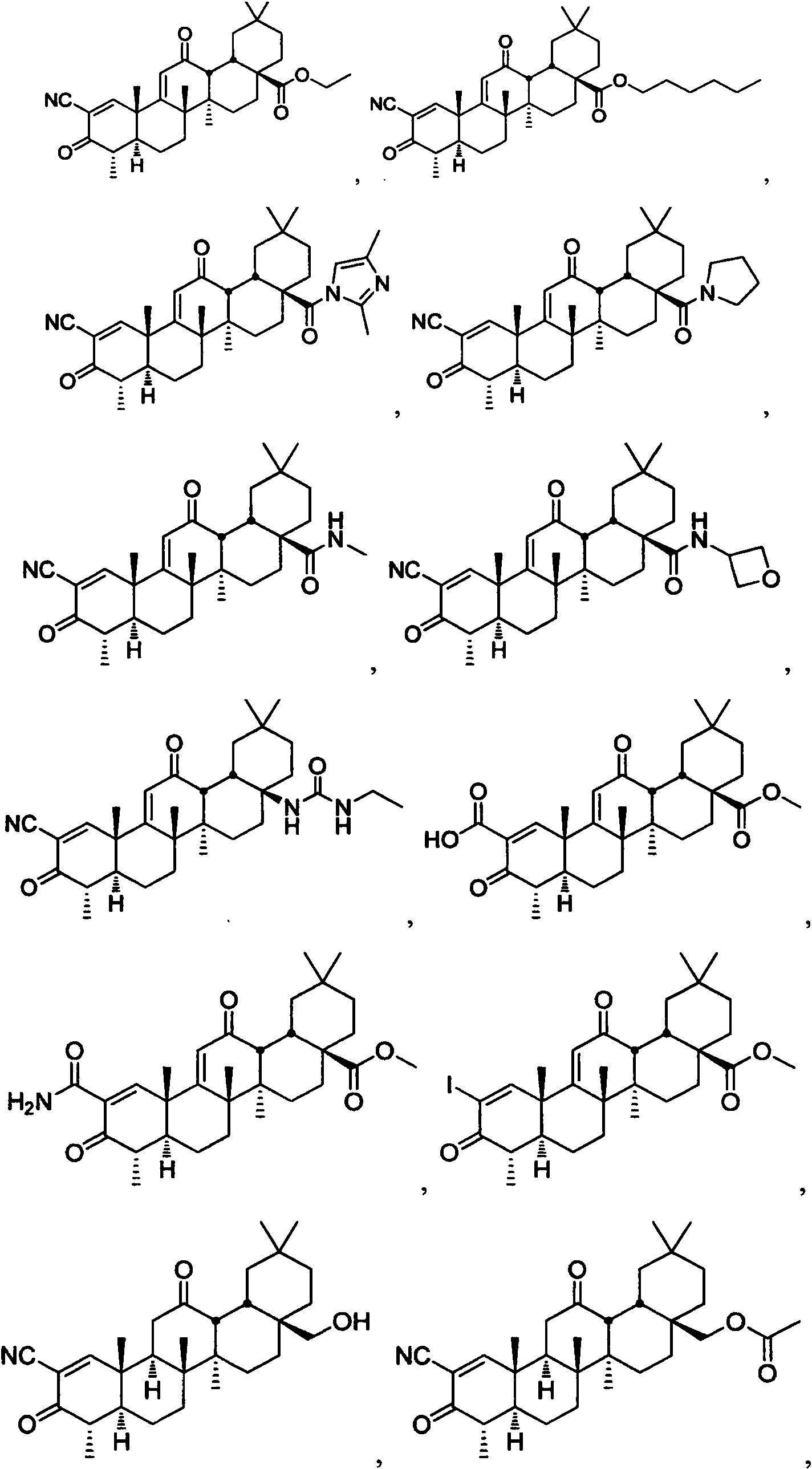


Applications Claiming Priority (2)
| Application Number | Priority Date | Filing Date | Title |
|---|---|---|---|
| US201161452017P | 2011-03-11 | 2011-03-11 | |
| PCT/US2012/028569 WO2012125488A1 (en) | 2011-03-11 | 2012-03-09 | C4-monomethyl triterpenoid derivatives and methods of use thereof |
Publications (1)
| Publication Number | Publication Date |
|---|---|
| ES2729405T3 true ES2729405T3 (en) | 2019-11-04 |
Family
ID=45856041
Family Applications (1)
| Application Number | Title | Priority Date | Filing Date |
|---|---|---|---|
| ES12709768T Active ES2729405T3 (en) | 2011-03-11 | 2012-03-09 | C4-monomethyl triterpenoid derivatives and methods of use thereof |
Country Status (31)
| Country | Link |
|---|---|
| US (1) | US9290536B2 (en) |
| EP (1) | EP2683731B1 (en) |
| JP (1) | JP6129084B2 (en) |
| KR (1) | KR101956399B1 (en) |
| CN (1) | CN103619866B (en) |
| AR (1) | AR085666A1 (en) |
| AU (1) | AU2012229244B2 (en) |
| BR (1) | BR112013023174B1 (en) |
| CA (1) | CA2829618C (en) |
| CL (1) | CL2013002612A1 (en) |
| CO (1) | CO6801741A2 (en) |
| CY (1) | CY1121744T1 (en) |
| DK (1) | DK2683731T3 (en) |
| EA (1) | EA026847B1 (en) |
| ES (1) | ES2729405T3 (en) |
| HR (1) | HRP20191164T1 (en) |
| HU (1) | HUE044081T2 (en) |
| IL (1) | IL228297B (en) |
| LT (1) | LT2683731T (en) |
| ME (1) | ME03469B (en) |
| MX (1) | MX348862B (en) |
| PL (1) | PL2683731T3 (en) |
| PT (1) | PT2683731T (en) |
| RS (1) | RS59200B1 (en) |
| SG (1) | SG193404A1 (en) |
| SI (1) | SI2683731T1 (en) |
| SM (1) | SMT201900433T1 (en) |
| TR (1) | TR201909788T4 (en) |
| TW (1) | TWI535731B (en) |
| UY (1) | UY33946A (en) |
| WO (1) | WO2012125488A1 (en) |
Families Citing this family (36)
| Publication number | Priority date | Publication date | Assignee | Title |
|---|---|---|---|---|
| US6326507B1 (en) | 1998-06-19 | 2001-12-04 | Trustees Of Dartmouth College | Therapeutic compounds and methods of use |
| BRPI0907423A2 (en) | 2008-01-11 | 2020-10-27 | Reata Pharmaceuticals, Inc. | synthetic triterpenoid compound for use in a method of improving kidney function in an individual, and use of that compound |
| KR101713140B1 (en) | 2008-04-18 | 2017-03-08 | 리타 파마슈티컬스 잉크. | Antioxidant inflammation modulators: oleanolic acid derivatives with saturation in the C-ring |
| JP5529851B2 (en) | 2008-04-18 | 2014-06-25 | リアタ ファーマシューティカルズ インコーポレイテッド | Antioxidative inflammation modulator: oleanolic acid derivative with amino modification and other modifications in C-17 |
| MX2010011439A (en) | 2008-04-18 | 2011-01-25 | Reata Pharmaceuticals Inc | Antioxidant inflammation modulators: c-17 homologated oleanolic acid derivatives. |
| WO2009146218A2 (en) | 2008-04-18 | 2009-12-03 | Reata Pharmaceuticals, Inc. | Compounds including an anti-inflammatory pharmacore and methods of use |
| EP2309860B1 (en) | 2008-07-22 | 2014-01-08 | Trustees of Dartmouth College | Monocyclic cyanoenones and methods of use thereof |
| CN103596929B (en) | 2010-12-17 | 2016-10-19 | 里亚塔医药公司 | Pyrazoles and pyrimidine tricycloenones as antioxidant-inflammatory modulators |
| MX348862B (en) | 2011-03-11 | 2017-07-03 | Reata Pharmaceuticals Inc | C4-monomethyl triterpenoid derivatives and methods of use thereof. |
| TWI623548B (en) | 2012-04-27 | 2018-05-11 | 瑞塔醫藥有限責任公司 | 2,2-difluoropropionamine derivative, polymorph of darsolic acid (BARDOXOLONE METHYL) and use method thereof |
| WO2013188818A1 (en) | 2012-06-15 | 2013-12-19 | Reata Pharmaceuticals, Inc. | A-ring epoxidized triterpenoid-based anti-inflammation modulators and methods of use thereof |
| JP2015527407A (en) * | 2012-09-10 | 2015-09-17 | アッヴィ・インコーポレイテッド | Glycyrrhetinic acid derivatives and methods of use thereof |
| SMT201700501T1 (en) * | 2012-09-10 | 2017-11-15 | Reata Pharmaceuticals Inc | C17-heteroaryl derivatives of oleanolic acid and methods of use thereof |
| WO2014040073A1 (en) * | 2012-09-10 | 2014-03-13 | Reata Pharmaceuticals, Inc. | C13-hydroxy derivatives of oleanolic acid and methods of use thereof |
| US9512094B2 (en) | 2012-09-10 | 2016-12-06 | Reata Pharmaceuticals, Inc. | C17-heteroaryl derivatives of oleanolic acid and methods of use thereof |
| JP6243428B2 (en) * | 2012-09-10 | 2017-12-06 | リアタ ファーマシューティカルズ インコーポレイテッド | C17-alkanediyl and alkenediyl derivatives of oleanolic acid and methods of use thereof |
| WO2014148455A1 (en) | 2013-03-19 | 2014-09-25 | 第一三共株式会社 | Terpenoid derivative |
| AR096046A1 (en) | 2013-04-24 | 2015-12-02 | Abbvie Inc | DERIVATIVES OF 2,2-DIFLUOROPROPANAMIDE OF METHYL BARDOXOLONE, POLYMODIC FORMS AND METHODS OF USE |
| CA2814303A1 (en) | 2013-04-26 | 2014-10-26 | Cellphone-Mate, Inc. | Apparatus and methods for radio frequency signal boosters |
| CN104861028A (en) * | 2014-02-24 | 2015-08-26 | 上海兰蒂斯生物医药科技有限公司 | Novel ursolic acid derivatives, preparation method and application thereof |
| CN104861027A (en) * | 2014-02-24 | 2015-08-26 | 上海兰蒂斯生物医药科技有限公司 | Novel oleanolic acid derivatives, and preparation method and application thereof |
| KR20170055482A (en) | 2014-09-10 | 2017-05-19 | 다이이찌 산쿄 가부시키가이샤 | Sustained-release pharmaceutical composition for treating and preventing ophthalmic diseases |
| EP3256451B1 (en) | 2015-02-12 | 2021-10-20 | Reata Pharmaceuticals, Inc. | Imidazolyl tricyclic enones as antioxidant inflammation modulators |
| JP7074674B2 (en) * | 2015-09-23 | 2022-05-24 | リアタ ファーマシューティカルズ インコーポレイテッド | C4 modified oleanolic acid derivative for inhibition of IL-17 and other uses |
| CN105820207A (en) * | 2016-03-24 | 2016-08-03 | 庄立 | Pharmaceutical composition of aniracetam and antioxidant effect of composition |
| CN110198718B (en) | 2016-11-08 | 2023-01-10 | 里亚塔医药控股有限责任公司 | Method of treating alport syndrome using bardoxolone methyl or analogs thereof |
| TWI831738B (en) | 2016-12-16 | 2024-02-11 | 美商瑞塔醫藥有限責任公司 | PYRIMIDINE TRICYCLIC ENONE DERIVATIVES FOR INHIBITION OF RORγ AND OTHER USES |
| US11993574B2 (en) | 2018-06-15 | 2024-05-28 | Reata Pharmaceuticals, Inc | Pyrazole and imidazole compounds for inhibition of IL-17 and RORgamma |
| US12060340B2 (en) | 2018-06-20 | 2024-08-13 | Reata Pharmaceuticals, Inc | Cysteine-dependent inverse agonists of nuclear receptors ROR-gamma/ROR-gamma-t and methods of treating diseases or disorders therewith |
| MX2021003643A (en) * | 2018-09-28 | 2021-08-19 | Sichuan Haisco Pharmaceutical Co Ltd | Terpinoid derivatives and uses thereof. |
| EP3999522B1 (en) * | 2019-07-19 | 2025-09-03 | Reata Pharmaceuticals, Inc. | C17 polar-substituted heteroaromatic synthetic triterpenoids and methods of use thereof |
| AU2021397631A1 (en) | 2020-12-11 | 2023-07-20 | Reata Pharmaceuticals Holdings, LLC | Synthetic triterpenoids for use in therapy |
| MX2023008454A (en) | 2021-01-18 | 2023-08-07 | Reata Pharmaceuticals Inc | Synthetic ursolic acid derivatives and methods of use thereof. |
| JP2025508716A (en) | 2022-02-16 | 2025-04-10 | フイルメニツヒ ソシエテ アノニム | Method for producing octahydro-2(1H)-naphthalenone derivatives |
| GB202211190D0 (en) * | 2022-08-01 | 2022-09-14 | Royal College Surgeons Ireland | Fluorination process |
| CN117964678A (en) * | 2024-01-29 | 2024-05-03 | 烟台大学 | C17 heteroaromatic carbonyl modified oleanane triterpene derivative and preparation method and application thereof |
Family Cites Families (55)
| Publication number | Priority date | Publication date | Assignee | Title |
|---|---|---|---|---|
| NZ191586A (en) | 1978-10-10 | 1981-10-19 | Sterling Drug Inc | Cyanoketones derived from glycyrrhetinic acid and pharmaceutical compositions |
| US4395423A (en) | 1978-10-10 | 1983-07-26 | Sterling Drug Inc. | Polycyclic cyanoketones |
| US5064823A (en) | 1988-08-24 | 1991-11-12 | Research Triangle Institute | Pentacyclic triterpenoid compounds as topoisomerase inhibitors or cell differentiation inducers |
| US6326507B1 (en) | 1998-06-19 | 2001-12-04 | Trustees Of Dartmouth College | Therapeutic compounds and methods of use |
| US6369101B1 (en) | 1999-02-26 | 2002-04-09 | Regents Of The University Of Minnesota | Therapeutic method to treat herpes virus infection |
| DE60043400D1 (en) | 1999-05-14 | 2010-01-07 | Nereus Pharmaceuticals Inc | Interleukin-1 and tumor necrosis factor-alpha modulators, synthesis of these modulators and methods of applying these modulators |
| US6649654B1 (en) | 1999-11-23 | 2003-11-18 | The Regents Of The University Of California | Methods for identifying and using IKK inhibitors |
| JP2001240573A (en) | 2000-03-01 | 2001-09-04 | Meiji Seika Kaisha Ltd | Triterpene derivative and liver disease medical treatment agent |
| WO2002003996A1 (en) | 2000-07-12 | 2002-01-17 | RAJKUMAR, Sujatha | Use of dammarane-type tritepenoid saporins |
| US6951847B2 (en) | 2000-09-29 | 2005-10-04 | Regents Of The University Of Minnesota | Methods of treating fungal infections using lupeol |
| US6689767B2 (en) | 2000-09-29 | 2004-02-10 | Regents Of The University Of Minnesota | Triterpenes having antibacterial activity |
| AU2001294953A1 (en) | 2000-09-29 | 2002-04-08 | Regents Of The University Of Minnesota | Triterpenes having fungicidal activity against yeast |
| US6878751B1 (en) | 2000-10-19 | 2005-04-12 | Imperial College Of Science Technology And Medicine | Administration of resveratrol to treat inflammatory respiratory disorders |
| WO2002047611A2 (en) | 2000-11-28 | 2002-06-20 | Board Of Regents, The University Of Texas System | Cddo-compounds and combination therapies thereof |
| US7435755B2 (en) | 2000-11-28 | 2008-10-14 | The Trustees Of Dartmouth College | CDDO-compounds and combination therapies thereof |
| AU2002308701A1 (en) | 2001-05-14 | 2002-11-25 | University Of Maryland, Baltimore | Novel alanine transaminase enzyme and methods of use |
| US7176237B2 (en) | 2002-01-15 | 2007-02-13 | The Trustees Of Dartmouth College | Tricyclic-bis-enone derivatives and methods of use thereof |
| CA2473799A1 (en) | 2002-01-18 | 2003-07-31 | Regents Of The University Of Minnesota | Triterpene quaternary salts as biologically active surfactants |
| JP2006515859A (en) | 2002-05-13 | 2006-06-08 | トラスティーズ オブ ダートマス カレッジ | Inhibitors and uses thereof |
| WO2004089357A2 (en) | 2003-04-02 | 2004-10-21 | Regents Of The University Of Minnesota | Anti-fungal formulation of triterpene and essential oil |
| US20050208151A1 (en) | 2003-10-30 | 2005-09-22 | Entelos, Inc. | Treatment of rheumatoid arthritis with FLIP antagonists |
| US8288439B2 (en) | 2003-11-04 | 2012-10-16 | The United States Of America, As Represented By The Secretary, Department Of Health And Human Services | Methods and compositions for the inhibition of HIV-1 replication |
| US20060258752A1 (en) | 2004-02-12 | 2006-11-16 | Vander Jagt David L | Method and compounds for cancer treatment utilizing NFkB as a direct or ultimate target for small molecule inhibitors |
| JP2005314381A (en) | 2004-03-30 | 2005-11-10 | Anges Mg Inc | Prophylactic/therapeutic/ameliorating agent for proliferative nephropathy |
| JP5087400B2 (en) | 2004-09-07 | 2012-12-05 | パシフィック アロー リミテッド | Antitumor compounds having an angeloyl group |
| AU2006265113A1 (en) | 2005-07-01 | 2007-01-11 | The Johns Hopkins University | Compositions and methods for the treatment or prevention of disorders relating to oxidative stress |
| US20070232577A1 (en) | 2006-03-23 | 2007-10-04 | Advanced Life Sciences, Inc. | Synthetic pentacyclic triterpenoids and derivatives of betulinic acid and betulin |
| US20070249561A1 (en) | 2006-04-25 | 2007-10-25 | Taylor Bradley K | Pharmacological method for treatment of neuropathic pain |
| WO2008000068A1 (en) | 2006-06-27 | 2008-01-03 | Wellington Laboratories Inc. | Method for preparing 2-iodo triterpenoid compounds |
| CN101117348B (en) | 2006-08-01 | 2010-12-29 | 浙江海正药业股份有限公司 | A-ring and C-ring polyoxidatively substituted pentacyclic triterpenes, preparation method and use thereof |
| JP2008110962A (en) | 2006-08-02 | 2008-05-15 | Santen Pharmaceut Co Ltd | A preventive or therapeutic agent for keratoconjunctival disorders comprising an Nrf2 activator as an active ingredient |
| WO2008016095A1 (en) | 2006-08-02 | 2008-02-07 | Santen Pharmaceutical Co., Ltd. | PREVENTIVE OR REMEDY FOR KERATOCONJUNCTIVAL DISORDERS CONTAINING Nrf2 ACTIVATOR AS THE ACTIVE INGREDIENT |
| EP2094651A1 (en) | 2006-11-17 | 2009-09-02 | Trustees Of Dartmouth College | Synthesis and biological activities of new tricyclic-bis-enones (tbes) |
| US8299046B2 (en) | 2006-11-17 | 2012-10-30 | Trustees Of Dartmouth College | Synthetic triterpenoids and tricyclic-bis-enones for use in stimulating bone and cartilage growth |
| EP2680010A1 (en) | 2007-02-08 | 2014-01-01 | Biogen Idec MA Inc. | Nrf2 screening assays and related methods and compositions |
| WO2008111497A1 (en) | 2007-03-08 | 2008-09-18 | Santen Pharmaceutical Co., Ltd. | Prophylactic or therapeutic agent for ophthalmic disease associated with oxidative stress, comprising triterpenoid as active ingredient |
| WO2008136838A1 (en) | 2007-05-04 | 2008-11-13 | Trustees Of Dartmouth College | Novel amide derivatives of cddo and methods of use thereof |
| US8088824B2 (en) | 2007-08-15 | 2012-01-03 | Reata Pharmaceuticals Inc. | Forms of CDDO methyl ester |
| WO2009023845A2 (en) | 2007-08-15 | 2009-02-19 | The Board Of Regents Of The University Of Texas System | Combination therapy with synthetic triterpenoids and gemcitabine |
| WO2009058849A1 (en) | 2007-10-29 | 2009-05-07 | University Of Rochester | Use of electrophilic compounds for inducing platelet production or maintaining platelet function |
| BRPI0907423A2 (en) | 2008-01-11 | 2020-10-27 | Reata Pharmaceuticals, Inc. | synthetic triterpenoid compound for use in a method of improving kidney function in an individual, and use of that compound |
| MX2010011439A (en) | 2008-04-18 | 2011-01-25 | Reata Pharmaceuticals Inc | Antioxidant inflammation modulators: c-17 homologated oleanolic acid derivatives. |
| JP5529851B2 (en) | 2008-04-18 | 2014-06-25 | リアタ ファーマシューティカルズ インコーポレイテッド | Antioxidative inflammation modulator: oleanolic acid derivative with amino modification and other modifications in C-17 |
| US8071632B2 (en) | 2008-04-18 | 2011-12-06 | Reata Pharmaceuticals, Inc. | Antioxidant inflammation modulators: novel derivatives of oleanolic acid |
| WO2009146218A2 (en) | 2008-04-18 | 2009-12-03 | Reata Pharmaceuticals, Inc. | Compounds including an anti-inflammatory pharmacore and methods of use |
| KR101713140B1 (en) * | 2008-04-18 | 2017-03-08 | 리타 파마슈티컬스 잉크. | Antioxidant inflammation modulators: oleanolic acid derivatives with saturation in the C-ring |
| EP2309860B1 (en) | 2008-07-22 | 2014-01-08 | Trustees of Dartmouth College | Monocyclic cyanoenones and methods of use thereof |
| WO2010053817A1 (en) | 2008-11-04 | 2010-05-14 | Trustees Of Dartmouth College | Betulinic acid derivatives and methods of use thereof |
| SI2395979T1 (en) | 2009-02-13 | 2017-12-29 | Reata Pharmaceuticals, Inc. | Delayed release, oral dosage compositions that contain amorphous cddo-me |
| CN101704874A (en) * | 2009-11-26 | 2010-05-12 | 中国药科大学 | Pentacyclic triterpene and melbine salt of derivative thereof, preparation method and medical application of pentacyclic triterpene |
| DK2558105T3 (en) | 2010-04-12 | 2020-01-27 | Reata Pharmaceuticals Inc | BARDOXOLONMETHYL FOR TREATMENT OF OBESE |
| WO2011140078A1 (en) | 2010-05-04 | 2011-11-10 | Concert Pharmaceuticals, Inc. | Synthetic triterpenoid derivatives |
| CN102070697A (en) | 2010-12-09 | 2011-05-25 | 中国药科大学 | Oleanolic acid derivative, and preparation method and purpose thereof |
| US8846647B2 (en) | 2011-01-31 | 2014-09-30 | Bristol-Myers Squibb Company | C-17 and C-3 modified triterpenoids with HIV maturation inhibitory activity |
| MX348862B (en) | 2011-03-11 | 2017-07-03 | Reata Pharmaceuticals Inc | C4-monomethyl triterpenoid derivatives and methods of use thereof. |
-
2012
- 2012-03-09 MX MX2013010429A patent/MX348862B/en active IP Right Grant
- 2012-03-09 ES ES12709768T patent/ES2729405T3/en active Active
- 2012-03-09 BR BR112013023174-2A patent/BR112013023174B1/en active IP Right Grant
- 2012-03-09 PL PL12709768T patent/PL2683731T3/en unknown
- 2012-03-09 UY UY0001033946A patent/UY33946A/en not_active Application Discontinuation
- 2012-03-09 SI SI201231611T patent/SI2683731T1/en unknown
- 2012-03-09 CN CN201280022645.4A patent/CN103619866B/en active Active
- 2012-03-09 CA CA2829618A patent/CA2829618C/en active Active
- 2012-03-09 EA EA201391313A patent/EA026847B1/en unknown
- 2012-03-09 DK DK12709768.1T patent/DK2683731T3/en active
- 2012-03-09 EP EP12709768.1A patent/EP2683731B1/en active Active
- 2012-03-09 HR HRP20191164TT patent/HRP20191164T1/en unknown
- 2012-03-09 HU HUE12709768A patent/HUE044081T2/en unknown
- 2012-03-09 WO PCT/US2012/028569 patent/WO2012125488A1/en not_active Ceased
- 2012-03-09 SM SM20190433T patent/SMT201900433T1/en unknown
- 2012-03-09 JP JP2013557919A patent/JP6129084B2/en active Active
- 2012-03-09 PT PT12709768T patent/PT2683731T/en unknown
- 2012-03-09 SG SG2013068291A patent/SG193404A1/en unknown
- 2012-03-09 KR KR1020137026782A patent/KR101956399B1/en active Active
- 2012-03-09 ME MEP-2019-168A patent/ME03469B/en unknown
- 2012-03-09 LT LTEP12709768.1T patent/LT2683731T/en unknown
- 2012-03-09 AU AU2012229244A patent/AU2012229244B2/en active Active
- 2012-03-09 TR TR2019/09788T patent/TR201909788T4/en unknown
- 2012-03-09 RS RSP20190859 patent/RS59200B1/en unknown
- 2012-03-12 AR ARP120100803A patent/AR085666A1/en unknown
- 2012-03-12 TW TW101108395A patent/TWI535731B/en active
- 2012-03-12 US US13/417,519 patent/US9290536B2/en active Active
-
2013
- 2013-09-08 IL IL228297A patent/IL228297B/en active IP Right Grant
- 2013-09-11 CL CL2013002612A patent/CL2013002612A1/en unknown
- 2013-10-09 CO CO13240105A patent/CO6801741A2/en not_active Application Discontinuation
-
2019
- 2019-07-01 CY CY20191100690T patent/CY1121744T1/en unknown
Also Published As
Similar Documents
| Publication | Publication Date | Title |
|---|---|---|
| ES2729405T3 (en) | C4-monomethyl triterpenoid derivatives and methods of use thereof | |
| ES2731758T3 (en) | C17 alkanediyl and alkenodiyl derivatives of oleanolic acid and methods of use thereof | |
| US9278912B2 (en) | C13-hydroxy derivatives of oleanolic acid and methods of use thereof | |
| DK2892911T3 (en) | C17 heteroaryl derivatives of oleanolic acid and methods of use thereof | |
| US9556222B2 (en) | A-ring epoxidized triterpenoid-based anti-inflammation modulators and methods of use thereof | |
| EP2651902B1 (en) | Pyrazolyl and pyrimidinyl tricyclic enones as antioxidant inflammation modulators | |
| CA2974726A1 (en) | Imidazolyl tricyclic enones as antioxidant inflammation modulators | |
| HK1189894A (en) | C4-monomethyl triterpenoid derivatives and methods of use thereof |