ES2731925T3 - Procedure for the synthesis of polyoxazolidinone compounds with high stability - Google Patents
Procedure for the synthesis of polyoxazolidinone compounds with high stability Download PDFInfo
- Publication number
- ES2731925T3 ES2731925T3 ES16703330T ES16703330T ES2731925T3 ES 2731925 T3 ES2731925 T3 ES 2731925T3 ES 16703330 T ES16703330 T ES 16703330T ES 16703330 T ES16703330 T ES 16703330T ES 2731925 T3 ES2731925 T3 ES 2731925T3
- Authority
- ES
- Spain
- Prior art keywords
- ether
- methylene
- isocyanate
- phenylene
- diyl
- Prior art date
- Legal status (The legal status is an assumption and is not a legal conclusion. Google has not performed a legal analysis and makes no representation as to the accuracy of the status listed.)
- Active
Links
Classifications
-
- C—CHEMISTRY; METALLURGY
- C08—ORGANIC MACROMOLECULAR COMPOUNDS; THEIR PREPARATION OR CHEMICAL WORKING-UP; COMPOSITIONS BASED THEREON
- C08G—MACROMOLECULAR COMPOUNDS OBTAINED OTHERWISE THAN BY REACTIONS ONLY INVOLVING UNSATURATED CARBON-TO-CARBON BONDS
- C08G71/00—Macromolecular compounds obtained by reactions forming a ureide or urethane link, otherwise, than from isocyanate radicals in the main chain of the macromolecule
-
- C—CHEMISTRY; METALLURGY
- C08—ORGANIC MACROMOLECULAR COMPOUNDS; THEIR PREPARATION OR CHEMICAL WORKING-UP; COMPOSITIONS BASED THEREON
- C08G—MACROMOLECULAR COMPOUNDS OBTAINED OTHERWISE THAN BY REACTIONS ONLY INVOLVING UNSATURATED CARBON-TO-CARBON BONDS
- C08G18/00—Polymeric products of isocyanates or isothiocyanates
- C08G18/003—Polymeric products of isocyanates or isothiocyanates with epoxy compounds having no active hydrogen
-
- C—CHEMISTRY; METALLURGY
- C08—ORGANIC MACROMOLECULAR COMPOUNDS; THEIR PREPARATION OR CHEMICAL WORKING-UP; COMPOSITIONS BASED THEREON
- C08G—MACROMOLECULAR COMPOUNDS OBTAINED OTHERWISE THAN BY REACTIONS ONLY INVOLVING UNSATURATED CARBON-TO-CARBON BONDS
- C08G18/00—Polymeric products of isocyanates or isothiocyanates
- C08G18/06—Polymeric products of isocyanates or isothiocyanates with compounds having active hydrogen
- C08G18/08—Processes
- C08G18/16—Catalysts
- C08G18/166—Catalysts not provided for in the groups C08G18/18 - C08G18/26
- C08G18/168—Organic compounds
-
- C—CHEMISTRY; METALLURGY
- C08—ORGANIC MACROMOLECULAR COMPOUNDS; THEIR PREPARATION OR CHEMICAL WORKING-UP; COMPOSITIONS BASED THEREON
- C08G—MACROMOLECULAR COMPOUNDS OBTAINED OTHERWISE THAN BY REACTIONS ONLY INVOLVING UNSATURATED CARBON-TO-CARBON BONDS
- C08G18/00—Polymeric products of isocyanates or isothiocyanates
- C08G18/06—Polymeric products of isocyanates or isothiocyanates with compounds having active hydrogen
- C08G18/08—Processes
- C08G18/16—Catalysts
- C08G18/18—Catalysts containing secondary or tertiary amines or salts thereof
- C08G18/20—Heterocyclic amines; Salts thereof
- C08G18/2045—Heterocyclic amines; Salts thereof containing condensed heterocyclic rings
- C08G18/2063—Heterocyclic amines; Salts thereof containing condensed heterocyclic rings having two nitrogen atoms in the condensed ring system
-
- C—CHEMISTRY; METALLURGY
- C08—ORGANIC MACROMOLECULAR COMPOUNDS; THEIR PREPARATION OR CHEMICAL WORKING-UP; COMPOSITIONS BASED THEREON
- C08G—MACROMOLECULAR COMPOUNDS OBTAINED OTHERWISE THAN BY REACTIONS ONLY INVOLVING UNSATURATED CARBON-TO-CARBON BONDS
- C08G18/00—Polymeric products of isocyanates or isothiocyanates
- C08G18/06—Polymeric products of isocyanates or isothiocyanates with compounds having active hydrogen
- C08G18/28—Polymeric products of isocyanates or isothiocyanates with compounds having active hydrogen characterised by the compounds used containing active hydrogen
- C08G18/2805—Compounds having only one group containing active hydrogen
- C08G18/2815—Monohydroxy compounds
- C08G18/282—Alkanols, cycloalkanols or arylalkanols including terpenealcohols
-
- C—CHEMISTRY; METALLURGY
- C08—ORGANIC MACROMOLECULAR COMPOUNDS; THEIR PREPARATION OR CHEMICAL WORKING-UP; COMPOSITIONS BASED THEREON
- C08G—MACROMOLECULAR COMPOUNDS OBTAINED OTHERWISE THAN BY REACTIONS ONLY INVOLVING UNSATURATED CARBON-TO-CARBON BONDS
- C08G18/00—Polymeric products of isocyanates or isothiocyanates
- C08G18/06—Polymeric products of isocyanates or isothiocyanates with compounds having active hydrogen
- C08G18/70—Polymeric products of isocyanates or isothiocyanates with compounds having active hydrogen characterised by the isocyanates or isothiocyanates used
- C08G18/71—Monoisocyanates or monoisothiocyanates
-
- C—CHEMISTRY; METALLURGY
- C08—ORGANIC MACROMOLECULAR COMPOUNDS; THEIR PREPARATION OR CHEMICAL WORKING-UP; COMPOSITIONS BASED THEREON
- C08G—MACROMOLECULAR COMPOUNDS OBTAINED OTHERWISE THAN BY REACTIONS ONLY INVOLVING UNSATURATED CARBON-TO-CARBON BONDS
- C08G18/00—Polymeric products of isocyanates or isothiocyanates
- C08G18/06—Polymeric products of isocyanates or isothiocyanates with compounds having active hydrogen
- C08G18/70—Polymeric products of isocyanates or isothiocyanates with compounds having active hydrogen characterised by the isocyanates or isothiocyanates used
- C08G18/72—Polyisocyanates or polyisothiocyanates
- C08G18/74—Polyisocyanates or polyisothiocyanates cyclic
- C08G18/76—Polyisocyanates or polyisothiocyanates cyclic aromatic
- C08G18/7614—Polyisocyanates or polyisothiocyanates cyclic aromatic containing only one aromatic ring
- C08G18/7621—Polyisocyanates or polyisothiocyanates cyclic aromatic containing only one aromatic ring being toluene diisocyanate including isomer mixtures
-
- C—CHEMISTRY; METALLURGY
- C08—ORGANIC MACROMOLECULAR COMPOUNDS; THEIR PREPARATION OR CHEMICAL WORKING-UP; COMPOSITIONS BASED THEREON
- C08G—MACROMOLECULAR COMPOUNDS OBTAINED OTHERWISE THAN BY REACTIONS ONLY INVOLVING UNSATURATED CARBON-TO-CARBON BONDS
- C08G18/00—Polymeric products of isocyanates or isothiocyanates
- C08G18/06—Polymeric products of isocyanates or isothiocyanates with compounds having active hydrogen
- C08G18/70—Polymeric products of isocyanates or isothiocyanates with compounds having active hydrogen characterised by the isocyanates or isothiocyanates used
- C08G18/72—Polyisocyanates or polyisothiocyanates
- C08G18/80—Masked polyisocyanates
- C08G18/8061—Masked polyisocyanates masked with compounds having only one group containing active hydrogen
- C08G18/8064—Masked polyisocyanates masked with compounds having only one group containing active hydrogen with monohydroxy compounds
-
- C—CHEMISTRY; METALLURGY
- C08—ORGANIC MACROMOLECULAR COMPOUNDS; THEIR PREPARATION OR CHEMICAL WORKING-UP; COMPOSITIONS BASED THEREON
- C08G—MACROMOLECULAR COMPOUNDS OBTAINED OTHERWISE THAN BY REACTIONS ONLY INVOLVING UNSATURATED CARBON-TO-CARBON BONDS
- C08G71/00—Macromolecular compounds obtained by reactions forming a ureide or urethane link, otherwise, than from isocyanate radicals in the main chain of the macromolecule
- C08G71/04—Polyurethanes
Landscapes
- Chemical & Material Sciences (AREA)
- Health & Medical Sciences (AREA)
- Chemical Kinetics & Catalysis (AREA)
- Medicinal Chemistry (AREA)
- Polymers & Plastics (AREA)
- Organic Chemistry (AREA)
- Polyurethanes Or Polyureas (AREA)
- Heterocyclic Carbon Compounds Containing A Hetero Ring Having Nitrogen And Oxygen As The Only Ring Hetero Atoms (AREA)
- Epoxy Resins (AREA)
Abstract
Compuestos de polioxazolidinona de acuerdo con la fórmula (I), la fórmula (II) y / o la fórmula (III)**Fórmula** en la que X representa metileno, dimetileno, trimetileno, tetrametileno, pentametileno, hexametileno, octametileno, decametilendimetacrilato, dodecametileno sustituido con heteroátomos que contienen grupos, ciclohexileno, fenileno, difenileno, dimetilfenileno, que comprende heteroátomos, 2-metilpentametileno, 2,2,4-trimetil-hexametileno, dodecanometileno, 10 1,2-ciclohexileno, 1,3-ciclohexileno, 1,4-ciclohexileno, 5-(1-metilen-(1,3,3-trimetilciclohexano)), todos los regioisómeros de metileno bisciclohexileno, todos los regioisómeros de metilenobisfenileno, metilenbis-(3,3'- dimethylcyclohexane1,4-diil), propano-2,2-diil)bis(ciclohexano-4,1-diil), propano-2,2-diil-bis-4,1-fenileno, polihexametileno, tolileno, poli(propilenglicol)tolileno, poli(adipato de etileno)tolileno, 2,4,6-trimetil-1,3-fenileno, 4-cloro- 6-metil-1,3-fenileno, poli[1,4-fenileno], co-poli(1,4-butanodiol)], poli(óxido de tetrafluoroetileno-co-óxido de difluorometileno), 1,3-bis(1-metiletil)benceno, 3,3'-dimetil-4,4'-bifenilenos, naftaleno, 1,2-fenileno, 1,3-fenileno, 1,4- fenileno 2,4- o 2,5- o 2,6-tolileno o mezclas de estos isómeros, metileno 4,4'- o 2,4- o 2,2'-bisfenileno o mezclas de estos isómeros, 4,4'-, 2,4'- o 2,2'-2,2-difenilpropano-p-xilileno y α,α,α',α'-tetrametil-m- o -p-xilileno; Y representa metileno, dimetileno, trimetileno, tetrametileno, pentametileno, hexametileno, heptametileno, octametileno, polietileno, polietilenglicol, 1,2-ciclohexileno, 1,3-ciclohexileno, 1,4-ciclohexileno, 1,2-fenileno, 1,3- fenileno, 1,4-fenileno, 1,2-tolileno, 1,3-tolileno, 1,4-tolileno, 4,4'-metilenbis(4,1-fenileno), 4,4'-metilen-bis (ciclohexano-4,1-diil), 4,4'-(propano-2,2-diil)bis(4,1-fenileno), propano-2,2-diil-bis(ciclohexano-4,1-diil) o Y puede representarse por la fórmula IV,**Fórmula** en la que Y' está representado por metileno, dimetileno, trimetileno, tetrametileno, pentametileno, hexametileno, heptametileno, octametileno, polietileno, polietilenglicol, 1,2-ciclohexileno, 1,3-ciclohexileno, 1,4-ciclohexileno, 1,2- fenileno, 1,3-fenileno, 1,4-fenileno, 1,2-tolileno, 1,3-tolileno, 1,4-tolileno, 4,4'-metilenbis(4,1-fenileno), 4,4'-metilenbis (ciclohexano-4,1-diil), 4,4'-(propano-2,2-diil)bis(4,1-fenileno), propano-2,2-diil-bis(ciclohexano-4,1-diil) o 4,4 '- (3,3,5-trimetilciclohexiliden)bisfenilo; Z representa hidrógeno, metilo, etilo, butilo, propilo, hexilo, heptilo, octilo, nonilo, decilo, dodecilo, alfa-olefinas alquilo C10-C18, etileno, fenilo, ésteres alquílicos C1-C18 de ácidos grasos insaturados, éter de metilenmetilo, éter de metilenetilo, éter de metilenpropilo, éter de metilenbutilo, éter de metilenpentilo, éter de metilenhexilo, éter de metilenciclohexilo, éter de metilenoctilo, éter de metilen-2-etilhexilo, éter de metilenalquilo C10-C18, éter de metilenalilo, éter de metilenbencilo, éter de metilenfenilo, éter de metilen-4-terc-butilfenilo, éter de metilen-1-naftilo, éter de metilen-2-naftilo, éter de metilen-2-clorofenilo, éter de metilen-4-clorofenilo, éter de metilen-4-bromofenilo, éter de 2,4,6-triclorofenilo, éter de metilen-2,4,6 tribromofenilo, éter de pentafluorofenilo, éter de metilen-o-cresilo, éter de metilen-m-cresilo, éter de metilen-p-cresilo, acetato de metileno, ciclohexilcarboxilato de metileno, benzoato de metileno, ftalimida de N-metileno o mezclas de los sustituyentes Z mencionados anteriormente; ZZ representa metilo, etilo, n-propilo, isopropilo, n-butilo, isobutilo, terc-butilo, n-pentilo, n-hexilo, ciclohexilo, ω- clorohexametileno, n-heptilo, n-octilo, isooctilo, 2-etilhexilo, 2-norbornilmetilo, nonilo, 2,3,4-trimetilciclohexilo, 3,3,5- trimetilciclohexilo, decilo, undecilo, dodecilo, tridecilo, tetradecilo, pentadecilo, hexadecilo, octadecilo, estearilo,, 3- butoxipropilo, 3-(2-etil-hexiloxi)propilo, 6-clorohexilo, bencilo, fenilo, orto-, meta-, para-tolilo, dimetilfenilo, isocianato de 4-pentilfenilo, 4-ciclohexilfenilo, 4-dodecilfenilo, orto-, meta-, para-metoxifenilo, clorofenil(2,3,4- isómeros), los diferentes isómeros de diclorofenilo, 4-nitrofenilo, 3-trifluorometilfenilo, 1-naftilo o mezclas de dos o más de los sustituyentes ZZ mencionados anteriormente; R1, R1', R2, R2', R3, R3', R4, R5, R6 independientes entre sí representan hidrógeno, cloruro, bromuro, fluoruro, metilo, etilo, propilo, n-propilo, isopropilo, n-butilo, isobutilo, 2-butilo, terc-butilo, hexilo, metoxi, etoxi, butoxi, fenilo, metoxifenilo, clorofenilo, bromofenilo, nitrofenilo, ciclobutilo, ciclopentilo, ciclohexilo, cicloheptilo. X, Y, Z, ZZ, R1, R1', R2, R2', R3, R3', R4, R5, R6 puede ser igual o diferente entre sí y n es un número entero de >= 1.Polyoxazolidinone compounds according to formula (I), formula (II) and / or formula (III) ** Formula ** in which X represents methylene, dimethylene, trimethylene, tetramethylene, pentamethylene, hexamethylene, octamethylene, decamethylenedimethacrylate , dodecamethylene substituted with heteroatoms containing groups, cyclohexylene, phenylene, diphenylene, dimethylphenylene, comprising heteroatoms, 2-methylpentamethylene, 2,2,4-trimethyl-hexamethylene, dodecamethylene, 10 1,2-cyclohexylene, 1,3-cyclohexylene, 1,4-cyclohexylene, 5- (1-methylene- (1,3,3-trimethylcyclohexane)), all methylene biscyclohexylene regioisomers, all methylene bisphenylene, methylenebis- (3,3'-dimethylcyclohexane1,4-diyl regioisomers) ), propane-2,2-diyl) bis (cyclohexane-4,1-diyl), propane-2,2-diyl-bis-4,1-phenylene, polyhexamethylene, tolylene, poly (propylene glycol) tolylene, poly (adipate ethylene) tolylene, 2,4,6-trimethyl-1,3-phenylene, 4-chloro-6-methyl-1,3-phenylene, poly [1,4-phenylene], co-poly (1,4- butan odiol)], poly (tetrafluoroethylene-co-difluoromethylene oxide), 1,3-bis (1-methylethyl) benzene, 3,3'-dimethyl-4,4'-biphenylenes, naphthalene, 1,2-phenylene , 1,3-phenylene, 1,4-phenylene 2,4- or 2,5- or 2,6-tolylene or mixtures of these isomers, methylene 4,4'- or 2,4- or 2,2'- bisphenylene or mixtures of these isomers, 4,4'-, 2,4'- or 2,2'-2,2-diphenylpropane-p-xylylene and α, α, α ', α'-tetramethyl-m- or - p-xylylene; Y represents methylene, dimethylene, trimethylene, tetramethylene, pentamethylene, hexamethylene, heptamethylene, octamethylene, polyethylene, polyethylene glycol, 1,2-cyclohexylene, 1,3-cyclohexylene, 1,4-cyclohexylene, 1,2-phenylene, 1,3- phenylene, 1,4-phenylene, 1,2-tolylene, 1,3-tolylene, 1,4-tolylene, 4,4'-methylenebis (4,1-phenylene), 4,4'-methylene-bis (cyclohexane -4,1-diyl), 4,4 '- (propane-2,2-diyl) bis (4,1-phenylene), propane-2,2-diyl-bis (cyclohexane-4,1-diyl) or And it can be represented by the formula IV, ** Formula ** in which Y 'is represented by methylene, dimethylene, trimethylene, tetramethylene, pentamethylene, hexamethylene, heptamethylene, octamethylene, polyethylene, polyethylene glycol, 1,2-cyclohexylene, 1,3 -cyclohexylene, 1,4-cyclohexylene, 1,2-phenylene, 1,3-phenylene, 1,4-phenylene, 1,2-tolylene, 1,3-tolylene, 1,4-tolylene, 4,4'- methylenebis (4,1-phenylene), 4,4'-methylenebis (cyclohexane-4,1-diyl), 4,4 '- (propane-2,2-diyl) bis (4,1-phenylene), propane- 2,2-diyl-bis (cyclohexane-4,1-diyl) or 4,4 '- (3,3,5-trim ethylcyclohexylidene) bisphenyl; Z represents hydrogen, methyl, ethyl, butyl, propyl, hexyl, heptyl, octyl, nonyl, decyl, dodecyl, alpha-olefins C10-C18 alkyl, ethylene, phenyl, C1-C18 alkyl esters of unsaturated fatty acids, methylene methyl ether, Methylenenetyl Ether, Methylene Propyl Ether, Methylene Butyl Ether, Methylenepentyl Ether, Methylenehexyl Ether, Methylene Cyclohexyl Ether, Methylenectyl Ether, Methylene-2-Ethylhexyl Ether, C10-Cylenyl Ethyl Methyl Ether, C10-Methyl Ethyl Ether , methylene phenyl ether, methylene-4-tert-butylphenyl ether, methylene-1-naphthyl ether, methylene-2-naphthyl ether, methylene-2-chlorophenyl ether, methylene-4-chlorophenyl ether, methylene ether -4-bromophenyl, 2,4,6-trichlorophenyl ether, methylene-2,4,6 tribromophenyl ether, pentafluorophenyl ether, methylene-o-cresyl ether, methylene-m-cresyl ether, methylene ether p-cresyl, methylene acetate, methylene cyclohexylcarboxylate, methylene benzoate, ft N-methylene alimide or mixtures of the Z substituents mentioned above; ZZ represents methyl, ethyl, n-propyl, isopropyl, n-butyl, isobutyl, tert-butyl, n-pentyl, n-hexyl, cyclohexyl, ω- chlorohexamethylene, n-heptyl, n-octyl, isooctyl, 2-ethylhexyl, 2-norbornylmethyl, nonyl, 2,3,4-trimethylcyclohexyl, 3,3,5-trimethylcyclohexyl, decyl, undecyl, dodecyl, tridecyl, tetradecyl, pentadecyl, hexadecyl, octadecyl, stearyl ,, 3- butoxypropyl, 3- (2- ethyl-hexyloxy) propyl, 6-chlorohexyl, benzyl, phenyl, ortho-, meta-, para-tolyl, dimethylphenyl, 4-pentylphenyl isocyanate, 4-cyclohexylphenyl, 4-dodecylphenyl, ortho-, meta-, para-methoxyphenyl, chlorophenyl (2,3,4-isomers), the different isomers of dichlorophenyl, 4-nitrophenyl, 3-trifluoromethylphenyl, 1-naphthyl or mixtures of two or more of the ZZ substituents mentioned above; R1, R1 ', R2, R2', R3, R3 ', R4, R5, R6 independent of each other represent hydrogen, chloride, bromide, fluoride, methyl, ethyl, propyl, n-propyl, isopropyl, n-butyl, isobutyl, 2-Butyl, tert-butyl, hexyl, methoxy, ethoxy, butoxy, phenyl, methoxyphenyl, chlorophenyl, bromophenyl, nitrophenyl, cyclobutyl, cyclopentyl, cyclohexyl, cycloheptyl. X, Y, Z, ZZ, R1, R1 ', R2, R2', R3, R3 ', R4, R5, R6 can be the same or different from each other and n is an integer of> = 1.
Description
DESCRIPCIÓNDESCRIPTION
Procedimiento para la síntesis de compuestos de polioxazolidinona con alta estabilidadProcedure for the synthesis of polyoxazolidinone compounds with high stability
La presente invención se refiere a compuestos de polioxazolidinona, a un procedimiento para la producción de compuestos de polioxazolidinona, que comprende la etapa de hacer reaccionar un compuesto de biscarbamato con un compuesto bisepóxido en presencia de un compuesto monocarbamato, un monoisocianato y / o un monoepóxido como regulador de la cadena y una base adecuada que tiene un valor de pKb de < 9 como catalizador. La invención se refiere además al uso de compuestos de polioxazolidinona con alta estabilidad térmica.The present invention relates to polyoxazolidinone compounds, to a process for the production of polyoxazolidinone compounds, which comprises the step of reacting a biscarbamate compound with a bisepoxide compound in the presence of a monocarbamate compound, a monoisocyanate and / or a monoepoxide as a chain regulator and a suitable base that has a pKb value of <9 as a catalyst. The invention further relates to the use of polyoxazolidinone compounds with high thermal stability.
Las oxazolidinonas son motivos estructurales ampliamente utilizados en aplicaciones farmacéuticas y la cicloadición de epóxidos e isocianatos parece ser una ruta sintética conveniente para un solo recipiente. Los catalizadores caros, los disolventes polares reactivos, los tiempos de reacción largos y las bajas quimioselectividades son comunes en los primeros informes para la síntesis de oxazolidinonas (M.E. Dyen y D. Swern, Chem. Rev., 67, 197, 1967). Por lo tanto, existe la necesidad de procedimientos alternativos para la producción de oxazolidinonas, especialmente para la aplicación de oxazolidinonas como motivo estructural en aplicaciones de polímeros.Oxazolidinones are structural reasons widely used in pharmaceutical applications and the cycloaddition of epoxides and isocyanates seems to be a convenient synthetic route for a single vessel. Expensive catalysts, reactive polar solvents, long reaction times and low chemoselectivities are common in the first reports for the synthesis of oxazolidinones (M.E. Dyen and D. Swern, Chem. Rev., 67, 197, 1967). Therefore, there is a need for alternative processes for the production of oxazolidinones, especially for the application of oxazolidinones as a structural motive in polymer applications.
El documento EP 0 530 812 A1 desvela la preparación de composiciones resinosas termoestables mediante la reacción de carbamato de etilo monofuncional con epóxido monoepósidos o poliepóxidos funcionales a una temperatura de reacción de 130 °C. El resto oxazolidinona formado es un grupo terminal y / o colgante, que reacciona in situ con aminas para formar unidades de repetición de urea poliméricas en un polímero termoestable. El intermedio de oxazolidinona comprende en el grupo funcional N-H, lo que reduce la estabilidad térmica y química del intermedio de oxazolidinona. El polímero termoestable formado en la reacción con aminas no se suele ablandar ni fundir.EP 0 530 812 A1 discloses the preparation of thermosetting resin compositions by the reaction of monofunctional ethyl carbamate with monoepoxide epoxides or functional polyepoxides at a reaction temperature of 130 ° C. The oxazolidinone moiety formed is a terminal and / or pendant group, which reacts in situ with amines to form polymeric urea repeat units in a thermostable polymer. The oxazolidinone intermediate comprises in the NH functional group, which reduces the thermal and chemical stability of the oxazolidinone intermediate. The thermosetting polymer formed in the reaction with amines does not usually soften or melt.
La solicitud de patente europea n.° 12192611.7 se refiere a un procedimiento para la producción de compuestos de oxazolidinona y polioxazolidinona, que comprende la etapa de hacer reaccionar un compuesto de isocianato con un compuesto epóxido en presencia de un catalizador de ácido de Lewis. Se usó un catalizador de antimonio (PtuSbBr) como catalizador de ácido de Lewis, que tiene cierta toxicidad. El isocianato se debe sintetizar en una etapa preliminar y requiere medidas de seguridad adicionales debido a la alta reactividad de los isocianatos. Se obtuvo una mezcla de los regioisómeros de 5-oxazolidinona y 4-oxazolidinona, lo que da una mezcla de producto menos definida. La reacción de los biscarbamatos con bisepóxidos en presencia de una base no se ha desvelados en la presente solicitud de patente.European Patent Application No. 12192611.7 relates to a process for the production of oxazolidinone and polyoxazolidinone compounds, which comprises the step of reacting an isocyanate compound with an epoxide compound in the presence of a Lewis acid catalyst. An antimony catalyst (PtuSbBr) was used as the Lewis acid catalyst, which has some toxicity. The isocyanate must be synthesized at a preliminary stage and requires additional safety measures due to the high reactivity of the isocyanates. A mixture of the 5-oxazolidinone and 4-oxazolidinone regioisomers was obtained, which gives a less defined product mixture. The reaction of biscarbamates with bisepoxides in the presence of a base has not been disclosed in the present patent application.
El documento US 2013/0269985 describe la síntesis de polioxazolidinonas a partir de bisepóxidos y biscarbamatos utilizando catalizadores básicos. La polioxazolidinona está terminada en carbamato, lo que da lugar a inestabilidad térmica. El uso de un regulador de cadena no se ha desvelado.US 2013/0269985 describes the synthesis of polyoxazolidinones from bisepoxides and biscarbamates using basic catalysts. Polyoxazolidinone is terminated in carbamate, which results in thermal instability. The use of a chain regulator has not been disclosed.
El artículo de J. Polym. 4 (1966) 751-760 desvela polioxazolidinonas preparadas a partir de bisuretanos (biscarbamatos) y bisepóxidos. Aunque se utilizó una alta concentración de catalizador de 18 % en moles, se requirieron largos tiempos de reacción de 5-30 h. El polímero precipitó antes de alcanzar un alto peso molecular y se descompuso gradualmente a 250-300 °C. La homopolimerización del epóxido se observó como reacción secundaria. El uso de un regulador de cadena no se ha desvelado.The article by J. Polym. 4 (1966) 751-760 discloses polyoxazolidinones prepared from bisurethanes (biscarbamates) and bisepoxides. Although a high catalyst concentration of 18 mol% was used, long reaction times of 5-30 h were required. The polymer precipitated before reaching a high molecular weight and gradually decomposed at 250-300 ° C. Homopolymerization of the epoxide was observed as a secondary reaction. The use of a chain regulator has not been disclosed.
Por tanto, el objeto de la presente invención era identificar polioxazolidinonas que tienen una mayor termoestabilidad que las polioxazolidinonas ya conocidas y que son útiles como material termoplástico. Además, un procedimiento para la preparación de estas polioxazolidinonas altamente termoestables, que evita el uso de isocianatos libres, el uso de catalizadores de ácido de Lewis tóxicos y el uso de altas concentraciones de catalizador, es un objeto de la presente invención.Therefore, the object of the present invention was to identify polyoxazolidinones that have a higher thermostability than known polyoxazolidinones and that are useful as a thermoplastic material. In addition, a process for the preparation of these highly thermostable polyoxazolidinones, which avoids the use of free isocyanates, the use of toxic Lewis acid catalysts and the use of high catalyst concentrations, is an object of the present invention.
Sorprendentemente, se han descubierto compuestos de polioxazolidinona preparados en presencia de un compuesto monocarbamato, monoisocianato y / o monoepóxido que tienen una alta estabilidad térmica. Los compuestos de polioxazolidinona de la invención pueden prepararse mediante la reacción de biscarbamatos y bisepóxidos en presencia de un compuesto que comprende un grupo monocarbamato, un grupo monoisocianato y / o un grupo monoepóxido y una base que tiene un valor de pKb de < 9. Las polioxazolidinonas preparadas de acuerdo con la invención exhiben una alta estabilidad térmica. Estos compuestos tienen una temperatura de descomposición de hasta 392 °C.Surprisingly, polyoxazolidinone compounds prepared in the presence of a monocarbamate, monoisocyanate and / or monoepoxide compound having high thermal stability have been discovered. The polyoxazolidinone compounds of the invention can be prepared by the reaction of biscarbamates and bisepoxides in the presence of a compound comprising a monocarbamate group, a monoisocyanate group and / or a monoepoxide group and a base having a pKb value of <9. Polyoxazolidinones prepared according to the invention exhibit high thermal stability. These compounds have a decomposition temperature of up to 392 ° C.
El objeto de la invención es, por lo tanto, un compuesto de polioxazolidinona de acuerdo con la fórmula (I), la fórmula (II) y / o la fórmula (III) The object of the invention is, therefore, a polyoxazolidinone compound according to formula (I), formula (II) and / or formula (III)

en las que X, Y, Z, ZZ, R1, R1', R2, R2', R3, R3', R4, R5 y R6 tienen los significados que se dan a continuación. in which X, Y, Z, ZZ, R1, R1 ', R2, R2', R3, R3 ', R4, R5 and R6 have the meanings given below.
X, Y, Z, ZZ, R1, R1', R2, R2', R3, R3', R4, R5, R6 pueden ser iguales o diferentes entre sí, y n es un número entero > 1, más preferentemente > 2 y < 10.000, aún más preferente > 3 y < 2.000 y el más preferente > 5 y < 500.X, Y, Z, ZZ, R1, R1 ', R2, R2', R3, R3 ', R4, R5, R6 can be the same or different from each other, and n is an integer> 1, more preferably> 2 and < 10,000, even more preferred> 3 and <2,000 and the most preferred> 5 and <500.
Los compuestos de polioxazolidinona de acuerdo con la fórmula (I), (II) y / o (III) exhiben una excelente termoestabilidad. La termoestabilidad de las polioxazolidinonas se puede caracterizar por análisis termogravimétrico (TGA) y calorimetría diferencial de barrido (DSC) como se describe a continuación en los procedimientos.The polyoxazolidinone compounds according to formula (I), (II) and / or (III) exhibit excellent thermostability. The thermostability of polyoxazolidinones can be characterized by thermogravimetric analysis (TGA) and differential scanning calorimetry (DSC) as described below in the procedures.
Tal como se usa en el presente documento, la expresión "compuesto de polioxazolidinona" pretende significar compuestos que contienen al menos dos grupos oxazolidinona en la molécula de acuerdo con la fórmula (I), (II) y / o (III) como se ha descrito anteriormente. Los compuestos de polioxazolidinona pueden obtenerse mediante la reacción de un biscarbamato con un bisepóxido.As used herein, the term "polyoxazolidinone compound" is intended to mean compounds that contain at least two oxazolidinone groups in the molecule according to formula (I), (II) and / or (III) as described above. previously described. The polyoxazolidinone compounds can be obtained by reacting a biscarbamate with a bisepoxide.
X representa metileno, dimetileno, trimetileno, tetrametileno, pentametileno, hexametileno, octametileno, decametilendimetacrilato, dodecametileno sustituido con heteroátomos que contienen grupos, ciclohexileno, fenileno, difenileno, dimetilfenileno, que comprende heteroátomos, 2-metilpentametileno, 2,2,4-trimetil-hexametileno, dodecanometileno, 1,2-ciclohexileno, 1,3-ciclohexileno, 1,4-ciclohexileno, 5-(1-metilen-(1,3,3-trimetilciclohexano)), todos los regioisómeros de metileno bisciclohexileno, todos los regioisómeros de metilenobisfenileno, metilenbis-(3,3'-dimetilciclohexano-4-diil), propano-2,2-diil)bis(ciclohexano-4,1-diil), propano-2,2-diil-bis-4,1-fenileno, polihexametileno, tolileno, poli(propilenglicol)tolileno, poli(adipato de etileno)tolileno, 2,4,6-trimetil-1,3-fenileno, 4-cloro-6-metil-1,3-fenileno, poli[1,4-fenileno], co-poli(1,4-butanodiol)], poli(óxido de tetrafluoroetileno-co-óxido de difluorometileno), 1,3-bis(1-metiletil)benceno, 3,3'-dimetil-4,4'-bifenilenos, naftaleno, 1,2-fenileno, 1,3-fenileno, 1,4-fenileno 2,4- o 2,5- o 2,6-tolileno o mezclas de estos isómeros, metileno 4,4'- o 2,4- o 2,2'-bisfenileno o mezclas de estos isómeros, 4,4'-, 2,4'- o 2,2'-2,2-difenilpropano-p-xilileno y a,a,a',a'-tetrametil-m- o -p-xilileno y, más preferentemente, 4,4'-metilenbis(4,1-fenileno) o 2, tolileno 4-sustituido.X represents methylene, dimethylene, trimethylene, tetramethylene, pentamethylene, hexamethylene, octamethylene, decamethylene dimethacrylate, dodecamethylene substituted with heteroatoms containing groups, cyclohexylene, phenylene, diphenylene, dimethylphenylene, comprising heteroatoms, 2-methylpentamethylene, 2,2,4-trimethyl- hexamethylene, dodecanemethylene, 1,2-cyclohexylene, 1,3-cyclohexylene, 1,4-cyclohexylene, 5- (1-methylene- (1,3,3-trimethylcyclohexane)), all methylene biscyclohexylene regioisomers, all regioisomers of methylene bisphenylene, methylenebis- (3,3'-dimethylcyclohexane-4-diyl), propane-2,2-diyl) bis (cyclohexane-4,1-diyl), propane-2,2-diyl-bis-4,1 -phenylene, polyhexamethylene, tolylene, poly (propylene glycol) tolylene, poly (ethylene adipate) tolylene, 2,4,6-trimethyl-1,3-phenylene, 4-chloro-6-methyl-1,3-phenylene, poly [1,4-phenylene], co-poly (1,4-butanediol)], poly (tetrafluoroethylene-co-difluoromethylene oxide), 1,3-bis (1-methylethyl) benzene, 3,3'- dimethyl-4,4'-biphenylenes, naphthalene, 1,2-phenylene, 1,3-phenylene, 1,4-phenylene 2,4- or 2,5- or 2,6-tolylene or mixtures of these isomers, methylene 4,4'- or 2,4 - or 2,2'-bisphenylene or mixtures of these isomers, 4,4'-, 2,4'- or 2,2'-2,2-diphenylpropane-p-xylylene already, a, a ', a'- tetramethyl-m- or -p-xylylene and, more preferably, 4,4'-methylenebis (4,1-phenylene) or 2, 4-substituted tolylene.
Y representa metileno, dimetileno, trimetileno, tetrametileno, pentametileno, hexametileno, heptametileno, octametileno, polietileno, polietilenglicol, 1,2-ciclohexileno, 1,3-ciclohexileno, 1,4-ciclohexileno, 1,2-fenileno, 1,3-fenileno, 1,4-fenileno, 1,2-tolileno, 1,3-tolileno, 1,4-tolileno, 4,4'-metilenbis(4,1-fenileno), 4,4'-metilen-bis (ciclohexano-4,1-diil), 4,4'-(propano-2,2-diil)bis(4,1-fenileno), propano-2,2-diil-bis(ciclohexano-4,1-diil) o Y puede representarse por la fórmula IV, Y represents methylene, dimethylene, trimethylene, tetramethylene, pentamethylene, hexamethylene, heptamethylene, octamethylene, polyethylene, polyethylene glycol, 1,2-cyclohexylene, 1,3-cyclohexylene, 1,4-cyclohexylene, 1,2-phenylene, 1,3- phenylene, 1,4-phenylene, 1,2-tolylene, 1,3-tolylene, 1,4-tolylene, 4,4'-methylenebis (4,1-phenylene), 4,4'-methylene-bis (cyclohexane -4,1-diyl), 4,4 '- (propane-2,2-diyl) bis (4,1-phenylene), propane-2,2-diyl-bis (cyclohexane-4,1-diyl) or And it can be represented by formula IV,

en la que Y' está representado por metileno, dimetileno, trimetileno, tetrametileno, pentametileno, hexametileno, heptametileno, octametileno, polietileno, polietilenglicol, 1,2-ciclohexileno, 1,3-ciclohexileno, 1,4-ciclohexileno, 1,2-fenileno, 1,3-fenileno, 1,4-fenileno, 1,2-tolileno, 1,3-tolileno, 1,4-tolileno, 4,4'-metilenbis(4,1-fenileno), 4,4'-metilenbis (ciclohexano-4,1-diil), 4,4'-(propano-2,2-diil)bis(4,1-fenileno), propano-2,2-diil-bis(ciclohexano-4,1-diil), o 4,4'-(3,3,5-trimetilciclohexiliden)bisfenilo y, lo más preferentemente, Y' está representado por 4,4'-(propano 2,2-diil)bis(4,1 -fenileno) o 1,3-fenilenowherein Y 'is represented by methylene, dimethylene, trimethylene, tetramethylene, pentamethylene, hexamethylene, heptamethylene, octamethylene, polyethylene, polyethylene glycol, 1,2-cyclohexylene, 1,3-cyclohexylene, 1,4-cyclohexylene, 1,2- phenylene, 1,3-phenylene, 1,4-phenylene, 1,2-tolylene, 1,3-tolylene, 1,4-tolylene, 4,4'-methylenebis (4,1-phenylene), 4,4 ' -methylenebis (cyclohexane-4,1-diyl), 4,4 '- (propane-2,2-diyl) bis (4,1-phenylene), propane-2,2-diyl-bis (cyclohexane-4,1 -diyl), or 4,4 '- (3,3,5-trimethylcyclohexylidene) bisphenyl and, most preferably, Y' is represented by 4,4 '- (propane 2,2-diyl) bis (4,1 - phenylene) or 1,3-phenylene
Z representa hidrógeno, metilo, etilo, butilo, propilo, hexilo, heptilo, octilo, nonilo, decilo, dodecilo, alfa-olefinas alquilo C10-C18, etileno, fenilo, ésteres alquílicos C1-C18 de ácidos grasos insaturados, éter de metilenmetilo, éter de metilenetilo, éter de metilenpropilo, éter de metilenbutilo, éter de metilenpentilo, éter de metilenhexilo, éter de metilenciclohexilo, éter de metilenoctilo, éter de metilen-2-etilhexilo, éter de metilenalquilo C10-C18, éter de metilenalilo, éter de metilenbencilo, éter de metilenfenilo, éter de metilen-4-terc-butilfenilo, éter de metilen-1-naftilo, éter de metilen-2-naftilo, éter de metilen-2-clorofenilo, éter de metilen-4-clorofenilo, éter de metilen-4-bromofenilo, éter de 2,4,6-triclorofenilo, éter de metilen-2,4,6 tribromofenilo, éter de pentafluorofenilo, éter de metilen-o-cresilo, éter de metilen-m-cresilo, éter de metilen-p-cresilo, acetato de metileno, ciclohexilcarboxilato de metileno, benzoato de metileno y ftalimidas de N-metileno. De la forma más preferente, hidrógeno, metilo, etilo, fenilo, éter de metilenbutilo, éter de metilenbencilo, éter de metilenfenilo, éter de metilen-p-tolilo, éter de metilen-4-terc-butilfenilo. También se puede usar una mezcla de los sustituyentes Z mencionados anteriormente.Z represents hydrogen, methyl, ethyl, butyl, propyl, hexyl, heptyl, octyl, nonyl, decyl, dodecyl, alpha-olefins C10-C18 alkyl, ethylene, phenyl, C1-C18 alkyl esters of unsaturated fatty acids, methylene methyl ether, Methylenenetyl Ether, Methylenepropyl Ether, Methylenebutyl Ether, Methylenepentyl Ether, Methylenehexyl Ether, Methylenecyclohexyl Ether, Methylenectyl Ether, Methylene-2-Ethylhexyl Ether, C10-Cylethyl Ethyl Methyl Ether, C10-Methyl Ethyl Ether , methylene phenyl ether, methylene-4-tert-butylphenyl ether, methylene-1-naphthyl ether, methylene-2-naphthyl ether, methylene-2-chlorophenyl ether, methylene-4-chlorophenyl ether, methylene ether -4-bromophenyl, 2,4,6-trichlorophenyl ether, methylene-2,4,6 tribromophenyl ether, pentafluorophenyl ether, methylene-o-cresyl ether, methylene-m-cresyl ether, methylene ether p-cresyl, methylene acetate, methylene cyclohexylcarboxylate, methylene benzoate and f N-methylene talimides. Most preferably, hydrogen, methyl, ethyl, phenyl, methylene butyl ether, methylene benzyl ether, methylene phenyl ether, methylene p-tolyl ether, methylene-4-tert-butylphenyl ether. A mixture of the Z substituents mentioned above can also be used.
ZZ representa metilo, etilo, n-propilo, isopropilo, n-butilo, isobutilo, terc-butilo, n-pentilo, n-hexilo, ciclohexilo, wclorohexametileno, n-heptilo, n-octilo, isooctilo, 2-etilhexilo, 2-norbornilmetilo, nonilo, 2,3,4-trimetilciclohexilo, 3,3,5-trimetilciclohexilo, decilo, undecilo, dodecilo, tridecilo, tetradecilo, pentadecilo, hexadecilo, octadecilo, estearilo,, 3-butoxipropilo, 3-(2-etil-hexiloxi)propilo, 6-clorohexilo, bencilo, fenilo, orto-, meta-, para-tolilo, dimetilfenilo, isocianato de 4-pentilfenilo, 4-ciclohexilfenilo, 4-dodecilfenilo, orto-, meta-, para-metoxifenilo, clorofenil(2,3,4-isómeros), los diferentes isómeros de diclorofenilo, 4-nitrofenilo, 3-trifluorometilfenilo, 1 -naftilo. De la forma más preferente, bencilo, fenilo, orto-, meta-, para-tolilo, dimetilfenilo, 4-ciclohexilfenilo y orto-, meta-, para-metoxifenilo. También se puede usar una mezcla de dos o más de los sustituyentes ZZ mencionados anteriormente.ZZ represents methyl, ethyl, n-propyl, isopropyl, n-butyl, isobutyl, tert-butyl, n-pentyl, n-hexyl, cyclohexyl, w-chlorohexamethylene, n-heptyl, n-octyl, isooctyl, 2-ethylhexyl, 2- norbornylmethyl, nonyl, 2,3,4-trimethylcyclohexyl, 3,3,5-trimethylcyclohexyl, decyl, undecyl, dodecyl, tridecyl, tetradecyl, pentadecyl, hexadecyl, octadecyl, stearyl ,, 3-butoxypropyl, 3- (2-ethyl- hexyloxy) propyl, 6-chlorohexyl, benzyl, phenyl, ortho-, meta-, para-tolyl, dimethylphenyl, 4-pentylphenyl isocyanate, 4-cyclohexylphenyl, 4-dodecylphenyl, ortho-, meta-, para-methoxyphenyl, chlorophenyl ( 2,3,4-isomers), the different isomers of dichlorophenyl, 4-nitrophenyl, 3-trifluoromethylphenyl, 1-naphthyl. Most preferably, benzyl, phenyl, ortho-, meta-, para-tolyl, dimethylphenyl, 4-cyclohexylphenyl and ortho-, meta-, para-methoxyphenyl. A mixture of two or more of the ZZ substituents mentioned above may also be used.
R1, R1', R2, R2', R3, R3', R4, R5, R6 independientes entre sí representan hidrógeno, cloruro, bromuro, fluoruro, metilo, etilo, propilo, n-propilo, isopropilo, n-butilo, isobutilo, 2-butilo, terc-butilo, hexilo, metoxi, etoxi, butoxi, fenilo, metoxifenilo, clorofenilo, bromofenilo, nitrofenilo, ciclobutilo, ciclopentilo, ciclohexilo, cicloheptilo, y más preferentemente, hidrógeno.R1, R1 ', R2, R2', R3, R3 ', R4, R5, R6 independent of each other represent hydrogen, chloride, bromide, fluoride, methyl, ethyl, propyl, n-propyl, isopropyl, n-butyl, isobutyl, 2-Butyl, tert-butyl, hexyl, methoxy, ethoxy, butoxy, phenyl, methoxyphenyl, chlorophenyl, bromophenyl, nitrophenyl, cyclobutyl, cyclopentyl, cyclohexyl, cycloheptyl, and more preferably, hydrogen.
Otro objeto-materia de la invención es un procedimiento para la producción de compuestos e polioxazolidinona que comprende la reacción de al menos un biscarbamato con al menos un bisepóxido, caracterizado porque la reacción tiene lugar en presencia deAnother object-subject of the invention is a process for the production of compounds and polyoxazolidinone comprising the reaction of at least one biscarbamate with at least one bisepoxide, characterized in that the reaction takes place in the presence of
A) un compuesto que comprende un grupo monocarbamato, un grupo monoisocianato y / o un grupo monoepóxido, preferentemente, un compuesto que comprende un grupo monocarbamato y / o un grupo monoepóxido, y B) una base que tiene un valor de pKb < 9, preferentemente < 7, más preferente < 53 y, opcionalmente,A) a compound comprising a monocarbamate group, a monoisocyanate group and / or a monoepoxide group, preferably, a compound comprising a monocarbamate group and / or a monoepoxide group, and B) a base having a pKb value <9, preferably <7, more preferably <53 and, optionally,
C) a una temperatura de >100 °C, más preferente > 120 °C y más preferente > 140 °C.C) at a temperature of> 100 ° C, more preferred> 120 ° C and more preferred> 140 ° C.
En una realización alternativa de la invención, el procedimiento para la producción de compuestos de polioxazolidinona comprende la reacción de al menos un compuesto de diisocianato con al menos un bisepóxido, caracterizado porque la reacción tiene lugar en presencia deIn an alternative embodiment of the invention, the process for the production of polyoxazolidinone compounds comprises the reaction of at least one diisocyanate compound with at least one bisepoxide, characterized in that the reaction takes place in the presence of
A) un compuesto que comprende un grupo monocarbamato, un grupo monoisocianato y / o un grupo monoepóxido, preferentemente un compuesto que comprende un grupo monoisocianato y / o un grupo monoepóxido, y B) una base que tiene un valor de pKb < 9, preferentemente < 7, más preferente < 5,3 y, opcionalmente, C) a una temperatura de > 100 °C, más preferente > 120 °C y más preferente > 140 °C.A) a compound comprising a monocarbamate group, a monoisocyanate group and / or a monoepoxide group, preferably a compound comprising a monoisocyanate group and / or a monoepoxide group, and B) a base having a pKb value <9, preferably <7, more preferred <5.3 and, optionally, C) at a temperature of> 100 ° C, more preferred> 120 ° C and more preferred> 140 ° C.
Los biscarbamatos dentro del ámbito de la invención son compuestos que contienen dos grupos carbamato en la molécula, preferentemente compuestos de fórmula (V) a continuación:Biscarbamates within the scope of the invention are compounds containing two carbamate groups in the molecule, preferably compounds of formula (V) below:

En la queIn which
X tiene el significado anterior yX has the previous meaning and
R7 y R7', independientemente uno de otro, representa un grupo alquilo C1-C22 lineal o ramificado que opcionalmente contiene heteroátomos, un grupo arilo C6-C18 mono o poli-sustituido que contiene opcionalmente heteroátomos o un anillo saturado o insaturado de 4 a 7 miembros o sistema policíclico que opcionalmente contiene
heteroátomos o un grupo de fórmula (
En la que R8 y R9 representan, independientemente uno de otro, un grupo alquilo C1-C4 o un grupo arilo C6-C10 que son miembros de un anillo alicíclico C5-C12.Wherein R8 and R9 independently represent one another, a C1-C4 alkyl group or a C6-C10 aryl group that are members of a C5-C12 alicyclic ring.
Preferentemente, R7 y R7' son metilo, etilo, n-propilo, isopropilo, n-butilo, isobutilo, 2-butilo, ferc-butilo, todos los isómeros de pentilo y hexilo, fenilo, tolilo, naftilo, trifluorometilo, 2,2,2-trifluoroetilo, pentafluoroetilo, 1,1,1,3,3,3-hexafluoro-2-propilo, más preferentemente metilo, etilo, isopropilo, n-butilo y 2-butilo.Preferably, R7 and R7 'are methyl, ethyl, n-propyl, isopropyl, n-butyl, isobutyl, 2-butyl, ferc-butyl, all pentyl and hexyl isomers, phenyl, tolyl, naphthyl, trifluoromethyl, 2.2 , 2-trifluoroethyl, pentafluoroethyl, 1,1,1,3,3,3-hexafluoro-2-propyl, more preferably methyl, ethyl, isopropyl, n-butyl and 2-butyl.
Ejemplos de compuestos biscarbamato adecuados de fórmula anterior son compuestos seleccionados del grupo que consiste en N,N'-tetrametilenbiscarbamato, N,N'-hexametilenbiscarbamato, N,N'-(2-metilpentametileno)biscarbamato, N,N '-2,2,4-trimetil-hexametilenbiscarbamato, N,N '-dodecanmetilenbiscarbamato, N,N '-ciclohexano-1,4-biscarbamatos, N,N'-isoforonabiscarbamato, N,N'-(biscarbamatos 4,4'-metilen-bis (ciclohexano-4,1-diilo), N,N’-difenilmetanobiscarbamato, N,N ,-(4,4'-metilenbis(2-metilciclohexano-4, diil))biscarbamato, (-)-N,N '-2,2-diciclohexilpropano-4,4'-biscarbamato, N,N '-poli(hexametilenbiscarbamato), N,N '-octametilenbiscarbamato, N,N '-tolilen-a,4-biscarbamato, N,N'-poli(propilenglicol) tolilen-2,4-biscarbamato terminado, N,N'-poli (adipato de etileno) tolileno-2,4-biscarbamato terminado, N,N ,-2,4,6-trimetil-1,3-fenilenbiscarbamato, N,N '-(4-cloro-6-metil-1,3-fenileno)biscarbamato, N,N '-(poli [1,4-fenilenbiscarbamato-co-poli (1,4-butanodiol)])biscarbamato, poli(óxido de tetrafluoroetileno-co-óxido de difluorometileno) a, w-biscarbamato, N,N '-butano-1,4-diilbiscarbamato, N,N '-(1-metiletil) benceno-1,3-biscarbamatos, N,N '-3,3'-dimetil-4,4'-bifenileno biscarbamato, N,N '-naftaleno-1,5-biscarbamatos, N,N '-1,3-fenilenbiscarbamato N,N '-benceno-1,4-biscarbamato, N,N '-2,4 o N,N '-2,5 o N,N '-2,6-biscarbamatotolueno o mezclas de estos isómeros, N,N '-4,4'-, N,N '-2,4- o N,N '-2,2'-biscarbamatodifenilmetano o mezclas de estos isómeros, N,N'-4,4, N,N'-2,4'- o N,N'-2,2'-biscarbamato-2,2-difenilpropano-p-xileno y / o a,a,a',a'-tetrametil-m- o -p-xileno biscarbamato, preferentemente, O,O '-dimetil-tolueno-2,4-dicarbamato, O,O '-dimetil-4,4'-metilendifenil-1,1'-dicarbamato, O,O '-dietil-tolueno-2,4-dicarbamato, O,O4-Dietil-4,4-metilendifenil-1,1'-dicarbamato, O,O -di-2-butiltolueno-2,4-dicarbamato y/o O,O -Di-2-butil-4,4'-metilendifenil-1,1'-dicarbamatoExamples of suitable biscarbamate compounds of the above formula are compounds selected from the group consisting of N, N'-tetramethylenebiscarbamate, N, N'-hexamethylenebiscarbamate, N, N '- (2-methylpentamethylene) biscarbamate, N, N ' -2.2 , 4-trimethyl-hexametilenbiscarbamato, N, N '-dodecanmetilenbiscarbamato, N, N' - cyclohexane-1,4-biscarbamates, N, N'-isoforonabiscarbamato, N, N' - (4,4' biscarbamates-methylenebis ( cyclohexane-4,1-diyl), N, N'- diphenylmethanebiscarbamate, N, N , - (4,4'-methylenebis (2-methylcyclohexane-4, diyl)) biscarbamate, (-) - N, N '-2 , 2-diciclohexilpropano-4,4'-biscarbamate, N, N '-poly (hexametilenbiscarbamato), N, N'-octametilenbiscarbamato, N, N' -tolilen-a, 4-biscarbamate, N, N'-poly (propylene glycol ) finished tolylene-2,4-biscarbamate, N, N'-poly (ethylene adipate) tolylene-2,4-finished biscarbamate, N, N , -2,4,6-trimethyl-1,3-phenylenebiscarbamate, N , N '- (4-chloro-6-methyl-1,3-phenylene) biscarbamate, N, N ' - (poly [1,4-phenylenebiscarbamate-co-poly (1,4-butanediol)]) biscarbamate, poly (oxide of tetrafluoroethylene-difluoromethylene co-oxide) a, w-biscarbamate, N, N '-butane-1,4-diylbiscarbamate, N, N ' - (1-methyl ethyl) benzene-1,3-biscarbamates, N, N '- 3,3'-dimethyl-4,4'-biphenylene biscarbamate, N, N '-naphthalene-1,5-biscarbamates, N, N ' -1,3-phenylenebiscarbamate N, N' -benzene-1,4-biscarbamate , N, N '-2.4 or N, N ' -2.5 or N, N '-2,6-biscarbamatotoluene or mixtures of these isomers, N, N '-4,4'-, N, N ' -2,4- or N, N '-2,2'-biscarbamatodiphenylmethane or mixtures of these isomers, N, N'-4,4, N, N'-2,4'- or N, N'-2, 2'-biscarbamate-2,2-diphenylpropane-p-xylene and / or, a, a ', a'-tetramethyl-m- or -p-xylene biscarbamate, preferably, O, O ' -dimethyl-toluene-2, 4-dicarbamate, O, O '-dimethyl-4,4'-methylenediphenyl-1,1'-dicarbamate, O, O ' -diethyl-toluene-2,4-dicarbamate, O, O4-Diethyl-4,4- methylenediphenyl-1,1'-dicarbamate, O, O -di-2-butyl toluene-2,4-dicarbamate and / or O, O- Di-2-butyl-4,4'-methylenediphenyl-1,1'-dicarbamate
En una realización alternativa de la invención, también se pueden usar en una mezcla de dos o más de los biscarbamatos mencionados anteriormente.In an alternative embodiment of the invention, they can also be used in a mixture of two or more of the aforementioned biscarbamates.
Los biscarbamatos se pueden obtener a partir de los diisocianatos correspondientes por reacción con el alcohol correspondiente. La reacción del diisocianato con el alcohol se puede llevar a cabo en el mismo reactor que el reactor de polimerización o en un reactor separado.Biscarbamates can be obtained from the corresponding diisocyanates by reaction with the corresponding alcohol. The reaction of the diisocyanate with the alcohol can be carried out in the same reactor as the polymerization reactor or in a separate reactor.
Los diisocianatos dentro del ámbito de la invención son compuestos que contienen dos o más grupos isocianato en la molécula.Diisocyanates within the scope of the invention are compounds that contain two or more isocyanate groups in the molecule.
Ejemplos de compuestos de diisocianato son diisocianato de tetrametileno, diisocianato de hexametileno (HDI), diisocianato de 2-metilpentametileno, diisocianato de 2,2,4-trimetilhexametileno (THDI), diisocianato de dodecametileno, 1,4-diisocianatociclohexano, isocianato de 3-isocianatometil-3,3,5-trimetilciclohexilo (diisocianato de isoforona, IPDI), 4,4'-diisocianatodiciclohexilmetano (H12-MDI), 4,4'-diisocianato-3,3'-dimetildiciclohexilmetano, 4,4'-diisocianato-2,2-diciclohexilpropano, poli(diisocianato de hexametileno), diisocianato de octametileno, tolilen-a, 4-diisocianato, poli(propilenglicol)tolilen-2,4-diisocianato terminado, poli(adipato de etileno)tolilen-2,4-diisocianato terminado, 2,4,6-trimetil-1,3-fenilendiisocianato, 4-cloro-6-metil-1,3-fenilendiisocianato, diisocianato de poli[1,4-fenilendiisocianato-co-poli (1,4-butanodiol)], poli(óxido de tetrafluoroetileno-co-óxido de difluorometileno) a, wdiisocianato, 1,4-diisocianatobutano, 1,8 diisocianatooctano, 1,3-bis(1-isocianato-1-metiletil)benceno, 3,3'-dimetil-4,4'-bifenilendiisocianato, naftaleno-1,5-diisocianato, diisocianato de 1,3-fenileno, 1,4-diisocianatobenceno, 2,4- o 2,5- o 2,6-diisocianatotolueno (TDI) o mezclas de estos isómeros, 4,4'-, 2,4'- o 2,2'-diisocianatodifenilmetano (MDI) o mezclas de estos isómeros, 4,4'-, 2,4'- o 2,2'-diisocianato-2,2-difenilpropano-p-xileno diisocianato, a,a,a',a'-tetrametil-m- o -pxilenodiisocianato (TMXDI), mezclas de los mismos y biurets, isocianuratos, carbamatos o uretdionas de los isocianatos mencionados anteriormente.Examples of diisocyanate compounds are tetramethylene diisocyanate, hexamethylene diisocyanate (HDI), 2-methylpentamethylene diisocyanate, 2,2,4-trimethylhexamethylene diisocyanate (THDI), dodecamethylene diisocyanate, 1,4-diisocyanatocyclohexane, isocyanate 3- isocyanate isocyanatomethyl-3,3,5-trimethylcyclohexyl (isophorone diisocyanate, IPDI), 4,4'-diisocyanatodicyclohexylmethane (H12-MDI), 4,4'-diisocyanate-3,3'-dimethylcyclohexylmethane, 4,4'-diisocyanate- 2,2-dicyclohexylpropane, poly (hexamethylene diisocyanate), octamethylene diisocyanate, tolylene-a, 4-diisocyanate, finished poly (propylene glycol) tolylene-2,4-diisocyanate, poly (ethylene adipate) tolylene-2,4- finished diisocyanate, 2,4,6-trimethyl-1,3-phenylenediisocyanate, 4-chloro-6-methyl-1,3-phenylenediisocyanate, poly [1,4-phenylenediisocyanate-co-poly (1,4-butanediol) diisocyanate )], poly (tetrafluoroethylene-co-difluoromethylene oxide) a, wdiisocyanate, 1,4-diisocyanatobutane, 1,8 diisocyanatooctane, 1,3-bis (1-isoc ianate-1-methylethyl) benzene, 3,3'-dimethyl-4,4'-biphenylenediisocyanate, naphthalene-1,5-diisocyanate, 1,3-phenylene diisocyanate, 1,4-diisocyanatobenzene, 2,4- or 2 , 5- or 2,6-diisocyanatotoluene (TDI) or mixtures of these isomers, 4,4'-, 2,4'- or 2,2'-diisocyanatiphenylmethane (MDI) or mixtures of these isomers, 4,4'- , 2,4'- or 2,2'-diisocyanate-2,2-diphenylpropane-p-xylene diisocyanate, a, a, a ', a'-tetramethyl-m- or -pyxylenediisocyanate (TMXDI), mixtures thereof and biurets, isocyanurates, carbamates or uretdiones of the isocyanates mentioned above.
Los diisocianatos preferentes son diisocianato de hexametileno (HDI), isocianato de 3-isocianatometil-3,3,5-trimetilciclohexilo (diisocianato de isoforona, IPDI), 4,4'-diisocianatodiciclohexilmetano (H12-MDI), 2,4- o 2,5- o 2,6-diisocianatotolueno (TDI) o mezclas de estos isómeros, 4,4'-, 2,4'- o 2,2'-diisocianatodifenilmetano (MDI) o mezclas de estos isómeros.Preferred diisocyanates are hexamethylene diisocyanate (HDI), 3-isocyanatomethyl-3,3,5-trimethylcyclohexyl isocyanate (isophorone diisocyanate, IPDI), 4,4'-diisocyanatodicyclohexylmethane (H12-MDI), 2,4- or 2 , 5- or 2,6-diisocyanatotoluene (TDI) or mixtures of these isomers, 4,4'-, 2,4'- or 2,2'-diisocyanatiphenylmethane (MDI) or mixtures of these isomers.
También se puede usar una mezcla de dos o más de los diisocianatos mencionados anteriormente.A mixture of two or more of the diisocyanates mentioned above may also be used.
Los bisepóxidos dentro del ámbito de la invención son compuestos que contienen dos grupos epoxi en la molécula, preferentemente compuestos de fórmula (VII) a continuación: Bisepoxides within the scope of the invention are compounds containing two epoxy groups in the molecule, preferably compounds of formula (VII) below:

en la quein which
Y, R1, R1', R2, R2', R3 y R3' tienen el significado anterior.And, R1, R1 ', R2, R2', R3 and R3 'have the previous meaning.
Los compuestos de bisepóxido sustituidos preferentes de fórmula anterior son compuestos de bisepóxido, en la que Y representa un grupo alcoxi C1-C22 lineal o ramificado, cicloalcoxi C5-C22, sustituyente aroxi C6-C18.Preferred substituted bisepoxide compounds of the above formula are bisepoxide compounds, in which Y represents a linear or branched C1-C22 alkoxy group, C5-C22 cycloalkoxy, C6-C18 aroxy substituent.
Los bisepóxidos cicloalifáticos preferentes se seleccionan del grupo dióxido de vinilciclohexeno, dióxido de diciclopentadieno, 3,4-epoxiciclohexilcarboxilato de 3,4-epoxiciclohexil-6-metilo, dióxido de limoneno.Preferred cycloaliphatic bisepoxides are selected from the group of vinylcyclohexene dioxide, dicyclopentadiene dioxide, 3,4-epoxycyclohexyl-6-methyl 3,4-epoxycyclohexylcarboxylate, limonene dioxide.
Los compuestos de bisepóxido más preferentes de fórmula (VII) son compuestos de bisepóxido seleccionados del grupo que consiste en éter diglicidílico de resorcinol, éster diglicidílico de neopentilglicol, éter de 1,6 hexanodioldiglicidilo, éter de 1,4-butanodioldiglicidilo, éter de bisfenol-A diglicidilo hidrogenado, éter de bisfenol-A diglicidilo, éter de bisfenol-diglicidilo, éter de bisfenol-S digilcidilo, 9,9-bis(4-glicidiloxifenil)flúor, tetrabromo bisfenol A éter de diglicidilo, tetracloro bisfenol A éter de diglicidilo, tetrametil bisfenol-A éter de diglicidilo, tetrametil bisfenol-éter de diglicidilo, tetrametil bisfenol S éter de diglicidilo, tereftalato de diglicidilo, o-ftalato de diglicidilo, éster diglicidílico de ácido 1,4-ciclohexano dicarboxílico, éter de etilenglicoldiglicidilo, éter de polietilenglicoldiglicidilo, éter de dietilenglicoldiglicidilo, éter de propilenglicoldiglicidilo, éter de dipropilenglicoldiglicidilo, éter de polipropilenglicoldiglicidilo, éter de polibutadiendiglicidilo, éter de 4,4'-(3,3,5-trimetilciclohexilideno)bisfenilo diglicidilo, diepóxido de butadieno, diepóxido de vinilciclohexenos, diepóxido de limoneno, los diepóxidos de ésteres alquílicos C1-C18 de ácido graso doblemente insaturado, éter de diglicidilo de 2-dihidroxibenceno, éter de diglicidilo de 1,4-dihidroxibenceno y / o isoftalato de diglicidilo, preferentemente éter de resorcinoldiglicidilo y / o éster de bisfenol A diglicidilo.The most preferred bisepoxide compounds of formula (VII) are bisepoxide compounds selected from the group consisting of resorcinol diglycidyl ether, neopentyl glycol diglycidyl ester, 1,6-hexanedioldiglycidyl ether, 1,4-butanedioldiglycidyl ether, bisphenol ether To hydrogenated diglycidyl, bisphenol-A diglycidyl ether, bisphenol-diglycidyl ether, bisphenol-S digylcidyl ether, 9,9-bis (4-glycidyloxyphenyl) fluorine, tetrabromo bisphenol A diglycidyl ether, tetrachloro bisphenol A diglycidyl ether Tetramethyl bisphenol-A diglycidyl ether, tetramethyl bisphenol-diglycidyl ether, tetramethyl bisphenol S diglycidyl ether, diglycidyl terephthalate, diglycidyl o-phthalate, diglycidyl ester of 1,4-cyclohexane dicarboxylic acid, polyethylene glycidyl glycol ether , diethylene glycol glycidyl ether, propylene glycol glycidyl ether, dipropylene glycol glycidyl ether, polypropylene ether Tongyloldiglycidyl, polybutadiene di-glycidyl ether, 4,4 '- (3,3,5-trimethylcyclohexylidene) bisphenyl diglycidyl ether, butadiene diepoxide, vinylcyclohexene diepoxide, limonene diepoxide, C18-double alkyl fatty acid diepoxides , 2-dihydroxybenzene diglycidyl ether, 1,4-dihydroxybenzene diglycidyl ether and / or diglycidyl isophthalate, preferably resorcinoldiglycidyl ether and / or bisphenol A diglycidyl ester.
En una realización alternativa de la invención, también se puede usar una mezcla de dos o más de los bisepóxidos mencionados anteriormente.In an alternative embodiment of the invention, a mixture of two or more of the aforementioned bisepoxides can also be used.
Los compuestos que comprenden un grupo monocarbamato, un grupo monoepóxido y / o un grupo monoisocianato se denominan así como "regulador de cadena" de acuerdo con la invención. Los compuestos que comprenden un grupo monocarbamato y / o monoepóxido son compuestos preferentes de acuerdo con la invención.Compounds comprising a monocarbamate group, a monoepoxide group and / or a monoisocyanate group are thus referred to as a "chain regulator" according to the invention. Compounds comprising a monocarbamate and / or monoepoxide group are preferred compounds according to the invention.
Los compuestos que comprenden un grupo monocarbamato dentro del ámbito de la invención son compuestos que contienen un grupo carbamato en la molécula, preferentemente compuestos de fórmula (VIII):Compounds comprising a monocarbamate group within the scope of the invention are compounds containing a carbamate group in the molecule, preferably compounds of formula (VIII):

En la queIn which
ZZ y R7 tienen el significado anterior.ZZ and R7 have the previous meaning.
Preferentemente, ZZ representa un grupo alquilo C1-C22 lineal o ramificado, que comprende opcionalmente heteroátomos y/o sustituido opcionalmente con un grupo que contiene heteroátomo; grupo cicloalquilo C5-C22, que comprende opcionalmente heteroátomos; grupo arilo C6-C18, que comprende opcionalmente heteroátomos; y / o sustituido opcionalmente con un grupo que contiene heteroátomo;Preferably, ZZ represents a linear or branched C1-C22 alkyl group, optionally comprising heteroatoms and / or optionally substituted with a heteroatom-containing group; C5-C22 cycloalkyl group, optionally comprising heteroatoms; C6-C18 aryl group, optionally comprising heteroatoms; and / or optionally substituted with a group containing heteroatom;
Preferentemente, R7 es metilo, etilo, n-propilo, isopropilo, n-butilo, isobutilo, 2-butilo, ferc-butilo, todos los isómeros de pentilo y hexilo, fenilo, tolilo, naftilo, trifluorometilo, 2,2,2-trifluoroetilo, pentafluoroetilo, 1,1,1,3,3,3-hexafluoro-2-propilo, más preferentemente metilo, etilo, isopropilo, n-butilo y 2-butilo.Preferably, R7 is methyl, ethyl, n-propyl, isopropyl, n-butyl, isobutyl, 2-butyl, ferc-butyl, all isomers of pentyl and hexyl, phenyl, tolyl, naphthyl, trifluoromethyl, 2,2,2- trifluoroethyl, pentafluoroethyl, 1,1,1,3,3,3-hexafluoro-2-propyl, more preferably methyl, ethyl, isopropyl, n-butyl and 2-butyl.
Los compuestos de monocarbamato adecuados de fórmula (VIII) anterior son, por ejemplo, compuestos seleccionados del grupo que consiste en N-fenilcarbamato, N-(o-tolil)carbamato, A/-(p-tolil)carbamato, N-(4-clorofenil)carbamato, N-(1-naftil)carbamato, W-(2-naftil)carbamato, W-ciclohexilcarbamato, N-metilcarbamato, N-etilcarbamato, W-(npropil)carbamato, N-isopropilcarbamato, N-butilcarbamato, N-pentilcarbamato, N-hexilcarbamato y/o N-octilcarbamato, preferentemente N-(p-tolil) carbamato.Suitable monocarbamate compounds of formula (VIII) above are, for example, compounds selected from the group consisting of N-phenylcarbamate, N- (o-tolyl) carbamate, A / - (p-tolyl) carbamate, N- (4 -chlorophenyl) carbamate, N- (1-naphthyl) carbamate, W- (2-naphthyl) carbamate, W-cyclohexylcarbamate, N-methylcarbamate, N-ethylcarbamate, W- (npropyl) carbamate, N -isopropylcarbamate, N -butylcarbamate, N- pentylcarbamate, N- hexylcarbamate and / or N -octylcarbamate, preferably N- (p-tolyl) carbamate.
Los monocarbamatos se pueden obtener así a partir de los monoisocianatos correspondientes por reacción con el alcohol correspondiente. La reacción del monocarbamato con el alcohol se puede llevar a cabo en el mismo reactor que la reacción de polimerización o en un reactor separado.The monocarbamates can thus be obtained from the corresponding monoisocyanates by reaction with the corresponding alcohol. The reaction of the monocarbamate with the alcohol can be carried out in the same reactor as the polymerization reaction or in a separate reactor.
Los compuestos que comprenden un grupo monoepóxido dentro del ámbito de la invención son compuestos que contienen un grupo epóxido en la molécula, preferentemente compuestos de fórmula (IX): Compounds comprising a monoepoxide group within the scope of the invention are compounds containing an epoxy group in the molecule, preferably compounds of formula (IX):

en la quein which
Z, R4, R5 y R6 tienen el significado anterior.Z, R4, R5 and R6 have the previous meaning.
Los monoepóxidos adecuados de fórmula (IX) son compuestos seleccionados del grupo que consiste en éter de fenilglicidilo, éter de m-cresilglicidilo, éter de m-cresilglicidilo, éter de p-cresilglicidilo, éter de 4-terc-butilfenilglicidilo, éter de 1-naftilglicidilo, éter de 2-naftilglicidilo, éter de 4-clorofenilglicidilo, éter de 2,4,6-triclorofenilglicidilo, éter de 2,4,6-tribromofenilglicidilo, éter de pentafluorofenilglicidilo, éter de ciclohexilglicidilo, éter de bencilglicidilo, benzoato de glicidilo, acetato de glicidilo, ciclohexilcarboxilato de glicidilo, éter de metilglicidilo, éter de etilglicidilo, éter de butilglicidilo, éter de hexilglicidilo, éter de 2-etilhexilglicidilo, éter de octilglicidilo, éter de alquil C10 - C18 glicidilo, éter de alilglicidilo, óxido de etileno, óxido de propileno, óxido de estireno, óxido de 1,2-buteno, óxido de 2,3-buteno, óxido de 1,2-hexeno, óxidos de alfa-olefinas C10-C18, óxido de ciclohexeno, monóxido de vinilciclohexeno, monóxido de limoneno, monoepóxido de butadieno y/o W-glicidilftalamida, preferentemente éter de 4-terc-butilfenilo.Suitable monoepoxides of formula (IX) are compounds selected from the group consisting of phenylglycidyl ether, m-cresylglycidyl ether, m-cresylglycidyl ether, p-cresylglycidyl ether, 4-tert-butylphenylglycidyl ether, 1- naphthylglycidyl, 2-naphthylglycidyl ether, 4-chlorophenylglycidyl ether, 2,4,6-trichlorophenylglycidyl ether, 2,4,6-tribromophenylglycidyl ether, pentafluorophenylglycidyl ether, cyclohexylglycidylglyceryl ether, benzyl glycidylglyceryl ether, cyclohexylglycidylglyceryl ether glycidyl acetate, glycidyl cyclohexylcarboxylate, methylglycidyl ether, ethylglycidyl ether, butylglycidyl ether, hexylglycidyl ether, 2-ethylhexylglycidyl ether, octylglycidyl ether, C10-C12 alkyl ether, glycidyl ether, glycidyl ether propylene oxide, styrene oxide, 1,2-butene oxide, 2,3-butene oxide, 1,2-hexene oxide, C10-C18 alpha-olefin oxides, cyclohexene oxide, vin monoxide ilcyclohexene, limonene monoxide, butadiene monoepoxide and / or W-glycidylphthalamide, preferably 4-tert-butylphenyl ether.
Los compuestos que comprenden un grupo monoisocianato dentro del ámbito de la invención son compuestos que contienen un grupo isocianato en la molécula, preferentemente compuestos de fórmula (X):Compounds comprising a monoisocyanate group within the scope of the invention are compounds containing an isocyanate group in the molecule, preferably compounds of formula (X):
Z Z \Z Z \
^ N = C = 0 (X)^ N = C = 0 (X)
En la queIn which
ZZ tiene el significado anterior.ZZ has the previous meaning.
Preferentemente, ZZ representa un grupo alquilo C1-C22 lineal o ramificado, que comprende opcionalmente heteroátomos y/o sustituido opcionalmente con un grupo que contiene heteroátomo; grupo cicloalquilo C5-C22, que comprende opcionalmente heteroátomos; grupo arilo C6-C18, que comprende opcionalmente heteroátomos; y / o sustituido opcionalmente con un grupo que contiene heteroátomo;Preferably, ZZ represents a linear or branched C1-C22 alkyl group, optionally comprising heteroatoms and / or optionally substituted with a heteroatom-containing group; C5-C22 cycloalkyl group, optionally comprising heteroatoms; C6-C18 aryl group, optionally comprising heteroatoms; and / or optionally substituted with a group containing heteroatom;
Los compuestos monoisocianato preferentes de fórmula (X) anterior son n-hexilisocianato, isocianato de ciclohexilo, isocianato de w-clorohexametileno, isocianato de 2-etilhexilo, isocianato de n-octilo, isocianato de dodecilo, isocianato de estearilo, isocianato de metilo, isocianato de etilo, isocianato de butilo, isocianato de isopropilo, isocianato de octadecilo, isocianato de 6-clorohexilo, isocianato de ciclohexilo, isocianato de 2,3,4-trimetilciclohexilo, isocianato de 3,3,5-trimetilciclohexilo, isocianato e 2-norbornilmetilo, isocianato de decilo, isocianato de dodecilo, isocianato de tetradecilo, isocianato de hexadecilo, isocianato de octadecilo, isocianato de 3-butoxipropilo, isocianatos de 3-(2-etilhexiloxi)-propilo, (trimetilsilil)isocianato, isocianato de fenilo, isocianato de orto-, meta-, para-tolilo, isocianato de clorofenilo (2,3,4-isómeros), isocianato de diclorofenilo, isocianato de 4-nitrofenilo, isocianato de 3-trifluorometilfenilo, isocianato de bencilo, isocianato de dimetilfenilo (mezcla técnica e isómeros individuales), isocianato de 4-dodecilfenilo, isocianato de 4-ciclohexil-fenilo, isocianato de 4-pentil-fenilo, isocianato de 4-t-butilfenilo, o isocianato de 1-naftilo, preferentemente isocianato de p-tolilo.Preferred monoisocyanate compounds of formula (X) above are n-hexyl isocyanate, cyclohexyl isocyanate, w-chlorohexamethylene isocyanate, 2-ethylhexyl isocyanate, n-octyl isocyanate, dodecyl isocyanate, stearyl isocyanate, methylate isocyanate of ethyl, butyl isocyanate, isopropyl isocyanate, octadecyl isocyanate, 6-chlorohexyl isocyanate, cyclohexyl isocyanate, 2,3,4-trimethylcyclohexyl isocyanate, 3,3,5-trimethylcyclohexyl isocyanate, 2-norbonate isocyanate , decyl isocyanate, dodecyl isocyanate, tetradecyl isocyanate, hexadecyl isocyanate, octadecyl isocyanate, 3-butoxypropyl isocyanate, 3- (2-ethylhexyloxy) -propyl isocyanates, (trimethylsilyl) isocyanate isocyanate isocyanate ortho-, meta-, para-tolyl, chlorophenyl isocyanate (2,3,4-isomers), dichlorophenyl isocyanate, 4-nitrophenyl isocyanate, 3-trifluoromethylphenyl isocyanate, benzyl isocyanate, isocyan dimethylphenyl ato (technical mixture and individual isomers), 4-dodecylphenyl isocyanate, 4-cyclohexyl-phenyl isocyanate, 4-pentyl-phenyl isocyanate, 4-t-butylphenyl isocyanate, or 1-naphthyl isocyanate, preferably isocyanate of p-tolyl.
En una realización alternativa, se usa una mezcla de al menos un compuesto que comprende un grupo monocarbamato y al menos un compuesto que comprende un grupo monoepóxido.In an alternative embodiment, a mixture of at least one compound comprising a monocarbamate group and at least one compound comprising a monoepoxide group is used.
Tal como se usa en el presente documento, el término "base" pretende indicar un compuesto que tiene un átomo en todo el marco molecular, que es capaz de abstraer un protón ácido de otro compuesto orgánico, preferentemente, este átomo es un heteroátomo tal como N, O, P, S. Además, la base tiene una fuerza de base pKb de < 9, preferentemente < 7, más preferente < 5,3. En el caso de compuestos polibásicos, se usa la fuerza base de la primera etapa de asociación. La fuerza de la base se puede determinar a partir de la constante de disociación pKa del ácido correspondiente en solución acuosa a 25 °C y se obtiene como pKb = 14 - pKa. Para colocar el valor de la pKb en perspectiva, NH3 tiene un valor de pKb de 4,79 y el ion OH' tiene un valor de pKb de -1,74.As used herein, the term "base" is intended to indicate a compound that has an atom throughout the molecular framework, which is capable of abstracting an acid proton from another organic compound, preferably, this atom is a heteroatom such as N, O, P, S. In addition, the base has a base force pKb of <9, preferably <7, more preferred <5.3. In the case of polybasic compounds, the base force of the first stage of association is used. The strength of the base can be determined from the dissociation constant pKa of the corresponding acid in aqueous solution at 25 ° C and is obtained as pKb = 14-pKa. To place the value of the pKb in perspective, NH3 has a pKb value of 4.79 and the OH 'ion has a pKb value of -1.74.
Las bases adecuadas son compuestos, en los que el átomo que es capaz de abstraer un protón ácido de otro compuesto orgánico es parte de un sistema conjugado y / o un anillo aromático. Ejemplos de tales bases son 1,8-diazabiciclo[5.4.0] undec-7-eno (DBU), 1,4-diazabiciclo[2.2.2]-octano (DABCO), 1,5-diazabiciclo[4,3,0]non-5-eno (DBN), triazabiciclodecenos (TBD). 6-(dibutilamino)-1,8-diazabiciclo[5.4.0] undec-7-eno e imidazoles tales como 1,2-dimetilimidazol, 1-bencil-2-fenilimidazol, 1-bencil-2-metilimidazol, 2-undecilimidazol, 2-heptadecilimidazol, 2-etil-4-metilimidazol, 1-cianoetil-2-etil-4-metilimidazol, 1-cianoetil-2-metilimidazol y 2-fenilimidazol.Suitable bases are compounds, in which the atom that is capable of abstracting an acid proton from another organic compound is part of a conjugate system and / or an aromatic ring. Examples of such bases are 1,8-diazabicyclo [5.4.0] undec-7-ene (DBU), 1,4-diazabicyclo [2.2.2] -octane (DABCO), 1,5-diazabicyclo [4.3, 0] non-5-eno (DBN), triazabicyclodecene (TBD). 6- (dibutylamino) -1,8-diazabicyclo [5.4.0] undec-7-ene and imidazoles such as 1,2-dimethylimidazole, 1-benzyl-2-phenylimidazole, 1-benzyl-2-methylimidazole, 2-undecylimidazole , 2-heptadecylimidazole, 2-ethyl-4-methylimidazole, 1-cyanoethyl-2-ethyl-4-methylimidazole, 1-cyanoethyl-2-methylimidazole and 2-phenylimidazole.
Otra clase de bases adecuadas son las bases con impedimento estérico. Tal como se usa en el presente documento, la expresión "base estéricamente impedida" significa un compuesto de base, de modo que el átomo que es capaz de abstraer un protón ácido de otro compuesto orgánico está rodeado por grupos estéricamente demandantes. Ejemplos de bases estéricamente impedidas son ldiisopropilamina, W,W-diisopropiletilamina (DIPEA), 2,2,6,6-tetrametilpiperidina (TMP) y cloruro de tetrakis[tris (dimetilamino)-fosforanilidenamino]-fosfonio. Another class of suitable bases are steric hindered bases. As used herein, the term "sterically hindered base" means a base compound, so that the atom that is capable of abstracting an acid proton from another organic compound is surrounded by sterically demanding groups. Examples of sterically hindered bases are ldiisopropylamine, W, W-diisopropylethylamine (DIPEA), 2,2,6,6-tetramethylpiperidine (TMP) and tetrakis [tris (dimethylamino) -phosphoranylidenamino] -phosphonium chloride.
Las bases preferentes con una fuerza de base pKb de < 5,3 en el procedimiento de acuerdo con la invención son compuestos seleccionados del grupo que consiste en 1,8-diazabicido[5.4.0]undec-7-eno (DBU), 1,4-diazabicido[2.2.2]-octano (DABCO), 1,5-diazabiciclo[4,3,0]non-5-eno (DBN), triazabiciclodeceno (TBD) y cloruro de tetrakis[tris (dimetilamino)-fosforanilidenamino]-fosfonio.Preferred bases with a base force pKb of <5.3 in the process according to the invention are compounds selected from the group consisting of 1,8-diazabicide [5.4.0] undec-7-ene (DBU), 1 , 4-diazabicide [2.2.2] -octane (DABCO), 1,5-diazabicyclo [4,3,0] non-5-ene (DBN), triazabicyclodecene (TBD) and tetrakis chloride [tris (dimethylamino) - phosphoranylidenamino] -phosphonium.
En una realización del procedimiento de acuerdo con la invención, el catalizador base está presente en una cantidad de > 0,001 a < 5,0 % en peso, preferentemente en una cantidad de > 0,01 a < 1,0 % en peso, más preferente > 0,05 a < 0,5 % en peso, según el rendimiento teórico de polioxazolidinona.In one embodiment of the process according to the invention, the base catalyst is present in an amount of> 0.001 to <5.0% by weight, preferably in an amount of> 0.01 to <1.0% by weight, more preferably> 0.05 to <0.5% by weight, depending on the theoretical yield of polyoxazolidinone.
El peso molecular de la polioxazolidinona obtenida se determina por la relación molar del compuesto bisepóxido respeto al compuesto biscarbamato y, opcionalmente, respecto al regulador de la cadena.The molecular weight of the polyoxazolidinone obtained is determined by the molar ratio of the bisepoxide compound with respect to the biscarbamate compound and, optionally, with respect to the chain regulator.
La relación molar entre el compuesto bisepóxido y el compuesto biscarbamato está, preferentemente, en el intervalo de 1:2 a 2:1, más preferentemente en el intervalo de 45:55 a 2:1 e incluso más preferentemente en el intervalo de 49:5:50,5 a 50,5:49,5. Cuando el compuesto bisepóxido se utiliza en exceso, se emplea, preferentemente, un monocarbamato como regulador de la cadena. Cuando el compuesto biscarbamato se utiliza en exceso, preferentemente se usa un monoepóxido como regulador de la cadena.The molar ratio between the bisepoxide compound and the biscarbamate compound is preferably in the range of 1: 2 to 2: 1, more preferably in the range of 45:55 to 2: 1 and even more preferably in the range of 49: 5: 50.5 to 50.5: 49.5. When the bisepoxide compound is used in excess, a monocarbamate is preferably used as the chain regulator. When the biscarbamate compound is used in excess, a monoepoxide is preferably used as a chain regulator.
Preferentemente, la cantidad molar de los compuestos monoepóxido y monocarbamato añadida como regulador de la cadena cumple ciertos criterios con respecto a la cantidad molar de los compuestos bisepóxido y biscarbamatos. La relación r se define como el valor absoluto de la cantidad molar del regulador de la cadena (nregulador) dividida por la diferencia entre la cantidad molar de bisepóxido (nbisepóxido) y la cantidad molar de biscarbamato (nbiscarbamato) de acuerdo con la siguiente fórmula (XI)Preferably, the molar amount of the monoepoxide and monocarbamate compounds added as a chain regulator meets certain criteria with respect to the molar amount of the bisepoxide and biscarbamate compounds. The relation r is defined as the absolute value of the molar amount of the chain regulator (nregulator) divided by the difference between the molar amount of bisepoxide (nbisepoxide) and the molar amount of biscarbamate (nbiscarbamate) according to the following formula ( XI)
r _ 1 nregulador / (nbisepóxido - nbiscarbamato) 1 (XI)r _ 1 nregulator / (nbisepoxide - nbiscarbamate) 1 (XI)
y está preferentemente en el intervalo de > 1,5 a < 2,5, más preferentemente en el intervalo de > 1,9 a < 2,1 y, particularmente preferente, en el intervalo de > 1,95 a < 2,05. Sin quedar ligado a una teoría, todos los grupos epóxido y todos los grupos carbamato habrán reaccionado al final de la reacción, cuando se está utilizando el regulado de cadena.and is preferably in the range of> 1.5 to <2.5, more preferably in the range of> 1.9 to <2.1 and, particularly preferably, in the range of> 1.95 to <2.05 . Without being bound by a theory, all epoxy groups and all carbamate groups will have reacted at the end of the reaction, when the chain regulator is being used.
El regulador de cadena, preferentemente, un compuesto que comprende un grupo monoepóxido y / o un compuesto que comprende un grupo monocarbamato, puede añadirse a la mezcla de reacción al comienzo de la reacción de polimerización. El regulador de la cadena también se puede añadir durante la reacción o después de que se haya completado la reacción del bisepóxido y el biscarbamato. En una realización alternativa, los compuestos monoepóxido y / o monocarbamato se pueden añadir en porciones en diferentes momentos de la reacción. Preferentemente, el compuesto monoepóxido y / o monocarbamato se añade al principio o durante la reacción de polimerización del bisepóxido y el biscarbamato.The chain regulator, preferably, a compound comprising a monoepoxide group and / or a compound comprising a monocarbamate group, can be added to the reaction mixture at the beginning of the polymerization reaction. The chain regulator can also be added during the reaction or after the bisepoxide and biscarbamate reaction is complete. In an alternative embodiment, the monoepoxide and / or monocarbamate compounds may be added in portions at different times of the reaction. Preferably, the monoepoxide and / or monocarbamate compound is added at the beginning or during the polymerization reaction of bisepoxide and biscarbamate.
Como alternativa, después de que se haya completado la reacción entre el bisepóxido y el biscarbamato, se añade un exceso de un compuesto monoepóxido y / o un compuesto monocarbamato como regulador de la cadena. Sin quedar ligado a una teoría, los grupos epóxido terminales o los grupos carbamato terminales de la reacción del bisepóxido y el biscarbamato se convertirán en grupos finales inertes mediante reacción con el regulador. La cantidad en exceso del producto se elimina del producto, por ejemplo, por extracción, precipitación, destilación, decapado o evaporación de película delgada.Alternatively, after the reaction between bisepoxide and biscarbamate has been completed, an excess of a monoepoxide compound and / or a monocarbamate compound is added as a chain regulator. Without being bound by theory, the terminal epoxy groups or the terminal carbamate groups of the bisepoxide and biscarbamate reaction will become inert end groups by reaction with the regulator. The excess amount of the product is removed from the product, for example, by extraction, precipitation, distillation, pickling or evaporation of thin film.
Para el procedimiento de acuerdo con la invención, también se ha demostrado que la reacción se lleva a cabo de forma ventajosa a una temperatura de > 100 a < 300 °C, preferentemente de >120 a <270 °C, más preferentemente de >140 a <250 °C. Si se establecen temperaturas por debajo de 100 °C, generalmente, la reacción es muy lenta. A temperaturas superiores a 300 °C, la cantidad de productos secundarios indeseables aumenta considerablemente. For the process according to the invention, it has also been shown that the reaction is carried out advantageously at a temperature of> 100 to <300 ° C, preferably> 120 to <270 ° C, more preferably> 140 at <250 ° C. If temperatures are set below 100 ° C, the reaction is generally very slow. At temperatures above 300 ° C, the amount of undesirable by-products increases considerably.
En una realización preferente de la invención, la reacción se lleva a cabo bajo una presión reducida (absoluta) de >10 mbar a <1000 mbar, preferentemente >20 mbar a <800 mbar, más preferentemente de >50 mbar a <500 mbar. En una realización alternativa, la mezcla de reacción se extraer pasando una corriente de gas inerte, tal como nitrógeno, argón a través de la mezcla de reacción. Sin quedar ligado a una teoría, llevar a cabo la reacción a presión reducida o extraer la mezcla de reacción con un gas inerte elimina el alcohol liberado durante la reacción de condensación de la mezcla de reacción, lo que conduce a reacciones secundarias reducidas, tales como la homopolimerización de grupos epóxido que conduce a reticulación de las cadenas poliméricas.In a preferred embodiment of the invention, the reaction is carried out under a reduced (absolute) pressure of> 10 mbar to <1000 mbar, preferably> 20 mbar to <800 mbar, more preferably> 50 mbar to <500 mbar. In an alternative embodiment, the reaction mixture is extracted by passing a stream of inert gas, such as nitrogen, argon through the reaction mixture. Without being bound by a theory, carrying out the reaction under reduced pressure or extracting the reaction mixture with an inert gas removes the alcohol released during the condensation reaction of the reaction mixture, which leads to reduced side reactions, such as the homopolymerization of epoxide groups that leads to crosslinking of the polymer chains.
La reacción puede realizarse en presencia de un disolvente o en ausencia de un disolvente. Se prefiere la reacción en presencia de un disolvente polar y, lo más preferentemente, en presencia de un disolvente polar aprótico.The reaction can be carried out in the presence of a solvent or in the absence of a solvent. The reaction is preferred in the presence of a polar solvent and, most preferably, in the presence of an aprotic polar solvent.
Los disolventes adecuados, por ejemplo, disolventes orgánicos polares, tales como alcanos lineales o ramificados o mezclas de alcanos, tolueno, xileno y las mezclas de xileno isomérico, mesitileno, disolventes aromáticos halogenados mono o polisustituidos o disolventes alcanos halogenados, por ejemplo, clorobenceno, diclorobenceno, diclorometano, dicloroetano, tetracloroetano, éter lineal o cíclico, tal como tetrahidrofurano (THF) o éter de metil-ferc-butilo (MTBE), éster lineal o cíclico o disolventes apróticos polares, tales como 1,4-dioxano, acetonitrilo, W,W-dimetilformamida (DMF), W,W-dimetilacetamida (DMAc), dimetilsulfóxido (DMSO), carbonato cíclico, tal como carbonato de etileno o carbonato de propileno, A/-met¡lpirrol¡d¡nona (NMP), sulfonato, tetrametilurea, N,N'-d¡met¡let¡lenurea o mezclas de los disolventes mencionados anteriormente y / o con otros d¡solventes. Los d¡solventes preferentes son N, N-d¡met¡lacetam¡da (DMAc) y N-metilpirrolidona (NMP). Más preferentemente, la reacción se lleva a cabo en ausencia de un disolvente.Suitable solvents, for example, polar organic solvents, such as linear or branched alkanes or mixtures of alkanes, toluene, xylene and mixtures of isomeric xylene, mesitylene, halogenated mono or polysubstituted aromatic solvents or halogenated alkane solvents, for example, chlorobenzene, dichlorobenzene, dichloromethane, dichloroethane, tetrachloroethane, linear or cyclic ether, such as tetrahydrofuran (THF) or methyl-ferc-butyl ether (MTBE), linear or cyclic ester or polar aprotic solvents, such as 1,4-dioxane, acetonitrile, W, W-dimethylformamide (DMF), W, W-dimethylacetamide (DMAc), dimethylsulfoxide (DMSO), cyclic carbonate, such as ethylene carbonate or carbonate of propylene, A / -methylpyrrolidone (NMP), sulfonate, tetramethylurea, N, N'-dmethylurethaneurea or mixtures of the solvents mentioned above and / or with other solvents. Preferred solvents are N, N- dimethalacetamide (DMAc) and N-methylpyrrolidone (NMP). More preferably, the reaction is carried out in the absence of a solvent.
La reacción del bisepóxido con el biscarbamato se puede llevar a cabo en un procedimiento continuo, en un procedimiento discontinuo o en un procedimiento semidiscontinuo.The reaction of bisepoxide with biscarbamate can be carried out in a continuous process, in a discontinuous process or in a semi-discontinuous procedure.
En una realización del procedimiento de acuerdo con la invención, el procedimiento se lleva a cabo de forma continua. Lo que significa que en este procedimiento continuo el bisepóxido, biscarbamato, regulador, la base como catalizador y, si es aplicable, un disolvente se añade de forma continua, mientras que una parte de la mezcla de reacción se elimina de forma continua del reactor. Se puede añadir un reactor de tiempo de residencia después del reactor continuo para completar la reacción.In an embodiment of the method according to the invention, the process is carried out continuously. This means that in this continuous process the bisepoxide, biscarbamate, regulator, the base as a catalyst and, if applicable, a solvent is added continuously, while a part of the reaction mixture is continuously removed from the reactor. A residence time reactor may be added after the continuous reactor to complete the reaction.
En una realización alternativa del procedimiento según la invención, el procedimiento se lleva a cabo como un procedimiento discontinuo. En este procedimiento discontinuo, el bisepóxido, el biscarbamato, el regulador, el catalizador y, si es aplicable, un disolvente se carga en un reactor y la reacción se realiza hasta que se obtiene una conversión completa. En un procedimiento alternativo, el regulador se puede añadir durante la reacción o después de que se haya completado la reacción del bisepóxido y el biscarbamato.In an alternative embodiment of the method according to the invention, the process is carried out as a discontinuous process. In this discontinuous procedure, the bisepoxide, the biscarbamate, the regulator, the catalyst and, if applicable, a solvent is charged in a reactor and the reaction is carried out until a complete conversion is obtained. In an alternative procedure, the regulator can be added during the reaction or after the bisepoxide and biscarbamate reaction is complete.
En una realización alternativa del procedimiento según la invención, se prefiere un procedimiento semidiscontinuo, El bisepóxido se mezcla preferentemente con un catalizador y opcionalmente un disolvente y/o un regulador en un reactor y el biscarbamato y posiblemente el regulador se añaden de forma continua a la reacción como materia pura o en solución. Se calcula la cantidad añadida de biscarbamato de modo que se ámbito el peso molecular deseado. En una realización alternativa, el biscarbamato se carga en el reactor con el catalizador y. opcionalmente, un regulador y/o disolventes, mientras que el bisepóxido y, posiblemente, el regulador se añade de forma continua a la mezcla de reacción como una sustancia pura o en solución.In an alternative embodiment of the process according to the invention, a semi-discontinuous process is preferred. The bisepoxide is preferably mixed with a catalyst and optionally a solvent and / or a regulator in a reactor and the biscarbamate and possibly the regulator are continuously added to the reaction as pure matter or in solution. The added amount of biscarbamate is calculated so that the desired molecular weight is spread. In an alternative embodiment, the biscarbamate is charged into the reactor with the catalyst and. optionally, a regulator and / or solvents, while bisepoxide and, possibly, the regulator is added continuously to the reaction mixture as a pure substance or in solution.
En una realización alternativa, el compuesto biscarbamato se agrega al compuesto bisepóxido de una manera continua o por etapas con dos o más etapas de adición individuales en la adición por etapas. Esto debe entenderse de tal manera que durante el curso de la reacción el compuesto biscarbamato se añada de manera continua o de la forma por etapas mencionada anteriormente. También se incluye el caso de que el compuesto biscarbamato se agregue a través de una bomba, embudo de goteo u otros dispositivos continuos o semicontinuos donde el biscarbamato se lleva a la mezcla de reacción lentamente. Aunque puede darse algún tiempo de reacción posterior al sistema de reacción, la reacción debe completarse esencialmente poco después del final de la adición del compuesto biscarbamato. In an alternative embodiment, the biscarbamate compound is added to the bisepoxide compound in a continuous or stepwise manner with two or more individual addition stages in the stepwise addition. This should be understood in such a way that during the course of the reaction the biscarbamate compound is added continuously or in the stepwise manner mentioned above. Also included is the case that the biscarbamate compound is added through a pump, drip funnel or other continuous or semicontinuous devices where the biscarbamate is taken to the reaction mixture slowly. Although some reaction time may occur after the reaction system, the reaction must be completed essentially shortly after the end of the addition of the biscarbamate compound.
El tiempo de reacción para la polimerización es de, por ejemplo, 0,05 a 120 horas, preferentemente de 0,5 a 48 horas, más preferente de 1 a 24 horas. El tiempo de reacción es el tiempo en que el bisepóxido, el biscarbamato, el regulador de cadena, el catalizador de la base y un disolvente están en contacto directo a la temperatura de reacción.The reaction time for the polymerization is, for example, 0.05 to 120 hours, preferably 0.5 to 48 hours, more preferably 1 to 24 hours. The reaction time is the time at which the bisepoxide, the biscarbamate, the chain regulator, the base catalyst and a solvent are in direct contact at the reaction temperature.
Preferentemente, el contenido exacto de los grupos epóxido y carbamato en el compuesto bisepóxido, biscarbamato, monoepóxido y bisepóxido se determinan antes de la reacción de polimerización. Esto puede lograrse, por ejemplo, midiendo el número de epóxido según la norma alemana DIN EN 1877-1 y confirmando la pureza de los compuestos de carbamato por RMN 1H.Preferably, the exact content of the epoxide and carbamate groups in the compound bisepoxide, biscarbamate, monoepoxide and bisepoxide are determined before the polymerization reaction. This can be achieved, for example, by measuring the epoxide number according to the German standard DIN EN 1877-1 and confirming the purity of the carbamate compounds by 1 H NMR.
El peso molecular de la polioxazolidinona es, preferentemente, >1.000 a <1.000.000 g / mol, más preferente > 2.000 a < 100.000 g / mol e incluso más preferente > 10.000 a < 50.000 g / mol. El peso molecular de la polioxazolidinona se puede calcular, por ejemplo, por análisis de grupo final basado en espectroscopia de RMN 1H. El peso molecular promedio en número Mn es preferentemente > 500 a < 500.000 g / mol, más preferente > 1.000 a < 50.000 g / mol e incluso más preferente > 5.000 a < 25.0000 g / mol. Un procedimiento para determinar el peso molecular promedio en número de la polioxazolidinona es mediante cromatografía de permeación en gel (GPC), que se describe más adelante en los procedimientos.The molecular weight of the polyoxazolidinone is preferably> 1,000 to <1,000,000 g / mol, more preferably> 2,000 to <100,000 g / mol and even more preferred> 10,000 to <50,000 g / mol. The molecular weight of the polyoxazolidinone can be calculated, for example, by final group analysis based on 1 H NMR spectroscopy. The average molecular weight in number Mn is preferably> 500 to <500,000 g / mol, more preferred> 1,000 to <50,000 g / mol and even more preferred> 5,000 to <25,000 g / mol. A procedure for determining the number average molecular weight of the polyoxazolidinone is by gel permeation chromatography (GPC), which is described later in the procedures.
Las polioxazolidinonas obtenidas por el procedimiento de acuerdo con la invención es moldeable térmicamente a temperaturas elevadas y es adecuada para cualquier campo donde se emplean materiales termoplásticos. Las polioxazolidinonas son especialmente adecuadas para aplicaciones en las que se requieren materiales transparentes de color claro y / o estables a temperatura alta. Las polioxazolidinonas termoplásticas pueden, por tanto, usarse, por ejemplo, en tragaluces, techos, muros cortina, divisores de oficina, recintos de piscinas, invernaderos, pantallas y señalización.The polyoxazolidinones obtained by the process according to the invention is thermally moldable at elevated temperatures and is suitable for any field where thermoplastic materials are used. Polyoxazolidinones are especially suitable for applications in which clear materials of clear color and / or stable at high temperature are required. Thermoplastic polyoxazolidinones can therefore be used, for example, in skylights, ceilings, curtain walls, office dividers, pool enclosures, greenhouses, screens and signage.
EjemplosExamples
EpóxidosEpoxides
BADGE 2-[[4-[2-[4-(oxiran-2-¡lmetox¡)fenil]propan-2-¡l]fenox¡] metil] oxirano (bisfenol A-éter de diglicidilo), epóxido difuncionalBADGE 2 - [[4- [2- [4- (oxiran-2-lmethox!) Phenyl] propan-2-l] phenoxy] methyl] oxirane (bisphenol A-diglycidyl ether), difunctional epoxide
RDE Resorcinol éter de diglicidilo, epóxido difuncionalRDE Resorcinol diglycidyl ether, difunctional epoxide
BPGE éter de terc-butilfenilglicidilo, epóxido monofuncional BPGE tert-butylphenylglycidyl ether, monofunctional epoxide
CarbamatosCarbamates
TDC 0,0'-dimetil-tolueno-2,4-dicarbamato, carbamato difuncional, preparado por reacción de tolueno-2,4-diisocianato con metanolTDC 0,0'-dimethyl-toluene-2,4-dicarbamate, difunctional carbamate, prepared by reacting toluene-2,4-diisocyanate with methanol
MDC 0 ,0 ,-dimetil-4,4'-metilendifenil-1,1'-dicarbamato, carbamato difuncional, preparado por reacción de 4,4'-metilendifenil-1,1-diisocianato con metanolMDC 0, 0, -dimethyl-4,4'-methylenediphenyl-1,1'-dicarbamate, difunctional carbamate, prepared by reacting 4,4'-methylenediphenyl-1,1-diisocyanate with methanol
PTC O-metil-4-tolil-carbamato, carbamato monofuncional, preparado por reacción de isocianato de 4-tolilo con metanolPTC O-methyl-4-tolyl-carbamate, monofunctional carbamate, prepared by reaction of 4-tolyl isocyanate with methanol
Síntesis de polioxazolidinonaSynthesis of polyoxazolidinone
El tubo Schlenk de 10 ml utilizado en los ejemplos fue un tubo de vidrio con una altura interna de 10,5 cm y un diámetro interno de 1,6 cm. Cerca de la parte superior, el tubo Schlenk estaba equipado con tres brazos laterales. La parte inferior del tubo Schlenk se insertó en una camisa de calentamiento eléctrico (potencia máxima de calentamiento de 510 vatios). Una barra de agitación magnética cilíndrica (PTFE, 10 mm de largo y 6 mm de diámetro) se colocó dentro del tubo Schlenk. Una abertura del tubo Schlenk se conectó a un condensador enfriado por agua. El alcohol evolucionado durante la reacción se recogió en un matraz receptor enfriado con hielo. Una abertura del tubo Schlenk se cerró con un tapón. Dos brazos del tubo de Schlenk se cerraron con septos de caucho. Se insertó una sonda de temperatura (1 mm de diámetro y 15 cm de longitud) a través de uno de los septos de manera que la fuga se sumergió en la mezcla de reacción. Se estableció un flujo de argón suave pasando argón a través de una aguja larga, que se insertó a través del segundo septo, en la parte inferior del tubo de Schlenk. El argón se liberó a través de una segunda aguja. El producto de oxazolidinona se obtuvo como se detalla a continuación y se analizó con espectroscopia IR y RMN, cromatografía HPLC, así como por su color.The 10 ml Schlenk tube used in the examples was a glass tube with an internal height of 10.5 cm and an internal diameter of 1.6 cm. Near the top, the Schlenk tube was equipped with three side arms. The bottom of the Schlenk tube was inserted into an electric heating jacket (maximum heating power of 510 watts). A cylindrical magnetic stir bar (PTFE, 10 mm long and 6 mm in diameter) was placed inside the Schlenk tube. An opening of the Schlenk tube was connected to a water cooled condenser. The alcohol evolved during the reaction was collected in an ice-cold receiving flask. An opening of the Schlenk tube was closed with a plug. Two arms of the Schlenk tube were closed with rubber septa. A temperature probe (1 mm in diameter and 15 cm in length) was inserted through one of the septa so that the leak was immersed in the reaction mixture. A smooth argon flow was established by passing argon through a long needle, which was inserted through the second septum, at the bottom of the Schlenk tube. The argon was released through a second needle. The oxazolidinone product was obtained as detailed below and analyzed with IR and NMR spectroscopy, HPLC chromatography, as well as its color.
La cantidad de base se indica en % en peso con respecto al rendimiento teórico de polioxazolidinona.The amount of base is indicated in% by weight with respect to the theoretical yield of polyoxazolidinone.
Caracterización de la polioxazolidinonaPolyoxazolidinone characterization
Los análisis de IR de estado sólido se realizaron en un espectrómetro Bruker ALPHA-P IR equipado con una cabeza de sonda de diamante. Se usó el software OPUS 6.5 para el tratamiento de datos. Se registró un espectro de fondo contra el aire ambiente. Posteriormente, se aplicó una pequeña muestra de la polioxazolidinona (2 mg) a la muestra de diamante y el espectro de IR registrado promedió sobre 32 espectros obtenidos en el intervalo de 4000 a 400 cm'1 con una resolución de 4 cm-1.Solid state IR analyzes were performed on a Bruker ALPHA-P IR spectrometer equipped with a diamond probe head. OPUS 6.5 software was used for data processing. A background spectrum was recorded against ambient air. Subsequently, a small sample of the polyoxazolidinone (2 mg) was applied to the diamond sample and the registered IR spectrum averaged over 32 spectra obtained in the range of 4000 to 400 cm'1 with a resolution of 4 cm -1.
En la reacción de condensación, se forma, preferentemente, un regioisómero de 3,5-oxazolidin-2-ona (5-oxazolidinona) de acuerdo con la siguiente fórmula:In the condensation reaction, a 3,5-oxazolidin-2-one (5-oxazolidinone) regioisomer is preferably formed according to the following formula:

La 3,4-oxazolidin-2-ona (4-oxazolidinona) de acuerdo con la siguiente fórmula también se puede obtener.3,4-Oxazolidin-2-one (4-oxazolidinone) according to the following formula can also be obtained.

La longitud media de la cadena de las polioxazolidinonas se controló mediante la relación molar de bisepóxido, biscarbamato y / o regulador de cadena.The average chain length of the polyoxazolidinones was controlled by the molar ratio of bisepoxide, biscarbamate and / or chain regulator.
La siguiente fórmula proporciona una fórmula matemática general para calcular la longitud de cadena promedio n en el producto oligomérico obtenido con un monocarbamato o monoisocianato como regulador de cadena:The following formula provides a general mathematical formula for calculating the average chain length n in the oligomeric product obtained with a monocarbamate or monoisocyanate as a chain regulator:
n _ 1 / [{(nbisepóxido) / (nbiscarbamato)} - 1]n _ 1 / [{(nbisepoxide) / (nbiscarbamate)} - 1]
de modo que nbisepóxido es la cantidad molar de bisepóxido y nbiscarbamato es la cantidad molar de biscarbamato.so that nbisepoxide is the molar amount of bisepoxide and nbiscarbamate is the molar amount of biscarbamate.
La siguiente fórmula proporciona una fórmula matemática general para calcular la longitud de cadena promedio n en el producto oligomérico obtenido con un monoepóxido como regulador de cadena:The following formula provides a general mathematical formula for calculating the average chain length n in the oligomeric product obtained with a monoepoxide as a chain regulator:
n _ 1 / [{(nbiscarbamato) / (nbisepóxido)} - 1]n _ 1 / [{(nbiscarbamate) / (nbisepoxide)} - 1]
de modo que nbiscarbamato es la cantidad molar de biscarbamato y nbisepóxido es la cantidad molar de bisepóxido.so that nbiscarbamate is the molar amount of biscarbamate and nbisepoxide is the molar amount of bisepoxide.
La relación r definida como el valor absoluto de la cantidad molar del regulador de la cadena (nregulador) y la diferencia entre la cantidad molar de bisepóxido (nbisepóxido) y la cantidad molar de biscarbamato (nbiscarbamato) de acuerdo con la siguiente fórmula (VIII) fue 2.The relation r defined as the absolute value of the molar amount of the chain regulator (regulator) and the difference between the molar amount of bisepoxide (nbisepoxide) and the molar amount of biscarbamate (nbiscarbamate) according to the following formula (VIII) was 2.
El peso molecular promedio en peso (Mw) y el número de unidades de repetición en la polioxazolidinona sintetizada se calcularon por análisis de grupo final basado en espectroscopia de RMN 1H.The weight average molecular weight (Mw) and the number of repeat units in the synthesized polyoxazolidinone were calculated by final group analysis based on 1H NMR spectroscopy.
Para el análisis RMN 1H, una muestra del oligómero se disolvió en dimetilsulfóxido deuterado y se midió en un espectrómetro Bruker (AV400, 400 MHz).For 1 H NMR analysis, a sample of the oligomer was dissolved in deuterated dimethylsulfoxide and measured on a Bruker spectrometer (AV400, 400 MHz).
Las mediciones de cromatografía de permeación en gel (GPC) se realizaron a 40 °C en N, N-dimetilacetamida (DMAc, caudal de 0,6 ml min'1). El conjunto de columnas consiste en 4 columnas consecutivas (GRAM 3000, HEMA300, HEMA 40, HEMA 40). Las muestras (concentración 10-15 g L-1, volumen de inyección 100 pl) se utilizaron en automuestreador HP1200. Se usó un detector de UV para seguir la concentración a la salida de la columna. Los datos brutos se procesaron utilizando el paquete de software PSS WinGPC Unity. Se utilizó poliestireno de peso molecular conocido como referencia a la distribución de peso molecular. El peso molecular promedio en peso medido por GPC se denomina Mw y el peso molecular promedio en número como Mn en los ejemplos.Gel permeation chromatography (GPC) measurements were performed at 40 ° C in N, N-dimethylacetamide (DMAc, flow rate of 0.6 ml min'1). The column set consists of 4 consecutive columns (GRAM 3000, HEMA300, HEMA 40, HEMA 40). The samples (concentration 10-15 g L-1, injection volume 100 pl) were used in HP1200 autosampler. A UV detector was used to follow the concentration at the exit of the column. Raw data was processed using the PSS WinGPC Unity software package. Polystyrene of molecular weight known as a reference to molecular weight distribution was used. The weight average molecular weight measured by GPC is called Mw and the number average molecular weight as Mn in the examples.
La estabilidad de las polioxazolidinonas se caracterizó mediante análisis termogravimétrico (TGA). Las mediciones se realizaron en un Mettler Toledo TGA / DSC 1. La muestra (6 a 20 mg) se calentó de 25 °C a 600 °C con una velocidad de calentamiento de 10 K / min y la pérdida de peso relativa seguida de la temperatura. Para el análisis de datos se utilizó el software STARe SW 11.00. Como temperatura de descomposición (Td) se indica el punto de inicio de la curva de pérdida de peso sinoidal.The stability of polyoxazolidinones was characterized by thermogravimetric analysis (TGA). The measurements were made on a Mettler Toledo TGA / DSC 1. The sample (6 to 20 mg) was heated from 25 ° C to 600 ° C with a heating rate of 10 K / min and the relative weight loss followed by the temperature. For the data analysis, the software STARe SW 11.00 was used. The starting point of the sinusoidal weight loss curve is indicated as the decomposition temperature (Td).
El punto de transición vitrea se registró en un Mettler Toledo DSC 1. La muestra (4 a 10 mg) de 25 °C a 250 °C con una velocidad de calentamiento de 10 K / min. Para el análisis de datos se utilizó el software STARe SW 11.00. Para la determinación de la temperatura de transición vitrea se utilizó un procedimiento de análisis tangencial. Se indica el punto medio del punto de intersección entre la tangente en el intervalo de temperatura media y el punto de intersección entre la tangente en el intervalo de temperatura media y la tangente a temperatura alta.The vitreous transition point was recorded on a Mettler Toledo DSC 1. The sample (4 to 10 mg) from 25 ° C to 250 ° C with a heating rate of 10 K / min. For the data analysis, the software STARe SW 11.00 was used. For the determination of the glass transition temperature, a tangential analysis procedure was used. The midpoint of the point of intersection between the tangent in the medium temperature range and the point of intersection between the tangent in the medium temperature range and the tangent at high temperature are indicated.
Para determinar la estabilidad térmica de las polioxazolidinonas, la muestra (4 a 10 mg) se sometió a 4 ciclos de calentamiento-enfriamiento como se describe a continuación:To determine the thermal stability of the polyoxazolidinones, the sample (4 to 10 mg) was subjected to 4 heating-cooling cycles as described below:

La temperatura de transición vitrea se determinó como se ha descrito anteriormente utilizando el diagrama de enfriamiento 2 (antes del atemperado) y el diagrama de enfriamiento 3 (después del atemperado). Se comparan las dos temperaturas de transición vitrea: un ATg menor o igual a 7 °C es un compuesto térmicamente estable.The glass transition temperature was determined as described above using the cooling diagram 2 (before tempering) and the cooling diagram 3 (after tempering). The two glass transition temperatures are compared: an ATg less than or equal to 7 ° C is a thermally stable compound.
Ejemplo 1: Oligomerízación de O,O'-dimetil-4,4'-metilendifenil-1,1'-dicarbamato (MDC) y éter de 4,4'-isopropilidendifenoldigliddilo (BADGE) con éter de 4-terc-butilfenilglicidilo (BPGE) como regulador de cadena usando 1,8-diazabicido [5.4.0] undec-7-eno (DBU) como catalizador Example 1: Oligomerization of O, O'-dimethyl-4,4'-methylenediphenyl-1,1'-dicarbamate ( MDC) and 4,4'-isopropylidendiphenedigliddyl ether ( BADGE) with 4-tert-butylphenylglycidyl ether ( BPGE) ) as chain regulator using 1,8-diazabicide [5.4.0] undec-7-eno ( DBU) as catalyst
Se cargó un tubo Schlenk de 50 ml con MDC (6,33 g, 20,14 mmol) y BADGE (3,45 g, 10,13 mmol), se cerró e inertizó con argón. Después, el tubo Schlenk se cargó con NMP (30 ml). La mezcla se agitó (400 rpm) y se calentó a 180 °C. Se añadió DBU (16,5 mg, 1 % mol en relación con el biscarbamato, 0,35 % en peso con respecto a la polioxazolidinona). Se burbujeó argón a través de la mezcla de reacción sumergiendo la aguja metálica larga en la mezcla de reacción. Después de 120 min, se eliminó la mitad de la mezcla de reacción. A la mezcla de reacción que queda, se añadió éter e 4-terc-butilfenilglicidilo (5,2, 23,30 mmol). Después de otros 60 minutos, la mezcla de reacción se dejó enfriar a temperatura ambiente.A 50 ml Schlenk tube was loaded with MDC (6.33 g, 20.14 mmol) and BADGE (3.45 g, 10.13 mmol), closed and inerted with argon. Then, the Schlenk tube was loaded with NMP (30 ml). The mixture was stirred (400 rpm) and heated to 180 ° C. DBU (16.5 mg, 1% mol relative to biscarbamate, 0.35% by weight with respect to polyoxazolidinone) was added. Argon was bubbled through the reaction mixture by dipping the long metal needle into the reaction mixture. After 120 min, half of the reaction mixture was removed. To the remaining reaction mixture, ether and 4-tert-butylphenylglycidyl (5.2, 23.30 mmol) was added. After another 60 minutes, the reaction mixture was allowed to cool to room temperature.
El análisis de la mezcla de reacción por espectroscopia de RMN 1H mostró la conversión completa de los grupos carbamato.Analysis of the reaction mixture by 1 H NMR spectroscopy showed the complete conversion of the carbamate groups.
La polioxazolidinona se precipitó con metanol, se recogió por filtración, se lavó con metanol, se secó al vacío y se analizó.The polyoxazolidinone was precipitated with methanol, collected by filtration, washed with methanol, dried in vacuo and analyzed.
En el espectro de IR de estado sólido, la señal característica para el grupo carbonilo de oxazolidinona se observó a 1746 cm-1. In the solid state IR spectrum, the characteristic signal for the oxazolidinone carbonyl group was observed at 1746 cm -1.
En el espectro de IR de estado sólido, no se observó la señal característica de los grupos isocianurato.In the solid state IR spectrum, the characteristic signal of the isocyanurate groups was not observed.
En el espectro de RMN 1H, no se observaron las señales características de los grupos carbamato y epóxido.In the 1 H NMR spectrum, the characteristic signals of the carbamate and epoxide groups were not observed.
En el espectro de RMN 1H, las señales características de metino y metileno asignadas a los restos de oxazolidinona se observaron a 5,0 ppm y 4,1 ppm.In the 1H NMR spectrum, the characteristic methine and methylene signals assigned to the oxazolidinone residues were observed at 5.0 ppm and 4.1 ppm.
La integración de la señal de RMN mostró que la quimioselectividad a oxazolidinona era > 98,0 %.The integration of the NMR signal showed that the chemoselectivity to oxazolidinone was> 98.0%.
El contenido del regioisómero de 5-oxazolidinona fue> 99,9 %.The content of the 5-oxazolidinone regioisomer was> 99.9%.
A partir del análisis de RMN 1H, el peso molecular promedio en número Mn se calculó a 1960 g.mol-1 y la longitud de cadena promedio n fue 2,2.From the 1 H NMR analysis, the average molecular weight in number Mn was calculated at 1960 g.mol-1 and the average chain length n was 2.2.
El compuesto de polioxazolidinona era térmicamente estable hasta 389 °C.The polyoxazolidinone compound was thermally stable up to 389 ° C.
La temperatura de transición vitrea fue de 127 °C.The glass transition temperature was 127 ° C.
El valor de ATg fue de 6 °C.The value of ATg was 6 ° C.
Ejemplo 2 (comparación): Oligomerízación de O,O'-dimetil-4,4'-metilendifenil-1,1'-dicarbamato (MDC) y éter de 4,4-isopropilidendifenol diglicidilo (BADGE) en ausencia de un regulador de la cadena a una polioxazolidinona terminada en carbamato usando 1,8-diazabiciclo [5.4.0] undec-7-eno (DBU) como catalizador Example 2 (comparison): Oligomerization of O, O'-dimethyl-4,4'-methylene diphenyl-1,1'-dicarbamate ( MDC) and 4,4-isopropylidenediphenol diglycidyl ether ( BADGE) in the absence of a regulator of the chain to a carbamate terminated polyoxazolidinone using 1,8-diazabicyclo [5.4.0] undec-7-ene ( DBU) as catalyst
Se cargó un tubo Schlenk de 50 ml con MDC (6,33 g, 20,14 mmol) y BADGE (3,45 g, 10,13 mmol), se cerró e inertizó con argón. Después, el tubo Schlenk se cargó con NMP (30 ml). La mezcla se agitó (400 rpm) y se calentó a 180 °C. Se añadió DBU (16,5 mg, 1 % mol en relación con el biscarbamato, 0,35 % en peso con respecto a la polioxazolidinona). Se burbujeó argón a través de la mezcla de reacción sumergiendo la aguja metálica larga en la mezcla de reacción. Después de 120 min, se eliminó la mitad de la mezcla de reacción. Después de 120 min, la mitad de la mezcla de reacción se retiró y se dejó enfriar a temperatura ambiente.A 50 ml Schlenk tube was loaded with MDC (6.33 g, 20.14 mmol) and BADGE (3.45 g, 10.13 mmol), closed and inerted with argon. Then, the Schlenk tube was loaded with NMP (30 ml). The mixture was stirred (400 rpm) and heated to 180 ° C. DBU (16.5 mg, 1% mol relative to biscarbamate, 0.35% by weight with respect to polyoxazolidinone) was added. Argon was bubbled through the reaction mixture by dipping the long metal needle into the reaction mixture. After 120 min, half of the reaction mixture was removed. After 120 min, half of the reaction mixture was removed and allowed to cool to room temperature.
El análisis de la mezcla de reacción mediante espectroscopia de RMN 1H mostró la conversión completa de los grupos epóxido.Analysis of the reaction mixture by 1 H NMR spectroscopy showed the complete conversion of the epoxide groups.
La polioxazolidinona se precipitó con metanol, se recogió por filtración, se lavó con metanol, se secó al vacío y se analizó.The polyoxazolidinone was precipitated with methanol, collected by filtration, washed with methanol, dried in vacuo and analyzed.
En el espectro de IR de estado sólido, la señal característica para el grupo carbonilo de oxazolidinona se observó a 1746 cm-1.In the solid state IR spectrum, the characteristic signal for the oxazolidinone carbonyl group was observed at 1746 cm -1.
En el espectro de IR de estado sólido, no se observó la señal característica de los grupos isocianurato.In the solid state IR spectrum, the characteristic signal of the isocyanurate groups was not observed.
En el espectro de RMN 1H, no se observaron las señales características de los grupos epóxido.In the 1 H NMR spectrum, the characteristic signals of the epoxy groups were not observed.
En el espectro de RMN 1H, las señales características de metino y metileno asignadas a los restos de oxazolidinona se observaron a 5,0 ppm y 4,1 ppm.In the 1H NMR spectrum, the characteristic methine and methylene signals assigned to the oxazolidinone residues were observed at 5.0 ppm and 4.1 ppm.
La integración de la señal de RMN mostró que la quimioselectividad a oxazolidinona era > 98,0 %.The integration of the NMR signal showed that the chemoselectivity to oxazolidinone was> 98.0%.
El contenido del regioisómero de 5-oxazolidinona fue> 99,9 %.The content of the 5-oxazolidinone regioisomer was> 99.9%.
A partir del análisis de RMN 1H, el peso molecular promedio en número Mn se calculó a 1140 g.mol-1 y la longitud de cadena promedio n fue 1,4.From the 1 H NMR analysis, the average molecular weight in number Mn was calculated at 1140 g.mol-1 and the average chain length n was 1.4.
El compuesto de polioxazolidinona era térmicamente estable hasta 372 °C.The polyoxazolidinone compound was thermally stable up to 372 ° C.
La temperatura de transición vítrea fue de 189 °C.The glass transition temperature was 189 ° C.
El valor de ATg fue de 41 °C.The value of ATg was 41 ° C.
Ejemplo 3: Oligomerización de O,O-dimetil-4,4'-metilendifenil-1,1'-dicarbamato (MDC) y éter de 4,4'-isopropilidendifenol diglicidilo (BADGE) en presencia de O-metil-4-metilfenil carbamato ( MPC) como regulador de la cadena que utiliza 1,8-diazabiciclo [5.4.0] undec-7-eno (DBU) como catalizador Example 3: Oligomerization of O, O-dimethyl-4,4'-methylenediphenyl-1,1'-dicarbamate ( MDC) and 4,4'-isopropylidenediphenol diglycidyl ether ( BADGE) in the presence of O-methyl-4-methylphenyl carbamate ( MPC) as a chain regulator that uses 1,8-diazabicyclo [5.4.0] undec-7-eno ( DBU) as a catalyst
Se cargó un tubo Schlenk de 50 ml con MDC (3,16 g, 10,05 mmol) y BADGE (6,85 g, 20,12 mmol), se cerró e inertizó con argón. Después, el tubo Schlenk se cargó con NMP (30 ml). La mezcla se agitó (400 rpm) y se calentó a 180 °C. Se añadió DBU (16,5 mg, 1 % mol en relación con el biscarbamato, 0,35 % en peso con respecto a la polioxazolidinona). Se burbujeó argón a través de la mezcla de reacción sumergiendo la aguja metálica larga en la mezcla de reacción. Después de 120 min, se eliminó la mitad de la mezcla de reacción. A la mezcla de reacción que queda, se añadió carbamato de O-metil-4-metilfenilo (2,00 g, 12,13 mmol). Después de otros 60 minutos, la mezcla de reacción se dejó enfriar a temperatura ambiente.A 50 ml Schlenk tube was loaded with MDC (3.16 g, 10.05 mmol) and BADGE (6.85 g, 20.12 mmol), closed and inerted with argon. Then, the Schlenk tube was loaded with NMP (30 ml). The mixture was stirred (400 rpm) and heated to 180 ° C. DBU (16.5 mg, 1% mol relative to biscarbamate, 0.35% by weight with respect to polyoxazolidinone) was added. Argon was bubbled through the reaction mixture by dipping the long metal needle into the reaction mixture. After 120 min, half of the reaction mixture was removed. To the remaining reaction mixture, O-methyl-4-methylphenyl carbamate (2.00 g, 12.13 mmol) was added. After another 60 minutes, the reaction mixture was allowed to cool to room temperature.
El análisis de la mezcla de reacción por espectroscopia de RMN 1H mostró la conversión completa de los grupos carbamato.Analysis of the reaction mixture by 1 H NMR spectroscopy showed the complete conversion of the carbamate groups.
La polioxazolidinona se precipitó con metanol, se recogió por filtración, se lavó con metanol, se secó al vacío y se analizó.The polyoxazolidinone was precipitated with methanol, collected by filtration, washed with methanol, dried in vacuo and analyzed.
En el espectro de IR de estado sólido, la señal característica para el grupo carbonilo de oxazolidinona se observó a 1747 cm-1.In the solid state IR spectrum, the characteristic signal for the oxazolidinone carbonyl group was observed at 1747 cm -1.
En el espectro de IR de estado sólido, no se observó la señal característica de los grupos isocianurato.In the solid state IR spectrum, the characteristic signal of the isocyanurate groups was not observed.
En el espectro de RMN 1H, no se observaron las señales características de los grupos carbamato y epóxido.In the 1 H NMR spectrum, the characteristic signals of the carbamate and epoxide groups were not observed.
En el espectro de RMN 1H, las señales características de metino y metileno asignadas a los restos de oxazolidinona se observaron a 5,0 ppm y 4,1 ppm. In the 1H NMR spectrum, the characteristic methine and methylene signals assigned to the oxazolidinone residues were observed at 5.0 ppm and 4.1 ppm.
La integración de la señal de RMN mostró que la quimioselectividad a oxazolidinona era > 98,0 %.The integration of the NMR signal showed that the chemoselectivity to oxazolidinone was> 98.0%.
El contenido del regioisómero de 5-oxazolidinona fue> 99,9 %.The content of the 5-oxazolidinone regioisomer was> 99.9%.
A partir del análisis de RMN 1H, el peso molecular promedio en número Mn se calculó a 1845 g.mol-1 y la longitud de cadena promedio n fue 2,1.From the 1 H NMR analysis, the average molecular weight in number Mn was calculated at 1845 g.mol-1 and the average chain length n was 2.1.
El compuesto de polioxazolidinona era térmicamente estable hasta 381 °C.The polyoxazolidinone compound was thermally stable up to 381 ° C.
La temperatura de transición vitrea fue de 112 °C.The glass transition temperature was 112 ° C.
El valor de ATg fue de 0 °C.The value of ATg was 0 ° C.
Ejemplo 4 (comparación) Oligomerización de O, O'-dimetil-4,4'-metilendifenil-1,1'-dicarbamato (MDC) y éter de 4,4-isopropilidendifenol diglicidilo (BADGE) en ausencia de un regulador de cadena a una polixazolidinona terminada en epóxido usando 1, 8-diazabiciclo [5.4.0] undec-7-eno (DBU) como catalizador Example 4 (comparison) Oligomerization of O, O'-dimethyl-4,4'-methylenediphenyl-1,1'-dicarbamate ( MDC) and 4,4-isopropylidenediphenol diglycidyl ether ( BADGE) in the absence of a chain regulator a an epoxy terminated polyixazolidinone using 1,8-diazabicyclo [5.4.0] undec-7-ene ( DBU) as catalyst
Se cargó un tubo Schlenk de 50 ml con MDC (3,16 g, 10,05 mmol) y BADGE (6,85 g, 20,12 mmol), se cerró e inertizó con argón. Después, el tubo Schlenk se cargó con NMP (30 ml).A 50 ml Schlenk tube was loaded with MDC (3.16 g, 10.05 mmol) and BADGE (6.85 g, 20.12 mmol), closed and inerted with argon. Then, the Schlenk tube was loaded with NMP (30 ml).
La mezcla se agitó (400 rpm) y se calentó a 180 °C. Se añadió DBU (16,5 mg, 1 % mol en relación con el biscarbamato, 0,35 % en peso con respecto a la polioxazolidinona). Se burbujeó argón a través de la mezcla de reacción sumergiendo la aguja metálica larga en la mezcla de reacción. Después de 120 min, la mitad de la mezcla de reacción se retiró y se dejó enfriar a temperatura ambiente.The mixture was stirred (400 rpm) and heated to 180 ° C. DBU (16.5 mg, 1% mol relative to biscarbamate, 0.35% by weight with respect to polyoxazolidinone) was added. Argon was bubbled through the reaction mixture by dipping the long metal needle into the reaction mixture. After 120 min, half of the reaction mixture was removed and allowed to cool to room temperature.
El análisis de la mezcla de reacción por espectroscopia de RMN 1H mostró la conversión completa de los grupos carbamato.Analysis of the reaction mixture by 1 H NMR spectroscopy showed the complete conversion of the carbamate groups.
La polioxazolidinona se precipitó con metanol, se recogió por filtración, se lavó con metanol, se secó al vacío y se analizó.The polyoxazolidinone was precipitated with methanol, collected by filtration, washed with methanol, dried in vacuo and analyzed.
En el espectro de IR de estado sólido, la señal característica para el grupo carbonilo de oxazolidinona se observó a 1747 cm-1.In the solid state IR spectrum, the characteristic signal for the oxazolidinone carbonyl group was observed at 1747 cm -1.
En el espectro de IR de estado sólido, no se observó la señal característica de los grupos isocianurato.In the solid state IR spectrum, the characteristic signal of the isocyanurate groups was not observed.
En el espectro de RMN 1H, no se observaron las señales características para el carbamato y se observaron los grupos epóxido. En el espectro de RMN 1H, las señales características de metino y metileno asignadas a los restos de oxazolidinona se observaron a 5,0 ppm y 4,1 ppm.In the 1 H NMR spectrum, the characteristic signals for the carbamate were not observed and the epoxide groups were observed. In the 1H NMR spectrum, the characteristic methine and methylene signals assigned to the oxazolidinone residues were observed at 5.0 ppm and 4.1 ppm.
La integración de la señal de RMN mostró que la quimioselectividad a oxazolidinona era > 98,0 %.The integration of the NMR signal showed that the chemoselectivity to oxazolidinone was> 98.0%.
El contenido del regioisómero de 5-oxazolidinona fue> 99,9 %.The content of the 5-oxazolidinone regioisomer was> 99.9%.
A partir del análisis de RMN 1H, el peso molecular promedio en número Mn se calculó a 1461 g.mol-1 y la longitud de cadena promedio n fue 1,9.From the 1H NMR analysis, the average molecular weight in number Mn was calculated at 1461 g.mol-1 and the average chain length n was 1.9.
El compuesto de polioxazolidinona era térmicamente estable hasta 392 °C.The polyoxazolidinone compound was thermally stable up to 392 ° C.
La temperatura de transición vítrea fue de 128 °C.The glass transition temperature was 128 ° C.
El valor de ATg fue de 26 °C.The value of ATg was 26 ° C.
ComparaciónComparison
Tabla 1: Comparación de los resultados de los ejemplos 1, 2, 3 y 4Table 1: Comparison of the results of examples 1, 2, 3 and 4

Una comparación de los ejemplos 1 con el ejemplo de comparación 2 y una comparación de los ejemplos 3 con el ejemplo de comparación 4 muestra que los productos de polioxazolidinona obtenidos con el uso de un regulador de cadena según la presente invención (ejemplos 1 y 3) tienen una mayor estabilidad térmica en comparación con un producto de polioxazolidinona obtenido sin el uso de un regulador de cadena (ejemplos de comparación 2 y 4). A comparison of examples 1 with comparison example 2 and a comparison of examples 3 with comparison example 4 shows that the polyoxazolidinone products obtained with the use of a chain regulator according to the present invention (examples 1 and 3) they have greater thermal stability compared to a polyoxazolidinone product obtained without the use of a chain regulator (comparison examples 2 and 4).
Ejemplo 5: Polimerización de O,O'-dimetil-4,4'-metilendifenil-1,1'-dicarbamato (MDC) y éter de 4,4'-isopropilidendifenol diglicidilo (BADGE) en presencia de éter de 4-terc-butilfenil glicidilo (BPGE)) como regulador de cadena que utiliza 1,8-diazabiciclo [5.4.0] undec-7-eno (DBU) como catalizador Example 5: Polymerization of O, O'-dimethyl-4,4'-methylenediphenyl-1,1'-dicarbamate ( MDC) and 4,4'-isopropylidenediphenol diglycidyl ether ( BADGE) in the presence of 4-tert-ether butylphenyl glycidyl ( BPGE)) as a chain regulator that uses 1,8-diazabicyclo [5.4.0] undec-7-ene ( DBU) as a catalyst
Se cargó un tubo Schlenk de 25 ml con MDC (1,99 g, 6,4 mmol) y BADGE (1,97 g, 5,8 mmol), se cerró e inertizó con argón. Después, el tubo Schlenk se cargó con NMP (16 ml). La mezcla se agitó (400 rpm) y se calentó a 180 °C. Se añadió DBU (12,8 mg, 1 % mol en relación con el biscarbamato, 0,35 % en peso con respecto a la polioxazolidinona). Se burbujeó argón a través de la mezcla de reacción sumergiendo la aguja metálica larga en la mezcla de reacción. Después de 195 min, se añadió éter de 4-terc-butilfenilglicidilo (0,5 ml, 2,3 mmol). Después de otros 60 minutos, la mezcla de reacción se dejó enfriar a temperatura ambiente. A 25 ml Schlenk tube was loaded with MDC (1.99 g, 6.4 mmol) and BADGE (1.97 g, 5.8 mmol), closed and inerted with argon. Then, the Schlenk tube was loaded with NMP (16 ml). The mixture was stirred (400 rpm) and heated to 180 ° C. DBU (12.8 mg, 1% mol relative to biscarbamate, 0.35% by weight with respect to polyoxazolidinone) was added. Argon was bubbled through the reaction mixture by dipping the long metal needle into the reaction mixture. After 195 min, 4-tert-butylphenylglycidyl ether (0.5 ml, 2.3 mmol) was added. After another 60 minutes, the reaction mixture was allowed to cool to room temperature.
El análisis de la mezcla de reacción por espectroscopia de RMN 1H mostró la conversión completa de los grupos carbamato.Analysis of the reaction mixture by 1 H NMR spectroscopy showed the complete conversion of the carbamate groups.
La polioxazolidinona se precipitó con metanol, se recogió por filtración, se lavó con éter dietílico, se secó al vacío y se analizó.The polyoxazolidinone was precipitated with methanol, collected by filtration, washed with diethyl ether, dried in vacuo and analyzed.
En el espectro de IR de estado sólido, la señal característica para el grupo carbonilo de oxazolidinona se observó a 1747 cm-1.In the solid state IR spectrum, the characteristic signal for the oxazolidinone carbonyl group was observed at 1747 cm -1.
En el espectro de IR de estado sólido, no se observó la señal característica de los grupos isocianurato.In the solid state IR spectrum, the characteristic signal of the isocyanurate groups was not observed.
En el espectro de RMN 1H, no se observaron las señales características de los grupos carbamato y epóxido.In the 1 H NMR spectrum, the characteristic signals of the carbamate and epoxide groups were not observed.
En el espectro de RMN 1H, las señales características de metino y metileno asignadas a los restos de oxazolidinona se observaron a 4,9 ppm y 4,1 ppm.In the 1 H NMR spectrum, the characteristic signals of methine and methylene assigned to the oxazolidinone residues were observed at 4.9 ppm and 4.1 ppm.
La integración de la señal de RMN mostró que la quimioselectividad a oxazolidinona era > 98,0 %.The integration of the NMR signal showed that the chemoselectivity to oxazolidinone was> 98.0%.
El contenido del regioisómero de 5-oxazolidinona fue> 99,9 %.The content of the 5-oxazolidinone regioisomer was> 99.9%.
Según el análisis de GPC, el peso molecular promedio en peso Mw fue de 28446 g / mol con una polidispersidad de 3,7.According to the GPC analysis, the weight average molecular weight Mw was 28446 g / mol with a polydispersity of 3.7.
El compuesto de polioxazolidinona era térmicamente estable hasta 375 °C.The polyoxazolidinone compound was thermally stable up to 375 ° C.
La temperatura de transición vítrea fue de 160,0 °C.The glass transition temperature was 160.0 ° C.
Ejemplo 6: Polimerización de O, O'-dimetil-tolueno-2,4-dicarbamato (TDC) y éter DE 4,4'-isopropilidendifenol diglicidilo (BADGE) en presencia de éter de 4-terc-butilfenil glicidilo (BPGE) como regulador de cadena Example 6: Polymerization of O, O'-dimethyl-toluene-2,4-dicarbamate ( TDC) and 4,4'-isopropylidenediphenol diglycidyl ether ( BADGE) in the presence of 4-tert-butylphenyl glycidyl ether ( BPGE) as chain regulator
Se cargó un tubo Schlenk de 25 ml con TDC (1,99 g, 8,4 mmol), se cerró e inertizó con argón. Después, el tubo Schlenk que cargó con NMP (8 ml) y DBU (12,8 mg, 1 % mol con respecto a biscarbamato, 0,33 % en peso con respecto a polioxazolidinona). La mezcla se agitó (400 rpm) y se calentó a 180 °C. Se añadió una solución de BADGE (2,60 g, 7,63 mmol) en NMP (10 ml) con un embudo de goteo durante 10 minutos. Se hizo burbujear argón a través de la mezcla de reacción sumergiendo la aguja de metal larga en la mezcla de reacción. Después de 255 min, se añadió éter de 4-terc-butilfenilglicidilo (0,5 ml, 2,3 mmol). Después de otras 2 horas, la mezcla de reacción se dejó enfriar a temperatura ambiente.A 25 ml Schlenk tube was loaded with TDC (1.99 g, 8.4 mmol), closed and inerted with argon. Then, the Schlenk tube that loaded with NMP (8 ml) and DBU (12.8 mg, 1% mol with respect to biscarbamate, 0.33% by weight with respect to polyoxazolidinone). The mixture was stirred (400 rpm) and heated to 180 ° C. A solution of BADGE (2.60 g, 7.63 mmol) in NMP (10 ml) was added with a dropping funnel for 10 minutes. Argon was bubbled through the reaction mixture by dipping the long metal needle into the reaction mixture. After 255 min, 4-tert-butylphenylglycidyl ether (0.5 ml, 2.3 mmol) was added. After another 2 hours, the reaction mixture was allowed to cool to room temperature.
El análisis de la mezcla de reacción por espectroscopia de RMN 1H mostró la conversión completa de los grupos carbamato.Analysis of the reaction mixture by 1 H NMR spectroscopy showed the complete conversion of the carbamate groups.
La polioxazolidinona se precipitó con éter de dietilo, se recogió por filtración, se secó al vacío y se analizó.The polyoxazolidinone was precipitated with diethyl ether, collected by filtration, dried in vacuo and analyzed.
En el espectro de IR de estado sólido, la señal característica para el grupo carbonilo de oxazolidinona se observó a 1747 cm-1.In the solid state IR spectrum, the characteristic signal for the oxazolidinone carbonyl group was observed at 1747 cm -1.
En el espectro de IR de estado sólido, no se observó la señal característica de los grupos isocianurato.In the solid state IR spectrum, the characteristic signal of the isocyanurate groups was not observed.
En el espectro de RMN 1H, no se observaron las señales características de los grupos carbamato y epóxido.In the 1 H NMR spectrum, the characteristic signals of the carbamate and epoxide groups were not observed.
En el espectro de RMN 1H, las señales características de metino y metileno asignadas a los restos de oxazolidinona se observaron a 4,9 ppm y 4,1 ppm.In the 1 H NMR spectrum, the characteristic signals of methine and methylene assigned to the oxazolidinone residues were observed at 4.9 ppm and 4.1 ppm.
La integración de la señal de r Mn mostró que la quimioselectividad a oxazolidinona era > 98,0 %. El contenido del regioisómero de 5-oxazolidinona fue> 99,9 %.The integration of the r Mn signal showed that the chemoselectivity to oxazolidinone was> 98.0%. The content of the 5-oxazolidinone regioisomer was> 99.9%.
Según el análisis de GPC, el peso molecular promedio en peso Mw fue 92,814 g / mol con una polidispersidad de 6,6. El compuesto de polioxazolidinona era térmicamente estable hasta 381 °C.According to the GPC analysis, the weight average molecular weight Mw was 92,814 g / mol with a polydispersity of 6.6. The polyoxazolidinone compound was thermally stable up to 381 ° C.
La temperatura de transición vítrea fue de 173,5 °C.The glass transition temperature was 173.5 ° C.
Ejemplo 7: Polimerización de O, O'-dimetil-4,4'-metilendifenil-1,1'-dicarbamato (MDC) y éter de 4,4'-isopropilidendifenol diglicidilo (BADGE) en presencia de éter de 4-terc-butilfenil glicidilo como regulador de cadena usando 1,4-diazabiciclo [2.2.2] octano (DABCO) como catalizador Example 7: Polymerization of O, O'-dimethyl-4,4'-methylenediphenyl-1,1'-dicarbamate ( MDC) and 4,4'-isopropylidenediphenol diglycidyl ether ( BADGE) in the presence of 4-tert-ether butylphenyl glycidyl as chain regulator using 1,4-diazabicyclo [2.2.2] octane ( DABCO) as catalyst
Se cargó un tubo Schlenk de 25 ml con MDC (2,00 g, 6,36 mmol) y BADGE (1,98 g, 5,81 mmol), se cerró e inertizó con argón. Después, el tubo Schlenk se cargó con NMP (16 ml). La mezcla se agitó (400 rpm) y se calentó a 180 °C. Se añadió DBU (12,8 mg, 1 % mol en relación con el biscarbamato, 0,32 % en peso con respecto a la polioxazolidinona). Se burbujeó argón a través de la mezcla de reacción sumergiendo la aguja metálica larga en la mezcla de reacción. Después de 300 min, se añadió éter de 4-terc-butilfenilglicidilo (0,5 ml, 2,3 mmol). Después de otros 90 minutos, la mezcla de reacción se dejó enfriar a temperatura ambiente.A 25 ml Schlenk tube was loaded with MDC (2.00 g, 6.36 mmol) and BADGE (1.98 g, 5.81 mmol), closed and inerted with argon. Then, the Schlenk tube was loaded with NMP (16 ml). The mixture was stirred (400 rpm) and heated to 180 ° C. DBU (12.8 mg, 1% mol relative to biscarbamate, 0.32% by weight with respect to polyoxazolidinone) was added. Argon was bubbled through the reaction mixture by dipping the long metal needle into the reaction mixture. After 300 min, 4-tert-butylphenylglycidyl ether (0.5 ml, 2.3 mmol) was added. After another 90 minutes, the reaction mixture was allowed to cool to room temperature.
La polioxazolidinona se precipitó con metanol, se recogió por filtración, se lavó con éter dietílico, se secó al vacío y se analizó.The polyoxazolidinone was precipitated with methanol, collected by filtration, washed with diethyl ether, dried in vacuo and analyzed.
En el espectro de IR de estado sólido, la señal característica para el grupo carbonilo de oxazolidinona se observó a 1747 cm-1.In the solid state IR spectrum, the characteristic signal for the oxazolidinone carbonyl group was observed at 1747 cm -1.
En el espectro de IR de estado sólido, no se observó la señal característica de los grupos isocianurato.In the solid state IR spectrum, the characteristic signal of the isocyanurate groups was not observed.
En el espectro de RMN 1H, las señales características de los grupos epóxido no se observaron.In the 1 H NMR spectrum, the characteristic signals of the epoxide groups were not observed.
En el espectro de RMN 1H, las señales características de metino y metileno asignadas a los restos de oxazolidinona se observaron a 4,9 ppm y 4,1 ppm.In the 1 H NMR spectrum, the characteristic signals of methine and methylene assigned to the oxazolidinone residues were observed at 4.9 ppm and 4.1 ppm.
La integración de la señal de r Mn mostró que la quimioselectividad a oxazolidinona era > 98,0 %. El contenido del regioisómero de 5-oxazolidinona fue> 99,9 %.The integration of the r Mn signal showed that the chemoselectivity to oxazolidinone was> 98.0%. The content of 5-oxazolidinone regioisomer was> 99.9%.
Según el análisis de GPC, el peso molecular promedio en peso Mw fue de 21168 g / mol con una polidispersidad de 3,7.According to the GPC analysis, the weight average molecular weight Mw was 21168 g / mol with a polydispersity of 3.7.
El compuesto de polioxazolidinona era térmicamente estable hasta 392 °C.The polyoxazolidinone compound was thermally stable up to 392 ° C.
La temperatura de transición vitrea fue de 153 °C.The glass transition temperature was 153 ° C.
Ejemplo 8 (comparación) Polimerización de O,O’-dimetil-tolueno-2,4-dicarbamato O, O'-dimetil-4,4'-metilendifenil-1,1'-dicarbamato (TDC) y éter de 4,4'-isopropilidendifenol diglicidilo (BADGE ) en presencia de bromuro de tetrafenilantimonio (SbPh4Br) como catalizador Example 8 (comparison) Polymerization of O, O'-dimethyl-toluene-2,4-dicarbamate O, O'-dimethyl-4,4'-methylenediphenyl-1,1'-dicarbamate ( TDC) and ether of 4,4 '-isopropylidenediphenol diglycidyl ( BADGE) in the presence of tetraphenylantimonium bromide ( SbPh4Br) as catalyst
Se cargó un tubo Schlenk de 25 ml con MDC (2,00 g, 6,36 mmol) y BADGE (1,97 g, 5,78 mmol), se cerró e inertizó con argón. Después, el tubo Schlenk se cargó con NMP (16 ml). La mezcla se agitó (400 rpm) y se calentó a 180 °C. Se añadió SbPhuBr (32,5 mg, 1 % mol en relación con el biscarbamato, 0,64 % en peso con respecto a la polioxazolidinona). Se burbujeó argón a través de la mezcla de reacción sumergiendo la aguja metálica larga en la mezcla de reacción. Después de 180 minutos, se añadió éter de 4-terc-butilfenilglicidilo (0,5 ml, 2,3 mmol). Después de otros 60 minutos, la mezcla de reacción se dejó enfriar a temperatura ambiente.A 25 ml Schlenk tube was loaded with MDC (2.00 g, 6.36 mmol) and BADGE (1.97 g, 5.78 mmol), closed and inerted with argon. Then, the Schlenk tube was loaded with NMP (16 ml). The mixture was stirred (400 rpm) and heated to 180 ° C. SbPhuBr (32.5 mg, 1% mol relative to biscarbamate, 0.64% by weight with respect to polyoxazolidinone) was added. Argon was bubbled through the reaction mixture by dipping the long metal needle into the reaction mixture. After 180 minutes, 4-tert-butylphenylglycidyl ether (0.5 ml, 2.3 mmol) was added. After another 60 minutes, the reaction mixture was allowed to cool to room temperature.
El análisis de la mezcla de reacción mediante espectroscopia de RMN 1H mostró una conversión incompleta de los grupos carbamato.Analysis of the reaction mixture by 1 H NMR spectroscopy showed an incomplete conversion of the carbamate groups.
En el espectro IR de estado sólido, se observaron las señales características para los grupos de isocianurato y urea.In the solid state IR spectrum, the characteristic signals for the isocyanurate and urea groups were observed.
Ejemplo 9 (comparación) Polimerización de O,O-dimetil-tolueno-2,4-dicarbamato (TDC) y éter de 4,4'-isopropilidendifenol diglicidilo (BADGE) en ausencia de una base como catalizador Example 9 (comparison) Polymerization of O, O-dimethyl-toluene-2,4-dicarbamate ( TDC) and 4,4'-isopropylidenediphenol diglycidyl ether ( BADGE) in the absence of a base as catalyst
Se cargó un tubo Schlenk de 25 ml con TDC (1,99 g, 8,4 mmol) y BADGE (2,60 g, 7,63 mmol), se cerró e inertizó con argón. Después, el tubo Schlenk se cargó con NMP (18 ml). La mezcla se agitó (400 rpm) y se calentó a 180 °C. Se burbujeó argón a través de la mezcla de reacción sumergiendo la aguja de metal larga en la mezcla de reacción. Después de 180 minutos, la mezcla de reacción se dejó enfriar a temperatura ambiente.A 25 ml Schlenk tube was loaded with TDC (1.99 g, 8.4 mmol) and BADGE (2.60 g, 7.63 mmol), closed and inerted with argon. Then, the Schlenk tube was loaded with NMP (18 ml). The mixture was stirred (400 rpm) and heated to 180 ° C. Argon was bubbled through the reaction mixture by dipping the long metal needle into the reaction mixture. After 180 minutes, the reaction mixture was allowed to cool to room temperature.
El análisis de la mezcla de reacción mediante espectroscopia de RMN 1H no mostró conversión de los grupos carbamato y epóxido.Analysis of the reaction mixture by 1 H NMR spectroscopy showed no conversion of the carbamate and epoxide groups.
En el espectro de IR de estado sólido no se observó la señal característica para el grupo carbonilo de oxazolidinona. En el espectro de RMN 1H, se observaron las señales características de los grupos carbamato y epóxido.In the solid state IR spectrum the characteristic signal for the oxazolidinone carbonyl group was not observed. In the 1 H NMR spectrum, the characteristic signals of the carbamate and epoxide groups were observed.
En el espectro de RMN 1H, no se observaron las señales características de metino y metileno asignadas a los restos de oxazolidinona.In the 1 H NMR spectrum, the characteristic signals of methine and methylene assigned to oxazolidinone residues were not observed.
ComparaciónComparison
Tabla 2: Comparación de los resultados de los ejemplos 5, 7, 8 y 9Table 2: Comparison of the results of examples 5, 7, 8 and 9

Los ejemplos 5 y 7 demuestran que el producto de polioxazolidinona de acuerdo con la invención se puede obtener usando diferentes catalizadores básicos.Examples 5 and 7 demonstrate that the polyoxazolidinone product according to the invention can be obtained using different basic catalysts.
Una comparación de los ejemplos 5 y 7 con los ejemplos de comparación 8 y 9 muestra que el producto de polioxazolidinona se obtiene solo en presencia de una base (ejemplos 5 y 7), mientras que no se obtiene ningún producto de polioxazolidinona en ausencia de una base (ejemplos de comparación 8 y 9).A comparison of examples 5 and 7 with comparison examples 8 and 9 shows that the polyoxazolidinone product is obtained only in the presence of a base (examples 5 and 7), while no polyoxazolidinone product is obtained in the absence of a base (comparison examples 8 and 9).
Ejemplo 10: Polimerización de O,O'-dimetil-4,4'-metilendifenil-1,1'-dicarbamato (MDC) y éter de 4,4'-isopropilidendifenol diglicidilo (BADGE) en presencia de 4-terc-butilfenil glicidil éter (BPGE) un regulador de cadena que utiliza 1,8-diazabiciclo [5.4.0] undec-7-eno (DBU) como catalizador de una polioxazolidinona con 100 unidades repetidas Example 10: Polymerization of O, O'-dimethyl-4,4'-methylenediphenyl-1,1'-dicarbamate ( MDC) and 4,4'-isopropylidendiphenol diglycidyl ether ( BADGE) in the presence of 4-tert-butylphenyl glycidyl Ether ( BPGE) a chain regulator that uses 1,8-diazabicyclo [5.4.0] undec-7-eno ( DBU) as a catalyst for a polyoxazolidinone with 100 repeated units
Se cargó un tubo Schlenk de 100 ml con MDC (11,25 g, 35,8 mmol) y BADGE (12,06 g, 35,4 mmol), se cerró e inertizó con argón. Después, el tubo Schlenk se cargó con NMP (45 ml). La mezcla se agitó (400 rpm) y se calentó a 180 °C. Se añadió DBU (54,4 mg, 1 % mol en relación con el biscarbamato, 0,23 % en peso con respecto a la polioxazolidinona). Se burbujeó argón a través de la mezcla de reacción sumergiendo la aguja metálica larga en la mezcla de reacción. Después de 300 min, se añadió éter de 4-terc-butilfenilglicidilo (0,5 ml, 2,3 mmol). Después de otros 60 minutos, la mezcla de reacción se dejó enfriar a temperatura ambiente.A 100 ml Schlenk tube was loaded with MDC (11.25 g, 35.8 mmol) and BADGE (12.06 g, 35.4 mmol), closed and inerted with argon. Then, the Schlenk tube was loaded with NMP (45 ml). The mixture was stirred (400 rpm) and heated to 180 ° C. DBU (54.4 mg, 1% mol relative to biscarbamate, 0.23% by weight with respect to polyoxazolidinone) was added. Argon was bubbled through the reaction mixture by dipping the long metal needle into the reaction mixture. After 300 min, 4-tert-butylphenylglycidyl ether (0.5 ml, 2.3 mmol) was added. After Another 60 minutes, the reaction mixture was allowed to cool to room temperature.
El análisis de la mezcla de reacción por espectroscopia de RMN 1H mostró la conversión completa de los grupos carbamato.Analysis of the reaction mixture by 1 H NMR spectroscopy showed the complete conversion of the carbamate groups.
La polioxazolidinona se precipitó con metanol, se recogió por filtración, se lavó con éter dietílico, se secó al vacío y se analizó.The polyoxazolidinone was precipitated with methanol, collected by filtration, washed with diethyl ether, dried in vacuo and analyzed.
En el espectro de IR de estado sólido, la señal característica para el grupo carbonilo de oxazolidinona se observó a 1747 cm-1.In the solid state IR spectrum, the characteristic signal for the oxazolidinone carbonyl group was observed at 1747 cm -1.
En el espectro de IR de estado sólido, no se observó la señal característica de los grupos isocianurato.In the solid state IR spectrum, the characteristic signal of the isocyanurate groups was not observed.
En el espectro de RMN 1H, no se observaron las señales características de los grupos carbamato y epóxido.In the 1 H NMR spectrum, the characteristic signals of the carbamate and epoxide groups were not observed.
En el espectro de RMN 1H, las señales características de metino y metileno asignadas a los restos de oxazolidinona se observaron a 4,9 ppm y 4,1 ppm.In the 1 H NMR spectrum, the characteristic signals of methine and methylene assigned to the oxazolidinone residues were observed at 4.9 ppm and 4.1 ppm.
La integración de la señal de RMN mostró que la quimioselectividad a oxazolidinona era > 98,0 %.The integration of the NMR signal showed that the chemoselectivity to oxazolidinone was> 98.0%.
El contenido del regioisómero de 5-oxazolidinona fue> 99,9 %.The content of the 5-oxazolidinone regioisomer was> 99.9%.
Según el análisis de GPC, el peso molecular promedio en peso Mw fue de 65585 g / mol con una polidispersidad de 6,7.According to the GPC analysis, the weight average molecular weight Mw was 65585 g / mol with a polydispersity of 6.7.
El compuesto de polioxazolidinona era térmicamente estable hasta 376 °C.The polyoxazolidinone compound was thermally stable up to 376 ° C.
La temperatura de transición vítrea fue de 165,6 °C.The glass transition temperature was 165.6 ° C.
Ejemplo 11: Polimerización de O,O'-dimetil-4,4'-metilendifenil-1,1'-dicarbamato (MDC) y éter de resorcinol diglicidilo (RDE) en presencia de éter de 4-terc-butilfenilglicidilo (BADGE) como regulador de cadena usando 1,8-diazabiciclo [5.4.0] undec-7-eno (DBU) como catalizador Example 11: Polymerization of O, O'-dimethyl-4,4'-methylenediphenyl-1,1'-dicarbamate ( MDC) and resorcinol diglycidyl ether ( RDE) in the presence of 4-tert-butylphenylglycidyl ether ( BADGE) as chain regulator using 1,8-diazabicyclo [5.4.0] undec-7-eno ( DBU) as catalyst
Se cargó un tubo Schlenk de 100 ml con MDC (6,91 g, 22 mmol) y RDE (4,45 g, 20 mmol), se cerró e inertizó con argón. Después, el tubo Schlenk se cargó con NMP (45 ml). La mezcla se agitó (400 rpm) y se calentó a 180 °C. Se añadió DBU (33,5 mg, 1 % mol en relación con el biscarbamato, 0,31 % en peso con respecto a la polioxazolidinona). Se burbujeó argón a través de la mezcla de reacción sumergiendo la aguja metálica larga en la mezcla de reacción. Después de 300 min, se añadió éter de 4-terc-butilfenilglicidilo (1 ml, 4,6 mmol). Después de otros 60 minutos, la mezcla de reacción se dejó enfriar a temperatura ambiente.A 100 ml Schlenk tube was loaded with MDC (6.91 g, 22 mmol) and RDE (4.45 g, 20 mmol), closed and inerted with argon. Then, the Schlenk tube was loaded with NMP (45 ml). The mixture was stirred (400 rpm) and heated to 180 ° C. DBU (33.5 mg, 1% mol relative to biscarbamate, 0.31% by weight with respect to polyoxazolidinone) was added. Argon was bubbled through the reaction mixture by dipping the long metal needle into the reaction mixture. After 300 min, 4-tert-butylphenylglycidyl ether (1 ml, 4.6 mmol) was added. After another 60 minutes, the reaction mixture was allowed to cool to room temperature.
El análisis de la mezcla de reacción por espectroscopia de RMN 1H mostró la conversión completa de los grupos carbamato.Analysis of the reaction mixture by 1 H NMR spectroscopy showed the complete conversion of the carbamate groups.
La polioxazolidinona se precipitó con metanol, se recogió por filtración, se lavó con metanol, se secó al vacío y se analizó.The polyoxazolidinone was precipitated with methanol, collected by filtration, washed with methanol, dried in vacuo and analyzed.
En el espectro de IR de estado sólido, la señal característica para el grupo carbonilo de oxazolidinona se observó a 1747 cm-1.In the solid state IR spectrum, the characteristic signal for the oxazolidinone carbonyl group was observed at 1747 cm -1.
En el espectro de IR de estado sólido, no se observó la señal característica de los grupos isocianurato.In the solid state IR spectrum, the characteristic signal of the isocyanurate groups was not observed.
En el espectro de RMN 1H, no se observaron las señales características de los grupos carbamato y epóxido.In the 1 H NMR spectrum, the characteristic signals of the carbamate and epoxide groups were not observed.
En el espectro de RMN 1H, las señales características de metino y metileno asignadas a los restos de oxazolidinona se observaron a 4,9 ppm y 4,1 ppm.In the 1 H NMR spectrum, the characteristic signals of methine and methylene assigned to the oxazolidinone residues were observed at 4.9 ppm and 4.1 ppm.
La integración de la señal de r Mn mostró que la quimioselectividad a oxazolidinona era > 98,0 %. El contenido del regioisómero de 5-oxazolidinona fue> 99,9 %.The integration of the r Mn signal showed that the chemoselectivity to oxazolidinone was> 98.0%. The content of the 5-oxazolidinone regioisomer was> 99.9%.
Según el análisis de GPC, el peso molecular promedio en peso Mw fue de 31665 g / mol con una polidispersidad de 4,9.According to the GPC analysis, the weight average molecular weight Mw was 31665 g / mol with a polydispersity of 4.9.
El compuesto de polioxazolidinona era térmicamente estable hasta 352 °C.The polyoxazolidinone compound was thermally stable up to 352 ° C.
La temperatura de transición vítrea fue de 142,3 °C.The glass transition temperature was 142.3 ° C.
Ejemplo 12: Polimerización de O,O'-dimetil-4,4'-metilendifenil-1,1'-dicarbamato (MDC) y éter de 4,4'-isopropilidendifenol diglicidilo (BADGE) en presencia de éter de O-metilo-4-metilfenilcarbamato (MPC) como regulador de cadena que utiliza 1,8-diazabiciclo [5.4.0] undec-7-eno (DBU) como catalizador Example 12: Polymerization of O, O'-dimethyl-4,4'-methylenediphenyl-1,1'-dicarbamate ( MDC) and 4,4'-isopropylidenediphenol diglycidyl ether ( BADGE) in the presence of O-methyl ether 4-methylphenylcarbamate ( MPC) as a chain regulator that uses 1,8-diazabicyclo [5.4.0] undec-7-eno ( DBU) as a catalyst
Se cargó un tubo Schlenk de 100 ml con MDC (5,51 g, 17,5 mmol) y BADGE (6,03 g, 17,7 mmol), se cerró e inertizó con argón. Después, el tubo Schlenk se cargó con NMP (45 ml). La mezcla se agitó (400 rpm) y se calentó a 180 °C. Se añadió DBU (27,4 mg, 1 % mol en relación con el biscarbamato, 0,35 % en peso con respecto a la polioxazolidinona). Se burbujeó argón a través de la mezcla de reacción sumergiendo la aguja metálica larga en la mezcla de reacción. Después de 300 min, se añadió éter de 4-terc-butilfenilglicidilo (100 mg, 0,7 mmol). Después de otros 60 minutos, la mezcla de reacción se dejó enfriar a temperatura ambiente.A 100 ml Schlenk tube was loaded with MDC (5.51 g, 17.5 mmol) and BADGE (6.03 g, 17.7 mmol), closed and inerted with argon. Then, the Schlenk tube was loaded with NMP (45 ml). The mixture was stirred (400 rpm) and heated to 180 ° C. DBU (27.4 mg, 1% mol relative to biscarbamate, 0.35% by weight with respect to polyoxazolidinone) was added. Argon was bubbled through the reaction mixture by dipping the long metal needle into the reaction mixture. After 300 min, 4-tert-butylphenylglycidyl ether (100 mg, 0.7 mmol) was added. After another 60 minutes, the reaction mixture was allowed to cool to room temperature.
El análisis de la mezcla de reacción por espectroscopia de RMN 1H mostró la conversión completa de los grupos carbamato.Analysis of the reaction mixture by 1 H NMR spectroscopy showed the complete conversion of the carbamate groups.
La polioxazolidinona se precipitó con metanol, se recogió por filtración, se lavó con éter dietílico, se secó al vacío y se analizó. The polyoxazolidinone was precipitated with methanol, collected by filtration, washed with diethyl ether, dried in vacuo and analyzed.
En el espectro de IR de estado sólido, la señal característica para el grupo carbonilo de oxazolidinona se observó a 1747 cm-1.In the solid state IR spectrum, the characteristic signal for the oxazolidinone carbonyl group was observed at 1747 cm -1.
En el espectro de IR de estado sólido, no se observó la señal característica de los grupos isocianurato.In the solid state IR spectrum, the characteristic signal of the isocyanurate groups was not observed.
En el espectro de RMN 1H, no se observaron las señales características de los grupos carbamato y epóxido.In the 1 H NMR spectrum, the characteristic signals of the carbamate and epoxide groups were not observed.
En el espectro de RMN 1H, las señales características de metino y metileno asignadas a los restos de oxazolidinona se observaron a 4,9 ppm y 4,1 ppm.In the 1 H NMR spectrum, the characteristic signals of methine and methylene assigned to the oxazolidinone residues were observed at 4.9 ppm and 4.1 ppm.
La integración de la señal de r Mn mostró que la quimioselectividad a oxazolidinona era > 98,0 %. El contenido del regioisómero de 5-oxazolidinona fue> 99,9 %.The integration of the r Mn signal showed that the chemoselectivity to oxazolidinone was> 98.0%. The content of the 5-oxazolidinone regioisomer was> 99.9%.
Según el análisis de GPC, el peso molecular promedio en peso Mw fue de 33029 g / mol con una polidispersidad de 4,1.According to the GPC analysis, the weight average molecular weight Mw was 33029 g / mol with a polydispersity of 4.1.
El compuesto de polioxazolidinona era térmicamente estable hasta 370 °C.The polyoxazolidinone compound was thermally stable up to 370 ° C.
La temperatura de transición vítrea fue de 163,0 °C.The glass transition temperature was 163.0 ° C.
ComparaciónComparison
Los ejemplos 5 y 10 muestran que puede obtenerse polioxazolidinonas de peso molecular variable. Los ejemplos 5, 6 y 11 demuestran que se pueden usar diferentes combinaciones de biscarbamatos y bisepóxidos para obtener productos de polioxazolidinona de acuerdo con la presente invención. Los Ejemplos 5 y 12 demuestran que se puede usar un monoepóxido (Ejemplo 5) y un monocarbamato (Ejemplo 12) como un regulador de cadena para obtener productos de polioxazolidinona de acuerdo con la presente invención.Examples 5 and 10 show that polyoxazolidinones of varying molecular weight can be obtained. Examples 5, 6 and 11 demonstrate that different combinations of biscarbamates and bisepoxides can be used to obtain polyoxazolidinone products according to the present invention. Examples 5 and 12 demonstrate that a monoepoxide (Example 5) and a monocarbamate (Example 12) can be used as a chain regulator to obtain polyoxazolidinone products according to the present invention.
Ejemplo 13: Polimerización de O,O'-dimetil-4,4'-metilendifenil-1,1'-dicarbamato (MDC) y éter de 4,4'-isopropilidendifenol diglicidilo (BADGE) en presencia de éter de 4-terc-butilfenil glicidilo (BPGE)) como regulador de cadena que utiliza 1,8-diazabiciclo [5.4.0] undec-7-eno (DBU) como catalizador y dimetilacetamida (DMAc) como disolvente Example 13: Polymerization of O, O'-dimethyl-4,4'-methylenediphenyl-1,1'-dicarbamate ( MDC) and 4,4'-isopropylidenediphenol diglycidyl ether ( BADGE) in the presence of 4-tert-ether butylphenyl glycidyl ( BPGE)) as a chain regulator using 1,8-diazabicyclo [5.4.0] undec-7-ene ( DBU) as catalyst and dimethylacetamide ( DMAc) as solvent
Se cargó un tubo Schlenk de 25 ml con MDC (1,99 g, 6,4 mmol) y BADGE (1,97 g, 5,8 mmol), se cerró e inertizó con argón. Después, el tubo Schlenk se cargó con NMP (16 ml). La mezcla se agitó (400 rpm) y se calentó a 180 °C. Se añadió DBU (12,8 mg, 1 % mol en relación con el biscarbamato, 0,35 % en peso con respecto a la polioxazolidinona). Se burbujeó argón a través de la mezcla de reacción sumergiendo la aguja metálica larga en la mezcla de reacción. Después de 480 min, se añadió éter de 4-terc-butilfenilglicidilo (0,5 ml, 2,3 mmol). Después de otros 60 minutos, la mezcla de reacción se dejó enfriar a temperatura ambiente.A 25 ml Schlenk tube was loaded with MDC (1.99 g, 6.4 mmol) and BADGE (1.97 g, 5.8 mmol), closed and inerted with argon. Then, the Schlenk tube was loaded with NMP (16 ml). The mixture was stirred (400 rpm) and heated to 180 ° C. DBU (12.8 mg, 1% mol relative to biscarbamate, 0.35% by weight with respect to polyoxazolidinone) was added. Argon was bubbled through the reaction mixture by dipping the long metal needle into the reaction mixture. After 480 min, 4-tert-butylphenylglycidyl ether (0.5 ml, 2.3 mmol) was added. After another 60 minutes, the reaction mixture was allowed to cool to room temperature.
El análisis de la mezcla de reacción mediante espectroscopia de RMN 1H no mostró una conversión completa de los grupos carbamato.Analysis of the reaction mixture by 1 H NMR spectroscopy did not show a complete conversion of the carbamate groups.
La polioxazolidinona se precipitó con metanol, se recogió por filtración, se lavó con éter dietílico, se secó al vacío y se analizó.The polyoxazolidinone was precipitated with methanol, collected by filtration, washed with diethyl ether, dried in vacuo and analyzed.
En el espectro de IR de estado sólido, la señal característica para el grupo carbonilo de oxazolidinona se observó a 1747 cm-1.In the solid state IR spectrum, the characteristic signal for the oxazolidinone carbonyl group was observed at 1747 cm -1.
En el espectro de IR de estado sólido, no se observó la señal característica de los grupos isocianurato.In the solid state IR spectrum, the characteristic signal of the isocyanurate groups was not observed.
En el espectro de RMN 1H, no se observaron las señales características de los grupos carbamato y epóxido.In the 1 H NMR spectrum, the characteristic signals of the carbamate and epoxide groups were not observed.
En el espectro de RMN 1H, las señales características de metino y metileno asignadas a los restos de oxazolidinona se observaron a 4,9 ppm y 4,1 ppm.In the 1 H NMR spectrum, the characteristic signals of methine and methylene assigned to the oxazolidinone residues were observed at 4.9 ppm and 4.1 ppm.
La integración de la señal de r Mn mostró que la quimioselectividad a oxazolidinona era > 98,0 %. El contenido del regioisómero de 5-oxazolidinona fue> 99,9 %.The integration of the r Mn signal showed that the chemoselectivity to oxazolidinone was> 98.0%. The content of the 5-oxazolidinone regioisomer was> 99.9%.
A partir del análisis de RMN 1H, el peso molecular promedio en número Mn se calculó a 13586 g / mol y la longitud de cadena promedio n fue 22.From the 1 H NMR analysis, the average molecular weight in number Mn was calculated at 13586 g / mol and the average chain length n was 22.
Según el análisis de GPC, el peso molecular promedio en peso Mw fue de 9336 g / mol con una polidispersidad de 2,5. El compuesto de polioxazolidinona era térmicamente estable hasta 371 °C.According to the GPC analysis, the weight average molecular weight Mw was 9336 g / mol with a polydispersity of 2.5. The polyoxazolidinone compound was thermally stable up to 371 ° C.
La temperatura de transición vítrea fue de 166 °C.The glass transition temperature was 166 ° C.
ComparaciónComparison
Tabla 4: Comparación de los resultados de los ejemplos 5 y 13Table 4: Comparison of the results of examples 5 and 13

Los ejemplos 5 y 13 muestran que también se pueden usar diferentes disolventes para obtener productos de polioxazolidinona de acuerdo con la presente invención.Examples 5 and 13 show that different solvents can also be used to obtain polyoxazolidinone products according to the present invention.
Ejemplo 14: Polimerización de 2,4-toluendiisocianato (TDI) y éter de 4,4-isopropilidendifenol diglicidilo (BADGE) en presencia de 4-tolilisocianato como un regulador de la cadena usando bromuro de tetrafenilfosfonio (PPh4Br) como catalizador y N-metilpirrolidona (NMP) como disolvente Example 14: Polymerization of 2,4-toluenediisocyanate ( TDI) and 4,4-isopropylidenediphenol diglycidyl ether ( BADGE) in the presence of 4-tolylisocyanate as a chain regulator using tetraphenylphosphonium bromide ( PPh4Br) as catalyst and N-methylpyrrolidone ( NMP) as solvent
La reacción en un autoclave de acero inoxidable de 300 ml de los instrumentos de la compañía PARR, equipado con un agitador de 4 palas y una potencia de agitación de 90 W. El reactor se cargó con bisepóxido 1 (15,0 g, 44,1 mmol) y catalizador PPh4Br (194 mg, 0,46 mmol) y posteriormente se lavó con argón. Después de la adición de 40 ml de NMP seco, el reactor se selló y la mezcla se calentó a 200 °C con agitación rápida (1.000 rpm). Después de alcanzar los 200 °C, se añadió una solución de 2,4-tolildiisocianato (7,52 g, 42,85 mmol) en 15 ml de NMP seco con una bomba de HPLC (10 ml de cabezal de bomba) durante 3 horas. Después de completar la adición de la solución de diisocianato, se añadieron 5 ml de NMP seco. La reacción se realizó durante 16 horas, luego se añadieron 800 mg (6 mmol) de tolilisocianato en 5 ml de NMP. Después de un tiempo de reacción total de 22 horas (comenzando con la adición de diisocianato), la mezcla de reacción se enfrió a temperatura ambiente. La mezcla de reacción se vertió en metanol. El precipitado se recogió y se lavó tres veces con metanol y dos veces con éter dietílico. El polvo obtenido se secó a 5*10-2 mbar durante 3 horas.The reaction in a 300 ml stainless steel autoclave of the instruments of the PARR company, equipped with a 4-blade stirrer and a stirring power of 90 W. The reactor was loaded with bisepoxide 1 (15.0 g, 44, 1 mmol) and PPh4Br catalyst (194 mg, 0.46 mmol) and subsequently washed with argon. After the addition of 40 ml of dry NMP, the reactor was sealed and the mixture was heated to 200 ° C with rapid stirring (1,000 rpm). After reaching 200 ° C, a solution of 2,4-tolyldiisocyanate (7.52 g, 42.85 mmol) in 15 ml of dry NMP was added with an HPLC pump (10 ml of pump head) for 3 hours. After completing the addition of the diisocyanate solution, 5 ml of dry NMP was added. The reaction was carried out for 16 hours, then 800 mg (6 mmol) of tolylisocyanate in 5 ml of NMP was added. After a total reaction time of 22 hours (starting with the addition of diisocyanate), the reaction mixture was cooled to room temperature. The reaction mixture was poured into methanol. The precipitate was collected and washed three times with methanol and twice with diethyl ether. The powder obtained was dried at 5 * 10-2 mbar for 3 hours.
En el espectro de IR de estado sólido, la señal característica para el grupo carbonilo de oxazolidinona se observó a 1747 cm-1.In the solid state IR spectrum, the characteristic signal for the oxazolidinone carbonyl group was observed at 1747 cm -1.
En el espectro de IR de estado sólido, no se observó la señal característica de los grupos isocianurato. El contenido del regioisómero de 5-oxazolidinona fue> 95 %.In the solid state IR spectrum, the characteristic signal of the isocyanurate groups was not observed. The content of the 5-oxazolidinone regioisomer was> 95%.
Según el análisis de GPC, el peso molecular promedio en peso Mw fue de 19013 g / mol con una polidispersidad de 3,1.According to the GPC analysis, the weight average molecular weight Mw was 19013 g / mol with a polydispersity of 3.1.
El compuesto de polioxazolidinona era térmicamente estable hasta 370 °C.The polyoxazolidinone compound was thermally stable up to 370 ° C.
La temperatura de transición vítrea fue de 160 °C.The glass transition temperature was 160 ° C.
ComparaciónComparison
Tabla 5: Comparación de los resultados de los ejemplos 6 y 14Table 5: Comparison of the results of examples 6 and 14

Los ejemplos 6 y 14 muestran que se pueden usar diferentes rutas de síntesis para obtener productos de polioxazolidinona de acuerdo con la presente invención. Examples 6 and 14 show that different synthetic routes can be used to obtain polyoxazolidinone products according to the present invention.
Claims (14)
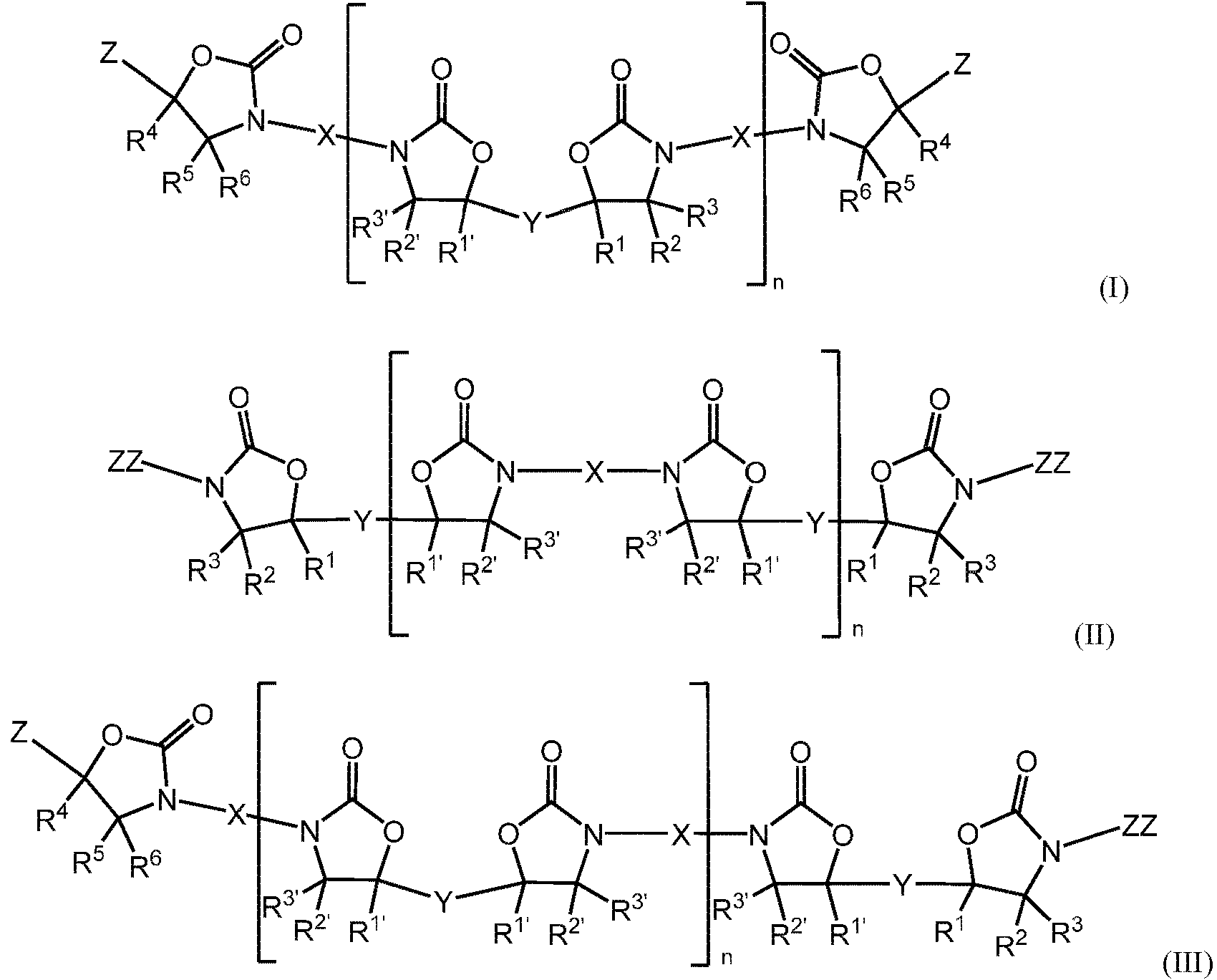

Applications Claiming Priority (2)
| Application Number | Priority Date | Filing Date | Title |
|---|---|---|---|
| EP15154977 | 2015-02-13 | ||
| PCT/EP2016/052689 WO2016128380A1 (en) | 2015-02-13 | 2016-02-09 | Process for the synthesis of polyoxazolidinone compounds with high stability |
Publications (1)
| Publication Number | Publication Date |
|---|---|
| ES2731925T3 true ES2731925T3 (en) | 2019-11-19 |
Family
ID=52544300
Family Applications (1)
| Application Number | Title | Priority Date | Filing Date |
|---|---|---|---|
| ES16703330T Active ES2731925T3 (en) | 2015-02-13 | 2016-02-09 | Procedure for the synthesis of polyoxazolidinone compounds with high stability |
Country Status (7)
| Country | Link |
|---|---|
| US (1) | US10385167B2 (en) |
| EP (1) | EP3256508B1 (en) |
| JP (1) | JP6698095B2 (en) |
| KR (1) | KR20170118067A (en) |
| CN (1) | CN107207700B (en) |
| ES (1) | ES2731925T3 (en) |
| WO (1) | WO2016128380A1 (en) |
Families Citing this family (19)
| Publication number | Priority date | Publication date | Assignee | Title |
|---|---|---|---|---|
| EP3357949A1 (en) * | 2017-02-02 | 2018-08-08 | Covestro Deutschland AG | Method for the production of polyoxazolidinone polymer compounds |
| EP3456753A1 (en) * | 2017-09-15 | 2019-03-20 | Covestro Deutschland AG | Method for the production of thermplastic polyoxazolidinone polymers |
| EP3456754A1 (en) * | 2017-09-15 | 2019-03-20 | Covestro Deutschland AG | Method for the production of thermoplastic polyoxazolidinone polymers |
| JP7365096B2 (en) * | 2017-09-29 | 2023-10-19 | ビーエーエスエフ ソシエタス・ヨーロピア | Thermoplastic polyoxazolidones from diisocyanates and diglycidyl ether derivatives of 2-phenyl-1,3-propanediol |
| CN111194328A (en) | 2017-10-13 | 2020-05-22 | 科思创德国股份有限公司 | Method for preparing crosslinkable polymers by forming oxazolidinones |
| EP3604370A1 (en) | 2018-08-03 | 2020-02-05 | Covestro Deutschland AG | Catalysts for the synthesis of oxazolidinones |
| EP3647335A1 (en) * | 2018-10-30 | 2020-05-06 | Covestro Deutschland AG | Method for the production of thermoplastic polyoxazolidinone polymers |
| EP3647336A1 (en) | 2018-10-30 | 2020-05-06 | Covestro Deutschland AG | Method for the production of thermoplastic polyoxazolidinone polymers |
| EP3750933A1 (en) * | 2019-06-12 | 2020-12-16 | Covestro Deutschland AG | Method for the production of epoxy-group terminated polyoxazolidinones |
| CN111171315B (en) * | 2020-02-25 | 2021-08-17 | 常熟理工学院 | A kind of crystalline N-substituted polythiocarbamate and preparation method thereof |
| EP3885384A1 (en) | 2020-03-24 | 2021-09-29 | Covestro Deutschland AG | Method for the production of thermoplastic polyoxazolidinones |
| US12378348B2 (en) | 2020-08-24 | 2025-08-05 | Covestro Deutschland Ag | Method for the production of a thermoplastic polyoxazolidinone |
| WO2022043125A1 (en) | 2020-08-24 | 2022-03-03 | Covestro Deutschland Ag | Method for the production of a thermoplastic polyoxazolidinone |
| EP3960786A1 (en) | 2020-08-24 | 2022-03-02 | Covestro Deutschland AG | Method for the production of a thermoplastic polyoxyzolidinone |
| EP3960785A1 (en) | 2020-08-24 | 2022-03-02 | Covestro Deutschland AG | Method for the production of thermoplastic polyoxazolidinone polymers |
| EP3960787A1 (en) | 2020-08-24 | 2022-03-02 | Covestro Deutschland AG | Method for the production of a thermoplastic polyoxazolidinone |
| CN115989261A (en) * | 2020-08-24 | 2023-04-18 | 科思创德国股份有限公司 | Process for producing thermoplastic polyoxazolidinones |
| US20240026065A1 (en) * | 2020-12-03 | 2024-01-25 | Covestro Deutschland Ag | Method for the production of thermoplastic polyoxazolidinone polymers |
| EP4194475A1 (en) | 2021-12-13 | 2023-06-14 | Covestro Deutschland AG | Process for the production of a thermoplastic polyoxazolidinone |
Family Cites Families (8)
| Publication number | Priority date | Publication date | Assignee | Title |
|---|---|---|---|---|
| NL6402808A (en) * | 1963-04-23 | 1964-10-26 | ||
| US3687897A (en) * | 1970-06-22 | 1972-08-29 | Dow Chemical Co | Preparation of oxazolidinones by reacting an isocyanate, or isothiocyanate with an epoxide in the presence of a phosphonium halide acid, ester, or acid ester of the element c |
| DE69210919T2 (en) | 1991-09-05 | 1997-01-23 | Nippon Paint Co Ltd | Thermosetting resin mixture containing a polyfunctional oxazolidone component and a polyamine component |
| JP5628678B2 (en) * | 2007-10-31 | 2014-11-19 | ダウ グローバル テクノロジーズ エルエルシー | Non-sintered isocyanate-modified epoxy resin for fused epoxy resin |
| CN101695880A (en) * | 2009-10-30 | 2010-04-21 | 衡阳恒缘电工材料有限公司 | Production method of polyoxazolidone laminated board |
| US8871892B2 (en) * | 2009-11-12 | 2014-10-28 | Dow Global Technologies Llc | Polyoxazolidone resins |
| KR101520202B1 (en) * | 2010-12-28 | 2015-05-13 | 미쓰이 가가쿠 토세로 가부시키가이샤 | Resin composition, protective film containing same, dry film, circuit board, and multilayer circuit board |
| WO2014076024A1 (en) * | 2012-11-14 | 2014-05-22 | Bayer Materialscience Ag | Method for the production of oxazolidinone compounds |
-
2016
- 2016-02-09 ES ES16703330T patent/ES2731925T3/en active Active
- 2016-02-09 US US15/548,817 patent/US10385167B2/en active Active
- 2016-02-09 CN CN201680010233.7A patent/CN107207700B/en active Active
- 2016-02-09 WO PCT/EP2016/052689 patent/WO2016128380A1/en not_active Ceased
- 2016-02-09 JP JP2017542028A patent/JP6698095B2/en active Active
- 2016-02-09 KR KR1020177022229A patent/KR20170118067A/en not_active Withdrawn
- 2016-02-09 EP EP16703330.7A patent/EP3256508B1/en active Active
Also Published As
| Publication number | Publication date |
|---|---|
| KR20170118067A (en) | 2017-10-24 |
| CN107207700A (en) | 2017-09-26 |
| JP6698095B2 (en) | 2020-05-27 |
| JP2018507932A (en) | 2018-03-22 |
| WO2016128380A1 (en) | 2016-08-18 |
| EP3256508B1 (en) | 2019-03-27 |
| US10385167B2 (en) | 2019-08-20 |
| CN107207700B (en) | 2021-04-27 |
| EP3256508A1 (en) | 2017-12-20 |
| US20180022871A1 (en) | 2018-01-25 |
Similar Documents
| Publication | Publication Date | Title |
|---|---|---|
| ES2731925T3 (en) | Procedure for the synthesis of polyoxazolidinone compounds with high stability | |
| EP3577149B1 (en) | Method for the production of polyoxazolidinone polymer compounds | |
| EP2920218B1 (en) | Method for the production of oxazolidinone compounds | |
| EP3143059B1 (en) | Catalysts for the synthesis of oxazolidinone compounds | |
| Ma et al. | Isocyanate‐free approach to water‐borne polyurea dispersions and coatings | |
| EP3143060B1 (en) | Catalysts for the synthesis of oxazolidinone compounds | |
| ES3004807T3 (en) | Method for the production of isocyanate-group terminated polyoxazolidinones | |
| US11932774B2 (en) | Waterborne isocyanate-free polyurethane epoxy hybrid coatings | |
| CN109642010B (en) | Synthetic method of polyoxazolidinone compound | |
| EP4200353B1 (en) | Method for the production of a thermoplastic polyoxazolidinone | |
| Sendijarevic et al. | Novel heat-resistant isocyanate-based polymers | |
| ES3056949T3 (en) | Process for the production of a thermoplastic polyoxazolidinone | |
| EP4200352A1 (en) | Method for the production of a thermoplastic polyoxazolidinone | |
| EP4200351A1 (en) | Method for the production of a thermoplastic polyoxazolidinone | |
| EP4255947B1 (en) | Method for the production of thermoplastic polyoxazolidinone polymers | |
| KR20230043169A (en) | Synthesis of linear polyoxazolidinones using uretdione as diisocyanate component | |
| CN112996835B (en) | Process for producing thermoplastic polyoxazolidinone polymers | |
| EP3960785A1 (en) | Method for the production of thermoplastic polyoxazolidinone polymers | |
| Zhang et al. | Isocyanate-free approach to polyurea/urethane synthesis with di-tert-butyl dicarbamates as monomers | |
| EP4008736A1 (en) | Method for the production of thermoplastic polyoxazolidinone polymers | |
| Sergeyev et al. | Co-cyclotrimerization of 2, 4-toluylene diisocyanate and phenyl isocyanate |