ES2745080T3 - Benzimidazole compound crystals - Google Patents
Benzimidazole compound crystals Download PDFInfo
- Publication number
- ES2745080T3 ES2745080T3 ES16797941T ES16797941T ES2745080T3 ES 2745080 T3 ES2745080 T3 ES 2745080T3 ES 16797941 T ES16797941 T ES 16797941T ES 16797941 T ES16797941 T ES 16797941T ES 2745080 T3 ES2745080 T3 ES 2745080T3
- Authority
- ES
- Spain
- Prior art keywords
- crystal
- bilastine
- acid
- molar ratio
- water
- Prior art date
- Legal status (The legal status is an assumption and is not a legal conclusion. Google has not performed a legal analysis and makes no representation as to the accuracy of the status listed.)
- Active
Links
- 239000013078 crystal Substances 0.000 title claims abstract description 225
- -1 Benzimidazole compound Chemical class 0.000 title description 6
- ACCMWZWAEFYUGZ-UHFFFAOYSA-N bilastine Chemical compound N=1C2=CC=CC=C2N(CCOCC)C=1C(CC1)CCN1CCC1=CC=C(C(C)(C)C(O)=O)C=C1 ACCMWZWAEFYUGZ-UHFFFAOYSA-N 0.000 claims abstract description 205
- 229960004314 bilastine Drugs 0.000 claims abstract description 204
- WNLRTRBMVRJNCN-UHFFFAOYSA-N adipic acid Chemical compound OC(=O)CCCCC(O)=O WNLRTRBMVRJNCN-UHFFFAOYSA-N 0.000 claims abstract description 58
- WPYMKLBDIGXBTP-UHFFFAOYSA-N benzoic acid Chemical compound OC(=O)C1=CC=CC=C1 WPYMKLBDIGXBTP-UHFFFAOYSA-N 0.000 claims abstract description 57
- KDYFGRWQOYBRFD-UHFFFAOYSA-N Succinic acid Natural products OC(=O)CCC(O)=O KDYFGRWQOYBRFD-UHFFFAOYSA-N 0.000 claims abstract description 42
- 239000000203 mixture Substances 0.000 claims abstract description 40
- JFCQEDHGNNZCLN-UHFFFAOYSA-N anhydrous glutaric acid Natural products OC(=O)CCCC(O)=O JFCQEDHGNNZCLN-UHFFFAOYSA-N 0.000 claims abstract description 38
- RTBFRGCFXZNCOE-UHFFFAOYSA-N 1-methylsulfonylpiperidin-4-one Chemical compound CS(=O)(=O)N1CCC(=O)CC1 RTBFRGCFXZNCOE-UHFFFAOYSA-N 0.000 claims abstract description 35
- BJEPYKJPYRNKOW-REOHCLBHSA-N (S)-malic acid Chemical compound OC(=O)[C@@H](O)CC(O)=O BJEPYKJPYRNKOW-REOHCLBHSA-N 0.000 claims abstract description 34
- GHMLBKRAJCXXBS-UHFFFAOYSA-N resorcinol Chemical compound OC1=CC=CC(O)=C1 GHMLBKRAJCXXBS-UHFFFAOYSA-N 0.000 claims abstract description 34
- 150000001875 compounds Chemical class 0.000 claims abstract description 33
- 239000005711 Benzoic acid Substances 0.000 claims abstract description 30
- 235000010233 benzoic acid Nutrition 0.000 claims abstract description 30
- 239000001361 adipic acid Substances 0.000 claims abstract description 29
- 235000011037 adipic acid Nutrition 0.000 claims abstract description 29
- LXCFILQKKLGQFO-UHFFFAOYSA-N methylparaben Chemical compound COC(=O)C1=CC=C(O)C=C1 LXCFILQKKLGQFO-UHFFFAOYSA-N 0.000 claims abstract description 22
- BEFDCLMNVWHSGT-UHFFFAOYSA-N ethenylcyclopentane Chemical compound C=CC1CCCC1 BEFDCLMNVWHSGT-UHFFFAOYSA-N 0.000 claims abstract description 21
- 239000004334 sorbic acid Substances 0.000 claims abstract description 21
- 229940075582 sorbic acid Drugs 0.000 claims abstract description 21
- 235000010199 sorbic acid Nutrition 0.000 claims abstract description 21
- BJEPYKJPYRNKOW-UHFFFAOYSA-N alpha-hydroxysuccinic acid Natural products OC(=O)C(O)CC(O)=O BJEPYKJPYRNKOW-UHFFFAOYSA-N 0.000 claims abstract description 19
- 235000011090 malic acid Nutrition 0.000 claims abstract description 19
- 229940116298 l- malic acid Drugs 0.000 claims abstract description 15
- 239000012453 solvate Substances 0.000 claims abstract description 14
- 235000010270 methyl p-hydroxybenzoate Nutrition 0.000 claims abstract description 11
- RZVAJINKPMORJF-UHFFFAOYSA-N Acetaminophen Chemical compound CC(=O)NC1=CC=C(O)C=C1 RZVAJINKPMORJF-UHFFFAOYSA-N 0.000 claims abstract description 10
- KDYFGRWQOYBRFD-NUQCWPJISA-N butanedioic acid Chemical compound O[14C](=O)CC[14C](O)=O KDYFGRWQOYBRFD-NUQCWPJISA-N 0.000 claims abstract description 6
- 229960000250 adipic acid Drugs 0.000 claims abstract description 5
- ALYNCZNDIQEVRV-PZFLKRBQSA-N 4-amino-3,5-ditritiobenzoic acid Chemical compound [3H]c1cc(cc([3H])c1N)C(O)=O ALYNCZNDIQEVRV-PZFLKRBQSA-N 0.000 claims abstract description 4
- 229960004365 benzoic acid Drugs 0.000 claims abstract description 4
- 229960001755 resorcinol Drugs 0.000 claims abstract description 3
- XLYOFNOQVPJJNP-UHFFFAOYSA-N water Substances O XLYOFNOQVPJJNP-UHFFFAOYSA-N 0.000 claims description 72
- LFQSCWFLJHTTHZ-UHFFFAOYSA-N Ethanol Chemical compound CCO LFQSCWFLJHTTHZ-UHFFFAOYSA-N 0.000 claims description 42
- OKKJLVBELUTLKV-UHFFFAOYSA-N Methanol Chemical compound OC OKKJLVBELUTLKV-UHFFFAOYSA-N 0.000 claims description 42
- ALYNCZNDIQEVRV-UHFFFAOYSA-N 4-aminobenzoic acid Chemical compound NC1=CC=C(C(O)=O)C=C1 ALYNCZNDIQEVRV-UHFFFAOYSA-N 0.000 claims description 40
- IAZDPXIOMUYVGZ-UHFFFAOYSA-N Dimethylsulphoxide Chemical compound CS(C)=O IAZDPXIOMUYVGZ-UHFFFAOYSA-N 0.000 claims description 38
- 239000002904 solvent Substances 0.000 claims description 27
- 230000007935 neutral effect Effects 0.000 claims description 26
- 238000000034 method Methods 0.000 claims description 21
- 229960004050 aminobenzoic acid Drugs 0.000 claims description 20
- 238000003756 stirring Methods 0.000 claims description 20
- CSCPPACGZOOCGX-UHFFFAOYSA-N Acetone Chemical compound CC(C)=O CSCPPACGZOOCGX-UHFFFAOYSA-N 0.000 claims description 18
- WEVYAHXRMPXWCK-UHFFFAOYSA-N Acetonitrile Chemical compound CC#N WEVYAHXRMPXWCK-UHFFFAOYSA-N 0.000 claims description 18
- 239000001384 succinic acid Substances 0.000 claims description 18
- XEKOWRVHYACXOJ-UHFFFAOYSA-N Ethyl acetate Chemical compound CCOC(C)=O XEKOWRVHYACXOJ-UHFFFAOYSA-N 0.000 claims description 13
- 239000008194 pharmaceutical composition Substances 0.000 claims description 13
- KFZMGEQAYNKOFK-UHFFFAOYSA-N Isopropanol Chemical compound CC(C)O KFZMGEQAYNKOFK-UHFFFAOYSA-N 0.000 claims description 12
- ZMXDDKWLCZADIW-UHFFFAOYSA-N N,N-Dimethylformamide Chemical compound CN(C)C=O ZMXDDKWLCZADIW-UHFFFAOYSA-N 0.000 claims description 12
- YXFVVABEGXRONW-UHFFFAOYSA-N Toluene Chemical compound CC1=CC=CC=C1 YXFVVABEGXRONW-UHFFFAOYSA-N 0.000 claims description 12
- BZLVMXJERCGZMT-UHFFFAOYSA-N Methyl tert-butyl ether Chemical compound COC(C)(C)C BZLVMXJERCGZMT-UHFFFAOYSA-N 0.000 claims description 10
- 208000026935 allergic disease Diseases 0.000 claims description 9
- HEDRZPFGACZZDS-UHFFFAOYSA-N Chloroform Chemical compound ClC(Cl)Cl HEDRZPFGACZZDS-UHFFFAOYSA-N 0.000 claims description 8
- 206010010741 Conjunctivitis Diseases 0.000 claims description 8
- YMWUJEATGCHHMB-UHFFFAOYSA-N Dichloromethane Chemical compound ClCCl YMWUJEATGCHHMB-UHFFFAOYSA-N 0.000 claims description 8
- SECXISVLQFMRJM-UHFFFAOYSA-N N-Methylpyrrolidone Chemical compound CN1CCCC1=O SECXISVLQFMRJM-UHFFFAOYSA-N 0.000 claims description 8
- WYURNTSHIVDZCO-UHFFFAOYSA-N Tetrahydrofuran Chemical compound C1CCOC1 WYURNTSHIVDZCO-UHFFFAOYSA-N 0.000 claims description 8
- RTZKZFJDLAIYFH-UHFFFAOYSA-N Diethyl ether Chemical compound CCOCC RTZKZFJDLAIYFH-UHFFFAOYSA-N 0.000 claims description 6
- 239000000546 pharmaceutical excipient Substances 0.000 claims description 6
- 239000002253 acid Substances 0.000 claims description 5
- 230000002265 prevention Effects 0.000 claims description 5
- NTIZESTWPVYFNL-UHFFFAOYSA-N Methyl isobutyl ketone Chemical compound CC(C)CC(C)=O NTIZESTWPVYFNL-UHFFFAOYSA-N 0.000 claims description 4
- UIHCLUNTQKBZGK-UHFFFAOYSA-N Methyl isobutyl ketone Natural products CCC(C)C(C)=O UIHCLUNTQKBZGK-UHFFFAOYSA-N 0.000 claims description 4
- IMNFDUFMRHMDMM-UHFFFAOYSA-N N-Heptane Chemical compound CCCCCCC IMNFDUFMRHMDMM-UHFFFAOYSA-N 0.000 claims description 4
- 208000024780 Urticaria Diseases 0.000 claims description 4
- 208000006673 asthma Diseases 0.000 claims description 4
- 238000001816 cooling Methods 0.000 claims description 4
- 206010039083 rhinitis Diseases 0.000 claims description 4
- YLQBMQCUIZJEEH-UHFFFAOYSA-N tetrahydrofuran Natural products C=1C=COC=1 YLQBMQCUIZJEEH-UHFFFAOYSA-N 0.000 claims description 4
- 239000003814 drug Substances 0.000 claims description 3
- RYHBNJHYFVUHQT-UHFFFAOYSA-N 1,4-Dioxane Chemical compound C1COCCO1 RYHBNJHYFVUHQT-UHFFFAOYSA-N 0.000 claims description 2
- XDTMQSROBMDMFD-UHFFFAOYSA-N Cyclohexane Chemical compound C1CCCCC1 XDTMQSROBMDMFD-UHFFFAOYSA-N 0.000 claims description 2
- 201000004624 Dermatitis Diseases 0.000 claims description 2
- CTQNGGLPUBDAKN-UHFFFAOYSA-N O-Xylene Chemical compound CC1=CC=CC=C1C CTQNGGLPUBDAKN-UHFFFAOYSA-N 0.000 claims description 2
- GJRQTCIYDGXPES-UHFFFAOYSA-N iso-butyl acetate Natural products CC(C)COC(C)=O GJRQTCIYDGXPES-UHFFFAOYSA-N 0.000 claims description 2
- FGKJLKRYENPLQH-UHFFFAOYSA-M isocaproate Chemical compound CC(C)CCC([O-])=O FGKJLKRYENPLQH-UHFFFAOYSA-M 0.000 claims description 2
- OQAGVSWESNCJJT-UHFFFAOYSA-N isovaleric acid methyl ester Natural products COC(=O)CC(C)C OQAGVSWESNCJJT-UHFFFAOYSA-N 0.000 claims description 2
- 239000008096 xylene Substances 0.000 claims description 2
- 230000015572 biosynthetic process Effects 0.000 abstract description 2
- 238000005160 1H NMR spectroscopy Methods 0.000 description 47
- 238000000634 powder X-ray diffraction Methods 0.000 description 45
- 239000007787 solid Substances 0.000 description 44
- 239000000725 suspension Substances 0.000 description 29
- 238000001914 filtration Methods 0.000 description 21
- 125000001931 aliphatic group Chemical group 0.000 description 20
- 238000004458 analytical method Methods 0.000 description 18
- 208000037265 diseases, disorders, signs and symptoms Diseases 0.000 description 13
- 238000012512 characterization method Methods 0.000 description 10
- 201000010099 disease Diseases 0.000 description 9
- 229920006395 saturated elastomer Polymers 0.000 description 9
- 150000001556 benzimidazoles Chemical class 0.000 description 8
- 125000004432 carbon atom Chemical group C* 0.000 description 8
- 150000001732 carboxylic acid derivatives Chemical class 0.000 description 8
- 125000000217 alkyl group Chemical group 0.000 description 7
- 230000000694 effects Effects 0.000 description 7
- 125000000524 functional group Chemical group 0.000 description 7
- 230000008569 process Effects 0.000 description 7
- IJGRMHOSHXDMSA-UHFFFAOYSA-N Atomic nitrogen Chemical compound N#N IJGRMHOSHXDMSA-UHFFFAOYSA-N 0.000 description 6
- NTYJJOPFIAHURM-UHFFFAOYSA-N Histamine Chemical compound NCCC1=CN=CN1 NTYJJOPFIAHURM-UHFFFAOYSA-N 0.000 description 6
- GUGOEEXESWIERI-UHFFFAOYSA-N Terfenadine Chemical compound C1=CC(C(C)(C)C)=CC=C1C(O)CCCN1CCC(C(O)(C=2C=CC=CC=2)C=2C=CC=CC=2)CC1 GUGOEEXESWIERI-UHFFFAOYSA-N 0.000 description 6
- 125000003178 carboxy group Chemical group [H]OC(*)=O 0.000 description 6
- 230000003993 interaction Effects 0.000 description 6
- 125000001424 substituent group Chemical group 0.000 description 6
- 238000001238 wet grinding Methods 0.000 description 6
- HYZJCKYKOHLVJF-UHFFFAOYSA-N 1H-benzimidazole Chemical compound C1=CC=C2NC=NC2=C1 HYZJCKYKOHLVJF-UHFFFAOYSA-N 0.000 description 5
- 238000005033 Fourier transform infrared spectroscopy Methods 0.000 description 5
- 239000000739 antihistaminic agent Substances 0.000 description 5
- 150000004677 hydrates Chemical class 0.000 description 5
- 239000007788 liquid Substances 0.000 description 5
- 238000004519 manufacturing process Methods 0.000 description 5
- 230000002378 acidificating effect Effects 0.000 description 4
- 239000004480 active ingredient Substances 0.000 description 4
- 230000001387 anti-histamine Effects 0.000 description 4
- 150000001558 benzoic acid derivatives Chemical group 0.000 description 4
- 238000013480 data collection Methods 0.000 description 4
- 239000001630 malic acid Substances 0.000 description 4
- 229940099690 malic acid Drugs 0.000 description 4
- 238000010899 nucleation Methods 0.000 description 4
- 150000002989 phenols Chemical class 0.000 description 4
- 238000002360 preparation method Methods 0.000 description 4
- 241000894007 species Species 0.000 description 4
- 206010010744 Conjunctivitis allergic Diseases 0.000 description 3
- PEDCQBHIVMGVHV-UHFFFAOYSA-N Glycerine Chemical compound OCC(O)CO PEDCQBHIVMGVHV-UHFFFAOYSA-N 0.000 description 3
- 241001465754 Metazoa Species 0.000 description 3
- 230000008485 antagonism Effects 0.000 description 3
- 150000001735 carboxylic acids Chemical class 0.000 description 3
- 208000035475 disorder Diseases 0.000 description 3
- 238000001704 evaporation Methods 0.000 description 3
- 230000008020 evaporation Effects 0.000 description 3
- 238000002474 experimental method Methods 0.000 description 3
- 229960001340 histamine Drugs 0.000 description 3
- 230000006872 improvement Effects 0.000 description 3
- 229910052757 nitrogen Inorganic materials 0.000 description 3
- 238000010992 reflux Methods 0.000 description 3
- 150000003839 salts Chemical class 0.000 description 3
- FJKROLUGYXJWQN-UHFFFAOYSA-M 4-hydroxybenzoate Chemical compound OC1=CC=C(C([O-])=O)C=C1 FJKROLUGYXJWQN-UHFFFAOYSA-M 0.000 description 2
- 102000003834 Histamine H1 Receptors Human genes 0.000 description 2
- 108090000110 Histamine H1 Receptors Proteins 0.000 description 2
- 238000005481 NMR spectroscopy Methods 0.000 description 2
- 201000010435 allergic urticaria Diseases 0.000 description 2
- 125000002029 aromatic hydrocarbon group Chemical group 0.000 description 2
- 238000005119 centrifugation Methods 0.000 description 2
- 238000002425 crystallisation Methods 0.000 description 2
- 238000010908 decantation Methods 0.000 description 2
- 238000011161 development Methods 0.000 description 2
- 230000007613 environmental effect Effects 0.000 description 2
- 235000019439 ethyl acetate Nutrition 0.000 description 2
- 125000001495 ethyl group Chemical group [H]C([H])([H])C([H])([H])* 0.000 description 2
- 238000000227 grinding Methods 0.000 description 2
- 238000010438 heat treatment Methods 0.000 description 2
- 238000004128 high performance liquid chromatography Methods 0.000 description 2
- 239000001257 hydrogen Substances 0.000 description 2
- 229910052739 hydrogen Inorganic materials 0.000 description 2
- 238000002955 isolation Methods 0.000 description 2
- 238000005259 measurement Methods 0.000 description 2
- 125000002496 methyl group Chemical group [H]C([H])([H])* 0.000 description 2
- 238000002156 mixing Methods 0.000 description 2
- IOQPZZOEVPZRBK-UHFFFAOYSA-N octan-1-amine Chemical compound CCCCCCCCN IOQPZZOEVPZRBK-UHFFFAOYSA-N 0.000 description 2
- 150000002894 organic compounds Chemical class 0.000 description 2
- 238000007911 parenteral administration Methods 0.000 description 2
- 125000001997 phenyl group Chemical group [H]C1=C([H])C([H])=C(*)C([H])=C1[H] 0.000 description 2
- 150000003254 radicals Chemical class 0.000 description 2
- 102000005962 receptors Human genes 0.000 description 2
- 108020003175 receptors Proteins 0.000 description 2
- 238000001953 recrystallisation Methods 0.000 description 2
- 230000001105 regulatory effect Effects 0.000 description 2
- 239000000243 solution Substances 0.000 description 2
- 238000009331 sowing Methods 0.000 description 2
- 238000001228 spectrum Methods 0.000 description 2
- 229910001220 stainless steel Inorganic materials 0.000 description 2
- 239000010935 stainless steel Substances 0.000 description 2
- 208000024891 symptom Diseases 0.000 description 2
- 238000003828 vacuum filtration Methods 0.000 description 2
- 239000003981 vehicle Substances 0.000 description 2
- ZTMADXFOCUXMJE-UHFFFAOYSA-N 2-methylbenzene-1,3-diol Chemical compound CC1=C(O)C=CC=C1O ZTMADXFOCUXMJE-UHFFFAOYSA-N 0.000 description 1
- OKTJSMMVPCPJKN-UHFFFAOYSA-N Carbon Chemical compound [C] OKTJSMMVPCPJKN-UHFFFAOYSA-N 0.000 description 1
- 206010012434 Dermatitis allergic Diseases 0.000 description 1
- 238000001157 Fourier transform infrared spectrum Methods 0.000 description 1
- 208000012895 Gastric disease Diseases 0.000 description 1
- WQZGKKKJIJFFOK-GASJEMHNSA-N Glucose Natural products OC[C@H]1OC(O)[C@H](O)[C@@H](O)[C@@H]1O WQZGKKKJIJFFOK-GASJEMHNSA-N 0.000 description 1
- 102000000543 Histamine Receptors Human genes 0.000 description 1
- 108010002059 Histamine Receptors Proteins 0.000 description 1
- 206010020751 Hypersensitivity Diseases 0.000 description 1
- 235000019483 Peanut oil Nutrition 0.000 description 1
- 206010039085 Rhinitis allergic Diseases 0.000 description 1
- XUIMIQQOPSSXEZ-UHFFFAOYSA-N Silicon Chemical compound [Si] XUIMIQQOPSSXEZ-UHFFFAOYSA-N 0.000 description 1
- FAPWRFPIFSIZLT-UHFFFAOYSA-M Sodium chloride Chemical compound [Na+].[Cl-] FAPWRFPIFSIZLT-UHFFFAOYSA-M 0.000 description 1
- 238000002441 X-ray diffraction Methods 0.000 description 1
- 150000007513 acids Chemical class 0.000 description 1
- 239000002671 adjuvant Substances 0.000 description 1
- 201000009961 allergic asthma Diseases 0.000 description 1
- 208000002205 allergic conjunctivitis Diseases 0.000 description 1
- 208000030961 allergic reaction Diseases 0.000 description 1
- 201000010105 allergic rhinitis Diseases 0.000 description 1
- PNEYBMLMFCGWSK-UHFFFAOYSA-N aluminium oxide Inorganic materials [O-2].[O-2].[O-2].[Al+3].[Al+3] PNEYBMLMFCGWSK-UHFFFAOYSA-N 0.000 description 1
- 150000001412 amines Chemical class 0.000 description 1
- 239000005557 antagonist Substances 0.000 description 1
- 230000003266 anti-allergic effect Effects 0.000 description 1
- 230000003326 anti-histaminergic effect Effects 0.000 description 1
- 239000007864 aqueous solution Substances 0.000 description 1
- 230000003126 arrythmogenic effect Effects 0.000 description 1
- 125000003118 aryl group Chemical group 0.000 description 1
- 208000024998 atopic conjunctivitis Diseases 0.000 description 1
- 201000008937 atopic dermatitis Diseases 0.000 description 1
- 208000010668 atopic eczema Diseases 0.000 description 1
- 230000008901 benefit Effects 0.000 description 1
- WQZGKKKJIJFFOK-VFUOTHLCSA-N beta-D-glucose Chemical compound OC[C@H]1O[C@@H](O)[C@H](O)[C@@H](O)[C@@H]1O WQZGKKKJIJFFOK-VFUOTHLCSA-N 0.000 description 1
- 239000008280 blood Substances 0.000 description 1
- 210000004369 blood Anatomy 0.000 description 1
- 229910052799 carbon Inorganic materials 0.000 description 1
- 150000007942 carboxylates Chemical class 0.000 description 1
- 210000000748 cardiovascular system Anatomy 0.000 description 1
- 230000003197 catalytic effect Effects 0.000 description 1
- 210000003169 central nervous system Anatomy 0.000 description 1
- 238000006243 chemical reaction Methods 0.000 description 1
- 238000007796 conventional method Methods 0.000 description 1
- 230000008025 crystallization Effects 0.000 description 1
- 238000011157 data evaluation Methods 0.000 description 1
- 230000005595 deprotonation Effects 0.000 description 1
- 238000010537 deprotonation reaction Methods 0.000 description 1
- 239000011903 deuterated solvents Substances 0.000 description 1
- 239000008121 dextrose Substances 0.000 description 1
- 229910003460 diamond Inorganic materials 0.000 description 1
- 239000010432 diamond Substances 0.000 description 1
- 239000003085 diluting agent Substances 0.000 description 1
- 230000006806 disease prevention Effects 0.000 description 1
- 208000002173 dizziness Diseases 0.000 description 1
- 229940079593 drug Drugs 0.000 description 1
- 239000003937 drug carrier Substances 0.000 description 1
- 230000003203 everyday effect Effects 0.000 description 1
- 230000005284 excitation Effects 0.000 description 1
- 238000009472 formulation Methods 0.000 description 1
- 230000010224 hepatic metabolism Effects 0.000 description 1
- 239000000938 histamine H1 antagonist Substances 0.000 description 1
- 230000036571 hydration Effects 0.000 description 1
- 238000006703 hydration reaction Methods 0.000 description 1
- 125000004435 hydrogen atom Chemical group [H]* 0.000 description 1
- 125000002887 hydroxy group Chemical group [H]O* 0.000 description 1
- 125000001449 isopropyl group Chemical group [H]C([H])([H])C([H])(*)C([H])([H])[H] 0.000 description 1
- 238000002844 melting Methods 0.000 description 1
- QSHDDOUJBYECFT-UHFFFAOYSA-N mercury Chemical compound [Hg] QSHDDOUJBYECFT-UHFFFAOYSA-N 0.000 description 1
- 229910052753 mercury Inorganic materials 0.000 description 1
- ASHGTJPOSUFTGB-UHFFFAOYSA-N methyl resorcinol Natural products COC1=CC=CC(O)=C1 ASHGTJPOSUFTGB-UHFFFAOYSA-N 0.000 description 1
- 235000010446 mineral oil Nutrition 0.000 description 1
- 239000002480 mineral oil Substances 0.000 description 1
- 150000002763 monocarboxylic acids Chemical class 0.000 description 1
- 239000012452 mother liquor Substances 0.000 description 1
- 125000004108 n-butyl group Chemical group [H]C([H])([H])C([H])([H])C([H])([H])C([H])([H])* 0.000 description 1
- 125000000740 n-pentyl group Chemical group [H]C([H])([H])C([H])([H])C([H])([H])C([H])([H])C([H])([H])* 0.000 description 1
- 125000004123 n-propyl group Chemical group [H]C([H])([H])C([H])([H])C([H])([H])* 0.000 description 1
- 210000003928 nasal cavity Anatomy 0.000 description 1
- 231100000500 noncardiotoxic Toxicity 0.000 description 1
- 239000003921 oil Substances 0.000 description 1
- 235000019198 oils Nutrition 0.000 description 1
- 239000003960 organic solvent Substances 0.000 description 1
- 238000004806 packaging method and process Methods 0.000 description 1
- 230000001575 pathological effect Effects 0.000 description 1
- 239000000312 peanut oil Substances 0.000 description 1
- 239000003208 petroleum Substances 0.000 description 1
- 229940124531 pharmaceutical excipient Drugs 0.000 description 1
- ISWSIDIOOBJBQZ-UHFFFAOYSA-N phenol group Chemical group C1(=CC=CC=C1)O ISWSIDIOOBJBQZ-UHFFFAOYSA-N 0.000 description 1
- 230000003389 potentiating effect Effects 0.000 description 1
- 239000000843 powder Substances 0.000 description 1
- 230000005855 radiation Effects 0.000 description 1
- 238000012552 review Methods 0.000 description 1
- 229930195734 saturated hydrocarbon Natural products 0.000 description 1
- 239000000932 sedative agent Substances 0.000 description 1
- 230000001624 sedative effect Effects 0.000 description 1
- 239000008159 sesame oil Substances 0.000 description 1
- 235000011803 sesame oil Nutrition 0.000 description 1
- 229910052710 silicon Inorganic materials 0.000 description 1
- 239000010703 silicon Substances 0.000 description 1
- 239000011780 sodium chloride Substances 0.000 description 1
- 230000003381 solubilizing effect Effects 0.000 description 1
- 238000007614 solvation Methods 0.000 description 1
- 239000003549 soybean oil Substances 0.000 description 1
- 235000012424 soybean oil Nutrition 0.000 description 1
- 238000003860 storage Methods 0.000 description 1
- 239000000126 substance Substances 0.000 description 1
- 238000006467 substitution reaction Methods 0.000 description 1
- 229960005137 succinic acid Drugs 0.000 description 1
- 235000011044 succinic acid Nutrition 0.000 description 1
- 238000002636 symptomatic treatment Methods 0.000 description 1
- 238000003786 synthesis reaction Methods 0.000 description 1
- 125000000999 tert-butyl group Chemical group [H]C([H])([H])C(*)(C([H])([H])[H])C([H])([H])[H] 0.000 description 1
- 230000001225 therapeutic effect Effects 0.000 description 1
- 230000009466 transformation Effects 0.000 description 1
- 238000000844 transformation Methods 0.000 description 1
- 235000013311 vegetables Nutrition 0.000 description 1
Classifications
-
- C—CHEMISTRY; METALLURGY
- C07—ORGANIC CHEMISTRY
- C07D—HETEROCYCLIC COMPOUNDS
- C07D401/00—Heterocyclic compounds containing two or more hetero rings, having nitrogen atoms as the only ring hetero atoms, at least one ring being a six-membered ring with only one nitrogen atom
- C07D401/02—Heterocyclic compounds containing two or more hetero rings, having nitrogen atoms as the only ring hetero atoms, at least one ring being a six-membered ring with only one nitrogen atom containing two hetero rings
- C07D401/04—Heterocyclic compounds containing two or more hetero rings, having nitrogen atoms as the only ring hetero atoms, at least one ring being a six-membered ring with only one nitrogen atom containing two hetero rings directly linked by a ring-member-to-ring-member bond
-
- A—HUMAN NECESSITIES
- A61—MEDICAL OR VETERINARY SCIENCE; HYGIENE
- A61P—SPECIFIC THERAPEUTIC ACTIVITY OF CHEMICAL COMPOUNDS OR MEDICINAL PREPARATIONS
- A61P11/00—Drugs for disorders of the respiratory system
- A61P11/02—Nasal agents, e.g. decongestants
-
- A—HUMAN NECESSITIES
- A61—MEDICAL OR VETERINARY SCIENCE; HYGIENE
- A61P—SPECIFIC THERAPEUTIC ACTIVITY OF CHEMICAL COMPOUNDS OR MEDICINAL PREPARATIONS
- A61P11/00—Drugs for disorders of the respiratory system
- A61P11/06—Antiasthmatics
-
- A—HUMAN NECESSITIES
- A61—MEDICAL OR VETERINARY SCIENCE; HYGIENE
- A61P—SPECIFIC THERAPEUTIC ACTIVITY OF CHEMICAL COMPOUNDS OR MEDICINAL PREPARATIONS
- A61P17/00—Drugs for dermatological disorders
-
- A—HUMAN NECESSITIES
- A61—MEDICAL OR VETERINARY SCIENCE; HYGIENE
- A61P—SPECIFIC THERAPEUTIC ACTIVITY OF CHEMICAL COMPOUNDS OR MEDICINAL PREPARATIONS
- A61P17/00—Drugs for dermatological disorders
- A61P17/04—Antipruritics
-
- A—HUMAN NECESSITIES
- A61—MEDICAL OR VETERINARY SCIENCE; HYGIENE
- A61P—SPECIFIC THERAPEUTIC ACTIVITY OF CHEMICAL COMPOUNDS OR MEDICINAL PREPARATIONS
- A61P27/00—Drugs for disorders of the senses
- A61P27/02—Ophthalmic agents
-
- A—HUMAN NECESSITIES
- A61—MEDICAL OR VETERINARY SCIENCE; HYGIENE
- A61P—SPECIFIC THERAPEUTIC ACTIVITY OF CHEMICAL COMPOUNDS OR MEDICINAL PREPARATIONS
- A61P37/00—Drugs for immunological or allergic disorders
- A61P37/08—Antiallergic agents
-
- C—CHEMISTRY; METALLURGY
- C07—ORGANIC CHEMISTRY
- C07C—ACYCLIC OR CARBOCYCLIC COMPOUNDS
- C07C229/00—Compounds containing amino and carboxyl groups bound to the same carbon skeleton
- C07C229/52—Compounds containing amino and carboxyl groups bound to the same carbon skeleton having amino and carboxyl groups bound to carbon atoms of six-membered aromatic rings of the same carbon skeleton
- C07C229/54—Compounds containing amino and carboxyl groups bound to the same carbon skeleton having amino and carboxyl groups bound to carbon atoms of six-membered aromatic rings of the same carbon skeleton with amino and carboxyl groups bound to carbon atoms of the same non-condensed six-membered aromatic ring
- C07C229/60—Compounds containing amino and carboxyl groups bound to the same carbon skeleton having amino and carboxyl groups bound to carbon atoms of six-membered aromatic rings of the same carbon skeleton with amino and carboxyl groups bound to carbon atoms of the same non-condensed six-membered aromatic ring with amino and carboxyl groups bound in meta- or para- positions
-
- C—CHEMISTRY; METALLURGY
- C07—ORGANIC CHEMISTRY
- C07C—ACYCLIC OR CARBOCYCLIC COMPOUNDS
- C07C235/00—Carboxylic acid amides, the carbon skeleton of the acid part being further substituted by oxygen atoms
- C07C235/02—Carboxylic acid amides, the carbon skeleton of the acid part being further substituted by oxygen atoms having carbon atoms of carboxamide groups bound to acyclic carbon atoms and singly-bound oxygen atoms bound to the same carbon skeleton
- C07C235/32—Carboxylic acid amides, the carbon skeleton of the acid part being further substituted by oxygen atoms having carbon atoms of carboxamide groups bound to acyclic carbon atoms and singly-bound oxygen atoms bound to the same carbon skeleton the carbon skeleton containing six-membered aromatic rings
- C07C235/34—Carboxylic acid amides, the carbon skeleton of the acid part being further substituted by oxygen atoms having carbon atoms of carboxamide groups bound to acyclic carbon atoms and singly-bound oxygen atoms bound to the same carbon skeleton the carbon skeleton containing six-membered aromatic rings having the nitrogen atoms of the carboxamide groups bound to hydrogen atoms or to acyclic carbon atoms
-
- C—CHEMISTRY; METALLURGY
- C07—ORGANIC CHEMISTRY
- C07C—ACYCLIC OR CARBOCYCLIC COMPOUNDS
- C07C39/00—Compounds having at least one hydroxy or O-metal group bound to a carbon atom of a six-membered aromatic ring
- C07C39/02—Compounds having at least one hydroxy or O-metal group bound to a carbon atom of a six-membered aromatic ring monocyclic with no unsaturation outside the aromatic ring
- C07C39/10—Polyhydroxy benzenes; Alkylated derivatives thereof
-
- C—CHEMISTRY; METALLURGY
- C07—ORGANIC CHEMISTRY
- C07C—ACYCLIC OR CARBOCYCLIC COMPOUNDS
- C07C55/00—Saturated compounds having more than one carboxyl group bound to acyclic carbon atoms
- C07C55/02—Dicarboxylic acids
- C07C55/10—Succinic acid
-
- C—CHEMISTRY; METALLURGY
- C07—ORGANIC CHEMISTRY
- C07C—ACYCLIC OR CARBOCYCLIC COMPOUNDS
- C07C55/00—Saturated compounds having more than one carboxyl group bound to acyclic carbon atoms
- C07C55/02—Dicarboxylic acids
- C07C55/12—Glutaric acid
-
- C—CHEMISTRY; METALLURGY
- C07—ORGANIC CHEMISTRY
- C07C—ACYCLIC OR CARBOCYCLIC COMPOUNDS
- C07C55/00—Saturated compounds having more than one carboxyl group bound to acyclic carbon atoms
- C07C55/02—Dicarboxylic acids
- C07C55/14—Adipic acid
-
- C—CHEMISTRY; METALLURGY
- C07—ORGANIC CHEMISTRY
- C07C—ACYCLIC OR CARBOCYCLIC COMPOUNDS
- C07C57/00—Unsaturated compounds having carboxyl groups bound to acyclic carbon atoms
- C07C57/02—Unsaturated compounds having carboxyl groups bound to acyclic carbon atoms with only carbon-to-carbon double bonds as unsaturation
- C07C57/03—Monocarboxylic acids
- C07C57/10—Sorbic acid
-
- C—CHEMISTRY; METALLURGY
- C07—ORGANIC CHEMISTRY
- C07C—ACYCLIC OR CARBOCYCLIC COMPOUNDS
- C07C59/00—Compounds having carboxyl groups bound to acyclic carbon atoms and containing any of the groups OH, O—metal, —CHO, keto, ether, groups, groups, or groups
- C07C59/235—Saturated compounds containing more than one carboxyl group
- C07C59/245—Saturated compounds containing more than one carboxyl group containing hydroxy or O-metal groups
-
- C—CHEMISTRY; METALLURGY
- C07—ORGANIC CHEMISTRY
- C07C—ACYCLIC OR CARBOCYCLIC COMPOUNDS
- C07C63/00—Compounds having carboxyl groups bound to a carbon atoms of six-membered aromatic rings
- C07C63/04—Monocyclic monocarboxylic acids
- C07C63/06—Benzoic acid
-
- C—CHEMISTRY; METALLURGY
- C07—ORGANIC CHEMISTRY
- C07C—ACYCLIC OR CARBOCYCLIC COMPOUNDS
- C07C69/00—Esters of carboxylic acids; Esters of carbonic or haloformic acids
- C07C69/76—Esters of carboxylic acids having a carboxyl group bound to a carbon atom of a six-membered aromatic ring
- C07C69/84—Esters of carboxylic acids having a carboxyl group bound to a carbon atom of a six-membered aromatic ring of monocyclic hydroxy carboxylic acids, the hydroxy groups and the carboxyl groups of which are bound to carbon atoms of a six-membered aromatic ring
- C07C69/88—Esters of carboxylic acids having a carboxyl group bound to a carbon atom of a six-membered aromatic ring of monocyclic hydroxy carboxylic acids, the hydroxy groups and the carboxyl groups of which are bound to carbon atoms of a six-membered aromatic ring with esterified carboxyl groups
-
- C—CHEMISTRY; METALLURGY
- C07—ORGANIC CHEMISTRY
- C07B—GENERAL METHODS OF ORGANIC CHEMISTRY; APPARATUS THEREFOR
- C07B2200/00—Indexing scheme relating to specific properties of organic compounds
- C07B2200/13—Crystalline forms, e.g. polymorphs
Landscapes
- Organic Chemistry (AREA)
- Chemical & Material Sciences (AREA)
- Health & Medical Sciences (AREA)
- Medicinal Chemistry (AREA)
- General Chemical & Material Sciences (AREA)
- Bioinformatics & Cheminformatics (AREA)
- Chemical Kinetics & Catalysis (AREA)
- Life Sciences & Earth Sciences (AREA)
- Pharmacology & Pharmacy (AREA)
- Nuclear Medicine, Radiotherapy & Molecular Imaging (AREA)
- Veterinary Medicine (AREA)
- Engineering & Computer Science (AREA)
- Public Health (AREA)
- Animal Behavior & Ethology (AREA)
- General Health & Medical Sciences (AREA)
- Pulmonology (AREA)
- Dermatology (AREA)
- Immunology (AREA)
- Ophthalmology & Optometry (AREA)
- Otolaryngology (AREA)
- Pharmaceuticals Containing Other Organic And Inorganic Compounds (AREA)
- Plural Heterocyclic Compounds (AREA)
- Medicinal Preparation (AREA)
Abstract
Cocristal que comprende a) bilastina; y b) al menos un compuesto de formación de cocristales seleccionado del grupo que consiste en ácido glutárico, ácido adípico, ácido sórbico, ácido succínico, ácido benzoico, ácido 4-aminobenzóico, ácido L-málico, resorcinol, metil 4- hidroxibenzoato, N-(4-hidroxifenil)acetamida y mezclas de los anteriores, o un solvato del mismo.Co-crystal comprising a) bilastine; and b) at least one crystal formation compound selected from the group consisting of glutaric acid, adipic acid, sorbic acid, succinic acid, benzoic acid, 4-aminobenzoic acid, L-malic acid, resorcinol, methyl 4-hydroxybenzoate, N- (4-hydroxyphenyl) acetamide and mixtures of the foregoing, or a solvate thereof.
Description
DESCRIPCIÓNDESCRIPTION
Cocristales de compuestos de bencimidazolCo-crystals of benzimidazole compounds
Campo de la invenciónField of the Invention
La presente invención se refiere a cocristales de compuestos de bencimidazol, al procedimiento para obtener los mismos y a su uso en composiciones farmacéuticas, particularmente a su uso para composiciones antihistamínicas y antialérgicas. La invención también se refiere a un método para aumentar la solubilidad acuosa de compuestos de bencimidazol.The present invention relates to co-crystals of benzimidazole compounds, the process for obtaining them and their use in pharmaceutical compositions, particularly their use for antihistamine and antiallergic compositions. The invention also relates to a method for increasing the aqueous solubility of benzimidazole compounds.
AntecedentesBackground
Se sabe desde hace mucho tiempo que la histamina desempeña un papel muy importante en enfermedades de tipo alérgico, tales como rinitis alérgica, conjuntivitis, rinoconjuntivitis, dermatitis, urticaria y asma. Los compuestos antihistamínicos que actúan a nivel del receptor H1 de histamina son útiles para tratar tales estados.It has long been known that histamine plays a very important role in allergic diseases, such as allergic rhinitis, conjunctivitis, rhinoconjunctivitis, dermatitis, urticaria and asthma. Antihistamine compounds that act at the level of the histamine H1 receptor are useful for treating such conditions.
Los documentos EP 0818454 A1 y EP 0580541 A1 dan a conocer compuestos de bencimidazol con actividad antihistamínica H1 selectiva y desprovistos de efectos arritmogénicos. La solicitud de patente EP14382576.8 también da a conocer compuestos de bencimidazol que tienen potente actividad antihistamínica H1 selectiva, que carecen de actividad sobre el sistema nervioso central y sobre el sistema cardiovascular.EP 0818454 A1 and EP 0580541 A1 disclose benzimidazole compounds with selective H 1 antihistamine activity and devoid of arrhythmogenic effects. Patent application EP14382576.8 also discloses benzimidazole compounds that have potent selective H 1 antihistamine activity, which lack activity on the central nervous system and on the cardiovascular system.
El ácido 2-[4-(2-{4-[1-(2-etoxietil)-1H-bencimidazol-2-il]-1-piperidinil}etil)fenil]-2-metilpropanoico, también conocido como bilastina, que tiene la fórmula:2- [4- (2- {4- [1- (2-Ethoxyethyl) -1H-benzimidazol-2-yl] -1-piperidinyl} ethyl) phenyl] -2-methylpropanoic acid, also known as bilastine, which It has the formula:

y desarrollado por Faes Farma, España, es un compuesto de bencimidazol antagonista de H1 sin efectos secundarios sedantes, sin efectos cardiotóxicos y sin metabolismo hepático. Además, se ha demostrado que la bilastina es eficaz para el tratamiento sintomático de rinoconjuntivitis alérgica y urticaria.and developed by Faes Farma, Spain, is a benzimidazole H 1 antagonist compound with no sedative side effects, no cardiotoxic effects and no liver metabolism. In addition, bilastine has been shown to be effective for the symptomatic treatment of allergic rhinoconjunctivitis and urticaria.
Los compuestos de bencimidazol anteriores con actividad antihistamínica H1 selectiva presentan una baja solubilidad en agua, que impide el desarrollo de medios de administración farmacéuticamente aceptables de dichos compuestos en forma líquida. Por ejemplo, la solubilidad de bilastina en el intervalo de pH de 5-8 es de alrededor de 500 pg/ml. En la técnica se describen formas cristalinas de bilastina. En el documento WO 2003/089425 A1 se dan a conocer las formas I, II y III, y en el documento CN103788062A se ha descrito un polimorfo adicional. En los documentos SK50032014 U1 y SK7066 Y1 se dan a conocer formas cristalinas de bilastina dihidratada.The above benzimidazole compounds with selective H 1 antihistamine activity have a low water solubility, which prevents the development of pharmaceutically acceptable means of administration of said compounds in liquid form. For example, the solubility of bilastine in the pH range of 5-8 is about 500 pg / ml. Crystalline forms of bilastine are described in the art. Forms I, II and III are disclosed in WO 2003/089425 A1, and an additional polymorph has been described in CN103788062A. Crystalline forms of dihydrated bilastine are disclosed in documents SK50032014 U1 and SK7066 Y1.
Por tanto, existe la necesidad en la técnica de proporcionar un método para mejorar la solubilidad en agua de dichos compuestos de bencimidazol con actividad antihistamínica H1 selectiva. Particularmente, existe la necesidad de mejorar la solubilidad de los compuestos mencionados al pH fisiológico del ojo (6,5-8,0) y la cavidad nasal (5,5-8,3) y también para composiciones para administración parenteral (pH 3,0-10,5), especialmente en el pH fisiológico de la sangre (pH 7,35-7,45). Por tanto, es altamente deseable el desarrollo de formas farmacéuticamente aceptables solubles y estables de dichos compuestos, y particularmente de bilastina, que puedan obtenerse de manera robusta y reproducible usando procedimientos de cristalización a escala. La presente invención se dirige a tales cuestiones.Therefore, there is a need in the art to provide a method for improving the water solubility of said benzimidazole compounds with selective H 1 antihistamine activity. Particularly, there is a need to improve the solubility of the aforementioned compounds at the physiological pH of the eye (6.5-8.0) and the nasal cavity (5.5-8.3) and also for compositions for parenteral administration (pH 3 , 0-10.5), especially at the physiological pH of the blood (pH 7.35-7.45). Therefore, the development of soluble and stable pharmaceutically acceptable forms of said compounds, and particularly of bilastine, which can be obtained in a robust and reproducible manner using scale crystallization methods is highly desirable. The present invention addresses such issues.
Breve descripción de la invenciónBrief Description of the Invention
El solicitante de la presente invención ha encontrado sorprendentemente que la bilastina forma cocristales con determinadas moléculas orgánicas. Estos cocristales son estables, la mayoría de ellos son estables incluso en condiciones forzadas de temperatura y humedad, mejorando así su manejo y almacenamiento y por tanto la producción de composiciones farmacéuticas que los comprenden. Además, estos cocristales mejoran la solubilidad de la bilastina mejorando así la producción y el uso de las composiciones farmacéuticas que van a administrarse por ejemplo en el ojo, la cavidad nasa y para administración parenteral.The applicant of the present invention has surprisingly found that bilastine forms co-crystals with certain organic molecules. These co-crystals are stable, most of them are stable even under forced conditions of temperature and humidity, thus improving their handling and storage and therefore the production of pharmaceutical compositions that comprise them. In addition, these co-crystals improve the solubility of bilastine thereby improving the production and use of the pharmaceutical compositions to be administered for example in the eye, the nasa cavity and for parenteral administration.
Por tanto, un aspecto de la invención se refiere a un cocristal que comprende:Therefore, one aspect of the invention relates to a co-crystal comprising:
a) bilastina; ya) bilastine; Y
b) al menos un compuesto de formación de cocristales seleccionado del grupo que consiste en ácido glutárico, ácido adípico, ácido sórbico, ácido succínico, ácido benzoico, ácido 4-aminobenzóico, ácido L-málico, resorcinol, metil 4-hidroxibenzoato, N-(4-hidroxifenil)acetamida y mezclas de los anteriores, o un solvato del mismo. Otro aspecto de esta invención se refiere a un procedimiento para la preparación de un cocristal de la invención que comprende:b) at least one co-crystal compound selected from the group consisting of glutaric acid, adipic acid, sorbic acid, succinic acid, benzoic acid, 4-aminobenzoic acid, L-malic acid, resorcinol, methyl 4-hydroxybenzoate, N- (4-hydroxyphenyl) acetamide and mixtures thereof, or a solvate thereof. Another aspect of this invention relates to a process for the preparation of a co-crystal of the invention comprising:
a) agitar una mezcla de bilastina, o un solvato farmacéuticamente aceptable o un polimorfo del mismo, y el compuesto de formación de cocristales en un disolvente apropiado entre temperatura ambiente y 40°C;a) stirring a mixture of bilastine, or a pharmaceutically acceptable solvate or a polymorph thereof, and the co-crystal compound in an appropriate solvent between room temperature and 40 ° C;
b) enfriar la mezcla hasta temperatura ambiente si la temperatura de la etapa a) es superior a la temperatura ambiente, yb) cooling the mixture to room temperature if the temperature of stage a) is higher than room temperature, and
c) aislar el compuesto obtenido. c) isolate the compound obtained.
Otro aspecto adicional de esta la invención se refiere a un procedimiento para la preparación de un forestal de la invención que comprendeAnother additional aspect of this invention relates to a process for the preparation of a forest of the invention comprising
a) moler en húmedo la bilastina, o un polimorfo o solvato farmacéuticamente aceptable del mismo, y el compuesto de formación de cocristales neutro en un disolvente apropiado, ya) wet milling the bilastine, or a pharmaceutically acceptable polymorph or solvate thereof, and the neutral co-crystal compound in an appropriate solvent, and
b) aislar el compuesto obtenido.b) isolate the compound obtained.
Otro aspecto de esta invención se refiere a una composición farmacéutica que comprende un cocristal de la invención, y un excipiente farmacéuticamente aceptable.Another aspect of this invention relates to a pharmaceutical composition comprising a co-crystal of the invention, and a pharmaceutically acceptable excipient.
Un aspecto adicional de esta invención se refiere a un cocristal de la presente invención para su uso como medicamento.A further aspect of this invention relates to a co-crystal of the present invention for use as a medicament.
Otro aspecto se refiere a un cocristal de la presente invención para su uso en tratamiento y/o la prevención de un trastorno o una enfermedad susceptible de mejora por el antagonismo del receptor de histamina H1 tales como enfermedades o trastornos alérgicos.Another aspect relates to a co-crystal of the present invention for use in treatment and / or the prevention of a disorder or a disease that can be improved by the antagonism of the histamine H1 receptor such as allergic diseases or disorders.
Breve descripción de las figurasBrief description of the figures
Figura 1. Caracterización de cocristales de bilastina BLN(I) - ácido glutárico: Figura 1.1.a) XRPD de GL(I); figura 1.1. b) 1H-RMN de GL(I) (en DMSO); figura 1.1.c) TGA de Gl(I); figura 1.1.d) comparación de solubilidad de BLN(I) frente a GL(I). Figura 1.2.a) XRPD de GL(IV); figura 1.2.b) 1H-RMN de GL(IV) (en DMSO); figura 1.2.c) TGA de GL(IV); figura 1.2.d) comparación de solubilidad de BLN(I) frente a GL(IV). Figura 1.3.a) Xr PD de GL(V); figura 1.3.b)1H-RMN de GL(V) (en DMSO); figura 1.3.c) TGA de GL(V); figura 1.3 d) comparación de solubilidad de BLN(I) frente a GL(V).Figure 1. Characterization of bilastine co-crystals BLN (I) - glutaric acid: Figure 1.1.a) XRPD of GL (I); figure 1.1. b) 1 H-NMR of GL (I) (in DMSO); Figure 1.1.c) TGA of G l (I); Figure 1.1.d) Comparison of solubility of BLN (I) versus GL (I). Figure 1.2.a) XRPD of GL (IV); Figure 1.2.b) 1 H-NMR of GL (IV) (in DMSO); Figure 1.2.c) TGA of GL (IV); Figure 1.2.d) Comparison of solubility of BLN (I) versus GL (IV). Figure 1.3.a) Xr PD of GL (V); Figure 1.3.b) 1 H-NMR of GL (V) (in DMSO); Figure 1.3.c) TGA of GL (V); Figure 1.3 d) Comparison of solubility of BLN (I) against GL (V).
Figura 2. Caracterización de cocristales de bilastina BLN(I) y ácido adípico: Figura 2.1.a) XRPD de AD (I); figura 2.1. b )1H-RMN de AD (I) (en DMSO); figura 2.1.c) TGA de AD(I); figura 2.1.d) comparación de solubilidad de BLN(I) frente a AD(I). Figura 2.2.a) XRPD de AD (111); figura 2.2.b) 1H-RMN de AD(III) (en DMSO); figura 2.2.c) TGA de AD(III); figura 2.2.d) comparación de solubilidad de BLN(I) frente a AD(III).Figure 2. Characterization of co-crystals of bilastine BLN (I) and adipic acid: Figure 2.1.a) XRPD of AD (I); figure 2.1. b) 1 H-NMR of AD (I) (in DMSO); Figure 2.1.c) AD TGA (I); Figure 2.1.d) Comparison of solubility of BLN (I) versus AD (I). Figure 2.2.a) AD XRPD (111); Figure 2.2.b) 1 H-NMR of AD (III) (in DMSO); Figure 2.2.c) AD TGA (III); Figure 2.2.d) Comparison of solubility of BLN (I) versus AD (III).
Figura 3. Caracterización de cocristales de bilastina BLN(I) y ácido sórbico: Figura 3.1.a) XRPD de SO (I); figura 3.1. b )1H-RMN de SO (I) (en DMSO); figura 3.1.c)TGA de SO(I); figura 3.1.d) comparación de solubilidad de BLN(I) frente a SO(I).Figure 3. Characterization of co-crystals of bilastine BLN (I) and sorbic acid: Figure 3.1.a) XRPD of SO (I); figure 3.1. b) 1 H-NMR of SO (I) (in DMSO); Figure 3.1.c) TGA of SO (I); Figure 3.1.d) Comparison of solubility of BLN (I) versus SO (I).
Figura 4. Caracterización de cocristales de bilastina BLN(I) y ácido succínico: Figura 4.1.a) XRPD de SU(VI); figura 4.1. b) 1H-RMN de SU(VI) (en DMSO); figura 4.1.c) TgA de SU(VI); figura 4.1.d) comparación de solubilidad de BLN(I) frente a SU(VI). Figura 4.2.a) XRPD de SU(VII); figura 4.2.b) 1H-RMN de SU(VII) (en DMSO); figura 4.2.c) TGA de SU(VII); figura 4.2.d) comparación de solubilidad de BLN(I) frente a SU(VII).Figure 4. Characterization of co-crystals of bilastine BLN (I) and succinic acid: Figure 4.1.a) XRPD of SU (VI); figure 4.1. b) 1 H-NMR of SU (VI) (in DMSO); Figure 4.1.c) T g A of SU (VI); Figure 4.1.d) Comparison of solubility of BLN (I) versus SU (VI). Figure 4.2.a) XRPD of SU (VII); Figure 4.2.b) 1 H-NMR of SU (VII) (in DMSO); Figure 4.2.c) SU TGA (VII); Figure 4.2.d) Comparison of solubility of BLN (I) versus SU (VII).
Figura 5. Caracterización de cocristales de bilastina BLN(I) y ácido benzoico: Figura 5.1.a) XRPD de BE(I); figura 5.1. b) 1H-RMN de BE(I) (en DMSO); figura 5.1.c)TGA de BE(I); figura 5.1.d) comparación de solubilidad de BLN(I) frente a BE(I). Figura 5.2.a) XRPD de BE(II); figura 5.2.b) 1H-RMN de BE(II) (en DMSO); figura 5.2.c) TGA de BE(II); figura 5.2.d) comparación de solubilidad de BLN(I) frente a BE(II).Figure 5. Characterization of co-crystals of bilastine BLN (I) and benzoic acid: Figure 5.1.a) XRPD of BE (I); figure 5.1. b) 1 H-NMR of BE (I) (in DMSO); Figure 5.1.c) TGA of BE (I); Figure 5.1.d) Comparison of solubility of BLN (I) versus BE (I). Figure 5.2.a) XRPD of BE (II); Figure 5.2.b) 1H-NMR of BE (II) (in DMSO); Figure 5.2.c) TGA of BE (II); Figure 5.2.d) Comparison of solubility of BLN (I) versus BE (II).
Figura 6. Caracterización de cocristales de bilastina BLN(I) y ácido 4-aminobenzoico: Figura 6.1.a) XRPD de AB(VII); figura 6.1.b) 1H-RMN de AB(VII) (en DMSO); figura 6.1.c) TgA de AB(VII); figura 6.1.d) comparación de solubilidad de BLN(I) frente a AB(VII). Figura 6.2.a) XRPD de AB(VIII); figura 6.2.b) 1H-RMN de AB(VIII) (en DMSO); figura 6.2. c) t Ga de AB(VIII); figura 6.2.d) comparación de solubilidad de BLN(I) frente a AB(VIII).Figure 6. Characterization of co-crystals of bilastine BLN (I) and 4-aminobenzoic acid: Figure 6.1.a) XRPD of AB (VII); Figure 6.1.b) 1 H-NMR of AB (VII) (in DMSO); Figure 6.1.c) T g A of AB (VII); Figure 6.1.d) Comparison of solubility of BLN (I) versus AB (VII). Figure 6.2.a) XRPD of AB (VIII); Figure 6.2.b) 1 H-NMR of AB (VIII) (in DMSO); figure 6.2. c) t G a of AB (VIII); Figure 6.2.d) Comparison of solubility of BLN (I) versus AB (VIII).
Figura 7. Caracterización de cocristales de bilastina BLN(I) y ácido L-málico: Figura 7.1.a) XRPD de L-ML(I); figura 7.1. b) 1H-RMN de L-ML(I) (en DMSO); figura 7.1.c) TgA de L-ML(I); figura 7.1.d) comparación de solubilidad de BLN(I) frente a L-ML(I).Figure 7. Characterization of co-crystals of bilastine BLN (I) and L-malic acid: Figure 7.1.a) XRPD of L-ML (I); figure 7.1. b) 1 H-NMR of L-ML (I) (in DMSO); Figure 7.1.c) TgA of L-ML (I); Figure 7.1.d) Comparison of solubility of BLN (I) versus L-ML (I).
Figura 8. Caracterización de cocristales de bilastina BLN(I) y resorcinol: Figura 8.1.a) XRPD de RE(IV); figura 8.1.b) 1H-RMN de RE(IV) (en DMSO); figura 8.1.c) TGA de RE(IV); figura 8.1.d) comparación de solubilidad de BLN(I) frente a RE(IV).Figure 8. Characterization of co-crystals of bilastine BLN (I) and resorcinol: Figure 8.1.a) XRPD of RE (IV); Figure 8.1.b) 1 H-NMR of RE (IV) (in DMSO); Figure 8.1.c) RE (IV) TGA; Figure 8.1.d) Comparison of solubility of BLN (I) versus RE (IV).
Figura 9. Caracterización de cocristales de bilastina BLN(I) y 4-hidroxibenzoato de metilo: Figura 9.1.a) XRPD; figura 9.1. b) 1H-RMN; figura 9.1.c)TGA; figura 9.1.d) FT-IR.Figure 9. Characterization of co-crystals of bilastine BLN (I) and methyl 4-hydroxybenzoate: Figure 9.1.a) XRPD; figure 9.1. b) 1 H-NMR; Figure 9.1.c) TGA; Figure 9.1.d) FT-IR.
Figura 10. Caracterización de cocristales de bilastina BLN(I) y N-4-hidroxifenilacetamida: Figura 10.1.a) XRPD; figura 10.1. b) FT-IR.Figure 10. Characterization of co-crystals of bilastine BLN (I) and N-4-hydroxyphenylacetamide: Figure 10.1.a) XRPD; figure 10.1. b) FT-IR.
Descripción detallada de la invenciónDetailed description of the invention
En el contexto de la presente invención, los siguientes términos tienen el significado detallado a continuación.In the context of the present invention, the following terms have the meaning detailed below.
El término “alquilo” se refiere a un radical de cadena hidrocarbonada saturado lineal o ramificado que consiste en átomos de carbono e hidrógeno y que se une a la parte restante de la molécula mediante un enlace sencillo. Particularmente, el término “alquilo CW se refiere a un alquilo que tiene entre 1 y 6 átomos de carbono. El término “alquilo C1-3” se refiere a un alquilo que tiene 1, 2 ó 3 átomos de carbono. Los grupos alquilo incluyen, por ejemplo y en un sentido no limitativo, metilo, etilo, n-propilo, i-propilo, n-butilo, t-butilo, n-pentilo, etc. Preferiblemente “alquilo” se refiere a metilo o etilo.The term "alkyl" refers to a linear or branched saturated hydrocarbon chain radical consisting of carbon and hydrogen atoms and that is attached to the remaining part of the molecule by a single bond. Particularly, the term "CW alkyl" refers to an alkyl having between 1 and 6 carbon atoms. The term "C 1-3 alkyl" refers to an alkyl having 1, 2 or 3 carbon atoms. Alkyl groups include, for example and in a non-limiting sense, methyl, ethyl, n-propyl, i-propyl, n-butyl, t-butyl, n-pentyl, etc. Preferably "alkyl" refers to methyl or ethyl.
Tal como se entiende en esta área técnica, puede haber un determinado grado de sustitución en los radicales definidos previamente. Las referencias a grupos sustituidos indican que el radical especificado puede estar sustituido en una o más posiciones disponibles con uno o más sustituyentes.As understood in this technical area, there may be a certain degree of substitution in the radicals previously defined. References to substituted groups indicate that the specified radical may be substituted at one or more positions available with one or more substituents.
BilastinaBilastine
El cocristal de la invención comprende bilastina de fórmula The co-crystal of the invention comprises bilastine of the formula

OEtOEt
Este compuesto es el ácido 2-[4-(2-{4-[1-(2-etoxietil)-1H-bencimidazol-2-il]-1-piperidinil}etil)fenil]-2-metilpropanoico, también conocido como bilastina. La síntesis de bilastina fue descrita en EP 0818454 A1.This compound is 2- [4- (2- {4- [1- (2-ethoxyethyl) -1H-benzimidazol-2-yl] -1-piperidinyl} ethyl) phenyl] -2-methylpropanoic acid, also known as bilastine Bilastine synthesis was described in EP 0818454 A1.
CocristalCo-crystal
El término “cocristal" o “co-cristal” se refiere en el presente documento a una entidad cristalina con al menos dos componentes diferentes o moléculas que constituyen la célula unitaria a temperatura ambiente (20-25°C) e interaccionan con interacciones débiles. Por tanto, en un cocristal un primer componente neutro cristaliza con al menos un segundo componente neutro, e interacciona a través de interacciones no iónicas. Dicho al menos un segundo componente en el cocristal se denomina comúnmente “formador de cocristal” o “coformador” y es sólido a temperatura ambiente y presión atmosférica. Esta definición distingue cocristales de solvatos cristalinos, porque en un solvato uno de los componentes es líquido a temperatura ambiente y presión atmosférica. Sin embargo, los cocristales de la invención pueden incluir además una o más moléculas de disolvente en la red cristalina, es decir, esta invención también incluye solvatos de los cocristales. Además, debe observarse que, a diferencia de las sales, cuando los componentes en la red cristalina están en estado ionizado, los componentes del cocristal están en estado neutro y se unen mediante enlaces de hidrógeno y otras interacciones no iónicas. También se define en esta invención (según la directriz de la FDA para la clasificación de cocristales) que los cocristales tienen una diferencia de pKa entre los al menos dos componentes del cocristal inferior a 1, indicando por tanto una especie no iónica (es decir, no son sales) e intercambio de protones mínimo.The term "co-crystal" or "co-crystal" refers herein to a crystalline entity with at least two different components or molecules that constitute the unit cell at room temperature (20-25 ° C) and interact with weak interactions. Therefore, in a co-crystal a first neutral component crystallizes with at least a second neutral component, and interacts through non-ionic interactions, said at least a second component in the co-crystal is commonly referred to as "co-crystallizer" or "co-formator" and it is solid at room temperature and atmospheric pressure.This definition distinguishes crystalline solvate co-crystals, because in a solvate one of the components is liquid at room temperature and atmospheric pressure.However, the co-crystals of the invention may also include one or more molecules of solvent in the crystalline lattice, that is, this invention also includes solvates of the co-crystals. It should be noted that, unlike salts, when the components in the crystalline network are in the ionized state, the components of the co-crystal are in the neutral state and are joined by hydrogen bonds and other non-ionic interactions. It is also defined in this invention (according to the FDA guideline for the classification of co-crystals) that the co-crystals have a difference of pKa between the at least two components of the co-crystal less than 1, thus indicating a non-ionic species (i.e. they are not salts) and minimum proton exchange.
Los cocristales de la presente invención comprenden al menos un primer componente neutro de bilastina y un segundo compuesto neutro formador de cocristal. Sin intención de someterse a ninguna teoría particular, se considera que el primer componente neutro de bilastina puede existir tanto en forma de zwitterion neutro, en donde la porción ácida está desprotonada y simultáneamente el nitrógeno piridinico del benzimidazol está protonado o, como una espécie neutra, en donde tanto la porción ácida como el benzimidazol son neutros. En cualquier caso, la carga global de la bilastina es cero y por tanto el primer componente del cocristal es neutro. Se considera que el segundo compuesto neutro formador de cocristal no tiene carga a causa de la diferencia en el pKa entre los dos componentes del cocristal y por tanto no forma interacciones iónicas con otras moléculas. De este modo, se considera que el cocristal de la presente invención comprende un primer componente neutro de bilastina y un segundo compuesto neutro formador de cocristal que están ligados por enlaces de hidrógeno y otras interacciones no iónicas. El cocristal de la presente invención no es una sal.The co-crystals of the present invention comprise at least a first neutral component of bilastine and a second neutral co-crystalline compound. Without intending to undergo any particular theory, it is considered that the first neutral component of bilastine can exist both in the form of neutral zwitterion, where the acidic portion is deprotonated and simultaneously the pyridinic nitrogen of benzimidazole is protonated or, as a neutral species, where both the acidic portion and the benzimidazole are neutral. In any case, the overall charge of bilastine is zero and therefore the first component of the co-crystal is neutral. It is considered that the second neutral co-crystal-forming compound has no charge because of the difference in pKa between the two components of the co-crystal and therefore does not form ionic interactions with other molecules. Thus, it is considered that the co-crystal of the present invention comprises a first neutral component of bilastine and a second neutral co-crystal-forming compound that are linked by hydrogen bonds and other non-ionic interactions. The co-crystal of the present invention is not a salt.
Se entiende que un “cocristal farmacéuticamente aceptable” es un cocristal en el que uno de los componentes que constituye la célula unitaria es un principio activo farmacéutico (API). Por tanto, en una realización preferida, esta invención describe un cocristal farmacéuticamente aceptable en el que el API bilastina. Además, según la Regulatory Classification of Pharmaceutical Co-Crystals (FDA, abril de 2013), un cocristal farmacéuticamente aceptable de bilastina en la presente invención presenta un A pKa de bilastina-coformador menor de 1. En este caso particular, como bilastina es un zwitterión, la función de base es una amina protonada (pKa 8,8) y la función de ácido es el carboxilato (pKa 4,4).It is understood that a "pharmaceutically acceptable co-crystal" is a co-crystal in which one of the components that constitutes the unit cell is a pharmaceutical active ingredient (API). Therefore, in a preferred embodiment, this invention describes a pharmaceutically acceptable co-crystal in which the API bilastine. In addition, according to the Regulatory Classification of Pharmaceutical Co-Crystals (FDA, April 2013), a pharmaceutically acceptable bilastine co-crystal in the present invention has a bilastine-coformador A pKa less than 1. In this particular case, as bilastine is a Zwitterion, the base function is a protonated amine (pKa 8.8) and the acid function is carboxylate (pKa 4.4).
CoformadorCoform
El cocristal de la invención comprende al menos un compuesto de formación de cocristales neutro seleccionado de una molécula orgánica, que es el coformador.The co-crystal of the invention comprises at least one neutral co-crystal forming compound selected from an organic molecule, which is the coformor.
En una realización particular, dicha molécula orgánica se selecciona del grupo que consiste en ácidos carboxílicos y compuestos fenólicos.In a particular embodiment, said organic molecule is selected from the group consisting of carboxylic acids and phenolic compounds.
Además, según la definición de cocristal, los coformadores de la presente invención son sólidos a temperatura ambiente. Más de acuerdo con la definición de cocristal, el A pKa de bilastina-coformador es menor de 1.Furthermore, according to the definition of co-crystal, the coformers of the present invention are solid at room temperature. More according to the definition of co-crystal, the bilastine-coformador A pKa is less than 1.
En una realización particular, al menos un compuesto de formación de cocristales es una molécula orgánica seleccionada de ácidos carboxílicos. En otra realización particular, estos ácidos carboxílicos se seleccionan del grupo que consiste en ácidos a , ro -dicarboxílicos C3-C8 alifáticos, sustituidos o no sustituidos, y mezclas de los mismos, en los que el sustituyente se selecciona de grupos -OH y -NH2; ácidos monocarboxílicos C3-C6 alifáticos, sustituidos o no sustituidos, y mezclas de los mismos, en los que el sustituyente se selecciona de grupos -OH y -NH2; y ácido benzoico, sustituido o no sustituido, y mezclas de los mismos, en el que el sustituyente se selecciona de grupos -OH y -NH2. Debe observarse que en un ácido benzoico sustituido con un grupo -OH, aunque es también una función fenol, el compuesto se considera en esta invención como un ácido carboxílico.In a particular embodiment, at least one co-crystal forming compound is an organic molecule selected from carboxylic acids. In another particular embodiment, these carboxylic acids are selected from the group consisting of acids, -dicarboxílicos ro C 3 -C 8 aliphatic, substituted or unsubstituted, and mixtures thereof, wherein the substituent is selected from -OH and -NH 2 ; C 3 -C 6 aliphatic, substituted or unsubstituted monocarboxylic acids, and mixtures thereof, wherein the substituent is selected from -OH and -NH 2 groups ; and benzoic acid, substituted or unsubstituted, and mixtures thereof, wherein the substituent is selected from -OH and -NH 2 groups . It should be noted that in a benzoic acid substituted with a -OH group, although it is also a phenol function, the compound is considered in this invention as a carboxylic acid.
En la siguiente tabla se muestran, como ejemplo, el A pKa de bilastina-coformador de posibles coformadores:The following table shows, as an example, the bilastine-coformator A pKa of possible coformers:


“Ácido a,ui-dicarboxílico C3-C8 alifático” se refiere a un compuesto orgánico que contiene dos grupos con funcionalidad carboxilo en los dos extremos de una cadena alifática saturada o insaturada C3-C8, preferiblemente una cadena alifática saturada o insaturada C3-C6 (“ácido a,w -dicarboxílico C3-C6 alifático”). Es decir, es un compuesto de fórmula HOOC-R'-COOH, en la que R' es una cadena alifática C1-C6 saturada o insaturada, preferiblemente una cadena alifática C2-C4. Preferiblemente el grupo R' es una cadena saturada."C 3 -C 8 aliphatic C 3 -C 8 -i-dicarboxylic acid" refers to an organic compound containing two carboxyl functional groups at the two ends of a C 3 -C 8 saturated or unsaturated aliphatic chain, preferably a saturated or aliphatic chain or unsaturated C 3 -C 6 ("a, w-C 3 -C 6 aliphatic d-carboxylic acid"). That is, it is a compound of the formula HOOC-R'-COOH, wherein R 'is a saturated or unsaturated C 1 -C 6 aliphatic chain, preferably a C 2 -C 4 aliphatic chain. Preferably the group R 'is a saturated chain.
En una realización particular, el grupo R' es una cadena saturada no sustituida, es decir R' es -(CH2V en el que n es 1, 2, 3, 4, 5 ó 6, preferiblemente n es 1, 2, 3 ó 4.In a particular embodiment, the group R 'is an unsubstituted saturated chain, ie R' is - (CH 2 V in which n is 1, 2, 3, 4, 5 or 6, preferably n is 1, 2, 3 or 4
Los ácidos a,w -dicarboxílicos C3-C8 alifáticos pueden estar sustituidos o no sustituidos. Los sustituyentes pueden seleccionarse del grupo que consiste en -OH, y -NH2.; preferiblemente, es -OH.The aliphatic C 3 -C 8 α-dicarboxylic acids may be substituted or unsubstituted. The substituents may be selected from the group consisting of -OH, and -NH 2 ; preferably, it is -OH.
En una realización, el ácido a,w -dicarboxílico C3-C8 alifático es un ácido a,w -dicarboxílico C4 alifático, un ácido a,w -dicarboxílico C5 alifático, un ácido a,w -dicarboxílico C6 alifático o un ácido a,w -dicarboxílico C7 alifático, y mezclas de los mismos.In one embodiment, the aliphatic C 3 -C 8 aliphatic α, -dicarboxylic acid is an aliphatic C, 4- di-carboxylic acid, an aliphatic C 5 -dicarboxylic acid, an aliphatic C 6 -dicarboxylic acid or an a, aliphatic C- 7- dicarboxylic acid, and mixtures thereof.
En una realización particular, el ácido a,w -dicarboxílico C3-C8 alifático se selecciona de ácido glutárico, ácido adípico, ácido sórbico, ácido succínico y ácido málico, por ejemplo, ácido L-málico, y mezclas de los mismos. Preferiblemente es ácido glutárico.In a particular embodiment, the acid, w - dicarboxylic C 3 -C 8 aliphatic is selected from glutaric acid, adipic acid, sorbic acid, succinic acid and malic acid, for example, L-malic acid, and mixtures thereof. Preferably it is glutaric acid.
“Ácido monocarboxílico C3-C6 alifático” se refiere a un compuesto orgánico que contiene una cadena alifática saturada o insaturada que contiene un grupo con funcionalidad carboxilo. El grupo con funcionalidad carboxilo está presente preferiblemente en un extremo de la cadena, teniendo una fórmula molecular de R''-COOH, en la que R'' es la cadena alifática C3-C6 saturada o insaturada. En una realización, la cadena alifática R'' es una cadena saturada de entre 2 y 5 átomos de carbono y preferiblemente es una cadena saturada de 2, 3 ó 4 átomos de carbono. En otra realización, la cadena alifática es una cadena insaturada de 3, 4 ó 5 átomos de carbono, preferiblemente 5 átomos de carbono. En otra realización, la cadena alifática es una cadena de 4 ó 5 átomos de carbono que tienen dos dobles enlaces. En una realización preferida, la cadena alifática R'' es una cadena insaturada que tiene 5 átomos de carbono y dos dobles enlaces, y más preferiblemente el ácido monocarboxílico alifático es ácido sórbico. Los ácidos monocarboxílicos C3-C6 alifáticos pueden estar sustituidos o no sustituidos. El sustituyente de los ácidos monocarboxílicos C3-C6 alifáticos sustituidos se selecciona del grupo que consiste en -OH y -NH2."C 3 -C 6 aliphatic monocarboxylic acid" refers to an organic compound containing a saturated or unsaturated aliphatic chain containing a carboxyl functional group. The carboxyl-functional group is preferably present at one end of the chain, having a molecular formula of R "-COOH, wherein R" is the saturated or unsaturated C 3 -C 6 aliphatic chain. In one embodiment, the aliphatic chain R '' is a saturated chain of between 2 and 5 carbon atoms and preferably is a saturated chain of 2, 3 or 4 carbon atoms. In another embodiment, the aliphatic chain is an unsaturated chain of 3, 4 or 5 carbon atoms, preferably 5 carbon atoms. In another embodiment, the aliphatic chain is a chain of 4 or 5 carbon atoms that have two double bonds. In a preferred embodiment, the aliphatic chain R '' is an unsaturated chain having 5 carbon atoms and two double bonds, and more preferably the aliphatic monocarboxylic acid is sorbic acid. Aliphatic C 3 -C 6 monocarboxylic acids may be substituted or unsubstituted. The substituent of the substituted aliphatic C 3 -C 6 monocarboxylic acids is selected from the group consisting of -OH and -NH 2 .
En una realización el ácido carboxílico es ácido benzoico no sustituido. En otra realización, el ácido carboxílico es ácido benzoico sustituido. El sustituyente del ácido benzoico sustituido se selecciona del grupo que consiste en -OH y -NH2, preferiblemente -NH2 en posición para- (p-) con respecto al grupo-COOH.In one embodiment the carboxylic acid is unsubstituted benzoic acid. In another embodiment, the carboxylic acid is substituted benzoic acid. The substituted benzoic acid substituent is selected from the group consisting of -OH and -NH 2 , preferably -NH 2 in the para- ( p-) position with respect to the -COOH group.
En una realización particular, el ácido monocarboxílico C3-C6 alifático se selecciona de ácido benzoico y ácido 4-aminobenzoico.In a particular embodiment, the aliphatic C 3 -C 6 monocarboxylic acid is selected from benzoic acid and 4-aminobenzoic acid.
En una realización preferida, el ácido carboxílico se selecciona del grupo que consiste en ácido glutárico, ácido adípico, ácido sórbico, ácido succínico, ácido benzoico, ácido málico y ácido 4-aminobenzoico, y mezclas de los mismos. En una realización más preferida, el ácido carboxílico se selecciona del grupo que consiste en ácido glutárico, ácido adípico, ácido sórbico, ácido succínico, ácido benzoico, y mezclas de los mismos. En otra realización, el ácido carboxílico se selecciona del grupo que consiste en ácido glutárico, ácido adípico, ácido sórbico, ácido succínico, y mezclas de los mismos. En una realización preferida, el ácido carboxílico es ácido glutárico. En una realización particular, al menos un compuesto de formación de cocristales es un compuesto fenólico. Compuestos fenólicos según esta invención se refieren a anillo(s) hidrocarbonado(s) aromático(s) sustituidos con al menos un grupo hidroxilo y que pueden estar sustituidos adicionalmente con otros grupos funcionales. En una realización, dichos otros grupos funcionales no son-COOH. En una invención particular, dichos grupos funcionales adicionales pueden seleccionarse del grupo que consiste en -OH, -NH2, -COO-alquilo y -NH-CO-alquilo. En una realización preferida, el grupo funcional adicional puede seleccionarse del grupo que consiste en -OH, -NH2, -COO-CH3 y -NH-CO-CH3. En una realización preferida, el anillo hidrocarbonado aromático es un anillo de benceno. En una realización particular, el anillo aromático es un anillo de benceno y el grupo funcional adicional está en posición para- o meta- con respecto a al menos un grupo -OH. En una realización particular, el compuesto fenólico se selecciona del grupo que consiste en resorcinol, 4-hidroxibenzoato de metilo y N-(4-hidroxifenil)acetamida.In a preferred embodiment, the carboxylic acid is selected from the group consisting of glutaric acid, adipic acid, sorbic acid, succinic acid, benzoic acid, malic acid and 4-aminobenzoic acid, and mixtures thereof. In a more preferred embodiment, the carboxylic acid is selected from the group consisting of glutaric acid, adipic acid, sorbic acid, succinic acid, benzoic acid, and mixtures thereof. In another embodiment, the carboxylic acid is selected from the group consisting of glutaric acid, adipic acid, sorbic acid, succinic acid, and mixtures thereof. In a preferred embodiment, the carboxylic acid is glutaric acid. In a particular embodiment, at least one co-crystal forming compound is a phenolic compound. Phenolic compounds according to this invention refer to aromatic hydrocarbon ring (s) substituted with at least one hydroxyl group and which may be further substituted with other functional groups. In one embodiment, said other functional groups are not -COOH. In a particular invention, said additional functional groups may be selected from the group consisting of -OH, -NH 2 , -COO-alkyl and -NH-CO-alkyl. In a preferred embodiment, the additional functional group may be selected from the group consisting of -OH, -NH 2 , -COO-CH 3 and -NH-CO-CH 3 . In a preferred embodiment, the aromatic hydrocarbon ring is a benzene ring. In a particular embodiment, the aromatic ring is a benzene ring and the additional functional group is in para- or meta-position with respect to at least one -OH group. In a particular embodiment, the phenolic compound is selected from the group consisting of methyl resorcinol, methyl 4-hydroxybenzoate and N- (4-hydroxyphenyl) acetamide.
Además, los cocristales pueden existir como disposiciones de empaquetamiento diferentes de los mismos componentes moleculares para dar diferentes “formas polimórficas”, “fases de forma polimórfica” o “formas cristalinas”, del mismo par bilastina-coformador que tiene la misma relación de bilastina: relación de coformador. Es decir, las formas polimórficas pueden contener los componentes de un cocristal de la invención, o un solvato del mismo, en la misma relación molar, pero presentando una estructura cristalina o “forma de cristal” diferente. Esto puede incluir productos de solvatación o hidratación. In addition, the co-crystals may exist as different packaging arrangements of the same molecular components to give different "polymorphic forms", "polymorphic phases" or "crystalline forms" of the same bilastine-coform pair having the same bilastine ratio: coformer relationship. That is, the polymorphic forms may contain the components of a co-crystal of the invention, or a solvate thereof, in the same molar relationship, but presenting a different crystalline structure or "crystal form". This may include solvation or hydration products.
Los cocristales de la presente invención pueden contener al menos dos componentes en diferentes razones molares. En esta invención, los cocristales pueden contener cualquier relación molar de bilastina con respecto a formador de cocristales pero normalmente estaría en el intervalo de 3:1 a 1:1, y preferiblemente la relación molar de compuesto de fórmula (I) con respecto a formador de cocristales es de desde 2:1 hasta 1:1, más preferiblemente la relación molar de bilastina con respecto a formador de cocristales es de 2:1 o 1:1. En una realización preferida, todas las razones molares anteriores se aplican a bilastina.The co-crystals of the present invention may contain at least two components in different molar ratios. In this invention, the co-crystals can contain any molar ratio of bilastine with respect to the co-crystal former but would normally be in the range of 3: 1 to 1: 1, and preferably the molar ratio of compound of formula (I) with respect to the former. of co-crystals is from 2: 1 to 1: 1, more preferably the molar ratio of bilastine to co-crystal is 2: 1 or 1: 1. In a preferred embodiment, all of the above molar ratios apply to bilastine.
Adicionalmente, los cocristales también pueden contener moléculas de disolvente, por ejemplo agua, para formar solvatos o más particularmente, hidratos, de cocristales. Es decir, en una realización, los cocristales de la presente invención contienen moléculas de agua para formar hidratos de cocristales. En esta invención, los hidratos de cocristales pueden contener cualquier relación molar de cocristal:agua aunque normalmente estaría entre 1:0,5 y 1:3.Additionally, the co-crystals can also contain solvent molecules, for example water, to form solvates or more particularly, hydrates, of co-crystals. That is, in one embodiment, the co-crystals of the present invention contain water molecules to form co-crystal hydrates. In this invention, co-crystal hydrates may contain any co-crystal: water molar ratio although normally it would be between 1: 0.5 and 1: 3.
EstabilidadStability
Los cocristales de esta invención son estables, en el que “estable” significa que los cocristales mantienen su forma cristalina a lo largo de varios días , preferiblemente 1, 2, 3 ó 4 días o al menos una noche , en condiciones ambientales normales de temperatura y presión. En una realización particular, el término estable significa que los cocristales mantienen su forma cristalina a lo largo de varios días: 1, 2, 3 ó 4 días, o 1 semana, o al menos una noche en condiciones forzadas de humedad (75 ± 5% de HR) y temperatura (40°C). En una realización particular, los cocristales de esta invención mantienen su forma cristalina tras una semana en condiciones forzadas de humedad (70 ± 5% de HR) y temperatura (40°C). Sin embargo, debe considerarse que los hidratos pueden variar su contenido en agua dependiendo de las condiciones atmosféricas, por tanto el contenido en agua en un hidrato de cocristal puede definirse dentro de un intervalo, tal como se mostró anteriormente.The co-crystals of this invention are stable, in which "stable" means that the co-crystals maintain their crystalline form over several days, preferably 1, 2, 3 or 4 days or at least one night, under normal ambient temperature conditions. and pressure In a particular embodiment, the term stable means that the co-crystals maintain their crystalline form over several days: 1, 2, 3 or 4 days, or 1 week, or at least one night in forced humidity conditions (75 ± 5 % RH) and temperature (40 ° C). In a particular embodiment, the co-crystals of this invention maintain their crystalline form after one week under forced conditions of humidity (70 ± 5% RH) and temperature (40 ° C). However, it should be considered that hydrates can vary their water content depending on atmospheric conditions, therefore the water content in a co-crystal hydrate can be defined within a range, as shown above.
Realizaciones particularesParticular realizations
En una realización el cocristal comprende bilastina y ácido glutárico. En una realización particular, la relación molar de bilastina:ácido glutárico es de 1:1. En una realización particular, la relación molar de bilastina:ácido glutárico es de 2:1. En otra realización particular, el cocristal de bilastina y ácido glutárico contiene moléculas de agua, es decir es un hidrato. En una realización, la relación molar de bilastina:ácido glutárico:agua en dicho hidrato es de entre 2:1:3 y 2:1:1.In one embodiment, the co-crystal comprises bilastine and glutaric acid. In a particular embodiment, the molar ratio of bilastine: glutaric acid is 1: 1. In a particular embodiment, the molar ratio of bilastine: glutaric acid is 2: 1. In another particular embodiment, the co-crystal of bilastine and glutaric acid contains water molecules, that is, it is a hydrate. In one embodiment, the molar ratio of bilastine: glutaric acid: water in said hydrate is between 2: 1: 3 and 2: 1: 1.
En una realización particular, esta invención da a conocer una forma cristalina, denominada GL(I), de un cocristal de bilastina:ácido glutárico en una relación molar de 2:1 que tiene un patrón de difracción de rayos X de polvo que muestra picos característicos a un ángulo de reflexión [20 en grados] tal como se da a conocer en la tabla 1.1 de ± 0,2°.In a particular embodiment, this invention discloses a crystalline form, called GL (I), of a co-crystal of bilastine: glutaric acid in a 2: 1 molar ratio having a powder X-ray diffraction pattern that shows peaks characteristic at a reflection angle [20 in degrees] as disclosed in table 1.1 of ± 0.2 °.
En una realización particular, esta invención da a conocer una forma cristalina, denominada GL(IV), de un cocristal de bilastina:ácido glutárico en una relación molar de 2:1, que tiene un patrón de difracción de rayos X de polvo que muestra picos característicos con un ángulo de reflexión [20 en grados] tal como se da a conocer en la tabla 1.2 de ± 0,2°.In a particular embodiment, this invention discloses a crystalline form, called GL (IV), of a co-crystal of bilastine: glutaric acid in a molar ratio of 2: 1, which has a powder X-ray diffraction pattern that shows characteristic peaks with a reflection angle [20 in degrees] as disclosed in table 1.2 of ± 0.2 °.
En una realización particular, esta invención da a conocer una forma cristalina, denominada GL(V), de un cocristal de bilastina y ácido glutárico en una relación molar de 1:1 que tiene un patrón de difracción de rayos X de polvo que muestra picos característicos a un ángulo de reflexión [20 en grados] tal como se da a conocer en la tabla 1.3 de ± 0,2°.In a particular embodiment, this invention discloses a crystalline form, called GL (V), of a co-crystal of bilastine and glutaric acid in a 1: 1 molar ratio having a powder X-ray diffraction pattern that shows peaks characteristic at a reflection angle [20 in degrees] as disclosed in table 1.3 of ± 0.2 °.
En una realización, el cocristal comprende bilastina y ácido adípico. En una realización particular, la relación molar de bilastina:ácido adípico es de 1:1. En una realización particular, la relación molar de bilastina:ácido adípico es de 2:1. En otra realización particular, el cocristal de bilastina y ácido adípico que tiene una relación molar de bilastina:ácido adípico de 2:1 es un hidrato. En una realización, dicha relación molar de bilastina:ácido adípico:agua en dicho hidrato es de entre 2:1:3 y 2:1:1.In one embodiment, the co-crystal comprises bilastine and adipic acid. In a particular embodiment, the bilastine: adipic acid molar ratio is 1: 1. In a particular embodiment, the bilastine: adipic acid molar ratio is 2: 1. In another particular embodiment, the co-crystal of bilastine and adipic acid having a molar ratio of bilastine: adipic acid of 2: 1 is a hydrate. In one embodiment, said molar ratio of bilastine: adipic acid: water in said hydrate is between 2: 1: 3 and 2: 1: 1.
En una realización particular, esta invención da a conocer una forma cristalina, denominada AD(I), de un cocristal de bilastina:ácido adípico en una relación molar de 1:1 que tiene un patrón de difracción de rayos X de polvo que muestra picos característicos con un ángulo de reflexión [20 en grados] tal como se da a conocer en la tabla 2.1 de ± 0,2°.In a particular embodiment, this invention discloses a crystalline form, called AD (I), of a co-crystal of bilastine: adipic acid in a 1: 1 molar ratio having a powder X-ray diffraction pattern showing spikes characteristics with a reflection angle [20 in degrees] as disclosed in table 2.1 of ± 0.2 °.
En una realización particular, esta invención da a conocer una forma cristalina, denominada AD(III), de un cocristal de bilastina:ácido adípico en una relación molar de 2:1, que tiene un patrón de difracción de rayos X de polvo que muestra picos característicos con un ángulo de reflexión [20 en grados] tal como se da a conocer en la tabla 2.2 de ± 0,2°.In a particular embodiment, this invention discloses a crystalline form, called AD (III), of a co-crystal of bilastine: adipic acid in a molar ratio of 2: 1, which has a powder X-ray diffraction pattern that shows characteristic peaks with a reflection angle [20 in degrees] as disclosed in table 2.2 of ± 0.2 °.
En una realización, el cocristal comprende bilastina y ácido sórbico. En una realización más particular, la relación molar de bilastina:ácido sórbico es de 2:1. En otra realización particular, el cocristal de bilastina y ácido sórbico contiene moléculas de agua, es decir es un hidrato. En una realización, la relación molar de bilastina:ácido sórbico:agua en dicho hidrato es de entre 2:1:4 y 2:1:1, preferiblemente 2:1:3,8.In one embodiment, the co-crystal comprises bilastine and sorbic acid. In a more particular embodiment, the molar ratio of bilastine: sorbic acid is 2: 1. In another particular embodiment, the co-crystal of bilastine and sorbic acid contains water molecules, that is, it is a hydrate. In one embodiment, the molar ratio of bilastine: sorbic acid: water in said hydrate is between 2: 1: 4 and 2: 1: 1, preferably 2: 1: 3.8.
En una realización particular, esta invención da a conocer una forma cristalina, denominada SO(I), de un cocristal de bilastina:ácido sórbico que tiene un patrón de difracción de rayos X de polvo que muestra picos característicos con un ángulo de reflexión [20 en grados] tal como se da a conocer en la tabla 3.1 de ± 0,2°.In a particular embodiment, this invention discloses a crystalline form, called SO (I), of a co-crystal of bilastine: sorbic acid having an X-ray powder diffraction pattern that shows characteristic peaks with a reflection angle [20]. in degrees] as disclosed in table 3.1 of ± 0.2 °.
En una realización, el cocristal comprende bilastina y ácido succínico. En una realización particular, la relación molar de bilastina:ácido succínico es de 1:1. En una realización particular, la relación molar de bilastina:ácido succínico es de 2:1.In one embodiment, the co-crystal comprises bilastine and succinic acid. In a particular embodiment, the molar ratio of bilastine: succinic acid is 1: 1. In a particular embodiment, the molar ratio of bilastine: succinic acid is 2: 1.
En una realización particular, esta invención da a conocer una forma cristalina, denominada SU(VI), de un cocristal de bilastina:ácido succínico en una relación molar de 1:1 que tiene un patrón de difracción de rayos X de polvo que muestra picos característicos con un ángulo de reflexión [20 en grados] tal como se da a conocer en la tabla 4.1 de ± 0,2°.In a particular embodiment, this invention discloses a crystalline form, called SU (VI), of a co-crystal of bilastine: succinic acid in a 1: 1 molar ratio that has a powder X-ray diffraction pattern that shows characteristic peaks with a reflection angle [20 in degrees] as disclosed in Table 4.1 of ± 0.2 °.
En una realización particular, esta invención da a conocer una forma cristalina, denominada SU(VII), de un cocristal de bilastina:ácido succínico en una relación molar de 2:1 que tiene un patrón de difracción de rayos X de polvo que muestra picos característicos con un ángulo de reflexión [20 en grados] tal como se da a conocer en la tabla 4.2 de ± 0,2°.In a particular embodiment, this invention discloses a crystalline form, called SU (VII), of a co-crystal of bilastine: succinic acid in a 2: 1 molar ratio having a powder X-ray diffraction pattern that shows peaks characteristic with a reflection angle [20 in degrees] as disclosed in table 4.2 of ± 0.2 °.
En una realización, el cocristal comprende bilastina y ácido benzoico. En una realización particular, la relación molar de bilastina:ácido benzoico es de 1:2. En una realización particular, la relación molar de bilastina:ácido benzoico es de 2:1. En otra realización particular el cocristal de bilastina y ácido benzoico contiene moléculas de agua, es decir es un hidrato. En una realización, la relación molar de bilastina:ácido benzoico:agua en dicho hidrato es de entre 2:1:3 y 2:1:1, preferiblemente 2:1:2,8.In one embodiment, the co-crystal comprises bilastine and benzoic acid. In a particular embodiment, the molar ratio of bilastine: benzoic acid is 1: 2. In a particular embodiment, the molar ratio of bilastine: benzoic acid is 2: 1. In another particular embodiment the co-crystal of bilastine and benzoic acid contains water molecules, that is, it is a hydrate. In one embodiment, the molar ratio of bilastine: benzoic acid: water in said hydrate is between 2: 1: 3 and 2: 1: 1, preferably 2: 1: 2.8.
En una realización particular, esta invención da a conocer una forma cristalina, denominada BE(I), de un cocristal de bilastina:ácido benzoico en una relación molar de 1:2 que tiene un patrón de difracción de rayos X de polvo que muestra picos característicos con un ángulo de reflexión [20 en grados] tal como se da a conocer en la tabla 5.1 de ± 0,2°.In a particular embodiment, this invention discloses a crystalline form, called BE (I), of a co-crystal of bilastine: benzoic acid in a 1: 2 molar ratio having a powder X-ray diffraction pattern showing spikes characteristic with a reflection angle [20 in degrees] as disclosed in table 5.1 of ± 0.2 °.
En una realización particular, esta invención da a conocer una forma cristalina, denominada BE(II), de un cocristal de bilastina:ácido benzoico en una relación molar de 2:1 que tiene un patrón de difracción de rayos X de polvo que muestra picos característicos con un ángulo de reflexión [20 en grados] tal como se da a conocer en la tabla 5.2 de ± 0,2°.In a particular embodiment, this invention discloses a crystalline form, called BE (II), of a co-crystal of bilastine: benzoic acid in a 2: 1 molar ratio having a powder X-ray diffraction pattern showing spikes characteristic with a reflection angle [20 in degrees] as disclosed in table 5.2 of ± 0.2 °.
En una realización, el cocristal comprende bilastina y ácido 4-aminobenzoico. En una realización particular, la relación molar de bilastina:ácido 4-aminobenzoico es de 1:1. En una realización particular, la relación molar de bilastina: ácido 4-aminobenzoico es de 2:1. En otra realización, el cocristal de bilastina y ácido 4-aminobenzoico contiene moléculas de agua, es decir es un hidrato. En una realización, la relación molar de bilastina:ácido 4-aminobenzoico:agua en dicho hidrato es de entre 2:1:3 y 2:1:1, preferiblemente 2:1:2,4.In one embodiment, the co-crystal comprises bilastine and 4-aminobenzoic acid. In a particular embodiment, the molar ratio of bilastine: 4-aminobenzoic acid is 1: 1. In a particular embodiment, the molar ratio of bilastine: 4-aminobenzoic acid is 2: 1. In another embodiment, the co-crystal of bilastine and 4-aminobenzoic acid contains water molecules, that is, it is a hydrate. In one embodiment, the molar ratio of bilastine: 4-aminobenzoic acid: water in said hydrate is between 2: 1: 3 and 2: 1: 1, preferably 2: 1: 2.4.
En una realización particular, esta invención da a conocer una forma cristalina, denominada AB(VII), de un cocristal de bilastina:ácido 4-aminobenzoico en una relación molar de 1:1 que tiene un patrón de difracción de rayos X de polvo que muestra picos característicos con un ángulo de reflexión [20 en grados] tal como se da a conocer en la tabla 6.1 de ± 0,2°.In a particular embodiment, this invention discloses a crystalline form, called AB (VII), of a co-crystal of bilastine: 4-aminobenzoic acid in a 1: 1 molar ratio having a powder X-ray diffraction pattern that shows characteristic peaks with a reflection angle [20 in degrees] as disclosed in table 6.1 of ± 0.2 °.
En una realización particular, esta invención da a conocer una forma cristalina, denominada AB(VIII), de un cocristal de bilastina:ácido 4-aminobenzoico en una relación molar de 2:1 que tiene un patrón de difracción de rayos X de polvo que muestra picos característicos con un ángulo de reflexión [20 en grados] tal como se da a conocer en la tabla 6.2 de ± 0,2°.In a particular embodiment, this invention discloses a crystalline form, called AB (VIII), of a co-crystal of bilastine: 4-aminobenzoic acid in a 2: 1 molar ratio having a powder X-ray diffraction pattern that shows characteristic peaks with a reflection angle [20 in degrees] as disclosed in table 6.2 of ± 0.2 °.
En una realización, el cocristal comprende bilastina y ácido málico, en una realización preferida, el ácido málico es ácido L-málico. En una realización particular, la relación molar de bilastina:ácido L-málico es de 2:1. En una realización particular, el cocristal de bilastina y ácido L-málico contiene moléculas de agua, es decir es un hidrato. En una realización preferida, la relación molar de bilastina:ácido L-málico:agua en dicho hidrato es de entre 2:1:4 y 2:1:1, preferiblemente 2:1:3,6.In one embodiment, the co-crystal comprises bilastine and malic acid, in a preferred embodiment, the malic acid is L-malic acid. In a particular embodiment, the bilastine: L-malic acid molar ratio is 2: 1. In a particular embodiment, the co-crystal of bilastine and L-malic acid contains water molecules, that is, it is a hydrate. In a preferred embodiment, the molar ratio of bilastine: L-malic acid: water in said hydrate is between 2: 1: 4 and 2: 1: 1, preferably 2: 1: 3.6.
En una realización particular, esta invención da a conocer una forma cristalina, denominada L-ML(I), de un cocristal de bilastina:ácido L-málico en una relación molar de 2:1 que tiene un patrón de difracción de rayos X de polvo que muestra picos característicos con un ángulo de reflexión [20 en grados] tal como se da a conocer en la tabla 7.1 de ± 0,2°.In a particular embodiment, this invention discloses a crystalline form, called L-ML (I), of a co-crystal of bilastine: L-malic acid in a 2: 1 molar ratio having an X-ray diffraction pattern of powder showing characteristic peaks with a reflection angle [20 in degrees] as disclosed in table 7.1 of ± 0.2 °.
En una realización, el cocristal comprende bilastina y resorcinol. En una realización particular, la relación molar de bilastina:resorcinol es de 2:3. En una realización particular, la relación molar de bilastina:resorcinol es 2:1. En otra realización, el cocristal de bilastina y resorcinol contiene moléculas de agua, es decir es un hidrato.In one embodiment, the co-crystal comprises bilastine and resorcinol. In a particular embodiment, the molar ratio of bilastine: resorcinol is 2: 3. In a particular embodiment, the molar ratio of bilastine: resorcinol is 2: 1. In another embodiment, the co-crystal of bilastine and resorcinol contains water molecules, that is, it is a hydrate.
En una realización particular, esta invención da a conocer una forma cristalina, denominada RE(IV), de un cocristal de bilastina:resorcinol en una relación molar de 2:1 que tiene un patrón de difracción de rayos X de polvo que muestra picos característicos con un ángulo de reflexión [20 en grados] tal como se da a conocer en la tabla 8.1 de ± 0,2°.In a particular embodiment, this invention discloses a crystalline form, called RE (IV), of a co-crystal of bilastine: resorcinol in a 2: 1 molar ratio having a powder X-ray diffraction pattern that shows characteristic peaks with a reflection angle [20 in degrees] as disclosed in table 8.1 of ± 0.2 °.
En una realización, el cocristal comprende bilastina y 4-hidroxibenzoato de metilo. En una realización particular, la relación molar de bilastina:4-hidroxibenzoato de metilo es de 2:1. En una realización particular el cocristal de bilastina y 4-hidroxibenzoato de metilo contiene moléculas de agua, es decir es un hidrato.In one embodiment, the co-crystal comprises bilastine and methyl 4-hydroxybenzoate. In a particular embodiment, the molar ratio of methyl bilastine: 4-hydroxybenzoate is 2: 1. In a particular embodiment the co-crystal of bilastine and methyl 4-hydroxybenzoate contains water molecules, that is, it is a hydrate.
En una realización, el cocristal comprende bilastina y N-(4-hidroxifenil)acetamida. En una realización particular, el cocristal de bilastina y N-(4-hidroxifenil)acetamida contiene moléculas de agua, es decir es un hidrato.In one embodiment, the co-crystal comprises bilastine and N- (4-hydroxyphenyl) acetamide. In a particular embodiment, the co-crystal of bilastine and N- (4-hydroxyphenyl) acetamide contains water molecules, that is, it is a hydrate.
ProcedimientoProcess
La presente invención también se refiere a un procedimiento para preparar un cocristal según la invención. En el presente documento se dan a conocer dos procedimientos generales posibles para obtener dichos cocristales: suspensión y trituración en húmedo (también conocida como, trituración asistida por disolvente o líquido). En realizaciones preferidas, los procedimientos se refieren a la preparación de cocristales de bilastina o hidratos de la misma.The present invention also relates to a process for preparing a co-crystal according to the invention. In this document two possible general procedures for obtaining said co-crystals are disclosed: suspension and wet crushing (also known as solvent or liquid assisted crushing). In preferred embodiments, the processes relate to the preparation of bilastine co-crystals or hydrates thereof.
“Disolvente apropiado” tal como se usa en el presente documento significa un disolvente o mezcla de disolventes seleccionados del grupo que consiste en agua, acetonitrilo, dimetilsulfóxido (DMSO), metanol (MeOH), etanol (EtOH), alcohol isopropílico (IPA), acetato de etilo (AcOEt), acetato de isobutilo, (AcOBu) acetona, metil isobutil cetona (MIK), tetrahidrofurano (THF), dioxano, dietil éter, metil terc-butil éter (TBME), diclorometano, cloroformo, tolueno, ciclohexano, xileno, heptano, dimetilformamida (DMF) y N-metil-2-pirrolidona (NMP), preferiblemente agua, acetonitrilo, metanol, etanol y cloroformo. En una realización particular, el disolvente es agua o una mezcla de agua y otro de los “disolventes apropiados” mencionados anteriormente. En otra realización, el disolvente es etanol o una mezcla de etanol y otro de los “disolventes apropiados” mencionados anteriormente."Appropriate solvent" as used herein means a solvent or mixture of solvents selected from the group consisting of water, acetonitrile, dimethylsulfoxide (DMSO), methanol (MeOH), ethanol (EtOH), isopropyl alcohol (IPA), ethyl acetate (AcOEt), isobutyl acetate, (AcOBu) acetone, methyl isobutyl ketone (MIK), tetrahydrofuran (THF), dioxane, diethyl ether, methyl tert-butyl ether (TBME), dichloromethane, chloroform, toluene, cyclohexane, xylene, heptane, dimethylformamide (DMF) and N-methyl-2-pyrrolidone (NMP), preferably water, acetonitrile, methanol, ethanol and chloroform. In a particular embodiment, the solvent is water or a mixture of water and another of the "appropriate solvents" mentioned above. In another embodiment, the solvent is ethanol or a mixture of ethanol and another of the "appropriate solvents" mentioned above.
Tal como se usa en el presente documento, “temperatura ambiente” o su abreviatura “ta” pretende significar entre 20 y 25°C. “Condiciones ambientales normales de temperatura y presión” o “condiciones ambientales normales” significa una temperatura de aproximadamente 20 a 25°C y una presión absoluta de aproximadamente 1 atm.As used herein, "room temperature" or its abbreviation "ta" is intended to mean between 20 and 25 ° C. "Normal environmental conditions of temperature and pressure" or "normal environmental conditions" means a temperature of approximately 20 to 25 ° C and an absolute pressure of approximately 1 atm.
El procedimiento de suspensión comprende las etapas de:The suspension procedure comprises the steps of:
a) agitar una mezcla de bilastina tal como se definió anteriormente, o un solvato o polimorfo del mismo, y el compuesto de formación de cocristales en un disolvente apropiado, preferiblemente agua, a una temperatura de entre temperatura ambiente y 40°C;a) stirring a mixture of bilastine as defined above, or a solvate or polymorph thereof, and the co-crystal compound in an appropriate solvent, preferably water, at a temperature between room temperature and 40 ° C;
b) enfriar la mezcla hasta temperatura ambiente si la temperatura de la mezcla resultante de la etapa a) es superior a la temperatura ambiente, yb) cooling the mixture to room temperature if the temperature of the mixture resulting from step a) is higher than room temperature, and
c) aislar el compuesto obtenido.c) isolate the compound obtained.
La etapa a) puede realizarse mezclando cantidades equimolares de cada formador de cocristales, es decir de bilastina y el coformador seleccionado, y suspendiendo la mezcla en el disolvente apropiado. En una realización preferida, el disolvente es agua. La etapa a) puede realizarse además mezclando la bilastina y un ácido carboxílico orgánico, preferiblemente en una cantidad necesaria para obtener un pH comprendido entre 3,5 y 5 en água. La etapa b) se realiza sólo cuando la suspensión obtenida de la etapa a) presenta una temperatura superior a la temperatura ambiente. El sólido obtenido suspendido en el disolvente se aísla en la etapa c). El aislamiento del sólido puede incluir, por ejemplo, una o más de las operaciones siguientes: filtración, filtración a vacío, evaporación, decantación y centrifugación y otras técnicas adecuadas tal como conoce un experto en la técnica. El cocristal obtenido de la invención puede purificarse, por ejemplo mediante recristalización.Step a) can be carried out by mixing equimolar amounts of each co-crystal former, ie bilastine and the selected coform, and suspending the mixture in the appropriate solvent. In a preferred embodiment, the solvent is water. Step a) can also be carried out by mixing the bilastine and an organic carboxylic acid, preferably in an amount necessary to obtain a pH between 3.5 and 5 in water. Stage b) is performed only when the suspension obtained from stage a) has a temperature higher than room temperature. The solid obtained suspended in the solvent is isolated in step c). The isolation of the solid may include, for example, one or more of the following operations: filtration, vacuum filtration, evaporation, decantation and centrifugation and other suitable techniques as known to one skilled in the art. The co-crystal obtained from the invention can be purified, for example by recrystallization.
La trituración asistida por líquido comprende:Liquid assisted crushing comprises:
a ) triturar en húmedo la bilastina tal como se definió anteriormente, preferiblemente bilastina, o un solvato o polimorfo del mismo, y el compuesto de formación de cocristales neutro tal como se definió anteriormente en un disolvente apropiado, preferiblemente agua, y a) wet grinding the bilastine as defined above, preferably bilastine, or a solvate or polymorph thereof, and the neutral co-crystal compound as defined above in an appropriate solvent, preferably water, and
b ) aislar el compuesto obtenido. b) isolate the compound obtained.
La trituración puede realizarse, por ejemplo, en un molino de bolas. En una realización preferida, el disolvente está presente en una cantidad catalítica. El aislamiento del sólido puede incluir, por ejemplo, una o más de las siguientes operaciones: filtración, filtración a vacío, evaporación, decantación y centrifugación y otras técnicas adecuadas conocidas por el experto en la técnica. El cocristal obtenido de la invención puede purificarse adicionalmente, por ejemplo mediante recristalización.Crushing can be done, for example, in a ball mill. In a preferred embodiment, the solvent is present in a catalytic amount. The isolation of the solid may include, for example, one or more of the following operations: filtration, vacuum filtration, evaporation, decantation and centrifugation and other suitable techniques known to those skilled in the art. The co-crystal obtained from the invention can be further purified, for example by recrystallization.
Esta invención también engloba otros procedimientos para obtener los cocristales conocidos en la técnica, por ejemplo, evaporación, cristalización mediante enfriamiento y calentamiento-fusión.This invention also encompasses other methods for obtaining the co-crystals known in the art, for example, evaporation, crystallization by cooling and heating-melting.
El procedimiento de preparación de un cocristal de acuerdo con la invención comprende meter en contacto al menos el primer componente de bilastina neutro y un segundo compuesto formador de cocristal neutro. Sin intención de someterse a ninguna teoría particular, se considera que el procedimiento de la invención es tal que el primer componente neutro de bilastina puede existir tanto en forma de zwitterion neutro, en donde la porción ácida está desprotonada y simultáneamente el nitrógeno piridinico del benzimidazol está protonado o, como una espécie neutra, en donde tanto la porción ácida como el benzimidazol son neutros. En cualquier caso, la carga global de la bilastina es cero y por tanto el primer componente del cocristal es neutro. Además, en el procedimiento de la presente invención, las condiciones son tales que el segundo compuesto formador de cocristal es neutro y por tanto se considera que no tiene carga a causa de la diferencia en el pKa entre los dos componentes del cocristal. Por tanto, el componente formador de cocristal no forma interacciones iónicas con otras moléculas. Como será evidente para el experto en la materia, si el disolvente es agua, el pH es tal que no hay desprotonación del segundo compuesto formador de cocristales mientras que si el disolvente es un disolvente orgánico, entonces no hay especies responsables por desprotonar el segundo compuesto formador de cocristal.The process for preparing a co-crystal according to the invention comprises contacting at least the first neutral bilastine component and a second neutral co-crystal forming compound. Without intending to submit to any particular theory, it is considered that the process of the invention is such that the first neutral component of bilastine can exist both in the form of neutral zwitterion, where the acidic portion is deprotonated and simultaneously the pyridinic nitrogen of benzimidazole is protonated or, as a neutral species, where both the acidic portion and the benzimidazole are neutral. In any case, the overall charge of bilastine is zero and therefore the first component of the co-crystal is neutral. In addition, in the process of the present invention, the conditions are such that the second co-crystal forming compound is neutral and therefore is considered to have no charge because of the difference in pKa between the two components of the co-crystal. Therefore, the co-crystal forming component does not form ionic interactions with other molecules. As will be apparent to the person skilled in the art, if the solvent is water, the pH is such that there is no deprotonation of the second crystal-forming compound while if the solvent is an organic solvent, then there are no species responsible for deprotonating the second compound. co-crystal trainer
UsosApplications
Se ha encontrado que los compuestos de benzimidazol son antagonistas del receptor de histamina Hi y por tanto son útiles en el tratamiento y/o la prevención de enfermedades que se sabe que son susceptibles de mejora por el antagonismo del receptor de histamina Hi.It has been found that benzimidazole compounds are antagonists of the histamine Hi receptor and are therefore useful in the treatment and / or prevention of diseases known to be susceptible to improvement by the histamine Hi receptor antagonism.
Por tanto, un aspecto de la invención se refiere a una composición farmacéutica que comprende un cocristal de la invención tal como se definió anteriormente para su uso en el tratamiento y/o la prevención de un trastorno o una enfermedad susceptible de mejora por el antagonismo del receptor de histamina Hi. Tales enfermedades son, por ejemplo, enfermedades o trastornos alérgicos.Thus, one aspect of the invention relates to a pharmaceutical composition comprising a co-crystal of the invention as defined above for its use in the treatment and / or prevention of a disorder or disease susceptible to improvement by the antagonism of the Hi histamine receptor. Such diseases are, for example, allergic diseases or disorders.
En otro aspecto, la invención se refiere a una composición farmacéutica que comprende un cocristal de la invención tal como se definió anteriormente para su uso en el tratamiento y/o la prevención de una enfermedad o un trastorno alérgico. Preferiblemente, una enfermedad o un trastorno alérgico seleccionado de rinitis, conjuntivitis, rinoconjuntivitis, dermatitis, urticaria y asma. Preferiblemente, una enfermedad o un trastorno alérgico seleccionado de rinitis, conjuntivitis, rinoconjuntivitis y asma. Más preferiblemente, la enfermedad o el trastorno alérgico se selecciona del grupo que consiste en rinitis, conjuntivitis y rinoconjuntivitis.In another aspect, the invention relates to a pharmaceutical composition comprising a co-crystal of the invention as defined above for use in the treatment and / or prevention of an allergic disease or disorder. Preferably, an allergic disease or disorder selected from rhinitis, conjunctivitis, rhinoconjunctivitis, dermatitis, hives and asthma. Preferably, an allergic disease or disorder selected from rhinitis, conjunctivitis, rhinoconjunctivitis and asthma. More preferably, the allergic disease or disorder is selected from the group consisting of rhinitis, conjunctivitis and rhinoconjunctivitis.
El término “tratamiento” o “tratar” en el contexto de esta memoria descriptiva significa la administración de un cocristal o composición farmacéutica de la invención para mejorar o eliminar la enfermedad o uno o más síntomas asociados con dicha enfermedad. “Tratamiento” también abarca mejorar o eliminar las secuelas fisiológicas de la enfermedad.The term "treatment" or "treat" in the context of this specification means the administration of a co-crystal or pharmaceutical composition of the invention to improve or eliminate the disease or one or more symptoms. associated with said disease. "Treatment" also includes improving or eliminating the physiological sequelae of the disease.
El término “mejorar” en el contexto de esta invención se entiende que significa cualquier mejora en la situación del paciente tratado.The term "improve" in the context of this invention is understood to mean any improvement in the situation of the treated patient.
El término “prevención” o “prevenir” en el contexto de esta memoria descriptiva significa la administración de un cocristal o formulación según la invención para reducir el riesgo de adquirir o desarrollar la enfermedad o uno o más síntomas asociados con dicha enfermedad.The term "prevention" or "prevent" in the context of this specification means the administration of a co-crystal or formulation according to the invention to reduce the risk of acquiring or developing the disease or one or more symptoms associated with said disease.
Composición farmacéuticaPharmaceutical composition
En una realización, la cantidad de bilastina en la composición farmacéutica es superior a 2000 |ig/ml, preferiblemente superior a 2500 |ig/ml, preferiblemente superior a 3000 |ig/ml, preferiblemente superior a 3500 |ig/ml, preferiblemente superior a 4000 |ig/ml, preferiblemente superior a 4500 |ig/ml, preferiblemente superior a 5000 |ig/ml, preferiblemente superior a 5500 |ig/ml, preferiblemente superior a 6000 |ig/ml, preferiblemente superior a 6500 |ig/ml, preferiblemente superior a 7000 |ig/ml, preferiblemente superior a 7500 |ig/ml, preferiblemente superior a 8000 |ig/ml, preferiblemente superior a 8500 |ig/ml, preferiblemente superior a 9000 |ig/ml, y más preferiblemente superior a 10000 |ig/ml.In one embodiment, the amount of bilastine in the pharmaceutical composition is greater than 2000 | ig / ml, preferably greater than 2500 | ig / ml, preferably greater than 3000 | ig / ml, preferably greater than 3500 | ig / ml, preferably greater at 4000 | ig / ml, preferably greater than 4500 | ig / ml, preferably greater than 5000 | ig / ml, preferably greater than 5500 | ig / ml, preferably greater than 6000 | ig / ml, preferably greater than 6500 | ig / ml, preferably greater than 7000 | ig / ml, preferably greater than 7500 | ig / ml, preferably greater than 8000 | ig / ml, preferably greater than 8500 | ig / ml, preferably greater than 9000 | ig / ml, and more preferably greater than 10000 | ig / ml.
La expresión “cantidad terapéuticamente eficaz” se refiere a la cantidad de un medicamento que cuando se administra, suministra una cantidad de uno o más principios farmacéuticamente activos contenidos en el mismo para proporcionar un beneficio terapéutico en el tratamiento o la gestión de una enfermedad o estado patológico.The term "therapeutically effective amount" refers to the amount of a drug that when administered, provides an amount of one or more pharmaceutically active ingredients contained therein to provide a therapeutic benefit in the treatment or management of a disease or condition. pathological.
En una realización preferida, la composición farmacéutica de la invención comprende una cantidad terapéuticamente eficaz de bilastina.In a preferred embodiment, the pharmaceutical composition of the invention comprises a therapeutically effective amount of bilastine.
La expresión “farmacéuticamente aceptable” se refiere a composiciones y entidades moleculares que son fisiológicamente tolerables y normalmente no producen una reacción alérgica o una reacción desfavorable similar como trastornos gástricos, mareos y similares, cuando se administran a un ser humano o animal. Preferiblemente, el término “farmacéuticamente aceptable” significa que está aprobado por una agencia normativa de un estado o gobierno federal o que está incluido en la Farmacopea de los EE.UU. u otra farmacopea reconocida generalmente para su uso en animales, y más particularmente en seres humanos.The term "pharmaceutically acceptable" refers to molecular compositions and entities that are physiologically tolerable and normally do not produce an allergic reaction or a similar unfavorable reaction such as gastric disorders, dizziness and the like, when administered to a human or animal being. Preferably, the term "pharmaceutically acceptable" means that it is approved by a regulatory agency of a state or federal government or that it is included in the US Pharmacopoeia. or other pharmacopoeia generally recognized for use in animals, and more particularly in humans.
La expresión “excipiente farmacéuticamente aceptable” se refiere a un vehículo, diluyente, portador o adyuvante que se administra con un principio activo. Tales excipientes farmacéuticos pueden ser líquidos estériles, tales como agua y aceites, incluyendo los de origen de petróleo, animal, vegetal o sintético, tales como aceite de cacahuete, aceite de soja, aceite mineral, aceite de sésamo, y similares. Se usan preferiblemente como vehículos, agua o soluciones salinas acuosas y disoluciones acuosas de dextrosa y glicerol, particularmente para disoluciones inyectables. Se describen vehículos farmacéuticos adecuados en “Remington's Pharmaceutical Sciences” de E.W. Martin, 21a edición, 2005.The term "pharmaceutically acceptable excipient" refers to a vehicle, diluent, carrier or adjuvant that is administered with an active ingredient. Such pharmaceutical excipients may be sterile liquids, such as water and oils, including those of petroleum, animal, vegetable or synthetic origin, such as peanut oil, soybean oil, mineral oil, sesame oil, and the like. They are preferably used as vehicles, water or aqueous saline solutions and aqueous solutions of dextrose and glycerol, particularly for injectable solutions. Suitable pharmaceutical vehicles are described in "Remington's Pharmaceutical Sciences" by E.W. Martin, 21st edition, 2005.
Los excipientes y sustancias auxiliares necesarias para fabricar la forma de administración farmacéutica deseada de la composición farmacéutica de la invención dependerán, entre otros factores, de la forma farmacéutica de administración elegida. Dichas formas de administración farmacéutica de la composición farmacéutica se fabricarán según métodos convencionales conocidos por el experto en la técnica. Puede encontrarse una revisión de diferentes métodos de administración de principios activos, excipientes que van a usarse y procedimientos para producir los mismos en “Tratado de Farmacia Galénica”, C. Faulí i Trillo, Luzán 5, S.A. de Ediciones, 1993.The excipients and auxiliary substances necessary to manufacture the desired pharmaceutical administration form of the pharmaceutical composition of the invention will depend, among other factors, on the pharmaceutical form of administration chosen. Said forms of pharmaceutical administration of the pharmaceutical composition will be manufactured according to conventional methods known to those skilled in the art. A review of different methods of administration of active ingredients, excipients to be used and procedures to produce them can be found in “Treaty of Farmacia Galenica”, C. Faulí i Trillo, Luzán 5, S.A. of Editions, 1993.
Los siguientes ejemplos de determinadas realizaciones de la invención son meramente ilustrativos y no pueden considerarse como limitativos en modo alguno.The following examples of certain embodiments of the invention are merely illustrative and cannot be considered as limiting in any way.
EjemplosExamples
Equipo y métodos usadosEquipment and methods used
Análisis de difracción de rayos X de polvoX-ray powder diffraction analysis
Preparación de muestras: se montaron las muestras no manipuladas sobre un soporte de silicio de fondo cero. Recogida de datos: Se realizaron mediciones de difracción en condiciones ambientales en un difractómetro X'Pert PRO de PANalytical con geometría de reflexión 0-0, equipado con radiación Cu K-alfa y un detector PIXcel, que funcionaba a 45 kV y 40 mA. Se permitió que las muestras se centrifugasen a 0,25 rev/s durante la recogida de datos. El intervalo angular de medición fue de 3,0-40,0° (20) con un tamaño de etapa de 0,013°. La velocidad de barrido fue de 0,3283°/s (10,20 s/etapa). Programas usados: recogida de datos con X'Pert Data Collector v 2.2i y tratamiento con X'Pert HighScore v 2.2 c y X'Pert Data Viewer 1.2d.Sample preparation: the unhandled samples were mounted on a zero bottom silicon support. Data collection: Diffraction measurements were made under ambient conditions on a PANalytical X'Pert PRO diffractometer with 0-0 reflection geometry, equipped with Cu K-alpha radiation and a PIXcel detector, which operated at 45 kV and 40 mA. Samples were allowed to centrifuge at 0.25 rev / s during data collection. The angular measurement range was 3.0-40.0 ° (20) with a stage size of 0.013 °. The scanning speed was 0.3283 ° / s (10.20 s / stage). Programs used: data collection with X'Pert Data Collector v 2.2i and treatment with X'Pert HighScore v 2.2 c and X'Pert Data Viewer 1.2d.
DSC-TGADSC-TGA
Se registraron análisis termogravimétricos en un instrumento TA SDT Q600. Se pesaron muestras de 5 mg (usando una microbalanza AE240, Mettler) en crisoles de alúmina abiertos de 90 |il, y se calentaron a 10°C/min entre 25 y 300°C, bajo un flujo de nitrógeno (50 ml/min). Se realizaron la recogida y evaluación de datos con el software tA Universal Analysis 2000 v 4.7.Thermogravimetric analyzes were recorded on a TA SDT Q600 instrument. 5 mg samples (using a AE240 microbalance, Mettler) were weighed in 90 µl open alumina crucibles, and heated at 10 ° C / min between 25 and 300 ° C, under a nitrogen flow (50 ml / min ). Data collection and evaluation were performed with the tA Universal Analysis 2000 v 4.7 software.
Resonancia magnética nuclear de protón (1H-RMN) Proton nuclear magnetic resonance ( 1H-NMR )
Se registraron los análisis de resonancia magnética nuclear de protón en diversos disolventes deuterados, tales como dimetilsulfóxido (DMSO-d6), metanol (MeOH-d4) y agua (D2O) en un espectrómetro Mercury 400 de Varian. Se adquirieron los espectros solubilizando 5-10 mg de muestra en 0,6 ml de disolvente deuterado. Proton nuclear magnetic resonance analyzes were recorded in various deuterated solvents, such as dimethylsulfoxide (DMSO-d6), methanol (MeOH-d 4 ) and water (D 2 O) on a Varian Mercury 400 spectrometer. Spectra were acquired by solubilizing 5-10 mg of sample in 0.6 ml of deuterated solvent.
Experimentos de trituraciónCrushing experiments
Se realizaron los experimentos de trituración en un molino de bolas Retsch MM400. Se introdujeron las mezclas y las bolas de molienda (acero inoxidable, diámetro: 5 mm) en tarros de molienda de 9 posiciones (acero inoxidable, volumen de célula: 1,5 ml), se añadió el disolvente a cada mezcla con una microjeringa de 10 |il y se introdujeron inmediatamente los tarros en el dispositivo de sujeción. Entonces se sometieron las muestras a un ciclo de trituración de 30 min (frecuencia: 30 s-1).Crushing experiments were performed in a Retsch MM400 ball mill. The mixtures and grinding balls (stainless steel, diameter: 5 mm) were introduced into 9-position grinding jars (stainless steel, cell volume: 1.5 ml), the solvent was added to each mixture with a micro-syringe of 10 | il and the jars were immediately inserted into the clamping device. The samples were then subjected to a crushing cycle of 30 min (frequency: 30 s-1).
Análisis de espectroscopia infrarroja con transformada de FourierFourier transform infrared spectroscopy analysis
Se registraron los espectros de FTIR usando un espectrómetro Alpha de Bruker, equipado con un sistema ATR de reflexión única de diamante Bruker, una fuente de infrarrojo medio como fuente de excitación y un detector DTGS. Se adquirieron los espectros en 32 exploraciones a una resolución de 4 cm-1 en el intervalo de 4000-400 cm-1. FTIR spectra were recorded using a Bruker Alpha spectrometer, equipped with a Bruker diamond unique reflection ATR system, a medium infrared source as an excitation source and a DTGS detector. Spectra were acquired in 32 scans at a resolution of 4 cm-1 in the range of 4000-400 cm-1.
SolubilidadSolubility
Se determinó la solubilidad de cocristales agitando el producto en agua a temperatura ambiente (400 mg de producto en 24 ml de agua, 60 vol.). Se molió previamente el producto con el fin de reducir el efecto de tamaño del cristal. Se recoge una muestra y se filtra usando un embudo sinterizado (n.° 3) periódicamente (30, 60, 180 min y después de toda la noche). Se analizó inmediatamente el sólido filtrado mediante XRPD, mientras que las aguas madre se filtraron a través de un filtro de 0,22 um y se determinó la concentración de bilastina mediante el área de HPLC (en algunos experimentos en los que se detectó una alta solubilidad, las aguas madre se diluyeron en un factor 10). Se compara esta concentración con la concentración de bilastina obtenida en las mismas condiciones con el fin de determinar una solubilidad relativa.The solubility of co-crystals was determined by stirring the product in water at room temperature (400 mg of product in 24 ml of water, 60 vol.). The product was previously ground in order to reduce the effect of crystal size. A sample is collected and filtered using a sintered funnel (# 3) periodically (30, 60, 180 min and after overnight). The filtered solid was immediately analyzed by XRPD, while the mother liquor was filtered through a 0.22 um filter and the bilastine concentration was determined by the HPLC area (in some experiments where high solubility was detected , the mother liquors were diluted by a factor of 10). This concentration is compared with the concentration of bilastine obtained under the same conditions in order to determine a relative solubility.
Se realizaron análisis de HPLC por duplicado en un aparato de la serie Agilent 1100 con una columna XBridge C-18 a temperatura ambiente. Se inyectaron 25 pl de muestra. La fase móvil (isocrática) se fijó como lo siguiente: el 52% de (Metanol : octilamina acuosa 0,01 M, pH = 7, 65:35) - el 42% de (acetonitrilo : octilamina acuosa 0,01 M, pH = 7, 60:40).Duplicate HPLC analyzes were performed on an Agilent 1100 series apparatus with an XBridge C-18 column at room temperature. 25 pl of sample were injected. The mobile (isocratic) phase was set as follows: 52% of (Methanol: 0.01 M aqueous octylamine, pH = 7, 65:35) - 42% of (acetonitrile: 0.01 M aqueous octylamine, pH = 7, 60:40).
EstabilidadStability
Se determinó la estabilidad del cocristal almacenando una muestra de este producto en condiciones atmosféricas y forzadas según la directriz de la ICH (40°C, 70% 5% de HR). Se analizaron los sólidos mediante XRPD cada día durante la primera semana y una vez a la semana después, para detectar posibles transformaciones cristalinas. The stability of the co-crystal was determined by storing a sample of this product under atmospheric and forced conditions according to the ICH guideline (40 ° C, 70% 5% RH). The solids were analyzed by XRPD every day during the first week and once a week later, to detect possible crystalline transformations.
Ejemplo 1. Cocristales de bilastina/ácido glutáricoExample 1. Co-crystals of bilastine / glutaric acid
Ejemplo 1.1. Forma cristalina GL(I), cocristal de bilastina/ácido glutárico 2:1Example 1.1 Crystal form GL (I), co-crystal of bilastine / glutaric acid 2: 1
Se obtuvo la forma cristalina, denominada GL(I), mediante trituración en húmedo de una mezcla de bilastina:ácido glutárico 1:2 en agua.The crystalline form, called GL (I), was obtained by wet grinding a mixture of bilastine: glutaric acid 1: 2 in water.
Esta forma cristalina también se obtuvo suspendiendo bilastina (120 mg) y ácido glutárico a una relación estequiométrica de 1:1 ó 1:2 en agua (15 mL). Tras agitar 15 horas, se aisló mediante filtración el sólido obtenido suspendido en el agua, se lavó con agua y se secó a vacío.This crystalline form was also obtained by suspending bilastine (120 mg) and glutaric acid at a stoichiometric ratio of 1: 1 or 1: 2 in water (15 mL). After stirring 15 hours, the solid obtained suspended in the water was isolated by filtration, washed with water and dried under vacuum.
Esta forma cristalina también se obtuvo sembrando con GL(I) una suspensión de BLN(I) (1000 mg, 2,157 mmol) y ácido glutárico (570,0 mg, 4,314 mmol) en agua (10 ml), a ta. Tras agitar 18 horas a ta, se aisló mediante filtración el sólido obtenido suspendido en agua, se lavó con agua (2 x 1 ml) y se secó a vacío a lo largo de 18 horas, para producir 974 mg de GL(I) como un sólido blanco (rendimiento del 81%).This crystalline form was also obtained by seeding with GL (I) a suspension of BLN (I) (1000 mg, 2,157 mmol) and glutaric acid (570.0 mg, 4,314 mmol) in water (10 ml), at rt. After stirring 18 hours at rt, the solid obtained suspended in water was isolated by filtration, washed with water (2 x 1 ml) and dried under vacuum over 18 hours, to yield 974 mg of GL (I) as a white solid (81% yield).
Se caracterizó el cocristal resultante mediante XPRD (véase la figura 1.1 a)), 1H-RMN (véase la figura 1.1 b)) y TGA (véase la figura 1.1 c)). El análisis de XPDR confirmó que esta forma es estable en condiciones forzadas de humedad y temperatura (70 ± 5% de HR, 40°C) durante al menos 4 semanas. Se confirmó una relación bilastina:ácido glutárico de 2:1 mediante 1H-RMN.The resulting co-crystal was characterized by XPRD (see Figure 1.1 a)), 1 H-NMR (see Figure 1.1 b)) and TGA (see Figure 1.1 c)). The XPDR analysis confirmed that this form is stable under forced conditions of humidity and temperature (70 ± 5% RH, 40 ° C) for at least 4 weeks. A bilastine: glutaric acid ratio of 2: 1 was confirmed by 1 H-NMR.
T l 1.1. Li i XRPD^ de GL(I):T l 1.1. Li i XRPD ^ of GL (I):


Este cocristal mejora enormemente la solubilidad de bilastina tal como se muestra en la figura 1.1.d)This co-crystal greatly improves the solubility of bilastine as shown in Figure 1.1.d)
Ejemplo 1.2. Forma cristalina GL(IV), cocristal de bilastina/ácido glutárico 2:1Example 1.2. GL (IV) crystalline form, 2: 1 co-crystalline bilastine / glutaric acid
Se obtuvo esta forma cristalina suspendiendo bilastina y ácido glutárico a una relación de estequiometría de 1:1, 1:2 ó 2:1 en etanol. Tras agitar durante 15 horas, se aisló mediante filtración el sólido obtenido suspendido en etanol, se lavó con etanol y se secó a vacío.This crystalline form was obtained by suspending bilastine and glutaric acid at a stoichiometry ratio of 1: 1, 1: 2 or 2: 1 in ethanol. After stirring for 15 hours, the solid obtained suspended in ethanol was isolated by filtration, washed with ethanol and dried in vacuo.
Se caracterizó el cocristal resultante según este ejemplo mediante XPRD (véase la figura 1.2, a)) y 1H-RMN (véase la figura 1.2, b)).The resulting co-crystal was characterized according to this example by XPRD (see Figure 1.2, a)) and 1 H-NMR (see Figure 1.2, b)).
Esta forma cristalina también se obtuvo sembrando con GL(IV) una suspensión de BLN(I) (1000 mg, 2,157 mmol) y ácido glutárico (285,0 mg, 2,157 mmol) en EtOH (10 ml), a ta. Tras agitar 18 horas a ta, se aisló mediante filtración el sólido obtenido suspendido en agua, se lavó con agua (2 x 1 ml) y se secó a vacío a lo largo de 18 horas, para producir 1,079 mg de GL(IV) como un sólido blanco (rendimiento del 94%).This crystalline form was also obtained by seeding with GL (IV) a suspension of BLN (I) (1000 mg, 2.157 mmol) and glutaric acid (285.0 mg, 2.157 mmol) in EtOH (10 ml), at rt. After stirring 18 hours at rt, the solid obtained suspended in water was isolated by filtration, washed with water (2 x 1 ml) and dried in vacuo over 18 hours, to yield 1.079 mg of GL (IV) as a white solid (94% yield).
Se caracterizó el cocristal resultante mediante XPRD (véase la figura 1.2 a)), 1H-RMN (véase la figura 1.2 b)) y TGA (véase la figura 1.2 c)). El análisis de XPDR confirmó que esta forma es estable en condiciones forzadas de humedad y temperatura (70 ± 5% de HR, 40°C) durante al menos 4 semanas. Se confirmó una relación de bilastina:ácido glutárico de 2:1 mediante 1H-RMNThe resulting co-crystal was characterized by XPRD (see Figure 1.2 a)), 1 H-NMR (see Figure 1.2 b)) and TGA (see Figure 1.2 c)). The XPDR analysis confirmed that this form is stable under forced conditions of humidity and temperature (70 ± 5% RH, 40 ° C) for at least 4 weeks. A bilastine: glutaric acid ratio of 2: 1 was confirmed by 1 H-NMR
T l 1.2. Li i XRPD e GL (IV):T l 1.2. Li i XRPD and GL (IV):


Este cocristal mejora enormemente la solubilidad de bilastina tal como se muestra en la figura 1.2.d).This co-crystal greatly improves the solubility of bilastine as shown in Figure 1.2.d).
Ejemplo 1.3. Forma cristalina GL(V), cocristal de bilastina/ácido glutárico 1:1Example 1.3. Crystal form GL (V), co-crystal of bilastine / glutaric acid 1: 1
Se obtuvo esta forma cristalina suspendiendo bilastina y ácido glutárico a una relación de estequiometría de 1:2 en MIK, AcOBu o TBME.This crystalline form was obtained by suspending bilastine and glutaric acid at a stoichiometry ratio of 1: 2 in MIK, AcOBu or TBME.
Esta forma cristalina también se obtuvo suspendiendo bilastina y ácido glutárico a una relación de estequiometría de 1:1 ó 1:2 en TBME o ACN. Tras agitar 18 horas, se aisló mediante filtración el sólido obtenido suspendido en el disolvente, se lavó con el mismo disolvente y se secó a vacío.This crystalline form was also obtained by suspending bilastine and glutaric acid at a stoichiometry ratio of 1: 1 or 1: 2 in TBME or ACN. After stirring 18 hours, the solid obtained suspended in the solvent was isolated by filtration, washed with the same solvent and dried under vacuum.
Esta forma cristalina también se obtuvo sembrando con GL(V) una suspensión de BLN(I) (1000 mg, 2,157 mmol) y ácido glutárico (570,0 mg, 4,314 mmol) en ACN (10 ml), a ta. Tras agitar 18 horas, se aisló mediante filtración el sólido obtenido suspendido en ACN, se lavó con ACN (2 x 1 ml) y se secó a vacío a lo largo de 18 horas, para producir 1,157 mg de GL(V) como un sólido blanco.This crystalline form was also obtained by seeding with GL (V) a suspension of BLN (I) (1000 mg, 2,157 mmol) and glutaric acid (570.0 mg, 4,314 mmol) in ACN (10 ml), at rt. After stirring 18 hours, the solid obtained suspended in ACN was isolated by filtration, washed with ACN (2 x 1 ml) and dried in vacuo over 18 hours, to yield 1,157 mg of GL (V) as a solid. White.
Se caracterizó el cocristal resultante mediante XPRD (véase la figura 1.3 a)), 1H-RMN (véase la figura 1.3 b)) y TGA (véase la figura 1.3 c)). El análisis de XPDR confirmó que esta forma es estable en condiciones forzadas de humedad y temperatura (70 ± 5% de HR, 40°C) durante al menos 4 semanas. Se confirmó una relación de bilastina:ácido glutárico de 1:1 mediante 1H-RMN.The resulting co-crystal was characterized by XPRD (see Figure 1.3 a)), 1 H-NMR (see Figure 1.3 b)) and TGA (see Figure 1.3 c)). The XPDR analysis confirmed that this form is stable under forced conditions of humidity and temperature (70 ± 5% RH, 40 ° C) for at least 4 weeks. A bilastine: glutaric acid ratio of 1: 1 was confirmed by 1 H-NMR.
T l 1. . Li i XRPD L V):T l 1.. Li i XRPD L V):


Este cocristal mejora enormemente la solubilidad de bilastina tal como se muestra en la figura 1.3.d).This co-crystal greatly improves the solubility of bilastine as shown in Figure 1.3.d).
Ejemplo 2. Cocristales de bilastina/ácido adípicoExample 2. Co-crystals of bilastine / adipic acid
Ejemplo 2.1. Forma cristalina AD(I), bilastina/ácido adípico 1:1Example 2.1 Crystal form AD (I), bilastine / adipic acid 1: 1
Se obtuvo esta forma cristalina suspendiendo bilastina y ácido adípico a una relación de estequiometría de 1:2 en MeOH. Tras agitar 15 horas, se aisló mediante filtración el sólido obtenido suspendido en MeOH, se lavó con MeOH y se secó a vacío.This crystalline form was obtained by suspending bilastine and adipic acid at a stoichiometry ratio of 1: 2 in MeOH. After stirring 15 hours, the solid obtained suspended in MeOH was isolated by filtration, washed with MeOH and dried under vacuum.
Esta forma cristalina también se obtuvo suspendiendo bilastina y ácido adípico a una relación de estequiometría de 1:1 en AcOEt o ACN.This crystalline form was also obtained by suspending bilastine and adipic acid at a stoichiometry ratio of 1: 1 in AcOEt or ACN.
La forma cristalina también se obtuvo triturando en húmedo a una relación de estequiometría de 1:2 en MeOH, AcOEt o ACN.The crystalline form was also obtained by wet grinding at a stoichiometry ratio of 1: 2 in MeOH, AcOEt or ACN.
Esta forma cristalina también se obtuvo sembrando con AD(I) una suspensión de BLN(I) (1000 mg, 2,157 mmol) y ácido adípico (630,4 mg, 4,314 mmol) en MeOH (10 ml), a ta. Tras agitar 18 horas, se aisló mediante filtración el sólido obtenido suspendido en MeOH, se lavó con MeOH (2 x 1 ml) y se secó a vacío a lo largo de 18 horas, para producir 1,157 mg de AD(I) como un sólido blanco.This crystalline form was also obtained by seeding with AD (I) a suspension of BLN (I) (1000 mg, 2,157 mmol) and adipic acid (630.4 mg, 4,314 mmol) in MeOH (10 ml), at rt. After stirring 18 hours, the solid obtained suspended in MeOH was isolated by filtration, washed with MeOH (2 x 1 ml) and dried under vacuum over 18 hours, to yield 1,157 mg of AD (I) as a solid. White.
Se caracterizó el cocristal resultante mediante XPRD (véase la figura 2.1, a)), 1H-RMN (véase la figura 2.1, b)) y TGA (véase la figura 2.1 c)). El análisis de XPDR confirmó que esta forma es estable en condiciones forzadas de humedad y temperatura (70 ± 5% de HR, 40°C) durante al menos 1 semana. Se confirmó una relación de bilastina:ácido adípico de 1:1 mediante 1H-RMN.The resulting co-crystal was characterized by XPRD (see Figure 2.1, a)), 1 H-NMR (see Figure 2.1, b)) and TGA (see Figure 2.1 c)). The XPDR analysis confirmed that this form is stable under forced conditions of humidity and temperature (70 ± 5% RH, 40 ° C) for at least 1 week. A bilastine: adipic acid ratio of 1: 1 was confirmed by 1 H-NMR.
T l 2.1. Li i XRPD AD(I):T l 2.1. Li i XRPD AD (I):


Este cocristal mejora enormemente la solubilidad de bilastina tal como se muestra en la figura 2.1.d).This co-crystal greatly improves the solubility of bilastine as shown in Figure 2.1.d).
Ejemplo 2.2. Forma cristalina AD(III), bilastina:ácido adípico 2:1Example 2.2 Crystal form AD (III), bilastine: 2: 1 adipic acid
Se obtuvo esta forma cristalina suspendiendo bilastina (120 mg) y ácido adípico a una relación de estequiometría de 1:1 ó 1:2 en agua (15 mL). Se calentó la suspensión hasta reflujo (sin disolver el sólido suspendido) y se enfrió hasta ta. Tras agitar 15 horas a ta, se aisló mediante filtración el sólido obtenido suspendido en el agua, se lavó con agua y se secó a vacío.This crystalline form was obtained by suspending bilastine (120 mg) and adipic acid at a stoichiometry ratio of 1: 1 or 1: 2 in water (15 mL). The suspension was heated to reflux (without dissolving the suspended solid) and cooled to rt. After stirring for 15 hours at rt, the solid obtained suspended in the water was isolated by filtration, washed with water and dried under vacuum.
Esta forma cristalina también se obtuvo sembrando con AD(III) una suspensión de BLN(I) (1000 mg, 2,157 mmol) y ácido adípico (473,0 mg, 3,235 mmol) en agua (10 ml), que se había enfriado hasta ta tras haberse calentado hasta reflujo. Tras agitar 18 horas a ta, un análisis mostró ácido adípico libre. Se añadieron adicionalmente 200 mg (0,431 mmol) de BLN(I). Se calentó de nuevo la mezcla hasta reflujo y se enfrió hasta ta. Tras agitar otras 18 horas a ta, se aisló mediante filtración el sólido obtenido suspendido en agua, se lavó con agua (2 x 1 ml) y se secó a vacío a lo largo de 18 horas, para producir 1,330 mg de AD (III) como un sólido blanco (rendimiento del 91%).This crystalline form was also obtained by sowing with AD (III) a suspension of BLN (I) (1000 mg, 2,157 mmol) and adipic acid (473.0 mg, 3,235 mmol) in water (10 ml), which had cooled to after heating up to reflux. After stirring 18 hours at rt, an analysis showed free adipic acid. Additionally, 200 mg (0.431 mmol) of BLN (I) was added. The mixture was heated again to reflux and cooled to rt. After stirring another 18 hours at rt, the solid obtained suspended in water was isolated by filtration, washed with water (2 x 1 ml) and dried in vacuo over 18 hours, to yield 1,330 mg of AD (III) as a white solid (91% yield).
Se caracterizó el cocristal resultante mediante XPRD (véase la figura 2.2, a)), 1H-RMN (véase la figura 2.2, b)) y TGA (véase la figura 2.2, c)). El análisis de XPDR confirmó que esta forma es estable en condiciones forzadas de humedad y temperatura (70 ± 5% de HR, 40°C) durante al menos 1 semana. Se confirmó una relación de bilastina:ácido adípico de 2:1 mediante 1H-RMN.The resulting co-crystal was characterized by XPRD (see Figure 2.2, a)), 1 H-NMR (see Figure 2.2, b)) and TGA (see Figure 2.2, c)). The XPDR analysis confirmed that this form is stable under forced conditions of humidity and temperature (70 ± 5% RH, 40 ° C) for at least 1 week. A bilastine: adipic acid ratio of 2: 1 was confirmed by 1 H-NMR.
T l 2.2. Li i XRPD AD(III):T l 2.2. Li i XRPD AD (III):


Este cocristal mejora enormemente la solubilidad de bilastina tal como se muestra en la figura 2.2.d).This co-crystal greatly improves the solubility of bilastine as shown in Figure 2.2.d).
Ejemplo 3. Cocristales de bilastina/ácido sórbicoExample 3. Co-crystals of bilastine / sorbic acid
Ejemplo 3.1. Forma cristalina SO(I), cocristal de bilastina/ácido sórbico 2:1Example 3.1 Crystal form SO (I), co-crystal of bilastine / sorbic acid 2: 1
Se obtuvo la forma cristalina mediante trituración en húmedo de una relación estequiométrica de bilastina:ácido sórbico de 1:1 en agua.The crystalline form was obtained by wet crushing a stoichiometric ratio of bilastine: sorbic acid of 1: 1 in water.
Esta forma cristalina también se obtuvo suspendiendo bilastina (120 mg) y ácido sórbico a una relación de estequiometría de 1:1, 2:1 o 1:2 en agua (15 mL).This crystalline form was also obtained by suspending bilastine (120 mg) and sorbic acid at a stoichiometry ratio of 1: 1, 2: 1 or 1: 2 in water (15 mL).
Esta forma cristalina también se obtuvo añadiendo agua (8 ml) a una mezcla de bilastina (1 g, 2,16 mmol) y ácido sórbico (1 eq, 2,16 mmol). Se sembró la suspensión resultante con SO(I) y se agitó durante 20 horas a ta. Se aisló mediante filtración el sólido obtenido, se lavó con agua (2 x 1 ml) y TBME (4 x 2 ml) y se secó a vacío, para producir 1,03 g de SO(I) (rendimiento del 92%).This crystalline form was also obtained by adding water (8 ml) to a mixture of bilastine (1 g, 2.16 mmol) and sorbic acid (1 eq, 2.16 mmol). The resulting suspension was seeded with SO (I) and stirred for 20 hours at rt. The solid obtained was isolated by filtration, washed with water (2 x 1 ml) and TBME (4 x 2 ml) and dried in vacuo, to yield 1.03 g of SO (I) (92% yield).
Se caracterizó el cocristal resultante mediante XPRD (véase la figura 3.1, a)), 1H-RMN (véase la figura 3.1, b)) y TGA (véase la figura 3.1, c)). El análisis de XPDR confirmó que esta forma era estable en condiciones forzadas de humedad y temperatura (75 ± 5% de HR, 40°C) durante al menos 1 semana. Se confirmó una relación de bilastina:ácido sórbico de 2:1 mediante 1H-RMN.The resulting co-crystal was characterized by XPRD (see Figure 3.1, a)), 1 H-NMR (see Figure 3.1, b)) and TGA (see Figure 3.1, c)). The XPDR analysis confirmed that this form was stable under forced conditions of humidity and temperature (75 ± 5% RH, 40 ° C) for at least 1 week. A bilastine: sorbic acid ratio of 2: 1 was confirmed by 1 H-NMR.
T l .1. Li i XRPD e SO(I):T l .1. Li i XRPD e SO (I):


Este cocristal mejora enormemente la solubilidad de bilastina tal como se muestra en la figura 3.1.d).This co-crystal greatly improves the solubility of bilastine as shown in Figure 3.1.d).
Ejemplo 4. Cocristales de bilastina/ácido succínicoExample 4. Co-crystals of bilastine / succinic acid
Ejemplo 4.1. Forma cristalina SU(VI), cocristal de bilastina/ácido succínico 1:1Example 4.1 Crystal form SU (VI), co-crystal of bilastine / succinic acid 1: 1
Se obtuvo la forma cristalina suspendiendo bilastina y ácido succínico a una relación de estequiometría de 1:2 ó 2:3 en ACN.The crystalline form was obtained by suspending bilastine and succinic acid at a stoichiometry ratio of 1: 2 or 2: 3 in ACN.
Esta forma cristalina también se obtuvo suspendiendo bilastina (120 mg) y ácido succínico a una relación de estequiometría de 1:1, 2:1 ó 1:2 en agua (15 mL).This crystalline form was also obtained by suspending bilastine (120 mg) and succinic acid at a stoichiometry ratio of 1: 1, 2: 1 or 1: 2 in water (15 mL).
Esta forma cristalina también se obtuvo añadiendo ACN (8 ml) a una mezcla de bilastina (1 g, 2.16 mmol) y ácido succínico (0,38 g, 1,5 eq, 3,23 mmol). Se sembró la suspensión resultante con SU(VI) y se agitó durante 20 horas a ta. Se aisló mediante filtración el sólido obtenido, se lavó con acetonitrilo (2 x 1 ml) y acetona fría (3 x 3 ml) y se secó a vacío, para producir 1,15 g de SU(VI) (rendimiento del 92%).This crystalline form was also obtained by adding ACN (8 ml) to a mixture of bilastine (1 g, 2.16 mmol) and succinic acid (0.38 g, 1.5 eq, 3.23 mmol). The resulting suspension was seeded with SU (VI) and stirred for 20 hours at rt. The solid obtained was isolated by filtration, washed with acetonitrile (2 x 1 ml) and cold acetone (3 x 3 ml) and dried under vacuum, to yield 1.15 g of SU (VI) (92% yield) .
Se caracterizó el cocristal resultante mediante XPRD (véase la figura 4.1, a)) y 1H-RMN (véase la figura 4.1, b)) y TGA (figura 4.1, c)). El análisis de XPDR confirmó que esta forma era estable en condiciones forzadas de humedad y temperatura (75 ± 5% de HR, 40°C) durante al menos 1 semana. Se confirmó una relación de bilastina:ácido succínico de 1:1 mediante 1H-RMN.The resulting co-crystal was characterized by XPRD (see Figure 4.1, a)) and 1 H-NMR (see Figure 4.1, b)) and TGA (Figure 4.1, c)). The XPDR analysis confirmed that this form was stable under forced conditions of humidity and temperature (75 ± 5% RH, 40 ° C) for at least 1 week. A bilastine: succinic acid ratio of 1: 1 was confirmed by 1 H-NMR.
T l 4.1. Li i XRPD U(VI):T l 4.1. Li i XRPD U (VI):
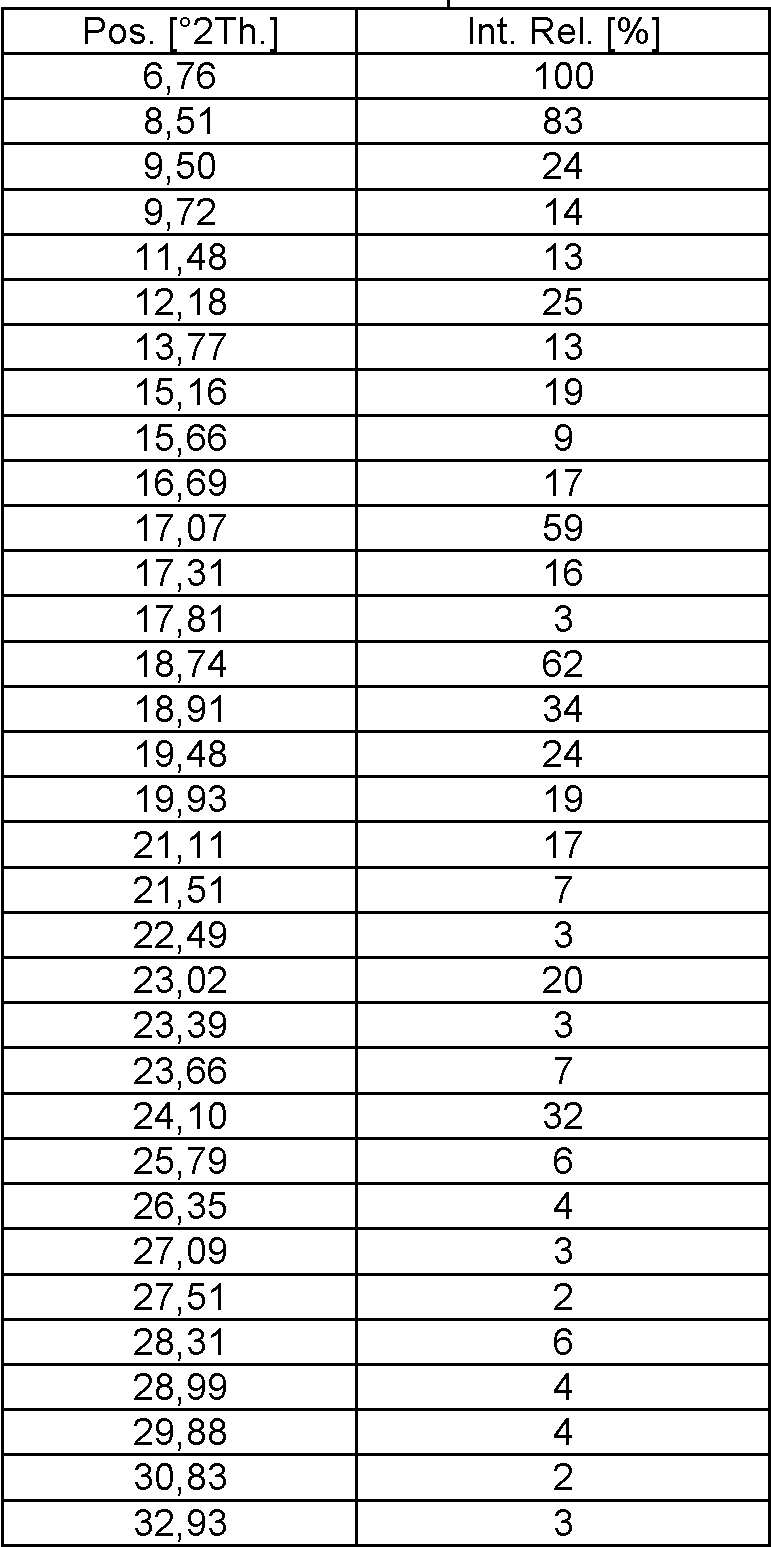

Este cocristal mejora enormemente la solubilidad de bilastina tal como se muestra en la figura 4.1.d).This co-crystal greatly improves the solubility of bilastine as shown in Figure 4.1.d).
Ejemplo 4.2. Forma cristalina SU(VII), cocristal de bilastina/ácido succínico 2:1Example 4.2. Crystal form SU (VII), co-crystal of bilastine / succinic acid 2: 1
Se obtuvo la forma cristalina suspendiendo bilastina y ácido succínico a una relación de estequiometría de 1:1, 1:2 ó 2:1 en EtOH. Tras agitar durante 15 h, se filtró la suspensión y se lavó el sólido con EtOH y se secó a vacío.The crystalline form was obtained by suspending bilastine and succinic acid at a stoichiometry ratio of 1: 1, 1: 2 or 2: 1 in EtOH. After stirring for 15 h, the suspension was filtered and the solid was washed with EtOH and dried in vacuo.
Esta forma cristalina también se obtuvo añadiendo EtOH (8 ml) a una mezcla de bilastina (1 g, 2,16 mmol) y ácido succínico (0,13 g, 0,5 eq, 1,10 mmol). Se sembró la suspensión resultante con SU(VII) y se agitó durante 20 horas a ta. Se aisló mediante filtración el sólido obtenido, se lavó con etanol (2 x 1 ml) y se secó a vacío, para producir 1,06 g de SU(VII) (rendimiento del 94%).This crystalline form was also obtained by adding EtOH (8 ml) to a mixture of bilastine (1 g, 2.16 mmol) and succinic acid (0.13 g, 0.5 eq, 1.10 mmol). The resulting suspension was seeded with SU (VII) and stirred for 20 hours at rt. The solid obtained was isolated by filtration, washed with ethanol (2 x 1 ml) and dried in vacuo to yield 1.06 g of SU (VII) (94% yield).
Se caracterizó el cocristal resultante mediante XPRD (véase la figura 4.2, a)), 1H-RMN (véase la figura 4.2, b)) y TGA (figura 4.2, c)). El análisis de XPDR confirmó que esta forma era estable en condiciones forzadas de humedad y temperatura (75 ± 5% de HR, 40°C) durante al menos 1 semana. Se confirmó una relación de bilastina:ácido succínico de 2:1 mediante 1H-RMN.The resulting co-crystal was characterized by XPRD (see Figure 4.2, a)), 1 H-NMR (see Figure 4.2, b)) and TGA (Figure 4.2, c)). The XPDR analysis confirmed that this form was stable under forced conditions of humidity and temperature (75 ± 5% RH, 40 ° C) for at least 1 week. A bilastine: succinic acid ratio of 2: 1 was confirmed by 1 H-NMR.
T l 4.2. Li i XRPD U(VII):T l 4.2. Li i XRPD U (VII):

Este cocristal mejora enormemente la solubilidad de bilastina tal como se muestra en la figura 4.2.d).This co-crystal greatly improves the solubility of bilastine as shown in Figure 4.2.d).
Ejemplo 5. Cocristales de bilastina/ácido benzoicoExample 5. Co-crystals of bilastine / benzoic acid
Ejemplo 5.1. Forma cristalina BE(I), cocristal de bilastina/ácido benzoico 1:2 Example 5.1 Crystal form BE (I), co-crystal of bilastine / benzoic acid 1: 2
Se obtuvo la forma cristalina triturando en húmedo una mezcla 1:2 de bilastina: ácido benzoico en ACN, MeOH, EtOH, IPA, EtOAc, THF, TBME, DCM, tolueno, DMF y NMP.The crystalline form was obtained by wet grinding a 1: 2 mixture of bilastine: benzoic acid in ACN, MeOH, EtOH, IPA, EtOAc, THF, TBME, DCM, toluene, DMF and NMP.
Esta forma cristalina también se obtuvo suspendiendo bilastina y ácido benzoico a una relación de estequiometría de 1:2 en agua, tolueno o TBME.This crystalline form was also obtained by suspending bilastine and benzoic acid at a stoichiometry ratio of 1: 2 in water, toluene or TBME.
Esta forma cristalina también se obtuvo sembrando una suspensión de BLN(I) (1 g, 2,16 mmol) y ácido benzoico (527 mg, 4,314 mmol en agua (10 ml) con BE(I). Se agitó la suspensión resultante durante 18 horas a ta. Se aisló mediante filtración el sólido obtenido, se lavó con agua (2 x 1 ml) y se secó a vacío, para producir 1,48 g de BE(I) como un sólido blanco (rendimiento del 97%).This crystalline form was also obtained by sowing a suspension of BLN (I) (1 g, 2.16 mmol) and benzoic acid (527 mg, 4.314 mmol in water (10 ml) with BE (I). The resulting suspension was stirred for 18 hours at rt The solid obtained was isolated by filtration, washed with water (2 x 1 ml) and dried in vacuo, to yield 1.48 g of BE (I) as a white solid (97% yield) .
Se caracterizó el cocristal resultante mediante XPRD (véase la figura 5.1, a)) y 1H-RMN (véase la figura 5.1, b)) y TGA (figura 5.1, c)). El análisis de XPDR confirmó que esta forma era estable en condiciones forzadas de humedad y temperatura (75 ± 5% de HR, 40°C) durante al menos 1 semana. Se confirmó una relación de bilastina:ácido benzoico de 1:2 mediante 1H-RMN.The resulting co-crystal was characterized by XPRD (see Figure 5.1, a)) and 1 H-NMR (see Figure 5.1, b)) and TGA (Figure 5.1, c)). The XPDR analysis confirmed that this form was stable under forced conditions of humidity and temperature (75 ± 5% RH, 40 ° C) for at least 1 week. A bilastine: benzoic acid ratio of 1: 2 was confirmed by 1 H-NMR.
T l .1. Li i XRPD BE(I):T l .1. Li i XRPD BE (I):

Este cocristal mejora enormemente la solubilidad de bilastina tal como se muestra en la figura 5.1.d).This co-crystal greatly improves the solubility of bilastine as shown in Figure 5.1.d).
Ejemplo 5.2. Forma cristalina BE(II), cocristal de bilastina/ácido benzoico 2:1Example 5.2. Crystal form BE (II), co-crystal of bilastine / benzoic acid 2: 1
Se obtuvo la forma cristalina suspendiendo bilastina y ácido benzoico a una relación de estequiometría de 2:1 en agua. Tras agitar durante 15 h, se filtró la suspensión y se lavó el sólido con agua y se secó a vacío.The crystalline form was obtained by suspending bilastine and benzoic acid at a stoichiometry ratio of 2: 1 in water. After stirring for 15 h, the suspension was filtered and the solid was washed with water and dried under vacuum.
Esta forma cristalina también se obtuvo añadiendo ácido benzoico (132 mg, 1,078 mmol) a una suspensión de BLN(I) (1 g, 2,16 mmol) en agua (10 ml). Se sembró la mezcla con BE(II) y se agitó durante 18 horas a ta. Se aisló mediante filtración el sólido obtenido, se lavó con agua (2 x 1 ml) y se secó a vacío, para producir 1,104 g de BE(II) como un sólido blanco (rendimiento del 92%).This crystalline form was also obtained by adding benzoic acid (132 mg, 1,078 mmol) to a suspension of BLN (I) (1 g, 2.16 mmol) in water (10 ml). The mixture was seeded with BE (II) and stirred for 18 hours at rt. The solid obtained was isolated by filtration, washed with water (2 x 1 ml) and dried in vacuo, to yield 1.104 g of BE (II) as a white solid (92% yield).
Se caracterizó el cocristal resultante mediante XPRD (véase la figura 5.2, a)), 1H-RMN (véase la figura 5.2, b)) y TGA (véase la figura 5.2, c)). El análisis de XPDR confirmó que esta forma era estable en condiciones forzadas de humedad y temperatura (75 ± 5% de HR, 40°C) durante al menos 1 semana. Se confirmó una relación de bilastina:ácido benzoico de 2:1 mediante 1H-RMN.The resulting co-crystal was characterized by XPRD (see Figure 5.2, a)), 1 H-NMR (see Figure 5.2, b)) and TGA (see Figure 5.2, c)). The XPDR analysis confirmed that this form was stable under forced conditions of humidity and temperature (75 ± 5% RH, 40 ° C) for at least 1 week. A relationship of bilastine: 2: 1 benzoic acid by 1 H-NMR.
T l .2. Li i XRPD BE(II):T l .2. Li i XRPD BE (II):

Este cocristal mejora enormemente la solubilidad de bilastina tal como se muestra en la figura 5.2.d).This co-crystal greatly improves the solubility of bilastine as shown in Figure 5.2.d).
Ejemplo 6. Cocristales de bilastina/ácido 4-aminobenzoicoExample 6. Co-crystals of bilastine / 4-aminobenzoic acid
Ejemplo 6.1. Forma cristalina AB(VII), cocristal de bilastina/ácido 4-aminobenzoico 1:1Example 6.1 Crystal form AB (VII), co-crystal of bilastine / 4-aminobenzoic acid 1: 1
Se obtuvo la forma cristalina suspendiendo una mezcla de bilastina y ácido 4-aminobenzoico a una relación de estequiometría de 1:2 en ACN. Tras agitar durante 15 h, se filtró la suspensión y se lavó el sólido con ACN y se secó a vacío.The crystalline form was obtained by suspending a mixture of bilastine and 4-aminobenzoic acid at a stoichiometry ratio of 1: 2 in ACN. After stirring for 15 h, the suspension was filtered and the solid was washed with ACN and dried in vacuo.
Esta forma cristalina también se obtuvo añadiendo ácido 4-aminobenzoico (592 mg, 4,314 mmol) a una suspensión de BLN(I) (1000 mg, 2,157 mmol) en ACN (10 ml). Se sembró la suspensión resultante con AB(VII) y se agitó durante 18 horas a ta. Se aisló mediante filtración el sólido obtenido, se lavó con acetonitrilo (2 x 1 ml) y se secó a vacío, para producir 1,276 g de AB(VII) como un sólido blanco (rendimiento del 77%).This crystalline form was also obtained by adding 4-aminobenzoic acid (592 mg, 4,314 mmol) to a suspension of BLN (I) (1000 mg, 2,157 mmol) in ACN (10 ml). The resulting suspension was seeded with AB (VII) and stirred for 18 hours at rt. The solid obtained was isolated by filtration, washed with acetonitrile (2 x 1 ml) and dried in vacuo, to yield 1.276 g of AB (VII) as a white solid (77% yield).
Se caracterizó el cocristal resultante mediante XPRD (véase la figura 6.1, a)) y 1H-RMN (véase la figura 6.1, b)) y TGA (figura 6.1, c)). El análisis de XPDR confirmó que esta forma era estable en condiciones forzadas de humedad y temperatura (75 ± 5% de HR, 40°C) durante al menos 1 semana. Se confirmó una relación de bilastina:ácido 4-aminobenzoico de 1:1 mediante 1H-RMN.The resulting co-crystal was characterized by XPRD (see Figure 6.1, a)) and 1 H-NMR (see Figure 6.1, b)) and TGA (Figure 6.1, c)). The XPDR analysis confirmed that this form was stable under forced conditions of humidity and temperature (75 ± 5% RH, 40 ° C) for at least 1 week. A bilastine: 4-aminobenzoic acid ratio of 1: 1 was confirmed by 1 H-NMR.
T l .1. Li i XRPD AB(VII):T l .1. Li i XRPD AB (VII):


Este cocristal mejora la solubilidad de bilastina tal como se muestra en la figura 6.1.d).This co-crystal improves the solubility of bilastine as shown in Figure 6.1.d).
Ejemplo 6.2. Forma cristalina AB(VIII), cocristal de bilastina/ácido 4-aminobenzoico 2:1Example 6.2. Crystal form AB (VIII), co-crystal of bilastine / 4-aminobenzoic acid 2: 1
Se obtuvo la forma cristalina suspendiendo una mezcla de bilastina (120 mg) y ácido 4-aminobenzoico a una relación de estequiometría de 2:1 en agua (15 mL). Tras agitar durante 15 h, se filtró la suspensión y se lavó el sólido con agua y se secó a vacío.The crystalline form was obtained by suspending a mixture of bilastine (120 mg) and 4-aminobenzoic acid at a stoichiometry ratio of 2: 1 in water (15 mL). After stirring for 15 h, the suspension was filtered and the solid was washed with water and dried under vacuum.
Esta forma cristalina también se obtuvo añadiendo ácido 4-aminobenzoico (148 mg, 1,078 mmol) a una suspensión de BLN(I) (1000 mg, 2,157 mmol) en agua (10 ml). Se sembró la suspensión resultante con AB(VIII) y se agitó durante 18 horas a ta. Se aisló mediante filtración el sólido obtenido, se lavó con agua (2 x 1 ml) y se secó a vacío, para producir 1,143 g de AB(VIII) como un sólido blanco (rendimiento del 95%).This crystalline form was also obtained by adding 4-aminobenzoic acid (148 mg, 1,078 mmol) to a suspension of BLN (I) (1000 mg, 2,157 mmol) in water (10 ml). The resulting suspension was seeded with AB (VIII) and stirred for 18 hours at rt. The solid obtained was isolated by filtration, washed with water (2 x 1 ml) and dried under vacuum, to yield 1,143 g of AB (VIII) as a white solid (95% yield).
Se caracterizó el cocristal resultante mediante XPRD (véase la figura 6.2, a)), 1H-RMN (véase la figura 6.2, b)) y TGA (véase la figura 6.2.c)). El análisis de XPDR confirmó que esta forma era estable en condiciones forzadas de humedad y temperatura (75 ± 5% de HR, 40°C) durante al menos 1 semana. Se confirmó una relación de bilastina:ácido 4-aminobenzoico de 2:1 mediante 1H-RMN.The resulting co-crystal was characterized by XPRD (see Figure 6.2, a)), 1 H-NMR (see Figure 6.2, b)) and TGA (see Figure 6.2.c)). The XPDR analysis confirmed that this form was stable under forced conditions of humidity and temperature (75 ± 5% RH, 40 ° C) for at least 1 week. A bilastine: 4-aminobenzoic acid ratio of 2: 1 was confirmed by 1 H-NMR.
T l .2. Li i XRPD AB VIII):T l .2. Li i XRPD AB VIII):


Este cocristal mejora la solubilidad de bilastina tal como se muestra en la figura 6.2.d).This co-crystal improves the solubility of bilastine as shown in Figure 6.2.d).
Ejemplo 7. Cocristales de bilastina/ácido L-málicoExample 7. Co-crystals of bilastine / L-malic acid
Ejemplo 7.1. Forma cristalina L-ML(I), cocristal de bilastina/ácido L-málico 2:1Example 7.1. Crystal form L-ML (I), co-crystal of bilastine / L-malic acid 2: 1
Se obtuvo la forma cristalina suspendiendo o triturando en húmedo una mezcla de bilastina y ácido L-málico a una relación de estequiometría de 1:2 en agua.The crystalline form was obtained by suspending or wet grinding a mixture of bilastine and L-malic acid at a stoichiometry ratio of 1: 2 in water.
Esta forma cristalina también se obtuvo añadiendo ácido L-málico (578,5 mg, 4,314 mmol) a una suspensión de BLN(I) (1000 mg, 2,157 mmol) en agua (10 ml). Se sembró la suspensión resultante con L-ML(I) y se agitó durante 18 horas a ta. Se aisló mediante filtración el sólido obtenido, se lavó con agua (2 x 1 ml) y se secó a vacío, para producir 985 mg de L-ML(I) como un sólido blanco (rendimiento del 82%).This crystalline form was also obtained by adding L-malic acid (578.5 mg, 4,314 mmol) to a suspension of BLN (I) (1000 mg, 2,157 mmol) in water (10 ml). The resulting suspension was seeded with L-ML (I) and stirred for 18 hours at rt. The solid obtained was isolated by filtration, washed with water (2 x 1 ml) and dried in vacuo, to yield 985 mg of L-ML (I) as a white solid (82% yield).
Se caracterizó el cocristal resultante mediante XPRD (véase la figura 7.1, a)), 1H-RMN (véase la figura 7.1, b)) y TGA (véase la figura 7.1, c)). El análisis de XPDR confirmó que esta forma era estable en condiciones forzadas de humedad y temperatura (75 ± 5% de HR, 40°C) durante al menos 1 semana. Se confirmó una relación de bilastina:ácido L-málico de 2:1 mediante 1H-RMN.The resulting co-crystal was characterized by XPRD (see Figure 7.1, a)), 1 H-NMR (see Figure 7.1, b)) and TGA (see Figure 7.1, c)). The XPDR analysis confirmed that this form was stable under forced conditions of humidity and temperature (75 ± 5% RH, 40 ° C) for at least 1 week. A bilastine: L-malic acid ratio of 2: 1 was confirmed by 1 H-NMR.
T l 7.1. Li i XRPD L-ML(I):T l 7.1. Li i XRPD L-ML (I):


Este cocristal mejora enormemente la solubilidad de bilastina tal como se muestra en la figura 7.1.d).This co-crystal greatly improves the solubility of bilastine as shown in Figure 7.1.d).
Ejemplo 8. Cocristales de bilastina/resorcinolExample 8. Co-crystals of bilastine / resorcinol
Ejemplo 8.1. Forma cristalina RE(IV), cocristal de bilastina/ácido resorcinol 2:1.Example 8.1. Crystal form RE (IV), co-crystal of bilastine / resorcinol acid 2: 1.
Se obtuvo la forma cristalina suspendiendo una mezcla de bilastina y resorcinol a una relación de estequiometría de 1:2 en acetona y a una relación de estequiometría de 2:1 en cloroformo.The crystalline form was obtained by suspending a mixture of bilastine and resorcinol at a stoichiometry ratio of 1: 2 in acetone and at a stoichiometry ratio of 2: 1 in chloroform.
La forma cristalina también se obtuvo suspendiendo una mezcla de bilastina y resorcinol a una relación de estequiometría de 1:1 ó 1:2 en acetona. Tras agitar durante 15 h, se filtró la suspensión y se lavó el sólido con acetona y se secó a vacío.The crystalline form was also obtained by suspending a mixture of bilastine and resorcinol at a stoichiometry ratio of 1: 1 or 1: 2 in acetone. After stirring for 15 h, the suspension was filtered and the solid was washed with acetone and dried in vacuo.
Esta forma cristalina también se obtuvo añadiendo resorcinol (119 mg, 1,078 mmol) a una suspensión de BLN(I) (1000 mg, 2,157 mmol) en AcOEt (10 ml). Se sembró la suspensión resultante con RE(IV) y se agitó durante 18 horas a ta. Se aisló mediante filtración el sólido obtenido, se lavó con AcOEt (2 x 1 ml) y se secó a vacío, para producir 1,099 mg de RE(IV) como un sólido blanco (rendimiento del 98%).This crystalline form was also obtained by adding resorcinol (119 mg, 1,078 mmol) to a suspension of BLN (I) (1000 mg, 2,157 mmol) in AcOEt (10 ml). The resulting suspension was seeded with RE (IV) and stirred for 18 hours at rt. The solid obtained was isolated by filtration, washed with AcOEt (2 x 1 ml) and dried in vacuo, to yield 1.099 mg of RE (IV) as a white solid (98% yield).
Se caracterizó el cocristal resultante mediante XPRD (véase la figura 8.1, a)), 1H-RMN (véase la figura 8.1, b)) y TGA (figura 8.1, c)). El análisis de XPDR confirmó que esta forma era estable en condiciones forzadas de humedad y temperatura (75 ± 5% de HR, 40°C) durante al menos 1 semana. Se confirmó una relación de bilastina:resorcinol de 2:1 mediante 1H-RMN.The resulting co-crystal was characterized by XPRD (see Figure 8.1, a)), 1 H-NMR (see Figure 8.1, b)) and TGA (Figure 8.1, c)). The XPDR analysis confirmed that this form was stable under forced conditions of humidity and temperature (75 ± 5% RH, 40 ° C) for at least 1 week. A bilastine: resorcinol ratio of 2: 1 was confirmed by 1 H-NMR.
T l .2. Li i XRPD RE(IV):T l .2. Li and XRPD RE (IV):


Este cocristal mejora enormemente la solubilidad de bilastina tal como se muestra en la figura 8.1.d).This co-crystal greatly improves the solubility of bilastine as shown in Figure 8.1.d).
Ejemplo 9. Cocristales de bilastina/4-hidroxibenzoato de metiloExample 9. Methyl bilastine / 4-hydroxybenzoate co-crystals
Ejemplo 9.1. Forma cristalina, cocristal de bilastina/4-hidroxibenzoato de metilo 2:1Example 9.1. 2: 1 crystalline, co-crystalline form of bilastine / methyl 4-hydroxybenzoate
Se obtuvo la forma cristalina mediante el procedimiento siguiente: Se suspendieron bilastina (500 mg) y 4-hidroxibenzoato de metilo (1 eq, 83 mg) en agua (8 ml) a 65°C. Se separó por filtración el sólido obtenido, se lavó con etanol y se secó a vacío. (Rendimiento de 480 mg - 83%).The crystalline form was obtained by the following procedure: Bilastine (500 mg) and methyl 4-hydroxybenzoate (1 eq, 83 mg) were suspended in water (8 ml) at 65 ° C. The solid obtained was filtered off, washed with ethanol and dried in vacuo. (Yield of 480 mg - 83%).
Se caracterizó el cocristal resultante mediante XPRD (véase la figura 9.1, a)), 1H-RMN (véase la figura 9.1, b)), TGA (véase la figura 9.1, c)) y FT-IR (véase la figura 9.1 d)). Se confirmó una relación de bilastina:4-hidroxibenzoato de metilo de 1:2 mediante 1H-RMN. Se encontró que el cocristal era estable durante al menos 4 h tras calentar a 2-3 mbar y 40°C.The resulting co-crystal was characterized by XPRD (see figure 9.1, a)), 1 H-NMR (see figure 9.1, b)), TGA (see figure 9.1, c)) and FT-IR (see figure 9.1 d )). A ratio of bilastine: methyl 4-hydroxybenzoate of 1: 2 was confirmed by 1 H-NMR. The co-crystal was found to be stable for at least 4 h after heating to 2-3 mbar and 40 ° C.
Ejemplo 10. Cocristales de bilastina/N-4-hidroxifenilacetamidaExample 10. Co-crystals of bilastine / N-4-hydroxyphenylacetamide
Ejemplo 10.1. Forma cristalina, cocristal de bilastina/N-4-hidroxifenilacetamidaExample 10.1. Crystalline, co-crystalline form of bilastine / N-4-hydroxyphenylacetamide
Se obtuvo el cocristal a través de suspensión en agua.The co-crystal was obtained through suspension in water.
Se caracterizó el cocristal resultante mediante XPRD (véase la figura 10.1, a)) y FT-IR (véase la figura 10.1, b)). The resulting co-crystal was characterized by XPRD (see Figure 10.1, a)) and FT-IR (see Figure 10.1, b)).
Claims (10)
Applications Claiming Priority (2)
| Application Number | Priority Date | Filing Date | Title |
|---|---|---|---|
| EP15382577.3A EP3170817A1 (en) | 2015-11-20 | 2015-11-20 | Co-crystals of benzimidazole compounds |
| PCT/EP2016/078145 WO2017085258A1 (en) | 2015-11-20 | 2016-11-18 | Co-crystals of benzimidazole compounds |
Publications (1)
| Publication Number | Publication Date |
|---|---|
| ES2745080T3 true ES2745080T3 (en) | 2020-02-27 |
Family
ID=54707731
Family Applications (1)
| Application Number | Title | Priority Date | Filing Date |
|---|---|---|---|
| ES16797941T Active ES2745080T3 (en) | 2015-11-20 | 2016-11-18 | Benzimidazole compound crystals |
Country Status (11)
| Country | Link |
|---|---|
| US (1) | US20180319766A1 (en) |
| EP (2) | EP3170817A1 (en) |
| JP (1) | JP2018535223A (en) |
| CN (1) | CN108290857A (en) |
| BR (1) | BR112018010276A2 (en) |
| CA (1) | CA3005387A1 (en) |
| EA (1) | EA201891168A1 (en) |
| ES (1) | ES2745080T3 (en) |
| MX (1) | MX2018006252A (en) |
| PT (1) | PT3377478T (en) |
| WO (1) | WO2017085258A1 (en) |
Family Cites Families (8)
| Publication number | Priority date | Publication date | Assignee | Title |
|---|---|---|---|---|
| ES2048109B1 (en) | 1992-07-20 | 1994-12-16 | Espanola Prod Quimicos | PROCEDURE FOR THE PREPARATION OF NEW PIPERIDIC DERIVATIVES OF BENCIMIDAZOLE. |
| ES2124167B1 (en) | 1996-06-04 | 1999-09-16 | Espanola Prod Quimicos | NEW DERIVATIVES OF BENZMIDAZOLE WITH ANTIHISTAMINE ACTIVITY. |
| NZ536551A (en) * | 2002-04-19 | 2006-08-31 | Faes Farma S | Preparation of polymorphous cyrstalline form, known as bilastine, and its antihistaminic and antiallergenic use |
| US20080132419A1 (en) * | 2006-10-04 | 2008-06-05 | Nair Rodriguez-Hornedo | Dissolution and precipitation of cocrystals with ionizable components |
| TWI580442B (en) * | 2011-10-19 | 2017-05-01 | 傑特大學 | Pharmaceutical nanosuspension |
| CN103351380B (en) * | 2013-06-30 | 2019-01-22 | 北京万全德众医药生物技术有限公司 | A method of preparing bilastine |
| SK7066Y1 (en) | 2014-01-29 | 2015-03-03 | Zentiva Ks | Crystalline dihydrate bilastine |
| CN103788062A (en) | 2014-02-17 | 2014-05-14 | 北京博泽德润医药科技开发有限公司 | Bilastine crystal form and preparation method thereof |
-
2015
- 2015-11-20 EP EP15382577.3A patent/EP3170817A1/en not_active Withdrawn
-
2016
- 2016-11-18 EP EP16797941.8A patent/EP3377478B1/en active Active
- 2016-11-18 EA EA201891168A patent/EA201891168A1/en unknown
- 2016-11-18 PT PT167979418T patent/PT3377478T/en unknown
- 2016-11-18 ES ES16797941T patent/ES2745080T3/en active Active
- 2016-11-18 US US15/775,831 patent/US20180319766A1/en not_active Abandoned
- 2016-11-18 BR BR112018010276A patent/BR112018010276A2/en not_active Application Discontinuation
- 2016-11-18 MX MX2018006252A patent/MX2018006252A/en unknown
- 2016-11-18 WO PCT/EP2016/078145 patent/WO2017085258A1/en not_active Ceased
- 2016-11-18 JP JP2018526145A patent/JP2018535223A/en not_active Withdrawn
- 2016-11-18 CA CA3005387A patent/CA3005387A1/en not_active Abandoned
- 2016-11-18 CN CN201680067635.0A patent/CN108290857A/en active Pending
Also Published As
| Publication number | Publication date |
|---|---|
| EP3377478B1 (en) | 2019-07-24 |
| JP2018535223A (en) | 2018-11-29 |
| EA201891168A1 (en) | 2018-11-30 |
| PT3377478T (en) | 2019-10-11 |
| BR112018010276A2 (en) | 2018-11-27 |
| EP3170817A1 (en) | 2017-05-24 |
| MX2018006252A (en) | 2019-04-04 |
| CN108290857A (en) | 2018-07-17 |
| WO2017085258A1 (en) | 2017-05-26 |
| CA3005387A1 (en) | 2017-05-26 |
| US20180319766A1 (en) | 2018-11-08 |
| EP3377478A1 (en) | 2018-09-26 |
Similar Documents
| Publication | Publication Date | Title |
|---|---|---|
| ES2901375T3 (en) | Solid state forms of lumateperone ditosylate salt | |
| ES2732845T3 (en) | Aramchol salts | |
| ES2732360T3 (en) | Crystalline form of 4- [5- (pyridin-4-yl) -1H-1,2,4-triazol-3-yl] pyridin-2-carbonitrile | |
| HK1203071A1 (en) | Stabilized crystal of tipiracil hydrochloride, and crystallization method for same | |
| CN104316608B (en) | Detection of Azilsartan impurity and preparation method thereof | |
| WO2018006870A1 (en) | Galunisertib crystal form and preparation method therefor and use thereof | |
| CN109400598B (en) | Berberine hydrochloride and lactic acid co-crystal, its preparation method and application | |
| CA2962724C (en) | Salt of dicarboxylic acid compound | |
| ES2778434T3 (en) | Supersaturated Compositions of Benzimidazole Compounds | |
| ES2745080T3 (en) | Benzimidazole compound crystals | |
| US11267791B2 (en) | Highly stable crystalline Eltrombopag monoethanolamine salt form D1 | |
| RU2552354C2 (en) | Polymorph of (4-hydroxycarbamoylphenyl)carbaminic acid (6-diethylaminomethyl-2-naphthalenyl)methyl ether hydrochloride | |
| ES2836099T3 (en) | Crystal of an L-proline / sodium-glucose cotransporter type 2 inhibitor complex | |
| HK1253978B (en) | Co-crystals of bilastine | |
| HK1253978A1 (en) | Co-crystals of bilastine | |
| CN104876866A (en) | Alpha-crystal-form lappaconitine and preparation method thereof | |
| US10174001B2 (en) | Crystals of 5-cyclopropyl-2-((1-(3-fluorobenzyl)-1H-indol-5-yl)amino)nicotinic acid | |
| ES2747905T3 (en) | (R) -5- [2- (5,6-Diethylindan-2-ylamino) -1-hydroxyethyl] -8-hydroxy-1H-quinolin-2-one L-tartrate mixed solvate | |
| EP3412661A1 (en) | Cocrystals of vortioxetine hydrobromide and resorcinol | |
| US20230105181A1 (en) | Salts and polymorphic forms of 6-chloro-7-(4-(4-chlorobenzyl)piperazin-1-yl)-2-(1,3-dimethyl-1h-pyrazol-4-yl)-3h-imidazo[4,5-b]pyridine | |
| HK40014994A (en) | Stabilized crystal of tipiracil hydrochloride, and crystallization method for same | |
| CN112142730A (en) | Solid form of heteroaryl and tetrahydropyridine compounds and preparation method thereof | |
| HK40007656A (en) | Stabilized crystal of tipiracil hydrochloride, and crystallization method for same | |
| HK1234749A1 (en) | Stabilized crystal of tipiracil hydrochloride, and crystallization method for same |