ES2750776T3 - Three-component composition for manufacturing polyurethane hybrid cementitious screed or flooring with improved surface gloss - Google Patents
Three-component composition for manufacturing polyurethane hybrid cementitious screed or flooring with improved surface gloss Download PDFInfo
- Publication number
- ES2750776T3 ES2750776T3 ES15720747T ES15720747T ES2750776T3 ES 2750776 T3 ES2750776 T3 ES 2750776T3 ES 15720747 T ES15720747 T ES 15720747T ES 15720747 T ES15720747 T ES 15720747T ES 2750776 T3 ES2750776 T3 ES 2750776T3
- Authority
- ES
- Spain
- Prior art keywords
- component
- weight
- polyol
- mdi
- composition according
- Prior art date
- Legal status (The legal status is an assumption and is not a legal conclusion. Google has not performed a legal analysis and makes no representation as to the accuracy of the status listed.)
- Active
Links
- 239000000203 mixture Substances 0.000 title claims abstract description 124
- 239000004814 polyurethane Substances 0.000 title claims description 27
- 229920002635 polyurethane Polymers 0.000 title claims description 26
- 238000009408 flooring Methods 0.000 title claims description 21
- 238000004519 manufacturing process Methods 0.000 title claims description 8
- 229920005862 polyol Polymers 0.000 claims abstract description 114
- UPMLOUAZCHDJJD-UHFFFAOYSA-N 4,4'-Diphenylmethane Diisocyanate Chemical compound C1=CC(N=C=O)=CC=C1CC1=CC=C(N=C=O)C=C1 UPMLOUAZCHDJJD-UHFFFAOYSA-N 0.000 claims abstract description 113
- 150000003077 polyols Chemical class 0.000 claims abstract description 110
- 239000004568 cement Substances 0.000 claims abstract description 35
- XLYOFNOQVPJJNP-UHFFFAOYSA-N water Substances O XLYOFNOQVPJJNP-UHFFFAOYSA-N 0.000 claims abstract description 32
- 229920001228 polyisocyanate Polymers 0.000 claims abstract description 22
- 239000005056 polyisocyanate Substances 0.000 claims abstract description 22
- 239000011230 binding agent Substances 0.000 claims abstract description 15
- 239000000843 powder Substances 0.000 claims abstract description 13
- -1 C12 alkyl diols Chemical class 0.000 claims description 30
- AXCZMVOFGPJBDE-UHFFFAOYSA-L calcium dihydroxide Chemical compound [OH-].[OH-].[Ca+2] AXCZMVOFGPJBDE-UHFFFAOYSA-L 0.000 claims description 24
- 239000000920 calcium hydroxide Substances 0.000 claims description 24
- 229910001861 calcium hydroxide Inorganic materials 0.000 claims description 24
- ODINCKMPIJJUCX-UHFFFAOYSA-N calcium oxide Inorganic materials [Ca]=O ODINCKMPIJJUCX-UHFFFAOYSA-N 0.000 claims description 21
- 238000002156 mixing Methods 0.000 claims description 21
- 239000000292 calcium oxide Substances 0.000 claims description 19
- BRPQOXSCLDDYGP-UHFFFAOYSA-N calcium oxide Chemical compound [O-2].[Ca+2] BRPQOXSCLDDYGP-UHFFFAOYSA-N 0.000 claims description 17
- 239000004576 sand Substances 0.000 claims description 17
- 239000011248 coating agent Substances 0.000 claims description 15
- 238000000576 coating method Methods 0.000 claims description 15
- 239000000463 material Substances 0.000 claims description 15
- 229940043430 calcium compound Drugs 0.000 claims description 13
- 150000001674 calcium compounds Chemical class 0.000 claims description 13
- 239000003921 oil Substances 0.000 claims description 13
- 238000000034 method Methods 0.000 claims description 12
- LYCAIKOWRPUZTN-UHFFFAOYSA-N Ethylene glycol Chemical group OCCO LYCAIKOWRPUZTN-UHFFFAOYSA-N 0.000 claims description 10
- 239000004359 castor oil Substances 0.000 claims description 8
- 235000019438 castor oil Nutrition 0.000 claims description 8
- ZEMPKEQAKRGZGQ-XOQCFJPHSA-N glycerol triricinoleate Natural products CCCCCC[C@@H](O)CC=CCCCCCCCC(=O)OC[C@@H](COC(=O)CCCCCCCC=CC[C@@H](O)CCCCCC)OC(=O)CCCCCCCC=CC[C@H](O)CCCCCC ZEMPKEQAKRGZGQ-XOQCFJPHSA-N 0.000 claims description 8
- PEDCQBHIVMGVHV-UHFFFAOYSA-N Glycerine Chemical compound OCC(O)CO PEDCQBHIVMGVHV-UHFFFAOYSA-N 0.000 claims description 6
- 150000001298 alcohols Polymers 0.000 claims description 5
- 238000000691 measurement method Methods 0.000 claims description 4
- 238000007385 chemical modification Methods 0.000 claims description 3
- 239000000758 substrate Substances 0.000 claims description 3
- ZIBGPFATKBEMQZ-UHFFFAOYSA-N triethylene glycol Chemical group OCCOCCOCCO ZIBGPFATKBEMQZ-UHFFFAOYSA-N 0.000 claims description 3
- 229920000728 polyester Polymers 0.000 claims description 2
- 235000000346 sugar Nutrition 0.000 claims description 2
- 150000008163 sugars Chemical class 0.000 claims description 2
- 239000010802 sludge Substances 0.000 abstract description 20
- 150000001875 compounds Chemical class 0.000 abstract 1
- 239000000047 product Substances 0.000 description 61
- VYPSYNLAJGMNEJ-UHFFFAOYSA-N Silicium dioxide Chemical compound O=[Si]=O VYPSYNLAJGMNEJ-UHFFFAOYSA-N 0.000 description 26
- 235000011116 calcium hydroxide Nutrition 0.000 description 22
- 239000000126 substance Substances 0.000 description 18
- 239000000654 additive Substances 0.000 description 14
- 238000005259 measurement Methods 0.000 description 14
- 230000015572 biosynthetic process Effects 0.000 description 12
- 238000012360 testing method Methods 0.000 description 11
- 239000004615 ingredient Substances 0.000 description 10
- 238000006243 chemical reaction Methods 0.000 description 9
- 239000003995 emulsifying agent Substances 0.000 description 7
- 239000003822 epoxy resin Substances 0.000 description 7
- 229920000647 polyepoxide Polymers 0.000 description 7
- 229920003171 Poly (ethylene oxide) Polymers 0.000 description 6
- 230000007423 decrease Effects 0.000 description 6
- 150000002009 diols Chemical class 0.000 description 6
- 239000003925 fat Substances 0.000 description 6
- 238000010438 heat treatment Methods 0.000 description 6
- 229920001451 polypropylene glycol Polymers 0.000 description 6
- PGYPOBZJRVSMDS-UHFFFAOYSA-N loperamide hydrochloride Chemical compound Cl.C=1C=CC=CC=1C(C=1C=CC=CC=1)(C(=O)N(C)C)CCN(CC1)CCC1(O)C1=CC=C(Cl)C=C1 PGYPOBZJRVSMDS-UHFFFAOYSA-N 0.000 description 5
- 238000007086 side reaction Methods 0.000 description 5
- 239000000377 silicon dioxide Substances 0.000 description 5
- 150000004072 triols Chemical class 0.000 description 5
- VTYYLEPIZMXCLO-UHFFFAOYSA-L Calcium carbonate Chemical compound [Ca+2].[O-]C([O-])=O VTYYLEPIZMXCLO-UHFFFAOYSA-L 0.000 description 4
- 239000004721 Polyphenylene oxide Substances 0.000 description 4
- 239000011398 Portland cement Substances 0.000 description 4
- 238000001354 calcination Methods 0.000 description 4
- 239000002761 deinking Substances 0.000 description 4
- 230000036571 hydration Effects 0.000 description 4
- 238000006703 hydration reaction Methods 0.000 description 4
- 239000012948 isocyanate Substances 0.000 description 4
- 239000004014 plasticizer Substances 0.000 description 4
- 229920000570 polyether Polymers 0.000 description 4
- IAYPIBMASNFSPL-UHFFFAOYSA-N Ethylene oxide Chemical compound C1CO1 IAYPIBMASNFSPL-UHFFFAOYSA-N 0.000 description 3
- 150000001412 amines Chemical class 0.000 description 3
- 239000011575 calcium Substances 0.000 description 3
- 235000014113 dietary fatty acids Nutrition 0.000 description 3
- MTHSVFCYNBDYFN-UHFFFAOYSA-N diethylene glycol Chemical compound OCCOCCO MTHSVFCYNBDYFN-UHFFFAOYSA-N 0.000 description 3
- 239000000194 fatty acid Substances 0.000 description 3
- 229930195729 fatty acid Natural products 0.000 description 3
- 238000005227 gel permeation chromatography Methods 0.000 description 3
- 125000002887 hydroxy group Chemical group [H]O* 0.000 description 3
- 229910052500 inorganic mineral Inorganic materials 0.000 description 3
- 235000010755 mineral Nutrition 0.000 description 3
- 239000011707 mineral Substances 0.000 description 3
- SYSQUGFVNFXIIT-UHFFFAOYSA-N n-[4-(1,3-benzoxazol-2-yl)phenyl]-4-nitrobenzenesulfonamide Chemical class C1=CC([N+](=O)[O-])=CC=C1S(=O)(=O)NC1=CC=C(C=2OC3=CC=CC=C3N=2)C=C1 SYSQUGFVNFXIIT-UHFFFAOYSA-N 0.000 description 3
- 239000000049 pigment Substances 0.000 description 3
- 239000002699 waste material Substances 0.000 description 3
- IRIAEXORFWYRCZ-UHFFFAOYSA-N Butylbenzyl phthalate Chemical compound CCCCOC(=O)C1=CC=CC=C1C(=O)OCC1=CC=CC=C1 IRIAEXORFWYRCZ-UHFFFAOYSA-N 0.000 description 2
- UQSXHKLRYXJYBZ-UHFFFAOYSA-N Iron oxide Chemical compound [Fe]=O UQSXHKLRYXJYBZ-UHFFFAOYSA-N 0.000 description 2
- 229920005863 Lupranol® Polymers 0.000 description 2
- 229920001730 Moisture cure polyurethane Polymers 0.000 description 2
- WYURNTSHIVDZCO-UHFFFAOYSA-N Tetrahydrofuran Chemical compound C1CCOC1 WYURNTSHIVDZCO-UHFFFAOYSA-N 0.000 description 2
- IISBACLAFKSPIT-UHFFFAOYSA-N bisphenol A Chemical compound C=1C=C(O)C=CC=1C(C)(C)C1=CC=C(O)C=C1 IISBACLAFKSPIT-UHFFFAOYSA-N 0.000 description 2
- WERYXYBDKMZEQL-UHFFFAOYSA-N butane-1,4-diol Chemical compound OCCCCO WERYXYBDKMZEQL-UHFFFAOYSA-N 0.000 description 2
- 229910000019 calcium carbonate Inorganic materials 0.000 description 2
- 235000010216 calcium carbonate Nutrition 0.000 description 2
- 239000007795 chemical reaction product Substances 0.000 description 2
- 239000003795 chemical substances by application Substances 0.000 description 2
- 239000002131 composite material Substances 0.000 description 2
- 239000007857 degradation product Substances 0.000 description 2
- 238000006731 degradation reaction Methods 0.000 description 2
- 230000001419 dependent effect Effects 0.000 description 2
- 238000002474 experimental method Methods 0.000 description 2
- 150000004665 fatty acids Chemical class 0.000 description 2
- 150000002191 fatty alcohols Chemical class 0.000 description 2
- 125000000524 functional group Chemical group 0.000 description 2
- 238000007037 hydroformylation reaction Methods 0.000 description 2
- 238000005984 hydrogenation reaction Methods 0.000 description 2
- 230000001965 increasing effect Effects 0.000 description 2
- 239000001023 inorganic pigment Substances 0.000 description 2
- IQPQWNKOIGAROB-UHFFFAOYSA-N isocyanate group Chemical group [N-]=C=O IQPQWNKOIGAROB-UHFFFAOYSA-N 0.000 description 2
- 239000007788 liquid Substances 0.000 description 2
- DMKSVUSAATWOCU-HROMYWEYSA-N loteprednol etabonate Chemical compound C1CC2=CC(=O)C=C[C@]2(C)[C@@H]2[C@@H]1[C@@H]1CC[C@@](C(=O)OCCl)(OC(=O)OCC)[C@@]1(C)C[C@@H]2O DMKSVUSAATWOCU-HROMYWEYSA-N 0.000 description 2
- 239000004570 mortar (masonry) Substances 0.000 description 2
- 239000012860 organic pigment Substances 0.000 description 2
- 239000002245 particle Substances 0.000 description 2
- 239000002893 slag Substances 0.000 description 2
- 239000011343 solid material Substances 0.000 description 2
- 239000002904 solvent Substances 0.000 description 2
- 239000007858 starting material Substances 0.000 description 2
- 238000003786 synthesis reaction Methods 0.000 description 2
- DNIAPMSPPWPWGF-VKHMYHEASA-N (+)-propylene glycol Chemical compound C[C@H](O)CO DNIAPMSPPWPWGF-VKHMYHEASA-N 0.000 description 1
- CHRJZRDFSQHIFI-UHFFFAOYSA-N 1,2-bis(ethenyl)benzene;styrene Chemical compound C=CC1=CC=CC=C1.C=CC1=CC=CC=C1C=C CHRJZRDFSQHIFI-UHFFFAOYSA-N 0.000 description 1
- OKIRBHVFJGXOIS-UHFFFAOYSA-N 1,2-di(propan-2-yl)benzene Chemical compound CC(C)C1=CC=CC=C1C(C)C OKIRBHVFJGXOIS-UHFFFAOYSA-N 0.000 description 1
- YPFDHNVEDLHUCE-UHFFFAOYSA-N 1,3-propanediol Substances OCCCO YPFDHNVEDLHUCE-UHFFFAOYSA-N 0.000 description 1
- LCZVSXRMYJUNFX-UHFFFAOYSA-N 2-[2-(2-hydroxypropoxy)propoxy]propan-1-ol Chemical class CC(O)COC(C)COC(C)CO LCZVSXRMYJUNFX-UHFFFAOYSA-N 0.000 description 1
- QZCLKYGREBVARF-UHFFFAOYSA-N Acetyl tributyl citrate Chemical compound CCCCOC(=O)CC(C(=O)OCCCC)(OC(C)=O)CC(=O)OCCCC QZCLKYGREBVARF-UHFFFAOYSA-N 0.000 description 1
- NLHHRLWOUZZQLW-UHFFFAOYSA-N Acrylonitrile Chemical compound C=CC#N NLHHRLWOUZZQLW-UHFFFAOYSA-N 0.000 description 1
- OYPRJOBELJOOCE-UHFFFAOYSA-N Calcium Chemical compound [Ca] OYPRJOBELJOOCE-UHFFFAOYSA-N 0.000 description 1
- OKTJSMMVPCPJKN-UHFFFAOYSA-N Carbon Chemical compound [C] OKTJSMMVPCPJKN-UHFFFAOYSA-N 0.000 description 1
- 229920003043 Cellulose fiber Polymers 0.000 description 1
- 235000008733 Citrus aurantifolia Nutrition 0.000 description 1
- FBPFZTCFMRRESA-FSIIMWSLSA-N D-Glucitol Natural products OC[C@H](O)[C@H](O)[C@@H](O)[C@H](O)CO FBPFZTCFMRRESA-FSIIMWSLSA-N 0.000 description 1
- FBPFZTCFMRRESA-KVTDHHQDSA-N D-Mannitol Chemical compound OC[C@@H](O)[C@@H](O)[C@H](O)[C@H](O)CO FBPFZTCFMRRESA-KVTDHHQDSA-N 0.000 description 1
- FBPFZTCFMRRESA-JGWLITMVSA-N D-glucitol Chemical compound OC[C@H](O)[C@@H](O)[C@H](O)[C@H](O)CO FBPFZTCFMRRESA-JGWLITMVSA-N 0.000 description 1
- 239000004593 Epoxy Substances 0.000 description 1
- 229930195725 Mannitol Natural products 0.000 description 1
- 239000004793 Polystyrene Substances 0.000 description 1
- CZMRCDWAGMRECN-UGDNZRGBSA-N Sucrose Chemical compound O[C@H]1[C@H](O)[C@@H](CO)O[C@@]1(CO)O[C@@H]1[C@H](O)[C@@H](O)[C@H](O)[C@@H](CO)O1 CZMRCDWAGMRECN-UGDNZRGBSA-N 0.000 description 1
- 229930006000 Sucrose Natural products 0.000 description 1
- 235000011941 Tilia x europaea Nutrition 0.000 description 1
- ZJCCRDAZUWHFQH-UHFFFAOYSA-N Trimethylolpropane Chemical compound CCC(CO)(CO)CO ZJCCRDAZUWHFQH-UHFFFAOYSA-N 0.000 description 1
- TVXBFESIOXBWNM-UHFFFAOYSA-N Xylitol Natural products OCCC(O)C(O)C(O)CCO TVXBFESIOXBWNM-UHFFFAOYSA-N 0.000 description 1
- YIMQCDZDWXUDCA-UHFFFAOYSA-N [4-(hydroxymethyl)cyclohexyl]methanol Chemical compound OCC1CCC(CO)CC1 YIMQCDZDWXUDCA-UHFFFAOYSA-N 0.000 description 1
- 239000002318 adhesion promoter Substances 0.000 description 1
- 150000001343 alkyl silanes Chemical class 0.000 description 1
- PNEYBMLMFCGWSK-UHFFFAOYSA-N aluminium oxide Inorganic materials [O-2].[O-2].[O-2].[Al+3].[Al+3] PNEYBMLMFCGWSK-UHFFFAOYSA-N 0.000 description 1
- 238000013459 approach Methods 0.000 description 1
- 239000000440 bentonite Substances 0.000 description 1
- 229910000278 bentonite Inorganic materials 0.000 description 1
- SVPXDRXYRYOSEX-UHFFFAOYSA-N bentoquatam Chemical compound O.O=[Si]=O.O=[Al]O[Al]=O SVPXDRXYRYOSEX-UHFFFAOYSA-N 0.000 description 1
- 150000001558 benzoic acid derivatives Chemical class 0.000 description 1
- 239000003139 biocide Substances 0.000 description 1
- 230000033228 biological regulation Effects 0.000 description 1
- 239000011400 blast furnace cement Substances 0.000 description 1
- CDQSJQSWAWPGKG-UHFFFAOYSA-N butane-1,1-diol Chemical class CCCC(O)O CDQSJQSWAWPGKG-UHFFFAOYSA-N 0.000 description 1
- 229910052791 calcium Inorganic materials 0.000 description 1
- CJZGTCYPCWQAJB-UHFFFAOYSA-L calcium stearate Chemical class [Ca+2].CCCCCCCCCCCCCCCCCC([O-])=O.CCCCCCCCCCCCCCCCCC([O-])=O CJZGTCYPCWQAJB-UHFFFAOYSA-L 0.000 description 1
- 229910052799 carbon Inorganic materials 0.000 description 1
- 239000003575 carbonaceous material Substances 0.000 description 1
- 150000001735 carboxylic acids Chemical class 0.000 description 1
- 230000015556 catabolic process Effects 0.000 description 1
- 239000003054 catalyst Substances 0.000 description 1
- 238000002144 chemical decomposition reaction Methods 0.000 description 1
- KRKNYBCHXYNGOX-UHFFFAOYSA-N citric acid Chemical class OC(=O)CC(O)(C(O)=O)CC(O)=O KRKNYBCHXYNGOX-UHFFFAOYSA-N 0.000 description 1
- 239000004927 clay Substances 0.000 description 1
- 229910052681 coesite Inorganic materials 0.000 description 1
- 238000002485 combustion reaction Methods 0.000 description 1
- 239000004567 concrete Substances 0.000 description 1
- 238000007796 conventional method Methods 0.000 description 1
- 229920001577 copolymer Polymers 0.000 description 1
- 229910052593 corundum Inorganic materials 0.000 description 1
- 229910052906 cristobalite Inorganic materials 0.000 description 1
- 230000003247 decreasing effect Effects 0.000 description 1
- 239000013530 defoamer Substances 0.000 description 1
- 238000006471 dimerization reaction Methods 0.000 description 1
- 238000009826 distribution Methods 0.000 description 1
- LLRANSBEYQZKFY-UHFFFAOYSA-N dodecanoic acid;propane-1,2-diol Chemical class CC(O)CO.CCCCCCCCCCCC(O)=O LLRANSBEYQZKFY-UHFFFAOYSA-N 0.000 description 1
- 230000003670 easy-to-clean Effects 0.000 description 1
- 230000000694 effects Effects 0.000 description 1
- 239000000839 emulsion Substances 0.000 description 1
- 230000002708 enhancing effect Effects 0.000 description 1
- 238000006735 epoxidation reaction Methods 0.000 description 1
- 150000002170 ethers Chemical class 0.000 description 1
- 239000000835 fiber Substances 0.000 description 1
- 239000003063 flame retardant Substances 0.000 description 1
- 239000010881 fly ash Substances 0.000 description 1
- 239000011521 glass Substances 0.000 description 1
- 238000009499 grossing Methods 0.000 description 1
- MHIBEGOZTWERHF-UHFFFAOYSA-N heptane-1,1-diol Chemical class CCCCCCC(O)O MHIBEGOZTWERHF-UHFFFAOYSA-N 0.000 description 1
- ACCCMOQWYVYDOT-UHFFFAOYSA-N hexane-1,1-diol Chemical class CCCCCC(O)O ACCCMOQWYVYDOT-UHFFFAOYSA-N 0.000 description 1
- 239000013628 high molecular weight specie Substances 0.000 description 1
- 239000012535 impurity Substances 0.000 description 1
- 150000002513 isocyanates Chemical class 0.000 description 1
- NLYAJNPCOHFWQQ-UHFFFAOYSA-N kaolin Chemical compound O.O.O=[Al]O[Si](=O)O[Si](=O)O[Al]=O NLYAJNPCOHFWQQ-UHFFFAOYSA-N 0.000 description 1
- 229910052622 kaolinite Inorganic materials 0.000 description 1
- 150000002576 ketones Chemical class 0.000 description 1
- 238000009533 lab test Methods 0.000 description 1
- 239000004571 lime Substances 0.000 description 1
- 239000012263 liquid product Substances 0.000 description 1
- 239000002075 main ingredient Substances 0.000 description 1
- 239000000594 mannitol Substances 0.000 description 1
- 235000010355 mannitol Nutrition 0.000 description 1
- 238000002844 melting Methods 0.000 description 1
- 230000008018 melting Effects 0.000 description 1
- HEBKCHPVOIAQTA-UHFFFAOYSA-N meso ribitol Natural products OCC(O)C(O)C(O)CO HEBKCHPVOIAQTA-UHFFFAOYSA-N 0.000 description 1
- 229910044991 metal oxide Inorganic materials 0.000 description 1
- 150000004706 metal oxides Chemical class 0.000 description 1
- 150000004702 methyl esters Chemical class 0.000 description 1
- 239000002480 mineral oil Substances 0.000 description 1
- 235000010446 mineral oil Nutrition 0.000 description 1
- XIKIUQUXDNHBFR-UHFFFAOYSA-N monobenzyl phthalate Chemical class OC(=O)C1=CC=CC=C1C(=O)OCC1=CC=CC=C1 XIKIUQUXDNHBFR-UHFFFAOYSA-N 0.000 description 1
- COCAUCFPFHUGAA-MGNBDDOMSA-N n-[3-[(1s,7s)-5-amino-4-thia-6-azabicyclo[5.1.0]oct-5-en-7-yl]-4-fluorophenyl]-5-chloropyridine-2-carboxamide Chemical compound C=1C=C(F)C([C@@]23N=C(SCC[C@@H]2C3)N)=CC=1NC(=O)C1=CC=C(Cl)C=N1 COCAUCFPFHUGAA-MGNBDDOMSA-N 0.000 description 1
- SLCVBVWXLSEKPL-UHFFFAOYSA-N neopentyl glycol Chemical compound OCC(C)(C)CO SLCVBVWXLSEKPL-UHFFFAOYSA-N 0.000 description 1
- 238000011022 operating instruction Methods 0.000 description 1
- 239000011368 organic material Substances 0.000 description 1
- 150000002924 oxiranes Chemical class 0.000 description 1
- 238000005949 ozonolysis reaction Methods 0.000 description 1
- 239000010893 paper waste Substances 0.000 description 1
- 238000003921 particle size analysis Methods 0.000 description 1
- WXZMFSXDPGVJKK-UHFFFAOYSA-N pentaerythritol Chemical compound OCC(CO)(CO)CO WXZMFSXDPGVJKK-UHFFFAOYSA-N 0.000 description 1
- UWJJYHHHVWZFEP-UHFFFAOYSA-N pentane-1,1-diol Chemical class CCCCC(O)O UWJJYHHHVWZFEP-UHFFFAOYSA-N 0.000 description 1
- 239000010451 perlite Substances 0.000 description 1
- 235000019362 perlite Nutrition 0.000 description 1
- 230000000704 physical effect Effects 0.000 description 1
- 229920005646 polycarboxylate Polymers 0.000 description 1
- 239000004848 polyfunctional curative Substances 0.000 description 1
- 229920000642 polymer Polymers 0.000 description 1
- 229920000193 polymethacrylate Polymers 0.000 description 1
- 229920001296 polysiloxane Polymers 0.000 description 1
- 229920002223 polystyrene Polymers 0.000 description 1
- 229920000166 polytrimethylene carbonate Polymers 0.000 description 1
- 239000002243 precursor Substances 0.000 description 1
- 238000002360 preparation method Methods 0.000 description 1
- 238000012545 processing Methods 0.000 description 1
- SCUZVMOVTVSBLE-UHFFFAOYSA-N prop-2-enenitrile;styrene Chemical compound C=CC#N.C=CC1=CC=CC=C1 SCUZVMOVTVSBLE-UHFFFAOYSA-N 0.000 description 1
- 239000008262 pumice Substances 0.000 description 1
- 238000000746 purification Methods 0.000 description 1
- 230000005855 radiation Effects 0.000 description 1
- 239000013074 reference sample Substances 0.000 description 1
- 239000011347 resin Substances 0.000 description 1
- 229920005989 resin Polymers 0.000 description 1
- 239000011342 resin composition Substances 0.000 description 1
- 238000007142 ring opening reaction Methods 0.000 description 1
- 239000011435 rock Substances 0.000 description 1
- 239000000565 sealant Substances 0.000 description 1
- 150000004756 silanes Chemical class 0.000 description 1
- 235000012239 silicon dioxide Nutrition 0.000 description 1
- 239000007787 solid Substances 0.000 description 1
- 239000000600 sorbitol Substances 0.000 description 1
- 235000010356 sorbitol Nutrition 0.000 description 1
- 230000002269 spontaneous effect Effects 0.000 description 1
- 239000003381 stabilizer Substances 0.000 description 1
- 229910052682 stishovite Inorganic materials 0.000 description 1
- 239000004575 stone Substances 0.000 description 1
- 229920000638 styrene acrylonitrile Polymers 0.000 description 1
- 239000005720 sucrose Substances 0.000 description 1
- 150000005846 sugar alcohols Chemical class 0.000 description 1
- 239000004094 surface-active agent Substances 0.000 description 1
- YLQBMQCUIZJEEH-UHFFFAOYSA-N tetrahydrofuran Natural products C=1C=COC=1 YLQBMQCUIZJEEH-UHFFFAOYSA-N 0.000 description 1
- 239000013008 thixotropic agent Substances 0.000 description 1
- 238000005809 transesterification reaction Methods 0.000 description 1
- 229910052905 tridymite Inorganic materials 0.000 description 1
- QXJQHYBHAIHNGG-UHFFFAOYSA-N trimethylolethane Chemical compound OCC(C)(CO)CO QXJQHYBHAIHNGG-UHFFFAOYSA-N 0.000 description 1
- GRXOWOKLKIZFNP-UHFFFAOYSA-N undecane-1,1-diol Chemical class CCCCCCCCCCC(O)O GRXOWOKLKIZFNP-UHFFFAOYSA-N 0.000 description 1
- 150000003672 ureas Chemical class 0.000 description 1
- 239000010455 vermiculite Substances 0.000 description 1
- 229910052902 vermiculite Inorganic materials 0.000 description 1
- 235000019354 vermiculite Nutrition 0.000 description 1
- KAKZBPTYRLMSJV-UHFFFAOYSA-N vinyl-ethylene Natural products C=CC=C KAKZBPTYRLMSJV-UHFFFAOYSA-N 0.000 description 1
- 230000000007 visual effect Effects 0.000 description 1
- 239000000080 wetting agent Substances 0.000 description 1
- 230000002087 whitening effect Effects 0.000 description 1
- 239000000811 xylitol Substances 0.000 description 1
- HEBKCHPVOIAQTA-SCDXWVJYSA-N xylitol Chemical compound OC[C@H](O)[C@@H](O)[C@H](O)CO HEBKCHPVOIAQTA-SCDXWVJYSA-N 0.000 description 1
- 235000010447 xylitol Nutrition 0.000 description 1
- 229960002675 xylitol Drugs 0.000 description 1
- 229910001845 yogo sapphire Inorganic materials 0.000 description 1
Classifications
-
- C—CHEMISTRY; METALLURGY
- C04—CEMENTS; CONCRETE; ARTIFICIAL STONE; CERAMICS; REFRACTORIES
- C04B—LIME, MAGNESIA; SLAG; CEMENTS; COMPOSITIONS THEREOF, e.g. MORTARS, CONCRETE OR LIKE BUILDING MATERIALS; ARTIFICIAL STONE; CERAMICS; REFRACTORIES; TREATMENT OF NATURAL STONE
- C04B28/00—Compositions of mortars, concrete or artificial stone, containing inorganic binders or the reaction product of an inorganic and an organic binder, e.g. polycarboxylate cements
- C04B28/02—Compositions of mortars, concrete or artificial stone, containing inorganic binders or the reaction product of an inorganic and an organic binder, e.g. polycarboxylate cements containing hydraulic cements other than calcium sulfates
-
- C—CHEMISTRY; METALLURGY
- C08—ORGANIC MACROMOLECULAR COMPOUNDS; THEIR PREPARATION OR CHEMICAL WORKING-UP; COMPOSITIONS BASED THEREON
- C08G—MACROMOLECULAR COMPOUNDS OBTAINED OTHERWISE THAN BY REACTIONS ONLY INVOLVING UNSATURATED CARBON-TO-CARBON BONDS
- C08G18/00—Polymeric products of isocyanates or isothiocyanates
- C08G18/06—Polymeric products of isocyanates or isothiocyanates with compounds having active hydrogen
- C08G18/70—Polymeric products of isocyanates or isothiocyanates with compounds having active hydrogen characterised by the isocyanates or isothiocyanates used
- C08G18/72—Polyisocyanates or polyisothiocyanates
- C08G18/74—Polyisocyanates or polyisothiocyanates cyclic
- C08G18/76—Polyisocyanates or polyisothiocyanates cyclic aromatic
- C08G18/7657—Polyisocyanates or polyisothiocyanates cyclic aromatic containing two or more aromatic rings
- C08G18/7664—Polyisocyanates or polyisothiocyanates cyclic aromatic containing two or more aromatic rings containing alkylene polyphenyl groups
- C08G18/7671—Polyisocyanates or polyisothiocyanates cyclic aromatic containing two or more aromatic rings containing alkylene polyphenyl groups containing only one alkylene bisphenyl group
-
- C—CHEMISTRY; METALLURGY
- C04—CEMENTS; CONCRETE; ARTIFICIAL STONE; CERAMICS; REFRACTORIES
- C04B—LIME, MAGNESIA; SLAG; CEMENTS; COMPOSITIONS THEREOF, e.g. MORTARS, CONCRETE OR LIKE BUILDING MATERIALS; ARTIFICIAL STONE; CERAMICS; REFRACTORIES; TREATMENT OF NATURAL STONE
- C04B28/00—Compositions of mortars, concrete or artificial stone, containing inorganic binders or the reaction product of an inorganic and an organic binder, e.g. polycarboxylate cements
- C04B28/003—Compositions of mortars, concrete or artificial stone, containing inorganic binders or the reaction product of an inorganic and an organic binder, e.g. polycarboxylate cements containing hybrid binders other than those of the polycarboxylate type
-
- C—CHEMISTRY; METALLURGY
- C04—CEMENTS; CONCRETE; ARTIFICIAL STONE; CERAMICS; REFRACTORIES
- C04B—LIME, MAGNESIA; SLAG; CEMENTS; COMPOSITIONS THEREOF, e.g. MORTARS, CONCRETE OR LIKE BUILDING MATERIALS; ARTIFICIAL STONE; CERAMICS; REFRACTORIES; TREATMENT OF NATURAL STONE
- C04B11/00—Calcium sulfate cements
- C04B11/28—Mixtures thereof with other inorganic cementitious materials
- C04B11/30—Mixtures thereof with other inorganic cementitious materials with hydraulic cements, e.g. Portland cements
-
- C—CHEMISTRY; METALLURGY
- C04—CEMENTS; CONCRETE; ARTIFICIAL STONE; CERAMICS; REFRACTORIES
- C04B—LIME, MAGNESIA; SLAG; CEMENTS; COMPOSITIONS THEREOF, e.g. MORTARS, CONCRETE OR LIKE BUILDING MATERIALS; ARTIFICIAL STONE; CERAMICS; REFRACTORIES; TREATMENT OF NATURAL STONE
- C04B28/00—Compositions of mortars, concrete or artificial stone, containing inorganic binders or the reaction product of an inorganic and an organic binder, e.g. polycarboxylate cements
- C04B28/02—Compositions of mortars, concrete or artificial stone, containing inorganic binders or the reaction product of an inorganic and an organic binder, e.g. polycarboxylate cements containing hydraulic cements other than calcium sulfates
- C04B28/04—Portland cements
-
- C—CHEMISTRY; METALLURGY
- C04—CEMENTS; CONCRETE; ARTIFICIAL STONE; CERAMICS; REFRACTORIES
- C04B—LIME, MAGNESIA; SLAG; CEMENTS; COMPOSITIONS THEREOF, e.g. MORTARS, CONCRETE OR LIKE BUILDING MATERIALS; ARTIFICIAL STONE; CERAMICS; REFRACTORIES; TREATMENT OF NATURAL STONE
- C04B28/00—Compositions of mortars, concrete or artificial stone, containing inorganic binders or the reaction product of an inorganic and an organic binder, e.g. polycarboxylate cements
- C04B28/02—Compositions of mortars, concrete or artificial stone, containing inorganic binders or the reaction product of an inorganic and an organic binder, e.g. polycarboxylate cements containing hydraulic cements other than calcium sulfates
- C04B28/10—Lime cements or magnesium oxide cements
-
- C—CHEMISTRY; METALLURGY
- C04—CEMENTS; CONCRETE; ARTIFICIAL STONE; CERAMICS; REFRACTORIES
- C04B—LIME, MAGNESIA; SLAG; CEMENTS; COMPOSITIONS THEREOF, e.g. MORTARS, CONCRETE OR LIKE BUILDING MATERIALS; ARTIFICIAL STONE; CERAMICS; REFRACTORIES; TREATMENT OF NATURAL STONE
- C04B28/00—Compositions of mortars, concrete or artificial stone, containing inorganic binders or the reaction product of an inorganic and an organic binder, e.g. polycarboxylate cements
- C04B28/02—Compositions of mortars, concrete or artificial stone, containing inorganic binders or the reaction product of an inorganic and an organic binder, e.g. polycarboxylate cements containing hydraulic cements other than calcium sulfates
- C04B28/10—Lime cements or magnesium oxide cements
- C04B28/12—Hydraulic lime
-
- C—CHEMISTRY; METALLURGY
- C04—CEMENTS; CONCRETE; ARTIFICIAL STONE; CERAMICS; REFRACTORIES
- C04B—LIME, MAGNESIA; SLAG; CEMENTS; COMPOSITIONS THEREOF, e.g. MORTARS, CONCRETE OR LIKE BUILDING MATERIALS; ARTIFICIAL STONE; CERAMICS; REFRACTORIES; TREATMENT OF NATURAL STONE
- C04B40/00—Processes, in general, for influencing or modifying the properties of mortars, concrete or artificial stone compositions, e.g. their setting or hardening ability
- C04B40/06—Inhibiting the setting, e.g. mortars of the deferred action type containing water in breakable containers ; Inhibiting the action of active ingredients
- C04B40/0641—Mechanical separation of ingredients, e.g. accelerator in breakable microcapsules
- C04B40/065—Two or more component mortars
-
- C—CHEMISTRY; METALLURGY
- C04—CEMENTS; CONCRETE; ARTIFICIAL STONE; CERAMICS; REFRACTORIES
- C04B—LIME, MAGNESIA; SLAG; CEMENTS; COMPOSITIONS THEREOF, e.g. MORTARS, CONCRETE OR LIKE BUILDING MATERIALS; ARTIFICIAL STONE; CERAMICS; REFRACTORIES; TREATMENT OF NATURAL STONE
- C04B41/00—After-treatment of mortars, concrete, artificial stone or ceramics; Treatment of natural stone
- C04B41/45—Coating or impregnating, e.g. injection in masonry, partial coating of green or fired ceramics, organic coating compositions for adhering together two concrete elements
- C04B41/46—Coating or impregnating, e.g. injection in masonry, partial coating of green or fired ceramics, organic coating compositions for adhering together two concrete elements with organic materials
- C04B41/48—Macromolecular compounds
-
- C—CHEMISTRY; METALLURGY
- C04—CEMENTS; CONCRETE; ARTIFICIAL STONE; CERAMICS; REFRACTORIES
- C04B—LIME, MAGNESIA; SLAG; CEMENTS; COMPOSITIONS THEREOF, e.g. MORTARS, CONCRETE OR LIKE BUILDING MATERIALS; ARTIFICIAL STONE; CERAMICS; REFRACTORIES; TREATMENT OF NATURAL STONE
- C04B41/00—After-treatment of mortars, concrete, artificial stone or ceramics; Treatment of natural stone
- C04B41/45—Coating or impregnating, e.g. injection in masonry, partial coating of green or fired ceramics, organic coating compositions for adhering together two concrete elements
- C04B41/50—Coating or impregnating, e.g. injection in masonry, partial coating of green or fired ceramics, organic coating compositions for adhering together two concrete elements with inorganic materials
-
- C—CHEMISTRY; METALLURGY
- C08—ORGANIC MACROMOLECULAR COMPOUNDS; THEIR PREPARATION OR CHEMICAL WORKING-UP; COMPOSITIONS BASED THEREON
- C08G—MACROMOLECULAR COMPOUNDS OBTAINED OTHERWISE THAN BY REACTIONS ONLY INVOLVING UNSATURATED CARBON-TO-CARBON BONDS
- C08G18/00—Polymeric products of isocyanates or isothiocyanates
- C08G18/06—Polymeric products of isocyanates or isothiocyanates with compounds having active hydrogen
- C08G18/28—Polymeric products of isocyanates or isothiocyanates with compounds having active hydrogen characterised by the compounds used containing active hydrogen
- C08G18/2805—Compounds having only one group containing active hydrogen
- C08G18/2815—Monohydroxy compounds
- C08G18/283—Compounds containing ether groups, e.g. oxyalkylated monohydroxy compounds
- C08G18/2835—Compounds containing ether groups, e.g. oxyalkylated monohydroxy compounds having less than 5 ether groups
-
- C—CHEMISTRY; METALLURGY
- C08—ORGANIC MACROMOLECULAR COMPOUNDS; THEIR PREPARATION OR CHEMICAL WORKING-UP; COMPOSITIONS BASED THEREON
- C08G—MACROMOLECULAR COMPOUNDS OBTAINED OTHERWISE THAN BY REACTIONS ONLY INVOLVING UNSATURATED CARBON-TO-CARBON BONDS
- C08G18/00—Polymeric products of isocyanates or isothiocyanates
- C08G18/06—Polymeric products of isocyanates or isothiocyanates with compounds having active hydrogen
- C08G18/28—Polymeric products of isocyanates or isothiocyanates with compounds having active hydrogen characterised by the compounds used containing active hydrogen
- C08G18/30—Low-molecular-weight compounds
- C08G18/32—Polyhydroxy compounds; Polyamines; Hydroxyamines
- C08G18/3203—Polyhydroxy compounds
- C08G18/3206—Polyhydroxy compounds aliphatic
-
- C—CHEMISTRY; METALLURGY
- C08—ORGANIC MACROMOLECULAR COMPOUNDS; THEIR PREPARATION OR CHEMICAL WORKING-UP; COMPOSITIONS BASED THEREON
- C08G—MACROMOLECULAR COMPOUNDS OBTAINED OTHERWISE THAN BY REACTIONS ONLY INVOLVING UNSATURATED CARBON-TO-CARBON BONDS
- C08G18/00—Polymeric products of isocyanates or isothiocyanates
- C08G18/06—Polymeric products of isocyanates or isothiocyanates with compounds having active hydrogen
- C08G18/28—Polymeric products of isocyanates or isothiocyanates with compounds having active hydrogen characterised by the compounds used containing active hydrogen
- C08G18/30—Low-molecular-weight compounds
- C08G18/36—Hydroxylated esters of higher fatty acids
-
- C—CHEMISTRY; METALLURGY
- C08—ORGANIC MACROMOLECULAR COMPOUNDS; THEIR PREPARATION OR CHEMICAL WORKING-UP; COMPOSITIONS BASED THEREON
- C08G—MACROMOLECULAR COMPOUNDS OBTAINED OTHERWISE THAN BY REACTIONS ONLY INVOLVING UNSATURATED CARBON-TO-CARBON BONDS
- C08G18/00—Polymeric products of isocyanates or isothiocyanates
- C08G18/06—Polymeric products of isocyanates or isothiocyanates with compounds having active hydrogen
- C08G18/28—Polymeric products of isocyanates or isothiocyanates with compounds having active hydrogen characterised by the compounds used containing active hydrogen
- C08G18/40—High-molecular-weight compounds
- C08G18/48—Polyethers
- C08G18/4825—Polyethers containing two hydroxy groups
-
- C—CHEMISTRY; METALLURGY
- C08—ORGANIC MACROMOLECULAR COMPOUNDS; THEIR PREPARATION OR CHEMICAL WORKING-UP; COMPOSITIONS BASED THEREON
- C08G—MACROMOLECULAR COMPOUNDS OBTAINED OTHERWISE THAN BY REACTIONS ONLY INVOLVING UNSATURATED CARBON-TO-CARBON BONDS
- C08G18/00—Polymeric products of isocyanates or isothiocyanates
- C08G18/06—Polymeric products of isocyanates or isothiocyanates with compounds having active hydrogen
- C08G18/28—Polymeric products of isocyanates or isothiocyanates with compounds having active hydrogen characterised by the compounds used containing active hydrogen
- C08G18/40—High-molecular-weight compounds
- C08G18/48—Polyethers
- C08G18/4829—Polyethers containing at least three hydroxy groups
-
- C—CHEMISTRY; METALLURGY
- C08—ORGANIC MACROMOLECULAR COMPOUNDS; THEIR PREPARATION OR CHEMICAL WORKING-UP; COMPOSITIONS BASED THEREON
- C08G—MACROMOLECULAR COMPOUNDS OBTAINED OTHERWISE THAN BY REACTIONS ONLY INVOLVING UNSATURATED CARBON-TO-CARBON BONDS
- C08G18/00—Polymeric products of isocyanates or isothiocyanates
- C08G18/06—Polymeric products of isocyanates or isothiocyanates with compounds having active hydrogen
- C08G18/70—Polymeric products of isocyanates or isothiocyanates with compounds having active hydrogen characterised by the isocyanates or isothiocyanates used
- C08G18/72—Polyisocyanates or polyisothiocyanates
- C08G18/74—Polyisocyanates or polyisothiocyanates cyclic
- C08G18/76—Polyisocyanates or polyisothiocyanates cyclic aromatic
- C08G18/7657—Polyisocyanates or polyisothiocyanates cyclic aromatic containing two or more aromatic rings
- C08G18/7664—Polyisocyanates or polyisothiocyanates cyclic aromatic containing two or more aromatic rings containing alkylene polyphenyl groups
-
- C—CHEMISTRY; METALLURGY
- C09—DYES; PAINTS; POLISHES; NATURAL RESINS; ADHESIVES; COMPOSITIONS NOT OTHERWISE PROVIDED FOR; APPLICATIONS OF MATERIALS NOT OTHERWISE PROVIDED FOR
- C09D—COATING COMPOSITIONS, e.g. PAINTS, VARNISHES OR LACQUERS; FILLING PASTES; CHEMICAL PAINT OR INK REMOVERS; INKS; CORRECTING FLUIDS; WOODSTAINS; PASTES OR SOLIDS FOR COLOURING OR PRINTING; USE OF MATERIALS THEREFOR
- C09D175/00—Coating compositions based on polyureas or polyurethanes; Coating compositions based on derivatives of such polymers
- C09D175/04—Polyurethanes
-
- C—CHEMISTRY; METALLURGY
- C09—DYES; PAINTS; POLISHES; NATURAL RESINS; ADHESIVES; COMPOSITIONS NOT OTHERWISE PROVIDED FOR; APPLICATIONS OF MATERIALS NOT OTHERWISE PROVIDED FOR
- C09D—COATING COMPOSITIONS, e.g. PAINTS, VARNISHES OR LACQUERS; FILLING PASTES; CHEMICAL PAINT OR INK REMOVERS; INKS; CORRECTING FLUIDS; WOODSTAINS; PASTES OR SOLIDS FOR COLOURING OR PRINTING; USE OF MATERIALS THEREFOR
- C09D175/00—Coating compositions based on polyureas or polyurethanes; Coating compositions based on derivatives of such polymers
- C09D175/04—Polyurethanes
- C09D175/08—Polyurethanes from polyethers
-
- C—CHEMISTRY; METALLURGY
- C04—CEMENTS; CONCRETE; ARTIFICIAL STONE; CERAMICS; REFRACTORIES
- C04B—LIME, MAGNESIA; SLAG; CEMENTS; COMPOSITIONS THEREOF, e.g. MORTARS, CONCRETE OR LIKE BUILDING MATERIALS; ARTIFICIAL STONE; CERAMICS; REFRACTORIES; TREATMENT OF NATURAL STONE
- C04B2103/00—Function or property of ingredients for mortars, concrete or artificial stone
- C04B2103/0045—Polymers chosen for their physico-chemical characteristics
- C04B2103/0046—Polymers chosen for their physico-chemical characteristics added as monomers or as oligomers
-
- C—CHEMISTRY; METALLURGY
- C04—CEMENTS; CONCRETE; ARTIFICIAL STONE; CERAMICS; REFRACTORIES
- C04B—LIME, MAGNESIA; SLAG; CEMENTS; COMPOSITIONS THEREOF, e.g. MORTARS, CONCRETE OR LIKE BUILDING MATERIALS; ARTIFICIAL STONE; CERAMICS; REFRACTORIES; TREATMENT OF NATURAL STONE
- C04B2111/00—Mortars, concrete or artificial stone or mixtures to prepare them, characterised by specific function, property or use
- C04B2111/00241—Physical properties of the materials not provided for elsewhere in C04B2111/00
- C04B2111/00336—Materials with a smooth surface, e.g. obtained by using glass-surfaced moulds
-
- C—CHEMISTRY; METALLURGY
- C04—CEMENTS; CONCRETE; ARTIFICIAL STONE; CERAMICS; REFRACTORIES
- C04B—LIME, MAGNESIA; SLAG; CEMENTS; COMPOSITIONS THEREOF, e.g. MORTARS, CONCRETE OR LIKE BUILDING MATERIALS; ARTIFICIAL STONE; CERAMICS; REFRACTORIES; TREATMENT OF NATURAL STONE
- C04B2111/00—Mortars, concrete or artificial stone or mixtures to prepare them, characterised by specific function, property or use
- C04B2111/00474—Uses not provided for elsewhere in C04B2111/00
- C04B2111/00482—Coating or impregnation materials
-
- C—CHEMISTRY; METALLURGY
- C04—CEMENTS; CONCRETE; ARTIFICIAL STONE; CERAMICS; REFRACTORIES
- C04B—LIME, MAGNESIA; SLAG; CEMENTS; COMPOSITIONS THEREOF, e.g. MORTARS, CONCRETE OR LIKE BUILDING MATERIALS; ARTIFICIAL STONE; CERAMICS; REFRACTORIES; TREATMENT OF NATURAL STONE
- C04B2111/00—Mortars, concrete or artificial stone or mixtures to prepare them, characterised by specific function, property or use
- C04B2111/20—Resistance against chemical, physical or biological attack
-
- C—CHEMISTRY; METALLURGY
- C04—CEMENTS; CONCRETE; ARTIFICIAL STONE; CERAMICS; REFRACTORIES
- C04B—LIME, MAGNESIA; SLAG; CEMENTS; COMPOSITIONS THEREOF, e.g. MORTARS, CONCRETE OR LIKE BUILDING MATERIALS; ARTIFICIAL STONE; CERAMICS; REFRACTORIES; TREATMENT OF NATURAL STONE
- C04B2111/00—Mortars, concrete or artificial stone or mixtures to prepare them, characterised by specific function, property or use
- C04B2111/60—Flooring materials
-
- C—CHEMISTRY; METALLURGY
- C04—CEMENTS; CONCRETE; ARTIFICIAL STONE; CERAMICS; REFRACTORIES
- C04B—LIME, MAGNESIA; SLAG; CEMENTS; COMPOSITIONS THEREOF, e.g. MORTARS, CONCRETE OR LIKE BUILDING MATERIALS; ARTIFICIAL STONE; CERAMICS; REFRACTORIES; TREATMENT OF NATURAL STONE
- C04B2111/00—Mortars, concrete or artificial stone or mixtures to prepare them, characterised by specific function, property or use
- C04B2111/60—Flooring materials
- C04B2111/62—Self-levelling compositions
-
- Y—GENERAL TAGGING OF NEW TECHNOLOGICAL DEVELOPMENTS; GENERAL TAGGING OF CROSS-SECTIONAL TECHNOLOGIES SPANNING OVER SEVERAL SECTIONS OF THE IPC; TECHNICAL SUBJECTS COVERED BY FORMER USPC CROSS-REFERENCE ART COLLECTIONS [XRACs] AND DIGESTS
- Y02—TECHNOLOGIES OR APPLICATIONS FOR MITIGATION OR ADAPTATION AGAINST CLIMATE CHANGE
- Y02W—CLIMATE CHANGE MITIGATION TECHNOLOGIES RELATED TO WASTEWATER TREATMENT OR WASTE MANAGEMENT
- Y02W30/00—Technologies for solid waste management
- Y02W30/50—Reuse, recycling or recovery technologies
- Y02W30/91—Use of waste materials as fillers for mortars or concrete
Landscapes
- Chemical & Material Sciences (AREA)
- Engineering & Computer Science (AREA)
- Ceramic Engineering (AREA)
- Organic Chemistry (AREA)
- Chemical Kinetics & Catalysis (AREA)
- Materials Engineering (AREA)
- Structural Engineering (AREA)
- Inorganic Chemistry (AREA)
- Polymers & Plastics (AREA)
- Medicinal Chemistry (AREA)
- Health & Medical Sciences (AREA)
- Life Sciences & Earth Sciences (AREA)
- Wood Science & Technology (AREA)
- Analytical Chemistry (AREA)
- Polyurethanes Or Polyureas (AREA)
- Paints Or Removers (AREA)
- Civil Engineering (AREA)
- Environmental & Geological Engineering (AREA)
- Compositions Of Macromolecular Compounds (AREA)
- Floor Finish (AREA)
- Curing Cements, Concrete, And Artificial Stone (AREA)
- Combustion & Propulsion (AREA)
Abstract
Composición de tres componentes que consiste en a) un componente de poliol (A) que comprende - al menos un poliol P1a con un peso molecular medio de 800 a 30.000 g/mol, preferentemente 850 a 20.000 g/mol, más preferentemente 900 a 10.000 g/mol, y - al menos un poliol P1b con un peso molecular medio de 48 a 800 g/mol, preferentemente 60 a 600 g/mol, más preferentemente 60 a 400 g/mol, lo más preferentemente 60 a 300 g/mol, y - agua, y b) un componente de poliisocianato (B) que comprende - un producto de metilendifenildiisocianato (MDI) con una funcionalidad promedio de NCO de al menos 2,5, o - un producto de metilendifenildiisocianato (MDI) con una funcionalidad promedio de NCO de al menos 2 y al menos un poliol P2 con una cantidad de entre 1 y 30 %, preferentemente entre 5 y 25 %, más preferentemente entre 10 y 20 % en peso, basado en el peso de dicho componente de poliisocianato (B), en donde dicho producto de MDI y dicho poliol P2 han reaccionado al menos parcialmente, y c) un componente de polvo (C) que comprende al menos un aglutinante hidráulico, preferentemente cemento y/o lodo de papel calcinado, en donde el componente (A) comprende dicho poliol P1a con una cantidad de 20 a 75 % en peso, basado en el peso total del componente (A), y dicho poliol P1b con una cantidad de 2 a 15 % en peso, basado en el peso total del componente (A).Three-component composition consisting of a) a polyol component (A) comprising - at least one polyol P1a with an average molecular weight of 800 to 30,000 g / mol, preferably 850 to 20,000 g / mol, more preferably 900 to 10,000 g / mol, and - at least one polyol P1b with an average molecular weight of 48 to 800 g / mol, preferably 60 to 600 g / mol, more preferably 60 to 400 g / mol, most preferably 60 to 300 g / mol , and - water, and b) a polyisocyanate component (B) comprising - a methylenediphenyldiisocyanate (MDI) product with an average NCO functionality of at least 2.5, or - a methylenediphenyldiisocyanate (MDI) product with an average functionality of NCO of at least 2 and at least one polyol P2 with an amount of between 1 and 30%, preferably between 5 and 25%, more preferably between 10 and 20% by weight, based on the weight of said polyisocyanate component (B ), wherein said MDI product and said polyol P2 have reacted at least partially, and c) a compound powder entity (C) comprising at least one hydraulic binder, preferably cement and / or calcined paper sludge, wherein component (A) comprises said polyol P1a with an amount of 20 to 75% by weight, based on the weight total of component (A), and said polyol P1b in an amount of 2 to 15% by weight, based on the total weight of component (A).
Description
DESCRIPCIÓNDESCRIPTION
Composición de tres componentes para la fabricación de solado o recubrimiento híbrido cementoso de poliuretano con brillo superficial mejoradoThree-component composition for manufacturing polyurethane hybrid cementitious screed or flooring with improved surface gloss
Campo técnicoTechnical field
La invención se refiere a una composición de tres componentes para la fabricación de solado o recubrimiento híbrido cementoso de poliuretano, a un método para la fabricación del solado o recubrimiento con la composición de tres componentes, y al solado o recubrimiento obtenible por el método.The invention relates to a three-component composition for the manufacture of hybrid cementitious polyurethane flooring or coating, to a method for manufacturing the flooring or coating with the three-component composition, and to the flooring or coating obtainable by the method.
Antecedentes de la invenciónBackground of the Invention
Se conocen bien las composiciones cementosas de solado y se usan ampliamente donde se requieran soluciones de solado suaves y química y mecánicamente resistentes. En muchas de dichas aplicaciones, las composiciones de solado basadas en resina epoxi ofrecen una solución adecuada, también debido al hecho de que frecuentemente proporcionan superficies estéticamente agradables y brillantes. Por otra parte, las composiciones de solado basadas en resina epoxi padecen ciertas desventajas. Por ejemplo, pueden ocurrir efectos de blanqueamiento no deseados, especialmente a temperaturas más bajas. También la intensidad del brillo se influye frecuentemente por la temperatura y puede disminuir en entornos fríos. Además, los productos químicos implicados (es decir, epóxidos y aminas) son cada vez más considerados peligrosos por el Reglamento de la Unión Europea REACH, de manera que se desea una química alternativa para vencer dichas limitaciones.Cementitious screed compositions are well known and widely used where soft, chemically and mechanically resistant screed solutions are required. In many such applications, epoxy resin based flooring compositions offer a suitable solution, also due to the fact that they frequently provide aesthetically pleasing and shiny surfaces. On the other hand, epoxy resin based flooring compositions suffer from certain disadvantages. For example, unwanted whitening effects can occur, especially at lower temperatures. Also the intensity of the brightness is frequently influenced by the temperature and can decrease in cold environments. Furthermore, the chemicals involved (i.e. epoxides and amines) are increasingly considered dangerous by the European Union REACH Regulation, so an alternative chemistry is desired to overcome these limitations.
Se conoce que los sistemas híbridos cementosos de poliuretano (PU) ofrecen una solución alternativa a la preparación de productos de recubrimiento y solado que tienen excelentes propiedades mecánicas y no padecen los inconvenientes asociados a las composiciones de resina epoxi. Sin embargo, dichos sistemas híbridos de PU, en general, presentan superficies opacas o mate, que es una restricción desfavorable con respecto a las demandas estéticas, ya que el aspecto visual de la superficie de un recubrimiento o solado es una característica importante. Además, las superficies opacas o mate son algunas veces difíciles de limpiar, el brillo está frecuentemente asociado a suavidad superficial.Polyurethane (PU) cementitious hybrid systems are known to offer an alternative solution to the preparation of coating and flooring products that have excellent mechanical properties and do not suffer from the drawbacks associated with epoxy resin compositions. However, such hybrid PU systems, in general, have opaque or matte surfaces, which is an unfavorable restriction with respect to aesthetic demands, since the visual appearance of the surface of a coating or flooring is an important characteristic. Also, opaque or matte surfaces are sometimes difficult to clean, gloss is frequently associated with surface smoothness.
Los sistemas híbridos cementosos de poliuretano son sistemas complejos en donde durante el curado de los componentes precursores ocurren dos reacciones principales, concretamente la reacción de un poliol y un poliisocianato para formar el poliuretano y la reacción de cemento y agua, en general, llamada hidratación. Tras la hidratación, el cemento endurece dando un material sólido. La hidratación se efectúa normalmente en presencia de agregados tales como arena o grava tal que las partículas agregadas se unan juntas por el material de cemento para obtener mortero u hormigón.Polyurethane cementitious hybrid systems are complex systems where two main reactions occur during the curing of the precursor components, specifically the reaction of a polyol and a polyisocyanate to form the polyurethane and the reaction of cement and water, generally called hydration. After hydration, the cement hardens giving a solid material. Hydration is normally carried out in the presence of aggregates such as sand or gravel such that the aggregated particles are joined together by the cement material to obtain mortar or concrete.
Puesto que ambas reacciones tienen lugar en la misma mezcla, es casi inevitable que ocurran reacciones secundarias no deseadas. Específicamente, los compuestos de isocianato reactivo pueden reaccionar con agua dando como resultado la generación de compuestos de amina y CO2 gaseoso. La generación de CO2 es un problema, puesto que puede conducir a la formación de burbujas. Además, la formación de aminas da pie a una reacción secundaria consecutiva puesto que los compuestos de isocianato también reaccionan con las aminas para formar compuestos de urea.Since both reactions take place in the same mixture, it is almost inevitable that unwanted side reactions will occur. Specifically, the reactive isocyanate compounds can react with water resulting in the generation of amine compounds and gaseous CO2. CO2 generation is a problem since it can lead to the formation of bubbles. Furthermore, the formation of amines gives rise to a consecutive side reaction since the isocyanate compounds also react with the amines to form urea compounds.
Debido a reacciones complejas y reacciones secundarias, es difícil modificar los sistemas sin afectar las características mecánicas y de procesabilidad y el tiempo abierto. Para disminuir las reacciones secundarias no deseadas y para mantener una estabilidad en almacén suficientemente larga, dichos sistemas híbridos cementosos de PU usan una composición de tres componentes, que incluye básicamente un componente de agua/poliol, un componente endurecedor (poliisocianato) y un componente de cemento. Con dicha configuración de tres componentes es posible crear composiciones estables que dan superficies de solado suaves, mecánicamente y químicamente resistentes después de la mezcla y aplicación. Sin embargo, como se ha mencionado antes, en general, producen superficies bastante opacas o mate que no presentan el atractivo brillo de las composiciones de resina basadas en epoxi y son frecuentemente difíciles de limpiar.Due to complex reactions and side reactions, it is difficult to modify the systems without affecting the mechanical and processability characteristics and the open time. To lessen unwanted side reactions and to maintain a long enough shelf stability, such PU cementitious hybrid systems use a three component composition, which basically includes a water / polyol component, a hardener component (polyisocyanate) and a cement. With such a three-component configuration it is possible to create stable compositions that give smooth, mechanically and chemically resistant flooring surfaces after mixing and application. However, as mentioned above, in general they produce rather opaque or matte surfaces that do not have the attractive gloss of epoxy based resin compositions and are often difficult to clean.
El documento de patente JP 2009 203124 A desvela una composición de tres componentes que incluye un componente de poliol y agua, un componente de poliisocianato que comprende MDI, y un componente de polvo que comprende cemento. La composición presenta brillo superficial bastante bajo.JP 2009 203124 A discloses a three component composition including a polyol and water component, a polyisocyanate component comprising MDI, and a powder component comprising cement. The composition has a fairly low surface gloss.
Sumario de la invenciónSummary of the invention
Por tanto, el objeto de la presente invención es proporcionar una composición para sistemas híbridos cementosos de poliuretano que presente superficies con brillo y suavidad mejorados y simultáneamente tengan excelentes propiedades mecánicos y de trabajabilidad, así como resistencia a productos químicos. Además, se va a evitar en la medida de lo posible la formación de burbujas debido a reacciones secundarias no deseadas.Therefore, the object of the present invention is to provide a composition for polyurethane cementitious hybrid systems that has surfaces with improved gloss and smoothness and simultaneously have excellent mechanical and workability properties, as well as resistance to chemical products. Furthermore, the formation of bubbles due to undesired side reactions is to be avoided as much as possible.
Sorprendentemente, este objeto se podría lograr usando una composición de tres componentes que incluye un componente de poliol que contiene al menos dos polioles en cantidades definidas, uno con alto y uno con bajo peso molecular, y agua, un componente de producto de metilendifenildiisocianato (MDI) que contiene o MDI con una funcionalidad promedio de al menos 2,5, o MDI con una funcionalidad promedio de 2 que se ha prepolimerizado parcialmente con al menos un poliol adicional, y un componente de polvo. Además, se pueden lograr resultados adicionalmente mejorados cuando el componente de agua-poliol, en particular el contenido de agua contenido en él, se adapta de una manera apropiada con respecto al contenido de los otros ingredientes en la composición.Surprisingly, this object could be accomplished using a three component composition that includes a polyol component containing at least two polyols in defined amounts, one high and one low weight. molecular, and water, a methylenediphenyldiisocyanate (MDI) product component containing either MDI with an average functionality of at least 2.5, or MDI with an average functionality of 2 that has been partially prepolymerized with at least one additional polyol, and a powder component. Furthermore, further improved results can be achieved when the water-polyol component, in particular the water content contained therein, is suitably adapted with respect to the content of the other ingredients in the composition.
Por consiguiente, la presente invención se refiere a una composición de tres componentes que consiste en un componente de poliol (A) que comprende 20 a 75 % en peso de al menos un poliol P1a con un peso molecular medio de entre 800 y 30.000 g/mol, 2 a 15 % en peso de al menos un poliol P1b con un peso molecular medio de entre 48 y 800 g/mol, y agua, un componente de poliisocianato (B) que comprende un producto de metilendifenildiisocianato con una funcionalidad promedio de NCO de al menos 2,5, o un producto de metilendifenildiisocianato con una funcionalidad promedio de NCO de al menos 2 que contiene al menos un poliol P2 adicional con una cantidad de entre 1 y 30 % basado en el peso de componente (B) que reaccionó al menos parcialmente con el producto de metilendifenildiisocianato, y un componente de polvo (C) que comprende al menos un aglutinante hidráulico, preferentemente cemento y/o lodo de papel calcinado, además preferentemente un compuesto de calcio seleccionado de hidróxido de calcio y/u óxido de calcio, y opcionalmente uno o más agregados. La composición inventiva de tres componentes se puede usar como solera o mortero autonivelante o autoalisante y permite inesperadamente la fabricación de sistemas de solado híbridos cementosos de poliuretano que presentan brillo significativamente mejorado, de manera que se puedan lograr superficies brillantes/semibrillantes. Sin embargo, son excelentes las características en cuanto a la trabajabilidad, tiempo abierto, propiedades mecánicas tales como resistencia a la compresión. También es excelente la resistencia hacia la degradación química. Además, se puede evitar la formación de burbujas, que pueden afectar positivamente el aspecto superficial.Accordingly, the present invention relates to a three component composition consisting of a polyol component (A) comprising 20 to 75% by weight of at least one polyol P1a with an average molecular weight of between 800 and 30,000 g / mol, 2 to 15% by weight of at least one polyol P1b with an average molecular weight of between 48 and 800 g / mol, and water, a polyisocyanate component (B) comprising a methylenediphenyldiisocyanate product with an average functionality of NCO of at least 2.5, or a methylenediphenyldiisocyanate product with an average NCO functionality of at least 2 that contains at least one additional P2 polyol in an amount of between 1 and 30% based on the weight of component (B) that reacted at least partially with the methylenediphenyldiisocyanate product, and a powder component (C) comprising at least one hydraulic binder, preferably cement and / or calcined paper mud, further preferably a calcium compound selected from hydrox gone from calcium and / or calcium oxide, and optionally one or more aggregates. The inventive three-component composition can be used as a self-leveling or self-smoothing screed or mortar and unexpectedly allows the manufacture of polyurethane cementitious hybrid screed systems having significantly improved gloss so that glossy / semi-gloss surfaces can be achieved. However, the characteristics in terms of workability, open time, mechanical properties such as compressive strength are excellent. The resistance to chemical degradation is also excellent. Furthermore, the formation of bubbles can be avoided, which can positively affect the surface appearance.
Los beneficios adicionales son tolerancia a la humedad y curado rápido dentro de un periodo de un día o incluso menos de 15 h para un amplio intervalo de temperaturas. No es necesario un sellante superior, de manera que es posible la completa aplicación en el plazo de un día. Se pueden lograr resistencias a la compresión de, por ejemplo 50 N/mm2, después de 24 h. Los productos acabados son fáciles de limpiar debido a su superficie suave y brillante y es resistente a manchas y arañazos. Se pueden vencer las limitaciones impuestas por REACH y el sistema se puede basar parcialmente en materiales de partida renovables tales como aceite de ricino y materiales residuales reciclados tales como lodo de papel calcinado.Additional benefits are moisture tolerance and fast curing within a day or even less than 15 h for a wide temperature range. A top sealer is not necessary, so full application is possible within one day. Compressive strengths of, for example, 50 N / mm2 can be achieved after 24 h. Finished products are easy to clean due to their smooth and shiny surface and are resistant to stains and scratches. The limitations imposed by REACH can be overcome and the system can be partially based on renewable starting materials such as castor oil and recycled waste materials such as calcined paper sludge.
El sistema de la invención es particularmente apto como una solera autonivelante híbrida cementosa de poliuretano con superficie brillante/semibrillante en combinación con demandas para tareas pesadas para solado, especialmente solado industrial.The system of the invention is particularly well suited as a semi-gloss / semi-gloss, polyurethane cementitious hybrid self-leveling screed in combination with heavy duty demands for screed, especially industrial screed.
Descripción detallada de la invenciónDetailed description of the invention
Los nombres de sustancias que empiezan con "poli", tales como, por ejemplo, poliol o poliisocianato, designan sustancias que formalmente contienen, por molécula, dos o más de los grupos funcionales que aparecen en sus nombres.Substance names beginning with "poly", such as, for example, polyol or polyisocyanate, designate substances that formally contain, per molecule, two or more of the functional groups that appear in their names.
El término "tiempo abierto" se entiende que significa la duración de la procesabilidad cuando los componentes se mezclan entre sí. El final del tiempo abierto se asocia normalmente a un aumento de viscosidad de la composición de forma que ya no sea posible el procesamiento de la composición.The term "open time" is understood to mean the duration of processability when the components are mixed together. The end of open time is normally associated with an increase in viscosity of the composition so that processing of the composition is no longer possible.
El peso molecular medio se entiende que significa el peso molecular medio numérico, como se determina usando métodos convencionales, preferentemente por cromatografía de permeación de gel (GPC) usando poliestireno como patrón (Mw), gel de estireno-divinilbenceno con porosidad de 100 Angstrom, 1000 Angstrom y 10000 Angstrom como la columna y tetrahidrofurano como disolvente, a 35 °C. La resistencia a la compresión se determina según EN 13892-2 (DIN EN 196-1) después de 1 d, 7 d y 28 d de curado a 23 °C/50 % de humedad relativa.The mean molecular weight is understood to mean the number average molecular weight, as determined using conventional methods, preferably by gel permeation chromatography (GPC) using polystyrene as the standard (Mw), styrene-divinylbenzene gel with porosity of 100 Angstrom, 1000 Angstrom and 10000 Angstrom as the column and tetrahydrofuran as the solvent, at 35 ° C. Compressive strength is determined according to EN 13892-2 (DIN EN 196-1) after 1 d, 7 d and 28 d cure at 23 ° C / 50% relative humidity.
El brillo de las muestras curadas se determina usando un medidor de reflexión según EN ISO 2813 usando ángulos de 20°, 60° y 85°, respectivamente. Las temperaturas de las mediciones de brillo dependientes de la temperatura, así como la humedad relativa ambiente correspondiente, se dan con los resultados, cuando corresponda.The brightness of the cured samples is determined using a reflection meter according to EN ISO 2813 using angles of 20 °, 60 ° and 85 °, respectively. Temperature-dependent brightness measurement temperatures, as well as the corresponding ambient relative humidity, are given with the results, where applicable.
Las pruebas de resistencia a productos químicos de las muestras curadas se realizan según DIN EN 1504-2 con un variedad de productos químicos líquidos de ensayo en los que se sumergen las muestras durante 42 días y después se evalúan en lo referente a daños.Chemical resistance tests of cured samples are performed in accordance with DIN EN 1504-2 with a variety of test liquid chemicals in which samples are immersed for 42 days and then evaluated for damage.
El término funcionalidad promedio en este documento describe el número promedio de grupos funcionales en una molécula dada. Para, por ejemplo, un poliisocianato, una funcionalidad de 2 describiría una molécula de poliisocianato con en promedio 2 grupos isocianato por molécula.The term "average functionality" in this document describes the average number of functional groups in a given molecule. For, for example, a polyisocyanate, a functionality of 2 would describe a polyisocyanate molecule with on average 2 isocyanate groups per molecule.
El término trabajabilidad engloba muchos términos interrelacionados tales como fluidez, consistencia, movilidad, bombeabilidad, plasticidad, compactabilidad, estabilidad y acabado. Estos términos son normalmente de tipo cualitativo. En el presente documento, la trabajabilidad se refiere al flujo/consistencia que se determina a 23 °C/50 % de humedad relativa usando el cono como se describen en DIN EN 1015-3, pero sin asentar el material. Se usa 1 kg de material (a 23 °C/50 % de humedad relativa), 30 s Componente A; 1 min A+B 400 U/min, y 2 min, A+B+C hasta 700 U/min. El cono se establece sobre la hoja de vidrio, se llena hasta el borde, y se determina el diámetro del círculo resultante después de 5 min.The term workability encompasses many interrelated terms such as fluidity, consistency, mobility, pumpability, plasticity, compactness, stability, and finish. These terms are normally qualitative in nature. In this document, workability refers to the flow / consistency that is determined at 23 ° C / 50% relative humidity using the cone as described in DIN EN 1015-3, but without settling the material. 1 kg is used of material (at 23 ° C / 50% relative humidity), 30 s Component A; 1 min A + B 400 U / min, and 2 min, A + B + C up to 700 U / min. The cone is established on the glass sheet, filled to the brim, and the diameter of the resulting circle is determined after 5 min.
La composición de la invención consiste en tres componentes individuales, que se almacenan por separado para evitar la reacción espontánea, y se combinan cuando se va a preparar un solado o recubrimiento híbrido cementoso de poliuretano. Los componentes se pueden ensamblar juntos como un paquete. Los tres componentes son un componente de poliol (A), un componente de poliisocianato (B) y un componente de polvo (C) que también se denominan simplemente componente (A), componente (B) y componente (C), respectivamente, que se describen a continuación.The composition of the invention consists of three individual components, which are stored separately to avoid spontaneous reaction, and are combined when preparing a polyurethane hybrid cementitious screed or coating. The components can be assembled together as a package. The three components are a polyol component (A), a polyisocyanate component (B), and a powder component (C) which are also simply called component (A), component (B), and component (C), respectively, which They described below.
Componente de poliol (A)Polyol component (A)
El componente de poliol (A) comprende al menos un poliol P1a con un peso molecular medio de 800 a 30.000 g/mol, al menos un poliol P1b con un peso molecular medio de 48 a 800 g/mol, y agua, en donde el componente (A) comprende dicho poliol P1a con una cantidad de 20 a 75 % en peso, basado en el peso total del componente (A), y dicho poliol P1b con una cantidad de 2 a 15 % en peso, basado en el peso total del componente (A). Opcionalmente, se pueden añadir uno o más aditivos.The polyol component (A) comprises at least one polyol P1a with an average molecular weight of 800 to 30,000 g / mol, at least one polyol P1b with an average molecular weight of 48 to 800 g / mol, and water, wherein the Component (A) comprises said polyol P1a in an amount of from 20 to 75% by weight, based on the total weight of component (A), and said polyol P1b in an amount of from 2 to 15% by weight, based on the total weight of component (A). Optionally, one or more additives can be added.
Los ejemplos de polioles P1a adecuados son polioxialquilenpolioles, también denominados "polioléteres", poliolésteres, poliolcarbonatos, polioles de poli(met)acrilato, polioles de polihidrocarburo, copolímeros polihidroxifuncionales de acrilonitrilo/butadieno y mezclas de los mismos, en particular dioles de los mismos, y mezclas de los mismos.Examples of suitable P1a polyols are polyoxyalkylene polyols, also referred to as "polyol ethers", polyesters, polyolcarbonates, poly (meth) acrylate polyols, polyhydrocarbon polyols, acrylonitrile / butadiene polyol copolymers and mixtures thereof, in particular diols and mixtures thereof.
Los ejemplos de polioléteres son polioxietilenpolioles, polioxipropilenpolioles y polioxibutilenpolioles, en particular polioxietilendioles, polioxipropilendioles, polioxibutilendioles, polioxietilentrioles y polioxipropilentrioles. Son apropiados los polioxialquilendioles o polioxialquilentrioles que tienen un grado de insaturación inferior a 0,02 meq/g y que tienen un peso molecular medio en el intervalo desde 1000 hasta 30.000 g/mol y los polioxietilendioles, polioxietilentrioles, polioxipropilendioles y polioxipropilentrioles que tienen un peso molecular medio de desde 800 hasta 8.000 g/mol.Examples of polyether polyols are polyoxyethylene polyols, polyoxypropylene polyols and polyoxybutylene polyols, in particular polyoxyethylene diols, polyoxypropylenediols, polyoxybutylene diols, polyoxyethylene triols and polyoxypropylene triols. Polyoxyalkylenediols or polyoxyalkylenetriols having an unsaturation degree of less than 0.02 meq / g and having an average molecular weight in the range of from 1000 to 30,000 g / mol and polyoxyethylene diols, polyoxypropylenediols and polyoxypropylene triols having molecular weight are suitable. medium from 800 to 8,000 g / mol.
Los ejemplos adicionales de polioléteres son los denominados polioxipropilenpolioles terminados con óxido de etileno ("terminados con OE ", terminados con óxido de etileno), polioléteres injertados con estireno-acrilonitrilo, por ejemplo Lupranol® de Elastogran GmbH, Alemania.Further examples of polyether polyols are so-called ethylene oxide terminated polyoxypropylene polyols ("OE terminated", ethylene oxide terminated), styrene-acrylonitrile grafted polyether polyols, eg Lupranol® from Elastogran GmbH, Germany.
Los polioles P1a particularmente preferidos que se van a usar en la presente invención son grasas y/o aceites polihidroxi-funcionales, por ejemplo grasas y/o aceites naturales, tales como aceite de ricino, o polioles obtenidos por modificación química de grasas y/o aceites naturales, los denominados polioles oleoquímicos. Se prefiere particularmente el aceite de ricino.Particularly preferred P1a polyols to be used in the present invention are polyhydroxy-functional fats and / or oils, for example natural fats and / or oils, such as castor oil, or polyols obtained by chemical modification of fats and / or natural oils, the so-called oleochemical polyols. Castor oil is particularly preferred.
Los ejemplos de grasas y/o aceites naturales químicamente modificados son polioles obtenidos de epoxipoliésteres o epoxipoliéteres obtenidos, por ejemplo, por epoxidación de aceites insaturados, por posterior abertura de anillos con ácidos carboxílicos o alcoholes, polioles obtenidos por hidroformilación e hidrogenación de aceites insaturados, o polioles que se obtienen de grasas y/o aceites naturales por procesos de degradación, tales como alcohólisis u ozonólisis, y posterior enlace químico, por ejemplo por transesterificación o dimerización, de los productos de degradación así obtenidos o derivados de los mismos. También son adecuados los polioles obtenidos por polioxialquilación de aceites naturales, tales como aceite de ricino, por ejemplo disponibles con el nombre comercial Lupranol Balance® por Elastogran GmbH, Alemania. Los productos de degradación adecuados de grasas y/o aceites naturales son, en particular, ácidos grasos y alcoholes grasos y ésteres de ácidos grasos, en particular los ésteres metílicos (FAME), que se pueden obtener, por ejemplo, por hidroformilación e hidrogenación para dar hidroxiésteres de ácidos grasos.Examples of chemically modified natural fats and / or oils are polyols obtained from epoxypolyesters or epoxypolyethers obtained, for example, by epoxidation of unsaturated oils, by subsequent ring opening with carboxylic acids or alcohols, polyols obtained by hydroformylation and hydrogenation of unsaturated oils, or polyols that are obtained from natural fats and / or oils by degradation processes, such as alcohololysis or ozonolysis, and subsequent chemical bonding, for example by transesterification or dimerization, of the degradation products thus obtained or derived from them. Also suitable are polyols obtained by polyoxyalkylation of natural oils, such as castor oil, for example available under the tradename Lupranol Balance® from Elastogran GmbH, Germany. Suitable degradation products of natural fats and / or oils are, in particular, fatty acids and fatty alcohols and fatty acid esters, in particular methyl esters (FAME), which can be obtained, for example, by hydroformylation and hydrogenation for give hydroxy esters of fatty acids.
Los polioles P1a mencionados anteriormente tienen normalmente un peso molecular relativamente alto de entre 800 y 30.000 g/mol, preferentemente entre 850 y 20.000 g/mol, más preferentemente entre 900 y 10.000 g/mol, y preferentemente una funcionalidad promedio OH en el intervalo desde 1,6 hasta 3.The aforementioned P1a polyols normally have a relatively high molecular weight of between 800 and 30,000 g / mol, preferably between 850 and 20,000 g / mol, more preferably between 900 and 10,000 g / mol, and preferably an average OH functionality in the range from 1.6 to 3.
Los ejemplos de polioles P1b adecuados son alcoholes di- o polihidroxilados de bajo peso molecular, con un peso molecular de 48 a 800 g/mol. Los ejemplos de los mismos son alquil C2 a C12-dioles, tales como 1,2-etanodiol ((mono)etilenglicol), 1,2- y 1,3-propanodiol, neopentilglicol, dietilenglicol, trietilenglicol, los dipropilenglicoles y tripropilenglicoles isoméricos, los butanodioles isoméricos (tales como 1,2-, 1,3- y 1,4-butanodiol), pentanodioles, hexanodioles, heptanodioles, octanodioles, nonanodioles, decanodioles, undecanodioles, 1,3- y 1,4-ciclohexanodimetanol, bisfenol A hidrogenado, alcoholes grasos diméricos, 1,1,1 -trimetiloletano, 1,1,1-trimetilolpropano, glicerol, pentaeritritol, alcoholes de azúcar, tales como xilitol, sorbitol o manitol, azúcares, tales como sacarosa, otros alcoholes que tienen una mayor funcionalidad, productos de alcoxilación de bajo peso molecular de los alcoholes di- y polihidroxilados anteriormente mencionados, y mezclas de los mismos.Examples of suitable P1b polyols are low molecular weight di- or polyhydroxy alcohols, with a molecular weight of 48 to 800 g / mol. Examples thereof are C2 to C12 alkyl diols, such as 1,2-ethanediol ((mono) ethylene glycol), 1,2- and 1,3-propanediol, neopentyl glycol, diethylene glycol, triethylene glycol, dipropylene glycols and isomeric tripropylene glycols, isomeric butanediols (such as 1,2-, 1,3- and 1,4-butanediol), pentanediols, hexanediols, heptanediols, octanediols, nonanodiols, decacanediols, undecanediols, 1,3- and 1,4-cyclohexanedimethanol, bisphenol A hydrogenated, dimeric fatty alcohols, 1,1,1-trimethylolethane, 1,1,1-trimethylolpropane, glycerol, pentaerythritol, sugar alcohols, such as xylitol, sorbitol or mannitol, sugars, such as sucrose, other alcohols that have a higher functionality, low molecular weight alkoxylation products of the aforementioned di- and polyhydroxy alcohols, and mixtures thereof.
Los polioles P1b mencionados anteriormente tienen normalmente un peso molecular relativamente bajo, por ejemplo, un peso molecular medio de desde 48 hasta 800 g/mol, preferentemente 60 a 600 g/mol, más preferentemente 60 a 400 g/mol, lo más preferentemente 60 a 300 g/mol, y una funcionalidad OH promedio en el intervalo de 1,6 a 6, preferentemente 2 a 5, más preferentemente 2 a 4. Los polioles P1b especialmente preferidos son etilenglicol o trietilenglicol.The P1b polyols mentioned above usually have a relatively low molecular weight, for example, an average molecular weight of from 48 to 800 g / mol, preferably 60 to 600 g / mol, more preferably 60 to 400 g / mol, most preferably 60 to 300 g / mol, and an average OH functionality in the range of 1.6 to 6, preferably 2 to 5, more preferably 2 to 4. Especially preferred polyols P1b are ethylene glycol or triethylene glycol.
Para lograr el brillo mejorado inventivo, se usan al menos un poliol P1a de alto peso molecular y al menos un poliol P1b de bajo molecular en combinación en el componente de poliol (A).To achieve the inventive improved gloss, at least one high molecular weight polyol P1a and at least one low molecular polyol P1b are used in combination in the polyol component (A).
En una realización preferida, el componente (A) comprende dicho poliol P1a con una cantidad de 35 a 50 % en peso, basado en el peso total de componente (A), y dicho poliol P1b con una cantidad de 5 a 15 % en peso, basado en el peso total de componente (A).In a preferred embodiment, component (A) comprises said polyol P1a in an amount of 35 to 50% by weight, based on the total weight of component (A), and said polyol P1b in an amount of 5 to 15% by weight , based on the total weight of component (A).
El componente (A) comprende además agua, en una realización preferida con una cantidad de 20 a 40 %, preferentemente 22 a 35 %, más preferentemente 24 a 30 % en peso, basado en el peso total del componente (A), y/o en donde la relación ponderal entre el agua y el poliol P1b está en el intervalo de 0,8 a 40, preferentemente 1,6 a 20, más preferentemente 2 a 6, y/o en donde la relación ponderal entre el agua en el componente (A) y el aglutinante hidráulico en el componente (C) está en el intervalo de 0,1 a 0,7. Preferentemente, todas las condiciones se cumplen simultáneamente.Component (A) further comprises water, in a preferred embodiment in an amount of 20 to 40%, preferably 22 to 35%, more preferably 24 to 30% by weight, based on the total weight of component (A), and / or where the weight ratio of water to polyol P1b is in the range of 0.8 to 40, preferably 1.6 to 20, more preferably 2 to 6, and / or where the weight ratio of water in the component (A) and the hydraulic binder in component (C) is in the range of 0.1 to 0.7. Preferably, all the conditions are met simultaneously.
Aparte del uno o más polioles y el agua, el componente (A) puede contener aditivos adicionales. Dichos aditivos se usan comúnmente, si se desea, y normalmente son conocidos por los expertos en la técnica de los poliuretanos. Los ejemplos de aditivos opcionales son plastificantes, pigmentos, promotores de la adhesión, tales como silanos, por ejemplo epoxisilanos, (met)acrilatosilanos y alquilsilanos, estabilizadores contra el calor, la luz y radiación Uv, agentes tixotrópicos, aditivos mejoradores del flujo, ignifugantes, agentes tensioactivos tales como antiespumantes, agentes humectantes, agentes de control del flujo, agentes de desaireación, biocidas y emulsionantes.Apart from the one or more polyols and water, component (A) may contain additional additives. Such additives are commonly used, if desired, and are normally known to those skilled in the polyurethane art. Examples of optional additives are plasticizers, pigments, adhesion promoters such as silanes, for example epoxysilanes, (meth) acrylatesilanes and alkylsilanes, stabilizers against heat, light and UV radiation , thixotropic agents, flow enhancing additives, flame retardants , surfactants such as defoamers, wetting agents, flow control agents, deaerating agents, biocides, and emulsifiers.
Los aditivos preferentemente opcionales usados para el componente (A) son uno o más plastificantes, tales como benzoatos (ésteres de benzoato), ftalatos de bencilo, por ejemplo Santicizer®160 (ftalato de bencilbutilo), ésteres de ácido cítrico, por ejemplo Citrofol®B II (citrato de acetiltributilo), aceite de ricino etoxilado, estearatos (preferiblemente óxido de etileno modificado), lauratos de propilenglicol y diisopropilbenceno, por ejemplo Benzoflex®9-88.The preferably optional additives used for component (A) are one or more plasticizers, such as benzoates (benzoate esters), benzyl phthalates, for example Santicizer®160 (benzylbutyl phthalate), citric acid esters, for example Citrofol® B II (acetyltributyl citrate), ethoxylated castor oil, stearates (preferably modified ethylene oxide), propylene glycol laurates and diisopropylbenzene, for example Benzoflex®9-88.
En una realización preferida, el componente (A) comprende 10 a 30 %, preferentemente 15 a 25 % en peso de un plastificante, basado en el peso total del componente (A).In a preferred embodiment, component (A) comprises 10 to 30%, preferably 15 to 25% by weight of a plasticizer, based on the total weight of component (A).
Otros aditivos adecuados incluyen pigmentos, tales como pigmentos inorgánicos y orgánicos, por ejemplo Bayferrox® y Heucosin®, antiespumantes, tales como poliorganosiloxano libre de disolvente y silicona y, por ejemplo, Tego®Airex y Efka®, y emulsionantes tales como hidróxido de calcio y óxido de calcio.Other suitable additives include pigments, such as inorganic and organic pigments, for example Bayferrox® and Heucosin®, defoamers, such as solvent and silicone free polyorganosiloxane and, for example, Tego®Airex and Efka®, and emulsifiers such as calcium hydroxide and calcium oxide.
Aunque el componente (A) se puede preparar sin un emulsionante, la adición de un emulsionante puede ser adecuada puesto que el emulsionante aumenta la estabilidad del componente (A) cuando se prepara la emulsión. Un emulsionante adecuado es hidróxido de calcio. El contenido de emulsionante, preferentemente hidróxido de calcio, en el componente (A) puede ser hasta 0,5 % en peso, preferentemente en el intervalo de 0,01 a 0,5 % en peso, basado en el peso total del componente (A).Although component (A) can be prepared without an emulsifier, the addition of an emulsifier may be suitable since the emulsifier increases the stability of component (A) when the emulsion is prepared. A suitable emulsifier is calcium hydroxide. The content of emulsifier, preferably calcium hydroxide, in component (A) can be up to 0.5% by weight, preferably in the range of 0.01 to 0.5% by weight, based on the total weight of the component ( TO).
Componente de poliisocianato (B)Polyisocyanate component (B)
El componente de poliisocianato (B) comprende un producto de metilendifenildiisocianato (MDI) con una funcionalidad promedio de NCO de al menos 2,5, o un producto de metilendifenildiisocianato (MDI) con una funcionalidad promedio de NCO de al menos 2 y al menos un poliol P2 con una cantidad de entre 1 % y 30 %, preferentemente entre 5 % y 25 %, más preferentemente entre 10 % y 20 %, basado en el peso de dicho componente de poliisocianato (B), en donde dicho producto de MDI y dicho poliol han reaccionado al menos parcialmente.The polyisocyanate component (B) comprises a methylenediphenyldiisocyanate (MDI) product with an average NCO functionality of at least 2.5, or a methylenediphenyldiisocyanate (MDI) product with an average NCO functionality of at least 2 and at least a polyol P2 with an amount of between 1% and 30%, preferably between 5% and 25%, more preferably between 10% and 20%, based on the weight of said polyisocyanate component (B), wherein said MDI product and Said polyol have reacted at least partially.
A continuación, el metilendifenildiisocianato se abrevia "MDI" como es usual. Está disponible una pluralidad de diferentes calidades de producto de MDI. Los productos de MDI se pueden clasificar en MDI monomérico (MMDI) también denominado MDI puro y MDI polimérico (PMDI) también denominado MDI técnico. Dichos productos de MDI están comercialmente disponibles. El producto de MDI es preferentemente MDI monomérico o MDI polimérico o una mezcla de MDI monomérico y MDI polimérico.Then methylenediphenyldiisocyanate is abbreviated "MDI" as usual. A plurality of different qualities of MDI product are available. MDI products can be classified into monomeric MDI (MMDI) also called pure MDI and polymeric MDI (PMDI) also called technical MDI. Such MDI products are commercially available. The MDI product is preferably monomeric MDI or polymeric MDI or a mixture of monomeric MDI and polymeric MDI.
Existen tres isómeros de MDI, concretamente 4,4-metilendifenildiisocianato (4,4'-MDI), 2,4-metilendifenildiisocianato (2,4'-MDI) y 2,2-metilendifenildiisocianato (2,2'-MDI).There are three isomers of MDI, namely 4,4-methylenediphenyldiisocyanate (4,4'-MDI), 2,4-methylenediphenyldiisocyanate (2,4'-MDI) and 2,2-methylenediphenyldiisocyanate (2,2'-MDI).
Se debe mencionar que el MDI polimérico es una designación común para productos de MDI que incluyen una mezcla de isómeros de MDI o un único isómero y especies oligoméricas como se explica resumidamente anteriormente y se explican más abajo en más detalle. El término "polimérico" en MDI polimérico no significa necesariamente que el MDI polimérico contenga polímeros de MDI comunes. It should be mentioned that polymeric MDI is a common designation for MDI products that include a mixture of MDI isomers or a single isomer and oligomeric species as explained briefly above and explained in more detail below. The term "polymeric" in polymeric MDI does not necessarily mean that the polymeric MDI contains common MDI polymers.
El MDI monomérico o MDI puro es un producto de MDI de un único isómero de MDI o mezclas de isómeros de dos o tres isómeros de MDI. La relación isomérica de isómeros de MDI puede variar en amplios intervalos. Por ejemplo, 4,4'-MDI es un sólido de incoloro a amarillento que tiene un punto de fusión de 39,5 °C. El MDI monomérico comercial es frecuentemente una mezcla de 4,4'-MDI, 2,4'-MDI y normalmente niveles muy bajos de 2,2'-MDI. El MDI polimérico es un producto de MDI que incluye especies oligoméricas, además de isómeros de MDI. Así, el MDI polimérico contiene un único isómero de MDI o mezclas de isómeros de dos o tres isómeros de MDI, siendo el resto especies oligoméricas. El MDI polimérico tiende a tener funcionalidades isocianato superiores a 2. La relación isomérica, así como la cantidad de especies oligoméricas, puede variar en amplio intervalos en estos productos. Por ejemplo, el MDI polimérico puede normalmente contener aproximadamente 30 a 80 % en peso de isómeros de MDI, siendo el resto dichas especies oligoméricas. Como en el caso de MDI monomérico, los isómeros de MDI son frecuentemente una mezcla de 4,4'-MDI, 2,4'-MDI y niveles muy bajos de 2,2'-MDI. El MDI polimérico es normalmente un producto líquido marrón o ámbar oscuro a temperatura ambiente (23 °C).Monomeric MDI or pure MDI is a product of MDI from a single isomer of MDI or mixtures of isomers of two or three isomers of MDI. The isomeric ratio of MDI isomers can vary over wide ranges. For example, 4,4'-MDI is a colorless to yellowish solid that has a melting point of 39.5 ° C. Commercial monomeric MDI is frequently a mixture of 4,4'-MDI, 2,4'-MDI and usually very low levels of 2,2'-MDI. Polymeric MDI is a product of MDI that includes oligomeric species, in addition to isomers of MDI. Thus, the polymeric MDI contains a single MDI isomer or mixtures of isomers of two or three MDI isomers, the remainder being oligomeric species. Polymeric MDI tends to have isocyanate functionalities greater than 2. The isomeric ratio, as well as the amount of oligomeric species, can vary over wide ranges in these products. For example, the polymeric MDI may normally contain about 30 to 80% by weight of MDI isomers, the remainder being said oligomeric species. As in the case of monomeric MDI, the MDI isomers are frequently a mixture of 4,4'-MDI, 2,4'-MDI and very low levels of 2,2'-MDI. Polymeric MDI is normally a dark brown or amber liquid product at room temperature (23 ° C).
Las especies oligoméricas son oligómeros que tienen una funcionalidad NCO de 3 o superior. Las especies oligoméricas son un resultado del proceso de síntesis y se pueden representar por la siguiente fórmulaOligomeric species are oligomers that have an NCO functionality of 3 or higher. Oligomeric species are a result of the synthesis process and can be represented by the following formula

en donde n es 1 a 4 y superior. La cantidad de los homólogos, en general, disminuye al aumentar la longitud de cadena. El contenido total de homólogos con n superior a 4 no es, en general, muy alto.where n is 1 to 4 and higher. The amount of homologs, in general, decreases with increasing chain length. The total content of homologues with n greater than 4 is, in general, not very high.
Sorprendentemente, la mayor funcionalidad promedio de NCO conduce a productos más brillantes cuando se usa según la presente invención. Para la presente invención, se prefiere una funcionalidad NCO de 2,5 o superior, preferentemente 2,7 o superior. Sin embargo, también se puede lograr efecto de brillo mejorado con una menor funcionalidad promedio de NCO de al menos 2, si se añade al menos un poliol P2 o estaba presente en el componente de MDI (B).Surprisingly, the higher average functionality of NCO leads to brighter products when used in accordance with the present invention. For the present invention, an NCO functionality of 2.5 or higher, preferably 2.7 or higher is preferred. However, improved gloss effect can also be achieved with a lower average NCO functionality of at least 2, if at least one P2 polyol was added or was present in the MDI component (B).
Está disponible una amplia variedad de calidades de MDI polimérico con características variables en cuanto al número, tipo y contenido de isómeros y especies oligoméricas, relación isomérica y distribución ponderal de los homólogos oligoméricos. Estas características dependen del tipo y las condiciones de síntesis y los procedimientos de purificación. Además, las características se pueden ajustar, por ejemplo, mezclando diferentes calidades de productos de MDI según las necesidades del cliente.A wide variety of qualities of polymeric MDI are available with variable characteristics regarding the number, type and content of oligomeric species and isomers, isomeric ratio and weight distribution of the oligomeric homologs. These characteristics depend on the type and conditions of synthesis and the purification procedures. In addition, the characteristics can be adjusted, for example, by mixing different qualities of MDI products according to customer needs.
Están comercialmente disponibles productos de MDI que incluyen MDI monomérico y MDI polimérico, por ejemplo, Isonate®, Papi® y Voranate® de Dow, Lupranat® de BASF, Baytec®Enc 88 o Baytec®Enc 5003 de Bayer, o Suprasec® de Huntsman.MDI products are commercially available including monomeric MDI and polymeric MDI, for example, Isonate®, Papi® and Voranate® from Dow, Lupranat® from BASF, Baytec®Enc 88 or Baytec®Enc 5003 from Bayer, or Suprasec® from Huntsman .
El producto de MDI puede ser MDI monomérico o MDI polimérico, en donde se prefiere, en general, el MDI monomérico. El contenido total de isómeros de MDI en el MDI polimérico puede variar. El MDI polimérico (PMDI) usado puede contener, por ejemplo, 55 a 65 % en peso y preferentemente 35 a 45 % en peso de isómeros de MDI (4,4'-MDI y opcionalmente 2,4'-MDI y/o 2,2'-MDI), basado en el peso total del producto de MDI, siendo el resto dichas especies oligoméricas.The MDI product may be monomeric MDI or polymeric MDI, where monomeric MDI is generally preferred. The total content of MDI isomers in the polymeric MDI may vary. The polymeric MDI (PMDI) used may contain, for example, 55 to 65% by weight and preferably 35 to 45% by weight of isomers of MDI (4,4'-MDI and optionally 2,4'-MDI and / or 2 , 2'-MDI), based on the total weight of the MDI product, the rest being said oligomeric species.
Aparte del producto de MDI, el componente (B) puede contener al menos un prepolímero de poliuretano que se puede formar añadiendo al menos un poliol P2, una molécula con uno o más grupos hidroxilo que son reactivos con isocianatos, al producto de MDI y dejándolo reaccionar durante una cierta cantidad de tiempo, preferentemente con temperatura elevada. Las condiciones adecuadas incluyen, por ejemplo 12 h a 40 °C. El poliol se añade en cantidades de entre 1 % y 30 %, preferentemente entre 5 % y 25 %, más preferentemente entre 10 % y 20 %, basado en el peso total del componente (B). Esta adición subestequiométrica conduce a una reacción parcial del producto de MDI con el poliol, formando prepolímeros de poliuretano. Sorprendentemente, se encontró que dicha adición de uno o más polioles al componente (B) conduce a un fuerte aumento en el brillo superficial del producto de solado híbrido cementoso de poliuretano de tres componentes curado.Aside from the MDI product, component (B) may contain at least one polyurethane prepolymer that can be formed by adding at least one polyol P2, a molecule with one or more hydroxyl groups that are reactive with isocyanates, to the MDI product and leaving it react for a certain amount of time, preferably at elevated temperature. Suitable conditions include, for example, 12 hr at 40 ° C. The polyol is added in amounts of between 1% and 30%, preferably between 5% and 25%, more preferably between 10% and 20%, based on the total weight of component (B). This substoichiometric addition leads to a partial reaction of the MDI product with the polyol, forming polyurethane prepolymers. Surprisingly, it was found that such addition of one or more polyols to component (B) leads to a sharp increase in surface gloss of the cured three-component polyurethane cementitious hybrid flooring product.
Los polioles P2 adecuados son esencialmente los mismos que los polioles usados en el componente (A). Se prefieren polioxialquilenepolioles, también denominados "polioléteres", poliolésteres, polioxietilendioles, polioxietilentrioles, polioxipropilendioles y polioxipropilentrioles que tienen un peso molecular medio de desde 400 hasta 8.000 g/mol. Especialmente se prefieren mezclas de polioles naturales tales como aceite de ricino con polioxialquilenpolioles, mezclas con resina de cetona, mezclas de las mismas, y similares.Suitable P2 polyols are essentially the same as the polyols used in component (A). Polyoxyalkylene polyols, also referred to as "polyether polyols", polyolesters, polyoxyethylene diols, polyoxyethylene triols, polyoxypropylene diols and polyoxypropylene triols having an average molecular weight of from 400 to 8,000 g / mol, are preferred. Especially preferred are mixtures of natural polyols such as castor oil with polyoxyalkylene polyols, mixtures with ketone resin, mixtures thereof, and the like.
El componente (B) puede comprender opcionalmente, además del producto de MDI con una funcionalidad promedio de NCO de 2,5 o superior, o el producto de MDI con una funcionalidad promedio de NCO de 2 o superior, y uno o más polioles P2, uno o más aditivos tales como catalizadores en cantidades relativamente pequeñas, por ejemplo menos de 4 % en peso, preferentemente menos de 1 % en peso, más preferentemente hasta 0,05 % en peso de aditivos en total, basado en el total del componente (B). Se prefiere, sin embargo, en general, que el componente (B) consista esencialmente en el producto de MDI con una funcionalidad promedio de > 2,5 o el producto de reacción de partes del producto de MDI con una funcionalidad promedio de > 2 con el poliol P2 añadido, siendo el MDI preferentemente MDI monomérico o MDI polimérico, o mezclas de los mismos, incluyendo si acaso solo pequeñas cantidades de aditivos, por ejemplo menos de 1 % en peso, por ejemplo hasta 0,05 % en peso de aditivos por completo. Sin embargo, puesto que los productos de MDI son productos técnicos, pueden, por supuesto, incluir bajas cantidades de impurezas.Component (B) may optionally comprise, in addition to the MDI product with an average NCO functionality of 2.5 or greater, or the MDI product with an average NCO functionality of 2 or greater, and one or more P2 polyols, one or more additives such as catalysts in relatively small amounts, for example less than 4% by weight, preferably less than 1% by weight, more preferably up to 0.05% by weight of additives in total, based on the total component ( B). However, it is generally preferred that component (B) it consists essentially of the MDI product with an average functionality of> 2.5 or the reaction product of parts of the MDI product with an average functionality of> 2 with the added polyol P2, the MDI preferably being monomeric MDI or polymeric MDI, or mixtures thereof, including if only small amounts of additives, for example less than 1% by weight, for example up to 0.05% by weight of additives entirely. However, since MDI products are technical products, they can, of course, include low amounts of impurities.
Componente de polvo (C)Powder component (C)
El componente (C) es un polvo que comprende al menos un aglutinante hidráulico, preferentemente cemento y/o lodo de papel calcinado.Component (C) is a powder comprising at least one hydraulic binder, preferably cement and / or calcined paper mud.
En una realización preferida, se usa cemento como aglutinante hidráulico. Como cemento, se puede usar cualquier tipo de cemento convencional, o una mezcla de dos o más tipos de cemento convencionales, por ejemplo, cementos clasificados según DIN EN 197-1: cemento Portland (CEM I), cemento Portland-material compuesto (CEM II), cemento de alto horno (CEM III), cemento puzolánico (CEM IV) y cemento compuesto (CEM V). Estos tipos principales se dividen en 27 subtipos, conocidos por los expertos en la técnica. Por supuesto, también son adecuados los cementos producidos según otra norma, tales como según la norma ASTM o la norma india.In a preferred embodiment, cement is used as the hydraulic binder. As cement, any type of conventional cement can be used, or a mixture of two or more types of conventional cement, for example, cements classified according to DIN EN 197-1: Portland cement (CEM I), Portland cement-composite material (CEM II), blast furnace cement (CEM III), pozzolanic cement (CEM IV) and composite cement (CEM V). These main types are divided into 27 subtypes, known to those skilled in the art. Of course, cements produced according to another standard are also suitable, such as according to ASTM or Indian standard.
El cemento Portland es el tipo más común de cemento y apropiado para la presente invención. Un tipo preferido de cemento es cemento blanco, tal como un cemento blanco I-52:5 o 42,5 R. El cemento blanco es un cemento Portland con un bajo contenido de óxido de hierro. Es similar al cemento Portland gris habitual, excepto por su alto grado de blancura.Portland cement is the most common type of cement and appropriate for the present invention. A preferred type of cement is white cement, such as an I-52: 5 or 42.5 R white cement. White cement is a Portland cement with a low iron oxide content. It is similar to regular gray Portland cement, except for its high degree of whiteness.
Otra realización preferida usa lodo de papel calcinado como aglutinante hidráulico, solo o en combinación con cemento u otros aglutinantes hidráulicos. El lodo de papel es un producto residual bien conocido de la producción del papel y en particular un producto residual formado durante el destintado de papel reciclado. El último lodo de papel también se denomina lodo destintado o lodo de papel destintado. Se prefiere lodo de papel que se origina del proceso de destintado de papel reciclado.Another preferred embodiment uses calcined paper mud as a hydraulic binder, alone or in combination with cement or other hydraulic binders. Paper sludge is a well-known waste product from paper production and in particular a waste product formed during deinking of recycled paper. The last paper sludge is also called deinking sludge or deinking paper sludge. Paper sludge originating from the deinking process of recycled paper is preferred.
El lodo de papel se seca normalmente antes de calcinarlo. El lodo de papel secado se calcina para formar lodo de papel calcinado. La calcinación es un proceso conocido donde el producto se somete a tratamiento térmico. Las condiciones de calcinación pueden variar hasta un gran grado dependiendo de la composición del lodo de papel, las características deseadas del producto y la duración del tratamiento térmico. Calcinando el lodo de papel, el contenido orgánico se retira al menos parcialmente y se activan las propiedades puzolánicas latentes del contenido mineral. El lodo de papel calcinado está preferentemente libre de carbono.Paper sludge is normally dried before calcining. The dried paper sludge is calcined to form calcined paper sludge. Calcination is a known process where the product undergoes heat treatment. The calcination conditions can vary to a great degree depending on the composition of the paper mud, the desired characteristics of the product and the duration of the heat treatment. By calcining the paper sludge, the organic content is at least partially removed and the latent pozzolanic properties of the mineral content are activated. The calcined paper sludge is preferably carbon free.
El lodo de papel calcinado se puede preparar sometiendo el lodo de papel sustancialmente secado a temperaturas, por ejemplo, en el intervalo de desde 350 hasta 900 °C, preferentemente desde 500 hasta 850 °C y más preferentemente desde 650 hasta 800 °C. El tratamiento térmico puede durar, por ejemplo, desde 1 hasta 8 h, preferentemente 2 a 5 h. El tratamiento térmico se puede efectuar, por ejemplo, en un simple horno o un sistema de combustión de lecho fluidizado.The calcined paper sludge can be prepared by subjecting the substantially dried paper sludge to temperatures, for example, in the range of from 350 to 900 ° C, preferably from 500 to 850 ° C, and more preferably from 650 to 800 ° C. The heat treatment can last, for example, from 1 to 8 h, preferably 2 to 5 h. The heat treatment can be carried out, for example, in a simple furnace or a fluidized bed combustion system.
El lodo de papel calcinado particularmente preferido se obtiene del proceso descrito en el documento de patente WO 96/06057 por CDEM Minerals BV, Países Bajos, donde el lodo de papel se calcina a una temperatura en el intervalo de 720 a 850 °C. Se usa un sistema de lecho fluidizado para el tratamiento térmico.The particularly preferred calcined paper mud is obtained from the process described in patent document WO 96/06057 by CDEM Minerals BV, The Netherlands, where the paper mud is calcined at a temperature in the range of 720 to 850 ° C. A fluidized bed system is used for heat treatment.
El lodo de papel calcinado está comercialmente disponible, por ejemplo de CDEM Minerals BV, Países Bajos, con el nombre comercial TopCrete®, que se usa preferentemente en la presente invención. TopCrete® es un material cero carbono.Calcined paper sludge is commercially available, for example from CDEM Minerals BV, The Netherlands, under the tradename TopCrete®, which is preferably used in the present invention. TopCrete® is a zero carbon material.
El lodo de papel calcinado está normalmente presente en forma de un polvo. El color varía normalmente desde blanco hasta beis.The calcined paper sludge is normally present in the form of a powder. Color normally ranges from white to beige.
La composición precisa del lodo de papel calcinado depende fuertemente de la química de las entradas de residuos de papel y las condiciones térmicas aplicadas. Normalmente, los principales ingredientes del lodo de papel calcinado son compuestos de calcio tales como CaO, Ca(OH)2 y CaCO3, y caolinita, o preferentemente metacaolinita. El lodo de papel calcinado puede comprender, por ejemplo, expresado como % de óxidos, SiO2 (por ejemplo, 10-40 % en peso, preferentemente 15-35 % en peso), CaO (por ejemplo, 20-90 % en peso, preferentemente 25-60 % en peso o 30-45 % en peso), Al2O3 (por ejemplo, 5-30 % en peso, preferentemente 13-20 % en peso), MgO (por ejemplo, 1 7 % en peso, preferentemente 2-4 % en peso), y otros óxidos metálicos (por ejemplo, cada uno inferior a 1 % en peso). El lodo de papel calcinado también puede contener material volátil, por ejemplo en forma de Ca(OH)2 o CaCO3, o material orgánico cuyo contenido depende fuertemente del material de partida usado y las condiciones del tratamiento térmico aplicado.The precise composition of the calcined paper sludge strongly depends on the chemistry of the waste paper inlets and the applied thermal conditions. Typically, the main ingredients of the calcined paper sludge are calcium compounds such as CaO, Ca (OH) 2 and CaCO3, and kaolinite, or preferably metakaolinite. The calcined paper sludge can comprise, for example, expressed as% of oxides, SiO2 (for example, 10-40% by weight, preferably 15-35% by weight), CaO (for example, 20-90% by weight, preferably 25-60% by weight or 30-45% by weight), Al2O3 (for example, 5-30% by weight, preferably 13-20% by weight), MgO (for example, 1 7% by weight, preferably 2 -4% by weight), and other metal oxides (for example, each less than 1% by weight). The calcined paper sludge can also contain volatile material, for example in the form of Ca (OH) 2 or CaCO3, or organic material whose content strongly depends on the starting material used and the conditions of the applied heat treatment.
Aparte del cemento y/o lodo de papel calcinado, también se pueden usar en la presente invención otros aglutinantes hidráulicos, tales como ceniza volante o escoria. In addition to cement and / or calcined paper mud, other hydraulic binders, such as fly ash or slag, may also be used in the present invention.
El componente (C) comprende preferentemente además un compuesto de calcio seleccionado de hidróxido de calcio y/u óxido de calcio. El hidróxido de calcio también se conoce como cal hidratada, el óxido de calcio también se conoce como cal calcinada. El hidróxido de calcio y el óxido de calcio se pueden comprar cada uno como un polvo blanco. El compuesto de calcio seleccionado de hidróxido de calcio y/u óxido de calcio puede desempeñar una función importante en la composición controlando la trabajabilidad y evitando la formación de burbujas. En general, se prefiere usar o hidróxido de calcio u óxido de calcio, pero también se puede usar una mezcla de hidróxido de calcio y óxido de calcio.Component (C) preferably further comprises a calcium compound selected from calcium hydroxide and / or calcium oxide. Calcium hydroxide is also known as hydrated lime, calcium oxide is also known as calcined lime. Calcium hydroxide and calcium oxide can each be purchased as a white powder. The calcium compound selected from calcium hydroxide and / or calcium oxide can play an important role in the composition by controlling workability and preventing bubble formation. In general, it is preferred to use either calcium hydroxide or calcium oxide, but a mixture of calcium hydroxide and calcium oxide can also be used.
Además, el componente (C) comprende en realizaciones preferidas uno o más agregados. Los agregados son materiales sólidos en partículas químicamente inertes. Los agregados vienen en diversas formas, tamaños y materiales que varían desde partículas finas de arena hasta grandes rocas gruesas. Los ejemplos de agregados adecuados son arena, tal como arena de sílice, grava y piedra triturada, escoria, sílex calcinada, agregados de peso ligero como arcilla, bentonita, piedra pómez, perlita y vermiculita. Se usa preferentemente arena, en particular arena de sílice, para alcanzar la trabajabilidad esperada y para obtener una superficie lisa.Furthermore, component (C) comprises in preferred embodiments one or more aggregates. Aggregates are chemically inert particulate solid materials. Aggregates come in various shapes, sizes, and materials ranging from fine sand particles to large coarse rocks. Examples of suitable aggregates are sand, such as silica sand, gravel and crushed stone, slag, calcined flint, light weight aggregates such as clay, bentonite, pumice, perlite, and vermiculite. Sand, in particular silica sand, is preferably used to achieve the expected workability and to obtain a smooth surface.
El tamaño de granos de los agregados es preferentemente bastante pequeño, por ejemplo inferior a 2 mm. El agregado puede tener, por ejemplo, un tamaño de granos en el intervalo de 0,06 a 2 mm, en donde se prefiere particularmente la arena, en particular la arena de sílice, que tiene un tamaño de granos en el intervalo de 0,1 a 1 mm. Por ejemplo, se puede usar ventajosamente en la presente invención la arena que tiene un tamaño de granos que varía desde 0,3 hasta 0,8 mm o desde 0,1 hasta 0,5 mm. El intervalo de tamaño de granos se puede determinar, por ejemplo, por análisis granulométrico.The grain size of the aggregates is preferably quite small, for example less than 2 mm. The aggregate may, for example, have a grain size in the range of 0.06 to 2 mm, where sand is particularly preferred, in particular silica sand, which has a grain size in the range of 0, 1 to 1 mm. For example, sand having a grain size ranging from 0.3 to 0.8 mm or from 0.1 to 0.5 mm can be advantageously used in the present invention. The grain size range can be determined, for example, by particle size analysis.
El uso de agregados depende en gran medida de la aplicación deseada. Especialmente para productos altamente autonivelantes o aplicaciones de recubrimiento muy finas, el omitir completamente los agregados puede ser ventajoso. El experto es capaz de ajustar el tipo y la cantidad de agregados a las propiedades de trabajabilidad deseadas y al uso final del producto.The use of aggregates largely depends on the desired application. Especially for highly self-leveling products or very thin coating applications, skipping aggregates completely can be advantageous. The expert is able to adjust the type and quantity of aggregates to the desired workability properties and the end use of the product.
El componente (C) puede comprender opcionalmente uno o más aditivos que se usan comúnmente, si se desea, y normalmente conocidos por los expertos en la técnica de las aplicaciones de cemento. Los ejemplos de aditivos adecuados, que se pueden usar opcionalmente en el componente (C), son superplastificantes tales como éteres de policarboxilato (PCE); aceite mineral, fibras tales como fibras de celulosa, y pigmentos inorgánicos u orgánicos. Proporciones adecuadas para la composición de tres componentesComponent (C) may optionally comprise one or more additives that are commonly used, if desired, and normally known to those skilled in the art of cement applications. Examples of suitable additives, which can optionally be used in component (C), are superplasticizers such as polycarboxylate ethers (PCE); mineral oil, fibers such as cellulose fibers, and inorganic or organic pigments. Suitable proportions for the composition of three components
Ajustando las proporciones de los ingredientes dentro de los componentes y entre los componentes, además de en una manera adecuada, se pueden potenciar significativamente las mejoras de la presente invención. Dichas proporciones adecuadas se describen a continuación. Los ingredientes indicados se refieren a los ingredientes en el componente particular como se trata anteriormente. Las relaciones con referencia a los ingredientes en diferentes componentes se refieren a proporciones adecuadas o correctas de cada componente según las instrucciones de operación, es decir, a las relaciones de mezclado que se van a usar para mezclar los tres componentes y, en uso, a la mezcla de los tres componentes preparados.By adjusting the proportions of the ingredients within the components and between the components, in addition to in a suitable manner, the improvements of the present invention can be significantly enhanced. Such suitable proportions are described below. The indicated ingredients refer to the ingredients in the particular component as discussed above. The ratios with reference to the ingredients in different components refer to adequate or correct proportions of each component according to the operating instructions, that is, to the mixing ratios to be used to mix the three components and, in use, to the mixture of the three prepared components.
La composición de tres componentes de la invención está conteniendo en una realización preferida agregados formulados de forma que se cumplan las siguientes proporciones:The three component composition of the invention is containing in a preferred embodiment aggregates formulated such that the following proportions are met:
a) el contenido de agua está en el intervalo de 3,5 a 5 % en peso, preferentemente en el intervalo de 4,1 a 4,6 % en peso,a) the water content is in the range of 3.5 to 5% by weight, preferably in the range of 4.1 to 4.6% by weight,
b) el contenido de producto de MDI está en el intervalo de 15 a 18 % en peso, preferentemente en el intervalo de 16 a 17 % en peso, yb) the content of MDI product is in the range of 15 to 18% by weight, preferably in the range of 16 to 17% by weight, and
c) el contenido de aglutinante hidráulico está en el intervalo de 16 a 20 % en peso, preferentemente en el intervalo de 17 a 18 % en peso,c) the content of hydraulic binder is in the range of 16 to 20% by weight, preferably in the range of 17 to 18% by weight,
basado en el peso total del componente (A), componente (B) y componente (C).based on the total weight of component (A), component (B) and component (C).
En otra realización preferida que no contiene agregados tales como arena, la composición de tres componentes de la invención se formula de forma que se cumplan las siguientes proporciones:In another preferred embodiment that does not contain aggregates such as sand, the three component composition of the invention is formulated so that the following proportions are met:
a) el contenido de agua está en el intervalo de 5 a 15 % en peso, preferentemente en el intervalo de 9 a 11 % en peso,a) the water content is in the range of 5 to 15% by weight, preferably in the range of 9 to 11% by weight,
b) el contenido de producto de MDI está en el intervalo de 30 a 50 % en peso, preferentemente en el intervalo de 35 a 45 % en peso, yb) the content of MDI product is in the range of 30 to 50% by weight, preferably in the range of 35 to 45% by weight, and
c) el contenido de aglutinante hidráulico está en el intervalo de 25 a 45 % en peso, preferentemente en el intervalo de 30 a 40 % en peso,c) the content of hydraulic binder is in the range of 25 to 45% by weight, preferably in the range of 30 to 40% by weight,
basado en el peso total del componente (A), componente (B) y componente (C). based on the total weight of component (A), component (B) and component (C).
Las diferencias en la cantidad de agua pueden influir en no solo la superficie acabada del producto, sino también en las propiedades físicas tales como la resistencia a la compresión, trabajabilidad y tiempo abierto. Por tanto, se va a determinar cuidadosamente la proporción de agua con respecto a los otros ingredientes.Differences in the amount of water can influence not only the finished surface of the product, but also physical properties such as compressive strength, workability, and open time. Therefore, the ratio of water to the other ingredients will be carefully determined.
En el componente de polvo, el compuesto de calcio seleccionado de hidróxido de calcio (cal hidratada) y/u óxido de calcio puede desempeñar una función importante, dependiendo de la aplicación. La presencia de un compuesto de calcio seleccionado de hidróxido de calcio y/u óxido de calcio puede prevenir eficientemente la formación de burbujas o ampollas sobre la superficie de los productos curados debido a la formación de CO2 mediante la reacción de los compuestos de isocianato y el agua presente en el componente (A). Sin embargo, cantidades demasiado altas pueden impedir la trabajabilidad del sistema. El óxido de calcio tras la hidratación forma hidróxido de calcio y así sirve al mismo fin que el hidróxido de calcio.In the powder component, the selected calcium compound of calcium hydroxide (hydrated lime) and / or calcium oxide can play an important role, depending on the application. The presence of a calcium compound selected from calcium hydroxide and / or calcium oxide can efficiently prevent the formation of bubbles or blisters on the surface of the cured products due to the formation of CO2 by the reaction of the isocyanate compounds and the water present in component (A). However, too high amounts can impede the workability of the system. Calcium oxide after hydration forms calcium hydroxide and thus serves the same purpose as calcium hydroxide.
El contenido del compuesto de calcio seleccionado de hidróxido de calcio y/u óxido de calcio puede estar, por ejemplo, en el intervalo de 1 a 4 % en peso, preferentemente en el intervalo de 3 a 3,5 % en peso, basado en el peso total del componente (A), componente (B) y componente (C).The content of the selected calcium compound of calcium hydroxide and / or calcium oxide can be, for example, in the range of 1 to 4% by weight, preferably in the range of 3 to 3.5% by weight, based on the total weight of component (A), component (B) and component (C).
Además, la composición de tres componentes de la invención se formula preferentemente de forma que se satisfaga al menos una, preferentemente todas, de las siguientes relaciones ponderales:Furthermore, the three component composition of the invention is preferably formulated so that at least one, preferably all, of the following weight ratios are satisfied:
a) la relación ponderal entre agua y el producto de MDI está en el intervalo de 0,2 a 0,3 preferentemente en el intervalo de 0,24 a 0,26,a) the weight ratio between water and the MDI product is in the range of 0.2 to 0.3 preferably in the range of 0.24 to 0.26,
b) la relación ponderal entre agua y el cemento está en el intervalo de 0,2 a 0,3, preferentemente en el intervalo de 0,21 a 0,27, y/ob) the weight ratio between water and cement is in the range of 0.2 to 0.3, preferably in the range of 0.21 to 0.27, and / or
c) la relación ponderal entre aglutinante hidráulico y el producto de MDI está en el intervalo de 0,8 a 1,6, preferentemente en el intervalo de 0,9 a 1,4.c) the weight ratio between hydraulic binder and the MDI product is in the range of 0.8 to 1.6, preferably in the range of 0.9 to 1.4.
La relación ponderal entre agua y el compuesto de calcio seleccionado de hidróxido de calcio y/u óxido de calcio en la composición de tres componentes está, por ejemplo, en general, en el intervalo de 1 a 4,5 y preferentemente en el intervalo de 1,2 a 3.The weight ratio between water and the selected calcium compound of calcium hydroxide and / or calcium oxide in the three-component composition is, for example, generally in the range of 1 to 4.5 and preferably in the range of 1.2 to 3.
La relación molar entre grupos hidroxilo del poliol en componente (A) y grupos isocianato de MDI en el componente (B) está preferentemente en el intervalo de desde 0,1 hasta 0,4. Dicha relación molar mejora además la resistencia a la compresión del producto acabado. La relación molar se puede determinar fácilmente mediante los pesos equivalentes de los polioles y los poliisocianatos usados.The molar ratio between hydroxyl groups of the polyol in component (A) and MDI isocyanate groups in component (B) is preferably in the range of from 0.1 to 0.4. Said molar ratio further improves the compressive strength of the finished product. The molar ratio can be easily determined by the equivalent weights of the polyols and polyisocyanates used.
Las siguientes proporciones dadas para el componente (A) y para el componente (C) son intervalos preferidos, pero se debe considerar que estas proporciones también dependen hasta un grado considerable de la relación de mezclado de los tres componentes que se van a usar. Así, los intervalos indicados son particularmente adecuados para una relación de mezclado en peso de los componentes (A), (B) y (C) de aproximadamente 16,5 : 16,5 : 67. Se pueden lograr resultados similares cuando se incrementa, por ejemplo, la proporción de componente (C) en la relación de mezclado y se reduce el contenido de cemento y compuesto de calcio en el componente (C) al mismo tiempo. Si se omiten los agregados en el componente (C), el volumen total de componente (C) puede ser considerablemente más bajo y es fácilmente posible una relación de mezclado en peso de los componentes (A), (B) y (C) de aproximadamente 33,3 : 33,3 : 33,3, que puede facilitar ciertos procesos de aplicación.The following proportions given for component (A) and for component (C) are preferred ranges, but it should be considered that these proportions also depend to a considerable degree on the mixing ratio of the three components to be used. Thus, the indicated ranges are particularly suitable for a weight mixing ratio of components (A), (B) and (C) of approximately 16.5: 16.5: 67. Similar results can be achieved when increased, for example, the ratio of component (C) in the mixing ratio and the content of cement and calcium compound in component (C) are reduced at the same time. If the aggregates in component (C) are omitted, the total volume of component (C) can be considerably lower and a mixing ratio by weight of components (A), (B) and (C) of approximately 33.3: 33.3: 33.3, which can facilitate certain application processes.
El componente (A) se formula preferentemente de forma que el contenido de agua esté en el intervalo de 20 a 40 % en peso, preferentemente 22 a 35 % en peso, y en particular 24 a 30 % en peso, y/o el contenido de poliol P1a esté en el intervalo de 20 a 75 % en peso, preferentemente 25 a 70 % en peso, más preferentemente 30 a 60 % en peso, lo más preferentemente 35 a 50 % en peso, y el contenido de poliol P1b esté en el intervalo de 1 a 25 % en peso, preferentemente 2 a 20 % en peso, más preferentemente 5 a 20 % en peso, lo más preferentemente 5 a 15 % en peso, cada uno basado en el peso total del componente (A).Component (A) is preferably formulated such that the water content is in the range of 20 to 40% by weight, preferably 22 to 35% by weight, and in particular 24 to 30% by weight, and / or the content polyol P1a is in the range of 20 to 75% by weight, preferably 25 to 70% by weight, more preferably 30 to 60% by weight, most preferably 35 to 50% by weight, and the content of polyol P1b is in the range of 1 to 25% by weight, preferably 2 to 20% by weight, more preferably 5 to 20% by weight, most preferably 5 to 15% by weight, each based on the total weight of component (A).
En una realización preferida, el componente (C) se formula de forma que se cumpla al menos una, preferentemente todas, de las siguientes condiciones, cada una basada en el peso total del componente (C):In a preferred embodiment, component (C) is formulated such that at least one, preferably all, of the following conditions are met, each based on the total weight of component (C):
a) el contenido de cemento está en el intervalo de 20 a 30 % en peso, preferentemente 25 a 29 % en peso, b) el contenido de compuesto de calcio seleccionado de hidróxido de calcio y/u óxido de calcio está en el intervalo de 1 a 6 % en peso o 2 a 6 % en peso, preferentemente 4,5 a 5,5 % en peso,a) the cement content is in the range of 20 to 30% by weight, preferably 25 to 29% by weight, b) the content of selected calcium compound of calcium hydroxide and / or calcium oxide is in the range of 1 to 6% by weight or 2 to 6% by weight, preferably 4.5 to 5.5% by weight,
c) el contenido de agregados, preferentemente arena, está en el intervalo de 65 a 80 % en peso, preferentemente 68 a 70 % en peso.c) the content of aggregates, preferably sand, is in the range of 65 to 80% by weight, preferably 68 to 70% by weight.
En otra realización preferida, por ejemplo adecuada para aplicaciones de capa superior de capa fina, el componente (C) se formula de forma que se cumpla al menos una, preferentemente todas, de las siguientes condiciones, cada una basada en el peso total del componente (C): In another preferred embodiment, eg suitable for thin layer top coat applications, component (C) is formulated such that at least one, preferably all, of the following conditions are met, each based on the total weight of the component (C):
a) el contenido de cemento está en el intervalo de 90 a 99 % en peso, preferentemente 91 a 95 % en peso, b) el contenido de compuesto de calcio seleccionado de hidróxido de calcio y/u óxido de calcio está en el intervalo de 1 a 6 % en peso o 2 a 6 % en peso, preferentemente 4,5 a 5,5 % en peso.a) the cement content is in the range of 90 to 99% by weight, preferably 91 to 95% by weight, b) the content of selected calcium compound of calcium hydroxide and / or calcium oxide is in the range of 1 to 6% by weight or 2 to 6% by weight, preferably 4.5 to 5.5% by weight.
En realizaciones preferidas, tanto el componente (A) como el componente (C) se formulan según las proporciones descritas anteriormente. Además, se prefiere que el componente (B) o consista esencialmente en el producto de MDI con funcionalidad promedio de al menos 2,5, o en un producto de reacción del producto de MDI con funcionalidad promedio de al menos 2 y poliol P2.In preferred embodiments, both component (A) and component (C) are formulated in the proportions described above. Furthermore, it is preferred that component (B) either consist essentially of the MDI product with average functionality of at least 2.5, or a reaction product of the MDI product with average functionality of at least 2 and polyol P2.
En cuanto a la relación de mezclado de los componentes (A), (B) y (C), la relación ponderal entre el componente (A) y el componente (B) está preferentemente en el intervalo de 0,7 a 1,4, y más preferentemente en el intervalo de 0,9 a 1,2. La relación ponderal entre los componentes (A+B) y el componente (C) está preferentemente en el intervalo de 0,4 a 2,1, y más preferentemente en el intervalo de 0,4 a 0,5 si el componente (C) contiene agregados tales como arena, o más preferentemente en el intervalo de 1,9 a 2,1, si el componente (C) no contiene agregados tales como arena, en donde los componentes (A+B) representan el peso combinado del componente (A) y el componente (B). Una relación ponderal de mezcladura particularmente preferida de los componentes (A), (B) y (C) es aproximadamente 16,5 : 16,5 : 67 si el componente (C) contiene agregados tales como arena, o aproximadamente 33,3 : 33,3 : 33,3 si el componente (C) no contiene agregados tales como arena. Dichas relaciones de mezcladura son particularmente preferidas si los componentes (A), (B) y (C) se formulan según las proporciones descritas anteriormente.As for the mixing ratio of components (A), (B) and (C), the weight ratio between component (A) and component (B) is preferably in the range of 0.7 to 1.4 , and more preferably in the range of 0.9 to 1.2. The weight ratio between the components (A + B) and the component (C) is preferably in the range of 0.4 to 2.1, and more preferably in the range of 0.4 to 0.5 if the component (C ) contains aggregates such as sand, or more preferably in the range of 1.9 to 2.1, if component (C) does not contain aggregates such as sand, where the components (A + B) represent the combined weight of the component (A) and component (B). A particularly preferred mixing weight ratio of components (A), (B) and (C) is approximately 16.5: 16.5: 67 if component (C) contains aggregates such as sand, or approximately 33.3: 33.3: 33.3 if component (C) does not contain aggregates such as sand. Said mixing ratios are particularly preferred if components (A), (B) and (C) are formulated according to the proportions described above.
Método para la fabricación de un solado o recubrimiento híbrido cementoso de poliuretanoMethod for manufacturing a hybrid polyurethane cementitious screed or screed
La composición de tres componentes de la invención es adecuada para preparar un solado o recubrimiento híbrido cementoso de poliuretano. El método comprendeThe three component composition of the invention is suitable for preparing a hybrid polyurethane cementitious screed or coating. The method comprises
a) mezclar el componente de poliol (A) y el componente de poliisocianato (B),a) mixing the polyol component (A) and the polyisocyanate component (B),
b) añadir el componente de polvo (C) a la mezcla de componente de poliol (A) y componente de poliisocianato (B) y mezclar, para obtener un material mixto,b) adding the powder component (C) to the mixture of polyol component (A) and polyisocyanate component (B) and mixing, to obtain a mixed material,
c) aplicar el material mixto a un sustrato,c) applying the mixed material to a substrate,
d) opcionalmente suavizar el material mixto aplicado, yd) optionally softening the applied mixed material, and
e) curar el material mixto aplicado, para obtener el solado o recubrimiento híbrido cementoso de poliuretano. Un espesor de capas típico varía, por ejemplo, desde 2 hasta 6 mm. La temperatura de aplicación es preferentemente desde aproximadamente 12 hasta 35 °C. Se puede lograr el rápido curado en menos de 24 h para un amplio intervalo de temperaturas. No se requiere la aplicación de un sellante superior, de manera que es posible la aplicación de un día.e) curing the applied mixed material, to obtain the polyurethane hybrid cementitious screed or flooring. A typical layer thickness varies, for example, from 2 to 6 mm. The application temperature is preferably from about 12 to 35 ° C. Fast cure can be achieved in less than 24 h for a wide temperature range. The application of a top sealant is not required, so one day application is possible.
Se pueden lograr altas resistencias a la compresión. La resistencia a la compresión del solado o recubrimiento obtenido es preferentemente al menos 45 N/mm2, por ejemplo en el intervalo de 45 a 55 N/m2, preferentemente en el intervalo de 50 a 55 N/m2 a 23 °C/50 % de humedad relativa medida 1 día después de la aplicación, y preferentemente al menos 50 N/mm2, más preferentemente al menos 58 N/mm2, por ejemplo en el intervalo de 58 a 68 N/m2, preferentemente 62 a 65 N/m2 después de 28 días.High compressive strengths can be achieved. The compressive strength of the screed or coating obtained is preferably at least 45 N / mm2, for example in the range of 45 to 55 N / m2, preferably in the range of 50 to 55 N / m2 at 23 ° C / 50% relative humidity measured 1 day after application, and preferably at least 50 N / mm2, more preferably at least 58 N / mm2, for example in the range of 58 to 68 N / m2, preferably 62 to 65 N / m2 after 28 days.
Las composiciones de tres componentes descritas en el presente documento son especialmente adecuadas como sistema o solera autonivelante. El mezclado y el curado de dichas composiciones como se describe en el presente documento según la invención proporciona sistemas de solado y recubrimiento que tienen una superficie brillante/semibrillante superior a 30 UB, preferentemente superior a 40 UB, más preferentemente superior a 50 UB, incluso más preferentemente superior a 60 UB, especialmente preferentemente superior a 70 UB, lo más preferentemente superior a 80 UB basado en el método de medición de brillo según EN ISO 2813, y propiedades excelentes en cuanto a las propiedades mecánicas tales como resistencia a la compresión, tiempo abierto y trabajabilidad, así como resistencia química y mecánica. El solado o recubrimiento obtenido mezclando y curando dicha composición según la presente invención es un aspecto de la presente invención.The three component compositions described herein are especially suitable as a self-leveling screed or system. Mixing and curing of such compositions as described herein according to the invention provides flooring and coating systems having a gloss / semi-gloss surface greater than 30 UB, preferably greater than 40 UB, more preferably greater than 50 UB, even more preferably greater than 60 UB, especially preferably greater than 70 UB, most preferably greater than 80 UB based on the gloss measurement method according to EN ISO 2813, and excellent properties in terms of mechanical properties such as compressive strength, open time and workability, as well as chemical and mechanical resistance. Flooring or coating obtained by mixing and curing said composition according to the present invention is an aspect of the present invention.
Otro aspecto de la presente invención es el uso de una composición de tres componentes como se describe en el presente documento como un solado o recubrimiento híbrido cementoso de poliuretano, en donde la composición de curado presenta un brillo superficial superior a 30 UB, más preferentemente superior a 40 UB, más preferentemente superior a 50 UB, incluso más preferentemente superior a 60 UB, especialmente preferentemente superior a 70 UB, lo más preferentemente superior a 80 UB, basado en el método de medición de brillo según EN ISO 2813.Another aspect of the present invention is the use of a three component composition as described herein as a polyurethane cementitious hybrid underlayment or coating, wherein the curing composition exhibits a surface gloss greater than 30 UB, more preferably superior at 40 UB, more preferably above 50 UB, even more preferably above 60 UB, especially preferably above 70 UB, most preferably above 80 UB, based on the gloss measurement method according to EN ISO 2813.
La invención se explica adicionalmente en la siguiente parte experimental que, sin embargo, no se debe interpretar como limitante del alcance de la invención. Las proporciones y el porcentaje indicados son en peso, a menos que se establezca de otro modo. The invention is further explained in the following experimental part which, however, should not be construed as limiting the scope of the invention. The proportions and percentages indicated are by weight, unless otherwise stated.
EjemplosExamples
Ejemplos de referenciaReference examples
Se usaron o produjeron dos composiciones de referencia para aplicaciones de solado del siguiente modo.Two reference compositions for flooring applications were used or produced as follows.
Composición de referencia R-1Reference composition R-1
La composición de referencia R-1 consiste en una composición basada en resina epoxi de dos componentes adecuada para solado. Es una composición preparada comercialmente disponible comercializada con el nombre comercial SikaFloor® 264, por ejemplo por Sika Germany. Después del curado, esta composición presentó una superficie brillante (véanse las mediciones de brillo a continuación).Reference composition R-1 consists of a two component epoxy resin based composition suitable for flooring. It is a commercially available prepared composition marketed under the tradename SikaFloor® 264, for example by Sika Germany. After curing, this composition had a shiny surface (see gloss measurements below).
Composición de referencia R-2Reference composition R-2
La composición de referencia R-2 no según la presente invención es una composición de solado híbrida cementosa de poliuretano de tres componentes que usa un componente (B) no según la presente invención que comprende un producto de MDI con una funcionalidad promedio de NCO de 2,3 y sin poliol P2. La composición se muestra en la Tabla 1.Reference composition R-2 not according to the present invention is a three component polyurethane cementitious hybrid screed composition using a component (B) not according to the present invention comprising an MDI product with an average NCO functionality of 2 , 3 and without polyol P2. The composition is shown in Table 1.
Tabla 1: Composición del ejemplo de referencia R-2, una composición de solado híbrida cementosa de poliuretano de tres componentes no según la presente invención. El componente (B) comprende un producto de MDI con una funcionalidad promedio de NCO de 2,3 y sin poliol P2. Table 1: Composition of Reference Example R-2, a three component polyurethane cementitious hybrid screed composition not according to the present invention. Component (B) comprises an MDI product with an average NCO functionality of 2.3 and without P2 polyol.

Para el curado, se mezclaron los tres componentes en una relación ponderal de A : B : C = 16,5 : 16,5 : 67. Después del curado, esta composición presentó una superficie mate (véanse las mediciones de brillo a continuación).For curing, the three components were mixed in a weight ratio of A: B: C = 16.5: 16.5: 67. After curing, this composition had a matte surface (see gloss measurements below).
Ejemplos de composiciones según la invenciónExamples of compositions according to the invention
Se prepararon las composiciones de ejemplo según la invención de una manera similar como composición de referencia R-2 en un enfoque de tres componentes. Los detalles para los componentes (A), (B) y (C) se dan a continuación.Example compositions according to the invention were prepared in a similar way as reference composition R-2 in a three component approach. Details for components (A), (B) and (C) are given below.
Componente (A)Component (A)
Se mezclaron los ingredientes indicados a continuación para formar el componente (A). Las cantidades dadas son en partes en masa. The ingredients listed below were mixed to form component (A). The quantities given are in parts by mass.

Componente (B)Component (B)
El componente (B) en las composiciones inventivas del Ejemplo C-1 a C-11 consistió en un producto de MDI con una funcionalidad promedio de NCO de al menos 2 al que se añadió un poliol para obtener un producto de poliuretano parcialmente prepolimerizado. La adición de un poliol al producto de MDI condujo en todos los casos a una reacción parcial del m Di con el poliol. Por medio de GPC se pudo determinar el aumento de especies de alto peso molecular. El componente (B) en la composición inventiva del Ejemplo C-12 consistió en un producto de MDI con una funcionalidad promedio de NCO de 2,5 (Suprasec® 2655 por Huntsman Corp.). Para la composición inventiva del Ejemplo C-13 se usó un producto de MDI con una funcionalidad de 2,7 (Suprasec 2211® por Huntsman Corp.), y para la composición inventiva del Ejemplo C-14 se usó otro producto de MDI con una funcionalidad de 2,7 (Suprasec 5025® por Huntsman Corp.). Las composiciones inventivas del Ejemplo C-13 y C-14 no contuvieron ningún poliol P2 en el componente (B).Component (B) in the inventive compositions of Example C-1 to C-11 consisted of an MDI product with an average NCO functionality of at least 2 to which a polyol was added to obtain a partially prepolymerized polyurethane product. The addition of a polyol to the MDI product led in all cases to a partial reaction of the m Di with the polyol. Using GPC, the increase in high molecular weight species could be determined. Component (B) in the inventive composition of Example C-12 consisted of an MDI product with an average NCO functionality of 2.5 (Suprasec® 2655 by Huntsman Corp.). For the inventive composition of Example C-13, an MDI product with a functionality of 2.7 (Suprasec 2211® by Huntsman Corp.) was used, and for the inventive composition of Example C-14, another MDI product with a 2.7 functionality (Suprasec 5025® by Huntsman Corp.). The inventive compositions of Example C-13 and C-14 did not contain any P2 polyol in component (B).
Prepolimerización en el componente (B)Prepolymerization in component (B)
Los componentes (B) para las composiciones del Ejemplo C-1 a C-11 según la presente invención se prepararon mezclando un cierto porcentaje en peso de poliol P2 (porcentaje del peso total del componente (B)) en MDI durante 12 h a 40 °C. Todos los experimentos C-1 a C-11 se hicieron usando el poliol P2 en Suprasec® 2496 (producto de MDI por Huntsman Corp.) sin aditivos adicionales. La Tabla 2 da las composiciones exactas de los componentes (B) usadas en las composiciones C-1 a C11 según la presente invención.Components (B) for the compositions of Example C-1 to C-11 according to the present invention were prepared by mixing a certain percentage by weight of polyol P2 (percentage of the total weight of component (B)) in MDI for 12 h at 40 ° C. All experiments C-1 to C-11 were done using polyol P2 in Suprasec® 2496 (MDI product by Huntsman Corp.) without additional additives. Table 2 gives the exact compositions of components (B) used in compositions C-1 to C11 according to the present invention.
Tabla 2: Polioles usados en los ejemplos inventivos C-1 a C-11 a añadir al componente (B) incluyendo sus porcentajes en peso basados en el peso total del componente (B). Table 2: Polyols used in inventive examples C-1 to C-11 to be added to component (B) including their percentages by weight based on the total weight of component (B).
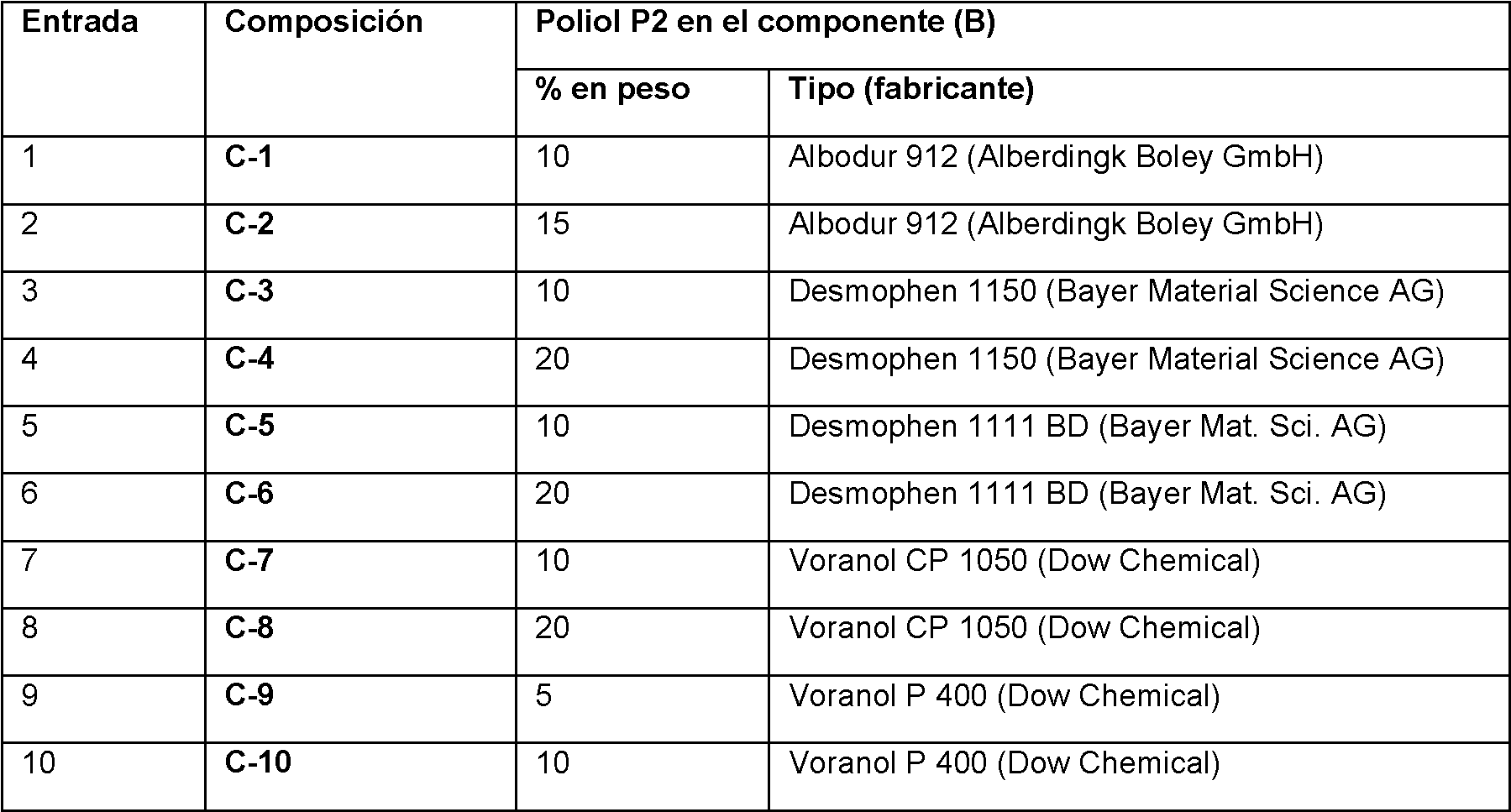

Las mezclas así obtenidas se usaron como componentes (B) en las composiciones de solado híbridas cementosas de poliuretano inventivas a modo de ejemplo.The mixtures thus obtained were used as components (B) in the inventive exemplary cementitious hybrid cementitious screed compositions.
Componente (C)Component (C)
Se mezclaron los componentes indicados a continuación para formar el componente (C). Las cantidades dadas son en partes en masa.The components listed below were mixed to form component (C). The quantities given are in parts by mass.

Mezcla de composiciónComposition mix
Se mezclan los componentes (A), (B) y (C) en una relación ponderal para obtener una mezcla como se indica a continuación, por ejemplo, se usó una relación ponderal de aproximadamente 16,5, 16,5 y 67, respectivamente. La porción de cada componente se da en % en peso, basado en el peso total de la mezcla A+B+C.Components (A), (B) and (C) are mixed in a weight ratio to obtain a mixture as follows, for example, a weight ratio of approximately 16.5, 16.5 and 67 was used, respectively . The portion of each component is given in% by weight, based on the total weight of the A + B + C mixture.
A+B+C (%)A + B + C (%)
Aceite de ricino LV-117 (poliol P1a) 6,1Castor oil LV-117 (polyol P1a) 6.1
Trietilenglicol (poliol P1b) 1,3Triethylene glycol (polyol P1b) 1.3
Citrofol BII (plastificante) 2,7Citrofol BII (plasticizer) 2.7
Tego Airex 944 (antiespumante) 0,2Tego Airex 944 (defoamer) 0.2
Bayferrox (pigmento) 1,7Bayferrox (pigment) 1.7
Agua 4,5Water 4.5
Producto de MDI 16,5MDI Product 16.5
Arena de sílice, 0,1-0,5 mm 49,5Silica sand, 0.1-0.5mm 49.5
Hidróxido cálcico 0,7Calcium hydroxide 0.7
Cemento blanco CEM 152,5 N 16,8EMC white cement 152.5 N 16.8
Se han estudiado varias variantes dentro del intervalo indicado. Se encontró que la trabajabilidad del material mixto indicado era apropiada. Se aplicó el material mixto a un sustrato para realizar una aplicación de solado típica. El solado obtenido presentó un aspecto superficial agradablemente brillante.Various variants within the indicated range have been studied. The workability of the indicated mixed material was found to be appropriate. The mixed material was applied to a substrate to perform a typical screed application. The flooring obtained had a pleasantly shiny surface appearance.
Con respecto al sistema indicado, se estudió la proporción de agua en el sistema en diversas pruebas de laboratorio en vista de la aplicación, trabajabilidad y tiempo abierto. Se determinó que el intervalo de porcentaje de agua en el componente (A) para este sistema debería ser preferentemente desde 24 % hasta 27 %. Cantidades inferiores a 24 % pueden conducir a la formación de burbujas, así como a una disminución en la trabajabilidad. Cantidades más altas, por ejemplo superiores a 27 %, pueden influir negativamente sobre el brillo superficial de la composición curada.Regarding the indicated system, the proportion of water in the system was studied in various laboratory tests in view of the application, workability and open time. It was determined that the percent water range in component (A) for this system should preferably be from 24% to 27%. Amounts less than 24% can lead to the formation of bubbles, as well as a decrease in workability. Higher amounts, for example greater than 27%, can negatively influence the surface gloss of the cured composition.
En el sistema indicado con una proporción de cemento blanco de 26 %, se logra una excelente resistencia a la compresión del solado acabado, concretamente superior a 50 N/mm2 después de 28 días. La disminución de la cantidad de cemento en este sistema da como resultado una disminución en la resistencia a la compresión lograda. Aparte de eso, la proporción de cemento en el sistema influye sobre la trabajabilidad y el tiempo abierto. In the indicated system with a proportion of white cement of 26%, an excellent compressive strength of the finished screed is achieved, specifically above 50 N / mm2 after 28 days. Decreasing the amount of cement in this system results in a decrease in compressive strength achieved. Apart from that, the proportion of cement in the system influences workability and open time.
El contenido de cal hidratada en el componente (C) es preferentemente aproximadamente 5 %. Si se usan cantidades considerablemente más bajas, puede ocurrir la formación de burbujas. Cantidades de cal hidratada demasiado altas reducen la trabajabilidad del sistema.The content of hydrated lime in component (C) is preferably approximately 5%. If considerably lower amounts are used, bubble formation may occur. Too high amounts of hydrated lime reduce the workability of the system.
Para probar la influencia de la relación entre el componente A y el componente B, se varió la relación ponderal entre el componente A y el componente B mientras se mantenía la relación de la suma en peso de los componentes A y B en comparación con el peso del componente (C) como se muestra a continuación.To test the influence of the relationship between component A and component B, the weight ratio between component A and component B was varied while maintaining the ratio of the weight sum of components A and B compared to weight of component (C) as shown below.
(A+B) % A:B C %(A + B)% A: B C%
33 0,8 6733 0.8 67
33 1 6733 1 67
33 1,2 6733 1.2 67
33 1,4 6733 1.4 67
Aunque las pruebas muestran todas resultados satisfactorios, se logró el mejor compromiso entre la trabajabilidad y el aspecto superficial con una relación de A:B = 1. La trabajabilidad disminuye para A:B> 1. Por otra parte, puede ocurrir cierta formación de burbujas a una temperatura superior a 35 °C cuando A:B<< 1.Although the tests all show satisfactory results, the best compromise between workability and surface appearance was achieved with a ratio of A: B = 1. Workability decreases for A: B> 1. On the other hand, some bubble formation may occur at a temperature above 35 ° C when A: B << 1.
También está influida la calidad del brillo superficial por la relación de los componentes A, B y C y sus composiciones individuales. Algunas relaciones preferidas se muestran a continuación en la Tabla 5.The quality of surface gloss is also influenced by the ratio of components A, B and C and their individual compositions. Some preferred relationships are shown below in Table 5.
Mediciones de brilloBrightness measurements
Se midió el brillo según EN ISO 2813. Dependiendo de la intensidad del brillo, se atribuyó uno de los tres grados de brillo a cada medición. Así, los valores medidos de > 70 UB (unidades de brillo) se consideran "brillo alto", valores entre 20 y 70 UB "brillo medio" y valores inferiores a 20 UB "mate", según EN ISO 2813. Normalmente, las muestras se miden a un ángulo incidente de 60°. Sin embargo, las muestras muy brillantes se miden frecuentemente a 20° para mayor exactitud, y asimismo, muestras bastante mate se miden a un ángulo de 85°. Todas las muestras se prepararon en película de 3 mm de espesor después del curado a 23 °C y 50 % de humedad rel. durante 24 h. Mediciones de brillo en composiciones de referenciaThe brightness was measured according to EN ISO 2813. Depending on the intensity of the brightness, one of the three degrees of brightness was attributed to each measurement. Thus, measured values of> 70 UB (gloss units) are considered "high gloss", values between 20 and 70 UB "medium brightness" and values less than 20 UB "matte", according to EN ISO 2813. Normally, samples they are measured at an incident angle of 60 °. However, very bright samples are frequently measured at 20 ° for accuracy, and also fairly matte samples are measured at an angle of 85 °. All samples were prepared on 3mm thick film after curing at 23 ° C and 50% rel humidity. for 24 h. Gloss measurements in reference compositions
Los resultados de las mediciones de brillo de las composiciones de referencia R-1 y R-2 se presentan en la Tabla 3.The results of the gloss measurements of the reference compositions R-1 and R-2 are presented in Table 3.
Tabla 3: Resultados de las mediciones superficiales de brillo en composiciones de referencia R-1 y R-2. Table 3: Results of surface gloss measurements in reference compositions R-1 and R-2.

La composición R-1 basada en resina epoxi muestra esperadamente brillo alto (Tabla 3, entrada 2). Sin embargo, a temperatura ambiente más baja, el brillo superficial disminuye considerablemente (entrada 1). La composición híbrida cementosa de poliuretano convencional R-2 muestra brillo superficial muy bajo a todas las temperaturas (Tabla 3, entradas 3 a 5).Composition R-1 based on epoxy resin expectedly shows high gloss (Table 3, entry 2). However, at lower ambient temperature, the surface gloss decreases considerably (input 1). The conventional R-2 polyurethane cementitious hybrid composition shows very low surface gloss at all temperatures (Table 3, entries 3 to 5).
Mediciones de brillo en composiciones inventivasGloss measurements in inventive compositions
Las mediciones de brillo de los Ejemplos inventivos C-1 a C-14 se realizaron todas a 23 °C y 50 % de humedad rel., puesto que en los sistemas híbridos cementosos de poliuretano el brillo superficial es mucho menos dependiente de la temperatura que en los sistema de resina epoxi. Los resultados se muestran en la Tabla 4. The gloss measurements of Inventive Examples C-1 to C-14 were all performed at 23 ° C and 50% rel. Humidity, since in hybrid cementitious polyurethane systems the surface gloss is much less temperature dependent than in epoxy resin systems. The results are shown in Table 4.
Tabla 4: Resultados de las mediciones de brillo superficial en los Ejemplos inventivos C-1 a C-14, medidos a 23 °C. Table 4: Results of surface gloss measurements in Inventive Examples C-1 to C-14, measured at 23 ° C.
"n/a" significa que no se realizó medición."n / a" means that no measurement was performed.

Es evidente que en todas las muestras inventivas el brillo superficial fue significativamente superior a en la muestra de referencia R-2 químicamente comparable. En algunos casos (entradas 1, 2 y 6), el brillo superficial alcanzó valores que normalmente solo son alcanzados por sistemas de resina epoxi (tales como R-1).It is evident that in all the inventive samples the surface gloss was significantly higher than in the chemically comparable reference sample R-2. In some cases (inputs 1, 2, and 6), the surface gloss reached values that are normally only achieved by epoxy resin systems (such as R-1).
Para ilustrar la influencia de la cantidad relativa de algunos ingredientes clave (es decir, agua y poliol P1b) sobre el brillo superficial, se prepararon algunas composiciones inventivas y una composición de referencia como se enumera en la Tabla 5 con cantidades variables de los ingredientes en el componente (A). Para estos experimentos, se varió la cantidad de P1b en los componentes (A) respectivos. Todos los otros componentes, así como los componentes (B) y (C), siguieron igual que se enumeraron anteriormente para el Ejemplo inventivo C-14, excepto por la cantidad de poliol P1a en el componente (A), que se ajustó para cada composición para obtener en todos los casos un porcentaje total en peso de poliol (P1a P1b) de 45 % basado en el peso total del componente (A). Para mejor comparabilidad, las composiciones con la misma cantidad de agua (entre 24 % y 30 %) en el componente A se nombraron con el mismo número de composición (por ejemplo, C-15), pero índices diferentes (a a i).To illustrate the influence of the relative amount of some key ingredients (i.e., water and polyol P1b) on surface gloss, some inventive compositions and a reference composition as listed in Table 5 were prepared with varying amounts of the ingredients in component (A). For these experiments, the amount of P1b in the respective components (A) was varied. All other components, as well as components (B) and (C), remained the same as listed above for Inventive Example C-14, except for the amount of polyol P1a in component (A), which was adjusted for each composition to obtain in all cases a total weight percentage of polyol (P1a P1b) of 45% based on the total weight of component (A). For best comparability, compositions with the same amount of water (between 24% and 30%) in component A were named with the same composition number (eg C-15), but different indices (a through i).
Tabla 5: Resultados (en UB) de las mediciones de brillo superficial en los Ejemplos C-15a-d a C-18a-d y R-3, medidas a 23 °C con un ángulo de 60°. La relación de A : B : C fue en todos los casos 16,5 : 16,5 : 67. Los porcentajes dados son porcentajes en peso basados en el peso total de la composición (A). * composiciones no según la invención (referencias). Table 5: Results (in UB) of the surface gloss measurements in Examples C-15a-da C-18a-d and R-3, measured at 23 ° C with an angle of 60 °. The A: B: C ratio was in all cases 16.5: 16.5: 67. The percentages given are percentages by weight based on the total weight of the composition (A). * compositions not according to the invention (references).

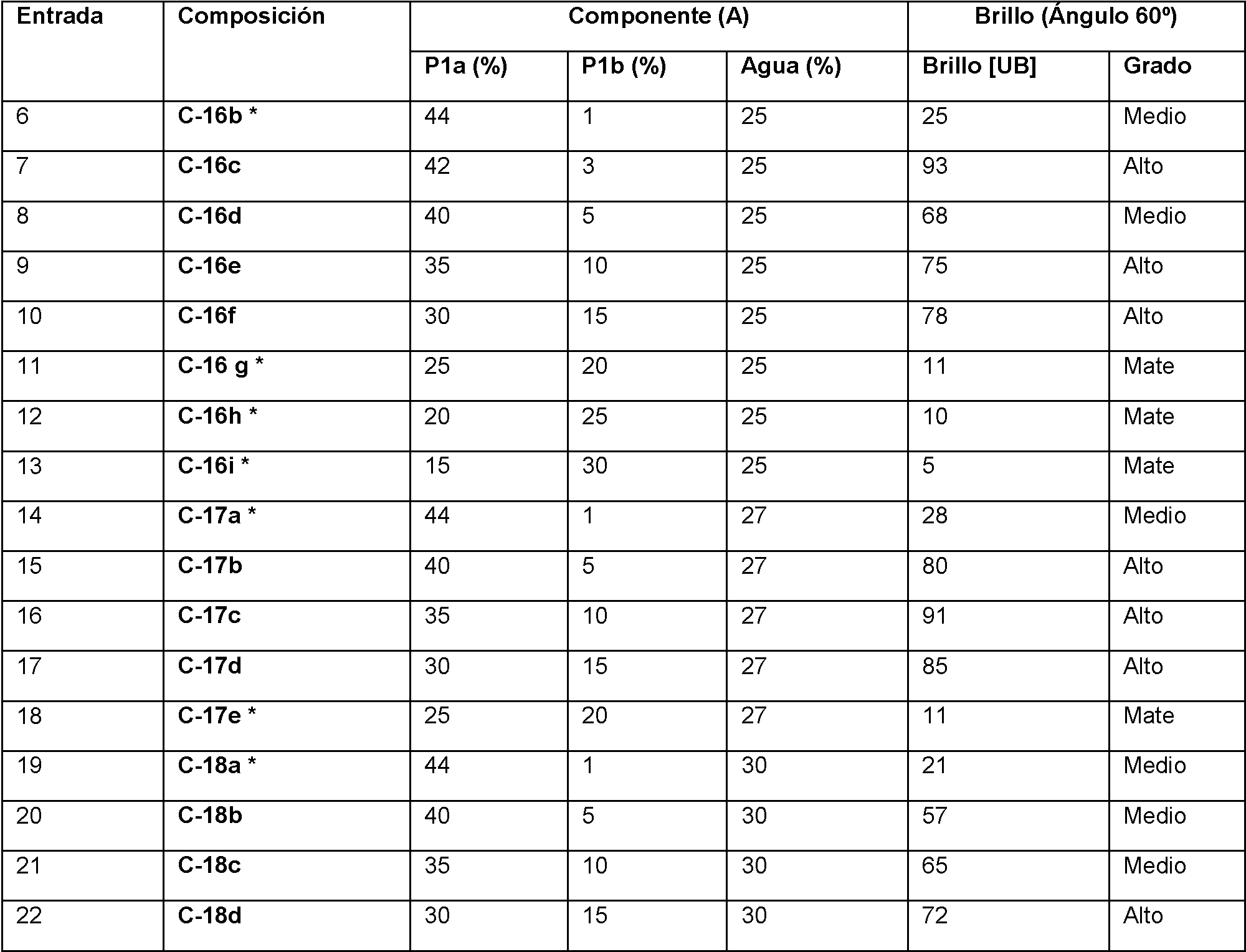
Los resultados en la Tabla 5 muestran que el grado de brillo superficial se puede optimizar por un cuidadoso ajuste de los ingredientes clave del componente (A). La ausencia de poliol P1b (como en R-3) conduce a una superficie mate.The results in Table 5 show that the degree of surface gloss can be optimized by careful adjustment of the key ingredients of component (A). The absence of P1b polyol (as in R-3) leads to a matte surface.
Asimismo, también la relación de mezclado de los componentes (A), (B), y (C) puede tener una influencia sobre el brillo superficial del producto curado de tres componentes. Esto se ilustra en la Tabla 6, usando como un componente de ejemplo (A) de la composición inventiva C-16d (con 25 % en peso de agua y 5 % en peso de poliol P1 b en el componente (A), basado en el peso total del componente (A)). En estos ejemplos, el componente (C) fue siempre 67 % y la suma de (A+B) fue siempre 33 % del peso de la composición total (A+B+C), mientras que se varió la relación ponderal de A : B.Also, the mixing ratio of components (A), (B), and (C) may also have an influence on the surface gloss of the three component cured product. This is illustrated in Table 6, using as an example component (A) of the inventive composition C-16d (with 25% by weight of water and 5% by weight of polyol P1 b in component (A), based on the total weight of component (A)). In these examples, component (C) was always 67% and the sum of (A + B) was always 33% of the weight of the total composition (A + B + C), while the weight ratio of A was varied: B.
Tabla 5: Resultados (en UB) de las mediciones de brillo superficial con relaciones variables de los componentes (A), (B) y (C) medidos a 23 °C con un ángulo de 60°. Las composiciones de los componentes individuales fueron las mismas que en el Ejemplo inventivo C-16d. Table 5: Results (in UB) of surface gloss measurements with variable ratios of components (A), (B) and (C) measured at 23 ° C with an angle of 60 °. The compositions of the individual components were the same as in Inventive Example C-16d.

La Tabla 5 muestra que mientras que la composición inventiva de los tres componentes permite cierta libertad con respecto a la relación de mezclado de los tres componentes (A), (B) y (C) para que la invención funcione, la relación de mezclado tiene todavía una influencia significativa sobre el grado de brillo superficial de la composición curada. Se aconseja al experto en la técnica que también ajuste las relaciones de mezclado de los tres componentes para obtener un brillo superficial óptimo, y no solo las propias composiciones individuales.Table 5 shows that while the inventive composition of the three components allows some freedom regarding the mixing ratio of the three components (A), (B) and (C) for the invention to work, the mixing ratio has still a significant influence on the degree of surface gloss of the cured composition. The skilled artisan is advised to also adjust the mixing ratios of the three components to obtain optimum surface gloss, and not just the individual compositions themselves.
Resistencia a productos químicosChemical resistance
Se midió la resistencia a productos químicos, es decir, la resistencia de las muestras contra la degradación por productos químicos, según DIN EN 1504-2. Se sumergieron muestras de prueba curadas (tiempo de curado 24 h a 23 °C y 50 % de humedad rel.) en diferentes productos químicos líquidos de prueba durante un periodo de 42 días y posteriormente se evaluaron para daños. La clasificación de daños se hizo según los grados enumerados en la Tabla 7.The resistance to chemicals, that is, the resistance of the samples against degradation by chemicals, was measured according to DIN EN 1504-2. Cured test samples (24 h cure time at 23 ° C and 50% rel. Humidity) were immersed in different test liquid chemicals over a period of 42 days and subsequently evaluated for damage. The damage classification was made according to the grades listed in Table 7.
Tabla 7: Clasificación de daños y grados de resistencia asignados a los resultados de las pruebas de resistencia a productos químicos. Grados más altos de resistencia significa menos daño por un producto químico de prueba. Table 7: Damage classification and degrees of resistance assigned to the results of tests for resistance to chemicals. Higher degrees of resistance means less damage from a test chemical.

Los resultados de la prueba de resistencia a productos químicos fueron del siguiente modo, enumerados en la Tabla 8. Los productos químicos de prueba se usaron según EN 13529:2003 con las composiciones de los grupos de medios allí especificados.The results of the chemical resistance test were as follows, listed in Table 8. The test chemicals were used according to EN 13529: 2003 with the compositions of the media groups specified there.
Tabla 8: Grados de resistencia de muestras de referencia R-2 y muestras inventivas C-1 contra diversos productos químicos, según EN 13529:2003 y DIN EN 1504-2. Table 8: Degrees of resistance of reference samples R-2 and inventive samples C-1 against various chemical products, according to EN 13529: 2003 and DIN EN 1504-2.


En todas las pruebas, las muestras hechas a partir de la composición C-1 (formulada según la invención) muestran la misma resistencia a productos químicos o mejor en comparación con las muestras de referencia R-2 que se prepararon a partir de una composición de solado híbrida de poliuretano convencional comparable. In all tests, samples made from composition C-1 (formulated according to the invention) show the same resistance to chemicals or better compared to reference samples R-2 that were prepared from a composition of comparable conventional polyurethane hybrid screed.
Claims (14)
Applications Claiming Priority (2)
| Application Number | Priority Date | Filing Date | Title |
|---|---|---|---|
| EP14168704.6A EP2944622A1 (en) | 2014-05-16 | 2014-05-16 | Three component composition for the manufacture of polyurethane cementitious hybrid flooring or coating with improved surface gloss |
| PCT/EP2015/060420 WO2015173214A1 (en) | 2014-05-16 | 2015-05-12 | Three component composition for the manufacture of polyurethane cementitious hybrid flooring or coating with improved surface gloss |
Publications (2)
| Publication Number | Publication Date |
|---|---|
| ES2750776T3 true ES2750776T3 (en) | 2020-03-27 |
| ES2750776T5 ES2750776T5 (en) | 2023-04-18 |
Family
ID=50731965
Family Applications (1)
| Application Number | Title | Priority Date | Filing Date |
|---|---|---|---|
| ES15720747T Active ES2750776T5 (en) | 2014-05-16 | 2015-05-12 | Composition of three components for the manufacture of polyurethane cementitious hybrid flooring or coating with improved surface gloss |
Country Status (11)
| Country | Link |
|---|---|
| US (1) | US10759700B2 (en) |
| EP (2) | EP2944622A1 (en) |
| JP (1) | JP2017528393A (en) |
| CN (1) | CN106459340B (en) |
| AU (1) | AU2015260997B2 (en) |
| CA (1) | CA2948565C (en) |
| ES (1) | ES2750776T5 (en) |
| NZ (1) | NZ725888A (en) |
| PT (1) | PT3142984T (en) |
| RU (1) | RU2693076C2 (en) |
| WO (1) | WO2015173214A1 (en) |
Families Citing this family (20)
| Publication number | Priority date | Publication date | Assignee | Title |
|---|---|---|---|---|
| ES2835710T3 (en) | 2014-04-10 | 2021-06-23 | Sika Tech Ag | Hybrid polyurethane system combining high compressive strength and early water resistance |
| ES2932177T3 (en) * | 2016-06-27 | 2023-01-16 | Sika Tech Ag | Composition of three components for the manufacture of cementitious polyurethane hybrid flooring or coatings with improved surface gloss |
| EP3266755A1 (en) * | 2016-07-07 | 2018-01-10 | Sika Technology AG | Reducing blister formation in polyurethane cementitious hybrid system |
| MX2019000364A (en) * | 2016-07-11 | 2019-06-24 | Dow Global Technologies Llc | Two-component adhesive compositions and methods of making same. |
| EP3339344A1 (en) | 2016-12-21 | 2018-06-27 | Sika Technology Ag | Flexible polyurethane cementitious hybrid composition |
| CN106893380B (en) * | 2017-03-20 | 2019-05-17 | 兴通力得(北京)科技股份有限公司 | A kind of mute anti-skidding superthin layer terrace investment precoat of high abrasion and preparation method thereof |
| EP3447077A1 (en) * | 2017-08-23 | 2019-02-27 | Sika Technology Ag | Three component composition for the manufacture of primer layer or scratch coating for flooring |
| KR101876434B1 (en) * | 2017-12-01 | 2018-07-13 | 한국건설기술연구원 | Water-permeable Pavement Composition Using Polymer, Water-permeable Road Pavement, And Construction Method thereof |
| BR112020012697B1 (en) | 2018-01-11 | 2024-01-02 | Sika Technology Ag | TWO-COMPONENT COATING COMPOSITION, AND, METHOD FOR PREPARING THE TWO-COMPONENT COMPOSITION |
| US12264104B2 (en) | 2019-02-12 | 2025-04-01 | Sika Technology Ag | Multi-component composition for manufacturing polyurethane/urea cementitious hybrid systems |
| AU2020231131B2 (en) | 2019-03-07 | 2025-10-09 | Sika Technology Ag | Cementitious hybrid flooring composition |
| EP3744702A1 (en) * | 2019-05-28 | 2020-12-02 | Sika Technology Ag | Polymer concrete and grout containing slag |
| JP7267147B2 (en) * | 2019-08-20 | 2023-05-01 | アイカ工業株式会社 | Hydraulic polymer cement composition and its application method |
| KR102409787B1 (en) * | 2019-11-19 | 2022-06-17 | 군산대학교산학협력단 | Composition of organic and inorganic high-elasticity hybrid repair material for the extended service life of road facilities, and manufacturing method thereof |
| EP4005996A1 (en) * | 2020-11-26 | 2022-06-01 | Sika Technology Ag | Polyurethane-based polymer concretes and grout with controlled density |
| CN112680006B (en) * | 2020-12-29 | 2022-04-08 | 苏州大乘环保新材有限公司 | Water-based nano waterproof slurry and preparation method thereof |
| CN116601123A (en) * | 2021-01-28 | 2023-08-15 | Sika技术股份公司 | Pigment pastes, especially for the manufacture of polyurethane cement-based mixed floors |
| JP2022156692A (en) * | 2021-03-31 | 2022-10-14 | 株式会社エフコンサルタント | Curable composition |
| WO2023142101A1 (en) * | 2022-01-30 | 2023-08-03 | Sika Technology Ag | Three component composition for the manufacture of polyurethane cementitious hybrid flooring or coating with improved workability |
| CN117645445A (en) * | 2023-10-19 | 2024-03-05 | 中联重科新材料科技有限公司 | Polyurethane mortar composition, polyurethane mortar, preparation method of polyurethane mortar and method for preparing sound-insulating damping terrace coating |
Family Cites Families (27)
| Publication number | Priority date | Publication date | Assignee | Title |
|---|---|---|---|---|
| US2902388A (en) | 1957-06-27 | 1959-09-01 | Allied Chem | Hydraulic cement-polyurethane compositions useful for coating, sealing, patching, and surfacing |
| AU426554B2 (en) | 1967-11-23 | 1972-07-28 | Hodogaya Chemical Co. Itd | Process for producing non-foaming polyurethane |
| NL9401366A (en) | 1994-08-24 | 1996-04-01 | Brp De Bilt Bv | Process for the preparation of a pozzolanic material from paper residue and process for the production of cement therefrom. |
| JP2000072507A (en) | 1998-08-25 | 2000-03-07 | Asahi Glass Co Ltd | Polymer cement composition |
| JP3885851B2 (en) | 1998-09-02 | 2007-02-28 | 日本ポリウレタン工業株式会社 | Method for producing flexible polyurethane foam |
| JP2002338318A (en) | 2001-05-14 | 2002-11-27 | Aica Kogyo Co Ltd | Mortar flooring compounds, mortar flooring and floor construction methods |
| JP2003026758A (en) | 2001-07-11 | 2003-01-29 | Sanyu Rec Co Ltd | One component type solid urethane resin composition |
| EP1329469A1 (en) | 2002-01-18 | 2003-07-23 | Sika Schweiz AG | Polyurethane composition |
| JP4480964B2 (en) | 2003-07-29 | 2010-06-16 | アイカ工業株式会社 | Polyurethane cement composition and its construction method |
| EP1754737B1 (en) * | 2004-06-11 | 2013-04-03 | Kansai Paint Co., Ltd. | Polyester resin and thermosetting aqueous coating composition |
| KR100588488B1 (en) * | 2004-11-05 | 2006-06-09 | 박종원 | Pulp Sludge Ash Composition for Construction Materials |
| JP4940553B2 (en) † | 2005-01-26 | 2012-05-30 | Dic株式会社 | Urethane cement composition, flooring and paving materials |
| DE102005062269A1 (en) * | 2005-12-24 | 2007-06-28 | Bayer Materialscience Ag | New castor oil-based polyol emulsions |
| JP2007254179A (en) * | 2006-03-21 | 2007-10-04 | Aica Kogyo Co Ltd | Coating floor material and polyurethane cement composition used therefor |
| US20070225419A1 (en) | 2006-03-24 | 2007-09-27 | Century-Board Usa, Llc | Polyurethane composite materials |
| JP4803045B2 (en) | 2007-01-10 | 2011-10-26 | Dic株式会社 | Urethane cement-based composition, coated flooring and its construction method |
| KR100862048B1 (en) † | 2007-02-06 | 2008-10-09 | 주식회사 부일건화 | Samsung-based polyurethane flooring composition and construction method of composite flooring using the same |
| JP5054568B2 (en) * | 2008-02-28 | 2012-10-24 | アイカ工業株式会社 | Polyurethane cement composition |
| JP5389399B2 (en) | 2008-09-02 | 2014-01-15 | アイカ工業株式会社 | Polyurethane cement composition |
| KR101252447B1 (en) * | 2012-10-24 | 2013-04-16 | 주식회사 제니스코리아 | Quick hardening environment-friendly flooring material and constructing methods using thereof |
| JP6095219B2 (en) | 2013-04-03 | 2017-03-15 | 株式会社エフコンサルタント | Curable composition |
| WO2014174033A2 (en) * | 2013-04-26 | 2014-10-30 | Sika Technology Ag | Cement-free or cement-reduced low dust hybrid flooring compositions |
| EP2796483A1 (en) † | 2013-04-26 | 2014-10-29 | Sika Technology AG | Three component composition for the manufacture of polyurethane cementitious flooring |
| JP2016526059A (en) | 2013-04-26 | 2016-09-01 | シーカ・テクノロジー・アーゲー | Fast-curing composition for production of polyurethane cement hybrid flooring |
| CN105637036B (en) | 2013-08-13 | 2018-10-09 | 能源实验室 2000 有限公司 | The manufacturing method of sill quality polyurethane products |
| ES2835710T3 (en) * | 2014-04-10 | 2021-06-23 | Sika Tech Ag | Hybrid polyurethane system combining high compressive strength and early water resistance |
| US10518136B2 (en) * | 2017-09-21 | 2019-12-31 | Acushnet Company | Methods for cross-linking thermoplastic polyurethane covers for golf balls |
-
2014
- 2014-05-16 EP EP14168704.6A patent/EP2944622A1/en not_active Withdrawn
-
2015
- 2015-05-12 EP EP15720747.3A patent/EP3142984B2/en active Active
- 2015-05-12 NZ NZ725888A patent/NZ725888A/en not_active IP Right Cessation
- 2015-05-12 CA CA2948565A patent/CA2948565C/en active Active
- 2015-05-12 JP JP2016567729A patent/JP2017528393A/en active Pending
- 2015-05-12 ES ES15720747T patent/ES2750776T5/en active Active
- 2015-05-12 CN CN201580033635.4A patent/CN106459340B/en active Active
- 2015-05-12 RU RU2016143557A patent/RU2693076C2/en active
- 2015-05-12 AU AU2015260997A patent/AU2015260997B2/en not_active Ceased
- 2015-05-12 US US15/311,770 patent/US10759700B2/en active Active
- 2015-05-12 WO PCT/EP2015/060420 patent/WO2015173214A1/en not_active Ceased
- 2015-05-12 PT PT157207473T patent/PT3142984T/en unknown
Also Published As
| Publication number | Publication date |
|---|---|
| JP2017528393A (en) | 2017-09-28 |
| EP3142984B2 (en) | 2022-12-14 |
| AU2015260997A1 (en) | 2016-11-17 |
| RU2016143557A3 (en) | 2018-12-17 |
| ES2750776T5 (en) | 2023-04-18 |
| CA2948565A1 (en) | 2015-11-19 |
| NZ725888A (en) | 2023-03-31 |
| RU2693076C2 (en) | 2019-07-01 |
| RU2016143557A (en) | 2018-06-20 |
| EP3142984A1 (en) | 2017-03-22 |
| CN106459340B (en) | 2019-09-06 |
| WO2015173214A1 (en) | 2015-11-19 |
| CA2948565C (en) | 2023-06-27 |
| US20170096368A1 (en) | 2017-04-06 |
| US10759700B2 (en) | 2020-09-01 |
| CN106459340A (en) | 2017-02-22 |
| AU2015260997B2 (en) | 2019-03-07 |
| EP2944622A1 (en) | 2015-11-18 |
| PT3142984T (en) | 2019-10-31 |
| EP3142984B1 (en) | 2019-08-28 |
Similar Documents
| Publication | Publication Date | Title |
|---|---|---|
| ES2750776T3 (en) | Three-component composition for manufacturing polyurethane hybrid cementitious screed or flooring with improved surface gloss | |
| ES2996682T3 (en) | Flexible polyurethane cementitious hybrid composition | |
| CN105263979A (en) | Fast curing composition for the manufacture of polyurethane cementitious hybrid flooring | |
| ES2932177T3 (en) | Composition of three components for the manufacture of cementitious polyurethane hybrid flooring or coatings with improved surface gloss | |
| KR101615916B1 (en) | Waterproof Organic-Inorganic Complex Composition For Concrete Structure, Manufacturing Method Thereof, And Waterproofing Method of Concrete Structure Therewith | |
| ES3015747T3 (en) | Reducing blister formation in polyurethane cementitious hybrid systems | |
| EP2796483A1 (en) | Three component composition for the manufacture of polyurethane cementitious flooring | |
| CN115182548A (en) | Organic-inorganic composite industrial grindstone and preparation method thereof | |
| ES2914376T3 (en) | Composition of three components for the manufacture of an anti-scratch primer or coating for flooring | |
| JP7602468B2 (en) | Multi-component composition for producing polyurethane/urea cementitious hybrid systems | |
| KR100841780B1 (en) | Semi-automatic Wet Finish Mortar | |
| BR112018071892B1 (en) | COMPOSITION OF THREE COMPONENTS AND USE OF IT, METHOD FOR MANUFACTURING A HYBRID CEMENTICIAL POLYURETHANE FLOOR OR CLADDING AND USE OF A P1C POLYOL | |
| WO2023142101A1 (en) | Three component composition for the manufacture of polyurethane cementitious hybrid flooring or coating with improved workability | |
| CN119822771A (en) | Gypsum self-leveling method for shortening layered setting time difference |