ES2761849T3 - Stabilized whole wheat flour production method - Google Patents
Stabilized whole wheat flour production method Download PDFInfo
- Publication number
- ES2761849T3 ES2761849T3 ES12720718T ES12720718T ES2761849T3 ES 2761849 T3 ES2761849 T3 ES 2761849T3 ES 12720718 T ES12720718 T ES 12720718T ES 12720718 T ES12720718 T ES 12720718T ES 2761849 T3 ES2761849 T3 ES 2761849T3
- Authority
- ES
- Spain
- Prior art keywords
- flour
- weight
- acid
- lipase
- bran
- Prior art date
- Legal status (The legal status is an assumption and is not a legal conclusion. Google has not performed a legal analysis and makes no representation as to the accuracy of the status listed.)
- Active
Links
Classifications
-
- A—HUMAN NECESSITIES
- A23—FOODS OR FOODSTUFFS; TREATMENT THEREOF, NOT COVERED BY OTHER CLASSES
- A23L—FOODS, FOODSTUFFS OR NON-ALCOHOLIC BEVERAGES, NOT OTHERWISE PROVIDED FOR; PREPARATION OR TREATMENT THEREOF
- A23L7/00—Cereal-derived products; Malt products; Preparation or treatment thereof
- A23L7/10—Cereal-derived products
- A23L7/197—Treatment of whole grains not provided for in groups A23L7/117 - A23L7/196
-
- A—HUMAN NECESSITIES
- A21—BAKING; EDIBLE DOUGHS
- A21D—TREATMENT OF FLOUR OR DOUGH FOR BAKING, e.g. BY ADDITION OF MATERIALS; BAKING; BAKERY PRODUCTS
- A21D13/00—Finished or partly finished bakery products
- A21D13/02—Products made from whole meal; Products containing bran or rough-ground grain
-
- A—HUMAN NECESSITIES
- A21—BAKING; EDIBLE DOUGHS
- A21D—TREATMENT OF FLOUR OR DOUGH FOR BAKING, e.g. BY ADDITION OF MATERIALS; BAKING; BAKERY PRODUCTS
- A21D2/00—Treatment of flour or dough by adding materials thereto before or during baking
- A21D2/08—Treatment of flour or dough by adding materials thereto before or during baking by adding organic substances
- A21D2/14—Organic oxygen compounds
- A21D2/145—Acids, anhydrides or salts thereof
-
- A—HUMAN NECESSITIES
- A21—BAKING; EDIBLE DOUGHS
- A21D—TREATMENT OF FLOUR OR DOUGH FOR BAKING, e.g. BY ADDITION OF MATERIALS; BAKING; BAKERY PRODUCTS
- A21D2/00—Treatment of flour or dough by adding materials thereto before or during baking
- A21D2/08—Treatment of flour or dough by adding materials thereto before or during baking by adding organic substances
- A21D2/36—Vegetable material
-
- A—HUMAN NECESSITIES
- A21—BAKING; EDIBLE DOUGHS
- A21D—TREATMENT OF FLOUR OR DOUGH FOR BAKING, e.g. BY ADDITION OF MATERIALS; BAKING; BAKERY PRODUCTS
- A21D2/00—Treatment of flour or dough by adding materials thereto before or during baking
- A21D2/08—Treatment of flour or dough by adding materials thereto before or during baking by adding organic substances
- A21D2/36—Vegetable material
- A21D2/38—Seed germs; Germinated cereals; Extracts thereof
-
- A—HUMAN NECESSITIES
- A21—BAKING; EDIBLE DOUGHS
- A21D—TREATMENT OF FLOUR OR DOUGH FOR BAKING, e.g. BY ADDITION OF MATERIALS; BAKING; BAKERY PRODUCTS
- A21D6/00—Other treatment of flour or dough before baking, e.g. cooling, irradiating or heating
-
- A—HUMAN NECESSITIES
- A23—FOODS OR FOODSTUFFS; TREATMENT THEREOF, NOT COVERED BY OTHER CLASSES
- A23L—FOODS, FOODSTUFFS OR NON-ALCOHOLIC BEVERAGES, NOT OTHERWISE PROVIDED FOR; PREPARATION OR TREATMENT THEREOF
- A23L7/00—Cereal-derived products; Malt products; Preparation or treatment thereof
- A23L7/10—Cereal-derived products
- A23L7/198—Dry unshaped finely divided cereal products, not provided for in groups A23L7/117 - A23L7/196 and A23L29/00, e.g. meal, flour, powder, dried cereal creams or extracts
-
- B—PERFORMING OPERATIONS; TRANSPORTING
- B02—CRUSHING, PULVERISING, OR DISINTEGRATING; PREPARATORY TREATMENT OF GRAIN FOR MILLING
- B02B—PREPARING GRAIN FOR MILLING; REFINING GRANULAR FRUIT TO COMMERCIAL PRODUCTS BY WORKING THE SURFACE
- B02B1/00—Preparing grain for milling or like processes
- B02B1/08—Conditioning grain with respect to temperature or water content
-
- A—HUMAN NECESSITIES
- A23—FOODS OR FOODSTUFFS; TREATMENT THEREOF, NOT COVERED BY OTHER CLASSES
- A23V—INDEXING SCHEME RELATING TO FOODS, FOODSTUFFS OR NON-ALCOHOLIC BEVERAGES AND LACTIC OR PROPIONIC ACID BACTERIA USED IN FOODSTUFFS OR FOOD PREPARATION
- A23V2002/00—Food compositions, function of food ingredients or processes for food or foodstuffs
Landscapes
- Life Sciences & Earth Sciences (AREA)
- Engineering & Computer Science (AREA)
- Food Science & Technology (AREA)
- Health & Medical Sciences (AREA)
- Nutrition Science (AREA)
- Chemical & Material Sciences (AREA)
- Polymers & Plastics (AREA)
- Cereal-Derived Products (AREA)
- Bakery Products And Manufacturing Methods Therefor (AREA)
- Medicines Containing Plant Substances (AREA)
Abstract
Un método para producir harina estabilizada que comprende: atemperar granos enteros que tienen salvado, germen, y endosperma para obtener un contenido final de humedad en los granos enteros de 10 % en peso a 14 % en peso, con respecto al peso de los granos enteros; tratar los granos enteros con una solución acuosa de un inhibidor de lipasa durante el atemperado para inhibir la lipasa en el salvado y el germen para formar granos enteros tratados; y moler los granos enteros tratados para obtener una harina integral estabilizada que tiene un contenido de ácidos grasos libres inferior a 3.000 ppm cuando se almacena a 38 °C (100 °C) durante 30 días, en donde la concentración del inhibidor de lipasa durante el tratamiento es de 2 molar a 7 molar, y la cantidad del inhibidor durante el tratamiento es de 1 mol a 5 moles de inhibidor por 45,36 kg (100 Iibras) de granos enteros.A method of producing stabilized flour comprising: tempering whole grains having bran, germ, and endosperm to obtain a final moisture content in whole grains of 10% by weight to 14% by weight, relative to the weight of whole grains ; treating whole grains with an aqueous solution of a lipase inhibitor during tempering to inhibit lipase in the bran and germ to form treated whole grains; and grinding the treated whole grains to obtain a stabilized whole grain flour that has a free fatty acid content of less than 3,000 ppm when stored at 38 ° C (100 ° C) for 30 days, where the concentration of the lipase inhibitor during the The treatment is 2 molar to 7 molar, and the amount of the inhibitor during the treatment is 1 mole to 5 moles of inhibitor per 45.36 kg (100 pounds) of whole grains.
Description
DESCRIPCIÓNDESCRIPTION
Método de producción de harina de trigo integral estabilizadaStabilized whole wheat flour production method
Campo de la invenciónField of the Invention
La presente invención se refiere a métodos para prolongar el período de validez de las harinas integrales mediante la inhibición o la reducción de las enzimas que producen rancidez. El método de la presente invención proporciona harinas integrales estabilizadas.The present invention relates to methods for prolonging the shelf life of wholemeal flours by inhibiting or reducing rancidity-producing enzymes. The method of the present invention provides stabilized whole flours.
AntecedentesBackground
El contenido de ácidos grasos libres de la harina integral aumenta durante el almacenamiento, lo que da lugar, posteriormente, al sabor rancio y al corto período de validez de la harina integral y los productos elaborados con la harina integral. La lipasa es la enzima en la harina integral que hidroliza los lípidos para producir ácidos grasos libres. Las harinas integrales de trigo que contienen salvado y germen son menos estables que las harinas de trigo refinadas porque, generalmente, las enzimas responsables de la producción de ácidos grasos libres y rancidez y los lípidos sobre los que las enzimas actúan se eliminan en gran medida con el salvado y el germen durante la molienda de los granos o semillas enteras para producir harinas de trigo refinadas blancas. El almacenamiento de las harinas de trigo integrales durante un período de tan solo 30 días a 750F puede dar lugar a la aparición de aromas y sabores indeseables en productos fabricados con la harina integral. En paralelo con la aparición de malos sabores se produce un aumento en la cantidad de ácidos grasos libres en las harinas, correlacionado con un aumento de la tasa de absorción de oxígeno de las harinas y la formación de los componentes oxidativos de rancidez. La disminución del tamaño de partícula aumenta la velocidad y la extensión del deterioro de los componentes del grano. El tratamiento con calor y humedad se utiliza habitualmente para inactivar enzimas responsables del deterioro de la harina, aunque se ha demostrado recientemente que contribuyen a la rancidez oxidativa medido por la formación de hexanal, un marcador habitual utilizado para detectar la rancidez oxidativa, en harina de avena. Se cree que este aumento de la rancidez oxidativa se debe a la desintegración de las estructuras celulares, tal como mediante molienda y tratamiento con calor y humedad, que tienden a estabilizar los lípidos, o a la inactivación de antioxidantes lábiles frente al calor. Además, el uso de calor y humedad para inactivar enzimas tiende a dar lugar a la desnaturalización de proteínas y la gelatinización del almidón, lo que puede influir negativamente en la funcionalidad de la proteína y la funcionalidad del almidón, lo que a su vez puede influir negativamente en las características de capacidad de procesamiento mecánico de la masa y de horneado. Al aumentar las temperaturas de estabilización, el contenido de humedad y los tiempos de tratamiento para lograr una mayor inactivación enzimática tiende a exacerbar los problemas con la funcionalidad de la proteína y la funcionalidad del almidón.The free fatty acid content of wholemeal flour increases during storage, which subsequently results in the rancid taste and short shelf life of wholemeal flour and products made from wholemeal flour. Lipase is the enzyme in whole wheat flour that hydrolyzes lipids to produce free fatty acids. Whole wheat flours containing bran and germ are less stable than refined wheat flours because generally the enzymes responsible for the production of free fatty acids and rancidity and the lipids on which the enzymes act are largely eliminated with bran and germ during grinding of whole grains or seeds to produce white refined wheat flours. Storing whole wheat flours for as little as 30 days at 750F can lead to undesirable aromas and flavors appearing in products made from whole wheat flour. In parallel with the appearance of bad flavors, there is an increase in the amount of free fatty acids in the flours, correlated with an increase in the oxygen absorption rate of the flours and the formation of the oxidative components of rancidity. Decreasing particle size increases the speed and extent of deterioration of the grain components. Heat and moisture treatment is commonly used to inactivate enzymes responsible for flour deterioration, although it has recently been shown to contribute to oxidative rancidity as measured by hexanal formation, a common marker used to detect oxidative rancidity, in oats. This increase in oxidative rancidity is believed to be due to the disintegration of cell structures, such as by grinding and heat and moisture treatment, which tend to stabilize lipids, or the inactivation of heat labile antioxidants. Furthermore, the use of heat and humidity to inactivate enzymes tends to lead to protein denaturation and starch gelatinization, which can negatively influence protein functionality and starch functionality, which in turn can influence negatively on the characteristics of mechanical processing capacity of the dough and baking. Increasing stabilization temperatures, moisture content, and treatment times to achieve greater enzyme inactivation tends to exacerbate problems with protein functionality and starch functionality.
La lipasa, que causa la ranciedad hidrolítica en los productos molidos de trigo no germinado y en buen estado se encuentra casi exclusivamente en el componente de salvado. La otra enzima degradadora de lípidos clave, la lipoxigenasa (LPO), está presente casi exclusivamente en el germen y también está implicada en la aparición de rancidez. Por lo tanto, las harinas de trigo que contienen salvado o harinas graham son mucho más susceptibles a la aparición de enranciamiento que las harinas blancas que contienen poca o ninguna cantidad de salvado y germen. Lipase, which causes hydrolytic rancidity in milled, un germinated wheat products, is found almost exclusively in the bran component. The other key lipid-degrading enzyme, lipoxygenase (LPO), is present almost exclusively in the germ and is also implicated in the appearance of rancidity. Therefore, wheat flour containing bran or graham flour is much more susceptible to the appearance of rancidity than white flour containing little or no amount of bran and germ.
La degradación de lípidos catalizada por enzimas que se produce en las harinas de trigo de extracción alta, que produce enranciamiento en este tipo de harina, se considera producida por la acción de la lipasa seguida por la acción de la LPO. Se cree que cuando la lipasa, la enzima que se encuentra casi exclusivamente en la parte del salvado del grano, se activa durante la molienda, reacciona con los aceites inestables que se encuentran de modo natural en el grano y descompone los aceites inestables a sus free fatty acids (ácidos grasos libres - FFA). Este proceso puede tardar semanas o incluso meses. A continuación, LPO, la enzima que se encuentra casi exclusivamente en la porción del germen del grano, oxida los FFA en presencia de oxígeno, produciendo productos de degradación volátiles tales como peróxidos que, a su vez, generan aldehídos de rancidez. En ausencia de humedad, la oxidación de los FFA es también un proceso muy lento que puede durar incluso varias semanas hasta que se puedan detectar cantidades notables de los aldehídos de enranciamiento. Sin embargo, en presencia de humedad, o agua, que se añade normalmente a la harina de trigo en grandes cantidades durante la etapa de amasado, la oxidación catalizada por enzimas de los ácidos grasos libres tiende a proceder en gran medida muy rápidamente, causando la formación de grandes cantidades de aldehídos rancios en un plazo de solo unos pocos minutos.The enzyme-catalysed lipid degradation that occurs in high extraction wheat flours, which causes rancidity in this type of flour, is considered to be produced by the action of lipase followed by the action of LPO. It is believed that when lipase, the enzyme found almost exclusively in the bran part of the grain, is activated during milling, it reacts with the unstable oils naturally found in the grain and breaks down unstable oils to their free fatty acids (free fatty acids - FFA). This process can take weeks or even months. Next, LPO, the enzyme found almost exclusively in the germ portion of the grain, oxidizes the FFAs in the presence of oxygen, producing volatile degradation products such as peroxides that, in turn, generate rancid aldehydes. In the absence of moisture, oxidation of FFAs is also a very slow process that can take up to several weeks until noticeable amounts of the rancid aldehydes can be detected. However, in the presence of moisture, or water, which is normally added to wheat flour in large quantities during the kneading step, enzyme-catalyzed oxidation of free fatty acids tends to proceed largely very rapidly, causing Large amounts of rancid aldehydes form within just a few minutes.
En WO99/37169 se describe un grano adecuado para usar en productos horneados que se ha inducido de modo que tuviera una extensa red capilar capaz de embeber rápidamente la humedad.WO99 / 37169 describes a grain suitable for use in baked goods that has been induced to have an extensive capillary network capable of rapidly imbibing moisture.
En EP 1900290 se describe un procedimiento de limpieza, decoloración y desinfección para grano de trigo. En RU2220001 se describe un método de preparación del grano para una molienda de harina.EP 1900290 describes a cleaning, bleaching and disinfecting procedure for wheat grain. RU2220001 describes a method of preparing the grain for flour milling.
En US2930699 se describe un método de molienda de determinados granos de cereales.US2930699 describes a method of grinding certain cereal grains.
En US3832472 se describe un producto de trigo que comprende endosperma en el que la estructura celular está completamente alterada y dispersa.US3832472 describes a wheat product comprising endosperm in which the cell structure is completely altered and dispersed.
En consecuencia, existe desde hace mucho tiempo la necesidad de contar con un método para producir una harina integral estabilizada frente a la degradación enzimática. Consequently, there has been a long-standing need for a method of producing a whole grain flour stabilized against enzymatic degradation.
ResumenSummary
La presente invención proporciona un método como se define en las reivindicaciones adjuntas.The present invention provides a method as defined in the appended claims.
Una harina estabilizada (que no pertenece a la invención), tal como harina de trigo integral estabilizada, que presenta un período de validez inesperadamente mayor y una funcionalidad de horneado de galleta superior, se puede producir con o sin calentamiento para inhibir o inactivar la lipasa sometiendo granos enteros o una fracción o componente de salvado y germen a tratamiento con un inhibidor de lipasa para obtener una harina estabilizada que tiene un contenido de ácidos grasos libres inferior a 3.000 ppm cuando se almacena a 37,8 °C (100 0F) durante 30 días, en donde las cantidades del inhibidor durante el tratamiento son de 1 mol a 5 moles de inhibidor por 45,4 kg (100 libras) de granos enteros. El tratamiento con el inhibidor de lipasa se suministra en una solución acuosa con una concentración de 2 a 7 molar y puede reducir el pH de la fracción o componente de harina integral, salvado y germen a un pH inferior a 6, preferiblemente inferior o igual a 5,8, por ejemplo, de 4,4 a 5,8. El tratamiento con el inhibidor de lipasa se puede realizar durante el atemperado de los granos enteros o durante la hidratación de la fracción o componente de salvado y germen para obtener un contenido final de humedad en los granos enteros de 10 % en peso a 14 % en peso, con respecto al peso de los granos enteros;. A stabilized flour (not belonging to the invention), such as stabilized whole wheat flour, which has an unexpectedly longer shelf life and superior biscuit baking functionality, can be produced with or without heating to inhibit or inactivate lipase. subjecting whole grains or a fraction or component of bran and germ to treatment with a lipase inhibitor to obtain a stabilized flour that has a free fatty acid content of less than 3,000 ppm when stored at 37.8 ° C (100 0F) for 30 days, where amounts of inhibitor during treatment are 1 mole to 5 moles of inhibitor per 45.4 kg (100 pounds) of whole grains. The lipase inhibitor treatment is supplied in an aqueous solution with a concentration of 2 to 7 molar and can reduce the pH of the fraction or component of wholemeal flour, bran and germ to a pH below 6, preferably less than or equal to 5.8, for example from 4.4 to 5.8. The treatment with the lipase inhibitor can be carried out during the tempering of the whole grains or during the hydration of the fraction or component of bran and germ to obtain a final moisture content in the whole grains of 10% by weight to 14% in weight, relative to the weight of whole grains ;.
En la presente memoria se describe un método (que no pertenece a la invención) para producir harina integral estabilizada que incluye salvado, germen y endosperma, con un período de validez prolongado y una funcionalidad de horneado mejorada e incluye las etapas de tratar el salvado y el germen con un inhibidor de lipasa; y producir una harina integral estabilizada en donde la gelatinización del almidón puede ser inferior a 10 %, medida mediante calorimetría diferencial de barrido y en donde la capacidad de retención de disolvente del ácido láctico es superior a 70 %.A method (not belonging to the invention) for producing stabilized whole wheat flour including bran, germ and endosperm, with a long shelf life and improved baking functionality and includes the steps of treating the bran and the germ with a lipase inhibitor; and produce a stabilized wholemeal flour where the gelatinization of the starch may be less than 10%, measured by differential scanning calorimetry and where the solvent retention capacity of lactic acid is greater than 70%.
En la presente descripción se describe una harina integral estabilizada (que no pertenece a la invención) que incluye salvado, germen y endosperma con un período de validez más largo y una funcionalidad de horneado mejorada, en donde la harina integral estabilizada tiene un contenido en ácidos grasos libres inferior a 4.200 ppm cuando se almacena a 37,8 °C (100 0F) durante 30 días, una gelatinización de almidón inferior a 10 %, medida mediante calorimetría diferencial de barrido y en donde la capacidad de retención de disolvente de ácido láctico es superior a 70 %.In the present description a stabilized wholemeal flour (not belonging to the invention) is described that includes bran, germ and endosperm with a longer shelf life and improved baking functionality, where the stabilized wholemeal flour has an acid content free fatty acids less than 4,200 ppm when stored at 37.8 ° C (100 0F) for 30 days, a gelatinization of starch less than 10%, measured by differential scanning calorimetry and where the retention capacity of lactic acid solvent is greater than 70%.
En la presente memoria se describe un método (que no pertenece a la invención) en el que el salvado y el germen se pueden tratar con el inhibidor de lipasa después de la molienda de los granos enteros.A method (not belonging to the invention) is described herein in which the bran and the germ can be treated with the lipase inhibitor after milling of the whole grains.
En la presente memoria se describen artículos horneados (que no pertenecen a la invención) proporcionados que contienen harina integral estabilizada, al menos un azúcar, al menos un aceite o grasa, y un inhibidor de lipasa que estabiliza la harina integral, donde los productos horneados tienen cualidades sensoriales positivas aumentadas y propiedades sensoriales negativas disminuidas en comparación con un control producido sin tratamiento de estabilización o usando estabilización por calor solamente sin inhibidor de lipasa, en al menos 3 %, basado en la evaluación sensorial realizada por un panel de expertos del gusto utilizando una escala de 1 a 100 donde una puntuación de 1 tiene la intensidad mínima y una puntuación de 100 tiene la máxima intensidad de la propiedad sensorial.Baked items (not belonging to the invention) provided are described herein containing stabilized whole wheat flour, at least one sugar, at least one oil or fat, and a lipase inhibitor that stabilizes whole wheat flour, where baked goods have increased positive sensory qualities and decreased negative sensory properties compared to a control produced without stabilization treatment or using heat stabilization alone without a lipase inhibitor, by at least 3%, based on sensory evaluation by a panel of taste experts using a scale of 1 to 100 where a score of 1 has the lowest intensity and a score of 100 has the highest intensity of sensory property.
Breve descripción de los dibujosBrief description of the drawings
La Figura 1 muestra un diagrama esquemático de bloques del proceso para la producción de harina integral estabilizada donde el tratamiento de granos enteros con un inhibidor de lipasa se realiza durante el atemperado según los métodos de la presente invención.Figure 1 shows a schematic block diagram of the process for the production of stabilized whole flour where the treatment of whole grains with a lipase inhibitor is carried out during tempering according to the methods of the present invention.
La Figura 2 muestra un diagrama esquemático de bloques del proceso para la producción de harina integral estabilizada en la que se trata una fracción o componente de salvado y germen con un inhibidor de lipasa según métodos de la presente invención.Figure 2 shows a schematic block diagram of the process for the production of stabilized wholemeal flour in which a fraction or component of bran and germ is treated with a lipase inhibitor according to methods of the present invention.
La Figura 3 es una representación que muestra el efecto del pH en la actividad de lipasa extraíble para las harinas integrales del ejemplo 2.Figure 3 is a representation showing the effect of pH on extractable lipase activity for whole grain flours from Example 2.
La Figura 4 es una representación de los ácidos grasos libres totales formados después de 30 días a 33,3 0C (92 0F) en función del pH inicial de la harina integral del ejemplo 3.Figure 4 is a representation of the total free fatty acids formed after 30 days at 33.3 0C (92 0F) as a function of the initial pH of the wholemeal flour from Example 3.
La Figura 5 es una representación que muestra el efecto de la concentración del ácido y del tipo de ácido en la supresión de ácidos grasos libres formados en la harina integral del ejemplo 3.Figure 5 is a representation showing the effect of acid concentration and acid type on the suppression of free fatty acids formed in the wholemeal flour of Example 3.
La Figura 6 es una representación de análisis bivariable que muestra el efecto del ácido láctico y el nivel de agua de atemperado en el contenido de ácidos grasos libres de la harina integral del ejemplo 7 después de 28 días a 33,3 °C (92 0F).Figure 6 is a bivariate analysis representation showing the effect of lactic acid and tempering water level on the free fatty acid content of wholemeal from Example 7 after 28 days at 33.3 ° C (92 0F ).
La Figura 7 es una representación que muestra el efecto del tiempo de atemperado y la cantidad de ácido láctico añadido en la resistencia de la harina medido mediante el valor de SRC del ácido láctico para las harinas integrales del ejemplo 7. Figure 7 is a representation showing the effect of tempering time and the amount of lactic acid added on the strength of the flour measured by the SRC value of the lactic acid for the integral flours of example 7.
La Figura 8 es una representación que muestra la formación de free fatty acid (ácidos grasos libres - FFA) en la harina integral final del ejemplo 7 en función de la concentración de ácido y la cantidad aplicada al trigo.Figure 8 is a representation showing the formation of free fatty acid (free fatty acids - FFA) in the final wholemeal flour of Example 7 as a function of the acid concentration and the amount applied to wheat.
La Figura 9 es una representación que muestra el pH en función de la concentración de ácido para la harina de salvado fino y de reducción del ejemplo 7.Figure 9 is a representation showing the pH as a function of the acid concentration for the fine bran and reduction flour of Example 7.
La Figura 10 es una representación que muestra los free fatty acid (ácidos grasos libres - FFA) formados en la harina integral del ejemplo 7 en función del pH y de la concentración de ácido aplicado al trigo.Figure 10 is a representation showing the free fatty acids formed in the wholemeal flour of example 7 as a function of pH and the concentration of acid applied to wheat.
La Figura 11 es una representación que muestra el efecto de la concentración del ácido láctico en el agua de atemperado en la relación de SRC de ácido láctico/SRC de agua de la harina integral del ejemplo 7 al cabo de 28 días a 33,3 °C (92 0F).Figure 11 is a representation showing the effect of the concentration of lactic acid in the tempering water on the ratio of SRC of lactic acid / SRC of water of wholemeal flour from Example 7 after 28 days at 33.3 ° C (92 0F).
La Figura 12 es una representación que muestra el efecto de la concentración de ácido láctico en el agua de atemperado en la relación de SRC de ácido láctico/SRC de agua de la harina integral del ejemplo 7 al cabo de 28 días a 33,3 0C (92 0F).Figure 12 is a representation showing the effect of the concentration of lactic acid in the tempering water on the ratio of SRC of lactic acid / SRC of water of wholemeal flour from Example 7 after 28 days at 33.3 0C (92 0F).
Descripción detallada de la invenciónDetailed description of the invention
Se hará referencia ahora a determinados aspectos detallados de diversas realizaciones de la invención. Debe entenderse que los detalles específicos descritos en la presente memoria no deben interpretarse como limitantes, sino meramente como una base representativa de cualquier aspecto de la invención.Reference will now be made to certain detailed aspects of various embodiments of the invention. It should be understood that the specific details described herein are not to be construed as limiting, but merely as a representative basis for any aspect of the invention.
Excepto en los ejemplos, o donde se indique de forma expresa otra cosa, todas las cantidades numéricas en esta descripción que indican cantidades de material y/o uso deben entenderse como modificadas por el término “ aproximadamente” en la descripción del alcance más amplio de la invención. Se prefiere generalmente la práctica en los límites numéricos indicados.Except in the examples, or where expressly stated otherwise, all numerical amounts in this description indicating amounts of material and / or use are to be understood as modified by the term "about" in the description of the broader scope of the invention. Practice within the stated numerical limits is generally preferred.
Se entiende también que la presente invención no está limitada a las realizaciones y métodos específicos descritos a continuación.It is also understood that the present invention is not limited to the specific embodiments and methods described below.
Además, la terminología utilizada en el presente documento se usa solo a fines de describir realizaciones concretas de la presente invención y no se pretende que la limiten en ningún modo. En particular, las figuras no están dibujadas a escala. Furthermore, the terminology used herein is used only for the purpose of describing specific embodiments of the present invention and is not intended to limit it in any way. In particular, the figures are not drawn to scale.
Debe señalarse también que, como se usa en la memoria descriptiva y en las reivindicaciones adjuntas, la forma singular “un” “uno/a” y “el” comprende los referentes plurales a no ser que el contexto dicte claramente otra cosa. Por ejemplo, la referencia a un componente en el singular, se pretende que comprenda una pluralidad de componentes. It should also be noted that, as used in the specification and in the appended claims, the singular form "a" "one / a" and "the" comprises the plural referents unless the context clearly dictates otherwise. For example, the reference to a component in the singular is intended to comprise a plurality of components.
El término “grano entero” incluye el grano en su totalidad, por ejemplo, como grano de trigo o endospermo, antes de cualquier procesamiento. Como ha indicado la U.S. Food and Drug Administration (FDA) en el proyecto de directrices del 15 de febrero de 2006, y como se usa en el presente documento, el término “grano entero” incluye granos de cereales que consisten en el fruto intacto, molido, partido o en forma de copos de los granos cuyos componentes principales -el endospermo amiláceo, el germen y el salvado- están presentes en las mismas proporciones relativas en que existen en el grano intacto. La FDA reseñó que dichos granos pueden incluir cebada, alforfón, trigo bulgur, maíz, mijo, flee, centeno, avena, sorgo, trigo y arroz silvestre.The term "whole grain" includes the grain in its entirety, for example, as wheat grain or endosperm, before any processing. As the U.S. has indicated Food and Drug Administration (FDA) in the draft guidelines of February 15, 2006, and as used herein, the term “whole grain” includes cereal grains consisting of intact, ground, broken, or flake form of the grains whose main components - the starchy endosperm, the germ and the bran - are present in the same relative proportions as they exist in the intact grain. The FDA reviewed that such grains may include barley, buckwheat, bulgur wheat, corn, millet, fleece, rye, oats, sorghum, wheat, and wild rice.
El término “producto de harina de trigo refinada” es una harina de trigo que cumple los estándares de la FDA para un producto de harina de trigo refinada de un tamaño de partículas en que no menos de 98 % pasa a través de un tamiz de malla U.S. 70 (210 micrómetros).The term “refined wheat flour product” is a wheat flour that meets FDA standards for a refined wheat flour product of a particle size where not less than 98% passes through a mesh screen. US 70 (210 microns).
El término “ molturación” como se usa en la presente memoria incluye las etapas de estiramiento, rotura, tamizado y clasificación del grano entero para separarlo en sus partes constituyentes, que puede dar también como resultado alguna reducción del tamaño de partículas de las partes constituyentes.The term "milling" as used herein includes the steps of stretching, breaking, sieving, and sorting the whole grain to separate it into its constituent parts, which may also result in some reduction in the particle size of the constituent parts.
El término “ molienda” como se usa en la presente memoria incluye cualquier proceso dirigido a reducir el tamaño de partículas, incluyendo, aunque no de forma limitativa las partículas que colisionan entre sí o reducir mecánicamente el tamaño de partículas.The term "grinding" as used herein includes any process aimed at reducing particle size, including, but not limited to, particles colliding with each other or mechanically reducing particle size.
El término “ atemperación” como se usa en el presente documento es el proceso de añadir agua al trigo antes de la molienda para endurecer el salvado y suavizar el endospermo del grano y de este modo mejorar la eficacia de separación de la harina.The term "tempering" as used herein is the process of adding water to the wheat prior to milling to harden the bran and soften the endosperm of the grain and thereby improve the separation efficiency of the flour.
El término “ hidratación” o “ hidratación posterior” como se usa en la presente memoria se refiere a la etapa de ajustar la hidratación posterior a la molturación o posterior a la molienda para ajustar el contenido de humedad de un constituyente individual y/o ajustar el contenido de humedad de la harina final. The term "hydration" or "post-hydration" as used herein refers to the step of adjusting post-milling or post-milling hydration to adjust the moisture content of an individual constituent and / or adjust the moisture content of the final flour.
También, como se usa en la presente memoria, la “ inhibición” de la lipasa o enzima significa que la lipasa o enzima ya no produce su producto enzimático o tiene sustancialmente reducida la producción de su producto enzimático. El término “ inhibición” como se usa en la presente memoria incluye además la inactivación de la lipasa, en donde la lipasa o enzima se inactiva o se inactiva sustancialmente. Por ejemplo, la inhibición de la lipasa significa que la enzima lipasa no está hidrolizando los triglicéridos y liberando los ácidos grasos en la harina. La inhibición o la capacidad de la enzima para producir su producto enzimático puede ser reversible o irreversible. Por ejemplo, el calentamiento de una enzima para desnaturalizar la enzima puede inactivar de forma irreversible la enzima. El tratamiento con un inhibidor enzimático puede inactivar de forma reversible o irreversible una enzima. Por ejemplo, el tratamiento ácido para inhibir la lipasa reduce la producción del producto enzimático, es decir, la formación de ácidos grasos libres. Sin embargo, con la inhibición reversible, puede seguir existiendo actividad enzimática extraíble o actividad lipasa medible. Cuando se extrae la enzima para medir su actividad, se puede eliminar la inhibición de su actividad colocando la enzima en un entorno de pH más alto en donde su actividad se restaura o invierte. También, el tratamiento ácido puede disminuir el pH en tal extensión que la inhibición de la lipasa es irreversible, o la inactivación de la lipasa es irreversible, de tal manera que existe la formación reducida del producto enzimático y una menor actividad de la enzima extraíble.Also, as used herein, "inhibition" of the lipase or enzyme means that the lipase or enzyme no longer produces its enzyme product or has substantially reduced production of its enzyme product. The term "inhibition" as used herein further includes lipase inactivation, wherein the lipase or enzyme is inactivated or substantially inactivated. For example, lipase inhibition means that the lipase enzyme is not hydrolyzing triglycerides and releasing fatty acids in flour. The inhibition or ability of the enzyme to produce its enzyme product can be reversible or irreversible. For example, heating an enzyme to denature the enzyme can irreversibly inactivate the enzyme. Treatment with an enzyme inhibitor can reversibly or irreversibly inactivate an enzyme. For example, acid treatment to inhibit lipase reduces the production of the enzyme product, that is, the formation of free fatty acids. However, with reversible inhibition, removable enzyme activity or measurable lipase activity may still exist. When the enzyme is extracted to measure its activity, the inhibition of its activity can be removed by placing the enzyme in a higher pH environment where its activity is restored or reversed. Also, acid treatment can lower the pH to such an extent that lipase inhibition is irreversible, or lipase inactivation is irreversible, such that there is reduced formation of the enzyme product and less activity of the extractable enzyme.
En otras realizaciones, toda o parte de la lipasa se puede inhibir o inactivar de forma reversible o irreversible. En realizaciones de la invención, la totalidad o una parte de la lipasa se puede inhibir o inactivar primero de forma reversible en una primera etapa de estabilización y a continuación inhibir o inactivar de forma irreversible en una segunda etapa de estabilización. El inhibidor de lipasa puede retenerse en la fracción o componente de harina integral o salvado y germen para inhibir o inactivar sustancialmente la lipasa para reducir sustancialmente la formación de ácidos grasos libres, sobre la cual la lipoxigenasa actuaría si no para producir en última instancia aldehídos de rancidez. En otra modalidad, el inhibidor de lipasa reduce la formación de ácidos grasos libres y permite la reducción de la cantidad de exposición de la fracción o componente de grano integral, salvado y germen, o almidón a la alta temperatura y humedad que se dan con estabilización térmica. La exposición reducida ayuda a evitar la excesiva gelatinización del almidón y la desnaturalización o alteración de la proteína, lo que puede influir negativamente en la capacidad de procesamiento mecánico de la masa, la funcionalidad del almidón y las características de horneado. Se ha descubierto que el uso del inhibidor de lipasa para inhibir o inactivar de forma reversible la lipasa de forma inesperada hace que la lipasa tenga mayor tendencia a destruir o desnaturalizar o inactivar de forma permanente la lipasa con el calor. El empleo del inhibidor de lipasa con estabilización térmica proporciona de forma inesperada cantidades inferiores de lipasa viva o activa o actividad de lipasa extraíble, o producción de ácidos grasos libres. La reducción sustancial en la producción de ácidos grasos libres se logra con la gelatinización reducida de almidón y la desnaturalización o alteración de la proteína con temperaturas de estabilización más bajas, menos agua, o tiempos de estabilización más cortos incluso cuando se emplea un triturado muy fino.In other embodiments, all or part of the lipase can be reversibly or irreversibly inhibited or inactivated. In embodiments of the invention, all or part of the lipase can be reversibly inhibited or inactivated first in a first stabilization step and then irreversibly inhibited or inactivated in a second stabilization step. The lipase inhibitor can be retained in the whole meal fraction or component or bran and germ to substantially inhibit or inactivate lipase to substantially reduce the formation of free fatty acids, on which lipoxygenase would otherwise act to produce aldehydes of rancidity. In another embodiment, the lipase inhibitor reduces the formation of free fatty acids and reduces the amount of exposure of the whole grain fraction or component, bran and germ, or starch to the high temperature and humidity that occurs with stabilization. thermal. Reduced exposure helps prevent excessive gelatinization of the starch and denaturation or alteration of the protein, which can negatively influence the mechanical processing capacity of the dough, the functionality of the starch and the baking characteristics. The use of the lipase inhibitor to reversibly inhibit or inactivate lipase unexpectedly has been found to make lipase more likely to destroy or denature or permanently inactivate lipase with heat. The use of the thermally stabilized lipase inhibitor unexpectedly provides lower amounts of live or active lipase or extractable lipase activity, or production of free fatty acids. Substantial reduction in free fatty acid production is achieved with reduced starch gelatinization and protein denaturation or alteration with lower stabilization temperatures, less water, or shorter stabilization times even when very fine milling is employed .
Harina integral y el problema de enranciamientoWholemeal flour and the rancidity problem
Como se ha expuesto anteriormente, el problema del enranciamiento es un problema que limita el período de validez de las harinas integrales. Se han propuesto varias teorías, algunas de las cuales se detallan a continuación, pero no se pretende que ninguna de ellas limite cualquiera de las realizaciones descritas en la presente memoria.As previously stated, the rancidity problem is a problem that limits the validity period of wholemeal flours. Various theories have been proposed, some of which are detailed below, but none are intended to limit any of the embodiments described herein.
El enranciamiento en productos de cereales puede deberse a reacciones de degradación hidrolítica (enzimática) u oxidativa, o ambas. A menudo, la hidrólisis puede predisponer a los productos al posterior enranciamiento oxidativo. La naturaleza ha proporcionado numerosos rasgos protectores a las semillas para prevenir el enranciamiento y el deterioro, permitiendo a las semillas sobrevivir a periodos de condiciones adversas antes de alcanzar un entorno adecuado para la germinación y el crecimiento. Es menos probable que aparezca enranciamiento cuando los materiales lípidos, por ejemplo, aceite de semillas, no pueden interactuar con reactivos o catalizadores tales como aire y enzimas. Un rasgo protector de los granos de cereales es la provisión de compartimentos separados para almacenar lípidos y enzimas de forma que no puedan interactuar.The rancidity in cereal products can be due to reactions of hydrolytic (enzymatic) or oxidative degradation, or both. Hydrolysis can often predispose products to subsequent oxidative rancidity. Nature has provided numerous protective traits to seeds to prevent rancidity and spoilage, allowing seeds to survive periods of adverse conditions before reaching a suitable environment for germination and growth. Straightening is less likely to occur when lipid materials, for example, seed oil, cannot interact with reagents or catalysts such as air and enzymes. A protective feature of cereal grains is the provision of separate compartments to store lipids and enzymes so that they cannot interact.
La molienda de los granos de cereales supone destruir los compartimentos separados, el salvado, el germen y el endospermo, de forma que los componentes lípidos y enzimáticos del grano pueden interactuar, aumentando en gran medida la aparición de enranciamiento. El aumento de la molienda para reducir la arenosidad causada por las partículas de salvado tiende a aumentar el área superficial, reducir la encapsulación natural de los lípidos, y aumentar la interacción entre los lípidos y los componentes enzimáticos, aumentando de esta forma la aparición de enranciamiento. Grinding of cereal grains involves destroying the separate compartments, the bran, the germ and the endosperm, so that the lipid and enzymatic components of the grain can interact, greatly increasing the appearance of rancidity. Increased grinding to reduce grit caused by bran particles tends to increase the surface area, reduce the natural encapsulation of lipids, and increase the interaction between lipids and enzyme components, thereby increasing the appearance of rancidity. .
Por lo tanto, las harinas de extracción alta, esto es, las que contienen cantidades sustanciales de salvado y germen, son menos estables que las harinas blancas. El almacenamiento prolongado de las harinas de extracción alta a menudo conduce a la aparición de enranciamiento. El enranciamiento incluye factores de calidad adversos derivados directa o indirectamente de las reacciones con los lípidos endógenos, que producen una reducción en la calidad de horneado de la harina, sabores y olores desagradables, y/o propiedades funcionales inaceptables. Una razón principal para la aparición de enranciamiento en las harinas de extracción alta es la degradación enzimática de aceites naturales inestables. En la porción de los granos utilizada para fabricar las harinas de extracción alta existe un importante suministro de aceites naturales inestables. Las harinas blancas, por otra parte, contienen poca o ninguna cantidad de aceites o grasas naturales inestables porque se fabrican predominantemente a partir de la parte del endosperma de los granos y están generalmente sustancialmente exentas de salvado y germen. Therefore, high extraction flours, that is, those that contain substantial amounts of bran and germ, are less stable than white flours. Prolonged storage of high extraction flours often leads to the appearance of rancidity. The rancidity includes adverse quality factors derived directly or indirectly from the reactions with the endogenous lipids, which produce a reduction in the baking quality of the flour, unpleasant tastes and smells, and / or unacceptable functional properties. A main reason for the appearance of rancidity in high extraction flours is the enzymatic degradation of unstable natural oils. There is an important supply of unstable natural oils in the portion of the grains used to manufacture the high extraction flours. White flours, on the other hand, contain little or no amount of unstable natural oils or fats because they are predominantly manufactured from the endosperm part of the grains and are generally substantially free of bran and germ.
Solución al enranciamiento y problemas relacionadosSolution to rancidity and related problems
Un aspecto de la invención proporciona un proceso para prolongar el período de validez de las harinas integrales que contienen proporciones naturales de salvado, germen y endosperma utilizando un inhibidor de lipasa. El inhibidor de lipasa se retiene en la harina integral para inhibir la lipasa para reducir la formación de ácidos grasos libres. En realizaciones de la invención, el inhibidor de lipasa puede emplearse con o sin estabilización térmica, para inhibir de manera permanente o irreversible la lipasa para reducir la formación de ácidos grasos libres. El inhibidor de lipasa reduce la formación de ácidos grasos libres reduciendo al mismo tiempo la cantidad de exposición del grano entero a altas temperaturas y humedad que tienden a aumentar la gelatinización del almidón y la desnaturalización o alteración de la proteína, y que pueden influir negativamente en la capacidad de procesamiento mecánico de la masa, la funcionalidad del almidón y las características de horneado.One aspect of the invention provides a process for extending the shelf life of wholemeal flours containing natural ratios of bran, germ and endosperm using a lipase inhibitor. The lipase inhibitor is retained in whole wheat flour to inhibit lipase to reduce the formation of free fatty acids. In embodiments of the invention, the lipase inhibitor can be used, with or without thermal stabilization, to permanently or irreversibly inhibit lipase to reduce the formation of free fatty acids. The lipase inhibitor reduces the formation of free fatty acids while reducing the amount of whole grain exposure to high temperatures and humidity that tend to increase starch gelatinization and protein denaturation or alteration, and which can negatively influence the mechanical processing capacity of the dough, the functionality of the starch and the baking characteristics.
En realizaciones donde se emplea estabilización térmica, se ha descubierto que el uso del inhibidor de lipasa para inhibir o inactivar la lipasa inesperadamente hace que la lipasa sea más susceptible a destruir o desnaturalizar o permanentemente inactivar la lipasa con calor. Se cree que la mayor susceptibilidad de la lipasa al calor se debe a la abertura o despliegue de las moléculas de lipasa mediante la acción del inhibidor. El empleo del inhibidor de lipasa con estabilización térmica proporciona de forma inesperada cantidades inferiores de lipasa viva o activa o actividad de lipasa extraíble, o producción de ácidos grasos libres. La reducción sustancial en la producción de ácidos grasos libres se logra con la gelatinización reducida de almidón y la desnaturalización o alteración de la proteína con temperaturas de estabilización más bajas, menos agua, o tiempos de estabilización más cortos incluso cuando se emplea un triturado muy fino. En los molinos de harina existentes, donde la adición de equipos de calentamiento o inyección de vapor para la estabilización térmica puede no ser factible o puede estar limitada debido al espacio, tiempo o consideraciones de costo, la reducción sustancial de la producción de ácidos grasos libres puede lograrse fácilmente mediante el uso de un inhibidor de lipasa según los métodos de la presente invención.In embodiments where thermal stabilization is employed, the use of the lipase inhibitor to unexpectedly inhibit or inactivate the lipase has been found to make the lipase more susceptible to destroying or denaturing or permanently inactivating the lipase with heat. The increased susceptibility of lipase to heat is believed to be due to the opening or unfolding of lipase molecules by the action of the inhibitor. The use of the thermally stabilized lipase inhibitor unexpectedly provides lower amounts of live or active lipase or extractable lipase activity, or production of free fatty acids. Substantial reduction in free fatty acid production is achieved with reduced starch gelatinization and protein denaturation or alteration with lower stabilization temperatures, less water, or shorter stabilization times even when very fine milling is employed . In existing flour mills, where the addition of heating equipment or steam injection for thermal stabilization may not be feasible or may be limited due to space, time, or cost considerations, the substantial reduction in the production of free fatty acids It can be easily accomplished through the use of a lipase inhibitor according to the methods of the present invention.
Esta metodología se puede emplear para producir harinas integrales estabilizadas incluso con tamaño de partículas muy fino, como la producción de una harina de trigo integral en la que no pasa menos de 98 % a través de un tamiz de luz de malla 70 de EE. UU. (210 micrómetros). Las harinas integrales estabilizadas se producen con bajos grados de daño al almidón debido a la abrasión y bajos grados de gelatinización o desnaturalización de proteína del almidón debido al tratamiento con calor y humedad. En un aspecto de la invención, las harinas de trigo integral estabilizadas tienen funcionalidades de amasado y horneado, y pueden tener tamaños de partícula que se acercan a los de la harina de trigo refinada blanca. Se pueden usar en la producción coherente masiva de masas muy maquinables y amasables para fabricar productos horneados tales como galletas, galletas saladas, y aperitivos con excelente dispersión en el horno y aspecto, y sin una sensación en boca arenosa.This methodology can be used to produce stabilized whole flours even with very fine particle size, such as the production of a whole wheat flour in which no less than 98% passes through a 70 mesh US light screen. USA (210 microns). Stabilized whole grain flours are produced with low degrees of damage to the starch due to abrasion and low degrees of gelatinization or protein denaturation of the starch due to heat and humidity treatment. In one aspect of the invention, stabilized whole wheat flours have kneading and baking functionalities, and may have particle sizes that are close to that of white refined wheat flour. They can be used in the coherent mass production of highly machinable and kneadable doughs to make baked goods such as cookies, crackers, and snacks with excellent oven dispersion and appearance, and without a gritty mouthfeel.
En otro aspecto de la invención, esta metodología se puede utilizar para producir harinas integrales estabilizadas, tales como harina de trigo integral finamente molida, y un componente de salvado estabilizado muy finamente molidos presentan una sorción de carbonato de sodio-agua inesperadamente baja, y un período de validez inesperadamente prolongado, con un contenido en ácidos grasos libres y un contenido de hexanal a 1 mes o más en condiciones de almacenamiento acelerado inesperadamente bajo. Se puede conseguir un elevado nivel de inhibición y/o inactivación de enzimas para reducir sustancialmente la producción de ácidos grasos libres reteniendo al mismo tiempo niveles inesperadamente elevados de nutrientes esenciales, tales como antioxidantes y vitaminas que se pierden durante los tratamientos de estabilización a alta temperatura. Además, la formación de acrilamida se puede controlar a niveles inesperadamente bajos utilizando las condiciones de estabilización de la presente invención. In another aspect of the invention, this methodology can be used to produce stabilized whole flours, such as finely ground whole wheat flour, and a very finely ground stabilized bran component have unexpectedly low sodium carbonate-water sorption, and an unexpectedly long shelf life, with a free fatty acid content and a hexanal content of 1 month or more under unexpectedly low accelerated storage conditions. A high level of enzyme inhibition and / or inactivation can be achieved to substantially reduce the production of free fatty acids while retaining unexpectedly high levels of essential nutrients, such as antioxidants and vitamins that are lost during high temperature stabilization treatments . Furthermore, acrylamide formation can be controlled at unexpectedly low levels using the stabilization conditions of the present invention.
En el método de la invención, el período de validez de una harina integral se prolonga tratando el salvado y el germen de granos o semillas enteras con una solución acuosa de un inhibidor de lipasa para inhibir o inactivar la lipasa para obtener una harina integral estabilizada que tiene un contenido de ácidos grasos libres inferior a 3.000 ppm, por ejemplo, de 2.000 ppm a aproximadamente 2.800 ppm, cuando se almacena a 37,8 °C (100 0C) durante 30 días. Los resultados inesperadamente superiores se obtienen cuando la concentración del inhibidor de lipasa en la solución acuosa durante el tratamiento es de 2 molar a 7 molar, con máxima preferencia de aproximadamente 3 molar a aproximadamente 5 molar, por ejemplo, de aproximadamente 3,3 molar a aproximadamente 4 molar, y la cantidad del inhibidor empleado durante el tratamiento es de 1 mol a 5 moles, con máxima preferencia de aproximadamente 2 moles a aproximadamente 4 moles de inhibidor por 45,4 kg (100 libras) de granos o semillas entera o de harina integral. In the method of the invention, the shelf life of a whole meal is prolonged by treating the bran and germ of whole grains or seeds with an aqueous solution of a lipase inhibitor to inhibit or inactivate lipase to obtain a stabilized whole meal that It has a free fatty acid content of less than 3,000 ppm, for example, from 2,000 ppm to approximately 2,800 ppm, when stored at 37.8 ° C (100 0C) for 30 days. Unexpectedly superior results are obtained when the concentration of the lipase inhibitor in the aqueous solution during treatment is from 2 molar to 7 molar, most preferably from about 3 molar to about 5 molar, for example from about 3.3 molar to about 4 molar, and the amount of inhibitor used during treatment is from 1 mole to 5 mole, most preferably from about 2 mole to about 4 mole of inhibitor per 100lb (45.4kg) of whole or wholemeal flour.
Los granos enteros tratados pueden molerse para obtener una harina integral estabilizada sin realizar ninguna estabilización adicional, tal como calentamiento o exposición al vapor, u opcionalmente se puede emplear una segunda etapa de estabilización.The treated whole grains can be ground to a stabilized whole meal without performing any further stabilization, such as heating or steam exposure, or optionally a second stabilization step can be employed.
En realizaciones de la invención, el tratamiento con la solución acuosa de inhibidor de lipasa para inhibir o inactivar la lipasa se lleva a cabo a una temperatura inferior a 38 0C, por ejemplo, de aproximadamente 24 0C a aproximadamente 30 0C. En dichas realizaciones, el tratamiento se puede realizar sin la aplicación de calor, o con la etapa opcional de estabilización por calor/térmica. En realizaciones en las que se emplea la etapa opcional de estabilización térmica, se puede realizar una estabilización térmica de baja temperatura sin la aplicación de vapor, de manera que la lipasa se inhibe o inactiva a una temperatura inferior a aproximadamente 98 0C, por ejemplo, puede realizarse una estabilización térmica baja a una temperatura de aproximadamente 80 °C a aproximadamente 98 0C. En otras realizaciones de la invención, se puede proporcionar una estabilización térmica alta, con o una harina integral estabilizada (que no pertenece a la invención) con un pH inferior a 6, preferiblemente inferior o igual a 5,8, por ejemplo de 4,4 a 5,8, un contenido de ácidos grasos libres inferior a 3.000 ppm, por ejemplo de 2.000 ppm a aproximadamente 2.800 ppm, cuando se almacena a 37,8 °C (100 0F) durante 30 días, una capacidad de retención de disolvente del ácido láctico (SRC del ácido láctico) superior o igual a 65 %, preferiblemente superior a 70 %, y una relación de SRC del ácido láctico a capacidad de retención de disolvente carbonato de sodio-agua (SRC del carbonato de sodio) superior a 1, preferiblemente superior a 1,1. La harina integral estabilizada que tiene germen de salvado y endosperma puede tener una distribución de 0 % en peso sobre un tamiz estándar del n.° 35 (500 micrómetros) de Ee. UU. e inferior o igual a aproximadamente 10 % en peso sobre un tamiz estándar del n.° 70 (210 micrómetros) de EE. UU.: La harina integral estabilizada puede tener una distribución de tamaño de partículas de al menos aproximadamente 85 % en peso, por ejemplo, de aproximadamente 90 % en peso a aproximadamente 98 % en peso a través de un tamiz estándar del n.° 100 (149 micrómetros) de EE. UU.In embodiments of the invention, treatment with the aqueous lipase inhibitor solution to inhibit or inactivate lipase is carried out at a temperature below 38 0C, eg, from about 24 0C to about 30 0C. In such embodiments, the treatment can be performed without the application of heat, or with the optional heat / thermal stabilization step. In embodiments using the optional thermal stabilization step, low temperature thermal stabilization can be performed without the application of steam, such that the lipase is inhibited or inactivated at a temperature below about 98 0C, for example, low thermal stabilization can be performed at a temperature of about 80 ° C to about 98 0C. In other embodiments of the invention, a high thermal stabilization can be provided, with or a stabilized whole grain flour (not belonging to the invention) with a pH less than 6, preferably less than or equal to 5.8, for example 4, 4 to 5.8, a free fatty acid content less than 3,000 ppm, for example 2,000 ppm to approximately 2,800 ppm, when stored at 37.8 ° C (100 0F) for 30 days, a solvent holding capacity of lactic acid (SRC of lactic acid) greater than or equal to 65%, preferably greater than 70%, and a ratio of SRC of lactic acid to solvent-holding capacity of sodium carbonate-water (SRC of sodium carbonate) greater than 1, preferably greater than 1.1. Stabilized whole wheat flour containing bran germ and endosperm may have a 0% weight distribution on a standard No. 35 (500 micron) Ee sieve. USA and less than or equal to about 10% by weight on a standard US No. 70 (210 micron) sieve . USA: Stabilized whole wheat flour can have a particle size distribution of at least about 85% by weight, for example, from about 90% by weight to about 98% by weight through a standard # 100 sieve (149 microns) from the USA USA
El documento de publicación de solicitud de patente de EE. UU. n.° 20070292583, y el documento de publicación de solicitud de patente internacional n. ° WO/2007/149320, concedida a Haynes y col., describen la producción de harina integral estabilizada triturando granos de cereal integral para obtener granos de cereal integral molido.The US patent application publication document. USA No. 20070292583, and the international patent application publication document no. WO / 2007/149320, issued to Haynes et al., Describe the production of stabilized whole wheat flour by grinding whole grain cereal to obtain ground whole grain cereal.
El documento de solicitud provisional de tramitación conjunta de EE. UU. n.° 61/457.315, presentada el 24 de febrero de 2011, y en nombre de Derwin G. Hawley y col. para “ Process And Apparatus For Mass Production of Stabilized Whole Grain Flour” (proceso y aparato para la producción en masa de harina integral estabilizada) y su solicitud internacional n.° PCT/US12/26490, presentada el 24 de febrero de 2012, en nombre de Hawley y col., describen que la producción de harinas integrales estabilizadas que tienen un tamaño de partículas fino y que exhiben buena funcionalidad de horneado puede producirse con alto rendimiento utilizando dos fracciones de salvado y germen y una fracción de endosperma. The document of provisional request of joint processing of EE. USA No. 61 / 457,315, filed on February 24, 2011, and on behalf of Derwin G. Hawley et al. for “Process And Apparatus For Mass Production of Stabilized Whole Grain Flour” and its international application No. PCT / US12 / 26490, filed on February 24, 2012, in Hawley et al., describe that the production of stabilized whole flours having a fine particle size and exhibiting good baking functionality can be produced with high yield using two bran and germ fractions and one endosperm fraction.
Según la solicitud provisional de tramitación conjunta de EE. UU. n.° 61/457.315, presentada el 24 de febrero de 2011, en nombre de Derwin G. Hawley y col. y la solicitud internacional n.° PCT/US12/26490, presentada el 24 de febrero de 2012, en nombre de Derwin G. Hawley y col., y la publicación de solicitud de patente de EE. UU. n.° 20070292583, y la publicación de solicitud de patente internacional n.° WO/2007/149320 cada una de ellas concedida a Haynes y col. se puede estabilizar o desactivar enzimáticamente al menos una, o todas, de las fracciones de salvado y germen triturado retenidas o recuperadas utilizando un agente estabilizante comestible, tal como el tratamiento con metabisulfito de sodio, ácidos orgánicos, tales como ácido sórbico, dióxido de azufre, cisteína, ácido tioglicólico, glutatión, sulfuro de hidrógeno u otros agentes reductores comestibles solos o en combinación con tratamiento térmico.According to the provisional request for joint processing by EE. USA No. 61 / 457,315, filed on February 24, 2011, on behalf of Derwin G. Hawley et al. and International Application No. PCT / US12 / 26490, filed on February 24, 2012, on behalf of Derwin G. Hawley et al., and US Patent Application Publication. USA No. 20070292583, and International Patent Application Publication No. WO / 2007/149320 each granted to Haynes et al. At least one, or all, of the bran and crushed germ fractions retained or recovered can be enzymatically stabilized or deactivated using an edible stabilizing agent, such as treatment with sodium metabisulfite, organic acids, such as sorbic acid, sulfur dioxide , cysteine, thioglycolic acid, glutathione, hydrogen sulfide, or other edible reducing agents alone or in combination with heat treatment.
Un aspecto de la invención proporciona métodos para la producción de una harina estabilizada, sin dañar sustancialmente el almidón o influir negativamente en la funcionalidad del horneado mediante el uso de un inhibidor de lipasa. El tratamiento con el inhibidor de lipasa puede inhibir de manera reversible o irreversible al menos una parte de la lipasa presente en los granos enteros. Los métodos pueden emplearse para prolongar el período de validez de las harinas proporcionando una producción de ácidos grasos libres inesperadamente baja y una gelatinización de almidón y desnaturalización de proteína inesperadamente bajas. Las condiciones de estabilización no influyen negativamente en la capacidad de procesamiento mecánico de la masa ni en la funcionalidad de horneado de la harina integral estabilizada aun cuando se obtienen tamaños finos de la harina integral. La harina de trigo integral, que contiene proporciones naturales de endosperma, salvado y germen análogas a las del grano intacto, tiene una funcionalidad de almidón y de proteína inesperadamente alta, con bajo daño del almidón, baja desnaturalización de proteínas y bajo grado de gelatinización, y un período de validez inesperadamente largo. La concentración del inhibidor de lipasa en la solución acuosa durante el atemperado y la cantidad del inhibidor empleada durante el atemperado proporcionan una reducción inesperadamente superior en la producción de ácidos grasos libres obteniéndose al mismo tiempo una funcionalidad de almidón y de proteína y características de horneado inesperadamente superiores como ponen de manifiesto la solvent retention capacity (capacidad de retención de disolvente - SRC) de ácido láctico, la relación de SRC de ácido láctico a SRC de agua SRC y la relación de SRC de ácido láctico a SRC de carbonato de sodio.One aspect of the invention provides methods for the production of a stabilized flour, without substantially damaging the starch or negatively influencing the functionality of the oven by using a lipase inhibitor. Treatment with the lipase inhibitor can reversibly or irreversibly inhibit at least part of the lipase present in whole grains. The methods can be used to extend the shelf life of flours by providing unexpectedly low free fatty acid production and unexpectedly low starch gelatinization and protein denaturation. Stabilization conditions do not negatively influence the mechanical processing capacity of the dough or the baking functionality of the stabilized whole flour even when fine sizes of the whole flour are obtained. Containing natural proportions of endosperm, bran and germ analogous to intact grain, whole wheat flour has unexpectedly high starch and protein functionality, with low starch damage, low protein denaturation and low degree of gelatinization, and an unexpectedly long validity period. The concentration of the lipase inhibitor in the aqueous solution during tempering and the amount of the inhibitor used during tempering provide an unexpectedly greater reduction in the production of free fatty acids while obtaining starch and protein functionality and unexpected baking characteristics. Higher as evidenced by the solvent retention capacity (SRC) of lactic acid, the ratio of SRC of lactic acid to SRC of water SRC and the ratio of SRC of lactic acid to SRC of sodium carbonate.
El inhibidor de lipasa puede ser cualquier inhibidor de lipasa no tóxico y comestible que pueda ser absorbido por y retenido en la harina sin influir sustancialmente de forma negativa en el sabor o el aroma, el olor o la sensación en boca del producto. El inhibidor de lipasa empleado en las realizaciones de la invención puede ser un inhibidor reversible, un inhibidor irreversible, y combinaciones o mezclas de los mismos. Los inhibidores reversibles pueden unirse a enzimas con interacciones no covalentes tales como puentes de hidrógeno, interacciones hidrófobas y enlaces iónicos. Se pueden combinar múltiples enlaces débiles entre el inhibidor y el sitio activo para producir una unión fuerte y específica. A diferencia de los sustratos e inhibidores irreversibles, los inhibidores reversibles generalmente no experimentan reacciones químicas cuando se unen a la enzima y pueden eliminarse fácilmente mediante dilución o diálisis. Los inhibidores reversibles que se pueden emplear incluyen los cuatro tipos de inhibidores de enzimas reversibles, que se clasifican según el efecto de la variación de la concentración del sustrato de la enzima en el inhibidor, especialmente, inhibidores competitivos, inhibidores que no pueden ser competitivos, inhibidores mixtos e inhibidores no competitivos. Los inhibidores irreversibles usualmente modifican de forma covalente una enzima, y la inhibición no se puede revertir. Los inhibidores irreversibles frecuentemente contienen grupos funcionales reactivos, tales como mostazas de nitrógeno, aldehídos, haloalcanos, alquenos, aceptores de Michael, sulfonatos de fenilo, o fluorofosfonatos. Estos grupos electrófilos reaccionan con cadenas laterales de aminoácido para formar aductos covalentes. Los residuos modificados son los que tienen cadenas laterales que contienen nucleófilos, tales como grupos hidroxilo o sulfhidrilo; estos incluyen los aminoácidos serina (como en el d Fp , derecha), cisteína, treonina o tirosina.The lipase inhibitor can be any edible, non-toxic lipase inhibitor that can be absorbed by and retained in flour without substantially influencing the taste or aroma, odor, or mouthfeel of the product. The lipase inhibitor employed in the embodiments of the invention can be a reversible inhibitor, an irreversible inhibitor, and combinations or mixtures thereof. Reversible inhibitors can bind enzymes with non-covalent interactions such as hydrogen bonds, hydrophobic interactions, and ionic bonds. Multiple weak bonds can be combined between the inhibitor and the active site to produce a strong and specific binding. Unlike irreversible substrates and inhibitors, reversible inhibitors generally do not undergo chemical reactions when bound to the enzyme and can be easily removed by dilution or dialysis. Reversible inhibitors that can be used include the four types of reversible enzyme inhibitors, which are classified according to the effect of varying the concentration of the enzyme substrate on the inhibitor, especially, competitive inhibitors, inhibitors that cannot be competitive, mixed inhibitors and non-competitive inhibitors. Irreversible inhibitors usually covalently modify an enzyme, and the inhibition cannot be reversed. Irreversible inhibitors frequently contain reactive functional groups, such as nitrogen mustards, aldehydes, haloalkanes, alkenes, Michael acceptors, phenyl sulfonates, or fluorophosphonates. These electrophilic groups react with amino acid side chains to form covalent adducts. The modified waste they are those that have side chains that contain nucleophiles, such as hydroxyl or sulfhydryl groups; These include the amino acids serine (as in d Fp, right), cysteine, threonine, or tyrosine.
Los inhibidores de lipasa ilustrativos que pueden emplearse son bisulfatos alcalinos, bisulfitos, metabisulfitos y metabisulfatos, tales como metabisulfito de sodio, ácidos orgánicos, ácidos inorgánicos, té verde o extracto de té verde, extracto de romero, dióxido de azufre, cisteína, ácido tioglicólico, glutatión, sulfuro de hidrógeno, otros agentes reductores comestibles, y mezclas de los mismos. Los inhibidores de lipasa preferidos que pueden emplearse son componentes ácidos, tales como al menos un ácido orgánico, por ejemplo, ácido láctico, ácido cítrico, ácido ascórbico, ácido sórbico, ácido tartárico, ácido málico, ácido fumárico, ácido acético y ácido oxálico, y al menos un ácido inorgánico, tal como ácido clorhídrico, ácido fosfórico, y ácido sulfúrico, y té verde o extracto de té verde, y mezclas de los mismos. En determinadas realizaciones, el ácido láctico, el ácido clorhídrico y el ácido fosfórico son preferidos para usar como inhibidor de lipasa. Illustrative lipase inhibitors that may be employed are alkali bisulfates, bisulfites, metabisulfites, and metabisulfates, such as sodium metabisulfite, organic acids, inorganic acids, green tea or green tea extract, rosemary extract, sulfur dioxide, cysteine, thioglycolic acid , glutathione, hydrogen sulfide, other edible reducing agents, and mixtures thereof. Preferred lipase inhibitors that can be employed are acidic components, such as at least one organic acid, for example lactic acid, citric acid, ascorbic acid, sorbic acid, tartaric acid, malic acid, fumaric acid, acetic acid and oxalic acid, and at least one inorganic acid, such as hydrochloric acid, phosphoric acid, and sulfuric acid, and green tea or green tea extract, and mixtures thereof. In certain embodiments, lactic acid, hydrochloric acid, and phosphoric acid are preferred for use as a lipase inhibitor.
En realizaciones en las que se emplea un componente ácido como inhibidor de lipasa, el tratamiento con el inhibidor de lipasa puede reducir el pH de la fracción o componente de harina integral, salvado y germen a un pH inferior a 6, preferiblemente inferior o igual a 5,8, por ejemplo, de 4,4 a 5,8.In embodiments where an acidic component is used as the lipase inhibitor, treatment with the lipase inhibitor can lower the pH of the whole flour fraction or component, bran and germ to a pH below 6, preferably less than or equal to 5.8, for example from 4.4 to 5.8.
El inhibidor de lipasa puede disolverse en agua y aplicarse a aproximadamente temperatura ambiente para su absorción en el salvado y el germen: 1) remojando los granos enteros en la solución de inhibidor de lipasa, o 2) pulverizando la solución de inhibidor de lipasa sobre los granos enteros. En el método de la invención, la solución acuosa de inhibidor de lipasa se emplea como un medio de atemperado para atemperar granos enteros.The lipase inhibitor can be dissolved in water and applied at approximately room temperature for absorption into the bran and germ: 1) by soaking the whole grains in the lipase inhibitor solution, or 2) spraying the lipase inhibitor solution on the whole grains. In the method of the invention, the aqueous lipase inhibitor solution is used as a tempering medium to temper whole grains.
La concentración del inhibidor de lipasa en la solución acuosa durante el atemperado es de 2 molar a 7 molar, con máxima preferencia de aproximadamente 3 molar a aproximadamente 5 molar, por ejemplo, de aproximadamente 3,3 molar a aproximadamente 4 molar. La cantidad del inhibidor empleada durante el atemperado es de 1 mol a 5 moles de inhibidor por 45,36 kg (100 libras) de granos enteros. La cantidad de inhibidor de lipasa empleado depende de su peso molecular, por lo que las cantidades se expresan en moles. Por ejemplo, cuando se emplea ácido clorhídrico como inhibidor de lipasa, este puede utilizarse en una cantidad de al menos aproximadamente 300 ppm, en base al peso de los granos enteros, y el ácido láctico puede emplearse en una cantidad de al menos aproximadamente 3.000 ppm, en base al peso de los granos enteros.The concentration of the lipase inhibitor in the aqueous solution during tempering is from 2 molar to 7 molar, most preferably from about 3 molar to about 5 molar, for example, from about 3.3 molar to about 4 molar. The amount of inhibitor used during tempering is 1 mole to 5 moles of inhibitor per 45.36 kg (100 pounds) of whole grains. The amount of lipase inhibitor used depends on its molecular weight, so the amounts are expressed in moles. For example, when hydrochloric acid is used as a lipase inhibitor, it can be used in an amount of at least about 300 ppm, based on the weight of whole grains, and lactic acid can be used in an amount of at least about 3,000 ppm. , based on the weight of whole grains.
La etapa de atemperado con la solución acuosa de inhibidor de lipasa se lleva a cabo para obtener un contenido final de humedad en los granos enteros de aproximadamente 10 % en peso a aproximadamente 14 % en peso, con respecto al peso de los granos enteros.The tempering step with the aqueous lipase inhibitor solution is carried out to obtain a final moisture content in the whole grains of about 10% by weight to about 14% by weight, with respect to the weight of the whole grains.
Los granos enteros contienen principalmente el endospermo, el salvado, y el germen, en proporciones decrecientes, respectivamente. En los granos de cereal entero, por ejemplo, con una humedad de campo de aproximadamente 13 % en peso, el endospermo o almidón constituye aproximadamente 83 % en peso, el salvado constituye aproximadamente 14,5 % en peso, y el germen constituye aproximadamente 2,5 % en peso, basándose en el peso del grano intacto. El endospermo contiene el almidón, y tiene menos contenido de proteína que el germen y el salvado. Tiene también poca grasa bruta y constituyentes de cenizas. El salvado (pericarpo o cáscaras) es la pared del ovario maduro que está por debajo de la cutícula, y comprende todas las capas celulares externas por debajo del revestimiento de la semilla. Tiene muchos polisacáridos no de almidón, tales como celulosa y pentosanos. El salvado o pericarpo tiende a ser muy duro debido a su alto contenido en fibra y transmite una sensación en boca seca, arenosa, particularmente cuando están presentes en tamaños de partículas grandes. Contiene también la mayoría de lipasas y lipooxigenasas del grano y necesita ser estabilizado. A medida que aumenta la extensión de la molienda o molturación, el tamaño de partículas del salvado se aproxima al tamaño de partículas del almidón, haciendo que el salvado y el almidón sean más difíciles de separar. También, el daño del almidón tiende a aumentar debido a una mayor entrada de energía mecánica, y la aspereza del salvado en comparación con el endospermo, y la ruptura de los gránulos de almidón. También, el almidón dañado mecánicamente tiende a ser más susceptible a la gelatinización. El germen se caracteriza por su alto contenido en aceite graso. Es también rico en proteínas brutas, azúcares, y constituyentes de cenizas.Whole grains mainly contain endosperm, bran, and germ, in decreasing proportions, respectively. In whole cereal grains, for example, with a field moisture of approximately 13% by weight, the endosperm or starch constitutes approximately 83% by weight, the bran constitutes approximately 14.5% by weight, and the germ constitutes approximately 2 0.5% by weight, based on the weight of the intact grain. The endosperm contains starch, and has less protein content than germ and bran. It also has little crude fat and ash constituents. The bran (pericarp or husks) is the wall of the mature ovary below the cuticle, and comprises all the outer cell layers below the seed lining. It has many non-starch polysaccharides, such as cellulose and pentosans. The bran or pericarp tends to be very hard due to its high fiber content and conveys a dry, gritty mouthfeel, particularly when present in large particle sizes. It also contains most of the lipases and lipoxygenases of the grain and needs to be stabilized. As the extent of grinding or milling increases, the particle size of the bran approaches the particle size of the starch, making the bran and starch more difficult to separate. Also, starch damage tends to increase due to increased mechanical energy input, and the roughness of the bran compared to the endosperm, and the breakdown of the starch granules. Also, mechanically damaged starch tends to be more susceptible to gelatinization. The germ is characterized by its high content of fatty oil. It is also rich in crude proteins, sugars, and ash constituents.
El contenido de humedad de la fracción de salvado puede controlarse atemperando los granos enteros de tal manera que las porciones exteriores de las semillas o granos se humedezcan sin humedecer sustancialmente el interior de sus porciones. Dicho tratamiento evita o reduce sustancialmente la necesidad de secar la fracción fina obtenida a partir del interior o endospermo de la semilla o grano, humedeciendo a la vez el exterior o las porciones de salvado y germen de la semilla para el tratamiento de estabilización. Los métodos de atemperamiento que se pueden usar para conseguir humedecer una superficie o salvado incluyen, por ejemplo, el enjuagado de los granos enteros durante periodos de tiempo limitados en un baño o cuba. En otras realizaciones, los granos enteros pueden pulverizarse superficialmente con agua y permitir que se atemperen. Pueden emplearse tiempos de atemperamiento de aproximadamente 10 minutos a aproximadamente 24 horas según algunas realizaciones de la invención. El enjuagado de los granos durante un periodo prolongado de tiempo no es deseable debido a que puede dar como resultado una penetración en profundidad de agua en el grano, humedeciendo la porción interior del grano, y dando como resultado una excesiva gelatinización del almidón. The moisture content of the bran fraction can be controlled by tempering the whole grains such that the outer portions of the seeds or grains are moistened without substantially wetting the interior of their portions. Said treatment avoids or substantially reduces the need to dry the fine fraction obtained from the interior or endosperm of the seed or grain, while moistening the exterior or the bran and germ portions of the seed for the stabilization treatment. Tempering methods that can be used to achieve wetting a surface or bran include, for example, rinsing whole grains for limited periods of time in a bath or tub. In other embodiments, the whole grains can be superficially sprayed with water and allowed to temper. Tempering times of from about 10 minutes to about 24 hours may be employed in accordance with some embodiments of the invention. Rinsing the grains for an extended period of time is undesirable because it can result in deep penetration of water into the grain, wetting the inner portion of the grain, and resulting in excessive gelatinization of the starch.
El tratamiento del salvado y el germen de los granos o semillas enteras con una solución acuosa de un inhibidor de lipasa para inhibir o inactivar sustancialmente la lipasa con o sin estabilización térmica proporciona una harina estabilizada que tiene un contenido de ácidos grasos libres inferior a 3.000 ppm, por ejemplo de 2.000 ppm a aproximadamente 2.800 ppm, cuando se almacenan a 37,8 °C (100 0F) durante 30 días, cuando el inhibidor de lipasa se utiliza en una concentración de 2 molar a aproximadamente 7 molar, con máxima preferencia de aproximadamente 3 molar a aproximadamente 5 molar, por ejemplo de aproximadamente 3,3 molar a aproximadamente 4 molar. Además, el uso del inhibidor de lipasa combinado con estabilización térmica proporciona una reducción inesperadamente superior en la producción de ácidos grasos libres, en comparación con el uso de la estabilización térmica sola o el uso del inhibidor de lipasa solo. La ventaja de la estabilización mejorada de tratamiento ácido combinado con tratamiento térmico permite reducir la actividad de lipasa y reducir el nivel de ácidos grasos libres formados durante el almacenamiento que no se puede conseguir mediante tratamiento ácido o tratamiento térmico solamente. Se ha descubierto que se obtiene un efecto sinérgico inesperado con el uso del inhibidor de lipasa y la estabilización térmica para la reducción de la formación de ácidos grasos libres en comparación con la reducción de ácidos grasos libres con tratamiento térmico solo o tratamiento de reducción con inhibidor de lipasa solo.Treatment of the bran and germ of whole grains or seeds with an aqueous solution of a lipase inhibitor to substantially inhibit or inactivate lipase with or without thermal stabilization provides a flour. stabilized having a free fatty acid content less than 3,000 ppm, for example 2,000 ppm to approximately 2,800 ppm, when stored at 37 0 ° C (100 0F) for 30 days, when the lipase inhibitor is used in a concentration from 2 molar to about 7 molar, most preferably from about 3 molar to about 5 molar, for example from about 3.3 molar to about 4 molar. Furthermore, the use of the lipase inhibitor combined with thermal stabilization provides an unexpectedly greater reduction in the production of free fatty acids, compared to the use of thermal stabilization alone or the use of the lipase inhibitor alone. The advantage of improved stabilization of acid treatment combined with heat treatment allows to reduce lipase activity and reduce the level of free fatty acids formed during storage that cannot be achieved by acid treatment or heat treatment alone. It has been found that an unexpected synergistic effect is obtained with the use of the lipase inhibitor and thermal stabilization for the reduction of the formation of free fatty acids compared to the reduction of free fatty acids with thermal treatment alone or reduction treatment with inhibitor of lipase alone.
Se cree que el uso del inhibidor de lipasa para inhibir sustancialmente o inhibir de forma reversible o inactivar de forma reversible la lipasa, hace de forma inesperada que la lipasa tenga mayor tendencia a destruir o desnaturalizar o inactivar permanentemente la lipasa con calor. Se cree que la mayor susceptibilidad de la lipasa al calor se debe a la abertura o despliegue de las moléculas de lipasa mediante la acción del inhibidor. El empleo del inhibidor de lipasa con estabilización térmica proporciona de forma inesperada cantidades inferiores de lipasa viva o activa o actividad de lipasa extraíble, o producción de ácidos grasos libres. La reducción sustancial en la producción de ácidos grasos libres se logra con la gelatinización reducida de almidón y la desnaturalización o alteración de la proteína con temperaturas de estabilización más bajas, menos agua, o tiempos de estabilización más cortos incluso cuando se emplea un triturado muy fino.It is believed that the use of the lipase inhibitor to substantially inhibit or reversibly inhibit or reversibly inactivate lipase unexpectedly makes lipase more likely to destroy or denature or permanently inactivate lipase with heat. The increased susceptibility of lipase to heat is believed to be due to the opening or unfolding of lipase molecules by the action of the inhibitor. The use of the thermally stabilized lipase inhibitor unexpectedly provides lower amounts of live or active lipase or extractable lipase activity, or production of free fatty acids. Substantial reduction in free fatty acid production is achieved with reduced starch gelatinization and protein denaturation or alteration with lower stabilization temperatures, less water, or shorter stabilization times even when very fine milling is employed .
En realizaciones de la invención, el tratamiento con la solución acuosa de inhibidor de lipasa para inhibir o inactivar la lipasa se lleva a cabo a una temperatura inferior a 38 0C, por ejemplo, de aproximadamente 24 0C a aproximadamente 30 0C. El tratamiento se puede realizar sin la aplicación de calor o con la etapa opcional de estabilización térmica. En realizaciones en las que se emplea la etapa opcional de estabilización térmica, se puede realizar una estabilización térmica de baja temperatura sin la aplicación de vapor, de manera que la lipasa se inhibe o inactiva a una temperatura inferior a aproximadamente 98 0C, por ejemplo, puede realizarse una estabilización térmica baja a una temperatura de aproximadamente 80 0C a aproximadamente 98 0C. Una estabilización térmica a alta temperatura, con o sin vapor, puede realizarse a una temperatura de aproximadamente 100 0C a aproximadamente 140 0C, preferiblemente de aproximadamente 115 0C a aproximadamente 125 0C, para inhibir o inactivar la lipasa después del tratamiento con la solución acuosa del inhibidor de lipasa. El tiempo de tratamiento térmico puede ser de aproximadamente 0,25 minutos a aproximadamente 12 minutos, preferiblemente de aproximadamente 1 minuto a aproximadamente 7 minutos, utilizándose por lo general los tiempos de tratamiento más prolongados con las temperaturas más bajas y el contenido de humedad más bajo.In embodiments of the invention, treatment with the aqueous lipase inhibitor solution to inhibit or inactivate lipase is carried out at a temperature below 38 0C, eg, from about 24 0C to about 30 0C. The treatment can be performed without the application of heat or with the optional thermal stabilization stage. In embodiments using the optional thermal stabilization step, low temperature thermal stabilization can be performed without the application of steam, such that the lipase is inhibited or inactivated at a temperature below about 98 0C, for example, Low thermal stabilization can be performed at a temperature of about 80 0C to about 98 0C. High temperature thermal stabilization, with or without steam, can be performed at a temperature of about 100 0C to about 140 0C, preferably from about 115 0C to about 125 0C, to inhibit or inactivate lipase after treatment with the aqueous solution of the lipase inhibitor. The heat treatment time can be from about 0.25 minutes to about 12 minutes, preferably from about 1 minute to about 7 minutes, with the longest treatment times generally being used with the lowest temperatures and the lowest moisture content. .
La temperatura de estabilización y el tiempo de estabilización, y el contenido de humedad se pueden controlar de tal manera que la gelatinización del almidón resultante de la estabilización en la fracción gruesa o componente de salvado triturado o molido y estabilizado puede ser inferior a aproximadamente 25 %, preferiblemente inferior a aproximadamente 10 %, con máxima preferencia inferior a aproximadamente 5 %, determinado mediante differential scanning calorimetry (calorimetría diferencial de barrido - DSC). El bajo grado de gelatinización del almidón y el bajo grado de daño del almidón conseguido en la presente invención se ilustran por una entalpía de fusión del almidón superior a aproximadamente 4 J/g, preferiblemente superior a aproximadamente 5 J/g, basado en el peso de almidón en el componente de salvado estabilizado o fracción molida gruesa, medida por calorimetría de barrido diferencial (DSC), a una temperatura de aproximadamente 65 0C a aproximadamente 70 0C. El componente de salvado estabilizado puede tener una entalpía de fusión del almidón superior a aproximadamente 2 J/g, basado en el peso de la fracción gruesa molida estabilizada, medida por differential scanning calorimetry (calorimetría diferencial de barrido - DSC), a una temperatura de aproximadamente 60 0C a aproximadamente 65 0C. En general, la gelatinización del almidón se produce cuando: a) se añade agua, y se mezcla con almidón, en una cantidad suficiente, en general de al menos aproximadamente 30 % en peso, con respecto al peso del almidón, y b) la temperatura del almidón se eleva a al menos aproximadamente 80 0C (176 0F), preferiblemente a 100 0C (212 0F) o más. La temperatura de gelatinización depende de la cantidad de agua disponible para su interacción con el almidón. Cuanto menor es la cantidad disponible de agua, en general, mayor es la temperatura de gelatinización. La gelatinización puede definirse como el colapso (alteración) de órdenes moleculares dentro del gránulo de almidón, que se manifiesta en cambios irreversibles en las propiedades tales como hinchazón granular, fusión de cristalito nativo, pérdida de birrefringencia y solubilización del almidón. La temperatura de la etapa inicial de gelatinización y el intervalo de temperaturas en el que se produce, dependen de la concentración del almidón, método de observación, tipo de gránulo, y de la heterogeneidad en la población de gránulos en observación. El pegado es el fenómeno de la segunda etapa que sigue a la gelatinización en la disolución del almidón. Implica un aumento de la hinchazón granular, de la exudación de componentes moleculares (p. ej. amilosa, seguido de amilopectina) del gránulo, y eventualmente, una, total colapso de los gránulos. Véase Atwell y col., “The Terminology and Methodology Associated with Basic Starch Phenomena,” Cereal Foods World, Vol. 33, N. ° 3, págs. 306-311 (marzo 1988).The stabilization temperature and the stabilization time, and the moisture content can be controlled in such a way that the gelatinization of the starch resulting from the stabilization in the coarse fraction or comminuted or ground and stabilized bran component can be less than about 25% , preferably less than about 10%, most preferably less than about 5%, determined by differential scanning calorimetry (DSC). The low degree of starch gelatinization and the low degree of starch damage achieved in the present invention are illustrated by a starch melting enthalpy of greater than about 4 J / g, preferably greater than about 5 J / g, based on weight of starch in the stabilized bran component or coarse ground fraction, measured by differential scanning calorimetry (DSC), at a temperature of about 65 0C to about 70 0C. The stabilized bran component may have a starch melting enthalpy of greater than about 2 J / g, based on the weight of the stabilized coarse milled fraction, measured by differential scanning calorimetry (DSC), at a temperature of about 60 0C to about 65 0C. In general, gelatinization of the starch occurs when: a) water is added, and mixed with starch, in a sufficient amount, generally at least about 30% by weight, based on the weight of the starch, and b) the temperature of the starch rises to at least about 80 0C (176 0F), preferably 100 0C (212 0F) or more. The gelatinization temperature depends on the amount of water available for its interaction with the starch. The lower the available amount of water, in general, the higher the gelatinization temperature. Gelatinization can be defined as the collapse (alteration) of molecular orders within the starch granule, which manifests itself in irreversible changes in properties such as granular swelling, native crystallite fusion, loss of birefringence, and starch solubilization. The temperature of the initial gelatinization stage and the temperature range in which it occurs depend on the concentration of the starch, the observation method, the type of granule, and the heterogeneity in the population of granules under observation. Bonding is the phenomenon of the second stage that follows gelatinization in the dissolution of starch. It involves an increase in granular swelling, exudation of molecular components (eg amylose, followed by amylopectin) from the granule, and eventually, a total collapse of the granules. See Atwell et al., “The Terminology and Methodology Associated with Basic Starch Phenomena,” Cereal Foods World, Vol. 33, No. 3, pgs. 306-311 (March 1988).
La harina integral estabilizada que tiene salvado, germen y endosperma obtenidos con los métodos de la presente invención (pero que no pertenece a la propia invención) presenta una funcionalidad de horneado y una funcionalidad de las proteínas superiores como mostraba una capacidad de retención de disolvente del ácido láctico (SRC del ácido láctico) superior o igual a 65 %, preferiblemente superior a 70 % y una relación de SRC del ácido láctico a la capacidad de retención del disolvente carbonato de sodio-agua (SRC del carbonato de sodio) superior a 1, preferiblemente superior a 1,1.The stabilized wholemeal flour containing bran, germ and endosperm obtained with the methods of the present invention (but not belonging to the invention itself) has a baking functionality and a higher protein functionality as shown by a solvent retention capacity of the acid lactic acid (SRC of lactic acid) greater than or equal to 65%, preferably greater than 70% and a ratio of SRC of lactic acid to the retention capacity of the solvent sodium carbonate-water (SRC of sodium carbonate) greater than 1, preferably greater than 1.1.
La harina integral estabilizada puede tener una distribución de tamaño de partículas de 0 % en peso en un tamiz normalizado de EE. UU. de malla n.° 35 (500 micrómetros), e inferior o igual a aproximadamente 20 % en peso, preferiblemente inferior o igual a aproximadamente 10 o 5 % en peso sobre un tamiz normalizado de EE. UU. del n.° 70 (210 micrómetros). En otra realización de la invención, la harina integral estabilizada puede tener una distribución de tamaño de partículas de hasta aproximadamente 100 % en peso a través de un tamiz estándar de EE. UU. del n.° 70 (210 micrómetros). Además, la harina integral estabilizada puede tener también una distribución de tamaño de partículas de al menos 75 % en peso, preferiblemente al menos 85 % en peso, por ejemplo, de aproximadamente 90 % en peso a aproximadamente 98 % en peso, inferior o igual a 149 micrómetros e inferior o igual a 5 % en peso superior a 250 micrómetros. En aspectos de la invención, la fracción de salvado y germen estabilizada o componente de salvado puede tener una distribución de tamaño de partículas finas de 0 % en peso sobre un tamiz estándar de 0 a 35 (500 micrómetros), e inferior o igual a aproximadamente 20 % en peso sobre un tamiz estándar de aproximadamente 70 (210 micrómetros). The stabilized whole wheat flour can have a particle size distribution of 0% by weight on a standard US sieve. USA No. 35 mesh (500 microns), and less than or equal to about 20% by weight, preferably less than or equal to about 10 or 5% by weight on a standard US sieve. USA No. 70 (210 microns). In another embodiment of the invention, the stabilized whole wheat flour can have a particle size distribution of up to about 100% by weight through a standard US sieve. USA No. 70 (210 microns). Furthermore, the stabilized wholemeal may also have a particle size distribution of at least 75% by weight, preferably at least 85% by weight, for example, from about 90% by weight to about 98% by weight, less than or equal to at 149 microns and less than or equal to 5% by weight greater than 250 microns. In aspects of the invention, the stabilized germ and bran fraction or bran component may have a fine particle size distribution of 0% by weight on a standard screen of 0 to 35 (500 microns), and less than or equal to about 20% by weight on a standard screen of approximately 70 (210 microns).
Como se muestra esquemáticamente en la Figura 1, en realizaciones de la invención se puede producir una harina integral estabilizada mediante el tratamiento de granos enteros, tales como granos 1 de trigo con un inhibidor 3 de lipasa, tal como una mezcla de ácido láctico y extracto de té verde, durante una etapa 5 de atemperado. El inhibidor 3 de lipasa puede mezclarse previamente con agua 7 para formar una solución acuosa 10 del inhibidor 3 de lipasa. La solución acuosa 10 del inhibidor 3 de lipasa puede mezclarse con los granos 1 de trigo en una cuba para atemperar las semillas 3 de trigo en la etapa 5 de atemperado. Durante la etapa 5 de atemperado, el inhibidor 3 de lipasa se absorbe en el salvado y el germen de las semillas 1 todavía intactas, preferiblemente sin penetración en el endosperma de las semillas intactas 1, para inhibir o inactivar al menos una parte de la lipasa en el salvado y el germen para reducir la producción de ácidos grasos libres. Los granos 12 enteros atemperados pueden molerse en la operación 15 de molienda de harina para obtener una fracción 18 de endosperma o corriente 20, y una fracción de salvado y germen o componente 22 de salvado o corriente 25. La fracción de salvado y germen o componente 22 de salvado puede estabilizarse opcionalmente en una operación 30 opcional de estabilizador térmico o segunda etapa de estabilización para obtener una fracción de salvado y germen estabilizada o componente 32 de salvado estabilizado. La estabilización térmica o segunda etapa de estabilización 30 puede emplearse para inhibir o inactivar de forma reversible o irreversible cantidades adicionales de lipasa y/o inhibir o inactivar de forma irreversible lipasa que ha sido inhibida reversiblemente o inactivada reversiblemente mediante el inhibidor 3 de lipasa en la primera etapa de estabilización o etapa 5 de atemperado. La fracción de salvado y de germen estabilizada o componente 32 de salvado estabilizado se puede combinar con la fracción 20 de endosperma usando equipos de mezclado y transporte convencionales, tales como un transportador mecánico de husillo, para obtener una harina 40 integral estabilizada.As schematically shown in Figure 1, in embodiments of the invention a stabilized whole meal can be produced by treating whole grains, such as wheat grains 1 with a lipase inhibitor 3, such as a mixture of lactic acid and extract of green tea, during a stage 5 tempering. Lipase inhibitor 3 can be pre-mixed with water 7 to form an aqueous solution 10 of lipase inhibitor 3. The aqueous solution 10 of the lipase inhibitor 3 can be mixed with the wheat grains 1 in a vat to temper the wheat seeds 3 in the tempering step 5. During tempering step 5, lipase inhibitor 3 is absorbed into the bran and germ of seeds 1 still intact, preferably without penetration into the endosperm of intact seeds 1, to inhibit or inactivate at least part of the lipase in bran and germ to reduce the production of free fatty acids. The tempered whole grains 12 can be ground in the flour milling operation 15 to obtain a fraction 18 of endosperm or stream 20, and a fraction of bran and germ or component 22 of bran or stream 25. The fraction of bran and germ or component Bran 22 can optionally be stabilized in an optional thermal stabilizer operation or second stabilization step 30 to obtain a stabilized bran and germ fraction or stabilized bran component 32. Thermal stabilization or second stabilization step 30 can be used to reversibly or irreversibly inhibit or inactivate additional amounts of lipase and / or irreversibly inhibit or inactivate lipase that has been reversibly inhibited or reversibly inactivated by lipase inhibitor 3 in the first stage of stabilization or stage 5 of tempering. The bran and stabilized germ fraction or stabilized bran component 32 can be combined with the endosperm fraction 20 using conventional mixing and transport equipment, such as a mechanical spindle conveyor, to obtain a stabilized whole flour.
Como se muestra esquemáticamente en la Figura 2 (que no pertenece a la invención) se puede producir una harina integral estabilizada mediante el tratamiento de una fracción de salvado y germen o componente 200 de salvado o corriente 202 con un inhibidor 203 de lipasa, tal como una mezcla de ácido láctico y extracto de té verde, durante una etapa 205 de hidratación o primera etapa de estabilización o como una etapa aparte. Notablemente, el inhibidor de lipasa puede ser suministrado mediante cualquier solución o mediante cualquier otro mecanismo de suministro compatible. En una modalidad, el inhibidor 203 de lipasa puede premezclarse con agua 207 para formar una solución acuosa 210 del inhibidor 203 de lipasa. En otras realizaciones, pueden emplearse otros disolventes con o sin agua para formar una solución para suministrar el inhibidor de lipasa durante el atemperado o hidratación o en una etapa aparte de tratamiento con lipasa. La fracción de salvado y germen o componente 200 de salvado se puede obtener opcionalmente atemperando los granos enteros 212 en una etapa 213 de atemperado opcional donde las semillas se pueden atemperar opcionalmente en agua de forma convencional sin ningún inhibidor de lipasa. Los granos 214 enteros opcionalmente atemperados pueden molerse en la operación 215 de molienda de harina para obtener una fracción 218 de endosperma o corriente 220, y la fracción de salvado y germen o componente 200 de salvado o corriente 202. La solución acuosa 210 del inhibidor 203 de lipasa puede mezclarse con o pulverizarse sobre la fracción de salvado y germen o componente 200 de salvado en un hidratador para hidratar o remojar la fracción o componente 200 de salvado y germen en la etapa 205 de hidratación o primera etapa de estabilización. Durante la etapa 205 de hidratación, el inhibidor 203 de lipasa se absorbe en la fracción de salvado y germen o componente 200 de salvado, para inhibir o inactivar al menos una parte de la lipasa en el salvado y el germen para reducir la producción de ácidos grasos libres. La fracción de salvado y germen estabilizada e hidratada o el componente 222 de salvado de la primera etapa 205 de estabilización se puede estabilizar térmicamente de forma opcional en una operación 230 en estabilizador térmico opcional o segunda etapa de estabilización para obtener una fracción de salvado y germen estabilizada o componente 232 de salvado estabilizado. La estabilización térmica o la estabilización 230 de la segunda etapa puede emplearse para inhibir o inactivar de forma reversible o inactivar las cantidades adicionales de lipasa y/o inhibir irreversiblemente o inactivar la lipasa que ha sido inhibida reversiblemente o inactivada reversiblemente por el inhibidor 203 de lipasa en la primera etapa de estabilización o etapa 205 de hidratación. La fracción de salvado y de germen estabilizada o componente 232 de salvado estabilizado se puede combinar con la fracción 220 de endosperma usando equipos de mezclado y transporte convencionales, tales como un transportador mecánico de husillo, para obtener una harina 240 integral estabilizada. As schematically shown in Figure 2 (not belonging to the invention), a stabilized whole meal can be produced by treating a bran and germ fraction or bran component 200 or stream 202 with a lipase inhibitor 203, such as a mixture of lactic acid and green tea extract, during a hydration step 205 or first stabilization step or as a separate step. Notably, the lipase inhibitor can be delivered by any solution or by any other compatible delivery mechanism. In one embodiment, lipase inhibitor 203 can be premixed with water 207 to form an aqueous solution 210 of lipase inhibitor 203. In other embodiments, other solvents with or without water can be employed to form a solution to deliver the lipase inhibitor during tempering or hydration or in a separate stage of lipase treatment. The bran and germ fraction or bran component 200 can be optionally obtained by tempering the whole grains 212 in an optional tempering step 213 where the seeds can optionally be annealed in water in a conventional manner without any lipase inhibitor. The optionally tempered whole grains 214 can be ground in the flour milling operation 215 to obtain an endosperm fraction 218 or stream 220, and the bran and germ fraction or bran component 200 or stream 202. The aqueous solution 210 of the inhibitor 203 Lipase can be mixed with or sprayed on the bran and germ fraction or bran component 200 in a hydrator to hydrate or soak the bran and germ fraction or component 200 in the hydration step 205 or first stabilization step. During hydration step 205, lipase inhibitor 203 is absorbed into the bran and germ fraction or bran component 200, to inhibit or inactivate at least a portion of the lipase in the bran and germ to reduce acid production free fatty. The stabilized and hydrated bran and germ fraction or bran component 222 of the first stabilization stage 205 can be optionally thermally stabilized in an operation 230 in optional thermal stabilizer or second stabilization stage to obtain a bran and germ fraction stabilized or stabilized bran component 232. Thermal stabilization or second stage stabilization 230 can be used to reversibly inhibit or inactivate or inactivate additional amounts of lipase and / or irreversibly inhibit or inactivate lipase that has been reversibly inhibited or reversibly inactivated by lipase inhibitor 203 in the first stage of stabilization or stage 205 of hydration. The bran and stabilized germ fraction or stabilized bran component 232 can be combined with the endosperm fraction 220 using conventional mixing and transport equipment, such as a mechanical spindle conveyor, to obtain a stabilized integral flour 240.
La molienda de los granos enteros puede realizarse utilizando operaciones de molienda y/o trituración de la harina conocidas para obtener una fracción de salvado y germen o un componente de salvado y una fracción de endosperma, y para obtener harinas y fracciones y componentes que tienen distribuciones de tamaño de partículas tales como las descritas en la publicación de solicitud de patente US-2005/0136173 A1, concedida a Korolchuk, publicación de solicitud de patente US-2006/0073258 A1, concedida a Korolchuk, publicación de solicitud de patente US-20070292583, y publicación de solicitud de patente internacional WO/2007/149320, concedida cada una de ellas a Haynes y col., publicación de solicitud de patente US-2007/0269579 concedida a Dreese y col. y la patente US-7.258.888, concedida a Dreese y col. En realizaciones preferidas, se pueden emplear las operaciones de molienda y/o trituración de la harina para obtener una fracción de salvado y germen o componente de salvado y una fracción de endosperma, y para obtener harinas y fracciones y componentes que tienen distribuciones de tamaño de partículas como se describe en la publicación de solicitud de patente US-20070292583, y en la publicación de solicitud de patente internacional WO/2007/149320, concedida cada una de ellas a Haynes y col., y en la solicitud provisional US-61/457.315 de tramitación conjunta, presentada el 24 de febrero de 2011 y la solicitud internacional PCT/US-12/26490 presentada el 24 de febrero de 2012, cada una de ellas en nombre de Derwin G. Hawley y col. La estabilización por tratamiento con un inhibidor de lipasa como se describe en la presente descripción puede emplearse con métodos de estabilización térmica o al vapor, tales como los descritos en dichas solicitudes, publicaciones y patentes para mejorar la estabilidad o el período de validez de las harinas, y las fracciones y componentes producidos mediante los métodos descritos en la presente descripción.Whole grain milling can be performed using known flour milling and / or milling operations to obtain a bran and germ fraction or a bran component and an endosperm fraction, and to obtain flours and fractions and components having distributions particle size such as those described in patent application publication US-2005/0136173 A1, granted to Korolchuk, patent application publication US-2006/0073258 A1, granted to Korolchuk, patent application publication US-20070292583 , and International Patent Application Publication WO / 2007/149320, each granted to Haynes et al., Patent Application Publication US-2007/0269579 to Dreese et al. and US Patent 7,258,888, issued to Dreese et al. In preferred embodiments, flour milling and / or milling operations can be employed to obtain a bran and germ fraction or bran component and an endosperm fraction, and to obtain flours and fractions and components having size distributions of particles as described in patent application publication US-20070292583, and in international patent application publication WO / 2007/149320, each granted to Haynes et al., and in provisional application US-61 / 457,315 of joint filing, filed on February 24, 2011 and international application PCT / US-12/26490 filed on February 24, 2012, each on behalf of Derwin G. Hawley et al. Stabilization by treatment with a lipase inhibitor as described in the present description can be used with thermal or steam stabilization methods, such as those described in said applications, publications and patents to improve the stability or the shelf life of flours. , and the fractions and components produced by the methods described in the present description.
Por ejemplo, en realizaciones de la invención, las operaciones de molienda y trituración, como se describe en dicha solicitud provisional de patente de EE. UU. de tramitación conjunta n.° 61/457.315, presentada el 24 de febrero de 2011, y en la solicitud internacional PCT/US12/26490, presentada el 24 de febrero de 2012, cada una de ellas en nombre de Derwin G. Hawley y col., para producir una harina integral estabilizada que tiene una distribución de tamaño de partículas de 0 % en peso en un tamiz normalizado de EE. UU. del n. ° 35 (500 micrómetros), e inferior a o igual a aproximadamente 20 % en peso, preferiblemente inferior a o igual a aproximadamente 10 % en peso en un tamiz normalizado de EE. UU. del n.° 70 (210 micrómetros) o una harina integral estabilizada que tiene una distribución de tamaño de partículas de hasta aproximadamente 100 % en peso a través de un tamiz normalizado de EE. UU. del n.° 70 (210 micrómetros) o una harina integral estabilizada que tiene una distribución de tamaño de partículas de al menos 75 % en peso, preferiblemente al menos 85 % en peso inferior o igual a 149 micrómetros e inferior o igual a 5 % en peso superior a 250 micrómetros.For example, in embodiments of the invention, milling and grinding operations, as described in said provisional US patent application. USA Filing No. 61 / 457,315, filed on February 24, 2011, and in international application PCT / US12 / 26490, filed on February 24, 2012, each on behalf of Derwin G. Hawley et al. ., to produce a stabilized whole grain flour that has a particle size distribution of 0% by weight on a standard US sieve. USA del n. 35 (500 microns), and less than or equal to about 20% by weight, preferably less than or equal to about 10% by weight on a standard US sieve. USA No. 70 (210 micron) or stabilized whole grain flour that has a particle size distribution of up to approximately 100% by weight through a standard US sieve. USA No. 70 (210 microns) or stabilized whole grain flour having a particle size distribution of at least 75% by weight, preferably at least 85% by weight less than or equal to 149 microns and less than or equal to 5% in weight greater than 250 micrometers.
En otras realizaciones de la invención, las operaciones de molienda y trituración, como se describe en la mencionada publicación de solicitud de patente US-20070292583, y la publicación de solicitud de patente internacional WO/2007/149320, concedida cada una de ellas a Haynes y col., pueden emplearse para producir una harina integral estabilizada que tiene una distribución de tamaño de partículas inferior a aproximadamente 10 % en peso, preferiblemente inferior a aproximadamente 5 % en peso en un tamiz normalizado de EE. UU. del n.° 35 (500 micrómetros), aproximadamente 20 % en peso a aproximadamente 40 % en peso en un tamiz normalizado de EE. UU. del n.° 60 (250 micrómetros), aproximadamente 10 % en peso a aproximadamente 60 % en peso, preferiblemente de aproximadamente 20 % en peso a aproximadamente 40 % en peso en un tamiz normalizado de EE. UU. del n.° 100 (149 micrómetros), e inferior a aproximadamente 70 % en peso, por ejemplo de aproximadamente 15 % a aproximadamente 55 % en peso, a través de un tamiz normalizado de EE. UU. del n.° 100 (149 micrómetros).In other embodiments of the invention, the milling and grinding operations, as described in the aforementioned patent application publication US-20070292583, and the international patent application publication WO / 2007/149320, each granted to Haynes et al., can be used to produce a stabilized whole grain flour having a particle size distribution of less than about 10% by weight, preferably less than about 5% by weight on a standard US sieve. USA No. 35 (500 microns), about 20% by weight to about 40% by weight on a standard US sieve. USA No. 60 (250 microns), about 10% by weight to about 60% by weight, preferably from about 20% by weight to about 40% by weight on a standard US sieve. USA No. 100 (149 microns), and less than about 70% by weight, for example from about 15% to about 55% by weight, through a standard US sieve. USA No. 100 (149 microns).
La estabilización se puede llevar a cabo de forma discontinua, semi discontinua o continua, siendo la última la preferida. Recipientes de calentamiento conocidos, tales como ollas discontinuas, mezcladores, tambores rotatorios, mezcladores continuos, y extrusoras se pueden utilizar para calentar la fracción gruesa para estabilizarla. El aparato de calentamiento puede ser recipientes encamisados provistos de camisas de calentamiento o enfriamiento para un control externo de la temperatura de estabilización y/o boquillas de inyección de vapor para la inyección directa de humedad y calor dentro de la fracción gruesa. En otras realizaciones, se puede utilizar radiación infrarroja (IR) o energía para calentar la fracción de salvado gruesa para estabilizarla. En una realización preferida, se puede utilizar un estabilizador fabricado por Bepex, o un recipiente de cocción de salvado fabricado por Lauhoff para la estabilización de una fracción de forma continua. En realizaciones donde la molienda o molturación se realizan simultáneamente con la estabilización térmica, se pueden emplear rodillos calentadores. En dichas realizaciones, la temperatura y el contenido de humedad se pueden ajustar a un valor superior para acortar el tiempo de estabilización para ajustarse a un tiempo de molienda deseado para conseguir una distribución del tamaño de partículas buscada.Stabilization can be carried out discontinuously, semi-discontinuously or continuously, the latter being preferred. Known heating vessels, such as batch pots, mixers, rotary drums, continuous mixers, and extruders can be used to heat the coarse fraction to stabilize it. The heating apparatus may be jacketed vessels provided with heating or cooling jackets for external stabilization temperature control and / or steam injection nozzles for direct injection of moisture and heat into the coarse fraction. In other embodiments, infrared (IR) radiation or energy can be used to heat the coarse bran fraction to stabilize it. In a preferred embodiment, a stabilizer manufactured by Bepex, or a bran cooking vessel manufactured by Lauhoff can be used for stabilization of a fraction continuously. In embodiments where grinding or milling are performed simultaneously with thermal stabilization, heating rollers may be employed. In such embodiments, the temperature and moisture content can be adjusted to a higher value to shorten the settling time to adjust to a desired grinding time to achieve a desired particle size distribution.
La fracción tratada térmicamente se puede dejar enfriar al aire ambiente. En otras realizaciones, el enfriamiento de una fracción de salvado y de germen molida o molturada o componente de salvado después del tratamiento térmico se puede controlar de forma opcional para minimizar adicionalmente la gelatinización del almidón no deseada. Generalmente, no se produce gelatinización significativa adicional en el componente de salvado estabilizado a temperaturas inferiores a aproximadamente 60 0C. A continuación, la fracción gruesa tratada térmicamente se puede enfriar a temperatura ambiente, o aproximadamente 25 0C. En las realizaciones de la invención, la velocidad de enfriamiento promedio utilizada para conseguir una temperatura superficial de aproximadamente 25 0C puede ser un descenso de temperatura de aproximadamente 10C/min a aproximadamente 3 0C/min.The heat treated fraction can be allowed to cool in ambient air. In other embodiments, the cooling of a bran and ground or ground germ fraction or bran component after heat treatment can be optionally controlled to further minimize unwanted starch gelatinization. Generally, no significant additional gelatinization occurs in the stabilized bran component at temperatures below about 60 0C. The heat treated coarse fraction can then be cooled to room temperature, or approximately 25 0C. In the embodiments of the invention, the average cooling rate used to achieve a surface temperature of about 25 0C can be a temperature drop from about 10C / min to about 3 0C / min.
La velocidad de enfriamiento se deberá seleccionar para minimizar la gelatinización del almidón adicional en la fracción gruesa después del tratamiento térmico, pero no debería ser tan rápida como para evitar la inactivación adicional de la lipasa y la LPO, en caso necesario. Si no se desea una inactivación adicional de la lipasa y la LPO, el enfriamiento se puede realizar para reducir rápidamente la temperatura de la fracción gruesa tratada térmicamente a menos de aproximadamente 60 0C.The cooling rate should be selected to minimize gelatinization of the additional starch in the coarse fraction after heat treatment, but should not be so fast as to avoid further inactivation of lipase and LPO, if necessary. If additional inactivation of lipase and LPO is not desired, Cooling can be performed to rapidly reduce the temperature of the heat treated coarse fraction to less than about 60 0C.
Los refrigeradores que se pueden utilizar para los procesos de la invención incluyen tubos o túneles refrigerantes por los que la fracción gruesa tratada con calor pasa bajo la fuerza de la gravedad o sobre un dispositivo transportador. Aunque la fracción gruesa tratada térmicamente pasa por el dispositivo, se puede hacer pasar aire enfriado por encima y a través de la fracción gruesa o componente de salvado. El aire de enfriamiento agotado se puede recoger o eliminar por succión después, por ejemplo, mediante una campana, y tratarse adicionalmente en un separador ciclónico. Un enfriador preferido suministra aire de enfriamiento a diferentes regiones a lo largo de la longitud de un tubo o túnel de refrigeración. Preferiblemente, el aire de enfriamiento se hace pasar por un dispositivo de refrigeración antes de ponerse en contacto con la fracción gruesa térmicamente tratada para conseguir una temperatura que es inferior a la del aire ambiente.Coolers that can be used for the processes of the invention include cooling tubes or tunnels through which the heat treated coarse fraction passes under the force of gravity or on a conveyor device. Although the heat treated coarse fraction passes through the device, cooled air can be passed over and through the coarse fraction or bran component. The exhausted cooling air can then be collected or removed by suction, for example by means of a hood, and further treated in a cyclone separator. A preferred cooler supplies cooling air to different regions along the length of a cooling tube or tunnel. Preferably, the cooling air is passed through a cooling device before contacting the thermally treated coarse fraction to achieve a temperature that is lower than that of the ambient air.
Tras el enfriamiento, el contenido de humedad de la fracción gruesa térmicamente tratada se puede reducir además opcionalmente mediante secado. Se prefieren temperaturas de deshidratación inferiores a aproximadamente 60 °C para que no se produzca una gelatinización adicional del almidón durante el proceso de deshidratación. En una realización, las temperaturas de deshidratación pueden estar comprendidas en un intervalo de aproximadamente 0 0C a aproximadamente 60 °C. Sin embargo, el secado a temperatura ambiente es menos caro que el secado a una temperatura de enfriamiento e impedirá la gelatinización del almidón adicional en la fracción gruesa térmicamente tratada durante el secado. Preferiblemente, el secado se lleva a cabo en una atmósfera que tenga una humedad relativa baja, y se puede llevar a cabo preferiblemente en una atmósfera a presión reducida. Si el tratamiento térmico, hidratación, y enfriamiento adicional consigue un contenido de humedad comprendido en el intervalo deseado, no se considera necesaria la etapa de secado.After cooling, the moisture content of the heat-treated coarse fraction can be optionally further reduced by drying. Dehydration temperatures below about 60 ° C are preferred so that no further gelatinization of the starch occurs during the dehydration process. In one embodiment, the dehydration temperatures can be in the range of from about 0 0C to about 60 ° C. However, drying at room temperature is less expensive than drying at a cooling temperature and will prevent gelatinization of the additional starch in the thermally treated coarse fraction during drying. Preferably drying is carried out in an atmosphere having a low relative humidity, and can preferably be carried out in an atmosphere under reduced pressure. If the heat treatment, hydration, and additional cooling achieves a moisture content in the desired range, the drying step is not considered necessary.
Producción de la harina integral estabilizadaStabilized wholemeal production
Según la invención, los granos enteros estabilizados con un inhibidor de lipasa se muelen para obtener la harina integral estabilizada. La harina integral estabilizada, tal como la harina de trigo integral estabilizada, incluye salvado, germen y endospermo.According to the invention, the whole grains stabilized with a lipase inhibitor are milled to obtain the stabilized whole flour. Stabilized whole wheat flour, such as stabilized whole wheat flour, includes bran, germ, and endosperm.
El contenido de humedad de la harina integral estabilizada, tal como la harina de trigo integral estabilizada, puede variar de aproximadamente 10 % en peso a aproximadamente 14,5 % en peso, con respecto al peso de la harina integral estabilizada, y la actividad del agua puede ser inferior a aproximadamente 0,7. La harina de trigo integral estabilizada puede tener un contenido de proteínas de aproximadamente 10 % en peso a aproximadamente 14 % en peso, por ejemplo, aproximadamente 12 % en peso, un contenido de grasa de aproximadamente 1 % en peso a aproximadamente 3 % en peso, por ejemplo, aproximadamente 2 % en peso, y un contenido de cenizas de aproximadamente 1,2 % en peso a aproximadamente 1,7 % en peso, por ejemplo, aproximadamente 1,5 % en peso, estando referido cada uno de los porcentajes al peso de la harina integral estabilizada.The moisture content of the stabilized whole wheat flour, such as stabilized whole wheat flour, can vary from about 10% by weight to about 14.5% by weight, with respect to the weight of the stabilized whole wheat flour, and the activity of the water may be less than about 0.7. The stabilized whole wheat flour may have a protein content of from about 10% by weight to about 14% by weight, for example, about 12% by weight, a fat content of about 1% by weight to about 3% by weight , for example, about 2% by weight, and an ash content of about 1.2% by weight to about 1.7% by weight, for example, about 1.5% by weight, each of the percentages being referred to to the weight of the stabilized wholemeal flour.
La harina de trigo integral estabilizada presenta una funcionalidad de horneado excelente donde un estiramiento en el horno o estiramiento de la galleta puede ser al menos aproximadamente 130 % del diámetro original de la masa prehorneada, tal como se mide según el método de laboratorio AACC 10-53.Stabilized whole wheat flour has excellent baking functionality where an oven stretch or biscuit stretch can be at least approximately 130% of the original diameter of the pre-baked dough, as measured by the AACC 10-Lab method. 53.
Las realizaciones descritas son aplicables a todos y cada uno de los tipos de trigo. Aunque de manera no limitativa, los granos de trigo pueden seleccionarse de granos de trigo blando/blando y blando/duro. Pueden comprender granos de trigo blanco o rojo, granos de trigo duro, granos de trigo blando, granos de trigo de invierno, granos de trigo de primavera, granos de trigo duro o combinaciones de los mismos. Los ejemplos de otros granos enteros que se pueden procesar según diversas o determinadas realizaciones o aspectos de la presente invención incluyen, por ejemplo, avena, maíz, arroz, arroz silvestre, centeno, cebada, alforfón, trigo bulgur, mijo, sorgo, y similares, y las mezclas de granos enteros. The described embodiments are applicable to each and every type of wheat. Although not limiting, wheat grains can be selected from soft / soft and soft / hard wheat grains. They may comprise white or red wheat kernels, durum wheat kernels, soft wheat kernels, winter wheat kernels, spring wheat kernels, durum wheat kernels, or combinations thereof. Examples of other whole grains that can be processed according to various or certain embodiments or aspects of the present invention include, for example, oats, corn, rice, wild rice, rye, barley, buckwheat, bulgur wheat, millet, sorghum, and the like. , and whole grain blends.
Ciertas realizaciones de la invención proporcionan una estabilidad mejorada de la materia prima y un período de validez de más de un mes, por ejemplo, 2 meses o más, en condiciones de almacenamiento aceleradas, para una harina integral estabilizada, tal como una harina de trigo integral estabilizada. Se puede almacenar un producto alimenticio más estable en condiciones similares durante un periodo prolongado de tiempo que un producto alimenticio más estable antes de ser rancio. Puede vigilarse y medirse la presencia de ranciedad en una multiplicidad de diferentes maneras, incluyendo la prueba sensorial (por ejemplo, análisis del sabor y/u olor), mediciones del nivel de la actividad lipoxigenasa o lipasa, mediciones del nivel de ácidos grasos libres, y/o mediciones del nivel de hexanal.Certain embodiments of the invention provide improved raw material stability and a shelf life of more than one month, eg, 2 months or more, under accelerated storage conditions, for a stabilized whole wheat flour, such as wheat flour. stabilized integral. A more stable food product can be stored under similar conditions for an extended period of time than a more stable food product before it becomes rancid. The presence of rancidity can be monitored and measured in a multiplicity of different ways, including sensory testing (eg analysis of taste and / or odor), measurements of the level of lipoxygenase or lipase activity, measurements of the level of free fatty acids, and / or measurements of the hexanal level.
La harina integral estabilizada, tal como la harina de trigo integral estabilizada, puede combinarse, premezclarse, o mezclarse con harina de trigo refinada para obtener una harina, producto o ingrediente, reforzada, tal como una harina de trigo reforzada. El producto de harina de trigo reforzada puede contener el componente de salvado o el germen estabilizado o la harina integral estabilizada, tal como la harina de trigo integral estabilizada, en una cantidad de aproximadamente 14 % en peso a aproximadamente 40 % en peso, por ejemplo, de aproximadamente 20 % en peso a aproximadamente 30 % en peso, basándose en el peso total del producto de harina reforzada, tal como el producto de harina de trigo reforzada. Stabilized whole wheat flour, such as stabilized whole wheat flour, can be combined, premixed, or mixed with refined wheat flour to obtain a reinforced flour, product, or ingredient, such as a reinforced wheat flour. The fortified wheat flour product may contain the bran component or the stabilized germ or the stabilized whole flour, such as the stabilized whole wheat flour, in an amount of from about 14% by weight to about 40% by weight, for example , from about 20% by weight to about 30% by weight, based on the total weight of the fortified flour product, such as the fortified wheat flour product.
La harina integral estabilizada, tal como la harina de trigo integral estabilizada, puede emplearse para sustituir parcial o completamente la harina de trigo refinada, u otras harinas, en una variedad de productos alimenticios. Por ejemplo, al menos aproximadamente 10 % en peso, como máximo 100 % en peso, por ejemplo, de aproximadamente 30 % en peso a aproximadamente 50 % en peso de la harina de trigo refinada, puede sustituirse por la harina de trigo integral estabilizada para aumentar los valores nutricionales de los productos de harina de trigo refinada con un efecto negativo reducido, si no nulo, en el aspecto, la textura, el aroma, o el sabor del producto. Stabilized whole wheat flour, such as stabilized whole wheat flour, can be used to partially or completely substitute refined wheat flour, or other flours, in a variety of food products. For example, at least about 10% by weight, at most 100% by weight, for example, from about 30% by weight to about 50% by weight of refined wheat flour, can be substituted for stabilized whole wheat flour to increase the nutritional values of refined wheat flour products with a reduced, if not zero, negative effect on the appearance, texture, aroma, or taste of the product.
Las harinas integrales estabilizadas, tales como las harinas de trigo integral estabilizadas pueden envasarse, almacenarse de forma estable y utilizarse además posterior o inmediatamente en la producción de alimentos. Los productos de harina estabilizada están listos para ser procesados adicionalmente para obtener los productos alimenticios acabados añadiendo agua y otros ingredientes alimenticios aplicables, mezclándolos, conformándolos, y horneándolos o friéndolos, etc. Las masas que contienen el salvado estabilizado y las harinas integrales, tales como harina de trigo integral, pueden producirse y mecanizarse continuamente, por ejemplo, triturarse, laminarse, moldearse, extrudirse, o coextrudirse, y cortarse, sobre una base de producción de masa. Los productos integrales acabados (p. ej., galletas de mantequilla, galletas, galletas saladas, barritas de aperitivo, etc.) tienen una textura agradable con la característica de un sabor de grano entero.Stabilized whole wheat flours, such as stabilized whole wheat flours, can be packaged, stably stored and further used immediately or later in food production. The stabilized flour products are ready to be further processed to obtain the finished food products by adding water and other applicable food ingredients, mixing, shaping, and baking or frying, etc. Doughs containing the stabilized bran and wholemeal flours, such as whole wheat flour, can be continuously produced and machined, for example, ground, rolled, molded, extruded, or coextruded, and cut, on a dough production basis. Finished whole grain products (eg, shortbread, cookie, crackers, snack bars, etc.) have a pleasant texture with the characteristic of a whole grain flavor.
Los productos de harinas integrales estabilizados, tales como los productos de harina de trigo integral estabilizados pueden utilizarse en una amplia variedad de productos alimenticios. Los productos alimenticios incluyen productos alimenticios farináceos, y en particular productos de tipo galleta de mantequilla, productos de pasta, cereales listos para consumir, y confites. Los productos alimenticios son productos de panadería o aperitivos. Los productos de panadería pueden incluir galletas, galletas saladas, masa de pizza, masa de tarta, panes, bagels, pretzels, brownies, magdalenas, gofres, pasteles, tartas, panes rápidos, bollos dulces, donuts, barritas de frutas y granos, tortillas, y productos de panadería precocidos. Los productos de aperitivo pueden incluir patatas fritas y aperitivos extrudidos inflados. El producto alimenticio puede seleccionarse particularmente de galletas, galletas saladas, y barritas crujientes de cereales. Las galletas pueden ser productos de tipo barrita, extrudidos, coextrudidos, triturados y cortados, moldeados por rotación, cortados con alambre, o galletas de tipo sándwich. Los ejemplos de galletas que se pueden producir incluyen barquillos azucarados, galletas rellenas de fruta, galletas con pepitas de chocolate, galletas azucaradas, y similares. Los aperitivos pueden ser aperitivos de tipo fermentado o tipo no fermentado, y galletas Graham. Los productos horneados producidos pueden ser aperitivos o galletas que tienen un contenido de grasa entera o puede ser un contenido de grasa reducido, un contenido bajo de grasa, o un producto sin grasa. Stabilized wholemeal flour products such as stabilized whole wheat flour products can be used in a wide variety of food products. Food products include farinaceous food products, and in particular butter biscuit products, pasta products, ready-to-eat cereals, and sprinkles. Foodstuffs are baked goods or snacks. Bakery products may include cookies, crackers, pizza dough, pie crust, breads, bagels, pretzels, brownies, muffins, waffles, cakes, pies, quick breads, sweet rolls, donuts, fruit and grain bars, tortillas , and precooked bakery products. Snack products may include potato chips and puffed extruded snacks. The food product may be particularly selected from crackers, crackers, and crispy cereal bars. The cookies may be stick-type, extruded, co-extruded, crushed and cut, rotationally molded, wire cut, or sandwich type products. Examples of cookies that can be produced include sugary waffles, fruit-filled cookies, chocolate chip cookies, sugary cookies, and the like. Appetizers can be fermented or non-fermented type snacks, and Graham crackers. The baked goods produced can be snacks or cookies that have a whole fat content or can be a reduced fat content, a low fat content, or a fat free product.
Además del agua, los ingredientes de la galleta, galleta salada, y aperitivo que pueden premezclarse con la harina integral estabilizada, tales como harina de trigo integral estabilizada, incluyen harina de trigo enriquecida, manteca vegetal, azúcar, sal, jarabe de maíz con un alto contenido en fructosa, agentes de la fermentación, agentes saborizantes y agentes colorantes. Las harinas de trigo enriquecidas que se pueden utilizar incluyen harinas de trigo enriquecidas con niacina, hierro reducido, mononitrato de tiamina y riboflavina. Las mantecas vegetales que se pueden utilizar incluyen aquellas preparadas de aceite de soja parcialmente hidrogenado. Los agentes de la fermentación que se pueden utilizar incluyen fosfato de calcio y bicarbonato de sodio. Los agentes colorantes que se pueden utilizar incluyen agentes colorantes vegetales tales como extracto de annato y oleorresina de cúrcuma. In addition to water, biscuit, crackers, and snack ingredients that can be premixed with stabilized whole wheat flour, such as stabilized whole wheat flour, include enriched wheat flour, shortening, sugar, salt, corn syrup with a high content of fructose, fermentation agents, flavoring agents and coloring agents. Enriched wheat flours that can be used include wheat flours enriched with niacin, reduced iron, thiamine mononitrate and riboflavin. Vegetable shortenings that can be used include those made from partially hydrogenated soybean oil. Fermentation agents that can be used include calcium phosphate and sodium bicarbonate. Coloring agents that can be used include plant coloring agents such as annatto extract and turmeric oleoresin.
La masa preparada incluye masa que comprende diversas combinaciones de ingredientes de las galletas, galletas saladas, y aperitivos anteriormente mencionados. Todos los ingredientes anteriores se premezclan homogéneamente y la cantidad de agua se controla para formar una masa de la consistencia deseada. La masa puede formarse a continuación en piezas y hornearse o freírse para producir productos que tienen atributos de humedad, geometría, aspecto y textura excelentes.The prepared dough includes dough comprising various combinations of ingredients of the aforementioned cookies, crackers, and snacks. All of the above ingredients are premixed homogeneously and the amount of water is controlled to form a dough of the desired consistency. The dough can then be formed into pieces and baked or fried to produce products that have excellent moisture, geometry, appearance and texture attributes.
La cantidad total del componente de harina, tal como la harina integral estabilizada y otras harinas opcionales que se puede usar en las composiciones de productos horneados, tales como galletas, galletas de mantequilla y aperitivos puede estar comprendida, por ejemplo, de aproximadamente 20 % en peso a aproximadamente 80 % en peso, preferiblemente de aproximadamente 45 % en peso a aproximadamente 75 % en peso, con respecto al peso de la masa, sin incluir el peso de las inclusiones. Salvo que se indique lo contrario, todos los porcentajes son referidos al peso total de todos los ingredientes que forman las masas o formulaciones, excepto para las inclusiones tales como productos de confitería o trocitos o pedacitos de sabores, nueces, pasas y lo similar. De esta manera, “el peso de la masa” no incluye el peso de las inclusiones, sino que “el peso total de la masa” incluye el peso de las inclusiones. The total amount of the flour component, such as stabilized whole wheat flour and other optional flours that can be used in baked goods compositions, such as cookies, shortbread and snacks, can be, for example, about 20% in weight to about 80% by weight, preferably from about 45% by weight to about 75% by weight, relative to the weight of the dough, not including the weight of the inclusions. Unless otherwise indicated, all percentages are based on the total weight of all the ingredients that make up the doughs or formulations, except for inclusions such as confectionery products or pieces or pieces of flavors, nuts, raisins and the like. Thus, "the weight of the mass" does not include the weight of the inclusions, but "the total weight of the mass" includes the weight of the inclusions.
Los ingredientes compatibles con el proceso, que se pueden usar para modificar la textura de los productos producidos, incluyen azúcares, tales como sacarosa, fructosa, lactosa, dextrosa, galactosa, maltodextrinas, sólidos de jarabe de maíz, hidrolizados de almidón hidrogenado, hidrolizados de proteínas, jarabe de glucosa, mezclas de los mismos y lo similar. Los azúcares reductores, como la fructosa, maltosa, lactosa, y dextrosa, o mezclas de azúcares reductores, pueden utilizarse para favorecer el acaramelado.Ingredients compatible with the process, which can be used to modify the texture of the products produced, include sugars, such as sucrose, fructose, lactose, dextrose, galactose, maltodextrins, corn syrup solids, hydrogenated starch hydrolyzates, hydrolyzates of proteins, glucose syrup, mixtures thereof and the like. Reducing sugars, such as fructose, maltose, lactose, and dextrose, or mixtures of reducing sugars, can be used to promote caramel.
Ejemplos de fuentes de fructosa incluyen jarabe invertido, jarabe de maíz de alto contenido en fructosa, melazas, azúcar moreno, jarabe de arce, mezclas de los mismos y lo similar.Examples of sources of fructose include invert syrup, high-fructose corn syrup, molasses, brown sugar, maple syrup, mixtures thereof, and the like.
El ingrediente texturizante, como el azúcar, puede mezclarse con los demás ingredientes sea en forma sólida o cristalina, como sacarosa cristalina o granulada, azúcar moreno granulado, o fructosa cristalina, o en forma líquida, como jarabe de sacarosa o jarabe de maíz de alto contenido en fructosa. Pueden utilizarse azúcares humectantes, tales como el jarabe de maíz de alto contenido en fructosa, la maltosa, la sorbosa, la galactosa, el jarabe de maíz, el jarabe de glucosa, el jarabe de azúcar invertido, la miel, la melaza, la fructosa, la lactosa, la dextrosa, y mezclas de los mismos, para facilitar la masticación del producto horneado.The texturizing ingredient, such as sugar, can be mixed with the other ingredients either in solid or crystalline form, such as crystalline or granulated sucrose, granulated brown sugar, or crystalline fructose, or in form. liquid, such as sucrose syrup or high-fructose corn syrup. Moisturizing sugars, such as high-fructose corn syrup, maltose, sorbose, galactose, corn syrup, glucose syrup, invert sugar syrup, honey, molasses, fructose, can be used. , lactose, dextrose, and mixtures thereof, to facilitate chewing of the baked product.
Además de los azúcares humectantes, también pueden emplearse en la masa otros humectantes, o soluciones acuosas de humectantes que no son azúcares o que poseen un bajo grado de dulzor con respecto a la sacarosa, pueden también emplearse en la masa o pasta. Por ejemplo, pueden utilizarse como humectantes el glicerol, azúcares-alcoholes como manitol, maltitol, xilitol y sorbitol, y otros polioles. Ejemplos adicionales de polioles humectantes (es decir, alcoholes polihídricos) incluyen glicoles, por ejemplo, propilenglicol y jarabes de glucosa hidrogenada. Otros humectantes incluyen ésteres de azúcar, dextrinas, hidrolizados de almidón hidrogenado, y otros productos de la hidrólisis del almidón.In addition to the humectant sugars, other humectants, or aqueous solutions of humectants that are not sugar or have a low degree of sweetness with respect to sucrose, can also be used in the mass or paste. For example, glycerol, sugar-alcohols such as mannitol, maltitol, xylitol and sorbitol, and other polyols can be used as humectants. Additional examples of wetting polyols (i.e., polyhydric alcohols) include glycols, eg, propylene glycol and hydrogenated glucose syrups. Other humectants include sugar esters, dextrins, hydrogenated starch hydrolyzates, and other products of starch hydrolysis.
El contenido total de sólidos azucarados, o el contenido de ingredientes texturizantes, tales como de las masas producidas, puede variar desde cero a aproximadamente 50 % en peso, con respecto al peso de la masa, sin incluir el peso de las inclusiones.The total content of sugary solids, or the content of texturizing ingredients, such as of the doughs produced, can vary from zero to about 50% by weight, with respect to the weight of the dough, not including the weight of the inclusions.
Los sólidos azucarados pueden sustituirse total o parcialmente por un sustituto de azúcar convencional o un agente de carga convencional, tal como polidextrosa, holocelulosa, celulosa microcristalina, mezclas de las mismas y lo similar. La polidextrosa es un sustituto de azúcar o agente de carga preferido para preparar productos horneados con una baja cantidad de calorías. Las cantidades de sustitución ilustrativas pueden ser al menos aproximadamente 25 % en peso, por ejemplo, al menos aproximadamente 40 % en peso, preferiblemente de aproximadamente 50 % en peso a aproximadamente 75 % en peso, del contenido original de sólidos azucarados.The sugary solids can be wholly or partially replaced by a conventional sugar substitute or a conventional bulking agent, such as polydextrose, holocellulose, microcrystalline cellulose, mixtures thereof, and the like. Polydextrose is a preferred sugar substitute or bulking agent for preparing low calorie baked goods. Illustrative substitution amounts may be at least about 25% by weight, for example, at least about 40% by weight, preferably from about 50% by weight to about 75% by weight, of the original sugar solids content.
La cantidad del sustituto de azúcar convencional, el agente de carga convencional, o sustituto de harina convencional, tal como polidextrosa, puede ser de aproximadamente 10 % en peso a aproximadamente 35 % en peso, por ejemplo de aproximadamente 15 % en peso a aproximadamente 25 % en peso, con respecto al peso de la masa, sin incluir el peso de las inclusiones.The amount of the conventional sugar substitute, the conventional bulking agent, or the conventional flour substitute, such as polydextrose, can be from about 10% by weight to about 35% by weight, for example from about 15% by weight to about 25 % by weight, with respect to the weight of the mass, not including the weight of the inclusions.
El contenido de humedad de las masas debería ser suficiente para proporcionar la consistencia deseada como para posibilitar una conformación, maquinado y corte adecuados de la masa. El contenido total de humedad de las masas incluirá el agua incluida como ingrediente añadido por separado, así como la humedad proporcionada por la harina (que normalmente contiene de aproximadamente 12 % a aproximadamente 14 % en peso de humedad), y el contenido de humedad de cualquier agente de carga o sustituto de harina tal como un ingrediente resistente de almidón de tipo III, y el contenido de humedad de otros aditivos de la masa incluidos en la formulación, como jarabe de maíz con alto contenido en fructosa, jarabes de azúcar invertido, u otros humectantes líquidos.The moisture content of the dough should be sufficient to provide the desired consistency to allow for proper shaping, machining, and cutting of the dough. The total moisture content of the doughs will include the water included as a separately added ingredient, as well as the moisture provided by the flour (which typically contains from about 12% to about 14% by weight moisture), and the moisture content of any bulking agent or flour substitute such as a resistant ingredient of type III starch, and the moisture content of other dough additives included in the formulation, such as high fructose corn syrup, invert sugar syrups, or other liquid moisturizers.
Teniendo en cuenta todas las fuentes de humedad en la masa o pasta, incluyendo el agua añadida por separado, el contenido de humedad total de las masas o pastas que se puede usar es generalmente inferior a aproximadamente 50 % en peso, preferiblemente inferior a aproximadamente 35 % en peso, basándose en el peso de la masa o pasta, sin incluir el peso de las inclusiones. Por ejemplo, las masas de galletas empleadas pueden tener un contenido de humedad inferior a aproximadamente 30 % en peso, generalmente de aproximadamente 10 % en peso a aproximadamente 20 % en peso, basándose en el peso de la masa, sin incluir el peso de las inclusiones.Taking into account all sources of moisture in the dough or paste, including separately added water, the total moisture content of the doughs or pastes that can be used is generally less than about 50% by weight, preferably less than about 35 % by weight, based on the weight of the dough or paste, not including the weight of the inclusions. For example, the cookie doughs employed may have a moisture content of less than about 30% by weight, generally from about 10% by weight to about 20% by weight, based on the weight of the dough, not including the weight of the inclusions.
Las composiciones oleaginosas que pueden utilizarse para obtener las masas y los productos horneados pueden incluir cualquier manteca o mezclas o composiciones de grasa conocidas, útiles para aplicaciones de horneado, tales como mantequilla, y pueden incluir emulsionantes convencionales de calidad alimentaria. Los aceites vegetales, manteca de cerdo, aceites de animales marinos, y mezclas de los mismos que están fraccionados, parcialmente hidrogenados, y/o interesterificados, son ejemplos ilustrativos de las mantecas o grasas que pueden utilizarse. También pueden utilizarse grasas comestibles con calorías reducidas o bajas, parcialmente digeribles o no digeribles, sustitutas de grasa o grasas sintéticas tales como poliésteres de sacarosa o triacilglicéridos que sean compatibles con el proceso. Pueden utilizarse mezclas de grasas y mantecas y aceites duros o blandos para lograr una consistencia deseada o un perfil de fusión en la composición oleaginosa. Ejemplos de triglicéridos comestibles que pueden utilizarse para obtener las composiciones oleaginosas para usar incluyen triglicéridos naturales derivados de fuentes vegetales tales como el aceite de soja, aceite de palmiste, aceite de palma, aceite de colza, aceite de cártamo, aceite de sésamo, aceite de semilla de girasol y mezclas de los mismos. También pueden utilizarse aceites de origen marino y animal como el aceite de sardina, aceite de menhaden, aceite de babasu, manteca de cerdo, y sebo. También pueden utilizarse triglicéridos sintéticos, así como triglicéridos naturales de ácidos grasos, para obtener la composición oleaginosa. Los ácidos grasos pueden tener una longitud de cadena de 8 a 24 átomos de carbono. Pueden utilizarse mantecas o grasas sólidas o semisólidas a temperaturas ambiente, por ejemplo, de aproximadamente 75 0F a aproximadamente 95 0F. Las composiciones oleaginosas preferidas comprenden aceite de soja. En realizaciones, la masa puede incluir hasta aproximadamente 30 % en peso, por ejemplo, de aproximadamente 5 % en peso a aproximadamente 25 % en peso de al menos un aceite o grasa, basándose en el peso de la masa.Oil compositions that can be used to make the doughs and baked goods can include any known lard or fat mixtures or compositions, useful for baking applications, such as butter, and can include conventional food grade emulsifiers. Vegetable oils, lard, marine animal oils, and mixtures thereof that are fractionated, partially hydrogenated, and / or interesterified, are illustrative examples of the butters or fats that can be used. Edible fats with reduced or low calories, partially digestible or non-digestible, fat substitutes or synthetic fats such as sucrose or triacylglyceride polyesters that are compatible with the process can also be used. Blends of fats and butters and hard or soft oils can be used to achieve a desired consistency or melting profile in the oil composition. Examples of edible triglycerides that can be used to obtain the oil compositions to use include natural triglycerides derived from plant sources such as soybean oil, palm kernel oil, palm oil, rapeseed oil, safflower oil, sesame oil, sunflower seed and mixtures thereof. Oils of marine and animal origin such as sardine oil, menhaden oil, babasu oil, lard, and tallow can also be used. Synthetic triglycerides, as well as natural fatty acid triglycerides, can also be used to obtain the oil composition. Fatty acids can have a chain length of 8 to 24 carbon atoms. Solid or semi-solid shortenings or fats can be used at ambient temperatures, for example, from about 75 0F to about 95 0F. Preferred oilseed compositions comprise soybean oil. In embodiments, the dough can include up to about 30% by weight, for example, from about 5% by weight to about 25% by weight of at least one oil or fat, based on the weight of the dough.
Los artículos horneados que pueden producirse incluyen artículos horneados bajos en calorías que también son productos de contenido reducido en grasa, de bajo contenido en grasas o sin grasa. Tal como se usan en la presente memoria, un producto alimenticio de contenido reducido en grasas es un producto con su contenido graso reducido en al menos 25 % en peso respecto al producto estándar o convencional. Un producto bajo en grasa tiene un contenido graso inferior a, o igual a, tres gramos de grasa por cantidad de referencia o porción de la etiqueta. Sin embargo, para cantidades pequeñas de referencia (es decir, cantidades de referencia de 30 gramos o menos o dos cucharadas o menos), un producto bajo en grasa tiene un contenido en grasa inferior o igual a 3 gramos por 50 gramos de producto. Un producto sin grasa o de cero grasas tiene un contenido graso de menos de 0,5 gramos de grasa por cantidad de referencia y por porción de la etiqueta. Para galletas saladas de acompañamiento, como una galletita salada, la cantidad de referencia es de 15 gramos. Para las galletas saladas utilizadas como snacks y para las galletas, la cantidad de referencia es de 30 gramos. Por tanto, el contenido graso de una galleta o galleta salada de bajo contenido en grasa podría ser inferior o igual a 3 gramos de grasa por 50 gramos, o inferior o igual a aproximadamente 6 % de grasa, con respecto al peso total del producto final. Una galleta salada de acompañamiento no grasa tendría un contenido en grasa inferior a 0,5 gramos por 15 gramos o inferior a aproximadamente 3,33 %, con respecto al peso del producto final.Baked items that can be produced include low calorie baked items that are also low-fat, low-fat, or fat-free products. As used in Herein, a reduced fat food product is a product with its fat content reduced by at least 25% by weight relative to the standard or conventional product. A low-fat product has a fat content of less than or equal to three grams of fat per reference amount or label serving. However, for small reference amounts (i.e., reference amounts of 30 grams or less or two tablespoons or less), a low-fat product has a fat content of less than or equal to 3 grams per 50 grams of product. A fat-free or zero-fat product has a fat content of less than 0.5 grams of fat per reference amount and per label serving. For accompanying crackers, such as a crackers, the reference amount is 15 grams. For salty crackers used as snacks and for crackers, the reference quantity is 30 grams. Therefore, the fat content of a low-fat cookie or crackers could be less than or equal to 3 grams of fat per 50 grams, or less than or equal to approximately 6% fat, with respect to the total weight of the final product . A non-fat flank cracker would have a fat content of less than 0.5 grams by 15 grams or less than about 3.33%, relative to the weight of the final product.
Además de lo anterior, las masas pueden incluir otros aditivos empleados de forma convencional en galletas saladas y galletas. Dichos aditivos pueden incluir, por ejemplo, subproductos lácteos, huevo o subproductos del huevo, cacao, vainilla u otros saborizantes, en cantidades convencionales.In addition to the above, the doughs may include other additives conventionally used in crackers and biscuits. Such additives may include, for example, dairy by-products, egg or egg by-products, cocoa, vanilla, or other flavorings, in conventional amounts.
Puede incluirse una fuente de proteína, adecuada para la inclusión en productos horneados, en las masas empleadas para promover el oscurecimiento por la reacción de Maillard. La fuente de proteína puede incluir sólidos de leche en polvo desnatada, huevo seco o en polvo, mezclas de los mismos, y similares. La cantidad de la fuente de proteínas puede ser, por ejemplo, de hasta aproximadamente 5 % en peso, con respecto al peso de la masa, sin incluir el peso de las inclusiones.A protein source, suitable for inclusion in baked goods, may be included in the doughs employed to promote browning by the Maillard reaction. The protein source may include solids from skimmed milk powder, dry or powdered egg, mixtures thereof, and the like. The amount of the protein source can be, for example, up to about 5% by weight, relative to the weight of the dough, not including the weight of the inclusions.
Las composiciones de masa pueden contener hasta aproximadamente 5 % en peso de un sistema de fermentación, con respecto al peso de la masa, sin incluir inclusiones. Ejemplos de agentes de fermentación químicos o de agentes de ajuste del pH que pueden utilizarse incluyen materiales alcalinos y materiales ácidos como el bicarbonato de sodio, el bicarbonato amónico, el fosfato ácido de calcio, el pirofosfato ácido de sodio, el fosfato diamónico, el ácido tartárico, mezclas de los mismos y lo similar. La levadura puede utilizarse sola o en combinación con agentes químicos de fermentación.The dough compositions can contain up to about 5% by weight of a fermentation system, relative to the weight of the dough, not including inclusions. Examples of chemical fermentation agents or pH adjusting agents that can be used include alkaline and acidic materials such as sodium bicarbonate, ammonium bicarbonate, calcium acid phosphate, sodium acid pyrophosphate, diammonium phosphate, acid tartaric, mixtures thereof and the like. Yeast can be used alone or in combination with chemical fermentation agents.
Las masas empleadas pueden incluir antimicóticos o conservantes, tales como el propionato de calcio, el sorbato de potasio, el ácido sórbico, y lo similar. Las cantidades ilustrativas, para asegurar la autoestabilidad microbiana, pueden variar hasta aproximadamente 1 % en peso de la masa, sin incluir el peso de las inclusiones.The doughs employed may include antifungals or preservatives, such as calcium propionate, potassium sorbate, sorbic acid, and the like. Illustrative amounts, to ensure microbial self-stability, can range up to about 1% by mass weight, not including the weight of the inclusions.
Pueden incluirse emulsionantes en cantidades eficaces y emulsionantes en las masas. Los emulsionantes ilustrativos que pueden utilizarse incluyen, monoglicéridos y diglicéridos, ésteres de ácido graso de polioxietilensorbitán, lecitina, estearoil-lactilatos, y mezclas de los mismos. Ejemplos ilustrativos de los ésteres de ácido graso de polioxietilén sorbitán que pueden utilizarse son polisorbatos hidrosolubles tales como el monoestearato de polioxietilén (20) sorbitán (polisorbato 60), mono-oleato de polioxietilén (20) sorbitán (polisorbato 80), y mezclas de los mismos. Ejemplos de lecitinas naturales que pueden utilizarse incluyen las derivadas de plantas como la soja, la colza, el girasol, o el maíz, y las derivadas de fuentes animales como la yema de huevo. Se prefieren las lecitinas derivadas del aceite de soja. Ejemplos de los estearoil lactilatos son los estearoil lactilatos alcalinos y alcalinotérreos como el estearoil lactilato de sodio, el estearoil lactilato de calcio, y mezclas de los mismos. Las cantidades ilustrativas del emulsionante que pueden utilizarse varían hasta aproximadamente 3 % en peso de la masa, sin incluir el peso de las inclusiones.Emulsifiers in effective amounts and emulsifiers can be included in the doughs. Illustrative emulsifiers that can be used include, monoglycerides and diglycerides, polyoxyethylene sorbitan fatty acid esters, lecithin, stearoyl lactylates, and mixtures thereof. Illustrative examples of the polyoxyethylene sorbitan fatty acid esters that can be used are water soluble polysorbates such as polyoxyethylene (20) sorbitan monostearate (polysorbate 60), polyoxyethylene (20) sorbitan mono-oleate (polysorbate 80), and mixtures of the themselves. Examples of natural lecithins that can be used include those derived from plants such as soy, rape, sunflower, or corn, and those derived from animal sources such as egg yolk. Lecithins derived from soybean oil are preferred. Examples of the stearoyl lactylates are alkaline and alkaline earth stearoyl lactylates such as sodium stearoyl lactylate, calcium stearoyl lactylate, and mixtures thereof. Illustrative amounts of the emulsifier that can be used range up to about 3% by mass weight, not including the weight of the inclusions.
Se puede llevar a cabo la producción de las masas utilizando técnicas y equipo de mezclado de masas convencionales utilizados en la producción de masas de galletas y galletas saladas.Dough production can be carried out using conventional dough mixing techniques and equipment used in the production of cookie dough and crackers.
Aunque los tiempos y temperaturas de horneado variarán para diferentes masas o formulaciones de pasta, tipos de hornos, etc., en general, los tiempos de horneado para galletas comerciales, brownies y tartas pueden estar comprendidos de aproximadamente 2,5 minutos a aproximadamente 15 minutos, y las temperaturas de horneado pueden estar comprendidas de aproximadamente 250 0F (121 0C) a aproximadamente 600 0F (315 0C).Although baking times and temperatures will vary for different dough or dough formulations, types of ovens, etc., in general, baking times for commercial cookies, brownies, and cakes can range from about 2.5 minutes to about 15 minutes. , and the baking temperatures can range from about 250 0F (121 0C) to about 600 0F (315 0C).
Los productos horneados pueden tener una presión de vapor relativa (“ actividad de agua” ) inferior a aproximadamente 0,7, preferiblemente inferior a aproximadamente 0,6 para una autoestabilidad microbiana exenta de conservantes. Los productos de galletas, brownies y tartas tienen generalmente un contenido de humedad inferior a aproximadamente 20 % en peso, por ejemplo, de aproximadamente 2 % en peso a aproximadamente 9 % en peso para las galletas, basándose en el peso del producto horneado, exclusivo de inclusiones.The baked goods may have a relative vapor pressure ("water activity") of less than about 0.7, preferably less than about 0.6 for preservative-free microbial self-stability. Biscuit, brownie, and cake products generally have a moisture content of less than about 20% by weight, for example, from about 2% by weight to about 9% by weight for cookies, based on the weight of the unique baked product of inclusions.
Por ejemplo, una masa para producir una galleta salada estable de larga duración o galleta, tal como una galleta salada Graham puede incluir de aproximadamente 40 % en peso a aproximadamente 65 % en peso de una harina de trigo integral estabilizada, de aproximadamente 15 % en peso a aproximadamente 25 % en peso de al menos un azúcar tal como sacarosa, de aproximadamente 5 % en peso a aproximadamente 25 % en peso de al menos un aceite o grasa tal como aceite vegetal o manteca, de aproximadamente 0 % en peso a aproximadamente 10 % en peso de al menos un azúcar humectante tal como jarabe de maíz con un alto contenido en fructosa y miel, de aproximadamente 0 % en peso a aproximadamente 1 % en peso de una fuente de proteínas tal como sólidos lácteo secos desnatados, de aproximadamente 0 % en peso a aproximadamente 1 % en peso de un saborizante, tal como sal, de aproximadamente 0,5 % en peso a aproximadamente 1,5 % en peso de agentes de fermentación, tales como bicarbonato de amonio y bicarbonato de sodio, y de aproximadamente 8 % en peso a aproximadamente 20 % en peso de agua añadida, donde cada porcentaje en peso se basa en el peso de la masa, y los porcentajes en peso suman hasta 100 % en peso.For example, a dough to produce a long-lasting stable cracker or cracker, such as a Graham cracker can include from about 40% by weight to about 65% by weight of a stabilized whole wheat flour, from about 15% by weight. weight to about 25% by weight of at least one sugar such as sucrose, from about 5% by weight to about 25% by weight of at least one oil or fat such as vegetable oil or butter, from about 0% by weight to about 10% by weight of at least one wetting sugar such as high fructose and honey corn syrup, from about 0% by weight to about 1% by weight of a protein source such as skimmed dry milk solids, of about 0% by weight to about 1% by weight of a flavoring, such as salt, from about 0.5% by weight to about 1.5% by weight of fermentation agents, such as ammonium bicarbonate and sodium bicarbonate, and from about 8% by weight to about 20% by weight of added water, where each weight percentage is based on the weight of the dough, and the weight percentages add up to 100% by weight.
La harina integral estabilizada y los productos horneados que contienen la harina integral estabilizada pueden contener la misma o sustancialmente la misma cantidad de inhibidor de lipasa, tal como ácido láctico, como se usa para producir la harina integral estabilizada.The stabilized wholemeal flour and baked goods containing the stabilized wholemeal flour may contain the same or substantially the same amount of lipase inhibitor, such as lactic acid, as used to produce the stabilized wholemeal flour.
Propiedades de la harinaFlour properties
El uso de un inhibidor de lipasa, tal como ácido láctico, en cantidades de 1 mol a 5 moles por 45,36 kg (100 %) de granos enteros, por ejemplo, al menos aproximadamente 3.000 ppm de ácido láctico, basado en el peso de los granos enteros, durante el tratamiento o hidratación en la producción de harina integral estabilizada, proporciona harinas integrales estabilizadas con:The use of a lipase inhibitor, such as lactic acid, in amounts of 1 mol to 5 mol per 45.36 kg (100%) of whole grains, for example, at least about 3,000 ppm of lactic acid, based on weight of the whole grains, during the treatment or hydration in the production of stabilized integral flour, provides stabilized integral flours with:
a) una mayor frescura superior medida por los free fatty acid (ácidos grasos libres - FFA) y/o el hexanal formado en la harina durante el almacenamiento,a) a higher superior freshness measured by the free fatty acids (FFA) and / or the hexanal formed in the flour during storage,
b) propiedades sensoriales superiores, tales como menor olor a harina cruda formado en la harina durante el almacenamiento, yb) superior sensory properties, such as less raw flour odor formed in the flour during storage, and
c) una estabilidad microbiana superior medida mediante recuentos de esporas, cada una en comparación con harinas integrales producidas sin tratamiento de estabilización o utilizando estabilización térmica solo, sin el uso de un inhibidor de lipasa.c) superior microbial stability measured by spore counts, each compared to wholemeal flour produced without stabilization treatment or using thermal stabilization alone, without the use of a lipase inhibitor.
Las harinas de trigo integrales estabilizadas pueden presentar un contenido de hexanal inesperadamente bajo inferior a aproximadamente 200 ppm, preferiblemente inferior a aproximadamente 100 ppm, con máxima preferencia, inferior a aproximadamente 10 ppm tras un mes de almacenamiento acelerado a 95 0C basándose en el peso de la harina integral estabilizada.Stabilized whole wheat flours may have an unexpectedly low hexanal content of less than about 200 ppm, preferably less than about 100 ppm, most preferably less than about 10 ppm after one month of accelerated storage at 95 ° C based on the weight of stabilized wholemeal flour.
También, el olor de harina cruda formado en la harina durante el almacenamiento, por ejemplo durante 58 días de almacenamiento en condiciones aceleradas a 33,3 0C (92 0F), puede reducirse con respecto a un control producido sin tratamiento de estabilización o estabilización térmica solamente, en al menos 3 %, por ejemplo al menos 5 %, preferiblemente al menos 7 %, con máxima preferencia al menos 10 %, con respecto a la evaluación sensorial por un panel experto del gusto utilizando una escala de puntuación de 1 a 100 o donde una puntuación de 1 tiene la intensidad más baja, y una puntuación de 100 tiene la mayor intensidad de aroma de harina, reminiscente de una harina blanca que se ha abierto. El porcentaje o puntuación de reducción puede depender de las condiciones de tratamiento tales como el nivel de hidratación de salvado y el nivel del inhibidor de lipasa. Por ejemplo, las harinas integrales estabilizadas pueden tener una puntuación inferior o igual a 9, en una escala de 1 a 100, dependiendo de las condiciones de tratamiento, tales como el nivel de hidratación del salvado y el nivel del inhibidor de lipasa, tal como ácido láctico, en comparación con una puntuación de control superior a 9,5.Also, the odor of raw flour formed in the flour during storage, for example during 58 days of storage under accelerated conditions at 33.3 0C (92 0F), can be reduced with respect to a control produced without stabilization treatment or thermal stabilization only, at least 3%, for example at least 5%, preferably at least 7%, most preferably at least 10%, with respect to sensory evaluation by an expert taste panel using a rating scale of 1 to 100 or where a score of 1 has the lowest intensity, and a score of 100 has the highest intensity of flour aroma, reminiscent of an open white flour. The percentage or reduction score may depend on the treatment conditions such as the hydration level of the bran and the level of the lipase inhibitor. For example, stabilized wholemeal flours may have a score of less than or equal to 9, on a scale of 1 to 100, depending on treatment conditions, such as the hydration level of the bran and the level of the lipase inhibitor, such as lactic acid, compared to a control score greater than 9.5.
Además, el uso del inhibidor de lipasa, tal como un ácido orgánico, en la producción de una harina integral estabilizada permite reducir las esporas resistentes al calor en al menos aproximadamente 50 %, preferiblemente al menos aproximadamente 75 %, con máxima preferencia al menos aproximadamente 90 % en comparación con las harinas integrales producidas sin tratamiento de estabilización o producidas utilizando estabilización térmica solamente. Por ejemplo, la harina integral estabilizada con inhibidor de lipasa puede dar un Aerobic Plate Count (Recuento aerobio en placa - APC) inferior a aproximadamente 150 UFC/g, preferiblemente inferior a 100 UFC/g, con máxima preferencia inferior a 75 UFC/g, y un conteo de esporas resistentes al calor inferior a aproximadamente 75 UFC/g, preferiblemente inferior a 50 UFC/g, con máxima preferencia inferior a aproximadamente 10 UFC/g. In addition, the use of the lipase inhibitor, such as an organic acid, in the production of a stabilized whole grain flour allows heat resistant spores to be reduced by at least about 50%, preferably at least about 75%, most preferably at least about 90% compared to wholemeal flours produced without stabilization treatment or produced using thermal stabilization only. For example, lipase inhibitor stabilized whole wheat flour can give an Aerobic Plate Count less than about 150 CFU / g, preferably less than 100 CFU / g, most preferably less than 75 CFU / g , and a heat resistant spore count of less than about 75 CFU / g, preferably less than 50 CFU / g, most preferably less than about 10 CFU / g.
Atributos sensoriales de los productos horneadosSensory attributes of baked goods
Además, los productos horneados, tales como galletas, producidos utilizando la harina integral estabilizada, inhibida con lipasa, envejecida, presentan una mayor retención de sabor y otras propiedades sensoriales, tales como retrogusto y efecto a posteriori en comparación con los de productos horneados o muestras de control que contienen la misma composición pero están hechos con harina integral producida sin tratamiento de estabilización o producida utilizando estabilización térmica solamente, sin el uso de un inhibidor de lipasa.In addition, baked goods, such as cookies, produced using stabilized, lipase-inhibited, aged whole wheat flour, have higher flavor retention and other sensory properties, such as aftertaste and a posteriori effect compared to baked goods or samples Controls that contain the same composition but are made with whole grain flour produced without stabilization treatment or produced using thermal stabilization only, without the use of a lipase inhibitor.
Por ejemplo, las propiedades sensoriales de los productos horneados, tales como las propiedades sensoriales positivas de sabor dulce, sabor a canela, retrogusto tostado horneado, retrogusto a vainilla, y retrogusto a miel para una galleta salada Graham pueden verse aumentadas, y las propiedades sensoriales negativas de adhesión a los dientes después del efecto y la cantidad de partículas después del efecto pueden verse disminuidas, en comparación con un control producido sin tratamiento de estabilización o utilizando tratamiento de estabilización solamente, en al menos 3 %, por ejemplo, al menos 5 %, preferiblemente al menos 7 %, con máxima preferencia al menos 10 %, conforme a la evaluación sensorial realizada por un panel de expertos del gusto utilizando una escala de 1 a 100, donde una puntuación de 1 tiene la intensidad más baja, y una puntuación de 100 tiene la intensidad más alta de la propiedad tal como sabor dulce, sabor a canela, etc. El porcentaje de aumento o el porcentaje de reducción, o la puntuación pueden depender de las condiciones de tratamiento, tales como el nivel de hidratación del salvado y el nivel del inhibidor de lipasa.For example, the sensory properties of baked goods, such as the positive sensory properties of sweet taste, cinnamon flavor, baked roast aftertaste, vanilla aftertaste, and honey aftertaste for a graham cracker may be increased, and the sensory properties negative adhesion to the teeth after the effect and the amount of particles after the effect may be decreased, compared to a control produced without stabilization treatment or using stabilization treatment alone, by at least 3%, for example, at least 5 %, preferably at least 7%, most preferably at least 10%, based on sensory evaluation by a panel of taste experts using a scale of 1 to 100, where a score of 1 has the lowest intensity, and a Score of 100 has the highest intensity of the property such as sweet taste, cinnamon flavor, etc. The percent increase or percent decrease, or score may depend on treatment conditions, such as the hydration level of the bran and the level of the lipase inhibitor.
Además, los productos horneados, tales como las galletas, producidos con las harinas integrales estabilizadas pueden tener una puntuación superior a 31 para la propiedad positiva de sabor dulce, en una escala de 1 a 100, dependiendo de las condiciones de tratamiento, tales como el nivel de hidratación del salvado y el nivel del inhibidor de lipasa, tal como ácido láctico, en comparación con una puntuación de control inferior a 30 para una muestra de control preparada con harina integral producida sin tratamiento de estabilización o producida utilizando solamente estabilización térmica, sin el uso de un inhibidor de lipasa. También, en una escala de 1 a 100, el producto horneado puede tener una puntuación para los atributos sensoriales positivos de sabor a canela de más de 10, retrogusto tostado horneado superior a 31,5, retrogusto de vainilla superior a 17,5, y retrogusto de miel superior a 23,6, y una puntuación para las propiedades sensoriales negativas de adhesión a los dientes tras el efecto inferior a 52, y una cantidad de partículas tras el efecto inferior a 36. Also, baked goods, such as cookies, produced with stabilized wholemeal flours may score above 31 for the positive sweet taste property, on a scale of 1 to 100, depending on treatment conditions, such as hydration level of the bran and the level of the lipase inhibitor, such as lactic acid, compared to a control score of less than 30 for a control sample prepared with wholemeal flour produced without stabilization treatment or produced using only thermal stabilization, without the use of a lipase inhibitor. Also, on a scale of 1 to 100, the baked product may have a score for positive cinnamon flavor sensory attributes of more than 10, baked roasted aftertaste greater than 31.5, vanilla aftertaste greater than 17.5, and honey aftertaste greater than 23.6, and a score for negative sensory properties of adhesion to teeth after effect less than 52, and a number of particles after effect less than 36.
Los atributos sensoriales ilustrativos que se pueden evaluar para mostrar mejoras similares incluyen categorías tales como aroma, aspecto, tacto, textura/sensación en boca, sabor, y regusto/secuela. Los ejemplos de atributos sensoriales específicos comprendidos en estas categorías que se pueden evaluar son:Illustrative sensory attributes that can be evaluated to show similar improvements include categories such as aroma, appearance, touch, texture / mouthfeel, taste, and aftertaste / aftertaste. Examples of specific sensory attributes in these categories that can be evaluated are:
a) Aroma: propiedades dulce, de vainilla, melaza, arce, miel, horneado/tostado, harina, canela, trigo, salvado y de cartón; b) Aspecto: color marrón, color no uniforme, partículas visibles y propiedades de contraste opuesto;a) Aroma : sweet, vanilla, molasses, maple, honey, baked / toasted, flour, cinnamon, wheat, bran and cardboard properties; b) Appearance: brown color, non-uniform color, visible particles and opposite contrast properties;
c) Tacto: propiedades de rugosidad de superficie (parte superior), superficie irregular (parte superior), superficie irregular (inferior), recubrimiento en polvo, difícil de romper, presión, ruptura limpia, migas, cantidad de capas y densidad;c) Touch: surface roughness properties (top), uneven surface (top), uneven surface (bottom), powder coating, hard to break, pressure, clean break, crumbs, number of layers and density;
d) Textura/Sensación en boca: propiedades de dureza inicial al mordisco, mordisco inicial crujiente, crocante, desmenuzable, seco, cantidad de partículas, tamaño de partículas, solidificado, velocidad de disolución, se pega a los dientes, recubrimiento en boca y de secado de boca;d) Texture / Sensation in the mouth: properties of initial bite hardness, crisp, crunchy, crumbly, dry initial bite, number of particles, particle size, solidified, dissolution rate, sticks to teeth, mouth and mouth drying;
e) Sabor: propiedades de horneado/tostado, trigo, salvado, dulce, amargo, sal, vainilla, harina, canela, miel, melaza, arce y de cartón; ye) Taste: baking / roasting properties, wheat, bran, sweet, bitter, salt, vanilla, flour, cinnamon, honey, molasses, maple and cardboard; and
f) Regusto/Secuela: propiedades de horneado/tostado, trigo, salvado, dulce, amargo, vainilla, canela, miel, melaza, se pega a los dientes, cantidad de partículas, secado de boca, recubrimiento bucal, salivación, metálico y perdurable.f) Aftertaste / Aftermath: Baking / Toasting properties, Wheat, Bran, Sweet, Bitter, Vanilla, Cinnamon, Honey, Molasses, Sticks to teeth, Amount of particles, Drying of mouth, Mouth coating, Salivation, Metallic and lasting .
La presente invención se ilustra por los siguientes ejemplos no limitativos, donde todas las partes, porcentajes; y relaciones son en peso, todas las temperaturas están en 0C, y todas las temperaturas son atmosféricas a menos que se indique lo contrario:The present invention is illustrated by the following non-limiting examples, where all parts, percentages; and ratios are by weight, all temperatures are at 0C, and all temperatures are atmospheric unless otherwise noted:
Ejemplo 1Example 1
Parte A. Acidificación de trigo integralPart A. Acidification of whole wheat
El objetivo de este ejemplo es describir cómo las semillas de trigo rojo blando se atemperan con agua que contiene ácido con el fin de producir una harina integral no blanqueada con un pH reducido. La humedad del trigo inicial de 13,05 %, aumenta hasta una humedad de semilla final de 14,0 %, añadiendo agua al trigo a temperatura ambiente y manteniendo el trigo durante 8 minutos. La cantidad de agua añadida se calcula según la tabla 1. The objective of this example is to describe how soft red wheat seeds are tempered with acid-containing water in order to produce an unbleached whole flour with a reduced pH. The initial wheat moisture of 13.05% increases to a final seed moisture of 14.0%, adding water to the wheat at room temperature and holding the wheat for 8 minutes. The amount of added water is calculated according to Table 1.
Tabla 1Table 1

ProcedimientoProcess
La muestra de trigo limpia (800 g) se pesa en un frasco de plástico hermético al aire mezclada con la correspondiente cantidad de agua de atemperado que contiene una cantidad específica de ácido como se muestra en la Tabla 2. El trigo se atempera durante 8 horas a temperatura ambiente. Por ejemplo, para alcanzar una concentración de ácido láctico de 850 ppm en 800 g de trigo, se añaden 0,80 g de solución de ácido láctico al 85 % a 7,88 g de agua corriente. Una vez añadida agua de atemperado con ácido al trigo, el frasco se selló, se agitó manualmente durante 1 min cada 10 min 6 veces, después se dejó reposar durante la noche.The clean wheat sample (800 g) is weighed in an airtight plastic bottle mixed with the corresponding amount of tempering water containing a specific amount of acid as shown in Table 2. Wheat is tempered for 8 hours at room temperature. For example, to achieve a lactic acid concentration of 850 ppm in 800 g of wheat, 0.80 g of 85% lactic acid solution is added to 7.88 g of tap water. After acidic tempering water was added to the wheat, the bottle was sealed, manually shaken for 1 min every 10 min 6 times, then allowed to stand overnight.
La Tabla 2 muestra los tres tipos diferentes de ácidos, láctico, fosfórico y clorhídrico, utilizados en este ejemplo. La tabla muestra (1) peso de trigo (2) humedad inicial de trigo (3) peso seco de trigo (4) cantidad de cada solución ácida añadida (5) cantidad de ácido expresada en peso seco (dwb) (6) cantidad de agua de atemperado necesaria (7) agua total (agua de atemperado agua de la solución ácida) añadida para acondicionar la semilla de trigo (8) cantidad de ácido (dwb) añadida al trigo expresada en partes por millón (ppm) (9) humedad de semilla atemperada. Las muestras de la invención contienen una cantidad del inhibidor durante el tratamiento, que es de 1 mol a 5 moles de inhibidor por cada 45,36 kg (100 libras) de granos enteros. Table 2 shows the three different types of acids, lactic, phosphoric, and hydrochloric, used in this example. The table shows (1) weight of wheat (2) initial moisture of wheat (3) dry weight of wheat (4) amount of each acid solution added (5) amount of acid expressed in dry weight (dwb) (6) amount of Tempering water needed (7) Total water (Tempering water acid solution) added to condition the wheat seed (8) Amount of acid (dwb) added to wheat expressed in parts per million (ppm) (9) moisture of tempered seed. The samples of the invention contain an amount of the inhibitor during treatment, which is from 1 mole to 5 moles of inhibitor for every 45.36 kg (100 pounds) of whole grains.
Tabla 2: Atemperado del trigo con diferentes cantidades y tipos de ácidoTable 2: Tempering of wheat with different amounts and types of acid

Se añade ácido en agua a un lote de 800 g de semillas de trigo:Add acid in water to an 800g batch of wheat seeds:
[Ácido láctico, peso seco (ppm o (pg/g de trigo)]* 800 = peso seco total de ácido;[Lactic acid, dry weight (ppm or (pg / g of wheat)] * 800 = total dry weight of acid;
Peso seco total de ácido/peso molecular ácido láctico = moles ácido;Total acid dry weight / lactic acid molecular weight = acid moles;
% agua * 800 g de trigo = agua total (g)/volumen equivalente (1 ml);% water * 800 g of wheat = total water (g) / equivalent volume (1 ml);
agua (ml)/1.000 = agua total (l);water (ml) /1,000 = total water (l);
[conc. ácido] = moles de ácido/litro agua = concentración molar (M);[conc. acid] = moles of acid / liter water = molar concentration (M);
[[ácido añadido (dwb), g por millón g semilla]/ peso molecular del ácido, g)] = moles de ácido por g de semilla; moles de ácido por g de semilla / 0,0022 lb/g = “Ácido (moles por libra) * 100 = “Ácido (moles por 100 libras) [[added acid (dwb), g per million g seed] / molecular weight of the acid, g)] = moles of acid per g of seed; moles of acid per g of seed / 0.0022 lb / g = "Acid (moles per pound) * 100 =" Acid (moles per 100 pounds)
Parte B. Molienda de trigoPart B. Wheat milling
El objetivo de este procedimiento fue producir harina integral a partir de semillas de trigo atemperadas como se ha descrito en la parte A.The objective of this procedure was to produce wholemeal flour from tempered wheat seeds as described in part A.
ProcedimientoProcess
Las muestras de trigo atemperadas se molieron con un molino de laboratorio Chopin CD1 (Chopin, Francia) que consistía en dos unidades. La primera unidad era un molino de rodillos que consistía en dos rodillos de ruptura y la segunda unidad era un rodillo de molienda suave para reducción. Se obtienen tres fracciones principales a partir de los rodillos de ruptura de la primera unidad: sémola de harina gruesa en la bandeja colectora del lado derecho; harina de ruptura en la bandeja colectora del lado izquierdo y salvado grueso. La sémola se procesa a través del rodillo de reducción de lo cual se obtienen dos fracciones; parte retenida de reducción; y reducción de harina.The tempered wheat samples were ground with a Chopin CD1 laboratory mill (Chopin, France) consisting of two units. The first unit was a roller mill consisting of two break rollers, and the second unit was a smooth grinding roller for reduction. Three main fractions are obtained from the breakdown rollers of the first unit: coarse flour semolina in the collecting tray on the right side; bursting flour in the left side drip pan and coarse bran. The semolina is processed through the reduction roller from which two fractions are obtained; retained portion of reduction; and flour reduction.
La Tabla 3 muestra el rendimiento de extracción de la harina. El rendimiento se calculó en base al trigo molido. Se calculó el rendimiento de la harina como rendimiento = 100 x [(Peso salvado grueso y fino peso partes retenidas)/peso trigo], en este estudio: Las muestras de la invención contienen una cantidad del inhibidor durante el tratamiento, que es de 1 mol a 5 moles de inhibidor por cada 45,36 kg (100 libras) de granos enteros.Table 3 shows the extraction performance of the flour. Yield was calculated based on ground wheat. Flour yield was calculated as yield = 100 x [(Coarse and Fine Bran Weight Retained Parts Weight / Wheat Weight], in this study: The samples of the invention contain an amount of the inhibitor during treatment, which is 1 mole to 5 moles of inhibitor for every 45.36 kg (100 pounds) of whole grains.
Tabla 3 Rendimiento de extracción de harinaTable 3 Flour extraction yield


ResumenSummary
Las semillas de trigo se atemperaron con agua que contenía diferentes tipos y cantidades de ácido. La humedad añadida se ajustó de acuerdo con la humedad de la semilla de trigo inicial de manera que la humedad de la semilla final, después del atemperado, fue de 14 %, lo cual se considera un intervalo preferido de humedad para la molienda de trigo. Se ajustó el ácido añadido al agua de atemperado para analizar intervalos de 370 ppm a 10.000 ppm (peso seco de ácido por peso inicial de trigo). Se observó un comportamiento de molienda normal para todos los tipos y cantidades de tratamientos con ácido. El rendimiento de extracción de harina fue, de forma típica, de aproximadamente 67 % a 68 % y todas las fracciones de molienda se recombinaron para formar harina integral con proporciones naturales de salvado, germen y endosperma. Wheat seeds were tempered with water containing different types and amounts of acid. The added moisture was adjusted according to the starting wheat seed moisture so that the final seed moisture, after tempering, was 14%, which is considered a preferred range of moisture for wheat milling. The acid added to the tempering water was adjusted to analyze ranges from 370 ppm to 10,000 ppm (dry weight of acid per initial weight of wheat). Normal grinding behavior was observed for all types and amounts of acid treatments. Flour extraction yield was typically about 67% to 68% and all milling fractions recombined to form whole flour with natural rat, germ and endosperm ratios.
Ejemplo 2Example 2
Producción de salvado molido grueso a partir de semillas tratadas con ácido y recombinación a harina integral Production of coarse ground bran from acid-treated seeds and recombination to whole wheat flour
El objetivo de este procedimiento era reducir el tamaño de partículas de la fracción gruesa de salvado y partes retenidas de reducción obtenidas a partir de la molienda del trigo tratado con ácido. El salvado grueso del primer rodillo de ruptura y las partes retenidas gruesas del rodillo de reducción se congelaron con nitrógeno líquido en el frasco sellado, después se molieron con un molino de laboratorio Perten 3.100 (Perten, Suecia), velocidad de rotación de martillo configurada a 16.800 rpm, abertura del tamiz de 0,5 mm. Después del triturado, el material triturado grueso se recombinó con fracciones de harina restantes (harina de ruptura harina de reducción) para formar harina integral. Se determinó la distribución de tamaño de partículas de la harina integral utilizando un Roto Tap. El método es aplicable a una amplia variedad de productos e ingredientes que utilizan una acción mecánica uniforme para asegurar resultados precisos y confiables. El agitador reproduce el movimiento circular y de golpeteo utilizado en el tamizado manual. El método se adaptó a partir del método del agitador RoTap ASTA 10.0 con las siguientes modificaciones y adaptaciones: The objective of this procedure was to reduce the particle size of the coarse bran fraction and retained reduction parts obtained from the milling of the acid treated wheat. The coarse bran from the first breaker roller and the thick retained parts of the reduction roller were frozen with liquid nitrogen in the sealed flask, then ground with a Perten 3,100 laboratory mill (Perten, Sweden), hammer rotation speed set to 16,800 rpm, 0.5 mm sieve opening. After grinding, the coarse grinding material was recombined with remaining flour fractions (reducing flour break flour) to form whole flour. The particle size distribution of wholemeal flour was determined using a Roto Tap. The method is applicable to a wide variety of products and ingredients that use uniform mechanical action to ensure accurate and reliable results. The shaker reproduces the circular and tapping motion used in manual sieving. The method was adapted from the RoTap ASTA 10.0 shaker method with the following modifications and adaptations:
AparatoApparatus
El aparato empleado fue:The device used was:
1. Un agitador de tamiz de ensayo eléctrico Tyler RoTap (Fisher Scientific), con temporizador automático.1. A Tyler RoTap (Fisher Scientific) electric test sieve shaker with automatic timer.
2. Tamices normalizados U.S. n.° 20, n.° 35, n.° 40, n.° 50, n.° 60, n.° 80, n.° 100, bandeja separadora inferior, y cubierta.2. US standard sieves # 20, # 35, # 40, # 50, # 60, # 80, # 100, bottom separator tray, and cover.
3. Ajuste de peso, precisión a 0,1 g.3. Weight adjustment, precision to 0.1g.
4. Cepillos para limpiar tamices.4. Brushes for cleaning sieves.
5. Adyuvante del flujo de polvo de silicio (Syloid n.° 244, W.R. Grace & Co.).5. Silicon powder flow aid (Syloid No. 244, W.R. Grace & Co.).
ProcedimientoProcess
El procedimiento empleado fue:The procedure used was:
1. Utilizar tamices tarados limpios, secados vigorosamente.1. Use clean tared sieves, dried vigorously.
2. Pesar de forma precisa el tamaño designado de muestra (lo más próximo a 0,1 g) en un vaso de precipitados de 250 ml o 400 ml.2. Accurately weigh the designated sample size (closest to 0.1 g) in a 250 ml or 400 ml beaker.
3. Tarar los tamices adecuados y la bandeja inferior individualmente.3. Tare the appropriate sieves and the bottom tray individually.
4. Apilar los tamices sobre el agitador con la abertura más gruesa en la parte superior y aumentar la finura hasta que la apertura más fina esté en la parte inferior. Colocar la bandeja inferior debajo.4. Stack the sieves on the shaker with the thickest opening at the top and increase the fineness until the finest opening is at the bottom. Place the lower tray underneath.
5. Transferir la muestra cuantitativamente desde el vaso de precipitados al tamiz superior.5. Transfer the sample quantitatively from the beaker to the upper sieve.
6. Colocar la cubierta del tamiz sobre la parte superior, a continuación la placa del agitador, el marco circular y bajar el brazo del grifo.6. Place the sieve cover on top, then the stirrer plate, the circular frame and lower the tap arm.
7. Ajustar el temporizador a 5 minutos.7. Set the timer to 5 minutes.
8. Tras la finalización de la agitación, retirar los tamices del RoTap y pesar cuidadosamente cada tamiz y la bandeja por separado.8. After agitation is complete, remove the sieves from the RoTap and carefully weigh each sieve and the tray separately.
Cálculos Calculations
Los cálculos empleados fueron:The calculations used were:
1. Utilizando un tamiz1. Using a sieve
a) % sobre = (peso de tamiz material) - peso del tamiz X 100a)% over = (weight of material sieve) - weight of sieve X 100
peso de la muestrasample weight
b. % a trav. = 100 -%sobreb. % to trav. = 100 -% on
2. Utilizando tres tamices o más2. Using three or more sieves
Tamiz A (Sa), grueso, superiorSieve A (Sa), thick, top
Tamiz B (Sb), medio, intermedioSieve B (Sb), medium, intermediate
Tamiz C (Sc), fino, inferiorSieve C (Sc), fine, bottom
etc.etc.
a. % sobrea = (peso de Sa material) - peso de Sa x 100to. % above = (weight of material Sa) - weight of Sa x 100
peso de la muestrasample weight
b. % sobreb = (peso de Sh material) - peso de Sh x 100b. % overb = (weight of Sh material) - weight of Sh x 100
peso de la muestrasample weight
c. % sobrec = (peso de Sc material) - peso de Sc x 100c. % overc = (weight of Sc material) - weight of Sc x 100
peso de la muestrasample weight
3. La cantidad de adyuvante de flujo de polvo de silicio añadido a la muestra debe sustraerse del peso en la bandeja antes de hacer el anterior cálculo.3. The amount of silicon powder flow aid added to the sample must be subtracted from the weight in the tray before making the above calculation.
4. La suma de los porcentajes de todos los tamices (más la bandeja) debe ser igual o muy aproximada a 100 % 4. The sum of the percentages of all the sieves (plus the tray) must be equal to or very close to 100%
Se midió el pH de la harina integral en una suspensión acuosa al 10 % (una parte de harina a 9 partes de agua) con el uso de un pH-metro Corning 360i equipado con un electrodo de pH de combinación de alto rendimiento A-58905-66. Se determina el nivel de ceniza según el método oficial 923.03 de la AOAC para medir ceniza en harina. La humedad de la harina se determinó según el método AACC 44-15A.The pH of whole wheat flour in a 10% aqueous suspension (one part flour to 9 parts water) was measured using a Corning 360i pH meter equipped with a high-performance combination pH electrode A-58905 -66. Ash level is determined according to AOAC official method 923.03 for measuring ash in flour. The humidity of the flour was determined according to the AACC 44-15A method.
La Tabla 4 muestra las características de harina integral de (1) humedad (2) pH (3) contenido de ceniza y (4) distribución de tamaño de partículas. Las muestras de la invención contienen una cantidad del inhibidor durante el tratamiento que es de 1 mol a 5 moles de inhibidor por cada 45,36 kg (100 libras) de granos enteros.Table 4 shows the characteristics of whole grain flour (1) moisture (2) pH (3) ash content and (4) particle size distribution. The samples of the invention contain an amount of the inhibitor during treatment that is from 1 mole to 5 moles of inhibitor for every 45.36 kg (100 pounds) of whole grains.
En el cuadro, los tamaños de malla corresponden a los siguientes tamaños de partículas: la malla 20 es de 850 micrómetros; la malla 35 es de 500 micrómetros; la malla 40 es de 425 micrómetros; la malla 50 es de 300 micrómetros; la malla 60 es de 250 micrómetros; la malla 80 es de 180 micrómetros; la malla 100 es de 150 micrómetros.In the table, the mesh sizes correspond to the following particle sizes: mesh 20 is 850 microns; mesh 35 is 500 microns; mesh 40 is 425 microns; mesh 50 is 300 microns; mesh 60 is 250 microns; mesh 80 is 180 microns; 100 mesh is 150 micrometers.
Tabla 4. Caracterización de harina integralTable 4. Characterization of wholemeal flour.

Se determinó la actividad de la lipasa extraíble para cada harina. El método utilizado para determinar la actividad de la lipasa es el siguiente.The activity of the extractable lipase was determined for each flour. The method used to determine lipase activity is as follows.
A. AparatoA. Apparatus
1. Fluorómetro TD-700 (Diseño de Turner) con filtros de Em 442 y Ex 300 nm1. TD-700 Fluorometer (Turner Design) with Em 442 and Ex 300 nm filters
2. Ajuste analítico (±0,0001)2. Analytical fit (± 0.0001)
3. Pipetman, 10 pl, 50 pl y 5.000 pl y puntas para cada una3. Pipetman, 10 pl, 50 pl and 5,000 pl and tips for each
4. 20 ml viales de vidrio para centelleo con tapones (VWR n.° 66022-060)4. 20 ml glass scintillation vials with caps (VWR No. 66022-060)
5. Tubos de centrífuga de 50 ml (VWR n. ° 20170-170)5. 50 ml centrifuge tubes (VWR No. 20170-170)
6. Centrífuga refrigerada (Beckman Allegro X15R)6. Refrigerated centrifuge (Beckman Allegro X15R)
7. Matraz volumétrico de 25 y 1000 ml con tapón7. 25 and 1000 ml volumetric flask with stopper
8. Vaso de precipitados 1500 ml8. Beaker 1500 ml
9. Varillas de agitación9. Stir rods
10. Mezclador de vórtice10. Vortex mixer
11. Cubetas desechables, 4,5 ml (VWR n. ° 58017-875)11. Disposable cuvets, 4.5 ml (VWR # 58017-875)
12. Tapones para cubetas desechables (VWR n. ° 24775-083)12. Caps for disposable cuvettes (VWR No. 24775-083)
13. Cubeta de hielo aislada (VWR n.° 35751 -046)13. Insulated Ice Bucket (VWR # 35751 -046)
14. Agitador/vaivén (VWR n.° 14003-580)14. Stirrer / Jogger (VWR # 14003-580)
15. Temporizador15. Timer
B. ReactivosB. Reagents
1. Agua desionizada1. Deionized water
2. Heptanoato de 4-metilumbeliferilo (4-MUH) (Sigma n.° M2514)2. 4-Methylumbelliferyl (4-MUH) heptanoate (Sigma # M2514)
3. 2-Metoxietanol (Fluka n. ° 64719)3. 2-Methoxyethanol (Fluka No. 64719)
4. Clorhidrato de Trizma (Sigma n.° T-5941)4. Trizma Hydrochloride (Sigma No. T-5941)
5. Hidróxido de sodio 1 N (Fisher n.° SS266)5. 1N Sodium Hydroxide (Fisher # SS266)
6. Hielo6. Ice
C. SolucionesC. Solutions
1. Tampón de ensayo (Tris HCl 0,2 M, pH 7,4)1. Assay buffer (0.2M Tris HCl, pH 7.4)
Pesar 31,52 g de clorhidrato de trizma (B-5) en un vaso de precipitados de 1.500 ml (A-8)Weigh 31.52 g of trizma hydrochloride (B-5) in a 1,500 ml beaker (A-8)
Añadir aproximadamente 900 ml de agua desionizada, añadir una barrita agitadora, disolverAdd approximately 900 ml of deionized water, add a stir bar, dissolve
Ajustar el pH a 7,4 con hidróxido de sodio 1 NAdjust the pH to 7.4 with 1N sodium hydroxide
Transferir a un matraz aforado de 1.000 ml (A-7) y llevar a volumen con agua desionizadaTransfer to a 1,000 ml volumetric flask (A-7) and make up to volume with deionized water
2. Solución madre de sustrato (4-MUH al 0,5 % en 2- metoxietanol, P/V)2. Substrate stock solution (4-MUH 0.5% in 2-methoxyethanol, P / V)
Pesar de 0,0720 a 0,0725 g de heptanoato de 4-metilumbeliferilo (B-2) en un vial de 20 ml (A-4)Weigh 0.0720 to 0.0725 g of 4-methylumbelliferyl heptanoate (B-2) into a 20 ml vial (A-4)
Añadir 15 ml de 2-metoxietanol (B-3) al vialAdd 15 ml of 2-methoxyethanol (B-3) to the vial
Someter a vortización para disolver el polvoVortex to dissolve the powder
Almacenar a temperatura ambiente y descartar después de una semanaStore at room temperature and discard after one week
3. Solución de sustrato de trabajo (0,03 % 4-MUH (P/V) en una solución acuosa de 2-metoxietanol al 6 % (V/V)) Retirar una alícuota de 1,5 ml de la solución madre de sustrato (C-2) y pipetear a un matraz aforado de 25 ml (A-7) Diluir hasta el volumen con agua DI3. Working substrate solution (0.03% 4-MUH (P / V) in an aqueous solution of 2-methoxyethanol 6% (V / V)) Remove a 1.5 ml aliquot of the stock solution from substrate (C-2) and pipette to a 25 ml volumetric flask (A-7) Dilute to volume with DI water
Mezclar vigorosamente.Mix vigorously.
Preparar una solución de sustrato de trabajo reciente a partir de la solución madre de sustrato (C-2) para cada ensayo.Prepare a fresh working substrate solution from the substrate stock solution (C-2) for each test.
4. Mezclar agua con hielo (Baño de hielo)4. Mix ice water (Ice bath)
Introducir hielo en una cesta aislada (A-13) y añadir aproximadamente la mitad del volumen de agua fríaPut ice in an insulated basket (A-13) and add about half the volume of cold water
5. Soluciones de muestra de harina5. Flour Sample Solutions
• Enfriar previamente el tampón de ensayo (C-1) en un baño de hielo (C-4)• Pre-chill the assay buffer (C-1) in an ice bath (C-4)
• Pesar 0,1 g de muestra (con la mayor aproximación posible a 0,1000 g) en un tubo de centrífuga de 50 ml (A-5) • Añadir 20 ml de tampón de ensayo enfriado (C-1)• Weigh 0.1 g of sample (as close as possible to 0.1000 g) into a 50 ml centrifuge tube (A-5) • Add 20 ml of chilled assay buffer (C-1)
• Someter a vortización para disolver• Submit to vortization to dissolve
• Colocar el tubo horizontalmente en el baño de hielo y agitar lentamente en un agitador (A-14) (configuración n.° 2 de la velocidad, 16 pasadas/min) durante 30 min• Place tube horizontally in ice bath and shake slowly on shaker (A-14) (# 2 speed setting, 16 strokes / min) for 30 min.
• Muestras de centrífuga a 4750 rpm (A-6), 5 0C durante 10 minutos• Centrifuge samples at 4750 rpm (A-6), 5 0C for 10 minutes
• Utilizar el sobrenadante para el ensayo• Use the supernatant for the assay
D. Calibración del fluorómetro (Referencia a TD-700 Manual de funcionamiento para calibración, multiopción, procedimiento de fluorescencia en bruto) D. Fluorometer Calibration (TD-700 Reference Calibration Operation Manual, Multi-Option, Raw Fluorescence Procedure)
• Encender el fluorómetro (espere hasta que aparezca Home Screen)• Turn on the fluorometer (wait until Home Screen appears)
• Presionar <ENT> desde la pantalla “ HOME” para Setup&Cal• Press <ENT> from the “HOME” screen for Setup & Cal
• Seleccionar #2 para Calibration • Select # 2 for Calibration
• Colocar la cubeta que contiene 3000 pl de tampón de ensayo (C-1, temperatura ambiente) en la cámara de muestras• Place the cuvette containing 3000 µl of assay buffer (C-1, room temperature) in the sample chamber.
• Presionar <ENT>• Press <ENT>
• Presionar n.° 1 para OK para ajuste de muestra (Set Sample) = 100 (ajuste por defecto de 100, esperar hasta que quede establecido el factor de sensibilidad (Sensitivity Factor), la lectura debe ser alrededor de 100)• Press # 1 for OK for Set Sample = 100 (default setting of 100, wait until Sensitivity Factor is set, reading should be around 100)
• Presionar <ENT>• Press <ENT>
• Presionar #9 para No Subtract Blank (volviendo a Home Screen)• Press # 9 for No Subtract Blank (going back to Home Screen)
E. Ensayo de la muestraE. Sample testing
Etiquetar previamente las cubetas (A-11) con la ID de la muestra adecuadaPre-label cuvettes (A-11) with the appropriate sample ID
Añadir 10 pl de solución de sustrato de trabajo (C-3) a la cubeta previamente utilizada para calibrar el instrumento (D-3) como BlancoAdd 10 pl of working substrate solution (C-3) to the cuvette previously used to calibrate the instrument (D-3) as Blank
Tapar (A-12) e invertir 5 veces para mezclarCover (A-12) and invert 5 times to mix
Colocar la cubeta en el compartimento de muestras en el fluorómetro (A-1)Place the cuvette in the sample compartment on the fluorometer (A-1)
Iniciar el temporizador inmediatamente después de cerrar la tapa del fluorómetro y registreStart the timer immediately after closing the fluorometer lid and record
Lectura de la fluorescence intensity (intensidad de la fluorescencia - FI) a los siguientes intervalos de 0,5, 1, 2, 3, 4, y 5 min. Retirar la cubeta del compartimento de muestras del fluorómetroFluorescence intensity reading (IF) at the following intervals of 0.5, 1, 2, 3, 4, and 5 min. Remove the cuvette from the fluorometer sample compartment
Pipetear 2.950 pl de tampón de ensayo (C-1, temperatura ambiente) a la primera cubeta de muestras etiquetada previamente (E-1)Pipette 2,950 pl of Assay Buffer (C-1, room temperature) into the first pre-labeled Sample Bucket (E-1)
Pipetear 50 pl de solución sobrenadante de la primera muestra de harina extraída (C-5)Pipette 50 pl of supernatant solution from the first extracted flour sample (C-5)
Añadir 10 pl de solución de sustrato de trabajo (C-3)Add 10 pl of working substrate solution (C-3)
Repetir la etapa E-3 a E-6 para todas las muestras posteriores inmediatamenteRepeat step E-3 through E-6 for all subsequent samples immediately
F. CálculosF. Calculations
• Valores FI de la gráfica frente a tiempo de incubación para cada muestra como curva de reacción• FI values of the plot versus incubation time for each sample as reaction curve
• Determinar la pendiente (AFI/min) utilizando la regresión de mínimos cuadrados en la hoja de cálculo Excel en la curva de reacción• Determine the slope (AFI / min) using the least squares regression in the Excel spreadsheet on the reaction curve
• Normalizar AFI/min con un peso de la muestra a 0,1000 g como sigue:• Normalize AFI / min with a sample weight to 0.1000 g as follows:
• AFI/min normalizado = Pendiente x (0,1000 g/de peso de muestra en g)• Normalized AFI / min = Slope x (0.1000 g / sample weight in g)
• Indicar la actividad lipasa como AFI/min/0,1 g• Indicate lipase activity as AFI / min / 0.1 g
La actividad de la lipasa extraíble para las diversas harinas integrales se muestra en la Figura 3.The removable lipase activity for the various wholemeal flours is shown in Figure 3.
Resumen y conclusionesSummary and Conclusions
Atemperando las semillas de trigo con ácido que contenía agua, seguido de molienda y recombinación con harina de trigo integral, se obtuvo una harina integral de un pH menor que el del control sin tratar. Todo el trigo mostró un rendimiento de molienda normal. La fracción gruesa se trituró antes de recombinar con harina integral. La distribución de tamaño de partículas de la harina final fue similar entre las variables de prueba, con aproximadamente 15 % del peso de la harina > 250 um y aproximadamente 50 % a 60 % < 150 um. El contenido de ceniza es indicativo de la cantidad de material de salvado. El uso de medición de ceniza en molienda de harina se basa en la mayor concentración de ceniza (minerales) en el salvado, aleurona y germen que en el endosperma. El contenido de ceniza es un índice ampliamente utilizado de la pureza de la harina y proporciona un medio para medir la separación mecánica de los componentes de la semilla durante el proceso de molienda. En este caso, la ceniza se usa como un indicador de recombinación completa y reproducible de la fracción molida gruesa con el endosperma de la harina para elaborar harina integral con una proporción natural de salvado, germen y endosperma. El pH de la harina final dependió de la cantidad y tipo de ácido usado para atemperar la semilla entera. La actividad de lipasa extraíble en la harina integral disminuyó en función del pH en el intervalo estudiado (de pH = 6,6 (control no tratado) hasta pH = 4,5).Tempering the wheat seeds with acid containing water, followed by milling and recombination with whole wheat flour, a whole wheat flour with a lower pH than that of the untreated control was obtained. All wheat showed normal milling performance. The coarse fraction was crushed before recombining with whole grain flour. The particle size distribution of the final flour was similar between the test variables, with approximately 15% of the flour weight> 250 um and approximately 50% to 60% <150 um. The ash content is indicative of the amount of bran material. The use of ash measurement in flour milling is based on the higher concentration of ash (minerals) in the bran, aleurone and germ than in the endosperm. Ash content is a widely used index of flour purity and provides a means of measuring the mechanical separation of seed components during the milling process. In this case, the ash is used as an indicator of complete and reproducible recombination of the coarse ground fraction with the flour endosperm to make whole flour with a natural ratio of bran, germ and endosperm. The pH of the final flour depended on the amount and type of acid used to temper the entire seed. The extractable lipase activity in wholemeal flour decreased as a function of pH in the range studied (from pH = 6.6 (untreated control) to pH = 4.5).
Ejemplo 3Example 3
Efecto del atemperado con ácido en la estabilidad de la harina integralEffect of acid tempering on the stability of wholemeal flour
El objetivo de este ejemplo fue analizar el efecto de atemperado con ácido en la estabilidad de la harina integral durante el almacenamiento. La cantidad de ácidos grasos libres formados se midió después del almacenamiento de la harina en un frasco de vidrio sellado durante 30 días en condiciones de almacenamiento acelerado de 92 0F. The objective of this example was to analyze the effect of acid tempering on the stability of wholemeal flour during storage. The amount of free fatty acids formed was measured after storage of the flour in a sealed glass jar for 30 days under accelerated storage conditions of 92 0F.
Se preparó harina integral según el proceso descrito en los ejemplos 1 y 2. Las harinas sometidas a ensayo fueron: (1) harina de trigo rojo blando sin tratar (control); (2) harina de trigo rojo blando tratada con ácido láctico a pH 6,30; (3) harina de trigo rojo blando tratada con ácido láctico a pH 5,24; (4) harina de trigo rojo blando tratada con ácido láctico a pH 4,95; (5) harina de trigo rojo blando tratada con ácido láctico a pH 4,65; (6) harina de trigo rojo blando tratada con ácido láctico a pH 4,54; (7) harina de trigo rojo blando tratada con ácido fosfórico a pH 6,16; (8) harina de trigo rojo blando tratada con ácido fosfórico a pH 5,67; (9) harina de trigo rojo blando tratada con ácido fosfórico a pH 4,64; (10) harina de trigo rojo blando tratada con ácido clorhídrico a pH 6,18; (11) harina de trigo rojo blando tratada con ácido clorhídrico a pH 5,07; (12) harina de trigo rojo blando tratada con ácido clorhídrico a pH 4,48. Los resultados se compararon con la cantidad de ácidos grasos libres formados en la harina de control sin tratar. Se prepararon harinas integrales con una proporción natural de componente de salvado y endosperma obtenidos a de la molienda de harina. El contenido de ceniza de harina integral se utilizó para confirmar la composición.Whole flour was prepared according to the process described in Examples 1 and 2. The flours tested were: (1) untreated soft red wheat flour (control); (2) lactic acid treated soft red wheat flour at pH 6.30; (3) lactic acid treated soft red wheat flour at pH 5.24; (4) lactic acid treated soft red wheat flour at pH 4.95; (5) lactic acid treated soft red wheat flour at pH 4.65; (6) lactic acid treated soft red wheat flour at pH 4.54; (7) phosphoric acid treated soft red wheat flour at pH 6.16; (8) phosphoric acid treated soft red wheat flour at pH 5.67; (9) phosphoric acid treated soft red wheat flour at pH 4.64; (10) soft red wheat flour treated with hydrochloric acid at pH 6.18; (11) treated soft red wheat flour with hydrochloric acid at pH 5.07; (12) soft red wheat flour treated with hydrochloric acid at pH 4.48. The results were compared with the amount of free fatty acids formed in the untreated control flour. Whole flours with a natural proportion of bran component and endosperm obtained from flour milling were prepared. The ash content of wholemeal flour was used to confirm the composition.
Se determinó el contenido de ácidos grasos libres de la harina integral (harina fresca y harina envejecida durante 30 días) según el siguiente método:The free fatty acid content of wholemeal flour (fresh flour and flour aged for 30 days) was determined according to the following method:
El contenido de ácidos grasos libres de las harinas se adaptó a partir del método expuesto en “Jong, C.: Badings, H. T.; Journal of High Resolution Chromatography; 1990; Determination of Free Fatty Acids in Milk and Cheese Procedures for Extraction, Clean up, and Capillary Gas Chromatography Analysis.” Los extractos lipídicos, que contenían ácidos grasos libres, se obtuvieron de los alimentos mediante extracción con disolventes orgánicos acidificados. Los extractos lipídicos anhidros se hacen pasar a través de un cartucho SPE de intercambio aniónico débil para aislar los ácidos grasos libres del material extraído conjuntamente, en particular los glicéridos neutros. The free fatty acid content of the flours was adapted from the method explained in “Jong, C .: Badings, HT; Journal of High Resolution Chromatography; 1990; Determination of Free Fatty Acids in Milk and Cheese Procedures for Extraction, Clean up, and Capillary Gas Chromatography Analysis. ” The lipid extracts, which contained free fatty acids, were obtained from food by extraction with acidified organic solvents. The anhydrous lipid extracts are passed through a weak anion exchange SPE cartridge to isolate the free fatty acids from the co-extracted material, in particular the neutral glycerides.
El procedimiento es el siguiente:The procedure is the next:
AparatoApparatus
a. Cromatógrafo de gases (GC) ajustado para inyección de columna capilar en columnas de 0,53 mm de diámetro interno con control electrónico de presión (EPC) y detector de ionización de llama (FID), [ejemplo: HP5890 Serie II] b. Automuestreador compatible con el CG, [ejemplo: HP7673]to. Gas chromatograph (GC) adjusted for capillary column injection into 0.53 mm ID columns with electronic pressure control (EPC) and flame ionization detector (FID), [example: HP5890 Series II] b. CG Compliant Autosampler, [example: HP7673]
c. Sistema de software capaz de recoger datos de cromatografía, cálculo de estadísticas y tabulación de resultados d. Balanza analítica con una resolución de 0,0001 g, una capacidad de 150 gc. Software system capable of collecting chromatography data, calculation of statistics and tabulation of results d. Analytical balance with a resolution of 0.0001 g, a capacity of 150 g
e. Centrífuga con capacidad de 3.000 rpm (2050 rcf), con control de temperatura, (opcional)and. Centrifuge with a capacity of 3,000 rpm (2050 rcf), with temperature control, (optional)
f. Polytron capaz de homogeneizar muestras a 25.000 rpm [ejemplo: Brinkmann Instruments, Polytron Kinematica AG modelo pT 1300 D]F. Polytron capable of homogenizing samples at 25,000 rpm [example: Brinkmann Instruments, Polytron Kinematica AG model pT 1300 D]
g. Mezclador de vórticeg. Vortex mixer
h. Dispensadores de disolvente con componentes plásticos inertes [ejemplo: Brinkmann - dos 1-5 ml de capacidad n. ° de cat. 2222010-1 y uno 5-25 ml de capacidad n. ° de cat. 2222030-6]h. Solvent dispensers with inert plastic components [example: Brinkmann - two 1-5 ml capacity n. Cat. 2222010-1 and one 5-25 ml capacity n. Cat. 2222030-6]
i. Tenaza para viales automuestreadoresi. Pliers for autosampler vials
SuministrosSupplies
1. Columna: StabilwaxDA 0,25u, 0,53 mm x 15 m [Restek Corp. n.° 11022]1. Column: StabilwaxDA 0.25u, 0.53mm x 15m [Restek Corp. No. 11022]
2. Cartuchos de SPE: Bond Elut Nh 2, 3 cc, 500 mg, con fritas de acero inoxidable [Parte variante n.° 1212-4038] 3. Tubos de prueba para centrífuga de vidrio con tapones de rosca recubiertos con teflón, tamaño: 16 X 125 mm 4. Tubos de centrífuga de vidrio Corex con tapones de rosca recubiertos con teflón, 45 ml [ejemplo: COREX II n.° 8422-A]2. SPE cartridges: Bond Elut Nh 2, 3 cc, 500 mg, with stainless steel frits [Variant part # 1212-4038] 3. Test tubes for glass centrifuge with Teflon-coated screw caps, size : 16 X 125 mm 4. Corex glass centrifuge tubes with Teflon-coated screw caps, 45 ml [example: COREX II No. 8422-A]
5. Papel de filtro Whatman n.° 1, 125 mm de diámetro5. Whatman Filter Paper # 1, 125mm diameter
6. Embudo de filtrado de marca Pyrex, tallo corto6. Pyrex brand filter funnel, short stem
7. Tubos de cultivo desechables, vidrio de borosilicato 16 x 150 mm [ejemplo: VWR n.° de cat. 47729-580] 8. Viales de vidrio con tapones de rosca recubiertos con teflón, 4 ml. [ejemplo: Kimble n.° de cat. 60940A 4] 9. Viales automuestreadores, vidrio de borosilicato, parte superior fruncida con tapones recubiertos con teflón 10. Frascos de borosilicato ámbar con tapón de rosca recubierto con teflón, 100 ml7. Disposable culture tubes, 16 x 150 mm borosilicate glass [example: VWR cat. No. 47729-580] 8. Glass vials with Teflon-coated screw caps, 4 ml. [example: Kimble cat # 60940A 4] 9. Autosampler vials, borosilicate glass, shirred top with Teflon-coated stoppers 10. Amber borosilicate vials with Teflon-coated screw cap, 100 ml
11. Frasco de borosilicato transparente con tapón de rosca recubierto con teflón, 250 ml11. Clear borosilicate bottle with Teflon-coated screw cap, 250 ml
12. Probetas: 250 ml, 100 ml12. Specimens: 250 ml, 100 ml
13. Matraces volumétricos: 250 ml, 100 ml13. Volumetric flasks: 250 ml, 100 ml
14. Pipetas volumétricas de vidrio, clase A 5, 2, 1 ml y graduadas 10, 5 ml14. Glass volumetric pipettes, class A 5, 2, 1 ml and graduated 10, 5 ml
15. Pipetas Pasteur desechables: 53/4 y 9 pulgadas15. Disposable Pasteur pipettes: 53/4 and 9 inches
16. Microespátula, espátula y tubos de transferencia de muestra de polipropileno16. Micro-spatula, spatula, and polypropylene sample transfer tubes
Reactivos/solucionesReagents / solutions
Reactivos y patronesReagents and standards
1. Etanol - 200 de prueba, anhidro, 99,5 % , almacenado en vidrio ámbar [Aldrich n. ° 45.983-6 o equivalente] 2. Hexanos, grado GC [B&J n.° 216-4 o equivalente]1. Ethanol - 200 test, anhydrous, 99.5%, stored in amber glass [Aldrich n. 45,983-6 or equivalent] 2. Hexanes, GC grade [B&J No. 216-4 or equivalent]
3. Iso-propanol, grado GC [B&J n.° 323-4 o equivalente]3. Iso-propanol, GC grade [B&J # 323-4 or equivalent]
4. Metil-terc-butiléter (m Tb E) - grado GC [B&J n.° 242-4 o equivalente]4. Methyl tert-butyl ether (m Tb E) - GC grade [B&J No. 242-4 or equivalent]
5. Cloruro de metileno, grado GC [B&J n.° 299-4 o equivalente]5. GC Grade Methylene Chloride [B&J # 299-4 or equivalent]
6. Ácido acético - pureza a monitorizar para el nivel de ácido propiónico [Aldrich n. ° 32.009-9 o equivalente] 7. Ácido sulfúrico - reactivo ACS, 95,0-98,0 % [reactivo de Fisher ACS n. ° A800-500 o equivalente]6. Acetic acid - purity to monitor for propionic acid level [Aldrich n. 32.009-9 or equivalent] 7. Sulfuric Acid - ACS Reagent, 95.0-98.0% [Fisher ACS Reagent n. ° A800-500 or equivalent]
8. Agua Tipo 1 [Fisher HPLC n.° W5-4 o equivalente]8. Type 1 Water [Fisher HPLC # W5-4 or equivalent]
9. Tierra de diatomeas [Leco pieza n. ° 502-327 o equivalente] 9. Diatomaceous earth [Leco piece n. 502-327 or equivalent]
10. Patrones de > 99,0 % de pureza 3:0; 4:0; 6:0; 8:0; 9:0; 10:0; 11:0, 12:0; 13:0; 14:0; 16:0; 18:0 [ejemplos: 3:0 Aldrich n.° 24.035-4; 4:0 Aldrich n.° B10.350-0; 6:0 Aldrich n.° 15.374-5; 8:0 Aldrich n.° 0-390-7; 9:0 Sigma n.° N-5502; 10:0 Aldrich n.° 15.376-1; 11:0 Sigma n.° U-5503; 12:0 Aldrich n.° 15.378-8; 13:0 Sigma n.° T-0502; 14:0 Aldrich n.° 15-379-6; 16:0 Nu-Check- Prep, Inc.>99 %; 18:0 Nu-Check- Prep, Inc.>99 %]10. Standards of> 99.0% purity 3: 0; 4: 0; 6: 0; 8: 0; 9: 0; 10: 0; 11: 0, 12: 0; 13: 0; 14: 0; 16: 0; 18: 0 [examples: 3: 0 Aldrich No. 24.035-4; 4: 0 Aldrich No. B10.350-0; 6: 0 Aldrich No. 15,374-5; 8: 0 Aldrich No. 0-390-7; 9: 0 Sigma # N-5502; 10: 0 Aldrich No. 15,376-1; 11: 0 Sigma # U-5503; 12: 0 Aldrich No. 15,378-8; 13: 0 Sigma # T-0502; 14: 0 Aldrich No. 15-379-6; 16: 0 Nu-Check-Prep, Inc.> 99%; 18: 0 Nu-Check- Prep, Inc.> 99%]
Soluciones a prepararSolutions to prepare
1. Sulfúrico 2,5 M: Diluir 7 ml de ácido concentrado con agua de tipo 1 a 50 ml volumétricamente.1. 2.5 M Sulfuric: Dilute 7 ml of concentrated acid with water of type 1 to 50 ml volumetrically.
2. 1:1 (v/v) MTBE: Hexanos2. 1: 1 (v / v) MTBE: Hexanes
3. 2:1 (v/v) cloruro de metileno: 2-propanol3. 2: 1 (v / v) methylene chloride: 2-propanol
4. ácido acético 2 % en MTBE: Diluir 5 ml de ácido concentrado con MBTE a 250 ml volumétricamente.4. 2% acetic acid in MTBE: Dilute 5 ml of concentrated acid with MBTE to 250 ml volumetrically.
5. 1:1 (v/v) Hexanos: 2-Propanol, disolvente de aclarado para jeringa entre ciclos5. 1: 1 (v / v) Hexanes: 2-Propanol, rinse solvent for syringe between cycles
6. Patrones (Preparación de patrones, ver Apéndice 13.1)6. Patterns (Preparation of patterns, see Appendix 13.1)
a. Patrón interno: 11:0; Secundarios: 9:0 y 13:0to. Internal standard: 11: 0; Secondary: 9: 0 and 13: 0
b. Matriz adicionada (MS) en solución de trabajo estándar en etanol: MS a ~ 50 pg/ml. Este nivel puede ser apropiado para las determinaciones de nivel bajo a medio. Generalmente, los niveles de FFA varían mucho en una matriz determinada. Por consiguiente, puede ser necesaria una solución de adición de cantidades variables por FFA individual por matriz.b. Added Matrix (MS) in standard working solution in ethanol: MS at ~ 50 pg / ml. This level may be appropriate for low to medium level determinations. Generally, FFA levels vary greatly in a given matrix. Therefore, a variable quantity addition solution per individual FFA per matrix may be required.
c. Patrones de calibración en hexanos, establecer intervalo lineal: Intervalo de una columna 1 - 200 pg/g (ppm), patrones de ácidos grasos libres: 3:0, 4:0, 6:0, 8:0, 9:0, patrón secundario, 10:0, 11:0 patrón interno, 12:0, 13:0 patrón secundario, 14:0, 16:0 y 18:0. Comentario: los cálculos de 18:1 y 18:2 se basan en un factor de respuesta 18:0. d. Después, se preparan patrones de calibración en ácido acético 2 % en MTBE, la solución eluyente final: Patrón de calibración n.° 3 a ~ 50 pg/ml preparado en ácido acético 2 %/MTBE actualmente utilizado para crear horquillas de muestra.c. Calibration standards in hexanes, establish linear range: Range of a column 1 - 200 pg / g (ppm), free fatty acid standards: 3: 0, 4: 0, 6: 0, 8: 0, 9: 0, secondary pattern, 10: 0, 11: 0 internal pattern, 12: 0, 13: 0 secondary pattern, 14: 0, 16: 0 and 18: 0. Comment: The 18: 1 and 18: 2 calculations are based on an 18: 0 response factor. d. Thereafter, calibration standards are prepared in 2% acetic acid in MTBE, the final eluent solution: Calibration standard # 3 at ~ 50 pg / ml prepared in 2% acetic acid / MTBE currently used to create sample forks.
Muestras de control, blancos, duplicados y adiciones de matrizControl samples, blanks, duplicates and matrix additions
Antes de usar un nuevo lote de cartuchos de SPE, debe determinarse la fracción de elución adecuada con un patrón de nivel medio. Se prepara un blanco con cada lote de muestras. Dentro del lote cada estudio contendrá un duplicado. Se realizará una matriz adicionada para todas las matrices nuevas y en casos en que la homogeneidad constituya un problema. Se debe preparar una verificación de calibración inicial (ICV para verificar la correcta preparación de los patrones de calibración. Actualmente, no existen muestras de comprobación apropiadas para este análisis.Before using a new batch of SPE cartridges, the appropriate elution fraction must be determined with a medium level standard. A blank is prepared with each batch of samples. Within the lot each study will contain a duplicate. An added matrix will be made for all new matrices and in cases where homogeneity is a problem. An Initial Calibration Verification (ICV) must be prepared to verify the correct preparation of the calibration standards. Currently, there are no appropriate verification samples for this analysis.
Preparación de la muestra y almacenamientoSample preparation and storage
a. Almacenamiento inicial de muestra: congelada, refrigerada, o a temperatura ambiente según lo especificado para cada muestra individual.to. Initial sample storage: frozen, refrigerated, or at room temperature as specified for each individual sample.
b. Las muestras con lipasas activas pueden requerir un manejo especial, tal como la inactivación enzimática. c. Muestreo: temperatura ambiente, bien mezclado - homogéneob. Samples with active lipases may require special handling, such as enzyme inactivation. c. Sampling: room temperature, well mixed - homogeneous
d. Extractos de muestra: soluciones almacenadas en viales recubiertos con teflón tapados herméticamente con tape de rosca, ya sea en una campana bien ventilada o un refrigerador a prueba de explosiones.d. Sample Extracts - Solutions stored in Teflon-coated vials tightly capped with screw caps, either in a well-ventilated hood or an explosion-proof refrigerator.
e. Aislados de muestra: el eluyente final es una mezcla de ácido y disolvente orgánico. Estos aislados deben almacenarse en un área de almacenamiento para sustancias inflamables aprobada lejos de toda base.and. Sample isolates: The final eluent is a mixture of acid and organic solvent. These isolates should be stored in an approved flammable storage area away from all bases.
Limpieza de muestraSample cleaning
Procedimiento para la extracción de muestra: Matriz sólida y líquidaSample extraction procedure: Solid and liquid matrix
Añadir a tubos de ensayo para centrífuga de vidrio de 45 ml en el siguiente orden:Add to 45 ml glass centrifuge test tubes in the following order:
Muestra 1,0 - 1,05 g Registrar el peso ± 0,0001 gSample 1.0 - 1.05 g Record weight ± 0.0001 g
Solución estándar de patrón interno de trabajo 1,0 ml PipetearStandard internal working standard solution 1.0 ml Pipetting
Etanol 1,0 ml PipetearEthanol 1.0 ml Pipette
H2SO42,5 m 0,3 ml PipetearH2SO42.5m 0.3ml Pipetting
Agitar en vórtice para formar una mezcla homogénea.Shake in a vortex to form a homogeneous mixture.
Añadir: Tierra de diatomeas1 4,5 ± 0,1 gAdd: Diatomaceous earth1 4.5 ± 0.1 g
Agitar en vórtice vigorosamenteShake vortex vigorously
Equilibrar al menos 10 minutos2Balance for at least 10 minutes2
Añadir 1:1 (v/v) MTBE: Hexanos 15,0 ml Dispensador de disolventeAdd 1: 1 (v / v) MTBE: Hexanes 15.0 ml Solvent dispenser
1 En los casos de muestras de humedad muy baja (ejemplo - harina) la tierra de diatomeas absorbe demasiada cantidad de los disolventes. Solo en estos casos, se aconseja 3,5 g.1 In cases of very low humidity samples (example - flour) the diatomaceous earth absorbs too much of the solvents. Only in these cases, 3.5 g is recommended.
2 El tiempo mínimo para la interacción de la muestra y la tierra de diatomeas es de 5 minutos. La tierra de diatomeas absorbe agua. La presencia de humedad de la muestra puede dar lugar a resultados no reproducibles. 3:0 y 4:0 de fácil reparto en la capa de agua. Como valor mínimo se ha establecido diez minutos. Esto proporciona un margen de seguridad para permitir el fin de la interacción.2 The minimum time for the interaction of the sample and the diatomaceous earth is 5 minutes. Diatomaceous earth absorbs water. The presence of moisture from the sample can lead to non reproducible. 3: 0 and 4: 0 easily distributed in the water layer. As a minimum value, ten minutes have been established. This provides a margin of safety to allow the interaction to end.
Proceso de extracción:Extraction process:
Polytron: ajuste 24.000 rpm; tiempo: 25 - 45 segundos dependiendo de la solidez de la matriz Precaución: Usar guantes. Aclarar la punta del Polytron con agua caliente, secar con paño, seguido de aclarado con 2-propanol y secar de nuevo la punta con paño. Se pueden utilizar Kimwipes o toallitas de papel desechables. La sonda de Polytron puede requerir aclarados adicionales. Algunos problemas potenciales de los remanentes incluyen alto contenido en grasa, alto contenido de FFA y lipasas activas. El enjuague final antes de las muestras debe ser con 2-propanol. Ver notas 11.4. Después, centrifugar la muestra en vórtice, filtrar el contenido completo del tubo de centrífuga a través de un papel Whatman del n.°1. Recoger el filtrado en tubos de ensayo de vidrio con tapón de rosca de 16 x 125 mm. Opción alternativa: Para maximizar el volumen de sobrenadante, centrifugar a 3.000 rpm durante 30 minutos. Si se elige esta opción, deben tenerse en cuenta las precauciones con respecto a la volatilidad del disolvente. Transferir el sobrenadante a tubos de ensayo de vidrio con tapón de rosca de 16 x 125 mm.Polytron: setting 24,000 rpm; time: 25 - 45 seconds depending on the solidity of the matrix Caution: Wear gloves. Rinse the tip of the Polytron with hot water, dry with a cloth, followed by rinsing with 2-propanol and dry the tip again with a cloth. Kimwipes or disposable paper towels can be used. The Polytron probe may require additional rinses. Some potential leftover problems include high fat, high FFA and active lipases. The final rinse before samples should be with 2-propanol. See notes 11.4. Then centrifuge the vortex sample, filter the entire contents of the centrifuge tube through # 1 Whatman paper. Collect the filtrate in glass test tubes with 16 x 125 mm screw caps. Alternative option: To maximize the volume of supernatant, centrifuge at 3,000 rpm for 30 minutes. If this option is chosen, precautions regarding solvent volatility must be observed. Transfer the supernatant to glass test tubes with 16 x 125 mm screw caps.
Aislamiento de ácido graso libreIsolation of free fatty acid
Acondicionar el cartucho de SPE con 3 ml de hexanos. En este caso, es apropiado un dispensador de disolvente. En esta etapa se puede añadir disolvente adicional sin ningún efecto negativo, especialmente si los extractos de muestra no están listos para su transferencia en este momento. Los hexanos adicionales evitarán que el cartucho se seque. Llenar el barril del cartucho de SPE con el extracto de muestra. Bastará utilizar una pipeta Pasteur en esta transferencia. El volumen de extracto cargado en el SPE es de aproximadamente 3 ml. Permitir el drenado completo sin secado. Lavar dos veces con 2 ml de cloruro de metileno: Solución de 2-propanol para eliminar los glicéridos neutros. Se recomienda un dispensador de disolvente. Dejar drenar por completo. Pipeta 2,5 ml ácido acético 2 % - MTBE. Desechar el eluato. Transferir el cartucho de SPE a viales de recolección de muestras. Pipetear una segunda cantidad de 2,5 ml de ácido acético 2 % - MTBE. Recoger el eluato que contiene FFA en un vial de 4 ml directamente. Mezclar vigorosamente.Condition the SPE cartridge with 3 ml of hexanes. In this case, a solvent dispenser is appropriate. At this stage additional solvent can be added without any negative effect, especially if the sample extracts are not ready for transfer at this time. Additional hexanes will prevent the cartridge from drying out. Fill the barrel of the SPE cartridge with the sample extract. It will be enough to use a Pasteur pipette in this transfer. The volume of extract loaded in the SPE is approximately 3 ml. Allow complete drainage without drying. Wash twice with 2 ml of methylene chloride: 2-Propanol solution to remove neutral glycerides. A solvent dispenser is recommended. Let drain completely. Pipette 2.5 ml acetic acid 2% - MTBE. Discard the eluate. Transfer the SPE cartridge to sample collection vials. Pipette a second quantity of 2.5 ml of 2% acetic acid - MTBE. Collect the FFA-containing eluate directly into a 4 ml vial. Mix vigorously.
Los volúmenes de elución para ácidos grasos libres deben verificarse para cada nuevo lote de cartuchos de SPE. Aplicar un ml de un patrón de trabajo de nivel medio, Cal n.° 3, en hexanos a un cartucho acondicionado, eluir a continuación del siguiente modo:Elution volumes for free fatty acids should be verified for each new batch of SPE cartridges. Apply one ml of a medium level working standard, Cal # 3, in hexanes to a conditioned cartridge, then elute as follows:
Fracción 1 2X2 ml Cloruro de metileno: 2-propanol DesecharFraction 1 2X2 ml Methylene chloride: 2-propanol Discard
Fracción 2 1,5 ml Acético 2 % en MTBE DesecharFraction 2 1.5 ml Acetic 2% in MTBE Discard
Fracción 3 1,0 ml Acético 2 % en MTBE RecogerFraction 3 1.0 ml Acetic 2% in MTBE Collect
Fracción 4 1,5 ml Acético 2 % en MTBE RecogerFraction 4 1.5 ml Acetic 2% in MTBE Collect
Fracción 5 1,0 ml Acético 2 % en MTBE RecogerFraction 5 1.0 ml Acetic 2% in MTBE Collect
Fracción 6 1,0 ml Acético 2 % en MTBE RecogerFraction 6 1.0 ml Acetic 2% in MTBE Collect
Analizar las fracciones 3 a 6 para determinar el volumen óptimo de solución necesaria para eluir todos los ácidos grasos libres.Analyze fractions 3 to 6 to determine the optimal volume of solution necessary to elute all free fatty acids.
Una vez determinada la fracción apropiada, se puede usar un proceso de tamizado para validar el siguiente nuevo lote de cartuchos de SPE. Un extracto del blanco puede dividirse entre cartuchos de lote viejos y nuevos. Si los análisis por CG de los productos aislados guardan correlación, no se requiere ninguna otra acción. De cualquier otra manera, la fracción correcta se debe optimizar siguiendo las etapas antes mencionadas.Once the appropriate fraction has been determined, a screening process can be used to validate the next new batch of SPE cartridges. An extract of the blank can be divided between old and new batch cartridges. If the GC analyzes of the isolated products are correlated, no further action is required. In any other way, the correct fraction must be optimized following the steps mentioned above.
Configuración de instrumentosInstrument setup
Instrumento: GC capaz de inyección en columna, columna de 0,53 mm, EPC, automuestreadorInstrument: GC capable of column injection, 0.53mm column, EPC, autosampler
Columna: StabilwaxDA: 0,25 micrómetros, 0,53 mm x 15 mColumn: StabilwaxDA: 0.25 micron, 0.53mm x 15m
Gas portador: Flujo constante de hidrógeno a 10,0 ml/min o fijar EPC a 2,0 psi a 60 0C. Programa de temperatura: 60 0C, tiempo de retención 0,5 min, a 50°/min hasta 100 0C, a 10°/ min hasta 250 0C, tiempo de retención 1 min Temp. de inyección: Pista de horno de modo diferencial 3 °C Carrier gas: Constant flow of hydrogen at 10.0 ml / min or set EPC at 2.0 psi at 60 0C. Temperature program: 60 0C, retention time 0.5 min, at 50 ° / min up to 100 0C, at 10 ° / min up to 250 0C, retention time 1 min. Injection: 3 ° C differential mode furnace track
Volumen de inyección: 1 plInjection volume: 1 pl
Detector: Detector de ionización por llama a 260 0C, intervalo 0Detector: Flame ionization detector at 260 0C, interval 0
AnálisisAnalysis
Análisis inicial:Initial analysis:
Primero, un análisis de blanco del instrumento, ácido acético 2 % en MTBE, debe demostrar un sistema libre de contaminante. En segundo lugar, una solución estándar, 1 ppm, debe mostrar una detección aceptable para cada compuesto. En tercer lugar, se debe preparar una calibración de cinco puntos, de 5 a 200 ppm, para establecer el intervalo de funcionamiento aceptable para la cuantificación. First, a blank analysis of the instrument, 2% acetic acid in MTBE, must demonstrate a contaminant free system. Second, a standard solution, 1 ppm, must show acceptable detection for each compound. Third, a five-point calibration, from 5 to 200 ppm, must be prepared to establish the acceptable operating range for quantification.
El cálculo se puede basar en el factor de respuesta promedio o regresión lineal. Si se elige el cálculo del factor de respuesta, entonces la desviación estándar relativa (RSD) debe estar dentro del 20 % del promedio para cada compuesto. Alternativamente, con el método del coeficiente de regresión lineal (R2), se requiere un valor de 0,999 para cada compuesto de interés. Esta calibración debe verificarse con un ICV preparado a partir de una fuente secundaria de patrones. Todos los compuestos del ICV deben estar comprendidos en un intervalo de ± 5 % de la calibración actual. The calculation can be based on the average response factor or linear regression. If the response factor calculation is chosen, then the relative standard deviation (RSD) must be within 20% of the average for each compound. Alternatively, with the linear regression coefficient (R2) method, a value of 0.999 is required for each compound of interest. This calibration must be verified with an ICV prepared from a secondary source of standards. All ICV compounds must be within a range of ± 5% of the current calibration.
Análisis continuo:Continuous analysis:
En cada inicio, se analiza un blanco del instrumento y un patrón de nivel medio antes de las muestras. El blanco debe demostrar que no hay presencia de contaminante. El patrón de nivel medio no debe diferir más de 10 % de los valores esperados con respecto a la calibración actual. Cada quince muestras debe crearse una horquilla con un patrón de nivel medio. Si un patrón de nivel medio supera el límite de 10 %, debe adoptarse una acción correctiva y deben volver a analizarse todas las muestras previas a ese patrón. Puede utilizarse una forma de pico 18:0 para monitorizar el estado de la entrada. La degradación - alargamiento de la forma de pico del ácido esteárico indica que tiene lugar acumulación en el extremo delantero de la columna. La pérdida real de ácido esteárico es indicativa de escape o contaminación del puerto de inyección. Las medidas correctoras se describen en el anexo 13.2.At each start, an instrument blank and a mid-level standard are analyzed before samples. The target must demonstrate that there is no presence of a contaminant. The mid-level standard should not differ more than 10% of the expected values from the current calibration. Every fifteen samples a hairpin with a medium level pattern should be created. If a mid-level standard exceeds the 10% limit, corrective action should be taken and all samples prior to that standard should be retested. An 18: 0 peak shape can be used to monitor the status of the input. The degradation-elongation of the peak form of stearic acid indicates that accumulation occurs at the leading end of the column. The actual loss of stearic acid is indicative of leakage or contamination of the injection port. Corrective measures are described in Annex 13.2.
Evaluación, cálculo y expresión de resultadosEvaluation, calculation and expression of results
Evaluación y cálculoEvaluation and calculation
Se evalúan todos los cromatogramas en cuanto a la forma de pico. Una forma pico deficiente representa un problema con la configuración de funcionamiento. Este problema debe solucionarse antes del análisis adicional. Ver las directrices de entrada y columna de GC en el anexo 13.2. Los patrones se evalúan adicionalmente en cuanto a tiempos de retención. La ventana de tiempo de retención aceptable para los FFA individuales es de ± 0,02 minutos de los patrones de calibración actuales. Además, los niveles de FFA de muestra deben estar dentro de los límites de calibración establecidos. Si cualquier componente supera la cantidad de calibración superior, esa muestra debe diluirse adecuadamente y analizarse nuevamente.All chromatograms are evaluated for peak shape. Poor peak shape represents a problem with the operating configuration. This issue should be resolved before further analysis. See GC entry and column guidelines in Annex 13.2. Standards are further evaluated for retention times. The acceptable retention time window for individual FFAs is ± 0.02 minutes from current calibration standards. In addition, the sample FFA levels must be within the established calibration limits. If any component exceeds the upper calibration amount, that sample must be properly diluted and retested.
Este método se basa en la cuantificación del patrón interno. La curva de calibración de cinco puntos va de 5 a 200 ppm. Se promedian los cinco factores de respuesta. A continuación, se usa el factor de respuesta promedio para calcular los FFAS desconocidos. Cada compuesto tiene su propio factor de respuesta.This method is based on the quantification of the internal standard. The five point calibration curve ranges from 5 to 200 ppm. The five response factors are averaged. The average response factor is then used to calculate the unknown FFAS. Each compound has its own response factor.
Cálculo del factor de respuesta:Response factor calculation:
Factor de respuesta (RF): RFx = (Ax Cpi) / (Api Cx)Response factor (RF): RFx = (Ax Cpi) / (Api Cx)
Factor de respuesta promedio (RFprom): RFxprom = (RFx1 RF X2 RF X3 RF X4 RF xs)/5 Average response factor (RFprom): RFxprom = (RF x 1 RF X2 RF X3 RF X4 RF xs) / 5
Donde: RFx = Factor de respuesta del compuesto X; Ax = Área máxima del compuesto X; Cis = Total (pg) de patrón interno añadido; Ais = Área máxima del patrón interno; Cx = Total (pg) de compuesto X; y RFXprom = factor de respuesta promedio para el compuesto X obtenido a partir de una calibración de cinco puntosWhere: RFx = Response factor of compound X; Ax = Maximum area of compound X; Cis = Total (pg) of added internal standard; Ais = Maximum area of the internal standard; Cx = Total (pg) of compound X; and RFXprom = average response factor for compound X obtained from a five-point calibration
Cálculo de la concentración desconocida:Calculation of the unknown concentration:
Concentración de muestra desconocida (pg/g) = (Ax * Cpi) / (Api * RFxprom * W) Unknown sample concentration (pg / g) = (Ax * Cpi) / (Api * RFxprom * W)
Donde: W = Peso de la muestra en (g)Where: W = Weight of the sample in (g)
Expresión de resultadosExpression of results
Los resultados se indican en ppm, pg/g o mg/kg, redondeados al número entero más cercano. Antes de la generación de datos de la muestra, el laboratorio debe establecer los límites de cuantificación prácticos y de detección. Los resultados por debajo del punto de calibración más bajo se indican como valores inferiores a ese valor, < 5 ppm.Results are reported in ppm, pg / g, or mg / kg, rounded to the nearest whole number. Before the generation of sample data, the laboratory must establish the limits of practical quantification and detection. Results below the lowest calibration point are indicated as values less than that value, <5 ppm.
Los FFA retenidos en una fase de amina se eluyen con ácido acético al 2 % en metil-terc-butiléter (MTBE). El extracto se sometió a cromatografía en una columna capilar, Stabilwax. Los compuestos se detectan mediante ionización de llama (FID). Las cantidades de ácidos grasos pares, de 4:0 a 18:0, incluido 3:0, se determinan mediante cuantificación de patrones internos, 11:0. Los cálculos de 18:1 y 18:2 se basan en el patrón de 18:0. La cantidad de tetradecanoico (14:0), hexadecanoico (16:0), octadecanoico (18:0), octadecenoico (18:1) y octadecadienoico (18:2) hallada en las harinas se sumaron para obtener el contenido total de ácidos grasos libres de la harina mostrado en la Tabla 1.FFAs retained in an amine phase are eluted with 2% acetic acid in methyl tert-butyl ether (MTBE). The extract was chromatographed on a capillary column, Stabilwax. Compounds are detected by flame ionization (FID). The amounts of even fatty acids, from 4: 0 to 18: 0, including 3: 0, are determined by quantification of internal standards, 11: 0. The 18: 1 and 18: 2 calculations are based on the 18: 0 pattern. The amounts of tetradecanoic (14: 0), hexadecanoic (16: 0), octadecanoic (18: 0), octadecene (18: 1), and octadecadienoic (18: 2) found in the flours were added to obtain the total acid content fat free from the flour shown in Table 1.
La Tabla 5 contiene los resultados de los ácidos grasos libres totales formados en harina integral después del almacenamiento durante 30 días a 33,3 0C (92 0F). Se muestran: (1) tipo de ácido (2) cantidad de ácido (3) concentración molar de ácido en el agua de atemperado (4) moles de ácido por 100 semillas de peso (5) pH inicial (6) pH final (7) concentración de ácidos grasos libres (8) % de reducción en la cantidad de ácidos grasos libres en comparación con la harina de control. Las muestras de la invención contienen una cantidad del inhibidor durante el tratamiento que es de 1 mol a 5 moles de inhibidor por cada 45,36 kg (100 libras) de granos enteros. Table 5 contains the results of the total free fatty acids formed in wholemeal flour after storage for 30 days at 33.3 0C (92 0F). Shown: (1) type of acid (2) amount of acid (3) molar concentration of acid in the tempering water (4) moles of acid per 100 seeds by weight (5) pH initial (6) final pH (7) concentration of free fatty acids (8)% reduction in the amount of free fatty acids compared to control flour. The samples of the invention contain an amount of the inhibitor during treatment that is from 1 mole to 5 moles of inhibitor for every 45.36 kg (100 pounds) of whole grains.
Tabla 5. pH y contenido de FFA de harina integral envejecidaTable 5. pH and FFA content of aged wholemeal flour.

La Figura 4 muestra una representación de los ácidos grasos libres totales formados al cabo de 30 días a 33,3 0C (92 0F de uso) como una función del pH inicial de la harina. Además del pH, en la Figura 5 se muestra el efecto de la concentración del ácido en la supresión de los ácidos grasos libres formados en la harina.Figure 4 shows a representation of the total free fatty acids formed after 30 days at 33.3 0C (92 0F use) as a function of the initial pH of the flour. In addition to pH, the effect of acid concentration on the suppression of free fatty acids formed in flour is shown in Figure 5.
ResumenSummary
La estabilización por acidificación reduce la cantidad de ácidos grasos libres formados en la harina integral. El nivel de ácidos grasos libres después de 30 días fue de 3.757 ppm en el control sin tratar. La formación de ácido graso de la harina a aproximadamente pH = 4,5 se redujo a 1.382 ppm en el caso del tratamiento con ácido láctico, 1.592 ppm en el caso del tratamiento con ácido fosfórico y 746 ppm en el caso del tratamiento con ácido clorhídrico. La concentración de ácido también se relaciona con la reducción de los ácidos grasos libres formados en la harina. Stabilization by acidification reduces the amount of free fatty acids formed in wholemeal flour. The free fatty acid level after 30 days was 3,757 ppm in the untreated control. The fatty acid formation of the flour at approximately pH = 4.5 was reduced to 1,382 ppm in the case of treatment with lactic acid, 1,592 ppm in the case of treatment with phosphoric acid and 746 ppm in the case of treatment with hydrochloric acid . Acid concentration is also related to the reduction of free fatty acids formed in flour.
Se observó una desviación ligeramente descendente en el pH de la harina en un período de almacenamiento de 56 días. El cambio se vio reforzado en la harina de control sin tratar debido probablemente a cantidades superiores de ácidos grasos formados en la harina. La reducción global en los ácidos grasos libres formados oscilaba desde una reducción del 10 % hasta una reducción del 80 %, dependiendo del pH. Se cree que esta reducción en los ácidos grasos libres, un sustrato crítico de la enzima lipoxigenasa, reduce sustancialmente la cantidad de grasa oxidada en la harina por debajo del umbral de aroma/sabor de aproximadamente 3.000 ppm (o 10 % del contenido lipídico total) y, por lo tanto, prolonga sustancialmente el período de validez.A slightly decreasing deviation in flour pH was observed over a 56-day storage period. The change was reinforced in the untreated control flour probably due to higher amounts of fatty acids formed in the flour. The overall reduction in free fatty acids formed ranged from a 10% reduction to an 80% reduction, depending on the pH. This reduction in free fatty acids, a critical substrate of the lipoxygenase enzyme, is believed to substantially reduce the amount of oxidized fat in flour below the aroma / flavor threshold of approximately 3,000 ppm (or 10% of total lipid content) and, therefore, substantially prolongs the validity period.
Ejemplo 4Example 4
Función de horneado de la harina integral estabilizada con ácido lácticoBaking function of whole flour stabilized with lactic acid
En este ejemplo, se comparó la función de horneado de la harina integral estabilizada con ácido según la presente invención con la función de horneado de la harina integral no tratada. En la Tabla 6 se indican harinas de trigo integral con proporción natural de salvado y germen y endosperma junto con las fórmulas de prueba utilizadas en el horneado. Las distribuciones de tamaño de partículas de las harinas integrales se midieron utilizando el método Ro-Tap descrito en el ejemplo 2. La humedad de la harina, la ceniza, la capacidad de retención de agua, la capacidad de retención de carbonato en agua y la actividad de lipasa también se midieron según los métodos descritos en los ejemplos anteriores. El método de horneado de la prueba de galletas utilizado para evaluar la funcionalidad de horneado de las harinas integrales fue la prueba de horneado de galletas 10-53 de la AACCIn this example, the baking function of the acid stabilized whole wheat flour according to the present invention was compared with the baking function of the untreated whole wheat flour. Table 6 lists whole wheat flours with natural proportion of bran and germ and endosperm together with the test formulas used in baking. Particle size distributions of wholemeal flours were measured using the Ro-Tap method described in Example 2. Flour moisture, ash, water holding capacity, carbonate holding capacity in water and Lipase activity was also measured according to the methods described in the previous examples. The cookie test baking method used to assess the baking functionality of wholemeal flours was the AACC Cookie Bake Test 10-53.
La capacidad de retención del disolvente (SRC) sirve como ensayo práctico para vigilar la función de los componentes de harina específicos, tales como la cantidad de almidón dañado. El método de ensayo SRC utilizado se adaptó y modificó a partir del método 56-10 de la AACC según el siguiente procedimiento: Materiales:Solvent Holding Capacity (SRC) serves as a practical test to monitor the function of specific flour components, such as the amount of damaged starch. The SRC test method used was adapted and modified from AACC method 56-10 according to the following procedure: Materials:
- Tubos de centrífuga de 50 ml tapones- 50 ml centrifuge tubes stoppers
- Disolvente de carbonato de sodio a 5 % en peso- 5% by weight sodium carbonate solvent
- Centrífuga (IEC, Centra GP8, rotor 269, 2.130 rpm)- Centrifuge (IEC, Centra GP8, rotor 269, 2,130 rpm)
Procedimiento:Process:
1. Pesar los tubos de centrifuga de 50 ml tapones (para los tubos especiales, pesar sellos de junta tórica) 2. Pesar y añadir 5,00 g de una mezcla de salvado/germen a cada tubo (determinar el contenido de humedad de la mezcla)1. Weigh the 50 ml centrifuge tubes stoppers (for special tubes, weigh O-ring seals) 2. Weigh and add 5.00 g of a bran / germ mixture to each tube (determine the moisture content of the mixture)
3. Añadir 25g de disolvente (alícuotas de disolvente previamente pesadas) a cada tubo3. Add 25g of solvent (aliquots of previously weighed solvent) to each tube
4. Permitir que se hidrate durante 20 min, agitando cada 5 min (5, 10, 15, 20)4. Allow to hydrate for 20 min, stirring every 5 min (5, 10, 15, 20)
5. Centrifugar durante 15 min a 1000xg5. Centrifuge for 15 min at 1000xg
6. Decantar el sobrenadante y drenar 5 min a un ángulo de 45° y 5 min a un ángulo de 90°.6. Decant the supernatant and drain 5 min at a 45 ° angle and 5 min at a 90 ° angle.
7. Colocar el tapón de nuevo y pesar el aglomerado7. Put the cap back on and weigh the chipboard
8. Calcular:8. Calculate:

Método:Method:
El método de horneado de la prueba de galletas 10-53 de la AACC se diseñó en Nabisco Biscuit Company para la evaluación de la funcionalidad de los ingredientes y la correlación predictiva entre el análisis sensorial y el análisis de la textura mecánica (análisis de la textura mecánica mediante el analizador de texturas TAXT2 para la prueba de flexión de tres puntos o la prueba de punción). El ensayo es una mejora sobre el método de horneado de la prueba de galletas azucaradas 10-52 de la AACC como se confirmó por el Soft Wheat Quality Lab de la USDA (Wooster Ohio). La prueba 10 53 de la AACC se adoptó como el método oficial de la American Association of Cereal Chemists tras el ensayo en colaboración con el Soft Wheat Quality Committee en 1992. El equipo, la composición de la masa de galletas, el procedimiento de mezclado, el procedimiento de horneado, el procedimiento de medición, etc., utilizados en la prueba son: The AACC Cookie Test 10-53 Baking Method was designed at Nabisco Biscuit Company for the evaluation of ingredient functionality and predictive correlation between sensory analysis and mechanical texture analysis (texture analysis mechanics using the TAXT2 texture analyzer for the three-point flex test or the puncture test). The test is an improvement over the baking method of the AACC 10-52 Sugary Biscuits Test as confirmed by the USDA Soft Wheat Quality Lab (Wooster Ohio). AACC Test 10 53 was adopted as the official method of the American Association of Cereal Chemists after the trial in collaboration with the Soft Wheat Quality Committee in 1992. The equipment, the composition of the cookie dough, the mixing procedure, The baking procedure, measurement procedure, etc. used in the test are:
EquipoEquipment
El equipo empleado es:The equipment used is:
Analizador de humedad, cestas de muestras desechables para la determinación de la humedad de la harina.Moisture analyzer, disposable sample baskets for determining the humidity of flour.
Termómetro digital (Omega modelo 872A) con termopar.Digital thermometer (Omega model 872A) with thermocouple.
Mezclador C-100 Hobart con un tazón mezclador de 3 cuartos y paletas.C-100 Hobart mixer with a 3-quart mixing bowl and paddles.
Horno de cocción para la prueba nacional.Cooking oven for the national test.
Bandeja de cocción de aluminio para galletas con una anchura de 26 cm x una longitud de 30 cm con barritas de calibre 2 de 12 mm de anchura x 30 cm de longitud x 7 mm de altura.Aluminum cookie sheet 26 cm width x 30 cm length with 2-gauge bars 12 mm wide x 30 cm long x 7 mm high.
Cortadora de galletas (60 mm de diámetro interno).Cookie cutter (60 mm internal diameter).
Rodillo amasador con manga (se trazaron líneas con la manga a lo largo de la longitud del pasador).Kneading roller with sleeve (lines were drawn with the sleeve along the length of the pin).
Espátulas, papel absorbente de color marrón, hoja de aluminio, vasos de precipitados de plásticoSpatulas, brown absorbent paper, aluminum foil, plastic beakers
Analizador de texturas TA-XT2 **Prueba opcional de reología de masa** - dimensiones especiales de cubeta anchura 10 cm, longitud 10,5 cm, altura 3,2 cmTA-XT2 texture analyzer ** Optional mass rheology test ** - special cuvette dimensions width 10 cm, length 10.5 cm, height 3.2 cm
El lote único AACC 10-53 de formulación normalizada para preparar 4 galletas de prueba es:The single batch AACC 10-53 of standard formulation to prepare 4 test biscuits is:
Etapa-1Stage 1
Leche en polvo desnatada 2,25gSkimmed milk powder 2.25g
Sal 2,81gSalt 2.81g
Bicarbonato de sodio 2,25gBaking soda 2.25g
Manteca vegetal (Sans T rans 39, Cargill) 90,00gVegetable butter (Sans T rans 39, Cargill) 90.00g
Etapa-2Stage 2
Bicarbonato amónico 1, 13gAmmonium bicarbonate 1, 13g
Jarabe de maíz con alto contenido de fructosa; 42 % de fructosa, 71 % de sólidos 3,38gHigh fructose corn syrup; 42% fructose, 71% solids 3.38g
Agua* 49,50gWater * 49.50g
Etapa-3 Stage-3
Harina (a una humedad de 13 %) 225,00gFlour (at a humidity of 13%) 225.00g
Mida el contenido de humedad de la harina en cada día de horneado; ajuste los niveles de la harina y el agua para compensar desviaciones del contenido de humedad de 13 %Measure the moisture content of the flour on each day of baking; adjust flour and water levels to compensate for 13% moisture content deviations
o Registre el contenido de humedad de la harina e inserte como FM en la ecuación para calcular el peso real de la harina por loteo Record the moisture content of the flour and insert as FM into the equation to calculate the actual weight of the flour per batch
■ Peso real de la harina (g) = 87 * 225 g■ Actual flour weight (g) = 87 * 225 g
(100-FM)(100-FM)
o Registrar el peso real de la harina por lote e introducirlo como AFW en la ecuación para calcular el peso real del agua añadida por loteo Record the actual weight of the flour per batch and enter it as AFW in the equation to calculate the actual weight of the added water per batch
■ Agua real añadida (g) = 49,5g 225 - AFW * 225 g■ Real water added (g) = 49.5g 225 - AFW * 225 g
Procedimiento general de mezcladoGeneral mixing procedure
El procedimiento general de mezclado utilizado es:The general mixing procedure used is:
Etapa-1: mezcle los ingredientes secos (leche en polvo desnatada, sal, bicarbonato, azúcar)Stage-1: Mix dry ingredients (skim milk powder, salt, baking soda, sugar)
Añada la grasaAdd fat
Mezcle en un mezclador Hobart 3 minutos a baja velocidad; rascar la paleta y las paredes del recipiente tras cada minuto de mezcladoMix in a Hobart mixer 3 minutes on low speed; scrape the paddle and container walls after every minute of mixing
Etapa-2: disuelva el bicarbonato amónico en agua; añadir el jarabe de maíz con alto contenido de fructosa Añada la solución total a la etapa-1;Step-2: dissolve the ammonium bicarbonate in water; add high fructose corn syrup Add total solution to step-1;
Mezcle 1 min a baja velocidad, rasque el tazón y la paleta tras cada 30 s.Mix 1 min at low speed, scrape bowl and paddle after every 30 s.
Mezcle 2 min a velocidad media, rasque el tazón y la paleta tras cada 30 s.Mix 2 min on medium speed, scraping bowl and paddle after every 30 s.
Etapa-3: Añadir la harina, combinar en la mezcla líquida 3 veces; Mezcle 2 minutos a baja velocidad y rasque la paleta y el tazón tras cada 30 segundos.Stage-3: Add the flour, combine in the liquid mixture 3 times; Mix 2 minutes on low speed and scrape the paddle and bowl after every 30 seconds.
Determinación del tiempo de horneadoBaking time determination
La determinación de horneado utilizada es:The baking determination used is:
El tiempo de horneado se define como el tiempo requerido para producir una pérdida de peso de 13,85 % durante el horneado de la formulación a 202 0C (400 0F).Bake time is defined as the time required to produce a weight loss of 13.85% during baking of the formulation at 202 0C (400 0F).
Para medir el tiempo de horneado:To measure the baking time:
Hornear la formulación a 202 0C (400 0F) durante 10, 11, 12, 13 min y para algunas harinas integrales hasta 16 minutos, pesando la bandeja del horno las galletas después de cada intervalo de minutos.Bake the formulation at 202 0C (400 0F) for 10, 11, 12, 13 min and for some wholemeal flours for up to 16 minutes, weighing the cookie sheet after each minute interval.
Representar gráficamente el % de pérdida de peso durante el horneado frente al tiempo de horneado en minutos Interpolar el tiempo de horneado requerido para conseguir 13,58 % de pérdida de pesoGraph% Weight Loss During Baking vs. Baking Time in Minutes Interpolate Baking Time Required to Achieve 13.58% Weight Loss
Especificaciones del horneado:Baking Specifications:
Las especificaciones de horneado utilizadas son:The baking specifications used are:
Precalentar el horno a 202 0C (400 0F)Preheat oven to 202 0C (400 0F)
Registrar el peso de la bandeja de galletas fríasRecord the weight of the cold cookie sheet
Coloque la bandeja de galletas en el horno para un tiempo de horneado estándar; registrar el peso de la bandeja caliente Place the cookie sheet in the oven for standard baking time; record the weight of the hot tray
Procedimiento para la preparación de 4 blancos de masa para el horneado de la prueba de galletas:Procedure for preparing 4 blanks of dough for baking the cookie test:
Partir cuatro piezas de 60g de masa con mínima deformación y colocarlas sobre la bandeja de galletas. Coloque el rodillo amasador a través de las barras de calibre de la bandeja de galletas permitiendo que el peso del pasador comprima las piezas de masa sin fuerza compresiva adicional. Recoja el rodillo amasador y colóquelo sobre las barras de calibre al extremo de la bandeja de galletas, y hágalo rodar solo una vez lejos de usted. Corte las galletas con una cuchilla de 60 mm, y levante con cuidado la masa de chatarra con una espátula pequeña. Levante la cuchilla hacia arriba para evitar la distorsión horizontal.Break four 60g pieces of dough with minimal deformation and place them on the cookie tray. Place the kneading roll through the gauge bars of the cookie sheet allowing the weight of the pin to compress the pieces of dough without additional compressive force. Pick up the rolling pin and place it on the gauge rods at the end of the cookie sheet, and roll it just once away from you. Cut the cookies with a 60 mm blade, and carefully lift the scrap metal with a small spatula. Raise the blade up to avoid horizontal distortion.
Registre el peso de los blancos de masa y de la bandeja de galletas.Record the weight of the dough blanks and cookie sheet.
Colocar los blancos de masa y la bandeja de galletas en el horno en la dirección de la bandeja. Hornear las galletas a 202 0C (400 0F) durante un tiempo de horneado predeterminado.Place the dough blanks and cookie sheet in the oven in the direction of the tray. Bake cookies at 202 0C (400 0F) for a predetermined baking time.
Pesar la bandeja de galletas con las galletas inmediatamente después de la retirada del horno. Retirar con cuidado las galletas de la bandeja con una espátula plana y coloque la parte plana sobre un papel marrón en la misma dirección en la que fueron envueltas y horneadas.Weigh the cookie sheet with the cookies immediately after removal from the oven. Carefully remove the cookies from the tray with a flat spatula and place the flat side on brown paper in the same direction that they were wrapped and baked.
Mediciones de geometría (tomadas cuando se enfrían las galletas, al menos 30 minutos) Geometry measurements (taken when cookies are chilled, at least 30 minutes)
Anchura-diámetro perpendicular a la dirección de la bandeja. Colocar 4 galletas en una fila trazando líneas con la manga del rodillo amasador paralelas a la longitud del metro. Registre las mediciones en cm.Width-diameter perpendicular to the direction of the tray. Place 4 cookies in a row by drawing lines with the kneading roll sleeve parallel to the length of the meter. Record measurements in cm.
Diámetro mayor paralelo a la bandeja. Girar las galletas 90° de tal manera que las líneas de la manga del rodillo amasador sean perpendiculares a la longitud del metro. Registrar las mediciones en cmLargest diameter parallel to the tray. Rotate the biscuits 90 ° such that the kneading roll sleeve lines are perpendicular to the meter length. Record measurements in cm
Altura de pila - apilar las 4 galletas y colocar la pila en el lado situado entre las guías planas. Registrar la altura. En la Tabla 6 se muestran los resultados de SRC y de horneado para el control y la harina tratada con ácido láctico (duplicados); en la tabla están incluidas (1) las condiciones de tratamiento con ácido (2) ceniza (3) capacidad de retención de disolvente de la harina para el agua, sacarosa, disolventes de carbonato de sodio y ácido láctico (6) pH de la harina (7) anchura de galleta, longitud de galleta y altura de pila.Stack Height - Stack all 4 cookies and place the stack on the side between the flat guides. Record the height. Table 6 shows the SRC and baking results for control and lactic acid treated flour (duplicates); The table includes (1) the treatment conditions with acid (2) ash (3) solvent retention capacity of the flour for water, sucrose, sodium carbonate and lactic acid solvents (6) pH of the flour (7) biscuit width, biscuit length and stack height.
Tabla 6: Resultados del horneado de galletas para SRC y prueba 10-53 de la AACCTable 6: Cookie Baking Results for SRC and AACC Test 10-53

Las galletas, cuando fueron degustadas por un panel entrenado se describieron como más horneadas/tostadas, más dulces y caramelizadas en comparación con el control. La textura de galleta era más dura.The cookies, when tasted by a trained panel, were described as more baked / toasted, sweeter and caramelized compared to control. The cookie texture was harder.
ResumenSummary
La harina integral estabilizada con ácido láctico demuestra propiedades de horneado similares a las de la harina integral no tratada. Se observaron algunas ventajas en el sabor, más caramelizado, dulce y tostado.Lactic acid stabilized whole wheat flour demonstrates baking properties similar to that of untreated whole wheat flour. Some advantages were observed in the flavor, more caramelized, sweet and roasted.
Ejemplo 5Example 5
Parte A. Acidificación de trigo integralPart A. Acidification of whole wheat
El objetivo de este ejemplo es comprender la relación de las variables de nivel de agua, concentración del ácido y tiempo de atemperado en la humedad de semilla de trigo rojo blando y la capacidad de molienda. La Tabla 7 muestra el agua añadida, la concentración de ácido, el tiempo de atemperado y los moles de ácido por peso 100 de trigo. Las muestras de la invención contienen una cantidad del inhibidor durante el tratamiento, que es de 1 mol a 5 moles de inhibidor por cada 45,36 kg (100 libras) de granos enteros.The objective of this example is to understand the relationship of the variables of water level, acid concentration and tempering time in the soft red wheat seed moisture and grinding capacity. Table 7 shows the added water, acid concentration, tempering time, and moles of acid per 100 weight of wheat. The samples of the invention contain an amount of the inhibitor during treatment, which is from 1 mole to 5 moles of inhibitor for every 45.36 kg (100 pounds) of whole grains.
Tabla 7: Efecto del nivel de agua, concentración del ácido y tiempo de atemperadoTable 7: Effect of water level, acid concentration and tempering time


ProcedimientoProcess
La muestra de trigo limpia (800 g) se pesa en un frasco de plástico hermético al aire mezclada con la correspondiente cantidad de agua de atemperado que contiene una cantidad específica de ácido, como se muestra en la Tabla 7. El trigo se atempera durante intervalos de 20 min, 4 horas, o de 8 horas a temperatura ambiente. Por ejemplo, para conseguir una concentración de adición de láctico de 3.000 ppm en 800 g de trigo, se añaden 2,71 g de solución de ácido láctico 88,5 % a 7,69 g de agua corriente para un aumento de la humedad del 1 %. Una vez añadida agua de atemperado con ácido al trigo, el frasco se selló, se agitó manualmente durante 1 min cada 10 min 6 veces, después se dejó reposar durante la noche.The clean wheat sample (800 g) is weighed in an airtight plastic bottle mixed with the corresponding amount of tempering water containing a specific amount of acid, as shown in Table 7. Wheat is tempered for intervals 20 min, 4 hours, or 8 hours at room temperature. For example, to achieve a lactic addition concentration of 3,000 ppm in 800 g of wheat, 2.71 g of 88.5% lactic acid solution is added to 7.69 g of tap water to increase the humidity of the one %. After acidic tempering water was added to the wheat, the bottle was sealed, manually shaken for 1 min every 10 min 6 times, then allowed to stand overnight.
La Tabla 8 muestra el (1) peso del trigo (2) humedad inicial de trigo (3) cantidad de ácido (dwb) añadida al trigo expresada en partes por millón (ppm) (4) tiempo de atemperado (5) % agua de atemperado (peso/peso) (7) agua total (agua de atemperado agua de la solución ácida) añadida para humectar la semilla de trigo (8) cantidad de 88,5 % de solución de ácido láctico añadida (9) agua añadida (10) humedad de semilla atemperada.Table 8 shows the (1) weight of wheat (2) initial moisture of wheat (3) amount of acid (dwb) added to wheat expressed in parts per million (ppm) (4) tempering time (5)% water of tempering (w / w) (7) total water (water of tempering water from the acidic solution) added to moisten the wheat seed (8) amount of 88.5% added lactic acid solution (9) added water (10 ) tempered seed moisture.
Tabla 8. Atemperado de trigo con diferentes cantidades y concentración de ácidoTable 8. Tempering of wheat with different amounts and concentration of acid

Parte B. Molienda de trigoPart B. Wheat milling
El objetivo de este procedimiento fue producir harina integral a partir de semillas de trigo atemperadas como se ha descrito en la parte A.The objective of this procedure was to produce wholemeal flour from tempered wheat seeds as described in part A.
ProcedimientoProcess
Las muestras de trigo atemperado se molieron con un molino de laboratorio Chopin CD1 (Chopin, Francia) como se ha descrito anteriormente en el ejemplo 1. La Tabla 9 muestra el rendimiento de extracción de harina. El rendimiento se calculó en base al trigo molido. Se calculó el rendimiento de la harina como rendimiento = 100 x [(Peso salvado grueso y fino peso partes retenidas)/peso trigo], en este estudio. The tempered wheat samples were ground with a Chopin CD1 laboratory mill (Chopin, France) as previously described in Example 1. Table 9 shows the flour extraction performance. Yield was calculated based on ground wheat. Flour yield was calculated as yield = 100 x [(Coarse and Fine Bran Weight Retained Parts Weight / Wheat Weight], in this study.
Tabla 9 Rendimiento de extracción de harinaTable 9 Flour extraction yield

ResumenSummary
Las semillas de trigo se atemperaron con agua que contenía diferentes cantidades de ácido. La humedad añadida se ajustó según la humedad inicial de la semilla de trigo de manera que la humedad final de la semilla, después del atemperado, se aumentó a 1, 3 y 5 %. Se ajustó la cantidad de ácido añadido al agua de atemperado de modo que se analizaron intervalos de 0 ppm a 9.000 ppm (peso seco de ácido por peso inicial de trigo). Se observó un comportamiento de molienda normal para todos los tipos y cantidades de tratamientos con ácido. El rendimiento de extracción de harina fue de forma típica de aproximadamente 65 % a 70 % y todas las fracciones de molienda se recombinaron para formar harina integral con proporciones naturales de salvado, germen y endosperma. Ejemplo 6Wheat seeds were tempered with water containing different amounts of acid. The added moisture was adjusted according to the initial moisture of the wheat seed so that the final moisture of the seed, after tempering, was increased to 1, 3 and 5%. The amount of acid added to the tempering water was adjusted so that ranges from 0 ppm to 9,000 ppm (dry weight of acid per initial weight of wheat) were analyzed. Normal grinding behavior was observed for all types and amounts of acid treatments. Flour extraction yield was typically about 65% to 70%, and all milling fractions recombined to form whole flour with natural rat, germ, and endosperm ratios. Example 6
Producción de salvado molido grueso a partir de semillas tratadas con ácido y recombinación a harina integral El objetivo de este procedimiento era reducir el tamaño de partículas de la fracción gruesa de salvado y partes retenidas de reducción obtenidas a partir de la molienda del trigo tratado con ácido. El salvado grueso del primer rodillo de ruptura y las partes retenidas gruesas del rodillo de reducción se congelaron, se trituraron, y se recombinaron con harina integral como se describe en el ejemplo 2. Se determinó la distribución de tamaño de partículas de la harina integral mediante el método Roto Tap descrito anteriormente.Production of coarse ground bran from acid-treated seeds and recombination to whole-wheat flour The objective of this procedure was to reduce the particle size of the coarse bran fraction and retained reduction parts obtained from milling of acid-treated wheat . The coarse bran from the first breaker roll and the thick retained portions of the reduction roll were frozen, ground, and recombined with whole meal as described in Example 2. The particle size distribution of the whole meal was determined by the Roto Tap method described above.
El pH de la harina integral se midió en una suspensión acuosa al 10 % (una parte de harina a 9 partes de agua) con el uso de un pH-metro Corning 360i equipado con un electrodo de pH de combinación de alto rendimiento modelo n.° A-58905-66. Se determina el nivel de ceniza según el método oficial 923.03 de la AOAC para medir ceniza en harina. La humedad de la harina se determinó según el método AACC 44-15A.The pH of whole grain flour was measured in a 10% aqueous suspension (one part flour to 9 parts water) using a Corning 360i pH meter equipped with a model n high-performance combination pH electrode. ° A-58905-66. Ash level is determined according to AOAC official method 923.03 for measuring ash in flour. The humidity of the flour was determined according to the AACC 44-15A method.
La Tabla 10 muestra las características de la harina integral de (1) cantidad de ácido (2) pH (3) humedad de la harina (4) contenido de ceniza y (5) distribución de tamaño de partículas.Table 10 shows the characteristics of wholemeal flour with (1) the amount of acid (2) pH (3) humidity of the flour (4) ash content and (5) particle size distribution.
Tabla 10. Caracterización de harina integralTable 10. Characterization of wholemeal flour.


Se determinó la actividad de la lipasa extraíble para cada harina. El método utilizado para determinar la actividad de lipasa es como se describe en el ejemplo 2.The activity of the extractable lipase was determined for each flour. The method used to determine lipase activity is as described in Example 2.
La actividad de lipasa extraíble para las diversas harinas integrales se muestra en la Tabla 11:The removable lipase activity for the various wholemeal flours is shown in Table 11:
Tabla 11 - Actividad de la lipasa extraíble en función del pH de la harinaTable 11 - Activity of extractable lipase as a function of the pH of the flour

Resumen y conclusionesSummary and Conclusions
La distribución del tamaño de partícula de la harina final fue similar entre las variables de prueba de humedad final, tiempo de atemperado y pH, siendo aproximadamente de 10 % a 15 % del peso de la harina > 250 um y de aproximadamente 60 % a 75 % < 150 um. El uso de medición de ceniza en molienda de harina se basa en la mayor concentración de ceniza (minerales) en el salvado, aleurona y germen que en el endosperma. El contenido de ceniza es un índice ampliamente utilizado de la pureza de la harina y proporciona un medio para medir la separación mecánica de los componentes de la semilla durante el proceso de molienda. En este caso, la ceniza se usa como un indicador de recombinación completa y reproducible de la fracción molida gruesa con el endosperma de la harina para elaborar harina integral con una proporción natural de salvado, germen y endosperma. El pH de la harina final dependía de la cantidad de ácido utilizada para atemperar la semilla entera. La actividad de lipasa extraíble en la harina integral disminuyó ligeramente a un pH inferior. Ejemplo 7The particle size distribution of the final flour was similar between the final humidity, tempering time and pH test variables, being approximately 10% to 15% of the flour weight> 250 um and approximately 60% to 75 % <150 um. The use of ash measurement in flour milling is based on the higher concentration of ash (minerals) in the bran, aleurone and germ than in the endosperm. Ash content is a widely used index of flour purity and provides a means of measuring the mechanical separation of seed components during the milling process. In this case, the ash is used as an indicator of complete recombination and reproducible of the coarse milled fraction with the endosperm of the flour to make whole flour with a natural proportion of bran, germ and endosperm. The pH of the final flour depended on the amount of acid used to temper the entire seed. The extractable lipase activity in whole wheat flour decreased slightly at a lower pH. Example 7
Efecto del atemperado de ácido en la estabilidad y función de la harina integralEffect of acid tempering on the stability and function of wholemeal flour
El objetivo de este ejemplo fue medir la cantidad de ácidos grasos libres formados en la harina integral elaborada en los ejemplos 5 y 6, almacenada en un frasco de vidrio sellado durante 28 días a 92 0F. La función de la harina integral fue evaluada mediante la prueba de capacidad de retención de disolvente descrita en el ejemplo 4.The objective of this example was to measure the amount of free fatty acids formed in the wholemeal flour made in Examples 5 and 6, stored in a sealed glass jar for 28 days at 92 0F. The function of wholemeal flour was evaluated using the solvent retention capacity test described in Example 4.
A. Efecto de la variable del ácido añadido, el agua de atemperado añadida, y el tiempo de atemperado en la formación de ácidos grasos libres en la harina integralA. Effect of the variable of the added acid, the added tempering water, and the tempering time in the formation of free fatty acids in wholemeal flour
El contenido de ácidos grasos libres de la harina integral (harina fresca y harina envejecida 28 días) preparada en los ejemplos 5 y 6 se determinó según el método descrito en el ejemplo 4.The free fatty acid content of wholemeal flour (fresh flour and flour aged 28 days) prepared in Examples 5 and 6 was determined according to the method described in Example 4.
La Tabla 12 muestra (1) peso de ácido láctico añadido (2) % de agua total añadida al trigo (peso/peso), todas las fuentes excepto la natural de la semilla de trigo (3) tiempo de atemperado (4) concentración de ácido (5) pH de la harina (6) contenido inicial de ácidos grasos libres (7) contenido de ácidos grasos libres de harina almacenada durante 28 días a 92F (8) % de reducción en los ácidos grasos libres en comparación con el control sin tratar La concentración de ácido se calcula para un lote de 800g de semillas de trigo:Table 12 shows (1) weight of lactic acid added (2)% of total water added to wheat (weight / weight), all sources except natural wheat seed (3) tempering time (4) concentration of acid (5) pH of flour (6) initial content of free fatty acids (7) content of free fatty acids from flour stored for 28 days at 92F (8)% reduction in free fatty acids compared to control without Treat The acid concentration is calculated for an 800g batch of wheat seeds:
[Ácido láctico, peso seco (ppm o (pg/g de trigo)]* 800 = peso seco total de ácido[Lactic acid, dry weight (ppm or (pg / g of wheat)] * 800 = total dry weight of acid
Peso seco total de ácido/peso molecular ácido láctico = moles de ácido Total acid dry weight / lactic acid molecular weight = moles of acid
% agua * 800 g de trigo = agua total (g)/volumen equivalente (1 ml); agua (ml)/1000 = agua total (l) % water * 800 g of wheat = total water (g) / equivalent volume (1 ml); water (ml) / 1000 = total water (l)
[conc. ácido] = moles de ácido/litro agua = concentración molar (M)[conc. acid] = moles of acid / liter water = molar concentration (M)
Los resultados se muestran en la Tabla 12:The results are shown in Table 12:
Tabla 12. contenido de pH y FFA de harina integral envejecidaTable 12. pH and FFA content of aged wholemeal flour

El análisis estadístico mediante el uso de software Design Expert© (Stat-Ease, Inc.) confirmó un efecto significativo de la cantidad de ácido láctico añadido y la cantidad de agua añadida utilizada para atemperar el grano a partir del cual se obtuvo la harina.Statistical analysis using Design Expert © software (Stat-Ease, Inc.) confirmed a significant effect of the amount of added lactic acid and the amount of added water used to temper the grain from which the flour was obtained.
La Figura 6 muestra una representación de análisis bivariable para los ácidos grasos libres totales formados al cabo de 28 días a 33,3 0C (92 0F). El efecto del ácido láctico y el agua de atemperado en el contenido de ácidos grasos libres de la harina integral al cabo de 28 días a 33,3 0C (92 0F) se muestra en la Figura 6. La variable A es la concentración de ácido láctico añadida a la harina y la variable C es el nivel de agua de atemperado de la semilla de trigo. La condición óptima de atemperado se representa en la esquina inferior derecha de la representación; una mayor cantidad de ácido láctico añadido y una menor cantidad de agua añadida produjo la harina integral con la menor formación de ácidos grasos libres durante el período de validez.Figure 6 shows a bivariate analysis representation for total free fatty acids formed after 28 days at 33.3 0C (92 0F). The effect of lactic acid and tempering water on the acid content free fat content of wholemeal flour after 28 days at 33.3 0C (92 0F) is shown in Figure 6. Variable A is the concentration of lactic acid added to the flour and variable C is the water level of tempered wheat seed. The optimal tempering condition is represented in the lower right corner of the representation; a higher amount of added lactic acid and a lower amount of added water produced the wholemeal meal with the least formation of free fatty acids during the validity period.
B. Efecto del atemperado con ácido en la función de la harina integral medida mediante SRCB. Effect of acid tempering on the function of wholemeal flour measured by SRC
Utilizando el método SRC descrito en el ejemplo 4 se midieron los cambios en las características funcionales de la harina integralUsing the SRC method described in Example 4, changes in the functional characteristics of wholemeal flour were measured.
La Tabla 13 muestra las variables de proceso de la harina (1) ácido láctico añadido (2) agua de atemperado añadida (3) concentración de ácido en agua (4) tiempo de atemperado y los (5) valores de la capacidad de retención de disolvente para los cuatro disolventes; agua, sacarosa, carbonato de sodio, ácido láctico y (6) SRC del ácido láctico dividido por la SRC del agua.Table 13 shows the process variables of the flour (1) added lactic acid (2) added tempering water (3) concentration of acid in water (4) tempering time and the (5) values of the retention capacity of solvent for all four solvents; water, sucrose, sodium carbonate, lactic acid and (6) SRC of lactic acid divided by the SRC of water.
Tabla 13: Resultados de SRCTable 13: SRC Results

Un análisis estadístico utilizando el software Design Expert© mostró que el tiempo de atemperado y la cantidad de ácido láctico añadida no redujo la resistencia de la harina según lo medido mediante el valor de SRC del ácido láctico como se muestra en la Figura 7 que es una representación de SRC (68, 69, 70) de la harina integral en función del tiempo de atemperado y la cantidad de ácido láctico (ppm). Además, la absorción de la harina general, medida mediante el valor de SRC del agua, deseablemente baja para una harina de trigo blando, no mostró cambios en función del tratamiento ácido y la relación de SRC del ácido láctico dividida por la SRC del agua en función del tratamiento (p. ej., la alta relación muestra una harina más fuerte y una menor adsorción).Statistical analysis using Design Expert © software showed that the tempering time and the amount of lactic acid added did not reduce the strength of the flour as measured by the SRC value of lactic acid as shown in Figure 7 which is a SRC (68, 69, 70) representation of wholemeal flour as a function of tempering time and the amount of lactic acid (ppm). Furthermore, the absorption of the general flour, measured by the SRC value of the water, desirably low for a common wheat flour, showed no changes depending on the acid treatment and the SRC ratio of the lactic acid divided by the SRC of the water in treatment function (eg high ratio shows stronger flour and less adsorption).
La molienda de los productos de trigo atemperados produce cuatro fracciones de la semilla de trigo que se combinan para elaborar la harina integral. Las fracciones son, desde las capas externas de la semilla de trigo a la capa interna; salvado grueso, salvado fino, harina de reducción y harina de ruptura. La Tabla 14 muestra la medición de la humedad y el pH de cada una de estas fracciones molidas antes de recombinar toda la harina. Milling the tempered wheat products produces four fractions of the wheat seed that are combined to make whole wheat flour. The fractions are, from the outer layers of the wheat seed to the inner layer; coarse bran, fine bran, reduction flour and breaking flour. Table 14 shows the measurement of the humidity and pH of each of these ground fractions before recombining all the flour.
En la Tabla 14 se muestra: (1) la distribución de la humedad y el pH en la harina de ruptura (2) la distribución de la humedad y el pH en el salvado grueso (3) la distribución de la humedad y el pH en la harina de reducción (4) la distribución de la humedad y el pH en el salvado fino (5) los pesos respectivos de cada fracción.Table 14 shows: (1) the distribution of humidity and pH in breaking flour (2) the distribution of humidity and pH in coarse bran (3) the distribution of humidity and pH in the reduction flour (4) the distribution of the humidity and the pH in the fine bran (5) the respective weights of each fraction.
Tabla 14: resultados de pH y humedad para las fracciones de harina Table 14: pH and humidity results for the flour fractions

El FFA formado en la harina integral durante el almacenamiento se correlaciona con la cantidad y la concentración de ácido aplicado como se muestra en la Figura 8. La Figura 8 muestra la formación de free fatty acid (ácidos grasos libres - FFA) en la harina final en función de la concentración del ácido y la cantidad aplicada al trigo. La mayor reducción se observa a más de 0,67 M y el aumento de la cantidad de ácido añadido también reduce la formación de ácidos grasos libres.The FFA formed in wholemeal flour during storage is correlated with the amount and concentration of acid applied as shown in Figure 8. Figure 8 shows the formation of free fatty acid (free fatty acids - FFA) in the final flour. depending on the concentration of the acid and the amount applied to the wheat. The greatest reduction is observed at more than 0.67 M and the increase in the amount of added acid also reduces the formation of free fatty acids.
La Figura 9 muestra el pH en función de la concentración de ácido para el salvado fino y la harina de reducción. Como se muestra en la Figura 9, la fracción de salvado fino, donde reside la mayor parte de la actividad de lipasa y las fracciones de harina de reducción (parte de harina más próxima al salvado) demuestran una caída significativa en el pH a medida que aumenta la concentración de ácido aplicada al trigo.Figure 9 shows the pH as a function of the acid concentration for the fine bran and the reduction flour. As shown in Figure 9, the fine bran fraction, where most of the lipase activity resides, and the reduction flour fractions (part of flour closest to the bran) demonstrate a significant drop in pH as increases the concentration of acid applied to wheat.
Como se muestra en la Figura 10, el nivel de free fatty acid (ácidos grasos libres - FFA) formados en la harina disminuye a medida que disminuye el pH, y la concentración del ácido aplicada al trigo también influye en la formación de ácidos grasos libres. Los ácidos grasos libres formados en la harina integral final se reducen a medida que el pH de la harina integral disminuye, como se muestra en la Figura 10. La concentración de ácido aplicada al trigo debe ser superior a un nivel mínimo para observar un efecto preferido en la reducción de la formación de ácidos grasos libres. As shown in Figure 10, the level of free fatty acid (FFA) formed in flour decreases as pH decreases, and the concentration of acid applied to wheat also influences the formation of free fatty acids. . The free fatty acids formed in the final wholemeal flour decrease as the pH of the wholemeal flour decreases, as shown in Figure 10. The concentration of acid applied to wheat must be above a minimum level to observe a preferred effect. in reducing the formation of free fatty acids.
La Figura 11 y la Figura 12 muestran el efecto de la concentración de ácido láctico en el agua de atemperado en la relación SRC del ácido láctico/SRC del agua de la harina integral al cabo de 28 días a 33,3 °C (92 0F). El efecto de la concentración de ácido en la absorción de la harina y la resistencia del gluten se muestra en la Figura 11 expresado como la relación de SRC del ácido láctico dividida por la SRC del agua y la SRC del ácido láctico dividida por la SRC del carbonato de sodio en la Figura 12. En todos los casos, las relaciones permanecen al menos tan altas como la harina de control sin tratar, lo que indica que no se produce ningún efecto negativo en la función de la harina.Figure 11 and Figure 12 show the effect of the concentration of lactic acid in the tempering water on the SRC ratio of lactic acid / SRC of wholemeal flour water after 28 days at 33.3 ° C (92 0F ). The effect of acid concentration on flour absorption and gluten resistance is shown in Figure 11 expressed as the ratio of SRC of lactic acid divided by the SRC of water and the SRC of lactic acid divided by the SRC of sodium carbonate in Figure 12. In all cases, the ratios remain at least as high as the untreated control flour, indicating that there is no negative effect on flour function.
ResumenSummary
La estabilización por acidificación reduce la cantidad de ácidos grasos libres formados en la harina integral. El nivel de ácidos grasos libres al cabo de 28 días era de 3.004 ppm en el control sin tratar. La formación de ácido graso de harina a una concentración de ácido láctico de aproximadamente 9.000 ppm y un pH de 4,5 se redujo a 1.425 ppm. Stabilization by acidification reduces the amount of free fatty acids formed in wholemeal flour. The free fatty acid level after 28 days was 3,004 ppm in the untreated control. Fatty acid formation from flour at a lactic acid concentration of approximately 9,000 ppm and a pH of 4.5 was reduced to 1,425 ppm.
El tiempo de atemperado (de 20 min a 8 horas) tuvo un ligero efecto en el período de validez de la harina integral (WG) medido mediante la formación de ácido graso. En general, la formación libre de ácidos grasos libres disminuye al aumentar la cantidad de ácido añadido y aumentar la concentración de ácido. The tempering time (from 20 min to 8 hours) had a slight effect on the validity period of whole meal (WG) measured by the formation of fatty acid. In general, the free formation of free fatty acids decreases with increasing amount of added acid and increasing acid concentration.
La reducción total de ácidos grasos libres formados fue de 16 % de reducción a 54 % de reducción. Se observó una menor reducción con la condición de agua atemperada al 5 % que redujo la concentración de ácido y no fue tan eficaz. Se cree que esta reducción en los ácidos grasos libres, que son un sustrato crítico de la enzima lipoxigenasa, reduce sustancialmente la cantidad de grasa oxidada en la harina por debajo del umbral de aroma/sabor de aproximadamente 3.000 ppm (o 10 % del contenido lipídico total) y, por lo tanto, prolonga sustancialmente el período de validez.The total reduction of free fatty acids formed was from 16% reduction to 54% reduction. A lower reduction was observed with the condition of 5% tempered water that reduced the acid concentration and was not as effective. This reduction in free fatty acids, which are a critical substrate of the lipoxygenase enzyme, is believed to substantially reduce the amount of oxidized fat in flour below the aroma / flavor threshold of approximately 3,000 ppm (or 10% lipid content). total) and, therefore, substantially prolongs the period of validity.
La harina integral estabilizada de ácido láctico demuestra una SRC similar a la harina integral sin tratar. No se observó ninguna tendencia con ninguno de los otros disolventes y la relación de SRC del ácido láctico dividida por la SRC del carbonato de sodio no difirió del control de harina, indicando la baja absorción de harina y el gluten suficientemente resistente que se esperan de una harina de galleta de buena calidad.Lactic acid stabilized whole wheat flour demonstrates an SRC similar to untreated whole wheat flour. No trend was observed with any of the other solvents and the SRC ratio of lactic acid divided by the SRC of sodium carbonate did not differ from the flour control, indicating the low absorption of flour and sufficiently resistant gluten expected from a good quality cookie flour.
Ejemplo 8Example 8
Efecto del ácido en la inhibición de la actividad de lipasaEffect of acid on the inhibition of lipase activity
El objetivo de este ejemplo fue estudiar el efecto del tipo ácido y la concentración en la actividad de lipasa después de la incubación previa de la enzima durante 40 minutos en solución ácida. Se estudiaron los siguientes ácidos y niveles; (1) 5 ml de ácido láctico (8 g/1.000 ml pH 2,57), añadir 20 pl de lipasa y 980 pl de agua inhibición 40 min; (2) 5 ml de ácido láctico (2 g/1.000 ml pH 2,85), añadir 20 pl de lipasa y 980 pl de agua inhibición 40 min; (3) 5 ml de ácido láctico (16 g/1.000 ml pH 2,48), añadir 20 pl de lipasa y 980 pl de agua inhibición 40 min; (4) 5 ml de ácido acético (1 g/1.000 ml pH 2,80), añadir 20 pl de lipasa y 980 pl de agua inhibición 40 min; (5) 5 ml HCl (4 g/1.000 ml, pH 1,5), añadir 20 pl de lipasa y 980 pl de agua inhibición 40 min; (6) 5 ml de extracto de té verde (8 g/1.000 ml), añadir 20 pl de lipasa y 980 pl de agua inhibición 40 min.The objective of this example was to study the effect of acid type and concentration on lipase activity after previous incubation of the enzyme for 40 minutes in acidic solution. The following acids and levels were studied; (1) 5 ml of lactic acid (8 g / 1,000 ml pH 2.57), add 20 µl of lipase and 980 µl of water inhibition 40 min; (2) 5 ml of lactic acid (2 g / 1,000 ml pH 2.85), add 20 µl of lipase and 980 µl of water inhibition 40 min; (3) 5 ml of lactic acid (16 g / 1,000 ml pH 2.48), add 20 µl of lipase and 980 µl of water inhibition 40 min; (4) 5 ml of acetic acid (1 g / 1,000 ml pH 2.80), add 20 µl of lipase and 980 µl of water inhibition 40 min; (5) 5 ml HCl (4 g / 1,000 ml, pH 1.5), add 20 µl of lipase and 980 µl of water inhibition 40 min; (6) 5 ml of green tea extract (8 g / 1,000 ml), add 20 pl of lipase and 980 pl of water inhibition 40 min.
Los resultados se compararon con la actividad enzimática de la lipasa en el control (20 pl de 20u/pl de lipasa Novozyme de Aespergillus oryzae, control pH 4,14, añadir 0,29 ml de KOH 0,1 N para ajustar el pH a 7,84, después 20 pl de lipasa y 980 pl de agua, iniciar el temporizador y la valoración volumétrica).The results were compared with the enzymatic activity of lipase in the control (20 pl of 20u / pl of Aespergillus oryzae Novozyme lipase, control pH 4.14, add 0.29 ml of 0.1 N KOH to adjust the pH to 7.84, then 20 pl of lipase and 980 pl of water, start the timer and the volumetric titration).
La actividad de lipasa (3.1.1.3) se adaptó a partir del método expuesto en “Worthington, Von.; The Worthington Manual; 1993 de Worthington Biochemical Corporation, 730 Vassar Avenue, Lakewood, New Jersey 08701” .Lipase activity (3.1.1.3) was adapted from the method outlined in "Worthington, Von .; The Worthington Manual; 1993 from Worthington Biochemical Corporation, 730 Vassar Avenue, Lakewood, New Jersey 08701 ”.
El procedimiento es el siguiente:The procedure is the next:
Lipasa I.U.B.: 3.1.1.3 Triacilglicerol acilhidrolasaLipase I.U.B .: 3.1.1.3 Triacylglycerol acylhydrolase
La pancreatic lipase (lipasa pancreática - PL), una de las enzimas exocrinas del jugo pancreático, cataliza la hidrólisis de ésteres emulsionados de glicerol y ácidos grasos de cadena larga. El sustrato no es una sola molécula, sino una fase no acuosa de lípidos agregados (Brockerhoff y Jensen 1974). La característica del sustrato funcional son agregados de moléculas de éster, micelas o película monomolecular, interconectados con un medio acuoso. La actividad enzimática se relaciona directamente con la concentración de moléculas de sustrato en la interfase (Esposito y col. 1973; Lagocki y col 1973. La PL ataca los grupos éster primarios más fácilmente. Los monoglicéridos son sustratos deficientes (los monoglicéridos absorbidos a través de la pared intestinal y reformados como cliomicrones linfáticos son los 2-monoglicéridos). Las lipasas pancreáticas han sido estudiadas en profundidad por Brockerhoff y Jensen (1974) y Desnuell (1972). Liberman y Ollis (1975) han descrito la lipasa inmovilizada sobre acero inoxidable y perlas de poliacrilamida. Usando un reactor de reciclado de lecho fluidizado se indica que no se altera la afinidad enzima-sustrato.Pancreatic lipase (pancreatic lipase - PL), one of the exocrine enzymes in pancreatic juice, catalyzes the hydrolysis of emulsified esters of glycerol and long chain fatty acids. The substrate is not a single molecule, but a non-aqueous phase of added lipids (Brockerhoff and Jensen 1974). The characteristic of the functional substrate are aggregates of monomolecular film, micelles or ester molecules, interconnected with an aqueous medium. Enzymatic activity is directly related to the concentration of substrate molecules at the interface (Esposito et al. 1973; Lagocki et al 1973. PL attacks primary ester groups more easily. Monoglycerides are poor substrates (monoglycerides absorbed through the intestinal wall and reformed as lymphatic cliomicrons are 2-monoglycerides. Pancreatic lipases have been studied in depth by Brockerhoff and Jensen (1974) and Desnuell (1972). Liberman and Ollis (1975) have described lipase immobilized on stainless steel and polyacrylamide beads Using a fluidized bed recycle reactor indicates that enzyme-substrate affinity is not altered.
Características de lipasa de páncreas porcino:Features of porcine pancreas lipase:
Hay presentes dos lipasas. La lipasa A es más ácida que la lipasa B; por lo demás, las dos isoenzimas son casi iguales (Verger y col. 1969). Normalmente, un cofactor está unido a las enzimas (Maylie y col. 1971). Dos lipasas adecuadas fueron purificadas por Erlanson y col. (1973). Eran cadenas polipeptídicas bastante similares con un peso molecular de 11.000. Véase también Borgstrom y col. (1974). Borgstrom y Earlanson (1973) indicaron que la co-lipasa se podía clasificar como una co-enzima para la lipasa dado que interactúan en una relación estequiométrica.Two lipases are present. Lipase A is more acidic than lipase B; otherwise, the two isoenzymes are almost the same (Verger et al. 1969). Typically, a cofactor is bound to enzymes (Maylie et al. 1971). Two suitable lipases were purified by Erlanson et al. (1973). They were quite similar polypeptide chains with a molecular weight of 11,000. See also Borgstrom et al. (1974). Borgstrom and Earlanson (1973) indicated that co-lipase could be classified as a co-enzyme for lipase since they interact in a stoichiometric relationship.
Reacción enzimáticaEnzymatic reaction
Peso molecular: 45.000-50.000 (Verger y col. 1969)Molecular weight: 45,000-50,000 (Verger et al. 1969)
Composición: La composición de aminoácidos, que es casi idéntica, excepto por la isoleucina, se muestra en Brockerhoff y Jensen (1974)-(Tabla IV-3, pág. 43). Ambas contienen un resto carbohidrato (Gamer y Smith 1972). La histidina está involucrada en el sitio activo (Semeriva y col. 1971). Véase Hultin (1992). La modificación del grupo carboxilo libre mediante formación de amida desactiva la enzima (Semeriva y col. 1972). Según Desnuelle (1972) el carboxilo de la lipasa estabiliza la enzima activa, es decir, la conformación de enzima resultante de la adsorción en una interfase hidrófoba. Aunque la PL contiene dos grupos disulfuro, no participan en la actividad enzimática (Verger y col. 1971). El diisopropilfosfofluorato (DFP) se une a un residuo de tirosina, pero no es inhibitorio (Maylie y col. 1969). Ver también Rovery y col. (1973) Composition: The amino acid composition, which is almost identical except for isoleucine, is shown in Brockerhoff and Jensen (1974) - (Table IV-3, p. 43). Both contain a carbohydrate moiety (Gamer and Smith 1972). Histidine is involved in the active site (Semeriva et al. 1971). See Hultin (1992). Modification of the free carboxyl group by amide formation deactivates the enzyme (Semeriva et al. 1972). According to Desnuelle (1972), the carboxyl of the lipase stabilizes the active enzyme, that is, the enzyme conformation resulting from adsorption at a hydrophobic interface. Although PL contains two disulfide groups, they do not participate in enzymatic activity (Verger et al. 1971). Diisopropylphosphofluorate (DFP) binds to a tyrosine residue, but is not inhibitory (Maylie et al. 1969). See also Rovery et al. (1973)
Coeficiente de extinción: E 196 280 =13,3 (Desnuelle 1972) Extinction coefficient: E 196 280 = 13.3 (Desnuelle 1972)
Punto isoeléctrico: Lipasa A=4,9 (Brockerhoff y Jensen 1974) y lipasa B=5,0 Isoelectric point: Lipase A = 4.9 (Brockerhoff and Jensen 1974) and lipase B = 5.0
Actividad: Ver Desnuelle (1972) en «Catalytic Properties» (página 586). Momsen y Brockman (1976a y b) informan de los efectos del taurodesoxicolato y la co-lipasa. A concentraciones bajas, hasta 0,3 mm, la sal de bilis aumenta la estabilidad de la lipasa 5 veces. A niveles más altos (0,3-0,8 mM), pero por debajo de la concentración micelar crítica, interfiere con la adsorción de enzimas en la interfase del sustrato, inhibiendo así la lipólisis. La co-lipasa contrarresta este efecto inhibitorio al proporcionar sitios de unión de alta afinidad en la superficie del complejo de sal de lipasa-bilis. Ver también Borgstrom y Elanson (1973), Bergstrom y col. (1974) y Kaimal y Saroja (1989). La colipasa sin sales biliares solo estimula ligeramente la actividad. Brockman y col. (1973) describen la actividad de PL frente a los triglicéridos solubles, tales como la tripropionina. Es estimulada en presencia de superficies hidrófobas. Sangram y Beagle (1971) indican que la proteína quinasa, Mg2 , ATP y la cAMP estimulan la actividad de PL. Activity: See Desnuelle (1972) in «Catalytic Properties» (page 586). Momsen and Brockman (1976a and b) report the effects of taurodeoxycholate and co-lipase. At low concentrations, up to 0.3 mm, bile salt increases lipase stability 5-fold. At higher levels (0.3-0.8 mM), but below the critical micellar concentration, it interferes with the adsorption of enzymes at the substrate interface, thus inhibiting lipolysis. Co-lipase counteracts this inhibitory effect by providing high affinity binding sites on the surface of the lipase-bile salt complex. See also Borgstrom and Elanson (1973), Bergstrom et al. (1974) and Kaimal and Saroja (1989). Colipase without bile salts only slightly stimulates activity. Brockman et al. (1973) describe the activity of PL against soluble triglycerides, such as tripropionin. It is stimulated in the presence of hydrophobic surfaces. Sangram and Beagle (1971) indicate that protein kinase, Mg2, ATP and cAMP stimulate PL activity.
Especificidad: La PL tiene un amplio espectro de especificidad de cadena lateral (Lagociki y col. 1973). Ver también Savary (1972) y Brockerhoff (1969a) Specificity: PL has a broad spectrum of side chain specificity (Lagociki et al. 1973). See also Savary (1972) and Brockerhoff (1969a)
Activadores: Para la actividad se requiere Ca2+ [Sr2+ y Mg2+ son activadores menos eficaces (Sarda y col 1957)]. Activators: Activity requires Ca2 + [Sr2 + and Mg2 + are less effective activators (Sarda et al 1957)].
Inhibidores: Versene, Zn2+,Cu2+, Hg2+, yodo, PCMB (Willis 1960). El DFP no inhibe. Inhibitors: Versene, Zn2 +, Cu2 +, Hg2 +, iodine, PCMB (Willis 1960). DFP does not inhibit.
Estabilizantes: El DFP se puede usar para estabilizar preparaciones impuras que contienen proteinasas en soluciones. Stabilizers: DFP can be used to stabilize impure preparations containing proteinases in solutions.
Estabilidad: Las preparaciones homogéneas, altamente purificadas, de lipasa de páncreas porcino son extremadamente lábiles. Stability: Homogeneous, highly purified preparations of porcine pancreas lipase are extremely labile.
Ensayo enzimático de LIPASA (EC 3.1.1.3)LIPASE enzyme assay (EC 3.1.1.3)
Principio:Beginning:
LipasasLipases
Triglicérido H20 
Condiciones: T = 25 °C, pH = 8,0 Conditions: T = 25 ° C, pH = 8.0
Método: Por valoración Method: By titration
Reactivos: Reagents :
A. Sustrato de aceite de oliva (aceite de oliva) (usar sustrato de lipasa Sigma, materia prima Sigma n.° 800-1) B. Solución de cloruro de sodio 3.000 mM (NaCl) (preparar 100 ml en agua desionizada utilizando cloruro de sodio, prod. Sigma n.° S-9625.)A. Olive oil substrate (olive oil) (use Sigma lipase substrate, Sigma raw material # 800-1) B. 3,000 mM sodium chloride solution (NaCl) (prepare 100 ml in deionized water using chloride sodium, Sigma product No. S-9625.)
C. 0,5 % Albúmina. Preparar cada día para que sea reciente.C. 0.5 % Albumin. Prepare each day to be fresh.
D. Se coloca una solución de cloruro de calcio (CaCl2) 75 mM (preparar 25 ml en agua desionizada utilizando cloruro de calcio dihidratado, prod. Sigma n.° C-3881.)D. Place a 75 mM calcium chloride (CaCl2) solution (prepare 25 ml in deionized water using calcium chloride dihydrate, Prod. Sigma # C-3881.)
E. Solución estándar de hidróxido de sodio (NaOH) 10 mM estandarizada (preparar 50 ml en agua desionizada fría utilizando hidróxido de sodio, anhidro, solución madre Sigma n.° 505-8. Estandarizar según el procedimiento de reactivo ACS).E. Standardized 10mM Sodium Hydroxide (NaOH) Standard Solution (Prepare 50 mL in cold deionized water using Sodium Hydroxide, Anhydrous, Sigma Stock # 505-8. Standardize according to ACS Reagent Procedure).
F. Solución de cloruro de calcio 5 mM (preparar 25 ml en agua desionizada utilizando cloruro de calcio dihidratado, prod. Sigma n.° C-3881).F. 5 mM Calcium Chloride Solution (Prepare 25 ml in deionized water using Calcium Chloride Dihydrate, Sigma Prod. No. C-3881).
G. Solución de enzima lipasa (inmediatamente antes del uso, preparar una suspensión que contiene 20.000 -30.000 unidades/ml de lipasa en el reactivo frío F).G. Lipase enzyme solution (immediately before use, prepare a suspension containing 20,000 -30,000 units / ml of lipase in cold reagent F).
H. Emulsión de aceite de oliva/goma arábiga: Preparar disolviendo 16,5 gramos de goma arábiga en 130 ml de agua grado reactivo. Una vez que el material está en solución, diluir hasta un volumen final de 165 ml con agua de grado reactivo. Añadir 20 ml de aceite de oliva de grado reactivo y 15 gramos de hielo picado. Mezclar la mezcla en un mezclador Waring a baja velocidad durante 3 minutos y filtrar la emulsión a través de lana de vidrio. Preparar cada día para que sea reciente.H. Olive oil / gum arabic emulsion: Prepare by dissolving 16.5 grams of gum arabic in 130 ml of reagent grade water. Once the material is in solution, dilute to a final volume of 165 ml with reagent grade water. Add 20 ml of reactive grade olive oil and 15 grams of crushed ice. Mix the mixture in a Waring mixer at low speed for 3 minutes and filter the emulsion through glass wool. Prepare each day to be fresh.
Enzima:Enzyme:
Disolver la enzima a una concentración de 1 mg/ml en agua de grado reactivo. Se prepara una dilución adicional en cloruro de calcio 5 mM.Dissolve the enzyme at a concentration of 1 mg / ml in reagent grade water. An additional dilution in 5mM calcium chloride is prepared.
Procedimiento: Process:
La valoración volumétrica se puede medir con un pH-metro de laboratorio (un pH-metro Corning 360i equipado con un electrodo de pH de combinación de alto rendimiento A-58905-66).Volumetric titration can be measured with a laboratory pH meter (a Corning 360i pH meter equipped with a high-performance combination pH electrode A-58905-66).
Reactivos Volumen (ml)Reagents Volume (ml)
Agua desionizada 5,00Deionized water 5.00
Reactivo H (aceite de oliva) 5,00Reagent H (olive oil) 5.00
Reactivo B (NaCl) 2,00Reagent B (NaCl) 2.00
Reactivo de C (albúmina) 2,00C (albumin) reagent 2.00
Reactivo de D (CaCl2) 1,00D (CaCl2) reagent 1.00
Determinación de velocidad del blanco: ajustar el pH de la mezcla de reacción a 8,0 y registrar el volumen de solución de valoración para mantener el pH a 8,0 durante 3-4 minutos después de conseguir una velocidad constante. Determinar la «velocidad del blanco» como el volumen de solución de valoración añadido por minuto a partir de la parte lineal final de la curva.Determination of blank speed: adjust the pH of the reaction mixture to 8.0 and record the volume of titration solution to keep the pH at 8.0 for 3-4 minutes after achieving a constant speed. Determine "target speed" as the volume of titration solution added per minute from the final linear part of the curve.
Determinación de la muestra: a tiempo cero, añadir la enzima diluida adecuadamente y ajustar el pH a 8,0 si fuera necesario. Registrar el volumen de solución de valoración requerido para mantener el pH a 8,0 durante 5-6 minutos. Determinar la «velocidad de muestra» como el volumen de solución de valoración añadida por minuto a partir de la parte lineal de la curva.Sample determination: at time zero, add the appropriately diluted enzyme and adjust the pH to 8.0 if necessary. Record the volume of titration solution required to maintain the pH at 8.0 for 5-6 minutes. Determine the "sample rate" as the volume of titration solution added per minute from the linear part of the curve.
Cálculos:Calculations:
(blanco de la muestra) x normalidad de la base x 1.000 Unidades/pl de enzima = pl de enzima en la mezcla de reacción (sample blank) x base normality x 1,000 Units / pl of enzyme = pl of enzyme in reaction mixture
REFERENCIA: (1993) Reagent Chemicals ACS Specifications, 8a ed. 95 Worthington, C.C (1988) en Worthington Enzyme Manual (Worthington, C.C. ed.) 212-214, Worthington Biochemical Corporation, Freehold, NJ REFERENCE: (1993) Reagent Chemicals ACS Specifications , 8th ed. 95 Worthington, CC (1988) in Worthington Enzyme Manual (Worthington, CC ed.) 212-214, Worthington Biochemical Corporation, Freehold, NJ
Notas:Notes:
1 La estandarización de la solución de NaOH se describe en (1993) Reagent Chemicals ACS Specifications. 2 Este ensayo se basa en las referencias citadas.1 Standardization of the NaOH solution is described in (1993) Reagent Chemicals ACS Specifications. 2 This essay is based on the cited references.
3 Cuando se especifican los números de producto Sigma o de materia prima, pueden sustituirse los reactivos equivalentes.3 When Sigma product or raw material numbers are specified, equivalent reagents may be substituted.
Tabla 15. Actividad de lipasa medidaTable 15. Measured lipase activity

Se calcula la concentración de ácido:The acid concentration is calculated:
Peso seco total de ácido/peso molecular ácido = moles de ácido Total dry weight of acid / acid molecular weight = moles of acid
Total de agua (15 ml)/1.000 =agua total (l) Total water (15 ml) /1,000 = total water (l)
[conc. ácido] =moles de ácido/litro agua = concentración molar (M)[conc. acid] = moles of acid / liter water = molar concentration (M)
ResumenSummary
Cada tipo de ácido, y concentración probada, disminuyó la actividad enzimática tras un pretratamiento de 40 minutos en comparación con el control (sin ácido utilizado en el pretratamiento). Se observó que la actividad enzimática era menor después del tratamiento a una concentración más alta de ácido y a un pH más bajo. Los valores de pH extremadamente bajos, tales como pH 1,5, dieron lugar a una pérdida completa de actividad para la enzima. Los extractos de té verde también inhibieron la actividad de lipasa.Each type of acid, and concentration tested, decreased enzyme activity after a 40 minute pretreatment compared to the control (no acid used in pretreatment). Enzyme activity was observed to be lower after treatment at higher acid concentration and lower pH. Extremely low pH values, such as pH 1.5, resulted in a complete loss of activity for the enzyme. Green tea extracts also inhibited lipase activity.
Ejemplo 9 Example 9
Efecto del atemperado antioxidante en la estabilidad de la harina integralEffect of antioxidant tempering on the stability of wholemeal flour
El objetivo de este ejemplo fue analizar el efecto del atemperado de antioxidante en la estabilidad de la harina integral durante el almacenamiento. La cantidad de ácidos grasos libres formados se midió después del almacenamiento de la harina en un frasco de vidrio sellado durante 30 días en condiciones de almacenamiento acelerado de 82 0F. La harina integral se preparó según el proceso descrito en los ejemplos 1 y 2. Los antioxidantes sometidos a ensayo fueron: (1) harina de trigo rojo blando sin tratar (control); (2) harina de trigo rojo blando tratada con celulosa; (3) harina de trigo rojo blando tratada con NaCl; (4) harina de trigo rojo blando tratada con TBHQ; (5) harina de trigo rojo blando tratada con extracto de romero; (6) harina de trigo rojo blando tratada con extracto de té verde; (7) harina de trigo rojo blando tratada con ácido láctico a pH 6,16; (8) harina de trigo rojo blando tratada con ácido fosfórico a pH 5,67; (9) harina de trigo rojo blando tratada con ácido fosfórico a pH 4,64; (10) harina de trigo rojo blando tratada con ácido clorhídrico a pH 5,55; (11) harina de trigo rojo blando tratada con BHT en la forma descrita en el ejemplo 1. El trigo atemperado se trituró a harina del modo descrito en el ejemplo 2. Las cantidades de los ácidos grasos libres formados en la harina integral después del almacenamiento se compararon con la cantidad de ácidos grasos libres formados en la harina de control sin tratar. Se prepararon harinas integrales con una proporción natural de componente de salvado y endosperma obtenidos de la molienda de harina. El contenido de ceniza de harina integral se utilizó para confirmar la composición. The objective of this example was to analyze the effect of antioxidant tempering on the stability of wholemeal flour during storage. The amount of free fatty acids formed was measured after storage of the flour in a sealed glass jar for 30 days under accelerated storage conditions of 82 0F. Wholemeal flour was prepared according to the process described in Examples 1 and 2. The antioxidants tested were: (1) untreated soft red wheat flour (control); (2) cellulose-treated soft red wheat flour; (3) NaCl-treated soft red wheat flour; (4) soft red wheat flour treated with TBHQ; (5) soft red wheat flour treated with rosemary extract; (6) soft red wheat flour treated with green tea extract; (7) lactic acid treated soft red wheat flour at pH 6.16; (8) phosphoric acid treated soft red wheat flour at pH 5.67; (9) phosphoric acid treated soft red wheat flour at pH 4.64; (10) soft red wheat flour treated with hydrochloric acid at pH 5.55; (11) BHT-treated soft red wheat flour in the manner described in Example 1. The tempered wheat was ground to flour as described in Example 2. The amounts of free fatty acids formed in wholemeal flour after storage they were compared with the amount of free fatty acids formed in the untreated control flour. Whole flours with a natural proportion of bran component and endosperm obtained from flour milling were prepared. The ash content of wholemeal flour was used to confirm the composition.
El contenido de ácidos grasos libres de la harina integral (harina fresca y harina envejecida) se determinó según el método descrito en el ejemplo 3.The free fatty acid content of wholemeal flour (fresh flour and aged flour) was determined according to the method described in Example 3.
La Tabla 16 contiene los resultados de los ácidos grasos libres totales formados en la harina integral tras un almacenamiento de hasta 6 semanas a 82 0F. Se muestran: (1) tipo de tratamiento (2) cantidad de tratamiento (3) actividad de lipasa (4) pH (5) hexanal (6) concentración de ácidos grasos libresTable 16 contains the results of total free fatty acids formed in wholemeal flour after storage for up to 6 weeks at 82 0F. Shown: (1) type of treatment (2) amount of treatment (3) lipase activity (4) pH (5) hexanal (6) concentration of free fatty acids
Tabla 16. Efecto del tratamiento antioxidante del trigo en el nivel de FFA de la harina integral después del envejecimientoTable 16. Effect of the antioxidant treatment of wheat on the FFA level of wholemeal flour after aging.

ResumendsResumends
El contenido de ácido graso en la harina integral después del almacenamiento a 27,8 0C (82 0F) se redujo en comparación con el control cuando el trigo se trató con extracto de té verde o ácido láctico. Se observó poca reducción en el contenido de ácidos grasos libres para otros tratamientos analizados.The fatty acid content in wholemeal flour after storage at 27.8 0C (82 0F) was reduced compared to control when wheat was treated with green tea extract or lactic acid. Little reduction in free fatty acid content was observed for other treatments analyzed.
Ejemplo 10Example 10
Tratamiento con ácido de salvado aparteTreatment with bran acid apart
El objetivo de este ejemplo es analizar la eficacia de estabilización del tratamiento ácido de salvado separado. Se añade agua con ácido láctico al salvado y germen que se separa del endosperma, ya sea como partículas de salvado grueso o después de moler el salvado obteniendo partículas más finas. Tras añadir ácido láctico, algunas de las muestras se estabilizan adicionalmente aplicando calor durante 10 min a 90 °C. Se recombinan el salvado y el germen a la proporción natural de salvado, germen y endosperma para elaborar harina integral. Las proporciones naturales se lograron recombinando el salvado al 32 %, y el endosperma hasta el 68 %, del peso de la harina final. La harina integral se coloca en un recipiente sellado y se almacena a 37,8 °C (1000F) durante 30 días. La actividad de lipasa y los ácidos grasos libres formados en la harina se miden al comienzo y al final del almacenamiento para evaluar la frescura y estabilidad de la harina a lo largo del tiempo. El cambio en la calidad de la harina se mide mediante la capacidad de retención del solvente. The objective of this example is to analyze the stabilization efficiency of the separated bran acid treatment. Water with lactic acid is added to the bran and germ that separates from the endosperm, either as coarse bran particles or after grinding the bran to obtain finer particles. After adding lactic acid, some of the samples are further stabilized by applying heat for 10 min at 90 ° C. The bran and germ are recombined at the natural ratio of bran, germ and endosperm to make whole flour. The natural proportions were achieved by recombining the bran at 32%, and the endosperm up to 68%, of the weight of the final flour. The wholemeal flour is placed in a sealed container and stored at 37.8 ° C (1000F) for 30 days. Lipase activity and free fatty acids formed in flour are measured at the beginning and end of storage to assess the freshness and stability of the flour over time. The change in flour quality is measured by the solvent holding capacity.
Material:Material:
(1) Germen/salvado grueso separado de trigo blanco blando(1) Germ / coarse bran separated from soft white wheat
(2) Salvado/germen triturado grueso(2) Bran / coarse ground germ
(3) Agua o ácido láctico en agua(3) Water or lactic acid in water
(4) Endosperma (4) Endosperm
La lipasa se mide según el método descrito en el ejemplo 2, los ácidos grasos de la harina se miden según el método descrito en el ejemplo 3 y la calidad de la harina se mide según la prueba de capacidad de retención de disolvente descrita en el ejemplo 4.Lipase is measured according to the method described in Example 2, the fatty acids of the flour are measured according to the method described in Example 3 and the quality of the flour is measured according to the solvent retention capacity test described in the example Four.
La Tabla 17 muestra las harinas generadas separando el salvado y el germen del endosperma, y añadiendo ácido láctico disuelto en agua a salvado grueso finamente triturado. La cantidad de ácido láctico añadida al salvado se indica en la tabla. En los casos donde se muestra, el salvado también se trata con calor durante 10 minutos a 90 0C después de añadir el ácido.Table 17 shows the flours generated by separating the bran and germ from the endosperm, and adding lactic acid dissolved in water to finely ground coarse bran. The amount of lactic acid added to the bran is indicated in the table. In cases where shown, the bran is also heat treated for 10 minutes at 90 0C after adding the acid.
Tabla 17: Harinas producidasTable 17: Flours produced

La Tabla 18 contiene los resultados de los ácidos grasos libres totales formados en la harina integral después de un almacenamiento de hasta 30 días a 37,8 °C (100 0F). Se muestran: (1) Harina (2) ácido (peso seco/peso salvado) (3) calor (4) % de endosperma para obtener harina integral (5) pH salvado (6) tamaño de partículas (9) actividad de lipasa (10) concentración de ácidos grasos libres, inicial y 21 días (11) % inhibición de formación de FFA en la harina almacenada Table 18 contains the results of total free fatty acids formed in wholemeal flour after storage for up to 30 days at 37.8 ° C (100 0F). Shown: (1) Flour (2) acid (dry weight / weight saved) (3) heat (4)% endosperm to obtain wholemeal flour (5) pH saved (6) particle size (9) lipase activity ( 10) concentration of free fatty acids, initial and 21 days (11)% inhibition of FFA formation in stored flour
Tabla 18. Estabilidad de la harina integral elaborada con salvado y germen tratados con ácido o con ácido calorhumedad.Table 18. Stability of wholemeal flour made with bran and germ treated with acid or with acid-humidity.


La capacidad de retención de disolvente de cada harina durante el almacenamiento se usa para evaluar la calidad de la harina después de cada tratamiento respectivo. Es especialmente importante la resistencia del gluten de la harina medida mediante el mantenimiento de la retención de disolvente del ácido láctico que indica que el gluten de la harina sigue siendo funcional. La absorción general de la harina debe permanecer baja e inalterada con respecto a los valores de control. La Tabla 3 muestra el perfil de SRC de cada harina.The solvent holding capacity of each flour during storage is used to assess the quality of the flour after each respective treatment. Especially important is the gluten resistance of flour measured by maintaining the solvent retention of lactic acid which indicates that the gluten in flour remains functional. The general absorption of the flour must remain low and unchanged with respect to the control values. Table 3 shows the SRC profile of each flour.
Tabla 19 Prueba de capacidad de retención de disolventeTable 19 Solvent Holding Capacity Test

SumarioSummary
El tratamiento ácido de salvado y germen mejoró los métodos convencionales de estabilización, como el tratamiento térmico. La actividad de lipasa, 141 unidades/g y los ácidos grasos libres formados de 1.127 ppm en harina, preparados a partir de salvado tratado tanto con ácido como con calor, son menores que el control no tratado, 282 unidades/g y 3.941 ppm e inesperadamente inferiores que para el salvado estabilizado con tratamiento térmico solamente (201 unidades/g y 3.014 ppm). La ventaja de la estabilización mejorada de tratamiento ácido combinado con un tratamiento térmico permite una disminución de la actividad de lipasa y una disminución del nivel de ácidos grasos libres formados durante el almacenamiento, que no se puede conseguir mediante tratamiento ácido o tratamiento térmico solos. Hay un efecto sinérgico significativo del ácido más la estabilización térmica que reduce el nivel de ácidos grasos libres formados en un 71,40 % frente a solamente un 23,5 % del nivel de reducción de ácidos grasos libres con tratamiento térmico solamente o tan solo un 37,66 % de reducción con tratamiento con ácido solamente.The bran and germ acid treatment improved conventional stabilization methods such as heat treatment. Lipase activity, 141 units / g and free fatty acids formed of 1,127 ppm in flour, prepared from both acid and heat treated bran, are lower than the untreated control, 282 units / g and 3,941 ppm and unexpectedly lower than for stabilized bran with heat treatment only (201 units / g and 3,014 ppm). The advantage of improved acid treatment stabilization combined with heat treatment allows a decrease in lipase activity and a decrease in the level of free fatty acids formed during storage, which cannot be achieved by acid treatment or heat treatment alone. There is a significant synergistic effect of the acid plus thermal stabilization that reduces the level of free fatty acids formed by 71.40% vs. only 23.5% of the level of free fatty acid reduction with heat treatment alone or just a 37.66% reduction with acid treatment only.
Ejemplo 11Example 11
Efecto sinérgico de estabilización sin calor y estabilización térmicaSynergistic stabilization effect without heat and thermal stabilization
El objetivo de este ejemplo fue identificar el efecto sinérgico entre la estabilización sin calor y la estabilización por calor en el período de validez de la harina integral.The objective of this example was to identify the synergistic effect between heatless stabilization and heat stabilization in the shelf life of wholemeal flour.
Material:Material:
(1) Ensayo de molienda de cereal integral:(1) Trial of grinding of whole grain:
• Las semillas de trigo se atemperaron con/sin ácido láctico (6.000 ppm), durante las 4 horas típicas 2 % de agua de atemperado.• Wheat seeds were tempered with / without lactic acid (6,000 ppm), during the typical 4 hours 2% tempering water.
• Control de harina de trigo integral SWW atemperada: se usaron 160 kg de agua por 8.000 kg de trigo integral • Harina integral SWW atemperada con ácido láctico: Se usaron 76,72 kg de agua y 27,28 kg de ácido láctico por 4.000 kg de trigo integral.• Control of tempered SWW whole wheat flour: 160 kg of water per 8,000 kg of whole wheat were used • SWW whole flour tempered with lactic acid: 76.72 kg of water and 27.28 kg of lactic acid per 4,000 kg were used whole wheat.
• Después de 4 días de atemperado, el trigo fue molido en un molino de harina. Se recolectó salvado y germen con/sin ácido láctico; también se recolectó endosperma con/sin ácido láctico.• After 4 days of tempering, the wheat was ground in a flour mill. Bran and germ were collected with / without lactic acid; Endosperm with / without lactic acid was also collected.
(2) Estabilización de salvado y germen por calor/humedad en el laboratorio.(2) Stabilization of bran and germ by heat / humidity in the laboratory.
Se envasaron 30 g de salv. y ger. sin ácido láctico en una bolsa de papel metálico (17,8 cm x 16,5 cm (7 pulgadas x 6,5 pulgadas) con 9 orificios; a continuación se calentó la bolsa a 140 0C durante 10 min.30 g of salv. and ger. lactic acid free in a metallic foil bag (17.8 cm x 16.5 cm (7 inches x 6.5 inches) with 9 holes; the bag was then heated to 140 ° C for 10 min.
Se envasaron 30 g de salv. y ger. con ácido láctico en una bolsa de papel metálico (17,8 cm x 16,5 cm (7 pulgadas x 6,5 pulgadas 7) con 9 orificios; a continuación se calentó la bolsa a 140 0C durante 10 min.30 g of salv. and ger. with lactic acid in a metal foil bag (17.8 cm x 16.5 cm (7 inches x 6.5 inches 7) with 9 holes; the bag was then heated to 140 ° C for 10 min.
La reconstitución de harina integral se muestra en la Tabla 20:The reconstitution of wholemeal flour is shown in Table 20:
Tabla 20. Reconstitución de harina integral (WG)Table 20. Reconstitution of wholemeal flour (WG)

Se analizaron el contenido de free fatty acid (ácidos grasos libres - FFA) y la actividad de lipasa de las harinas integrales (harina fresca y harina envejecida 33 días) que se prepararon según el método descrito en el ejemplo 4, y los resultados se muestran en la Tabla 21. La distribución de tamaño de partículas de las harinas se muestra en la Tabla 22: Las muestras de la invención contienen una cantidad del inhibidor durante el tratamiento, que es de 1 mol a 5 moles de inhibidor por cada 45,36 kg (100 libras) de granos enteros.The free fatty acid content and the lipase activity of wholemeal flours (fresh flour and flour aged 33 days) that were prepared according to the method described in Example 4 were analyzed, and the results are shown in Table 21. The particle size distribution of the flours is shown in Table 22: The samples of the invention contain an amount of the inhibitor during the treatment, which is from 1 mol to 5 moles of inhibitor for every 45.36 kg (100 pounds) of whole grains.
Tabla 21. Estabilización: ácido calorTable 21. Stabilization: acid heat


Tabla 22. Tamaño de partículas de harinaTable 22. Size of flour particles

ResumenSummary
Como se muestra en las Tablas 20-22:As shown in Tables 20-22:
• La harina integral tratada con Lactic Acid (Ácido Láctico - LA) con estabilización térmica redujo la actividad de lipasa de 241 a 141 unidades/g en comparación con harina integral tratada con LA sin estabilización térmica. • La harina integral tratada con LA con estabilización térmica redujo el nivel de free fatty acid (ácidos grasos libres - FFA) de 2.457 a 1.127 ppm en comparación con la harina integral tratada con LA sin estabilización térmica.• Wholemeal flour treated with Lactic Acid (Lactic Acid - LA) with thermal stabilization reduced lipase activity from 241 to 141 units / g compared to wholemeal flour treated with LA without thermal stabilization. • LA treated wholemeal flour with thermal stabilization reduced the free fatty acid level from 2,457 to 1,127 ppm compared to LA treated wholemeal flour without thermal stabilization.
• Existe un efecto sinérgico significativo (inhibición del 71,40 %) entre el caso con estabilización térmica y sin estabilización térmica (inhibición de combinación 23,5 % 37,66 %).• There is a significant synergistic effect (71.40% inhibition) between the case with thermal stabilization and without thermal stabilization (combination inhibition 23.5% 37.66%).
Ejemplo 12Example 12
En este ejemplo, las propiedades sensoriales de un control de harina de trigo integral estabilizada térmicamente, harinas de trigo integral estabilizadas utilizando tanto estabilización térmica como ácido láctico como inhibidor de lipasa según la presente invención, y galletas de bajo contenido en grasa o galletas saladas Graham, elaboradas con las harinas estabilizadas fueron evaluadas por un panel de expertos. Las harinas de trigo integral estabilizadas que se usaron habían sido envejecidas durante 58 días cuando se fabricaron las galletas, y las galletas fueron envejecidas durante seis semanas antes de evaluar sus propiedades sensoriales. Se determinó el nivel de free fatty acid (ácidos grasos libres - FFA) de la harina a 38,9 0C (102 0F) el día 0, y los días 30, 45 y 60. In this example, the sensory properties of a thermally stabilized whole wheat flour control, whole wheat flour stabilized using both thermal stabilization and lactic acid as a lipase inhibitor according to the present invention, and low fat cookies or graham crackers , made with stabilized flours, were evaluated by a panel of experts. The stabilized whole wheat flours used had been aged for 58 days when the cookies were made, and the cookies were aged for six weeks before evaluating their sensory properties. The free fatty acid level of the flour was determined at 38.9 0C (102 0F) on day 0, and on days 30, 45 and 60.
Cada una de las muestras de harina de trigo integral estabilizadas térmicamente o tandas evaluadas tenía aproximadamente la misma distribución de tamaño de partículas. La estabilización térmica para cada muestra se llevó a cabo de forma similar utilizando una temperatura de estabilización térmica de 86,70C (188 0F) para la muestra de control y también para las muestras producidas utilizando tanto estabilización térmica como ácido láctico. Los niveles de hidratación del salvado usados en la estabilización fueron de 4,5 % en peso y 7,5 % en peso. La cantidad de ácido láctico utilizada en la estabilización fue de 0 para la muestra de control y 3.000 ppm y 6.000 ppm, en base al peso de la harina integral para las muestras de la presente invención. Las harinas de trigo integral estabilizadas evaluadas se muestran en la Tabla 23: Each of the heat stabilized whole wheat flour samples or batches evaluated had approximately the same particle size distribution. Thermal stabilization for each sample was carried out similarly using a thermal stabilization temperature of 86.70C (188 0F) for the control sample and also for samples produced using both thermal stabilization and lactic acid. The hydration levels of the bran used in the stabilization were 4.5% by weight and 7.5% by weight. The amount of lactic acid used in stabilization was 0 for the control sample and 3,000 ppm and 6,000 ppm, based on the weight of the whole meal for the samples of the present invention. The stabilized whole wheat flours evaluated are shown in Table 23:
Tabla 23: Muestras evaluadas de harina de trigo integral estabilizadaTable 23: Evaluated samples of stabilized whole wheat flour
Muestra (tanda) Harina envejecida (días) Nivel de hidratación del Acido láctico (ppm) Temperatura de Tipo de estabilización salvado (% en peso) estabilización (°F) Sample (batch) Aged flour (days) Lactic acid hydration level (ppm) Stabilization Type temperature saved (% by weight) stabilization (° F)

Cada masa empleada para producir las galletas contenía la misma cantidad de harina de trigo integral estabilizada que era de aproximadamente 57 % en peso con respecto al peso de la masa y las mismas cantidades de sacarosa, aceite, sólidos de leche en polvo sin grasa, jarabe de maíz de alto contenido en fructosa, bicarbonato de amonio, bicarbonato de sodio y agua. Las masas se produjeron mezclando los ingredientes en un recipiente de mezclado con palas de tipo farinograph con camisa, se aplicaron las masas en capas, se laminaron y cortaron en trozos y se hornearon para obtener galletas con un contenido de humedad de 3,5 % en peso.Each dough used to make the cookies contained the same amount of stabilized whole wheat flour that was approximately 57% by weight with respect to the weight of the dough and the same amounts of sucrose, oil, fat-free milk powder solids, syrup high-fructose corn, ammonium bicarbonate, sodium bicarbonate, and water. The doughs were produced by mixing the ingredients in a mixing container with jacketed farinograph-type paddles, the doughs were layered, rolled and cut into pieces and baked to obtain cookies with a moisture content of 3.5% in weight.
Metodología de evaluación de las propiedades sensorialesEvaluation methodology for sensory properties
Un panel descriptivo (n=12) evaluó los productos. Los panelistas se seleccionaron atendiendo a su agudeza sensorial y su capacidad descriptiva. Desarrollaron un vocabulario para describir las características de las muestras a lo largo de todas las modalidades mediante sesiones de discusión moderadas.A descriptive panel (n = 12) evaluated the products. Panelists were selected based on their sensory acuity and descriptive ability. They developed a vocabulary to describe the characteristics of the samples across all modalities through moderate discussion sessions.
Los panelistas evaluaron las muestras, individualmente, utilizando el vocabulario que habían creado. Las muestras se presentaron enmascaradas y en un diseño equilibrado para minimizar el sesgo debido al orden de presentación. Cada panelista evaluó todos las propiedades de cada uno de los productos tres veces.The panelists evaluated the samples, individually, using the vocabulary they had created. The samples were presented masked and in a balanced design to minimize bias due to the order of presentation. Each panelist evaluated all the properties of each of the products three times.
Los datos se recogieron mediante el uso de un sistema de recogida de datos en la red (Compusense at Hand, Canadá). La escala de línea no estructurada utilizada para la evaluación se convirtió electrónicamente en una escala de 100 puntos para el análisis.Data was collected using an online data collection system (Compusense at Hand, Canada). The unstructured line scale used for the evaluation was electronically converted to a 100-point scale for the analysis.
Atributos y definiciones utilizados para evaluar el conjunto de muestrasAttributes and definitions used to evaluate the sample set
En la Tabla 24 se muestran las propiedades sensoriales, las definiciones de propiedades, y el criterio o las instrucciones de los panelistas para realizar las evaluaciones de las propiedades sensoriales:Table 24 shows sensory properties, property definitions, and panelists' criteria or instructions for conducting sensory property evaluations:
Tabla 24: Atributos sensoriales, definiciones de atributos e instrucciones para los criteriosTable 24: Sensory Attributes, Attribute Definitions and Criteria Instructions

Los promedios de las propiedades sensoriales correspondientes a las características de aroma, sabor y retrogusto/efecto a posteriori de las muestras de galleta durante su período de validez se muestran en la Tabla 25: Tabla 25: Promedios de propiedades sensoriales correspondientes a las características de aroma, sabor, y retrogusto/efecto a posteriori de las galletas durante el período de validezThe averages of the sensory properties corresponding to the aroma, flavor and aftertaste / aftertaste characteristics of the biscuit samples during their period of validity are shown in Table 25: Table 25: Averages of sensory properties corresponding to the aroma characteristics , flavor, and aftertaste / aftereffect of cookies during the shelf life
ID y atributos de la muestra Muestra 1 (ciclo) Muestra (ciclo) 2 Muestra (ciclo) 3 Muestra (ciclo) 4 Muestra (ciclo) 5Sample ID and attributes Sample 1 (cycle) Sample (cycle) 2 Sample (cycle) 3 Sample (cycle) 4 Sample (cycle) 5
(control) (control)
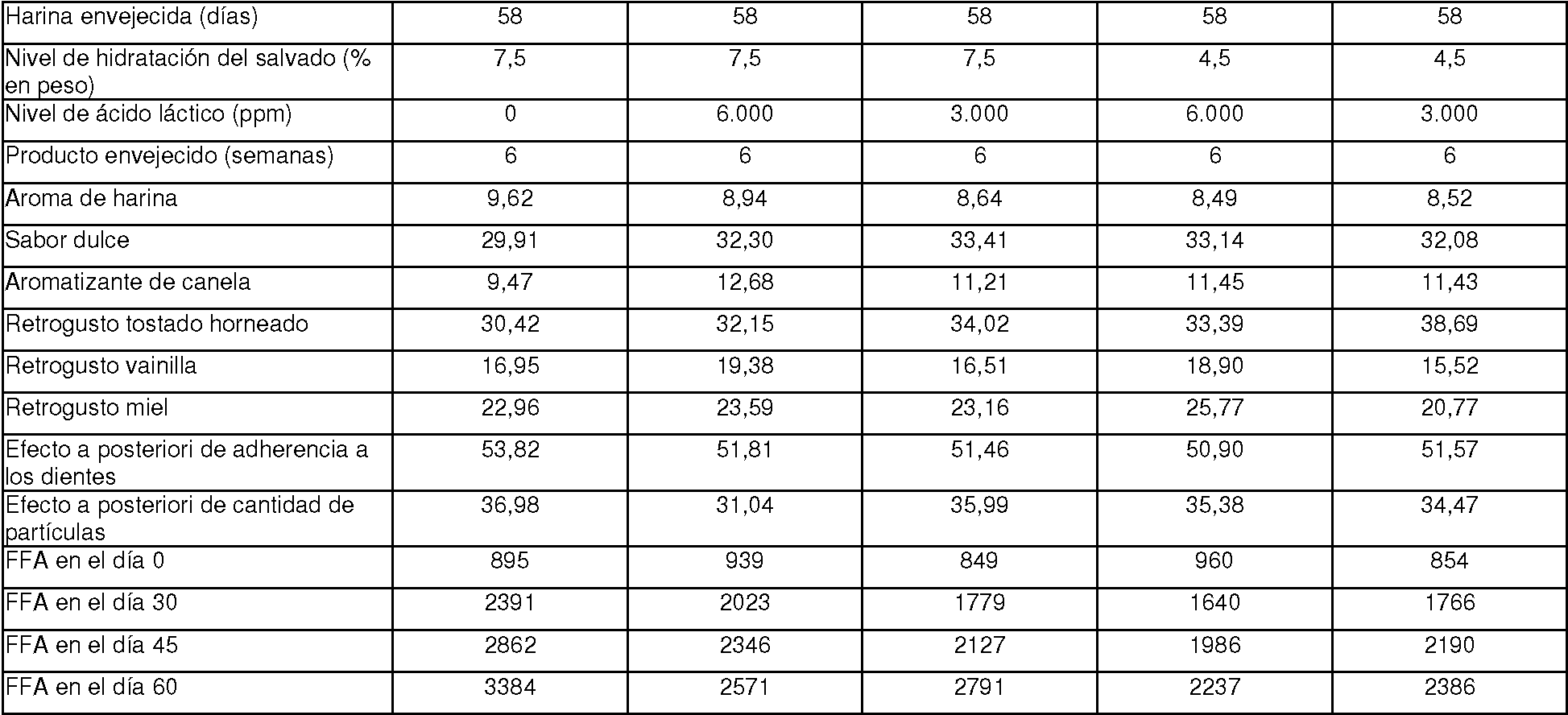
Discusión de los resultadosDiscussion of results
Como se muestra en la Tabla 25, la harina integral que se había estabilizado utilizando tanto tratamiento con ácido láctico como de calor ligero (86,70C (188 0F)) dio lugar a artículos horneados con una mayor retención del sabor dulce de al menos 32,08 unidades de escala (tandas 2, 3, 4, y 5) en comparación con una puntuación de 29,91 de unidades de escala (tanda 1) para el control en el que se utilizó harina integral, estabilizada solamente con estabilización mediante calor ligero (86,7 °C (188 0F)) y sin tratamiento con ácido láctico, para un aumento de la puntuación de sabor dulce de al menos 7,2 %. As shown in Table 25, whole wheat flour that had stabilized using both lactic acid and light heat treatment (86.70C (188 0F)) resulted in baked goods with a higher sweet taste retention of at least 32 .08 scale units (rounds 2, 3, 4, and 5) compared to a score of 29.91 scale units (round 1) for the control using wholemeal flour, stabilized only with heat stabilization light (86.7 ° C (188 0F)) and lactic acid free, for a sweet taste score increase of at least 7.2%.
También, como se muestra en la Tabla 25, la harina integral que se había estabilizado utilizando tanto tratamiento con ácido láctico como de calor ligero (86,7 0C (188 0F)) dio lugar a artículos horneados con una mayor retención del sabor a canela de al menos 11,21 unidades de escala (tandas 2, 3, 4, y 5) en comparación con una puntuación de 9,47 de unidades de escala (tanda 1) para el control en el que se utilizaba harina integral, estabilizada solamente con estabilización mediante calor ligero (86,7 0C (188 0F)) y sin tratamiento con ácido láctico, para un aumento de la puntuación de sabor a canela de al menos 18,3 %.Also, as shown in Table 25, whole wheat flour that had stabilized using both lactic acid and light heat treatment (86.7 0C (188 0F)) resulted in baked goods with increased cinnamon flavor retention. of at least 11.21 scale units (rounds 2, 3, 4, and 5) compared to a score of 9.47 scale units (round 1) for the control using wholemeal flour, stabilized only with light heat stabilization (86.7 0C (188 0F)) and without lactic acid treatment, for an increase in cinnamon flavor score of at least 18.3%.
La propiedad negativa de aroma de harina cruda, como se muestra en la Tabla 25 permaneció por debajo de un máximo de 9 unidades de escala de 8,94 (tandas 2, 3, 4 y 5) en comparación con el control que dio una puntuación de 9,62 unidades de escala (tanda 1) para una disminución en la puntuación de aroma de harina de al menos 7 %. The negative aroma property of raw flour, as shown in Table 25, remained below a maximum of 9 scale units of 8.94 (runs 2, 3, 4, and 5) compared to the control that gave a score. 9.62 scale units (round 1) for a decrease in flour flavor score of at least 7%.
En comparación con el número de tanda 1 (sin ácido láctico; sirvió de control), todas las muestras con ácido láctico (tandas 2, 3, 4 y 5) tienen un aroma de harina cruda bajo, más sabor dulce, más sabor a canela, un mayor retrogusto tostado horneado, menos adhesión a los dientes y una menor cantidad de efectos a posteriori de partículas.Compared to batch number 1 (no lactic acid; served as a control), all lactic acid samples (batches 2, 3, 4, and 5) have a low raw flour aroma, more sweet taste, more cinnamon flavor , a greater baked toasty aftertaste, less adhesion to teeth and fewer particle after effects.
En comparación con el número de tanda 1 (sin ácido láctico; sirvió de control): a) las muestras producidas utilizando 6.000 ppm de ácido láctico (tandas 2 y 4), pero no 3.000 ppm de ácido láctico (tandas 3 y 5) tienen un mayor retrogusto de vainilla y b) todas las muestras (tandas 2, 3, 4) con ácido láctico tienen un mayor retrogusto de miel excepto la muestra (tanda 5) producida utilizando 3.000 ppm de ácido láctico y 4,5 % de hidratación de salvado. Compared to batch number 1 (no lactic acid; served as a control): a) Samples produced using 6,000 ppm lactic acid (runs 2 and 4), but not 3,000 ppm lactic acid (runs 3 and 5) have a greater vanilla aftertaste and b) all the samples (batches 2, 3, 4) with lactic acid have a greater honey aftertaste except the sample (batch 5) produced using 3,000 ppm of lactic acid and 4.5% hydration of bran .
El uso tanto del tratamiento con ácido láctico como del tratamiento de calor ligero para estabilizar la harina de trigo integral aumenta el frescor de la harina integral y de los productos que la contienen, medido por los free fatty acid (ácidos grasos libres - FFA) formados en la harina durante el almacenamiento, y la retención de sabor en el producto fabricado con harina envejecida en comparación con el frescor de la harina integral de control estabilizada sin tratamiento con ácido láctico, y la retención de sabor de los productos que contienen la harina de control, como queda demostrado en la Tabla 25. The use of both lactic acid treatment and light heat treatment to stabilize whole wheat flour increases the freshness of whole flour and the products that contain it, as measured by the free fatty acids formed. in flour during storage, and the flavor retention in the product made with aged flour compared to the freshness of the stabilized control whole flour without treatment with lactic acid, and the flavor retention of the products that contain the flour of control, as shown in Table 25.
Claims (15)
Applications Claiming Priority (2)
| Application Number | Priority Date | Filing Date | Title |
|---|---|---|---|
| US201161457514P | 2011-04-14 | 2011-04-14 | |
| PCT/US2012/033500 WO2012142399A2 (en) | 2011-04-14 | 2012-04-13 | Method to extend whole grain flour and product shelf life |
Publications (1)
| Publication Number | Publication Date |
|---|---|
| ES2761849T3 true ES2761849T3 (en) | 2020-05-21 |
Family
ID=46062736
Family Applications (1)
| Application Number | Title | Priority Date | Filing Date |
|---|---|---|---|
| ES12720718T Active ES2761849T3 (en) | 2011-04-14 | 2012-04-13 | Stabilized whole wheat flour production method |
Country Status (12)
| Country | Link |
|---|---|
| US (3) | US10212958B2 (en) |
| EP (1) | EP2696695B1 (en) |
| JP (1) | JP6124867B2 (en) |
| CN (1) | CN103702566B (en) |
| AU (1) | AU2012242674B2 (en) |
| BR (1) | BR112013026332A2 (en) |
| CA (2) | CA3060899C (en) |
| ES (1) | ES2761849T3 (en) |
| MX (2) | MX366357B (en) |
| PE (1) | PE20141305A1 (en) |
| RU (1) | RU2603513C2 (en) |
| WO (1) | WO2012142399A2 (en) |
Families Citing this family (23)
| Publication number | Priority date | Publication date | Assignee | Title |
|---|---|---|---|---|
| US7263501B2 (en) * | 2003-03-11 | 2007-08-28 | I-Stat Corporation | Point-of-care inventory management system and method |
| BR112015021025A8 (en) | 2013-03-15 | 2019-11-26 | Intercontinental Great Brands Llc | method for enhancing the taste and texture of a ground bran and germ component, bran and germ component, whole grain flour, baked product and method for producing an improved flavor and texture whole grain flour |
| KR101672948B1 (en) * | 2014-11-06 | 2016-11-04 | 롯데제과주식회사 | Cookie composition with a moist texture and a method for preparing of cookie using it |
| EP3240425A1 (en) | 2014-12-29 | 2017-11-08 | Intercontinental Great Brands LLC | Enzymatic bran and germ flavor and texture improvement |
| CN104799198B (en) * | 2015-04-08 | 2018-04-06 | 山东省农业科学院农产品研究所 | A kind of preparation method of instant wheat plumule |
| JP2018518184A (en) | 2015-06-19 | 2018-07-12 | アルカディア バイオサイエンシズ,インコーポレイテッド | Wheat with reduced lipoxygenase activity |
| CN105107564B (en) * | 2015-08-27 | 2018-01-26 | 江苏省农业科学院 | A processing method for improving the transparency of fine-tasting rice |
| CN105334281B (en) * | 2015-10-13 | 2017-03-29 | 江南大学 | The detection method of oatmeal addition in a kind of flour noodles |
| GB201602626D0 (en) * | 2016-02-15 | 2016-03-30 | Alchemy Foodtech Pte Ltd And Goh Zhi M V | Glycemic reducing composition |
| CA3019473C (en) | 2016-04-01 | 2024-05-28 | Nestec S.A. | Ingredient for foodstuffs |
| CN105876602A (en) * | 2016-04-20 | 2016-08-24 | 安徽省天麒面业科技股份有限公司 | Processing method of whole wheat flour |
| CN105879953A (en) * | 2016-05-06 | 2016-08-24 | 安徽蓝盈食品股份公司 | Heat insulation protection method for high temperature treatment of flour |
| US10463051B2 (en) | 2016-06-17 | 2019-11-05 | Arcadia Biosciences, Inc. | Plants with reduced Lipase 1 activity |
| CN105995467A (en) * | 2016-06-21 | 2016-10-12 | 河北科技大学 | Preparation method of special wholewheat staple food flour with long shelf life |
| CN109351389B (en) * | 2016-11-30 | 2020-10-13 | 宁夏鑫德粮油工贸有限公司 | High-flour-yield echelon wheat wetting process |
| AU2018257890A1 (en) | 2017-04-24 | 2019-10-24 | General Mills, Inc. | Method for disinfecting and tempering grain |
| WO2018226217A1 (en) * | 2017-06-07 | 2018-12-13 | General Mills, Inc. | 3d printed foods |
| WO2019094585A1 (en) * | 2017-11-08 | 2019-05-16 | Campbell Soup Company | Method for producing stabilized whole grain flour, stabilized whole grain flour and flour products |
| CN109805262A (en) * | 2019-01-29 | 2019-05-28 | 吴欣洋 | Compound meal replacement powder of wheat germ containing wheat-bran dietary fiber and preparation method thereof |
| US20220408737A1 (en) * | 2019-12-06 | 2022-12-29 | Intercontinental Great Brands Llc | High-acid baked good and method of making baked good |
| US12053009B2 (en) | 2021-01-08 | 2024-08-06 | Intercontinental Great Brands Llc | Method of reducing asparagine in whole grain flours |
| CN115349614B (en) * | 2022-08-15 | 2024-04-16 | 宝得瑞(湖北)健康产业有限公司 | Instant nutritional pumpkin powder with good stability and preparation method thereof |
| CN118140975A (en) * | 2024-04-10 | 2024-06-07 | 晨光生物科技集团股份有限公司 | Composite enzyme inhibitor special for wheat germ flakes, wheat germ flakes product and preparation method thereof |
Family Cites Families (36)
| Publication number | Priority date | Publication date | Assignee | Title |
|---|---|---|---|---|
| US2930699A (en) * | 1955-03-08 | 1960-03-29 | Process Millers Inc | Method of milling certain cereal grains |
| US3851085A (en) | 1971-06-18 | 1974-11-26 | Pillsbury Co | Hydroprocessing of wheat |
| US3832472A (en) | 1972-03-17 | 1974-08-27 | Pillsbury Co | Wheat product |
| US3958016A (en) * | 1975-02-26 | 1976-05-18 | The Pillsbury Company | Method of hydroprocessing wheat |
| US4089259A (en) | 1975-11-03 | 1978-05-16 | Stickle Daniel T | Corn flour milling |
| JPS59232058A (en) * | 1983-06-11 | 1984-12-26 | Taiyo Kagaku Kk | Roasted wheat germ powder having good taste |
| US4737371A (en) | 1984-07-24 | 1988-04-12 | The United States Of America As Represented By The Secretary Of Agriculture | Process for stabilizing whole cereal grains |
| US4956190A (en) | 1989-04-24 | 1990-09-11 | Borden, Inc. | Tempering and milling of edible grains and leguminous materials with reducing agents and methods of making alimentary products |
| JPH03219872A (en) | 1990-01-25 | 1991-09-27 | Meiji Seika Kaisha Ltd | Lipase inhibitor |
| CA2013190C (en) | 1990-03-27 | 2000-06-06 | F. William Collins | Method of producing stable bran and flour products from cereal grains |
| US5066506A (en) | 1990-06-01 | 1991-11-19 | General Mills, Inc. | Method of preparing stabilized whole grain flour |
| EP0552006A1 (en) | 1992-01-13 | 1993-07-21 | CONAGRA, Inc. | Method for increasing stability and bake absorption of a bread baking wheat flour and resulting dough and bread |
| US5395639A (en) | 1992-10-23 | 1995-03-07 | Borden, Inc. | Milling procedure for the manufacture of alimentary paste and pasta products from whole grains |
| AUPP146698A0 (en) * | 1998-01-21 | 1998-02-12 | Byron Australia Pty Ltd | Imbibant grains for bakery and others uses |
| BR0009535A (en) | 1999-04-02 | 2002-01-02 | Leon Milner Theodore Dicks | Cooking mixes containing flour and having an improved shelf life and method and means for its preparation |
| WO2000077133A1 (en) | 1999-06-16 | 2000-12-21 | Kao Corporation | Fat compositions |
| US6497909B1 (en) | 1999-09-09 | 2002-12-24 | General Mills, Inc. | Method of bleaching cereal grain |
| US6616957B1 (en) | 2000-11-28 | 2003-09-09 | Kraft Foods Holdings, Inc. | Method of stabilizing graham flour, and cracker produced from said flour |
| US20030044505A1 (en) | 2001-08-31 | 2003-03-06 | Zhi Chen | Method for producing instantly soluble tea tablets |
| US8053010B2 (en) * | 2001-12-04 | 2011-11-08 | General Mills, Inc. | Bran and bran containing products of improved flavor and methods of preparation |
| RU2220001C2 (en) * | 2002-02-14 | 2003-12-27 | Открытое акционерное общество "Рыбинский комбинат хлебопродуктов" | Method of preparation of the grain for a flour milling |
| JP4157765B2 (en) | 2002-02-18 | 2008-10-01 | 花王株式会社 | Powdered oil |
| ATE421338T1 (en) | 2003-01-31 | 2009-02-15 | Simply Thick Llc | METHOD FOR PRODUCING IMPROVED THICKENED DRINKS AGAINST DYSPHAGIA |
| AU2004299117B2 (en) | 2003-12-17 | 2010-11-11 | Ardent Mills Llc | A process for producing an ultrafine-milled whole-grain wheat flour and products thereof |
| US7419694B2 (en) | 2003-12-17 | 2008-09-02 | Conagra Foods Food Ingredients Company, Inc. | Process for producing an ultrafine-milled whole-grain wheat flour and products thereof |
| CA2557261A1 (en) | 2004-02-23 | 2005-09-15 | The Texas A&M University System | Antioxidant compositions and methods of use thereof |
| US7258888B2 (en) | 2004-05-11 | 2007-08-21 | General Mills Marketing, Inc. | Flour and dough compositions and related methods |
| CN101151349B (en) | 2005-03-31 | 2011-04-13 | 三菱化学株式会社 | Anti-deterioration agent |
| US20060251791A1 (en) | 2005-05-05 | 2006-11-09 | Rubio Felipe A | Continuous production of pregelatinized corn flours for dairy-based and cereal-based foods |
| WO2006127922A1 (en) | 2005-05-24 | 2006-11-30 | Cargill, Incorporated | Stabilized whole grain flour |
| US20070148318A1 (en) | 2005-12-22 | 2007-06-28 | Rubio Felipe A | Continuous production of masa flour and whole-corn flour for grain-based foods, using a novel precooking |
| US20070269579A1 (en) | 2006-05-17 | 2007-11-22 | Mingus J D | Recombined whole grain having visually indistinguishable particulate matter and related baked products |
| WO2008007245A2 (en) | 2006-06-07 | 2008-01-17 | The Iams Company | Natural preservatives for preservation of perishable products |
| US8133527B2 (en) * | 2006-06-16 | 2012-03-13 | Kraft Foods Global Brands Llc | Production of stabilized whole grain wheat flour and products thereof |
| AU2007205799A1 (en) * | 2006-08-15 | 2008-03-06 | Hugo Nestor Porro | Wheat grains and/or resulting flours disinfection, discoloration and cleaning before, during or after milling |
| JP5528535B2 (en) * | 2009-03-31 | 2014-06-25 | ダニスコ・アクティーゼルスカブ | Darkening of extracts and prevention of malodor formation during solubilization of plant cell wall material |
-
2012
- 2012-04-13 CA CA3060899A patent/CA3060899C/en active Active
- 2012-04-13 RU RU2013149630/13A patent/RU2603513C2/en active
- 2012-04-13 PE PE2013002299A patent/PE20141305A1/en not_active Application Discontinuation
- 2012-04-13 ES ES12720718T patent/ES2761849T3/en active Active
- 2012-04-13 AU AU2012242674A patent/AU2012242674B2/en not_active Ceased
- 2012-04-13 MX MX2013011962A patent/MX366357B/en active IP Right Grant
- 2012-04-13 WO PCT/US2012/033500 patent/WO2012142399A2/en not_active Ceased
- 2012-04-13 CN CN201280029090.6A patent/CN103702566B/en not_active Expired - Fee Related
- 2012-04-13 EP EP12720718.1A patent/EP2696695B1/en active Active
- 2012-04-13 JP JP2014505334A patent/JP6124867B2/en not_active Expired - Fee Related
- 2012-04-13 US US14/111,679 patent/US10212958B2/en active Active
- 2012-04-13 BR BR112013026332-6A patent/BR112013026332A2/en not_active Application Discontinuation
- 2012-04-13 CA CA2833045A patent/CA2833045C/en active Active
-
2013
- 2013-10-11 MX MX2019008100A patent/MX2019008100A/en unknown
-
2019
- 2019-01-23 US US16/254,746 patent/US12082602B2/en active Active
-
2024
- 2024-08-01 US US18/791,749 patent/US20240389622A1/en active Pending
Also Published As
| Publication number | Publication date |
|---|---|
| RU2013149630A (en) | 2015-05-20 |
| WO2012142399A3 (en) | 2013-03-14 |
| CN103702566B (en) | 2017-06-09 |
| CA2833045A1 (en) | 2012-10-18 |
| US20240389622A1 (en) | 2024-11-28 |
| MX2013011962A (en) | 2014-03-05 |
| MX366357B (en) | 2019-07-05 |
| US12082602B2 (en) | 2024-09-10 |
| EP2696695B1 (en) | 2019-10-02 |
| EP2696695A2 (en) | 2014-02-19 |
| US10212958B2 (en) | 2019-02-26 |
| RU2603513C2 (en) | 2016-11-27 |
| PE20141305A1 (en) | 2014-09-26 |
| WO2012142399A2 (en) | 2012-10-18 |
| BR112013026332A2 (en) | 2020-09-24 |
| JP2014510544A (en) | 2014-05-01 |
| CA2833045C (en) | 2020-01-07 |
| CA3060899C (en) | 2022-11-15 |
| US20140099421A1 (en) | 2014-04-10 |
| JP6124867B2 (en) | 2017-05-10 |
| MX2019008100A (en) | 2019-09-04 |
| AU2012242674A1 (en) | 2013-10-31 |
| US20190150487A1 (en) | 2019-05-23 |
| CN103702566A (en) | 2014-04-02 |
| AU2012242674B2 (en) | 2015-05-28 |
| CA3060899A1 (en) | 2012-10-18 |
Similar Documents
| Publication | Publication Date | Title |
|---|---|---|
| ES2761849T3 (en) | Stabilized whole wheat flour production method | |
| US8133527B2 (en) | Production of stabilized whole grain wheat flour and products thereof | |
| ES2647132T3 (en) | Improved taste and texture of bran and germ | |
| CA2923633C (en) | Soft biscuit with slowly available glucose | |
| Samakradhamrongthai et al. | Application of mannitol and kale protein extract in the development of Sung Yod rice bread and its stability during storage |