ES2763239T3 - Combination therapy comprising SGLT inhibitors and DPP4 inhibitors - Google Patents
Combination therapy comprising SGLT inhibitors and DPP4 inhibitors Download PDFInfo
- Publication number
- ES2763239T3 ES2763239T3 ES09701670T ES09701670T ES2763239T3 ES 2763239 T3 ES2763239 T3 ES 2763239T3 ES 09701670 T ES09701670 T ES 09701670T ES 09701670 T ES09701670 T ES 09701670T ES 2763239 T3 ES2763239 T3 ES 2763239T3
- Authority
- ES
- Spain
- Prior art keywords
- alkyl
- group
- pharmaceutically acceptable
- alkoxy
- formula
- Prior art date
- Legal status (The legal status is an assumption and is not a legal conclusion. Google has not performed a legal analysis and makes no representation as to the accuracy of the status listed.)
- Active
Links
- 0 *[C@@]([C@@](CO)O[C@](C1O)c(cc2Cc(cc3)ccc3Br)ccc2Cl)[C@@]1O Chemical compound *[C@@]([C@@](CO)O[C@](C1O)c(cc2Cc(cc3)ccc3Br)ccc2Cl)[C@@]1O 0.000 description 2
- QIQONTYFPJTRNK-LYTJVHSLSA-N CC/[O]=C(/[C@@H]([C@H]1O)O)\O[C@](C2)(C2[PoH])[C@H]1O Chemical compound CC/[O]=C(/[C@@H]([C@H]1O)O)\O[C@](C2)(C2[PoH])[C@H]1O QIQONTYFPJTRNK-LYTJVHSLSA-N 0.000 description 1
- BMDAILISBPYXAD-PAQXIVFDSA-N COC([C@@H](C(C[O]=C)OC1c2ccc(C3CC3)c(Cc3ccc(C4(CCCCCCC4)N)[o]3)c2)[O](C)=C)[C@H]1[O](C)=C Chemical compound COC([C@@H](C(C[O]=C)OC1c2ccc(C3CC3)c(Cc3ccc(C4(CCCCCCC4)N)[o]3)c2)[O](C)=C)[C@H]1[O](C)=C BMDAILISBPYXAD-PAQXIVFDSA-N 0.000 description 1
Classifications
-
- A—HUMAN NECESSITIES
- A61—MEDICAL OR VETERINARY SCIENCE; HYGIENE
- A61K—PREPARATIONS FOR MEDICAL, DENTAL OR TOILETRY PURPOSES
- A61K31/00—Medicinal preparations containing organic active ingredients
- A61K31/70—Carbohydrates; Sugars; Derivatives thereof
- A61K31/7042—Compounds having saccharide radicals and heterocyclic rings
- A61K31/7052—Compounds having saccharide radicals and heterocyclic rings having nitrogen as a ring hetero atom, e.g. nucleosides, nucleotides
- A61K31/706—Compounds having saccharide radicals and heterocyclic rings having nitrogen as a ring hetero atom, e.g. nucleosides, nucleotides containing six-membered rings with nitrogen as a ring hetero atom
-
- A—HUMAN NECESSITIES
- A61—MEDICAL OR VETERINARY SCIENCE; HYGIENE
- A61K—PREPARATIONS FOR MEDICAL, DENTAL OR TOILETRY PURPOSES
- A61K31/00—Medicinal preparations containing organic active ingredients
- A61K31/33—Heterocyclic compounds
- A61K31/395—Heterocyclic compounds having nitrogen as a ring hetero atom, e.g. guanethidine or rifamycins
- A61K31/40—Heterocyclic compounds having nitrogen as a ring hetero atom, e.g. guanethidine or rifamycins having five-membered rings with one nitrogen as the only ring hetero atom, e.g. sulpiride, succinimide, tolmetin, buflomedil
- A61K31/401—Proline; Derivatives thereof, e.g. captopril
-
- A—HUMAN NECESSITIES
- A61—MEDICAL OR VETERINARY SCIENCE; HYGIENE
- A61K—PREPARATIONS FOR MEDICAL, DENTAL OR TOILETRY PURPOSES
- A61K31/00—Medicinal preparations containing organic active ingredients
- A61K31/33—Heterocyclic compounds
- A61K31/395—Heterocyclic compounds having nitrogen as a ring hetero atom, e.g. guanethidine or rifamycins
- A61K31/40—Heterocyclic compounds having nitrogen as a ring hetero atom, e.g. guanethidine or rifamycins having five-membered rings with one nitrogen as the only ring hetero atom, e.g. sulpiride, succinimide, tolmetin, buflomedil
-
- A—HUMAN NECESSITIES
- A61—MEDICAL OR VETERINARY SCIENCE; HYGIENE
- A61K—PREPARATIONS FOR MEDICAL, DENTAL OR TOILETRY PURPOSES
- A61K31/00—Medicinal preparations containing organic active ingredients
- A61K31/33—Heterocyclic compounds
- A61K31/395—Heterocyclic compounds having nitrogen as a ring hetero atom, e.g. guanethidine or rifamycins
- A61K31/495—Heterocyclic compounds having nitrogen as a ring hetero atom, e.g. guanethidine or rifamycins having six-membered rings with two or more nitrogen atoms as the only ring heteroatoms, e.g. piperazine or tetrazines
- A61K31/496—Non-condensed piperazines containing further heterocyclic rings, e.g. rifampin, thiothixene or sparfloxacin
-
- A—HUMAN NECESSITIES
- A61—MEDICAL OR VETERINARY SCIENCE; HYGIENE
- A61K—PREPARATIONS FOR MEDICAL, DENTAL OR TOILETRY PURPOSES
- A61K31/00—Medicinal preparations containing organic active ingredients
- A61K31/33—Heterocyclic compounds
- A61K31/395—Heterocyclic compounds having nitrogen as a ring hetero atom, e.g. guanethidine or rifamycins
- A61K31/495—Heterocyclic compounds having nitrogen as a ring hetero atom, e.g. guanethidine or rifamycins having six-membered rings with two or more nitrogen atoms as the only ring heteroatoms, e.g. piperazine or tetrazines
- A61K31/4985—Pyrazines or piperazines ortho- or peri-condensed with heterocyclic ring systems
-
- A—HUMAN NECESSITIES
- A61—MEDICAL OR VETERINARY SCIENCE; HYGIENE
- A61K—PREPARATIONS FOR MEDICAL, DENTAL OR TOILETRY PURPOSES
- A61K31/00—Medicinal preparations containing organic active ingredients
- A61K31/33—Heterocyclic compounds
- A61K31/395—Heterocyclic compounds having nitrogen as a ring hetero atom, e.g. guanethidine or rifamycins
- A61K31/535—Heterocyclic compounds having nitrogen as a ring hetero atom, e.g. guanethidine or rifamycins having six-membered rings with at least one nitrogen and one oxygen as the ring hetero atoms, e.g. 1,2-oxazines
- A61K31/5375—1,4-Oxazines, e.g. morpholine
- A61K31/5377—1,4-Oxazines, e.g. morpholine not condensed and containing further heterocyclic rings, e.g. timolol
-
- A—HUMAN NECESSITIES
- A61—MEDICAL OR VETERINARY SCIENCE; HYGIENE
- A61K—PREPARATIONS FOR MEDICAL, DENTAL OR TOILETRY PURPOSES
- A61K31/00—Medicinal preparations containing organic active ingredients
- A61K31/70—Carbohydrates; Sugars; Derivatives thereof
- A61K31/7004—Monosaccharides having only carbon, hydrogen and oxygen atoms
-
- A—HUMAN NECESSITIES
- A61—MEDICAL OR VETERINARY SCIENCE; HYGIENE
- A61K—PREPARATIONS FOR MEDICAL, DENTAL OR TOILETRY PURPOSES
- A61K31/00—Medicinal preparations containing organic active ingredients
- A61K31/70—Carbohydrates; Sugars; Derivatives thereof
- A61K31/7008—Compounds having an amino group directly attached to a carbon atom of the saccharide radical, e.g. D-galactosamine, ranimustine
-
- A—HUMAN NECESSITIES
- A61—MEDICAL OR VETERINARY SCIENCE; HYGIENE
- A61K—PREPARATIONS FOR MEDICAL, DENTAL OR TOILETRY PURPOSES
- A61K31/00—Medicinal preparations containing organic active ingredients
- A61K31/70—Carbohydrates; Sugars; Derivatives thereof
- A61K31/7028—Compounds having saccharide radicals attached to non-saccharide compounds by glycosidic linkages
- A61K31/7034—Compounds having saccharide radicals attached to non-saccharide compounds by glycosidic linkages attached to a carbocyclic compound, e.g. phloridzin
-
- A—HUMAN NECESSITIES
- A61—MEDICAL OR VETERINARY SCIENCE; HYGIENE
- A61K—PREPARATIONS FOR MEDICAL, DENTAL OR TOILETRY PURPOSES
- A61K31/00—Medicinal preparations containing organic active ingredients
- A61K31/70—Carbohydrates; Sugars; Derivatives thereof
- A61K31/7042—Compounds having saccharide radicals and heterocyclic rings
- A61K31/7052—Compounds having saccharide radicals and heterocyclic rings having nitrogen as a ring hetero atom, e.g. nucleosides, nucleotides
- A61K31/7056—Compounds having saccharide radicals and heterocyclic rings having nitrogen as a ring hetero atom, e.g. nucleosides, nucleotides containing five-membered rings with nitrogen as a ring hetero atom
-
- A—HUMAN NECESSITIES
- A61—MEDICAL OR VETERINARY SCIENCE; HYGIENE
- A61K—PREPARATIONS FOR MEDICAL, DENTAL OR TOILETRY PURPOSES
- A61K45/00—Medicinal preparations containing active ingredients not provided for in groups A61K31/00 - A61K41/00
- A61K45/06—Mixtures of active ingredients without chemical characterisation, e.g. antiphlogistics and cardiaca
-
- A—HUMAN NECESSITIES
- A61—MEDICAL OR VETERINARY SCIENCE; HYGIENE
- A61P—SPECIFIC THERAPEUTIC ACTIVITY OF CHEMICAL COMPOUNDS OR MEDICINAL PREPARATIONS
- A61P13/00—Drugs for disorders of the urinary system
- A61P13/12—Drugs for disorders of the urinary system of the kidneys
-
- A—HUMAN NECESSITIES
- A61—MEDICAL OR VETERINARY SCIENCE; HYGIENE
- A61P—SPECIFIC THERAPEUTIC ACTIVITY OF CHEMICAL COMPOUNDS OR MEDICINAL PREPARATIONS
- A61P25/00—Drugs for disorders of the nervous system
-
- A—HUMAN NECESSITIES
- A61—MEDICAL OR VETERINARY SCIENCE; HYGIENE
- A61P—SPECIFIC THERAPEUTIC ACTIVITY OF CHEMICAL COMPOUNDS OR MEDICINAL PREPARATIONS
- A61P25/00—Drugs for disorders of the nervous system
- A61P25/02—Drugs for disorders of the nervous system for peripheral neuropathies
-
- A—HUMAN NECESSITIES
- A61—MEDICAL OR VETERINARY SCIENCE; HYGIENE
- A61P—SPECIFIC THERAPEUTIC ACTIVITY OF CHEMICAL COMPOUNDS OR MEDICINAL PREPARATIONS
- A61P25/00—Drugs for disorders of the nervous system
- A61P25/08—Antiepileptics; Anticonvulsants
-
- A—HUMAN NECESSITIES
- A61—MEDICAL OR VETERINARY SCIENCE; HYGIENE
- A61P—SPECIFIC THERAPEUTIC ACTIVITY OF CHEMICAL COMPOUNDS OR MEDICINAL PREPARATIONS
- A61P25/00—Drugs for disorders of the nervous system
- A61P25/14—Drugs for disorders of the nervous system for treating abnormal movements, e.g. chorea, dyskinesia
-
- A—HUMAN NECESSITIES
- A61—MEDICAL OR VETERINARY SCIENCE; HYGIENE
- A61P—SPECIFIC THERAPEUTIC ACTIVITY OF CHEMICAL COMPOUNDS OR MEDICINAL PREPARATIONS
- A61P25/00—Drugs for disorders of the nervous system
- A61P25/14—Drugs for disorders of the nervous system for treating abnormal movements, e.g. chorea, dyskinesia
- A61P25/16—Anti-Parkinson drugs
-
- A—HUMAN NECESSITIES
- A61—MEDICAL OR VETERINARY SCIENCE; HYGIENE
- A61P—SPECIFIC THERAPEUTIC ACTIVITY OF CHEMICAL COMPOUNDS OR MEDICINAL PREPARATIONS
- A61P25/00—Drugs for disorders of the nervous system
- A61P25/28—Drugs for disorders of the nervous system for treating neurodegenerative disorders of the central nervous system, e.g. nootropic agents, cognition enhancers, drugs for treating Alzheimer's disease or other forms of dementia
-
- A—HUMAN NECESSITIES
- A61—MEDICAL OR VETERINARY SCIENCE; HYGIENE
- A61P—SPECIFIC THERAPEUTIC ACTIVITY OF CHEMICAL COMPOUNDS OR MEDICINAL PREPARATIONS
- A61P27/00—Drugs for disorders of the senses
- A61P27/02—Ophthalmic agents
-
- A—HUMAN NECESSITIES
- A61—MEDICAL OR VETERINARY SCIENCE; HYGIENE
- A61P—SPECIFIC THERAPEUTIC ACTIVITY OF CHEMICAL COMPOUNDS OR MEDICINAL PREPARATIONS
- A61P27/00—Drugs for disorders of the senses
- A61P27/02—Ophthalmic agents
- A61P27/12—Ophthalmic agents for cataracts
-
- A—HUMAN NECESSITIES
- A61—MEDICAL OR VETERINARY SCIENCE; HYGIENE
- A61P—SPECIFIC THERAPEUTIC ACTIVITY OF CHEMICAL COMPOUNDS OR MEDICINAL PREPARATIONS
- A61P3/00—Drugs for disorders of the metabolism
-
- A—HUMAN NECESSITIES
- A61—MEDICAL OR VETERINARY SCIENCE; HYGIENE
- A61P—SPECIFIC THERAPEUTIC ACTIVITY OF CHEMICAL COMPOUNDS OR MEDICINAL PREPARATIONS
- A61P3/00—Drugs for disorders of the metabolism
- A61P3/04—Anorexiants; Antiobesity agents
-
- A—HUMAN NECESSITIES
- A61—MEDICAL OR VETERINARY SCIENCE; HYGIENE
- A61P—SPECIFIC THERAPEUTIC ACTIVITY OF CHEMICAL COMPOUNDS OR MEDICINAL PREPARATIONS
- A61P3/00—Drugs for disorders of the metabolism
- A61P3/06—Antihyperlipidemics
-
- A—HUMAN NECESSITIES
- A61—MEDICAL OR VETERINARY SCIENCE; HYGIENE
- A61P—SPECIFIC THERAPEUTIC ACTIVITY OF CHEMICAL COMPOUNDS OR MEDICINAL PREPARATIONS
- A61P3/00—Drugs for disorders of the metabolism
- A61P3/08—Drugs for disorders of the metabolism for glucose homeostasis
- A61P3/10—Drugs for disorders of the metabolism for glucose homeostasis for hyperglycaemia, e.g. antidiabetics
-
- A—HUMAN NECESSITIES
- A61—MEDICAL OR VETERINARY SCIENCE; HYGIENE
- A61P—SPECIFIC THERAPEUTIC ACTIVITY OF CHEMICAL COMPOUNDS OR MEDICINAL PREPARATIONS
- A61P43/00—Drugs for specific purposes, not provided for in groups A61P1/00-A61P41/00
-
- A—HUMAN NECESSITIES
- A61—MEDICAL OR VETERINARY SCIENCE; HYGIENE
- A61P—SPECIFIC THERAPEUTIC ACTIVITY OF CHEMICAL COMPOUNDS OR MEDICINAL PREPARATIONS
- A61P5/00—Drugs for disorders of the endocrine system
- A61P5/48—Drugs for disorders of the endocrine system of the pancreatic hormones
- A61P5/50—Drugs for disorders of the endocrine system of the pancreatic hormones for increasing or potentiating the activity of insulin
-
- A—HUMAN NECESSITIES
- A61—MEDICAL OR VETERINARY SCIENCE; HYGIENE
- A61P—SPECIFIC THERAPEUTIC ACTIVITY OF CHEMICAL COMPOUNDS OR MEDICINAL PREPARATIONS
- A61P9/00—Drugs for disorders of the cardiovascular system
-
- A—HUMAN NECESSITIES
- A61—MEDICAL OR VETERINARY SCIENCE; HYGIENE
- A61P—SPECIFIC THERAPEUTIC ACTIVITY OF CHEMICAL COMPOUNDS OR MEDICINAL PREPARATIONS
- A61P9/00—Drugs for disorders of the cardiovascular system
- A61P9/10—Drugs for disorders of the cardiovascular system for treating ischaemic or atherosclerotic diseases, e.g. antianginal drugs, coronary vasodilators, drugs for myocardial infarction, retinopathy, cerebrovascula insufficiency, renal arteriosclerosis
-
- A—HUMAN NECESSITIES
- A61—MEDICAL OR VETERINARY SCIENCE; HYGIENE
- A61P—SPECIFIC THERAPEUTIC ACTIVITY OF CHEMICAL COMPOUNDS OR MEDICINAL PREPARATIONS
- A61P9/00—Drugs for disorders of the cardiovascular system
- A61P9/12—Antihypertensives
-
- C—CHEMISTRY; METALLURGY
- C07—ORGANIC CHEMISTRY
- C07H—SUGARS; DERIVATIVES THEREOF; NUCLEOSIDES; NUCLEOTIDES; NUCLEIC ACIDS
- C07H7/00—Compounds containing non-saccharide radicals linked to saccharide radicals by a carbon-to-carbon bond
- C07H7/04—Carbocyclic radicals
Landscapes
- Health & Medical Sciences (AREA)
- Life Sciences & Earth Sciences (AREA)
- Chemical & Material Sciences (AREA)
- General Health & Medical Sciences (AREA)
- Public Health (AREA)
- Animal Behavior & Ethology (AREA)
- Veterinary Medicine (AREA)
- Medicinal Chemistry (AREA)
- Pharmacology & Pharmacy (AREA)
- Engineering & Computer Science (AREA)
- Bioinformatics & Cheminformatics (AREA)
- Organic Chemistry (AREA)
- Nuclear Medicine, Radiotherapy & Molecular Imaging (AREA)
- General Chemical & Material Sciences (AREA)
- Chemical Kinetics & Catalysis (AREA)
- Epidemiology (AREA)
- Molecular Biology (AREA)
- Biomedical Technology (AREA)
- Diabetes (AREA)
- Neurosurgery (AREA)
- Neurology (AREA)
- Hematology (AREA)
- Obesity (AREA)
- Ophthalmology & Optometry (AREA)
- Cardiology (AREA)
- Heart & Thoracic Surgery (AREA)
- Endocrinology (AREA)
- Psychology (AREA)
- Urology & Nephrology (AREA)
- Biotechnology (AREA)
- Biochemistry (AREA)
- Genetics & Genomics (AREA)
- Pain & Pain Management (AREA)
- Hospice & Palliative Care (AREA)
- Psychiatry (AREA)
- Child & Adolescent Psychology (AREA)
- Vascular Medicine (AREA)
- Emergency Medicine (AREA)
- Pharmaceuticals Containing Other Organic And Inorganic Compounds (AREA)
- Medicines That Contain Protein Lipid Enzymes And Other Medicines (AREA)
Abstract
Un agente que comprende un inhibidor de SGLT y un inhibidor de DPP4 para el uso en el tratamiento o la prevención de una enfermedad seleccionada de diabetes, hiperglucemia, tolerancia alterada a la glucosa, glucosa alterada en ayunas, resistencia a la insulina, insuficiencia de células beta pancreáticas, insuficiencia de células enteroendocrinas, glucosuria, acidosis metabólica, cataratas, nefropatía diabética, neuropatía diabética, retinopatía diabética, arteriopatía coronaria diabética, enfermedad cerebrovascular diabética, enfermedad vascular periférica diabética, síndrome metabólico, hiperlipidemia, ateroesclerosis, hipertensión, obesidad, infarto de miocardio, deterioro del aprendizaje, deterioro de la memoria, ictus y un trastorno neurodegenerativo, en el que el inhibidor de SGLT es un compuesto que tiene la Fórmula (24):**Fórmula** en la que RA es un átomo de halógeno o un grupo alquilo C1-6; y el Anillo C es un grupo fenilo sustituido con 1 a 3 sustituyentes seleccionados del grupo que consiste en un átomo de halógeno, un grupo ciano, un grupo alquilo C1-6, un grupo halo-alquilo C1-6, un grupo alcoxi C1-6, un grupo halo-alcoxi C1-6, un grupo metilendioxi, un grupo etilenoxi, un grupo mono- o di-alquil C1-6-amino, un grupo carbamoilo, y un grupo mono- o di-alquil C1-6-carbamoilo; o un grupo heterociclilo sustituido con 1 a 3 sustituyentes seleccionados del grupo que consiste en un átomo de halógeno, un grupo ciano, un grupo alquilo C1-6, un grupo halo-alquilo C1-6, un grupo alcoxi C1-6, un grupo halo-alcoxi C1-6, un grupo mono- o di-alquil C1-6-amino, un grupo carbamoilo, y un grupo mono- o di-alquil C1-6-carbamoilo; o una sal farmacéuticamente aceptable del mismo; y en el que el inhibidor de DPP4 se selecciona del grupo que consiste en (i) un compuesto que tiene la Fórmula (29):**Fórmula** en la que A representa -CH2- o -S-, R1 representa un átomo de hidrógeno, un grupo alquilo C1-6, un grupo hidroxi-alquilo C1-6 o un grupo alcoxi C1-6 alquilo C1-6, y R2 representa (1) un grupo cíclico que puede estar sustituido, en el que la porción de grupo cíclico es (i) un grupo hidrocarburo monocíclico, bicíclico o tricíclico, o (ii) un grupo heterocíclico monocíclico, bicíclico o tricíclico, o (2) un grupo amino que puede estar sustituido, o una sal farmacéuticamente aceptable del mismo; (ii) un compuesto que tiene la Fórmula (31):**Fórmula** X es -NR1R2, en la que R1 y R2 pueden ser iguales o diferentes, y cada uno es independientemente cicloalquilalquilo, arilalquilo, heteroarilo o heteroarilalquilo, o pueden estar unidos entre sí para formar un heterociclo que contiene opcionalmente 1 o 2 átomos de nitrógeno o átomos de oxígeno, y el heterociclo está condensado opcionalmente con un anillo aromático que opcionalmente tiene sustituyentes, y el heterociclo es opcionalmente un anillo espiro, -NR3COR4 en la que R3 y R4 son iguales o diferentes, y cada uno es independientemente un átomo de hidrógeno, alquilo, cicloalquilo, cicloalquilalquilo, arilo, arilalquilo, arilalquenilo, heteroarilo o heteroarilalquilo, -NR5CONR6R7 o -NR5CH2CH2NR6R7 en las que R5, R6 y R7 son iguales o diferentes, y cada uno es independientemente un átomo de hidrógeno, alquilo, acilo, cicloalquilo, cicloalquilalquilo, arilo, arilalquilo, heteroarilo o heteroarilalquilo, o R6 y R7 pueden estar unidos entre sí para formar un heterociclo que contiene opcionalmente 1 o 2 átomos de nitrógeno o átomos de oxígeno, y el heterociclo está condensado opcionalmente con un anillo aromático que opcionalmente tiene sustituyentes, -NR8SO2R9 en la que R8 y R9 son iguales o diferentes, y cada uno es independientemente un átomo de hidrógeno, alquilo, cicloalquilo, cicloalquilalquilo, arilo, arilalquilo, heteroarilo o heteroarilalquilo, o -OR10 o -OCOR11 en las que R10 y R11 son cada uno un átomo de hidrógeno, alquilo, cicloalquilo, cicloalquilalquilo, arilo, arilalquilo, heteroarilo o heteroarilalquilo, Y es CH2, CH-OH, S, S=O o SO2, Z es un átomo de hidrógeno o ciano, y de los grupos anteriormente mencionados, alquilo, arilo, arilalquilo, arilalquenilo, heteroarilo, heteroarilalquilo, cicloalquilo, cicloalquilalquilo y heterociclo tienen cada uno opcionalmente sustituyentes, o una sal farmacéuticamente aceptable del mismo; y (iii) sitagliptina o una sal farmacéuticamente aceptable de la misma.An agent comprising an SGLT inhibitor and a DPP4 inhibitor for use in the treatment or prevention of a selected disease of diabetes, hyperglycemia, impaired glucose tolerance, impaired fasting glucose, insulin resistance, cell failure pancreatic beta, enteroendocrine cell failure, glycosuria, metabolic acidosis, cataracts, diabetic nephropathy, diabetic neuropathy, diabetic retinopathy, diabetic coronary artery disease, diabetic cerebrovascular disease, diabetic peripheral vascular disease, metabolic syndrome, hyperlipidemia, atherosclerosis, hypertension, obesity myocardium, learning impairment, memory impairment, stroke, and a neurodegenerative disorder, in which the SGLT inhibitor is a compound having the Formula (24): ** Formula ** in which RA is a halogen atom or a C1-6 alkyl group; and Ring C is a phenyl group substituted with 1 to 3 substituents selected from the group consisting of a halogen atom, a cyano group, a C1-6 alkyl group, a halo-C1-6 alkyl group, a C1- alkoxy group 6, a halo-C1-6 alkoxy group, a methylenedioxy group, an ethyleneoxy group, a mono- or di-C1-6-alkyl-amino group, a carbamoyl group, and a mono- or di-C1-6-alkyl group carbamoyl; or a heterocyclyl group substituted with 1 to 3 substituents selected from the group consisting of a halogen atom, a cyano group, a C1-6 alkyl group, a halo-C1-6 alkyl group, a C1-6 alkoxy group, a group halo-C1-6 alkoxy, a mono- or di-C1-6 alkyl-amino group, a carbamoyl group, and a mono- or di-C1-6 alkyl-carbamoyl group; or a pharmaceutically acceptable salt thereof; and wherein the DPP4 inhibitor is selected from the group consisting of (i) a compound having the Formula (29): ** Formula ** wherein A represents -CH2- or -S-, R1 represents an atom of hydrogen, a C1-6 alkyl group, a hydroxy-C1-6 alkyl group or a C1-6 alkoxy C1-6 alkyl group, and R2 represents (1) a cyclic group that may be substituted, in which the portion of cyclic group is (i) a monocyclic, bicyclic, or tricyclic hydrocarbon group, or (ii) a monocyclic, bicyclic, or tricyclic heterocyclic group, or (2) an amino group that may be substituted, or a pharmaceutically acceptable salt thereof; (ii) a compound having Formula (31): ** Formula ** X is -NR1R2, where R1 and R2 may be the same or different, and each is independently cycloalkylalkyl, arylalkyl, heteroaryl, or heteroarylalkyl, or they may be linked together to form a heterocycle optionally containing 1 or 2 nitrogen atoms or oxygen atoms, and the heterocycle is optionally fused with an aromatic ring optionally having substituents, and the heterocycle is optionally a spiro ring, -NR3COR4 in the that R3 and R4 are the same or different, and each is independently a hydrogen atom, alkyl, cycloalkyl, cycloalkylalkyl, aryl, arylalkyl, arylalkenyl, heteroaryl or heteroarylalkyl, -NR5CONR6R7 or -NR5CH2CH2NR6R7 where R5, R6 and R6 are the same or different, and each is independently a hydrogen atom, alkyl, acyl, cycloalkyl, cycloalkylalkyl, aryl, arylalkyl, heteroaryl, or heteroarylalkyl, or R6 and R7 may be attached together to form a heterocycle optionally containing 1 or 2 nitrogen atoms or oxygen atoms, and the heterocycle is optionally fused with an aromatic ring optionally having substituents, -NR8SO2R9 where R8 and R9 are the same or different, and each one is independently a hydrogen atom, alkyl, cycloalkyl, cycloalkylalkyl, aryl, arylalkyl, heteroaryl or heteroarylalkyl, or -OR10 or -OCOR11 in which R10 and R11 are each a hydrogen atom, alkyl, cycloalkyl, cycloalkylalkyl, aryl, arylalkyl, heteroaryl or heteroarylalkyl, Y is CH2, CH-OH, S, S = O or SO2, Z is a hydrogen atom or cyano, and of the aforementioned groups, alkyl, aryl, arylalkyl, arylalkenyl, heteroaryl, heteroarylalkyl, cycloalkyl, cycloalkylalkyl, and heterocycle each optionally have substituents, or a pharmaceutically acceptable salt thereof; and (iii) sitagliptin or a pharmaceutically acceptable salt thereof.
Description
DESCRIPCIÓNDESCRIPTION
Terapia de combinación que comprende inhibidores de SGLT e inhibidores de DPP4Combination therapy comprising SGLT inhibitors and DPP4 inhibitors
Campo técnicoTechnical field
La presente invención se refiere a un agente que comprende un inhibidor de SGLT y un inhibidor de DPP4, así como a un producto que contiene un inhibidor de SGLT y un inhibidor de DPP4 en forma de una preparación combinada, para el uso en el tratamiento o la prevención de una enfermedad seleccionada de diabetes, hiperglucemia, tolerancia alterada a la glucosa, glucosa alterada en ayunas, resistencia a la insulina, insuficiencia de células beta pancreáticas, insuficiencia de células enteroendocrinas, glucosuria, acidosis metabólica, cataratas, nefropatía diabética, neuropatía diabética, retinopatía diabética, arteriopatía coronaria diabética, enfermedad cerebrovascular diabética, enfermedad vascular periférica diabética, síndrome metabólico, hiperlipidemia, ateroesclerosis, hipertensión, obesidad, infarto de miocardio, deterioro del aprendizaje, deterioro de la memoria, ictus y un trastorno neurodegenerativo, como se define adicionalmente en las reivindicaciones.The present invention relates to an agent comprising a SGLT inhibitor and a DPP4 inhibitor, as well as a product containing a SGLT inhibitor and a DPP4 inhibitor in the form of a combined preparation, for use in the treatment or prevention of selected diabetes disease, hyperglycemia, impaired glucose tolerance, impaired fasting glucose, insulin resistance, pancreatic beta cell insufficiency, enteroendocrine cell insufficiency, glucosuria, metabolic acidosis, cataracts, diabetic nephropathy, diabetic neuropathy , diabetic retinopathy, diabetic coronary artery disease, diabetic cerebrovascular disease, diabetic peripheral vascular disease, metabolic syndrome, hyperlipidemia, atherosclerosis, hypertension, obesity, myocardial infarction, learning impairment, memory impairment, stroke, and a neurodegenerative disorder, as defined additionally in the claims.
El péptido similar a glucagón 1 (GLP-1) es una hormona incretina que se libera de las células L del intestino delgado inferior tras el consumo de alimentos. Se ha demostrado que GLP-1 estimula la secreción de insulina dependiente de glucosa desde las células p pancreáticas e incrementa la masa de células p pancreáticas. También se ha demostrado que GLP-1 reduce la velocidad de vaciamiento gástrico y estimula la saciedad. Sin embargo, GLP-1 se escinde rápidamente mediante la dipeptidil peptidasa 4 (DPP4), lo que conduce a la inactivación de su actividad biológica. Por lo tanto, se considera que los inhibidores de DPP4 son útiles como agentes anti-diabéticos o anti-obesidad.Glucagon-like peptide 1 (GLP-1) is an incretin hormone that is released from L cells of the lower small intestine after food consumption. GLP-1 has been shown to stimulate glucose-dependent insulin secretion from pancreatic p cells and increase pancreatic p cell mass. GLP-1 has also been shown to reduce gastric emptying rate and stimulate satiety. However, GLP-1 is rapidly cleaved by dipeptidyl peptidase 4 (DPP4), leading to the inactivation of its biological activity. Therefore, DPP4 inhibitors are considered to be useful as anti-diabetic or anti-obesity agents.
Los cotransportadores de sodio-glucosa (SGLTs), hallados principalmente en el intestino y el riñón, son una familia de proteínas implicadas en la absorción de glucosa. La glucosa plasmática se filtra en el glomérulo y se reabsorbe mediante los SGLTs en los túbulos proximales. Por lo tanto, la inhibición de los SGLTs provoca la excreción de la glucosa sanguínea en la orina, y conduce a una reducción del nivel plasmático de glucosa. De hecho, se confirma que mediante la administración subcutánea continua de un inhibidor de SGLT, florizina, en modelos de animales diabéticos se puede normalizar el nivel sanguíneo de glucosa de los mismos, y manteniendo el nivel sanguíneo normal de glucosa durante un tiempo prolongado se puede mejorar la secreción de insulina y la resistencia a la insulina [cf., Journal of Clinical Investigation, vol. 79, pág. 1510 (1987); ibídem, vol. 80, pág. 1037 (1987); ibídem, vol. 87, pág. 561 (1991)]. Sodium-glucose co-transporters (SGLTs), found mainly in the intestine and kidney, are a family of proteins involved in glucose absorption. Plasma glucose is filtered in the glomerulus and reabsorbed by SGLTs in the proximal tubules. Therefore, the inhibition of SGLTs causes the excretion of blood glucose in the urine, and leads to a reduction of the plasma glucose level. In fact, it is confirmed that by continuous subcutaneous administration of an SGLT inhibitor, florizin, in diabetic animal models, the blood glucose level of the same can be normalized, and maintaining the normal blood glucose level for a long time can improve insulin secretion and insulin resistance [cf., Journal of Clinical Investigation, vol. 79, p. 1510 (1987); ibid, vol. 80, p. 1037 (1987); ibid, vol. 87, p. 561 (1991)].
Además, tratando modelos de animales diabéticos con un inhibidor de SGLT durante un tiempo prolongado, se mejora la respuesta de secreción de insulina y la sensibilidad a la insulina de los modelos animales sin provocar ningún efecto adverso en el riñón o desequilibrio en los niveles sanguíneos de electrolitos y, como resultado, se previene el inicio y la progresión de la nefropatía diabética y la neuropatía diabética [cf., Journal of Medicinal Chemistry, vol. 42, pág. 5311 (1999); British Journal of Pharmacology, vol. 132, pág. 578 (2001)].Furthermore, treating diabetic animal models with an SGLT inhibitor for a long time improves the insulin secretion response and insulin sensitivity of animal models without causing any adverse effect on the kidney or imbalance in blood levels of electrolytes and, as a result, the onset and progression of diabetic nephropathy and diabetic neuropathy are prevented [cf., Journal of Medicinal Chemistry, vol. 42, p. 5311 (1999); British Journal of Pharmacology, vol. 132, p. 578 (2001)].
Los inhibidores de SGLT se han descrito, p.ej., en los documentos WO 2005/012326 y WO 2008/013321.SGLT inhibitors have been described, eg, in WO 2005/012326 and WO 2008/013321.
En vista de lo anterior, se espera que los inhibidores de SGLT mejoren la secreción de insulina y la resistencia a la insulina disminuyendo el nivel sanguíneo de glucosa en pacientes diabéticos, y que prevenga el inicio y la progresión de la diabetes mellitus y las complicaciones diabéticas.In view of the above, SGLT inhibitors are expected to improve insulin secretion and insulin resistance by lowering the blood glucose level in diabetic patients, and to prevent the onset and progression of diabetes mellitus and diabetic complications. .
Descripción de la invenciónDescription of the Invention
Los inventores de la presente invención han descubierto que la administración de un inhibidor de SGLT en combinación con un inhibidor de DPP4 puede proporcionar un efecto sinérgico inesperado incrementando del nivel plasmático de GLP-1 activo en un paciente respecto del proporcionado mediante la administración del inhibidor de SGLT o del inhibidor de DPP4 solos.The inventors of the present invention have discovered that the administration of an SGLT inhibitor in combination with a DPP4 inhibitor can provide an unexpected synergistic effect by increasing the plasma level of active GLP-1 in a patient compared to that provided by the administration of the SGLT or DPP4 inhibitor alone.
Por lo tanto, en un aspecto, la presente invención se refiere a un agente que comprende un inhibidor de SGLT y un inhibidor de DPP4 para el uso en la prevención o el tratamiento de una enfermedad que está asociada con el nivel plasmático de GLP-1 activo, como se define adicionalmente en las reivindicaciones.Therefore, in one aspect, the present invention relates to an agent comprising a SGLT inhibitor and a DPP4 inhibitor for use in preventing or treating a disease that is associated with the plasma level of GLP-1 active, as further defined in the claims.
En otro aspecto, la presente invención se refiere a una composición farmacéutica que comprende un inhibidor de SGLT y un inhibidor de DPP4 para el uso en la prevención o el tratamiento de una enfermedad que está asociada con el nivel plasmático de GLP-1 activo, como se define adicionalmente en las reivindicaciones.In another aspect, the present invention relates to a pharmaceutical composition comprising an SGLT inhibitor and a DPP4 inhibitor for use in the prevention or treatment of a disease that is associated with the plasma level of active GLP-1, such as it is further defined in the claims.
En otro aspecto, la presente invención se refiere al uso de un inhibidor de SGLT y un inhibidor de DPP4 para la fabricación de un medicamento para la prevención o el tratamiento de una enfermedad que está asociada con el nivel plasmático de GLP-1 activo, como se define adicionalmente en las reivindicaciones.In another aspect, the present invention relates to the use of an SGLT inhibitor and a DPP4 inhibitor for the manufacture of a medicament for the prevention or treatment of a disease that is associated with the plasma level of active GLP-1, such as it is further defined in the claims.
En otro aspecto, la presente invención se refiere a un producto que contiene un inhibidor de SGLT y un inhibidor de DPP4 como una preparación combinada para la administración simultánea, separada o secuencial para el uso en la prevención o el tratamiento de una enfermedad asociada con el nivel plasmático de GLP-1 activo, como se define adicionalmente en las reivindicaciones. In another aspect, the present invention relates to a product containing a SGLT inhibitor and a DPP4 inhibitor as a combined preparation for simultaneous, separate or sequential administration for use in the prevention or treatment of a disease associated with the plasma level of active GLP-1, as further defined in the claims.
En particular, la presente invención se refiere a los siguientes puntos:In particular, the present invention relates to the following points:
1. Un agente que comprende un inhibidor de SGLT y un inhibidor de DPP4 para el uso en el tratamiento o la prevención de una enfermedad seleccionada de diabetes, hiperglucemia, tolerancia alterada a la glucosa, glucosa alterada en ayunas, resistencia a la insulina, insuficiencia de células beta pancreáticas, insuficiencia de células enteroendocrinas, glucosuria, acidosis metabólica, cataratas, nefropatía diabética, neuropatía diabética, retinopatía diabética, arteriopatía coronaria diabética, enfermedad cerebrovascular diabética, enfermedad vascular periférica diabética, síndrome metabólico, hiperlipidemia, ateroesclerosis, hipertensión, obesidad, infarto de miocardio, deterioro del aprendizaje, deterioro de la memoria, ictus y un trastorno neurodegenerativo, en el que1. An agent comprising a SGLT inhibitor and a DPP4 inhibitor for use in the treatment or prevention of a selected disease of diabetes, hyperglycemia, impaired glucose tolerance, impaired fasting glucose, insulin resistance, insufficiency of pancreatic beta cells, enteroendocrine cell insufficiency, glycosuria, metabolic acidosis, cataracts, diabetic nephropathy, diabetic neuropathy, diabetic retinopathy, diabetic coronary artery disease, diabetic cerebrovascular disease, metabolic syndrome, hyperlipidemia, atherosclerosis, hypertension, obesity myocardial infarction, learning impairment, memory impairment, stroke, and a neurodegenerative disorder, in which
el inhibidor de SGLT es un compuesto que tiene la Fórmula (24):SGLT inhibitor is a compound having Formula (24):

en la que RA es un átomo de halógeno o un grupo alquilo Ci-a; ywherein RA is a halogen atom or a Ci-a alkyl group; and
el Anillo C es un grupo fenilo sustituido con 1 a 3 sustituyentes seleccionados del grupo que consiste en un átomo de halógeno, un grupo ciano, un grupo alquilo Ci-a, un grupo halo-alquilo Ci-a, un grupo alcoxi Ci-a, un grupo halo-alcoxi Ci-a, un grupo metilendioxi, un grupo etilenoxi, un grupo mono- o di-alquil Ci-a-amino, un grupo carbamoilo, y un grupo mono- o di-alquil Ci-a-carbamoilo; o un grupo heterociclilo sustituido con i a 3 sustituyentes seleccionados del grupo que consiste en un átomo de halógeno, un grupo ciano, un grupo alquilo Ci-a, un grupo halo-alquilo Ci-a, un grupo alcoxi Ci-a, un grupo halo-alcoxi Ci-a, un grupo mono- o di-alquil Ci-a-amino, un grupo carbamoilo, y un grupo mono- o di-alquil Ci-a-carbamoilo;Ring C is a phenyl group substituted with 1 to 3 substituents selected from the group consisting of a halogen atom, a cyano group, a Ci-a alkyl group, a halo-Ci-a alkyl group, a Ci-a alkoxy group , a halo-alkoxy Ci-a group, a methylenedioxy group, an ethylenoxy group, a mono- or di-alkyl group Ci-a-amino, a carbamoyl group, and a mono- or di-alkyl group Ci-a-carbamoyl ; or a heterocyclyl group substituted with i to 3 substituents selected from the group consisting of a halogen atom, a cyano group, a Ci-a alkyl group, a halo-Ci-a alkyl group, a Ci-a alkoxy group, a halo group -Ci-a alkoxy, a mono- or di-Ci-a-amino alkyl group, a carbamoyl group, and a mono- or di-Ci-a-carbamoyl group;
o una sal farmacéuticamente aceptable del mismo; yor a pharmaceutically acceptable salt thereof; and
en el que el inhibidor de DPP4 se selecciona del grupo que consiste enwherein the DPP4 inhibitor is selected from the group consisting of
(i) un compuesto que tiene la Fórmula (29):(i) a compound having Formula (29):

en la que A representa -CH2- o -S-,where A represents -CH2- or -S-,
R1 representa un átomo de hidrógeno, un grupo alquilo Ci-a, un grupo hidroxi-alquilo Ci-a o un grupo alcoxi Ci-a alquilo Ci-a, yR1 represents a hydrogen atom, a Ci-a alkyl group, a Ci-a hydroxy-alkyl group or a Ci-a alkoxy group Ci-a alkyl, and
R2 representa ( i) un grupo cíclico que puede estar sustituido, en el que la porción de grupo cíclico es (i) un grupo hidrocarburo monocíclico, bicíclico o tricíclico, o (ii) un grupo heterocíclico monocíclico, bicíclico o tricíclico, o (2) un grupo amino que puede estar sustituido, o una sal farmacéuticamente aceptable del mismo;R2 represents (i) a cyclic group which may be substituted, wherein the cyclic group portion is (i) a monocyclic, bicyclic or tricyclic hydrocarbon group, or (ii) a monocyclic, bicyclic or tricyclic heterocyclic group, or (2 ) an amino group that may be substituted, or a pharmaceutically acceptable salt thereof;
(ii) un compuesto que tiene la Fórmula (31):(ii) a compound having Formula (31):

en la que: in which:
X es -NR1R2, en la que R1 y R2 pueden ser iguales o diferentes, y cada uno es independientemente cicloalquilalquilo, arilalquilo, heteroarilo o heteroarilalquilo, o pueden estar unidos entre sí para formar un heterociclo que contiene opcionalmente 1 o 2 átomos de nitrógeno o átomos de oxígeno, y el heterociclo está condensado opcionalmente con un anillo aromático que opcionalmente tiene sustituyentes, y el heterociclo es opcionalmente un anillo espiro, X is -NR1R2, where R1 and R2 may be the same or different, and each is independently cycloalkylalkyl, arylalkyl, heteroaryl or heteroarylalkyl, or may be linked together to form a heterocycle optionally containing 1 or 2 nitrogen atoms or oxygen atoms, and the heterocycle is optionally fused with an aromatic ring optionally having substituents, and the heterocycle is optionally a spiro ring,
-NR3COR4 en la que R3 y R4 son iguales o diferentes, y cada uno es independientemente un átomo de hidrógeno, alquilo, cicloalquilo, cicloalquilalquilo, arilo, arilalquilo, arilalquenilo, heteroarilo o heteroarilalquilo, -NR3COR4 where R3 and R4 are the same or different, and each is independently a hydrogen, alkyl, cycloalkyl, cycloalkylalkyl, aryl, arylalkyl, arylalkyl, heteroaryl or heteroarylalkyl atom,
-NR5CONR6R7 o -NR5CH2CH2NR6R7 en las que R5, R6 y R7 son iguales o diferentes, y cada uno es independientemente un átomo de hidrógeno, alquilo, acilo, cicloalquilo, cicloalquilalquilo, arilo, arilalquilo, heteroarilo o heteroarilalquilo, o R6 y R7 pueden estar unidos entre sí para formar un heterociclo que contiene opcionalmente 1 o 2 átomos de nitrógeno o átomos de oxígeno, y el heterociclo está condensado opcionalmente con un anillo aromático que opcionalmente tiene sustituyentes,-NR5CONR6R7 or -NR5CH 2 CH 2 NR6R7 where R5, R6 and R7 are the same or different, and each is independently a hydrogen, alkyl, acyl, cycloalkyl, cycloalkylalkyl, aryl, arylalkyl, heteroaryl or heteroarylalkyl atom, or R6 and R7 can be linked together to form a heterocycle optionally containing 1 or 2 nitrogen atoms or oxygen atoms, and the heterocycle is optionally fused with an aromatic ring optionally having substituents,
-NR8SO2R9 en la que R8 y R9 son iguales o diferentes, y cada uno es independientemente un átomo de hidrógeno, alquilo, cicloalquilo, cicloalquilalquilo, arilo, arilalquilo, heteroarilo o heteroarilalquilo, o-NR8SO 2 R9 wherein R8 and R9 are the same or different, and each is independently a hydrogen, alkyl, cycloalkyl, cycloalkylalkyl, aryl, arylalkyl, heteroaryl or heteroarylalkyl atom, or
-OR10 o -OCOR11 en las que R10 y R11 son cada uno un átomo de hidrógeno, alquilo, cicloalquilo, cicloalquilalquilo, arilo, arilalquilo, heteroarilo o heteroarilalquilo,-OR10 or -OCOR11 where R10 and R11 are each a hydrogen, alkyl, cycloalkyl, cycloalkylalkyl, aryl, arylalkyl, heteroaryl or heteroarylalkyl atom,
Y es CH2, CH-OH, S, S=O o SO2,Y is CH 2 , CH-OH, S, S = O or SO 2 ,
Z es un átomo de hidrógeno o ciano, yZ is a hydrogen or cyano atom, and
de los grupos anteriormente mencionados, alquilo, arilo, arilalquilo, arilalquenilo, heteroarilo, heteroarilalquilo, cicloalquilo, cicloalquilalquilo y heterociclo tienen cada uno opcionalmente sustituyentes,of the aforementioned groups, alkyl, aryl, arylalkyl, arylalkyl, heteroaryl, heteroarylalkyl, cycloalkyl, cycloalkylalkyl, and heterocycle each have optionally substituents,
o una sal farmacéuticamente aceptable del mismo; yor a pharmaceutically acceptable salt thereof; and
(iii) sitagliptina o una sal farmacéuticamente aceptable de la misma.(iii) sitagliptin or a pharmaceutically acceptable salt thereof.
2. El uso de un inhibidor de SGLT y un inhibidor de DPP4 para la fabricación de un agente para tratar o prevenir una enfermedad seleccionada de diabetes, hiperglucemia, tolerancia alterada a la glucosa, glucosa alterada en ayunas, resistencia a la insulina, insuficiencia de células beta pancreáticas, insuficiencia de células enteroendocrinas, glucosuria, acidosis metabólica, cataratas, nefropatía diabética, neuropatía diabética, retinopatía diabética, arteriopatía coronaria diabética, enfermedad cerebrovascular diabética, enfermedad vascular periférica diabética, síndrome metabólico, hiperlipidemia, ateroesclerosis, hipertensión, obesidad, infarto de miocardio, deterioro del aprendizaje, deterioro de la memoria, ictus y un trastorno neurodegenerativo;2. The use of an SGLT inhibitor and a DPP4 inhibitor for the manufacture of an agent to treat or prevent a selected disease of diabetes, hyperglycemia, impaired glucose tolerance, impaired fasting glucose, insulin resistance, insufficiency of pancreatic beta cells, enteroendocrine cell failure, glycosuria, metabolic acidosis, cataracts, diabetic nephropathy, diabetic neuropathy, diabetic retinopathy, diabetic coronary artery disease, diabetic cerebrovascular disease, diabetic peripheral vascular disease, metabolic syndrome, hyperlipidemia, atherosclerosis, hypertension, obesity myocardium, learning impairment, memory impairment, stroke, and a neurodegenerative disorder;
en el que el inhibidor de SGLT es un compuesto que tiene la Fórmula (24) como se definió en el punto 1 o una sal farmacéuticamente aceptable del mismo, ywherein the SGLT inhibitor is a compound having Formula (24) as defined in item 1 or a pharmaceutically acceptable salt thereof, and
el inhibidor de DPP4 se selecciona del grupo que consiste en un compuesto que tiene la Fórmula (29), un compuesto que tiene la Fórmula (31) y sitagliptina o las sales farmacéuticamente aceptables de los mismos, en el que la Fórmula (29) y la Fórmula (31) se definen como en el punto 1.the DPP4 inhibitor is selected from the group consisting of a compound having Formula (29), a compound having Formula (31), and sitagliptin or the pharmaceutically acceptable salts thereof, wherein Formula (29) and Formula (31) are defined as in point 1.
3. El agente para el uso según el punto 1 o el uso según el punto 2, en el que el agente se proporciona en una forma seleccionada del grupo que consiste en:3. The agent for use according to item 1 or use according to item 2, wherein the agent is provided in a form selected from the group consisting of:
(i) una composición farmacéutica que contiene el inhibidor de SGLT y el inhibidor de DPP4; y(i) a pharmaceutical composition containing the SGLT inhibitor and the DPP4 inhibitor; and
(ii) un producto que contiene el inhibidor de SGLT y el inhibidor de DPP4 en forma de una preparación combinada, en el que el inhibidor de SGLT y el inhibidor de DPP4 se van a administrar de manera simultánea, separada o secuencial.(ii) a product containing the SGLT inhibitor and the DPP4 inhibitor in the form of a combined preparation, in which the SGLT inhibitor and the DPP4 inhibitor are to be administered simultaneously, separately or sequentially.
4. Un producto que contiene un inhibidor de SGLT y un inhibidor de DPP4 en forma de una preparación combinada, en el que el inhibidor de SGLT y el inhibidor de DPP4 se van a administrar de manera simultánea, separada o secuencial para el uso en la prevención o el tratamiento de una enfermedad seleccionada de diabetes, hiperglucemia, tolerancia alterada a la glucosa, glucosa alterada en ayunas, resistencia a la insulina, insuficiencia de células beta pancreáticas, insuficiencia de células enteroendocrinas, glucosuria, acidosis metabólica, cataratas, nefropatía diabética, neuropatía diabética, retinopatía diabética, arteriopatía coronaria diabética, enfermedad cerebrovascular diabética, enfermedad vascular periférica diabética, síndrome metabólico, hiperlipidemia, ateroesclerosis, hipertensión, obesidad, infarto de miocardio, deterioro del aprendizaje, deterioro de la memoria, ictus y un trastorno neurodegenerativo,4. A product containing a SGLT inhibitor and a DPP4 inhibitor in the form of a combined preparation, in which the SGLT inhibitor and the DPP4 inhibitor are to be administered simultaneously, separately or sequentially for use in the prevention or treatment of a selected disease of diabetes, hyperglycemia, impaired glucose tolerance, impaired fasting glucose, insulin resistance, pancreatic beta cell insufficiency, enteroendocrine cell insufficiency, glucosuria, metabolic acidosis, cataracts, diabetic nephropathy, diabetic neuropathy, diabetic retinopathy, diabetic coronary artery disease, diabetic cerebrovascular disease, diabetic peripheral vascular disease, metabolic syndrome, hyperlipidemia, atherosclerosis, hypertension, obesity, myocardial infarction, learning impairment, memory impairment, stroke, and a neurodegenerative disorder,
en el que el inhibidor de SGLT es un compuesto que tiene la Fórmula (24) como se definió en el punto 1 o una sal farmacéuticamente aceptable del mismo, ywherein the SGLT inhibitor is a compound having Formula (24) as defined in item 1 or a pharmaceutically acceptable salt thereof, and
el inhibidor de DPP4 se selecciona del grupo que consiste en un compuesto que tiene la Fórmula (29), un compuesto que tiene la Fórmula (31) y sitagliptina o las sales farmacéuticamente aceptables de los mismos, en el que la Fórmula (29) y la Fórmula (31) se definen como en el punto 1.the DPP4 inhibitor is selected from the group consisting of a compound having Formula (29), a compound having Formula (31) and sitagliptin or the pharmaceutically acceptable salts thereof, wherein Formula (29) and Formula (31) are defined as in item 1.
5. El agente para el uso según el punto 1 o 3, el uso según el punto 2 o 3 o el producto para el uso según el punto 4, en el que la diabetes es diabetes tipo 2.5. The agent for use according to item 1 or 3, the use according to item 2 or 3 or the product for use according to item 4, wherein the diabetes is type 2 diabetes.
6. El agente para el uso según el punto 1 o 3, el uso según el punto 2 o 3, o el producto para el uso según el punto 4, en el que el trastorno neurodegenerativo se selecciona de daño cerebral excitotóxico provocado por convulsiones epilépticas graves, enfermedad de Alzheimer, enfermedad de Parkinson, enfermedad de Huntington, enfermedad asociada a priones, enfermedad de las neuronas motoras, lesión cerebral traumática, lesión de la médula espinal, y neuropatía periférica.6. The agent for use according to item 1 or 3, the use according to item 2 or 3, or the product for use according to item 4, wherein the neurodegenerative disorder is selected from excitotoxic brain damage caused by epileptic seizures severe, Alzheimer's disease, Parkinson's disease, Huntington's disease, prion-associated disease, motor neuron disease, traumatic brain injury, spinal cord injury, and peripheral neuropathy.
7. El agente para el uso según el punto 1, 3, 5 o 6, el uso según el punto 2, 3, 5 o 6, o el producto para el uso según cualquiera de los puntos 4 a 6, en el que el inhibidor de SGLT se selecciona de:7. The agent for use according to item 1, 3, 5 or 6, the use according to item 2, 3, 5 or 6, or the product for use according to any of items 4 to 6, wherein the SGLT inhibitor is selected from:
1-(p-D-glucopiranosil)-4-cloro-3-[5-(6-fluoro-2-piridil)-2-tienilmetil]benceno o una sal farmacéuticamente aceptable del mismo;1- (p-D-glucopyranosyl) -4-chloro-3- [5- (6-fluoro-2-pyridyl) -2-thienylmethyl] benzene or a pharmaceutically acceptable salt thereof;
3-(5-(4-fluorofenil)-2-tienilmetil)-1-(p-D-glucopiranosil)-4-metilbenceno o una sal farmacéuticamente aceptable del mismo; y3- (5- (4-fluorophenyl) -2-thienylmethyl) -1- (p-D-glucopyranosyl) -4-methylbenzene or a pharmaceutically acceptable salt thereof; and
1-(p-D-glucopiranosil)-4-cloro-3-[5-(6-fluoro-3-piridil)-2-tienilmetil]benceno o una sal farmacéuticamente aceptable del mismo;1- (p-D-glucopyranosyl) -4-chloro-3- [5- (6-fluoro-3-pyridyl) -2-thienylmethyl] benzene or a pharmaceutically acceptable salt thereof;
y en el que el inhibidor de DPP4 se selecciona de:and wherein the DPP4 inhibitor is selected from:
3-[(2S,4S)-4-[4-(3-metil-1-fenil-1H-pirazol-5-il)piperazin-1-il]pirrolidin-2-ilcarbonil]tiazolidina o una sal farmacéuticamente aceptable de la misma;3 - [(2S, 4S) -4- [4- (3-methyl-1-phenyl-1H-pyrazol-5-yl) piperazin-1-yl] pyrrolidin-2-ylcarbonyl] thiazolidine or a pharmaceutically acceptable salt of the same;
sitagliptina o una sal farmacéuticamente aceptable de la misma; ysitagliptin or a pharmaceutically acceptable salt thereof; and
(2S)-2-ciano-1-[trans-4-(dimetilaminocarbonil)ciclohexilamino]acetilpirrolidina o una sal farmacéuticamente aceptable de la misma.(2S) -2-cyano-1- [trans-4- (dimethylaminocarbonyl) cyclohexylamino] acetylpyrrolidine or a pharmaceutically acceptable salt thereof.
Descripción detallada de la invenciónDetailed description of the invention
Tal como se usa en la presente memoria, el término "diabetes" abarca la diabetes mellitus insulinodependiente (también conocida como diabetes tipo 1) y la diabetes mellitus no insulinodependiente (también conocida como diabetes tipo 2).As used herein, the term "diabetes" encompasses insulin-dependent diabetes mellitus (also known as type 1 diabetes) and non-insulin-dependent diabetes mellitus (also known as type 2 diabetes).
La expresión "enfermedad que está asociada con el nivel plasmático de GLP-1 activo" incluye la diabetes, una afección relacionada con la diabetes, obesidad, infarto de miocardio, ictus, deterioro del aprendizaje, deterioro de la memoria, y un trastorno neurodegenerativo.The term "disease that is associated with the plasma level of active GLP-1" includes diabetes, a diabetes-related condition, obesity, myocardial infarction, stroke, learning impairment, memory impairment, and a neurodegenerative disorder.
La expresión "afección relacionada con la diabetes" incluye hiperglucemia, tolerancia alterada a la glucosa, glucosa alterada en ayunas, resistencia a la insulina, insuficiencia de células beta pancreáticas, insuficiencia de células enteroendocrinas, glucosuria, acidosis metabólica, cataratas, nefropatía diabética, neuropatía diabética, retinopatía diabética, arteriopatía coronaria diabética, enfermedad cerebrovascular diabética, enfermedad vascular periférica diabética, síndrome metabólico, hiperlipidemia, ateroesclerosis, ictus, hipertensión, y obesidad.The term "diabetes related condition" includes hyperglycemia, impaired glucose tolerance, impaired fasting glucose, insulin resistance, pancreatic beta cell insufficiency, enteroendocrine cell insufficiency, glucosuria, metabolic acidosis, cataracts, diabetic nephropathy, neuropathy diabetic, diabetic retinopathy, diabetic coronary artery disease, diabetic cerebrovascular disease, diabetic peripheral vascular disease, metabolic syndrome, hyperlipidemia, atherosclerosis, stroke, hypertension, and obesity.
El término "halógeno" o "halo" se refiere a cloro, bromo, flúor y yodo, y son preferibles cloro y flúor.The term "halogen" or "halo" refers to chlorine, bromine, fluorine, and iodine, and chlorine and fluorine are preferable.
El término "alquilo" significa una cadena de hidrocarburo monovalente saturada lineal o ramificada que tiene 1 a 12 átomos de carbono, a menos que se indique de otra manera. Es preferible el grupo alquilo de cadena lineal o de cadena ramificada que tiene 1 a 6 átomos de carbono, y es más preferible el grupo alquilo de cadena lineal o de cadena ramificada que tiene 1 a 4 átomos de carbono. Los ejemplos de alquilo incluyen metilo, etilo, propilo, isopropilo, butilo, t-butilo, isobutilo, pentilo, hexilo, isohexilo, heptilo, 4,4-dimetilpentilo, octilo, 2,2,4-trimetilpentilo, nonilo, decilo, y diversos isómeros de cadena ramificada de los mismos. Además, el grupo alquilo puede estar sustituido opcionalmente e independientemente con 1 a 4 sustituyentes como los enumerados más adelante, si es necesario.The term "alkyl" means a straight or branched saturated monovalent hydrocarbon chain having 1 to 12 carbon atoms, unless otherwise indicated. The straight chain or branched chain alkyl group having 1 to 6 carbon atoms is preferable, and the straight chain or branched chain alkyl group having 1 to 4 carbon atoms is more preferable. Examples of alkyl include methyl, ethyl, propyl, isopropyl, butyl, t-butyl, isobutyl, pentyl, hexyl, isohexyl, heptyl, 4,4-dimethylpentyl, octyl, 2,2,4-trimethylpentyl, nonyl, decyl, and various branched chain isomers thereof. Furthermore, the alkyl group can be optionally and independently substituted with 1 to 4 substituents as listed below, if necessary.
El término "alquileno" significa una cadena de hidrocarburo saturada divalente lineal o ramificada que tiene 1 a 12 átomos de carbono, a menos que se indique de otra manera. Es preferible el grupo alquileno de cadena lineal o de cadena ramificada que tiene 1 a 6 átomos de carbono, y es más preferible el grupo alquileno de cadena lineal o de cadena ramificada que tiene 1 a 4 átomos de carbono. Los ejemplos de alquileno incluyen metileno, etileno, propileno, y trimetileno. Si es necesario, el grupo alquileno puede estar sustituido opcionalmente de forma similar al "alquilo", como se mencionó anteriormente.The term "alkylene" means a branched or linear divalent saturated hydrocarbon chain having 1 to 12 carbon atoms, unless otherwise indicated. The straight chain or branched chain alkylene group having 1 to 6 carbon atoms is preferable, and the straight chain or branched chain alkylene group having 1 to 4 carbon atoms is more preferable. Examples of alkylene include methylene, ethylene, propylene, and trimethylene. If necessary, the alkylene group can be optionally substituted similarly to "alkyl", as mentioned above.
Cuando el alquileno está unido en dos átomos de carbono diferentes del anillo de benceno, forma un carbociclo anelado de cinco, seis o siete miembros junto con los átomos de carbono a los que está unido, y puede estar sustituido opcionalmente con uno o más sustituyentes definidos más adelante.When the alkylene is attached to two different carbon atoms in the benzene ring, it forms a five, six, or seven-membered carboxy ring along with the carbon atoms to which it is attached, and may be substituted optionally with one or more substituents defined below.
El término "alquenilo" significa una cadena de hidrocarburo monovalente lineal o ramificada que tiene 2 a 12 átomos de carbono y que tiene al menos un enlace doble, a menos que se indique de otra manera. Un "alquenilo" preferible es un grupo alquenilo de cadena lineal o de cadena ramificada que tiene 2 a 6 átomos de carbono, y es más preferible el grupo alquenilo de cadena lineal o de cadena ramificada que tiene 2 a 4 átomos de carbono. Los ejemplos de alquenilo incluyen vinilo, 2-propenilo, 3-butenilo, 2-butenilo, 4-pentenilo, 3-pentenilo, 2-hexenilo, 3-hexenilo, 2-heptenilo, 3-heptenilo, 4-heptenilo, 3-octenilo, 3-nonenilo, 4-decenilo, 3-undecenilo, 4-dodecenilo, y 4,8,12-tetradecatrienilo. El grupo alquenilo puede estar sustituido opcionalmente e independientemente con 1 a 4 sustituyentes como se menciona más adelante, si es necesario.The term "alkenyl" means a straight or branched monovalent hydrocarbon chain having 2 to 12 carbon atoms and having at least one double bond, unless otherwise indicated. A preferable "alkenyl" is a straight chain or branched chain alkenyl group having 2 to 6 carbon atoms, and more preferred is a straight chain or branched chain alkenyl group having 2 to 4 carbon atoms. Examples of alkenyl include vinyl, 2-propenyl, 3-butenyl, 2-butenyl, 4-pentenyl, 3-pentenyl, 2-hexenyl, 3-hexenyl, 2-heptenyl, 3-heptenyl, 4-heptenyl, 3-octenyl , 3-nonenyl, 4-decenyl, 3-undecenyl, 4-dodecenyl, and 4,8,12-tetradecatrienyl. The alkenyl group can be optionally and independently substituted with 1 to 4 substituents as mentioned below, if necessary.
El término "alquenileno" significa una cadena de hidrocarburo divalente lineal o ramificada que tiene 2 a 12 átomos de carbono y que tiene al menos un enlace doble, a menos que se indique de otra manera. Es preferible el grupo alquenileno de cadena lineal o de cadena ramificada que tiene 2 a 6 átomos de carbono, y es más preferible el grupo alquenileno de cadena lineal o de cadena ramificada que tiene 2 a 4 átomos de carbono. Los ejemplos de alquenileno incluyen vinileno, propenileno, butadienileno. Si es necesario, el grupo alquenileno puede estar sustituido opcionalmente con 1 a 4 sustituyentes como se menciona más adelante, si es necesario.The term "alkenylene" means a branched or linear divalent hydrocarbon chain having 2 to 12 carbon atoms and having at least one double bond, unless otherwise indicated. The straight chain or branched chain alkenylene group having 2 to 6 carbon atoms is preferable, and the straight chain or branched chain alkenylene group having 2 to 4 carbon atoms is more preferable. Examples of alkenylene include vinylene, propenylene, butadienylene. If necessary, the alkenylene group can be optionally substituted with 1 to 4 substituents as mentioned below, if necessary.
Cuando un grupo alquenileno está unido en dos átomos de carbono diferentes de un anillo de benceno, forma un carbociclo anelado de cinco, seis o siete miembros (p.ej., un anillo de benceno condensado) junto con los átomos de carbono a los que está unido, y puede estar sustituido opcionalmente con uno o más sustituyentes definidos más adelante.When an alkenylene group is attached to two different carbon atoms of a benzene ring, it forms a five, six, or seven-membered, ring-linked carbocycle (eg, a fused benzene ring) along with the carbon atoms to which it it is attached, and may optionally be substituted with one or more substituents defined below.
El término "alquinilo" significa una cadena de hidrocarburo monovalente lineal o ramificada que tiene al menos un enlace triple, a menos que se indique de otra manera. El grupo alquinilo preferible es un grupo alquinilo de cadena lineal o de cadena ramificada que tiene 2 a 6 átomos de carbono, y es más preferible el grupo alquinilo de cadena lineal o de cadena ramificada que tiene 2 a 4 átomos de carbono. Los ejemplos de "alquinilo" incluyen 2-propinilo, 3-butinilo, 2-butinilo, 4-pentinilo, 3-pentinilo, 2-hexinilo, 3-hexinilo, 2-heptinilo, 3-heptinilo, 4-heptinilo, 3-octinilo, 3-noninilo, 4-decinilo, 3-undecinilo, y 4-dodecinilo. El grupo alquinilo puede estar sustituido opcionalmente e independientemente con 1 a 4 sustituyentes como se menciona más adelante, si es necesario.The term "alkynyl" means a straight or branched monovalent hydrocarbon chain having at least one triple bond, unless otherwise indicated. The preferable alkynyl group is a straight chain or branched chain alkynyl group having 2 to 6 carbon atoms, and more preferable is the straight chain or branched chain alkynyl group having 2 to 4 carbon atoms. Examples of "alkynyl" include 2-propynyl, 3-butynyl, 2-butynyl, 4-pentynyl, 3-pentynyl, 2-hexinyl, 3-hexinyl, 2-heptinyl, 3-heptinyl, 4-heptinyl, 3-octinyl , 3-noninyl, 4-decinyl, 3-undecinyl, and 4-dodecinyl. The alkynyl group can be optionally and independently substituted with 1 to 4 substituents as mentioned below, if necessary.
El término "cicloalquilo" significa un anillo de hidrocarburo saturado monovalente monocíclico o bicíclico que tiene 3 a 12 átomos de carbono, a menos que se indique de otra manera, y es más preferible el grupo de hidrocarburo saturado monocíclico que tiene 3 a 7 átomos de carbono. Los ejemplos de cicloalquilo incluyen alquilos monocíclicos y bicíclicos tales como ciclopropilo, ciclobutilo, ciclopentilo, ciclohexilo, cicloheptilo, ciclooctilo, y ciclodecilo. Estos grupos pueden estar sustituidos opcionalmente e independientemente con 1 a 4 sustituyentes como se menciona más adelante, si es necesario. El grupo cicloalquilo puede estar condensado opcionalmente con un anillo de hidrocarburo saturado o un anillo de hidrocarburo insaturado (dicho anillo de hidrocarburo saturado y dicho anillo de hidrocarburo insaturado pueden contener opcionalmente un átomo de oxígeno, un átomo de nitrógeno, un átomo de azufre, SO o SO2 dentro del anillo, si es necesario), y el anillo de hidrocarburo saturado condensado y el anillo de hidrocarburo insaturado condensado pueden estar sustituidos opcionalmente e independientemente con 1 a 4 sustituyentes como se menciona más adelante.The term "cycloalkyl" means a monocyclic or bicyclic monovalent saturated hydrocarbon ring having 3 to 12 carbon atoms, unless otherwise indicated, and the monocyclic saturated hydrocarbon group having 3 to 7 carbon atoms is more preferable. carbon. Examples of cycloalkyl include monocyclic and bicyclic alkyls such as cyclopropyl, cyclobutyl, cyclopentyl, cyclohexyl, cycloheptyl, cyclooctyl, and cyclodecyl. These groups can be optionally and independently substituted with 1 to 4 substituents as mentioned below, if necessary. The cycloalkyl group may optionally be fused with a saturated hydrocarbon ring or an unsaturated hydrocarbon ring (said saturated hydrocarbon ring and said unsaturated hydrocarbon ring may optionally contain an oxygen atom, a nitrogen atom, a sulfur atom, SO or SO 2 within the ring (if necessary), and the condensed saturated hydrocarbon ring and the condensed unsaturated hydrocarbon ring may be optionally and independently substituted with 1 to 4 substituents as mentioned below.
El término "cicloalquilideno" significa un anillo de hidrocarburo saturado divalente monocíclico o bicíclico que tiene 3 a 12 átomos de carbono, a menos que se indique de otra manera, y es preferible el grupo de hidrocarburo saturado monocíclico que tiene 3 a 6 átomos de carbono. Los ejemplos de "cicloalquilideno" incluyen alquilidenos monocíclicos y bicíclicos tales como ciclopropilideno, ciclobutilideno, ciclopentilidina, y ciclohexilideno. Estos grupos pueden estar sustituidos opcionalmente e independientemente con 1 a 4 sustituyentes como se menciona más adelante, si es necesario. Además, el grupo cicloalquilideno puede estar condensado opcionalmente con un anillo de hidrocarburo saturado o un anillo de hidrocarburo insaturado (dicho anillo de hidrocarburo saturado y dicho anillo de hidrocarburo insaturado pueden contener opcionalmente un átomo de oxígeno, un átomo de nitrógeno, un átomo de azufre, SO o SO2 dentro del anillo, si es necesario), y el anillo de hidrocarburo saturado condensado y el anillo de hidrocarburo insaturado condensado pueden estar sustituidos opcionalmente e independientemente con 1 a 4 sustituyentes como se menciona más adelante.The term "cycloalkylidene" means a monocyclic or bicyclic divalent saturated hydrocarbon ring having 3 to 12 carbon atoms, unless otherwise indicated, and the monocyclic saturated hydrocarbon group having 3 to 6 carbon atoms is preferable. . Examples of "cycloalkylidene" include monocyclic and bicyclic alkylidenes such as cyclopropylidene, cyclobutylidene, cyclopentylidine, and cyclohexylidene. These groups can be optionally and independently substituted with 1 to 4 substituents as mentioned below, if necessary. Furthermore, the cycloalkylidene group may optionally be fused with a saturated hydrocarbon ring or an unsaturated hydrocarbon ring (said saturated hydrocarbon ring and said unsaturated hydrocarbon ring may optionally contain an oxygen atom, a nitrogen atom, a sulfur atom , SO or SO 2 within the ring, if necessary), and the condensed saturated hydrocarbon ring and the condensed unsaturated hydrocarbon ring may be optionally and independently substituted with 1 to 4 substituents as mentioned below.
El término "cicloalquenilo" significa un anillo de hidrocarburo insaturado monovalente monocíclico o bicíclico que tiene 4 a 12 átomos de carbono y que tiene al menos un enlace doble, a menos que se indique de otra manera. El grupo cicloalquenilo preferible es un grupo de hidrocarburo insaturado monocíclico que tiene 4 a 7 átomos de carbono. Los ejemplos de "cicloalquenilo" incluyen alquenilos monocíclicos tales como ciclopentenilo, ciclopentadienilo, y ciclohexenilo. Estos grupos pueden estar sustituidos opcionalmente e independientemente con 1 a 4 sustituyentes como se menciona más adelante, si es necesario. Además, el grupo cicloalquenilo puede estar condensado opcionalmente con un anillo de hidrocarburo saturado o un anillo de hidrocarburo insaturado (dicho anillo de hidrocarburo saturado y dicho anillo de hidrocarburo insaturado pueden contener opcionalmente un átomo de oxígeno, un átomo de nitrógeno, un átomo de azufre, SO o SO2 dentro del anillo, si es necesario), y el anillo de hidrocarburo saturado condensado y el anillo de hidrocarburo insaturado condensado pueden estar sustituidos opcionalmente e independientemente con 1 a 4 sustituyentes como se menciona más adelante. The term "cycloalkenyl" means a monocyclic or bicyclic monovalent unsaturated hydrocarbon ring having 4 to 12 carbon atoms and having at least one double bond, unless otherwise indicated. The preferable cycloalkenyl group is a monocyclic unsaturated hydrocarbon group having 4 to 7 carbon atoms. Examples of "cycloalkenyl" include monocyclic alkenyl such as cyclopentenyl, cyclopentadienyl, and cyclohexenyl. These groups can be optionally and independently substituted with 1 to 4 substituents as mentioned below, if necessary. Furthermore, the cycloalkenyl group may optionally be fused with a saturated hydrocarbon ring or an unsaturated hydrocarbon ring (said saturated hydrocarbon ring and said unsaturated hydrocarbon ring may optionally contain an oxygen atom, a nitrogen atom, a sulfur atom , SO or SO 2 within the ring, if necessary), and the condensed saturated hydrocarbon ring and the condensed unsaturated hydrocarbon ring may be optionally and independently substituted with 1 to 4 substituents as mentioned below.
El término "cidoalquirnlo" significa un anillo de hidrocarburo insaturado monocíclico o bicíclico que tiene 6 a 12 átomos de carbono, y que tiene al menos un enlace triple, a menos que se indique de otra manera. El grupo cicloalquinilo preferible es un grupo de hidrocarburo insaturado monocíclico que tiene 6 a 8 átomos de carbono. Los ejemplos de "cicloalquinilo" incluyen alquinilos monocíclicos tales como ciclooctinilo y ciclodecinilo. Estos grupos pueden estar sustituidos opcionalmente con 1 a 4 sustituyentes como se menciona más adelante, si es necesario. Además, el grupo cicloalquinilo puede estar condensado opcionalmente e independientemente con un anillo de hidrocarburo saturado o un anillo de hidrocarburo insaturado (dicho anillo de hidrocarburo saturado y dicho anillo de hidrocarburo insaturado pueden contener opcionalmente un átomo de oxígeno, un átomo de nitrógeno, un átomo de azufre, SO o SO2 dentro del anillo, si es necesario), y el anillo de hidrocarburo saturado condensado o el anillo de hidrocarburo insaturado condensado pueden estar sustituidos opcionalmente e independientemente con 1 a 4 sustituyentes como se menciona más adelante.The term "acid-alkylene" means a monocyclic or bicyclic unsaturated hydrocarbon ring having 6 to 12 carbon atoms, and having at least one triple bond, unless otherwise indicated. The preferable cycloalkynyl group is a monocyclic unsaturated hydrocarbon group having 6 to 8 carbon atoms. Examples of "cycloalkynyl" include monocyclic alkynyls such as cyclooctinyl and cyclodecinyl. These groups can be optionally substituted with 1 to 4 substituents as mentioned below, if necessary. Furthermore, the cycloalkynyl group may be optionally and independently fused with a saturated hydrocarbon ring or an unsaturated hydrocarbon ring (said saturated hydrocarbon ring and said unsaturated hydrocarbon ring may optionally contain an oxygen atom, a nitrogen atom, an atom sulfur, SO or SO2 within the ring (if necessary), and the condensed saturated hydrocarbon ring or the condensed unsaturated hydrocarbon ring may be optionally and independently substituted with 1 to 4 substituents as mentioned below.
El término "arilo" o "Arilo" significa un grupo de hidrocarburo aromático monovalente monocíclico o bicíclico que tiene 6 a 10 átomos de carbono, a menos que se indique de otra manera. Los ejemplos de arilo incluyen fenilo y naftilo (que incluyen el grupo 1 -naftilo y el grupo 2-naftilo). Estos grupos pueden estar sustituidos opcionalmente e independientemente con 1 a 4 sustituyentes como se menciona más adelante, si es necesario. Además, el grupo arilo puede estar condensado opcionalmente con un anillo de hidrocarburo saturado o un anillo de hidrocarburo insaturado (dicho anillo de hidrocarburo saturado y dicho anillo de hidrocarburo insaturado pueden contener opcionalmente un átomo de oxígeno, un átomo de nitrógeno, un átomo de azufre, SO o SO2 dentro del anillo, si es necesario), y el anillo de hidrocarburo saturado condensado o el anillo de hidrocarburo insaturado condensado pueden estar sustituidos opcionalmente e independientemente con 1 a 4 sustituyentes como se menciona más adelante.The term "aryl" or "aryl" means a monocyclic or bicyclic monovalent aromatic hydrocarbon group having 6 to 10 carbon atoms, unless otherwise indicated. Examples of aryl include phenyl and naphthyl (which include the 1-naphthyl group and the 2-naphthyl group). These groups can be optionally and independently substituted with 1 to 4 substituents as mentioned below, if necessary. Furthermore, the aryl group may optionally be fused with a saturated hydrocarbon ring or an unsaturated hydrocarbon ring (said saturated hydrocarbon ring and said unsaturated hydrocarbon ring may optionally contain an oxygen atom, a nitrogen atom, a sulfur atom , SO or SO2 within the ring (if necessary), and the condensed saturated hydrocarbon ring or the condensed unsaturated hydrocarbon ring may be optionally and independently substituted with 1 to 4 substituents as mentioned below.
La expresión "anillo heterocíclico monocíclico insaturado" significa un anillo de hidrocarburo insaturado que contiene 1-4 heteroátomos seleccionados independientemente de un átomo de nitrógeno, un átomo de oxígeno y un átomo de azufre, y el preferible es un anillo de hidrocarburo saturado o insaturado de 4 a 7 miembros que contiene 1-4 heteroátomos seleccionados independientemente de un átomo de nitrógeno, un átomo de oxígeno y un átomo de azufre, a menos que se indique de otra manera. Los ejemplos del anillo heterocíclico monocíclico insaturado son piridina, pirimidina, pirazina, furano, tiofeno, pirrol, imidazol, pirazol, oxazol, isoxazol, 4,5-dihidrooxazolilo, tiazol, isotiazol, tiadiazol, triazol, y tetrazol. Entre ellos, se puede usar preferiblemente piridina, pirimidina, pirazina, furano, tiofeno, pirrol, imidazol, oxazol, y tiazol. El anillo heterocíclico monocíclico insaturado puede estar sustituido opcionalmente e independientemente con 1-4 sustituyentes como se menciona más adelante, si es necesario.The term "unsaturated monocyclic heterocyclic ring" means an unsaturated hydrocarbon ring containing 1-4 heteroatoms independently selected from a nitrogen atom, an oxygen atom and a sulfur atom, and preferably a saturated or unsaturated hydrocarbon ring of 4-7 membered containing 1-4 heteroatoms independently selected from a nitrogen atom, an oxygen atom and a sulfur atom, unless otherwise indicated. Examples of the unsaturated monocyclic heterocyclic ring are pyridine, pyrimidine, pyrazine, furan, thiophene, pyrrole, imidazole, pyrazole, oxazole, isoxazole, 4,5-dihydrooxazolyl, thiazole, isothiazole, thiadiazole, triazole, and tetrazole. Among them, pyridine, pyrimidine, pyrazine, furan, thiophene, pyrrole, imidazole, oxazole, and thiazole can preferably be used. The unsaturated monocyclic heterocyclic ring may be optionally and independently substituted with 1-4 substituents as mentioned below, if necessary.
La expresión "anillo heterobicíclico condensado insaturado" significa un anillo de hidrocarburo compuesto de un anillo de hidrocarburo saturado o insaturado condensado con el anillo heterocíclico monocíclico insaturado anteriormente mencionado, en el que dicho anillo de hidrocarburo saturado y dicho anillo de hidrocarburo insaturado pueden contener opcionalmente un átomo de oxígeno, un átomo de nitrógeno, un átomo de azufre, SO, o SO2 dentro del anillo, si es necesario. Los ejemplos del anillo heterobicíclico condensado insaturado incluyen benzotiofeno, indol, tetrahidrobenzotiofeno, benzofurano, isoquinolina, tienotiofeno, tienopiridina, quinolina, indolina, isoindolina, benzotiazol, benzoxazol, indazol, y dihidroisoquinolina. Además, el "anillo heterocíclico" también incluye los posibles N- o S-óxidos del mismo.The term "unsaturated condensed heterocyclic ring" means a hydrocarbon ring composed of a saturated or unsaturated hydrocarbon ring condensed with the aforementioned monocyclic unsaturated heterocyclic ring, wherein said saturated hydrocarbon ring and said unsaturated hydrocarbon ring may optionally contain a oxygen atom, a nitrogen atom, a sulfur atom, SO, or SO2 within the ring, if necessary. Examples of the unsaturated fused heterobicyclic ring include benzothiophene, indole, tetrahydrobenzothiophene, benzofuran, isoquinoline, thienothiophene, thienopyridine, quinoline, indoline, isoindoline, benzothiazole, benzoxazole, indazole, and dihydroisoquinoline. Furthermore, the "heterocyclic ring" also includes the possible N- or S-oxides thereof.
El término "heterociclilo" significa un grupo monovalente del anillo heterocíclico monocíclico insaturado o del anillo heterobicíclico condensado insaturado anteriormente mencionado y un grupo monovalente de la versión saturada del anillo heterocíclico monocíclico insaturado o del anillo heterobicíclico condensado insaturado anteriormente mencionado. Si es necesario, el heterociclilo puede estar sustituido opcionalmente e independientemente con 1 a 4 sustituyentes como se menciona más adelante.The term "heterocyclyl" means a monovalent group of the unsaturated monocyclic heterocyclic ring or of the aforementioned fused heterocyclic ring and a monovalent group of the saturated version of the unsaturated monocyclic heterocyclic ring or of the aforementioned fused heterocyclic ring. If necessary, the heterocyclyl can be optionally and independently substituted with 1 to 4 substituents as mentioned below.
El término "alcanoilo" incluye formilo y alquilo unidos a carbonilo, a menos que se indique de otra manera.The term "alkanoyl" includes carbonyl-bonded formyl and alkyl, unless otherwise indicated.
El término "alcoxi" incluye alquilo unido a oxígeno, a menos que se indique de otra manera.The term "alkoxy" includes oxygen-linked alkyl, unless otherwise indicated.
Los ejemplos del sustituyente para cada grupo anterior incluyen halógeno (p.ej., flúor, cloro, bromo, y yodo), nitro, ciano, oxo, hidroxi, mercapto, carboxilo, sulfo, alquilo, alquenilo, alquinilo, cicloalquilo, cicloalquilidenmetilo, cicloalquenilo, cicloalquinilo, arilo, heterociclilo, alcoxi, alqueniloxi, alquiniloxi, cicloalquiloxi, cicloalqueniloxi, cicloalquiniloxi, ariloxi, heterocicliloxi, alcanoilo, alquenilcarbonilo, alquinilcarbonilo, cicloalquilcarbonilo, cicloalquenilcarbonilo, cicloalquinilcarbonilo, arilcarbonilo, heterociclilcarbonilo, alcoxicarbonilo, alqueniloxicarbonilo, alquiniloxicarbonilo, cicloalquiloxicarbonilo, cicloalqueniloxicarbonilo, cicloalquiniloxicarbonilo, ariloxicarbonilo, heterocicliloxicarbonilo, alcanoiloxi, alquenilcarboniloxi, alquinilcarboniloxi, cicloalquilcarboniloxi, cicloalquenilcarboniloxi, cicloalquinilcarboniloxi, arilcarboniloxi, heterociclilcarboniloxi, alquiltio, alqueniltio, alquiniltio, cicloalquiltio, cicloalqueniltio, cicloalquiniltio, ariltio, heterocicliltio, amino, mono- o di-alquilamino, mono- o dialcanoilamino, mono- o di-alcoxicarbonilamino, mono- o di-arilcarbonilamino, alquilsulfinilamino, alquilsulfonilamino, arilsulfinilamino, arilsulfonilamino, carbamoilo, mono- o di-alquilcarbamoilo, mono- o di-arilcarbamoilo, alquilsulfinilo, alquenilsulfinilo, alquinilsulfinilo, cicloalquilsulfinilo, cicloalquenilsulfinilo, cicloalquinilsulfinilo, arilsulfinilo, heterociclilsulfinilo, alquilsulfonilo, alquenilsulfonilo, alquinilsulfonilo, cicloalquilsulfonilo, cicloalquenilsulfonilo, cicloalquinilsulfonilo, arilsulfonilo, y heterociclilsulfonilo. Cada grupo mencionado anteriormente puede estar sustituido opcionalmente con estos sustituyentes. Examples of the substituent for each above group include halogen (eg, fluorine, chlorine, bromine, and iodine), nitro, cyano, oxo, hydroxy, mercapto, carboxyl, sulfo, alkyl, alkenyl, alkynyl, cycloalkyl, cycloalkylidenemethyl, cycloalkenyl, cycloalkynyl, aryl, heterocyclyl, alkoxy, alkenyloxy, alkynyloxy, cycloalkyloxy, cycloalkenyloxy, cycloalkynyloxy, aryloxy, heterocyclyloxy, alkanoyl, alkenylcarbonyl, alkynylcarbonyl, cycloalkylcarbonyl, cycloalkenylcarbonyl, cicloalquinilcarbonilo, arylcarbonyl, heterocyclylcarbonyl, alkoxycarbonyl, alkenyloxycarbonyl, alkynyloxycarbonyl, cycloalkyloxycarbonyl, cycloalkenyloxycarbonyl, cycloalkynyloxycarbonyl, aryloxycarbonyl, heterocyclyloxycarbonyl, alkanoyloxy, alkenylcarbonyloxy, alkynylcarbonyloxy, cycloalkylcarbonyloxy, cycloalkynylcarbonyloxy, cycloalkynyloxy, heterocyclylylcarbonyloxy, alkenyl, alkenyl, alkenyl, alkenyl, alkenyl, alkynyl, alkenyl, alkynyl, alkenyl, alkenyl, alkynyl, alkenyl, alkynyl, alkenyl, alkynyl, alkenyl, alkynyl, alkenyl, alkynyl, alkynyl, alkenyl, alkenyl, alkynyl, alkenyl, alkynyl, alkynyl, alkenyl, alkynyl, alkynyl, alkenyl, alkynyl, alkenyl, alkyl, alkynyl, alkenyl, alkynyl, alkenyl, alkynyl, alkynyl, alkynyl, alkynyl, alkenyl, alkynyl, alkenyl, alkynyl, alkenyl, alkynyl, alkynyl, alkynyl, alkynyl, alkynyl. io, arylthio, heterocyclylthio, amino, mono- or di-alkylamino, mono- or dialkanoylamino, mono- or di-alkoxycarbonylamino, mono- or di-arylcarbonylamino, alkylsulfinylamino, alkylsulfonylamino, arylsulfinylamino, arylsulfonylamino, carbamoyl, mono- or di-alkylalkyl , mono- or di-arylcarbamoyl, alkylsulfinyl, alkenylsulfinyl, alkynylsulfinyl, cycloalkylsulfinyl, cycloalkenylsulfinyl, cycloalkynylsulfinyl, arylsulfinyl, alkylsulfonyl, alkenylsulfonyl, cycloylsulfonyl, alkenylsulfonyl, cycloalkylsulfonyl, cycloalkylsulfonyl, alkynylsulfonyl, cycloalkylsulfonyl, cycloalkylsulfonyl, alkynylsulfonyl. Each group mentioned above can be optionally substituted with these substituents.
Además, las expresiones tales como haloalquilo, halo-alquilo inferior, haloalcoxi, halo-alcoxi inferior, halofenilo, y haloheterociclilo significan alquilo, alquilo inferior, alcoxi, alcoxi inferior, grupo fenilo o heterociclilo (más adelante en la presente memoria, denominados "alquilo, etc.") que están sustituidos con uno o más halógenos, respectivamente. Los ejemplos preferibles incluyen alquilo, etc., que están sustituidos con 1 a 7 halógenos, y los ejemplos más preferibles incluyen alquilo, etc., que están sustituidos con 1 a 5 halógenos. De forma similar, las expresiones tales como hidroxialquilo, hidroxi-alquilo inferior, hidroxialcoxi, hidroxi-alcoxi inferior e hidroxifenilo significan alquilo, etc., que están sustituidos con uno o más grupos hidroxi. Los ejemplos preferibles incluyen alquilo, etc., que están sustituidos con 1 a 4 grupos hidroxi, y los ejemplos más preferibles incluyen alquilo, etc., que están sustituidos con 1 a 2 grupos hidroxi. Además, las expresiones tales como alcoxialquilo, alcoxialquilo inferior, alcoxi-alquilo inferior, alcoxi inferior-alquilo inferior, alcoxialcoxi, alcoxi inferior-alcoxi, alcoxi-alcoxi inferior, alcoxi inferior-alcoxi inferior, alcoxifenilo, y alcoxi inferior-fenilo significan alquilo, etc., que están sustituidos con uno o más grupos alcoxi. Los ejemplos preferibles incluyen alquilo, etc., que están sustituidos con 1 a 4 grupos alcoxi, y los ejemplos más preferibles incluyen alquilo, etc., que están sustituidos con 1 a 2 grupos alcoxi.Furthermore, the terms such as haloalkyl, halo-lower alkyl, haloalkoxy, halo-lower alkoxy, halophenyl, and haloheterocyclyl mean alkyl, lower alkyl, alkoxy, lower alkoxy, phenyl or heterocyclyl group (hereinafter referred to as "alkyl , etc. ") that are substituted with one or more halogens, respectively. Preferable examples include alkyl, etc., which are substituted with 1 to 7 halogens, and most preferable examples include alkyl, etc., which are substituted with 1 to 5 halogens. Similarly, expressions such as hydroxyalkyl, hydroxy-lower alkyl, hydroxyalkoxy, hydroxy-lower alkoxy, and hydroxyphenyl mean alkyl, etc., which are substituted with one or more hydroxy groups. Preferable examples include alkyl, etc., which are substituted with 1 to 4 hydroxy groups, and most preferable examples include alkyl, etc., which are substituted with 1 to 2 hydroxy groups. Furthermore, expressions such as alkoxyalkyl, lower alkoxyalkyl, alkoxy-lower alkyl, lower alkoxy-lower alkyl, alkoxyalkoxy, lower alkoxy-alkoxy, alkoxy-lower alkoxy, alkoxyphenyl, and lower alkoxy-phenyl mean alkyl, etc., which are substituted with one or more alkoxy groups. Preferable examples include alkyl, etc., which are substituted with 1 to 4 alkoxy groups, and most preferable examples include alkyl, etc., which are substituted with 1 to 2 alkoxy groups.
Las expresiones "arilalquilo" y "arilalcoxi", tal como se usan solas o como parte de otro grupo, se refieren a grupos alquilo y alcoxi como se describió anteriormente que tienen un sustituyente arilo.The terms "arylalkyl" and "arylalkoxy", as used alone or as part of another group, refer to alkyl and alkoxy groups as described above having an aryl substituent.
El término "inferior", usado en las definiciones para las fórmulas de la presente memoria descriptiva, significa una cadena de carbono lineal o ramificada que tiene 1 a 6 átomos de carbono, a menos que se defina de otra manera. Más preferiblemente, significa una cadena de carbono lineal o ramificada que tiene 1 a 4 átomos de carbono.The term "lower", used in the definitions for the formulas of the present specification, means a linear or branched carbon chain having 1 to 6 carbon atoms, unless otherwise defined. More preferably, it means a straight or branched carbon chain having 1 to 4 carbon atoms.
El término "profármaco" significa un éster o carbonato, que se puede formar haciendo reaccionar uno o más grupos hidroxi del compuesto usado en la terapia de combinación de la presente invención con un agente acilante mediante un método convencional. Los ejemplos del éster incluyen acetato, pivalato, metil-carbonato, y benzoato. Además, el término "profármaco" también significa un éster o amida, que se puede formar de manera similar haciendo reaccionar uno o más grupos hidroxi del compuesto usado en la terapia de combinación de la presente invención con un aaminoácido o un p-aminoácido usando un agente de condensación mediante un método convencional.The term "prodrug" means an ester or carbonate, which can be formed by reacting one or more hydroxy groups of the compound used in the combination therapy of the present invention with an acylating agent by a conventional method. Examples of the ester include acetate, pivalate, methyl carbonate, and benzoate. Furthermore, the term "prodrug" also means an ester or amide, which can be similarly formed by reacting one or more hydroxy groups of the compound used in the combination therapy of the present invention with an amino acid or a p-amino acid using a condensing agent by a conventional method.
Los ejemplos de una sal farmacéuticamente aceptable de inhibidores de SGLT o inhibidores de DPP4 incluyen una sal con un metal alcalino (p.ej., litio, sodio y potasio); una sal con un metal alcalinotérreo (p.ej., calcio y magnesio); una sal con zinc o aluminio; una sal con una base orgánica (p.ej., amoniaco, colina, dietanolamina, lisina, etilendiamina, t-butilamina, t-octilamina, tris(hidroximetil)aminometano, N-metil-glucosamina, trietanolamina y deshidroabietilamina); una sal con un ácido inorgánico (p.ej., ácido clorhídrico, ácido bromhídrico, ácido yodhídrico, ácido sulfúrico, ácido nítrico, y ácido fosfórico); una sal con un ácido orgánico (p.ej., ácido fórmico, ácido acético, ácido propiónico, ácido oxálico, ácido malónico, ácido succínico, ácido fumárico, ácido maleico, ácido láctico, ácido málico, ácido tartárico, ácido cítrico, ácido metanosulfónico, ácido etanosulfónico, y ácido bencenosulfónico); y una sal con un aminoácido ácido (p.ej., ácido aspártico y ácido glutámico).Examples of a pharmaceutically acceptable salt of SGLT inhibitors or DPP4 inhibitors include a salt with an alkali metal (eg, lithium, sodium, and potassium); a salt with an alkaline earth metal (eg, calcium and magnesium); a salt with zinc or aluminum; an organic base salt (eg, ammonia, choline, diethanolamine, lysine, ethylenediamine, t-butylamine, t-octylamine, tris (hydroxymethyl) aminomethane, N-methylglucosamine, triethanolamine, and dehydroabyethylamine); a salt with an inorganic acid (eg, hydrochloric acid, hydrobromic acid, hydroiodic acid, sulfuric acid, nitric acid, and phosphoric acid); a salt with an organic acid (eg formic acid, acetic acid, propionic acid, oxalic acid, malonic acid, succinic acid, fumaric acid, maleic acid, lactic acid, malic acid, tartaric acid, citric acid, methanesulfonic acid , ethanesulfonic acid, and benzenesulfonic acid); and a salt with an acidic amino acid (eg, aspartic acid and glutamic acid).
Además, la expresión "sal farmacéuticamente aceptable" usada en la presente memoria abarca los solvatos y los hidratos de la misma.Furthermore, the term "pharmaceutically acceptable salt" used herein encompasses solvates and hydrates thereof.
Es evidente que algunos compuestos usados en las composiciones o la combinación de la presente invención pueden tener uno o más átomos de carbono asimétricos en su estructura. Se pretende que la presente invención incluya dentro de su alcance las formas isoméricas estereoquímicamente puras de los compuestos, así como sus racematos. Las formas isoméricas estereoquímicamente puras se pueden obtener mediante métodos muy conocidos para los expertos en la técnica. Los diastereoisómeros se pueden separar mediante métodos de separación física tales como cristalización fraccionada y técnicas cromatográficas, y los enantiómeros se pueden separar entre sí mediante la cristalización selectiva de las sales diastereoméricas con ácidos o bases ópticamente activas o mediante cromatografía quiral. Los estereoisómeros puros también se pueden preparar de manera sintética a partir de materiales de partida estereoquímicamente puros adecuados, o mediante el uso de reacciones estereoespecíficas. It is evident that some compounds used in the compositions or combination of the present invention may have one or more asymmetric carbon atoms in their structure. The present invention is intended to include within its scope the stereochemically pure isomeric forms of the compounds as well as their racemates. The stereochemically pure isomeric forms can be obtained by methods well known to those skilled in the art. Diastereoisomers can be separated by physical separation methods such as fractional crystallization and chromatographic techniques, and enantiomers can be separated from each other by selective crystallization of diastereomeric salts with optically active acids or bases or by chiral chromatography. Pure stereoisomers can also be prepared synthetically from suitable stereochemically pure starting materials, or through the use of stereospecific reactions.
Los expertos en la técnica conocen bien los inhibidores de SGLT, y se describen ejemplos de los inhibidores de SGLT en muchas publicaciones o bibliografías de patentes.SGLT inhibitors are well known to those skilled in the art, and examples of SGLT inhibitors are described in many patent publications or bibliographies.
Los ejemplos de inhibidores de SGLT son los C-aril glucósidos descritos en el documento WO 01/27128, que se representan mediante la fórmula (1):Examples of SGLT inhibitors are the C-aryl glucosides described in WO 01/27128, which are represented by formula (1):

R1, R2 y R2a son independientemente hidrógeno, OH, OR5, alquilo, CF3, OCHF2, OCF3, SR5i o halógeno, o dos de R1, R2 y R2a junto con los carbonos a los que están unidos pueden formar un carbociclo o heterociclo anelado de cinco, seis o siete miembros que puede contener 1 a 4 heteroátomos en el anillo que son N, O, S, SO, y/o SO2;R1, R2, and R2a are independently hydrogen, OH, OR5, alkyl, CF3, OCHF2, OCF3, SR5i, or halogen, or two of R1, R2, and R2a together with the carbons to which they are attached can form a carbocycle or annected heterocycle of five, six, or seven members that may contain 1 to 4 ring heteroatoms that are N, O, S, SO, and / or SO2;
R3 y R4 son independientemente hidrógeno, OH, OR5a, O-Arilo, OCH2-Arilo, alquilo, cicloalquilo, CF3, -OCHF2, -OCF3, halógeno, -CN, -CO2R5b, -CO2H, -COR6b, -CH(OH)R6c, -CH(OR5h)R6d, -CONR6R6a, -NHCOR5c, -NHSO2R5d, -NHSO2-Arilo, Arilo, -SR5e, -SOR5f, -SO2R5g, -SO2-Arilo, o un heterociclo de cinco, seis o siete miembros que puede contener 1 a 4 heteroátomos en el anillo que son N, O, S, SO, y/o SO2, o R3 y R4 junto con los carbonos a los que están unidos forman un carbociclo o heterociclo anelado de cinco, seis o siete miembros que puede contener 1 a 4 heteroátomos en el anillo que son N, O, S, SO, y/o SO2;R3 and R4 are independently hydrogen, OH, OR5a, O-Aryl, OCH2-Aryl, alkyl, cycloalkyl, CF3, -OCHF2, -OCF3, halogen, -CN, -CO2R5b, -CO2H, -COR6b, -CH (OH) R6c, -CH (OR5h) R6d, -CONR6R6a, -NHCOR5c, -NHSO2R5d, -NHSO2-Aryl, Aryl, -SR5e, -SOR5f, -SO2R5g, -SO2-Aryl, or a five, six or seven membered heterocycle that may contain 1 to 4 ring heteroatoms that are N, O, S, SO, and / or SO2, or R3 and R4 together with the carbons to which they are attached form a five, six, or seven membered carbocycle or ring heterocycle that it can contain 1 to 4 ring heteroatoms that are N, O, S, SO, and / or SO2;
R5, R5a, R5b, R5c, R5d, R5e, R5f, R5g, R5h y R5i son independientemente alquilo;R5, R5a, R5b, R5c, R5d, R5e, R5f, R5g, R5h and R5i are independently alkyl;
R6, R6a, R6b, R6c y R6d son independientemente hidrógeno, alquilo, arilo, alquilarilo o cicloalquilo, o R6 y R6a junto con el nitrógeno al que están unidos forman un heterociclo anelado de cinco, seis o siete miembros que puede contener 1 a 4 heteroátomos en el anillo que son N, O, S, SO, y/o SO2;R6, R6a, R6b, R6c and R6d are independently hydrogen, alkyl, aryl, alkylaryl, or cycloalkyl, or R6 and R6a together with the nitrogen to which they are attached form a five, six, or seven membered, heterocycle that can contain 1 to 4 ring heteroatoms that are N, O, S, SO, and / or SO2;
A es O, S, NH, o (CH2)n en la que n es 0-3, y una sal farmacéuticamente aceptable de los mismos, todos los estereoisómeros de los mismos, y todos los ésteres de profármacos de los mismos.A is O, S, NH, or (CH2) n where n is 0-3, and a pharmaceutically acceptable salt thereof, all stereoisomers thereof, and all prodrug esters thereof.
Otro ejemplo de inhibidor de SGLT es Dapagliflozina, representada mediante la fórmula (2):Another example of a SGLT inhibitor is Dapagliflozin, represented by formula (2):

una sal farmacéuticamente aceptable del mismo, un estereoisómero del mismo, o un éster de profármaco del mismo. a pharmaceutically acceptable salt thereof, a stereoisomer thereof, or a prodrug ester thereof.
Un ejemplo adicional de inhibidor de SGLT es el compuesto de C-aril glucósido descrito en el documento WO 2006/034489, que se representa mediante la fórmula (3):A further example of an SGLT inhibitor is the C-aryl glucoside compound described in WO 2006/034489, which is represented by formula (3):
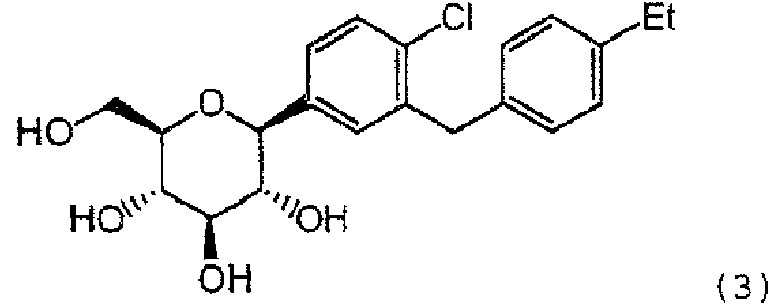
una sal farmacéuticamente aceptable del mismo, un estereoisómero del mismo, o un éster de profármaco del mismo. a pharmaceutically acceptable salt thereof, a stereoisomer thereof, or a prodrug ester thereof.
Otros inhibidores de SGLT son compuestos de O-aril glucósidos descritos en el documento WO 01/74834, que se representan mediante la fórmula (4): Other SGLT inhibitors are O-aryl glucoside compounds described in WO 01/74834, which are represented by formula (4):
o heteroarilo;or heteroaryl;
R1, R2, R3, y R4 son iguales o diferentes, y se seleccionan independientemente de hidrógeno, OH, OR7, alquilo inferior, o halógeno, o dos de R1, R2, R3, y R4 junto con los carbonos a los que están unidos pueden formar un carbociclo o heterociclo anelado de cinco, seis o siete miembros que puede contener 1 a 4 heteroátomos en el anillo que son N, O, S, SO, y/o SO2;R1, R2, R3, and R4 are the same or different, and are independently selected from hydrogen, OH, OR7, lower alkyl, or halogen, or two from R1, R2, R3, and R4 together with the carbons to which they are attached they can form a five, six or seven membered carbocycle or ring heterocycle that can contain 1 to 4 ring heteroatoms that are N, O, S, SO, and / or SO2;
R5 y R6 son iguales o diferentes, y se seleccionan independientemente de hidrógeno, OH, OR7a, -O-Arilo, -OCH2-Arilo, alquilo inferior, cicloalquilo, Arilo, arilalquilo, CF3, arilalquenilo, -OCHF2, -OCF3, halógeno, -CN, -CO2R713, -CO2H, COR8f, CHOHR8g, CH(OR7h)R8h, -CONR8R8a, -NHCOR7c, -NHSO2R7d, -NHSO2-Arilo, -SR7e, -SOR7f, -SO2R7g, -SO2-Arilo, -OCH2CO2R7i, -OCH2CO2H, -OCH2CONR8bR8c, -OCH2CH2NR8dR8e, o un heterociclo de cinco, seis o siete miembros que puede contener 1 a 4 heteroátomos en el anillo que son N, O, S, SO, y/o SO2, o R5 y R6 junto con los carbonos a los que están unidos forman un carbociclo o heterociclo anelado de cinco, seis o siete miembros que puede contener 1 a 4 heteroátomos en el anillo que son N, O, S, SO, y/o SO2;R5 and R6 are the same or different, and are independently selected from hydrogen, OH, OR7a, -O-Aryl, -OCH2-Aryl, lower alkyl, cycloalkyl, Aryl, arylalkyl, CF3, arylalkenyl, -OCHF2, -OCF3, halogen, -CN, -CO2R713, -CO2H, COR8f, CHOHR8g, CH (OR7h) R8h, -CONR8R8a, -NHCOR7c, -NHSO2R7d, -NHSO2-Aryl, -SR7e, -SOR7f, -SO2R7g, -SO2-Aryl, -O2 -OCH2CO2H, -OCH2CONR8bR8c, -OCH2CH2NR8dR8e, or a five, six, or seven-membered heterocycle that can contain 1 to 4 ring heteroatoms that are N, O, S, SO, and / or SO2, or R5 and R6 along with the carbons to which they are attached form a five-, six-, or seven-membered carbocycle or heterocycle that can contain 1 to 4 ring heteroatoms that are N, O, S, SO, and / or SO2;
R7, R7a, R7b, R7c, R7d, R7e, R7f, R7g, R7h, y R7i son independientemente alquilo inferior;R7, R7a, R7b, R7c, R7d, R7e, R7f, R7g, R7h, and R7i are independently lower alkyl;
R8, R8a, R8b, R8c, R8d, R8e, R8f, R8g, y R8h son iguales o diferentes, y se seleccionan independientemente de hidrógeno, alquilo, arilo, arilalquilo, cicloalquilo, o junto con el nitrógeno al que están unidos forman un heterociclo anelado de cinco, seis o siete miembros que puede contener 1 a 4 heteroátomos en el anillo que son N, O, S, SO, y/o SO2; R8, R8a, R8b, R8c, R8d, R8e, R8f, R8g, and R8h are the same or different, and are independently selected from hydrogen, alkyl, aryl, arylalkyl, cycloalkyl, or together with the nitrogen to which they are attached form a heterocycle five-, six-, or seven-membered nesting that may contain 1 to 4 ring heteroatoms that are N, O, S, SO, and / or SO2;
A es O(CH2)m, S, NH(CH2)m, o (CH2)n en las que n es 0-3 y m es 0-2, y una sal farmacéuticamente aceptable de los mismos, todos los estereoisómeros de los mismos, y todos los ésteres de profármacos de los mismos.A is O (CH2) m, S, NH (CH2) m, or (CH2) n where n is 0-3 and m is 0-2, and a pharmaceutically acceptable salt thereof, all stereoisomers thereof , and all prodrug esters thereof.
Los inhibidores de SGLT adicionales son los derivados de glucopiranosiloxibencilbenceno descritos en el documento WO 02/028872, que se representan mediante la fórmula (5):Additional SGLT inhibitors are the glucopyranosyloxybenzylbenzene derivatives described in WO 02/028872, which are represented by formula (5):

en la que P representa un grupo que forma un profármaco; y R representa alquilo inferior, alcoxi inferior, alquiltio inferior, alcoxi inferior-alquilo inferior sustituido, alcoxi inferior-alcoxi inferior sustituido o alcoxi inferior-alquiltio inferior sustituido.where P represents a group that forms a prodrug; and R represents lower alkyl, lower alkoxy, lower alkylthio, lower alkoxy-substituted lower alkyl, lower alkoxy-substituted lower alkoxy or lower alkoxy-substituted lower alkylthio.
Otros ejemplos de inhibidores de SGLT son los derivados de glucopiranosiloxibencil-benceno descritos en el documento WO 01/68660, que se representan mediante la fórmula (6):Other examples of SGLT inhibitors are the glucopyranosyloxybenzylbenzene derivatives described in WO 01/68660, which are represented by formula (6):

en la que R1 representa hidrógeno o hidroxi(alquilo inferior); y R2 representa alquilo inferior, alcoxi inferior, alquiltio inferior, hidroxi(alquilo inferior), hidroxi(alcoxi inferior), hidroxi(alquiltio inferior), alcoxi inferior-(alquilo inferior) sustituido, alcoxi inferior-(alcoxi inferior) sustituido o alcoxi inferior-(alquiltio inferior) sustituido, o una sal farmacéuticamente aceptable de los mismos.wherein R1 represents hydrogen or hydroxy (lower alkyl); and R2 represents lower alkyl, lower alkoxy, lower alkylthio, hydroxy (lower alkyl), hydroxy (lower alkoxy), hydroxy (lower alkylthio), lower alkoxy- (lower alkyl) substituted, lower alkoxy- (lower alkoxy) or lower alkoxy - (lower alkylthio) substituted, or a pharmaceutically acceptable salt thereof.
Otro ejemplo de inhibidor de SGLT es Sergliflozina, representada mediante la fórmula (7): Another example of a SGLT inhibitor is Sergliflozin, represented by formula (7):
o Sergliflozina-A, representada mediante la fórmula (8):or Sergliflozin-A, represented by formula (8):

Los ejemplos adicionales de inhibidores de SGLT son los derivados de glucopiranosiloxipirazol descritos en el documento WO 02/053573, que se representan mediante la fórmula (9):Additional examples of SGLT inhibitors are the glucopyranosyloxypyrazole derivatives described in WO 02/053573, which are represented by formula (9):

en la que R0 representa hidrógeno, alquilo inferior o un grupo que forma un profármaco; uno de Q0 y T0 representa un grupo representado mediante la fórmula:wherein R0 represents hydrogen, lower alkyl, or a group that forms a prodrug; one of Q0 and T0 represents a group represented by the formula:

(en la que P representa hidrógeno o un grupo que forma un profármaco), mientras el otro representa alquilo inferior o halo(alquilo inferior);(where P represents hydrogen or a group that forms a prodrug), while the other represents lower alkyl or halo (lower alkyl);
R2 representa hidrógeno, alquilo inferior, alcoxi inferior, alquiltio inferior, halo(alquilo inferior) o halógeno;R2 represents hydrogen, lower alkyl, lower alkoxy, lower alkylthio, halo (lower alkyl) or halogen;
con la condición de que P no representa hidrógeno cuando R representa hidrógeno o alquilo inferior, o una sal farmacéuticamente aceptable de los mismos.with the proviso that P does not represent hydrogen when R represents hydrogen or lower alkyl, or a pharmaceutically acceptable salt thereof.
Un ejemplo de tal inhibidor de SGLT es Remogliflozina, representada mediante la fórmula (9a):An example of such a SGLT inhibitor is Remogliflozin, represented by formula (9a):

Otros ejemplos de inhibidores de SGLT son los compuestos descritos en el documento WO 2005/085265, que se representan mediante la fórmula (10): Other examples of SGLT inhibitors are the compounds described in WO 2005/085265, which are represented by formula (10):
en la que uno de R1 y R4 representa un grupo de fórmula:wherein one of R1 and R4 represents a group of the formula:

en la que R5 y R6 representan independientemente hidrógeno, hidroxi, halógeno, alquilo C1-6, alquenilo C2-6, alquinilowherein R 5 and R 6 independently represent hydrogen, hydroxy, halogen, C 1-6 alkyl, C 2-6 alkenyl, alkynyl
C2-6, alcoxi C1-6, alquenil C2-6-oxi, alquil C1-6-tio, alquenil C2-6-tio, halo (alquilo C1-6), halo (alcoxi C1-6), halo (alquil C1-6-tio), hidroxi (alquilo C1.6), hidroxi (alquenilo C2-6), hidroxi (alcoxi C1-6), hidroxi(alquil C1-6-tio), carboxi, carboxi (alquiloC2-6, C1-6 alkoxy, C2-6 alkenyl-oxy, C1-6alkylthio, C2-6alkenylthio, halo (C1-6alkyl), halo (C1-6alkoxy), halo (C1alkyl -6-thio), hydroxy (C1.6-alkyl), hydroxy (C2-6-alkenyl), hydroxy (C1-6-alkoxy), hydroxy (C1-6-alkyl-thio), carboxy, carboxy (alkyl
C1.6), carboxi (alquenilo C2-6), carboxi (alcoxi C1.6), carboxi (alquil C1-6-tio), alcoxicarbonilo C2-7, alcoxicarbonil C2-7 (alquilo C1.6), alcoxicarbonil C2-7 (alquenilo C2-6), alcoxicarbonil C2-7 (alcoxi C1.6), alcoxicarbonil C2-7 (alqu alquil C1-6-sulfinilo, alquil C1-6-sulfonilo, -U-V-W-N (R7)-Z, o cualquiera de los siguientes sustituyentes (i) a (xxviii) que pueden tener 1 a 3 sustituyentes seleccionados del siguiente grupo de sustituyentes a en el anillo;C1.6), carboxy (C2-6 alkenyl), carboxy (C1.6 alkoxy), carboxy (C1-6 alkyl thio), C2-7 alkoxycarbonyl, C2-7 alkoxycarbonyl (C1.6 alkyl), C2- alkoxycarbonyl 7 (C2-6 alkenyl), C2-7 alkoxycarbonyl (C1.6 alkoxy), C2-7 alkoxycarbonyl (C1-6alkyl-sulfinyl, C1-6alkyl-sulfonyl, -UVWN (R 7 ) -Z, or any of the following substituents (i) to (xxviii) which may have 1 to 3 substituents selected from the following group of substituents a on the ring;
(i) arilo C6-10, (ii) aril C6-10-O-, (iii) aril C6-10-S-, (iv) aril C6-10 (alquilo C1-6), (v) aril C6-10 (alcoxi Ci -6), (vi) aril C6-10 (alquil(i) C6-10 aryl, (ii) C6-10-aryl-, (iii) C6-10-aryl-, (iv) C6-10 aryl (C1-6alkyl), (v) C6- aryl- 10 (Ci- 6 alkoxy), (vi) C6-10 aryl (alkyl
Ci -6-tio), (vii) heteroarilo, (viii) heteroaril-O-, (ix) heteroaril-S-, (x) heteroaril (alquilo Ci -6), (xi) heteroaril (alcoxi Ci -6), (xii) heteroaril (alquil Ci-6-tio), (xiii) cicloalquilo C3-7, (xiv) cicloalquil C3.7-O-, (xv) cicloalquil C3.7-S-, (xvi) cicloalquil C3-7 (alquilo Ci -6), (xvii) cicloalquil C3-7 (alcoxi Ci -6), (xviii) cicloalquil C3-7 (alquil Ci -6-tio), (xix) heterocicloalquilo, (xx) heterocicloalquil-O-, (xxi) heterocicloalquil-S-, (xxii) heterocicloalquil (alquilo C1-6), (xxiii) heterocicloalquil (alcoxi Ci -6),Ci -6 -thio), (vii) heteroaryl, (viii) heteroaryl-O-, (ix) heteroaryl-S-, (x) heteroaryl (Ci -6 alkyl), (xi) heteroaryl (Ci -6 alkoxy), (xii) heteroaryl (Ci-6-thio alkyl), (xiii) C3-7 cycloalkyl, (xiv) C3.7-O- cycloalkyl, (xv) C3.7-S- cycloalkyl, (xvi) C3-7 cycloalkyl (Ci- 6 alkyl), (xvii) C3-7 cycloalkyl (Ci -6 alkoxy), (xviii) C3-7 cycloalkyl (Ci -6- alkyl thio), (xix) heterocycloalkyl, (xx) heterocycloalkyl-O-, (xxi) heterocycloalkyl-S-, (xxii) heterocycloalkyl (C1-6 alkyl), (xxiii) heterocycloalkyl (Ci -6 alkoxy),
(xxiv) heterocicloalquil (alquil Ci -6-tio), (xxv) amino cíclico aromático, (xxvi) amino cíclico aromático (alquilo C1-6), (xxvii) amino cíclico aromático (alcoxi Ci -6), o (xxviii) amino cíclico aromático (alquil Ci -6-tio),(xxiv) heterocycloalkyl (Ci- 6- alkyl-thio), (xxv) aromatic cyclic amino, (xxvi) aromatic cyclic amino (C1-6 alkyl), (xxvii) aromatic cyclic amino (Ci -6 alkoxy), or (xxviii) aromatic cyclic amino (Ci- 6- thio alkyl),
J representa alquileno C1-6 que puede tener hidroxi, o alquenileno C2-6;J represents C1-6 alkylene which may have hydroxy, or C2-6 alkenylene;
U representa -O-, -S- o un enlace simple, y con la condición de que al menos uno de V y W no es un enlace simple cuando U es -O- o -S-;U represents -O-, -S- or a single bond, and with the proviso that at least one of V and W is not a single bond when U is -O- or -S-;
V representa alquileno C1-6 que puede tener hidroxi, alquenileno C2-6 o un enlace simple;V represents C1-6 alkylene which may have hydroxy, C2-6 alkenylene, or a single bond;
W representa -CO-, -SO2-, -C(=NH)- o un enlace simple;W represents -CO-, -SO2-, -C (= NH) - or a single bond;
Z representa independientemente hidrógeno, alcoxicarbonilo C2-7, aril C6-10 (alcoxicarbonilo C2-7), formilo, -RA, -CORB, -SO2Rb,-CON(Rc )Rd, -CSN(Rc )Rd, -SO2NHRa o -C(=NRE)N(RF)RG;Z independently represents hydrogen, C2-7 alkoxycarbonyl, C6-10 aryl (C2-7 alkoxycarbonyl), formyl, -RA, -CORB, -SO2Rb, -CON (Rc) Rd, -CSN (Rc) Rd, -SO2NHRa or - C (= NRE) N (RF) RG;
R7, RA, RC y RD representan independientemente hidrógeno, alquilo C1-6 que puede tener 1 a 5 sustituyentes seleccionados del siguiente grupo de sustituyentes p, o cualquiera de los siguientes sustituyentes (xxix) a (xxxii) que pueden tener 1 a 3 sustituyentes seleccionados del siguiente grupo de sustituyentes a;R 7 , RA, RC and RD independently represent hydrogen, C1-6 alkyl which may have 1 to 5 substituents selected from the following group of p substituents, or any of the following substituents (xxix) to (xxxii) which may have 1 to 3 substituents selected from the following group of substituents a;
(xxix) arilo C6-10, (xxx) heteroarilo, (xxxi) cicloalquilo C3-7 o (xxxii) heterocicloalquilo, o Z y R7 están unidos al nitrógeno adyacente para formar un amino cíclico alifático que puede tener 1 a 3 sustituyentes seleccionados del siguiente grupo de sustituyentes a;(xxix) C6-10 aryl, (xxx) heteroaryl, (xxxi) C3-7 cycloalkyl, or (xxxii) heterocycloalkyl, or Z and R 7 are attached to adjacent nitrogen to form an aliphatic cyclic amino that may have 1 to 3 selected substituents from the following group of substituents a;
o RC y RD están unidos al nitrógeno adyacente para formar un amino cíclico alifático que puede tener 1 a 3 sustituyentes seleccionados del siguiente grupo de sustituyentes a;or RC and RD are attached to the adjacent nitrogen to form an aliphatic cyclic amino that may have 1 to 3 substituents selected from the following group of substituents a;
RB representa alcoxicarbonilo C2-7, alquil C1-6-sulfonilamino, aril C6-10-sulfonilamino, alquilo C1-6 que pueden tener 1 aRB represents C2-7 alkoxycarbonyl, C1-6 alkyl-sulfonylamino, C6-10 aryl-sulfonylamino, C1-6 alkyl which may have 1 to
5 sustituyentes seleccionados del siguiente grupo de sustituyentes p o cualquiera de los siguientes sustituyentes5 substituents selected from the following group of substituents p or any of the following substituents
(xxxiii) a (xxxvi) que pueden tener 1 a 3 sustituyentes seleccionados del siguiente grupo de sustituyentes a;(xxxiii) to (xxxvi) which may have 1 to 3 substituents selected from the following group of substituents a;
(xxxiii) arilo C6-10, (xxxiv) heteroarilo, (xxxv) cicloalquilo C3-7 o (xxxvi) heterocicloalquilo,(xxxiii) C6-10 aryl, (xxxiv) heteroaryl, (xxxv) C3-7 cycloalkyl, or (xxxvi) heterocycloalkyl,
RE, RF y RG representan independientemente hidrógeno, ciano, carbamoilo, acilo C2-7, alcoxicarbonilo C2-7, aril C6-10 (alcoxicarbonilo C2-7), nitro, alquil C1-6-sulfonilo, sulfamida, carbamimidoilo o alquilo C1-6 que puede tener 1 a 5 sustituyentes seleccionados del siguiente grupo de sustituyentes p;RE, RF and RG independently represent hydrogen, cyano, carbamoyl, C2-7 acyl, C2-7 alkoxycarbonyl, C6-10 aryl (C2-7 alkoxycarbonyl), nitro, C1-6alkyl-sulfonyl, sulfamide, carbamimidoyl or C1- alkyl. 6 which may have 1 to 5 substituents selected from the following group of substituents p;
o RE y RF están unidos para formar etileno;o RE and RF are linked to form ethylene;
o RF y RG están unidos al nitrógeno adyacente para formar un amino cíclico alifático que puede tener cualquier sustituyente seleccionado del siguiente grupo de sustituyentes a;or RF and RG are attached to the adjacent nitrogen to form an aliphatic cyclic amino which can have any substituent selected from the following group of substituents a;
Q representa -alquileno C1-6-, -alquenileno C2-6-, -alquinileno C2-6-, -alquileno C1-6-O-, -alquileno C1-6-S-, -O-alquilenoQ represents -C1-6alkylene-, -C2-6alkenylene-, -C2-6alkynylene-, -C1-6alkylene-O-, -C1-6-alkylene-S-, -O-alkylene
C1-6-, -S-alquileno C1-6-, -alquileno C1-6-O-alquileno C1-6-, -alquileno C1-6-S-alquileno C1.6-, -CON(R8)-, -N(R8) CO-, -alquileno C1-6-CON(R8)- o -CON(R8)-alquileno C1.6-;C1-6-, -S-C1-6-alkylene, -C1-6-alkylene-O-C1-6-alkylene-, -C1-6-alkylene-S-C1.6-alkylene-, -CON (R 8 ) -, -N (R 8 ) CO-, -C1-6 alkylene-CON (R 8 ) - or -CON (R 8 ) -C1.6 alkylene-;
R8 representa hidrógeno o alquilo C1-6;R 8 represents hydrogen or C1-6 alkyl;
el anillo A representa arilo C6-10 o heteroarilo, y el otro de R1 y R4 representa hidrógeno, hidroxi, amino, halógeno, alquilo C1-6, alcoxi C1.6, ciano, carboxi, alcoxicarbonilo C2-7, carbamoilo, mono o di(alquil C1-6)amino, halo (alquilo C1. ring A represents C6-10 aryl or heteroaryl, and the other of R 1 and R 4 represents hydrogen, hydroxy, amino, halogen, C1-6 alkyl, C1.6 alkoxy, cyano, carboxy, C2-7 alkoxycarbonyl, carbamoyl, mono or di (C1-6alkyl) amino, halo (C1alkyl.
6), hidroxi (alquilo C-i-a), ciano (alquilo Ci-a), carboxi (alquilo Ci-e), alcoxicarbonil C2-7 (alquilo C1-6), grupo carbamoil (alquilo C1-6), un amino (alquilo C1-6), mono o di (alquil C1-6) amino (alquilo C1-6), halo (alcoxi C1-6), hidroxi (alcoxi C1-6), carboxi (alcoxi C1-6), alcoxicarbonil C2-7 (alcoxi C1-6), carbamoil (alcoxi C1-6), amino (alcoxi C1-6), mono o di (alquil C1-6) amino (alcoxi C1-6), cicloalquilo C3-7, cicloalquil C3-7-oxi, cicloalquil C3-7 (alquilo C1-6), o cicloalquil C3-7 (alcoxi C1-6); R2 y R3 representan independientemente hidrógeno, hidroxi, amino, halógeno, alquilo C1-6, alcoxi C1-6, ciano, carboxi, alcoxicarbonilo C2-7, carbamoilo, mono o di(alquil C1-6) amino, halo (alquilo C1-6), hidroxi (alquilo C1-6), ciano(alquilo C1-6), carboxi(alquilo C1-6), alcoxicarbonil C2-7 (alquilo C1-6), carbamoil (alquilo C1-6), amino (alquilo C1-6), mono o di (alquil C1-6) amino (alquilo C1-6), halo (alcoxi C1-6), hidroxi (alcoxi C1-6), carboxi (alcoxi C1-6), alcoxicarbonil C2-7 (alcoxi C1-6), carbamoil (alcoxi C1-6), amino (alcoxi C1-6), mono o di(alquil C1-6) amino (alcoxi C1-6), cicloalquilo C3-7, cicloalquil C3-7-oxi, cicloalquil C3-7 (alquilo C1-6), o cicloalquil C3-7 (alcoxi C1-6); 6 ), hydroxy (Cia alkyl), cyano (Ci-a alkyl), carboxy (Ci-e alkyl), C2-7 alkoxycarbonyl (C1-6 alkyl), carbamoyl (C1-6 alkyl) group, one amino (C1 alkyl -6), mono or di (C1-6alkyl) amino (C1-6alkyl), halo (C1-6alkoxy), hydroxy (C1-6alkoxy), carboxy (C1-6alkoxy), C2-7alkoxycarbonyl ( C1-6 alkoxy), carbamoyl (C1-6 alkoxy), amino (C1-6 alkoxy), mono or di (C1-6 alkyl) amino (C1-6 alkoxy), C3-7 cycloalkyl, C3-7-cycloalkyl , C3-7 cycloalkyl (C1-6 alkyl), or C3-7 cycloalkyl (C1-6 alkoxy); R 2 and R 3 independently represent hydrogen, hydroxy, amino, halogen, C 1-6 alkyl, C 1-6 alkoxy, cyano, carboxy, C 2-7 alkoxycarbonyl, carbamoyl, mono or di (C 1-6 alkyl) amino, halo (alkyl C1-6) alkyl, hydroxy (C1-6 alkyl), cyano (C1- 6), carboxy (C1-6 alkyl), C2-7 alkoxycarbonyl (C1-6 alkyl), carbamoyl (C1-6 alkyl), amino ( C1-6alkyl), mono or di (C1-6alkyl) amino (C1-6alkyl), halo (C1-6alkoxy), hydroxy (C1-6alkoxy), carboxy (C1-6alkoxy), C2- alkoxycarbonyl 7 (C1-6 alkoxy), carbamoyl (C1-6 alkoxy), amino (C1-6 alkoxy), mono or di (C1-6 alkyl) amino (C1-6 alkoxy), C3-7 cycloalkyl, C3-7 cycloalkyl -oxy, C3-7 cycloalkyl (C1-6 alkyl), or C3-7 cycloalkyl (C1-6 alkoxy);
A1 representa O, S o NR9;A 1 represents O, S or NR 9 ;
A2 representa CH o N;A 2 represents CH or N;
R9 representa hidrógeno o alquilo C1-6;R 9 represents hydrogen or C1-6 alkyl;
G representa un grupo representado mediante una fórmula:G represents a group represented by a formula:

E1 representa hidrógeno, flúor o hidroxi;E1 represents hydrogen, fluorine or hydroxy;
E2 representa hidrógeno, flúor, metilo o hidroximetilo;E2 represents hydrogen, fluorine, methyl or hydroxymethyl;
[grupo de sustituyentes a][group of substituents a]
halógeno, hidroxi, amino, alquilo C1-6, alcoxi C1-6, halo (alquilo C1-6), halo (alcoxi C1-6), hidroxi (alquilo C1-6), alcoxicarbonil C2-7 (alquilo C1-6), hidroxi (alcoxi C1-6), amino (alquilo C1-6), amino (alcoxi C1-6), mono o di (alquil C1-6) amino, mono o di [hidroxi (alquil C1-6)] amino, alquil Ci -6-sulfonilo, alquil Ci -6-sulfonilamino, alquil Ci -6-sulfonilamino (alquilo C1-6), carboxi, alcoxicarbonilo C2-7, sulfamoilo y -CON(RH)RI;halogen, hydroxy, amino, C 1-6 alkyl, C 1-6 alkoxy, halo (C 1-6 alkyl), halo (C 1-6 alkoxy), hydroxy (C 1-6 alkyl), C 2-7 alkoxycarbonyl (C 1-6 alkyl) , hydroxy (C1-6 alkoxy), amino (C1-6 alkyl), amino (C1-6 alkoxy), mono or di (C1-6 alkyl) amino, mono or di [hydroxy (C1-6 alkyl)] amino, Ci -6 alkyl sulfonyl, Ci -6 alkyl alkylsulfonylamino, Ci -6 alkyl alkylsulfonylamino (C1-6 alkyl), carboxy, C2-7 alkoxycarbonyl, sulfamoyl and -CON (RH) RI;
[grupo de sustituyentes p][group of substituents p]
átomo de halógeno, hidroxi, amino, alcoxi C1-6, alquil Ci -6-tio, halo(alcoxi C1-6), halo(alquil Ci -6-tio), hidroxi (alcoxi Ci-6), hidroxi (alquil Ci -6-tio), amino (alcoxi C1-6), amino (alquil Ci -6-tio), mono o di(alquil C1-6) amino, mono o di [hidroxi(alquil C1-6)] amino, ureido, sulfamida, mono o di-(alquil C1-6) ureido, mono o di [hidroxi (alquil C1-6)] ureido, mono o di (alquil C1-6) sulfamida, mono o di [hidroxi (alquil C1-6)] sulfamida, acil C2-7-amino, amino (acil C2-7-amino), alquil Ci -6-sulfonilo, alquil Ci -6-sulfonilamino, carbamoil (alquil Ci -6-sulfonilamino), carboxi, grupo alcoxicarbonilo C2-7, -CON(RH)RI, y cualquiera de los siguientes sustituyentes (xxxvii) a (xxxxviii) que pueden tener 1 a 3 sustituyentes seleccionados del anterior grupo de sustituyentes a;halogen, hydroxy, amino, C1-6 alkoxy, Ci- 6- alkyl-thio, halo (C1-6-alkoxy), halo (Ci- 6- thio-alkyl), hydroxy (Ci- 6- alkoxy), hydroxy (Ci-alkyl) atom -6- thio), amino (C1-6 alkoxy), amino (Ci- 6- alkyl-thio), mono or di (C1-6 alkyl) amino, mono or di [hydroxy (C1-6 alkyl)] amino, ureido , sulfamide, mono or di- (C1-6 alkyl) ureido, mono or di [hydroxy (C1-6 alkyl)] ureido, mono or di (C1-6 alkyl) sulfamide, mono or di [hydroxy (C1-6 alkyl) )] sulfamide, C2-7 acyl-amino, amino (C2-7 acyl-amino) Ci -6 alkyl sulfonyl, Ci -6 alkyl alkylsulfonylamino, carbamoyl (Ci -6 alkyl alkylsulfonylamino), carboxy, alkoxycarbonyl group C2 -7, -CON (RH) RI, and any of the following substituents (xxxvii) to (xxxxviii) which may have 1 to 3 substituents selected from the foregoing group of substituents a;
(xxxvii) arilo C6-10, (xxxviii) aril C6-10-O-, (xxxix) aril C6-10 (alcoxi C1-6), (xxxx) aril C6-10 (alquil Ci -6-tio), (xxxxi) heteroarilo, (xxxxii) heteroaril-O-, (xxxxiii) cicloalquil C3-7, (xxxxiv) cicloalquil C3-7-O-, (xxxxv) heterocicloalquilo, (xxxxvi) heterocicloalquil-O-, (xxxxvii) amino cíclico alifático o (xxxxviii) amino cíclico aromático;(xxxvii) aryl C6-10, (xxxviii) aryl C6-10-O-, (xxxix) aryl C6-10 (C1-6 alkoxy), (xxxx) aryl C6-10 (alkyl Ci -6 -thio), ( xxxxi) heteroaryl, (xxxxii) heteroaryl-O-, (xxxxiii) cycloalkyl C3-7, (xxxxiv) cycloalkyl C3-7-O-, (xxxxv) heterocycloalkyl, (xxxxvi) heterocycloalkyl-O-, (xxxxvii) aliphatic cyclic amino or (xxxxviii) aromatic cyclic amino;
RH y R1 representan independientemente hidrógeno o alquilo C1-6 que puede tener 1 a 3 sustituyentes seleccionados del siguiente grupo de sustituyentes y;RH and R 1 independently represent hydrogen or C1-6 alkyl which may have 1 to 3 substituents selected from the following group of substituents and;
o RH y R1 están unidos al nitrógeno adyacente para formar un amino cíclico alifático que puede tener 1 a 3 sustituyentes seleccionados del siguiente grupo de sustituyentes 8; or RH and R 1 are attached to the adjacent nitrogen to form an aliphatic cyclic amino that may have 1 to 3 substituents selected from the following group of 8 substituents;
[grupo de sustituyentes y][group of substituents and]
halógeno, hidroxi, amino, alcoxi C1-6, halo(alcoxi Ci-a), hidroxi (alcoxi Ci-a), amino (alcoxi Ci-e), mono o di (alquil C-i-a) amino, mono o di[hidroxi(alquil Ci-a)] amino, ureido, sulfamida, mono o di(alquil Ci-a) ureido, mono o di-[hidroxi (alquil Ci-a)] ureido, mono o di(alquil Ci-a) sulfamida, mono o di [hidroxi (alquil Ci-a)] sulfamida, acil C2-7-amino, amino (acil C2-7-amino), alquil Ci-a-sulfonilo, alquil Ci-a-sulfonilamino, carbamoil (alquil Ci-a-sulfonilamino), carboxi, alcoxicarbonilo C2-7, sulfamoilo y -CON(RJ)RK;halogen, hydroxy, amino, C1-6 alkoxy, halo (Ci-a alkoxy), hydroxy (Ci-a alkoxy), amino (Ci-e alkoxy), mono or di (alkyl Cia) amino, mono or di [hydroxy ( alkyl Ci-a)] amino, ureido, sulfamide, mono or di (alkyl Ci-a) ureido, mono or di- [hydroxy (alkyl Ci-a)] ureido, mono or di (alkyl Ci-a) sulfamide, mono or di [hydroxy (Ci-a-alkyl)] sulfamide, C2-7-amino acyl, amino (C2-7-amino acyl), Ci-a-sulfonyl alkyl, Ci-a-sulfonylamino alkyl, carbamoyl (Ci-a alkyl -sulfonylamino), carboxy, C2-7 alkoxycarbonyl, sulfamoyl and -CON (RJ) RK;
[grupo de sustituyentes 8][group of substituents 8]
halógeno, hidroxi, amino, alquilo Ci-a, alcoxi Ci-a, halo(alquilo Ci-a), halo (alcoxi Ci-a), hidroxi (alquilo Ci-a), alcoxicarbonil C2-7 (alquilo Ci-a), hidroxi (alcoxi Ci-a), amino (alquilo Ci-a), amino (alcoxi Ci-a), mono o di (alquil Ci-a) amino, mono o di [hidroxi (alquil Ci-a)] amino, alquil Ci-a-sulfonilo, alquil Ci-a-sulfonilamino, alquil Ci-a-sulfonilamino (alquilo Ci-a), carboxi, alcoxicarbonilo C2-7, sulfamoilo y -CON(RJ)RK;halogen, hydroxy, amino, Ci-a alkyl, Ci-a alkoxy, halo (Ci-a alkyl), halo (Ci-a alkoxy), hydroxy (Ci-a alkyl), C2-7 alkoxycarbonyl (Ci-a alkyl) , hydroxy (Ci-a alkoxy), amino (Ci-a alkyl), amino (Ci-a alkoxy), mono or di (Ci-a alkyl) amino, mono or di [hydroxy (Ci-a) alkyl] amino, Ci-a-sulfonyl alkyl, Ci-a-sulfonylamino alkyl, Ci-a-sulfonylamino alkyl (Ci-a alkyl), carboxy, C2-7 alkoxycarbonyl, sulfamoyl and -CON (RJ) RK;
RJ y RK representan independientemente hidrógeno o alquilo Ci-a que puede tener i a 3 sustituyentes seleccionados de hidroxi, amino, mono o di(alquil Ci-a) amino, alcoxicarbonilo C2-7 y carbamoilo;RJ and RK independently represent hydrogen or Ci-a alkyl which may have i to 3 substituents selected from hydroxy, amino, mono or di (Ci-a) alkyl, C2-7 alkoxycarbonyl and carbamoyl;
o RJ y RK están unidos al nitrógeno adyacente para formar un amino cíclico alifático que puede tener i a 3 sustituyentes seleccionados de hidroxi, amino, mono o di(alquil Ci-a) amino, alquilo Ci-a, hidroxi(alquilo Ci-a), alcoxicarbonilo C2-7, alcoxicarbonil C2-7 (alquilo Ci-a) y carbamoilo, o una sal farmacéuticamente aceptable de los mismos, o un profármaco de los mismos.or RJ and RK are attached to the adjacent nitrogen to form an aliphatic cyclic amino which may have ia 3 substituents selected from hydroxy, amino, mono or di (Ci-a alkyl) amino, Ci-a alkyl, hydroxy (Ci-a alkyl) , C2-7 alkoxycarbonyl, C2-7 alkoxycarbonyl (Ci-a-alkyl) and carbamoyl, or a pharmaceutically acceptable salt thereof, or a prodrug thereof.
Otros ejemplos de inhibidores de SGLT son los compuestos descritos en el documento WO 2005/085267, que se representan mediante la fórmula ( i i ) :Other examples of SGLT inhibitors are the compounds described in WO 2005/085267, which are represented by formula (i i):

en la quein which
R1 representa hidrógeno, alquilo Ci-a, halo (alquilo Ci-a), hidroxi (alquilo Ci-a), dihidroxi (alquilo Ci-a), alcoxi Ci-a (alquilo Ci-a), alcoxicarbonil C2-7 (alquilo Ci-a), carboxi(alquilo Ci-a), alquenilo C2-a, -J-N(R5)-Zi , -J-CON(R5)-Zi , o cualquiera de los siguientes sustituyentes (a) a (d) que pueden tener i a 3 sustituyentes seleccionados del siguiente grupo de sustituyentes a en el anillo;R 1 represents hydrogen, Ci-a alkyl, halo (Ci-a alkyl), hydroxy (Ci-a alkyl), dihydroxy (Ci-a alkyl), Ci-a alkoxy (Ci-a alkyl), C2-7 alkoxycarbonyl ( Ci-a alkyl), carboxy (Ci-a alkyl), C2-a alkenyl, -JN (R 5 ) -Zi, -J-CON (R 5 ) -Zi, or any of the following substituents (a) to ( d) they may have ia 3 substituents selected from the following group of substituents a on the ring;
(a) cicloalquilo C3-7, (b) cicloalquil C3-7 (alquilo Ci-a), (c) arilo Ca-io o (d) aril Ci-a-(alquilo Ca-io),(a) C3-7 cycloalkyl, (b) C3-7 cycloalkyl (Ci-a alkyl), (c) aryl Ca-io or (d) aryl Ci-a- (Ca-io alkyl),
R2 representa hidrógeno, halógeno o alquilo Ci-a;R 2 represents hydrogen, halogen or Ci-a alkyl;
R3 y R4 representan independientemente hidrógeno, hidroxi, halógeno, alquilo Ci-a, alquenilo C2-a, alquinilo C2-a, alcoxi Ci-a, alquenil C2-6-oxí, alquil Ci-a-tio, alquenil C2-a-tio, halo(alquilo Ci-a), halo(alcoxi Ci-a), halo(alquil Ci-a-tio), hidroxi (alquilo Ci-a), hidroxi(alquenilo C2-a), hidroxi(alcoxi Ci-a), hidroxi (alquil Ci-a-tio), carboxi, carboxi(alquilo Ci-a), carboxi(alquenilo C2-a), carboxi(alcoxi Ci-a), carboxi(alquil Ci-a-tio), alcoxicarbonilo C2-7, alcoxicarbonil C2-7 (alquilo Cia), alcoxicarbonil C2-7 (alquenilo C2-a), alcoxicarbonil C2-7 (alcoxi Ci-a), alcoxicarbonil C2-7 (alquil Ci-a-tio), alquil Ci-asulfinilo, grupo alquil Ci-a-sulfonilo, -U-V-W-N(Ra)-Z2, o cualquiera de los siguientes sustituyentes (i) a (xxviii) que pueden tener i a 3 sustituyentes seleccionados del siguiente grupo de sustituyentes a en el anillo;R 3 and R 4 independently represent hydrogen, hydroxy, halogen, Ci-a alkyl , C2-a, C2-to, alkoxy Ci-a, alkenyl C 2 to 6 oxy, alkyl thio Ci-a, alkenyl C2 -a-thio, halo (Ci-a-alkyl), halo (Ci-a-alkoxy), halo (Ci-a-thio-alkyl), hydroxy (Ci-a-alkyl), hydroxy (C2-a) alkenyl, hydroxy (alkoxy Ci-a), hydroxy (Ci-a-thio alkyl), carboxy, carboxy (Ci-a alkyl), carboxy (C2-a alkenyl), carboxy (Ci-a alkoxy), carboxy (Ci-a-thio alkyl) , C2-7 alkoxycarbonyl, C2-7 alkoxycarbonyl (Cia alkyl), C2-7 alkoxycarbonyl (C2-a alkenyl), C2-7 alkoxycarbonyl (Ci-a alkoxy), C2-7 alkoxycarbonyl (Ci-a-thio alkyl), Ci-asulfinyl alkyl, Ci-a-sulfonyl alkyl group, -UVWN (Ra) -Z 2 , or any of the following substituents (i) to (xxviii) which may have ia 3 substituents selected from the following group of substituents a in ring;
(i) arilo Ca-io, (ii) aril Ca-io-O-, (iii) aril Ca-io-S-, (iv) aril Ca-io (alquilo Ci-a), (v) aril Ca-io (alcoxi Ci-a), (vi) aril Ca-io(alquil Ci-a-tio), (vii) heteroarilo, (viii) heteroaril-O-, (ix) heteroaril-S-, (x) heteroaril (alquilo Ci-a), (xi) heteroaril (alcoxi Ci-a), (xii) heteroaril (alquil Ci-a-tio), (xiii) cicloalquilo C3-7, (xiv) cicloalquil C3-7-O-, (xv) cicloalquil C3-7-S-, (xvi) cicloalquil C3-7 (alquilo Ci-a), (xvii) cicloalquil C3-7 (alcoxi Ci-a), (xviii) cicloalquil C3-7 (alquil Ci-a-tio), (xix) heterocicloalquilo, (xx) heterocicloalquil-O-, (xxi) heterocicloalquil-S-, (xxii) heterocicloalquil (alquilo Ci-a), (xxiii) heterocicloalquil (alcoxi Ci-a), (xxiv) heterocicloalquil (alquil Ci-a-tio), (xxv) amino cíclico aromático, (xxvi) amino cíclico aromático (alquilo Ci-a), (xxvii) amino cíclico aromático (alcoxi Ci-a), o (xxviii) amino cíclico aromático (alquil Ci-a-tio),(i) aryl Ca-io, (ii) aryl Ca-io-O-, (iii) aryl Ca-io-S-, (iv) aryl Ca-io (Ci-a alkyl), (v) aryl Ca- io (Ci-a alkoxy), (vi) aryl Ca-io (Ci-a-thio alkyl), (vii) heteroaryl, (viii) heteroaryl-O-, (ix) heteroaryl-S-, (x) heteroaryl ( Ci-a alkyl), (xi) heteroaryl (Ci-a alkoxy), (xii) heteroaryl (Ci-a-thio alkyl), (xiii) C3-7 cycloalkyl, (xiv) C3-7-O- cycloalkyl, ( xv) C3-7-S- cycloalkyl, (xvi) C3-7 cycloalkyl (Ci-a alkyl), (xvii) C3-7 cycloalkyl (Ci-a alkoxy), (xviii) C3-7 cycloalkyl (Ci-a alkyl -thio), (xix) heterocycloalkyl, (xx) heterocycloalkyl-O-, (xxi) heterocycloalkyl-S-, (xxii) heterocycloalkyl (Ci-a alkyl), (xxiii) heterocycloalkyl (Ci-a alkoxy), (xxiv) heterocycloalkyl (Ci-a-thio alkyl), (xxv) aromatic cyclic amino, (xxvi) aromatic cyclic amino (Ci-a alkyl), (xxvii) aromatic cyclic amino (Ci-a alkoxy), or (xxviii) aromatic cyclic amino (Ci-a-tio alkyl),
J representa alquileno Ci-a que puede tener hidroxi, o alquenileno C2-6;J represents Ci-a alkylene which may have hydroxy, or C2-6 alkenylene;
U representa -O-, -S- o un enlace simple, y con la condición de que al menos uno de V y W no es un enlace simple cuando U es -O- o -S-;U represents -O-, -S- or a single bond, and with the proviso that at least one of V and W is not a single bond when U is -O- or -S-;
V representa alquileno Ci-a que puede tener hidroxi, alquenileno C2-6 o un enlace simple;V represents Ci-a alkylene which may have hydroxy, C2-6 alkenylene or a single bond;
i4 i4
W representa -CO-, -SO2-, -C(=NH)- o un enlace simple;W represents -CO-, -SO2-, -C (= NH) - or a single bond;
Z1 y Z2 representan independientemente hidrógeno, alcoxicarbonilo C2-7, aril C6-10 (alcoxicarbonilo C2-7), formilo, -RA, -CORB, -SO2Rb, -CON(Rc )Rd, -CSN(Rc )Rd, -SO2NHRa o -C(=NRE)N(RF)RG;Z 1 and Z 2 independently represent hydrogen, C2-7 alkoxycarbonyl, C6-10 aryl (C2-7 alkoxycarbonyl), formyl, -RA, -CORB, -SO2Rb, -CON (Rc) Rd, -CSN (Rc) Rd, -SO2NHRa or -C (= NRE) N (RF) RG;
R5, R6, RA, RC y RD representan independientemente hidrógeno, alquilo C1-6 que puede tener 1 a 5 sustituyentes seleccionados del siguiente grupo de sustituyentes p, o cualquiera de los siguientes sustituyentes (xxix) a (xxxii) que pueden tener 1 a 3 sustituyentes seleccionados del siguiente grupo de sustituyentes a;R 5 , R 6 , RA, RC and RD independently represent hydrogen, C 1-6 -alkyl which may have 1 to 5 substituents selected from the following group of p substituents, or any of the following substituents (xxix) to (xxxii) which may have 1 to 3 substituents selected from the following group of substituents a;
(xxix) arilo C6-10, (xxx) heteroarilo, (xxxi) cicloalquilo C3.7 o (xxxii) heterocicloalquilo,(xxix) C6-10 aryl, (xxx) heteroaryl, (xxxi) C3.7 cycloalkyl, or (xxxii) heterocycloalkyl,
o Z1 y R5 o Z2 y R6 están unidos al nitrógeno adyacente para formar un amino cíclico alifático que puede tener 1 a 3 sustituyentes seleccionados del siguiente grupo de sustituyentes a;or Z 1 and R 5 or Z 2 and R 6 are attached to the adjacent nitrogen to form an aliphatic cyclic amino which may have 1 to 3 substituents selected from the following group of substituents a;
o RC y RD están unidos al nitrógeno adyacente para formar un amino cíclico alifático que puede tener 1 a 3 sustituyentes seleccionados del siguiente grupo de sustituyentes a;or RC and RD are attached to the adjacent nitrogen to form an aliphatic cyclic amino that may have 1 to 3 substituents selected from the following group of substituents a;
RB representa alcoxicarbonilo C2-7, alquil C1-6-sulfonilamino, aril C6-10-sulfonilamino, alquilo C1-6 que pueden tener 1 a 5 sustituyentes seleccionados del siguiente grupo de sustituyentes p o cualquiera de los siguientes sustituyentes (xxxiii) a (xxxvi) que pueden tener 1 a 3 sustituyentes seleccionados del siguiente grupo de sustituyentes a;RB represents C2-7 alkoxycarbonyl, C1-6 alkyl-sulfonylamino, C6-10 aryl-sulfonylamino, C1-6 alkyl which may have 1 to 5 substituents selected from the following group of substituents by any of the following substituents (xxxiii) to (xxxvi ) which may have 1 to 3 substituents selected from the following group of substituents a;
(xxxiii) arilo C6-10, (xxxiv) heteroarilo, (xxxv) cicloalquilo C3-7 o (xxxvi) heterocicloalquilo,(xxxiii) C6-10 aryl, (xxxiv) heteroaryl, (xxxv) C3-7 cycloalkyl, or (xxxvi) heterocycloalkyl,
RE, RF y RG representan independientemente hidrógeno, ciano, carbamoilo, grupo acilo C2-7, alcoxicarbonilo C2-7, aril C6-10 (alcoxicarbonilo C2-7), nitro, alquil C1-6-sulfonilo, sulfamoilo, carbamimidoilo o alquilo C1-6 que puede tener 1 a 5 sustituyentes seleccionados del siguiente grupo de sustituyentes p;RE, RF and RG independently represent hydrogen, cyano, carbamoyl, C2-7 acyl group, C2-7 alkoxycarbonyl, C6-10 aryl (C2-7 alkoxycarbonyl), nitro, C1-6alkyl-sulfonyl, sulfamoyl, carbamimidoyl or C1-alkyl -6 which may have 1 to 5 substituents selected from the following group of substituents p;
o RE y RF están unidos para formar etileno;o RE and RF are linked to form ethylene;
o RF y RG están unidos al nitrógeno adyacente para formar un amino cíclico alifático que puede tener un sustituyente seleccionado del siguiente grupo de sustituyentes a;or RF and RG are attached to the adjacent nitrogen to form an aliphatic cyclic amino that may have a substituent selected from the following group of substituents a;
Y representa CH o N;Y represents CH or N;
Q representa -alquileno C1-6-, -alquenileno C2-6-, -alquinileno C2-6-, -alquileno C1.6-O-, -alquileno C1.6-S-, -O-alquileno C1.6-, -S-alquileno C1-6-, -alquileno C1-6-O-alquileno C1.6-, -alquileno C1_6-S-alquileno C1.6-, -CON(R7)-, -N(R7)CO-, -alquileno C1-6-CON(R7)- o -CON(R7)-alquileno C1.6-;Q represents -C1-6alkylene-, -C2-6alkenylene-, -C2-6alkynylene-, -C1.6-alkylene-O-, -C1.6-alkylene-S-, -O-C1.6-alkylene-, -S-C1-6-alkylene-, -C1-6-alkylene-O-C1.6-alkylene-, -C1_6-alkylene-S-C1.6-alkylene-, -CON (R 7 ) -, -N (R 7 ) CO -, -C1-6-alkylene-CON (R 7 ) - or -CON (R 7 ) -C1.6-alkylene-;
R7 representa hidrógeno o alquilo C1-6;R 7 represents hydrogen or C1-6 alkyl;
el anillo A representa arilo C6-10 o heteroarilo;ring A represents C6-10 aryl or heteroaryl;
G representa un grupo representado mediante una fórmula:G represents a group represented by a formula:

E1 representa hidrógeno, flúor o hidroxi;E 1 represents hydrogen, fluorine or hydroxy;
E2 representa hidrógeno, flúor, metilo o hidroximetilo;E 2 represents hydrogen, fluorine, methyl or hydroxymethyl;
[grupo de sustituyentes a][group of substituents a]
halógeno, hidroxi, amino, alquilo C1-6, alcoxi C1-6, halo(alquilo C1.6), un halo (alcoxi C1-6), hidroxi (alquil C1.6), alcoxicarbonil C2-7 (alquilo C1.6), hidroxi (alcoxi C1-6), amino (alquilo C1.6), amino (alcoxi C1.6), mono o di (alquil C1-6) amino, mono o di [hidroxi (alquil Ci-a)] amino, alquil Ci -6-sulfonilo, alquil Ci -6-sulfonilamino, alquil Ci -6-sulfonilamino (alquilo Ci-a), carboxi, alcoxicarbonilo C2-7, sulfamoilo y -CON(RH)RIhalogen, hydroxy, amino, alkyl C 1-6, alkoxy C 1-6 halo - alkyl (C 1 June.), a halo (alkoxy C 1-6), hydroxy (. alkyl C1 6) alkoxycarbonyl C 2- 7 (. C 1 6 alkyl), hydroxy (alkoxy C 1-6), amino (C 1 6 alkyl.), amino (C 1 6 alkoxy.), mono or di (alkyl C 1 to 6) amino, mono or di [hydroxy (Ci-a) -alkyl] amino, Ci- 6 -sulfonyl-alkyl, Ci -6 -sulfonylamino-alkyl, Ci -6 -sulfonylamino (Ci-a-alkyl), carboxy, C2-7-alkoxycarbonyl sulfamoyl and -CON (RH) RI
[grupo de sustituyentes p][group of substituents p]
halógeno, hidroxi, amino, alcoxi Ci-a, alquil Ci-a-tio, halo(alcoxi Ci-a), halo(alquil Ci-a-tio), hidroxi (alcoxi Ci-a), hidroxi(alquil Ci-a-tio), amino(alcoxi Ci-a), amino(alquil Ci-a-tio), mono o di(alquil Ci-a) amino, mono o di[hidroxi (alquil Ci-a)] amino, ureido, sulfamida, mono o di (alquil Ci-a) ureido, mono o di[hidroxi(alquil Ci-a)]ureido, mono o di(alquil Cia) sulfamida, mono o di [hidroxi (alquil Ci-a)]-sulfamida, acil C2-7-amino, amino (acil C2-7-amino), alquil Ci-a-sulfonilo, alquil Ci-a-sulfonilamino, carbamoil (alquil Ci-a-sulfonilamino), carboxi, alcoxicarbonilo C2-7, -CON(RH)RI, y cualquiera de los siguientes sustituyentes (xxxvii) a (xxxxviii) que pueden tener i a 3 sustituyentes seleccionados del anterior grupo de sustituyentes a en el anillo;halogen, hydroxy, amino, Ci-a alkoxy, Ci-a-thio alkyl, halo (Ci-a alkoxy), halo (Ci-a-thio alkyl), hydroxy (Ci-a alkoxy), hydroxy (Ci-a alkyl) -thio), amino (Ci-a alkoxy), amino (Ci-a-thio alkyl), mono or di (Ci-a-alkyl) amino, mono or di [hydroxy (Ci-a) alkyl] amino, ureido, sulfamide , mono or di (alkyl Ci-a) ureido, mono or di [hydroxy (alkyl Ci-a)] ureido, mono or di (alkyl Cia) sulfamide, mono or di [hydroxy (alkyl Ci-a)] -sulfamide, C2-7-amino acyl, amino (C2-7-amino acyl), Ci-a-sulfonyl alkyl, Ci-a-sulfonylamino alkyl, carbamoyl (Ci-a-sulfonylamino alkyl), carboxy, C2-7 alkoxycarbonyl, -CON (RH) RI, and any of the following substituents (xxxvii) to (xxxxviii) which may have ia 3 substituents selected from the above group of substituents a on the ring;
(xxxvii) arilo Ca-io, (xxxviii) aril Ca-io-O-, (xxxix) aril Ca-io (alcoxi Ci-a), (xxxx) aril Ca-io (alquil Ci-a-tio), (xxxxi) heteroarilo, (xxxxii) heteroaril-O-, (xxxxiii) cicloalquilo C3-7, (xxxxiv) cicloalquil C3-7-O-, (xxxxv) heterocicloalquilo, (xxxxvi) heterocicloalquil-O-, (xxxxvii) amino cíclico alifático o (xxxxviii) amino cíclico aromático;(xxxvii) aryl Ca-io, (xxxviii) aryl Ca-io-O-, (xxxix) aryl Ca-io (alkoxy Ci-a), (xxxx) aryl Ca-io (alkyl Ci-a-thio), ( xxxxi) heteroaryl, (xxxxii) heteroaryl-O-, (xxxxiii) cycloalkyl C3-7, (xxxxiv) cycloalkyl C3-7-O-, (xxxxv) heterocycloalkyl, (xxxxvi) heterocycloalkyl-O-, (xxxxvii) aliphatic cyclic amino or (xxxxviii) aromatic cyclic amino;
RH y R1 representan independientemente hidrógeno o alquilo Ci-a que puede tener i a 3 sustituyentes seleccionados del siguiente grupo de sustituyentes y;RH and R 1 independently represent hydrogen or Ci-a alkyl which may have ia 3 substituents selected from the following group of substituents and;
o RH y R1 están unidos al nitrógeno adyacente para formar un amino cíclico alifático que puede tener i a 3 sustituyentes seleccionados del siguiente grupo de sustituyentes 8;or RH and R 1 are attached to the adjacent nitrogen to form an aliphatic cyclic amino that may have ia 3 substituents selected from the following group of 8 substituents;
[grupo de sustituyentes y][group of substituents and]
halógeno, hidroxi, amino, alcoxi Ci-a, halo (alcoxi Ci-a), hidroxi (alcoxi Ci-a), amino (alcoxi Ci-a), mono o di (alquil Ci-a) amino, mono o di [hidroxi (alquil Ci-a)] amino, ureido, sulfamida, mono o di (alquil Ci-a) ureido, mono o di [hidroxi (alquil Ci-a)] ureido, mono o di (alquil Ci-a) sulfamida, mono o di [hidroxi (alquil Ci-a)] sulfamida, acil C2-7-amino, amino (acil C2-7-amino), alquil Ci-a-sulfonilo, alquil Ci-a-sulfonilamino, carbamoil (alquil Ci-a-sulfonilamino), carboxi, alcoxicarbonilo C2-7 y -CON(RJ)RK;halogen, hydroxy, amino, Ci-a alkoxy, halo (Ci-a alkoxy), hydroxy (Ci-a alkoxy), amino (Ci-a alkoxy), mono or di (Ci-a alkyl) amino, mono or di [ hydroxy (Ci-a-alkyl)] amino, ureido, sulfamide, mono or di (Ci-a-alkyl) ureido, mono or di [hydroxy (Ci-a) -alkyl] ureido, mono or di (Ci-a) -sulfamide, mono or di [hydroxy (Ci-a-alkyl)] sulfamide, C2-7-amino acyl, amino (C2-7-amino acyl), Ci-a-sulfonyl alkyl, Ci-a-sulfonylamino alkyl, carbamoyl (Ci- alkyl α-sulfonylamino), carboxy, C2-7 alkoxycarbonyl and -CON (RJ) RK;
[grupo de sustituyentes 8][group of substituents 8]
halógeno, hidroxi, amino, alquilo Ci-a, alcoxi Ci-a, halo(alquilo Ci-a), halo (alcoxi Ci-a), hidroxi(alquilo Ci-a), alcoxicarbonil C2-7 (alquilo Ci-a), hidroxi (alcoxi Ci-a), amino (alquilo Ci-a), amino (alcoxi Ci-a), mono o di (alquil Ci-a) amino, mono o di [hidroxi (alquil Ci-a)] amino, alquil Ci-a-sulfonilo, alquil Ci-a-sulfonilamino, alquil Ci-a-sulfonilamino (alquilo Ci-a), carboxi, alcoxicarbonilo C2-7, sulfamoilo y -CON(RJ)RK;halogen, hydroxy, amino, Ci-a alkyl, Ci-a alkoxy, halo (Ci-a alkyl), halo (Ci-a alkoxy), hydroxy (Ci-a alkyl), C2-7 alkoxycarbonyl (Ci-a alkyl) , hydroxy (Ci-a alkoxy), amino (Ci-a alkyl), amino (Ci-a alkoxy), mono or di (Ci-a alkyl) amino, mono or di [hydroxy (Ci-a) alkyl] amino, Ci-a-sulfonyl alkyl, Ci-a-sulfonylamino alkyl, Ci-a-sulfonylamino alkyl (Ci-a alkyl), carboxy, C2-7 alkoxycarbonyl, sulfamoyl and -CON (RJ) RK;
RJ y RK representan independientemente hidrógeno o alquilo Ci-a que puede tener i a 3 sustituyentes seleccionados de hidroxi, amino, mono o di(alquil Ci-a) amino, alcoxicarbonilo C2-7 y carbamoilo;RJ and RK independently represent hydrogen or Ci-a alkyl which may have i to 3 substituents selected from hydroxy, amino, mono or di (Ci-a) alkyl, C2-7 alkoxycarbonyl and carbamoyl;
o RJ y RK están unidos al nitrógeno adyacente para formar un amino cíclico alifático que puede tener i a 3 sustituyentes seleccionados de hidroxi, amino, mono o di(alquil Ci-a) amino, alquilo Ci-a, hidroxi (alquilo Ci-a), alcoxicarbonilo C2-7, alcoxicarbonil C2-7 (alquilo Ci-a) y carbamoilo, o una sal farmacéuticamente aceptable de los mismos, o un profármaco de los mismos.or RJ and RK are attached to the adjacent nitrogen to form an aliphatic cyclic amino which may have ia 3 substituents selected from hydroxy, amino, mono or di (Ci-a alkyl) amino, Ci-a alkyl, hydroxy (Ci-a alkyl) , C2-7 alkoxycarbonyl, C2-7 alkoxycarbonyl (Ci-a-alkyl) and carbamoyl, or a pharmaceutically acceptable salt thereof, or a prodrug thereof.
Los ejemplos adicionales de inhibidores de SGLT son los derivados de glucopiranosiloxipirazol descritos en el documento WO 0 i/ ia i47 , que se representan mediante la fórmula (i2):Additional examples of SGLT inhibitors are the glucopyranosyloxypyrazole derivatives described in WO 0 i / ia i47, which are represented by formula (i2):

en la que R1 representa hidrógeno o alquilo inferior; uno de Q1 y T1 representa un grupo representado mediante la fórmula:wherein R1 represents hydrogen or lower alkyl; one of Q1 and T1 represents a group represented by the formula:

mientras el otro representa alquilo inferior o halo(alquilo inferior); y R2 representa hidrógeno, alquilo inferior, alcoxi inferior, alquiltio inferior, halo(alquilo inferior) o halógeno, o una sal farmacéuticamente aceptable de los mismos.while the other represents lower alkyl or halo (lower alkyl); and R2 represents hydrogen, lower alkyl, lower alkoxy, lower alkylthio, halo (lower alkyl), or halogen, or a pharmaceutically acceptable salt thereof.
ia ia
Otros ejemplos de inhibidores de SGLT son los compuestos descritos en el documento WO 2006/035796, que se representan mediante la fórmula (13):Other examples of SGLT inhibitors are the compounds described in WO 2006/035796, which are represented by formula (13):

en la que el Anillo A representa arilo o heteroarilo, cada uno de los cuales puede tener un/varios sustituyente(s), Q1 a 5 son cada uno independientemente carbono al que hay conectado hidrógeno o un sustituyente, o nitrógeno, E representa un enlace simple, alquileno, -O-, -S- o -NH-, y R representa metilo, etilo, fluorometilo o hidroximetilo, wherein Ring A represents aryl or heteroaryl, each of which may have one / more substituent (s), Q 1 to 5 are each independently carbon to which hydrogen or a substituent, or nitrogen, is connected, E represents a single bond, alkylene, -O-, -S- or -NH-, and R represents methyl, ethyl, fluoromethyl or hydroxymethyl,
o un profármaco de los mismos o una sal farmacéuticamente aceptable de los mismos, o un hidrato o solvato de los mismos.or a prodrug thereof or a pharmaceutically acceptable salt thereof, or a hydrate or solvate thereof.
Otros ejemplos de inhibidores de SGLT son los derivados de azuleno descritos en el documento WO 2004/013118, que se representan mediante la fórmula (14):Other examples of SGLT inhibitors are the azulene derivatives described in WO 2004/013118, which are represented by formula (14):
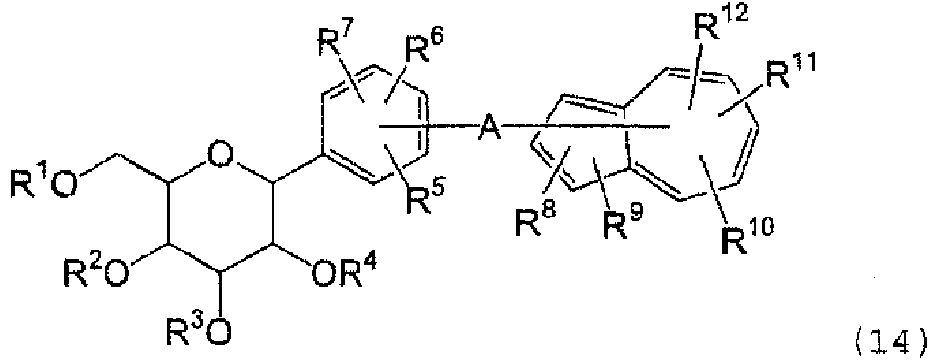
en la que R1 a R4 representan individualmente hidrógeno, alquilo inferior sustituido opcionalmente, -C(=O)-alquilo inferior sustituido opcionalmente, o -alquileno inferior sustituido opcionalmente-arilo sustituido opcionalmente, wherein R 1 to R 4 individually represent hydrogen, optionally substituted lower alkyl, -C (= O) -optionally substituted lower alkyl, or -optionally substituted lower alkylene-optionally substituted aryl,
R5 a R12 representan individualmente hidrógeno, alquilo inferior sustituido opcionalmente, halógeno, -OH, -O-alquilo inferior sustituido opcionalmente, -alquileno inferior sustituido opcionalmente-OH, -alquileno inferior sustituido opcionalmente-O-alquilo inferior sustituido opcionalmente, -O-alquileno inferior sustituido opcionalmente-O-alquilo inferior sustituido opcionalmente, -O-alquileno inferior sustituido opcionalmente-arilo sustituido opcionalmente, -alquileno inferior sustituido opcionalmente-O-C(=O)-alquilo inferior sustituido opcionalmente, -COOH, nitro, ciano, amino, amino sustituido, o -C(=O)-O-alquilo inferior sustituido opcionalmente, yR 5 to R 12 individually represent hydrogen, optionally substituted lower alkyl, halogen, -OH, -O-optionally substituted lower alkyl, -optionally substituted lower alkylene-OH, -optionally substituted lower alkylene-O-optionally substituted lower alkyl, -O -optionally substituted lower alkylene-O-optionally substituted lower alkyl, -O-optionally substituted lower alkylene-optionally substituted aryl, -optionally substituted lower alkylene-OC (= O) -optionally substituted lower alkyl, -COOH, nitro, cyano, amino , substituted amino, or optionally substituted -C (= O) -O-lower alkyl, and
A representa un enlace o alquileno inferior sustituido opcionalmente, en el que -A- puede estar unido en cualquiera de las posiciones 1-8 del anillo de azuleno, y dos cualquiera de R5, R6, y R7 pueden formar un anillo de benceno junto con los átomos de carbono adyacentes.A represents an optionally substituted bond or lower alkylene, in which -A- can be attached at any of positions 1-8 of the azulene ring, and any two of R5, R6, and R 7 can form a benzene ring together with adjacent carbon atoms.
Otros ejemplos de inhibidores de SGLT son los compuestos descritos en el documento WO 2004/080990, que se representan mediante la fórmula (15):Other examples of SGLT inhibitors are the compounds described in WO 2004/080990, which are represented by formula (15):

en la que el Anillo A representa (1) benceno, (2) heteroarilo monocíclico de cinco o seis miembros que tiene 1 a 4 heteroátomo(s) seleccionado(s) de N, S, y O, o (3) heterobicíclico saturado o insaturado de ocho a diez miembros que tiene 1 a 4 heteroátomo(s) seleccionado(s) de N, S, y O;wherein Ring A represents (1) benzene, (2) five or six-membered monocyclic heteroaryl having 1 to 4 heteroatom (s) selected from N, S, and O, or (3) saturated or heterocyclic heterocyclic eight to ten membered unsaturated having 1 to 4 heteroatom (s) selected from N, S, and O;
el anillo B representa (1) heterobicíclico saturado o insaturado de ocho a diez miembros que tiene 1 a 4 heteroátomo(s) seleccionado(s) de N, S, y O, (2) heteromonocíclico saturado o insaturado de cinco o seis miembros que tiene 1 a 4 heteroátomo(s) seleccionado(s) de N, S, y O, (3) un hidrocarburo bicíclico saturado o insaturado de ocho a diez miembros, o (4) benceno;ring B represents (1) eight to ten membered saturated or unsaturated heterobicyclic having 1 to 4 heteroatom (s) selected from N, S, and O, (2) five or six membered saturated or unsaturated heteromonocyclic that it has 1 to 4 heteroatom (s) selected from N, S, and O, (3) an eight to ten membered saturated or unsaturated bicyclic hydrocarbon, or (4) benzene;
X representa un enlace o alquileno inferior; X represents a bond or lower alkylene;
en la que el Anillo A, el Anillo B, y X tienen una correlación tal que (1) cuando el Anillo A es benceno, el Anillo B es un anillo distinto de benceno, o que (2) cuando el Anillo A es benceno, y el Anillo B es heterobicíclico saturado o insaturado de ocho a diez miembros que tiene 1 a 4 heteroátomo(s) seleccionado(s) de N, S, y O que incluye benceno, o hidrocarburo bicíclico saturado o insaturado de ocho a diez miembros que incluye benceno, X está unido al Anillo B en una parte distinta del anillo de benceno incluido en el Anillo B: incidentalmente, esta correlación significa de manera específica que el Anillo A y el Anillo B no pueden ser benceno simultáneamente, y que cuando el Anillo A es benceno y el Anillo B es benzofurano o indano, X no es el benceno que constituye una parte del Anillo B, sino que está unido a furano o ciclopentano;where Ring A, Ring B, and X have a correlation such that (1) when Ring A is benzene, Ring B is a ring other than benzene, or (2) when Ring A is benzene, and Ring B is an eight to ten membered saturated or unsaturated heterobicyclic having 1 to 4 heteroatom (s) selected from N, S, and O including benzene, or eight to ten membered saturated or unsaturated bicyclic hydrocarbon that includes benzene, X is attached to Ring B in a different part of the benzene ring included in Ring B: incidentally, this correlation specifically means that Ring A and Ring B cannot be benzene simultaneously, and that when Ring A is benzene and Ring B is benzofuran or indan, X is not the benzene that constitutes a part of Ring B, but is bound to furan or cyclopentane;
R1 a R4 representan individualmente hidrógeno, alquilo inferior, -C(=O)-alquilo inferior, o -alquileno inferior-arilo; y R 1 to R 4 individually represent hydrogen, lower alkyl, -C (= O) -lower alkyl, or-lower alkylene-aryl; and
R5 a R11 representan individualmente hidrógeno, alquilo inferior, cicloalquilo, halógeno, halógeno-alquilo inferior sustituido, -Oh, =O, -NH2, alquilo inferior-sulfonil-, halógeno-alquilo inferior sustituido-sulfonil-, aril sulfonil-, arilo, heteromonocíclico saturado o insaturado de cinco o seis miembros que tiene 1 a 4 heteroátomo(s) seleccionado(s) de N, S, y O, -alquileno inferior-OH, -alquileno inferior-O-alquilo inferior, -alquileno inferior-O-C(=O)-alquilo inferior, -alquileno inferior-O-alquileno inferior-COOH, -alquileno inferior-O-alquileno inferior-C(=O)-O-alquilo inferior, -alquileno inferior-NH2, -alquileno inferior-NH-alquilo inferior; -alquileno inferior-N(alquilo inferior^, -alquileno inferior-NH-C(=O)-alquilo inferior, -COOH, -CN, -C(=O)-O-alquilo inferior, -C(=O)-NH2, -C(=O)-NH-alquilo inferior, -C(=O)-N(alquilo inferior)2, -O-alquilo inferior, -O-cicloalquilo, -O-alquileno inferior-OH, -O-alquileno inferior-O-alquilo inferior, -O-alquileno inferior-COOH, -O-alquileno inferior-C(=O)-O-alquilo inferior, -O-alquileno inferior-C(=O)-NH2, -O-alquileno inferior-C(=O)-NH-alquilo inferior, -O-alquileno inferior-C(=O)-N(alquilo inferior^, -O-alquileno inferior-CH(OH)-CH2(OH), -O-alquileno inferior-NH2, -O-alquileno inferior-NH-alquilo inferior, -O-alquileno inferior-N(alquilo inferior^, -O-alquileno inferior-NH-C(=O)-alquilo inferior, -NH-alquilo inferior, -N(alquilo inferior)2, -NH-SO2-alquilo inferior, -NH-SO2-halógeno-alquilo inferior sustituido, -NH-alquileno inferior-OH, -NH-C(=O)-alquilo inferior, -NH-C(=O)-NH2, -NH-C(=O)-NH-alquilo inferior, -NH-C(=O)-N(alquilo inferior^, o -NH-C(=O)-O-alquilo inferior.R 5 to R 11 individually represent hydrogen, lower alkyl, cycloalkyl, halogen, halogen-substituted lower alkyl , -Oh, = O, -NH2, lower alkyl-sulfonyl-, halogen-substituted lower alkyl-sulfonyl-, aryl sulfonyl-, aryl, five- or six-membered saturated or unsaturated heteromonocyclic having 1 to 4 heteroatom (s) selected from N, S, and O,-lower alkylene-OH,-lower alkylene-O-lower alkyl,-lower alkylene -OC (= O) -lower alkyl, -lower alkylene-O-lower alkylene-COOH, -lower alkylene-O-lower alkylene-C (= O) -O-lower alkyl, -lower alkylene-NH2, -lower alkylene -NH-lower alkyl; -lower alkylene-N (lower alkyl ^, -lower alkylene-NH-C (= O) -lower alkyl, -COOH, -CN, -C (= O) -O-lower alkyl, -C (= O) - NH2, -C (= O) -NH-lower alkyl, -C (= O) -N (lower alkyl) 2, -O-lower alkyl, -O-cycloalkyl, -O-lower alkylene-OH, -O- lower alkylene-O-lower alkyl, -O-lower alkylene-COOH, -O-lower alkylene-C (= O) -O-lower alkyl, -O-lower alkylene-C (= O) -NH2, -O- lower alkylene-C (= O) -NH-lower alkyl, -O-lower alkylene-C (= O) -N (lower alkyl ^, -O-lower alkylene-CH (OH) -CH2 (OH), -O -lower alkylene-NH2, -O-lower alkylene-NH-lower alkyl, -O-lower alkylene-N (lower alkyl ^, -O-lower alkylene-NH-C (= O) -lower alkyl, -NH-alkyl lower, -N (lower alkyl) 2, -NH-SO2-lower alkyl, -NH-SO2-halogen-substituted lower alkyl, -NH-lower alkylene-OH, -NH-C (= O) -lower alkyl, - NH-C (= O) -NH2, -NH-C (= O) -NH-lower alkyl, -NH-C (= O) -N (lower alkyl ^, or -NH-C (= O) -O -lower alkyl.
Los ejemplos de tales inhibidores de SGLT se representan mediante la Fórmula (15a):Examples of such SGLT inhibitors are represented by Formula (15a):

en la que: R6 representa un átomo de hidrógeno, átomo de halógeno, -OH, -OMe, -CH2-OH, -O-(CH2)2-OH, -O-(CH2)2-NH2, -COOH, -COOEt, -O-CH2-COOH, o -O-CH2-COOEt, R7 representa un átomo de hidrógeno o un átomo de halógeno, R8 representa un átomo de hidrógeno o -Me, y R9 representa un átomo de hidrógeno, -Me, átomo de halógeno o -OMe.wherein: R 6 represents a hydrogen atom, halogen atom, -OH, -OMe, -CH2-OH, -O- (CH2) 2-OH, -O- (CH2) 2-NH2, -COOH, -COOEt, -O-CH2-COOH, or -O-CH2-COOEt, R 7 represents a hydrogen atom or a halogen atom, R 8 represents a hydrogen atom or -Me, and R 9 represents a hydrogen atom , -Me, halogen atom or -OMe.
Otros ejemplos de inhibidores de SGLT son los derivados de glucopiranosil-benceno sustituidos descritos en el documento WO 2005/092877, que se representan mediante la Fórmula (16):Other examples of SGLT inhibitors are the substituted glucopyranosyl-benzene derivatives described in WO 2005/092877, which are represented by Formula (16):

en la que R1 se selecciona de las definiciones del grupo A, y si R3 se selecciona de las definiciones del grupo B, R1 se puede seleccionar además de hidrógeno, flúor, cloro, bromo, yodo, alquilo C1-4, alquenil C2-4-alquilo C1-4, alquinil C2-4-alquilo C1-4, alquenil C2-4-alcoxi C1-4, alquinil C2-4-alcoxi C1-4, cicloalquil C3-7-alquilo C1-4, cicloalquenil C5-7-alquilo C1-4, metilo sustituido con 1 a 3 átomos de flúor, etilo sustituido con 1 a 5 átomos de flúor, alcoxi C1-4, metoxi sustituido con 1 a 3 átomos de flúor, etoxi sustituido con 1 a 5 átomos de flúor, alquilo C1-4 sustituido con hidroxi o alcoxi C1-3, alcoxi C2-4 sustituido con hidroxi o alcoxi C1-3, cicloalquil C3-6-alcoxi C1-3 o hidroxi, mientras en los anillos cicloalquilo y cicloalquenilo anteriormente mencionados uno o dos grupos metileno se pueden sustituir independientemente entre sí con O o CO;wherein R 1 is selected from the definitions of group A, and if R 3 is selected from the definitions of group B, R 1 may be selected in addition to hydrogen, fluorine, chlorine, bromine, iodine, C 1-4 alkyl, alkenyl C2-4-C1-4alkyl, C2-4alkynyl-C1-4alkyl, C2-4alkenyl-C1-4alkoxy, C2-4alkynyl-C1-4alkoxy, C3-7cycloalkyl-C1-4alkyl, cycloalkenyl C5-7-C1-4alkyl, methyl substituted with 1 to 3 fluorine atoms, ethyl substituted with 1 to 5 fluorine atoms, C1-4 alkoxy, methoxy substituted with 1 to 3 fluorine atoms, ethoxy substituted with 1 to 5 fluorine atoms, C1-4 alkyl substituted with hydroxy or C1-3 alkoxy, C2-4 alkoxy substituted with hydroxy or C1-3 alkoxy, C3-6 cycloalkyl-C1-3 alkoxy or hydroxy, while in the cycloalkyl and cycloalkenyl rings above mentioned one or two methylene groups can be independently substituted with O or CO;
R2 indica hidrógeno, flúor, cloro, bromo, hidroxi, alquilo C1-4, alcoxi C1-4, ciano o nitro, mientras el grupo alquilo o alcoxi puede estar mono- o polisustituido con flúor; R 2 denotes hydrogen, fluorine, chlorine, bromine, hydroxy, C 1-4 alkyl, C 1-4 alkoxy, cyano or nitro, while the alkyl or alkoxy group may be mono- or polysubstituted with fluoro;
R3 se selecciona de las definiciones del grupo B, y si R1 se selecciona de las definiciones del grupo A, R3 se puede seleccionar además de los significados de hidrógeno, flúor, cloro, bromo, yodo, alquilo C1-6, alquenil C2-4-alquilo C1-4, alquinil C2-4-alquilo C1-4, alquenil C2-4-alcoxi C1-4, alquinil C2-4-alcoxi C1-4, cicloalquilo C3-7, cicloalquenilo C5-7, cicloalquil C3-7-alquilo C1-4, cicloalquenil C5-7-alquilo C1-4, cicloalquiliden C3-6-metilo, hidroxi, alcoxi C1-6, cicloalquil C3-6-alcoxi C1-3, arilo, aril-alquilo C1-3, heteroarilo, heteroaril-alquilo C1-3, ariloxi, aril-alquil C1-3-oxi, metilo o metoxi sustituido con 1 a 3 átomos de flúor, alquilo C2-4 o alcoxi C2-4 sustituido con 1 a 5 átomos de flúor, alquilo C1-4 sustituido con ciano, alquilo C1-4 sustituido con hidroxi o alquil C1-3-oxi, ciano, carboxi, alcoxi C1-3-carbonilo, aminocarbonilo, (alquil C1-3-amino) carbonilo, di- (alquil C1.3) aminocarbonilo, pirrolidin-1-ilcarbonilo, piperidin-1-ilcarbonilo, morfolin-4-ilcarbonilo, piperazin-1-ilcarbonilo, 4-(alquil C1-3)-piperazin-1-ilcarbonilo, (alquil C1.4) carbonilamino, alquil C1-4-sulfonilamino, alquil C1-4-sulfanilo, alquil C1-4-sulfinilo, alquil C1-4-sulfonilo, arilsulfonilamino, aril-alquil C1-3-sulfonilamino o arilsulfonilo; R 3 is selected from the definitions of group B, and if R 1 is selected from the definitions of group A, R 3 can be selected in addition to the meanings of hydrogen, fluorine, chlorine, bromine, iodine, C 1-6 alkyl, alkenyl C2-4-C1-4alkyl, C2-4alkynyl-C1-4alkyl, C2-4alkenyl-C1-4alkoxy, C2-4alkynyl-C1-4alkoxy, C3-7cycloalkyl, C5-7cycloalkenyl, cycloalkyl C3-7-C1-4alkyl, C5-7cycloalkenyl-C1-4alkyl, C3-6cycloalkylidene-methyl, hydroxy, C1-6alkoxy, C3-6cycloalkyl-C1-3alkoxy, aryl, aryl-C1-alkyl 3, heteroaryl, heteroaryl-C1-3alkyl, aryloxy, aryl-C1-3alkyl-oxy, methyl or methoxy substituted with 1 to 3 fluorine atoms, C2-4 alkyl or C2-4 alkoxy substituted with 1 to 5 atoms of fluorine, cyano-substituted C1-4alkyl, hydroxy-substituted C1-4alkyl, or C1-3alkyl-oxy, cyano, carboxy, C1-3alkoxy-carbonyl, aminocarbonyl, (C1-3alkyl-amino) carbonyl, di- (C1.3alkyl) aminocarbonyl, pyrrolidin-1-ylcarbonyl, piperidin-1-ylcarbonyl, morpholin-4-ylcar bonilo, piperazin-1-ylcarbonyl, 4- (C 1-3 alkyl) piperazin-1-ylcarbonyl, (C1.4 alkyl) carbonylamino, C1-4 alkyl sulfonylamino, C1-4-alkyl sulfanyl, C1-4 alkyl -sulfinyl, C1-4alkyl-sulfonyl, arylsulfonylamino, aryl-C1-3alkyl-sulfonylamino or arylsulfonyl;
R4 y R5 indican independientemente entre sí hidrógeno, flúor, cloro, bromo, yodo, ciano, nitro, alquilo C1-3, alcoxi C1-3, o metilo o metoxi sustituido con 1 a 3 átomos de flúor,R 4 and R 5 independently denote hydrogen, fluorine, chlorine, bromine, iodine, cyano, nitro, C 1-3 alkyl, C 1-3 alkoxy, or methyl or methoxy substituted with 1 to 3 fluorine atoms,
A indica alquin C2-6-1 -ilo, alquen C2-6-1 -ilo, cicloalquilo C3-7, cicloalquenilo C5-7, arilo, heteroarilo, alquil C1-4-carbonilo, arilcarbonilo, heteroarilcarbonilo, aminocarbonilo, alquil C-M-aminocarbonilo, di-(alquil C1-3)aminocarbonilo, pirrolidin-1- ilcarbonilo, piperidin-1-ilcarbonilo, morfolin-4-ilcarbonilo, piperazin-1-ilcarbonilo, 4-(alquil C1-4)piperazin-1-ilcarbonilo, arilamino-carbonilo, heteroarilaminocarbonilo, alcoxi C-M-carbonilo, aril-alcoxi C1-3-carbonilo, heteroaril-alcoxi C1-3-carbonilo, amino, alquil C1-4-amino, di-(alquil C1-3) amino, pirrolidin-1-ilo, pirrolidin-2-en-1-ilo, piperidin-1-ilo, piperidin-2- en-1 -ilo, morfolin-4-ilo, morfolin-3-en-4-ilo, piperazin-1-ilo, 4-(alquil C1-3)piperazin-1-ilo, alquil C1-4-carbonilamino, arilcarbonilamino, heteroarilcarbonilamino, cicloalquil C3-7-oxi, cicloalquenil C5-7-oxi, ariloxi, heteroariloxi, alquil C1-4-sulfinilo, alquil C-M-sulfonilo, cicloalquil C3-7-sulfanilo, cicloalquil C3-7-sulfinilo, cicloalquil C3-7-sulfonilo, cicloalquenil C5-7-sulfanilo, cicloalquenil C5-7-sulfinilo, cicloalquenil C5-7-sulfonilo, arilsulfanilo, arilsulfinilo, arilsulfonilo, heteroarilsulfanilo, heteroarilsulfinilo, heteroarilsulfonilo, ciano o nitro, mientras los grupos alquinilo y alquenilo anteriormente mencionados pueden estar mono- o polisustituidos con flúor o cloro, y los grupos alquinilo y alquenilo anteriormente mencionados pueden estar mono- o di-sustituidos con grupos L1 idénticos o diferentes, y los anillos cicloalquilo y cicloalquenilo anteriormente mencionados independientemente entre sí pueden estar mono- o di sustituidos con sustituyentes seleccionados de flúor y alquilo C1-3, y en los anillos cicloalquilo y cicloalquenilo anteriormente mencionados uno o dos grupos metileno pueden estar sustituidos independientemente entre sí con O, S, CO, SO, SO2 o NRN;A denotes C2-6 alkyn -1 -yl, C2-6 alkene -1 -yl, C3-7 cycloalkyl, C5-7 cycloalkenyl, aryl, heteroaryl, C1-4-alkylcarbonyl, arylcarbonyl, heteroarylcarbonyl, aminocarbonyl, CM- aminocarbonyl, di- (C1-3alkyl) aminocarbonyl, pyrrolidin-1- ylcarbonyl, piperidin-1-ylcarbonyl, morpholin-4-ylcarbonyl, piperazin-1-ylcarbonyl, 4- (C 1-4 alkyl) piperazin-1-ylcarbonyl , arylaminocarbonyl, heteroarylaminocarbonyl, CM-alkoxycarbonyl, aryl-C1-3alkoxy-carbonyl, heteroaryl-C1-3alkoxy-carbonyl, amino, C1-4alkyl-amino, di- (C1-3alkyl) amino, pyrrolidine -1-yl, pyrrolidin-2-en-1-yl, piperidin-1-yl, piperidin-2- en-1-yl, morpholin-4-yl, morpholin-3-en-4-yl, piperazin-1 -yl, 4- (C 1-3 alkyl) piperazin-1-yl, C1-4-alkylcarbonylamino alkyl, arylcarbonylamino, heteroarylcarbonylamino, C3-7cycloalkyl-oxy, C5-7 cycloalkenyl-oxy, aryloxy, heteroaryloxy, alkyl C1- 4-sulfinyl, alkyl CM-sulfonyl, C3-7-cycloalkyl-sulfanyl, cycloalkyl-C3-7-sulfinyl, cycloalkyl-C3-7-sulfo nyl, C5-7-cycloalkenyl-sulfanyl, C5-7-cycloalkenyl-sulfinyl, C5-7-cycloalkenyl-sulfonyl, arylsulfanyl, arylsulfinyl, arylsulfonyl, heteroarylsulfanyl, heteroarylsulfinyl, heteroarylsulfonyl, cyano or nitro, while the alkynyl and alkynyl groups may be - or polysubstituted with fluorine or chlorine, and the aforementioned alkynyl and alkenyl groups may be mono- or di-substituted with identical or different L 1 groups, and the aforementioned cycloalkyl and cycloalkenyl rings independently of one another may be mono- or di-substituted with substituents selected from fluorine and C1-3alkyl, and in the cycloalkyl and cycloalkenyl rings mentioned above, one or two methylene groups may be independently substituted with O, S, CO, SO, SO2 or NRN;
B indica tri-(alquil C1-4) silil-alquilo C1-6, alquin C2-6-1-ilo, alquen C2-6-1 -ilo, amino, alquil C1-3-amino, di-(alquil C1-3)amino, pirrolidin-1-ilo, pirrolidin-2-en-1 -ilo, piperidin-1-ilo, piperidin-2-en-1-ilo, morfolin-4-ilo, morfolin-3-en-4-ilo, piperazin-1-ilo, 4-(alquil C1-3)piperazin-1-ilo, arilcarbonilamino, heteroarilcarbonilamino, nitro, cicloalquil C3-10-oxi, cicloalquenil C5-10-oxi, cicloalquil C3-10-sulfanilo, cicloalquil C3-10-sulfinilo, cicloalquil C3-10-sulfonilo, cicloalquenil C5-10-sulfanilo, cicloalquenil C5-10-sulfinilo, cicloalquenil C5-10-sulfonilo, arilsulfanilo, arilsulfinilo, heteroarilsulfanilo o heteroarilsulfinilo, mientras los grupos alquinilo y alquenilo anteriormente mencionados pueden estar mono- o polisustituidos con flúor o cloro, y los grupos alquinilo y alquenilo anteriormente mencionados pueden estar mono- o di-sustituidos con grupos L1 idénticos o diferentes; mientras los anillos cicloalquilo y cicloalquenilo anteriormente mencionados pueden estar monoo di-sustituidos independientemente entre sí con sustituyentes seleccionados de flúor y alquilo C1-3, y en los anillos cicloalquilo y cicloalquenilo anteriormente mencionados uno o dos grupos metileno se pueden sustituir independientemente entre sí con O, S, CO, SO, SO2 o NRN;B denotes tri- (C1-4 alkyl) silyl-C1-6 alkyl, C 2-6 alkyn -1-yl, C2-6 alken -1 -yl, amino, C1-3 alkylamino, di- (C1 -3) amino, pyrrolidin-1-yl, pyrrolidin-2-en-1-yl, piperidin-1-yl, piperidin-2-en-1-yl, morpholin-4-yl, morpholin-3-en-4 -yl, piperazin-1-yl, 4- (C 1-3 alkyl) piperazin-1-yl, arylcarbonylamino, heteroarylcarbonylamino, nitro, C3-10-oxy cycloalkyl, C3-10-cycloalkenyl-C3-10-sulfanyl , C3-10 cycloalkyl-sulfinyl, C3-10 cycloalkyl-sulfonyl, C5-10 cycloalkenyl-sulfanyl, C5-10 cycloalkenyl-sulfinyl, C5-10 cycloalkenyl-arylsulfanyl, arylsulfinyl, heteroarylsulfanyl or heteroarylsulfinyl groups, while the alkynyl and alkenyl groups the aforementioned may be mono- or polysubstituted with fluorine or chlorine, and the aforementioned alkynyl and alkenyl groups may be mono- or di-substituted with identical or different L 1 groups; while the aforementioned cycloalkyl and cycloalkenyl rings may be monoo di-substituted independently of each other with selected substituents of fluorine and C1-3alkyl, and in the aforementioned cycloalkyl and cycloalkenyl rings one or two methylene groups can be independently substituted with O , S, CO, SO, SO2 or NRN;
RN indica H, alquilo C1-4, alquil C1-4-carbonilo o alquil C1-4-sulfonilo,RN denotes H, C1-4alkyl, C1-4alkyl-carbonyl or C1-4alkyl-sulfonyl,
L1 independientemente entre sí se seleccionan de hidroxi, ciano, nitro, cicloalquilo C3-7, arilo, heteroarilo, alquil C1-4-carbonilo, arilcarbonilo, heteroarilcarbonilo, aminocarbonilo, alquil C1-4-aminocarbonilo, di-(alquil C1-3)-aminocarbonilo, pirrolidin-1-ilcarbonilo, piperidin-1-ilcarbonilo, morfolin-4-ilcarbonilo, arilaminocarbonilo, heteroarilaminocarbonilo, alcoxi C1-4-carbonilo, aril-alcoxi C1-3-carbonilo, heteroaril-alcoxi C1-3-carbonilo, alquil C1-4-oxi, ariloxi, heteroariloxi, alquil C1-4-sulfanilo, arilsulfanilo, heteroarilsulfanilo, alquil C1-4-sulfinilo, arilsulfinilo, heteroarilsulfinilo, alquil C1-4-sulfonilo, arilsulfonilo y heteroarilsulfonilo;L 1 independently of one another are selected from hydroxy, cyano, nitro, C3-7 cycloalkyl, aryl, heteroaryl, C1-4alkylcarbonyl, arylcarbonyl, heteroarylcarbonyl, aminocarbonyl, C1-4alkyl-aminocarbonyl, di- (C1-3alkyl ) -aminocarbonyl, pyrrolidin-1-ylcarbonyl, piperidin-1-ylcarbonyl, morpholin-4-ylcarbonyl, arylaminocarbonyl, heteroarylaminocarbonyl, C1-4 alkoxycarbonyl, aryl-C1-3 alkoxycarbonyl, heteroaryl-C1-3 alkoxycarbonyl , C1-4alkyl-oxy, aryloxy, heteroaryloxy, C1-4alkyl-sulfanyl, arylsulfanyl, heteroarylsulfanyl, C1-4alkyl-sulfinyl, arylsulfinyl, heteroarylsulfinyl, C1-4alkyl-sulfonyl, arylsulfonyl, and heteroarylsulfonyl;
L2 independientemente entre sí se seleccionan de flúor, cloro, bromo, yodo, alquilo C1-3, difluorometilo, trifluorometilo, alcoxi C1-3, difluorometoxi, trifluorometoxi y ciano;L 2 independently of one another are selected from fluorine, chlorine, bromine, iodine, C 1-3 alkyl, difluoromethyl, trifluoromethyl, C 1-3 alkoxy, difluoromethoxy, trifluoromethoxy and cyano;
R6, R7a, R7b, y R7c independientemente entre sí tienen un significado seleccionado de hidrógeno, (alquil C1-18) carbonilo, (alquil C1-18) oxicarbonilo, arilcarbonilo y aril (alquil C1.3) carbonilo, mientras el grupo arilo mencionado en la definición de los grupos anteriores significa grupo fenilo o naftilo que pueden estar mono- o di-sustituidos independientemente entre sí con grupos L2 idénticos o diferentes;R 6 , R7a, R7b, and R7c independently of one another have a selected meaning of hydrogen, (C1-18alkyl) carbonyl, (C1-18alkyl) oxycarbonyl, arylcarbonyl, and aryl (C1.3alkyl) carbonyl, while the aryl group Mentioned in the definition of the above groups means phenyl or naphthyl group which may be independently mono- or di-substituted with identical or different L 2 groups;
y el grupo heteroarilo mencionado en la definición de los grupos anteriores significa un grupo pirrolilo, furanoilo, tienilo, piridilo, indolilo, benzofuranoilo, benzotiofenilo, quinolinilo, isoquinolinilo o tetrazolilo, o significa pirrolilo, furanoilo, tienilo o piridilo, en los que uno o dos grupos metino están sustituidos con nitrógeno, o significa indolilo, benzofuranoilo, benzotiofenilo, quinolinilo o isoquinolinilo, en los que uno a tres grupos metino están sustituidos con nitrógeno, mientras los grupos heteroarilo anteriormente mencionados independientemente entre sí pueden estar mono- o di-sustituidos con grupos L2 idénticos o diferentes; mientras, a menos que se indique de otra manera, el grupo alquilo anteriormente mencionado puede ser de cadena lineal o ramificada, los tautómeros, los estereoisómeros de los mismos, las mezclas de los mismos y las sales de los mismos.and the heteroaryl group mentioned in the definition of the above groups means a pyrrolyl, furanoyl, thienyl, pyridyl, indolyl, benzofuranoyl, benzothiophenyl, quinolinyl, isoquinolinyl or tetrazolyl group, or means pyrrolyl, furanoyl, thienyl or pyridyl, in which one or two methine groups are substituted by nitrogen, or means indolyl, benzofuranoyl, benzothiophenyl, quinolinyl or isoquinolinyl, in which one to three methine groups are substituted by nitrogen, while the aforementioned heteroaryl groups independently may be mono- or di-substituted with identical or different L 2 groups; while, unless otherwise indicated, the aforementioned alkyl group may be straight or branched chain, tautomers, stereoisomers thereof, mixtures thereof and the salts thereof.
Un ejemplo de inhibidor de SGLT es el compuesto descrito en el documento WO 2006/117359, que se representa mediante la Fórmula (17):An example of a SGLT inhibitor is the compound described in WO 2006/117359, which is represented by Formula (17):

En otro ejemplo, el inhibidor de SGLT es el compuesto descrito en el documento WO 2006/117360, que se representa mediante la Fórmula (18):In another example, the SGLT inhibitor is the compound described in WO 2006/117360, which is represented by Formula (18):

Otros ejemplos de inhibidores de SGLT son los derivados de propiofenona descritos en la pat. de EE.UU. n° 6.048.842, o una sal farmacéuticamente aceptable de los mismos, que se representan mediante la Fórmula (19):Other examples of SGLT inhibitors are the propiophenone derivatives described in pat. from USA No. 6,048,842, or a pharmaceutically acceptable salt thereof, represented by Formula (19):

en la que OX es un grupo hidroxi que puede estar protegido opcionalmente, Y es un grupo alquilo inferior, y Z es un grupo p-D-glucopiranosilo en el que uno o más grupos hidroxi pueden estar protegidos opcionalmente.where OX is a hydroxy group which may be optionally protected, Y is a lower alkyl group, and Z is a p-D-glucopyranosyl group in which one or more hydroxy groups may be optionally protected.
Los ejemplos adicionales de inhibidores de SGLT son los derivados de propiofenona descritos en la pat. de EE.UU. n° 5.830.873, o una sal farmacéuticamente aceptable de los mismos, que se representan mediante la Fórmula (20):Additional examples of SGLT inhibitors are the propiophenone derivatives described in pat. from USA No. 5,830,873, or a pharmaceutically acceptable salt thereof, represented by Formula (20):

en la que X es un átomo de oxígeno, un átomo de azufre o un grupo metileno, OY es un grupo hidroxi protegido o sin proteger, Z es un grupo p-D-glucopiranosilo o un grupo 4-O-(a-D-glucopiranosil)-p-D-glucopiranosilo en los que uno o más grupos hidroxi de estos grupos pueden estar acilados opcionalmente, y la línea de puntos significa la presencia o ausencia de un enlace doble. where X is an oxygen atom, a sulfur atom or a methylene group, OY is a protected or unprotected hydroxy group, Z is a pD-glucopyranosyl group or a 4-O- (aD-glucopyranosyl) -pD group glucopyranosyl in which one or more hydroxy groups of these groups may be optionally acylated, and the dotted line means the presence or absence of a double bond.
Otros ejemplos de inhibidores de SGLT son los derivados de propiofenona o una sal farmacéuticamente aceptable de los mismos, descritos en la pat. de EE.UU. n° 5.767.094, que se representan mediante la Fórmula (21):Other examples of SGLT inhibitors are propiophenone derivatives or a pharmaceutically acceptable salt thereof, described in pat. from USA No. 5,767,094, which are represented by Formula (21):

en la que R' es un grupo alcanoilo inferior, y R" es un átomo de hidrógeno, o R' es un átomo de hidrógeno, y R" es un grupo alcoxicarbonilo inferior.where R 'is a lower alkanoyl group, and R "is a hydrogen atom, or R' is a hydrogen atom, and R" is a lower alkoxycarbonyl group.
Otros ejemplos de inhibidores de SGLT son los derivados de propiofenona o una sal farmacéuticamente aceptable de los mismos descritos en las pat. de EE.UU. n°s 5.424.406 y 5.731.292, que se representan mediante la Fórmula (22):Other examples of SGLT inhibitors are propiophenone derivatives or a pharmaceutically acceptable salt thereof described in pat. from USA Nos. 5,424,406 and 5,731,292, which are represented by Formula (22):

en la que Ar es un grupo arilo, R1 es un átomo de hidrógeno o un grupo acilo, R2 es un átomo de hidrógeno, un grupo acilo o un grupo a-D-glucopiranosilo, o R1 y R2 se pueden combinar entre sí para formar un grupo metileno sustituido, R3 y R4 son cada uno un átomo de hidrógeno o un grupo acilo, y OR5 es un grupo hidroxi protegido o sin proteger o un grupo alcoxi inferior.where Ar is an aryl group, R1 is a hydrogen atom or an acyl group, R2 is a hydrogen atom, an acyl group or aD-glucopyranosyl group, or R1 and R2 can combine with each other to form a group substituted methylene, R3 and R4 are each a hydrogen atom or an acyl group, and OR5 is a protected or unprotected hydroxy group or a lower alkoxy group.
Otros ejemplos de inhibidores de SGLT son los compuestos descritos en la publicación de solicitud de patente de Estados Unidos n° 2005/0233988, que se representan mediante la Fórmula (23):Other examples of SGLT inhibitors are the compounds described in United States Patent Application Publication No. 2005/0233988, which are represented by Formula (23):

en la que el Anillo A y el Anillo B son uno de lo siguiente: (1) el Anillo A es heteromonocíclico insaturado sustituido opcionalmente, y el Anillo B es heteromonocíclico insaturado sustituido opcionalmente, heterobicíclico condensado insaturado sustituido opcionalmente, o benceno sustituido opcionalmente, (2) el Anillo A es benceno sustituido opcionalmente, y el Anillo B es heteromonocíclico insaturado sustituido opcionalmente, o heterobicíclico condensado insaturado sustituido opcionalmente, en la que Y está unido al anillo heterocíclico de dicho heterobicíclico condensado, o (3) el Anillo A es heterobicíclico condensado insaturado sustituido opcionalmente, en la que el resto de carbohidrato X-(carbohidrato) y el resto -Y-(Anillo B) están ambos en el mismo anillo heterocíclico de dicho heterobicíclico condensado, y el Anillo B es heteromonocíclico insaturado sustituido opcionalmente, heterobicíclico condensado insaturado sustituido opcionalmente, o benceno sustituido opcionalmente;wherein Ring A and Ring B are one of the following: (1) Ring A is optionally substituted unsaturated heteromonocyclic, and Ring B is optionally substituted unsaturated heteromonocyclic, optionally substituted unsaturated fused heterobicyclic, or optionally substituted benzene, ( 2) Ring A is optionally substituted benzene, and Ring B is optionally substituted unsaturated heteromonocyclic, or optionally substituted unsaturated fused heterobicyclic, wherein Y is attached to the heterocyclic ring of said fused heterobicyclic, or (3) Ring A is heterobicyclic optionally substituted unsaturated condensate, wherein the carbohydrate residue X- (carbohydrate) and the residue -Y- (Ring B) are both on the same heterocyclic ring of said condensed heterobicyclic, and Ring B is optionally substituted unsaturated heteromonocyclic, heterobicyclic optionally substituted unsaturated condensate, or optionally substituted benzene;
X es carbono o nitrógeno; yX is carbon or nitrogen; and
Y es -(CH2)n-(en la que n es 1 o 2);Y is - (CH 2 ) n- (where n is 1 or 2);
una sal farmacéuticamente aceptable de los mismos, o un profármaco de los mismos. a pharmaceutically acceptable salt thereof, or a prodrug thereof.
De acuerdo con la presente invención, los inhibidores de SGLT son los compuestos de Fórmula (24):In accordance with the present invention, SGLT inhibitors are the compounds of Formula (24):

en la que RA es un átomo de halógeno o un grupo alquilo inferior (es decir, C1-6);in which RA is a halogen atom or a lower alkyl group (i.e. C 1-6);
el Anillo C es un grupo fenilo sustituido con 1-3 sustituyentes seleccionados del grupo que consiste en un átomo de halógeno, un grupo ciano, un grupo alquilo inferior (es decir, C1-6), un grupo halo-alquilo inferior (es decir, C1-6), un grupo alcoxi inferior (es decir, C1-6), un grupo halo-alcoxi inferior (es decir, C1-6), un grupo metilendioxi, un grupo etilenoxi, un grupo mono- o di-alquilamino inferior (es decir, C1-6), un grupo carbamoilo, y un grupo mono- o dialquilcarbamoilo inferior (es decir, C1-6); o un grupo heterociclilo sustituido con 1-3 sustituyentes seleccionados del grupo que consiste en un átomo de halógeno, un grupo ciano, un grupo alquilo inferior (es decir, C1-6), un grupo haloalquilo inferior (es decir, C1-6), un grupo alcoxi inferior (es decir, C1-6), un grupo halo-alcoxi inferior (es decir, C1-6), un grupo mono- o di-alquilamino inferior (es decir, C1-6), un grupo carbamoilo, y un grupo mono- o di-alquilcarbamoilo inferior (es decir, C1-6);Ring C is a phenyl group substituted with 1-3 substituents selected from the group consisting of a halogen atom, a cyano group, a lower alkyl group (ie, C 1-6), a halo-lower alkyl group (s ie C 1-6), lower alkoxy group (ie, C 1-6), a halo-lower alkoxy group (ie, C 1-6), a methylenedioxy group, an ethyleneoxy group, a mono- alkylamino or di-lower (ie, C 1-6), a carbamoyl group, and a mono- or dialkylcarbamoyl lower (i.e. C 1-6); or a heterocyclyl group substituted with 1 to 3 substituents selected from the group consisting of a halogen atom, a cyano group, a lower alkyl group (ie, C 1 - 6), a lower haloalkyl group (ie, C 1 - 6), a lower alkoxy group (ie, C 1-6), a halo-alkoxy group lower (ie, C 1-6), a mono- or group di-lower alkylamino (ie, C 1-6 ), a carbamoyl group di-lower alkylcarbamoyl, and a mono- or group (ie, C 1-6);
o una sal farmacéuticamente aceptable de los mismos.or a pharmaceutically acceptable salt thereof.
Los ejemplos de esos compuestos incluyen:Examples of those compounds include:
1-(p-D-glucopiranosil)-4-cloro-3-[5-(3-cianofenil)-2-tienilmetil]benceno;1- (p-D-glucopyranosyl) -4-chloro-3- [5- (3-cyanophenyl) -2-thienylmethyl] benzene;
1-(p5D-glucopiranosil)-4-cloro-3-[5-(4-cianofenil)-2-tienilmetil]benceno;1- (p5D-glucopyranosyl) -4-chloro-3- [5- (4-cyanophenyl) -2-thienylmethyl] benzene;
1-(p-D-glucopiranosil)-4-cloro-3-[5-(6-fluoro-2-piridil)-2-tienilmetil]benceno;1- (p-D-glucopyranosyl) -4-chloro-3- [5- (6-fluoro-2-pyridyl) -2-thienylmethyl] benzene;
1-(p-D-glucopiranosil)-4-cloro-3-[5-(6-fluoro-3-piridil)-2-tienilmetil]benceno;1- (p-D-glucopyranosyl) -4-chloro-3- [5- (6-fluoro-3-pyridyl) -2-thienylmethyl] benzene;
1-(p-D-glucopiranosil)-4-metil-3-[5-(6-fluoro-2-piridil)-2-tienilmetil]benceno; y1- (p-D-glucopyranosyl) -4-methyl-3- [5- (6-fluoro-2-pyridyl) -2-thienylmethyl] benzene; and
1-(p-D-glucopiranosil)-4-metil-3-[5-(3-difluorometilfenil)-2-tienilmetil]benceno.1- (p-D-glucopyranosyl) -4-methyl-3- [5- (3-difluoromethylphenyl) -2-thienylmethyl] benzene.
Otros ejemplos de inhibidores de SGLT son los derivados de indol descritos en el documento WO 2006/080577, que se representan mediante la Fórmula (25):Other examples of SGLT inhibitors are indole derivatives described in WO 2006/080577, which are represented by Formula (25):

en la que R1 es halógeno o alquilo,where R1 is halogen or alkyl,
R2 es hidrógeno o halógeno, yR2 is hydrogen or halogen, and
Ar es uno de los siguientes grupos:Ar is one of the following groups:

en los que R3 y R4 son independientemente hidrógeno, halógeno, alquilo, cicloalquilo, haloalquilo, alcoxi, haloalcoxi, alquiltio, hidroxi, fenilo, halofenilo, cianofenilo, piridilo, halo-piridilo, tienilo, o halotienilo, o R3y R4 junto con los átomos de carbono a los que están unidos forman un anillo condensado de benceno, furano o dihidrofurano; o una sal farmacéuticamente aceptable de los mismos.wherein R3 and R4 are independently hydrogen, halogen, alkyl, cycloalkyl, haloalkyl, alkoxy, haloalkoxy, alkylthio, hydroxy, phenyl, halophenyl, cyanophenyl, pyridyl, halo-pyridyl, thienyl, or halothienyl, or R3 and R4 together with the atoms of carbon to which they are attached form a condensed ring of benzene, furan, or dihydrofuran; or a pharmaceutically acceptable salt thereof.
Los ejemplos de tales compuestos incluyen:Examples of such compounds include:
4-cloro-3-(4-etilfenilmetil)-1-(p-D-glucopiranosil)-indol;4-chloro-3- (4-ethylphenylmethyl) -1- (p-D-glucopyranosyl) -indole;
4-cloro-3-(4-etoxifenilmetil)-1-(p-D-glucopiranosil)-indol;4-chloro-3- (4-ethoxyphenylmethyl) -1- (p-D-glucopyranosyl) -indole;
3-(5-bromotiofen-2-ilmetil)-4-cloro-1-(p-D-glucopiranosil)indol;3- (5-bromothiophene-2-ylmethyl) -4-chloro-1- (p-D-glucopyranosyl) indole;
3- (4-etilfenilmetil)-4-fluoro-1-(p-D-glucopiranosil)-indol; y3- (4-ethylphenylmethyl) -4-fluoro-1- (p-D-glucopyranosyl) -indole; and
4- metil-3-(4-ciclopropilfenilmetil)-1-(D-D-glucopiranosil)indol.4- methyl-3- (4-cyclopropylphenylmethyl) -1- (D-D-glucopyranosyl) indole.
Los ejemplos adicionales de inhibidores de SGLT son los derivados de indol descritos en el documento PCT/JP2007/065213, que se representan mediante la Fórmula (26):Additional examples of SGLT inhibitors are indole derivatives described in PCT / JP2007 / 065213, which are represented by Formula (26):

en la que R1 es flúor o cloro, y R2 es hidrógeno o flúor, o una sal farmacéuticamente aceptable de los mismos. Los ejemplos de tales compuestos incluyen:wherein R1 is fluorine or chlorine, and R2 is hydrogen or fluorine, or a pharmaceutically acceptable salt thereof. Examples of such compounds include:
4-cloro-3-(4-ciclopropilfenilmetil)-1-(p-D-glucopiranosil)indol,4-chloro-3- (4-cyclopropylphenylmethyl) -1- (p-D-glucopyranosyl) indole,
3- (4-ciclopropilfenilmetil)-4-fluoro-1-(p-D-glucopiranosil)indol,3- (4-cyclopropylphenylmethyl) -4-fluoro-1- (p-D-glucopyranosyl) indole,
4- cloro-3-(4-ciclopropilfenilmetil)-6-fluoro-1-(p-D-glucopiranosil)indol, y4- chloro-3- (4-cyclopropylphenylmethyl) -6-fluoro-1- (p-D-glucopyranosyl) indole, and
3-(4-ciclopropilfenilmetil)-4,6-difluoro-1 -(p-D-glucopiranosil)indol; y3- (4-cyclopropylphenylmethyl) -4,6-difluoro-1 - (p-D-glucopyranosyl) indole; and
una sal farmacéuticamente aceptable de los mismos.a pharmaceutically acceptable salt thereof.
Otros ejemplos de inhibidores de SGLT son los compuestos descritos en la publicación de solicitud de patente de Estados Unidos n° 2004/0259819, que se representan mediante la Fórmula (27):Other examples of SGLT inhibitors are the compounds described in United States Patent Application Publication No. 2004/0259819, which are represented by Formula (27):
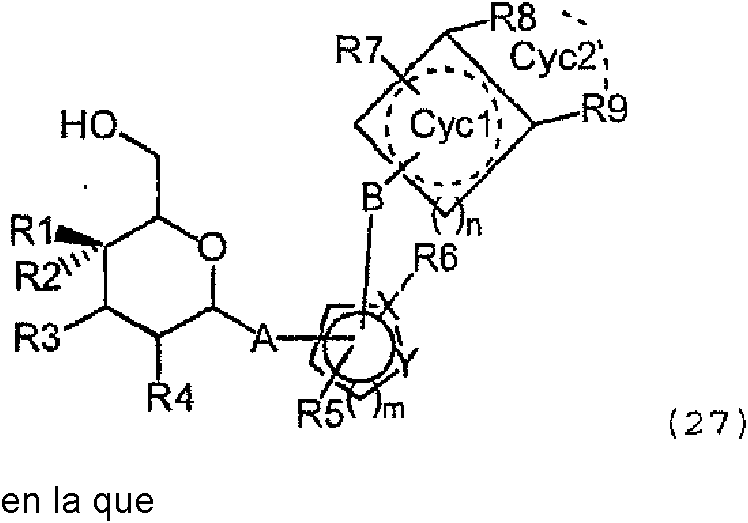
R1 y R2 son cada uno independientemente F o H, o uno de dichos radicales R1 y R2 puede ser OH;R1 and R2 are each independently F or H, or one of said radicals R1 and R2 can be OH;
R3 es OH o F, con la condición de que al menos uno de los radicales R1, R2 y R3 debe ser F;R3 is OH or F, with the proviso that at least one of the radicals R1, R2 and R3 must be F;
R4 es OH;R4 is OH;
A es O, NH, CH2, S o un enlace;A is O, NH, CH 2 , S or a bond;
X es C, O, S o N, con la condición de que X es C cuando Y es O o S;X is C, O, S or N, with the proviso that X is C when Y is O or S;
Y es N, O o S; Y is N, O or S;
m es 1 o 2;m is 1 or 2;
R5 es hidrógeno, F, Cl, Br, I, OH, CF3, NO2, CN, COOH, CO(alquilo Ci-a), COO(alquilo Ci-a), CONH2, CONH(alquilo C1-6), CON(alquilo Ci-6)2, alquilo C1-6, alquenilo C2-6, alquinilo C2-6, alcoxi C1-6, HO-(alquilo C1-6), (alquil Ci -6)-O-(alquilo C1-6), fenilo, bencilo, alcoxi Ci -6-carbonilo,R5 is hydrogen, F, Cl, Br, I, OH, CF3, NO2, CN, COOH, CO (Ci-a alkyl), COO (Ci-a alkyl), CONH2, CONH (C1-6 alkyl), CON ( Ci-6 alkyl) 2, C1-6 alkyl, C2-6 alkenyl, C2-6 alkynyl, C1-6 alkoxy, HO- (C1-6 alkyl), (Ci -6 alkyl) -O- (C1-6 alkyl ), phenyl, benzyl, Ci- 6 -carbonyl alkoxy,
en la que dichos radicales CO(alquilo Ci-a), COO(alquilo Ci-a), CONH(alquilo Ci-a), CON(alquilo Ci-a)2, alquilo Ci-a, alquenilo C2-a, alquinilo C2-a, alcoxi Ci-a, HO-(alquilo Ci-a), (alquil Ci-a)-O-(alquilo Ci-a) y alcoxi Ci-a-carbonilo están sustituidos opcionalmente con uno o más átomos de flúor,wherein said radicals CO (Ci-a alkyl), COO (Ci-a alkyl), CONH (Ci-a alkyl), CON (Ci-a alkyl) 2, Ci-a alkyl, C2-a alkenyl, C2 alkynyl -a, Ci-a alkoxy, HO- (Ci-a alkyl), (Ci-a alkyl) -O- (Ci-a alkyl) and Ci-a-carbonyl alkoxy are optionally substituted with one or more fluorine atoms,
SO2-NH2, SO2NH(alquilo Ci-a), SO2N(alquilo Ci-a)2, S-(alquilo Ci-a), S-(CH2)0-fenilo, SO-(alquilo Ci-a), SO-(CH2)o-fenilo, SO2-(alquilo Ci-a), sO 2-(CH2)o-fenilo,SO2-NH2, SO2NH (Ci-a alkyl), SO2N (Ci-a alkyl) 2, S- (Ci-a alkyl), S- (CH2) 0 -phenyl, SO- (Ci-a alkyl), SO- (CH2) o-phenyl, SO2- (Ci-a alkyl), sO 2- (CH2) o-phenyl,
en la que dichos radicales SO2NH(alquilo Ci-a), SO2N(alquilo Ci-a)2, S-(alquilo Ci-a), SO-(alquilo Ci-a) y SO2-(alquilo Ci-a) están sustituidos opcionalmente con uno o más átomos de flúor, y en la que el anillo fenilo de dichos radicales S-(CH2)o-fenilo, SO-(CH2)o-fenilo y SO2-(CH2)o-fenilo está mono- o di-sustituido opcionalmente con F, Cl, Br, OH, CF3, NO2, CN, OCF3, O-(alquilo Ci-a), alquilo Ci-a o NH2, y en la que o es 0, i, 2, 3, 4, 5, o a,wherein said radicals SO2NH (Ci-a alkyl), SO2N (Ci-a alkyl) 2, S- (Ci-a alkyl), SO- (Ci-a alkyl) and SO2- (Ci-a alkyl) are substituted optionally with one or more fluorine atoms, and wherein the phenyl ring of said S- (CH2) o-phenyl radicals, SO- (CH2) o-phenyl and SO2- (CH2) o-phenyl is mono- or di -optionally substituted with F, Cl, Br, OH, CF3, NO2, CN, OCF3, O- (Ci-a alkyl), Ci-a alkyl or NH2, and where o is 0, i, 2, 3, 4, 5, or,
NH2, NH-(alquilo Ci-a), N(alquilo Ci-a)2, NH(acilo Ci.7), fenilo o O-(CH2)0-fenilo,NH2, NH- (Ci-a alkyl), N (Ci-a alkyl) 2, NH (Ci.7 acyl), phenyl or O- (CH2) 0 -phenyl,
en la que el anillo fenilo de dichos radicales fenilo y O-(CH2)o-fenilo está mono-, di-, o tri-sustituido opcionalmente con F, Cl, Br, I, OH, CF3, NO2, CN, OCF3, O-(alquilo Ci-a), alquilo Ci-a, NH2, NH(alquilo Ci-a), N(alquilo Ci-a)2, SO2-CH3, COOH, COO-(alquilo Ci-a) o CONH2, y en la que o es como se definió anteriormente en la presente memoria; o, cuando Y es S, R5 y Ra en conjunto con los átomos de carbono a los que están unidos pueden formar un anillo fenilo;wherein the phenyl ring of said phenyl and O- (CH2) o-phenyl radicals is optionally mono-, di-, or tri-substituted with F, Cl, Br, I, OH, CF3, NO2, CN, OCF3, O- (Ci-a alkyl), Ci-a alkyl, NH2, NH (Ci-a alkyl), N (Ci-a alkyl) 2, SO2-CH3, COOH, COO- (Ci-a alkyl) or CONH2, and wherein o is as defined herein above; or, when Y is S, R5 and Ra together with the carbon atoms to which they are attached can form a phenyl ring;
Ra es H, alquilo Ci-a, alquenilo Ci-a, cicloalquilo C3-a, o fenilo en la que dicho radical fenilo está sustituido opcionalmente con halógeno o alquilo Ci-4;Ra is H, Ci-a alkyl, Ci-a alkenyl, C3-a cycloalkyl, or phenyl wherein said phenyl radical is optionally substituted with halogen or Ci-4 alkyl;
B es alcanodiílo Co-i5, en el que uno o más de los átomos de carbono de dicho radical alcanodiílo pueden estar sustituidos, independientemente entre sí, con -O-, -(C=O)-, -CH=CH-, -CeC-, -S-, -CH(OH)-, -CHF-, -CF2-, -(S=O)-, -(SO2)-, -N(alquilo Ci-a)-, -N(alquil Ci-a-fenilo)- o -NH-;B is Co-i5 alkanediyl, in which one or more of the carbon atoms of said alkanediyl radical can be substituted, independently of each other, with -O-, - (C = O) -, -CH = CH-, - CeC-, -S-, -CH (OH) -, -CHF-, -CF2-, - (S = O) -, - (SO2) -, -N (Ci-a alkyl) -, -N (alkyl Ci-a-phenyl) - or -NH-;
n es 0, i, 2, 3 o 4;n is 0, i, 2, 3 or 4;
Cyci es un anillo saturado, parcialmente saturado o insaturado de 3, 4, 5, a o 7 miembros, en el que un átomo de carbono de dicho anillo puede estar sustituido con O, N o S;Cyci is a 3-, 4-, 5-, or 7-membered saturated, partially saturated, or unsaturated ring, wherein a carbon atom of said ring may be substituted with O, N, or S;
R7, R8, y R9 son cada uno independientemente hidrógeno, F, Cl, Br, I, OH, CF3, NO2, CN, COOH, COO(alquilo Ci-a), CO(alquilo Ci-4), CONH2, CONH(alquilo Ci-a), CON(alquilo Ci-a)2, alquilo Ci-a, alquenilo C2-a, alquinilo C2-a, alcoxi Ci -8, HO-(alquilo Ci-a), (alquilo Ci-a)-O-(alquilo Ci-a),R7, R8, and R9 are each independently hydrogen, F, Cl, Br, I, OH, CF3, NO2, CN, COOH, COO (Ci-a alkyl), CO (Ci-4 alkyl), CONH2, CONH ( Ci-a alkyl), CON (Ci-a alkyl) 2, Ci-a alkyl, C2-a alkenyl, C2-a alkynyl, Ci- 8 alkoxy, HO- (Ci-a alkyl), (Ci-a alkyl) -O- (Ci-a alkyl),
en la que dichos radicales COO(alquilo Ci-a), CO(alquilo Ci-4), CONH(alquilo Ci-a), CON(alquilo Ci-a)2, alquilo Ci-a, alquenilo C2-a, alquinilo C2-a, alcoxi Ci -8, HO-(alquilo Ci-a) y (alquil Ci-a)-O-(alquilo Ci-a) están sustituidos opcionalmente con uno o más átomos de flúor,wherein said radicals COO (Ci-a alkyl), CO (Ci-4 alkyl), CONH (Ci-a alkyl), CON (Ci-a alkyl) 2, Ci-a alkyl, C2-a alkenyl, C2 alkynyl -a, Ci- 8 alkoxy, HO- (Ci-a alkyl) and (Ci-a alkyl) -O- (Ci-a alkyl) are optionally substituted with one or more fluorine atoms,
SO2-NH2, SO2NH(alquilo Ci-a), SO2N(alquilo Ci-a)2, S-(alquilo Ci-a), S-(CH2)0-fenilo, SCF3, SO-(alquilo Ci-a), SO-(CH2)o-fenilo, SO2-(alquilo Ci-a), SO2-(CH2)o-fenilo,SO2-NH2, SO2NH (Ci-a alkyl), SO2N (Ci-a alkyl) 2, S- (Ci-a alkyl), S- (CH2) 0 -phenyl, SCF3, SO- (Ci-a alkyl), SO- (CH2) o-phenyl, SO2- (Ci-a alkyl), SO2- (CH2) o-phenyl,
en la que dichos radicales SO2NH (alquilo Ci-a), SO2N(alquilo Ci-a)2, S-(alquilo Ci-a), SO-(alquilo Ci-a) y SO2-(alquilo Ci-a) están sustituidos opcionalmente con uno o más átomos de flúor, y en la que el anillo fenilo de dichos radicales S-(CH2)o-fenilo, SO-(CH2)o-fenilo y SO2-(CH2)o-fenilo está mono- o di-sustituido opcionalmente con F, Cl, Br, OH, CF3, NO2, CN, OCF3, O-(alquilo Ci-a), alquilo Ci-a o NH2, y en la que o es como se definió anteriormente en la presente memoria,wherein said radicals SO2NH (Ci-a alkyl), SO2N (Ci-a alkyl) 2, S- (Ci-a alkyl), SO- (Ci-a alkyl) and SO2- (Ci-a alkyl) are substituted optionally with one or more fluorine atoms, and wherein the phenyl ring of said S- (CH2) o-phenyl radicals, SO- (CH2) o-phenyl and SO2- (CH2) o-phenyl is mono- or di -optionally substituted with F, Cl, Br, OH, CF3, NO2, CN, OCF3, O- (Ci-a alkyl), Ci-a alkyl or NH2, and in which o is as defined herein above ,
NH2, NH-(alquilo Ci-a), N(alquilo Ci-a)2, NH(acilo Ci-7), fenilo o O-(CH2)o-fenilo,NH2, NH- (Ci-a alkyl), N (Ci-a alkyl) 2, NH (Ci-7 acyl), phenyl or O- (CH2) o-phenyl,
en la que el anillo fenilo de dichos radicales fenilo y O-(CH2)o-fenilo está mono-, di-, o tri-sustituido opcionalmente con F, Cl, Br, I, OH, CF3, NO2, CN, OCF3, alcoxi Ci -8, alquilo Ci-a, NH2, NH(alquilo Ci-a), N(alquilo Ci-a)2, SO2-CH3, COOH, COO-(alquilo Ci-a) o CONH2, y en la que o es como se definió anteriormente en la presente memoria;wherein the phenyl ring of said phenyl and O- (CH2) o-phenyl radicals is optionally mono-, di-, or tri-substituted with F, Cl, Br, I, OH, CF3, NO2, CN, OCF3, Ci- 8 alkoxy, Ci-a alkyl, NH2, NH (Ci-a alkyl), N (Ci-a alkyl) 2, SO2-CH3, COOH, COO- (Ci-a alkyl) or CONH2, and in which o is as defined herein above;
o R8 y R9 en conjunto con los átomos de carbono a los que están unidos forman un anillo saturado, parcialmente saturado o completamente insaturado de 5, a o 7 miembros, denominado en la presente memoria Cyc2, en la que uno o dos átomo(s) de carbono en dicho anillo Cyc2 están sustituidos opcionalmente con N, O o S, y en la que dicho anillo Cyc2 está sustituido opcionalmente con alquilo Ci-a, alquenilo C2-5 o alquinilo C2-5,or R8 and R9 together with the carbon atoms to which they are attached form a 5, 7 or 7-membered saturated, partially saturated or fully unsaturated ring, referred to herein as Cyc2, in which one or two atom (s) Carbon in said Cyc2 ring are optionally substituted with N, O or S, and in which said Cyc2 ring is optionally substituted with Ci-a alkyl, C2-5 alkenyl or C2-5 alkynyl,
en la que dichos radicales alquilo Ci-a, alquenilo C2-5 y alquinilo C2-5 están sustituidos opcionalmente con F, Cl, OH, CF3, NO2, CN, COO(alquilo Ci-4), CONH2, CONH(alquilo Ci-4) o OCF3, y en la que un grupo -CH2- contenido en dichos radicales alquilo C1-6, alquenilo C2-5 y alquinilo C2-5 está sustituido opcionalmente con -O-;wherein said Ci-a alkyl, C2-5 alkenyl and C2-5 alkynyl radicals are optionally substituted with F, Cl, OH, CF3, NO2, CN, COO (Ci-4 alkyl), CONH2, CONH (Ci- alkyl 4) or OCF3, and in which a group -CH2- contained in said alkyl C 1-6 alkenyl, C 2-5 alkynyl and C 2-5 is optionally substituted by -O-;
y las sales farmacéuticamente aceptables de los mismos.and the pharmaceutically acceptable salts thereof.
Otros ejemplos de inhibidores de SGLT son los compuestos de la publicación de solicitud de patente de Estados Unidos n° 2005/0014704, que se representan mediante la Fórmula (28):Other examples of SGLT inhibitors are the compounds of United States Patent Application Publication No. 2005/0014704, which are represented by Formula (28):

en la que: R1, R2 son cada uno independientemente OH, F o H, con la condición de quewherein: R1, R2 are each independently OH, F, or H, provided that
cuando R1 es F, R2 no puede ser OH;when R1 is F, R2 cannot be OH;
cuando R1 es OH, R2 no puede ser F; ywhen R1 is OH, R2 cannot be F; and
cuando R1 es OH, R2 no puede ser OH;when R1 is OH, R2 cannot be OH;
R3 es OH o F,R3 is OH or F,
con la condición de que al menos uno de dichos radicales R1, R2, R3 debe ser F;with the proviso that at least one of said radicals R1, R2, R3 must be F;
A es O, NH, CH2, S o un enlace;A is O, NH, CH2, S or a bond;
R4, R5, y R6 son cada uno independientemente hidrógeno, F, Cl, Br, I, OH, NO2, CN, COOH, CO(alquilo C1-6), COO(alquilo C1-6), CONH2, CONH(alquilo C1-6), CON(alquilo C1-6)2, alquilo C1-6, alquenilo C2-6, alquinilo C2-6, alcoxi C1-6, HO(alquilo C1-6), (alquil C1-6)-O-(alquilo C1-6), fenilo o bencilo,R4, R5, and R6 are each independently hydrogen, F, Cl, Br, I, OH, NO2, CN, COOH, CO (C1-6alkyl), COO (C1-6alkyl), CONH2, CONH (C1alkyl -6), CON (C1-6alkyl) 2, C1-6 alkyl, C2-6 alkenyl, C2-6 alkynyl, C1- 6 alkoxy, HO (C1-6 alkyl), (C1-6 alkyl) -O- (C1-6 alkyl), phenyl or benzyl,
en la que dichos radicales CO(alquilo C1-6), COO(alquilo C1-6), CONH(alquilo C1-6), CON(alquilo C1-6)2, alquilo C1-6, alquenilo C2-6, alquinilo C2-6, alcoxi C1-6, HO(alquilo C1-6), (alquil C1-6)-O-(alquilo C1-6) están sustituidos opcionalmente con uno o más átomos de flúor,wherein said radicals CO (C1-6alkyl), COO (C1-6alkyl), CONH (C1-6alkyl), CON (C1-6alkyl) 2, C1-6alkyl, C2-6alkenyl, C2alkynyl -6, C1-6 alkoxy, HO (C1-6 alkyl), (C1-6 alkyl) -O- (C1-6 alkyl) are optionally substituted with one or more fluorine atoms,
SO2-NH2, SO2NH(alquilo C1-6), SO2K(alquilo C1-6)2, S-(alquilo C1-6), S-(CH2)o-fenilo, SO-(alquilo C1-6), SO-(CH2)o-fenilo, SO2-(alquilo C1-6), s O2-(CH2) o-fenilo,SO2-NH2, SO2NH (C1-6 alkyl), SO2K (C1-6 alkyl) 2, S- (C1-6 alkyl), S- (CH2) o-phenyl, SO- (C1-6 alkyl), SO- (CH2) o-phenyl, SO2- (C1-6 alkyl), s O2- (CH2) o-phenyl,
en la que el anillo fenilo de dichos radicales S-(CH2)o-fenilo, SO-(CH2)o-fenilo y SO2-(CH2)o-fenilo puede estar monoo disustituido con F, Cl, Br, OH, CF3, NO2, CN, OCF3, O-(alquilo C1-6), alquilo C1.6 o NH2, y en la que o es 0, 1,2, 3, 4, 5 o 6,wherein the phenyl ring of said S- (CH2) o-phenyl, SO- (CH2) o-phenyl and SO2- (CH2) o-phenyl radicals may be mono-substituted with F, Cl, Br, OH, CF3, NO2, CN, OCF3, O- (C1-6 alkyl), C1.6 alkyl or NH2, and where o is 0, 1,2, 3, 4, 5 or 6,
NH2, NH-(alquilo C1-6), N(alquilo C1-6)2, NH(acilo C1.7), fenilo, O-(CH2)o-fenilo,NH2, NH- (C1-6 alkyl), N (C1-6 alkyl) 2, NH (C1.7 acyl), phenyl, O- (CH2) o-phenyl,
en la que el anillo fenilo de dichos radicales fenilo y O-(CH2)o-fenilo puede estar mono-, di-, o trisustituido con F, Cl, Br, I, OH, CF3, NO2, CN, OCF3, O-(alquilo C1.6), alquilo C1.6, NH2, NH(alquilo C1.6), N(alquilo C ^ , SO2-CH3, COOH, COO-(alquilo C1.6) o CONH2, y en la que o es como se definió anteriormente en la presente memoria;wherein the phenyl ring of said phenyl and O- (CH2) o-phenyl radicals can be mono-, di-, or trisubstituted with F, Cl, Br, I, OH, CF3, NO2, CN, OCF3, O- (C1.6 alkyl), C1.6 alkyl, NH2, NH (C1.6 alkyl), N (C ^ alkyl, SO2-CH3, COOH, COO- (C1.6 alkyl) or CONH2, and in which o it is as previously defined herein;
B es alcanodiílo Co-15,B is Co-15 alkanediyl,
en la que uno o más átomos de carbono de dicho radical alcanodiílo C0-15 están sustituidos opcionalmente, independientemente entre sí, con -O-, -(C=O)-, -CH=CH-, -C=C-, -S-, -CH(OH)-, -CHF-, -CF2-, -(S=O)-, -(SO2)-, -N(alquilo C1.6)-, -N(alquil C1-6-fenilo)- o -NH-;wherein one or more carbon atoms of said C0-15 alkanediyl radical are optionally substituted, independently of each other, with -O-, - (C = O) -, -CH = CH-, -C = C-, - S-, -CH (OH) -, -CHF-, -CF2-, - (S = O) -, - (SO2) -, -N (C1.6 alkyl) -, -N (C1-6 alkyl) phenyl) - or -NH-;
n es 0, 1, 2, 3 o 4;n is 0, 1, 2, 3 or 4;
Cyc1 es un anillo saturado, parcialmente saturado o insaturado de 3, 4, 5, 6, o 7 miembros, en el que un átomo de carbono de dicho anillo puede estar sustituido con O, N o S;Cyc1 is a 3-, 4-, 5-, 6-, or 7-membered saturated, partially saturated, or unsaturated ring, in which a carbon atom of said ring can be substituted with O, N, or S;
R7, R8, y R9 son cada uno independientemente hidrógeno, F, Cl, Br, I, OH, CF3, NO2, CN, COOH, COO(alquilo C1-6), CO(alquilo C1-4), CONH2, CONH(alquilo C1-6), CON(alquilo C1-6)2, alquilo C1-6, alquenilo C2-6, alquinilo C2-6, alcoxi C1.8, HO-(alquilo C1.6), (alquil C1-6)-O-(alquilo C1.6),R7, R8, and R9 are each independently hydrogen, F, Cl, Br, I, OH, CF3, NO2, CN, COOH, COO (C1-6alkyl), CO (C1-4alkyl), CONH2, CONH ( C1-6alkyl), CON (C1-6alkyl) 2, C1-6alkyl, C2-6alkenyl, C2-6alkynyl, C1.8alkoxy, HO- (C1.6alkyl), (C1-6alkyl) -O- (C1.6 alkyl),
en la que dichos radicales COO(alquilo C1.6), CO(alquilo C1-4), CONH(alquilo C1.6), CON(alquilo C1-6)2, alquilo C1.6, alquenilo C2-6, alquinilo C2-6, alcoxi C1.8, HO-(alquilo C1.6) y (alquil C1-6)-O-(alquilo C1.6) están sustituidos opcionalmente con uno o más átomos de flúor, wherein said radicals COO (C1.6 alkyl), CO (C1-4 alkyl), CONH (C1.6 alkyl), CON (C1-6 alkyl) 2, C1.6 alkyl, C2-6 alkenyl, C2 alkynyl -6, C1.8 alkoxy, HO- (C1.6 alkyl) and (C1-6 alkyl) -O- (C1.6 alkyl) are optionally substituted with one or more fluorine atoms,
SO2-NH2, SO2NH(alquilo Ci-a), SO2N(alquilo Ci-a)2, S-(alquilo Ci-a), S-(CH2)o-fenilo, SO-(alquilo Ci-a), SO-(CH2)o-fenilo, SO2-(alquilo Ci-a), sO 2-(CH2)o-fenilo,SO2-NH2, SO2NH (Ci-a alkyl), SO2N (Ci-a alkyl) 2, S- (Ci-a alkyl), S- (CH2) o-phenyl, SO- (Ci-a alkyl), SO- (CH2) o-phenyl, SO2- (Ci-a alkyl), sO 2- (CH2) o-phenyl,
en la que dichos radicales SO2NH(alquilo Ci-a), SO2N(alquilo Ci-a)2, S-(alquilo Ci-a), SO-(alquilo Ci-a) y SO2-(alquilo Ci-a) están sustituidos opcionalmente con uno o más átomos de flúor, y en la que el anillo fenilo de dichos radicales S-(CH2)o-fenilo, SO-(CH2)o-fenilo y SO2-(CH2)o-fenilo está mono- o disustituido opcionalmente con F, Cl, Br, OH, CF3, NO2, CN, OCF3, O-(alquilo Ci-a), alquilo Ci-a o NH2, y en la que o es como se definió anteriormente en la presente memoria,wherein said radicals SO2NH (Ci-a alkyl), SO2N (Ci-a alkyl) 2, S- (Ci-a alkyl), SO- (Ci-a alkyl) and SO2- (Ci-a alkyl) are substituted optionally with one or more fluorine atoms, and in which the phenyl ring of said S- (CH2) o-phenyl radicals, SO- (CH2) o-phenyl and SO2- (CH2) o-phenyl is mono- or disubstituted optionally with F, Cl, Br, OH, CF3, NO2, CN, OCF3, O- (Ci-a alkyl), Ci-a alkyl or NH2, and in which o is as defined herein above,
NH2, NH-(alquilo Ci-a), N(alquilo Ci-a)2, NH(acilo Ci.7), fenilo o O-(CH2)0-fenilo,NH2, NH- (Ci-a alkyl), N (Ci-a alkyl) 2, NH (Ci.7 acyl), phenyl or O- (CH2) 0 -phenyl,
en la que el anillo fenilo de dichos radicales fenilo y O-(CH2)o-fenilo está mono-, di-, o trisustituido opcionalmente con F, Cl, Br, I, OH, CF3, NO2, CN, OCF3, alcoxi Ci -8, alquilo Ci-a, NH2, NH(alquilo Ci-a), N(alquilo Ci-a)2, SO2-CH3, COOH, COO-(alquilo Ci-a) o CONH2, y en la que o es como se definió anteriormente en la presente memoria;wherein the phenyl ring of said phenyl and O- (CH2) o-phenyl radicals is optionally mono-, di-, or trisubstituted with F, Cl, Br, I, OH, CF3, NO2, CN, OCF3, alkoxy Ci -8 , Ci-a alkyl, NH2, NH (Ci-a alkyl), N (Ci-a alkyl) 2, SO2-CH3, COOH, COO- (Ci-a alkyl) or CONH2, and in which o is as defined herein above;
o R8 y R9 en conjunto con los átomos de carbono a los que están unidos forman un anillo saturado, parcialmente saturado o insaturado de 5, a o 7 miembros, denominado en la presente memoria Cyc2,or R8 and R9 together with the carbon atoms to which they are attached form a 5-, 7- or 7-membered saturated, partially saturated or unsaturated ring, referred to herein as Cyc2,
en la que uno o dos átomo(s) de carbono de dicho anillo Cyc2 están sustituidos opcionalmente con N, O o S, y en la que dicho anillo Cyc2 está sustituido opcionalmente con alquilo Ci-a, alquenilo C2-5 o alquinilo C2-5, en la que dichos radicales alquilo Ci-a, alquenilo C2-5 y alquinilo C2-5 están sustituidos opcionalmente con F, Cl, OH, CF3, NO2, CN, COO(alquilo Ci-4), CONH2, CONH(alquilo Ci-4) o OCF3, y en la que un grupo -CH2- contenido en dichos radicales alquilo Ci-a, alquenilo C2-5 y alquinilo C2-5 está sustituido opcionalmente con -O-;wherein one or two carbon atom (s) of said Cyc2 ring are optionally substituted with N, O or S, and wherein said Cyc2 ring is optionally substituted with Ci-a alkyl, C2-5 alkenyl or C2- alkynyl. 5, wherein said Ci-a alkyl, C2-5 alkenyl and C2-5 alkynyl radicals are optionally substituted with F, Cl, OH, CF3, NO2, CN, COO (Ci-4 alkyl), CONH2, CONH (alkyl Ci-4) or OCF3, and in which a group -CH2- contained in said radicals Ci-a, C2-5 alkenyl and C2-5 alkynyl is optionally substituted with -O-;
y las sales farmacéuticamente aceptables de los mismos.and the pharmaceutically acceptable salts thereof.
Los inhibidores de DPP4 son muy conocidos para los expertos en la técnica, y se pueden hallar ejemplos de inhibidores de DPP4 en las siguientes publicaciones:DPP4 inhibitors are well known to those skilled in the art, and examples of DPP4 inhibitors can be found in the following publications:
(1) TANABE SEIYAKU Co., Ltd.: documento WO 02/3089i o la patente de EE.UU. correspondiente (n° 6.849.622); y documento WO 02/30890 o la patente de EE.UU. correspondiente (n° 7.i38.397);(1) TANABE SEIYAKU Co., Ltd .: WO 02 / 3089i or US Pat. corresponding (No. 6,849,622); and WO 02/30890 or US Pat. corresponding (no. 7.i38.397);
(2) Ferring BV: documentos WO 95/i5309, WO 0i/40 i80, WO 0i/8 i304, WO 0i/8 i337, WO 03/000250, y WO 03/035057;(2) Ferring BV: WO 95 / i5309, WO 0i / 40 i80, WO 0i / 8 i304, WO 0i / 8 i337, WO 03/000250, and WO 03/035057;
(3) Probiodrug: documentos WO 97/40832, EPi0823i4, WO 99/a i43 i, WO 03/0i5775;(3) Probiodrug: WO 97/40832, EPi0823i4, WO 99 / a i43 i, WO 03 / 0i5775;
(4) Novartis AG: documentos WO 98/i9998, WO 00/3424i, WO 0 i /96295, US a.i07.3 i7 , US 6.ii0.949, y US a.i72.08i;(4) Novartis AG: WO 98 / i9998, WO 00 / 3424i, WO 0 i / 96295, US a.i07.3 i7, US 6.ii0.949, and US a.i72.08i;
(5) GlaxoSmithKline: documentos WO 03/00253i, WO 03/002530, y WO 03/002553;(5) GlaxoSmithKline: WO 03 / 00253i, WO 03/002530, and WO 03/002553;
(a) Bristol Myers Squibb: documentos WO 0 i /68603, WO 02/83i28, y WO 2005/0i2249;(a) Bristol Myers Squibb: WO 0 i / 68603, WO 02 / 83i28, and WO 2005 / 0i2249;
(7) Merck & Co.: documentos WO 02/76450, y WO 03/004498;(7) Merck & Co .: WO 02/76450, and WO 03/004498;
(8) Srryx Inc.: documentos WO 2005/026i48, WO 2005/03075i, WO 2005/09538i, WO 2004/087053, y WO 2004/i03993;(8) Srryx Inc .: WO 2005 / 026i48, WO 2005 / 03075i, WO 2005 / 09538i, WO 2004/087053, and WO 2004 / i03993;
(9) Mitsubishi Pharma Corp.: documentos WO 02/i427 i, US 7.060.722, US 7.074.794, WO 2003/24942, publicación de patente japonesa n° 2002-265439, publicación de patente japonesa n° 2005-i70792, y documento WO 2006/088i29;(9) Mitsubishi Pharma Corp .: WO 02 / i427 i, US 7,060,722, US 7,074,794, WO 2003/24942, Japanese Patent Publication No. 2002-265439, Japanese Patent Publication No. 2005-i70792, and WO 2006 / 088i29;
(10) Taisho Pharma Co., Ltd.: documento WO 2004/020407;(10) Taisho Pharma Co., Ltd .: WO 2004/020407;
(12) Yamanouchi Pharmaceutical Co., Ltd.: documento WO 2004/009544;(12) Yamanouchi Pharmaceutical Co., Ltd .: WO 2004/009544;
(13) Kyowa Hakko Kogyo: documento WO 02/05i836;(13) Kyowa Hakko Kogyo: document WO 02 / 05i836;
(14) Kyorin Seiyaku: documentos WO 2005/07542i, WO 2005/077900, y WO 2005/082847;(14) Kyorin Seiyaku: WO 2005 / 07542i, WO 2005/077900, and WO 2005/082847;
(15) Alantos Pharmaceuticals: documento WO 2006 /ii6 i57 ;(15) Alantos Pharmaceuticals: WO 2006 / ii6 i57;
(16) Glenmark Pharmaceuticals: documentos WO 2006/090244, y WO 2005/075426;(16) Glenmark Pharmaceuticals: WO 2006/090244, and WO 2005/075426;
(17) Sanwa Kagaku Kenkyusho: documento WO 2004/067509; y(17) Sanwa Kagaku Kenkyusho: WO 2004/067509; and
(18) LG lifescience: documentos WO 2005/037828, y WO 2006/i04356. (18) LG lifescience: WO 2005/037828, and WO 2006 / i04356.
En una realización de la presente invención, los inhibidores de DPP4 son los compuestos de anillos alifáticos de 5 miembros que contienen nitrógeno descritos en el documento US 6.849.622, que se representan mediante la Fórmula (29):In one embodiment of the present invention, DPP4 inhibitors are the nitrogen-containing 5-membered aliphatic ring compounds described in US 6,849,622, which are represented by Formula (29):

en la que A representa -CH2- o -S-, R1 representa un átomo de hidrógeno, un grupo alquilo inferior (es decir, C1-6), un grupo hidroxi alquilo inferior (es decir, C1-6) o un grupo alcoxi inferior (es decir, C1-6) alquilo inferior (es decir, C1-6), y R2 representa (1) un grupo cíclico que puede estar sustituido, en el que la porción de grupo cíclico es (i) un grupo hidrocarburo monocíclico, bicíclico o tricíclico, o (ii) un grupo heterocíclico monocíclico, bicíclico o tricíclico, o (2) un grupo amino que puede estar sustituido, o una sal farmacéuticamente aceptable de los mismos.wherein A represents -CH 2 - or -S-, R1 represents a hydrogen atom, a lower alkyl group (ie, C 1-6), a hydroxy lower alkyl group (ie, C 1-6) or a lower alkoxy group (ie, C 1-6) lower alkyl (i.e. C 1-6), and R2 represents (1) a cyclic group which may be substituted, wherein the portion cyclic group is (i ) a monocyclic, bicyclic or tricyclic hydrocarbon group, or (ii) a monocyclic, bicyclic or tricyclic heterocyclic group, or (2) an amino group that may be substituted, or a pharmaceutically acceptable salt thereof.
Los ejemplos de tales compuestos incluyen:Examples of such compounds include:
(2S)-2-ciano-1-[trans-4-(dimetilaminocarbonil) ciclohexil-amino]acetilpirrolidina;(2S) -2-cyano-1- [trans-4- (dimethylaminocarbonyl) cyclohexyl-amino] acetylpyrrolidine;
(2S)-2-ciano-1-[trans-4-(morfolinocarbonil) ciclohexilamino]acetilpirrolidina; y(2S) -2-cyano-1- [trans-4- (morpholinocarbonyl) cyclohexylamino] acetylpyrrolidine; and
(2S)-2-ciano-1-[trans-4-(4-acetilpiperazin-1-ilcarbonil) ciclohexilamino]acetilpirrolidina;(2S) -2-cyano-1- [trans-4- (4-acetylpiperazin-1-ylcarbonyl) cyclohexylamino] acetylpyrrolidine;
y una sal farmacéuticamente aceptable (p.ej., besilato) de los compuestos anteriores.and a pharmaceutically acceptable salt (eg, besylate) of the above compounds.
Otros ejemplos de inhibidores de DPP4 son los compuestos de anillos alifáticos de 5 miembros que contienen nitrógeno descritos en el documento US 7.138.397, que se representan mediante la Fórmula (30):Other examples of DPP4 inhibitors are the nitrogen-containing 5-membered aliphatic ring compounds described in US 7,138,397, which are represented by Formula (30):

en la que A es -CH2-, R1 es H, un grupo de alquilo inferior, un grupo hidroxi alquilo inferior o un grupo alcoxi inferioralquilo inferior, y R2 es un grupo piperazinilo que puede estar sustituido, o una sal farmacéuticamente aceptable de los mismos.wherein A is -CH 2 -, R1 is H, a lower alkyl group, a hydroxy lower alkyl group or a lower alkoxy lower alkyl group, and R2 is a piperazinyl group which may be substituted, or a pharmaceutically acceptable salt of the themselves.
Los ejemplos de tales compuestos incluyen:Examples of such compounds include:
(S)-2-ciano-1-[t-4-(4-acetil-1-piperazinil)-1-metil-r-1-ciclohexilamino]acetilpirrolidina; y(S) -2-cyano-1- [t-4- (4-acetyl-1-piperazinyl) -1-methyl-r-1-cyclohexylamino] acetylpyrrolidine; and
(S)-2-ciano-1-[t-4-(4-propionil-1-piperazinil)-1 -metil-r-1 -ciclohexilamino]acetilpirrolidina;(S) -2-cyano-1- [t-4- (4-propionyl-1-piperazinyl) -1-methyl-r-1-cyclohexylamino] acetylpyrrolidine;
o una sal farmacéuticamente aceptable de los mismos.or a pharmaceutically acceptable salt thereof.
En otra realización de la presente invención, los inhibidores de DPP4 son los compuestos descritos en el documento US 7.074.794, que se representan mediante la Fórmula (31):In another embodiment of the present invention, DPP4 inhibitors are the compounds described in US 7,074,794, which are represented by Formula (31):

en la que:in which:
X es -NR1R2, en la que R1 y R2 pueden ser iguales o diferentes, y cada uno es independientemente cicloalquilalquilo, arilalquilo, heteroarilo o heteroarilalquilo, o pueden estar unidos entre sí para formar un heterociclo que contiene opcionalmente 1 o 2 átomos de nitrógeno o átomos de oxígeno, y el heterociclo está condensado opcionalmente con un anillo aromático que opcionalmente tiene sustituyentes, y el heterociclo es opcionalmente un anillo espiro, -NR3COR4 en la que R3 y R4 son iguales o diferentes, y cada uno es independientemente un átomo de hidrógeno, alquilo, cicloalquilo, cicloalquilalquilo, arilo, arilalquilo, arilalquenilo, heteroarilo o heteroarilalquilo, X is -NR1R2, where R1 and R2 may be the same or different, and each is independently cycloalkylalkyl, arylalkyl, heteroaryl, or heteroarylalkyl, or may be linked together to form a heterocycle optionally containing 1 or 2 nitrogen atoms or oxygen atoms, and the heterocycle is optionally fused with an aromatic ring that optionally has substituents, and the heterocycle is optionally a spiro ring, -NR3COR4 where R3 and R4 are the same or different, and each is independently a hydrogen atom , alkyl, cycloalkyl, cycloalkylalkyl, aryl, arylalkyl, arylalkyl, heteroaryl or heteroarylalkyl,
-NR5CONR6R7 o -NR5CH2CH2NR6R7 en las que R5, R6 y R7 son iguales o diferentes, y cada uno es independientemente un átomo de hidrógeno, alquilo, acilo, cicloalquilo, cicloalquilalquilo, arilo, arilalquilo, heteroarilo o heteroarilalquilo, o R6 y R7 pueden estar unidos entre sí para formar un heterociclo que contiene opcionalmente 1 o 2 átomos de nitrógeno o átomos de oxígeno, y el heterociclo está condensado opcionalmente con un anillo aromático que opcionalmente tiene sustituyentes,-NR5CONR6R7 or -NR5CH 2 CH 2 NR6R7 where R5, R6 and R7 are the same or different, and each is independently a hydrogen, alkyl, acyl, cycloalkyl, cycloalkylalkyl, aryl, arylalkyl, heteroaryl or heteroarylalkyl atom, or R6 and R7 can be linked together to form a heterocycle optionally containing 1 or 2 nitrogen atoms or oxygen atoms, and the heterocycle is optionally fused with an aromatic ring optionally having substituents,
-NR8SO2R9 en la que R8 y R9 son iguales o diferentes, y cada uno es independientemente un átomo de hidrógeno, alquilo, cicloalquilo, cicloalquilalquilo, arilo, arilalquilo, heteroarilo o heteroarilalquilo, o-NR8SO 2 R9 wherein R8 and R9 are the same or different, and each is independently a hydrogen, alkyl, cycloalkyl, cycloalkylalkyl, aryl, arylalkyl, heteroaryl or heteroarylalkyl atom, or
-OR10 o -OCOR11 en las que R10 y R11 son cada uno un átomo de hidrógeno, alquilo, cicloalquilo, cicloalquilalquilo, arilo, arilalquilo, heteroarilo o heteroarilalquilo,-OR10 or -OCOR11 where R10 and R11 are each a hydrogen, alkyl, cycloalkyl, cycloalkylalkyl, aryl, arylalkyl, heteroaryl or heteroarylalkyl atom,
Y es CH2, CH-OH, S, S=O o SO2,Y is CH 2 , CH-OH, S, S = O or SO 2 ,
Z es un átomo de hidrógeno o ciano, yZ is a hydrogen or cyano atom, and
de los grupos anteriormente mencionados, alquilo, arilo, arilalquilo, arilalquenilo, heteroarilo, heteroarilalquilo, cicloalquilo, cicloalquilalquilo y heterociclo tienen cada uno opcionalmente sustituyentes,of the aforementioned groups, alkyl, aryl, arylalkyl, arylalkyl, heteroaryl, heteroarylalkyl, cycloalkyl, cycloalkylalkyl, and heterocycle each have optionally substituents,
o una sal farmacéuticamente aceptable de los mismos.or a pharmaceutically acceptable salt thereof.
Un compuesto preferible es 3-[(2S,4S)-4-[4-(3-metil-1-fenil-1H-pirazol-5-il)piperazin-1-il]pirrolidin-2-il]tiazolidina o una sal farmacéuticamente aceptable de la misma (p.ej., hidrobromuro).A preferable compound is 3 - [(2S, 4S) -4- [4- (3-methyl-1-phenyl-1H-pyrazol-5-yl) piperazin-1-yl] pyrrolidin-2-yl] thiazolidine or a pharmaceutically acceptable salt thereof (eg, hydrobromide).
En otra realización de la presente invención, el inhibidor de DPP4 es Sitagliptina [código de desarrollo: MK-0431; nombre comercial: Januvia; nombre químico: (3R)-3-amino-1-[9-(trifluorometil)-1,4,7,8-tetraza-biciclo[4.3.0]nona-6,8-dien-4-il]-4-(2,4,5-trifluorofenil)butan-1-ona], o una sal farmacéuticamente aceptable de la misma (p.ej., fosfato). In another embodiment of the present invention, the DPP4 inhibitor is Sitagliptin [development code: MK-0431; trade name: Januvia; chemical name: (3R) -3-amino-1- [9- (trifluoromethyl) -1,4,7,8-tetraza-bicyclo [4.3.0] nona-6,8-dien-4-yl] -4 - (2,4,5-trifluorophenyl) butan-1-one], or a pharmaceutically acceptable salt thereof (eg, phosphate).
Otro ejemplo de inhibidor de DPP4 es Vildagliptina [código de desarrollo: LAF237; nombre comercial: Galvus; nombre químico: (2S)-1-[2-[(3-hidroxi-1-adamantil)amino]acetil]pirrolidin-2-carbonitrilo], o un equivalente del mismo tal como una sal farmacéuticamente aceptable del mismo.Another example of a DPP4 inhibitor is Vildagliptin [development code: LAF237; trade name: Galvus; chemical name: (2S) -1- [2 - [(3-hydroxy-1-adamantyl) amino] acetyl] pyrrolidin-2-carbonitrile], or an equivalent thereof such as a pharmaceutically acceptable salt thereof.
Otro ejemplo de inhibidor de DPP4 es Saxagliptina (código de desarrollo: BMS-477118; nombre químico: (1S,3S,5S)-2-[(2S)-2-amino-2-(3-hidroxi-1-adamantil)acetil]-2-azabiciclo[3.1.0]-hexano-3-carbonitrilo), o un equivalente del mismo tal como una sal farmacéuticamente aceptable del mismo.Another example of a DPP4 inhibitor is Saxagliptin (development code: BMS-477118; chemical name: (1S, 3S, 5S) -2 - [(2S) -2-amino-2- (3-hydroxy-1-adamantyl) acetyl] -2-azabicyclo [3.1.0] -hexane-3-carbonitrile), or an equivalent thereof such as a pharmaceutically acceptable salt thereof.
Otro ejemplo de inhibidor de DPP4 es Alogliptina (código de desarrollo: SYR-322; nombre químico: 6-[(3R)-3-aminopiperidin-1-il]-1-(2-cianobencil)-3-metilpirimidin-2,4(1H,3H)-diona), o un equivalente del mismo tal como una sal farmacéuticamente aceptable del mismo (p.ej., benzoato).Another example of a DPP4 inhibitor is Alogliptin (development code: SYR-322; chemical name: 6 - [(3R) -3-aminopiperidin-1-yl] -1- (2-cyanobenzyl) -3-methylpyrimidin-2, 4 (1H, 3H) -dione), or an equivalent thereof such as a pharmaceutically acceptable salt thereof (eg, benzoate).
Otro ejemplo de inhibidor de DPP4 es L-treo-isoleucil pirrolidida, L-alo-isoleucil tiazolidida, o L-alo-isoleucil pirrolidida, o una sal farmacéuticamente aceptable de las mismas.Another example of a DPP4 inhibitor is L-threo-isoleucyl pyrrolidide, L-allo-isoleucyl thiazolidide, or L-allo-isoleucyl pyrrolidide, or a pharmaceutically acceptable salt thereof.
Como se mencionó anteriormente, la presente invención se refiere a un inhibidor de SGLT en combinación con un inhibidor de DPP4 para el uso en el tratamiento o la prevención de una enfermedad que está asociada con el nivel plasmático de GLP-1 activo, como se define adicionalmente anteriormente en la presente memoria y en las reivindicaciones.As mentioned above, the present invention relates to an SGLT inhibitor in combination with a DPP4 inhibitor for use in the treatment or prevention of a disease that is associated with the plasma level of active GLP-1, as defined. additionally hereinbefore and in the claims.
En una realización de la presente invención, el inhibidor de SGLT y el inhibidor de DPP4 se administran en cantidades suficientes para reducir un nivel sanguíneo de glucosa en el paciente.In one embodiment of the present invention, the SGLT inhibitor and the DPP4 inhibitor are administered in amounts sufficient to reduce a blood glucose level in the patient.
En una realización de la presente invención, el inhibidor de SGLT y el inhibidor de DPP4 se administran en cantidades suficientes para incrementar el nivel plasmático de GLP-1 activo en el paciente.In one embodiment of the present invention, the SGLT inhibitor and the DPP4 inhibitor are administered in amounts sufficient to increase the plasma level of active GLP-1 in the patient.
Una terapia de combinación de la presente invención es útil en el tratamiento o la prevención de una enfermedad que está asociada con el GLP-1 activo plasmático (como se definió adicionalmente anteriormente) en un mamífero, tal como un ser humano.A combination therapy of the present invention is useful in the treatment or prevention of a disease that is associated with plasma active GLP-1 (as further defined above) in a mammal, such as a human.
En otro aspecto, la presente invención se refiere a una composición farmacéutica que comprende un inhibidor de SGLT, un inhibidor de DPP4 y un vehículo o diluyente farmacéuticamente aceptable, para el uso como agente para el tratamiento o la prevención de una enfermedad que está asociada con el nivel plasmático de GLP-1 activo, como se define adicionalmente anteriormente en la presente memoria y en las reivindicaciones.In another aspect, the present invention relates to a pharmaceutical composition comprising a SGLT inhibitor, a DPP4 inhibitor, and a pharmaceutically acceptable carrier or diluent, for use as an agent for the treatment or prevention of a disease that is associated with the plasma level of active GLP-1, as further defined herein above and in the claims.
La enfermedad que está asociada con un nivel plasmático de GLP-1 activo y que se va a tratar o prevenir de acuerdo con la presente invención es una enfermedad seleccionada de diabetes, una afección relacionada con la diabetes, obesidad, infarto de miocardio, ictus, deterioro del aprendizaje o de la memoria, y un trastorno neurodegenerativo, en el que la afección relacionada con la diabetes se selecciona de hiperglucemia, tolerancia alterada a la glucosa, glucosa alterada en ayunas, resistencia a la insulina, insuficiencia de células p pancreáticas, insuficiencia de células enteroendocrinas, glucosuria, acidosis metabólica, cataratas, nefropatía diabética, neuropatía diabética, retinopatía diabética, arteriopatía coronaria diabética, enfermedad cerebrovascular diabética, enfermedad vascular periférica diabética, síndrome metabólico, hiperlipidemia, ateroesclerosis, hipertensión, y obesidad. Los ejemplos de un trastorno neurodegenerativo incluyen daño cerebral excitotóxico provocado por convulsiones epilépticas graves, enfermedad de Alzheimer, enfermedad de Parkinson, enfermedad de Huntington, enfermedad asociada a priones, enfermedad de las neuronas motoras, lesión cerebral traumática, lesión de la médula espinal, y neuropatía periférica. La diabetes incluye la diabetes tipo 1 o tipo 2.The disease that is associated with an active plasma GLP-1 level and is to be treated or prevented in accordance with the present invention is a selected disease of diabetes, a condition related to diabetes, obesity, myocardial infarction, stroke, impaired learning or memory, and a neurodegenerative disorder, in which the condition related to diabetes is selected from hyperglycemia, impaired glucose tolerance, glucose impaired fasting, insulin resistance, pancreatic p cell failure, enteroendocrine cell failure, glycosuria, metabolic acidosis, cataracts, diabetic nephropathy, diabetic neuropathy, diabetic retinopathy, diabetic coronary artery disease, diabetic cerebrovascular disease, diabetic peripheral vascular disease, syndrome metabolic, hyperlipidemia, atherosclerosis, hypertension, and obesity. Examples of a neurodegenerative disorder include excitotoxic brain damage caused by severe epileptic seizures, Alzheimer's disease, Parkinson's disease, Huntington's disease, prion-associated disease, motor neuron disease, traumatic brain injury, spinal cord injury, and peripheral neuropathy. Diabetes includes type 1 or type 2 diabetes.
Los inhibidores de SGLT y los inhibidores de DPP4 se pueden administrar a un paciente mediante cualquier vía de administración convencional, que incluye la administración intravenosa, oral, subcutánea, intramuscular, intradérmica y parenteral. Los inhibidores de SGLT y los inhibidores de DPP4 se pueden administrar de manera simultánea, secuencial, o en intervalos separados. Cuando se administran de manera simultánea, el inhibidor de SGLT y el inhibidor de DPP4 se pueden incorporar en una única composición farmacéutica o en composiciones diferentes. Cuando se administran por separado, las cantidades terapéuticamente eficaces del inhibidor de SGLT y del inhibidor de DPP4 se pueden administrar en un calendario diferente. Cada composición se puede formular con excipientes, diluyentes o vehículos habituales, y se puede comprimir en comprimidos, o se puede formular en elixires o soluciones; y como formas farmacéuticas de alivio sostenido, y similares. El inhibidor de SGLT y el inhibidor de DPP4 se pueden administrar a través de vías diferentes.SGLT inhibitors and DPP4 inhibitors can be administered to a patient by any conventional route of administration, including intravenous, oral, subcutaneous, intramuscular, intradermal, and parenteral administration. SGLT inhibitors and DPP4 inhibitors can be administered simultaneously, sequentially, or at separate intervals. When administered simultaneously, the SGLT inhibitor and the DPP4 inhibitor can be incorporated into a single pharmaceutical composition or into different compositions. When administered separately, the therapeutically effective amounts of the SGLT inhibitor and the DPP4 inhibitor can be administered on a different schedule. Each composition can be formulated with customary excipients, diluents, or carriers, and can be compressed into tablets, or it can be formulated into elixirs or solutions; and as pharmaceutical forms of sustained relief, and the like. The SGLT inhibitor and the DPP4 inhibitor can be administered through different routes.
El inhibidor de SGLT y el inhibidor de DPP4 se proporcionan en cantidades para generar un efecto sinérgico para incrementar el nivel plasmático de GLP-1 activo en un paciente. La dosis óptima del inhibidor de SGLT y del inhibidor de DPP4 variará con la edad, el peso, el sexo del paciente, el compuesto particular usado, la vía de administración, y la gravedad de la afección.SGLT inhibitor and DPP4 inhibitor are provided in amounts to generate a synergistic effect to increase the plasma level of active GLP-1 in a patient. The optimal dose of the SGLT inhibitor and the DPP4 inhibitor will vary with the age, weight, sex of the patient, the particular compound used, the route of administration, and the severity of the condition.
En otro aspecto, la presente invención se refiere al uso de un inhibidor de SGLT y un inhibidor de DPP4 para la fabricación de un medicamento para el tratamiento o la prevención de una enfermedad asociada con el nivel plasmático de GLP-1 activo, como se define adicionalmente anteriormente en la presente memoria y en las reivindicaciones. In another aspect, the present invention relates to the use of an SGLT inhibitor and a DPP4 inhibitor for the manufacture of a medicament for the treatment or prevention of a disease associated with the plasma level of active GLP-1, as defined additionally hereinbefore and in the claims.
En otro aspecto, la presente invención se refiere al uso de un inhibidor de SGLT y de un inhibidor de DPP4 para la fabricación de un medicamento para el tratamiento o la prevención de la diabetes, como se define adicionalmente anteriormente en la presente memoria y en las reivindicaciones.In another aspect, the present invention relates to the use of an SGLT inhibitor and a DPP4 inhibitor for the manufacture of a medicament for the treatment or prevention of diabetes, as further defined herein above and in the claims.
En otro aspecto, la presente invención se refiere a un producto que comprende un inhibidor de SGLT y un inhibidor de DPP4 en forma de una preparación combinada para el uso simultáneo, separado o secuencial en el tratamiento o la prevención de una enfermedad asociada con el nivel plasmático de GLP-1 activo, como se define adicionalmente anteriormente en la presente memoria y en las reivindicaciones.In another aspect, the present invention relates to a product comprising a SGLT inhibitor and a DPP4 inhibitor in the form of a combined preparation for simultaneous, separate or sequential use in the treatment or prevention of a disease associated with level GLP-1 plasma assay, as further defined herein above and in the claims.
En otro aspecto, la presente invención se refiere a un producto que comprende un inhibidor de SGLT y un inhibidor de DPP4 en forma de una preparación combinada para el uso simultáneo, separado o secuencial en el tratamiento o la prevención de la diabetes, como se define adicionalmente anteriormente en la presente memoria y en las reivindicaciones.In another aspect, the present invention relates to a product comprising a SGLT inhibitor and a DPP4 inhibitor in the form of a combined preparation for simultaneous, separate or sequential use in the treatment or prevention of diabetes, as defined additionally hereinbefore and in the claims.
La composición farmacéutica para el uso de acuerdo con la presente invención está preferiblemente en formas farmacéuticas unitarias tales como comprimidos, cápsulas, polvos, gránulos, soluciones, suspensiones, jarabes, aerosoles, y supositorios.The pharmaceutical composition for use according to the present invention is preferably in unit dosage forms such as tablets, capsules, powders, granules, solutions, suspensions, syrups, sprays, and suppositories.
La composición farmacéutica se puede formular con vehículos y diluyentes farmacéuticamente aceptables adecuados. Los vehículos y diluyentes farmacéuticamente aceptables adecuados están disponibles para los expertos en la técnica [véase, p.ej., Remington: The Science and Practice of Pharmacy, (Gennaro et al., eds.), 20a edición, 2000]. Los ejemplos de los vehículos y diluyentes adecuados pueden incluir ácido esteárico, estearato de magnesio, óxido de magnesio, sales de sodio y calcio de ácido fosfórico y sulfúrico, carbonato de magnesio, talco, gelatina, tragacanto, dextrán sulfato de sodio, carboximetilcelulosa sódica, metilcelulosa, alginato sódico, pectina, dextrina, manitol, sorbitol, lactosa, sacarosa, almidón, manteca de cacao, polivinil-pirrolidona, poli(alcohol vinílico), polietilen glicoles, propilen glicol, etanol, aceite de maíz, aceite de semilla de algodón, aceite de coco, aceite de cacahuete, aceite de sésamo, alcohol bencílico, y otros materiales farmacéuticamente aceptables.The pharmaceutical composition can be formulated with suitable pharmaceutically acceptable carriers and diluents. Suitable pharmaceutically acceptable carriers and diluents are available to those skilled in the art [see, eg, Remington: The Science and Practice of Pharmacy, (Gennaro et al., Eds.), 20th edition, 2000]. Examples of suitable vehicles and diluents may include stearic acid, magnesium stearate, magnesium oxide, sodium and calcium salts of phosphoric and sulfuric acid, magnesium carbonate, talc, gelatin, tragacanth, sodium dextran sulfate, sodium carboxymethyl cellulose, methylcellulose, sodium alginate, pectin, dextrin, mannitol, sorbitol, lactose, sucrose, starch, cocoa butter, polyvinyl pyrrolidone, poly (vinyl alcohol), polyethylene glycol, propylene glycol, ethanol, corn oil, cottonseed oil , coconut oil, peanut oil, sesame oil, benzyl alcohol, and other pharmaceutically acceptable materials.
Las composiciones farmacéuticas se pueden preparar mediante métodos muy conocidos para los expertos en la técnica, p.ej., por medio de mezcla convencional, disolución, granulación, levigación, emulsificación, encapsulación, atrapamiento, liofilización o secado por pulverización.Pharmaceutical compositions can be prepared by methods well known to those skilled in the art, eg, by means of conventional mixing, dissolving, granulating, levigating, emulsifying, encapsulating, trapping, lyophilizing, or spray drying.
De acuerdo con la presente invención, el inhibidor de SGLT es un compuesto de Fórmula (24) o una sal farmacéuticamente aceptable del mismo, descrito anteriormente.In accordance with the present invention, the SGLT inhibitor is a compound of Formula (24) or a pharmaceutically acceptable salt thereof, described above.
En una realización de la presente invención, el inhibidor de DPP4 es un compuesto de Fórmula (29) o una sal farmacéuticamente aceptable del mismo, descrito anteriormente.In one embodiment of the present invention, the DPP4 inhibitor is a compound of Formula (29) or a pharmaceutically acceptable salt thereof, described above.
En otra realización de la presente invención, el inhibidor de DPP4 es un compuesto de Fórmula (31) o una sal farmacéuticamente aceptable del mismo, descrito anteriormente.In another embodiment of the present invention, the DPP4 inhibitor is a compound of Formula (31) or a salt pharmaceutically acceptable thereof, described above.
En otra realización de la presente invención, el inhibidor de DPP4 es Sitagliptina o una sal farmacéuticamente aceptable de la misma.In another embodiment of the present invention, the DPP4 inhibitor is Sitagliptin or a pharmaceutically acceptable salt thereof.
Una combinación del inhibidor de SGLT y del inhibidor de DPP4 de la presente invención es:A combination of the SGLT inhibitor and the DPP4 inhibitor of the present invention is:
(a) El inhibidor de SGLT de Fórmula (24):(a) The SGLT inhibitor of Formula (24):

en la que RA es un átomo de halógeno o un grupo alquilo inferior (es decir, C1-6);in which RA is a halogen atom or a lower alkyl group (i.e. C 1-6);
el Anillo C es un grupo fenilo sustituido con 1-3 sustituyentes seleccionados del grupo que consiste en un átomo de halógeno, un grupo ciano, un grupo alquilo inferior (es decir, C1-6), un grupo halo-alquilo inferior (es decir, C1-6), un grupo alcoxi inferior (es decir, C1-6), un grupo halo-alcoxi inferior (es decir, C1-6), un grupo metilendioxi, un grupo etilenoxi, un grupo mono- o di-alquilamino inferior (es decir, C1-6), un grupo carbamoilo, y un grupo mono- o dialquilcarbamoilo inferior (es decir, C1-6); o un grupo heterociclilo sustituido con 1-3 sustituyentes seleccionados del grupo que consiste en un átomo de halógeno, un grupo ciano, un grupo alquilo inferior (es decir, C1-6),Ring C is a phenyl group substituted with 1-3 substituents selected from the group consisting of a halogen atom, a cyano group, a lower alkyl group (ie, C 1-6), a halo-lower alkyl group (s ie C 1-6), lower alkoxy group (ie, C 1-6), a halo-lower alkoxy group (ie, C 1-6), a methylenedioxy group, an ethyleneoxy group, a mono- alkylamino or di-lower (ie, C 1-6), a carbamoyl group, and a mono- or dialkylcarbamoyl lower (i.e. C 1-6); or a heterocyclyl group substituted with 1 to 3 substituents selected from the group consisting of a halogen atom, a cyano group, a lower alkyl group (ie, C 1-6),
un grupo halo-alquilo inferior (es decir, C1-6), un grupo alcoxi inferior (es decir, C1-6), un grupo halo-alcoxi inferior (es decir, C1-6), un grupo mono- o di-alquilo inferior (es decir, C1-6) amino, un grupo carbamoilo, y un grupo mono- o di alquilo inferior (es decir, C1-6) carbamoilo;a halo-lower alkyl group (ie, C 1-6), lower alkoxy group (ie, C 1-6), a halo-lower alkoxy group (ie, C 1-6), a group mono- alkyl or di-lower (i.e. C 1-6) amino, carbamoyl group, and a mono- or di lower alkyl (i.e. C 1-6) alkylcarbamoyl;
o una sal farmacéuticamente aceptable del mismo,or a pharmaceutically acceptable salt thereof,
yand
el inhibidor de DPP4 de fórmula (29):the DPP4 inhibitor of formula (29):

en la que A representa -CH2- o -S-, R1 representa un átomo de hidrógeno, un grupo alquilo inferior (es decir, C1-6), un grupo hidroxi alquilo inferior (es decir, C1-6) o un grupo alcoxi inferior (es decir, C1-6) alquilo inferior (es decir, C1-6), y R2 representa (1) un grupo cíclico que puede estar sustituido, en el que la porción de grupo cíclico es (i) un grupo hidrocarburo monocíclico, bicíclico o tricíclico, o (ii) un grupo heterocíclico monocíclico, bicíclico o tricíclico, o (2) un grupo amino que puede estar sustituido, o una sal farmacéuticamente aceptable de los mismos; owherein A represents -CH 2 - or -S-, R1 represents a hydrogen atom, a lower alkyl group (ie, C 1-6), a hydroxy lower alkyl group (ie, C 1-6) or a lower alkoxy group (ie, C 1-6) lower alkyl (i.e. C 1-6), and R2 represents (1) a cyclic group which may be substituted, wherein the portion cyclic group is (i ) a monocyclic, bicyclic or tricyclic hydrocarbon group, or (ii) a monocyclic, bicyclic or tricyclic heterocyclic group, or (2) an amino group that may be substituted, or a pharmaceutically acceptable salt thereof; or
el inhibidor de DPP4 de Fórmula (31):the DPP4 inhibitor of Formula (31):
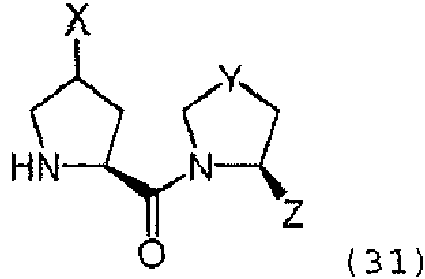
en la que:in which:
X es -NR1R2, en la que R1 y R2 pueden ser iguales o diferentes, y cada uno es independientemente cicloalquilalquilo, arilalquilo, heteroarilo o heteroarilalquilo, o pueden estar unidos entre sí para formar un heterociclo que contiene opcionalmente 1 o 2 átomos de nitrógeno o átomos de oxígeno, y el heterociclo está condensado opcionalmente con un anillo aromático que opcionalmente tiene sustituyentes, y el heterociclo es opcionalmente un anillo espiro, -NR3COR4 en la que R3 y R4 son iguales o diferentes, y cada uno es independientemente un átomo de hidrógeno, alquilo, cicloalquilo, cicloalquilalquilo, arilo, arilalquilo, arilalquenilo, heteroarilo o heteroarilalquilo, X is -NR1R2, where R1 and R2 may be the same or different, and each is independently cycloalkylalkyl, arylalkyl, heteroaryl, or heteroarylalkyl, or may be linked together to form a heterocycle optionally containing 1 or 2 nitrogen atoms or oxygen atoms, and the heterocycle is optionally fused with an aromatic ring optionally having substituents, and the heterocycle is optionally a spiro ring, -NR3COR4 where R3 and R4 are the same or different, and each is independently a hydrogen, alkyl, cycloalkyl, cycloalkylalkyl, aryl, arylalkyl, arylalkyl, heteroaryl or heteroarylalkyl atom,
-NR5CONR6R7 o -NR5CH2CH2NR6R7 en las que R5, R6 y R7 son iguales o diferentes, y cada uno es independientemente un átomo de hidrógeno, alquilo, acilo, cicloalquilo, cicloalquilalquilo, arilo, arilalquilo, heteroarilo o heteroarilalquilo, o R6 y R7 pueden estar unidos entre sí para formar un heterociclo que contiene opcionalmente 1 o 2 átomos de nitrógeno o átomos de oxígeno, y el heterociclo está condensado opcionalmente con un anillo aromático que opcionalmente tiene sustituyentes,-NR5CONR6R7 or -NR5CH 2 CH 2 NR6R7 where R5, R6 and R7 are the same or different, and each is independently a hydrogen, alkyl, acyl, cycloalkyl, cycloalkylalkyl, aryl, arylalkyl, heteroaryl or heteroarylalkyl atom, or R6 and R7 can be linked together to form a heterocycle optionally containing 1 or 2 nitrogen atoms or oxygen atoms, and the heterocycle is optionally fused with an aromatic ring optionally having substituents,
-NR8SO2R9 en la que R8 y R9 son iguales o diferentes, y cada uno es independientemente un átomo de hidrógeno, alquilo, cicloalquilo, cicloalquilalquilo, arilo, arilalquilo, heteroarilo o heteroarilalquilo, o-NR8SO 2 R9 wherein R8 and R9 are the same or different, and each is independently a hydrogen, alkyl, cycloalkyl, cycloalkylalkyl, aryl, arylalkyl, heteroaryl or heteroarylalkyl atom, or
-OR10 o -OCOR11 en las que R10 y R11 son cada uno un átomo de hidrógeno, alquilo, cicloalquilo, cicloalquilalquilo, arilo, arilalquilo, heteroarilo o heteroarilalquilo,-OR10 or -OCOR11 where R10 and R11 are each a hydrogen, alkyl, cycloalkyl, cycloalkylalkyl, aryl, arylalkyl, heteroaryl or heteroarylalkyl atom,
Y es CH2, CH-OH, S, S=O o SO2,Y is CH 2 , CH-OH, S, S = O or SO 2 ,
Z es un átomo de hidrógeno o ciano, yZ is a hydrogen or cyano atom, and
de los grupos anteriormente mencionados, alquilo, arilo, arilalquilo, arilalquenilo, heteroarilo, heteroarilalquilo, cicloalquilo, cicloalquilalquilo y heterociclo tienen cada uno opcionalmente sustituyentes,of the aforementioned groups, alkyl, aryl, arylalkyl, arylalkyl, heteroaryl, heteroarylalkyl, cycloalkyl, cycloalkylalkyl, and heterocycle each have optionally substituents,
o una sal farmacéuticamente aceptable del mismo; oor a pharmaceutically acceptable salt thereof; or
el inhibidor de DPP4 Sitagliptina o una sal farmacéuticamente aceptable de la misma; oDPP4 inhibitor Sitagliptin or a pharmaceutically acceptable salt thereof; or
(b) el inhibidor de SGLT se selecciona de:(b) the SGLT inhibitor is selected from:
(i) 1-(p-D-Glucopiranosil)-4-cloro-3-[5-(6-fluoro-2-piridil)-2-tienilmetil]benceno o una sal farmacéuticamente aceptable del mismo;(i) 1- (p-D-Glucopyranosyl) -4-chloro-3- [5- (6-fluoro-2-pyridyl) -2-thienylmethyl] benzene or a pharmaceutically acceptable salt thereof;
(ii) 3-(5-(4-Fluorofenil)-2-tienilmetil)-1-(p-D-glucopiranosil)-4-metilbenceno o una sal farmacéuticamente aceptable del mismo;(ii) 3- (5- (4-Fluorophenyl) -2-thienylmethyl) -1- (p-D-glucopyranosyl) -4-methylbenzene or a pharmaceutically acceptable salt thereof;
(iii) 1-(p-D-Glucopiranosil)-4-cloro-3-[5-(6-fluoro-3-piridil)-2-tienilmetil]benceno o una sal farmacéuticamente aceptable del mismo; y(iii) 1- (p-D-Glucopyranosyl) -4-chloro-3- [5- (6-fluoro-3-pyridyl) -2-thienylmethyl] benzene or a pharmaceutically acceptable salt thereof; and
el inhibidor de DPP4 se selecciona de:the DPP4 inhibitor is selected from:
(i) 3-[(2S,4S)-4-[4-(3-metil-1-fenil-1H-pirazol-5-il)-piperazin-1-il]pirrolidin-2-ilcarbonil]tiazolidina o una sal farmacéuticamente aceptable de la misma (p.ej., hidrobromuro);(i) 3 - [(2S, 4S) -4- [4- (3-methyl-1-phenyl-1H-pyrazol-5-yl) -piperazin-1-yl] pyrrolidin-2-ylcarbonyl] thiazolidine or a pharmaceutically acceptable salt thereof (eg, hydrobromide);
(ii) Sitagliptina (es decir, (3R)-3-amino-1-[3-(trifluorometil)-5,6,7,8-tetrahidro-5H-[1,2,4]triazolo[4,3-a]pirazin-7-il]-4-(2,4,5-trifluorofenil)butan-1-ona) o una sal farmacéuticamente aceptable de la misma (p.ej., fosfato); y(ii) Sitagliptin (ie (3R) -3-amino-1- [3- (trifluoromethyl) -5,6,7,8-tetrahydro-5H- [1,2,4] triazolo [4,3- a] pyrazin-7-yl] -4- (2,4,5-trifluorophenyl) butan-1-one) or a pharmaceutically acceptable salt thereof (eg, phosphate); and
(iii) (2S)-2-ciano-1-[trans-4-(dimetilaminocarbonil)-ciclohexilamino]acetilpirrolidina o una sal farmacéuticamente aceptable de la misma (p.ej., besilato).(iii) (2S) -2-cyano-1- [trans-4- (dimethylaminocarbonyl) -cyclohexylamino] acetylpyrrolidine or a pharmaceutically acceptable salt thereof (eg besylate).
Cuando el inhibidor de SGLT se va a administrar de manera oral o parenteral, la dosis se puede seleccionar en general de un intervalo de alrededor de 0,01 a 100 mg/kg/día, preferiblemente alrededor de 0,01 a 30 mg/kg/día. Cuando el inhibidor de SGLT se va a administrar de manera oral, la dosis se puede seleccionar en general de un intervalo de alrededor de 0,03 a 100 mg/kg/día, preferiblemente alrededor de 0,03 a 30 mg/kg/día, más preferiblemente alrededor de 0,03 a 10 mg/kg/día. Cuando el inhibidor de SGLT se va a administrar de manera parenteral, la dosis se puede seleccionar en general de un intervalo de alrededor de 0,01 a 30 mg/kg/día, preferiblemente alrededor de 0,01 a 10 mg/kg/día, más preferiblemente alrededor de 0,01 a 3 mg/kg/día.When the SGLT inhibitor is to be administered orally or parenterally, the dose can generally be selected from a range of about 0.01 to 100 mg / kg / day, preferably about 0.01 to 30 mg / kg /day. When the SGLT inhibitor is to be administered orally, the dose can generally be selected from a range of about 0.03 to 100 mg / kg / day, preferably about 0.03 to 30 mg / kg / day , more preferably around 0.03 to 10 mg / kg / day. When the SGLT inhibitor is to be administered parenterally, the dose can generally be selected from a range of about 0.01 to 30 mg / kg / day, preferably about 0.01 to 10 mg / kg / day , more preferably about 0.01 to 3 mg / kg / day.
Cuando el inhibidor de DPP4 se va a administrar de manera oral o parenteral, la dosis se puede seleccionar en general de un intervalo de alrededor de 0,01 a 30 mg/kg/día, preferiblemente alrededor de 0,01 a 10 mg/kg/día. Cuando el inhibidor de DPP4 se va a administrar de manera oral, la dosis se puede seleccionar en general de un intervalo de alrededor de 0,03 a 30 mg/kg/día, preferiblemente alrededor de 0,03 a 10 mg/kg/día, más preferiblemente alrededor de 0,03 a 3 mg/kg/día. Cuando el inhibidor de DPP4 se va a administrar de manera parenteral, la dosis se puede seleccionar en general de un intervalo de alrededor de 0,01 a 10 mg/kg/día, preferiblemente alrededor de 0,01 a 3 mg/kg/día, más preferiblemente alrededor de 0,01 a 1 mg/kg/día.When the DPP4 inhibitor is to be administered orally or parenterally, the dose can generally be selected from a range of about 0.01 to 30 mg / kg / day, preferably about 0.01 to 10 mg / kg /day. When the DPP4 inhibitor is to be administered orally, the dose can generally be selected from a range of about 0.03 to 30 mg / kg / day, preferably about 0.03 to 10 mg / kg / day , more preferably around 0.03 to 3 mg / kg / day. When the DPP4 inhibitor is to be administered parenterally, the dose can generally be selected from a range of about 0.01 to 10 mg / kg / day, preferably about 0.01 to 3 mg / kg / day , more preferably about 0.01 to 1 mg / kg / day.
La proporción de dosis entre los inhibidores respectivos se puede seleccionar de manera adecuada, basándose en la edad, el peso, el sexo del paciente, la gravedad de las afecciones, y la vía de administración. Por ejemplo, la proporción de dosis peso:peso entre el inhibidor de DPP4 y el inhibidor de SGLT (inhibidor de DPP4 : inhibidor de SGLT) puede hallarse en general dentro de un intervalo de 1:0,01 a 1:600, preferiblemente 1:0,1 a 1:300, más preferiblemente 1:0,5 Según la presente invención, tanto el inhibidor de SGLT como el inhibidor de DPP4 se pueden administrar una vez o varias veces a la dosis diaria descrita anteriormente.The dose ratio between the respective inhibitors can be suitably selected, based on the age, weight, sex of the patient, severity of the conditions, and route of administration. For example, the weight: weight dose ratio between DPP4 inhibitor and SGLT inhibitor (DPP4 inhibitor: SGLT inhibitor) can generally be within a range of 1: 0.01 to 1: 600, preferably 1 : 0.1 to 1: 300, more preferably 1: 0.5 In accordance with the present invention, both the SGLT inhibitor and the DPP4 inhibitor can be administered once or several times at the daily dose described above.
EjemplosExamples
Ejemplo 1:Example 1:
Efecto del inhibidor de SGLT sobre el nivel plasmático de GLP-1 activo en ratas deficientes de DPP4 con carga de glucosaEffect of SGLT inhibitor on plasma level of active GLP-1 in glucose-loaded DPP4-deficient rats
(a) Animales:(a) Animals:
Ratas Fisher macho deficientes de DPP4 (adquiridas de Charles River Japan, Inc.)DPP4-deficient male Fisher rats (purchased from Charles River Japan, Inc.)
(b) Métodos:(b) Methods:
(b-1) Preparación y Administración del Compuesto de Ensayo(b-1) Preparation and Administration of Test Compound
El compuesto de ensayo se suspendió en una disolución de carboximetil celulosa del 0,5% que contenía un 0,2% de Tween 80 a las dosis indicadas en la Tabla 1, y se administró al grupo de ensayo de manera oral a un volumen de 5 mL/kg. Al grupo de control de vehículo se le administró de manera oral una disolución de carboximetil celulosa del 0,5% que contenía un 0,2% de Tween 80 a un volumen de 5 mL/kg. Justo después de la administración del compuesto o del vehículo, se administró de manera oral una disolución de glucosa (2 g/kg/5 ml).The test compound was suspended in a 0.5% carboxymethyl cellulose solution containing 0.2% Tween 80 at the doses indicated in Table 1, and the test group was orally administered at a volume of 5 mL / kg. The vehicle control group was orally administered a 0.5% carboxymethyl cellulose solution containing 0.2% Tween 80 at a volume of 5 mL / kg. Right after administration of the compound or vehicle, a glucose solution (2 g / kg / 5 ml) was orally administered.
(b-2) Procedimiento de Recogida de Sangre y Determinación del Nivel Plasmático de GLP-1 Activo(b-2) Blood Collection Procedure and Determination of Plasma Level of Active GLP-1
Se recogió sangre de la vena caudal de una rata sin anestesiar justo antes y 0,5, 1, y 3 horas después de la carga con glucosa. Se determinó el nivel plasmático de GLP-1 activo usando el kit RAT ENDOCRINE LINCOp/ex (LINCO Research).Blood was collected from the caudal vein of an unanesthetized rat just before and 0.5, 1, and 3 hours after loading with glucose. The plasma level of active GLP-1 was determined using the RAT ENDOCRINE LINCOp / ex kit (LINCO Research).
(b-3) Compuesto de Ensayo(b-3) Test Compound
Se usó el siguiente compuesto:The following compound was used:
Compuesto A:Compound A:
1-(p-D-glucopiranosil)-4-cloro-3-[5-(6-fluoro-2-piridil)-2-tienilmetil]benceno (véase: publicación de solicitud de patente de Estados Unidos n° 2005/0233988).1- (p-D-glucopyranosyl) -4-chloro-3- [5- (6-fluoro-2-pyridyl) -2-thienylmethyl] benzene (see: US Patent Application Publication No. 2005/0233988).
(c) Resultados:(c) Results:
Los resultados se muestran en la Tabla 1:The results are shown in Table 1:
Tabla 1Table 1

Los resultados se expresan como medias ± EEM (n=6). Las diferencias estadísticas entre los grupos se analizaron mediante el método de Dunnett. *; P<0,05, **; P<0,01 frente al grupo de control.The results are expressed as means ± SEM (n = 6). Statistical differences between groups were analyzed using the Dunnett's method. *; P <0.05, **; P <0.01 compared to the control group.
Como se muestra en la Tabla 1 anterior, el Compuesto A incrementó notablemente el nivel plasmático de GLP-1 activo en las ratas deficientes de DPP4. Este resultado sugiere que el aumento del GLP-1 activo plasmático mediante el compuesto A es independiente de DPP4. La explicación más probable para el hallazgo es que el Compuesto A incrementa la secreción de GLP-1.As shown in Table 1 above, Compound A markedly increased the plasma level of active GLP-1 in DPP4 deficient rats. This result suggests that the increase in plasma active GLP-1 by compound A is independent of DPP4. The most likely explanation for the finding is that Compound A increases GLP-1 secretion.
Ejemplo 2:Example 2:
Efecto sinérgico del inhibidor de SGLT y del inhibidor de DPP4 sobre el nivel plasmático de GLP-1 activo en ratas normales cargadas con glucosa Synergistic effect of SGLT inhibitor and DPP4 inhibitor on plasma level of active GLP-1 in normal glucose-loaded rats
(a) Animales:(a) Animals:
Ratas Fisher macho positivas para DPP4 (adquiridas de Japan SLC, Inc.)DPP4 positive male Fisher rats (purchased from Japan SLC, Inc.)
(b) Métodos:(b) Methods:
(b-1) Preparación y Administración de los Compuestos de Ensayo(b-1) Preparation and Administration of Test Compounds
Cada compuesto de ensayo se suspendió en una disolución de carboximetil celulosa del 0,5% que contenía un 0,2% de Tween 80 a las dosis indicadas en la Tabla 2, y se administró de manera oral al grupo de ensayo a un volumen de 5 mL/kg. Al grupo de control de vehículo se le administró de manera oral una disolución de carboximetil celulosa del 0,5% que contenía un 0,2% de Tween 80 a un volumen de 5 mL/kg. Justo después de la administración del compuesto o del vehículo, se administró de manera oral una disolución de glucosa (2 g/kg/5 mL).Each test compound was suspended in a 0.5% carboxymethyl cellulose solution containing 0.2% Tween 80 at the doses indicated in Table 2, and administered orally to the test group at a volume of 5 mL / kg. The vehicle control group was orally administered a 0.5% carboxymethyl cellulose solution containing 0.2% Tween 80 at a volume of 5 mL / kg. Right after administration of the compound or vehicle, a glucose solution (2 g / kg / 5 mL) was orally administered.
(b-2) Procedimiento de Recogida de Sangre y Determinación del Nivel Plasmático de GLP-1 Activo(b-2) Blood Collection Procedure and Determination of Plasma Level of Active GLP-1
Se recogió sangre de la vena caudal de una rata sin anestesiar justo antes y 0,2, 0,5, 1, y 2 horas después de la carga con glucosa. Se determinó el nivel plasmático de GLP-1 activo usando el kit RAT En Do CRINE LINCOplex (LINCO Research).Blood was collected from the caudal vein of an unanesthetized rat just before and 0.2, 0.5, 1, and 2 hours after loading with glucose. Plasma level of active GLP-1 was determined using the RAT In Do CRINE LINCOplex kit (LINCO Research).
(b-3) Compuestos de Ensayo(b-3) Test Compounds
Se usaron los siguientes compuestos:The following compounds were used:
Compuesto A:Compound A:
1-(p-D-Glucopiranosil)-4-cloro-3-[5-(6-fluoro-2-piridil)-2-tienilmetil]benceno; y1- (p-D-Glucopyranosyl) -4-chloro-3- [5- (6-fluoro-2-pyridyl) -2-thienylmethyl] benzene; and
Compuesto B:Compound B:
(2S)-2-Ciano-1-[trans-4-(morfolinocarbonil)ciclo-hexilamino]acetilpirrolidina (véase: patente de Estados Unidos n° 6.849.622).(2S) -2-Cyano-1- [trans-4- (morpholinocarbonyl) cyclohexylamino] acetylpyrrolidine (see: US Patent No. 6,849,622).
(c) Resultados:(c) Results:
Los resultados se muestran en la Tabla 2:Results are shown in table 2:
Tabla 2Table 2
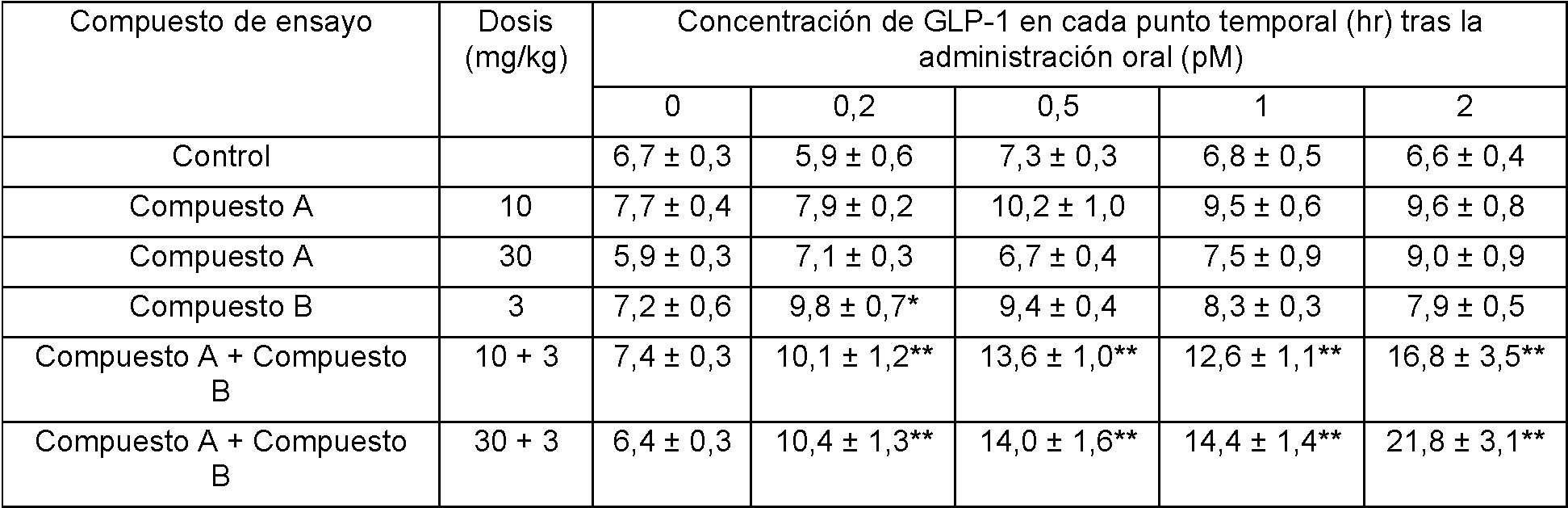
Los resultados se expresan como medias ± EEM (n=6 ). Las diferencias estadísticas entre los grupos se analizaron mediante el método de Dunnett. *; P<0,05, **; P<0,01 frente al grupo de control.The results are expressed as means ± SEM (n = 6 ). Statistical differences between groups were analyzed using the Dunnett's method. *; P <0.05, **; P <0.01 compared to the control group.
Como se muestra en la Tabla 2, cuando se proporcionó por separado el inhibidor de SGLT, no hubo un incremento de los niveles de GLP-1 activo. El tratamiento con el inhibidor de DPP4 incrementó el GLP-1 activo plasmático solamente a las 0,2 hr. Por otra parte, el tratamiento de combinación de Compuesto A y Compuesto B produjo un incremento notable y prolongado del nivel plasmático de GLP-1 activo en las ratas positivas para DPP4.As shown in Table 2, when the SGLT inhibitor was provided separately, there was no increase in active GLP-1 levels. Treatment with the DPP4 inhibitor increased plasma active GLP-1 only at 0.2 hr. On the other hand, the combination treatment of Compound A and Compound B produced a notable and prolonged increase in the plasma level of active GLP-1 in DPP4 positive rats.
Ejemplo 3:Example 3:
Efecto del inhibidor de SGLT y del inhibidor de DPP4 sobre el nivel plasmático de GLP-1 activo en ratones diabéticos cargados con glucosa. Effect of SGLT inhibitor and DPP4 inhibitor on plasma level of active GLP-1 in glucose-loaded diabetic mice.
(a) Animales:(a) Animals:
Ratones macho BKS.Cg-+ Leprdb/+Leprdb/Jcl; un modelo animal de diabetes tipo 2 (adquirido de CLEA Japan, Inc.) (b) Métodos:Male BKS.Cg- + Leprdb / + Leprdb / Jcl mice; an animal model of type 2 diabetes (purchased from CLEA Japan, Inc.) (b) Methods:
(b-1) Preparación y Administración de los Compuestos de Ensayo(b-1) Preparation and Administration of Test Compounds
Cada compuesto de ensayo se suspendió en una disolución de carboximetil celulosa del 0,5% que contenía un 0,2% de Tween 80 a las dosis indicadas en la Tabla 3, y se administró de manera oral al grupo de ensayo a un volumen de 5 mL/kg. Al grupo de control de vehículo se le administró de manera oral una disolución de carboximetil celulosa del 0,5% que contenía un 0,2% de Tween 80 a un volumen de 5 mL/kg. Justo después de la administración del compuesto o del vehículo, se administró de manera oral una disolución de glucosa (2 g/kg/5 mL).Each test compound was suspended in a 0.5% carboxymethyl cellulose solution containing 0.2% Tween 80 at the doses indicated in Table 3, and orally administered to the test group at a volume of 5 mL / kg. The vehicle control group was orally administered a 0.5% carboxymethyl cellulose solution containing 0.2% Tween 80 at a volume of 5 mL / kg. Right after administration of the compound or vehicle, a glucose solution (2 g / kg / 5 mL) was orally administered.
(b-2) Procedimiento de Recogida de Sangre y Determinación del Nivel Plasmático de GLP-1 Activo(b-2) Blood Collection Procedure and Determination of Plasma Level of Active GLP-1
Se recogió sangre de la vena caudal de un ratón sin anestesiar justo antes y 0,5, 1, y 2 horas después de la carga con glucosa. Se determinó el nivel plasmático de GLP-1 activo usando el kit RAT ENDOCRINE LINCOplex (LINCO Research).Blood was collected from the caudal vein of an unanesthetized mouse just before and 0.5, 1, and 2 hours after loading with glucose. The plasma level of active GLP-1 was determined using the RAT ENDOCRINE LINCOplex kit (LINCO Research).
(b-3) Compuestos de Ensayo(b-3) Test Compounds
Se usaron los siguientes compuestos:The following compounds were used:
Compuesto A:Compound A:
1-(p-D-Glucopiranosil)-4-cloro-3-[5-(6-fluoro-2-piridil)-2-tienilmetil]benceno; y1- (p-D-Glucopyranosyl) -4-chloro-3- [5- (6-fluoro-2-pyridyl) -2-thienylmethyl] benzene; and
Compuesto B:Compound B:
(2S)-2-Ciano-1-[trans-4-(morfolinocarbonil)ciclohexilamino]acetilpirrolidina.(2S) -2-Cyano-1- [trans-4- (morpholinocarbonyl) cyclohexylamino] acetylpyrrolidine.
(c) Resultados:(c) Results:
Los resultados se muestran en la Tabla 3.The results are shown in Table 3.
Tabla 3Table 3

Los resultados se expresan como medias ± EEM (n=8). Las diferencias estadísticas entre los grupos se analizaron mediante el método de Dunnett. *; P<0,05, **; P<0,01 frente al grupo de control.Results are expressed as means ± SEM (n = 8). Statistical differences between groups were analyzed using the Dunnett's method. *; P <0.05, **; P <0.01 compared to the control group.
Como se muestra en la Tabla 3, no solamente en los animales normales, sino también en el modelo animal de diabetes tipo 2, la combinación de Compuesto A y de Compuesto B incrementó significativamente el nivel plasmático de GLP-1 activo.As shown in Table 3, not only in normal animals, but also in the animal model of type 2 diabetes, the combination of Compound A and Compound B significantly increased the plasma level of active GLP-1.
Ejemplo 4:Example 4:
Efecto sinérgico del inhibidor de SGLT y del inhibidor de DPP4 sobre el nivel plasmático de GLP-1 activo en ratas normales cargadas con glucosaSynergistic effect of SGLT inhibitor and DPP4 inhibitor on plasma level of active GLP-1 in normal glucose-loaded rats
(a) Animales:(a) Animals:
Ratas Fisher macho positivas para DPP4 (adquiridas de Japan SLC, Inc.)DPP4 positive male Fisher rats (purchased from Japan SLC, Inc.)
(b) Métodos:(b) Methods:
(b-1) Preparación y Administración de los Compuestos de Ensayo (b-1) Preparation and Administration of Test Compounds
Cada compuesto de ensayo se suspendió en una disolución de carboximetil celulosa del 0,5% que contenía un 0,2% de Tween 80 a las dosis indicadas en las Tablas 4, 5 o 6, y se administró de manera oral al grupo de ensayo a un volumen de 5 mL/kg. Al grupo de control de vehículo se le administró de manera oral una disolución de carboximetil celulosa del 0,5% que contenía un 0,2% de Tween 80 a un volumen de 5 mL/kg. Justo después de la administración del compuesto o del vehículo, se administró de manera oral una disolución de glucosa (2 g/kg/5 mL).Each test compound was suspended in a 0.5% carboxymethyl cellulose solution containing 0.2% Tween 80 at the doses indicated in Tables 4, 5 or 6, and administered orally to the test group at a volume of 5 mL / kg. The vehicle control group was orally administered a 0.5% carboxymethyl cellulose solution containing 0.2% Tween 80 at a volume of 5 mL / kg. Right after administration of the compound or vehicle, a glucose solution (2 g / kg / 5 mL) was orally administered.
(b-2) Procedimiento de Recogida de Sangre y Determinación del Nivel Plasmático de GLP-1 Activo(b-2) Blood Collection Procedure and Determination of Plasma Level of Active GLP-1
Se recogió sangre de la vena caudal de una rata sin anestesiar en el momento adecuado descrito en la tabla. Se determinó el nivel plasmático de GLP-1 activo usando el kit RAT ENDOCRINE LINCOplex (LINCO Research).Blood was collected from the caudal vein of an unanesthetized rat at the appropriate time described in the table. The plasma level of active GLP-1 was determined using the RAT ENDOCRINE LINCOplex kit (LINCO Research).
(b-3) Compuestos de Ensayo(b-3) Test Compounds
Se usaron los siguientes compuestos para los ensayos:The following compounds were used for the tests:
Compuesto C:Compound C:
3-(5-(4-Fluorofenil)-2-tienilmetil)-1-(p-D-glucopiranosil)-4-metilbenceno (véase: publicación de solicitud de patente de Estados Unidos n° 2005/0233988);3- (5- (4-Fluorophenyl) -2-thienylmethyl) -1- (p-D-glucopyranosyl) -4-methylbenzene (see: US Patent Application Publication No. 2005/0233988);
Compuesto D:Compound D:
1-(p-D-Glucopiranosil)-4-cloro-3-[5-(6-fluoro-3-piridil)-2-tienilmetil]benceno (véase: publicación de solicitud de patente de Estados Unidos n° 2005/0233988);1- (p-D-Glucopyranosyl) -4-chloro-3- [5- (6-fluoro-3-pyridyl) -2-thienylmethyl] benzene (see: US Patent Application Publication No. 2005/0233988);
Compuesto E (referencia):Compound E (reference):
3-(4-Ciclopropilfenilmetil)-4-fluoro-1 -(p-D-glucopiranosil)indol (véase: documento WO 2008/013322);3- (4-Cyclopropylphenylmethyl) -4-fluoro-1 - (p-D-glucopyranosyl) indole (see: WO 2008/013322);
Compuesto F (referencia):Compound F (reference):
3-(4-Ciclopropilfenilmetil)-4,6-difluoro-1 -(p-D-glucopiranosil)indol (véase: documento WO 2008/013322);3- (4-Cyclopropylphenylmethyl) -4,6-difluoro-1 - (p-D-glucopyranosyl) indole (see: WO 2008/013322);
Compuesto G:Compound G:
Hidrobromuro de 3-[(2S,4S)-4-[4-(3-metil-1-fenil-1H-pirazol-5-il)piperazin-1-il]pirrolidin-2-ilcarbonil]tiazolidina (véase la patente de Estados Unidos n° 7.074.794);3 - [(2S, 4S) -4- [4- (3-methyl-1-phenyl-1H-pyrazol-5-yl) piperazin-1-yl] pyrrolidin-2-ylcarbonyl] thiazolidine hydrobromide (see patent No. 7,074,794);
Compuesto H:Compound H:
Fosfato de Sitagliptina; ySitagliptin phosphate; and
Compuesto I:Compound I:
Besilato de (2S)-2-ciano-1-[trans-4-(dimetilaminocarbonil)ciclohexilamino]acetilpirrolidina (véase: patente de Estados Unidos n° 6.849.622).(2S) -2-Cyano-1- [trans-4- (dimethylaminocarbonyl) cyclohexylamino] acetylpyrrolidine besylate (see: US Patent No. 6,849,622).
(c) Resultados:(c) Results:
Los resultados se muestran en las Tablas 4-6:The results are shown in Tables 4-6:
Tabla 4Table 4

Los resultados se expresan como medias ± EEM (n = 5 o 6). Las diferencias estadísticas entre los grupos se analizaron mediante el método de Dunnett. * p < 0,05, ** p < 0,01 frente al grupo de control.Results are expressed as means ± SEM (n = 5 or 6). Statistical differences between groups were analyzed by Dunnett's method. * p <0.05, ** p <0.01 compared to the control group.
Tabla 5Table 5

Los resultados se expresan como medias ± EEM (n = 6). Las diferencias estadísticas entre los grupos se analizaron mediante el método de Dunnett. * p < 0,05, ** p < 0,01 frente al grupo de control.The results are expressed as means ± SEM (n = 6). Statistical differences between groups were analyzed using the Dunnett's method. * p <0.05, ** p <0.01 compared to the control group.
Tabla 6:Table 6:

Los resultados se expresan como medias ± EEM (n = 5 o 6). Las diferencias estadísticas entre los grupos se analizaron mediante el método de Dunnett.Results are expressed as means ± SEM (n = 5 or 6). Statistical differences between groups were analyzed using the Dunnett's method.
* p < 0,05, ** p < 0,01 frente al grupo de control.* p <0.05, ** p <0.01 compared to the control group.
Como se muestra en las Tablas 4-6, el tratamiento de combinación de un inhibidor de SGLT y un inhibidor de DPP4 produjo un incremento notable y prolongado del nivel plasmático de GLP-1 activo en las ratas positivas para DPP4. Estos resultados sugieren que la combinación de un inhibidor de SGLT y un inhibidor de DPP4 proporcionó una elevación sustancial del nivel plasmático de GLP-1 activo.As shown in Tables 4-6, the combination treatment of an SGLT inhibitor and a DPP4 inhibitor produced a marked and prolonged increase in the plasma level of active GLP-1 in DPP4 positive rats. These results suggest that the combination of an SGLT inhibitor and a DPP4 inhibitor provided a substantial elevation in the plasma level of active GLP-1.
Según la presente invención, se puede usar una combinación de un inhibidor de SGLT y un inhibidor de DPP4 para prevenir o tratar cierta clase de enfermedades que están asociadas con el nivel plasmático de GLP-1 activo, como se define adicionalmente en las reivindicaciones, con una dosis de un inhibidor de DPP4 sustancialmente inferior a la contemplada actualmente para el uso en la monoterapia para dicha afección, y de ese modo se reduce la probabilidad de efectos secundarios indeseados asociados a la inhibición de la actividad de DPP4. In accordance with the present invention, a combination of a SGLT inhibitor and a DPP4 inhibitor can be used to prevent or treat a certain class of diseases that are associated with the plasma level of active GLP-1, as further defined in the claims, with a dose of a DPP4 inhibitor substantially lower than currently contemplated for use in monotherapy for that condition, thereby reducing the likelihood of unwanted side effects associated with inhibition of DPP4 activity.
Claims (7)


Applications Claiming Priority (2)
| Application Number | Priority Date | Filing Date | Title |
|---|---|---|---|
| US2177708P | 2008-01-17 | 2008-01-17 | |
| PCT/JP2009/051023 WO2009091082A1 (en) | 2008-01-17 | 2009-01-16 | Combination therapy comprising sglt inhibitors and dpp4 inhibitors |
Publications (1)
| Publication Number | Publication Date |
|---|---|
| ES2763239T3 true ES2763239T3 (en) | 2020-05-27 |
Family
ID=40433628
Family Applications (1)
| Application Number | Title | Priority Date | Filing Date |
|---|---|---|---|
| ES09701670T Active ES2763239T3 (en) | 2008-01-17 | 2009-01-16 | Combination therapy comprising SGLT inhibitors and DPP4 inhibitors |
Country Status (14)
| Country | Link |
|---|---|
| US (2) | US8853385B2 (en) |
| EP (1) | EP2252289B1 (en) |
| JP (3) | JP5204849B2 (en) |
| KR (1) | KR101257554B1 (en) |
| CN (2) | CN103599539A (en) |
| AR (1) | AR070193A1 (en) |
| AU (1) | AU2009205060C1 (en) |
| BR (1) | BRPI0906735A2 (en) |
| CA (1) | CA2712614C (en) |
| CL (1) | CL2008003653A1 (en) |
| ES (1) | ES2763239T3 (en) |
| MX (1) | MX2010007818A (en) |
| TW (1) | TWI437996B (en) |
| WO (1) | WO2009091082A1 (en) |
Families Citing this family (67)
| Publication number | Priority date | Publication date | Assignee | Title |
|---|---|---|---|---|
| US7407955B2 (en) | 2002-08-21 | 2008-08-05 | Boehringer Ingelheim Pharma Gmbh & Co., Kg | 8-[3-amino-piperidin-1-yl]-xanthines, the preparation thereof and their use as pharmaceutical compositions |
| US7772191B2 (en) | 2005-05-10 | 2010-08-10 | Boehringer Ingelheim International Gmbh | Processes for preparing of glucopyranosyl-substituted benzyl-benzene derivatives and intermediates therein |
| PE20080697A1 (en) | 2006-05-03 | 2008-08-05 | Boehringer Ingelheim Int | BENZONITRILE DERIVATIVES SUBSTITUTED WITH GLUCOPYRANOSIL, PHARMACEUTICAL COMPOSITIONS CONTAINING COMPOUNDS OF THIS TYPE, THEIR USE AND PROCEDURE FOR THEIR MANUFACTURE |
| PE20080251A1 (en) | 2006-05-04 | 2008-04-25 | Boehringer Ingelheim Int | USES OF DPP IV INHIBITORS |
| EP1852108A1 (en) | 2006-05-04 | 2007-11-07 | Boehringer Ingelheim Pharma GmbH & Co.KG | DPP IV inhibitor formulations |
| EP2540725A1 (en) | 2006-05-04 | 2013-01-02 | Boehringer Ingelheim International GmbH | Polymorphs of 1-((4-Methyl-chinazolin-2-yl)methyl)-3-methyl-7-(2-butin-1-yl)-8-(3-(R)-amino-piperidin-1-yl)xanthin |
| CL2008002427A1 (en) | 2007-08-16 | 2009-09-11 | Boehringer Ingelheim Int | Pharmaceutical composition comprising 1-chloro-4- (bd-glucopyranos-1-yl) -2- [4 - ((s) -tetrahydrofuran-3-yloxy) benzyl] -benzene combined with 1 - [(4-methylquinazolin- 2-yl) methyl] -3-methyl-7- (2-butyn-1-yl) -8- (3- (r) -aminopiperidin-1-yl) xanthine; and its use to treat type 2 diabetes mellitus. |
| RS56990B1 (en) | 2007-09-10 | 2018-05-31 | Janssen Pharmaceutica Nv | Process for the preparation of compounds useful as inhibitors of sglt |
| CL2008003653A1 (en) * | 2008-01-17 | 2010-03-05 | Mitsubishi Tanabe Pharma Corp | Use of a glucopyranosyl-derived sglt inhibitor and a selected dppiv inhibitor to treat diabetes; and pharmaceutical composition. |
| JP2009196984A (en) * | 2008-01-25 | 2009-09-03 | Mitsubishi Tanabe Pharma Corp | Pharmaceutical composition |
| PE20091730A1 (en) | 2008-04-03 | 2009-12-10 | Boehringer Ingelheim Int | FORMULATIONS INVOLVING A DPP4 INHIBITOR |
| BRPI0916997A2 (en) | 2008-08-06 | 2020-12-15 | Boehringer Ingelheim International Gmbh | DPP-4 INHIBITOR AND ITS USE |
| AU2009286380B2 (en) | 2008-08-28 | 2011-09-15 | Pfizer Inc. | Dioxa-bicyclo[3.2.1.]octane-2,3,4-triol derivatives |
| US20200155558A1 (en) | 2018-11-20 | 2020-05-21 | Boehringer Ingelheim International Gmbh | Treatment for diabetes in patients with insufficient glycemic control despite therapy with an oral antidiabetic drug |
| US9056850B2 (en) | 2008-10-17 | 2015-06-16 | Janssen Pharmaceutica N.V. | Process for the preparation of compounds useful as inhibitors of SGLT |
| UY32427A (en) * | 2009-02-13 | 2010-09-30 | Boheringer Ingelheim Internat Gmbh | PHARMACEUTICAL COMPOSITION, PHARMACEUTICAL FORM, PROCEDURE FOR PREPARATION, METHODS OF TREATMENT AND USES OF THE SAME |
| JP5685550B2 (en) * | 2009-02-13 | 2015-03-18 | ベーリンガー インゲルハイム インターナショナル ゲゼルシャフト ミット ベシュレンクテル ハフツング | Pharmaceutical composition comprising SGLT2 inhibitor, DPP-IV inhibitor, and optionally antidiabetic agent, and use thereof |
| DK2396005T3 (en) | 2009-02-13 | 2026-02-09 | Boehringer Ingelheim Int | SGLT2 INHIBITORS IMPROVE GLYCEMARIC CONTROL |
| US20110009347A1 (en) | 2009-07-08 | 2011-01-13 | Yin Liang | Combination therapy for the treatment of diabetes |
| EP2451797B1 (en) | 2009-07-10 | 2013-04-03 | Janssen Pharmaceutica, N.V. | CRYSTALLISATION PROCESS FOR 1-(ß-D-GLUCOPYRANOSYL)-4-METHYL-3-[5-(4-FLUOROPHENYL)-2-THIENYLMETHYL]BENZENE |
| PT2486029E (en) | 2009-09-30 | 2015-10-14 | Boehringer Ingelheim Int | Processes for preparing of glucopyranosyl-substituted benzyl-benzene derivatives |
| EA020798B1 (en) | 2009-09-30 | 2015-01-30 | Бёрингер Ингельхайм Интернациональ Гмбх | Method for the preparation of a crystalline form of 1-chloro-4-(beta-d-glucopyranos-1-yl)-2-[4-((s)-tetrahydrofuran-3-yloxy)benzyl]benzene |
| UY32919A (en) | 2009-10-02 | 2011-04-29 | Boehringer Ingelheim Int | Pharmaceutical composition, pharmaceutical dosage form, procedure for its preparation, methods for its treatment and its uses |
| HUE031375T2 (en) | 2009-10-14 | 2017-07-28 | Janssen Pharmaceutica Nv | A method for preparing compounds useful as SGLT2 inhibitors |
| US8163704B2 (en) | 2009-10-20 | 2012-04-24 | Novartis Ag | Glycoside derivatives and uses thereof |
| RS53827B1 (en) | 2009-11-02 | 2015-06-30 | Pfizer Inc. | DIOKSA-BICYCLE DERIVATIVES [3.2.1] OCTOBER-2,3,4-TRIOLA |
| KR20240090632A (en) | 2009-11-27 | 2024-06-21 | 베링거 인겔하임 인터내셔날 게엠베하 | Treatment of genotyped diabetic patients with dpp-iv inhibitors such as linagliptin |
| TWI562775B (en) * | 2010-03-02 | 2016-12-21 | Lexicon Pharmaceuticals Inc | Methods of using inhibitors of sodium-glucose cotransporters 1 and 2 |
| WO2011107494A1 (en) | 2010-03-03 | 2011-09-09 | Sanofi | Novel aromatic glycoside derivatives, medicaments containing said compounds, and the use thereof |
| SG10201506114UA (en) * | 2010-05-11 | 2015-09-29 | Janssen Pharmaceutica Nv | Pharmaceutical formulations comprising 1 - (beta-d-glucopyranosyl) - 2 -thienylmethylbenzene derivatives as inhibitors of sglt |
| US8530413B2 (en) | 2010-06-21 | 2013-09-10 | Sanofi | Heterocyclically substituted methoxyphenyl derivatives with an oxo group, processes for preparation thereof and use thereof as medicaments |
| TW201215388A (en) | 2010-07-05 | 2012-04-16 | Sanofi Sa | (2-aryloxyacetylamino)phenylpropionic acid derivatives, processes for preparation thereof and use thereof as medicaments |
| TW201215387A (en) | 2010-07-05 | 2012-04-16 | Sanofi Aventis | Spirocyclically substituted 1,3-propane dioxide derivatives, processes for preparation thereof and use thereof as a medicament |
| TW201221505A (en) | 2010-07-05 | 2012-06-01 | Sanofi Sa | Aryloxyalkylene-substituted hydroxyphenylhexynoic acids, process for preparation thereof and use thereof as a medicament |
| AR083878A1 (en) | 2010-11-15 | 2013-03-27 | Boehringer Ingelheim Int | VASOPROTECTORA AND CARDIOPROTECTORA ANTIDIABETIC THERAPY, LINAGLIPTINA, TREATMENT METHOD |
| TWI631963B (en) * | 2011-01-05 | 2018-08-11 | 雷西肯製藥股份有限公司 | Composition and application method comprising inhibitors of sodium-glucose co-transporters 1 and 2 |
| AR085689A1 (en) | 2011-03-07 | 2013-10-23 | Boehringer Ingelheim Int | PHARMACEUTICAL COMPOSITIONS OF METFORMIN, LINAGLIPTINE AND AN SGLT-2 INHIBITOR |
| EP2697218B1 (en) | 2011-04-13 | 2016-05-25 | Janssen Pharmaceutica NV | Process for the preparation of compounds useful as inhibitors of sglt2 |
| TWI542596B (en) | 2011-05-09 | 2016-07-21 | 健生藥品公司 | (2S,3R,4R,5S,6R)-2-(3-((5-(4-fluorophenyl)thiophen-2-yl)methyl)-4-methylphenyl)-6-(hydroxyl L-proline and citric acid cocrystals of methyl)tetrahydro-2H-piperan-3,4,5-triol |
| EP2567959B1 (en) | 2011-09-12 | 2014-04-16 | Sanofi | 6-(4-hydroxy-phenyl)-3-styryl-1h-pyrazolo[3,4-b]pyridine-4-carboxylic acid amide derivatives as kinase inhibitors |
| WO2013037390A1 (en) | 2011-09-12 | 2013-03-21 | Sanofi | 6-(4-hydroxy-phenyl)-3-styryl-1h-pyrazolo[3,4-b]pyridine-4-carboxylic acid amide derivatives as kinase inhibitors |
| WO2013045413A1 (en) | 2011-09-27 | 2013-04-04 | Sanofi | 6-(4-hydroxy-phenyl)-3-alkyl-1h-pyrazolo[3,4-b]pyridine-4-carboxylic acid amide derivatives as kinase inhibitors |
| US9555001B2 (en) | 2012-03-07 | 2017-01-31 | Boehringer Ingelheim International Gmbh | Pharmaceutical composition and uses thereof |
| US9192617B2 (en) | 2012-03-20 | 2015-11-24 | Boehringer Ingelheim International Gmbh | Pharmaceutical composition, methods for treating and uses thereof |
| JP6224084B2 (en) | 2012-05-14 | 2017-11-01 | ベーリンガー インゲルハイム インターナショナル ゲゼルシャフト ミット ベシュレンクテル ハフツング | Xanthine derivatives as DPP-4 inhibitors for the treatment of glomerular epithelial cell related disorders and / or nephrotic syndrome |
| JP6218811B2 (en) | 2012-05-14 | 2017-10-25 | ベーリンガー インゲルハイム インターナショナル ゲゼルシャフト ミット ベシュレンクテル ハフツング | Xanthine derivatives as DPP-4 inhibitors for use in the treatment of SIRS and / or sepsis |
| CA2812519A1 (en) | 2013-04-05 | 2014-10-05 | Boehringer Ingelheim International Gmbh | Pharmaceutical composition, methods for treating and uses thereof |
| HK1213818A1 (en) | 2013-04-05 | 2016-07-15 | 勃林格殷格翰国际有限公司 | Therapeutic uses of empagliflozin |
| TR201901110T4 (en) | 2013-04-05 | 2019-02-21 | Boehringer Ingelheim Int | Therapeutic uses of empagliflozin. |
| US11813275B2 (en) | 2013-04-05 | 2023-11-14 | Boehringer Ingelheim International Gmbh | Pharmaceutical composition, methods for treating and uses thereof |
| EP4678242A3 (en) | 2013-04-18 | 2026-03-18 | Boehringer Ingelheim International GmbH | Pharmaceutical composition, methods for treating and uses thereof |
| EP3007701A1 (en) * | 2013-06-14 | 2016-04-20 | Boehringer Ingelheim International GmbH | Dpp-4 inhibitors for treating diabetes and its complications |
| CN104739835A (en) * | 2013-12-30 | 2015-07-01 | 中美华世通生物医药科技(武汉)有限公司 | Novel pharmaceutical composition for treating diabetes |
| US20170135981A1 (en) * | 2014-05-16 | 2017-05-18 | Astrazeneca Ab | Method for Suppressing Glucagon Secretion of an SGLT2 Inhibitor |
| JP6027710B1 (en) * | 2014-12-25 | 2016-11-16 | 田辺三菱製薬株式会社 | Solid preparation for diabetes treatment |
| US20170071970A1 (en) | 2015-09-15 | 2017-03-16 | Janssen Pharmaceutica Nv | Co-therapy comprising canagliflozin and phentermine for the treatment of obesity and obesity related disorders |
| CN109310697A (en) | 2016-06-10 | 2019-02-05 | 勃林格殷格翰国际有限公司 | Combination of linagliptin and metformin |
| KR20190084096A (en) | 2016-11-10 | 2019-07-15 | 베링거 인겔하임 인터내셔날 게엠베하 | Pharmaceutical compositions, methods of treatment and uses thereof |
| WO2018167589A1 (en) | 2017-03-16 | 2018-09-20 | Inventia Healthcare Private Limited | Pharmaceutical composition comprising dapagliflozin |
| KR101943382B1 (en) | 2017-09-19 | 2019-01-29 | 오토텔릭바이오 주식회사 | A pharmaceutical composition comprising SGLT-2 inhibitor and angiotensin receptor blocker |
| KR102204439B1 (en) * | 2018-05-14 | 2021-01-18 | 에이치케이이노엔 주식회사 | Pharmaceutical Composition comprising SGLT-2 inhibitor and DPP-IV inhibitor |
| CN109021074B (en) * | 2018-08-31 | 2021-08-10 | 华南理工大学 | Heptapeptide for improving symptoms of diabetes and senile dementia |
| CN108976291B (en) * | 2018-08-31 | 2021-06-08 | 华南理工大学 | A hexadeceptide for improving diabetes and senile dementia |
| EP4114365A1 (en) | 2020-03-05 | 2023-01-11 | KRKA, d.d., Novo mesto | Pharmaceutical composition comprising sglt2 inhibitor |
| CN115867538A (en) | 2020-06-05 | 2023-03-28 | 新梅斯托克公司 | Preparation of highly pure amorphous dapagliflozin |
| CN111494358B (en) * | 2020-06-22 | 2021-06-22 | 广州市力鑫药业有限公司 | Medications for the treatment and prevention of diabetic nephropathy |
| WO2024076177A1 (en) * | 2022-10-05 | 2024-04-11 | 주식회사 대웅제약 | Pharmaceutical composition for prevention or treatment of nephropathy and/or diabetes mellitus, comprising enavogliflozin |
Family Cites Families (155)
| Publication number | Priority date | Publication date | Assignee | Title |
|---|---|---|---|---|
| US4160861A (en) | 1977-10-03 | 1979-07-10 | Merck & Co., Inc. | Method for the separation of antibiotic macrolides |
| US4584369A (en) | 1981-07-31 | 1986-04-22 | Sloan-Kettering Institute For Cancer Research | Anti-leukemic beta-glycosyl C-nucleosides |
| JP2544609B2 (en) | 1986-10-07 | 1996-10-16 | 和光純薬工業株式会社 | TCNQ complex |
| ATE117553T1 (en) | 1988-08-19 | 1995-02-15 | Warner Lambert Co | SUBSTITUTED DIHYDROISOCINOLINONES AND RELATED COMPOUNDS AS AMPLIFIERS OF THE LETHAL EFFECTS OF RADIATION AND CERTAIN CHEMOTHERAPEUTICS; SELECTED COMPOUNDS, ANALOGUES AND METHODS. |
| CN1020944C (en) * | 1990-01-30 | 1993-05-26 | 阿图尔-费希尔股份公司费希尔厂 | Fastening element |
| JPH04253974A (en) | 1991-02-05 | 1992-09-09 | Ishihara Sangyo Kaisha Ltd | Sulfonylurea compound, its production and herbicide containing the same |
| US5149838A (en) | 1991-09-20 | 1992-09-22 | Merck & Co., Inc. | Intermediates for substituted azetidinones useful as anti-inflammatory and antidegenerative agents |
| GB9208161D0 (en) | 1992-04-14 | 1992-05-27 | Pfizer Ltd | Indoles |
| US5334225A (en) | 1992-07-15 | 1994-08-02 | Kao Corporation | Keratinous fiber dye composition containing a 2-substituted amino-5-alkylphenol derivative coupler |
| US5731292A (en) | 1992-11-12 | 1998-03-24 | Tanabe Seiyaku Co., Ltd. | Dihydrochalcone derivatives which are hypoglycemic agents |
| CA2102591C (en) | 1992-11-12 | 2000-12-26 | Kenji Tsujihara | Hypoglycemic agent |
| US6297363B1 (en) | 1993-02-12 | 2001-10-02 | Nomura Co., Ltd. | Glycoside indoles |
| IL111785A0 (en) | 1993-12-03 | 1995-01-24 | Ferring Bv | Dp-iv inhibitors and pharmaceutical compositions containing them |
| US5830873A (en) | 1994-05-11 | 1998-11-03 | Tanabe Seiyaku Co., Ltd. | Propiophenone derivative and a process for preparing the same |
| US5780483A (en) | 1995-02-17 | 1998-07-14 | Smithkline Beecham Corporation | IL-8 receptor antagonists |
| EP0863755B1 (en) | 1995-10-31 | 2004-12-15 | Eli Lilly And Company | Antithrombotic diamines |
| JP3059088B2 (en) | 1995-11-07 | 2000-07-04 | 田辺製薬株式会社 | Propiophenone derivatives and their production |
| JPH09263549A (en) | 1996-01-25 | 1997-10-07 | Fujisawa Pharmaceut Co Ltd | Production of benzene derivative |
| US20020006899A1 (en) | 1998-10-06 | 2002-01-17 | Pospisilik Andrew J. | Use of dipeptidyl peptidase IV effectors for lowering blood pressure in mammals |
| DE122010000020I1 (en) | 1996-04-25 | 2010-07-08 | Prosidion Ltd | Method for lowering the blood glucose level in mammals |
| TW492957B (en) | 1996-11-07 | 2002-07-01 | Novartis Ag | N-substituted 2-cyanopyrrolidnes |
| PT850948E (en) | 1996-12-26 | 2002-08-30 | Tanabe Seiyaku Co | PROPIONPHENONE DERIVATIVES AND PROCESS FOR THE PREPARATION OF THE SAME |
| AU743591B2 (en) | 1997-01-31 | 2002-01-31 | Seydel Research, Inc. | Water dispersible/redispersible hydrophobic polyester resins and their application in coatings |
| US6153632A (en) | 1997-02-24 | 2000-11-28 | Rieveley; Robert B. | Method and composition for the treatment of diabetes |
| JPH10324632A (en) | 1997-03-25 | 1998-12-08 | Takeda Chem Ind Ltd | Pharmaceutical composition |
| DE19823831A1 (en) | 1998-05-28 | 1999-12-02 | Probiodrug Ges Fuer Arzneim | New pharmaceutical use of isoleucyl thiazolidide and its salts |
| US6274725B1 (en) * | 1998-06-02 | 2001-08-14 | Isis Pharmaceuticals, Inc. | Activators for oligonucleotide synthesis |
| JP2000034239A (en) | 1998-07-16 | 2000-02-02 | Asahi Glass Co Ltd | Method for producing trifluoromethylated aromatic compound |
| JP3857429B2 (en) | 1998-07-17 | 2006-12-13 | ポーラ化成工業株式会社 | Sulfur-containing antifungal agent |
| CO5150173A1 (en) | 1998-12-10 | 2002-04-29 | Novartis Ag | COMPOUNDS N- (REPLACED GLYCLE) -2-DIPEPTIDYL-IV PEPTIDASE INHIBITING CYANOPIRROLIDINS (DPP-IV) WHICH ARE EFFECTIVE IN THE TREATMENT OF CONDITIONS MEDIATED BY DPP-IV INHIBITION |
| US20020032164A1 (en) | 1998-12-30 | 2002-03-14 | Dale Roderic M. K. | Antimicrobial compounds and methods for their use |
| GB9912961D0 (en) | 1999-06-03 | 1999-08-04 | Pfizer Ltd | Metalloprotease inhibitors |
| US6172081B1 (en) * | 1999-06-24 | 2001-01-09 | Novartis Ag | Tetrahydroisoquinoline 3-carboxamide derivatives |
| US6110949A (en) * | 1999-06-24 | 2000-08-29 | Novartis Ag | N-(substituted glycyl)-4-cyanothiazolidines, pharmaceutical compositions containing them and their use in inhibiting dipeptidyl peptidase-IV |
| US6107317A (en) * | 1999-06-24 | 2000-08-22 | Novartis Ag | N-(substituted glycyl)-thiazolidines, pharmaceutical compositions containing them and their use in inhibiting dipeptidyl peptidase-IV |
| KR100591585B1 (en) * | 1999-08-31 | 2006-06-20 | 깃세이 야쿠힌 고교 가부시키가이샤 | Glucopyranosyloxypyrazole derivatives, pharmaceutical compositions containing them, and intermediates for the production thereof |
| US6515117B2 (en) | 1999-10-12 | 2003-02-04 | Bristol-Myers Squibb Company | C-aryl glucoside SGLT2 inhibitors and method |
| PH12000002657B1 (en) | 1999-10-12 | 2006-02-21 | Bristol Myers Squibb Co | C-aryl glucoside SGLT2 inhibitors |
| GB9928330D0 (en) | 1999-11-30 | 2000-01-26 | Ferring Bv | Novel antidiabetic agents |
| EP1743655B1 (en) | 2000-01-21 | 2014-06-25 | Novartis AG | Combinations comprising dipeptidylpeptidase-iv inhibitors and antidiabetic agents |
| JP4456768B2 (en) | 2000-02-02 | 2010-04-28 | 壽製薬株式会社 | Drug containing C-glycoside |
| US6627611B2 (en) | 2000-02-02 | 2003-09-30 | Kotobuki Pharmaceutical Co Ltd | C-glycosides and preparation of thereof as antidiabetic agents |
| MXPA02008627A (en) | 2000-03-03 | 2003-02-24 | Pfizer Prod Inc | Pyrazole ether derivatives as anti inflammatory analgesic agents. |
| US6395767B2 (en) | 2000-03-10 | 2002-05-28 | Bristol-Myers Squibb Company | Cyclopropyl-fused pyrrolidine-based inhibitors of dipeptidyl peptidase IV and method |
| NZ521369A (en) | 2000-03-17 | 2004-07-30 | Kissei Pharmaceutical | Glucopyranosyloxybenzylbenzene derivatives, medicinal compositions containing the same and intermediates for the preparation of the derivatives |
| US6555519B2 (en) | 2000-03-30 | 2003-04-29 | Bristol-Myers Squibb Company | O-glucosylated benzamide SGLT2 inhibitors and method |
| US6683056B2 (en) | 2000-03-30 | 2004-01-27 | Bristol-Myers Squibb Company | O-aryl glucoside SGLT2 inhibitors and method |
| GB0010188D0 (en) | 2000-04-26 | 2000-06-14 | Ferring Bv | Inhibitors of dipeptidyl peptidase IV |
| GB0010183D0 (en) | 2000-04-26 | 2000-06-14 | Ferring Bv | Inhibitors of dipeptidyl peptidase IV |
| TW583185B (en) | 2000-06-13 | 2004-04-11 | Novartis Ag | N-(substituted glycyl)-2-cyanopyrrolidines and pharmaceutical composition for inhibiting dipeptidyl peptidase-IV (DPP-IV) or for the prevention or treatment of diseases or conditions associated with elevated levels of DPP-IV comprising the same |
| DE10029014A1 (en) * | 2000-06-15 | 2001-12-20 | Univ Schiller Jena | Urokinase inhibitors |
| GB0014969D0 (en) | 2000-06-19 | 2000-08-09 | Smithkline Beecham Plc | Novel method of treatment |
| US7078397B2 (en) * | 2000-06-19 | 2006-07-18 | Smithkline Beecham Corporation | Combinations of dipeptidyl peptidase IV inhibitors and other antidiabetic agents for the treatment of diabetes mellitus |
| JP4101053B2 (en) * | 2000-08-10 | 2008-06-11 | 田辺三菱製薬株式会社 | Proline derivative and its pharmaceutical use |
| SK287811B6 (en) | 2000-09-29 | 2011-10-04 | Kissei Pharmaceutical Co., Ltd | Glucopyranosyloxybenzylbenzene derivatives and medicinal compositions containing the same |
| BR0114436A (en) * | 2000-10-06 | 2003-07-01 | Tanabe Seiyaku Co | Five element ring compound containing aliphatic nitrogen |
| ES2337127T3 (en) | 2000-11-02 | 2010-04-21 | Ajinomoto Co., Inc. | NEW DERIVATIVES OF PIRAZOL AND REMEDIES AGAINST DIABETES CONTAINING THEM. |
| US6476352B2 (en) | 2000-12-18 | 2002-11-05 | General Electric Company | Laser beam stop sensor and method for automatically detecting the presence of laser beam stop material using a laser beam stop sensor |
| CA2433090A1 (en) | 2000-12-27 | 2002-07-04 | Kyowa Hakko Kogyo Co., Ltd. | Dipeptidyl peptidase iv inhibitor |
| ATE431830T1 (en) | 2000-12-28 | 2009-06-15 | Kissei Pharmaceutical | GLUCOPYRANOSYLPYRAZOLE DERIVATIVES AND THEIR USE IN MEDICINAL PRODUCTS |
| US7087579B2 (en) | 2001-02-26 | 2006-08-08 | Kissei Pharmaceutical Co., Ltd. | Glucopyranosyloxypyrazole derivatives and medicinal use thereof |
| JP4147111B2 (en) | 2001-02-27 | 2008-09-10 | キッセイ薬品工業株式会社 | Glucopyranosyloxypyrazole derivative and its pharmaceutical use |
| WO2002070020A2 (en) | 2001-03-02 | 2002-09-12 | University Of Western Ontario | Polymer precursors of radiolabeled compounds, and methods of making and using the same |
| JP2002265439A (en) | 2001-03-08 | 2002-09-18 | Mitsubishi Pharma Corp | Cyanopyrrolidine derivatives and their pharmaceutical uses |
| US6936590B2 (en) | 2001-03-13 | 2005-08-30 | Bristol Myers Squibb Company | C-aryl glucoside SGLT2 inhibitors and method |
| AU2001251073B2 (en) | 2001-03-28 | 2006-12-21 | Hercules Incorporated | Methods of using hop acids to control organisms |
| AU2002254567B2 (en) | 2001-04-11 | 2007-10-11 | Bristol-Myers Squibb Company | Amino acid complexes of C-aryl glucosides for treatment of diabetes and method |
| US6573287B2 (en) | 2001-04-12 | 2003-06-03 | Bristo-Myers Squibb Company | 2,1-oxazoline and 1,2-pyrazoline-based inhibitors of dipeptidyl peptidase IV and method |
| CA2672001A1 (en) | 2001-04-27 | 2002-11-07 | Ajinomoto Co., Inc. | N-substituted pyrazole-o-glycoside derivatives and therapeutic agent for diabetes containing the same |
| GB0112122D0 (en) | 2001-05-18 | 2001-07-11 | Lilly Co Eli | Heteroaryloxy 3-substituted propanamines |
| US7271153B2 (en) | 2001-06-20 | 2007-09-18 | Kissei Pharmaceutical Co., Ltd. | Nitrogenous heterocyclic derivatives, medicinal compositions containing the same, medicinal uses thereof, and intermediates therefor |
| GB0115517D0 (en) | 2001-06-25 | 2001-08-15 | Ferring Bv | Novel antidiabetic agents |
| ATE380175T1 (en) | 2001-06-27 | 2007-12-15 | Smithkline Beecham Corp | PYRROLIDINE AS DIPEPTIDYL PEPTIDASE INHIBITORS |
| CN1723196A (en) | 2001-06-27 | 2006-01-18 | 史密丝克莱恩比彻姆公司 | Fluoropyrrolidines as dipeptidyl peptidase inhibitors |
| JP4357293B2 (en) | 2001-06-27 | 2009-11-04 | スミスクライン ビーチャム コーポレーション | Fluoropyrrolidines as dipeptidyl peptidase inhibitors |
| JP4115105B2 (en) | 2001-07-02 | 2008-07-09 | 協和醗酵工業株式会社 | Pyrazole derivative |
| UA74912C2 (en) | 2001-07-06 | 2006-02-15 | Merck & Co Inc | Beta-aminotetrahydroimidazo-(1,2-a)-pyrazines and tetratriazolo-(4,3-a)-pyrazines as inhibitors of dipeptylpeptidase for the treatment or prevention of diabetes |
| JPWO2003011880A1 (en) | 2001-07-31 | 2004-11-18 | キッセイ薬品工業株式会社 | Glucopyranosyloxybenzylbenzene derivatives, pharmaceutical compositions containing the same, pharmaceutical uses thereof and intermediates for the production thereof |
| WO2003020737A1 (en) | 2001-09-05 | 2003-03-13 | Bristol-Myers Squibb Company | O-pyrazole glucoside sglt2 inhibitors and method of use |
| KR20040033048A (en) | 2001-09-14 | 2004-04-17 | 미츠비시 웰파마 가부시키가이샤 | Thiazolidine derivative and medicinal use thereof |
| GB0125445D0 (en) | 2001-10-23 | 2001-12-12 | Ferring Bv | Protease Inhibitors |
| AU2002336205A1 (en) | 2001-10-24 | 2003-05-06 | Michael Burton | Enzyme substrates for detecting beta-d-ribofuranosidase activity |
| DE60212683T2 (en) | 2001-11-16 | 2007-06-28 | Cutanix Corp., Los Altos | PHARMACEUTICAL AND COSMETIC COMPOSITIONS USING OXY GROUP-WEARING AROMATIC ALDEHYDE |
| US6617313B1 (en) | 2002-03-13 | 2003-09-09 | Council Of Scientific And Industrial Research | Glucopyranoside and process of isolation thereof from pterocarpus marsupium pharmaceutical composition containing the same and use thereof |
| US6562791B1 (en) | 2002-03-29 | 2003-05-13 | Council Of Scientific And Industrial Research | Glucopyranoside, process for isolation thereof, pharmaceutical composition containing same and use thereof |
| NZ561993A (en) | 2002-04-18 | 2008-09-26 | Astrazeneca Ab | Spiroazabicyclic heterocyclic amines as potent ligands for nicotinic acetylcholine receptors |
| US6710040B1 (en) * | 2002-06-04 | 2004-03-23 | Pfizer Inc. | Fluorinated cyclic amides as dipeptidyl peptidase IV inhibitors |
| DE10231370B4 (en) | 2002-07-11 | 2006-04-06 | Sanofi-Aventis Deutschland Gmbh | Thiophene glycoside derivatives, medicaments containing these compounds and methods of making these medicaments |
| TW200401635A (en) | 2002-07-23 | 2004-02-01 | Yamanouchi Pharma Co Ltd | 2-Cyano-4-fluoropyrrolidine derivative or salt thereof |
| TWI254635B (en) | 2002-08-05 | 2006-05-11 | Yamanouchi Pharma Co Ltd | Azulene derivative and salt thereof |
| RU2322449C2 (en) | 2002-08-09 | 2008-04-20 | Тайсо Фармасьютикал Ко., Лтд. | DERIVATIVES OF ARYL-5-THIO-β-D-GLYCOPYRANOSIDE AND THERAPEUTIC AGENT COMPRISING THEREOF USED IN DIABETES MELLITUS |
| US20040102477A1 (en) | 2002-08-23 | 2004-05-27 | Dr. Reddy's Laboratories Limited | Polymorphic forms of (S)-Repaglinide and the processes for preparation thereof |
| JP4606876B2 (en) | 2002-08-27 | 2011-01-05 | キッセイ薬品工業株式会社 | Pyrazole derivative, pharmaceutical composition containing the same, and pharmaceutical use thereof |
| KR100582141B1 (en) | 2002-08-29 | 2006-05-22 | 다이쇼 세이야꾸 가부시끼가이샤 | Benzenesulfonate of 4-Fluoro-2-Cyanopyrrolidine Derivative |
| DE10258007B4 (en) | 2002-12-12 | 2006-02-09 | Sanofi-Aventis Deutschland Gmbh | Aromatic fluoroglycoside derivatives, medicaments containing these compounds and methods for the preparation of these medicaments |
| DE10258008B4 (en) | 2002-12-12 | 2006-02-02 | Sanofi-Aventis Deutschland Gmbh | Heterocyclic fluoroglycoside derivatives, medicaments containing these compounds and methods of making these medicaments |
| JP2006516257A (en) | 2003-01-03 | 2006-06-29 | ブリストル−マイヤーズ スクイブ カンパニー | Method for producing C-aryl glucoside SGLT2 inhibitor |
| DE10303270A1 (en) | 2003-01-28 | 2004-08-05 | Technische Universität Darmstadt | Medical device with an elongated device |
| JP4184378B2 (en) * | 2003-01-31 | 2008-11-19 | 株式会社三和化学研究所 | Compounds that inhibit dipeptidyl peptidase IV |
| ES2363941T3 (en) | 2003-03-14 | 2011-08-19 | Astellas Pharma Inc. | C-GLUCOSIDE DERIVATIVES FOR THE TREATMENT OF DIABETES. |
| JP2004300102A (en) | 2003-03-31 | 2004-10-28 | Kissei Pharmaceut Co Ltd | Condensed heterocyclic derivative, pharmaceutical composition containing the same and its pharmaceutical application |
| AU2003902263A0 (en) | 2003-05-12 | 2003-05-29 | Fujisawa Pharmaceutical Co., Ltd. | Monosaccharide compounds |
| JP2007511467A (en) | 2003-05-14 | 2007-05-10 | タケダ サン ディエゴ インコーポレイテッド | Dipeptidyl peptidase inhibitor |
| CA2529878C (en) | 2003-06-20 | 2012-11-20 | Kissei Pharmaceutical Co., Ltd. | Pyrazole derivative, drug composition containing the same and production intermediate therefor |
| EP1679965A4 (en) | 2003-08-01 | 2009-05-27 | Janssen Pharmaceutica Nv | SUBSTITUTED FUSED HETEROCYCLIC C-GLYCOSIDES |
| WO2005011592A2 (en) | 2003-08-01 | 2005-02-10 | Janssen Pharmaceutica N.V. | Substituted indazole-o-glucosides |
| US6995183B2 (en) | 2003-08-01 | 2006-02-07 | Bristol Myers Squibb Company | Adamantylglycine-based inhibitors of dipeptidyl peptidase IV and methods |
| UA86042C2 (en) | 2003-08-01 | 2009-03-25 | Янссен Фармацевтика Н.В. | Substituted indazole-o-glucosides |
| ES2531660T3 (en) * | 2003-08-01 | 2015-03-18 | Mitsubishi Tanabe Pharma Corporation | Novel compounds that have inhibitory activity against sodium-dependent glucose transporter |
| TW200526678A (en) | 2003-08-01 | 2005-08-16 | Janssen Pharmaceutica Nv | Substituted indole-O-glucosides |
| US8785403B2 (en) * | 2003-08-01 | 2014-07-22 | Mitsubishi Tanabe Pharma Corporation | Glucopyranoside compound |
| WO2005012242A2 (en) | 2003-08-01 | 2005-02-10 | Janssen Pharmaceutica Nv | Substituted benzimidazole-, benztriazole-, and benzimidazolone-o-glucosides |
| EP1697342A2 (en) | 2003-09-08 | 2006-09-06 | Takeda Pharmaceutical Company Limited | Dipeptidyl peptidase inhibitors |
| EP1699777B1 (en) | 2003-09-08 | 2012-12-12 | Takeda Pharmaceutical Company Limited | Dipeptidyl peptidase inhibitors |
| EP1667524A4 (en) | 2003-09-23 | 2009-01-14 | Merck & Co Inc | NOVEL CRYSTALLINE FORM OF A PHOSPHORIC ACID SALT OF A DIPEPTIDYL PEPTASE-IV INHIBITOR |
| TW200519105A (en) | 2003-10-20 | 2005-06-16 | Lg Life Science Ltd | Novel inhibitors of DPP-IV, methods of preparing the same, and pharmaceutical compositions containing the same as an active agent |
| US7214735B2 (en) | 2004-02-02 | 2007-05-08 | 3M Innovative Properties Company | Microsphere-filled sealant materials |
| AU2005210285B2 (en) * | 2004-02-05 | 2008-01-24 | Kyorin Pharmaceutical Co., Ltd. | Bicycloester derivative |
| EP1717225A4 (en) * | 2004-02-18 | 2009-10-21 | Kyorin Seiyaku Kk | BICYCLIC AMIDE DERIVATIVES |
| EP1719757B1 (en) * | 2004-02-27 | 2013-10-09 | Kyorin Pharmaceutical Co., Ltd. | Bicyclo derivative |
| PL381247A1 (en) * | 2004-03-04 | 2007-05-14 | Kissei Pharmaceutical Co., Ltd. | Heterocyclical condensed derivative, the medical composition containing it as well as its treatment application |
| CN1950389B (en) | 2004-03-04 | 2011-01-19 | 橘生药品工业株式会社 | Nitrogenous fused-ring derivatives, medicinal compositions containing the derivatives, and use thereof as drugs |
| UA85871C2 (en) | 2004-03-15 | 2009-03-10 | Такеда Фармасьютікал Компані Лімітед | Dipeptidyl peptidase inhibitors |
| CN103030617A (en) * | 2004-03-16 | 2013-04-10 | 贝林格尔.英格海姆国际有限公司 | Glucopyranosyl-substituted phenyl derivatives, medicaments containing such compounds, their use and process for their manufacture |
| WO2006018150A1 (en) * | 2004-08-11 | 2006-02-23 | Boehringer Ingelheim International Gmbh | D-xylopyranosyl-phenyl-substituited cyclene, medicaments containing said compounds, use thereof and method for the production thereof |
| AR051446A1 (en) | 2004-09-23 | 2007-01-17 | Bristol Myers Squibb Co | C-ARYL GLUCOSIDS AS SELECTIVE INHIBITORS OF GLUCOSE CONVEYORS (SGLT2) |
| WO2006035796A1 (en) | 2004-09-29 | 2006-04-06 | Kissei Pharmaceutical Co., Ltd. | 1-(β-D-GLYCOPYRANOSYL)-3-SUBSTITUTED NITROGENOUS HETEROCYCLIC COMPOUND, MEDICINAL COMPOSITION CONTAINING THE SAME, AND MEDICINAL USE THEREOF |
| WO2006073167A1 (en) * | 2005-01-07 | 2006-07-13 | Ono Pharmaceutical Co., Ltd. | Pyrrolidine derivatives |
| AR053329A1 (en) * | 2005-01-31 | 2007-05-02 | Tanabe Seiyaku Co | INDOL DERIVATIVES USEFUL AS INHIBITORS OF GLUCOSE CONVEYORS DEPENDENT ON SODIUM (SGLT) |
| AU2006215041B2 (en) | 2005-02-18 | 2012-05-31 | Mitsubishi Tanabe Pharma Corporation | Salt of proline derivative, solvate thereof, and production method thereof |
| WO2006090244A1 (en) | 2005-02-22 | 2006-08-31 | Glenmark Pharmaceuticals S.A. | New adamantane derivatives as dipeptidyl, peptidase iv inhibitors, processes for their preparation, and pharmaceutical compositions containing them |
| EP1741790A1 (en) | 2005-03-24 | 2007-01-10 | DIGILAB BioVisioN GmbH | Methods to identify and characterize prolyl oligopeptidases by using substrates and products thereof |
| TWI357902B (en) | 2005-04-01 | 2012-02-11 | Lg Life Science Ltd | Dipeptidyl peptidase-iv inhibiting compounds, meth |
| ATE453656T1 (en) | 2005-04-15 | 2010-01-15 | Boehringer Ingelheim Int | GLUCOPYRANOSYL-SUBSTITUTED (HETEROARYLOXY-BENZYL)-BENZENE DERIVATIVES AS SGLT INHIBITORS |
| KR20080000665A (en) * | 2005-04-22 | 2008-01-02 | 알란토스 파마슈티컬즈 홀딩, 인코포레이티드 | Dipeptidyl Peptidase-IV Inhibitors |
| US7723309B2 (en) | 2005-05-03 | 2010-05-25 | Boehringer Ingelheim International Gmbh | Crystalline forms of 1-chloro-4-(β-D-glucopyranos-1-yl)-2-[4-((R)-tetrahydrofuran-3-yloxy)-benzyl]-benzene, a method for its preparation and the use thereof for preparing medicaments |
| UA91546C2 (en) | 2005-05-03 | 2010-08-10 | Бьорінгер Інгельхайм Інтернаціональ Гмбх | Crystalline form of 1-chloro-4-(я-d-glucopyranos-1-yl)-2-[4-((s)-tetrahydrofuran-3-yloxy)-benzyl]-benzene, a method for its preparation and the use thereof for preparing medicaments |
| US7772191B2 (en) | 2005-05-10 | 2010-08-10 | Boehringer Ingelheim International Gmbh | Processes for preparing of glucopyranosyl-substituted benzyl-benzene derivatives and intermediates therein |
| JP5586829B2 (en) * | 2005-06-03 | 2014-09-10 | 田辺三菱製薬株式会社 | Combined use of medicine and its use |
| US20090221592A1 (en) | 2005-07-25 | 2009-09-03 | Ellison Martha E | Dodecylsulfate Salt Of A Dipeptidyl Peptidase-Iv Inhibitor |
| WO2007054978A2 (en) | 2005-11-10 | 2007-05-18 | Jubilant Organosys Limited | Process for preparing paroxetine hydrochloride hemihydrate |
| WO2007063928A1 (en) * | 2005-11-30 | 2007-06-07 | Toray Industries, Inc. | Novel noncyclic amine carboxamide derivative and salt thereof |
| EP1842850A1 (en) | 2006-03-23 | 2007-10-10 | Sandoz AG | Rosiglitazone hydrochloride hemihydrate |
| PE20080251A1 (en) * | 2006-05-04 | 2008-04-25 | Boehringer Ingelheim Int | USES OF DPP IV INHIBITORS |
| EP2727585A1 (en) * | 2006-05-16 | 2014-05-07 | Takeda Pharmaceutical Company Limited | In-vivo screening method |
| US7803778B2 (en) * | 2006-05-23 | 2010-09-28 | Theracos, Inc. | Glucose transport inhibitors and methods of use |
| TWI418556B (en) | 2006-07-27 | 2013-12-11 | Mitsubishi Tanabe Pharma Corp | Indole derivatives |
| US20080027014A1 (en) * | 2006-07-28 | 2008-01-31 | Tanabe Seiyaku Co., Ltd. | Novel SGLT inhibitors |
| US20070172525A1 (en) * | 2007-03-15 | 2007-07-26 | Ramesh Sesha | Anti-diabetic combinations |
| PE20090696A1 (en) | 2007-04-20 | 2009-06-20 | Bristol Myers Squibb Co | CRYSTALLINE FORMS OF SAXAGLIPTIN AND PROCESSES FOR PREPARING THEM |
| CL2008002425A1 (en) | 2007-08-16 | 2009-09-11 | Boehringer Ingelheim Int | Pharmaceutical composition comprising an inhibitor of sglt2 and 1- (4-methyl-quinazolin-2-yl) methyl-3-methyl-7 - (- 2-butin-1-yl) -8- (3- (r) -amino- Piperidin-1yl) -xanthine, an iv dpp inhibitor and its use for the treatment of obesity and type 1 and 2 diabetes and complications thereof. |
| PE20090987A1 (en) | 2007-08-16 | 2009-08-14 | Boehringer Ingelheim Int | PHARMACEUTICAL COMPOSITION INCLUDING A DERIVATIVE OF PIRAZOL-O-GLUCOSIDE |
| CL2008003653A1 (en) * | 2008-01-17 | 2010-03-05 | Mitsubishi Tanabe Pharma Corp | Use of a glucopyranosyl-derived sglt inhibitor and a selected dppiv inhibitor to treat diabetes; and pharmaceutical composition. |
| UY32427A (en) | 2009-02-13 | 2010-09-30 | Boheringer Ingelheim Internat Gmbh | PHARMACEUTICAL COMPOSITION, PHARMACEUTICAL FORM, PROCEDURE FOR PREPARATION, METHODS OF TREATMENT AND USES OF THE SAME |
| JP5685550B2 (en) | 2009-02-13 | 2015-03-18 | ベーリンガー インゲルハイム インターナショナル ゲゼルシャフト ミット ベシュレンクテル ハフツング | Pharmaceutical composition comprising SGLT2 inhibitor, DPP-IV inhibitor, and optionally antidiabetic agent, and use thereof |
-
2008
- 2008-12-09 CL CL2008003653A patent/CL2008003653A1/en unknown
-
2009
- 2009-01-16 JP JP2010528230A patent/JP5204849B2/en active Active
- 2009-01-16 MX MX2010007818A patent/MX2010007818A/en active IP Right Grant
- 2009-01-16 BR BRPI0906735-3A patent/BRPI0906735A2/en not_active Application Discontinuation
- 2009-01-16 AR ARP090100146A patent/AR070193A1/en not_active Application Discontinuation
- 2009-01-16 WO PCT/JP2009/051023 patent/WO2009091082A1/en not_active Ceased
- 2009-01-16 US US12/863,429 patent/US8853385B2/en not_active Expired - Fee Related
- 2009-01-16 CA CA2712614A patent/CA2712614C/en not_active Expired - Fee Related
- 2009-01-16 CN CN201310475934.6A patent/CN103599539A/en active Pending
- 2009-01-16 CN CN200980102300.8A patent/CN101932321B/en active Active
- 2009-01-16 ES ES09701670T patent/ES2763239T3/en active Active
- 2009-01-16 EP EP09701670.3A patent/EP2252289B1/en not_active Revoked
- 2009-01-16 KR KR1020107018132A patent/KR101257554B1/en active Active
- 2009-01-16 AU AU2009205060A patent/AU2009205060C1/en not_active Ceased
- 2009-01-17 TW TW098101763A patent/TWI437996B/en not_active IP Right Cessation
-
2012
- 2012-12-27 JP JP2012284625A patent/JP5646588B2/en active Active
-
2014
- 2014-08-28 US US14/472,037 patent/US20140371162A1/en not_active Abandoned
- 2014-11-05 JP JP2014225301A patent/JP5908563B2/en active Active
Also Published As
| Publication number | Publication date |
|---|---|
| RU2010134362A (en) | 2012-02-27 |
| US20110059912A1 (en) | 2011-03-10 |
| TWI437996B (en) | 2014-05-21 |
| KR101257554B1 (en) | 2013-04-23 |
| MX2010007818A (en) | 2010-08-09 |
| CA2712614A1 (en) | 2009-07-23 |
| CN101932321A (en) | 2010-12-29 |
| AU2009205060B2 (en) | 2013-06-27 |
| JP2015044845A (en) | 2015-03-12 |
| JP2011509922A (en) | 2011-03-31 |
| CL2008003653A1 (en) | 2010-03-05 |
| CN101932321B (en) | 2016-05-18 |
| CA2712614C (en) | 2014-05-27 |
| EP2252289A1 (en) | 2010-11-24 |
| KR20100103874A (en) | 2010-09-28 |
| JP2013091654A (en) | 2013-05-16 |
| CN103599539A (en) | 2014-02-26 |
| AU2009205060C1 (en) | 2013-12-19 |
| JP5204849B2 (en) | 2013-06-05 |
| US20140371162A1 (en) | 2014-12-18 |
| BRPI0906735A2 (en) | 2015-07-07 |
| TW200932249A (en) | 2009-08-01 |
| AR070193A1 (en) | 2010-03-17 |
| JP5908563B2 (en) | 2016-04-26 |
| JP5646588B2 (en) | 2014-12-24 |
| EP2252289B1 (en) | 2019-10-23 |
| US8853385B2 (en) | 2014-10-07 |
| AU2009205060A1 (en) | 2009-07-23 |
| WO2009091082A1 (en) | 2009-07-23 |
Similar Documents
| Publication | Publication Date | Title |
|---|---|---|
| ES2763239T3 (en) | Combination therapy comprising SGLT inhibitors and DPP4 inhibitors | |
| CN108283644B (en) | Transient protection of normal cells during chemotherapy | |
| KR101607081B1 (en) | Pharmaceutical preparation comprising dpp-iv inhibitor and other diabetes therapeutic agent in concomitant or combined form | |
| CN102497862B (en) | Combination therapy with CK2 modulators | |
| JP7638981B2 (en) | Substituted 4-aminoisoindoline-1,3-dione compounds and second active agents for combined use | |
| WO2001097849A1 (en) | Antitumor effect potentiators | |
| CN102753173A (en) | HCV combination therapy | |
| JP2009528996A (en) | Methods for treating diseases using nucleoside phosphorylases and inhibitors of nucleosidases | |
| EP3399976A1 (en) | Benzothiazole amphiphiles | |
| CN114585387A (en) | Diabetes treatment or prevention method using combined drugs | |
| JP2008529998A (en) | 6-ether / thioether-purine as topoisomerase II catalyst inhibitor and its use in therapy | |
| JP2025539944A (en) | Methods for treating myeloproliferative neoplasms | |
| RU2481106C2 (en) | Combined therapy including sglt inhibitors and dpp4 inhibitors | |
| JP2016539099A (en) | Novel SGLT1 inhibitor | |
| HK1258477B (en) | Transient protection of normal cells during chemotherapy | |
| HK40025422B (en) | Managing nephrogenic diabetes insipidus | |
| RU2007125565A (en) | APPLICATION OF STAUROSPORIN FOR TREATMENT OF MULTIPLE MYELOMA | |
| HK1223293B (en) | Transient protection of normal cells during chemotherapy | |
| WO2017052360A1 (en) | Compounds for use as anti-cancer agents |