ES2764488T3 - Selenium removal method from wastewater streams - Google Patents
Selenium removal method from wastewater streams Download PDFInfo
- Publication number
- ES2764488T3 ES2764488T3 ES14860335T ES14860335T ES2764488T3 ES 2764488 T3 ES2764488 T3 ES 2764488T3 ES 14860335 T ES14860335 T ES 14860335T ES 14860335 T ES14860335 T ES 14860335T ES 2764488 T3 ES2764488 T3 ES 2764488T3
- Authority
- ES
- Spain
- Prior art keywords
- polymer
- acrylic
- selenium
- alkylamine
- medium
- Prior art date
- Legal status (The legal status is an assumption and is not a legal conclusion. Google has not performed a legal analysis and makes no representation as to the accuracy of the status listed.)
- Active
Links
- 238000000034 method Methods 0.000 title claims abstract description 38
- BUGBHKTXTAQXES-UHFFFAOYSA-N Selenium Chemical compound [Se] BUGBHKTXTAQXES-UHFFFAOYSA-N 0.000 title claims abstract description 27
- 229910052711 selenium Inorganic materials 0.000 title claims abstract description 27
- 239000011669 selenium Substances 0.000 title claims abstract description 27
- 239000002351 wastewater Substances 0.000 title description 13
- 229920000642 polymer Polymers 0.000 claims abstract description 137
- 229910052751 metal Inorganic materials 0.000 claims abstract description 37
- 239000002184 metal Substances 0.000 claims abstract description 37
- 150000003973 alkyl amines Chemical class 0.000 claims abstract description 32
- 230000014759 maintenance of location Effects 0.000 claims abstract description 29
- 239000000178 monomer Substances 0.000 claims abstract description 26
- 125000000524 functional group Chemical group 0.000 claims abstract description 22
- 229920001577 copolymer Polymers 0.000 claims abstract description 21
- 150000003839 salts Chemical class 0.000 claims abstract description 18
- 239000000203 mixture Substances 0.000 claims abstract description 17
- 150000002739 metals Chemical class 0.000 claims abstract description 14
- 125000000217 alkyl group Chemical group 0.000 claims abstract description 5
- 239000000701 coagulant Substances 0.000 claims abstract description 5
- 101100294102 Caenorhabditis elegans nhr-2 gene Proteins 0.000 claims abstract description 4
- 239000007800 oxidant agent Substances 0.000 claims abstract description 4
- 230000001590 oxidative effect Effects 0.000 claims abstract description 3
- DKVNPHBNOWQYFE-UHFFFAOYSA-N carbamodithioic acid Chemical group NC(S)=S DKVNPHBNOWQYFE-UHFFFAOYSA-N 0.000 claims description 41
- XLYOFNOQVPJJNP-UHFFFAOYSA-N water Substances O XLYOFNOQVPJJNP-UHFFFAOYSA-N 0.000 claims description 28
- 238000001914 filtration Methods 0.000 claims description 19
- VILCJCGEZXAXTO-UHFFFAOYSA-N 2,2,2-tetramine Chemical compound NCCNCCNCCN VILCJCGEZXAXTO-UHFFFAOYSA-N 0.000 claims description 12
- RPNUMPOLZDHAAY-UHFFFAOYSA-N Diethylenetriamine Chemical compound NCCNCCN RPNUMPOLZDHAAY-UHFFFAOYSA-N 0.000 claims description 12
- 238000000108 ultra-filtration Methods 0.000 claims description 12
- 238000001471 micro-filtration Methods 0.000 claims description 11
- NIXOWILDQLNWCW-UHFFFAOYSA-N acrylic acid group Chemical group C(C=C)(=O)O NIXOWILDQLNWCW-UHFFFAOYSA-N 0.000 claims description 10
- LSHROXHEILXKHM-UHFFFAOYSA-N n'-[2-[2-[2-(2-aminoethylamino)ethylamino]ethylamino]ethyl]ethane-1,2-diamine Chemical group NCCNCCNCCNCCNCCN LSHROXHEILXKHM-UHFFFAOYSA-N 0.000 claims description 10
- 230000008569 process Effects 0.000 claims description 9
- HRPVXLWXLXDGHG-UHFFFAOYSA-N Acrylamide Chemical group NC(=O)C=C HRPVXLWXLXDGHG-UHFFFAOYSA-N 0.000 claims description 6
- YIRLUIDCBMHRSU-UHFFFAOYSA-N azane;1,2-dichloroethane Chemical compound N.ClCCCl YIRLUIDCBMHRSU-UHFFFAOYSA-N 0.000 claims description 6
- PIICEJLVQHRZGT-UHFFFAOYSA-N Ethylenediamine Chemical compound NCCN PIICEJLVQHRZGT-UHFFFAOYSA-N 0.000 claims description 5
- 230000000536 complexating effect Effects 0.000 claims description 3
- 238000005374 membrane filtration Methods 0.000 claims description 3
- 238000001728 nano-filtration Methods 0.000 claims description 3
- 238000001223 reverse osmosis Methods 0.000 claims description 3
- 239000004576 sand Substances 0.000 claims description 3
- 239000012528 membrane Substances 0.000 description 23
- 239000012990 dithiocarbamate Substances 0.000 description 16
- 238000007306 functionalization reaction Methods 0.000 description 13
- QGJOPFRUJISHPQ-UHFFFAOYSA-N Carbon disulfide Chemical compound S=C=S QGJOPFRUJISHPQ-UHFFFAOYSA-N 0.000 description 10
- -1 PTTC Chemical compound 0.000 description 10
- FAGUFWYHJQFNRV-UHFFFAOYSA-N tetraethylenepentamine Chemical compound NCCNCCNCCNCCN FAGUFWYHJQFNRV-UHFFFAOYSA-N 0.000 description 9
- 239000000463 material Substances 0.000 description 8
- QSHDDOUJBYECFT-UHFFFAOYSA-N mercury Chemical compound [Hg] QSHDDOUJBYECFT-UHFFFAOYSA-N 0.000 description 8
- 229910052753 mercury Inorganic materials 0.000 description 8
- HIZCIEIDIFGZSS-UHFFFAOYSA-L trithiocarbonate Chemical compound [S-]C([S-])=S HIZCIEIDIFGZSS-UHFFFAOYSA-L 0.000 description 8
- PXHVJJICTQNCMI-UHFFFAOYSA-N Nickel Chemical compound [Ni] PXHVJJICTQNCMI-UHFFFAOYSA-N 0.000 description 7
- 239000007788 liquid Substances 0.000 description 7
- 239000002245 particle Substances 0.000 description 7
- 238000000926 separation method Methods 0.000 description 7
- 239000012989 trithiocarbonate Substances 0.000 description 7
- XEEYBQQBJWHFJM-UHFFFAOYSA-N Iron Chemical compound [Fe] XEEYBQQBJWHFJM-UHFFFAOYSA-N 0.000 description 6
- 239000010949 copper Substances 0.000 description 6
- 239000000126 substance Substances 0.000 description 6
- 125000000129 anionic group Chemical group 0.000 description 5
- 125000002091 cationic group Chemical group 0.000 description 5
- 238000006243 chemical reaction Methods 0.000 description 5
- 238000004062 sedimentation Methods 0.000 description 5
- SMZOUWXMTYCWNB-UHFFFAOYSA-N 2-(2-methoxy-5-methylphenyl)ethanamine Chemical compound COC1=CC=C(C)C=C1CCN SMZOUWXMTYCWNB-UHFFFAOYSA-N 0.000 description 4
- RYGMFSIKBFXOCR-UHFFFAOYSA-N Copper Chemical compound [Cu] RYGMFSIKBFXOCR-UHFFFAOYSA-N 0.000 description 4
- BAPJBEWLBFYGME-UHFFFAOYSA-N Methyl acrylate Chemical compound COC(=O)C=C BAPJBEWLBFYGME-UHFFFAOYSA-N 0.000 description 4
- KDLHZDBZIXYQEI-UHFFFAOYSA-N Palladium Chemical compound [Pd] KDLHZDBZIXYQEI-UHFFFAOYSA-N 0.000 description 4
- VSWDORGPIHIGNW-UHFFFAOYSA-N Pyrrolidine dithiocarbamic acid Chemical compound SC(=S)N1CCCC1 VSWDORGPIHIGNW-UHFFFAOYSA-N 0.000 description 4
- 229910052799 carbon Inorganic materials 0.000 description 4
- 125000004432 carbon atom Chemical group C* 0.000 description 4
- 229910052802 copper Inorganic materials 0.000 description 4
- 238000009300 dissolved air flotation Methods 0.000 description 4
- 229910001385 heavy metal Inorganic materials 0.000 description 4
- 239000004615 ingredient Substances 0.000 description 4
- 229920002521 macromolecule Polymers 0.000 description 4
- BASFCYQUMIYNBI-UHFFFAOYSA-N platinum Chemical compound [Pt] BASFCYQUMIYNBI-UHFFFAOYSA-N 0.000 description 4
- WSFSSNUMVMOOMR-UHFFFAOYSA-N Formaldehyde Chemical compound O=C WSFSSNUMVMOOMR-UHFFFAOYSA-N 0.000 description 3
- 150000001412 amines Chemical class 0.000 description 3
- 229920006318 anionic polymer Polymers 0.000 description 3
- 229920006317 cationic polymer Polymers 0.000 description 3
- 238000009833 condensation Methods 0.000 description 3
- 230000005494 condensation Effects 0.000 description 3
- 230000018044 dehydration Effects 0.000 description 3
- 238000006297 dehydration reaction Methods 0.000 description 3
- 229910052742 iron Inorganic materials 0.000 description 3
- 230000004048 modification Effects 0.000 description 3
- 238000012986 modification Methods 0.000 description 3
- MWUXSHHQAYIFBG-UHFFFAOYSA-N nitrogen oxide Inorganic materials O=[N] MWUXSHHQAYIFBG-UHFFFAOYSA-N 0.000 description 3
- 238000012545 processing Methods 0.000 description 3
- 239000002516 radical scavenger Substances 0.000 description 3
- 239000000523 sample Substances 0.000 description 3
- QGZKDVFQNNGYKY-UHFFFAOYSA-N Ammonia Chemical compound N QGZKDVFQNNGYKY-UHFFFAOYSA-N 0.000 description 2
- JIGUQPWFLRLWPJ-UHFFFAOYSA-N Ethyl acrylate Chemical compound CCOC(=O)C=C JIGUQPWFLRLWPJ-UHFFFAOYSA-N 0.000 description 2
- CERQOIWHTDAKMF-UHFFFAOYSA-N Methacrylic acid Chemical compound CC(=C)C(O)=O CERQOIWHTDAKMF-UHFFFAOYSA-N 0.000 description 2
- VVQNEPGJFQJSBK-UHFFFAOYSA-N Methyl methacrylate Chemical compound COC(=O)C(C)=C VVQNEPGJFQJSBK-UHFFFAOYSA-N 0.000 description 2
- 239000004695 Polyether sulfone Substances 0.000 description 2
- BQCADISMDOOEFD-UHFFFAOYSA-N Silver Chemical compound [Ag] BQCADISMDOOEFD-UHFFFAOYSA-N 0.000 description 2
- HCHKCACWOHOZIP-UHFFFAOYSA-N Zinc Chemical compound [Zn] HCHKCACWOHOZIP-UHFFFAOYSA-N 0.000 description 2
- 125000002009 alkene group Chemical group 0.000 description 2
- 229910052785 arsenic Inorganic materials 0.000 description 2
- RQNWIZPPADIBDY-UHFFFAOYSA-N arsenic atom Chemical compound [As] RQNWIZPPADIBDY-UHFFFAOYSA-N 0.000 description 2
- 125000003118 aryl group Chemical group 0.000 description 2
- 230000015572 biosynthetic process Effects 0.000 description 2
- 229910052793 cadmium Inorganic materials 0.000 description 2
- BDOSMKKIYDKNTQ-UHFFFAOYSA-N cadmium atom Chemical compound [Cd] BDOSMKKIYDKNTQ-UHFFFAOYSA-N 0.000 description 2
- 239000002738 chelating agent Substances 0.000 description 2
- 229910017052 cobalt Inorganic materials 0.000 description 2
- 239000010941 cobalt Substances 0.000 description 2
- GUTLYIVDDKVIGB-UHFFFAOYSA-N cobalt atom Chemical compound [Co] GUTLYIVDDKVIGB-UHFFFAOYSA-N 0.000 description 2
- 150000001875 compounds Chemical class 0.000 description 2
- 150000004659 dithiocarbamates Chemical class 0.000 description 2
- 230000000694 effects Effects 0.000 description 2
- SUPCQIBBMFXVTL-UHFFFAOYSA-N ethyl 2-methylprop-2-enoate Chemical compound CCOC(=O)C(C)=C SUPCQIBBMFXVTL-UHFFFAOYSA-N 0.000 description 2
- 238000002474 experimental method Methods 0.000 description 2
- 238000000605 extraction Methods 0.000 description 2
- PCHJSUWPFVWCPO-UHFFFAOYSA-N gold Chemical compound [Au] PCHJSUWPFVWCPO-UHFFFAOYSA-N 0.000 description 2
- 229910052737 gold Inorganic materials 0.000 description 2
- 239000010931 gold Substances 0.000 description 2
- 230000002706 hydrostatic effect Effects 0.000 description 2
- 239000010842 industrial wastewater Substances 0.000 description 2
- 150000002500 ions Chemical class 0.000 description 2
- 239000011133 lead Substances 0.000 description 2
- WPBNNNQJVZRUHP-UHFFFAOYSA-L manganese(2+);methyl n-[[2-(methoxycarbonylcarbamothioylamino)phenyl]carbamothioyl]carbamate;n-[2-(sulfidocarbothioylamino)ethyl]carbamodithioate Chemical compound [Mn+2].[S-]C(=S)NCCNC([S-])=S.COC(=O)NC(=S)NC1=CC=CC=C1NC(=S)NC(=O)OC WPBNNNQJVZRUHP-UHFFFAOYSA-L 0.000 description 2
- 238000004519 manufacturing process Methods 0.000 description 2
- FQPSGWSUVKBHSU-UHFFFAOYSA-N methacrylamide Chemical compound CC(=C)C(N)=O FQPSGWSUVKBHSU-UHFFFAOYSA-N 0.000 description 2
- 229910052759 nickel Inorganic materials 0.000 description 2
- 230000003204 osmotic effect Effects 0.000 description 2
- 229910052763 palladium Inorganic materials 0.000 description 2
- PNJWIWWMYCMZRO-UHFFFAOYSA-N pent‐4‐en‐2‐one Natural products CC(=O)CC=C PNJWIWWMYCMZRO-UHFFFAOYSA-N 0.000 description 2
- 229910052697 platinum Inorganic materials 0.000 description 2
- 229920000768 polyamine Polymers 0.000 description 2
- 229920006393 polyether sulfone Polymers 0.000 description 2
- 238000006116 polymerization reaction Methods 0.000 description 2
- 230000000379 polymerizing effect Effects 0.000 description 2
- NHARPDSAXCBDDR-UHFFFAOYSA-N propyl 2-methylprop-2-enoate Chemical compound CCCOC(=O)C(C)=C NHARPDSAXCBDDR-UHFFFAOYSA-N 0.000 description 2
- PNXMTCDJUBJHQJ-UHFFFAOYSA-N propyl prop-2-enoate Chemical compound CCCOC(=O)C=C PNXMTCDJUBJHQJ-UHFFFAOYSA-N 0.000 description 2
- 230000002285 radioactive effect Effects 0.000 description 2
- 238000007086 side reaction Methods 0.000 description 2
- 229910052709 silver Inorganic materials 0.000 description 2
- 239000004332 silver Substances 0.000 description 2
- 239000002904 solvent Substances 0.000 description 2
- 229910052712 strontium Inorganic materials 0.000 description 2
- CIOAGBVUUVVLOB-UHFFFAOYSA-N strontium atom Chemical compound [Sr] CIOAGBVUUVVLOB-UHFFFAOYSA-N 0.000 description 2
- 238000012546 transfer Methods 0.000 description 2
- 238000004065 wastewater treatment Methods 0.000 description 2
- 229910052725 zinc Inorganic materials 0.000 description 2
- 239000011701 zinc Substances 0.000 description 2
- WSLDOOZREJYCGB-UHFFFAOYSA-N 1,2-Dichloroethane Chemical compound ClCCCl WSLDOOZREJYCGB-UHFFFAOYSA-N 0.000 description 1
- NEAQRZUHTPSBBM-UHFFFAOYSA-N 2-hydroxy-3,3-dimethyl-7-nitro-4h-isoquinolin-1-one Chemical class C1=C([N+]([O-])=O)C=C2C(=O)N(O)C(C)(C)CC2=C1 NEAQRZUHTPSBBM-UHFFFAOYSA-N 0.000 description 1
- RNIHAPSVIGPAFF-UHFFFAOYSA-N Acrylamide-acrylic acid resin Chemical compound NC(=O)C=C.OC(=O)C=C RNIHAPSVIGPAFF-UHFFFAOYSA-N 0.000 description 1
- UGFAIRIUMAVXCW-UHFFFAOYSA-N Carbon monoxide Chemical compound [O+]#[C-] UGFAIRIUMAVXCW-UHFFFAOYSA-N 0.000 description 1
- BRLQWZUYTZBJKN-UHFFFAOYSA-N Epichlorohydrin Chemical compound ClCC1CO1 BRLQWZUYTZBJKN-UHFFFAOYSA-N 0.000 description 1
- DGAQECJNVWCQMB-PUAWFVPOSA-M Ilexoside XXIX Chemical compound C[C@@H]1CC[C@@]2(CC[C@@]3(C(=CC[C@H]4[C@]3(CC[C@@H]5[C@@]4(CC[C@@H](C5(C)C)OS(=O)(=O)[O-])C)C)[C@@H]2[C@]1(C)O)C)C(=O)O[C@H]6[C@@H]([C@H]([C@@H]([C@H](O6)CO)O)O)O.[Na+] DGAQECJNVWCQMB-PUAWFVPOSA-M 0.000 description 1
- 239000004698 Polyethylene Substances 0.000 description 1
- 229910000831 Steel Inorganic materials 0.000 description 1
- GNVMUORYQLCPJZ-UHFFFAOYSA-M Thiocarbamate Chemical compound NC([S-])=O GNVMUORYQLCPJZ-UHFFFAOYSA-M 0.000 description 1
- 239000006096 absorbing agent Substances 0.000 description 1
- 239000002253 acid Substances 0.000 description 1
- 150000007513 acids Chemical class 0.000 description 1
- 229920006322 acrylamide copolymer Polymers 0.000 description 1
- 239000000654 additive Substances 0.000 description 1
- 230000000996 additive effect Effects 0.000 description 1
- 239000003463 adsorbent Substances 0.000 description 1
- 125000002947 alkylene group Chemical group 0.000 description 1
- 229910021529 ammonia Inorganic materials 0.000 description 1
- 230000033228 biological regulation Effects 0.000 description 1
- 159000000007 calcium salts Chemical class 0.000 description 1
- 238000004364 calculation method Methods 0.000 description 1
- 239000000919 ceramic Substances 0.000 description 1
- 238000010276 construction Methods 0.000 description 1
- 239000013068 control sample Substances 0.000 description 1
- 230000001419 dependent effect Effects 0.000 description 1
- 238000013461 design Methods 0.000 description 1
- 238000006477 desulfuration reaction Methods 0.000 description 1
- 230000023556 desulfurization Effects 0.000 description 1
- 150000004985 diamines Chemical class 0.000 description 1
- 229940116901 diethyldithiocarbamate Drugs 0.000 description 1
- LMBWSYZSUOEYSN-UHFFFAOYSA-N diethyldithiocarbamic acid Chemical compound CCN(CC)C(S)=S LMBWSYZSUOEYSN-UHFFFAOYSA-N 0.000 description 1
- MZGNSEAPZQGJRB-UHFFFAOYSA-N dimethyldithiocarbamic acid Chemical compound CN(C)C(S)=S MZGNSEAPZQGJRB-UHFFFAOYSA-N 0.000 description 1
- 230000003467 diminishing effect Effects 0.000 description 1
- 238000004821 distillation Methods 0.000 description 1
- 238000009826 distribution Methods 0.000 description 1
- 239000003651 drinking water Substances 0.000 description 1
- 235000020188 drinking water Nutrition 0.000 description 1
- 239000012717 electrostatic precipitator Substances 0.000 description 1
- 238000005516 engineering process Methods 0.000 description 1
- 230000007613 environmental effect Effects 0.000 description 1
- UYMKPFRHYYNDTL-UHFFFAOYSA-N ethenamine Chemical compound NC=C UYMKPFRHYYNDTL-UHFFFAOYSA-N 0.000 description 1
- 239000003546 flue gas Substances 0.000 description 1
- 239000011521 glass Substances 0.000 description 1
- 230000005484 gravity Effects 0.000 description 1
- 230000006872 improvement Effects 0.000 description 1
- 150000002484 inorganic compounds Chemical class 0.000 description 1
- 229910010272 inorganic material Inorganic materials 0.000 description 1
- 238000005342 ion exchange Methods 0.000 description 1
- 150000002605 large molecules Chemical class 0.000 description 1
- 239000010410 layer Substances 0.000 description 1
- 238000005259 measurement Methods 0.000 description 1
- 238000010297 mechanical methods and process Methods 0.000 description 1
- 230000005226 mechanical processes and functions Effects 0.000 description 1
- 230000007246 mechanism Effects 0.000 description 1
- 230000008384 membrane barrier Effects 0.000 description 1
- 239000003595 mist Substances 0.000 description 1
- 230000007935 neutral effect Effects 0.000 description 1
- 229910052757 nitrogen Inorganic materials 0.000 description 1
- 125000004433 nitrogen atom Chemical group N* 0.000 description 1
- 229910052755 nonmetal Inorganic materials 0.000 description 1
- 150000002894 organic compounds Chemical class 0.000 description 1
- 230000008520 organization Effects 0.000 description 1
- 230000003647 oxidation Effects 0.000 description 1
- 238000007254 oxidation reaction Methods 0.000 description 1
- 125000003544 oxime group Chemical group 0.000 description 1
- 238000010979 pH adjustment Methods 0.000 description 1
- 239000012466 permeate Substances 0.000 description 1
- 238000005191 phase separation Methods 0.000 description 1
- JTJMJGYZQZDUJJ-UHFFFAOYSA-N phencyclidine Chemical class C1CCCCN1C1(C=2C=CC=CC=2)CCCCC1 JTJMJGYZQZDUJJ-UHFFFAOYSA-N 0.000 description 1
- 125000002467 phosphate group Chemical group [H]OP(=O)(O[H])O[*] 0.000 description 1
- 238000012643 polycondensation polymerization Methods 0.000 description 1
- 229920000573 polyethylene Polymers 0.000 description 1
- 239000011148 porous material Substances 0.000 description 1
- 238000002360 preparation method Methods 0.000 description 1
- 239000000047 product Substances 0.000 description 1
- 238000000746 purification Methods 0.000 description 1
- 230000000717 retained effect Effects 0.000 description 1
- 238000001542 size-exclusion chromatography Methods 0.000 description 1
- 229910052708 sodium Inorganic materials 0.000 description 1
- 239000011734 sodium Substances 0.000 description 1
- HYHCSLBZRBJJCH-UHFFFAOYSA-M sodium hydrosulfide Chemical compound [Na+].[SH-] HYHCSLBZRBJJCH-UHFFFAOYSA-M 0.000 description 1
- 229910052979 sodium sulfide Inorganic materials 0.000 description 1
- GRVFOGOEDUUMBP-UHFFFAOYSA-N sodium sulfide (anhydrous) Chemical compound [Na+].[Na+].[S-2] GRVFOGOEDUUMBP-UHFFFAOYSA-N 0.000 description 1
- 239000007787 solid Substances 0.000 description 1
- 239000010959 steel Substances 0.000 description 1
- 239000006228 supernatant Substances 0.000 description 1
- 239000002344 surface layer Substances 0.000 description 1
- 230000002195 synergetic effect Effects 0.000 description 1
- 238000001308 synthesis method Methods 0.000 description 1
- 230000002194 synthesizing effect Effects 0.000 description 1
- 229910052723 transition metal Inorganic materials 0.000 description 1
- 150000003624 transition metals Chemical class 0.000 description 1
Classifications
-
- C—CHEMISTRY; METALLURGY
- C02—TREATMENT OF WATER, WASTE WATER, SEWAGE, OR SLUDGE
- C02F—TREATMENT OF WATER, WASTE WATER, SEWAGE, OR SLUDGE
- C02F9/00—Multistage treatment of water, waste water or sewage
-
- B—PERFORMING OPERATIONS; TRANSPORTING
- B01—PHYSICAL OR CHEMICAL PROCESSES OR APPARATUS IN GENERAL
- B01D—SEPARATION
- B01D61/00—Processes of separation using semi-permeable membranes, e.g. dialysis, osmosis or ultrafiltration; Apparatus, accessories or auxiliary operations specially adapted therefor
- B01D61/02—Reverse osmosis; Hyperfiltration ; Nanofiltration
- B01D61/025—Reverse osmosis; Hyperfiltration
-
- B—PERFORMING OPERATIONS; TRANSPORTING
- B01—PHYSICAL OR CHEMICAL PROCESSES OR APPARATUS IN GENERAL
- B01D—SEPARATION
- B01D61/00—Processes of separation using semi-permeable membranes, e.g. dialysis, osmosis or ultrafiltration; Apparatus, accessories or auxiliary operations specially adapted therefor
- B01D61/02—Reverse osmosis; Hyperfiltration ; Nanofiltration
- B01D61/027—Nanofiltration
-
- B—PERFORMING OPERATIONS; TRANSPORTING
- B01—PHYSICAL OR CHEMICAL PROCESSES OR APPARATUS IN GENERAL
- B01D—SEPARATION
- B01D61/00—Processes of separation using semi-permeable membranes, e.g. dialysis, osmosis or ultrafiltration; Apparatus, accessories or auxiliary operations specially adapted therefor
- B01D61/14—Ultrafiltration; Microfiltration
-
- C—CHEMISTRY; METALLURGY
- C02—TREATMENT OF WATER, WASTE WATER, SEWAGE, OR SLUDGE
- C02F—TREATMENT OF WATER, WASTE WATER, SEWAGE, OR SLUDGE
- C02F1/00—Treatment of water, waste water, or sewage
- C02F1/52—Treatment of water, waste water, or sewage by flocculation or precipitation of suspended impurities
- C02F1/5236—Treatment of water, waste water, or sewage by flocculation or precipitation of suspended impurities using inorganic agents
-
- C—CHEMISTRY; METALLURGY
- C02—TREATMENT OF WATER, WASTE WATER, SEWAGE, OR SLUDGE
- C02F—TREATMENT OF WATER, WASTE WATER, SEWAGE, OR SLUDGE
- C02F1/00—Treatment of water, waste water, or sewage
- C02F1/52—Treatment of water, waste water, or sewage by flocculation or precipitation of suspended impurities
- C02F1/54—Treatment of water, waste water, or sewage by flocculation or precipitation of suspended impurities using organic material
- C02F1/56—Macromolecular compounds
-
- B—PERFORMING OPERATIONS; TRANSPORTING
- B01—PHYSICAL OR CHEMICAL PROCESSES OR APPARATUS IN GENERAL
- B01D—SEPARATION
- B01D2311/00—Details relating to membrane separation process operations and control
- B01D2311/04—Specific process operations in the feed stream; Feed pretreatment
-
- B—PERFORMING OPERATIONS; TRANSPORTING
- B01—PHYSICAL OR CHEMICAL PROCESSES OR APPARATUS IN GENERAL
- B01D—SEPARATION
- B01D2311/00—Details relating to membrane separation process operations and control
- B01D2311/26—Further operations combined with membrane separation processes
- B01D2311/2642—Aggregation, sedimentation, flocculation, precipitation or coagulation
-
- B—PERFORMING OPERATIONS; TRANSPORTING
- B01—PHYSICAL OR CHEMICAL PROCESSES OR APPARATUS IN GENERAL
- B01D—SEPARATION
- B01D2311/00—Details relating to membrane separation process operations and control
- B01D2311/26—Further operations combined with membrane separation processes
- B01D2311/2661—Addition of gas
- B01D2311/2665—Aeration other than for cleaning purposes
-
- B—PERFORMING OPERATIONS; TRANSPORTING
- B01—PHYSICAL OR CHEMICAL PROCESSES OR APPARATUS IN GENERAL
- B01D—SEPARATION
- B01D2311/00—Details relating to membrane separation process operations and control
- B01D2311/26—Further operations combined with membrane separation processes
- B01D2311/2688—Biological processes
-
- C—CHEMISTRY; METALLURGY
- C02—TREATMENT OF WATER, WASTE WATER, SEWAGE, OR SLUDGE
- C02F—TREATMENT OF WATER, WASTE WATER, SEWAGE, OR SLUDGE
- C02F1/00—Treatment of water, waste water, or sewage
- C02F1/28—Treatment of water, waste water, or sewage by sorption
- C02F1/285—Treatment of water, waste water, or sewage by sorption using synthetic organic sorbents
-
- C—CHEMISTRY; METALLURGY
- C02—TREATMENT OF WATER, WASTE WATER, SEWAGE, OR SLUDGE
- C02F—TREATMENT OF WATER, WASTE WATER, SEWAGE, OR SLUDGE
- C02F1/00—Treatment of water, waste water, or sewage
- C02F1/44—Treatment of water, waste water, or sewage by dialysis, osmosis or reverse osmosis
- C02F1/441—Treatment of water, waste water, or sewage by dialysis, osmosis or reverse osmosis by reverse osmosis
-
- C—CHEMISTRY; METALLURGY
- C02—TREATMENT OF WATER, WASTE WATER, SEWAGE, OR SLUDGE
- C02F—TREATMENT OF WATER, WASTE WATER, SEWAGE, OR SLUDGE
- C02F1/00—Treatment of water, waste water, or sewage
- C02F1/44—Treatment of water, waste water, or sewage by dialysis, osmosis or reverse osmosis
- C02F1/442—Treatment of water, waste water, or sewage by dialysis, osmosis or reverse osmosis by nanofiltration
-
- C—CHEMISTRY; METALLURGY
- C02—TREATMENT OF WATER, WASTE WATER, SEWAGE, OR SLUDGE
- C02F—TREATMENT OF WATER, WASTE WATER, SEWAGE, OR SLUDGE
- C02F1/00—Treatment of water, waste water, or sewage
- C02F1/44—Treatment of water, waste water, or sewage by dialysis, osmosis or reverse osmosis
- C02F1/444—Treatment of water, waste water, or sewage by dialysis, osmosis or reverse osmosis by ultrafiltration or microfiltration
-
- C—CHEMISTRY; METALLURGY
- C02—TREATMENT OF WATER, WASTE WATER, SEWAGE, OR SLUDGE
- C02F—TREATMENT OF WATER, WASTE WATER, SEWAGE, OR SLUDGE
- C02F1/00—Treatment of water, waste water, or sewage
- C02F1/68—Treatment of water, waste water, or sewage by addition of specified substances, e.g. trace elements, for ameliorating potable water
- C02F1/683—Treatment of water, waste water, or sewage by addition of specified substances, e.g. trace elements, for ameliorating potable water by addition of complex-forming compounds
-
- C—CHEMISTRY; METALLURGY
- C02—TREATMENT OF WATER, WASTE WATER, SEWAGE, OR SLUDGE
- C02F—TREATMENT OF WATER, WASTE WATER, SEWAGE, OR SLUDGE
- C02F2101/00—Nature of the contaminant
- C02F2101/10—Inorganic compounds
- C02F2101/103—Arsenic compounds
-
- C—CHEMISTRY; METALLURGY
- C02—TREATMENT OF WATER, WASTE WATER, SEWAGE, OR SLUDGE
- C02F—TREATMENT OF WATER, WASTE WATER, SEWAGE, OR SLUDGE
- C02F2101/00—Nature of the contaminant
- C02F2101/10—Inorganic compounds
- C02F2101/106—Selenium compounds
-
- C—CHEMISTRY; METALLURGY
- C02—TREATMENT OF WATER, WASTE WATER, SEWAGE, OR SLUDGE
- C02F—TREATMENT OF WATER, WASTE WATER, SEWAGE, OR SLUDGE
- C02F2101/00—Nature of the contaminant
- C02F2101/10—Inorganic compounds
- C02F2101/20—Heavy metals or heavy metal compounds
-
- C—CHEMISTRY; METALLURGY
- C02—TREATMENT OF WATER, WASTE WATER, SEWAGE, OR SLUDGE
- C02F—TREATMENT OF WATER, WASTE WATER, SEWAGE, OR SLUDGE
- C02F2101/00—Nature of the contaminant
- C02F2101/10—Inorganic compounds
- C02F2101/20—Heavy metals or heavy metal compounds
- C02F2101/203—Iron or iron compound
Landscapes
- Engineering & Computer Science (AREA)
- Chemical & Material Sciences (AREA)
- Water Supply & Treatment (AREA)
- Life Sciences & Earth Sciences (AREA)
- Hydrology & Water Resources (AREA)
- Environmental & Geological Engineering (AREA)
- Organic Chemistry (AREA)
- Chemical Kinetics & Catalysis (AREA)
- Nanotechnology (AREA)
- Inorganic Chemistry (AREA)
- Separation Using Semi-Permeable Membranes (AREA)
- Removal Of Specific Substances (AREA)
- Addition Polymer Or Copolymer, Post-Treatments, Or Chemical Modifications (AREA)
- Separation Of Suspended Particles By Flocculating Agents (AREA)
- Treatment Of Water By Oxidation Or Reduction (AREA)
Abstract
Un método para eliminar el selenio de un medio que contiene selenio que comprende las etapas de: (a) tratar dicho medio que contiene selenio con una composición que comprende un copolímero derivado de al menos dos monómeros: acrílico-x y una alquilamina, (b) pasar el medio tratado a través de un filtro, y (c) recolectar dicho selenio; en donde dicho acrílico-x tiene la siguiente fórmula: **(Ver fórmula)** en donde X es OH y sales de este o NHR2 y en donde R1 y R2 es H o un alquilo o un grupo, en donde el peso molecular de dicho polímero está entre 500 y 200.000, y en donde dicho polímero se modifica para contener un grupo funcional capaz de buscar y seleccionar metales de dicho medio que contiene selenio, en donde dicho medio tiene un pH ajustado y tratado con oxidante primero antes del tratamiento con polímero secuestrador, y en donde dicho medio se trata con otro coagulante antes, junto o después del tratamiento con polímero secuestrador.A method of removing selenium from a selenium-containing medium comprising the steps of: (a) treating said selenium-containing medium with a composition comprising a copolymer derived from at least two monomers: acrylic-x and an alkylamine, (b ) passing the treated medium through a filter, and (c) collecting said selenium; where said acrylic-x has the following formula: ** (See formula) ** where X is OH and salts of this or NHR2 and where R1 and R2 is H or an alkyl or a group, where the molecular weight of said polymer is between 500 and 200,000, and wherein said polymer is modified to contain a functional group capable of searching and selecting metals from said selenium-containing medium, wherein said medium is pH adjusted and treated with oxidant first before treatment with sequestering polymer, and wherein said medium is treated with another coagulant before, together with or after the sequestering polymer treatment.
Description
DESCRIPCIÓNDESCRIPTION
Método de eliminación de selenio de corrientes de agua residualSelenium removal method from wastewater streams
Antecedentes de la InvenciónBackground of the Invention
La invención se refiere a un método para eliminar selenio de un medio mediante el uso de un sistema de filtración. Debido a las estrictas regulaciones ambientales y/o la escasez de agua, las industrias deben eliminar los metales pesados de sus aguas residuales antes de su descarga o reutilización. La mayoría de las aguas residuales se tratan con productos químicos de ditiocarbamato (DTC) y/o tritiocarbonato (TTC) o compuestos de DTC poliméricos especiales y después los metales precipitados se separan en un clarificador. En los últimos años, las membranas de ultrafiltración (UF) o microfiltración (MF) se usan cada vez más para la separación sólido-líquido en lugar de clarificador, ya que los procesos con membranas UF/MF son muy compactos y producen agua con muy alta calidad (casi sin sólidos en suspensión y turbidez insignificante). El permeado de UF o MF puede reusarse con o sin tratamiento adicional, en dependencia del propósito de la reutilización. Más importante aún, la filtración por membrana permite una mayor eliminación de metal para cumplir con los límites estrictos de descarga de metal en el intervalo de concentración de ppb (partes por mil millones) o ppt (partes por billón). Como resultado existe una clara necesidad y utilidad en nuevas composiciones, métodos, y aparatos para eliminar el mercurio y otros metales pesados de las aguas residuales industriales mediante el uso de un sistema de filtración. Métodos similares se describen en los documentos núm. US 2011/245453 A1, WO 2011/127000 A2 y US 2013/131253 A1.The invention relates to a method of removing selenium from a medium through the use of a filtration system. Due to stringent environmental regulations and / or water scarcity, industries must remove heavy metals from their wastewater prior to discharge or reuse. Most wastewater is treated with dithiocarbamate (DTC) and / or trithiocarbonate (TTC) chemicals or special polymeric DTC compounds, and then the precipitated metals are separated in a clarifier. In recent years, ultrafiltration (UF) or microfiltration (MF) membranes are increasingly used for solid-liquid separation rather than clarifier, as processes with UF / MF membranes are very compact and produce water with very high quality (almost no suspended solids and negligible turbidity). The UF or MF permeate can be reused with or without additional treatment, depending on the purpose of reuse. More importantly, membrane filtration allows for greater metal removal to meet strict metal discharge limits in the concentration range of ppb (parts per billion) or ppt (parts per billion). As a result, there is a clear need and utility in new compositions, methods, and apparatus for removing mercury and other heavy metals from industrial wastewater through the use of a filtration system. Similar methods are described in documents no. US 2011/245453 A1, WO 2011/127000 A2 and US 2013/131253 A1.
Breve resumen de la invenciónBrief summary of the invention
Para satisfacer las necesidades largamente sentidas, pero no resueltas identificadas anteriormente, al menos una modalidad de la invención se orienta a un método para eliminar selenio de un medio que contiene selenio. Se proporciona un método de acuerdo con la reivindicación 1 que define las características esenciales de la invención. Las modalidades preferidas se describen en las reivindicaciones dependientes 2-10. Dicho método comprende las etapas de: (a) tratar dicho medio que contiene selenio con una composición que comprende un copolímero derivado de al menos dos monómeros: acrílico-x y una alquilamina, y (b) hacer pasar el medio tratado a través de un filtro, y (c) recolectar dicho selenio; en donde dicho acrílico-x tiene la siguiente fórmula:To meet the long felt, but unresolved needs identified above, at least one embodiment of the invention is directed to a method of removing selenium from a selenium containing medium. A method according to claim 1 is provided which defines the essential features of the invention. Preferred embodiments are described in dependent claims 2-10. Said method comprises the steps of: (a) treating said selenium-containing medium with a composition comprising a copolymer derived from at least two monomers: acrylic-x and an alkylamine, and (b) passing the treated medium through a filter, and (c) collecting said selenium; wherein said acrylic-x has the following formula:

en donde X es OH y sales de este o NHR2 y en donde R1 y R2 es H o un alquilo o un grupo, en donde el peso molecular de dicho polímero está entre 500 y 200.000, y en donde dicho polímero se modifica para contener un grupo funcional capaz de buscar y secuestrar metales de dicho medio que contiene uno o más metales.where X is OH and salts thereof or NHR2 and where R1 and R2 is H or an alkyl or a group, where the molecular weight of said polymer is between 500 and 200,000, and where said polymer is modified to contain a functional group capable of searching for and sequestering metals from said medium containing one or more metals.
El filtro puede seleccionarse del grupo que consiste en: un filtro de arena, papel, ultrafiltración, nanofiltración, microfiltración, filtración de flujo inverso, filtración por membrana sumergida, ósmosis inversa, y cualquier combinación de estos. El grupo funcional puede ser un grupo de sal de ditiocarbamato. El polímero puede tener entre 5 y 100 % en moles de dicho grupo de sal de ditiocarbamato.The filter can be selected from the group consisting of: a sand filter, paper, ultrafiltration, nanofiltration, microfiltration, reverse flow filtration, submerged membrane filtration, reverse osmosis, and any combination of these. The functional group may be a dithiocarbamate salt group. The polymer may have between 5 and 100 mol% of said dithiocarbamate salt group.
El acrílico-x es ácido acrílico o sales de este y la alquilamina puede ser pentaetilenhexamina o tetraetilenpetamina o dietilentriamina o trietilentetraamina o etilendiamina. La relación molar entre acrílico-x y alquilamina puede ser de 0,85 a 1,5. El peso molecular del polímero puede ser de 1.500 a 8.000 Daltons. El polímero puede modificarse para contener más del 20 por ciento en moles de ácido ditiocarbámico o sales de este. El acrílico-x es acrilamida y la alquilamina puede ser pentaetilenhexamina o tetraetilenpetamina o dietilentriamina o trietilentetraamina o etilendiamina, y la relación molar entre acrílico-x y alquilamina puede ser de 0,85 a 1,5; y el peso molecular del polímero puede ser de 1.500 a 8.000; y el polímero puede modificarse para contener más del 20 por ciento en moles de ácido ditiocarbámico o sales de este. Acrylic-x is acrylic acid or salts thereof and the alkylamine can be pentaethylenehexamine or tetraethylenepetamine or diethylenetriamine or triethylene tetraamine or ethylenediamine. The molar ratio between acrylic-x and alkylamine can be from 0.85 to 1.5. The molecular weight of the polymer can be from 1,500 to 8,000 Daltons. The polymer can be modified to contain more than 20 mole percent dithiocarbamic acid or salts thereof. Acrylic-x is acrylamide and the alkylamine can be pentaethylenehexamine or tetraethylenepetamine or diethylenetriamine or triethylene tetraamine or ethylenediamine, and the molar ratio between acrylic-x and alkylamine can be 0.85 to 1.5; and the molecular weight of the polymer can be 1,500 to 8,000; and the polymer can be modified to contain more than 20 mole percent dithiocarbamic acid or salts thereof.
El medio puede ser una corriente de proceso que contiene agua. El método puede comprender, además, un tratamiento adicional de la corriente de proceso con una cantidad acomplejante de un polímero de amoníaco de dicloruro de etileno soluble en agua que tiene un peso molecular de 500 a 100.000 que contiene 5 a 80 % en moles de grupos de sal de ditiocarbamato para formar un complejo de estos metales.The medium may be a process stream containing water. The method may further comprise additional treatment of the process stream with a complexing amount of a water soluble ethylene dichloride ammonia polymer having a molecular weight of 500 to 100,000 containing 5 to 80 mol% of groups of dithiocarbamate salt to form a complex of these metals.
El tratamiento con polímero puede tener lugar a una temperatura igual o inferior a 300 °C. El copolímero puede comprender, además, un grupo fluorescente. El medio se trata con oxidante primero antes del tratamiento con el polímero secuestrador. Se ajusta primero el pH del medio antes del tratamiento con el polímero secuestrador. El medio se trata con otro coagulante antes o después del tratamiento con el polímero secuestrador.The polymer treatment can take place at a temperature equal to or below 300 ° C. The copolymer may further comprise a fluorescent group. The medium is treated with oxidant first before treatment with the polymer kidnapper. The pH of the medium is first adjusted before treatment with the sequestering polymer. The medium is treated with another coagulant before or after treatment with the sequestering polymer.
Características y ventajas adicionales se describen en la presente descripción, y serán evidentes a partir, de la siguiente Descripción detallada.Additional features and advantages are described in the present description, and will be evident from the following detailed Description.
Breve descripción de los dibujosBrief description of the drawings
Una descripción detallada de la invención se describe a continuación con referencia específica hecha a los dibujos en que:A detailed description of the invention is described below with specific reference made to the drawings in which:
La Figura 1 es una ilustración del tratamiento de aguas residuales de acuerdo con al menos una modalidad de la invención. La Figura 2 es una ilustración del tratamiento de aguas residuales de acuerdo con al menos una modalidad de la invención. A los fines de esta divulgación, los números de referencia similares en las figuras se referirán a características similares a menos que se indique de otra manera. Los dibujos son solamente una ejemplificación de los principios de la invención y no pretenden limitar la invención a las modalidades particulares ilustradas.Figure 1 is an illustration of wastewater treatment according to at least one embodiment of the invention. Figure 2 is an illustration of wastewater treatment according to at least one embodiment of the invention. For the purposes of this disclosure, similar reference numbers in the figures will refer to similar features unless otherwise indicated. The drawings are only an exemplification of the principles of the invention and are not intended to limit the invention to the particular embodiments illustrated.
Descripción detallada de la invenciónDetailed description of the invention
Las siguientes definiciones se proporcionan para determinar cómo deben interpretarse los términos usados en esta solicitud, y en particular cómo deben interpretarse, las reivindicaciones. La organización de las definiciones es solamente por conveniencia y no pretenden limitar ninguna de las definiciones a ninguna categoría en particular.The following definitions are provided to determine how the terms used in this application should be interpreted, and in particular how the claims should be interpreted. Organization of definitions is for convenience only and is not intended to limit any of the definitions to any particular category.
"ACXA" significa copolímero de acrílico-x-alquilamina "ACXA" means acrylic-x-alkylamine copolymer
"DAF" significa unidad de flotación de aire disuelto. "DAF" means dissolved air flotation unit.
"FGD" significa desulfuración de gases de combustión. "FGD" means flue gas desulfurization.
"PES" significa poliéter sulfona. "PES" stands for polyether sulfone.
"PDTC" significa poli ditiocarbamato que incluye todas las formas de polímeros que tienen presentes grupos funcionales ditiocarbamato. "PDTC" means poly dithiocarbamate that includes all forms of polymers that have dithiocarbamate functional groups present.
"DTC" significa ditiocarbamato. "DTC" means dithiocarbamate.
"TTC" significa tritiocarbonato. "TTC" stands for trithiocarbonate.
"PTTC" significa poli tritiocarbonato que incluye todas las formas de polímeros que tienen presentes grupos funcionales tritiocarbonato. "PTTC" means poly trithiocarbonate that includes all forms of polymers that have trithiocarbonate functional groups present.
"Material de tiocarbamato" significa una composición de materia que contiene un grupo funcional DTC o TTC, que incluye pero no se limita a DTC, TTC, PTTC, PDTC, y cualquier combinación de estos. "Thiocarbamate material" means a composition of matter that contains a functional group DTC or TTC, including but not limited to DTC, TTC, PTTC, PDTC, and any combination of these.
"Que consiste esencialmente en" significa que los métodos y composiciones pueden incluir etapas, componentes, ingredientes o lo similar adicionales, pero solamente si las etapas, componentes y/o ingredientes adicionales no alteran materialmente las características básicas y novedosas de los métodos y composiciones reivindicados. "Consisting essentially of" means that the methods and compositions may include additional steps, components, ingredients, or the like, but only if the additional steps, components, and / or ingredients do not materially alter the basic and novel features of the claimed methods and compositions .
"Filtro" significa una estructura construida y dispuesta para eliminar materiales suspendidos dentro de un líquido que pasa a través de ella. "Filter" means a structure constructed and arranged to remove suspended materials within a liquid that passes through it.
"Membrana" significa una estructura que tiene dimensiones laterales mucho más grandes que su grosor a través de la cual puede ocurrir una transferencia de masa, pueden usarse membranas para filtrar líquidos. "Membrane" means a structure that has much larger lateral dimensions than its thickness through which a mass transfer can occur, membranes can be used to filter liquids.
"Membrana sumergida" significa una membrana colocada completamente debajo de la capa superficial de un líquido y que efectúa la transferencia de masa de materiales suspendidos dentro del líquido en el que se sumerge. "Submerged membrane" means a membrane placed entirely below the surface layer of a liquid and effecting mass transfer of suspended materials within the liquid in which it is immersed.
"MF' significa microfiltración, un proceso de separación basado en membrana en el que las partículas y las macromoléculas disueltas mayores de 0.1 |_im no pasan a través de la membrana, MF puede accionarse por presión. "NF" significa nanofiltración, un proceso de separación basado en membrana en el que las partículas y las macromoléculas disueltas mayores de 1 nm no pasan a través de la membrana, el NF puede accionarse por presión. "MF ' means microfiltration, a membrane-based separation process in which particles and dissolved macromolecules greater than 0.1 | _im do not pass through the membrane, MF can be pressure driven. " NF " stands for nanofiltration, a process of membrane-based separation in which particles and dissolved macromolecules greater than 1 nm do not pass through the membrane, NF can be pressure actuated.
"UF" significa ultrafiltración, un proceso de separación basado en membrana en el que las partículas y las macromoléculas disueltas menores de 0.1 |_im y mayores de 2 nm no pasan a través de la membrana, UF puede accionarse por presión. "UF" means ultrafiltration, a membrane-based separation process in which dissolved particles and macromolecules less than 0.1 | _im and greater than 2 nm do not pass through the membrane, UF can be pressure actuated.
"RO" significa ósmosis inversa una tecnología de purificación de agua que usa una fuerza hidrostática (un parámetro termodinámico) para superar la presión osmótica (una propiedad coligativa) en el agua para eliminar uno o más elementos no deseados del agua, RO puede ser un proceso de separación basado en membrana, en donde la fuerza hidrostática supera la presión osmótica, puede accionarse por potencial químico, RO puede accionarse por presión, RO puede eliminar muchos tipos de moléculas e iones de las soluciones y se usa tanto en procesos industriales como en la producción de agua potable, en un proceso de RO presurizado el soluto se retiene en el lado presurizado de la membrana y se permite que el solvente puro pase al otro lado, para ser "selectivo," una membrana de RO puede dimensionarse para no permitir que grandes moléculas o iones atraviesen los poros (agujeros), y a menudo solamente permite que los componentes más pequeños de la solución (tal como el solvente) pasen libremente, en algunos casos las moléculas disueltas mayores de 0.5 nm no pasan a través de la membrana. "RO" means reverse osmosis a water purification technology that uses a hydrostatic force (a thermodynamic parameter) to overcome the osmotic pressure (a colligative property) in the water to remove one or more unwanted elements from the water, RO can be a membrane-based separation process, where the hydrostatic force exceeds the osmotic pressure, can be actuated by chemical potential, RO can be actuated by pressure, RO can remove many types of molecules and ions from solutions and is used both in industrial processes and in the production of drinking water, in a pressurized RO process the solute is retained on the pressurized side of the membrane and the pure solvent is allowed to pass to the other side, to be "selective," a RO membrane can be sized to not allow large molecules or ions pass through the pores (holes), and often only allows the smallest components of the solution (such as the solvent) to pass freely, in some cases, dissolved molecules larger than 0.5 nm do not pass through the membrane.
"Cantidad efectiva" significa una dosis de cualquier aditivo que permita un aumento en uno de los tres cuartiles en comparación con una muestra de control sin dosificar. "Effective amount" means a dose of any additive that allows an increase in one of the three quartiles compared to an undosed control sample.
"Que consiste esencialmente en" significa que los métodos y composiciones pueden incluir etapas, componentes, ingredientes o lo similar adicionales, pero solamente si las etapas, componentes y/o ingredientes adicionales no alteran materialmente las características básicas y novedosas de los métodos y composiciones reivindicados. "Consisting essentially of" means that the methods and compositions may include additional steps, components, ingredients, or the like, but only if the additional steps, components, and / or ingredients do not materially alter the basic and novel features of the claimed methods and compositions .
"ppt" significa partes por billón"ppt" means parts per billion
"Eliminadores quelantes" significa compuestos que son capaces de formar complejos con quelantes. Estos secuestradores son usualmente, pero no se limitan a, la forma de sal. "Chelating removers" means compounds that are capable of complexing with chelators. These hijackers are usually, but not limited to, the salt form.
"Quelante polimérico" significa una molécula polimérica que reacciona y/o forma complejos con metales pesados. "Polymeric chelator" means a polymeric molecule that reacts and / or complexes with heavy metals.
"Polímero anfotérico" significa un polímero derivado tanto de monómeros catiónicos como de monómeros aniónicos, y, posiblemente, de otro(s) monómero(s) no iónico(s). Los polímeros anfotéricos pueden tener una carga neta positiva o negativa. El polímero anfotérico puede derivarse, además, de monómeros zwitteriónicos y monómeros catiónicos o aniónicos y posiblemente monómeros no iónicos. El polímero anfotérico es soluble en agua. "Amphoteric polymer" means a polymer derived from both cationic monomers and anionic monomers, and possibly from other nonionic monomer (s). Amphoteric polymers can have a net positive or negative charge. The amphoteric polymer may further be derived from zwitterionic monomers and cationic or anionic monomers and possibly nonionic monomers. The amphoteric polymer is soluble in water.
"Polímero catiónico"significa un polímero que tiene una carga positiva general. Los polímeros catiónicos de esta invención se preparan mediante la polimerización de uno o más monómeros catiónicos, mediante la copolimerización de uno o más monómeros no iónicos y uno o más monómeros catiónicos, mediante la condensación de epiclorohidrina y una diamina o poliamina o mediante la condensación de etilendicloruro y amoníaco o formaldehído y una sal de amina. El polímero catiónico es soluble en agua. "Cationic polymer" means a polymer that has an overall positive charge. The cationic polymers of this invention are prepared by polymerizing one or more cationic monomers, by copolymerizing one or more nonionic monomers and one or more cationic monomers, by condensing epichlorohydrin and a diamine or polyamine, or by condensing ethylene dichloride and ammonia or formaldehyde and an amine salt. The cationic polymer is soluble in water.
"Polímero zwitteriónico" significa un polímero compuesto de monómeros zwitteriónicos y, posiblemente, otro(s) monómero(s) no iónico(s). En los polímeros zwitteriónicos, todas las cadenas y segmentos de polímero dentro de esas cadenas son rigurosamente eléctricamente neutros. Por lo tanto, los polímeros zwitteriónicos representan un subconjunto de polímeros anfotéricos, que mantienen necesariamente la neutralidad de carga en todas las cadenas y segmentos de polímero porque tanto la carga aniónica como la carga catiónica se introducen dentro del mismo monómero zwitteriónico. El polímero zwitteriónico es soluble en agua. "Polímero aniónico" significa un polímero que tiene una carga negativa general. Los polímeros aniónicos de esta invención se preparan mediante la polimerización de uno o más monómeros aniónicos o mediante la copolimerización de uno o más monómeros no iónicos y uno o más monómeros aniónicos. El polímero aniónico es soluble en agua. "Zwitterionic polymer" means a polymer composed of zwitterionic monomers and possibly other nonionic monomer (s). In zwitterionic polymers, all polymer chains and segments within those chains are strictly electrically neutral. Therefore, zwitterionic polymers represent a subset of amphoteric polymers, which necessarily maintain charge neutrality on all polymer chains and segments because both the anionic charge and the cationic charge are introduced into the same zwitterionic monomer. The zwitterionic polymer is soluble in water. "Anionic polymer" means a polymer that has a general negative charge. The anionic polymers of this invention are prepared by polymerizing one or more anionic monomers or by copolymerizing one or more nonionic monomers and one or more anionic monomers. The anionic polymer is soluble in water.
La invención se orienta a eliminar el selenio de una muestra de agua que comprende las etapas de tratar el agua con un polímero secuestrador y después pasar el agua a través de un filtro. Como se demostró en la sección de Ejemplos, la combinación del polímero secuestrador con el filtro da como resultado un efecto sinérgico inesperado que es mayor que la suma de sus partes.The invention aims to remove selenium from a water sample comprising the steps of treating the water with a sequestering polymer and then passing the water through a filter. As demonstrated in the Examples section, the combination of the sequestering polymer with the filter results in an unexpected synergistic effect that is greater than the sum of its parts.
Sin limitarse por una teoría o diseño particular de la invención o del alcance proporcionado en la construcción de las reivindicaciones, se cree que cuando un polímero secuestrador interactúa con metales para formar complejos, el tamaño de las estructuras complejas aglomeradas resultantes puede tener una distribución de tamaño amplia. El uso del polímero solo dará como resultado la formación de algunas estructuras complejas que son tan pequeñas que no migrarían a una capa de fase fácil de eliminar y permanecerían en el agua si no fuera por el uso de un filtro. Sin embargo, el uso de un filtro sin el polímero sería en gran medida ineficaz ya que los metales disueltos pasarían libremente a través del filtro. Without being limited by a particular theory or design of the invention or the scope provided in the construction of the claims, it is believed that when a sequestering polymer interacts with metals to form complexes, the size of the resulting agglomerated complex structures may have a size distribution wide. Using the polymer will only result in the formation of some complex structures that are so small that they would not migrate to an easy-to-remove phase layer and would remain in the water were it not for the use of a filter. However, using a filter without the polymer would be largely ineffective since the dissolved metals would pass freely through the filter.
Sin embargo, al combinar el filtro con el tratamiento con polímeros pueden eliminarse tanto las partículas complejas de polímero-metal grandes como pequeñas que incluyen las partículas complejas pequeñas que de otra manera no serían eliminables. En al menos una modalidad el tiempo entre el contacto con el polímero y el paso a través de un filtro es tan corto que no se produce una separación de fase discreta.However, by combining the filter with polymer treatment, both large and small polymer-metal complex particles including small complex particles that would not otherwise be removable can be removed. In at least one embodiment the time between contact with the polymer and passage through a filter is so short that no discrete phase separation occurs.
Este tiempo puede ser uno o más de: 1-30, 1-2, 2-3, 3-4, 4-5, 5-6, 6-7, 7-8, 8-9, 9-10, 10-11, 11-12, 12-13, 13-14, 14-15, 15-16, 16-17, 17-18, 18-19, 19-20, 20-21, 21-22, 22-23, 23-24, 24-25, 25-26, 26-27, 27-28, 28-29, y/o 29-30 minutos, y cualquier combinación de estos. En al menos una modalidad las condiciones que gobiernan el contacto son tales que sustancialmente (o esencialmente por completo) solamente se forman partículas complejas de tamaño fino y como un resultado estas solamente son eliminables porque el filtro se dimensiona para eliminar esas partículas complejas más pequeñas.This time can be one or more of: 1-30, 1-2, 2-3, 3-4, 4-5, 5-6, 6-7, 7-8, 8-9, 9-10, 10 -11, 11-12, 12-13, 13-14, 14-15, 15-16, 16-17, 17-18, 18-19, 19-20, 20-21, 21-22, 22-23 , 23-24, 24-25, 25-26, 26-27, 27-28, 28-29, and / or 29-30 minutes, and any combination of these. In at least one modality the conditions that govern contact are such that Substantially (or essentially entirely) only finely sized complex particles are formed and as a result these are only removable because the filter is sized to remove those smaller complex particles.
En al menos una modalidad el polímero secuestrador es uno de los descritos en una o más de la patente de los EE. UU. núm. 8,211,389 y solicitudes de patente publicadas en los EE. UU. núm. 2012/0178864, 2013/0131253y 2012/0177555. En al menos una modalidad el polímero secuestrador es un copolímero construido a partir de monómeros de acrílico-x y monómeros de alquilamina. El monómero de acrílico-x está de acuerdo con la fórmula:In at least one embodiment, the sequestering polymer is one of those described in one or more of US Patent No. 8,211,389 and US published patent applications no. 2012/0178864, 2013/0131253 and 2012/0177555. In at least one embodiment the sequestering polymer is a copolymer constructed from x-acrylic monomers and alkylamine monomers. The acrylic-x monomer agrees with the formula:

en donde X = OR, OH y sales de este, o NHR2, en donde R se selecciona independientemente de un grupo alquilo, un grupo arilo, y un grupo alqueno; y en donde R1 y R2 se seleccionan independientemente de H, un grupo alquilo, un grupo arilo, y un grupo alqueno; en donde el peso molecular de la cadena principal del polímero está entre 500 y 200.000 Daltons; en donde los enlaces químicos de la cadena principal del polímero se componen por una cantidad fluorescente de enlaces dobles conjugados; y en donde el polímero se funcionaliza mediante la unión a la cadena principal del polímero de un grupo funcional capaz de eliminar al menos un metal en un medio.where X = OR, OH and salts thereof, or NHR2, where R is independently selected from an alkyl group, an aryl group, and an alkene group; and wherein R1 and R2 are independently selected from H, an alkyl group, an aryl group, and an alkene group; wherein the molecular weight of the polymer backbone is between 500 and 200,000 Daltons; wherein the chemical bonds in the polymer backbone are made up of a fluorescent amount of conjugated double bonds; and wherein the polymer is functionalized by binding to the polymer backbone of a functional group capable of removing at least one metal in a medium.
En al menos una modalidad la alquilamina tiene un intervalo de átomos de carbono de 2 a 14, y un intervalo de átomos de nitrógeno de 2 a 8.In at least one embodiment, the alkylamine has a carbon atom range of 2 to 14, and a nitrogen atom range of 2 to 8.
En al menos una modalidad R tiene un intervalo de átomos de carbono de 1 a 24.In at least one embodiment R has a carbon atom range from 1 to 24.
En al menos una modalidad R1 tiene un intervalo de átomos de carbono de 1 a 24.In at least one embodiment R1 has a carbon atom range of 1 to 24.
En al menos una modalidad R2 tiene un intervalo de átomos de carbono de 1 a 24.In at least one embodiment R2 has a carbon atom range of 1 to 24.
En al menos una modalidad los dobles enlaces conjugados comprenden al menos el 10 % de los enlaces químicos de la cadena principal del polímero. En otras modalidades, los dobles enlaces conjugados comprenden al menos el 20 % de los enlaces químicos de la cadena principal del polímero.In at least one embodiment, the conjugated double bonds comprise at least 10% of the chemical bonds of the polymer main chain. In other embodiments, the conjugated double bonds comprise at least 20% of the chemical bonds in the polymer backbone.
El peso molecular de la cadena principal del polímero puede variar según diversas consideraciones. Por ejemplo, pueden considerarse las aplicaciones y/o especies objetivo para los polímeros. Otra consideración puede ser la selección de monómeros. Si bien el peso molecular puede medirse y/o calcularse por diversos medios, las mediciones del peso molecular de esta descripción se realizaron por cromatografía de exclusión por tamaño.The molecular weight of the polymer backbone can vary based on various considerations. For example, the applications and / or target species for the polymers can be considered. Another consideration may be the selection of monomers. Although the molecular weight can be measured and / or calculated by various means, the molecular weight measurements in this disclosure were made by size exclusion chromatography.
Cuando se menciona el peso molecular en la solicitud, se refiere al peso molecular del polímero no modificado, también conocido como la cadena principal del polímero. Los grupos funcionales que se adicionan a la cadena principal del polímero no son parte del cálculo a menos que se indique expresamente. Así, el peso molecular del polímero que incluye grupos funcionales puede superar con creces cualquier intervalo de peso molecular mencionado.When the molecular weight is mentioned in the application, it refers to the molecular weight of the unmodified polymer, also known as the polymer backbone. Functional groups added to the polymer backbone are not part of the calculation unless expressly stated. Thus, the molecular weight of the polymer including functional groups can far exceed any mentioned molecular weight range.
En ciertas modalidades, el peso molecular de la cadena principal del polímero es de 1.000 a 16.000 Daltons, o mayor. En ciertas modalidades, el peso molecular de la cadena principal del polímero es de 1.500 a 8.000 Daltons, o mayor. En al menos una modalidad el grupo funcional unido a la cadena principal del polímero es capaz de unirse a uno o más metales, en donde el término "metales" incluye compuestos que comprenden metales. Adicionalmente, el término "un grupo funcional" se usa para indicar que uno o cualquier número de grupos funcionales pueden unirse a la cadena principal del polímero. Puede unirse más de un grupo funcional a la cadena principal del polímero, pero un solo grupo funcional estaría dentro del alcance de la divulgación.In certain embodiments, the molecular weight of the polymer backbone is 1,000 to 16,000 Daltons, or greater. In certain embodiments, the molecular weight of the polymer backbone is 1,500 to 8,000 Daltons, or greater. In at least one embodiment the functional group attached to the polymer backbone is capable of binding to one or more metals, wherein the term "metals" includes compounds that comprise metals. Additionally, the term "a functional group" is used to indicate that one or any number of functional groups can be attached to the polymer backbone. More than one functional group may be attached to the polymer backbone, but a single functional group would be within the scope of the disclosure.
En al menos una modalidad el grupo funcional comprende al menos un compuesto de sulfuro.In at least one embodiment the functional group comprises at least one sulfide compound.
En al menos una modalidad el grupo funcional es un grupo de sal de ditiocarbamato.In at least one embodiment the functional group is a dithiocarbamate salt group.
En al menos una modalidad el polímero secuestrador de metal es parte de una composición. En ciertas modalidades, la composición puede comprender, además, agua. In at least one embodiment, the metal sequestering polymer is part of a composition. In certain embodiments, the composition may further comprise water.
En al menos una modalidad la composición puede comprender, además, una cantidad del medio que comprende al menos un metal.In at least one embodiment the composition may further comprise an amount of the medium comprising at least one metal.
En al menos una modalidad la composición puede comprender, además, al menos un metal seleccionado del grupo que consiste en: cobre, níquel, zinc, plomo, mercurio, cadmio, plata, hierro, manganeso, paladio, platino, estroncio, selenio, arsénico, cobalto, oro, y cualquier combinación de estos.In at least one embodiment the composition may further comprise at least one metal selected from the group consisting of: copper, nickel, zinc, lead, mercury, cadmium, silver, iron, manganese, palladium, platinum, strontium, selenium, arsenic , cobalt, gold, and any combination of these.
En al menos una modalidad la composición puede comprender, además, un polímero de amoníaco de dicloruro de etileno soluble en agua que tiene una cadena principal del polímero con un peso molecular de 500 a 100.000 Daltons, que se funcionaliza de 5 a 80 por ciento en moles con grupos de sal de ditiocarbamato. El diotiocarbamato es el grupo funcional que resulta de la reacción del polímero no funcionalizado con disulfuro de carbono.In at least one embodiment the composition may further comprise a water soluble ethylene dichloride ammonia polymer having a polymer backbone with a molecular weight of 500 to 100,000 Daltons, which is functionalized from 5 to 80 percent in moles with dithiocarbamate salt groups. Diothiocarbamate is the functional group that results from the reaction of the non-functionalized polymer with carbon disulfide.
En al menos una modalidad los grupos funcionales del polímero secuestrador de metal son al menos uno de los siguientes: grupos de fosfato de alquileno, ácidos alquilen carboxílicos y sales de estos, grupos oxima, grupos amidooxima, ácidos ditiocarbámicos y sales de estos, ácidos hidroxámicos, y óxidos de nitrógeno.In at least one embodiment the functional groups of the metal sequestering polymer are at least one of the following: alkylene phosphate groups, alkylene carboxylic acids and salts thereof, oxime groups, amidooxy groups, dithiocarbamic acids and salts thereof, hydroxamic acids , and nitrogen oxides.
La funcionalización, es decir, las cantidades molares del grupo funcional con respecto a las aminas totales de la cadena principal del polímero, también pueden variar. Por ejemplo, la reacción de 3 equivalentes molares de disulfuro de carbono a una relación molar 1:1 de ácido acrílico/copolímero de tetraetilenpentamina ("TEPA"), que comprende 4 equivalentes molares de aminas por unidad repetida después de la polimerización, dará como resultado un polímero que funcionalizado en un 75 por ciento, es decir, tiene un grupo de sal de ditiocarbamato unido a la cadena principal del polímero en un 75 por ciento del total de sitios de unión posibles. En otras palabras, el 75 por ciento de las aminas totales en la cadena principal del polímero se convierten en grupos de sal de ditiocarbamato.The functionalization, that is, the molar amounts of the functional group with respect to the total amines of the polymer main chain, can also vary. For example, the reaction of 3 molar equivalents of carbon disulfide to a 1: 1 molar ratio of acrylic acid / tetraethylenepentamine copolymer ("TEPA"), comprising 4 molar equivalents of amines per repeated unit after polymerization, will yield The result is a polymer that is 75 percent functionalized, that is, it has a dithiocarbamate salt group attached to the polymer backbone at 75 percent of all possible binding sites. In other words, 75 percent of the total amines in the polymer backbone are converted to dithiocarbamate salt groups.
En ciertas modalidades, el polímero secuestrador de metal se funcionaliza entre 5 y 100 por ciento con grupos de sal de ditiocarbamato. En otras modalidades, el polímero se funcionaliza entre un 25 y un 90 por ciento con grupos de sal de ditiocarbamato. Aun en otras modalidades, el polímero se funcionaliza entre 55 y 80 por ciento con grupos de sal de ditiocarbamato.In certain embodiments, the metal sequestering polymer is functionalized between 5 and 100 percent with dithiocarbamate salt groups. In other embodiments, the polymer is 25 to 90 percent functionalized with dithiocarbamate salt groups. In still other embodiments, the polymer is functionalized between 55 and 80 percent with dithiocarbamate salt groups.
Como se discutió previamente, el polímero secuestrador de metal descrito la presente descripción contiene una cadena principal del polímero derivada de al menos dos monómeros: acrílico-x y una alquilamina. Las alquilaminas pueden variar en tipo.As previously discussed, the metal sequestering polymer described in the present disclosure contains a polymer backbone derived from at least two monomers: acrylic-x and an alkylamine. Alkylamines can vary in type.
En al menos una modalidad la alquilamina es al menos una de las siguientes: una etilenamina, una polietilenpoliamina, etilendiamina ("EDA"), dietilentriamina ("DETA"), trietilentetraamina ("TETA"), tetraetilenpentamina ("TEPA"), y pentaetilenhexamina ("PEHA").In at least one embodiment the alkylamine is at least one of the following: an ethyleneamine, a polyethylene polyamine, ethylenediamine ("EDA"), diethylenetriamine ("DETA"), triethylene tetraamine ("TETA"), tetraethylenepentamine ("TEPA"), and pentaethylenehexamine ("PEHA").
El grupo de monómero acrílico-x también puede variar.The acrylic-x monomer group may also vary.
En al menos una modalidad el acrílico-x es al menos uno de los siguientes: acrilato de metilo, metacrilato de metilo, acrilato de etilo, y metacrilato de etilo, acrilato de propilo, y metacrilato de propilo.In at least one embodiment, acrylic-x is at least one of the following: methyl acrylate, methyl methacrylate, ethyl acrylate, and ethyl methacrylate, propyl acrylate, and propyl methacrylate.
En al menos una modalidad el acrílico-x es al menos uno de los siguientes: ácido acrílico y sales de este, ácido metacrílico y sales de este, acrilamida, y metacrilamida.In at least one embodiment acrylic-x is at least one of the following: acrylic acid and salts thereof, methacrylic acid and salts thereof, acrylamide, and methacrylamide.
La relación molar entre los monómeros que componen el polímero secuestrador de metal fluorescente puede variar. Más específicamente, las cantidades relativas de acrílico-x y alquilamina pueden variar y pueden depender del producto polimérico resultante que se desee. La relación molar usada se define como los moles de acrílico-x divididos por los moles de alquilamina.The molar ratio between the monomers that make up the fluorescent metal sequestering polymer can vary. More specifically, the relative amounts of acrylic-x and alkylamine can vary and may depend on the resulting polymeric product that is desired. The molar ratio used is defined as the moles of acrylic-x divided by the moles of alkylamine.
En al menos una modalidad la relación molar entre acrílico-x y alquilamina es de 0,85 a 1,5.In at least one embodiment the molar ratio between acrylic-x and alkylamine is 0.85 to 1.5.
En al menos una modalidad la relación molar entre acrílico-x y alquilamina es de 1,0 a 1,2.In at least one embodiment the molar ratio between acrylic-x and alkylamine is 1.0 to 1.2.
En al menos una modalidad el acrílico-x es un éster acrílico y la alquilamina se selecciona del grupo que consiste en PEHA, TEPA, DETA, TETA, EDA, y cualquier combinación de estos. En al menos una modalidad la relación molar entre acrílico-x y alquilamina es de 0,85 a 1,5. Aun en otras modalidades, el peso molecular de la cadena principal del polímero puede abarcar intervalos: de 500 a 200.000, de 1.000 a 16.000, o de 1.500 a 8.000. En al menos una modalidad el éster acrílico puede ser al menos uno de los siguientes: acrilato de metilo, metacrilato de metilo, acrilato de etilo, y metacrilato de etilo, acrilato de propilo, y metacrilato de propilo, que se combina con al menos una alquilamina, que puede incluir PEHA, TEPA, DETA, TETA, o EDA. En otras modalidades, el polímero resultante se funcionaliza para comprender los siguientes intervalos de grupos de sal de ditiocarbamato: de 5 a 100 por ciento de funcionalización, de 25 a 90 por ciento de funcionalización, de 55 a 80 por ciento de funcionalización.In at least one embodiment the acrylic-x is an acrylic ester and the alkylamine is selected from the group consisting of PEHA, TEPA, DETA, TETA, EDA, and any combination of these. In at least one embodiment the molar ratio between acrylic-x and alkylamine is 0.85 to 1.5. In still other embodiments, the molecular weight of the polymer backbone can span ranges: from 500 to 200,000, from 1,000 to 16,000, or from 1,500 to 8,000. In at least one embodiment the acrylic ester can be at least one of the following: methyl acrylate, methyl methacrylate, ethyl acrylate, and ethyl methacrylate, propyl acrylate, and propyl methacrylate, which is combined with at least one alkylamine, which may include PEHA, TEPA, DETA, TETA, or EDA. In other embodiments, the resulting polymer is functionalized to comprise the following dithiocarbamate salt group ranges: 5 to 100 percent functionalization, 25 to 90 percent functionalization, 55 to 80 percent functionalization.
En al menos una modalidad el acrílico-x es acrilamida y la alquilamina se selecciona del grupo que consiste en: TEPA, DETA, TETA, y EDA. En otras modalidades, la relación molar entre acrílico-x y alquilamina es de 0,85 a 1,5. Aun en otras modalidades, el peso molecular del polímero secuestrador de metal fluorescente puede abarcar intervalos: de 500 a 200.000, de 1.000 a 16.000, o de 1.500 a 8.000 Daltons. Aun en otras modalidades, la amida acrílica puede ser al menos una de acrilamida y metacrilamida, que se combina con al menos una de las alquilaminas, que pueden incluir al menos uno de los siguientes: PEHA, TEPA, DETA, TETA, EDA. En otras modalidades, el polímero resultante se funcionaliza para comprender los siguientes intervalos de grupos de sal de ditiocarbamato: de 5 a 100 por ciento de funcionalización, de 25 a 90 por ciento de funcionalización, de 55 a 80 por ciento de funcionalización, o al menos 55 por ciento de funcionalización.In at least one embodiment the acrylic-x is acrylamide and the alkylamine is selected from the group consisting of: TEPA, DETA, TETA, and EDA. In other embodiments, the molar ratio between acrylic-x and alkylamine is 0.85 to 1.5. In still other embodiments, the molecular weight of the fluorescent metal scavenger polymer may span ranges: from 500 to 200,000, 1,000 to 16,000, or 1,500 to 8,000 Daltons. In still other embodiments, the acrylic amide may be at least one of acrylamide and methacrylamide, which is combined with at least one of the alkylamines, which may include at least one of the following: PEHA, TEPA, DETA, TETA, EDA. In other embodiments, the resulting polymer is functionalized to comprise the following ranges of dithiocarbamate salt groups: 5 to 100 percent functionalization, 25 to 90 percent functionalization, 55 to 80 percent functionalization, or minus 55 percent functionalization.
En al menos una modalidad el grupo funcional del polímero secuestrador de metal fluorescente es un grupo de sal de ditiocarbamato y el polímero se funcionaliza entre 5 y 100 por ciento con el grupo de sal de ditiocarbamato basado en la funcionalización total posible de la cadena principal del polímero.In at least one embodiment the functional group of the fluorescent metal scavenger polymer is a dithiocarbamate salt group and the polymer is functionalized between 5 and 100 percent with the dithiocarbamate salt group based on the total possible functionalization of the main chain of the polymer.
En al menos una modalidad el acrílico-x es un ácido acrílico o sales de este y la alquilamina se selecciona del grupo que consiste en: PEHA, TEPA, DETA, TETA, EDA, y cualquier combinación de estos. En otras modalidades, la relación molar entre acrílico-x y alquilamina es de 0,85 a 1,5. Aun en otras modalidades, el peso molecular de la cadena principal del polímero puede abarcar intervalos: de 500 a 200.000, de 1.000 a 16.000, o de 1.500 a 8.000 Daltons. En otras modalidades, el ácido acrílico puede ser al menos uno de ácido acrílico o sales de este y ácido metacrílico o sales de este, que se combina con al menos una de las alquilaminas, que pueden incluir TEPA, DETA, TETA, o EDA. Aun en otras modalidades, el polímero resultante se funcionaliza para comprender los siguientes intervalos de grupos de sal de ditiocarbamato: de 5 a 100 por ciento de funcionalización, de 25 a 90 por ciento de funcionalización, de 55 a 80 por ciento de funcionalización, o al menos 55 por ciento de funcionalización.In at least one embodiment the acrylic-x is an acrylic acid or salts thereof and the alkylamine is selected from the group consisting of: PEHA, TEPA, DETA, TETA, EDA, and any combination of these. In other embodiments, the molar ratio between acrylic-x and alkylamine is 0.85 to 1.5. In still other embodiments, the molecular weight of the polymer backbone can span ranges: from 500 to 200,000, from 1,000 to 16,000, or from 1,500 to 8,000 Daltons. In other embodiments, the acrylic acid may be at least one of acrylic acid or salts thereof and methacrylic acid or salts thereof, which is combined with at least one of the alkylamines, which may include TEPA, DETA, TETA, or EDA. In still other embodiments, the resulting polymer is functionalized to comprise the following ranges of dithiocarbamate salt groups: 5 to 100 percent functionalization, 25 to 90 percent functionalization, 55 to 80 percent functionalization, or at least 55 percent functionalization.
En adición al acrílico-x y la alquilamina, pueden integrarse otros monómeros en la cadena principal del polímero. Puede utilizarse un esquema de reacción de polímero de condensación para preparar la cadena principal del polímero. Pueden utilizarse varios métodos de síntesis para funcionalizar el polímero con, por ejemplo, ditiocarbamato y/u otros grupos funcionales no secuestradores de metales.In addition to acrylic-x and alkylamine, other monomers can be integrated into the polymer backbone. A condensation polymer reaction scheme can be used to prepare the polymer backbone. Various synthesis methods can be used to functionalize the polymer with, for example, dithiocarbamate and / or other non-metal sequestering functional groups.
Además, el polímero secuestrador de metal fluorescente de la presente descripción puede funcionalizarse con otros precipitantes de sulfuro de molécula pequeña tales como sulfuro de sodio, hidrosulfuro de sodio, TMT-15® (sales de sodio o calcio de trimercapto-S-triazina; Evonik Industries Corporation 17211 Camberwell Green Lane, Houston, TX 77070, EE. UU.), dimetilditiocarbamato y dietilditiocarbamato.Furthermore, the fluorescent metal sequestering polymer of the present disclosure can be functionalized with other small molecule sulfide precipitants such as sodium sulfide, sodium hydrosulfide, TMT-15® (sodium or calcium salts of trimercapto-S-triazine; Evonik Industries Corporation 17211 Camberwell Green Lane, Houston, TX 77070, USA), dimethyldithiocarbamate and diethyldithiocarbamate.
En ciertas modalidades, la cadena principal del polímero comprende poli(acrílico-x/alquilamina) fluorescente. Las modalidades de cadenas principales de polímeros de poli(acrílico-x/alquilamina) no fluorescentes y de menor fluorescencia se definen en las solicitudes principales (solicitud de patente de los EE. UU. núm. de serie 12/754,660, presentada el 6 de abril de 2010, y solicitud de patente de los EE. UU. núm. de serie 12/754,683, presentada el 6 de abril de 2010) Las cadenas principales de polímeros de la presente descripción pueden polimerizarse a temperaturas mayores que las descritas en las solitudes principales, por ejemplo, por encima de 160 °C durante la polimerización/deshidratación, lo que crea cadenas principales de polímeros que fluorescen más intensamente. El polímero de la presente descripción se funcionaliza al unir químicamente al menos un grupo funcional secuestrador de metal a las cadenas principales del polímero.In certain embodiments, the polymer backbone comprises fluorescent poly (acrylic-x / alkylamine). The main chain modalities of less fluorescent and less fluorescent poly (acrylic-x / alkylamine) polymers are defined in the main applications (US Patent Application Serial No. 12 / 754,660, filed on April 2010, and US Patent Application Serial No. 12 / 754,683, filed April 6, 2010) The polymer backbones of the present disclosure may polymerize at temperatures higher than those described in the solitudes for example above 160 ° C during polymerization / dehydration, creating polymer backbones that fluoresce more intensively. The polymer of the present disclosure is functionalized by chemically attaching at least one metal scavenger functional group to the polymer backbones.
Si bien no se desea estar sujeto a una teoría particular, se cree que las temperaturas elevadas empleadas durante la preparación de la cadena principal del polímero de la presente descripción activan una reacción secundaria de condensación/deshidratación de mayor energía durante la polimerización por condensación, lo que resulta en una mayor cantidad del fluoróforo que es responsable de las fuertes propiedades de absorción de luz y fluorescentes de los polímeros descritos en la presente descripción. A continuación se propone una posible secuencia de reacción química. Se cree que la mayor cantidad de fluoróforo en la cadena principal del polímero de la presente descripción es el resultado de una mayor formación de dobles enlaces conjugados a través de la reacción secundaria de condensación/deshidratación, de mayor energía. A continuación, se muestra un método para sintetizar un polímero secuestrador y el mecanismo y la estructura del fluoróforo propuestos:While not wishing to be bound by a particular theory, it is believed that the elevated temperatures employed during the preparation of the polymer backbone of the present disclosure trigger a higher energy condensation / dehydration side reaction during condensation polymerization, which resulting in an increased amount of the fluorophore which is responsible for the strong light absorbing and fluorescent properties of the polymers described in the present disclosure. A possible chemical reaction sequence is proposed below. The increased amount of fluorophore in the polymer backbone of the present disclosure is believed to be the result of increased formation of conjugated double bonds through the higher energy condensation / dehydration side reaction. The following is a method of synthesizing a sequestering polymer and the proposed mechanism and structure of the fluorophore:
Polímero 
Mayor temperatura = MásHigher temperature = More
fluoróforo en la cadenafluorophore in the chain
principal del polímeromain polymer
(estructura propuesta) (proposed structure)
El metal que se va a eliminar incluye pero no se limita a metales con cero valencia, monovalentes, y multivalentes. El al menos un metal puede o no ligarse por compuestos orgánicos o inorgánicos. Además, el al menos un metal puede ser radiactivo y no radiactivo. Los ejemplos incluyen, pero no se limitan a, metales de transición y metales pesados. Los metales específicos pueden incluir, pero no se limitan a: cobre, níquel, zinc, plomo, mercurio, cadmio, plata, hierro, manganeso, paladio, platino, estroncio, selenio, arsénico, cobalto, oro, y combinaciones de estos.The metal to be removed includes but is not limited to monovalent, monovalent, and multivalent metals. The at least one metal may or may not be linked by organic or inorganic compounds. Furthermore, the at least one metal can be radioactive and non-radioactive. Examples include, but are not limited to, transition metals and heavy metals. Specific metals can include, but are not limited to: copper, nickel, zinc, lead, mercury, cadmium, silver, iron, manganese, palladium, platinum, strontium, selenium, arsenic, cobalt, gold, and combinations of these.
El filtro puede ser cualquier estructura construida y dispuesta para eliminar el material suspendido de un medio portador líquido. Los ejemplos representativos incluyen pero no se limitan a filtros de arena, papel de filtro, filtros de membrana, RO, NF, UF, MF, filtros sumergidos, filtros de presión, centrífugas, ciclones, hidrociclones, precipitadores electrostáticos, separadores por gravedad, eliminadores de niebla, pantallas, trampas de vapor, absorbentes, adsorbentes, biofiltros, cristalizadores, deshumidificadores, columnas de destilación, secadores, evaporadores, extractores, humidificadores, columnas de intercambio iónico, decapantes, y cualquier combinación de estos. En al menos una modalidad el filtro incluye una o más de las técnicas de filtración descritas en el artículo Terminology for Membranes and Membrane Processes, por WJ Koros y otros, Journal of Membrane Science, vol. 120 pág. 149-159 (1996). En al menos una modalidad el filtro comprende uno o más de los procesos de separación química descritos en el sitio web: http://encyclopedia.che.engin.umich.edu/Pages/SeparationsChemical/SeparationsCh emical.html (accedido el 17 de octubre de 2013) y/o cualquiera de los procesos mecánicos descritos en el sitio web: http://encyclopedia.che.engin.umich.edu/Pages/SeparationsMechanical/Separations Mechanical.html (accedido el 17 de octubre de 2013). El filtro de membrana puede hacerse de materiales poliméricos, cerámicos, de acero o vidrio.The filter can be any structure constructed and arranged to remove suspended material from a liquid carrier medium. Representative examples include but are not limited to sand filters, filter paper, membrane filters, RO, NF, UF, MF, submerged filters, pressure filters, centrifuges, cyclones, hydrocyclones, electrostatic precipitators, gravity separators, eliminators mist, screens, steam traps, absorbers, adsorbents, biofilters, crystallizers, dehumidifiers, distillation columns, dryers, evaporators, extractors, humidifiers, ion exchange columns, strippers, and any combination of these. In at least one embodiment the filter includes one or more of the filtration techniques described in the Terminology for Membranes and Membrane Processes article, by WJ Koros et al., Journal of Membrane Science, vol. 120 p. 149-159 (1996). In at least one embodiment the filter comprises one or more of the chemical separation processes described on the website: http://encyclopedia.che.engin.umich.edu/Pages/SeparationsChemical/SeparationsCh emical.html (accessed 17 Dec. October 2013) and / or any of the mechanical processes described on the website: http://encyclopedia.che.engin.umich.edu/Pages/SeparationsMechanical/Separations Mechanical.html (accessed October 17, 2013). The membrane filter can be made of polymeric, ceramic, steel or glass materials.
La Figura 1 y la Figura 2 ambas ilustran modalidades en las que el medio pasa a través de un filtro sumergido en algún punto después de tratarse por el copolímero. Se entiende que la ilustración divulga cualquier forma de técnica de filtración en la que en adición a o en lugar de este filtro sumergido puede emplearse uno o más métodos adicionales de filtración. Similarmente se entiende que mientras que la Figura 1 y la Figura 2 ilustran varias porciones de las etapas de tratamiento y filtración del polímero que se llevan a cabo en recipientes separados, cualquiera, algunas o todas estas porciones pueden realizarse dentro del mismo recipiente. En particular en al menos una modalidad el filtro es un filtro sumergido que se sumerge dentro del mismo recipiente dentro del cual el polímero secuestrador trata el medio líquido. En al menos una modalidad el tratamiento con polímero y la filtración (sumergida o de otra manera) se producen en el mismo recipiente al mismo tiempo. En al menos una modalidad, el polímero secuestrador puede adicionarse en línea en lugar de en el tanque de reacción, antes de la filtración. En al menos una modalidad, el agua que contiene selenio tratada con polímero(s) secuestrador(es) puede aclararse primero y el sobrenadante después filtrarse a través del filtro. En otra modalidad, el agua que contiene selenio tratada con polímero(s) secuestrador(es) puede filtrarse directamente.Figure 1 and Figure 2 both illustrate embodiments where the medium passes through a submerged filter at some point after being treated by the copolymer. The illustration is understood to disclose any form of filtration technique in which one or more additional filtration methods may be employed in addition to or instead of this submerged filter. Similarly it is understood that while Figure 1 and Figure 2 illustrate various portions of the polymer treatment and filtration steps that are carried out in separate containers, any, some or all of these portions may be performed within the same container. In particular in at least one embodiment the filter is a submerged filter that is dipped into the same container within which the sequestering polymer treats the liquid medium. In at least one embodiment, polymer treatment and filtration (immersed or otherwise) occur in the same container at the same time. In at least one embodiment, the sequestering polymer can be added in-line rather than in the reaction tank, prior to filtration. In at least one embodiment, selenium-containing water treated with sequestering polymer (s) can be rinsed first and the supernatant then filtered through the filter. In another embodiment, selenium-containing water treated with sequestering polymer (s) can be directly filtered.
En al menos una modalidad la composición que contiene polímero secuestrador puede comprender, además, otro material útil en la eliminación de metales y/o con otros polímeros que incluyen, pero no se limitan a: aquellos descritos en la patente de los EE. UU. núm. 5,164,095, un polímero de amoníaco de dicloruro de etileno soluble en agua que tiene un peso molecular de 500 a 100.000 que se funcionaliza de 5 a 50 por ciento con grupos de sal de ditiocarbamato. En ciertas modalidades, el peso molecular de la cadena principal del polímero del polímero de amoníaco de dicloruro de etileno soluble en agua es de 1.500 a 5.000 Daltons y se funcionaliza de 5 a 80 por ciento en moles con grupos de sal de ditiocarbamato. En otras modalidades, el peso molecular de la cadena principal del polímero del polímero de amoníaco de dicloruro de etileno soluble en agua es de 1.500 a 5.000 y se funcionaliza de 25 a 40 por ciento con grupos de sal de ditiocarbamato.In at least one embodiment the sequestering polymer-containing composition may further comprise another material useful in removing metals and / or with other polymers including, but not limited to: those described in US Patent No. no. 5,164,095, a water soluble ethylene dichloride ammonia polymer having a molecular weight of 500 to 100,000 that is functionalized from 5 to 50 percent with dithiocarbamate salt groups. In certain embodiments, the polymer backbone molecular weight of the water soluble ethylene dichloride ammonia polymer is 1,500 to 5,000 Daltons and is functionalized from 5 to 80 mole percent with dithiocarbamate salt groups. In other embodiments, the molecular weight of the polymer backbone of the water soluble ethylene dichloride ammonia polymer is 1,500 to 5,000 and it is functionalized from 25 to 40 percent with dithiocarbamate salt groups.
En al menos una modalidad la composición que contiene polímero secuestrador puede comprender, además, uno o más materiales y/o métodos útiles para mejorar la efectividad de uno o más tipos de filtros. Estos incluyen, pero no se limitan a los descritos en las patentes de los Ee. UU. núm. 5,346,627, y 6,258,277 y las solicitudes de patente publicadas en los EE. UU. núm. 2008/0060999, 2008/0060997, y 2008/0197075.In at least one embodiment the sequestering polymer-containing composition may further comprise one or more useful materials and / or methods for improving the effectiveness of one or more types of filters. These include, but are not limited to those described in US Pat . US no. 5,346,627, and 6,258,277 and US Patent Applications published No. 2008/0060999, 2008/0060997, and 2008/0197075.
En al menos una modalidad el polímero secuestrador se aplica al agua en el mismo recipiente en el que se encuentra un filtro sumergido.In at least one embodiment the sequestering polymer is applied to the water in the same container in which a submerged filter is located.
Como se mostrará en los ejemplos a continuación, la combinación del polímero secuestrador con un filtro da como resultado una sinergia inesperada que excede el efecto de la suma de cualquiera de los dos solos.As will be shown in the examples below, the combination of the sequestering polymer with a filter results in an unexpected synergy that exceeds the effect of the sum of either one alone.
EJEMPLOSEXAMPLES
Lo precedente puede entenderse mejor por la referencia a los siguientes ejemplos, que se presentan con el propósito de ilustración y no se pretende que limiten el alcance de la invención. En particular los ejemplos demuestran ejemplos representativos de principios innatos a la invención y estos principios no se limitan estrictamente a la condición específica mencionada en estos ejemplos. Como resultado debe entenderse que la invención abarca diversos cambios y modificaciones a los ejemplos descritos en la presente descripción y que tales cambios y modificaciones pueden realizarse sin apartarse del alcance de la invención y sin disminuir sus ventajas previstas. Por lo tanto, se pretende que tales cambios y modificaciones se cubran por las reivindicaciones adjuntas.The foregoing may be better understood by reference to the following examples, which are presented for the purpose of illustration and are not intended to limit the scope of the invention. In particular the examples demonstrate representative examples of principles innate to the invention and these principles are not strictly limited to the specific condition mentioned in these examples. As a result it should be understood that the invention encompasses various changes and modifications to the examples described in the present description and that such changes and modifications can be made without departing from the scope of the invention and without diminishing its intended advantages. Therefore, such changes and modifications are intended to be covered by the appended claims.
Se realizaron varios experimentos con muestras de aguas residuales industriales simuladas y reales que implican el tratamiento con el copolímero acrílico-x-alquilamina seguido de membranas UF o MF. Los resultados demostraron que esto producía una mayor eliminación de metal que por simplemente establecerlo después del tratamiento con copolímero de acrílico-x-alquilamina, debido a la eliminación del complejo de copolímero coloidal fino de metal-acrílico-x-alquilamina por la barrera de la membrana. En estos experimentos, el PDTC usado fue un polímero de amoníaco de dicloruro de etileno modificado con disulfuro de carbono y el ACXA usado fue un polímero de tetraetilenpentamina de ácido acrílico modificado con disulfuro de carbono.Various experiments were performed with simulated and actual industrial wastewater samples involving treatment with the acrylic-x-alkylamine copolymer followed by UF or MF membranes. The results showed that this produced greater metal removal than simply setting it up after treatment with acrylic-x-alkylamine copolymer, due to removal of the metal-acrylic-x-alkylamine fine colloidal copolymer complex by the membrane barrier. In these experiments, the PDTC used was a carbon disulfide modified ethylene dichloride ammonia polymer and the ACXA used was a carbon disulfide modified acrylic acid tetraethylenepentamine polymer.
La Tabla 1 y la Tabla 2 muestran el efecto de la dosificación del copolímero acrílico-x-alquilamina (ACXA) sobre la eliminación de Ni del efluente DAF de la instalación de procesamiento de granos, que no forma parte de la invención. Se usó un filtro de jeringa de 0,45 um como representativo para la filtración. Se probó, además, una membrana de UF (umbral de peso molecular de 100 kDa) directamente en aguas residuales sin tratar, lo que mostró que el pretratamiento con copolímero de acrílico-x-alquilamina era crítico para la eliminación del metal y que la filtración sola no elimina metal significativamente. La Tabla 1 muestra, además, los resultados con el tratamiento con polímero de ditiocarbamato (PDTC) para comparación. Se observa (mediante la comparación de la Muestra núm. 4 con la núm. 5) que 30 ppm de copolímero acrílico-x-alquilamina (ACXA) fue igualmente efectivo o mejor que 400 ppm de polímero de ditiocarbamato para esta agua residual en particular. Todas las muestras excepto el control núm. 9 y núm. 14 también tenían 2 ppm de floculante de copolímero de ácido acrílico-acrilamida mezclado. La muestra 9 se dejó sedimentar durante la noche.Table 1 and Table 2 show the effect of dosing of acrylic-x-alkylamine copolymer (ACXA) on Ni removal from DAF effluent from the grain processing facility, which is not part of the invention. A 0.45 um syringe filter was used as representative for filtration. In addition, a UF membrane (100 kDa molecular weight threshold) was tested directly in untreated wastewater, showing that pretreatment with acrylic-x-alkylamine copolymer was critical to metal removal and that filtration alone it does not remove metal significantly. Table 1 further shows the results with dithiocarbamate polymer (PDTC) treatment for comparison. It is observed (by comparing Sample No. 4 with No. 5) that 30 ppm of acrylic-x-alkylamine copolymer (ACXA) was equally effective or better than 400 ppm of dithiocarbamate polymer for this particular wastewater. All samples except control no. 9 and no. 14 also had 2 ppm of mixed acrylic acid-acrylamide copolymer flocculant. Sample 9 was allowed to settle overnight.
Tabla 1: Resultados de eliminación de Ni de las aguas residuales de las instalaciones de procesamiento de granosTable 1: Results of Ni removal from wastewater from grain processing facilities
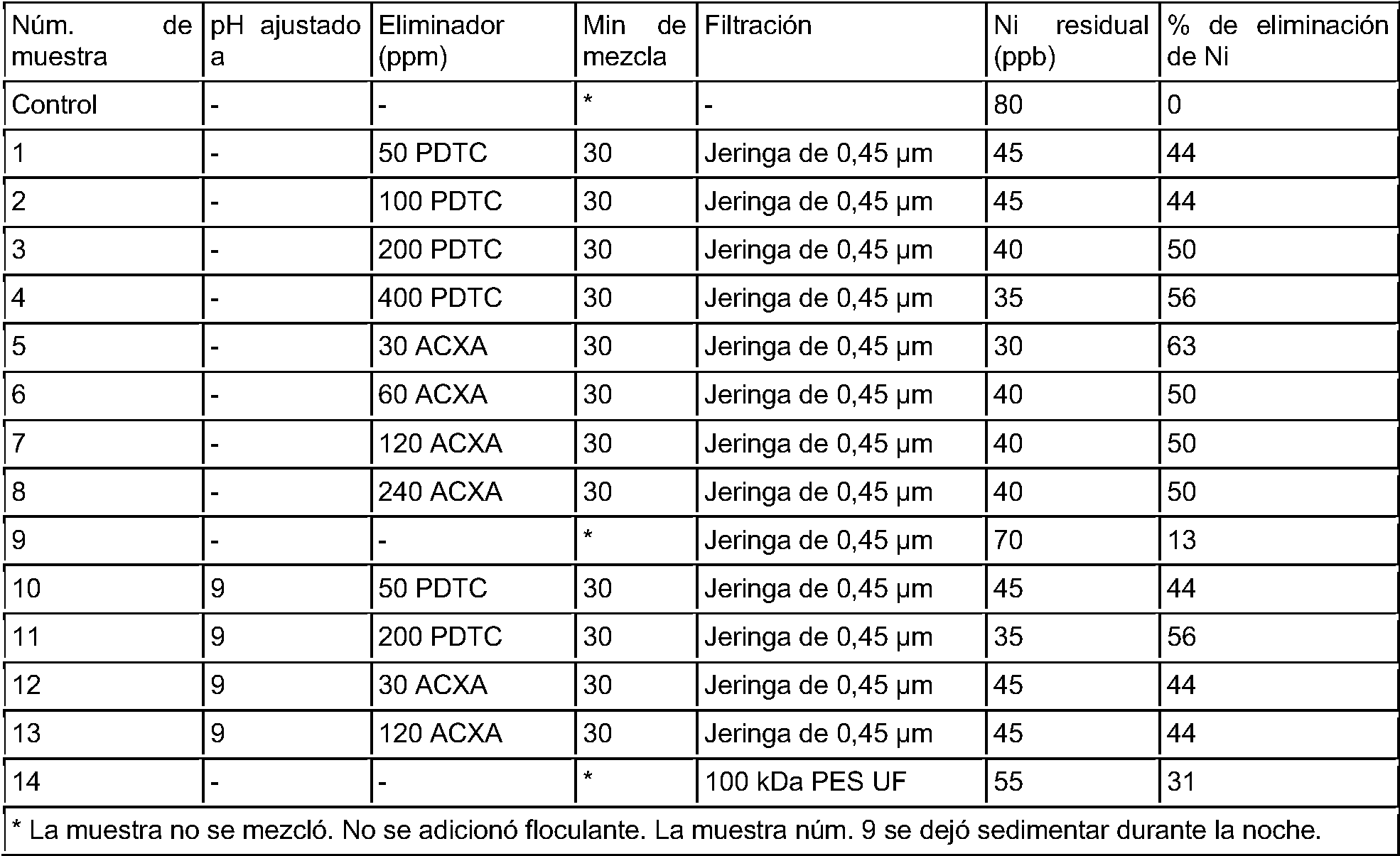
Tabla 2: La eliminación de Ni resulta del efluente DAF de las aguas residuales de una instalación de procesamiento de granosTable 2: Ni removal results from DAF effluent from wastewater from a grain processing facility

La Tabla 3 muestra los resultados de la comparación del copolímero acrílico-x-alquilamina con el polímero de ditiocarbamato con y sin filtración para la eliminación del cobre del agua residual sintética, que no forma parte de la invención.Table 3 shows the results of the comparison of the acrylic-x-alkylamine copolymer with the dithiocarbamate polymer with and without filtration for the removal of copper from synthetic wastewater, which is not part of the invention.
Tabla 3: Resultados de la eliminación de cobre de aguas residuales sintéticasTable 3: Results of copper removal from synthetic wastewater

Se obtuvieron muestras de Cu total mediante la sedimentación de la jarra y la extracción de una alícuota de la parte superior. Se obtuvieron muestras solubles mediante la extracción de una alícuota y su paso a través de un filtro de jeringa de 0,45 |_im. De la Tabla 3 se desprende claramente que la filtración permite una eliminación de metal significativamente mayor que simplemente mediante la sedimentación después del tratamiento con polímero de ditiocarbamato o copolímero de acrílico-x-alquilamina.Total Cu samples were obtained by sedimentation of the jar and the extraction of an aliquot from the top. Soluble samples were obtained by withdrawing an aliquot and passing it through a 0.45 | _im syringe filter. It is clear from Table 3 that filtration allows for significantly more metal removal than simply by sedimentation after treatment with dithiocarbamate polymer or acrylic-x-alkylamine copolymer.
La Tabla 4, que no forma parte de la invención, muestra resultados de la eliminación de mercurio de las aguas residuales de FGD de la central eléctrica con copolímero de acrílico-x-alquilamina y polímero de ditiocarbamato con y sin filtración. Además, los resultados se compararon con el rendimiento de otros materiales que incluyen:Table 4, which is not part of the invention, shows results of mercury removal from FGD wastewater from the power plant with acrylic-x-alkylamine copolymer and dithiocarbamate polymer with and without filtration. Additionally, the results were compared to the performance of other materials including:

Tabla 4: Resultados de la eliminación de mercurio de las aguas residuales de FGD de la central eléctricaTable 4: Results of mercury removal from FGD wastewater from power plant


Se obtuvieron muestras de Hg total mediante la sedimentación de la jarra y la extracción de una alícuota de la parte superior. Se obtuvieron muestras solubles mediante la extracción de una alícuota y su paso a través de un filtro de jeringa de 0,45 |_im. De la Tabla 4 se desprende que solo el tratamiento con floculante (Muestras 1-4) eliminó muy poco mercurio, pero el polímero de ditiocarbamato o el copolímero acrílico-x-alquilamina eliminó mercurio significativo. La filtración permitió una mayor eliminación de metal más que simplemente mediante la sedimentación después del tratamiento con polímero de ditiocarbamato o copolímero de acrílico-x-alquilamina. Así, las Tablas 3 y 4 mostraron que se lograron niveles más bajos de Cu y mercurio mediante el uso de un filtro de jeringa de 0,45 |_im junto con ditiocarbamato o copolímero acrílico-x-alquilamina, en lugar de solo la química sola. En algunos casos, la mejora fue de varios órdenes de magnitud. Total Hg samples were obtained by sedimentation of the jar and extraction of an aliquot from the top. Soluble samples were obtained by withdrawing an aliquot and passing it through a 0.45 | _im syringe filter. From Table 4 it appears that only the flocculant treatment (Samples 1-4) removed very little mercury, but the dithiocarbamate polymer or the acrylic-x-alkylamine copolymer removed significant mercury. Filtration allowed for greater metal removal rather than simply by sedimentation after treatment with dithiocarbamate polymer or acrylic-x-alkylamine copolymer. Thus, Tables 3 and 4 showed that lower levels of Cu and mercury were achieved by using a 0.45 | _im syringe filter together with dithiocarbamate or acrylic-x-alkylamine copolymer, rather than just chemistry alone. . In some cases, the improvement was several orders of magnitude.
Tabla 5: Eliminación de selenio de las aguas residuales de la refinería.Table 5: Removal of selenium from the wastewater from the refinery.

El agua de una refinería se trató mediante el proceso descrito en la patente de los EE. UU. núm. 8,282,835 B2 (excepto que se ajustó para usar ACXA, por ejemplo, de acuerdo con los ejemplos representativos anteriores) que describe métodos y/o composiciones adicionales útiles en al menos una modalidad de esta invención y en particular oxidantes representativos. El agua que contenía selenio se oxidó y se ajustó el pH antes de reaccionar con un coagulante de hierro y ACXA. El agua tratada se dejó sedimentar y después se extrajeron dos muestras- sedimentadas (muestras marcadas como sedimentadas) y filtradas (muestras marcadas como filtradas). El filtrado se realizó a través de un filtro de 0,45 micras. La Tabla 5 muestra que la combinación de oxidación, ajuste de pH, polímero secuestrador de metal, coagulante y filtración permitió que la eliminación de selenio bajara hasta 0,045 ppm desde 0,95 ppm. Las muestras 6-12 también muestran que la filtración permitió una mayor eliminación de selenio que la sedimentación sola.Refinery water was treated by the process described in US Patent No. 8,282,835 B2 (except that it was adjusted to use ACXA, for example, in accordance with the representative examples above) describing additional methods and / or compositions useful in at least one embodiment of this invention and in particular representative oxidants. The water containing selenium was oxidized and the pH was adjusted before reacting with an iron coagulant and ACXA. The treated water was allowed to settle and then two samples were removed - settled (samples marked as settled) and filtered (samples marked as filtered). Filtering was done through a 0.45 micron filter. Table 5 shows that the combination of oxidation, pH adjustment, metal sequestering polymer, coagulant, and filtration allowed the selenium removal to drop to 0.045 ppm from 0.95 ppm. Samples 6-12 also show that filtration allowed for greater selenium removal than sedimentation alone.
Todos los intervalos y parámetros descritos en la presente descripción se entienden como abarcadores de cualquiera y todos los subintervalos que se incluyen en la presente descripción, y cada número entre los puntos finales. Por ejemplo, se debe considerar que un intervalo establecido de "1 a 10" incluye cualquiera y todos los subintervalos entre (e inclusive) el valor mínimo de 1 y el valor máximo de 10; es decir, todos los subintervalos comienzan con un valor mínimo de 1 o más (por ejemplo, de 1 a 6,1) y terminan con un valor máximo de 10 o menos (por ejemplo, de 2,3 a 9,4, de 3 a 8, de 4 a 7), y finalmente a cada número 1, 2, 3, 4, 5, 6, 7, 8, 9, y 10 contenidos dentro del intervalo. Todos los porcentajes, relaciones y proporciones en la presente descripción son en peso a menos que se especifique de otra manera. All ranges and parameters described in the present description are understood as encompassing any and all subintervals that are included in the present description, and each number between the end points. For example, a set interval of "1 to 10" should be considered to include any and all subintervals between (and inclusive) the minimum value of 1 and the maximum value of 10; that is, all subintervals start with a minimum value of 1 or more (for example, from 1 to 6.1) and end with a maximum value of 10 or less (for example, from 2.3 to 9.4, from 3 to 8, from 4 to 7), and finally to each number 1, 2, 3, 4, 5, 6, 7, 8, 9, and 10 contained within the interval. All percentages, ratios, and proportions in the present description are by weight unless otherwise specified.
Claims (10)

Applications Claiming Priority (2)
| Application Number | Priority Date | Filing Date | Title |
|---|---|---|---|
| US14/076,488 US9328003B2 (en) | 2006-09-07 | 2013-11-11 | Method of heavy metal removal from water streams |
| PCT/US2014/059353 WO2015069403A1 (en) | 2013-11-11 | 2014-10-06 | Method of heavy metal removal from waste water streams |
Publications (1)
| Publication Number | Publication Date |
|---|---|
| ES2764488T3 true ES2764488T3 (en) | 2020-06-03 |
Family
ID=53041933
Family Applications (1)
| Application Number | Title | Priority Date | Filing Date |
|---|---|---|---|
| ES14860335T Active ES2764488T3 (en) | 2013-11-11 | 2014-10-06 | Selenium removal method from wastewater streams |
Country Status (8)
| Country | Link |
|---|---|
| EP (1) | EP3068733B1 (en) |
| JP (1) | JP6701085B2 (en) |
| KR (1) | KR102347370B1 (en) |
| CN (1) | CN105722794B (en) |
| CA (1) | CA2928162C (en) |
| ES (1) | ES2764488T3 (en) |
| PL (1) | PL3068733T3 (en) |
| WO (1) | WO2015069403A1 (en) |
Families Citing this family (6)
| Publication number | Priority date | Publication date | Assignee | Title |
|---|---|---|---|---|
| MX2018013972A (en) * | 2016-05-20 | 2019-03-28 | Ecolab Usa Inc | Method of separating mercury from an ore leachate. |
| GB201913334D0 (en) * | 2019-09-16 | 2019-10-30 | Univ Oxford Innovation Ltd | Selective removal of charged species |
| CN110950415B (en) * | 2019-11-29 | 2022-01-25 | 威海汉邦生物环保科技股份有限公司 | Biological polysaccharide-based heavy metal capture agent and preparation method thereof |
| WO2022212366A1 (en) * | 2021-04-02 | 2022-10-06 | Bl Technologies, Inc. | Functionalized polymers for the removal of soluble and insoluble transition metals from water |
| CN118878039A (en) * | 2024-08-28 | 2024-11-01 | 紫金铜业有限公司 | A high-efficiency composite selenium removal agent suitable for acidic waste liquid and its preparation and application |
| CN120664672B (en) * | 2025-06-18 | 2025-12-12 | 江西九岭锂业股份有限公司 | Lepidolite flotation wastewater treatment device and flotation process |
Family Cites Families (17)
| Publication number | Priority date | Publication date | Assignee | Title |
|---|---|---|---|---|
| ATE77806T1 (en) * | 1985-08-05 | 1992-07-15 | Miyoshi Yushi Kk | PROCESSES FOR THE DEPOSITION OF METALS. |
| JP3412842B2 (en) * | 1992-07-28 | 2003-06-03 | ミヨシ油脂株式会社 | Metal collecting agent and method for producing the same |
| JP2737614B2 (en) * | 1993-11-08 | 1998-04-08 | 栗田工業株式会社 | Treatment of flue gas desulfurization wastewater |
| JP2000015222A (en) * | 1998-06-30 | 2000-01-18 | Miyoshi Oil & Fat Co Ltd | Solid waste treatment method |
| JP3517697B2 (en) * | 1999-05-07 | 2004-04-12 | 独立行政法人産業技術総合研究所 | Method and remover for removing heavy metal ions |
| JP2003033604A (en) * | 2001-07-24 | 2003-02-04 | Nof Corp | Wastewater treatment agent |
| US7910371B2 (en) * | 2005-01-20 | 2011-03-22 | Nalco Company | Method of monitoring treating agent residuals in water treatment processes |
| US20080060999A1 (en) * | 2006-09-07 | 2008-03-13 | Musale Deepak A | Method of heavy metal removal from industrial wastewater using submerged ultrafiltration or microfiltration membranes |
| US8211389B2 (en) * | 2010-04-06 | 2012-07-03 | Nalco Company | Metal scavenging polymers and uses thereof |
| US8034246B2 (en) * | 2007-05-16 | 2011-10-11 | Exxonmobil Research & Engineering Company | Wastewater mercury removal process |
| WO2011027878A1 (en) * | 2009-09-04 | 2011-03-10 | 株式会社クレハ | Porous vinylidene fluoride resin membrane and process for producing same |
| US8282835B2 (en) * | 2010-03-10 | 2012-10-09 | Nalco Company | Removal of selenium from refinery wastewater |
| US8927637B2 (en) * | 2010-04-06 | 2015-01-06 | Nalco Company | Metal scavenging polymers and uses thereof |
| US8747789B2 (en) * | 2010-04-06 | 2014-06-10 | Nalco Company | Metal scavenging polymers |
| JP6331186B2 (en) * | 2011-01-20 | 2018-05-30 | 三菱ケミカル株式会社 | Waste water treatment apparatus, treatment method, and waste water treatment system |
| JP5728983B2 (en) * | 2011-02-04 | 2015-06-03 | 栗田工業株式会社 | Chemical injection control method for heavy metal scavengers |
| EP2812100B1 (en) * | 2012-02-06 | 2020-05-20 | Nalco Company | Corrosion control in flue gas wet scrubber systems |
-
2014
- 2014-10-06 CA CA2928162A patent/CA2928162C/en active Active
- 2014-10-06 CN CN201480061346.0A patent/CN105722794B/en active Active
- 2014-10-06 WO PCT/US2014/059353 patent/WO2015069403A1/en not_active Ceased
- 2014-10-06 PL PL14860335T patent/PL3068733T3/en unknown
- 2014-10-06 EP EP14860335.0A patent/EP3068733B1/en active Active
- 2014-10-06 JP JP2016553216A patent/JP6701085B2/en active Active
- 2014-10-06 ES ES14860335T patent/ES2764488T3/en active Active
- 2014-10-06 KR KR1020167015553A patent/KR102347370B1/en active Active
Also Published As
| Publication number | Publication date |
|---|---|
| JP6701085B2 (en) | 2020-05-27 |
| WO2015069403A1 (en) | 2015-05-14 |
| JP2016535673A (en) | 2016-11-17 |
| EP3068733A4 (en) | 2017-05-24 |
| CA2928162A1 (en) | 2015-05-14 |
| EP3068733A1 (en) | 2016-09-21 |
| KR102347370B1 (en) | 2022-01-04 |
| CN105722794A (en) | 2016-06-29 |
| KR20160085863A (en) | 2016-07-18 |
| CA2928162C (en) | 2023-03-21 |
| EP3068733B1 (en) | 2019-10-02 |
| CN105722794B (en) | 2021-03-26 |
| PL3068733T3 (en) | 2020-05-18 |
Similar Documents
| Publication | Publication Date | Title |
|---|---|---|
| ES2764488T3 (en) | Selenium removal method from wastewater streams | |
| Huang et al. | Removal of heavy metals from water using polyvinylamine by polymer-enhanced ultrafiltration and flocculation | |
| KR101516827B1 (en) | Method of heavy metal removal from industrial wastewater using submerged ultrafiltration or microfiltration membranes | |
| US8211389B2 (en) | Metal scavenging polymers and uses thereof | |
| US20080197075A1 (en) | Removing mercury and other heavy metals from industrial wastewater | |
| US8747789B2 (en) | Metal scavenging polymers | |
| US9328003B2 (en) | Method of heavy metal removal from water streams | |
| TW200812692A (en) | Method of improving performance of ultrafiltration or microfiltration membrane processes in landfill leachate treatment | |
| Hilal et al. | Combined humic substance coagulation and membrane filtration under saline conditions | |
| Derevjanko et al. | Factors leading to a decrease in membrane permeability for water filtration and wastewater | |
| John | Ethylenediamine based PA Thin-Film Composite Membrane for Separation of Salty Water |