ES2764555T3 - Insect repellent composition and method of use - Google Patents
Insect repellent composition and method of use Download PDFInfo
- Publication number
- ES2764555T3 ES2764555T3 ES16793996T ES16793996T ES2764555T3 ES 2764555 T3 ES2764555 T3 ES 2764555T3 ES 16793996 T ES16793996 T ES 16793996T ES 16793996 T ES16793996 T ES 16793996T ES 2764555 T3 ES2764555 T3 ES 2764555T3
- Authority
- ES
- Spain
- Prior art keywords
- composition according
- insect repellent
- repellent composition
- vanillin
- weight
- Prior art date
- Legal status (The legal status is an assumption and is not a legal conclusion. Google has not performed a legal analysis and makes no representation as to the accuracy of the status listed.)
- Active
Links
- 239000000203 mixture Substances 0.000 title claims abstract description 100
- 239000000077 insect repellent Substances 0.000 title claims abstract description 60
- 238000000034 method Methods 0.000 title claims description 15
- LMXFTMYMHGYJEI-UHFFFAOYSA-N p-menthane-3,8-diol Chemical compound CC1CCC(C(C)(C)O)C(O)C1 LMXFTMYMHGYJEI-UHFFFAOYSA-N 0.000 claims abstract description 86
- 229930006948 p-menthane-3,8-diol Natural products 0.000 claims abstract description 63
- MWOOGOJBHIARFG-UHFFFAOYSA-N vanillin Chemical compound COC1=CC(C=O)=CC=C1O MWOOGOJBHIARFG-UHFFFAOYSA-N 0.000 claims abstract description 62
- FGQOOHJZONJGDT-UHFFFAOYSA-N vanillin Natural products COC1=CC(O)=CC(C=O)=C1 FGQOOHJZONJGDT-UHFFFAOYSA-N 0.000 claims abstract description 62
- 235000012141 vanillin Nutrition 0.000 claims abstract description 61
- DWAQJAXMDSEUJJ-UHFFFAOYSA-M Sodium bisulfite Chemical compound [Na+].OS([O-])=O DWAQJAXMDSEUJJ-UHFFFAOYSA-M 0.000 claims abstract description 18
- 235000010267 sodium hydrogen sulphite Nutrition 0.000 claims abstract description 17
- 241000255925 Diptera Species 0.000 claims description 37
- 201000010099 disease Diseases 0.000 claims description 22
- 208000037265 diseases, disorders, signs and symptoms Diseases 0.000 claims description 22
- 241000256118 Aedes aegypti Species 0.000 claims description 19
- KFZMGEQAYNKOFK-UHFFFAOYSA-N Isopropanol Chemical compound CC(C)O KFZMGEQAYNKOFK-UHFFFAOYSA-N 0.000 claims description 18
- 241000256054 Culex <genus> Species 0.000 claims description 12
- 208000001490 Dengue Diseases 0.000 claims description 9
- 206010012310 Dengue fever Diseases 0.000 claims description 9
- 208000025729 dengue disease Diseases 0.000 claims description 9
- XLYOFNOQVPJJNP-UHFFFAOYSA-N water Substances O XLYOFNOQVPJJNP-UHFFFAOYSA-N 0.000 claims description 8
- 241000907316 Zika virus Species 0.000 claims description 7
- 241000710886 West Nile virus Species 0.000 claims description 6
- 208000003152 Yellow Fever Diseases 0.000 claims description 6
- 241000238631 Hexapoda Species 0.000 claims description 5
- LFQSCWFLJHTTHZ-UHFFFAOYSA-N Ethanol Chemical compound CCO LFQSCWFLJHTTHZ-UHFFFAOYSA-N 0.000 claims description 4
- 241000710772 Yellow fever virus Species 0.000 claims description 4
- 230000001846 repelling effect Effects 0.000 claims description 4
- 239000006210 lotion Substances 0.000 claims description 3
- 239000007921 spray Substances 0.000 claims description 3
- 230000002500 effect on skin Effects 0.000 claims description 2
- 239000000499 gel Substances 0.000 claims description 2
- 238000004519 manufacturing process Methods 0.000 claims description 2
- 230000002265 prevention Effects 0.000 claims 4
- 239000005871 repellent Substances 0.000 description 52
- 230000002940 repellent Effects 0.000 description 52
- MMOXZBCLCQITDF-UHFFFAOYSA-N N,N-diethyl-m-toluamide Chemical compound CCN(CC)C(=O)C1=CC=CC(C)=C1 MMOXZBCLCQITDF-UHFFFAOYSA-N 0.000 description 44
- 229960001673 diethyltoluamide Drugs 0.000 description 44
- 238000012360 testing method Methods 0.000 description 40
- 239000009854 citriodiol Substances 0.000 description 25
- 238000009472 formulation Methods 0.000 description 25
- 239000013598 vector Substances 0.000 description 15
- 239000000834 fixative Substances 0.000 description 14
- 230000000694 effects Effects 0.000 description 12
- 239000000126 substance Substances 0.000 description 11
- 239000004480 active ingredient Substances 0.000 description 10
- 230000008901 benefit Effects 0.000 description 10
- 201000004792 malaria Diseases 0.000 description 10
- 231100000673 dose–response relationship Toxicity 0.000 description 9
- 238000002474 experimental method Methods 0.000 description 9
- 239000000243 solution Substances 0.000 description 8
- 241000894007 species Species 0.000 description 6
- 238000011161 development Methods 0.000 description 5
- 238000011156 evaluation Methods 0.000 description 5
- 230000036541 health Effects 0.000 description 5
- 239000003921 oil Substances 0.000 description 5
- 238000012552 review Methods 0.000 description 5
- 231100000419 toxicity Toxicity 0.000 description 5
- 230000001988 toxicity Effects 0.000 description 5
- 241000256186 Anopheles <genus> Species 0.000 description 4
- VZRKEAFHFMSHCD-UHFFFAOYSA-N Ethyl 3-(N-butylacetamido)propionate Chemical compound CCCCN(C(C)=O)CCC(=O)OCC VZRKEAFHFMSHCD-UHFFFAOYSA-N 0.000 description 4
- 241000282414 Homo sapiens Species 0.000 description 4
- 150000001241 acetals Chemical class 0.000 description 4
- 239000000654 additive Substances 0.000 description 4
- 230000000996 additive effect Effects 0.000 description 4
- 150000001299 aldehydes Chemical group 0.000 description 4
- 239000003963 antioxidant agent Substances 0.000 description 4
- 239000008280 blood Substances 0.000 description 4
- 210000004369 blood Anatomy 0.000 description 4
- QLHULAHOXSSASE-UHFFFAOYSA-N butan-2-yl 2-(2-hydroxyethyl)piperidine-1-carboxylate Chemical compound CCC(C)OC(=O)N1CCCCC1CCO QLHULAHOXSSASE-UHFFFAOYSA-N 0.000 description 4
- 230000006872 improvement Effects 0.000 description 4
- 230000003993 interaction Effects 0.000 description 4
- 208000017983 photosensitivity disease Diseases 0.000 description 4
- 231100000434 photosensitization Toxicity 0.000 description 4
- 230000001105 regulatory effect Effects 0.000 description 4
- 238000009097 single-agent therapy Methods 0.000 description 4
- 150000003505 terpenes Chemical class 0.000 description 4
- 235000005979 Citrus limon Nutrition 0.000 description 3
- 244000131522 Citrus pyriformis Species 0.000 description 3
- 208000020329 Zika virus infectious disease Diseases 0.000 description 3
- -1 acetals Chemical class 0.000 description 3
- 230000003115 biocidal effect Effects 0.000 description 3
- 239000003139 biocide Substances 0.000 description 3
- 230000015572 biosynthetic process Effects 0.000 description 3
- 238000004364 calculation method Methods 0.000 description 3
- 229940079593 drug Drugs 0.000 description 3
- 239000003814 drug Substances 0.000 description 3
- 239000010642 eucalyptus oil Substances 0.000 description 3
- 229940044949 eucalyptus oil Drugs 0.000 description 3
- 229930014626 natural product Natural products 0.000 description 3
- 230000003647 oxidation Effects 0.000 description 3
- 238000007254 oxidation reaction Methods 0.000 description 3
- 238000011160 research Methods 0.000 description 3
- 238000011282 treatment Methods 0.000 description 3
- 241000256111 Aedes <genus> Species 0.000 description 2
- 241000256113 Culicidae Species 0.000 description 2
- NIQCNGHVCWTJSM-UHFFFAOYSA-N Dimethyl phthalate Chemical compound COC(=O)C1=CC=CC=C1C(=O)OC NIQCNGHVCWTJSM-UHFFFAOYSA-N 0.000 description 2
- 241000196324 Embryophyta Species 0.000 description 2
- 244000165852 Eucalyptus citriodora Species 0.000 description 2
- ZTHYODDOHIVTJV-UHFFFAOYSA-N Propyl gallate Chemical compound CCCOC(=O)C1=CC(O)=C(O)C(O)=C1 ZTHYODDOHIVTJV-UHFFFAOYSA-N 0.000 description 2
- 238000010521 absorption reaction Methods 0.000 description 2
- DHKHKXVYLBGOIT-UHFFFAOYSA-N acetaldehyde Diethyl Acetal Natural products CCOC(C)OCC DHKHKXVYLBGOIT-UHFFFAOYSA-N 0.000 description 2
- 230000008485 antagonism Effects 0.000 description 2
- 230000003078 antioxidant effect Effects 0.000 description 2
- RYYVLZVUVIJVGH-UHFFFAOYSA-N caffeine Chemical compound CN1C(=O)N(C)C(=O)C2=C1N=CN2C RYYVLZVUVIJVGH-UHFFFAOYSA-N 0.000 description 2
- 230000015556 catabolic process Effects 0.000 description 2
- NEHNMFOYXAPHSD-UHFFFAOYSA-N citronellal Chemical compound O=CCC(C)CCC=C(C)C NEHNMFOYXAPHSD-UHFFFAOYSA-N 0.000 description 2
- 150000001875 compounds Chemical class 0.000 description 2
- 238000006731 degradation reaction Methods 0.000 description 2
- 238000002845 discoloration Methods 0.000 description 2
- 230000006806 disease prevention Effects 0.000 description 2
- 238000005516 engineering process Methods 0.000 description 2
- 230000008020 evaporation Effects 0.000 description 2
- 238000001704 evaporation Methods 0.000 description 2
- 238000013265 extended release Methods 0.000 description 2
- 210000000245 forearm Anatomy 0.000 description 2
- 238000009533 lab test Methods 0.000 description 2
- 230000007246 mechanism Effects 0.000 description 2
- 239000000546 pharmaceutical excipient Substances 0.000 description 2
- 230000000144 pharmacologic effect Effects 0.000 description 2
- 229940027411 picaridin Drugs 0.000 description 2
- 239000013641 positive control Substances 0.000 description 2
- 238000002360 preparation method Methods 0.000 description 2
- 230000002441 reversible effect Effects 0.000 description 2
- 230000002195 synergetic effect Effects 0.000 description 2
- RYLFWQILVNWPEL-UHFFFAOYSA-N 1-methyl-4-propan-2-ylcyclohexane-1,2-diol Chemical compound CC(C)C1CCC(C)(O)C(O)C1 RYLFWQILVNWPEL-UHFFFAOYSA-N 0.000 description 1
- JGYBFWKYAGGOCT-UHFFFAOYSA-N 2-[2-(2-heptoxyethoxy)ethoxy]ethanol Chemical compound CCCCCCCOCCOCCOCCO JGYBFWKYAGGOCT-UHFFFAOYSA-N 0.000 description 1
- RGICCULPCWNRAB-UHFFFAOYSA-N 2-[2-(2-hexoxyethoxy)ethoxy]ethanol Chemical compound CCCCCCOCCOCCOCCO RGICCULPCWNRAB-UHFFFAOYSA-N 0.000 description 1
- GSKKPNMVOYDARW-UHFFFAOYSA-N 2-[2-[2-(2-ethylhexoxy)ethoxy]ethoxy]ethanol Chemical compound CCCCC(CC)COCCOCCOCCO GSKKPNMVOYDARW-UHFFFAOYSA-N 0.000 description 1
- 241000256173 Aedes albopictus Species 0.000 description 1
- 241000256056 Anopheles arabiensis Species 0.000 description 1
- 206010003399 Arthropod bite Diseases 0.000 description 1
- 241000238421 Arthropoda Species 0.000 description 1
- LSNNMFCWUKXFEE-UHFFFAOYSA-M Bisulfite Chemical compound OS([O-])=O LSNNMFCWUKXFEE-UHFFFAOYSA-M 0.000 description 1
- 239000005996 Blood meal Substances 0.000 description 1
- TZZAKSLHHIJRLL-UHFFFAOYSA-N COc1cc(C(N)=O)ccc1O Chemical compound COc1cc(C(N)=O)ccc1O TZZAKSLHHIJRLL-UHFFFAOYSA-N 0.000 description 1
- 241000282472 Canis lupus familiaris Species 0.000 description 1
- 241000134426 Ceratopogonidae Species 0.000 description 1
- 208000032170 Congenital Abnormalities Diseases 0.000 description 1
- 206010010356 Congenital anomaly Diseases 0.000 description 1
- 241000144347 Culex nigripalpus Species 0.000 description 1
- 240000004784 Cymbopogon citratus Species 0.000 description 1
- 235000017897 Cymbopogon citratus Nutrition 0.000 description 1
- 244000166675 Cymbopogon nardus Species 0.000 description 1
- 235000018791 Cymbopogon nardus Nutrition 0.000 description 1
- 241000283086 Equidae Species 0.000 description 1
- 235000004722 Eucalyptus citriodora Nutrition 0.000 description 1
- 244000166124 Eucalyptus globulus Species 0.000 description 1
- 241000282326 Felis catus Species 0.000 description 1
- 241000282412 Homo Species 0.000 description 1
- DGAQECJNVWCQMB-PUAWFVPOSA-M Ilexoside XXIX Chemical compound C[C@@H]1CC[C@@]2(CC[C@@]3(C(=CC[C@H]4[C@]3(CC[C@@H]5[C@@]4(CC[C@@H](C5(C)C)OS(=O)(=O)[O-])C)C)[C@@H]2[C@]1(C)O)C)C(=O)O[C@H]6[C@@H]([C@H]([C@@H]([C@H](O6)CO)O)O)O.[Na+] DGAQECJNVWCQMB-PUAWFVPOSA-M 0.000 description 1
- LPHGQDQBBGAPDZ-UHFFFAOYSA-N Isocaffeine Natural products CN1C(=O)N(C)C(=O)C2=C1N(C)C=N2 LPHGQDQBBGAPDZ-UHFFFAOYSA-N 0.000 description 1
- 208000016604 Lyme disease Diseases 0.000 description 1
- 241001354481 Mansonia <mosquito genus> Species 0.000 description 1
- 241000256179 Ochlerotatus triseriatus Species 0.000 description 1
- 208000002193 Pain Diseases 0.000 description 1
- 206010034972 Photosensitivity reaction Diseases 0.000 description 1
- 241001674048 Phthiraptera Species 0.000 description 1
- 206010070834 Sensitisation Diseases 0.000 description 1
- CZMRCDWAGMRECN-UGDNZRGBSA-N Sucrose Chemical compound O[C@H]1[C@H](O)[C@@H](CO)O[C@@]1(CO)O[C@@H]1[C@H](O)[C@@H](O)[C@H](O)[C@@H](CO)O1 CZMRCDWAGMRECN-UGDNZRGBSA-N 0.000 description 1
- 229930006000 Sucrose Natural products 0.000 description 1
- 244000269722 Thea sinensis Species 0.000 description 1
- 241001315783 Verrallina <genus> Species 0.000 description 1
- 230000009471 action Effects 0.000 description 1
- 230000002730 additional effect Effects 0.000 description 1
- 125000000217 alkyl group Chemical group 0.000 description 1
- 230000003042 antagnostic effect Effects 0.000 description 1
- 238000013459 approach Methods 0.000 description 1
- 125000003118 aryl group Chemical group 0.000 description 1
- 230000005540 biological transmission Effects 0.000 description 1
- 230000007698 birth defect Effects 0.000 description 1
- 125000000484 butyl group Chemical group [H]C([*])([H])C([H])([H])C([H])([H])C([H])([H])[H] 0.000 description 1
- VJEONQKOZGKCAK-UHFFFAOYSA-N caffeine Natural products CN1C(=O)N(C)C(=O)C2=C1C=CN2C VJEONQKOZGKCAK-UHFFFAOYSA-N 0.000 description 1
- 229960001948 caffeine Drugs 0.000 description 1
- 238000006243 chemical reaction Methods 0.000 description 1
- 229930003633 citronellal Natural products 0.000 description 1
- 235000000983 citronellal Nutrition 0.000 description 1
- 238000004891 communication Methods 0.000 description 1
- 230000000052 comparative effect Effects 0.000 description 1
- 239000000470 constituent Substances 0.000 description 1
- 238000013270 controlled release Methods 0.000 description 1
- 239000002537 cosmetic Substances 0.000 description 1
- GVJHHUAWPYXKBD-UHFFFAOYSA-N d-alpha-tocopherol Natural products OC1=C(C)C(C)=C2OC(CCCC(C)CCCC(C)CCCC(C)C)(C)CCC2=C1C GVJHHUAWPYXKBD-UHFFFAOYSA-N 0.000 description 1
- 230000007123 defense Effects 0.000 description 1
- 230000007812 deficiency Effects 0.000 description 1
- 230000001627 detrimental effect Effects 0.000 description 1
- FBSAITBEAPNWJG-UHFFFAOYSA-N dimethyl phthalate Natural products CC(=O)OC1=CC=CC=C1OC(C)=O FBSAITBEAPNWJG-UHFFFAOYSA-N 0.000 description 1
- 229960001826 dimethylphthalate Drugs 0.000 description 1
- 230000009977 dual effect Effects 0.000 description 1
- 230000007613 environmental effect Effects 0.000 description 1
- 239000003205 fragrance Substances 0.000 description 1
- 235000021474 generally recognized As safe (food) Nutrition 0.000 description 1
- 235000021473 generally recognized as safe (food ingredients) Nutrition 0.000 description 1
- 239000011521 glass Substances 0.000 description 1
- 125000001072 heteroaryl group Chemical group 0.000 description 1
- 238000011835 investigation Methods 0.000 description 1
- 238000005259 measurement Methods 0.000 description 1
- 238000002483 medication Methods 0.000 description 1
- 208000004141 microcephaly Diseases 0.000 description 1
- 239000013642 negative control Substances 0.000 description 1
- AZJXQVRPBZSNFN-UHFFFAOYSA-N octane-3,3-diol Chemical compound CCCCCC(O)(O)CC AZJXQVRPBZSNFN-UHFFFAOYSA-N 0.000 description 1
- 238000005457 optimization Methods 0.000 description 1
- 230000035515 penetration Effects 0.000 description 1
- 239000008194 pharmaceutical composition Substances 0.000 description 1
- 230000036211 photosensitivity Effects 0.000 description 1
- 230000002035 prolonged effect Effects 0.000 description 1
- 235000010388 propyl gallate Nutrition 0.000 description 1
- 239000000473 propyl gallate Substances 0.000 description 1
- 229940075579 propyl gallate Drugs 0.000 description 1
- 230000004044 response Effects 0.000 description 1
- 230000035807 sensation Effects 0.000 description 1
- 230000008313 sensitization Effects 0.000 description 1
- 239000000344 soap Substances 0.000 description 1
- 239000011734 sodium Substances 0.000 description 1
- 229910052708 sodium Inorganic materials 0.000 description 1
- 238000013112 stability test Methods 0.000 description 1
- 239000005720 sucrose Substances 0.000 description 1
- 230000035900 sweating Effects 0.000 description 1
- 230000009885 systemic effect Effects 0.000 description 1
- 239000012085 test solution Substances 0.000 description 1
- 238000001757 thermogravimetry curve Methods 0.000 description 1
- 235000010384 tocopherol Nutrition 0.000 description 1
- 229960001295 tocopherol Drugs 0.000 description 1
- 229930003799 tocopherol Natural products 0.000 description 1
- 239000011732 tocopherol Substances 0.000 description 1
- DKZBBWMURDFHNE-UHFFFAOYSA-N trans-coniferylaldehyde Natural products COC1=CC(C=CC=O)=CC=C1O DKZBBWMURDFHNE-UHFFFAOYSA-N 0.000 description 1
- 239000000341 volatile oil Substances 0.000 description 1
- 210000000707 wrist Anatomy 0.000 description 1
- GVJHHUAWPYXKBD-IEOSBIPESA-N α-tocopherol Chemical compound OC1=C(C)C(C)=C2O[C@@](CCC[C@H](C)CCC[C@H](C)CCCC(C)C)(C)CCC2=C1C GVJHHUAWPYXKBD-IEOSBIPESA-N 0.000 description 1
Classifications
-
- A—HUMAN NECESSITIES
- A01—AGRICULTURE; FORESTRY; ANIMAL HUSBANDRY; HUNTING; TRAPPING; FISHING
- A01N—PRESERVATION OF BODIES OF HUMANS OR ANIMALS OR PLANTS OR PARTS THEREOF; BIOCIDES, e.g. AS DISINFECTANTS, AS PESTICIDES OR AS HERBICIDES; PEST REPELLANTS OR ATTRACTANTS; PLANT GROWTH REGULATORS
- A01N25/00—Biocides, pest repellants or attractants, or plant growth regulators, characterised by their forms, or by their non-active ingredients or by their methods of application, e.g. seed treatment or sequential application; Substances for reducing the noxious effect of the active ingredients to organisms other than pests
- A01N25/24—Biocides, pest repellants or attractants, or plant growth regulators, characterised by their forms, or by their non-active ingredients or by their methods of application, e.g. seed treatment or sequential application; Substances for reducing the noxious effect of the active ingredients to organisms other than pests containing ingredients to enhance the sticking of the active ingredients
-
- A—HUMAN NECESSITIES
- A01—AGRICULTURE; FORESTRY; ANIMAL HUSBANDRY; HUNTING; TRAPPING; FISHING
- A01N—PRESERVATION OF BODIES OF HUMANS OR ANIMALS OR PLANTS OR PARTS THEREOF; BIOCIDES, e.g. AS DISINFECTANTS, AS PESTICIDES OR AS HERBICIDES; PEST REPELLANTS OR ATTRACTANTS; PLANT GROWTH REGULATORS
- A01N31/00—Biocides, pest repellants or attractants, or plant growth regulators containing organic oxygen or sulfur compounds
- A01N31/06—Oxygen or sulfur directly attached to a cycloaliphatic ring system
-
- A—HUMAN NECESSITIES
- A01—AGRICULTURE; FORESTRY; ANIMAL HUSBANDRY; HUNTING; TRAPPING; FISHING
- A01N—PRESERVATION OF BODIES OF HUMANS OR ANIMALS OR PLANTS OR PARTS THEREOF; BIOCIDES, e.g. AS DISINFECTANTS, AS PESTICIDES OR AS HERBICIDES; PEST REPELLANTS OR ATTRACTANTS; PLANT GROWTH REGULATORS
- A01N25/00—Biocides, pest repellants or attractants, or plant growth regulators, characterised by their forms, or by their non-active ingredients or by their methods of application, e.g. seed treatment or sequential application; Substances for reducing the noxious effect of the active ingredients to organisms other than pests
- A01N25/02—Biocides, pest repellants or attractants, or plant growth regulators, characterised by their forms, or by their non-active ingredients or by their methods of application, e.g. seed treatment or sequential application; Substances for reducing the noxious effect of the active ingredients to organisms other than pests containing liquids as carriers, diluents or solvents
- A01N25/04—Dispersions, emulsions, suspoemulsions, suspension concentrates or gels
-
- A—HUMAN NECESSITIES
- A01—AGRICULTURE; FORESTRY; ANIMAL HUSBANDRY; HUNTING; TRAPPING; FISHING
- A01N—PRESERVATION OF BODIES OF HUMANS OR ANIMALS OR PLANTS OR PARTS THEREOF; BIOCIDES, e.g. AS DISINFECTANTS, AS PESTICIDES OR AS HERBICIDES; PEST REPELLANTS OR ATTRACTANTS; PLANT GROWTH REGULATORS
- A01N25/00—Biocides, pest repellants or attractants, or plant growth regulators, characterised by their forms, or by their non-active ingredients or by their methods of application, e.g. seed treatment or sequential application; Substances for reducing the noxious effect of the active ingredients to organisms other than pests
- A01N25/08—Biocides, pest repellants or attractants, or plant growth regulators, characterised by their forms, or by their non-active ingredients or by their methods of application, e.g. seed treatment or sequential application; Substances for reducing the noxious effect of the active ingredients to organisms other than pests containing solids as carriers or diluents
-
- A—HUMAN NECESSITIES
- A01—AGRICULTURE; FORESTRY; ANIMAL HUSBANDRY; HUNTING; TRAPPING; FISHING
- A01N—PRESERVATION OF BODIES OF HUMANS OR ANIMALS OR PLANTS OR PARTS THEREOF; BIOCIDES, e.g. AS DISINFECTANTS, AS PESTICIDES OR AS HERBICIDES; PEST REPELLANTS OR ATTRACTANTS; PLANT GROWTH REGULATORS
- A01N25/00—Biocides, pest repellants or attractants, or plant growth regulators, characterised by their forms, or by their non-active ingredients or by their methods of application, e.g. seed treatment or sequential application; Substances for reducing the noxious effect of the active ingredients to organisms other than pests
- A01N25/22—Biocides, pest repellants or attractants, or plant growth regulators, characterised by their forms, or by their non-active ingredients or by their methods of application, e.g. seed treatment or sequential application; Substances for reducing the noxious effect of the active ingredients to organisms other than pests containing ingredients stabilising the active ingredients
-
- A—HUMAN NECESSITIES
- A01—AGRICULTURE; FORESTRY; ANIMAL HUSBANDRY; HUNTING; TRAPPING; FISHING
- A01N—PRESERVATION OF BODIES OF HUMANS OR ANIMALS OR PLANTS OR PARTS THEREOF; BIOCIDES, e.g. AS DISINFECTANTS, AS PESTICIDES OR AS HERBICIDES; PEST REPELLANTS OR ATTRACTANTS; PLANT GROWTH REGULATORS
- A01N31/00—Biocides, pest repellants or attractants, or plant growth regulators containing organic oxygen or sulfur compounds
- A01N31/02—Acyclic compounds
-
- Y—GENERAL TAGGING OF NEW TECHNOLOGICAL DEVELOPMENTS; GENERAL TAGGING OF CROSS-SECTIONAL TECHNOLOGIES SPANNING OVER SEVERAL SECTIONS OF THE IPC; TECHNICAL SUBJECTS COVERED BY FORMER USPC CROSS-REFERENCE ART COLLECTIONS [XRACs] AND DIGESTS
- Y02—TECHNOLOGIES OR APPLICATIONS FOR MITIGATION OR ADAPTATION AGAINST CLIMATE CHANGE
- Y02A—TECHNOLOGIES FOR ADAPTATION TO CLIMATE CHANGE
- Y02A50/00—TECHNOLOGIES FOR ADAPTATION TO CLIMATE CHANGE in human health protection, e.g. against extreme weather
- Y02A50/30—Against vector-borne diseases, e.g. mosquito-borne, fly-borne, tick-borne or waterborne diseases whose impact is exacerbated by climate change
Landscapes
- Life Sciences & Earth Sciences (AREA)
- Health & Medical Sciences (AREA)
- General Health & Medical Sciences (AREA)
- Wood Science & Technology (AREA)
- Plant Pathology (AREA)
- Engineering & Computer Science (AREA)
- Dentistry (AREA)
- Pest Control & Pesticides (AREA)
- Agronomy & Crop Science (AREA)
- Zoology (AREA)
- Environmental Sciences (AREA)
- Toxicology (AREA)
- Chemical & Material Sciences (AREA)
- Dispersion Chemistry (AREA)
- Agricultural Chemicals And Associated Chemicals (AREA)
- Catching Or Destruction (AREA)
Abstract
Una composición repelente de insectos que comprende p-mentano-3,8-diol en una cantidad de al menos 20% en peso de la composición, vanilina en una cantidad de 5 a 15% en peso de dicha composición, bisulfito de sodio y un vehículo de suministro.An insect repellent composition comprising p-menthane-3,8-diol in an amount of at least 20% by weight of the composition, vanillin in an amount of 5 to 15% by weight of said composition, sodium bisulfite and a supply vehicle.
Description
DESCRIPCIÓNDESCRIPTION
Composición repelente de insectos y método de usoInsect repellent composition and method of use
La presente invención se refiere a una composición repelente de insectos y a un método de utilización de la misma para repeler insectos durante un período de tiempo prolongado. Las composiciones de la invención incluyen repelentes naturales de insectos y pueden proporcionar una prolongación de los tiempos de protección completa hasta un mínimo de 12 horas, permitiendo así un régimen de dosificación de una vez al día.The present invention relates to an insect repellent composition and a method of using it to repel insects for an extended period of time. The compositions of the invention include natural insect repellents and can provide a full protection time extension of up to a minimum of 12 hours, thus allowing a once daily dosing regimen.
Las composiciones de la invención tienen una utilidad particular en términos de repeler moscas de la familia Culicidae o Ceratopogonidae, especialmente mosquitos y mosquitas (descritos colectivamente en la presente memoria como "moscas picadoras"), donde el efecto repelente puede prolongarse considerablemente en comparación con los patrones actuales y puede durar 12 horas o más. El objetivo fundamental es proporcionar a los consumidores un tratamiento único y conveniente una vez al día, para mejorar la conformidad del paciente.The compositions of the invention have particular utility in terms of repelling flies of the Culicidae or Ceratopogonidae family, especially mosquitoes and mosquitoes (collectively described herein as "biting flies"), where the repellent effect can be prolonged considerably compared to those current patterns and can last 12 hours or more. The main objective is to provide consumers with a unique and convenient treatment once a day, to improve patient compliance.
Por una variedad de factores, incluyendo la quimofobia del consumidor bien comprendida y en crecimiento, existe una demanda cada vez mayor por parte de los usuarios en todo el mundo de repelentes de insectos que sean de origen natural y no estén basados en repelentes químicos sintéticos, que han dominado el mercado en los últimos 70 años o más1. Por lo tanto, los llamados "repelentes naturales" han crecido rápidamente en términos de uso durante los últimos años y ahora son, muy a menudo, productos de primera elección en términos de preferencia del consumidor, particularmente en países tales como Estados Unidos y Reino Unido.Due to a variety of factors, including well understood and growing consumer chemophobia, there is an increasing demand by users worldwide for insect repellents that are naturally occurring and not based on synthetic chemical repellents, that have dominated the market for the past 70 years or more1. Therefore, so-called "natural repellents" have grown rapidly in terms of use in recent years and are now very often first-rate products in terms of consumer preference, particularly in countries such as the United States and the United Kingdom. .
Sin embargo, ciertas especies de mosquitos, de mayor importancia en la salud general en términos de mortalidad clínica, son vectores bien conocidos de enfermedades graves, que incluyen los mayores "picadores"/asesinos de niños (malaria) y en los últimos años se han observado importantes aumentos en la mortalidad asociada con otras enfermedades graves tales como la fiebre del Dengue (especialmente en el subcontinente indio), la fiebre Amarilla y el virus del Nilo Occidental.However, certain species of mosquitoes, of greater importance to general health in terms of clinical mortality, are well-known vectors of serious disease, including the largest child "bites" / killers (malaria), and have in recent years been observed significant increases in mortality associated with other serious diseases such as Dengue fever (especially in the Indian subcontinent), Yellow fever and West Nile virus.
Por ejemplo, para 2015, la fiebre del Dengue había aumentado a proporciones epidémicas en algunas áreas del este (más de 500.000 casos actuales solo en Mumbai, India), mientras que en el oeste de los Estados Unidos de América, las tendencias más preocupantes han visto grandes aumentos documentados en Virus del Nilo Occidental y enfermedad de Lyme.For example, by 2015, Dengue fever had increased to epidemic proportions in some eastern areas (over 500,000 current cases in Mumbai, India alone), while in the western United States of America, the most worrying trends have been seen large increases documented in West Nile Virus and Lyme disease.
Finalmente, en 2016, la rápida aparición del virus del Zika, causado por el mosquito vector Aedes aegypti a tenido enormes efectos negativos en la atención médica en las principales áreas de América del Sur, tal como Brasil, lo que ha provocado que la OMS confirme el estado de emergencia en tales regiones. El supuesto vínculo entre el virus del Zika y la rápida aparición de numerosos casos de defectos congénitos graves, p. ej., la microcefalia en niños es una perspectiva aterradora en términos de su amenaza potencial de "migrar" de América del Sur a otras regiones del mundo.Finally, in 2016, the rapid appearance of the Zika virus, caused by the vector mosquito Aedes aegypti, has had enormous negative effects on medical care in the main areas of South America, such as Brazil, which has caused the WHO to confirm the state of emergency in such regions. The alleged link between Zika virus and the rapid onset of numerous cases of serious birth defects, p. For example, microcephaly in children is a frightening prospect in terms of its potential threat to "migrate" from South America to other regions of the world.
Esta no es una amenaza hipotética, ya que eventos muy recientes en Florida, EE. UU., han demostrado que se han encontrado colonias de Aedes aegypti criadas localmente en el área y, por consiguiente, el descubrimiento de casos de Zika en el continente americano por primera vez. Esto ha llevado a una advertencia sin precedentes del Centro para el Control de Enfermedades (CDC) para que las mujeres embarazadas no viajen a una parte de los Estados Unidos, por primera vez en su historia.This is not a hypothetical threat, since very recent events in Florida, USA, have shown that colonies of locally bred Aedes aegypti have been found in the area and, consequently, the discovery of Zika cases in the American continent. for the first time. This has led to an unprecedented warning from the Center for Disease Control (CDC) for pregnant women not to travel to a part of the United States, for the first time in its history.
Sí bien, el mosquito vector de la malaria es la especie Anofeles, el vector actual para el dengue, la fiebre Amarilla y el Zika es Aedes aegypti, mientras que el mosquito vector Culex es la causa del virus del Nilo Occidental en los Estados Unidos. En consecuencia, un repelente de mosquitos moderno y eficaz debe ofrecer un amplio espectro de actividad de especies durante períodos prolongados de tiempo.Yes, the vector malaria mosquito is the Anopheles species , the current vector for dengue, Yellow fever and Zika is Aedes aegypti, while the Culex vector mosquito is the cause of the West Nile virus in the United States. Consequently, a modern and effective mosquito repellent must offer a broad spectrum of species activity over extended periods of time.
La primera línea de defensa aceptada actualmente, acordada por todos los organismos de sanidad/reguladores destinados a la prevención de enfermedades es la repelencia más eficaz. Existe la necesidad de composiciones que muestren altos niveles de eficacia contra al menos estas tres especies de mosquitos vectores y que puedan ofrecer protección durante períodos de horas de manera constante por encima de los patrones actuales, p. ej., hasta y por encima de 12 horas por día. También existe la necesidad de composiciones repelentes de insectos que se puedan utilizar en un régimen de dosificación de una vez al día, y como tales podrían mantener suficiente repelencia de insectos durante un período prolongado de tiempo, tal como hasta 12 horas por día o más. Las composiciones repelentes de insectos conocidas no serían adecuadas para su uso en tales regímenes de dosificación una vez al día debido a la falta de repelencia adecuada durante períodos prolongados de tiempo. Sin embargo, los autores de la presente invención actuales han desarrollado sorprendentemente composiciones que abordan las necesidades anteriores y, en particular, permiten una dosificación eficaz una vez al día al tiempo que proporcionan una repelencia eficaz durante largos períodos de tiempo. Por lo tanto, la presente invención proporciona claramente ventajas en comparación con la técnica anterior.The first line of defense currently accepted, agreed upon by all health / regulatory agencies for disease prevention, is the most effective repellency. There is a need for compositions that show high levels of efficacy against at least these three species of vector mosquitoes and that can offer protection for periods of hours that are consistently above current standards, e.g. eg, up to and above 12 hours per day. There is also a need for insect repellent compositions that can be used in a once daily dosing regimen, and as such could maintain sufficient insect repellency for an extended period of time, such as up to 12 hours per day or more. Known insect repellent compositions would not be suitable for use in such once daily dosing regimens due to lack of adequate repellency for prolonged periods of time. However, current inventors have surprisingly developed compositions that address the above needs and, in particular, allow for effective once-a-day dosing while providing effective repellency for long periods of time. Therefore, the present invention clearly provides advantages compared to the prior art.
Si bien la experiencia de estar expuesto a las actividades de las moscas picadoras es invariablemente una experiencia incómoda en muchas partes de Europa, donde los repelentes se utilizan ampliamente para fines de conveniencia, la necesidad clínica de maximizar la protección en las otras zonas del mundo que padecen enfermedades graves, incluida la malaria, la fiebre del Dengue y el Zika requieren una búsqueda urgente de repelentes más eficaces que ofrezcan una protección más prolongada.While the experience of being exposed to the activities of biting flies is invariably a uncomfortable experience in many parts of Europe, where repellents are widely used for convenience purposes, the clinical need to maximize protection in other areas of the world suffering from serious diseases, including malaria, Dengue fever and Zika require a urgent search for more effective repellents that offer longer protection.
En cuanto a la fiebre del Dengue y el virus del Zika, el mosquito vector Aedes aegypti es inusualmente un "picador de día", por lo que el requisito resultante de protección de 12 horas es un requisito previo real para un repelente de insectos eficaz para esta especie.As for Dengue fever and Zika virus, the vector mosquito Aedes aegypti is unusually a "day bite", making the resulting 12-hour protection requirement a real prerequisite for an effective insect repellent for this species.
La prueba de repelentes de insectos tiene un número bien establecido de procedimientos probados en términos de aceptación reguladora y otras pruebas recomendadas por organismos eminentes tales como la OMS y la Agencia de Protección Ambiental (EPA) de los EE. UU. Los dos tipos de pruebas más preferidos son los que se realizan en un laboratorio (las llamadas pruebas de "brazo o mano dentro de la cabina") y las realizadas en el entorno natural "abierto" (las llamadas pruebas de "campo").The insect repellent test has a well-established number of procedures tested in terms of regulatory acceptance and other tests recommended by eminent bodies such as the WHO and the US Environmental Protection Agency (EPA). The two types of tests More preferred are those performed in a laboratory (so-called "arm or hand in-cabin" tests) and those performed in the "open" natural environment (so-called "field" tests).
Tradicionalmente, en estas pruebas, uno de los parámetros más preferidos para la evaluación de la capacidad de los repelentes (ya sea de origen natural o sintético) para proteger a los consumidores/pacientes ha sido la medición de los tiempos de protección, particularmente los tiempos de protección completa (también, llamados CPT). Los repelentes hacen que los humanos no sean atractivos para las moscas picadoras, tales como un mosquito, por lo que la mosca picadora evitará áreas del cuerpo que hayan sido tratadas con el producto. Los repelentes no destruyen las moscas picadoras, tales como los mosquitos. Los mejores repelentes proporcionarán protección contra las picaduras durante un largo período de tiempo a partir de una sola aplicación. Una prueba bien reconocida para evaluar la eficacia de tales repelentes se basa en la cantidad de tiempo que el producto continuará repeliendo las moscas picadoras, tales como un mosquito, después de una aplicación a la piel.Traditionally, in these tests, one of the most preferred parameters for evaluating the ability of repellents (whether of natural or synthetic origin) to protect consumers / patients has been the measurement of protection times, particularly times full protection (also called CPT). Repellents make humans unattractive to biting flies, such as a mosquito, so the biting fly will avoid areas of the body that have been treated with the product. Repellents do not destroy biting flies, such as mosquitoes. The best repellents will provide protection against stings over a long period of time from a single application. A well-recognized test for evaluating the efficacy of such repellents is based on the amount of time the product will continue to repel biting flies, such as a mosquito, after application to the skin.
Los tiempos de protección completa se calculan como el número de minutos (u horas) transcurridos entre el momento de la aplicación del repelente y el primer aterrizaje o sondeo del mosquito. Los Tiempos de Protección Completa se citan en la presente memoria como un valor de la mediana del tiempo de protección proporcionado por cada individuo. Los Tiempos de Protección Completa se abrevian en la presente memoria como CPT. La prueba empleada para determinar los mismos consistió en insertar un brazo tratado con repelente (de acuerdo con la presente invención) en una cabina de 35 cm por cada lado, que contenía 200 moscas picadoras criadas en laboratorio, tales como los mosquitos Aedes aegypti no alimentados con sangre que tenían entre 5 y 7 días de edad y midiendo el tiempo transcurrido hasta el primer aterrizaje o sondeo (que se refiere a un insecto que aterriza y penetra la piel con sus piezas bucales, sin ingerir sangre).Complete protection times are calculated as the number of minutes (or hours) elapsed between the time of repellent application and the first landing or sounding of the mosquito. Complete Protection Times are cited herein as a median value of the protection time provided by each individual. Full Protection Times are abbreviated herein as CPT. The test used to determine them consisted of inserting a repellent-treated arm (according to the present invention) in a 35-cm booth on each side, containing 200 laboratory-raised biting flies, such as non-fed Aedes aegypti mosquitoes. with blood that were between 5 and 7 days old and measuring the time elapsed until the first landing or sounding (which refers to an insect that lands and penetrates the skin with its mouthparts, without ingesting blood).
En general y hasta la fecha, los CPT han oscilado entre 2 horas y 6 horas para los principales repelentes comercializados, tales como el repelente químico líder, DEET [W,A/-Dietil-3-metilbenzamida], o el repelente natural líder, p-mentano-3,8-diol, conocido en EE. UU., como aceite de eucalipto de limón (OLE), o como p Md en la Unión Europea (actualmente disponible bajo las marcas comerciales "Citriodiol" y/o "Citrepel").1In general and to date, CPTs have ranged from 2 hours to 6 hours for the main commercial repellents, such as the leading chemical repellent, DEET [W, A / -Diethyl-3-methylbenzamide], or the leading natural repellent, p-Methane-3,8-diol, known in the US as lemon eucalyptus oil (OLE), or as p M d in the European Union (currently available under the trademarks "Citriodiol" and / or " Citrepel "). 1
El producto sintético dominante en el mercado, DEET como se mencionó anteriormente, se ha utilizado a concentraciones relativamente altas entre 50-100% y un número limitado de formulaciones que contienen DEET han reivindicado CPT de más de 6 horas2 en algunas comunicaciones. De hecho, en el mercado australiano hay un gel DEET comercializado por Bushman que contiene una concentración de 80% de DEET.The dominant synthetic product on the market, DEET as mentioned above, has been used at relatively high concentrations between 50-100% and a limited number of formulations containing DEET have claimed CPT of more than 6 hours2 in some communications. In fact, on the Australian market there is a DEET gel sold by Bushman that contains an 80% concentration of DEET.
Si bien estos intervalos de CPT fueron/son razonable o potencialmente aceptables para los llamados "fines cosméticos", ha habido tendencias recientes en aumento en numerosas partes del mundo de tasas inaceptablemente altas de enfermedad y/o mortalidad asociadas con las enfermedades bien reconocidas causada por mosquitos vectores, tales como la malaria, y más recientemente otras enfermedades potencialmente mortales. Los recientes brotes de enfermedades posteriores a 2010, tales como la fiebre del Dengue, la fiebre Amarilla y ahora el virus del Zika, se han sumado al siempre presente problema de control de enfermedades y han creado una necesidad mucho más urgente de repelentes que demuestren niveles adicionales de protección con CPT que permitan 12 horas de eficacia (o incluso más, es decir, protección muy por encima del nivel tradicional de protección satisfactoria).While these CPT ranges were / are reasonably or potentially acceptable for so-called "cosmetic purposes", there have been recent increasing trends in many parts of the world of unacceptably high rates of disease and / or mortality associated with well-recognized diseases caused by vector mosquitoes, such as malaria, and more recently other life-threatening diseases. Recent post-2010 disease outbreaks, such as Dengue fever, Yellow fever, and now Zika virus, have added to the ever-present disease control problem and created a much more urgent need for repellents that demonstrate high levels of additional CPT protection that allows 12 hours of effectiveness (or even more, that is, protection well above the traditional level of satisfactory protection).
Los intentos de intervenir en técnicas de formulación farmacéutica bien conocidas para ampliar los tiempos de protección "convencionales" no son nuevos ni revolucionarios y, de hecho, se han concentrado predominantemente en el repelente químico líder, DEET, en varios estudios previos.34Attempts to intervene in well-known pharmaceutical formulation techniques to extend "conventional" protection times are neither new nor revolutionary and, in fact, have focused predominantly on the leading chemical repellent, DEET, in several previous studies.34
El DEET fue desarrollado para las fuerzas militares estadounidenses para su uso durante y después de la Segunda Guerra Mundial y finalmente se lanzó a los mercados mundiales como repelente de insectos alrededor de 1957. Desde entonces, se estima que se han administrado más de 8 mil millones de aplicaciones de los diversos productos que contienen DEET4.DEET was developed for US military forces for use during and after World War II and was finally released to world markets as an insect repellent around 1957. Since then, it is estimated that more than 8 billion have been administered of applications of the various products containing DEET4.
En términos del perfil de CPT para DEET, con referencia al estudio militar fundamental de EE. UU., de Buescher et al.6, 1983, su respuesta a la dosis confirma que su actividad se estabiliza alrededor de 5-6 horas a concentraciones de alrededor de 50%, como se demuestra en la Figura 1.In terms of the CPT profile for DEET, with reference to the US Fundamental Military Study, by Buescher et al. 6, 1983, its dose response confirms that its activity stabilizes for around 5-6 hours at concentrations of around 50%, as shown in Figure 1.
Esta fue probablemente la razón de los intentos de mejorar el perfil de CPT de DEET más allá de las 6 horas sin aumentar su concentración en las formulaciones comercializadas. Aunque DEET tiene una razón beneficio/riesgo positiva aceptada, varias autoridades sanitarias reguladoras líderes se han preocupado cada vez más por su toxicidad y su probada absorción sistémica, una característica inusual en contraste con la mayoría de los otros repelentes. Algunas autoridades han sugerido una concentración superior de DEET de 20% (Europa) o de 30% (Canadá). Una reciente revisión independiente realizada por Goodyear et al., confirmó que un límite de 30% sería una concentración máxima prudente5.This was probably the reason for the attempts to improve the CPT profile of DEET beyond 6 hours without increasing its concentration in the commercialized formulations. Although DEET has an accepted positive benefit / risk ratio, several leading regulatory health authorities have become increasingly concerned with its toxicity and proven systemic absorption, an unusual feature in contrast to most other repellents. Some authorities have suggested a higher DEET concentration of 20% (Europe) or 30% (Canada). A recent independent review by Goodyear et al. Confirmed that a limit of 30% would be a prudent maximum concentration5.
En el estudio fundamental anterior de Gupta et al.3, se evaluaron varias tecnologías de liberación ampliada (hasta 6 de hecho) en términos comparativos con DEET y los CPT resultantes se ampliaron de aproximadamente 2 a 4 horas a más de 6 horas en algunos casos (sujeto a condiciones de prueba) - una mejora positiva pero apenas llamativa, como se demuestra en las Figuras 2, 3 y 4.In the earlier pivotal study by Gupta et al.3, various extended-release technologies (up to 6 in fact) were evaluated in comparative terms with DEET and the resulting CPTs were expanded from approximately 2 to 4 hours to more than 6 hours in some cases. (subject to test conditions) - a positive but hardly noticeable improvement, as shown in Figures 2, 3 and 4.
Está claro que los niveles observados de aumento en la protección no fueron muy pronunciados y estuvieron muy por debajo del objetivo mínimo óptimo de 12 horas requerido en la era actual. Tales tiempos de protección ampliados claramente no son una tarea fácil de lograr.It is clear that the observed levels of increase in protection were not very pronounced and were well below the minimum optimal target of 12 hours required in the current era. Such extended protection times are clearly not an easy task to accomplish.
Siguiendo los niveles de éxito sin precedentes del repelente químico sintético DEET, otros investigadores han desarrollado repelentes químicos más recientes, tales como el butilacetilaminopropionato de etilo (IR3535) y la picaridina (KBR 3023). Una comparación más detallada de estos repelentes sintéticos se proporciona en los documentos de Goodyear2 y Maia8.Following the unprecedented levels of success of the synthetic chemical repellent DEET, other researchers have developed more recent chemical repellents, such as ethyl butylacetylaminopropionate (IR3535) and picaridin (KBR 3023). A more detailed comparison of these synthetic repellents is provided in the Goodyear2 and Maia8 papers.
Sin embargo, ni el butilacetilaminopropionato de etilo (IR3535) ni la picaridina (KBR 3023) han demostrado una superioridad significativa al DEET en términos de CPT.However, neither ethyl butylacetylaminopropionate (IR3535) nor picaridin (KBR 3023) have shown significant superiority to DEET in terms of CPT.
En este contexto, se ha postulado previamente que el efecto repelente (CPT) de algunos repelentes de insectos sintéticos y naturales (por ejemplo, W,A/-Dietil-3-metilbenzamida (DEET), etil hexanodiol, ftalato de dimetilo, 3,4-dihidro-2,2-dimetil 4-oxo-2H-piran-6-carboxilato de butilo (disponible bajo la marca registrada Indalone), monohexil éter de trietilenglicol, monoheptil éter de trietilenglicol y 2-etilhexil éter de trietilenglicol) se puede prolongar mezclando el repelente con vanilina (4-hidroxi-3-metoxi-benzaldehído) y aplicando esa mezcla a un usuario (véase Kahn et al. "Addition Of Vanillin To Mosquito Repellents To Increase Protection Time" Mosquito News, junio de 1975).In this context, it has been previously postulated that the repellent effect (CPT) of some synthetic and natural insect repellents (for example, W, A / -Diethyl-3-methylbenzamide (DEET), ethyl hexanediol, dimethyl phthalate, 3, Butyl 4-dihydro-2,2-dimethyl 4-oxo-2H-pyran-6-carboxylate (available under the trademark Indalone), triethylene glycol monohexyl ether, triethylene glycol monoheptyl ether and triethylene glycol 2-ethylhexyl ether) can be prolong by mixing the repellent with vanillin (4-hydroxy-3-methoxy-benzaldehyde) and applying that mixture to a user (see Kahn et al. "Addition Of Vanillin To Mosquito Repellents To Increase Protection Time" Mosquito News, June 1975).
De ese documento puede observarse que la prolongación se logró mediante el uso de cantidades sustanciales de vanilina (la mitad, igual o dos a tres veces la cantidad de repelente). Sin embargo, la adición de vanilina no mejoró en gran medida los CPT, y ciertamente no proporcionó CPT lo suficientemente largos como para proporcionar protección al usuario durante toda una noche, por ejemplo, o durante un período de 10 a 12 horas después de una sola aplicación del tratamiento al comienzo del día, o de hecho, todo el día desde la mañana hasta la tarde en términos de la protección necesaria contra el picador específico diurno, Aedes aegypti. From that document it can be seen that the prolongation was achieved through the use of substantial amounts of vanillin (half, equal or two to three times the amount of repellent). However, the addition of vanillin did not greatly improve CPTs, and certainly did not provide CPTs long enough to provide user protection for an entire night, for example, or for a period of 10 to 12 hours after a single application of the treatment at the beginning of the day, or in fact, the whole day from morning to evening in terms of the necessary protection against the specific daytime bite, Aedes aegypti.
Una desventaja obvia de estas altas concentraciones de vanilina sería indudablemente el olor de la formulación terminada debido al olor bastante abrumador de la vanilina, que se experimenta incluso a concentraciones bajas/medias.An obvious disadvantage of these high concentrations of vanillin would undoubtedly be the odor of the finished formulation due to the rather overpowering odor of vanillin, which is experienced even at low / medium concentrations.
Finalmente, con respecto al DEET y también a los repelentes sintéticos en general, el uso de repelentes sintéticos tales como el DEET tiene varios inconvenientes, incluidos posibles riesgos y preocupaciones para la salud, especialmente para los niños, ya que el DEET se absorbe a través de la piel humana. Además, el olor de DEET es considerado por muchos como "químico" y desagradable y puede escocer cuando se aplica a la piel. Por lo tanto, se necesita una formulación repelente adecuada, cómoda para el consumidor.Finally, with regard to DEET and also synthetic repellents in general, the use of synthetic repellents such as DEET has several drawbacks, including possible health risks and concerns, especially for children, since DEET is absorbed through of human skin. Furthermore, the smell of DEET is considered by many to be "chemical" and unpleasant and may sting when applied to the skin. Therefore, a suitable, consumer-friendly repellent formulation is needed.
En vista de los posibles inconvenientes asociados con el DEET, ha habido una tendencia en el mercado y el desarrollo para la introducción de "repelentes naturales", siendo el avance más significativo la aceptación del primer repelente natural por parte del Centro para el Control y la Prevención de Enfermedades (CDC) de EE. UU., en 2005, a saber, p-mentano-3,8-diol (también conocido como "PMD" en muchos países del mundo, "OLE", aceite de eucalipto de limón, en EE. UU.). Su historial positivo y los resultados de las nuevas pruebas de laboratorio y de campo se han resumido elocuentemente en el documento fundamental de Carroll.9In view of the possible drawbacks associated with DEET, there has been a trend in the market and development for the introduction of "natural repellents", with the most significant advance being the acceptance of the first natural repellent by the Center for Control and US Disease Prevention (CDC), in 2005, namely p-Methane-3,8-diol (also known as "PMD" in many countries around the world, "OLE", lemon eucalyptus oil, In U.S.A.). His positive record and the results of new laboratory and field tests have been eloquently summarized in Carroll's pivotal document.9
Por lo tanto, en los últimos años, varios de los mercados internacionales desarrollados para repelentes de insectos han mostrado constantemente tendencias alejadas de los productos repelentes químicos sintéticos tales como DEET. Se ha desarrollado una aceptación cada vez mayor de posibles soluciones naturales, con mejoras aceptadas en la tolerancia y ventajas en términos de toxicidad reducida y una aceptabilidad más amplia del paciente.Therefore, in recent years, several of the developed international markets for insect repellents have consistently shown trends far removed from synthetic chemical repellents such as DEET. Increasing acceptance of possible natural solutions has been developed, with accepted improvements in tolerance and advantages in terms of reduced toxicity and broader patient acceptability.
Un terpenoide "natural" particularmente preferido es el mencionado anteriormente p-mentano-3,8-diol (también conocido como PMD/Aceite de eucalipto de limón), que se lanzó con éxito en el Reino Unido en la década de 1990, antes de su aprobación por parte de la CDC en EE. Uu ., en 2015.A particularly preferred "natural" terpenoid is the aforementioned p-menthane-3,8-diol (also known as PMD / lemon eucalyptus oil), which was successfully launched in the UK in the 1990s, before approval by the CDC in the US. U u., in 2015.
El "Citriodiol" (marca registrada) fue el primer ingrediente activo repelente de insectos a base de p-mentano-3,8-diol (PMD) que se introdujo en el mercado europeo, como ingrediente activo con la marca de producto de uso final disponible bajo la marca comercial "Mosi-guard" en 1995, cuando salió al mercado en el Reino Unido. Su eficacia superior en comparación con otros repelentes de insectos de origen natural se conocía durante muchos años antes de esto en China (donde se conocía como "Quwenling" - "repelente de mosquitos eficaz") y su uso allí condujo a que se llevara al mercado en Europa. Su superioridad como repelente natural fue reconocida en una serie de estudios fundamentales realizados por Hill6, Moore10, Trigg14 etc., varios investigadores/científicos líderes en la mundialmente conocida Escuela de Higiene y Medicina Tropical de Londres (véase la lista de referencias). Además de que el producto disponible bajo la marca comercial "Mosi-guard" se vendió en el Reino Unido durante más de 20 años, un producto correspondiente ha estado disponible en otros mercados líderes de la UE, tales como España y Francia, desde aproximadamente 2000."Citriodiol" (registered trademark) was the first p-menthane-3,8-diol (PMD) based insect repellent active ingredient to be introduced to the European market, as an active ingredient with the end use product brand. Available under the trademark "Mosi-guard" in 1995, when it was released to the UK. Its superior efficacy compared to other naturally occurring insect repellents was known for many years before this in China (where it was known as "Quwenling" - "effective mosquito repellent") and its use there led to it being brought to market. in Europe. Its superiority as a natural repellent was recognized in a number of pivotal studies by Hill6, Moore10, Trigg14 etc., by several leading researchers / scientists at the world-renowned London School of Hygiene and Tropical Medicine (see reference list). In addition to the fact that the product available under the trademark "Mosi-guard" was sold in the UK for over 20 years, a corresponding product has been available in other leading EU markets, such as Spain and France, since around 2000 .
El producto disponible bajo la marca comercial "Citriodiol" de Citrefine International también se ha utilizado como ingrediente activo en otras marcas dirigidas al consumidor durante muchos años, apareciendo primero en Suecia y después en una serie de otros países, incluidos Dinamarca, Alemania, Italia, Grecia y Hungría. El "Citriodiol" actualmente también se utiliza en repelentes para caballos, gatos y perros y como repelente de piojos. Su uso en estos y en los repelentes más tradicionales aplicados por vía cutánea para seres humanos actualmente está muy extendido en Europa y en todo el mundo.The product available under the Citrefine International brand name "Citriodiol" has also been used as an active ingredient in other consumer brands for many years, appearing first in Sweden and later in a number of other countries, including Denmark, Germany, Italy, Greece and Hungary. Citriodiol is also currently used in repellents for horses, cats and dogs and as a lice repellent. Its use in these and in the most traditional skin-applied repellents for human beings is currently very widespread in Europe and throughout the world.
A pesar de una amplia gama de afirmaciones anecdóticas e injustificadas de varios otros productos naturales de diferentes regiones del mundo, es fundamental tener en cuenta que una serie de productos terminados que contienen estos llamados activos no han sido respaldados por evidencia clínica y científica creíble, incluyendo productos tales como citronela, Lemongrass, etc.128Despite a wide range of anecdotal and unwarranted claims for various other natural products from different regions of the world, it is essential to note that a number of finished products containing these so-called assets have not been supported by credible clinical and scientific evidence, including products such as citronella, lemongrass, etc. 128
Durante su p blecido desde te, se observaron diferentes duraciones d1eríodo de uso bien esta During its collection from tea, different durations of 1 period of use were observed well this
e CPT con PMD en numerosos estudios 6 e CPT with PMD in numerous studies 6 la the 9 9 d d 1010 é and 1one cc 1one ad ad 1212 a to 13 13 d d 1one eand 4 4 1990 en adelan1990 in Adelan
que variaban de 4 a 6 horas en general. En consecuencia, con formulaciones previas, una aplicación tuvo que repetirse en más de una ocasión para lograr CPT de 12 horas o más, lo que condujo a un probable cumplimiento negativo con la mayoría de los consumidores/pacientes. La facilidad de uso y los beneficios claramente vinculados en el mejor cumplimiento del paciente es un objetivo clave en el desarrollo de medicamentos y tratamientos modernos, siendo la dosis una vez al día el objetivo de desarrollo óptimo. which varied from 4 to 6 hours in general. Accordingly, with previous formulations, an application had to be repeated more than once to achieve CPT 12 hours or more, leading to a likely negative compliance with most consumers / patients. Ease of use and clearly linked benefits in better patient compliance is a key goal in the development of modern medications and treatments, with once-daily dosing being the optimal development goal.
Una de las propiedades fisicoquímicas aceptadas demostradas por este tipo de aceite natural es un alto nivel de volatilidad asociado con la evaporación rápida y, por lo tanto, el desafío principal de aumentar los CPT en más de 6 horas hasta más de 12 horas es particularmente difícil en este grupo de compuestos naturales interesantes.One of the accepted physicochemical properties demonstrated by this type of natural oil is a high level of volatility associated with rapid evaporation, and therefore the main challenge of increasing CPTs in more than 6 hours to more than 12 hours is particularly difficult. in this group of interesting natural compounds.
Los autores de la presente invención señalaron que PMD tiene la volatilidad más baja observada de este grupo de productos naturales y de hecho se ha demostrado que es similar a la de DEET, en términos de perfil, como se muestra en la Figura 5. Si uno se centra en la línea 1 (DEET) y la línea 2 (PMD), las similitudes en la volatilidad observada se pueden ver fácilmente.The authors of the present invention pointed out that PMD has the lowest observed volatility of this group of natural products and has in fact been shown to be similar to DEET, in terms of profile, as shown in Figure 5. If one Focusing on line 1 (DEET) and line 2 (PMD), the similarities in observed volatility can be easily seen.
Al desarrollar las composiciones de la presente invención, los autores de la presente invención seleccionaron PMD como un aceite natural para utilizar en sus composiciones. Esta propiedad inusual de PMD, en comparación con otros aceites esenciales, fue por lo tanto un factor importante en su uso como un repelente natural de elección en las composiciones de la presente invención.In developing the compositions of the present invention, the authors of the present invention selected PMD as a natural oil to use in their compositions. This unusual property of PMD, compared to other essential oils, was therefore an important factor in its use as a natural repellent of choice in the compositions of the present invention.
Como se indicó anteriormente, la toxicidad de DEET ha sido objeto de una serie de revisiones debido a sus riesgos potenciales para la salud y las preocupaciones de los consumidores, particularmente en el contexto de su inusual sistema de absorción a través de la piel humana. Por otra parte, aunque el producto tiene una revisión equilibrada aceptable de la razón beneficio/riesgo, a muchos consumidores no les gusta su "olor químico" y su frecuente sensación de escozor cuando se aplica a la piel.As noted above, the toxicity of DEET has been the subject of a number of reviews due to its potential health risks and consumer concerns, particularly in the context of its unusual absorption system through human skin. Furthermore, although the product has an acceptable balanced review of the benefit / risk ratio, many consumers do not like its "chemical odor" and its frequent stinging sensation when applied to the skin.
Por otra parte, numerosos estudios de campo, realizados en varios continentes, han confirmado menos protección contra especies tales como Anopheles, la especie vector de la malaria, como se indica en el documento fundamental de Goodyear2:Furthermore, numerous field studies, carried out on several continents, have confirmed less protection against species such as Anopheles, the vector species of malaria, as indicated in the Goodyear2 core document:
"The response of different mosquito species to DEET is variable.17 Field tests of repellent formulations containing DEET against biting Culex spp., Aedes spp., Mansonia spp., and Verrallina spp. have been reported.5 The protection provided by DEET was longer against these genera than provided against Anopheles spp." "The response of different mosquito species to DEET is variable.17 Field tests of repellent formulations containing DEET against biting Culex spp., Aedes spp., Mansonia spp., And Verrallina spp. Have been reported.5 The protection provided by DEET was longer against these generates than provided against Anopheles spp. "
Son las preocupaciones de este tipo las que han sido una motivación para que otros investigadores, investiguen más a fondo el posible papel de los repelentes naturales debido al cada vez mayor cinismo/restricciones de los consumidores de este tipo con los repelentes sintéticos. Además, los autores de la presente invención han descubierto que el aceite natural PMD puede alcanzar el objetivo de un CPT mínimo de 12 horas.It is concerns of this type that have motivated other researchers to further investigate the possible role of natural repellents due to the increasing cynicism / consumer restrictions of this type with synthetic repellents. Furthermore, the authors of the present invention have discovered that PMD natural oil can achieve the goal of a minimum CPT of 12 hours.
Por lo tanto, el desafío de desarrollo básico al que se enfrentaron los autores de la presente invención fue cómo emplear métodos farmacéuticos innovadores de liberación prolongada para ampliar la protección ofrecida por un repelente de insectos natural, tal como PMD. También hubo la necesidad de que este se utilizara como un terpenoide en monoterapia, y que incorporara este principio activo en una formulación de acción prolongada. El objetivo de los autores de la presente invención era proporcionar formulaciones naturales que ofrecieran CPT de 12 horas o más. Esta ganancia adicional de 6 horas, o más, claramente representó un "salto cualitativo" muy significativo en los CPT ofrecidos por productos conocidos.Therefore, the basic development challenge faced by the authors of the present invention was how to employ innovative pharmaceutical extended-release methods to extend the protection offered by a natural insect repellent, such as PMD. There was also a need for it to be used as a monotherapy terpenoid, and to incorporate this active ingredient in a long-acting formulation. The objective of the authors of the present invention was to provide natural formulations that offered CPT of 12 hours or more. This additional gain of 6 hours or more clearly represented a very significant "qualitative leap" in CPTs offered by known products.
Una de las vías más prometedoras de investigación relevante seguida por los autores de la presente invención se ha concentrado en las posibles combinaciones de PMD con otras moléculas que comprendan grupos funcionales aldehído que puedan formar compuestos tales como acetales, de manera reversible. Si bien no desean estar limitados por la teoría, los autores de la presente invención han postulado que estos acetales de PMD, que son menos volátiles que PMD, pueden administrarse en formulaciones dérmicas, por lo que los acetales se descomponen en el PMD constituyente y aldehído a una velocidad de liberación lenta, prolongando de ese modo la protección repelente del PMD activo. Los autores de la presente invención postulan el siguiente esquema de reacción basado en la formación reversible de acetales de PMD a partir de PMD y aldehídos.One of the most promising avenues of relevant research followed by the authors of the present invention has focused on the possible combinations of PMD with other molecules comprising aldehyde functional groups that can form compounds such as acetals, in a reversible manner. While not wishing to be bound by theory, the authors of the present invention have postulated that these PMD acetals, which are less volatile than PMD, can be administered in dermal formulations, whereby the acetals decompose into the constituent PMD and aldehyde at a slow release rate, thereby prolonging the repellent protection of active PMD. The authors of the present invention postulate the following reaction scheme based on the reversible formation of PMD acetals from PMD and aldehydes.

R = alquilo, arilo, heteroariloR = alkyl, aryl, heteroaryl
La molécula, la vanilina, fue investigada previamente por los investigadores de DEET y parecía mostrar un potencial limitado como fijador. Por lo tanto, a partir de estos estudios de DEET, no hubo ningún incentivo en la técnica anterior para utilizar la vanilina como fijador en una composición repelente de insectos debido a la eficacia limitada que se demostró para la vanilina como fijador. En vista de los CPT ventajosos logrados por las formulaciones de la presente invención que incluyen vanilina, los autores de la presente invención creen que vanilina puede tener el tipo apropiado de estructura química para combinarse eficazmente con PMD, a diferencia de DEET, como se muestra a continuación. No hubo ninguna indicación en la técnica anterior de los CPT que los autores de la presente invención han logrado actualmente para una composición repelente de insectos PMD.The molecule, vanillin, was previously investigated by DEET researchers and appeared to show limited potential as a fixative. Therefore, from these DEET studies, there was no incentive in the prior art to use vanillin as a fixative in an insect repellent composition due to the limited efficacy demonstrated for vanillin as a fixative. In view of the advantageous CPTs achieved by the formulations of the present invention that include vanillin, the authors of the present invention believe that vanillin may have the appropriate type of chemical structure to be effectively combined with PMD, unlike DEET, as shown in continuation. There was no indication in the prior art of CPTs that the authors of the present invention have currently achieved for a PMD insect repellent composition.
Estructura molecular de vanilinaVanillin molecular structure

Estructura molecular de PMDPMD molecular structure

Estructura molecular de DEET DEET molecular structure

Claramente, la estructura molecular de DEET es considerablemente diferente a la de vanilina y PMD, como se muestra anteriormente.Clearly, the molecular structure of DEET is considerably different from that of vanillin and PMD, as shown above.
La vanilina también se ha utilizado como fijador combinada con dos terpenoides en la patente de Estados Unidos 7,846,464 B2 (Darling) en concentraciones más bajas. Sin embargo, en la patente, el alcance real de la protección observada producida por la adición del segundo compuesto activo, Lemon Grass, como fijador en sí mismo, no se registró y, por supuesto, los "tiempos de protección" observados fueron solo del orden de 4-6 horas. Tales tiempos de protección son considerablemente más bajos que el objetivo de 12 horas en este programa de desarrollo y, como tal, una persona experta en la técnica no se habría sentido inclinada a seguir las enseñanzas de la patente de Estados Unidos 7,846,464 B2 cuando se busca desarrollar una composición que sea capaz de proporcionar los CPT objetivo de 12 o más horas.Vanillin has also been used as a fixative combined with two terpenoids in United States Patent 7,846,464 B2 (Darling) in lower concentrations. However, in the patent, the actual scope of the observed protection produced by the addition of the second active compound, Lemon Grass, as a fixative in itself, was not recorded and, of course, the observed "protection times" were only about 4-6 hour order. Such protection times are considerably lower than the 12-hour goal in this development program and, as such, a person skilled in the art would not have been inclined to follow the teachings of US Patent 7,846,464 B2 when seeking develop a composition that is capable of providing target CPTs of 12 or more hours.
Una consideración importante adicional para un lector experto de la patente de Estados Unidos 7,846,464 B2, habría sido que en Europa y los Estados Unidos, Lemon Grass no es un repelente de insectos natural aprobado (véase Artículo 95 del Reglamento sobre Biocidas). De hecho, solo el "Citriodiol" (PMD) está aprobado en el momento de la redacción. Por lo tanto, los productos de la combinación de PMD, tales como los descritos en la patente de Estados Unidos 7,846,464 B2, no serían composiciones repelentes de insectos posibles en la práctica, ya que se descartarían solo por motivos reglamentarios. Además, Lemon Grass no es un repelente de insectos aprobado por la EPA en los EE. UU. y se ha demostrado que su eficacia como repelente de insectos es de un orden menor en otros estudios.8An additional important consideration for an expert reader of US Patent 7,846,464 B2, would have been that in Europe and the United States, Lemon Grass is not an approved natural insect repellent (see Article 95 of the Biocide Regulation). In fact, only "Citriodiol" (PMD) is approved at the time of writing. Therefore, products of the PMD combination, such as those described in US Patent 7,846,464 B2, would not be possible insect repellent compositions in practice, as they would be discarded only for regulatory reasons. Also, Lemon Grass is not an EPA-approved insect repellent in the U.S. and its effectiveness as an insect repellent has been shown to be of a minor order in other studies.8
Los autores de la presente invención han encontrado claras ventajas asociadas con el uso de vanilina en las composiciones de la presente invención. Estas ventajas incluyen una estructura química apropiada para permitir la formación de acetal como se indicó anteriormente, un buen registro de sensibilización dermatológica, un excelente registro general de seguridad/toxicidad (principio GRAS en EE. UU.) y buena tolerabilidad como excipiente con los reguladores de la UE y EE. UU. Sin embargo, antes de la presente invención, las ventajas proporcionadas por la presente invención no podían haberse pronosticado y, de hecho, un lector experto de la técnica anterior no se habría sentido inclinado a utilizar la vanilina en una composición de acuerdo con la presente invención. Más específicamente, el lector experto habría sido consciente de las siguientes propiedades potencialmente negativas que están asociadas con la vanilina: su estructura de aldehído rica en electrones podría hacerla menos reactiva a la formación de acetal y, como tal, no es ideal para utilizar como fijador en una composición que requiere CPT prolongados, su registro bien documentado de inestabilidad, su fotosensibilidad (degradación de la luz solar c.5 horas), su tendencia a oxidarse en el agua - degradación abiótica, el requisito generalmente esperado de altas concentraciones y su olor abrumador - inaceptable para algunos consumidores.The authors of the present invention have found clear advantages associated with the use of vanillin in the compositions of the present invention. These benefits include an appropriate chemical structure to allow acetal formation as indicated above, a good dermatological sensitization record, an excellent overall safety / toxicity record (US GRAS principle), and good tolerability as an excipient with regulators. However, prior to the present invention, the benefits provided by the present invention could not have been predicted, and indeed a skilled reader of the prior art would not have been inclined to use vanillin in a composition according to the present invention. More specifically, the skilled reader would have been aware of the following potentially negative properties that are associated with vanillin: its electron-rich aldehyde structure could make it less reactive to acetal formation and as such is not ideal for use as a fixative in a composition that requires long CPTs, its well-documented record of instability, its photosensitivity (degradation of sunlight c.5 hours), its tendency to oxidize in water - abiotic degradation, the generally expected requirement of high concentrations and its odor overwhelming - unacceptable to some consumers.
En contraste con las formulaciones descritas en la patente de Estados Unidos 7,846,464 B2, el objetivo de esta innovación fue ofrecer monoterapia en términos de un terpenoide a concentraciones medias de PMD con un "salto cualitativo" de alguna proporción (alrededor de 6 horas) hasta 12 horas como CPT mínimo. La presente invención, como se describirá con más detalle a continuación, aborda así las deficiencias asociadas con los regímenes conocidos de la técnica anterior.In contrast to the formulations described in US Patent 7,846,464 B2, the objective of this innovation was to offer monotherapy in terms of a terpenoid at medium concentrations of PMD with a "qualitative jump" of some proportion (about 6 hours) to 12 hours as a minimum CPT. The present invention, as will be described in more detail below, thus addresses the deficiencies associated with known prior art regimens.
Las siguientes figuras ilustran las ventajas de la presente invención.The following figures illustrate the advantages of the present invention.
Figura 1: Curva de respuesta a la dosis para DEET, de Buescher et al6.Figure 1: Dose response curve for DEET, by Buescher et al6.
Figura 2: Rendimiento de las formulaciones repelentes de DEET en ambientes forestales/húmedos contra Aedes aegypti. Figure 2: Performance of DEET repellent formulations in forest / wet environments against Aedes aegypti.
Figura 3: Rendimiento de las formulaciones repelentes de DEET en ambientes tropicales contra Aedes aegypti. Figure 3: Performance of DEET repellent formulations in tropical environments against Aedes aegypti.
Figura 4: Rendimiento de las formulaciones repelentes de DEET en un ambiente seco y caliente contra Aedes aegypti. Figure 4: Performance of DEET repellent formulations in a dry and hot environment against Aedes aegypti.
Figura 5: curvas TGA de la tasa de evaporación de DEET (1), PMD (2), aceite de Eucalyptus citriodora modificado (3), aceite de E. citriodora (4) y citronelal puro (+) (5).Figure 5: TGA curves of the evaporation rate of DEET (1), PMD (2), modified Eucalyptus citriodora oil (3), E. citriodora oil (4) and pure citronellal (+) (5).
Figura 6: Curva de respuesta a la dosis de un repelente de mosquitos con % de PMD/vanilina variables. Figure 6: Dose response curve of a mosquito repellent with variable% PMD / vanillin.
Figura 7: Curva de respuesta a la dosis de un repelente de mosquitos con % de PMD/vanilina variables. Figura 8: Comparación de PMD (30%)/vanilina (10%) formulada en una solución hidroalcohólica con numerosas marcas líderes en el Reino Unido y Estados Unidos bien conocidas.Figure 7: Dose response curve of a mosquito repellent with variable % PMD / vanillin. Figure 8: Comparison of PMD (30%) / Vanillin (10%) formulated in a hydroalcoholic solution with numerous leading brands in the UK and the United States well known.
Figura 9: CPT con 20% de "Citrepel" y 30% de "Citriodiol" y diferentes cantidades en % de vanilina.Figure 9: CPT with 20% of "Citrepel" and 30% of "Citriodiol" and different amounts in% of vanillin.
Figura 10: CPT con "Citriodiol" y "Citrepel" 75.Figure 10: CPT with "Citriodiol" and "Citrepel" 75.
Figuras 11 y 12: Se observó fotosensibilización y oxidación secundaria de la vanilina tanto a temperatura ambiente como a 54°C.Figures 11 and 12: Photosensitization and secondary oxidation of vanillin were observed both at room temperature and at 54 ° C.
Figura 13: Carencia de fotosensibilización y oxidación secundaria de la vanilina en presencia de bisulfito de sodio.Figure 13: Lack of photosensitization and secondary oxidation of vanillin in the presence of sodium bisulfite.
Figura 14: CPT con "Citriodiol", vanilina y bisulfito de sodio.Figure 14: CPT with "Citriodiol", vanillin and sodium bisulfite.
Figuras 15 y 16: CPT con diferentes concentraciones de PMD, vanilina y bisulfito de sodio.Figures 15 and 16: CPT with different concentrations of PMD, vanillin and sodium bisulfite.
Figura 17: Esta ilustra CPT con 40% de "Citriodiol" y 10% de vanilina contra la especie de mosquito Culex. De acuerdo con la presente invención, actualmente se proporciona una composición repelente de insectos que proporciona un tiempo de protección completo de al menos 8 horas, comprendiendo la composición p-metano-3,8-diol en una cantidad de al menos 20% en peso de la composición, vanilina en una cantidad de 5 a 15% en peso de dicha composición, bisulfito de sodio y un vehículo de suministro.Figure 17: This illustrates CPT with 40% "Citriodiol" and 10% vanillin against the Culex mosquito species . In accordance with the present invention, there is currently provided an insect repellent composition that provides a complete protection time of at least 8 hours, the composition comprising p-methane-3,8-diol in an amount of at least 20% by weight of the composition, vanillin in an amount of 5 to 15% by weight of said composition, sodium bisulfite and a delivery vehicle.
También se proporciona una composición repelente de insectos que comprende p-metano-3,8-diol como único repelente de insectos en una cantidad de al menos 20% en peso de la composición, vanilina, bisulfito de sodio y un vehículo de suministro, en la presente memoria dicha composición repelente de insectos proporciona un tiempo de protección completo de al menos 8 horas.An insect repellent composition is also provided comprising p-methane-3,8-diol as the sole insect repellent in an amount of at least 20% by weight of the composition, vanillin, sodium bisulfite and a delivery vehicle, in Herein, said insect repellent composition provides a complete protection time of at least 8 hours.
La composición repelente de insectos puede estar en forma de pulverización, loción, gel o rolón.The insect repellent composition may be in the form of a spray, lotion, gel, or roll.
La invención también proporciona un recipiente que comprende una composición de la invención, o un artículo de fabricación que está impregnado con una composición de acuerdo con la invención.The invention also provides a container comprising a composition of the invention, or an article of manufacture that is impregnated with a composition according to the invention.
La invención también proporciona una composición de acuerdo con la invención para su uso en la prevención de un estado de enfermedad seleccionado del grupo que consiste en: estados de enfermedad causados por una mosca picadora, estados de enfermedad causados por Aedes aegypti, la fiebre del Dengue, la fiebre Amarilla y el virus del Zika cuyo uso comprende administrar a la piel de un usuario una composición de acuerdo con cualquiera de las reivindicaciones 1 a 19.The invention also provides a composition according to the invention for use in preventing a disease state selected from the group consisting of: disease states caused by a biting fly, disease states caused by Aedes aegypti, Dengue fever , Yellow fever and Zika virus the use of which comprises administering to the skin of a user a composition according to any one of claims 1 to 19.
En otro aspecto, la invención proporciona un método para repeler una "mosca picadora", cuyo método comprende administrar a la piel de un usuario una composición de acuerdo con cualquiera de las reivindicaciones 1 a 19.In another aspect, the invention provides a method of repelling a "biting fly", which method comprises administering to the skin of a user a composition according to any one of claims 1 to 19.
Los aspectos adicionales de la invención se exponen en las reivindicaciones adjuntas.Additional aspects of the invention are set out in the appended claims.
Protocolo ExperimentalExperimental protocol
El primer conjunto de experimentos incluyó una investigación completa de la respuesta a la dosis de PMD en sí misma a concentraciones bajas, medias y altas para determinar si PMD por sí solo podría alcanzar los tiempos de protección objetivo. Otros estudios habían investigado las diversas dosis de PMD, pero no en un estudio controlado y científico de respuesta a la dosis, como se planificó en los siguientes experimentos.The first set of experiments included a complete investigation of the dose response of PMD itself at low, medium, and high concentrations to determine whether PMD alone could achieve target protection times. Other studies had investigated the various doses of PMD, but not in a controlled, scientific dose-response study, as planned in the following experiments.
Además del nuevo estudio de respuesta a la dosis, se planificó la inclusión de concentraciones bajas a medias del primer fijador, la vanilina, en este caso, hasta un c.15% para la investigación.In addition to the new dose response study, we planned to include low to medium concentrations of the first fixative, vanillin, in this case, up to c.15% for research.
El tipo de prueba de investigación seleccionada fue la prueba de laboratorio del brazo o de la mano en la cabina y la primera especie de mosquito seleccionada fue Aedes aegypti. Las pruebas se realizaron de acuerdo con la normativa de la OMS, como se describe en las siguientes secciones con los métodos básicos que se resumen a continuación: The type of research test selected was the laboratory arm or hand laboratory test and the first mosquito species selected was Aedes aegypti. The tests were performed in accordance with the WHO regulations, as described in the following sections with the basic methods summarized below:
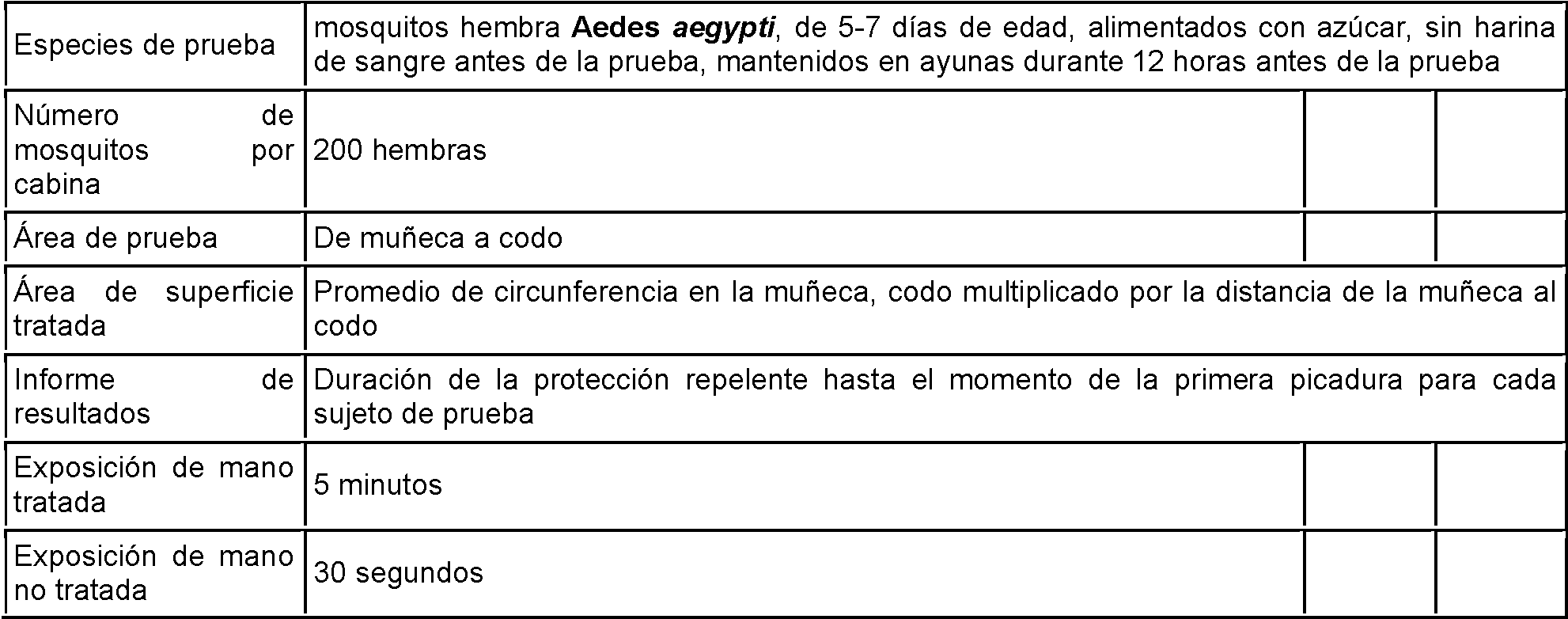
Los experimentos se llevaron a cabo en el centro internacional de excelencia, altamente experimentado, Ross Lifesciences, Pune, Maharashtra, India.The experiments were carried out at the highly experienced International Center of Excellence, Ross Lifesciences, Pune, Maharashtra, India.
Ejemplo 1 - Estudio de respuesta a la dosis de monoterapia (PMD activo - "Citrepel 75"); efectos del fijador (concentraciones bajas/medias de vanilina)Example 1 - Monotherapy dose response study (active PMD - "Citrepel 75"); fixative effects (low / medium vanillin concentrations)
Se planificaron experimentos con concentraciones de PMD que oscilaban de 10 a 50%, con al menos intervalos de 10% y a continuación se combinaron concentraciones específicas que oscilaban de 20%, 25% y 30% con 3 concentraciones individuales del fijador, vanilina. Se proporciona un resumen de los resultados en las Figuras 6 y 7. En estos experimentos, también se investigaron varios controles negativos (por ejemplo, la propia vanilina) o controles positivos (DEET y algunos otros).Experiments were planned with PMD concentrations ranging from 10 to 50%, with at least 10% intervals, and then specific concentrations ranging from 20%, 25%, and 30% were combined with 3 individual concentrations of the fixative, vanillin. A summary of the results is provided in Figures 6 and 7. In these experiments, various negative controls (eg vanillin itself) or positive controls (DEET and some others) were also investigated.
Se puede observar que los CPT de 12 horas se lograron de manera óptima con concentraciones de PMD de 30 a 40% y concentraciones de vanilina que oscilaban de 5 a 15%.It can be seen that 12-hour CPTs were optimally achieved with PMD concentrations of 30 to 40% and vanillin concentrations ranging from 5 to 15%.
Por lo tanto, los resultados del uso de concentraciones medias de PMD solo, como monoterapia, además de concentraciones bajas/medias de vanilina como fijador, proporcionaron el resultado objetivo sorprendentemente satisfactorio de CPT de 12 horas como mínimo. Los resultados se lograron sin la inclusión esperada y planificada de fijadores adicionales.Therefore, the results of using medium concentrations of PMD alone, as monotherapy, in addition to low / medium concentrations of vanillin as a fixative, provided the surprisingly satisfactory objective result of CPT of at least 12 hours. Results were achieved without the expected and planned inclusion of additional fixatives.
Cabe señalar que debido al control ético del estudio, el protocolo no permitía ni preveía la realización de pruebas de voluntarios por encima de las 12 horas, por lo que algunas pruebas planificadas se redujeron a 40% PMD y 15% de vanilina, por razones éticas. Los datos sugerirían que se podría alcanzar el incremento de los CPT por encima de las 12 horas a concentraciones más altas de PMD y/o vanilina, aunque ciertos estudios planificados a 40% y 50% no se completaron por estas consideraciones éticas descritas.It should be noted that due to the ethical control of the study, the protocol did not allow or anticipate the testing of volunteers above 12 hours, so some planned tests were reduced to 40% PMD and 15% vanillin, for ethical reasons. . The data would suggest that CPT increase above 12 hours could be achieved at higher concentrations of PMD and / or vanillin, although certain planned studies at 40% and 50% were not completed by these described ethical considerations.
El gran aumento muy sorprendente en los CPT observados es indicativo de una posible sinergia inesperada entre PMD y vanilina.The very surprising large increase in observed CPTs is indicative of a possible unexpected synergy between PMD and vanillin.
Un método simple pero fiable para evaluar las interacciones en los experimentos de combinación PMD/vanilina es calcular el llamado coeficiente de interacción farmacológica (CDI). Este cálculo establecerá si los principios están interactuando, de una de estas formas posibles: a) aditiva; b) antagónica; c) sinérgica.A simple but reliable method of evaluating interactions in PMD / vanillin combination experiments is to calculate the so-called pharmacological interaction coefficient (CDI). This calculation will establish whether the principles are interacting, in one of these possible ways: a) additive; b) antagonistic; c) synergistic.
El CDI se calcula como se muestra a continuación: CDI = AB/AxB - donde AB es el resultado para el producto combinado y A y B son los resultados separados para los componentes individuales.The CDI is calculated as shown below: CDI = AB / AxB - where AB is the result for the combined product and A and B are the separate results for the individual components.
Si CDI es <1, esto muestra sinergia. Si <0,7, esto muestra sinergia significativaIf CDI is <1, this shows synergy. If <0.7, this shows significant synergy
Si CDI = 1, en ese caso el efecto es aditivoIf CDI = 1, then the effect is additive
Si CDI > 1, en ese caso muestra antagonismo.If CDI> 1, then it shows antagonism.
Por lo tanto, para 20% PMD con 15% de vanilina, los datos experimentales muestran protección durante 7 h. Por lo tanto, CDI = 7/(2,5 x 3,07) = 0,912. Esto indica sinergia (débil) ya que CDI <1.Therefore, for 20% PMD with 15% vanillin, the experimental data show protection for 7 h. Therefore, CDI = 7 / (2.5 x 3.07) = 0.912. This indicates synergy (weak) since CDI <1.
Para 25% de PMD con 15% de vanilina, los datos experimentales muestran protección durante 9,3 h. For 25% PMD with 15% vanillin, the experimental data show protection for 9.3 h.
Por lo tanto, CDI = 9,3/(2,5 x 6,3) = 0,6. Esto indica una sinergia significativa ya que CDI <0,7.Therefore, CDI = 9.3 / (2.5 x 6.3) = 0.6. This indicates a significant synergy since CDI <0.7.
Debido a los truncamientos de la prueba, PMD 30%/vanilina 15% no se realizó debido a las limitaciones de la prueba por razones éticas.Due to test truncation, PMD 30% / vanillin 15% was not performed due to limitations of the test for ethical reasons.
Ejemplo 2 - Comparación de formulaciones de concentración óptima con marcas internacionales (India, Reino Unido, EE. UU.)Example 2 - Comparison of optimal concentration formulations with international brands (India, United Kingdom, USA)
Se emprendió un segundo conjunto de experimentos de laboratorio de Mano en Cabina (“Hand in Cage”) para comparar la "combinación optimizada" elegida de PMD (30%)/vanilina (10%) formulada en una solución hidroalcohólica con numerosas marcas líderes bien conocidas en el Reino Unido y Estados Unidos como se muestra en la Figura 8.A second set of Hand in Cage laboratory experiments was undertaken to compare the chosen "optimized combination" of PMD (30%) / vanillin (10%) formulated in a hydroalcoholic solution with numerous well-known leading brands. known in the United Kingdom and the United States as shown in Figure 8.
Se puede observar que la solución de prueba (NEO-INNOVA) es superior en términos de CPT observados a todas las principales marcas internacionales naturales y sintéticas con la excepción de una, una formulación DEET de liberación prolongada de alta concentración donde se demostró una equivalencia. Sin embargo, como ya se discutió, DEET tiene sus propios inconvenientes y existe un mayor deseo de utilizar repelentes de insectos naturales como se describió anteriormente en la presente memoria.It can be seen that the test solution (NEO-INNOVA) is superior in terms of observed CPT to all major international natural and synthetic brands with the exception of one, a high concentration DEET formulation where equivalency was demonstrated. However, as already discussed, DEET has its own drawbacks and there is an increased desire to use natural insect repellents as described herein above.
El CPT del control positivo (DEET 15%) fue de 4,5 horas.The CPT of the positive control (DEET 15%) was 4.5 hours.
Ejemplo 3: Respuesta a la dosis de PMD para el principio activo "Citriodiol" (bajas concentraciones de PMD) El tercer conjunto de experimentos demostró los resultados proporcionados a continuación para concentraciones más bajas de PMD que las pruebas anteriores con el "segundo" principio activo "Citriodiol", aprobado en el Reino Unido y Estados Unidos, y suministrado por la empresa Citrefine International Limited. Los resultados se muestran en la Figura 9.Example 3: PMD dose response for the active ingredient "Citriodiol" (low concentrations of PMD) The third set of experiments demonstrated the results provided below for lower concentrations of PMD than the previous tests with the "second" active ingredient "Citriodiol", approved in the United Kingdom and the United States, and supplied by Citrefine International Limited. The results are shown in Figure 9.
El éxito del fijador de vanilina se confirmó claramente a las concentraciones más bajas comercializadas de "Citrepel"/"Citriodiol" de 20% - 30%, equivalentes a 12,8% y 19,2% de PMD por sí solo, de la mezcla de producto concentrado.The success of the vanillin fixative was clearly confirmed at the lowest marketed concentrations of "Citrepel" / "Citriodiol" of 20% - 30%, equivalent to 12.8% and 19.2% PMD alone, of the mixture of concentrated product.
Cuando se compararon los diferentes principios activos utilizadas "Citrepel 75" y "Citriodiol" en términos de CPT observados, se observaron diferencias significativas a pesar de la información previa proporcionada por los dos proveedores separados del principio activo; este fue un resultado muy sorprendente, inesperado a partir de la bibliografía previa disponible.When the different active ingredients used "Citrepel 75" and "Citriodiol" were compared in terms of observed CPTs, significant differences were observed despite previous information provided by the two separate suppliers of the active ingredient; This was a very surprising, unexpected result from the previous bibliography available.
La segunda, y extremadamente importante diferencia práctica desde una perspectiva de formulación/optimización del producto, es que este conjunto de experimentos dio como resultado un efecto de "disminución" del fijador no observado previamente a las concentraciones más altas de PMD.The second, and extremely important practical difference from a product formulation / optimization perspective, is that this set of experiments resulted in a fixer "decrease" effect not previously observed at the highest PMD concentrations.
Por lo tanto, la elección de los niveles óptimos de fijador añadido puede variar significativamente dependiendo de la concentración y la formulación de PMD.Therefore, the choice of optimal levels of added fixative can vary significantly depending on the concentration and formulation of PMD.
Los resultados en la Figura 10 sugerirían que el segundo PMD activo, llamado "Citriodiol", ofrece mayor protección que el otro, "Citrepel 75", cuando se combina en este nuevo tipo de formulación.The results in Figure 10 would suggest that the second active PMD, called "Citriodiol", offers greater protection than the other, "Citrepel 75", when combined in this new type of formulation.
Para evaluar el alcance de las interacciones entre "Citriodiol" y la vanilina, se calcularon los CDI de las dos combinaciones de vanilina a 15%, una vez más, como se muestra a continuación.To assess the extent of interactions between "Citriodiol" and vanillin, the CDIs of the two combinations of vanillin were calculated at 15%, again, as shown below.
Coeficiente de interacciones farmacológicas (CDI):Pharmacological Interactions Coefficient (CDI):
CDI = Combinación AB / A x BCDI = Combination AB / A x B
Si CDI = <1, sinergiaIf CDI = <1, synergy
Si CDI = <0,7, sinergia significativaIf CDI = <0.7, significant synergy
Si CDI = 1, en ese caso el efecto es aditivoIf CDI = 1, then the effect is additive
Si CDI = > 1, en ese caso muestra antagonismo.If CDI => 1, then it shows antagonism.
Cifras para el cálculoFigures for calculation
Vanilina @ 15% [es decir V15] = 2,5 horasVanillin @ 15% [ie V 15 ] = 2.5 hours
"Citriodiol" @ 20% = 5,0 horas [C20%] "Citriodiol" @ 20% = 5.0 hours [C 20 %]
"Citriodiol" @ 30% = 7,5 horas [C30%]"Citriodiol" @ 30% = 7.5 hours [C 30 %]
Combinación 1 [C20% V15] = 9,0 horasCombination 1 [C 20 % V 15 ] = 9.0 hours
Combinación 2 [C30% V15] = 10,0 horasCombination 2 [C 30 % V 15 ] = 10.0 hours
Cálculos para la sinergiaSynergy calculations
1.one.
Combinación C20%V15 = 9 / 2,5 x 5,0 = 0,72 (sinergia)Combination C 20 % V 15 = 9 / 2.5 x 5.0 = 0.72 (synergy)
2.two.
Combinación C30%V15 = 10 / 2,5 x 7,5 = 0,53 (sinergia significativa) Parece que "Citriodiol" ofrece la posibilidad de reducir la concentración final óptima de PMD al tiempo que ofrece un producto con un CPT de 12 horas.Combination C 30 % V 15 = 10 / 2.5 x 7.5 = 0.53 (significant synergy) It appears that "Citriodiol" offers the possibility to reduce the optimal final concentration of PMD while offering a product with a CPT of 12 hours.
Ejemplo 4 - Pruebas de estabilidadExample 4 - Stability tests
Uno de los problemas potenciales que experimentaron los autores de la presente invención con el uso de la vanilina fue su fotosensibilización y susceptibilidad a la decoloración. Esto debía ser abordado si los autores de la presente invención podían avanzar con los resultados sinérgicos que lograron como resultado de la inclusión de la vanilina. Las composiciones de acuerdo con la presente invención que incluyen vanilina (pero sin aditivo para evitar la decoloración) se expusieron a las primeras condiciones de prueba estabilizadas descritas por las actuales Regulaciones de Productos Biocidas 528/2012. Las condiciones aceleradas de primera línea recomiendan realizar pruebas a 54°C durante 14 días (véase BPR 528/2012: Volumen I. Parte A, Capítulo III: Requirements for Biocide Products, Versión 1.1 Noviembre de 2014).One of the potential problems that the authors of the present invention experienced with the use of vanillin was its photosensitization and susceptibility to discoloration. This had to be addressed if the authors of the present invention could move forward with the synergistic results they achieved as a result of the inclusion of vanillin. Compositions according to the present invention that include vanillin (but without additive to prevent discoloration) were exposed to the first stabilized test conditions described by current Biocide Product Regulations 528/2012. Accelerated first-line conditions recommend testing at 54 ° C for 14 days (see BPR 528/2012: Volume I. Part A, Chapter III: Requirements for Biocide Products, Version 1.1 November 2014).
La fotosensibilización y la oxidación secundaria de la vanilina se observaron tanto a temperatura ambiente como a 54°C como se ilustra en las Figuras 11 y 12.Photosensitization and secondary oxidation of vanillin were observed at both room temperature and 54 ° C as illustrated in Figures 11 and 12.
En consecuencia, se llevaron a cabo una serie de otras pruebas con una variedad de antioxidantes actualmente favorecidos, incluidos los resultados de BHA, BHT y galato de propilo que también fueron negativos con varios de estos antioxidantes probados con una excepción significativa, a saber, bisulfito de sodio, como se demuestra en la Figura 13.Consequently, a number of other tests were conducted with a variety of currently favored antioxidants, including results for BHA, BHT, and propyl gallate that were also negative with several of these antioxidants tested with one significant exception, namely bisulfite. sodium, as shown in Figure 13.
A la vista de los resultados anteriores con bisulfito de sodio, se realizaron pruebas adicionales con "Citriodiol" como principio activo. El objetivo de los nuevos estudios de eficacia era confirmar que la adición de 1% de antioxidante no tenía ningún efecto perjudicial sobre la eficacia. Fue aún más sorprendente encontrar que se demostró una mejora aún más significativa en la eficacia como se muestra en la Figura 14.In view of the above results with sodium bisulfite, additional tests were carried out with "Citriodiol" as the active ingredient. The aim of the new efficacy studies was to confirm that the addition of 1% antioxidant had no detrimental effect on efficacy. It was even more surprising to find that an even more significant improvement in efficacy was demonstrated as shown in Figure 14.
Esta mejora totalmente inesperada en los CPT demuestra claramente la doble ventaja de añadir el excipiente preferido, bisulfito de sodio, a la formulación optimizada final, es decir, un efecto adicional a sus propiedades antioxidantes previstas.This totally unexpected improvement in CPTs clearly demonstrates the dual advantage of adding the preferred excipient, sodium bisulfite, to the final optimized formulation, that is, an additional effect to its intended antioxidant properties.
Aunque el mecanismo exacto de este efecto inesperado aún no se ha aclarado por completo, el bisulfito de sodio muy probablemente reacciona con la vanilina para formar aductos. Este es un mecanismo muy diferente a la forma en que otros antioxidantes, tales como el tocoferol, podrían estabilizar la vanilina.Although the exact mechanism of this unexpected effect has not yet been fully clarified, sodium bisulfite most likely reacts with vanillin to form adducts. This is a very different mechanism than how other antioxidants, such as tocopherol, could stabilize vanillin.
Ejemplo 5 - Pruebas con concentraciones más altas de "Citriodiol" (40% y 47%)Example 5 - Tests with higher concentrations of "Citriodiol" (40% and 47%)
Además de demostrar tiempos de protección (CPT) muy por encima de cualquier otro visto anteriormente con repelentes naturales (incluido el propio PMD), los resultados con 40 y 47% de "Citriodiol", como se ilustra en las Figuras 15 y 16, superan todos los demostrados con productos químicos sintéticos (incluyendo el propio DEET). La conclusión obvia de estos resultados es que se pueden lograr CPT considerablemente superiores al objetivo original de 12 horas utilizando el principio activo "Citriodiol" a concentraciones de 40% (alrededor de 25,6% p Md ) y 47% (alrededor de 30% PMD). Evidentemente, tales CPT están muchas horas por delante de los resultados vistos previamente con PMD o cualquier otra combinación repelente natural, la gran mayoría de las formulaciones sintéticas, incluido el propio DEET.In addition to demonstrating protection times (CPT) well above any other previously seen with natural repellents (including PMD itself), the results with 40 and 47% of "Citriodiol", as illustrated in Figures 15 and 16, exceed all demonstrated with synthetic chemicals (including DEET itself). The obvious conclusion of these results is that CPT significantly higher than the original 12-hour target can be achieved using the active ingredient "Citriodiol" at concentrations of 40% (about 25.6% wt Md) and 47% (about 30% PMD). Obviously, such CPTs are many hours ahead of the results previously seen with PMD or any other natural repellent combination, the vast majority of synthetic formulations, including DEET itself.
Resumen de los ejemplos (especie Aedes aegypti) Summary of the examples ( Aedes aegypti species )
Por lo tanto, para resumir, los ejemplos anteriores frente a la especie Aedes aegypti han confirmado ciertos resultados inequívocos, incluyendo el resultado clave de que la vanilina a concentraciones medias (<15%) puede actuar como un fijador altamente eficaz y prolongar la acción repelente de PMD más allá de las 6 horas para lograr 12 horas o más de repelencia.Therefore, to summarize, the previous examples against the Aedes aegypti species have confirmed certain unequivocal results, including the key result that vanillin at medium concentrations (<15%) can Act as a highly effective fixative and prolong PMD's repellent action beyond 6 hours to achieve 12 hours or more of repellency.
Ejemplo 6 - Pruebas de eficacia (mano en cabina) con el mosquito vector Culex Example 6 - Efficacy tests (hand in cabin) with the Culex vector mosquito
Se realizó una prueba contra una especie de de mosquito vector diferente, Culex que ha causado daños considerables en Estados Unidos; es el vector que está vinculado al problemático virus del Nilo Occidental.A test was conducted against a different vector mosquito species, Culex that has caused considerable damage in the United States; it is the vector that is linked to the troublesome West Nile virus.
A diferencia de la especie vectora Aedes aegypti, Culex es predominantemente un "picador nocturno", por lo que estas pruebas se realizaron con voluntarios que permanecieron en el laboratorio durante la noche.Unlike the vector species Aedes aegypti, Culex is predominantly a "night bite", so these tests were performed on volunteers who stayed in the laboratory overnight.
La formulación de prueba seleccionada para este experimento fue la formulación "Citriodiol" 40%/vanilina 10% que se había investigado previamente en el programa de prueba con Aedes. Las formulaciones se prepararon como sigue. The test formulation selected for this experiment was the "Citriodiol" 40% / vanillin 10% formulation that had previously been investigated in the Aedes test program . The formulations were prepared as follows.

La mediana de CPT observada contra Culex también se muestra en la Figura 17. Se puede observar que la tecnología de acción prolongada utilizada con PMD brinda resultados de protección positivos adicionales en comparación con Culex dado que el nivel de protección es de hecho superior a 12 horas con el resultado de la mediana de CPT a las 15 horas.The median CPT observed against Culex is also shown in Figure 17. It can be seen that the long acting technology used with PMD provides additional positive protection results compared to Culex since the level of protection is in fact greater than 12 hours with the result of the median CPT at 15 hours.
La preparación de la muestra y el protocolo de prueba fueron los siguientes:Sample preparation and test protocol were as follows:
Secuencia seguida para la preparación de la muestra:Sequence followed for sample preparation:
La solución de bisulfito de sodio se preparó disolviendo 1 g de bisulfito de sodio (Núm. CAS 7631-90-5) en 65 g de agua y 35 g de IPA (alcohol isopropílico, núm. CAS 67-63-0) y se obtuvo una solución transparente agitándola durante 15-20 minutos.The sodium bisulfite solution was prepared by dissolving 1 g of sodium bisulfite (CAS No. 7631-90-5) in 65 g of water and 35 g of IPA (isopropyl alcohol, CAS No. 67-63-0) and obtained a clear solution by shaking it for 15-20 minutes.
Secuencia de adición:Addition sequence:
Se agitaron IPA "Citriodiol" (que contenía 70,9% de PMD) durante 5 minutos.IPA "Citriodiol" (containing 70.9% PMD) was stirred for 5 minutes.
Se añadió agua, seguida de vanilina (Código 140821000). La mezcla se agitó durante 15 minutos.Water was added, followed by vanillin (Code 140821000). The mixture was stirred for 15 minutes.
Se añadió solución de 1% de bisulfito de sodio y la mezcla se agitó durante 10-15 minutos para obtener una solución transparente.1% sodium bisulfite solution was added and the mixture was stirred for 10-15 minutes to obtain a clear solution.
Método para el estudio de la mano en cabina:Method for studying the hand in the cabin:
Se utilizaron para los estudios hembras adultas de mosquitos Aedes aegypti alimentadas con 10% de sacarosa y sin harina de sangre antes de la prueba.Adult female Aedes aegypti mosquitoes fed 10% sucrose and without blood meal were used for the studies prior to testing.
El tiempo de protección completo proporcionado por cada producto se evaluó siguiendo los estudios de mano en cabina de acuerdo con un protocolo modificado de la OMS (Ht M/NTD/WHOPES/2009.4).The complete protection time provided by each product was evaluated following the cabin hand studies according to a modified WHO protocol ( Ht M / NTD / WHOPES / 2009.4).
Por lo general, la prueba consistió en insertar un brazo tratado con repelente en una cabina que media 35 cm por cada lado, que contenía un número 200 mosquitos Aedes aegypti no alimentados con sangre criados en laboratorio que tenían aproximadamente 5-7 días de edad y se determinó el tiempo transcurrido hasta el primer aterrizaje o sondeo (que se refiere a un aterrizaje del insecto y la penetración en la piel con sus piezas bucales, sin ingerir sangre).The test generally consisted of inserting a repellent-treated arm into a cabin measuring 35 cm on each side, containing a number of 200 laboratory-bred non-blood-fed Aedes aegypti mosquitoes that were approximately 5-7 days old and the time elapsed until the first landing or sounding (which refers to a landing of the insect and the penetration of the skin with its mouthparts, without ingesting blood) was determined.
Todos los productos que fueron adquiridos fueron enmascarados y codificados antes de entregarlos para la prueba. En el caso de pulverizadores/lociones, se aplicó 1 g de producto a 600 cm cuadrados del área entre la muñeca y el codo de la piel del antebrazo de los sujetos de prueba.All products that were purchased were masked and coded prior to delivery for testing. In the case of sprays / lotions, 1 g of product was applied to 600 square cm of the area between the wrist and the elbow of the forearm skin of the test subjects.
Las cabinas se colocaron en una cámara de vidrio de 30 metros cúbicos en donde la temperatura ambiente se mantuvo a 27 ± 2°C y una humedad relativa de 80 ± 10%.The cabins were placed in a 30 cubic meter glass chamber where the ambient temperature was maintained at 27 ± 2 ° C and a relative humidity of 80 ± 10%.
Las pruebas se realizaron durante el día con un número de 4-6 voluntarios con el mismo número para cada género. En caso de mosquitos Culex se realizaron pruebas desde el anochecer hasta el amanecer, que es el momento pico de picadura de esta especie de mosquitos. Los voluntarios pertenecían al grupo de edad de 22 a 50 años y se seleccionaron basándose en el consentimiento informado firmado antes de la participación. Los sujetos de prueba recibieron instrucciones de evitar el alcohol, la cafeína y los productos de fragancia 12 horas antes y durante la prueba. Para los sujetos tratados y no tratados, los antebrazos se lavaron con jabón sin perfume, se enjuagaron con agua y después se lavaron con una solución de 70% de alcohol y 30% de agua y se secaron con una toalla limpia. Después de la aplicación del repelente, los sujetos recibieron instrucciones de no frotar, tocar o mojar el brazo tratado. Los sujetos se sentaron en una sala con una temperatura mantenida a 27 ± 2°C y una humedad relativa de alrededor de 80 ± 10% para evitar el calor excesivo y la sudoración.The tests were performed during the day with a number of 4-6 volunteers with the same number for each gender. In the case of Culex mosquitoes, tests were carried out from dusk to dawn, which is the peak moment of bite of this mosquito species. The volunteers belonged to the age group of 22 to 50 years and were selected based on the signed informed consent before participation. Test subjects were instructed to avoid alcohol, caffeine, and fragrance products 12 hours before and during the test. For the treated and untreated subjects, the forearms were washed with unscented soap, rinsed with water and then washed with a 70% alcohol and 30% water solution and dried with a clean towel. After repellent application, subjects were instructed not to rub, touch, or wet the treated arm. Subjects sat in a room with a temperature maintained at 27 ± 2 ° C and a relative humidity of around 80 ± 10% to avoid excessive heat and sweating.
La disponibilidad de los mosquitos para picar (presión de picadura) se verificó insertando el brazo no tratado durante 1 minuto antes de insertar el brazo tratado a intervalos de 30 minutos cada uno. Se mantuvo una cabina separada para el brazo del voluntario no tratado (control) y los sujetos de prueba para verificar la presión de picadura. Se consideró cinco o más aterrizajes en un minuto en el brazo no tratado el umbral correcto para iniciar la prueba con el brazo tratado. La prueba se realizó a intervalos de 30 minutos manteniendo el brazo tratado en la cabina que contenía los mosquitos durante 3 minutos, para determinar la actividad de aterrizaje o sondeo. Este procedimiento se repitió continuamente cada 30 minutos hasta que se observó el primer aterrizaje o sondeo. El tiempo de protección completa se calculó como el número de minutos (u horas) transcurridos entre el momento de la aplicación del repelente y el primer aterrizaje o sondeo del mosquito. El Tiempo de Protección Completa (CPT) se informó como una mediana del valor del tiempo de protección proporcionado por cada individuo. The availability of mosquitoes to bite (bite pressure) was verified by inserting the untreated arm for 1 minute before inserting the treated arm at intervals of 30 minutes each. A separate booth was maintained for the arm of the untreated volunteer (control) and test subjects to verify bite pressure. Five or more landings in one minute in the untreated arm were considered the correct threshold to start the test with the treated arm. The test was performed at 30 minute intervals keeping the treated arm in the cabin containing the mosquitoes for 3 minutes, to determine the landing or sounding activity. This procedure was repeated continuously every 30 minutes until the first landing or sounding was observed. The complete protection time was calculated as the number of minutes (or hours) elapsed between the time of repellent application and the first landing or sounding of the mosquito. The Complete Protection Time (CPT) was reported as a median of the protection time value provided by each individual.
Ejemplo 7 - Composición de acuerdo con la presente invenciónExample 7 - Composition according to the present invention
Se preparó una composición de acuerdo con la presente invención basándose en lo siguiente.A composition according to the present invention was prepared based on the following.
"'Citriodiol" 40% (PMD - mínimo 25%)"'Citriodiol" 40% (PMD - minimum 25%)
Vanilina 10%Vanillin 10%
Alcohol isopropílico alrededor de 40%Isopropyl alcohol about 40%
Bisulfito de sodio 1%1% sodium bisulfite
Agua hasta 100%Water up to 100%
ReferenciasReferences
1. Rodriguez SD et al. The Efficacy of Some Commercially Available Insect Repellents for Aedes Aegypti (Diptera: Culicidae) and Aedes albopictus (Diptera: Culicidae). J. Insect Sci. (2015) 15(1)1. Rodriguez SD et al. The Efficacy of Some Commercially Available Insect Repellents for Aedes Aegypti (Diptera: Culicidae) and Aedes albopictus (Diptera: Culicidae). J. Insect Sci. (2015) 15 (1)
2. Goodyear et al. Expert Review of the Evidence Base for Arthropod Bite Avoidance. Journal of Travel Medicine 2010; Volumen 17 (Edición 3): 182-1922. Goodyear et al. Expert Review of the Evidence Base for Arthropod Bite Avoidance. Journal of Travel Medicine 2010; Volume 17 (Edition 3): 182-192
3. Gupta et al. Laboratory Evaluation of Controlled-Release Repellent Formulations on Human Volunteers Under Three Climatic Regimens. Journal of the American Mosquito Control Association Vol.5, Núm. I Marzo 19893. Gupta et al. Laboratory Evaluation of Controlled-Release Repellent Formulations on Human Volunteers Under Three Climatic Regimens. Journal of the American Mosquito Control Association Vol. 5, No. I March 1989
4. Khan et al. Addition of Vanillin to Mosquito Repellents to Increase Protection Time. Mosquito News Junio 1975. Vol. 35 Núm. 2 pág. 223-2254. Khan et al. Addition of Vanillin to Mosquito Repellents to Increase Protection Time. Mosquito News June 1975. Vol. 35 No. 2 p. 223-225
5. Goodyear et al. Short Report: The Safety and Toxicity of Insect Repellents. Am. J. Trop. Med. Hyg., 59(2), 1998, pág. 323-3245. Goodyear et al. Short Report: The Safety and Toxicity of Insect Repellents. Am. J. Trop. Med. Hyg., 59 (2), 1998, p. 323-324
6. Hill et al. Randomised, double-blind control trial of p-menthane diol repellent against malaria in Bolivia. BMJ 2007; 335:1023.6. Hill et al. Randomized, double-blind control trial of p-menthane diol repellent against malaria in Bolivia. BMJ 2007; 335: 1023.
7. Buescher et al. The Dose-Persistence Relationship of DEET Against Aedes Aegypti. Mosquito News Vol. 43, Núm. 31983.7. Buescher et al. The Dose-Persistence Relationship of DEET Against Aedes Aegypti. Mosquito News Vol. 43, No. 31983.
8. Maia et al. Plant-based insect repellents: a review of their efficacy, development and testing. Malaria Journal 2011, 10(Supl 1):S118. Maia et al. Plant-based insect repellents: a review of their efficacy, development and testing. Malaria Journal 2011, 10 (Suppl 1): S11
9. Carroll et al. a registered botanical mosquito repellent with DEET-like efficacy. J Am Mosq Control Assoc 2006; 22:507-514.9. Carroll et al. a registered botanical mosquito repellent with DEET-like efficacy. J Am Mosq Control Assoc 2006; 22: 507-514.
10. Moore et al. Field Evaluation of three plant-based insect repellents against malaria vectors in Vaca Diez Province, the Bolivian Amazon. J Am Mosq Control Assoc. 2002 Junio; 18(2):107-1010. Moore et al. Field Evaluation of three plant-based insect repellents against malaria vectors in Vaca Diez Province, the Bolivian Amazon. J Am Mosq Control Assoc. 2002 June; 18 (2): 107-10
11. Trigg et al. Evaluation of a Eucalyptus-based Repellent Against Anopheles Spp. In Tanzania. Journal of American Mosquito Control Association, 12(2):243-246, 199611. Trigg et al. Evaluation of a Eucalyptus-based Repellent Against Anopheles Spp. In Tanzania. Journal of American Mosquito Control Association, 12 (2): 243-246, 1996
12. Govere et al. Efficacy of three insect repellents against the malaria vector Anopheles arabiensis. Medical and Veterinary Entomology (2000) 14, 441-44412. Govere et al. Efficacy of three insect repellents against the malaria vector Anopheles arabiensis. Medical and Veterinary Entomology (2000) 14, 441-444
13. Barnard et al. Laboratory evaluation of mosquito repellents against Aedes albopictus, Culex nigripalpus, and Ochlerotatus triseriatus (Diptera: Culicidae). J Med Entomol 2004; 41:726-730. 13. Barnard et al. Laboratory evaluation of mosquito repellents against Aedes albopictus, Culex nigripalpus, and Ochlerotatus triseriatus (Diptera: Culicidae). J Med Entomol 2004; 41: 726-730.
14. Trigg et al. Laboratory evaluation of a eucalyptusbased repellent against four biting arthropods. Phytother Res 1996; 10:313-316.14. Trigg et al. Laboratory evaluation of a eucalyptusbased repellent against four biting arthropods. Phytother Res 1996; 10: 313-316.
15. Durnez et al. Residual Transmission of Malaria: An Old Issue for New Approaches. Intech Open Access Article 2013 15. Durnez et al. Residual Transmission of Malaria: An Old Issue for New Approaches. Intech Open Access Article 2013
Claims (26)
Applications Claiming Priority (3)
| Application Number | Priority Date | Filing Date | Title |
|---|---|---|---|
| GBGB1519781.7A GB201519781D0 (en) | 2015-11-10 | 2015-11-10 | Insect repellents |
| GB1617161.3A GB2559537A (en) | 2016-10-10 | 2016-10-10 | Insect repellent composition and method of use |
| PCT/GB2016/053430 WO2017081445A1 (en) | 2015-11-10 | 2016-11-04 | Insect repellent composition and method of use |
Publications (1)
| Publication Number | Publication Date |
|---|---|
| ES2764555T3 true ES2764555T3 (en) | 2020-06-03 |
Family
ID=57256363
Family Applications (1)
| Application Number | Title | Priority Date | Filing Date |
|---|---|---|---|
| ES16793996T Active ES2764555T3 (en) | 2015-11-10 | 2016-11-04 | Insect repellent composition and method of use |
Country Status (9)
| Country | Link |
|---|---|
| US (2) | US10064407B2 (en) |
| EP (1) | EP3370521B1 (en) |
| AU (2) | AU2016352072C1 (en) |
| BR (1) | BR112018009513B1 (en) |
| CA (1) | CA3004810C (en) |
| ES (1) | ES2764555T3 (en) |
| SG (1) | SG11201803947VA (en) |
| WO (1) | WO2017081445A1 (en) |
| ZA (1) | ZA201803789B (en) |
Families Citing this family (10)
| Publication number | Priority date | Publication date | Assignee | Title |
|---|---|---|---|---|
| GB2559537A (en) * | 2016-10-10 | 2018-08-15 | Neo Innova Healthcare Ltd | Insect repellent composition and method of use |
| ES2764555T3 (en) | 2015-11-10 | 2020-06-03 | Neo Innova Healthcare Ltd | Insect repellent composition and method of use |
| GB2581375A (en) * | 2019-02-14 | 2020-08-19 | Neo Innova Healthcare Ltd | Insect repellent compositions and methods of use |
| WO2020202567A1 (en) | 2019-04-05 | 2020-10-08 | 株式会社Ihi原動機 | Vibro-acoustic analysis method and device and equipment-abnormality-location estimation method and device |
| SI3763212T1 (en) | 2019-07-11 | 2022-01-31 | Sanderstrothmann Gmbh | Arthropoda repellent composition |
| CN110360468B (en) * | 2019-07-30 | 2020-08-04 | 广东祥新光电科技有限公司 | Spectrum cutting L ED mosquito repelling bulb and preparation method thereof |
| EP4228408A4 (en) * | 2020-10-16 | 2024-09-25 | Sensorygen, Inc. | PESTICIDES AND USES THEREOF |
| FI130620B (en) | 2021-05-20 | 2023-12-15 | Aabo Akademi | Insect repellent composition and a method of repelling insects |
| AU2022399868A1 (en) | 2021-11-30 | 2024-06-20 | Glycoscience, S.L. | Slow-release formulation |
| EP4646930A1 (en) | 2024-05-10 | 2025-11-12 | Glycoscience, S.L. | Long-duration formulation |
Family Cites Families (4)
| Publication number | Priority date | Publication date | Assignee | Title |
|---|---|---|---|---|
| CA2567246A1 (en) * | 2004-05-20 | 2005-12-01 | Nelson Mandela Metropolitan University | Insect repellent compositions |
| US7846464B2 (en) * | 2006-01-16 | 2010-12-07 | Darling Samuel T | Insect repellent composition |
| JO3626B1 (en) | 2012-02-23 | 2020-08-27 | Merial Inc | Topical formulations containing fipronil and permethrin and how to use them |
| ES2764555T3 (en) | 2015-11-10 | 2020-06-03 | Neo Innova Healthcare Ltd | Insect repellent composition and method of use |
-
2016
- 2016-11-04 ES ES16793996T patent/ES2764555T3/en active Active
- 2016-11-04 WO PCT/GB2016/053430 patent/WO2017081445A1/en not_active Ceased
- 2016-11-04 EP EP16793996.6A patent/EP3370521B1/en not_active Not-in-force
- 2016-11-04 CA CA3004810A patent/CA3004810C/en active Active
- 2016-11-04 SG SG11201803947VA patent/SG11201803947VA/en unknown
- 2016-11-04 BR BR112018009513-3A patent/BR112018009513B1/en not_active IP Right Cessation
- 2016-11-04 AU AU2016352072A patent/AU2016352072C1/en not_active Ceased
-
2017
- 2017-08-08 US US15/671,712 patent/US10064407B2/en active Active
-
2018
- 2018-06-07 ZA ZA2018/03789A patent/ZA201803789B/en unknown
- 2018-08-23 US US16/110,815 patent/US10617117B2/en not_active Expired - Fee Related
- 2018-11-16 AU AU2018264128A patent/AU2018264128A1/en not_active Abandoned
Also Published As
| Publication number | Publication date |
|---|---|
| BR112018009513B1 (en) | 2022-10-25 |
| CA3004810A1 (en) | 2017-05-18 |
| US20190037840A1 (en) | 2019-02-07 |
| EP3370521A1 (en) | 2018-09-12 |
| WO2017081445A1 (en) | 2017-05-18 |
| US10617117B2 (en) | 2020-04-14 |
| AU2016352072B2 (en) | 2018-08-16 |
| AU2016352072A1 (en) | 2018-06-07 |
| US10064407B2 (en) | 2018-09-04 |
| CA3004810C (en) | 2020-08-11 |
| ZA201803789B (en) | 2019-06-26 |
| BR112018009513A2 (en) | 2019-03-19 |
| EP3370521B1 (en) | 2019-10-02 |
| AU2016352072C1 (en) | 2019-09-19 |
| SG11201803947VA (en) | 2018-06-28 |
| AU2018264128A1 (en) | 2018-12-06 |
| US20170354141A1 (en) | 2017-12-14 |
Similar Documents
| Publication | Publication Date | Title |
|---|---|---|
| ES2764555T3 (en) | Insect repellent composition and method of use | |
| ES2574562T3 (en) | Insect repellent composition | |
| ES2928440T3 (en) | Composition and arthropod control procedure | |
| ES2979045T3 (en) | Insect repellent compounds and compositions and associated processes | |
| BR112020019197A2 (en) | NATURAL MOSQUITO REPELLENT | |
| ES2619839T3 (en) | Compositions comprising Citrus flavonoids and specific cationic surfactants to treat head lice infestations | |
| ES2632642T3 (en) | Pest repellent agents comprising geranylacetone | |
| EP3457847B1 (en) | A lice killing agent | |
| JP2014205648A (en) | Ixodes repelling efficacy promoter, method of repelling ixodes using ixodes repelling composition containing the same | |
| US20100310685A1 (en) | Pupicidal and larvicidal composition | |
| JP6095427B2 (en) | Tick repellent efficacy enhancer and tick repellent method using tick repellent composition containing the same | |
| GB2559537A (en) | Insect repellent composition and method of use | |
| RU2077315C1 (en) | Antipediculosis agent | |
| KR19990064461A (en) | Moistened tissue for repelling mosquito and vermin | |
| Mohammed Althowf et al. | Formulation and Evaluation of Poly Herbal Mosquito Repellent Cream | |
| US2089766A (en) | Insecticide | |
| ES2678493A1 (en) | MOSQUITO NATURAL REPELLENT (Machine-translation by Google Translate, not legally binding) | |
| BR102016016720A2 (en) | chemical compositions which have a synergistic effect on insect repellency in personal care products, cosmetics for animals, animals and inanimate surfaces in general | |
| ES2574535B1 (en) | Insecticidal composition | |
| JP2018138531A (en) | Biting/stinging damage prevention method of bee and horsefly | |
| CN102726387A (en) | Mosquito repellent spray and preparation method thereof | |
| CN120436126A (en) | A plant-derived mosquito repellent composition | |
| Trongtokit et al. | Plant extracts in prevention of mosquito attacks. | |
| Stelinski | Towards high-performance mating disruption of tortricids in Michigan |