ES2769952B2 - PROCEDURE FOR THE ENANTIOMERIC CONVERSION OF CALCIPOTRIOL INTERMEDIATES AND CORRESPONDING USE - Google Patents
PROCEDURE FOR THE ENANTIOMERIC CONVERSION OF CALCIPOTRIOL INTERMEDIATES AND CORRESPONDING USE Download PDFInfo
- Publication number
- ES2769952B2 ES2769952B2 ES201831299A ES201831299A ES2769952B2 ES 2769952 B2 ES2769952 B2 ES 2769952B2 ES 201831299 A ES201831299 A ES 201831299A ES 201831299 A ES201831299 A ES 201831299A ES 2769952 B2 ES2769952 B2 ES 2769952B2
- Authority
- ES
- Spain
- Prior art keywords
- process according
- acid
- mixture
- inverted
- isomer
- Prior art date
- Legal status (The legal status is an assumption and is not a legal conclusion. Google has not performed a legal analysis and makes no representation as to the accuracy of the status listed.)
- Active
Links
- 238000000034 method Methods 0.000 title claims description 39
- LWQQLNNNIPYSNX-UROSTWAQSA-N calcipotriol Chemical compound C1([C@H](O)/C=C/[C@@H](C)[C@@H]2[C@]3(CCCC(/[C@@H]3CC2)=C\C=C\2C([C@@H](O)C[C@H](O)C/2)=C)C)CC1 LWQQLNNNIPYSNX-UROSTWAQSA-N 0.000 title claims description 6
- 229960002882 calcipotriol Drugs 0.000 title claims description 6
- 238000006243 chemical reaction Methods 0.000 title description 20
- 239000000543 intermediate Substances 0.000 title description 2
- YXFVVABEGXRONW-UHFFFAOYSA-N Toluene Chemical compound CC1=CC=CC=C1 YXFVVABEGXRONW-UHFFFAOYSA-N 0.000 claims description 45
- YMWUJEATGCHHMB-UHFFFAOYSA-N Dichloromethane Chemical compound ClCCl YMWUJEATGCHHMB-UHFFFAOYSA-N 0.000 claims description 35
- 230000008569 process Effects 0.000 claims description 30
- 239000000203 mixture Substances 0.000 claims description 29
- LFQSCWFLJHTTHZ-UHFFFAOYSA-N Ethanol Chemical compound CCO LFQSCWFLJHTTHZ-UHFFFAOYSA-N 0.000 claims description 27
- XYFCBTPGUUZFHI-UHFFFAOYSA-N Phosphine Chemical compound P XYFCBTPGUUZFHI-UHFFFAOYSA-N 0.000 claims description 18
- GQHTUMJGOHRCHB-UHFFFAOYSA-N 2,3,4,6,7,8,9,10-octahydropyrimido[1,2-a]azepine Chemical compound C1CCCCN2CCCN=C21 GQHTUMJGOHRCHB-UHFFFAOYSA-N 0.000 claims description 17
- 150000001298 alcohols Chemical class 0.000 claims description 15
- 239000002253 acid Substances 0.000 claims description 14
- 230000007062 hydrolysis Effects 0.000 claims description 14
- 238000006460 hydrolysis reaction Methods 0.000 claims description 14
- TUQOTMZNTHZOKS-UHFFFAOYSA-N tributylphosphine Chemical compound CCCCP(CCCC)CCCC TUQOTMZNTHZOKS-UHFFFAOYSA-N 0.000 claims description 13
- 150000002148 esters Chemical class 0.000 claims description 11
- 125000002887 hydroxy group Chemical group [H]O* 0.000 claims description 10
- UHOVQNZJYSORNB-UHFFFAOYSA-N Benzene Chemical compound C1=CC=CC=C1 UHOVQNZJYSORNB-UHFFFAOYSA-N 0.000 claims description 9
- 229910000073 phosphorus hydride Inorganic materials 0.000 claims description 9
- 239000002904 solvent Substances 0.000 claims description 8
- HEDRZPFGACZZDS-UHFFFAOYSA-N Chloroform Chemical compound ClC(Cl)Cl HEDRZPFGACZZDS-UHFFFAOYSA-N 0.000 claims description 6
- 150000001412 amines Chemical class 0.000 claims description 6
- 125000001981 tert-butyldimethylsilyl group Chemical group [H]C([H])([H])[Si]([H])(C([H])([H])[H])[*]C(C([H])([H])[H])(C([H])([H])[H])C([H])([H])[H] 0.000 claims description 6
- RIOQSEWOXXDEQQ-UHFFFAOYSA-N triphenylphosphine Chemical compound C1=CC=CC=C1P(C=1C=CC=CC=1)C1=CC=CC=C1 RIOQSEWOXXDEQQ-UHFFFAOYSA-N 0.000 claims description 6
- -1 aromatic organic acid Chemical class 0.000 claims description 5
- 125000003118 aryl group Chemical group 0.000 claims description 4
- 238000004587 chromatography analysis Methods 0.000 claims description 4
- 230000032050 esterification Effects 0.000 claims description 4
- 238000005886 esterification reaction Methods 0.000 claims description 4
- BWHDROKFUHTORW-UHFFFAOYSA-N tritert-butylphosphane Chemical compound CC(C)(C)P(C(C)(C)C)C(C)(C)C BWHDROKFUHTORW-UHFFFAOYSA-N 0.000 claims description 4
- XEZNGIUYQVAUSS-UHFFFAOYSA-N 18-crown-6 Chemical compound C1COCCOCCOCCOCCOCCO1 XEZNGIUYQVAUSS-UHFFFAOYSA-N 0.000 claims description 3
- 230000001476 alcoholic effect Effects 0.000 claims description 3
- 150000001875 compounds Chemical class 0.000 claims description 3
- OQJBFFCUFALWQL-UHFFFAOYSA-N n-(piperidine-1-carbonylimino)piperidine-1-carboxamide Chemical compound C1CCCCN1C(=O)N=NC(=O)N1CCCCC1 OQJBFFCUFALWQL-UHFFFAOYSA-N 0.000 claims description 3
- 239000012454 non-polar solvent Substances 0.000 claims description 3
- SGUVLZREKBPKCE-UHFFFAOYSA-N 1,5-diazabicyclo[4.3.0]-non-5-ene Chemical compound C1CCN=C2CCCN21 SGUVLZREKBPKCE-UHFFFAOYSA-N 0.000 claims description 2
- 125000001072 heteroaryl group Chemical group 0.000 claims description 2
- 150000007524 organic acids Chemical class 0.000 claims description 2
- 239000011877 solvent mixture Substances 0.000 claims description 2
- 125000000037 tert-butyldiphenylsilyl group Chemical group [H]C1=C([H])C([H])=C([H])C([H])=C1[Si]([H])([*]C(C([H])([H])[H])(C([H])([H])[H])C([H])([H])[H])C1=C([H])C([H])=C([H])C([H])=C1[H] 0.000 claims description 2
- COIOYMYWGDAQPM-UHFFFAOYSA-N tris(2-methylphenyl)phosphane Chemical compound CC1=CC=CC=C1P(C=1C(=CC=CC=1)C)C1=CC=CC=C1C COIOYMYWGDAQPM-UHFFFAOYSA-N 0.000 claims description 2
- 125000003808 silyl group Chemical group [H][Si]([H])([H])[*] 0.000 claims 2
- 238000000926 separation method Methods 0.000 claims 1
- 239000000243 solution Substances 0.000 description 24
- KWYUFKZDYYNOTN-UHFFFAOYSA-M Potassium hydroxide Chemical compound [OH-].[K+] KWYUFKZDYYNOTN-UHFFFAOYSA-M 0.000 description 21
- VLKZOEOYAKHREP-UHFFFAOYSA-N n-Hexane Chemical compound CCCCCC VLKZOEOYAKHREP-UHFFFAOYSA-N 0.000 description 21
- QTBSBXVTEAMEQO-UHFFFAOYSA-N Acetic acid Chemical compound CC(O)=O QTBSBXVTEAMEQO-UHFFFAOYSA-N 0.000 description 9
- HEMHJVSKTPXQMS-UHFFFAOYSA-M Sodium hydroxide Chemical compound [OH-].[Na+] HEMHJVSKTPXQMS-UHFFFAOYSA-M 0.000 description 9
- 239000002585 base Substances 0.000 description 7
- WPYMKLBDIGXBTP-UHFFFAOYSA-N benzoic acid Chemical compound OC(=O)C1=CC=CC=C1 WPYMKLBDIGXBTP-UHFFFAOYSA-N 0.000 description 7
- OKKJLVBELUTLKV-UHFFFAOYSA-N Methanol Chemical compound OC OKKJLVBELUTLKV-UHFFFAOYSA-N 0.000 description 6
- VYPSYNLAJGMNEJ-UHFFFAOYSA-N Silicium dioxide Chemical compound O=[Si]=O VYPSYNLAJGMNEJ-UHFFFAOYSA-N 0.000 description 6
- 229910000831 Steel Inorganic materials 0.000 description 6
- 239000003153 chemical reaction reagent Substances 0.000 description 6
- 150000002576 ketones Chemical class 0.000 description 6
- 230000009467 reduction Effects 0.000 description 6
- 239000010959 steel Substances 0.000 description 6
- 239000006227 byproduct Substances 0.000 description 5
- 239000011521 glass Substances 0.000 description 5
- 238000004237 preparative chromatography Methods 0.000 description 5
- 241000132092 Aster Species 0.000 description 4
- PMZURENOXWZQFD-UHFFFAOYSA-L Sodium Sulfate Chemical compound [Na+].[Na+].[O-]S([O-])(=O)=O PMZURENOXWZQFD-UHFFFAOYSA-L 0.000 description 4
- UIIMBOGNXHQVGW-UHFFFAOYSA-M Sodium bicarbonate Chemical compound [Na+].OC([O-])=O UIIMBOGNXHQVGW-UHFFFAOYSA-M 0.000 description 4
- 239000004809 Teflon Substances 0.000 description 4
- 229920006362 Teflon® Polymers 0.000 description 4
- 235000011054 acetic acid Nutrition 0.000 description 4
- 159000000032 aromatic acids Chemical class 0.000 description 4
- 235000010233 benzoic acid Nutrition 0.000 description 4
- UORVGPXVDQYIDP-UHFFFAOYSA-N borane Chemical compound B UORVGPXVDQYIDP-UHFFFAOYSA-N 0.000 description 4
- 238000003818 flash chromatography Methods 0.000 description 4
- NUJOXMJBOLGQSY-UHFFFAOYSA-N manganese dioxide Chemical compound O=[Mn]=O NUJOXMJBOLGQSY-UHFFFAOYSA-N 0.000 description 4
- 230000002572 peristaltic effect Effects 0.000 description 4
- 229910052938 sodium sulfate Inorganic materials 0.000 description 4
- 235000011152 sodium sulphate Nutrition 0.000 description 4
- IMNIMPAHZVJRPE-UHFFFAOYSA-N triethylenediamine Chemical compound C1CN2CCN1CC2 IMNIMPAHZVJRPE-UHFFFAOYSA-N 0.000 description 4
- ZEYHEAKUIGZSGI-UHFFFAOYSA-N 4-methoxybenzoic acid Chemical class COC1=CC=C(C(O)=O)C=C1 ZEYHEAKUIGZSGI-UHFFFAOYSA-N 0.000 description 3
- 239000005711 Benzoic acid Substances 0.000 description 3
- MECHNRXZTMCUDQ-UHFFFAOYSA-N Vitamin D2 Natural products C1CCC2(C)C(C(C)C=CC(C)C(C)C)CCC2C1=CC=C1CC(O)CCC1=C MECHNRXZTMCUDQ-UHFFFAOYSA-N 0.000 description 3
- 230000015572 biosynthetic process Effects 0.000 description 3
- 230000000694 effects Effects 0.000 description 3
- 229960002061 ergocalciferol Drugs 0.000 description 3
- 239000000047 product Substances 0.000 description 3
- 238000011084 recovery Methods 0.000 description 3
- 239000000126 substance Substances 0.000 description 3
- MECHNRXZTMCUDQ-RKHKHRCZSA-N vitamin D2 Chemical compound C1(/[C@@H]2CC[C@@H]([C@]2(CCC1)C)[C@H](C)/C=C/[C@H](C)C(C)C)=C\C=C1\C[C@@H](O)CCC1=C MECHNRXZTMCUDQ-RKHKHRCZSA-N 0.000 description 3
- 235000001892 vitamin D2 Nutrition 0.000 description 3
- 239000011653 vitamin D2 Substances 0.000 description 3
- SJSOFNCYXJUNBT-UHFFFAOYSA-N 3,4,5-trimethoxybenzoic acid Chemical compound COC1=CC(C(O)=O)=CC(OC)=C1OC SJSOFNCYXJUNBT-UHFFFAOYSA-N 0.000 description 2
- VHYFNPMBLIVWCW-UHFFFAOYSA-N 4-Dimethylaminopyridine Chemical compound CN(C)C1=CC=NC=C1 VHYFNPMBLIVWCW-UHFFFAOYSA-N 0.000 description 2
- KFZMGEQAYNKOFK-UHFFFAOYSA-N Isopropanol Chemical compound CC(C)O KFZMGEQAYNKOFK-UHFFFAOYSA-N 0.000 description 2
- WMFOQBRAJBCJND-UHFFFAOYSA-M Lithium hydroxide Chemical compound [Li+].[OH-] WMFOQBRAJBCJND-UHFFFAOYSA-M 0.000 description 2
- LFTLOKWAGJYHHR-UHFFFAOYSA-N N-methylmorpholine N-oxide Chemical compound CN1(=O)CCOCC1 LFTLOKWAGJYHHR-UHFFFAOYSA-N 0.000 description 2
- 238000005481 NMR spectroscopy Methods 0.000 description 2
- HEDRZPFGACZZDS-MICDWDOJSA-N Trichloro(2H)methane Chemical compound [2H]C(Cl)(Cl)Cl HEDRZPFGACZZDS-MICDWDOJSA-N 0.000 description 2
- 238000005917 acylation reaction Methods 0.000 description 2
- 125000001931 aliphatic group Chemical class 0.000 description 2
- 229910000287 alkaline earth metal oxide Inorganic materials 0.000 description 2
- 150000004703 alkoxides Chemical class 0.000 description 2
- 150000001558 benzoic acid derivatives Chemical class 0.000 description 2
- 229910000085 borane Inorganic materials 0.000 description 2
- 239000012267 brine Substances 0.000 description 2
- 239000003054 catalyst Substances 0.000 description 2
- 229910052681 coesite Inorganic materials 0.000 description 2
- 229910052906 cristobalite Inorganic materials 0.000 description 2
- JMYVMOUINOAAPA-UHFFFAOYSA-N cyclopropanecarbaldehyde Chemical compound O=CC1CC1 JMYVMOUINOAAPA-UHFFFAOYSA-N 0.000 description 2
- 230000018044 dehydration Effects 0.000 description 2
- 238000006297 dehydration reaction Methods 0.000 description 2
- 238000009776 industrial production Methods 0.000 description 2
- 238000002156 mixing Methods 0.000 description 2
- 239000012074 organic phase Substances 0.000 description 2
- 230000002341 photoisomerizing effect Effects 0.000 description 2
- 238000002360 preparation method Methods 0.000 description 2
- 229910002027 silica gel Inorganic materials 0.000 description 2
- 239000000741 silica gel Substances 0.000 description 2
- 229960001866 silicon dioxide Drugs 0.000 description 2
- 239000000377 silicon dioxide Substances 0.000 description 2
- 235000012239 silicon dioxide Nutrition 0.000 description 2
- 229910000030 sodium bicarbonate Inorganic materials 0.000 description 2
- 235000017557 sodium bicarbonate Nutrition 0.000 description 2
- HPALAKNZSZLMCH-UHFFFAOYSA-M sodium;chloride;hydrate Chemical compound O.[Na+].[Cl-] HPALAKNZSZLMCH-UHFFFAOYSA-M 0.000 description 2
- 229910052682 stishovite Inorganic materials 0.000 description 2
- 238000003786 synthesis reaction Methods 0.000 description 2
- 238000004809 thin layer chromatography Methods 0.000 description 2
- 229910052905 tridymite Inorganic materials 0.000 description 2
- MNZAKDODWSQONA-UHFFFAOYSA-N 1-dibutylphosphorylbutane Chemical compound CCCCP(=O)(CCCC)CCCC MNZAKDODWSQONA-UHFFFAOYSA-N 0.000 description 1
- VFTFKUDGYRBSAL-UHFFFAOYSA-N 15-crown-5 Chemical compound C1COCCOCCOCCOCCO1 VFTFKUDGYRBSAL-UHFFFAOYSA-N 0.000 description 1
- ZFFMLCVRJBZUDZ-UHFFFAOYSA-N 2,3-dimethylbutane Chemical group CC(C)C(C)C ZFFMLCVRJBZUDZ-UHFFFAOYSA-N 0.000 description 1
- IWPZKOJSYQZABD-UHFFFAOYSA-N 3,4,5-trimethoxybenzoic acid Natural products COC1=CC(OC)=CC(C(O)=O)=C1 IWPZKOJSYQZABD-UHFFFAOYSA-N 0.000 description 1
- 229960000549 4-dimethylaminophenol Drugs 0.000 description 1
- MECHNRXZTMCUDQ-VLOQVYPSSA-N 5,6-trans-Vitamin D2 Chemical compound C1(/[C@@H]2CC[C@@H]([C@]2(CCC1)C)[C@H](C)/C=C/[C@H](C)C(C)C)=C\C=C1/C[C@@H](O)CCC1=C MECHNRXZTMCUDQ-VLOQVYPSSA-N 0.000 description 1
- 229910004664 Cerium(III) chloride Inorganic materials 0.000 description 1
- XDTMQSROBMDMFD-UHFFFAOYSA-N Cyclohexane Chemical compound C1CCCCC1 XDTMQSROBMDMFD-UHFFFAOYSA-N 0.000 description 1
- 241000490229 Eucephalus Species 0.000 description 1
- KFSLWBXXFJQRDL-UHFFFAOYSA-N Peracetic acid Chemical class CC(=O)OO KFSLWBXXFJQRDL-UHFFFAOYSA-N 0.000 description 1
- 201000004681 Psoriasis Diseases 0.000 description 1
- 229910018162 SeO2 Inorganic materials 0.000 description 1
- WQDUMFSSJAZKTM-UHFFFAOYSA-N Sodium methoxide Chemical compound [Na+].[O-]C WQDUMFSSJAZKTM-UHFFFAOYSA-N 0.000 description 1
- 150000001243 acetic acids Chemical class 0.000 description 1
- 230000021736 acetylation Effects 0.000 description 1
- 238000006640 acetylation reaction Methods 0.000 description 1
- 150000007513 acids Chemical class 0.000 description 1
- 125000002252 acyl group Chemical group 0.000 description 1
- 230000010933 acylation Effects 0.000 description 1
- 239000003513 alkali Substances 0.000 description 1
- 150000008044 alkali metal hydroxides Chemical class 0.000 description 1
- 238000007075 allylic rearrangement reaction Methods 0.000 description 1
- 150000004945 aromatic hydrocarbons Chemical class 0.000 description 1
- 239000012298 atmosphere Substances 0.000 description 1
- 150000001559 benzoic acids Chemical class 0.000 description 1
- VYLVYHXQOHJDJL-UHFFFAOYSA-K cerium trichloride Chemical compound Cl[Ce](Cl)Cl VYLVYHXQOHJDJL-UHFFFAOYSA-K 0.000 description 1
- 238000013375 chromatographic separation Methods 0.000 description 1
- 239000012141 concentrate Substances 0.000 description 1
- 230000008878 coupling Effects 0.000 description 1
- 238000010168 coupling process Methods 0.000 description 1
- 238000005859 coupling reaction Methods 0.000 description 1
- 150000003983 crown ethers Chemical class 0.000 description 1
- 239000010779 crude oil Substances 0.000 description 1
- 238000002425 crystallisation Methods 0.000 description 1
- 230000008025 crystallization Effects 0.000 description 1
- 239000012973 diazabicyclooctane Substances 0.000 description 1
- YSSSPARMOAYJTE-UHFFFAOYSA-N dibenzo-18-crown-6 Chemical compound O1CCOCCOC2=CC=CC=C2OCCOCCOC2=CC=CC=C21 YSSSPARMOAYJTE-UHFFFAOYSA-N 0.000 description 1
- 125000004177 diethyl group Chemical group [H]C([H])([H])C([H])([H])* 0.000 description 1
- KPUWHANPEXNPJT-UHFFFAOYSA-N disiloxane Chemical class [SiH3]O[SiH3] KPUWHANPEXNPJT-UHFFFAOYSA-N 0.000 description 1
- RTZKZFJDLAIYFH-UHFFFAOYSA-N ether Substances CCOCC RTZKZFJDLAIYFH-UHFFFAOYSA-N 0.000 description 1
- 239000002360 explosive Substances 0.000 description 1
- 229930195733 hydrocarbon Natural products 0.000 description 1
- 150000002430 hydrocarbons Chemical class 0.000 description 1
- 150000004679 hydroxides Chemical class 0.000 description 1
- 238000011065 in-situ storage Methods 0.000 description 1
- 238000011835 investigation Methods 0.000 description 1
- 150000002496 iodine Chemical class 0.000 description 1
- 125000000959 isobutyl group Chemical group [H]C([H])([H])C([H])(C([H])([H])[H])C([H])([H])* 0.000 description 1
- 229960004592 isopropanol Drugs 0.000 description 1
- 238000010667 large scale reaction Methods 0.000 description 1
- 239000007788 liquid Substances 0.000 description 1
- 238000004519 manufacturing process Methods 0.000 description 1
- 238000010907 mechanical stirring Methods 0.000 description 1
- 125000000956 methoxy group Chemical group [H]C([H])([H])O* 0.000 description 1
- 150000004682 monohydrates Chemical class 0.000 description 1
- SYSQUGFVNFXIIT-UHFFFAOYSA-N n-[4-(1,3-benzoxazol-2-yl)phenyl]-4-nitrobenzenesulfonamide Chemical class C1=CC([N+](=O)[O-])=CC=C1S(=O)(=O)NC1=CC=C(C=2OC3=CC=CC=C3N=2)C=C1 SYSQUGFVNFXIIT-UHFFFAOYSA-N 0.000 description 1
- 239000012299 nitrogen atmosphere Substances 0.000 description 1
- 230000003287 optical effect Effects 0.000 description 1
- 235000005985 organic acids Nutrition 0.000 description 1
- 230000003647 oxidation Effects 0.000 description 1
- 238000007254 oxidation reaction Methods 0.000 description 1
- 150000003003 phosphines Chemical class 0.000 description 1
- 238000011020 pilot scale process Methods 0.000 description 1
- 230000001376 precipitating effect Effects 0.000 description 1
- 230000002035 prolonged effect Effects 0.000 description 1
- 230000008707 rearrangement Effects 0.000 description 1
- 229920006395 saturated elastomer Polymers 0.000 description 1
- JPJALAQPGMAKDF-UHFFFAOYSA-N selenium dioxide Chemical compound O=[Se]=O JPJALAQPGMAKDF-UHFFFAOYSA-N 0.000 description 1
- 239000007787 solid Substances 0.000 description 1
- 230000003381 solubilizing effect Effects 0.000 description 1
- 238000001228 spectrum Methods 0.000 description 1
- 238000003756 stirring Methods 0.000 description 1
- 125000001424 substituent group Chemical group 0.000 description 1
- 230000001988 toxicity Effects 0.000 description 1
- 231100000419 toxicity Toxicity 0.000 description 1
- FIQMHBFVRAXMOP-UHFFFAOYSA-N triphenylphosphane oxide Chemical compound C=1C=CC=CC=1P(C=1C=CC=CC=1)(=O)C1=CC=CC=C1 FIQMHBFVRAXMOP-UHFFFAOYSA-N 0.000 description 1
- XLYOFNOQVPJJNP-UHFFFAOYSA-N water Substances O XLYOFNOQVPJJNP-UHFFFAOYSA-N 0.000 description 1
Classifications
-
- C—CHEMISTRY; METALLURGY
- C07—ORGANIC CHEMISTRY
- C07C—ACYCLIC OR CARBOCYCLIC COMPOUNDS
- C07C401/00—Irradiation products of cholesterol or its derivatives; Vitamin D derivatives, 9,10-seco cyclopenta[a]phenanthrene or analogues obtained by chemical preparation without irradiation
-
- Y—GENERAL TAGGING OF NEW TECHNOLOGICAL DEVELOPMENTS; GENERAL TAGGING OF CROSS-SECTIONAL TECHNOLOGIES SPANNING OVER SEVERAL SECTIONS OF THE IPC; TECHNICAL SUBJECTS COVERED BY FORMER USPC CROSS-REFERENCE ART COLLECTIONS [XRACs] AND DIGESTS
- Y02—TECHNOLOGIES OR APPLICATIONS FOR MITIGATION OR ADAPTATION AGAINST CLIMATE CHANGE
- Y02P—CLIMATE CHANGE MITIGATION TECHNOLOGIES IN THE PRODUCTION OR PROCESSING OF GOODS
- Y02P20/00—Technologies relating to chemical industry
- Y02P20/50—Improvements relating to the production of bulk chemicals
- Y02P20/55—Design of synthesis routes, e.g. reducing the use of auxiliary or protecting groups
Landscapes
- Chemical & Material Sciences (AREA)
- Organic Chemistry (AREA)
- Organic Low-Molecular-Weight Compounds And Preparation Thereof (AREA)
Description
DESCRIPCIÓNDESCRIPTION
PROCEDIMIENTO PARA LA CONVERSIÓN ENANTIOMÉRICA DE INTERMEDIOSPROCEDURE FOR THE ENANTIOMERIC CONVERSION OF INTERMEDIATES
DE CALCIPOTRIOL Y USO CORRESPONDIENTEOF CALCIPOTRIOL AND CORRESPONDING USE
Campo de la InvenciónField of Invention
El Calcipotriol (I), o su correspondiente monohidrato, es un principio activo que actualmente se utiliza en el tratamiento de la psoriasis. Su actividad depende de la configuración correcta de cada centro quiral.Calcipotriol (I), or its corresponding monohydrate, is an active principle that is currently used in the treatment of psoriasis. Its activity depends on the correct configuration of each chiral center.

Calcipotriol (I)Calcipotriol (I)
En la síntesis del Calcipotriol a partir de la Vitamina D2 se introducen dos nuevos centros quirales en las posiciones 3 y 24 por formación de los correspondientes alcoholes. Las síntesis de dichos alcoholes no son enantioméricamente puras, formándose mezclas de los dos epímeros posibles. Una vez se han separado estas mezclas, es importante disponer de métodos industriales para reciclar el isómero de configuración incorrecta. In the synthesis of Calcipotriol from Vitamin D2, two new chiral centers are introduced at positions 3 and 24 by formation of the corresponding alcohols. The syntheses of said alcohols are not enantiomerically pure, forming mixtures of the two possible epimers. Once these mixtures have been separated, it is important to have industrial methods available to recycle the misconfigured isomer.
Estado de la TécnicaState of the art
La introducción del grupo hidroxilo (OH) en la posición 3 de la Vitamina D2 se realiza por reacción de SeO2 y Oxido de N-Metil-Morfolina (NMO) con la trans-Vitamina D2 (R1 = H o tert-Butildimetilsilil), formándose los dos epímeros a (II) y p (III), en la proporción de 6 a 1. La mezcla se puede separar cromatograficamente o por cristalización, una vez se ha sililado la mezcla. El isómero de interés es el epímero a (II).The introduction of the hydroxyl group (OH) in the 3 position of Vitamin D2 is carried out by the reaction of SeO2 and N-Methyl-Morpholine Oxide (NMO) with trans-Vitamin D2 (R1 = H or tert-Butyldimethylsilyl), forming the two epimers a (II) and p (III), in the ratio of 6 to 1. The mixture can be separated chromatographically or by crystallization, once the mixture has been silylated. The isomer of interest is the a (II) epimer.

C-1: a-OH, C-3: OSi-t-BDM (II) C-1: (3-OH, C-3: OSi-t-BDM (III) C-1: a-OH, C-3: OSi-t-BDM (II) C-1: (3-OH, C-3: OSi-t-BDM (III)
Para recuperar el isómero p (III) se estudió la hidrólisis de los acetatos o de los benzoatos del hidroxilo en C-1 en las condiciones descritas en la Solicitud de Patente Española n° P201731500. Pero a diferencia de los ésteres del hidroxilo en C-24, los esteres en C-1 son mucho más estables, dando bajos rendimientos en la hidrólisis con SiO2, siendo esta metodología de poca utilidad en este caso.To recover the p (III) isomer, the hydrolysis of hydroxyl acetates or benzoates at C-1 was studied under the conditions described in Spanish Patent Application No. P201731500. But unlike hydroxyl esters at C-24, esters at C-1 are much more stable, giving low yields in hydrolysis with SiO2, this methodology being of little use in this case.
Como alternativa, se planteó la inversión mediante el uso de Azadicarboxilato de dietilo/Tributilfosfina y un ácido (Ácido Acético y Ácido Benzoico). La acetilación solo se produjo en un 20% (80% de producto de partida sin reaccionar), pero con ácido Benzoico, la reacción fue prácticamente del 100 %, obteniéndose una mezcla de benzoatos, Esta mezcla hidrolizada con NaOH/MeOH rindió el producto (II) en un 30 % (5 % de isómero p no invertido y un 55 % de un isómero de transposición alílica). No obstante, estos resultados no hacen viable una utilización comercial del isómero p con esta técnica de inversión del grupo hidroxilo (OH) en C-1.As an alternative, the inversion was proposed by using Diethyl Azadicarboxylate / Tributylphosphine and an acid (Acetic Acid and Benzoic Acid). Acetylation only occurred in 20% (80% of unreacted starting product), but with Benzoic acid, the reaction was practically 100%, obtaining a mixture of benzoates, This mixture hydrolyzed with NaOH / MeOH yielded product (II) as 30% (5% non-inverted p-isomer and 55% allylic rearrangement isomer). However, these results do not make a commercial use of the p-isomer viable with this technique of inversion of the hydroxyl group (OH) at C-1.
Sin embargo, la buena relación isómero a/isómero p: 6/1 ha llevado a investigar la inversión del grupo hidroxilo (OH) en C-24 mediante la técnica anterior.However, the good isomer a / isomer p: 6/1 ratio has led to investigation of the inversion of the hydroxyl group (OH) at C-24 by prior art.
Los isómeros 24R más comunes son los siguientes:The most common 24R isomers are as follows:

Los métodos habituales para invertir la configuración del OH en C-24 son:Common methods for reversing the OH configuration in C-24 are:
La oxidación con MnO2 activo y posterior reducción de la cetona obtenida (WO 87/00834). La proporción de isómero C-24S, depende de si la reacción es quiral o no. Con NaBH4/CeCl3 solo se obtiene un 40% de isómero 24S. Este isómero puede llegar al 70-75% utilizando catalizadores quirales, pero presenta como mayor problema la utilización de MnO2 activo, un sólido que se utiliza en exceso, lo que no permite su uso en reactor en continuo ni en microrreactores. La reducción no quiral da bajos rendimientos de isómero 24S, mientras que el empleo de catalizadores quirales encarece mucho el proceso. Por otra parte, otro inconveniente es que se produce cierta cantidad de cetona saturada en C22-C23 durante la reducción. También se han llevado a cabo las reducciones quirales con Borano, pero hay que proteger el sistema trienico con SO2 para evitar la adición de Borano a los dobles enlaces; posteriormente, hay que eliminar el SO2 para obtener los alcoholes libres.Oxidation with active MnO2 and subsequent reduction of the ketone obtained (WO 87/00834). The C-24S isomer ratio depends on whether the reaction is chiral or not. With NaBH 4 / CeCl3 only 40% of the 24S isomer is obtained. This isomer can reach 70-75% using chiral catalysts, but the main problem is the use of active MnO2, a solid that is used in excess, which does not allow its use in a continuous reactor or in microreactors. Non-chiral reduction it gives low yields of the 24S isomer, while the use of chiral catalysts makes the process very expensive. On the other hand, another drawback is that a certain amount of C22-C23 saturated ketone is produced during the reduction. The chiral reductions with Borane have also been carried out, but the trienic system must be protected with SO2 to avoid the addition of Borane to the double bonds; later, the SO2 must be removed to obtain the free alcohols.
La hidrólisis de diversos esteres del alcohol 24R con SiO2 (Solicitud Patente Española N° P201731500), es un sistema sencillo, pero solo da una mezcla 1/1 de alcoholes 24R/24S, junto con pequeñas cantidades de subproductos resultantes de la apertura del anillo ciclopentánico o de deshidratación del alcohol.The hydrolysis of various esters of the 24R alcohol with SiO2 (Spanish Patent Application No. P201731500), is a simple system, but it only gives a 1/1 mixture of 24R / 24S alcohols, together with small amounts of by-products resulting from the opening of the ring cyclopentanic or alcohol dehydration.
Por lo tanto, sería interesante disponer de un procedimiento con elevados rendimientos: óptico y químico, para la recuperación de isómeros derivados de la Vitamina D2 y que, a su vez, sea aplicable tanto a escala piloto, como en escala industrial.Therefore, it would be interesting to have a process with high yields: optical and chemical, for the recovery of isomers derived from Vitamin D2 and that, in turn, is applicable both on a pilot scale and on an industrial scale.
La presente invención describe y detalla un procedimiento para realizar esta recuperación de isómeros. The present invention describes and details a process for carrying out this isomer recovery.
Exposición de la presente invenciónStatement of the present invention
La presente invención describe y detalla un nuevo procedimiento para convertir un epímero 24R, 5E de fórmula general (IV) en el correspondiente isómero 24S, 5E de fórmula general (VI):The present invention describes and details a new process for converting a 24R, 5E epimer of general formula (IV) into the corresponding 24S, 5E isomer of general formula (VI):

o para convertir un epímero 24R, 5Z de estructura general (V) en el correspondiente isómero 24S, 5Z de fórmula general (VII):or to convert a 24R, 5Z epimer of general structure (V) into the corresponding 24S, 5Z isomer of general formula (VII):

(V) (VII) (V) (VII)
siendo Ri y R2, cada uno de ellos, un grupo protector de hidroxilo. En el nuevo procedimiento se esterifica el hidroxilo en C-24 del epímero 24R, 5E o 5Z mediante un ácido en presencia de un azacarboxilato y una fosfina, posteriormente se hidroliza la mezcla de ésteres invertidos y no invertidos obtenida, obteniéndose una mezcla de alcoholes invertidos y no invertidos, de fórmulas (IV) y (VI) o de fórmulas (V) y (VII) respectivamente, y posteriormente se separa el compuesto de fórmula (VI) o (VII). De esta mezcla se obtiene el isómero deseado, preferentemente por cromatografía.Ri and R2 each being a hydroxyl protecting group. In the new procedure, the hydroxyl at C-24 of the epimer 24R, 5E or 5Z is esterified by means of an acid in the presence of an azacarboxylate and a phosphine, subsequently the mixture of inverted and non-inverted esters obtained is hydrolyzed, obtaining a mixture of inverted alcohols. and not inverted, of formulas (IV) and (VI) or of formulas (V) and (VII) respectively, and subsequently the compound of formula (VI) or (VII) is separated. The desired isomer is obtained from this mixture, preferably by chromatography.
Para la producción industrial se pensó en utilizar un microrreactor y trabajar en continuo con el fin de minimizar el carácter explosivo del Dietilazadicarboxilato (DEAD). También se probó sustituyendo el Dietilazadicarboxilato por Diisoproilazadicarboxilato (DIAD), que es más estable. Finalmente, la Trifenilfosfina que se utilizaba inicialmente, se sustituyó por Tributilfosfina para impedir que el óxido de Trifenilfosfina (subproducto de la reacción) precipitara dentro del microrreactor, ya que el óxido de Tributilfosfina es mucho más soluble.For industrial production, it was thought to use a microreactor and work continuously in order to minimize the explosive nature of Diethylazadicarboxylate (DEAD). It was also tested by replacing Diethylazadicarboxylate with Diisoproylazadicarboxylate (DIAD), which is more stable. Finally, the Triphenylphosphine that was used initially, was replaced by Tributylphosphine to prevent the Triphenylphosphine oxide (by-product of the reaction) from precipitating inside the microreactor, since the Tributylphosphine oxide is much more soluble.
Inicialmente, los autores de la presente invención investigaron la inversión del alcohol (IV), empleando los ácidos Acético o Benzoico. La hidrólisis de la mezcla de ésteres dio una relación de alcohol 24S/24R: 1 -1,2/1 empleando Acético y de 1 -1,4/1 empleando Benzoico. El rendimiento químico fue del 85-90% en alcoholes. A diferencia de la inversión de los alcoholes de tipo (III), el Ácido acético reacciona totalmente y solo se produce una pequeña proporción de subproductos de transposición, deshidratación o apertura del anillo ciclopentánico. El Ácido benzoico, además, da mejores resultados que el Ácido acético en la inversión de la posición C-24.Initially, the authors of the present invention investigated the inversion of alcohol (IV), using Acetic or Benzoic acids. The hydrolysis of the mixture of esters gave a ratio of alcohol 24S / 24R: 1 -1.2 / 1 using Acetic and 1 -1.4 / 1 using Benzoic. The chemical yield was 85-90% in alcohols. Unlike the inversion of type (III) alcohols, Acetic Acid fully reacts and only a small proportion of by-products of rearrangement, dehydration or opening of the cyclopentanic ring are produced. Furthermore, benzoic acid gives better results than acetic acid in the inversion of the C-24 position.
Por otra parte, para minimizar la formación de subproductos debido al prolongado contacto con ácido durante la producción industrial, se investigó el efecto de una base añadida en la mezcla que contenía el alcohol a isomerizar. En la mayoría de los casos no se observó ningún efecto positivo o solo débil, excepto cuando se empleó DBU (1,8-Diazabiciclo(5.4.0)undec-7-eno) o DABCO (1,4-diazabiciclo[2.2.2]octano, también denominado trietilendiamina). A partir de dichos resultados se inició un estudio para comparar los resultados de una serie de ácidos alifáticos (Tabla 2) con otra serie de ácidos aromáticos Tabla (3). Sorprendentemente, los ácidos aromáticos y en especial, los p-substituidos dieron muy buenos resultados, llegando la relación de alcohol 24S/24R: 2-2,2/1.On the other hand, to minimize the formation of by-products due to prolonged contact with acid during industrial production, the effect of an added base in the mixture containing the alcohol to be isomerized was investigated. In most cases no positive or only weak effect was observed, except when used DBU (1,8-Diazabicyclo (5.4.0) undec-7-ene) or DABCO (1,4-diazabicyclo [2.2.2] octane, also called triethylenediamine). Based on these results, a study was started to compare the results of a series of aliphatic acids (Table 2) with another series of aromatic acids Table (3). Surprisingly, the aromatic acids and especially the p-substituted ones gave very good results, reaching the 24S / 24R alcohol ratio: 2-2.2 / 1.
Sorprendentemente, con esta última innovación, y empleando ácidos aromáticos psubstituidos (en especial los p-Metoxibenzoicos (Tabla (4)), volvió a crecer la relación de alcoholes 24S/24R: de 2,3-2,6/1, siendo los subproductos inferiores al 5 % y siendo también posible realizar la inversión de los epímeros en C-24 con un rendimiento global de alrededor del 70 % en alcohol invertido y una recuperación del 20-22 % de alcohol sin invertir.Surprisingly, with this last innovation, and using psubstituted aromatic acids (especially p-Methoxybenzoic acids (Table (4)), the ratio of alcohols 24S / 24R increased again: from 2.3-2.6 / 1, being the by-products lower than 5 % and it is also possible to invest the epimers in C-24 with an overall yield of around 70% in inverted alcohol and a recovery of 20-22% of alcohol without investing.
Breve descripción de los dibujosBrief description of the drawings
Otras ventajas y características de la invención se aprecian a partir de la siguiente descripción, en la que, sin ningún carácter limitativo, se relatan unos modos preferentes de realización de la invención, haciendo mención de los dibujos que se acompañan. Las figuras muestran:Other advantages and characteristics of the invention can be seen from the following description, in which, without any limitation, preferred embodiments of the invention are related, with reference to the accompanying drawings. Figures show:
Fig. 1, dos microrreactores conectados en serie para la realización de un procedimiento de acuerdo con la invención en continuo.Fig. 1, two microreactors connected in series to carry out a process according to the invention continuously.
Fig. 2, un microrreactor para la realización de un procedimiento de acuerdo con la invención en batch (en discontinuo, es decir, en lotes). Fig. 2, a microreactor for carrying out a process according to the invention in batch (discontinuous, that is, in batches).
Descripción detallada de unas formas de realización de la invenciónDetailed description of some embodiments of the invention
1) Descripción de la reacción de acilación con inversión1) Description of the acylation reaction with inversion
El proceso de acilación con inversión se refiere a la conversión de los alcoholes epímeros 24R (IV) y (V) en ásteres epímeros de configuración contraria 24S a la inicial (VIII) y (X), mediante la reacción con un ácido y Azadicarboxilato de diisopropilo, en presencia de una amina y una fosfina, según el esquema siguiente: The reversal acylation process refers to the conversion of epimeric alcohols 24R (IV) and (V) into epimeric esters of the opposite configuration 24S to the initial one (VIII) and (X), by reaction with an acid and Azadicarboxylate of diisopropyl, in the presence of an amine and a phosphine, according to the following scheme:
donde COR representa el grupo acilo del éster (siendo R, por ejemplo, CH3, C6H5, etc), y donde R1 y R2 representan, preferentemente, éteres de sililo como el tert-Butildimetilsililo, el Texilo y el tert-Butildifenilsililo y muy preferentemente representan el tert-Butildimetilsililo.where COR represents the acyl group of the ester (R being, for example, CH3, C6H5, etc.), and where R1 and R2 preferably represent silyl ethers such as tert - butyldimethylsilyl, the thexyl and tert-butyldiphenylsilyl and most preferably represent tert-Butyldimethylsilyl.
Como ácido puede usarse cualquier ácido orgánico, pero se usan preferentemente ácidos aromáticos y/o heteroaromáticos y, de estos, preferentemente los ácidos orgánicos aromáticos p-substituidos. En este último caso, un sustituyente preferido es el grupo metoxilo (OCH3).Any organic acid can be used as the acid, but preferably aromatic and / or heteroaromatic acids are used and, of these, preferably p-substituted aromatic organic acids. In the latter case, a preferred substituent is the methoxy group (OCH 3 ).
Como azadicarboxilato puede usarse cualquier azadicarboxilato comercial. Preferentemente se usa Dietilazadicarboxilato (DEAD), Diisopropilazadicarboxilato (DIAD), Dibenzilazadicarboxilato, Di-tert-Butilazadicarboxilato y 1,1’-Azodicarbonildipiperidina (ADD). El DIAD es el reactivo usado de preferencia, ya que une a su mejor rendimiento una mayor estabilidad para las reacciones a gran escala.As the azadicarboxylate, any commercial azadicarboxylate can be used. Diethylazadicarboxylate (DEAD), Diisopropylazadicarboxylate (DIAD), Dibenzylazadicarboxylate, Di-tert-Butylazadicarboxylate and 1,1'-Azodicarbonyldipiperidine (ADD) are preferably used. DIAD is the reagent used of preference, since it combines its better performance with greater stability for large-scale reactions.
Como fosfina se pueden usar varias fosfinas comerciales. Preferentemente se usa la Trifenilfosfina, la Tritolilfosfina, la Tributilfosfina o la Tri-tertbutilfosfina, Se prefiere la Tributilfosfina, ya que da mejores resultados.Various commercial phosphines can be used as the phosphine. Triphenylphosphine, Tritolylphosphine, Tributylphosphine or Tri-tertbutylphosphine is preferably used, Tributylphosphine is preferred, since it gives better results.
Ventajosamente la esterificación del hidroxilo en C-24 mediante un ácido en presencia de un azacarboxilato y una fosfina se hace también en presencia de una base, que preferentemente es una amina. Ventajosamente la amina es 1,8-Diazabiciclo(5.4.0)undec-7-ene (DBU) o 1,5-Diazabiciclo(4.3.0)non-5-ene (DBN). Otras bases son inefectivas o dan resultados no tan buenos (DMAP).Advantageously, the esterification of the hydroxyl at C-24 by means of an acid in the presence of an azacarboxylate and a phosphine is also carried out in the presence of a base, which is preferably an amine. Advantageously the amine is 1,8-Diazabicyclo (5.4.0) undec-7-ene (DBU) or 1,5-Diazabicyclo (4.3.0) non-5-ene (DBN). Other bases are ineffective or give not so good results (DMAP).
Como disolventes son preferidos los disolventes apolares como Tolueno, Benceno, Diclorometano, Cloroformo, etc. y mezclas de los mismos. Los hidrocarburos como Hexano, Ciclohexano, etc dan problemas a la hora de solubilizar todos los reactivos. Los mejores resultados se obtienen con los disolventes apolares aromáticos, en particular el Tolueno, dando un resultado algo peor el Diclorometano, aunque este último permite una mayor solubilidad de los reactivos. Para las reacciones en continuo, una mezcla de Tolueno/Diclorometano (preferentemente con un contenido en Diclorometano de entre el 10 % y el 50% en volumen respecto del volumen total de la mezcla de disolventes).es el disolvente de elección (es ventajoso no emplear Benceno debido a su toxicidad).As solvents, apolar solvents such as Toluene, Benzene, Dichloromethane, Chloroform, etc. are preferred. and mixtures thereof. Hydrocarbons such as Hexane, Cyclohexane, etc. give problems when it comes to solubilizing all the reagents. The best results are obtained with aromatic apolar solvents, in particular Toluene, with Dichloromethane giving a somewhat worse result, although the latter allows greater solubility of the reagents. For reactions in continuous, a Toluene / Dichloromethane mixture (preferably with a Dichloromethane content of between 10% and 50% by volume with respect to the total volume of the solvent mixture) is the solvent of choice (it is advantageous not to use Benzene due to its toxicity).
La reacción se realiza a una temperatura de 0 °C a 25 °C, preferentemente a 10 °C 5 °C.The reaction is carried out at a temperature of 0 ° C to 25 ° C, preferably at 10 ° C to 5 ° C.
2) Descripción de la obtención de la mezcla de los alcoholes 24S 24R2) Description of obtaining the mixture of alcohols 24S 24R

(X, Ri=R2=t-ButDMSi) (VII, Ri=R2=t-ButDMSi) (X, Ri = R 2 = t-ButDMSi) (VII, Ri = R 2 = t-ButDMSi)
La mezcla de alcoholes (24S 24R) se obtiene a partir de la hidrólisis de la mezcla de ésteres. No es necesario aislar los ésteres cuando estos son obtenidos, ya que la hidrólisis se puede realizar "in situ”. No obstante, la mezcla de ésteres obtenidos se puede aislar y purificar mediante cromatografía flash o preparativa.The mixture of alcohols (24S 24R) is obtained from the hydrolysis of the mixture of esters. It is not necessary to isolate the esters when they are obtained, since the hydrolysis can be carried out “in situ.” However, the mixture of esters obtained can be isolated and purified by flash or preparative chromatography.
La solución que sale del reactor (MR1) (Fig. 1, ver más adelante) se introduce en el mezclador (M2), junto con una solución alcohólica de una base. Como base se pueden utilizar hidróxidos o alcóxidos de metales alcalinos (preferentemente NaOH, KOH y LiOH o MeONa y K-t-BuO) y alcoholes (preferentemente MeOH, EtOH, iso-Propanol, etc.), mezclados en diversas proporciones. Una solución preferida para realizar la hidrólisis es una solución 1M de KOH en Etanol de 96 %.The solution coming out of the reactor ( MR1 ) (Fig. 1, see below) is introduced into the mixer ( M2 ), together with an alcoholic solution of a base. As a base, alkali metal hydroxides or alkoxides (preferably NaOH, KOH and LiOH or MeONa and Kt-BuO) and alcohols (preferably MeOH, EtOH, iso-Propanol, etc.), mixed in various proportions, can be used. A preferred solution to perform the hydrolysis is a 1M solution of 96% KOH in Ethanol.
Otro modo de realizar esta invención es recogiendo la solución que sale del reactor (MR’) (Fig. 2, ver más adelante) y mezclar con una base (preferentemente óxidos, hidróxidos o alcóxidos de metales alcalinos o alcalino-terreos) y un alcohol, preferentemente de bajo peso molecular, y calentar la mezcla a 40-100 °C, preferentemente a 55-65 °C. Para reacciones realizadas en hidrocarburos aromáticos es ventajoso realizar la hidrólisis con KOH pulverizado y un éter corona, preferentemente 18-Crown-6 o Dibenzo-18-Crown-6. También es efectiva la combinación NaOH pulverizada y 15-Crown-5. En estos casos la reacción se efectúa a temperatura ambiente.Another way to carry out this invention is by collecting the solution that comes out of the reactor ( MR ' ) (Fig. 2, see below) and mixing with a base (preferably alkali or alkaline-earth metal oxides, hydroxides or alkoxides) and an alcohol , preferably low molecular weight, and heat the mixture to 40-100 ° C, preferably 55-65 ° C. For reactions carried out in aromatic hydrocarbons it is advantageous to carry out the hydrolysis with pulverized KOH and a crown ether, preferably 18-Crown-6 or Dibenzo-18-Crown-6. The combination of powdered NaOH and 15-Crown-5 is also effective. In these cases the reaction is carried out at room temperature.
La mezcla de alcoholes resultante se aísla por los métodos conocidos por un experto en el arte. Finalmente, la mezcla se purifica y se separa mediante cromatografía, obteniéndose el alcohol invertido y una parte de alcohol sin invertir. El alcohol no invertido se puede volver a someter a una nueva reacción de inversión. The resulting alcohol mixture is isolated by methods known to a person skilled in the art. Finally, the mixture is purified and separated by chromatography, obtaining the inverted alcohol and a part of the alcohol without inverting. The non-inverted alcohol can be subjected to a new inversion reaction.
3 Descripción de los microrreactores para realizar la reacción en continuo3 Description of the microreactors to carry out the continuous reaction
Para realizar la reacción de inversión y la posterior hidrólisis de los ásteres invertidos se utilizan dos microrreactores conectados en serie (Fig. 1). En el caso de realizar la hidrólisis en “Batch”, bastará con un microrreactor (Fig. 2).Two microreactors connected in series are used to carry out the inversion reaction and the subsequent hydrolysis of the inverted asters (Fig. 1). In the case of performing the hydrolysis in "Batch", a microreactor will suffice (Fig. 2).
El equipo para las reacciones en continuo consta de los siguientes elementos (Fig. 1): tres recipientes que contienen los alcoholes a invertir (a) y los reactivos (b, c).The equipment for continuous reactions consists of the following elements (Fig. 1): three containers containing the alcohols to be inverted ( a ) and the reagents ( b, c ).
El recipiente (b) contiene el azadicarboxilato y el recipiente (c), la solución para hidrolizar (KOH/EtOH). El resto de reactivos para realizar la inversión se mezclan con los alcoholes a invertir en el recipiente (a).The container ( b ) contains the azadicarboxylate and the container ( c ), the solution to hydrolyze (KOH / EtOH). The rest of the reagents to carry out the inversion are mixed with the alcohols to be inverted in the container ( a ).
El contenido de los recipientes (a) y (b) se mezcla en el mezclador (M1), impulsándose mediante bombas peristálticas (BP).The contents of the containers ( a ) and ( b ) are mixed in the mixer ( M1 ), being driven by peristaltic pumps ( BP ).
La reacción se produce en el microrreactor (MR1) mantenido la temperatura entre 5 y 20 °C (usualmente a 10 °C). El microrreactor (MR1) está formado por una espiral de vidrio, teflón o acero.The reaction takes place in the microreactor ( MR1 ) keeping the temperature between 5 and 20 ° C (usually 10 ° C). The microreactor ( MR1 ) consists of a glass, Teflon or steel spiral.
La solución de ásteres invertidos se mezcla en el mezclador (M2) con la solución de hidrólisis (KOH/EtOH 96 1M, usualmente), que viene del recipiente (c), impulsada por otra bomba peristáltica (BP).The inverted aster solution is mixed in the mixer ( M2 ) with the hydrolysis solution (KOH / EtOH 96 1M, usually), which comes from the container ( c ), driven by another peristaltic pump ( BP ).
La mezcla que sale del mezclador (M2), entra en el microrreactor (MR2), donde se produce la hidrólisis. El microrreactor (MR2) está igualmente formado por una espiral de acero o teflón y se mantiene en un baño a 40-100 °C, habitualmente entre 55 °C y 65 °C.The mixture that leaves the mixer ( M2 ), enters the microreactor ( MR2 ), where hydrolysis occurs. The microreactor ( MR2 ) is also made up of a steel or Teflon spiral and is kept in a bath at 40-100 ° C, usually between 55 ° C and 65 ° C.
Finalmente, la solución de los ásteres hidrolizados se recoge en una botella o matraz (B) (sumergidos en un baño de agua fría) o se envía directamente a un rotavapor para ser concentrada. Finally, the solution of the hydrolyzed asters is collected in a bottle or flask ( B ) (immersed in a cold water bath) or sent directly to a rotary evaporator to be concentrated.
El equipo para las reacciones en "Batch” (en discontinuo, es decir, por lotes) se muestra en la Fig. 2, y consta de los siguientes elementos: dos recipientes que contienen los alcoholes a invertir (a’) y los reactivos (b’), un mezclador (M’), unas bombas peristálticas (BP’), un microrreactor (MR’) y una botella o matraz (B’).The equipment for "Batch" reactions (discontinuous, that is, in batches) is shown in Fig. 2, and consists of the following elements: two containers containing the alcohols to be inverted ( a ' ) and the reagents ( b ' ), a mixer ( M' ), peristaltic pumps ( BP ' ), a microreactor ( MR' ) and a bottle or flask ( B ' ).
4 Obtención de los Epímeros 24R.4 Obtaining the 24R Epimers.
Los diversos epímeros 24R son compuestos conocidos y se han preparado según procedimientos descritos en la bibliografía:The various 24R epimers are known compounds and have been prepared according to procedures described in the literature:
Los Epímeros 24R de configuración trans 5E se obtienen mediante la separación cromatográfica de los crudos de reducción de la cetona trans (XII) (Calverley M.J.; Tetrahedron, 43, 20, 4609 (1987)) o de los crudos de la reacción entre el Iododerivado trans (XIII) y Ciclopropanoaldehído (ES P200302875).The 24R Epimers of trans configuration 5E are obtained by chromatographic separation of the crude reduction of the trans ketone (XII) (Calverley MJ; Tetrahedron, 43, 20, 4609 (1987)) or of the crude oil of the reaction between the iodine derivative trans (XIII) and Cyclopropanoaldehyde (ES P200302875).

(XII, Ri=R2=t-ButDMSi) (XIII, Ri=R2=t-ButDMSi)(XII, Ri = R 2 = t-ButDMSi) (XIII, Ri = R 2 = t-ButDMSi)
La obtención de los epímeros 24R de configuración cis 5Z se realiza a partir de los crudos de reducción de la cetona cis (XIV) (US 2007/0027333) o de los crudos de la reacción entre el Iododerivado cis (XV) y Ciclopropanoaldehído (ES P200302875), separando los isómeros 24R y 24S mediante cromatografía preparativa. También se puede obtener fotoisomerizando la mezcla de alcoholes trans y separando después o fotoisomerizando el epímero 24R trans (WO 2007/082533).Obtaining the 24R epimers of cis 5Z configuration is carried out from the reduction crude of the cis ketone (XIV) (US 2007/0027333) or from the crude from the reaction between the cis-iodine derivative (XV) and Cyclopropanoaldehyde (ES P200302875), separating the 24R and 24S isomers by preparative chromatography. It can also be obtained by photoisomerizing the trans alcohol mixture and then separating or photoisomerizing the 24R trans epimer (WO 2007/082533).

(XIV, Ri=R2=t-ButDMSi) (XV, Ri=R2=t-ButDMSi)(XIV, Ri = R 2 = t-ButDMSi) (XV, Ri = R 2 = t-ButDMSi)
ExperimentalExperimental
Microrreactor:Microreactor:
El microrreactores utilizado para las desprotecciones está formado por los siguientes elementos:The microreactors used for the checkouts is made up of the following elements:
Reactor MR1 y MR’: Espiral de vidrio de 2 a 5 mm y de 10 a 20 metros de longitud, según se especifique)Reactor MR1 and MR ' : Glass spiral of 2 to 5 mm and 10 to 20 meters in length, as specified)
Reactor MR2: Una espiral de acero de 1 mm o 2 mm o de teflón de 2 mm (según se especifique) de diámetro interno y 200 metros de longitud. MR2 Reactor: A 1mm or 2mm steel or 2mm Teflon coil (as specified) internal diameter and 200 meters in length.
Las bombas BP y BP’ utilizadas para la impulsión de los líquidos son bombas peristálticas Masterflex con tubo de teflón.The BP and BP ' pumps used to drive the liquids are Masterflex peristaltic pumps with a Teflon tube.
CromatografíaChromatography
La Cromatografía en capa fina (TLC) se ha realizado con placas Merck de Silicagel 60 F254 Thin layer chromatography (TLC) was performed with Merck Silicagel 60 F 254 plates
La cromatografía preparativa flash se ha realizado con Silicagel de 60 A° y 35 - 70 g y a una presión de 1,5 - 3 atmósferas, empleando columnas de acero de 26,9x136 cm o bien, para cantidades menores de producto, columnas de cristal de 12x110 cm y a una presión de 0,75 - 1 atmósferas.Preparative flash chromatography was performed with Silicagel of 60 A ° and 35 - 70 g and at a pressure of 1.5 - 3 atmospheres, using 26.9x136 cm steel columns or, for smaller amounts of product, glass columns of 12x110 cm and at a pressure of 0.75 - 1 atmospheres.
La cromatografía preparativa se ha realizado en un equipo preparativo Prep Star de Varian, utilizando columnas de acero de 5x10 cm y 5 micras.Preparative chromatography was performed on a Varian Prep Star preparative equipment, using 5x10 cm and 5 micron steel columns.
Datos Generales:General data:
Los espectros de Resonancia Magnética Nuclear (NMR, ó) se han realizado a 300 MHz en solución de CDCl3 usando TMS o CHCl3 de estándar interno. Las constantes de acoplamiento J se dan en Hertz. s= singulete; d=doblete; t=triplete; dd=doble doblete; AB=sistema AB; m=multiplete, sc= señal compleja y ba=banda ancha o suma de varias señales.Nuclear Magnetic Resonance (NMR, or) spectra were performed at 300 MHz in CDCl3 solution using TMS or CHCl3 as internal standard. Coupling constants J are given in Hertz. s = singlet; d = doublet; t = triplet; dd = double doublet; AB = AB system; m = multiplet, sc = complex signal and ba = broad band or sum of several signals.
TBDMS significa: í-Butildimetilsilil.TBDMS means: i-Butyldimethylsilyl.
EBM significa: éter í-Butilmetílico.EBM means: i-Butyl methyl ether.
DCM significa DiclorometanoDCM stands for Dichloromethane
TOL significa Tolueno TOL stands for Toluene
DBU significa 1,8-Diazabiciclo(5.4.0)undec-7-enoDBU stands for 1,8-Diazabicyclo (5.4.0) undec-7-ene
DIAD significa DiisopropilazadicarboxilatoDIAD stands for Diisopropylazadicarboxylate
Bu3P significa TributilfosfinaBu3P stands for Tributylphosphine
A continuación se exponen algunos ejemplos ilustrativos de esta invención, objeto de esta patente, pero sin que sean limitativos de ella.Below are some illustrative examples of this invention, object of this patent, but without limiting it.
Preparación de 1(S), (3(R)-Bis(ferf-butildimetilsililoxi)-20R-(3’-(S)-Ciclopropil-3’-hidroxiprop-1’(E)-enil)-1(S)-9,10-secopregna-5(Z), 7(E), 10(19)-trieno (VII)Preparation of 1 (S), (3 (R) -Bis (ferf-butyldimethylsilyloxy) -20R- (3 '- (S) -Cyclopropyl-3'-hydroxypropyl-1' (E) -enyl) -1 (S) -9,10-secopregna-5 (Z), 7 (E), 10 (19) -triene (VII)
En la botella (a) de 5 litros y en atmósfera de N2 (Figura 1), se colocan 200 gr de 20(R)-(3’-(R)-Ciclopropil-3’-hidroxiprop-1 ’ (E)-enil)-1 (S), 3(R)-dihidroxi-9,10-secopregna-5(Z), 7(E), 10(19)-trieno (V), 300 ml de DBU, 250 ml de Bu3P y 475 gramos de Ácido 4-Metoxibenzoico, 1 litro de Diclorometano y 2 litros de Tolueno. En el matraz (o botella) (b) se colocan 200 ml de DIAD disuelto en 1 litro de Tolueno. En la botella (c) se colocan 4000 ml de KOH 1M en EtOH del 96 %.In the 5-liter bottle (a) and in a N2 atmosphere (Figure 1), place 200 gr of 20 (R) - (3 '- (R) -Cyclopropyl-3'-hydroxypropyl-1' (E) - enyl) -1 (S), 3 (R) -dihydroxy-9,10-secopregna-5 (Z), 7 (E), 10 (19) -triene (V) , 300 ml of DBU, 250 ml of Bu3P and 475 grams of 4-Methoxybenzoic Acid, 1 liter of Dichloromethane and 2 liters of Toluene. 200 ml of DIAD dissolved in 1 liter of Toluene are placed in the flask (or bottle) ( b). 4000 ml of 1M KOH in 96% EtOH are placed in bottle ( c).
Utilizando el equipo descrito en la Fig. 1, se aspiran las soluciones a razón de 50 ml/min (3000 ml/h). Las soluciones cuando salen del mezclador (M1) se hacen circular a través de una espiral de vidrio, de 12 metros de longitud y 2 mm de diámetro interno, que se halla en un baño termostatizado a 10 °C (es el microrreactor (MR1)). Las soluciones conteniendo los ásteres invertidos se envían al mezclador (M2), mezclándose con el contenido de la botella (c) (que también se introduce en el mezclador (M2) a 50 ml/min). Las soluciones, cuando salen del mezclador (M2) se hacen circular a través de una espiral de acero de 200 metros de longitud y 2 mm de diámetro interno, que se halla en un baño mantenido a 60 °C (es el microrreactor (MR2)). La salida del microrreactor (MR2) se conecta a un rotavapor (la botella (B)) que concentra las soluciones hidrolizadas que van saliendo del microrreactor (MR2). Using the equipment described in Fig. 1, the solutions are aspirated at a rate of 50 ml / min (3000 ml / h). When the solutions leave the mixer ( M1 ), they are circulated through a glass spiral, 12 meters long and 2 mm internal diameter, which is in a thermostatted bath at 10 ° C (it is the microreactor ( MR1 ) ). The solutions containing the inverted asters are sent to the mixer ( M2 ), mixing with the contents of the bottle ( c) (which is also introduced into the mixer ( M2 ) at 50 ml / min). The solutions, when they leave the mixer ( M2 ), are circulated through a steel spiral 200 meters long and 2 mm in internal diameter, which is in a bath maintained at 60 ° C (it is the microreactor ( MR2 ) ). The outlet of the microreactor ( MR2 ) is connected to a rotary evaporator (the bottle ( B )) that concentrates the hydrolyzed solutions that come out of the microreactor ( MR2 ).
Al cabo de 12 horas aproximadamente, habrá circulado toda la solución de la botella (a) que contiene el alcohol y finalmente se lava el conjunto de las botellas, mezcladores y microrreactores con 1 litro de tolueno.After approximately 12 hours, all the solution in the bottle ( a) containing the alcohol will have circulated and finally all the bottles, mixers and microreactors are washed with 1 liter of toluene.
El crudo rotavaporado se disuelve en 4 litros de Hexano y se añaden 5 litros de solución de bicarbonato sódico. La fase orgánica se lava con 2x5 litros de salmuera y seca con sulfato sódico y se concentra al vacío. El residuo aceitoso (que contiene alrededor del 70 % de (VII), se disuelve en Hexano/EBM 2/1 y se purifica por cromatografía flash. La solución etérea se seca con sulfato sódico, se filtra y se concentra a sequedad.The rotavaporated crude is dissolved in 4 liters of Hexane and 5 liters of sodium bicarbonate solution are added. The organic phase is washed with 2x5 liters of brine and dried over sodium sulfate and concentrated in vacuo. The oily residue (containing about 70 % of (VII), is dissolved in Hexane / EBM 2/1 and purified by flash chromatography. The ethereal solution is dried over sodium sulfate, filtered and concentrated to dryness.
El crudo obtenido se purifica mediante cromatografía preparativa, eluyendo con Hexano/EBM 100:15, obteniéndose 137,9 gramos de isómero 24S puro (VII) y 53,2 gramos de isómero 24R puro (V).The crude obtained is purified by preparative chromatography, eluting with Hexane / EBM 100: 15, obtaining 137.9 grams of pure 24S isomer (VII) and 53.2 grams of pure 24R isomer (V) .
Los 53,2 gramos de isómero 24R puro (V) se pueden utilizar directamente en un nuevo proceso de inversión.The 53.2 grams of pure 24R isomer (V) can be used directly in a new inversion process.
Preparación de 1(S), (3(R)-Bis(ferf-butildimetilsililoxi)-20-(3’-(R)-Ciclopropil-3’-hidroxiprop-1’(E)-enil)-1(S)-9,10-secopregna-5(E), 7(E), 10(19)-trieno (VI).Preparation of 1 (S), (3 (R) -Bis (ferf-butyldimethylsilyloxy) -20- (3 '- (R) -Cyclopropyl-3'-hydroxypropyl-1' (E) -enyl) -1 (S) -9,10-secopregna-5 (E), 7 (E), 10 (19) -triene (VI).
En la botella (a) de 5 litros y en atmósfera de N2 (Fig. 2), se colocan 200 gr de 20(R)-(3’-(R)-Ciclopropil-3’-hidroxiprop-1 ’ (E)-enil)-1 (S), 3(R)-dihidroxi-9,10-secopregna-5(E), 7(E), 10(19)-trieno (IV), 300 ml de DBU, 250 ml de BusP y 660 gramos de Ácido 3,4,5-Trimetoxibenzoico, 5 litros de Tolueno. En el matraz (b) se colocan 200 ml de DIAD disuelto en 1 litro de Tolueno.In the 5 liter bottle (a) and in an atmosphere of N2 (Fig. 2), place 200 gr of 20 (R) - (3 '- (R) -Cyclopropyl-3'-hydroxypropyl-1' (E) -enyl) -1 (S), 3 (R) -dihydroxy-9,10-secopregna-5 (E), 7 (E), 10 (19) -triene (IV) , 300 ml DBU, 250 ml BusP and 660 grams of 3,4,5-Trimethoxybenzoic Acid, 5 liters of Toluene. 200 ml of DIAD dissolved in 1 liter of Toluene are placed in the flask ( b).
Utilizando el equipo descrito en la Fig. 2, se aspiran las soluciones a razón de 50 ml/min (3000 ml/h). Las soluciones cuando salen del mezclador (M’) se hacen circular a través de una espiral de vidrio, de 12 metros de longitud y 4 mm de diámetro interno, que se halla en un baño termostatizado a 10 °C (es el microrreactor (MR’)). Las soluciones conteniendo los ásteres invertidos se recogen en una botella (B’) de 10 litros, provista de agitación mecánica y conteniendo 75 gramos de 18-Crown-6, 350 de KOH en polvo y 4 litros de tolueno.Using the equipment described in Fig. 2, the solutions are aspirated at a rate of 50 ml / min (3000 ml / h). The solutions when they leave the mixer ( M ' ) are circulated through a glass spiral, 12 meters long and 4 mm internal diameter, which is in a thermostatted bath at 10 ° C (it is the microreactor ( MR ' )). The solutions containing the inverted asters are collected in a 10 liter bottle (B ' ), provided with mechanical stirring and containing 75 grams of 18-Crown-6, 350 of powdered KOH and 4 liters of toluene.
Cuando se acaba el contenido de la botella (a) se lava el conjunto de las botellas, mezclador y microrreactor con 1 litro de tolueno y se mantiene la agitación en la botella de recogida durante 30 minutos adicionales.When the contents of the bottle ( a ) are finished, the whole of the bottles, mixer and microreactor are washed with 1 liter of toluene and the stirring is maintained in the collection bottle for an additional 30 minutes.
La solución que contiene los ásteres hidrolizados se mezcla con 4 litros de Hexano y se añaden 5 litros de solución de bicarbonato sódico. La fase orgánica se lava con 2x5 litros de salmuera y seca con sulfato sódico y se concentra al vacío. El residuo aceitoso (que contiene alrededor del 70 % de (VI)), se disuelve en Hexano/EBM 2/1 y se purifica por cromatografía flash. La solución etérea se seca con sulfato sódico, se filtra y se concentra a sequedad.The solution containing the hydrolyzed esters is mixed with 4 liters of Hexane and 5 liters of sodium bicarbonate solution are added. The organic phase is washed with 2x5 liters of brine and dried over sodium sulfate and concentrated in vacuo. The oily residue (containing about 70% of (VI) ), is dissolved in Hexane / EBM 2/1 and purified by flash chromatography. The ethereal solution is dried over sodium sulfate, filtered, and concentrated to dryness.
El crudo obtenido se purifica mediante cromatografía preparativa, eluyendo con Hexano/EBM 100:15, obteniéndose 138,4 gramos de isómero 24S puro (VI) y 53,3 gramos de isómero 24R puro (IV).The crude obtained is purified by preparative chromatography, eluting with 100:15 Hexane / EBM, obtaining 138.4 grams of pure 24S isomer (VI) and 53.3 grams of pure 24R isomer (IV) .
Los 53,3 gramos de isómero 24R puro (IV) se pueden utilizar directamente en un nuevo proceso de inversión.The 53.3 grams of pure 24R isomer (IV) can be used directly in a new inversion process.
Tablas de resultadosResults tables
Las tablas que se presenta a continuación, muestran los resultados obtenidos.The tables presented below show the results obtained.
En todos los casos ha sido utilizado como azadicarboxilato: Diisopropilazadicarboxilato (DIAD); como fosfina: Tributilfosfina (Bu3P); como base: la amina 1,8-Diazabiciclo(5.4.0)undec-7-eno (DBU); y como disolvente: mezcla Tolueno/Diclorometano conteniendo entre el 10 % y el 50 % v/v de Diclorometano. In all cases, the following has been used as azadicarboxylate: Diisopropylazadicarboxylate (DIAD); as phosphine: Tributylphosphine (Bu3P); as base: the amine 1,8-Diazabicyclo (5.4.0) undec-7-ene (DBU); and as solvent: Toluene / Dichloromethane mixture containing between 10% and 50% v / v of Dichloromethane.
La relación de equivalentes químicos utilizados en cada ensayo se indica a pie de cada tabla.The ratio of chemical equivalents used in each test is indicated at the bottom of each table.
Tabla 1 Inversión epímero 24R, 5E (IV) (sin DBU añadido)Table 1 24R, 5E (IV) epimeric inversion (without added DBU)

Relación de equivalentes: R-OH/DBU/Bu3P/Ácido = 1/—/3/3 Equivalent ratio: R-OH / DBU / Bu3P / Acid = 1 / - / 3/3
Tabla 2 Inversión epímero 24R, 5E (IV) (con DBU añadido)Table 2 24R, 5E (IV) epimeric inversion (with added DBU)
Ácidos alifáticosAliphatic acids
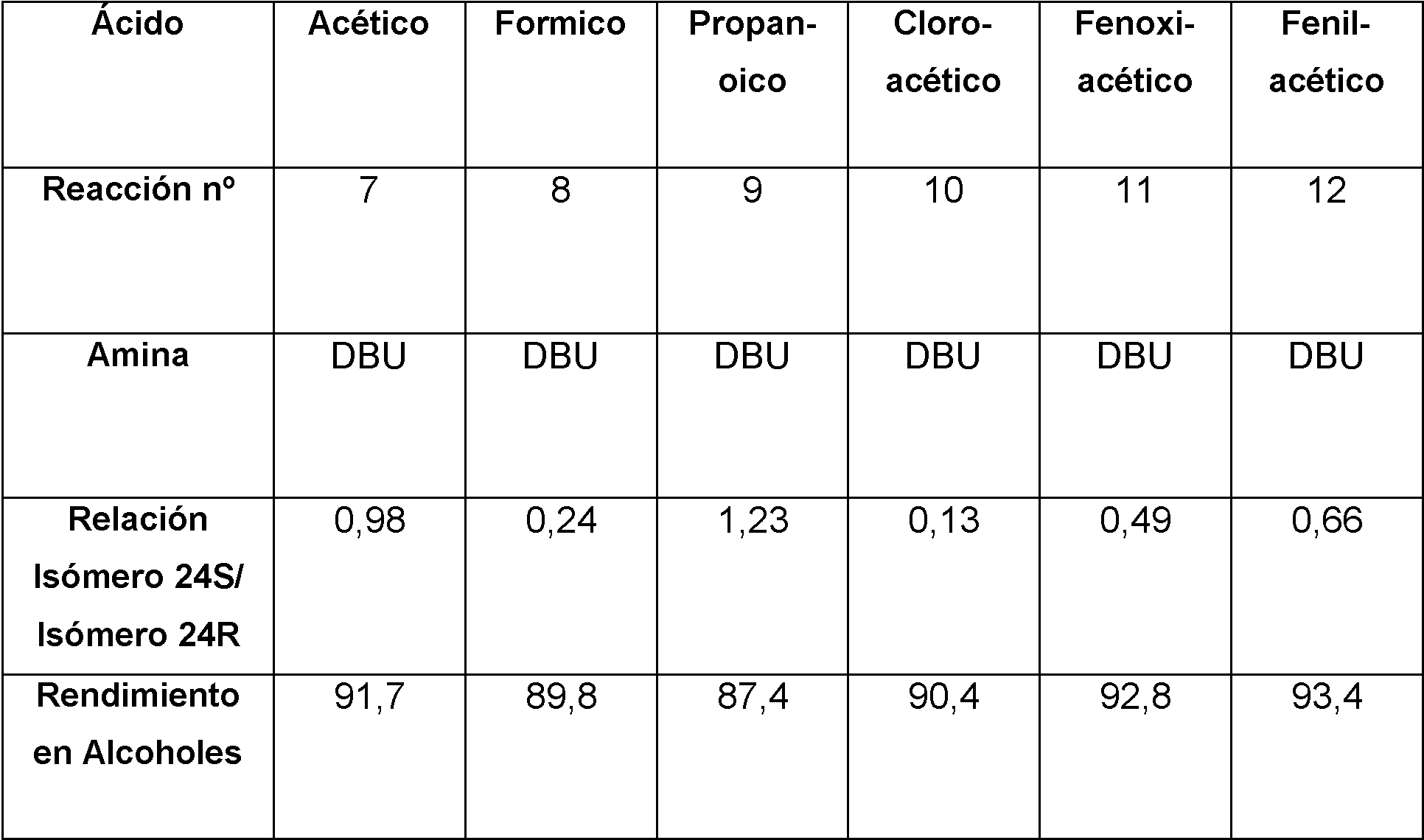
Relación de equivalentes: R-OH/DBU/Bu3P/Ácido = 1/6,6/3,3/10. Estas condiciones sirven también para las tablas 3 y 4. Equivalent ratio: R-OH / DBU / Bu3P / Acid = 1 / 6.6 / 3.3 / 10. These conditions also apply to tables 3 and 4.
Tabla 3. Inversión epímero 24R, 5E (IV) (con DBU añadido) Ácidos aromáticos Table 3. 24R, 5E (IV) epimeric inversion (with added DBU) Aromatic acids

Tabla 4 Inversión epímero 24R, 5Z (IV) (con DBU añadido) Ácidos Metoxiaromáticos Table 4 24R, 5Z (IV) epimeric inversion (with added DBU) Methoxyaromatic Acids

Claims (1)


Priority Applications (1)
| Application Number | Priority Date | Filing Date | Title |
|---|---|---|---|
| ES201831299A ES2769952B2 (en) | 2018-12-28 | 2018-12-28 | PROCEDURE FOR THE ENANTIOMERIC CONVERSION OF CALCIPOTRIOL INTERMEDIATES AND CORRESPONDING USE |
Applications Claiming Priority (1)
| Application Number | Priority Date | Filing Date | Title |
|---|---|---|---|
| ES201831299A ES2769952B2 (en) | 2018-12-28 | 2018-12-28 | PROCEDURE FOR THE ENANTIOMERIC CONVERSION OF CALCIPOTRIOL INTERMEDIATES AND CORRESPONDING USE |
Publications (2)
| Publication Number | Publication Date |
|---|---|
| ES2769952A1 ES2769952A1 (en) | 2020-06-29 |
| ES2769952B2 true ES2769952B2 (en) | 2021-02-19 |
Family
ID=71112126
Family Applications (1)
| Application Number | Title | Priority Date | Filing Date |
|---|---|---|---|
| ES201831299A Active ES2769952B2 (en) | 2018-12-28 | 2018-12-28 | PROCEDURE FOR THE ENANTIOMERIC CONVERSION OF CALCIPOTRIOL INTERMEDIATES AND CORRESPONDING USE |
Country Status (1)
| Country | Link |
|---|---|
| ES (1) | ES2769952B2 (en) |
Family Cites Families (2)
| Publication number | Priority date | Publication date | Assignee | Title |
|---|---|---|---|---|
| AU2003275987A1 (en) * | 2002-06-13 | 2003-12-31 | Teva Pharmaceutical Industries Ltd. | Epimerization of analogs of vitamin d |
| TWI318203B (en) * | 2004-09-01 | 2009-12-11 | Leo Pharma As | Epimerization of allylic alcohols |
-
2018
- 2018-12-28 ES ES201831299A patent/ES2769952B2/en active Active
Also Published As
| Publication number | Publication date |
|---|---|
| ES2769952A1 (en) | 2020-06-29 |
Similar Documents
| Publication | Publication Date | Title |
|---|---|---|
| Breslow et al. | Remote oxidation of steroids by photolysis of attached benzophenone groups | |
| Kato et al. | Structure and synthesis of unsaturaded trihydroxy C18 fatty: Acids in rice plants suffering from rice blast disease | |
| Fieser | Student experiments on derivatives of 1, 2-diphenylethane | |
| ES2769952B2 (en) | PROCEDURE FOR THE ENANTIOMERIC CONVERSION OF CALCIPOTRIOL INTERMEDIATES AND CORRESPONDING USE | |
| Horton et al. | Synthesis and reactions of unsaturated sugars: Unsaturated sugars through thionocarbonate intermediates and synthesis of a 5-deoxy-6-thiohexose system | |
| Nakazaki et al. | Absolute Configurations and Chiroptical Properties of Optically Active Derivatives of Tricyclo [4.3. 0.0 3, 8] nonane (“Twist-brendane”) | |
| JPS6363674A (en) | Production of optical active alpha-tocotrienol | |
| Kishali et al. | Stereoselective synthesis of deoxycarbaheptopyranose derivatives: 5a-carba-6-deoxy-α-dl-galacto-heptopyranose and 5a-carba-6-deoxy-α-dl-gulo-heptopyranose | |
| Hasegawa et al. | A new rearranged lanostanoid, mariesiic acid A, from the seed of Abies mariesii | |
| ES2395895T3 (en) | Triazolo-epothilones | |
| CN104284886A (en) | Intermediate of limaprost, preparation method thereof and preparation method of limaprost therefrom | |
| ES2718417B2 (en) | Procedure for converting 24R epimers of vitamin D precursors into the corresponding 24S isomer and procedure for obtaining calcipotriol. | |
| Zefirova et al. | Synthetic approach to preparation of polycyclic compounds possessing physiological activity: I. Synthesis of 1, 4-disubstituted adamantanes with amino acid fragment | |
| CN106632569A (en) | Synthesizing method of diosgenin derivative | |
| CN103613576A (en) | Novel macrocyclic cyclic sulfate, and preparation method and application thereof | |
| CN101792477A (en) | Acetyl ursolic acid acylate triethanolamine monoester with anti-cancer activity and preparation method thereof | |
| CN107540640A (en) | A kind of reductive modification agent and its preparation method and application | |
| CN102603555B (en) | All-trans retinoic acid amide derivative and preparation method and application thereof | |
| ES2916454B2 (en) | INDUSTRIAL PROCEDURE TO OBTAIN INTERMEDIATES OF VITAMIN D DERIVATIVES BY OZONOLYSIS IN A CONTINUOUS REACTOR | |
| ES2411834A1 (en) | Industrial process to obtain intermediates suitable for the synthesis of vitamin d analogues (Machine-translation by Google Translate, not legally binding) | |
| ES2945426B2 (en) | Procedure for obtaining 24S epimers from vitamin D derivatives and related procedure for obtaining vitamins D | |
| CN106008181B (en) | Synthesis method of gamma-chlorobutanone derivative | |
| US2598653A (en) | 21-substituted thioacetals of 20-oxopregnanes and 20-oxo-pregnenes | |
| CN110590731A (en) | A new guava mixed-source terpene compound, its preparation method and its application in the preparation of anti-inflammatory drugs | |
| CN105218600B (en) | synthetic method of 2,3,4, 6-O-acetyl- α -D-mannopyranose trichloroacetimidate |
Legal Events
| Date | Code | Title | Description |
|---|---|---|---|
| BA2A | Patent application published |
Ref document number: 2769952 Country of ref document: ES Kind code of ref document: A1 Effective date: 20200629 |
|
| FG2A | Definitive protection |
Ref document number: 2769952 Country of ref document: ES Kind code of ref document: B2 Effective date: 20210219 |