ES2784454T3 - Aryl ethers and their uses - Google Patents
Aryl ethers and their uses Download PDFInfo
- Publication number
- ES2784454T3 ES2784454T3 ES18185565T ES18185565T ES2784454T3 ES 2784454 T3 ES2784454 T3 ES 2784454T3 ES 18185565 T ES18185565 T ES 18185565T ES 18185565 T ES18185565 T ES 18185565T ES 2784454 T3 ES2784454 T3 ES 2784454T3
- Authority
- ES
- Spain
- Prior art keywords
- mmol
- compound
- fluoro
- alkyl
- etoac
- Prior art date
- Legal status (The legal status is an assumption and is not a legal conclusion. Google has not performed a legal analysis and makes no representation as to the accuracy of the status listed.)
- Active
Links
- 0 *c1cc(OI)c(CCCC2)c2c1* Chemical compound *c1cc(OI)c(CCCC2)c2c1* 0.000 description 19
- BXYKTWFKAPKKFX-KHTASDDNSA-N CC(C1)(C=C(C)C=C1[Zn])Oc(cc1)c(CC([C@H]2OC)(N)N)c2c1N=O Chemical compound CC(C1)(C=C(C)C=C1[Zn])Oc(cc1)c(CC([C@H]2OC)(N)N)c2c1N=O BXYKTWFKAPKKFX-KHTASDDNSA-N 0.000 description 1
- VKUQAKQCLRNLMT-MIIWNECGSA-N CC(CC(N)=C1)(C=C1F)Oc(cc1)c(CC([C@H]2O)F)c2c1S(C(F)F)(=NC#N)=O Chemical compound CC(CC(N)=C1)(C=C1F)Oc(cc1)c(CC([C@H]2O)F)c2c1S(C(F)F)(=NC#N)=O VKUQAKQCLRNLMT-MIIWNECGSA-N 0.000 description 1
- QYRABEUPNNTKKI-VYRBHSGPSA-N CC1(C([C@@H](C(C2)(F)F)O)=C2C(Oc2cc(C#N)cnc2)=CC1)S(C)(=O)=O Chemical compound CC1(C([C@@H](C(C2)(F)F)O)=C2C(Oc2cc(C#N)cnc2)=CC1)S(C)(=O)=O QYRABEUPNNTKKI-VYRBHSGPSA-N 0.000 description 1
- HZYXNJYXSODAGD-UHFFFAOYSA-N CCS(c(c1c2CCC1O)ccc2Oc1cc(C#N)cc(F)c1)(=O)=O Chemical compound CCS(c(c1c2CCC1O)ccc2Oc1cc(C#N)cc(F)c1)(=O)=O HZYXNJYXSODAGD-UHFFFAOYSA-N 0.000 description 1
- JFAUNWVJQNFLHY-INIZCTEOSA-N CNS(c(cc1)c([C@@H](C(C2)(F)F)O)c2c1Oc1cc(F)cc(C#N)c1)(=O)=O Chemical compound CNS(c(cc1)c([C@@H](C(C2)(F)F)O)c2c1Oc1cc(F)cc(C#N)c1)(=O)=O JFAUNWVJQNFLHY-INIZCTEOSA-N 0.000 description 1
- NWMVQJJYSULOCO-CVEARBPZSA-N CS(c(c([C@@H](C1(F)F)O)c2[C@H]1F)ccc2Oc(cc1)cc(C#N)c1F)(=O)=O Chemical compound CS(c(c([C@@H](C1(F)F)O)c2[C@H]1F)ccc2Oc(cc1)cc(C#N)c1F)(=O)=O NWMVQJJYSULOCO-CVEARBPZSA-N 0.000 description 1
- FMPXINHMGKIUPF-JMTKMGNOSA-N CS(c(c([C@@H]1O)c2CC1(F)F)ccc2Oc1cc(F)cc(F)c1)(=N)=O Chemical compound CS(c(c([C@@H]1O)c2CC1(F)F)ccc2Oc1cc(F)cc(F)c1)(=N)=O FMPXINHMGKIUPF-JMTKMGNOSA-N 0.000 description 1
- ZGVWZAJMWJIHNT-HNNXBMFYSA-N CS(c(c([C@@H]1O)c2CC1(F)F)ccc2Oc1cc(F)cc(F)c1)(=O)=O Chemical compound CS(c(c([C@@H]1O)c2CC1(F)F)ccc2Oc1cc(F)cc(F)c1)(=O)=O ZGVWZAJMWJIHNT-HNNXBMFYSA-N 0.000 description 1
- ONBSHRSJOPSEGS-MRXNPFEDSA-N CS(c(c([C@H]1O)c2CC1(F)F)ccc2Oc1cc(F)cc(C#N)c1)(=O)=O Chemical compound CS(c(c([C@H]1O)c2CC1(F)F)ccc2Oc1cc(F)cc(C#N)c1)(=O)=O ONBSHRSJOPSEGS-MRXNPFEDSA-N 0.000 description 1
- YOOYHMUWFJRASH-INIZCTEOSA-N CS(c(cc1)c([C@@H](C(C2)(F)F)N)c2c1Oc1cc(F)cc(C#N)c1)(=O)=O Chemical compound CS(c(cc1)c([C@@H](C(C2)(F)F)N)c2c1Oc1cc(F)cc(C#N)c1)(=O)=O YOOYHMUWFJRASH-INIZCTEOSA-N 0.000 description 1
- YSQBDUMLHQLQBH-FQSKIORSSA-N CS(c(cc1)c([C@@H](C(C2)(F)F)O)c2c1Oc1cc(F)cc(C#N)c1)(=NC#N)=O Chemical compound CS(c(cc1)c([C@@H](C(C2)(F)F)O)c2c1Oc1cc(F)cc(C#N)c1)(=NC#N)=O YSQBDUMLHQLQBH-FQSKIORSSA-N 0.000 description 1
- DEHILFOXGDHTTI-UHFFFAOYSA-N CS(c(cc1Br)ccc1Oc1cc(Cl)cc(F)c1)(=O)=O Chemical compound CS(c(cc1Br)ccc1Oc1cc(Cl)cc(F)c1)(=O)=O DEHILFOXGDHTTI-UHFFFAOYSA-N 0.000 description 1
- RQQPRRWDTRLAJL-LBPRGKRZSA-N C[n]1ncc(Oc(cc2)c(CC([C@H]3O)(F)F)c3c2S(C(F)(F)F)(=O)=O)c1 Chemical compound C[n]1ncc(Oc(cc2)c(CC([C@H]3O)(F)F)c3c2S(C(F)(F)F)(=O)=O)c1 RQQPRRWDTRLAJL-LBPRGKRZSA-N 0.000 description 1
- WXKYBQSJFQPZEJ-JXMROGBWSA-N Cc(c(/C=C/C(NCc1ccccc1)=O)c(cc1)S(C(F)(F)F)(=O)=O)c1Oc1cc(F)cc(C#N)c1 Chemical compound Cc(c(/C=C/C(NCc1ccccc1)=O)c(cc1)S(C(F)(F)F)(=O)=O)c1Oc1cc(F)cc(C#N)c1 WXKYBQSJFQPZEJ-JXMROGBWSA-N 0.000 description 1
- MQJHGDXYBTXDTG-AWEZNQCLSA-N Cc1cncc(Oc(c(CC2(F)F)c3[C@@H]2O)ccc3S(C)(=O)=O)n1 Chemical compound Cc1cncc(Oc(c(CC2(F)F)c3[C@@H]2O)ccc3S(C)(=O)=O)n1 MQJHGDXYBTXDTG-AWEZNQCLSA-N 0.000 description 1
- LEZCSMBYDHZSGW-UHFFFAOYSA-N N#Cc(cc(cc1)Oc(cc2)c(CCC3O)c3c2S(C(F)(F)F)(=O)=O)c1F Chemical compound N#Cc(cc(cc1)Oc(cc2)c(CCC3O)c3c2S(C(F)(F)F)(=O)=O)c1F LEZCSMBYDHZSGW-UHFFFAOYSA-N 0.000 description 1
- LYXZZEFKPPOSPL-UHFFFAOYSA-N N#Cc1cc(F)cc(Oc(cc2)c(C(C(C3)(F)F)(F)F)c3c2Br)c1 Chemical compound N#Cc1cc(F)cc(Oc(cc2)c(C(C(C3)(F)F)(F)F)c3c2Br)c1 LYXZZEFKPPOSPL-UHFFFAOYSA-N 0.000 description 1
- GUBPDQQJNCLBNA-CYBMUJFWSA-N N#Cc1cc(F)cc(Oc(cc2)c(CC[C@H]3O)c3c2S(C(F)(F)F)(=O)=O)c1 Chemical compound N#Cc1cc(F)cc(Oc(cc2)c(CC[C@H]3O)c3c2S(C(F)(F)F)(=O)=O)c1 GUBPDQQJNCLBNA-CYBMUJFWSA-N 0.000 description 1
- NQEVCRLAZPSJFD-OLZOCXBDSA-N NS(c(cc1)c([C@@H](C([C@@H]2F)(F)F)O)c2c1Oc1cc(F)cnc1)(=O)=O Chemical compound NS(c(cc1)c([C@@H](C([C@@H]2F)(F)F)O)c2c1Oc1cc(F)cnc1)(=O)=O NQEVCRLAZPSJFD-OLZOCXBDSA-N 0.000 description 1
- IRZFEGGLJCTHCW-UHFFFAOYSA-N O=S(C(F)F)(c(cc1)c(C[n]2cncc2)c(Cl)c1Oc1cc(Cl)cc(F)c1)=O Chemical compound O=S(C(F)F)(c(cc1)c(C[n]2cncc2)c(Cl)c1Oc1cc(Cl)cc(F)c1)=O IRZFEGGLJCTHCW-UHFFFAOYSA-N 0.000 description 1
- WFNKTZKUKHKVQG-UHFFFAOYSA-N OCc(c(Cl)c(cc1)Oc2cc(F)cc(F)c2)c1S(C(F)F)(=O)=O Chemical compound OCc(c(Cl)c(cc1)Oc2cc(F)cc(F)c2)c1S(C(F)F)(=O)=O WFNKTZKUKHKVQG-UHFFFAOYSA-N 0.000 description 1
- FQELLCHXJNTAKZ-AWEZNQCLSA-N O[C@H](C(Cc1c(cc2)Oc(cc3)cc(Cl)c3F)(F)F)c1c2S(C(F)(F)F)(=O)=O Chemical compound O[C@H](C(Cc1c(cc2)Oc(cc3)cc(Cl)c3F)(F)F)c1c2S(C(F)(F)F)(=O)=O FQELLCHXJNTAKZ-AWEZNQCLSA-N 0.000 description 1
- GCYQCQKLOYIEPA-AWEZNQCLSA-N O[C@H](C(Cc1c(cc2)Oc(cc3)ccc3F)(F)F)c1c2S(C(F)(F)F)(=O)=O Chemical compound O[C@H](C(Cc1c(cc2)Oc(cc3)ccc3F)(F)F)c1c2S(C(F)(F)F)(=O)=O GCYQCQKLOYIEPA-AWEZNQCLSA-N 0.000 description 1
- PMXWNEAVFKKOAE-UHFFFAOYSA-N [O-][N+](c(c(Cl)c(C(F)(F)F)cc1)c1Oc1cc(F)cc(Cl)c1)=O Chemical compound [O-][N+](c(c(Cl)c(C(F)(F)F)cc1)c1Oc1cc(F)cc(Cl)c1)=O PMXWNEAVFKKOAE-UHFFFAOYSA-N 0.000 description 1
Classifications
-
- A—HUMAN NECESSITIES
- A61—MEDICAL OR VETERINARY SCIENCE; HYGIENE
- A61K—PREPARATIONS FOR MEDICAL, DENTAL OR TOILETRY PURPOSES
- A61K31/00—Medicinal preparations containing organic active ingredients
- A61K31/075—Ethers or acetals
- A61K31/085—Ethers or acetals having an ether linkage to aromatic ring nuclear carbon
- A61K31/09—Ethers or acetals having an ether linkage to aromatic ring nuclear carbon having two or more such linkages
-
- A—HUMAN NECESSITIES
- A61—MEDICAL OR VETERINARY SCIENCE; HYGIENE
- A61K—PREPARATIONS FOR MEDICAL, DENTAL OR TOILETRY PURPOSES
- A61K31/00—Medicinal preparations containing organic active ingredients
- A61K31/095—Sulfur, selenium, or tellurium compounds, e.g. thiols
- A61K31/10—Sulfides; Sulfoxides; Sulfones
-
- A—HUMAN NECESSITIES
- A61—MEDICAL OR VETERINARY SCIENCE; HYGIENE
- A61K—PREPARATIONS FOR MEDICAL, DENTAL OR TOILETRY PURPOSES
- A61K41/00—Medicinal preparations obtained by treating materials with wave energy or particle radiation ; Therapies using these preparations
- A61K41/0038—Radiosensitizing, i.e. administration of pharmaceutical agents that enhance the effect of radiotherapy
-
- A—HUMAN NECESSITIES
- A61—MEDICAL OR VETERINARY SCIENCE; HYGIENE
- A61P—SPECIFIC THERAPEUTIC ACTIVITY OF CHEMICAL COMPOUNDS OR MEDICINAL PREPARATIONS
- A61P13/00—Drugs for disorders of the urinary system
- A61P13/12—Drugs for disorders of the urinary system of the kidneys
-
- A—HUMAN NECESSITIES
- A61—MEDICAL OR VETERINARY SCIENCE; HYGIENE
- A61P—SPECIFIC THERAPEUTIC ACTIVITY OF CHEMICAL COMPOUNDS OR MEDICINAL PREPARATIONS
- A61P35/00—Antineoplastic agents
-
- A—HUMAN NECESSITIES
- A61—MEDICAL OR VETERINARY SCIENCE; HYGIENE
- A61P—SPECIFIC THERAPEUTIC ACTIVITY OF CHEMICAL COMPOUNDS OR MEDICINAL PREPARATIONS
- A61P43/00—Drugs for specific purposes, not provided for in groups A61P1/00-A61P41/00
-
- C—CHEMISTRY; METALLURGY
- C07—ORGANIC CHEMISTRY
- C07B—GENERAL METHODS OF ORGANIC CHEMISTRY; APPARATUS THEREFOR
- C07B39/00—Halogenation
-
- C—CHEMISTRY; METALLURGY
- C07—ORGANIC CHEMISTRY
- C07C—ACYCLIC OR CARBOCYCLIC COMPOUNDS
- C07C205/00—Compounds containing nitro groups bound to a carbon skeleton
- C07C205/13—Compounds containing nitro groups bound to a carbon skeleton the carbon skeleton being further substituted by hydroxy groups
- C07C205/20—Compounds containing nitro groups bound to a carbon skeleton the carbon skeleton being further substituted by hydroxy groups having nitro groups and hydroxy groups bound to carbon atoms of six-membered aromatic rings
- C07C205/21—Compounds containing nitro groups bound to a carbon skeleton the carbon skeleton being further substituted by hydroxy groups having nitro groups and hydroxy groups bound to carbon atoms of six-membered aromatic rings having nitro groups and hydroxy groups bound to carbon atoms of the same non-condensed six-membered aromatic ring
- C07C205/22—Compounds containing nitro groups bound to a carbon skeleton the carbon skeleton being further substituted by hydroxy groups having nitro groups and hydroxy groups bound to carbon atoms of six-membered aromatic rings having nitro groups and hydroxy groups bound to carbon atoms of the same non-condensed six-membered aromatic ring having one nitro groups bound to the ring
-
- C—CHEMISTRY; METALLURGY
- C07—ORGANIC CHEMISTRY
- C07C—ACYCLIC OR CARBOCYCLIC COMPOUNDS
- C07C255/00—Carboxylic acid nitriles
- C07C255/49—Carboxylic acid nitriles having cyano groups bound to carbon atoms of six-membered aromatic rings of a carbon skeleton
- C07C255/54—Carboxylic acid nitriles having cyano groups bound to carbon atoms of six-membered aromatic rings of a carbon skeleton containing cyano groups and etherified hydroxy groups bound to the carbon skeleton
-
- C—CHEMISTRY; METALLURGY
- C07—ORGANIC CHEMISTRY
- C07C—ACYCLIC OR CARBOCYCLIC COMPOUNDS
- C07C255/00—Carboxylic acid nitriles
- C07C255/49—Carboxylic acid nitriles having cyano groups bound to carbon atoms of six-membered aromatic rings of a carbon skeleton
- C07C255/56—Carboxylic acid nitriles having cyano groups bound to carbon atoms of six-membered aromatic rings of a carbon skeleton containing cyano groups and doubly-bound oxygen atoms bound to the carbon skeleton
-
- C—CHEMISTRY; METALLURGY
- C07—ORGANIC CHEMISTRY
- C07C—ACYCLIC OR CARBOCYCLIC COMPOUNDS
- C07C311/00—Amides of sulfonic acids, i.e. compounds having singly-bound oxygen atoms of sulfo groups replaced by nitrogen atoms, not being part of nitro or nitroso groups
- C07C311/22—Sulfonamides, the carbon skeleton of the acid part being further substituted by singly-bound oxygen atoms
- C07C311/29—Sulfonamides, the carbon skeleton of the acid part being further substituted by singly-bound oxygen atoms having the sulfur atom of at least one of the sulfonamide groups bound to a carbon atom of a six-membered aromatic ring
-
- C—CHEMISTRY; METALLURGY
- C07—ORGANIC CHEMISTRY
- C07C—ACYCLIC OR CARBOCYCLIC COMPOUNDS
- C07C313/00—Sulfinic acids; Sulfenic acids; Halides, esters or anhydrides thereof; Amides of sulfinic or sulfenic acids, i.e. compounds having singly-bound oxygen atoms of sulfinic or sulfenic groups replaced by nitrogen atoms, not being part of nitro or nitroso groups
- C07C313/02—Sulfinic acids; Derivatives thereof
- C07C313/06—Sulfinamides
-
- C—CHEMISTRY; METALLURGY
- C07—ORGANIC CHEMISTRY
- C07C—ACYCLIC OR CARBOCYCLIC COMPOUNDS
- C07C317/00—Sulfones; Sulfoxides
- C07C317/16—Sulfones; Sulfoxides having sulfone or sulfoxide groups and singly-bound oxygen atoms bound to the same carbon skeleton
- C07C317/22—Sulfones; Sulfoxides having sulfone or sulfoxide groups and singly-bound oxygen atoms bound to the same carbon skeleton with sulfone or sulfoxide groups bound to carbon atoms of six-membered aromatic rings of the carbon skeleton
-
- C—CHEMISTRY; METALLURGY
- C07—ORGANIC CHEMISTRY
- C07C—ACYCLIC OR CARBOCYCLIC COMPOUNDS
- C07C317/00—Sulfones; Sulfoxides
- C07C317/24—Sulfones; Sulfoxides having sulfone or sulfoxide groups and doubly-bound oxygen atoms bound to the same carbon skeleton
-
- C—CHEMISTRY; METALLURGY
- C07—ORGANIC CHEMISTRY
- C07C—ACYCLIC OR CARBOCYCLIC COMPOUNDS
- C07C317/00—Sulfones; Sulfoxides
- C07C317/26—Sulfones; Sulfoxides having sulfone or sulfoxide groups and nitrogen atoms, not being part of nitro or nitroso groups, bound to the same carbon skeleton
- C07C317/32—Sulfones; Sulfoxides having sulfone or sulfoxide groups and nitrogen atoms, not being part of nitro or nitroso groups, bound to the same carbon skeleton with sulfone or sulfoxide groups bound to carbon atoms of six-membered aromatic rings of the carbon skeleton
-
- C—CHEMISTRY; METALLURGY
- C07—ORGANIC CHEMISTRY
- C07C—ACYCLIC OR CARBOCYCLIC COMPOUNDS
- C07C317/00—Sulfones; Sulfoxides
- C07C317/26—Sulfones; Sulfoxides having sulfone or sulfoxide groups and nitrogen atoms, not being part of nitro or nitroso groups, bound to the same carbon skeleton
- C07C317/32—Sulfones; Sulfoxides having sulfone or sulfoxide groups and nitrogen atoms, not being part of nitro or nitroso groups, bound to the same carbon skeleton with sulfone or sulfoxide groups bound to carbon atoms of six-membered aromatic rings of the carbon skeleton
- C07C317/34—Sulfones; Sulfoxides having sulfone or sulfoxide groups and nitrogen atoms, not being part of nitro or nitroso groups, bound to the same carbon skeleton with sulfone or sulfoxide groups bound to carbon atoms of six-membered aromatic rings of the carbon skeleton having sulfone or sulfoxide groups and amino groups bound to carbon atoms of six-membered aromatic rings being part of the same non-condensed ring or of a condensed ring system containing that ring
-
- C—CHEMISTRY; METALLURGY
- C07—ORGANIC CHEMISTRY
- C07C—ACYCLIC OR CARBOCYCLIC COMPOUNDS
- C07C317/00—Sulfones; Sulfoxides
- C07C317/26—Sulfones; Sulfoxides having sulfone or sulfoxide groups and nitrogen atoms, not being part of nitro or nitroso groups, bound to the same carbon skeleton
- C07C317/32—Sulfones; Sulfoxides having sulfone or sulfoxide groups and nitrogen atoms, not being part of nitro or nitroso groups, bound to the same carbon skeleton with sulfone or sulfoxide groups bound to carbon atoms of six-membered aromatic rings of the carbon skeleton
- C07C317/34—Sulfones; Sulfoxides having sulfone or sulfoxide groups and nitrogen atoms, not being part of nitro or nitroso groups, bound to the same carbon skeleton with sulfone or sulfoxide groups bound to carbon atoms of six-membered aromatic rings of the carbon skeleton having sulfone or sulfoxide groups and amino groups bound to carbon atoms of six-membered aromatic rings being part of the same non-condensed ring or of a condensed ring system containing that ring
- C07C317/36—Sulfones; Sulfoxides having sulfone or sulfoxide groups and nitrogen atoms, not being part of nitro or nitroso groups, bound to the same carbon skeleton with sulfone or sulfoxide groups bound to carbon atoms of six-membered aromatic rings of the carbon skeleton having sulfone or sulfoxide groups and amino groups bound to carbon atoms of six-membered aromatic rings being part of the same non-condensed ring or of a condensed ring system containing that ring with the nitrogen atoms of the amino groups bound to hydrogen atoms or to carbon atoms
-
- C—CHEMISTRY; METALLURGY
- C07—ORGANIC CHEMISTRY
- C07C—ACYCLIC OR CARBOCYCLIC COMPOUNDS
- C07C317/00—Sulfones; Sulfoxides
- C07C317/26—Sulfones; Sulfoxides having sulfone or sulfoxide groups and nitrogen atoms, not being part of nitro or nitroso groups, bound to the same carbon skeleton
- C07C317/32—Sulfones; Sulfoxides having sulfone or sulfoxide groups and nitrogen atoms, not being part of nitro or nitroso groups, bound to the same carbon skeleton with sulfone or sulfoxide groups bound to carbon atoms of six-membered aromatic rings of the carbon skeleton
- C07C317/34—Sulfones; Sulfoxides having sulfone or sulfoxide groups and nitrogen atoms, not being part of nitro or nitroso groups, bound to the same carbon skeleton with sulfone or sulfoxide groups bound to carbon atoms of six-membered aromatic rings of the carbon skeleton having sulfone or sulfoxide groups and amino groups bound to carbon atoms of six-membered aromatic rings being part of the same non-condensed ring or of a condensed ring system containing that ring
- C07C317/38—Sulfones; Sulfoxides having sulfone or sulfoxide groups and nitrogen atoms, not being part of nitro or nitroso groups, bound to the same carbon skeleton with sulfone or sulfoxide groups bound to carbon atoms of six-membered aromatic rings of the carbon skeleton having sulfone or sulfoxide groups and amino groups bound to carbon atoms of six-membered aromatic rings being part of the same non-condensed ring or of a condensed ring system containing that ring with the nitrogen atom of at least one amino group being part of any of the groups, X being a hetero atom, Y being any atom, e.g. N-acylaminosulfones
- C07C317/40—Y being a hydrogen or a carbon atom
-
- C—CHEMISTRY; METALLURGY
- C07—ORGANIC CHEMISTRY
- C07C—ACYCLIC OR CARBOCYCLIC COMPOUNDS
- C07C317/00—Sulfones; Sulfoxides
- C07C317/26—Sulfones; Sulfoxides having sulfone or sulfoxide groups and nitrogen atoms, not being part of nitro or nitroso groups, bound to the same carbon skeleton
- C07C317/32—Sulfones; Sulfoxides having sulfone or sulfoxide groups and nitrogen atoms, not being part of nitro or nitroso groups, bound to the same carbon skeleton with sulfone or sulfoxide groups bound to carbon atoms of six-membered aromatic rings of the carbon skeleton
- C07C317/34—Sulfones; Sulfoxides having sulfone or sulfoxide groups and nitrogen atoms, not being part of nitro or nitroso groups, bound to the same carbon skeleton with sulfone or sulfoxide groups bound to carbon atoms of six-membered aromatic rings of the carbon skeleton having sulfone or sulfoxide groups and amino groups bound to carbon atoms of six-membered aromatic rings being part of the same non-condensed ring or of a condensed ring system containing that ring
- C07C317/38—Sulfones; Sulfoxides having sulfone or sulfoxide groups and nitrogen atoms, not being part of nitro or nitroso groups, bound to the same carbon skeleton with sulfone or sulfoxide groups bound to carbon atoms of six-membered aromatic rings of the carbon skeleton having sulfone or sulfoxide groups and amino groups bound to carbon atoms of six-membered aromatic rings being part of the same non-condensed ring or of a condensed ring system containing that ring with the nitrogen atom of at least one amino group being part of any of the groups, X being a hetero atom, Y being any atom, e.g. N-acylaminosulfones
- C07C317/42—Y being a hetero atom
-
- C—CHEMISTRY; METALLURGY
- C07—ORGANIC CHEMISTRY
- C07C—ACYCLIC OR CARBOCYCLIC COMPOUNDS
- C07C317/00—Sulfones; Sulfoxides
- C07C317/44—Sulfones; Sulfoxides having sulfone or sulfoxide groups and carboxyl groups bound to the same carbon skeleton
-
- C—CHEMISTRY; METALLURGY
- C07—ORGANIC CHEMISTRY
- C07C—ACYCLIC OR CARBOCYCLIC COMPOUNDS
- C07C317/00—Sulfones; Sulfoxides
- C07C317/44—Sulfones; Sulfoxides having sulfone or sulfoxide groups and carboxyl groups bound to the same carbon skeleton
- C07C317/46—Sulfones; Sulfoxides having sulfone or sulfoxide groups and carboxyl groups bound to the same carbon skeleton the carbon skeleton being further substituted by singly-bound oxygen atoms
-
- C—CHEMISTRY; METALLURGY
- C07—ORGANIC CHEMISTRY
- C07C—ACYCLIC OR CARBOCYCLIC COMPOUNDS
- C07C317/00—Sulfones; Sulfoxides
- C07C317/44—Sulfones; Sulfoxides having sulfone or sulfoxide groups and carboxyl groups bound to the same carbon skeleton
- C07C317/48—Sulfones; Sulfoxides having sulfone or sulfoxide groups and carboxyl groups bound to the same carbon skeleton the carbon skeleton being further substituted by singly-bound nitrogen atoms, not being part of nitro or nitroso groups
-
- C—CHEMISTRY; METALLURGY
- C07—ORGANIC CHEMISTRY
- C07C—ACYCLIC OR CARBOCYCLIC COMPOUNDS
- C07C323/00—Thiols, sulfides, hydropolysulfides or polysulfides substituted by halogen, oxygen or nitrogen atoms, or by sulfur atoms not being part of thio groups
- C07C323/22—Thiols, sulfides, hydropolysulfides or polysulfides substituted by halogen, oxygen or nitrogen atoms, or by sulfur atoms not being part of thio groups containing thio groups and doubly-bound oxygen atoms bound to the same carbon skeleton
-
- C—CHEMISTRY; METALLURGY
- C07—ORGANIC CHEMISTRY
- C07C—ACYCLIC OR CARBOCYCLIC COMPOUNDS
- C07C381/00—Compounds containing carbon and sulfur and having functional groups not covered by groups C07C301/00 - C07C337/00
- C07C381/10—Compounds containing sulfur atoms doubly-bound to nitrogen atoms
-
- C—CHEMISTRY; METALLURGY
- C07—ORGANIC CHEMISTRY
- C07C—ACYCLIC OR CARBOCYCLIC COMPOUNDS
- C07C43/00—Ethers; Compounds having groups, groups or groups
- C07C43/02—Ethers
- C07C43/20—Ethers having an ether-oxygen atom bound to a carbon atom of a six-membered aromatic ring
- C07C43/205—Ethers having an ether-oxygen atom bound to a carbon atom of a six-membered aromatic ring the aromatic ring being a non-condensed ring
-
- C—CHEMISTRY; METALLURGY
- C07—ORGANIC CHEMISTRY
- C07C—ACYCLIC OR CARBOCYCLIC COMPOUNDS
- C07C43/00—Ethers; Compounds having groups, groups or groups
- C07C43/02—Ethers
- C07C43/20—Ethers having an ether-oxygen atom bound to a carbon atom of a six-membered aromatic ring
- C07C43/225—Ethers having an ether-oxygen atom bound to a carbon atom of a six-membered aromatic ring containing halogen
-
- C—CHEMISTRY; METALLURGY
- C07—ORGANIC CHEMISTRY
- C07C—ACYCLIC OR CARBOCYCLIC COMPOUNDS
- C07C43/00—Ethers; Compounds having groups, groups or groups
- C07C43/02—Ethers
- C07C43/20—Ethers having an ether-oxygen atom bound to a carbon atom of a six-membered aromatic ring
- C07C43/23—Ethers having an ether-oxygen atom bound to a carbon atom of a six-membered aromatic ring containing hydroxy or O-metal groups
-
- C—CHEMISTRY; METALLURGY
- C07—ORGANIC CHEMISTRY
- C07C—ACYCLIC OR CARBOCYCLIC COMPOUNDS
- C07C43/00—Ethers; Compounds having groups, groups or groups
- C07C43/02—Ethers
- C07C43/257—Ethers having an ether-oxygen atom bound to carbon atoms both belonging to six-membered aromatic rings
- C07C43/263—Ethers having an ether-oxygen atom bound to carbon atoms both belonging to six-membered aromatic rings the aromatic rings being non-condensed
-
- C—CHEMISTRY; METALLURGY
- C07—ORGANIC CHEMISTRY
- C07C—ACYCLIC OR CARBOCYCLIC COMPOUNDS
- C07C43/00—Ethers; Compounds having groups, groups or groups
- C07C43/02—Ethers
- C07C43/257—Ethers having an ether-oxygen atom bound to carbon atoms both belonging to six-membered aromatic rings
- C07C43/275—Ethers having an ether-oxygen atom bound to carbon atoms both belonging to six-membered aromatic rings having all ether-oxygen atoms bound to carbon atoms of six-membered aromatic rings
-
- C—CHEMISTRY; METALLURGY
- C07—ORGANIC CHEMISTRY
- C07C—ACYCLIC OR CARBOCYCLIC COMPOUNDS
- C07C43/00—Ethers; Compounds having groups, groups or groups
- C07C43/02—Ethers
- C07C43/257—Ethers having an ether-oxygen atom bound to carbon atoms both belonging to six-membered aromatic rings
- C07C43/285—Ethers having an ether-oxygen atom bound to carbon atoms both belonging to six-membered aromatic rings having unsaturation outside the six-membered aromatic rings
-
- C—CHEMISTRY; METALLURGY
- C07—ORGANIC CHEMISTRY
- C07C—ACYCLIC OR CARBOCYCLIC COMPOUNDS
- C07C43/00—Ethers; Compounds having groups, groups or groups
- C07C43/02—Ethers
- C07C43/257—Ethers having an ether-oxygen atom bound to carbon atoms both belonging to six-membered aromatic rings
- C07C43/29—Ethers having an ether-oxygen atom bound to carbon atoms both belonging to six-membered aromatic rings containing halogen
-
- C—CHEMISTRY; METALLURGY
- C07—ORGANIC CHEMISTRY
- C07D—HETEROCYCLIC COMPOUNDS
- C07D213/00—Heterocyclic compounds containing six-membered rings, not condensed with other rings, with one nitrogen atom as the only ring hetero atom and three or more double bonds between ring members or between ring members and non-ring members
- C07D213/02—Heterocyclic compounds containing six-membered rings, not condensed with other rings, with one nitrogen atom as the only ring hetero atom and three or more double bonds between ring members or between ring members and non-ring members having three double bonds between ring members or between ring members and non-ring members
- C07D213/04—Heterocyclic compounds containing six-membered rings, not condensed with other rings, with one nitrogen atom as the only ring hetero atom and three or more double bonds between ring members or between ring members and non-ring members having three double bonds between ring members or between ring members and non-ring members having no bond between the ring nitrogen atom and a non-ring member or having only hydrogen or carbon atoms directly attached to the ring nitrogen atom
- C07D213/60—Heterocyclic compounds containing six-membered rings, not condensed with other rings, with one nitrogen atom as the only ring hetero atom and three or more double bonds between ring members or between ring members and non-ring members having three double bonds between ring members or between ring members and non-ring members having no bond between the ring nitrogen atom and a non-ring member or having only hydrogen or carbon atoms directly attached to the ring nitrogen atom with hetero atoms or with carbon atoms having three bonds to hetero atoms with at the most one bond to halogen, e.g. ester or nitrile radicals, directly attached to ring carbon atoms
- C07D213/62—Oxygen or sulfur atoms
- C07D213/63—One oxygen atom
- C07D213/65—One oxygen atom attached in position 3 or 5
-
- C—CHEMISTRY; METALLURGY
- C07—ORGANIC CHEMISTRY
- C07D—HETEROCYCLIC COMPOUNDS
- C07D213/00—Heterocyclic compounds containing six-membered rings, not condensed with other rings, with one nitrogen atom as the only ring hetero atom and three or more double bonds between ring members or between ring members and non-ring members
- C07D213/02—Heterocyclic compounds containing six-membered rings, not condensed with other rings, with one nitrogen atom as the only ring hetero atom and three or more double bonds between ring members or between ring members and non-ring members having three double bonds between ring members or between ring members and non-ring members
- C07D213/04—Heterocyclic compounds containing six-membered rings, not condensed with other rings, with one nitrogen atom as the only ring hetero atom and three or more double bonds between ring members or between ring members and non-ring members having three double bonds between ring members or between ring members and non-ring members having no bond between the ring nitrogen atom and a non-ring member or having only hydrogen or carbon atoms directly attached to the ring nitrogen atom
- C07D213/60—Heterocyclic compounds containing six-membered rings, not condensed with other rings, with one nitrogen atom as the only ring hetero atom and three or more double bonds between ring members or between ring members and non-ring members having three double bonds between ring members or between ring members and non-ring members having no bond between the ring nitrogen atom and a non-ring member or having only hydrogen or carbon atoms directly attached to the ring nitrogen atom with hetero atoms or with carbon atoms having three bonds to hetero atoms with at the most one bond to halogen, e.g. ester or nitrile radicals, directly attached to ring carbon atoms
- C07D213/78—Carbon atoms having three bonds to hetero atoms, with at the most one bond to halogen, e.g. ester or nitrile radicals
- C07D213/84—Nitriles
- C07D213/85—Nitriles in position 3
-
- C—CHEMISTRY; METALLURGY
- C07—ORGANIC CHEMISTRY
- C07D—HETEROCYCLIC COMPOUNDS
- C07D213/00—Heterocyclic compounds containing six-membered rings, not condensed with other rings, with one nitrogen atom as the only ring hetero atom and three or more double bonds between ring members or between ring members and non-ring members
- C07D213/02—Heterocyclic compounds containing six-membered rings, not condensed with other rings, with one nitrogen atom as the only ring hetero atom and three or more double bonds between ring members or between ring members and non-ring members having three double bonds between ring members or between ring members and non-ring members
- C07D213/89—Heterocyclic compounds containing six-membered rings, not condensed with other rings, with one nitrogen atom as the only ring hetero atom and three or more double bonds between ring members or between ring members and non-ring members having three double bonds between ring members or between ring members and non-ring members with hetero atoms directly attached to the ring nitrogen atom
-
- C—CHEMISTRY; METALLURGY
- C07—ORGANIC CHEMISTRY
- C07D—HETEROCYCLIC COMPOUNDS
- C07D231/00—Heterocyclic compounds containing 1,2-diazole or hydrogenated 1,2-diazole rings
- C07D231/54—Heterocyclic compounds containing 1,2-diazole or hydrogenated 1,2-diazole rings condensed with carbocyclic rings or ring systems
- C07D231/56—Benzopyrazoles; Hydrogenated benzopyrazoles
-
- C—CHEMISTRY; METALLURGY
- C07—ORGANIC CHEMISTRY
- C07C—ACYCLIC OR CARBOCYCLIC COMPOUNDS
- C07C2602/00—Systems containing two condensed rings
- C07C2602/02—Systems containing two condensed rings the rings having only two atoms in common
- C07C2602/04—One of the condensed rings being a six-membered aromatic ring
-
- C—CHEMISTRY; METALLURGY
- C07—ORGANIC CHEMISTRY
- C07C—ACYCLIC OR CARBOCYCLIC COMPOUNDS
- C07C2602/00—Systems containing two condensed rings
- C07C2602/02—Systems containing two condensed rings the rings having only two atoms in common
- C07C2602/04—One of the condensed rings being a six-membered aromatic ring
- C07C2602/08—One of the condensed rings being a six-membered aromatic ring the other ring being five-membered, e.g. indane
-
- C—CHEMISTRY; METALLURGY
- C07—ORGANIC CHEMISTRY
- C07C—ACYCLIC OR CARBOCYCLIC COMPOUNDS
- C07C2602/00—Systems containing two condensed rings
- C07C2602/02—Systems containing two condensed rings the rings having only two atoms in common
- C07C2602/04—One of the condensed rings being a six-membered aromatic ring
- C07C2602/10—One of the condensed rings being a six-membered aromatic ring the other ring being six-membered, e.g. tetraline
-
- C—CHEMISTRY; METALLURGY
- C07—ORGANIC CHEMISTRY
- C07C—ACYCLIC OR CARBOCYCLIC COMPOUNDS
- C07C2603/00—Systems containing at least three condensed rings
- C07C2603/93—Spiro compounds
- C07C2603/94—Spiro compounds containing "free" spiro atoms
Landscapes
- Chemical & Material Sciences (AREA)
- Organic Chemistry (AREA)
- Health & Medical Sciences (AREA)
- Animal Behavior & Ethology (AREA)
- Medicinal Chemistry (AREA)
- Pharmacology & Pharmacy (AREA)
- Life Sciences & Earth Sciences (AREA)
- General Health & Medical Sciences (AREA)
- Public Health (AREA)
- Veterinary Medicine (AREA)
- Epidemiology (AREA)
- Nuclear Medicine, Radiotherapy & Molecular Imaging (AREA)
- General Chemical & Material Sciences (AREA)
- Chemical Kinetics & Catalysis (AREA)
- Bioinformatics & Cheminformatics (AREA)
- Engineering & Computer Science (AREA)
- Urology & Nephrology (AREA)
- Pharmaceuticals Containing Other Organic And Inorganic Compounds (AREA)
- Acyclic And Carbocyclic Compounds In Medicinal Compositions (AREA)
- Pyridine Compounds (AREA)
- Organic Low-Molecular-Weight Compounds And Preparation Thereof (AREA)
- Nitrogen Condensed Heterocyclic Rings (AREA)
- Heterocyclic Compounds That Contain Two Or More Ring Oxygen Atoms (AREA)
- Furan Compounds (AREA)
- Heterocyclic Carbon Compounds Containing A Hetero Ring Having Nitrogen And Oxygen As The Only Ring Hetero Atoms (AREA)
- Pyrane Compounds (AREA)
- Luminescent Compositions (AREA)
- Quinoline Compounds (AREA)
- Low-Molecular Organic Synthesis Reactions Using Catalysts (AREA)
Abstract
Un compuesto de fórmula Vb: **(Ver fórmula)** o una sal farmacéuticamente aceptable del mismo, en donde: R1 es arilo o heteroarilo; R4 es halo, ciano, alquilo, sulfonamida, sulfinilo, sulfonilo o sulfoximinilo; R5 es hidrógeno, halo o alquilo y R8 es hidroxi, alquilamino, alcoxi o amino.A compound of formula Vb: ** (See formula) ** or a pharmaceutically acceptable salt thereof, wherein: R1 is aryl or heteroaryl; R4 is halo, cyano, alkyl, sulfonamide, sulfinyl, sulfonyl, or sulfoximinyl; R5 is hydrogen, halo, or alkyl and R8 is hydroxy, alkylamino, alkoxy, or amino.
Description
DESCRIPCIÓNDESCRIPTION
Aril éteres y usos de los mismosAryl ethers and their uses
La presente invención se financió por medio de una subvención del Cáncer Prevention Research Institute de Texas (Subvención número R1009).The present invention was supported by a grant from the Cancer Prevention Research Institute of Texas (Grant number R1009).
La presente solicitud reivindica el beneficio de prioridad respecto de las Solicitudes Provisionales de los Estados Unidos con n.° de serie 61/875.674, presentada el 9 de septiembre de 2013 y 61/978.421, presentada el 11 de abril de 2014.The present application claims priority benefit over United States Provisional Applications Serial No. 61 / 875,674, filed September 9, 2013 and 61 / 978,421, filed April 11, 2014.
La hipoxia intratumoral es una fuerza impulsora en la progresión del cáncer y está estrechamente relacionada con un mal pronóstico del paciente y la resistencia a la quimioterapia y al tratamiento con radiación. El progreso en las últimas décadas en el mapeo de los mecanismos moleculares que permiten la adaptación celular a la privación crónica de oxígeno ha intensificado el interés en la identificación de medicamentos que bloquean de manera efectiva la vía de respuesta hipóxica en los tumores. Los factores inducibles por la hipoxia (HIF-1a y HIF-2a) son factores de transcripción que juegan un papel central en esta vía y por lo tanto representan dianas atractivas para la intervención terapéutica. La vida media de las proteínas HIF-a está estrechamente regulada por el estado oxidativo dentro de la célula. En condiciones normóxicas, se hidroxilan restos de prolina específicos en las proteínas HIF por medio de las prolil-hidroxilasas (PHD) específicas para HIF sensibles al oxígeno. La proteína von Hippel-Lindau (VHL) supresora de tumores se une a los restos de prolina hidroxilados específicos y recluta el complejo de ubiquitina-ligasa E3 que dirige a las proteínas HIF-a a la degradación proteasomal. Debido a que las PHD requieren oxígeno para funcionar, en condiciones de hipoxia, las proteínas HIF-a se acumulan y entran en el núcleo para activar la expresión génica. Las mutaciones genéticas del gen VHL que dan como resultado la pérdida de la función dan lugar a proteínas HIF-a constitutivamente activas, independientemente de los niveles de oxígeno. Tras la activación, estos factores de transcripción estimulan la expresión de genes que regulan coordinadamente el metabolismo anaeróbico, la angiogénesis, la proliferación celular, la supervivencia celular, la remodelación de matriz extracelular, la homeostasia del pH, el metabolismo de aminoácidos y nucleótidos y la inestabilidad genómica. Si bien se han explorado individualmente muchos productos génicos implicados en la respuesta hipóxica como dianas terapéuticas para el cáncer, la amplia inhibición de la vía a través del direccionamiento directo de las proteínas HIF-a ofrece una oportunidad emocionante para atacar tumores en múltiples frentes (Keith, et al. Nature Rev. Cáncer 12: 9-22, 2012). Intratumor hypoxia is a driving force in cancer progression and is closely related to poor patient prognosis and resistance to chemotherapy and radiation treatment. Progress in recent decades in mapping the molecular mechanisms that enable cellular adaptation to chronic oxygen deprivation has intensified interest in identifying drugs that effectively block the hypoxic response pathway in tumors. Hypoxia-inducible factors (HIF-1a and HIF-2a) are transcription factors that play a central role in this pathway and therefore represent attractive targets for therapeutic intervention. The half-life of HIF-a proteins is tightly regulated by the oxidative state within the cell. Under normoxic conditions, specific proline residues in HIF proteins are hydroxylated by HIF-specific oxygen-sensitive prolyl hydroxylases (PHDs). The tumor suppressor protein von Hippel-Lindau (VHL) binds to specific hydroxylated proline residues and recruits the E3 ubiquitin-ligase complex that directs HIF-a proteins to proteasomal degradation. Because PHDs require oxygen to function, under hypoxic conditions, HIF-a proteins accumulate and enter the nucleus to activate gene expression. Genetic mutations of the VHL gene that result in loss of function give rise to constitutively active HIF-a proteins, regardless of oxygen levels. Upon activation, these transcription factors stimulate the expression of genes that coordinately regulate anaerobic metabolism, angiogenesis, cell proliferation, cell survival, extracellular matrix remodeling, pH homeostasis, amino acid and nucleotide metabolism, and genomic instability. While many gene products implicated in the hypoxic response have been individually explored as therapeutic targets for cancer, the broad inhibition of the pathway through direct targeting of HIF-a proteins offers an exciting opportunity to target tumors on multiple fronts ( Keith , et al. Nature Rev. Cancer 12: 9-22, 2012).
Tanto HIF-1a como HIF-2a forman un complejo dimérico con HIF-1p (o ARNT: translocador nuclear del receptor de hidrocarburos de arilo) y posteriormente se unen a los elementos de respuesta a la hipoxia (HRE) en los genes diana. Debido a que el nivel de HIF-1 p no se ve afectado por los niveles de oxígeno o VHL, la actividad transcripcional del complejo se impulsa en gran medida por la disponibilidad de las proteínas HIF-a. Si bien HIF-1a y HIF-2a comparten una homología de secuencia significativa, se diferencian en la distribución tisular, la sensibilidad a la hipoxia, el tiempo de activación y la especificidad de genes diana (Hu, et al. Mol. Cell Biol. 23: 9361-9374, 2003 y Keith, et al. Nature Rev. Cancer l2: 9-22, 2012). Mientras que el ARNm de HIF-1a se expresa de forma ubicua, la expresión del ARNm de HIF-2a se encuentra principalmente en los fibroblastos de riñón, los hepatocitos y las células epiteliales de la luz intestinal. De manera acorde con la estricta regulación de las proteínas HIF-a en condiciones fisiológicas normales, no se detecta ninguna en el tejido normal, con la excepción de HIF-2a en macrófagos (Talks, et al. Am. J. Pathol. 157: 411-421, 2000). Sin embargo, se ha detectado proteína HIF-2a en varios tumores humanos de la vejiga, mama, colon, hígado, ovarios, páncreas, próstata y riñón, así como en macrófagos asociados a tumores (Talks, et al. Am. J. Pathol. 157: 411-421, 2000). Se ha informado de que HIF-1 a proporciona una respuesta transcripcional aguda y transitoria frente a la hipoxia, mientras que HIF-2a proporciona una actividad transcripcional más prolongada. Además, HIF-2 a tiene una mayor actividad transcripcional que HIF-1a en condiciones moderadamente hipóxicas, como las que se encuentran en los capilares terminales (Holmquist-Mengelbier, et al. Cancer Cell 10: 413-423, 2006). Si bien algunos genes regulados por hipoxia están controlados tanto por HIF-1a como por HIF-2a, algunos solo responden a proteínas HIF-a específicas. Por ejemplo, la lactato deshidrogenasa A (LDHA), la fosfoglicerato cinasa (PGK) y la piruvato deshidrogenasa cinasa 1 (PDK1) se controlan únicamente por HIF-1a mientras que Oct-4 y eritropoyetina (EPO) por HIF-2a. A menudo, las contribuciones relativas de las proteínas HIF-a a la transcripción de genes son específicas del tipo celular y de la enfermedad. Más importante aún, las proteínas HIF-a pueden desempeñar funciones de contraste en la tumorigénesis. Por ejemplo, El oncogén MYC es un factor de transcripción que controla la transición Gl/S del ciclo celular. MYC está sobreexpresado en el 40 % de los cánceres humanos. Se ha demostrado que la actividad de HIF-2a aumenta la actividad de transcripción de MYC, mientras que HIF-1a inhibe la actividad de MYC. Como resultado, en los tumores impulsados por MYC, La inhibición de HIF-2a redujo la proliferación, mientras que la inhibición de HIF-1a aumentó el crecimiento (Gordan, et al. Cancer Cell 11: 335-347, 2007 y Koshiji et al. EMBO J. 23: 1949-1956, 2004). Both HIF-1a and HIF-2a form a dimeric complex with HIF-1p (or ARNT: aryl hydrocarbon receptor nuclear translocator) and subsequently bind to hypoxia response elements (HRE) in target genes. Because the level of HIF-1 p is not affected by oxygen or VHL levels, the complex's transcriptional activity is largely driven by the availability of the HIF-a proteins. While HIF-1a and HIF-2a share significant sequence homology, they differ in tissue distribution, sensitivity to hypoxia, activation time, and target gene specificity ( Hu, et al. Mol. Cell Biol. 23: 9361-9374, 2003 and Keith, et al. Nature Rev. Cancer 12: 9-22, 2012). While HIF-1a mRNA is ubiquitously expressed, HIF-2a mRNA expression is found primarily in kidney fibroblasts, hepatocytes, and intestinal lumen epithelial cells. Consistent with the strict regulation of HIF-a proteins under normal physiological conditions, none are detected in normal tissue, with the exception of HIF-2a in macrophages ( Talks, et al. Am. J. Pathol. 157: 411-421, 2000). However, HIF-2a protein has been detected in several human tumors of the bladder, breast, colon, liver, ovaries, pancreas, prostate, and kidney, as well as tumor-associated macrophages ( Talks, et al. Am. J. Pathol . 157: 411-421, 2000). HIF-1a has been reported to provide an acute and transient transcriptional response to hypoxia, while HIF-2a provides a more prolonged transcriptional activity. Furthermore, HIF-2a has greater transcriptional activity than HIF-1a under moderately hypoxic conditions, such as those found in terminal capillaries ( Holmquist-Mengelbier, et al. Cancer Cell 10: 413-423, 2006). While some hypoxia-regulated genes are controlled by both HIF-1a and HIF-2a, some only respond to specific HIF-a proteins. For example, lactate dehydrogenase A (LDHA), phosphoglycerate kinase (PGK), and pyruvate dehydrogenase kinase 1 (PDK1) are controlled solely by HIF-1a while Oct-4 and erythropoietin (EPO) by HIF-2a. Often the relative contributions of HIF-a proteins to gene transcription are cell type and disease specific. More importantly, HIF-a proteins can play contrast roles in tumorigenesis. For example, the MYC oncogene is a transcription factor that controls the Gl / S transition of the cell cycle. MYC is overexpressed in 40% of human cancers. The activity of HIF-2a has been shown to increase the transcriptional activity of MYC, while HIF-1a inhibits the activity of MYC. As a result, in MYC-driven tumors, HIF-2a inhibition reduced proliferation, while HIF-1a inhibition increased growth ( Gordan, et al. Cancer Cell 11: 335-347, 2007 and Koshiji et al. EMBO J. 23: 1949-1956, 2004).
Por tanto, es deseable la identificación de moléculas pequeñas efectivas para modular la actividad de HIF-2a.Therefore, the identification of small molecules effective to modulate HIF-2a activity is desirable.
El documento WO 2007/071441 describe ciertas arenosulfonamidas sustituidas que actúan como inhibidores del receptor de quimiocinas CC 9 (CCR9). Se ha informado de que la expresión de CCR9 se correlaciona con la capacidad de los linfocitos T periféricos para alojarse en el intestino delgado. Se ha demostrado que ciertas arenosulfonamidas descritas inhiben CCR9 en un ensayo in vitro. WO 2007/071441 describes certain substituted arenesulfonamides that act as inhibitors of the CC 9 chemokine receptor (CCR9). The expression of CCR9 has been reported to correlate with the ability of peripheral T cells to lodge in the small intestine. Certain described arenesulfonamides have been shown to inhibit CCR9 in an in vitro assay .
SumarioSummary
En un primer aspecto, la presente divulgación proporciona un compuesto de Fórmula VbIn a first aspect, the present disclosure provides a compound of Formula Vb

o una sal farmacéuticamente aceptable del mismo, en donde:or a pharmaceutically acceptable salt thereof, wherein:
R1 es arilo o heteroarilo;R1 is aryl or heteroaryl;
R4 es halo, ciano, alquilo, sulfonamida, sulfinilo, sulfonilo o sulfoximinilo;R4 is halo, cyano, alkyl, sulfonamide, sulfinyl, sulfonyl, or sulfoximinyl;
R5 es hidrógeno, halo o alquilo yR5 is hydrogen, halo or alkyl and
R8 es hidroxi, alquilamino alcoxi o amino.R8 is hydroxy, alkylamino alkoxy or amino.
En un segundo aspecto, la presente divulgación proporciona una composición farmacéutica que comprende una cantidad terapéuticamente eficaz de un compuesto o una sal farmacéuticamente aceptable del primer aspecto y un vehículo farmacéuticamente aceptable. El compuesto puede existir en una forma amorfa, una forma cristalina o como una sal, un solvato o un hidrato.In a second aspect, the present disclosure provides a pharmaceutical composition comprising a therapeutically effective amount of a compound or a pharmaceutically acceptable salt of the first aspect and a pharmaceutically acceptable carrier. The compound can exist in an amorphous form, a crystalline form, or as a salt, a solvate, or a hydrate.
En un tercer aspecto, la presente divulgación proporciona un compuesto del primer aspecto para su uso como medicamento para el tratamiento de la enfermedad de von Hippel-Lindau (VHL).In a third aspect, the present disclosure provides a compound of the first aspect for use as a medicament for the treatment of von Hippel-Lindau disease (VHL).
En un cuarto aspecto, la presente divulgación proporciona un compuesto del primer aspecto para su uso como medicamento para el tratamiento del hemangioblastoma, el feocromocitoma, el tumor neuroendocrino pancreático o el carcinoma de células renales.In a fourth aspect, the present disclosure provides a compound of the first aspect for use as a medicament for the treatment of hemangioblastoma, pheochromocytoma, pancreatic neuroendocrine tumor, or renal cell carcinoma.
En un quinto aspecto, La presente divulgación proporciona un compuesto del primer aspecto para su uso como medicamento para el tratamiento del carcinoma de células renales.In a fifth aspect, the present disclosure provides a compound of the first aspect for use as a medicament for the treatment of renal cell carcinoma.
Breve descripción de las figurasBrief description of the figures
La figura 1 muestra el tratamiento ratones portadores de xenoinjerto de 786-O de carcinoma de células renales a 0 mg/kg (indicado como "Veh"), 10mg/kg, 30 mg/kg y 100 mg/kg de compuesto 15 tres veces cada uno a intervalos de 12 horas. La figura 1 muestra que el tratamiento con el compuesto 15 de los ratones portadores de xenoinjerto de 786-O de carcinoma de células renales los redujo los niveles de ARNm de HIF-2a y los genes regulados por HIF-2a (PAI-1, CCND1, VEGFA y GLUT1) en el tumor. El compuesto 15 no tuvo un efecto significativo en el nivel de ARNm de los genes regulados por HIF-1a o no regulados por HIF-2a (PGK1 y PDK1). Figure 1 shows treating renal cell carcinoma 786-O xenograft bearing mice at 0 mg / kg (indicated as "Veh"), 10 mg / kg, 30 mg / kg and 100 mg / kg of compound 15 three times. each at 12 hour intervals. Figure 1 shows that treatment of mice bearing 786-O xenograft from renal cell carcinoma with compound 15 reduced the levels of HIF-2a mRNA and HIF-2a regulated genes (PAI-1, CCND1 , VEGFA and GLUT1) in the tumor. Compound 15 had no significant effect on the mRNA level of the HIF-1a-regulated or HIF-2a-non-regulated genes (PGK1 and PDK1).
Figura 2 muestra el tratamiento del carcinoma de células renales 786-O ratones con xenoinjerto a 0 mg/kg (indicado como "Vehículo") y 10 mg/kg de compuesto 163 tres veces cada uno a intervalos de 12 horas. La figura 2 muestra que el tratamiento con el compuesto 163 de los ratones portadores de xenoinjerto de 786-O de carcinoma de células renales los redujo los niveles de ARNm de los genes regulados por HIF-2a y HIF-2a (PAI-1 y CCND1) en tumores. El compuesto 163 no tuvo un efecto significativo en los niveles de ARNm de los genes regulados por HIF-1a y no regulados por HIF-2a (PGK1 y PDK1). Figure 2 shows the treatment of renal cell carcinoma 786-O mice with xenograft at 0 mg / kg (indicated as "Vehicle") and 10 mg / kg of compound 163 three times each at 12 hour intervals. Figure 2 shows that treatment with compound 163 of mice bearing 786-O xenograft from renal cell carcinoma reduced the mRNA levels of the genes regulated by HIF-2a and HIF-2a (PAI-1 and CCND1 ) in tumors. Compound 163 had no significant effect on the mRNA levels of the HIF-1a regulated and HIF-2a non-regulated genes (PGK1 and PDK1).
La figura 3 muestra el tratamiento de ratones portadores de xenoinjerto de 786-0 a 0 mg/kg (indicado como "Vehículo"), 10 mg/kg, 30 mg/kg y 100 mg/kg de compuesto 15 tres veces cada uno a intervalos de 12 horas. La figura 3 muestra que el tratamiento con compuesto 15 de ratones portadores de xenoinjerto de 786-0 redujo la expresión del gen de EPO regulada por HIF-2a en riñón de ratón, pero no tuvo un efecto significativo en la expresión del gen PGK1 regulado por HlF-1a. Figure 3 shows the treatment of 786-0 xenograft bearing mice at 0 mg / kg (indicated as "Vehicle"), 10 mg / kg, 30 mg / kg and 100 mg / kg of compound 15 three times each at 12 hour intervals. Figure 3 shows that compound 15 treatment of 786-0 xenograft-bearing mice reduced the expression of the EPO gene regulated by HIF-2a in mouse kidney, but did not have a significant effect on the expression of the PGK1 gene regulated by HlF-1a.
La figura 4 muestra el tratamiento de ratones portadores de xenoinjerto de 786-0 a 0 mg/kg (indicado como "Vehículo"), 10 mg/kg, 30 mg/kg y 100 mg/kg de compuesto 15 tres veces cada uno a intervalos de 12 horas. La figura 4 muestra que el compuesto 15 el tratamiento de ratones portadores de xenoinjerto de 786-0 redujo los niveles de proteínas HIF-2a y ciclina D1 en el tumor. Figure 4 shows the treatment of 786-0 xenograft bearing mice at 0 mg / kg (indicated as "Vehicle"), 10 mg / kg, 30 mg / kg and 100 mg / kg of compound 15 three times each at 12 hour intervals. Figure 4 shows that Compound 15 treatment of 786-0 xenograft bearing mice reduced the levels of HIF-2a and cyclin D1 proteins in the tumor.
La figura 5 muestra los niveles de VEGF humano de ratones portadores de xenoinjerto de 786-0 antes (indicado como "Antes del tratamiento") y después del tratamiento (indicado como "12 h después del tratamiento") a 0 mg/kg (indicado como "Vehículo"), 10 mg/kg, 30 mg/kg y 100 mg/kg de compuesto 15 tres veces cada uno a intervalos de 12 horas. La figura 5 muestra que el tratamiento con compuesto 15 de ratones con xenoinjerto de 786-O redujo el nivel plasmático de VEGFA humano. Figure 5 shows the human VEGF levels of 786-0 xenograft bearing mice before (indicated as "Before treatment") and after treatment (indicated as "12 h after treatment") at 0 mg / kg (indicated as "Vehicle"), 10 mg / kg, 30 mg / kg and 100 mg / kg of compound 15 three times each at 12 hour intervals. Figure 5 shows that Compound 15 treatment of 786-O xenograft mice lowered the plasma level of human VEGFA.
Figura 6 muestra el tratamiento de ratones portadores de xenoinjerto de 786-0 a 0 mg/kg (indicado como "Vehículo") y 10 mg/kg de compuesto 163 tres veces cada uno a intervalos de 12 horas. La figura 6 muestra que el tratamiento con compuesto 163 de ratones con xenoinjerto de 786-0 redujo el nivel plasmático de VEGFA humano. Figure 6 shows treatment of 786-0 xenograft bearing mice at 0 mg / kg (indicated as "Vehicle") and 10 mg / kg of compound 163 three times each at 12 hour intervals. Figure 6 shows that Compound 163 treatment of mice with 786-0 xenograft reduced the plasma level of human VEGFA.
La figura 7 muestra el tratamiento de ratones portadores de xenoinjerto de 786-0 a 0 mg/kg (indicado como "Vehículo"), 3 mg/kg, 10 mg/kg, 30 mg/kg y 100 mg/kg de compuesto 15 BID y 40 mg/kg de sutent QD, respectivamente, durante 20 días. La figura 7 muestra que el tratamiento con compuesto 15 de ratones con xenoinjerto de 786-O como agente único dio lugar a la reducción del tamaño y la regresión tumoral. Figure 7 shows the treatment of 786-0 xenograft bearing mice at 0 mg / kg (indicated as "Vehicle"), 3 mg / kg, 10 mg / kg, 30 mg / kg and 100 mg / kg of compound 15 BID and 40 mg / kg of sutent QD, respectively, for 20 days. Figure 7 shows that Compound 15 treatment of mice with 786-O xenograft as a single agent resulted in tumor size reduction and regression.
La figura 8 muestra el tratamiento con compuesto 163 de ratones portadores de xenoinjerto de 786-0 a 0 mg/kg (indicado como "Vehículo") y 10 mg/kg BID de compuesto 163 BID por 28 días. La figura 8 muestra que el tratamiento con compuesto 163 de ratones con xenoinjerto de 786-O como agente único dio lugar a la reducción del tamaño y la regresión tumoral. Figure 8 shows compound 163 treatment of 786-0 xenograft bearing mice at 0 mg / kg (denoted "Vehicle") and 10 mg / kg BID of compound 163 BID for 28 days. Figure 8 shows that Compound 163 treatment of mice with 786-O xenograft as a single agent resulted in tumor size reduction and regression.
Descripción detallada de la invenciónDetailed description of the invention
Con el objetivo de interpretar la presente divulgación, se aplicarán las siguientes definiciones.For the purpose of interpreting this disclosure, the following definitions will apply.
El término "HIF-2 a" se refiere a una proteína monomérica que contiene varios dominios estructurados conservados: hélice-bucle-hélice básico (bHLH) y dos dominios Per-ARNT-Sim (PAS) denominados PAS-A y PAS-B, además de las regiones reguladoras C-terminales. "HIF-2a" también se conoce por otros nombres alternativos en la bibliografía científica, incluyendo la proteína de dominio de PAS endotelial 1 (EPAS1), HIF2A, PASD2, HIF-2-alfa, HIF2-alfa, HLF, factor inducido por hipoxia 2-alfa, factor similar a HIF-1alfa y MOP2. Como miembro de la familia de factores de transcripción bHLH/PAS, "HIF-2a" forma un complejo de factor de transcripción heterodimérico activo al unirse a la proteína ARNT (también conocida como HIF-1 p) mediante interacciones no covalentes.The term "HIF-2a" refers to a monomeric protein that contains several conserved structured domains: basic helix-loop-helix (bHLH) and two Per-ARNT-Sim (PAS) domains called PAS-A and PAS-B, in addition to the C-terminal regulatory regions. "HIF-2a" is also known by other alternative names in the scientific literature, including endothelial PAS domain protein 1 (EPAS1), HIF2A, PASD2, HIF-2-alpha, HIF2-alpha, HLF, hypoxia-induced factor 2-alpha, factor similar to HIF-1alpha and MOP2. As a member of the bHLH / PAS family of transcription factors, "HIF-2a" forms an active heterodimeric transcription factor complex by binding to the ARNT protein (also known as HIF-1 p) through non-covalent interactions.
El término "sujeto" incluye seres humanos de cualquier grupo de edad, por ejemplo, un sujeto pediátrico (por ejemplo, bebé, niño o adolescente) o un sujeto adulto (por ejemplo, adulto joven, adulto de mediana edad o adulto mayor) y/u otros primates (por ejemplo, monos cinomolgos o monos rhesus); mamíferos, incluyendo mamíferos comercialmente relevantes, tales como ganado, cerdos, caballos, ovejas, cabras, gatos y/o perros; y/o aves, incluyendo aves comercialmente relevantes, tales como pollos, patos, gansos, codornices y/o pavos.The term "subject" includes human beings of any age group, eg, a pediatric subject (eg, infant, child, or adolescent) or an adult subject (eg, young adult, middle-aged adult, or older adult) and / or other primates (eg cynomolgus monkeys or rhesus monkeys); mammals, including commercially relevant mammals, such as cattle, pigs, horses, sheep, goats, cats, and / or dogs; and / or birds, including commercially relevant birds, such as chickens, ducks, geese, quail, and / or turkeys.
El término "ensayo de proximidad de centelleo" (SPA) se refiere a un ensayo homogéneo en el que se emite luz cuando un ligando radiomarcado se acerca a una perla radiosensible. El ensayo generalmente contiene una proteína diana que contiene un marcador (por ejemplo, marcador His, marcador de glutatión S-transferasa). El marcador de la proteína se usa para unir la proteína diana a la perla de centelleo. El ligando radiomarcado (por ejemplo, marcado con tritio) que se une a la proteína se encuentra entonces muy cerca de la perla y cuando el radiomarcador (por ejemplo, tritio) se desintegra, la partícula de alta energía golpea la perla, dando como resultado la emisión de luz que se detecta por un detector, tal como un tubo fotomultiplicador o una cámara CCD. Cuando en el ensayo se usan ligandos o compuestos no marcados que se unen a la proteína, desplazan al ligando radiomarcado, dando como resultado pérdida de señal. Para una referencia general que describe el ensayo, véase Park, et al. Analytical Biochemistry 269: 94-104, 1999. The term "scintillation proximity assay" (SPA) refers to a homogeneous assay in which light is emitted when a radiolabeled ligand approaches a radiosensitive bead. The assay generally contains a target protein that contains a tag (eg, His tag, glutathione S-transferase tag). The protein marker is used to bind the target protein to the scintillation bead. The radiolabeled (eg, tritium-labeled) ligand that binds to the protein is then in close proximity to the bead and when the radiolabel (eg, tritium) disintegrates, the high-energy particle hits the bead, resulting in the emission of light that is detected by a detector, such as a photomultiplier tube or a CCD camera. When unlabeled ligands or compounds that bind to the protein are used in the assay, they displace the radiolabeled ligand, resulting in loss of signal. For a general reference describing the assay, see Park, et al. Analytical Biochemistry 269 : 94-104, 1999.
La actividad de HIF-2 a como se usa en el presente documento tiene su significado convencional en la técnica. La actividad de HIF-2a, por ejemplo, Incluye la activación de la transcripción génica mediada por HIF-2a.The activity of HIF-2 a as used herein has its conventional meaning in the art. The activity of HIF-2a, for example, includes the activation of HIF-2a mediated gene transcription.
La expresión "inhibición de la actividad de HIF-2a", como se usa en el presente documento, se refiere a ralentizar, reducir, alterar, así como a eliminar completamente y/o prevenir la actividad de HIF-2a.The term "inhibition of HIF-2a activity" as used herein refers to slowing down, reducing, altering, as well as completely eliminating and / or preventing HIF-2a activity.
Como se usan en el presente documento, los términos "tratamiento", "tratar", "paliar" y "mejorar" se usan indistintamente en el presente documento. Estos términos se refieren a un enfoque para obtener resultados beneficiosos o deseados que incluyen un beneficio terapéutico y/o un beneficio profiláctico. Por beneficio terapéutico se entiende la erradicación o mejora del trastorno subyacente que se está tratando. Asimismo, se logra un beneficio terapéutico con la erradicación o el alivio de uno o más de los síntomas fisiológicos asociados al trastorno subyacente, de manera que se observa una mejoría en el paciente, independientemente de que el paciente siga viéndose afectado por el trastorno subyacente. Para el beneficio profiláctico, las composiciones farmacéuticas pueden administrarse a un paciente en riesgo de desarrollar una enfermedad particular o a un paciente que comunica uno o más de los síntomas fisiológicos de una enfermedad, aun cuando pueda no haberse realizado un diagnóstico de esta enfermedad.As used herein, the terms "treatment", "treat", "alleviate" and "enhance" are used interchangeably herein. These terms refer to an approach to obtaining beneficial or desired results that include a therapeutic benefit and / or a prophylactic benefit. By therapeutic benefit is meant the eradication or amelioration of the underlying disorder being treated. Likewise, a therapeutic benefit is achieved with the eradication or alleviation of one or more of the physiological symptoms associated with the underlying disorder, so that an improvement is observed in the patient, regardless of whether the patient continues to be affected by the underlying disorder. For prophylactic benefit, the pharmaceutical compositions may be administered to a patient at risk of developing a particular disease or to a patient who reports one or more of the physiological symptoms of a disease, even though a diagnosis of this disease may not have been made.
El término "alquilo” se refiere a un radical de cadena de hidrocarburo lineal o ramificada que comprende átomos de carbono y de hidrógeno, que no contiene insaturación y que tiene de uno a diez átomos de carbono (es decir, alquilo C1-C10). Siempre que aparezca en el presente documento, un intervalo numérico, tal como "de 1 a 10" se refiere a cada número entero en el intervalo dado; por ejemplo, "de 1 a 10 átomos de carbono" significa que el grupo alquilo puede consistir en 1 átomo de carbono, 2 átomos de carbono, 3 átomos de carbono, etc., hasta e incluyendo 10 átomos de carbono, aunque la presente definición también cubre la aparición del término "alquilo” en donde no se designa un intervalo numérico. En algunas realizaciones, es un grupo alquilo C1-C4. Los grupos alquilo típicos incluyen metilo, etilo, n-propilo, isopropilo, n-butilo, isobutilo, sec-butilo, ferc-butilo, pentilo, isopentilo, neopentilo, hexilo, septilo. Es grupo alquilo está unido al resto de la molécula mediante un enlace sencillo. A menos que se indique de otra manera específicamente en la memoria descriptiva, un grupo alquilo está opcionalmente sustituido con uno o más de los sustituyentes siguientes: alquilo, heteroalquilo, alquenilo, alquinilo, cicloalquilo, heterocicloalquilo, arilo, heteroarilo, hidroxi, halo, ciano, nitro, oxo, tioxo, trimetilsilanilo, -ORa, -SRa, -OC(=O)-Ra, -OC(=O)ORa, -OC(=O)N(Ra)2, -N(Ra)2, -C(=O)ORa, -C(=O)Ra, -C(=O)N(Ra)2, -N(Ra)C(=O)ORa, -N(Ra)C(=O)N(Ra)2, -N(Ra)C(=O)Ra, -N(Ra)S(=O)tRa (donde t es 1 o 2), -N(Ra)S(=O)tN(Ra)2 (donde t es 1 o 2), -S(=O)tRa (donde t es 1 o 2), -S(=O)tN(Ra)2 (donde t es 1 o 2), -OPO3WY (donde W e Y son independientemente hidrógeno, metilo, etilo, alquilo, litio, sodio o potasio) u -OPO3Z (donde Z es calcio, magnesio o hierro), en donde cada Ra es independientemente hidrógeno, alquilo, heteroalquilo, cicloalquilo, heterocicloalquilo, arilo o heteroarilo.The term "alkyl" refers to a straight or branched hydrocarbon chain radical comprising carbon and hydrogen atoms, containing no unsaturation, and having from one to ten carbon atoms (ie, C1-C10 alkyl). Wherever it appears herein, a numerical range, such as "1 to 10" refers to every integer in the given range; for example, "1 to 10 carbon atoms" means that the alkyl group may consist of at 1 carbon atom, 2 carbon atoms, 3 carbon atoms, etc., up to and including 10 carbon atoms, although the present definition also covers the occurrence of the term "alkyl" where no numerical range is designated. In some embodiments, it is a C1-C4 alkyl group. Typical alkyl groups They include methyl, ethyl, n-propyl, isopropyl, n-butyl, isobutyl, sec-butyl, tert-butyl, pentyl, isopentyl, neopentyl, hexyl, septile. The alkyl group is attached to the rest of the molecule through a single bond. Unless specifically indicated otherwise in the specification, an alkyl group is optionally substituted with one or more of the following substituents: alkyl, heteroalkyl, alkenyl, alkynyl, cycloalkyl, heterocycloalkyl, aryl, heteroaryl, hydroxy, halo, cyano , nitro, oxo, thioxo, trimethylsilanyl, -ORa, -SRa, -OC (= O) -Ra, -OC (= O) ORa, -OC (= O) N (Ra) 2, -N (Ra) 2 , -C (= O) ORa, -C (= O) Ra, -C (= O) N (Ra) 2, -N (Ra) C (= O) ORa, -N (Ra) C (= O ) N (Ra) 2, -N (Ra) C (= O) Ra, -N (Ra) S (= O) tRa (where t is 1 or 2), -N (Ra) S (= O) tN (Ra) 2 (where t is 1 or 2), -S (= O) tRa (where t is 1 or 2), -S (= O) tN (Ra) 2 (where t is 1 or 2), - OPO3WY (where W and Y are independently hydrogen, methyl, ethyl, alkyl, lithium, sodium, or potassium) or -OPO3Z (where Z is calcium, magnesium, or iron), where each Ra is independently hydrogen, alkyl, heteroalkyl, cycloalkyl, heterocycloalkyl, aryl, or heteroaryl.
El término "aromático" o "arilo” se refiere a un radical aromático con de seis a diez átomos en el anillo (es decir, aromático C6-C10 o arilo C6-C10) que tiene al menos un anillo que tiene un sistema de electrones pi conjugado que es carbocíclico (por ejemplo, fenilo, fluorenilo y naftilo). Siempre que aparezca en el presente documento, un intervalo numérico tal como "de 6 a 10" se refiere a cada número entero en el intervalo dado; por ejemplo, "de 6 a 10 átomos en el anillo" significa que el grupo arilo puede consistir en 6 átomos en el anillo, 7 átomos en el anillo, etc., hasta e incluyendo 10 átomos en el anillo. El término incluye grupos monocíclicos o policíclicos de anillo condensado (es decir, anillos que comparten pares adyacentes de átomos en el anillo). A menos que se indique de otra manera específicamente en la memoria descriptiva, un resto arilo está opcionalmente sustituido con uno o más sustituyentes que son independientemente alquilo, heteroalquilo, alquenilo, allinilo, cicloalquilo, heterocicloalquilo, arilo, heteroarilo, hidroxi, halo, ciano, nitro, oxo, tioxo, trimetilsilanilo, -ORa, -SRa, -OC(=O)-Ra, -OC(=O)ORa, -OC(=O)N(Ra)2, -N(Ra)2, -C(=O)Ra, -C(=O)ORa, -C(=O)N(Ra)2, -N(Ra)C(=O)ORa, -N(Ra)C(=O)N(Ra)2, -N(Ra)C(=O)Ra, -N(Ra)S(=O)tN(Ra)2 (donde t es 1 o 2), -N(Ra)S(=O)tRa (donde t es 1 o 2), -S(=O)tRa (donde t es 1 o 2), -S(=O)tN(Ra)2 (donde t es 1 o 2) u -OPO3WY (donde W e Y son independientemente hidrógeno, metilo, etilo, alquilo, litio, sodio o potasio) u -OPO3Z (donde Z es calcio, magnesio o hierro), en donde cada Ra es independientemente hidrógeno, alquilo, heteroalquilo, cicloalquilo, heterocicloalquilo, arilo o heteroarilo.The term "aromatic" or "aryl" refers to an aromatic radical with six to ten ring atoms (ie, C6-C10 aromatic or C6-C10 aryl) that has at least one ring that has an electron system. Conjugated pi that is carbocyclic (eg, phenyl, fluorenyl, and naphthyl). Whenever it appears herein, a numerical range such as "6 to 10" refers to each integer in the given range; eg, " 6 to 10 ring atoms "means that the aryl group may consist of 6 ring atoms, 7 ring atoms, etc., up to and including 10 ring atoms. The term includes monocyclic or polycyclic ring groups fused (i.e., rings that share adjacent pairs of ring atoms). Unless otherwise specifically indicated in the specification, an aryl moiety is optionally substituted with one or more substituents that are independently alkyl, heteroalkyl, alkenyl , allinil, cycloalkyl, heterocycloalkyl, aryl, heteroaryl, hydroxy, halo, cyano, nitro, oxo, thioxo, trimethylsilanyl, -ORa, -SRa, -OC (= O) -Ra, -OC (= O) ORa, -OC (= O ) N (Ra) 2, -N (Ra) 2, -C (= O) Ra, -C (= O) ORa, -C (= O) N (Ra) 2, -N (Ra) C (= O) ORa, -N (Ra) C (= O) N (Ra) 2, -N (Ra) C (= O) Ra, -N (Ra) S (= O) tN (Ra) 2 (where t is 1 or 2), -N (Ra) S (= O) tRa (where t is 1 or 2), -S (= O) tRa (where t is 1 or 2), -S (= O) tN ( Ra) 2 (where t is 1 or 2) u -OPO3WY (where W and Y are independently hydrogen, methyl, ethyl, alkyl, lithium, sodium or potassium) or -OPO3Z (where Z is calcium, magnesium or iron), in where each Ra is independently hydrogen, alkyl, heteroalkyl, cycloalkyl, heterocycloalkyl, aryl, or heteroaryl.
El término "heteroarilo” o, como alternativa, "heteroaromático" se refiere a un radical de 5 a 18 miembros aromático (es decir, heteroarilo C5-C18) que incluye uno o más heteroátomos en el anillo seleccionados entre nitrógeno, oxígeno y azufre y que puede ser un sistema anular monocíclico, bicíclico, tricíclico o tetracíclico. Siempre que aparezca en el presente documento, un intervalo numérico tal como "de 5 a 18" se refiere a cada número entero en el intervalo dado; por ejemplo, "de 5 a 18 átomos en el anillo" significa que el grupo heteroarilo puede consistir en 5 átomos en el anillo, 6 átomos en el anillo, etc., hasta e incluyendo 18 átomos en el anillo. Un resto "heteroaromático" o "heteroarilo" que contiene N se refiere a un grupo aromático en el que al menos uno de los átomos del esqueleto del anillo es un átomo de nitrógeno. El grupo heteroarilo policíclico puede estar condensado o no condensado. El o los heteroátomos en el radical heteroarilo, por ejemplo, nitrógeno o azufre, está opcionalmente oxidado. Uno o más átomos de nitrógeno, si están presentes, están opcionalmente cuaternizados. El heteroarilo está unido al resto de la molécula a través de cualquier átomo del o de los anillos. Los ejemplos de heteroarilos incluyen azepinilo, acridinilo, benzoimidazolilo, benzindolilo, 1,3-benzodioxolilo, benzooxazolilo, benzo[d]tiazolilo, benzotiadiazolilo, benzo[d][1,4]dioxepinilo, benzo[d][1,4]oxazinilo, 1,4-benzodioxanilo, benzonaftofuranilo, benzoxazolilo, benzodioxolilo, benzodioxinilo, benzoxazolilo, benzopiranilo, benzopiranonilo, benzofuranilo, benzofuranonilo, benzofurazanilo, benzotiazolilo, benzotienilo, benzotieno[3,2-d]pirimidinilo, benzotriazolilo, benzo[4,6]imidazo[1,2-a]piridinilo, carbazolilo, cinolinilo, ciclopenta[d]pirimidinilo, 6,7-dihidro-5H-ciclopenta[4,5]tieno[2,3-d]pirimidinilo, 5,6-dihidrobenzo[d]quinazolinilo, 5,6-dihidrobenzo[d]cinnolinilo, 6,7-dihidro-5H-benzo[6,7]ciclohepta[1,2-c]piridazinilo, dibenzofuranilo, dibenzotiofenilo, furanilo, furazanilo, furanonilo, furo[3,2-c]piridinilo, 5,6,7,8,9,10-hexahidrocicloocta[d]pirimidinilo, 5,6,7,8,9,10-hexahidrocicloocta[d]piridazinilo, 5,6,7,8,9,10-hexahidrocicloocta[d]piridinilo, isotiazolilo, imidazolilo, indazolilo, indolilo, indazolilo, isoindolilo, indolinilo, isoindolinilo, isoquinolilo, indolizinilo, isoxazolilo, 5,8-metan-5,6,7,8-tetrahidroquinazolinilo, naftiridinilo, 1,6-naftiridinonilo, oxadiazolilo, 2-oxoazepinilo, oxazolilo, oxiranilo, 5,6,6a,7,8,9,10,10a-octahidrobenzo[d]quinazolinilo, 1-fenil-1H-pirrolilo, fenazinilo, fenotiazinilo, fenoxazinilo, ftalazinilo, pteridinilo, purinilo, piranilo, pirrolilo, pirazolilo, pirazolo[3,4-d]pirimidinilo, piridinilo, pirido[3,2-d]pirimidinilo, pirido[3,4-d]pirimidinilo, pirazinilo, pirimidinilo, piridazinilo, pirrolilo, quinazolinilo, quinoxalinilo, quinolinilo, isoquinolinilo, tetrahidroquinolinilo, 5,6,7,8-tetrahidroquinazolinilo, 5,6,7,8-tetrahidrobenzo[4,5]tieno[2,3-d]pirimidinilo, 6,7,8,9-tetrahidro-5H-ciclohepta[4,5]tieno[2,3-c]pirimidinilo, 5,6,7,8-tetrahidropirido[4,5-c]piridazinilo, tiazolilo, tiadiazolilo, tiapiranilo, triazolilo, tetrazolilo, triazinilo, tieno[2,3-d]pirimidinilo, tieno[3,2-d]pirimidinilo, tieno[2,3-c]pridinilo y tiofenilo (es decir tienilo). A menos que se indique de otra manera específicamente en la memoria descriptiva, un resto heteroarilo está opcionalmente sustituido con uno o más sustituyentes que son independientemente: alquilo, heteroalquilo, alquenilo, alquinilo, cicloalquilo, heterocicloalquilo, arilo, heteroarilo, hidroxi, halo, ciano, nitro, oxo, tioxo, trimetilsilanilo, -SRa, -OC(=O)-Ra, -OC(=O)ORa, -N(Ra)2, -C(=O)ORa, -OC(=O)N(Ra)2, -C(=O)Ra, -C(=O)N(Ra)2, -N(Ra)C(=O)ORa, -N(Ra)C(=O)N(Ra)2, -N(Ra)C(=O)Ra, -N(Ra)S(=O)tRa (donde t es 1 o 2), -N(Ra)S(=O)tN(Ra)2 (donde t es 1 o 2), -S(=O)tRa (donde t es 1 o 2), -S(=O)tN(Ra)2 (donde t es 1 o 2), -OPO3WY (donde W e Y son independientemente hidrógeno, metilo, etilo, alquilo, litio, sodio o potasio) u -OPO3Z (donde Z es calcio, magnesio o hierro), en donde cada Ra es independientemente hidrógeno, alquilo, heteroalquilo, ciclolalquilo, heterocicloalquilo, arilo o heteroarilo. Los ejemplos de heteroarilos monocíclicos incluyen imidazolilo, piridinilo, pirrolilo, pirazinilo, pirimidinilo, tiazolilo, furanilo y tienilo.The term "heteroaryl" or, alternatively, "heteroaromatic" refers to a 5- to 18-membered aromatic radical (ie, C5-C18 heteroaryl) that includes one or more ring heteroatoms selected from nitrogen, oxygen, and sulfur and which may be a monocyclic, bicyclic, tricyclic, or tetracyclic ring system. Whenever it appears herein, a numerical range such as "from 5 to 18" refers to every whole number in the given range; for example, "from 5 to 18 ring atoms "means that the heteroaryl group may consist of 5 ring atoms, 6 ring atoms, etc., up to and including 18 ring atoms. A" heteroaromatic "or" heteroaryl "moiety containing N refers to an aromatic group in which at least one of the ring backbone atoms is a nitrogen atom. The polycyclic heteroaryl group may be fused or uncondensed. The heteroatom (s) in the heteroaryl radical, eg, nitrogen or sulfur, it is optionally oxidized. One or more nitrogen atoms, if present, are optionally quaternized. Heteroaryl is attached to the rest of the molecule through any atom on the ring (s). Examples of heteroaryls include azepinyl, acridinyl, benzoimidazolyl, benzindolyl, 1,3-benzodioxolyl, benzooxazolyl, benzo [d] thiazolyl, benzothiadiazolyl, benzo [d] [1,4] dioxepinyl, benzo [d] [1,4] oxazinyl , 1,4-benzodioxanyl, benzonaphtofuranyl, benzoxazolyl, benzodioxolyl, benzodioxinyl, benzoxazolyl, benzopyranyl, benzopyranonyl, benzofuranyl, benzofuranonyl, benzofurazanyl, benzothiazolyl, benzothienyl, benzothieno [3,2-d] pyrotechnicide [3,2-d] pyrotechnic acid] [1,2-a] pyridinyl, carbazolyl, cinnolinyl, cyclopenta [d] pyrimidinyl, 6,7-dihydro-5H-cyclopenta [4,5] thieno [2,3-d] pyrimidinyl, 5,6-dihydrobenzo [d ] quinazolinyl, 5,6-dihydrobenzo [d] cinnolinyl, 6,7-dihydro-5H-benzo [6,7] cyclohepta [1,2-c] pyridazinyl, dibenzofuranyl, dibenzothiophenyl, furanyl, furazanyl, furanonyl, furo [3 , 2-c] pyridinyl, 5,6,7,8,9,10-hexahydrocycloocta [d] pyrimidinyl, 5,6,7,8,9,10-hexahydrocycloocta [d] pyridazinyl, 5,6,7,8 , 9,10-hexahydrocycloocta [d] pyridinyl, isothiazolyl, imidazole yl, indazolyl, indolyl, indazolyl, isoindolyl, indolinyl, isoindolinyl, isoquinolyl, indolizinyl, isoxazolyl, 5,8-methane-5,6,7,8-tetrahydroquinazolinyl, naphthyridinyl, 1,6-naphthyridinonyl, oxadiazolyl, 2-oxoazepinyl oxazolyl, oxiranyl, 5,6,6a, 7,8,9,10,10a-octahydrobenzo [d] quinazolinyl, 1-phenyl-1H-pyrrolyl, phenazinyl, phenothiazinyl, phenoxazinyl, phthalazinyl, pteridinyl, purinyl, pyranyl, pyrrolyl, pyrazolyl, pyrazolo [3,4-d] pyrimidinyl, pyridinyl, pyrido [3,2-d] pyrimidinyl, pyrido [3,4-d] pyrimidinyl, pyrazinyl, pyrimidinyl, pyridazinyl, pyrrolyl, quinazolinyl, quinoxalinyl, quinolinyl, isoquinolinyl, tetrahydroquinolinyl, 5,6,7,8-tetrahydroquinazolinyl, 5,6,7,8-tetrahydrobenzo [4,5] thieno [2,3-d] pyrimidinyl, 6,7,8,9-tetrahydro-5H-cyclohepta [ 4,5] thieno [2,3-c] pyrimidinyl, 5,6,7,8-tetrahydropyrido [4,5-c] pyridazinyl, thiazolyl, thiadiazolyl, thiapyranyl, triazolyl, tetrazolyl, triazinyl, thieno [2,3- d] pyrimidinyl, thieno [3,2-d] pyrimidinyl, thieno [2,3-c] pri dinyl and thiophenyl (ie thienyl). Unless specifically indicated otherwise in the specification, a heteroaryl moiety is optionally substituted with one or more substituents which are independently: alkyl, heteroalkyl, alkenyl, alkynyl, cycloalkyl, heterocycloalkyl, aryl, heteroaryl, hydroxy, halo, cyano , nitro, oxo, thioxo, trimethylsilanyl, -SRa, -OC (= O) -Ra, -OC (= O) ORa, -N (Ra) 2, -C (= O) ORa, -OC (= O) N (Ra) 2, -C (= O) Ra, -C (= O) N (Ra) 2, -N (Ra) C (= O) ORa, -N (Ra) C (= O) N ( Ra) 2, -N (Ra) C (= O) Ra, -N (Ra) S (= O) tRa (where t is 1 or 2), -N (Ra) S (= O) tN (Ra) 2 (where t is 1 or 2), -S (= O) tRa (where t is 1 or 2), -S (= O) tN (Ra) 2 (where t is 1 or 2), -OPO3WY (where W and Y are independently hydrogen, methyl, ethyl, alkyl, lithium, sodium or potassium) or -OPO3Z (where Z is calcium, magnesium, or iron), where each Ra is independently hydrogen, alkyl, heteroalkyl, cyclolalkyl, heterocycloalkyl, aryl or heteroaryl. Examples of monocyclic heteroaryls include imidazolyl, pyridinyl, pyrrolyl, pyrazinyl, pyrimidinyl, thiazolyl, furanyl, and thienyl.
El término "acilo" se refiere a un radical -(C=O)R, en donde R es alquilo, cicloalquilo, arilo, heteroarilo, heteroalquilo o heterocicloalquilo, que son como se describen en el presente documento. El grupo R se une al carbonilo mediante un enlace sencillo carbono-carbono. En algunas realizaciones, es un radical acilo C1-C10 que se refiere al número total de átomos en la cadena o el anillo de la porción alquilo, cicloalquilo, arilo, heteroalquilo, heteroarilo o heterocicloalquilo del grupo acilo más el carbono carbonilo del acilo, es decir, los átomos de la cadena o el anillo más el carbonilo. Si el radical R es heteroarilo o heterocicloalquilo, los átomos de la cadena o del anillo hetero contribuyen al número total de átomos de la cadena o del anillo. A menos que se indique de otra manera específicamente en la memoria descriptiva, la R de un grupo acilo está opcionalmente sustituida con uno o más sustituyentes que son independientemente: alquilo, heteroalquilo, alquenilo, alquinilo, cicloalquilo, heterocicloalquilo, arilo, heteroarilo, hidroxi, halo, ciano, trifluorometilo, trifluorometoxi, nitro, trimetilsilanilo, -ORa, -SRa, -OC(=O)-Ra, -OC(=O)ORa, -N(Ra)2, -C(=O)Ra, -C(=O)ORa, -OC(=O)N(Ra)2, -C(=O)N(Ra)2, -N(Ra)C(=O)ORa, -N(Ra)C(=O)N(Ra)2, -N(Ra)C(=O)Ra, -N(Ra)S(=O)tRa (donde t es 1 o 2), -N(Ra)S(=O)tN(Ra)2 (donde t es 1 o 2), -S(=O)tRa (donde t es 1 o 2), -S(=O)tN(Ra)2 (donde t es 1 o 2) o -P(=O)(ORa)2, en donde cada uno de Ra es independientemente hidrógeno, alquilo, heteroalquilo, cicloalquilo, heterocicloalquilo, arilo o heteroarilo.The term "acyl" refers to a radical - (C = O) R, where R is alkyl, cycloalkyl, aryl, heteroaryl, heteroalkyl or heterocycloalkyl, which are as described herein. The R group is attached to the carbonyl via a carbon-carbon single bond. In some embodiments, it is a C1-C10 acyl radical which refers to the total number of atoms in the chain or ring of the alkyl, cycloalkyl, aryl, heteroalkyl, heteroaryl or heterocycloalkyl portion of the acyl group plus the carbonyl carbon of the acyl, that is that is, the chain or ring atoms plus the carbonyl. If the radical R is heteroaryl or heterocycloalkyl, the hetero chain or ring atoms contribute to the total number of chain or ring atoms. Unless specifically indicated otherwise in the specification, the R of an acyl group is optionally substituted with one or more substituents which are independently: alkyl, heteroalkyl, alkenyl, alkynyl, cycloalkyl, heterocycloalkyl, aryl, heteroaryl, hydroxy, halo, cyano, trifluoromethyl, trifluoromethoxy, nitro, trimethylsilanyl, -ORa, -SRa, -OC (= O) -Ra, -OC (= O) ORa, -N (Ra) 2, -C (= O) Ra, -C (= O) ORa, -OC (= O) N (Ra) 2, -C (= O) N (Ra) 2, -N (Ra) C (= O) ORa, -N (Ra) C (= O) N (Ra) 2, -N (Ra) C (= O) Ra, -N (Ra) S (= O) tRa (where t is 1 or 2), -N (Ra) S (= O) tN (Ra) 2 (where t is 1 or 2), -S (= O) tRa (where t is 1 or 2), -S (= O) tN (Ra) 2 (where t is 1 or 2 ) or -P (= O) (ORa) 2, where each of Ra is independently hydrogen, alkyl, heteroalkyl, cycloalkyl, heterocycloalkyl, aryl, or heteroaryl.
El término "halo", "haluro" o como alternativa, "halógeno" significa flúor, cloro, bromo o yodo. El término "haloalquilo” se refiere a estructuras alquilo que están sustituidas con uno o más grupos halo o combinaciones de los mismos. Los términos "haloalcoxi" se refiere a estructuras alcoxi que están sustituidos con uno o más grupos halo o combinaciones de los mismos. Los términos "fluoroalquilo” y "fluoroalcoxi" se refieren a grupos haloalquilo y haloalcoxi, respectivamente, en los que el halo es flúor. Los ejemplos de fluoroalquilo incluyen -CH2F, -CHF2, -CF3, -CF2CH3, -CH2CF3 y -CF2CF3.The term "halo", "halide" or alternatively, "halogen" means fluorine, chlorine, bromine or iodine. The term "haloalkyl" refers to alkyl structures that are substituted with one or more halo groups or combinations thereof. The terms "haloalkoxy" refer to alkoxy structures that are substituted with one or more halo groups or combinations thereof. The terms "fluoroalkyl" and "fluoroalkoxy" refer to haloalkyl and haloalkoxy groups, respectively, where the halo is fluoro. Examples of fluoroalkyl include -CH2F, -CHF2, -CF3, -CF2CH3, -CH2CF3, and -CF2CF3.
El término "ciano" se refiere a un radical -CN.The term "cyano" refers to a -CN radical.
El término "alcoxi" se refiere a un radical -O-alquilo, en donde alquilo es como se describe en el presente documento y contiene de 1 a 10 carbonos (es decir, alcoxi C1-C10). Siempre que aparezca en el presente documento, un intervalo numérico, tal como "de 1 a 10" se refiere a cada número entero en el intervalo dado; por ejemplo, "de 1 a 10 átomos de carbono" significa que el grupo alquilo puede consistir en 1 átomo de carbono, 2 átomos de carbono, 3 átomos de carbono, etc., hasta e incluyendo 10 átomos de carbono. En algunas realizaciones, es un grupo alcoxi C1-C4. A menos que se indique de otra manera específicamente en la memoria descriptiva, un resto alcoxi puede estar sustituido por uno o más de los sustituyentes descritos como sustituyentes adecuados para un radical alquilo. The term "alkoxy" refers to an -O-alkyl radical, where alkyl is as described herein and contains 1 to 10 carbons (ie, C1-C10 alkoxy). Whenever it appears herein, a numerical range, such as "1 to 10" refers to each integer in the given range; for example, "1 to 10 carbon atoms" means that the alkyl group can consist of 1 carbon atom, 2 carbon atoms, 3 carbon atoms, etc., up to and including 10 carbon atoms. In some embodiments, it is a C1-C4 alkoxy group. Unless specifically indicated otherwise in the specification, an alkoxy moiety may be substituted by one or more of the substituents described as suitable substituents for an alkyl moiety.
El término "carbono hibridado sp3" se refiere a un átomo de carbono que está unido a otros cuatro átomos. La hibridación sp3 se debe a la combinación del orbital s y los tres orbitales p en el segundo nivel de energía del carbono. Da como resultado cuatro orbitales equivalentes y la disposición geométrica de esos cuatro orbitales es tetrahédrica.The term "sp3 hybridized carbon" refers to a carbon atom that is bonded to four other atoms. The sp3 hybridization is due to the combination of the s orbital and the three p orbitals in the second energy level of carbon. It results in four equivalent orbitals and the geometric arrangement of those four orbitals is tetrahedral.
El término "sulfonilo” se refiere a un radical -S(=O)2-R, en donde R se selecciona entre el grupo que consiste en alquilo, cicloalquilo, arilo, heteroalquilo, heteroarilo (unido a través de un anillo de carbono) y heterocicloalquilo (unido a través de un anillo de carbono). A menos que se indique de otra manera específicamente en la memoria descriptiva, el grupo R puede estar sustituido por uno o más de los sustituyentes descritos como sustituyentes adecuados para un radical alquilo, uno arilo o uno heteroarilo.The term "sulfonyl" refers to a radical -S (= O) 2-R, where R is selected from the group consisting of alkyl, cycloalkyl, aryl, heteroalkyl, heteroaryl (attached through a carbon ring) and heterocycloalkyl (attached through a carbon ring) Unless otherwise specifically indicated in the specification, the R group may be substituted by one or more of the substituents described as suitable substituents for an alkyl radical, one aryl or a heteroaryl.
El término "sulfoximinilo” se refiere a un radical -S(=O)(=NRa)-Rb, en donde Ra se selecciona entre el grupo que consiste en hidrógeno, alquilo, cicloalquilo, arilo, ciano, carbamoílo, acilo, heteroarilo (unido a través de un anillo de carbono) y heterocicloalquilo (unido a través de un anillo de carbono) y Rb se selecciona independientemente entre el grupo que consiste en alquilo, cicloalquilo, arilo, heteroalquilo, heteroarilo (unido a través de un anillo de carbono) y heterocicloalquilo (unido a través de un anillo de carbono). A menos que se indique de otra manera específicamente en la memoria descriptiva, el grupo Ra y Rb puede estar sustituido por uno o más de los sustituyentes descritos como sustituyentes adecuados para un radical alquilo, uno arilo o uno heteroarilo.The term "sulfoximinyl" refers to a radical -S (= O) (= NRa) -Rb, where Ra is selected from the group consisting of hydrogen, alkyl, cycloalkyl, aryl, cyano, carbamoyl, acyl, heteroaryl ( attached through a carbon ring) and heterocycloalkyl (attached through a carbon ring) and Rb is independently selected from the group consisting of alkyl, cycloalkyl, aryl, heteroalkyl, heteroaryl (attached through a carbon ring ) and heterocycloalkyl (attached through a carbon ring) Unless otherwise specifically indicated in the specification, the group Ra and Rb may be substituted by one or more of the substituents described as suitable substituents for a radical alkyl, one aryl, or one heteroaryl.
El término "sulfonamida" se refiere a un radical -S(=O)2-N(Ra)2, en donde cada Ra es independientemente hidrógeno, alquilo, heteroalquilo, cicloalquilo o heterocicloalquilo y al menos un Ra es hidrógeno.The term "sulfonamide" refers to a radical -S (= O) 2-N (Ra) 2, where each Ra is independently hydrogen, alkyl, heteroalkyl, cycloalkyl, or heterocycloalkyl and at least one Ra is hydrogen.
El término "cicloalquilo” se refiere a un radical no aromático monocíclico o policíclico que contiene carbono e hidrógeno y puede estar saturado o parcialmente insaturado. Los grupos cicloalquilo incluyen grupos que tienen de 3 a 10 átomos en el anillo (es decir, cicloalquilo C3-C10). Siempre que aparezca en el presente documento, un intervalo numérico tal como "de 3 a 10" se refiere a cada número entero en el intervalo dado; por ejemplo, "de 3 a 10 átomos de carbono" significa que el grupo cicloalquilo puede consistir en 3 átomos de carbono en el anillo, 4 átomos de carbono en el anillo, 5 átomos de carbono en el anillo, etc., hasta e incluyendo 10 átomos de carbono en el anillo. En algunas realizaciones, es un radical cicloalquilo C3-C5. Los ejemplos ilustrativos de grupo cicloalquilo incluyen los siguientes restos: ciclopropilo, ciclobutilo, ciclopentilo, ciclohexilo, cicloseptilo, ciclooctilo, ciclononilo, ciclodecilo. A menos que se indique de otra manera específicamente en la memoria descriptiva, un grupo cicloalquilo está opcionalmente sustituido con uno o más sustituyentes que son independientemente: alquilo, heteroalquilo, alquenilo, alquinilo, cicloalquilo, heterocicloalquilo, arilo, heteroarilo, hidroxi, halo, ciano, nitro, oxo, tioxo, trimetilsilanilo, -ORa, -SRa, -OC(=O)-Ra, -OC(=O)ORa, -OC(=O)N(Ra)2, -N(Ra)2, -C(=O)Ra, -C(=O)ORa, -C(=O)N(Ra)2, -N(Ra)C(=O)ORa, -N(Ra)C(=O)N(Ra)2, -N(Ra)C(=O)Ra, -N(Ra)S(=O)tRa (donde t es 1 o 2), -N(Ra)S(=O)tN(Ra)2 (donde t es 1 o 2), S(=O)tRa (donde t es 1 o 2), -S(=O)tN(Ra)2 (donde t es 1 o 2), -OPO3WY (donde W e Y son independientemente hidrógeno, metilo, etilo, alquilo, litio, sodio o potasio) u -OPO3Z (donde Z es calcio, magnesio o hierro), en donde cada Ra es independientemente hidrógeno, alquilo, heteroalquilo, cicloalquilo, heterocicloalquilo, arilo o heteroarilo. The term "cycloalkyl" refers to a non-aromatic monocyclic or polycyclic radical that contains carbon and hydrogen and can be saturated or partially unsaturated. Cycloalkyl groups include groups having 3 to 10 ring atoms (ie, C3-cycloalkyl). C10). Whenever it appears herein, a numerical range such as "3 to 10" refers to each integer in the given range; for example, "3 to 10 carbon atoms" means that the cycloalkyl group It can consist of 3 ring carbon atoms, 4 ring carbon atoms, 5 ring carbon atoms, etc., up to and including 10 ring carbon atoms. In some embodiments, it is a C3 cycloalkyl radical -C5. Illustrative examples of cycloalkyl group include the following moieties: cyclopropyl, cyclobutyl, cyclopentyl, cyclohexyl, cycloeptyl, cyclooctyl, cyclononyl, cyclodecyl. Unless otherwise specifically indicated in the specification. Descriptively, a cycloalkyl group is optionally substituted with one or more substituents that are independently: alkyl, heteroalkyl, alkenyl, alkynyl, cycloalkyl, heterocycloalkyl, aryl, heteroaryl, hydroxy, halo, cyano, nitro, oxo, thioxo, trimethylsilanyl, -ORa , -SRa, -OC (= O) -Ra, -OC (= O) ORa, -OC (= O) N (Ra) 2, -N (Ra) 2, -C (= O) Ra, -C (= O) ORa, -C (= O) N (Ra) 2, -N (Ra) C (= O) ORa, -N (Ra) C (= O) N (Ra) 2, -N (Ra ) C (= O) Ra, -N (Ra) S (= O) tRa (where t is 1 or 2), -N (Ra) S (= O) tN (Ra) 2 (where t is 1 or 2 ), S (= O) tRa (where t is 1 or 2), -S (= O) tN (Ra) 2 (where t is 1 or 2), -OPO3WY (where W and Y are independently hydrogen, methyl, ethyl, alkyl, lithium, sodium or potassium) or -OPO3Z (where Z is calcium, magnesium, or iron), where each Ra is independently hydrogen, alkyl, heteroalkyl, cycloalkyl, heterocycloalkyl, aryl, or heteroaryl.
El término "heterociclilo" o "heterocicloalquilo” se refiere a un radical anillo de 3 a 18 miembros estable y no completamente aromático (es decir, heterocicloalquilo C3-C18) que comprende de dos a doce átomos de carbono en el anillo y de uno a seis heteroátomos en el anillo seleccionados entre nitrógeno, oxígeno y azufre. Siempre que aparezca en el presente documento, un intervalo numérico tal como "de 3 a 18" se refiere a cada número entero en el intervalo dado; por ejemplo, "de 3 a 18 átomos en el anillo" significa que el grupo heterocicloalquilo puede consistir en 3 átomos en el anillo, 4 átomos en el anillo, etc., hasta e incluyendo 18 átomos en el anillo. En algunas realizaciones, es un heterocicloalquilo C5-C10. En algunas realizaciones, es un heterocicloalquilo C4-C10. En algunas realizaciones, es un heterocicloalquilo C3-C10. A menos que se indique de otra manera específicamente en la memoria descriptiva, el radical heterocicloalquilo puede ser un sistema anular monocíclico, bicíclico, tricíclico o tetracíclico, que puede incluir sistemas anulares condensados o puenteados. Los heteroátomos en el radical heterocicloalquilo puede estar opcionalmente oxidados. Uno o más átomos de nitrógeno, si están presentes, pueden estar opcionalmente cuaternizados. El radical heterocicloalquilo puede estar parcial o totalmente saturado. El heterocicloalquilo puede estar unido al resto de la molécula a través de cualquier átomo del anillo o anillos. Los ejemplos de dichos radicales heterocicloalquilo incluyen 6,7-dihidro-5H-ciclopenta[b]piridina, dioxolanilo, tienil[1,3]ditianilo, decahidroisoquinolilo, imidazolinilo, imidazolidinilo, isotiazolidinilo, isoxazolidinilo, morfolinilo, octahidroindolilo, octahidroisoindolilo, 2-oxopiperazinilo, 2-oxopiperidinilo, 2-oxopirrolidinilo, oxazolidinilo, piperidinilo, piperazinilo, 4-piperidonilo, pirrolidinilo, pirazolidinilo, quinuclidinilo, tiazolidinilo, tetrahidrofurilo, tritianilo, tetrahidropiranilo, tiomorfolinilo, tiamorfolinilo, 1-oxo-tiomorfolinilo y 1,1-dioxo-tiomorfolinilo. A menos que se indique de otra manera específicamente en la memoria descriptiva, un resto heterocicloalquilo está opcionalmente sustituido por uno o más sustituyentes que son independientemente: alquilo, heteroalquilo, alquenilo, alquinilo, cicloalquilo, heterocicloalquilo, arilo, heteroarilo, hidroxi, halo, ciano, nitro, oxo, tioxo, trimetilsilanilo, -ORa, -SRa, -OC(=O)-Ra, -OC(=O)ORa, -OC(=O)N(Ra)2, -N(Ra)2, -C(=O)Ra, -C(=O)ORa, -C(=O)N(Ra)2, -N(Ra)C(=O)ORa, -N(Ra)C(=O)N(Ra)2, -N(Ra)C(=O)Ra, -N(Ra)S(=O)tRa (donde t es 1 o 2), -N(Ra)S(=O)tN(Ra)2 (donde t es 1 o 2), -S(=O)tRa (donde t es 1 o 2), -S(=O)tN(Ra)2 (donde t es 1 o 2), -OPO3WY (donde W e Y son independientemente hidrógeno, metilo, etilo, alquilo, litio, sodio o potasio) u -OPO3Z (donde Z es calcio, magnesio o hierro), en donde cada Ra es independientemente hidrógeno, alquilo, heteroalquilo, cicloalquilo, heterocicloalquilo, arilo o heteroarilo.The term "heterocyclyl" or "heterocycloalkyl" refers to a stable and not fully aromatic 3- to 18-membered ring radical (ie, C3-C18 heterocycloalkyl) comprising from two to twelve ring carbon atoms and from one to six heteroatoms in the ring selected from nitrogen, oxygen, and sulfur. Whenever used herein, a numerical range such as "3 to 18" refers to each integer in the given range; for example, "3 to 18 ring atoms "means that the heterocycloalkyl group may consist of 3 ring atoms, 4 ring atoms, etc., up to and including 18 ring atoms. In some embodiments, it is a C5-C10 heterocycloalkyl. Some embodiments, it is a C4-C10 heterocycloalkyl. In some embodiments, it is a C3-C10 heterocycloalkyl. Unless otherwise specifically indicated in the specification, the heterocycloalkyl radical may be a monocyclic ring system, b cyclic, tricyclic, or tetracyclic, which can include fused or bridged ring systems. The heteroatoms in the heterocycloalkyl radical can be optionally oxidized. One or more nitrogen atoms, if present, can optionally be quaternized. The heterocycloalkyl radical can be partially or fully saturated. The heterocycloalkyl can be attached to the rest of the molecule through any atom of the ring or rings. Examples of such heterocycloalkyl radicals include 6,7-dihydro-5H-cyclopenta [b] pyridine, dioxolanyl, thienyl [1,3] dithianyl, decahydroisoquinolyl, imidazolinyl, imidazolidinyl, isothiazolidinyl, isoxazolidinyl, morpholinyl, octahydroindolyl, octahydroindolyl, octahydroindolyl, octahydroindolyl, oxy- , 2-oxopiperidinyl, 2-oxopyrrolidinyl, oxazolidinyl, piperidinyl, piperazinyl, 4-piperidonyl, pyrrolidinyl, pyrazolidinyl, quinuclidinyl, thiazolidinyl, tetrahydrofuryl, trithianyl, tetrahydropyranyl, thiomoromorpholinyl, thiomoromorpholinyl, 1-thiomoromorpholinyl, and thiomoromorpholinyl . Unless specifically indicated otherwise in the specification, a heterocycloalkyl moiety is optionally substituted by one or more substituents that are independently: alkyl, heteroalkyl, alkenyl, alkynyl, cycloalkyl, heterocycloalkyl, aryl, heteroaryl, hydroxy, halo, cyano , nitro, oxo, thioxo, trimethylsilanyl, -ORa, -SRa, -OC (= O) -Ra, -OC (= O) ORa, -OC (= O) N (Ra) 2, -N (Ra) 2 , -C (= O) Ra, -C (= O) ORa, -C (= O) N (Ra) 2, -N (Ra) C (= O) ORa, -N (Ra) C (= O ) N (Ra) 2, -N (Ra) C (= O) Ra, -N (Ra) S (= O) tRa (where t is 1 or 2), -N (Ra) S (= O) tN (Ra) 2 (where t is 1 or 2), -S (= O) tRa (where t is 1 or 2), -S (= O) tN (Ra) 2 (where t is 1 or 2), - OPO3WY (where W and Y are independently hydrogen, methyl, ethyl, alkyl, lithium, sodium, or potassium) or -OPO3Z (where Z is calcium, magnesium, or iron), where each Ra is independently hydrogen, alkyl, heteroalkyl, cycloalkyl, heterocycloalkyl, aryl, or heteroaryl.
Los términos "heteroalquilo”, "heteroalquenilo” y "heteroalquinilo" incluyen radicales alquilo, alquenilo y alquinilo opcionalmente sustituidos, que tienen respectivamente uno o más átomos en la cadena esquelética seleccionados entre un átomo distinto de carbono, por ejemplo, oxígeno, nitrógeno, azufre, fósforo o combinaciones de los mismos. Puede darse un intervalo numérico, que se refiere a la longitud de la cadena en total. Por ejemplo, el heteroalquilo C3-C4 tiene una longitud de cadena de 3 a 4 átomos. Por ejemplo, un radical -CH2OCH2CH3 se denomina "heteroalquilo C4”, que incluye el heteroátomo en la descripción de la longitud de la cadena atómica. La conexión al resto de la molécula es a través de un carbono en la cadena heteroalquilo. Un heteroalquilo puede ser un alquilo sustituido. Se aplica la misma definición a heteroalquenilo o heteroalquinilo. A menos que se indique de otra manera en la memoria descriptiva, un grupo heteroalquilo puede estar sustituido con uno o más sustituyentes que son independientemente: alquilo, heteroalquilo, alquenilo, alquinilo, cicloalquilo, heterocicloalquilo, arilo, heteroarilo, hidroxi, halo, ciano, nitro, oxo, tioxo, trimetilsilanilo, -ORa, -SRa, -OC(=O)-Ra, -OC(=O)ORa, -OC(=O)N(Ra)2, -N(Ra)2, -C(=O)Ra, -C(=O)ORa, -C(=O)N(Ra)2, -N(Ra)C(=O)ORa, -N(R)C(=O)N(Ra)2, -N(Ra)C(=O)Ra, -N(Ra)S(=O)tRa (donde t es 1 o 2), -N(Ra)S(=O)tN(Ra)2 (donde t es 1 o 2), -S(=O)tRa (donde t es 1 o 2), -S(=O)tN(Ra)2 (donde t es 1 o 2), -OPO3WY (donde W e Y son independientemente hidrógeno, metilo, etilo, alquilo, litio, sodio o potasio) u -OPO3Z (donde Z es calcio, magnesio o hierro), en donde cada Ra es independientemente hidrógeno, alquilo, heteroalquilo, cicloalquilo, heterocicloalquilo, arilo o heteroarilo.The terms "heteroalkyl", "heteroalkenyl" and "heteroalkynyl" include optionally substituted alkyl, alkenyl and alkynyl radicals, respectively having one or more atoms in the skeletal chain selected from an atom other than carbon, for example, oxygen, nitrogen, sulfur , phosphorus, or combinations thereof. A numerical range can be given, which refers to the length of the string in total. For example, C3-C4 heteroalkyl has a chain length of 3 to 4 atoms. For example, a radical -CH2OCH2CH3 is called a "C4 heteroalkyl", which includes the heteroatom in the description of the atomic chain length. The connection to the rest of the molecule is through a carbon in the heteroalkyl chain. A heteroalkyl can be a substituted alkyl. The same definition applies to heteroalkenyl or heteroalkynyl. Unless otherwise indicated in the specification, a heteroalkyl group may be substituted with one or more substituents that are independently: alkyl, heteroalkyl, alkenyl, alkynyl , cycloalkyl, heterocycloalkyl, aryl, heteroaryl, hydroxy, halo, cyano, nitro, oxo, thioxo, trimethylsilanyl, -ORa, -SRa, -OC (= O) -Ra, -OC (= O) ORa, -OC (= O) N (Ra) 2, -N (Ra) 2, -C (= O) Ra, -C (= O) ORa, -C (= O) N (Ra) 2, -N (Ra) C ( = O) ORa, -N (R) C (= O) N (Ra) 2, -N (Ra) C (= O) Ra, -N (Ra) S (= O) tRa (where t is 1 or 2), -N (Ra) S (= O) tN (Ra) 2 (where t is 1 or 2), -S (= O) tRa (where t is 1 or 2), -S (= O) tN (Ra) 2 (where t is 1 or 2), -OPO3WY (where W and Y are independent specifically hydrogen, methyl, ethyl, alkyl, lithium, sodium or potassium) or -OPO3Z (where Z is calcium, magnesium or iron), where each Ra is independently hydrogen, alkyl, heteroalkyl, cycloalkyl, heterocycloalkyl, aryl or heteroaryl.
El término "amino" o "amina" se refiere a un grupo radical -NH2,The term "amino" or "amine" refers to a radical group -NH2,
El término "aciloxi" se refiere a un radical R(C=O)O- en donde R es alquilo, cicloalquilo, arilo, heteroalquilo, heteroarilo o heterocicloalquilo, que son como se describen en el presente documento. En algunas realizaciones, es un radical aciloxi C2-C4, en donde el C2-C4 se refiere al número total, es decir, de 1 a 3 de los átomos de la cadena o el anillo de la porción alquilo, cicloalquilo, arilo, heteroalquilo, heteroarilo o heterocicloalquilo del grupo aciloxi más el carbono carbonilo del acilo, es decir, los átomos del anillo o la cadena más el carbonilo. Si el radical R es heteroarilo o heterocicloalquilo, los átomos de la cadena o del anillo hetero contribuyen al número total de átomos de la cadena o del anillo. A menos que se indique de otra manera específicamente en la memoria descriptiva, la R de un grupo aciloxi está opcionalmente sustituida con uno o más de los sustituyentes siguientes: alquilo, heteroalquilo, alquenilo, alquinilo, cicloalquilo, heterocicloalquilo, arilo, heteroarilo, hidroxi, halo, ciano, nitro, oxo, tioxo, trimetilsilanilo, -ORa, -SRa, -OC(=O)-Ra, -OC(=O)ORa, -OC(=O)N(Ra)2, -N(Ra)2, -C(=O)Ra, -C(=O)ORa, -C(=O)N(Ra)2, -N(Ra)C(=O)ORa, -N(Ra)C(=O)N(Ra)2, -N(Ra)C(=O)Ra, -N(Ra)S(=O)tRa (donde t es 1 o 2), -N(Ra)S(=O)tN(Ra)2 (donde t es 1 o 2), -S(=O)tRa (donde t es 1 o 2), -S(=O)tN(Ra)2 (donde t es 1 o 2), -OPO3WY (donde W e Y son independientemente hidrógeno, metilo, etilo, alquilo, litio, sodio o potasio) u -OPO3Z (donde Z es calcio, magnesio o hierro), en donde cada uno de Ra es independientemente hidrógeno, alquilo, heteroalquilo, cicloalquilo, heterocicloalquilo, arilo o heteroarilo. The term "acyloxy" refers to a radical R (C = O) O- where R is alkyl, cycloalkyl, aryl, heteroalkyl, heteroaryl, or heterocycloalkyl, which are as described herein. In some embodiments, it is a C2-C4 acyloxy radical, where the C2-C4 refers to the total number, i.e., 1 to 3 of the chain or ring atoms of the alkyl, cycloalkyl, aryl, heteroalkyl portion , heteroaryl or heterocycloalkyl of the acyloxy group plus the carbonyl carbon of the acyl, that is, the ring or chain atoms plus the carbonyl. If the radical R is heteroaryl or heterocycloalkyl, the hetero chain or ring atoms contribute to the total number of chain or ring atoms. Unless specifically indicated otherwise in the specification, the R of an acyloxy group is optionally substituted with one or more of the following substituents: alkyl, heteroalkyl, alkenyl, alkynyl, cycloalkyl, heterocycloalkyl, aryl, heteroaryl, hydroxy, halo, cyano, nitro, oxo, thioxo, trimethylsilanyl, -ORa, -SRa, -OC (= O) -Ra, -OC (= O) ORa, -OC (= O) N (Ra) 2, -N ( Ra) 2, -C (= O) Ra, -C (= O) ORa, -C (= O) N (Ra) 2, -N (Ra) C (= O) ORa, -N (Ra) C (= O) N (Ra) 2, -N (Ra) C (= O) Ra, -N (Ra) S (= O) tRa (where t is 1 or 2), -N (Ra) S (= O) tN (Ra) 2 (where t is 1 or 2), -S (= O) tRa (where t is 1 or 2), -S (= O) tN (Ra) 2 (where t is 1 or 2 ), -OPO3WY (where W and Y are independently hydrogen, methyl, ethyl, alkyl, lithium, sodium, or potassium) or -OPO3Z (where Z is calcium, magnesium, or iron), where each of Ra is independently hydrogen, alkyl , heteroalkyl, cycloalkyl, heterocycloalkyl, aryl or heteroaryl.
El término "alquenilo” se refiere a un grupo radical de cadena de hidrocarburo lineal o ramificada que comprende átomos de carbono e hidrógeno, que contiene al menos un doble enlace y que tiene de dos a diez átomos de carbono (es decir, alquenilo C2-C10). Siempre que aparezca en el presente documento, un intervalo numérico tal como "de 2 a 10" se refiere a cada número entero en el intervalo dado; por ejemplo, "de 2 a 10 átomos de carbono" significa que el grupo alquenilo puede contener 2 átomos de carbono, 3 átomos de carbono, etc., hasta e incluyendo 10 átomos de carbono. En determinadas realizaciones, un alquenilo comprende de dos a ocho átomos de carbono (es decir, alquenilo C2-C8). En otras realizaciones, un alquenilo comprende de dos a cinco átomos de carbono (es decir, alquenilo C2-C5). El alquenilo está unido al resto de la molécula mediante un enlace sencillo, por ejemplo, etenilo (es decir, vinilo), prop-1-enilo, but-1-enilo, pent-1-enilo, penta-1,4-dienilo. A menos que se indique de otra manera específicamente en la memoria descriptiva, un grupo alquenilo está opcionalmente sustituido con uno o más de los sustituyentes siguientes: alquilo, heteroalquilo, alquenilo, alquinilo, cicloalquilo, heterocicloalquilo, arilo, heteroarilo, hidroxi, halo, ciano, nitro, oxo, tioxo, trimetilsilanilo, -ORa, -SRa, -OC(=O)-Ra, -OC(=O)ORa, -OC(=O)N(Ra)2, -N(Ra)2, -C(=O)Ra, -C(=O)ORa, -C(=O)N(Ra)2, -N(Ra)C(=O)Ra, -N(Ra)C(=O)ORa, -N(Ra)C(=O)N(Ra)2, -N(Ra)S(=O)tRa (donde t es 1 o 2), -N(Ra)S(=O)tN(Ra)2 (donde t es 1 o 2), -S(=O)tRa (donde t es 1 o 2), -S(=O)tN(Ra)2 (donde t es 1 o 2), -OPO3WY (donde W e Y son independientemente hidrógeno, metilo, etilo, alquilo, litio, sodio o potasio) u -OPO3Z (donde Z es calcio, magnesio o hierro), en donde cada uno de Ra es independientemente hidrógeno, alquilo, heteroalquilo, cicloalquilo, heterocicloalquilo, arilo o heteroarilo.The term "alkenyl" refers to a straight or branched hydrocarbon chain radical group comprising carbon and hydrogen atoms, containing at least one double bond, and having from two to ten carbon atoms (i.e., C2-alkenyl C10). Whenever it appears herein, a numerical range such as "2 to 10" refers to every integer in the given range; for example, "2 to 10 carbon atoms" means that the alkenyl group may contain 2 carbon atoms, 3 carbon atoms, etc., up to and including 10 carbon atoms. In certain embodiments, an alkenyl comprises from two to eight carbon atoms (ie, C2-C8 alkenyl). In other embodiments , an alkenyl comprises two to five carbon atoms (i.e., C2-C5 alkenyl). Alkenyl is attached to the rest of the molecule by a single bond, for example, ethenyl (i.e., vinyl), prop-1- enyl, but-1-enyl, pent-1-enyl, penta-1,4-dienyl. Unless stated As otherwise specifically in the specification, an alkenyl group is optionally substituted with one or more of the following substituents: alkyl, heteroalkyl, alkenyl, alkynyl, cycloalkyl, heterocycloalkyl, aryl, heteroaryl, hydroxy, halo, cyano, nitro, oxo , thioxo, trimethylsilanyl, -ORa, -SRa, -OC (= O) -Ra, -OC (= O) ORa, -OC (= O) N (Ra) 2, -N (Ra) 2, -C ( = O) Ra, -C (= O) ORa, -C (= O) N (Ra) 2, -N (Ra) C (= O) Ra, -N (Ra) C (= O) ORa, - N (Ra) C (= O) N (Ra) 2, -N (Ra) S (= O) tRa (where t is 1 or 2), -N (Ra) S (= O) tN (Ra) 2 (where t is 1 or 2), -S (= O) tRa (where t is 1 or 2), -S (= O) tN (Ra) 2 (where t is 1 or 2), -OPO3WY (where W and Y are independently hydrogen, methyl, ethyl, alkyl, lithium, sodium or potassium) or -OPO3Z (where Z is calcium, magnesium or iron), where each of Ra is independently hydrogen, alkyl, heteroalkyl, cycloalkyl, heterocycloalkyl, aryl or heteroaryl.
El término "alquinilo" se refiere a un grupo radical de cadena de hidrocarburo lineal o ramificada que comprende átomos de carbono e hidrógeno, que contiene al menos un triple enlace y que tiene de dos a diez átomos de carbono (es decir, alquinilo C2-C10). En algunas realizaciones, un grupo alquinilo puede contener uno o más dobles enlaces. Siempre que aparezca en el presente documento, un intervalo numérico tal como "de 2 a 10" se refiere a cada número entero en el intervalo dado; por ejemplo, "de 2 a 10 átomos de carbono" significa que el grupo alquinilo puede contener 2 átomos de carbono, 3 átomos de carbono, etc., hasta e incluyendo 10 átomos de carbono. En determinadas realizaciones, un alquinilo comprende de dos a ocho átomos de carbono (es decir, alquinilo C2-C8). En otras realizaciones, un alquinilo tiene de dos a cinco átomos de carbono (es decir, alquinilo C2-C5). El alquinilo está unido al resto de la molécula mediante un enlace sencillo, por ejemplo, etinilo, propinilo, butinilo, pentinilo, hexinilo. A menos que se indique de otra manera específicamente en la memoria descriptiva, un grupo alquinilo está opcionalmente sustituido con uno o más de los sustituyentes siguientes: alquilo, heteroalquilo, alquenilo, alquinilo, cicloalquilo, heterocicloalquilo, arilo, heteroarilo, hidroxi, halo, ciano, nitro, oxo, tioxo, trimetilsilanilo, -ORa, -SRa, -OC(=O)-Ra, -OC(=O)ORa, -OC(=O)N(Ra)2, -N(Ra)2, -C(=O)Ra, -C(=O)ORa, -C(=O)N(Ra)2, -N(Ra)C(=O)ORa, -N(Ra)C(=O)Ra, -N(Ra)C(=O)N(Ra)2, -N(Ra)S(=O)tRa (donde t es 1 o 2), -N(R)S(=O)tN(Ra)2 (donde t es 1 o 2), -S(=O)tRa (donde t es 1 o 2), -S(=O)tN(Ra)2 (donde t es 1 o 2), -OPO3WY (donde W e Y son independientemente hidrógeno, metilo, etilo, alquilo, litio, sodio o potasio) u -OPO3Z (donde Z es calcio, magnesio o hierro), en donde cada Ra es independientemente hidrógeno, alquilo, heteroalquilo, cicloalquilo, heterocicloalquilo, arilo o heteroarilo. The term "alkynyl" refers to a straight or branched hydrocarbon chain radical group comprising carbon and hydrogen atoms, containing at least one triple bond, and having from two to ten carbon atoms (i.e., C2-alkynyl). C10). In some embodiments, an alkynyl group can contain one or more double bonds. Wherever it appears herein, a numerical range such as "2 to 10" refers to each integer in the given range; for example, "2 to 10 carbon atoms" means that the alkynyl group can contain 2 carbon atoms, 3 carbon atoms, etc., up to and including 10 carbon atoms. In certain embodiments, an alkynyl comprises from two to eight carbon atoms (ie, C2-C8 alkynyl). In other embodiments, an alkynyl has two to five carbon atoms (ie, C2-C5 alkynyl). Alkynyl is attached to the rest of the molecule by a single bond, eg, ethynyl, propynyl, butynyl, pentynyl, hexynyl. Unless specifically indicated otherwise in the specification, an alkynyl group is optionally substituted with one or more of the following substituents: alkyl, heteroalkyl, alkenyl, alkynyl, cycloalkyl, heterocycloalkyl, aryl, heteroaryl, hydroxy, halo, cyano , nitro, oxo, thioxo, trimethylsilanyl, -ORa, -SRa, -OC (= O) -Ra, -OC (= O) ORa, -OC (= O) N (Ra) 2, -N (Ra) 2 , -C (= O) Ra, -C (= O) ORa, -C (= O) N (Ra) 2, -N (Ra) C (= O) ORa, -N (Ra) C (= O ) Ra, -N (Ra) C (= O) N (Ra) 2, -N (Ra) S (= O) tRa (where t is 1 or 2), -N (R) S (= O) tN (Ra) 2 (where t is 1 or 2), -S (= O) tRa (where t is 1 or 2), -S (= O) tN (Ra) 2 (where t is 1 or 2), - OPO3WY (where W and Y are independently hydrogen, methyl, ethyl, alkyl, lithium, sodium, or potassium) or -OPO3Z (where Z is calcium, magnesium, or iron), where each Ra is independently hydrogen, alkyl, heteroalkyl, cycloalkyl, heterocycloalkyl, aryl, or heteroaryl.
El término "alquilamino" se refiere a un resto químico con la fórmula -N(Ra)2, en donde cada Ra es independientemente hidrógeno, alquilo, heteroalquilo, cicloalquilo o heterocicloalquilo y al menos un Ra no es hidrógeno. Dos Ra pueden formar opcionalmente un anillo de 3 a 8 miembros.The term "alkylamino" refers to a chemical moiety with the formula -N (Ra) 2, where each Ra is independently hydrogen, alkyl, heteroalkyl, cycloalkyl, or heterocycloalkyl and at least one Ra is not hydrogen. Two Ra can optionally form a 3 to 8 membered ring.
El término "amida" o "amido" se refiere a un resto químico con la fórmula -C(=O)N(Ra)2 o -NRaC(=O)Ra, en donde cada Ra se selecciona independientemente entre el grupo que consiste en hidrógeno, alquilo, cicloalquilo, arilo, heteroarilo (unido a través de un anillo de carbono) y heterocicloalquilo. Dos Ra, junto con los átomos a los que están unidos, opcionalmente forman un anillo de 5 a 10 miembros. En algunas realizaciones, es un radical amido o amida C1-C4, que incluye el carbonilo de la amida en el número total de los carbonos en el radical. A menos que se indique de otra manera específicamente en la memoria descriptiva, un grupo amido está opcionalmente sustituido independientemente por uno o más de los sustituyentes tal como se describen en el presente documento para alquilo, cicloalquilo, arilo, heteroarilo o heterocicloalquilo. Un aminoácido o una molécula peptídica puede estar unido a un compuesto que tiene una amina o un resto de ácido carboxílico, formando de este modo un profármaco. Los procedimientos y grupos específicos para fabricar dichas amidas son conocidos por los expertos en la técnica y pueden encontrarse fácilmente en fuentes de referencia tales como Greene y Wuts, Protective Groups in Organic Synthesis, 3a ed., John Wiley & Son, Nueva York, N. Y., 1999.The term "amide" or "amido" refers to a chemical moiety with the formula -C (= O) N (Ra) 2 or -NRaC (= O) Ra, where each Ra is independently selected from the group consisting in hydrogen, alkyl, cycloalkyl, aryl, heteroaryl (attached through a carbon ring), and heterocycloalkyl. Two Ra, together with the atoms to which they are attached, optionally form a 5 to 10 membered ring. In some embodiments, it is a C1-C4 amide or amide radical, which includes the carbonyl of the amide in the total number of carbons in the radical. Unless otherwise specifically indicated in the specification, an amido group is optionally independently substituted by one or more of the substituents as described herein for alkyl, cycloalkyl, aryl, heteroaryl, or heterocycloalkyl. An amino acid or peptide molecule can be linked to a compound having an amine or carboxylic acid residue, thereby forming a prodrug. Specific procedures and groups for making such amides are known to those of skill in the art and can be readily found in reference sources such as Greene and Wuts, Protective Groups in Organic Synthesis, 3rd ed., John Wiley & Son, New York, NY , 1999.
"Carboxaldehído" se refiere a un radical -(C=O)H."Carboxaldehyde" refers to a radical - (C = O) H.
"Ácido carboxílico" se refiere a un radical -(C=O)OH."Carboxylic acid" refers to a radical - (C = O) OH.
"Éster" se refiere a un radical químico de fórmula -C(=O)OR, donde R se selecciona entre el grupo que consiste en alquilo, cicloalquilo, arilo, heteroarilo (unido a través de un anillo de carbono) y heteroalquilo (unido a través de un anillo de carbono). Se puede esterificar un resto hidroxi o ácido carboxílico en los compuestos descritos en el presente documento. Los procedimientos y grupos específicos para fabricar dichos ésteres son conocidos por los expertos en la técnica y se pueden encontrar fácilmente en fuentes de referencia tales como Greene y Wuts, Protective Groups in Organic Synthesis, 3a ed., John Wiley & Son, Nueva York, N. Y., 1999. A menos que se indique de otra manera específicamente en la memoria descriptiva, un grupo éster está opcionalmente sustituido con uno o más sustituyentes que son independientemente: alquilo, heteroalquilo, alquenilo, alquinilo, cicloalquilo, heterocicloalquilo, arilo, heteroarilo, hidroxi, halo, ciano, nitro, oxo, tioxo, trimetilsilanilo, -ORa, -SRa, -OC(=O)-Ra, OC(=O)ORa, -OC(=O)N(Ra)2, -N(Ra)2, -C(=O)Ra, -C(=O)ORa, -C(=O)N(Ra)2, -N(Ra)C(=O)ORa, -N(Ra)C(=O)N(Ra)2, -N(Ra)C(=O)Ra, -N(Ra)S(=O)tRa (donde t es 1 o 2), -N(Ra)S(=O)tN(Ra)2 (donde t es 1 o 2), -S(=O)tORa (donde t es 1 o 2), -S(=O)tN(Ra)2 (donde t es 1 o 2), -OPO3WY (donde W e Y son independientemente hidrógeno, metilo, etilo, alquilo, litio, sodio o potasio) u -OPO3Z (donde Z es calcio, magnesio o hierro), en donde cada uno de Ra es independientemente hidrógeno, alquilo, heteroalquilo, cicloalquilo, heterocicloalquilo, arilo o heteroarilo."Ester" refers to a chemical radical of the formula -C (= O) OR, where R is selected from the group consisting of alkyl, cycloalkyl, aryl, heteroaryl (attached through a carbon ring), and heteroalkyl (attached through a carbon ring). A hydroxy or carboxylic acid moiety can be esterified in the compounds described herein. Specific procedures and groups for making such esters are known to those of skill in the art and can be readily found in reference sources such as Greene and Wuts, Protective Groups in Organic Synthesis, 3rd ed., John Wiley & Son, New York, NY, 1999. Unless specifically indicated otherwise in the specification, an ester group is optionally substituted with one or more substituents that are independently: alkyl, heteroalkyl, alkenyl, alkynyl, cycloalkyl, heterocycloalkyl, aryl, heteroaryl, hydroxy , halo, cyano, nitro, oxo, thioxo, trimethylsilanyl, -ORa, -SRa, -OC (= O) -Ra, OC (= O) ORa, -OC (= O) N (Ra) 2, -N (Ra) 2, -C (= O) Ra, -C (= O) ORa, -C (= O) N ( Ra) 2, -N (Ra) C (= O) ORa, -N (Ra) C (= O) N (Ra) 2, -N (Ra) C (= O) Ra, -N (Ra) S (= O) tRa (where t is 1 or 2), -N (Ra) S (= O) tN (Ra) 2 (where t is 1 or 2), -S (= O) tORa (where t is 1 or 2), -S (= O) tN (Ra) 2 (where t is 1 or 2), -OPO3WY (where W and Y are independently hydrogen, methyl, ethyl, alkyl, lithium, sodium or potassium) or -OPO3Z (where Z is calcium, magnesium, or iron), where each of Ra is independently hydrogen, alkyl, heteroalkyl, cycloalkyl, heterocycloalkyl, aryl, or heteroaryl.
"Imino" se refiere a un radical =N-Ra, en el que Ra es hidrógeno, alquilo, heteroalquilo, cicloalquilo, ciano, arilo, heterocicloalquilo o heteroarilo."Imino" refers to a radical = N-Ra, where Ra is hydrogen, alkyl, heteroalkyl, cycloalkyl, cyano, aryl, heterocycloalkyl, or heteroaryl.
"Isocianato" se refiere a un radical -NCO."Isocyanate" refers to a radical -NCO.
"Isotiocianato" se refiere a un radical -NCS."Isothiocyanate" refers to a radical -NCS.
"Mercaptilo" se refiere a un radical (alquil)S- o (H)S-."Mercaptyl" refers to an (alkyl) S- or (H) S- radical.
"Resto" se refiere a un segmento o grupo funcional específico de una molécula. Habitualmente los restos químicos son entidades químicas reconocidas incrustadas en, o adjuntadas a, una molécula."Rest" refers to a specific functional group or segment of a molecule. Usually chemical moieties are recognized chemical entities embedded in, or attached to, a molecule.
"Hidroxi" se refiere a un radical -OH."Hydroxy" refers to an -OH radical.
"Oxa" se refiere a un radical -O-."Oxa" refers to an -O- radical.
"Oxo" se refiere a un radical =O."Oxo" refers to a radical = O.
"Nitro" se refiere a un radical -NO2."Nitro" refers to a -NO2 radical.
"Oxima" se refiere a un radical -C(=N-OH)-R, donde R es hidrógeno o alquilo."Oxime" refers to a radical -C (= N-OH) -R, where R is hydrogen or alkyl.
"Sulfinilo” se refiere a un radical -S(=O)-R, donde R se selecciona entre el grupo que consiste en alquilo, cicloalquilo, arilo, heteroalquilo, heteroarilo (unido a través de un anillo de carbono) y heterociclilo (unido a través de un anillo de carbono). En algunas realizaciones, R es fluoroalquilo."Sulfinyl" refers to a radical -S (= O) -R, where R is selected from the group consisting of alkyl, cycloalkyl, aryl, heteroalkyl, heteroaryl (attached through a carbon ring), and heterocyclyl (attached through a carbon ring.) In some embodiments, R is fluoroalkyl.
"Sulfoxilo” se refiere a un radical -S(=O)2OH."Sulfoxyl" refers to a radical -S (= O) 2OH.
"Sulfonato" se refiere a un radical -S(=O)2-OR, donde R se selecciona entre el grupo que consiste en alquilo, cicloalquilo, arilo, heteroalquilo, heteroarilo (unido a través de un anillo de carbono) y heteroalquilo (unido a través de un anillo de carbono). El grupo R está opcionalmente sustituido por uno o más de los sustituyentes descritos para alquilo, heteroalquilo, cicloalquilo, heterocicloalquilo, arilo y heteroarilo respectivamente."Sulfonate" refers to a radical -S (= O) 2-OR, where R is selected from the group consisting of alkyl, cycloalkyl, aryl, heteroalkyl, heteroaryl (attached through a carbon ring), and heteroalkyl ( bonded through a carbon ring). The group R is optionally substituted by one or more of the substituents described for alkyl, heteroalkyl, cycloalkyl, heterocycloalkyl, aryl and heteroaryl respectively.
"Tiocianato" se refiere a un radical -CNS."Thiocyanate" refers to a -CNS radical.
"Tioxo" se refiere a un radical =S."Thioxo" refers to a radical = S.
"Sustituido" significa que el grupo referenciado puede estar sustituido con uno o más grupos adicionales seleccionados de forma individual e independiente entre acilo, alquilo, heteroalquilo, cicloalquilo, heterocicloalquilo, arilo, heteroarilo, hidroxi, alcoxi, mercapto, alquiltio, ariltio, ciano, halo, carbonilo, éster, tiocarbonilo, isocianato, tiocianato, isotiocianato, nitro, perhaloalquilo, perfluoroalquilo, fosfato, sililo, sulfinilo, sulfonilo, sulfonamida, sulfoximinilo, alquilamino y amino y los derivados protegidos de los mismos. Los propios sustituyentes pueden estar sustituidos, por ejemplo, un sustituyente cicloalquilo puede tener un haluro sustituido en uno o más carbonos del anillo. Los grupos protectores que pueden formar los derivados protectores de los sustituyentes anteriores son conocidos por los expertos en la técnica y pueden encontrarse en referencias tales como Greene y Wuts, mencionada en el presente documento."Substituted" means that the referenced group may be substituted with one or more additional groups selected individually and independently from acyl, alkyl, heteroalkyl, cycloalkyl, heterocycloalkyl, aryl, heteroaryl, hydroxy, alkoxy, mercapto, alkylthio, arylthio, cyano, halo, carbonyl, ester, thiocarbonyl, isocyanate, thiocyanate, isothiocyanate, nitro, perhaloalkyl, perfluoroalkyl, phosphate, silyl, sulfinyl, sulfonyl, sulfonamide, sulfoximinyl, alkylamino and amino and the protected derivatives thereof. The substituents themselves may be substituted, for example, a cycloalkyl substituent may have a halide substituted at one or more ring carbons. The protecting groups that the protecting derivatives of the above substituents may form are known to those of skill in the art and can be found in references such as Greene and Wuts, mentioned herein.
El término "opcional" u "opcionalmente" significa que el suceso o circunstancia descrito posteriormente puede o no tener lugar e incluye casos donde el suceso o la circunstancia tiene lugar y casos en los que no. Por ejemplo, "alquilo opcionalmente sustituido con" abarcan tanto "alquilo” como "alquilo” sustituido con grupos como los definidos en el presente documento. Los expertos en la técnica entenderán, con respecto a cualquier grupo que contenga uno o más sustituyentes, que dichos grupos no pretenden introducir ninguna sustitución o patrones de sustitución que un experto en la técnica consideraría inaceptables.The term "optional" or "optionally" means that the event or circumstance described below may or may not take place and includes cases where the event or circumstance does occur and cases where it does not. For example, "optionally substituted alkyl" encompasses both "alkyl" and "alkyl" substituted with groups as defined herein. Those skilled in the art will understand, with respect to any group containing one or more substituents, that such groups are not intended to introduce any substitution or patterns of substitution that one skilled in the art would find unacceptable.
Los métodos y formulaciones descritas en el presente documento incluyen el uso de N-óxidos, formas cristalinas (también conocidas como polimorfos) o sales farmacéuticamente aceptables de los compuestos que tienen la estructura de las fórmulas descritas en el presente documento, así como metabolitos activos de estos compuestos que tienen el mismo tipo de actividad. Además, los compuestos descritos en el presente documento pueden existir en formas sin solvatar así como en formas solvatadas con disolventes farmacéuticamente aceptables, tales como agua o etanol. Las formas solvatadas de los compuestos presentados en el presente documento también se consideran divulgadas en el presente documento.The methods and formulations described herein include the use of N-oxides, crystalline forms (also known as polymorphs) or pharmaceutically acceptable salts of the compounds having the structure of the formulas described herein, as well as active metabolites of these compounds having the same kind of activity. Furthermore, the compounds described herein can exist in unsolvated forms as well as in solvated forms with pharmaceutically acceptable solvents, such as water or ethanol. The solvated forms of the compounds presented in this document are also considered disclosed in this document.
Los compuestos descritos en el presente documento pueden mostrar su abundancia isotópica natural o uno o más de los átomos pueden enriquecerse de manera artificial en un isótopo particular que tiene el mismo número atómico, pero una masa atómica o número másico diferente de la masa atómica o número másico que se encuentra predominantemente en la naturaleza. La presente invención pretende incluir todas las variaciones isotópicas adecuadas de los compuestos descritos en el presente documento. Por ejemplo, el hidrógeno tiene tres isótopos naturales, denominados 1H (protio), 2H (deuterio) y 3H (tritio). El protio es el isótopo más abundante en la naturaleza. El enriquecimiento en deuterio puede proporcionar como resultado determinadas ventajas terapéuticas, tales como semivida y/o exposición in vivo aumentadas o puede proporcionar un compuesto útil en la investigación in vivo de vías de eliminación y metabolismo de los fármacos. Los compuestos enriquecidos isotópicamente pueden prepararse mediante técnicas convencionales bien conocidas por los expertos en la técnica o mediante procesos análogos a los descritos en los esquemas y ejemplos del presente documento usando reactivos enriquecidos isotópicamente y/o intermedios apropiados. Véase Pleiss y Voger, Synthesis and Applications of Isotopically Labeled Compouds, vol. 7, Wiley, ISBN- 10: 0471495018, publicado el 14 de marzo de 2001.The compounds described herein may show their natural isotopic abundance or one or more of the atoms may be artificially enriched for a particular isotope that has the same atomic number, but an atomic mass or mass number different from the atomic mass or number. mass that is predominantly found in nature. The present invention is intended to include all suitable isotopic variations of the compounds described herein. For example, hydrogen has three natural isotopes, called 1H (protium), 2H (deuterium), and 3H (tritium). Protium is the most abundant isotope in nature. Deuterium enrichment may result in certain therapeutic benefits, such as increased half-life and / or in vivo exposure, or may provide a compound useful in investigating drug metabolism and elimination pathways in vivo . Isotopically enriched compounds can be prepared by conventional techniques well known to those skilled in the art or by processes analogous to those described in the schemes and examples herein using appropriate isotopically enriched reagents and / or intermediates. See Pleiss and Voger, Synthesis and Applications of Isotopically Labeled Compouds, vol. 7, Wiley, ISBN-10: 0471495018, published March 14, 2001.
A menos que se especifique de otra manera, las entidades químicas descritas en el presente documento pueden incluir, cuando sea posible, sus isómeros ópticos, tales como enantiómeros y diastereómeros, mezclas de enantiómeros, incluyendo racematos, mezclas de diastereómeros y otras mezclas de los mismos, en la medida en que puedan realizarse por un experto en la técnica mediante experimentación rutinaria. En esas situaciones, los diastereómeros o enantiómeros sencillos, es decir, las formas ópticamente activas, pueden obtenerse mediante síntesis asimétrica o mediante resolución de los racematos o las mezclas de diastereómeros. La resolución de los racematos o de las mezclas de diastereómeros, si es necesario, puede realizarse, por ejemplo, mediante métodos convencionales tales como cristalización en presencia de un agente de resolución o cromatografía, usando, por ejemplo, una columna de cromatografía líquida de alta presión (HPLC). Además, las entidades químicas que tienen dobles enlaces carbono-carbono o carbono-nitrógeno pueden existir en forma Z- o E- (o forma cis- o trans-. Además, algunas entidades químicas pueden existir en diversas formas tautoméricas. A menos que se especifique de otra manera, las entidades químicas descritas en el presente documento también pretenden incluir todas las formas Z-, E- y tautoméricas.Unless otherwise specified, the chemical entities described herein may include, where possible, their optical isomers, such as enantiomers and diastereomers, mixtures of enantiomers, including racemates, mixtures of diastereomers, and other mixtures thereof. , to the extent that they can be accomplished by one of ordinary skill in the art through routine experimentation. In those situations, the single diastereomers or enantiomers, that is, the optically active forms, can be obtained by asymmetric synthesis or by resolution of the racemates or mixtures of diastereomers. Resolution of racemates or diastereomer mixtures, if necessary, can be carried out, for example, by conventional methods such as crystallization in the presence of a resolving agent or chromatography, using, for example, a high-performance liquid chromatography column. pressure (HPLC). Furthermore, chemical entities that have carbon-carbon or carbon-nitrogen double bonds can exist in the Z- or E- form (or cis- or trans- form. Furthermore, some chemical entities can exist in various tautomeric forms. Specify otherwise, the chemical entities described herein are also intended to include all Z-, E-, and tautomeric forms.
El término "farmacéuticamente aceptable" significa que una entidad química, tal como un compuesto, un vehículo, un aditivo o una sal, es aceptable para administrase a un sujeto.The term "pharmaceutically acceptable" means that a chemical entity, such as a compound, a carrier, an additive, or a salt, is acceptable for administration to a subject.
La expresión "sales farmacéuticamente aceptables" se refiere a sales preparadas a partir de bases o ácidos farmacéuticamente aceptables que incluyen bases orgánicas o inorgánicas y ácidos orgánicos e inorgánicos. Las sales derivadas de bases inorgánicas pueden seleccionarse, por ejemplo, entre sales de aluminio, de amonio, de calcio, de cobre, férricas, ferrosas, de litio, de magnesio, mangánicas, manganosas, de potasio, de sodio y de cinc. Además, por ejemplo, las sales farmacéuticamente aceptables derivadas de bases inorgánicas pueden seleccionarse entre sales de amonio, calcio, magnesio, potasio y sodio. Las sales derivadas de bases orgánicas farmacéuticamente aceptables pueden seleccionarse, por ejemplo, entre sales de aminas primarias, secundarias y terciarias, aminas sustituidas, incluyendo aminas sustituidas de origen natural, aminas cíclicas y resinas de intercambio iónico básicas, tales como arginina, betaína, cafeína, colina, N,N'-dibenciletilen-diamina, dietilamina, 2-dietilaminoetanol, 2-dimetilaminoetanol, etanolamina, etilendiamina, N-etil-morfolina, A/-etilpiperidina, glucamina, glucosamina, histidina, hidrabamina, isopropilamina, lisina, metilglucamina, morfolina, piperazina, piperidina, resinas de poliamina, procaína, purinas, teobromina, trietilamina, trimetilamina, tripropilamina y trometamina.The term "pharmaceutically acceptable salts" refers to salts prepared from pharmaceutically acceptable bases or acids that include organic or inorganic bases and organic and inorganic acids. The salts derived from inorganic bases can be selected, for example, from aluminum, ammonium, calcium, copper, ferric, ferrous, lithium, magnesium, manganic, manganous, potassium, sodium and zinc salts. Furthermore, for example, pharmaceutically acceptable salts derived from inorganic bases can be selected from ammonium, calcium, magnesium, potassium and sodium salts. Salts derived from pharmaceutically acceptable organic bases can be selected, for example, from salts of primary, secondary and tertiary amines, substituted amines, including naturally occurring substituted amines, cyclic amines and basic ion exchange resins, such as arginine, betaine, caffeine , choline, N, N'-dibenzylethylene-diamine, diethylamine, 2-diethylaminoethanol, 2-dimethylaminoethanol, ethanolamine, ethylenediamine, N-ethyl-morpholine, A / -ethylpiperidine, glucamine, glucosamine, histidine, hydrabluidine, isopropylamine, methylamine, lyscamine , morpholine, piperazine, piperidine, polyamine resins, procaine, purines, theobromine, triethylamine, trimethylamine, tripropylamine and tromethamine.
Cuando las entidades químicas divulgadas en el presente documento son básicas, pueden prepararse las sales usando al menos un ácido farmacéuticamente aceptable, seleccionado entre ácidos inorgánicos y orgánicos. Dichos ácidos pueden seleccionarse, por ejemplo, entre los ácidos acético, bencenosulfónico, benzoico, alcanforsulfónico, cítrico, etanosulfónico, fumárico, glucónico, glutámico, bromhídrico, clorhídrico, isetiónico, láctico, maleico, málico, mandélico, metanosulfónico, múcico, nítrico, pamoico, pantoténico, fosfórico, succínico, sulfúrico, tartárico, trifluoroacético y p-toluenosulfónico. En algunas realizaciones, dichos ácidos pueden seleccionarse, por ejemplo, entre los ácidos cítrico, bromhídrico, clorhídrico, maleico, fosfórico, sulfúrico, fumárico y tartárico.When the chemical entities disclosed herein are basic, the salts can be prepared using at least one pharmaceutically acceptable acid, selected from inorganic and organic acids. Said acids can be selected, for example, from acetic, benzenesulfonic, benzoic, camphor sulfonic, citric, ethanesulfonic, fumaric, gluconic, glutamic, hydrobromic, hydrochloric, isethionic, lactic, maleic, malic, mandelic, methanesulfonic, mucic, nitric acids , pantothenic, phosphoric, succinic, sulfuric, tartaric, trifluoroacetic and p-toluenesulfonic. In some embodiments, said acids can be selected, for example, from citric, hydrobromic, hydrochloric, maleic, phosphoric, sulfuric, fumaric, and tartaric acids.
La expresión "vehículo farmacéuticamente aceptable" tal como se usa en el presente documento significa un diluyente, excipiente, material de encapsulación o auxiliar de formulación, que puede ser no tóxico e inerte, que puede no tener efectos indeseables en un sujeto, preferentemente un mamífero, más preferentemente un ser humano o que puede ser adecuado para administrar un ingrediente activo al sitio diana sin afectar la actividad del ingrediente.The term "pharmaceutically acceptable carrier" as used herein means a diluent, excipient, encapsulating material or formulation aid, which may be non-toxic and inert, which may not have undesirable effects on a subject, preferably a mammal. , more preferably a human or who may be suitable to deliver an active ingredient to the target site without affecting the activity of the ingredient.
La expresión "exceso enantiomérico", tal como se usa en el presente documento, es el exceso en porcentaje de un enantiómero comparado con el del otro enantiómero en una mezcla y puede calcularse usando la ecuación siguiente: exceso enantiomérico = ((R-S) / (R+S)) x 100 = % (R*) - % (S*), en donde R y S son el número de moles de cada enantiómero en la mezcla y R* y S* son las fracciones molares respectivas de los enantiómeros en la mezcla. Por ejemplo, para una mezcla con un 87% del enantiómero R y un 13% del enantiómero S, el exceso enantiomérico es del 74 %. The term "enantiomeric excess", as used herein, is the percentage excess of one enantiomer compared to the other enantiomer in a mixture and can be calculated using the following equation: enantiomeric excess = ((RS) / ( R + S)) x 100 =% (R *) -% (S *), where R and S are the number of moles of each enantiomer in the mixture and R * and S * are the respective molar fractions of the enantiomers in the mix. For example, for a mixture with 87% of the R enantiomer and 13% of the S enantiomer, the enantiomeric excess is 74%.
La expresión "cantidad eficaz" o "cantidad terapéuticamente eficaz" se refiere a una cantidad de un compuesto o una composición farmacéutica descrita en el presente documento que es suficiente para efectuar la aplicación prevista incluyendo el tratamiento de una enfermedad, tal como se ilustra a continuación. La cantidad terapéuticamente eficaz puede variar dependiendo de la aplicación prevista (in vitro o in vivo) o del sujeto y la afección de la enfermedad a tratar, por ejemplo, el peso y la edad del sujeto, la gravedad de la afección de la enfermedad, forma de administración, que pueden determinarse con facilidad por un experto en la técnica. La dosis específica variará dependiendo de, por ejemplo, los compuestos particulares seleccionados, el régimen de dosificación seguido, si se administra junto con otros agentes, la periodicidad de administración, el tejido al que se administra y el sistema de suministro físico en el que se transporta.The term "effective amount" or "therapeutically effective amount" refers to an amount of a compound or a pharmaceutical composition described herein that is sufficient to effect the intended application including treatment of a disease, as illustrated below. . The therapeutically effective amount can vary depending on the intended application ( in vitro or in vivo) or the subject and the disease condition to be treated, for example, the weight and age of the subject, the severity of the disease condition, mode of administration, which can be readily determined by one of ordinary skill in the art. The specific dose will vary depending on, for example, the particular compounds selected, the dosage regimen followed, whether it is administered in conjunction with other agents, the periodicity of administration, the tissue to which it is administered, and the physical delivery system in which it is administered. transports.
El término "aproximadamente" se refiere a ± 10 % de un número o un valor establecido.The term "approximately" refers to ± 10% of a set number or value.
Las abreviaturas y términos siguientes tienen los significados indicados en todas partes:The following abbreviations and terms have the meanings indicated throughout:
DAST = trifluoruro de dimetilaminoazufreDAST = dimethylamino sulfur trifluoride
DCM = diclorometanoDCM = dichloromethane
MTBE = éter metil t-butílicoMTBE = methyl t-butyl ether
HATU = hexafluorofosfato de O-(7-azabenzotr¡azoM-¡l)-W,W,W'W-tetrametiluron¡oHATU = O- (7-azabenzotr¡azoM-¡l) -W, W, W'W-tetramethyluron hexafluorophosphate
NBS = W-bromosuccinimidaNBS = W-bromosuccinimide
NMP = W-metil-2-pirrolidonaNMP = W-methyl-2-pyrrolidone
e.e. o ee = exceso enantioméricoe.e. or ee = enantiomeric excess
PPTS = p-toluenosulfonato de piridinioPPTS = pyridinium p-toluenesulfonate
DMAP = 4-dimetilaminopiridinaDMAP = 4-dimethylaminopyridine
DMF = W,W-dimetilformamidaDMF = W, W-dimethylformamide
CompuestosCompounds
Cuando se dibuja “ ' ” a través de un enlace, este representa donde se produce una desconexión de un enlace o una unión. Por ejemplo, en la estructura química mostrada a continuación,When “'” is drawn across a link, it represents where a link disconnect or join occurs. For example, in the chemical structure shown below,

el grupo Ri está unido a la posición para de un anillo fluorofenilo a través de un enlace sencillo. Cuando Ri es fenilo, también se puede dibujar comothe Ri group is attached to the para position of a fluorophenyl ring through a single bond. When Ri is phenyl, it can also be drawn as


La línea ondulada significa un enlace con estereoquímica indefinida. Por ejemplo,The wavy line signifies a bond with undefined stereochemistry. For example,

representa una mezcla derepresents a mixture of

Cuando se dibuja un enlace a través de un anillo, este significa una sustitución en un átomo o posición no específica del anillo. Por ejemplo, en la estructura mostrada a continuación, When a bond is drawn through a ring, it means a substitution at a non-specific atom or position on the ring. For example, in the structure shown below,

R2 puede estar unido a uno cualquiera de los -CH2- del anillo de cinco miembros.R2 can be attached to any one of the -CH2- of the five-membered ring.
Como se describe en el presente documento, la presente divulgación proporciona un compuesto que tiene la estructura de la fórmula IAs described herein, the present disclosure provides a compound having the structure of formula I

R1 es arilo o heteroarilo;R1 is aryl or heteroaryl;
R2 es nitro, carboxaldehído, ácido carboxílico, éster, amido, ciano, halo, sulfonilo o alquilo;R2 is nitro, carboxaldehyde, carboxylic acid, ester, amido, cyano, halo, sulfonyl, or alkyl;
R3 es hidrógeno, halo, ciano, alquilo, heteroalquilo, alquenilo, alquinilo, alquilamino, carboxaldehído, ácido carboxílico, oxima, éster, amido o acilo o R2/R3 y los átomos a los que están unidos para formar un carbociclo de 5 o 6 miembros con al menos un carbono hibridado sp3;R3 is hydrogen, halo, cyano, alkyl, heteroalkyl, alkenyl, alkynyl, alkylamino, carboxaldehyde, carboxylic acid, oxime, ester, amido or acyl or R2 / R3 and the atoms to which they are attached to form a carbocycle of 5 or 6 members with at least one sp3 hybridized carbon;
R4 es nitro, halo, ciano, alquilo, sulfinilo, sulfonamida, sulfonilo o sulfoximinilo; y R5 es hidrógeno, halo o alquilo. R4 is nitro, halo, cyano, alkyl, sulfinyl, sulfonamide, sulfonyl, or sulfoximinyl; and R5 is hydrogen, halo, or alkyl.
En algunos casos, R1 es fenilo o heteroarilo monocíclico. En algunos casos más, R1 es fenilo o piridilo, opcionalmente sustituido con uno o más sustituyentes seleccionados entre el grupo que consiste en halo, alquilo, alcoxi y ciano. En un caso más, el o los sustituyentes se seleccionan entre el grupo que consiste en halo, alquilo C1-C4, alcoxi C1-C4 y ciano.In some cases, R1 is phenyl or monocyclic heteroaryl. In some further cases, R1 is phenyl or pyridyl, optionally substituted with one or more substituents selected from the group consisting of halo, alkyl, alkoxy, and cyano. In a further case, the substituent (s) are selected from the group consisting of halo, C1-C4 alkyl, C1-C4 alkoxy, and cyano.
En algunos casos, R1 esIn some cases, R1 is

en donde el anillo arilo puede estar opcionalmente sustituido con uno o más sustituyentes seleccionados entre el grupo que consiste en ciano, halo, alquilo y alcoxi. En un caso más, el o los sustituyentes se seleccionan entre el grupo que consiste en halo, alquilo C1-C4, alcoxi C1-C4 y ciano.wherein the aryl ring may be optionally substituted with one or more substituents selected from the group consisting of cyano, halo, alkyl, and alkoxy. In a further case, the substituent (s) are selected from the group consisting of halo, C1-C4 alkyl, C1-C4 alkoxy, and cyano.
En algunos casos, R1 esIn some cases, R1 is

en donde X es N o CR7, R6 es ciano, halo, alquilo o alcoxi y R7 es hidrógeno, ciano, halo, alquilo o alcoxi. En un caso más, R6 es ciano, halo, alquilo C1-C4 o alcoxi C1-C4 y R7 es hidrógeno, ciano, halo, alquilo C1-C4 o alcoxi C1-C4. wherein X is N or CR7, R6 is cyano, halo, alkyl, or alkoxy, and R7 is hydrogen, cyano, halo, alkyl, or alkoxy. In a further case, R6 is cyano, halo, C1-C4 alkyl or C1-C4 alkoxy and R7 is hydrogen, cyano, halo, C1-C4 alkyl or C1-C4 alkoxy.
En algunos casos, R1 es N-óxido de piridilo. En un caso más, el N-óxido de piridilo está sustituido con uno o más sustituyentes seleccionados entre el grupo que consiste en halo, alquilo C1-C4, alcoxi C1-C4 y ciano.In some cases, R1 is pyridyl N-oxide. In a further case, the pyridyl N-oxide is substituted with one or more substituents selected from the group consisting of halo, C1-C4 alkyl, C1-C4 alkoxy, and cyano.
En algunos casos, R1 es heteroarilo bicíclico. En un caso más, el heteroarilo bicíclico está sustituido con uno o más sustituyentes seleccionados entre el grupo que consiste en halo, alquilo C1-C4, alcoxi C1-C4 y ciano.In some cases, R1 is bicyclic heteroaryl. In a further case, the bicyclic heteroaryl is substituted with one or more substituents selected from the group consisting of halo, C1-C4 alkyl, C1-C4 alkoxy, and cyano.
En algunos casos, R1 se selecciona entre el grupo que consiste en: In some cases, R1 is selected from the group consisting of:

y los anillos especificados para Ri opcionalmente pueden sustituirse por uno o más de los sustituyentes descritos para arilo y heteroarilo. En un caso más, el o los sustituyentes se seleccionan entre el grupo que consiste en halo, alquilo C1-C4, alcoxi C1-C4 y ciano.and rings specified for Ri can optionally be substituted by one or more of the substituents described for aryl and heteroaryl. In a further case, the substituent (s) are selected from the group consisting of halo, C1-C4 alkyl, C1-C4 alkoxy, and cyano.
En algunos casos, R2 es ciano, halo o alquilo. En algunos casos, R2 es halo o alquilo. En algunos casos, R2 es flúor, cloro, bromo o yodo. En algunos casos, R2 es fluoroalquilo. En algunos casos más, R2 es -CH2F, -CHF2 o -CF3. En algunos casos, R3 es hidrógeno, halo, ciano, alquilo, heteroalquilo o acilo; o R2/R3 y los átomos a los que están unidos pueden formar opcionalmente un carbociclo de 5 o 6 miembros con al menos un carbono hibridado sp3. En un caso más, R3 es halo, ciano o alquilo. En aún otro caso más, R3 es -(CH2)nOH, en donde n es 1, 2 o 3. En aún otro caso más, n es 1.In some cases, R2 is cyano, halo, or alkyl. In some cases, R2 is halo or alkyl. In some cases, R2 is fluorine, chlorine, bromine, or iodine. In some cases, R2 is fluoroalkyl. In some more cases, R2 is -CH2F, -CHF2, or -CF3. In some cases, R3 is hydrogen, halo, cyano, alkyl, heteroalkyl, or acyl; or R2 / R3 and the atoms to which they are attached may optionally form a 5- or 6-membered carbocycle with at least one sp3 hybridized carbon. In a further case, R3 is halo, cyano, or alkyl. In yet another case, R3 is - (CH2) nOH, where n is 1, 2, or 3. In yet another case, n is 1.
En algunos casos, R2/R3 y los átomos a los que están unidos forman un carbociclo de 5 o 6 miembros con al menos un carbono sp3. Los compuestos representativos con el carbociclo incluyen los siguientes: In some cases, R2 / R3 and the atoms to which they are attached form a 5- or 6-membered carbocycle with at least one sp3 carbon. Representative compounds with the carbocycle include the following:

en donde el carbociclo formado enlazando R2 y R3 opcionalmente puede estar sustituido con flúor, cloro, hidroxi, alquilo o heteroalquilo. En un caso más, el o los sustituyentes se seleccionan entre el grupo que consiste en halo, alquilo C1-C4, alcoxi C1-C4 y ciano.wherein the carbocycle formed by linking R2 and R3 can optionally be substituted with fluorine, chlorine, hydroxy, alkyl or heteroalkyl. In a further case, the substituent (s) are selected from the group consisting of halo, C1-C4 alkyl, C1-C4 alkoxy, and cyano.
En algunos casos, R3 es hidrógeno, R4 es -S(=O)2Ra o -S(=O)(=NRb)Rc, en donde Ra es fluoroalquilo, Rb es hidrógeno, ciano o alquilo y Re es alquilo. En un caso más, R1 se selecciona entre el grupo que consiste enIn some cases, R3 is hydrogen, R4 is -S (= O) 2Ra or -S (= O) (= NRb) Rc, where Ra is fluoroalkyl, Rb is hydrogen, cyano, or alkyl, and Re is alkyl. In a further case, R1 is selected from the group consisting of

en donde:where:
X es N o CR7, R6 es ciano, halo, alquilo o alcoxi y R7 es hidrógeno, ciano, halo, alquilo o alcoxi yX is N or CR7, R6 is cyano, halo, alkyl or alkoxy and R7 is hydrogen, cyano, halo, alkyl or alkoxy and

opcionalmente puede estar sustituido con uno o más sustituyentes seleccionados entre el grupo que consiste en ciano, halo, alquilo y alcoxi. En un caso más, el alquilo es alquilo C1-C4. En otro caso más, el alcoxi es alcoxi C1-C4. En algunos casos, R4 es halo, ciano, fluoroalquilo, sulfinilo, sulfonamida, sulfonilo o sulfoximinilo. En algunos casos, R4 es ciano, fluoroalquilo, sulfonamida, sulfinilo, sulfonilo o sulfoximinilo. En algunos casos, R4 es fluoroalquilo, sulfonamida, sulfonilo o sulfoximinilo.it may optionally be substituted with one or more substituents selected from the group consisting of cyano, halo, alkyl, and alkoxy. In a further case, the alkyl is C1-C4 alkyl. In yet another case, the alkoxy is C1-C4 alkoxy. In some cases, R4 is halo, cyano, fluoroalkyl, sulfinyl, sulfonamide, sulfonyl, or sulfoximinyl. In some cases, R4 is cyano, fluoroalkyl, sulfonamide, sulfinyl, sulfonyl, or sulfoximinyl. In some cases, R4 is fluoroalkyl, sulfonamide, sulfonyl, or sulfoximinyl.
En algunos casos, R4 es -S(=O)2Ra, en donde Ra es alquilo o cicloalquilo. En un caso más, Ra es alquilo C1-C4, opcionalmente sustituido con uno o más flúor. Los ejemplos adecuados de alquilo C1-C4 sustituido con flúor incluyen -CH2F, -CHF2, -CF3, -CH2CF3, -CH2CHF2, CH2CH2F, -CHFCH3 y -CF2CH3. En aún otro caso más, Ra es metilo, opcionalmente sustituido con uno o más flúor.In some cases, R4 is -S (= O) 2Ra, where Ra is alkyl or cycloalkyl. In a further case, Ra is C1-C4 alkyl, optionally substituted with one or more fluorine. Suitable examples of fluorine substituted C1-C4 alkyl include -CH2F, -CHF2, -CF3, -CH2CF3, -CH2CHF2, CH2CH2F, -CHFCH3 and -CF2CH3. In yet another case, Ra is methyl, optionally substituted with one or more fluorine.
En algunos casos, R4 es -S(=O)(=NRb)Ra, en donde Ra es alquilo o cicloalquilo y Rb es hidrógeno, ciano o alquilo. En un caso más, Ra es alquilo Cl-C4, opcionalmente sustituido con uno o más flúor. Los ejemplos adecuados de alquilo C1-C4 sustituido con flúor incluyen -CH2F, -CHF2, -CF3, -CH2CF3, -CH2CHF2, CH2CH2F, -CHFCH3 y -CF2CH3.In some cases, R4 is -S (= O) (= NRb) Ra, where Ra is alkyl or cycloalkyl and Rb is hydrogen, cyano, or alkyl. In a further case, Ra is Cl-C4 alkyl, optionally substituted with one or more fluorine. Suitable examples of fluorine substituted C1-C4 alkyl include -CH2F, -CHF2, -CF3, -CH2CF3, -CH2CHF2, CH2CH2F, -CHFCH3 and -CF2CH3.
En algunos casos, R4 es -S(=O)2-N(Ra)2, en donde cada Ra es independientemente hidrógeno, alquilo, heteroalquilo, cicloalquilo o heterocicloalquilo y al menos un Ra es hidrógeno. En un caso más, ambos Ra son hidrógeno. En otro caso más, un Ra es hidrógeno y el otro Ra es alquilo C1-C4.In some cases, R4 is -S (= O) 2-N (Ra) 2, where each Ra is independently hydrogen, alkyl, heteroalkyl, cycloalkyl, or heterocycloalkyl and at least one Ra is hydrogen. In one more case, both Ra are hydrogen. In yet another case, one Ra is hydrogen and the other Ra is C1-C4 alkyl.
En algunos casos, R4 se selecciona entre el grupo que consiste en -CN, -CF3, -S(=O)CH3, -S(=O)2CH3, -S(=O)2CH2F, -S(=O)2CHF2, -S(=O)2CF3, -S(=O)2NH2, -S(=O)2NHCH3, -S(=O)(=NH)CH3, -S(=O)(=NH)CH2F, -S(=O)(=NH)CHF2, -S(=O)(=NH)CF3, -S(=O)(=N-CN)CH3, -S(=O)(=N-CN)CH2F, -S(=O)(=N-CN)CHF2 y -S(=O)(=N-CN)CF3. In some cases, R4 is selected from the group consisting of -CN, -CF3, -S (= O) CH3, -S (= O) 2CH3, -S (= O) 2CH2F, -S (= O) 2CHF2 , -S (= O) 2CF3, -S (= O) 2NH2, -S (= O) 2NHCH3, -S (= O) (= NH) CH3, -S (= O) (= NH) CH2F, - S (= O) (= NH) CHF2, -S (= O) (= NH) CF3, -S (= O) (= N-CN) CH3, -S (= O) (= N-CN) CH2F , -S (= O) (= N-CN) CHF2 and -S (= O) (= N-CN) CF3.
En algunos casos, R5 es hidrógeno. En algunos casos más, R5 es alquilo C1-C4. En un caso más, R5 es metilo. In some cases, R5 is hydrogen. In some more cases, R5 is C1-C4 alkyl. In a further case, R5 is methyl.
En algunos casos, cada uno de R2 y R3 es independientemente alquilo y R4 es ciano, fluoroalquilo, sulfonamida, sulfinilo, sulfonilo o sulfoximinilo.In some cases, each of R2 and R3 is independently alkyl and R4 is cyano, fluoroalkyl, sulfonamide, sulfinyl, sulfonyl, or sulfoximinyl.
En algunos casos, R3 es -CH2OH. En un caso más, R4 es ciano, fluoroalquilo, sulfonamida, sulfinilo, sulfonilo o sulfoximinilo y R5 es hidrógeno. En aún otro caso más, R2 es ciano, halo o alquilo.In some cases, R3 is -CH2OH. In a further case, R4 is cyano, fluoroalkyl, sulfonamide, sulfinyl, sulfonyl, or sulfoximinyl and R5 is hydrogen. In yet another case, R2 is cyano, halo, or alkyl.
En algunos casos, R1 es fenilo o heteroarilo monocíclico; R2 es nitro, halo, ciano o alquilo; R3 es halo, ciano o alquilo; R4 es ciano, fluoroalquilo, sulfonamida, sulfinilo, sulfonilo o sulfoximinilo. En un caso más, R4 se selecciona entre el grupo que consiste en -CN, -CF3, -S(=O)CH3, -S(=O)2CH3, -S(=O)2CH2F, -S(=O)2CHF2, -S(=O)2CF3, -S(=O)2NH2, -S(=O)2NHCH3, -S(=O)(=NH)CH3, -S(=O)(=NH)CH2F, -S(=O)(=NH)CHF2, -S(=O)(=NH)CF3, -S(=O)(=N-CN)CH3, -S(=O)(=N-CN)CH2F, -S(=O)(=N-CN)CHF2 y -S(=O)(=N-CN)CF3. En aún otro caso más, R5 es hidrógeno.In some cases, R1 is phenyl or monocyclic heteroaryl; R2 is nitro, halo, cyano, or alkyl; R3 is halo, cyano, or alkyl; R4 is cyano, fluoroalkyl, sulfonamide, sulfinyl, sulfonyl, or sulfoximinyl. In a further case, R4 is selected from the group consisting of -CN, -CF3, -S (= O) CH3, -S (= O) 2CH3, -S (= O) 2CH2F, -S (= O) 2CHF2, -S (= O) 2CF3, -S (= O) 2NH2, -S (= O) 2NHCH3, -S (= O) (= NH) CH3, -S (= O) (= NH) CH2F, -S (= O) (= NH) CHF2, -S (= O) (= NH) CF3, -S (= O) (= N-CN) CH3, -S (= O) (= N-CN) CH2F, -S (= O) (= N-CN) CHF2 and -S (= O) (= N-CN) CF3. In yet another case, R5 is hydrogen.
En algunos casos, R1 es heteroarilo bicíclico; R2 es nitro, halo, ciano o alquilo; R3 es halo, ciano o alquilo; R4 es ciano, fluoroalquilo, sulfonamida, sulfinilo, sulfonilo o sulfoximinilo y R5 es hidrógeno.In some cases, R1 is bicyclic heteroaryl; R2 is nitro, halo, cyano, or alkyl; R3 is halo, cyano, or alkyl; R4 is cyano, fluoroalkyl, sulfonamide, sulfinyl, sulfonyl, or sulfoximinyl and R5 is hydrogen.
En algunos casos, R1 es fenilo, heteroarilo monocíclico o heteroarilo bicíclico; R2 es halo, ciano o alquilo; R3 es halo, ciano o alquilo; R4 es ciano, fluoroalquilo, sulfonamida, sulfinilo, sulfonilo o sulfoximinilo; R5 es hidrógeno y R3 es -CH2OH.In some cases, R1 is phenyl, monocyclic heteroaryl, or bicyclic heteroaryl; R2 is halo, cyano, or alkyl; R3 is halo, cyano, or alkyl; R4 is cyano, fluoroalkyl, sulfonamide, sulfinyl, sulfonyl, or sulfoximinyl; R5 is hydrogen and R3 is -CH2OH.
En algunos casos, R2 y R3 y los átomos a los que están unidos forman un carbociclo de 5 o 6 miembros con al menos un carbono sp3; R4 es ciano, fluoroalquilo, sulfonamida, sulfinilo, sulfonilo o sulfoximinilo; y R5 es hidrógeno. En un caso más, R1 es fenilo o heteroarilo monocíclico. En otro caso más, R1 es heteroarilo bicíclico.In some cases, R2 and R3 and the atoms to which they are attached form a 5- or 6-membered carbocycle with at least one sp3 carbon; R4 is cyano, fluoroalkyl, sulfonamide, sulfinyl, sulfonyl, or sulfoximinyl; and R5 is hydrogen. In a further case, R1 is phenyl or monocyclic heteroaryl. In yet another case, R1 is bicyclic heteroaryl.
Como se describe en el presente documento, la presente divulgación también proporciona un compuesto que tiene la estructura de la fórmula IIaAs described herein, the present disclosure also provides a compound having the structure of formula IIa

o una sal farmacéuticamente aceptable del mismo, en donde:or a pharmaceutically acceptable salt thereof, wherein:
R2 es nitro, carboxaldehído, ácido carboxílico, éster, amido, ciano, halo, sulfonilo o alquilo;R2 is nitro, carboxaldehyde, carboxylic acid, ester, amido, cyano, halo, sulfonyl, or alkyl;
R3 es hidrógeno, halo, ciano, oxima, alquilo, heteroalquilo, alquenilo, alquinilo, alquilamino o acilo o R2/R3 y los átomos a los que están unidos forman un carbociclo de 5 o 6 miembros con al menos un carbono hibridado sp3; R4 es nitro, halo, ciano, alquilo, sulfinilo, sulfonamida, sulfonilo o sulfoximinilo;R3 is hydrogen, halo, cyano, oxime, alkyl, heteroalkyl, alkenyl, alkynyl, alkylamino or acyl or R2 / R3 and the atoms to which they are attached form a 5 or 6 membered carbocycle with at least one sp3 hybridized carbon; R4 is nitro, halo, cyano, alkyl, sulfinyl, sulfonamide, sulfonyl, or sulfoximinyl;
R5 es hidrógeno, halo o alquilo.R5 is hydrogen, halo, or alkyl.
X es N o CR7;X is N or CR7;
R6 es ciano, halo, alquilo o alcoxi; yR6 is cyano, halo, alkyl, or alkoxy; Y
R7 es hidrógeno, ciano, halo, alquilo o alcoxi.R7 is hydrogen, cyano, halo, alkyl, or alkoxy.
En algunos casos, R2 es ciano, halo o alquilo. En algunos casos, R2 es halo o alquilo. En algunos casos, R2 es flúor, cloro, bromo o yodo. En algunos casos, R2 es fluoroalquilo. En algunos casos más, R2 es -CH2F, -CHF2 o -CF3. In some cases, R2 is cyano, halo, or alkyl. In some cases, R2 is halo or alkyl. In some cases, R2 is fluorine, chlorine, bromine, or iodine. In some cases, R2 is fluoroalkyl. In some more cases, R2 is -CH2F, -CHF2, or -CF3.
En algunos casos, R3 es hidrógeno, halo, ciano, alquilo, heteroalquilo o acilo; o R2/R3 y los átomos a los que están unidos pueden formar opcionalmente un carbociclo de 5 o 6 miembros con al menos un carbono hibridado sp3. In some cases, R3 is hydrogen, halo, cyano, alkyl, heteroalkyl, or acyl; or R2 / R3 and the atoms to which they are attached may optionally form a 5- or 6-membered carbocycle with at least one sp3 hybridized carbon.
En algunos casos, R3 es halo, ciano o alquilo. En un caso más, R3 es -(CH2)nOH, en donde n es 1,2 o 3.In some cases, R3 is halo, cyano, or alkyl. In a further case, R3 is - (CH2) nOH, where n is 1,2 or 3.
En algunos casos, R2/R3 y los átomos a los que están unidos forman un carbociclo de 5 o 6 miembros con al menos un carbono sp3. Los compuestos representativos con el carbociclo incluyen los siguientes: In some cases, R2 / R3 and the atoms to which they are attached form a 5- or 6-membered carbocycle with at least one sp3 carbon. Representative compounds with the carbocycle include the following:

en donde el carbociclo formado enlazando R2 y R3 opcionalmente puede estar sustituido con flúor, cloro, hidroxi, alquilo o heteroalquilo. En un caso más, el o los sustituyentes se seleccionan entre el grupo que consiste en halo, alquilo C1-C4, C1-C4 alcoxi y ciano.wherein the carbocycle formed by linking R2 and R3 can optionally be substituted with fluorine, chlorine, hydroxy, alkyl or heteroalkyl. In a further case, the substituent (s) are selected from the group consisting of halo, C1-C4 alkyl, C1-C4 alkoxy, and cyano.
En algunos casos, R3 es hidrógeno, R4 es -S(=O)2Ra o -S(=O)(=NRb)Ra, en donde Ra es fluoroalquilo y Rb es hidrógeno, ciano o alquilo.In some cases, R3 is hydrogen, R4 is -S (= O) 2Ra or -S (= O) (= NRb) Ra, where Ra is fluoroalkyl and Rb is hydrogen, cyano, or alkyl.
En algunos casos, R4 es halo, ciano, fluoroalquilo, sulfinilo, sulfonamida, sulfonilo o sulfoximinilo. En algunos casos,In some cases, R4 is halo, cyano, fluoroalkyl, sulfinyl, sulfonamide, sulfonyl, or sulfoximinyl. In some cases,
R4 es ciano, fluoroalquilo, sulfonamida, sulfinilo, sulfonilo o sulfoximinilo. En algunos casos, R4 es fluoroalquilo, sulfonamida, sulfonilo o sulfoximinilo.R4 is cyano, fluoroalkyl, sulfonamide, sulfinyl, sulfonyl, or sulfoximinyl. In some cases, R4 is fluoroalkyl, sulfonamide, sulfonyl, or sulfoximinyl.
En algunos casos, R4 es -S(=O)2Ra, en donde Ra es alquilo o cicloalquilo. En un caso más, Ra es alquilo C1-C4, opcionalmente sustituido con uno o más flúor. Los ejemplos adecuados de alquilo C1-C4 sustituido con flúor incluyen -CH2F, -CHF2, -CF3, -CH2CF3, -CH2CHF2, CH2CH2F, -CHFCH3 y -CF2CH3. En aún otro caso más, Ra opcionalmente sustituido con uno o más flúor.In some cases, R4 is -S (= O) 2Ra, where Ra is alkyl or cycloalkyl. In a further case, Ra is C1-C4 alkyl, optionally substituted with one or more fluorine. Suitable examples of fluorine substituted C1-C4 alkyl include -CH2F, -CHF2, -CF3, -CH2CF3, -CH2CHF2, CH2CH2F, -CHFCH3 and -CF2CH3. In still yet another case, Ra optionally substituted with one or more fluorine.
En algunos casos, R4 es -S(=O)(=NRb)Ra, en donde Ra es alquilo o cicloalquilo y Rb es hidrógeno, ciano o alquilo. En un caso más, Ra es alquilo C1-C4, opcionalmente sustituido con uno o más flúor. Los ejemplos adecuados de alquiloIn some cases, R4 is -S (= O) (= NRb) Ra, where Ra is alkyl or cycloalkyl and Rb is hydrogen, cyano, or alkyl. In a further case, Ra is C1-C4 alkyl, optionally substituted with one or more fluorine. Suitable examples of alkyl
C1-C4 sustituido con flúor incluyen -CH2F, -CHF2, -CF3, -CH2CF3, -CH2CHF2, CH2CH2F, -CHFCH3 y -CF2CH3.C1-C4 substituted with fluorine include -CH2F, -CHF2, -CF3, -CH2CF3, -CH2CHF2, CH2CH2F, -CHFCH3 and -CF2CH3.
En algunos casos, R4 es -S(=O)2-N(Ra)2, en donde cada Ra es independientemente hidrógeno, alquilo, heteroalquilo, cicloalquilo o heterocicloalquilo y al menos un Ra es hidrógeno. En un caso más, ambos Ra son hidrógeno. En otro caso más, un Ra es hidrógeno y el otro Ra es alquilo C1-C4.In some cases, R4 is -S (= O) 2-N (Ra) 2, where each Ra is independently hydrogen, alkyl, heteroalkyl, cycloalkyl, or heterocycloalkyl and at least one Ra is hydrogen. In one more case, both Ra are hydrogen. In yet another case, one Ra is hydrogen and the other Ra is C1-C4 alkyl.
En algunos casos, R4 se selecciona entre el grupo que consiste en -CN, -CF3, -S(=O)CH3, -S(=O)2CH3, -S(=O)2CH2F, -S(=O)2CHF2, -S(=O)2CF3, -S(=O)2NH2, -S(=O)2NHCH3, -S(=O)(=NH)CH3, -S(=O)(=NH)CH2F, -S(=O)(=NH)CHF2, -S(=O)(=NH)CF3, -S(=O)(=N-CN)CH3, -S(=O)(=N-CN)CH2F, -S(=O)(=N-CN)CHF2 y -S(=O)(=N-CN)CF3.In some cases, R4 is selected from the group consisting of -CN, -CF3, -S (= O) CH3, -S (= O) 2CH3, -S (= O) 2CH2F, -S (= O) 2CHF2 , -S (= O) 2CF3, -S (= O) 2NH2, -S (= O) 2NHCH3, -S (= O) (= NH) CH3, -S (= O) (= NH) CH2F, - S (= O) (= NH) CHF2, -S (= O) (= NH) CF3, -S (= O) (= N-CN) CH3, -S (= O) (= N-CN) CH2F , -S (= O) (= N-CN) CHF2 and -S (= O) (= N-CN) CF3.
En algunos casos, R5 es hidrógeno. En algunos casos más, R5 es alquilo C1-C4. En un caso más, R5 es metilo.In some cases, R5 is hydrogen. In some more cases, R5 is C1-C4 alkyl. In a further case, R5 is methyl.
En algunos casos, R6 es ciano, halo, alquilo C1-C4 o alcoxi C1-C4.In some cases, R6 is cyano, halo, C1-C4 alkyl, or C1-C4 alkoxy.
En algunos casos, R7 es hidrógeno, ciano, halo, alquilo C1-C4 o alcoxi C1-C4.In some cases, R7 is hydrogen, cyano, halo, C1-C4 alkyl, or C1-C4 alkoxy.
En algunos casos, R2/R3 y los átomos a los que están unidos forman un carbociclo de 5 o 6 miembros con al menos un carbono sp3 y R4 es ciano, fluoroalquilo, sulfonamida, sulfinilo, sulfonilo o sulfoximinilo.In some cases, R2 / R3 and the atoms to which they are attached form a 5- or 6-membered carbocycle with at least one sp3 carbon and R4 is cyano, fluoroalkyl, sulfonamide, sulfinyl, sulfonyl, or sulfoximinyl.
En algunos casos, R3 es -CH2OH y R4 es ciano, fluoroalquilo, sulfonamida, sulfonilo o sulfoximinilo. En un caso más,In some cases, R3 is -CH2OH and R4 is cyano, fluoroalkyl, sulfonamide, sulfonyl, or sulfoximinyl. In one more case,
R2 es halo, ciano o alquilo. En aún otro caso más, R5 es hidrógeno.R2 is halo, cyano, or alkyl. In yet another case, R5 is hydrogen.
En algunos casos, R2 es halo, ciano o alquilo; R3 es -CH2OH; R4 es ciano, fluoroalquilo, sulfonamida, sulfonilo o sulfoximinilo; R5 es hidrógeno; X es N o CR7; R7 es halo, ciano o alquilo C1-C4; y R6 es halo, ciano o alquilo C1-C4.In some cases, R2 is halo, cyano, or alkyl; R3 is -CH2OH; R4 is cyano, fluoroalkyl, sulfonamide, sulfonyl, or sulfoximinyl; R5 is hydrogen; X is N or CR7; R7 is halo, cyano, or C1-C4 alkyl; and R6 is halo, cyano, or C1-C4 alkyl.
En un caso más, R4 se selecciona entre el grupo que consiste en -CN, -CF3, -S(=O)CH3, -S(=O)2CH3, -S(=O)2CH2F, -S(=O)2CHF2, -S(=O)2CF3, -S(=O)2NH2, -S(=O)2NHCH3, -S(=O)(=NH)CH3, -S(=O)(=NH)CH2F, -S(=O)(=NH)CHF2, -S(=O)(=NH)CF3, -S(=O)(=N-CN)CH3, -S(=O)(=N-CN)CH2F, -S(=O)(=N-CN)CHF2 y -S(=O)(=N-CN)CF3. In a further case, R4 is selected from the group consisting of -CN, -CF3, -S (= O) CH3, -S (= O) 2CH3, -S (= O) 2CH2F, -S (= O) 2CHF2, -S (= O) 2CF3, -S (= O) 2NH2, -S (= O) 2NHCH3, -S (= O) (= NH) CH3, -S (= O) (= NH) CH2F, -S (= O) (= NH) CHF2, -S (= O) (= NH) CF3, -S (= O) (= N-CN) CH3, -S (= O) (= N-CN) CH2F, -S (= O) (= N-CN) CHF2 and -S (= O) (= N-CN) CF3.
Como se describe en el presente documento, la presente divulgación también proporciona un compuesto que tiene la estructura de la fórmula IIbAs described herein, the present disclosure also provides a compound having the structure of formula IIb

o una sal farmacéuticamente aceptable del mismo, en donde:or a pharmaceutically acceptable salt thereof, wherein:
R2 es nitro, carboxaldehído, ácido carboxílico, éster, amido, ciano, halo, sulfonilo o alquilo;R2 is nitro, carboxaldehyde, carboxylic acid, ester, amido, cyano, halo, sulfonyl, or alkyl;
R3 es hidrógeno, halo, ciano, oxima, alquilo, heteroalquilo, alquenilo, alquinilo, alquilamino o acilo; o R2/R3 y los átomos a los que están unidos forman un carbociclo de 5 o 6 miembros con al menos un carbono hibridado sp3;R3 is hydrogen, halo, cyano, oxime, alkyl, heteroalkyl, alkenyl, alkynyl, alkylamino, or acyl; or R2 / R3 and the atoms to which they are attached form a 5- or 6-membered carbocycle with at least one sp3 hybridized carbon;
R4 es nitro, halo, ciano, alquilo, sulfinilo, sulfonamida, sulfonilo o sulfoximinilo;R4 is nitro, halo, cyano, alkyl, sulfinyl, sulfonamide, sulfonyl, or sulfoximinyl;
R5 es hidrógeno, halo o alquilo;R5 is hydrogen, halo, or alkyl;
n es 1,2, 3 o 4; yn is 1,2,3 or 4; Y
Rc es hidrógeno, ciano, halo, alquilo o alcoxi.Rc is hydrogen, cyano, halo, alkyl, or alkoxy.
En algunos casos, R2 es ciano, halo o alquilo. En algunos casos, R2 es halo o alquilo. En algunos casos, R2 es flúor, cloro, bromo o yodo. En algunos casos, R2 es fluoroalquilo. En algunos casos más, R2 es -CH2F, -CHF2 o -CF3.In some cases, R2 is cyano, halo, or alkyl. In some cases, R2 is halo or alkyl. In some cases, R2 is fluorine, chlorine, bromine, or iodine. In some cases, R2 is fluoroalkyl. In some more cases, R2 is -CH2F, -CHF2, or -CF3.
En algunos casos, R3 es hidrógeno, halo, ciano, alquilo, heteroalquilo o acilo; o R2/R3 y los átomos a los que están unidos pueden formar opcionalmente un carbociclo de 5 o 6 miembros con al menos un carbono hibridado sp3. En un caso más, R3 es halo, ciano o alquilo. En aún otro caso más, R3 es -(CH2)nOH, en el que n es 1,2 o 3.In some cases, R3 is hydrogen, halo, cyano, alkyl, heteroalkyl, or acyl; or R2 / R3 and the atoms to which they are attached may optionally form a 5- or 6-membered carbocycle with at least one sp3 hybridized carbon. In a further case, R3 is halo, cyano, or alkyl. In yet another case, R3 is - (CH2) nOH, where n is 1,2 or 3.
En algunos casos, R2/R3 y los átomos a los que están unidos forman un carbociclo de 5 o 6 miembros con al menos un carbono sp3. Los compuestos representativos con el carbociclo Incluyen los siguientes:In some cases, R2 / R3 and the atoms to which they are attached form a 5- or 6-membered carbocycle with at least one sp3 carbon. Representative compounds with the carbocycle include the following:

en donde el carbociclo formado enlazando R2 y R3 opcionalmente puede estar sustituido con flúor, cloro, hidroxi, alquilo o heteroalquilo. En un caso más, el o los sustituyentes se seleccionan entre el grupo que consiste en halo, alquilo C1-C4, C1-C4 alcoxi y ciano.wherein the carbocycle formed by linking R2 and R3 can optionally be substituted with fluorine, chlorine, hydroxy, alkyl or heteroalkyl. In a further case, the substituent (s) are selected from the group consisting of halo, C1-C4 alkyl, C1-C4 alkoxy, and cyano.
En algunos casos, R3 es hidrógeno, R4 es -S(=O)2Ra o -S(=O)(=NRb)Rd, en donde Ra es fluoroalquilo, Rb es hidrógeno, ciano o alquilo y Rd es alquilo.In some cases, R3 is hydrogen, R4 is -S (= O) 2Ra or -S (= O) (= NRb) Rd, where Ra is fluoroalkyl, Rb is hydrogen, cyano, or alkyl, and Rd is alkyl.
En algunos casos, R4 es halo, ciano, fluoroalquilo, sulfinilo, sulfonamida, sulfonilo o sulfoximinilo. En algunos casos,In some cases, R4 is halo, cyano, fluoroalkyl, sulfinyl, sulfonamide, sulfonyl, or sulfoximinyl. In some cases,
R4 es ciano, fluoroalquilo, sulfonamida, sulfinilo, sulfonilo o sulfoximinilo. En algunos casos, R4 es fluoroalquilo, sulfonamida, sulfonilo o sulfoximinilo.R4 is cyano, fluoroalkyl, sulfonamide, sulfinyl, sulfonyl, or sulfoximinyl. In some cases, R4 is fluoroalkyl, sulfonamide, sulfonyl, or sulfoximinyl.
En algunos casos, R4 es -S(=O)2Ra, en donde Ra es alquilo o cicloalquilo. En un caso más, Ra es alquilo C1-C4, opcionalmente sustituido con uno o más flúor. Los ejemplos adecuados de alquilo C1-C4 sustituido con flúor incluyen -CH2F, -CHF2, -CF3, -CH2CF3, -CH2CHF2, CH2CH2F, -CHFCH3 y -CF2CH3. En aún otro opcionalmente sustituido con uno o más flúor. In some cases, R4 is -S (= O) 2Ra, where Ra is alkyl or cycloalkyl. In a further case, Ra is C1-C4 alkyl, optionally substituted with one or more fluorine. Suitable examples of fluorine substituted C1-C4 alkyl include -CH2F, -CHF2, -CF3, -CH2CF3, -CH2CHF2, CH2CH2F, -CHFCH3 and -CF2CH3. In still another optionally substituted with one or more fluorine.
En algunos casos, R4 es -S(=O)(=NRb)Ra, en donde Ra es alquilo o cicloalquilo y Rb es hidrógeno, ciano o alquilo. En un caso más, Ra es alquilo C1-C4, opcionalmente sustituido con uno o más flúor. Los ejemplos adecuados de alquilo C1-C4 sustituido con flúor incluyen -CH2F, -CHF2, -CF3, -CH2CF3, -CH2CHF2, CH2CH2F, -CHFCH3 y -CF2CH3.In some cases, R4 is -S (= O) (= NRb) Ra, where Ra is alkyl or cycloalkyl and Rb is hydrogen, cyano, or alkyl. In a further case, Ra is C1-C4 alkyl, optionally substituted with one or more fluorine. Suitable examples of fluorine substituted C1-C4 alkyl include -CH2F, -CHF2, -CF3, -CH2CF3, -CH2CHF2, CH2CH2F, -CHFCH3 and -CF2CH3.
En algunos casos, R4 es -S(=O)2-N(Ra)2, en donde cada Ra es independientemente hidrógeno, alquilo, heteroalquilo, cicloalquilo o heterocicloalquilo y al menos un Ra es hidrógeno. En un caso más, ambos Ra son hidrógeno. En otro caso más, un Ra es hidrógeno y el otro Ra es alquilo C1-C4.In some cases, R4 is -S (= O) 2-N (Ra) 2, where each Ra is independently hydrogen, alkyl, heteroalkyl, cycloalkyl, or heterocycloalkyl and at least one Ra is hydrogen. In one more case, both Ra are hydrogen. In yet another case, one Ra is hydrogen and the other Ra is C1-C4 alkyl.
En algunos casos, R4 se selecciona entre el grupo que consiste en -CN, -CF3, -S(=O)CH3, -S(=O)2CH3, -S(=O)2CH2F, -S(=O)2CHF2, -S(=O)2CF3, -S(=O)2NH2, -S(=O)2NHCH3, -S(=O)(=NH)CH3, -S(=O)(=NH)CH2F, -S(=O)(=NH)CHF2, -S(=O)(=NH)CF3, -S(=O)(=N-CN)CH3, -S(=O)(=N-CN)CH2F, -S(=O)(=N-CN)CHF2 y -S(=O)(=N-CN)CF3.In some cases, R4 is selected from the group consisting of -CN, -CF3, -S (= O) CH3, -S (= O) 2CH3, -S (= O) 2CH2F, -S (= O) 2CHF2 , -S (= O) 2CF3, -S (= O) 2NH2, -S (= O) 2NHCH3, -S (= O) (= NH) CH3, -S (= O) (= NH) CH2F, - S (= O) (= NH) CHF2, -S (= O) (= NH) CF3, -S (= O) (= N-CN) CH3, -S (= O) (= N-CN) CH2F , -S (= O) (= N-CN) CHF2 and -S (= O) (= N-CN) CF3.
En algunos casos, R5 es hidrógeno. En algunos casos más, R5 es alquilo C1-C4. En un caso más, R5 es metilo. In some cases, R5 is hydrogen. In some more cases, R5 is C1-C4 alkyl. In a further case, R5 is methyl.
En algunos casos, R3 es -CH2OH y R4 es fluoroalquilo, sulfonamida, sulfonilo, sulfinilo o sulfoximinilo. En un caso más, R2 es halo, ciano o alquilo. En aún otro caso más, R5 es hidrógeno.In some cases, R3 is -CH2OH and R4 is fluoroalkyl, sulfonamide, sulfonyl, sulfinyl, or sulfoximinyl. In a further case, R2 is halo, cyano, or alkyl. In yet another case, R5 is hydrogen.
En algunos casos, R2 es halo, ciano o alquilo; R3 es -CH2OH; R4 es fluoroalquilo, sulfonamida, sulfinilo, sulfonilo o sulfoximinilo; R5 es hidrógeno; y Rc es halo, ciano o alquilo. En un caso más, R4 se selecciona entre el grupo que consiste en -CF3, -S(=O)CH3, -S(=O)2CH3, -S(=O)2CH2F, -S(=O)2CHF2, -S(=O)2CF3, -S(=O)2NH2, -S(=O)2NHCH3, -S(=O)(=NH)CH3, -S(=O)(=NH)CH2F, -S(=O)(=NH)CHF2, -S(=O)(=NH)CF3, -S(=O)(=N-CN)CH3, -S(=O)(=N-CN)CH2F, -S(=O)(=N-CN)CHF2 y -S(=O)(=N-CN)CF3.In some cases, R2 is halo, cyano, or alkyl; R3 is -CH2OH; R4 is fluoroalkyl, sulfonamide, sulfinyl, sulfonyl, or sulfoximinyl; R5 is hydrogen; and Rc is halo, cyano, or alkyl. In a further case, R4 is selected from the group consisting of -CF3, -S (= O) CH3, -S (= O) 2CH3, -S (= O) 2CH2F, -S (= O) 2CHF2, - S (= O) 2CF3, -S (= O) 2NH2, -S (= O) 2NHCH3, -S (= O) (= NH) CH3, -S (= O) (= NH) CH2F, -S ( = O) (= NH) CHF2, -S (= O) (= NH) CF3, -S (= O) (= N-CN) CH3, -S (= O) (= N-CN) CH2F, - S (= O) (= N-CN) CHF2 and -S (= O) (= N-CN) CF3.
En algunos casos, R2/R3 y los átomos a los que están unidos forman un carbociclo de 5 o 6 miembros con al menos un carbono sp3 y R4 es ciano, fluoroalquilo, sulfonamida, sulfinilo, sulfonilo o sulfoximinilo. En un caso más, R4 se selecciona entre el grupo que consiste en -CN, -CF3, -S(=O)CH3, -S(=O)2CH3, -S(=O)2CH2F, -S(=O)2CHF2, -S(=O)2CF3, -S(=O)2NH2, -S(=O)2NHCH3, -S(=O)(=NH)CH3, -S(=O)(=NH)CH2F, -S(=O)(=NH)CHF2, -S(=O)(=NH)CF3, -S(=O)(=N-CN)CH3, -S(=O)(=N-CN)CH2F, -S(=O)(=N-CN)CHF2 y -S(=O)(=N-CN)CF3. En aún otra realización más, R5 es hidrógeno.In some cases, R2 / R3 and the atoms to which they are attached form a 5- or 6-membered carbocycle with at least one sp3 carbon and R4 is cyano, fluoroalkyl, sulfonamide, sulfinyl, sulfonyl, or sulfoximinyl. In a further case, R4 is selected from the group consisting of -CN, -CF3, -S (= O) CH3, -S (= O) 2CH3, -S (= O) 2CH2F, -S (= O) 2CHF2, -S (= O) 2CF3, -S (= O) 2NH2, -S (= O) 2NHCH3, -S (= O) (= NH) CH3, -S (= O) (= NH) CH2F, -S (= O) (= NH) CHF2, -S (= O) (= NH) CF3, -S (= O) (= N-CN) CH3, -S (= O) (= N-CN) CH2F, -S (= O) (= N-CN) CHF2 and -S (= O) (= N-CN) CF3. In yet another embodiment, R5 is hydrogen.
En algunos casos, Rc es ciano, halo, alquilo C1-C4 o alcoxi C1-C4.In some cases, Rc is cyano, halo, C1-C4 alkyl, or C1-C4 alkoxy.
Como se describe en el presente documento, la presente divulgación proporciona un compuesto que tiene la estructura de la fórmula IIIAs described herein, the present disclosure provides a compound having the structure of formula III

o una sal farmacéuticamente aceptable del mismo, en donde:or a pharmaceutically acceptable salt thereof, wherein:
n es 1,2, 3 o 4;n is 1,2,3 or 4;
R1 es arilo o heteroarilo;R1 is aryl or heteroaryl;
R4 es nitro, halo, ciano, alquilo, sulfinilo, sulfonamida, sulfonilo o sulfoximinilo;R4 is nitro, halo, cyano, alkyl, sulfinyl, sulfonamide, sulfonyl, or sulfoximinyl;
R5 es hidrógeno, halo o alquilo; yR5 is hydrogen, halo, or alkyl; Y
R8 es hidrógeno, hidroxi, alcoxi, alquilamino o amino.R8 is hydrogen, hydroxy, alkoxy, alkylamino, or amino.
Rg es hidrógeno, alquilo alquenilo o alquinilo o R8 y Rg en combinación forman oxo u oxima yRg is hydrogen, alkyl alkenyl or alkynyl or R8 and Rg in combination form oxo or oxime and
cada uno de R10 se selecciona independientemente del grupo que consiste en hidrógeno, fluoro, cloro, hidroxi, alquilo y heteroalquilo con la condición de que cuando R10 es hidroxi, n es 1 o 2each of R10 is independently selected from the group consisting of hydrogen, fluoro, chloro, hydroxy, alkyl, and heteroalkyl with the proviso that when R10 is hydroxy, n is 1 or 2
o dos R10 y el átomo o átomos de carbono al cual están unidos para formar un cicloalquilo de 3 a 8 miembros o un heterocicloalquilo.or two R10 and the carbon atom or atoms to which they are attached to form a 3- to 8-membered cycloalkyl or a heterocycloalkyl.
En algunos casos, R1 es fenilo o heteroarilo monocíclico. En algunos casos más, R1 es fenilo o piridilo, opcionalmente sustituido con uno o más sustituyentes seleccionados entre el grupo que consiste en halo, alquilo, alcoxi y ciano. En un caso más, R1 es In some cases, R1 is phenyl or monocyclic heteroaryl. In some further cases, R1 is phenyl or pyridyl, optionally substituted with one or more substituents selected from the group consisting of halo, alkyl, alkoxy, and cyano. In one more case, R1 is

en donde el anillo arilo puede estar opcionalmente sustituido con uno o más sustituyentes seleccionados entre el grupo que consiste en ciano, halo, alquilo y alcoxi. En otro caso más, Ri eswherein the aryl ring may be optionally substituted with one or more substituents selected from the group consisting of cyano, halo, alkyl, and alkoxy. In yet another case, Ri is

en donde X es N o CR7, R6 es ciano, halo, alquilo o alcoxi y R7 es hidrogeno, ciano, halo, alquilo o alcoxi.where X is N or CR7, R6 is cyano, halo, alkyl, or alkoxy, and R7 is hydrogen, cyano, halo, alkyl, or alkoxy.
En algunos casos, R1 es heteroarilo bicíclico.In some cases, R1 is bicyclic heteroaryl.
En algunos casos, R1 se selecciona entre el grupo que consiste en:In some cases, R1 is selected from the group consisting of:

y los anillos especificados para R1 se pueden sustituir opcionalmente por uno o más de los sustituyentes descritos para arilo y heteroarilo. En un caso más, el o los sustituyentes se seleccionan entre el grupo que consiste en halo, alquilo C1-C4, alcoxi C1-C4 y ciano.and the rings specified for R1 may optionally be substituted by one or more of the substituents described for aryl and heteroaryl. In a further case, the substituent (s) are selected from the group consisting of halo, C1-C4 alkyl, C1-C4 alkoxy, and cyano.
En algunos casos, R4 es ciano, fluoroalquilo, sulfinilo, sulfonamida, sulfonilo o sulfoximinilo. En un caso más, R4 es fluoroalquilo, sulfonamida, sulfinilo, sulfonilo o sulfoximinilo.In some cases, R4 is cyano, fluoroalkyl, sulfinyl, sulfonamide, sulfonyl, or sulfoximinyl. In a further case, R4 is fluoroalkyl, sulfonamide, sulfinyl, sulfonyl, or sulfoximinyl.
En algunos casos, R4 es -S(=O)2Ra, en donde Ra es alquilo o cicloalquilo. En un caso más, Ra es alquilo C1-C4, opcionalmente sustituido con uno o más flúor. Los ejemplos adecuados de fluoroalquilo incluyen -CH2F, -CHF2, -CF3, -CH2CF3, -CH2CHF2, CH2CH2F, -CHFCH3 y -CF2CH3. En aún otro caso más, Ra es metilo, opcionalmente sustituido con uno o más flúor.In some cases, R4 is -S (= O) 2Ra, where Ra is alkyl or cycloalkyl. In a further case, Ra is C1-C4 alkyl, optionally substituted with one or more fluorine. Suitable examples of fluoroalkyl include -CH2F, -CHF2, -CF3, -CH2CF3, -CH2CHF2, CH2CH2F, -CHFCH3 and -CF2CH3. In yet another case, Ra is methyl, optionally substituted with one or more fluorine.
En algunos casos, R4 es -S(=O)(=NRb)Ra, en donde Ra es alquilo o cicloalquilo y Rb es hidrógeno, ciano o alquilo. En un caso más, Ra es alquilo C1-C4, opcionalmente sustituido con uno o más flúor. Los ejemplos adecuados de fluoroalquilo incluyen -CH2F, -CHF2, -CF3, -CH2CF3, -CH2CHF2, CH2CH2F, -CHFCH3 y -CF2CH3.In some cases, R4 is -S (= O) (= NRb) Ra, where Ra is alkyl or cycloalkyl and Rb is hydrogen, cyano, or alkyl. In a further case, Ra is C1-C4 alkyl, optionally substituted with one or more fluorine. Suitable examples of fluoroalkyl include -CH2F, -CHF2, -CF3, -CH2CF3, -CH2CHF2, CH2CH2F, -CHFCH3 and -CF2CH3.
En algunos casos, R4 es -S(=O)2-N(Ra)2, en donde cada Ra es independientemente hidrógeno, alquilo, heteroalquilo, cicloalquilo o heterocicloalquilo y al menos un Ra es hidrógeno. En un caso más, ambos Ra son hidrógeno. En otro caso más, un Ra es hidrógeno y el otro Ra es alquilo C1-C4.In some cases, R4 is -S (= O) 2-N (Ra) 2, where each Ra is independently hydrogen, alkyl, heteroalkyl, cycloalkyl, or heterocycloalkyl and at least one Ra is hydrogen. In one more case, both Ra are hydrogen. In yet another case, one Ra is hydrogen and the other Ra is C1-C4 alkyl.
En algunos casos, R4 se selecciona entre el grupo que consiste en -CN, -CF3, -S(=O)CH3, -S(=O)2CH3, -S(=O)2CH2F, -S(=O)2CHF2, -S(=O)2CF3, -S(=O)2NH2, -S(=O)2NHCH3, -S(=O)(=NH)CH3, -S(=O)(=NH)CH2F, -S(=O)(=NH)CHF2, -S(=O)(=NH)CF3, -S(=O)(=N-CN)CH3, -S(=O)(=N-CN)CH2F, -S(=O)(=N-CN)CHF2 y -S(=O)(=N-CN)CF3.In some cases, R4 is selected from the group consisting of -CN, -CF3, -S (= O) CH3, -S (= O) 2CH3, -S (= O) 2CH2F, -S (= O) 2CHF2 , -S (= O) 2CF3, -S (= O) 2NH2, -S (= O) 2NHCH3, -S (= O) (= NH) CH3, -S (= O) (= NH) CH2F, - S (= O) (= NH) CHF2, -S (= O) (= NH) CF3, -S (= O) (= N-CN) CH3, -S (= O) (= N-CN) CH2F , -S (= O) (= N-CN) CHF2 and -S (= O) (= N-CN) CF3.
En algunos casos, R5 es hidrógeno o alquilo. En algunos casos más, R5 es alquilo. En un caso más, R5 es alquilo C1-C4.In some cases, R5 is hydrogen or alkyl. In some more cases, R5 is alkyl. In a further case, R5 is C1-C4 alkyl.
En algunos casos, R8 es hidroxi o amino. En otro caso más, R8 es hidroxi. En otro caso más R8 es amino.In some cases, R8 is hydroxy or amino. In yet another case, R8 is hydroxy. In yet another case R8 is amino.
En algunos casos, R1 es fluoro. En otro caso más n es 1,2 o 3.In some cases, R1 is fluoro. Otherwise n is 1,2 or 3.
En algunos casos R1 es arilo monocíclico o heteroarilo monocíclico y R8 es hidroxi o amino. En otro caso más R10 es fluoro. En aun otro caso más, n es 1,2 o 3.In some cases R1 is monocyclic aryl or monocyclic heteroaryl and R8 is hydroxy or amino. In another case more R10 is fluoro. In yet another case, n is 1,2 or 3.
En algunos casos, R1 es fenilo o heteroarilo monocíclico, R8 es hidroxi o amino, R10 es fluoro, n es 1,2 o 3 y R5 es hidrógeno.In some cases, R1 is phenyl or monocyclic heteroaryl, R8 is hydroxy or amino, R10 is fluoro, n is 1,2 or 3, and R5 is hydrogen.
En algunos casos, R1 es heteroarilo bicíclico y R8 es hidroxi o amino. En un caso más R10 es fluoro. Es aún otro caso más, n es 1, 2 o 3.In some cases, R1 is bicyclic heteroaryl and R8 is hydroxy or amino. In one more case R10 is fluoro. It is yet another case, n is 1, 2 or 3.
En algunos casos más, R1 es heteroarilo bicíclico, R8 es hidroxi o amino, R10 es fluoro, n es 1, 2 o 3 y R5 es hidrógeno.In some more cases, R1 is bicyclic heteroaryl, R8 is hydroxy or amino, R10 is fluoro, n is 1, 2, or 3, and R5 is hydrogen.
En algunos casos, R4 es ciano, fluoroalquilo, sulfonamida, sulfinilo, sulfonilo o sulfoximinilo y R8 es hidroxi o amino. En otro caso más, Rg es hidrógeno. En aún otro caso más, R10 es fluoro. En aún otro caso más, n es 1,2 o 3.In some cases, R4 is cyano, fluoroalkyl, sulfonamide, sulfinyl, sulfonyl, or sulfoximinyl and R8 is hydroxy or amino. In yet another case, Rg is hydrogen. In yet another case, R10 is fluoro. In yet another case, n is 1,2 or 3.
En algunos casos, R4 es ciano, fluoroalquilo, sulfonamida, sulfonilo, sulfinilo o sulfoximinilo; R8 es hidroxi o amino; R10 es fluoro; n es 1,2 o 3 y R5 es hidrógeno. En otro caso más, Rg es hidrógeno.In some cases, R4 is cyano, fluoroalkyl, sulfonamide, sulfonyl, sulfinyl, or sulfoximinyl; R8 is hydroxy or amino; R10 is fluoro; n is 1,2 or 3 and R5 is hydrogen. In yet another case, Rg is hydrogen.
En algunos casos, R8 es hidroxi o amino y Rg es hidrógeno. En un caso más, R10 es fluoro. Es aún otro caso más, n es 1, 2 o 3.In some cases, R8 is hydroxy or amino and Rg is hydrogen. In one more case, R10 is fluoro. It is yet another case, n is 1, 2 or 3.
En algunos casos, R5 es hidroxi o amino, Rg es hidrógeno, R10 es fluoro, n es 1, 2 o 3 y R5 es hidrógeno. En otro caso más, R4 se selecciona entre el grupo que consiste en -CN, -CF3, -S(=O)2CH3, -S(=O)2CH2F, -S(=O)2CHF2, -S(=O)2CF3, -S(=O)2NH2, -S(=O)2NHCH3, -S(=O)(=NH)CH3, -S(=O)(=NH)CH2F, -S(=O)(=NH)CHF2, -S(=O)(=NH)CF3, -S(=O)(=N/-CN)CH3, -S(=O)(=N-CN)CH2F, -S(=O)(=N-CN)CHF2, y -S(=O)(=N-CN)CF3.In some cases, R5 is hydroxy or amino, Rg is hydrogen, R10 is fluoro, n is 1, 2, or 3, and R5 is hydrogen. In yet another case, R4 is selected from the group consisting of -CN, -CF3, -S (= O) 2CH3, -S (= O) 2CH2F, -S (= O) 2CHF2, -S (= O) 2CF3, -S (= O) 2NH2, -S (= O) 2NHCH3, -S (= O) (= NH) CH3, -S (= O) (= NH) CH2F, -S (= O) (= NH) CHF2, -S (= O) (= NH) CF3, -S (= O) (= N / -CN) CH3, -S (= O) (= N-CN) CH2F, -S (= O ) (= N-CN) CHF2, and -S (= O) (= N-CN) CF3.
Como se describe en el presente documento, la presente divulgación también proporciona un compuesto que tiene la estructura de la fórmula IVa, IVb, IVc o IVd:As described herein, the present disclosure also provides a compound having the structure of formula IVa, IVb, IVc, or IVd:

o una sal farmacéuticamente aceptable del mismo, or a pharmaceutically acceptable salt thereof,
en donde:where:
Ri es arilo o heteroarilo;Ri is aryl or heteroaryl;
R4 es nitro, halo, ciano, alquilo, sulfinilo, sulfonamida, sulfonilo o sulfoximinilo;R4 is nitro, halo, cyano, alkyl, sulfinyl, sulfonamide, sulfonyl, or sulfoximinyl;
R5 es hidrógeno, halo o alquilo yR5 is hydrogen, halo or alkyl and
R8 es hidrógeno, hidroxi, alcoxi, alquialmino o amino.R8 is hydrogen, hydroxy, alkoxy, alkylamino, or amino.
En algunos casos, Ri es arilo monocíclico o heteroarilo monocíclico. En algunos casos más, Ri es fenilo o piridilo, opcionalmente sustituido con uno o más sustituyentes seleccionados entre el grupo que consiste en halo, alquilo, alcoxi y ciano. En un caso más, Ri esIn some cases, Ri is monocyclic aryl or monocyclic heteroaryl. In some further cases, Ri is phenyl or pyridyl, optionally substituted with one or more substituents selected from the group consisting of halo, alkyl, alkoxy, and cyano. In one more case, Ri is

en donde el anillo arilo puede estar opcionalmente sustituido con uno o más sustituyentes seleccionados entre el grupo que consiste en ciano, halo, alquilo o alcoxi. En otro caso más, Ri eswherein the aryl ring may be optionally substituted with one or more substituents selected from the group consisting of cyano, halo, alkyl, or alkoxy. In yet another case, Ri is
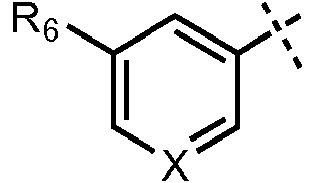
en donde X es N o CR7, R6 es ciano, halo, alquilo o alcoxi y R7 es hidrógeno, ciano, halo, alquilo o alcoxi.wherein X is N or CR7, R6 is cyano, halo, alkyl, or alkoxy, and R7 is hydrogen, cyano, halo, alkyl, or alkoxy.
En algunos casos, Ri es heteroarilo bicíclico que tiene al menos un átomo de N.In some cases, Ri is bicyclic heteroaryl having at least one N atom.
En algunos casos, Ri se selecciona entre el grupo que consiste en:In some cases, Ri is selected from the group consisting of:

2i 2i

y los anillos especificados para Ri opcionalmente pueden sustituirse por uno o más de los sustituyentes descritos para arilo y heteroarilo. En un caso más, el o los sustituyentes se seleccionan entre el grupo que consiste en halo, alquilo C1-C4, alcoxi C1-C4 y ciano.and rings specified for Ri can optionally be substituted by one or more of the substituents described for aryl and heteroaryl. In a further case, the substituent (s) are selected from the group consisting of halo, C1-C4 alkyl, C1-C4 alkoxy, and cyano.
En algunos casos, R4 es ciano, fluoroalquilo, sulfonamida, sulfonilo, sulfinilo o sulfoximinilo. En un caso más R4 es fluoroalquilo, sulfonamida, sulfinilo, sulfonilo o sulfoximinilo.In some cases, R4 is cyano, fluoroalkyl, sulfonamide, sulfonyl, sulfinyl, or sulfoximinyl. In a further case R4 is fluoroalkyl, sulfonamide, sulfinyl, sulfonyl or sulfoximinyl.
En algunos casos, R4 es -S(=O)2Ra, en donde Ra es alquilo o cicloalquilo. En un caso más, Ra es alquilo C1-C4, opcionalmente sustituido con uno o más flúor. Los ejemplos adecuados de fluoroalquilo incluyen -CH2F, -CHF2, -CF3, -CH2CF3, -CH2CHF2, CH2CH2F, -CHFCH3 y -CF2CH3. En aún otro caso más, Ra es metilo, opcionalmente sustituido con uno o más flúor.In some cases, R4 is -S (= O) 2Ra, where Ra is alkyl or cycloalkyl. In a further case, Ra is C1-C4 alkyl, optionally substituted with one or more fluorine. Suitable examples of fluoroalkyl include -CH2F, -CHF2, -CF3, -CH2CF3, -CH2CHF2, CH2CH2F, -CHFCH3 and -CF2CH3. In yet another case, Ra is methyl, optionally substituted with one or more fluorine.
En algunos casos, R4 es -S(=O)(=NRb)Ra, en donde Ra es alquilo o cicloalquilo y Rb es hidrógeno, ciano o alquilo. En un caso más, Ra es alquilo C1-C4, opcionalmente sustituido con uno o más flúor. Los ejemplos adecuados de fluoroalquilo incluyen -CH2F, -CHF2, -CF3, -CH2CF3, -CH2CHF2, CH2CH2F, -CHFCH3 y -CF2CH3.In some cases, R4 is -S (= O) (= NRb) Ra, where Ra is alkyl or cycloalkyl and Rb is hydrogen, cyano, or alkyl. In a further case, Ra is C1-C4 alkyl, optionally substituted with one or more fluorine. Suitable examples of fluoroalkyl include -CH2F, -CHF2, -CF3, -CH2CF3, -CH2CHF2, CH2CH2F, -CHFCH3 and -CF2CH3.
En algunos casos, R4 es -S(=O)2-N(Ra)2, en donde cada Ra es independientemente hidrógeno, alquilo, heteroalquilo, cicloalquilo o heterocicloalquilo y al menos un Ra es hidrógeno. En un caso más, ambos Ra son hidrógeno. En otro caso más, un Ra es hidrógeno y el otro Ra es alquilo C1-C4.In some cases, R4 is -S (= O) 2-N (Ra) 2, where each Ra is independently hydrogen, alkyl, heteroalkyl, cycloalkyl, or heterocycloalkyl and at least one Ra is hydrogen. In one more case, both Ra are hydrogen. In yet another case, one Ra is hydrogen and the other Ra is C1-C4 alkyl.
En algunos casos, R4 se selecciona del grupo que consite en -CN, -CF3, -S(=O)CH3, -S(=O)2CH3, -S(=O)2CH2F, -S(=O)2CHF2, -S(=O)2CF3, -S(=O)2NH2, -S(=O)2NHCH3, -S(=O)(=NH)CH3, -S(=O)(=NH)CH2F, -S(=O)(=NH)CHF2, -S(=O)(=NH)CF3, -S(=O)(=N-CN)CH3, -S(=O)(=N-CN)CH2F, -S(=O)(=N-CN)CHF2 y -S(=O)(=N-CN)CF3.In some cases, R4 is selected from the group consisting of -CN, -CF3, -S (= O) CH3, -S (= O) 2CH3, -S (= O) 2CH2F, -S (= O) 2CHF2, -S (= O) 2CF3, -S (= O) 2NH2, -S (= O) 2NHCH3, -S (= O) (= NH) CH3, -S (= O) (= NH) CH2F, -S (= O) (= NH) CHF2, -S (= O) (= NH) CF3, -S (= O) (= N-CN) CH3, -S (= O) (= N-CN) CH2F, -S (= O) (= N-CN) CHF2 and -S (= O) (= N-CN) CF3.
En algunos casos, R5 es hidrógeno o alquilo. En algunos casos más, R5 es alquilo. En un caso más, R5 es alquilo C1-C4.In some cases, R5 is hydrogen or alkyl. In some more cases, R5 is alkyl. In a further case, R5 is C1-C4 alkyl.
En algunos casos, R8 es hidroxi. En algunos casos más, R8 es amino.In some cases, R8 is hydroxy. In some more cases, R8 is amino.
En algunos casos, R1 es heteroarilo bicíclico y R4 es ciano, fluoroalquilo, sulfonamida, sulfonilo, sulfinilo o sulfoximinilo. En un caso más, R5 es hidrógeno. En aún otro caso más, R4 se selecciona entre el grupo que consiste en -CN, -CF3, -S(=O)CH3, -S(=O)2CH3, -S(=O)2CH2F, -S(=O)2CHF2, -S(=O)2CF3, -S(=O)2NH2, -S(=O)2NHCH3, -S(=O)(=NH)CH3, -S(=O)(=NH)CH2F, -S(=O)(=NH)CHF2, -S(=O)(=NH)CF3, -S(=O)(=N-CN)CH3, -S(=O)(=N-CN)CH2F, -S(=O)(=N- CN)CHF2 y -S(=O)(=N-CN)CF3.In some cases, R1 is bicyclic heteroaryl and R4 is cyano, fluoroalkyl, sulfonamide, sulfonyl, sulfinyl, or sulfoximinyl. In a further case, R5 is hydrogen. In yet another case, R4 is selected from the group consisting of -CN, -CF3, -S (= O) CH3, -S (= O) 2CH3, -S (= O) 2CH2F, -S (= O ) 2CHF2, -S (= O) 2CF3, -S (= O) 2NH2, -S (= O) 2NHCH3, -S (= O) (= NH) CH3, -S (= O) (= NH) CH2F , -S (= O) (= NH) CHF2, -S (= O) (= NH) CF3, -S (= O) (= N-CN) CH3, -S (= O) (= N-CN ) CH2F, -S (= O) (= N-CN) CHF2 and -S (= O) (= N-CN) CF3.
En algunos casos, R1 es heteroarilo bicíclico; R4 es ciano, fluoroalquilo, sulfonamida, sulfonilo, sulfinilo o sulfoximinilo; R8 es hidroxi o amino; y R5 es hidrógeno. En un caso más, R8 es hidroxi. En aún otro caso más, R4 se selecciona entre el grupo que consiste en -CN, -CF3, -S(=O)CH3, -S(=O)2CH3, -S(=O)2CH2F, -S(=O)2CHF2, -S(=O)2CF3, -S(=O)2NH2, -S(=O)2NHCH3, -S(=O)(=NH)CH3, -S(=O)(=NH)CH2F, -S(=O)(=NH)CHF2, -S(=O)(=NH)CF3, -S(=O)(=N-CN)CH3, -S(=O)(=N-CN)CH2F, -S(=O)(=N-CN)CHF2 y -S(=O)(=N-CN)CF3.In some cases, R1 is bicyclic heteroaryl; R4 is cyano, fluoroalkyl, sulfonamide, sulfonyl, sulfinyl, or sulfoximinyl; R8 is hydroxy or amino; and R5 is hydrogen. In a further case, R8 is hydroxy. In yet another case, R4 is selected from the group consisting of -CN, -CF3, -S (= O) CH3, -S (= O) 2CH3, -S (= O) 2CH2F, -S (= O ) 2CHF2, -S (= O) 2CF3, -S (= O) 2NH2, -S (= O) 2NHCH3, -S (= O) (= NH) CH3, -S (= O) (= NH) CH2F , -S (= O) (= NH) CHF2, -S (= O) (= NH) CF3, -S (= O) (= N-CN) CH3, -S (= O) (= N-CN ) CH2F, -S (= O) (= N-CN) CHF2 and -S (= O) (= N-CN) CF3.
En algunos casos, R1 es fenilo o heteroarilo monocíclico y R4 es ciano, fluoroalquilo, sulfonamida, sulfonilo, sulfinilo o sulfoximinilo. En un caso más, R5 es hidrógeno. En aún otro caso más, R4 se selecciona entre el grupo que consiste en -CN, -CF3, -S(=O)CH3, -S(=O)2CH3, -S(=O)2CH2F, -S(=O)2CHF2, -S(=O)2CF3, -S(=O)2NH2, -S(=O)2NHCH3, -S(=O)(=NH)CH3, -S(=O)(=NH)CH2F, -S(=O)(=NH)CHF2, -S(=O)(=NH)CF3, -S(=O)(=N-CN)CH3, -S(=O)(=N-CN)CH2F, -S(=O)(=N-CN)CHF2 y -S(=O)(=N-CN)CF3.In some cases, R1 is phenyl or monocyclic heteroaryl and R4 is cyano, fluoroalkyl, sulfonamide, sulfonyl, sulfinyl, or sulfoximinyl. In a further case, R5 is hydrogen. In yet another case, R4 is selected from the group consisting of -CN, -CF3, -S (= O) CH3, -S (= O) 2CH3, -S (= O) 2CH2F, -S (= O ) 2CHF2, -S (= O) 2CF3, -S (= O) 2NH2, -S (= O) 2NHCH3, -S (= O) (= NH) CH3, -S (= O) (= NH) CH2F , -S (= O) (= NH) CHF2, -S (= O) (= NH) CF3, -S (= O) (= N-CN) CH3, -S (= O) (= N-CN ) CH2F, -S (= O) (= N-CN) CHF2 and -S (= O) (= N-CN) CF3.
En algunos casos, R1 es fenilo o heteroarilo monocíclico; R4 es ciano, fluoroalquilo, sulfonamida, sulfonilo, sulfinilo o sulfoximinilo; R8 es hidroxi o amino; y R5 es hidrógeno. En un caso más, R8 es hidroxi. En un caso más, R4 se selecciona entre el grupo que consiste en -CN, -CF3, -S(=O)CH3, -S(=O)2CH3, -S(=O)2CH2F, -S(=O)2CHF2, -S(=O)2CF3, -S(=O)2NH2, -S(=O)2NHCH3, -S(=O)(=NH)CH3, -S(=O)(=NH)CH2F, -S(=O)(=NH)CHF2, -S(=O)(=NH)CF3, -S(=O)(=N- CN)CH3, -S(=O)(=N-CN)CH2F, -S(=O)(=N-CN)CHF2 y -S(=O)(=N-CN)CF3.In some cases, R1 is phenyl or monocyclic heteroaryl; R4 is cyano, fluoroalkyl, sulfonamide, sulfonyl, sulfinyl, or sulfoximinyl; R8 is hydroxy or amino; and R5 is hydrogen. In a further case, R8 is hydroxy. In a further case, R4 is selected from the group consisting of -CN, -CF3, -S (= O) CH3, -S (= O) 2CH3, -S (= O) 2CH2F, -S (= O) 2CHF2, -S (= O) 2CF3, -S (= O) 2NH2, -S (= O) 2NHCH3, -S (= O) (= NH) CH3, -S (= O) (= NH) CH2F, -S (= O) (= NH) CHF2, -S (= O) (= NH) CF3, -S (= O) (= N- CN) CH3, -S (= O) (= N-CN) CH2F, -S (= O) (= N-CN) CHF2 and -S (= O) (= N-CN) CF3.
En algunos casos, R1 es fenilo o heteroarilo monocíclico y R8 es hidroxi o amino. En un caso más, R5 es hidrógeno. En otro caso más, R5 es alquilo. En aún otro caso más, R5 es alquilo C1-C4.In some cases, R1 is phenyl or monocyclic heteroaryl and R8 is hydroxy or amino. In a further case, R5 is hydrogen. In yet another case, R5 is alkyl. In yet another case, R5 is C1-C4 alkyl.
En algunos casos, R1 es heteroarilo bicíclico y R8 es hidroxi o amino. En un caso más, R5 es hidrógeno. En otro caso más, R5 es alquilo. En aún otro caso más, R5 es alquilo C1-C4. In some cases, R1 is bicyclic heteroaryl and R8 is hydroxy or amino. In a further case, R5 is hydrogen. In yet another case, R5 is alkyl. In yet another case, R5 is C1-C4 alkyl.
En un aspecto, la presente invención proporciona un compuesto que tiene la estructura de fórmula Vb:In one aspect, the present invention provides a compound having the structure of formula Vb:

o una sal farmacéuticamente aceptable del mismo,or a pharmaceutically acceptable salt thereof,
en donde:where:
R1 es arilo o heteroarilo;R1 is aryl or heteroaryl;
R4 es halo, ciano, alquilo, sulfonamida, sulfinilo, sulfonilo o sulfoximinilo;R4 is halo, cyano, alkyl, sulfonamide, sulfinyl, sulfonyl, or sulfoximinyl;
R5 es hidrógeno, halo o alquilo yR5 is hydrogen, halo or alkyl and
R8 es hidroxi o amino.R8 is hydroxy or amino.
En algunas realizaciones, R1 es fenilo o heteroarilo monocíclico. En otras realizaciones más, R1 es fenilo o piridilo, opcionalmente sustituido con uno o más sustituyentes seleccionados entre el grupo que consiste en halo, alquilo, alcoxi y ciano. En una realización más, R1 esIn some embodiments, R1 is monocyclic phenyl or heteroaryl. In still other embodiments, R1 is phenyl or pyridyl, optionally substituted with one or more substituents selected from the group consisting of halo, alkyl, alkoxy, and cyano. In a further embodiment, R1 is

en donde el anillo arilo puede estar opcionalmente sustituido con uno o más sustituyentes seleccionados entre el grupo que consiste en ciano, halo, alquilo o alcoxi. En otra realización más, R1 eswherein the aryl ring may be optionally substituted with one or more substituents selected from the group consisting of cyano, halo, alkyl, or alkoxy. In yet another embodiment, R1 is

en donde X es N o CR7, R6 es ciano, halo, alquilo o alcoxi y R7 es hidrógeno, ciano, halo, alquilo o alcoxi.wherein X is N or CR7, R6 is cyano, halo, alkyl, or alkoxy, and R7 is hydrogen, cyano, halo, alkyl, or alkoxy.
En algunas realizaciones, R1 es heteroarilo bicíclico.In some embodiments, R1 is bicyclic heteroaryl.
En algunas realizaciones, R1 se selecciona entre el grupo que consiste en: In some embodiments, R1 is selected from the group consisting of:

y los anillos especificados para Ri opcionalmente pueden sustituirse por uno o más de los sustituyentes descritos para arilo y heteroarilo. En una realización más, el o los sustituyentes se seleccionan entre el grupo que consiste en halo, alquilo C1-C4, alcoxi C1-C4 y ciano.and rings specified for Ri can optionally be substituted by one or more of the substituents described for aryl and heteroaryl. In a further embodiment, the substituent (s) is selected from the group consisting of halo, C1-C4 alkyl, C1-C4 alkoxy, and cyano.
En algunas realizaciones, R4 es ciano, fluoroalquilo, sulfonamida, sulfonilo, sulfinilo o sulfoximinilo.In some embodiments, R4 is cyano, fluoroalkyl, sulfonamide, sulfonyl, sulfinyl, or sulfoximinyl.
En algunas realizaciones, R4 es -S(=O)2Ra, en donde Ra es alquilo o cicloalquilo. En una realización más, Ra es alquilo C1-C4, opcionalmente sustituido con uno o más flúor. Los ejemplos adecuados de alquilo C1-C4 sustituido con flúor incluyen, pero no se limitan a -CH2F, -CHF2, -CF3, -CH2CF3, -CH2CHF2, CH2CH2F, -CHFCH3 y -CF2CH3. En aún otra realización más, Ra es metilo, opcionalmente sustituido con uno o más flúor.In some embodiments, R4 is -S (= O) 2Ra, where Ra is alkyl or cycloalkyl. In a further embodiment, Ra is C1-C4 alkyl, optionally substituted with one or more fluorine. Suitable examples of fluorine substituted C1-C4 alkyl include, but are not limited to -CH2F, -CHF2, -CF3, -CH2CF3, -CH2CHF2, CH2CH2F, -CHFCH3 and -CF2CH3. In yet another embodiment, Ra is methyl, optionally substituted with one or more fluorine.
En algunas realizaciones, R4 es -S(=O)(=NRb)Ra, en donde Ra es alquilo o cicloalquilo y Rb es hidrógeno, ciano o alquilo. En una realización más, Ra es alquilo C1-C4, opcionalmente sustituido con uno o más flúor. Los ejemplos adecuados de alquilo C1-C4 sustituidos con flúor incluyen, pero sin limitación, -CH2F, -CHF2, -CF3, -CH2CF3, -CH2CHF2, CH2CH2F, -CHFCH3 y -CF2CH3.In some embodiments, R4 is -S (= O) (= NRb) Ra, where Ra is alkyl or cycloalkyl and Rb is hydrogen, cyano, or alkyl. In a further embodiment, Ra is C1-C4 alkyl, optionally substituted with one or more fluorine. Suitable examples of fluorine substituted C1-C4 alkyl include, but are not limited to, -CH2F, -CHF2, -CF3, -CH2CF3, -CH2CHF2, CH2CH2F, -CHFCH3 and -CF2CH3.
En algunas realizaciones, R4 es -S(=O)2-N(Ra)2, en donde cada Ra es independientemente hidrógeno, alquilo, heteroalquilo, cicloalquilo o heterocicloalquilo y al menos un Ra es hidrógeno. En una realización más, ambos Ra son hidrógeno. En otra realización más, un Ra es hidrógeno y el otro Ra es alquilo C1-C4.In some embodiments, R4 is -S (= O) 2-N (Ra) 2, where each Ra is independently hydrogen, alkyl, heteroalkyl, cycloalkyl, or heterocycloalkyl and at least one Ra is hydrogen. In a further embodiment, both Ra are hydrogen. In yet another embodiment, one Ra is hydrogen and the other Ra is C1-C4 alkyl.
En algunas realizaciones, R4 se selecciona del grupo que consiste en -CN, -CF3, -S(=O)CH3, -S(=O)2CH3, -S(=O)2CH2F, -S(=O)2CHF2, -S(=O)2CF3, -S(=O)2NH2, -S(=O)2NHCH3, -S(=O)(=NH)CH3, -S(=O)(=NH)CH2F, -S(=O)(=NH)CHF2, -S(=O)(=NH)CF3, -S(=O)(=N-CN)CH3, -S(=O)(=N-CN)CH2F, -S(=O)(=N-CN)CHF2 y -S(=O)(=N-CN)CF3.In some embodiments, R4 is selected from the group consisting of -CN, -CF3, -S (= O) CH3, -S (= O) 2CH3, -S (= O) 2CH2F, -S (= O) 2CHF2, -S (= O) 2CF3, -S (= O) 2NH2, -S (= O) 2NHCH3, -S (= O) (= NH) CH3, -S (= O) (= NH) CH2F, -S (= O) (= NH) CHF2, -S (= O) (= NH) CF3, -S (= O) (= N-CN) CH3, -S (= O) (= N-CN) CH2F, -S (= O) (= N-CN) CHF2 and -S (= O) (= N-CN) CF3.
En algunas realizaciones, R5 es hidrógeno o alquilo. En algunas realizaciones más, R5 es alquilo. En una realización más, R5 es alquilo C1-C4.In some embodiments, R5 is hydrogen or alkyl. In some more embodiments, R5 is alkyl. In a further embodiment, R5 is C1-C4 alkyl.
En algunas realizaciones, R8 es hidroxi. En algunas realizaciones más, R8 es amino.In some embodiments, R8 is hydroxy. In some more embodiments, R8 is amino.
En algunas realizaciones, R1 es heteroarilo bicíclico y R4 es ciano, fluoroalquilo, sulfonamida, sulfonilo, sulfinilo o sulfoximinilo. En una realización más, R5 es hidrógeno. En aún otra realización más, R4 se selecciona entre el grupo que consiste en -CN, -CF3, -S(=O)CH3, -S(=O)2CH3, -S(=O)2CH2F, -S(=O)2CHF2, -S(=O)2CF3, -S(=O)2NH2, -S(=O)2NHCH3, -S(=O)(=NH)CH3, -S(=O)(=NH)CH2F, -S(=O)(=NH)CHF2, -S(=O)(=NH)CF3, -S(=O)(=N-CN)CH3, -S(=O)(=N-CN)CH2F, -S(=O)(=N- CN)CHF2 y -S(=O)(=N-CN)CF3.In some embodiments, R1 is bicyclic heteroaryl and R4 is cyano, fluoroalkyl, sulfonamide, sulfonyl, sulfinyl, or sulfoximinyl. In a further embodiment, R5 is hydrogen. In yet another embodiment, R4 is selected from the group consisting of -CN, -CF3, -S (= O) CH3, -S (= O) 2CH3, -S (= O) 2CH2F, -S (= O ) 2CHF2, -S (= O) 2CF3, -S (= O) 2NH2, -S (= O) 2NHCH3, -S (= O) (= NH) CH3, -S (= O) (= NH) CH2F , -S (= O) (= NH) CHF2, -S (= O) (= NH) CF3, -S (= O) (= N-CN) CH3, -S (= O) (= N-CN ) CH2F, -S (= O) (= N-CN) CHF2 and -S (= O) (= N-CN) CF3.
En algunas realizaciones, R1 es heteroarilo bicíclico; R4 es ciano, fluoroalquilo, sulfonamida, sulfonilo, sulfinilo o sulfoximinilo; R8 es hidroxi o amino; y R5 es hidrógeno. En una realización más, R8 es hidroxi. En aún otra realización más, R4 se selecciona entre el grupo que consiste en -CN, -CF3, -S(=O)CH3, -S(=O)2CH3, -S(=O)2CH2F, -S(=O)2CHF2, -S(=O)2CF3, -S(=O)2NH2, -S(=O)2NHCH3, -S(=O)(=NH)CH3, -S(=O)(=NH)CH2F, -S(=O)(=NH)CHF2, -S(=O)(=NH)CF3, -S(=O)(=N-CN)CH3, -S(=O)(=N-CN)CH2F, -S(=O)(=N-CN)CHF2 y -S(=O)(=N-CN)CF3.In some embodiments, R1 is bicyclic heteroaryl; R4 is cyano, fluoroalkyl, sulfonamide, sulfonyl, sulfinyl, or sulfoximinyl; R8 is hydroxy or amino; and R5 is hydrogen. In a further embodiment, R8 is hydroxy. In yet another embodiment, R4 is selected from the group consisting of -CN, -CF3, -S (= O) CH3, -S (= O) 2CH3, -S (= O) 2CH2F, -S (= O ) 2CHF2, -S (= O) 2CF3, -S (= O) 2NH2, -S (= O) 2NHCH3, -S (= O) (= NH) CH3, -S (= O) (= NH) CH2F , -S (= O) (= NH) CHF2, -S (= O) (= NH) CF3, -S (= O) (= N-CN) CH3, -S (= O) (= N-CN ) CH2F, -S (= O) (= N-CN) CHF2 and -S (= O) (= N-CN) CF3.
En algunas realizaciones, R1 es fenilo o heteroarilo monocíclico y R4 es ciano, fluoroalquilo, sulfonamida, sulfonilo, sulfinilo o sulfoximinilo. En una realización más, R5 es hidrógeno. En aún otra realización más, R4 se selecciona entre el grupo que consiste en -CN, -CF3, -S(=O)CH3, -S(=O)2CH3, -S(=O)2CH2F, -S(=O)2CHF2, -S(=O)2CF3, -S(=O)2NH2, -S(=O)2NHCH3, -S(=O)(=NH)CH3, -S(=O)(=NH)CH2F, -S(=O)(=NH)CHF2, -S(=O)(=NH)CF3, -S(=O)(=N-CN)CH3, -S(=O)(=N-CN)CH2F, -S(=O)(=N-CN)CHF2 y -S(=O)(=N-CN)CF3.In some embodiments, R1 is phenyl or monocyclic heteroaryl and R4 is cyano, fluoroalkyl, sulfonamide, sulfonyl, sulfinyl or sulfoximinyl. In a further embodiment, R5 is hydrogen. In yet another embodiment, R4 is selected from the group consisting of -CN, -CF3, -S (= O) CH3, -S (= O) 2CH3, -S (= O) 2CH2F, -S (= O ) 2CHF2, -S (= O) 2CF3, -S (= O) 2NH2, -S (= O) 2NHCH3, -S (= O) (= NH) CH3, -S (= O) (= NH) CH2F , -S (= O) (= NH) CHF2, -S (= O) (= NH) CF3, -S (= O) (= N-CN) CH3, -S (= O) (= N-CN ) CH2F, -S (= O) (= N-CN) CHF2 and -S (= O) (= N-CN) CF3.
En algunas realizaciones, R1 es fenilo o heteroarilo monocíclico; R4 es ciano, fluoroalquilo, sulfonamida, sulfonilo, sulfinilo o sulfoximinilo; R8 es hidroxi o amino; y R5 es hidrógeno. En una realización más, R8 es hidroxi. En una realización más, R4 se selecciona entre el grupo que consiste en -CN, -CF3, -S(=O)CH3, -S(=O)2CH3, -S(=O)2CH2F, -S(=O)2CHF2, -S(=O)2CF3, -S(=O)2NH2, -S(=O)2NHCH3, -S(=O)(=NH)CH3, -S(=O)(=NH)CH2F, -S(=O)(=NH)CHF2, -S(=O)(=NH)CF3, -S(=O)(=N- CN)CH3, -S(=O)(=N-CN)CH2F, -S(=O)(=N-CN)CHF2 y -S(=O)(=N-CN)CF3.In some embodiments, R1 is monocyclic phenyl or heteroaryl; R4 is cyano, fluoroalkyl, sulfonamide, sulfonyl, sulfinyl, or sulfoximinyl; R8 is hydroxy or amino; and R5 is hydrogen. In a further embodiment, R8 is hydroxy. In a further embodiment, R4 is selected from the group consisting of -CN, -CF3, -S (= O) CH3, -S (= O) 2CH3, -S (= O) 2CH2F, -S (= O) 2CHF2, -S (= O) 2CF3, -S (= O) 2NH2, -S (= O) 2NHCH3, -S (= O) (= NH) CH3, -S (= O) (= NH) CH2F, -S (= O) (= NH) CHF2, -S (= O) (= NH) CF3, -S (= O) (= N- CN) CH3, -S (= O) (= N-CN) CH2F, -S (= O) (= N-CN) CHF2 and -S (= O) (= N-CN) CF3.
En algunas realizaciones, R1 es fenilo o heteroarilo monocíclico y R8 es hidroxi o amino. En una realización más, R5 es hidrógeno. En otra realización más, R5 es alquilo. En aún otra realización más, R5 es alquilo C1-C4.In some embodiments, R1 is monocyclic phenyl or heteroaryl and R8 is hydroxy or amino. In a further embodiment, R5 is hydrogen. In yet another embodiment, R5 is alkyl. In yet another embodiment, R5 is C1-C4 alkyl.
En algunas realizaciones, R1 es heteroarilo bicíclico y R8 es hidroxi o amino. En una realización más, R5 es hidrógeno. En otra realización más, R5 es alquilo. En aún otra realización más, R5 es alquilo C1-C4.In some embodiments, R1 is bicyclic heteroaryl and R8 is hydroxy or amino. In a further embodiment, R5 is hydrogen. In yet another embodiment, R5 is alkyl. In yet another embodiment, R5 is C1-C4 alkyl.
En algunas realizaciones, un compuesto de fórmula Vb tiene un exceso enantiomérico de al menos aproximadamente el 80 %, al menos aproximadamente menos aproximadamente el 82 %, al menos aproximadamente el 83 %, al menos aproximadamente menos aproximadamente el 85 %, al menos aproximadamente el 86 %, al menos aproximadamente menos aproximadamente el 88 %, al menos aproximadamente el 89 %, al menos aproximadamente menos aproximadamente el 91 %, al menos aproximadamente el 92 %, al menos aproximadamente menos aproximadamente el 94 %, al menos aproximadamente el 95 %, al menos aproximadamente
Como se describe en el presente documento, la presente divulgación proporciona un compuesto o una sal farmacéuticamente aceptable seleccionada entre el grupo que consiste en los compuestos siguientes:As described herein, the present disclosure provides a compound or a pharmaceutically acceptable salt selected from the group consisting of the following compounds:

(continuación)(continuation)

(continuación)(continuation)

(continuación)(continuation)

(continuación)(continuation)

(continuación)(continuation)

(continuación)(continuation)

(continuación)(continuation)

(continuación)(continuation)

(continuación)(continuation)

(continuación)(continuation)
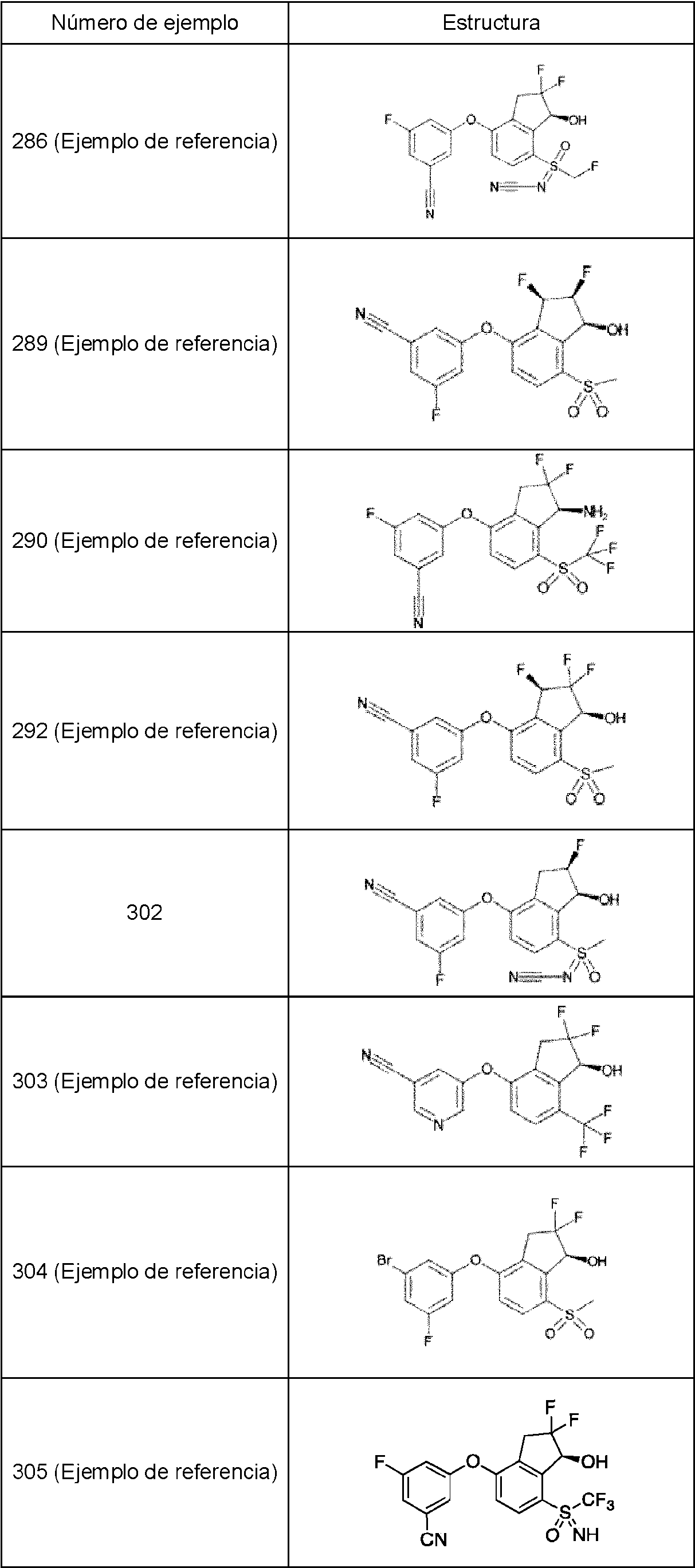
(continuación)(continuation)

(continuación)(continuation)

Métodos de usoMethods of use
Las entidades químicas descritas en el presente documento son útiles para el tratamiento o en la preparación de un medicamento para el tratamiento de enfermedades mediadas por HIF-2a, incluyendo el cáncer. Se ha relacionado un papel de HIF-2a con la tumorigénesis y la progresión tumoral en muchos cánceres humanos. Uno de los vínculos más fuertes entre la actividad de HIF-2a y la enfermedad es en el carcinoma de células renales (RCC), incluyendo carcinoma de células renales de células claras (ccRCC) (revisado en Shen y Kaelin, Seminars in Cáncer Biology 23: 18-25, 2013). Más del ochenta por ciento de los ccRCC tiene VHL defectuosa ya sea mediante eliminación, mutación o modificación postraduccional. La VHL defectuosa en ccRCC da como resultado proteínas HIF-a constitutivamente activas, independientemente del nivel de oxígeno. Una serie de estudios que utilizan enfoques de ganancia de función y pérdida de función en modelos de ratones con xenoinjertos han demostrado claramente que HIF-2a es el sustrato oncogénico clave de VHL (Kondo, et al. Cancer Cell 1: 237-246, 2002; Kondo, et al. PLoS Biology 1: 439 444, 2002; Maranchi, et al. Cancer Cell 1: 247-255, 2002; Zimmer, et al. Mol. Cancer Res 2: 89-95, 2004). En estos estudios, la supresión génica biológica de HIF-2a en los tumores nulos para VHL inhibió la formación de tumores de manera análoga a la reintroducción de VHL y la sobreexpresión de HIF-2a superó la función supresora de tumores de VHL. Además, se ha relacionado el polimorfismo de un solo nucleótido en HIF-2a que hace a HIF-2a refractaria a la degradación mediada por PHD con un mayor riesgo de cáncer de riñón. Además, los análisis inmunohistoquímicos de células tubulares renales morfológicamente normales muestran activación de HIF, lo que respalda un papel patológico temprano dominante en la enfermedad (Mandriota et al. Cancer Cell 1: 459-468, 2002; Raval, et al. Mol. Cell. Biol. 25: 5675-5686, 2005). Además de su papel en la iniciación tumoral, el eje VHL-HIF-2a se ha relacionado con la metástasis del tumor de ccRCC (Vanharanta et al. Nature Medicine 19: 50-59, 2013). Los estudios genéticos sobre HIF-1a han llevado a la hipótesis de que HIF-1a actúa como un supresor de tumores en el cáncer de riñón. HIF-1a reside en un cromosoma frecuentemente eliminado en el ccRCC y la eliminación de HIF-1a aumenta el crecimiento del tumor en ratones (revisado en Shen y Kaelin, Seminars in Cancer Biology 23: 18-25, 2013). En conjunto, estos datos respaldan de manera abrumadora la potencial utilidad terapéutica de los agentes dirigidos contra HIF-2a para el tratamiento del ccRCC.The chemical entities described herein are useful for the treatment or in the preparation of a medicament for the treatment of HIF-2a mediated diseases, including cancer. A role for HIF-2a has been linked to tumorigenesis and tumor progression in many human cancers. One of the strongest links between HIF-2a activity and disease is in renal cell carcinoma (RCC), including clear cell renal cell carcinoma (ccRCC) ( reviewed in Shen and Kaelin, Seminars in Cancer Biology 23 : 18-25, 2013). More than eighty percent of ccRCCs have defective VHL either through deletion, mutation, or post-translational modification. Defective VHL in ccRCC results in constitutively active HIF-a proteins, regardless of oxygen level. A series of studies using gain-of-function and loss-of-function approaches in xenograft mouse models have clearly demonstrated that HIF-2a is the key oncogenic substrate of VHL ( Kondo, et al. Cancer Cell 1: 237-246, 2002 ; Kondo, et al. PLoS Biology 1: 439-444 , 2002; Maranchi, et al. Cancer Cell 1: 247-255, 2002; Zimmer, et al. Mol. Cancer Res 2: 89-95, 2004). In these studies, biological HIF-2a gene suppression in VHL-null tumors inhibited tumor formation analogously to VHL reintroduction, and HIF-2a overexpression outperformed the tumor suppressor function of VHL. Furthermore, single nucleotide polymorphism in HIF-2a that renders HIF-2a refractory to PHD-mediated degradation has been linked to an increased risk of kidney cancer. Furthermore, immunohistochemical analyzes of morphologically normal renal tubular cells show activation of HIF, supporting a dominant early pathological role in the disease ( Mandriota et al. Cancer Cell 1 : 459-468, 2002; Raval, et al. Mol. Cell Biol. 25: 5675-5686, 2005). In addition to its role in tumor initiation, the VHL-HIF-2a axis has been linked to ccRCC tumor metastasis ( Vanharanta et al. Nature Medicine 19: 50-59, 2013). Genetic studies on HIF-1a have led to the hypothesis that HIF-1a acts as a tumor suppressor in kidney cancer. HIF-1a resides on a frequently deleted chromosome in the ccRCC, and deletion of HIF-1a increases tumor growth in mice ( reviewed in Shen and Kaelin, Seminars in Cancer Biology 23: 18-25, 2013 ). Taken together, these data overwhelmingly support the potential therapeutic utility of anti-HIF-2a agents for the treatment of ccRCC.
La enfermedad VHL es un síndrome autosómico dominante que no solo predispone a los pacientes al cáncer de riñón (~70 % de riesgo de por vida), sino también a los hemangioblastomas, feocromocitoma y tumores neuroendocrinos pancreáticos. La enfermedad de VHL da como resultado tumores con proteínas HIF-a constitutivamente activas, la mayoría de las cuales dependen de la actividad de HIF-2a (Maher, et al. Eur. J. Hum. Genet. 19: 617-623, 2011). HIF-2a se ha relacionado con los cánceres de la retina, la glándula suprarrenal y el páncreas a través tanto de la enfermedad de VHL como de mutaciones activadoras. Recientemente, se han identificado mutaciones de HIF-2a de ganancia de función en la eritrocitosis y el paraganglioma con policitemia (Zhuang, et al. NEJM 367: 922-930, 2012; Percy, et al. NEJM 358: 162-168, 2008; y Percy, et al. Am. J. Hematol. 87: 439-442, 2012). De forma destacable, se ha demostrado que una serie de productos génicos diana de HIF- 2a (por ejemplo, VEGF, PDGF y ciclina D1) desempeñan papeles cruciales en los cánceres procedentes del riñón, hígado, colon, pulmón y cerebro. De hecho, se han aprobado para el tratamiento de estos cánceres terapias dirigidas contra uno de los productos génicos clave regulados por HIF-2a, VEGF.VHL disease is an autosomal dominant syndrome that not only predisposes patients to cancer of the kidney (~ 70 % lifetime risk), but also to hemangioblastomas, pheochromocytoma, and pancreatic neuroendocrine tumors. VHL disease results in tumors with constitutively active HIF-a proteins, most of which depend on HIF-2a activity ( Maher, et al. Eur. J. Hum. Genet. 19: 617-623, 2011 ). HIF-2a has been linked to cancers of the retina, the adrenal gland, and the pancreas through both VHL disease and activating mutations. Recently, gain-of-function HIF-2a mutations have been identified in erythrocytosis and polycythemic paraganglioma ( Zhuang, et al. NEJM 367: 922-930, 2012; Percy, et al. NEJM 358: 162-168, 2008 ; and Percy, et al. Am. J. Hematol. 87: 439-442, 2012). Notably, a number of HIF-2a target gene products (eg, VEGF, PDGF, and cyclin D1) have been shown to play crucial roles in cancers originating from the kidney, liver, colon, lung, and brain. In fact, therapies targeting one of the key gene products regulated by HIF-2a, VEGF, have been approved for the treatment of these cancers.
Debido a la mala vascularización, el ambiente intratumoral de los tumores de rápido crecimiento es normalmente hipóxico, una condición que activa HIF-a que apoya la supervivencia y proliferación de células tumorales. Los estudios han demostrado una correlación entre la sobreexpresión de HIF-2a y un pronóstico desfavorable en varios cánceres, incluyendo astrocitoma, mamario, cervical, colorrectal, glioblastoma, glioma, cabeza y cuello, hepatocelular, no microcítico de pulmón, melanoma, neuroblastoma, ovario y próstata, refrendando a HIF-2a como diana terapéutica para estas enfermedades (revisado en Keith, et al. Nature Rev. Cancer 12: 9-22, 2012). Asimismo, Se ha observado en muchos cánceres la inactivación epigenética de la expresión de VHL y, por lo tanto, la activación constitutiva de las proteínas HIF-a, incluyendo el RCC, mieloma múltiple, retinoblastoma, NSCLC, tumores endocrinos pancreáticos, carcinoma de células escamosas, leucemia mieloide aguda, síndrome mielodisplásico y carcinoma de células escamosas esofágico (revisado en Nguyen, et al. Arch. Pharm. Res 36: 252 263, 2013). Due to poor vascularization, the intratumoral environment of fast-growing tumors is normally hypoxic, a condition that activates HIF-a that supports tumor cell survival and proliferation. Studies have shown a correlation between HIF-2a overexpression and an unfavorable prognosis in various cancers, including astrocytoma, breast, cervical, colorectal, glioblastoma, glioma, head and neck, hepatocellular, non-small cell lung, melanoma, neuroblastoma, ovary. and prostate, endorsing HIF-2a as a therapeutic target for these diseases (reviewed in Keith, et al. Nature Rev. Cancer 12: 9-22, 2012). Likewise, epigenetic inactivation of VHL expression and, therefore, constitutive activation of HIF-a proteins, including RCC, multiple myeloma, retinoblastoma, NSCLC, pancreatic endocrine tumors, cell carcinoma, has been observed in many cancers. squamous cells, acute myeloid leukemia, myelodysplastic syndrome, and esophageal squamous cell carcinoma ( reviewed in Nguyen, et al. Arch. Pharm. Res 36: 252-263, 2013).
Específicamente, se ha demostrado que HIF-2a desempeña un papel importante en el cáncer colorrectal mutante para APC a través del control de genes implicados en la proliferación, la utilización del hierro y la inflamación (Xue, et al. Cancer Res 72: 2285-2293, 2012; y Xue y Shah, Carcinogenesis 32: 163-169, 2013). En el carcinoma hepatocelular (HCC), la supresión génica de HIF-2a en modelos preclínicos redujo la expresión de los genes de VEGF y ciclina D1, tanto in vitro como in vivo, dando como resultado la inhibición de la proliferación celular y el crecimiento tumoral (He, et al. Cancer Sci. 103: 528-534, 2012). Además, el cincuenta por ciento de los pacientes con NSCLC tienen sobreexpresión de la proteína HIF-2a, que se correlaciona fuertemente con la expresión de VEGF y, lo que es más importante, con una escasa supervivencia global. HIF-1a también está sobreexpresado en muchos pacientes con cáncer de pulmón. Sin embargo, a diferencia de HIF-2a, la expresión de HlF-1a no se correlaciona con una reducción global de la supervivencia (Giatromanolaki, et al. Br. J. Cancer 85: 881-890, 2001). En ratones modificados por ingeniería genética con tumores con HIF-2a no degradable y KRAS mutante, se observó una mayor carga tumoral y una menor supervivencia en comparación con los ratones con solo expresión de KRAS mutante (Kim, et al. J. Clin. Invest. 119: 2160-2170, 2009). Esta investigación demuestra que HIF-2a contribuye al crecimiento del tumor y a la progresión en el cáncer de pulmón y sugiere una relación con el pronóstico clínico en el NSCLC. Además, la actividad de HIF-2a se ha relacionado con la progresión de la enfermedad pulmonar obstructiva crónica (EPOC) y el cáncer de pulmón en modelos de ratón (Karoor, et al. Cancer Prev. Res. 5: 1061-1071,2012). Sin embargo, la eliminación genética de HIF-2a en un modelo de ratón con KRAS mutante aumentó el crecimiento tumoral a través de la reducción del gen supresor de tumores Scgb3a1 (Mazumdar, et al. PNAS 107: 14182-14187, 2010). En total, estos estudios relacionan a HIF-2a con la progresión del cáncer de pulmón, pero sugieren que el mantenimiento del nivel basal de HIF-2a puede ser beneficioso. También se ha demostrado que la actividad de HIF-2a es importante en los cánceres del sistema nervioso central (Holmquist-Mengelbier, et al. Cancer Cell 10: 413-423, 2006 y Li, et al. Cancer Cell 15: 501-513, 2009). En modelos animales preclínicos de neuroblastoma, la supresión génica de HIF-2a redujo el crecimiento tumoral. Además, se correlacionaron los altos niveles de proteína de HIF-2a con la enfermedad avanzada, un mal pronóstico y niveles elevados de VEGF. De manera similar, la escasa supervivencia en el glioma se correlacionó con la expresión de HIF-2a y la inhibición de HIF-2a en células madre de glioma redujo la proliferación celular y la supervivencia in vitro e la iniciación tumoral in vivo. Curiosamente, aunque HIF-1a se expresa tanto en progenitores neurales como en células madre de tumores cerebrales, HIF-2a solo se expresa en estas últimas. Además, la supervivencia del glioma está correlacionada con los niveles de HIF-2a pero no con los de HIF-1a.Specifically, HIF-2a has been shown to play an important role in APC-mutant colorectal cancer through control of genes involved in proliferation, iron utilization, and inflammation ( Xue, et al. Cancer Res 72: 2285- 2293, 2012; and Xue and Shah, Carcinogenesis 32: 163-169, 2013). In hepatocellular carcinoma (HCC), HIF-2a gene suppression in preclinical models reduced the expression of VEGF and cyclin D1 genes, both in vitro and in vivo, resulting in inhibition of cell proliferation and tumor growth. ( He, et al. Cancer Sci. 103: 528-534, 2012). Furthermore, fifty percent of patients with NSCLC have overexpression of the HIF-2a protein, which is strongly correlated with VEGF expression and, more importantly, with poor overall survival. HIF-1a is also overexpressed in many lung cancer patients. However, unlike HIF-2a, the expression of HlF-1a does not correlate with an overall reduction in survival ( Giatromanolaki, et al. Br. J. Cancer 85: 881-890, 2001). In mice engineered with non-degradable HIF-2a tumors and mutant KRAS, a higher tumor burden and lower survival were observed compared to mice with only mutant KRAS expression ( Kim, et al. J. Clin. Invest . 119: 2160-2170, 2009). This research demonstrates that HIF-2a contributes to tumor growth and progression in lung cancer and suggests a relationship with clinical prognosis in NSCLC. Furthermore, the activity of HIF-2a has been linked to the progression of chronic obstructive pulmonary disease (COPD) and lung cancer in mouse models ( Karoor, et al. Cancer Prev. Res. 5: 1061-1071,2012 ). However, genetic deletion of HIF-2a in a mutant KRAS mouse model increased tumor growth through reduction of the Scgb3a1 tumor suppressor gene ( Mazumdar, et al. PNAS 107: 14182-14187, 2010). In total, these studies link HIF-2a with lung cancer progression, but suggest that maintenance of baseline HIF-2a may be beneficial. HIF-2a activity has also been shown to be important in cancers of the central nervous system ( Holmquist-Mengelbier, et al. Cancer Cell 10: 413-423, 2006 and Li, et al. Cancer Cell 15: 501-513 , 2009). In preclinical animal models of neuroblastoma, HIF-2a gene suppression reduced tumor growth. Furthermore, high levels of HIF-2a protein were correlated with advanced disease, a poor prognosis, and elevated VEGF levels. Similarly, poor survival in glioma correlated with HIF-2a expression and inhibition of HIF-2a in glioma stem cells reduced cell proliferation and survival in vitro and tumor initiation in vivo. Interestingly, although HIF-1a is expressed both in neural progenitors and in brain tumor stem cells, HIF-2a is only expressed in the latter. Furthermore, glioma survival is correlated with HIF-2a levels but not with HIF-1a levels.
Aproximadamente el 50 % de los pacientes con cáncer reciben radioterapia, ya sea sola o en combinación con otras terapias. La hipoxia tumoral se ha asociado durante mucho tiempo a la resistencia a la radioterapia. Por tanto, la inhibición de HlF-2 a podría mejorar la respuesta a la radiación de las células cancerosas/tumorales. Bhatt y colaboradores demostraron que la disminución de los niveles de HIF-2a da lugar a una mayor sensibilidad a la radiación ionizante en líneas celulares de carcinoma de células renales (Bhatt, et al. BJU Int. 102: 358-363, 2008). Además, Bertout y sus colaboradores demostraron que la inhibición de HIF-2a aumenta la eficacia de la radiación a través de un aumento de la apoptosis dependiente de p53 (Bertout, et al. PNAS 106: 14391-14396, 2009). About 50% of cancer patients receive radiation therapy, either alone or in combination with other therapies. Tumor hypoxia has long been associated with resistance to radiation therapy. Therefore, the inhibition of HlF- 2a could enhance the radiation response of cancer / tumor cells. Bhatt et al. Demonstrated that decreased HIF-2a levels lead to increased sensitivity to ionizing radiation in renal cell carcinoma cell lines (Bhatt, et al. BJU Int. 102: 358-363, 2008). Furthermore, Bertout et al. Demonstrated that inhibition of HIF-2a increases radiation efficacy through an increase in p53-dependent apoptosis (Bertout, et al. PNAS 106: 14391-14396, 2009).
Múltiples grupos han informado de intentos para descubrir inhibidores de la actividad de HIF-a. Estos esfuerzos incluyen inhibidores irreversibles, moléculas pequeñas, péptidos cíclicos y productos naturales (Cardoso, et al. Protein Sci. 21: 1885-1896, 2012, Miranda, et al. 2013, Mooring, et al. J. Am. Chem. Soc. 135: 10418-10425, 2011, Tan, et al. Cancer Res. 65: 605-612, 2005, y los documentos WO2013011033 y WO2013057101). También se han descrito algunas estrategias indirectas no específicas para bloquear la actividad de la proteína HIF-a (Zimmer, et al. Mole Cell 32: 838-848, 2008 y Carew, et al. PLoS ONE 7: e3ll20, 2012). Los mecanismos moleculares informados de estos enfoques incluyen niveles disminuidos de ARNm de HIF-1a, disminución de la síntesis de proteínas HIF-1a, aumento de la degradación de HIF-1a, reducción de la heterodimerización de subunidades de HIF, reducción de la unión de HIF al ADN y reducción de la actividad transcripcional de HIF. Por ejemplo, se ha informado de que la acriflavina, un agente antibacteriano, se une directamente al dominio PAS-B de HIF-1a y HIF-2a y bloquea su interacción con HIF-1 p, bloqueando de este modo la transcripción del gen dependiente de HIF y dando lugar a un deterioro del crecimiento del tumor y la vascularización (Lee, et al. PNAS 106: 17910-17915, 2009). Además, se ha informado de que la síntesis de proteínas HIF-1 a se bloquea por varias moléculas que incluyen rapamicina, temsirolimus, everolimus, glicósidos cardíacos, agentes dirigidos a los microtúbulos (taxotere) e inhibidores de la topoisomerasa (topotecan). Los fármacos que inducen la degradación de HIF-1a incluyen inhibidores de HSP90, por ejemplo, 17-alilamino-17-desmetoxigeldanamicina y antioxidantes, tales como ascorbato. Las antraciclinas, tales como doxorrubicina y daunorrubicina, se unen al a Dn y bloquean la unión de HIF-1a y HIF-2a en células cultivadas y también bloquean la expresión dependiente de HIF-1a de los factores de crecimiento angiogénicos, lo que da lugar a un deterioro del crecimiento del tumor (Semenza, Trends Pharmacol. Sci. 33: 207-214, 2012). Sin embargo, se ha obtenido un éxito limitado en los intentos de identificar moléculas selectivas que interfieren directamente con la función de HIF-2a, lo que se evidencia por la escasez de programas clínicos (o preclínicos) que se dirijan a este factor de transcripción.Multiple groups have reported attempts to discover inhibitors of HIF-a activity. These efforts include irreversible inhibitors, small molecules, cyclic peptides, and natural products ( Cardoso, et al. Protein Sci. 21: 1885-1896, 2012, Miranda, et al. 2013, Mooring, et al. J. Am. Chem. Soc. Soc. . 135: 10418-10425, 2011, Tan, et al Cancer res . 65:. 605-612, 2005, and WO2013011033 and WO2013057101 documents). Also they have been described some non-specific indirect strategies to block the activity of the HIF-a protein ( Zimmer, et al. Mole Cell 32: 838-848, 2008 and Carew, et al. PLoS ONE 7: e3ll20, 2012). Molecular mechanisms reported from these approaches include decreased levels of HIF-1a mRNA, decreased HIF-1a protein synthesis, increased degradation of HIF-1a, reduced heterodimerization of HIF subunits, decreased binding of HIF to DNA and reduction of HIF transcriptional activity. For example, acriflavin, an antibacterial agent, has been reported to bind directly to the PAS-B domain of HIF-1a and HIF-2a and block their interaction with HIF-1 p, thereby blocking transcription of the dependent gene. of HIF and leading to impaired tumor growth and vascularization ( Lee, et al. PNAS 106: 17910-17915, 2009). Additionally, HIF-1a protein synthesis has been reported to be blocked by several molecules including rapamycin, temsirolimus, everolimus, cardiac glycosides, microtubule-targeting agents (taxotere), and topoisomerase inhibitors (topotecan). Drugs that induce HIF-1a degradation include HSP90 inhibitors, eg, 17-allylamino-17-demethoxygeldanamycin, and antioxidants, such as ascorbate. Anthracyclines, such as doxorubicin and daunorubicin, bind to Dn and block the binding of HIF-1a and HIF-2a in cultured cells and also block the HIF-1a-dependent expression of angiogenic growth factors, resulting in to an impairment of tumor growth ( Semenza, Trends Pharmacol. Sci. 33: 207-214, 2012). However, there has been limited success in attempts to identify selective molecules that directly interfere with HIF-2a function, as evidenced by the paucity of clinical (or preclinical) programs targeting this transcription factor.
Los trabajos recientes de los profesores Kevin Gardner y Richard Bruick en el Southwestern Medical Center de la Universidad de Texas han revelado un bolsillo de unión a ligando único en un dominio seleccionado de HIF-2a que es necesario para la actividad transcripcional de HIF-2a. Los datos estructurales de alta resolución recogidos frente a uno de los dominios PAS de HIF-2a, tanto de manera individual como en complejos, revelaron una gran cavidad interna hidratada (280 A3) - altamente inusual para una proteína de este tamaño (Scheuermann et al. PNAS 106: 450-455, 2009 y Key et al. J. Am. Chem. Soc., 131: 17647-17654, 2009). Además, se han identificado moléculas de unión de molécula pequeña al dominio B de PAS de HIF-2a (Rogers, et al. J. Med. Chem. 56: 1739-1747, 2013). La unión de estos ligandos da lugar a la inhibición de la actividad transcripcional de HIF-2a en las células (Scheuermann, et al. Nat Chem Biol. 9: 271-276, 2013). Recent work by Professors Kevin Gardner and Richard Bruick at the University of Texas Southwestern Medical Center have revealed a unique ligand binding pocket in a selected domain of HIF-2a that is necessary for HIF-2a transcriptional activity. High resolution structural data collected against one of the PAS domains of HIF-2a, both individually and in complexes, revealed a large hydrated internal cavity (280 A3) - highly unusual for a protein of this size ( Scheuermann et al. PNAS 106: 450-455, 2009 and Key et al. J. Am. Chem. Soc., 131: 17647-17654, 2009). In addition, small molecule binding molecules to the PAS B domain of HIF-2a have been identified ( Rogers, et al. J. Med. Chem. 56: 1739-1747, 2013). The binding of these ligands results in the inhibition of HIF-2a transcriptional activity in cells ( Scheuermann, et al. Nat Chem Biol. 9: 271-276, 2013).
En un aspecto, los compuestos o sus composiciones farmacéuticas descritas en el presente documento son útiles como inhibidores de HIF-2 a. Por tanto, sin desear quedar ligados a ninguna teoría en particular, los compuestos o sus composiciones farmacéuticas descritas en el presente documento son particularmente útiles para tratar o reducir la gravedad de una enfermedad, afección o trastorno donde se asocia la activación de HIF-2a y/o uno o más procesos aguas abajo asociados a la activación o la sobreactivación de HIF-2a con la enfermedad, afección o trastorno. Por consiguiente, en el presente documento se describe un método para tratar o aliviar la gravedad de una enfermedad, afección o trastorno donde está implicada la activación o sobreactivación de HIF-2a con la patología. In one aspect, the compounds or their pharmaceutical compositions described herein are useful as HIF- 2a inhibitors. Thus, without wishing to be bound by any particular theory, the compounds or their pharmaceutical compositions described herein are particularly useful for treating or reducing the severity of a disease, condition, or disorder where activation of HIF-2a is associated and / or one or more downstream processes associated with the activation or over-activation of HIF-2a with the disease, condition or disorder. Accordingly, described herein is a method of treating or alleviating the severity of a disease, condition, or disorder where activation or over-activation of HIF-2a is implicated with the pathology.
La presente divulgación también proporciona un método para tratar el carcinoma de células renales de un sujeto con un compuesto descrito en el presente documento o una sal farmacéuticamente aceptable del mismo. El RCC es una de las formas de cáncer de riñón más comunes que surge a partir del túbulo convolucionado proximal. El RCC también se conoce como hipernefroma. El tratamiento inicial normalmente es una nefrectomía radical o parcial y sigue siendo la principal pauta de tratamiento curativo. En los casos donde el tumor está confinado al parénquima renal, la tasa de supervivencia a los 5 años es del 60-70 %, pero se reduce considerablemente cuando se ha dispersado la metástasis. El RCC es generalmente resistente a la radioterapia y la quimioterapia, aunque algunos casos responden a la inmunoterapia. Las terapias dirigidas contra el cáncer, tales como sunitinib, temsirolimus, bevacizumab, axitinib, pazopanib, interferón alfa y sorafenib han mejorado la perspectiva para el RCC (supervivencia libre de progresión), aunque todavía no se ha demostrado una mejor tasa de supervivencia. Los subtipos de RCC incluyen el carcinoma de células renales de células claras, carcinoma papilar de células renales y carcinoma cromofóbico de células renales.The present disclosure also provides a method of treating a subject's renal cell carcinoma with a compound described herein or a pharmaceutically acceptable salt thereof. RCC is one of the most common forms of kidney cancer that arises from the proximal convoluted tubule. RCC is also known as hypernephroma. Initial treatment is usually radical or partial nephrectomy and it remains the main curative treatment regimen. In cases where the tumor is confined to the renal parenchyma, the 5-year survival rate is 60-70%, but it is greatly reduced when the metastasis has spread. RCC is generally resistant to radiation therapy and chemotherapy, although some cases respond to immunotherapy. Targeted cancer therapies such as sunitinib, temsirolimus, bevacizumab, axitinib, pazopanib, interferon alfa, and sorafenib have improved the outlook for RCC (progression-free survival), although a better survival rate has not yet been shown. RCC subtypes include clear cell renal cell carcinoma, papillary renal cell carcinoma, and chromophobic renal cell carcinoma.
Composiciones farmacéuticas y formas farmacéuticasPharmaceutical compositions and dosage forms
Puede formularse un compuesto o una sal farmacéuticamente aceptable del mismo como una composición farmacéutica antes de su administración a un sujeto. La composición farmacéutica puede comprender aditivos adicionales, tales como excipientes, portadores y vehículos farmacéuticamente aceptables. Los excipientes, portadores y vehículos farmacéuticamente aceptables incluyen agentes de procesado y modificadores del suministro de fármacos, por ejemplo, etilenglicol, fosfato de calcio, estearato de magnesio, talco, monosacáridos, disacáridos, almidón, gelatina, celulosa, metilcelulosa, hidroxipropil celulosa, carboximetilcelulosa sódica, dextrosa, hidroxipropilp-ciclodextrina, polivinilpirrolidina, ceras de bajo punto de fusión, resinas de intercambio iónico, así como combinaciones de dos cualesquiera o más de los mismos.A compound or a pharmaceutically acceptable salt thereof can be formulated as a pharmaceutical composition prior to administration to a subject. The pharmaceutical composition may comprise additional additives, such as pharmaceutically acceptable excipients, carriers, and vehicles. Pharmaceutically acceptable excipients, carriers, and vehicles include processing agents and drug delivery modifiers, eg, ethylene glycol, calcium phosphate, magnesium stearate, talc, monosaccharides, disaccharides, starch, gelatin, cellulose, methyl cellulose, hydroxypropyl cellulose, carboxymethyl cellulose. sodium, dextrose, hydroxypropyl-cyclodextrin, polyvinylpyrrolidine, low-melting waxes, ion exchange resins, as well as combinations of any two or more thereof.
Una composición farmacéutica que comprende un compuesto o una sal farmacéuticamente aceptable del mismo puede administrarse por vía entérica, por vía oral, por vía parenteral, por vía sublingual, por vía rectal o por vía tópica en una dosis unitaria que contiene excipientes, portadores o vehículos farmacéuticamente aceptables. Generalmente, la dosis unitaria es una dosis suficiente para que el compuesto o su sal farmacéuticamente aceptable logre el efecto terapéutico deseado. Los modos adecuados de administración incluyen oral, subcutánea, intraarterial, intramuscular, intraperitoneal, intranasal, intraocular, subdural, vaginal, gastrointestinal.A pharmaceutical composition comprising a compound or a pharmaceutically acceptable salt thereof can be administered enterically, orally, parenterally, sublingually, rectally, or topically in a unit dose containing excipients, carriers, or vehicles. pharmaceutically acceptable. Generally, the unit dose is a dose sufficient for the compound or its pharmaceutically acceptable salt to achieve the desired therapeutic effect. Suitable modes of administration include oral, subcutaneous, intraarterial, intramuscular, intraperitoneal, intranasal, intraocular, subdural, vaginal, gastrointestinal.
Una composición farmacéutica que comprende un compuesto o una sal farmacéuticamente aceptable descrita en el presente documento puede estar en cualquier forma adecuada para el propósito de administración previsto, incluyendo, por ejemplo, una forma farmacéutica sólida o líquida. La forma farmacéutica líquida puede incluir una solución, suspensión, gel suave, jarabe, elixir o emulsión. En la preparación de soluciones, suspensiones y emulsiones normalmente se usan portadores líquidos. Los portadores líquidos contemplados para su uso en la práctica de la presente invención incluyen, por ejemplo, agua, solución salina, etilenglicol, propilenglicol, disolventes orgánicos farmacéuticamente aceptables, aceites o grasas farmacéuticamente aceptables, así como mezclas de dos o más de los mismos. El portador líquido puede contener otros aditivos farmacéuticamente aceptables adecuados, tales como solubilizantes, emulsionantes, nutrientes, tampones, conservantes, agentes de suspensión, agentes espesantes, reguladores de la viscosidad, estabilizantes. Los disolventes orgánicos adecuados incluyen, por ejemplo, alcoholes monohídricos, tales como etanol y alcoholes polihídricos, tales como glicoles. Los aceites adecuados incluyen, por ejemplo, aceite de soja, aceite de coco, aceite de oliva, aceite de cártamo, aceite de semilla de algodón, aceite de girasol. Para administración parenteral, el portador también puede ser un éster oleoso, tal como miristato de isopropilo. Las composiciones de la presente divulgación también pueden estar en forma de nanopartículas, micropartículas, microcápsulas, encapsulados liposomales, así como combinaciones de dos cualesquiera o más de los mismos. Las formas farmacéuticas sólidas para administración oral incluyen cápsulas, comprimidos, píldoras, polvos y gránulos. En dichas formas farmacéuticas sólidas, puede mezclarse el compuesto activo con al menos un diluyente inerte, tal como sacarosa, lactosa o almidón. Dichas formas farmacéuticas también pueden comprender sustancias adicionales distintas de diluyentes inertes, por ejemplo, agentes lubricantes, tales como estearato de magnesio. En el caso de cápsulas, comprimidos y píldoras, las formas farmacéuticas también pueden comprender agentes tamponantes. Los comprimidos y píldoras pueden prepararse adicionalmente con recubrimientos entéricos.A pharmaceutical composition comprising a compound or a pharmaceutically acceptable salt described herein may be in any form suitable for the intended purpose of administration, including, for example, a solid or liquid dosage form. The liquid dosage form can include a solution, suspension, soft gel, syrup, elixir, or emulsion. Liquid carriers are normally used in the preparation of solutions, suspensions and emulsions. Liquid carriers contemplated for use in the practice of the present invention include, for example, water, saline, ethylene glycol, propylene glycol, pharmaceutically acceptable organic solvents, pharmaceutically acceptable oils or fats, as well as mixtures of two or more thereof. The liquid carrier may contain other suitable pharmaceutically acceptable additives, such as solubilizers, emulsifiers, nutrients, buffers, preservatives, suspending agents, thickening agents, viscosity regulators, stabilizers. Suitable organic solvents include, for example, monohydric alcohols, such as ethanol, and polyhydric alcohols, such as glycols. Suitable oils include, for example, soybean oil, coconut oil, olive oil, safflower oil, cottonseed oil, sunflower oil. For parenteral administration, the carrier can also be an oily ester, such as isopropyl myristate. The compositions of the present disclosure can also be in the form of nanoparticles, microparticles, microcapsules, liposomal encapsulates, as well as combinations of any two or more thereof. Solid dosage forms for oral administration include capsules, tablets, pills, powders, and granules. In such solid dosage forms, the active compound can be mixed with at least one inert diluent, such as sucrose, lactose, or starch. Said dosage forms may also comprise additional substances other than inert diluents, for example lubricating agents, such as magnesium stearate. In the case of capsules, tablets and pills, the dosage forms may also comprise buffering agents. Tablets and pills can be further prepared with enteric coatings.
En los casos de una forma farmacéutica sólida, los ejemplos de dosis diarias de los compuestos descritos en el presente documento que pueden usarse son una cantidad eficaz dentro del intervalo de aproximadamente 0,001 mg a aproximadamente 2 mg por kilogramo de peso corporal, de aproximadamente 0,001 mg a aproximadamente 5 mg por kilogramo de peso corporal, de aproximadamente 0,001 mg a aproximadamente 10 mg por kilogramo de peso corporal, de aproximadamente 0,001 mg a aproximadamente 20 mg por kilogramo de peso corporal, de aproximadamente 0,001 mg a aproximadamente 50 mg por kilogramo de peso corporal, de aproximadamente 0,001 mg a aproximadamente 100 mg por kilogramo de peso corporal, de aproximadamente 0,001 mg a aproximadamente 200 mg por kilogramo de peso corporal o de aproximadamente 0,001 mg a aproximadamente 300 mg por kilogramo de peso corporal. Cuando se administran por vía oral o por inhalación, los ejemplos de dosis diarias son una cantidad eficaz dentro del intervalo de dosis de aproximadamente 0,1 mg a aproximadamente 10 mg o de aproximadamente 0,1 mg a aproximadamente 20 mg o de aproximadamente 0,1 mg a aproximadamente 30 mg o de aproximadamente 0,1 mg a aproximadamente 40 mg o de aproximadamente 0,1 mg a aproximadamente 50 mg o de aproximadamente 0,1 mg a aproximadamente 60 mg o de aproximadamente 0,1 mg a aproximadamente 70 mg o de aproximadamente 0,1 mg a aproximadamente 80 mg o de aproximadamente 0,1 mg a aproximadamente 90 mg o de aproximadamente 0,1 mg a aproximadamente 100 mg o de aproximadamente 0,1 mg a aproximadamente 200 mg o de aproximadamente 0,1 mg a aproximadamente 300 mg o de aproximadamente 0,1 mg a aproximadamente 400 mg o de aproximadamente 0,1 mg a aproximadamente 500 mg o de aproximadamente 0,1 mg a aproximadamente 600 mg o de aproximadamente 0,1 mg a aproximadamente 700 mg o de aproximadamente 0,1 mg a aproximadamente 800 mg o de aproximadamente 0,1 mg a aproximadamente 900 mg o de aproximadamente 0,1 mg a aproximadamente 1 g o de aproximadamente 20 mg a 300 mg o de aproximadamente 20 mg a 500 mg o de aproximadamente 20 mg a 700 mg o de aproximadamente 20 mg a 1000 mg o de aproximadamente 50 mg a 1500 mg o de aproximadamente 50 mg a 2000 mg. Las dosis diarias fijas incluyen aproximadamente 1 mg, aproximadamente 2 mg, aproximadamente 3 mg, aproximadamente 4 mg, aproximadamente 5 mg, aproximadamente 6 mg, aproximadamente 7 mg, aproximadamente 8 mg, aproximadamente 9 mg, aproximadamente 10 mg, aproximadamente 12 mg, aproximadamente 15 mg, aproximadamente 18 mg, aproximadamente 20 mg, aproximadamente 30 mg, aproximadamente 40 mg, aproximadamente 50 mg, aproximadamente 60 mg, aproximadamente 70 mg, aproximadamente 80 mg, aproximadamente 90 mg, aproximadamente 100 mg, aproximadamente 150 mg, aproximadamente 200 mg, aproximadamente 250 mg, aproximadamente 300 mg, aproximadamente 400 mg, aproximadamente 500 mg, aproximadamente 600 mg, aproximadamente 700 mg, aproximadamente 800 mg, aproximadamente 900 mg, aproximadamente 1000 mg, aproximadamente 1200 mg, aproximadamente 1500 mg o aproximadamente 2000 mg, independientemente del peso corporal. Sin embargo, se entiende que los pacientes pediátricos pueden requerir dosis menores y, dependiendo de la gravedad de la enfermedad y del estado del paciente, las dosis pueden variar. El compuesto se administrará preferentemente una vez al día, pero pueden administrarse dos, tres o cuatro veces al día o cada dos días o una o dos veces a la semana.In the cases of a solid dosage form, examples of daily doses of the compounds described herein that can be used are an effective amount within the range of about 0.001 mg to about 2 mg per kilogram of body weight, of about 0.001 mg. to about 5 mg per kilogram of body weight, from about 0.001 mg to about 10 mg per kilogram of body weight, from about 0.001 mg to about 20 mg per kilogram of body weight, from about 0.001 mg to about 50 mg per kilogram of weight from about 0.001 mg to about 100 mg per kilogram of body weight, from about 0.001 mg to about 200 mg per kilogram of body weight, or from about 0.001 mg to about 300 mg per kilogram of body weight. When administered orally or by inhalation, examples of daily doses are an effective amount within the dose range of about 0.1 mg to about 10 mg or about 0.1 mg to about 20 mg or about 0, 1mg to about 30mg or from about 0.1mg to about 40mg or from about 0.1mg to about 50mg or from about 0.1mg to about 60mg or from about 0.1mg to about 70mg or from about 0.1 mg to about 80 mg or from about 0.1 mg to about 90 mg or from about 0.1 mg to about 100 mg or from about 0.1 mg to about 200 mg or from about 0.1 mg to about 300 mg or from about 0.1 mg to about 400 mg or from about 0.1 mg to about 500 mg or from about 0.1 mg to about 600 mg or from about 0.1 mg to about 700 mg or about 0.1 m g to about 800 mg or from about 0.1 mg to about 900 mg or from about 0.1 mg to about 1 g or from about 20 mg to 300 mg or from about 20 mg to 500 mg or from about 20 mg to 700 mg or from about 20mg to 1000mg or from about 50mg to 1500mg or from about 50mg to 2000mg. Fixed daily doses include about 1 mg, about 2 mg, about 3 mg, about 4 mg, about 5 mg, about 6 mg, about 7 mg, about 8 mg, about 9 mg, about 10 mg, about 12 mg, about 15mg, about 18mg, about 20mg, about 30mg, about 40mg, about 50mg, about 60mg, about 70mg, about 80mg, about 90mg, about 100mg, about 150mg, about 200mg , about 250mg, about 300mg, about 400mg, about 500mg, about 600mg, about 700mg, about 800mg, about 900mg, about 1000mg, about 1200mg, about 1500mg or about 2000mg, independently of body weight. However, it is understood that pediatric patients may require lower doses and, depending on the severity of the disease and the condition of the patient, the doses may vary. The compound will preferably be administered once a day, but they can be administered two, three or four times a day or every other day or once or twice a week.
Cuando se formula como un líquido, la concentración de los compuestos descritos en el presente documento puede ser de aproximadamente 0,01 mg/ml a aproximadamente 0,1 mg/ml o de aproximadamente 0,1 mg/ml a aproximadamente 1 mg/ml, pero también puede ser de aproximadamente 1 mg/ml a aproximadamente 10 mg/ml o de aproximadamente 10 mg/ml a aproximadamente 100 mg/ml. La formulación líquida podría ser una solución o una suspensión. Cuando se formula como un sólido, por ejemplo, como un comprimido o como un polvo para inhalación, la concentración, expresada como el peso de un compuesto dividido entre el peso total, normalmente será de aproximadamente un 0 ,01 % a aproximadamente un 0 ,1 %, de aproximadamente un 0 ,1 % a aproximadamente un 1 %, de aproximadamente un 1 % a aproximadamente un 10 %, de aproximadamente un 10 % a aproximadamente un 20 %, de aproximadamente un 20 % a aproximadamente un 40 %, de aproximadamente un 40 % a aproximadamente un 60 %, de aproximadamente un 60 % a aproximadamente un 80 % o de aproximadamente un 80 % a aproximadamente un 100 %.When formulated as a liquid, the concentration of the compounds described herein can be from about 0.01 mg / ml to about 0.1 mg / ml or from about 0.1 mg / ml to about 1 mg / ml. , but it can also be from about 1 mg / ml to about 10 mg / ml or from about 10 mg / ml to about 100 mg / ml. The liquid formulation could be a solution or a suspension. When formulated as a solid, for example as a tablet or as a powder for inhalation, the concentration, expressed as the weight of a compound divided by the total weight, will typically be from about 0.01 % to about 0.1 %, from about 0.1 % to about 1 %, from about 1 % to about 10 %, from about 10 % to about 20%, from about 20% to about 40%, from about 40% to about 60%, from about 60% to about 80% or from about 80% to about 100 %.
Los compuestos de la presente invención también pueden administrarse en forma de liposomas. Tal como se conoce en la técnica, los liposomas se obtienen generalmente a partir de fosfolípidos u otras sustancias lipídicas. Los liposomas se forman mediante cristales líquidos mono o multilamelares hidratados que se dispersan en un medio acuoso. Puede usarse cualquier lípido no tóxico fisiológicamente aceptable y metabolizable capaz de formar liposomas. Las presentes composiciones en forma de liposoma pueden contener, además de un compuesto de la presente invención, estabilizantes, conservantes y/o excipientes. Los lípidos preferidos son fosfolípidos y fosfatidilcolinas (lecitinas), tanto naturales como sintéticos. Se conocen en la técnica métodos para formar liposomas. Véase, por ejemplo, Prescott, Ed., "Methods in Cell Biology", Volumen XIV, ISBN: 978-0-12-564114-2, Academic Press, Nueva York, N.W., pág. 33 (1976) y Medina, Zhu y Kairemo, "Targeted liposomal drug delivery in cancer", Current Pharm. Des. 10: 2981-2989, 2004. Para obtener información adicional sobre la formulación y administración de medicamentos, véase "Remington: The Science and Practice of Pharmacy", Lippincott Williams & Wilkins, Filadelfia, ISBN- 10: 0781746736, 21.a edición (2005).The compounds of the present invention can also be administered in the form of liposomes. As is known in the art, liposomes are generally derived from phospholipids or other lipid substances. Liposomes are formed by hydrated mono or multilamellar liquid crystals that are dispersed in an aqueous medium. Any non-toxic physiologically acceptable and metabolizable lipid capable of forming liposomes can be used. The present compositions in liposome form may contain, in addition to a compound of the present invention, stabilizers, preservatives and / or excipients. The preferred lipids are phospholipids and phosphatidylcholines (lecithins), both natural and synthetic. Methods for forming liposomes are known in the art. See, for example, Prescott, Ed., "Methods in Cell Biology", Volume XIV, ISBN: 978-0-12-564114-2, Academic Press, New York, NW, p. 33 (1976) and Medina, Zhu and Kairemo, "Targeted liposomal drug delivery in cancer", Current Pharm. Des. 10: 2981-2989, 2004. For additional information on drug formulation and administration, see "Remington: The Science and Practice of Pharmacy", Lippincott Williams & Wilkins, Philadelphia, ISBN-10: 0781746736, 21st edition ( 2005).
Método de elaboraciónProcessing method
Los compuestos desvelados en el presente documento pueden prepararse mediante las rutas descritas a continuación. Los materiales usados en el presente documento están disponibles en el mercado o se preparan mediante métodos de síntesis habitualmente conocidos en la técnica. Aunque en los esquemas 1-12 se describen y representan diversas etapas, en algunos casos las etapas pueden llevarse a cabo en un orden distinto al orden mostrado. Se pueden realizar diversas modificaciones a estos esquemas de reacción de síntesis y se sugerirán al experto en la técnica con referencia a la divulgación contenida en esta memoria descriptiva. Las numeraciones o los grupos R en cada esquema no corresponden necesariamente a los de las reivindicaciones o a los de otros esquemas o tablas.The compounds disclosed herein can be prepared by the routes described below. The materials used herein are commercially available or prepared by synthetic methods commonly known in the art. Although various steps are described and depicted in Schemes 1-12, in some cases the steps may be performed in an order other than the order shown. Various modifications can be made to these synthetic reaction schemes and will be suggested to the person skilled in the art with reference to the disclosure contained in this specification. The numberings or R groups in each scheme do not necessarily correspond to those in the claims or to those in other schemes or tables.
Es uema 1It's uema 1

Los compuestos de fórmula 1-9 se pueden preparar de acuerdo con las etapas descritas en el esquema 1. La síntesis comienza con el fenol 1-1. La reacción de 1-1 con el cloruro 1-2 (en donde R1 y R2 son independientemente alquilo) proporciona el intermedio 1-3. La reacción puede realizarse en un disolvente orgánico adecuado en presencia de una base. Las bases adecuadas para la reacción incluyen bases orgánicas, por ejemplo, trietilamina, W,W-diisopropiletilamina, 1,4-diazabiciclo[2.2.2]octano y bases inorgánicas, por ejemplo, hidróxido sódico, carbonato de cesio, bicarbonato de cesio, carbonato sódico y carbonato potásico. El compuesto 1-3 se somete después a una reacción de reordenamiento para dar el compuesto 1-4. Es necesaria temperatura elevada para que la reordenación tenga lugar. La temperatura puede estar en el intervalo de 100 °C a 300 °C. En algunos casos, está en el intervalo de 180 °C a 240 °C. La hidrólisis del compuesto 1-4 proporciona el tiofenol 1-5, que se alquila para proporcionar el compuesto 1-6. Se puede introducir diversos grupos alquilo. En algunos casos, R3 es un alquilo C1-C4. En un caso más, R3 es un fluoroalquilo C1-C4. La oxidación del compuesto 1-6 se puede llevar a cabo mediante diversos métodos conocidos en la técnica, incluyendo oxidación catalizada con RuCl3 en presencia de NaIO4, oxidación con ácido m-cloroperbenzoico (mCPBA) y oxidación con Oxone®. La cetona en 1-7 se reduce después para dar el alcohol 1-8, el cual se somete después a una reacción de sustitución aromática nucleófila (SNAr) con un sustrato adecuado R4OH (en donde R4 es arilo o heteroarilo) para dar compuestos de fórmula 1-9. La temperatura para llevar a cabo la reacción SNAr puede depender de R4OH y/o del compuesto 1-8. La reacción puede realizarse en un intervalo de temperatura desde temperatura ambiente hasta 200 °C. En algunos casos, el intervalo de temperatura es desde temperatura ambiente hasta 60 °C. En otros casos más, el intervalo de temperatura es desde 60 °C hasta 100 °C. En otros casos más, el intervalo de temperatura es desde 100 °C hasta 200 °C.Compounds of formula 1-9 can be prepared according to the steps described in Scheme 1. Synthesis begins with phenol 1-1. Reaction of 1-1 with chloride 1-2 (where R 1 and R 2 are independently alkyl) provides intermediate 1-3. The reaction can be carried out in a suitable organic solvent in the presence of a base. Suitable bases for the reaction include organic bases, eg, triethylamine, W, W-diisopropylethylamine, 1,4-diazabicyclo [2.2.2] octane, and inorganic bases, eg, sodium hydroxide, cesium carbonate, cesium bicarbonate, sodium carbonate and potassium carbonate. Compound 1-3 is then subjected to a rearrangement reaction to give compound 1-4. Elevated temperature is necessary for the rearrangement to take place. The temperature can be in the range of 100 ° C to 300 ° C. In some cases, it is in the range of 180 ° C to 240 ° C. Hydrolysis of compound 1-4 provides thiophenol 1-5, which is alkylated to provide compound 1-6. Various alkyl groups can be introduced. In some cases, R 3 is a C1-C4 alkyl. In a further case, R 3 is a C 1 -C 4 fluoroalkyl. The oxidation of compound 1-6 can be carried out by various methods known in the art, including oxidation catalyzed with RuCl 3 in the presence of NaIO 4 , oxidation with m-chloroperbenzoic acid (mCPBA) and oxidation with Oxone®. The ketone at 1-7 is then reduced to give the alcohol 1-8, which is then subjected to a nucleophilic aromatic substitution reaction (rSNA) with a suitable substrate R 4 OH (where R 4 is aryl or heteroaryl) to give compounds of formula 1-9. The temperature for carrying out the rSNA reaction may depend on R 4 OH and / or on compound 1-8. The reaction can be carried out in a temperature range from room temperature to 200 ° C. In some cases, the temperature range is from room temperature to 60 ° C. In still other cases, the temperature range is from 60 ° C to 100 ° C. In still other cases, the temperature range is from 100 ° C to 200 ° C.
Esquema 2Scheme 2

Como alternativa, los compuestos de fórmula 1-9 se pueden preparar asimétricamente para dar compuestos de fórmula 2-2 (Esquema 2). Por ejemplo, puede llevarse a cabo reducción asimétrica directa de la cetona 1-7 (Etapa A) química o enzimáticamente. Para una revisión reciente de la reducción enzimática de las cetonas, véase Moore, et al. Acc. Chem. Res. 40: 1412-1419, 2007. Los ejemplos de reducción asimétrica química de las cetonas incluyen la reducción de Corey-Bakshi-Shibata (CBS), la hidrogenación asimétrica y la hidrogenación asimétrica por transferencia. En algunos casos, la hidrogenación asimétrica por transferencia se cataliza mediante rutenio. Para ejemplos de métodos y catalizadores para hidrogenación por transferencia catalizada por rutenio, véanse las patentes de EEUU 6.184.381 y 6.887.820. Los catalizadores a modo de ejemplo para hidrogenación asimétrica por transferencia incluyen los siguientes (mostrados como la configuración R, R):Alternatively, compounds of formula 1-9 can be prepared asymmetrically to give compounds of formula 2-2 (Scheme 2). For example, direct asymmetric reduction of ketone 1-7 (Step A) can be carried out chemically or enzymatically. For a recent review of the enzymatic reduction of ketones, see Moore, et al. Acc. Chem. Res. 40: 1412-1419, 2007. Examples of chemical asymmetric reduction of ketones include Corey-Bakshi-Shibata (CBS) reduction, asymmetric hydrogenation, and asymmetric transfer hydrogenation. In some cases, asymmetric transfer hydrogenation is catalyzed by ruthenium. For examples of methods and catalysts for ruthenium-catalyzed transfer hydrogenation, see US Patents 6,184,381 and 6,887,820. Exemplary catalysts for asymmetric transfer hydrogenation include the following (shown as the R, R configuration):

La hidrogenación asimétrica por transferencia puede realizarse a, o por debajo de, temperatura ambiente. En algunos casos, la hidrogenación asimétrica por transferencia se lleva a cabo a aproximadamente 4 °C. El producto alcohólico puede tener un exceso enantiomérico de al menos el 90 %, al menos el 91 %, al menos el 92 %, al menos el 93 %, al menos el 94 %, al menos el 95 %, al menos el 96 %, al menos el 97 % o incluso superior. El experto en la técnica entiende bien que cambiar la configuración del catalizador conducirá a un producto con la configuración opuesta. El alcohol quiral 2-1 puede acoplarse con un sustrato adecuado, por ejemplo un fenol, para dar compuestos de fórmula 2-2 sin una pérdida significativa de exceso enantiomérico. La pérdida de exceso enantiomérico (ee) en la etapa de acoplamiento durante 2 - 2 puede ser inferior a aproximadamente un 1 %, inferior a aproximadamente un 2 %, inferior a aproximadamente un 3 %, inferior a aproximadamente un 4 %, inferior a aproximadamente un 5 %, inferior a aproximadamente un 6 % o inferior a aproximadamente un 8 %.Asymmetric transfer hydrogenation can be carried out at or below room temperature. In some cases, asymmetric transfer hydrogenation is carried out at about 4 ° C. The alcoholic product can have an enantiomeric excess of at least 90%, at least 91%, at least 92%, at least 93%, at least 94%, at least 95%, at least 96% , at least 97% or even higher. The person skilled in the art well understands that changing the configuration of the catalyst will lead to a product with the opposite configuration. Chiral alcohol 2-1 can be coupled with a suitable substrate, for example a phenol, to give compounds of formula 2-2 without significant loss of enantiomeric excess. Loss of enantiomeric excess (ee) in the coupling step during 2-2 can be less than about 1 %, less than about one 2%, less than about 3%, less than about 4%, less than about 5%, less than about 6 %, or less than about 8 %.
Esquema 3Scheme 3

Los compuestos de fórmula 3-6 pueden prepararse de acuerdo con el esquema 3. La cetona en 1-7 se protege con un cetal para dar el compuesto 3-1, en donde cada uno de R4 y R5 es independientemente un grupo alquilo. Además, R4 y R5 opcionalmente pueden estar conectados para formar un cetal cíclico. Las estructuras a modo de ejemplo del cetal 3-1 incluyen los siguientes:Compounds of formula 3-6 can be prepared according to scheme 3. The ketone at 1-7 is protected with a ketal to give compound 3-1, wherein each of R 4 and R 5 is independently an alkyl group . Furthermore, R 4 and R 5 may optionally be connected to form a cyclic ketal. Exemplary structures of ketal 3-1 include the following:

El cetal 3-1 y un sustrato R1OH adecuado (en donde R1 es arilo o heteroarilo) pueden someterse a una reacción de sustitución aromática nucleófila (SNAr) para dar el éter de biarilo 3-2. De forma análoga a la reacción SNAr descrita en la etapa G del esquema 1, la temperatura de reacción puede depender de la reactividad del cetal 3-1 y/o de R1OH. Después de la desprotección del cetal en 3-2, la cetona 3-3 resultante se condensa con una amina para formar la imina 3-4, en la que R6 es alquilo. El grupo funcional imina en 3-4 pueden existir en forma de una mezcla de isómeros E, Z. La fluoración de 3-4 puede realizarse con un reactivo de fluoración, por ejemplo, ditetrafluoroborato de 1-(clorometil)-4-fluoro-1,4-diazoniabiciclo[2.2.2]octano, para dar la difluorocetona 3-5 después de hidrólisis ácida. Por último, la reducción de la cetona en 3-5 con un donante de hidruro proporciona compuestos de fórmula 3-6.Ketal 3-1 and a suitable R 1 OH substrate (where R 1 is aryl or heteroaryl) can be subjected to a nucleophilic aromatic substitution reaction (rSNA) to give biaryl ether 3-2. Analogously to the rSNA reaction described in step G of scheme 1, the reaction temperature can depend on the reactivity of the 3-1 ketal and / or R 1 OH. After deprotection of the ketal at 3-2, the resulting ketone 3-3 is condensed with an amine to form imine 3-4, where R 6 is alkyl. The imine functional group at 3-4 can exist as a mixture of E, Z isomers. The fluorination of 3-4 can be performed with a fluorination reagent, for example, 1- (chloromethyl) -4-fluoro-ditetrafluoroborate. 1,4-diazoniabicyclo [2.2.2] octane, to give the difluoroketone 3-5 after acid hydrolysis. Lastly, reducing the ketone by 3-5 with a hydride donor provides compounds of formula 3-6.
Esquema 4 Scheme 4
De forma análoga, los compuestos de fórmula 4-1 pueden prepararse de forma asimétrica mediante reducción asimétrica como se describe en el esquema 2. La reducción asimétrica puede dar compuestos de fórmula 4-1 con un exceso enantiomérico de al menos aproximadamente el 80 %, al menos aproximadamente el 81 %, al menos aproximadamente el 82%, al menos aproximadamente el 83%, al menos aproximadamente el 84%, al menos aproximadamente el 85%, al menos aproximadamente el 8 6 %, al menos aproximadamente el 87%, al menos aproximadamente el 8 8 %, al menos aproximadamente el 89%, al menos aproximadamente el 90%, al menos aproximadamente el 91 %, al menos aproximadamente el 92 %, al menos aproximadamente el 93 %, al menos aproximadamente el 94 %, al menos aproximadamente el 95 %, al menos aproximadamente el 96 %, al menos aproximadamente el 97 %, al menos aproximadamente el 98 % o incluso superior. El exceso enantiomérico de los compuestos 2-2 y 4-1 se puede determinar mediante HPLC o análisis de éster de Mosher. Para la determinación del ee con éster de Mosher, véase Hoye, et al. Natural Protocol, 2: 2451,2007. Similarly, compounds of formula 4-1 can be prepared asymmetrically by asymmetric reduction as described in Scheme 2. Asymmetric reduction can give compounds of formula 4-1 with an enantiomeric excess of at least about 80%, at least about 81%, at least about 82%, at least about 83%, at least about 84%, at least about 85%, at least about 8 6 %, at least about 87%, at least about 8 8 %, at least about 89%, at least about 90%, at least about 91%, at least about 92%, at least about 93%, at least about 94%, at least about 95%, at least about 96%, at least about 97%, at least about 98%, or even higher. The enantiomeric excess of compounds 2-2 and 4-1 can be determined by HPLC or Mosher ester analysis. For the determination of ee with Mosher ester, see Hoye, et al. Natural Protocol, 2: 2451 , 2007.
Esquema 5Scheme 5

Como alternativa, los compuestos de fórmula 4-1 se preparan de acuerdo con el esquema 5. La cetona en 5-1 se fluora para dar la monofluorocetona 5-2, que después se convierte en un éter de sililenol, por ejemplo, el TBS enol éter 5-3. Otros grupos protectores de sililo, por ejemplo, triisopropilsililo o difenil-t-butilsililo, también se pueden utilizar. El enol éter resultante también se fluora para dar la difluorocetona 5-4, que se somete a una reducción asimétrica, tal como hidrogenación asimétrica por transferencia como se describe en el presente documento, para dar el alcohol quiral 5-5. La protección del resto hidroxilo, seguido de reacción SNAr y después desprotección proporciona compuestos de fórmula 4-1.Alternatively, compounds of formula 4-1 are prepared according to Scheme 5. The ketone at 5-1 is fluorinated to give the monofluoroketone 5-2, which is then converted to a silylene ether, eg, TBS enol ether 5-3. Other silyl protecting groups, for example triisopropylsilyl or diphenyl-t-butylsilyl, can also be used. The resulting enol ether is also fluorinated to give difluoroketone 5-4, which undergoes asymmetric reduction, such as asymmetric transfer hydrogenation as described herein, to give chiral alcohol 5-5. Protection of the hydroxyl moiety, followed by rSNA reaction and then deprotection provides compounds of formula 4-1.
Esquema 6 Scheme 6

Como alternativa, los compuestos de fórmula 3-6 se preparan de acuerdo con el esquema 6. El tratamiento del fluoroarilo 3-1 con una fuente de hidróxido proporciona el fenol 6-1. Las fuentes de hidróxido adecuadas incluyen hidróxido sódico e hidróxido potásico. Los disolventes adecuados para la reacción incluyen DMSO, DMA, DMF o EtOH. El fenol 6-1 puede reaccionar con un haluro arilo o heteroarilo mediante una reacción SNAr para dar el éter de biarilo 3-2, que puede convertirse en compuestos de fórmula 3-6 tal como se describe en el esquema 3.Alternatively, compounds of formula 3-6 are prepared according to Scheme 6 . Treatment of the 3-1 fluoroaryl with a hydroxide source provides the 6-1 phenol. Suitable hydroxide sources include sodium hydroxide and potassium hydroxide. Suitable solvents for the reaction include DMSO, DMA, DMF, or EtOH. Phenol 6-1 can react with an aryl or heteroaryl halide via an rSNA reaction to give biaryl ether 3-2, which can be converted to compounds of formula 3-6 as described in Scheme 3.
Esquema 7 Scheme 7

Los compuestos de fórmula 7-3 y 7-4 pueden prepararse de acuerdo con el esquema 7. Por ejemplo, la condensación de NH2R3 con la difluorocetona 7-1, en donde R1 es arilo o heteroarilo y R2 es arilo, heteroarilo, alquilo, heteroalquilo, heterociclo o cicloalquilo, da el intermedio 7-2. En algunos casos, R3 es un auxiliar quiral. Los ejemplos de auxiliares quirales incluyen los siguientes:Compounds of formula 7-3 and 7-4 can be prepared according to scheme 7. For example, the condensation of NH 2 R 3 with difluoroketone 7-1, where R 1 is aryl or heteroaryl and R 2 is aryl , heteroaryl, alkyl, heteroalkyl, heterocycle, or cycloalkyl, gives intermediate 7-2. In some cases, R 3 is a chiral auxiliary. Examples of chiral auxiliaries include the following:

y sus enantiómeros. La reducción de hidruro del intermedio 7-2 proporciona 7-3. En esta fase, el auxiliar quiral puede escindirse en las condiciones apropiadas, por ejemplo, hidrogenación o tratamiento ácido, para dar la amina secundaria quiral 7-4. En algunos casos más, cuando los compuestos de fórmula 7-3 son deseables, en donde R3 no es hidrógeno, la hidrogenación asimétrica o la hidrogenación asimétrica por transferencia se aplica al intermedio 7-2 para dar compuestos de fórmula 7-3. Para una revisión de la hidrogenación asimétrica y la hidrogenación asimétrica por transferencia, véase Iwao Ojima ed. Catalytic Asymmetnc Synthesis, Wiley-VCH, Inc., 2000, ISBN 0-471-29805 0.and its enantiomers. Hydride reduction of intermediate 7-2 provides 7-3. At this stage, the chiral auxiliary can be cleaved under appropriate conditions, eg, hydrogenation or acid treatment, to give the chiral secondary amine 7-4. In some more cases, when compounds of formula 7-3 are desirable, where R 3 is not hydrogen, asymmetric hydrogenation or asymmetric transfer hydrogenation is applied to intermediate 7-2 to give compounds of formula 7-3. For a review of asymmetric hydrogenation and asymmetric transfer hydrogenation, see Iwao Ojima ed. Catalytic Asymmetnc Synthesis, Wiley-VCH, Inc., 2000, ISBN 0-471-29805 0.
Esquema 8 Scheme 8

Los compuestos de fórmula 8-2 pueden prepararse de acuerdo con el esquema 8. Por ejemplo, las cetonas de fórmula 3-3 pueden fluorarse para dar monofluorocetonas de fórmula 8-1. Puede lograrse la monofluoración con diversos reactivos de fluoración, por ejemplo, N-fluoro-o-bencenodisulfonimida, hipofluorito de acetilo, Accufluor®, Selectfluor®, Selectfluor® II o N-fluorobencenosulfonimida, en presencia o ausencia de una base. Los compuestos de fórmula 8-1 se reducen para dar compuestos de fórmula 8-2. En algunos casos, la reducción es altamente diastereoselectiva para dar compuestos de fórmula 8-2 con más del 80 %, más del 82 %, más del 84 %, más del 86 %, más del 88 %, más del 90 %, más del 92 %, más del 94 %, más del 96 % o incluso más del 96 % de diastereoselectividad. En algunos casos, la reducción es altamente enantioselectiva para dar compuestos de fórmula 8-2 con más del 80 %, más del 82 %, más del 84 %, más del 86 %, más del 88 %, más del 90 %, más del 92 %, más del 94 %, más del 96 % o incluso más del 96 % de enantioselectividad. Las condiciones de reducción para conseguir alta enantioselectividad incluyen hidrogenación asimétrica por transferencia y reducción enzimática tal como se describen en el presente documento.Compounds of Formula 8-2 can be prepared according to Scheme 8 . For example, ketones of formula 3-3 can be fluorinated to give monofluoroketones of formula 8-1. Monofluorination can be achieved with various fluorination reagents, eg, N-fluoro-o-benzenedisulfonimide, acetyl hypofluorite, Accufluor®, Selectfluor®, Selectfluor® II, or N-fluorobenzenesulfonimide, in the presence or absence of a base. Compounds of formula 8-1 are reduced to give compounds of formula 8-2. In some cases, the reduction is highly diastereoselective to give compounds of formula 8-2 with more than 80%, more than 82%, more than 84%, more than 86 %, more than 88 %, more than 90%, more than 92%, more than 94%, more than 96% or even more than 96% diastereoselectivity. In some cases, the reduction is highly enantioselective to give compounds of formula 8-2 with more than 80%, more than 82%, more than 84%, more than 86 %, more than 88 %, more than 90%, more than 92%, more than 94%, more than 96% or even more than 96% enantioselectivity. Reduction conditions to achieve high enantioselectivity include asymmetric transfer hydrogenation and enzymatic reduction as described herein.
Esquema 9 Scheme 9
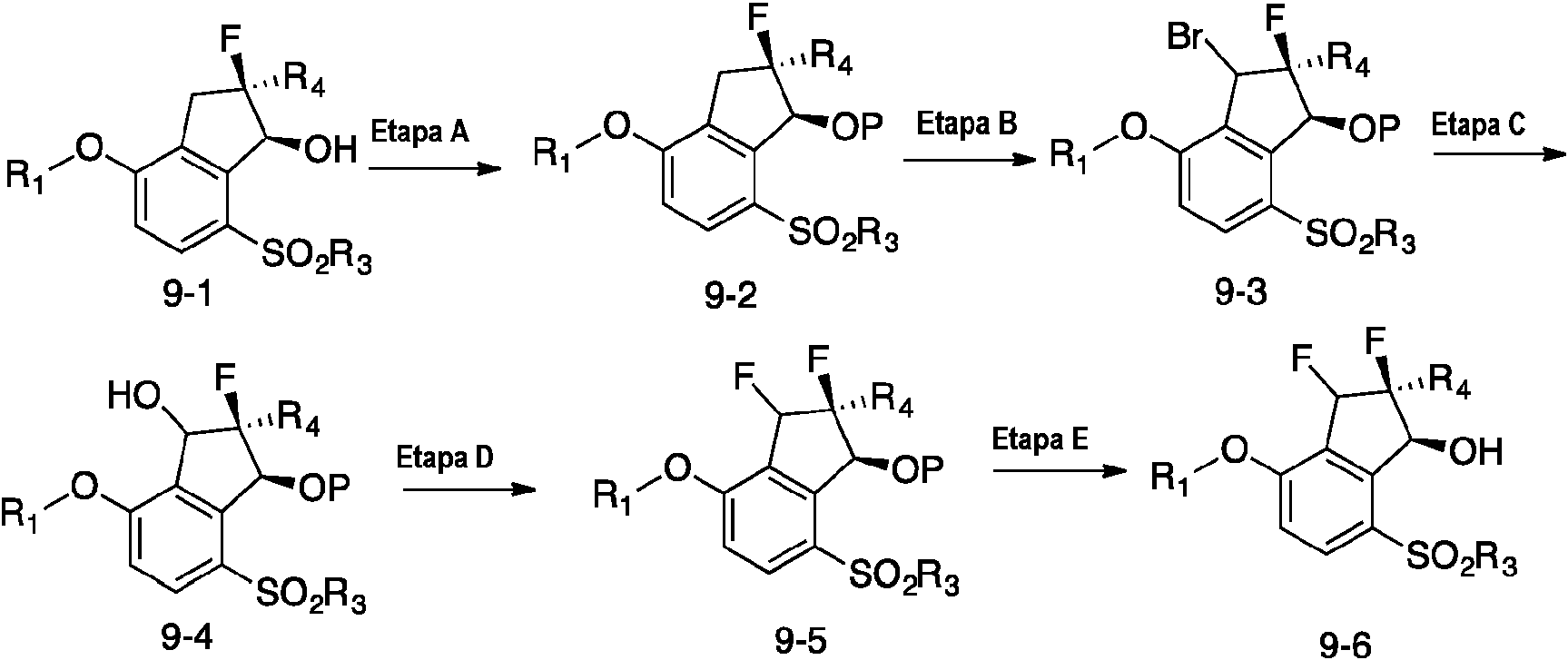
Los compuestos de fórmula 9-6 se pueden preparar de acuerdo con el esquema 9, en donde R4 es hidrógeno, alquilo o flúor. El grupo hidroxi en los compuestos de fórmula 9-1 se pueden proteger con, por ejemplo, acilo o éter de metoximetilo (MOM), para dar compuestos de fórmula 9-2. La bromación bencílica en la etapa B puede realizarse con una fuente de bromuro, por ejemplo, N- bromosuccinimida, en presencia de un iniciador radical, por ejemplo, 2,2'-azobis(2-metilpropionitrilo) (AIBN) o peróxido de benzoílo. El bromuro de los compuestos de fórmula 9-3 se puede sustituir con un grupo hidroxi en un disolvente que comprende agua en presencia de una sal de plata, por ejemplo, Ag2CO3 o AgClO4 o AgBF4. Por último, la fluoración del grupo hidroxi de la fórmula 9-4 seguida de desprotección proporciona compuestos de fórmula 9-6. En algunos casos, puede usarse oxidación bencílica directa para convertir los compuestos de fórmula 9-2 a compuestos de fórmula 9-4, pasando por alto de este modo una etapa intermedia de bromación.Compounds of formula 9-6 can be prepared according to scheme 9, where R 4 is hydrogen, alkyl, or fluoro. The hydroxy group in compounds of formula 9-1 can be protected with, for example, acyl or methoxymethyl ether (MOM), to give compounds of formula 9-2. The benzyl bromination in step B can be carried out with a bromide source, for example N-bromosuccinimide, in the presence of a radical initiator, for example 2,2'-azobis (2-methylpropionitrile) (AIBN) or benzoyl peroxide . The bromide of compounds of formula 9-3 can be substituted with a hydroxy group in a solvent comprising water in the presence of a silver salt, for example, Ag 2 CO 3 or AgClO 4 or AgBF 4 . Finally, fluorination of the hydroxy group of formula 9-4 followed by deprotection provides compounds of formula 9-6. In some cases, direct benzyl oxidation can be used to convert compounds of Formula 9-2 to compounds of Formula 9-4, thereby bypassing an intermediate bromination step.
Esquema 10Scheme 10

Los compuestos de fórmula 10-7 pueden prepararse de acuerdo con el esquema 10. Por ejemplo, los compuestos de fórmula 10-3 pueden prepararse a partir de los compuestos de fórmula 3-2 siguiendo una secuencia similar a la descrita en el esquema 9. Otras manipulaciones de grupos funcionales conducen a compuestos de Fórmula 10-7.Compounds of formula 10-7 can be prepared according to scheme 10. For example, compounds of formula 10-3 can be prepared from compounds of formula 3-2 following a sequence similar to that described in scheme 9. Other manipulations of functional groups lead to compounds of Formula 10-7.
Esquema 11 Scheme 11

Como alternativa, los compuestos de fórmula 10-3 pueden desprotegerse para dar la dicetona 11-1, que se fluoran para dar la difluoro dicetona 11-2. La reducción asimétrica de 11-2 proporciona el diol 11-3. Uno de los grupos hidroxi puede fluorarse de manera selectiva para dar compuestos de fórmula 10-7.Alternatively, compounds of formula 10-3 can be deprotected to give diketone 11-1, which are fluorinated to give difluoro diketone 11-2. The asymmetric reduction of 11-2 provides the diol 11-3. One of the hydroxy groups can be selectively fluorinated to give compounds of formula 10-7.
Esquema 12Scheme 12

Como alternativa, los compuestos de fórmula 10-7 se preparan de acuerdo con el esquema 12. Por ejemplo, la difluorocetona 12-2 se reduce para dar la hidroxicetona 12-3. La reducción puede ser enantioselectiva en condiciones de hidrogenación por transferencia con un catalizador de Ru tal como se describe en el presente documento. Uno de los fluoroarilo puede desplazarse selectivamente con un tiolalquilo para dar compuestos de fórmula 12-4. Oxidación, fluoración, seguida de sustitución aromática nucleófila da compuestos de fórmula 10-7.Alternatively, compounds of formula 10-7 are prepared according to Scheme 12. For example, difluoroketone 12-2 is reduced to hydroxyketone 12-3. The reduction can be enantioselective under transfer hydrogenation conditions with a Ru catalyst as described herein. One of the fluoroaryls can be selectively displaced with a thioalkyl to give compounds of formula 12-4. Oxidation, fluorination, followed by nucleophilic aromatic substitution gives compounds of formula 10-7.
Esquema 13 Scheme 13
Los compuestos de fórmula 13-4 pueden prepararse de acuerdo con el esquema 13. Los sulfuros de arilo 13-1 se tratan con H2N-R3 y un antioxidante, por ejemplo, diacetoxiyodobenceno o dipivaloiloxiyodobenceno, en un disolvente adecuado, tal como acetonitrilo, para obtener las aril sulfimidas 13-2. En algunos casos, para los compuestos de fórmula 13-1 con sustituyentes de R2 fluoroalquilo, la presencia de catalizador de acetato de rodio (II) o de Rh2(esp)2, junto con óxido de magnesio, el útil. La oxidación de las aril sulfinimidas 13-2 a las sulfoximinas sustituidas 13-3 se pueden llevar a cabo con catalizador de cloruro de rutenio (III) y peryodato sódico en un disolvente adecuado, tal como una mezcla de agua, acetonitrilo y tetracloruro de carbono. Las sulfoximinas sustituidas 13-3 se manipulan después de manera similar a la descrita en los esquemas 3 y 4 para proporcionar sulfoximinas de fórmula 13-4 en forma de una mezcla diastereomérica. Los diastereómeros pueden separarse mediante cromatografía en columna.Compounds of formula 13-4 can be prepared according to scheme 13. Aryl sulfides 13-1 are treated with H 2 NR 3 and an antioxidant, for example, diacetoxyiodobenzene or dipivaloyloxyiodobenzene, in a suitable solvent, such as acetonitrile, to obtain the aryl sulfimides 13-2. In some cases, for compounds of formula 13-1 with R 2 fluoroalkyl substituents, the presence of rhodium (II) acetate or Rh 2 (esp) 2 catalyst, together with magnesium oxide, is useful. The oxidation of the aryl sulfinimides 13-2 to the substituted sulfoximines 13-3 can be carried out with a catalyst of ruthenium (III) chloride and sodium periodate in a suitable solvent, such as a mixture of water, acetonitrile and carbon tetrachloride. . The substituted sulfoximines 13-3 are then manipulated in a manner similar to that described in Schemes 3 and 4 to provide sulfoximins of formula 13-4 as a diastereomeric mixture. Diastereomers can be separated by column chromatography.
ExperimentosExperiments
Se han realizado esfuerzos para garantizar la precisión con respecto a los números utilizados (por ejemplo, cantidades, temperatura, etc.) pero deben tenerse en cuenta algunos errores y desviaciones experimentales.Efforts have been made to ensure precision with respect to the numbers used (eg quantities, temperature, etc.) but some errors and experimental deviations must be taken into account.
Los análisis por RMN 1 H y 19F de los intermedios y de los compuestos de los ejemplos se realizaron en un sistema magnético 400/54 de Agilent Technologies (que opera a 399,85 MHz o a 376,24 MHz). Se seleccionaron secuencias de pulsos del software Vnmrj VERSION 3.2 de secuencias de pulso a partir de la serie de experimentos por defecto. La frecuencia de referencia se ajustó usando TMS como patrón interno. Los disolventes deuterados típicos se utilizaron como se indica en los ejemplos individuales.The 1 H and 19 F NMR analyzes of the intermediates and compounds of the examples were performed on an Agilent Technologies 400/54 magnetic system (operating at 399.85 MHz or 376.24 MHz). Pulse sequences from the Vnmrj VERSION 3.2 software of pulse sequences were selected from the default series of experiments. The reference frequency was adjusted using TMS as an internal standard. Typical deuterated solvents were used as indicated in the individual examples.
El análisis por LCMS de los intermedios y los compuestos de los ejemplos se realizó en un sistema de HPLC 1200 Series de Agilent Technologies acoplado a un detector de LC/MS 6150 Quadrapole de Agilent Technologies. Los analitos se detectaron mediante absorbancia UV a 220 y 254 nm. Los iones analito se detectaron mediante espectrometría de masas en ambos modos, negativo y positivo (intervalo de escaneo 110 - 800 amu, ionización API ES). Se llevó a cabo un método largo de HPLC en una columna de 30 x 3,00 mm Kinetex 2,6 pm C18 100 A de Phenomenex®. La temperatura de la columna se ajustó a 40 °C. Las absorciones de UV se detectaron a 220 y 254 nm. Las muestras se prepararon en forma de una solución en una mezcla de aproximadamente 1:1 (v/v) acetonitrilo:agua. El caudal era de aproximadamente 0,80 ml/minuto. Los disolventes de elución fueron acetonitrilo y agua, conteniendo cada uno el 0,1 % de ácido fórmico. En un proceso típico, se llevó a cabo un gradiente lineal comenzando con acetonitrilo al 5 % y agua al 95 % y finalizando con acetonitrilo al 95 % y agua al 5 % durante 12 minutos. Al final de cada proceso, la columna se lavó con acetonitrilo al 95 % y agua al 5 % durante 2 minutos. El exceso enantiomérico se determinó mediante análisis de éster de Mosher o con HPLC quiral. El análisis por HPLC quiral se realizó en un sistema HPLC 1200 Series de Agilent Technologies. Los analitos se detectaron mediante absorbancia UV a 220 y 254 nm. A continuación se proporciona una descripción detallada del método analítico: Columna: Lux® 5u Cellulose-45,0 pm 1000 A, 150 x 4,60 mmLCMS analysis of the intermediates and compounds in the examples was performed on an Agilent Technologies 1200 Series HPLC system coupled to an Agilent Technologies 6150 Quadrapole LC / MS detector. Analytes were detected by UV absorbance at 220 and 254 nm. Analyte ions were detected by mass spectrometry in both negative and positive modes (scan range 110-800 amu, API ES ionization). A long HPLC method was carried out on a 30 x 3.00 mm Kinetex 2.6 pm C18 100 A column from Phenomenex®. The column temperature was adjusted to 40 ° C. UV absorptions were detected at 220 and 254 nm. The samples were prepared as a solution in a mixture of approximately 1: 1 (v / v) acetonitrile: water. The flow rate was approximately 0.80 ml / minute. Elution solvents were acetonitrile and water, each containing 0.1% formic acid. In a typical process, a linear gradient was carried out starting with 5% acetonitrile and 95% water and ending with 95% acetonitrile and 5% water for 12 minutes. At the end of each run, the column was washed with 95% acetonitrile and 5% water for 2 minutes. The enantiomeric excess was determined by Mosher ester analysis or chiral HPLC. Chiral HPLC analysis was performed on an Agilent Technologies 1200 Series HPLC system. Analytes were detected by UV absorbance at 220 and 254 nm. A detailed description of the analytical method is given below: Column: Lux® 5u Cellulose-45.0 pm 1000 A, 150 x 4.60 mm
Caudal: 1,5 ml/minFlow rate: 1.5 ml / min
Fase móvil A: ácido fórmico al 0,1 % en aguaMobile phase A: 0.1% formic acid in water
Fase móvil B: ácido fórmico al 0,1 % en acetonitriloMobile phase B: 0.1% formic acid in acetonitrile
Lavado de aguja fuerte: acetonitrilo al 90 %, agua al 10 %Strong needle wash: 90% acetonitrile, 10% water
Lavado de aguja débil: agua al 10 %, acetonitrilo al 90 %Weak needle wash: 10% water, 90% acetonitrile
Volumen de inyección: 2 plInjection volume: 2 pl
Temperatura de la columna: 40 °CColumn temperature: 40 ° C
Temperatura del automuestreador: Temperatura ambienteAutosampler Temperature: Room Temperature
Tiempo de ejecución: 5,0 minRuntime: 5.0 min
Gradiente: fase móvil A al 60 % y fase móvil B al 40 %Gradient: mobile phase A at 60% and mobile phase B at 40%
Se realizó purificación cromatográfica de rutina usando sistemas automatizados Biotage Isolera One que ejecutan el software Biotage Isolera One 2.0.6 (Biotage LLC, Charlotte, NC). Los caudales fueron los valores por defecto especificados para la columna particular en uso. La cromatografía de fase inversa se realizó usando gradientes de elución de agua y acetonitrilo en columnas Flash+ KP-C18-HS (Biotage LLC) de diversos tamaños. La carga típica era de entre 1:50 y 1:1000 de muestra en bruto: RP SiO2 en peso. Se realizó cromatografía de fase normal usando gradientes de elución de diversos disolventes (por ejemplo, hexano, acetato de etilo, cloruro de metileno, metanol, acetona, cloroformo, MTBE, etc.). Las columnas eran cartuchos SNAP que contenían KP-SIL o SNAP Ultra (partículas esféricas de 25 pm) de diversos tamaños (Biotage LLC). La carga típica estaba entre 1:10 a 1:150 de muestra en bruto: SiO2 en peso.Routine chromatographic purification was performed using automated Biotage Isolera One systems running Biotage Isolera One 2.0.6 software (Biotage LLC, Charlotte, NC). Flow rates were the default values specified for the particular column in use. Reversed phase chromatography was performed using elution gradients of water and acetonitrile on Flash + KP-C18-HS columns (Biotage LLC) of various sizes. Typical loading was between 1:50 and 1: 1000 raw sample: RP SiO 2 by weight. Normal phase chromatography was performed using elution gradients of various solvents (eg, hexane, ethyl acetate, methylene chloride, methanol, acetone, chloroform, MTBE, etc.). The columns were SNAP cartridges containing KP-SIL or SNAP Ultra (25 µm spherical particles) of various sizes (Biotage LLC). Typical loading was between 1:10 to 1: 150 raw sample: SiO 2 by weight.
El nombre del compuesto se generó con la aplicación mol2nam del sofware ultra 13.0.0.3015 u OpenEye Scientific de ChemBioDraw.The compound name was generated with the mol2nam application of the ultra 13.0.0.3015 or OpenEye Scientific software from ChemBioDraw.
Ejemplo de referencia 1 Reference example 1

(R)-4-(3-cloro-5-fluorofenox¡)-7-((d¡fluoromet¡l)sulfon¡l)-2.3-d¡h¡dro-1H-¡nden-1-ol (Compuesto 1)(R) -4- (3-chloro-5-fluorophenox¡) -7 - ((d¡fluorometh¡l) sulfon¡l) -2.3-d¡h¡dro-1H-inden-1-ol (Compound one)
Etapa A: Preparac¡ón de 0-(7-fluoro-3-oxo-¡ndan-4-¡l)-MN-d¡met¡lcarbamot¡oato: Una mezcla de 4-fluoro-7-h¡drox¡-¡ndan-1-ona (17.0 g. 102 mmol). DMF (340 ml). cloruro de W,W-d¡met¡lcarbamot¡oílo (37.9 g. 307 mmol) y 1,4-d¡azab¡c¡clo[2.2.2]octano (34.4 g. 307 mmol) se ag¡tó a temperatura amb¡ente durante 2 horas. La reacc¡ón se vert¡ó en agua fría y se extrajo con EtOAc. Las capas orgán¡cas comb¡nadas se lavaron con agua y salmuera. se secaron y se concentraron. El sól¡do resultante se recr¡stal¡zó en hexano:EtOAc 1 : 1 (240 ml) para dar 0-(7-fluoro-3- oxo-¡ndan-4-¡l)-W,W-d¡met¡lcarbamot¡oato en forma de un sól¡do de color blanco (12.0 g). Las aguas madre se concentraron y se pur¡f¡caron por cromatografía ultrarráp¡da sobre gel de síl¡ce (0-1 % de EtOAc en d¡clorometano) para dar un sól¡do. que se tr¡turó con 4:1 de hexano:EtOAc para dar más 0-(7-fluoro-3-oxo-¡ndan-4- ¡l)-W,W-d¡met¡lcarbamot¡oato (6.9 g. rend¡m¡ento comb¡nado 18.9 g. 73 %). LCMS ESI (+) m/z 254 (M+H). Etapa B: Preparac¡ón de S-(7-fluoro-3-oxo-¡ndan-4-¡l)-N.A/-d¡met¡lcarbamot¡oato: Una mezcla de 0-(7-fluoro-3-oxo-¡ndan-4-¡l)-N.N-d¡met¡lcarbamot¡oato (18.9 g. 74.6 mmol) y d¡fen¡l éter (200 ml) se calentó a 220 °C en atmósfera de n¡trógeno durante 30 m¡nutos. Después de enfr¡ar. la mezcla de reacc¡ón se d¡luyó con hexano. La mezcla se pasó a través de un lecho de gel de síl¡ce pequeño eluyendo con hexano para el¡m¡nar el d¡fen¡l éter. Más eluc¡ón con EtOAc proporc¡onó el producto en bruto. que se pur¡f¡có por cromatografía ultrarráp¡da sobre gel de síl¡ce (15-40% de EtOAc/hexano) para proporc¡onar S-(7-fluoro-3-oxo-¡ndan-4-¡l)-W,A/-d¡met¡lcarbamot¡oato (18.0 g. 95 %) en forma de un sól¡do. LCMS ESI (+) m/z 254 (M+H).Step A: Preparation of 0- (7-fluoro-3-oxo-indan-4-¡l) -MN-d¡metalcarbamot¡oate: A mixture of 4-fluoro-7-hydrox¡ -Ndan-1-one (17.0 g, 102 mmol). DMF (340 ml). W, Wd¡methylcarbamothioyl chloride (37.9 g. 307 mmol) and 1,4-d¡azab¡clo [2.2.2] octane (34.4 g, 307 mmol) was stirred at room temperature ¡Ente for 2 hours. The reaction was poured into cold water and extracted with EtOAc. The combined organic layers were washed with water and brine. dried and concentrated. The resulting solid was recrystallized from 1: 1 hexane: EtOAc (240 ml) to give 0- (7-fluoro-3-oxo-indan-4-¡l) -W, Wd¡met¡ Carbamothioate as a white solid (12.0 g). The mother liquors were concentrated and purified by flash chromatography on silica gel (0-1% EtOAc in dichloromethane) to give a solid. which was triturated with 4: 1 hexane: EtOAc to give additional 0- (7-fluoro-3-oxo-indan-4-l) -W, Wd¡metalcarbamothioate (6.9 g. yield Combined mass 18.9 g. 73%). LCMS ESI (+) m / z 254 (M + H). Step B: Preparation of S- (7-fluoro-3-oxo-indan-4-¡l) -NA / -d¡metalcarbamot¡oate: A mixture of 0- (7-fluoro-3- oxo-indan-4-¡l) -NN-d¡methylcarbamothioate (18.9 g, 74.6 mmol) and d¡phenyl ether (200 ml) were heated at 220 ° C under nitrogen atmosphere for 30 minutes. After cooling. the reaction mixture was diluted with hexane. The mixture was passed through a bed of small silica gel eluting with hexane to remove the dimethyl ether. Further elution with EtOAc provided the crude product. which was purified by flash chromatography on silica gel (15-40% EtOAc / hexane) to provide S- (7-fluoro-3-oxo-indan-4-¡l ) -W, A / -d¡methylcarbamothioate (18.0 g, 95%) as a solid. LCMS ESI (+) m / z 254 (M + H).
Etapa C: Preparac¡ón de 4-fluoro-7-sulfan¡l-¡ndan-1-ona: Una mezcla en ag¡tac¡ón de S-(7-fluoro-3-oxo-¡ndan-4-¡l)-N.N-d¡met¡lcarbamot¡oato (25.0 g. 98.7 mmol). etanol al 95% (490 ml) y NaOH 3N (173 ml. 691 mmol) se calentó en atmósfera de n¡trógeno a reflujo durante 30 m¡nutos. Después de enfr¡ar. la mezcla de reacc¡ón se enfr¡ó a 0 °C usando un baño de h¡elo. Se añad¡ó HCl 3 N gota a gota para ajustar el pH a 4-5. La mayoría del etanol se evaporó a pres¡ón reduc¡da. El sól¡do prec¡p¡tado se recog¡ó por f¡ltrac¡ón. se lavó con agua y se secó para dar 4-fluoro-7-sulfan¡l-¡ndan-1-ona (17.0 g. 95 %). que se usó en la s¡gu¡ente etapa s¡n pur¡f¡cac¡ón ad¡c¡onal. Etapa D: Preparac¡ón de 7-(d¡fluoromet¡lsulfan¡l)-4-fluoro-¡ndan-1-ona: A una soluc¡ón en ag¡tac¡ón de 4-fluoro-7-sulfan¡l-¡ndan-1-ona (en bruto de la etapa C. 17.0 g. 93.3 mmol) en aceton¡tr¡lo (490 ml) se le añad¡ó una soluc¡ón de KOH (104.7 g. 1866 mmol) en agua (490 ml). La mezcla de reacc¡ón se purgó con n¡trógeno y después se enfr¡ó a -78 °C. Se añad¡ó d¡et¡lfosfonato de bromod¡fluoromet¡lo (33.2 ml. 187 mmol) de una vez. La mezcla resultante se dejó calentar a temperatura amb¡ente y se ag¡tó v¡gorosamente durante 2 horas. La mezcla de reacc¡ón se repart¡ó entre EtOAc y agua. La capa acuosa se extrajo con EtOAc. Los extractos orgán¡cos comb¡nados se lavaron con agua y salmuera. se secaron sobre Na2SO4. se f¡ltraron y se concentraron a sequedad. El res¡duo se pur¡f¡có pasando a través de un lecho de gel de síl¡ce pequeño eluyendo con EtOAc al 10 % en hexano para dar 7-(d¡fluoromet¡lsulfan¡l)-4-fluoro-¡ndan-1-ona (18.3 g. 84 %). que se usó en la s¡gu¡ente etapa s¡n pur¡f¡cac¡ón ad¡c¡onal. LCMS ESI (+) m/z 233 (M+H).Step C: Preparation of 4-fluoro-7-sulfanil-indan-1-one: A stirred mixture of S- (7-fluoro-3-oxo-indan-4-¡ l) -NN-dimethylcarbamothioate (25.0 g, 98.7 mmol). 95% ethanol (490 ml) and 3N NaOH (173 ml, 691 mmol) was heated under refluxing nitrogen for 30 minutes. After cooling. The reaction mixture was cooled to 0 ° C using an ice bath. 3N HCl was added dropwise to adjust the pH to 4-5. Most of the ethanol was evaporated under reduced pressure. The captured solid was collected by filtration. Washed with water and dried to give 4-fluoro-7-sulfanl-indan-1-one (17.0 g, 95%). that was used in the next stage without additional purification. Stage D: Preparation of 7- (d¡fluoromethylsulfan¡l) -4-fluoro-indan-1-one: To a solution in agitation of 4-fluoro-7-sulfan¡ l-Indan-1-one (crude from step C. 17.0 g. 93.3 mmol) in acetonitrile (490 ml) was added a KOH solution (104.7 g. 1866 mmol) in water (490 ml). The reaction mixture was purged with nitrogen and then cooled to -78 ° C. Bromodifluoromethyl di-ethyphosphonate (33.2 ml, 187 mmol) was added all at once. The resulting mixture was allowed to warm to room temperature and vigorously stirred for 2 hours. The reaction mixture was partitioned between EtOAc and water. The aqueous layer was extracted with EtOAc. The combined organic extracts were washed with water and brine. dried over Na 2 SO 4 . they were filtered and concentrated to dryness. The residue was purified by passing through a bed of small silica gel eluting with 10% EtOAc in hexane to give 7- (d¡fluoromethylsulfanl) -4-fluoro-¡ ndan-1-one (18.3 g, 84%). that was used in the next stage without additional purification. LCMS ESI (+) m / z 233 (M + H).
Etapa E: Preparac¡ón de 7-((d¡fluoromet¡l)sulfon¡l)-4-fluoro-2.3-d¡h¡dro-1H-¡nden-1-ona: Se añad¡ó peryodato de sod¡o (41.9 g. 196 mmol) de una vez a 7-(d¡fluoromet¡lsulfan¡l)-4-fluoro-¡ndan-1-ona (18.2 g. 78.4 mmol) y cloruro de ruten¡o (III) (0.41 g. 2.0 mmol) en aceton¡tr¡lo (392 ml) / tetracloruro de carbono (392 ml) / agua (392 ml). La mezcla de reacc¡ón se ag¡tó a temperatura amb¡ente durante 5 horas. Los sól¡dos se el¡m¡naron por f¡ltrac¡ón a través de Cel¡te y se aclararon con CH2Cl2. La capa orgán¡ca se separó. La capa acuosa se extrajo con CH2O 2. Los extractos orgán¡cos comb¡nados se lavaron con salmuera. se secaron sobre Na2SO4. se f¡ltraron y se concentraron al vacío. El producto en bruto se pasó a través de un lecho de gel de síl¡ce pequeño eluyendo con EtOAc al 30 % /hexano para dar 7-(d¡fluoromet¡lsulfon¡l)-4-fluoro-¡ndan-1-ona (18.8 g. 91 %) en forma de un sól¡do de color blanco. LCMS ESI (+) m/z 265 (M+H).Step E: Preparation of 7 - ((d¡fluorome¡l) sulfon¡l) -4-fluoro-2.3-d¡h¡dro-1H-inden-1-one: Sodium periodate was added ¡Or (41.9 g. 196 mmol) at once to 7- (d¡fluoromethylsulfan¡l) -4-fluoro-indan-1-one (18.2 g. 78.4 mmol) and ruthenium (III ) (0.41 g, 2.0 mmol) in acetonitrile (392 ml) / carbon tetrachloride (392 ml) / water (392 ml). The reaction mixture was stirred at room temperature for 5 hours. The solids were removed by filtration through Celite and rinsed with CH 2 Cl 2 . The organic layer separated. The aqueous layer was extracted with CH 2 O 2 . The combined organic extracts were washed with brine. dried over Na 2 SO 4 . they were filtered and concentrated in vacuo. The crude product was passed through a small silica gel pad eluting with 30% EtOAc / hexane to give 7- (d¡fluoromethylsulfon¡l) -4-fluoro-indan-1-one (18.8 g. 91%) as a white solid. LCMS ESI (+) m / z 265 (M + H).
Etapa F: Preparac¡ón de (1R)-7-(d¡fluoromet¡lsulfon¡l)-4-fluoro-¡ndan-1-ol: Se cargó un matraz con forma de pera con 7-(d¡fluoromet¡lsulfon¡l)-4-fluoro-¡ndan-1-ona (992 mg. 3.75 mmol). ác¡do fórm¡co (0.178 ml. 4.69 mmol). tr¡et¡lam¡na (0.576 ml. 4.13 mmol) y d¡clorometano (25 ml). La mezcla de reacc¡ón se volv¡ó a llenar con n¡trógeno. Se añad¡ó RuCl(p-c¡meno)[(R.R)-Ts-DPEN] (48 mg. 0.08 mmol) en una porc¡ón y la mezcla de reacc¡ón se ag¡tó a temperatura amb¡ente durante una noche. La reacc¡ón se concentró a pres¡ón reduc¡da. El res¡duo se pur¡f¡có por cromatografía ultrarráp¡da sobre gel de síl¡ce (EtOAc al 5-20 % en hexanos) para dar (1R)-7-(d¡fluoromet¡lsulfon¡l)-4-fluoro¡ndan-1-ol (990 mg. 99 %) en forma de un sól¡do. Se determ¡nó que el ee era del 98 % med¡ante anál¡s¡s por RMN 19F del éster de Mosher correspondente. LCMS ESI (+) m/z 267 (M+H); ESI (-) m/z 311 (M-H+46).Step F: Preparation of (1R) -7- (d¡fluorometh¡lsulfon¡l) -4-fluoro-indan-1-ol: A pear-shaped flask was charged with 7- (d¡fluoromet¡ lsulfonil) -4-fluoro-indan-1-one (992 mg, 3.75 mmol). formic acid (0.178 ml, 4.69 mmol). tritlamine (0.576 ml. 4.13 mmol) and dichloromethane (25 ml). The reaction mixture was refilled with nitrogen. RuCl (pcmene) [(RR) -Ts-DPEN] (48 mg. 0.08 mmol) was added in one portion and the reaction mixture was stirred at room temperature overnight. . The reaction was concentrated under reduced pressure. The residue was purified by flash chromatography on silica gel (5-20% EtOAc in hexanes) to give (1R) -7- (d¡fluoromethylsulfon¡l) -4 -fluoroandan-1-ol (990 mg, 99%) as a solid. The ee was determined to be 98% by 19F NMR analysis of the corresponding Mosher ester. LCMS ESI (+) m / z 267 (M + H); ESI (-) m / z 311 (M-H + 46).
Etapa G: Preparac¡ón de (R)-4-(3-cloro-5-fluorofenox¡)-7-((d¡fluoromet¡l)sulfon¡l)-2.3-d¡h¡dro-1H-¡nden-1-ol (Compuesto 1): Se trató una soluc¡ón de 3-cloro-5-fluoro-fenol (24 mg. 0.17 mmol) y (1R)-7-(d¡fluoromet¡lsulfon¡l)-4-fluoro-¡ndan-1-ol (40 mg. 0.15 mmol) en NMP (1 ml) a temperatura amb¡ente con NaHCO3 (37 mg. 0.45 mmol). La mezcla de reacc¡ón se ag¡tó a 90 °C en atmósfera de n¡trógeno durante 4 horas. Después de enfr¡ar. la mezcla de reacc¡ón se repart¡ó entre EtOAc y agua. La capa acuosa se extrajo con EtOAc. Las capas orgánicas combinadas se lavaron con agua y salmuera, se secaron y se concentraron. El residuo se purificó por cromatografía ultrarrápida de fase inversa C18 (columna C18 Flash 12+M, One unit, de Biotage Isolera, CH3CN al 10-60 %/agua) para dar el compuesto 1 (25 mg, 42 %). Se determinó que el ee era del 98 % mediante análisis por RMN 19F del éster de Mosher correspondiente. Lc Ms ESI (+) m/z 393 (M+H); ESI (-) m/z 437, 439 (M-H+46); RMN 1H (400 MHz, CDCls): 8 7,81 (d, 1H), 7,00-6,89 (m, 3H), 6,73-6,71 (m, 1H), 6,35 (t, 1H), 5,66-5,65 (m, 1H), 3,19-3,13 (m, 2H), 2,96-2,90 (m, 1H), 2,50-2,40 (m, 1H), 2,30-2,24 (m, 1H).Step G: Preparation of (R) -4- (3-chloro-5-fluorophenoxy) -7 - ((d¡fluorometal) sulfon¡l) -2.3-d¡hydro-1H-¡ nden-1-ol (Compound 1): A solution of 3-chloro-5-fluoro-phenol (24 mg. 0.17 mmol) and (1R) -7- (d¡fluoromethylsulfon¡l) - 4-fluoro-indan-1-ol (40 mg, 0.15 mmol) in NMP (1 ml) at room temperature with NaHCO 3 (37 mg, 0.45 mmol). The reaction mixture was stirred at 90 ° C under a nitrogen atmosphere for 4 hours. After cooling. The reaction mixture was partitioned between EtOAc and water. The aqueous layer was extracted with EtOAc. The Combined organic layers were washed with water and brine, dried, and concentrated. The residue was purified by C18 reverse phase flash chromatography (C18 Flash 12 + M column, One unit, from Biotage Isolera, 10-60% CH 3 CN / water) to give compound 1 (25 mg, 42%). The ee was determined to be 98% by 19F NMR analysis of the corresponding Mosher ester. L c M s ESI (+) m / z 393 (M + H); ESI (-) m / z 437, 439 (M-H + 46); 1H NMR (400 MHz, CDCls): 8 7.81 (d, 1H), 7.00 to 6.89 (m, 3H), 6.73 to 6.71 (m, 1H), 6.35 (t , 1H), 5.66-5.65 (m, 1H), 3.19-3.13 (m, 2H), 2.96-2.90 (m, 1H), 2.50-2.40 (m, 1H), 2.30-2.24 (m, 1H).
Síntesis alternativa de 4-fluoro-7-sulfanil-¡ndan-1-ona:Alternative synthesis of 4-fluoro-7-sulfanyl-indan-1-one:
Etapa A: Una solución de trifluorometanosulfonato de (7-fluoro-3-oxo-indan-4-ilo) (237,0 mg, 0,79 mmol) y Xantphos (50,6 mg, 0,09 mmol) en 1,4-dioxano (3 ml) se roció con nitrógeno durante 3 min. La mezcla de reacción se trató después secuencialmente con tioacetato de S-potasio (136,1 mg, 1,19 mmol) y tris(dibencilidenoacetona)dipaladio (0) (36,4 mg, 0,04 mmol) en corriente continua de nitrógeno. El recipiente se cerró herméticamente y se calentó a 100 °C durante 4 horas. La mezcla de reacción se filtró para eliminar los insolubles con CH2O 2 usado como enjuague. El filtrado se concentró y se realizó purificación por cromatografía sobre sílice usando EtOAc al 10%-30% /hexano para dar etanotioato de S-(7-fluoro-3-oxo-indan-4-ilo) (99 mg, 0,44 mmol, 46% de rendimiento). LCMS ESI (+) m/z 225 (M+H).Step A: A solution of (7-fluoro-3-oxo-indan-4-yl) trifluoromethanesulfonate (237.0 mg, 0.79 mmol) and Xantphos (50.6 mg, 0.09 mmol) in 1, 4-dioxane (3 ml) was sparged with nitrogen for 3 min. The reaction mixture was then treated sequentially with S-potassium thioacetate (136.1 mg, 1.19 mmol) and tris (dibenzylideneacetone) dipalladium (0) (36.4 mg, 0.04 mmol) under a continuous stream of nitrogen. . The container was sealed and heated at 100 ° C for 4 hours. The reaction mixture was filtered to remove insolubles with CH 2 O 2 used as a rinse. The filtrate was concentrated and purification was performed by chromatography on silica using 10% -30% EtOAc / hexane to give S- (7-fluoro-3-oxo-indan-4-yl) ethanethioate (99 mg, 0.44 mmol, 46% yield). LCMS ESI (+) m / z 225 (M + H).
Etapa B: A un matraz de fondo redondo que contenía etanotioato de S-(7-fluoro-3-oxo-indan-4-ilo) (99,0 mg, 0,4400 mmol) disuelto en 4,4 ml de THF desgasificado (salpicado con nitrógeno durante 5 min) se le añadió hidróxido de amonio (620 pl, 4,45 mmol). La mezcla de reacción resultante se agitó durante 40 minutos en atmósfera de nitrógeno. La TLC indica el consumo del material de partida y la LCMS identifica el producto deseado. La mezcla de reacción se concentró para eliminar el exceso de THF y después se vertió en 1 ml de NaOH 1 M y 15 ml de agua y se aclaró con 2 x 20 ml de CH2Cl2. La fase acuosa restante se acidificó con 10 ml de HCl 1 M y se extrajo con 3 x 20 ml de CH2Cl2. Los extractos orgánicos combinados se secaron con MgSO4, se filtraron y se concentraron a sequedad. El producto se usó sin purificación adicional para dar 4-fluoro-7-sulfanilindan-1-ona (44 mg, 0,24 mmol, 55 % de rendimiento).Step B: To a round bottom flask containing S- (7-fluoro-3-oxo-indan-4-yl) ethanethioate (99.0 mg, 0.4400 mmol) dissolved in 4.4 ml of degassed THF (sparged with nitrogen for 5 min) was added ammonium hydroxide (620 µl, 4.45 mmol). The resulting reaction mixture was stirred for 40 minutes under a nitrogen atmosphere. TLC indicates the consumption of the starting material and LCMS identifies the desired product. The reaction mixture was concentrated to remove excess THF and then poured into 1 ml of 1 M NaOH and 15 ml of water and rinsed with 2 x 20 ml of CH 2 Cl 2 . The remaining aqueous phase was acidified with 10 ml of 1 M HCl and extracted with 3 x 20 ml of CH 2 Cl 2 . The combined organic extracts were dried over MgSO 4 , filtered, and concentrated to dryness. The product was used without further purification to give 4-fluoro-7-sulfanilindan-1-one (44 mg, 0.24 mmol, 55% yield).
Ejemplo de referencia 2Reference example 2

(ffl-7-((difluorometil)sulfonil)-4-(3,5-difluorofenoxi)-2,3-dil'iidro-1H-inden-1-ol (Compuesto 2): Preparado de forma similar a la descrita en el ejemplo de referencia 1 usando 3,5-difluoro-fenol en lugar del 3-cloro-5-fluoro-fenol de la etapa G. LCMS ESI (+) m/z 377 (M+H); ESI (-) m/z 421 (M-H+46); RMN 1H (400 MHz, CDCls): 8 7,81 (d, 1H), 6,96 (d, 1H), 6,73-6,68 (m, 1H), 6,62-6,61 (m, 2H), 6,36 (t, 1H), 5,66-5,65 (m, 1H), 3,22-3,10 (m, 2H), 2,96-2,90 (m, 1H), 2,50-2,40 (m, 1H), 2,29-2,24 (m, 1H).(ffl-7 - ((difluoromethyl) sulfonyl) -4- (3,5-difluorophenoxy) -2,3-dil'ihydro-1H-inden-1-ol (Compound 2): Prepared in a manner similar to that described in Reference Example 1 using 3,5-difluoro-phenol in place of the 3-chloro-5-fluoro-phenol from step G. LCMS ESI (+) m / z 377 (M + H); ESI (-) m / z 421 (m-H + 46); 1 H NMR (400 MHz, CDCls): 8 7.81 (d, 1H), 6.96 (d, 1H), 6.73 to 6.68 (m, 1H ), 6.62-6.61 (m, 2H), 6.36 (t, 1H), 5.66-5.65 (m, 1H), 3.22-3.10 (m, 2H), 2.96-2.90 (m, 1H), 2.50-2.40 (m, 1H), 2.29-2.24 (m, 1H).
Ejemplo de referencia 3Reference example 3

(ffl-4-((5-cloropiridin-3-il)oxi)-7-((difluorometil)sulfonil)-2,3-dil'iidro-1H-inden-1-ol (Compuesto 3): Preparado de forma similar a la descrita en el ejemplo de referencia 1 usando 5-cloropiridin-3-ol en lugar del 3-cloro-5-fluoro-fenol de la etapa G. LCMS ESI (+) m/z 376, 378 (M+H); RMN 1H (400 MHz, CDCla): 8 8,49 (s, 1H), 8,36 (s, 1H), 7,81 (d, 1H), 7 ,44 -7 ,43 (m, 1H), 6,89 (d, 1H), 6,36 (t, 1H), 5,67-5,66 (m, 1H), 3,23-3,16 (m, 2H), 2,99-2,92 (m, 1H), 2,51-2,42 (m, 1H), 2,32-2,25 (m, 1H).(ffl-4 - ((5-chloropyridin-3-yl) oxy) -7 - ((difluoromethyl) sulfonyl) -2,3-dil'ihydro-1H-inden-1-ol (Compound 3): Prepared in the form similar to that described in reference example 1 using 5-chloropyridin-3-ol in place of the 3-chloro-5-fluoro-phenol from step G. LCMS ESI (+) m / z 376, 378 (M + H ); 1H NMR (400 MHz, CDCla): 8 8.49 (s, 1H), 8.36 (s, 1H), 7.81 (d, 1H), 7, 44-7, 43 (m, 1H ), 6.89 (d, 1H), 6.36 (t, 1H), 5.67-5.66 (m, 1H), 3.23-3.16 (m, 2H), 2.99- 2.92 (m, 1H), 2.51-2.42 (m, 1H), 2.32-2.25 (m, 1H).
Ejemplo de referencia 4Reference example 4

(ffl-5-((7-((difluorometil)sulfonil)-1-l'iidroxi-2,3-dil'iidro-1H-inden-4-il)oxi)nicotinonitrilo (Compuesto 4): Preparado de forma similar a la descrita en el ejemplo de referencia 1 usando 5-hidroxinicotinonitrilo en lugar del 3-cloro-5-fluorofenol de la etapa G. LCMS ESI (+) m/z 367 (M+H); RMN 1H (400 MHz, CDCh): 8 8,76 (s, 1H), 8 ,66 (s, 1H), 7,86 (d, 1H), 7,65-7,64 (m, 1H), 6,93 (d, 1H), 6,38 (t, 1H), 5,71-5,65 (m, 1H), 3,20-3,16 (m, 2H), 2,96-2,90 (m, 1H), 2,50-2,42 (m, 1H), 2,37-2,24 (m, 1H).(ffl-5 - ((7 - ((difluoromethyl) sulfonyl) -1-l'ihydroxy-2,3-dil'ihydro-1H-inden-4-yl) oxy) nicotinonitrile (Compound 4): Preparation of Similar way to that described in Reference Example 1 using 5-hydroxynicotinonitrile in place of the 3-chloro-5-fluorophenol from step G. LCMS ESI (+) m / z 367 (M + H); 1H NMR (400 MHz, CDCH) 8 8.76 (s, 1H), 8, 66 (s, 1H), 7.86 (d, 1H), 7.65 to 7.64 (m, 1H), 6.93 (d, 1H), 6.38 (t, 1H), 5.71-5.65 (m, 1H), 3.20-3.16 (m, 2H), 2.96-2, 90 (m, 1H), 2.50-2.42 (m, 1H), 2.37-2.24 (m, 1H).
Ejemplo de referencia 5Reference example 5

(ft)-7-((difluorometil)sulfonil)-4-((5-fluoropiridin-3-il)oxi)-2,3-dihidro-1H-inden-1-ol (Compuesto 5): Preparado de forma similar a la descrita en el ejemplo de referencia 1 usando 5-fluoropiridin-3-ol en lugar del 3-cloro-5-fluorofenol de la etapa G. LCMS ESI (+) m/z 360 (M+H); RMN 1H (400 MHz, CDCh): 8 8,41 (s, 1H), 8,32 (s, 1H), 7,82 (d, 1H), 7,22-7,17 (m, 1H), 6,92 (d, 1H), 6,37 (t, 1H), 5,70-5,60 (m, 1H), 3,23-3,18 (m, 2H), 2,99-2,97 (m, 1H), 2,54-2,40 (m, 1H), 2,34-2,22 (m, 1H).(ft) -7 - ((difluoromethyl) sulfonyl) -4 - ((5-fluoropyridin-3-yl) oxy) -2,3-dihydro-1H-inden-1-ol (Compound 5): Prepared similarly to that described in Reference Example 1 using 5-fluoropyridin-3-ol in place of the 3-chloro-5-fluorophenol from step G. LCMS ESI (+) m / z 360 (M + H); 1H NMR (400 MHz, CDCH) 8 8.41 (s, 1H), 8.32 (s, 1H), 7.82 (d, 1H), 7.22-7.17 (m, 1H), 6.92 (d, 1H), 6.37 (t, 1H), 5.70-5.60 (m, 1H), 3.23-3.18 (m, 2H), 2.99-2, 97 (m, 1H), 2.54-2.40 (m, 1H), 2.34-2.22 (m, 1H).
Ejemplo de referencia 6 Reference example 6

(ft)-7-((difluorometil)sulfonil)-4-(3-fluoro-5-metoxifenoxi)-2,3-dihidro-1H-inden-1-ol (Compuesto 6 ) : Preparado de forma similar a la descrita en el ejemplo de refencia 1 usando 3-fluoro-5-metoxifenol en lugar del 3-cloro-5-fluorofenol de la etapa G. LCMS ESI (-) m/z 433 (M-H+46); RMN 1H (400 MHz, CDCla): 8 7,77 (d, 1H), 6,91 (d, 1H), 6,54 6,50 (m, 1H), 6,42-6,38 (m, 2H), 6,39 (t, 1H), 5,67-5,63 (m, 1H), 3,80 (s, 3H), 3,23-3,15 (m, 2H), 2,99-2,92 (m, 1H), 2,50-2,45 (m, 1H), 2,30-2,23 (m, 1H).(ft) -7 - ((difluoromethyl) sulfonyl) -4- (3-fluoro-5-methoxyphenoxy) -2,3-dihydro-1H-inden-1-ol (Compound 6 ): Prepared in a similar way as described in Reference Example 1 using 3-fluoro-5-methoxyphenol instead of the 3-chloro-5-fluorophenol from step G. LCMS ESI (-) m / z 433 (M-H + 46); 1H NMR (400 MHz, CDCla): 8 7.77 (d, 1H), 6.91 (d, 1H), 6.54 6.50 (m, 1H), 6.42 to 6.38 (m, 2H), 6.39 (t, 1H), 5.67-5.63 (m, 1H), 3.80 (s, 3H), 3.23-3.15 (m, 2H), 2.99 -2.92 (m, 1H), 2.50-2.45 (m, 1H), 2.30-2.23 (m, 1H).
Ejemplo de referencia 7Reference example 7

Etapa A: Preparación de 7-((difluorometil)sulfonil)-4-fluoro-3-metil-2,3-dihidro-1H-inden-1-ol: A una solución de 7-(difluorometilsulfonil)-4-fluoro-3-metil-indan-1-ona (55 mg, 0,2 mmol, preparada de forma similar a la descrita en el ejemplo de referencia 1 usando 4-fluoro-7-hidroxi-3-metil-2, 3-dihidro-1H-inden-1-ona en lugar de 4-fluoro-7-hidroxi-2,3-dihidro-1H-inden-1-ona en la etapa A) en metanol (5 ml) a temperatura ambiente se le añadió borohidruro sódico (15 mg, 0,4 mmol) en porciones. La reacción se agitó a temperatura ambiente hasta que desapareció el material de partida según análisis por TLC. La mezcla de reacción se diluyó con salmuera y se extrajo con EtOAc. El extracto combinado se secó sobre MgSO4, se filtró y se concentró. El producto en bruto se usó en la siguiente etapa sin purificación adicional.Step A: Preparation of 7 - ((difluoromethyl) sulfonyl) -4-fluoro-3-methyl-2,3-dihydro-1H-inden-1-ol: To a solution of 7- (difluoromethylsulfonyl) -4-fluoro- 3-methyl-indan-1-one (55 mg, 0.2 mmol, prepared in a similar way to that described in reference example 1 using 4-fluoro-7-hydroxy-3-methyl-2,3-dihydro- 1H-inden-1-one instead of 4-fluoro-7-hydroxy-2,3-dihydro-1H-inden-1-one in step A) in methanol (5 ml) at room temperature added sodium borohydride (15 mg, 0.4 mmol) in portions. The reaction was stirred at room temperature until the starting material disappeared by TLC analysis. The reaction mixture was diluted with brine and extracted with EtOAc. The combined extract was dried over MgSO 4 , filtered, and concentrated. The crude product was used in the next step without further purification.
Etapa B: Una mezcla de 7-(difluorometilsulfonil)-4-fluoro-3-metil-indan-1-ol (55 mg, 0,2 mmol, en bruto de la etapa A), 3-cloro-5-fluoro-fenol (57 mg, 0,39 mmol) y bicarbonato de cesio (76 mg, 0,39 mmol) en 1-metil-2-piridona (2 ml) se calentó en atmósfera de N2 a 90 °C durante 1 hora. La LCMS indicó la presencia tanto de producto como de material de partida en la mezcla de reacción. El matraz se volvió a cerrar herméticamente y se calentó a 100 °C durante 2 horas. La mezcla de reacción se enfrió a temperatura ambiente, se diluyó con salmuera y se extrajo con EtOAc. Los extractos orgánicos combinados se secaron sobre MgSO4, se filtraron y se concentraron. La purificación con TLC preparativa con EtOAc/hexano (10 %) seguida de cromatografía de fase inversa con agua/acetonitrilo (10 % a 90 %) dio el compuesto 7a racémico (2,4 mg, 3 % de la etapa A) y el compuesto 7b racémico (0,7 mg, 1 % de la etapa A). LCMS ESI (+) m/z 254 (M+H). Caracterización para 7a: LCMS ESI (+) m/z 429, 431 (M+Na); RMN 1H (400 MHz, CDCh): 8 7,81 (d, 1H), 7,01-6,98 (m, 1H), 6,91-6,89 (m, 2H), 6,75-6,71 (m, 1H), 6,34 (t, 1H), 5,58-5,53 (m, 1H), 3,48-3,40 (m, 1H), 3,22 (d, 1H), 2,66-2,59 (m, 1), 1,98 1,93 (m, 1H), 1,46 (d, 3H). Caracterización para 7b: LCMS ESI (+) m/z 429, 431 (M+Na); RMN 1 H (400 MHz, CDCI3): 57,81 (d, 1H), 7,01-6,97 (m, 1H), 6,92 (d, 1H), 6,89-6,88 (m, 1H), 6,73-6,69 (m, 1H), 6,38 (t, 1H), 5,70 5,67 (m, 1H), 3,71-3,64 (m, 1H), 3,25 (d, 1H), 2,47-2,41 (m, 1H), 2,14-2,06 (m, 1H), 1,36 (d, 3H).Step B: A mixture of 7- (difluoromethylsulfonyl) -4-fluoro-3-methyl-indan-1-ol (55 mg, 0.2 mmol, crude from step A), 3-chloro-5-fluoro- Phenol (57 mg, 0.39 mmol) and cesium bicarbonate (76 mg, 0.39 mmol) in 1-methyl-2-pyridone (2 ml) were heated under N 2 atmosphere at 90 ° C for 1 hour. LCMS indicated the presence of both product and starting material in the reaction mixture. The flask was resealed and heated at 100 ° C for 2 hours. The reaction mixture was cooled to room temperature, diluted with brine, and extracted with EtOAc. The combined organic extracts were dried over MgSO 4 , filtered, and concentrated. Preparative TLC purification with EtOAc / hexane (10%) followed by reverse phase chromatography with water / acetonitrile (10% to 90%) gave racemic compound 7a (2.4 mg, 3% from step A) and the Racemic compound 7b (0.7 mg, 1% from step A). LCMS ESI (+) m / z 254 (M + H). Characterization for 7a: LCMS ESI (+) m / z 429, 431 (M + Na); 1H NMR (400 MHz, CDCH) 8 7.81 (d, 1H), 7.01 to 6.98 (m, 1H), 6.91 to 6.89 (m, 2H), 6.75-6.71 (m, 1H), 6.34 (t, 1H), 5.58-5.53 (m, 1H), 3.48-3.40 (m, 1H) , 3.22 (d, 1H), 2.66-2.59 (m, 1), 1.98 1.93 (m, 1H), 1.46 (d, 3H). Characterization for 7b: LCMS ESI (+) m / z 429, 431 (M + Na); 1 H NMR (400 MHz, CDCI 3 ): 57.81 (d, 1H), 7.01-6.97 (m, 1H), 6.92 (d, 1H), 6.89-6.88 ( m, 1H), 6.73-6.69 (m, 1H), 6.38 (t, 1H), 5.70 5.67 (m, 1H), 3.71-3.64 (m, 1H ), 3.25 (d, 1H), 2.47-2.41 (m, 1H), 2.14-2.06 (m, 1H), 1.36 (d, 3H).
Ejemplo de referencia 8 Reference Example 8
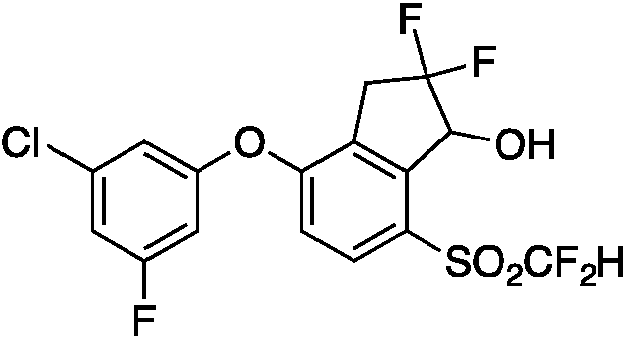
Etapa A: Preparación de 7-((d¡fluoromet¡l)sulfon¡l)-4-fluoro-2.3-d¡h¡droesp¡ro[¡nden-1,2'-[1.31d¡oxolano1 (Compuesto 8 ): Una mezcla de 7-(d¡fluoromet¡lsulfon¡l)-4-fluoro-¡ndan-1-ona (114 mg, 0,43 mmol), et¡lengl¡col (4 ml, 0,43 mmol), ác¡do p-toluenosulfón¡co monoh¡drato (4 mg, 0,02 mmol) y tolueno (20 ml) se calentó a reflujo con el¡m¡nac¡ón azeotróp¡ca del H2O usando una trampa Dean-Stark. La reacc¡ón se controló por LCMS y se añad¡ó et¡lengl¡col dos veces (4 ml cada vez). Después de someter a reflujo durante aprox¡madamente 6 horas, la LCMS ¡nd¡có convers¡ón de aprox¡madamente el 50 %. La mezcla se enfr¡ó a temperatura amb¡ente, se d¡luyó con NaHCO3 acuoso saturado y se extrajo con EtOAc. La capa orgán¡ca se secó sobre Na2SO4, se f¡ltró y se concentró. El res¡duo se pur¡f¡có por cromatografía ultrarráp¡da de fase ¡nversa C18 (One un¡t de B¡otage Isolera, CH3CN al 10-50%/agua) para dar separac¡ón ¡ncompleta del mater¡al de part¡da y el producto. Las fracc¡ones que contenían el mater¡al de part¡da y el producto se comb¡naron y se usaron en la s¡gu¡ente etapa. LCMS ESI (+) m/z 309 (M+H).Step A: Preparation of 7 - ((d¡fluorometal) sulfon¡l) -4-fluoro-2.3-d¡h¡droesp¡ro [¡nden-1,2 '- [1.31d¡oxolane1 (Compound 8 ): A mixture of 7- (d¡fluoromethylsulfon¡l) -4-fluoro-indan-1-one (114 mg, 0.43 mmol), ethylene glycol (4 ml, 0.43 mmol ), p-toluenesulfonic acid monohydrate (4 mg, 0.02 mmol) and toluene (20 ml) was heated under reflux with azeotropic H 2 O mination using a trap Dean-Stark. The reaction was monitored by LCMS and ethylene glycol was added twice (4 ml each). After refluxing for about 6 hours, the LCMS showed conversion of about 50%. The mixture was cooled to room temperature, diluted with saturated aqueous NaHCO 3, and extracted with EtOAc. The organic layer was dried over Na 2 SO 4 , filtered, and concentrated. The residue was purified by C18 reverse phase flash chromatography (One unit of B¡otage Isolera, 10-50% CH 3 CN / water) to give complete separation of the starting material and product. The fractions containing the starting material and the product were combined and used in the next stage. LCMS ESI (+) m / z 309 (M + H).
Etapa B: Preparac¡ón de 4-(3-cloro-5-fluorofenoxi)-7-((difluorometil)sulfonil)-2,3-dihidroespiro[inden-1,2'-f1,31d¡oxolano1. Preparado de manera análoga a la etapa B del ejemplo de referencia 7 usando 7-((d¡fluoromet¡l)sulfon¡l)-4-fluoro-2,3-d¡h¡droesp¡ro[¡nden-1,2'-[1,3]d¡oxolano] en lugar de 7-((d¡fluoromet¡l)sulfon¡l)-4-fluoro-3-met¡l-2,3-d¡h¡dro-1 H- ¡nden-1-ol. LCMS ESI (+) m/z 435/437 (M+H).Step B: Preparation of 4- (3-chloro-5-fluorophenoxy) -7 - ((difluoromethyl) sulfonyl) -2,3-dihydrospiro [inden-1,2'-f1,31-dioxolane1. Prepared analogously to step B of Reference Example 7 using 7 - ((d¡fluorometal) sulfon¡l) -4-fluoro-2,3-d¡hydrosp¡ro [inden-1, 2 '- [1,3] dioxolane] instead of 7 - ((d¡fluoromethyl) sulfon¡l) -4-fluoro-3-methyl-2,3-d¡hydro- 1 H- inden-1-ol. LCMS ESI (+) m / z 435/437 (M + H).
Etapa C: Preparac¡ón de 4-(3-cloro-5-fluoro-fenox¡)-7-(d¡fluoromet¡lsulfon¡l)¡ndan-1-ona: A una soluc¡ón de 4-(3-cloro-5-fluorofenoxi)-7-((difluorometil)sulfonil)-2,3-dihidroespiro[inden-1,2'-[1,31dioxolano1 (5 mg, 0,012 mmol) en acetona (1 ml) a temperatura amb¡ente se le añad¡ó p-toluenosulfonato de p¡r¡d¡n¡o (PPTS, 3 cr¡stales pequeños) y agua (0,2 ml). La reacc¡ón se calentó a 85 °C en un tubo cerrado hermét¡camente durante 1 hora. La LCMS ¡nd¡có una reacc¡ón l¡mp¡a con una mezcla de aprox¡madamente 1:1 de producto: mater¡al de part¡da. Se añad¡ó más 4-(3-cloro-5-fluorofenoxi)-7-((difluorometil)sulfonil)-2,3-dihidroespiro[inden-1,2'-[1,31dioxolano1 (45 mg) en acetona (3 ml), segu¡do de PPTS (20 mg, 0,08 mmol) y agua (0,3 ml). La mezcla de reacc¡ón se calentó a 90 °C durante 4 horas, se concentró y se pur¡f¡có por cromatografía ultrarráp¡da de fase ¡nversa C18 (One un¡t de B¡otage Isolera, 10-90 % de CH3CN /agua) para dar 4-(3-cloro-5-fluoro-fenox¡)-7-(d¡fluoromet¡lsulfon¡l)¡ndan-1-ona (42 mg, 0,11 mmol, 94 % de rend¡m¡ento). LCMS ESI (+) m/z 391/393 (M+H).Stage C: Preparation of 4- (3-chloro-5-fluoro-phenox¡) -7- (d¡fluorometh¡lsulfon¡l) indan-1-one: To a solution of 4- (3 -chloro-5-fluorophenoxy) -7 - ((difluoromethyl) sulfonyl) -2,3-dihydrospiro [inden-1,2 '- [1,31-dioxolane1 (5 mg, 0.012 mmol) in acetone (1 ml) at room temperature P¡r¡d¡no p-toluenesulfonate (PPTS, 3 small crystals) and water (0.2 ml) were added. The reaction was heated to 85 ° C in a sealed tube for 1 hour. LCMS indicated a clear reaction with an approximately 1: 1 mixture of product: starting material. More 4- (3-chloro-5-fluorophenoxy) -7 - ((difluoromethyl) sulfonyl) -2,3-dihydrospiro [inden-1,2 '- [1,31-dioxolane1 (45 mg) in acetone ( 3 ml), followed by PPTS (20 mg, 0.08 mmol) and water (0.3 ml). The reaction mixture was heated to 90 ° C for 4 hours, concentrated and purified by C18 reverse phase flash chromatography (One unit of Bioage Isolera, 10-90% of CH 3 CN / water) to give 4- (3-chloro-5-fluoro-phenoxy) -7- (d¡fluoromethylsulfon¡l) indan-1-one (42 mg, 0.11 mmol, 94% yield). LCMS ESI (+) m / z 391/393 (M + H).
Etapa D: Preparac¡ón de (E,Z)-N-butil-4-(3-cloro-5-fluorofenoxi)-7-((difluorometil)sulfonil)-2,3-dihidro-1H-inden-1-¡m¡na: Una mezcla de 4-(3-cloro-5-fluoro-fenox¡)-7-(d¡fluoromet¡lsulfon¡l)¡ndan-1-ona (42 mg, 0,11 mmol), tam¡ces moleculares 4 A (300 mg, 0,11 mmol), ác¡do tr¡fluoroacét¡co (5 gotas) y butan-1-am¡na (840 mg, 11,5 mmol) en benceno (1,2 ml) se calentó en atmósfera de n¡trógeno en un tubo cerrado hermét¡camente a 80 °C durante 2 horas. La reacc¡ón no se completó según anál¡s¡s por RMN 1 H. La mezcla de reacc¡ón se transf¡r¡ó a un matraz de fondo redondo. Se añad¡eron más benceno (20 ml) y butan-1-am¡na (0,5 ml). La mezcla de reacc¡ón se calentó a reflujo con el¡m¡nac¡ón azeotróp¡ca del agua usando una trampa Dean-Stark. Después de una hora, se añad¡eron más benceno (10 ml) y butan-1-am¡na (0,5 ml). El proced¡m¡ento se rep¡t¡ó una vez más. Después de calentar a reflujo durante dos horas más, la mezcla de reacc¡ón se concentró y después se d¡solv¡ó en t-but¡l et¡l éter. La capa orgán¡ca se lavó con NaHCO3 acuoso saturado y después con salmuera, se secó sobre Na2SO4, se filtró y se concentró. La ¡m¡na en bruto (E,Z)-N-but¡l-4-(3-cloro-5-fluorofenox¡)-7-((d¡fluoromet¡l)sulfon¡l)-2,3-d¡h¡dro-1 H-¡nden-1 -¡m¡na se usó en la s¡gu¡ente etapa s¡n pur¡f¡cac¡ón ad¡c¡onal.Step D: Preparation of (E, Z) -N-butyl-4- (3-chloro-5-fluorophenoxy) -7 - ((difluoromethyl) sulfonyl) -2,3-dihydro-1H-inden-1- ¡M¡na: A mixture of 4- (3-chloro-5-fluoro-phenox¡) -7- (d¡fluorometh¡lsulfon¡l) ¡ndan-1-one (42 mg, 0.11 mmol), 4 A molecular sieves (300 mg, 0.11 mmol), trifluoroacetic acid (5 drops) and butane-1-amine (840 mg, 11.5 mmol) in benzene (1, 2 ml) was heated under a nitrogen atmosphere in a sealed tube at 80 ° C for 2 hours. The reacc¡ón not completed as anál¡s¡s by 1 H NMR reacc¡ón mixture was transf¡r¡ó to a round bottom flask. More benzene (20 ml) and butane-1-amine (0.5 ml) were added. The reaction mixture was heated to reflux with azeotropic mination of water using a Dean-Stark trap. After one hour, more benzene (10 ml) and butane-1-amine (0.5 ml) were added. The procedure was repeated once more. After heating under reflux for an additional two hours, the reaction mixture was concentrated and then dissolved in t-butyl ethyl ether. The organic layer was washed with saturated aqueous NaHCO 3 and then brine, dried over Na 2 SO 4 , filtered, and concentrated. Crude mineral (E, Z) -N-butyl-4- (3-chloro-5-fluorophenoxy) -7 - ((d¡fluoromethyl) sulfonil) -2.3 -d¡h¡dro- 1 H-¡nden- 1 -¡m¡na was used in the next stage without additional purification.
Etapa E: Preparac¡ón de 4-(3-cloro-5-fluoro-fenox¡)-7-(d¡f¡uoromet¡lsulfon¡l)-2,2-d¡fluoro-¡ndan-1-ona: Una mezcla de (EZ)-N-butil-4-(3-cloro-5-fluoro-fenoxi)-7-(difluorometilsulfonil)indan-1-imina (48 mg, 0,11 mmol, en bruto de la etapa D), sulfato sód¡co (200 mg, 0,11 mmol) y Selectfluor® (95 mg, 0,27 mmol) en aceton¡tr¡lo anh¡dro (10 ml) se calentó a 85 °C en atmósfera de N2 durante 4 horas. Después de que la mezcla de reacc¡ón se enfr¡ase a temperatura amb¡ente, se añad¡ó HCl (37 %, 1 ml). La mezcla de reacc¡ón se ag¡tó a temperatura amb¡ente durante 15 m¡nutos y se concentró. El res¡duo se d¡luyó con EtOAc, se lavó con NaHCO3 saturado y salmuera, se secó Na2SO4, se filtró y se concentró. El producto en bruto se usó en la s¡gu¡ente etapa s¡n pur¡f¡cac¡ón ad¡c¡onal. LCMS ESI (+) m/z 444/446 (M+NH4).Step E: Preparation of 4- (3-chloro-5-fluoro-phenoxy) -7- (d¡f¡uorometh¡lsulfon¡l) -2,2-d¡fluoro-indan-1-one : A mixture of (EZ) -N-butyl-4- (3-chloro-5-fluoro-phenoxy) -7- (difluoromethylsulfonyl) indan-1-imine (48 mg, 0.11 mmol, crude from step D), sodium sulfate (200 mg, 0.11 mmol) and Selectfluor® (95 mg, 0.27 mmol) in anhydrous acetone (10 ml) were heated to 85 ° C in an atmosphere of N 2 for 4 hours. After the reaction mixture was cooled to room temperature, HCl (37%, 1 ml) was added. The reaction mixture was stirred at room temperature for 15 minutes and concentrated. The residue was diluted with EtOAc, washed with saturated NaHCO 3 and brine, dried Na 2 SO 4 , filtered, and concentrated. The crude product was used in the next stage without additional purification. LCMS ESI (+) m / z 444/446 (M + NH 4 ).
Etapa F: Preparac¡ón de 4-(3-cloro-5-fluoro-fenox¡)-7-(d¡fluoromet¡lsulfon¡l)-2,2-d¡fluoro-¡ndan-1-ol (Compuesto 8): A una soluc¡ón de 4-(3-cloro-5-fluoro-fenoxi)-7-(difluorometilsulfonil)-2,2-difluoro-indan-1-ona (en bruto de la etapa E) en metanol (4 ml) se le añad¡ó boroh¡druro sód¡co (100 mg, 2,64 mmol). La reacc¡ón se ag¡tó a temperatura amb¡ente durante 20 m¡nutos. La mezcla de reacc¡ón se vert¡ó en salmuera, se extrajo con EtOAc, se secó sobre MgSO4, se filtró y se concentró. El res¡duo se pur¡f¡có dos veces med¡ante TLC preparat¡va con EtOAc/hexano (15 %) para dar el compuesto 8 (14 mg, 30 % de la etapa E). LCMS ESI (+) m/z 429, 431 (M+H). RMN 1H (400 MHz, CDCh): 57,90 (d, 1H), 7,06-7,03 (m, 1H), 6,98 (d, 1H), 6,94-6,92 (m, 1H), 6,78-6,74 (m, 1H), 6,42 (t, 1H), 5,50 (d, 1H), 3,61-3,43 (m, 2H), 3,24 (s, 1H).Step F: Preparation of 4- (3-chloro-5-fluoro-phenoxy) -7- (d¡fluoromethylsulfon¡l) -2,2-d¡fluoro-indan-1-ol (Compound 8 ): To a solution of 4- (3-chloro-5-fluoro-phenoxy) -7- (difluoromethylsulfonyl) -2,2-difluoro-indan-1-one (crude from step E) in methanol (4 ml) was added sodium borohydride (100 mg, 2.64 mmol). The reaction was stirred at room temperature for 20 minutes. The reaction mixture was poured into brine, extracted with EtOAc, dried over MgSO 4 , filtered, and concentrated. The residue was purified twice by preparative TLC with EtOAc / hexane (15%) to give compound 8 (14 mg, 30 % from step E). LCMS ESI (+) m / z 429, 431 (M + H). 1H NMR (400 MHz, CDCh): 57.90 (d, 1H), 7.06-7.03 (m, 1H), 6.98 (d, 1H), 6.94-6.92 (m, 1H), 6.78-6.74 (m, 1H), 6.42 (t, 1H), 5.50 (d, 1H), 3.61-3.43 (m, 2H), 3.24 (s, 1H).
Ejemplo de referencia 9Reference example 9

7-(difluorometilsulfonil)-4-(3,5-difluorofenoxi)-2,2-difluoro-indan-1-ol (Compuesto 9): Preparado de manera análoga a la del procedimiento para el compuesto 8 en el ejemplo de referencia 8. LCMS ESI (+) m/z 413 (M+H); RMN 1H (400 MHz, CDCl3): 57,90 (d, 1H), 7,01 (d, 1H), 6,80-6,73 (m, 1H), 6,70-6,63 (m, 2H), 6,43 (t, 1H), 5,50 (m, 1H), 3,60 3,43 (m, 2H), 3,30 (d, 1H).7- (Difluoromethylsulfonyl) -4- (3,5-difluorophenoxy) -2,2-difluoro-indan-1-ol (Compound 9): Prepared analogously to the procedure for compound 8 in Reference Example 8 . LCMS ESI (+) m / z 413 (M + H); 1H NMR (400 MHz, CDCl 3 ): 57.90 (d, 1H), 7.01 (d, 1H), 6.80-6.73 (m, 1H), 6.70-6.63 (m , 2H), 6.43 (t, 1H), 5.50 (m, 1H), 3.60 3.43 (m, 2H), 3.30 (d, 1H).
Ejemplo de referencia 10Reference Example 10

7-(3-cloro-5-fluoro-fenoxi)-4-(d¡fluoromet¡lsulfon¡l)¡ndan-1-ol (Compuesto 10)7- (3-chloro-5-fluoro-phenoxy) -4- (d¡fluorometh¡lsulfon¡l) indan-1-ol (Compound 10)
Etapa A: Preparación de 4-bromo-7-(3-cloro-5-fluoro-fenox¡)¡ndan-1-ona: Una mezcla de 4-bromo-7-fluoro-indan-1-ona (50 mg, 0,22 mmol), 3-cloro-5-fluoro-fenol (48 mg, 0,33 mmol) y bicarbonato de cesio (50,8 mg, 0,26 mmol) en 1-metil-2-pirrolidona (1,5 ml) se calentó a 100 °C durante 2 horas. la LCMS indicó conversión de aproximadamente el 40%. La mezcla de reacción se calentó durante otras 2 horas a 110 °C y se purificó directamente por cromatografía ultrarrápida de fase inversa C18 (One unit de Biotage Isolera, 10-80% de CH3CN/agua) para dar 4-bromo-7-(3-cloro-5-fluoro-fenoxi)indan-1-ona (27 mg, 0,08 mmol, 35 % de rendimiento). LCMS ESI (+) m/z 355, 357, 359 (M+H).Step A: Preparation of 4-bromo-7- (3-chloro-5-fluoro-phenoxy) indan-1-one: A mixture of 4-bromo-7-fluoro-indan-1-one (50 mg, 0.22 mmol), 3-chloro-5-fluoro-phenol (48 mg, 0.33 mmol) and cesium bicarbonate (50.8 mg, 0.26 mmol) in 1-methyl-2-pyrrolidone (1, 5 ml) was heated at 100 ° C for 2 hours. LCMS indicated conversion of approximately 40%. The reaction mixture was heated for another 2 hours at 110 ° C and directly purified by C18 reverse phase flash chromatography (One unit from Biotage Isolera, 10-80% CH 3 CN / water) to give 4-bromo-7 - (3-chloro-5-fluoro-phenoxy) indan-1-one (27 mg, 0.08 mmol, 35% yield). LCMS ESI (+) m / z 355, 357, 359 (M + H).
Etapa B: Preparación de etanotioato de S-[7-(3-cloro-5-fluoro-fenox¡)-1-oxo-¡ndan-4-¡lo1: Una mezcla de 4-bromo-7-(3-cloro-5-fluoro-fenoxi)indan-1-ona ( 22 mg, 0,06 mmol), Pd2(dba)3 (2 ,8 mg), xantphos (3,58 mg, 0 ,01 mmol) y tioacetato de S-potasio (17,7 mg, 0,15 mmol) se calentó en un microondas a 150 °C en atmósfera de N2 durante 30 minutos. La mezcla de reacción se concentró a presión reducida y se purificó por cromatografía ultrarrápida con EtOAc/hexano (del 0 % al 30 %) para dar etanotioato de S-[7-(3-cloro-5-fluoro-fenoxi)-1-oxo-indan-4-ilo] (8,3 mg, 0,02 mmol, 38 % de rendimiento). LCMS ESI (+) m/z 351.353 (M+H).Step B: Preparation of S- [7- (3-chloro-5-fluoro-phenoxy) -1-oxo-indan-4-¡lo1 ethanethioate: A mixture of 4-bromo-7- (3-chloro -5-fluoro-phenoxy) indan-1-one (22 mg, 0.06 mmol), Pd 2 (dba) 3 (2, 8 mg), xantphos (3.58 mg, 0 01 mmol) and thioacetate S-potassium (17.7 mg, 0.15 mmol) was heated in a microwave at 150 ° C under N 2 for 30 minutes. The reaction mixture was concentrated under reduced pressure and purified by flash chromatography with EtOAc / hexane (0% to 30%) to give S- [7- (3-chloro-5-fluoro-phenoxy) -1- ethanethioate. oxo-indan-4-yl] (8.3 mg, 0.02 mmol, 38% yield). LCMS ESI (+) m / z 351.353 (M + H).
Etapa C: Preparación de 7-(3-cloro-5-fluoro-fenox¡)-4-sulfan¡l-¡ndan-1-ona: A una solución de etanotioato de S-[7-(3-cloro-5-fluorofenoxi)-1-oxo-indan-4-ilo] (8,3 mg, 0,02 mmol) en tetrahidrofurano (6 ml) a temperatura ambiente en atmósfera de nitrógeno se le añadió hidróxido de amonio (0,2 ml). La mezcla de reacción se agitó a temperatura ambiente durante 1,5 horas y después se concentró. El residuo se disolvió en EtOAc y se lavó con HCl 1 N, se secó sobre MgSO4, se filtró y se concentró. El producto en bruto se usó en la siguiente etapa sin purificación adicional. LCMS ESI (-) m/z 307, 309 (M-H).Step C: Preparation of 7- (3-chloro-5-fluoro-phenoxy) -4-sulfanl-indan-1-one: To an ethanethioate solution of S- [7- (3-chloro-5 -fluorophenoxy) -1-oxo-indan-4-yl] (8.3 mg, 0.02 mmol) in tetrahydrofuran (6 ml) at room temperature under nitrogen atmosphere was added ammonium hydroxide (0.2 ml) . The reaction mixture was stirred at room temperature for 1.5 hours and then concentrated. The residue was dissolved in EtOAc and washed with 1N HCl, dried over MgSO 4 , filtered, and concentrated. The crude product was used in the next step without further purification. LCMS ESI (-) m / z 307, 309 (MH).
Etapa D: Preparación de 7-(3-cloro-5-fluoro-fenox¡)-4-(d¡fluoromet¡lsulfan¡l)¡ndan-1-ona: A una mezcla de KOH (13,27 mg, 0,24 mmol) y 7-(3-cloro-5-fluoro-fenoxi)-4-sulfanil-indan-1-ona (7,3 mg, 0,02 mmol) en una mezcla de agua (0,4 ml) y acetonitrilo (1,5 ml) a -5 °C se le añadió dietilfosfonato de bromodifluorometilo (0,01 ml, 0,07 mmol). La mezcla de reacción se agitó a temperatura ambiente durante 3 horas, se diluyó con salmuera y se extrajo con EtOAc. La capa orgánica se secó sobre MgSO4, se filtró y se concentró. El residuo se purificó por cromatografía en columna ultrarrápida con EtOAc/hexano (del 0 % al 40 %) para dar 7-(3-cloro-5-fluoro-fenoxi)-4-(difluorometilsulfanil)indan-1-ona (3,5 mg, 0,01 mmol, 41 % de rendimiento). LCMS ESI (+) m/z 359, 361 (M+H). Etapa E: Preparación de 7-(3-cloro-5-fluoro-fenox¡)-4-(d¡fluoromet¡lsulfon¡l)¡ndan-1-ona: Una mezcla de 7-(3-cloro-5-fluoro-fenoxi)-4-(difluorometilsulfanil)indan-1-ona (3,5 mg, 0,01 mmol), tricloruro de rutenio (0,1 mg) y peryodato sódico (6,3 mg, 0,03 mmol) en una mezcla de acetonitrilo (1 ml), tetracloruro de carbono (1 ml) y agua (2 ml) se agitó a temperatura ambiente durante 3 horas. La mezcla de reacción se diluyó con salmuera, se extrajo con EtOAc. La capa orgánica se secó sobre MgSO4, se filtró y se concentró. El residuo se purificó por cromatografía en columna ultrarrápida con EtOAc/hexano (del 0 % al 60 %) para dar 7-(3-cloro-5-fluoro-fenoxi)-4(difluorometilsulfanil)indan-l-ona (3,5 mg, 0,01 mmol, cuant.). LCMS ESI (+) m/z 391, 393 (M+H).Step D: Preparation of 7- (3-chloro-5-fluoro-phenoxy) -4- (d¡fluorometh¡lsulfan¡l) ¡ndan-1-one: To a mixture of KOH (13.27 mg, 0 , 24 mmol) and 7- (3-chloro-5-fluoro-phenoxy) -4-sulfanyl-indan-1-one (7.3 mg, 0.02 mmol) in a mixture of water (0.4 ml) and acetonitrile (1.5 ml) at -5 ° C was added bromodifluoromethyl diethylphosphonate (0.01 ml, 0.07 mmol). The reaction mixture was stirred at room temperature for 3 hours, diluted with brine, and extracted with EtOAc. The organic layer was dried over MgSO 4 , filtered, and concentrated. The residue was purified by flash column chromatography with EtOAc / hexane (0% to 40%) to give 7- (3-chloro-5-fluoro-phenoxy) -4- (difluoromethylsulfanyl) indan-1-one (3, 5 mg, 0.01 mmol, 41% yield). LCMS ESI (+) m / z 359, 361 (M + H). Step E: Preparation of 7- (3-chloro-5-fluoro-phenox¡) -4- (d¡fluorometh¡lsulfon¡l) indan-1-one: A mixture of 7- (3-chloro-5- fluoro-phenoxy) -4- (difluoromethylsulfanyl) indan-1-one (3.5 mg, 0.01 mmol), ruthenium trichloride (0.1 mg), and sodium periodate (6.3 mg, 0.03 mmol) in a mixture of acetonitrile (1 ml), carbon tetrachloride (1 ml) and water (2 ml) it was stirred at room temperature for 3 hours. The reaction mixture was diluted with brine, extracted with EtOAc. The organic layer was dried over MgSO 4 , filtered, and concentrated. The residue was purified by flash column chromatography with EtOAc / hexane (0% to 60%) to give 7- (3-chloro-5-fluoro-phenoxy) -4 (difluoromethylsulfanyl) indan-l-one (3.5 mg, 0.01 mmol, quant.). LCMS ESI (+) m / z 391, 393 (M + H).
Etapa F: Preparación de 7-(3-cloro-5-fluoro-fenoxi)-4-(d¡fluoromet¡lsulfon¡l)¡ndan-1-ol (Compuesto 10): A una solución de 7-(3-cloro-5-fluoro-fenoxi)-4-(difluoromet¡lsulfon¡l)¡ndan-1-ona (4 mg, 0,01 mmol) en metanol (1 ml) a temperatura ambiente se le añadió borohidruro sódico (10 mg, 0,26 mmol) en porciones. La mezcla de reacción se agitó a temperatura ambiente durante 30 minutos y se purificó directamente por TLC preparativa con EtOAc/hexano (35 %) para dar el compuesto 10 (2,8 mg, 0,007 mmol, 70 % de rendimiento). LCmS ESI (+) m/z 375, 377 (M-OH). RMN 1H (400 MHz, CDCh): 57,85 (d, 1H), 7,04-7,00 (m, 1H), 6,97-6,95 (m, 1H), 6,84-6,77 (m, 2H), 6,18 (t, 1H), 5,58-5,53 (m, 1H), 3,59-3,50 (m, 1H), 3,34-3,26 (m, 1H), 2,60-2,50 (m, 1H), 2,31 (d, 1H), 2,21 2,13 (m, 1H).Step F: Preparation of 7- (3-chloro-5-fluoro-phenoxy) -4- (d¡fluoromethylsulfon¡l) indan-1-ol (Compound 10): To a solution of 7- (3- chloro-5-fluoro-phenoxy) -4- (difluoromethylsulfonil) indan-1-one (4 mg, 0.01 mmol) in methanol (1 ml) at room temperature added sodium borohydride (10 mg , 0.26 mmol) in portions. The reaction mixture was stirred at room temperature for 30 minutes and directly purified by preparative TLC with EtOAc / hexane (35%) to give compound 10 (2.8 mg, 0.007 mmol, 70% yield). LCmS ESI (+) m / z 375, 377 (M-OH). 1H NMR (400 MHz, CDCh): 57.85 (d, 1H), 7.04-7.00 (m, 1H), 6.97-6.95 (m, 1H), 6.84-6, 77 (m, 2H), 6.18 (t, 1H), 5.58-5.53 (m, 1H), 3.59-3.50 (m, 1H), 3.34-3.26 ( m, 1H), 2.60-2.50 (m, 1H), 2.31 (d, 1H), 2.21-2.50 (m, 1H).
Ejemplo de referencia 11Reference example 11

3-[7-íd¡fluoromet¡lsulfon¡l)-2.2-d¡fluoro-1-h¡drox¡-¡ndan-4-¡l1ox¡-5-fluoro-benzonitr¡lo (Compuesto» 11): Preparado de forma análoga al procedimiento para el compuesto 8. LCMS ESI (+) m/z 437 (M+NH4); RMN 1 H (400 m Hz , CDCh): 57,94 (d, 1H), 7,33-7,29 (m, 1H), 7,23-7,21 (m, 1H), 7,13-7,09 (m, 1H), 7,00 (d, 1H), 6,43 (t, 1H), 5,51 (d, 1H), 3,60 3,43 (m, 2H), 3,30 (s a, 1H).3- [7-íd¡fluoromet¡lsulfon¡l) -2.2-d¡fluoro-1-h¡drox¡-¡ndan-4-¡l1ox¡-5-fluoro-benzonitr¡lo (Compound »11): Prepared analogously to the procedure for compound 8 . LCMS ESI (+) m / z 437 (M + NH 4 ); 1H NMR (400 m Hz, CDCH): 57.94 (d, 1H), 7.33-7.29 (m, 1H), 7.23-7.21 (m, 1H), 7,13- 7.09 (m, 1H), 7.00 (d, 1H), 6.43 (t, 1H), 5.51 (d, 1H), 3.60 3.43 (m, 2H), 3, 30 (brs, 1H).
Ejemplo de referencia 12Reference example 12

1-al¡l-7-(d¡fluoromet¡lsulfon¡l)-4-(3.5-d¡fluorofenox¡)-2.2-d¡fluoro-¡ndan-1-ol (Compuesto 12): Una mezcla de 7 (d¡fluorometilsulfon¡l)-4-(3,5-d¡fluorofenox¡)-2,2-d¡fluoro-¡ndan-1-ona (preparada de forma análoga a los procedimientos del ejemplo de referencia 8 , 24 mg, 0,06 mmol), 3-yodoprop-1-eno (0,05 ml, 0,58 mmol) e indio (67 mg, 0,58 mmol) en W,A/-dimetilformamida (2 ml) se agitó a temperatura ambiente durante una noche. La mezcla de reacción se diluyó con agua/salmuera 1 : 1 y se extrajo con EtOAc. La capa orgánica se secó sobre MgSO4, se filtró y se concentró. El residuo se purificó por cromatografía en columna ultrarrápida con EtOAc/hexano (30 %) para dar el compuesto 12 (9,7 mg, 0,02 mmol, 37 % de rendimiento). LCMS ESI (-) m/z 451 (M-H); RMN 1H (400 MHz, CDCl3): 58,01 (d, 1H), 6,97 (d, 1H), 6,82-6,55 (m, 4H), 5,76-5,64 (m, 1H), 5,35-5,26 (m, 2H), 3,54-3,44 (m, 2H), 3,31-3,18 (m, 1H), 3,06-2,96 (m, 2H).1-al¡l-7- (d¡fluorometh¡lsulfon¡l) -4- (3.5-d¡fluorophenox¡) -2.2-d¡fluoro-indan-1-ol (Compound 12): A mixture of 7 (d¡fluoromethylsulfon¡l) -4- (3,5-d¡fluorophenox¡) -2,2-d¡fluoro-indan-1-one (prepared analogously to the procedures of reference example 8 , 24 mg, 0.06 mmol), 3-iodoprop-1-ene (0.05 ml, 0.58 mmol) and indium (67 mg, 0.58 mmol) in W, A / -dimethylformamide (2 ml) was stirred at room temperature overnight. The reaction mixture was diluted with water / brine 1: 1 and extracted with EtOAc. The organic layer was dried over MgSO 4 , filtered, and concentrated. The residue was purified by flash column chromatography with EtOAc / hexane (30%) to give compound 12 (9.7 mg, 0.02 mmol, 37% yield). LCMS ESI (-) m / z 451 (MH); 1H NMR (400 MHz, CDCl 3 ): 58.01 (d, 1H), 6.97 (d, 1H), 6.82-6.55 (m, 4H), 5.76-5.64 (m , 1H), 5.35-5.26 (m, 2H), 3.54-3.44 (m, 2H), 3.31-3.18 (m, 1H), 3.06-2.96 (m, 2H).
Ejemplo de referencia 13Reference Example 13

3-[7-(d¡fluoromet¡lsulfon¡l)-2.2-d¡fluoro-1-h¡drox¡-1-met¡l-¡ndan-4-¡l1ox¡-5-fluoro-benzon¡tr¡lo (Compuesto 13): A una solución de 3-[7-(d¡fluoromet¡lsulfon¡l)-2,2-d¡fluoro-1-oxo-¡ndan-4-¡l]ox¡-5-fluoro-benzon¡tr¡lo (4,8 mg, 0,01 mmol) en tetrahidrofurano (4 ml) a temperatura ambiente se le añadió dimetilcinc (0,01 ml, 0,01 mmol). La reacción se calentó a 80 °C durante 1 hora. La mezcla de reacción se purificó directamente por TLC preparativa con EtOAc/hexano (30%) para dar el compuesto 13 (2,1 mg, 0,005 mmol, 42 % de rendimiento). LCMS ESI (+) m/z 451 (M+NH4); RMN 1 H (400 MHz, CDCb): 58,0 (d, 1H), 7,33-7,30 (m, 1H), 7,23-7,21 (m, 1H), 7,13-7,09 (m, 1H), 6,92 (d, 1H), 6,62 (m, 1H), 3,58-3,49 (m, 2H), 3,34-3,20 (m, 1H), 1,84-1,82 (m, 3H). 3- [7- (d¡fluorometh¡lsulfon¡l) -2.2-d¡fluoro-1-h¡drox¡-1-methyl-¡ndan-4-¡l1ox¡-5-fluoro-benzon¡tr ¡Lo (Compound 13): To a solution of 3- [7- (d¡fluorometh¡lsulfon¡l) -2,2-d¡fluoro-1-oxo-indan-4-¡l] ox¡-5 -fluoro-benzonitryl (4.8 mg, 0.01 mmol) in tetrahydrofuran (4 ml) at room temperature was added dimethylzinc (0.01 ml, 0.01 mmol). The reaction was heated to 80 ° C for 1 hour. The reaction mixture was directly purified by preparative TLC with EtOAc / hexane (30%) to give compound 13 (2.1 mg, 0.005 mmol, 42% yield). LCMS ESI (+) m / z 451 (M + NH 4 ); 1 H NMR (400 MHz, CDCb): 58.0 (d, 1H), 7.33-7.30 (m, 1H), 7.23-7.21 (m, 1H), 7.13-7 .09 (m, 1H), 6.92 (d, 1H), 6.62 (m, 1H), 3.58-3.49 (m, 2H), 3.34-3.20 (m, 1H ), 1.84-1.82 (m, 3H).
Ejemplo de referencia 14Reference Example 14

2-[7-(3.5-d¡fluorofenox¡)-3-h¡drox¡-¡ndan-4-¡l1sulfon¡laceton¡tr¡lo (Compuesto 14)2- [7- (3.5-d¡fluorophenox¡) -3-hydrox¡-indan-4-¡l1sulfon¡laceton¡tr¡trlo (Compound 14)
Etapa A: Preparac¡ón de 2-(7-fluoro-3-oxo-¡ndan-4-¡l)sulfan¡laceton¡tr¡lo: Una mezcla de 4-fluoro-7-sulfan¡l-¡ndan-1-ona (preparada a part¡r de 1 g de S-(7-fluoro-3-oxo-¡ndan-4-¡l)-W,A/-d¡met¡lcarbamot¡oato de acuerdo con la etapa C del ejemplo de referenc¡a 1). carbonato sód¡co (1 g. 9.43 mmol) y bromoaceton¡tr¡lo (719.7 mg. 6 mmol) se calentó a 60 °C durante una noche. La mezcla de reacc¡ón se concentró a pres¡ón reduc¡da. El res¡duo se pur¡f¡có por cromatografía en columna ultrarráp¡da con EtOAc/hexano (del 0 % al 30 %) para dar 980 mg de 2-(7-fluoro-3-oxo-¡ndan-4-¡l)sulfan¡laceton¡tr¡lo en forma de un sól¡do de color pardo (rend¡m¡ento cuant.).Step A: Preparation of 2- (7-fluoro-3-oxo-indan-4-¡l) sulfan¡laceton¡tr¡trlo: A mixture of 4-fluoro-7-sulfan¡l-¡ndan- 1-one (prepared from 1 g of S- (7-fluoro-3-oxo-indan-4-¡l) -W, A / -d¡metalcarbamothioate according to the step C of reference example 1). Sodium carbonate (1 g, 9.43 mmol) and bromoacetonitrile (719.7 mg, 6 mmol) were heated at 60 ° C overnight. The reaction mixture was concentrated under reduced pressure. The residue was purified by flash column chromatography with EtOAc / hexane (0% to 30%) to give 980 mg of 2- (7-fluoro-3-oxo-indan-4- L) sulfaniclacetontril in the form of a solid of brown color (quantitative yield).
Etapas B-F: Se preparó 2-[7-(3.5-d¡fluorofenox¡)-3-h¡drox¡-¡ndan-4-¡l1sulfon¡laceton¡tr¡lo (Compuesto 14) de manera análoga a los proced¡m¡entos del ejemplo de referenc¡a 1. LCMS ESI (-) m/z 364 (M-H); RMN 1H (400 MHz. CDCl3): 57.9 (d. 1H). 6.97 (d. 1H). 6.73-6.67 (m. 1H). 6.64-6.58 (m. 1H). 5.83-5.79 (m. 1H). 6.57-6.53 (m. 1H). 4.22 (d. 1H). 3.20-3.10 (m. 1H). 2.95-2.85 (m. 2H). 2.60-2.50 (m. 1H). 2.25-2.16 (m. 1H).Stages BF: 2- [7- (3.5-d¡fluorophenox¡) -3-hydrox¡ -indan-4-¡l1sulfon¡laceton¡trilo (Compound 14) was prepared analogously to the procedures moments of Reference Example 1. LCMS ESI (-) m / z 364 (MH); 1H NMR (400 MHz. CDCl 3 ): 57.9 (d. 1H). 6.97 (d. 1H). 6.73-6.67 (m. 1H). 6.64-6.58 (m. 1H). 5.83-5.79 (m. 1H). 6.57-6.53 (m. 1H). 4.22 (d. 1H). 3.20-3.10 (m. 1H). 2.95-2.85 (m. 2H). 2.60-2.50 (m. 1H). 2.25-2.16 (m. 1H).
Ejemplo de referencia 15Reference Example 15
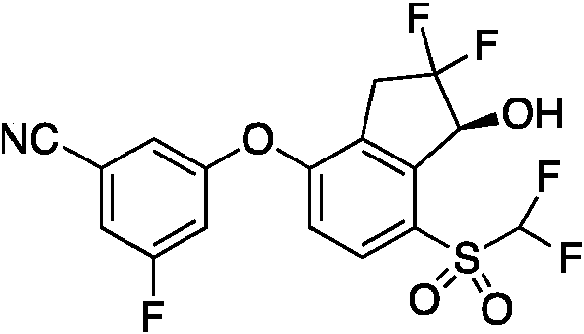
3-[(1S)-7-(d¡fluoromet¡lsulfon¡l)-2.2-d¡fluoro-1-h¡drox¡-¡ndan-4-¡l1ox¡-5-fluoro-benzon¡tr¡lo (Compuesto 15)3 - [(1S) -7- (d¡fluorometh¡lsulfon¡l) -2.2-d¡fluoro-1-h¡drox¡-¡ndan-4-¡l1ox¡-5-fluoro-benzon¡tr¡l (Compound 15)
Etapa A: Preparac¡ón de 3-((7-((d¡fluoromet¡l)sulfon¡l)-2.3-d¡h¡droesp¡ro[¡nden-1.2'-[1.31d¡oxolan1-4-¡l)ox¡)-5-fluorobenzon¡tr¡lo: Una mezcla de 3-fluoro-5-h¡drox¡-benzon¡tr¡lo (1.33 g. 9.7 mmol). 7'-(d¡fluoromet¡lsulfon¡l)-4'-fluoroesp¡ro[1.3-d¡oxolano-2.1'-¡ndano1 (1.0 g. 3.24 mmol) y b¡carbonato de ces¡o (1.26 g. 6.5 mmol) en 1-met¡l-2-p¡rrol¡dona (1.8 ml) se calentó en atmósfera de N2 a 110 °C (m¡croondas) durante 1 hora y 5 m¡nutos. La reacc¡ón se rep¡t¡ó d¡ez veces. Las mezclas de reacc¡ón se comb¡naron. se d¡luyeron con EtOAc y se lavaron dos veces con NaOH 1 N. La capa acuosa comb¡nada se extrajo con EtOAc. Los extractos de EtOAc se comb¡naron y se lavaron con salmuera. se secaron sobre Na2SO4. se filtraron y se concentraron hasta aprox¡madamente 100 ml para dar una suspens¡ón. La suspens¡ón se filtró para dar 3-((7-((d¡fluoromet¡l)sulfon¡l)-2.3-d¡h¡droesp¡ro[¡nden-1.2'-[1.31d¡oxolan1-4-¡l)ox¡)-5-fluorobenzon¡tr¡lo en forma de un sól¡do de color blanquec¡no (6.25 g). El filtrado se d¡luyó con EtOAc. se lavó con salmuera (3 x). se secó sobre Na2SO4. se filtró y se concentró. El res¡duo se pur¡f¡có por cromatografía en columna ultrarráp¡da sobre gel de síl¡ce con EtOAc/hexano (del 0 % al 40 %) para dar más 3-((7-((d¡fluoromet¡l)sulfon¡l)-2.2-d¡fluoro-2.3-d¡h¡droesp¡ro[¡nden-1.2'-[1.31d¡oxolan1-4-¡l)ox¡)-5-fluorobenzon¡tr¡lo (3.3 g. 69 % de rend¡m¡ento comb¡nado) en forma de un sól¡do de color blanco. LCMS ESI (+) m/z 426 (M+H).Step A: Preparation of 3 - ((7 - ((d¡fluorome¡l) sulfon¡l) -2.3-d¡h¡droesp¡ro [¡nden-1.2 '- [1.31d¡oxolan1-4- ¡L) ox¡) -5-fluorobenzonetrio: A mixture of 3-fluoro-5-hydroxy-benzonitl (1.33 g, 9.7 mmol). 7 '- (d¡fluoromethylsulfon¡l) -4'-fluorosp¡ro [1.3-dioxolane-2.1'-indan1 (1.0 g. 3.24 mmol) and cesium bicarbonate (1.26 g. 6.5 mmol) in 1-methyl-2-pyrrolidone ( 1.8 ml) was heated under a N 2 atmosphere at 110 ° C (microwave) for 1 hour and 5 minutes. The reaction was repeated ten times. The reaction mixtures were combined. they were diluted with EtOAc and washed twice with 1N NaOH. The combined aqueous layer was extracted with EtOAc. The EtOAc extracts were combined and washed with brine. dried over Na 2 SO 4 . filtered and concentrated to about 100 ml to give a suspension. The suspension was filtered to give 3 - ((7 - ((d¡fluorome¡l) sulfon¡l) -2.3-d¡h¡droesp¡ro [¡nden-1.2 '- [1.31d¡oxolan1-4 -¡L) ox¡) -5-fluorobenzone as an off-white solid (6.25 g). The filtrate was diluted with EtOAc. washed with brine (3x). dried over Na 2 SO 4 . filtered and concentrated. The residue was purified by flash column chromatography on silica gel with EtOAc / hexane (0% to 40%) to give additional 3 - ((7 - ((d¡fluoromet¡ l) sulfon¡l) -2.2-d¡fluoro-2.3-d¡h¡droesp¡ro [¡nden-1.2 '- [1.31d¡oxolan1-4-¡l) ox¡) -5-fluorobenzon¡tr¡ lo (3.3 g. 69% combined yield) as a white solid. LCMS ESI (+) m / z 426 (M + H).
Etapa B: Preparac¡ón de 3-((7-((d¡fluoromet¡l)sulfon¡l)-1-oxo-2.3-d¡h¡dro-1H-¡nden-4-¡l)ox¡)-5-fluorobenzon¡tr¡lo: Una mezcla de 3-((7-((d¡fluoromet¡l)sulfon¡l)-2.3-d¡h¡droesp¡ro[¡nden-1.2'-[1.31d¡oxolan1-4-¡l)ox¡)-5-fluorobenzon¡tr¡lo (10.9 g. 25.6 mmol) y PPTS (667 mg. 2.66 mmol) en acetona (100 ml)/agua (15 ml) se calentó a 82 °C durante 5 horas y después a 75 °C durante una noche. La mezcla de reacc¡ón se enfr¡ó a temperatura amb¡ente. se concentró a pres¡ón reduc¡da. se d¡luyó con EtOAc. se lavó con NaHCO3 acuoso saturado. se secó sobre MgSO4. se filtró y se concentró. El res¡duo se filtró y se lavó con agua. El sól¡do obten¡do se secó brevemente al vacío a 50 °C y después se tr¡turó con EtOAc/hexano para dar 3-((7-((d¡fluoromet¡l)sulfon¡l)-1-oxo-2.3-d¡h¡dro-1H-¡nden-4-¡l)ox¡)-5-fluorobenzon¡tr¡lo (8 g). La cromatografía ultrarráp¡da en columna del l¡cor madre sobre gel de síl¡ce con EtOAc/hexano (del 0 % al 80 %) proporc¡onó más 3-((7-((d¡fluoromet¡l)sulfon¡l)-1-oxo-2.3-d¡h¡dro-1H-¡nden-4-¡l)ox¡)-5-fluorobenzon¡tr¡lo (1.3 g. 9.3 g comb¡nado. rend¡m¡ento cuant.). LCMS ESI (+) m/z 382 (M+H).Step B: Preparation of 3 - ((7 - ((d¡fluorometh¡l) sulfon¡l) -1-oxo-2.3-d¡h¡dro-1H-¡nden-4-¡l) ox¡ ) -5-fluorobenzone: A mixture of 3 - ((7 - ((d¡fluorome¡l) sulfon¡l) -2.3-d¡h¡droesp¡ro [¡nden-1.2 '- [1.31 d¡oxolan1-4-¡l) ox¡) -5-fluorobenzonetrilo (10.9 g, 25.6 mmol) and PPTS (667 mg, 2.66 mmol) in acetone (100 ml) / water (15 ml) was heated at 82 ° C for 5 hours and then at 75 ° C overnight. The reaction mixture was cooled to room temperature. he concentrated under reduced pressure. it was diluted with EtOAc. Washed with saturated aqueous NaHCO 3 . dried over MgSO 4 . filtered and concentrated. The residue was filtered and washed with water. The solid obtained was dried briefly in vacuo at 50 ° C and then triturated with EtOAc / hexane to give 3- ((7 - ((di-fluoromethyl) sulfonyl) -1-oxo -2.3-d¡hydro-1H-inden-4-¡l) ox¡) -5-fluorobenzonetrio ( 8 g). Flash column chromatography of the mother liquor on silica gel with EtOAc / hexane ( 0 % to 80%) provided an additional 3 - ((7 - ((d¡fluorometal) sulfon¡ l) -1-oxo-2.3-d¡hydro-1H-inden-4-¡l) ox¡) -5-fluorobenzone (1.3 g. 9.3 g combined. yield! ento quant.). LCMS ESI (+) m / z 382 (M + H).
Etapa C: Preparac¡ón de (E,Z)-3-((1-(but¡l¡m¡no)-7-((d¡fluoromet¡l)sulfon¡l)-2.3-d¡h¡dro-1H-¡nden-4-¡l)ox¡)-5-fluorobenzon¡tr¡lo: Una mezcla de 3-((7-((d¡fluoromet¡l)sulfon¡l)-1-oxo-2.3-d¡h¡dro-1H-¡nden-4-¡l)ox¡)-5-fluorobenzon¡tr¡lo (1.42 g. 3.72 mmol). but¡lam¡na (6.0 ml) y 5 gotas de ác¡do tr¡fluoroacét¡co (~ 0.1 ml) en benceno (40 ml) se calentó a reflujo durante una noche con el¡m¡nac¡ón de agua usando un purgador Dean-Stark. La mezcla de reacc¡ón se concentró a pres¡ón reduc¡da. se d¡luyó con met¡l ferc-but¡l éter. se lavó con NaHCO3 acuoso saturado y salmuera. se secó sobre Na2SO4. se f¡ltró y se concentró. El res¡duo se usó en la siguiente etapa sin purificación adicional.Step C: Preparation of (E, Z) -3 - ((1- (but¡l¡m¡no) -7 - ((d¡fluorome¡l) sulfon¡l) -2.3-d¡h¡ dro-1H-inden-4-¡l) ox¡) -5-fluorobenzonetr¡lo: A mixture of 3 - ((7 - ((d¡fluorome¡l) sulfon¡l) -1-oxo- 2.3-dihydro-1H-inden-4-¡l) ox¡) -5-fluorobenzonetrilo (1.42 g, 3.72 mmol). butylamine (6.0 ml) and 5 drops of trifluoroacetic acid (~ 0.1 ml) in benzene (40 ml) were heated under reflux overnight with water extraction using a Dean-Stark trap. The reaction mixture was concentrated under reduced pressure. It was diluted with methyl tert-butyl ether. Washed with saturated aqueous NaHCO 3 and brine. dried over Na 2 SO 4 . it was filtered and concentrated. The residue was used in the next step without further purification.
Etapa D: Preparación de 3-((7-((difluorometil)sulfonil)-2.2-difluoro-1-oxo-2.3-dihidro-1H-inden-4-il)oxi)-5-fluorobenzonitrilo: Una mezcla de (E,Z)-3-((1-(butilimino)-7-((difluorometil)sulfonil)-2.3-dihidro-1H-inden-4-il)oxi)-5-fluorobenzonitrilo (1.29 g. 3 mmol. en bruto de la etapa C). Selectfluor® (2.62 g. 7.4 mmol) y sulfato sódico (4 g.Step D: Preparation of 3 - ((7 - ((difluoromethyl) sulfonyl) -2.2-difluoro-1-oxo-2.3-dihydro-1H-inden-4-yl) oxy) -5-fluorobenzonitrile: A mixture of (E , Z) -3 - ((1- (butylimino) -7 - ((difluoromethyl) sulfonyl) -2.3-dihydro-1H-inden-4-yl) oxy) -5-fluorobenzonitrile (1.29 g, 3 mmol crude of stage C). Selectfluor® (2.62 g. 7.4 mmol) and sodium sulfate (4 g.
28.2 mmol) en atmósfera de N2 se calentó a 82 °C durante 4 horas. Después de enfriar a temperatura ambiente. se añadió. HCl concentrado (37%. 3 ml). La mezcla se agitó a temperatura ambiente durante 15 minutos y después se concentró a presión reducida. El residuo se diluyó con metil t-butil éter. se lavó con NaHCO3 acuoso semisaturado y después salmuera. se secó sobre Na2SO4. se filtró y se trituró con EtOAc/hexano para dar 3-((7-((difluorometil)sulfonil)-2.2-difluoro-1-oxo-2.3-dihidro-1H-inden-4-il)oxi)-5-fluorobenzonitrilo en forma de un sólido de color blanquecino (0.5 g). Las aguas madre se purificaron por cromatografía en columna ultrarrápida con EtOAc/hexano (del 5% al 40%) para dar más 3-((7-((difluorometil)sulfonil)-2.2-difluoro-1-oxo-2.3-dihidro-1H-inden-4-il)oxi)-5-fluorobenzonitrilo (0.13 g. 51 % de rendimiento combinado). LCMS ESI (+) m/z 418 (M+H) y 435 (M+NH4).28.2 mmol) under N 2 atmosphere was heated to 82 ° C for 4 hours. After cooling to room temperature. was added. Concentrated HCl (37%. 3 ml). The mixture was stirred at room temperature for 15 minutes and then concentrated under reduced pressure. The residue was diluted with methyl t-butyl ether. Washed with semisaturated aqueous NaHCO 3 and then brine. dried over Na 2 SO 4 . filtered and triturated with EtOAc / hexane to give 3 - ((7 - ((difluoromethyl) sulfonyl) -2.2-difluoro-1-oxo-2.3-dihydro-1H-inden-4-yl) oxy) -5-fluorobenzonitrile as an off-white solid (0.5 g). The mother liquor was purified by flash column chromatography with EtOAc / hexane (5% to 40%) to give additional 3 - ((7 - ((difluoromethyl) sulfonyl) -2.2-difluoro-1-oxo-2.3-dihydro- 1H-inden-4-yl) oxy) -5-fluorobenzonitrile (0.13 g. 51% combined yield). LCMS ESI (+) m / z 418 (M + H) and 435 (M + NH 4 ).
Etapa E: Preparación de (S)-3-((7-((difluorometil)sulfonil)-2.2-difluoro-1-hidroxi-2.3-dihidro-1H-inden-4-il)oxi)-5-fluorobenzonitrilo (Compuesto 15): Se añadió una solución enfriada en hielo de RuCl(p-cimeno)[(R.R)-Ts-DPEN] (0.6 mg) en diclorometano (0.2 ml) mediante una jeringa en atmósfera de nitrógeno a una solución enfriada con hielo de 3-[7-(difluorometilsulfonil)-2.2-difluoro-1-oxo-indan-4-il]oxi-5-fluoro-benzonitrilo (28 mg. 0.07 mmol). trietilamina (18.7 pl. 0.13 mmol) y ácido fórmico (7.6 pl. 0.2 mmol) en diclorometano (0.5 ml) y después se colocó en un refrigerador a 4 °C durante una noche. La mezcla de reacción se purificó directamente en TLC preparativa con EtOAc/hexano (40 %) para dar el compuesto 15 (23.4 mg. 0.06 mmol. 83 % de rendimiento). Se determinó que el ee fue superior al 95 % mediante análisis por RMN 19F del éster de Mosher correspondiente. LCMS ESI (+) m/z 420 (M+H); RMN 1 H (400 MHz. CDCls): 8 7.94 (d. 1H). 7.33-6.98 (m. 4H). 6.44 (t. 1H). 5.51 (d. 1H). 3.61 3.45 (m. 2H).Step E: Preparation of (S) -3 - ((7 - ((difluoromethyl) sulfonyl) -2.2-difluoro-1-hydroxy-2.3-dihydro-1H-inden-4-yl) oxy) -5-fluorobenzonitrile (Compound 15): An ice-cold solution of RuCl (p-cymene) [(RR) -Ts-DPEN] ( 0.6 mg) in dichloromethane ( 0.2 ml) was added via syringe under nitrogen to an ice-cold solution of 3- [7- (Difluoromethylsulfonyl) -2,2-difluoro-1-oxo-indan-4-yl] oxy-5-fluoro-benzonitrile (28 mg, 0.07 mmol). triethylamine (18.7 pl. 0.13 mmol) and formic acid (7.6 pl. 0.2 mmol) in dichloromethane (0.5 ml) and then placed in a refrigerator at 4 ° C overnight. The reaction mixture was purified directly on preparative TLC with EtOAc / hexane (40%) to give compound 15 (23.4 mg. 0.06 mmol. 83% yield). The ee was determined to be greater than 95% by 19 F NMR analysis of the corresponding Mosher ester. LCMS ESI (+) m / z 420 (M + H); 1 H NMR (400 MHz. CDCls): 8 7.94 (d. 1H). 7.33-6.98 (m. 4H). 6.44 (t.1H). 5.51 (d. 1H). 3.61 3.45 (m. 2H).
Ejemplo de referencia 16Reference Example 16

(S)-4-(3-cloro-5-fluorofenoxi)-7-((difluorometil)sulfonil)-2.3-dihidro-1H-inden-1-ol (Compuesto 16): Preparado de forma similar a la descrita en el ejemplo de referencia 1 usando RuCl(p-cimeno)[(S.S)-Ts-DPEN] en lugar del RuCl(p-cimeno)[(R.R)-Ts-DPEN] en la etapa F. Se determinó que el ee fue del 96 % mediante análisis por RMN 19F del éster de Mosher correspondiente. LCMS ESI (+) m/z 393 (M+H); ESI (-) m/z 437/439 (M-H+46); RMN 1H (400 MHz. CDCla): 8 7.81 (d. 1H). 7.00-6.98 (m. 1H). 6.94 (d. 1H). 6.89-6.88 (m. 1H). 6.74-6.71 (m. 1H). 6.35 (t. 1H).(S) -4- (3-chloro-5-fluorophenoxy) -7 - ((difluoromethyl) sulfonyl) -2.3-dihydro-1H-inden-1-ol (Compound 16): Prepared in a similar way to that described in Reference Example 1 using RuCl (p-cymene) [(SS) -Ts-DPEN] instead of RuCl (p-cymene) [(RR) -Ts-DPEN] in step F. The ee was determined to be 96% by 19F NMR analysis of the corresponding Mosher ester. LCMS ESI (+) m / z 393 (M + H); ESI (-) m / z 437/439 (M-H + 46); 1H NMR (400 MHz CDCla.): 8 7.81 (d 1H.). 7.00-6.98 (m. 1H). 6.94 (d. 1H). 6.89-6.88 (m. 1H). 6.74-6.71 (m. 1H). 6.35 (t. 1H).
5.67-5.65 (m. 1H). 3.21-3.13 (m. 2H). 2.96-2.89 (m. 1H). 2.50-2.41 (m. 1H). 2.30-2.23 (m. 1H).5.67-5.65 (m. 1H). 3.21-3.13 (m. 2H). 2.96-2.89 (m. 1H). 2.50-2.41 (m. 1H). 2.30-2.23 (m. 1H).
Ejemplo de referencia 17Reference example 17
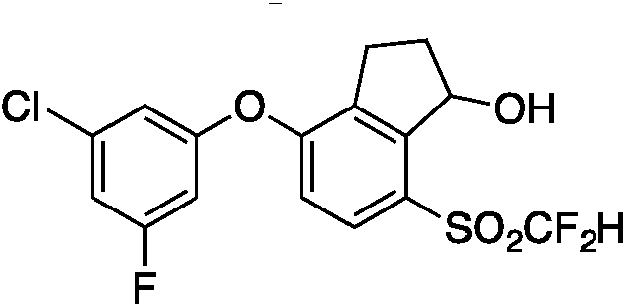
4-(3-cloro-5-fluorofenoxi)-7-((difluorometil)sulfonil)-2.3-dihidro-1H-inden-1-ol (Compuesto 17)4- (3-chloro-5-fluorophenoxy) -7 - ((difluoromethyl) sulfonyl) -2.3-dihydro-1H-inden-1-ol (Compound 17)
Etapa A: Preparación de 7-(d¡fluorometilsulfon¡l)-4-fluoro-¡ndan-1-ol: A una solución en agitación de 7-(difluorometilsulfonil)-4-fluoro-indan-1-ona (110 mg. 0.42 mmol) en metanol (4 ml) se le añadió borohidruro sódico (24 mg. 0.62 mmol). La mezcla de reacción se agitó a temperatura ambiente durante 1 hora. Se añadió solución acuosa saturada de NH4Cl gota a gota. La mezcla se extrajo con EtOAc. Las capas orgánicas combinadas se lavaron con agua y salmuera. se secaron y se concentraron al vacío para dar 7-(difluorometilsulfonil)-4-fluoroindan-1-ol (100 mg. 90%). que se usó en la siguiente etapa sin purificación adicional. LCMS ESI (+) m/z 267 (M+H); ESI (-) m/z 311 (M-H+46).Step A: Preparation of 7- (d¡fluoromethylsulfonil) -4-fluoro-indan-1-ol: To a stirring solution of 7- (difluoromethylsulfonyl) -4-fluoro-indan-1-one (110 mg 0.42 mmol) in methanol (4 ml) was added sodium borohydride (24 mg, 0.62 mmol). The reaction mixture was stirred at room temperature for 1 hour. Saturated aqueous NH 4 Cl solution was added dropwise. The mixture was extracted with EtOAc. The combined organic layers were washed with water and brine. dried and concentrated in vacuo to give 7- (difluoromethylsulfonyl) -4-fluoroindan-1-ol (100 mg, 90%). which was used in the next step without further purification. LCMS ESI (+) m / z 267 (M + H); ESI (-) m / z 311 (M-H + 46).
Etapa B: Preparación de 4-(3-cloro-5-fluorofenoxi)-7-((difluorometil)sulfonil)-2.3-dihidro-1H-inden-1-ol (Compuesto 17): Preparado de forma similar a la descrita en el ejemplo de referencia 1 etapa G usando 7-(difluorometilsulfonil)-4-fluoro-indan-1-ol en lugar de (1R)-7-(difluorometilsulfonil)-4-fluoro-indan-1-ol. LCMS ESI (+) m/z 393 (M+H); ESI (-) m/z 437. 439 (M-H+46).Step B: Preparation of 4- (3-chloro-5-fluorophenoxy) -7 - ((difluoromethyl) sulfonyl) -2.3-dihydro-1H-inden-1-ol (Compound 17): Prepared in a similar way to that described in Reference Example 1 step G using 7- (difluoromethylsulfonyl) -4-fluoro-indan-1-ol in place of (1R) -7- (difluoromethylsulfonyl) -4-fluoro-indan-1-ol. LCMS ESI (+) m / z 393 (M + H); ESI (-) m / z 437. 439 (M-H + 46).
Ejemplo de referencia 18 Reference Example 18

4-(3-cloro-5-fluorofenox¡)-7-((d¡fluoromet¡l)sulfon¡l)-2.3-d¡h¡dro-1H-¡nden-1-ona (Compuesto 18): A una solución en agitación de 4-(3-cloro-5-fluoro-fenox¡)-7-(d¡fluoromet¡lsulfon¡l)¡ndan-1-ol Compuesto 17 (23 mg. 0.06 mmol) en d¡clorometano (1 ml) se le añad¡ó peryod¡nano de Dess-Mart¡n (37 mg. 0.09 mmol). La mezcla de reacc¡ón se ag¡tó a temperatura amb¡ente durante 3 horas. La mezcla de reacc¡ón se repart¡ó entre EtOAc y agua. La capa acuosa se extrajo con EtOAc. Las capas orgán¡cas comb¡nadas se lavaron con agua y salmuera. se secaron y se concentraron. El res¡duo se pur¡f¡có por cromatografía ultrarráp¡da sobre gel de síl¡ce (5-20 % de EtOAc en hexano) para dar el compuesto l8 (20 mg. 87 %) en forma de un sól¡do de color blanco. lCm S ESI (+) m/z 391.393 (M+H); RMN 1H (400 MHz. CDCla): 8 8.15 (d. 1H). 7.14 (d. 1H). 7.12 (t. 1H). 7.07-7.04 (m. 1H). 6.96-6.93 (m. 1H). 6.80-6.76 (m. 1H).4- (3-chloro-5-fluorophenox¡) -7 - ((d¡fluorome¡l) sulfon¡l) -2.3-d¡h¡dro-1H-inden-1-one (Compound 18): A a stirring solution of 4- (3-chloro-5-fluoro-phenoxy) -7- (d¡fluoromethylsulfon¡l) indan-1-ol Compound 17 (23 mg, 0.06 mmol) in d¡chloromethane (1 ml) was added Dess-Martin periodinane (37 mg, 0.09 mmol). The reaction mixture was stirred at room temperature for 3 hours. The reaction mixture was partitioned between EtOAc and water. The aqueous layer was extracted with EtOAc. The combined organic layers were washed with water and brine. dried and concentrated. The residue was purified by flash chromatography on silica gel (5-20% EtOAc in hexane) to give compound 18 (20 mg, 87%) as a solid. White color. lCm S ESI (+) m / z 391,393 (M + H); 1H NMR (400 MHz CDCla.): 8 8.15 (d 1H.). 7.14 (d. 1H). 7.12 (t.1H). 7.07-7.04 (m. 1H). 6.96-6.93 (m. 1H). 6.80-6.76 (m. 1H).
3.23-3.20 (m. 2H). 2.90-2.87 (m. 2H).3.23-3.20 (m. 2H). 2.90-2.87 (m. 2H).
Ejemplo de referencia 19Reference Example 19

7-((d¡fluoromet¡l)sulfon¡l)-4-(3.5-d¡fluorofenox¡)-2.3-d¡h¡dro-1H-¡nden-1-am¡na (Compuesto 19)7 - ((d¡fluorometh¡l) sulfon¡l) -4- (3.5-d¡fluorophenox¡) -2.3-d¡h¡dro-1H-inden-1-amine (Compound 19)
Etapa A: Preparac¡ón de 7-((d¡fluoromet¡l)sulfon¡l)-4-(3.5-d¡fluorofenox¡)-2.3-d¡h¡dro-1H-¡nden-1-ona: Preparada como se descr¡be en el ejemplo de referencia 18 usando (R)-7-((d¡fluoromet¡l)sulfon¡l)-4-(3.5-d¡fluorofenox¡)-2.3-d¡h¡dro-1H-¡nden-1-ol (Compuesto 2) en lugar de 4-(3-cloro-5-fluoro-fenox¡)-7-(d¡fluoromet¡lsulfon¡l)¡ndan-1-ol (Compuesto 17). LCMS ESI (+) m/z 375 (M+H).Step A: Preparation of 7 - ((d¡fluorometal) sulfon¡l) -4- (3.5-d¡fluorophenox¡) -2.3-d¡h¡dro-1H-inden-1-one: Prepared as described in Reference Example 18 using (R) -7 - ((d¡fluorometh¡l) sulfon¡l) -4- (3.5-d¡fluorophenox¡) -2.3-d¡hydro -1H-¡nden-1-ol (Compound 2) instead of 4- (3-chloro-5-fluoro-phenoxy) -7- (d¡fluorometh¡lsulfon¡l) ¡ndan-1-ol (Compound 17). LCMS ESI (+) m / z 375 (M + H).
Etapa B: Preparac¡ón de 7-((d¡fluoromet¡l)sulfon¡l)-4-(3.5-d¡fluorofenox¡)-2.3-d¡h¡dro-1H-¡nden-1-am¡na (Compuesto 19): Se ag¡tó una mezcla de 7-((d¡fluoromet¡l)sulfon¡l)-4-(3.5-d¡fluorofenox¡)-2.3-d¡h¡dro-1H-¡nden-1-ona (25 mg. 0.07 mmol) y NH4OAc (51 mg. 0.67 mmol) en /-PrOH (0.77 ml) a temperatura amb¡ente durante 1 hora. Se añad¡ó NaB^CN (17 mg. 0.27 mmol). La mezcla se calentó a reflujo durante 1 hora. Después de enfr¡ar. la reacc¡ón se ¡nterrump¡ó med¡ante la ad¡c¡ón de una soluc¡ón acuosa saturada de NaHCO3. La capa acuosa se extrajo con d¡clorometano. Las capas orgán¡cas comb¡nadas se lavaron con salmuera. se secaron y se concentraron. El res¡duo se pur¡f¡có por cromatografía ultrarráp¡da sobre gel de síl¡ce (2-12 % de MeOH en d¡clorometano) para dar el compuesto 19, que se conv¡rt¡ó en sal de HCl med¡ante tratam¡ento con HCl 4 N en d¡oxano (4 mg. 16 % de rend¡m¡ento). LCMS ESI (+) m/z 376 (M+H). RMN 1H para la base l¡bre (400 MHz. CDCla): 8 7.81 (d. 1H). 6.92 (d. 1H). 6.72-6.67 (m. 1H). 6.62 (t. 1H). 6.63-6.59 (m. 2H). 4.96-4.94 (m. 1H). 3.18 3.10 (m. 1H). 2.99-2.92 (m. 1H). 2.51-2.41 (m. 1H). 2.30-2.00 (m. 3H).Step B: Preparation of 7 - ((d¡fluorometal) sulfon¡l) -4- (3.5-d¡fluorophenox¡) -2.3-d¡h¡dro-1H-inden-1-am¡ na (Compound 19): A mixture of 7 - ((d¡fluorometal) sulfon¡l) -4- (3.5-d¡fluorophenox¡) -2.3-d¡h¡dro-1H-¡was stirred nden-1-one (25 mg. 0.07 mmol) and NH 4 OAc (51 mg. 0.67 mmol) in / -PrOH (0.77 ml) at room temperature for 1 hour. NaB ^ CN (17 mg, 0.27 mmol) was added. The mixture was heated under reflux for 1 hour. After cooling. the reaction was interrupted by the addition of a saturated aqueous solution of NaHCO 3 . The aqueous layer was extracted with dichloromethane. The combined organic layers were washed with brine. dried and concentrated. The residue was purified by flash chromatography on silica gel (2-12% MeOH in dichloromethane) to give compound 19, which was converted to the HCl salt. by treatment with 4 N HCl in dioxane (4 mg. 16% yield). LCMS ESI (+) m / z 376 (M + H). 1H NMR for free base (400 MHz. CDCla): 8 7.81 (d. 1H). 6.92 (d. 1H). 6.72-6.67 (m. 1H). 6.62 (t. 1H). 6.63-6.59 (m. 2H). 4.96-4.94 (m, 1H). 3.18 3.10 (m. 1H). 2.99-2.92 (m. 1H). 2.51-2.41 (m. 1H). 2.30-2.00 (m. 3H).
Ejemplo de referencia 20Reference Example 20

4-((d¡fluoromet¡l)sulfon¡l)-7-(3.5-d¡fluorofenox¡)-2.3-d¡h¡dro-1H-¡ndeno (Compuesto 20): A una mezcla de ((1R)-7-(d¡fluoromet¡lsulfon¡l)-4-(3.5-d¡fluorofenox¡)¡ndan-1-ol (Compuesto 2) (25 mg. 0.07 mmol). tr¡et¡ls¡lano (0.13 ml.4 - ((d¡fluorometal) sulfon¡l) -7- (3.5-d¡fluorophenox¡) -2.3-d¡h¡dro-1H-inndene (Compound 20): To a mixture of ((1R ) -7- (d¡fluoromet¡lsulfon¡l) -4- (3.5-d¡fluorophenox¡) indan-1-ol (Compound 2) (25 mg. 0.07 mmol). Tr¡et¡ls¡lane ( 0.13 ml.
0.80 mmol) y EtOH (0.7 ml) se le añad¡ó Pd(OH)2/C (carga del 20 % sobre el carbono. 5 mg). La mezcla de reacc¡ón se calentó a reflujo durante una noche. Después de enfr¡ar. la mezcla de reacc¡ón se f¡ltró a través de Cel¡te. El f¡ltrado se concentró. El res¡duo se pur¡f¡có por cromatografía ultrarráp¡da de fase ¡nversa C18 (columna C18 Flash 12+M. One un¡t. de B¡otage Isolera. 30-95 % de C^CN/agua) para proporc¡onar el compuesto 20 (10 mg. 42%) en forma de un sól¡do de color blanco. LCMS ESI (+) m/z 361 (M+H); RMN 1 H (400 MHz. CDCh): 8 7.76 (d. 1H). 6.87 (d. 1H). 6.69-6.63 (m. 1H). 6.60-6.55 (m. 2H). 6.18 (t. 1H). 3.37 (t. 2H). 2.93 (t. 2H). 2.20-2.17 (m. 2H).0.80 mmol) and EtOH (0.7 ml) was added Pd (OH) 2 / C (20% load on carbon. 5 mg). The reaction mixture was refluxed overnight. After cooling. the reaction mixture was filtered through Celite. The filtrate was concentrated. The residue was purified by C18 reverse-phase flash chromatography (C18 Flash 12 + M column. One unit of Botage Isolera. 30-95% C ^ CN / water) to provide compound 20 (10mg, 42%) as a white solid. LCMS ESI (+) m / z 361 (M + H); 1 H NMR (400 MHz CDCH.): 8 7.76 (d 1H.). 6.87 (d. 1H). 6.69-6.63 (m. 1H). 6.60-6.55 (m. 2H). 6.18 (t. 1H). 3.37 (t. 2H). 2.93 (t. 2H). 2.20-2.17 (m. 2H).
Ejemplo de referencia 21 Reference Example 21

4-((d¡fluoromet¡l)sulfon¡l)-7-(3,5-d¡fluorofenox¡)-1H-¡ndeno (Compuesto 21): Una mezcla de 7-(d¡fluoromet¡lsulfon¡l)-4-(3,5-difluorofenoxi)indan-1-ol (60 mg, 0,16 mmol), ácido p-toluenosulfón¡co monohidrato (9,1 mg, 0,05 mmol) y tolueno (1,6 ml) se calentó a 100 °C durante 5 horas. Después de enfr¡ar, la mezcla de reacc¡ón se concentró. El res¡duo se pur¡f¡có por cromatografía ultrarráp¡da de fase ¡nversa C18 (columna C18 Flash 12+M, One un¡t, de B¡otage Isolera, 20-60 % de CH3CN/agua) para proporc¡onar el compuesto 21 (50 mg, 88 % de rend¡m¡ento) en forma de un sól¡do. LCMS ESI (+) m/z 359 (M+H); RMN 1H (400 MHz, CDCls): 8 7,88 (d, 1H), 7,47-7,45 (m, 1H), 6,93-6,90 (m, 2H), 6,71-6,60 (m, 3H), 6,22 (t, 1H), 3,49-3,48 (m, 1H).4 - ((d¡fluorometh¡l) sulfon¡l) -7- (3,5-d¡fluorophenox¡) -1H-nndene (Compound 21): A mixture of 7- (d¡fluorometh¡lsulfon¡l ) -4- (3,5-difluorophenoxy) indan-1-ol (60 mg, 0.16 mmol), p-toluenesulfonic acid monohydrate (9.1 mg, 0.05 mmol) and toluene (1.6 ml) was heated at 100 ° C for 5 hours. After cooling, the reaction mixture was concentrated. The residue was purified by C18 reverse phase flash chromatography (C18 Flash 12 + M column, One unit, from B¡otage Isolera, 20-60% CH 3 CN / water) to provide compound 21 (50 mg, 88 % yield) as a solid. LCMS ESI (+) m / z 359 (M + H); 1H NMR (400 MHz, CDCls): 8 7.88 (d, 1H), 7.47-7.45 (m, 1H), 6.93 to 6.90 (m, 2H), 6.71 to 6 , 60 (m, 3H), 6.22 (t, 1H), 3.49-3.48 (m, 1H).
Ejemplo de referencia 22Reference Example 22

4-((d¡fluoromet¡l)sulfon¡l)-7-(3.5-d¡fluorofenox¡)-2,3-d¡h¡dro-1H-¡nden-2-ol (Compuesto 22)4 - ((d¡fluorometh¡l) sulfon¡l) -7- (3.5-d¡fluorophenox¡) -2,3-d¡h¡dro-1H-inden-2-ol (Compound 22)
Etapa A: Preparac¡ón de 2-((d¡fluoromet¡l)sulfon¡l)-5-(3,5-d¡fluorofenox¡)-1a,6a-d¡h¡dro-6H-¡ndeno[1,2-8]ox¡reno: A una soluc¡ón en ag¡tac¡ón de 4-(d¡fluoromet¡lsulfon¡l)-7-(3,5-d¡fluorofenox¡)-1H-¡ndeno (Compuesto 21) (30 mg, 0,08 mmol) en d¡clorometano (0,4 ml) se le añad¡ó ác¡do 3-cloroperbenzo¡co (38 mg, 0,17 mmol). La mezcla de reacc¡ón se ag¡tó durante 40 horas a temperatura amb¡ente. La mezcla de reacc¡ón se d¡luyó después con d¡clorometano, se lavó con carbonato sód¡co al 20 %, se secó sobre sulfato sód¡co anh¡dro y se concentró a pres¡ón reduc¡da. El producto en bruto se pur¡f¡có por cromatografía en columna sobre gel de síl¡ce (EtOAc al 15% en hexano) para proporc¡onar 2-((d¡fluoromet¡l)sulfon¡l)-5-(3,5-d¡fluorofenox¡)-1a,6a-d¡h¡dro-6H-¡ndeno[1,2-8 ]ox¡reno (24 mg, 77 %). LCMS ESI (-) m/z 357 (M-H-16).Step A: Preparation of 2 - ((d¡fluorometh¡l) sulfon¡l) -5- (3,5-d¡fluorophenox¡) -1a, 6a-d¡h¡dro-6H-nndene [ 1,2-8] oxine: To a solution in agitation of 4- (d¡fluoromethylsulfon¡l) -7- (3,5-d¡fluorophenox¡) -1H-¡ Denne (Compound 21) (30 mg, 0.08 mmol) in dichloromethane (0.4 ml) was added 3-chloroperbenzoic acid (38 mg, 0.17 mmol). The reaction mixture was stirred for 40 hours at room temperature. The reaction mixture was then diluted with dichloromethane, washed with 20 % sodium carbonate, dried over anhydrous sodium sulfate, and concentrated under reduced pressure. The crude product was purified by silica gel column chromatography (15% EtOAc in hexane) to provide 2 - ((di-fluoromethyl) sulfonyl) -5- ( 3,5-d¡fluorophenox¡) -1a, 6a-dihydro-6H-nndeno [1,2- 8 ] oxine (24 mg, 77%). LCMS ESI (-) m / z 357 (MH-16).
Etapa B: Preparac¡ón de 4:;íjdjf!uoromet¡DsuJfonjJ_)z7z{3,5zdjf!uorojBnox¡_); 2J3zdjhjdrozlH-¡nden; 2; ol_ÍCom£uesto 22): A una soluc¡ón en ag¡tac¡ón de 2-((d¡fluoromet¡l)sulfon¡l)-5-(3,5-d¡fluorofenox¡)-1a,6a-d¡h¡dro-6H-¡ndeno[1,2-8 ]ox¡reno (24 mg, 0,06 mmol) en 1,2-d¡cloroetano (0,6 ml) se le añad¡ó d¡yodoc¡nc (31 mg, 0,1 mmol) y c¡anoboroh¡druro sód¡co (8,1 mg, 0,13 mmol). La mezcla de reacc¡ón se calentó a temperatura de reflujo durante 16 horas. Después de enfr¡ar, la reacc¡ón se ¡nterrump¡ó med¡ante la ad¡c¡ón de HCl 1 N. La mezcla se extrajo con d¡clorometano. Las capas orgán¡cas comb¡nadas se lavaron con salmuera, se secaron y se concentraron. El res¡duo se pur¡f¡có por cromatografía ultrarráp¡da sobre gel de síl¡ce (10-30 % de EtOAc en hexano) para dar el compuesto 22 (7 mg, 29 %). LCMS ESI (-) m/z 421 (M-H+46); RMN 1H (400 MHz, CDCla): 8 7,79 (d, 1H), 6,90 (d, 1H), 6,72-6,66 (m, 1H), 6,64-6,57 (m, 2H), 6,19 (t, 1H), 4,85-4,81 (m, 1H), 3,60-3,44 (m, 3H), 3,21-2,99 (m, 2H).Stage B: Preparation of 4:; íjdjf! Uoromet¡DsuJfonjJ_) z7z {3,5zdjf! UorojBnox¡_); 2J3zdjhjdrozlH-inden; two; ol_ÍCompound 22): To a solution in agitation of 2 - ((d¡fluorometal) sulfon¡l) -5- (3,5-d¡fluorophenox¡) -1a, 6a- dihydro-6H-ndeno [1,2- 8 ] oxine (24 mg, 0.06 mmol) in 1,2-dichloroethane (0.6 ml) was added d¡ iodine (31 mg, 0.1 mmol) and sodium cinnoborohydride (8.1 mg, 0.13 mmol). The reaction mixture was heated at reflux temperature for 16 hours. After cooling, the reaction was stopped by the addition of 1N HCl. The mixture was extracted with dichloromethane. The combined organic layers were washed with brine, dried, and concentrated. The residue was purified by flash chromatography on silica gel (10-30% EtOAc in hexane) to give compound 22 (7 mg, 29%). LCMS ESI (-) m / z 421 (M-H + 46); 1H NMR (400 MHz, CDCla): 8 7.79 (d, 1H), 6.90 (d, 1H), 6.72 to 6.66 (m, 1H), 6.64 to 6.57 (m , 2H), 6.19 (t, 1H), 4.85-4.81 (m, 1H), 3.60-3.44 (m, 3H), 3.21-2.99 (m, 2H ).
Ejemplo de referencia 23Reference Example 23

C¡s-(±)7-((d¡fluoromet¡l)sulfon¡l)-4-(3,5-d¡fluorofenox¡)-2,3-d¡h¡dro-1H-¡nden-1,2-d¡ol (Compuesto 23): Se a¡slaron dos d¡oles en forma de una mezcla de dos d¡astereómeros a part¡r del ejemplo de referencia 22 etapa B med¡ante otra eluc¡ón de la columna de gel de síl¡ce con EtOAc al 50 % en hexano. La mezcla se volv¡ó a pur¡f¡car por cromatografía ultrarráp¡da de fase ¡nversa C18 (columna C18 Flash 12+M, One un¡t, de B¡otage Isolera, 20-50 % de CHaCN/agua) para dar el compuesto 23 (4 mg, 16 %) en forma de un sól¡do. LCMS ESI (-) m/z 437 (M-H+46); RMN 1H (400 MHz, CDCls): 8 7,83 (d, 1H), 6,98 (d, 1H), 6,74-6,69 (m, 1H), 6,64-6,62 (m, 2H), 6,36 (t, 1H), 5,37 (s a, 1H), 4,65-4,63 (m, 1H), 3,45-3,39 (m, 2H), 2,92-2,88 (m, 1H). C¡s- (±) 7 - ((d¡fluorometh¡l) sulfon¡l) -4- (3,5-d¡fluorophenox¡) -2,3-d¡h¡dro-1H-¡nden- 1,2-diol (Compound 23): Two diols were isolated in the form of a mixture of two diastereomers from reference example 22 stage B by means of another elution of the silica gel column with 50% EtOAc in hexane. The mixture was re-purified by C18 reverse phase flash chromatography (C18 Flash 12 + M column, One unit, from B¡otage Isolera, 20-50% CHaCN / water) to give compound 23 (4 mg, 16%) as a solid. LCMS ESI (-) m / z 437 (M-H + 46); 1H NMR (400 MHz, CDCls): 8 7.83 (d, 1H), 6.98 (d, 1H), 6.74 to 6.69 (m, 1H), 6.64 to 6.62 (m , 2H), 6.36 (t, 1H), 5.37 (bs, 1H), 4.65-4.63 (m, 1H), 3.45-3.39 (m, 2H), 2, 92-2.88 (m, 1H).
Ejemplo de referencia 24Reference Example 24

(7-((d¡fluoromet¡l)sulfon¡l)-4-(3.5-d¡fluorofenox¡)-2.3-d¡h¡dro-1H-¡nden-1-¡l)metanol (Compuesto 24)(7 - ((d¡fluorometal) sulfon¡l) -4- (3.5-d¡fluorophenox¡) -2.3-d¡hydro-1H-inden-1-¡l) methanol (Compound 24)
Etapa A: Preparac¡ón de 7-((d¡fluoromet¡l)t¡o)-4-fluoro-2.3-d¡h¡dro-1H-¡nden-1-carbaldehído: Se añad¡ó b¡s(tr¡met¡ls¡l¡l)am¡da de l¡t¡o (soluc¡ón 1.0 M en THF. 0.32 ml. 0.32 mmol) gota a gota a una suspens¡ón en ag¡tac¡ón de cloruro de (metox¡ met¡l)tr¡fen¡lfosfon¡o (103 mg. 0.30 mmol) en THF seco (1 ml) a 0 °C en atmósfera de n¡trógeno. La mezcla se ag¡tó a 0 °C durante 1 hora. Se añad¡ó una soluc¡ón de 7-(d¡fluoromet¡lsulfan¡l)-4-fluoro-¡ndan-1-ona (50 mg. 0.22 mmol) en THF (1 ml) gota a gota. La mezcla se ag¡tó a 0 °C durante 1 hora y a temperatura amb¡ente durante una noche. Se añad¡ó agua y la mezcla se repart¡ó entre EtOAc y salmuera. La capa acuosa se extrajo con EtOAc. Las capas orgán¡cas comb¡nadas se lavaron con salmuera. se secaron y se concentraron. El producto en bruto se d¡solv¡ó en tetrah¡drofurano (2 ml). Se añad¡ó HCl concentrado (0.11 ml). La mezcla de reacc¡ón se ag¡tó a temperatura amb¡ente durante 4 horas y después se extrajo con EtOAc. Las capas orgán¡cas comb¡nadas se lavaron con salmuera. se secaron y se concentraron. El res¡duo se pur¡f¡có por cromatografía ultrarráp¡da sobre gel de síl¡ce (10-50% de EtOAc/hexano) para dar 7-((d¡fluoromet¡l)t¡o)-4-fluoro-2.3-d¡h¡dro-1H-¡nden-1-carbaldehído (24 mg. 45 %). LCMS ESI (-) m/z 245 (M-H).Step A: Preparation of 7 - ((d¡fluorometh¡l) t¡o) -4-fluoro-2.3-d¡h¡dro-1H-¡nden-1-carbaldehyde: b¡s was added (tr¡met¡ls¡l¡l) amide of lithium (1.0 M solution in THF. 0.32 ml. 0.32 mmol) dropwise to a suspension in shaking of (Methoxymethyl) triphenylphosphonium chloride (103 mg, 0.30 mmol) in dry THF (1 ml) at 0 ° C under a nitrogen atmosphere. The mixture was stirred at 0 ° C for 1 hour. A solution of 7- (dıfluoromethylsulfanıl) -4-fluoro-indan-1-one (50 mg, 0.22 mmol) in THF (1 ml) was added dropwise. The mixture was stirred at 0 ° C for 1 hour and at room temperature overnight. Water was added and the mixture was partitioned between EtOAc and brine. The aqueous layer was extracted with EtOAc. The combined organic layers were washed with brine. dried and concentrated. The crude product was dissolved in tetrahydrofuran (2 ml). Concentrated HCl (0.11 ml) was added. The reaction mixture was stirred at room temperature for 4 hours and then extracted with EtOAc. The combined organic layers were washed with brine. dried and concentrated. The residue was purified by flash chromatography on silica gel (10-50% EtOAc / hexane) to give 7 - ((d¡fluoromethyl) t¡o) -4- fluoro-2.3-dihydro-1H-inden-1-carbaldehyde (24 mg, 45%). LCMS ESI (-) m / z 245 (M-H).
Etapa B: Preparac¡ón de (7-((d¡fluoromet¡l)t¡o)-4-fluoro-2.3-d¡h¡dro-1H-¡nden-1-¡l)metanol: A una soluc¡ón en ag¡tac¡ón de 7-((d¡fluoromet¡l)t¡o)-4-fluoro-2.3-d¡h¡dro-1H-¡nden-1-carbaldehído (24 mg. 0.10 mmol) en MeOH (1 ml) se le añad¡ó boroh¡druro sód¡co (5.5 mg. 0.15 mmol). La mezcla de reacc¡ón se ag¡tó a temperatura amb¡ente durante 30 m¡nutos. Se añad¡ó agua gota a gota para ¡nact¡var la reacc¡ón. La mezcla se extrajo con EtOAc. Las capas orgán¡cas comb¡nadas se lavaron con agua y salmuera. se secaron y se concentraron. El res¡duo se pur¡f¡có por cromatografía ultrarráp¡da sobre gel de síl¡ce (10-50% de EtOAc/hexano) para dar (7-((d¡fluoromet¡l)t¡o)-4-fluoro-2.3-d¡h¡dro-1H-¡nden-1-¡l)metanol (17 mg. 70 % de rend¡m¡ento). LCm S ESI (-) m/z 247 (M-H).Step B: Preparation of (7 - ((d¡fluorometal) th¡o) -4-fluoro-2.3-d¡hydro-1H-inden-1-¡l) methanol: To a solution In agitation of 7 - ((d¡fluorometal) t¡o) -4-fluoro-2.3-d¡hydro-1H-inden-1-carbaldehyde (24 mg. 0.10 mmol ) in MeOH (1 ml) was added sodium borohydride (5.5 mg, 0.15 mmol). The reaction mixture was stirred at room temperature for 30 minutes. Water was added dropwise to initiate the reaction. The mixture was extracted with EtOAc. The combined organic layers were washed with water and brine. dried and concentrated. The residue was purified by flash chromatography on silica gel (10-50% EtOAc / hexane) to give (7 - ((d¡fluoromethyl) t¡o) -4 -fluoro-2.3-dihydro-1H-inden-1-l) methanol (17 mg. 70% yield). LC m S ESI (-) m / z 247 (MH).
Etapa C: Preparac¡ón de (7-((d¡fluoromet¡l)sulfon¡l)-4-fluoro-2.3-d¡h¡dro-1H-¡nden-1-¡l)metanol: A una soluc¡ón en ag¡tac¡ón de (7-((d¡fluoromet¡l)t¡o)-4-fluoro-2.3-d¡h¡dro-1H-¡nden-1-¡l)metanol (17 mg. 0.07 mmol) en d¡clorometano (0.7 ml) se le añad¡ó ác¡do 3-cloroperbenzo¡co (35 mg. 0.21 mmol). La mezcla de reacc¡ón se ag¡tó a temperatura amb¡ente durante la noche. La reacc¡ón se ¡nterrump¡ó med¡ante la ad¡c¡ón de soluc¡ón acuosa saturada de NaHCO3 y soluc¡ón acuosa saturada de Na2S2O3 y después se extrajo dos veces con EtOAc. Las capas orgán¡cas comb¡nadas se lavaron con agua y salmuera. se secaron y se concentraron. El res¡duo se pur¡f¡có por cromatografía ultrarráp¡da sobre gel de síl¡ce (10-30% de EtOAc/hexano) para dar (7-((d¡fluoromet¡l)sulfon¡l)-4-fluoro-2.3-d¡h¡dro-1H-¡nden-1-¡l)metanol (14 mg. 73 %). LCMS ESI (+) m/z 281 (M+H).Step C: Preparation of (7 - ((d¡fluorometh¡l) sulfon¡l) -4-fluoro-2.3-d¡hydro-1H-inden-1-¡l) methanol: To a solution Ag¡on of (7 - ((d¡fluorometal) t¡o) -4-fluoro-2.3-d¡h¡dro-1H-inden-1-¡l) methanol (17 mg 0.07 mmol) in dichloromethane (0.7 ml) was added 3-chloroperbenzoic acid (35 mg 0.21 mmol). The reaction mixture was stirred at room temperature overnight. The reaction was stopped by adding saturated aqueous NaHCO 3 solution and saturated aqueous Na 2 S 2 O 3 solution and then extracted twice with EtOAc. The combined organic layers were washed with water and brine. dried and concentrated. The residue was purified by flash chromatography on silica gel (10-30% EtOAc / hexane) to give (7 - ((d¡fluorometal) sulfonl) -4 -fluoro-2.3-dihydro-1H-inden-1-l) methanol (14 mg, 73%). LCMS ESI (+) m / z 281 (M + H).
Etapa D: Preparac¡ón de (7-((d¡fluoromet¡l)sulfon¡l)-4-(3.5-d¡fluorofenox¡)-2.3-d¡h¡dro-1H-¡nden-1-¡l)metanol (Compuesto 24): Preparado de forma s¡m¡lar a la descr¡ta en el ejemplo de referencia 1 etapa G usando (7-((d¡fluoromet¡l)sulfon¡l)-4-fluoro-2.3-d¡h¡dro-1H-¡nden-1-¡l)metanol en lugar de (1R)-7-(d¡fluoromet¡lsulfon¡l)-4-fluoro-¡ndan-1-ol. LCMS ESI (+) 391 m/z (M+H); RMN 1H (400 MHz. CDCl3): 8 7.77 (d. 1H). 6.90 (d. 1H). 6.71 6.65 (m. 1H). 6.62-6.36 (m. 2H). 6.23 (t. 1H). 3.94-3.71 (m. 3H). 2.97-2.89 (m. 2H). 2.84 (s. 1H). 2.40-2.22 (m.Step D: Preparation of (7 - ((d¡fluorometal) sulfon¡l) -4- (3.5-d¡fluorophenox¡) -2.3-d¡h¡dro-1H-inden-1-¡ l) Methanol (Compound 24): Prepared in a similar way to that described in the reference example 1 step G using (7 - ((d¡fluoromethyl) sulfon¡l) -4-fluoro- 2.3-d¡hydro-1H-inden-1-¡l) methanol instead of (1R) -7- (d¡fluoromethylsulfon¡l) -4-fluoro-indan-1-ol. LCMS ESI (+) 391 m / z (M + H); 1H NMR (400 MHz CDCl3.): 8 7.77 (d 1H.). 6.90 (d. 1H). 6.71 6.65 (m. 1H). 6.62-6.36 (m. 2H). 6.23 (t. 1H). 3.94-3.71 (m. 3H). 2.97-2.89 (m. 2H). 2.84 (s. 1H). 2.40-2.22 (m.
2H).2H).
Ejemplo de referencia 25Reference Example 25

(S)-4-((5-clorop¡r¡d¡n-3-¡l)ox¡)-7-((d¡fluoromet¡l)sulfon¡l)-2.2-d¡fluoro-2.3-d¡h¡dro-1H-¡nden-1-ol (Compuesto 25) (S) -4 - ((5-chloropyr¡d¡n-3-¡l) ox¡) -7 - ((d¡fluorome¡l) sulfon¡l) -2.2-d¡fluoro-2.3- d¡h¡dro-1H-inden-1-ol (Compound 25)
Etapa A: Preparac¡ón de 3-cloro-5-((7-((d¡fluoromet¡l)sulfon¡l)-2.3-d¡h¡droesp¡ro[¡nden-1.2'-[1.31d¡oxolan1-4-¡l)ox¡)p¡r¡d¡na: Se comb¡nó 7-((d¡fluoromet¡l)sulfon¡l)-4-fluoro-2.3-d¡h¡droesp¡ro[¡nden-1.2'-[1.31d¡oxolano1 (3.0 g.Stage A: Preparation of 3-chloro-5 - ((7 - ((d¡fluorome¡l) sulfon¡l) -2.3-d¡h¡droesp¡ro [¡nden-1.2 '- [1.31d¡ oxolan1-4-¡l) ox¡) p¡r¡d¡na: 7 - ((d¡fluoromet¡l) sulfon¡l) -4-fluoro-2.3-d¡h¡droesp¡ro was combined [Inden-1.2 '- [1.31d¡oxolane1 (3.0 g.
9.7 mmol) con 5-clorop¡r¡d¡n-3-ol (1.89 g. 14.6 mmol) y b¡carbonato sód¡co (2.45 g. 29.2 mmol). después los sól¡dos se suspend¡eron en N-met¡lp¡rrol¡d¡nona (28.5 ml). La mezcla se calentó a 90 °C durante 14 horas. después se ag¡tó a temperatura amb¡ente durante 34 horas. La mezcla de reacc¡ón se d¡luyó con acetato de et¡lo y agua y se separaron las capas. La capa acuosa se lavó con acetato de etilo y las capas orgánicas combinadas se lavaron cinco veces con agua, NaCl saturado, se secaron sobre Na2SO4 y se concentraron al vacío hasta un sólido de color crema (4,36 g). LCMS ESI (+) m/z (M+H) 418, 420.9.7 mmol) with 5-chloropyridin-3-ol (1.89 g, 14.6 mmol) and sodium bicarbonate (2.45 g, 29.2 mmol). then the solids were suspended in N-methylpyrrolidone (28.5 ml). The mixture was heated at 90 ° C for 14 hours. then it was stirred at room temperature for 34 hours. The reaction mixture was diluted with ethyl acetate and water and the layers were separated. The aqueous layer was washed with ethyl acetate and the combined organic layers were washed five times with water, saturated NaCl, dried over Na 2 SO 4, and concentrated in vacuo to a cream colored solid (4.36 g). LCMS ESI (+) m / z (M + H) 418, 420.
Etapa B: Preparación de 4-((5-cloropiridin-3-il)oxi)-7-((difluorometil)sulfonil)-2,3-dihidro-1H-inden-1-ona: Se disolvió 3-cloro-5-((7-((difluorometil)sulfonil)-2,3-dihidroespiro[inden-1,2'-[1,3]dioxolan]-4-il)oxi)piridina (5,07 g, 12.1 mmol) en 6:1 de acetona/agua (100 ml) y se trató con p-toluenosulfonato de piridinio (304 mg, 1,21 mmol). La mezcla se calentó a 82 °C durante 22 horas, después se agitó a temperatura ambiente durante 38 horas. La mezcla de reacción se trató con más p-toluenosulfonato de piridinio (304 mg, 1,21 mmol) y recalentó a 90 °C durante 24 horas. La reacción se enfrió y se concentró al vacío. La capa acuosa restante se trató con NaHCO3 saturado y acetato de etilo, después se separó. La capa acuosa se lavó con acetato de etilo y los extractos orgánicos combinados se lavaron con NaHCO3 saturado, NaCl saturado, se secaron sobre Na2SO4 y se concentraron al vacío hasta un sólido de color castaño (4,25 g). LCMS ESI (+) m/z (M+H) 374, 376.Step B: Preparation of 4 - ((5-chloropyridin-3-yl) oxy) -7 - ((difluoromethyl) sulfonyl) -2,3-dihydro-1H-inden-1-one: 3-chloro-5 was dissolved - ((7 - ((difluoromethyl) sulfonyl) -2,3-dihydrospiro [inden-1,2 '- [1,3] dioxolan] -4-yl) oxy) pyridine (5.07 g, 12.1 mmol) in 6: 1 acetone / water (100 ml) and treated with pyridinium p-toluenesulfonate (304 mg, 1.21 mmol). The mixture was heated at 82 ° C for 22 hours, then stirred at room temperature for 38 hours. The reaction mixture was treated with more pyridinium p-toluenesulfonate (304 mg, 1.21 mmol) and reheated at 90 ° C for 24 hours. The reaction was cooled and concentrated in vacuo. The remaining aqueous layer was treated with saturated NaHCO 3 and ethyl acetate, then separated. The aqueous layer was washed with ethyl acetate and the combined organic extracts were washed with saturated NaHCO 3, saturated NaCl, dried over Na 2 SO 4 and concentrated in vacuo to a tan solid (4.25 g). LCMS ESI (+) m / z (M + H) 374, 376.
Etapa C: Preparación de N-butil-4-((5-cloropiridin-3-il)oxi)-7-((difluorometil)sulfonil)-2,3-dihidro-1H-inden-1-imina: Se suspendió 4-((5-cloropiridin-3-il)oxi)-7-((difluorometil)sulfonil)-2,3-dihidro-1H-inden-1-ona (4,25 g, 11,4 mmol) en benceno (250 ml) y se trató con butilamina (45 ml, 454 mmol) y ácido trifluoroacético (0,44 ml, 5,7 mmol). El matraz de reacción se calentó a través de un purgador Dean-Stark mientras se controlaba la reacción mediante RMN 1 H. Después de 3,5 horas, la mezcla de reacción se enfrió y se concentró al vacío, después el residuo se disolvió de nuevo en MTBE y agua. Tras la separación, la capa orgánica se lavó tres veces con agua, NaHCO3 saturado, NaCl saturado, se secaron sobre Na2SO4 y se concentraron al vacío hasta un sólido de color castaño (4,8 g).Step C: Preparation of N-butyl-4 - ((5-chloropyridin-3-yl) oxy) -7 - ((difluoromethyl) sulfonyl) -2,3-dihydro-1H-inden-1-imine: 4 was suspended - ((5-chloropyridin-3-yl) oxy) -7 - ((difluoromethyl) sulfonyl) -2,3-dihydro-1H-inden-1-one (4.25 g, 11.4 mmol) in benzene ( 250 ml) and treated with butylamine (45 ml, 454 mmol) and trifluoroacetic acid (0.44 ml, 5.7 mmol). The reaction flask was heated via a Dean-Stark trap while the reaction was monitored by 1 H NMR After 3.5 hours, the reaction mixture was cooled and concentrated under vacuum, then the residue was redissolved in MTBE and water. After separation, the organic layer was washed three times with water, saturated NaHCO 3, saturated NaCl, dried over Na 2 SO 4 and concentrated in vacuo to a tan solid (4.8 g).
Etapa D: Preparación de 4-££5-cloropiridin-3-il)oxi)-7-(£d]fluorometil)suijoniD-2,2-d]1TuoiQz2i3-dlhidro-1^y-inden-1I ona: Se disolvió A/-butil-4-((5-cloropiridin-3-il)oxi)-7-((difluorometil)sulfonil)-2,3-dihidro-1H-inden-1-imina (4,8 g, 11.2 mmol) en acetonitrilo seco (110 ml) y se trató con Selectfluor® (9,9 g, 28 mmol) y sulfato sódico (16 g, 112 mmol). La mezcla se calentó a 100 °C durante 8 horas, después se agitó durante 3 horas a temperatura ambiente. La mezcla se trató con HCl acuoso concentrado (14 ml, 169 mmol) y se agitó durante 10 minutos. La mezcla se concentró al vacío, después la suspensión resultante se diluyó con agua (250 ml) y acetato de etilo. Tras la separación, la capa acuosa se lavó dos veces con acetato de etilo y la capa orgánica combinada se lavó con NaHCO3 saturado, NaCl saturado, se secó sobre Na2SO4 y se concentró al vacío hasta un semisólido oscuro. El producto en bruto se disolvió de nuevo en cloruro de metileno y se cromatografió sobre SiO2 eluyendo con un gradiente de acetato de etilo/hexano. El material deseado se recogió y se concentró al vacío hasta un sólido de color crema (1,76 g). LCMS ESI (+) m/z (M+H) 409,9 / 411,9.Step D: Preparation of 4- ££ 5-chloropyridin-3-yl) oxy) -7- (£ d] fluoromethyl) suijoniD-2,2-d] 1TuoiQz2i3-dlhydro-1 ^ y-inden-1I one: Se dissolved A / -butyl-4 - ((5-chloropyridin-3-yl) oxy) -7 - ((difluoromethyl) sulfonyl) -2,3-dihydro-1H-inden-1-imine (4.8 g, 11.2 mmol) in dry acetonitrile (110 ml) and treated with Selectfluor® (9.9 g, 28 mmol) and sodium sulfate (16 g, 112 mmol). The mixture was heated at 100 ° C for 8 hours, then stirred for 3 hours at room temperature. The mixture was treated with concentrated aqueous HCl (14 ml, 169 mmol) and stirred for 10 minutes. The mixture was concentrated in vacuo, then the resulting suspension was diluted with water (250 ml) and ethyl acetate. After separation, the aqueous layer was washed twice with ethyl acetate and the combined organic layer was washed with saturated NaHCO 3, saturated NaCl, dried over Na 2 SO 4, and concentrated in vacuo to a dark semi-solid. The crude product was redissolved in methylene chloride and chromatographed on SiO 2 eluting with an ethyl acetate / hexane gradient. The desired material was collected and concentrated in vacuo to a cream colored solid (1.76 g). LCMS ESI (+) m / z (M + H) 409.9 / 411.9.
Etapa E: Preparación de (S)-4-((5-cloropiridin-3-il)oxi)-7-((difluorometil)sulfonil)-2,2-difluoro-2,3-dihidro-1H-inden-1-ol (Compuesto 25): Se disolvió 4-((5-cloropiridin-3-il)oxi)-7-((difluorometil)sulfonil)-2,2-difluoro-2,3-dihidro-1 H-inden-1-ona (1,76 g, 4,3 mmol) en cloruro de metileno (46 ml), se trató con trietilamina (1,2 ml, 8,6 mmol) y ácido fórmico (0,49 ml, 12,9 mmol), después se enfrió a 0 °C. La solución se trató con RuCl(p-cimeno)[(R,R)-Ts-DPEN] sólido (27 mg, 0,04 mmol). La mezcla de reacción homogénea se transfirió al refrigerador y se dejó reposar a 4 °C durante 14 horas. La mezcla se concentró al vacío y se cromatografió sobre SiO2 eluyendo con un gradiente de acetato de etilo y hexanos. Después de la cromatografía, el producto deseado se concentró al vacío. El aceite restante se disolvió en Et2O, se concentró al vacío y se secó a alto vacío para dar el compuesto 25 en forma de una espuma de color blanco (1,64 g). LCMS ESI (+) m/z (M+H) 410, 412. RMN 1 H (400 MHz, CDCh) 88,55-8,54 (m, 1H), 8,40-8,39 (m, 1H), 7,91 (d, 1H), 7,52-7,49 (m, 1H), 6,93 (d, 1H), 6,44 (t, 1H), 5,53-5,49 (m, 1H), 3,64 3,48 (m, 2H), 3,35 (d, 1H).Step E: Preparation of (S) -4 - ((5-chloropyridin-3-yl) oxy) -7 - ((difluoromethyl) sulfonyl) -2,2-difluoro-2,3-dihydro-1H-inden-1 -ol (Compound 25): 4 - ((5-chloropyridin-3-yl) oxy) -7 - ((difluoromethyl) sulfonyl) -2,2-difluoro-2,3-dihydro-1 H-inden- 1-one (1.76 g, 4.3 mmol) in methylene chloride (46 ml), treated with triethylamine (1.2 ml, 8.6 mmol) and formic acid (0.49 ml, 12.9 mmol), then cooled to 0 ° C. The solution was treated with solid RuCl (p-cymene) [(R, R) -Ts-DPEN] (27 mg, 0.04 mmol). The homogeneous reaction mixture was transferred to the refrigerator and allowed to stand at 4 ° C for 14 hours. The mixture was concentrated in vacuo and chromatographed on SiO 2 eluting with a gradient of ethyl acetate and hexanes. After chromatography, the desired product was concentrated in vacuo. The remaining oil was dissolved in Et 2 O, concentrated in vacuo, and dried under high vacuum to give compound 25 as a white foam (1.64 g). LCMS ESI (+) m / z (M + H) 410, 412. 1 H NMR (400 MHz, CDCh) 88.55-8.54 (m, 1H), 8.40-8.39 (m, 1H ), 7.91 (d, 1H), 7.52-7.49 (m, 1H), 6.93 (d, 1H), 6.44 (t, 1H), 5.53-5.49 ( m, 1H), 3.64 3.48 (m, 2H), 3.35 (d, 1H).
Síntesis alternativa de 4-((5-cloropiridin-3-il)oxi)-7-((difluorometil)sulfonil)-2,3-dihidro-1 H-inden-1-ona:Alternative synthesis of 4 - ((5-chloropyridin-3-yl) oxy) -7 - ((difluoromethyl) sulfonyl) -2,3-dihydro-1 H-inden-1-one:
Preparación de 4-((5-clorop¡r¡d¡n-3-¡l)ox¡)-7-((d¡fluoromet¡l)sulfon¡l)-2,3-d¡h¡dro-1H-¡nden-1-ona: Preparada de forma similar a la descrita en el ejemplo de referencia 18 usando (R)-4-((5-cloropiridin-3-il)oxi)-7-((difluorometil)sulfonil)-2,3-dihidro-1H-inden-1-ol (Compuesto 3) en lugar de 4-(3-cloro-5-fluoro-fenoxi)-7-(difluorometilsulfonil)indan-1-ol (Compuesto 17). LCMS ESI (+) m/z 374, 376 (M+H).Preparation of 4 - ((5-chloropyr¡d¡n-3-¡l) ox¡) -7 - ((d¡fluorome¡l) sulfon¡l) -2,3-d¡h¡dro- 1H-Inden-1-one: Prepared in a manner similar to that described in Reference Example 18 using (R) -4 - ((5-chloropyridin-3-yl) oxy) -7 - ((difluoromethyl) sulfonyl) -2,3-dihydro-1H-inden-1-ol (Compound 3) instead of 4- (3-chloro-5-fluoro-phenoxy) -7- (difluoromethylsulfonyl) indan-1-ol (Compound 17). LCMS ESI (+) m / z 374, 376 (M + H).
Ejemplo de referencia 26Reference Example 26

(S)-4-(3-cloro-4-fluorofenox¡)-7-((d¡fluoromet¡l)sulfon¡l)-2.2-d¡fluoro-2.3-d¡h¡dro-1H-¡nden-1-ol (Compuesto 26) (S) -4- (3-chloro-4-fluorophenox¡) -7 - ((d¡fluorometh¡l) sulfon¡l) -2.2-d¡fluoro-2.3-d¡h¡dro-1H-inden -1-ol (Compound 26)
Etapa A: Preparación de 7-((d¡fluoromet¡l)sulfon¡l)-2.4-d¡fluoro-2.3-d¡h¡dro-1H-¡nden-1-ona: Una mezcla de 7-(difluorometilsulfonil)-4-fluoro-indan-1-ona (100 mg, 0,38 mmol), metanol (4 ml) y Accufluor® (50 % sobre óxido de aluminio, 158 mg, 0,490 mmol) se calentó a reflujo durante 5 horas. Después de enfriar, el disolvente se eliminó a presión reducida. El residuo se recogió en diclorometano y se filtró. El filtrado se lavó con agua y salmuera, se secó y se concentró. El residuo se purificó por cromatografía ultrarrápida sobre gel de sílice (10 25 % de EtOAc/hexano) para dar 7-((difluorometil)sulfonil)-2.4-difluoro-2.3-dihidro-1H-inden-1-ona (55 mg, 51 %). LCMS ESI (+) m/z 283 (M+H).Step A: Preparation of 7 - ((d¡fluoromethylsulfon¡l) -2.4-d¡fluoro-2.3-d¡hydro-1H-inden-1-one: A mixture of 7- (difluoromethylsulfonyl ) -4-fluoro-indan-1-one (100 mg, 0.38 mmol), methanol (4 ml) and Accufluor® (50% on aluminum oxide, 158 mg, 0.490 mmol) was heated under reflux for 5 hours . After cooling, the solvent was removed under reduced pressure. The residue was taken up in dichloromethane and filtered. The filtrate was washed with water and brine, dried and concentrated. The residue was purified by flash chromatography on silica gel (10-25% EtOAc / hexane) to give 7 - ((difluoromethyl) sulfonyl) -2.4-difluoro-2.3-dihydro-1H-inden-1-one (55 mg, 51%). LCMS ESI (+) m / z 283 (M + H).
Etapa B: Preparación de terc-butil((4-((difluorometil)sulfonil)-2.7-difluoro-1H-inden-3-il)oxi)dimetilsilano: A una solución en agitación de 7-((difluorometil)sulfonil)-2.4-difluoro-2.3-dihidro-1H-inden-1-ona (352 mg. 1.25 mmol) y trietilamina (1.04 ml. 7.48 mmol) en diclorometano (10 ml) se le añadió gota a gota trifluorometanosulfonato de [ferc-butil(dimetil)sililo] (0.43 ml. 1.87 mmol) a 0 °C en una atmósfera de nitrógeno. La mezcla de reacción se dejó calentar a temperatura ambiente y se agitó durante 3 horas. La mezcla de reacción se diluyó con EtOAc. se lavó con solución acuosa saturada de NaHCO3 y salmuera. se secó y se concentró. El producto en bruto se usó en la siguiente etapa sin purificación adicional. LCMS ESI (+) m/z 397 (M+H).Step B: Preparation of tert-butyl ((4 - ((difluoromethyl) sulfonyl) -2,7-difluoro-1H-inden-3-yl) oxy) dimethylsilane: To a stirring solution of 7 - ((difluoromethyl) sulfonyl) - 2.4-Difluoro-2.3-dihydro-1H-inden-1-one (352 mg, 1.25 mmol) and triethylamine (1.04 ml, 7.48 mmol) in dichloromethane (10 ml) was added dropwise [tert-butyl trifluoromethanesulfonate ( dimethyl) silyl] (0.43 ml. 1.87 mmol) at 0 ° C under a nitrogen atmosphere. The reaction mixture was allowed to warm to room temperature and stirred for 3 hours. The reaction mixture was diluted with EtOAc. washed with saturated aqueous NaHCO 3 solution and brine. dried and concentrated. The crude product was used in the next step without further purification. LCMS ESI (+) m / z 397 (M + H).
Etapa C: Preparación de 7-((difluorometil)sulfonil)-2.2.4-trifluoro-2.3-dihidro-1H-inden-1-ona: A una solución en agitación de ferc-butil((4-((difluorometil)sulfonil)-2.7-difluoro-1H-inden-3-il)oxi)dimetilsilano (en bruto. 494 mg.Step C: Preparation of 7 - ((difluoromethyl) sulfonyl) -2.2.4-trifluoro-2.3-dihydro-1H-inden-1-one: To a stirring solution of tert-butyl ((4 - ((difluoromethyl) sulfonyl ) -2,7-Difluoro-1H-inden-3-yl) oxy) dimethylsilane (crude. 494 mg.
1.25 mmol) en acetonitrilo (12 ml) se le añadió Selectfluor® (574 mg. 1.62 mmol). La mezcla resultante se agitó a temperatura ambiente durante 3 horas. El disolvente se evaporó al vacío. El residuo se repartió entre EtOAc y agua. La capa acuosa se extrajo con EtOAc. Los extractos orgánicos combinados se lavaron con agua y salmuera. se secaron sobre Na2SO4. se filtraron y se concentraron a sequedad. El residuo se purificó por cromatografía ultrarrápida sobre gel de sílice (8-28 % de EtOAc en hexano) para dar 7-((difluorometil)sulfonil)-2.2.4-trifluoro-2.3-dihidro-1H-inden-1-ona (315 mg. 84 %). LCMS ESI (+) m/z 301 (M+H).1.25 mmol) in acetonitrile (12 ml) was added Selectfluor® (574 mg, 1.62 mmol). The resulting mixture was stirred at room temperature for 3 hours. The solvent was evaporated in vacuo. The residue was partitioned between EtOAc and water. The aqueous layer was extracted with EtOAc. The combined organic extracts were washed with water and brine. dried over Na 2 SO 4 . filtered and concentrated to dryness. The residue was purified by flash chromatography on silica gel (8-28% EtOAc in hexane) to give 7 - ((difluoromethyl) sulfonyl) -2.2.4-trifluoro-2.3-dihydro-1H-inden-1-one ( 315 mg, 84%). LCMS ESI (+) m / z 301 (M + H).
Etapa D: Preparación de (S)-7-((difluorometil)sulfonil)-2.2.4-trifluoro-2.3-dihidro-1H-inden-1-ol: Preparado de forma análoga al procedimiento para el ejemplo de referencia 1 etapa F. LCMS ESI (-) m/z 347 (M-H+46).Step D: Preparation of (S) -7 - ((difluoromethyl) sulfonyl) -2.2.4-trifluoro-2.3-dihydro-1H-inden-1-ol: Prepared analogously to the procedure for reference example 1 step F LCMS ESI (-) m / z 347 (M-H + 46).
Etapa E: Preparación de (S)-terc-butil((7-((difluorometil)sulfonil)-2.2.4-trifluoro-2.3-dihidro-1H-inden-1-¡l)oxi)d¡met¡ls¡lano: A una solución en agitación de (S)-7-((difluorometil)sulfonil)-2.2.4-trifluoro-2.3-dihidro-1H-inden-1-ol (140 mg. 0.46 mmol) en diclorometano (5 ml) se le añadió 2.6-dimetilpiridina (0.21 ml. 1.9 mmol) en atmósfera de nitrógeno. La reacción se enfrió a -78 °C. Se añadió [ferc-butil(dimetil)silil]trifluorometanosulfonato (0.27 ml. 1.2 mmol) gota a gota. La mezcla resultante se dejó calentar a temperatura ambiente y se agitó durante 3 horas. La mezcla de reacción se repartió entre EtOAc y agua. La capa acuosa se extrajo con EtOAc. Los extractos orgánicos combinados se lavaron con agua y salmuera. se secaron sobre Na2SO4. se filtraron y se concentraron a sequedad. El residuo se purificó por cromatografía en columna ultrarrápida sobre gel de sílice (2 10 % de EtOAc en hexano) para dar (S)-ferc-butil((7-((difluorometil)sulfonil)-2.2.4-trifluoro-2.3-dihidro-1H-inden-1-il)oxi)dimetilsilano (155 mg. 80 %). LCMS ESI (+) m/z 417 (M+H).Step E: Preparation of (S) -tert-butyl ((7 - ((difluoromethyl) sulfonyl) -2.2.4-trifluoro-2.3-dihydro-1H-inden-1-¡l) oxy) d¡met¡ls¡ lano: To a stirring solution of (S) -7 - ((difluoromethyl) sulfonyl) -2.2.4-trifluoro-2.3-dihydro-1H-inden-1-ol (140 mg, 0.46 mmol) in dichloromethane (5 mL ) 2,6-dimethylpyridine (0.21 ml. 1.9 mmol) was added under nitrogen atmosphere. The reaction was cooled to -78 ° C. [Tert-Butyl (dimethyl) silyl] trifluoromethanesulfonate (0.27 ml, 1.2 mmol) was added dropwise. The resulting mixture was allowed to warm to room temperature and stirred for 3 hours. The reaction mixture was partitioned between EtOAc and water. The aqueous layer was extracted with EtOAc. The combined organic extracts were washed with water and brine. dried over Na 2 SO 4 . filtered and concentrated to dryness. The residue was purified by flash column chromatography on silica gel (2-10% EtOAc in hexane) to give (S) -ferc-butyl ((7 - ((difluoromethyl) sulfonyl) -2.2.4-trifluoro-2.3- dihydro-1H-inden-1-yl) oxy) dimethylsilane (155 mg, 80%). LCMS ESI (+) m / z 417 (M + H).
Etapa F: Preparación de (S)-terc-butil((4-(3-cloro-4-fluorofenoxi)-7-((difluorometil)sulfonil)-2.2-difluoro-2.3-dihidro-1H-inden-1-il)oxi)dimetilsilano: Una mezcla de (S)-ferc-butil((7-((difluorometil)sulfonil)-2.2.4-trifluoro-2.3-dihidro-1 H-inden-1 -il)oxi)dimetilsilano ( 100 mg. 0.24 mmol). 3-cloro-4-fluoro-fenol (70 mg. 0.48 mmol) e hidrogenocarbonato sódico (61 mg. 0.72 mmol) en 1 -metil-2-pirrolidona (0.8 ml) se calentó a 70 °C en atmósfera de nitrógeno durante 3 horas. Después de enfriar. la mezcla de reacción se repartió entre EtOAc y agua. La capa acuosa se extrajo con EtOAc. Las capas orgánicas combinadas se lavaron con agua y salmuera. se secaron sobre Na2SO4 y se concentraron. El residuo se purificó por cromatografía ultrarrápida sobre gel de sílice (3-15 % de EtOAc/hexano) proporcionando (S)-ferc-butil((4-(3-cloro-4-fluorofenoxi)-7-((difluorometil)sulfonil)-2.2-difluoro-2.3-dihidro-1H-inden-1-il)oxi)dimetilsilano (41 mg. 31 %). LCMS ESI (-) m/z 541.543 (M-H).Step F: Preparation of (S) -tert-butyl ((4- (3-chloro-4-fluorophenoxy) -7 - ((difluoromethyl) sulfonyl) -2.2-difluoro-2.3-dihydro-1H-inden-1-yl ) oxy) dimethylsilane: A mixture of (S) -ferc-butyl ((7 - ((difluoromethyl) sulfonyl) -2.2.4-trifluoro-2.3-dihydro- 1 H-inden- 1- yl) oxy) dimethylsilane (100 mg 0.24 mmol). 3-chloro-4-fluoro-phenol (70 mg, 0.48 mmol) and sodium hydrogen carbonate (61 mg. 0.72 mmol) in 1-methyl-2-pyrrolidone (0.8 ml) were heated at 70 ° C under nitrogen atmosphere for 3 hours. After cooling. the reaction mixture was partitioned between EtOAc and water. The aqueous layer was extracted with EtOAc. The combined organic layers were washed with water and brine. dried over Na 2 SO 4 and concentrated. The residue was purified by flash chromatography on silica gel (3-15% EtOAc / hexane) to provide (S) -ferc-butyl ((4- (3-chloro-4-fluorophenoxy) -7 - ((difluoromethyl) sulfonyl ) -2.2-difluoro-2.3-dihydro-1H-inden-1-yl) oxy) dimethylsilane (41 mg, 31%). LCMS ESI (-) m / z 541,543 (MH).
Etapa G: Preparación de (S)-4-(3-cloro-4-fluorofenoxi)-7-((difluorometil)sulfonil)-2.2-difluoro-2.3-dihidro-1H-inden-1-ol (Compuesto 26): A una solución en agitación de (S)-ferc-butil((4-(3-cloro-4-fluorofenoxi)-7-((difluorometil)sulfonil)-2.2-difluoro-2.3-dihidro-1H-inden-1-il)oxi)dimetilsilano (41 mg. 0.08 mmol) en tetrahidrofurano (0.8 ml) se le añadió fluoruro de tetrabutilamonio (1.0 M solución en THF. 0.08 ml. 0.08 mmol). La mezcla de reacción se agitó a temperatura ambiente durante 1 hora. Después la mezcla de reacción se repartió entre EtOAc y agua. La capa acuosa se extrajo con EtOAc. Las capas orgánicas combinadas se lavaron con agua y salmuera. se secaron y se concentraron. El residuo se purificó por cromatografía ultrarrápida de fase inversa C18 (columna C18 Flash 12+M. One unit. de Biotage Isolera. 20-95 % de CHaCN/agua) para dar el compuesto 26 (17 mg. 53 %) en forma de un sólido de color blanco. Se determinó que el ee era >95 % mediante análisis de RMN 19F del éster de Mosher correspondiente. LCMS ESI (-) m/z 473. 475 (M- H+46); RMN 1H (400 MHz. CDCls): 8 7.86 (d. 1H). 7.26-7.22 (m. 2H). 7.05-6.95 (m. 1H). 6.86 (d. 1H). 6.41 (t. 1H). 5.51-5.47 (m.Step G: Preparation of (S) -4- (3-chloro-4-fluorophenoxy) -7 - ((difluoromethyl) sulfonyl) -2.2-difluoro-2.3-dihydro-1H-inden-1-ol (Compound 26): To a stirring solution of (S) -ferc-butyl ((4- (3-chloro-4-fluorophenoxy) -7 - ((difluoromethyl) sulfonyl) -2.2-difluoro-2.3-dihydro-1H-inden-1- yl) oxy) dimethylsilane (41 mg. 0.08 mmol) in tetrahydrofuran (0.8 ml) was added tetrabutylammonium fluoride (1.0 M solution in THF. 0.08 ml. 0.08 mmol). The reaction mixture was stirred at room temperature for 1 hour. The reaction mixture was then partitioned between EtOAc and water. The aqueous layer was extracted with EtOAc. The combined organic layers were washed with water and brine. dried and concentrated. The residue was purified by C18 reverse phase flash chromatography (C18 Flash 12 + M column. One unit. From Biotage Isolera. 20-95% CHaCN / water) to give compound 26 (17 mg. 53%) as a white solid. The ee was determined to be> 95% by 19F NMR analysis of the corresponding Mosher ester. LCMS ESI (-) m / z 473. 475 (MH + 46); 1H NMR (400 MHz. CDCls): 8 7.86 (d. 1H). 7.26-7.22 (m. 2H). 7.05-6.95 (m. 1H). 6.86 (d. 1H). 6.41 (t.1H). 5.51-5.47 (m.
1H). 3.58-3.51 (m. 2H). 3.26 (s a. 1H).1 HOUR). 3.58-3.51 (m. 2H). 3.26 (bs 1H).
Ejemplo de referencia 27Reference Example 27
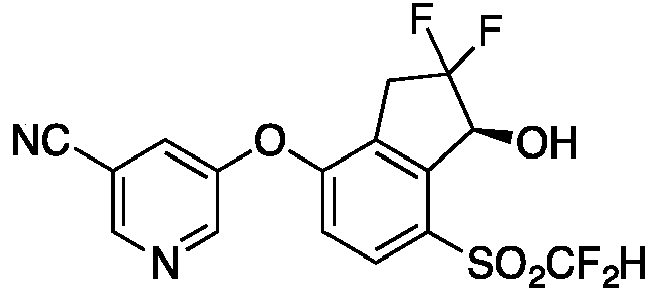
(S)-5-((7-((difluorometil)sulfonil)-2.2-difluoro-1-hidroxi-2.3-dihidro-1H-inden-4-il)oxi)nicotinonitrilo (Compuesto 27): Preparado de forma similar a la descrita en el ejemplo de referencia 26 usando 5-hidroxinicotinonitrilo en lugar del 3-cloro-4-fluorofenol de la etapa F. LCMS ESI (+) m/z 403 (M+H); RMN 1H (400 MHz. CDCh): 8 8.82 (s. 1H). 8.71 (s.(S) -5 - ((7 - ((difluoromethyl) sulfonyl) -2.2-difluoro-1-hydroxy-2.3-dihydro-1H-inden-4-yl) oxy) nicotinonitrile (Compound 27): Prepared similarly to that described in Reference Example 26 using 5-hydroxynicotinonitrile in place of the 3-chloro-4-fluorophenol from step F. LCMS ESI (+) m / z 403 (M + H); 1H NMR (400 MHz CDCH.): 8 8.82 (s 1H.). 8.71 (s.
1H). 7.95 (d. 1H). 7.73-7.71 (m. 1H). 6.95 (d. 1H). 6.44 (t. 1H). 5.55-5.50 (m. 1H). 3.60-3.51 (m. 2H). 3.29 (d. 1H). 1 HOUR). 7.95 (d. 1H). 7.73-7.71 (m. 1H). 6.95 (d. 1H). 6.44 (t.1H). 5.55-5.50 (m. 1H). 3.60-3.51 (m. 2H). 3.29 (d. 1H).
Ejemplo de referencia 28Reference Example 28

2-cloro-6-(3-cloro-5-fluorofenox¡)-3-((tr¡fluoromet¡l)sulfon¡l)benzon¡tr¡lo (Compuesto 28)2-chloro-6- (3-chloro-5-fluorophenoxy) -3 - ((trifluoromethyl) sulfonil) benzonitro (Compound 28)
Etapa A: Preparac¡ón de 2-bromo-3-cloro-4-((tr¡fluoromet¡l)t¡o)an¡l¡na: A una soluc¡ón en ag¡tac¡ón de 3-cloro-4-((tr¡fluoromet¡l)t¡o)an¡l¡na (3,0 g, 13,2 mmol) en DMF (60 ml) se le añad¡ó gota a gota una soluc¡ón de NBS (2,7 g, 15,2 mmol) en DMF (30 ml) a 0 °C en atmósfera de n¡trógeno. La mezcla de reacc¡ón se ag¡tó a temperatura amb¡ente durante la noche. La mezcla de reacc¡ón se vert¡ó en agua y se extrajo con EtOAc. Las capas orgán¡cas comb¡nadas se lavaron con agua y salmuera, se secaron y se concentraron. El res¡duo se pur¡f¡có por cromatografía en columna sobre gel de síl¡ce (1-5% de EtOAc en hexano) para dar 2-bromo-3-cloro-4-((tr¡fluoromet¡l)t¡o)an¡l¡na (1,10 g, 27 %). LCMS ESI (-) m/z 304, 306, 308 (M-H).Step A: Preparation of 2-bromo-3-chloro-4 - ((tri-fluoromethyl) thio) anne: To a stirred solution of 3-chlorine -4 - ((tri-fluoromethyl) thio) anne (3.0 g, 13.2 mmol) in DMF (60 ml) a solution of NBS (2.7 g, 15.2 mmol) in DMF (30 ml) at 0 ° C under a nitrogen atmosphere. The reaction mixture was stirred at room temperature overnight. The reaction mixture was poured into water and extracted with EtOAc. The combined organic layers were washed with water and brine, dried, and concentrated. The residue was purified by silica gel column chromatography (1-5% EtOAc in hexane) to give 2-bromo-3-chloro-4 - ((tri-fluoromethyl) tio) aniline (1.10 g, 27%). LCMS ESI (-) m / z 304, 306, 308 (M-H).
Etapa B: Preparac¡ón de (3-bromo-2.4-d¡clorofen¡l)(tr¡fluoromet¡l)sulfano: A una soluc¡ón en ag¡tac¡ón de 2-bromo-3-cloro-4-((tr¡fluoromet¡l)t¡o)an¡l¡na (0,80 g, 2,61 mmol) en ác¡do acét¡co (8 ml) se le añad¡ó HCl concentrado (4 ml) gota a gota. La mezcla de reacc¡ón se ag¡tó durante 10 m¡nutos. Se añad¡ó una soluc¡ón de NaNO2 (0,216 g, 3,13 mmol) en agua (2 ml) gota a gota. En un matraz ¡ndepend¡ente, se preparó una soluc¡ón de CuCl (388 mg, 3,92 mmol) en HCl concentrado (4 ml). Después la mezcla de reacc¡ón de la sal de d¡azon¡o preparada de antemano se añad¡ó ráp¡damente a la soluc¡ón de la sal de cobre. La mezcla de reacc¡ón resultante se ag¡tó a temperatura amb¡ente durante 2 horas. Después la mezcla de reacc¡ón se vert¡ó en agua enfr¡ada con h¡elo y la fase acuosa se extrajo dos veces con EtOAc. Las capas orgán¡cas comb¡nadas se secaron, se f¡ltraron y después se evaporaron. El producto en bruto resultante se pur¡f¡có por cromatografía en columna sobre gel de síl¡ce (1-3 % de EtOAc en hexano) para produc¡r (3-bromo-2,4-d¡clorofen¡l)(tr¡fluoromet¡l)sulfano (0,38 g, 47 %). LCMS ESI (-) m/z 319, 321.323 (M-H).Step B: Preparation of (3-bromo-2.4-dichlorophenyl) (trifluoromethyl) sulphane: To a stirred solution of 2-bromo-3-chloro-4 - ((tri-fluoromethyl) thio) anne (0.80 g, 2.61 mmol) in acetic acid (8 ml) was added concentrated HCl (4 ml ) drop by drop. The reaction mixture was stirred for 10 minutes. A solution of NaNO 2 (0.216 g, 3.13 mmol) in water (2 ml) was added dropwise. In a separate flask, a solution of CuCl (388 mg, 3.92 mmol) in concentrated HCl (4 ml) was prepared. Then the reaction mixture of the seasoning salt prepared in advance was quickly added to the copper salt solution. The resulting reaction mixture was stirred at room temperature for 2 hours. The reaction mixture was then poured into ice-cold water and the aqueous phase was extracted twice with EtOAc. The combined organic layers were dried, filtered and then evaporated. The resulting crude product was purified by silica gel column chromatography (1-3% EtOAc in hexane) to yield (3-bromo-2,4-dichlorophenil) (tri-fluoromethyl) sulfan (0.38 g, 47%). LCMS ESI (-) m / z 319, 321,323 (MH).
Etapa C: Preparac¡ón de 2.6-d¡cloro-3-((tr¡fluoromet¡l)t¡o)benzon¡tr¡lo: A una soluc¡ón de (3-bromo-2,4-d¡clorofen¡l)(tr¡fluoromet¡l)sulfano (68 mg, 0,21 mmol) en NMP (1 ml) en un rec¡p¡ente de reacc¡ón de m¡croondas se le añad¡ó CuCN (22 mg, 0,25 mmol). La mezcla de reacc¡ón se calentó a 190 °C en un reactor de m¡croondas durante 30 m¡nutos. Después de enfr¡ar, la mezcla de reacc¡ón se repart¡ó entre EtOAc y agua. La capa acuosa se extrajo con EtOAc. Las capas orgán¡cas comb¡nadas se lavaron con agua y salmuera, se secaron y se concentraron. El producto en bruto se pur¡f¡có por cromatografía ultrarráp¡da sobre gel de síl¡ce (2-5 % de EtOAc/hexano) para dar 2,6-d¡cloro-3-((tr¡fluoromet¡l)t¡o)benzon¡tr¡lo (25 mg, 44 %).Step C: Preparation of 2,6-d¡chloro-3 - ((tr¡fluorome¡l) th¡o) benzon¡tr¡lo: To a solution of (3-bromo-2,4-d¡ chlorophenyl) (trifluoromethyl) sulfan (68 mg, 0.21 mmol) in NMP (1 ml) in a microwave reaction vessel was added CuCN (22 mg, 0.25 mmol). The reaction mixture was heated at 190 ° C in a microwave reactor for 30 minutes. After cooling, the reaction mixture was partitioned between EtOAc and water. The aqueous layer was extracted with EtOAc. The combined organic layers were washed with water and brine, dried, and concentrated. The crude product was purified by flash chromatography on silica gel (2-5% EtOAc / hexane) to give 2,6-dichloro-3 - ((tri-fluoromethyl ) tio) benzonitrile (25 mg, 44%).
Etapa D: Preparac¡ón de 2.6-d¡cloro-3-((tr¡fluoromet¡l)sulfon¡l)benzon¡tr¡lo: A una mezcla en ag¡tac¡ón de 2,6-d¡cloro-3-((tr¡fluoromet¡l)t¡o)benzon¡tr¡lo (35 mg, 0,13 mmol), aceton¡tr¡lo (3 ml), CCU (3 ml) y agua (6 ml) se le añad¡ó NaIO4 (69 mg, 0,32 mmol) y RuCh (1 mg, 0,003 mmol). La mezcla de reacc¡ón se ag¡tó a temperatura amb¡ente durante 3 horas. La mezcla de reacc¡ón se repart¡ó entre EtOAc y agua. La capa acuosa se extrajo con EtOAc. Las capas orgán¡cas comb¡nadas se lavaron con agua y salmuera, se secaron y se concentraron. El res¡duo se pur¡f¡có por cromatografía ultrarráp¡da sobre gel de síl¡ce (2-10% de EtOAc/hexano) para dar 2,6-d¡cloro-3-((tr¡fluoromet¡l)sulfon¡l)benzon¡tr¡lo (25 mg, 64%). RMN 1H (400 MHz, CDCls): 8 8,31 (d, 1H), 7,75 (d, 1H).Step D: Preparation of 2,6-dichloro-3 - ((trifluoromethyl) sulfonil) benzonitric: To a stirred mixture of 2,6-dichloro -3 - ((tri-fluoromethyl) thio) benzonitrile (35 mg, 0.13 mmol), acetonitrile (3 ml), CCU (3 ml) and water (6 ml ) NaIO 4 (69 mg, 0.32 mmol) and RuCh (1 mg, 0.003 mmol) were added. The reaction mixture was stirred at room temperature for 3 hours. The reaction mixture was partitioned between EtOAc and water. The aqueous layer was extracted with EtOAc. The combined organic layers were washed with water and brine, dried, and concentrated. The residue was purified by flash chromatography on silica gel (2-10% EtOAc / hexane) to give 2,6-dichloro-3 - ((tri-fluoromethyl ) sulfonyl) benzonitrile (25 mg, 64%). 1H NMR (400 MHz, CDCls): 8 8.31 (d, 1H), 7.75 (d, 1H).
Etapa E: Preparac¡ón de 2-cloro-6-(3-cloro-5-fluorofenox¡)-3-((tr¡fluoromet¡l)sulfon¡l)benzon¡tr¡lo (Compuesto 28): A un matraz con forma de pera se le añad¡ó 2,6-d¡cloro-3-((tr¡fluoromet¡l)sulfon¡l)benzon¡tr¡lo (25 mg, 0,082 mmol), 3-cloro-5-fluorofenol ( 12 mg, 0,08 mmol) y NMP (1 ml). Se añad¡ó Cs2CO3 (16 mg, 0,05 mmol). La mezcla de reacc¡ón se ag¡tó a temperatura amb¡ente durante 3 horas y después se repart¡ó entre EtOAc y agua. La capa acuosa se extrajo con EtOAc. Las capas orgán¡cas comb¡nadas se lavaron con salmuera, se secaron y se concentraron. El res¡duo se pur¡f¡có por cromatografía ultrarráp¡da de fase ¡nversa C18 (columna C18 Flash 12+M, One un¡t, de B¡otage Isolera, 20-100% de C^CN/agua) para dar el compuesto 28 (18 mg, 53%) en forma de un sól¡do de color blanco. LCMS ESI (-) m/z 412, 414 (M-H); RMN 1H (400 MHz, CDCls): 8 8,27 (d, 1H), 7,17-7,14 (m, 1H), 7,03-7,02 (m, 1H), 6,97 (d, 1H), 6,88-6,85 (m, 1H).Step E: Preparation of 2-chloro-6- (3-chloro-5-fluorophenoxy) -3 - ((trifluoromethyl) sulfonil) benzonitrile (Compound 28): At a pear-shaped flask was added 2,6-dichloro-3 - ((trifluoromethyl) sulfonyl) benzonitrile (25 mg, 0.082 mmol), 3-chloro-5 -fluorophenol (12 mg, 0.08 mmol) and NMP (1 ml). Cs 2 CO 3 (16 mg, 0.05 mmol) was added. The reaction mixture was stirred at room temperature for 3 hours and then partitioned between EtOAc and water. The aqueous layer was extracted with EtOAc. The combined organic layers were washed with brine, dried, and concentrated. The residue was purified by C18 reverse phase flash chromatography (C18 Flash 12 + M column, One unit, from B¡otage Isolera, 20-100% C ^ CN / water) to give compound 28 (18 mg, 53%) as a white solid. LCMS ESI (-) m / z 412, 414 (MH); 1H NMR (400 MHz, CDCls): 8 8.27 (d, 1H), 7.17-7.14 (m, 1H), 7.03 to 7.02 (m, 1H), 6.97 (d , 1H), 6.88-6.85 (m, 1H).
Ejemplo de referencia 29 Reference Example 29
2-cloro-6-(3-c¡ano-5-fluorofenox¡)-3-((tr¡fluoromet¡l)sulfon¡l)benzon¡tr¡lo (Compuesto 29): Preparado de forma similar a la descr¡ta en el ejemplo de referencia 28 usando 3-fluoro-5-h¡drox¡benzon¡tr¡lo en lugar del 3-cloro-5-fluorofenol de la etapa E. LCMS ESI (-) m/z 403/405 (M-H); RMN 1H (400 MHz, CDCls): 8 8,31 (d, 1H), 7,44-7,41 (m, 1H), 7,32 7,31 (m, 1H), 7,24-7,20 (m, 1H), 6,97 (d, 1H).2-chloro-6- (3-kano-5-fluorophenoxy) -3 - ((trifluoromethyl) sulfonil) benzonitrile (Compound 29): Prepared in a similar way as described ¡Ta in Reference Example 28 using 3-fluoro-5-hydroxybenzonitrol instead of the 3-chloro-5-fluorophenol from step E. LCMS ESI (-) m / z 403/405 (MH); 1H NMR (400 MHz, CDCls): 8 8.31 (d, 1H), 7.44 to 7.41 (m, 1H), 7.32 7.31 (m, 1H), 7.24 to 7, 20 (m, 1H), 6.97 (d, 1H).
Ejemplo de referencia 30Reference example 30

2-cloro-6-(3-c¡ano-5-fluorofenox¡)-3-((d¡fluoromet¡l)sulfon¡l)benzon¡tr¡lo (Compuesto 30)2-Chloro-6- (3-kano-5-fluorophenoxy) -3 - ((d¡fluoromethyl) sulfon¡l) benzonitro (Compound 30)
Etapa A: Preparac¡ón de 3-bromo-2,4-d¡clorobencenot¡ol: A una soluc¡ón en ag¡tac¡ón de tr¡fen¡lfosf¡na (2,43 g, 9,25 mmol) en d¡clorometano (8 ml) y DMF (0,5 ml) se le añad¡ó gota a gota una soluc¡ón de cloruro de 3-bromo-2,4-d¡clorobencen-1-sulfon¡lo (1,00 g, 3,08 mmol) en d¡clorometano (8 ml) a 0 °C. La mezcla de reacc¡ón se dejó calentar de forma gradual a temperatura amb¡ente durante 2 horas. La mezcla de reacc¡ón se concentró. Al res¡duo se le añad¡ó soluc¡ón 1 N de NaOH y se extrajo con éter. La capa acuosa se ac¡d¡f¡có con HCl 3 N y se extrajo con EtOAc. Las capas orgán¡cas comb¡nadas se lavaron con salmuera, se secaron (MgSO4), se f¡ltraron y se concentraron al vacío. El res¡duo se pur¡f¡có por cromatografía ultrarráp¡da sobre gel de síl¡ce proporc¡onando 3-bromo-2,4-d¡clorobencenot¡ol (0,207 g, 26 %) en forma de un sól¡do de color blanco. LCMS ESI (-) m/z 255, 257, 259 (M-H).Step A: Preparation of 3-bromo-2,4-dichlorobenzenethol: To a stirred solution of triphenylphosphine (2.43 g, 9.25 mmol ) In dichloromethane (8 ml) and DMF (0.5 ml) a solution of 3-bromo-2,4-dichlorobenzene-1-sulphonyl chloride was added dropwise ( 1.00 g, 3.08 mmol) in dichloromethane (8 ml) at 0 ° C. The reaction mixture was allowed to gradually warm to room temperature over 2 hours. The reaction mixture was concentrated. 1N NaOH solution was added to the residue and extracted with ether. The aqueous layer was acidified with 3N HCl and extracted with EtOAc. The combined organic layers were washed with brine, dried (MgSO 4 ), filtered, and concentrated in vacuo. The residue was purified by flash chromatography on silica gel to give 3-bromo-2,4-dichlorobenzenetool (0.207 g, 26%) as a solid. white color. LCMS ESI (-) m / z 255, 257, 259 (MH).
Etapa B: Preparac¡ón de (3-bromo-2.4-d¡clorofen¡l)(tr¡fluoromet¡l)sulfano: Preparado de forma s¡m¡lar a la descr¡ta en el ejemplo de referencia 1 etapa D usando 3-bromo-2,4-d¡clorobencenot¡ol en lugar de 4-fluoro-7-sulfan¡l-¡ndan-1-ona. RMN 1H (400 MHz, CDCla): 87,57 (d, 1H), 7,41 (d, 1H), 6,90 (t, 1H).Stage B: Preparation of (3-bromo-2,4-d¡chlorophen¡l) (tr¡fluorometh¡l) sulphane: Prepared in a similar way to that described in the reference example 1 stage D using 3-bromo-2,4-dichlorobenzenethol in place of 4-fluoro-7-sulfanl-indan-1-one. 1H NMR (400 MHz, CDCla): 8 7.57 (d, 1H), 7.41 (d, 1H), 6.90 (t, 1H).
Etapa C: Preparac¡ón de (2-cloro-6-(3-c¡ano-5-fluorofenox¡)-3-((d¡fluoromet¡l)sulfon¡l)benzon¡tr¡lo (Compuesto 30): Preparado de forma análoga a los proced¡m¡entos para el compuesto 28 del ejemplo de referenc¡a 28 etapa C a etapa E. LCMS ESI (-) m/z 385, 387 (M-H); RMN 1H (400 MHz, CDCh): 8 8,28 (d, 1H), 7,42-7,40 (m, 1H), 7,31-7,26 (m, 1H), 7,22-7,19 (m, 1H), 6,97 (d, 1H), 6,45 (t, 1H).Step C: Preparation of (2-chloro-6- (3-kano-5-fluorophenoxy) -3 - ((d¡fluorometal) sulfonl) benzonitrile (Compound 30) : Prepared analogously to the procedures for compound 28 of reference example 28 step C to step E. LCMS ESI (-) m / z 385, 387 (MH); 1H NMR (400 MHz, CDCh): 8 8.28 (d, 1H), 7.42-7.40 (m, 1H), 7.31-7.26 (m, 1H), 7.22-7.19 (m, 1H ), 6.97 (d, 1H), 6.45 (t, 1H).
Ejemplo de referencia 31Reference Example 31

6-(3-c¡anofenox¡)-3-((d¡fluoromet¡l)sulfon¡l)-2-met¡lbenzon¡tr¡lo (Compuesto 31)6- (3-cyanophenoxy) -3 - ((d¡fluoromethyl) sulfon¡l) -2-methylbenzonetrio (Compound 31)
Etapa A: 3-bromo-6-fluoro-2-met¡l-benzon¡tr¡lo: Se añad¡ó 2-fluoro-6-met¡l-benzon¡tr¡lo (1000 mg, 7,4 mmol) a ác¡do tr¡fluorometanosulfón¡co (4,98 ml, 56,2 mmol) enfr¡ado en h¡elo. La soluc¡ón fría resultante se trató con N-bromosucc¡n¡m¡da (1380 mg, 7,8 mmol). La mezcla se dejó en ag¡tac¡ón a temperatura amb¡ente. Después de 30 m¡n, la mezcla de reacc¡ón se vert¡ó en agua enfr¡ada con h¡elo y se extrajo con 2 porc¡ones de d¡clorometano. Las capas de d¡clorometano comb¡nadas se lavaron con salmuera, se secaron sobre MgSO4, se f¡ltraron y se evaporaron para produc¡r 3-bromo-6-fluoro-2-met¡l-benzon¡tr¡lo (1560 mg, 7,3 mmol, 98 % de rend¡m¡ento) en forma de un ace¡te de color pardo claro que se sol¡d¡f¡có.Step A: 3-Bromo-6-fluoro-2-methyl-benzonitrol: 2-fluoro-6-methyl-benzonitrile (1000 mg, 7.4 mmol ) to trifluoromethanesulfonic acid (4.98 ml, 56.2 mmol) cooled in ice. The resulting cold solution was treated with N-bromosuccinum (1380 mg, 7.8 mmol). The mixture was allowed to stir at room temperature. After 30 min, the reaction mixture was poured into ice-cold water and extracted with 2 portions of dichloromethane. The combined dichloromethane layers were washed with brine, dried over MgSO 4 , filtered and evaporated to yield 3-bromo-6-fluoro-2-methyl-benzonitryl. (1560 mg, 7.3 mmol, 98% yield) as a light brown oil that solidified.
Etapa B: Etanot¡oato de S-(3-c¡ano-4-fluoro-2-met¡l-fen¡lo): A una soluc¡ón de 3-bromo-6-fluoro-2-met¡lbenzon¡tr¡lo (1500 mg, 7,0 mmol) en 1,4-d¡oxano (35 ml) se le añad¡ó acet¡lsulfan¡lpotas¡o (840 mg, 7,4 mmol). La mezcla se roc¡ó con n¡trógeno y después se añad¡eron (5-d¡fen¡lfosfan¡l-9,9-d¡met¡l-xanten-4-¡l)-d¡fen¡l-fosfano (487 mg, 0,8 mmol) y tr¡s(d¡benc¡l¡denoacetona)d¡palad¡o (0) (3523 mg, 0,4 mmol). Se detuvo el roc¡ado y el matraz se calentó a reflujo en atmósfera de n¡trógeno. Después de 4,5 horas, la mezcla de reacc¡ón se d¡luyó con EtOAc y salmuera, se f¡ltró y se separó. El EtOAc se lavó con salmuera, se secó sobre MgSO4, se f¡ltró y se evaporó.Step B: S- (3-kano-4-fluoro-2-methyl-phenyl) ethanoate: To a solution of 3-bromo-6-fluoro-2-methylbenzon Acetylsulfanlpotassium (840 mg, 7.4 mmol) was added to 1,4-dioxan (35 ml) in 1,4-dixane (1500 mg, 7.0 mmol). The mixture was sparged with nitrogen and then (5-d¡phenophosphan¡l-9,9-d¡met¡l-xanthen-4-¡l) -d¡fen¡l were added. -phosphane (487 mg, 0.8 mmol) and tr¡s (d¡benz¡l¡deneaacetone) d¡pallad¡o (0) (3523 mg, 0.4 mmol). Spraying was stopped and the flask was refluxed under a nitrogen atmosphere. After 4.5 hours, the reaction mixture was diluted with EtOAc and brine, filtered, and separated. The EtOAc was washed with brine, dried over MgSO 4 , filtered and evaporated.
El res¡duo se cromatograf¡ó en una columna de 50 g SNAP de B¡otage con un grad¡ente del 10 % al 60 % de EtOAc:hexano. Las fracc¡ones que contenían el producto se comb¡naron para proporc¡onar etanot¡oato de S-(3-c¡ano-4-fluoro-2-met¡l-fen¡lo) (441 mg, 2,1 mmol, 30 % de rend¡m¡ento).The residue was chromatographed on a 50 g SNAP column from Botage with a gradient of 10% to 60% EtOAc: hexane. The fractions containing the product were combined to provide S- (3-kano-4-fluoro-2-methyl-phenyl) ethanoate (441 mg, 2.1 mmol, 30% yield).
Etapa C: 6-fluoro-2-met¡l-3-sulfan¡l-benzon¡tr¡lo: Se añad¡ó h¡dróx¡do de l¡t¡o monoh¡drato (265 mg, 6,3 mmol) a una soluc¡ón desgas¡f¡cada (N2) de etanot¡oato de S-(3-c¡ano-4-fluoro-2-met¡l-fen¡lo) (441 mg, 2,1 mmol) en metanol (12 ml) y agua (3 ml). La mezcla se agitó a temperatura ambiente en atmósfera de nitrógeno. Después de 45 minutos, la mezcla de reacción se evaporó, el residuo acuoso se neutralizó con HCl 10 % y la mezcla se extrajo con EtOAc. El EtOAc se lavó con salmuera, se secó sobre MgSO4, se filtró y se evaporó para proporcionar 6-fluoro-2-metil-3-sulfanil-benzonitrilo (370 mg, 2,2 mmol, 100 % de rendimiento).Step C: 6-fluoro-2-methyl-3-sulfanl-benzonitrolo: Add lithium hydroxide monohydrate (265 mg, 6.3 mmol) to a degassed solution (N 2 ) of S- (3-kano-4-fluoro-2-methyl-phenyl) ethanoate (441 mg, 2, 1 mmol) in methanol (12 ml) and water (3 ml). The mixture was stirred at room temperature under a nitrogen atmosphere. After 45 minutes, the reaction mixture was evaporated, the aqueous residue was neutralized with 10% HCl, and the mixture was extracted with EtOAc. The EtOAc was washed with brine, dried over MgSO 4 , filtered, and evaporated to provide 6-fluoro-2-methyl-3-sulfanyl-benzonitrile (370 mg, 2.2 mmol, 100% yield).
Etapa D: 3-(d¡fluorometilsulfan¡l)-6-fluoro-2-met¡l-benzon¡tr¡lo: Se añadió hidróxido de potasio (1862 mg, 33 mmol) a una suspensión congelada desgasificada de 6-fluoro-2-metil-3-sulfanil-benzonitrilo (370 mg, 2,2 mmol) y dietilfosfonato de bromodifluorometilo (886 mg, 3,3 mmol) en acetonitrilo (6 ml) y agua (6 ml) enfriada en hielo seco/acetona en atmósfera de nitrógeno. La mezcla se dejó calentar a temperatura ambiente. Después de 20 minutos, la mezcla de reacción se repartió entre MTBE y salmuera. El MTBE se lavó con salmuera, se secó sobre MgSO4, se filtró y se evaporó para producir un aceite de color amarillo. Este se cromatografió en una columna de 50 g SNAP de Biotage con un gradiente del 0 % al 40 % de EtOAc:hexano. Se obtuvo 3-(difluorometilsulfanil)-6-fluoro-2-metil-benzonitrilo en forma de un aceite de color amarillo claro (239 mg, 1,1 mmol, 50 % de rendimiento).Step D: 3- (dıfluoromethylsulfanıl) -6-fluoro-2-methyl-benzonıtrıl: Potassium hydroxide (1862 mg, 33 mmol) was added to a degassed frozen suspension of 6-fluoro -2-methyl-3-sulfanyl-benzonitrile (370 mg, 2.2 mmol) and bromodifluoromethyl diethylphosphonate (886 mg, 3.3 mmol) in acetonitrile (6 ml) and dry ice / acetone cooled water (6 ml) under nitrogen atmosphere. The mixture was allowed to warm to room temperature. After 20 minutes, the reaction mixture was partitioned between MTBE and brine. The MTBE was washed with brine, dried over MgSO 4 , filtered and evaporated to give a yellow oil. This was chromatographed on a 50 g SNAP column from Biotage with a gradient from 0% to 40% EtOAc: hexane. 3- (Difluoromethylsulfanyl) -6-fluoro-2-methyl-benzonitrile was obtained as a light yellow oil (239 mg, 1.1 mmol, 50% yield).
Etapa E: 3-(d¡fluoromet¡lsulfon¡l)-6-fluoro-2-metil-benzon¡tr¡lo: Se añadió ácido 3-cloroperbenzoico (740 mg, 3,3 mmol) a una solución de 3-(difluorometilsulfanil)-6-fluoro-2-metil-benzonitrilo (239 mg, 1,1 mmol) en diclorometano (10 ml). La mezcla de reacción se agitó a temperatura ambiente durante la noche. Se añadió más ácido 3-cloroperbenzoico (246 mg, 1,1 mmol) y la mezcla se calentó a reflujo durante 24 horas. La mezcla de reacción se concentró, se diluyó con EtOAc, se lavó dos veces con una mezcla de NaHCO3 acuoso saturado y tiosulfato sódico acuoso (1 M), agua, salmuera, se secó sobre MgSO4, se filtró y se evaporó para proporcionar un sólido de color blanco. Este se cromatografió en una columna de 25 g SNAP de Biotage con un gradiente del 20% al 60% de EtOAc:hexano. Se obtuvo 3-(difluorometilsulfonil)-6-fluoro-2-metil-benzonitrilo en forma de un sólido de color blanco (138 mg, 0,6 mmol, 50 % de rendimiento).Stage E: 3- (d¡fluoromethylsulfon¡l) -6-fluoro-2-methyl-benzonitl: 3-chloroperbenzoic acid (740 mg, 3.3 mmol) was added to a solution of 3- (difluoromethylsulfanyl) -6-fluoro-2-methyl-benzonitrile (239 mg, 1.1 mmol) in dichloromethane (10 ml). The reaction mixture was stirred at room temperature overnight. More 3-chloroperbenzoic acid (246 mg, 1.1 mmol) was added and the mixture was heated under reflux for 24 hours. The reaction mixture was concentrated, diluted with EtOAc, washed twice with a mixture of saturated aqueous NaHCO 3 and aqueous sodium thiosulfate (1 M), water, brine, dried over MgSO 4 , filtered and evaporated to provide a white solid. This was chromatographed on a 25 g SNAP column from Biotage with a gradient of 20% to 60% EtOAc: hexane. 3- (Difluoromethylsulfonyl) -6-fluoro-2-methyl-benzonitrile was obtained as a white solid (138 mg, 0.6 mmol, 50% yield).
Etapa F: 6-(3-c¡anofenox¡)-3-((d¡fluorometil)sulfon¡l)-2-met¡lbenzon¡tr¡lo (Compuesto 31): Se añadió 3-hidroxibenzonitrilo (7,17 mg, 0,06 mmol) a una solución de 3-(difluorometilsulfonil)-6-fluoro-2-metil-benzonitrilo (15 mg, 0,06 mmol) e hidrogenocarbonato sódico (10 mg, 0,12 mmol) en DMF (0,5 ml) en un recipiente. El recipiente se cerró herméticamente y se calentó a 50 °C. Después de 50 minutos, la mezcla de reacción se repartió entre EtOAc y agua. El EtOAc se lavó con agua, salmuera, se secó sobre MgSO4, se filtró y se evaporó. El residuo se cromatografió con una columna SNAP de 10 g de Biotage con un gradiente del 20 % al 80 % de EtOAc:hexano para dar el compuesto 31 en forma de un sólido de color blanco (18,4 mg, 0,05 mmol, 88 % de rendimiento). RMN 1 H (400 MHz, CDCla): 8 8,14 (d, 1H), 7,67-7,61 (m, 2H), 7,48-7,47 (m, 1H), 6,80 (d, 1H), 6,24 (t, 1H), 2,98 (s, 3H). m/z (ES-API-neg) [M-H] = 374.Step F: 6- (3-cyanophenoxy) -3 - ((d¡fluoromethyl) sulfon¡l) -2-methylbenzonitrile (Compound 31): 3-hydroxybenzonitrile (7.17 mg, 0.06 mmol) to a solution of 3- (difluoromethylsulfonyl) -6-fluoro-2-methyl-benzonitrile (15 mg, 0.06 mmol) and sodium hydrogencarbonate (10 mg, 0.12 mmol) in DMF ( 0.5 ml) in a container. The container was sealed and heated to 50 ° C. After 50 minutes, the reaction mixture was partitioned between EtOAc and water. The EtOAc was washed with water, brine, dried over MgSO 4 , filtered and evaporated. The residue was chromatographed on a Biotage 10 g SNAP column with a 20% to 80% EtOAc: hexane gradient to give compound 31 as a white solid (18.4 mg, 0.05 mmol, 88 % yield). 1H NMR (400 MHz, CDCla): 8 8.14 (d, 1H), 7.67-7.61 (m, 2H), 7.48 to 7.47 (m, 1H), 6.80 ( d, 1H), 6.24 (t, 1H), 2.98 (s, 3H). m / z (ES-API-neg) [MH] = 374.
Ejemplo de referencia 32Reference Example 32

6-(3-cloro-5-fluorofenox¡)-3-((d¡fluorometil)sulfon¡l)-2-met¡lbenzon¡tr¡lo (Compuesto 32): Preparado de forma similar de acuerdo con el ejemplo de referencia 31, Etapa F, sustituyendo 3-cloro-5-fluorofenol por 3-hidroxibenzonitrilo. RMN 1H (400 MHz, CDCla): 8 8,15 (d, 1H), 7,12-7,08 (m, 1H), 7,01-6,99 (m, 1H), 6,89 (d, 1H), 6,85-6,81 (m, 1H), 6,24 (t, 1H), 2,97 (s, 3H). m/z (ES-API-neg) [M-1] = 3746- (3-chloro-5-fluorophenoxy) -3 - ((d¡fluoromethyl) sulfon¡l) -2-methylbenzonetr¡lo (Compound 32): Prepared in a similar way according to the example of Reference 31, Step F, substituting 3-chloro-5-fluorophenol for 3-hydroxybenzonitrile. 1H NMR (400 MHz, CDCla): 8 8.15 (d, 1H), 7.12-7.08 (m, 1H), 7.01 to 6.99 (m, 1H), 6.89 (d , 1H), 6.85-6.81 (m, 1H), 6.24 (t, 1H), 2.97 (s, 3H). m / z (ES-API-neg) [M-1] = 374
Ejemplo de referencia 33Reference Example 33

6-(3-c¡ano-5-fluorofenox¡)-3-((d¡fluoromet¡l)sulfonil)-2-met¡lbenzon¡tr¡lo (Compuesto 33): Preparado de forma similar de acuerdo con el ejemplo de referencia 31, Etapa F, sustituyendo 3-fluoro-5-hidroxibenzonitrilo por 3-hidroxibenzonitrilo. RMN 1H (400 MHz, CDCls): 8 8,20 (d, 1H), 7,39-7,35 (m, 1H), 7,29-7,27 (m, 1H), 7,20-7,16 (m, 1H), 6,90 (d, 1H), 6,26 (t, 1H), 2,90 (s, 3H). m/z (ES-API-neg) [M-1] = 365.6- (3-kano-5-fluorophenoxy) -3 - ((d¡fluoromethyl) sulfonyl) -2-methylbenzonetrio (Compound 33): Prepared in a similar manner according to Reference Example 31, Step F, substituting 3-fluoro-5-hydroxybenzonitrile for 3-hydroxybenzonitrile. 1H NMR (400 MHz, CDCls): 8 8.20 (d, 1H), 7.39-7.35 (m, 1H), 7.29-7.27 (m, 1H), 7.20-7 , 16 (m, 1H), 6.90 (d, 1H), 6.26 (t, 1H), 2.90 (s, 3H). m / z (ES-API-neg) [M-1] = 365.
Ejemplo de referencia 34 Reference Example 34

3-((d¡fluoromet¡l)sulfon¡l)-6-(3.5-d¡fluorofenox¡)-2-met¡lbenzon¡tr¡lo (Compuesto 34): Preparado de forma similar de acuerdo con el ejemplo de referencia 31, Etapa F. sust¡tuyendo 3,5-d¡fluorofenol por 3-h¡drox¡benzon¡tr¡lo. RMN 1H (400 MHz. CDCl3): 58.15 (d. 1H). 6.91 (d. 1H). 6,85-6,79 (m. 1H). 6,77-6,70 (m. 2H). 6.24 (t. 1H). 2.97 (s. 3H). m/z (ES-API-neg) [M-1] = 358.3 - ((d¡fluorometh¡l) sulfon¡l) -6- (3.5-d¡fluorophenox¡) -2-meth¡lbenzon¡tr¡l (Compound 34): Prepared in a similar way according to the example of Reference 31, Step F. Substituting 3,5-d¡fluorophenol for 3-hydroxybenzone. 1H NMR (400 MHz. CDCl 3 ): 58.15 (d. 1H). 6.91 (d. 1H). 6.85-6.79 (m, 1H). 6.77-6.70 (m. 2H). 6.24 (t. 1H). 2.97 (s. 3H). m / z (ES-API-neg) [M-1] = 358.
Ejemplo de referencia 35Reference Example 35

6-(3-cloro-5-fluorofenox¡)-3-((d¡fluoromet¡l)sulfon¡l)-2-(h¡drox¡met¡l)benzon¡tr¡lo (Compuesto 35)6- (3-chloro-5-fluorophenoxy) -3 - ((d¡fluorometh¡l) sulfon¡l) -2- (hydrox¡meth¡l) benzon¡tr¡l (Compound 35)
Etapa A: 2-(bromomet¡l)-6-(3-cloro-5-fluoro-fenox¡)-3-(d¡fluoromet¡lsulfon¡l)benzon¡tr¡lo: Se añad¡ó N-bromosucc¡n¡m¡da (24 mg. 0.14 mmol) a una soluc¡ón de 6-(3-cloro-5-fluoro-fenox¡)-3-(d¡fluoromet¡lsulfon¡l)-2-met¡lbenzon¡tr¡lo Compuesto 32 (50.8 mg. 0.14 mmol) en tetracloruro de carbono (3 ml). La suspens¡ón se trató con AIBN (1.1 mg. 0,01 mmol) y se calentó a reflujo durante 9 días. añad¡éndose más N-bromosucc¡n¡m¡da y AIBN según sea necesar¡o para completar la reacc¡ón. Por últ¡mo, la mezcla de reacc¡ón se d¡luyó con d¡clorometano, se lavó con agua. salmuera. se secó sobre MgSO4, se f¡ltró y se evaporó para produc¡r un cr¡stal ¡ncoloro. Este se cromatograf¡ó en una columna de 10 g SNAP de B¡otage con un grad¡ente del 10 % al 60 % de EtOAc:hexano. Se obtuvo 2-(bromomet¡l)-6-(3-cloro-5-fluoro-fenox¡)-3-(d¡fluoromet¡lsulfon¡l)benzon¡tr¡lo en forma de un sól¡do de color blanco (26,4 mg. 0,06 mmol. 43 % de rend¡m¡ento).Stage A: 2- (bromomethyl) -6- (3-chloro-5-fluoro-phenox¡) -3- (d¡fluorometh¡lsulfon¡l) benzon¡tr¡lo: N-bromosucc was added ¡N¡m¡da (24 mg. 0.14 mmol) to a solution of 6- (3-chloro-5-fluoro-phenox¡) -3- (d¡fluorometh¡lsulfon¡l) -2-met¡ Benzonitrile Compound 32 (50.8 mg, 0.14 mmol) in carbon tetrachloride (3 ml). The suspension was treated with AIBN (1.1 mg, 0.01 mmol) and heated under reflux for 9 days. adding more N-bromosucc¡n¡m¡da and AIBN as necessary to complete the reaction. Finally, the reaction mixture was diluted with dichloromethane, washed with water. brine. dried over MgSO 4 , filtered, and evaporated to produce a colorless crystal. This was chromatographed on a 10 g SNAP column from Botage with a gradient of 10% to 60% EtOAc: hexane. 2- (bromomethyl) -6- (3-chloro-5-fluoro-phenoxy) -3- (d¡fluoromethylsulfon¡l) benzonitl was obtained in the form of a colored solid white (26.4 mg. 0.06 mmol. 43% yield).
Etapa B: Acetato de [3-(3-cloro-5-fluoro-fenox¡)-2-c¡ano-6-(d¡fluoromet¡lsulfon¡l)fen¡l1met¡lo: Se trató 2-(bromomet¡l)-6-(3-cloro-5-fluoro-fenox¡)-3-(d¡fluoromet¡lsulfon¡l)benzon¡tr¡lo (12 mg. 0,03 mmol) en DMF (0,50 ml) con acetato potás¡co (13,2 mg. 0,13 mmol). La soluc¡ón se ag¡tó a temperatura amb¡ente. Después de 30 m¡nutos, la mezcla de reacc¡ón se repart¡ó entre EtOAc y agua. El EtOAc se lavó con agua. salmuera. se secó sobre MgSO4. se f¡ltró y se evaporó para proporc¡onar un res¡duo. Este se cromatograf¡ó con una columna SNAP de 10 g de B¡otage con un grad¡ente del 10 % al 60 % de EtOAc:hexano para dar acetato de [3-(3-cloro-5-fluorofenox¡)-2-c¡ano-6-(d¡fluoromet¡lsulfon¡l)fen¡l1met¡lo (4.4 mg. 0,01 mmol. 38 % de rend¡m¡ento). m/z (ES-API-pos) [M+H] = 451.Step B: [3- (3-Chloro-5-fluoro-phenoxy) -2-cyano-6- (d¡fluoromethylsulfon¡l) phenylmethyl acetate: 2- (bromomet ¡L) -6- (3-chloro-5-fluoro-phenoxy¡) -3- (d¡fluoromethylsulfon¡l) benzonitric (12 mg, 0.03 mmol) in DMF (0.50 ml) with potassium acetate (13.2 mg, 0.13 mmol). The solution was stirred at room temperature. After 30 minutes, the reaction mixture was partitioned between EtOAc and water. The EtOAc was washed with water. brine. dried over MgSO 4 . It was filtered and evaporated to provide a residue. This was chromatographed on a 10 g B¡otage SNAP column with a gradient of 10% to 60% EtOAc: hexane to give [3- (3-chloro-5-fluorophenoxy) -2 acetate -Cano-6- (dífluoromethylsulfoníl) phenylmethyl (4.4 mg. 0.01 mmol. 38% yield). m / z (ES-API-pos) [M + H] = 451.
Etapa C: 6-(3-cloro-5-fluorofenox¡)-3-((d¡fluoromet¡l)sulfon¡l)-2-(h¡drox¡met¡l)benzon¡tr¡lo (Compuesto 35): Se añad¡ó h¡dróx¡do de l¡t¡o h¡drato (0,85 mg. 0,02 mmol) a una soluc¡ón de acetato de [3-(3-cloro-5-fluoro-fenox¡)-2-c¡ano-6-(d¡fluoromet¡lsulfon¡l)fen¡l]met¡lo (4.4 mg. 0,01 mmol) en metanol (0,80 ml) y agua (0,40 ml). Después de 15 m¡nutos, la mezcla de reacc¡ón se trató con unas gotas de HCl 1 M y se evaporó. El res¡duo se repart¡ó entre EtOAc y agua. El EtOAc se lavó con salmuera. se secó sobre MgSO4, se f¡ltró y se evaporó para proporc¡onar una película de color blanco. Este se cromatograf¡ó en una columna de 10 g SnAp de B¡otage con un grad¡ente del 10 % al 60 % de EtOAc:hexano. Se completó una pur¡f¡cac¡ón más usando una placa de TLC preparat¡va de 2 mm y se desarrolló 4 veces con 4:1 de d¡clorometano:hexano para dar el compuesto 35 (1.0 mg. 0,003 mmol.Step C: 6- (3-chloro-5-fluorophenoxy) -3 - ((d¡fluoromethyl) sulfon¡l) -2- (hydroxymethyl) benzonitrolo (Compound 35 ): Chlorohydrate hydroxide (0.85 mg, 0.02 mmol) was added to an acetate solution of [3- (3-chloro-5-fluoro- phenoxy) -2-kano- 6 - (d¡fluoromethylsulfon¡l) phen¡l] methyl (4.4 mg, 0.01 mmol) in methanol (0.80 ml) and water (0, 40 ml). After 15 minutes, the reaction mixture was treated with a few drops of 1M HCl and evaporated. The residue was partitioned between EtOAc and water. The EtOAc was washed with brine. dried over MgSO 4 , filtered and evaporated to provide a white film. This is cromatograf¡ó in a column of 10 g S n A p of B¡otage with grad¡ente of 10% to 60% EtOAc: hexane. One more purification was completed using a 2mm preparative TLC plate and developed 4 times with 4: 1 dichloromethane: hexane to give compound 35 (1.0 mg, 0.003 mmol.
25 % de rend¡m¡ento) en forma de un sól¡do de color blanco. RmN 1H (400 MHz. CDCh): 58,07 (d. 1H). 7,13-7,05 (m. 1H). 7,04-6,95 (m. 2H). 6,89-6,85 (m. 1H). 6,26 (t. 1H). 5,60 (s. 2H). m/z (ES-API-neg) [M-1] = 391.25% yield) in the form of a white solid. 1H RmN (400 MHz. CDCh): 58.07 (d. 1H). 7.13-7.05 (m, 1H). 7.04-6.95 (m. 2H). 6.89-6.85 (m, 1H). 6.26 (t. 1H). 5.60 (s. 2H). m / z (ES-API-neg) [M-1] = 391.
Ejemplo de referencia 36Reference Example 36

6-(3-cloro-5-fluorofenox¡)-3-((d¡fluoromet¡l)sulfon¡l)-2-((d¡met¡lam¡no)met¡l)benzon¡tr¡lo (Compuesto 36): Se añad¡ó ^W-dimetilamina en THF (1,0 M, 0,02 ml, 0,02 mmol) a una solución enfriada con hielo de 2-(bromometil)-6-(3-cloro-5-fluoro-fenoxi)-3-(difluorometilsulfonil)benzonitrilo (10 mg, 0,02 mmol) y trietilamina (0,01 ml, 0,07 mmol) en tetrahidrofurano (1 ml). La mezcla se dejó calentar a temperatura ambiente. Después de 1 hora, la mezcla de reacción se evaporó. El residuo se repartió entre EtOAc y agua. El EtOAc se lavó con salmuera, se secó sobre MgSO4, se filtró y se evaporó para proporcionar un residuo. Este se cromatografió en una columna SNAP de 10 g de Biotage con un gradiente del 10 % al 60 % de EtOAc:hexano para dar el compuesto 36 (4,1 mg, 0,01 mmol, 45 % de rendimiento) en forma de un sólido de color blanco. RMN 1H (400 MHz, CDCh): 8 8,29 (d, 1H), 7,13-7,09 (m, 1H), 7,02 (t, 1H), 7,01-6,99 (m, 1H), 6,96 (d, 1H), 6,86-6,82 (m, 1H), 4,11 (s, 2H), 2,34 (s, 6 H). m/z (ES-API-pos) [M+H] = 419.6- (3-chloro-5-fluorophenox¡) -3 - ((d¡fluorome¡l) sulfon¡l) -2 - ((d¡melam¡no) methyl) benzon¡tr¡l ( Compound 36): Added ^ W-dimethylamine in THF (1.0 M, 0.02 mL, 0.02 mmol) to an ice-cold solution of 2- (bromomethyl) -6- (3-chloro-5-fluoro-phenoxy) -3 - (Difluoromethylsulfonyl) benzonitrile (10 mg, 0.02 mmol) and triethylamine (0.01 ml, 0.07 mmol) in tetrahydrofuran (1 ml). The mixture was allowed to warm to room temperature. After 1 hour, the reaction mixture was evaporated. The residue was partitioned between EtOAc and water. The EtOAc was washed with brine, dried over MgSO 4 , filtered, and evaporated to provide a residue. This was chromatographed on a 10 g SNAP column from Biotage with a gradient of 10% to 60% EtOAc: hexane to give compound 36 (4.1 mg, 0.01 mmol, 45% yield) as a white solid. 1H NMR (400 MHz, CDCH) 8 8.29 (d, 1H), 7.13-7.09 (m, 1H), 7.02 (t, 1H), 7.01 to 6.99 (m , 1H), 6.96 (d, 1H), 6.86 to 6.82 (m, 1H), 4.11 (s, 2H), 2.34 (s, 6H). m / z (ES-API-pos) [M + H] = 419.
Ejemplo de referencia 37Reference example 37

6-(3-cloro-5-fluorofenox¡)-3-((d¡fluoromet¡l)sulf¡n¡l)-2-met¡lbenzon¡tr¡lo (Compuesto 37)6- (3-chloro-5-fluorophenox¡) -3 - ((d¡fluorometh¡l) sulf¡n¡l) -2-methylbenzonetr¡l (Compound 37)
Etapa A: (3-c¡ano-4-fluoro-2-met¡l-fen¡l)-(d¡fluoromet¡l)-ox¡do-sulfon¡o: Se añadió ácido 3-cloroperbenzoico (740 mg, 3,3 mmol) a una solución de 3-(d¡fluoromet¡lsulfan¡l)-6-fluoro-2-met¡l-benzon¡tr¡lo (239 mg, 1,1 mmol) en diclorometano (10 ml). La mezcla de reacción se agitó a temperatura ambiente durante la noche. Se añadió más ácido 3-cloroperbenzoico (246 mg, 1,1 mmol) y la mezcla se calentó a reflujo durante 24 horas. La mezcla de reacción se concentró, se diluyó con EtOAc, se lavó dos veces con una mezcla de NaHCO3 acuoso saturado y tiosulfato sódico acuoso (1 M), agua, salmuera, se secó sobre MgSO4, se filtró y se evaporó para proporcionar un sólido de color blanco. Este se cromatografió en una columna SNAP de 25 g de Biotage con un gradiente del 20 % al 60 % de EtOAc:hexano para dar 3-(d¡fluoromet¡lsulfon¡l)-6-fluoro-2-met¡l-benzon¡tr¡lo (138 mg, 0,55 mmol, 50 % de rendimiento) en forma de un sólido de color blanco y ^-ciano^-fluoro^-metil-fenNHdifluorometi^-oxidosulfonio (28,7 mg, 0,12 mmol, 11 % de rendimiento) en forma de un cristal incoloro.Step A: (3-kano-4-fluoro-2-methyl-phenyl) - (d¡fluoromethyl) -oxydo-sulfono: 3-chloroperbenzoic acid (740 mg , 3.3 mmol) to a solution of 3- (d¡fluoromethylsulfan¡l) -6-fluoro-2-methyl-benzonitl (239 mg, 1.1 mmol) in dichloromethane (10 ml). The reaction mixture was stirred at room temperature overnight. More 3-chloroperbenzoic acid (246 mg, 1.1 mmol) was added and the mixture was heated under reflux for 24 hours. The reaction mixture was concentrated, diluted with EtOAc, washed twice with a mixture of saturated aqueous NaHCO 3 and aqueous sodium thiosulfate (1 M), water, brine, dried over MgSO 4 , filtered and evaporated to provide a white solid. This was chromatographed on a 25 g SNAP column from Biotage with a gradient from 20% to 60% EtOAc: hexane to give 3- (d¡fluoromethylsulfon¡l) -6-fluoro-2-methyl-benzon ¡Trilo (138 mg, 0.55 mmol, 50% yield) as a white solid and ^ -cyan ^ -fluoro ^ -methyl-phenNHdifluoromethi ^ -oxidosulfonium (28.7 mg, 0.12 mmol, 11% yield) as a colorless crystal.
Etapa B: 6-(3-cloro-5-fluorofenox¡)-3-((d¡fluoromet¡l)sulf¡n¡l)-2-met¡lbenzon¡tr¡lo (Compuesto 37): Se añadió 3-cloro-5-fluoro-fenol (0,0022 ml, 0,0200 mmol) a una solución de ^-ciano^-fluoro^-metil-fenNHdifluorometil)-oxido-sulfonio (5,0 mg, 0,02 mmol) y carbonato potásico (4,4 mg, 0,03 mmol) en DMF (0,5 ml) en un recipiente. El recipiente se cerró herméticamente y se calentó a 50 °C. Después de 75 min, la mezcla de reacción se repartió entre EtOAc y agua. El EtOAc se lavó con agua, salmuera, se secó sobre MgSO4, se filtró y se evaporó. El residuo se cromatografió en una columna SNAP de 10 g de Biotage con un gradiente del 10 % al 60 % de EtOAc:hexano para dar el compuesto 37 (6 ,8 mg, 0,02 mmol, 88 % de rendimiento) en forma de un cristal incoloro. RMN 1H (400 MHz, CDCla): 8 8,07 (d, 1H), 7,07-7,03 (m, 1H), 7,01 (d, 1H), 6,96-6,94 (m, 1H), 6,81-6,77 (m, 1H), 6,15 (t, 1H), 2,68 (s, 3H). m/z (ES-API-neg) [M-H] = 358.Step B: 6- (3-chloro-5-fluorophenoxy) -3 - ((d¡fluoromethyl) sulf¡n¡l) -2-methylbenzonetrio (Compound 37): 3 was added -chloro-5-fluoro-phenol (0.0022 ml, 0.0200 mmol) to a solution of ^ -cyan ^ -fluoro ^ -methyl-phenNHdifluoromethyl) -oxide-sulfonium (5.0 mg, 0.02 mmol) and potassium carbonate (4.4 mg, 0.03 mmol) in DMF (0.5 ml) in a container. The container was sealed and heated to 50 ° C. After 75 min, the reaction mixture was partitioned between EtOAc and water. The EtOAc was washed with water, brine, dried over MgSO 4 , filtered and evaporated. The residue was chromatographed on a Biotage 10 g SNAP column with a 10% to 60% EtOAc: hexane gradient to give compound 37 ( 6.8 mg, 0.02 mmol, 88 % yield) as a colorless crystal. 1H NMR (400 MHz, CDCla): 8 8.07 (d, 1H), 7.07 to 7.03 (m, 1H), 7.01 (d, 1H), 6.96 to 6.94 (m , 1H), 6.81-6.77 (m, 1H), 6.15 (t, 1H), 2.68 (s, 3H). m / z (ES-API-neg) [MH] = 358.
Ejemplo de referencia 38Reference Example 38

2-cloro-3-(3-cloro-5-fluorofenox¡)-6-((d¡fluoromet¡l)sulfon¡l)benzon¡tr¡lo (Compuesto 38)2-Chloro-3- (3-chloro-5-fluorophenoxy) -6 - ((d¡fluoromethyl) sulfon¡l) benzonitl (Compound 38)
Etapa A: 2-cloro-3-fluoro-6-sulfan¡l-benzon¡tr¡lo: Un matraz que contenía una solución de 2-cloro-3,6-difluorobenzonitrilo (2,0 g, 11,5 mmol) en DMF (10 ml) se roció con nitrógeno, se enfrió en hielo y se trató con sodiosulfanilsodio (944 mg, 12,1 mmol). La suspensión de color amarillo se agitó y se dejó calentar lentamente a temperatura ambiente. Después de 45 min, la mezcla de reacción se diluyó con NaOH 1 M, se lavó con 2 porciones de diclorometano, se acidificó a pH 2 con HCl conc. y se extrajo con 2 porciones de diclorometano. El diclorometano se lavó con dos porciones de salmuera, se secó sobre MgSO4, se filtró y se evaporó para producir 2-cloro-3-fluoro-6-sulfanil-benzonitrilo (1,44 g, 7,7 mmol, 67 % de rendimiento) en forma de un sólido ceroso de color amarillo claro. m/z (ES-API-neg) [M-H] = 186.Step A: 2-Chloro-3-fluoro-6-sulfanil-benzonitrile: A flask containing a solution of 2-chloro-3,6-difluorobenzonitrile (2.0 g, 11.5 mmol) In DMF (10 ml) it was sparged with nitrogen, cooled on ice and treated with sodium sulfanyl sodium (944 mg, 12.1 mmol). The yellow suspension was stirred and allowed to slowly warm to room temperature. After 45 min, the reaction mixture was diluted with 1M NaOH, washed with 2 portions of dichloromethane, acidified to pH 2 with conc. HCl. and extracted with 2 portions of dichloromethane. The dichloromethane was washed with two portions of brine, dried over MgSO 4 , filtered and evaporated to give 2-chloro-3-fluoro-6-sulfanyl-benzonitrile (1.44 g, 7.7 mmol, 67% of yield) as a light yellow waxy solid. m / z (ES-API-neg) [MH] = 186.
Etapa B: 2-cloro-6-(d¡fluoromet¡lsulfan¡l)-3-fluoro-benzon¡tr¡lo: Se añadió dietilfosfonato de bromodifluorometilo (384 mg, 1,44 mmol) a una suspensión congelada desgasificada de 2-cloro-3-fluoro-6-sulfanil-benzonitrilo (180 mg, 0,96 mmol) e hidróxido potásico (807 mg, 14,4 mmol) en acetonitrilo (4 ml) y agua (4 ml) enfriada en hielo seco/acetona en atmósfera de nitrógeno. La mezcla se dejó calentar a temperatura ambiente. Después de 20 min, la mezcla de reacción se repartió entre MTBE y salmuera. El MTBE se lavó con salmuera, se secó sobre MgSO4, se filtró y se evaporó para producir un aceite de color amarillo. Este se cromatografió en una columna SNAP de 25 g de Biotage con un gradiente del 10% al 60% de EtOAc:hexano para dar 2-cloro-6-(difluorometilsulfanil)-3-fluoro-benzonitrilo (77 mg, 0,33 mmol, 34 % de rendimiento) en forma de un aceite incoloro.Step B: 2-Chloro-6- (d¡fluoromethylsulfanl) -3-fluoro-benzonitl: Bromodifluoromethyl diethylphosphonate (384 mg, 1.44 mmol) was added to a degassed frozen suspension of 2 -chloro-3-fluoro-6-sulfanyl-benzonitrile (180 mg, 0.96 mmol) and potassium hydroxide (807 mg, 14.4 mmol) in acetonitrile (4 ml) and dry ice-cooled water (4 ml) / acetone under nitrogen atmosphere. The mixture was allowed to warm to room temperature. After 20 min, the reaction mixture was partitioned between MTBE and brine. The MTBE was washed with brine, dried over MgSO 4 , filtered and evaporated to give a yellow oil. This was chromatographed on a 25 g Biotage SNAP column with a 10% to 60% EtOAc: hexane gradient to give 2-chloro-6- (difluoromethylsulfanyl) -3-fluoro-benzonitrile (77 mg, 0.33 mmol , 34% yield) as a colorless oil.
Etapa C: 2-cloro-6-(d¡fluoromet¡lsulfonil)-3-fluoro-benzon¡tr¡lo: Una solución de 2-cloro-6-(difluorometilsulfanil)-3-fluoro-benzonitrilo (77 mg, 0,33 mmol) y ácido 3-cloroperbenzoico (197 mg, 1,14 mmol) en diclorometano (10 ml) se calentó a reflujo durante una noche. Se añadieron 100 mg más de ácido 3-cloroperbenzoico y se calentó por reflujo continuado durante una noche. La mezcla de reacción se concentró, se diluyó con EtOAc, se lavó dos veces con una mezcla de NaHCO3 acuoso saturado y tiosulfato sódico 1 M, agua, salmuera, se secó sobre MgSO4, se filtró y se evaporó para proporcionar un sólido de color blanco. Este se cromatografió en una columna SNAP de 10 g de Biotage con un gradiente del 20% al 80% de EtOAc:hexano para dar 2-cloro-6-(difluorometilsulfonil)-3-fluoro-benzonitrilo (68 mg, 0,25 mmol, 76 % de rendimiento) en forma de un sólido ceroso de color blanco. m/z (ES-API-neg) [M-H] = 266.Step C: 2-Chloro-6- (d¡fluoromethylsulfonyl) -3-fluoro-benzonitrile: A solution of 2-chloro-6- (difluoromethylsulfanyl) -3-fluoro-benzonitrile (77 mg, 0 , 33 mmol) and 3-chloroperbenzoic acid (197 mg, 1.14 mmol) in dichloromethane (10 ml) was refluxed overnight. An additional 100 mg of 3-chloroperbenzoic acid was added and the mixture was heated under continuous reflux overnight. The reaction mixture was concentrated, diluted with EtOAc, washed twice with a mixture of saturated aqueous NaHCO 3 and 1M sodium thiosulfate, water, brine, dried over MgSO 4 , filtered and evaporated to provide a solid of White color. This was chromatographed on a 10 g Biotage SNAP column with a 20% to 80% EtOAc: hexane gradient to give 2-chloro-6- (difluoromethylsulfonyl) -3-fluoro-benzonitrile (68 mg, 0.25 mmol , 76% yield) as a white waxy solid. m / z (ES-API-neg) [MH] = 266.
Etapa D: (2-cloro-3-(3-cloro-5-fluorofenox¡)-6-((d¡fluoromet¡l)sulfon¡l)fen¡l)metanol (Compuesto 38): Una solución de 2-cloro-6-(difluorometilsulfonil)-3-fluoro-benzonitrilo (10 mg, 0,04 mmol) y 3-cloro-5-fluorofenol (0,004 ml, 0,04 mmol) en acetonitrilo (0,5 ml) se trató con hidrogenocarbonato sódico (6 mg, 0,07 mmol). La mezcla se calentó a 50 °C. Después de 3 horas, la mezcla de reacción se repartió entre EtOAc y agua. El EtOAc se lavó con agua, salmuera, se secó sobre MgSO4, se filtró y se evaporó. El residuo se cromatografió en una columna SNAP de 10 g de Biotage con un gradiente del 10 % al 60 % de EtOAc:hexano para dar el compuesto 38 (6 ,8 mg, 0,02 mmol, 46 % de rendimiento) en forma de un cristal incoloro. RMN 1H (400 MHz, CDCh): 8 8,03 (d, 1H), 7,24 (d, 1H), 7,12-7,08 (m, 1H), 6,96-6,94 (m, 1H), 6,81-6,77 (m, 1H), 6,41 (t, 1H). m/z (ES-API-neg) [M-H 18] = 413.Step D: (2-chloro-3- (3-chloro-5-fluorophenoxy) -6 - ((d¡fluoromethyl) sulfon¡l) phenyl) methanol (Compound 38): A solution of 2- Chloro-6- (difluoromethylsulfonyl) -3-fluoro-benzonitrile (10 mg, 0.04 mmol) and 3-chloro-5-fluorophenol (0.004 ml, 0.04 mmol) in acetonitrile (0.5 ml) was treated with sodium hydrogen carbonate (6 mg, 0.07 mmol). The mixture was heated to 50 ° C. After 3 hours, the reaction mixture was partitioned between EtOAc and water. The EtOAc was washed with water, brine, dried over MgSO 4 , filtered and evaporated. The residue was chromatographed on a Biotage 10g SNAP column with a 10% to 60% EtOAc: hexane gradient to give compound 38 ( 6.8 mg, 0.02 mmol, 46% yield) as a colorless crystal. 1H NMR (400 MHz, CDCH) 8 8.03 (d, 1H), 7.24 (d, 1H), 7.12-7.08 (m, 1H), 6.96 to 6.94 (m , 1H), 6.81-6.77 (m, 1H), 6.41 (t, 1H). m / z (ES-API-neg) [MH 18] = 413.
Ejemplo de referencia 39Reference Example 39

2-cloro-3-(3-c¡ano-5-fluorofenox¡)-6-((d¡fluoromet¡l)sulfon¡l)benzon¡tr¡lo (Compuesto 39): Preparado de forma similar de acuerdo con el ejemplo de referencia 38, etapa D, sustituyendo 3-fluoro-5-hidroxi-benzonitrilo por 3-cloro-5-fluorofenol. RMN 1H (400 MHz, CDCls): 8 8,09 (d, 1H), 7,37-7,34 (m, 1H), 7,29 (d, 1H), 7,22-7,21 (m, 1H), 7,14-7,10 (m, 1H), 6,43 (t, 1H). m/z (ES-API-neg) [M-H+18] = 404.2-Chloro-3- (3-kano-5-fluorophenoxy) -6 - ((d¡fluoromethyl) sulfon¡l) benzonitl (Compound 39): Prepared similarly according to Reference Example 38, step D, substituting 3-fluoro-5-hydroxy-benzonitrile for 3-chloro-5-fluorophenol. 1H NMR (400 MHz, CDCls): 8 8.09 (d, 1H), 7.37-7.34 (m, 1H), 7.29 (d, 1H), 7.22 to 7.21 (m , 1H), 7.14-7.10 (m, 1H), 6.43 (t, 1H). m / z (ES-API-neg) [M-H + 18] = 404.
Ejemplo de referencia 40Reference example 40

2-cloro-3-(3-c¡anofenox¡)-6-((d¡fluoromet¡l)sulfon¡l)benzon¡tr¡lo (Compuesto 40): Preparado de forma similar de acuerdo con el ejemplo de referencia 38, etapa D, sustituyendo 3-hidroxi-benzonitrilo por 3-cloro-5-fluoro-fenol. RMN 1H (400 MHz, CDCla): 8 8,03 (d, 1H), 7,68-7,62 (m, 2H), 7,45-7,43 (m, 1H), 7,40-7,36 (m, 1H), 7,17 (d, 1H), 6,41 (t, 1H). m/z (ES-API-neg) [M-H+18] = 386.2-chloro-3- (3-cyanophenoxy) -6 - ((d¡fluorometal) sulfon¡l) benzonitrolo (Compound 40): Prepared in a similar way according to the reference example 38, step D, substituting 3-hydroxy-benzonitrile for 3-chloro-5-fluoro-phenol. 1H NMR (400 MHz, CDCla): 8 8.03 (d, 1H), 7.68 to 7.62 (m, 2H), 7.45 to 7.43 (m, 1H), 7.40 to 7 , 36 (m, 1H), 7.17 (d, 1H), 6.41 (t, 1H). m / z (ES-API-neg) [M-H + 18] = 386.
Ejemplo de referencia 41Reference Example 41

(2-cloro-3-(3-cloro-5-fluorofenox¡)-6-((d¡fluoromet¡l)sulfon¡l)fen¡l)metanol (Compuesto 41) (2-chloro-3- (3-chloro-5-fluorophenoxy) -6 - ((d¡fluoromethyl) sulfon¡l) phenyl) methanol (Compound 41)
Etapa A: 2-cloro-6-(d¡fluorometilsulfan¡l)-3-fluoro-benzaldehído: Se añadió una solución de hidruro de diisobutilaluminio (1,18 ml, 1,18 mmol, 1 M en heptano) a una solución enfriada con hielo de 2 -cloro-6 -(difluoromet¡lsulfan¡l)-3-fluoro-benzon¡tr¡lo (200 mg, 0,84 mmol) en diclorometano (5 ml). Después de 1 hora, la mezcla de reacción se trató con ~2 ml de metanol, después 2 ml de HCl al 10 %. Esta se agitó durante 1 h. La mezcla se concentró y el residuo acuoso se repartió entre EtOAc y agua. El EtOAc se lavó con salmuera, se secó sobre MgSO4, se filtró y se evaporó para proporcionar un aceite de color amarillo pálido. Este se cromatografió en una columna SNAP de 25 g de Biotage con un gradiente del 10 % al 60 % de EtOAc:hexano para dar 2-cloro-6-(difluorometilsulfan¡l)-3-fluoro-benzaldehído (124 mg, 0,5 mmol, 61 % de rendimiento) en forma de un cristal incoloro.Step A: 2-Chloro-6- (d¡fluoromethylsulfanl) -3-fluoro-benzaldehyde: A solution of diisobutylaluminum hydride (1.18 ml, 1.18 mmol, 1 M in heptane) was added to a solution ice-cold 2- chloro- 6 - (difluoromethylsulfanl) -3-fluoro-benzonitl (200mg, 0.84mmol) in dichloromethane (5ml). After 1 hour, the reaction mixture was treated with ~ 2 ml of methanol, then 2 ml of 10% HCl. This was stirred for 1 hr. The mixture was concentrated and the aqueous residue was partitioned between EtOAc and water. The EtOAc was washed with brine, dried over MgSO 4 , filtered, and evaporated to provide a pale yellow oil. This was chromatographed on a 25 g SNAP column from Biotage with a gradient of 10% to 60% EtOAc: hexane to give 2-chloro-6- (difluoromethylsulfanil) -3-fluoro-benzaldehyde (124 mg, 0, 5 mmol, 61% yield) as a colorless crystal.
Etapa B: [2-cloro-6-(d¡fluoromet¡lsulfan¡l)-3-fluoro-fen¡l]metanol: Se añadió borohidruro sódico (29 mg, 0,77 mmol) a una solución enfriada con hielo de 2-cloro-6-(difluorometilsulfanil)-3-fluoro-benzaldehído (124 mg, 0,52 mmol) en metanol (10 ml). La mezcla de reacción se dejó calentar lentamente a temperatura ambiente. Después de 1,5 horas, la reacción se interrumpió con NH4Cl acuoso saturado y se concentró. La suspensión acuosa se repartió entre EtOAc y agua. El EtOAc se lavó con salmuera, se secó sobre MgSO4, se filtró y se evaporó para producir [2-cloro-6-(difluoromet¡lsulfan¡l)-3-fluorofen¡l]metanol (110 mg, 0,45 mmol, 88 % de rendimiento) en forma de un aceite incoloro.Step B: [2-Chloro-6- (d¡fluoromethylsulfan¡l) -3-fluoro-phenol] methanol: Sodium borohydride (29 mg, 0.77 mmol) was added to an ice-cold solution of 2-chloro-6- (difluoromethylsulfanyl) -3-fluoro-benzaldehyde (124 mg, 0.52 mmol) in methanol (10 ml). The reaction mixture was allowed to slowly warm to room temperature. After 1.5 hours, the reaction was quenched with saturated aqueous NH 4 Cl and concentrated. The aqueous suspension was partitioned between EtOAc and water. The EtOAc was washed with brine, dried over MgSO 4 , filtered and evaporated to yield [2-chloro-6- (difluoromethylsulfanyl) -3-fluorophenyl] methanol (110 mg, 0.45 mmol , 88 % yield) as a colorless oil.
Etapa D: [2-cloro-6-(d¡fluorometilsulfon¡l)-3-fluoro-fen¡l1metanol: Se añadió ácido 3-cloroperbenzoico (235 mg, 1,36 mmol) a una solución de [2-cloro-6-(d¡fluorometilsulfan¡l)-3-fluoro-fen¡l]metanol (110 mg, 0,45 mmol) en diclorometano (10 ml). El recipiente se cerró herméticamente y se calentó a 45 °C. Después de 4,5 horas, la mezcla de reacción se concentró, se diluyó con EtOAc, se lavó dos veces con una mezcla de NaHCO3 acuoso saturado y tiosulfato sódico 1 M, después con agua, salmuera, se secó sobre MgSO4, se filtró y se evaporó para proporcionar un aceite incoloro que se solidificó. Este se cromatografió en una columna SNAP de 10 g de Biotage con un gradiente del 10 % al 80 % de EtOAc:hexano para dar [2-cloro-6-(difluorometilsulfonil)-3-fluorofenil]metanol (94 mg, 0,34 mmol, 76 % de rendimiento) en forma de un sólido ceroso de color blanco.Step D: [2-Chloro-6- (d¡fluoromethylsulfonic) -3-fluoro-phenyl-methanol: 3-Chloroperbenzoic acid (235 mg, 1.36 mmol) was added to a solution of [2-chloro- 6- (d¡fluoromethylsulfanl) -3-fluoro-phenyl] methanol (110 mg, 0.45 mmol) in dichloromethane (10 ml). The container was sealed and heated to 45 ° C. After 4.5 hours, the reaction mixture was concentrated, diluted with EtOAc, washed twice with a mixture of saturated aqueous NaHCO 3 and 1M sodium thiosulfate, then with water, brine, dried over MgSO 4 , filtered and evaporated to provide a colorless oil which solidified. This was chromatographed on a Biotage 10 g SNAP column with a 10% to 80% EtOAc: hexane gradient to give [2-chloro-6- (difluoromethylsulfonyl) -3-fluorophenyl] methanol (94 mg, 0.34 mmol, 76% yield) as a white waxy solid.
Etapa E: (2-cloro-3-(3-cloro-5-fluorofenox¡)-6-((d¡fluorometil)sulfon¡l)fen¡l)metanol (Compuesto 41): Se añadió 3-cloro-5-fluoro-fenol (0,004 ml, 0,04 mmol) a una solución de [2-cloro-6-(difluoromet¡lsulfon¡l)-3-fluoro-fen¡l]metanol (10 mg, 0,04 mmol) e hidrogenocarbonato sódico (6,12 mg, 0,07 mmol) en DMF (0,5 ml) en un recipiente. El recipiente se cerró herméticamente y se calentó a 80 °C. Después de 3 horas, la mezcla de reacción se repartió entre EtOAc y NaHCO3 acuoso saturado. El EtOAc se lavó con agua, salmuera, se secó sobre MgSO4, se filtró y se evaporó. El residuo se cromatografió en una columna SNAP de 10 g de Biotage con un gradiente del 10 % al 60 % de EtOAc:hexano para dar el compuesto 41 (8 ,8 mg, 0,02 mmol, 60 % de rendimiento) en forma de un sólido de color blanco. RMN 1H (400 MHz, CDCh): 8 8,01 (d, 1H), 7,06 (d, 1H), 7,04-7,01 (m, 1H), 6,91-6,88 (m, 1H), 6,76-6,71 (m, 1H), 6,47 (t, 1H), 5,21 (d, 2H), 2,69 (t, 1H). m/z (ES-API-neg) [M-H+46] = 445.Step E: (2-Chloro-3- (3-chloro-5-fluorophenoxy) -6 - ((d¡fluoromethyl) sulfonl) phenyl) methanol (Compound 41): 3-chloro-5 was added -fluoro-phenol (0.004 ml, 0.04 mmol) to a solution of [2-chloro-6- (difluoromethylsulfonic) -3-fluoro-phenol] methanol (10 mg, 0.04 mmol) and sodium hydrogen carbonate (6.12 mg, 0.07 mmol) in DMF (0.5 ml) in a container. The container was sealed and heated to 80 ° C. After 3 hours, the reaction mixture was partitioned between EtOAc and saturated aqueous NaHCO 3 . The EtOAc was washed with water, brine, dried over MgSO 4 , filtered and evaporated. The residue was chromatographed on a Biotage 10 g SNAP column with a 10% to 60% EtOAc: hexane gradient to give compound 41 ( 8.8 mg, 0.02 mmol, 60% yield) as a white solid. 1H NMR (400 MHz, CDCH) 8 8.01 (d, 1H), 7.06 (d, 1H), 7.04 to 7.01 (m, 1H), 6.91-6.88 (m , 1H), 6.76-6.71 (m, 1H), 6.47 (t, 1H), 5.21 (d, 2H), 2.69 (t, 1H). m / z (ES-API-neg) [M-H + 46] = 445.
Ejemplo de referencia 42Reference Example 42

3-(2-cloro-4-((d¡fluoromet¡l)sulfon¡l)-3-(h¡drox¡met¡l)fenoxi)-5-fluorobenzon¡tr¡lo (Compuesto 42): Preparado de forma similar de acuerdo con el ejemplo de referencia 41, Etapa E, sustituyendo 3-fluoro-5-hidroxi-benzon¡tr¡lo por 3-cloro-5-fluoro-fenol. RMN 1H (400 MHz, CDCh): 8 8,06 (d, 1H), 7,28-7,25 (m, 1H), 7,15-7,12 (m, 2H), 7,07-7,03 (m, 1H), 6,50 (t, 1H), 5,21 (d, 2H), 2,70 (t, 1H). m/z (ES-API-neg) [M-H+46] = 436.3- (2-chloro-4 - ((d¡fluorometal) sulfon¡l) -3- (hydroxymetal) phenoxy) -5-fluorobenzonetril (Compound 42): Preparation of similarly according to Reference Example 41, Step E, substituting 3-fluoro-5-hydroxy-benzonitryl for 3-chloro-5-fluoro-phenol. 1H NMR (400 MHz, CDCH) 8 8.06 (d, 1H), 7.28-7.25 (m, 1H), 7.15 to 7.12 (m, 2H), 7.07 to 7 .03 (m, 1H), 6.50 (t, 1H), 5.21 (d, 2H), 2.70 (t, 1H). m / z (ES-API-neg) [M-H + 46] = 436.
Ejemplo de referencia 43Reference example 43
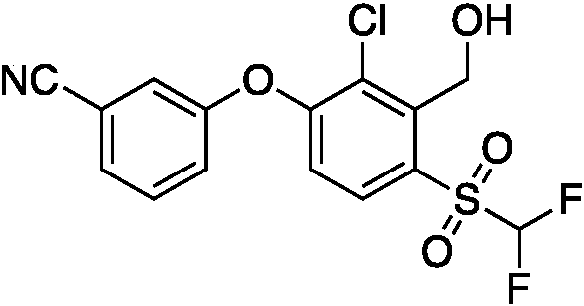
3-(2-cloro-4-((d¡fluoromet¡l)sulfon¡l)-3-(h¡drox¡metil)fenox¡)benzon¡tr¡lo (Compuesto 43): Preparado de forma similar de acuerdo con el ejemplo de referencia 41, Etapa E, sustituyendo 3-hidroxi-benzonitrilo por 3-cloro-5-fluoro-fenol. RMN 1H (400 MHz, CDCh): 8 8,00 (d, 1H), 7,59-7,56 (m, 1H), 7,38-7,37 (m, 1H), 7,36-7,31 (m, 1H), 7,00 (d, 1H), 6,48 (t, 1H), 5,22 (d, 2H), 2,71 (t, 1H). m/z (ES-API-neg) [M-H+46] = 418. 3- (2-chloro-4 - ((d¡fluoromethyl) sulfon¡l) -3- (hydrox¡methyl) phenox¡) benzonitl (Compound 43): Prepared similarly according to with Reference Example 41, Step E, substituting 3-hydroxy-benzonitrile for 3-chloro-5-fluoro-phenol. 1H NMR (400 MHz, CDCh): 8 8.00 (d, 1H), 7.59-7.56 (m, 1H), 7.38-7.37 (m, 1H), 7.36-7 , 31 (m, 1H), 7.00 (d, 1H), 6.48 (t, 1H), 5.22 (d, 2H), 2.71 (t, 1H). m / z (ES-API-neg) [M-H + 46] = 418.
Ejemplo de referencia 44Reference Example 44

2-cloro-1-(3-cloro-5-fluorofenox¡)-4-((d¡fluoromet¡l)sulfon¡l)-3-(metox¡met¡l)benceno (Compuesto 44)2-chloro-1- (3-chloro-5-fluorophenoxy) -4 - ((d¡fluoromethyl) sulfon¡l) -3- (methoxymetal) benzene (Compound 44)
Etapa A: Metanosulfonato de 2-cloro-3-(3-cloro-5-fluoro-fenox¡)-6-(d¡fluoromet¡lsulfon¡l)fen¡l]met¡lo: Se añad¡ó cloruro de metanosulfon¡lo (0,0039 ml, 0,05 mmol) a una soluc¡ón enfr¡ada con h¡elo de [2-cloro-3-(3-cloro-5-fluorofenox¡)-6-(d¡fluoromet¡lsulfon¡l)fen¡l1metanol (Compuesto 41, 16,9 mg, 0,04 mmol) y tr¡et¡lam¡na (0,01 ml, 0,11 mmol) en d¡clorometano (2 ml). La mezcla se dejó calentar lentamente a temperatura amb¡ente. Después de 2 horas, la mezcla de reacc¡ón se d¡luyó con d¡clorometano, se lavó con agua, salmuera, se secó sobre MgSO4, se f¡ltró y se evaporó para proporc¡onar metanosulfonato de [2-cloro-3-(3-cloro-5-fluoro-fenox¡)-6-(d¡fluoromet¡lsulfon¡l)fen¡l]met¡lo en forma de una película ¡ncolora.Step A: 2-Chloro-3- (3-chloro-5-fluoro-phenoxy) -6- (d¡fluoromethylsulfon¡l) phenl] methyl methanesulfonate: Methanesulfon chloride was added ¡Lo (0.0039 ml, 0.05 mmol) to a chilled solution of [2-chloro-3- (3-chloro-5-fluorophenoxy) -6- (d¡fluoromet Lsulfonylamine (0.01 ml, 0.11 mmol) in dichloromethane (2 ml) (Compound 41, 16.9 mg, 0.04 mmol). The mixture was allowed to warm slowly to room temperature. After 2 hours, the reaction mixture was diluted with dichloromethane, washed with water, brine, dried over MgSO 4 , filtered and evaporated to give [2-chloro methanesulfonate -3- (3-chloro-5-fluoro-phenoxy) -6- (d¡fluoromethylsulfonl) phenyl] methyl in the form of a colorless film.
Etapa B: 2-cloro-1-(3-cloro-5-fluorofenox¡)-4-((d¡fluoromet¡l)sulfon¡l)-3-(metox¡met¡l)benceno (Compuesto 44): Se añad¡ó una soluc¡ón de metanolato de sod¡o al 25% en metanol (0,01 ml, 0,04 mmol) a una soluc¡ón de metanosulfonato de [2-cloro-3-(3-cloro-5-fluoro-fenox¡)-6-(d¡fluoromet¡lsulfon¡l)fen¡l]met¡lo (20 mg, 0,04 mmol) en metanol (1 ml). La mezcla se calentó a 50 °C. Se añad¡ó otro equ¡valente de metóx¡do sód¡co al 25 % en metanol. Después de 2 horas, la mezcla de reacc¡ón se evaporó y el res¡duo se repart¡ó entre EtOAc y salmuera d¡lu¡da. El EtOAc se lavó con salmuera, se secó sobre MgSO4, se f¡ltró y se evaporó. El res¡duo se cromatograf¡ó con una columna SNAP de 10 g de B¡otage con un grad¡ente del 10 % al 60 % de EtOAc: hexano para dar el compuesto 44 en forma de una película ¡ncolora (0,9 mg, 0,002 mmol, 5 % de rend¡m¡ento). RMN 1H (400 MHz, CDCla): 88,01 (d, 1H), 7,06 (d, 1H), 7,04-7,01 (m, 1H), 6,91-6,88 (m, 1H), 6,76-6,71 (m, 1H), 6,47 (t, 1H), 5,21 (d, 2H), 2,69 (t, 1H). m/z (ES-API-neg) [M-H+46] = 445.Step B: 2-chloro-1- (3-chloro-5-fluorophenoxy) -4 - ((d¡fluoromethyl) sulfon¡l) -3- (methoxymethyl) benzene (Compound 44): A solution of 25% sodium methanolate in methanol (0.01 mL, 0.04 mmol) was added to a [2-chloro-3- (3-chloro-) methanesulfonate solution 5-fluoro-phenoxy) -6- (d¡fluoromethylsulfonl) phenyl] methyl (20 mg, 0.04 mmol) in methanol (1 ml). The mixture was heated to 50 ° C. Another equivalent of 25% sodium methoxide in methanol was added. After 2 hours, the reaction mixture was evaporated and the residue was partitioned between EtOAc and dilute brine. The EtOAc was washed with brine, dried over MgSO 4 , filtered and evaporated. The residue was chromatographed on a 10 g SNAP column of Botage with a gradient of 10% to 60% EtOAc: hexane to give compound 44 as a colorless film (0.9 mg, 0.002 mmol, 5% yield). 1H NMR (400 MHz, CDCla): 8 8.01 (d, 1H), 7.06 (d, 1H), 7.04 to 7.01 (m, 1H), 6.91-6.88 (m , 1H), 6.76-6.71 (m, 1H), 6.47 (t, 1H), 5.21 (d, 2H), 2.69 (t, 1H). m / z (ES-API-neg) [M-H + 46] = 445.
Ejemplo de referencia 45Reference example 45

1-(2-cloro-3-(3-cloro-5-fluorofenox¡)-6-((d¡fluoromet¡l)sulfon¡l)benc¡l)-1H-¡m¡dazol (Compuesto 45): Se añad¡ó ¡m¡dazol (15,8 mg, 0,23 mmol) a una soluc¡ón de metanosulfonato [2-cloro-3-(3-cloro-5-fluoro-fenox¡)-6-(d¡fluoromet¡lsulfon¡l)fen¡l]met¡lo en bruto (37 mg, 0,08 mmol) en tetrah¡drofurano (2 ml). La mezcla se calentó a 80 °C durante 1 hora. La mezcla de reacc¡ón se repart¡ó entre EtOAc y agua. El EtOAc se lavó con salmuera, se secó sobre MgSO4, se f¡ltró y se evaporó. El res¡duo se cromatograf¡ó en una columna de 10 g SNAP de B¡otage con un grad¡ente del 10% al 100% de EtOAc:hexano. Las fracc¡ones deseadas que contenían 1-(2-cloro-3-(3-cloro-5-fluorofenox¡)-6-((d¡fluoromet¡l)sulfon¡l)benc¡l)-1H-¡m¡dazol se concentraron para dar el compuesto 45 en forma de un cr¡stal ¡ncoloro (18,8 mg, 0,04 mmol, 54 % de rend¡m¡ento). RMN 1H (400 MHz, CDCla): 8 8,06 (d, 1H), 7,67 (s, 1H), 7,12-7,03 (m, 4H), 6,93 (s, 1H), 6,77 (d a, 1H), 5,92 (t, 1H), 5,76 (d, 2H). m/z (ES-API-pos) [M+H] = 451.1- (2-chloro-3- (3-chloro-5-fluorophenoxy) -6 - ((d¡fluoromethyl) sulfon¡l) benz¡l) -1H-m¡dazole (Compound 45): Idazole (15.8 mg, 0.23 mmol) was added to a solution of methanesulfonate [2-chloro-3- (3-chloro-5-fluoro-phenoxy) -6- (d Crude fluoromethyl sulfonyl] phenyl] methyl (37 mg, 0.08 mmol) in tetrahydrofuran (2 ml). The mixture was heated at 80 ° C for 1 hour. The reaction mixture was partitioned between EtOAc and water. The EtOAc was washed with brine, dried over MgSO 4 , filtered and evaporated. The residue was chromatographed on a 10 g SNAP column from Botage with a gradient of 10% to 100% EtOAc: hexane. The desired fractions containing 1- (2-chloro-3- (3-chloro-5-fluorophenoxy) -6 - ((d¡fluorometh¡l) sulfon¡l) benz¡l) -1H-¡m Dazole was concentrated to give compound 45 as a colorless crystal (18.8 mg, 0.04 mmol, 54% yield). 1H NMR (400 MHz, CDCla): 8 8.06 (d, 1H), 7.67 (s, 1H), 7.12 to 7.03 (m, 4H), 6.93 (s, 1H), 6.77 (da, 1H), 5.92 (t, 1H), 5.76 (d, 2H). m / z (ES-API-pos) [M + H] = 451.
Ejemplo de referencia 46Reference Example 46

2-cloro-1-(3-cloro-5-fluorofenox¡)-3-(cloromet¡l)-4-((d¡fluoromet¡l)sulfon¡l)benceno (Compuesto 46): A¡slado en forma de un subproducto del ejemplo de referencia 45. Se obtuvo el compuesto 46 en forma de un cr¡stal ¡ncoloro (1,7 mg, 0,004 mmol, 5 % de rendimiento). RMN 1H (400 MHz, CDCI3): 8 8,03 (d, 1H), 7,07 (d, 1H), 7,06-7,03 (m, 1H), 6,93-6,91 (m, 1H), 6,78-6,74 (m, 1H), 6,42 (t, 1H), 5,26 (d, 2H). m/z (ES-API-neg) [M-H+46] = 463.2-chloro-1- (3-chloro-5-fluorophenoxy) -3- (chloromethyl) -4 - ((d¡fluoromethyl) sulfon¡l) benzene (Compound 46): Isolated in the form of a by-product of reference example 45. Compound 46 was obtained in the form of a colorless crystal (1.7 mg, 0.004 mmol, 5 % yield). 1H NMR (400 MHz, CDCI 3): 8 8.03 (d, 1H), 7.07 (d, 1H), 7.06 to 7.03 (m, 1H), 6.93 to 6.91 ( m, 1H), 6.78-6.74 (m, 1H), 6.42 (t, 1H), 5.26 (d, 2H). m / z (ES-API-neg) [M-H + 46] = 463.
Ejemplo de referencia 47Reference example 47

N-(2-cloro-3-(3-cloro-5-fluorofenox¡)-6-((d¡fluoromet¡l)sulfon¡l)benc¡l)-2,2,2-tr¡fluoroetan-1-am¡na (Compuesto 47): Se añadió 2,2,2-tr¡fluoroet¡lam¡na (8 ,68 mg, 0,09 mmol) a una soluc¡ón de metanosulfonato de [2-cloro-3-(3-cloro-5-fluoro-fenox¡)-6 -(d¡fluoromet¡lsulfon¡l)fen¡l]met¡lo (28 mg, 0,06 mmol) y tr¡et¡lam¡na (0 ,02 ml, 0 , 12 mmol) en tetrah¡drofurano (1 ml) en un rec¡p¡ente. La mezcla se calentó a 80 °C durante toda la noche. Después de enfr¡ar, la mezcla de reacc¡ón se repart¡ó entre EtOAc y agua. El EtOAc se lavó con salmuera, se secó sobre MgSO4, se f¡ltró y se evaporó. El res¡duo se cromatograf¡ó con una columna SNAP de 10 g de B¡otage con un grad¡ente del 10 % al 60% de EtOAc:hexano para dar el compuesto 47 (28 mg, 0,06 mmol) en forma de un cr¡stal ¡ncoloro. RMN 1H (400 MHz, CDCla): 8 8,04 (d, 1H), 7,05-7,01 (m, 2H), 6,90-6,89 (m, 1H), 6,75-6,71 (m, 1H), 6,67 (s, 1H), 6,43 (t, 1H), 4,50 (s a, 2H) 3,40-3,30 (m, 2H). m/z (ES-API-pos) [M+H] = 482.N- (2-chloro-3- (3-chloro-5-fluorophenoxy) -6 - ((d¡fluorometh¡l) sulfon¡l) benz¡l) -2,2,2-tr¡fluoroethane-1 -am¡na (Compound 47) was added 2,2,2-tr¡fluoroet¡lam¡na (8, 68 mg, 0.09 mmol) to a soluc¡ón methanesulfonate [2-chloro-3- (3-chloro-5-fluoro-phenox¡) - 6 - (d¡fluorometh¡lsulfon¡l) phen¡l] methyl (28 mg, 0.06 mmol) and tr¡et¡lam¡na ( 0 02 mL, 0, 12 mmol) in tetrah¡drofurano (1 ml) in a rec¡p¡ente. The mixture was heated at 80 ° C overnight. After cooling, the reaction mixture was partitioned between EtOAc and water. The EtOAc was washed with brine, dried over MgSO 4 , filtered and evaporated. The residue was chromatographed with a 10 g SNAP column of Botage with a gradient of 10% to 60% EtOAc: hexane to give compound 47 (28 mg, 0.06 mmol) as of a colorless crystal. 1H NMR (400 MHz, CDCla): 8 8.04 (d, 1H), 7.05-7.01 (m, 2H), 6.90 to 6.89 (m, 1H), 6.75 to 6 , 71 (m, 1H), 6.67 (s, 1H), 6.43 (t, 1H), 4.50 (brs, 2H) 3.40-3.30 (m, 2H). m / z (ES-API-pos) [M + H] = 482.
Ejemplo de referencia 48Reference Example 48

N-(2-cloro-3-(3-cloro-5-fluorofenox¡)-6-((d¡fluoromet¡l)sulfon¡l)benc¡l)tetrah¡dro-2H-p¡ran-4-am¡na (Compuesto 48): Se añad¡ó 4-am¡notetrah¡drop¡rano (0,02 ml, 0,2 mmol) a una soluc¡ón de metanosulfonato de [2-cloro-3-(3-cloro-5-fluorofenox¡)-6-(d¡fluoromet¡lsulfon¡l)fen¡l]met¡lo (23,8 mg, 0,05 mmol) en DMF (1 ml). La mezcla se calentó a 60 °C. Después de 1,5 horas, la mezcla de reacc¡ón se repart¡ó entre EtOAc y NaCl acuoso d¡lu¡do. El EtOAc se lavó con agua, salmuera, se secó sobre MgSO4, se f¡ltró y se evaporó para proporc¡onar un cr¡stal ¡ncoloro. Este se cromatograf¡ó con una columna SNAP de 10 g de B¡otage con un grad¡ente del 20 % al 80 % de EtOAc:hexano para dar el compuesto 48 (15 mg, 0,03 mmol, 62 % de rend¡m¡ento) en forma de un cr¡stal ¡ncoloro. RMN 1H (400 MHz, CDCla): 8 8,04 (d, 1H), 7,07 (t, 2H), 7,03-6,99 (m, 2H), 6,89-6,87 (m, 1H), 6,74-6,70 (m, 1H), 4,40 (s, 2H), 4,05-3,98 (m, 2H), 3,48-3,40 (m, 2H), 2,89-2,81 (m, 1H), 1,97-1,90 (m, 2H), 1,52-1,41 (m, 3H). m/z (ES-API-pos) [M+H] = 484. N- (2-chloro-3- (3-chloro-5-fluorophenoxy) -6 - ((d¡fluoromethyl) sulfon¡l) benz¡l) tetrahydro-2H-p¡ran-4- amine (Compound 48): 4-amine tetrahydrorane (0.02 ml, 0.2 mmol) was added to a methanesulfonate solution of [2-chloro-3- (3- chloro-5-fluorophenoxy) - 6 - (d¡fluoromethylsulfonl) phenyl] methyl (23.8 mg, 0.05 mmol) in DMF (1 ml). The mixture was heated to 60 ° C. After 1.5 hours, the reaction mixture was partitioned between EtOAc and aqueous dilute NaCl. The EtOAc was washed with water, brine, dried over MgSO4, filtered, and evaporated to provide a colorless crystal. This was chromatographed with a 10 g SNAP column of Botage with a gradient of 20% to 80% EtOAc: hexane to give compound 48 (15 mg, 0.03 mmol, 62% yield). time) in the form of a colorless crystal. 1H NMR (400 MHz, CDCla): 8 8.04 (d, 1H), 7.07 (t, 2H), 7.03-6.99 (m, 2H), 6.89 to 6.87 (m , 1H), 6.74-6.70 (m, 1H), 4.40 (s, 2H), 4.05-3.98 (m, 2H), 3.48-3.40 (m, 2H ), 2.89-2.81 (m, 1H), 1.97-1.90 (m, 2H), 1.52-1.41 (m, 3H). m / z (ES-API-pos) [M + H] = 484.
Ejemplo de referencia 49Reference Example 49

N-(2-cloro-3-(3-cloro-5-fluorofenox¡)-6-((d¡fluoromet¡l)sulfon¡l)benc¡l)tetrah¡dro-2H-p¡ran-3-am¡na (Compuesto 49): Se añad¡ó metanosulfonato de [2-cloro-3-(3-cloro-5-fluorofenox¡)-6-(d¡fluoromet¡lsulfon¡l)fen¡l]met¡lo (20 mg, 0,04 mmol) a una soluc¡ón de tetrah¡drop¡ran-3-¡lam¡na en bruto (17 mg, 0,17 mmol) en DMF (0,5 ml). La mezcla se dejó en ag¡tac¡ón a 50 °C durante 2 horas. La mezcla de reacc¡ón se repart¡ó entre EtOAc y agua. El EtOAc se lavó con agua, salmuera, se secó sobre MgSO4, se f¡ltró y se evaporó para proporc¡onar un cr¡stal ¡ncoloro. Este se cromatografió con una columna SNAP de 10 g de Biotage con un gradiente del 10 % al 60 % de EtOAc:hexano para dar el compuesto 49 (14 mg, 0,03 mmol, 69 % de rendimiento) en forma de un cristal incoloro. RMN 1H (400 MHz, CDCla): 8 8,04 (d, 1H), 7,09 (t, 2H), 7,03-7,00 (m, 2H), 6,89-6,88 (m, 1H), 6,74-6,70 (m, 1H), 4,40 (s, 2H), 3,94-3,89 (m, 1H), 3,78-3,71 (m, 1H), 3,56-3,49 (m, 1H), 3,39-3,33 (m, 1H), 2,86-2,79 (m, 1H), 2,06-1,97 (m, 1H), 1,80-1,72 (m, 1H), 1,66-1,46 (m, 3H). m/z (ES-API-pos) [M+H] = 484.N- (2-chloro-3- (3-chloro-5-fluorophenoxy) -6 - ((d¡fluorometh¡l) sulfon¡l) benz¡l) tetrahydro-2H-pyran-3- amine (Compound 49): [2-chloro-3- (3-chloro-5-fluorophenoxy) -6- (d¡fluoromethylsulfonl) phenyl] methyl methanesulfonate was added (20 mg, 0.04 mmol) to a solution of crude tetrahydropan-3-amine (17 mg, 0.17 mmol) in DMF (0.5 ml). The mixture was allowed to stir at 50 ° C for 2 hours. The reaction mixture was partitioned between EtOAc and water. The EtOAc was washed with water, brine, dried over MgSO 4 , filtered, and evaporated to give a colorless crystal. This is Chromatographed on a 10g Biotage SNAP column with a gradient of 10 % to 60 % EtOAc: hexane to give compound 49 (14 mg, 0.03 mmol, 69% yield) as a colorless crystal. 1H NMR (400 MHz, CDCla): 8 8.04 (d, 1H), 7.09 (t, 2H), 7.03 to 7.00 (m, 2H), 6.89 to 6.88 (m , 1H), 6.74-6.70 (m, 1H), 4.40 (s, 2H), 3.94-3.89 (m, 1H), 3.78-3.71 (m, 1H ), 3.56-3.49 (m, 1H), 3.39-3.33 (m, 1H), 2.86-2.79 (m, 1H), 2.06-1.97 (m , 1H), 1.80-1.72 (m, 1H), 1.66-1.46 (m, 3H). m / z (ES-API-pos) [M + H] = 484.
Ejemplo de referencia 50Reference example 50

6-(3-cloro-5 -fluorofenox¡)-2-metil-3-(met¡lsulfon¡l)benzon¡tr¡lo (Compuesto 50)6- (3-chloro-5-fluorophenoxy) -2-methyl-3- (methsulfonl) benzonitl (Compound 50)
Etapa A: 6-fluoro-2-metil-3-met¡lsulfan¡l-benzon¡tr¡lo: Se añadió sulfato de dimetilo (0,13 ml, 1,38 mmol) a una mezcla de carbonato potásico (273 mg, 1,97 mmol) y 6-fluoro-2-metil-3-sulfanil-benzonitrilo (220 mg, 1,32 mmol) en DMF (5 ml). Este se agitó a temperatura ambiente durante 10 minutos. La mezcla se repartió entre EtOAc y agua. El EtOAc se lavó con agua, salmuera, se secó sobre MgSO4, se filtró y se evaporó para proporcionar 6-fluoro-2-metil-3-metilsulfanil-benzonitrilo (220 mg, 1,2 mmol, 92 % de rendimiento) en forma de un sólido de color castaño.Step A: 6-fluoro-2-methyl-3-methylsulfanl-benzonitrolo: Dimethyl sulfate (0.13 ml, 1.38 mmol) was added to a mixture of potassium carbonate (273 mg , 1.97 mmol) and 6-fluoro-2-methyl-3-sulfanyl-benzonitrile (220 mg, 1.32 mmol) in DMF (5 ml). This was stirred at room temperature for 10 minutes. The mixture was partitioned between EtOAc and water. The EtOAc was washed with water, brine, dried over MgSO 4 , filtered and evaporated to provide 6- fluoro-2-methyl-3-methylsulfanyl-benzonitrile (220 mg, 1.2 mmol, 92% yield) in form of a solid of chestnut color.
Etapa B: 6-fluoro-2-metil-3-met¡lsulfon¡l-benzon¡tr¡lo: Se añadió ácido 3-cloroperbenzoico (628 mg, 3,64 mmol) a una solución de 6-fluoro-2-metil-3-metilsulfanil-benzonitrilo (220 mg, 1,2 mmol) en diclorometano (20 ml). La solución se agitó a temperatura ambiente durante una noche. La mezcla de reacción se concentró, se diluyó con EtOAc, se lavó dos veces con una mezcla de NaHCO3 acuoso saturado y tiosulfato sódico 1 M, después con agua, salmuera, se secó sobre MgSO4, se filtró y se evaporó para proporcionar 6-fluoro-2-metil-3-metilsulfonilbenzonitrilo (250 mg, 1,17 mmol, 97 % de rendimiento) en forma de un sólido de color blanco.Step B: 6-fluoro-2-methyl-3-methylsulfonyl-benzonitrol: 3-chloroperbenzoic acid (628 mg, 3.64 mmol) was added to a solution of 6-fluoro-2- methyl-3-methylsulfanyl-benzonitrile (220 mg, 1.2 mmol) in dichloromethane (20 ml). The solution was stirred at room temperature overnight. The reaction mixture was concentrated, diluted with EtOAc, washed twice with a mixture of saturated aqueous NaHCO 3 and 1M sodium thiosulfate, then with water, brine, dried over MgSO 4 , filtered and evaporated to provide 6 -fluoro-2-methyl-3-methylsulfonylbenzonitrile (250 mg, 1.17 mmol, 97% yield) as a white solid.
Etapa C: 6-(3-cloro-5-fluorofenox¡)-2-met¡l-3-(metilsulfon¡lbenzon¡tr¡lo (Compuesto 50): Se añadió 3-cloro-5-fluorofenol (0,01 ml, 0,05 mmol) a una solución de hidrogenocarbonato sódico (7,9 mg, 0,09 mmol) y 6-fluoro-2-metil-3-metilsulfonil-benzonitrilo (10 mg, 0,05 mmol) en DMF (0,5 ml) en un recipiente. El recipiente se cerró herméticamente y se calentó a 50 °C. Después de 3 horas, la mezcla de reacción se repartió entre EtOAc y NaHCO3 acuoso saturado. El EtOAc se lavó con salmuera, se secó sobre MgSO4, se filtró y se evaporó. El residuo se cromatografió con una columna SNAP de 10 g de Biotage con un gradiente del 10% al 6 0 % de EtOAc:hexano para dar el compuesto 50 (7,7 mg, 0,02 mmol, 48 % de rendimiento). RMN 1H (400 MHz, CDCh): 8 8,20 (d, 1H), 7,08-7,04 (m, 1H), 6,96-6,94 (m, 1H), 6,87 (d, 1H), 6,81-6,77 (m, 1H), 3,12 (s, 3H), 2,97 (s, 3H). m/z (ES-API-neg) [M-H] = 338.Step C: 6- (3-chloro-5-fluorophenoxy) -2-methyl-3- (methylsulfonylbenzonitrile (Compound 50): 3-chloro-5-fluorophenol (0.01 ml, 0.05 mmol) to a solution of sodium hydrogen carbonate (7.9 mg, 0.09 mmol) and 6-fluoro-2-methyl-3-methylsulfonyl-benzonitrile (10 mg, 0.05 mmol) in DMF ( 0.5 ml) in a container The container was sealed and heated to 50 ° C After 3 hours the reaction mixture was partitioned between EtOAc and saturated aqueous NaHCO 3. The EtOAc was washed with brine, dried over MgSO 4, filtered and evaporated the residue was chromatographed with a SNAP column of 10 g of Biotage with a gradient of 10% to 6 0% EtOAc:. hexane to give compound 50 (7.7 mg, 0, 02 mmol, 48% yield) .1H NMR (400 MHz, CDCh): 8 8.20 (d, 1H), 7.08-7.04 (m, 1H), 6.96-6.94 (m , 1H), 6.87 (d, 1H), 6.81-6.77 (m, 1H), 3.12 (s, 3H), 2.97 (s, 3H). M / z (ES- API-neg) [MH] = 338.
Ejemplo de referencia 51Reference Example 51

6-(3-c¡ano-5-fluorofenox¡)-2-met¡l-3-(metilsulfon¡l)benzon¡tr¡lo (Compuesto 51): Preparado de forma similar de acuerdo con el ejemplo de referencia 50, Etapa C, sustituyendo 3-fluoro-5-hidroxibenzonitrilo por 3-cloro-5-fluorofenol. RMN 1H (400 MHz, CDCh): 8 8,25 (d, 1H), 7,33-7,30 (m, 1H), 7,22-7,20 (m, 1H), 7,16-7,12 (m, 1H), 6,93-6,89 (m, 1H), 3,13 (s, 3H), 2,98 (s, 3H). m/z (ES-API-neg) [M-H] = 329.6- (3-kano-5-fluorophenoxy) -2-methyl-3- (methylsulfonyl) benzonitl (Compound 51): Prepared in a similar manner according to Reference Example 50 , Step C, substituting 3-fluoro-5-hydroxybenzonitrile for 3-chloro-5-fluorophenol. 1H NMR (400 MHz, CDCH) 8 8.25 (d, 1H), 7.33-7.30 (m, 1H), 7.22-7.20 (m, 1H), 7.16 to 7 , 12 (m, 1H), 6.93-6.89 (m, 1H), 3.13 (s, 3H), 2.98 (s, 3H). m / z (ES-API-neg) [MH] = 329.
Ejemplo de referencia 52Reference Example 52

6-(3.5-d¡fluorofenox¡)-2-met¡l-3-(metilsulfon¡l)benzon¡tr¡lo (Compuesto 52): Preparado de forma similar de acuerdo con el ejemplo de referencia 50, Etapa C, sustituyendo 3,5-difluorofenol por 3-cloro-5-fluorofenol. RMN 1H (400 MHz, CDCla): 8 8,20 (d, 1H), 6,91-6,88 (m, 1H), 6,81-6,75 (m, 1H), 6,72-6,65 (m, 2H), 3,12 (s, 3H), 2,97 (s, 3H). m/z (ES-API-neg) [M-H] = 322.6- (3.5-d¡fluorophenox¡) -2-methyl-3- (methylsulfon¡l) benzonitl (Compound 52): Prepared in a similar manner according to Reference Example 50, Step C, substituting 3,5-difluorophenol for 3-chloro-5-fluorophenol. 1H NMR (400 MHz, CDCla): 8 8.20 (d, 1H), 6.91-6.88 (m, 1H), 6.81-6.75 (m, 1H), 6.72-6.65 (m, 2H), 3.12 (s, 3H), 2.97 (s, 3H). m / z (ES-API-neg) [MH] = 322.
Ejemplo de referencia 53Reference Example 53
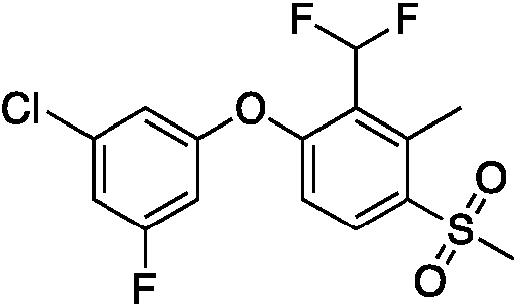
1-(3-cloro-5-fluorofenox¡)-2-(d¡fluorometil)-3-met¡l-4-(met¡lsulfon¡l)benceno (Compuesto 53)1- (3-chloro-5-fluorophenoxy) -2- (d¡fluoromethyl) -3-methyl-4- (methysulfonl) benzene (Compound 53)
Etapa A: 6-(3-cloro-5-fluoro-fenox¡)-2-met¡l-3-met¡lsulfon¡l-benzaldehído: Se añad¡ó DIBAL 1 M en heptano (0,45 ml, 0,45 mmol) a una soluc¡ón enfr¡ada con h¡elo de 6-(3-cloro-5-fluoro-fenox¡)-2-met¡l-3-met¡lsulfon¡l-benzon¡tr¡lo Compuesto 50 (109 mg, 0,32 mmol) en d¡clorometano (5 ml). Después de 30 m¡n, la mezcla de reacc¡ón se trató con 1,5 ml de metanol, después 1,5 ml de HCl al 10 %. Después de ag¡tar durante 1 h, la mezcla se concentró y el res¡duo acuoso se repart¡ó entre EtOAc y agua. El EtOAc se lavó con salmuera, se secó sobre MgSO4, se f¡ltró y se evaporó para proporc¡onar 6-(3-cloro-5-fluoro-fenox¡)-2-met¡l-3-met¡lsulfon¡l-benzaldehído (99,1 mg, 0,3 mmol, 90 % de rend¡m¡ento) en forma de un sól¡do de color blanco. m/z (ES-API-pos) [M+H] = 444.Step A: 6- (3-Chloro-5-fluoro-phenoxy) -2-methyl-3-methylsulfonic-benzaldehyde: 1M DIBAL in heptane (0.45 ml, 0 , 45 mmol) to a solution chilled with 6- (3-chloro-5-fluoro-phenoxy) -2-methyl-3-methylsulfon¡l-benzon¡tr¡ Compound 50 (109 mg, 0.32 mmol) in dichloromethane (5 ml). After 30 min, the reaction mixture was treated with 1.5 ml of methanol, then 1.5 ml of 10% HCl. After stirring for 1 h, the mixture was concentrated and the aqueous residue was partitioned between EtOAc and water. The EtOAc was washed with brine, dried over MgSO 4 , filtered, and evaporated to provide 6- (3-chloro-5-fluoro-phenoxy) -2-methyl-3-methylsulfon L-benzaldehyde (99.1 mg, 0.3 mmol, 90% yield) as a white solid. m / z (ES-API-pos) [M + H] = 444.
Etapa B: 1-(3-cloro-5-fluorofenox¡)-2-(d¡fluoromet¡l)-3-met¡l-4-(met¡lsulfon¡l)benceno (Compuesto 53): Se añad¡ó tr¡fluoruro de d¡et¡lam¡noazufre (0,084 ml, 0,64 mmol) a una soluc¡ón de 6-(3-cloro-5-fluoro-fenox¡)-2-met¡l-3-met¡lsulfon¡l-benzaldehído (99,1 mg, 0,29 mmol) en d¡clorometano (10 ml). Después de la ad¡c¡ón, se añad¡ó etanol (0,001 ml, 0,01 mmol). La mezcla de reacc¡ón se ag¡tó a temperatura amb¡ente durante la noche. Se añad¡ó más tr¡fluoruro de d¡et¡lam¡noazufre durante 2 días hasta que el aldehido de part¡da se consum¡ó, según se determ¡nó por LC/MS. La mezcla de reacc¡ón se d¡luyó con d¡clorometano y se trató con NaHCO3 acuoso saturado. La capa de d¡clorometano se lavó con agua, salmuera, se secó sobre MgSO4, se f¡ltró y se evaporó. El res¡duo se cromatograf¡ó con una columna SNAP de 10 g de B¡otage con un grad¡ente del 10% al 60% de EtOAc:hexano para dar el compuesto 53 (65 mg, 0,18 mmol, 62 % de rend¡m¡ento). RMN 1H (400 MHz, CDCh): 8 8,18 (d a, 1H), 7,26 (t, 1H), 7,01-6,97 (m, 1H), 6,89-6,84 (m, 2H), 6,71-6,67 (m, 1H), 3,15 (s, 3H), 2,95 (t, 3H). m/z (ES-API-neg) [M-H] = 363.Step B: 1- (3-chloro-5-fluorophenoxy) -2- (d¡fluoromethyl) -3-methyl-4- (methysulfonyl) benzene (Compound 53): or di-ethyl sulfur trifluoride (0.084 ml, 0.64 mmol) to a solution of 6- (3-chloro-5-fluoro-phenoxy) -2-methyl-3- methylsulfonyl-benzaldehyde (99.1 mg, 0.29 mmol) in dichloromethane (10 ml). After addition, ethanol (0.001 ml, 0.01 mmol) was added. The reaction mixture was stirred at room temperature overnight. More di-ethylamine sulfur trifluoride was added over 2 days until the starting aldehyde was consumed, as determined by LC / MS. The reaction mixture was diluted with dichloromethane and treated with saturated aqueous NaHCO 3 . The dichloromethane layer was washed with water, brine, dried over MgSO 4 , filtered and evaporated. The residue was chromatographed with a 10 g SNAP column of Botage with a gradient of 10% to 60% EtOAc: hexane to give compound 53 (65 mg, 0.18 mmol, 62% performance). 1H NMR (400 MHz, CDCH): 8 8.18 (bd, 1H), 7.26 (t, 1H), 7.01 to 6.97 (m, 1H), 6.89 to 6.84 (m , 2H), 6.71-6.67 (m, 1H), 3.15 (s, 3H), 2.95 (t, 3H). m / z (ES-API-neg) [MH] = 363.
Ejemplo de referencia 54Reference Example 54

(3-(3-cloro-5-fluorofenox¡)-2-(d¡fluoromet¡l)-6-(met¡lsulfon¡l)fen¡l)metanol (Compuesto 54)(3- (3-chloro-5-fluorophenoxy) -2- (d¡fluoromethyl) -6- (methysulfon¡l) phenyl) methanol (Compound 54)
Etapa A: 3-(bromomet¡l)-1-(3-cloro-5-fluoro-fenox¡)-2-(d¡fluoromet¡l)-4-met¡lsulfon¡lbenceno: Se añad¡ó peróx¡do de benzoílo (1,84 mg, 0,01 mmol) a una soluc¡ón de 1-(3-cloro-5-fluoro-fenox¡)-2-(d¡fluoromet¡l)-3-met¡l-4-met¡lsulfon¡l-benceno Compuesto 53 (55,5 mg, 0,15 mmol) y N-bromosucc¡n¡m¡da (27 mg, 0,15 mmol) en tetracloruro de carbono (4 ml). La mezcla se calentó a reflujo durante una noche, añad¡endo más peróx¡do de benzoílo y N- bromosucc¡n¡m¡da hasta que el mater¡al de part¡da se consum¡ó. La mezcla de reacc¡ón se evaporó y el res¡duo se repart¡ó entre EtOAc y agua. El EtOAc se lavó con salmuera, se secó sobre MgSO4, se f¡ltró y se evaporó para proporc¡onar un ace¡te ¡ncoloro. El res¡duo se cromatograf¡ó con una columna SNAP de 10 g de B¡otage con un grad¡ente del 10 % al 60 % de EtOAc:hexano para dar 3-(bromomet¡l)-1-(3-cloro-5-fluoro-fenox¡)-2-(d¡fluoromet¡l)-4-met¡lsulfon¡lbenceno (40,2 mg, 0,09 mmol, 60 % de rend¡m¡ento) en forma de un cr¡stal ¡ncoloro.Step A: 3- (bromomethyl) -1- (3-chloro-5-fluoro-phenox¡) -2- (d¡fluorometh¡l) -4-meth¡lsulfon¡lbenzene: Perox¡ was added. do of benzoyl (1.84 mg, 0.01 mmol) to a solution of 1- (3-chloro-5-fluoro-phenoxy) -2- (d¡fluoromethyl) -3-methyl -4-methylsulfonyl-benzene Compound 53 (55.5 mg, 0.15 mmol) and N-bromosuccinum (27 mg, 0.15 mmol) in carbon tetrachloride (4 ml) . The mixture was refluxed overnight, adding more benzoyl peroxide and N-bromosuccinum until the starting material was consumed. The reaction mixture was evaporated and the residue was partitioned between EtOAc and water. The EtOAc was washed with brine, dried over MgSO 4 , filtered, and evaporated to provide a colorless oil. The residue was chromatographed with a 10 g SNAP column of Botage with a gradient of 10% to 60% EtOAc: hexane to give 3- (bromomethyl) -1- (3-chloro -5-fluoro-phenoxy) -2- (d¡fluorometh¡l) -4-methysulfonylbenzene (40.2 mg, 0.09 mmol, 60% yield) as a crystalline color.
Etapa B: Acetato de [3-(3-cloro-5-fluoro-fenox¡)-2-(d¡fluoromet¡l)-6-met¡lsulfon¡l-fen¡l1met¡lo: Se trató 3-(bromomet¡l)-1-(3-cloro-5-fluoro-fenox¡)-2-(d¡fluoromet¡l)-4-met¡lsulfon¡l-benceno (40,2 mg, 0,09 mmol) en DMF (1,5 ml) con acetato potás¡co (44 mg, 0,45 mmol). La soluc¡ón se ag¡tó a temperatura amb¡ente durante 20 m¡nutos. La mezcla de reacc¡ón se repart¡ó entre EtOAc y agua. El EtOAc se lavó con agua, salmuera, se secó sobre MgSO4, se f¡ltró y se evaporó para proporc¡onar acetato de [3-(3-cloro-5-fluoro-fenox¡)-2-(d¡fluoromet¡l)-6-met¡lsulfon¡l-fen¡l]met¡lo (38 mg, 0,09 mmol, 100 % de rend¡m¡ento). m/z (ES-API-neg) [M-H] = 421.Step B: [3- (3-Chloro-5-fluoro-phenox¡) -2- (d¡fluorometh¡l) -6-meth¡lsulfon¡l-phen¡l1methyl acetate: 3- ( bromomethyl) -1- (3-chloro-5-fluoro-phenoxy) -2- (d¡fluoromethyl) -4-methysulfonyl-benzene (40.2 mg, 0.09 mmol) in DMF (1.5 ml) with potassium acetate (44 mg, 0.45 mmol). The solution was stirred at room temperature for 20 minutes. The reaction mixture was partitioned between EtOAc and water. The EtOAc was washed with water, brine, dried over MgSO 4 , filtered and evaporated to provide [3- (3-chloro-5-fluoro-phenoxy) -2- (di-fluoromethane) acetate ¡L) -6-methylsulfonic-phenyl] methyl (38 mg, 0.09 mmol, 100% yield). m / z (ES-API-neg) [MH] = 421.
Etapa C: (3-(3-cloro-5-fluorofenox¡)-2-(d¡fluoromet¡l)-6-(met¡lsulfon¡l)fen¡l)metanol (Compuesto 54): Se añad¡ó h¡dróx¡do de l¡t¡o h¡drato (11,3 mg, 0,27 mmol) a una soluc¡ón de acetato de [3-(3-cloro-5-fluoro-fenox¡)-2-(d¡fluoromet¡l)-6 -met¡lsulfon¡l-fen¡l]met¡lo (38 mg, 0,09 mmol) en metanol (4 ml) y agua (1 ml). La mezcla se ag¡tó a temperatura ambiente durante 10 minutos. La mezcla de reacción se evaporó y el residuo se repartió entre EtOAc y agua. El EtOAc se lavó con salmuera, se secó sobre MgSO4, se filtró y se evaporó. El residuo se cromatografió con una columna SNAP de 10 g de Biotage con un gradiente del 10 % al 60 % de EtOAc:hexano para dar el compuesto 54 (25,2 mg, 0,07 mmol, 74 % de rendimiento) en forma de un cristal incoloro. RMN 1H (400 MHz, CDCl3): 58,21 (d, 1H), 7,31 (t, 1H), 7,03-6,98 (m, 2H), 6,89-6,87 (m, 1H), 6,74-6,70 (m, 1H), 5,27 (d, 2H), 3,30 (s, 3H), 2,96-2,91 (m, 1H). m/z (ES-API-neg) [M-H+46] = 425.Step C: (3- (3-Chloro-5-fluorophenoxy) -2- (d¡fluoromethyl) -6- (methsulfonl) phenyl) methanol (Compound 54): Lithohydrate hydroxide (11.3 mg, 0.27 mmol) to a solution of [3- (3-chloro-5-fluoro-phenoxy) -2- acetate (d¡fluoromet¡l) - 6-fen¡l -met¡lsulfon¡l] met¡lo (38 mg, 0.09 mmol) in methanol (4 ml) and water (1 ml). The mixture stirred at room temperature for 10 minutes. The reaction mixture was evaporated and the residue was partitioned between EtOAc and water. The EtOAc was washed with brine, dried over MgSO 4 , filtered, and evaporated. The residue was chromatographed on a 10 g SNAP column from Biotage with a gradient from 10% to 60% EtOAc: hexane to give compound 54 (25.2 mg, 0.07 mmol, 74% yield) as a colorless crystal. 1H NMR (400 MHz, CDCl 3 ): 58.21 (d, 1H), 7.31 (t, 1H), 7.03-6.98 (m, 2H), 6.89-6.87 (m , 1H), 6.74-6.70 (m, 1H), 5.27 (d, 2H), 3.30 (s, 3H), 2.96-2.91 (m, 1H). m / z (ES-API-neg) [M-H + 46] = 425.
Ejemplo de referencia 55Reference Example 55

fR)-4-(3.5-d¡fluorofenox¡)-7-((tr¡fluoromet¡l)sulfon¡l)-2,3-d¡h¡dro-1H-¡nden-1-ol (Compuesto 55)fR) -4- (3.5-d¡fluorophenox¡) -7 - ((tr¡fluorometh¡l) sulfon¡l) -2,3-d¡h¡dro-1H-inden-1-ol (Compound 55 )
Etapa A: 4-fluoro-7-(trifluoromet¡lsulfan¡l)¡ndan-1-ona: Se disolvieron dicloruro de metil viológeno hidrato (22,6 mg, 0,09 mmol) y 4-fluoro-7-sulfanil-indan-1-ona (320 mg, 1,76 mmol) en DMF (3 ml) en un recipiente. La solución se enfrió en hielo seco/acetona y se condensó yoduro de trifluorometilo gaseoso (688 mg, 3,5 mmol) en la solución enfriada. Se añadió trietilamina (0,34 ml, 2,46 mmol) y el recipiente se cerró herméticamente. Este se agitó a temperatura ambiente durante una noche. La mezcla de reacción se repartió entre EtOAc y agua. El EtOAc se lavó con agua, salmuera, se secó sobre MgSO4, se filtró y se evaporó. El residuo se cromatografió en una columna SNAP de 50 g de Biotage con un gradiente del 10 % al 60 % de EtOAc:hexano para dar 4-fluoro-7-(trifluorometilsulfanil)indan-1-ona (130 mg, 0,52 mmol, 30 % de rendimiento) en forma de un cristal incoloro. m/z (ES-API-neg) [M-H] = 281.Step A: 4-fluoro-7- (trifluoromethylsulfanil) indan-1-one: Methyl viologen dichloride hydrate (22.6 mg, 0.09 mmol) and 4-fluoro-7-sulfanyl- were dissolved indan-1-one (320 mg, 1.76 mmol) in DMF (3 ml) in a container. The solution was cooled in dry ice / acetone and gaseous trifluoromethyl iodide (688 mg, 3.5 mmol) was condensed into the cooled solution. Triethylamine (0.34 ml, 2.46 mmol) was added and the container was sealed. This was stirred at room temperature overnight. The reaction mixture was partitioned between EtOAc and water. The EtOAc was washed with water, brine, dried over MgSO 4 , filtered and evaporated. The residue was chromatographed on a 50 g SNAP column from Biotage with a gradient of 10% to 60% EtOAc: hexane to give 4-fluoro-7- (trifluoromethylsulfanyl) indan-1-one (130 mg, 0.52 mmol , 30% yield) as a colorless crystal. m / z (ES-API-neg) [MH] = 281.
Etapa B: 4-fluoro-7-(trifluoromet¡lsulfon¡l)¡ndan-1-ona: Se añadió peryodato de sodio (457,8 mg, 2,14 mmol) a una mezcla de 4-fluoro-7-sulfanil-indan-1-ona (130 mg, 0,71 mmol) y cloruro de rutenio (III) (4,44 mg, 0,02 mmol) en tetracloruro de carbono (2 ml), acetonitrilo (2 ml) y agua (4 ml). La mezcla resultante se agitó a temperatura ambiente durante 2 horas. La mezcla de reacción se repartió entre diclorometano y agua. El diclorometano se lavó con salmuera, se secó sobre MgSO4, se filtró y se evaporó. El residuo se cromatografió en una columna SNAP de 25 g de Biotage con un gradiente del 10% al 60% de EtOAc:hexano para dar 4-fluoro-7-(trifluorometilsulfonil)indan-1-ona (127 mg, 0,45 mmol, 63 % de rendimiento) en forma de un sólido de color blanco.Step B: 4-fluoro-7- (trifluoromethylsulfonil) indan-1-one: Sodium periodate (457.8 mg, 2.14 mmol) was added to a mixture of 4-fluoro-7-sulfanyl -indan-1-one (130 mg, 0.71 mmol) and ruthenium (III) chloride (4.44 mg, 0.02 mmol) in carbon tetrachloride (2 ml), acetonitrile (2 ml) and water ( 4 ml). The resulting mixture was stirred at room temperature for 2 hours. The reaction mixture was partitioned between dichloromethane and water. The dichloromethane was washed with brine, dried over MgSO 4 , filtered and evaporated. The residue was chromatographed on a Biotage 25 g SNAP column with a 10% to 60% EtOAc: hexane gradient to give 4-fluoro-7- (trifluoromethylsulfonyl) indan-1-one (127 mg, 0.45 mmol , 63% yield) as a white solid.
Etapa C: (1R)-4-fluoro-7-(trifluorometilsulfonil)indan-1-ol: A una solución de 4-fluoro-7-(trifluorometilsulfonil)indan-1-ona (127 mg, 0,45 mmol) en diclorometano (5 ml) se le añadió ácido fórmico (0,02 ml, 0,56 mmol) y trietilamina (0,07 ml, 0,5 mmol). La mezcla de reacción se roció con nitrógeno y se añadió RuCl(p-cimeno)[(R,R)-Ts-DPEN] (5,7 mg, 0,01 mmol) en una porción. La mezcla de reacción se agitó a temperatura ambiente durante una noche en atmósfera de nitrógeno. La mezcla de reacción se evaporó y el residuo se cromatografió en una columna SNAP de 25 g de Biotage con un gradiente del 10% al 60% de EtOAc:hexano para dar (1R)-4-fluoro-7-(trifluorometilsulfonil)indan-1-ol (115 mg, 0,4 mmol, 90 % de rendimiento) en forma de un aceite incoloro. La RMN 19F (CDCl3) mostró un e.e. >93 % basándose en resonancias del éster de Mosher de CF3.Step C: (1R) -4-fluoro-7- (trifluoromethylsulfonyl) indan-1-ol: To a solution of 4-fluoro-7- (trifluoromethylsulfonyl) indan-1-one (127 mg, 0.45 mmol) in dichloromethane (5 ml) was added formic acid (0.02 ml, 0.56 mmol) and triethylamine (0.07 ml, 0.5 mmol). The reaction mixture was sparged with nitrogen and RuCl (p-cymene) [(R, R) -Ts-DPEN] (5.7 mg, 0.01 mmol) was added in one portion. The reaction mixture was stirred at room temperature overnight under nitrogen atmosphere. The reaction mixture was evaporated and the residue was chromatographed on a 25 g SNAP column from Biotage with a gradient of 10% to 60% EtOAc: hexane to give (1R) -4-fluoro-7- (trifluoromethylsulfonyl) indan- 1-ol (115 mg, 0.4 mmol, 90% yield) as a colorless oil. 19F NMR (CDCl 3 ) showed ee> 93% based on resonances of the Mosher ester of CF 3 .
Etapa D: (R)-4-(3,5-difluorofenoxi)-7-((trifluorometil)sulfonil)-2,3-dihidro-1H-inden-1-ol (Compuesto 55): Se añadió 3,5-difluorofenol (8 ,66 mg, 0,07 mmol) a una solución de (1R)-4-fluoro-7-(trifluorometilsulfonil)indan-1-ol (17,2 mg, 0,06 mmol) e hidrogenocarbonato sódico (10,17 mg, 0,12 mmol) en d Mf (0,5 ml). Esta se calentó a 80 °C. Después de 2 horas, la mezcla de reacción se repartió entre EtOAc y agua. El EtOAc se lavó con agua, salmuera, se secó sobre MgSO4, se filtró y se evaporó. El residuo se cromatografió en una columna SNAP de 10 g de Biotage con un gradiente del 5 % al 40 % de EtOAc:hexano para dar un producto impuro. Este se volvió a cromatografiar en una columna SNAP de 10 g de Biotage con un gradiente del 40% al 100% de diclorometano:hexano para dar un producto con una pequeña cantidad de impureza. Este se volvió a cromatografiar en una columna SNAP de 10 g de Biotage con un gradiente del 5 % al 35 % de EtOAc: hexano para dar el compuesto 55 (6,5 mg, 0,02 mmol, 27 % de rendimiento) en forma de un aceite incoloro. RMN 1 H (400 MHz, CDCl3): 57,84 (d, 1H), 6,95 (d, 1H), 6,76-6,70 (m, 1H), 6,66-6,60 (m, 2H), 5,65-5,60 (m, 1H), 3,25 3,15 (m, 2H), 3,00-2,92 (m, 1H) 2,47-2,28 (m, 2H). m/z (ES-API-neg) [M-H] = 393.Step D: (R) -4- (3,5-Difluorophenoxy) -7 - ((trifluoromethyl) sulfonyl) -2,3-dihydro-1H-inden-1-ol (Compound 55): 3,5- difluorophenol ( 8.66 mg, 0.07 mmol) to a solution of (1R) -4-fluoro-7- (trifluoromethylsulfonyl) indan-1-ol (17.2 mg, 0.06 mmol) and sodium hydrogen carbonate (10 , 17 mg, 0.12 mmol) in d Mf (0.5 ml). This was heated to 80 ° C. After 2 hours, the reaction mixture was partitioned between EtOAc and water. The EtOAc was washed with water, brine, dried over MgSO 4 , filtered and evaporated. The residue was chromatographed on a Biotage 10g SNAP column with a 5% to 40% EtOAc: hexane gradient to give an impure product. This was rechromatographed on a 10g Biotage SNAP column with a 40% to 100% dichloromethane: hexane gradient to give a product with a small amount of impurity. This was rechromatographed on a 10 g SNAP column from Biotage with a 5% to 35% EtOAc: hexane gradient to give compound 55 (6.5 mg, 0.02 mmol, 27% yield) as of a colorless oil. 1 H NMR (400 MHz, CDCl 3 ): 57.84 (d, 1H), 6.95 (d, 1H), 6.76-6.70 (m, 1H), 6.66-6.60 ( m, 2H), 5.65-5.60 (m, 1H), 3.25 3.15 (m, 2H), 3.00-2.92 (m, 1H) 2.47-2.28 ( m, 2H). m / z (ES-API-neg) [MH] = 393.
Ejemplo de referencia 56 Reference Example 56
(R)-4-(3-cloro-5-fluorofenox¡)-7-((tr¡fluoromet¡l)sulfon¡l)-2,3-d¡h¡dro-1H-¡nden-1-ol (Compuesto 56): Preparado de forma s¡m¡lar de acuerdo con el ejemplo de referencia 55, etapa D sust¡tuyendo 3-cloro-5-fluorofenol por 3,5-d¡fluorofenol. RMN 1H (400 MHz, CDCh): 57,84 (d, 1H), 7,03-6,99 (m, 1H), 6,93 (d, 1H), 6,92-6,90 (m, 1H), 6,75 6,71 (m, 1H), 5,65-5,61 (m, 1H), 3,24-3,15 (m, 2H), 3,01-2,92 (m, 1H) 2,47-2,28 (m, 2H). m/z (ES-API-neg) [M-H+46] = 455.(R) -4- (3-chloro-5-fluorophenox¡) -7 - ((tr¡fluorometh¡l) sulfon¡l) -2,3-d¡h¡dro-1H-inden-1-ol (Compound 56): Prepared in a simlar manner according to Reference Example 55, Step D by substituting 3,5-difluorophenol for 3-chloro-5-fluorophenol. 1H NMR (400 MHz, CDCh): 57.84 (d, 1H), 7.03-6.99 (m, 1H), 6.93 (d, 1H), 6.92-6.90 (m, 1H), 6.75 6.71 (m, 1H), 5.65-5.61 (m, 1H), 3.24-3.15 (m, 2H), 3.01-2.92 (m , 1H) 2.47-2.28 (m, 2H). m / z (ES-API-neg) [M-H + 46] = 455.
Ejemplo de referencia 57Reference Example 57

(R)-3-fluoro-5-((1-h¡drox¡-7-((tr¡fluoromet¡l)sulfon¡l)-2,3-d¡h¡dro-1H-¡nden-4-¡l)ox¡)benzon¡tr¡lo (Compuesto 57): Preparado de forma s¡m¡lar de acuerdo con el ejemplo de referencia 55, etapa D sust¡tuyendo 3-fluoro-5-h¡drox¡benzon¡tr¡lo por 3,5-d¡fluorofenol. RMN 1H (400 MHz, CDCb): 57,88 (d, 1H), 7,28-7,25 (m, 2H), 7,19-7,17 (m, 1H), 7,09-7,05 (m, 1H), 6,96 (d, 1H), 5,66-5,62 (m, 1H), 3,23-3,13 (m, 2H), 2,99-2,90 (m, 1H) 2,47-2,29 (m, 2H). m/z (ES-API-neg) [M-H+46] = 446.(R) -3-fluoro-5 - ((1-h¡drox¡-7 - ((tr¡fluorometh¡l) sulfon¡l) -2,3-d¡h¡dro-1H-inden-4 -¡L) ox¡) benzonitrolo (Compound 57): Prepared in a similar way according to Reference Example 55, step D substituting 3-fluoro-5-hydroxybenzon Trilo for 3,5-dflurophenol. 1H NMR (400 MHz, CDCb): 57.88 (d, 1H), 7.28-7.25 (m, 2H), 7.19-7.17 (m, 1H), 7.09-7, 05 (m, 1H), 6.96 (d, 1H), 5.66-5.62 (m, 1H), 3.23-3.13 (m, 2H), 2.99-2.90 ( m, 1H) 2.47-2.29 (m, 2H). m / z (ES-API-neg) [M-H + 46] = 446.
Ejemplo de referencia 58Reference Example 58

(R)-4-(3,5-d¡fluorofenox¡)-7-(tr¡fluoromet¡l)-2,3-d¡h¡dro-1H-¡nden-1-ol (Compuesto 58)(R) -4- (3,5-d¡fluorophenoxy) -7- (tr¡fluoromethyl) -2,3-d¡hydro-1H-inden-1-ol (Compound 58)
Etapa A: 4-fluoro-7-(tr¡fluoromet¡l)¡ndan-1-ona: Se trató una soluc¡ón de 7-bromo-4-fluoro-¡ndan-1-ona (1,00 g, 4,37 mmol) en DMF (15 ml) en un rec¡p¡ente de m¡croondas con yoduro de cobre (I) (1,66 g, 8,73 mmol) y 2,2-d¡fluoro-2-fluorosulfon¡l-acetato de met¡lo (2,78 ml, 21,8 mmol). El rec¡p¡ente se cerró hermét¡camente y se calentó en un baño cal¡ente a 100 °C durante una noche. PRECAUCIÓN: Es probable que se acumule pres¡ón deb¡do a la l¡berac¡ón de CO2. Se añad¡eron más alícuota de 2,2-d¡fluoro-2-sulfon¡lacetato de met¡lo y Cul, se volv¡ó a cerrar hermét¡camente el rec¡p¡ente y el calentamiento cont¡nuó durante otras 24 horas. La mezcla de reacc¡ón se d¡luyó con agua y EtOAc, se f¡ltró a través de cel¡te y las capas se separaron. El EtOAc se lavó con agua, salmuera, se secó sobre MgSO4, se f¡ltró y se evaporó. El res¡duo se cromatograf¡ó en una columna SNAP de 50 g de B¡otage con un grad¡ente del 10% al 60% de d¡clorometano:hexano para dar 4-fluoro-7-(tr¡fluoromet¡l)¡ndan-1-ona (209 mg, 0,96 mmol, 22 % de rend¡m¡ento) en forma de un sól¡do de color castaño. Etapa B: (1R)-4-fluoro-7-(tr¡fluoromet¡l)¡ndan-1-ol: A una soluc¡ón de 4-fluoro-7-(tr¡fluoromet¡l)¡ndan-1-ona (209 mg, 0,96 mmol) en d¡clorometano (7 ml) se le añad¡ó ác¡do fórm¡co (0,05 ml, 1,2 mmol) y tr¡et¡lam¡na (0,15 ml, 1,05 mmol). La mezcla de reacc¡ón se roc¡ó con n¡trógeno y se añad¡ó RuCl(p-c¡meno)[(R,R)-Ts-DPEN] (12,2 mg, 0,02 mmol) en una porc¡ón. La mezcla de reacc¡ón se ag¡tó a temperatura amb¡ente durante una noche en atmósfera de n¡trógeno. El d¡solvente se evaporó y el res¡duo se cromatograf¡ó en una columna SNAP de 25 g de B¡otage con un grad¡ente del 5 % al 30 % de EtOAc:hexano para dar (1R)-4-fluoro-7-(tr¡fluoromet¡l)¡ndan-1-ol (169 mg, 0,77 mmol, 80% de rend¡m¡ento) en forma de un sól¡do de color castaño. El anál¡s¡s del éster de Mosher (RMN 1H (CDC^)) de las ¡ntegrac¡ones de la señal de metox¡ ¡nd¡có un exceso enant¡omér¡co del 90 %. Etapa C: (R)-4-(3,5-d¡fluorofenox¡)-7-(tr¡fluoromet¡l)-2,3-d¡h¡dro-1H-¡nden-1-ol (Compuesto 58): Se añad¡ó 3,5-d¡fluorofenol (13 mg, 0,10 mmol) a una mezcla de (1R)-4-fluoro-7-(tr¡fluoromet¡l)¡ndan-1-ol (21 mg, 0,10 mmol) y carbonato de ces¡o (46,6 mg, 0,14 mmol) en DmF (0,5 ml) en un rec¡p¡ente. El rec¡p¡ente se cerró hermét¡camente y se calentó a 135 °C durante 24 horas. La mezcla de reacc¡ón se repart¡ó entre EtOAc y NaOH acuoso 0,3 M. El EtOAc se lavó con NaOH acuoso d¡lu¡do, agua, salmuera, se secó sobre MgSO4, se f¡ltró y se evaporó. El res¡duo se cromatograf¡ó en una columna SNAP de 10 g de B¡otage con un grad¡ente del 5 % al 40 % de EtOAc:hexano para dar un producto ¡mpuro. Este se volv¡ó a cromatograf¡ar en una columna SNAP de 10 g de B¡otage con un grad¡ente del 5 % al 30 % de EtOAc:hexano segu¡do de recromatografía en una columna RP 12M de B¡otage con un grad¡ente del 20% al 90% de aceton¡tr¡lo:agua para dar el compuesto 58 (2,4 mg, 0,007 mmol, 8 % de rend¡m¡ento) en forma de un ace¡te ¡ncoloro. RMN 1H (400 MHz, CDCh): 5 7,53-7,49 (m, 1H), 6,98-6,95 (m, 1H), 6,62-6,55 (m, 1H), 6,53-6,46 (m, 2H), 5,53 (s a, 1H), 3,11-3,01 (m, 1H), 2,84-2,76 (m, 1H), 2,41-2,31 (m, 1H), 2,25-2,18 (m, 1H), 2,04 (s a, 1H). m/z (ES-API-neg) [M-H] = 329. Step A: 4-fluoro-7- (trifluoromethyl) indan-1-one: A solution of 7-bromo-4-fluoro-indan-1-one (1.00 g, 4.37 mmol) in DMF (15 ml) in a microwave container with copper (I) iodide (1.66 g, 8.73 mmol) and 2,2-d¡fluoro-2 -fluorosulfonymethyl acetate (2.78 ml, 21.8 mmol). The container was hermetically sealed and heated in a hot bath at 100 ° C overnight. CAUTION: Pressure is likely to build up due to CO 2 release . More aliquot of 2,2-d¡fluoro-2-methyl sulphonylacetate was added and Cul, the container was hermetically sealed again and heating continued for other 24 hours. The reaction mixture was diluted with water and EtOAc, filtered through celite, and the layers were separated. The EtOAc was washed with water, brine, dried over MgSO 4 , filtered and evaporated. The residue was chromatographed on a 50 g SNAP column of B¡otage with a 10% to 60% dichloromethane: hexane gradient to give 4-fluoro-7- (trifluoromethyl ) Indan-1-one (209 mg, 0.96 mmol, 22% yield) as a brown solid. Step B: (1R) -4-fluoro-7- (tri-fluoromethyl) indan-1-ol: To a solution of 4-fluoro-7- (tri-fluoromethyl) indan-1 -one (209 mg, 0.96 mmol) in dichloromethane (7 ml) was added to formic acid (0.05 ml, 1.2 mmol) and tritlamine ( 0.15 ml, 1.05 mmol). The reaction mixture was sparged with nitrogen and RuCl (pcmene) [(R, R) -Ts-DPEN] (12.2 mg, 0.02 mmol) was added in a portion ¡On. The reaction mixture was stirred at room temperature overnight under a nitrogen atmosphere. The solvent was evaporated and the residue was chromatographed on a 25 g SNAP column of Botage with a gradient of 5% to 30% EtOAc: hexane to give (1R) -4-fluoro -7- (tri-fluoromethyl) indan-1-ol (169 mg, 0.77 mmol, 80% yield) as a brown solid. Mosher ester analysis (1H NMR (CDC ^)) of the methoxy signal integrations showed an enantiomeric excess of 90%. Step C: (R) -4- (3,5-d¡fluorophenox¡) -7- (tr¡fluorometh¡l) -2,3-d¡h¡dro-1H-inden-1-ol (Compound 58): 3,5-d¡fluorophenol (13 mg, 0.10 mmol) was added to a mixture of (1R) -4-fluoro-7- (trifluoromethyl) indan-1-ol (21 mg, 0.10 mmol) and cesium carbonate (46.6 mg, 0.14 mmol) in DmF (0.5 ml) in a container. The container was sealed and heated at 135 ° C for 24 hours. The reaction mixture was partitioned between EtOAc and 0.3 M aqueous NaOH. The EtOAc was washed with dilute aqueous NaOH, water, brine, dried over MgSO 4 , filtered, and evaporated . The residue was chromatographed on a 10 g SNAP column from Botage with a 5% to 40% EtOAc: hexane gradient to give an impure product. This was rechromatographed on a 10 g SNAP column from Bioage with a gradient of 5% to 30% EtOAc: hexane followed by rechromatography on a RP 12M column from Bioage with a gradient of 20% to 90% acetone: water to give compound 58 (2.4 mg, 0.007 mmol, 8 % yield) as a colorless oil . 1H NMR (400 MHz, CDCh): 7.53-7.49 (m, 1H), 6.98-6.95 (m, 1H), 6.62-6.55 (m, 1H), 6 , 53-6.46 (m, 2H), 5.53 (bs, 1H), 3.11-3.01 (m, 1H), 2.84-2.76 (m, 1H), 2.41 -2.31 (m, 1H), 2.25-2.18 (m, 1H), 2.04 (brs, 1H). m / z (ES-API-neg) [MH] = 329.
Ejemplo de referencia 59Reference Example 59
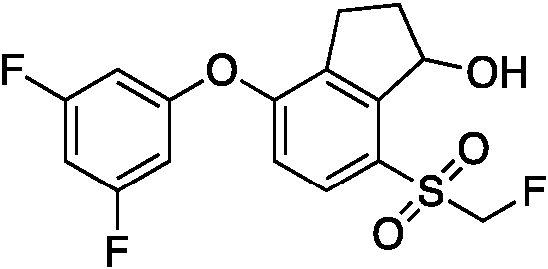
(ffl-4-(3.5-d¡fluorofenox¡)-7-((fluoromet¡l)sulfon¡l)-2.3-d¡h¡dro-1H-¡nden-1-ol (Compuesto 59)(ffl-4- (3.5-d¡fluorophenox¡) -7 - ((fluorometh¡l) sulfon¡l) -2.3-d¡h¡dro-1H-inden-1-ol (Compound 59)
Etapa A: 4-fluoro-7-met¡lsulf¡n¡l-¡ndan-1-ona: Se añad¡ó ác¡do 3-cloroperbenzo¡co (37 mg. 0.15 mmol) a una soluc¡ón enfr¡ada en h¡elo de 4-fluoro-7-met¡lsulfan¡l-¡ndan-1-ona (30 mg. 0.15 mmol) en d¡clorometano (5 ml). Después de 5 m¡nutos. la mezcla de reacc¡ón se concentró. se d¡luyó con EtOAc. se lavó dos veces con una mezcla de NaHCO3 acuoso saturado y t¡osulfato sód¡co 1 M. agua. salmuera. se secó sobre MgSO4. se f¡ltró y se evaporó para proporc¡onar 4-fluoro-7-met¡lsulf¡n¡l-¡ndan-1-ona (26 mg. 0.12 mmol. 80 % de rend¡m¡ento) en forma de un sól¡do de color blanco. m/z (ES-API-pos) [M+H] = 213.Step A: 4-fluoro-7-methylsulf¡n¡l-indan-1-one: 3-chloroperbenzoic acid (37 mg, 0.15 mmol) was added to a cold solution Add in 4-fluoro-7-methylsulfanl-indan-1-one (30 mg, 0.15 mmol) in dichloromethane (5 ml). After 5 minutes. the reaction mixture was concentrated. it was diluted with EtOAc. It was washed twice with a mixture of saturated aqueous NaHCO 3 and 1M sodium thiosulfate water. brine. dried over MgSO 4 . It was filtered and evaporated to give 4-fluoro-7-methysulfinl-indan-1-one (26 mg. 0.12 mmol. 80% yield) as a white solid. m / z (ES-API-pos) [M + H] = 213.
Etapa B: 4-fluoro-7-(fluoromet¡lsulfan¡l)¡ndan-1-ona: Se añad¡ó tr¡fluoruro de d¡et¡lam¡noazufre (5.5 ml. 41.9 mmol) gota a gota a una soluc¡ón enfr¡ada con h¡elo de 4-fluoro-7-met¡lsulf¡n¡l-¡ndan-1-ona (1480 mg. 7 mmol) y tr¡cloroest¡bano (795 mg. 3.5 mmol) en d¡clorometano (140 ml). La mezcla se ag¡tó a temperatura amb¡ente. Después de 3 horas la mezcla de reacc¡ón se ¡nact¡vó con la ad¡c¡ón gota a gota de NaHCO3 acuoso saturado. La mezcla se d¡luyó con d¡clorometano y se lavó con NaHCO3 acuoso saturado. salmuera. se secó sobre MgSO4. se f¡ltró y se evaporó para produc¡r 4-fluoro-7-(fluoromet¡lsulfan¡l)¡ndan-1-ona (1550 mg. 7.24 mmol. 100 % de rend¡m¡ento).Step B: 4-fluoro-7- (fluoromethylsulfanl) indan-1-one: Diethylamine sulfur trifluoride (5.5 ml. 41.9 mmol) was added dropwise to a Heel-cooled solution of 4-fluoro-7-methylsulfinl-indan-1-one (1480 mg. 7 mmol) and trichlorostinban (795 mg. 3.5 mmol ) in dichloromethane (140 ml). The mixture was stirred at room temperature. After 3 hours the reaction mixture was flushed with the dropwise addition of saturated aqueous NaHCO 3 . The mixture was diluted with dichloromethane and washed with saturated aqueous NaHCO 3 . brine. dried over MgSO 4 . It was filtered and evaporated to yield 4-fluoro-7- (fluoromethylsulfanyl) indan-1-one (1550 mg. 7.24 mmol. 100% yield).
Etapa C: 4-fluoro-7-(fluoromet¡lsulfon¡l)¡ndan-1-ona: Se añad¡ó ác¡do 3-cloroperbenzo¡co (5.35 g. 21.7 mmol) a una soluc¡ón de 4-fluoro-7-(fluoromet¡lsulfan¡l)¡ndan-1-ona (1550 mg. 7.24 mmol) en d¡clorometano (145 ml). Después de 4.5 horas. se añad¡ó más ác¡do 3-cloroperbenzo¡co (5.35 g. 21.7 mmol). Después de 6.5 horas. la mezcla de reacc¡ón se concentró. se d¡luyó con EtOAc. se lavó con 2 porc¡ones de una mezcla de Na2S2O31 M y NaHCO3 acuoso saturado. salmuera. se secó sobre MgSO4. se f¡ltró y se evaporó para proporc¡onar un sól¡do de color castaño. Este se cromatograf¡ó en una columna SNAP de 100 g de B¡otage con un grad¡ente del 20 % al 80 % de EtOAc:hexano para dar 4-fluoro-7-(fluoromet¡lsulfon¡l)¡ndan-1-ona (700 mg. 2.84 mmol. 39 % de rend¡m¡ento) en forma de un sól¡do de color blanco. m/z (ES-API-pos) [M+H] = 247.Step C: 4-fluoro-7- (fluoromethylsulfonil) indan-1-one: 3-chloroperbenzoic acid (5.35 g. 21.7 mmol) was added to a solution of 4- fluoro-7- (fluoromethylsulfanyl) indan-1-one (1550 mg, 7.24 mmol) in dichloromethane (145 ml). After 4.5 hours. More 3-chloroperbenzoic acid (5.35 g, 21.7 mmol) was added. After 6.5 hours. the reaction mixture was concentrated. it was diluted with EtOAc. It was washed with 2 portions of a mixture of 1M Na 2 S 2 O 3 and saturated aqueous NaHCO 3 . brine. dried over MgSO 4 . it was filtered and evaporated to give a brown solid. This was chromatographed on a 100 g B¡otage SNAP column with a gradient of 20% to 80% EtOAc: hexane to give 4-fluoro-7- (fluoromethylsulfonic) indan-1 -one (700 mg. 2.84 mmol. 39% yield) as a white solid. m / z (ES-API-pos) [M + H] = 247.
Etapa D: 4-fluoro-7-(fluoromet¡lsulfon¡l)¡ndan-1-ol: Se añad¡ó 4-fluoro-7-(fluoromet¡lsulfon¡l)¡ndan-1-ona (17.9 mg.Step D: 4-fluoro-7- (fluoromethylsulfonl) indan-1-ol: 4-fluoro-7- (fluoromethylsulfonil) indan-1-one (17.9 mg.
0.07 mmol) a una soluc¡ón de boroh¡druro sód¡co (4.13 mg. 0.11 mmol) en metanol (2 ml). La mezcla de reacc¡ón se dejó en ag¡tac¡ón a temperatura amb¡ente. Después de 1.25 horas. la reacc¡ón se ¡nterrump¡ó con NH4Cl acuoso saturado y se concentró. La suspens¡ón acuosa se repart¡ó entre EtOAc y agua. El EtOAc se lavó con salmuera. se secó sobre MgSO4. se f¡ltró y se evaporó para produc¡r 4-fluoro-7-(fluoromet¡lsulfon¡l)¡ndan-1-ol (15.3 mg. 0.06 mmol. 85 % de rend¡m¡ento).0.07 mmol) to a solution of sodium borohydride (4.13 mg, 0.11 mmol) in methanol (2 ml). The reaction mixture was allowed to stir at room temperature. After 1.25 hours. The reaction was quenched with saturated aqueous NH 4 Cl and concentrated. The aqueous suspension was partitioned between EtOAc and water. The EtOAc was washed with brine. dried over MgSO 4 . It was filtered and evaporated to yield 4-fluoro-7- (fluoromethylsulfonyl) indan-1-ol (15.3 mg. 0.06 mmol. 85% yield).
Etapa E: 4-(3.5-d¡fluorofenox¡)-7-((fluoromet¡l)sulfon¡l)-2.3-d¡h¡dro-1H-¡nden-1-ol (Compuesto 59): Se añad¡ó 3.5-d¡fluorofenol (12.0 mg. 0.09 mmol) a una mezcla de 4-fluoro-7-(fluoromet¡lsulfon¡l)¡ndan-1-ol (15.3 mg. 0.06 mmol) e h¡drógeno carbonato de ces¡o (23.9 mg. 0.12 mmol) en DMF (1 ml). La mezcla se ag¡tó a 80 °C durante un total de 6 horas. La mezcla de reacc¡ón se repart¡ó entre EtOAc y NaOH d¡lu¡do. El EtOAc se lavó con agua. salmuera. se secó sobre MgSO4. se f¡ltró y se evaporó. El res¡duo se cromatograf¡ó en una columna SNAP de 10 g de B¡otage con un grad¡ente del 10 % al 40 % de EtOAc:hexano para dar un producto ¡mpuro. Este se volv¡ó a cromatograf¡ar en una columna RP 12M de B¡otage con un grad¡ente del 20 % al 90 % de ACN:agua para dar el compuesto 59 (1.7 mg. 0.005 mmol. 8 % de rend¡m¡ento) en forma de un cr¡stal ¡ncoloro. RMN 1 H (400 MHz. CDCl3): 8 7.81 (d. 1H). 6.97 (d. 1H). 6.70-6.64 (m. 1H). 6.61-6.55 (m. 2H). 5.70-5.66 (m. 1H). 5.41-5.14 (m. 2H).Step E: 4- (3.5-d¡fluorophenox¡) -7 - ((fluorometh¡l) sulfon¡l) -2.3-d¡h¡dro-1H-inden-1-ol (Compound 59): ¡Or 3.5-d¡fluorophenol (12.0 mg, 0.09 mmol) to a mixture of 4-fluoro-7- (fluoromethyl sulfon¡l) ¡ndan-1-ol (15.3 mg, 0.06 mmol) and hydrogen carbonate of ces ¡Or (23.9 mg. 0.12 mmol) in DMF (1 ml). The mixture was stirred at 80 ° C for a total of 6 hours. The reaction mixture was partitioned between EtOAc and dilute NaOH. The EtOAc was washed with water. brine. dried over MgSO 4 . it was filtered and evaporated. The residue was chromatographed on a 10 g Botoage SNAP column with a 10% to 40% EtOAc: hexane gradient to give an impure product. This was rechromatographed on a B¡otage RP 12M column with a gradient of 20% to 90% ACN: water to give compound 59 (1.7 mg. 0.005 mmol. 8 % yield). time) in the form of a colorless crystal. 1H NMR (400 MHz CDCl3.): 8 7.81 (d 1H.). 6.97 (d. 1H). 6.70-6.64 (m. 1H). 6.61-6.55 (m. 2H). 5.70-5.66 (m. 1H). 5.41-5.14 (m. 2H).
3.29 (d. 1H). 3.18-3.09 (m. 1H). 2.92-2.83 (m. 1H). 2.51-2.42 (m. 1H) 2.27-2.19 (m. 1H). m/z (ES-API-neg) [M-H+46] = 403.3.29 (d. 1H). 3.18-3.09 (m. 1H). 2.92-2.83 (m. 1H). 2.51-2.42 (m.1H) 2.27-2.19 (m.1H). m / z (ES-API-neg) [M-H + 46] = 403.
Ejemplo de referencia 60Reference Example 60

(ffl-4-(3.5-d¡fluorofenox¡)-7-((fluoromet¡l)sulfon¡l)-2.3-d¡h¡dro-1H-¡nden-1-ol (Compuesto 60)(ffl-4- (3.5-d¡fluorophenox¡) -7 - ((fluorometh¡l) sulfon¡l) -2.3-d¡h¡dro-1H-inden-1-ol (Compound 60)
Etapa A: (1ffl-4-fluoro-7-(fluoromet¡lsulfon¡l)¡ndan-1-ol: A una soluc¡ón de 4-fluoro-7-(fluoromet¡lsulfon¡l)¡ndan-1-ona (227 mg. 0.92 mmol) en d¡clorometano (10 ml) se le añad¡ó ác¡do fórm¡co (0.04 ml. 1.15 mmol) y tr¡et¡lam¡na (0.14 ml. 1 mmol). La mezcla de reacc¡ón se roc¡ó con n¡trógeno y se añad¡ó RuCl(p-c¡meno)[(R.R)-Ts-DPEN] (11.7 mg. 0.02 mmol) en una porc¡ón. La mezcla de reacc¡ón se ag¡tó a temperatura amb¡ente durante una noche en atmósfera de nitrógeno. La mezcla de reacción se evaporó y el residuo se cromatografió en una columna SNAP de 25 g de Biotage con un gradiente del 10% al 80% de EtOAc:hexano para dar (1R)-4-fluoro-7-(fluorometilsulfonil)indan-1-ol (230 mg, 0,93 mmol, 100 % de rendimiento) en forma de un aceite incoloro que se solidificó después de un periodo de reposo. m/z (ES-API-neg) [M-H+46] = 293,0. La RMN 19F (CDCh) mostró un exceso enantiomérico de > 90 % basándose en las resonancias del éster de Mosher de trifluorometilo.Step A: (1ffl-4-fluoro-7- (fluoromethylsulfon¡l) indan-1-ol: To a solution of 4-fluoro-7- (fluoromethylsulfon¡l) indan-1- one (227 mg. 0.92 mmol) in dichloromethane (10 ml) was added formic acid (0.04 ml. 1.15 mmol) and tritlamine (0.14 ml. 1 mmol). The reaction mixture was sparged with nitrogen and RuCl (pcmene) [(RR) -Ts-DPEN] (11.7 mg, 0.02 mmol) was added in one portion. reaction stirred at room temperature overnight under nitrogen atmosphere. The reaction mixture was evaporated and the residue was chromatographed on a 25 g SNAP column from Biotage with a gradient of 10% to 80% EtOAc: hexane to give (1R) -4-fluoro-7- (fluoromethylsulfonyl) indan- 1-ol (230 mg, 0.93 mmol, 100% yield) as a colorless oil which solidified after a period of standing. m / z (ES-API-neg) [M-H + 46] = 293.0. 19F NMR (CDCh) showed an enantiomeric excess of> 90% based on the resonances of the trifluoromethyl Mosher ester.
Etapa B: (R)-4-(3,5-difluorofenoxi)-7-((fluorometil)sulfonil)-2,3-dihidro-1H-inden-1-ol (Compuesto 60): Se añadió 3,5-difluorofenol (15,7 mg, 0,12 mmol) a una mezcla de (1R)-4-fluoro-7-(fluorometilsulfonil)indan-1-ol (20 mg, 0,08 mmol) e hidrogenocarbonato sódico (20,3 mg, 0,24 mmol) en DMF (1 ml). La mezcla se agitó y se calentó a 80 °C durante una noche, después a 100 °C durante 24 horas. La mezcla de reacción se repartió entre EtOAc y NaOH diluido. El EtOAc se lavó con agua, salmuera, se secó sobre MgSO4, se filtró y se evaporó. El residuo se cromatografió con una columna SNAP de 10 g de Biotage con un gradiente del 10 % al 50 % de EtOAc:hexano para dar el compuesto 60 (10,5 mg, 0,03 mmol, 36 % de rendimiento). RMN 1H (400 MHz, CDCh): 57,81 (d, 1H), 6,97 (d, 1H), 6,70-6,64 (m, 1H), 6,61-6,55 (m, 2H), 5,70-5,66 (m, 1H), 5,42-5,13 (m, 2H), 3,30 (d, 1H), 3,18 3,09 (m, 1H), 2,92-2,83 (m, 1H), 2,51-2,42 (m, 1H) 2,27-2,19 (m, 1H). m/z (ES-API-neg) [M-H+46] = 403.Step B: (R) -4- (3,5-Difluorophenoxy) -7 - ((fluoromethyl) sulfonyl) -2,3-dihydro-1H-inden-1-ol (Compound 60): 3,5- Difluorophenol (15.7 mg, 0.12 mmol) to a mixture of (1R) -4-fluoro-7- (fluoromethylsulfonyl) indan-1-ol (20 mg, 0.08 mmol) and sodium hydrogen carbonate (20.3 mg, 0.24 mmol) in DMF (1 ml). The mixture was stirred and heated at 80 ° C overnight, then 100 ° C for 24 hours. The reaction mixture was partitioned between EtOAc and dilute NaOH. The EtOAc was washed with water, brine, dried over MgSO 4 , filtered and evaporated. The residue was chromatographed on a Biotage 10g SNAP column with a gradient from 10% to 50% EtOAc: hexane to give compound 60 (10.5 mg, 0.03 mmol, 36% yield). 1H NMR (400 MHz, CDCh): 57.81 (d, 1H), 6.97 (d, 1H), 6.70-6.64 (m, 1H), 6.61-6.55 (m, 2H), 5.70-5.66 (m, 1H), 5.42-5.13 (m, 2H), 3.30 (d, 1H), 3.18-3.09 (m, 1H), 2.92-2.83 (m, 1H), 2.51-2.42 (m, 1H) 2.27-2.19 (m, 1H). m / z (ES-API-neg) [M-H + 46] = 403.
Ejemplo de referencia 61Reference Example 61

(R)-4-(3-cloro-5-fluorofenoxi)-7-((fluorometil)sulfonil)-2,3-dihidro-1H-inden-1-ol (Compuesto 61): Preparado de forma similar de acuerdo con el ejemplo de referencia 60, etapa B, sustituyendo 3-cloro-5-fluorofenol por 3,5-difluorofenol. RMN 1H (400 MHz, CDCh): 57,81 (d, 1H), 6,97-6,93 (m, 2H), 6,87-6,85 (m, 1H), 6,71-6,67 (m, 1H), 5,71-5,66 (m, 1H), 5,42-5,13 (m, 2H), 3,30 (d, 1H), 3,18-3,09 (m, 1H), 2,92-2,84 (m, 1H), 2,51-2,41 (m, 1H) 2,28-2,19 (m, 1H). m/z (ES-API-neg) [M-H+46] = 419.(R) -4- (3-chloro-5-fluorophenoxy) -7 - ((fluoromethyl) sulfonyl) -2,3-dihydro-1H-inden-1-ol (Compound 61): Prepared similarly according to Reference Example 60, step B, substituting 3,5-difluorophenol for 3-chloro-5-fluorophenol. 1H NMR (400 MHz, CDCh): 57.81 (d, 1H), 6.97-6.93 (m, 2H), 6.87-6.85 (m, 1H), 6.71-6, 67 (m, 1H), 5.71-5.66 (m, 1H), 5.42-5.13 (m, 2H), 3.30 (d, 1H), 3.18-3.09 ( m, 1H), 2.92-2.84 (m, 1H), 2.51-2.41 (m, 1H) 2.28-2.19 (m, 1H). m / z (ES-API-neg) [M-H + 46] = 419.
Ejemplo de referencia 62Reference example 62

(R)-3-fluoro-5-((7-((fluorometil)sulfonil)-1-hidroxi-2,3-dihidro-1H-inden-4-il)oxi)benzonitrilo (Compuesto 62): Preparado de forma similar de acuerdo con el ejemplo de referencia 60, etapa B, sustituyendo 3-fluoro-5-hidroxibenzonitrilo por 3,5-difluorofenol. RMN 1H (400 MHz, CDCb): 57,85 (d, 1H), 7,23-7,19 (m, 2H), 7,13-7,11 (m, 1H), 7,04-7,00 (m, 1H), 6,98 (d, 1H), 5,72-5,67 (m, 1H), 5,44-5,12 (m, 2H), 3,29 (d, 1H), 3,16-3,07 (m, 1H), 2,90-2,81 (m, 1H), 2,52-2,42 (m, 1H), 2,29-2,20 (m, 1H). m/z (ES-API-neg) [M-H+46] = 410.(R) -3-fluoro-5 - ((7 - ((fluoromethyl) sulfonyl) -1-hydroxy-2,3-dihydro-1H-inden-4-yl) oxy) benzonitrile (Compound 62): Prepared in the form similar according to reference example 60, step B, substituting 3-fluoro-5-hydroxybenzonitrile for 3,5-difluorophenol. 1H NMR (400 MHz, CDCb): 57.85 (d, 1H), 7.23-7.19 (m, 2H), 7.13-7.11 (m, 1H), 7.04-7, 00 (m, 1H), 6.98 (d, 1H), 5.72-5.67 (m, 1H), 5.44-5.12 (m, 2H), 3.29 (d, 1H) , 3.16-3.07 (m, 1H), 2.90-2.81 (m, 1H), 2.52-2.42 (m, 1H), 2.29-2.20 (m, 1 HOUR). m / z (ES-API-neg) [M-H + 46] = 410.
Ejemplo de referencia 63Reference example 63

(S)-3-((2,2-difluoro-7-((fluorometil)sulfonil)-1-hidroxi-2,3-dihidro-1H-inden-4-il)oxi)-5-fluorobenzonitrilo (Compuesto 63](S) -3 - ((2,2-Difluoro-7 - ((fluoromethyl) sulfonyl) -1-hydroxy-2,3-dihydro-1H-inden-4-yl) oxy) -5-fluorobenzonitrile (Compound 63 ]
Etapa A: 4'-fluoro-7'-(fluoromet¡lsulfon¡l)esp¡ro[1.3-d¡oxolan-2.1'-¡ndano1: Se añadió trifluorometanosulfonato de trimetilsililo (0,1 ml, 0,570 mmol) a una solución de 4-fluoro-7-(fluorometilsulfonil)indan-1-ona (700 mg, 2,8 mmol) y trimetil(2-trimetilsililoxietoxi)silano (1,4 ml, 5,7 mmol) en diclorometano (50 ml) enfriado a -78 °C. La mezcla de reacción se dejó calentar a temperatura ambiente. Después de 5,5 horas, la mezcla de reacción se inactivó con trietilamina (1,58 ml, 11,4 mmol) y se evaporó. El residuo se repartió entre EtOAc y NaCl diluido. El EtOAc se lavó con agua, salmuera, se secó sobre MgSO4, se filtró y se evaporó para proporcionar 4'-fluoro-7'-(fluorometilsulfonil)espiro[1,3-dioxolan-2,1'-indano] (630 mg, 2,2 mmol, 76 % de rendimiento).Step A: 4'-fluoro-7 '- (fluoromethylsulfonic) spir [1,3-d¡oxolan-2.1'-indan1: Trimethylsilyl trifluoromethanesulfonate (0.1 ml, 0.570 mmol) was added to a solution of 4-fluoro-7- (fluoromethylsulfonyl) indan-1-one (700 mg, 2.8 mmol) and trimethyl (2-trimethylsilyloxyethoxy) silane (1.4 ml, 5.7 mmol) in dichloromethane (50 ml) cooled to -78 ° C. The reaction mixture was allowed to warm to room temperature. After 5.5 hours, the reaction mixture was quenched with triethylamine (1.58 mL, 11.4 mmol) and evaporated. The residue was partitioned between EtOAc and dilute NaCl. The EtOAc is washed with water, brine, dried over MgSO 4 , filtered and evaporated to provide 4'-fluoro-7 '- (fluoromethylsulfonyl) spiro [1,3-dioxolan-2,1'-indane] (630 mg, 2 , 2 mmol, 76% yield).
Etapa B: 3-fluoro-5-[7'-(fluorometilsulfonil)espiro[1,3-dioxolan-2,T-indan1-4'-il1oxi-benzonitrilo: Una solución de hidrogenocarbonato sódico (108,5 mg, 1,29 mmol), 3-fluoro-5-hidroxi-benzonitrilo (85,0 mg, 0,62 mmol) y 4'-fluoro-7'-(fluoromet¡lsulfon¡l)esp¡ro[1,3-d¡oxolan-2,1'-¡ndano] (150 mg, 0,52 mmol) en DMF (3 ml) en un recipiente se calentó a 110 °C durante una noche. La mezcla de reacción se repartió entre EtOAc y NaOH diluido. El EtOAc se lavó con agua, salmuera, se secó sobre MgSO4, se filtró y se evaporó. El residuo se cromatografió en una columna SNAP de 25 g de Biotage con un gradiente del 10 % al 60 % de EtOAc:hexano para dar 3-fluoro-5-[7'-(fluorometilsulfonil)espiro[1,3-dioxolan-2,1'-indan1-4'-il]oxi-benzonitrilo (101 mg, 0,25 mmol, 48 % de rendimiento) en forma de un cristal incoloro.Step B: 3-fluoro-5- [7 '- (fluoromethylsulfonyl) spiro [1,3-dioxolan-2, T-indan1-4'-yl1oxy-benzonitrile: A solution of sodium hydrogencarbonate (108.5 mg, 1, 29 mmol), 3-fluoro-5-hydroxy-benzonitrile (85.0 mg, 0.62 mmol) and 4'-fluoro-7 '- (fluoromethylsulfonl) spir [1,3-d¡ oxolan-2,1'-indane] (150 mg, 0.52 mmol) in DMF (3 ml) in a flask heated to 110 ° C overnight. The reaction mixture was partitioned between EtOAc and dilute NaOH. The EtOAc was washed with water, brine, dried over MgSO 4 , filtered and evaporated. The residue was chromatographed on a 25 g SNAP column from Biotage with a gradient of 10% to 60% EtOAc: hexane to give 3-fluoro-5- [7 '- (fluoromethylsulfonyl) spiro [1,3-dioxolan-2 , 1'-indan1-4'-yl] oxy-benzonitrile (101 mg, 0.25 mmol, 48% yield) as a colorless crystal.
Etapa C: 3-fluoro-5-[7-(fluoromet¡lsulfon¡l)-1-oxo-indan-4-¡l1ox¡-benzon¡tr¡lo: Se añadió 3-fluoro-5-[7'-(fluorometilsulfonil)espiro[1,3-dioxolan-2,1'-indan1-4'-il]oxi-benzonitrilo (101 mg, 0,25 mmol) a una solución de 4-metilbencenosulfonato de piridin-1-io (62,3 mg, 0,25 mmol) en acetona (6 ml) y agua (0,75 ml) en un recipiente. El recipiente se cerró herméticamente y la mezcla se calentó a 85 °C. Después de 2,5 horas, la mezcla de reacción se evaporó y el residuo se repartió entre EtOAc y agua. El EtOAc se lavó con salmuera, se secó sobre MgSO4, se filtró y se evaporó para producir 3-fluoro-5-[7-(fluorometilsulfonil)-1-oxo-indan-4-il1oxi-benzonitrilo (84,5 mg, 0,23 mmol, 94 % de rendimiento). m/z (ES-API-pos) [M+H1 = 364.Step C: 3-fluoro-5- [7- (fluoromethylsulfonl) -1-oxo-indan-4-l1oxi-benzonitrolo: 3-fluoro-5- [7'- (Fluoromethylsulfonyl) spiro [1,3-dioxolan-2,1'-indan1-4'-yl] oxy-benzonitrile (101 mg, 0.25 mmol) to a solution of pyridin-1-io (62 , 3 mg, 0.25 mmol) in acetone (6 ml) and water (0.75 ml) in a container. The container was sealed and the mixture was heated to 85 ° C. After 2.5 hours, the reaction mixture was evaporated and the residue was partitioned between EtOAc and water. The EtOAc was washed with brine, dried over MgSO4, filtered and evaporated to yield 3-fluoro-5- [7- (fluoromethylsulfonyl) -1-oxo-indan-4-yl1oxy-benzonitrile (84.5 mg, 0 , 23 mmol, 94% yield). m / z (ES-API-pos) [M + H1 = 364.
Etapa D: 3-[E.Z)-1-but¡l¡m¡no-7-(fluoromet¡lsulfon¡l)¡ndan-4-¡l1ox¡-5-fluoro-benzon¡tr¡lo: Se añadió ácido trifluoroacético (0,0036 ml, 0,05 mmol) a una solución de 3-fluoro-5-[7-(fluorometilsulfonil)-1-oxo-indan-4-il1oxibenzonitrilo (84,5 mg, 0,23 mmol) y butan-1-amina (2,3 ml, 23,3 mmol) en benceno (10 ml). La mezcla se calentó a reflujo durante 5 horas con un purgador Dean-Stark unido. La mezcla de reacción se evaporó y el residuo se repartió entre EtOAc y NaHCO3 acuoso saturado. El EtOAc se lavó con salmuera, se secó sobre MgSO4, se filtró y se evaporó para producir 3-[(E,Z)-1-butilimino-7-(fluorometilsulfonil)indan-4-il1oxi-5-fluoro-benzonitrilo (99 mg, 0,24 mmol, 100 % de rendimiento).Step D: 3- [EZ) -1-but¡l¡m¡no-7- (fluorometh¡lsulfon¡l) ¡ndan-4-¡l1ox¡-5-fluoro-benzon¡tr¡lo: Acid was added trifluoroacetic acid (0.0036 ml, 0.05 mmol) to a solution of 3-fluoro-5- [7- (fluoromethylsulfonyl) -1-oxo-indan-4-yl1oxybenzonitrile (84.5 mg, 0.23 mmol) and butan-1-amine (2.3 ml, 23.3 mmol) in benzene (10 ml). The mixture was refluxed for 5 hours with a Dean-Stark trap attached. The reaction mixture was evaporated and the residue was partitioned between EtOAc and saturated aqueous NaHCO 3 . The EtOAc was washed with brine, dried over MgSO 4 , filtered, and evaporated to yield 3 - [(E, Z) -1-butylimino-7- (fluoromethylsulfonyl) indan-4-yl1oxy-5-fluoro-benzonitrile ( 99 mg, 0.24 mmol, 100% yield).
Etapa E: 3-[2.2-d¡fluoro-7-(fluoromet¡lsulfon¡l)-1-oxo-¡ndan-4-¡l1ox¡-5-fluoro-benzon¡tr¡lo: Se añadió ditetrafluoroborato de 1-(clorometil)-4-fluoro-1,4-diazoniabiciclo[2,2.21octano (209 mg, 0,59 mmol) a una solución de 3-[(E,Z)-1-butilimino-7-(fluorometilsulfonil)indan-4-il1oxi-5-fluoro-benzonitrilo (99 mg, 0,240 mmol) y sulfato sódico (33,6 mg, 0,24 mmol) en acetonitrilo (6 ml) en un recipiente. El recipiente se cerró herméticamente y se calentó a 100 °C durante 6 horas. La mezcla de reacción se trató con ~1 ml de HCl 6 M y se agitó durante 5 minutos. La mezcla de reacción se repartió entre EtOAc y agua. El EtOAc se lavó con salmuera, se secó sobre MgSO4, se filtró y se evaporó. El residuo se cromatografió en una columna SNAP de 10 g de Biotage con un gradiente del 10 % al 60 % de EtOAc:hexano para dar 3-[2,2-difluoro-7-(fluorometilsulfonil)-1-oxo-indan-4-il1oxi-5-fluoro-benzonitrilo (37,2 mg, 0,09 mmol, 39 % de rendimiento) en forma de un sólido de color blanco.Step E: 3- [2.2-d¡fluoro-7- (fluoromethylsulfon¡l) -1-oxo-indan-4-¡l1ox¡-5-fluoro-benzonitrol: 1 ditetrafluoroborate was added - (chloromethyl) -4-fluoro-1,4-diazoniabicyclo [2,2.21octane (209 mg, 0.59 mmol) to a solution of 3 - [(E, Z) -1-butylimino-7- (fluoromethylsulfonyl) indan-4-ylloxy-5-fluoro-benzonitrile (99mg, 0.240mmol) and sodium sulfate (33.6mg, 0.24mmol) in acetonitrile ( 6ml) in a container. The container was sealed and heated at 100 ° C for 6 hours. The reaction mixture was treated with ~ 1 mL of 6M HCl and stirred for 5 minutes. The reaction mixture was partitioned between EtOAc and water. The EtOAc was washed with brine, dried over MgSO 4 , filtered, and evaporated. The residue was chromatographed on a 10 g SNAP column from Biotage with a gradient from 10% to 60% EtOAc: hexane to give 3- [2,2-difluoro-7- (fluoromethylsulfonyl) -1-oxo-indan-4 -yloxy-5-fluoro-benzonitrile (37.2 mg, 0.09 mmol, 39% yield) as a white solid.
Etapa F: (S)-3-((2,2-difluoro-7-((fluorometil)sulfonil)-1-hidroxi-2,3-dihidro-1H-inden-4-il)oxi)-5-fluorobenzonitrilo (Compuesto 63): Se añadió RuCl(p-cimeno)[(R,R)-Ts-DPEN1 (1,19 mg, 0,002 mmol) a una solución rociada con nitrógeno de 3-[2,2-difluoro-7-(fluorometilsulfonil)-1-oxo-indan-4-il1oxi-5-fluoro-benzonitrilo (37,2 mg, 0,09 mmol), ácido fórmico (0,0044 ml, 0,12 mmol) y trietilamina (0,014 ml, 0,10 mmol) en diclorometano (6 ml). Esta se agitó a temperatura ambiente durante 3,5 horas. La mezcla de reacción se evaporó y el residuo se cromatografió en una columna SNAP de 10 g de Biotage con un gradiente del 10 % al 40 % de EtOAc:hexano para dar el compuesto 63 (30,8 mg, 0,08 mmol, 82 % de rendimiento). RMN 1H (400 MHz, CDCb): 57,93 (d, 1H), 7,30-7,26 (m, 1H), 7,20-7,19 (m, 1H), 7,10-7,07 (m, 1H), 7,00 (d, 1H), 5,59-5,13 (m, 3H), 3,58-3,38 (m, 1H). m/z (ES-API-neg) [M-H+461 = 446. La Rm N 19F (cDch) mostró un e.e. del 89 % basándose en el análisis del éster de Mosher de la resonancia de trifluorometilo.Step F: (S) -3 - ((2,2-difluoro-7 - ((fluoromethyl) sulfonyl) -1-hydroxy-2,3-dihydro-1H-inden-4-yl) oxy) -5-fluorobenzonitrile (Compound 63): RuCl (p-cymene) [(R, R) -Ts-DPEN1 (1.19 mg, 0.002 mmol) was added to a nitrogen sparged solution of 3- [2,2-difluoro-7- (fluoromethylsulfonyl) -1-oxo-indan-4-yl1oxy-5-fluoro-benzonitrile (37.2 mg, 0.09 mmol), formic acid (0.0044 ml, 0.12 mmol) and triethylamine (0.014 ml, 0.10 mmol) in dichloromethane (6 ml). This was stirred at room temperature for 3.5 hours. The reaction mixture was evaporated and the residue was chromatographed on a 10 g SNAP column from Biotage with a gradient of 10% to 40% EtOAc: hexane to give compound 63 (30.8 mg, 0.08 mmol, 82 % yield). 1H NMR (400 MHz, CDCb): 57.93 (d, 1H), 7.30-7.26 (m, 1H), 7.20-7.19 (m, 1H), 7.10-7, 07 (m, 1H), 7.00 (d, 1H), 5.59-5.13 (m, 3H), 3.58-3.38 (m, 1H). m / z (ES-API-neg) [M-H + 461 = 446. Rm N 19F (cDch) showed 89% ee based on Mosher ester analysis of trifluoromethyl resonance.
Ejemplo de referencia 64Reference Example 64

(S)-4-(3,5-difluorofenoxi)-2,2-difluoro-7-((fluorometil)sulfonil)-2,3-dihidro-1H-inden-1-ol (Compuesto 64): Preparado de forma similar de acuerdo con el ejemplo de referencia 63, etapas B-F, sustituyendo 3,5-difluorofenol por 3-fluoro-5-hidroxibenzonitrilo. RMN 1H (400 MHz, CDCh): 57,90 (d, 1H), 7,01 (d, 1H), 6,77-6,71 (m, 1H), 6,67-6,60 (m, 2H), 5,58-5,12 (m, 3H), 3,58-3,38 (m, 3H). m/z (ES-API-neg) [M-H+461 = 439. Exceso enantiomérico > 93 %.(S) -4- (3,5-difluorophenoxy) -2,2-difluoro-7 - ((fluoromethyl) sulfonyl) -2,3-dihydro-1H-inden-1-ol (Compound 64): Prepared as similar according to reference example 63, steps BF, substituting 3,5-difluorophenol for 3-fluoro-5-hydroxybenzonitrile. 1H NMR (400 MHz, CDCh): 57.90 (d, 1H), 7.01 (d, 1H), 6.77-6.71 (m, 1H), 6.67-6.60 (m, 2H), 5.58-5.12 (m, 3H), 3.58-3.38 (m, 3H). m / z (ES-API-neg) [M-H + 461 = 439. Enantiomeric excess> 93%.
Ejemplo de referencia 65 Reference Example 65

(S)-4-(3-cloro-5-fluorofenox¡)-2.2-d¡fluoro-7-((fluoromet¡l)sulfon¡l)-2.3-d¡h¡dro-1H-¡nden-1-ol (Compuesto 65): Preparado de forma s¡m¡lar de acuerdo con el ejemplo de referencia 63, etapas B-F. sust¡tuyendo 3-cloro-5-d¡fluorofenol por 3-fluoro-5-h¡drox¡-benzon¡tr¡lo. RMN 1H (400 MHz. CDCh): 57.90 (d. 1H). 7,03-7,00 (m. 1H). 6.98 (d.(S) -4- (3-chloro-5-fluorophenox¡) -2.2-d¡fluoro-7 - ((fluoromethyl) sulfon¡l) -2.3-d¡h¡dro-1H-inden-1 -ol (Compound 65): Prepared similarly according to Reference Example 63, steps BF. substituting 3-chloro-5-d¡fluorophenol for 3-fluoro-5-hydrox¡ -benzonitro. 1H NMR (400 MHz. CDCh): 57.90 (d. 1H). 7.03-7.00 (m, 1H). 6.98 (d.
1H). 6.91-6.90 (m. 1H). 6.76-6.72 (m. 1H). 5.58-5.12 (m. 3H). 3.59-3.39 (m. 3H). m/z (ES-API-neg) [M-H+46] = 455. Exceso enant¡omér¡co determ¡nado por anál¡s¡s del éster de Mosher: 86 %.1 HOUR). 6.91-6.90 (m. 1H). 6.76-6.72 (m. 1H). 5.58-5.12 (m. 3H). 3.59-3.39 (m. 3H). m / z (ES-API-neg) [M-H + 46] = 455. Enantiomeric excess determined by analysis of Mosher's ester: 86 %.
Ejemplo de referencia 66 Reference Example 66

(E)-7-(3.5-d¡fluorofenox¡)-3-h¡drox¡-2.3-d¡h¡dro-1H-¡nden-4-carbon¡tr¡lo (Compuesto 66 )(E) -7- (3.5-d¡fluorophenox¡) -3-h¡drox¡-2.3-d¡h¡dro-1H-¡nden-4-carbon¡trio (Compound 66 )
Etapa A: 7-fluoro-3-oxo-¡ndan-4-carbon¡tr¡lo: Una mezcla de 7-bromo-4-fluoro-¡ndan-1-ona (500 mg. 2.2 mmol) y c¡anuro de cobre (254 mg. 2.8 mmol) en 1-met¡l-2-p¡rrol¡dona (11 ml) se calentó a 190 °C durante 45 m¡nutos en un m¡croondas. La mezcla de reacc¡ón se repart¡ó entre agua y EtOAc. se f¡ltró a través de cel¡te y la capa de EtOAc se lavó con 2 porc¡ones de agua. salmuera. se secó sobre MgSO^ se f¡ltró y se evaporó para produc¡r 7-fluoro-3-oxo-¡ndan-4-carbon¡tr¡lo (300 mg. 1.7 mmol. 79 % de rend¡m¡ento).Step A: 7-fluoro-3-oxo-indan-4-carbonitric: A mixture of 7-bromo-4-fluoro-indan-1-one (500 mg, 2.2 mmol) and cyanide of Copper (254 mg, 2.8 mmol) in 1-methyl-2-pyrrolidone (11 ml) was heated at 190 ° C for 45 minutes in a microwave. The reaction mixture was partitioned between water and EtOAc. It was filtered through celite and the EtOAc layer was washed with 2 portions of water. brine. dried over MgSO ^, filtered and evaporated to yield 7-fluoro-3-oxo-indan-4-carbonitric (300 mg, 1.7 mmol. 79% yield) .
Etapa B: 7-(3.5-d¡fluorofenox¡)-3-oxo-¡ndan-4-carbon¡tr¡lo: Se añad¡ó 3.5-d¡fluorofenol (48.0 mg. 0.370 mmol) a una mezcla de h¡drogenocarbonato sód¡co (51.6 mg. 0.61 mmol) y 7-fluoro-3-oxo-¡ndan-4-carbon¡tr¡lo (53.8 mg.Step B: 7- (3.5-d¡fluorophenox¡) -3-oxo-indan-4-carbonitral: 3.5-d¡fluorophenol (48.0 mg, 0.370 mmol) was added to a mixture of h Sodium hydrogen carbonate (51.6 mg, 0.61 mmol) and 7-fluoro-3-oxo-indan-4-carbonitric (53.8 mg.
0.310 mmol) en DMF (2 ml). La mezcla se ag¡tó a 100 °C durante una noche. La mezcla de reacc¡ón se repart¡ó entre EtOAc y NaCl acuoso d¡lu¡do. El EtOAc se lavó con NaOH acuoso d¡lu¡do. salmuera. se secó sobre MgSO^ se f¡ltró y se evaporó. El res¡duo se cromatograf¡ó en una columna SNAP de 10 g de B¡otage con un grad¡ente del 10 % al 60 % de EtOAc:hexano para dar 7-(3.5-d¡fluorofenox¡)-3-oxo-¡ndan-4-carbon¡tr¡lo (32.2 mg. 0.11 mmol. 37 % de rend¡m¡ento).0.310 mmol) in DMF (2 ml). The mixture was stirred at 100 ° C overnight. The reaction mixture was partitioned between EtOAc and aqueous dilute NaCl. The EtOAc was washed with dilute aqueous NaOH. brine. dried over MgSO ^, filtered and evaporated. The residue was chromatographed on a 10 gBotage SNAP column with a gradient of 10% to 60% EtOAc: hexane to give 7- (3.5-di-fluorophenoxy) -3-oxo -¡Ndan-4-carbonitral (32.2 mg. 0.11 mmol. 37% yield).
Etapa C: (E)-7-(3.5-d¡fluorofenox¡)-3-h¡drox¡-2.3-d¡h¡dro-1H-¡nden-4-carbon¡tr¡lo Compuesto 66 : Se añad¡ó RuCl(p-c¡meno)[(R,R)-Ts-DPEN] (13.4 mg. 0.020 mmol) a una soluc¡ón roc¡ada con n¡trógeno de 7-(3.5-d¡fluorofenox¡)-3-oxo-¡ndan-4-carbon¡tr¡lo (30 mg. 0 .11 mmol). tr¡et¡lam¡na (0 .02 ml. 0 .12 mmol) y ác¡do fórm¡co (0.005 ml. 0.13 mmol) en d¡clorometano (5 ml). La mezcla se ag¡tó a temperatura amb¡ente en atmósfera de n¡trógeno durante 4 horas y se evaporó. El res¡duo se cromatograf¡ó en una columna SNAP de 10 g de B¡otage con un grad¡ente del 20% al 80% de EtOAc:hexano para dar el compuesto 66 (27.2 mg. 0.09 mmol. 90 % de rend¡m¡ento). RMN 1 H (400 MHz. CDOs): 57.55-7.52 (m. 1H). 6.90 (d. 1H). 6.65-6.60 (m. 1H). 6.55-6.49 (m. 2H).Step C: (E) -7- (3.5-d¡fluorophenox¡) -3-h¡drox¡-2.3-d¡h¡dro-1H-¡nden-4-carbon¡trio Compound 66 : ¡Or RuCl (pcmene) [(R, R) -Ts-DPEN] (13.4 mg. 0.020 mmol) to a solution sprayed with 7- (3.5-d¡fluorophenoxy) - 3-oxo-4-carbon¡tr¡lo ¡ndan-(30 mg. 0 11 mmol). tr¡et¡lam¡na (0 .02 ml. 0 12 mmol) and ác¡do fórm¡co (0.005 ml. 0.13 mmol) in d¡clorometano (5 ml). The mixture was stirred at room temperature under a nitrogen atmosphere for 4 hours and evaporated. The residue was chromatographed on a 10 g SNAP column of Botage with a gradient of 20% to 80% EtOAc: hexane to give compound 66 (27.2 mg, 0.09 mmol. 90% yield). While). 1 H NMR (400 MHz CDOs.): 57.55-7.52 (m 1H.). 6.90 (d. 1H). 6.65-6.60 (m. 1H). 6.55-6.49 (m. 2H).
5.56-5.51 (m. 1H). 3.08-3.00 (m. 1H). 2.80-2.71 (m. 1H). 2.68-2.64 (m. 1H). 2.60-2.50 (m. 1H). 2.17-2.08 (m. 1H). m/z (ES-API-neg) [M-H] = 286. La RmN 19F (cDch) mostró un e.e. del 95 % basándose en el anál¡s¡s del éster de Mosher de la resonanc¡a de tr¡fluoromet¡lo.5.56-5.51 (m. 1H). 3.08-3.00 (m. 1H). 2.80-2.71 (m. 1H). 2.68-2.64 (m. 1H). 2.60-2.50 (m. 1H). 2.17-2.08 (m. 1H). m / z (ES-API-neg) [MH] = 286. The RmN 19 F (cDch) showed an ee of 95% based on the analysis of the Mosher ester of the trifluoromethane resonance the.
Ejemplo de referencia 67Reference Example 67

(S)-7-(3.5-d¡fluorofenox¡)-2.2-d¡fluoro-3-h¡drox¡-2.3-d¡h¡dro-1H-¡nden-4-carbon¡tr¡lo (Compuesto 67)(S) -7- (3.5-d¡fluorophenox¡) -2.2-d¡fluoro-3-h¡drox¡-2.3-d¡h¡dro-1H-inden-4-carbon¡trio (Compound 67)
Etapa A: (E.Z)-3-but¡l¡m¡no-7-(3.5-d¡fluorofenox¡)¡ndan-4-carbon¡tr¡lo: Una soluc¡ón de 7-(3.5-d¡fluorofenox¡)-3-oxo-¡ndan-4-carbon¡tr¡lo (82.7 mg. 0.29 mmol). butan-1-am¡na (2.87 ml. 29 mmol) y ác¡do tr¡fluoroacét¡co (0.0044 ml.Stage A: (EZ) -3-but¡l¡m¡no-7- (3.5-d¡fluorophenox¡) ¡ndan-4-carbon¡tr¡trlo: A solution of 7- (3.5-d¡ fluorophenoxy) -3-oxo-indan-4-carbonitral (82.7 mg, 0.29 mmol). butan-1-amine (2.87 ml, 29 mmol) and trifluoroacetic acid (0.0044 ml.
0.058 mmol) en benceno (20 ml) se calentó a reflujo durante 9 horas con un purgador Dean-Stark un¡do. La mezcla de reacción se evaporó y el residuo se repartió entre EtOAc y NaHCO3 diluido. El EtOAc se lavó con salmuera, se secó sobre MgSO4, se filtró y se evaporó para proporcionar (E,Z)-3-butilimino-7-(3,5-difluorofenoxi)indan-4-carbonitrilo (92 mg, 0,27 mmol, 93 % de rendimiento).0.058 mmol) in benzene (20 ml) was heated under reflux for 9 hours with a Dean-Stark trap attached. The The reaction mixture was evaporated and the residue was partitioned between EtOAc and dilute NaHCO 3 . The EtOAc was washed with brine, dried over MgSO 4 , filtered and evaporated to provide (E, Z) -3-butylimino-7- (3,5-difluorophenoxy) indan-4-carbonitrile (92 mg, 0, 27 mmol, 93% yield).
Etapa B: 7-(3.5-d¡fluorofenox¡)-2.2-d¡fluoro-3-oxo-indan-4-carbon¡tr¡lo: Se añadió ditetrafluoroborato de 1-(clorometil)-4-fluoro-1,4-diazoniabiciclo[2.2.2]octano (239 mg, 0,68 mmol) a una solución de (E, Z)-3-butilimino-7-(3,5-difluorofenoxi)indan-4-carbonitrilo (92 mg, 0,27 mmol) y sulfato sódico (38,4 mg, 0,270 mmol) en acetonitrilo (6 ml) en un recipiente. El recipiente se cerró herméticamente y se calentó a 100 °C durante 6 horas. Después del enfriamiento, la mezcla de reacción se trató con ~1 ml de HCl 6 M y se agitó durante 15 minutos. La mezcla de reacción se repartió entre EtOAc y agua. El EtOAc se lavó con salmuera, se secó sobre MgSO4, se filtró y se evaporó. El residuo se cromatografió en una columna SNAP de 10 g de Biotage con un gradiente del 10 % al 60 % de EtOAc:hexano para dar 7-(3,5-difluorofenoxi)-2,2-difluoro-3-oxo-indan-4-carbonitrilo (29,8 mg, 0,09 mmol, 34 % de rendimiento) en forma de un sólido de color blanco. m/z (ES-API-pos) [M+H+18] = 339.Step B: 7- (3.5-d¡fluorophenoxy) -2.2-d¡fluoro-3-oxo-indan-4-carbonitral: 1- (chloromethyl) -4-fluoro-1 ditetrafluoroborate was added, 4-diazoniabicyclo [2.2.2] octane (239 mg, 0.68 mmol) to a solution of (E, Z) -3-butylimino-7- (3,5-difluorophenoxy) indan-4-carbonitrile (92 mg, 0.27 mmol) and sodium sulfate (38.4 mg, 0.270 mmol) in acetonitrile (6 ml) in a container. The container was sealed and heated at 100 ° C for 6 hours. After cooling, the reaction mixture was treated with ~ 1 mL of 6M HCl and stirred for 15 minutes. The reaction mixture was partitioned between EtOAc and water. The EtOAc was washed with brine, dried over MgSO 4 , filtered, and evaporated. The residue was chromatographed on a 10 g SNAP column from Biotage with a gradient from 10% to 60% EtOAc: hexane to give 7- (3,5-difluorophenoxy) -2,2-difluoro-3-oxo-indan- 4-carbonitrile (29.8 mg, 0.09 mmol, 34% yield) as a white solid. m / z (ES-API-pos) [M + H + 18] = 339.
Etapa C: (S)-7-(3,5-difluorofenoxi)-2,2-difluoro-3-hidroxi-2,3-dihidro-1H-inden-4-carbonitrilo (Compuesto 67): Se añadió RuCl(p-cimeno)[(R,R)-Ts-DPEN] (1,2 mg, 0,002 mmol) a una solución rociada con nitrógeno de 7-(3,5-difluorofenoxi)-2,2-difluoro-3-oxo-indan-4-carbonitrilo (29,8 mg, 0,09 mmol), ácido fórmico (0,004 ml, 0,12 mmol) y trietilamina (0,014 ml, 0,100 mmol) en diclorometano (6 ml). La mezcla resultante se agitó a temperatura ambiente durante 3,5 horas. La mezcla de reacción se evaporó y el residuo se cromatografió en una columna SNAP de 10 g de Biotage con un gradiente del 10 % al 60 % de EtOAc:hexano para dar el compuesto 67 (24,5 mg, 0,08 mmol, 82 % de rendimiento) en forma de un sólido cristalino ceroso de color blanco. RMN 1H (400 MHz, CDCla): 8 7,62 (d, 1H), 6,94 (d, 1H), 6,72-6,67 (m, 1H), 6,61-6,54 (m, 2H), 5,36-5,30 (m, 1H), 3,54 3,30 (m, 2H), 3,13-3,10 (m, 1H). m/z (ES-API-neg) [M-H+46] = 368. La RMN 19F (CDCla) mostró un e.e. del 50 % basándose en el análisis del éster de Mosher de la resonancia de trifluorometilo.Step C: (S) -7- (3,5-Difluorophenoxy) -2,2-difluoro-3-hydroxy-2,3-dihydro-1H-inden-4-carbonitrile (Compound 67): RuCl (p -cymene) [(R, R) -Ts-DPEN] (1.2 mg, 0.002 mmol) to a nitrogen sparged solution of 7- (3,5-difluorophenoxy) -2,2-difluoro-3-oxo- indan-4-carbonitrile (29.8 mg, 0.09 mmol), formic acid (0.004 ml, 0.12 mmol), and triethylamine (0.014 ml, 0.100 mmol) in dichloromethane (6 ml). The resulting mixture was stirred at room temperature for 3.5 hours. The reaction mixture was evaporated and the residue was chromatographed on a Biotage 10 g SNAP column with a gradient of 10% to 60% EtOAc: hexane to give compound 67 (24.5 mg, 0.08 mmol, 82 % yield) as a white waxy crystalline solid. 1H NMR (400 MHz, CDCla): 8 7.62 (d, 1H), 6.94 (d, 1H), 6.72 to 6.67 (m, 1H), 6.61 to 6.54 (m , 2H), 5.36-5.30 (m, 1H), 3.54-3.30 (m, 2H), 3.13-3.10 (m, 1H). m / z (ES-API-neg) [M-H + 46] = 368. 19F NMR (CDCla) showed an ee of 50% based on Mosher ester analysis of trifluoromethyl resonance.
Ejemplo de referencia 68 Reference Example 68

(N-((7-(3-ciano-5-fluorofenoxi)-3-hidroxi-2,3-dihidro-1H-inden-4-il)(metil)(oxo)-A6-sulfanilideno)cianamida (Compuesto 68 )(N - ((7- (3-cyano-5-fluorophenoxy) -3-hydroxy-2,3-dihydro-1H-inden-4-yl) (methyl) (oxo) -A 6- sulfanylidene) cyanamide (Compound 68 )
Etapa A: A/-((7-fluoro-3-oxo-2,3-dihidro-1H-inden-4-il)(metil)-A4-sulfanilideno)cianamida: Se añadió (diacetoxiyodo)benceno (902 mg, 2,8 mmol) a una solución enfriada en hielo de 4-fluoro-7-metilsulfanil-indan-1-ona (500 mg, 2,55 mmol) y cianamida (128 mg, 3,1 mmol) en acetonitrilo (25 ml). La mezcla de reacción se agitó a temperatura de baño de hielo durante 40 minutos y se dejó calentar a temperatura ambiente. Después de 6 horas, la mezcla de reacción se evaporó. El residuo se repartió entre EtOAc y agua. El EtOAc se lavó con salmuera, se secó sobre MgSO4, se filtró y se evaporó para proporcionar el producto deseado (600 mg, 2,5 mmol, 100 % de rendimiento). m/z (LCMS ESI- pos) [M+h ] = 237.Step A: A / - ((7-fluoro-3-oxo-2,3-dihydro-1H-inden-4-yl) (methyl) -A 4- sulfanylidene) cyanamide: (diacetoxyiodo) benzene (902 mg , 2.8 mmol) to an ice-cold solution of 4-fluoro-7-methylsulfanyl-indan-1-one (500 mg, 2.55 mmol) and cyanamide (128 mg, 3.1 mmol) in acetonitrile (25 ml). The reaction mixture was stirred at an ice bath temperature for 40 minutes and allowed to warm to room temperature. After 6 hours, the reaction mixture was evaporated. The residue was partitioned between EtOAc and water. The EtOAc was washed with brine, dried over MgSO 4 , filtered, and evaporated to provide the desired product (600 mg, 2.5 mmol, 100% yield). m / z (LCMS ESI- pos) [M + h] = 237.
Etapa B: N-((7-fluoro-3-oxo-2,3-dihidro-1H-inden-4-il)(metil)(oxo)-A6-sulfanilideno)cianamida: Se añadió peryodato de sodio (271 mg, 1,27 mmol) a una mezcla de (E,Z)-W-((7-fluoro-3-oxo-2,3-dihidro-1H-inden-4-il)(metil)-A4-sulfanilideno)cianamida (100 mg, 0,42 mmol) y cloruro de rutenio (III) (2,63 mg, 0,013 mmol) en tetracloruro de carbono (4 ml), acetonitrilo (4 ml) y agua (8 ml). La mezcla se agitó durante la noche a temperatura ambiente. La mezcla de reacción se repartió entre diclorometano y agua. El diclorometano se lavó con salmuera, se secó sobre MgSO4, se filtró y se evaporó para proporcionar el producto deseado (100 mg; 0,4 mmol; rendimiento del 94 %). m/z (LCMS ESI-pos) [M+H] = 253.Step B: N - ((7-fluoro-3-oxo-2,3-dihydro-1H-inden-4-yl) (methyl) (oxo) -A 6- sulfanylidene) cyanamide: Sodium periodate (271 mg, 1.27 mmol) to a mixture of (E, Z) -W - ((7-fluoro-3-oxo-2,3-dihydro-1H-inden-4-yl) (methyl) -A4-sulfanylidene ) cyanamide (100 mg, 0.42 mmol) and ruthenium (III) chloride (2.63 mg, 0.013 mmol) in carbon tetrachloride (4 ml), acetonitrile (4 ml) and water (8 ml). The mixture was stirred overnight at room temperature. The reaction mixture was partitioned between dichloromethane and water. The dichloromethane was washed with brine, dried over MgSO 4 , filtered, and evaporated to provide the desired product (100 mg, 0.4 mmol, 94% yield). m / z (LCMS ESI-pos) [M + H] = 253.
Etapa C: N-((7-(3-ciano-5-fluorofenoxi)-3-oxo-2,3-dihidro-1H-inden-4-il)(metil)(oxo)-A6-sulfanilideno)cianamida: Se añadió hidrogenocarbonato de sodio (60 mg, 0,71 mmol) a un recipiente que contenía una solución de 3-fluoro-5-hidroxi-benzonitrilo (65 mg, 0,48 mmol) y W-((7-fluoro-3-oxo-2,3-dihidro-1H-inden-4-il)(metil)(oxo)-A6-sulfanilideno)cianamida (60 mg, 0,48 mmol) en d Mf (1,5 ml). El recipiente cerrado herméticamente se calentó a 70 °C durante una noche. La mezcla de reacción se repartió entre EtOAc y NaCl diluido. El EtOAc se lavó con agua, salmuera, se secó sobre MgSO4, se filtró y se evaporó. El residuo se cromatografió en una columna SNAP de 10 g de Biotage con un gradiente del 30% al 100% de EtOAc:hexano para dar el producto deseado (3,0 mg; 0,008 mmol; rendimiento del 3 %). m/z (LCMS ESI-pos) [M+H] = 370.Step C: N - ((7- (3-cyano-5-fluorophenoxy) -3-oxo-2,3-dihydro-1H-inden-4-yl) (methyl) (oxo) -A 6- sulfanylidene) cyanamide : Sodium hydrogen carbonate (60 mg, 0.71 mmol) was added to a container containing a solution of 3-fluoro-5-hydroxy-benzonitrile (65 mg, 0.48 mmol) and W - ((7-fluoro- 3-oxo-2,3-dihydro-1H-inden-4-yl) (methyl) (oxo) -A6-sulfanylidene) cyanamide (60 mg, 0.48 mmol) in d M f (1.5 ml). The sealed container was heated to 70 ° C overnight. The reaction mixture was partitioned between EtOAc and dilute NaCl. The EtOAc was washed with water, brine, dried over MgSO 4 , filtered and evaporated. The residue was chromatographed on a 10g SNAP column from Biotage with a 30% to 100% EtOAc: hexane gradient to give the desired product (3.0 mg, 0.008 mmol, 3% yield). m / z (LCMS ESI-pos) [M + H] = 370.
Etapa D: A/-((7-(3-ciano-5-fluorofenoxi)-3-hidroxi-2,3-dihidro-1H-inden-4-il)(metil)(oxo)-A6-sulfanilideno)cianamida (Compuesto 68 ): Se añadió borohidruro sódico (0,4 mg, 0,007 mmol) a una solución enfriada en hielo de N-((7-(3-ciano-5-fluorofenoxi)-3-oxo-2,3-dihidro-1H-inden-4-il)(metil)(oxo)-A6-sulfanilideno)cianamida (2,6 mg, 0,007 mmol) en metanol (1 ml). La mezcla se agitó a temperatura ambiente durante una noche. La mezcla de reacción se inactivó con NH4Cl acuoso saturado y se evaporó. El residuo se cromatografió en una columna SNAP de 10 g de Biotage con un gradiente del 20% al 80% de EtOAc:hexano para dar el compuesto 68 (1,2 mg, 0,003 mmol, 46 % de rendimiento). m/z (LCMS ESI-pos) [M+H] = 372; RMN 1H (400 MHz, CDCls): 8 7,87 (d, 1H), 7,25-7,22 (m, 1H), 7,15-7,13 (m, 1H), 7,08-6,97 (m, 2H), 5,86-5,80 (m, 1H), 3,51 (s, 3H), 3,19-3,06 (m, 2H), 2,95-2,78 (m, 1H), 2,65-2,55 (m, 1H), 2,27-2,14 (m, 1H).Step D: A / - ((7- (3-cyano-5-fluorophenoxy) -3-hydroxy-2,3-dihydro-1H-inden-4-yl) (methyl) (oxo) -A 6- sulfanylidene) Cyanamide (Compound 68 ): Sodium borohydride (0.4 mg, 0.007 mmol) was added to an ice-cold solution of N - ((7- (3-cyano-5-fluorophenoxy) -3-oxo-2,3- dihydro-1H-inden-4-yl) (methyl) (oxo) -A 6 -sulfanylidene) cyanamide (2.6 mg, 0.007 mmol) in methanol (1 ml). The mixture was stirred at room temperature overnight. The reaction mixture was quenched with saturated aqueous NH 4 Cl and evaporated. The residue was chromatographed on a 10g SNAP column from Biotage with a gradient of 20% to 80% EtOAc: hexane to give compound 68 (1.2 mg, 0.003 mmol, 46% yield). m / z (LCMS ESI-pos) [M + H] = 372; 1H NMR (400 MHz, CDCls): 8 7.87 (d, 1H), 7.25-7.22 (m, 1H), 7.15-7.13 (m, 1H), 7.08-6.97 (m, 2H), 5, 86-5.80 (m, 1H), 3.51 (s, 3H), 3.19-3.06 (m, 2H), 2.95-2.78 (m, 1H), 2.65- 2.55 (m, 1H), 2.27-2.14 (m, 1H).
Ejemplo de referencia 69Reference Example 69

2-bromo-1-(3-cloro-5-fluorofenox¡)-4-((d¡fluorometil)sulfon¡m¡do¡l)benceno (Compuesto 69)2-bromo-1- (3-chloro-5-fluorophenoxy) -4 - ((d¡fluoromethyl) sulfon¡m¡do¡l) benzene (Compound 69)
Etapa A: 2-bromo-4-((d¡fluoromet¡l)sulf¡n¡l)-1-fluorobenceno: A una soluc¡ón de (3-bromo-4-fluorofen¡l)(d¡fluoromet¡l)sulfano (530 mg, 2,06 mmol) en MeOH (10 ml) enfr¡ada a 0 °C se le añad¡ó OXONE® (633,7 mg, 1,03 mmol) en forma de una soluc¡ón en 8 ml de agua. La soluc¡ón de OXONE® se añad¡ó en 2 porc¡ones cada 15 m¡nutos. La suspens¡ón resultante se dejó calentar a temperatura amb¡ente durante 2 horas. Se añad¡ó un m¡l¡l¡tro de una soluc¡ón 1 M de t¡osulfato de sod¡o para ¡nact¡var cualqu¡er resto de ox¡dante, después se el¡m¡naron los volát¡les med¡ante concentrac¡ón a pres¡ón reduc¡da. El res¡duo sobrante se solub¡l¡zó con 90 ml de agua y se extrajo con EtOAc 3 x 40 ml. Los extractos orgán¡cos comb¡nados se aclararon con 20 ml de salmuera, se secaron con MgSO4, se f¡ltraron y se concentraron a sequedad. La pur¡f¡cac¡ón se real¡zó med¡ante cromatografía sobre gel de síl¡ce usando EtOAC/hexano al 0-30 % como eluyente para dar el producto deseado ( 100 mg, 18 % de rend¡m¡ento).Step A: 2-bromo-4 - ((d¡fluorometal) sulf¡n¡l) -1-fluorobenzene: To a solution of (3-bromo-4-fluorophen¡l) (d¡fluoromet¡ l) sulfan (530 mg, 2.06 mmol) in MeOH (10 ml) cooled to 0 ° C was added OXONE® (633.7 mg, 1.03 mmol) in the form of a solution in 8 ml of water. The OXONE® solution was added in 2 portions every 15 minutes. The resulting suspension was allowed to warm to room temperature for 2 hours. A milliliter of a 1 M solution of sodium thosulfate was added to activate any remaining oxidizer, then the volatiles were removed. Them by means of concentration under reduced pressure. The remaining residue was solubilized with 90 ml of water and extracted with 3 x 40 ml EtOAc. The combined organic extracts were rinsed with 20 ml of brine, dried over MgSO 4 , filtered, and concentrated to dryness. Purification was accomplished by silica gel chromatography using 0-30% EtOAC / hexane as eluent to give the desired product (100 mg, 18% yield). ).
Etapa B: 2-bromo-4-(S-(d¡fluoromet¡l)sulfon¡m¡do¡l)-1-fluorobenceno: Una suspens¡ón de 2-bromo-4-((d¡fluoromet¡l)sulf¡n¡l)-1-fluorobenceno (100 mg, 0,37 mmol), 2,2,2-tr¡fluoroacetam¡da (83 mg, 0,73 mmol), b¡s(rod¡o(ác¡do a,a,a',a'-tetramet¡l-1,3-bencenod¡prop¡ón¡co )) (11 mg, 4 mol%), y óx¡do de magnes¡o (74 mg, 1,83 mmol) en 1,7 ml de d¡clorometano se trató con d¡acetox¡ yodobenceno (236 mg, 0,73 mmol) y se dejó en ag¡tac¡ón durante una noche. La mezcla de reacc¡ón se f¡ltró a través de cel¡te, se concentró a sequedad y después volv¡ó a d¡solverse en 4 ml de MeOH. La mezcla de reacc¡ón resultante se trató con K2CO3 (5 mg) y se ag¡tó durante 2 horas a temperatura amb¡ente. La mezcla de reacc¡ón se concentró a sequedad y el res¡duo se pur¡f¡có por cromatografía sobre síl¡ce 50-100% de CH2Cl2/hexano como eluyente para dar 2-bromo-4-(S-(d¡fluoromet¡l)sulfon¡m¡do¡l)-1-fluorobenceno (73 mg, 0,25 mmol, 69 % de rend¡m¡ento). LCMS ESI (+) m/z 288 , 290 (M+H).Stage B: 2-bromo-4- (S- (d¡fluorometal) sulfon¡m¡do¡l) -1-fluorobenzene: A suspension of 2-bromo-4 - ((d¡fluorometh¡l ) sulf¡n¡l) -1-fluorobenzene (100 mg, 0.37 mmol), 2,2,2-tr¡fluoroacetamide (83 mg, 0.73 mmol), b¡s (rhodium ( a, a, a ', a'-tetramethyl-1,3-benzenedipropionic acid)) (11 mg, 4 mol%), and magnesium oxide (74 mg , 1.83 mmol) in 1.7 ml of dichloromethane was treated with diacetoxy iodobenzene (236 mg, 0.73 mmol) and allowed to stir overnight. The reaction mixture was filtered through celite, concentrated to dryness, and then re-dissolved in 4 ml of MeOH. The resulting reaction mixture was treated with K 2 CO 3 (5 mg) and stirred for 2 hours at room temperature. The reaction mixture was concentrated to dryness and the residue was purified by chromatography on silica 50-100% CH 2 Cl 2 / hexane as eluent to give 2-bromo-4- (S - (d¡fluorometal) sulfon¡m¡do¡l) -1-fluorobenzene (73 mg, 0.25 mmol, 69% yield). LCMS ESI (+) m / z 288 , 290 (M + H).
Etapa C: 2-bromo-1-(3-cloro-5-fluorofenox¡)-4-((d¡fluoromet¡l)sulfon¡m¡do¡l)benceno (Compuesto 69): Se d¡solv¡eron 2-bromo-4-(S-(d¡fluoromet¡l)sulfon¡m¡do¡l)-1-fluorobenceno (35 mg, 0,12 mmol) y 3-cloro-5-fluorofenol (23 mg, 0,16 mmol) en 0,5 ml de DMF y se trataron con carbonato de ces¡o (48 mg, 0,146 mmol). La reacc¡ón se calentó a 90 °C durante 1,5 horas. La mezcla de reacc¡ón se vert¡ó en 60 ml de agua y se extrajo con Et2O 3 x 20 ml. Los extractos orgán¡cos comb¡nados se aclararon con 20 ml de salmuera, se secaron con MgSO4, se f¡ltraron y se concentraron a sequedad. El res¡duo en bruto se pur¡f¡có sobre síl¡ce usando EtOAc/hexano al 0-30 % como eluyente para dar el compuesto 69 (29 mg, 0,70 mmol, 58 % de rend¡m¡ento) en forma de un ace¡te transparente. LCMS ESI (+) m/z 414, 416, 418 (M+H); RMN 1H (400 MHz, CDCh): 8 8,34 (d, 1H), 7,96 (m, 1H), 7,08 (d, 1H), 6,99 (m, 1H), 6 ,86 (m, 1H), 6,70 (m, 1 H), 6,16 (t, 1H), 3,35 (s a, 1H).Step C: 2-bromo-1- (3-chloro-5-fluorophenox¡) -4 - ((d¡fluorometal) sulfon¡m¡do¡l) benzene (Compound 69): Dissolved 2-bromo-4- (S- (d¡fluoromethyl) sulfon¡m¡do¡l) -1-fluorobenzene (35 mg, 0.12 mmol) and 3-chloro-5-fluorophenol (23 mg, 0 , 16 mmol) in 0.5 ml of DMF and treated with cesium carbonate (48 mg, 0.146 mmol). The reaction was heated at 90 ° C for 1.5 hours. The reaction mixture was poured into 60 ml of water and extracted with Et 2 O 3 x 20 ml. The combined organic extracts were rinsed with 20 ml of brine, dried over MgSO 4 , filtered, and concentrated to dryness. The crude residue was purified on silica using 0-30% EtOAc / hexane as eluent to give compound 69 (29 mg, 0.70 mmol, 58% yield) in the form of a transparent oil. LCMS ESI (+) m / z 414, 416, 418 (M + H); 1H NMR (400 MHz, CDCH) 8 8.34 (d, 1H), 7.96 (m, 1H), 7.08 (d, 1H), 6.99 (m, 1H), 6, 86 ( m, 1H), 6.70 (m, 1H), 6.16 (t, 1H), 3.35 (brs, 1H).
Ejemplo de referencia 70Reference Example 70

N-met¡l-2-bromo-1-(3-cloro-5-fluorofenox¡)-4-(S-(d¡fluoromet¡l)sulfon¡m¡do¡l)benceno (Compuesto 70): Un matraz que contenía 2-bromo-1-(3-cloro-5-fluorofenox¡)-4-((d¡fluoromet¡l)sulfon¡m¡do¡l)benceno (20 mg, 0,20 mmol) d¡suelto en DMF (0,5 ml) se trató secuenc¡almente con carbonato potás¡co (8,0 mg, 0,24 mmol) y yodometano (4 pl, 0,236 mmol). La suspens¡ón resultante se ag¡tó durante una noche a temperatura amb¡ente. El res¡duo en bruto se apl¡có d¡rectamente a una columna de fase ¡nversa para pur¡f¡cac¡ón usando 10 - 100 % de C^CN/agua para dar el compuesto 70 (1,0 mg, 5 % de rend¡m¡ento) en forma de un ace¡te transparente. LCMS ESI (+) m/z 428, 430, 432 (M+H); RMN 1H (400 MHz, CDCls): 8 8,26 (d, 1H), 7,87 (m, 1H), 7,07 (d, 1H), 6,98 (m, 1H), 6 ,86 (m, 1H), 6,70 (m, 1H), 6,22 (t, 1H), 2,98 (s, 3H).N-methyl-2-bromo-1- (3-chloro-5-fluorophenoxy) -4- (S- (d¡fluoromethyl) sulfon¡m¡do¡l) benzene (Compound 70): A flask containing 2-bromo-1- (3-chloro-5-fluorophenoxy) -4 - ((d¡fluoromethyl) sulfon¡m¡do¡l) benzene (20 mg, 0.20 mmol) d¡ loose in DMF (0.5 ml) it was treated sequentially with potassium carbonate (8.0 mg, 0.24 mmol) and iodomethane (4 µl, 0.236 mmol). The resulting suspension was stirred overnight at room temperature. The crude res¡duo d¡rectamente apl¡có to phase column nversa for pur¡f¡cac¡ón using 10 - 100% C ^ CN / water to give compound 70 (1.0 mg, 5% yield) in the form of a transparent oil. LCMS ESI (+) m / z 428, 430, 432 (M + H); 1H NMR (400 MHz, CDCls): 8 8.26 (d, 1H), 7.87 (m, 1H), 7.07 (d, 1H), 6.98 (m, 1H), 6, 86 ( m, 1H), 6.70 (m, 1H), 6.22 (t, 1H), 2.98 (s, 3H).
Ejemplo de referencia 71 Reference Example 71

2-bromo-1-(3-cloro-5-fluorofenox¡)-4-((tr¡fluoromet¡l)sulfon¡m¡do¡l)benceno (Compuesto 71)2-bromo-1- (3-chloro-5-fluorophenox¡) -4 - ((tr¡fluoromethyl) sulfon¡m¡do¡l) benzene (Compound 71)
Etapa A: 1-fluoro-2-bromo-4-((tr¡fluoromet¡l)sulf¡n¡l)benceno: A una soluc¡ón de (3-bromo-4-fluorofen¡l)(tr¡fluoromet¡l)sulfano (530 mg, 1,93 mmol) en MeOH (10 ml) a 25 °C se le añad¡ó OXONE® (592 mg, 0,96 mmol) en forma de una soluc¡ón en 8 ml de agua. La soluc¡ón de OXONE® se añad¡ó en 2 porc¡ones cada 15 m¡nutos. La mezcla de reacc¡ón se calentó a 50 °C y se dejó en ag¡tac¡ón durante una noche. Se añad¡ó un m¡l¡l¡tro de soluc¡ón 1 M de t¡osulfato sód¡co para ¡nact¡var cualqu¡er resto de ox¡dante. Los d¡solventes volát¡les se el¡m¡naron med¡ante concentrac¡ón a pres¡ón reduc¡da. El res¡duo se solub¡l¡zó con 60 ml de agua y se extrajo con EtOAc 3 x 30 ml. Los extractos orgán¡cos comb¡nados se aclararon con 20 ml de salmuera, se secaron con MgSO4, se f¡ltraron y se concentraron a sequedad. El res¡duo en bruto se pur¡f¡có sobre gel de síl¡ce usando EtOAC/hexano al 0-20 % como eluyente (90 mg, 16 %).Step A: 1-fluoro-2-bromo-4 - ((trifluoromethyl) sulfinyl) benzene: To a solution of (3-bromo-4-fluorophenil) (trifluoromet L) Sulfan (530 mg, 1.93 mmol) in MeOH (10 ml) at 25 ° C, OXONE® (592 mg, 0.96 mmol) was added as a solution in 8 ml of Water. The OXONE® solution was added in 2 portions every 15 minutes. The reaction mixture was heated to 50 ° C and allowed to stir overnight. One ml of 1 M sodium thosulfate solution was added to inactivate any remaining oxidant. The volatile solvents were removed by concentration under reduced pressure. The residue was solubilized with 60 ml of water and extracted with EtOAc 3 x 30 ml. The combined organic extracts were rinsed with 20 ml of brine, dried over MgSO 4 , filtered, and concentrated to dryness. The crude residue was purified on silica gel using 0-20% EtOAC / hexane as eluent (90 mg, 16%).
Etapa B: (3-bromo-4-fluorofen¡l)(¡m¡no')(tr¡fluoromet¡l)-Á6-sulfanona: Una muestra de 1-fluoro-2-bromo-4-((tr¡fluoromet¡l)sulf¡n¡l)benceno (88 mg, 0,30 mmol) se d¡solv¡ó en 0,6 ml de ác¡do sulfúr¡co fumante (SO3 al 20 %), se enfr¡ó a 0 °C y se trató con az¡da sód¡ca (21 mg, 0,32 mmol). La muestra se calentó a 70 °C durante 1,5 horas (PRECAUCIÓN: pos¡ble explos¡ón, usar aparatos de precauc¡ón y protecc¡ón adecuados). Deb¡do a la convers¡ón ¡ncompleta según se determ¡nó med¡ante LCMS, la mezcla de reacc¡ón se enfr¡ó de nuevo a 0 °C y se trató con una porc¡ón más de az¡da sód¡ca (21 mg, 0,32 mmol) y se recalentó. La mezcla de reacc¡ón se enfr¡ó a temperatura amb¡ente, se vert¡ó en h¡elo y se extrajo con Et2O 3 x 20 ml. Los extractos orgán¡cos comb¡nados se aclararon con 20 ml de b¡carbonato sód¡co acuoso saturado, se aclararon con 20 ml de salmuera, se secaron con MgSO4, se filtraron y se concentraron a sequedad. El res¡duo en bruto se pur¡f¡có sobre síl¡ce usando EtOAc/hexano al 0-40 % como eluyente. Se a¡sló (3-bromo-4-fluorofen¡l)(¡m¡no)(tr¡fluoromet¡l)-A6-sulfanona en forma de un ace¡te de color be¡s (54,6 mg, 0,18 mmol, 59 % de rend¡m¡ento). LCMS ESI (-) m/z 304, 306 (M-H). Etapa C: 2-bromo-1-(3-cloro-5-fluorofenox¡)-4-((tr¡fluoromet¡l)sulfon¡m¡do¡l)benceno: Preparado de forma análoga a la descr¡ta en la etapa C de la preparac¡ón para el compuesto 69. Pur¡f¡cado por cromatografía sobre síl¡ce usando EtOAc/hexano al 0-15 % como eluyente para dar el compuesto 71 en forma de un ace¡te transparente (45 mg, 0,10 mmol, 58 % de rend¡m¡ento). LCMS ESI (-) m/z 430, 432, 434 (M-H); RMN 1 H (400 MHz, CDCh): 5 8,42 (d, 1H), 8,03 (m, 1H), 7,07 (d, 1H), 7,01 (m, 1H), 6,89 (m, 1H), 6,73 (m, 1 H), 3,65 (s a, 1H).Step B: (3-bromo-4-fluorophenyl) (¡m¡no ') (tr¡fluoromethyl) -Á 6 -sulfanone: A sample of 1-fluoro-2-bromo-4 - ((tr Fluoromethyl) sulfonl) benzene (88 mg, 0.30 mmol) was dissolved in 0.6 ml fuming sulfuric acid (20% SO 3 ), cooled 0 ° C and treated with sodium azide (21 mg, 0.32 mmol). The sample was heated at 70 ° C for 1.5 hours (CAUTION: possible explosion, use suitable precautionary and protective equipment). Due to the complete conversion as determined by LCMS, the reaction mixture was cooled back to 0 ° C and treated with an additional portion of sodium azide. ¡Ca (21 mg, 0.32 mmol) and reheated. The reaction mixture was cooled to room temperature, poured into ice, and extracted with Et 2 O 3 x 20 mL. The combined organic extracts were rinsed with 20 ml of saturated aqueous sodium bicarbonate, rinsed with 20 ml of brine, dried over MgSO 4 , filtered, and concentrated to dryness. The crude residue was purified on silica using 0-40% EtOAc / hexane as eluent. (3-Bromo-4-fluorophenyl) (¡m¡no) (tr¡fluoromethyl) -A 6 -sulfanone was isolated as a beige oil (54.6 mg , 0.18 mmol, 59% yield). LCMS ESI (-) m / z 304, 306 (MH). Step C: 2-bromo-1- (3-chloro-5-fluorophenox¡) -4 - ((tr¡fluorometal) sulfon¡m¡do¡l) benzene: Prepared in a manner analogous to that described in step C of the preparation for compound 69. Purified by chromatography on silica using 0-15% EtOAc / hexane as eluent to give compound 71 as a clear oil (45 mg, 0.10 mmol, 58% yield). LCMS ESI (-) m / z 430, 432, 434 (MH); 1 H NMR (400 MHz, CDCh): 8.42 (d, 1H), 8.03 (m, 1H), 7.07 (d, 1H), 7.01 (m, 1H), 6.89 (m, 1H), 6.73 (m, 1H), 3.65 (brs, 1H).
Ejemplo de referencia 72Reference Example 72

2-(3-cloro-5-fluorofenox¡)-5-((tr¡fluoromet¡l)sulfon¡m¡do¡l)benzon¡tr¡lo (Compuesto 72): Se d¡solv¡eron 2-bromo-1-(3-cloro-5-fluorofenox¡)-4-((tr¡fluoromet¡l)sulfon¡m¡do¡l)benceno (23 mg, 0,05 mmol), cloruro de palad¡o (II) (dppf) aducto de cloruro de met¡leno (16 mg, 0 ,02 mmol) y d¡c¡anoc¡nc (5 mg, 0,05 mmol) en 0,4 ml de d Mf . La mezcla resultante se calentó a 170 °C med¡ante ¡rrad¡ac¡ón con m¡croondas durante 30 m¡nutos. La suspens¡ón resultante se pur¡f¡có d¡rectamente med¡ante ¡nyecc¡ón en una columna de fase ¡nversa en forma de soluc¡ón en DMF usando 30-90 % de ACN/agua como eluyente para dar el compuesto 72 en forma de un ace¡te de color be¡s (6,1 mg, 31 %). LCMS ESI (-) m/z 377, 379 (M-H); RMN 1H (400 MHz, CDCh): 58,47 (d, 1H), 8,23 (m, 1H), 7,12 (m, 1H), 7,07 (d, 1H), 7,00 (m, 1H), 6,84 (m, 1 H), 3,74 (s a, 1H).2- (3-chloro-5-fluorophenox¡) -5 - ((tr¡fluorome¡l) sulfon¡m¡do¡l) benzon¡tr¡lo (Compound 72): 2-bromine was dissolved -1- (3-chloro-5-fluorophenox¡) -4 - ((tr¡fluorometal) sulfon¡m¡do¡l) benzene (23 mg, 0.05 mmol), palladium (II chloride ) (dppf) met¡leno chloride adduct (16 mg, 0 02 mmol) yd¡c¡anoc¡nc (5 mg, 0.05 mmol) in 0.4 ml of d Mf. The resulting mixture was heated to 170 ° C by means of microwave radiation for 30 minutes. The resulting suspension was purified directly by injection on a reverse phase column as a solution in DMF using 30-90% ACN / water as eluent to give the compound 72 as a beige oil (6.1 mg, 31%). LCMS ESI (-) m / z 377, 379 (MH); 1H NMR (400 MHz, CDCh): 58.47 (d, 1H), 8.23 (m, 1H), 7.12 (m, 1H), 7.07 (d, 1H), 7.00 (m , 1H), 6.84 (m, 1H), 3.74 (brs, 1H).
Ejemplo de referencia 73 Reference Example 73
2-(3-c¡ano-5-fluorofenox¡)-5-((tr¡fluoromet¡l)sulfonim¡do¡l)benzon¡tr¡lo (Compuesto 73): Se disolvieron 2-bromo-1-(3-cloro-5-fluorofenox¡)-4-((trifluoromet¡l)sulfon¡m¡do¡l)benceno (22,7 mg, 0,05 mmol), cloruro de paladio (II) (dppf) aducto de cloruro de metileno (16,3 mg, 0,020 mmol) y dicianocinc (5 mg, 0,05 mmol) en 0,4 ml de DMF. La mezcla resultante se calentó a 170 °C mediante irradiación con microondas durante 30 minutos. La suspensión resultante se purificó directamente mediante inyección en una columna de fase inversa en forma de solución en DMF usando 30 90 % de ACN/agua como eluyente para dar el compuesto 73 en forma de un aceite de color beis (5,2 mg, 27 %). LCMS ESI (-) m/z 368 (M-H); RMN 1H (400 MHz, CDCh): 8 8,50 (d, 1H), 8,28 (m, 1H), 7,38 (m, 1H), 7,30 (m, 1H), 7,20 (m, 1H), 7,09 (d, 1 H), 3,78 (s a, 1H).2- (3-kano-5-fluorophenoxy) -5 - ((trifluoromethyl) sulfonim¡do¡l) benzonitrol (Compound 73): 2-bromo-1- ( 3-chloro-5-fluorophenoxy) -4 - ((trifluoromethyl) sulfonimdoil) benzene (22.7 mg, 0.05 mmol), palladium (II) chloride (dppf) adduct of methylene chloride (16.3 mg, 0.020 mmol) and dicyanozinc (5 mg, 0.05 mmol) in 0.4 ml of DMF. The resulting mixture was heated to 170 ° C by microwave irradiation for 30 minutes. The resulting suspension was directly purified by injection on a reverse phase column as a solution in DMF using 90% ACN / water as eluent to give compound 73 as a beige oil (5.2 mg, 27 %). LCMS ESI (-) m / z 368 (MH); 1H NMR (400 MHz, CDCH) 8 8.50 (d, 1H), 8.28 (m, 1H), 7.38 (m, 1H), 7.30 (m, 1H), 7.20 ( m, 1H), 7.09 (d, 1H), 3.78 (brs, 1H).
Ejemplo de referencia 74Reference Example 74

(2-bromo-3-(3-cloro-5-fluorofenox¡)-6-((d¡fluorometil)sulfon¡l)fen¡l)metanol (Compuesto 74): Preparado por un conjunto de procedimientos análogo al delineado en la preparación del compuesto 102. La mezcla de reacción se purificó directamente en la fase inversa mediante inyección de la solución de reacción de DMF. Se usó 40 %-80 % de CHaCN/agua como eluyente para dar el compuesto 74 (22,3 mg, 0,05 mmol, 49 % de rendimiento) en forma de un sólido de color blanco. LCMS ESI (+) m/z 462, 464, 466 (M+NH4); RMN 1 H (400 MHz, CDCh): 8 8,06 (d, 1H), 7,04-6,99 (m, 2H), 6,90 (m, 1H), 6,73 (m, 1H), 6,48 (t, 1H), 5,25 (d, 2 H), 2,69 (t, 1H).(2-bromo-3- (3-chloro-5-fluorophenoxy) -6 - ((d¡fluoromethyl) sulfon¡l) phenyl) methanol (Compound 74): Prepared by a set of procedures analogous to that outlined in the preparation of compound 102. The reaction mixture was directly reverse phase purified by injection of the DMF reaction solution. 40% -80% CHaCN / water was used as eluent to give compound 74 (22.3 mg, 0.05 mmol, 49% yield) as a white solid. LCMS ESI (+) m / z 462, 464, 466 (M + NH 4 ); 1H NMR (400 MHz, CDCH) 8 8.06 (d, 1H), 7.04-6.99 (m, 2H), 6.90 (m, 1H), 6.73 (m, 1H) , 6.48 (t, 1H), 5.25 (d, 2H), 2.69 (t, 1H).
Ejemplo de referencia 75Reference example 75

Etapa A: 2-bromo-1.3-d¡cloro-4-((trifluoromet¡l)sulf¡n¡l)benceno: Se trató una solución de 2-bromo-1,3-dicloro-4-(trifluorometilsulfanil)benceno (135 mg, 0,41 mmol) en diclorometano (4,1 ml) a 25 °C con ácido 3-cloroperbenzoico (92,8 mg, 0,41 mmol) y se agitó a 25 °C durante una noche. Después de agitar durante una noche, se añadió más ácido 3-cloroperbenzoico (30,9 mg, 0,33 equivalente) y la reacción se dejó en agitación durante 2 días más. La mezcla de reacción se vertió en 10 ml de NaOH 1 N y se extrajo con CH2O 23 x 10 ml. Los extractos orgánicos combinados se aclararon con 10 ml de salmuera, se secaron con MgSO4, se filtraron y se concentraron a sequedad. El producto se utilizó sin más purificación.Step A: 2-bromo-1,3-dichloro-4 - ((trifluoromethylsulfanyl) benzene: A solution of 2-bromo-1,3-dichloro-4- (trifluoromethylsulfanyl) benzene was treated (135 mg, 0.41 mmol) in dichloromethane (4.1 ml) at 25 ° C with 3-chloroperbenzoic acid (92.8 mg, 0.41 mmol) and stirred at 25 ° C overnight. After stirring overnight, more 3-chloroperbenzoic acid (30.9 mg, 0.33 equivalent) was added and the reaction was allowed to stir for a further 2 days. The reaction mixture was poured into 10 ml of 1N NaOH and extracted with CH 2 O 2 3 x 10 ml. The combined organic extracts were rinsed with 10 ml of brine, dried over MgSO 4 , filtered, and concentrated to dryness. The product was used without further purification.
Etapa B: (3-bromo-2.4-d¡clorofen¡l)(¡m¡no)(tr¡fluoromet¡l)-Á6-sulfanona: Véase la etapa B de la preparación para el compuesto 71. El residuo en bruto se purificó sobre sílice usando EtOAc/hexano al 0 -> 25 % como eluyente para dar el producto deseado (24,8 mg, 0,07 mmol, 17 % de rendimiento). LCMS ESI (+) m/z: 356, 358, 360. Etapa C: (¿-bromo-2-cloro-4-(3-cloro-5-fluorofenox¡)fen¡l)(¡mino)(tr¡fluoromet¡l)-Á6-sulfanona: Una solución de 3-cloro-5-fluoro-fenol (10,2 mg, 0,070 mmol) y (3-bromo-2,4-diclorofen¡l)(¡m¡no)(tr¡fluoromet¡l)-Á6-sulfanona (24,8 mg, 0,07 mmol) en DMF (0,7 ml) a temperatura ambiente se trató con carbonato potásico (325 mesh, 9,6 mg, 0,07 mmol) y se agitó a 85 °C hasta que se completó según LCMS (~1 hora). La mezcla de reacción se purificó directamente en la fase inversa mediante inyección de la solución de reacción de DMF. Se usó 30 %-100% de C^CN/agua como eluyente. Se volvió a realizar purificación mediante cromatografía sobre sílice usando 40 %-100 % de CH2Cl2/hexano para dar el compuesto 75 en forma de un sólido vidrioso (1,6 mg, 5 % de rendimiento). LCMS ESI (-) m/z 464, 466, 468 (M-H); RMN 1H (400 MHz, CDCh): 8 8,33 (d, 1H), 7,03 (m, 1H), 6,98 (d, 1H), 6,90 (m, 1H), 6,74 (m, 1H), 3,88 (s a, 1H).Stage B: (3-bromo-2,4-d¡chlorophen¡l) (¡minno) (tr¡fluoromethyl) -Á 6 -sulfanone: See stage B of the preparation for compound 71. The residue in The crude was purified on silica using 0 -> 25% EtOAc / hexane as eluent to give the desired product (24.8 mg, 0.07 mmol, 17% yield). LCMS ESI (+) m / z: 356, 358, 360. Step C: (α-bromo-2-chloro-4- (3-chloro-5-fluorophenoxy) phenyl) (¡mino) (tr¡ Fluoromethyl) -Á 6 -sulfanone: A solution of 3-chloro-5-fluoro-phenol (10.2 mg, 0.070 mmol) and (3-bromo-2,4-dichlorophenil) (¡min ) (tri-fluoromethyl) -A6-sulfanone (24.8 mg, 0.07 mmol) in DMF (0.7 ml) at room temperature was treated with potassium carbonate (325 mesh, 9.6 mg, 0, 07 mmol) and stirred at 85 ° C until complete by LCMS (~ 1 hour). The reaction mixture was directly reverse phase purified by injection of the DMF reaction solution. 30% -100% C ^ CN / water was used as eluent. Re-purification was performed by silica chromatography using 40% -100% CH 2 Cl 2 / hexane to give compound 75 as a glassy solid (1.6 mg, 5% yield). LCMS ESI (-) m / z 464, 466, 468 (MH); 1H NMR (400 MHz, CDCH) 8 8.33 (d, 1H), 7.03 (m, 1H), 6.98 (d, 1H), 6.90 (m, 1H), 6.74 ( m, 1H), 3.88 (brs, 1H).
Ejemplo de referencia 76 Reference Example 76
2-bromo-3-(3-cloro-5-fluorofenox¡)-6-((d¡fluoromet¡l)sulfon¡l)benzon¡tr¡lo (Compuesto 76): Preparado por un conjunto de proced¡m¡entos análogo al del¡neado en la preparac¡ón del compuesto 98. LCMS ESI (+) m/z 441, 443, 445 (M+H); RMN 1H (400 MHz, CDCla): 88,00 (d, 1H), 7,36 (d, 1H), 7,03 (m, 1H), 6,87 (m, 1H), 6,72 (m, 1H), 6,33 (t, 1H). 2-bromo-3- (3-chloro-5-fluorophenox¡) -6 - ((d¡fluorometh¡l) sulfon¡l) benzon¡tr¡lo (Compound 76) : Prepared by a set of procedures ents analogous to that outlined in the preparation of compound 98. LCMS ESI (+) m / z 441, 443, 445 (M + H); 1H NMR (400 MHz, CDCla): 8 8.00 (d, 1H), 7.36 (d, 1H), 7.03 (m, 1H), 6.87 (m, 1H), 6.72 ( m, 1H), 6.33 (t, 1H).
Ejemplo de referencia 77Reference Example 77

2-bromo-3-(3-c¡ano-5-fluorofenox¡)-6-((d¡fluoromet¡l)sulfon¡l)benzon¡tr¡lo (Compuesto 77): Preparado por un conjunto de proced¡m¡entos análogo al del¡neado en la preparac¡ón del compuesto 98. LCMS ESI (+) m/z 432, 434 (M+H); RMN 1H (400 MHz, CDCla): 88,06 (d, 1H), 7,42 (d, 1H), 7,28 (m, 1H), 7,12 (m, 1H), 7,03 (m, 1H), 6,36 (t, 1H).2-bromo-3- (3-kano-5-fluorophenox¡) -6 - ((d¡fluorometal) sulfon¡l) benzonitl (Compound 77): Prepared by a set of procedures times analogous to that outlined in the preparation of compound 98. LCMS ESI (+) m / z 432, 434 (M + H); 1H NMR (400 MHz, CDCla): 8 8.06 (d, 1H), 7.42 (d, 1H), 7.28 (m, 1H), 7.12 (m, 1H), 7.03 ( m, 1H), 6.36 (t, 1H).
Ejemplo de referencia 78Reference Example 78

3-((7-((d¡fluoromet¡l)sulfon¡l)-1-h¡drox¡-2,3-d¡h¡dro-1H-¡nden-4-¡l)ox¡)-5-fluorobenzon¡tr¡lo (Compuesto 78): Preparado de forma s¡m¡lar de acuerdo con la etapa G en la síntes¡s del compuesto 1 usando 3-fluoro-5-h¡drox¡-benzon¡tr¡lo como el componente fenol. LCMS ESI (+) m/z 401 (M+NH4); RMN 1 H (400 MHz, CDCh): 8 7,86 (d, 1H), 7,16 (m, 1H), 7,04 (m, 1H), 6,97 (d, 1H), 6,37 (t, 1H), 5,69-5,65 (m, 1H), 3,21-3,11 (m, 2H), 2,92 (m, 1H), 2,51-2,41 (m, 1H), 2,32-2,23 (m, 1H).3 - ((7 - ((d¡fluorometal) sulfon¡l) -1-h¡drox¡-2,3-d¡h¡dro-1H-¡nden-4-¡l) ox¡) - 5-fluorobenzone (Compound 78): Prepared in a similar way according to step G in the synthesis of compound 1 using 3-fluoro-5-hydroxy-benzonitr I eat the phenol component. LCMS ESI (+) m / z 401 (M + NH 4 ); 1H NMR (400 MHz, CDCH) 8 7.86 (d, 1H), 7.16 (m, 1H), 7.04 (m, 1H), 6.97 (d, 1H), 6.37 (t, 1H), 5.69-5.65 (m, 1H), 3.21-3.11 (m, 2H), 2.92 (m, 1H), 2.51-2.41 (m , 1H), 2.32-2.23 (m, 1H).
Ejemplo de referencia 79Reference example 79

2-acet¡l-6-(3-c¡ano-5-fluorofenox¡)-3-((tr¡fluoromet¡l)sulfon¡l)benzon¡tr¡lo (Compuesto 79): Una soluc¡ón de 2-cloro-6-(3-c¡ano-5-fluoro-fenox¡)-3-(tr¡fluoromet¡lsulfon¡l)benzon¡tr¡lo (10 mg, 0,025 mmol) y b¡s(d¡-tercbut¡l(4-d¡met¡lam¡nofen¡l)fosf¡na)d¡cloropalad¡o (II) (1,8 mg, 0,003 mmol) en DMF (0,25 ml) se trató con tr¡but¡l(1-etox¡v¡n¡l)estannano (16,7 pl, 0,05 mmol) y se calentó a 160 °C durante 15 m¡nutos por ¡rrad¡ac¡ón con m¡croondas. La mezcla de reacc¡ón se vert¡ó en 10 ml de agua y se extrajo con Et2O 3 x 15 ml. Los extractos orgán¡cos comb¡nados se aclararon con 10 ml de salmuera, se secaron con MgSO4, se f¡ltraron y se concentraron a sequedad. El res¡duo en bruto se d¡solv¡ó en 2 ml de d¡oxano y se trató con HCl al 10 % (1 ml). Se añad¡ó HCl concentrado (1,5 ml) para llevar la reacc¡ón a su f¡nal¡zac¡ón. La mezcla de reacc¡ón se ¡nact¡vó med¡ante la ad¡c¡ón cu¡dadosa de NaHCO3 saturado. La mezcla de reacc¡ón se vert¡ó en 20 ml de salmuera y se extrajo con EtOAc 3 x 20 ml. Los extractos orgán¡cos comb¡nados se aclararon con 10 ml de salmuera, se secaron con MgSO4, se f¡ltraron y se concentraron a sequedad. La pur¡f¡cac¡ón se real¡zó med¡ante cromatografía sobre síl¡ce usando EtOAc/hexano al 10 %-30 % como eluyente para dar el compuesto 79 en forma de un ace¡te de color be¡s (1,1 mg, 11 %). RMN 1H (400 MHz, CDCh): 88,16 (d, 1H), 7,43 (m, 1H), 7,34-7,32 (m, 1H), 7,24-7,21 (m, 1H), 7,06 (d, 1H), 2,79 (s, 3H). 2-acetyl-6- (3-kano-5-fluorophenoxy) -3 - ((trifluoromethyl) sulfonil) benzonitrile (Compound 79): A solution of 2-chloro-6- (3-kano-5-fluoro-phenox¡) -3- (tr¡fluorometh¡lsulfon¡l) benzon¡tr¡l (10 mg, 0.025 mmol) and b¡s (d¡ -tercbut¡l (4-d¡methylamnophen¡l) phosphine) d¡chloropallad¡o (II) (1.8 mg, 0.003 mmol) in DMF (0.25 ml) was treated with tr ¡But¡l (1-ethoxyv¡n¡l) stannane (16.7 pl, 0.05 mmol) and heated to 160 ° C for 15 minutes per irradiation with microwaves . The reaction mixture was poured into 10 ml of water and extracted with Et 2 O 3 x 15 ml. The combined organic extracts were rinsed with 10 ml of brine, dried over MgSO 4 , filtered, and concentrated to dryness. The crude residue was dissolved in 2 ml of dixane and treated with 10% HCl (1 ml). Concentrated HCl (1.5 ml) was added to bring the reaction to completion. The reaction mixture was activated by the careful addition of saturated NaHCO 3 . The reaction mixture was poured into 20 ml of brine and extracted with 3 x 20 ml EtOAc. The combined organic extracts were rinsed with 10 ml of brine, dried over MgSO 4 , filtered, and concentrated to dryness. Purification was accomplished by chromatography on silica using 10% -30% EtOAc / hexane as eluent to give compound 79 as a beige oil ( 1.1 mg, 11%). 1H NMR (400 MHz, CDCH) 8 8.16 (d, 1H), 7.43 (m, 1H), 7.34 to 7.32 (m, 1H), 7.24 to 7.21 (m , 1H), 7.06 (d, 1H), 2.79 (s, 3H).
Ejemplo de referencia 80 Reference example 80

3-(2-bromo-4-((d¡fluoromet¡l)sulfon¡l)-3-(h¡drox¡met¡l)fenox¡)-5-fluorobenzon¡tr¡lo (Compuesto 80): Preparado por un conjunto de proced¡m¡entos análogo al del¡neado en la preparac¡ón del compuesto 102. Se usó 3-fluoro-5-h¡drox¡benzon¡tr¡lo como el componente fenol en lugar de 3-cloro-5-fluoro-fenol. LCMS ESI (+) m/z 453, 455 (M+NH4); RMN 1 H (400 MHz, CDOs): 58,11 (d, 1H), 7,28-7,23 (m, 1H), 7,15-7,13 (m, 1H), 7,09 (d, 1H), 7,05 (m, 1H), 6,50 (t, 1H), 5,25 (d, 2H), 2,69 (t, 1H).3- (2-bromo-4 - ((d¡fluorometal) sulfon¡l) -3- (hydrox¡metal) phenox¡) -5-fluorobenzon¡tr¡lo (Compound 80): Prepared by a set of procedures analogous to that outlined in the preparation of compound 102. 3-fluoro-5-hydroxybenzone was used as the phenol component instead of 3-chloro -5-fluoro-phenol. LCMS ESI (+) m / z 453, 455 (M + NH 4 ); 1 H NMR (400 MHz, CDOs): 58.11 (d, 1H), 7.28-7.23 (m, 1H), 7.15-7.13 (m, 1H), 7.09 (d , 1H), 7.05 (m, 1H), 6.50 (t, 1H), 5.25 (d, 2H), 2.69 (t, 1H).
Ejemplo de referencia 81Reference Example 81
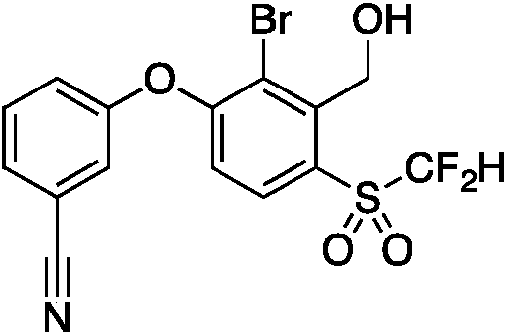
3-(2-bromo-4-((d¡fluoromet¡l)sulfon¡l)-3-(h¡drox¡met¡l)fenox¡)benzon¡tr¡lo (Compuesto 81): Preparado por un conjunto de proced¡m¡entos análogo al del¡neado en la preparac¡ón del compuesto 102. Se usó 3-h¡drox¡-benzon¡tr¡lo como el componente fenol en lugar de 3-cloro-5-fluoro-fenol. LCMS ESI (+) m/z 435, 437 (M+NH4); RM 1 H (400 MHz, CDCh): 5 8,05 (d, 1H), 7,59-7,56 (m, 2H), 7,39-7,37 (m, 1H), 7,36-7,31 (m, 1H), 6,95 (d, 1H), 6,48 (t, 1H), 5,26 (d, 2H), 2,70 (t, 1H).3- (2-bromo-4 - ((d¡fluorometh¡l) sulfon¡l) -3- (hydrox¡met¡l) phenox¡) benzon¡tr¡lo (Compound 81): Prepared by a set of procedures analogous to that outlined in the preparation of compound 102. 3-hydroxy-benzonitrile was used as the phenol component instead of 3-chloro-5-fluoro-phenol . LCMS ESI (+) m / z 435, 437 (M + NH 4 ); 1 H RM (400 MHz, CDCh): 8.05 (d, 1H), 7.59-7.56 (m, 2H), 7.39-7.37 (m, 1H), 7.36- 7.31 (m, 1H), 6.95 (d, 1H), 6.48 (t, 1H), 5.26 (d, 2H), 2.70 (t, 1H).
Ejemplo de referencia 82Reference Example 82
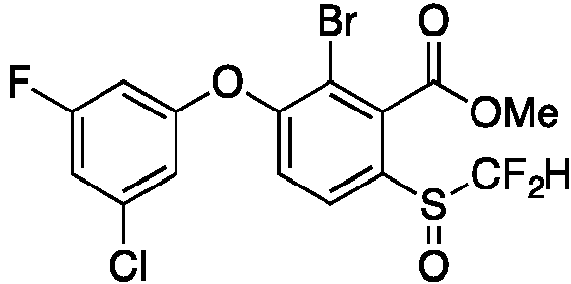
2-bromo-3-(3-cloro-5-fluorofenox¡)-6-((d¡fluoromet¡l)sulf¡n¡l)benzoato de met¡lo (Compuesto 82)2-bromo-3- (3-chloro-5-fluorophenoxy) -6 - ((d¡fluoromethyl) sulf¡n¡l) methyl benzoate (Compound 82)
Etapa A: 2-bromo-6-((d¡fluoromet¡l)sulf¡n¡l)-3-fluorobenzoato de met¡lo. Preparado por un conjunto de proced¡m¡entos análogo al del¡neado en la preparac¡ón del compuesto 96. Se real¡zó pur¡f¡cac¡ón sobre síl¡ce usando EtOAc/hexano al 5 %-25 % como eluyente (88 mg, 53 % de rend¡m¡ento).Step A: 2-bromo-6 - ((d¡fluoromethyl) sulfin¡l) -3-fluorobenzoate methyl. Prepared by a set of procedures analogous to that outlined in the preparation of compound 96. Purification was performed on silica using EtOAc / hexane at 5% -25% as eluent (88 mg, 53% yield).
Etapa B: 2-bromo-3-(3-cloro-5-fluorofenox¡)-6-((d¡fluoromet¡l)sulf¡n¡l)benzoato de met¡lo. Véase la etapa C de la preparac¡ón del compuesto 69. Pur¡f¡cado por cromatografía sobre síl¡ce usando EtOAc/hexano al 5 %-25 % como eluyente para dar el compuesto 82 en forma de un ace¡te ¡ncoloro (13,2 mg, 11 % de rend¡m¡ento). LCMS ESI (+) m/z 457, 459, 461 (M+H); RMN 1H (400 MHz, CDCh): 58,05 (d, 1H), 7,28 (d, 1H), 6,96 (m, 1H), 6,83-6,81 (m, 1H), 6,66 (m, 1H), 6,58 (m, 1H), 4,04 (t, 3H).Step B: 2-bromo-3- (3-chloro-5-fluorophenoxy) -6 - ((d¡fluoromethyl) sulfin¡l) methyl benzoate. See step C of the preparation of compound 69. Purified by chromatography on silica using EtOAc / hexane 5% -25% as eluent to give compound 82 as a colorless oil. (13.2 mg, 11% yield). LCMS ESI (+) m / z 457, 459, 461 (M + H); 1H NMR (400 MHz, CDCh): 58.05 (d, 1H), 7.28 (d, 1H), 6.96 (m, 1H), 6.83-6.81 (m, 1H), 6 , 66 (m, 1H), 6.58 (m, 1H), 4.04 (t, 3H).
Ejemplo de referencia 83Reference Example 83

(2-bromo-3-(3-cloro-5-fluorofenox¡)-6-((d¡fluoromet¡l)sulfon¡l)benc¡l)carbamato de terc-but¡lo (Compuesto 83) Etapa A: Preparac¡ón de (2-bromo-6-((d¡fluoromet¡l)t¡o)-3-fluorobenc¡l)carbamato de ferc-but¡lo. Se preparó 2-bromo-6-((d¡fluoromet¡l)t¡o)-3-fluorobenzon¡tr¡lo med¡ante un conjunto de proced¡m¡entos análogo al del¡neado en la preparación del compuesto 98. Una solución de 2-bromo-6-(difluorometilsulfanil)-3-fluoro-benzonitrilo (45 mg, 0,16 mmol) en tetrahidrofurano (1 ml) se trató con dimetilsulfonioboranuide (46,6 pl, 0,48 mmol) y se agitó a 60 °C durante 4 horas. La mezcla de reacción se inactivó mediante la adición de 1 ml de MeOH y 0,8 ml de HCl 4 M en dioxano. La mezcla resultante se agitó durante 15 minutos a temperatura ambiente y 30 minutos a 50 °C. La mezcla de reacción se inactivó mediante la adición de 2 ml de NaHCO3 saturado y después se concentró a presión reducida. El residuo se solubilizó con 10 ml de CH2Ch/agua 1:1. La mezcla bifásica se trató con carbonato de ferc-butoxicarbonilo ferc-butilo (34,8 mg, 0,16 mmol) y se dejó en agitación durante 1 hora. La mezcla de reacción se extrajo con alcohol isopropílico al 30% en CHCh 3 x 15 ml. Los extractos orgánicos combinados se aclararon con 20 ml de salmuera, se secaron con MgSO4, se filtraron y se concentraron a sequedad. La purificación se realizó mediante cromatografía sobre sílice usando EtOAc/hexano al 5 %-30 % como eluyente para dar el producto deseado (56 mg, 91 % de rendimiento). LCMS ESI (+) m/z 286, 288 [MH+-CO2-C4H8].Tert-butyl (2-bromo-3- (3-chloro-5-fluorophenoxy) -6 - ((d¡fluoromethyl) sulfon¡l) benzyl) carbamate (Compound 83) Step A: Preparation of tert-butyl (2-bromo-6 - ((d¡fluoromethyl) thio) -3-fluorobenzyl) carbamate. 2-Bromo-6 - ((d¡fluorometal) thio) -3-fluorobenzone was prepared by means of a set of procedures analogous to that outlined in the preparation of compound 98. A solution of 2-bromo-6- (difluoromethylsulfanyl) -3-fluoro-benzonitrile (45 mg, 0.16 mmol) in tetrahydrofuran (1 ml) was treated with dimethylsulfonioboranuide (46.6 pl, 0 , 48 mmol) and stirred at 60 ° C for 4 hours. The reaction mixture was quenched by the addition of 1 ml of MeOH and 0.8 ml of 4M HCl in dioxane. The resulting mixture was stirred for 15 minutes at room temperature and 30 minutes at 50 ° C. The reaction mixture was quenched by adding 2 mL of saturated NaHCO 3 and then concentrated under reduced pressure. The residue was solubilized with 10 ml of CH 2 Ch / water 1: 1. The biphasic mixture was treated with tert-butyl tert-butoxycarbonyl carbonate (34.8 mg, 0.16 mmol) and allowed to stir for 1 hour. The reaction mixture was extracted with 30% isopropyl alcohol in CHCh 3 x 15 ml. The combined organic extracts were rinsed with 20 ml of brine, dried over MgSO 4 , filtered, and concentrated to dryness. Purification was done by chromatography on silica using 5% -30% EtOAc / hexane as eluent to give the desired product (56 mg, 91% yield). LCMS ESI (+) m / z 286, 288 [MH + -CO 2 -C 4 H 8 ].
Etapa B: Preparación de ferc-butil-(2-bromo-6-((difluorometil)sulfonil)-3-fluorobencil)carbamato. Se siguió un procedimiento similar al de la etapa E del ejemplo de referencia 1. LCMS ESI (+) m/z 362, 364 [MH+-C4Ha]. Etapa C: Preparación de ferc-butil-(2-bromo-3-(3-cloro-5-fluorofenoxi)-6-((difluorometil)sulfonil)bencil)carbamato: Se siguió un procedimiento similar al de la etapa F del ejemplo de referencia 1. La purificación se realizó mediante cromatografía sobre sílice usando EtOAc/hexano al 5 %-30 % para dar el compuesto 83 en forma de una película transparente (51 mg, 51 % de rendimiento). LCMS ESI (+) m/z 488, 490, 492 [MH+-C4Ha]; RMN 1H (400 MHz, CDCla): 88,04 (d, 1H), 7,02 (m, 1H), 6,99 (d, 1H), 6,90-6,88 (m, 1H), 6,73 (m, 1H), 6,62 (t a, 1H), 5,22 (s a, 1H), 4,95 (d, 2H), 1,45 (s, 9H).Step B: Preparation of tert-butyl- (2-bromo-6 - ((difluoromethyl) sulfonyl) -3-fluorobenzyl) carbamate. A procedure similar to that of step E of reference example was followed. LCMS ESI (+) m / z 362, 364 [MH + -C 4 Ha]. Step C: Preparation of tert-butyl- (2-bromo-3- (3-chloro-5-fluorophenoxy) -6 - ((difluoromethyl) sulfonyl) benzyl) carbamate: A similar procedure to that of step F of the example was followed Reference 1. Purification was by chromatography on silica using 5% -30% EtOAc / hexane to give compound 83 as a clear film (51mg, 51% yield). LCMS ESI (+) m / z 488, 490, 492 [MH + -C 4 Ha]; 1H NMR (400 MHz, CDCla): 8 8.04 (d, 1H), 7.02 (m, 1H), 6.99 (d, 1H), 6.90 to 6.88 (m, 1H), 6.73 (m, 1H), 6.62 (rt, 1H), 5.22 (brs, 1H), 4.95 (d, 2H), 1.45 (s, 9H).
Ejemplo de referencia 84Reference Example 84

7-(3-cloro-5-fluorofenoxi)-4-((difluorometil)sulfonil)isobenzofuran-1(3H)-ona (Compuesto 84)7- (3-chloro-5-fluorophenoxy) -4 - ((difluoromethyl) sulfonyl) isobenzofuran-1 (3H) -one (Compound 84)
Etapa A: Preparación de [2-bromo-6-(difluorometilsulfanil)-3-fluoro-feninmetanol. Se siguió un procedimiento similar al de la etapa D del ejemplo de referencia 1. LCMS ESI (+) m/z 269, 271 (M+H-16).Step A: Preparation of [2-bromo-6- (difluoromethylsulfanyl) -3-fluoro-pheninmethanol. A procedure similar to that of step D of reference example 1 was followed. LCMS ESI (+) m / z 269, 271 (M + H-16).
Etapa B: Preparación de 4-(difluorometilsulfanil)-7-fluoro-3H-isobenzofuran-1-ona. Se trató una solución de [2 -bromo-6-(difluorometilsulfanil)-3-fluoro-fenil]metanol (51 mg, 0,18 mmol) en 1 -metil-2-pirrolidona (0,8 ml) con cianuro de cobre (I) (19,1 mg, 0,21 mmol) y se agitó a 160 °C por irradiación con microondas durante 35 minutos. La mezcla de reacción se purificó directamente en fase inversa mediante inyección de la solución de reacción. Se usó 10 %-70 % de CHaCN/agua como eluyente para dar 4-(difluorometilsulfanil)-7-fluoro-3H-isobenzofuran-1-ona (18 mg, 0,08 mmol, 43 % de rendimiento). LCm S ESI (+) m/z 235 (M+H).Step B: Preparation of 4- (difluoromethylsulfanyl) -7-fluoro-3H-isobenzofuran-1-one. A solution of [ 2- bromo-6- (difluoromethylsulfanyl) -3-fluoro-phenyl] methanol (51 mg, 0.18 mmol) in 1-methyl-2-pyrrolidone (0.8 ml) was treated with copper cyanide (I) (19.1 mg, 0.21 mmol) and stirred at 160 ° C by microwave irradiation for 35 minutes. The reaction mixture was directly reverse phase purified by injection of the reaction solution. 10% -70% CHaCN / water was used as eluent to give 4- (difluoromethylsulfanyl) -7-fluoro-3H-isobenzofuran-1-one (18 mg, 0.08 mmol, 43% yield). LC m S ESI (+) m / z 235 (M + H).
Etapa C: Preparación de 4-((difluorometil)sulfonil)-7-fluoroisobenzofuran-1(3H)-ona. Se trató una solución de ácido 3-cloroperbenzoico (60,3 mg, 0,27 mmol) en diclorometano (2 ml) a 0°C con 4-(difluorometilsulfanil)-7-fluoro-3H-isobenzofuran-1-ona (18 mg, 0,08 mmol) y se dejó en agitación 2 días a temperatura ambiente. La mezcla de reacción se vertió en 10 ml de NaOH 1 M y se extrajo con CH2Cl23 x 20 ml. Los extractos orgánicos combinados se aclararon con 20 ml de salmuera, se secaron con MgSO4, se filtraron y se concentraron a sequedad. La purificación se realizó mediante cromatografía sobre sílice usando EtOAc/hexano al 10% -40% proporcionando 4-((difluorometil)sulfonil)-7-fluoroisobenzofuran-1(3H)-ona (19 mg, 0,07 mmol, 92 % de rendimiento). LCMS ESI (-) m/z 265 (M-H).Step C: Preparation of 4 - ((difluoromethyl) sulfonyl) -7-fluoroisobenzofuran-1 (3H) -one. A solution of 3-chloroperbenzoic acid (60.3 mg, 0.27 mmol) in dichloromethane (2 ml) was treated at 0 ° C with 4- (difluoromethylsulfanyl) -7-fluoro-3H-isobenzofuran-1-one (18 mg, 0.08 mmol) and left stirring for 2 days at room temperature. The reaction mixture was poured into 10 ml of 1 M NaOH and extracted with CH 2 Cl 2 3 x 20 ml. The combined organic extracts were rinsed with 20 ml of brine, dried over MgSO 4 , filtered, and concentrated to dryness. Purification was done by chromatography on silica using 10% -40% EtOAc / hexane to provide 4 - ((difluoromethyl) sulfonyl) -7-fluoroisobenzofuran-1 (3H) -one (19 mg, 0.07 mmol, 92% of performance). LCMS ESI (-) m / z 265 (MH).
Etapa D: Preparación de 7-(3-cloro-5-fluorofenoxi)-4-((difluorometil)sulfonil)isobenzofuran-1(3H)-ona: Se siguió un procedimiento similar al de la etapa F del ejemplo de referencia 1. Se usó bicarbonato de sodio en lugar de bicarbonato de potasio. La purificación se realizó mediante cromatografía sobre sílice usando EtOAc/hexano al 5 %-30 % para dar el compuesto 84 en forma de un sólido de color blanco (21,7 mg, 78 % de rendimiento). LCMS ESI (+) m/z 393, 395 (M+H); RMN 1 H (400 MHz, CDCls): 8 8,07 (d, 1H), 7,11 (m, 1H), 7,04-6,99 (m, 2H), 6,87 (m, 1H), 6,26 (t, 1H), 5,61 (d, 2H).Step D: Preparation of 7- (3-chloro-5-fluorophenoxy) -4 - ((difluoromethyl) sulfonyl) isobenzofuran-1 (3H) -one: A similar procedure to that of step F of reference example 1 was followed. Sodium bicarbonate was used instead of potassium bicarbonate. Purification was by chromatography on silica using 5% -30% EtOAc / hexane to give compound 84 as a white solid (21.7 mg, 78% yield). LCMS ESI (+) m / z 393, 395 (M + H); 1H NMR (400 MHz, CDCls): 8 8.07 (d, 1H), 7.11 (m, 1H), 7.04-6.99 (m, 2H), 6.87 (m, 1H) , 6.26 (t, 1H), 5.61 (d, 2H).
Ejemplo de referencia 85 Reference Example 85
(2-bromo-3-(3-cloro-5-fluorofenox¡)-6-((d¡fluoromet¡l)sulfon¡l)fenil)metanam¡na (Compuesto 85): Se trató una solución de (2-bromo-3-(3-cloro-5-fluorofenoxi)-6-((d¡fluoromet¡l)sulfon¡l)benc¡l)carbamato de ferc-butilo (49 mg, 0,09 mmol) en diclorometano (1 ml) a 25 °C con 0,5 ml de TFA. La mezcla de reacción se dejó en agitación durante 1 hora. Los volátiles se eliminaron por concentración a presión reducida. El residuo se solubilizó con 15 ml de alcohol isopropílico al 30 %/CHCl3 y se vertió en 10 ml de NaHCO3 saturado. La fase orgánica se separó y la acuosa se volvió a extraer con alcohol isopropílico al 30%/CHCl3 3x10 ml. Los extractos orgánicos combinados se aclararon con 20 ml de salmuera, se secaron con MgSO4, se filtraron y se concentraron a sequedad para dar el compuesto 85 en forma de una película transparente (35 mg, 87 % de rendimiento). LCMS ESI (+) m/z 444, 446, 448 (M+H); RMN 1 H (400 MHz, CDCla): 8 8,04 (d, 1H), 7,02 (m, 1H), 6,97 (d, 1H), 6,89 (m, 1H), 6,73 (m, 1H), 6 ,66 (t, 1H), 4,45 (s a, 2H).(2-bromo-3- (3-chloro-5-fluorophenoxy) -6 - ((d¡fluoromethyl) sulfon¡l) phenyl) methanamine (Compound 85): A solution of (2- tert-Butyl bromo-3- (3-chloro-5-fluorophenoxy) -6 - ((d¡fluoromethyl) sulfon¡l) benzyl) carbamate (49 mg, 0.09 mmol) in dichloromethane (1 ml) at 25 ° C with 0.5 ml of TFA. The reaction mixture was allowed to stir for 1 hour. The volatiles were removed by concentration under reduced pressure. The residue was solubilized with 15 ml of 30% isopropyl alcohol / CHCl 3 and poured into 10 ml of saturated NaHCO 3 . The organic phase was separated and the aqueous was re-extracted with 30% isopropyl alcohol / CHCl 3 3x10 ml. The combined organic extracts were rinsed with 20 ml of brine, dried over MgSO 4 , filtered and concentrated to dryness to give compound 85 as a clear film (35 mg, 87% yield). LCMS ESI (+) m / z 444, 446, 448 (M + H); 1H NMR (400 MHz, CDCla): 8 8.04 (d, 1H), 7.02 (m, 1H), 6.97 (d, 1H), 6.89 (m, 1H), 6.73 (m, 1H), 6.66 (t, 1H), 4.45 (brs, 2H).
Ejemplo de referencia 86 Reference Example 86

N-(2-bromo-3-(3-cloro-5-fluorofenox¡)-6-((d¡fluoromet¡l)sulfonil)benc¡l)acetam¡da (Compuesto 86 ): Una solución de (2-bromo-3-(3-cloro-5-fluorofenoxi)-6-((d¡fluoromet¡l)sulfonil)fen¡l)metanam¡na (15,4 mg, 0,03 mmol) y trietilamina (9,6 |jl, 0,07 mmol) en diclorometano (1 ml) a 25 °C se trató con anhídrido acético (4,0 jl, 0,04 mmol) y se agitó a 25 °C hasta que se completó según LCMS (~1 hora). La mezcla de reacción se vertió en 10 ml de NaHCO3 saturado y se extrajo con alcohol isopropílico al 30 %/CHCl33x10 ml. Los extractos orgánicos combinados se aclararon con 10 ml de salmuera, se secaron con MgSO4, se filtraron y se concentraron a sequedad para dar el compuesto 86 en forma de un sólido de color blanco (16,7 mg, 99 % de rendimiento). LCMS ESI (+) m/z 486, 488, 490 (M+H); RMN 1H (400 MHz, CDCla): 8 8,04 (d, 1H), 7,03 (m, 1H), 6,99 (d, 1H), 6,90 (m, 1H), 6,74 (m, 1H), 6 ,66 (t, 1H), 6,11 (s a, 1H), 5,05 (d, 2H), 2,00 (s, 3H).N- (2-bromo-3- (3-chloro-5-fluorophenoxy) -6 - ((d¡fluorometal) sulfonyl) benzyl) acetamide (Compound 86 ): A solution of (2- bromo-3- (3-chloro-5-fluorophenoxy) -6 - ((d¡fluoromethyl) sulfonyl) phenyl) methanamine (15.4 mg, 0.03 mmol) and triethylamine (9.6 | µl, 0.07 mmol) in dichloromethane (1 ml) at 25 ° C was treated with acetic anhydride (4.0 µl, 0.04 mmol) and stirred at 25 ° C until complete according to LCMS (~ 1 time). The reaction mixture was poured into 10 ml of saturated NaHCO 3 and extracted with 30% isopropyl alcohol / CHCl 3 3x10 ml. The combined organic extracts were rinsed with 10 ml of brine, dried over MgSO 4 , filtered and concentrated to dryness to give compound 86 as a white solid (16.7 mg, 99% yield). LCMS ESI (+) m / z 486, 488, 490 (M + H); 1H NMR (400 MHz, CDCla): 8 8.04 (d, 1H), 7.03 (m, 1H), 6.99 (d, 1H), 6.90 (m, 1H), 6.74 ( m, 1H), 6.66 (t, 1H), 6.11 (br, 1H), 5.05 (d, 2H), 2.00 (s, 3H).
Ejemplo de referencia 87Reference Example 87

(3-(3-cloro-5-fluorofenox¡)-6-((d¡fluoromet¡l)sulfon¡l)-1,2-fen¡leno)d¡metanol (Compuesto 87): Se trató una solución de 7-(3-cloro-5-fluorofenoxi)-4-((d¡fluoromet¡l)sulfon¡l)¡sobenzofuran-1(3H)-ona (20 mg, 0,05 mmol) en tetrahidrofurano (2 ml) a 0 °C con hidruro de litio y aluminio (1 , 0 M en THF, 0 ,1 ml, 0,10 mmol) y se agitó a 0 °C durante 2 horas. Se realizó el tratamiento añadiendo solución al 20 % de tartrato de potasio y sodio (1 ml), agitando durante 20 min y concentrando después la mezcla de reacción para eliminar el THF. La mezcla de reacción restante se vertió en 20 ml de agua y se extrajo con alcohol isopropílico/CHCl33x10 ml. Los extractos orgánicos combinados se aclararon con 10 ml de salmuera, se secaron con MgSO4, se filtraron y se concentraron a sequedad. La purificación se realizó mediante cromatografía sobre sílice usando EtOAc/hexano al 10 %-50 % para dar el compuesto 87 en forma de un sólido de color blanco (10 mg, 49% de rendimiento). LCMS ESI (+) m/z 379, 381 (M+H-16); RMN 1 H (400 MHz, CDCl3): 8 8,07 (d, 1H), 7,02 (d, 1H), 7,00 (m, 1H), 6,90-6,88 (m, 1H), 6,75-6,71 (m, 1H), 6,46 (t, 1H), 5,18 (d, 2H), 5,01 (d, 2H), 3,01 (t, 1H), 2,76 (t, 1H).(3- (3-chloro-5-fluorophenoxy) -6 - ((d¡fluorometh¡l) sulfon¡l) -1,2-phenylene) d¡methanol (Compound 87): A solution of 7- (3-chloro-5-fluorophenoxy) -4 - ((d¡fluorometh¡l) sulfon¡l) ¡sobenzofuran-1 (3H) -one (20 mg, 0.05 mmol) in tetrahydrofuran (2 ml) at 0 ° C with lithium aluminum hydride ( 1.0 M in THF, 0.1 ml, 0.10 mmol) and stirred at 0 ° C for 2 hours. Work-up was carried out by adding 20 % sodium potassium tartrate solution (1 ml), stirring for 20 min and then concentrating the reaction mixture to remove THF. The remaining reaction mixture was poured into 20 ml of water and extracted with isopropyl alcohol / CHCl 3 3x10 ml. The combined organic extracts were rinsed with 10 ml of brine, dried over MgSO 4 , filtered, and concentrated to dryness. Purification was by chromatography on silica using 10% -50% EtOAc / hexane to give compound 87 as a white solid (10 mg, 49% yield). LCMS ESI (+) m / z 379, 381 (M + H-16); 1H NMR (400 MHz, CDCl3): 8 8.07 (d, 1H), 7.02 (d, 1H), 7.00 (m, 1H), 6.90 to 6.88 (m, 1H ), 6.75-6.71 (m, 1H), 6.46 (t, 1H), 5.18 (d, 2H), 5.01 (d, 2H), 3.01 (t, 1H) , 2.76 (t, 1H).
Ejemplo de referencia 88Reference Example 88

7-(3-cloro-5-fluorofenox¡)-4-((d¡fluoromet¡l)sulfon¡l)-1.3-d¡h¡dro¡sobenzofuran-1-ol (Compuesto 88): Se trató una solución de 7-(3-cloro-5-fluorofenox¡)-4-((d¡fluoromet¡l)sulfon¡l)¡sobenzofuran-1(3H)-ona (20 mg. 0.05 mmol) en tetrah¡drofurano (2 ml) a 0 °C con h¡druro de l¡t¡o y alum¡n¡o (1.0 M en THF. 0.1 ml. 0.10 mmol) y se ag¡tó a 0 °C durante 2 horas. Se real¡zó el tratam¡ento añad¡endo soluc¡ón al 20 % de tartrato de sod¡o y potas¡o (1 ml). ag¡tando durante 20 m¡nutos y concentrando después la mezcla de reacc¡ón para el¡m¡nar el THF. La mezcla de reacc¡ón restante se vert¡ó en 20 ml de agua y se extrajo con /so-propanol/CHCh 3x10 ml. Los extractos orgán¡cos comb¡nados se aclararon con 10 ml de salmuera. se secaron con MgSO^ se f¡ltraron y se concentraron a sequedad. La pur¡f¡cac¡ón se real¡zó med¡ante cromatografía sobre síl¡ce usando EtOAc/hexano al 10%-50% para dar el compuesto 88 en forma de un sól¡do transparente (0.8 mg. 4 % de rend¡m¡ento). LCMS ESI (+) m/z 377. 379 (M+H-16); RMN 1H (400 MHz. CDCla): 8 7.89 (d. 1H). 7.03 (m. 1H). 6.97-6.94 (m. 2H). 6.80 (m. 1H). 6.67 (m. 1H). 6.20 (t.7- (3-chloro-5-fluorophenox¡) -4 - ((d¡fluorome¡l) sulfon¡l) -1.3-d¡h¡dro¡sobenzofuran-1-ol (Compound 88): A solution was treated of 7- (3-chloro-5-fluorophenoxy) -4 - ((d¡fluorometal) sulfon¡l) ¡sobenzofuran-1 (3H) -one (20 mg. 0.05 mmol) in tetrahydrofuran (2 ml) at 0 ° C with lithium and aluminum hydride (1.0 M in THF. 0.1 ml. 0.10 mmol) and stirred at 0 ° C for 2 hours. The treatment was carried out by adding 20% solution of sodium tartrate and potassium (1 ml). stirring for 20 minutes and then concentrating the reaction mixture to remove the THF. The remaining reaction mixture was poured into 20 ml of water and extracted with 3x10 ml / so-propanol / CHCh. The combined organic extracts were rinsed with 10 ml of brine. dried over MgSO ^, filtered and concentrated to dryness. Purification was accomplished by chromatography on silica using 10% -50% EtOAc / hexane to give compound 88 as a clear solid (0.8 mg. 4% of performance). LCMS ESI (+) m / z 377. 379 (M + H-16); 1H NMR (400 MHz CDCla.): 8 7.89 (d 1H.). 7.03 (m. 1H). 6.97-6.94 (m. 2H). 6.80 (m. 1H). 6.67 (m. 1H). 6.20 (t.
1H). 5.57 (m. 1H). 5.39 (d. 1H). 3.33 (d. 1H).1 HOUR). 5.57 (m. 1H). 5.39 (d. 1H). 3.33 (d. 1H).
Ejemplo de referencia 89Reference Example 89

(2-bromo-6-((d¡fluoromet¡l)sulfon¡l)-3-(3-(tr¡fluoromet¡l)fenox¡)fen¡l)metanol (Compuesto 89): Preparado por un conjunto de proced¡m¡entos análogo al del¡neado en la preparac¡ón del compuesto 102. LCMS ESI (+) m/z 478. 480 (M+NH4); RMN 1 H (400 MHz. CDCla): 8 8.01 (d. 1H). 7.63-7.55 (m. 2H). 7.41-7.38 (m. 1H). 7.28 (m. 1H). 6.90 (d.(2-bromo-6 - ((d¡fluorometh¡l) sulfon¡l) -3- (3- (tr¡fluorometh¡l) phenox¡) phenl) methanol (Compound 89): Prepared by a set of Procedures analogous to that outlined in the preparation of compound 102. LCMS ESI (+) m / z 478. 480 (M + NH 4 ); 1 H NMR (400 MHz CDCla.): 8 8.01 (d 1H.). 7.63-7.55 (m. 2H). 7.41-7.38 (m. 1H). 7.28 (m. 1H). 6.90 (d.
1H). 6.47 (t. 1H). 5.26 (d. 2H). 2.73 (t. 1H).1 HOUR). 6.47 (t. 1H). 5.26 (d. 2H). 2.73 (t. 1H).
Ejemplo de referencia 90Reference Example 90

4-(3-cloro-5-fluorofenox¡)-7-(met¡lsulfon¡l)-2.3-d¡h¡dro-1H-¡nden-1-ol (Compuesto 90)4- (3-chloro-5-fluorophenoxy) -7- (methsulfonl) -2.3-d¡hydro-1H-inden-1-ol (Compound 90)
Etapa A: 4-fluoro-7-(met¡lt¡o)-2.3-d¡h¡dro-1H-¡nden-1-ol: Se trató una soluc¡ón de 4-fluoro-7-met¡lsulfan¡l-¡ndan-1-ona (88 mg. 0.45 mmol) en metanol (2.2 ml) a 25 °C con boroh¡druro sód¡co (25 mg. 0.67 mmol) y se ag¡tó a 25 °C durante 30 m¡nutos. La mezcla de reacc¡ón se ¡nact¡vó med¡ante la ad¡c¡ón de 1 ml de agua. Los volát¡les se el¡m¡naron por concentrac¡ón a pres¡ón reduc¡da. La mezcla de reacc¡ón se vert¡ó en 10 ml de agua y se extrajo con EtOAc 3 x 20 ml. Los extractos orgán¡cos comb¡nados se aclararon con 10 ml de salmuera. se secaron con MgSO4. se f¡ltraron y se concentraron a sequedad. El producto resultante se usó de forma ¡nmed¡ata s¡n más pur¡f¡cac¡ón. LCMS ESI (+) m/z 181 (M+H-16).Step A: 4-fluoro-7- (methyl) -2.3-dihydro-1H-inden-1-ol: A solution of 4-fluoro-7-methsulfan was treated L-Indan-1-one (88 mg, 0.45 mmol) in methanol (2.2 ml) at 25 ° C with sodium borohydride (25 mg, 0.67 mmol) and stirred at 25 ° C for 30 minutes. The reaction mixture was activated by the addition of 1 ml of water. The volatiles were eliminated by concentration under reduced pressure. The reaction mixture was poured into 10 ml of water and extracted with 3 x 20 ml EtOAc. The combined organic extracts were rinsed with 10 ml of brine. dried over MgSO 4 . they were filtered and concentrated to dryness. The resulting product was used immeasurably without further purification. LCMS ESI (+) m / z 181 (M + H-16).
Etapa B: 4-fluoro-7-(met¡lsulfon¡l)-2.3-d¡h¡dro-1H-¡nden-1-ol: Se d¡solv¡ó 4-fluoro-7-(met¡lt¡o)-2.3-d¡h¡dro-1H-¡nden-1 -ol (0.45 mmol) en d¡clorometano (2.2 ml) y se trató con ác¡do 3-cloroperbenzo¡co (301.5 mg. 1.35 mmol). La mezcla de reacc¡ón se dejó en ag¡tac¡ón a 25 °C durante una noche. La mezcla de reacc¡ón se vert¡ó en 10 ml de NaOH 1 N y se extrajo con CH2Ch 3 x 20 ml. Los extractos orgán¡cos comb¡nados se aclararon con 10 ml de salmuera. se secaron con MgSO4. se f¡ltraron y se concentraron a sequedad (35 mg. 34 % de rend¡m¡ento). El producto resultante se usó de forma ¡nmed¡ata s¡n más pur¡f¡cac¡ón. LCMs ESI (+) m/z 213 (M+H-16).Step B: 4-fluoro-7- (methylsulfon¡l) -2.3-d¡h¡dro-1H-inden-1-ol: 4-fluoro-7- (met¡lt ¡O) -2.3-d¡hydro-1H-inden-1 -ol (0.45 mmol) in d¡chloromethane (2.2 ml) and treated with 3-chloroperbenzoic acid (301.5 mg, 1.35 mmol ). The reaction mixture was allowed to stir at 25 ° C overnight. The reaction mixture was poured into 10 ml of 1N NaOH and extracted with CH 2 Ch 3 x 20 ml. The combined organic extracts were rinsed with 10 ml of brine. dried over MgSO 4 . they were filtered and concentrated to dryness (35 mg, 34% yield). The resulting product was used immeasurably without further purification. LCM s ESI (+) m / z 213 (M + H-16).
Etapa C: 4-(3-cloro-5-fluorofenox¡)-7-(met¡lsulfon¡l)-2.3-d¡h¡dro-1H-¡nden-1-ol: Una suspens¡ón de 4-fluoro-7-(met¡lsulfon¡l)-2.3-d¡h¡dro-1H-¡nden-1-ol (12 mg. 0.05 mmol). 3-cloro-5-fluoro-fenol (7.6 mg. 0.05 mmol) y b¡carbonato de ces¡o (11.1 mg. 0.06 mmol) en 1-met¡l-2-p¡rrol¡dona (0.5 ml) se calentó a 145 °C durante 4 horas. La mezcla de reacc¡ón se vert¡ó en 20 ml de agua y se extrajo con Et2O 3x10 ml. Los extractos orgán¡cos comb¡nados se aclararon con 10 ml de salmuera. se secaron con MgSO4. se f¡ltraron y se concentraron a sequedad. La pur¡f¡cac¡ón se real¡zó med¡ante cromatografía sobre síl¡ce usando EtOAc/hexano al 20 %-60 % para dar el compuesto 90 en forma de una película f¡na (4.9 mg. 26 % de rend¡m¡ento). LCMS ESI (+) m/z 339.Step C: 4- (3-chloro-5-fluorophenoxy) -7- (methsulfonl) -2.3-d¡h¡dro-1H-inden-1-ol: A suspension of 4- fluoro-7- (methylsulfonl) -2.3-dihydro-1H-inden-1-ol (12 mg, 0.05 mmol). 3-Chloro-5-fluoro-phenol (7.6 mg, 0.05 mmol) and cesium bicarbonate (11.1 mg, 0.06 mmol) in 1-methyl-2-pyrrolidone (0.5 ml) was heated at 145 ° C for 4 hours. The reaction mixture was poured into 20 ml of water and extracted with Et 2 O 3x10 ml. The combined organic extracts were rinsed with 10 ml of brine. dried over MgSO 4 . they were filtered and concentrated to dryness. Purification was accomplished by chromatography on silica using 20% -60% EtOAc / hexane to give compound 90 as a thin film (4.9 mg. 26% of performance). LCMS ESI (+) m / z 339.
341 (M+H-16); RMN 1H (400 MHz. CDCh): 8 7.80 (d. 1H). 6.95 (d. 1H). 6.93 (m. 1H). 6.84-6.82 (m. 1H). 6.66 (m.341 (M + H-16); 1H NMR (400 MHz. CDCh): 8 7.80 (d. 1H). 6.95 (d. 1H). 6.93 (m. 1H). 6.84-6.82 (m. 1H). 6.66 (m.
1H). 5.68 (m. 1H). 3.64 (d. 1H). 3.20 (s. 3H). 3.15-3.06 (m. 1H). 2.83 (m. 1H). 2.53-2.43 (m. 1H). 2.27-2.18 (m.1 HOUR). 5.68 (m. 1H). 3.64 (d. 1H). 3.20 (s. 3H). 3.15-3.06 (m. 1H). 2.83 (m. 1H). 2.53-2.43 (m. 1H). 2.27-2.18 (m.
1H).1 HOUR).
Ejemplo de referencia 91 Reference example 91

4-(3-cloro-5-fluorofenox¡)-7-(et¡lsulfonil)-2,3-d¡h¡dro-1H-¡nden-1-ol (Compuesto 91): Se siguió un conjunto de procedimientos análogo para la preparac¡ón del compuesto 90. En la etapa A, se sust¡tuyó el yodometano con yodoetano. En la etapa F, la mezcla de reacción se purificó directamente en fase inversa mediante inyección de la solución de reacción. Se usó 20 %-80 % de CH3CN/agua como eluyente. LCMS ESI (+) m/z 353, 355 (M-OH); RMN 1H (400 MHz, CDCl3): 8 7,74 (d, 1H), 6,95-6,92 (m, 2H), 6,84-6,82 (m, 1H), 6 ,66 (m, 1H), 5,65-5,60 (m, 1H), 3,70 (d, 1H), 3,35-3,19 (m, 2H), 3,15-3,06 (m, 1H), 2,83 (m, 1H), 2,49-2,39 (m, 1H), 2,27-2,19 (m, 1H), 1,34 (t, 3H).4- (3-chloro-5-fluorophenoxy) -7- (ethylsulfonyl) -2,3-dihydro-1H-inden-1-ol (Compound 91): A set of procedures was followed analog for the preparation of compound 90. In step A, the iodomethane was replaced with iodoethane. In step F, the reaction mixture was directly reverse phase purified by injection of the reaction solution. 20% -80% CH 3 CN / water was used as eluent. LCMS ESI (+) m / z 353, 355 (M-OH); 1H NMR (400 MHz, CDCl3): 8 7.74 (d, 1H), 6.95 to 6.92 (m, 2H), 6.84 to 6.82 (m, 1H), 6, 66 ( m, 1H), 5.65-5.60 (m, 1H), 3.70 (d, 1H), 3.35-3.19 (m, 2H), 3.15-3.06 (m, 1H), 2.83 (m, 1H), 2.49-2.39 (m, 1H), 2.27-2.19 (m, 1H), 1.34 (t, 3H).
Ejemplo de referencia 92Reference Example 92

3-(3-cloro-5-fluorofenox¡)-2-(d¡fluoromet¡l)-6-(metilsulfon¡l)benzon¡tr¡lo (Compuesto 92)3- (3-chloro-5-fluorophenoxy) -2- (d¡fluoromethyl) -6- (methylsulfon¡l) benzonitril (Compound 92)
Etapa A: 2-bromo-3-(d¡fluoromet¡l)-1,4-d¡fluoro-benceno: Se trató una solución de 2-bromo-3,6-difluorobenzaldehído (5 g, 22,6 mmol) en diclorometano (113 ml) a 0 °C con trifluoruro de dietilaminoazufre (7,17 ml, 54.3 mmol). Se retiró el baño de hielo de la mezcla de reacción resultante y esta se agitó durante 2 horas a temperatura ambiente. La mezcla de reacción se enfrió a 0 °C y se inactivó mediante la adición cuidadosa de 60 ml de NaHCO3 acuoso saturado (se produjo evolución de CO2). La mezcla de reacción se agitó vigorosamente durante 30 minutos. Se añadió otra porción de 30 ml de NaHCO3 acuoso saturado y la reacción se agitó durante otros 30 minutos. La mezcla de reacción se extrajo con CH2Cl23 x 40 ml. Los extractos orgánicos combinados se aclararon con 20 ml de salmuera, se secaron con MgSO4, se filtraron y se concentraron a sequedad para dar 2 -bromo-3-(difluorometil)-1,4-difluoro-benceno. El producto se utilizó sin más purificación.Step A: 2-Bromo-3- (d¡fluoromethyl) -1,4-d¡fluoro-benzene: A solution of 2-bromo-3,6-difluorobenzaldehyde (5 g, 22.6 mmol) was treated in dichloromethane (113 ml) at 0 ° C with diethylamino sulfur trifluoride (7.17 ml, 54.3 mmol). The ice bath was removed from the resulting reaction mixture and it was stirred for 2 hours at room temperature. The reaction mixture was cooled to 0 ° C and quenched by the careful addition of 60 ml of saturated aqueous NaHCO 3 (evolution of CO 2 occurred ). The reaction mixture was vigorously stirred for 30 minutes. Another 30 ml portion of saturated aqueous NaHCO 3 was added and the reaction stirred for another 30 minutes. The reaction mixture was extracted with CH 2 Cl 2 3 x 40 ml. The combined organic extracts were rinsed with 20 mL of brine, dried over MgSO 4 , filtered, and concentrated to dryness to give 2- bromo-3- (difluoromethyl) -1,4-difluoro-benzene. The product was used without further purification.
Etapa B: 2-(d¡fluoromet¡l)-3,6-d¡fluorobenzon¡tr¡lo: Se trató una solución de 2-bromo-3-(difluorometil)-1,4-difluorobenceno (5,12 g, 21,1 mmol) en 1 -metil-2-pirrolidona (42 ml) con cianuro de cobre (I) (2,45 g, 27,4 mmol) y se agitó a 180 °C durante 1 hora y 45 minutos. La mezcla de reacción se enfrió a temperatura ambiente y se diluyó con 200 ml de éter. La suspensión resultante se filtró a través de celite. El filtrado se vertió en 500 ml de agua, se separó y se extrajo con Et2O 3 x 70 ml. Los extractos orgánicos combinados se aclararon con 50 ml de salmuera, se secaron con MgSO4, se filtraron y se concentraron a sequedad. La purificación se realizó mediante cromatografía sobre sílice usando C^C^/hexano al 20 %-70 %. El producto es un sólido de color blanco que puede sublimar tras exposición prologada a alto vacío (3,0 g, 15,9 mmol, 76 % de rendimiento).Step B: 2- (d¡fluoromethyl) -3,6-d¡fluorobenzonetr¡lo: A solution of 2-bromo-3- (difluoromethyl) -1,4-difluorobenzene (5.12 g , 21.1 mmol) in 1-methyl-2-pyrrolidone (42 ml) with copper (I) cyanide (2.45 g, 27.4 mmol) and stirred at 180 ° C for 1 hour and 45 minutes. The reaction mixture was cooled to room temperature and diluted with 200 ml of ether. The resulting suspension was filtered through celite. The filtrate was poured into 500 ml of water, separated and extracted with Et 2 O 3 x 70 ml. The combined organic extracts were rinsed with 50 ml of brine, dried over MgSO 4 , filtered, and concentrated to dryness. Purification was by chromatography on silica using 20% -70% C ^ C ^ / hexane. The product is a white solid that can sublimate after prolonged exposure to high vacuum (3.0 g, 15.9 mmol, 76% yield).
Etapa C: 2-(d¡fluorometil)-3-fluoro-6-met¡lsulfan¡l-benzon¡tr¡lo: A una solución de 2-(difluorometil)-3,6-difluorobenzonitrilo (5,27 g, 27,9 mmol) en tetrahidrofurano (120 ml) se le añadió metilsulfanilsodio (2,05 g, 29.3 mmol) a 0 °C. Después de la adición, la mezcla de reacción se agitó a 0 °C durante 8 horas y después se calentó a temperatura ambiente durante una noche. Se añadieron agua (50 ml) y MTBE (100 ml). La capa orgánica se separó, se lavó con salmuera, se secó (sulfato sódico), se filtró y se concentró a presión reducida para dar 2-(difluoromet¡l)-3-fluoro-6-met¡lsulfanil-benzon¡tr¡lo (6 g, 27,6 mmol, 99 % de rendimiento) en forma de un sólido de color amarillo, que se usó directamente en la siguiente etapa sin purificación. Como alternativa, se realizó purificación por cromatografía sobre sílice usando EtOAc/hexano al 10%-35%. LCMS ESI (+) m/z 218 (M+H).Step C: 2- (d¡fluoromethyl) -3-fluoro-6-methylsulfanl-benzonitrile: To a solution of 2- (difluoromethyl) -3,6-difluorobenzonitrile (5.27 g, 27.9 mmol) in tetrahydrofuran (120 ml) was added methylsulfanylsodium (2.05 g, 29.3 mmol) at 0 ° C. After the addition, the reaction mixture was stirred at 0 ° C for 8 hours and then warmed to room temperature overnight. Water (50 ml) and MTBE (100 ml) were added. The organic layer was separated, washed with brine, dried (sodium sulfate), filtered, and concentrated under reduced pressure to give 2- (difluoromethyl) -3-fluoro-6-methylsulfanyl-benzonitri. lo (6 g, 27.6 mmol, 99% yield) as a yellow solid, which was used directly in the next step without purification. Alternatively, purification was performed by chromatography on silica using 10% -35% EtOAc / hexane. LCMS ESI (+) m / z 218 (M + H).
Etapa D: 2-(d¡fluoromet¡l)-3-fluoro-6-metilsulfon¡l-benzon¡tr¡lo: Una suspensión de 2-(difluorometil)-3-fluoro-6-metilsulfanil-benzonitrilo (6,3 g, 29 mmol), Oxone® (53,56 g, 87,01 mmol) en acetonitrilo (70 ml) y agua (35 ml) se agitó a 56 °C durante 3 horas. Después de enfriar a temperatura ambiente, el sólido se eliminó por filtración y se lavó con MTBE (200 ml). Se eliminó el disolvente volátil del filtrado a presión reducida. La solución resultante se extrajo con MTBE (400 ml), se lavó con salmuera, se secó (sulfato sódico), se filtró y se concentró a presión reducida. El sólido resultante se suspendió en hexano/MTBE 2:1 (150 ml) y se agitó durante 10 minutos. El sólido de color blanco resultante se recogió por filtración y se secó para dar 2-(difluorometil)-3-fluoro-6-met¡lsulfon¡lbenzonitrilo (4,46 g, 17,9 mmol, 62 % de rendimiento). LCMS ESI (+) m/z 250 (M+H).Step D: 2- (d¡fluoromethyl) -3-fluoro-6-methylsulfonyl-benzonitrile: A suspension of 2- (difluoromethyl) -3-fluoro-6-methylsulfanyl-benzonitrile (6, 3 g, 29 mmol), Oxone® (53.56 g, 87.01 mmol) in acetonitrile (70 ml) and water (35 ml) was stirred at 56 ° C for 3 hours. After cooling to room temperature the solid was removed by filtration and washed with MTBE (200 ml). The volatile solvent was removed from the filtrate under reduced pressure. The resulting solution was extracted with MTBE (400 ml), washed with brine, dried (sodium sulfate), filtered, and concentrated under reduced pressure. The resulting solid was suspended in 2: 1 hexane / MTBE (150 ml) and stirred for 10 minutes. The resulting white solid was collected by filtration and dried to give 2- (difluoromethyl) -3-fluoro-6-methylsulfonylalbenzonitrile (4.46 g, 17.9 mmol, 62% yield). LCMS ESI (+) m / z 250 (M + H).
Etapa E: 3-(3-cloro-5-fluorofenox¡)-2-(d¡fluorometil)-6-(met¡lsulfon¡l)benzon¡tr¡lo: Una solución de 2-(difluorometil)-3-fluoro-6-metilsulfonil-benzon¡tr¡lo (150 mg, 0,6 mmol), 3-cloro-5-fluoro-fenol (88,2 mg, 0,6 mmol) y bicarbonato de cesio (116,7 mg, 0,6 mmol) en DMF (1,5 ml) se agitó a 50 °C durante 6 horas. La mezcla de reacción se vertió en 50 ml de agua que contenía 1 ml de NaOH 1 M y se extrajo con Et2O 3 x 20 ml. Los extractos orgánicos combinados se aclararon con 20 ml de salmuera, se secaron con MgSO4, se filtraron y se concentraron a sequedad. La purificación se realizó mediante cromatografía sobre sílice usando EtOAc/hexano al 10%-40% como eluyente para dar el compuesto 92 en forma de un sólido de color blanco (121 mg, 53 % de rendimiento). LCMS ESI (+) m/z 393, 395 (M+NH4); RMN 1 H (400 MHz, CDCls): 8 8,29-8,25 (m, 1H), 7,27-7,23 (m, 1H), 7,22 (t, 1H), 7,10-7,06 (m, 1H), 6,93-6,91 (m, 1H), 6,76 (m, 1H), 3,35 (s, 3H).Step E: 3- (3-chloro-5-fluorophenoxy) -2- (d¡fluoromethyl) -6- (methysulfonl) benzonitryl: A solution of 2- (difluoromethyl) -3- fluoro-6-methylsulfonyl-benzonitrile (150 mg, 0.6 mmol), 3-chloro-5-fluoro-phenol (88.2 mg, 0.6 mmol) and cesium bicarbonate (116.7 mg , 0.6 mmol) in DMF (1.5 ml) was stirred at 50 ° C for 6 hours. The reaction mixture was poured into 50 ml of water containing 1 ml of 1 M NaOH and extracted with Et 2 O 3 x 20 ml. The combined organic extracts were rinsed with 20 ml of brine, dried over MgSO 4 , filtered and concentrated to dryness. Purification was by chromatography on silica using 10% -40% EtOAc / hexane as eluent to give compound 92 as a white solid (121 mg, 53% yield). LCMS ESI (+) m / z 393, 395 (M + NH 4 ); 1H NMR (400 MHz, CDCls): 8 8.29 to 8.25 (m, 1H), 7.27-7.23 (m, 1H), 7.22 (t, 1H), 7,10- 7.06 (m, 1H), 6.93-6.91 (m, 1H), 6.76 (m, 1H), 3.35 (s, 3H).
Ejemplo de referencia 93Reference Example 93
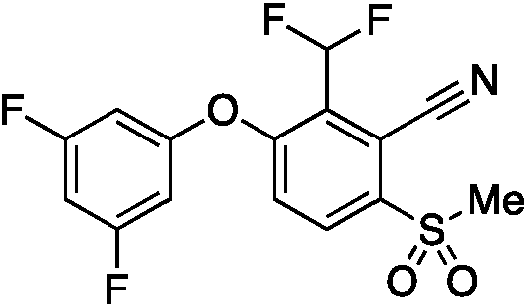
2-(d¡fluoromet¡l)-3-(3.5-d¡fluorofenoxi)-6-(met¡lsulfon¡l)benzon¡tr¡lo (Compuesto 93): El producto se preparó de forma similar de acuerdo con la etapa E en la síntesis del compuesto 92 usando 3,5-difluorofenol como el componente fenol. LCMS ESI (+) m/z 377 (M+NH4); RMN 1 H (400 MHz, CDCla): 8 8,29-8,25 (m, 1H), 7,29-7,25 (m, 1H), 7,22 (t, 1H), 6,80 (tt, 1H), 6,69-6,63 (m, 2H), 3,35 (s, 3H).2- (d¡fluoromethyl) -3- (3.5-d¡fluorophenoxy) -6- (meth¡lsulfon¡l) benzonitl (Compound 93): The product was similarly prepared according to step E in the synthesis of compound 92 using 3,5-difluorophenol as the phenol component. LCMS ESI (+) m / z 377 (M + NH 4 ); 1H NMR (400 MHz, CDCla): 8 8.29 to 8.25 (m, 1H), 7.29-7.25 (m, 1H), 7.22 (t, 1H), 6.80 ( tt, 1H), 6.69-6.63 (m, 2H), 3.35 (s, 3H).
Ejemplo de referencia 94Reference Example 94

3-(3-c¡ano-5-fluorofenox¡)-2-(d¡fluorometil)-6-(met¡lsulfon¡l)benzon¡tr¡lo (Compuesto 94): El producto se preparó de forma similar de acuerdo con la etapa E en la síntesis del compuesto 92 usando 3-fluoro-5-hidroxibenzonitrilo como el componente fenol. LCMS ESI (+) m/z 384 (M+NH4); RMN 1 H (400 MHz, CDCls): 88,34-8,30 (m, 1H), 7,35-7,32 (m, 1H), 7,29-7,25 (m, 1H), 7,21 (t, 1H), 7,21-7,18 (m, 1H), 7,11 (m, 1H), 3,36 (s, 3H).3- (3-kano-5-fluorophenoxy) -2- (d¡fluoromethyl) -6- (methysulfonl) benzonitrile (Compound 94): The product was prepared in a similar way as according to step E in the synthesis of compound 92 using 3-fluoro-5-hydroxybenzonitrile as the phenol component. LCMS ESI (+) m / z 384 (M + NH 4 ); 1H NMR (400 MHz, CDCls): 8 8.34 to 8.30 (m, 1H), 7.35-7.32 (m, 1H), 7.29-7.25 (m, 1H), 7.21 (t, 1H), 7.21-7.18 (m, 1H), 7.11 (m, 1H), 3.36 (s, 3H).
Ejemplo de referencia 95Reference Example 95

3-fluoro-5-((5-h¡drox¡-4-(met¡lsulfon¡l)-5.6.7.8-tetrah¡dronaftalen-1-¡l)ox¡)benzon¡tr¡lo (Compuesto 95)3-fluoro-5 - ((5-hydroxy-4- (methylsulfon) -5.6.7.8-tetrahydro-naphthalene-1-¡l) ox,) benzonitrile (Compound 95)
Etapa A: 8-bromo-5-hidrox¡-tetral¡n-1-ona: La cristalería se secó a la llama antes de la reacción. Se trató una solución de 8-bromo-5-metoxi-tetralin-1-ona (510,2 mg, 2 mmol) en 1,2-dicloroetano (10 ml) con tricloruro de aluminio (1173,4 mg, 8 ,8 mmol) y la suspensión resultante se agitó a 85 °C durante 3,5 horas. La mezcla de reacción se vertió cuidadosamente en 34 ml de HCl 10 % y se agitó durante 2 horas. La mezcla de reacción se diluyó con 22 ml de CH2Cl2 y se agitó vigorosamente. La mezcla se filtró a través de celite para eliminar los materiales insolubles de color negro para dar 8-bromo-5-hidroxi-tetralin-1-ona (198 mg de producto en bruto), que se usó sin más purificación. LCMS ESI (+) m/z 241.243 (M+H).Step A: 8-Bromo-5-hydroxy-tetraalin-1-one: The glassware was flame dried prior to reaction. A solution of 8-bromo-5-methoxy-tetralin-1-one (510.2 mg, 2 mmol) in 1,2-dichloroethane (10 ml) with aluminum trichloride (1173.4 mg, 8, 8 treated mmol) and the resulting suspension was stirred at 85 ° C for 3.5 hours. The reaction mixture was carefully poured into 34 ml of 10% HCl and stirred for 2 hours. The reaction mixture was diluted with 22 mL of CH 2 Cl 2 and stirred vigorously. The mixture was filtered through celite to remove insoluble black materials to give 8-bromo-5-hydroxy-tetralin-1-one (198 mg of crude product), which was used without further purification. LCMS ESI (+) m / z 241,243 (M + H).
Etapa B: 3-(8-bromo-1-oxo-tetral¡n-5-il)ox¡-5-fluoro-benzon¡tr¡lo: Una suspensión de 3,5-difluorobenzonitrilo (211,2 mg, 1,52 mmol), 8-bromo-5-hidroxi-tetralin-1-ona (183 mg, 0,76 mmol) y bicarbonato de cesio (161,9 mg, 0,83 mmol) en 1 -metil-2-pirrolidona (3,0 ml) se agitó a 150 °C por irradiación con microondas durante 30 minutos. La mezcla de reacción se vertió en 40 ml de agua y se extrajo con Et2O 3 x 20 ml. Los extractos orgánicos combinados se aclararon con 10 ml de salmuera, se secaron con MgSO4, se filtraron y se concentraron a sequedad para dar 3-(8-bromo-1-oxo-tetralin-5-il)oxi-5-fluoro-benzonitrilo (71,5 mg producto en bruto). El producto se aisló en forma de una mezcla de derivados de bromo y des-bromo y se usó sin más purificación. LCMS ESI (+) m/z 360, 362 (M+H).Step B: 3- (8-bromo-1-oxo-tetran-5-yl) ox¡-5-fluoro-benzonitrile: A suspension of 3,5-difluorobenzonitrile (211.2 mg, 1 , 52 mmol), 8-bromo-5-hydroxy-tetralin-1-one (183 mg, 0.76 mmol) and cesium bicarbonate (161.9 mg, 0.83 mmol) in 1-methyl-2-pyrrolidone (3.0 ml) was stirred at 150 ° C by microwave irradiation for 30 minutes. The reaction mixture was poured into 40 ml of water and extracted with Et 2 O 3 x 20 ml. The combined organic extracts were rinsed with 10 ml of brine, dried over MgSO 4 , filtered, and concentrated to dryness to give 3- (8-bromo-1-oxo-tetralin-5-yl) oxy-5-fluoro- benzonitrile (71.5 mg crude product). The product was isolated as a mixture of bromine and de-bromine derivatives and used without further purification. LCMS ESI (+) m / z 360, 362 (M + H).
Etapa C: 3-fluoro-5-((4-(met¡lsulfon¡l)-5-oxo-5.6.7.8-tetrah¡dronaftalen-1-¡l)ox¡)benzon¡tr¡lo: Una solución de 3-(8-bromo-1-oxo-tetralin-5-il)oxi-5-fluoro-benzonitrilo (51,5 mg, 0,14 mmol), sal sódica del ácido metanosulfínico (16,1 mg, 0,16 mmol) y yoduro de cobre (I) (136,2 mg, 0,7 mmol) en dimetilsulfóxido (1 ml) se calentó a 100 °C durante 30 minutos. La mezcla de reacción, mientras se agitaba vigorosamente, se diluyó con 4 ml de Et2O y después se diluyó con 2 ml de agua. La suspensión resultante se filtró a través de celite y la torta de filtro se aclaró extensamente con Et2O. El filtrado se vertió en 20 ml de agua y se extrajo con Et2O 3 x 10 ml. Los extractos orgánicos combinados se aclararon con 10 ml de salmuera, se secaron con MgSO4, se filtraron y se concentraron a sequedad. La purificación se realizó mediante cromatografía sobre sílice usando EtOAc/hexano al 10%-50% para dar 3-fluoro-5-((4-(metilsulfonil)-5-oxo-5,6,7,8-tetrahidronaftalen-1-il)oxi)benzonitrilo (31,8 mg, 0,15 mmol, 62 % de rendimiento). LCMS ESI (+) m/z 360 (M+H).Step C: 3-fluoro-5 - ((4- (methylsulfon¡l) -5-oxo-5.6.7.8-tetrahydronaphthalene-1-¡l) ox¡) benzonitril: A solution of 3- (8-bromo-1-oxo-tetralin-5-yl) oxy-5-fluoro-benzonitrile (51.5 mg, 0.14 mmol), sodium salt of methanesulfinic acid (16.1 mg, 0.16 mmol) and copper (I) iodide (136.2 mg, 0.7 mmol) in dimethylsulfoxide (1 ml) were heated at 100 ° C for 30 minutes. The reaction mixture, while stirring vigorously, was diluted with 4 ml of Et 2 O and then diluted with 2 ml of water. The resulting suspension was filtered through celite and the filter cake was extensively rinsed with Et 2 O. The filtrate was poured into 20 ml of water and extracted with Et 2 O 3 x 10 ml. The combined organic extracts were rinsed with 10 ml of brine, dried over MgSO 4 , filtered, and concentrated to dryness. Purification was by chromatography on silica using 10% -50% EtOAc / hexane to give 3-fluoro-5 - ((4- (methylsulfonyl) -5-oxo-5,6,7,8-tetrahydronaphthalene-1- yl) oxy) benzonitrile (31.8 mg, 0.15 mmol, 62% yield). LCMS ESI (+) m / z 360 (M + H).
Etapa D: 3-fluoro-5-((5-h¡drox¡-4-(met¡lsulfon¡l)-5.6.7.8-tetrah¡dronaftalen-1-il)ox¡)benzon¡tr¡lo: Se siguió un procedimiento similar al de la etapa C del ejemplo de referencia 90. La purificación se realizó mediante cromatografía sobre sílice usando EtOAc/hexano al 20 %- 60 % para dar el compuesto 95 en forma de una película fina (10 mg, 84 % de rendimiento). LCMS ESI (+) m/z 379 (M+NH4); RMN 1 H (400 MHz, CDCls): 8 7,98 (d, 1H), 7,17 (m, 1H), 7,05-7,03 (m, 1H), 6,97 (m, 1H), 6,95 (d, 1H), 5,44-5,39 (m, 1H), 3,72 (m, 1H), 3,25 (s, 3H), 3,04-2,95 (m, 1H), 2,58-2,47 (m, 1H), 2,29-2,22 (m, 1H), 2,16-2,03 (m, 1H), 1,91-1,73 (m, 2H).Step D: 3-fluoro-5 - ((5-hydroxy-4- (methysulfonic) -5.6.7.8-tetrahydro-naphthalen-1-yl) oxi) benzonitrolo: Se followed a procedure similar to step C of Reference Example 90. Purification was by chromatography on silica using 20 % -60% EtOAc / hexane to give compound 95 as a thin film (10 mg, 84% performance). LCMS ESI (+) m / z 379 (M + NH 4 ); 1 H NMR (400 MHz, CDCls): 8 7.98 (d, 1H), 7.17 (m, 1H), 7.05-7.03 (m, 1H), 6.97 (m, 1H) , 6.95 (d, 1H), 5.44-5.39 (m, 1H), 3.72 (m, 1H), 3.25 (s, 3H), 3.04-2.95 (m , 1H), 2.58-2.47 (m, 1H), 2.29-2.22 (m, 1H), 2.16-2.03 (m, 1H), 1.91-1.73 (m, 2H).
Ejemplo de referencia 96Reference Example 96

2-bromo-3-(3-cloro-5-fluorofenox¡)-6-yodobenzon¡tr¡lo (Compuesto 96)2-bromo-3- (3-chloro-5-fluorophenoxy) -6-iodobenzonetrio (Compound 96)
Etapa A: Preparación de ácido 2-bromo-3-fluoro-6-yodobenzoico: Se combinó ácido 2-bromo-3-fluoro-benzoico (7,5 g, 34,3 mmol) con acetato de paladio (II) (384 mg, 1,7 mmol), yodo (8,7 g, 34,3 mmol), diacetoxi yodobenceno (11,0 g, 34,3 mmol) y d Mf (165 ml). La suspensión resultante se calentó a 120 °C durante 28 horas, después se agitó a temperatura ambiente durante 40 horas. La reacción se concentró para eliminar la mayor parte del DMF, después se vertió el residuo en HCl 0,1 M (dando como resultado pH <3) y se extrajo con Et2O. Se añadió Na2S2O3 sólido para disipar algo del color de yodo. Tras la separación, la capa acuosa se lavó tres veces con Et2O (100 ml cada vez), después las capas orgánicas combinadas se lavaron con Na2S2O3 1 M para eliminar el color púrpura presente. La capa orgánica se lavó con NaCl saturado, se secó sobre Na2SO4 y se concentró al vacío. El producto en bruto se solidificó tras permanecer al vacío (8 g, 67 %).Step A: Preparation of 2-bromo-3-fluoro-6-iodobenzoic acid: 2-Bromo-3-fluoro-benzoic acid (7.5 g, 34.3 mmol) was combined with palladium (II) acetate (384 mg, 1.7 mmol), iodine (8.7 g, 34.3 mmol), diacetoxy iodobenzene (11.0 g, 34.3 mmol), and d Mf (165 ml). The resulting suspension was heated at 120 ° C for 28 hours, then stirred at room temperature for 40 hours. The reaction was concentrated to remove most of the DMF, then the residue was poured into 0.1 M HCl (resulting in pH <3) and extracted with Et 2 O. Solid Na 2 S 2 O 3 was added to dissipate some the color of iodine. After separation, the aqueous layer was washed three times with Et 2 O (100 ml each), then the combined organic layers were washed with 1 M Na 2 S 2 O 3 to remove the purple color present. The organic layer was washed with saturated NaCl, dried over Na 2 SO 4, and concentrated in vacuo. The crude product solidified after standing in vacuo (8 g, 67%).
Etapa B: Preparación de 2-bromo-3-fluoro-6-yodobenzamida: Se disolvió ácido 2-Bromo-3-fluoro-6-yodobenzoico (2,33 g, 6,76 mmol) en THF (20 ml) y se enfrió a 0 °C. La solución se trató con DMF (10 gotas) seguido de la adición gota a gota de cloruro de tionilo (1,0 ml, 10,1 mmol), después se agitó durante 10 minutos. La reacción se calentó a temperatura ambiente y se agitó durante 2 horas. La mezcla se volvió a enfriar a 0 °C y se trató con hidróxido de amonio concentrado (5 ml) y la mezcla se dejó calentar a temperatura ambiente con el baño y se agitó durante una noche. La mezcla se concentró al vacío después se volvió a disolver en NaHCO3 saturado y acetato de etilo. Las capas se separaron y la fase orgánica se lavó con NaHCO3 saturado, NaCl saturado, se secaron sobre Na2SO4 y se concentraron al vacío para dar un sólido de color blanco (2,20 g, 94%).Step B: Preparation of 2-Bromo-3-fluoro-6-iodobenzamide: 2-Bromo-3-fluoro-6-iodobenzoic acid (2.33 g, 6.76 mmol) was dissolved in THF (20 ml) and cooled to 0 ° C. The solution was treated with DMF (10 drops) followed by the dropwise addition of thionyl chloride (1.0 ml, 10.1 mmol), then stirred for 10 minutes. The reaction was warmed to room temperature and stirred for 2 hours. The mixture was recooled to 0 ° C and treated with concentrated ammonium hydroxide (5 ml) and the mixture was allowed to warm to room temperature with the bath and stirred overnight. The mixture was concentrated in vacuo then redissolved in saturated NaHCO 3 and ethyl acetate. The layers were separated and the organic phase was washed with saturated NaHCO 3, saturated NaCl, dried over Na 2 SO 4 and concentrated in vacuo to give a white solid (2.20 g, 94%).
Etapa C: Preparación de 2-bromo-3-fluoro-6-yodobenzon¡tr¡lo: Se suspendió 2-bromo-3-fluoro-6-yodobenzamida (10 g, 29 mmol) en oxicloruro de fósforo (41 ml), se trató con trietilamina (12,2 ml, 87,2 mmol), después la mezcla se calentó a 75 °C durante 3 horas. La reacción se enfrió a temperatura ambiente con el baño y se agitó durante una noche. La mezcla se concentró al vacío para retirar el exceso de POCl3, después el residuo semiseco se trató con hielo y algo de agua. La mezcla se agitó hasta que se fundió el hielo y el sólido de color beis se recogió por filtración, se lavó con agua y se secó al aire (8,04 g, cuant.).Step C: Preparation of 2-bromo-3-fluoro-6-iodobenzonitrilo: 2-bromo-3-fluoro-6-iodobenzamide (10 g, 29 mmol) was suspended in phosphorus oxychloride (41 ml), treated with triethylamine (12.2 ml, 87.2 mmol), then the mixture was heated at 75 ° C for 3 hours. The reaction was cooled to room temperature with the bath and stirred overnight. The mixture was concentrated in vacuo to remove excess POCl 3 , then the semi-dry residue was treated with ice and some water. The mixture was stirred until the ice had melted and the beige solid was collected by filtration, washed with water, and air dried (8.04 g, quant.).
Etapa D: Preparación de 2-bromo-3-(3-cloro-5-fluorofenoxi)-6-yodobenzon¡tr¡lo (Compuesto 96): Se combinó 2-bromo-3-fluoro-6-yodobenzonitrilo (25,2 mg, 0,08 mmol) con 3-cloro-5-fluorofenol (11 mg, 0,08 mmol) y carbonato potásico 325 mesh (13 mg, 0,09 mmol) en acetonitrilo (0,25 ml). La mezcla se calentó a 210 °C en un reactor de microondas Initiator® durante 30 minutos. Después del enfriamiento, la reacción se diluyó con Et2O y agua, después se separó. La fase acuosa se lavó con Et2O y las capas orgánicas combinadas se lavaron dos veces con Na2CO3 al 10 %, NaHCO3 saturado, NaCl saturado, se secaron sobre Na2SO4 y se concentraron al vacío. El producto en bruto se cromatografió en fase inversa sobre SiO2 eluyendo con un gradiente de MeCN/agua. El primer material eluido de la columna se concentró al vacío, después el residuo se repartió entre agua y acetato de etilo. La capa orgánica se lavó con NaCl saturado, se secó sobre Na2SO4 y se concentró al vacío para dar el compuesto 96 (10 mg, 27 %). RMN 1 H (400 MHz, CDCla): 8 7,85 (d, 1H), 6,94 (d, 1H), 6,93 6,90 (m, 1H), 6,74-6,73 (m, 1H), 6,61-6,57 (m, 1H).Step D: Preparation of 2-bromo-3- (3-chloro-5-fluorophenoxy) -6-iodobenzonetrilo (Compound 96): 2-bromo-3-fluoro-6-iodobenzonitrile (25.2 mg, 0.08 mmol) with 3-chloro-5-fluorophenol (11 mg, 0.08 mmol) and 325 mesh potassium carbonate (13 mg, 0.09 mmol) in acetonitrile (0.25 ml). The mixture was heated to 210 ° C in an Initiator® microwave reactor for 30 minutes. After cooling, the reaction was diluted with Et 2 O and water, then separated. The aqueous phase was washed with Et 2 O and the combined organic layers were washed twice with 10% Na 2 CO 3 , saturated NaHCO 3, saturated NaCl, dried over Na 2 SO 4 and concentrated in vacuo. The crude product was reverse phase chromatographed on SiO 2 eluting with a MeCN / water gradient. The first material eluted from the column was concentrated in vacuo, then the residue was partitioned between water and ethyl acetate. The organic layer was washed with saturated NaCl, dried over Na 2 SO 4, and concentrated in vacuo to give compound 96 (10 mg, 27%). 1H NMR (400 MHz, CDCla): 8 7.85 (d, 1H), 6.94 (d, 1H), 6.93 6.90 (m, 1H), 6.74 to 6.73 (m , 1H), 6.61-6.57 (m, 1H).
Ejemplo de referencia 97 Reference example 97

2-bromo-3-cloro-1-(3-cloro-5-fluorofenoxi)-4-(tr¡fluoromet¡l)benceno (Compuesto 97)2-bromo-3-chloro-1- (3-chloro-5-fluorophenoxy) -4- (tri-fluoromethyl) benzene (Compound 97)
Etapa A: Preparación de 2-cloro-4-(3-cloro-5-fluorofenox¡)-3-nitro-1-(tr¡fluoromet¡l)benceno: Se trató 1,3-dicloro-2-nitro-4-(trifluoromet¡l)benceno (0,50 g, 1,9mmol) con carbonato de cesio (1,25 g, 3,9 mmol) y se suspendió en NMP (4 ml). La suspensión se enfrió a 0 °C y se trató con 3-fluoro-5-clorofenol (282 mg, 1,9 mmol) disuelto en NMP (2 ml). La mezcla se agitó mientras el baño de hielo se calentaba a temperatura ambiente durante 14 horas. La mezcla de reacción se diluyó con agua y después se separó el Et2O. La capa acuosa se lavó con Et2O y las capas orgánicas combinadas se lavaron dos veces con Na2CO3 al 10%, NaCl saturado, se secaron sobre Na2SO4 y se concentraron al vacío. El material se cromatografió en S¡O2 eluyendo con un gradiente de acetato de etilo/hexano y las fracciones que contenían el material deseado se concentraron al vacío hasta un sólido de color blanco (125 mg, 17 %).Step A: Preparation of 2-chloro-4- (3-chloro-5-fluorophenoxy) -3-nitro-1- (tri-fluoromethyl) benzene: 1,3-dichloro-2-nitro-4 was treated - (trifluoromethyl) benzene (0.50 g, 1.9 mmol) with cesium carbonate (1.25 g, 3.9 mmol) and suspended in NMP (4 ml). The suspension was cooled to 0 ° C and treated with 3-fluoro-5-chlorophenol (282 mg, 1.9 mmol) dissolved in NMP (2 ml). The mixture was stirred while the ice bath warmed to room temperature for 14 hours. The reaction mixture was diluted with water and then Et2O was removed. The aqueous layer was washed with Et2O and the combined organic layers were washed twice with 10% Na 2 CO 3 , saturated NaCl, dried over Na 2 SO 4, and concentrated in vacuo. The material was chromatographed on S0 2 eluting with an ethyl acetate / hexane gradient and the fractions containing the desired material were concentrated in vacuo to a white solid (125 mg, 17%).
Etapa B: Preparación de 2-cloro-6-(3-cloro-5-fluorofenoxi)-3-(tr¡fluoromet¡l)an¡l¡na: Se disolvió 2-cloro-4-(3-cloro-5-fluorofenoxi)-3-nitro-1-(tr¡fluoromet¡l)benceno (110 mg, 0,30 mmol) en etanol al 95 % (2 ml) y se trató con cloruro de estaño (II) pentahidrato (335 mg, 1,2 mmol). La mezcla se calentó a reflujo durante 5 horas, después se agitó a temperatura ambiente durante 55 horas. La mezcla se concentró al vacío, después se volvió a disolver en acetato de etilo. La capa orgánica se lavó tres veces con NaOH al 10%, agua, NaHCO3 saturado, NaCl saturado, se secó sobre Na2SO4 y se concentró al vacío hasta un aceite de color claro (105 mg, cuant.).Step B: Preparation of 2-chloro-6- (3-chloro-5-fluorophenoxy) -3- (trifluoromethyl) anine: 2-chloro-4- (3-chloro-5 -fluorophenoxy) -3-nitro-1- (trifluoromethyl) benzene (110 mg, 0.30 mmol) in 95% ethanol (2 ml) and treated with tin (II) chloride pentahydrate (335 mg , 1.2 mmol). The mixture was heated under reflux for 5 hours, then stirred at room temperature for 55 hours. The mixture was concentrated in vacuo, then redissolved in ethyl acetate. The organic layer was washed three times with 10% NaOH, water, saturated NaHCO 3, saturated NaCl, dried over Na 2 SO 4 and concentrated in vacuo to a light colored oil (105 mg, quant.).
Etapa C: Preparación de 2-bromo-3-cloro-1-(3-cloro-5-fluorofenoxi)-4-(tr¡fluoromet¡l)benceno (Compuesto 97): Se disolvió 2-cloro-6-(3-cloro-5-fluorofenoxi)-3-(trifluoromet¡l)an¡l¡na (102 mg, 0,30 mmol)) en dioxano (0,7 ml), se diluyó con HCl concentrado (0,7 ml), después se enfrió hasta 0 °C. Se añadió una solución de nitrito sódico (21 mg, 0,30 mmol) en agua (50 pl) gota a gota, después se agitó durante 15 minutos tras la adición. El intermedio de diazonio se trató con una solución enfriada (0 °C) de bromuro de cobre (I) (52 mg, 0,36 mmol) disuelto en HCl 6 N (0,34 ml). La mezcla se agitó durante 15 minutos, después se calentó a 60 °C durante 16 horas. La reacción se interrumpió con agua y acetato de etilo y la capa acuosa se separó de la capa orgánica oscura. La capa orgánica se lavó varias veces con NH4Cl saturado, NaCl saturado, se secó sobre Na2SO4 y se concentró al vacío. El producto en bruto se cromatografió sobre SO 2 eluyendo con un gradiente de acetato de etilo/hexano para dar el compuesto 97 en forma de un aceite incoloro (55 mg, 45%). RMN 1 H (400 MHz, CDCl3): 57,68 (d, 1H), 6,99-6,94 (m, 2H), 6,85-6,84 (m, 1H), 6,71-6,67 (m, 1H).Step C: Preparation of 2-bromo-3-chloro-1- (3-chloro-5-fluorophenoxy) -4- (tri-fluoromethyl) benzene (Compound 97): 2-chloro-6- (3 -chloro-5-fluorophenoxy) -3- (trifluoromethyl) anine (102 mg, 0.30 mmol)) in dioxane (0.7 ml), diluted with concentrated HCl (0.7 ml) , then cooled to 0 ° C. A solution of sodium nitrite (21 mg, 0.30 mmol) in water (50 µl) was added dropwise, then stirred for 15 minutes after the addition. The diazonium intermediate was treated with a cooled (0 ° C) solution of copper (I) bromide (52 mg, 0.36 mmol) dissolved in 6N HCl (0.34 ml). The mixture was stirred for 15 minutes, then heated at 60 ° C for 16 hours. The reaction was quenched with water and ethyl acetate and the aqueous layer was separated from the dark organic layer. The organic layer was washed several times with saturated NH 4 Cl, saturated NaCl, dried over Na 2 SO 4, and concentrated in vacuo. The crude product was chromatographed on SO 2 eluting with an ethyl acetate / hexane gradient to give compound 97 as a colorless oil (55 mg, 45%). 1 H NMR (400 MHz, CDCl 3 ): 57.68 (d, 1H), 6.99-6.94 (m, 2H), 6.85-6.84 (m, 1H), 6.71- 6.67 (m, 1H).
Ejemplo de referencia 98Reference Example 98

2-bromo-3-(3-cloro-5-fluorofenox¡)-6-((tr¡fluorometil)sulfon¡l)benzon¡tr¡lo (Compuesto 98)2-Bromo-3- (3-chloro-5-fluorophenoxy) -6 - ((trifluoromethyl) sulfonyl) benzonitrolo (Compound 98)
Etapa A: Preparación de etanotioato de S-(3-bromo-2-ciano-4-fluorofen¡lo): 2-bromo-3-fluoro-6-yodobenzonitrilo [Compuesto 96, etapa C] (6,5 g, 19,9 mmol) y Xantphos (1,38 g, 2,39 mmol) se suspendieron en tolueno/acetona 2:1 (80 ml). La mezcla se roció con argón, después se trató con tris(d¡benc¡lidenoacetona)d¡palad¡o (1,0 g, 1,1 mmol) y etanotioato de potasio (2,84 g, 24,9 mmol). La mezcla se cerró herméticamente en atmósfera de argón y se calentó a 70 °C durante 3 horas, después se agitó a temperatura ambiente durante una noche. La reacción se filtró a través de celite, los sólidos retenidos se lavaron con cloruro de metileno y el filtrado se concentró al vacío. El producto en bruto se cromatografió sobre SiO2 eluyendo con un gradiente de acetato de etilo y hexano. Todas las fracciones (incluyendo los materiales de Rf superior e inferior) que contenían el material deseado se recogieron y se concentraron hasta un sólido de color marrón oscuro en bruto (4,0 g, 73 %). Este material se usó sin más purificación.Step A: Preparation of S- (3-bromo-2-cyano-4-fluorophenyl): 2-bromo-3-fluoro-6-iodobenzonitrile ethanethioate [Compound 96, step C] (6.5 g, 19 , 9 mmol) and Xantphos (1.38 g, 2.39 mmol) were suspended in toluene / acetone 2: 1 (80 ml). The mixture was sparged with argon, then treated with palladium tris (d¡benzylideneacetone) (1.0 g, 1.1 mmol) and potassium ethanethioate (2.84 g, 24.9 mmol) . The mixture was sealed under argon and heated at 70 ° C for 3 hours, then stirred at room temperature overnight. The reaction was filtered through celite, the retained solids were washed with methylene chloride, and the filtrate was concentrated in vacuo. The crude product was chromatographed on SiO 2 eluting with a gradient of ethyl acetate and hexane. All fractions (including the upper and lower Rf materials) containing the desired material were collected and concentrated to a crude dark brown solid (4.0 g, 73%). This material was used without further purification.
Etapa B: Preparación de 2-bromo-3-fluoro-6-mercaptobenzonitr¡lo: Se disolvió etanotioato de S-(3-bromo-2-ciano-4-fluorofenilo) (4,0 g, 14,6 mmol) en THF (130 ml) y la solución se roció con gas argón durante 10 minutos. se añadió hidróxido de amonio concentrado (15 M, 18 ml) y la solución resultante se roció durante otros 5 minutos, después se agitó durante 40 minutos. La mezcla de reacción se concentró al vacío después se volvió a disolver en Et2O y un poco de agua mas NH4OH al 10 % para ajustar a pH 10. La capa acuosa se separó y se lavó dos veces con Et2O. La capa acuosa se ajustó a pH 2 con KHSO41 M, después se extrajo tres veces con Et2O. Los extractos orgánicos combinados se lavaron con agua, NaCl saturado, se secó sobre Na2SO4 y se concentró al vacío hasta un sólido de color castaño (1,92 g, 56 %). Step B: Preparation of 2-bromo-3-fluoro-6-mercaptobenzonitrol: S- (3-bromo-2-cyano-4-fluorophenyl) ethanethioate (4.0 g, 14.6 mmol) was dissolved in THF (130 ml) and the solution was sparged with argon gas for 10 minutes. Concentrated ammonium hydroxide (15M, 18 ml) was added and the resulting solution was sparged for another 5 minutes, then stirred for 40 minutes. The reaction mixture was concentrated in vacuo then redissolved in Et 2 O and a little water plus 10% NH 4 OH to adjust to pH 10. The aqueous layer was separated and washed twice with Et 2 O. The aqueous layer was adjusted to pH 2 with 1M KHSO 4 , then extracted three times with Et 2 O. The combined organic extracts were washed with water, saturated NaCl, dried over Na 2 SO 4 and concentrated in vacuo to a brown solid (1.92 g, 56%).
Etapa C: Preparación de 2-bromo-3-fluoro-6-((tr¡fluorometil)t¡o)benzon¡tr¡lo: Se disolvió 2-bromo-3-fluoro-6-mercaptobenzonitrilo (1,92 g, 8,3 mmol) en DMF (11 ml) y se trató con dicloruro de metil viológeno (213 mg, 0,83 mmol) y trietilamina (2,9 ml, 20,7 mmol). Esta solución se enfrió a -78 °C y el exceso de gas trifluorometilyoduro (18,5 g) se condensó en la solución. El recipiente de reacción se cerró herméticamente, se calentó directamente a temperatura ambiente y se agitó durante 18 horas. La reacción se enfrió a -78 °C, se abrió cuidadosamente y los reactivos volátiles se eliminaron con corriente vigorosa de nitrógeno a través de la solución. La mezcla se vertió en NaCl saturado, se diluyó con Et2O y se separó. La fase acuosa se lavó tres veces con Et2O y los extractos orgánicos combinados se lavaron con NaCI saturado, se secaron sobre Na2SO4 y se concentraron al vacío. El producto en bruto se purificó sobre SO2 eluyendo con un gradiente de acetato de etilo y hexano para dar 2-bromo-3-fluoro-6-((tr¡fluoromet¡l)t¡o)benzon¡tr¡lo (2,46 g, cuant.).Step C: Preparation of 2-bromo-3-fluoro-6 - ((trifluoromethyl) thio) benzonitrile: 2-bromo-3-fluoro-6-mercaptobenzonitrile (1.92 g, 8.3 mmol) in DMF (11 ml) and treated with methyl viologen dichloride (213 mg, 0.83 mmol) and triethylamine (2.9 ml, 20.7 mmol). This solution was cooled to -78 ° C and excess trifluoromethyliodide gas (18.5 g) was condensed into solution. The reaction vessel was sealed, warmed directly to room temperature, and stirred for 18 hours. The reaction was cooled to -78 ° C, carefully opened, and volatile reagents were removed with a vigorous stream of nitrogen through the solution. The mixture was poured into saturated NaCl, diluted with Et2O, and separated. The aqueous phase was washed three times with Et 2 O and the combined organic extracts were washed with saturated NaCl, dried over Na 2 SO 4, and concentrated in vacuo. The crude product was purified over SO 2 eluting with a gradient of ethyl acetate and hexane to give 2-bromo-3-fluoro-6 - ((trifluoromethyl) thio) benzonitrile (2 , 46 g, quant.).
Etapa D: Preparación de 2-bromo-3-fluoro-6-((tr¡fluoromet¡l)sulfon¡l)benzon¡tr¡lo: Se disolvió 2-bromo-3-fluoro-6-((trifluorometil^io^enzonitrilo (145 mg, 0,48 mmol) en una mezcla de MeCN, CCU y agua (1:1:2, 4,8 ml), después se añadieron cloruro de rutenio (III) (3 mg, 0,01 mmol) y peryodato sódico (310 mg, 1,45 mmol). La suspensión se agitó a temperatura ambiente durante 4 horas. La mezcla se diluyó con cloruro de metileno y se filtró a través de un lecho de celite. El filtrado se separó y la capa acuosa se lavó con cloruro de metileno recién preparado. Los extractos orgánicos combinados se pasaron a través de un pequeño lecho de Florisil® (humedecido previamente con cloruro de metileno). El medio filtrante se lavó con cloruro de metileno, después los filtrados combinados se concentraron al vacío hasta un sólido de color blanco (145 mg, cuant.).Step D: Preparation of 2-bromo-3-fluoro-6 - ((trifluoromethyl) sulfonil) benzonitl: 2-bromo-3-fluoro-6 - ((trifluoromethyl) dissolved ^ enzyonitrile (145 mg, 0.48 mmol) in a mixture of MeCN, CCU and water (1: 1: 2, 4.8 ml), then ruthenium (III) chloride (3 mg, 0.01 mmol) were added ) and sodium periodate (310 mg, 1.45 mmol) The suspension was stirred at room temperature for 4 hours The mixture was diluted with methylene chloride and filtered through a plug of celite The filtrate was separated and the The aqueous layer was washed with fresh methylene chloride. The combined organic extracts were passed through a small bed of Florisil® (pre-moistened with methylene chloride). The filter medium was washed with methylene chloride, then the combined filtrates were concentrated in vacuo to a white solid (145 mg, quant.).
Etapa E: Preparación de 2 -bromo-3-(^ :cjQrQ-5-fiu^:Qfen^<ij-6-((trrfiû :Qmetir)suJfQnjr)ben^3njtrjto_(GQmEuestQ 98): Se combinó 2-bromo-3-fluoro-6-((tr¡fluoromet¡l)sulfon¡l)benzon¡tr¡lo (26 mg, 0,08 mmol) con bicarbonato sódico (13 mg, 0,16 mmol) en acetonitrilo (0,25 ml) y la suspensión se enfrió a 0 °C. Se añadió una solución de 3-cloro-5-fluorofenol (11 mg, 0,08 mmol) en acetonitrilo (0,25 ml) gota a gota a la suspensión fría. La mezcla se agitó a 0 °C durante 30 minutos, después se calentó a temperatura ambiente durante 6 horas. La mezcla se diluyó con acetato de etilo y agua, después se separó. La capa orgánica se lavó dos veces con NaHCO3 saturado, NaCl saturado, se secó sobre Na2SO4 y se concentró al vacío. El producto en bruto se cromatografió sobre SO 2 eluyendo con un gradiente de acetato de etilo /hexano para dar el compuesto 98 en forma de un sólido de color blanco que fluye libremente (22,7 mg, 62%). LCMS ESI (-) m/z (M-H) 456, 458; RMN 1H (400 MHz, CDCla): 88,12 (d, 1H), 7,18 (d, 1H), 7,14-7,11 (m, 1H), 6,97-6,96 (m, 1H), 6,82-6,79 (m, 1H).Step E: Preparation of 2 -bromo- 3 - (^: cjQrQ- 5 -fiu ^: Qfen ^ <ij- 6 - ((trrfiû: Qmetir) suJfQnjr) ben ^ 3 njtrjto_ (GQmEuestQ 98): 2-bromo was combined -3-fluoro-6 - ((trifluoromethyl) sulfonil) benzonitrile (26 mg, 0.08 mmol) with sodium bicarbonate (13 mg, 0.16 mmol) in acetonitrile (0, 25 ml) and the suspension was cooled to 0 [deg.] C. A solution of 3-chloro-5-fluorophenol (11 mg, 0.08 mmol) in acetonitrile (0.25 ml) was added dropwise to the cold suspension. The mixture was stirred at 0 ° C for 30 minutes, then warmed to room temperature for 6 hours. The mixture was diluted with ethyl acetate and water, then separated. The organic layer was washed twice with saturated NaHCO 3 , NaCl Saturated, dried over Na 2 SO 4 and concentrated in vacuo The crude product was chromatographed on SO 2 eluting with an ethyl acetate / hexane gradient to give compound 98 as a white free flowing solid (22.7 mg, 62%). LCMS ESI (-) m / z (MH) 456, 458; 1H NMR (400 MHz, CDCla): 8 8 , 12 (d, 1H), 7.18 (d, 1H), 7.14-7.11 (m, 1H), 6.97-6.96 (m, 1H), 6.82-6.79 (m, 1H).
Ejemplo de referencia 99Reference Example 99

2-bromo-3-(3-c¡anofenox¡)-6-((tr¡fluoromet¡l)sulfon¡l)benzon¡tr¡lo (Compuesto 99): Preparado de forma similar a la descrita en el compuesto 98, etapa E utilizando 3-hidroxibenzonitrilo (52 %). LCMS ESI (+) m/z (M+NH4) 448, 450; RMN 1 H (400 MHz, CDCla): 88,12 (d, 1H), 7,69-7,63 (m, 2H), 7,46-7,45 (m, 1H), 7,41-7,38 (m, 1H), 7,11 (d, 1H). 2-Bromo-3- (3-cyanophenoxy) -6 - ((trifluoromethyl) sulfonil) benzonitrilo (Compound 99): Prepared in a similar way to that described in compound 98 , step E using 3-hydroxybenzonitrile (52%). LCMS ESI (+) m / z (M + NH 4 ) 448, 450; 1H NMR (400 MHz, CDCla): 8 8.12 (d, 1H), 7.69 to 7.63 (m, 2H), 7.46 to 7.45 (m, 1H), 7,41- 7.38 (m, 1H), 7.11 (d, 1H).
Ejemplo de referencia 100Reference example 100

2-bromo-3-(3-c¡ano-5-fluorofenox¡)-6-((tr¡fluoromet¡l)sulfon¡l)benzon¡tr¡lo (Compuesto 100): Preparado de forma similar a la descrita en el ejemplo de referencia 98, etapa E utilizando 3-fluoro-5-h¡drox¡benzon¡tr¡lo (>90 %). LCMS ESI (+) m/z (M+NH4) 466, 468; RMN 1 H (400 MHz, CDCls): 88,17 (d, 1H), 7,39-7,36 (m, 1H), 7,24-7,23 (m, 1H), 7,22 (d, 1H), 7,16-7,13 (m, 1H).2-bromo-3- (3-kano-5-fluorophenoxy) -6 - ((trifluoromethyl) sulfonil) benzonitrile (Compound 100): Prepared in a similar manner as described in reference example 98, step E using 3-fluoro-5-hydroxybenzonitrile (> 90%). LCMS ESI (+) m / z (M + NH 4 ) 466, 468; 1H NMR (400 MHz, CDCls): 8 8.17 (d, 1H), 7.39-7.36 (m, 1H), 7.24 to 7.23 (m, 1H), 7.22 ( d, 1H), 7.16-7.13 (m, 1H).
Ejemplo de referencia 101Reference example 101

2-bromo-3-(3-cloro-5-fluorofenoxi)-6-((tr¡fluoromet¡l)sulfon¡l)benzaldehído (Compuesto 101)2-bromo-3- (3-chloro-5-fluorophenoxy) -6 - ((trifluoromethyl) sulfonil) benzaldehyde (Compound 101)
Etapa A: Preparación de 2-bromo-3-fluoro-6-((tr¡fluoromet¡l)sulfon¡l)benzaldehído: 2-bromo-3-fluoro-6-(trifluorometilsulfoni^benzonitrilo (500 mg, 1,5 mmol) [Compuesto 98, Etapa D] se disolvió en diclorometano (8 ml) y se enfrió a 0 °C. La solución se trató lentamente con una solución de hidruro de diisobutilaluminio (1 M en heptano, 1,81 ml, 1,81 mmol) y la mezcla se agitó a 0 °C durante 5 horas. Se añadió más hidruro de diisobutilaluminio (1 M en heptano, 0,3 ml, 0,3 mmol) gota a gota y la mezcla de reacción se agitó a 0 °C durante 2 horas más. La reacción se interrumpió a 0 °C mediante la adición de HCl 1 N frío (8 ml). La suspensión se calentó a temperatura ambiente y se agitó durante 1 hora. La mezcla se neutralizó mediante la adición de NaHCO3 sólido y el precipitado resultante se filtró y se lavó con acetato de etilo. El filtrado se separó, el extracto acuoso se lavó con acetato de etilo y los extractos orgánicos combinados se lavaron con NaHCO3 saturado, NaCl saturado, se secaron sobre Na2SO4 y se concentraron al vacío para dar el producto deseado (458 mg, 90 %).Step A: Preparation of 2-bromo-3-fluoro-6 - ((tr¡fluoromethyl) sulfon¡l) benzaldehyde: 2-bromo-3-fluoro-6- (trifluoromethylsulfoni ^ benzonitrile (500 mg, 1.5 mmol) [Compound 98, Step D] was dissolved in dichloromethane (8 ml) and cooled to 0 ° C. The solution was slowly treated with a solution of diisobutylaluminum hydride (1M in heptane, 1.81 ml, 1, 81 mmol) and the mixture was stirred at 0 ° C for 5 hours More diisobutylaluminum hydride (1M in heptane, 0.3 ml, 0.3 mmol) was added dropwise and the reaction mixture was stirred at 0 ° C for a further 2 hours. The reaction was quenched at 0 ° C by the addition of cold 1N HCl (8 mL). The suspension was warmed to room temperature and stirred for 1 hour. The mixture was neutralized by the addition of Solid NaHCO 3 and the resulting precipitate was filtered and washed with ethyl acetate The filtrate was separated, the aqueous extract was washed with ethyl acetate, and the combined organic extracts were washed with saturated NaHCO 3, saturated NaCl, dried They were over Na 2 SO 4 and concentrated in vacuo to give the desired product (458 mg, 90%).
Etapa B: Preparación de 2-bromo-3-(3-cloro-5-fluorofenox¡)-6-((tr¡fluoromet¡l)sulfon¡l)benzaldehído: Se trató 2-bromo-3-fluoro-6-(trifluorometilsulfonil)benzaldehído (458 mg, 1,37 mmol) con bicarbonato sódico (230 mg, 2,73 mmol) y 3-cloro-5-fluoro-fenol (210 mg, 1,44 mmol) y los sólidos se suspendieron en acetonitrilo (4 ml), después la mezcla se agitó a 50 °C durante 20 horas. La reacción se concentró en una corriente de gas nitrógeno, después se diluyó con agua y acetato de etilo. Las capas se separaron y la capa acuosa se lavó tres veces con acetato de etilo. Las capas orgánicas combinadas se lavaron tres veces con K2CO3 al 10 %, NaHCO3 saturado, NaCl saturado, se secaron sobre Na2SO4 y se concentraron al vacío hasta un aceite de color amarillo claro. El material en bruto se cromatografió sobre SiO2 eluyendo con un gradiente de hexano/acetato de etilo para dar el compuesto 101 en forma de un aceite incoloro (525 mg, 83%). RMN 1 H (400 MHz, CDCh):8 10,31 (s, 1H), 7,99 (d, 1H), 7,10 (d, 1H), 7,10-7,07 (m, 1H), 6,96-6,94 (m, 1H), 6,81-6,77 (m, 1H).Step B: Preparation of 2-bromo-3- (3-chloro-5-fluorophenox¡) -6 - ((tr¡fluoromethyl) sulfon¡l) benzaldehyde: 2-bromo-3-fluoro-6- was treated (trifluoromethylsulfonyl) benzaldehyde (458 mg, 1.37 mmol) with sodium bicarbonate (230 mg, 2.73 mmol) and 3-chloro-5-fluoro-phenol (210 mg, 1.44 mmol) and the solids were suspended in acetonitrile (4 ml), then the mixture was stirred at 50 ° C for 20 hours. The reaction was concentrated under a stream of nitrogen gas, then diluted with water and ethyl acetate. The layers were separated and the aqueous layer was washed three times with ethyl acetate. The combined organic layers were washed three times with 10% K 2 CO 3 , saturated NaHCO 3, saturated NaCl, dried over Na 2 SO 4, and concentrated in vacuo to a light yellow oil. The crude material was chromatographed on SiO 2 eluting with a hexane / ethyl acetate gradient to give compound 101 as a colorless oil (525 mg, 83%). 1 H NMR (400 MHz, CDCh ): 8 10.31 (s, 1H), 7.99 (d, 1H), 7.10 (d, 1H), 7.10-7.07 (m, 1H) , 6.96-6.94 (m, 1H), 6.81-6.77 (m, 1H).
Ejemplo de referencia 102Reference Example 102

^-bromo^-P-cloro^-fluorofenoxO^-fflrifluorometiDsulfomDfeniDmetanol (Compuesto 102): Se disolvió 2-bromo-3-^-cloro^-fluoro-fenoxi^^trifluorometilsulfoni^benzaldehído [Compuesto 101] (16,5 mg, 0,04 mmol) en EtOH al 95 % (0,5 ml) y se trató con borohidruro sódico (2,7 mg, 0,07 mmol) en una única porción. La mezcla se agitó a temperatura ambiente durante 3 horas, se inactivó con HCl 1 N (0,5 ml) y se agitó a temperatura ambiente durante 30 minutos. La mezcla se diluyó con Et2O y se separó. El extracto acuoso se lavó con Et2O y los extractos orgánicos combinados se lavaron dos veces con agua, NaHCO3 saturado, NaCl saturado, se secaron sobre Na2SO4 y se concentraron al vacío. El sólido en bruto se trituró en hexanos/cloruro de metileno y el sólido resultante se filtró, se lavó con hexano y se secó al aire para dar el compuesto 102 (8 mg, 43 %). RMN 1H (400 MHz, CDCh): 8 7,77 (d, 1H), 7,16 (d, 1H), 7,00-6,97 (m, 1H), 6,83-6,82 (m, 1H), 6,70-6,67 (m, 1H), 5,43 (s, 2H).^ -bromo ^ -P-chlorine ^ -fluorophenoxO ^ -fflrifluorometiDsulfomDfeniDmethanol (Compound 102): 2-bromo-3 - ^ - chloro ^ -fluoro-phenoxy ^^ trifluoromethylsulfoni ^ benzaldehyde [Compound 101] (16.5 mg, 0.04 mmol) in 95% EtOH (0.5 ml) and treated with sodium borohydride (2.7 mg, 0.07 mmol) in a single portion. The mixture was stirred at room temperature for 3 hours, quenched with 1N HCl (0.5 ml), and stirred at room temperature for 30 minutes. The mixture was diluted with Et 2 O and separated. The aqueous extract was washed with Et 2 O and the combined organic extracts were washed twice with water, saturated NaHCO 3, saturated NaCl, dried over Na 2 SO 4, and concentrated in vacuo. The crude solid was triturated in hexanes / methylene chloride and the resulting solid was filtered, washed with hexane, and air dried to give compound 102 (8 mg, 43%). 1H NMR (400 MHz, CDCH) 8 7.77 (d, 1H), 7.16 (d, 1H), 7.00-6.97 (m, 1H), 6.83 to 6.82 (m , 1H), 6.70-6.67 (m, 1H), 5.43 (s, 2H).
Ejemplo de referencia 103Reference example 103

1-(2-bromo-3-(3-cloro-5-fluorofenox¡)-6-((tr¡fluoromet¡l)sulfon¡l)fen¡l)etan-1-ol (Compuesto 103): Se disolvió 2-bromo-3-(3-cloro-5-fluoro-fenox¡)-6-(tr¡fluoromet¡lsulfon¡l)benzaldehído [Compuesto 101] (23 mg, 0,05 mmol) en THF (0,2 ml), se enfrió a 0 °C y se trató gota a gota con una solución de dimetilcinc (1 M en heptano, 0,22 ml, 0,22 mmol). La mezcla se calentó a 80 °C durante 25 horas. Después de enfriar a temperatura ambiente, la mezcla se añadió a HCl frío 1 N (1 ml). Después de agitar durante varios minutos, la capa acuosa se ajustó a pH 8-9 con NaHCO3 saturado. La suspensión acuosa se extrajo tres veces con Et2O. Los extractos orgánicos combinados se lavaron con NaHCO3 saturado, NaCl saturado, se secaron sobre Na2SO4 y se concentraron al vacío. El material en bruto se cromatografió sobre SO 2 eluyendo con hexano/acetato de etilo 20:1 para dar el compuesto 103 en forma de un sólido de color blanco (8,7 mg, 36 %). LCMS ESI (-) m/z (M-H) 475, 477; RMN 1H (400 MHz, CDCh): 8 8,11 (d, 1H), 7,06-7,03 (m, 1H), 6,95 (d, 1H), 6,92-6,91 (m, 1H), 6,77-6,74 (m, 1H), 5,88 (m, 1H), 3,38 (d, 1H), 1,81 (d, 3H).1- (2-bromo-3- (3-chloro-5-fluorophenoxy) -6 - ((trifluoromethyl) sulfonil) phenil) ethan-1-ol (Compound 103): It dissolved 2-bromo-3- (3-chloro-5-fluoro-phenoxy) -6- (trifluoromethylsulfonl) benzaldehyde [Compound 101] (23 mg, 0.05 mmol) in THF (0.2 ml), cooled to 0 ° C and treated dropwise with a solution of dimethylzinc (1M in heptane, 0.22 ml, 0.22 mmol). The mixture was heated at 80 ° C for 25 hours. After cooling to room temperature, the mixture was added to cold 1N HCl (1 ml). After stirring for several minutes, the aqueous layer was adjusted to pH 8-9 with saturated NaHCO 3 . The aqueous suspension was extracted three times with Et 2 O. The combined organic extracts were washed with saturated NaHCO 3, saturated NaCl, dried over Na 2 SO 4, and concentrated in vacuo. The crude material was chromatographed on SO 2 eluting with 20: 1 hexane / ethyl acetate to give compound 103 as a white solid (8.7 mg, 36%). LCMS ESI (-) m / z (MH) 475, 477; 1 H NMR (400 MHz, CDCh): 8 8.11 (d, 1H), 7.06-7.03 (m, 1H), 6.95 (d, 1H), 6.92-6.91 (m , 1H), 6.77-6.74 (m, 1H), 5.88 (m, 1H), 3.38 (d, 1H), 1.81 (d, 3H).
Ejemplo de referencia 104 Reference example 104

1-í2-bromo-3-í3-cloro-5-fluorofenox¡)-6-íítr¡fluoromet¡l)sulfonil)fen¡l)etan-1-ona (Compuesto 104): Se disolvió 1-[2-bromo-3-(3-doro-5-fluorofenoxi)-6-(trifluorometilsulfonil)fenil]etan-1-ol (10 mg, 0,02 mmol) [Compuesto 103] en cloruro de metileno (0,2 ml) y se trató con peryodinano de Dess-Martin (11,5 mg, 0,03 mmol) y la solución se agitó a temperatura ambiente durante 45 minutos. La reacción se diluyó con NaHCO3 saturado y tiosulfato sódico acuoso al 10 %, después se agitó durante 10 minutos. El extracto acuoso se lavó tres veces con Et2O y los extractos orgánicos combinados se lavaron con NaHCO3 saturado, NaCl saturado, se secaron sobre Na2SO4 y se concentraron al vacío para dar el compuesto 104 en forma de un semisólido (11 mg, cuant.). LCMS ESI (-) m/z (M-H) 473, 475; LCMS ESI (+) m/z (M+H) 474,8 / 476,7; RMN 1H (400 MHz, CDCls): 8 7,97-7,94 (m, 1H), 7,10-7,07 (m, 1H), 7,01 (d, 1H), 6,80 6,77 (m, 1H), 2,71 (s, 3H).1-2-bromo-3-3-chloro-5-fluorophenoxy) -6-trifluoromethyl) sulfonyl) phenyl) ethan-1-one (Compound 104): 1- [2-bromo was dissolved -3- (3-doro-5-fluorophenoxy) -6- (trifluoromethylsulfonyl) phenyl] ethan-1-ol (10 mg, 0.02 mmol) [Compound 103] in methylene chloride (0.2 ml) and It was treated with Dess-Martin periodinane (11.5 mg, 0.03 mmol) and the solution was stirred at room temperature for 45 minutes. The reaction was diluted with saturated NaHCO 3 and 10% aqueous sodium thiosulfate, then stirred for 10 minutes. The aqueous extract was washed three times with Et 2 O and the combined organic extracts were washed with saturated NaHCO 3, saturated NaCl, dried over Na 2 SO 4 and concentrated in vacuo to give compound 104 as a semi-solid (11 mg, quant.). LCMS ESI (-) m / z (MH) 473, 475; LCMS ESI (+) m / z (M + H) 474.8 / 476.7; 1H NMR (400 MHz, CDCls): 8 7.97-7.94 (m, 1H), 7.10-7.07 (m, 1H), 7.01 (d, 1H), 6.80 6, 77 (m, 1H), 2.71 (s, 3H).
Ejemplo de referencia 105Reference Example 105

Ácido 3-(3-cloro-5-fluorofenox¡)-2-c¡ano-6-((tr¡fluoromet¡l)sulfon¡l)benzo¡co (Compuesto 105): Se combinó 2-bromo-3-(3-cloro-5-fluoro-fenox¡)-6-(tr¡fluoromet¡lsulfon¡l)benzaldehído (44 mg, 0,10 mmol) [Compuesto 101] con cianuro de cobre (I) (8 ,6 mg, 0,1 mmol) en NMP (0,5 ml), se purgó burbujeando gas argón, después la mezcla se calentó a 190 °C durante 60 minutos en el reactor de microondas Initiator®. Después del enfriamiento, se eliminó la mayoría del NMP en una corriente de gas nitrógeno. El residuo se disolvió en acetato de etilo y agua. Las capas se separaron y la capa orgánica se lavó cinco veces con agua, NaCI saturado, se secó sobre Na2SO4 y se concentró al vacío. El producto en bruto se cromatografió sobre SiO2 eluyendo con un gradiente de acetato de etilo/hexano para dar el compuesto 105 en forma de un sólido de color castaño (45 % de rendimiento). LCMS ESI (+) m/z (M+H) 424, 426; RMN 1H (400 MHz, CDCls): 8 8,35 (d, 1H), 7,84 (s a, 1H), 7,26 (d, 1H), 7,15-7,12 (m, 1H), 7,04-7,03 (m, 1H), 6,89 6 ,86 (m, 1H).3- (3-Chloro-5-fluorophenoxy) -2-kano-6 - ((trifluoromethyl) sulfonl) benzoic acid (Compound 105): 2-bromo-3- (3-chloro-5-fluoro-fenox¡) -6- (tr¡fluoromet¡lsulfon¡l) benzaldehyde (44 mg, 0.10 mmol) [Compound 101] with copper cyanide (I) (8, 6 mg 0.1 mmol) in NMP (0.5 ml), purged by bubbling argon gas, then the mixture was heated at 190 ° C for 60 minutes in the Initiator® microwave reactor. After cooling, most of the NMP was removed in a stream of nitrogen gas. The residue was dissolved in ethyl acetate and water. The layers were separated and the organic layer was washed five times with water, saturated NaCl, dried over Na 2 SO 4, and concentrated in vacuo. The crude product was chromatographed on SiO 2 eluting with an ethyl acetate / hexane gradient to give compound 105 as a tan solid (45% yield). LCMS ESI (+) m / z (M + H) 424, 426; 1H NMR (400 MHz, CDCls): 8 8.35 (d, 1H), 7.84 (brs, 1H), 7.26 (d, 1H), 7.15 to 7.12 (m, 1H), 7.04 to 7.03 (m, 1H), 6.89 6, 86 (m, 1H).
Ejemplo de referencia 106Reference Example 106

1-(2-bromo-3-(3-cloro-5-fluorofenox¡)-6-((tr¡fluoromet¡l)sulfon¡l)fen¡l)etan-1-ona oxima (Compuesto 106): Se combinó clorhidrato de hidroxilamina (16 mg, 0,23 mmol) con acetato sódico (18,6 mg, 0,23 mmol) y se añadió una solución de 1-[2-bromo-3-(3-cloro-5-fluoro-fenox¡)-6-(tr¡fluoromet¡lsulfon¡l)fen¡l]etanona [Compuesto 104] (45 mg, 0,09 mmol) disuelta en EtOH al 95 % (0,9 ml), después la mezcla resultante se agitó a temperatura ambiente durante 16 horas. El disolvente se eliminó usando una corriente de gas nitrógeno y el residuo se diluyó con Na2CO31 M y acetato de etilo. Las fases se separaron y la fase acuosa se lavó con acetato de etilo. Las capas orgánicas combinadas se lavaron con NaHCO3 saturado, NaCl saturado, se secaron sobre Na2SO4 y se concentraron al vacío hasta una película incolora para dar el compuesto 106 en forma de un aceite de color amarillo claro (44 mg, cuant.). LCMS ESI (+) m/z (M+H) 492, 494; RMN 1H (400 MHz, CDCla): 8 7,95-7,94 (m, 1H), 7,09-7,06 (m, 1H), 7,01 (d, 1H), 6,96 6,95 (m, 1H), 6,80-6,77 (m, 1H), 2,70 (s, 3H).1- (2-bromo-3- (3-chloro-5-fluorophenoxy) -6 - ((trifluoromethyl) sulfonyl) phenyl) ethan-1-one oxime (Compound 106): Se hydroxylamine hydrochloride (16 mg, 0.23 mmol) was combined with sodium acetate (18.6 mg, 0.23 mmol) and a solution of 1- [2-bromo-3- (3-chloro-5-fluoro -phenox¡) -6- (tr¡fluoromethylsulfonl) phenyl] ethanone [Compound 104] (45 mg, 0.09 mmol) dissolved in 95% EtOH (0.9 ml), then mixing The resulting mixture was stirred at room temperature for 16 hours. The solvent was removed using a stream of nitrogen gas and the residue was diluted with 1M Na 2 CO 3 and ethyl acetate. The phases were separated and the aqueous phase was washed with ethyl acetate. The combined organic layers were washed with saturated NaHCO 3, saturated NaCl, dried over Na 2 SO 4, and concentrated in vacuo to a colorless film to give compound 106 as a light yellow oil (44 mg, quant. ). LCMS ESI (+) m / z (M + H) 492, 494; 1H NMR (400 MHz, CDCla): 8 7.95-7.94 (m, 1H), 7.09-7.06 (m, 1H), 7.01 (d, 1H), 6.96 6, 95 (m, 1H), 6.80-6.77 (m, 1H), 2.70 (s, 3H).
Ejemplo de referencia 107 Reference example 107
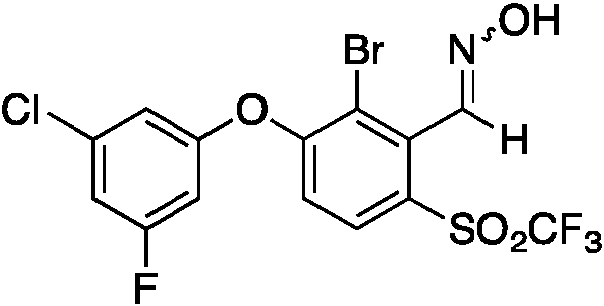
2-bromo-3-(3-cloro-5-fluorofenox¡)-6-((tr¡fluoromet¡l)sulfonil)benzaldehído oxima (Compuesto 107): Se añadió clorhidrato de hidroxilamina (5,8 mg, 0,08 mmol) a una suspensión de acetato sódico (6 ,8 mg, 0,08 mmol) y 2-bromo-3-(3-cloro-5-fluoro-fenoxi)-6-(tr¡fluorometilsulfon¡l)benzaldehído [Compuesto 101] (16 mg, 0,03 mmol) en EtOH al 95 % (0,5 ml). La mezcla resultante se agitó a temperatura ambiente durante 2 horas. La mezcla de reacción se concentró en una corriente de gas nitrógeno, después se diluyó con Na2CO31 M y acetato de etilo. Tras la separación de las capas, la capa acuosa se lavó con acetato de etilo y las capas orgánicas combinadas se lavaron con NaHCO3 saturado, NaCl saturado, se secaron sobre Na2SO4 y concentraron al vacío para dar el compuesto 107 en forma de una película incolora (23 mg, cuant.). LCMS ESI (+) m/z (M+H) 476, 478; RMN 1H (400 MHz, CDCla): 88,39 (s, 1H), 8,07 (d, 1H), 7,07 (d, 1H), 7,07-7,04 (m, 1H), 6,94-6,93 (m, 1H), 6,79-6,76 (m, 1H).2-Bromo-3- (3-chloro-5-fluorophenoxy) -6 - ((trifluoromethyl) sulfonyl) benzaldehyde oxime (Compound 107): Hydroxylamine hydrochloride (5.8 mg, 0.08 mmol) to a suspension of sodium acetate ( 6.8 mg, 0.08 mmol) and 2-bromo-3- (3-chloro-5-fluoro-phenoxy) -6- (trifluoromethylsulfonyl) benzaldehyde [Compound 101] (16 mg, 0.03 mmol) in 95% EtOH (0.5 ml). The resulting mixture was stirred at room temperature for 2 hours. The reaction mixture was concentrated under a stream of nitrogen gas, then diluted with 1M Na 2 CO 3 and ethyl acetate. After separating the layers, the aqueous layer was washed with ethyl acetate and the combined organic layers were washed with saturated NaHCO 3, saturated NaCl, dried over Na 2 SO 4, and concentrated in vacuo to give compound 107 as a colorless film (23 mg, quant.). LCMS ESI (+) m / z (M + H) 476, 478; 1H NMR (400 MHz, CDCla): 8 8.39 (s, 1H), 8.07 (d, 1H), 7.07 (d, 1H), 7.07-7.04 (m, 1H), 6.94-6.93 (m, 1H), 6.79-6.76 (m, 1H).
Ejemplo de referencia 108Reference Example 108
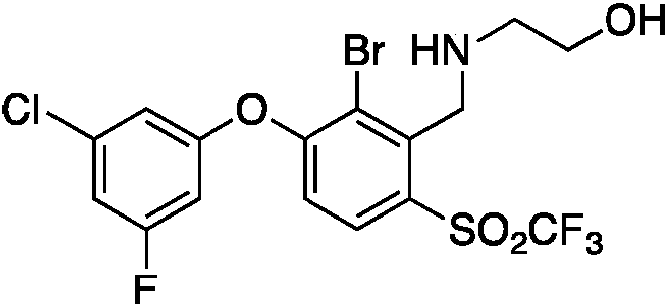
2-((2-bromo-3-(3-cloro-5-fluorofenox¡)-6-((tr¡fluorometil)sulfon¡l)benc¡l)am¡no)etan-1-ol (Compuesto 108): Se disolvió 2-bromo-3-(3-cloro-5-fluoro-fenoxi)-6-(trifluoromet¡lsulfon¡l)benzaldehído [Compuesto 101] (10 mg, 0,02 mmol) en 1,2-dicloroetano (0,1 ml) y se trató con etanolamina (1,4 pl, 0,02 mmol) y triacetoxiborohidruro sódico (14 mg, 0,06 mmol). La solución se agitó a temperatura ambiente durante 18 horas. La mezcla se inactivó mediante la adición gota a gota de HCl al 10 % hasta que se acidificó la mezcla (pH <2). Esta mezcla se agitó durante 1 hora, después se volvió a ajustar a pH 8-9 con NaHCO3 saturado y se diluyó con Et2O y agua. Tras la separación, la fase acuosa se lavó dos veces con Et2O. Las capas orgánicas combinadas se lavaron con agua, NaHCO3 saturado, NaCl saturado, se secaron sobre Na2SO4 y se concentraron al vacío. El material en bruto se cromatografió sobre SiO2 eluyendo con un gradiente de acetato de etilo/hexano para dar el compuesto 108 en forma de un aceite incoloro (3 mg, 29 %). LCMS ESI (+) m/z (M+H) 506, 508; RMN 'H (400 MHz, CDCl3): 8 8,07 (d, 1H), 7,06-7,03 (m, 1H), 6,98 (d, 1H), 6,93-6,92 (m, 1H), 6,78-6,74 (m, 1H), 4,32 (s, 2H), 3,72 (t, 2H), 2,97 (t, 2H).2 - ((2-bromo-3- (3-chloro-5-fluorophenoxy) -6 - ((trifluoromethyl) sulfonil) benzyl) amine) ethan-1-ol (Compound 108) : 2-Bromo-3- (3-chloro-5-fluoro-phenoxy) -6- (trifluoromethylsulfonic) benzaldehyde [Compound 101] (10 mg, 0.02 mmol) was dissolved in 1,2-dichloroethane (0.1 ml) and treated with ethanolamine (1.4 µl, 0.02 mmol) and sodium triacetoxyborohydride (14 mg, 0.06 mmol). The solution was stirred at room temperature for 18 hours. The mixture was quenched by dropwise addition of 10% HCl until the mixture was acidic (pH <2). This mixture was stirred for 1 hour, then re-adjusted to pH 8-9 with saturated NaHCO 3 and diluted with Et 2 O and water. After separation, the aqueous phase was washed twice with Et 2 O. The combined organic layers were washed with water, saturated NaHCO 3, saturated NaCl, dried over Na 2 SO 4, and concentrated in vacuo. The crude material was chromatographed on SiO 2 eluting with an ethyl acetate / hexane gradient to give compound 108 as a colorless oil (3 mg, 29%). LCMS ESI (+) m / z (M + H) 506, 508; NMR 'H (400 MHz, CDCl3): 8 8.07 (d, 1H), 7.06 to 7.03 (m, 1H), 6.98 (d, 1H), 6.93 to 6.92 (m, 1H), 6.78-6.74 (m, 1H), 4.32 (s, 2H), 3.72 (t, 2H), 2.97 (t, 2H).
Ejemplo de referencia 109Reference Example 109

1-(2-bromo-3-(3-cloro-5-fluorofenox¡)-6-((tr¡fluoromet¡l)sulfon¡l)fen¡l)-N-met¡lmetanam¡na (Compuesto 109): Se disolvió 2-bromo-3-(3-cloro-5-fluoro-fenoxi)-6-(trifluoromet¡lsulfon¡l)benzaldehído (30 mg, 0,06 mmol) [Compuesto 101] en ortoformiato de trimetilo (0,3 ml) y se trató con clorhidrato de metilamina (4,4 mg, 0,07 mmol) y N,N-diisopropiletilamina (17 pl, 0,06 mmol). La solución se agitó a temperatura ambiente durante 18 horas. La mezcla se trató con MeOH (0,25 ml) y triacetoxiborohidruro sódico (41 mg, 0,19 mmol) y se agitó durante 3 días. La reacción se trató con borohidruro sódico (10 mg) y se agitó durante una noche a temperatura ambiente. La mezcla se enfrió a 0 °C y se inactivó mediante la adición gota a gota de HCl al 10 % hasta que la mezcla se acidificó (pH < 2). Esta mezcla se agitó durante 1 hora, se volvió a ajustar a pH 8-9 con NaHCO3 saturado después se diluyó con Et2O y agua. Tras la separación, la fase acuosa se lavó dos veces con Et2O. Las capas orgánicas combinadas se lavaron con agua, NaHCO3 saturado, NaCl saturado, se secaron sobre Na2SO4 y se concentraron al vacío. El material en bruto se cromatografió sobre SO 2 eluyendo con un gradiente de hexano/acetato de etilo para dar el compuesto 109 en forma de un aceite incoloro (2 mg, 7 %). LCMS ESI (+) m/z (M+H) 476, 478; RMN 1 H (400 MHz, CDCl3): 8 8,06 (d, 1H), 7,05-7,02 (m, 1H), 6,97 (d, 1H), 6,91-6,90 (m, 1H), 6,76-6,72 (m, 1H), 4,25 (s, 2H), 2,57 (s, 3H).1- (2-bromo-3- (3-chloro-5-fluorophenoxy) -6 - ((trifluoromethyl) sulfonil) phenyl) -N-methylmethanamine (Compound 109) : 2-Bromo-3- (3-chloro-5-fluoro-phenoxy) -6- (trifluoromethylsulfonic) benzaldehyde (30 mg, 0.06 mmol) [Compound 101] was dissolved in trimethyl orthoformate (0 , 3 ml) and treated with methylamine hydrochloride (4.4 mg, 0.07 mmol) and N, N-diisopropylethylamine (17 µl, 0.06 mmol). The solution was stirred at room temperature for 18 hours. The mixture was treated with MeOH (0.25 ml) and sodium triacetoxyborohydride (41 mg, 0.19 mmol) and stirred for 3 days. The reaction was treated with sodium borohydride (10 mg) and stirred overnight at room temperature. The mixture was cooled to 0 ° C and was quenched by dropwise addition of 10% HCl until the mixture was acidic (pH <2). This mixture was stirred for 1 hour, re-adjusted to pH 8-9 with saturated NaHCO 3 then diluted with Et 2 O and water. After separation, the aqueous phase was washed twice with Et 2 O. The combined organic layers were washed with water, saturated NaHCO 3, saturated NaCl, dried over Na 2 SO 4, and concentrated in vacuo. The crude material was chromatographed on SO 2 eluting with a hexane / ethyl acetate gradient to give compound 109 as a colorless oil (2 mg, 7%). LCMS ESI (+) m / z (M + H) 476, 478; 1H NMR (400 MHz, CDCl3): 8 8.06 (d, 1H), 7.05-7.02 (m, 1H), 6.97 (d, 1H), 6.91 to 6.90 (m, 1H), 6.76-6.72 (m, 1H), 4.25 (s, 2H), 2.57 (s, 3H).
Ejemplo de referencia 110 Reference example 110

N-benc¡l-1-(2-bromo-3-(3-cloro-5-fluorofenox¡)-6-((tr¡fluoromet¡l)sulfon¡l)fen¡l)metanamina (Compuesto 110): Se disolvió 2-bromo-3-(3-cloro-5-fluoro-fenoxi)-6-(tr¡fluoromet¡lsulfon¡l)benzaldehído (44 mg, 0,10 mmol) [Compuesto 101] en 1,2-dicloroetano (0,4 ml) y se trató con bencilamina (11 pl, 0,10 mmol) y triacetoxiborohidruro sódico (61 mg, 0,29 mmol). La solución se agitó a temperatura ambiente durante 18 horas y el disolvente se eliminó usando una corriente de gas nitrógeno. El producto en bruto se cromatografió sobre SO 2 eluyendo con un gradiente de acetato de etilo/hexano para dar el compuesto 110 en forma de un sólido de color blanco (14,8 mg, 27 %). LCMS ESI (+) m/z (M+H) 552, 554; RMN 1H (400 MHz, CDCla): 8 8,04 (d, 1H), 7,39-7,31 (m, 4H), 7,28-7,23 (m, 1H), 7,05-7,02 (m, 1H), 6,94 (d, 1H), 6,91-6,89 (m, 1H), 6,75-6,72 (m, 1H), 4,30 (s, 2H), 3,96 (s, 2H).N-benzyl-1- (2-bromo-3- (3-chloro-5-fluorophenoxy) -6 - ((trifluoromethyl) sulfonil) phenil) methanamine (Compound 110): 2-Bromo-3- (3-chloro-5-fluoro-phenoxy) -6- (trifluoromethylsulfonyl) benzaldehyde (44 mg, 0.10 mmol) [Compound 101] was dissolved in 1,2- dichloroethane (0.4 ml) and treated with benzylamine (11 µl, 0.10 mmol) and sodium triacetoxyborohydride (61 mg, 0.29 mmol). The solution was stirred at room temperature for 18 hours and the solvent was removed using a stream of nitrogen gas. The crude product was chromatographed on SO 2 eluting with an ethyl acetate / hexane gradient to give compound 110 as a white solid (14.8 mg, 27%). LCMS ESI (+) m / z (M + H) 552, 554; 1H NMR (400 MHz, CDCla): 8 8.04 (d, 1H), 7.39-7.31 (m, 4H), 7.28-7.23 (m, 1H), 7.05 to 7 .02 (m, 1H), 6.94 (d, 1H), 6.91-6.89 (m, 1H), 6.75-6.72 (m, 1H), 4.30 (s, 2H ), 3.96 (s, 2H).
Ejemplo de referencia 111Reference Example 111

2-cloro-3-(3-cloro-5-fluorofenox¡)-6-((tr¡fluorometil)sulfon¡l)benzon¡tr¡lo Compuesto 111)2-chloro-3- (3-chloro-5-fluorophenoxy) -6 - ((trifluoromethyl) sulfonyl) benzonitrile Compound 111)
Etapa A: Preparación de 2-cloro-3-fluoro-6-mercaptobenzonitr¡lo: Se roció 2-cloro-3,6-difluoro-benzonitrilo (7,35 g, 42,4 mmol) en DMF (38 ml) con gas nitrógeno durante 5 minutos, se enfrió a 0 °C y se trató con sulfuro de sodio (3,47 g, 44,5 mmol). La suspensión de color amarillo se agitó a 0 °C durante 45 minutos. La reacción se diluyó con cloruro de metileno y NH4OH 1 M. Tras la separación, la fase acuosa se lavó con cloruro de metileno. La fase acuosa se ajustó a pH 2 con KHSO4 al 10 %, después se extrajo dos veces con cloruro de metileno. Los extractos orgánicos combinados se lavaron con agua, NaCl saturado, se secó sobre Na2SO4 y se concentró al vacío hasta un aceite de color amarillo claro (6,1 g, 75 %).Step A: Preparation of 2-chloro-3-fluoro-6-mercaptobenzonitrilo: 2-chloro-3,6-difluoro-benzonitrile (7.35 g, 42.4 mmol) in DMF (38 ml) was sprayed with Nitrogen gas for 5 minutes, cooled to 0 ° C, and treated with sodium sulfide (3.47 g, 44.5 mmol). The yellow suspension was stirred at 0 ° C for 45 minutes. The reaction was diluted with methylene chloride and 1M NH 4 OH. After separation, the aqueous phase was washed with methylene chloride. The aqueous phase was adjusted to pH 2 with 10% KHSO 4 , then extracted twice with methylene chloride. The combined organic extracts were washed with water, saturated NaCl, dried over Na 2 SO 4, and concentrated in vacuo to a light yellow oil (6.1 g, 75%).
Etapa B: Preparación de 2-cloro-3-fluoro-6-((tr¡fluorometil)t¡o)benzon¡tr¡lo: Se disolvió 2-cloro-3-fluoro-6-mercaptobenzonitrilo (6,1 g, 32 mmol) en DMF (42 ml) y se trató con dicloruro de metil viológeno (0,42 g, 1,6 mmol). Esta suspensión se enfrió a -78 °C, se trató con trietilamina (11,3 ml, 81 mmol), después se condensó gas trifluorometilyoduro (5,2 g) en la solución. El recipiente de reacción se cerró herméticamente y la mezcla se calentó directamente a temperatura ambiente y se agitó durante 14 horas. El recipiente de reacción se abrió cuidadosamente, después se eliminaron los reactivos volátiles con corriente vigorosa de nitrógeno en la solución. La mezcla se vertió en NaCl saturado, se diluyó con Et2O y se separó. La fase acuosa se lavó tres veces con Et2O y las capas orgánicas combinadas se lavaron con NaCl saturado, se secaron sobre Na2SO4 y se concentraron al vacío hasta un aceite oscuro (4,9 g). El producto en bruto se cromatografió sobre S¡O2, eluyendo con un gradiente de acetato de etilo/hexano. El producto deseado se obtuvo en forma de un aceite de color amarillo claro (3,0 g, 37 %).Step B: Preparation of 2-chloro-3-fluoro-6 - ((trifluoromethyl) thio) benzonitrile: 2-chloro-3-fluoro-6-mercaptobenzonitrile (6.1 g, 32 mmol) in DMF (42 ml) and treated with methyl viologen dichloride (0.42 g, 1.6 mmol). This suspension was cooled to -78 ° C, treated with triethylamine (11.3 ml, 81 mmol), then trifluoromethyl iodide gas (5.2 g) was condensed into the solution. The reaction vessel was sealed and the mixture was warmed directly to room temperature and stirred for 14 hours. The reaction vessel was carefully opened, then volatile reagents were removed with a vigorous stream of nitrogen from the solution. The mixture was poured into saturated NaCl, diluted with Et 2 O, and separated. The aqueous phase was washed three times with Et 2 O and the combined organic layers were washed with saturated NaCl, dried over Na 2 SO 4 and concentrated in vacuo to a dark oil (4.9 g). The crude product was chromatographed on S0 2 , eluting with an ethyl acetate / hexane gradient. The desired product was obtained as a light yellow oil (3.0 g, 37%).
Etapa C: Preparación de 2-cloro-3-fluoro-6-((tr¡fluorometil)sulfon¡l)benzon¡tr¡lo: Se disolvió 2-cloro-3-fluoro-6-((trifluorometil)t¡o)benzon¡tr¡lo (0,38 g, 1,5 mmol) en una mezcla de MeCN, CCU y agua (relación de volumen 1:1:2, 15 ml) y se añadió cloruro de rutenio (III) (9,1 mg, 0,04 mmol). Se añadió peryodato de sodio (0,94 g, 4.4 mmol) en una única porción y la mezcla se agitó a temperatura ambiente durante 4 horas. La mezcla se diluyó con cloruro de metileno y se filtró a través de un lecho de celite. El filtrado se separó y la capa acuosa se lavó con cloruro de metileno recién preparado. Los extractos combinados se pasaron a través de una capa de Florisil® (humedecida previamente con cloruro de metileno). El lecho se lavó con cloruro de metileno, después los filtrados incoloros combinados se concentraron suavemente al vacío hasta un aceite oscuro. El producto en bruto se cromatografió sobre S¡O2, eluyendo con un gradiente de acetato de etilo/hexano. Se obtuvo el producto en forma de un aceite claro que formó un sólido de color blanco después de un periodo de reposo (145 mg, 33 %).Step C: Preparation of 2-chloro-3-fluoro-6 - ((trifluoromethyl) sulfonil) benzonitro: 2-chloro-3-fluoro-6 - ((trifluoromethyl) thio was dissolved ) benzonitrile (0.38 g, 1.5 mmol) in a mixture of MeCN, CCU and water (volume ratio 1: 1: 2, 15 ml) and ruthenium (III) chloride (9 , 1 mg, 0.04 mmol). Sodium periodate (0.94 g, 4.4 mmol) was added in a single portion and the mixture was stirred at room temperature for 4 hours. The mixture was diluted with methylene chloride and filtered through a pad of celite. The filtrate was separated and the aqueous layer was washed with fresh methylene chloride. The combined extracts were passed through a layer of Florisil® (pre-moistened with methylene chloride). The bed was washed with methylene chloride, then the combined colorless filtrates were gently concentrated in vacuo to a dark oil. The crude product was chromatographed on S0 2 , eluting with an ethyl acetate / hexane gradient. The product was obtained as a clear oil which formed a white solid after a standing period (145 mg, 33%).
Etapa D: Preparación de 2-cloro-3-(3-cloro-5-fluorofenox¡)-6-((tr¡fluorometil)sulfon¡l)benzon¡tr¡lo: Se combinó 2-cloro-3 -fluoro-6 -((trifluorometil)sulfon¡l)benzon¡tr¡lo (1,08 g, 3,75 mmol) con bicarbonato sódico (573 mg, 6,82 mmol) en acetonitrilo (10 ml) y la suspensión se enfrió a 0 °C. Se añadió 3-cloro-5-fluoro-fenol (0,5 g, 3.4 mmol) a la suspensión y la mezcla se dejó calentar a temperatura ambiente y se agitó durante 60 horas. La reacción se diluyó con Na2CO3 al 10% y acetato de etilo, después se separó. La capa orgánica se lavó tres veces con Na2CO3 al 10 %, NaHCO3 saturado, se secó sobre Na2SO4 y se concentró al vacío. El material en bruto se cromatografió sobre SO2 eluyendo con un gradiente de acetato de etilo/hexano para dar el compuesto 111 en forma de un aceite incoloro (339 mg, 21 %). LCMS ESI (+) m/z (M+NH4) 431, 433; RMN 1 H (400 MHz, CDCI3): 88,08 (d, 1H), 7,23 (d, 1H), 7,14-7,11 (m, 1H), 6,98-6,96 (m, 1H), 6,83-6,79 (m, 1H).Step D: Preparation of 2-chloro-3- (3-chloro-5-fluorophenox¡) -6 - ((tr¡fluoromethyl) sulfon¡l) benzon¡tr¡lo: 2-chloro-3-fluoro- 6 - ((trifluoromethyl) sulfonil) benzonitrile (1.08 g, 3.75 mmol) with sodium bicarbonate (573 mg, 6.82 mmol) in acetonitrile (10 ml) and the suspension was cooled to 0 ° C. 3-Chloro-5-fluoro-phenol (0.5 g, 3.4 mmol) was added to the suspension and the mixture was allowed to warm to room temperature and stir for 60 hours. The reaction was diluted with 10% Na 2 CO 3 and ethyl acetate, then separated. The organic layer was washed three times with Na 2 CO 3 10%, saturated NaHCO 3 , dried over Na 2 SO 4 and concentrated in vacuo. The crude material was chromatographed on SO 2 eluting with an ethyl acetate / hexane gradient to give the compound 111 as a colorless oil (339 mg, 21 %). LCMS ESI (+) m / z (M + NH 4 ) 431, 433; 1H NMR (400 MHz, CDCI 3): 8 8.08 (d, 1H), 7.23 (d, 1H), 7.14 to 7.11 (m, 1H), 6.98 to 6.96 (m, 1H), 6.83-6.79 (m, 1H).
Ejemplo de referencia 112Reference example 112

2-cloro-3-(3-cloro-5-fluorofenoxi)-6-((tr¡fluoromet¡l)sulfon¡l)benzaldehído (Compuesto 112): Se disolvió 2-cloro-3-(3-doro-5-fluorofenoxi)-6-((trifluorometil)sulfonil)benzonitrilo [Compuesto 111] (339 mg, 0,82 mmol) en diclorometano (5 ml) y se enfrió a -20 °C. La solución se trató gota a gota con hidruro de diisobutilaluminio 1 M en heptanos (0,9 ml, 0,9 mmol) y se agitó a -20 °C durante 90 minutos, después se calentó a 0 °C y se agitó durante 90 minutos. La reacción se interrumpió a 0 °C mediante la adición gradual de HCl al 10 % (aprox. 3 ml), después se agitó la mezcla a 0 °C durante 30 minutos. La mezcla se diluyó con cloruro de metileno y agua, después se separó. La capa acuosa se lavó con cloruro de metileno y las capas orgánicas combinadas se lavaron con agua, NaHCÜ3 medio saturado, se secaron sobre Na2SÜ4 y se concentraron al vacío. El material en bruto se cromatografió sobre SiO2 eluyendo con un gradiente de hexano/acetato de etilo. El producto de elución temprana se recogió y se concentró para dar el compuesto 112 en forma de un aceite incoloro (67 mg, 19 %). RMN 1H (400 MHz, CDCl3): 8 10,43 (s, 1H), 7,96 (d, 1H), 7,15 (d, 1H), 7,09-7,07 (m, 1H), 6,95-6,94 (m, 1H), 6,80-6,77 (m, 1H).2-chloro-3- (3-chloro-5-fluorophenoxy) -6 - ((trifluoromethyl) sulfonyl) benzaldehyde (Compound 112): 2-chloro-3- (3-doro-5 -fluorophenoxy) -6 - ((trifluoromethyl) sulfonyl) benzonitrile [Compound 111] (339 mg, 0.82 mmol) in dichloromethane (5 ml) and cooled to -20 ° C. The solution was treated dropwise with 1M diisobutylaluminum hydride in heptanes (0.9 ml, 0.9 mmol) and stirred at -20 ° C for 90 minutes, then warmed to 0 ° C and stirred for 90 minutes. The reaction was quenched at 0 ° C by the gradual addition of 10% HCl (approx. 3 ml), then the mixture was stirred at 0 ° C for 30 minutes. The mixture was diluted with methylene chloride and water, then separated. The aqueous layer was washed with methylene chloride and the combined organic layers were washed with water, half saturated NaHCO3, dried over Na 2 SO 4, and concentrated in vacuo. The crude material was chromatographed on SiO 2 eluting with a hexane / ethyl acetate gradient. The early elution product was collected and concentrated to give compound 112 as a colorless oil (67 mg, 19%). 1H NMR (400 MHz, CDCl 3 ): 8 10.43 (s, 1H), 7.96 (d, 1H), 7.15 (d, 1H), 7.09-7.07 (m, 1H) , 6.95-6.94 (m, 1H), 6.80-6.77 (m, 1H).
Ejemplo de referencia 113Reference example 113

1- (2-cloro-3-(3-cloro-5-fluorofenoxi)-6-((trifluorometil)sulfonil)fenil)-N-metilmetanamina (Compuesto 113): Se disolvió 2- cloro-3-(3-cloro-5-fluorofenoxi)-6-((trifluorometil)sulfonil)benzaldehído [Compuesto 112] (20 mg, 0,05 mmol) en 1,2-dicloroetano (0,15 ml) y se trató con clorhidrato de metilamina (3,6 mg, 0,05 mmol), N,N-diisopropiletilamina (9,2 |jl, 0,05 mmol) y triacetoxiborohidruro sódico (30 mg, 0,14 mmol). La solución se agitó a temperatura ambiente durante 18 horas. La mezcla se inactivó con HCl al 10 % y se agitó durante 20 minutos. El ácido se neutralizó con NaHCÜ3 saturado, después se diluyó la suspensión con cloruro de metileno y agua. Tras la separación, la fase acuosa se lavó dos veces con cloruro de metileno y las capas orgánicas combinadas se lavaron con NaHCÜ3 medio saturado, agua, se secaron sobre Na2SÜ4 y se concentraron al vacío. El residuo se cromatografió sobre SiO2, eluyendo con un gradiente escalonado de hexano/acetato de etilo para dar el compuesto 113 en forma de un aceite incoloro (9 mg, 41 %). LCMS ESI (+) m/z (M+H) 432, 434; RMN 1H (400 MHz, CDCh): 8 8,02 (d, 1H), 7,05-7,02 (m, 1H), 7,01 (d, 1H), 6,91-6,90 (m, 1H), 6,76-6,72 (m, 1H), 4,22 (s, 2H), 2,56 (s, 3H).1- (2-chloro-3- (3-chloro-5-fluorophenoxy) -6 - ((trifluoromethyl) sulfonyl) phenyl) -N-methylmethanamine (Compound 113): 2-chloro-3- (3-chloro -5-fluorophenoxy) -6 - ((trifluoromethyl) sulfonyl) benzaldehyde [Compound 112] (20 mg, 0.05 mmol) in 1,2-dichloroethane (0.15 ml) and treated with methylamine hydrochloride (3, 6 mg, 0.05 mmol), N, N-diisopropylethylamine (9.2 µl, 0.05 mmol) and sodium triacetoxyborohydride (30 mg, 0.14 mmol). The solution was stirred at room temperature for 18 hours. The mixture was quenched with 10% HCl and stirred for 20 minutes. The acid was neutralized with saturated NaHCÜ 3, then the suspension was diluted with methylene chloride and water. After separation, the aqueous phase was washed twice with methylene chloride the combined organic layers were washed with saturated environment NaHCÜ 3, water, dried over Na 2 SÜ 4 and concentrated under vacuum. The residue was chromatographed on SiO 2 , eluting with a hexane / ethyl acetate step gradient to give compound 113 as a colorless oil (9 mg, 41%). LCMS ESI (+) m / z (M + H) 432, 434; 1H NMR (400 MHz, CDCH) 8 8.02 (d, 1H), 7.05-7.02 (m, 1H), 7.01 (d, 1H), 6.91 to 6.90 (m , 1H), 6.76-6.72 (m, 1H), 4.22 (s, 2H), 2.56 (s, 3H).
Ejemplo de referencia 114Reference example 114

N-(2-cloro-3-(3-cloro-5-fluorofenoxi)-6-((trifluorometil)sulfonil)bencil)-2-fluoroetan-1-amina (Compuesto 114): Se disolvió 2-cloro-3-(3-cloro-5-fluorofenoxi)-6-((trifluorometil)sulfonil)benzaldehído [Compuesto 112] (20 mg, 0,05 mmol) en 1,2-dicloroetano (0,15 ml) y se trató con clorhidrato de 2-fluoroetilamina (5,2 jl, 0,05 mmol) y triacetoxiborohidruro sódico (30 mg, 0,14 mmol). La solución se agitó a temperatura ambiente durante 18 horas. La mezcla se inactivó con HCl al 10 % y se agitó durante 20 minutos. El ácido se neutralizó con NaHCÜ3 saturado, después se diluyó con cloruro de metileno y agua. Tras la separación, la fase acuosa se lavó dos veces con cloruro de metileno y las capas orgánicas combinadas se lavaron con NaHCÜ3 medio saturado, agua, se secaron sobre Na2SÜ4 y se concentraron al vacío. El residuo se cromatografió sobre SiO2, eluyendo con un gradiente escalonado de hexano/acetato de etilo para dar el compuesto 114 en forma de un aceite incoloro (5,9 mg, 25 %). LCMS ESI (+) m/z (M+H) 464, 466; RMN 1H (400 MHz, CDCI3): 8 8,02 (d, 1H), 7,06-7,03 (m, 1H), 7,01 (d, 1H), 6,92 (m, 1H), 6,77 6,73 (m, 1H), 4,64 (t, 1H), 4,52 (t, 1H), 4,34 (s, 2H), 3,11-3,09 (m, 1H), 3,04-3,02 (m, 1H).N- (2-chloro-3- (3-chloro-5-fluorophenoxy) -6 - ((trifluoromethyl) sulfonyl) benzyl) -2-fluoroethane-1-amine (Compound 114): 2-chloro-3- was dissolved (3-chloro-5-fluorophenoxy) -6 - ((trifluoromethyl) sulfonyl) benzaldehyde [Compound 112] (20 mg, 0.05 mmol) in 1,2-dichloroethane (0.15 ml) and treated with hydrochloride 2-fluoroethylamine (5.2 µl, 0.05 mmol) and sodium triacetoxyborohydride (30 mg, 0.14 mmol). The solution was stirred at room temperature for 18 hours. The mixture was quenched with 10% HCl and stirred for 20 minutes. The acid was neutralized with saturated NaHCÜ 3, then diluted with methylene chloride and water. After separation, the aqueous phase was washed twice with methylene chloride the combined organic layers were washed with saturated environment NaHCÜ 3, water, dried over Na 2 SÜ 4 and concentrated under vacuum. The residue was chromatographed on SiO 2 , eluting with a hexane / ethyl acetate step gradient to give compound 114 as a colorless oil (5.9 mg, 25%). LCMS ESI (+) m / z (M + H) 464, 466; 1H NMR (400 MHz, CDCI 3): 8 8.02 (d, 1H), 7.06 to 7.03 (m, 1H), 7.01 (d, 1H), 6.92 (m, 1H) , 6.77 6.73 (m, 1H), 4.64 (t, 1H), 4.52 (t, 1H), 4.34 (s, 2H), 3.11-3.09 (m, 1H), 3.04-3.02 (m, 1H).
Ejemplo de referencia 115Reference example 115

(S)-4-((5-clorop¡r¡d¡n-3-¡l)ox¡)-2,2-d¡fluoro-7-(met¡lsulfon¡l)-2,3-d¡h¡dro-1H-¡nden-1-ol (Compuesto 115)(S) -4 - ((5-chloropyr¡d¡n-3-¡l) ox¡) -2,2-d¡fluoro-7- (meth¡lsulfon¡l) -2,3-d Hydro-1H-inden-1-ol (Compound 115)
Etapa A: Preparac¡ón de 4-((5-clorop¡r¡d¡n-3-¡l)ox¡)-7-(met¡lsulfon¡l)-2,3-d¡h¡dro-1H-¡nden-1-ona: 3-cloro-5-((7-(met¡lsulfon¡l)-2,3-d¡h¡droesp¡ro[¡nden-1,2'-[1,3]d¡oxolan]-4-¡l)ox¡)p¡r¡d¡na [preparada de forma s¡m¡lar a la descr¡ta en el ejemplo de referenc¡a 8 , etapa B ut¡l¡zando 3-cloro-5-h¡drox¡p¡r¡d¡na ] (340 mg, 0,89 mmol) se d¡solv¡ó en acetona/agua 6:1 (4,4 ml) y se trató con p-toluenosulfonato de p¡r¡d¡n¡o (22,4 mg, 0,090 mmol). La mezcla se calentó a 82 °C en una botella cerrada hermét¡camente durante 18 horas. La reacc¡ón se enfr¡ó y se concentró en una comente de gas n¡trógeno. El sól¡do resultante se d¡solv¡ó de nuevo en acetato de et¡lo y la fase orgán¡ca se lavó dos veces con NaHCO3 saturado, NaCl saturado, se secó sobre Na2SO4 y se concentró al vacío hasta un sól¡do de color blanco (300 mg, cuant.).Stage A: Preparation of 4 - ((5-chloropyr¡d¡n-3-¡l) ox¡) -7- (meth¡lsulfon¡l) -2,3-d¡h¡dro- 1H-inden-1-one: 3-chloro-5 - ((7- (meth¡lsulfon¡l) -2,3-d¡h¡droesp¡ro [¡nden-1,2 '- [1, 3] d¡oxolan] -4-¡l) ox¡) p¡r¡d¡na [prepared in a similar way to that described in reference example 8 , step B ut¡l By means of 3-chloro-5-hydroxypyryna] (340 mg, 0.89 mmol) it was dissolved in 6: 1 acetone / water (4.4 ml) and treated with p¡r¡d¡no p-toluenesulfonate (22.4 mg, 0.090 mmol). The mixture was heated to 82 ° C in a sealed bottle for 18 hours. The reaction was cooled and concentrated in a stream of nitrogen gas. The resulting solid was again dissolved in ethyl acetate and the organic phase was washed twice with saturated NaHCO 3, saturated NaCl, dried over Na 2 SO 4 and concentrated in vacuo until a white solid (300 mg, quant.).
Etapa B: Preparac¡ón de (E,Z)-N-but¡l-4-((5-clorop¡r¡d¡n-3-¡l)ox¡)-7-(met¡lsulfon¡l)-2,3-d¡h¡dro-1H-¡nden-1-¡m¡na: Se d¡solv¡ó 4-((5-clorop¡r¡d¡n-3-¡l)ox¡)-7-(met¡lsulfon¡l)-2,3-d¡h¡dro-1H-¡nden-1-ona (300 mg, 0,89 mmol) en benceno (10 ml) y se trató con but¡lam¡na (1,67 ml, 16,9 mmol) y ác¡do tr¡fluoroacét¡co (0,03 ml, 0,44 mmol), después la mezcla se calentó a reflujo a través de un purgador Dean-Stark durante 2,5 horas. El progreso de la reacc¡ón se s¡gu¡ó med¡ante RMN 1 H. La mezcla de reacc¡ón se enfr¡ó y se concentró al vacío. El res¡duo se d¡solv¡ó de nuevo en acetato de et¡lo y NaHCO3 saturado, después se separó. La capa orgán¡ca se lavó con NaHCO3 saturado, NaCl saturado, se secó sobre Na2SO4 y se concentró al vacío hasta un res¡duo pegajoso (355 mg). la RMN 1H de este mater¡al mostró que estaban presentes ambos ¡sómeros de ¡m¡na.Step B: Preparation of (E, Z) -N-but¡l-4 - ((5-chloropyr¡d¡n-3-¡l) ox¡) -7- (meth¡lsulfon¡l ) -2,3-d¡h¡dro-1H-¡nden-1-¡m¡na: 4 - ((5-chloropy¡r¡d¡n-3-¡l) ox ¡) -7- (methylsulfon¡l) -2,3-d¡hydro-1H-inden-1-one (300 mg, 0.89 mmol) in benzene (10 ml) and treated with butylamine (1.67 ml, 16.9 mmol) and trifluoroacetic acid (0.03 ml, 0.44 mmol), then the mixture was heated to reflux through a Dean trap -Stark for 2.5 hours. The progress of reacc¡ón is s¡gu¡ó med¡ante 1 H NMR reacc¡ón mixture was enfr¡ó and concentrated under vacuum. The residue was again dissolved in ethyl acetate and saturated NaHCO 3 , then separated. The organic layer was washed with saturated NaHCO 3, saturated NaCl, dried over Na 2 SO 4 and concentrated in vacuo to a sticky residue (355 mg). 1H NMR of this material showed that both isomers of mine were present.
Etapa C: Preparac¡ón de 4-((5-clorop¡r, cuant.¡d¡n-3-¡l)ox¡)-2,2-d¡fluoro-7-(met¡lsulfon¡l)-2,3-d¡h¡dro-1H-¡nden-1-ona: Se trató (E,Z)-A/-but¡l-4-((5-clorop¡r¡d¡n-3-¡l)ox¡)-7-(met¡lsulfon¡l)-2,3-d¡h¡dro-1H-¡nden-1-¡m¡na (150 mg, 0,38 mmol) con sulfato sód¡co (542 mg, 3,8 mmol), después se d¡solv¡ó MeCN seco (4,8 ml). La suspens¡ón se trató con Selectfluor® (338 mg, 0,95 mmol). El matraz y el condensador se lavaron con argón y se calentaron a 82 °C durante 5,5 horas en comente de argón, después se ag¡taron durante 9 horas a temperatura amb¡ente. La mezcla se trató con ác¡do clorhídr¡co concentrado (0,95 ml, 11,4 mmol) y se ag¡tó durante 20 m¡nutos a temperatura amb¡ente. Toda la mezcla se concentró al vacío para el¡m¡nar los d¡solventes volát¡les. La suspens¡ón resultante se d¡luyó con acetato de et¡lo y agua, después se separó. La capa orgán¡ca se lavó con agua, NaHCO3 saturado, NaCl saturado, se secó sobre Na2SO4 y se concentró al vacío hasta un sól¡do. El mater¡al en bruto se pur¡f¡có sobre SO 2 eluyendo con un grad¡ente de acetato de et¡lo/hexano. El mater¡al deseado se recog¡ó y se concentró hasta un sól¡do de color blanco (91 mg, 63 %).Step C: Preparation of 4 - ((5-chloropyr, quant.d¡n-3-¡l) ox¡) -2,2-d¡fluoro-7- (methylsulfon¡l) -2,3-d¡h¡dro-1H-¡nden-1-one: (E, Z) -A / -but¡l-4 - ((5-chloropyr¡d¡n-3 -¡L) ox¡) -7- (methylsulfon¡l) -2,3-d¡h¡dro-1H-inden-1-im¡na (150 mg, 0.38 mmol) with sulfate sodium (542 mg, 3.8 mmol), then dry MeCN (4.8 ml) was dissolved. The suspension was treated with Selectfluor® (338 mg, 0.95 mmol). The flask and condenser were flushed with argon and heated at 82 ° C for 5.5 hours under argon, then stirred for 9 hours at room temperature. The mixture was treated with concentrated hydrochloric acid (0.95 ml, 11.4 mmol) and stirred for 20 minutes at room temperature. The entire mixture was concentrated in vacuo to remove the volatile solvents. The resulting suspension was diluted with ethyl acetate and water, then separated. The organic layer was washed with water, saturated NaHCO 3, saturated NaCl, dried over Na 2 SO 4, and concentrated in vacuo to a solid. The crude material was purified over SO 2 eluting with an ethyl acetate / hexane gradient. The desired material was collected and concentrated to a white solid (91 mg, 63%).
Etapa D: Preparac¡ón de (S)-4-((5-clorop¡r¡d¡n-3-¡l)ox¡)-2,2-d¡fluoro-7-(met¡lsulfon¡l)-2,3-d¡h¡dro-1H-¡nden-1-ol: Se d¡solv¡ó 4-((5-clorop¡r¡d¡n-3-¡l)ox¡)-2,2-d¡fluoro-7-(met¡lsulfon¡l)-2,3-d¡h¡dro-1H-¡nden-1-ona (89 mg, 0,24 mmol) en cloruro de met¡leno (1,1 ml), se trató con tr¡et¡lam¡na (0,07 ml, 0,48 mmol) y ác¡do fórm¡co (0,03 ml, 0,7 mmol), después se enfr¡ó hasta 0 °C. La soluc¡ón se trató con una soluc¡ón fría de RuCl(p-c¡meno)[(E,E)-Ts-DPEN] (1,5 mg) d¡suelto en cloruro de met¡leno (1,1 ml). La mezcla de reacc¡ón se transf¡r¡ó al refr¡gerador y se dejó reposar a 4 °C durante 60 horas. La mezcla se concentró al vacío y se cromatograf¡ó sobre SO 2 eluyendo con un grad¡ente de acetato de et¡lo/hexano. El producto se concentró al vacío hasta un ace¡te ¡ncoloro. El ace¡te se d¡solv¡ó en cloruro de met¡leno y hexano y se volv¡ó a concentrar para dar el compuesto 115 en forma de un sól¡do de color blanco (64 mg, 70 %). La estereopureza era > 95 % de ee, según se determ¡nó med¡ante anál¡s¡s del éster de Mosher. LCMS ESI (+) m/z (M+H) 376, 378; RMN 1H (400 MHz, CDCh): 8 8,50-8,49 (m, 1H), 8,36 8,35 (m, 1H), 7,89 (d, 1H), 7,43 (t, 1H), 6,93 (d, 1H), 5,62-5,58 (m, 1H), 3,62-3,40 (m, 3H), 3,22 (s, 3H).Step D: Preparation of (S) -4 - ((5-chloropyr¡d¡n-3-¡l) ox¡) -2,2-d¡fluoro-7- (met¡lsulfon¡l ) -2,3-d¡h¡dro-1H-inden-1-ol: 4 - ((5-chloropy¡d¡n-3-¡l) ox¡) was dissolved 2,2-d¡fluoro-7- (methylsulfon¡l) -2,3-d¡hydro-1H-nden-1-one (89 mg, 0.24 mmol) in methyl chloride leno (1.1 ml), treated with triethylamine (0.07 ml, 0.48 mmol) and formic acid (0.03 ml, 0.7 mmol), then cooled to 0 ° C. The solution was treated with a cold solution of RuCl (pcmene) [(E, E) -Ts-DPEN] (1.5 mg) dissolved in methylene chloride (1.1 ml ). The reaction mixture was transferred to the refrigerator and allowed to stand at 4 ° C for 60 hours. The mixture was concentrated in vacuo and chromatographed over SO 2 eluting with an ethyl acetate / hexane gradient. The product was concentrated in vacuo to a colorless oil. The oil was dissolved in methylene chloride and hexane and reconcentrated to give compound 115 as a white solid (64 mg, 70%). The stereopurity was> 95% ee, as determined by Mosher ester analysis. LCMS ESI (+) m / z (M + H) 376, 378; 1H NMR (400 MHz, CDCh): 8 8.50-8.49 (m, 1H), 8.36 8.35 (m, 1H), 7.89 (d, 1H), 7.43 (t, 1H), 6.93 (d, 1H), 5.62-5.58 (m, 1H), 3.62-3.40 (m, 3H), 3.22 (s, 3H).
Ejemplo de referencia 116Reference Example 116

2-bromo-1-(3-cloro-5-fluorofenox¡)-4-((tr¡fluoromet¡l)sulfon¡l)benceno (Compuesto 116) 2-bromo-1- (3-chloro-5-fluorophenoxy) -4 - ((trifluoromethyl) sulfonil) benzene (Compound 116)
Etapa A: Preparación de í3-bromo-4-fluorofen¡lWtr¡fluorometil)sulfano: Se condensó trifluorometilyoduro (2,84 g, 14,5 mmol) en una solución se contenía 3-bromo-4-fluorobencenotiol (1,00 g, 4,8 mmol), dicloruro de metil viológeno (l18 mg, 0,48 mmol) y Et3N (1,68 ml, 12,1 mmol) en DMF (6,4 ml) a -78 °C. El tubo cerrado de cierre hermético se tapó rápidamente con un tapón de teflón roscado y se cerró herméticamente. Después, la mezcla de reacción se calentó a temperatura ambiente y se agitó durante 39 horas. La mezcla de reacción se enfrió a-78 °C y se abrió cuidadosamente, se vertió en salmuera (20 ml), se extrajo con Et2O (5 x 40 ml), se lavó con salmuera (20 ml), se secó (Na2SO4) y se concentró al vacío. El producto en bruto se purificó sobre gel de sílice (50 g SNAP, 16 CV, 1-20% de EtOAc/hexanos) proporcionando (3-bromo-4-fluorofenil)(trifluorometil)sulfano (1,2 g, 90 % de rendimiento) en forma de un aceite transparente, incoloro.Step A: Preparation of 3-bromo-4-fluorophenylWtr¡fluoromethyl) sulfane: Trifluoromethyliodide (2.84 g, 14.5 mmol) was condensed into a solution containing 3-bromo-4-fluorobenzenethiol (1.00 g , 4.8 mmol), methyl viologen dichloride (18 mg, 0.48 mmol) and Et 3 N (1.68 ml, 12.1 mmol) in DMF (6.4 ml) at -78 ° C. The closed, sealable tube was quickly capped with a threaded Teflon plug and sealed. The reaction mixture was then warmed to room temperature and stirred for 39 hours. The reaction mixture was cooled to -78 ° C and carefully opened, poured into brine (20 ml), extracted with Et2O (5 x 40 ml), washed with brine (20 ml), dried (Na 2 SO 4 ) and concentrated in vacuo. The crude product was purified on silica gel (50 g SNAP, 16 CV, 1-20% EtOAc / hexanes) to provide (3-bromo-4-fluorophenyl) (trifluoromethyl) sulphane (1.2 g, 90% yield) as a clear, colorless oil.
Etapa B: Preparación de 2-bromo-1-fluoro-4-((tr¡fluoromet¡l)sulfon¡l)benceno: Se añadió peryodato de sodio (2,80 g, 13,1 mmol) de una vez a (3-bromo-4-fluorofenil)(trifluorometil)sulfano (1,20 g, 4,4 mmol) y RuCh (22,6 mg, 0,11 mmol) en MeCN (10 ml)/CCU (10 ml)/H2O (20 ml) a temperatura ambiente y se agitó durante 2 horas. La mezcla de reacción se extrajo con EtOAc (3 x 50 ml), se lavó con salmuera (30 ml), se secó (Na2SO4), se filtró y se concentró al vacío. El producto en bruto se purificó sobre gel de sílice (25 g SNAP, 14 CV, 2-20 % de EtOAc/hexano) proporcionando 2-bromo-1-fluoro-4-((trifluorometil)sulfonil)benceno (1,14 g, 85 %) en forma de un aceite transparente, incoloro que se convirtió en un sólido de color blanco después de un periodo de reposo. Etapa C: Preparación de 2-bromo-1-(3-cloro-5-fluorofenox¡)-4-((tr¡fluoromet¡l)sulfon¡l)benceno (Compuesto 116): Se añadió carbonato de cesio (358 mg, 1,1 mmol) de una vez a 2-bromo-1-fluoro-4-((trifluorometil)sulfonil)benceno (307 mg, 1,0 mmol) y 3-cloro-5-fluorofenol (161 mg, 1,1 mmol) en NMP (3,0 ml), después se calentó a 50 °C y se agitó durante 1,5 horas. La mezcla se enfrió a temperatura ambiente y se purificó directamente sobre gel de sílice de fase inversa (25+M, 14 CV, 20-100 % de MeCN/agua) proporcionando el compuesto 116 (389 mg, 90 % de rendimiento) en forma de un sólido de color blanco. LCMS ESI (-) m/z 431 (M-H). RMN 1 H (400 MHz, CDCla): 88,30 (d, 1 H), 7,93 (m, 1 H), 7,08-7,02 (m, 2 H), 6,93-6,91 (m, 1 H), 6,78-6,74 (m, 1 H).Step B: Preparation of 2-bromo-1-fluoro-4 - ((trifluoromethyl) sulfonyl) benzene: Sodium periodate (2.80 g, 13.1 mmol) was added all at once to ( 3-bromo-4-fluorophenyl) (trifluoromethyl) sulphane (1.20 g, 4.4 mmol) and RuCh (22.6 mg, 0.11 mmol) in MeCN (10 ml) / CCU (10 ml) / H 2 O (20 ml) at room temperature and stirred for 2 hours. The reaction mixture was extracted with EtOAc (3 x 50 ml), washed with brine (30 ml), dried (Na 2 SO 4 ), filtered and concentrated in vacuo. The crude product was purified on silica gel (25 g SNAP, 14 CV, 2-20% EtOAc / hexane) to provide 2-bromo-1-fluoro-4 - ((trifluoromethyl) sulfonyl) benzene (1.14 g , 85%) as a clear, colorless oil that became a white solid after a standing period. Step C: Preparation of 2-bromo-1- (3-chloro-5-fluorophenoxy) -4 - ((trifluoromethyl) sulfonil) benzene (Compound 116): Cesium carbonate (358 mg , 1.1 mmol) at once to 2-bromo-1-fluoro-4 - ((trifluoromethyl) sulfonyl) benzene (307 mg, 1.0 mmol) and 3-chloro-5-fluorophenol (161 mg, 1, 1 mmol) in NMP (3.0 ml), then heated to 50 ° C and stirred for 1.5 hours. The mixture was cooled to room temperature and purified directly on reverse phase silica gel (25 + M, 14 CV, 20-100% MeCN / water) to provide compound 116 (389 mg, 90% yield) as of a white solid. LCMS ESI (-) m / z 431 (MH). 1 H NMR (400 MHz, CDCla): 88.30 (d, 1H), 7.93 (m, 1H), 7.08-7.02 (m, 2H), 6.93-6, 91 (m, 1H), 6.78-6.74 (m, 1H).
Ejemplo de referencia 117Reference Example 117
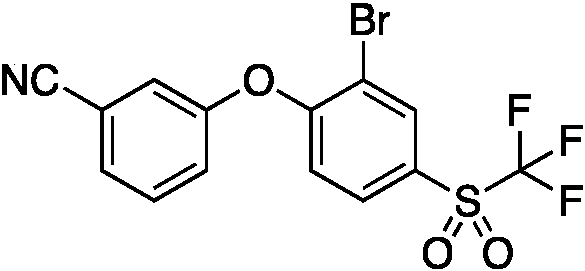
3-(2-bromo-4-((tr¡fluoromet¡l)sulfon¡l)fenox¡)benzon¡tr¡lo (Compuesto 117): Se añadió carbonato de cesio (38,0 mg, 0,12 mmol) a 2-bromo-1-fluoro-4-((trifluorometil)sulfonil)benceno (30,0 mg, 0,10 mmol) y 3-hidroxibenzonitrilo (14,0 mg, 0,12 mmol) en NMP (0,5 ml) y después se calentó a 50 °C durante 5 horas. Se purificó directamente sobre gel de sílice de fase inversa (12+M, 14 CV) eluyendo con 20-100 % de MeCN/agua proporcionando el compuesto 117 (35,6 mg, 0,09 mmol, 90 % de rendimiento) en forma de un aceite de color blanco. lCm S ESI (-) m/z 404 (M-H). Ejemplo de referencia 1183- (2-bromo-4 - ((trifluoromethyl) sulfonil) phenoxy) benzonitrile (Compound 117): Cesium carbonate (38.0 mg, 0.12 mmol) was added to 2-bromo-1-fluoro-4 - ((trifluoromethyl) sulfonyl) benzene (30.0 mg, 0.10 mmol) and 3-hydroxybenzonitrile (14.0 mg, 0.12 mmol) in NMP (0.5 ml) and then heated at 50 ° C for 5 hours. It was purified directly on reverse phase silica gel (12 + M, 14 CV) eluting with 20-100% MeCN / water to provide compound 117 (35.6 mg, 0.09 mmol, 90% yield) as of a white oil. l C m S ESI (-) m / z 404 (MH). Reference example 118

3-(2-bromo-4-((tr¡fluoromet¡l)sulfon¡l)fenox¡)-5-fluorobenzon¡tr¡lo (Compuesto 118): Se añadió carbonato de cesio (46,0 mg, 0,14 mmol) de una vez a 2-bromo-1-fluoro-4-((trifluorometil)sulfonil)benceno (40,0 mg, 0,13 mmol) y 3-fluoro-5-hidroxibenzonitrilo (20,0 mg, 0,14 mmol) en NMP (0,5 ml) y después se calentó a 50 °C y se agitó durante 1,5 horas. La mezcla de reacción se enfrió a temperatura ambiente y se purificó directamente sobre gel de sílice de fase inversa (12+M, 14 CV, 30-100 % de MeCN/agua) proporcionando el compuesto 118 (50 mg, 0,12 mmol, 91 % de rendimiento) en forma de un sólido de color blanco. Lc Ms ESI (-) m/z 422 (M-H).3- (2-bromo-4 - ((trifluoromethyl) sulfonyl) phenoxy) -5-fluorobenzonetryl (Compound 118): Cesium carbonate (46.0 mg, 0.10 mg) was added. 14 mmol) at once to 2-bromo-1-fluoro-4 - ((trifluoromethyl) sulfonyl) benzene (40.0 mg, 0.13 mmol) and 3-fluoro-5-hydroxybenzonitrile (20.0 mg, 0 , 14 mmol) in NMP (0.5 ml) and then heated to 50 ° C and stirred for 1.5 hours. The reaction mixture was cooled to room temperature and purified directly on reverse phase silica gel (12 + M, 14 CV, 30-100% MeCN / water) to provide compound 118 (50 mg, 0.12 mmol, 91% yield) as a white solid. Lc Ms ESI (-) m / z 422 (M-H).
Ejemplo de referencia 119 Reference Example 119
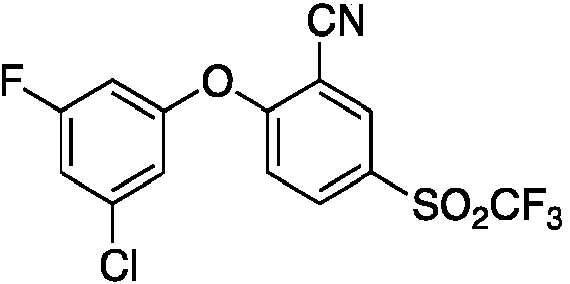
2-(3-cloro-5-fluorofenox¡)-5-((tr¡fluoromet¡l)sulfon¡l)benzonitr¡lo (Compuesto 119): Se añadió Pd(PPh3)4 (14,4 mg, 0,013 mmol) de una vez a Zn(CN)2 (8,8 mg, 0,08 mmol) y 2-bromo-1-(3-cloro-5-fluorofenox¡)-4-((trifluorometil)sulfonil)benceno (54,0 mg, 0,13 mmol) en NMP (1,0 ml) en atmósfera de n¡trógeno, después se evacuó y se volvió a llenar con nitrógeno cinco veces. La mezcla de reacción se calentó después a 100 °C durante 4 horas. La mezcla de reacción se enfrió a temperatura ambiente, se diluyó con agua (5 ml), se extrajo con Et2O (4 x 10 ml), se lavó con salmuera (10 ml), se secó (Na2SO4), se filtró y se concentró al vacío. El producto en bruto se purificó sobre gel de sílice (10 g SNAP, 14 CV) eluyendo con 1-24% de EtOAc/hexano proporcionando el compuesto 119 (28,4 mg, 0,08 mmol, 60 %) en forma de un aceite transparente. LCMS ESI (-) m/z 379 (M-H); RMN 1 H (400 MHz, CDCla): 88,35 (d, 1 H), 8,13 (m, 1 H), 7,16-7,13 (m, 1 H), 7,11 (d, 1 H), 7,03-7,01 (m, 1 H), 6,88-6,85 (m, 1 H).2- (3-Chloro-5-fluorophenoxy) -5 - ((trifluoromethyl) sulfonil) benzonitrol (Compound 119): Pd (PPh 3 ) 4 (14.4 mg, 0.013) was added mmol) at once to Zn (CN) 2 (8.8 mg, 0.08 mmol) and 2-bromo-1- (3-chloro-5-fluorophenoxy) -4 - ((trifluoromethyl) sulfonyl) benzene ( 54.0 mg, 0.13 mmol) in NMP (1.0 mL) under nitrogen atmosphere, then evacuated and refilled with nitrogen five times. The reaction mixture was then heated at 100 ° C for 4 hours. The reaction mixture was cooled to room temperature, diluted with water (5 ml), extracted with Et 2 O (4 x 10 ml), washed with brine (10 ml), dried (Na 2 SO 4 ), filtered and concentrated in vacuo. The crude product was purified on silica gel (10 g SNAP, 14 CV) eluting with 1-24% EtOAc / hexane to provide compound 119 (28.4 mg, 0.08 mmol, 60%) as a transparent oil. LCMS ESI (-) m / z 379 (MH); 1 H NMR (400 MHz, CDCla): 88.35 (d, 1H), 8.13 (m, 1H), 7.16-7.13 (m, 1H), 7.11 (d, 1H), 7.03-7.01 (m, 1H), 6.88-6.85 (m, 1H).
Ejemplo de referencia 120Reference example 120

2-(3-c¡ano-5-fluorofenox¡)-5-((tr¡fluorometil)sulfon¡l)benzon¡tr¡lo_____ (Compuesto_____ 120): Se añadió tetrakis(trifen¡lfosf¡na)palad¡o (O) (12,8 mg, 0,01 mmol) de una vez a Zn(CN)2 (7,8 mg, 0,07 mmol) y 3-(2-bromo-4-((trifluoromet¡l)sulfon¡l)fenoxi)-5-fluorobenzon¡tr¡lo (47 mg, 0,11 mmol) en NMP (1,0 ml) en atmósfera de nitrógeno, después se evacuó y se volvió a llenar con nitrógeno cinco veces. La mezcla de reacción se calentó después a 100 °C durante 6 horas. La mezcla de reacción se enfrió a temperatura ambiente, se diluyó con agua (5 ml), se extrajo con Et2O (4 x 10 ml), se lavó con salmuera (10 ml), se secó (Na2SO4), se filtró y se concentró al vacío. El producto en bruto se purificó sobre gel de sílice de fase inversa (12+M, 20-100 % de MeCN/agua, 14 CV), después gel de sílice (10 g SNAP, 5-40 % de EtOAc/hexano, 14 CV) proporcionando el compuesto 120 (10 mg, 0,03 mmol, 24 % de rendimiento) en forma de un aceite transparente que formó un sólido de color blanco después de un periodo de reposo. LCMS ESI (-) m/z 369 (M-H).2- (3-kano-5-fluorophenoxy) -5 - ((trifluoromethyl) sulfonil) benzonitl _____ (Compound_____ 120): Tetrakis (triphenylphosphine) palladium was added (O) (12.8 mg, 0.01 mmol) at once to Zn (CN) 2 (7.8 mg, 0.07 mmol) and 3- (2-bromo-4 - ((trifluoromethyl) sulfonic) phenoxy) -5-fluorobenzonetrilo (47 mg, 0.11 mmol) in NMP (1.0 ml) under nitrogen atmosphere, then evacuated and refilled with nitrogen five times. The reaction mixture was then heated at 100 ° C for 6 hours. The reaction mixture was cooled to room temperature, diluted with water (5 ml), extracted with Et 2 O (4 x 10 ml), washed with brine (10 ml), dried (Na 2 SO 4 ), filtered and concentrated in vacuo. The crude product was purified on reverse phase silica gel (12 + M, 20-100% MeCN / water, 14 CV), then silica gel (10 g SNAP, 5-40% EtOAc / hexane, 14 CV) to provide compound 120 (10 mg, 0.03 mmol, 24% yield) as a clear oil which formed a white solid after a standing period. LCMS ESI (-) m / z 369 (MH).
Ejemplo de referencia 121Reference example 121

2-(3-cloro-5-fluorofenox¡)-5-((trifluoromet¡l)sulfon¡l)benzoato de metilo (Compuesto 121): Se añadió trietilamina (106 |jl, 0,76 mmol) gota a gota a una mezcla de 2-bromo-1-(3-cloro-5-fluorofenoxi)-4-((trifluoromet¡l)sulfon¡l)benceno (110 mg, 0,25 mmol), Pd(OAc)2 (5,7 mg, 0,025 mmol) y 1,3-bis(difen¡lfosf¡no)propano (10,5 mg, 0,025 mmol) en DMF (1,5 ml) y MeOH (1,0 ml) que se había saturado con monóxido de carbono. La mezcla de reacción se calentó después a 80 °C a presión de un globo de monóxido de carbono durante 3,5 horas. La mezcla de reacción se enfrió a temperatura ambiente y se purificó directamente sobre gel de sílice de fase inversa (25+M, 20-100 % de MeCN/agua, 16 CV) proporcionando el compuesto 121 (47 mg, 45 % de rendimiento) en forma de un aceite transparente incoloro. LCMS ESI (-) m/z 411 (M-H); RMN 1 H (400 MHz, CDCla): 88,58 (d, 1 H), 8,10-8,07 (m, 1 H), 7,14 (d, 1 H), 7,03-7,00 (m, 1 H), 6,91-6,90 (m, 1 H), 6,77-6,73 (m, 1 H), 3,94 (s, 3 H).Methyl 2- (3-chloro-5-fluorophenoxy) -5 - ((trifluoromethyl) sulfonyl) benzoate (Compound 121): Triethylamine (106 µl, 0.76 mmol) was added dropwise to a mixture of 2-bromo-1- (3-chloro-5-fluorophenoxy) -4 - ((trifluoromethyl) sulfonil) benzene (110 mg, 0.25 mmol), Pd (OAc) 2 (5, 7 mg, 0.025 mmol) and 1,3-bis (diphenylphosphine) propane (10.5 mg, 0.025 mmol) in DMF (1.5 ml) and MeOH (1.0 ml) that had been saturated with carbon monoxide. The reaction mixture was then heated at 80 ° C under balloon pressure of carbon monoxide for 3.5 hours. The reaction mixture was cooled to room temperature and purified directly on reverse phase silica gel (25 + M, 20-100% MeCN / water, 16 CV) to provide compound 121 (47 mg, 45% yield) in the form of a colorless transparent oil. LCMS ESI (-) m / z 411 (MH); 1H NMR (400 MHz, CDCla): 88.58 (d, 1H), 8.10 to 8.07 (m, 1H), 7.14 (d, 1H), 7.03 to 7, 00 (m, 1H), 6.91-6.90 (m, 1H), 6.77-6.73 (m, 1H), 3.94 (s, 3H).
Ejemplo de referencia 122 Reference Example 122

(2-(3-cloro-5-fluorofenox¡)-5-((tr¡fluoromet¡l)sulfonil)fen¡l)metanol (Compuesto 122): Se añadió DIBAL (1 M en heptanos, 174 pl, 0,17 mmol) gota a gota a 2-(3-cloro-5-fluorofenoxi)-5-((tr¡fluoromet¡l)sulfon¡l)benzoato de metilo (24 mg, 0,06 mmol) en CH2Cl2 (0,5 ml) a 0 °C y se agitó durante 1 hora. El exceso de DIBAL se inactivó mediante la adición cuidadosa de acetona (0,5 ml). La mezcla se diluyó con agua (2 ml), se extrajo con diclorometano (3 x 5 ml), se lavó con salmuera (5 ml), se secó (Na2SO4), se filtró y se concentró. El producto en bruto se purificó sobre gel de sílice (10 g SNAP, 14 CV, 20-55 % de EtOAc/hexano) proporcionando el compuesto 122 (16 mg, 0,04 mmol, 72 % de rendimiento) en forma de un aceite transparente. LCMS ESI (-) m/z 383 (M-H).(2- (3-Chloro-5-fluorophenoxy) -5 - ((trifluoromethyl) sulfonyl) phenyl) methanol (Compound 122): DIBAL (1 M in heptanes, 174 pl, 0, 17 mmol) dropwise to methyl 2- (3-chloro-5-fluorophenoxy) -5 - ((trifluoromethyl) sulfonyl) benzoate (24 mg, 0.06 mmol) in CH 2 Cl 2 (0.5 ml) at 0 ° C and stirred for 1 hour. The excess DIBAL was quenched by the careful addition of acetone (0.5 ml). The mixture was diluted with water (2 ml), extracted with dichloromethane (3 x 5 ml), washed with brine (5 ml), dried (Na 2 SO 4 ), filtered and concentrated. The crude product was purified on silica gel (10 g SNAP, 14 CV, 20-55% EtOAc / hexane) to provide compound 122 (16 mg, 0.04 mmol, 72% yield) as an oil. transparent. LCMS ESI (-) m / z 383 (MH).
Ejemplo de referencia 123Reference Example 123

2-(3-cloro-5-fluorofenoxi)-5-((tr¡fluoromet¡l)sulfon¡l)benzaldehído (Compuesto 123): Se añadió peryodinano de Dess-Martin (20 mg, 0,05 mmol, 1,5 equivalente) de una vez a (2-(3-cloro-5-fluorofenox¡)-5-((trifluorometil)sulfon¡l)fen¡l)metanol (12 mg, 0,03 mmol, 1,0 equiv.) disuelto en CH2Cl2 enfriado en hielo (0,5 ml) y se agitó durante 40 minutos. La reacción se interrumpió con NaHCO3 saturado/Na2S2O3 1:1 (2 ml), se extrajo con CH2Cl2 (2 x 5 ml), se secó (Na2SO4), se filtró y se concentró. El residuo se purificó sobre gel de sílice (10 g SNAp , 14 CV, 7-60 % de EtOAc/hexano) proporcionando el compuesto 123 (11 mg, 92 % de rendimiento) en forma de un aceite transparente.2- (3-Chloro-5-fluorophenoxy) -5 - ((trifluoromethyl) sulfonyl) benzaldehyde (Compound 123): Dess-Martin periodinane (20 mg, 0.05 mmol, 1, 5 equivalent) at once to (2- (3-chloro-5-fluorophenoxy) -5 - ((trifluoromethyl) sulfonyl) phenyl) methanol (12 mg, 0.03 mmol, 1.0 equiv. ) dissolved in ice cold CH 2 Cl 2 (0.5 ml) and stirred for 40 minutes. The reaction was quenched with 1: 1 saturated NaHCO 3 / Na 2 S 2 O 3 (2 mL), extracted with CH 2 Cl 2 (2 x 5 mL), dried (Na 2 SO 4 ), filtered, and concentrated. The residue was purified on silica gel (10 g SNAp, 14 CV, 7-60% EtOAc / hexane) to provide compound 123 (11 mg, 92% yield) as a clear oil.
Ejemplo de referencia 124Reference Example 124

1-(3-cloro-5-fluorofenox¡)-2-(d¡fluorometil)-4-((tr¡fluoromet¡l)sulfon¡l)benceno (Compuesto 124): Se añadió trifluoruro de (dietilamino)azufre (10 mg, 0,08 mmol) a 2-(3-cloro-5-fluorofenoxi)-5-((trifluoromet¡l)sulfon¡l)benzaldehído (5,0 mg, 0,01 mmol) en diclorometano (0,2 ml) a temperatura ambiente y se agitó durante 4,5 días en un matraz cerrado herméticamente. La reacción se interrumpió con NaHCO3 saturado (1 ml), se extrajo con MTBE (3 x 3 ml), se lavó con salmuera (3 ml), se secó (MgSO4), se filtró y se concentró. El producto en bruto se purificó sobre gel de sílice (10 g SNAP, 14 CV, 2-20% de EtOAc/hexano) proporcionando el compuesto 124 (4,0 mg, 0,01 mmol, 75% de rendimiento) en forma de un aceite transparente. r Mn 1H (400 MHz, CDCh): 8 8,35-8,34 (m, 1 H), 8,09-8,05 (m, 1 H), 7,17-6,90 (m, 4 H), 6,82-6,78 (m, 1 H).1- (3-Chloro-5-fluorophenoxy) -2- (d¡fluoromethyl) -4 - ((tr¡fluoromethyl) sulfon¡l) benzene (Compound 124): (Diethylamino) sulfur trifluoride ( 10 mg, 0.08 mmol) to 2- (3-chloro-5-fluorophenoxy) -5 - ((trifluoromethyl) sulfonil) benzaldehyde (5.0 mg, 0.01 mmol) in dichloromethane (0, 2 ml) at room temperature and stirred for 4.5 days in a sealed flask. The reaction was quenched with saturated NaHCO 3 (1 mL), extracted with MTBE (3 x 3 mL), washed with brine (3 mL), dried (MgSO 4 ), filtered, and concentrated. The crude product was purified on silica gel (10 g SNAP, 14 CV, 2-20% EtOAc / hexane) to provide compound 124 (4.0 mg, 0.01 mmol, 75% yield) as a transparent oil. r M n 1H (400 MHz, CDCh): 8 8.35-8.34 (m, 1H), 8.09-8.05 (m, 1H), 7.17-6.90 (m, 4H), 6.82-6.78 (m, 1H).
Ejemplo de referencia 125Reference Example 125

2-(3-cloro-5-fluorofenoxi)-5-((tr¡fluoromet¡l)sulfon¡l)benzam¡da (Compuesto 125) 2- (3-chloro-5-fluorophenoxy) -5 - ((trifluoromethyl) sulfonyl) benzamide (Compound 125)
Etapa A: Preparación de ácido 2-í3-cloro-5-fluorofenox¡)-5-íítr¡fluoromet¡l)sulfonil)benzo¡co: Se añadió hidróxido de litio monohidrato (46 mg, 1,1 mmol, 10 equivalente) de una vez de 2-(3-cloro-5-fluorofenoxi)-5-((trifluorometi^sulfoniObenzoato de metilo (45 mg, 0,11 mmol, 1,0 equiv.) en THF/agua 4:1 (1,25 ml) y se agitó a temperatura ambiente durante 6 horas. La mezcla se diluyó con HCl 4 N (4 ml), se extrajo con EtOAc (3 x 10 ml), se lavó con salmuera (10 ml), se secó (MgSO4), se filtró y se concentró. El residuo se purificó en columna de fase inversa (12+M, 14 CV, 20-100% de MeCN/agua) para proporcionar ácido 2-(3-cloro-5-fluorofenoxi)-5-((trifluorometi^sulfoniObenzoico (27,8 mg, 64 % de rendimiento) en forma de una espuma pegajosa de color blanco. Step A: Preparation of 2-1,3-chloro-5-fluorophenoxy) -5-trifluoromethyl) sulfonyl) benzoic acid: Lithium hydroxide monohydrate (46 mg, 1.1 mmol, 10 equivalent) was added Methyl 2- (3-chloro-5-fluorophenoxy) -5 - ((trifluoromethysulfoniObenzoate) (45 mg, 0.11 mmol, 1.0 equiv.) in THF / water 4: 1 (1, 25 ml) and stirred at room temperature for 6 hours The mixture was diluted with 4N HCl (4 ml), extracted with EtOAc (3 x 10 ml), washed with brine (10 ml), dried (MgSO 4 ), filtered and concentrated The residue was purified on a reverse phase column (12 + M, 14 CV, 20-100% MeCN / water) to provide 2- (3-chloro-5-fluorophenoxy) acid - 5 - ((trifluoromethi ^ sulfoniObenzoic (27.8 mg, 64% yield) as a sticky white foam.
Etapa B: Preparación de 2-(3-cloro-5-fluorofenox¡)-5-((tr¡fluoromet¡l)sulfon¡l)benzam¡da (Compuesto 125): Se añadió N-óxido de hexafluorofosfato de N-[(d¡met¡lam¡no)-1H-1,2,3-tr¡azol-[4,5-6]p¡r¡d¡n-1-¡lmet¡len]-N-met¡lmetanam¡n¡o, (HATU) (42,0 mg, 0,11 mmol) de una vez a una solución de ácido 2-(3-cloro-5-fluorofenoxi)- 5-((trifluorometiOsulfoni^benzoico (22,0 mg, 0,055 mmol), NH4Cl (6,0 mg, 0,11 mmol) y N^-diisopropiletilamina (29 pl, 0,165 mmol) en DMF (0,5 ml) a temperatura ambiente, después se agitó durante 16 horas en un recipiente de reacción cerrado herméticamente. La purificación directamente en columna de fase inversa (12+M, 14 CV, 20-100 % de MeCN/agua) proporcionó el compuesto 125 (15,4 mg, 70 % de rendimiento). LCMS ESI (-) m/z 396 (M-H); RMN 1H (400 MHz, CDCla): 8 8,95 (d, 1 H), 8,07-8,04 (m, 1 H), 7,21 (s a, 1 H), 7,15-7,12 (m, 1 H), 7,05 (d, 1 H), 7,02-7,01 (m, 1 H), 6,86-6,83 (m, 1 H), 6,01 (s a, 1 H).Step B: Preparation of 2- (3-chloro-5-fluorophenoxy) -5 - ((trifluoromethyl) sulfonil) benzamide (Compound 125): N- hexafluorophosphate N-oxide was added [(dimethylamine) -1H-1,2,3-triazol- [4,5-6] p¡r¡d¡n-1-¡lmet¡len] -N-meth¡ Methanamine, (HATU) (42.0 mg, 0.11 mmol) once to a solution of 2- (3-chloro-5-fluorophenoxy) - 5 - ((trifluoromethiOsulfoni ^ benzoic acid (22, 0 mg, 0.055 mmol), NH 4 Cl (6.0 mg, 0.11 mmol) and N ^ -diisopropylethylamine (29 µl, 0.165 mmol) in DMF (0.5 ml) at room temperature, then stirred for 16 hours in a sealed reaction vessel Direct reverse phase column purification (12 + M, 14 CV, 20-100% MeCN / water) provided compound 125 (15.4 mg, 70% yield). LCMS ESI (-) m / z 396 (MH); 1H NMR (400 MHz, CDCla): 8 8.95 (d, 1H), 8.07-8.04 (m, 1H), 7.21 (bs, 1H), 7.15-7.12 (m, 1H), 7.05 (d, 1H), 7.02-7.01 (m, 1H), 6.86-6 , 83 (m, 1H), 6.01 (brs, 1H).
Ejemplo de referencia 126Reference Example 126

3-[2-(3-cloro-5-fluoro-fenox¡)-5-(tr¡fluoromet¡lsulfon¡l)fen¡l1propan-1-ol (Compuesto 126)3- [2- (3-chloro-5-fluoro-phenoxy) -5- (trifluoromethylsulfonl) phenyl1propan-1-ol (Compound 126)
Etapa A: Preparación de 2-al¡l-1-(3-cloro-5-fluoro-fenox¡)-4-(tr¡fluoromet¡lsulfon¡l)benceno: Se añadió alil(tributil)estannano (0,13 ml, 0,43 mmol) mediante una jeringa a una mezcla desgasificada de 2-bromo-1-(3-cloro^-fluoro-fenoxi^-^rifluorometilsulfoniObenceno (116 mg, 0,27 mmol) y tetraquis^rifenilfosfina^aladio (0) (30,9 mg, 0,03 mmol) en DMF (2 ml) a temperatura ambiente a un recipiente de microondas equipado con un septo en atmósfera de nitrógeno. Los septos se sustituyeron rápidamente con un tapón de microondas y se cerraron herméticamente bajo un manto de nitrógeno. La mezcla de reacción se calentó después a 160 °C durante 30 minutos en un reactor de microondas. Después de enfriar a temperatura ambiente, la mezcla se filtró a través de Celite, se lavó con MTBE (10 ml), después se agitó con KF saturado (10 ml) durante 30 minutos. Las fases se separaron, la fase acuosa se extrajo con MTBE (3 x 10 ml), después los extractos orgánicos combinados se lavaron con salmuera (20 ml), se secaron (Na2SO4), se filtraron y se concentraron al vacío. El producto en bruto se purificó sobre gel de sílice (10 g SNAP, 14 CV, 0-25 % de EtOAc/hexano) proporcionando 2-al¡l-1-(3-cloro-5-fluoro-fenox¡)-4-(tr¡fluoromet¡lsulfon¡l)benceno (95 mg, 0,24 mmol, 90 % de rendimiento) en forma de un aceite transparente.Step A: Preparation of 2-allyl-1- (3-chloro-5-fluoro-phenoxy) -4- (trifluoromethylsulfonl) benzene: Allyl (tributyl) stannane (0.13 ml, 0.43 mmol) using a syringe to a degassed mixture of 2-bromo-1- (3-chloro ^ -fluoro-phenoxy ^ - ^ rifluoromethylsulfoniObenzene (116 mg, 0.27 mmol) and tetrakis ^ rifenylphosphine ^ aladium ( 0) (30.9 mg, 0.03 mmol) in DMF (2 ml) at room temperature to a microwave container equipped with a septum under nitrogen atmosphere. The septa were quickly replaced with a microwave stopper and sealed. under a nitrogen blanket. The reaction mixture was then heated at 160 ° C for 30 minutes in a microwave reactor. After cooling to room temperature, the mixture was filtered through Celite, washed with MTBE (10 ml) , then stirred with saturated KF (10 ml) for 30 minutes The phases were separated, the aqueous phase was extracted with MTBE (3 x 10 ml), then the combined organic extracts were washed with brine (20 ml), s e dried (Na 2 SO 4 ), filtered and concentrated in vacuo. The crude product was purified on silica gel (10 g SNAP, 14 CV, 0-25% EtOAc / hexane) to provide 2-allyl-1- (3-chloro-5-fluoro-phenoxy) -4 - (tri-fluoromethyl sulfonyl) benzene (95 mg, 0.24 mmol, 90% yield) as a clear oil.
Etapa B: Preparación de 3-[2-(3-cloro-5-fluoro-fenox¡)-5-(tr¡fluoromet¡lsulfon¡l)fen¡l1propan-1-ol (Compuesto 126): Se añadió 9-borabiciclo[3.3.1]nonano (0,4 M en THF, 0,25 ml, 0,10 mmol) gota a gota a 2-alil-1-(3-cloro-5-fluorofenoxi^-^rifluorometilsulfoniÓbenceno (26,0 mg, 0,07 mmol) en tetrahidrofurano (0,50 ml) a temperatura ambiente y se agitó durante 18 horas. La mezcla de reacción se enfrió a-10 °C seguido de la adición de NaOH 1 N (1 ml) y H2O2 al 30 % (100 pl) y se agitó durante 1 hora. La reacción se extrajo con EtOAc (3 x 5 ml), se lavó con salmuera (5 ml), se secó (Na2SO4), se filtró y se concentró al vacío. El producto en bruto se purificó sobre gel de sílice ( 10 g s Na P, 14 Cv , 12 - 10 0 % de EtOAc/hexano) proporcionando el compuesto 126 (6 ,0 mg, 0,015 mmol, 22 % de rendimiento) en forma de un aceite incoloro. Lc MS ESI (-) m/z 457 (M+HCO2"); Rm N 1 H (400 MHz, CDCla): 87,96 (d, 1 H), 7,84 (m, 1 H), 7,02-6,98 (m, 2 H), 6,88-6,87 (m, 1 H), 6,73-6,69 (m, 1 H), 3,74 3,60 (m, 2 H), 2,91-2,87 (m, 2 H), 1,97-1,90 (m, 2 H), 1,40-1,37 (m, 1 H).Step B: Preparation of 3- [2- (3-Chloro-5-fluoro-phenoxy) -5- (trifluoromethylsulfonic) phenyl1propan-1-ol (Compound 126): 9- borabicyclo [3.3.1] nonane (0.4 M in THF, 0.25 ml, 0.10 mmol) dropwise to 2-allyl-1- (3-chloro-5-fluorophenoxy ^ - ^ rifluoromethylsulfoniÓbenzene (26, 0 mg, 0.07 mmol) in tetrahydrofuran (0.50 ml) at room temperature and stirred for 18 hours The reaction mixture was cooled to -10 ° C followed by the addition of 1N NaOH (1 ml) and 30% H 2 O 2 (100 µl) and stirred for 1 hour The reaction was extracted with EtOAc (3 x 5 mL), washed with brine (5 mL), dried (Na 2 SO 4 ), filtered and concentrated under vacuum the crude product was purified on silica gel (10 gs Na P, 14 Cv, 12-10 0% EtOAc / hexane). to afford compound 126 (6, 0 mg, 0.015 mmol, 22 % yield) as a colorless oil. Lc MS ESI (-) m / z 457 (M + HCO 2 "); Rm N 1 H (400 MHz, CDCla): 8 7.96 (d, 1 H) , 7.84 (m, 1H), 7.02-6.98 (m, 2H), 6.88-6.87 (m, 1H), 6.73-6.69 (m, 1 H), 3.74 3.60 (m, 2H), 2.91-2.87 (m, 2H), 1.97-1.90 (m, 2H), 1.40-1.37 (m , 1 HOUR).
Ejemplo de referencia 127 Reference Example 127

2-[2-(3-cloro-5-fluoro-fenox¡)-5-(tr¡fluorometilsulfon¡l)fen¡l1etanol (Compuesto 127)2- [2- (3-Chloro-5-fluoro-phenoxy) -5- (trifluoromethylsulfonic) phenylethanol (Compound 127)
Etapa A: Preparación de 1-(3-cloro-5-fluoro-fenox¡)-4-(tr¡fluoromet¡lsulfonil)-2-v¡n¡l-benceno: Se añadió tributil(v¡n¡l)estannano (0,05 ml, 0,17 mmol) a una mezcla desgasificada de 2-bromo-1-(3-cloro-5-fluoro-fenox¡)-4-(trifluorometilsulfon¡l)benceno (64 mg, 0,15 mmol) y tetraquis(trifen¡lfosf¡na)palad¡o (0) (17 mg, 0,01 mmol) en DMF (1 ml) en un recipiente de microondas a temperatura ambiente en atmósfera de nitrógeno. El septo se reemplazó rápidamente con una tapa de engarce y el recipiente de reacción se cerró herméticamente. La mezcla de reacción se calentó después a 160 °C durante 45 minutos en un reactor de microondas. La mezcla en bruto se purificó directamente en columna de fase inversa (25+M, 14 CV, 20-100 % de MeCN/agua) proporcionando 1-(3-cloro-5-fluoro-fenoxi)-4-(tr¡fluoromet¡lsulfonil)-2-v¡n¡l-benceno (40 mg, 0,1 mmol, 67 % de rendimiento) en forma de un aceite de color amarillo.Step A: Preparation of 1- (3-chloro-5-fluoro-phenox¡) -4- (tr¡fluoromethylsulfonyl) -2-v¡n¡l-benzene: Tributyl (v¡n¡l) was added stannane (0.05 ml, 0.17 mmol) to a degassed mixture of 2-bromo-1- (3-chloro-5-fluoro-phenoxy) -4- (trifluoromethylsulfonic) benzene (64 mg, 0, 15 mmol) and tetrakis (triphenylphosphine) palladium (0) (17 mg, 0.01 mmol) in DMF (1 ml) in a microwave container at room temperature under nitrogen atmosphere. The septum was quickly replaced with a crimp cap and the reaction vessel was sealed. The reaction mixture was then heated at 160 ° C for 45 minutes in a microwave reactor. The crude mixture was purified directly on a reverse phase column (25 + M, 14 CV, 20-100% MeCN / water) affording 1- (3-chloro-5-fluoro-phenoxy) -4- (tri-fluoromethane ¡Lsulfonyl) -2-v¡n¡l-benzene (40 mg, 0.1 mmol, 67% yield) as a yellow oil.
Etapa B: Preparación de 2-[2-(3-cloro-5-fluoro-fenox¡)-5-(tr¡fluorometilsulfon¡l)fen¡l1etanol (Compuesto 127): Se añadió 9-borabiciclo[3.3.1]nonano (0,4 M en THF, 0,8 ml, 0,32 mmol) gota a gota a 1-(3-cloro-5-fluoro-fenox¡)-4-(trifluorometilsulfon¡l)-2-v¡n¡l-benceno (38,0 mg, 0,10 mmol) en tetrahidrofurano (0,20 ml) a temperatura ambiente. La mezcla de reacción se agitó durante 20 horas. Después se añadió la mezcla de reacción cuidadosa mente a agua helada (10 ml), MTBE (10 ml), NaOH 3 N (0,5 ml) y H2O2 al 30 % (100 pl) y se agitó durante 30 minutos. La mezcla se extrajo con MTBE (3 x 10 ml), se lavó con salmuera (20 ml), se secó sobre MgSO4, se filtró y se concentró. El producto en bruto se purificó sobre gel de sílice (10 g SNAP, 14 CV, 2-40% de EtOAc/hexano) proporcionando el compuesto 127 (9,0 mg, 0 ,02 mmol, 22 % de rendimiento) en forma de un aceite transparente incoloro. LCMS ESI (-) m/z 397 (M-H); RMN 1H (400 MHz, CDCla): 8 8,02 (d, 1 H), 7,86 (m, 1 H), 7,02-6,99 (m, 2 H), 6,89-6,87 (m, 1 H), 6,74-6,70 (m, 1 H), 3,98-3,93 (m, 2 H), 3,06 (t, 2 H), 1,50-1,47 (m, 1 H).Step B: Preparation of 2- [2- (3-chloro-5-fluoro-phenoxy) -5- (trifluoromethylsulfonic) phenylethanol (Compound 127): 9-borabicyclo [3.3.1] was added nonane (0.4 M in THF, 0.8 ml, 0.32 mmol) dropwise to 1- (3-chloro-5-fluoro-phenoxy) -4- (trifluoromethylsulfonic) -2-v¡ nil-benzene (38.0 mg, 0.10 mmol) in tetrahydrofuran (0.20 ml) at room temperature. The reaction mixture was stirred for 20 hours. The reaction mixture was then added carefully to ice water (10 ml), MTBE (10 ml), 3N NaOH (0.5 ml) and 30% H 2 O 2 (100 µl) and stirred for 30 minutes. . The mixture was extracted with MTBE (3x10 ml), washed with brine (20 ml), dried over MgSO 4 , filtered, and concentrated. The crude product was purified on silica gel (10 g SNAP, 14 CV, 2-40% EtOAc / hexane) to provide compound 127 (9.0 mg , 0.02 mmol, 22 % yield) as a colorless transparent oil. LCMS ESI (-) m / z 397 (MH); 1H NMR (400 MHz, CDCla): 8 8.02 (d, 1H), 7.86 (m, 1H), 7.02 to 6.99 (m, 2H), 6.89 to 6, 87 (m, 1H), 6.74-6.70 (m, 1H), 3.98-3.93 (m, 2H), 3.06 (t, 2H), 1.50- 1.47 (m, 1H).
Ejemplo de referencia 128Reference example 128

2-cloro-1-(3-cloro-5-fluorofenoxi)-4-((tr¡fluoromet¡l)sulfon¡l)benceno (Compuesto 128)2-chloro-1- (3-chloro-5-fluorophenoxy) -4 - ((tr¡fluoromethyl) sulfon¡l) benzene (Compound 128)
Etapa A: Preparación de (3-cloro-4-fluorofenil)(tr¡fluoromet¡l)sulfano: Se condensó trifluorometilyoduro (2,17 g, 11,1 mmol) en una solución de 3-cloro-4-fluorobencenotiol (0,6 g, 3,7 mmol, 1,0 equiv.), dicloruro de metil viológeno (95 mg, 0,37 mmol, 0,1 equiv.) y Et3N (1,3 ml, 9,2 mmol, 2,5 equiv.) en DMF (5,0 ml) a -78 °C. El septo se reemplazó rápidamente con un tapón de teflón roscado y se cerró herméticamente. Después, la mezcla de reacción se calentó a temperatura ambiente y se agitó durante 60 horas. La mezcla de reacción se enfrió a -78 °C y se abrió cuidadosamente, se vertió en salmuera (20 ml), se extrajo con Et2O (5 x 20 ml), se lavó con salmuera (20 ml), se secó (Na2SO4) y se concentró al vacío usando un baño de agua a baja temperatura. El producto en bruto se purificó sobre gel de sílice (25 g SNAP, 14 CV, 1-10 % de EtOAc/hexano) proporcionando (3-cloro-4-fluorofenil)(trifluorometil)sulfano (600 mg) en forma de un aceite transparente incoloro que se usó inmediatamente en la reacción siguiente.Step A: Preparation of (3-chloro-4-fluorophenyl) (trifluoromethyl) sulphane: Trifluoromethyliodide (2.17 g, 11.1 mmol) was condensed in a solution of 3-chloro-4-fluorobenzenethiol (0 , 6 g, 3.7 mmol, 1.0 equiv.), Methyl viologen dichloride (95 mg, 0.37 mmol, 0.1 equiv.) And Et 3 N (1.3 ml, 9.2 mmol, 2.5 equiv.) In DMF (5.0 ml) at -78 ° C. The septum was quickly replaced with a threaded Teflon plug and hermetically sealed. The reaction mixture was then warmed to room temperature and stirred for 60 hours. The reaction mixture was cooled to -78 ° C and carefully opened, poured into brine (20 ml), extracted with Et 2 O (5 x 20 ml), washed with brine (20 ml), dried ( Na 2 SO 4 ) and concentrated in vacuo using a low temperature water bath. The crude product was purified on silica gel (25 g SNAP, 14 CV, 1-10% EtOAc / hexane) to provide (3-chloro-4-fluorophenyl) (trifluoromethyl) sulphane (600 mg) as an oil clear colorless which was used immediately in the next reaction.
Etapa B: Preparación de 2-bromo-1-fluoro-4-((trifluoromet¡l)sulfon¡l)benceno: Se añadió peryodato de sodio (1,80 g, 8,4 mmol, 3,23 equiv.) de una vez a (3-cloro-4-fluorofenil)(trifluorometil)sulfano (600 mg, 2,6 mmol, 1,0 equiv.) y RuCh (13,5 mg, 0 ,065 mmol, 0,025 equiv.) en MeCN (6 ml)/CCU (6 ml)/H2O (12 ml) a temperatura ambiente y se agitó durante 2 horas. La mezcla de reacción se filtró, la torta de filtro se aclaró con CH2Ch (30 ml), después se extrajo con CH2Cl2 (3 x 30 ml), se lavó con salmuera (20 ml), se secó (Na2SO4), se filtró y se concentró al vacío. El producto en bruto se purificó sobre gel de sílice (25 g SNAP, 14 CV) eluyendo con 1-20 % de EtOAc/hexano proporcionando 2-bromo-1-fluoro-4-((trifluorometil)sulfonil)benceno (530 mg, 55 % de rendimiento en 2 etapas) en forma de un aceite transparente incoloro que se convirtió en un sólido de color blanco tras enfriarlo a -78 °C.Step B: Preparation of 2-bromo-1-fluoro-4 - ((trifluoromethyl) sulfonil) benzene: Sodium periodate (1.80 g, 8.4 mmol, 3.23 equiv.) Of once (3-chloro-4-fluorophenyl) (trifluoromethyl) sulfane (600 mg, 2.6 mmol, 1.0 equiv.) and Ruch (13.5 mg, 0, 065 mmol, 0.025 equiv.) in MeCN (6 ml) / CCU (6 ml) / H 2 O (12 ml) at room temperature and stirred for 2 hours. The reaction mixture was filtered, the filter cake was rinsed with CH 2 Ch (30 ml), then extracted with CH 2 Cl 2 (3 x 30 ml), washed with brine (20 ml), dried (Na 2 SO 4 ), filtered and concentrated in vacuo. The crude product was purified on silica gel (25 g SNAP, 14 CV) eluting with 1-20% EtOAc / hexane to provide 2-bromo-1-fluoro-4 - ((trifluoromethyl) sulfonyl) benzene (530 mg, 55% yield in 2 steps) as a clear colorless oil which turned to a white solid upon cooling to -78 ° C.
Etapa C: Preparación de 2-cloro-1-(3-cloro-5-fluorofenoxi)-4-((tr¡fluoromet¡l)sulfon¡l)benceno (Compuesto 128): Se añadió carbonato de cesio (41,0 mg, 0,126 mmol) de una vez a 2-cloro-1-fluoro-4-((trifluorometil)sulfonil)benceno (30,0 mg, 0,11 mmol) y 3-fluoro-5-clorofenol (18,0 mg, 0,13 mmol) en NMP (0,5 ml), después se calentó a 50 °C y se agitó durante 1,5 horas. Después de enfriar a temperatura ambiente, la mezcla se purificó directamente en columna de fase inversa (12+M, 14 CV, 30-100% de MeCN/agua) proporcionando el compuesto 128 (41,6 mg, 0,13 mmol, 94 % de rendimiento) en forma de un aceite transparente. LCMS ESI (-) m/z 387 (M-H).Step C: Preparation of 2-chloro-1- (3-chloro-5-fluorophenoxy) -4 - ((trifluoromethyl) sulfonyl) benzene (Compound 128): Cesium carbonate (41.0 mg, 0.126 mmol) at once to 2-chloro-1-fluoro-4 - ((trifluoromethyl) sulfonyl) benzene (30.0 mg, 0.11 mmol) and 3-fluoro-5-chlorophenol (18.0 mg , 0.13 mmol) in NMP (0.5 ml), then heated to 50 ° C and stirred for 1.5 hours. After cooling to room temperature, the mixture was purified directly on a reverse phase column (12 + M, 14 CV, 30-100% MeCN / water) to provide compound 128 (41.6 mg, 0.13 mmol, 94 % yield) in the form of a clear oil. LCMS ESI (-) m / z 387 (MH).
Ejemplo de referencia 129Reference example 129

1-(3-cloro-5-fluorofenox¡)-4-(tr¡fluoromet¡l)-2-((trifluoromet¡l)sulfon¡l)benceno (Compuesto 129)1- (3-chloro-5-fluorophenoxy) -4- (trifluoromethyl) -2 - ((trifluoromethyl) sulfonil) benzene (Compound 129)
Etapa A: Preparación de (2-cloro-5-(tr¡fluorometil)fen¡l)(tr¡fluoromet¡l)sulfano: A un recipiente de presión equipado con un septo, una barra de agitación y dicloruro de metil viológeno (60 mg, 0,24 mmol, 0,1 equiv.) en atmósfera de Ar se le añadió DMF (3,0 ml), 2-cloro-5-(trifluorometil)bencenotiol (500 mg, 2,4 mmol, 1,0 equiv.) y Et3N (819 |jl, 5,9 mmol, 2,5 equiv.) a temperatura ambiente. La mezcla de reacción se enfrió después a -78 °C donde se añadió CF3I (1,38 g, 7,1 mmol) a través de un tubo Tygon equipado con una aguja a lo largo de la pared refrigerada del recipiente (abierta a un burbujeador). El septo se reemplazó rápidamente con un tapón de teflón roscado y el recipiente de reacción se cerró herméticamente y se calentó a temperatura ambiente, donde se agitó durante 18 horas. La mezcla de reacción se enfrió a -78 °C y se abrió cuidadosamente. Después los contenidos del recipiente se vertieron en agua (10 ml), se extrajeron con Et2O (5 x 10 ml), se lavaron con salmuera (20 ml), se secaron (Na2SO4), se filtraron y se concentraron. El producto en bruto se purificó sobre gel de sílice (25 g SNAP, 14 CV) eluyendo con 5-40% de EtOAc/hexano proporcionando (2-cloro-5-(trifluorometil)fenil)(trifluorometil)sulfano (450 mg, 68 % de rendimiento) en forma de un líquido de color amarillo claro.Step A: Preparation of (2-chloro-5- (trifluoromethyl) phenyl) (trifluoromethyl) sulphane: To a pressure vessel equipped with a septum, a stir bar and methyl viologen dichloride ( 60 mg, 0.24 mmol, 0.1 equiv.) Under Ar atmosphere was added DMF (3.0 ml), 2-chloro-5- (trifluoromethyl) benzenethiol (500 mg, 2.4 mmol, 1, 0 equiv.) And Et 3 N (819 µl, 5.9 mmol, 2.5 equiv.) At room temperature. The reaction mixture was then cooled to -78 ° C where CF 3 I (1.38 g, 7.1 mmol) was added through a Tygon tube fitted with a needle along the cooled wall of the vessel (open to a bubbler). The septum was quickly replaced with a threaded Teflon plug and the reaction vessel was sealed and warmed to room temperature, where it was stirred for 18 hours. The reaction mixture was cooled to -78 ° C and carefully opened. The contents of the container were then poured into water (10 ml), extracted with Et 2 O (5 x 10 ml), washed with brine (20 ml), dried (Na 2 SO 4 ), filtered and concentrated . The crude product was purified on silica gel (25 g SNAP, 14 CV) eluting with 5-40% EtOAc / hexane to provide (2-chloro-5- (trifluoromethyl) phenyl) (trifluoromethyl) sulphane (450 mg, 68 % yield) as a light yellow liquid.
Etapa B: Preparación de 1-cloro-4-(tr¡fluorometil)-2-((tr¡fluoromet¡l)sulfon¡l)benceno: Se añadió peryodato de sodio (1,03 g, 4,8 mmol, 3,0 equiv.) de una vez a (2-cloro-5-(trifluorometil)fenil)(trifluorometil)sulfona (450 mg, 1,6 mmol, 1 ,0 equiv.) y RuCh (3,3 mg, 0 ,02 mmol, 0,01 equiv.) en 1 / 1 / 2 MeCWCCU/^O (8 ml) a temperatura ambiente y se agitó vigorosamente durante 15 horas. La mezcla de reacción se diluyó con agua (20 ml), se extrajo con CH2Cl2 (3 x 20 ml), se lavó con salmuera (20 ml), se secó (Na2SO4), se filtró y se concentró. El producto en bruto se purificó sobre gel de sílice (10 g SNAP, 14 CV) eluyendo con 2-30% de EtOAc/hexano proporcionando 1-cloro-4-(trifluorometil)-2-((trifluorometil)sulfonil)benceno (426 mg, 85 % de rendimiento) en forma de un sólido de color blanco.Step B: Preparation of 1-chloro-4- (trifluoromethyl) -2 - ((trifluoromethyl) sulfonyl) benzene: Sodium periodate (1.03 g, 4.8 mmol, 3 , 0 equiv.) At once to (2-chloro-5- (trifluoromethyl) phenyl) (trifluoromethyl) sulfone (450 mg, 1.6 mmol, 1.0 equiv.) And RuCh (3.3 mg, 0, 02 mmol, 0.01 equiv.) in 1/1/2 MeCWCCU / ^ O (8 ml) at room temperature and stirred vigorously for 15 hours. The reaction mixture was diluted with water (20 ml), extracted with CH 2 Cl 2 (3 x 20 ml), washed with brine (20 ml), dried (Na 2 SO 4 ), filtered and concentrated . The crude product was purified on silica gel (10 g SNAP, 14 CV) eluting with 2-30% EtOAc / hexane to provide 1-chloro-4- (trifluoromethyl) -2 - ((trifluoromethyl) sulfonyl) benzene (426 mg, 85% yield) as a white solid.
Etapa C: Preparación de 1-(3-cloro-5-fluorofenox¡)-4-(tr¡fluorometil)-2-((tr¡fluoromet¡l)sulfon¡l)benceno (Compuesto 129): Se añadió carbonato potásico (31 mg, 0,221 mmol, 1,5 equiv.) a 1-cloro-4-(trifluorometil)-2-((trifluorometil)sulfonil)benceno (46 mg, 0,147 mmol, 1,0 equiv.) y 3-cloro-5-fluorofenol (32 mg, 0,221 mmol, 1,5 equiv.) en benceno (2,0 ml), después se calentó a reflujo durante una noche. La reacción se enfrió a temperatura ambiente y se concentró al vacío. La purificación en columna de fase inversa (12+M, 14 CV, 30-100 % de MeCN/agua) proporcionó el compuesto 129 (39,4 mg, 63 % de rendimiento) en forma de un sólido de color blanco. LCMS ESI (-) m/z 421 (M-H); RMN 1 H (400 MHz, CDCla): 8 8,39-8,38 (m, 1 H), 7,98-7,95 (m, 1 H), 7,15 (d, 1 H), 7,08-7,05 (m, 1 H), 6,95-6,94 (m, 1 H), 6,80-6,77 (m, 1 H).Step C: Preparation of 1- (3-chloro-5-fluorophenoxy) -4- (trifluoromethyl) -2 - ((trifluoromethyl) sulfonyl) benzene (Compound 129): Potassium carbonate was added (31 mg, 0.221 mmol, 1.5 equiv.) To 1-chloro-4- (trifluoromethyl) -2 - ((trifluoromethyl) sulfonyl) benzene (46 mg, 0.147 mmol, 1.0 equiv.) And 3-chloro -5-fluorophenol (32mg, 0.221mmol, 1.5 equiv.) In benzene (2.0ml), then refluxed overnight. The reaction was cooled to room temperature and concentrated in vacuo. Reverse phase column purification (12 + M, 14 CV, 30-100% MeCN / water) provided compound 129 (39.4 mg, 63% yield) as a white solid. LCMS ESI (-) m / z 421 (MH); 1 H NMR (400 MHz, CDCla): 8 8.39-8.38 (m, 1H), 7.98-7.95 (m, 1H), 7.15 (d, 1H), 7 .08-7.05 (m, 1H), 6.95-6.94 (m, 1H), 6.80-6.77 (m, 1H).
Ejemplo de referencia 130Reference example 130

2-bromo-1-(3-cloro-5-fluorofenoxi)-4-(v¡n¡lsulfon¡l)benceno (Compuesto 130)2-bromo-1- (3-chloro-5-fluorophenoxy) -4- (v¡n¡lsulfon¡l) benzene (Compound 130)
Etapa A: Preparación de acetato de 2-((3-bromo-4-fluorofenil)t¡o)et¡lo: Se añadió bicarbonato de sodio (609 mg, 7,24 mmol, 3,0 equiv.) de una vez a 3-bromo-4-fluorobencenotiol (500 mg, 2,42 mmol, 1,0 equiv.) y acetato de 2-bromoetilo (807 mg, 4,83 mmol, 2,0 equiv.) en 1:1 dioxano/agua (14,0 ml) a temperatura ambiente, después se agitó durante 62 horas en atmósfera de nitrógeno. La mezcla de reacción se diluyó con agua (20 ml), se extrajo con EtOAc (3 x 25 ml), se lavó con salmuera (25 ml), se secó (MgSO4), se filtró y se concentró. El acetato de 2-((3-bromo-4-fluorofenil)tio)etilo se usó sin purificación en la reacción siguiente.Step A: Preparation of 2- ((3-bromo-4-fluorophenyl) thio) ethyl acetate: Sodium bicarbonate (609 mg, 7.24 mmol, 3.0 equiv.) Was added all at once to 3-bromo-4-fluorobenzenethiol (500 mg, 2.42 mmol, 1.0 equiv.) and 2-bromoethyl acetate (807 mg, 4.83 mmol, 2.0 equiv.) in 1: 1 dioxane / water (14.0 ml) at room temperature, then stirred for 62 hours under a nitrogen atmosphere. The reaction mixture was diluted with water (20 ml), extracted with EtOAc (3 x 25 ml), washed with brine (25 ml), dried (MgSO 4 ), filtered, and concentrated. 2 - ((3-bromo-4-fluorophenyl) thio) ethyl acetate was used without purification in the next reaction.
Etapa B: Preparación de acetato de 2-((3-bromo-4-fluorofenil)sulfon¡l)et¡lo: Se añadió acetato de 2-((3-bromo-4fluorofenil)tio)etilo (709 mg, 2,4 mmol, 1,0 equiv.) en MeOH (12,0 ml) gota a gota a Oxone® (3,28 g, 5,3 mmol, 2 , 2 equiv.) en agua (12 , 0 ml) mediante un embudo de adición durante 10 minutos, después se agitó 2 horas más. La mezcla de reacción se filtró, se extrajo con MTBE (4 x 25 ml), se lavó con salmuera (25 ml), se secó (MgSO4), se filtró y se concentró. El producto en bruto se purificó sobre gel de sílice (25 g SNAP, 14 CV, 10-100 % de EtOAc/hexano) proporcionando acetato de 2-((3-bromo-4-fluorofenil)sulfonil)etilo (530 mg, 67 % en 2 etapas) en forma de un aceite transparente que se solidificó lentamente a un sólido de color blanco después de un periodo de reposo.Step B: Preparation of 2 - ((3-bromo-4-fluorophenyl) sulfonyl) ethyl acetate: Acetate was added 2 - ((3-bromo-4-fluorophenyl) thio) ethyl (709 mg, 2.4 mmol, 1.0 equiv.) In MeOH (12.0 ml) dropwise to Oxone® (3.28 g, 5, 3 mmol, 2, 2 equiv.) in water (12 0 ml) using an addition funnel for 10 minutes, then stirred 2 hours. The reaction mixture was filtered, extracted with MTBE (4 x 25 ml), washed with brine (25 ml), dried (MgSO 4 ), filtered and concentrated. The crude product was purified on silica gel (25 g SNAP, 14 CV, 10-100% EtOAc / hexane) to provide 2 - ((3-bromo-4-fluorophenyl) sulfonyl) ethyl acetate (530 mg, 67 % in 2 steps) as a clear oil which slowly solidified to a white solid after a standing period.
Etapa C: Preparación de 2-bromo-1-(3-cloro-5-fluorofenoxi)-4-(v¡n¡lsulfon¡l)benceno (Compuesto 130): Se añadió carbonato de cesio (48 mg, 0,15 mmol, 1,2 equiv.) de una vez a acetato de 2-((3-bromo-4-fluorofenil)sulfonil)etilo (40 mg, 0,12 mmol, 1,0 equiv.) and 3-cloro-5-fluorofenol (22 mg, 0,15 mmol, 1,2 equiv.) en NMP (0,5 ml), después se calentó a 50 °C y se agitó durante 16 horas. La mezcla de reacción se enfrió a temperatura ambiente y se purificó directamente sobre gel de sílice de fase inversa (12+M, 14 CV, 20-100 % de MeCN/agua) después gel de sílice (10 g SNAP, 14 CV, 7-60 % de EtOAc/hexanos) proporcionando el compuesto 130 (9,5 mg, 20 % de rendimiento) en forma de un aceite transparente. LCMS ESI (-) m/z 389 (M-H); RMN 1H (400 MHz, CDCh): 6 8,18 (d, 1 H), 7,83-7,80 (m, 1 H), 7,07 (d, 1 H), 6,97-6,94 (m, 1 H), 6,82-6,81 (m, 1 H), 6,70-6,64 (m, 2 H), 6,54 6,50 (m, 1H), 6,13-6,11 (m, 1H).Step C: Preparation of 2-bromo-1- (3-chloro-5-fluorophenoxy) -4- (v¡n¡lsulfon¡l) benzene (Compound 130): Cesium carbonate (48 mg, 0.15 mmol, 1.2 equiv.) at once to 2 - ((3-bromo-4-fluorophenyl) sulfonyl) ethyl acetate (40 mg, 0.12 mmol, 1.0 equiv.) and 3-chloro-5 -fluorophenol (22 mg, 0.15 mmol, 1.2 equiv.) in NMP (0.5 ml), then heated to 50 ° C and stirred for 16 hours. The reaction mixture was cooled to room temperature and purified directly on reverse phase silica gel (12 + M, 14 CV, 20-100% MeCN / water) then silica gel (10 g SNAP, 14 CV, 7 -60% EtOAc / hexanes) to provide compound 130 (9.5 mg, 20% yield) as a clear oil. LCMS ESI (-) m / z 389 (MH); 1H NMR (400 MHz, CDCh): 6 8.18 (d, 1H), 7.83-7.80 (m, 1H), 7.07 (d, 1H), 6.97-6, 94 (m, 1H), 6.82-6.81 (m, 1H), 6.70-6.64 (m, 2H), 6.54-6.50 (m, 1H), 6, 13-6.11 (m, 1H).
Ejemplo de referencia 131Reference example 131

2-bromo-1-(3-cloro-5-fluorofenox¡)-4-((d¡fluoromet¡l)sulfon¡l)benceno (Compuesto 131)2-bromo-1- (3-chloro-5-fluorophenox¡) -4 - ((d¡fluorometh¡l) sulfon¡l) benzene (Compound 131)
Etapa A: Preparación de (3-bromo-4-fluorofenil)(difluorometil)sulfano: Se añadió (bromodifluorometil)fosfonato de dietilo (2,58 g, 9,66 mmol) de una vez mediante una jeringa a una mezcla desgasificada de 3-bromo-5-fluorobencenotiol (1,00 g, 4,8 mmol) y KOH (5,42 g, 96,6 mmol) en MeCN (24,0 ml) y agua (24,0 ml) a -78 °C en atmósfera de nitrógeno. El baño de refrigeración se retiró inmediatamente y la mezcla se agitó a temperatura ambiente durante 30 minutos. La reacción se diluyó con agua (20 ml), se extrajo con MTBE (4 x 50 ml), se lavó con salmuera (50 ml), se secó (Na2SO4), se filtró y se concentró al vacío. Se usó (3-bromo-4-fluorofenil)(difluorometil)sulfano (1,24 g) directamente en la reacción siguiente. RMN 1 H (400 MHz, CDCh): 6 7,82-7,80 (m, 1 H), 7,54-7,50 (m, 1 H), 7,15 (t, 1 H), 6,80 (t, 1H).Step A: Preparation of (3-bromo-4-fluorophenyl) (difluoromethyl) sulphane: Diethyl (bromodifluoromethyl) phosphonate (2.58 g, 9.66 mmol) was added at once via syringe to a degassed mixture of 3 -bromo-5-fluorobenzenethiol (1.00 g, 4.8 mmol) and KOH (5.42 g, 96.6 mmol) in MeCN (24.0 ml) and water (24.0 ml) at -78 ° C under nitrogen atmosphere. The cooling bath was immediately removed and the mixture was stirred at room temperature for 30 minutes. The reaction was diluted with water (20 ml), extracted with MTBE (4 x 50 ml), washed with brine (50 ml), dried (Na 2 SO 4 ), filtered and concentrated in vacuo. (3-Bromo-4-fluorophenyl) (difluoromethyl) sulfan (1.24 g) was used directly in the next reaction. 1 H NMR (400 MHz, CDCh): 6 7.82-7.80 (m, 1H), 7.54-7.50 (m, 1H), 7.15 (t, 1H), 6 , 80 (t, 1H).
Etapa B: Preparación de 2-bromo-1-fluoro-4-((trifluorometil)sulfonil)benceno: Se añadió peryodato de sodio (2,58 g, 12,06 mmol) de una vez a (3-bromo-4-fluorofenil)(difluorometil)sulfano (1,24 g, 4,83 mmol) y RuCh (25 mg, 0,12 mmol) en MeCN (10 ml)/CCU (10 ml)/H2O (20 ml) a temperatura ambiente y se agitó durante 2 horas. La mezcla de reacción se filtró, la torta de filtro se lavó con diclorometano, después se lavó el filtrado orgánico con salmuera (30 ml), se secó (Na2SO4), se filtró y se concentró al vacío. El producto en bruto se purificó sobre gel de sílice (25 g SNAP, 14 CV, 5-40 % de EtOAc/hexanos) proporcionando 2-bromo-1-fluoro-4-((trifluorometil)sulfonil)benceno (1,16 g, 83 % de rendimiento en 2 etapas) en forma de un aceite transparente incoloro que se convirtió en un sólido de color blanco después de un periodo de reposo.Step B: Preparation of 2-bromo-1-fluoro-4 - ((trifluoromethyl) sulfonyl) benzene: Sodium periodate (2.58 g, 12.06 mmol) was added all at once to (3-bromo-4- fluorophenyl) (difluoromethyl) sulfan (1.24 g, 4.83 mmol) and RuCh (25 mg, 0.12 mmol) in MeCN (10 ml) / CCU (10 ml) / H 2 O (20 ml) at temperature room and stirred for 2 hours. The reaction mixture was filtered, the filter cake was washed with dichloromethane, then the organic filtrate was washed with brine (30 ml), dried (Na 2 SO 4 ), filtered and concentrated in vacuo. The crude product was purified on silica gel (25 g SNAP, 14 CV, 5-40% EtOAc / hexanes) to provide 2-bromo-1-fluoro-4 - ((trifluoromethyl) sulfonyl) benzene (1.16 g , 83% yield in 2 steps) as a colorless transparent oil which turned to a white solid after a standing period.
Etapa C: Preparación de 2-bromo-1-(3-cloro-5-fluorofenoxi)-4-((difluorometil)sulfonil)benceno (Compuesto 131): Se añadió carbonato de cesio (358 mg, 1,1 mmol) de una vez a 2-bromo-4-((difluorometil)sulfonil)-1-fluorobenceno (289 mg, 1,0 mmol) y 3-cloro-5-fluorofenol (161 mg, 1,1 mmol) en NMP (3,0 ml), después se calentó a 50 °C y se agitó durante 2 horas y 45 minutos. La mezcla se enfrió a temperatura ambiente y se purificó directamente sobre gel de sílice de fase inversa (25+M, 14 CV, 20-100 % de MeCN/agua) proporcionando el compuesto 131 (369 mg, 89 % de rendimiento) en forma de un sólido de color blanco. LCMS ESI (-) m/z 413 (M-H); RMN 1 H (400 MHz, CDCla): 6 8,26 (d, 1 H), 7,89-7,87 (m, 1 H), 7,07 (d, 1 H), 7,04-7,00 (m, 1 H), 6,90-6,89 (m, 1 H), 6,75-6,72 (m, 1 H), 6,21 (t, 1 H).Step C: Preparation of 2-bromo-1- (3-chloro-5-fluorophenoxy) -4 - ((difluoromethyl) sulfonyl) benzene (Compound 131): Cesium carbonate (358 mg, 1.1 mmol) of once to 2-bromo-4 - ((difluoromethyl) sulfonyl) -1-fluorobenzene (289 mg, 1.0 mmol) and 3-chloro-5-fluorophenol (161 mg, 1.1 mmol) in NMP (3, 0 ml), then heated to 50 ° C and stirred for 2 hours and 45 minutes. The mixture was cooled to room temperature and purified directly on reverse phase silica gel (25 + M, 14 CV, 20-100% MeCN / water) to provide compound 131 (369 mg, 89% yield) as of a white solid. LCMS ESI (-) m / z 413 (MH); 1 H NMR (400 MHz, CDCla): 6 8.26 (d, 1H), 7.89-7.87 (m, 1H), 7.07 (d, 1H), 7.04-7 0.00 (m, 1H), 6.90-6.89 (m, 1H), 6.75-6.72 (m, 1H), 6.21 (t, 1H).
Ejemplo de referencia 132Reference Example 132

3-(2-bromo-4-((d¡fluoromet¡l)sulfon¡l)fenox¡)-5-fluorobenzon¡tr¡lo (Compuesto 132)3- (2-bromo-4 - ((d¡fluorometh¡l) sulfon¡l) phenox¡) -5-fluorobenzonetr¡l (Compound 132)
Preparación de 3-(2-bromo-4-((d¡fluoromet¡l)sulfon¡l)fenox¡)-5-fluorobenzon¡tr¡lo (Compuesto 132): Se añadió carbonato de cesio (76,0 mg, 0,23 mmol) de una vez a 2-bromo-4-((difluorometil)sulfonil)-1-fluorobenceno (61,0 mg, 0,21 mmol) y 3-fluoro-5-hidroxibenzonitrilo (32,0 mg, 0,23 mmol) en NMP (0,5 ml), después se calentó a 50 °C y se agitó durante 2,5 horas. La mezcla se enfrió a temperatura ambiente y se purificó directamente sobre gel de sílice de fase inversa (12+M, 14 CV, 20-100 % de MeCN/agua) proporcionando el compuesto 132 (76 mg, 0,19 mmol, 88 % de rendimiento) en forma de un sólido de color blanco. LCMS ESI (-) m/z 404 (M-H); RMN 1H (400 MHz, CDCh): 8 8,30 (d, 1 H), 7,95-7,93 (m, 1 H), 7,27-7,25 (m, 1 H), 7,15-7,13 (m, 2 H), 7,06-7,03 (m, 1 H), 6,24 (t, 1 H).Preparation of 3- (2-bromo-4 - ((d¡fluoromethyl) sulfon¡l) phenoxy) -5-fluorobenzonitl (Compound 132): cesium carbonate (76.0 mg, 0.23 mmol) in one go to 2-bromo-4 - ((difluoromethyl) sulfonyl) -1-fluorobenzene (61.0 mg, 0.21 mmol) and 3-fluoro- 5-hydroxybenzonitrile (32.0 mg, 0.23 mmol) in NMP (0.5 ml), then heated to 50 ° C and stirred for 2.5 hours. The mixture was cooled to room temperature and purified directly on reverse phase silica gel (12 + M, 14 CV, 20-100% MeCN / water) to provide compound 132 (76 mg, 0.19 mmol, 88 % yield) as a white solid. LCMS ESI (-) m / z 404 (MH); 1H NMR (400 MHz, CDCh): 8 8.30 (d, 1H), 7.95-7.93 (m, 1H), 7.27-7.25 (m, 1H), 7, 15-7.13 (m, 2H), 7.06-7.03 (m, 1H), 6.24 (t, 1H).
Ejemplo de referencia 133Reference Example 133

2-(3-cloro-5-fluorofenox¡)-5-((d¡fluorometil)sulfon¡l)benzon¡tr¡lo_____ (Compuesto_____ 133): Se añadió tetrakis(trifenilfosfina)paladio (0) (15,6 mg, 0,014 mmol) de una vez a Zn(CN)2 (9,5 mg, 0,08 mmol) y 2-bromo-1-(3-cloro-5-fluorofenoxi)-4-((difluorometil)sulfonil)benceno (56,0 mg, 0,14 mmol) en NMP (0,6 ml) en atmósfera de nitrógeno. El matraz se evacuó y se volvió a llenar con nitrógeno cinco veces. La mezcla de reacción se calentó después a 100 °C durante 22 horas. La mezcla de reacción se enfrió a temperatura ambiente, se diluyó con agua (5 ml), se extrajo con Et2O (4 x 10 ml), se lavó con salmuera (10 ml), se secó (Na2SO4), se filtró y se concentró al vacío. El producto en bruto se purificó sobre gel de sílice de fase inversa (12+M, 15-100% de MeCN/agua, 14 CV) proporcionando el compuesto 133 (4,6 mg, 0,01 mmol, 9 % de rendimiento) en forma de un sólido de color amarillo claro. LCMS ESI (-) m/z 360 (M-H); RMN YH (400 MHz, CDCl3): 8 8,34 (d, 1 H), 8,15-8,12 (m, 1 H), 7,40-7,37 (m, 1 H), 7,31-7,29 (m, 1 H), 7,22-7,19 (m, 1 H), 7,10 (d, 1 H), 6,26 (t, 1 H).2- (3-Chloro-5-fluorophenoxy) -5 - ((d¡fluoromethyl) sulfon¡l) benzonitl _____ (Compound_____ 133): Tetrakis (triphenylphosphine) palladium (0) (15.6 mg , 0.014 mmol) at once to Zn (CN) 2 (9.5 mg, 0.08 mmol) and 2-bromo-1- (3-chloro-5-fluorophenoxy) -4 - ((difluoromethyl) sulfonyl) benzene (56.0 mg, 0.14 mmol) in NMP (0.6 ml) under nitrogen atmosphere. The flask was evacuated and refilled with nitrogen five times. The reaction mixture was then heated at 100 ° C for 22 hours. The reaction mixture was cooled to room temperature, diluted with water (5 ml), extracted with Et 2 O (4 x 10 ml), washed with brine (10 ml), dried (Na 2 SO 4 ), filtered and concentrated in vacuo. The crude product was purified on reverse phase silica gel (12 + M, 15-100% MeCN / water, 14 CV) to provide compound 133 (4.6 mg, 0.01 mmol, 9% yield) as a light yellow solid. LCMS ESI (-) m / z 360 (MH); YH NMR (400 MHz, CDCl 3 ): 8 8.34 (d, 1H), 8.15-8.12 (m, 1H), 7.40-7.37 (m, 1H), 7 , 31-7.29 (m, 1H), 7.22-7.19 (m, 1H), 7.10 (d, 1H), 6.26 (t, 1H).
Ejemplo de referencia 134Reference Example 134

2-(3-c¡ano-5-fluorofenox¡)-5-((d¡fluorometil)sulfon¡l)benzon¡tr¡lo (Compuesto 134)2- (3-kano-5-fluorophenoxy) -5 - ((d¡fluoromethyl) sulfon¡l) benzonitl (Compound 134)
Etapa A: Preparación de 2-fluoro-5-mercaptobenzonitr¡lo: Se añadió cloruro de 3-ciano-4-fluorobencen-1-sulfonilo (5,00 g, 22,77 mmol, 1,0 equiv.) en CH2Cl2 (24,0 ml) gota a gota mediante un embudo de adición durante 20 minutos a una solución enfriada con hielo de PPh3 (17,91 g, 68,30 mmol, 3,0 equiv.) en CH2Cl2 (24,0 ml) y DMF (1,3 ml), después se agitó a temperatura ambiente durante 60 horas. La mezcla se diluyó con HCl 1 N (50 ml), se extrajo con CH2Cl2 (3 x 50 ml), después se concentró. Se añadió MTBE (200 ml), el Ph3PO se eliminó por filtración, la torta de filtro se aclaró con MTBE (150 ml), y los extractos orgánicos se combinaron y se concentraron. La purificación sobre gel de sílice (100 g SNAP, 14 CV, 12-80 % de CH2Cl2/hexanos) proporcionó 2-fluoro-5-mercaptobenzonitrilo (2,90 g, 83 % de rendimiento) en forma de un sólido esponjoso de color blanco. Etapa B: Preparación de 5-((d¡fluoromet¡l)tio)-2-fluorobenzon¡tr¡lo: Se añadió (bromodifluorometil)fosfonato de dietilo (1,66 g, 6,2 mmol, 2,0 equiv.) de una vez mediante una jeringa a una mezcla desgasificada de 2-fluoro-5-mercaptobenzonitrilo (475 mg, 3,1 mmol, 1,0 equiv.) y KOH (3,48 g, 62 mmol, 20,0 equiv.) en MeCN (15,0 ml) y agua (15,0 ml) a -78 °C en atmósfera de nitrógeno. La reacción se retiró inmediatamente del baño de refrigeración y se agitó a temperatura ambiente durante 30 minutos. La mezcla se diluyó con agua (10 ml), se extrajo con MTBE (4 x 20 ml), se lavó con salmuera (30 ml), se secó (Na2SO4), se filtró y se concentró al vacío. El 5-((difluorometil)tio)-2-fluorobenzonitrilo (630 mg) en bruto se usó directamente en la reacción siguiente.Step A: Preparation of 2-fluoro-5-mercaptobenzonitrilo: Add 3-cyano-4-fluorobenzene-1-sulfonyl chloride (5.00 g, 22.77 mmol, 1.0 equiv.) In CH 2 Cl 2 (24.0 mL) dropwise via addition funnel over 20 minutes to an ice-cold solution of PPh 3 (17.91 g, 68.30 mmol, 3.0 equiv.) In CH 2 Cl 2 (24.0 ml) and DMF (1.3 ml), then stirred at room temperature for 60 hours. The mixture was diluted with 1N HCl (50 ml), extracted with CH 2 Cl 2 (3 x 50 ml), then concentrated. MTBE (200 ml) was added, the Ph 3 PO was removed by filtration, the filter cake was rinsed with MTBE (150 ml), and the organic extracts were combined and concentrated. Purification on silica gel (100 g SNAP, 14 CV, 12-80% CH 2 Cl 2 / hexanes) provided 2-fluoro-5-mercaptobenzonitrile (2.90 g, 83% yield) as a solid fluffy white. Step B: Preparation of 5 - ((d¡fluoromethyl) thio) -2-fluorobenzonethyl: Diethyl (bromodifluoromethyl) phosphonate (1.66 g, 6.2 mmol, 2.0 equiv. ) at once via syringe to a degassed mixture of 2-fluoro-5-mercaptobenzonitrile (475 mg, 3.1 mmol, 1.0 equiv.) and KOH (3.48 g, 62 mmol, 20.0 equiv. ) in MeCN (15.0 ml) and water (15.0 ml) at -78 ° C under nitrogen. The reaction was immediately removed from the cooling bath and stirred at room temperature for 30 minutes. The mixture was diluted with water (10 ml), extracted with MTBE (4 x 20 ml), washed with brine (30 ml), dried (Na 2 SO 4 ), filtered and concentrated in vacuo. The crude 5 - ((difluoromethyl) thio) -2-fluorobenzonitrile (630 mg) was used directly in the next reaction.
Etapa C: Preparación de 5-((d¡fluoromet¡l)sulfonil)-2-fluorobenzon¡tr¡lo: Se añadió peryodato de sodio (1,66 g, 7,8 mmol, 2,5 equiv.) de una vez a 5-((difluorometil)tio)-2-fluorobenzonitrilo (630 mg, 3,1 mmol, 1,0 equiv.) y RuCl3 (16 mg, 0,078 mmol, 0,025 equiv.) en MeCN/CCU/agua 1:1:2 (30 ml) a temperatura ambiente y se agitó durante 1 hora. La reacción se filtró, se lavó la torta de filtro con CH2Cl2 (30 ml), se extrajo con CH2Cl2 (2 x 25 ml), se lavó con salmuera (25 ml), se secó (Na2SO4), se filtró a través de una almohadilla de 3 cm de Florisil® y se concentró. El producto en bruto se purificó sobre gel de sílice (10 g SNAP, 14 CV, 7-60 % de EtOAc/hexano) proporcionando 5-((difluorometil)sulfonil)-2-fluorobenzonitrilo (528 mg, 72 % de rendimiento en 2 etapas) en forma de un sólido de color blanco.Step C: Preparation of 5 - ((d¡fluoromethyl) sulfonyl) -2-fluorobenzonetryl: Sodium periodate (1.66 g, 7.8 mmol, 2.5 equiv.) Was added from a time to 5 - ((difluoromethyl) thio) -2-fluorobenzonitrile (630 mg, 3.1 mmol, 1.0 equiv.) and RuCl 3 (16 mg, 0.078 mmol, 0.025 equiv.) in MeCN / CCU / water 1 : 1: 2 (30 ml) at room temperature and stirred for 1 hour. The reaction was filtered, the filter cake was washed with CH 2 Cl 2 (30 ml), extracted with CH 2 Cl 2 (2 x 25 ml), washed with brine (25 ml), dried (Na 2 SO 4 ), filtered through a 3 cm pad of Florisil® and concentrated. The crude product was purified on silica gel (10 g SNAP, 14 CV, 7-60% EtOAc / hexane) to provide 5 - ((difluoromethyl) sulfonyl) -2-fluorobenzonitrile (528 mg, 72% yield in 2 stages) as a white solid.
Etapa D: Preparación de 2-(3-c¡ano-5-fluorofenox¡)-5-((d¡fluorometil)sulfon¡l)benzon¡tr¡lo (Compuesto 134): Se añadió carbonato de cesio (70,0 mg, 0,22 mmol) de una vez a 2-bromo-4-((difluorometil)sulfonil)-1-fluorobenceno (46,0 mg, 0,20 mmol) y 5-((difluorometil)sulfonil)-2-fluorobenzonitrilo (30,0 mg, 0,22 mmol) en NMP (0,5 ml), después se calentó a 50 °C y se agitó durante 1,5 horas. La mezcla se enfrió a temperatura ambiente y se purificó directamente sobre gel de sílice de fase inversa (12+M, 14 CV, 20-100 % de MeCN/agua) proporcionando el compuesto 134 (44,8 mg, 0,13 mmol, 65 % de rendimiento) en forma de un sólido de color blanco. LCMS ESI (-) m/z 351 (M-H). RMN Yl (400 MHz, CDCh): 88,34 (d, 1 H), 8,15-8,12 (m, 1 H), 7,40-7,37 (m, 1 H), 7,31-7,29 (m, 1 H), 7,22-7,19 (m, 1 H), 7,10 (d, 1 H), 6,26 (t, 1 H).Step D: Preparation of 2- (3-kano-5-fluorophenoxy) -5 - ((d¡fluoromethyl) sulfonil) benzonitl (Compound 134): Cesium carbonate (70, 0 mg, 0.22 mmol) at once to 2-bromo-4 - ((difluoromethyl) sulfonyl) -1-fluorobenzene (46.0 mg, 0.20 mmol) and 5 - ((difluoromethyl) sulfonyl) -2 -fluorobenzonitrile (30.0 mg, 0.22 mmol) in NMP (0.5 ml), then it was heated to 50 ° C and stirred for 1.5 hours. The mixture was cooled to room temperature and purified directly on reverse phase silica gel (12 + M, 14 CV, 20-100% MeCN / water) to provide compound 134 (44.8 mg, 0.13 mmol, 65% yield) as a white solid. LCMS ESI (-) m / z 351 (MH). Y1 NMR (400 MHz, CDCh): 88.34 (d, 1H), 8.15-8.12 (m, 1H), 7.40-7.37 (m, 1H), 7.31 -7.29 (m, 1H), 7.22-7.19 (m, 1H), 7.10 (d, 1H), 6.26 (t, 1H).
Ejemplo de referencia 135Reference Example 135

1-(3-cloro-5-fluoro-fenoxi)-4-(d¡fluoromet¡lsulfon¡l)-2-met¡l-benceno (Compuesto 135)1- (3-chloro-5-fluoro-phenoxy) -4- (d¡fluoromethylsulfon¡l) -2-methyl-benzene (Compound 135)
Etapa A: Preparación de 4-(d¡fluoromet¡lsulfan¡l)-1-fluoro-2-met¡l-benceno: Se añadió dietilfosfonato de bromodifluorometilo (1,88 g, 7,0 mmol) mediante una jeringa a una mezcla desgasificada de 4-fluoro-3-metilbencenotiol (500,0 mg, 3,5 mmol) e hidróxido potásico (3,95 g, 70,33 mmol) en acetonitrilo (15 ml) y agua (15 ml) a -78 °C en atmósfera de nitrógeno. La mezcla de reacción se calentó inmediatamente a temperatura ambiente y se agitó vigorosamente durante 30 minutos. La mezcla se extrajo con EtOAc (3 x 20 ml), se lavó con salmuera (20 ml), se secó (Na2SO4), se filtró y se concentró al vacío. El 4-(difluorometilsulfanil)-1-fluoro-2-metil-benceno se usó tal cual en la reacción siguiente.Step A: Preparation of 4- (d¡fluoromethylsulfanl) -1-fluoro-2-methyl-benzene: Bromodifluoromethyl diethylphosphonate (1.88 g, 7.0 mmol) was added via syringe to a degassed mixture of 4-fluoro-3-methylbenzenethiol (500.0 mg, 3.5 mmol) and potassium hydroxide (3.95 g, 70.33 mmol) in acetonitrile (15 ml) and water (15 ml) at -78 ° C under nitrogen atmosphere. The reaction mixture was immediately warmed to room temperature and vigorously stirred for 30 minutes. The mixture was extracted with EtOAc (3 x 20 ml), washed with brine (20 ml), dried (Na 2 SO 4 ), filtered and concentrated in vacuo. 4- (Difluoromethylsulfanyl) -1-fluoro-2-methyl-benzene was used as is in the next reaction.
Etapa B: Preparación de 4-(d¡fluoromet¡lsulfon¡l)-1-fluoro-2-met¡l-benceno: Se añadió peryodato de sodio (1,51 g, 7,0 mmol) de una vez a 4-(difluorometilsulfanil)-1-fluoro-2-metil-benceno (676 mg, 3,52 mmol) y cloruro de rutenio (III) (18,25 mg, 0,09 mmol) en tetracloruro de carbono (8 ml)/acetonitrilo (8 ml)/agua (16 ml) a temperatura ambiente y se agitó durante 3 horas. La mezcla se filtró, se diluyó con agua (20 ml), se lavó con CH2Cl2 (3 x 20 ml), se lavó con salmuera (20 ml), se secó (Na2SO4), se filtró y se concentró al vacío proporcionando 4-(difluorometilsulfonil)-1-fluoro-2-metil-benceno (480 mg, 2,14 mmol, 61 % de rendimiento).Step B: Preparation of 4- (d¡fluoromethylsulfon¡l) -1-fluoro-2-methyl-benzene: Sodium periodate (1.51 g, 7.0 mmol) was added at once to 4 - (Difluoromethylsulfanyl) -1-fluoro-2-methyl-benzene (676 mg, 3.52 mmol) and ruthenium (III) chloride (18.25 mg, 0.09 mmol) in carbon tetrachloride (8 ml) / acetonitrile (8 ml) / water (16 ml) at room temperature and stirred for 3 hours. The mixture was filtered, diluted with water (20 ml), washed with CH 2 Cl 2 (3 x 20 ml), washed with brine (20 ml), dried (Na 2 SO 4 ), filtered, and concentrated in vacuo to provide 4- (difluoromethylsulfonyl) -1-fluoro-2-methyl-benzene (480 mg, 2.14 mmol, 61% yield).
Etapa C: Preparación de 1-(3-cloro-5-fluoro-fenox¡)-4-(d¡fluoromet¡lsulfon¡l)-2-met¡l-benceno (Compuesto 135): Se añadió carbonato de cesio (80 mg, 0,25 mmol) de una vez a 4-(difluorometilsulfonil)-1-fluoro-2-metilbenceno (50 mg, 0,22 mmol) y 3-cloro-5-fluoro-fenol (36 mg, 0,25 mmol) en 1 -metil-2-pirrolidona (1,0 ml) a temperatura ambiente, después el recipiente de reacción se cerró herméticamente con una tapa roscada. Después se calentó la mezcla de reacción a 50 °C y se continuó la agitación a esta temperatura hasta que se determinó por LC-MS que había finalizado. La mezcla se enfrió a temperatura ambiente, después se purificó directamente en columna de fase inversa (25+M, 14 CV, 20-100 % de MeCN/agua) proporcionando el compuesto 135 (43,6 mg, 0,12 mmol, 53 % de rendimiento) en forma de un aceite de color pardo. LCMS ESI (-) m/z 349 (M-H). RMN 1 H (400 MHz, CDCla): 87,86 (d, 1 H), 7,80-7,77 (m, 1 H), 7,01 (d, 1 H), 6,98-6,95 (m, 1 H), 6,84-6,83 (m, 1 H), 6,69 6,65 (m, 1 H), 6,19 (t, 1 H), 2,39 (s, 3 H).Step C: Preparation of 1- (3-chloro-5-fluoro-phenoxy) -4- (d¡fluoromethylsulfon¡l) -2-methyl-benzene (Compound 135): Cesium carbonate ( 80 mg, 0.25 mmol) at once to 4- (difluoromethylsulfonyl) -1-fluoro-2-methylbenzene (50 mg, 0.22 mmol) and 3-chloro-5-fluoro-phenol (36 mg, 0, 25 mmol) in 1-methyl-2-pyrrolidone (1.0 ml) at room temperature, then the reaction vessel was sealed with a screw cap. The reaction mixture was then heated to 50 ° C and stirring was continued at this temperature until it was determined by LC-MS to be complete. The mixture was cooled to room temperature, then directly purified on a reverse phase column (25 + M, 14 CV, 20-100% MeCN / water) to provide compound 135 (43.6 mg, 0.12 mmol, 53 % yield) in the form of a brown oil. LCMS ESI (-) m / z 349 (MH). 1 H NMR (400 MHz, CDCla): 87.86 (d, 1H), 7.80-7.77 (m, 1H), 7.01 (d, 1H), 6.98-6, 95 (m, 1H), 6.84-6.83 (m, 1H), 6.69 6.65 (m, 1H), 6.19 (t, 1H), 2.39 (s , 3H).
Ejemplo de referencia 136Reference Example 136

3-r4-(difluorometilsulfonil)-2-metil-fenoxil-5-fluoro-benzonitrilo (Compuesto 136): Se añadió carbonato de cesio (8 mg, 0,25 mmol) de una vez a 4-(difluorometilsulfonil)-1-fluoro-2-metil-benceno (50 mg, 0,22 mmol) y 3-fluoro-5-hidroxi-benzonitrilo (34 mg, 0,25 mmol) en 1 -metil-2-pirrolidona (1,0 ml) a temperatura ambiente, después el recipiente de reacción se cerró herméticamente con un tapón roscado. Después se calentó la mezcla de reacción a 50 °C y se continuó la agitación a esta temperatura hasta que se determinó por LC-MS que había finalizado. La mezcla se enfrió a temperatura ambiente, después se purificó directamente en columna de fase inversa (25+M, 14 CV, 20-100 % de MeCN/agua) proporcionando el compuesto 136 (27 mg, 0,08 mmol, 34% de rendimiento) en forma de un sólido de color blanco. LCMS ESI (-) m/z 340 (M-H). RMN 1H (400 MHz, CDCh): 87,93 (d, 1 H), 7,85 7,82 (m, 1 H), 7,23-7,20 (m, 1H), 7,11-7,09 (m, 1 H), 7,04 (d, 1 H), 7,03-6,98 (m, 1 H), 6,21 (t, 1 H), 2,39 (s, 3 H). 3-r4- (difluoromethylsulfonyl) -2-methyl-phenoxy-5-fluoro-benzonitrile (Compound 136): Cesium carbonate (8 mg, 0.25 mmol) was added once to 4- (difluoromethylsulfonyl) -1- fluoro-2-methyl-benzene (50 mg, 0.22 mmol) and 3-fluoro-5-hydroxy-benzonitrile (34 mg, 0.25 mmol) in 1-methyl-2-pyrrolidone (1.0 ml) a room temperature, then the reaction vessel was sealed with a screw cap. The reaction mixture was then heated to 50 ° C and stirring was continued at this temperature until it was determined by LC-MS to be complete. The mixture was cooled to room temperature, then directly purified on a reverse phase column (25 + M, 14 CV, 20-100% MeCN / water) yielding compound 136 (27 mg, 0.08 mmol, 34% of yield) as a white solid. LCMS ESI (-) m / z 340 (M-H). 1H NMR (400 MHz, CDCh): 87.93 (d, 1H), 7.85- 7.82 (m, 1H), 7.23-7.20 (m, 1H), 7.11-7 .09 (m, 1H), 7.04 (d, 1H), 7.03-6.98 (m, 1H), 6.21 (t, 1H), 2.39 (s, 3 H).
Ejemplo de referencia 137 Reference Example 137
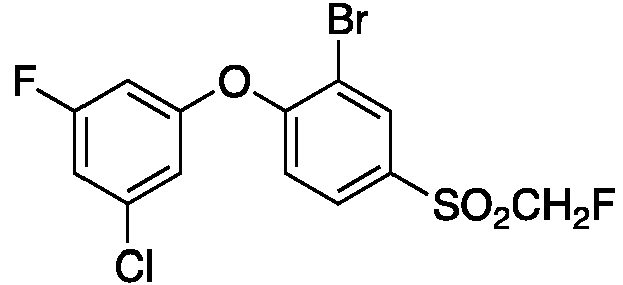
2-bromo-1-(3-cloro-5-fluorofenoxi)-4-((fluoromet¡l)sulfonil)benceno (Compuesto 137)2-bromo-1- (3-chloro-5-fluorophenoxy) -4 - ((fluoromethyl) sulfonyl) benzene (Compound 137)
Etapa A: Preparación de (fluorometil)(4-fluorofenil)sulfano: Se añadió trifluoruro de (d¡et¡lam¡no)azufre (1,46 ml, 11,1 mmol) disuelto en CH2Cl2 (1 ,8 ml) gota a gota a una solución de 1-fluoro-4-(metilsulfinil)benceno (1 , 0 g, 6.3 mmol) y SbCh (43 mg, 0,190 mmol) en CH2Cl2 (32 ml) a -5 °C en atmósfera de nitrógeno, después se agitó durante 14 horas mientras se calentaba gradualmente a temperatura ambiente. La mezcla de reacción se inactivó cuidadosamente mediante la adición gota a gota de NaHCO3 saturado (10 ml), se agitó durante 30 minutos, se extrajo con CH2O 2 (2 x 30 ml), se lavó con salmuera (30 ml), se lavó (Na2SO4), se filtró y se concentró. El producto en bruto se purificó sobre gel de sílice (25 g SNAP, 14 CV, 5-50% de EtOAc/hexano) proporcionando (fluorometil)(4-fluorofenil)sulfano (748 mg, 74 % de rendimiento) en forma de un aceite de color amarillo.Step A: Preparation of (fluoromethyl) (4-fluorophenyl) sulfane: trifluoride was added (d¡et¡lam¡no) sulfur (1.46 mL, 11.1 mmol) dissolved in CH 2 Cl 2 (1, 8 ml) dropwise to a solution of 1-fluoro-4- (methylsulfinyl) benzene ( 1.0 g, 6.3 mmol) and SbCh (43 mg, 0.190 mmol) in CH 2 Cl 2 (32 ml) at -5 ° C under nitrogen atmosphere, then stirred for 14 hours while gradually warming to room temperature. The reaction mixture was carefully quenched by dropwise addition of saturated NaHCO 3 (10 ml), stirred for 30 minutes, extracted with CH 2 O 2 (2 x 30 ml), washed with brine (30 ml) , washed (Na 2 SO 4 ), filtered and concentrated. The crude product was purified on silica gel (25 g SNAP, 14 CV, 5-50% EtOAc / hexane) to provide (fluoromethyl) (4-fluorophenyl) sulphane (748 mg, 74% yield) as a yellow oil.
Etapa B: Preparación de 1-fluoro-4-((fluorometil)sulfon¡l)benceno: Se añadió (fluorometil)(4-fluorofenil)sulfano (748 mg, 4,7 mmol) en MeOH (20,0 ml) gota a gota a una solución enfriada con hielo de Oxone® (6,32 g, 10.3 mmol) en agua (20,0 ml), con agitación vigorosa. Después la mezcla de reacción se calentó a temperatura ambiente y se agitó 14 horas más. Los sólidos se eliminaron por filtración, el filtrado se diluyó con salmuera (50 ml), se extrajo con EtOAc (3 x 50 ml), se lavó con salmuera (50 ml), se secó (MgSO4), se filtró y se concentró. El producto en bruto se purificó en columna de fase inversa (25+M, 14 CV, 20-100 % de MeCN/agua) proporcionando 1-fluoro-4-((fluorometil)sulfonil)benceno en forma de un aceite transparente.Step B: Preparation of 1-fluoro-4 - ((fluoromethyl) sulfonil) benzene: (fluoromethyl) (4-fluorophenyl) sulfan (748 mg, 4.7 mmol) in MeOH (20.0 ml) was added dropwise dropwise to an ice-cold solution of Oxone® (6.32 g, 10.3 mmol) in water (20.0 ml), with vigorous stirring. The reaction mixture was then warmed to room temperature and stirred an additional 14 hours. The solids were removed by filtration, the filtrate was diluted with brine (50 ml), extracted with EtOAc (3 x 50 ml), washed with brine (50 ml), dried (MgSO 4 ), filtered and concentrated . The crude product was purified on a reverse phase column (25 + M, 14 CV, 20-100% MeCN / water) to provide 1-fluoro-4 - ((fluoromethyl) sulfonyl) benzene as a clear oil.
Etapa C: Preparación de 2-bromo-1-fluoro-4-((fluorometil)sulfon¡l)benceno: Se añadió N-bromosuccinimida (228 mg, 1,28 mmol) en dos porciones ¡guales durante 30 minutos a 1-fluoro-4-((fluorometil)sulfonil)benceno (205 mg, 1,07 mmol) en H2SO4 (1,2 ml) a temperatura ambiente, después se agitó durante una noche. La mezcla de reacción se vertió en hielo, se extrajo con diclorometano (4 x 10 ml), se lavó con NaOH 3 N (10 ml) y salmuera (20 ml), se secó (Na2SO4), se filtró y se concentró. El producto en bruto se purificó en columna de fase inversa (25+M, 14 CV, 20 -100 % de MeCN/agua) proporcionando 2-bromo-1-fluoro-4-((fluorometil)sulfonil)benceno (217 mg, 75 % de rendimiento) en forma de un sólido de color blanco.Step C: Preparation of 2-bromo-1-fluoro-4 - ((fluoromethyl) sulfonil) benzene: N-bromosuccinimide (228 mg, 1.28 mmol) was added in two equal portions over 30 minutes at 1- fluoro-4 - ((fluoromethyl) sulfonyl) benzene (205 mg, 1.07 mmol) in H 2 SO 4 (1.2 ml) at room temperature, then stirred overnight. The reaction mixture was poured onto ice, extracted with dichloromethane (4 x 10 ml), washed with 3N NaOH (10 ml) and brine (20 ml), dried (Na 2 SO 4 ), filtered and concentrated. The crude product was purified on a reverse phase column (25 + M, 14 CV, 20-100 % MeCN / water) to provide 2-bromo-1-fluoro-4 - ((fluoromethyl) sulfonyl) benzene (217 mg, 75% yield) as a white solid.
Etapa D: Preparación de 2-bromo-1-(3-cloro-5-fluorofenoxi)-4-((fluoromet¡l)sulfon¡l)benceno (Compuesto 137): Se añadió carbonato de cesio (47 mg, 0,144 mmol) a 2-bromo-1-fluoro-4-((fluorometil)sulfonil)benceno (30 mg, 0,11 mmol) y 3-cloro-5-fluorofenol (21 mg, 0,144 mmol) en NMP (0,5 ml), después se calentó a 100 °C durante 1 hora. La mezcla se enfrió a temperatura ambiente, después se purificó en columna de fase inversa (12+M, 14 CV, 20-100% de MeCN/agua) proporcionó el compuesto 137 (31,7 mg, 72% de rendimiento). Lc Ms ESI (-) m/z 395 (M-H). RMN 1H (400 MHz, CDCla): 8 8,25 (d, 1 H), 7,89-7,86 (m, 1 H), 7,09 (d, 1 H), 7,00-6,97 (m, 1 H), 6,87-6,86 (m, 1 H), 6,72-6,69 (m, 1 H), 5,17 (d, 2 H).Step D: Preparation of 2-bromo-1- (3-chloro-5-fluorophenoxy) -4 - ((fluoromethyl) sulfonil) benzene (Compound 137): Cesium carbonate (47 mg, 0.144 mmol ) to 2-bromo-1-fluoro-4 - ((fluoromethyl) sulfonyl) benzene (30 mg, 0.11 mmol) and 3-chloro-5-fluorophenol (21 mg, 0.144 mmol) in NMP (0.5 ml ), then heated at 100 ° C for 1 hour. The mixture was cooled to room temperature, then purified on a reverse phase column (12 + M, 14 CV, 20-100% MeCN / water) to provide compound 137 (31.7 mg, 72% yield). L c M s ESI (-) m / z 395 (MH). 1H NMR (400 MHz, CDCla): 8 8.25 (d, 1H), 7.89-7.86 (m, 1H), 7.09 (d, 1H), 7.00 to 6, 97 (m, 1H), 6.87-6.86 (m, 1H), 6.72-6.69 (m, 1H), 5.17 (d, 2H).
Ejemplo de referencia 138Reference Example 138

2-bromo-1-(3-cloro-5-fluorofenoxi)-4-(met¡lsulfon¡l)benceno (Compuesto 138)2-bromo-1- (3-chloro-5-fluorophenoxy) -4- (methylsulfonic) benzene (Compound 138)
Etapa A: Preparación de 2-bromo-1-fluoro-4-(metilsulfon¡l)benceno: Se añadió N-bromosuccinimida (579 mg, 3,25 mmol, 1 , 1 equiv.) en dos porciones ¡guales durante 30 minutos a temperatura ambiente a 1-fluoro-4-(metilsulfonil)benceno (515 mg, 2,96 mmol) en H2SO4 concentrado (3,0 ml) y se agitó durante 6 horas. La mezcla se vertió cuidadosamente sobre hielo y agua (10 ml), se extrajo con CH2Cl2 (4 x 15 ml), se lavó con NaOH 3 N (10 ml) y salmuera (20 ml), se secó (Na2SO4), se filtró y se concentró al vacío. El residuo se purificó sobre gel de sílice (10 g SNAP, 14 CV, 6-50 % de EtOAc/hexano) para proporcionar 2-bromo-1-fluoro-4-(metilsulfonil)benceno (530 mg, 71 % de rendimiento) en forma de un sólido de color blanco.Step A: Preparation of 2-bromo-1-fluoro-4- (metilsulfon¡l) benzene: was added N-bromosuccinimide (579 mg, 3.25 mmol, 1, 1 equiv.) In two portions over 30 minutes glial at room temperature to 1-fluoro-4- (methylsulfonyl) benzene (515 mg, 2.96 mmol) in concentrated H 2 SO 4 (3.0 ml) and stirred for 6 hours. The mixture was carefully poured onto ice and water (10 ml), extracted with CH 2 Cl 2 (4 x 15 ml), washed with 3N NaOH (10 ml) and brine (20 ml), dried (Na 2 SO 4 ), filtered and concentrated in vacuo. The residue was purified on silica gel (10 g SNAP, 14 CV, 6-50% EtOAc / hexane) to provide 2-bromo-1-fluoro-4- (methylsulfonyl) benzene (530 mg, 71% yield) in the form of a white solid.
Etapa B: Preparación de 2-bromo-1-(3-cloro-5-fluorofenoxi)-4-(met¡lsulfon¡l)benceno (Compuesto 138): Se añadió carbonato de cesio (176 mg, 0,54 mmol) a 2-bromo-1-fluoro-4-(metilsulfonil)benceno (114 mg, 0,45 mmol) y 3-cloro-5-fluorofenol (79 mg, 0,54 mmol) en NMP (2,0 ml), después se calentó a 50 °C durante 20 horas. La mezcla de reacción en bruto se purificó en fase inversa de gel de sílice (25+M, 14 CV, 20-100 % de MeCN/agua) proporcionando el compuesto 138 (113 mg, 66 % de rendimiento) en forma de un sólido de color blanco. LCMS ESI (-) m/z 377 (M-H). Step B: Preparation of 2-bromo-1- (3-chloro-5-fluorophenoxy) -4- (methylsulfonic) benzene (Compound 138): Cesium carbonate (176 mg, 0.54 mmol) was added to 2-bromo-1-fluoro-4- (methylsulfonyl) benzene (114 mg, 0.45 mmol) and 3-chloro-5-fluorophenol (79 mg, 0.54 mmol) in NMP (2.0 ml), then it was heated at 50 ° C for 20 hours. The crude reaction mixture was reverse-phase purified on silica gel (25 + M, 14 CV, 20-100% MeCN / water) to provide compound 138 (113 mg, 66 % yield) as a solid. White color. LCMS ESI (-) m / z 377 (MH).
Ejemplo de referencia 139Reference Example 139

2-í3-cloro-5-fluorofenox¡)-5-ímet¡lsulfon¡l)benzonitr¡lo (Compuesto 139): Se añadió cianuro de cobre (I) (11 mg, 0,126 mmol) de una vez a una solución de 2-bromo-1-(3-cloro-5-fluorofenoxi)-4-(metilsulfonil)benceno (40 mg, 0,105 mmol) en NMP (0,4 ml) en un recipiente de microondas, se cerró herméticamente, después se calentó a 190 °C durante 30 minutos en un reactor de microondas. La mezcla se enfrió a temperatura ambiente, después se purificó directamente en columna de fase inversa (12+M, 20-100 % de MeCN/agua) proporcionó el compuesto 139 (9 mg, 25% de rendimiento). LCMS ESI (-) m/z 370 (M+HCO2'), RMN 1 H (400 MHz, CDCla): 8 8,29-8,28 (m, 1 H), 8,09-8,06 (m, 1 H), 7,10-7,06 (m, 2 H), 6,97-6,96 (m, 1 H), 6,83-6,79 (m, 1 H), 3,10 (s, 3 H).2-1,3-chloro-5-fluorophenoxy) -5-ymethylsulfon (l) benzonitrilo (Compound 139): Copper (I) cyanide (11 mg, 0.126 mmol) was added all at once to a solution of 2-Bromo-1- (3-chloro-5-fluorophenoxy) -4- (methylsulfonyl) benzene (40mg, 0.105mmol) in NMP (0.4ml) in a microwave container, tightly closed, then heated at 190 ° C for 30 minutes in a microwave reactor. The mixture was cooled to room temperature, then directly purified on a reverse phase column (12 + M, 20-100% MeCN / water) to provide compound 139 (9 mg, 25% yield). LCMS ESI (-) m / z 370 (M + HCO 2 '), 1 H NMR (400 MHz, CDCla): 8 8.29-8.28 (m, 1H), 8.09-8.06 ( m, 1H), 7.10-7.06 (m, 2H), 6.97-6.96 (m, 1H), 6.83-6.79 (m, 1H), 3, 10 (s, 3H).
Ejemplo de referencia 140Reference Example 140

3-bromo-1-(3-cloro-5-fluoro-fenox¡)-2-met¡l-4-(tr¡fluoromet¡lsulfon¡l)benceno (Compuesto 140)3-bromo-1- (3-chloro-5-fluoro-phenoxy) -2-methyl-4- (trifluoromethyl sulfonyl) benzene (Compound 140)
Etapa A: Preparación de cloruro de 2.4-d¡bromo-3-met¡l-bencenosulfon¡lo: Se añadió 1,3-dibromo-2-metilbenceno (5,5 ml, 40 mmol) gota a gota mediante un embudo de adición durante 10 minutos a ácido sulfuroclorhídrico (10 ml, 150 mmol) a temperatura ambiente y se agitó durante 2 horas, después se calentó a 40 °C y se agitó durante 2 horas más. La mezcla se vertió cuidadosamente en agua/hielo (250 ml) y se recogió un sólido de color blanquecino por filtración, se lavó con agua después se secó al vacío. El cloruro de 2,4-dibromo-3-metil-bencenosulfonilo (13,3 g, 91%) se usó sin más purificación.Step A: Preparation of 2,4-dibromo-3-methyl-benzenesulfonyl chloride: 1,3-dibromo-2-methylbenzene (5.5 ml, 40 mmol) was added dropwise via a funnel addition for 10 minutes to hydrochloric acid (10 ml, 150 mmol) at room temperature and stirred for 2 hours, then heated to 40 ° C and stirred for a further 2 hours. The mixture was carefully poured into ice / water (250 ml) and an off-white solid was collected by filtration, washed with water then dried under vacuum. 2,4-Dibromo-3-methyl-benzenesulfonyl chloride (13.3 g, 91%) was used without further purification.
Etapa B: Preparación de 2.4-d¡bromo-3-met¡l-bencenot¡ol: Se añadió una solución de cloruro de 2,4-dibromo-3-metil-bencenosulfonilo (5 g, 14,4 mmol) en diclorometano (20 ml) gota a gota durante 20 minutos a una solución enfriada en hielo de trifenilfosfina (8,28 g, 31,57 mmol) en diclorometano (20 ml) y DMF (1,2 ml). La mezcla de reacción se calentó gradualmente a temperatura ambiente durante 4 horas. La mezcla se inactivó con HCl 1 N (30 ml), se extrajo con CH2Ch (3 x 30 ml), se lavó con salmuera (20 ml), se secó sobre Na2SO4, se filtró y se concentró al vacío. Se eliminó el Ph^PO mediante agitación del producto en bruto en MTBE (100 ml) y después se filtró. El filtrado se concentró. El producto en bruto se purificó sobre gel de sílice (50 g SNAP, 14 CV, 0-20 % de EtOAc/hexanos) proporcionando 2,4-dibromo-3-metil-bencenotiol (1,7 g, 5,7 mmol, 40 % de rendimiento) en forma de un sólido de color blanco.Step B: Preparation of 2,4-dibromo-3-methyl-benzenethol: A solution of 2,4-dibromo-3-methyl-benzenesulfonyl chloride (5 g, 14.4 mmol) in dichloromethane was added (20 ml) dropwise over 20 minutes to an ice-cold solution of triphenylphosphine (8.28 g, 31.57 mmol) in dichloromethane (20 ml) and DMF (1.2 ml). The reaction mixture was gradually warmed to room temperature over 4 hours. The mixture was quenched with 1N HCl (30 mL), extracted with CH 2 Ch (3 x 30 mL), washed with brine (20 mL), dried over Na 2 SO 4 , filtered, and concentrated in vacuo . Ph ^ PO was removed by shaking the crude product in MTBE (100 ml) and then filtered. The filtrate was concentrated. The crude product was purified on silica gel (50 g SNAP, 14 CV, 0-20% EtOAc / hexanes) to provide 2,4-dibromo-3-methyl-benzenethiol (1.7 g, 5.7 mmol, 40% yield) as a white solid.
Etapa C: Preparación de 1.3-d¡bromo-2-met¡l-4-(tr¡fluoromet¡lsulfan¡l)benceno: Se condensó yoduro de trifluorometilo (1,77 g, 9,0 mmol) en una solución desgasificada de 2,4-dibromo-3-metil-bencenotiol (850 mg, 3,0 mmol), trietilamina (1,05 ml, 7,5 mmol) y dicloruro de metil viológeno hidrato (77,5 mg, 0,3 mmol) en DMF (8,2 ml) a -78 °C en un recipiente de presión a través de un septo abierto a un burbujeador. El recipiente de reacción rápidamente se cerró de forma hermética con un tapón de teflón hermético y se agitó a temperatura ambiente durante 24 horas. La mezcla se diluyó con Et2O (50 ml), se lavó con NaHCO3 saturado (20 ml), la fase acuosa se extrajo de nuevo con Et2O (3 x 30 ml), se lavó con salmuera (20 ml), se secó (Na2SO4), se filtró y se concentró al vacío. Se usó 1,3-d¡bromo-2-met¡l-4-(tr¡fluoromet¡lsulfan¡l)benceno en bruto sin más purificación en la reacción siguiente.Step C: Preparation of 1,3-díbromo-2-methyl-4- (trífluoromethylsulfaníl) benzene: Trifluoromethyl iodide (1.77 g, 9.0 mmol) was condensed in a degassed solution 2,4-dibromo-3-methyl-benzenethiol (850 mg, 3.0 mmol), triethylamine (1.05 ml, 7.5 mmol) and methyl viologen dichloride hydrate (77.5 mg, 0.3 mmol ) in DMF (8.2 ml) at -78 ° C in a pressure vessel through an open septum to a bubbler. The reaction vessel was quickly sealed with a tight Teflon stopper and stirred at room temperature for 24 hours. The mixture was diluted with Et 2 O (50 ml), washed with saturated NaHCO 3 (20 ml), the aqueous phase was re-extracted with Et 2 O (3 x 30 ml), washed with brine (20 ml) , dried (Na 2 SO 4 ), filtered and concentrated in vacuo. Crude 1,3-díbromo-2-methyl-4- (trifluoromethylsulfanl) benzene was used without further purification in the next reaction.
Etapa D: Preparación de 1.3-d¡bromo-2-met¡l-4-(tr¡fluoromet¡lsulfon¡l)benceno: Se añadió peryodato de sodio (1,34 g, 6,3 mmol) de una vez a 1,3-d¡bromo-2-met¡l-4-(tr¡fluoromet¡lsulfan¡l)benceno (1 g, 2,9 mmol) y cloruro de rutenio (III) (14,8 mg, 0,07 mmol) en acetonitrilo (7 ml)/tetracloruro de carbono (7 ml)/agua (14 ml) a temperatura ambiente y se agitó durante 16 horas. La mezcla se filtró, se diluyó con agua (20 ml), se lavó con CH2Cl2 (3 x 20 ml), se lavó con salmuera (20 ml), se secó (Na2SO4), se filtró y se concentró al vacío proporcionando 1,3-dibromo^-metil^trifluorometilsulfoni^benceno (660 mg, 1,7 mmol, 60 % de rendimiento) en forma de un sólido de color blanco.Step D: Preparation of 1,3-díbromo-2-methyl-4- (trífluoromethylsulfoníl) benzene: Sodium periodate (1.34 g, 6.3 mmol) was added all at once 1,3-d¡bromo-2-methyl-4- (trifluoromethylsulfanl) benzene (1 g, 2.9 mmol) and ruthenium (III) chloride (14.8 mg, 0, 07 mmol) in acetonitrile (7 ml) / carbon tetrachloride (7 ml) / water (14 ml) at room temperature and stirred for 16 hours. The mixture was filtered, diluted with water (20 ml), washed with CH 2 Cl 2 (3 x 20 ml), washed with brine (20 ml), dried (Na 2 SO 4 ), filtered, and concentrated in vacuo to provide 1,3-dibromo ^ -methyl-trifluoromethylsulfoni-benzene (660 mg, 1.7 mmol, 60% yield) as a white solid.
Etapa E: Preparación de 3; bromo; t ;(3:;cJoro; 5iíluoroií§noxi);2; meti]; 4;£trrfjuorometilsuJfonjt)benceno_{ComBuesto 140): Se añadió hidrogenocarbonato de cesio (183 mg, 0,94 mmol) de una vez a 1,3-dibromo-2-metil-4-(trifluorometilsulfonil)benceno (328 mg, 0,86 mmol) y 3-cloro-5-fluoro-fenol (138 mg, 0,94 mmol) en 1-metil-2-pirrolidona (3,5 ml) a temperatura ambiente, después el recipiente de reacción se cerró herméticamente con un tapón roscado. Después se calentó la mezcla de reacción a 50 °C y se continuó la agitación a esta temperatura hasta que se determinó por LC-MS que había finalizado. La mezcla se enfrió a temperatura ambiente, después se purificó directamente en columna de fase inversa (25+M, 14 CV, 20-100 % de MeCN/agua) proporcionando el compuesto 140 (140 mg, 0,3 mmol, 35 % de rendimiento). LCMS ESI (-) m/z 445 (M-H); RMN 1H (400 MHz, CDCla): 88,07 (d, 1 H), 7,03-7,00 (m, 1 H), 6,94 (d, 1 H), 6,87-6,86 (m, 1 H), 6,72-6,68 (m, 1 H), 2,52 (s, 3 H). Ejemplo de referencia 141Stage E: Preparation of 3; bromine; t; (3:; cJoro; 5iíluoroií§noxy); 2; meti]; 4; £ trrfjuoromethylsuJfonjt) benzene_ {Compound 140): Cesium hydrogen carbonate (183 mg, 0.94 mmol) was added in one go to 1,3-dibromo-2-methyl-4- (trifluoromethylsulfonyl) benzene (328 mg, 0 , 86 mmol) and 3-chloro-5-fluoro-phenol (138 mg, 0.94 mmol) in 1-methyl-2-pyrrolidone (3.5 ml) at room temperature, then the reaction vessel was sealed with a threaded cap. The reaction mixture was then heated to 50 ° C and stirring was continued at this temperature until it was determined by LC-MS to be complete. The mixture was cooled to room temperature, then directly purified on a reverse phase column (25 + M, 14 CV, 20-100% MeCN / water) to provide compound 140 (140 mg, 0.3 mmol, 35% of performance). LCMS ESI (-) m / z 445 (MH); 1H NMR (400 MHz, CDCla): 8 8.07 (d, 1H), 7.03 to 7.00 (m, 1H), 6.94 (d, 1H), 6.87 to 6, 86 (m, 1H), 6.72-6.68 (m, 1H), 2.52 (s, 3H). Reference Example 141

3-[3-bromo-2-metil-4-(trifluorometilsulfonil)fenoxi1-5-fluorobenzonitrilo (Compuesto 141): Se añadió carbonato de cesio (51,2 mg, 0,16 mmol) de una vez a 1,3-dibromo-2-metil-4-(trifluorometilsulfonil)benceno (100,0 mg, 0,26 mmol) y 3-fluoro-5-hidroxi-benzonitrilo (35,9 mg, 0,26 mmol) en 1 -metil-2-pirrolidona (1,0 ml) a temperatura ambiente, después el recipiente de reacción se cerró herméticamente con un tapón roscado. Después la mezcla de reacción se calentó a 50 °C y se continuó agitando a esta temperatura hasta que la LC-MS determinó que había finalizado (20 horas). La mezcla se enfrió a temperatura ambiente, después se purificó directamente en columna de fase inversa (25+M, 14 CV, 20-100% de MeCN/agua) proporcionando el compuesto 141 (71 mg, 0,15 mmol, 59 % de rendimiento) en forma de un aceite incoloro. lCm S ESI (+) m/z 438 (M+H).3- [3-Bromo-2-methyl-4- (trifluoromethylsulfonyl) phenoxy-1-5-fluorobenzonitrile (Compound 141): Cesium carbonate (51.2 mg, 0.16 mmol) was added all at once at 1.3- dibromo-2-methyl-4- (trifluoromethylsulfonyl) benzene (100.0 mg, 0.26 mmol) and 3-fluoro-5-hydroxy-benzonitrile (35.9 mg, 0.26 mmol) in 1-methyl-2 -pyrrolidone (1.0 ml) at room temperature, then the reaction vessel was hermetically closed with a screw cap. The reaction mixture was then heated to 50 ° C and stirring was continued at this temperature until LC-MS determined that it was finished (20 hours). The mixture was cooled to room temperature, then directly purified on a reverse phase column (25 + M, 14 CV, 20-100% MeCN / water) yielding compound 141 (71 mg, 0.15 mmol, 59% of yield) as a colorless oil. l C m S ESI (+) m / z 438 (M + H).
Ejemplo de referencia 142Reference Example 142

3-fluoro-5-[3-(3-hidroxiprop-1-inil)-2-metil-4-(trifluorometilsulfonil)fenoxi1benzonitrilo (Compuesto 142): Se añadieron yoduro de cobre (I) (4,4 mg, 0,02 mmol) y trifenilfosfano de dicloropaladio (8,2 mg, 0,01 mmol) a una mezcla desgasificada de 3-[3-bromo-2-met¡l-4-(tr¡fluoromet¡lsulfon¡l)fenoxi]-5-fluorobenzon¡tr¡lo (51 mg, 0,12 mmol), trietilamina (0,16 ml, 1,16 mmol) y alcohol propargílico (0,02 ml, 0,30 mmol) en DMF (0,90 ml) en una corriente de nitrógeno. El septo se reemplazó rápidamente con un tapón de engarce y se cerró herméticamente. La mezcla de reacción se calentó después a 100 °C durante 20 horas. El producto en bruto se purificó directamente sobre gel de sílice de fase inversa (12+M, 14 CV, 20-100 % de MeCN/agua) proporcionando el compuesto 142 (4,7 mg, 0,01 mmol, 10% de rendimiento) en forma de un aceite de color pardo. LCMS ESI (-) m/z 412 (M-H); Rm N 1H (400 MHz, CDCla): 8 8,00 (d, 1 H), 7,26-7,23 (m, 1 H), 7,12-7,11 (m, 1 H), 7,03-6,99 (m, 1 H), 6,97 (d, 1 H), 4,62 (d, 2 H), 2,49 (s, 3 H), 1,96-1,91 (m, 1 H).3-fluoro-5- [3- (3-hydroxyprop-1-ynyl) -2-methyl-4- (trifluoromethylsulfonyl) phenoxy-benzonitrile (Compound 142): Copper (I) iodide (4.4 mg, 0, 02 mmol) and dichloropalladium triphenylphosphane (8.2 mg, 0.01 mmol) to a degassed mixture of 3- [3-bromo-2-methyl-4- (trifluoromethylsulfonyl) phenoxy] - 5-fluorobenzonetrilo (51 mg, 0.12 mmol), triethylamine (0.16 ml, 1.16 mmol) and propargyl alcohol (0.02 ml, 0.30 mmol) in DMF (0.90 ml ) in a stream of nitrogen. The septum was quickly replaced with a crimp plug and hermetically sealed. The reaction mixture was then heated at 100 ° C for 20 hours. The crude product was purified directly on reverse phase silica gel (12 + M, 14 CV, 20-100% MeCN / water) to provide compound 142 (4.7 mg, 0.01 mmol, 10% yield ) in the form of a brown oil. LCMS ESI (-) m / z 412 (MH); Rm N 1H (400 MHz, CDCla): 8 8.00 (d, 1H), 7.26-7.23 (m, 1H), 7.12-7.11 (m, 1H), 7 .03-6.99 (m, 1H), 6.97 (d, 1H), 4.62 (d, 2H), 2.49 (s, 3H), 1.96-1.91 (m, 1H).
Ejemplo de referencia 143Reference Example 143

3-cloro-1-(3-cloro-5-fluoro-fenox¡)-2-metil-4-(tr¡fluoromet¡lsulfon¡l)benceno (Compuesto 143)3-chloro-1- (3-chloro-5-fluoro-phenoxy) -2-methyl-4- (trifluoromethylsulfonl) benzene (Compound 143)
Etapa A: Preparación de 1.3-d¡cloro-2-metil-4-(tr¡fluoromet¡lsulfan¡l)benceno: Se condensó yoduro de trimetilo (3,6 g, 18,3 mmol) en una solución desgasificada de 2,4-dicloro-3-metil-bencenotiol (1,18 g, 6,1 mmol), trietilamina (2,1 ml, 15,3 mmol) y dicloruro de metil viológeno hidrato (157 mg, 0,6 mmol) en DMF (8,2 ml) a -78 °C en un recipiente de presión. El recipiente de reacción rápidamente se cerró de forma hermética con un tapón de teflón hermético y se agitó a temperatura ambiente durante 24 horas. La mezcla se diluyó con Et2O (50 ml), se lavó con NaHCO3 (20 ml) saturado, la capa acuosa se extrajo de nuevo con Et2O (3 x 30 ml). Las capas orgánicas combinadas se lavaron con salmuera (20 ml), se secaron (Na2SO4), se filtraron y se concentraron al vacío. Se usó 1,3-dicloro-2-metil-4-(trifluorometilsulfanil)benceno (1,59 g, 6,1 mmol, 99,6 % de rendimiento) sin más purificación en la reacción siguiente, suponiendo un rendimiento cuantitativo. Step A: Preparation of 1,3-dichloro-2-methyl-4- (trifluoromethylsulfanil) benzene: Trimethyl iodide (3.6 g, 18.3 mmol) was condensed into a degassed solution of 2 , 4-dichloro-3-methyl-benzenethiol (1.18 g, 6.1 mmol), triethylamine (2.1 ml, 15.3 mmol) and methyl viologen dichloride hydrate (157 mg, 0.6 mmol) in DMF (8.2 ml) at -78 ° C in a pressure vessel. The reaction vessel was quickly sealed with a tight Teflon stopper and stirred at room temperature for 24 hours. The mixture was diluted with Et 2 O (50 ml), washed with saturated NaHCO 3 (20 ml), the aqueous layer was re-extracted with Et 2 O (3 x 30 ml). The combined organic layers were washed with brine (20 ml), dried (Na 2 SO 4 ), filtered and concentrated in vacuo. 1,3-Dichloro-2-methyl-4- (trifluoromethylsulfanyl) benzene (1.59 g, 6.1 mmol, 99.6% yield) was used without further purification in the next reaction, assuming quantitative yield.
Etapa B: Preparación de 1.3-d¡cloro-2-metil-4-(tr¡fluoromet¡lsulfon¡l)benceno: Se añadió peryodato de sodio (3,26 g. 15.2 mmol) de una vez a l^-dicloro^-metiM-^rifluoroirietilsulfamObenceno (1.59 g. 6.1 mmol) y cloruro de rutenio (III) (31.6 mg. 0.15 mmol) en acetonitrilo (15 ml)/tetracloruro de carbono (15 ml)/agua (3o ml) a temperatura ambiente y se agitó durante 16 horas. La mezcla de reacción se filtró. se diluyó con agua (20 ml). se lavó con CH2Cl2 (3 x 20 ml). se lavó con salmuera (20 ml). se secó (Na2SO4). se filtró y se concentró al vacío proporcionando 1,3-d¡cloro-2-met¡l-4-(tr¡fluoromet¡lsulfon¡l)benceno (1.2 g. 4.1 mmol. 67 % de rendimiento en 2 etapas) en forma de un sólido de color blanco.Step B: Preparation of 1,3-dichloro-2-methyl-4- (trifluoromethylsulfonl) benzene: Sodium periodate (3.26 g, 15.2 mmol) was added all at once to the ^ -dichloro ^ -methiM- ^ rifluoroiriethylsulfam-benzene (1.59 g, 6.1 mmol) and ruthenium (III) chloride (31.6 mg, 0.15 mmol) in acetonitrile (15 ml) / carbon tetrachloride (15 ml) / water (3rd ml) at room temperature and stirred for 16 hours. The reaction mixture was filtered. diluted with water (20 ml). It was washed with CH 2 Cl 2 (3 x 20 ml). washed with brine (20 ml). dried (Na 2 SO 4 ). filtered and concentrated in vacuo to give 1,3-dichloro-2-methyl-4- (trifluoromethylsulfonyl) benzene (1.2 g. 4.1 mmol. 67% yield in 2 steps) in form of a white solid.
Etapa C: Preparación de 3zcioroz1::(3zcÍQrQz5zfiû ^Qzfen^<i):2 zm ^ ^ ^ :£trrf]^rQmetilsujfonij_)ben^5n^_(GQmEuestQ 143): Se añadió carbonato de sodio (71 mg. 0.22 mmol) de una vez a una solución de 1.3-dicloro-2-metil-4-(trifluorometilsulfoniObenceno (70 mg. 0.24 mmol) y 3-cloro-5-fluoro-fenol (32 mg. 0.22 mmol) en 1-metil-2-pirrolidona (1 ml) a temperatura ambiente y se agitó durante 45 minutos. se calentó a 50 °C y se agitó durante 2 horas. La mezcla de reacción se enfrió a temperatura ambiente y se purificó directamente sobre gel de sílice de fase inversa (25+M. 14 CV. 30-100 % de MeCN/agua) proporcionando el compuesto 143 (67 mg. 0.16 mmol.Step C: Preparation of 3 zcioroz 1 : :( 3 zcÍQrQz 5 zfiû ^ Qzfen ^ <i): 2 zm ^ ^ ^: £ trrf] ^ rQmetilsujfonij_) ben ^ 5 n ^ _ (GQmEuestQ 143): Sodium carbonate was added (71 mg. 0.22 mmol) at once to a solution of 1,3-dichloro-2-methyl-4- (trifluoromethylsulfoniObenzene (70 mg. 0.24 mmol) and 3-chloro-5-fluoro-phenol (32 mg. 0.22 mmol) in 1-methyl-2-pyrrolidone (1 ml) at room temperature and stirred for 45 min. Warmed to 50 ° C and stirred for 2 hours. The reaction mixture was cooled to room temperature and purified directly on gel of reversed phase silica (25 + M. 14 CV. 30-100% MeCN / water) affording compound 143 (67 mg, 0.16 mmol.
72 % de rendimiento) en forma de un sólido de color blanco. LCMS ESI (-) m/z 401 (M-H). RMN ^H (400 MHz. CDCla): 88.03 (d. 1 H). 7.03-7.00 (m. 1 H). 6.90 (d. 1 H). 6.88 -6.86 (m. 1 H). 6.72-6.69 (m. 1 H). 2.47 (s. 3 H). 72% yield) as a white solid. LCMS ESI (-) m / z 401 (MH). H NMR (400 MHz CDCla.): 8 8.03 (d 1H.). 7.03-7.00 (m. 1H). 6.90 (d. 1H). 6 . 88 - 6.86 (m 1 H.). 6.72-6.69 (m. 1H). 2.47 (s. 3H).
Ejemplo de referencia 144Reference Example 144

3-fluoro-5-[3-cloro-2-met¡l-4-(tr¡fluoromet¡lsulfon¡l)fenox¡1benzon¡tr¡lo (Compuesto 144): Se añadió carbonato de cesio (71 mg. 0.22 mmol) de una vez a una solución de 1,3-d¡cloro-2-met¡l-4-(tr¡fluoromet¡lsulfon¡l)benceno (70 mg.3-fluoro-5- [3-chloro-2-methyl-4- (trifluoromethyl sulfonyl) phenoxy-1benzonitrile (Compound 144): Cesium carbonate (71 mg, 0.22 mmol) at once to a solution of 1,3-dichloro-2-methyl-4- (trifluoromethylsulfonyl) benzene (70 mg.
0.24 mmol) y 3-fluoro-5-h¡drox¡-benzon¡tr¡lo (30 mg. 0.22 mmol) en 1 -metil-2-pirrolidona (1 ml) a temperatura ambiente y se agitó durante 45 minutos. se calentó a 50 °C y se agitó durante 2 horas. La mezcla se enfrió a temperatura ambiente y se purificó directamente en columna de fase inversa (25+M. 14 CV. 30-100 % de MeCN/agua) proporcionando un producto ligeramente impuro que se purificó de nuevo sobre gel de sílice ( 10 g SNAP. 14 CV. 2-26% de EtoAc/hexano) proporcionando el compuesto 144 (33 mg. 0.08 mmol. 36 % de rendimiento) en forma de un sólido de color blanco. LCMS ESI (-) m/z 392 (M-H); RMN 1H (400 MHz. CDCla): 8 8.05 (m. 1 H). 7.29-7.26 (m. 1 H). 7.14 (s. 1 H). 7.05-7.02 (m. 1 H). 6.94-6.91 (m. 1 H). 2.46 (s. 3 H).0.24 mmol) and 3-fluoro-5-hydroxy-benzonitrile (30 mg, 0.22 mmol) in 1-methyl-2-pyrrolidone (1 ml) at room temperature and stirred for 45 minutes. heated to 50 ° C and stirred for 2 hours. The mixture was cooled to room temperature and purified directly on a reverse phase column (25 + M. 14 CV. 30-100% MeCN / water) to provide a slightly impure product that was purified again on silica gel (10 g SNAP. 14 CV. 2-26% EtoAc / hexane) yielding compound 144 (33 mg. 0.08 mmol. 36% yield) as a white solid. LCMS ESI (-) m / z 392 (MH); 1H NMR (400 MHz CDCla.): 8 8.05 (m 1H.). 7.29-7.26 (m, 1H). 7.14 (s.1H). 7.05-7.02 (m. 1H). 6.94-6.91 (m, 1H). 2.46 (s. 3H).
Ejemplo de referencia 145Reference Example 145

3-fluoro-5-[3-form¡l-2-met¡l-4-(tr¡fluoromet¡lsulfon¡l)fenox¡1benzon¡tr¡lo (Compuesto 145)3-fluoro-5- [3-form¡l-2-methyl-4- (tr¡fluorometh¡lsulfon¡l) phenox¡1benzon¡tr¡l (Compound 145)
Etapa A: Preparación de 3-fluoro-5-[2-met¡l-4-(tr¡fluoromet¡lsulfon¡l)-3-v¡n¡l-fenox¡1benzon¡tr¡lo: Se añadió tributi^vini êstannano (300 pl. 1.0 mmol) a una mezcla desgasificada de 3-[3-cloro-2-metil-4-(trifluorometilsulfonilfenoxij^-fluorobenzonitrilo (250 mg. 0.63 mmol) y bis(di-ferc-butil(4-dimetilaminofenilfosfina^icloropaladio (II) (45 mg. 0.06 mmol) en DMF (3.6 ml) a temperatura ambiente. Después se vació el recipiente de microondas y de volvió a llenar con nitrógeno tres veces. El septo se reemplazó rápidamente con un tapón de engarce. se cerró herméticamente. después la reacción se calentó a 160 °C durante 30 minutos en un reactor de microondas. Una vez enfriado a temperatura ambiente. la mezcla de reacción se diluyó con MTBE (5 ml) y KF saturado (10 ml) seguido de agitación durante 30 minutos. La capa acuosa se extrajo con MTBE (3x10 ml). se lavó con salmuera (10 ml). se secó sobre Na2SO4. se filtró y se concentró al vacío. El producto en bruto se purificó sobre gel de sílice (10 g SNAP. 14 CV. 2-50% de EtOAc/hexano) proporcionando 3-fluoro-5-[2-met¡l-4-(tr¡fluoromet¡lsulfon¡l)-3-v¡n¡l-fenox¡]benzon¡tr¡lo (179 mg.Step A: Preparation of 3-fluoro-5- [2-methyl-4- (tr¡fluorometh¡lsulfon¡l) -3-v¡n¡l-phenox¡1benzon¡tr¡lo: Tributi ^ vini êstannan (300 pl. 1.0 mmol) to a degassed mixture of 3- [3-chloro-2-methyl-4- (trifluoromethylsulfonylphenoxy-fluorobenzonitrile (250 mg. 0.63 mmol) and bis (di-ferc-butyl (4- dimethylaminophenylphosphine ^ ichloropalladium (II) (45 mg. 0.06 mmol) in DMF (3.6 ml) at room temperature. The microwave container was then emptied and refilled with nitrogen three times. The septum was quickly replaced with a crimp cap . was sealed. then the reaction was heated to 160 ° C for 30 minutes in a microwave reactor. After cooling to room temperature, the reaction mixture was diluted with MTBE (5 ml) and saturated KF (10 ml) followed stirring for 30 minutes The aqueous layer was extracted with MTBE (3x10 ml), washed with brine (10 ml), dried over Na 2 SO 4 , filtered and concentrated in vacuo The crude product was purified over yes gel lice (10 g SNAP. 14 CV. 2-50% EtOAc / hexane) yielding 3-fluoro-5- [2-methyl-4- (trifluoromethylsulfonl) -3-v¡n¡l-phenox¡] benzon¡tr¡ lo (179 mg.
0.46 mmol. 73 % de rendimiento) en forma de un aceite transparente incoloro.0.46 mmol. 73% yield) in the form of a colorless transparent oil.
Etapa B: Preparación de 3-fluoro-5-[3-form¡l-2-met¡l-4-(tr¡fluoromet¡lsulfon¡l)fenox¡1benzon¡tr¡lo (Compuesto 145): Se añadió tetraoxoosmio (0.07 ml. 0.01 mmol) gota a gota mediante una jeringa a 3-fluoro-5-[2-metil-4-(tr¡fluoromet¡lsulfon¡l)-3-v¡n¡l-fenox¡]benzon¡tr¡lo (85 mg. 0.22 mmol) y peryodato sódico (142 mg. 0.66 mmol) en tetrahidrofurano (0.9 ml) y agua (0.3 ml) a temperatura ambiente. después se agitó durante una noche. La mezcla se diluyó con agua (5 ml). se extrajo con EtOAc (3x10 ml). se lavó con salmuera (10 ml). se secó sobre MgSO4. se filtró y se concentró. Se purificó sobre gel de sílice (25 g SNAP. 14 CV. % de EtOAc/hexano) proporcionando el compuesto 145 (50 mg, 0,13 mmol, 59 % de rendimiento). LCMS ESI (-) m/z 386 (M-H); RMN *H (400 MHz, CDCl3): 8 10,62 (s, 1 H), 7,97 (d, 1 H), 7,30-7,27 (m, 1 H), 7,16-7,15 (m, 1 H), 7,10 (d, 1 H), 7,07 7,03 (m, 1 H), 2,40 (s, 3 H).Step B: Preparation of 3-fluoro-5- [3-formıl-2-methyl-4- (trıfluoromethylsulfonıl) phenoxı1benzonıtrıl (Compound 145): Tetraoxosmium was added (0.07 ml. 0.01 mmol) drop by drop through a syringe to 3-fluoro-5- [2-methyl-4- (tr¡fluorometh¡lsulfon¡l) -3-v¡n¡l-phenox¡] benzon¡ trilo (85 mg, 0.22 mmol) and sodium periodate (142 mg, 0.66 mmol) in tetrahydrofuran (0.9 ml) and water (0.3 ml) at room temperature. then stirred overnight. The mixture was diluted with water (5 ml). extracted with EtOAc (3x10 ml). washed with brine (10 ml). dried over MgSO 4 . filtered and concentrated. Purified on silica gel (25 g SNAP. 14 CV.% EtOAc / hexane) yielding compound 145 (50mg, 0.13mmol, 59 % yield). LCMS ESI (-) m / z 386 (MH); * H NMR (400 MHz, CDCl3): 8 10.62 (s, 1H), 7.97 (d, 1H), 7.30-7.27 (m, 1H), 7.16-7 , 15 (m, 1H), 7.10 (d, 1H), 7.07 7.03 (m, 1H), 2.40 (s, 3H).
Ejemplo de referencia 146Reference Example 146

3-fluoro-5-[3-(h¡drox¡met¡l)-2-met¡l-4-(tr¡fluoromet¡lsulfon¡l)fenox¡1benzon¡tr¡lo (Compuesto 146): Se añadió borohidruro sódico (2 mg, 0,05 mmol) de una vez a 3-fluoro-5-[3-formil-2-metil-4-(trifluorometilsulfonil)fenox¡1benzonitrilo en bruto (5 mg, 0,01 mmol) en metanol (0,4 ml) a temperatura ambiente y se agitó durante 5 minutos. La reacción se interrumpió con 1 gota de HCl 1 N, se diluyó con agua (5 ml), se extrajo con EtOAc (3x5 ml), se lavó con salmuera (5 ml), se secó sobre Na2SO4, se filtró y se concentró. El producto en bruto se purificó por TLC preparativa (EtOAc al 25 %/hexano) proporcionando el compuesto 146 (2 mg, 0,005 mmol, 40 % de rendimiento) en forma de un aceite transparente. LCm S ESI (-) m/z 434 (M+HCO2"); RMN 1 H (400 MHz, CDCl3): 8 8,01 (d, 1 H), 7,26-7,23 (m, 1 H), 7,12-7,11 (m, 1 H), 7,03-6,99 (m, 2 H), 4,99 (d, 2 H), 2,50 (s, 3 H).3-fluoro-5- [3- (hydroxymethyl) -2-methyl-4- (trifluoromethyl sulfonyl) phenoxy-1benzonitrile (Compound 146): Added sodium borohydride (2 mg, 0.05 mmol) once to crude 3-fluoro-5- [3-formyl-2-methyl-4- (trifluoromethylsulfonyl) phenoxy-1-benzonitrile (5 mg, 0.01 mmol) in methanol (0.4 ml) at room temperature and stirred for 5 minutes. The reaction was quenched with 1 drop of 1N HCl, diluted with water (5 ml), extracted with EtOAc (3x5 ml), washed with brine (5 ml), dried over Na 2 SO 4 , filtered and he concentrated. The crude product was purified by preparative TLC (25% EtOAc / hexane) to provide compound 146 (2 mg, 0.005 mmol, 40% yield) as a clear oil. LC m S ESI (-) m / z 434 (M + HCO 2 "); 1H NMR (400 MHz, CDCl3): 8 8.01 (d, 1H), 7.26-7.23 (m , 1H), 7.12-7.11 (m, 1H), 7.03-6.99 (m, 2H), 4.99 (d, 2H), 2.50 (s, 3 H).
Ejemplo de referencia 147Reference example 147
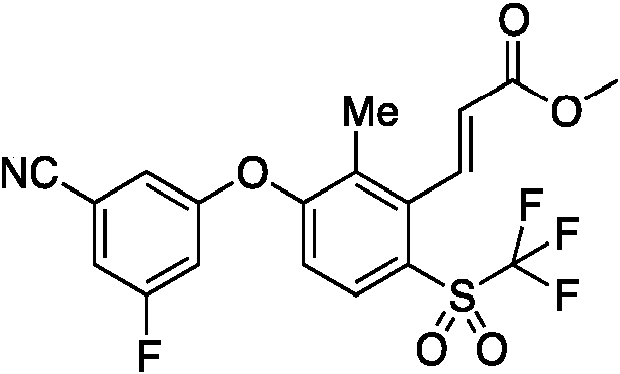
(E)-3-[3-(3-c¡ano-5-fluoro-fenox¡)-2-met¡l-6-(tr¡fluorometilsulfon¡l)fen¡l1prop-2-enoato de metilo (Compuesto 147): Se añadieron trietilamina (0,06 ml, 0,45 mmol) y DMF (1 ml) a 3-[3-bromo-2-metil-4-(trifluorometilsulfonil)fenoxi]-5-fluorobenzonitrilo (65 mg, 0,15 mmol) en un recipiente de reacción equipado con una barra de agitación, después se evacuó y se volvió a llenar con nitrógeno tres veces. Se añadieron prop-2-enoato de metilo (0,07 ml, 0,74 mmol) y dímero di-p-clorobis[5-hidroxi-2-[1-(hidroxiimino)etil)fenil]-paladio (8,7 mg, 0,01 mmol). El septo se reemplazó rápidamente con un tapón de engarce y se cerró herméticamente. La mezcla de reacción se calentó a 120 °C durante 16 horas. Después de enfriar a temperatura ambiente, la mezcla se filtró a través de una frita y se purificó directamente sobre gel de sílice de fase inversa (25+M, 20-100 % de MeCN/agua) proporcionando el compuesto 147 (38 mg, 0,08 mmol, 54 % de rendimiento) en forma de un aceite transparente. LCMS ESI (-) m/z 442 (M-H). RMN 1H (400 MHz, CDCl3): 8 8,02 (s, 1 H), 7,99 (d, 1 H), 7,28-7,25 (m, 1 H), 7,16-7,15 (m, 1 H), 7,07-7,05 (m, 1 H), 6,98 (d, 1 H), 6,03 (d, 1 H), 3,85 (s, 3 H), 2,34 (s, 3 H).(E) -3- [3- (3-kano-5-fluoro-phenoxy) -2-methyl-6- (trifluoromethylsulfonic) phenyl-prop-2-enoate (Compound 147): Triethylamine (0.06 ml, 0.45 mmol) and DMF (1 ml) were added to 3- [3-bromo-2-methyl-4- (trifluoromethylsulfonyl) phenoxy] -5-fluorobenzonitrile (65 mg, 0.15 mmol) into a reaction vessel equipped with a stir bar, then evacuated and refilled with nitrogen three times. Methyl prop-2-enoate (0.07 ml, 0.74 mmol) and di-p-chlorobis [5-hydroxy-2- [1- (hydroxyimino) ethyl) phenyl] -palladium dimer (8.7 mg, 0.01 mmol). The septum was quickly replaced with a crimp plug and hermetically sealed. The reaction mixture was heated to 120 ° C for 16 hours. After cooling to room temperature, the mixture was filtered through a frit and purified directly on reverse phase silica gel (25 + M, 20-100% MeCN / water) to provide compound 147 (38 mg, 0 .08 mmol, 54% yield) as a clear oil. LCMS ESI (-) m / z 442 (MH). 1H NMR (400 MHz, CDCl3): 8 8.02 (s, 1H), 7.99 (d, 1H), 7.28-7.25 (m, 1H), 7.16 to 7, 15 (m, 1H), 7.07-7.05 (m, 1H), 6.98 (d, 1H), 6.03 (d, 1H), 3.85 (s, 3H ), 2.34 (s, 3H).
Ejemplo de referencia 148Reference Example 148

(E)-3-(3-(3-c¡ano-5-fluorofenox¡)-2-met¡l-6-((trifluoromet¡l)sulfon¡l)fen¡l)acr¡lato de etilo (Compuesto 148)(E) -3- (3- (3-kano-5-fluorophenoxy) -2-methyl-6 - ((trifluoromethyl) sulfonyl) phenyl) ethyl acrylate ( Compound 148)
Etapa A: Preparación de ácido (E)-3-[3-(3-ciano-5-fluoro-fenoxi)-2-metil-6-(trifluorometilsulfonil)fenil]prop-2-enoico: Se añadió hidróxido de litio monohidrato (66,31 mg, 1,58 mmol) de una vez a (E)-3-[3-(3-ciano-5-fluorofenoxi)-2-metil-6-(trifluorometilsulfonil)fenil]prop-2-enoato de metilo (140 mg, 0,32 mmol) en tetrahidrofurano (1 ml) y agua (1 ml) a temperatura ambiente, después se agitó durante 2 horas. La reacción se interrumpió con HCl 1 N (1 ml), se extrajo con EtOAc (3 x 5 ml), se lavó con salmuera (5 ml), se secó sobre Na2SO4, se filtró y se concentró. Se usó ácido (E)-3-[3-(3-ciano-5-fluoro-fenoxi)-2-metil-6-(trifluorometilsulfonil)fenil]prop-2-enoico ( 120 mg, 0,28 mmol, 88 % de rendimiento)sin más purificación.Step A: Preparation of (E) -3- [3- (3-cyano-5-fluoro-phenoxy) -2-methyl-6- (trifluoromethylsulfonyl) phenyl] prop-2-enoic acid: Lithium hydroxide monohydrate was added (66.31 mg, 1.58 mmol) at once to (E) -3- [3- (3-cyano-5-fluorophenoxy) -2-methyl-6- (trifluoromethylsulfonyl) phenyl] prop-2-enoate of methyl (140 mg, 0.32 mmol) in tetrahydrofuran (1 ml) and water (1 ml) at room temperature, then stirred for 2 hours. The reaction was quenched with 1N HCl (1 mL), extracted with EtOAc (3 x 5 mL), washed with brine (5 mL), dried over Na 2 SO 4 , filtered, and concentrated. (E) -3- [3- (3-cyano-5-fluoro-phenoxy) -2-methyl-6- (trifluoromethylsulfonyl) phenyl] prop-2-enoic acid was used (120 mg, 0.28 mmol, 88 % yield) without further purification.
Etapa B: Preparación de (E)-3-(3-(3-c¡ano-5-fluorofenox¡)-2-met¡l-6-((trifluoromet¡l)sulfon¡l)fen¡l)acr¡lato de etilo (Compuesto 148): Se añadió N-óxido de hexafluorofosfato de [(dimetilamino)-1H-1,2,3-triazol-[4,5-b]piridin-1-ilmetilen]-N-metilmetanaminio, (HATU) (14,7 mg, 0,04 mmol) de una vez a ácido (E)-3-[3-(3-ciano-5-fluorofenoxi)-2-metil-6-(trifluorometilsulfonil)fenil]prop-2-enoico (11 mg, 0,03 mmol), N,N-diisopropiletilamina (6 ,6 mg, 0,05 mmol) y etanol (5,9 mg, 0,13 mmol) en DMF (0,20 ml) a temperatura ambiente. La mezcla de reacción se agitó durante 2 horas, después se purificó directamente en columna de fase inversa (12+M, 14 CV, 20-100 % de MeCN/agua) proporcionando el compuesto 148 (6,7 mg, 0,015 mmol, 57 % de rendimiento) en forma de un aceite de color amarillo. LCMS ESI (+) m/z 458 (M+H). RMN 1H (400 MHz, CDCls): 8 8,02 (s, 1 H), 7,99 (d, 1 H), 7,28-7,25 (m, 1 H), 7,16-7,15 (m, 1 H), 7,07-7,03 (m, 1 H), 6,98 (d, 1 H), 6,02 (d, 1 H), 4,31 (c, 2 H), 2,34 (s, 3 H), 1,36 (t, 3 H).Step B: Preparation of (E) -3- (3- (3-kano-5-fluorophenoxy) -2-methyl-6 - ((trifluoromethyl) sulfonyl) phenyl) acr Ethyl ilate (Compound 148): [(dimethylamino) -1H-1,2,3-triazol- [4,5-b] pyridin-1-ylmethylene] -N-methylmethanaminium hexafluorophosphate N-oxide was added, (HATU) (14.7 mg, 0.04 mmol) once to (E) -3- [3- (3-cyano-5-fluorophenoxy) -2-methyl-6- (trifluoromethylsulfonyl) phenyl] prop acid -2-enoic acid (11 mg, 0.03 mmol), N, N-diisopropylethylamine (6, 6 mg, 0.05 mmol) and ethanol (5.9 mg, 0.13 mmol) in DMF (0.20 ml ) at room temperature. The reaction mixture was stirred for 2 hours, then directly purified on a reverse phase column (12 + M, 14 CV, 20-100% MeCN / water) to provide compound 148 (6.7 mg, 0.015 mmol, 57 % yield) as a yellow oil. LCMS ESI (+) m / z 458 (M + H). 1H NMR (400 MHz, CDCls): 8 8.02 (s, 1H), 7.99 (d, 1H), 7.28-7.25 (m, 1H), 7.16 to 7, 15 (m, 1H), 7.07-7.03 (m, 1H), 6.98 (d, 1H), 6.02 (d, 1H), 4.31 (c, 2H ), 2.34 (s, 3H), 1.36 (t, 3H).
Ejemplo de referencia 149Reference Example 149

(E)-N-benc¡l-3-(3-(3-c¡ano-5-fluorofenox¡)-2-met¡l-6-((trifluoromet¡l)sulfon¡l)fen¡l)acr¡lam¡da (Compuesto 149): Se añadió N-óxido de hexafluorofosfato de [(dimetilamino)-1H-1,2,3-triazol-[4,5-6]piridin-1-ilmetilen]-N-metilmetanaminio (HATU, 13,3 mg, 0,03 mmol) de una vez a ácido (E)-3-[3-(3-ciano-5-fluoro-fenoxi)-2-metil-6-(trifluorometilsulfonil)fenil]prop-2-enoico (10 mg, 0,02 mmol), N,N-diisopropiletilamina (6 mg, 0,05 mmol) y bencilamina (5 mg, 0,05 mmol) en DMF (0,2 ml) a temperatura ambiente. La mezcla de reacción se agitó durante 13 horas. El producto en bruto se purificó directamente en columna de fase inversa (12+M, 14 CV, 20-100 % de MeCN/agua) proporcionando el compuesto 149 (5,1 mg, 0,01 mmol, 42 % de rendimiento). LCMS ESI (+) m/z 519 (M+H). RMN 1H (400 MHz, CDCla): 8 8,01 (d, 1 H), 7,79 (d, 1 H), 7,39-7,29 (m, 5 H), 7,27-7,24 (m, 1 H), 7,14-7,13 (m, 1 H), 7,06-7,03 (m, 1 H), 6,97 (d, 1 H), 6,06-6,02 (m, 2 H), 4,60 (d, 2 H), 2,33 (s, 3 H).(E) -N-benzyl-3- (3- (3-kano-5-fluorophenoxy) -2-methyl-6 - ((trifluoromethyl) sulfonil) phenyl) acrylamide (Compound 149): [(dimethylamino) -1H-1,2,3-triazol- [4,5-6] pyridin-1-ylmethylene] -N-methylmethanaminium hexafluorophosphate N-oxide was added (HATU, 13.3 mg, 0.03 mmol) once to (E) -3- [3- (3-cyano-5-fluoro-phenoxy) -2-methyl-6- (trifluoromethylsulfonyl) phenyl] acid prop-2-enoic (10 mg, 0.02 mmol), N, N-diisopropylethylamine (6 mg, 0.05 mmol) and benzylamine (5 mg, 0.05 mmol) in DMF (0.2 ml) at temperature ambient. The reaction mixture was stirred for 13 hours. The crude product was purified directly on a reverse phase column (12 + M, 14 CV, 20-100% MeCN / water) to provide compound 149 (5.1 mg, 0.01 mmol, 42% yield). LCMS ESI (+) m / z 519 (M + H). 1H NMR (400 MHz, CDCla): 8 8.01 (d, 1H), 7.79 (d, 1H), 7.39 to 7.29 (m, 5 H), 7.27 to 7, 24 (m, 1H), 7.14-7.13 (m, 1H), 7.06-7.03 (m, 1H), 6.97 (d, 1H), 6.06- 6.02 (m, 2H), 4.60 (d, 2H), 2.33 (s, 3H).
Ejemplo de referencia 150Reference Example 150

3-fluoro-5-[2-met¡l-3-[(E)-2-(1.3.4-oxad¡azol-2-¡l)v¡n¡l1-4-(tr¡fluoromet¡lsulfonil)fenox¡1benzon¡tr¡lo (Compuesto 150) 3-fluoro-5- [2-methyl-3 - [(E) -2- (1,3,4-oxad¡azol-2-¡l) v¡n¡l1-4- (tr¡fluoromethylsulfonyl ) phenox¡1benzon¡tr¡lo (Compound 150)
Etapa A: Preparación de (E)-3-[3-(3-ciano-5-fluoro-fenoxi)-2-metil-6-(trifluorometilsulfonil)fenil]prop-2-enehidrazida: Se añadió cloroformiato de isobutilo (17 pl, 0,13 mmol) gota a gota a ácido (E)-3-[3-(3-ciano-5-fluoro-fenoxi)-2-metil-6-(trifluorometilsulfonil)fenil]prop-2-enoico (50 mg, 0,12 mmol) y trietilamina (49 pl, 0,35 mmol) en tetrahidrofurano (1,2 ml) a 0 °C y se agitó durante 1 hora. Se añadió hidrazina monohidrato (28,25 pl, 0,5800 mmol) a 0 °C y se agitó 2 horas más. La reacción se diluyó con agua (2 ml), se extrajo con EtOAc (3 x 5 ml), se lavó con salmuera (5 ml), se secó sobre MgSO4, se filtró y se concentró, después se usó el producto en bruto sin más purificación.Step A: Preparation of (E) -3- [3- (3-cyano-5-fluoro-phenoxy) -2-methyl-6- (trifluoromethylsulfonyl) phenyl] prop-2-enehydrazide: Isobutyl chloroformate (17 pl, 0.13 mmol) dropwise to (E) -3- [3- (3-cyano-5-fluoro-phenoxy) -2-methyl-6- (trifluoromethylsulfonyl) phenyl] prop-2-enoic acid ( 50 mg, 0.12 mmol) and triethylamine (49 µl, 0.35 mmol) in tetrahydrofuran (1.2 ml) at 0 ° C and stirred for 1 hour. Hydrazine monohydrate (28.25 µl, 0.5800 mmol) was added at 0 ° C and stirred for a further 2 hours. The reaction was diluted with water (2 ml), extracted with EtOAc (3 x 5 ml), washed with brine (5 ml), dried over MgSO 4 , filtered and concentrated, then the crude product was used without further purification.
Etapa B: Preparación de 3-fluoro-5-[2-metil-3-[(E)-2-(1,3,4-oxadiazol-2-il)vinil]-4-(trifluorometilsulfonil)fenoxi]benzonitrilo (Compuesto 150): Se añadió ácido p-toluenosulfónico monohidrato (2 mg, 0,01 mmol) a una solución bien agitada de (E)-3-[3-(3-ciano-5-fluoro-fenoxi)-2-metil-6-(trifluorometilsulfonil)fenil]prop-2-enehidrazida (23 mg, 0,05 mmol) en ortoformiato de trietilo (460 pl, 3,0 mmol) seguido de calentamiento de la mezcla de reacción a 90 °C hasta su finalización según determinó la LC-MS. La mezcla se enfrió a temperatura ambiente después se concentró al vacío. Después se purificó la mezcla de reacción directamente sobre gel de sílice de fase inversa (12+M, 14 CV, 20-100 % de MeCN/agua) proporcionando el compuesto 150 (21 mg, 0,05 mmol, 89% de rendimiento). LCMS ESI (+) m/z 454 (M+H). RMN 1H (400 MHz, CDCls): 8 8,47 (d, 1 H), 8,05 (d, 1 H), 7,98 (d, 1 H), 7,31-7,27 (m, 1 H), 7,19-7,18 (m, 1 H), 7,10-7,07 (m, 1 H), 7,01 (d, 1 H), 6,72 (d, 1 H), 2,42 (s, 3 H). Step B: Preparation of 3-fluoro-5- [2-methyl-3 - [(E) -2- (1,3,4-oxadiazol-2-yl) vinyl] -4- (trifluoromethylsulfonyl) phenoxy] benzonitrile ( Compound 150): p-Toluenesulfonic acid monohydrate (2 mg, 0.01 mmol) was added to a well stirred solution of (E) -3- [3- (3-cyano-5-fluoro-phenoxy) -2-methyl -6- (trifluoromethylsulfonyl) phenyl] prop-2-enehydrazide (23 mg, 0.05 mmol) in triethyl orthoformate (460 µl, 3.0 mmol) followed by heating the reaction mixture at 90 ° C until completion as determined by LC-MS. The mixture was cooled to room temperature then concentrated in vacuo. The reaction mixture was then purified directly on reverse phase silica gel (12 + M, 14 CV, 20-100% MeCN / water) to provide compound 150 (21 mg, 0.05 mmol, 89% yield) . LCMS ESI (+) m / z 454 (M + H). 1H NMR (400 MHz, CDCls): 8 8.47 (d, 1H), 8.05 (d, 1H), 7.98 (d, 1H), 7.31-7.27 (m, 1H), 7.19-7.18 (m, 1H), 7.10-7.07 (m, 1H), 7.01 (d, 1H), 6.72 (d, 1H ), 2.42 (s, 3H).
Ejemplo de referencia 151Reference Example 151

3-fluoro-5-[2-met¡l-3-[(E)-2-(5-met¡l-1.3.4-oxad¡azol-2-¡l)v¡n¡l)-4-(tr¡fluoromet¡lsulfon¡l)fenox¡1benzon¡tr¡lo (Compuesto 151): Se añad¡ó ác¡do p-toluenosulfón¡co monoh¡drato (1.7 mg, 0.01 mmol) a una soluc¡ón b¡en ag¡tada de (E)-3-[3-(3-c¡ano-5-fluoro-fenox¡)-2-met¡l-6-(tr¡fluoromet¡lsulfon¡l)fen¡l1prop-2-eneh¡draz¡da (20 mg. 0,05 mmol) en ortoacetato de tr¡et¡lo (400 pl. 2.2 mmol) segu¡do de calentam¡ento de la mezcla de reacc¡ón a 90 °C hasta que se completó según se determ¡nó por LC-MS. La mezcla se enfr¡ó a temperatura amb¡ente después se concentró al vacío. La mezcla de reacc¡ón se pur¡f¡có d¡rectamente sobre gel de síl¡ce de fase ¡nversa (12+M. 14 CV. 20-100 % de MeCN/agua) proporc¡onando el compuesto 151 (1.3 mg. 0.003 mmol. 6 % de rend¡m¡ento). LCMS ESI (+) m/z 468 (M+H); RMN 1H (400 MHz. CDCla): 8 8.03 (d. 1 H). 7.85 (d. 1 H). 7.30-7.27 (m. 1 H). 7.18-7.17 (m. 1 H). 7.09-7.05 (m. 1 H). 6.99 (d. 1 H). 6.62 (d. 1 H). 2.63 (s. 3 H). 2.40 (s. 3 H).3-fluoro-5- [2-methyl-3 - [(E) -2- (5-methyl-1.3.4-oxad¡azol-2-¡l) v¡n¡l) -4 - (tr¡fluorometh¡lsulfon¡l) phenox¡1benzon¡tr¡lo (Compound 151): p-toluenesulphonic acid monohydrate (1.7 mg, 0.01 mmol) was added to a solution b In agitate of (E) -3- [3- (3-kano-5-fluoro-phenox¡) -2-methyl-6- (tr¡fluorometh¡lsulfon¡l) phenl1prop -2-enehydrazide (20 mg. 0.05 mmol) in trityl orthoacetate (400 pl. 2.2 mmol) followed by heating the reaction mixture to 90 ° C until complete as determined by LC-MS. The mixture was cooled to room temperature then concentrated in vacuo. The reaction mixture was purified directly on reverse phase silica gel (12 + M. 14 CV. 20-100% MeCN / water) yielding compound 151 (1.3 mg. 0.003 mmol. 6% yield). LCMS ESI (+) m / z 468 (M + H); 1H NMR (400 MHz CDCla.): 8 8.03 (d 1H.). 7.85 (d. 1H). 7.30-7.27 (m. 1H). 7.18-7.17 (m, 1H). 7.09-7.05 (m. 1H). 6.99 (d. 1H). 6.62 (d. 1H). 2.63 (s.3H). 2.40 (s.3H).
Ejemplo de referencia 152Reference Example 152

2-cloro-6-(3-c¡ano-5-fluorofenox¡)-3-(met¡lsulfon¡l)benzon¡tr¡lo (Compuesto 152)2-chloro-6- (3-kano-5-fluorophenoxy) -3- (methysulfonl) benzonitrile (Compound 152)
Etapa A: Preparac¡ón de cloruro de 3-bromo-2.4-d¡cloro-bencenosulfon¡lo: Se añad¡ó 2-bromo-1.3-d¡cloro-benceno (5.0 g. 22.1 mmol) a ác¡do sulfuroclorhídr¡co (6.68 ml. 66 mmol) lentamente. Después de la ad¡c¡ón. la mezcla se ag¡tó a 82 °C durante 3 horas. Después de enfr¡arse a temperatura amb¡ente. la mezcla se añad¡ó lentamente a agua helada (200 ml) con ag¡tac¡ón v¡gorosa. El sól¡do que se formó se recog¡ó por f¡ltrac¡ón y se secó para dar cloruro de 3-bromo-2.4-d¡cloro-bencenosulfon¡lo (5.9 g. 18.2 mmol. 82 % de rend¡m¡ento) en forma de un sól¡do. Etapa B: Preparac¡ón de 3-bromo-2.4-d¡cloro-bencenot¡ol: Se añad¡ó cloruro de 3-bromo-2.4-d¡clorobencenosulfon¡lo (24.3 g. 74.9 mmol) en CH2O 2 (80 ml) a tr¡fen¡lfosf¡na (58.94 g. 225 mmol) en CH2Cl2 (80 ml) y N.N-d¡met¡lformam¡da (5.8 ml. 75 mmol) a 0 °C. Después de la ad¡c¡ón. la mezcla se calentó a temperatura amb¡ente y se ag¡tó durante 2 horas. Se añad¡eron ác¡do clorhídr¡co (1 N. 80 ml) y CH2Cl2 (50 ml). La capa orgán¡ca se separó. se lavó con salmuera. se secó (sulfato sód¡co). se f¡ltró y se concentró a pres¡ón reduc¡da. El sól¡do resultante se suspend¡ó en MTBE/hexano 1:5 (200 ml) y se ag¡tó durante 30 m¡nutos. El sól¡do se el¡m¡nó por f¡ltrac¡ón y se lavó con 100 ml de hexano/MTBE 1:5. El f¡ltrado se extrajo con soluc¡ón 1 N de carbonato potás¡co (3x50 ml). Las capas acuosas comb¡nadas se extrajeron con MTBE (2x50 ml). La capa acuosa se ac¡d¡f¡có con HCl 1 N a pH~5 y se extrajo con MTBE (200 ml). La capa orgán¡ca se lavó con salmuera. se secó (sulfato sód¡co). se f¡ltró y se concentró a pres¡ón reduc¡da. El res¡duo se pur¡f¡có por cromatografía ultrarráp¡da sobre gel de síl¡ce eluyendo con hexanos/ CH2Cl21:1 para dar 3-bromo-2.4-d¡cloro-bencenot¡ol (17.6 g. 68 mmol.Step A: Preparation of 3-bromo-2,4-dichloro-benzenesulfonyl chloride: 2-bromo-1,3-dichloro-benzene (5.0 g. 22.1 mmol) was added to hydrochloric acid sulfide ¡Co ( 6.68 ml. 66 mmol) slowly. After the ad¡tion. The mixture was stirred at 82 ° C for 3 hours. After cooling to room temperature. The mixture was slowly added to ice water (200 ml) with vicious shaking. The solid that formed was collected by filtration and dried to give 3-bromo-2,4-dichloro-benzenesulfonyl chloride (5.9 g, 18.2 mmol. 82% yield). ¡Ento) in the form of a solid. Step B: Preparation of 3-bromo-2,4-dichloro-benzenethol: 3-bromo-2,4-dichlorobenzenesulfonyl chloride (24.3 g. 74.9 mmol) in CH 2 O 2 was added (80 ml) to triphenylphosphine (58.94 g, 225 mmol) in CH 2 Cl 2 (80 ml) and NN-dimethylformamide (5.8 ml, 75 mmol) at 0 ° C. After the ad¡tion. The mixture was warmed to room temperature and stirred for 2 hours. Hydrochloric acid (1 N. 80 ml) and CH 2 Cl 2 (50 ml) were added. The organic layer separated. washed with brine. dried (sodium sulfate). it was filtered and concentrated under reduced pressure. The resulting solid was suspended in 1: 5 MTBE / hexane (200 ml) and stirred for 30 minutes. The solid was filtered off and washed with 100 ml of 1: 5 hexane / MTBE. The filtrate was extracted with 1N potassium carbonate solution (3x50 ml). The combined aqueous layers were extracted with MTBE (2x50 ml). The aqueous layer was acidified with 1N HCl to pH ~ 5 and extracted with MTBE (200 ml). The organic layer was washed with brine. dried (sodium sulfate). it was filtered and concentrated under reduced pressure. The residue was purified by flash chromatography on silica gel eluting with 1: 1 hexanes / CH 2 Cl 2 to give 3-bromo-2,4-dichloro-benzene-tol (17.6 g 68 mmol.
91 % de rend¡m¡ento) en forma de un sól¡do.91% yield) in the form of a solid.
Etapa C: Preparac¡ón de 2-bromo-1.3-d¡cloro-4-met¡lsulfan¡l-benceno: Se añad¡ó yodometano (1.45 ml.Step C: Preparation of 2-bromo-1,3-dichloro-4-methysulfanl-benzene: Iodomethane (1.45 ml.
23.3 mmol) a una mezcla de 3-bromo-2.4-d¡cloro-bencenot¡ol (2.0 g. 7.8 mmol) y carbonato potás¡co (2.14 g.23.3 mmol) to a mixture of 3-bromo-2.4-dichloro-benzenethol (2.0 g, 7.8 mmol) and potassium carbonate (2.14 g.
15.5 mmol) en DMF (5 ml) a temperatura amb¡ente. La mezcla de reacc¡ón se ag¡tó a temperatura amb¡ente durante 2 horas. Se añad¡eron agua (20 ml) y acetato de et¡lo (30 ml). La capa orgán¡ca se separó. se lavó con salmuera. se secó (sulfato sód¡co). se f¡ltró y se concentró a pres¡ón reduc¡da. El res¡duo se pur¡f¡có por cromatografía ultrarráp¡da sobre gel de síl¡ce eluyendo con hexano/acetato de et¡lo 1:1 para dar 2-bromo-1.3-d¡cloro-4-met¡lsulfan¡l-benceno (2.08 g. 7.6 mmol. 98 % de rend¡m¡ento) en forma de un sól¡do.15.5 mmol) in DMF (5 ml) at room temperature. The reaction mixture was stirred at room temperature for 2 hours. Water (20 ml) and ethyl acetate (30 ml) were added. The organic layer separated. washed with brine. dried (sodium sulfate). it was filtered and concentrated under reduced pressure. The residue was purified by flash chromatography on silica gel eluting with 1: 1 hexane / ethyl acetate to give 2-bromo-1,3-dichloro-4-methysulfan L-benzene (2.08 g. 7.6 mmol. 98% yield) as a solid.
Etapa D: Preparac¡ón de 2.6-d¡cloro-3-met¡lsulfan¡l-benzon¡tr¡lo: Una mezcla de 2-bromo-1.3-d¡cloro-4-met¡lsulfan¡l-benceno (2.08 g. 7.7 mmol) y c¡anuro de cobre (I) (0.82 g. 9.2 mmol) en NMP (14 ml) se ag¡tó a 190 °C en un m¡croondas durante 30 m¡nutos. Después de enfr¡ar a temperatura amb¡ente. se añad¡eron agua (30 ml) y MTBE (50 ml). La capa orgán¡ca se separó. se lavó con salmuera. se secó (sulfato sód¡co). se f¡ltró y se concentró a pres¡ón reduc¡da. El res¡duo se pur¡f¡có por cromatografía ultrarráp¡da sobre gel de síl¡ce eluyendo con hexanos/acetato de et¡lo 15:1 para dar 2.6-d¡cloro-3-met¡lsulfan¡l-benzon¡tr¡lo (1.2 g. 5.5 mmol. 71 % de rend¡m¡ento) en forma de un sól¡do. Step D: Preparation of 2,6-dichloro-3-methylsulfanl-benzonitric: A mixture of 2-bromo-1,3-dichloro-4-methysulfanil-benzene ( 2.08 g, 7.7 mmol) and copper (I) cyanide (0.82 g, 9.2 mmol) in NMP (14 ml) were stirred at 190 ° C in a microwave for 30 minutes. After cooling to room temperature. Water (30 ml) and MTBE (50 ml) were added. The organic layer separated. washed with brine. dried (sodium sulfate). it was filtered and concentrated under reduced pressure. The residue was purified by flash chromatography on silica gel eluting with 15: 1 hexanes / ethyl acetate to give 2,6-dichloro-3-methylsulfanil-benzon. Trilo (1.2 g. 5.5 mmol. 71% yield) in the form of a solid.
Etapa E: Preparación de 2.6-d¡cloro-3-metilsulfon¡l-benzon¡tr¡lo: Se añadió peryodato de sodio (1,87 g, 8,7 mmol) a 2.6-d¡cloro-3-met¡lsulfan¡l-benzon¡tr¡lo (0.76 g. 3.5 mmol) y cloruro de rutenio (III) (0.02 g. 0.09 mmol) en una mezcla de acetonitrilo (10 ml). tetracloruro de carbono (10 ml) y agua (22 ml) a temperatura ambiente. La mezcla de reacción se agitó a temperatura ambiente durante 18 horas. La mezcla se filtró a través de una capa de celite y se lavó con MTBE (30 ml). La capa orgánica se separó. se lavó con salmuera. se secó (sulfato sódico). se filtró y se concentró a presión reducida. El residuo se purificó por cromatografía ultrarrápida sobre gel de sílice eluyendo con hexano/acetato de etilo 15:1 para dar 2,6-d¡cloro-3-met¡lsulfon¡l-benzon¡tr¡lo (0.3 g. 1.2 mmol. 34 % de rendimiento) en forma de un sólido.Step E: Preparation of 2,6-dichloro-3-methylsulfonil-benzonitrol: Sodium periodate (1.87 g, 8.7 mmol) was added to 2,6-dichloro-3-meth. lsulfanl-benzonitrile (0.76 g. 3.5 mmol) and ruthenium (III) chloride (0.02 g. 0.09 mmol) in a mixture of acetonitrile (10 ml). carbon tetrachloride (10 ml) and water (22 ml) at room temperature. The reaction mixture was stirred at room temperature for 18 hours. The mixture was filtered through a pad of celite and washed with MTBE (30 ml). The organic layer was separated. washed with brine. dried (sodium sulfate). filtered and concentrated under reduced pressure. The residue was purified by flash chromatography on silica gel eluting with 15: 1 hexane / ethyl acetate to give 2,6-dichloro-3-methylsulfonyl-benzonitrile (0.3 g, 1.2 mmol 34% yield) as a solid.
Etapa F: Preparación de 2-cloro-6-(3-c¡ano-5-fluorofenox¡)-3-(met¡lsulfon¡l)benzon¡tr¡lo (Compuesto 152): Se añadió una solución de 3-fluoro-5-h¡drox¡benzon¡tr¡lo (27.41 mg. 0.2 mmol) en 1 -metil-2-pirrolidona (0.5 ml) gota a gota a una mezcla enfriada con hielo de 2,6-d¡cloro-3-met¡lsulfon¡l-benzon¡tr¡lo (50.0 mg. 0.2 mmol) y carbonato de cesio (39 mg. 0.12 mmol) en 1 -metil-2-pirrolidona (0.5 ml). La mezcla de reacción se agitó a 0 °C durante dos horas. después se calentó a 50 °C durante 16 horas. La mezcla de reacción se enfrió a temperatura ambiente. después se purificó directamente sobre gel de sílice de fase inversa (25+M. 14 CV. 20-100 % de MeCN/agua) proporcionando el compuesto 152 (38 mg. 0.1 mmol. 51 % de rendimiento) en forma de un sólido de color blanco. LCMS ESI (-) m/z 349 (M-H); RMN 1H (400 MHz. CDCla): 8 8.32 (d. 1 H). 7.38-7.35 (m. 1 H). 7.26-7.25 (m. 1 H). 7.18-7.15 (m. 1 H). 6.97 (d. 1 H). 3.30 (s. 3 H).Step F: Preparation of 2-chloro-6- (3-kano-5-fluorophenoxy) -3- (methysulfonyl) benzonitrile (Compound 152): A solution of 3- fluoro-5-hydroxybenzonetrio (27.41 mg, 0.2 mmol) in 1-methyl-2-pyrrolidone (0.5 ml) dropwise to an ice-cold mixture of 2,6-dichloro- 3-methylsulfonyl-benzonitrile (50.0 mg, 0.2 mmol) and cesium carbonate (39 mg, 0.12 mmol) in 1-methyl-2-pyrrolidone (0.5 ml). The reaction mixture was stirred at 0 ° C for two hours. then it was heated at 50 ° C for 16 hours. The reaction mixture was cooled to room temperature. then it was purified directly on reverse phase silica gel (25 + M. 14 CV. 20-100% MeCN / water) to give compound 152 (38 mg. 0.1 mmol. 51% yield) as a solid of White color. LCMS ESI (-) m / z 349 (MH); 1H NMR (400 MHz CDCla.): 8 8.32 (d 1H.). 7.38-7.35 (m. 1H). 7.26-7.25 (m. 1H). 7.18-7.15 (m. 1H). 6.97 (d. 1H). 3.30 (s. 3H).
Ejemplo de referencia 153Reference example 153

6-(3-cloro-5-fluorofenox¡)-2-fluoro-3-((tr¡fluoromet¡l)sulfon¡l)benzon¡tr¡lo (Compuesto 153)6- (3-chloro-5-fluorophenox¡) -2-fluoro-3 - ((tr¡fluorometh¡l) sulfon¡l) benzon¡tr¡lo (Compound 153)
Etapa A: Preparación de 3-bromo-2.6-d¡fluorobenzon¡tr¡lo: Se trató una solución de 2.6-difluorobenzonitrilo (5.0 g.Step A: Preparation of 3-bromo-2,6-dfluorobenzonitrile: A solution of 2,6-difluorobenzonitrile (5.0 g.
36 mmol) en ácido sulfúrico concentrado (25 ml) con NBS (7.0 g. 29.5 mmol) a 0 °C y se agitó a temperatura ambiente durante 24 horas. Se añadió hielo (aproximadamente 100 g) a la mezcla de reacción. Después de derretirse. la mezcla se extrajo con MTBE (100 ml). La capa orgánica se separó. se lavó con salmuera. se secó (sulfato sódico). se filtró y se concentró a presión reducida. El residuo se purificó por cromatografía ultrarrápida sobre gel de sílice eluyendo con hexanos/acetato de etilo de 5:1 a 1:2 para dar tanto 3-bromo-2.6-difluorobenzonitrilo (5.5 g. 70 % de rendimiento) en forma de un sólido como 3-bromo-2.6-difluorobenzamida (2.1 g. 25 %) en forma de un sólido.36 mmol) in concentrated sulfuric acid (25 ml) with NBS (7.0 g, 29.5 mmol) at 0 ° C and stirred at room temperature for 24 hours. Ice (approximately 100 g) was added to the reaction mixture. After melting. the mixture was extracted with MTBE (100 ml). The organic layer was separated. washed with brine. dried (sodium sulfate). filtered and concentrated under reduced pressure. The residue was purified by flash chromatography on silica gel eluting with hexanes / ethyl acetate from 5: 1 to 1: 2 to give both 3-bromo-2,6-difluorobenzonitrile (5.5 g. 70% yield) as a solid. as 3-bromo-2,6-difluorobenzamide (2.1 g, 25%) as a solid.
Etapa B: Preparación de 2.6-d¡fluoro-3-mercaptobenzon¡tr¡lo: Una mezcla de 3-bromo-2.6-difluorobenzonitrilo (4.4 g. 20 mmol). etanotioato de potasio (2.88 g. 25 mmol). Pd2(dba)3 (0.555 g. 0.61 mmol) y Xantphos (0.70 g.Step B: Preparation of 2,6-d¡fluoro-3-mercaptobenzonitrile: A mixture of 3-bromo-2,6-difluorobenzonitrile (4.4 g, 20 mmol). potassium ethanethioate (2.88 g, 25 mmol). Pd 2 (dba ) 3 (0.555 g. 0.61 mmol) and Xantphos (0.70 g.
1.2 mmol) en p-dioxano (30 ml) se agitó a 102 °C durante 15 horas. Después de enfriar a temperatura ambiente. Se añadió hidróxido de amonio acuoso al 28 % (12.3 g. 202 mmol). La mezcla se agitó a temperatura ambiente durante 1 hora. Se añadieron agua (50 ml) y MTBE/hexanos 2:1 (200 ml). La capa acuosa se separó. se acidificó con HCl 1 N a pH~5 y se extrajo con MTBE (50 ml). La capa orgánica se separó. se lavó con salmuera. se secó (sulfato sódico). se filtró y se concentró a presión reducida. El residuo se purificó por cromatografía ultrarrápida sobre gel de sílice eluyendo con hexano/cH2Cl23:1 para dar 2.6-difluoro-3-mercaptobenzonitrilo (0.74 g. 21%) en forma de un sólido.1.2 mmol) in p-dioxane (30 ml) was stirred at 102 ° C for 15 hours. After cooling to room temperature. 28% aqueous ammonium hydroxide (12.3 g, 202 mmol) was added. The mixture was stirred at room temperature for 1 hour. Water (50 ml) and MTBE / hexanes 2: 1 (200 ml) were added. The aqueous layer was separated. acidified with 1N HCl to pH ~ 5 and extracted with MTBE (50 ml). The organic layer was separated. washed with brine. dried (sodium sulfate). filtered and concentrated under reduced pressure. The residue was purified by flash chromatography on silica gel eluting with hexane / cH2Cl23: 1 to give 2,6-difluoro-3-mercaptobenzonitrile (0.74 g, 21%) as a solid.
Etapa C: Preparación de 2.6-d¡fluoro-3-((tr¡fluoromet¡l)t¡o)benzon¡tr¡lo: Se condensó trifluorometilyoduro (2.29 g.Step C: Preparation of 2,6-d¡fluoro-3 - ((trifluoromethyl) thio) benzonitl: Trifluoromethyliodide (2.29 g.
11.7 mmol) en una solución desgasificada de 2.6-difluoro-3-mercaptobenzonitrilo (0.50 g. 2.9 mmol). dicloruro de metil viológeno (75 mg. 0.29 mmol) y Et3N (1.0 ml. 7.3 mmol) en DMF (4.0 ml) a -78 °C en un tubo cerrado herméticamente. El septo se reemplazó rápidamente con un tapón de teflón roscado y se cerró herméticamente. Después. la mezcla de reacción se calentó a temperatura ambiente y se agitó durante 60 horas. La mezcla de reacción se enfrió a -78 °C y se abrió cuidadosamente. se vertió en salmuera (10 ml). se extrajo con Et2O (5 x 20 ml). se lavó con salmuera (20 ml). se secó (Na2SO4). se filtró a través de una almohadilla de 4 cm de Florisil® y se concentró al vacío. El 2,6-d¡fluoro-3-((tr¡fluoromet¡l)t¡o)benzon¡tr¡lo (698 mg) en bruto se usó sin purificación en la reacción siguiente.11.7 mmol) in a degassed solution of 2.6-difluoro-3-mercaptobenzonitrile (0.50 g. 2.9 mmol). methyl viologen dichloride (75 mg, 0.29 mmol) and Et 3 N (1.0 ml, 7.3 mmol) in DMF (4.0 ml) at -78 ° C in a sealed tube. The septum was quickly replaced with a threaded Teflon plug and hermetically sealed. Then. the reaction mixture was warmed to room temperature and stirred for 60 hours. The reaction mixture was cooled to -78 ° C and carefully opened. It was poured into brine (10 ml). extracted with Et 2 O (5 x 20 ml). washed with brine (20 ml). dried (Na 2 SO 4 ). filtered through a 4 cm Florisil® pad and concentrated in vacuo. The crude 2,6-fluoro-3 - ((trifluoromethyl) tho) benzonitl (698 mg) was used without purification in the next reaction.
Etapa D: Preparación de 2.6-d¡fluoro-3-((tr¡fluoromet¡l)sulfon¡l)benzon¡tr¡lo: Se añadió peryodato de sodio (1.56 g.Step D: Preparation of 2,6-d¡fluoro-3 - ((trifluoromethyl) sulfon¡l) benzonitl: Sodium periodate (1.56 g.
7.3 mmol) de una vez a 2,6-d¡fluoro-3-((tr¡fluoromet¡l)t¡o)benzon¡tr¡lo en bruto (698 mg. 2.92 mmol) y RuCh (15 mg. 0.073 mmol) en MeCN (7 ml)/CCU (7 ml)/agua (14 ml) a temperatura ambiente. después se agitó vigorosamente durante 2 horas. La mezcla se diluyó con agua (20 ml). se extrajo con CH2Cl2 (4 x 25 ml). se lavó con salmuera (25 ml). se secó sobre Na2SO4. se filtró y se concentró al vacío. El residuo se purificó sobre gel de sílice (25 g s Na P. 14 CV. 20-60% de EtOAc/hexanos) proporcionó 2.6-difluoro-3-((trifluorometi^sulfom^benzonitrilo (560 mg. 71 % de rendimiento en 2 etapas) en forma de un sólido de color blanco.7.3 mmol) at once to crude 2,6-d¡fluoro-3 - ((trifluoromethyl) thio) benzontrol (698 mg, 2.92 mmol) and RuCh (15 mg, 0.073 mmol) in MeCN (7 ml) / CCU (7 ml) / water (14 ml) at room temperature. then vigorously stirred for 2 hours. The mixture was diluted with water (20 ml). extracted with CH 2 Cl 2 (4 x 25 ml). washed with brine (25 ml). dried over Na 2 SO 4 . filtered and concentrated in vacuo. The residue was purified on silica gel (25 gs Na P. 14 CV. 20-60% EtOAc / hexanes) provided 2,6-difluoro-3 - ((trifluoromethi-sulfom-benzonitrile (560 mg. 71% yield in 2 stages) as a white solid.
Etapa E: Preparación de 6- j^ :cÍQrQ-5-f]^rQfen^<i):2 -f]^rQ-3-((trrfiû :QmetiJjsuJj;Qnjr)ben^2nitrjlQ_{^omBu^5tQ 153): Se añadió bicarbonato de sodio (17 mg. 0.2 mmol) de una vez a 3-cloro-5-fluorofenol (15 mg. 0.1 mmol) y 2,6-difluoro-3-((trifluorometil)sulfonil)benzonitrilo (27,6 mg, 0,1 mmol) en MeCN (0,5 ml), después se agitó a temperatura ambiente durante 1,5 horas, después se calentó a 50 °C y se agitó durante 7 horas más. La mezcla se concentró, después se purificó sobre gel de sílice de fase inversa (12+M, 14 CV, 20-100% de MeCN/agua) proporcionando el compuesto 153 (14 mg, 35 % de rendimiento) en forma de un sólido de color blanco. LCMS ESI (-) m/z 396 (M-H). RMN 1H (400 MHz, CDCla): 88,01 (d, 1 H), 7,22 (d, 1 H), 7,09-7,05 (m, 1 H), 6,94-6,92 (m, 1 H), 6,80-6,77 (m, 1 H).Step E: Preparation of 6 - j ^: cÍQrQ- 5 -f] ^ rQfen ^ <i): 2 -f] ^ rQ- 3 - ((trrfiû: QmetiJjsuJj; Qnjr) ben ^ 2 nitrjlQ _ {^ omBu ^ 5tQ 153 ): Sodium bicarbonate (17 mg. 0.2 mmol) was added at once to 3-chloro-5-fluorophenol (15 mg. 0.1 mmol) and 2,6-Difluoro-3 - ((trifluoromethyl) sulfonyl) benzonitrile (27.6 mg, 0.1 mmol) in MeCN (0.5 ml), then stirred at room temperature for 1.5 hours, then warmed at 50 ° C and stirred for a further 7 hours. The mixture was concentrated, then purified on reverse phase silica gel (12 + M, 14 CV, 20-100% MeCN / water) to provide compound 153 (14 mg, 35% yield) as a solid. White color. LCMS ESI (-) m / z 396 (MH). 1H NMR (400 MHz, CDCla): 8 8.01 (d, 1H), 7.22 (d, 1H), 7.09 to 7.05 (m, 1H), 6.94 to 6, 92 (m, 1H), 6.80-6.77 (m, 1H).
Ejemplo de referencia 154Reference Example 154

6-(3-cloro-5-fluoro-fenox¡)-2-(2-h¡drox¡et¡lam¡no)-3-(tr¡fluorometilsulfon¡l)benzon¡tr¡lo (Compuesto 154): A 6-(3-cloro-5-fluoro-fenoxi)-2-fluoro-3-(trifluorometilsulfonil)benzonitrilo (30 mg, 0,08 mmol) en un recipiente de reacción se le añadió etanolamina (20 mg, 0,33 mmol) seguido de THF (100 pl). El recipiente de reacción se cerró herméticamente, después la mezcla de reacción se calentó a 50 °C durante 18 horas. La mezcla de reacción se purificó directamente por TLC preparativa eluyendo con Et2O al 80 %/hexano proporcionando el compuesto 154 (12 mg, 0,026 mmol, 34 % de rendimiento) en forma de un aceite de color amarillo. Lc MS ESI (-) m/z 437 (M-H). RMN 1H (400 MHz, CDCla): 8 7,44-7,40 (m, 1 H), 7,33 (m, 1 H), 7,15 (d, 1 H), 6,91-6,88 (m, 1 H), 6,74-6,73 (m, 1 H), 6,62-6,58 (m, 1 H), 3,95 3,91 (m, 2 H), 3,44-3,40 (m, 2 H), 1,71-1,69 (m, 1 H).6- (3-Chloro-5-fluoro-phenox¡) -2- (2-hydrox¡et¡lam¡no) -3- (tr¡fluoromethylsulfon¡l) benzon¡trio (Compound 154): To 6- (3-chloro-5-fluoro-phenoxy) -2-fluoro-3- (trifluoromethylsulfonyl) benzonitrile (30 mg, 0.08 mmol) in a reaction vessel was added ethanolamine (20 mg, 0.33 mmol) followed by THF (100 µl). The reaction vessel was sealed, then the reaction mixture was heated at 50 ° C for 18 hours. The reaction mixture was purified directly by preparative TLC eluting with 80% Et 2 O / hexane to provide compound 154 (12 mg, 0.026 mmol, 34% yield) as a yellow oil. L c MS ESI (-) m / z 437 (MH). 1H NMR (400 MHz, CDCla): 8 7.44-7.40 (m, 1H), 7.33 (m, 1H), 7.15 (d, 1H), 6.91 to 6, 88 (m, 1H), 6.74-6.73 (m, 1H), 6.62-6.58 (m, 1H), 3.95 3.91 (m, 2H), 3 , 44-3.40 (m, 2H), 1.71-1.69 (m, 1H).
Ejemplo de referencia 155Reference Example 155

Preparación de 3-[(1ffl-7-(difluorometilsulfonil)-1-hidroxi-indan-4-illoxi-5-fluoro-benzonitrilo (Compuesto 155): Preparado de forma similar a la descrita en el ejemplo de referencia 1 usando 3-fluoro-5-hidroxibenzonitrilo en lugar de 3-cloro-5-fluorofenol en la etapa G. Se determinó que el ee era del 98 % mediante análisis de RMN 19F del éster de Mosher correspondiente. LCMS ESI (-) m/z 428 (M+HCO2 ). RMN 1 H (400 MHz, CDCh): 87,85 (d, 1 H), 7,26-7,24 (m, 1 H), 7,17-7,15 (m, 1 H), 7,06-7,03 (m, 1 H), 6,97 (d, 1 H), 6,37 (t, 3 H), 5,68-5,65 (m, 1 H), 3,20-3,11 (m, 2 H), 2,94-2,87 (m, 1 H), 2,51-2,41 (m, 1 H), 2,31-2,25 (m, 1 H).Preparation of 3 - [(1ffl-7- (difluoromethylsulfonyl) -1-hydroxy-indan-4-yloxy-5-fluoro-benzonitrile (Compound 155): Prepared in a manner similar to that described in Reference Example 1 using 3- fluoro-5-hydroxybenzonitrile instead of 3-chloro-5-fluorophenol in step G. The ee was determined to be 98% by 19 F NMR analysis of the corresponding Mosher ester. LCMS ESI (-) m / z 428 (m + HCO 2) 1 H NMR (400 MHz, CDCH). 8 7.85 (d, 1H), 7.26-7.24 (m, 1H), 7.17 to 7.15 ( m, 1H), 7.06-7.03 (m, 1H), 6.97 (d, 1H), 6.37 (t, 3H), 5.68-5.65 (m, 1H), 3.20-3.11 (m, 2H), 2.94-2.87 (m, 1H), 2.51-2.41 (m, 1H), 2.31- 2.25 (m, 1H).
Ejemplo de referencia 156Reference Example 156

3-[(1ft)-7-(difluorometilsulfonil)-1-hidroxi-indan-4-illoxibenzonitrilo (Compuesto 156): Preparado de forma similar a la descrita en el ejemplo de referencia 1 usando 3-hidroxibenzonitrilo en lugar de 3-cloro-5-fluoro-fenol en la etapa G. Se determinó que el ee era del 98 % mediante análisis de RMN 19F del éster de Mosher correspondiente. LCMS ESI (-) m/z 410 (M+HCO2'); RMN 1H-(400 MHz, CDCh): 8 7,80 (d, 1 H), 7,56-7,54 (m, 2 H), 7,39-7,30 (m, 2 H), 6,88-6,84 (m, 1 H), 6,38 (t, 1 H), 5,68-5,66 (m, 1 H), 3,22-3,13 (m, 2 H), 2,98-2,90 (m, 1 H), 2,50-2,41 (m, 1 H), 2,32-2,22 (m, 1 H).3 - [(1ft) -7- (difluoromethylsulfonyl) -1-hydroxy-indan-4-yloxybenzonitrile (Compound 156): Prepared in a similar way to that described in Reference Example 1 using 3-hydroxybenzonitrile instead of 3-chloro -5-fluoro-phenol in step G. The ee was determined to be 98% by 19 F NMR analysis of the corresponding Mosher ester. LCMS ESI (-) m / z 410 (M + HCO 2 '); 1 H- NMR (400 MHz, CDCH) 8 7.80 (d, 1H), 7.56-7.54 (m, 2H), 7.39-7.30 (m, 2H), 6.88-6.84 (m, 1H), 6.38 (t, 1H), 5.68-5.66 (m, 1H), 3.22-3.13 (m, 2H ), 2.98-2.90 (m, 1H), 2.50-2.41 (m, 1H), 2.32-2.22 (m, 1H).
Ejemplo de referencia 157Reference Example 157

(1ffl-4-(3-cloro-4-fluoro-fenox¡)-7-(d¡fluorometilsulfon¡l)¡ndan-1-ol (Compuesto 157): Preparado de forma similar a la descrita en el ejemplo de referencia 1 usando 3-cloro-4-fluorofenol en lugar de 3-cloro-5-fluoro-fenol en la Etapa G. Se determinó que el ee era del 98% mediante análisis de RMN 19F del éster de Mosher correspondiente. LCMS ESI (-) 437 (M+HCO2').(1ffl-4- (3-chloro-4-fluoro-phenoxy) -7- (d¡fluoromethylsulfon¡l) indan-1-ol (Compound 157): Prepared in a similar way to that described in the reference example 1 using 3-chloro-4-fluorophenol in place of 3-chloro-5-fluoro-phenol in Step G. The ee was determined to be 98% by 19 F NMR analysis of the corresponding Mosher ester. LCMS ESI ( -) 437 (M + HCO 2 ').
Ejemplo de referencia 158Reference Example 158

(1S)-4-(3-cloro-5-fluoro-fenox¡)-7-(d¡fluoromet¡lsulfon¡l)-2.2-d¡fluoro-¡ndan-1-ol (Compuesto 158): Se añadió una solución enfriada en hielo de RuCl(p-cimeno)[(R,R)-Ts-DPEN] (0,51 mg, 0,08 mmol) en CH2Cl2 (0,20 ml) mediante una jeringa a una solución enfriada con hielo de 4-(3-cloro-5-fluoro-fenox¡)-7-(d¡fluoromet¡lsulfon¡l)-2,2-d¡fluoro-¡ndan-1-ona (17 mg, 0,04 mmol), trietilamina (11 pl, 0,08 mmol) y ácido fórmico (4,5 pl, 0,12 mmol) en CH2Cl2 (0,20 ml). Después se colocó el recipiente de reacción en un refrigerador a 4 °C durante una noche. La mezcla de reacción en bruto se purificó directamente sobre gel de sílice (10 g SNAP, 14 CV, 5-50 % de EtOAc/hexano) proporcionando el compuesto 158 (8 mg, 0,02 mmol, 46 % de rendimiento). Se determinó que el ee era del 91 % mediante análisis de RMN 19F del éster de Mosher correspondiente. LCMS ESI (-) 473 (M+HCO2'). RMN 1H (400 MHz, CDCla): 8 7,90 (d, 1 H), 7,06-7,03 (m, 1 H), 6,99 (d, 1 H), 6,94-6,93 (m, 1 H), 6,78-6,75 (m, 1 H), 6,43 (t, 1 H), 5,52-5,48 (m, 1 H), 3,64 3,43 (m, 2 H), 3,29 (s, 1 H).(1S) -4- (3-chloro-5-fluoro-phenoxy) -7- (d¡fluoromethylsulfon¡l) -2.2-d¡fluoro-indan-1-ol (Compound 158): Added an ice-cold solution of RuCl (p-cymene) [(R, R) -Ts-DPEN] (0.51 mg, 0.08 mmol) in CH 2 Cl 2 (0.20 mL) via syringe at a ice-cold solution of 4- (3-chloro-5-fluoro-phenoxy) -7- (d¡fluorometh¡lsulfon¡l) -2,2-d¡fluoro-indan-1-one (17 mg, 0.04 mmol), triethylamine (11 µl, 0.08 mmol) and formic acid (4.5 µl, 0.12 mmol) in CH 2 Cl 2 (0.20 ml). The reaction vessel was then placed in a refrigerator at 4 ° C overnight. The crude reaction mixture was purified directly on silica gel (10 g SNAP, 14 CV, 5-50% EtOAc / hexane) to provide compound 158 (8 mg, 0.02 mmol, 46% yield). The ee was determined to be 91% by 19F NMR analysis of the corresponding Mosher ester. LCMS ESI (-) 473 (M + HCO2 '). 1H NMR (400 MHz, CDCla): 8 7.90 (d, 1H), 7.06-7.03 (m, 1H), 6.99 (d, 1H), 6.94-6, 93 (m, 1H), 6.78-6.75 (m, 1H), 6.43 (t, 1H), 5.52-5.48 (m, 1H), 3.64 3 , 43 (m, 2H), 3.29 (s, 1H).
Ejemplo de referencia 159Reference example 159

4-(3.5-d¡fluorofenox¡)-2.2-d¡fluoro-7-(met¡lsulfon¡l)-2.3-d¡h¡dro-1H-¡nden-1-ol (Compuesto 159)4- (3.5-d¡fluorophenox¡) -2.2-d¡fluoro-7- (meth¡lsulfon¡l) -2.3-d¡h¡dro-1H-inden-1-ol (Compound 159)
Etapa A: Preparación de 4-fluoro-7-(met¡lt¡o)-2.3-d¡h¡dro-1H-¡nden-1-ona: Una mezcla en agitación de S-(7-fluoro-3-oxo¡ndan-4-¡l)-W,W-d¡met¡lcarbamot¡oato (50 g, 199 mmol), 95% etanol (690 ml) y solución 3 N de NaOH (398 ml, 1,6 mol) se calentó a reflujo durante 30 minutos. Después del enfriamiento, la mezcla de reacción se enfrió a 0 °C usando un baño de hielo. Se añadió yodometano (16 ml, 259 mmol) gota a gota a la mezcla de reacción. La mezcla de reacción se agitó a 0 °C durante 1 hora y después se concentró a presión reducida para eliminar el EtOH. El residuo se repartió entre EtOAc y agua. La capa acuosa se extrajo con EtOAc. Las capas orgánicas combinadas se lavaron con salmuera, se secaron y se concentraron. El producto en bruto se usó en la siguiente etapa sin más purificación. LCMS ESI (+) m/z 197 (M+H).Step A: Preparation of 4-fluoro-7- (methyl) -2.3-dihydro-1H-inden-1-one: A stirring mixture of S- (7-fluoro-3- Oxo¡ndan-4-¡l) -W, Wd¡metalcarbamothioate (50 g, 199 mmol), 95% ethanol (690 ml) and 3N NaOH solution (398 ml, 1.6 mol) were heated under reflux for 30 minutes. After cooling, the reaction mixture was cooled to 0 ° C using an ice bath. Iodomethane (16 ml, 259 mmol) was added dropwise to the reaction mixture. The reaction mixture was stirred at 0 ° C for 1 hour and then concentrated under reduced pressure to remove EtOH. The residue was partitioned between EtOAc and water. The aqueous layer was extracted with EtOAc. The combined organic layers were washed with brine, dried, and concentrated. The crude product was used in the next step without further purification. LCMS ESI (+) m / z 197 (M + H).
Etapa B: Preparación de 4-fluoro-7-(met¡lsulfon¡l)-2.3-d¡h¡dro-1H-¡nden-1-ona: Una solución de Oxone® (117 g, 191 mmol) en agua (580 ml) se añadió gota a gota a una suspensión de 4-fluoro-7-(met¡lt¡o)-2,3-d¡h¡dro-1H-inden-1-ona (en bruto de la etapa A, 17 g, 86 ,6 mmol) en metanol (580 ml) a temperatura ambiente. La temperatura aumentó ligeramente durante la adición. La mezcla de reacción se agitó a temperatura ambiente durante 5 horas. Los sólidos residuales se eliminaron por filtración y se lavaron con EtOAc. Los extractos orgánicos se eliminaron del filtrado al vacío. El residuo se extrajo con EtOAc (3 x), se lavó con salmuera y se secó. La capa acuosa se volvió a extraer con diclorometano (2 x). Las capas orgánicas se lavaron con salmuera, se secaron sobre Na2SO4 y se concentraron al vacío. El sólido resultante se trituró con EtOAc/hexano (1:5) para dar 4-fluoro-7-(met¡lsulfon¡l)-2,3-d¡h¡dro-1H-¡nden-1-ona en forma de un sólido de color blanco (16,8 g). Las aguas madre se concentraron y se purificaron por cromatografía ultrarrápida sobre gel de sílice (10-80% de EtOAc en hexano) para proporcionar más 4-fluoro-7-(met¡lsulfon¡l)-2,3-d¡h¡dro-1H-¡nden-1-ona (2,30 g, combinado 19,1 g, 96%). LCMS ESI (+) m/z 229 (M+H).Step B: Preparation of 4-fluoro-7- (methylsulfon¡l) -2.3-d¡hydro-1H-inden-1-one: A solution of Oxone® (117 g, 191 mmol) in water (580 ml) was added dropwise to a suspension of 4-fluoro-7- (methyl) -2,3-dihydro-1H-inden-1-one (crude from step A, 17 g, 86.6 mmol) in methanol (580 ml) at room temperature. The temperature increased slightly during the addition. The reaction mixture was stirred at room temperature for 5 hours. Residual solids were removed by filtration and washed with EtOAc. The organic extracts were removed from the filtrate in vacuo. The residue was extracted with EtOAc (3x), washed with brine, and dried. The aqueous layer was re-extracted with dichloromethane (2x). The organic layers were washed with brine, dried over Na 2 SO 4, and concentrated in vacuo. The resulting solid was triturated with EtOAc / hexane (1: 5) to give 4-fluoro-7- (methylsulfonic) -2,3-dihydro-1H-inden-1-one as of a white solid (16.8 g). The mother liquor was concentrated and purified by flash chromatography on silica gel (10-80% EtOAc in hexane) to provide more 4-fluoro-7- (methysulfonic) -2,3-d¡h¡ dro-1H-inden-1-one (2.30 g, combined 19.1 g, 96%). LCMS ESI (+) m / z 229 (M + H).
Etapa C: Preparación de 4-fluoro-7-(met¡lsulfon¡l)-2.3-d¡h¡droesp¡ro[¡nden-1.2'-[1.31d¡oxolano1: Se añadió trifluorometanosulfonato de trimetilsililo (4,8 ml, 26,6 mmol) gota a gota a una solución de 4-fluoro-7-(met¡lsulfon¡l)-2,3-d¡h¡dro-1H-¡nden-1-ona (19,1 g, 83,6 mmol) y trimetilp-trimetilsililoxietoxOsilano (28,5 ml, 116 mmol) en diclorometano (310 ml) que se enfrió a -78 °C en atmósfera de nitrógeno. La mezcla de reacción se dejó calentar a temperatura ambiente. Después de 6 horas, la reacción se interrumpió con trietilamina (46,6 ml, 334 mmol) y se evaporó. El residuo se repartió entre EtOAc y salmuera. La capa orgánica se lavó con agua y salmuera, se secó sobre MgSO4, se filtró y se evaporó. Se añadió diclorometano al residuo, lo que provocó que se formara un sólido. El producto precipitado se recogió por filtración, se lavó con diclorometano al 50 %/hexanos y se secó al aire para proporcionar 4-fluoro-7-(metilsulfonil)-2,3-dihidroespiro[inden-1,2'-[1,3]dioxolano] (9,95 g). El filtrado se concentró y se purificó por cromatografía ultrarrápida sobre gel de sílice (20-60 % de EtOAc/hexano) para dar más 4-fluoro-7-(metilsulfonil)-2,3-dihidroespiro[inden-1,2'-[1,3]dioxolano] (4,58 g, combinado 14,5 g, 64 %). LCMS ESI (+) m/z 273 (M+H).Step C: Preparation of 4-fluoro-7- (methylsulfonyl) -2.3-d¡h¡drosp¡ro [inden-1.2 '- [1.31d¡oxolane1: Trimethylsilyl trifluoromethanesulfonate (4.8 ml, 26.6 mmol) dropwise to a solution of 4-fluoro-7- (methylsulfon¡l) -2,3-d¡hydro-1H-inden-1-one (19.1 g, 83.6 mmol) and trimethylp-trimethylsilyloxyethoxOsilane (28.5 ml, 116 mmol) in dichloromethane (310 ml) which was cooled to -78 ° C under nitrogen atmosphere. The reaction mixture was allowed to warm to room temperature. After 6 hours, the reaction was quenched with triethylamine (46.6 ml, 334 mmol) and evaporated. The residue was partitioned between EtOAc and brine. The organic layer was washed with water and brine, dried over MgSO 4 , filtered and evaporated. Dichloromethane was added to the residue, causing a solid to form. The precipitated product was collected by filtration, washed with 50% dichloromethane / hexanes, and air dried to provide 4-fluoro-7- (methylsulfonyl) -2,3-dihydrospiro [inden-1,2 '- [1, 3] dioxolane] (9.95 g). The filtrate was concentrated and purified by flash chromatography on silica gel (20-60% EtOAc / hexane) to give more 4-fluoro-7- (methylsulfonyl) -2,3-dihydrospiro [inden-1,2'- [1.3] dioxolane] (4.58 g, combined 14.5 g, 64%). LCMS ESI (+) m / z 273 (M + H).
Etapa D: Preparación de 4-(3,5-difluorofenoxi)-2,2-difluoro-7-(metilsulfonil)-2,3-dihidro-1H-inden-1-ol (Compuesto 159): Se añadió borohidruro sódico (3,03 mg, 0,08 mmol) de una vez a 4-(3,5-difluorofenoxi)-2,2-difluoro-7-metilsulfonil-indan-1-ona (15,0 mg, 0,04 mmol, preparada a partir de 4-fluoro-7-(metilsulfonil)-2,3-dihidroespiro[inden-1,2'-[1,3]dioxolano] siguiendo los procedimientos del ejemplo de referencia 8 ) en metanol (0,5 ml) a temperatura ambiente y se agitó durante 5 minutos. La reacción se interrumpió con HCl 1 N (1 ml), se extrajo con EtOAc (3 x 5 ml), se lavó con salmuera (5 ml), se secó sobre MgSO4, se filtró y se concentró al vacío. El producto en bruto se purificó sobre gel de sílice (10 g SNAP ULTRA, 14 CV, 20-100 % de EtOAc/hexano) proporcionando el compuesto 159 (9 mg, 0,024 mmol, 60 % de rendimiento). LCMS ESI (-) 421 (M+HCO2-); RMN 1 H (400 MHz, CDCla): 6 7,89 (d, 1 H), 7,01 (d, 1 H), 6,74-6,68 (m, 1 H), 6,62-6,58 (m, 2 H), 5,61-5,57 (m, 1H), 3,54-3,40 (m, 3 H), 3,22 (s, 3 H).Step D: Preparation of 4- (3,5-difluorophenoxy) -2,2-difluoro-7- (methylsulfonyl) -2,3-dihydro-1H-inden-1-ol (Compound 159): Sodium borohydride ( 3.03 mg, 0.08 mmol) at once to 4- (3,5-difluorophenoxy) -2,2-difluoro-7-methylsulfonyl-indan-1-one (15.0 mg, 0.04 mmol, prepared from 4-fluoro-7- (methylsulfonyl) -2,3-dihydrospiro [inden-1,2 '- [1,3] dioxolane] following the procedures of reference example 8 ) in methanol (0.5 ml ) at room temperature and stirred for 5 minutes. The reaction was quenched with 1N HCl (1 mL), extracted with EtOAc (3 x 5 mL), washed with brine (5 mL), dried over MgSO 4 , filtered, and concentrated in vacuo. The crude product was purified on silica gel (10 g SNAP ULTRA, 14 CV, 20-100% EtOAc / hexane) to provide compound 159 (9 mg, 0.024 mmol, 60% yield). LCMS ESI (-) 421 (M + HCO2-); 1 H NMR (400 MHz, CDCla): 6 7.89 (d, 1H), 7.01 (d, 1H), 6.74-6.68 (m, 1H), 6.62-6 , 58 (m, 2H), 5.61-5.57 (m, 1H), 3.54-3.40 (m, 3H), 3.22 (s, 3H).
Ejemplo de referencia 160Reference Example 160

(1S)-4-(3-cloro-5-fluoro-fenox¡)-2.2-d¡fluoro-7-met¡lsulfon¡l-¡ndan-1-ol (Compuesto 160)(1S) -4- (3-chloro-5-fluoro-phenoxy) -2.2-d¡fluoro-7-methylsulfon¡l-indan-1-ol (Compound 160)
Etapa A: Preparación de 4'-(3-cloro-5-fluoro-fenox¡)-7'-met¡lsulfon¡l-esp¡ro[1.3-d¡oxolan-2.1'-¡ndano1: Se añadió hidrogenocarbonato de cesio (320 mg, 1,65 mmol) de una vez a 4'-fluoro-7'-metilsulfonil-espiro[1,3-dioxolan-2,1'-indano] (300 mg, 1,1 mmol) y 3-cloro-5-fluoro-fenol (242 mg, 1,65 mmol) en 1 -metil-2-pirrolidona (4,4 ml) a temperatura ambiente en un recipiente de reacción de microondas equipado con una barra de agitación, se lavó con nitrógeno, después se cerró herméticamente con un tapón de engarce. La mezcla de reacción se calentó a 160 °C durante 2 horas usando calentamiento por microondas. Se añadió más CsHCO3 (100 mg) y la reacción se calentó a 160 °C durante 30 minutos más. El producto en bruto se purificó directamente sobre gel de sílice de fase inversa (25+M, 14 CV, 20-100 % de MeCN/agua) proporcionando 4'-(3-cloro-5-fluorofenoxi)-7'-metilsulfonilespiro[1,3-dioxolan-2,1'-indano] (303 mg, 0,76 mmol, 69 % de rendimiento).Step A: Preparation of 4 '- (3-chloro-5-fluoro-phenoxy) -7'-methylsulfonic-spirit [1,3-dioxolan-2.1'-indan1: Hydrogen carbonate of cesium (320 mg, 1.65 mmol) at once to 4'-fluoro-7'-methylsulfonyl-spiro [1,3-dioxolan-2,1'-indane] (300 mg, 1.1 mmol) and 3 -chloro-5-fluoro-phenol (242 mg, 1.65 mmol) in 1-methyl-2-pyrrolidone (4.4 ml) at room temperature in a microwave reaction vessel equipped with a stir bar, washed with nitrogen, then sealed with a crimp cap. The reaction mixture was heated to 160 ° C for 2 hours using microwave heating. More CsHCO 3 (100 mg) was added and the reaction was heated to 160 ° C for an additional 30 minutes. The crude product was purified directly on reverse phase silica gel (25 + M, 14 CV, 20-100% MeCN / water) to provide 4 '- (3-chloro-5-fluorophenoxy) -7'-methylsulfonyl spiro [ 1,3-dioxolan-2,1'-indane] (303 mg, 0.76 mmol, 69% yield).
Etapa B: Preparación de 4-(3-cloro-5-fluoro-fenoxi)-7-met¡lsulfon¡l-¡ndan-1-ona: Se añadió para-toluenosulfonato de piridinio (191 mg, 0,76 mmol) de una vez a una solución de 4'-(3-cloro-5-fluoro-fenox¡)-7'-metilsulfonilespiro[1,3-dioxolan-2,1 '-indano] (303 mg, 0,76 mmol) en acetona (4 ml)/agua (1 ml) a temperatura ambiente, después se calentó a reflujo durante 5 horas. La reacción se concentró al vacío, después se purificó sobre gel de sílice (10 g SNAP, 14 c V, 20-100 % de EtOAc/hexanos) proporcionando 4-(3-cloro-5-fluoro-fenox¡)-7-metilsulfonil-indan-1-ona (263 mg, 0,74 mmol, 97 % de rendimiento).Step B: Preparation of 4- (3-Chloro-5-fluoro-phenoxy) -7-methylsulfonic-indan-1-one: Pyridinium para-toluenesulfonate (191 mg, 0.76 mmol) was added all at once to a solution of 4 '- (3-chloro-5-fluoro-phenoxy) -7'-methylsulfonyl-spiro [1,3-dioxolan-2,1'-indan] (303 mg, 0.76 mmol) in acetone (4 ml) / water (1 ml) at room temperature, then refluxed for 5 hours. The reaction was concentrated in vacuo, then purified on silica gel (10 g SNAP, 14 c V, 20-100% EtOAc / hexanes) to provide 4- (3-chloro-5-fluoro-phenoxy) -7- methylsulfonyl-indan-1-one (263 mg, 0.74 mmol, 97% yield).
Etapa C: Preparación de N-but¡l-4-(3-cloro-5-fluoro-fenoxi)-7-met¡lsulfon¡l-¡ndan-1-¡m¡na: Se añadió butan-1-amina (2,93 ml, 29,65 mmol) a 4-(3-cloro-5-fluoro-fenoxi)-7-metilsulfonil-indan-1-ona (263 mg, 0,74 mmol) y ácido trifluoroacético (11,35 pl, 0,15 mmol) en benceno (10 ml) a temperatura ambiente. La reacción se calentó a reflujo con eliminación azeotrópica del agua mediante un aparato Dean-Stark durante 4 horas, después se enfrió a temperatura ambiente y se concentró al vacío. El residuo se diluyó con agua (10 ml), se extrajo con MTBE (3 x 10 ml), se lavó con salmuera, se secó sobre Na2SO4, se filtró y se concentró. El producto en bruto se usó sin purificación inmediatamente en la etapa siguiente.Step C: Preparation of N-butyl-4- (3-chloro-5-fluoro-phenoxy) -7-methylsulfon-l-ndan-1-amine: Butane-1-amine was added (2.93 ml, 29.65 mmol) to 4- (3-chloro-5-fluoro-phenoxy) -7-methylsulfonyl-indan-1-one (263 mg, 0.74 mmol) and trifluoroacetic acid (11, 35 µl, 0.15 mmol) in benzene (10 ml) at room temperature. The reaction was heated to reflux with azeotropic removal of water by a Dean-Stark apparatus for 4 hours, then cooled to room temperature and concentrated in vacuo. The residue was diluted with water (10 ml), extracted with MTBE (3x10 ml), washed with brine, dried over Na 2 SO 4 , filtered, and concentrated. The crude product was used without purification immediately in the next step.
Etapa D: Preparación de 4-(3-cloro-5-fluoro-fenox¡)-2.2-d¡fluoro-7-met¡lsulfon¡l-¡ndan-1-ona: Se añadió Selectfluor® (654 mg, 1,85 mmol) a N-butil-4-(3-cloro-5-fluoro-fenoxi)-7-metilsulfonil-indan-1-imina en bruto (303 mg, 0,74 mmol) y sulfato sódico (157 mg, 1,1 mmol) en acetonitrilo (8 ml), después se calentó a reflujo durante 6 horas. La reacción se enfrió a temperatura ambiente, se añadió HCl concentrado (1 ml, 12 mmol) y la mezcla se agitó durante 15 minutos. La solución se diluyó con agua (10 ml), se extrajo con EtOAc (3 x 10 ml), se lavó con salmuera (10 ml), se secó sobre MgSO4, se filtró y se concentró al vacío. El producto en bruto se purificó sobre gel de sílice (25 g SNAP, 14 CV, 20-100 % de EtOAc/hexano) proporcionando 4-(3-cloro-5-fluorofenoxi)-2,2-difluoro-7-metilsulfonil-indan-1-ona (200 mg, 0,5 mmol, 69 % de rendimiento).Step D: Preparation of 4- (3-chloro-5-fluoro-phenoxy) -2.2-d¡fluoro-7-methsulfonl-indan-1-one: Selectfluor® (654 mg, 1 , 85 mmol) to crude N-butyl-4- (3-chloro-5-fluoro-phenoxy) -7-methylsulfonyl-indan-1-imine (303 mg, 0.74 mmol) and sodium sulfate (157 mg, 1.1 mmol) in acetonitrile (8 ml), then refluxed for 6 hours. The reaction was cooled to room temperature, concentrated HCl (1 mL, 12 mmol) was added, and the mixture was stirred for 15 minutes. The solution was diluted with water (10 ml), extracted with EtOAc (3 x 10 ml), washed with brine (10 ml), dried over MgSO 4 , filtered and concentrated in vacuo. The crude product was purified on silica gel (25 g SNAP, 14 CV, 20-100% EtOAc / hexane) affording 4- (3-chloro-5-fluorophenoxy) -2,2-difluoro-7-methylsulfonyl- indan-1-one (200 mg, 0.5 mmol, 69% yield).
Etapa E: Preparación de (1S)-4-(3-cloro-5-fluoro-fenox¡)-2.2-d¡fluoro-7-met¡lsulfon¡l-¡ndan-1-ol (Compuesto 160): Se añadió una solución enfriada en hielo de RuCl(p-cimeno)[(R,R)-Ts-DPEN] (1,1 mg, 0,0017 mmol) en diclorometano (0,9 ml) mediante una jeringa a una solución enfriada con hielo de 4-(3-cloro-5-fluoro-fenox¡)-2,2-difluoro-7-metilsulfonil-indan-1-ona (68 mg, 0,17 mmol), trietilamina (48,4 pl, 0,35 mmol) y ácido fórmico (19,7 pl, 0,52 mmol) en diclorometano (0,9 ml). El reactor se cerró herméticamente, después se colocó en un refrigerador a 4 °C durante una noche. El producto en bruto se purificó directamente sobre gel de sílice (10 g SNAP ULTRA, 14 CV, 10-60 % de EtOAc/hexano) proporcionando el compuesto 160 (60 mg, 0,15 mmol, 87 % de rendimiento). Se determinó que el ee era >99 % mediante análisis de RMN 19F del éster de Mosher correspondiente. LCMS ESI (+) m/z 393 (M+H). RMN 1H (400 MHz, CDCls): 8 7,90-7,87 (m, 1 H), 7,01-6,97 (m, 2 H), 6,88-6,87 (m, 1 H), 6,73-6,69 (m, 1 H), 5,61-5,57 (m, 1 H), 3,57-3,37 (m, 3 H), 3,22 (s, 3 H).Step E: Preparation of (1S) -4- (3-chloro-5-fluoro-phenoxy) -2.2-d¡fluoro-7-methylsulfon¡l-indan-1-ol (Compound 160): added an ice-cold solution of RuCl (p-cymene) [(R, R) -Ts-DPEN] (1.1 mg, 0.0017 mmol) in dichloromethane (0.9 ml) via syringe to a cooled solution with ice of 4- (3-chloro-5-fluoro-phenoxy) -2,2-difluoro-7-methylsulfonyl-indan-1-one (68 mg, 0.17 mmol), triethylamine (48.4 μl, 0.35 mmol) and formic acid (19.7 µl, 0.52 mmol) in dichloromethane (0.9 ml). The reactor was hermetically sealed, then placed in a refrigerator. at 4 ° C overnight. The crude product was purified directly on silica gel (10 g SNAP ULTRA, 14 CV, 10-60% EtOAc / hexane) to provide compound 160 (60 mg, 0.15 mmol, 87% yield). The ee was determined to be> 99% by 19F NMR analysis of the corresponding Mosher ester. LCMS ESI (+) m / z 393 (M + H). 1H NMR (400 MHz, CDCls): 8 7.90-7.87 (m, 1H), 7.01-6.97 (m, 2H), 6.88-6.87 (m, 1H ), 6.73-6.69 (m, 1H), 5.61-5.57 (m, 1H), 3.57-3.37 (m, 3H), 3.22 (s, 3H).
Ejemplo de referencia 161Reference Example 161

(S)-4-(3,5-difluorofenoxi)-2,2-difluoro-7-(metilsulfonil)-2,3-dihidro-1H-inden-1-ol (Compuesto 161): Se añadió una solución enfriada en hielo de RuCl(p-cimeno)[(R,R)-Ts-DPEN] (0,85 mg, 0,01 mmol) en CH2Cl2 (0,6 ml) mediante una jeringa a una solución enfriada con hielo de 4-(3,5-difluorofenoxi)-2,2-difluoro-7-metilsulfonil-indan-1-ona (50 mg, 0,13 mmol, preparada de acuerdo con los procedimientos de los ejemplos de referencia 8 y 160), trietilamina (37 |jl, 0,27 mmol) y ácido fórmico (15 jl, 0,40 mmol) en CH2Cl2 (0,60 ml), después se colocó en un refrigerador a 4 °C durante una noche. El producto en bruto se purificó directamente sobre gel de sílice (10 g SNAP ULTRA, 14 CV, 10-60% de EtOAc/hexano) proporcionando el compuesto 161 (37 mg, 0,1 mmol, 73 % de rendimiento). Se determinó que el ee era >96 % mediante análisis de RMN 19F del éster de Mosher correspondiente. LCMS ESI (-) 421 (M+HCO2'); RMN 1 H (400 MHz, CDCla): 8 7,89 (d, 1 H), 7,01 (d, 1 H), 6,74-6,68 (m, 1 H), 6,62-6,58 (m, 2 H), 5,61-5,57 (m, 1H), 3,54-3,40 (m, 3 H), 3,22 (s, 3 H).(S) -4- (3,5-difluorophenoxy) -2,2-difluoro-7- (methylsulfonyl) -2,3-dihydro-1H-inden-1-ol (Compound 161): A cooled solution was added in RuCl (p-cymene) [(R, R) -Ts-DPEN] (0.85 mg, 0.01 mmol) in CH 2 Cl 2 (0.6 mL) ice via syringe to an ice-cold solution 4- (3,5-Difluorophenoxy) -2,2-Difluoro-7-methylsulfonyl-indan-1-one (50 mg, 0.13 mmol, prepared according to the procedures of Reference Examples 8 and 160) , triethylamine (37 µl, 0.27 mmol) and formic acid (15 µl, 0.40 mmol) in CH 2 Cl 2 (0.60 ml), then placed in a refrigerator at 4 ° C overnight. The crude product was purified directly on silica gel (10 g SNAP ULTRA, 14 CV, 10-60% EtOAc / hexane) to provide compound 161 (37 mg, 0.1 mmol, 73% yield). The ee was determined to be> 96% by 19 F NMR analysis of the corresponding Mosher ester. LCMS ESI (-) 421 (M + HCO 2 '); 1H NMR (400 MHz, CDCla): 8 7.89 (d, 1H), 7.01 (d, 1H), 6.74 to 6.68 (m, 1H), 6.62 to 6 , 58 (m, 2H), 5.61-5.57 (m, 1H), 3.54-3.40 (m, 3H), 3.22 (s, 3H).
Ejemplo de referencia 162Reference Example 162

3-[(1S)-2.2-d¡fluoro-1-h¡drox¡-7-met¡lsulfon¡l-¡ndan-4-¡l1ox¡benzon¡tr¡lo (Compuesto 162): Se añadió una solución enfriada en hielo de RuCl(p-cimeno)[(R,R)-Ts-DPEN] (1,2 mg, 0,02 mmol) en CH2Cl2 (0,9 ml) mediante una jeringa a una solución enfriada con hielo de 3-(2,2-difluoro-7-metilsulfonil-1-oxo-indan-4-il)oxibenzonitrilo (70 mg, 0,19 mmol, preparado de forma similar de acuerdo con los procedimientos de los ejemplos de referencia 8 y 160), trietilamina (53,7 jl, 0,39 mmol) y ácido fórmico (21,8 jl, 0,58 mmol) en CH2Cl2 (0,9 ml), después se colocó en un refrigerador a 4 °C durante una noche. El producto en bruto se purificó directamente sobre gel de sílice (10 g SNAP ULTRA, 14 CV, 10-60% de EtOAc/hexano) proporcionando el compuesto 162 (56 mg, 0,15 mmol, 78% de rendimiento). Se determinó que el ee era >99 % mediante análisis de RMN 19F del éster de Mosher correspondiente. LCMS ESI (-) 410 (M+HCO2').3 - [(1S) -2.2-d¡fluoro-1-hydrox¡-7-meth¡lsulfon¡l-indan-4-¡l1ox¡benzon¡tr¡lo (Compound 162): A solution was added ice-cold RuCl (p-cymene) [(R, R) -Ts-DPEN] (1.2 mg, 0.02 mmol) in CH 2 Cl 2 (0.9 mL) via syringe to a cooled solution with ice of 3- (2,2-difluoro-7-methylsulfonyl-1-oxo-indan-4-yl) oxybenzonitrile (70 mg, 0.19 mmol, similarly prepared according to the procedures of the reference examples 8 and 160), triethylamine (53.7 µl, 0.39 mmol) and formic acid (21.8 µl, 0.58 mmol) in CH 2 Cl 2 (0.9 ml), then placed in a refrigerator at 4 ° C overnight. The crude product was purified directly on silica gel (10 g SNAP ULTRA, 14 CV, 10-60% EtOAc / hexane) to provide compound 162 (56 mg, 0.15 mmol, 78% yield). The ee was determined to be> 99% by 19 F NMR analysis of the corresponding Mosher ester. LCMS ESI (-) 410 (M + HCO 2 ').
Ejemplo de referencia 163Reference Example 163

(S)-3-((2,2-difluoro-1-hidroxi-7-(metilsulfonil)-2,3-dihidro-1H-inden-4-il)oxi)-5-fluorobenzonitrilo (Compuesto 163) (S) -3 - ((2,2-Difluoro-1-hydroxy-7- (methylsulfonyl) -2,3-dihydro-1H-inden-4-yl) oxy) -5-fluorobenzonitrile (Compound 163)
Etapa A: Preparación de 4'-(3-bromo-5-fluoro-fenox¡)-7'-met¡lsulfon¡l-esp¡ro[1.3-d¡oxolan-2.1'-¡ndano1: Se añadió hidrogenocarbonato de cesio (142 mg, 0,73 mmol) de una vez a 4'-fluoro-7'-metilsulfonil-espiro[1,3-dioxolan-2,1'-indano] (100 mg, 0,37 mmol) y 3-bromo-5-fluoro-fenol (105 mg, 0,55 mmol) en 1 -metil-2-pirrolidona (1,5 ml) a temperatura ambiente en un recipiente de reacción de microondas equipado con una barra de agitación. El matraz se lavó abundantemente con nitrógeno, después se cerró herméticamente con un tapón de engarce. La reacción se calentó a 150 °C durante 7 horas, se enfrió a temperatura ambiente, después se purificó directamente sobre gel de sílice de fase inversa (25+M, 14 CV, 20-100 % de MeCN/agua) proporcionando 4'-(3-bromo-5-fluorofenoxi)-7'-metilsulfonil-espiro[1,3-dioxolan-2,1'-indano] (118 mg, 0,26 mmol, 72 % de rendimiento). Etapa B: Preparación de 3-fluoro-5-(7'-met¡lsulfon¡lesp¡ro[1.3-d¡oxolan-2.1'-¡ndan1-4'-il)ox¡-benzon¡tr¡lo: Se añadió rápidamente aducto de diclorometano y d¡cloro[1;1'-bis(d¡fen¡lfosf¡no)ferroceno]palad¡o (II) (784 mg, 0,97 mmol) a una mezcla desgasificada de 4'-(3-bromo-5-fluoro-fenoxi)-7'-metilsulfonil-espiro[1,3-dioxolan-2,1'-indan] (4,3 g, 9,7 mmol), cianuro de cinc (1,14 g, 9,7 mmol) y polvo de cinc (761 mg, 11,6 mmol) en DMF (60 ml) en atmósfera de nitrógeno. La mezcla de reacción se calentó después a 110 °C durante 2 horas. Después del enfriamiento, la mezcla se filtró a través de un lecho de celite. El filtrado se diluyó con agua (100 ml), se extrajo con MTBE (5 x 100 ml), se lavó con salmuera (100 ml), se secó sobre MgSO4, se filtró y se concentró al vacío. El producto en bruto se purificó sobre gel de sílice (100 g SNAP, 14 CV, 15-100 % de EtOAc/hexanos), después se purificó de nuevo sobre gel de sílice (25 g Ultra SNAP, 14 CV, 0-20 % de diclorometano/EtOAc) proporcionando 3-fluoro-5-(7'-metilsulfonilespiro[1,3-dioxolan-2,1'-indan]-4'-il)oxi-benzonitrilo (3,77 g, 9,7 mmol, 100 % de rendimiento). Etapa C: Preparación de 3-fluoro-5-(7-met¡lsulfon¡l-1-oxo-indan-4-¡l)ox¡-benzon¡tr¡lo: Se añadió paratoluenosulfonato de piridinio (354 mg, 1,4 mmol) de una vez a una solución de 3-fluoro-5-(7'-metilsulfonilespiro[1,3-dioxolan-2,1'-indan]-4'-il)oxi-benzonitrilo (550 mg, 1,4 mmol) en acetona (6 ml)/agua (2 ml) a temperatura ambiente y después se calentó a reflujo hasta que se completó. La mezcla se concentró al vacío, después se purificó sobre gel de sílice (10 g SNAP, 14 CV, 20-100 % de EtOAc/hexano) proporcionando 3-fluoro-5-(7-metilsulfonil-1-oxo-indan-4-il)oxi-benzonitrilo (450 mg, 1,3 mmol, 92 % de rendimiento).Step A: Preparation of 4 '- (3-bromo-5-fluoro-phenoxy) -7'-methylsulfonic-spirit [1,3-dioxolan-2.1'-indane1: Hydrogen carbonate of cesium (142 mg, 0.73 mmol) at once to 4'-fluoro-7'-methylsulfonyl-spiro [1,3-dioxolan-2,1'-indane] (100 mg, 0.37 mmol) and 3 -bromo-5-fluoro-phenol (105 mg, 0.55 mmol) in 1-methyl-2-pyrrolidone (1.5 ml) at room temperature in a microwave reaction vessel equipped with a stir bar. The flask was flushed with nitrogen, then sealed with a crimp cap. The Reaction was heated to 150 ° C for 7 hours, cooled to room temperature, then purified directly on reverse phase silica gel (25 + M, 14 CV, 20-100% MeCN / water) to provide 4 '- ( 3-Bromo-5-fluorophenoxy) -7'-methylsulfonyl-spiro [1,3-dioxolan-2,1'-indane] (118 mg, 0.26 mmol, 72% yield). Step B: Preparation of 3-fluoro-5- (7'-methysulfonylpiro [1,3-d¡oxolan-2.1'-indan1-4'-yl) oxy-benzonitrolo: quickly added dichloromethane and dichloro [1,1'-bis (diphenylphosphine) ferrocene] palladium (II) adduct (784 mg, 0.97 mmol) to a degassed mixture of 4 '- ( 3-bromo-5-fluoro-phenoxy) -7'-methylsulfonyl-spiro [1,3-dioxolan-2,1'-indan] (4.3 g, 9.7 mmol), zinc cyanide (1.14 g, 9.7 mmol) and zinc powder (761 mg, 11.6 mmol) in DMF (60 ml) under nitrogen atmosphere. The reaction mixture was then heated at 110 ° C for 2 hours. After cooling, the mixture was filtered through a pad of celite. The filtrate was diluted with water (100 ml), extracted with MTBE (5 x 100 ml), washed with brine (100 ml), dried over MgSO 4 , filtered and concentrated in vacuo. The crude product was purified on silica gel (100 g SNAP, 14 CV, 15-100% EtOAc / hexanes), then purified again on silica gel (25 g Ultra SNAP, 14 CV, 0-20% dichloromethane / EtOAc) affording 3-fluoro-5- (7'-methylsulfonyl-spiro [1,3-dioxolan-2,1'-indan] -4'-yl) oxy-benzonitrile (3.77 g, 9.7 mmol , 100% yield). Step C: Preparation of 3-fluoro-5- (7-methylsulfonic-1-oxo-indan-4-¡l) ox¡-benzonitrole: Pyridinium paratoluenesulfonate (354 mg, 1 , 4 mmol) at once to a solution of 3-fluoro-5- (7'-methylsulfonyl-spiro [1,3-dioxolan-2,1'-indan] -4'-yl) oxy-benzonitrile (550 mg, 1 , 4 mmol) in acetone (6 ml) / water (2 ml) at room temperature and then refluxed until complete. The mixture was concentrated in vacuo, then purified on silica gel (10 g SNAP, 14 CV, 20-100% EtOAc / hexane) to provide 3-fluoro-5- (7-methylsulfonyl-1-oxo-indan-4 -yl) oxy-benzonitrile (450 mg, 1.3 mmol, 92% yield).
Etapa D: Preparación de 3-[(E.Z)-1-but¡l¡m¡no-7-met¡lsulfon¡l-¡ndan-4-¡loxi-5-fluoro-benzon¡tr¡lo: Se añadió butan-1-amina (5,15 ml, 52 mmol) a 3-fluoro-5-(7-metilsulfonil-1-oxo-indan-4-il)oxi-benzonitrilo (450 mg, 1,3 mmol) y ácido trifluoroacético (19,96 pl, 0,26 mmol) en benceno (10 ml) a temperatura ambiente, después se calentó a reflujo con eliminación azeotrópica del agua mediante un aparato Dean-Stark. El progreso de la reacción se controló por RMN 1 H. Cuando se completó, la reacción se enfrió a temperatura ambiente, después se concentró al vacío. El residuo se diluyó con agua (10 ml), se extrajo con MTBE (3 x 10 ml), se lavó con salmuera y se secó sobre Na2SO4, se filtró y se concentró. El 3-[(E,Z)-1-butilimino-7-metilsulfonil-indan-4-il]oxi-5-fluoro-benzonitrilo en bruto se usó inmediatamente sin purificación en la siguiente etapa.Step D: Preparation of 3 - [(EZ) -1-but¡l¡m¡no-7-meth¡lsulfon¡l-¡ndan-4-¡loxy-5-fluoro-benzon¡tr¡lo: It was added butan-1-amine (5.15 ml, 52 mmol) to 3-fluoro-5- (7-methylsulfonyl-1-oxo-indan-4-yl) oxy-benzonitrile (450 mg, 1.3 mmol) and acid trifluoroacetic acid (19.96 µl, 0.26 mmol) in benzene (10 ml) at room temperature, then heated to reflux with azeotropic removal of water by a Dean-Stark apparatus. The progress of the reaction was monitored by 1 H NMR When complete, the reaction was cooled to room temperature, then concentrated under vacuum. The residue was diluted with water (10 ml), extracted with MTBE (3 x 10 ml), washed with brine and dried over Na 2 SO 4 , filtered and concentrated. The crude 3 - [(E, Z) -1-butylimino-7-methylsulfonyl-indan-4-yl] oxy-5-fluoro-benzonitrile was used immediately without purification in the next step.
Etapa E: Preparación de 3-(2.2-d¡fluoro-7-met¡lsulfon¡l-1-oxo-¡ndan-4-¡l)ox¡-5-fluoro-benzon¡tr¡lo: Se añadió Selectfluor® (1,15 g, 3,25 mmol) a 3-[(E,Z)-1-butilimino-7-metilsulfonil-indan-4-il]oxi-5-fluoro-benzonitrilo en bruto (520 mg, 1,3 mmol) y sulfato sódico (369 mg, 2,6 mmol) en acetonitrilo (10 ml), después se calentó a reflujo durante 6 horas. La reacción se enfrió a temperatura ambiente, se añadió HCl concentrado (1,0 ml, 12 mmol) y se agitó durante 15 minutos. La mezcla se diluyó con agua (10 ml), se extrajo con EtOAc (3 x 10 ml), se lavó con salmuera (10 ml), se secó sobre MgSO4, se filtró y se concentró al vacío. El residuo se purificó sobre gel de sílice (25 g SNAP, 14 CV, 20-100 % de EtOAc/hexano) proporcionó 3-(2,2-difluoro-7-metilsulfonil-1-oxo-indan-4-il)oxi-5-fluorobenzonitrilo (437 mg, 1,2 mmol, 88 % de rendimiento).Step E: Preparation of 3- (2,2-d¡fluoro-7-methylsulfon¡l-1-oxo-indan-4-¡l) ox¡-5-fluoro-benzonitl: Selectfluor was added ® (1.15 g, 3.25 mmol) to crude 3 - [(E, Z) -1-butylimino-7-methylsulfonyl-indan-4-yl] oxy-5-fluoro-benzonitrile (520 mg, 1 , 3 mmol) and sodium sulfate (369 mg, 2.6 mmol) in acetonitrile (10 ml), then refluxed for 6 hours. The reaction was cooled to room temperature, concentrated HCl (1.0 mL, 12 mmol) was added and stirred for 15 minutes. The mixture was diluted with water (10 ml), extracted with EtOAc (3 x 10 ml), washed with brine (10 ml), dried over MgSO 4 , filtered and concentrated in vacuo. The residue was purified on silica gel (25 g SNAP, 14 CV, 20-100% EtOAc / hexane) provided 3- (2,2-difluoro-7-methylsulfonyl-1-oxo-indan-4-yl) oxy -5-fluorobenzonitrile (437 mg, 1.2 mmol, 88% yield).
Etapa F: Preparación de (S)-3-((2,2-difluoro-1-hidroxi-7-(metilsulfonil)-2,3-dihidro-1H-inden-4-il)oxi)-5-fluorobenzonitrilo (Compuesto 163): Se añadió una solución enfriada en hielo de RuCl(p-cimeno)[(R,R)-Ts-DPEN] (40,7 mg, 0,06 mmol) en CH2Cl2 (30 ml) mediante una jeringa en atmósfera de nitrógeno a una solución enfriada con hielo de 3-(2,2-difluoro-7-metilsulfonil-1-oxo-indan-4-il)oxi-5-fluoro-benzonitrilo (2,44 g, 6,4 mmol), trietilamina (1,78 ml, 12,8 mmol) y ácido fórmico (724 pl, 19,2 mmol) en CH2Cl2 (30 ml). La reacción se puso en un refrigerados a 4 °C durante 16 horas. La mezcla se concentró hasta 10 ml, después se purificó directamente sobre gel de sílice (25 g SNAP ULTRA, 14 CV, 10-50 % de EtOAc/hexano) proporcionando el compuesto 163 (2,15 g, 5,6 mmol, 87 % de rendimiento). El exceso enantiomérico (98 %) se determinó por HPLC quiral. Tiempo de retención para el enantiómero (S): 1,93 minutos; tiempo de retención para el enantiómero (R): 2,32 minutos. LCMS ESI (-) 428 (M+HCO2'). RMN 1 H (400 MHz, CDCla): 87,93 (d, 1 H), 7,27-7,24 (m, 1 H), 7,15-7,14 (m, 1 H), 7,07-7,03 (m, 1 H), 7,00 (d, 1 H), 5,63-5,58 (m, 1 H), 3,56-3,35 (m, 3 H), 3,24 (s, 3 H).Step F: Preparation of (S) -3 - ((2,2-difluoro-1-hydroxy-7- (methylsulfonyl) -2,3-dihydro-1H-inden-4-yl) oxy) -5-fluorobenzonitrile ( Compound 163): An ice-cold solution of RuCl (p-cymene) [(R, R) -Ts-DPEN] (40.7 mg, 0.06 mmol) in CH 2 Cl 2 (30 mL) was added via syringe under nitrogen to an ice-cold solution of 3- (2,2-difluoro-7-methylsulfonyl-1-oxo-indan-4-yl) oxy-5-fluoro-benzonitrile (2.44 g, 6 , 4 mmol), triethylamine (1.78 ml, 12.8 mmol) and formic acid (724 µl, 19.2 mmol) in CH 2 Cl 2 (30 ml). The reaction was placed in a refrigerator at 4 ° C for 16 hours. The mixture was concentrated to 10 ml, then purified directly on silica gel (25 g SNAP ULTRA, 14 CV, 10-50% EtOAc / hexane) to provide compound 163 (2.15 g, 5.6 mmol, 87 % yield). The enantiomeric excess (98%) was determined by chiral HPLC. Retention time for the (S) enantiomer: 1.93 minutes; retention time for the (R) enantiomer: 2.32 minutes. LCMS ESI (-) 428 (M + HCO 2 '). 1 H NMR (400 MHz, CDCla): 87.93 (d, 1H), 7.27-7.24 (m, 1H), 7.15-7.14 (m, 1H), 7, 07-7.03 (m, 1H), 7.00 (d, 1H), 5.63-5.58 (m, 1H), 3.56-3.35 (m, 3H), 3.24 (s, 3H).
Protocolo alternativo para la síntesis de 3-fluoro-5-(7'-met¡lsulfon¡lesp¡ro[1.3-d¡oxolan-2.1'-¡ndan1-4'-¡l)ox¡benzon¡tr¡lo: Se añadió hidrogenocarbonato de cesio (320,48 mg, 1,65 mmol) de una vez a 4'-fluoro-7'-metilsulfonilespiro[1,3-dioxolan-2,1'-indano] (300 mg, 1,1 mmol) y 3-fluoro-5-hidroxi-benzonitrilo (227 mg, 1,65 mmol) en 1 -metil-2-pirrolidona (4,4 ml) a temperatura ambiente en un recipiente de reacción de microondas equipado con una barra de agitación, se lavó con nitrógeno, después se cerró herméticamente con un tapón de engarce. La mezcla de reacción se calentó a 160 °C durante 2 horas en un reactor de microondas. Se añadió más CsHCO3 (100 mg) y la mezcla se calentó a 160 °C durante 30 minutos en un reactor de microondas. La mezcla se purificó directamente en una columna de fase inversa (25+M, 14 CV, 20-100 % de MeCN/agua) proporcionando 3-fluoro-5-(7'-metilsulfonilespiro[1,3-dioxolan-2,1'-indan]-4'-il)oxi-benzonitrilo (104 mg, 0,26 mmol, 24 % de rendimiento).Alternative protocol for the synthesis of 3-fluoro-5- (7'-meth¡lsulfon¡lesp¡ro [1.3-d¡oxolan-2.1'-¡ndan1-4'-¡l) ox¡benzon¡tr¡trlo: Cesium hydrogen carbonate (320.48 mg, 1.65 mmol) was added all at once to 4'-fluoro-7'-methylsulfonyl spiro [1,3-dioxolan-2,1'-indane] (300 mg, 1.1 mmol) and 3-fluoro-5-hydroxy-benzonitrile (227 mg, 1.65 mmol) in 1-methyl-2-pyrrolidone (4.4 ml) at room temperature in a microwave reaction vessel equipped with a bar of stirring, flushed with nitrogen, then sealed with a crimp cap. The reaction mixture was heated at 160 ° C for 2 hours in a microwave reactor. More CsHCO 3 (100 mg) was added and the mixture was heated at 160 ° C for 30 minutes in a microwave reactor. The mixture was purified directly on a reverse phase column (25 + M, 14 CV, 20-100% MeCN / water) affording 3-fluoro-5- (7'-methylsulfonyl spiro [1,3-dioxolan-2,1 '-indan] -4'-yl) oxy-benzonitrile (104 mg, 0.26 mmol, 24% yield).
Preparación alternativa de 3-fluoro-5-((7-(met¡lsulfon¡l)-2.3-d¡h¡droesp¡ro[¡nden-1.2'-[1.31d¡oxolan1-4-¡l)ox¡)benzon¡tr¡loAlternative preparation of 3-fluoro-5 - ((7- (meth¡lsulfon¡l) -2.3-d¡h¡droesp¡ro [¡nden-1.2 '- [1.31d¡oxolan1-4-¡l) ox¡ ) benzon¡tr¡lo

7-(met¡lsulfon¡l)-2.3-d¡h¡droesp¡ro[¡nden-1.2'-[1.31d¡oxolan1-4-ol7- (meth¡lsulfon¡l) -2.3-d¡h¡droesp¡ro [¡nden-1.2 '- [1.31d¡oxolan1-4-ol
Etapa A: Preparac¡ón de 7-(met¡lsulfon¡l)-2.3-d¡h¡droesp¡ro[¡nden-1.2'-[1.31d¡oxolan1-4-ol: Se añad¡ó h¡dróx¡do de sod¡o (3 M. 62.4 ml. 187.3 mmol) med¡ante una jer¡nga a una soluc¡ón de 4'-fluoro-7'-met¡lsulfon¡l-esp¡ro[1.3-d¡oxolan-2.1'- ¡ndano] (25.5 g. 93.6 mmol) en DMSO (280 ml) en atmósfera de n¡trógeno. después la mezcla se calentó a 75 °C hasta que se completó según se determ¡nó por LC-MS (5 horas). La mezcla de reacc¡ón se enfr¡ó a temperatura amb¡ente. después se vert¡ó en KHSO4 0.7 M (255 ml) enfr¡ado en h¡elo. se ajustó a pH 5-6 con NaHCO3 saturado. después se extrajo con EtOAc (5 x 300 ml). Las capas orgán¡cas comb¡nadas se lavaron con agua ( 100 ml) y salmuera ( 100 ml). se secaron sobre Na2SO4. se f¡ltraron y se concentraron al vacío proporc¡onando 7-(met¡lsulfon¡l)-2.3-d¡h¡droesp¡ro[¡nden-1.2'-[1.3]d¡oxolan1-4-ol (24.6 g. 97 % de rend¡m¡ento). LCMS ESI (+) m/z 271 (M+H).Stage A: Preparation of 7- (met¡lsulfon¡l) -2.3-d¡h¡droesp¡ro [¡nden-1.2 '- [1.31d¡oxolan1-4-ol: h¡dróx was added Of sodium (3 M. 62.4 ml. 187.3 mmol) by means of a jargon to a solution of 4'-fluoro-7'-methysulfonic-spirit [1.3-d Oxolan-2.1'-indane] (25.5 g. 93.6 mmol) in DMSO (280 ml) under a nitrogen atmosphere. then the mixture was heated to 75 ° C until complete as determined by LC-MS (5 hours). The reaction mixture was cooled to room temperature. then it was poured into ice-cooled 0.7 M KHSO 4 (255 ml). it was adjusted to pH 5-6 with saturated NaHCO 3 . then it was extracted with EtOAc (5 x 300 ml). The combined organic layers were washed with water (100 ml) and brine (100 ml). dried over Na 2 SO 4 . They were filtered and concentrated in vacuo to give 7- (methysulfonl) -2.3-d¡h¡drosp¡ro [inden-1.2 '- [1.3] d¡oxolan1-4-ol (24.6 g. 97% yield). LCMS ESI (+) m / z 271 (M + H).

3-fluoro-5-((7-(met¡lsulfon¡l)-2.3-d¡h¡droesp¡ro[¡nden-1.2'-[1.31d¡oxolan1-4-¡l)ox¡)benzon¡tr¡lo3-fluoro-5 - ((7- (met¡lsulfon¡l) -2.3-d¡h¡droesp¡ro [¡nden-1.2 '- [1.31d¡oxolan1-4-¡l) ox¡) benzon¡ threesome
Etapa B: Preparac¡ón de 3-fluoro-5-((7-(met¡lsulfon¡l-2.3-d¡h¡droesp¡ro[¡nden-1.2'-[1.31d¡oxolan1-4-¡l)ox¡)benzon¡tr¡lo: Se añad¡ó carbonato de ces¡o (6.33 g. 19.4 mmol) de una vez a una soluc¡ón de 3.5-d¡fluorobenzon¡tr¡lo (5.4 g.Stage B: Preparation of 3-fluoro-5 - ((7- (met¡lsulfon¡l-2.3-d¡h¡droesp¡ro [¡nden-1.2 '- [1.31d¡oxolan1-4-¡l ) ox,) benzonitrile: Cesium carbonate (6.33 g, 19.4 mmol) was added at once to a solution of 3.5-dífluorobenzonetril (5.4 g.
38.85 mmol) y 7'-met¡lsulfon¡lesp¡ro[1.3-d¡oxolan-2.1'-¡ndan1-4'-ol (3.50 g. 13 mmol) en 1-met¡l-2-p¡rrol¡dona (45 ml) a temperatura amb¡ente. La mezcla de reacc¡ón se calentó a 110 °C en atmósfera de n¡trógeno hasta que se completó según se determ¡nó por LCMS (3 horas). La mezcla de reacc¡ón se d¡luyó con NaOH 3 N (10 ml) y agua (20 ml). se extrajo con EtOAc (5 x 30 ml). Las capas orgán¡cas comb¡nadas se lavaron con salmuera (30 ml). se secaron sobre MgSO4. se f¡ltraron y se concentraron al vacío. El res¡duo se pur¡f¡có sobre gel de síl¡ce (100 g SNAP Ultra. 14 CV.38.85 mmol) and 7'-methyl sulfonylpiro [1,3-d¡oxolan-2.1'-indan1-4'-ol (3.50 g, 13 mmol) in 1-methyl-2-p¡rrole Donate (45 ml) at room temperature. The reaction mixture was heated to 110 ° C under nitrogen atmosphere until completeness as determined by LCMS (3 hours). The reaction mixture was diluted with 3N NaOH (10 ml) and water (20 ml). extracted with EtOAc (5 x 30 ml). The combined organic layers were washed with brine (30 ml). dried over MgSO 4 . they were filtered and concentrated in vacuo. The residue was purified on silica gel (100 g SNAP Ultra. 14 CV.
10-80% de EtOAc/hexanos) proporc¡onando 3-fluoro-5-(7'-met¡lsulfon¡lesp¡ro[1.3-d¡oxolan-2.1 '-¡ndan1-4'-¡l)ox¡-benzon¡tr¡lo (3.70 g. 9.5 mmol. 73 % de rend¡m¡ento). LCMS ESI (+) m/z 390 (M+H).10-80% EtOAc / hexanes) providing 3-fluoro-5- (7'-methylsulfonylpiro [1.3-d¡oxolan-2.1 '-¡ndan1-4'-¡l) ox¡ -benzonetril (3.70 g. 9.5 mmol. 73% yield). LCMS ESI (+) m / z 390 (M + H).
Protocolo alternat¡vo para la síntes¡s de 3-fluoro-5-(7-met¡lsulfon¡l-1-oxo-¡ndan-4-¡l)ox¡-benzon¡tr¡lo:Alternative protocol for the synthesis of 3-fluoro-5- (7-methsulfon¡l-1-oxo-indan-4-¡l) ox¡-benzon¡tr¡l:
Etapa A: Preparac¡ón de 2-h¡drox¡-5-(met¡lt¡o)benzaldehído: A una suspens¡ón de 4-met¡lsulfan¡lfenol (50 g.Step A: Preparation of 2-hydroxy-5- (methyl) benzaldehyde: To a suspension of 4-methylsulfanylphenol (50 g.
357 mmol). paraformaldehído (72.3 g. 2407 mmol) y cloruro de magnes¡o anh¡dro (50.9 g. 535 mmol) en aceton¡tr¡lo (500 ml) se le añad¡ó tr¡et¡l am¡na (186 ml. 1337 mmol) a temperatura amb¡ente. Después de la ad¡c¡ón. la mezcla de reacc¡ón se ag¡tó a 60 °C durante 5 horas. Después de enfr¡ar a 0 °C. se añad¡ó lentamente HCl 1 N hasta que se separaron las dos fases (aprox. 1.5 l). Se añad¡ó MTBE (700 ml). La capa orgán¡ca se separó. se lavó con salmuera. se secó (sulfato sód¡co). se f¡ltró y se concentró a pres¡ón reduc¡da. El res¡duo obten¡do se pur¡f¡có por cromatografía ultrarráp¡da sobre gel de síl¡ce eluyendo con hexano/d¡clorometano 1 : 1 para dar 2-h¡drox¡-5-met¡lsulfan¡l-benzaldehído (50.5 g. 300 mmol. 84 % de rend¡m¡ento) en forma de un sem¡sól¡do.357 mmol). paraformaldehyde (72.3 g. 2407 mmol) and anhydrous magnesium chloride (50.9 g. 535 mmol) in acetonitrile (500 ml) was added tritel amine (186 ml 1337 mmol) at room temperature. After the ad¡tion. The reaction mixture was stirred at 60 ° C for 5 hours. After cooling to 0 ° C. 1N HCl was slowly added until the two phases separated (approx. 1.5 L). MTBE (700 ml) was added. The organic layer separated. washed with brine. dried (sodium sulfate). it was filtered and concentrated under reduced pressure. The residue obtained was purified by flash chromatography on silica gel, eluting with 1: 1 hexane / d¡chloromethane to give 2-hydrox¡-5-methsulfanl -benzaldehyde (50.5 g. 300 mmol. 84% yield) in the form of a semi-solid.
Etapa B: Preparac¡ón de ác¡do 3-(2-h¡drox¡-5-(met¡lt¡o)fen¡l)propano¡co: Se añad¡ó tr¡et¡lam¡na (2.5 ml. 17.8 mmol) lentamente a ác¡do fórm¡co (1.55 ml. 41.0 mmol) a 0 °C. Después se añad¡ó 2.2-d¡met¡l-1.3-d¡oxan-4.6-d¡ona (1.84 g. 12.9 mmol). segu¡do de una soluc¡ón de 2-h¡drox¡-5-met¡lsulfan¡l-benzaldehído (2.0 g. 11.9 mmol) en N.N- d¡met¡lacetam¡da (4 ml). La mezcla de reacc¡ón se ag¡tó a temperatura amb¡ente durante 1 hora y después se ag¡tó a 100 °C durante 6 horas. Después de enfr¡ar a temperatura amb¡ente. se añad¡ó agua (100 ml) y el pH se ajustó con NaOH 3 N a pH~9. Se añad¡ó acetato de et¡lo (50 ml). La capa acuosa se separó. después se ac¡d¡f¡có con h¡drógeno sulfato de potas¡o saturado a pH~3. Esta capa acuosa se extrajo con MTBE (50 ml). La capa orgán¡ca se separó. se lavó con salmuera. se secó (sulfato sód¡co). se f¡ltró y se concentró a pres¡ón reduc¡da. El res¡duo obten¡do se pur¡f¡có por cromatografía ultrarráp¡da sobre gel de síl¡ce con hexano/acetato de et¡lo 1:1 para dar ác¡do 3-(2-h¡drox¡-5-met¡lsulfan¡l-fen¡l)propano¡co (1.67 g. 7.9 mmol. 66 % de rend¡m¡ento) en forma de un sól¡do.Stage B: Preparation of acid 3- (2-hydrox¡-5- (methyl) phen¡l) propane¡c: Tr¡et¡lam¡na (2.5 ml. 17.8 mmol) slowly to formic acid (1.55 ml. 41.0 mmol) at 0 ° C. Then 2.2-dimethyl-1.3-dioxan-4.6-dione (1.84 g, 12.9 mmol) was added. followed by a solution of 2-hydroxy-5-methsulfanl-benzaldehyde (2.0 g, 11.9 mmol) in NN-dymelacetamide (4 ml). The reaction mixture was stirred at room temperature for 1 hour and then stirred at 100 ° C for 6 hours. After cooling to room temperature. Water (100 ml) was added and the pH was adjusted with 3N NaOH to pH ~ 9. Ethyl acetate (50 ml) was added. The aqueous layer was separated. then it was acidified with saturated potassium hydrogen sulfate to pH ~ 3. This aqueous layer was extracted with MTBE (50 ml). The organic layer separated. washed with brine. dried (sodium sulfate). it was filtered and concentrated under reduced pressure. The residue obtained was purified by flash chromatography on silica gel with hexane / ethyl acetate 1: 1 to give 3- (2-hydroxy acid). 5-methylsulfanl-phenyl) propane (1.67 g. 7.9 mmol. 66 % yield) as a solid.
Etapa C: Preparac¡ón de ác¡do 3-[2-(3-c¡ano-5-fluoro-fenox¡)-5-met¡lsulfan¡l-fen¡l1propano¡co: Una suspens¡ón de ác¡do 3-(2-h¡drox¡-5-met¡lsulfan¡l-fen¡l)propano¡co (2.14 g. 10 mmol). 3.5-d¡fluorobenzon¡tr¡lo (3.51 g. 25 mmol) y carbonato de ces¡o (9.85 g. 30 mmol) en sulfolano (36 ml) y s-butanol (4 ml) se ag¡tó a 105 °C durante 4 horas. Después de enfr¡arse a temperatura amb¡ente. se añad¡eron agua (100 ml) y MTBE (100 ml). La capa líqu¡da se separó. se ac¡d¡f¡có con h¡drógeno sulfato de potas¡o saturado a pH~3-4 y se extrajo con MTBe . La capa orgán¡ca se lavó con salmuera. se secó (sulfato sód¡co). se f¡ltró y se concentró a pres¡ón reduc¡da. Se añad¡ó agua (50 ml) y la mezcla se ag¡tó a temperatura amb¡ente durante 30 m¡nutos. El sól¡do resultante se recog¡ó por f¡ltrac¡ón y se secó al vacío. El sól¡do f¡ltrado se suspend¡ó en hexano/MTBE 3:1 (~20 ml) y se ag¡tó a temperatura amb¡ente durante 30 m¡nutos. El sól¡do se recog¡ó por f¡ltrac¡ón. se lavó con hexano y se secó para dar ác¡do 3-[2-(3-c¡ano-5-fluoro-fenox¡)-5-met¡lsulfan¡l-fen¡l1propano¡co (2.9 g. 8.8 mmol. 87 % de rend¡m¡ento) en forma de un sól¡do.Step C: Preparation of 3- [2- (3-kano-5-fluoro-phenoxy) -5-methsulfanl-phenyl-propane acid: A suspension of acid Do 3- (2-hydroxy-5-methylsulfanyl-phenyl) propane (2.14 g, 10 mmol). 3.5-d¡fluorobenzonetril (3.51 g, 25 mmol) and cesium carbonate (9.85 g, 30 mmol) in sulfolane (36 ml) and s-butanol (4 ml) was stirred at 105 ° C for 4 hours. After cooling to room temperature. Water (100 ml) and MTBE (100 ml) were added. The liquid layer separated. It was acidified with saturated potassium hydrogen sulfate to pH ~ 3-4 and extracted with MTBe. The organic layer was washed with brine. dried (sodium sulfate). it was filtered and concentrated under reduced pressure. Water (50 ml) was added and the mixture was stirred at room temperature for 30 minutes. The resulting solid was collected by filtration and dried under vacuum. The filtered solid was suspended in 3: 1 hexane / MTBE (~ 20 mL) and stirred at room temperature for 30 minutes. The solid was collected by filtration. Washed with hexane and dried to give 3- [2- (3-kano-5-fluoro-phenoxy) -5-methylsulfanl-phenyl-propane acid (2.9 g, 8.8 mmol. 87% yield) in the form of a solid.
Etapa D: Preparac¡ón de 3-fluoro-5-(7-met¡lsulfan¡l-1-oxo-¡ndan-4-¡l)ox¡-benzon¡tr¡lo: A una soluc¡ón de ác¡do 3-[2 (3-ciano-5-fluoro-fenoxi)-5-metilsulfanil-fenil]propanoico (8,44 g, 25,5 mmol) en diclorometano (50 ml) se le añadió una gota de DMF, seguido después de adición de cloruro de oxalilo (2,62 ml, 30,6 mmol). La mezcla de reacción se agitó a temperatura ambiente durante 1 hora. Los disolventes volátiles se eliminaron a presión reducida. Se añadió diclorometano (20 ml). La mezcla resultante se añadió lentamente a una suspensión de tricloroalumano (6,79 g, 50,0 mmol) en diclorometano (50 ml). La mezcla se agitó a temperatura ambiente durante 1 hora. La mezcla de reacción se enfrió a 0 °C. Se añadió lentamente HCl acuoso 1 N (20 ml), seguido de agua (50 ml) y diclorometano (100 ml). La capa orgánica se separó, se lavó con bicarbonato sódico saturado, se secó (sulfato sódico), se filtró y se concentró a presión reducida para dar 3-fluoro-5-(7-metilsulfanil-1-oxoindan-4-il)oxi-benzonitrilo (7,98 g, 25,5 mmol, 100 % de rendimiento) en forma de un sólido.Stage D: Preparation of 3-fluoro-5- (7-methsulfanl-1-oxo-indan-4-l) oxy-benzonitrolo: To a solution of acid do 3- [2 (3-cyano-5-fluoro-phenoxy) -5-methylsulfanyl-phenyl] propanoic (8.44 g, 25.5 mmol) in dichloromethane (50 ml) was added a drop of DMF, followed then added of oxalyl chloride (2.62 ml, 30.6 mmol). The reaction mixture was stirred at room temperature for 1 hour. Volatile solvents were removed under reduced pressure. Dichloromethane (20 ml) was added. The resulting mixture was slowly added to a suspension of trichloroaluman (6.79 g, 50.0 mmol) in dichloromethane (50 ml). The mixture was stirred at room temperature for 1 hour. The reaction mixture was cooled to 0 ° C. 1N aqueous HCl (20 ml) was added slowly, followed by water (50 ml) and dichloromethane (100 ml). The organic layer was separated, washed with saturated sodium bicarbonate, dried (sodium sulfate), filtered, and concentrated under reduced pressure to give 3-fluoro-5- (7-methylsulfanyl-1-oxoindan-4-yl) oxy -benzonitrile (7.98 g, 25.5 mmol, 100% yield) as a solid.
Etapa E: Preparación de 3-fluoro-5-(7-met¡lsulfan¡l-1-oxo-indan-4-¡l)ox¡-benzon¡tr¡lo: Una suspensión de 3-fluoro-5-(7-metilsulfanil-1-oxo-indan-4-il)oxi-benzonitrilo (7,98 g, 25,5 mmol), Oxone® (53,6 g, 87 mmol) en acetonitrilo (40 ml) y agua (20 ml) se agitó a temperatura ambiente durante 18 horas. El sólido se eliminó filtración y se lavó con diclorometano (40 ml). Los extractos orgánicos se eliminaron a presión reducida. Se añadieron acetona (20 ml) y agua (40 ml). La suspensión resultante se agitó a temperatura ambiente durante 30 minutos. El sólido se recogió por filtración y se secó para dar 3-fluoro-5-(7-metilsulfonil-1-oxo-indan-4-il)oxi-benzonitrilo (7,3 g, 21 mmol, 83 % de rendimiento) en forma de un sólido.Step E: Preparation of 3-fluoro-5- (7-methylsulfanl-1-oxo-indan-4-¡l) ox¡-benzonitro: A suspension of 3-fluoro-5- ( 7-methylsulfanyl-1-oxo-indan-4-yl) oxy-benzonitrile (7.98 g, 25.5 mmol), Oxone® (53.6 g, 87 mmol) in acetonitrile (40 ml) and water (20 ml) was stirred at room temperature for 18 hours. The solid was filtered off and washed with dichloromethane (40 ml). The organic extracts were removed under reduced pressure. Acetone (20 ml) and water (40 ml) were added. The resulting suspension was stirred at room temperature for 30 minutes. The solid was collected by filtration and dried to give 3-fluoro-5- (7-methylsulfonyl-1-oxo-indan-4-yl) oxy-benzonitrile (7.3 g, 21 mmol, 83% yield) in form of a solid.
Ejemplo de referencia 164Reference example 164

3-[(1R)-1-amino-2,2-difluoro-7-metilsulfonil-indan-4-il1oxi-5-fluorobenzonitrilo (Compuesto 164)3 - [(1R) -1-amino-2,2-difluoro-7-methylsulfonyl-indan-4-yl-oxy-5-fluorobenzonitrile (Compound 164)
Etapa A: Preparación de (S)-N-((R)-4-(3-ciano-5-fluorofenoxi)-2,2-difluoro-7-(metilsulfonil)-2,3-dihidro-1H-inden-1-il)-2-metilpropan-2-sulf¡nam¡da: Se añadió tetraóxido de titanio (54,98 |jl, 0,26 mmol) gota a gota a 3-(2,2-difluoro-7-metilsulfonil-1-oxo-indan-4-il)oxi-5-fluoro-benzonitrilo (40 mg, 0,1 mmol) y (R)-2-metilpropan-2-sulfinamida (14 mg, 0,12 mmol) en tetrahidrofurano (1 ml) a temperatura ambiente en atmósfera de nitrógeno, después se calentó a 45 °C durante 8 horas. La mezcla de reacción se enfrió después a 0 °C seguido de la adición de borohidruro sódico (4 mg, 0,1 mmol). Después de agitar durante 30 minutos la mezcla de reacción se inactivó con agua (0,2 ml) a temperatura ambiente, los sólidos se eliminaron por filtración y se lavaron con EtOAc (20 ml) y el filtrado se concentró al vacío. El producto en bruto se purificó sobre gel de sílice (10 g SNAP, 14 CV, 15-100% de EtOAc/hexano) proporcionando (S)-N-((R)-4-(3-ciano-5-fluorofenoxi)-2,2-difluoro-7-(metilsulfonil)-2,3-dihidro-1H-inden-1-il)-2-metilpropan-2-sulfinamida (24 mg, 0,05 mmol, 47 % de rendimiento).Step A: Preparation of (S) -N - ((R) -4- (3-cyano-5-fluorophenoxy) -2,2-difluoro-7- (methylsulfonyl) -2,3-dihydro-1H-inden- 1-yl) -2-methylpropan-2-sulfanamide: Titanium tetraoxide (54.98 µl, 0.26 mmol) was added dropwise to 3- (2,2-difluoro-7-methylsulfonyl -1-oxo-indan-4-yl) oxy-5-fluoro-benzonitrile (40 mg, 0.1 mmol) and (R) -2-methylpropan-2-sulfinamide (14 mg, 0.12 mmol) in tetrahydrofuran (1 ml) at room temperature under nitrogen atmosphere, then heated at 45 ° C for 8 hours. The reaction mixture was then cooled to 0 ° C followed by the addition of sodium borohydride (4 mg, 0.1 mmol). After stirring for 30 minutes the reaction mixture was quenched with water (0.2 ml) at room temperature, the solids were removed by filtration and washed with EtOAc (20 ml) and the filtrate was concentrated in vacuo. The crude product was purified on silica gel (10 g SNAP, 14 CV, 15-100% EtOAc / hexane) to provide (S) -N - ((R) -4- (3-cyano-5-fluorophenoxy) -2,2-Difluoro-7- (methylsulfonyl) -2,3-dihydro-1H-inden-1-yl) -2-methylpropan-2-sulfinamide (24 mg, 0.05 mmol, 47% yield).
Etapa B: Preparación de 3-[(1R)-1-amino-2,2-difluoro-7-metilsulfonil-indan-4-il1oxi-5-fluoro-benzonitrilo (Compuesto 164): Se añadió cloruro de hidrógeno (solución 4,0 M en dioxano, 103 jl, 0,41 mmol) de una vez a una solución de (S)-N-((R)-4-(3-ciano-5-fluorofenoxi)-2,2-difluoro-7-(metilsulfonil)-2,3-dihidro-1H-inden-1-il)-2-metilpropan-2-sulfinamida (20 mg, 0,04 mmol) en metanol (0,4 ml) a temperatura ambiente, después se agitó durante 30 minutos. La reacción se interrumpió con NaHCO3 saturado (1 ml) cuidadosamente, se extrajo con EtOAc (3x5 ml), se lavó con salmuera (5 ml), se secó sobre MgSO4, se filtró y se concentró al vacío. El producto en bruto se purificó sobre gel de sílice (10 g SNAP, 14 CV, 20-80% de EtOAc/hexano) proporcionando el compuesto 164 (11 mg, 0,03 mmol, 70 % de rendimiento) en forma de una espuma de color blanco. LCMS ESI (+) 383 (M+H). RMN 1H (400 MHz, CDCh): 57,93-7,91 (m, 1 H), 7,25-7,22 (m, 1 H), 7,14-7,13 (m, 1 H), 7,06-7,02 (m, 1 H), 6,96 (d, 1 H), 4,97-4,93 (m, 1 H), 3,55-3,37 (m, 2 H), 3,32 (s, 3 H).Step B: Preparation of 3 - [(1R) -1-amino-2,2-difluoro-7-methylsulfonyl-indan-4-yl1oxy-5-fluoro-benzonitrile (Compound 164): Hydrogen chloride (solution 4 , 0 M in dioxane, 103 µl, 0.41 mmol) at once to a solution of (S) -N - ((R) -4- (3-cyano-5-fluorophenoxy) -2,2-difluoro- 7- (methylsulfonyl) -2,3-dihydro-1H-inden-1-yl) -2-methylpropan-2-sulfinamide (20 mg, 0.04 mmol) in methanol (0.4 ml) at room temperature, then stirred for 30 minutes. The reaction was quenched with saturated NaHCO 3 (1 mL) carefully, extracted with EtOAc (3x5 mL), washed with brine (5 mL), dried over MgSO 4 , filtered, and concentrated in vacuo. The crude product was purified on silica gel (10 g SNAP, 14 CV, 20-80% EtOAc / hexane) to provide compound 164 (11 mg, 0.03 mmol, 70% yield) as a foam. White color. LCMS ESI (+) 383 (M + H). 1H NMR (400 MHz, CDCh): 57.93-7.91 (m, 1H), 7.25-7.22 (m, 1H), 7.14-7.13 (m, 1H) , 7.06-7.02 (m, 1H), 6.96 (d, 1H), 4.97-4.93 (m, 1H), 3.55-3.37 (m, 2 H), 3.32 (s, 3H).
Ejemplo de referencia 165Reference Example 165
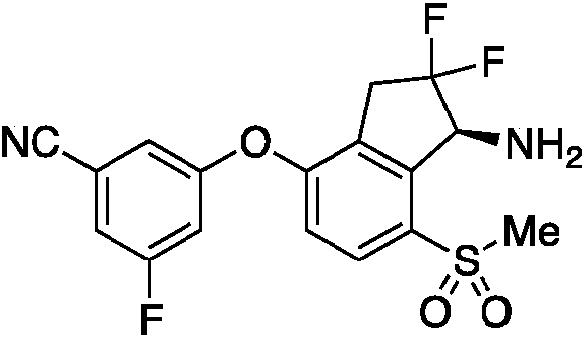
3-[(1S)-1-am¡no-2.2-d¡fluoro-7-met¡lsulfon¡l-¡ndan-4-¡l1ox¡-5-fluorobenzon¡tr¡lo (Compuesto 165)3 - [(1S) -1-am¡no-2.2-d¡fluoro-7-met¡lsulfon¡l-¡ndan-4-¡l1ox¡-5-fluorobenzonetr¡lo (Compound 165)
Etapa A: Preparación de (R)-N-(4-(3-ciano-5-fluorofenoxi)-2,2-difluoro-7-(metilsulfonil)-2,3-dihidro-1H-inden-1-il¡den)-2-met¡lpropan-2-sulfinam¡da: Se añadió tetraetóxido de titanio (49,5 jl, 0,24 mmol) gota a gota a 3-(2,2difluoro-7-metilsulfonil-1-oxo-indan-4-il)oxi-5-fluoro-benzonitrilo (30 mg, 0,08 mmol) y (S)-(-)-2-metil-2-propanosulfinamida (11 mg, 0,09 mmol) en tetrahidrofurano (0,8 ml) a temperatura ambiente en atmósfera de nitrógeno, después se calentó a 45 °C durante 8 horas. La reacción se interrumpió con agua (0,1 ml) a temperatura ambiente, los sólidos se eliminaron por filtración, se lavaron con EtOAc (20 ml) y se concentraron al vacío. El producto en bruto se purificó sobre gel de sílice (10 g SNAP, 14 CV, 15-100% de EtOAc/hexano) proporcionando (R)-N-(4-(3-ciano-5-fluorofenoxi)-2,2-difluoro-7-(metilsulfonil)-2,3-dihidro-1H-inden-1-iliden)-2-metilpropan-2-sulfinamida (24 mg, 0,05 mmol, 63 % de rendimiento).Step A: Preparation of (R) -N- (4- (3-cyano-5-fluorophenoxy) -2,2-difluoro-7- (methylsulfonyl) -2,3-dihydro-1H-inden-1-yl¡ den) -2-methylpropan-2-sulfinamide: Titanium tetraethoxide (49.5 µl, 0.24 mmol) was added dropwise to 3- (2,2-Difluoro-7-methylsulfonyl-1-oxo-indan-4-yl) oxy-5-fluoro-benzonitrile (30 mg, 0.08 mmol) and (S) - (-) - 2-methyl- 2-Propanesulfinamide (11 mg, 0.09 mmol) in tetrahydrofuran (0.8 ml) at room temperature under nitrogen atmosphere, then heated at 45 ° C for 8 hours. The reaction was quenched with water (0.1 ml) at room temperature, the solids were removed by filtration, washed with EtOAc (20 ml) and concentrated in vacuo. The crude product was purified on silica gel (10 g SNAP, 14 CV, 15-100% EtOAc / hexane) affording (R) -N- (4- (3-cyano-5-fluorophenoxy) -2.2 -difluoro-7- (methylsulfonyl) -2,3-dihydro-1H-inden-1-ylidene) -2-methylpropan-2-sulfinamide (24 mg, 0.05 mmol, 63% yield).
Etapa B: Preparación de (Á)-N-((S)-4-(3-ciano-5-fluorofenoxi)-2,2-difluoro-7-(metilsulfonil)-2,3-dihidro-1H-inden-1-¡l)-2-met¡lpropan-2-sulfinam¡da: Se añadió borohidruro sódico (5,6 mg, 0,15 mmol) de una vez a una solución enfriada con hielo de (R)-N-[4-(3-ciano-5-fluoro-fenoxi)-2,2-difluoro-7-metilsulfonil-indan-1-iliden]-2-metilpropan-2-sulfinamida (24 mg, 0,05 mmol) en tetrahidrofurano (0,5 ml), después se agitó hasta que se completó según se determinó por LC-MS. Se inactivó con agua (1 ml), se extrajo con EtOAc (3 x 5 ml), se lavó con salmuera (5 ml), se secó sobre MgSO4, se filtró y se concentró al vacío. El residuo se purificó sobre gel de sílice (10 g SNAP Ultra, 14 CV, 18-100% de EtOAc/hexano) proporcionando (R)-N-((S)-4-(3-ciano-5-fluorofenoxi)-2,2-difluoro-7-(metilsulfonil)-2,3-dihidro-1H-inden-1-il)-2-metilpropan-2-sulfinamida (7 mg, 0,01 mmol, 29 % de rendimiento). Etapa C: Preparación de 3-[(1S)-1-am¡no-2.2-d¡fluoro-7-met¡lsulfon¡l-¡ndan-4-¡l1ox¡-5-fluoro-benzon¡tr¡lo (Compuesto 165): Se añadió cloruro de hidrógeno (solución 4,0 M en dioxano, 0,2 ml, 0,8 mmol) gota a gota a una solución de (R)-N-(4-(3-ciano-5-fluorofenoxi)-2,2-difluoro-7-(metilsulfonil)-2,3-dihidro-1H-inden-1-iliden)-2-metilpropan-2-sulfinamida (7 mg, 0,01 mmol) en metanol (0,2 ml) a temperatura ambiente, después se agitó durante 30 minutos. La reacción se inactivó cuidadosamente mediante la adición gota a gota de NaHCO3 saturado (2 ml), se extrajo con EtOAc (3 x 5 ml), se lavó con salmuera (5 ml), se secó sobre Na2SO4, se filtró y se concentró al vacío. El producto en bruto se purificó sobre gel de sílice (10 g SNAP, 14 CV, 15-100% de EtOAc/hexano) proporcionando el compuesto 165 (2,3 mg, 0,006 mmol, 42 % de rendimiento). LCMS ESI (+) 383 (M+H). RMN 1H (400 MHz, CDCla): 8 7,93-7,91 (m, 1 H), 7,25-7,22 (m, 1 H), 7,14-7,13 (m, 1 H), 7,06-7,02 (m, 1 H), 6,96 (d, 1 H), 4,97-4,93 (m, 1 H), 3,55-3,37 (m, 2 H), 3,32 (s, 3 H).Step B: Preparation of (Á) -N - ((S) -4- (3-cyano-5-fluorophenoxy) -2,2-difluoro-7- (methylsulfonyl) -2,3-dihydro-1H-inden- 1-µl) -2-methylpropan-2-sulfinamide: Sodium borohydride (5.6 mg, 0.15 mmol) was added all at once to an ice-cold solution of (R) -N- [ 4- (3-cyano-5-fluoro-phenoxy) -2,2-difluoro-7-methylsulfonyl-indan-1-ylidene] -2-methylpropan-2-sulfinamide (24 mg, 0.05 mmol) in tetrahydrofuran ( 0.5 ml), then stirred to completion as determined by LC-MS. It was quenched with water (1 ml), extracted with EtOAc (3 x 5 ml), washed with brine (5 ml), dried over MgSO 4 , filtered and concentrated in vacuo. The residue was purified on silica gel (10 g SNAP Ultra, 14 CV, 18-100% EtOAc / hexane) affording (R) -N - ((S) -4- (3-cyano-5-fluorophenoxy) - 2,2-Difluoro-7- (methylsulfonyl) -2,3-dihydro-1H-inden-1-yl) -2-methylpropan-2-sulfinamide (7 mg, 0.01 mmol, 29% yield). Step C: Preparation of 3 - [(1S) -1-am¡no-2.2-d¡fluoro-7-meth¡lsulfon¡l-¡ndan-4-¡l1ox¡-5-fluoro-benzon¡tr¡lo (Compound 165): Hydrogen chloride (4.0 M solution in dioxane, 0.2 ml, 0.8 mmol) was added dropwise to a solution of (R) -N- (4- (3-cyano- 5-fluorophenoxy) -2,2-difluoro-7- (methylsulfonyl) -2,3-dihydro-1H-inden-1-ylidene) -2-methylpropan-2-sulfinamide (7 mg, 0.01 mmol) in methanol (0.2 ml) at room temperature, then stirred for 30 minutes. The reaction was carefully quenched by dropwise addition of saturated NaHCO 3 (2 mL), extracted with EtOAc (3 x 5 mL), washed with brine (5 mL), dried over Na 2 SO 4 , filtered and concentrated in vacuo. The crude product was purified on silica gel (10 g SNAP, 14 CV, 15-100% EtOAc / hexane) to provide compound 165 (2.3 mg, 0.006 mmol, 42% yield). LCMS ESI (+) 383 (M + H). 1H NMR (400 MHz, CDCla): 8 7.93-7.91 (m, 1H), 7.25-7.22 (m, 1H), 7.14-7.13 (m, 1H ), 7.06-7.02 (m, 1H), 6.96 (d, 1H), 4.97-4.93 (m, 1H), 3.55-3.37 (m, 2H), 3.32 (s, 3H).
Ejemplo de referencia 166Reference Example 166

ÍSj-3-((2^-djfJ^ro-7-j(flu^:omet¡r)sulj;onjlj-l^i^rox^2,3-djh^ro-lH-jnd^]^^]jox¡):5^n^^)en^3nijtr¡Jo__ÍCompu^sto 166): Preparado de forma similar de acuerdo con el ejemplo de referencia 63, etapas B-F, sustituyendo 3-hidroxi-5-metilbenzonitrilo por 3-fluoro-5-hidroxibenzonitrilo. m/z (ES-API-neg) [M-H+46] = 442; RMN 1H (400 MHz, CDCla) 8 7,87 (d, 1H), 7,38 (s a, 1H), 7,16 (d a, 1H), 6 ,88 (d, 1H), 5,58-5,12 (m, 3H), 3,59-3,44 (m, 3H). El exceso enantiomérico fue del 95 % según se determinó por el análisis del éster de Mosher.ÍSj-3 - ((2 ^ -djfJ ^ ro-7-j (flu ^: omet¡r) sulj; onjlj-l ^ i ^ rox ^ 2,3-djh ^ ro-lH-jnd ^] ^^] jox¡): 5 ^ n ^^) en ^ 3nijtr¡Jo__ÍCompu ^ sto 166): Prepared in a similar way according to Reference Example 63, steps BF, substituting 3-hydroxy-5-methylbenzonitrile for 3-fluoro-5 -hydroxybenzonitrile. m / z (ES-API-neg) [M-H + 46] = 442; 1H NMR (400 MHz, CDCla) 8 7.87 (d, 1H), 7.38 (brs, 1H), 7.16 (bd, 1H), 6. 88 (d, 1H), 5.58 to 5 , 12 (m, 3H), 3.59-3.44 (m, 3H). The enantiomeric excess was 95% as determined by Mosher's ester analysis.
Ejemplo de referencia 167Reference Example 167

(S)-3-cloro-5-((2,2-difluoro-7-((fluorometil)sulfonil)-1-hidroxi-2,3-dihidro-1H-inden-4-il)oxi)benzonitrilo (Compuesto 167): Preparado de forma similar de acuerdo con el ejemplo de referencia 63, etapas B-F, sustituyendo 3-cloro-5-hidroxibenzonitrilo por 3-fluoro-5-hidroxibenzonitrilo. m/z (ES-API-neg) [M-H+46] = 462 ; RMN 1H (400 MHz, CDCh) 8 7,92 (d, 1H), 7,36-7,33 (m, 1H), 7,32-7,27 (m, 1H), 6,97 (d, 1H), 5,58-5,12 (m, 3H), 3,62-3,38 (m, 3H). Exceso enantiomérico del 95 % según se determinó por análisis del éster de Mosher.(S) -3-chloro-5 - ((2,2-difluoro-7 - ((fluoromethyl) sulfonyl) -1-hydroxy-2,3-dihydro-1H-inden-4-yl) oxy) benzonitrile (Compound 167): Prepared in a similar manner according to Reference Example 63, steps BF, substituting 3-chloro-5-hydroxybenzonitrile for 3-fluoro-5-hydroxybenzonitrile. m / z (ES-API-neg) [M-H + 46] = 462 ; 1H NMR (400 MHz, CDCh) 8 7.92 (d, 1H), 7.36-7.33 (m, 1H), 7.32-7.27 (m, 1H), 6.97 (d, 1H), 5.58-5.12 (m, 3H), 3.62-3.38 (m, 3H). 95% enantiomeric excess as determined by Mosher ester analysis.
Ejemplo de referencia 168Reference Example 168

(2-cloro-6-((d¡fluoromet¡l)sulfon¡l)-3-(3,5-d¡fluorofenox¡)fen¡l)metanol (Compuesto 168): Preparado de forma similar de acuerdo con el ejemplo de referencia 41, etapa E. sust¡tuyendo 3,5-d¡fluorofenol por 3-cloro-5-fluorofenol. m/z (ES-API-neg) [M-H+46] = 429; RMN 1H (400 MHz. CDCls) 8 8.01 (d. 1H). 7.09 (d. 1H). 6,77-6,67 (m, 1H). 6,64-6,61 (m, 2H). 6.47 (t. 1H). 5,21 (d. 2H). 2,70 (t. 1H).(2-chloro-6 - ((d¡fluorometh¡l) sulfon¡l) -3- (3,5-d¡fluorophenoxy) phen¡l) methanol (Compound 168): Prepared similarly according to Reference Example 41, Step E. Substituting 3,5-dofluorophenol for 3-chloro-5-fluorophenol. m / z (ES-API-neg) [M-H + 46] = 429; 1H NMR (400 MHz. CDCls) 8 8.01 (d. 1H). 7.09 (d. 1H). 6.77-6.67 (m, 1H). 6.64-6.61 (m, 2H). 6.47 (t. 1H). 5.21 (d. 2H). 2.70 (t. 1H).
Ejemplo de referencia 169Reference Example 169

2-bromo-1-(3.4-d¡clorofenox¡)-4-((tr¡fluoromet¡l)sulfon¡l)benceno (Compuesto 169): Preparado de forma s¡m¡lar a la del ejemplo de referencia 116 sust¡tuyendo 3-cloro-5-fluorofenol con 3,4-d¡clorofenol en la etapa C. RMN 1H (400 MHz. CDCla): 88.30 (d. 1H). 7.89 (d. 1H). 7,54 (d. 1H). 7,26 (s. 1H). 6.99 (m. 2H).2-Bromo-1- (3,4-d¡chlorophenoxy) -4 - ((tr¡fluoromethyl) sulfon¡l) benzene (Compound 169): Prepared in a similar way to that of reference example 116 sust¡tuyendo 3-chloro-5-fluorophenol with 3,4-d¡clorofenol in step C. 1 H NMR (400 MHz CDCla.): 8 8.30 (d 1H.). 7.89 (d. 1H). 7.54 (d.1H). 7.26 (s, 1H). 6.99 (m. 2H).
Ejemplo de referencia 170Reference Example 170

2-bromo-1-(5-cloro-2-fluorofenox¡)-4-((tr¡fluoromet¡l)sulfon¡l)benceno (Compuesto 170): Preparado de forma s¡m¡lar a la del ejemplo de referencia 116 sust¡tuyendo 3-cloro-5-fluorofenol con 5-cloro-2-fluorofenol en la etapa C. RMN 1H (400 MHz. CDCh): 88.30 (s. 1H). 7.88 (d. 1H). 7,21-7,31 (m. 3H). 6,90 (d. 1H).2-bromo-1- (5-chloro-2-fluorophenoxy) -4 - ((trifluoromethyl) sulfonil) benzene (Compound 170): Prepared in a similar way to the example of Reference 116 substituting 3-chloro-5-fluorophenol with 5-chloro-2-fluorophenol in step C. 1H NMR (400 MHz. CDCh): 8 8.30 (s. 1H). 7.88 (d. 1H). 7.21-7.31 (m. 3H). 6.90 (d.1H).
Ejemplo de referencia 171Reference Example 171
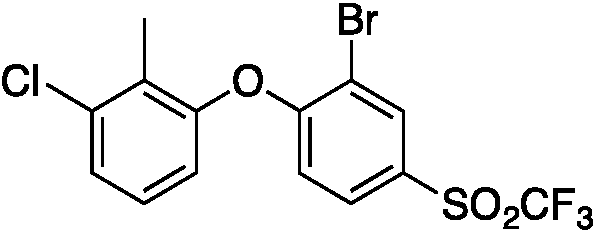
1-(2-bromo-4-((tr¡fluoromet¡l)sulfon¡l)fenox¡)-3-cloro-2-met¡lbenceno (Compuesto 171): Preparado de forma s¡m¡lar a la del ejemplo de referencia 116 sust¡tuyendo 3-cloro-5-fluorofenol con 3-cloro-2-met¡lfenol en la etapa C. RMN 1 H (400 MHz. d6-DMSO): 88,40 (d. 1H). 8,02 (d. 1H). 7,45 (d. 1H). 7,35 (t. 1H). 7,20 (d. 1H). 6,95 (d. 1H). 2,13 (s. 3H). Ejemplo de referencia 1721- (2-bromo-4 - ((tr¡fluorometh¡l) sulfon¡l) phenox¡) -3-chloro-2-methylbenzene (Compound 171): Prepared in a way similar to that of Reference Example 116 substituting 3-chloro-5-fluorophenol with 3-chloro-2-methylphenol in step C. 1 H NMR (400 MHz. d 6 -DMSO): 8 8.40 (d. 1H ). 8.02 (d.1H). 7.45 (d.1H). 7.35 (t. 1H). 7.20 (d. 1H). 6.95 (d. 1H). 2.13 (s. 3H). Reference Example 172

2-bromo-1-(3.5-d¡clorofenox¡)-4-((tr¡fluoromet¡l)sulfon¡l)benceno (Compuesto 172): Preparado de forma s¡m¡lar a la del ejemplo de referencia 116 sust¡tuyendo 3-cloro-5-fluorofenol con 3,5-d¡clorofenol en la etapa C. RMN 1H (400 MHz. CDCh): 8 8,30 (d. 1H). 7,93 (d. 1H). 7,31 (d. 1H). 7,04 (m. 3H).2-bromo-1- (3.5-d¡chlorophenox¡) -4 - ((tr¡fluoromethyl) sulfon¡l) benzene (Compound 172): Prepared in a similar way to that of reference example 116 sust¡tuyendo 3-chloro-5-fluorophenol with 3,5-d¡clorofenol in step C. 1 H NMR (400 MHz CDCH.): 8 8.30 (d 1H.). 7.93 (d. 1H). 7.31 (d.1H). 7.04 (m, 3H).
Ejemplo de referencia 173 Reference example 173

2-bromo-1-(3.5-d¡met¡lfenox¡)-4-((tr¡fluorometil)sulfon¡l)benceno (Compuesto 173): Preparado de forma similar a la del ejemplo de referencia 116 sustituyendo 3-cloro-5-fluorofenol con 3,5-dimetilfenol en la etapa C. RMN 1H (400 MHz. CDCl3): 8 8.26 (d. 1H). 7.81 (d. 1H). 6.95 (s. 1H). 6.91 (d. 1H). 6.74 (s. 2H). 2,35 (s. 6 H).2-Bromo-1- (3.5-d¡methylphenoxy¡) -4 - ((tr¡fluoromethyl) sulfon¡l) benzene (Compound 173): Prepared in a similar way to that of reference example 116 substituting 3-chloro -5-fluorophenol with 3,5-dimethylphenol in step C. 1H NMR (400 MHz. CDCl 3 ): 8 8.26 (d. 1H). 7.81 (d. 1H). 6.95 (s. 1H). 6.91 (d. 1H). 6.74 (s. 2H). 2.35 (s. 6H).
Ejemplo de referencia 174Reference Example 174

2-bromo-1-(5-cloro-2-met¡lfenoxi)-4-((tr¡fluoromet¡l)sulfon¡l)benceno (Compuesto 174): Preparado de forma similar a la del ejemplo de referencia 116 sustituyendo 3-cloro-5-fluorofenol con 5-cloro-2-metilfenol en la etapa C. RMN 1H (400 MHz. CDCl3): 8 8.29 (d. 1H). 7.84 (d. 1H). 7.22-7.27 (m. 2H). 7.06 (s. 1H). 6.78 (d. 1H). 2.16 (s. 3H).2-Bromo-1- (5-chloro-2-methylfhenoxy) -4 - ((trifluoromethyl) sulfonil) benzene (Compound 174): Prepared in a similar way to Reference Example 116 by substituting 3-chloro-5-fluorophenol with 5-chloro-2-methylphenol in step C. 1H NMR (400 MHz. CDCl 3 ): 8 8.29 (d. 1H). 7.84 (d. 1H). 7.22-7.27 (m. 2H). 7.06 (s. 1H). 6.78 (d. 1H). 2.16 (s. 3H).
Ejemplo de referencia 175Reference Example 175

2-(2-bromo-4-((tr¡fluoromet¡l)sulfonil)fenox¡)-1.3-d¡fluorobenceno (Compuesto 175): Preparado de forma similar a la del ejemplo de referencia 116 sustituyendo 3-cloro-5-fluorofenol con 3.5-difluorofenol en la etapa C. RMN 1 H (400 MHz. d6-DMSO): 88.40 (s. 1H). 8.03 (d. 1H). 7.58 (m. 2H). 7.23 (m. 1H). 7.11 (d. 1H).2- (2-bromo-4 - ((tr¡fluoromethyl) sulfonyl) phenoxy) -1,3-d¡fluorobenzene (Compound 175): Prepared in a similar way to that of reference example 116 substituting 3-chloro-5 -fluorofenol with 3.5-difluorophenol in step C. 1 H NMR (400 MHz d 6 -DMSO.): 8 8.40 (s 1H.). 8.03 (d. 1H). 7.58 (m. 2H). 7.23 (m. 1H). 7.11 (d. 1H).
Ejemplo de referencia 176Reference Example 176

2-bromo-1-(2.4-d¡fluorofenoxi)-4-((tr¡fluoromet¡l)sulfon¡l)benceno (Compuesto 176): Preparado de forma similar a la del ejemplo de referencia 116 sustituyendo 3-cloro-5-fluorofenol con 2.6-difluorofenol en la etapa C. RMN 1 H (400 MHz. d6-DMSO): 88.30 (s. 1H). 7.88 (d. 1H). 7.27-7.32 (m. 1H). 7.08-7.14 (m. 2H). 6.85 (d. 1H).2-Bromo-1- (2,4-d¡fluorophenoxy) -4 - ((tr¡fluorometh¡l) sulfon¡l) benzene (Compound 176): Prepared in a similar way to Reference Example 116 by substituting 3-chloro- 5-fluorophenol with 2.6-difluorophenol in step C. 1 H NMR (400 MHz d 6 -DMSO.): 8 8.30 (s 1H.). 7.88 (d. 1H). 7.27-7.32 (m. 1H). 7.08-7.14 (m. 2H). 6.85 (d. 1H).
Ejemplo de referencia 177Reference Example 177

(3-(2-bromo-4-((tr¡fluorometil)sulfon¡l)fenox¡)-5-fluorofen¡l)metanol (Compuesto 177): Preparado de forma similar a la del ejemplo de referencia 116 sustituyendo 3-cloro-5-fluorofenol con 5-fluoro-3-(hidroximetil)fenol en la etapa C. RMN 1H (400 MHz. CDCla): 88.29 (d. 1 H). 7.87 (m. 1 H). 7.06 (d. 1H). 7.02 (d. 1H). 6.94 (d. 1H). 6.77 (m. 1H). 4.75 (d. 2H). 1.83 (t. 1H).(3- (2-bromo-4 - ((trifluoromethyl) sulfonyl) phenoxy) -5-fluorophenyl) methanol (Compound 177): Prepared in a similar manner to that of Reference Example 116 by substituting 3- chloro-5-fluorophenol with 5-fluoro-3- (hydroxymethyl) phenol in step C. 1H NMR (400 MHz. CDCla): 8 8.29 (d. 1H). 7.87 (m. 1H). 7.06 (d. 1H). 7.02 (d. 1H). 6.94 (d. 1H). 6.77 (m. 1H). 4.75 (d. 2H). 1.83 (t. 1H).
Ejemplo de referencia 178 Reference Example 178

(E)-6-(3-c¡ano-5-fluorofenox¡)-3-((d¡fluoromet¡l)sulfon¡l)-2-(prop-1-en-1-¡l)benzon¡trilo (Compuesto 178): Se añadió alil(tributil)estannano (0,08 ml, 0,25 mmol) med¡ante una jer¡nga a una mezcla desgas¡f¡cada de 2-cloro-6-(3-ciano-5-fluoro-fenox¡)-3-(d¡fluoromet¡lsulfon¡l)benzon¡tr¡lo (Compuesto 30, 48 mg, 0,12 mmol) y tetraqu¡s(tr¡fen¡lfosf¡na)palad¡o (0) (14 mg, 0,01 mmol) en DMF (0,6 ml) a temperatura amb¡ente a un rec¡p¡ente de m¡croondas equ¡pado con un septo en atmósfera de n¡trógeno. Los septos se sust¡tuyeron ráp¡damente con un tapón de m¡croondas y se cerraron herméticamente bajo un manto de n¡trógeno. Después, la mezcla de reacc¡ón se calentó a 160 °C durante 30 m¡nutos en un reactor de m¡croondas. Después de enfr¡ar a temperatura amb¡ente, la mezcla de reacc¡ón se f¡ltró a través de Cel¡te. El filtrado se lavó con MTBE (10 ml) y después se ag¡tó con soluc¡ón de KF saturada (10 ml) durante 30 m¡nutos. La fase orgán¡ca se separó. La fase acuosa se extrajo con MTBE. Los extractos orgán¡cos comb¡nados se lavaron con salmuera ( 20 ml), se secaron (Na2SO4), se filtraron y se concentraron al vacío. El producto en bruto se pur¡f¡có por cromatografía ultrarráp¡da sobre gel de síl¡ce (2-5 % de EtOAc/hexano) proporc¡onando el compuesto 178 (46 mg, 94 %) en forma de un sól¡do de color blanco. LCMS ESI (-) m/z 391 (M-H); RMN 1H (400 MHz, CDCh): 58,18 (d, 1H), 7,38-7,35 (m, 1H), 7,29-7,27 (m, 1H), 7,21-7,18 (m, 1H), 7,07-7,02 (m, 1H), 6,90 (d, 1H), 6,56-6,47 (m, 1H), 6,22 (t, 1H), 2,08-2,06 (m. 1H).(E) -6- (3-kano-5-fluorophenoxy) -3 - ((d¡fluorometal) sulfon¡l) -2- (prop-1-en-1-¡l) benzon¡ trile (Compound 178): Allyl (tributyl) stannane (0.08 ml, 0.25 mmol) was added via jargon to a degassed mixture of 2-chloro-6- (3-cyano -5-fluoro-phenox¡) -3- (d¡fluorometh¡lsulfon¡l) benzon¡tr¡lo (Compound 30, 48 mg, 0.12 mmol) and tetrak¡s (triphenophosphine) palladium (0) (14 mg, 0.01 mmol) in DMF (0.6 ml) at room temperature in a microwave container equipped with a septum in an atmosphere of nitrogen trogen. The septa were quickly replaced with a microwave plug and hermetically sealed under a blanket of nitrogen. Then the reaction mixture was heated at 160 ° C for 30 minutes in a microwave reactor. After cooling to room temperature, the reaction mixture was filtered through Celite. The filtrate was washed with MTBE (10 ml) and then stirred with saturated KF solution (10 ml) for 30 minutes. The organic phase separated. The aqueous phase was extracted with MTBE. The combined organic extracts were washed with brine (20 ml), dried (Na 2 SO 4 ), filtered and concentrated in vacuo. The crude product was purified by flash chromatography on silica gel (2-5% EtOAc / hexane) to provide compound 178 (46 mg, 94%) as a solid. white color. LCMS ESI (-) m / z 391 (MH); 1H NMR (400 MHz, CDCh): 58.18 (d, 1H), 7.38-7.35 (m, 1H), 7.29-7.27 (m, 1H), 7.21-7, 18 (m, 1H), 7.07-7.02 (m, 1H), 6.90 (d, 1H), 6.56-6.47 (m, 1H), 6.22 (t, 1H) , 2.08-2.06 (m, 1H).
Ejemplo de referencia 179Reference Example 179
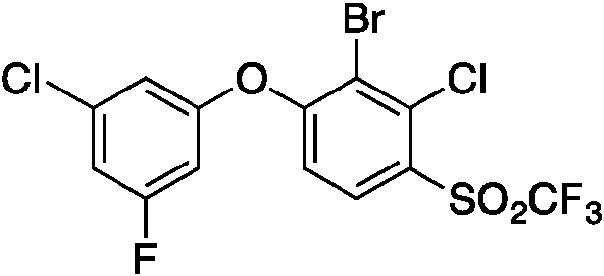
2-bromo-3-cloro-1-(3-cloro-5-fluorofenox¡)-4-((tr¡fluoromet¡l)sulfon¡l)benceno (Compuesto 179): Preparado de forma análoga a los procedimientos para el compuesto 28 omitiendo la etapa C. RMN 1H (400 MHz, CDCl3): 58,13 (d, 1H), 7,08-7,05 (m, 1H), 6,95-6,93 (m, 2H), 6,79-6,76 (m, 1H).2-Bromo-3-chloro-1- (3-chloro-5-fluorophenox¡) -4 - ((tr¡fluorometh¡l) sulfon¡l) benzene (Compound 179): Prepared analogously to the procedures for compound 28 omitting step C. 1H NMR (400 MHz, CDCl3): 58.13 (d, 1H), 7.08-7.05 (m, 1H), 6.95-6.93 (m, 2H) , 6.79-6.76 (m, 1H).
Ejemplo de referencia 180Reference example 180

2-cloro-6-(3-cloro-5-fluorofenox¡)-3-(S-met¡lsulfonim¡do¡l)benzon¡tr¡lo (Compuesto 180): Preparado mediante un conjunto de procedimientos análogo a los descritos para la preparación de los compuestos 69 y 152. LCMS ESI (+) m/z 359, 361 (M+H); RMN 1H (400 MHz, CDOs): 58,33 (d, 1H), 7,09 (m, 1H), 6,97-6,95 (m, 1H), 6,94 (d, 1H), 6,81 (m, 1H), 3,32 (s, 3H), 2,94 (s a, 1H).2-chloro-6- (3-chloro-5-fluorophenoxy) -3- (S-methylsulfonim¡do¡l) benzon¡tr¡lo (Compound 180): Prepared by a set of procedures analogous to those described for the preparation of compounds 69 and 152. LCMS ESI (+) m / z 359, 361 (M + H); 1H NMR (400 MHz, CDOs): 58.33 (d, 1H), 7.09 (m, 1H), 6.97-6.95 (m, 1H), 6.94 (d, 1H), 6 , 81 (m, 1H), 3.32 (s, 3H), 2.94 (brs, 1H).
Ejemplo de referencia 181Reference Example 181

3-((6.6-d¡fluoro-5-h¡drox¡-4-(met¡lsulfon¡l)-5.6.7.8-tetrah¡dronaftalen-1-il)ox¡)-5-fluorobenzon¡tr¡lo (Compuesto 181): Preparado mediante un conjunto de procedimientos análogo a los descritos para la preparación del compuesto 8. 3 - ((6.6-d¡fluoro-5-hydrox¡-4- (meth¡lsulfon¡l) -5.6.7.8-tetrah¡dronaphthalen-1-yl) ox¡) -5-fluorobenzon¡tr (Compound 181): Prepared by a set of procedures analogous to those described for the preparation of compound 8.
LCMS ESI (+) m/z 359, 361 (M+H); RMN 1H (400 MHz, CDCI3): 58,04 (d, 1H), 7,23 (m, 1H), 7,12-7,10 (m, 1H), 7,03 6,99 (m, 1H), 6,07 (d, 1H), 5,54-5,49 (m, 1H), 3,68 (m, 1H), 3,26 (s, 3H), 3,20 (m, 1H), 2,97-2,86 (m, 1H), 2,63-2,45 (m, 1H), 2,35-2,25 (m, 1H).LCMS ESI (+) m / z 359, 361 (M + H); 1H NMR (400 MHz, CDCI 3 ): 58.04 (d, 1H), 7.23 (m, 1H), 7.12-7.10 (m, 1H), 7.03 6.99 (m, 1H), 6.07 (d, 1H), 5.54-5.49 (m, 1H), 3.68 (m, 1H), 3.26 (s, 3H), 3.20 (m, 1H ), 2.97-2.86 (m, 1H), 2.63-2.45 (m, 1H), 2.35-2.25 (m, 1H).
Ejemplo de referencia 182Reference Example 182

4-((5-clorop¡r¡d¡n-3-¡l)ox¡)-7-((d¡fluoromet¡l)sulfon¡l)-2,2-d¡fluoro-2,3-d¡h¡dro-1H-¡nden-1-ona (Compuesto 182): Preparado en el ejemplo de referencia 25, etapa D.4 - ((5-chloropyr¡d¡n-3-¡l) ox¡) -7 - ((d¡fluoromethyl) sulfon¡l) -2,2-d¡fluoro-2,3- dihydro-1H-inden-1-one (Compound 182): Prepared in Reference Example 25, Step D.
Ejemplo de referencia 183Reference Example 183

N-(3-clorofen¡l-4.6-t2)-4-n¡trobenzofc1f1.2.51oxad¡azol-5-am¡na (Compuesto 183)N- (3-chlorophenyl-4.6-t2) -4-nitrobenzofc1f1.2.51oxad¡azol-5-amine (Compound 183)
Etapa A: Síntes¡s de 3 -clorobenzen-4 ,6 -t2-am¡na: Se d¡solv¡ó 3-cloro-4,6-d¡yodoan¡l¡na (100 mg,) en metanol (3 ml) y se añad¡ó tr¡et¡lam¡na (0,1 ml) y se somet¡ó a tr¡t¡ac¡ón durante una noche usando 50 C¡ de gas tr¡t¡o, a temperatura amb¡ente. El tr¡t¡o láb¡l se el¡m¡nó d¡solv¡endo la mezcla de reacc¡ón en bruto en metanol (3 ml) y llevándola a sequedad al vacío. La el¡m¡nac¡ón de láb¡les se real¡zó por dupl¡cado. El mater¡al tr¡t¡ado en bruto se pur¡f¡có por TLC preparat¡va (gel de Síl¡ce, 1000 |j) usando hexano:et¡lacetato:AcOH (85:14:1). La banda de producto se eluyó con acetato de et¡lo para dar 3 -clorobenzen-4 ,6 -t2-am¡na (rend¡m¡ento = 600 mC¡, la pureza rad¡oquím¡ca era >98 %).Step A: Synthesis of 3- chlorobenzen- 4 , 6 -t 2 -amina: 3-chloro-4,6-d¡iodoan¡na (100 mg) was dissolved in methanol (3 ml) and tritlamine (0.1 ml) was added and trotted overnight using 50 C trit gas, at room temperature. The labial trit was removed by dissolving the crude reaction mixture in methanol (3 ml) and bringing it to dryness under vacuum. The removal of lips was carried out in duplicate. The crude triturated material was purified by preparative TLC (Silica gel, 1000 µg) using hexane: ethyl acetate: AcOH (85: 14: 1). The product band was eluted with ethyl acetate to give 3- chlorobenzen- 4 , 6 -t 2 -amine (yield = 600 mC,, radiochemical purity was> 98% ).
Etapa B: Síntes¡s del compuesto 183: Una mezcla en ag¡tac¡ón de 5-cloro-4-n¡tro-2,1,3-benzoxad¡azol (20 mg, 0,1 mmol), 3 -clorobenzen-4 ,6 -t2-am¡na (600 mC¡) y Cs2CO3 (65 mg, 0,20 mmol) en DMF (1 ml) se calentó a 60 °C durante 1 h. Después de un per¡odo de refr¡gerac¡ón, la mezcla de reacc¡ón se repart¡ó entre EtOAc y agua. La capa acuosa se extrajo con EtOAc. Las capas orgán¡cas comb¡nadas se lavaron con agua y salmuera, se secaron y se concentraron. El res¡duo se pur¡f¡có por HPLC preparat¡va en una columna Sem¡-prep ACE-5 C18, 250 x 10 mm, 100 A. La eluc¡ón se llevó a cabo ¡socrát¡camente usando TFA al 0,1 % en agua/ aceton¡tr¡lo (35:65) para dar el compuesto 183 (478 mC¡, 80 %).Step B: Synthesis of Compound 183: A stirred mixture of 5-chloro-4-nitro-2,1,3-benzoxadiazole (20 mg, 0.1 mmol), 3- Chlorobenzen- 4 , 6 -t 2 -amine (600 mC,) and Cs 2 CO 3 (65 mg, 0.20 mmol) in DMF (1 ml) was heated at 60 ° C for 1 h. After a period of cooling, the reaction mixture was partitioned between EtOAc and water. The aqueous layer was extracted with EtOAc. The combined organic layers were washed with water and brine, dried, and concentrated. The residue was purified by preparative HPLC on a Semi-prep ACE-5 C18 column, 250 x 10 mm, 100 A. Elution was carried out unscratically using TFA at 0.1% in water / acetonitrile (35:65) to give compound 183 (478 mC, 80%).
Ejemplo de referencia 184Reference Example 184

(R)-4-((5-clorop¡r¡d¡n-3-¡l)ox¡)-7-((tr¡fluoromet¡l)sulfon¡l)-2,3-d¡h¡dro-1H-¡nden-1-ol (Compuesto 184): Preparado de forma s¡m¡lar de acuerdo con el ejemplo de referencia 55, etapa D sust¡tuyendo 3-cloro-5-h¡drox¡p¡r¡d¡na por 3,5-d¡fluorofenol. RMN 1H (400 MHz, CDCl3): 58,47 (d, 1H), 8,35 (d, 1H), 7,82 (d, 1H), 7,45 (t, 1H), 6 ,88 (d, 1H), 5,64 5,59 (m, 1H), 3,30-3,15 (m, 2H), 3,02-2,93 (m, 1H) 2,46-2,26 (m, 2H); m/z (ES-API-pos) [M+H] = 394.(R) -4 - ((5-chloropyr¡d¡n-3-¡l) ox¡) -7 - ((tr¡fluoromethyl) sulfon¡l) -2,3-d¡h¡ dro-1H-inden-1-ol (Compound 184): Prepared in a similiar way according to Reference Example 55, step D substituting 3-chloro-5-hydroxyp¡r DNA for 3,5-d¡fluorophenol. 1H NMR (400 MHz, CDCl 3 ): 58.47 (d, 1H), 8.35 (d, 1H), 7.82 (d, 1H), 7.45 (t, 1H) , 6.88 ( d, 1H), 5.64 5.59 (m, 1H), 3.30-3.15 (m, 2H), 3.02-2.93 (m, 1H) 2.46-2.26 ( m, 2H); m / z (ES-API-pos) [M + H] = 394.
Ejemplo de referencia 185 Reference Example 185

(S)-3-((2.2-d¡fluoro-1-h¡drox¡-7-((tr¡fluoromet¡l)sulfon¡l)-2.3-d¡h¡dro-1H-¡nden-4-¡l)ox¡)-5-fluorobenzon¡tr¡lo (Compuesto 185)(S) -3 - ((2.2-d¡fluoro-1-h¡drox¡-7 - ((tr¡fluorometh¡l) sulfon¡l) -2.3-d¡h¡dro-1H-inden-4 -¡L) ox¡) -5-fluorobenzonetrio (Compound 185)
Etapa A: 3-fluoro-5-((1-oxo-7-((tr¡fluoromet¡l)sulfon¡l)-2.3-d¡h¡dro-1H-¡nden-4-¡l)ox¡)benzon¡tr¡lo: Se añad¡ó peroyod¡nano de Dess Mart¡n (192 mg. 0.45 mmol) a una soluc¡ón de 3-fluoro-5-[(1R)-1-h¡drox¡-7-(tr¡fluoromet¡lsulfon¡l)¡ndan-4-¡l]ox¡-benzon¡tr¡lo Compuesto 57 (121 mg. 0.3 mmol) en d¡clorometano (4 ml). La mezcla se ag¡tó a temperatura amb¡ente. Después de 1 hora. la mezcla de reacc¡ón se repart¡ó entre EtOAc y agua. El EtOAc se lavó con salmuera. se secó sobre MgSO4. se f¡ltró y se evaporó. El res¡duo se cromatograf¡ó en una columna SNAP de 10 g de B¡otage con un grad¡ente del 20% al 80% de EtOAc:hexano para proporc¡onar 3-fluoro-5-((1-oxo-7-((tr¡fluoromet¡l)sulfon¡l)-2.3-d¡h¡dro-1H-¡nden-4-¡l)ox¡)benzon¡tr¡lo (102 mg.Step A: 3-fluoro-5 - ((1-oxo-7 - ((tr¡fluorometh¡l) sulfon¡l) -2.3-d¡h¡dro-1H-¡nden-4-¡l) ox¡ ) Benzonitril: Dess Mart¡n's peroiodine (192 mg, 0.45 mmol) was added to a solution of 3-fluoro-5 - [(1R) -1-hydrox¡- 7- (trifluoromethylsulfonyl) indan-4-l] oxi-benzonitrile Compound 57 (121 mg, 0.3 mmol) in dichloromethane (4 ml). The mixture was stirred at room temperature. After 1 hour. The reaction mixture was partitioned between EtOAc and water. The EtOAc was washed with brine. dried over MgSO4. it was filtered and evaporated. The residue was chromatographed on a 10 gBotage SNAP column with a 20% to 80% EtOAc: hexane gradient to provide 3-fluoro-5 - ((1-oxo- 7 - ((tr¡fluoromethyl) sulfon¡l) -2.3-d¡h¡dro-1H-inden-4-¡l) ox¡) benzonil (102 mg.
0.26 mmol. 85 % de rend¡m¡ento) en forma de un cr¡stal ¡ncoloro.0.26 mmol. 85% yield) in the form of a colorless crystal.
m/z (ES-API-pos) [M+H] = 400 m / z (ES-API-pos) [M + H] = 400
Etapa B: E.Z)-3-((1-(but¡l¡m¡no)-7-((tr¡fluoromet¡l)sulfon¡l)-2.3-d¡h¡dro-1H-¡nden-4-¡l)ox¡)-5-fluorobenzon¡tr¡lo: Se añad¡ó ác¡do tr¡fluoroacét¡co (0.0039 ml. 0.05 mmol) a una soluc¡ón de 3-fluoro-5-((1-oxo-7-((tr¡fluoromet¡l)sulfon¡l)-2.3-d¡h¡dro-1H-¡nden-4-¡l)ox¡)benzon¡tr¡lo (102 mg. 0.26 mmol) y butan-1-am¡na (1.26 ml.Stage B: EZ) -3 - ((1- (but¡l¡m¡no) -7 - ((tr¡fluorome¡l) sulfon¡l) -2.3-d¡h¡dro-1H-¡nden- 4-¡l) ox¡) -5-fluorobenzonetr¡lo: Tr¡fluoroacetic acid (0.0039 ml. 0.05 mmol) was added to a solution of 3-fluoro-5 - (( 1-oxo-7 - ((tr¡fluoromethyl) sulfon¡l) -2.3-d¡h¡dro-1H-inden-4-¡l) ox¡) benzon¡tr¡l (102 mg. 0.26 mmol) and butane-1-amine (1.26 ml.
12.8 mmol) en benceno (15 ml). La mezcla se calentó a reflujo con un dest¡lador H¡ckman un¡do. Después de 6 horas. la mezcla de reacc¡ón se evaporó y el res¡duo se repart¡ó entre EtOAc y NaHCO3 acuoso saturado. El EtOAc se lavó con salmuera. se secó sobre MgSO4. se f¡ltró y se evaporó para produc¡r (E,Z)-3-((1-(but¡l¡m¡no)-7-((tr¡fluoromet¡l)sulfon¡l)-2.3-d¡h¡dro-1H-¡nden-4-¡l)ox¡)-5-fluorobenzon¡tr¡lo (100 mg. 0.2 mmol. 86 % de rend¡m¡ento) en forma de una película de color verde.12.8 mmol) in benzene (15 ml). The mixture was heated to reflux with an attached Hckman still. After 6 hours. The reaction mixture was evaporated and the residue was partitioned between EtOAc and saturated aqueous NaHCO 3 . The EtOAc was washed with brine. dried over MgSO 4 . It was filtered and evaporated to produce (E, Z) -3 - ((1- (but¡l¡min) -7 - ((tr¡fluorome¡l) sulfon¡l) -2.3- dihydro-1H-inden-4-¡l) ox¡) -5-fluorobenzone (100 mg. 0.2 mmol. 86 % yield) in the form of a colored film green.
Etapa C: 3-((2.2-d¡fluoro-1-oxo-7-((tr¡fluoromet¡l)sulfon¡l)-2.3-d¡h¡dro-1H-¡nden-4-¡l)ox¡)-5-fluorobenzon¡tr¡lo: Se añad¡ó d¡tetrafluoroborato de 1-(cloromet¡l)-4-fluoro-1.4-d¡azon¡ab¡c¡clo[2.2.2]octano (195 mg. 0.55 mmol) a una mezcla de (E,Z)-3-((1-(but¡l¡m¡no)-7-((tr¡fluoromet¡l)sulfon¡l)-2.3-d¡h¡dro-1H-¡nden-4-¡l)ox¡)-5-fluorobenzon¡tr¡lo en bruto (100 mg. 0.22 mmol) y sulfato sód¡co (31 mg. 0.22 mmol) en aceton¡tr¡lo (8 ml). La mezcla de reacc¡ón se calentó a 80 °C durante 5 horas. después se ag¡tó a temperatura amb¡ente durante una noche. La mezcla de reacc¡ón se trató con HCl 6 M (1 ml) y agua (1 ml) y se ag¡tó durante 15 m¡nutos. La mezcla de reacc¡ón se repart¡ó entre EtOAc y agua. El EtOAc se lavó con salmuera. se secó sobre MgSO4. se f¡ltró y se evaporó. El res¡duo se cromatograf¡ó en una columna SNAP de 10 g de B¡otage con un grad¡ente del 10 % al 60 % de EtOAc:hexano para proporc¡onar 3-((2.2-d¡fluoro-1-oxo-7-((tr¡fluoromet¡l)sulfon¡l)-2.3-d¡h¡dro-1H-¡nden-4-¡l)ox¡)-5-fluorobenzon¡tr¡lo (55 mg. 0.13 mmol. 58 % de rend¡m¡ento) en forma de un ace¡te ¡ncoloro.Step C: 3 - ((2.2-d¡fluoro-1-oxo-7 - ((tr¡fluorometh¡l) sulfon¡l) -2.3-d¡h¡dro-1H-inden-4-¡l) ox¡) -5-fluorobenzonetr¡lo: 1- (chloromethyl) -4-fluoro-1,4-d¡azon¡ab¡c¡clo [2.2.2] octane d¡tetrafluoroborate ( 195 mg. 0.55 mmol) to a mixture of (E, Z) -3 - ((1- (but¡l¡m¡no) -7 - ((tr¡fluorome¡l) sulfon¡l) -2.3-d Crude h¡dro-1H-inden-4-¡l) ox¡) -5-fluorobenzonetril (100 mg, 0.22 mmol) and sodium sulfate (31 mg, 0.22 mmol) in aceton¡ trilo (8 ml). The reaction mixture was heated at 80 ° C for 5 hours. then stirred at room temperature overnight. Reacc¡ón mixture was treated with 6M HCl (1 ml) and water (1 ml) and ag¡tó for 15 m¡nutos. The reaction mixture was partitioned between EtOAc and water. The EtOAc was washed with brine. dried over MgSO 4 . it was filtered and evaporated. The residue was chromatographed on a 10 gBotage SNAP column with a gradient of 10% to 60% EtOAc: hexane to provide 3 - ((2.2-fluoro-1- oxo-7 - ((tr¡fluoromethyl) sulfon¡l) -2.3-d¡hydro-1H-inden-4-¡l) ox¡) -5-fluorobenzonetr¡l (55 mg. 0.13 mmol. 58% yield) in the form of a colorless oil.
Etapa D: (S)-3-((2.2-d¡fluoro-1-h¡drox¡-7-((tr¡fluoromet¡l)sulfon¡l)-2.3-d¡h¡dro-1H-¡nden-4-¡l)ox¡)-5-fluorobenzon¡tr¡lo (Compuesto 185): Se añad¡ó RuCl(p-c¡meno)[(R.R)-Ts-DPEN] (1.6 mg. 0.0025 mmol) a una soluc¡ón enfr¡ada en h¡elo. roc¡ada con n¡trógeno de 3-((2.2-d¡fluoro-1-oxo-7-((tr¡fluoromet¡l)sulfon¡l)-2.3-d¡h¡dro-1H-¡nden-4-¡l)ox¡)-5-fluorobenzon¡tr¡lo (55 mg. 0.13 mmol). ác¡do fórm¡co (0.006 ml. 0.16 mmol) y tr¡et¡lam¡na (0.02 ml. 0.14 mmol) en d¡clorometano (5 ml). El rec¡p¡ente se cerró hermét¡camente y se almacenó a 4 °C durante una noche. La mezcla de reacc¡ón se evaporó. El res¡duo se cromatograf¡ó en una columna SNAP de 10 g de B¡otage con un grad¡ente del 10 % al 60 % de EtOAc:hexano para proporc¡onar el compuesto 185 (45 mg. 0.1 mmol. 81 % de rend¡m¡ento) en forma de un cr¡stal ¡ncoloro que se sol¡d¡f¡có a un sól¡do de color blanco. RMN 1H (400 MHz. CDCla): 8 7.95 (d. 1H). 7.35-7.31 (m. 1H). 7.26-7.23 (m. 1H). 7.15-7.11 (m. 1H). 6.99 (d. 1H). 5.46-5.39 (m. 1H).Stage D: (S) -3 - ((2.2-d¡fluoro-1-h¡drox¡ -7 - ((tr¡fluorome¡l) sulfon¡l) -2.3-d¡h¡dro-1H-¡ nden-4-¡l) ox¡) -5-fluorobenzone trilo (Compound 185): RuCl (pcmene) [(RR) -Ts-DPEN] (1.6 mg, 0.0025 mmol) was added to a solution cooled in ice. sprayed with 3 - ((2.2-d¡fluoro-1-oxo-7 - ((tr¡fluorometh¡l) sulfon¡l) -2.3-d¡h¡dro-1H-inden- 4-¡l) ox¡) -5-fluorobenzonetrilo (55 mg, 0.13 mmol). formic acid (0.006 ml. 0.16 mmol) and tritlamine (0.02 ml. 0.14 mmol) in dichloromethane (5 ml). The container was hermetically sealed and stored at 4 ° C overnight. The reaction mixture was evaporated. The residue was chromatographed on a 10 gBotage SNAP column with a gradient of 10% to 60% EtOAc: hexane to provide compound 185 (45 mg, 0.1 mmol. 81% yield) in the form of a colored crystal that was soldered to a white solid. 1H NMR (400 MHz. CDCla): 8 7.95 (d. 1H). 7.35-7.31 (m. 1H). 7.26-7.23 (m. 1H). 7.15-7.11 (m. 1H). 6.99 (d. 1H). 5.46-5.39 (m. 1H).
3.63-3.41 (m. 2H). 3.36 (d. 1H). m/z (ES-API-neg) [M-H] = 436. 93 % de e.e. basándose en el anál¡s¡s del éster de Mosher de la resonanc¡a de tr¡fluoromet¡lo.3.63-3.41 (m. 2H). 3.36 (d. 1H). m / z (ES-API-neg) [MH] = 436. 93% ee based on Mosher ester analysis of trifluoromethyl resonance.
Ejemplo de referencia 186Reference Example 186
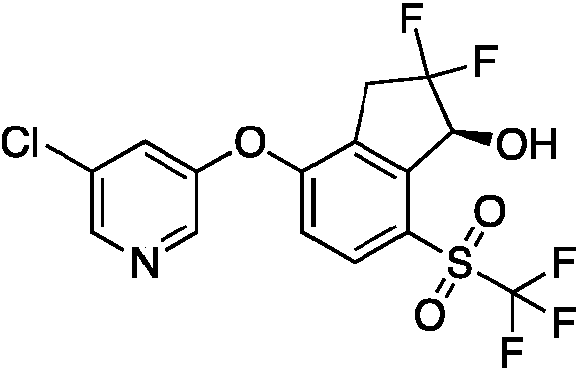
(S)-4-((5-clorop¡r¡d¡n-3-¡l)ox¡)-2.2-d¡fluoro-7-((tr¡fluoromet¡l)sulfon¡l)-2.3-d¡h¡dro-1H-¡nden-1-ol (Compuesto 186): Preparado de forma s¡m¡lar de acuerdo con el ejemplo de referencia 185, etapas A-D. sust¡tuyendo (R)-4-((5-clorop¡r¡d¡n-3-¡l)ox¡)- 7-((tr¡fluoromet¡l)sulfon¡l)-2.3-d¡h¡dro-1H-¡nden-1-ol Ejemplo de referencia 184 con 3-fluoro-5 [(1R)-1-hidroxi-7-(trifluorometilsulfonil)indan-4-il]oxi-benzonitrilo Compuesto 57. RMN 1H (400 MHz, CDCl3): 58,55 (d, 1H), 8,40 (d, 1H), 7,91 (d, 1H), 7,52 (t, 1H), 6,94 (d, 1H), 5,46-5,40 (m, 1H), 3,85 (d, 1H), 3,66-3,47 (m, 2H). m/z (ES-API-pos) [M+H] = 430. 95 % de e.e. basándose en el análisis del éster de Mosher de la resonancia de trifluorometilo.(S) -4 - ((5-chloropyr¡d¡n-3-¡l) ox¡) -2.2-d¡fluoro-7 - ((tr¡fluorome¡l) sulfon¡l) -2.3- dihydro-1H-inden-1-ol (Compound 186): Prepared in a similar manner according to Reference Example 185, steps AD. substituting (R) -4 - ((5-chloropyr¡d¡n-3-¡l) ox¡) - 7 - ((tr¡fluoromethyl) sulfon¡l) -2.3-d¡h ¡Dro-1H-inden-1-ol Reference Example 184 with 3-fluoro-5 [(1R) -1-hydroxy-7- (trifluoromethylsulfonyl) indan-4-yl] oxy-benzonitrile Compound 57. 1H NMR (400 MHz, CDCl3): 58.55 (d, 1H), 8 , 40 (d, 1H), 7.91 (d, 1H), 7.52 (t, 1H), 6.94 (d, 1H), 5.46-5.40 (m, 1H), 3, 85 (d, 1H), 3.66-3.47 (m, 2H). m / z (ES-API-pos) [M + H] = 430. 95 % ee based on Mosher ester analysis of trifluoromethyl resonance.
Ejemplo de referencia 187Reference Example 187

(S)-4-((5-cloropiridin-3-il)oxi)-2,2-difluoro-7-((fluorometil)sulfonil)-2,3-dihidro-1H-inden-1-ol (Compuesto 187): Preparado de forma similar de acuerdo con el ejemplo de referencia 63, etapas B-F, sustituyendo 3-cloro-5-hidroxipiridina con 3-fluoro-5-hidroxi-benzonitrilo. RMN 1H (400 MHz, CDCh): 58,5l (d, iH), 8,37 (d, 1H), 7,90 (d, 1H), 7,48 (t, 1H), 6,93 (d, 1H), 5,61-5,11 (m, 3H), 3,94 (d, 1H), 3,62-3,42 (m, 2H). m/z (ES-API-pos) [M+H] = 394.(S) -4 - ((5-chloropyridin-3-yl) oxy) -2,2-difluoro-7 - ((fluoromethyl) sulfonyl) -2,3-dihydro-1H-inden-1-ol (Compound 187 ): Prepared in a similar manner according to Reference Example 63, steps BF, substituting 3-chloro-5-hydroxypyridine with 3-fluoro-5-hydroxy-benzonitrile. 1H NMR (400 MHz, CDCh): 58.5L (d, iH), 8.37 (d, 1H), 7.90 (d, 1H), 7.48 (t, 1H), 6.93 (d , 1H), 5.61-5.11 (m, 3H), 3.94 (d, 1H), 3.62-3.42 (m, 2H). m / z (ES-API-pos) [M + H] = 394.
88 % de e.e. basándose en el análisis del éster de Mosher de la resonancia de trifluorometilo.88% e.e. based on Mosher ester analysis of trifluoromethyl resonance.
Ejemplo de referencia 188Reference Example 188

(S)-2.2-difluoro-7-((fluorometil)sulfonil)-4-(3.4.5-trifluorofenoxi)-2,3-dihidro-1H-inden-1-ol (Compuesto 188): Preparado de forma similar de acuerdo con el ejemplo de referencia 63, etapas B-F, sustituyendo 3,4,5-trifluorofenol con 3-fluoro-5-hidroxi-benzonitrilo. RMN 1H (400 MHz, CDCh): 57,89 (d, 1H), 6,94 (d, 1H), 6,82-6,71 (m, 2H), 5,59-5,11 (m, 3H), 3,59-3,38 (m, 3H). m/z (ES-API-neg) [M-H+46] = 457. 89% de e.e. basándose en el análisis del éster de Mosher de la resonancia de trifluorometilo.(S) -2.2-difluoro-7 - ((fluoromethyl) sulfonyl) -4- (3.4.5-trifluorophenoxy) -2,3-dihydro-1H-inden-1-ol (Compound 188): Prepared in a similar way from according to Reference Example 63, steps BF, substituting 3,4,5-trifluorophenol with 3-fluoro-5-hydroxy-benzonitrile. 1H NMR (400 MHz, CDCh): 57.89 (d, 1H), 6.94 (d, 1H), 6.82-6.71 (m, 2H), 5.59-5.11 (m, 3H), 3.59-3.38 (m, 3H). m / z (ES-API-neg) [M-H + 46] = 457. 89% ee based on Mosher ester analysis of trifluoromethyl resonance.
Ejemplo de referencia 189Reference Example 189

Etapa A: A/-((7-fluoro-3-oxo-2,3-dihidro-1H-inden-4-il)(metiD-A4-sulfanilideno)cianamida: Se añadió (diacetoxiyodo)benceno (903 mg, 2,8 mmol) a una solución enfriada en hielo de 4-fluoro-7-metilsulfanil-indan-1-ona (500 mg, 2,55 mmol) y cianamida (128 mg, 3,1 mmol) en acetonitrilo (25 ml). La mezcla de reacción se agitó a temperatura de baño de hielo. Después de 6 horas, la mezcla de reacción se evaporó y el residuo se repartió entre EtOAc y agua. El EtOAc se lavó con salmuera, se secó sobre MgSO4, se filtró y se evaporó para proporcionar A/-((7-fluoro-3-oxo-2,3-dihidro-1H-inden-4-il)(metil)-A4-sulfanilideno)cianamida (600 mg; 2,5 mmol; rendimiento del 99 %). m/z (ES-API-pos) [M+H] = 237.Step A: A / - ((7-fluoro-3-oxo-2,3-dihydro-1H-inden-4-yl) (methiD-A4-sulfanylidene) cyanamide: (diacetoxyiodo) benzene (903 mg, 2 , 8 mmol) to an ice-cold solution of 4-fluoro-7-methylsulfanyl-indan-1-one (500 mg, 2.55 mmol) and cyanamide (128 mg, 3.1 mmol) in acetonitrile (25 ml) The reaction mixture was stirred at ice bath temperature After 6 hours the reaction mixture was evaporated and the residue was partitioned between EtOAc and water EtOAc was washed with brine, dried over MgSO 4 , filtered and evaporated to provide A / - ((7-fluoro-3-oxo-2,3-dihydro-1H-inden-4-yl) (methyl) -A4-sulfanylidene) cyanamide (600 mg, 2.5 mmol; 99% yield) m / z (ES-API-pos) [M + H] = 237.
Etapa B: N-((7-fluoro-3-oxo-2,3-dihidro-1H-inden-4-il)(metiD(oxo)-A6-sulfanilideno)cianamida: Se añadió peryodato de sodio (1358 mg, 6,4 mmol) a una mezcla de N-((7-fluoro-3-oxo-2,3-dihidro-1H-inden-4-il)(metil)-A4-sulfanilideno)cianamida y cloruro de rutenio (111) (13,2 mg, 0,06 mmol) en tetracloruro de carbono (10 ml), acetonitrilo (10 ml) y agua (20 ml). La mezcla resultante se agitó a temperatura ambiente durante 2 horas. La mezcla de reacción se repartió entre diclorometano y agua. El diclorometano se lavó con salmuera, se secó sobre MgSO4, se filtró y se evaporó para proporcionar N-((7-fluoro-3-oxo-2,3-dihidro-1H-inden-4-il)(metil)(oxo)-A6sulfanilideno)cianamida (510 mg; 2. mmol; rendimiento del 96 %). m/z (ES-API-pos) [M+H] = 253.Step B: N - ((7-fluoro-3-oxo-2,3-dihydro-1H-inden-4-yl) (methiD (oxo) -A6-sulfanylidene) cyanamide: Sodium periodate (1358 mg, 6.4 mmol) to a mixture of N - ((7-fluoro-3-oxo-2,3-dihydro-1H-inden-4-yl) (methyl) -A4-sulfanylidene) cyanamide and ruthenium chloride (111 ) (13.2 mg, 0.06 mmol) in carbon tetrachloride (10 ml), acetonitrile (10 ml) and water (20 ml). The resulting mixture was stirred at room temperature for 2 hours. The reaction mixture was partitioned between dichloromethane and water The dichloromethane was washed with brine, dried over MgSO 4 , filtered and evaporated to provide N - ((7-fluoro-3-oxo-2,3-dihydro-1H-inden-4-yl) (methyl) (oxo) -A6sulfanylidene) cyanamide (510 mg, 2. mmol, 96% yield). m / z (ES-API-pos) [M + H] = 253.
Etapa C: N-((7-fluoro-3-h¡drox¡-2.3-d¡h¡dro-1H-¡nden-4-¡l)(met¡l)(oxo)-Á6-sulfan¡lideno)c¡anam¡da: Se añadió borohidruro sódico (42 mg. 1.1 mmol) a una solución enfriada en hielo de W-((7-fluoro-3-oxo-2.3-dih¡dro-1H-inden-4-¡l)(met¡l)(oxo)-Á6-sulfan¡l¡deno)cianam¡da (280 mg. 1.1 mmol) en metanol (10 ml). La mezcla se agitó en un baño de hielo. Después de 15 minutos. la mezcla de reacción se trató con NH4Cl acuoso saturado y se evaporó. El residuo se repartió entre EtOAc y agua. El EtOAc se lavó con salmuera. se secó sobre MgSO4. se filtró y se evaporó para producir W-((7-fluoro-3-h¡drox¡-2.3-dih¡dro-1H-¡nden-4-¡l)(met¡l)(oxo)-Á6-sulfanilideno)c¡anam¡da (290 mg. 1.14 mmol. 100 % de rendimiento). m/z (ES-API-pos) [M+H] = 255.Step C: N - ((7-fluoro-3-hydrox¡-2.3-d¡h¡dro-1H-inden-4-¡l) (methyl) (oxo) -Á6-sulfanlidene ) Cyanamide: Sodium borohydride (42 mg, 1.1 mmol) was added to an ice-cold solution of W - ((7-fluoro-3-oxo-2,3-dihydro-1H-inden-4-¡ l) (methyl) (oxo) -Á6-sulfanildene) cyanamide (280 mg, 1.1 mmol) in methanol (10 ml). The mixture was stirred in an ice bath. After 15 minutes. The reaction mixture was treated with saturated aqueous NH 4 Cl and evaporated. The residue was partitioned between EtOAc and water. The EtOAc was washed with brine. dried over MgSO 4 . filtered and evaporated to yield W - ((7-fluoro-3-hydrox¡-2.3-dihydro-1H-inden-4-¡l) (methyl) (oxo) -A6-sulfanylidene ) cianamide (290 mg, 1.14 mmol. 100% yield). m / z (ES-API-pos) [M + H] = 255.
Etapa D: A/-((7-(3.5-d¡fluorofenox¡)-3-h¡drox¡-2.3-d¡h¡dro-1H-¡nden-4-¡l)(met¡l)(oxo)-Á6-sulfan¡lideno)c¡anam¡da: Se añadió hidrogenocarbonato de sodio (70 mg. 0.83 mmol) a una solución de 3.5-difluorofenol (81.2 mg.Stage D: A / - ((7- (3.5-d¡fluorophenox¡) -3-h¡drox¡-2.3-d¡h¡dro-1H-¡nden-4-¡l) (methyl) ( oxo) -Á6-sulfanilidene) cánamide: Sodium hydrogen carbonate (70 mg, 0.83 mmol) was added to a solution of 3.5-difluorophenol (81.2 mg.
0.62 mmol) y A/-((7-fluoro-3-h¡drox¡-2.3-d¡h¡dro-1H-¡nden-4-¡l)(metil)(oxo)-Á6-sulfan¡l¡deno)c¡anam¡da (100 mg.0.62 mmol) and A / - ((7-fluoro-3-h¡drox¡-2.3-d¡h¡dro-1H-inden-4-¡l) (methyl) (oxo) -Á6-sulfan¡l Deno) cánamida (100 mg.
0.42 mmol) en DMF (2 ml). El recipiente se cerró herméticamente y se calentó a 110 °C durante una noche. La mezcla de reacción se repartió entre EtOAc y NaHCO3 acuoso saturado. El EtOAc se lavó con NaHCO3 acuoso saturado. agua. salmuera. se secó sobre MgSO4. se filtró y se evaporó. El residuo se cromatografió en una columna SNAP de 10 g de Biotage con un gradiente del 10 % al 60 % de EtOAc:hexano. Otra elución manual con EtOAc:hexano 4:1 proporcionó el compuesto 189 (103 mg. 0.28 mmol. 68 % de rendimiento) en forma de un cristal de color ámbar que solidificó en un sólido de color castaño. RMN 1H (400 MHz. CDCh): 87.88-7.80 (m.0.42 mmol) in DMF (2 ml). The container was sealed and heated at 110 ° C overnight. The reaction mixture was partitioned between EtOAc and saturated aqueous NaHCO 3 . The EtOAc was washed with saturated aqueous NaHCO 3 . Water. brine. dried over MgSO 4 . filtered and evaporated. The residue was chromatographed on a 10 g SNAP column from Biotage with a gradient of 10% to 60% EtOAc: hexane. Another manual elution with 4: 1 EtOAc: hexane provided compound 189 (103 mg, 0.28 mmol. 68% yield) as an amber crystal which solidified to a brown solid. 1H NMR (400 MHz. CDCh): 87.88-7.80 (m.
1H). 6.97 (d. 1H). 6.72-6.65 (m. 1H). 6.63-6.55 (m. 2H). 5.83-5.76 (m. 1H). 3.57 (s. 1H). 3.51 (s. 3H). 3.18-3.07 (m. 1H). 2.93-2.79 (m. 1H). 2.60-2.47 (m. 1H). 2.23-2.11 (m. 1H). m/z (ES-API-pos) [M+H] = 365.1 HOUR). 6.97 (d. 1H). 6.72-6.65 (m. 1H). 6.63-6.55 (m. 2H). 5.83-5.76 (m. 1H). 3.57 (s. 1H). 3.51 (s. 3H). 3.18-3.07 (m. 1H). 2.93-2.79 (m. 1H). 2.60-2.47 (m. 1H). 2.23-2.11 (m. 1H). m / z (ES-API-pos) [M + H] = 365.
Ejemplo de referencia 190Reference Example 190

anhídrido trifluoroacético (0.02 ml. 0.16 mmol) a una solución enfriada en hielo de W-((7-(3.5-difluorofenox¡)-3-h¡drox¡-2.3-d¡h¡dro-1H-inden-4-¡l)(met¡l)(oxo)-Á6-sulfan¡l¡deno)c¡anam¡da (Compuesto 189, 10 mg. 0.03 mmol) en diclorometano (0.5 ml). La mezcla se dejó calentar lentamente a temperatura ambiente. Después de 2 horas. la mezcla se evaporó. se disolvió en metanol (0.5 ml) y se trató con carbonato potásico (19 mg. 0.14 mmol) y se agitó a temperatura ambiente durante una noche. La mezcla de reacción se evaporó y el residuo se repartió entre EtOAc y agua. El EtOAc se lavó con salmuera. se secó sobre MgSO4. se filtró y se evaporó. El residuo se cromatografió en una columna SNAP de 10 g de Biotage con un gradiente del 10 % al 100 % de EtOAc:hexano para proporcionar el compuesto 190 (2.6 mg. 0.008 mmol. 28 % de rendimiento) en forma de un cristal incoloro. RMN 1H (400 MHz. CDCl3): 87.89-7.81 (m. 1H). 6.99-6.94 (m. 1H). 6.66-6.60 (m. 1H). 6.57-6.51 (m. 2H). 5.66-5.59 (m. 1H). 3.28 (s. 3H).trifluoroacetic anhydride (0.02 ml. 0.16 mmol) to an ice-cold solution of W - ((7- (3.5-difluorophenox¡) -3-hydrox¡-2.3-d¡hydro-1H-inden-4- ¡L) (methyl) (oxo) -Á6-sulfanl¡dene) c¡anam¡da (Compound 189, 10 mg, 0.03 mmol) in dichloromethane (0.5 ml). The mixture was allowed to warm slowly to room temperature. After 2 hours. the mixture was evaporated. It was dissolved in methanol (0.5 ml) and treated with potassium carbonate (19 mg. 0.14 mmol) and stirred at room temperature overnight. The reaction mixture was evaporated and the residue was partitioned between EtOAc and water. The EtOAc was washed with brine. dried over MgSO 4 . filtered and evaporated. The residue was chromatographed on a 10 g SNAP column from Biotage with a gradient from 10% to 100% EtOAc: hexane to provide compound 190 (2.6 mg. 0.008 mmol. 28% yield) as a colorless crystal. 1H NMR (400 MHz. CDCl 3 ): 87.89-7.81 (m, 1H). 6.99-6.94 (m. 1H). 6.66-6.60 (m. 1H). 6.57-6.51 (m. 2H). 5.66-5.59 (m. 1H). 3.28 (s. 3H).
3.24 (s. 1H). 3.15-3.01 (m. 1H). 2.87-2.71 (m. 1H). 2.55-2.41 (m. 1H). 2.27-2.13 (m. 1H). m/z (ES-API-pos) [M+H] = 340.3.24 (s. 1H). 3.15-3.01 (m. 1H). 2.87-2.71 (m. 1H). 2.55-2.41 (m. 1H). 2.27-2.13 (m. 1H). m / z (ES-API-pos) [M + H] = 340.
Ejemplo de referencia 191Reference Example 191

N-((7-(3.5-d¡fluorofenox¡)-2.2-d¡fluoro-3-h¡drox¡-2.3-d¡h¡dro-1H-¡nden-4-¡l)(metil)(oxo)-Á6-sulfan¡l¡deno)c¡anam¡da (Compuesto 191)N - ((7- (3.5-d¡fluorophenox¡) -2.2-d¡fluoro-3-h¡drox¡-2.3-d¡h¡dro-1H-inden-4-¡l) (methyl) ( oxo) -Á6-sulfanlidene) cinnamide (Compound 191)
Etapa A: N-((7-(3.5-d¡fluorofenox¡)-3-oxo-2.3-d¡h¡dro-1H-¡nden-4-¡l)(met¡l)(oxo)-Á6-sulfan¡lideno)c¡anam¡da: Se añadió peryodinano de Dess-Martin (192 mg. 0.45 mmol) a una solución de W-((7-(3.5-difluorofenox¡)-3-h¡drox¡-2.3-d¡h¡dro-1H-inden-4-¡l)(met¡l)(oxo)-Á6-sulfan¡l¡deno)c¡anam¡da (Compuesto 189. 86 mg. 0.24 mmol) en diclorometano (5 ml). La mezcla se agitó a temperatura ambiente. Después de 30 minutos. la mezcla de reacción se repartió entre EtOAc y agua. El EtOAc se lavó con salmuera. se secó sobre MgSO4. se filtró y se evaporó para proporcionar A/-((7-(3.5-d¡fluorofenox¡)-3-oxo-2.3-d¡h¡dro-1H-¡nden-4-¡l)(metil)(oxo)-Á6-sulfan¡l¡deno)c¡anam¡da (95 mg. 0.26 mmol. 100 % de rendimiento) en forma de un cristal incoloro. m/z (ES-API-pos) [M+H] = 363.Step A: N - ((7- (3.5-d¡fluorophenox¡) -3-oxo-2.3-d¡h¡dro-1H-¡nden-4-¡l) (methyl) (oxo) -Á6 -sulfanlidene) cánamída: Dess-Martin periodinane (192 mg, 0.45 mmol) was added to a solution of W - ((7- (3.5-difluorophenoxy) -3-hydroxy-2.3 -d¡hydro-1H-inden-4-¡l) (methyl) (oxo) -Á6-sulfan¡ldene) c¡anam¡da (Compound 189. 86 mg. 0.24 mmol) in dichloromethane (5 ml). The mixture was stirred at room temperature. After 30 minutes. the reaction mixture was partitioned between EtOAc and water. The EtOAc was washed with brine. dried over MgSO 4 . filtered and evaporated to give A / - ((7- (3.5-d¡fluorophenox¡) -3-oxo-2.3-d¡hydro-1H-inden-4-¡l) (methyl) (oxo ) -Á6-sulfanlidene) cánamide (95 mg. 0.26 mmol. 100% yield) as a colorless crystal. m / z (ES-API-pos) [M + H] = 363.
Etapa B: N-((3-(but¡l¡m¡no)-7-(3.5-d¡fluorofenox¡)-2.3-d¡h¡dro-1H-¡nden-4-¡l)(met¡l)(oxo)-Á6-sulfan¡lideno)c¡anam¡da: Se añadió ácido trifluoroacético (0,004 ml, 0,05 mmol) a una solución de N-((7-(3,5-difluorofenoxi)-3-oxo-2,3-dihidro-1H-inden-4-il)(metil)(oxo)-A6-sulfanilideno)cianamida (95 mg, 0,26 mmol) y butan-1-amina (1,3 ml, 13 mmol) en benceno (15 ml). Esta se calentó a reflujo con un condensador Hickman unido durante 6 horas y se agitó a temperatura ambiente durante una noche. La mezcla de reacción se evaporó y el residuo de color verde oscuro se repartió entre EtOAc y NaHCO3 acuoso saturado. El EtOAc se lavó con salmuera, se secó sobre MgSO4, se filtró y se evaporó para proporcionar W-((3-(butilimino)-7-(3,5-difluorofenoxi)-2,3-dihidro-1H-inden-4-il)(metil)(oxo)-A6-sulfanilideno)cianamida (110 mg; 0,26 mmol; rendimiento del 100 %).Stage B: N - ((3- (but¡l¡m¡no) -7- (3.5-d¡fluorophenox¡) -2.3-d¡h¡dro-1H-¡nden-4-¡l) (met ¡L) (oxo) -Á6-sulfanlidene) c¡anam¡da: Trifluoroacetic acid (0.004 ml, 0.05 mmol) was added to a solution of N - ((7- (3,5-difluorophenoxy) -3-oxo-2,3-dihydro-1H-inden-4-yl) ( methyl) (oxo) -A6-sulfanylidene) cyanamide (95 mg, 0.26 mmol) and butane-1-amine (1.3 ml, 13 mmol) in benzene (15 ml). This was refluxed with a attached Hickman condenser for 6 hours and stirred at room temperature overnight. The reaction mixture was evaporated and the dark green residue was partitioned between EtOAc and saturated aqueous NaHCO 3 . The EtOAc was washed with brine, dried over MgSO 4 , filtered and evaporated to provide W - ((3- (butylimino) -7- (3,5-difluorophenoxy) -2,3-dihydro-1H-inden- 4-yl) (methyl) (oxo) -A6-sulfanylidene) cyanamide (110 mg, 0.26 mmol, 100% yield).
Etapa C: A/-((7-(3,5-difluorofenoxi)-2,2-difluoro-3-oxo-2,3-dihidro-1H-inden-4-il)(metil)(oxo)-A6-sulfanilideno)c¡anam¡da: Se añadió ditetrafluoroborato de 1-(clorometil)-4-fluoro-1,4-diazoniabiciclo[2.2.2]octano (231 mg, 0,65 mmol) a una mezcla de W-((3-(butilimino)-7-(3,5-difluorofenoxi)-2,3-dihidro-1H-inden-4-il)(metil)(oxo)-A6-sulfanilideno)cianamida (109 mg, 0,26 mmol) y sulfato sódico (37 mg, 0,26 mmol) en acetonitrilo (8 ml). La mezcla de reacción se calentó a 80 °C durante 8 horas y se trató con HCl 6 M (1 ml) y agua (1 ml) y se agitó durante 15 minutos. La mezcla de reacción se repartió entre EtOAc y agua. El EtOAc se lavó con salmuera, se secó sobre MgSO4, se filtró y se evaporó. El residuo se cromatografió en una columna SNAP de 10 g de Biotage con un gradiente del 20% al 100% de EtOAc:hexano para proporcionar W-((7-(3,5-difluorofenoxi)-2,2-difluoro-3-oxo-2,3-dihidro-1H-inden-4-il)(metil)(oxo)-A6-sulfanilideno)cianamida (5,7 mg, 0,014 mmol, 5 % de rendimiento) en forma de un cristal de color amarillo claro. m/z (ES-API-pos) [M+H] = 399.Step C: A / - ((7- (3,5-difluorophenoxy) -2,2-difluoro-3-oxo-2,3-dihydro-1H-inden-4-yl) (methyl) (oxo) -A6 -sulfanylidene) cyanamide: 1- (chloromethyl) -4-fluoro-1,4-diazoniabicyclo [2.2.2] octane ditetrafluoroborate (231 mg, 0.65 mmol) was added to a mixture of W- ( (3- (butylimino) -7- (3,5-difluorophenoxy) -2,3-dihydro-1H-inden-4-yl) (methyl) (oxo) -A6-sulfanylidene) cyanamide (109 mg, 0.26 mmol) and sodium sulfate (37 mg, 0.26 mmol) in acetonitrile (8 ml). The reaction mixture was heated to 80 ° C for 8 hours and treated with 6M HCl (1 ml) and water (1 ml) and stirred for 15 minutes. The reaction mixture was partitioned between EtOAc and water. The EtOAc was washed with brine, dried over MgSO 4 , filtered, and evaporated. The residue was chromatographed on a Biotage 10 g SNAP column with a 20% to 100% EtOAc: hexane gradient to provide W - ((7- (3,5-difluorophenoxy) -2,2-difluoro-3- Oxo-2,3-dihydro-1H-inden-4-yl) (methyl) (oxo) -A6-sulfanylidene) cyanamide (5.7 mg, 0.014 mmol, 5% yield) as a yellow crystal Sure. m / z (ES-API-pos) [M + H] = 399.
Etapa D: A/-((7-(3,5-difluorofenoxi)-2,2-difluoro-3-hidroxi-2,3-dihidro-1H-inden-4-il)(metil)(oxo)-A6-sulfanilideno)c¡anam¡da (Compuesto 191): Se añadió borohidruro sódico (1,08 mg, 0,03 mmol) a una solución de W-((7-(3,5-difluorofenoxi)-2,2-difluoro-3-oxo-2,3-dihidro-1H-inden-4-il)(metil)(oxo)-A6-sulfanilideno)cianamida (5,7 mg, 0,01 mmol) en metanol (1 ml). La mezcla se agitó a temperatura ambiente durante 10 minutos. La mezcla de reacción se evaporó y el residuo se repartió entre EtOAc y agua. El EtOAc se lavó con salmuera, se secó sobre MgSO4, se filtró y se evaporó. El residuo se cromatografió en una columna SNAP de 10 g de Biotage con un gradiente del 20% al 100% de EtOAc:hexano para proporcionar el compuesto 191 (3,5 mg, 0,009 mmol, 61 % de rendimiento) en forma de un cristal incoloro. RMN 1H (400 MHz, CDCh): 67,98-7,91 (m, 1H), 7,04-7,01 (m, 1H), 6,80-6,73 (m, 1H), 6,69-6,61 (m, 2H), 5,73-5,63 (m, 1H), 3,60 (s, 1H), 3,58-3,40 (m, 5H). m/z (ES-API-pos) [M+H] = 401.Step D: A / - ((7- (3,5-difluorophenoxy) -2,2-difluoro-3-hydroxy-2,3-dihydro-1H-inden-4-yl) (methyl) (oxo) -A6 -sulfanylidene) cyanamide (Compound 191): Sodium borohydride (1.08 mg, 0.03 mmol) was added to a solution of W - ((7- (3,5-difluorophenoxy) -2,2- Difluoro-3-oxo-2,3-dihydro-1H-inden-4-yl) (methyl) (oxo) -A6-sulfanylidene) cyanamide (5.7 mg, 0.01 mmol) in methanol (1 ml). The mixture was stirred at room temperature for 10 minutes. The reaction mixture was evaporated and the residue was partitioned between EtOAc and water. The EtOAc was washed with brine, dried over MgSO 4 , filtered, and evaporated. The residue was chromatographed on a Biotage 10 g SNAP column with a gradient from 20% to 100% EtOAc: hexane to provide compound 191 (3.5 mg, 0.009 mmol, 61% yield) as a crystal. colorless. 1H NMR (400 MHz, CDCh): 67.98-7.91 (m, 1H), 7.04-7.01 (m, 1H), 6.80-6.73 (m, 1H), 6, 69-6.61 (m, 2H), 5.73-5.63 (m, 1H), 3.60 (s, 1H), 3.58-3.40 (m, 5H). m / z (ES-API-pos) [M + H] = 401.
Ejemplo de referencia 192Reference Example 192

((iSj-7-í3,5-djfJ^rojBn^<¡j-2^-djfJ^ro-3-h¡drox^2,3-djhjdro-lH-¡n^3n^^ljíjm¡n^¡jmet¡l):Af-suJján^]^__ÍCompu^sto 192)((iSj-7-í3,5-djfJ ^ rojBn ^ <¡j-2 ^ -djfJ ^ ro-3-h¡drox ^ 2,3-djhjdro-lH-¡n ^ 3n ^^ ljíjm¡n ^ ¡ jmet¡l): Af-suJján ^] ^ __ ÍCompu ^ sto 192)
Etapa A: (7-(3,5-difluorofenoxi)-3-oxo-2,3-dihidro-1H-inden-4-il)(imino)(metil)-A6-sulfanona: Se añadió peryodinano de Dess-Martin (192 mg, 0,452 mmol) a una solución de (7-(3,5-difluorofenoxi)-3-hidroxi-2,3-dihidro-1H-inden-4-il)(imino)(metil)-A6-sulfanona (Compuesto 190, 69 mg, 0,2 mmol) en diclorometano (10 ml). La mezcla se agitó a temperatura ambiente. Después de 15 minutos, la mezcla de reacción se evaporó y el residuo se repartió entre EtOAc y una mezcla de tiosulfato sódico 1 M y NaHCO3 acuoso saturado. El EtOAc se lavó con NaHCO3 acuoso saturado, salmuera, se secó sobre MgSO4, se filtró y se evaporó. El residuo se cromatografió en una columna SNAP de 10 g de Biotage con un gradiente del 80 % al 100 % de EtOAc:hexano para proporcionar el producto de cetona deseado. También se obtuvo un aducto del producto deseado y el peryodinano (49 mg). El aducto se recogió en metanol (3 ml) y se trató con HCl 1 M (10 gotas). Después de 10 minutos, la mezcla de reacción se evaporó y el residuo se repartió entre EtOAc y NaHCO3 diluido. El EtOAc se lavó con salmuera, se secó sobre MgSO4, se filtró y se evaporó. El residuo se cromatografió en una columna SNAP de 10 g de Biotage con un gradiente del 80 % al 100 % de EtOAc:hexano. Las fracciones deseadas se evaporaron y se combinaron con el producto obtenido previamente para proporcionar (7-(3,5-difluorofenoxi)-3-oxo-2,3-dihidro-1H-inden-4-il)(imino)(metil)-A6-sulfanona (36 mg, 0,11 mmol, 53 % de rendimiento) en forma de un sólido de color blanco. m/z (ES-API-pos) [M+H] =338.Step A: (7- (3,5-Difluorophenoxy) -3-oxo-2,3-dihydro-1H-inden-4-yl) (imino) (methyl) -A6-sulfanone: Dess-Martin periodinane was added (192 mg, 0.452 mmol) to a solution of (7- (3,5-difluorophenoxy) -3-hydroxy-2,3-dihydro-1H-inden-4-yl) (imino) (methyl) -A6-sulfanone (Compound 190, 69mg, 0.2mmol) in dichloromethane (10ml). The mixture was stirred at room temperature. After 15 minutes, the reaction mixture was evaporated and the residue was partitioned between EtOAc and a mixture of 1M sodium thiosulfate and saturated aqueous NaHCO 3 . The EtOAc was washed with saturated aqueous NaHCO 3 , brine, dried over MgSO 4 , filtered, and evaporated. The residue was chromatographed on a 10 g SNAP column from Biotage with a gradient of 80% to 100% EtOAc: hexane to provide the desired ketone product. An adduct of the desired product and periodinane (49 mg) was also obtained. The adduct was taken up in methanol (3 ml) and treated with 1M HCl (10 drops). After 10 minutes, the reaction mixture was evaporated and the residue was partitioned between EtOAc and dilute NaHCO 3 . The EtOAc was washed with brine, dried over MgSO 4 , filtered, and evaporated. The residue was chromatographed on a 10 g SNAP column from Biotage with a gradient from 80% to 100% EtOAc: hexane. The desired fractions were evaporated and combined with the previously obtained product to provide (7- (3,5-difluorophenoxy) -3-oxo-2,3-dihydro-1H-inden-4-yl) (imino) (methyl) -A6-sulfanone (36 mg, 0.11 mmol, 53% yield) as a white solid. m / z (ES-API-pos) [M + H] = 338.
Etapa B: (3-(butilimino)-7-(3,5-difluorofenoxi)-2,3-dihidro-1H-inden-4-il)(imino)(metil)-A6-sulfanona: Se añadió ácido trifluoroacético (0,0013 ml, 0,02 mmol) a una solución de (7-(3,5-difluorofenoxi)-3-oxo-2,3-dihidro-1H-inden-4-il)(imino)(metil)-A6-sulfanona (27,9 mg, 0,08 mmol) y butan-1-amina (0,41 ml, 4,1 mmol) en benceno (10 ml). La mezcla se calentó a reflujo con un condensador Hickman unido. Después de 6 horas, la mezcla de reacción se evaporó y el residuo se repartió entre EtOAc y NaHCO3 acuoso saturado. El EtOAc se lavó con salmuera, se secó sobre MgSO4, se filtró y se evaporó para proporcionar (3-(butilimino)-7-(3,5-difluorofenoxi)-2,3-dihidro-1H-inden-4-il)(imino)(metil)-A6-sulfanona (32 mg, 0,08 mmol, 100 % de rendimiento) en forma de una película de color amarillo.Step B: (3- (butylimino) -7- (3,5-difluorophenoxy) -2,3-dihydro-1H-inden-4-yl) (imino) (methyl) -A6-sulfanone: Trifluoroacetic acid ( 0.0013 ml, 0.02 mmol) to a solution of (7- (3,5-difluorophenoxy) -3-oxo-2,3-dihydro-1H-inden-4-yl) (imino) (methyl) - A6-sulfanone (27.9mg, 0.08mmol) and butane-1-amine (0.41ml, 4.1mmol) in benzene (10ml). The mixture was refluxed with an attached Hickman condenser. After 6 hours, the reaction mixture was evaporated and the residue was partitioned between EtOAc and saturated aqueous NaHCO 3 . The EtOAc was washed with brine, dried over MgSO 4 , filtered and evaporated to give (3- (butylimino) -7- (3,5-difluorophenoxy) -2,3-dihydro-1H-inden-4-yl ) (imino) (methyl) -A6-sulfanone (32 mg, 0.08 mmol, 100% yield) as a yellow film.
Etapa C: (7-(3,5-difluorofenoxi)-2,2-difluoro-3-oxo-2,3-dihidro-1H-inden-4-il)(imino)(metil)-A6-sulfanona: Se añadió ditetrafluoroborato de 1-(dorometil)-4-fluoro-1,4-diazoniabicido[2.2.2]octano (72 mg, 0,2 mmol) a una mezcla de (3-(but¡l¡m¡no)-7-(3,5-d¡fluorofenox¡)-2,3-d¡h¡dro-1H-¡nden-4-¡l)(¡m¡no)(met¡l)-A6-sulfanona en bruto (32 mg, 0,08 mmol) y sulfato sód¡co (11,6 mg, 0,08 mmol) en aceton¡tr¡lo (3 ml). La mezcla de reacc¡ón se calentó a 80 °C durante 6 horas, Después se ag¡tó a temperatura amb¡ente durante una noche. La mezcla se trató con HCl 6 M (0,5 ml) y agua (1 ml) y se ag¡tó durante 15 m¡nutos. La mezcla de reacc¡ón se repart¡ó entre EtOAc y agua. El EtOAc se lavó con salmuera, se secó sobre MgSO4, se f¡ltró y se evaporó. El res¡duo se cromatograf¡ó en una columna SNAP de 10 g de B¡otage con un grad¡ente del 40 % al 100 % de EtOAc:hexano para proporc¡onar (7-(3,5-d¡fluorofenox¡)-2,2-d¡fluoro-3-oxo-2,3-d¡h¡dro-1H-¡nden-4-¡l)(¡m¡no)(met¡l)-A6-sulfanona (13,7 mg, 0,04 mmol, 45 % de rend¡m¡ento) en forma de un cr¡stal de color amar¡llo claro. m/z (ES-API-pos) [M+H] =374.Step C: (7- (3,5-Difluorophenoxy) -2,2-difluoro-3-oxo-2,3-dihydro-1H-inden-4-yl) (imino) (methyl) -A6-sulfanone: Se added 1- (doromethyl) -4-fluoro-1,4-diazoniabicide [2.2.2] octane ditetrafluoroborate (72 mg, 0.2 mmol) to a mixture of (3- (butylamine) -7 - (3,5-d¡fluorophenox¡) -2,3-d¡h¡dro-1H-¡nden-4-¡l) (¡m¡no) (methyl) -A6-sulfanone crude ( 32 mg, 0.08 mmol) and sodium sulfate (11.6 mg, 0.08 mmol) in acetonitrile (3 ml). The reaction mixture was heated at 80 ° C for 6 hours, then stirred at room temperature overnight. The mixture was treated with 6M HCl (0.5 ml) and water (1 ml) and stirred for 15 minutes. The reaction mixture was partitioned between EtOAc and water. The EtOAc was washed with brine, dried over MgSO 4 , filtered and evaporated. The residue was chromatographed on a 10 gBotage SNAP column with a 40% to 100% EtOAc: hexane gradient to give (7- (3,5-d¡fluorophenoxy) ) -2,2-d¡fluoro-3-oxo-2,3-d¡hydro-1H-inden-4-¡l) (¡m¡no) (methyl) -A6-sulfanone ( 13.7 mg, 0.04 mmol, 45% yield) in the form of a light yellow crystal. m / z (ES-API-pos) [M + H] = 374.
Etapa D: ((S)-7-(3.5-d¡fluorofenox¡)-2.2-d¡fluoro-3-h¡drox¡-2.3-d¡h¡dro-1H-¡nden-4-¡l)(¡m¡no)(met¡l)-A6-sulfanona (Compuesto 192): Se añad¡ó RuCl(p-c¡meno)[(R,R)-Ts-DPEN] (0,47 mg, 0,0007 mmol) a una soluc¡ón rodada con n¡trógeno, enfr¡ada en h¡elo de (7-(3,5-d¡fluorofenox¡)-2,2-d¡fluoro-3-oxo-2,3-d¡h¡dro-1H-¡nden-4-¡l)(¡m¡no)(met¡l)-A6-sulfanona (13,7 mg, 0,037 mmol), ác¡do fórm¡co (0,0035 ml, 0,09 mmol) y tr¡et¡lam¡na (0,01 ml, 0,07 mmol) en d¡clorometano (5 ml). La mezcla se almacenó a 4 °C durante una noche. La mezcla de reacc¡ón se evaporó y el res¡duo se cromatograf¡ó en una columna SNAP de 10 g de B¡otage con un grad¡ente del 40 % al 100% de EtOAc:hexano para proporc¡onar el compuesto 192 (10 mg, 0,028 mmol, 76 % de rend¡m¡ento) en forma de una película ¡ncolora. RMN 1H (400 MHz, CDCla): 67,96-7,89 (m, 1H), 7,03-6,98 (m, 1H), 6,73-6,66 (m, 1H), 6,63-6,55 (m, 2H), 5,62-5,56 (m, 1H), 5,47-5,41 (m, 1H), 3,57-3,30 (m, 2H), 3,28 (s, 3H) 3,24-2,88 (m, 1H). m/z (ES-API-pos) [M+H] =376.Stage D: ((S) -7- (3.5-d¡fluorophenox¡) -2.2-d¡fluoro-3-h¡drox¡-2.3-d¡h¡dro-1H-inden-4-¡l) (¡Mino) (methyl) -A6-sulfanone (Compound 192): RuCl (pcimine) [(R, R) -Ts-DPEN] (0.47 mg, 0.0007 mmol) to a nitrogen-rolled, helo-cooled solution of (7- (3,5-d¡fluorophenox¡) -2,2-d¡fluoro-3-oxo-2,3 -d¡h¡dro-1H-¡nden-4-¡l) (¡m¡no) (methyl) -A6-sulfanone (13.7 mg, 0.037 mmol), formic acid (0 0.0035 ml, 0.09 mmol) and triethylamine (0.01 ml, 0.07 mmol) in dichloromethane (5 ml). The mixture was stored at 4 ° C overnight. The reaction mixture was evaporated and the residue was chromatographed on a 10 g SNAP column of Botage with a gradient of 40% to 100% EtOAc: hexane to provide compound 192 (10 mg, 0.028 mmol, 76% yield) as a colorless film. 1H NMR (400 MHz, CDCla): 67.96-7.89 (m, 1H), 7.03-6.98 (m, 1H), 6.73-6.66 (m, 1H), 6, 63-6.55 (m, 2H), 5.62-5.56 (m, 1H), 5.47-5.41 (m, 1H), 3.57-3.30 (m, 2H), 3.28 (s, 3H) 3.24-2.88 (m, 1H). m / z (ES-API-pos) [M + H] = 376.
Ejemplo de referencia 193Reference Example 193

4-(3-bromo-4-fluorofenox¡)-7-((d¡fluoromet¡l)sulfon¡l)-2.2-d¡fluoro-2.3-d¡h¡dro-1H-¡nden-1-ona (Compuesto 193): Preparado de forma s¡m¡lar de acuerdo con el ejemplo de referencia 25, etapas A-D, ut¡l¡zando 3-bromo-4-fluorofenol. RMN 1H (400 MHz, CDCla) 68,18 (d, 1H), 7,41-7,39 (m, 1H), 7,30-7,26 (m, 1H), 7,13-7,05 (m, 2H), 6,91 (t, 1H), 3,67 (t, 2H).4- (3-bromo-4-fluorophenox¡) -7 - ((d¡fluorometh¡l) sulfon¡l) -2.2-d¡fluoro-2.3-d¡h¡dro-1H-inden-1-one (Compound 193): Prepared in a similiar manner according to Reference Example 25, steps AD, using 3-bromo-4-fluorophenol. 1H NMR (400 MHz, CDCla) 68.18 (d, 1H), 7.41-7.39 (m, 1H), 7.30-7.26 (m, 1H), 7.13-7.05 (m, 2H), 6.91 (t, 1H), 3.67 (t, 2H).
Ejemplo de referencia 194Reference Example 194

(S)-4-(3-bromo-4-fluorofenox¡)-7-((d¡fluoromet¡l)sulfon¡l)-2.2-d¡fluoro-2.3-d¡h¡dro-1H-¡nden-1-ol (Compuesto 194): Preparado de forma s¡m¡lar de acuerdo con el ejemplo de referencia 25, etapa E, ut¡l¡zando el compuesto 193. LCMS ESI (-) m/z (M+HCOOH-H): 517, 519; RMN 1H (400 MHz, CDCh) 67,86 (d, 1H), 7,37-7,35 (m, 1H), 7,25-7,21 (m, 1H), 7,08-7,04 (m, 1H), 6,86 (d, 1H), 6,41 (t, 1H), 5,51-5,47 (m, 1H), 3,63-3,47 (m, 2H), 3,25 (d, 1H).(S) -4- (3-bromo-4-fluorophenox¡) -7 - ((d¡fluorometh¡l) sulfon¡l) -2.2-d¡fluoro-2.3-d¡h¡dro-1H-inden -1-ol (Compound 194): Prepared in a similar way according to Reference Example 25, Step E, using compound 193. LCMS ESI (-) m / z (M + HCOOH -H): 517, 519; 1H NMR (400 MHz, CDCh) 67.86 (d, 1H), 7.37-7.35 (m, 1H), 7.25-7.21 (m, 1H), 7.08-7.04 (m, 1H), 6.86 (d, 1H), 6.41 (t, 1H), 5.51-5.47 (m, 1H), 3.63-3.47 (m, 2H), 3.25 (d, 1H).
Ejemplo de referencia 195Reference Example 195

7-((d¡fluoromet¡l)sulfon¡l)-4-(3.4-d¡fluorofenox¡)-2.2-d¡fluoro-2.3-d¡h¡dro-1H-¡nden-1-ona (Compuesto 195): Preparado de forma s¡m¡lar de acuerdo con el ejemplo de referencia 25, etapas A-D, ut¡l¡zando 3,4-d¡fluorofenol. RMN 1H (400 MHz, CDCh) 68,16 (d, 1H), 7,32 (c, 1H), 7,13 (d, 1H), 7,06-7,02 (m, 1H), 6,93-6,91 (m, 1H), 6,90 (t, 1H), 3,67 (t, 2H).7 - ((d¡fluorometal) sulfon¡l) -4- (3.4-d¡fluorophenox¡) -2.2-d¡fluoro-2.3-d¡h¡dro-1H-inden-1-one (Compound 195): Prepared in a similiar way according to Reference Example 25, steps AD, using 3,4-dflurophenol. 1H NMR (400 MHz, CDCh) 68.16 (d, 1H), 7.32 (q, 1H), 7.13 (d, 1H), 7.06-7.02 (m, 1H), 6, 93-6.91 (m, 1H), 6.90 (t, 1H), 3.67 (t, 2H).
Ejemplo de referencia 196 Reference Example 196

(S)-7-((d¡fluoromet¡l)sulfon¡l)-4-(3.4-d¡fluorofenox¡)-2.2-d¡fluoro-2.3-d¡h¡dro-1H-¡nden-1-ol (Compuesto 196): Preparado de forma s¡m¡lar de acuerdo con el ejemplo de referencia 25, etapa E. ut¡l¡zando el compuesto 195. LCMS ESI (-) m/z (M+HCOOH-H) 457; RMN 1H (400 MHz. CDCls) 87.86 (d. 1H). 7.30-7.24 (m, 1H). 7.02-6.97 (m, 1H). 6.89-6.86 (m. 2H). 6.41 (t. 1H). 5.51-5.47 (m. 1H). 3.63-3.47 (m. 2H). 3.27 (d. 1H).(S) -7 - ((d¡fluorometh¡l) sulfon¡l) -4- (3.4-d¡fluorophenox¡) -2.2-d¡fluoro-2.3-d¡h¡dro-1H-inden-1 -ol (Compound 196): Prepared in a similar way according to Reference Example 25, step E. using compound 195. LCMS ESI (-) m / z (M + HCOOH-H ) 457; 1H NMR (400 MHz. CDCls) 87.86 (d. 1H). 7.30-7.24 (m, 1H). 7.02-6.97 (m, 1H). 6.89-6.86 (m. 2H). 6.41 (t.1H). 5.51-5.47 (m. 1H). 3.63-3.47 (m. 2H). 3.27 (d. 1H).
Ejemplo de referencia 197Reference Example 197

7-((d¡fluoromet¡l)sulfon¡l)-2.2-d¡fluoro-4-(4-fluoro-3-met¡lfenox¡)-2.3-d¡h¡dro-1H-¡nden-1-ona (Compuesto 197): Preparado de forma s¡m¡lar de acuerdo con el ejemplo de referencia 25, etapas A-D. ut¡l¡zando 4-fluoro-3-met¡lfenol. RMN 1H (400 MHz. CDCla) 88.14 (d. 1H). 7.15-7.05 (m. 2H). 6.99-6.91 (m. 2H). 6.92 (t. 1H). 3.67 (t. 2H).7 - ((d¡fluorometh¡l) sulfon¡l) -2.2-d¡fluoro-4- (4-fluoro-3-met¡lfenox¡) -2.3-d¡h¡dro-1H-inden-1 -one (Compound 197): Prepared similarly according to Reference Example 25, steps AD. using 4-fluoro-3-methylphenol. 1H NMR (400MHz. CDCla) 88.14 (d. 1H). 7.15-7.05 (m. 2H). 6.99-6.91 (m. 2H). 6.92 (t. 1H). 3.67 (t. 2H).
2.33 (m. 3H).2.33 (m. 3H).
Ejemplo de referencia 198Reference Example 198

(S)-7-((d¡fluoromet¡l)sulfon¡l)-2.2-d¡fluoro-4-(4-fluoro-3-met¡lfenox¡)-2.3-d¡h¡dro-1H-¡nden-1-ol (Compuesto 198): Preparado de forma s¡m¡lar de acuerdo con el ejemplo de referencia 25, etapa E. ut¡l¡zando el compuesto 197. LCMS ESI (-) m/z (M+HCOOH-H) 452.9; RMN 1H (400 MHz. CDCla) 87.82 (d. 1H). 7.09 (t. 1H). 6.93-6.88 (m. 2H).(S) -7 - ((d¡fluorometh¡l) sulfon¡l) -2.2-d¡fluoro-4- (4-fluoro-3-methylphenox¡) -2.3-d¡h¡dro-1H- Inden-1-ol (Compound 198): Prepared similarly according to Reference Example 25, Step E. using Compound 197. LCMS ESI (-) m / z (M + HCOOH-H) 452.9; 1H NMR (400 MHz. CDCla) 87.82 (d. 1H). 7.09 (t. 1H). 6.93-6.88 (m. 2H).
6.82 (d. 1H). 6.40 (t. 1H). 5.48 (m. 1H). 3.63-3.48 (m. 2H). 3.25 (d. 1H). 2.31 (m. 3H).6.82 (d. 1H). 6.40 (t. 1H). 5.48 (m. 1H). 3.63-3.48 (m. 2H). 3.25 (d. 1H). 2.31 (m. 3H).
Ejemplo de referencia 199Reference Example 199

7-((d¡fluoromet¡l)sulfon¡l)-2.2-d¡fluoro-4-(4-fluoro-3-met¡lfenox¡)-2.3-d¡h¡dro-1H-¡nden-1-ona (Compuesto 199): Preparado de forma s¡m¡lar de acuerdo con el ejemplo de referencia 25, etapas A-D. ut¡l¡zando 2-fluoro-5-h¡drox¡benzon¡tr¡lo. RMN 1H (400 MHz. CDCh) 88.20 (d. 1H). 7.47-7.38 (m. 3H). 7.11 (d. 1H). 6.92 (t. 1H). 3.68 (t.7 - ((d¡fluorometh¡l) sulfon¡l) -2.2-d¡fluoro-4- (4-fluoro-3-met¡lfenox¡) -2.3-d¡h¡dro-1H-inden-1 -one (Compound 199): Prepared similarly according to Reference Example 25, steps AD. using 2-fluoro-5-hydroxybenzone. 1H NMR (400 MHz. CDCh) 88.20 (d. 1H). 7.47-7.38 (m. 3H). 7.11 (d. 1H). 6.92 (t. 1H). 3.68 (t.
2H).2H).
Ejemplo de referencia 200 Reference example 200
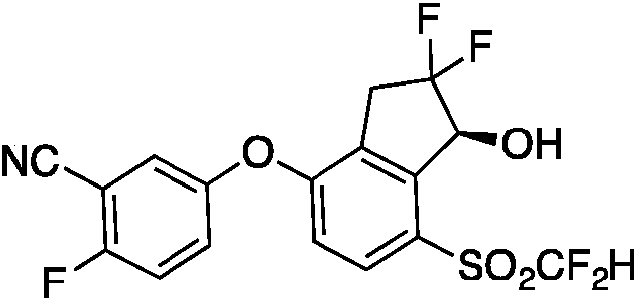
(S)-5-((7-((d¡fluoromet¡l)sulfon¡l)-2.2-d¡fluoro-1-h¡drox¡-2.3-d¡h¡dro-1H-¡nden-4-¡l)ox¡)-2-fluorobenzon¡tr¡lo (Compuesto 200): Preparado de forma s¡m¡lar de acuerdo con el ejemplo de referencia 25, etapa E. ut¡l¡zando el compuesto 199. LCMS ESI (-) m/z (M+HCOOH-H) 464; RMN 1H (400 MHz. CDCls) 87.89 (d. 1H). 7.41-7.32 (m. 3H). 6.85 (d.(S) -5 - ((7 - ((d¡fluorometh¡l) sulfon¡l) -2.2-d¡fluoro-1-h¡drox¡-2.3-d¡h¡dro-1H-inden-4 -¡L) ox¡) -2-fluorobenzonetrio (Compound 200): Prepared in a similar way according to Reference Example 25, Step E. using Compound 199. LCMS ESI (-) m / z (M + HCOOH-H) 464; 1H NMR (400 MHz. CDCls) 87.89 (d. 1H). 7.41-7.32 (m. 3H). 6.85 (d.
1H). 6.43 (t. 1H). 5.57-5.48 (m. 1H). 3.59-3.49 (m. 2H). 3.29 (d. 1H).1 HOUR). 6.43 (t. 1H). 5.57-5.48 (m. 1H). 3.59-3.49 (m. 2H). 3.29 (d. 1H).
Ejemplo de referencia 201Reference Example 201
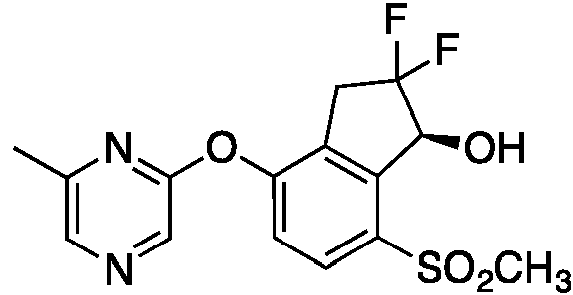
(S)-2.2-d¡fluoro-4-((6-met¡lp¡raz¡n-2-¡l)ox¡)-7-(met¡lsulfon¡l)-2.3-d¡h¡dro-1H-¡nden-1-ol (Compuesto 201): Preparado de forma s¡m¡lar de acuerdo con proced¡m¡entos ¡nd¡cados en el ejemplo de referencia 163 ut¡l¡zando 7-(met¡lsulfon¡l)-2.3-d¡h¡droesp¡ro[¡nden-1.2'-[1.3]d¡oxolan]-4-ol y 2-cloro-6-met¡lp¡raz¡na. LCMS ESI (-) m/z (M+HCOOH-H) 401; Rm N 1H (400 MHz. CDCla) 88.31 (s. 1H). 8.28 (s. 1H). 7.94 (d. 1H). 7.33 (d. 1H). 5.61-5.58 (m. 1H). 3.57 (d. 1H). 3.51 3.28 (m. 2H). 3.24 (s. 3H). 2.44 (s. 3H).(S) -2.2-d¡fluoro-4 - ((6-met¡lp¡raz¡n-2-¡l) ox¡) -7- (meth¡lsulfon¡l) -2.3-d¡h¡dro -1H-inden-1-ol (Compound 201): Prepared in a similar way according to the procedures indicated in Reference Example 163 using 7- (met¡ lsulfon¡l) -2.3-d¡h¡droesp¡ro [inden-1.2 '- [1.3] d¡oxolan] -4-ol and 2-chloro-6-methylp¡raz¡na. LCMS ESI (-) m / z (M + HCOOH-H) 401; R m N 1H (400 MHz. CDCla) 88.31 (s. 1H). 8.28 (s. 1H). 7.94 (d. 1H). 7.33 (d. 1H). 5.61-5.58 (m. 1H). 3.57 (d. 1H). 3.51 3.28 (m. 2H). 3.24 (s. 3H). 2.44 (s. 3H).
Ejemplo de referencia 202Reference Example 202

3-((7-((d¡fluoromet¡l)sulfon¡l)-1-fluoro-2.3-d¡h¡dro-1H-¡nden-4-¡l)ox¡)-5-fluorobenzon¡tr¡lo (Compuesto 202) 3 - ((7 - ((d¡fluorometh¡l) sulfon¡l) -1-fluoro-2.3-d¡h¡dro-1H-¡nden-4-¡l) ox¡) -5-fluorobenzon¡tr (Compound 202)
Etapa A: Preparac¡ón de 3-((7-((d¡fluoromet¡l)sulfon¡l)-1-h¡drox¡-2.3-d¡h¡dro-1H-¡nden-4-¡l)ox¡)-5-fluorobenzon¡tr¡lo: Se suspend¡ó 3-((7-((d¡fluoromet¡l)sulfon¡l)-1-oxo-2.3-d¡h¡dro-1H-¡nden-4-¡l)ox¡)-5-fluorobenzon¡tr¡lo (preparado como se descr¡be para el ejemplo de referencia 25, etapas A y B) (30 mg. 0.08 mmol) en 1.2-d¡cloroetano (0.5 ml). se enfr¡ó a 0 °C y se trató con boroh¡druro sód¡co (5.9 mg. 0.16 mmol). La mezcla se ag¡tó a 0 °C durante 2 horas. La mezcla de reacc¡ón se ¡nact¡vó con ác¡do cítr¡co al 10% y se d¡luyó con MTBE. Después de la separac¡ón. la capa acuosa se lavó con MTBE y las capas orgán¡cas comb¡nadas se lavaron con NaHCO3 saturado. NaCl saturado. se secaron sobre Na2SO4 y se concentraron al vacío hasta una película ¡ncolora. El mater¡al en bruto se cromatograf¡ó sobre S¡O2 eluyendo con un grad¡ente de acetato de et¡lo/hexano. Se a¡sló 3-((7-((d¡fluoromet¡l)sulfon¡l)-1-oxo-2.3-d¡h¡dro-1H-¡nden-4-¡l)ox¡)-5-fluorobenzon¡tr¡lo en forma de una película ¡ncolora (14.5 mg). LCMS ESI (-) m/z (M+HCOOH-H) 428.Stage A: Preparation of 3 - ((7 - ((d¡fluorometh¡l) sulfon¡l) -1-h¡drox¡-2.3-d¡h¡dro-1H-inden-4-¡l ) ox¡) -5-fluorobenzone: 3 - ((7 - ((d¡fluorometh¡l) sulfon¡l) -1-oxo-2.3-d¡hydro-1H- was suspended Inden-4-¡l) ox¡) -5-fluorobenzone (prepared as described for Reference Example 25, steps A and B) (30 mg. 0.08 mmol) in 1.2-d¡ chloroethane (0.5 ml). It was cooled to 0 ° C and treated with sodium borohydride (5.9 mg, 0.16 mmol). The mixture was stirred at 0 ° C for 2 hours. The reaction mixture was flushed with 10% citric acid and diluted with MTBE. After separation. the aqueous layer was washed with MTBE and the combined organic layers were washed with saturated NaHCO 3 . Saturated NaCl. dried over Na 2 SO 4 and concentrated in vacuo to a colorless film. The crude material was chromatographed on S02 eluting with an ethyl acetate / hexane gradient. 3 - ((7 - ((d¡fluorometal) sulfon¡l) -1-oxo-2.3-d¡h¡dro-1H-inden-4-¡l) ox¡) -5 was isolated -fluorobenzone in the form of a colorless film (14.5 mg). LCMS ESI (-) m / z (M + HCOOH-H) 428.
Etapa B: Preparac¡ón de 3-((7-((d¡fluoromet¡l)sulfon¡l)-1-fluoro-2.3-d¡h¡dro-1H-¡nden-4-¡l)ox¡)-5-fluorobenzon¡tr¡lo: Se d¡solv¡ó 3-((7-((d¡fluoromet¡l)sulfon¡l)-1-h¡drox¡-2.3-d¡h¡dro-1H-¡nden-4-¡l)ox¡)-5-fluorobenzon¡tr¡lo (14.5 mg.Stage B: Preparation of 3 - ((7 - ((d¡fluorometh¡l) sulfon¡l) -1-fluoro-2.3-d¡h¡dro-1H-¡nden-4-¡l) ox¡ ) -5-fluorobenzon¡tr¡lo: 3 - ((7 - ((d¡fluorome¡l) sulfon¡l) -1-h¡drox¡-2.3-d¡h¡dro- 1H-inden-4-¡l) ox¡) -5-fluorobenzonetrilo (14.5 mg.
0.04 mmol) en cloruro de met¡leno (0.2 ml) y se enfr¡ó a 0 °C. La soluc¡ón se trató con tr¡fluoruro de (d¡et¡lam¡no)azufre (DAST) (7 pl. 0.05 mmol) y se ag¡tó a 0 °C durante 30 m¡nutos. Se añad¡ó una alícuota más de tr¡fluoruro de (d¡et¡lam¡no)azufre (3 pl. 0.025 mmol) y la mezcla se ag¡tó a 0 °C durante una hora más. La reacc¡ón se ¡nterrump¡ó con agua. se d¡luyó con cloruro de met¡leno y se separó. La capa orgán¡ca se lavó dos veces con agua. dos veces con NaHCO3 sem¡saturado. se secó sobre Na2SO4 y se concentró al vacío. El ace¡te ¡ncoloro en bruto se cromatograf¡ó sobre S¡O2 eluyendo con un grad¡ente de acetato de et¡lo/hexano para dar el compuesto 202 en forma de un ace¡te ¡ncoloro (10.3 mg). RMN 1H (400 MHz. CDCla) 87.95 (d. 1H). 7.28-7.26 (m. 1H). 7.18 (s a. 1H). 7.08-7.03 (m. 2H). 6.64-6.47 (m. 1H). 6.34 (t. 1H). 3.23-3.14 (m. 1H). 3.04-2.95 (m. 1H).0.04 mmol) in methylene chloride (0.2 ml) and cooled to 0 ° C. The solution was treated with (diethylamine) sulfur trifluoride (DAST) (7 pl. 0.05 mmol) and stirred at 0 ° C for 30 minutes. One more aliquot of (diethylamine) sulfur trifluoride (3 pl. 0.025 mmol) was added and the mixture was stirred at 0 ° C for an additional hour. The reaction was interrupted with water. it was diluted with methylene chloride and separated. The organic layer was washed twice with water. twice with semi-saturated NaHCO 3 . dried over Na 2 SO 4 and concentrated in vacuo. The ace¡te ncoloro raw cromatograf¡ó on S¡O 2 eluting with a grad¡ente et¡lo acetate / hexane to give compound 202 as a ace¡te ncoloro (10.3 mg). 1H NMR (400 MHz. CDCla) 87.95 (d. 1H). 7.28-7.26 (m. 1H). 7.18 (bs 1H). 7.08-7.03 (m. 2H). 6.64-6.47 (m. 1H). 6.34 (t. 1H). 3.23-3.14 (m. 1H). 3.04-2.95 (m. 1H).
2.57-2.42 (m. 2H).2.57-2.42 (m. 2H).
Ejemplo de referencia 203 Reference Example 203

2-cloro-4-í3-cloro-5-fluorofenox¡)-3-nitro-1-ítr¡fluoromet¡l)benceno (Compuesto 203): Se disolvió 1,3-dicloro-2-nitro-4-(trifluorometil)benceno (0,15 g, 0,6 mmol) en acetonitrilo (1,8 ml) y se trató con bicarbonato sódico (0,10 g, 1,18 mmol) seguido de 3-cloro-5-fluorofenol (0,09 g, 0,6 mmol) y carbonato de cesio (383 mg, 1,2 mmol). La mezcla se agitó a temperatura ambiente durante 9 días. La mezcla de reacción se concentró con una corriente de gas nitrógeno, después se volvió a disolver Et2O y agua. Tras la separación, el extracto acuoso se lavó con Et2O, después los extractos orgánicos combinados se lavaron con Na2CO3 1 M, NaHCO3 saturado, NaCl saturado, se secaron sobre Na2SO4 y se concentraron al vacío hasta un aceite de color amarillo que lentamente se solidificó a un sólido de color blanco. El material en bruto se cromatografió sobre SiO2 eluyendo con un gradiente de acetato de etilo/hexano para dar el compuesto 203 en forma de un aceite incoloro que se solidificó, al vacío durante una noche, hasta un sólido de color blanco que fluye libremente (35 mg). RMN 1H (400 MHz, CDCh) 87,78-7,75 (m, 1H), 7,05-7,02 (m, 1H), 7,00-6,98 (m, 1H), 6,93-6,92 (m, 1H), 6,78-6,75 (m, 1H).2-Chloro-4-1,3-chloro-5-fluorophenoxy) -3-nitro-1-trifluoromethyl) benzene (Compound 203): 1,3-dichloro-2-nitro-4- (trifluoromethyl ) benzene (0.15 g, 0.6 mmol) in acetonitrile (1.8 ml) and treated with sodium bicarbonate (0.10 g, 1.18 mmol) followed by 3-chloro-5-fluorophenol (0, 09 g, 0.6 mmol) and cesium carbonate (383 mg, 1.2 mmol). The mixture was stirred at room temperature for 9 days. The reaction mixture was concentrated with a stream of nitrogen gas, then Et 2 O and water were redissolved. After separation, the aqueous extract was washed with Et 2 O, then the combined organic extracts were washed with 1 M Na 2 CO 3 , saturated NaHCO 3, saturated NaCl, dried over Na 2 SO 4, and concentrated in vacuo to a yellow oil that slowly solidified to a white solid. The crude material was chromatographed on SiO 2 eluting with an ethyl acetate / hexane gradient to give compound 203 as a colorless oil which solidified, in vacuo overnight, to a free flowing white solid ( 35 mg). 1H NMR (400MHz, CDCh) 87.78-7.75 (m, 1H), 7.05-7.02 (m, 1H), 7.00-6.98 (m, 1H), 6.93 -6.92 (m, 1H), 6.78-6.75 (m, 1H).
Ejemplo de referencia 204Reference Example 204

2-cJoro;4;í^;cJorojBn^<ij-3-nitro;1^trifju^;ometir)ben^3n_J,3;dicJoro;2-nitro;4-(trifju^;ometir)bencen^_ÍC^mfiu^sto 204): Preparado de forma análoga a los procedimientos para el compuesto 203 sustituyendo 3-cloro-5-fluorofenol con 3-clorofenol. LCMS ESI (-) m/z 350, 352, 354 (M-H); RMN 1H (400 MHz, CDCla): 87,71 (d, 1H), 7,38 (t, 1H), 7,31-7,26 (m, 1H), 7,14 (t, 1H), 7,03-7,00 (m, 1H), 6,91 (d, 1H).2-cJoro; 4; í ^; cJorojBn ^ <ij-3-nitro; 1 ^ trifju ^; ometir) ben ^ 3n_J, 3; dicJoro; 2-nitro; 4- (trifju ^; ometir) benzene ^ _ÍC ^ mfiu ^ sto 204): Prepared analogously to the procedures for compound 203 by substituting 3-chlorophenol for 3-chloro-5-fluorophenol. LCMS ESI (-) m / z 350, 352, 354 (M-H); 1H NMR (400 MHz, CDCla): 87.71 (d, 1H), 7.38 (t, 1H), 7.31-7.26 (m, 1H), 7.14 (t, 1H), 7 , 03-7.00 (m, 1H), 6.91 (d, 1H).
Ejemplo de referencia 205Reference Example 205

3-((7-(et¡lsulfon¡l)-1-h¡drox¡-2.3-d¡h¡dro-1H-¡nden-4-¡l)ox¡)-5-fluorobenzon¡tr¡lo (Compuesto 205)3 - ((7- (et¡lsulfon¡l) -1-h¡drox¡-2.3-d¡h¡dro-1H-¡nden-4-¡l) ox¡) -5-fluorobenzon¡tr¡lo (Compound 205)
Etapa A: Preparación de 7-(et¡lsulfon¡l)-4-fluoro-2.3-d¡h¡droesp¡rô ¡nden-1.2'-^1.31d¡oxolano1: Preparado de forma similar a la del ejemplo de referencia 159 sustituyendo yodometano con bromoetano en la etapa A.Step A: Preparation of 7- (ethylsulfonl) -4-fluoro-2.3-d¡h¡droesp¡rôinden-1.2 '- ^ 1.31d¡oxolane1: Prepared in a similar way to the reference example 159 substituting iodomethane with bromoethane in step A.
Etapa B: Preparación de 3-((7-(et¡lsulfon¡l)-1-oxo-2.3-d¡h¡dro-1H-¡nden-4-¡l)ox¡)-5-fluorobenzon¡tr¡lo: Preparado de forma similar a la del ejemplo de referencia 163 sustituyendo 4-fluoro-7-(met¡lsulfon¡l)-2,3-d¡h¡droesp¡ro[¡nden-1,2'-[1,3]dioxolano] con 7-(et¡lsulfon¡l)-4-fluoro-2,3-d¡h¡droesp¡ro[¡nden-1,2'-[1,3]d¡oxolano].Step B: Preparation of 3 - ((7- (ethylsulfon) -1-oxo-2.3-d¡h¡dro-1H-inden-4-¡l) ox¡) -5-fluorobenzon¡tr ¡Lo: Prepared in a manner similar to that of Reference Example 163 by substituting 4-fluoro-7- (methylsulfon¡l) -2,3-d¡h¡droesp¡ro [¡nden-1,2 '- [ 1,3] dioxolane] with 7- (ethylsulfonil) -4-fluoro-2,3-dihydrospiro [inden-1,2 '- [1,3] dioxolane] .
Etapa C: Preparación de 3-((7-(et¡lsulfon¡l)-1-h¡drox¡-2.3-d¡h¡dro-1H-¡nden-4-¡l)ox¡)-5-fluorobenzon¡tr¡lo: A una solución de 3-((7-(et¡lsulfon¡l)-1-oxo-2,3-d¡h¡dro-1H-¡nden-4-¡l)ox¡)-5-fluorobenzon¡tr¡lo (0,03 g, 0,083 mmol) en MeOH (2 ml) se le añadió borohidruro sódico (0,003 g, 0,83 mmol) a temperatura ambiente. La mezcla de reacción se agitó a temperatura ambiente durante 30 minutos. Se añadieron agua (50 ml) y diclorometano (20 ml). La capa orgánica se separó, se lavó con salmuera, se secó (sulfato sódico), se filtró y se concentró a presión reducida. El residuo obtenido se purificó por cromatografía ultrarrápida sobre gel de sílice para dar el compuesto 205 (0,02 g, 67 %) en forma de un sólido. RMN 1H (400 MHz, CDCla): 87,79 (d, 1H), 7,18 (d, 1H), 7,09 (s, 1H), 6,98 (m, 2H), 5,65 (m, 1H), 3,69 (d, 1H), 3,29 (m, 2H), 3,08 (m, 1H), 2,83 (m, 1H), 2,45 (m, 1H), 2,24 (m, 1H), 1,36 (t, 3H).Step C: Preparation of 3 - ((7- (ethylsulfonil) -1-hydroxy-2.3-dihydro-1H-nden-4-well) oxi) -5- fluorobenzone: To a solution of 3 - ((7- (ethyl sulfon) -1-oxo-2,3-d¡h¡dro-1H-inden-4-¡l) ox¡ ) -5-fluorobenzonetryl (0.03 g, 0.083 mmol) in MeOH (2 ml) was added sodium borohydride (0.003 g, 0.83 mmol) at room temperature. The reaction mixture was stirred at room temperature for 30 minutes. Water (50 ml) and dichloromethane (20 ml) were added. The organic layer was separated, washed with brine, dried (sodium sulfate), filtered, and concentrated under reduced pressure. The obtained residue was purified by flash chromatography on silica gel to give compound 205 (0.02 g, 67%) as a solid. 1H NMR (400 MHz, CDCla): 87.79 (d, 1H), 7.18 (d, 1H), 7.09 (s, 1H), 6.98 (m, 2H), 5.65 (m , 1H), 3.69 (d, 1H), 3.29 (m, 2H), 3.08 (m, 1H), 2.83 (m, 1H), 2.45 (m, 1H), 2 , 24 (m, 1H), 1.36 (t, 3H).
Ejemplo de referencia 206 Reference Example 206

(S)-3-((7-(et¡lsulfon¡l)-2.2-d¡fluoro-1-h¡drox¡-2.3-d¡h¡dro-1H-¡nden-4-¡l)ox¡)-5-fluorobenzon¡tr¡lo (Compuesto 206): Preparado de forma s¡m¡lar a la del ejemplo de referenc¡a 163 sust¡tuyendo 3-fluoro-5-(7-met¡lsulfon¡l-1-oxo-¡ndan-4-¡l)ox¡-benzon¡tr¡lo con 3-((7-(et¡lsulfon¡l)-1-oxo-2.3-d¡h¡dro-1H-¡nden-4-¡l)ox¡)-5-fluorobenzon¡tr¡lo en la etapa D. LC-MS ESI (-) m/z 442 (M+HCO2). RMN 1H (400 MHz. CDCls): 87.86 (m, 1 H). 7.27-7.24 (m, 1 H). 7.16-7.14 (m. 1 H). 7.07 7.04 (m. 1 H). 6.99 (d. 1 H). 5.55-5.51 (m. 1 H). 3.61-3.27 (m. 5 H). 1.35 (t. 3 H).(S) -3 - ((7- (et¡lsulfon¡l) -2.2-d¡fluoro-1-h¡drox¡-2.3-d¡h¡dro-1H-¡nden-4-¡l) ox ¡) -5-Fluorobenzone (Compound 206): Prepared in a similar way to that of Reference Example 163 by substituting 3-fluoro-5- (7-methysulfon¡l- 1-oxo-indan-4-¡l) ox¡-benzon¡tr¡l with 3 - ((7- (ethylsulfon¡l) -1-oxo-2.3-d¡h¡dro-1H-¡ nden-4-¡l) ox¡) -5-fluorobenzonetryl in step D. LC-MS ESI (-) m / z 442 (M + HCO2). 1H NMR (400 MHz. CDCls): 87.86 (m, 1H). 7.27-7.24 (m, 1H). 7.16-7.14 (m. 1H). 7.07 7.04 (m. 1H). 6.99 (d. 1H). 5.55-5.51 (m. 1H). 3.61-3.27 (m. 5H). 1.35 (t. 3H).
Ejemplo de referencia 207Reference Example 207

(S)-3-((1-am¡no-7-((d¡fluoromet¡l)sulfon¡l)-2.2-d¡fluoro-2.3-d¡h¡dro-1H-¡nden-4-¡l)ox¡)-5-fluorobenzon¡tr¡lo (Compuesto 207)(S) -3 - ((1-am¡no-7 - ((d¡fluorometh¡l) sulfon¡l) -2.2-d¡fluoro-2.3-d¡h¡dro-1H-inden-4- ¡L) ox¡) -5-fluorobenzonetrio (Compound 207)
Etapa A: Una soluc¡ón de 3-[7-(d¡fluoromet¡lsulfon¡l)-2.2-d¡fluoro-1-oxo-¡ndan-4-¡l]ox¡-5-fluoro-benzon¡tr¡lo (40 mg.Step A: A solution of 3- [7- (d¡fluorometh¡lsulfon¡l) -2.2-d¡fluoro-1-oxo-indan-4-¡l] ox¡-5-fluoro-benzon¡ trilo (40 mg.
0.1 mmol) y etóx¡do de t¡tan¡o (IV) (60 pl. 0.3 mmol) en tetrah¡drofurano (1.0 ml) se trató con (R)-2-met¡lpropan-2-sulf¡nam¡da (14 mg. 0.12 mmol) y calentó por ¡rrad¡ac¡ón con m¡croondas a 90 °C durante 30 m¡nutos. La mezcla de reacc¡ón se enfr¡ó después a temperatura amb¡ente. se trató con tr¡acetox¡boroh¡druro sód¡co (31 mg.0.1 mmol) and titanium (IV) ethoxide (60 pl. 0.3 mmol) in tetrahydrofuran (1.0 ml) was treated with (R) -2-methylpropan-2-sulfanam¡ gives (14 mg. 0.12 mmol) and heated by microwave radiation at 90 ° C for 30 minutes. The reaction mixture was then cooled to room temperature. was treated with sodium triacetoxyboronhydride (31 mg.
0.14 mmol) y se dejó en ag¡tac¡ón durante 2 horas. La mezcla de reacc¡ón se ¡nact¡vó con 1 ml de salmuera y la suspens¡ón resultante se ag¡tó v¡gorosamente durante 10 m¡nutos. El f¡ltrado se aclaró con agua y la fase acuosa restante se extrajo con EtOAc 2x20 ml. Los extractos orgán¡cos comb¡nados se aclararon con 10 ml de salmuera. se secaron con MgSO4. se f¡ltraron y se concentraron a sequedad. La pur¡f¡cac¡ón se real¡zó med¡ante cromatografía sobre síl¡ce usando 0 %-40 % de EtOAc/CHCl3. Se a¡sló (R)-N-((S)-4-(3-c¡ano-5-fluorofenox¡)-7-((d¡fluoromet¡l)sulfon¡l)-2.2-d¡fluoro-2.3-d¡h¡dro-1H-¡nden-1-¡l)-2-met¡lpropan-2-sulf¡nam¡da en forma de una película de color verde oscuro l¡geramente ¡mpura (11 mg. 0.02 mmol. 21 % de rend¡m¡ento). LCMS ESI (+) m/z 523 (M+H).0.14 mmol) and stirred for 2 hours. The reaction mixture was flushed with 1 ml of brine and the resulting suspension was vigorously stirred for 10 minutes. The filtrate was rinsed with water and the remaining aqueous phase was extracted with EtOAc 2x20 ml. The combined organic extracts were rinsed with 10 ml of brine. dried over MgSO 4 . they were filtered and concentrated to dryness. The purification was carried out by chromatography on silica using 0% -40% EtOAc / CHCl 3 . (R) -N - ((S) -4- (3-kano-5-fluorophenoxy) -7 - ((d¡fluoromethyl) sulfon¡l) -2.2-d¡fluoro was isolated -2.3-d¡h¡dro-1H-inden-1-¡l) -2-met¡lpropan-2-sulf¡nam¡da in the form of a slightly purple dark green film (11 mg 0.02 mmol. 21% yield). LCMS ESI (+) m / z 523 (M + H).
Etapa B: Una soluc¡ón de N-[(1S)-4-(3-c¡ano-5-fluoro-fenox¡)-7-(d¡fluoromet¡lsulfon¡l)-2.2-d¡fluoro-¡ndan-1-¡l]-2-met¡l-propan-2-sulf¡nam¡da (11 mg de la etapa A. 0.02 mmol) en metanol (0.4 ml) a 25 °C se trató con cloruro de h¡drógeno (soluc¡ón 4.0 M en d¡oxano. 0.2 ml. 0.81 mmol) y se ag¡tó a 25 °C. Después de 3 horas. los volát¡les se el¡m¡naron por concentrac¡ón a pres¡ón reduc¡da. La mezcla de reacc¡ón se vert¡ó en 10 ml de NaHCO3 acuoso saturado y se extrajo con EtOAc 3x10 ml. Los extractos orgán¡cos comb¡nados se aclararon con 10 ml de salmuera. se secaron con MgSO4. se f¡ltraron y se concentraron a sequedad. La pur¡f¡cac¡ón se real¡zó med¡ante cromatografía sobre síl¡ce usando 10 %-35 % de EtOAc/hexano para dar el compuesto 207 (4.4 mg. 0.01 mmol.Step B: A solution of N - [(1S) -4- (3-kano-5-fluoro-phenoxy) -7- (d¡fluorometh¡lsulfon¡l) -2.2-d¡fluoro- ¡Ndan-1-¡l] -2-methyl-propan-2-sulf¡nam¡da (11 mg from stage A. 0.02 mmol) in methanol (0.4 ml) at 25 ° C was treated with chloride of hydrogen (4.0 M solution in dioxane. 0.2 ml. 0.81 mmol) and stirred at 25 ° C. After 3 hours. the volatiles were eliminated by concentration under reduced pressure. The reaction mixture was poured into 10 ml of saturated aqueous NaHCO 3 and extracted with 3x10 ml EtOAc. The combined organic extracts were rinsed with 10 ml of brine. dried over MgSO 4 . they were filtered and concentrated to dryness. Purification was accomplished by chromatography on silica using 10% -35% EtOAc / hexane to give compound 207 (4.4 mg, 0.01 mmol.
52 % de rend¡m¡ento). ESI (+) m/z 419 (M+H); RMN 1H (400 MHz. CDCla): 87.94 (d. 1H). 7.32-7.28 (m. 1H).52% yield). ESI (+) m / z 419 (M + H); 1H NMR (400 MHz. CDCla): 87.94 (d. 1H). 7.32-7.28 (m. 1H).
7.22-7.19 (m. 1H). 7.12-7.07 (m. 1H). 6.94 (d. 1H). 6.83 (t. 1H). 4.91 (d. 1H). 3.60-3.40 (m. 2H). 1.91 (s a. 2H). 7.22-7.19 (m. 1H). 7.12-7.07 (m. 1H). 6.94 (d. 1H). 6.83 (t.1H). 4.91 (d. 1H). 3.60-3.40 (m. 2H). 1.91 (bs 2H).
Ejemplo de referencia 208Reference Example 208

3-((7-(c¡clobut¡lsulfon¡l)-1-h¡drox¡-2.3-d¡h¡dro-1H-¡nden-4-¡l)ox¡)-5-fluorobenzon¡tr¡lo (Compuesto 208)3 - ((7- (cyclobut¡lsulfon¡l) -1-h¡drox¡-2.3-d¡h¡dro-1H-¡nden-4-¡l) ox¡) -5-fluorobenzon¡tr (Compound 208)
Etapa A: Preparac¡ón de 7-(c¡clobut¡lt¡o)-4-fluoro-2.3-d¡h¡dro-1H-¡nden-1-ona: A una soluc¡ón de 4-fluoro-7-sulfan¡l¡ndan-1-ona (2.5 g. 13.7 mmol) en DMSO (25 ml) se le añad¡ó f-BuOK a temperatura amb¡ente y se ag¡tó durante 10 m¡nutos. Después se añad¡ó bromoc¡clobutano (2.78 g. 20.6 mmol) y la mezcla se ag¡tó a temperatura ambiente durante una noche. La mezcla se vertió en agua y se extrajo con acetato de etilo. La fase orgánica se separó, se secó (sulfato sódico), se filtró y se concentró a presión reducida para dar 7-(ciclobutiltio)-4-fluoro-2.3-dihidro-1H-inden-1-ona para usarse directamente en la etapa siguiente sin purificación.Step A: Preparation of 7- (cyclobutylt) -4-fluoro-2.3-dihydro-1H-inden-1-one: To a solution of 4-fluoro- 7-sulfanilindan-1-one (2.5 g, 13.7 mmol) in DMSO (25 ml) was added to f-BuOK at room temperature and stirred for 10 minutes. Bromocyclobutane (2.78 g. 20.6 mmol) was then added and the mixture was stirred at temperature atmosphere for one night. The mixture was poured into water and extracted with ethyl acetate. The organic phase was separated, dried (sodium sulfate), filtered and concentrated under reduced pressure to give 7- (cyclobutylthio) -4-fluoro-2,3-dihydro-1H-inden-1-one to be used directly in the step next without purification.
Etapa B: Preparación de 3-((7-(ciclobutilsulfonil)-1-hidroxi-2.3-dihidro-1H-inden-4-il)oxi)-5-fluorobenzonitrilo (Compuesto 208): Preparado de forma similar a la del ejemplo de referencia 205 sustituyendo 4-fluoro-7-(etilsulfonil)-2.3-dihidroespiro[inden-1.2'-[1.3]dioxolano] con 7-(ciclobutiltio)-4-fluoro-2.3-dihidro-1H-inden-1-ona en la etapa A. RMN 1H (400 MHz. CDCls): 87.73 (d. 1H). 7.18 (d. 1H). 7.08 (s. 1H). 6.95 (m. 2H). 5.62 (m. 1H).Step B: Preparation of 3 - ((7- (cyclobutylsulfonyl) -1-hydroxy-2,3-dihydro-1H-inden-4-yl) oxy) -5-fluorobenzonitrile (Compound 208): Prepared in a similar way to the example Reference 205 substituting 4-fluoro-7- (ethylsulfonyl) -2.3-dihydrospiro [inden-1.2 '- [1.3] dioxolane] with 7- (cyclobutylthio) -4-fluoro-2.3-dihydro-1H-inden-1-one in step A. 1H NMR (400 MHz. CDCls): 87.73 (d. 1H). 7.18 (d. 1H). 7.08 (s. 1H). 6.95 (m. 2H). 5.62 (m. 1H).
4.02 (m. 1H). 3.77 (s. 1H). 3.07 (m. 1H). 2.81 (m. 1H). 2.61 (m. 2H). 2.45 (m 1H). 2.26 (m. 3H). 2.06 (m. 2H). 4.02 (m. 1H). 3.77 (s. 1H). 3.07 (m. 1H). 2.81 (m. 1H). 2.61 (m. 2H). 2.45 (m 1H). 2.26 (m. 3H). 2.06 (m. 2H).
Ejemplo de referencia 209Reference Example 209

(S)-3-((7-(ciclobutilsulfonil)-2.2-difluoro-1-hidroxi-2.3-dihidro-1H-inden-4-il)oxi)-5-fluorobenzonitrilo (Compuesto 209): Preparado de forma similar a la del ejemplo de referencia 163 sustituyendo 3-fluoro-5-(7-metilsulfonil-1-oxo-indan-4-il)oxibenzonitrilo con 3-((7-(ciclobutilsulfonil)-1-oxo-2.3-dihidro-1H-inden-4-il)oxi)-5-fluorobenzonitrilo en la etapa D. LC-MS ESI (-) m/z 468 (M+HCO2). RMN 1H (400 MHz. CDCla): 87.81 (d. 1 H). 7.27-7.24 (m. 1 H). 7.15-7.14 (m. 1 H). 7.06-7.03 (m. 1 H). 6.96 (d. 1 H). 5.50-5.45 (m. 1 H). 3.70 (d. 1 H). 3.55-3.34 (m. 2 H). 2.67-2.50 (m. 2 H). 2.29 2.17 (m. 2 H). 2.08-2.01 (m. 2 H).(S) -3 - ((7- (cyclobutylsulfonyl) -2.2-difluoro-1-hydroxy-2.3-dihydro-1H-inden-4-yl) oxy) -5-fluorobenzonitrile (Compound 209): Prepared similarly to that of Reference Example 163 by substituting 3-fluoro-5- (7-methylsulfonyl-1-oxo-indan-4-yl) oxybenzonitrile with 3 - ((7- (cyclobutylsulfonyl) -1-oxo-2.3-dihydro-1H- inden-4-yl) oxy) -5-fluorobenzonitrile in step D. LC-MS ESI (-) m / z 468 (M + HCO2). 1H NMR (400 MHz. CDCla): 87.81 (d. 1H). 7.27-7.24 (m, 1H). 7.15-7.14 (m. 1H). 7.06-7.03 (m. 1H). 6.96 (d. 1H). 5.50-5.45 (m. 1H). 3.70 (d. 1H). 3.55-3.34 (m. 2H). 2.67-2.50 (m. 2H). 2.29 2.17 (m. 2H). 2.08-2.01 (m. 2H).
Ejemplo de referencia 210Reference Example 210

(S)-3-((2.2-difluoro-1-metoxi-7-(metilsulfonil)-2.3-dihidro-1H-inden-4-il)oxi)-5-fluorobenzonitrilo (Compuesto 210): A una solución en agitación de (S)-3-((2.2-difluoro-1-hidroxi-7-(metilsulfonil)-2.3-dihidro-1H-inden-4-il)oxi)-5-fluorobenzonitrilo Compuesto 163 (20 mg. 0.05 mmol) en DMF (0.5 ml) se le añadió carbonato de cesio (34 mg.(S) -3 - ((2.2-Difluoro-1-methoxy-7- (methylsulfonyl) -2.3-dihydro-1H-inden-4-yl) oxy) -5-fluorobenzonitrile (Compound 210): To a stirring solution de (S) -3 - ((2.2-Difluoro-1-hydroxy-7- (methylsulfonyl) -2.3-dihydro-1H-inden-4-yl) oxy) -5-fluorobenzonitrile Compound 163 (20 mg. 0.05 mmol) in DMF (0.5 ml) was added cesium carbonate (34 mg.
0.1 mmol) y Mel (0.02 ml. 0.26 mmol). La mezcla de reacción se calentó a 90 °C en atmósfera de nitrógeno durante 16 horas. Después del enfriamiento. la mezcla de reacción se repartió entre EtOAc y agua. La capa acuosa se extrajo con EtOAc. Las capas orgánicas combinadas se lavaron con agua y salmuera. se secaron y se concentraron. El residuo se purificó por cromatografía ultrarrápida sobre gel de sílice (10-35 % de EtOAc/hexano) proporcionando el compuesto 210 (6 mg. 29%) en forma de un sólido de color blanco. LCMS ESI (+) m/z 398 (M+H); RMN 1H (400 MHz. CDCh): 87.95 (d. 1H). 7.24 (d. 1H). 7.13 (s a. 1H). 7.05-7.01 (m. 1H). 6.99 (d. 1H). 5.31 (d. 1H). 3.78 (s.0.1 mmol) and Mel (0.02 ml. 0.26 mmol). The reaction mixture was heated at 90 ° C under a nitrogen atmosphere for 16 hours. After cooling. the reaction mixture was partitioned between EtOAc and water. The aqueous layer was extracted with EtOAc. The combined organic layers were washed with water and brine. dried and concentrated. The residue was purified by flash chromatography on silica gel (10-35% EtOAc / hexane) to provide compound 210 (6 mg, 29%) as a white solid. LCMS ESI (+) m / z 398 (M + H); 1H NMR (400 MHz. CDCh): 87.95 (d. 1H). 7.24 (d. 1H). 7.13 (bs 1H). 7.05-7.01 (m. 1H). 6.99 (d. 1H). 5.31 (d. 1H). 3.78 (s.
3H). 3.53-3.32 (m. 2H). 3.19 (s. 3H).3H). 3.53-3.32 (m. 2H). 3.19 (s. 3H).
Ejemplo de referencia 211Reference Example 211

7-(3.5-difluorofenoxi)-3-hidroxi-N-metil-2.3-dihidro-1H-inden-4-sulfonamida (Compuesto 211)7- (3.5-Difluorophenoxy) -3-hydroxy-N-methyl-2,3-dihydro-1H-inden-4-sulfonamide (Compound 211)
Etapa A: Preparación de cloruro de 7-fluoro-3-oxo-indan-4-sulfon¡lo: A una mezcla de W-clorosuccinimida (2.95 g.Step A: Preparation of 7-fluoro-3-oxo-indan-4-sulfonyl chloride: To a mixture of W-chlorosuccinimide (2.95 g.
22 mmol). acetonitrilo (18 ml) y HCl 2 N (3.6 ml) enfriada en un baño de hielo-agua se le añadió 0-(7-fluoro-3-oxo-indan-4-il)-W,W-dimetilcarbamotioato (1.40 g. 5.5 mmol) en porciones pequeñas para mantener la temperatura entre 5 a 10 °C. La mezcla de reacción se agitó en el baño de agua fría durante 3 horas. La mezcla de reacción se vertió después en salmuera semisaturada y se extrajo con diclorometano. La capa orgánica se lavó con solución acuosa saturada de NaHCO3 y salmuera, se secó sobre Na2SO4, se filtró y se concentró. El producto en bruto se usó en la siguiente etapa sin más purificaciones. LCMS ESI (+) m/z 249, 251 (M+H).22 mmol). acetonitrile (18 ml) and 2N HCl (3.6 ml) cooled in an ice-water bath was added 0- (7-fluoro-3-oxo-indan-4-yl) -W, W-dimethylcarbamothioate (1.40 g 5.5 mmol) in small portions to keep the temperature between 5 to 10 ° C. The reaction mixture was stirred in the cold water bath for 3 hours. The reaction mixture was then poured into semisaturated brine and extracted with dichloromethane. The organic layer is washed with saturated aqueous NaHCO 3 and brine, dried over Na 2 SO 4 , filtered, and concentrated. The crude product was used in the next step without further purification. LCMS ESI (+) m / z 249, 251 (M + H).
Etapa B: Preparación de 7-fluoro-N-metil-3-oxo-¡ndan-4-sulfonam¡da: A una mezcla en agitación de cloruro de 7-fluoro-3-oxo-indan-4-sulfonilo (520 mg, 2,1 mmol) y clorhidrato de metilamina (169 mg, 2,5 mmol) en diclorometano (21 ml) se le añadió gota a gota trietilamina (0,87 ml, 6,27 mmol) a 0 °C en atmósfera de nitrógeno. La mezcla de reacción se agitó a 0 °C durante 2 horas. Después, la mezcla de reacción se diluyó con diclorometano, se lavó con solución acuosa saturada de NaHCO3 y salmuera, se secó y se concentró. El residuo se purificó por cromatografía ultrarrápida sobre gel de sílice (10-60% de EtOAc/hexano) para dar 7-fluoro-N-metil-3-oxo-indan-4-sulfonamida (102 mg, 20 %). LCMS ESI (+) m/z 244 (M+H).Step B: Preparation of 7-fluoro-N-methyl-3-oxo-indan-4-sulfonamide: To a stirring mixture of 7-fluoro-3-oxo-indan-4-sulfonyl chloride (520 mg , 2.1 mmol) and methylamine hydrochloride (169 mg, 2.5 mmol) in dichloromethane (21 ml), triethylamine (0.87 ml, 6.27 mmol) was added dropwise at 0 ° C in an atmosphere of nitrogen. The reaction mixture was stirred at 0 ° C for 2 hours. The reaction mixture was then diluted with dichloromethane, washed with saturated aqueous NaHCO 3 and brine, dried, and concentrated. The residue was purified by flash chromatography on silica gel (10-60% EtOAc / hexane) to give 7-fluoro-N-methyl-3-oxo-indan-4-sulfonamide (102 mg, 20%). LCMS ESI (+) m / z 244 (M + H).
Etapa C: Preparación de 7-(3,5-difluorofenoxi)-3-l'iidroxi-A/-metil-2,3-dil'iidro-1H-inden-4-sulfonamida: Preparada de forma análoga a los procedimientos para el compuesto 17. LCMS ESI (-) m/z 354 (M-H); RMN 1H (400 MHz, CDCl3): 67,75 (d, 1H), 6,94 (d, 1H), 6,65-6,60 (m, 1H), 6,54-6,52 (m, 2H), 5,77-5,71 (m, 1H), 5,02-4,95 (m, 1H), 3,23-3,18 (m, 1H), 3,12-3,04 (m, 1H), 2,84-2,70 (m, 1H), 2,65 (d, 3H), 2,57-2,47 (m, 1H), 2,19-2,11 (m, 1H). Step C: Preparation of 7- (3,5-Difluorophenoxy) -3-l'ihydroxy-A / -methyl-2,3-dil'ihydro-1H-inden-4-sulfonamide: Prepared analogously to the procedures for compound 17. LCMS ESI (-) m / z 354 (MH); 1H NMR (400 MHz, CDCl 3 ): 67.75 (d, 1H), 6.94 (d, 1H), 6.65-6.60 (m, 1H), 6.54-6.52 (m , 2H), 5.77-5.71 (m, 1H), 5.02-4.95 (m, 1H), 3.23-3.18 (m, 1H), 3.12-3.04 (m, 1H), 2.84-2.70 (m, 1H), 2.65 (d, 3H), 2.57-2.47 (m, 1H), 2.19-2.11 (m , 1 HOUR).
Ejemplo de referencia 212Reference Example 212

4-(4-fluorofenoxi)-7-((trifluorometil)sulfonil)-2,3-dil'iidro-1H-inden-1-ol (Compuesto 212)4- (4-fluorophenoxy) -7 - ((trifluoromethyl) sulfonyl) -2,3-dil'ihydro-1H-inden-1-ol (Compound 212)
Etapa A: Preparación de 4-fluoro-7-((tr¡fluoromet¡l)sulfon¡l)-2.3-d¡h¡droesp¡ro[¡nden-1.2'-[1.31d¡oxolano1: Se añadió trifluorometanosulfonato de trimetilsililo (10,6 g, 47,8 mmol) gota a gota a una solución de 4-fluoro-7-(trifluorometilsulfonil)indan-1-ona (27,0 g, 95,7 mmol) y trimetil(2-trimetilsiililoxietoxi)silano (23,7 g, 114,8 mmol) en diclorometano (500 ml) a -78 °C. Después de la adición, la mezcla de reacción se dejó calentar a temperatura ambiente. Después de 2 horas a temperatura ambiente, la reacción se interrumpió con trietilamina y la mezcla se concentró a presión reducida. El residuo se disolvió en acetato de etilo (500 ml), se lavó con agua (2 x 200 ml) y salmuera (500 ml), se secó (sulfato sódico), se filtró y se concentró a presión reducida. El residuo se purificó por cromatografía en columna ultrarrápida sobre gel de sílice eluyendo con acetato de etilo al 20 % en hexano para dar 4-fluoro-7-((trifluorometil)sulfonil)-2,3-dihidroespiro[inden-1,2'-[1,3]dioxolano] (25,0 g, 80%) en forma de un sólido de color blanco.Step A: Preparation of 4-fluoro-7 - ((tr¡fluoromethyl) sulfon¡l) -2.3-d¡h¡droesp¡ro [inden-1.2 '- [1.31d¡oxolane1: Trifluoromethanesulfonate of trimethylsilyl (10.6 g, 47.8 mmol) dropwise to a solution of 4-fluoro-7- (trifluoromethylsulfonyl) indan-1-one (27.0 g, 95.7 mmol) and trimethyl (2-trimethylsilyloxyethoxy ) silane (23.7 g, 114.8 mmol) in dichloromethane (500 ml) at -78 ° C. After the addition, the reaction mixture was allowed to warm to room temperature. After 2 hours at room temperature, the reaction was quenched with triethylamine and the mixture was concentrated under reduced pressure. The residue was dissolved in ethyl acetate (500 ml), washed with water (2 x 200 ml) and brine (500 ml), dried (sodium sulfate), filtered, and concentrated under reduced pressure. The residue was purified by flash column chromatography on silica gel eluting with 20% ethyl acetate in hexane to give 4-fluoro-7 - ((trifluoromethyl) sulfonyl) -2,3-dihydrospiro [inden-1,2 ' - [1,3] dioxolane] (25.0 g, 80%) as a white solid.
Etapa B: Preparación de 4-(4-fluorofenox¡)-7-((tr¡fluoromet¡l)sulfon¡l)-2.3-d¡h¡droesp¡ro[¡nden-1.2'-[1.31d¡oxolano1: Una solución de 4'-fluoro-7'-(trifluorometilsulfonil)espiro[1,3-dioxolan-2,1'-indano] (0,16 g, 0,5 mmol) y 4-fluorofenol (0,056 g, 0,5 mmol) en 1 -metil-2-pirrolidona (10 ml) se trató con carbonato de cesio (0,33 g, 1,0 mmol) a temperatura ambiente. La reacción se agitó a 100 °C durante 1 hora. Después de enfriar a temperatura ambiente, se añadió agua y la mezcla resultante se extrajo con acetato de etilo. La capa orgánica combinada se lavó con agua, se secó (sulfato de magnesio), se filtró y se concentró a presión reducida. El residuo se purificó por cromatografía ultrarrápida sobre gel de sílice eluyendo con acetato de etilo al 20 % en hexano para dar 4-(4-fluorofenoxi)-7-((trifluorometil)sulfonil)-2,3-dihidroespiro[inden-1,2'-[1,3]dioxolano] (0,12 g, 57%) en forma de un aceite.Step B: Preparation of 4- (4-fluorophenox¡) -7 - ((tr¡fluorometh¡l) sulfon¡l) -2.3-d¡h¡droesp¡ro [¡nden-1.2 '- [1.31d¡oxolane1 : A solution of 4'-fluoro-7 '- (trifluoromethylsulfonyl) spiro [1,3-dioxolan-2,1'-indane] (0.16 g, 0.5 mmol) and 4-fluorophenol (0.056 g, 0 0.5 mmol) in 1-methyl-2-pyrrolidone (10 ml) was treated with cesium carbonate (0.33 g, 1.0 mmol) at room temperature. The reaction was stirred at 100 ° C for 1 hour. After cooling to room temperature, water was added and the resulting mixture was extracted with ethyl acetate. The combined organic layer was washed with water, dried (magnesium sulfate), filtered, and concentrated under reduced pressure. The residue was purified by flash chromatography on silica gel eluting with 20% ethyl acetate in hexane to give 4- (4-fluorophenoxy) -7 - ((trifluoromethyl) sulfonyl) -2,3-dihydrospiro [inden-1, 2 '- [1,3] dioxolane] (0.12 g, 57%) as an oil.
Etapa C: Preparación de 4-(4-fluorofenoxi)-7-((trifluorometil)sulfonil)-2,3-dil'iidro-1H-inden-1-ona: A una solución de 4'-(4-fluorofenoxi)-7'-(trifluorometilsulfonil)espiro[1,3-dioxolan-2,1'-indano] (0,12 g, 0,29 mmol) en metanol (5 ml), se le añadió HCl 2 N (2,0 ml) a temperatura ambiente. La reacción se agitó a temperatura ambiente durante 2 horas. Se añadieron agua (50 ml) y acetato de etilo (25 ml). La capa orgánica se separó, se lavó con salmuera, se secó (sulfato de magnesio), se filtró y se concentró a presión reducida. El residuo se purificó por cromatografía ultrarrápida sobre gel de sílice para dar 4-(4-fluorofenoxi)-7-((trifluorometil)sulfonil)-2,3-dihidro-1H-inden-1-ona (0,09 g, 84 %) en forma de un sólido.Step C: Preparation of 4- (4-fluorophenoxy) -7 - ((trifluoromethyl) sulfonyl) -2,3-dil'ihydro-1H-inden-1-one: To a solution of 4 '- (4-fluorophenoxy) -7 '- (trifluoromethylsulfonyl) spiro [1,3-dioxolan-2,1'-indane] (0.12 g, 0.29 mmol) in methanol (5 mL), 2N HCl (2.0 ml) at room temperature. The reaction was stirred at room temperature for 2 hours. Water (50 ml) and ethyl acetate (25 ml) were added. The organic layer was separated, washed with brine, dried (magnesium sulfate), filtered, and concentrated under reduced pressure. The residue was purified by flash chromatography on silica gel to give 4- (4-fluorophenoxy) -7 - ((trifluoromethyl) sulfonyl) -2,3-dihydro-1H-inden-1-one (0.09 g, 84 %) in the form of a solid.
Etapa D: Preparación de 4-(4-fluorofenoxi)-7-((trifluorometil)sulfonil)-2,3-dil'iidro-1H-inden-1-ol (Compuesto 212): Preparado de forma similar a la descrita en el ejemplo de referencia 205 sustituyendo 3-((7-(etilsulfonil)-1-oxo-2,3-dihidro-1 H-inden-4-il)oxi)-5-fluorobenzonitrilo con 4-(4-fluorofenoxi)-7-((trifluorometil)sulfonil)-2,3-dihidro-1 H-inden-1-ona en la etapa C. RMN 1H (400 MHz, CDCla): 67,77 (d, 1H), 7,05-7,26 (m, 4H), 6,75 (d, 1H), 5,62 (m, 1H), 3,17-3,30 (m, 2H), 2,98-3,07 (m, 1H), 2,40-2,47 (m, 1H), 2,28-2,37 (m, 1H).Step D: Preparation of 4- (4-fluorophenoxy) -7 - ((trifluoromethyl) sulfonyl) -2,3-dil'ihydro-1H-inden-1-ol (Compound 212): Prepared in a manner similar to that described in Reference Example 205 substituting 3 - ((7- (ethylsulfonyl) -1-oxo-2,3-dihydro-1 H-inden-4-yl) oxy) -5-fluorobenzonitrile with 4- (4-fluorophenoxy) - 7 - ((trifluoromethyl) sulfonyl) -2,3-dihydro-1 H-inden-1-one in step C. 1H NMR (400 MHz, CDCla): 67.77 (d, 1H), 7.05- 7.26 (m, 4H), 6.75 (d, 1H), 5.62 (m, 1H), 3.17-3.30 (m, 2H), 2.98-3.07 (m, 1H), 2.40-2.47 (m, 1H), 2.28-2.37 (m, 1H).
Ejemplo de referencia 213 Reference Example 213

3-íí2.2-d¡fluoro-1-h¡drox¡-6-met¡l-7-ímet¡lsulfon¡h-2.3-d¡h¡dro-1H-¡nden-4-¡l)ox¡)-5-fluorobenzon¡tr¡lo (Compuesto 213): Preparado de forma similar a la del ejemplo de referencia 163. RMN '’H (400 MHz, CDCI3): 57,22-7,25 (m, 1H), 7,08 y 7,12 (m 1H), 6,98-7,04 (m, 1H), 6,80 (s, 1H), 5,58 y 5,78 (m 1H), 3,69 (d, 1H), 3,20 y 3,23 (s, 3H), 3,08-3,47 (m, 2H), 2,68 (s, 3H).3-íí2.2-d¡fluoro-1-h¡drox¡-6-met¡l-7-ímet¡lsulfon¡h-2.3-d¡h¡dro-1H-¡nden-4-¡l) ox ¡) -5-Fluorobenzonetrio (Compound 213): Prepared in a similar manner to Reference Example 163. "H NMR (400 MHz, CDCI 3 ): 57.22-7.25 (m, 1H ), 7.08 and 7.12 (m 1H), 6.98-7.04 (m, 1H), 6.80 (s, 1H), 5.58 and 5.78 (m 1H), 3, 69 (d, 1H), 3.20 and 3.23 (s, 3H), 3.08-3.47 (m, 2H), 2.68 (s, 3H).
Ejemplo de referencia 214Reference Example 214

4-(3.4-d¡fIuorofenox¡)-7-((tr¡fIuoromet¡I)suIfon¡I)-2.3-d¡h¡dro-1H-¡nden-1-oI (Compuesto 214): Preparado de forma s¡m¡lar a la del ejemplo ' de referencia 212. RMN 'H (400 MHz, ds-DMSO): 7,87 (d, 1H), 7,51-7,64 (m, 2H), 7,11-7,16 (m, 1H), 6,96 (d, 1H), 5,51 (m, 1H), 5,30 (d, 1H), 3,04-3,31 (m, 1H), 2,87-2,95 (m, 1H), 2,11-2,30 (m, 1H), 1,99-2,09 (m, 1H).4- (3.4-d¡fIuorophenox¡) -7 - ((tr¡fIuoromet¡I) suIfon¡I) -2.3-d¡h¡dro-1H-inden-1-oI (Compound 214): Prepared in the form similar to that of reference example 212. H NMR (400 MHz, ds-DMSO): 7.87 (d, 1H), 7.51-7.64 (m, 2H), 7, 11-7.16 (m, 1H), 6.96 (d, 1H), 5.51 (m, 1H), 5.30 (d, 1H), 3.04-3.31 (m, 1H) , 2.87-2.95 (m, 1H), 2.11-2.30 (m, 1H), 1.99-2.09 (m, 1H).
Ejemplo de referencia 215Reference Example 215

(S)-3-((7-((cIoromet¡I)suIfon¡I)-2.2-d¡fIuoro-1-h¡drox¡-2.3-d¡h¡dro-1H-¡nden-4-¡I)ox¡)-5-fIuorobenzon¡tr¡Io (Compuesto 215): Separado como una ¡mpureza secundaría en la etapa f¡nal para la preparac¡ón del compuesto 163. RMN 1H (400 MHz, CDCla): 7,92 (d, 1H), 7,27 (m, 2H), 7,08 (d, 1H), 6,99 (d, 1H), 5,63 (dd, 1H), 4,92 (d, 1H), 4,65 (d, 1H), 3,34-3,49 (m, 2H), 3,21 (s, 1H).(S) -3 - ((7 - ((cIoromet¡I) suIfon¡I) -2.2-d¡fIuoro-1-h¡drox¡-2.3-d¡h¡dro-1H-¡nden-4-¡ I) ox¡) -5-fluorobenzonium (Compound 215): Separated as a secondary purity in the final stage for the preparation of compound 163. 1H NMR (400 MHz, CDCla): 7, 92 (d, 1H), 7.27 (m, 2H), 7.08 (d, 1H), 6.99 (d, 1H), 5.63 (dd, 1H), 4.92 (d, 1H ), 4.65 (d, 1H), 3.34-3.49 (m, 2H), 3.21 (s, 1H).
Ejemplo de referencia 216Reference Example 216

-fIuoro-5-((1-h¡drox¡-7-((tr¡fIuoromet¡I)suIfon¡I)-2.3-d¡h¡dro-1H-¡nden-4-¡I)px¡)benzon¡tr¡Io____ (Compuesto_____ 216): Preparado' de forma simular a la del ejemplo ' de referencia 212. RMN ' 1H (400 MHz, CDCh): 7,83" (d, 1H), 7,26-7,3'8 (m, 3H), 6,81 (d, 1H), 5,64 (dd, 1H), 3,16-3,25 (m, 2H), 3,00-3,04 (m, 1H), 2,34-2,42 (m, 2H),-fIuoro-5 - ((1-h¡drox¡-7 - ((tr¡fIuoromet¡I) suIfon¡I) -2.3-d¡h¡dro-1H-¡nden-4-¡I) px¡) Benzonium ____ (Compound_____ 216): Prepared in a similar way to that of Reference Example 212. 1H NMR (400 MHz, CDCh): 7.83 "(d, 1H), 7.26-7, 3.8 (m, 3H), 6.81 (d, 1H), 5.64 (dd, 1H), 3.16-3.25 (m, 2H), 3.00-3.04 (m, 1H), 2.34-2.42 (m, 2H),
Ejemplo de referencia 217 Reference Example 217

3-fluoro-5-((1'-h¡drox¡-7'-(met¡lsulfon¡l)-1'.3'-d¡h¡droesp¡ro[c¡clopropan-1.2'-¡nden1-4'-¡l)ox¡)benzon¡tr¡lo (Compuesto 217): A una soluc¡ón de 3-fluoro-5-(7-met¡lsulfon¡l-1-oxo-¡ndan-4-¡l)ox¡-benzon¡tr¡lo (0.1 g. 0.29 mmol) y 1,2-d¡bromoetano (0.04 ml. 0.43 mmol) en W,W-d¡met¡lformam¡da (2 ml) se le añad¡ó NaH al 60 % (17.34 mg. 0.72 mmol) a temperatura amb¡ente. La mezcla resultante se ag¡tó a temperatura amb¡ente durante 2 horas. Se añad¡ó metanol (2 ml). segu¡do de boroh¡druro sód¡co (21.9 mg. 0.58 mmol). La mezcla se ag¡tó a temperatura amb¡ente durante 1 hora. Se añad¡eron agua (10 ml) y acetato de et¡lo (20 ml). La capa orgán¡ca se separó. se lavó con salmuera. se secó (sulfato sód¡co). se f¡ltró y se concentró a pres¡ón reduc¡da. El res¡duo se pur¡f¡có por cromatografía ultrarráp¡da sobre gel de síl¡ce hexano/acetato de et¡lo 2:1 para dar el compuesto 217 (0.01 g. 0.025 mmol. 9 % de rend¡m¡ento) en forma de un sól¡do. LCMS ESI (-) 418 (M+HCO2'); RMN 1H (400 MHz. CDCla): 7.88 (d. 1H). 7.17 (d. 1H). 7.09 (s.3-fluoro-5 - ((1'-h¡drox¡-7 '- (met¡lsulfon¡l) -1'.3'-d¡h¡droesp¡ro [cyclopropan-1.2'-inden1 -4'-l) ox¡) benzonitrile (Compound 217): To a solution of 3-fluoro-5- (7-methylsulfonl-1-oxo-indan-4- ¡L) oxy-benzonitrile (0.1 g. 0.29 mmol) and 1,2-d¡bromoethane (0.04 ml. 0.43 mmol) in W, Wd¡methylformamide (2 ml) was added 60% NaH (17.34 mg. 0.72 mmol) at room temperature. The resulting mixture was stirred at room temperature for 2 hours. Methanol (2 ml) was added. followed by sodium borohydride (21.9 mg, 0.58 mmol). The mixture was stirred at room temperature for 1 hour. Water (10 ml) and ethyl acetate (20 ml) were added. The organic layer separated. washed with brine. dried (sodium sulfate). it was filtered and concentrated under reduced pressure. The residue was purified by flash chromatography on silica gel hexane / ethyl acetate 2: 1 to give compound 217 (0.01 g. 0.025 mmol. 9% yield). ento) in the form of a solid. LCMS ESI (-) 418 (M + HCO 2 '); 1H NMR (400 MHz. CDCla): 7.88 (d. 1H). 7.17 (d. 1H). 7.09 (s.
1H). 7.06 (m. 2H). 5.07 (d. 1H). 3.20 (m. 5H). 2.60 (d. 1H). 1.18-1.32 (m. 2H). 0.68-0.87 (m. 2H).1 HOUR). 7.06 (m. 2H). 5.07 (d. 1H). 3.20 (m. 5H). 2.60 (d. 1H). 1.18-1.32 (m. 2H). 0.68-0.87 (m. 2H).
Ejemplo de referencia 218Reference Example 218
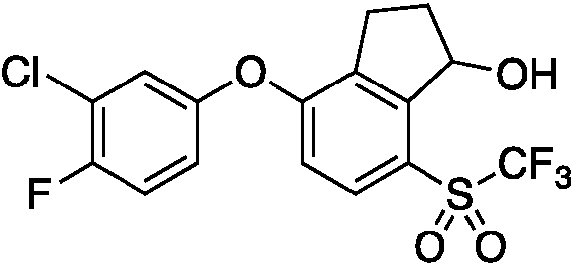
4-(3-cloro-4-fluorofenox¡)-7-((tr¡fluoromet¡l)sulfon¡l)-2.3-d¡h¡dro-1H-¡nden-1-ol (Compuesto 218): Preparado de forma s¡m¡lar a la del ejemplo' de referencia 212. RMN 'H (400 MHz. CDCl3): 7.¿0 (d. 1H). 7.18-7.23 (m. 2H). 6.97-7.01 (m. 1H). 6.80 (d. 1H). 5.63 (m 1H). 3.16-3.29 (m. 2H). 2.96-3.05 (m. 1H). 2.29-2.46 (m. 2H).4- (3-chloro-4-fluorophenox¡) -7 - ((tr¡fluorometh¡l) sulfon¡l) -2.3-d¡h¡dro-1H-inden-1-ol (Compound 218): Prepared similar to that of Reference Example 212. H NMR (400 MHz. CDCl3): 7.0 (d. 1H). 7.18-7.23 (m. 2H). 6.97-7.01 (m. 1H). 6.80 (d. 1H). 5.63 (m 1H). 3.16-3.29 (m. 2H). 2.96-3.05 (m. 1H). 2.29-2.46 (m. 2H).
Ejemplo de referencia 219Reference Example 219
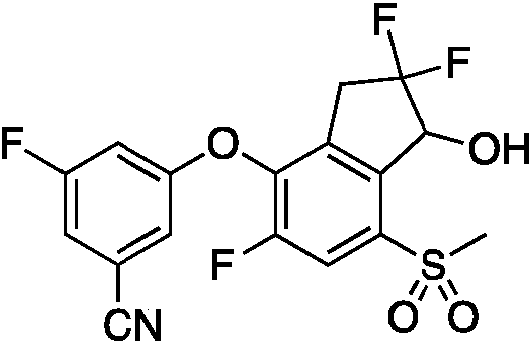
3-fluoro-5-((2.2.5-tr¡fluoro-1-h¡drox¡-7-(met¡lsulfon¡l)-2.3-d¡h¡dro-1H-¡nden-4-¡l)ox¡)benzon¡tr¡lo (Compuesto 219) 3-fluoro-5 - ((2.2.5-tr¡fluoro-1-h¡drox¡-7- (meth¡lsulfon¡l) -2.3-d¡h¡dro-1H-¡nden-4-¡l ) ox¡) benzonitrolo (Compound 219)
Etapa A: Preparac¡ón de 5-bromo-3-fluoro-2-h¡drox¡benzaldehído: A una soluc¡ón de 4-bromo-2-fluoro-fenol (10 g.Step A: Preparation of 5-bromo-3-fluoro-2-hydroxybenzaldehyde: To a solution of 4-bromo-2-fluoro-phenol (10 g.
52.4 mmol) en ác¡do tr¡fluoroacét¡co (50 ml) se le añad¡ó hexamet¡lentetram¡na (14.7 g. 105 mmol) en tres porc¡ones durante 20 m¡nutos a temperatura amb¡ente. La mezcla se ag¡tó a temperatura amb¡ente durante 20 m¡nutos y después se calentó a 90 °C y se ag¡tó a 90 °C durante 13 horas. La mezcla de reacc¡ón se enfr¡ó a temperatura amb¡ente. Se añad¡eron de forma secuenc¡al agua (60 ml) y una soluc¡ón acuosa al 50 % de ác¡do sulfúr¡co (30 ml) a temperatura amb¡ente y la mezcla se ag¡tó a temperatura amb¡ente durante dos horas. La mezcla resultante se extrajo con acetato de et¡lo. La capa orgán¡ca se lavó con soluc¡ón 1 N de ác¡do clorhídr¡co. salmuera. se secó (sulfato magnés¡co). se f¡ltró y se concentró a pres¡ón reduc¡da. Se añad¡ó etanol (20 ml) y la mezcla se ag¡tó a temperatura amb¡ente durante 30 m¡nutos. La mezcla resultante se f¡ltró. El sól¡do recog¡do se lavó con etanol y se secó para dar 5-bromo-3-fluoro-2-h¡drox¡benzaldehído (7.0 g. 61 %).52.4 mmol) in trifluoroacetic acid (50 ml) was added hexamethylene tetramine (14.7 g. 105 mmol) in three portions during 20 minutes at room temperature. The mixture was stirred at room temperature for 20 minutes and then heated to 90 ° C and stirred at 90 ° C for 13 hours. The reaction mixture was cooled to room temperature. To water (60 ml) and a 50% aqueous solution of sulfuric acid (30 ml) were added sequentially at room temperature, and the mixture was stirred at room temperature. ente for two hours. The resulting mixture was extracted with ethyl acetate. The organic layer was washed with 1N hydrochloric acid solution. brine. dried (magnesium sulfate). it was filtered and concentrated under reduced pressure. Ethanol (20 ml) was added and the mixture was stirred at room temperature for 30 minutes. The resulting mixture was filtered. The collected solid was washed with ethanol and dried to give 5-bromo-3-fluoro-2-hydroxybenzaldehyde (7.0 g, 61%).
Etapa B: Preparac¡ón de ác¡do 3-(5-bromo-2-(3-c¡ano-5-fluorofenox¡)-3-fluorofen¡l)propano¡co: Preparado de forma s¡m¡lar a la de la síntes¡s de ác¡do 3-[2-(3-c¡ano-5-fluoro-fenox¡)-5-met¡lsulfan¡l-fen¡l1propano¡co en la etapa B.Step B: Preparation of 3- (5-bromo-2- (3-kano-5-fluorophenoxy) -3-fluorophenyl) propane acid: Prepared in a similar way to that of the synthesis of 3- [2- (3-kano-5-fluoro-phenoxy) -5-methsulfanl-phenyl-propane acid in stage B.
Etapa C: Preparac¡ón de 3-(5-bromo-2-(3-c¡ano-5-fluorofenox¡)-3-fluorofen¡l)propanoato de met¡lo: A una soluc¡ón de ác¡do 3-(5-bromo-2-(3-c¡ano-5-fluorofenox¡)-3-fluorofen¡l)propano¡co (3.0 g. 7.85 mmol) en metanol (50 ml) se le añad¡ó H2SO4 concentrado (0.01 ml) a temperatura amb¡ente. La reacc¡ón se calentó a 70 °C y se ag¡tó a esta temperatura durante 2 horas. Después de enfr¡ar a temperatura amb¡ente. se el¡m¡naron los d¡solventes a pres¡ón reduc¡da. El res¡duo se d¡solv¡ó en acetato de et¡lo (50 ml). se lavó con agua. salmuera. se secó (MgSO4). se f¡ltró y se concentró a pres¡ón reduc¡da. El res¡duo se pur¡f¡có por cromatografía ultrarráp¡da sobre gel de síl¡ce para dar 3-(5-bromo-2-(3-c¡ano-5-fluorofenox¡)-3-fluorofen¡l)propanoato de met¡lo (2.2 g. 71 %) en forma de un sól¡do. Step C: Preparation of 3- (5-bromo-2- (3-kano-5-fluorophenoxy) -3-fluorophenyl) methyl propanoate: To a solution of acid 3- (5-bromo-2- (3-kano-5-fluorophenoxy) -3-fluorophenoxy) propane (3.0 g, 7.85 mmol) in methanol (50 ml) was added H 2 SO 4 concentrated (0.01 ml) at room temperature. The reaction was heated to 70 ° C and stirred at this temperature for 2 hours. After cooling to room temperature. solvents were removed under reduced pressure. The residue was dissolved in ethyl acetate (50 ml). washed with water. brine. dried (MgSO 4 ). it was filtered and concentrated under reduced pressure. The residue was purified by flash chromatography on silica gel to give 3- (5-bromo-2- (3-kano-5-fluorophenoxy) -3-fluorophenil ) methyl propanoate (2.2 g, 71%) as a solid.
Etapa D: Preparación de 3-(5-(acetilt¡o)-2-(3-c¡ano-5-fluorofenoxi)-3-fluorofen¡l)propanoato de metilo: Una mezcla de 3-[5-bromo-2-(3-ciano-5-fluoro-fenoxi)-3-fluoro-fen¡l]propanoato de metilo (2,2 g, 5,6 mmol), CH3COSK (0,95 g, 8,3 mmol), Pd2(dba)3 (0,51 g, 0,56 mmol) y Xantphos (0,48 g, 0,83 mmol) en tolueno (40 ml) y acetona (20 ml) se agitó a 100 °C en un tubo cerrado herméticamente durante 5 horas. Después de enfriar a temperatura ambiente, el sólido se eliminó por filtración. El filtrado se concentró a presión reducida. El residuo se purificó por cromatografía ultrarrápida sobre gel de sílice para dar metil 3-(5-(acetiltio)-2-(3-c¡ano-5-fluorofenox¡)-3-fluorofenil)propanoato de metilo (1,0 g, 46 %).Step D: Preparation of methyl 3- (5- (acetyl) -2- (3-kano-5-fluorophenoxy) -3-fluorophenyl) propanoate: A mixture of 3- [5-bromo- Methyl 2- (3-cyano-5-fluoro-phenoxy) -3-fluoro-phenyl] propanoate (2.2 g, 5.6 mmol), CH 3 COSK (0.95 g, 8.3 mmol ), Pd 2 (dba) 3 (0.51 g, 0.56 mmol) and Xantphos (0.48 g, 0.83 mmol) in toluene (40 ml) and acetone (20 ml) was stirred at 100 ° C in a sealed tube for 5 hours. After cooling to room temperature, the solid was removed by filtration. The filtrate was concentrated under reduced pressure. The residue was purified by flash chromatography on silica gel to give methyl 3- (5- (acetylthio) -2- (3-kano-5-fluorophenoxy) -3-fluorophenyl) propanoate methyl (1.0 g , 46%).
Etapa E: Preparación de 3-(2-(3-c¡ano-5-fluorofenox¡)-3-fluoro-5-(metilt¡o)fen¡l)propanoato de metilo: A una solución de 3-[5-acetilsulfanil-2-(3-c¡ano-5-fluoro-fenox¡)-3-fluoro-fen¡l]propanoato de metilo (1,0 g, 2,55 mmol) en metanol (50 ml) se le añadió Cs2CO3 (1,25 g, 3,83 mmol) a temperatura ambiente. Después de 1 hora, se añadió Mel (0,72 g, 5,11 mmol) y la reacción se agitó durante otras 2 horas a temperatura ambiente. Se añadieron agua y diclorometano y la capa orgánica se separó, se lavó con agua, salmuera, se secó (MgSO4), se filtró y se concentró a presión reducida. El residuo obtenido se purificó por cromatografía ultrarrápida sobre gel de sílice para dar metil 3-(2-(3-ciano-5-fluorofenoxi)-3-fluoro-5-(met¡lt¡o)fen¡l)propanoato de metilo (0,6 g, 64 %) en forma de un sólido.Step E: Preparation of methyl 3- (2- (3-kano-5-fluorophenoxy) -3-fluoro-5- (methylthio) phenyl) propanoate: To a solution of 3- [5 Methyl -acetylsulfanyl-2- (3-kano-5-fluoro-phenoxy) -3-fluoro-phenoxy] propanoate (1.0 g, 2.55 mmol) in methanol (50 ml) was added added Cs 2 CO 3 (1.25 g, 3.83 mmol) at room temperature. After 1 hour, Mel (0.72 g, 5.11 mmol) was added and the reaction was stirred for another 2 hours at room temperature. Water and dichloromethane were added and the organic layer was separated, washed with water, brine, dried (MgSO 4 ), filtered, and concentrated under reduced pressure. The obtained residue was purified by flash chromatography on silica gel to give methyl 3- (2- (3-cyano-5-fluorophenoxy) -3-fluoro-5- (methyl) phenyl) propanoate. (0.6 g, 64%) as a solid.
Etapa F: Preparación de ácido 3-(2-(3-c¡ano-5-fluorofenox¡)-3-fluoro-5-(met¡ltio)fen¡l)propano¡co: A una solución de 3-[2-(3-ciano-5-fluoro-fenoxi)-3-fluoro-5-met¡lsulfan¡l-fen¡l]propanoato de metilo (0,60 g, 1,65 mmol) en metanol (10 ml) y agua (10 ml), se le añadió LiOH (0,079 g, 3,3 mmol) a temperatura ambiente. La reacción se agitó a temperatura ambiente durante una noche. Se acidificó con HCl 1 N a pH~3 y se extrajo con acetato de etilo. La capa orgánica se lavó con salmuera, se secó (sulfato sódico), se filtró y se concentró a presión reducida para dar ácido 3-(2-(3-ciano-5-fluorofenox¡)-3-fluoro-5-(met¡ltio)fen¡l)propano¡co (0,4 g, 69 %).Step F: Preparation of 3- (2- (3-kano-5-fluorophenoxy) -3-fluoro-5- (methyl) pheno) propane acid: To a solution of 3- [ Methyl 2- (3-cyano-5-fluoro-phenoxy) -3-fluoro-5-methysulfanl-phenyl] propanoate (0.60 g, 1.65 mmol) in methanol (10 ml) and water (10 ml), LiOH (0.079 g, 3.3 mmol) was added at room temperature. The reaction was stirred at room temperature overnight. It was acidified with 1N HCl to pH ~ 3 and extracted with ethyl acetate. The organic layer was washed with brine, dried (sodium sulfate), filtered, and concentrated under reduced pressure to give 3- (2- (3-cyano-5-fluorophenoxy) -3-fluoro-5- (met Lithium) phenyl) propane (0.4 g, 69%).
Etapa G: Preparación de 3-fluoro-5-((2,2,5-tr¡fluoro-1-h¡drox¡-7-(met¡lsulfon¡l)-2,3-d¡h¡dro-1H-¡nden-4-¡l)ox¡)benzonitr¡lo (Compuesto 219): Preparado de forma similar a la del ejemplo de referencia 163. RMN 1H (400 MHz, d6-DMSO): 8 7,85 (d, 1H), 7,67 (m, 1H), 7,46 (d, 1H), 6,85 (d, 1H), 5,38 (dd, 1H), 3,40-3,49 (m, 2H), 3,40 (s, 3H).Step G: Preparation of 3-fluoro-5 - ((2,2,5-tr¡fluoro-1-hydrox¡-7- (methlsulfonl) -2,3-d¡h¡dro- 1H-nden-4-¡l) ox¡) benzonitr¡lo (Compound 219): Prepared in a similar manner to that of Reference Example 163. 1H NMR (400 MHz, d6-DMSO): 8 7.85 (d , 1H), 7.67 (m, 1H), 7.46 (d, 1H), 6.85 (d, 1H), 5.38 (dd, 1H), 3.40-3.49 (m, 2H), 3.40 (s, 3H).
Ejemplo de referencia 220Reference Example 220

5-((1-h¡drox¡-7-((tr¡fluoromet¡l)sulfon¡l)-2,3-d¡h¡dro-1H-¡nden-4-¡l)ox¡)n¡cot¡non¡trilo (Compuesto 220): Preparado de forma similar a la del ejemplo de referencia 212.5 - ((1-h¡drox¡-7 - ((tr¡fluoromethyl) sulfon¡l) -2,3-d¡h¡dro-1H-inden-4-¡l) ox¡) n Cotonontrile (Compound 220): Prepared similarly to Reference Example 212.
Ejemplo de referencia 221Reference Example 221

(S)-4-(3-cloro-4-fluorofenox¡)-2,2-d¡fluoro-7-((tr¡fluoromet¡l)sulfon¡l)-2,3-dih¡dro-1H-¡nden-1-ol (Compuesto 221 : Preparado de un modo similar al de la síntesis del compuesto' 185. LC-MS ESI (-) m/z 445, 447 (M-H); RMN 'H (400 MHz, CDCl3): 87,97 (d, 1 H), 7,28-7,22 (m, 2 H), 7,02 (d, 1 H), 6,87 (d, 1 H), 5,43-5,39 (m, 1 H), 3,64-3,47 (m, 2 H), 3,26 (d, 1 H).(S) -4- (3-chloro-4-fluorophenox¡) -2,2-d¡fluoro-7 - ((tr¡fluorometh¡l) sulfon¡l) -2,3-dihydro-1H- Inden-1-ol (Compound 221: Prepared in a similar way to the synthesis of compound '185. LC-MS ESI (-) m / z 445, 447 (MH);' H NMR (400 MHz, CDCl 3 ): 87.97 (d, 1H), 7.28-7.22 (m, 2H), 7.02 (d, 1H), 6.87 (d, 1H), 5.43- 5.39 (m, 1H), 3.64-3.47 (m, 2H), 3.26 (d, 1H).
Ejemplo de referencia 222Reference Example 222

3-fluoro-5-((1-h¡drox¡-7-(met¡lsulfon¡l)-2,3-d¡h¡dro-1H-¡nden-4-¡l)ox¡)benzonitr¡lo (Compuesto 222): Se añadió borohidruro sódico (6,6 mg, 0,17 mmol) de una vez a una solución de 3-fluoro-5-(7-metilsulfonil-1-oxo-¡ndan-4-¡l)ox¡-benzonitrilo (20,0 mg, 0,06 mmol) en metanol (1 ml) a temperatura ambiente, después se agitó durante 15 minutos. 3-fluoro-5 - ((1-h¡drox¡-7- (meth¡lsulfon¡l) -2,3-d¡h¡dro-1H-¡nden-4-¡l) ox¡) benzonitr¡ Lo (Compound 222): Sodium borohydride (6.6 mg, 0.17 mmol) was added all at once to a solution of 3-fluoro-5- (7-methylsulfonyl-1-oxo-indan-4-¡l ) oxy-benzonitrile (20.0 mg, 0.06 mmol) in methanol (1 ml) at room temperature, then stirred for 15 minutes.
La mezcla de reacción se inactivó con agua, se extrajo con acetato de etilo, se lavó con salmuera, se secó sobre MgSO4, se filtró y se concentró al vacío. El residuo se purificó sobre gel de sílice (10 g SNAP, 14 CV, 20-100 % de acetato de etilo/hexano) para proporcionar el compuesto 222 (11 mg, 0,032 mmol, 55% de rendimiento). LC-MS ESI (-) m/z 392 (M+HCO2"); RMN 1H (400 MHz, CDCls): 87,84 (d, 1 H), 7,19-7,17 (m, 1 H), 7,08 (s, 1 H), 7,00-6,97 (m, 2 H), 5,71-5,68 (m, 1 H), 3,64 (d, 1 H), 3,21 (s, 3 H), 3,12-3,04 (m, 1 H), 2,84-2,76 (m, 1 H), 2,52-2,43 (m, 1 H), 2,27-2,19 (m, 1 H).The reaction mixture was quenched with water, extracted with ethyl acetate, washed with brine, dried over MgSO 4 , filtered, and concentrated in vacuo. The residue was purified on silica gel (10 g SNAP, 14 CV, 20-100% ethyl acetate / hexane) to provide compound 222 (11 mg, 0.032 mmol, 55% yield). LC-MS ESI (-) m / z 392 (M + HCO 2 "); 1H NMR (400 MHz, CDCls): 87.84 (d, 1H), 7.19-7.17 (m, 1H ), 7.08 (s, 1H), 7.00-6.97 (m, 2H), 5.71-5.68 (m, 1H), 3.64 (d, 1H), 3.21 (s, 3H), 3.12-3.04 (m, 1H), 2.84-2.76 (m, 1H), 2.52-2.43 (m, 1H ), 2.27-2.19 (m, 1H).
Ejemplo de referencia 223Reference Example 223

3-((2,2-difluoro-1-hidroxi-7-(metilsulfonil)-2,3-dihidro-1H-inden-4-il)oxi)-5-fluorobenzonitrilo (Compuesto 223): Se añadió borohidruro sódico (40 mg, 1,1 mmol) de una vez a 3-(2,2-difluoro-7-metilsulfonil-1-oxo-indan-4-il)oxi-5-fluorobenzonitrilo (200 mg, 0,52 mmol) en metanol (5 ml) a temperatura ambiente. La mezcla de reacción se agitó durante 10 minutos, se inactivó con HCl 1 N, se extrajo con acetato de etilo, se lavó con salmuera, se secó sobre MgSO4, se filtró y se concentró al vacío. El residuo se purificó sobre gel de sílice (10 g SNAP, 14 CV, 20-80 % de acetato de etilo/hexanos) para proporcionar el compuesto 223 (146 mg, 0,38 mmol, 73% de rendimiento) en forma de una espuma de color blanco. LC-MS ESI (-) m/z 428 (M+HCO2'); RMN 1H (400 MHz, CDCla): 87,93 (d, 1 H), 7,27-7,24 (m, 1 H), 7,15-7,14 (m, 1 H), 7,07-7,03 (m, 1 H), 7,00 (d, 1 H), 5,63-5,58 (m, 1 H), 3,56-3,35 (m, 3 H), 3,24 (s, 3 H). 3 - ((2,2-Difluoro-1-hydroxy-7- (methylsulfonyl) -2,3-dihydro-1H-inden-4-yl) oxy) -5-fluorobenzonitrile (Compound 223): Sodium borohydride ( 40 mg, 1.1 mmol) at once to 3- (2,2-difluoro-7-methylsulfonyl-1-oxo-indan-4-yl) oxy-5-fluorobenzonitrile (200 mg, 0.52 mmol) in methanol (5 ml) at room temperature. The reaction mixture was stirred for 10 minutes, quenched with 1N HCl, extracted with ethyl acetate, washed with brine, dried over MgSO 4 , filtered, and concentrated in vacuo. The residue was purified on silica gel (10 g SNAP, 14 CV, 20-80% ethyl acetate / hexanes) to provide compound 223 (146 mg, 0.38 mmol, 73% yield) as a white foam. LC-MS ESI (-) m / z 428 (M + HCO 2 '); 1H NMR (400 MHz, CDCla): 87.93 (d, 1H), 7.27-7.24 (m, 1H), 7.15-7.14 (m, 1H), 7.07 -7.03 (m, 1H), 7.00 (d, 1H), 5.63-5.58 (m, 1H), 3.56-3.35 (m, 3H), 3 , 24 (s, 3H).
Ejemplo de referencia 224Reference Example 224

(S)-2,2-difluoro-4-((1-metil-1H-pirazol-4-il)oxi)-7-((trifluorometil)sulfonil)-2,3-dihidro-1H-inden-1-ol (Compuesto 224): Preparado de un modo similar al de la síntesis del compuesto 185. LC-MS ESI (+) m/z 399 (M+H); RMN 1H (400 MHz, CDCh): 87,87 (d, 1 H), 7,40 (s, 1 H), 7,36 (s, 1 H), 7,08 (d, 1 H), 5,42-5,38 (m, 1 H), 3,94 (s, 3 H), 3,59 3,52 (m, 2 H), 3,21 (d, 1 H).(S) -2,2-difluoro-4 - ((1-methyl-1H-pyrazol-4-yl) oxy) -7 - ((trifluoromethyl) sulfonyl) -2,3-dihydro-1H-inden-1- ol (Compound 224): Prepared in a manner similar to the synthesis of compound 185. LC-MS ESI (+) m / z 399 (M + H); 1H NMR (400 MHz, CDCh): 87.87 (d, 1H), 7.40 (s, 1H), 7.36 (s, 1H), 7.08 (d, 1H), 5 , 42-5.38 (m, 1H), 3.94 (s, 3H), 3.59-3.52 (m, 2H), 3.21 (d, 1H).
Ejemplo 225Example 225

5-(((1S,2ffl-2-fluoro-1-hidroxi-7-((trifluorometil)sulfonil)-2,3-dihidro-1H-inden-4-il)oxi)nicotinonitrilo (Compuesto 225) 5 - (((1S, 2ffl-2-fluoro-1-hydroxy-7 - ((trifluoromethyl) sulfonyl) -2,3-dihydro-1H-inden-4-yl) oxy) nicotinonitrile (Compound 225)
Etapa A: Preparación de 5-[7'-(tr¡fluoromet¡lsulfon¡l)esp¡ro[1.3-d¡oxolan-2.1'-¡ndan1-4'-¡l1ox¡p¡r¡d¡n-3-carbon¡tr¡lo: Se añadió carbonato de cesio (1,93 g, 5,94 mmol) de una vez a 4'-fluoro-7'-(trifluorometilsulfonil)espiro[1,3-dioxolan-2,1'-¡ndano] (775 mg, 2,38 mmol) y 3-ciano-5-hidroxipiridina (371 mg, 3,1 mmol) en 1 -metil-2-pirrolidona (15 ml), después se calentó hasta 100 °C durante 90 minutos. La mezcla de reacción se diluyó con agua, se extrajo con metil t-butil éter, se lavó con salmuera, se secó sobre Na2SO4, se filtró y se concentró al vacío. Se usó 5-[7'-(trifluorometilsulfonil)espiro[1,3-dioxolan-2,1'-indan]-4'-il]oxipiridin-3-carbonitrilo en bruto sin más purificación. LC-MS ESI (+) m/z 427 (M+H).Step A: Preparation of 5- [7 '- (tr¡fluorometh¡lsulfon¡l) esp¡ro [1.3-d¡oxolan-2.1'-¡ndan1-4'-¡l1ox¡p¡r¡d¡n- 3-carbonytrilo: Cesium carbonate (1.93 g, 5.94 mmol) was added all at once to 4'-fluoro-7 '- (trifluoromethylsulfonyl) spiro [1,3-dioxolan-2.1 '-Ndane] (775 mg, 2.38 mmol) and 3-cyano-5-hydroxypyridine (371 mg, 3.1 mmol) in 1-methyl-2-pyrrolidone (15 ml), then heated to 100 ° C for 90 minutes. The reaction mixture was diluted with water, extracted with methyl t-butyl ether, washed with brine, dried over Na 2 SO 4 , filtered, and concentrated in vacuo. Crude 5- [7 '- (trifluoromethylsulfonyl) spiro [1,3-dioxolan-2,1'-indan] -4'-yl] oxypyridine-3-carbonitrile was used without further purification. LC-MS ESI (+) m / z 427 (M + H).
Etapa B: Preparación de 5-[1-oxo-7-(tr¡fluoromet¡lsulfon¡l)¡ndan-4-¡l1oxip¡r¡d¡n-3-carbon¡tr¡lo: Se añadió HCl concentrado (3,24 ml, 9,38 mmol) a 5-[7'-(trifluorometilsulfonil)espiro[1,3-dioxolan-2,1'-indan]-4'-il]oxipiridin-3-carbonitrilo (1,0 g, 2,35 mmol) en acetona (15 ml) a temperatura ambiente y se agitó durante 4 horas. La mezcla de reacción se inactivó con NaHCO3 saturado, se extrajo con acetato de etilo, se lavó con salmuera, se secó sobre MgSO4, se filtró y se concentró al vacío. El residuo se purificó sobre gel de sílice (25 g SNAP Ultra, 14 CV, 20-100 % de acetato de etilo/hexano) proporcionando 5-[1-oxo-7-(trifluorometilsulfonil)indan-4-il]oxipiridin-3-carbonitrilo (737 mg, 1,93 mmol, 82 % de rendimiento). LC-MS ESI (+) m/z 383 (M+H).Step B: Preparation of 5- [1-oxo-7- (tr¡fluoromethylsulfon¡l) ¡ndan-4-¡l1oxip¡r¡d¡n-3-carbon¡tr¡lo: Concentrated HCl ( 3.24 ml, 9.38 mmol) to 5- [7 '- (trifluoromethylsulfonyl) spiro [1,3-dioxolan-2,1'-indan] -4'-yl] oxypyridine-3-carbonitrile (1.0 g, 2.35 mmol) in acetone (15 ml) at room temperature and stirred for 4 hours. Mix The reaction mixture was quenched with saturated NaHCO 3 , extracted with ethyl acetate, washed with brine, dried over MgSO 4 , filtered, and concentrated in vacuo. The residue was purified on silica gel (25 g SNAP Ultra, 14 CV, 20-100% ethyl acetate / hexane) affording 5- [1-oxo-7- (trifluoromethylsulfonyl) indan-4-yl] oxypyridin-3 -carbonitrile (737 mg, 1.93 mmol, 82% yield). LC-MS ESI (+) m / z 383 (M + H).
Etapa C: Preparación de 5-[2-fluoro-1-oxo-7-(tr¡fluoromet¡lsulfon¡l)¡ndan-4-¡l1oxip¡r¡d¡n-3-carbon¡tr¡lo: Se añadió bis(tetrafluoroborato) de 1-cloromet¡l-4-fluoro-1,4-d¡azon¡abic¡clo[2.2.2]octano (499 mg, 1,4 mmol) de una vez a 5-[1-oxo-7-(trifluorometilsulfonil)indan-4-il1oxipiridin-3-carbonitrilo (269 mg, 0,7 mmol) en 2-propanol (10 ml) a temperatura ambiente, después se calentó a reflujo hasta que la reacción se completó según se determinó mediante LC-MS. La mezcla de reacción se diluyó con agua, se extrajo con acetato de etilo, se lavó con salmuera, se secó sobre Na2SO4, se filtró y se secó al vacío. El residuo se purificó sobre gel de sílice (10 g SNAP Ultra, 14 CV, 20-100 % de acetato de etilo/hexano) proporcionando 5-[2-fluoro-1-oxo-7-(trifluorometilsulfonil)indan-4-il1oxipiridin-3-carbonitrilo (260 mg, 0,65 mmol, 92 % de rendimiento). LC-MS ESI (-) m/z 399 (M-H).Step C: Preparation of 5- [2-fluoro-1-oxo-7- (tr¡fluorometh¡lsulfon¡l) ¡ndan-4-¡l1oxyp¡r¡d¡n-3-carbon¡tr¡l: added bis (tetrafluoroborate) of 1-chloromethyl-4-fluoro-1,4-diazonium-cyclo [2.2.2] octane (499 mg, 1.4 mmol) all at once to 5- [1 -oxo-7- (trifluoromethylsulfonyl) indan-4-yl1oxypyridine-3-carbonitrile (269 mg, 0.7 mmol) in 2-propanol (10 ml) at room temperature, then heated under reflux until the reaction was complete according to It was determined by LC-MS. The reaction mixture was diluted with water, extracted with ethyl acetate, washed with brine, dried over Na 2 SO 4 , filtered, and dried in vacuo. The residue was purified on silica gel (10 g SNAP Ultra, 14 CV, 20-100% ethyl acetate / hexane) affording 5- [2-fluoro-1-oxo-7- (trifluoromethylsulfonyl) indan-4-yl1oxypyridine -3-carbonitrile (260mg, 0.65mmol, 92% yield). LC-MS ESI (-) m / z 399 (MH).
Etapa D: Preparación de 5-[(1S.2^)-2-fluoro-1-h¡drox¡-7-(tr¡fluoromet¡lsulfon¡l)¡ndan-4-¡l1ox¡p¡rid¡n-3-carbon¡tr¡lo (Compuesto 225): Se añadió cloro{[(1R,2R)-(-)-2-am¡no-1,2-d¡fen¡let¡l](4-toluenosulfonil)am¡do}(p-c¡meno)ruten¡o (II) (2,1 mg, 0,007 mmol) de una vez a una mezcla enfriada en hielo de 5-[2-fluoro-1-oxo-7-(trifluorometilsulfonil)indan-4-il]oxipiridin-3-carbonitrilo (130 mg, 0,32 mmol), trietilamina (91 pl, 0,65 mmol) y ácido fórmico (37 pl, 0,97 mmol) en diclorometano (5 ml), después se selló con un tapón de teflón y se colocó en un refrigerador a 4 °C durante una noche. La mezcla de reacción se purificó directamente sobre gel de sílice (10 g SNAP Ultra, 14 CV, 20-100 % de acetato de etilo/hexano) proporcionando el compuesto 225 (112 mg, 0,28 mmol, 86 % de rendimiento). LC-MS ESI (-) m/z 401 (M-H); RMN 1H (400 MHz, CDCls): 88,82 (d, 1 H), 8,70 (d, 1 H), 7,95 (d, 1 H), 7,71-7,69 (m, 1 H), 6,94 (d, 1 H), 5,64-5,59 (m, 1 H), 5,46-5,31 (m, 1 H), 3,36-3,27 (m, 2 H), 3,19 (d, 1 H).Step D: Preparation of 5 - [(1S.2 ^) - 2-fluoro-1-h¡drox¡-7- (tr¡fluoromet¡lsulfon¡l) ¡ndan-4-¡l1ox¡p¡rid¡n -3-carbonyl (Compound 225): Chloro {[(1R, 2R) - (-) - 2-amino-1,2-d¡phenelet¡l] (4-toluenesulfonyl ) amide} (pcmene) ruthenium (II) (2.1 mg, 0.007 mmol) once to an ice-cold mixture of 5- [2-fluoro-1-oxo-7- (trifluoromethylsulfonyl ) indan-4-yl] oxypyridine-3-carbonitrile (130 mg, 0.32 mmol), triethylamine (91 µl, 0.65 mmol) and formic acid (37 µl, 0.97 mmol) in dichloromethane (5 ml) , then sealed with a Teflon plug and placed in a refrigerator at 4 ° C overnight. The reaction mixture was purified directly on silica gel (10 g SNAP Ultra, 14 CV, 20-100% ethyl acetate / hexane) to provide compound 225 (112 mg, 0.28 mmol, 86% yield). LC-MS ESI (-) m / z 401 (MH); 1H NMR (400 MHz, CDCls): 88.82 (d, 1H), 8.70 (d, 1H), 7.95 (d, 1H), 7.71-7.69 (m, 1 H), 6.94 (d, 1H), 5.64-5.59 (m, 1H), 5.46-5.31 (m, 1H), 3.36-3.27 (m , 2H), 3.19 (d, 1H).
Ejemplo de referencia 226Reference Example 226

(ft)-3-((2,2-difluoro-1-hidroxi-7-(metilsulfonil)-2,3-dihidro-1H-inden-4-il)oxi)-5-fluorobenzonitrilo (Compuesto 226): Preparado de forma similar de acuerdo con la etapa F en la síntesis del compuesto 163 sustituyendo cloro {[(1S,2S)-(-)-2-amino-1,2-difeniletil](4-toluenosulfonil)amido}(p-cimeno)rutenio (II) por cloro {[(1R,2R)-(-)-2-amino-1,2-difeniletil](4-toluenosulfonil)amido}(p-cimeno)rutenio (II). LC-MS ESI (-) m/z 428 (M+HCO2'); RMN 1H (400 MHz, CDCla): 87,93 (d, 1 H), 7,27-7,24 (m, 1 H), 7,15-7,14 (m, 1 H), 7,07-7,03 (m, 1 H), 7,00 (d, 1 H), 5,63-5,58 (m, 1 H), 3,56-3,35 (m, 3 H), 3,24 (s, 3 H).(ft) -3 - ((2,2-Difluoro-1-hydroxy-7- (methylsulfonyl) -2,3-dihydro-1H-inden-4-yl) oxy) -5-fluorobenzonitrile (Compound 226): Preparation similarly according to step F in the synthesis of compound 163 by substituting chloro {[(1S, 2S) - (-) - 2-amino-1,2-diphenylethyl] (4-toluenesulfonyl) amido} (p-cymene ) ruthenium (II) by chloro {[(1R, 2R) - (-) - 2-amino-1,2-diphenylethyl] (4-toluenesulfonyl) amido} (p-cymene) ruthenium (II). LC-MS ESI (-) m / z 428 (M + HCO 2 '); 1H NMR (400 MHz, CDCla): 87.93 (d, 1H), 7.27-7.24 (m, 1H), 7.15-7.14 (m, 1H), 7.07 -7.03 (m, 1H), 7.00 (d, 1H), 5.63-5.58 (m, 1H), 3.56-3.35 (m, 3H), 3 , 24 (s, 3H).
Ejemplo 227Example 227

3-fluoro-5-(((1S,2ffl-2-fluoro-1-hidroxi-7-((trifluorometil)sulfonil)-2,3-dihidro-1H-inden-4-il)oxi)benzonitrilo (Compuesto 227): Preparado de forma similar de acuerdo con el compuesto 225, etapas A-D. LC-MS ESI (-) m/z 464 (M+HCO2'); RMN 1H (400 MHz, CDCls): 87,94 (d, 1 H), 7,31-7,29 (m, 1 H), 7,21 (s, 1 H), 7,11-7,08 (m, 1 H), 6,98 (d, 1 H), 5,62-5,58 (m, 1 H), 5,40-5,27 (m, 1 H), 3,40-3,26 (m, 2 H), 3,20 (d, 1 H).3-fluoro-5 - (((1S, 2ffl-2-fluoro-1-hydroxy-7 - ((trifluoromethyl) sulfonyl) -2,3-dihydro-1H-inden-4-yl) oxy) benzonitrile (Compound 227 ): Prepared similarly according to compound 225, steps AD. LC-MS ESI (-) m / z 464 (M + 2 'HCO); 1H NMR (400 MHz, CDCls): 87.94 (d, 1H), 7.31-7.29 (m, 1H), 7.21 (s, 1H), 7.11-7.08 (m, 1H), 6.98 (d, 1H ), 5.62-5.58 (m, 1H), 5.40-5.27 (m, 1H), 3.40-3.26 (m, 2H), 3.20 (d, 1 HOUR).
Ejemplo de referencia 228 Reference Example 228

(S)-5-((2.2-d¡fluoro-1-h¡drox¡-7-((tr¡fluoromet¡l)sulfon¡l)-2.3-d¡h¡dro-1H-¡nden-4-¡l)oxi)-2-fluorobenzon¡tr¡lo (Compuesto 228): Preparado de un modo similar al de la síntesis del compuesto 185. ' LC-MS ESI m/z 436 (M-H): RMN 1H (400 MHz. CDCl3): 87.90 (d. 1 H). 7.42-7.30 (m. 3 H). 6.86 (d. 1 H). 5.42 (dd. 1 H). 3.58-3.47 (m. 2 H). 3.32 (d. 1 H). (S) -5 - ((2.2-d¡fluoro-1-h¡drox¡-7 - ((tr¡fluorometh¡l) sulfon¡l) -2.3-d¡h¡dro-1H-inden-4 -L) oxy) -2-fluorobenzonetrio (Compound 228): Prepared in a similar way to the synthesis of compound 185. 'LC-MS ESI m / z 436 (MH): 1H NMR (400 MHz CDCl 3 ): 87.90 (d. 1H). 7.42-7.30 (m. 3H). 6.86 (d. 1H). 5.42 (dd. 1H). 3.58-3.47 (m. 2H). 3.32 (d. 1H).
Ejemplo de referencia 229Reference Example 229

3-[(1S)-1-deuter¡o-2.2-d¡fluoro-1-h¡drox¡-7-(tr¡deuter¡omet¡lsulfon¡l)¡ndan-4-¡l1oxi-5-fluoro-benzon¡tr¡lo (Compuesto 229)3 - [(1S) -1-deuter¡o-2.2-d¡fluoro-1-h¡drox¡-7- (tr¡deuter¡omet¡lsulfon¡l) ¡ndan-4-¡l1oxy-5-fluoro -benzonitre (Compound 229)
Etapa A: Preparación de 2-h¡droxi-5-(tr¡deuter¡omet¡lsulfan¡l)benzaldehído: A una suspensión de 4-(trideuteriomet¡lsulfan¡l)fenol (13.9 g. 77.4 mmol) y paraformaldehído (13.9 g. 464 mmol) en acetonitrilo (55 ml) a 0 °C se le añadió cloruro de magnesio (11.8 g. 124 mmol) seguido de trietilamina (27 ml. 193 mmol). La mezcla de reacción se calentó después a 68 °C en un baño de aceite hasta que se completó según se determinó mediante LC-MS (2.5 horas). La mezcla de reacción de color amarillo se enfrió a 0 °C. después se inactivó mediante la adición gota a gota de HCl 1 N (60 ml) y se extrajo con metil t-butil éter (3 x 60 ml). Los sólidos se eliminaron por filtración. La capa orgánica se lavó con salmuera. se secó sobre MgSO4. se filtró y se concentró al vacío. El residuo se separó y se lavó con metil t-butil éter y después se secó al vacío proporcionando 2-hidrox¡-5-(trideuteriomet¡lsulfan¡l)benzaldehído. El material en bruto restante en las aguas madre se purificó sobre gel de sílice (100 g SNAP Ultra. 14 CV. 5-100 % de acetato de etilo/hexano) proporcionando 2-hidrox¡-5-(trideuteriomet¡lsulfan¡l)benzaldehído en forma de un sólido de color amarillo.Step A: Preparation of 2-hydroxy-5- (trideuteriomethyl sulfanyl) benzaldehyde: To a suspension of 4- (trideuteriomethyl sulfanyl) phenol (13.9 g. 77.4 mmol) and paraformaldehyde ( 13.9 g, 464 mmol) in acetonitrile (55 ml) at 0 ° C was added magnesium chloride (11.8 g, 124 mmol) followed by triethylamine (27 ml, 193 mmol). The reaction mixture was then heated to 68 ° C in an oil bath until completeness as determined by LC-MS (2.5 hours). The yellow reaction mixture was cooled to 0 ° C. it was then quenched by dropwise addition of 1N HCl (60 ml) and extracted with methyl t-butyl ether (3 x 60 ml). The solids were removed by filtration. The organic layer was washed with brine. dried over MgSO 4 . filtered and concentrated in vacuo. The residue was separated and washed with methyl t-butyl ether and then dried in vacuo to give 2-hydroxy-5- (trideuteriomethyl sulfanyl) benzaldehyde. The remaining crude material in the mother liquors was purified on silica gel (100 g SNAP Ultra. 14 CV. 5-100% ethyl acetate / hexane) to provide 2-hydroxy-5- (trideuteriomethylsulfanil) benzaldehyde as a yellow solid.
Etapa B: Preparación de ácido 2-oxo-6-(trideuter¡omet¡lsulfan¡l)cromen-3 carboxílico: A una solución de 2-hidroxi-5-(trideuteriomet¡lsulfan¡l)benzaldehído (4.65 g. 27 mmol) y 2.2-dimetil-1.3-d¡oxan-4.6-d¡ona (3.91 g. 27 mmol) en etanol al 95 % (70 ml) se le añadió fosfato potásico tribásico (0.58 g. 2.7 mmol) en agua (210 ml) a temperatura ambiente. La mezcla se agitó a temperatura ambiente durante 1 hora (ligeramente exotérmico). La mezcla de reacción se acidificó con HCl 1 N a pH ~3-4. El sólido se recogió por filtración. se lavó con agua y después hexano/metil t-butil éter 5:1 y se secó para dar ácido 2-oxo-6-(trideuteriomet¡lsulfan¡l)cromen-3-carboxíl¡co (5.95 g. 25 mmol. 92 % de rendimiento) en forma de un sólido de color amarillo.Step B: Preparation of 2-oxo-6- (trideuteriomethylsulfanil) chromen-3 carboxylic acid: To a solution of 2-hydroxy-5- (trideuteriomethyl sulfanil) benzaldehyde (4.65 g. 27 mmol ) and 2,2-dimethyl-1,3-dioxan-4.6-dione (3.91 g. 27 mmol) in 95% ethanol (70 ml), tribasic potassium phosphate (0.58 g. 2.7 mmol) in water (210 ml) at room temperature. The mixture was stirred at room temperature for 1 hour (slightly exothermic). The reaction mixture was acidified with 1N HCl to pH ~ 3-4. The solid was collected by filtration. Washed with water and then 5: 1 hexane / methyl t-butyl ether and dried to give 2-oxo-6- (trideuteriomethylsulfanyl) chromene-3-carboxylic acid (5.95 g. 25 mmol. 92 % yield) as a yellow solid.
Etapa C: Preparación de ácido 3-[2-h¡drox¡-5-(tr¡deuter¡omet¡lsulfan¡l)fen¡l]propano¡co: Se añadió trietilamina (8.3 ml. 60 mmol) lentamente a ácido fórmico (5.6 ml. 149 mmol) en W,W-dimetilformamida (12 ml) a 0 °C. La mezcla se calentó a 100 °C (internos). después se añadió ácido 2-oxo-6-(trideuteriomet¡lsulfan¡l)cromen-3-carboxíl¡co (5.95 g. 24.9 mmol) en 5 porciones (~1.2 g cada 5 minutos). Después de la adición (aprox. 30 minutos). la mezcla de reacción se agitó a 100 °C (internos) durante 1 hora. Después de enfriar a temperatura ambiente. se añadió NaOH 6 N (49.74 ml. 149.2 mmol). La mezcla de reacción se agitó a temperatura ambiente durante 30 minutos. Se añadió metil t-butil éter (40 ml). La capa acuosa se separó. se acidificó con HCl concentrado a pH ~3-4 y se extrajo con metil t-butil éter (3x50 ml). La capa orgánica combinada se lavó con salmuera. se secó (sulfato sódico). se filtró y se concentró a presión reducida para dar ácido 3-[2-hidrox¡-5-(trideuteriometilsulfanil)fenil1propanoico (4.8 g. 22.4 mmol. 90 % de rendimiento). que se usó directamente en la siguiente etapa sin purificación.Step C: Preparation of 3- [2-hydrox¡-5- (tr¡deuter¡ome¡lsulfan¡l) phen¡l] propane acid: Triethylamine (8.3 ml. 60 mmol) was added slowly to acid formic (5.6 ml, 149 mmol) in W, W-dimethylformamide (12 ml) at 0 ° C. The mixture was heated to 100 ° C (internal). 2-Oxo-6- (trideuteriomethylsulfanl) chromene-3-carboxylic acid (5.95 g, 24.9 mmol) was then added in 5 portions (~ 1.2 g every 5 minutes). After the addition (approx. 30 minutes). the reaction mixture was stirred at 100 ° C (internal) for 1 hour. After cooling to room temperature. 6N NaOH (49.74 ml, 149.2 mmol) was added. The reaction mixture was stirred at room temperature for 30 minutes. Methyl t-butyl ether (40 ml) was added. The aqueous layer was separated. acidified with concentrated HCl to pH ~ 3-4 and extracted with methyl t-butyl ether (3x50 ml). The combined organic layer was washed with brine. dried (sodium sulfate). filtered and concentrated under reduced pressure to give 3- [2-hydroxy-5- (trideuteriomethylsulfanyl) phenyl1propanoic acid (4.8 g. 22.4 mmol. 90% yield). which was used directly in the next step without purification.
Etapa D: Preparación de ácido 3-[2-(3-c¡ano-5-fluoro-fenox¡)-5(tr¡deuteriomet¡lsulfan¡l)fen¡l1propano¡co: Una suspensión de ácido 3-[2-h¡drox¡-5-(tr¡deuter¡ometilsulfan¡l)fen¡l]propano¡co (4.82 g. 22.4 mmol). 3.5-difluorobenzonitrilo (6.23 g. 44.8 mmol) y carbonato de cesio (16.1 g. 49.3 mmol) en dimetilsulfóxido (22 ml) se agitó a 72.6 °C (internos) durante 7 h. Después de enfriar a temperatura ambiente. se añadieron agua (50 ml) y MTBE (50 ml). La capa orgánica se separó. la capa acuosa se acidificó con HCl 1 N a pH~3-4 con agitación y se extrajo con acetato de etilo (3x50 ml). Las capas orgánicas se combinaron y se lavaron con salmuera (30 ml). se secaron sobre Na2SO4. se filtraron y se concentraron al vacío proporcionando ácido 3-[2-(3-ciano-5-fluorofenox¡)-5-(tr¡deuter¡omet¡lsulfan¡l)fen¡l]propano¡co. que se usó en la siguiente etapa sin más purificación. LC-MS ESI (-) m/z 333 (M-H).Step D: Preparation of 3- [2- (3-kano-5-fluoro-phenox¡) -5 (tr¡deuteriomethylsulfan¡l) phen¡l1propane¡c acid: A suspension of 3- [2 -hydroxy-5- (trideuteromethylsulfanl) phenil] propane (4.82 g, 22.4 mmol). 3.5-Difluorobenzonitrile (6.23 g, 44.8 mmol) and cesium carbonate (16.1 g, 49.3 mmol) in dimethylsulfoxide (22 ml) were stirred at 72.6 ° C (internal) for 7 h. After cooling to room temperature. Water (50 ml) and MTBE (50 ml) were added. The organic layer was separated. The aqueous layer was acidified with 1N HCl to pH ~ 3-4 with stirring and extracted with ethyl acetate (3x50 ml). The organic layers were combined and washed with brine (30 ml). dried over Na 2 SO 4 . They were filtered and concentrated in vacuo to provide 3- [2- (3-cyano-5-fluorophenoxy) -5- (trdeuterium methyl sulfanyl) phenyl] propane acid. which was used in the next step without further purification. LC-MS ESI (-) m / z 333 (MH).
Etapa E: Preparación de 3-fluoro-5-[1-oxo-7-(tr¡deuter¡omet¡lsulfanil)¡ndan-4-¡llox¡-benzon¡tr¡lo: Se añadió DMF (10 pl) a ácido 3-[2-(3-ciano-5-fluoro-fenoxi)-5-(trideuteriometilsulfanil)fenil]propanoico (7,48 g, 22,4 mmol) en diclorometano (40 ml) a temperatura ambiente seguido de cloruro de oxalilo (2,1 ml, 24,6 mmol). La mezcla de reacción se agitó durante 2,5 horas, después se añadió gota a gota a tricloroalumano (5,97 g, 44,7 mmol) en diclorometano (40 ml) y se agitó durante 1 hora. La mezcla de reacción se enfrió después a 0 °C, se inactivó gota a gota con HCl 1 N (20 ml) y se extrajo con diclorometano (3x50 ml). La capa orgánica se lavó con NaHCO3 saturado (50 ml) y salmuera (30 ml), se secó sobre MgSO4, se filtró a través de una capa de gel de sílice, se lavó con diclorometano/metil t-butil éter 1:1 y se concentró al vacío. El residuo se suspendió en acetonitrilo/agua 2:1 (35 ml) y se agitó durante 30 minutos, se filtró, se lavó con MeCN/agua 2:1 (10 ml) y después se secó al vacío proporcionando 3-fluoro-5-[1-oxo-7-(trideuteriometilsulfanil)indan-4-il]oxi-benzonitrilo (5,0 g, 15,8 mmol, 71 % de rendimiento en dos etapas). LC-MS ESI (+) m/z 317 (M+H).Step E: Preparation of 3-fluoro-5- [1-oxo-7- (tr¡deuter¡omethylsulfanyl) indan-4-¡llox¡-benzonitr¡lo: DMF was added (10 µl) to 3- [2- (3-cyano-5-fluoro-phenoxy) -5- (trideuteriomethylsulfanyl) phenyl] propanoic acid (7.48 g, 22.4 mmol) in dichloromethane (40 ml) at temperature ambient followed by oxalyl chloride (2.1 ml, 24.6 mmol). The reaction mixture was stirred for 2.5 hours, then trichloroaluman (5.97 g, 44.7 mmol) in dichloromethane (40 ml) was added dropwise and stirred for 1 hour. The reaction mixture was then cooled to 0 ° C, quenched dropwise with 1N HCl (20 ml) and extracted with dichloromethane (3x50 ml). The organic layer was washed with saturated NaHCO 3 (50 ml) and brine (30 ml), dried over MgSO 4 , filtered through a pad of silica gel, washed with dichloromethane / methyl t-butyl ether 1: 1 and concentrated in vacuo. The residue was suspended in 2: 1 acetonitrile / water (35 ml) and stirred for 30 minutes, filtered, washed with 2: 1 MeCN / water (10 ml) and then dried under vacuum to provide 3-fluoro-5 - [1-Oxo-7- (trideuteriomethylsulfanyl) indan-4-yl] oxy-benzonitrile (5.0 g, 15.8 mmol, 71% yield in two steps). LC-MS ESI (+) m / z 317 (M + H).
Etapa F: Preparación de 3-fluoro-5-[1-oxo-7-(tr¡deuter¡omet¡lsulfon¡l)indan-4-¡l1ox¡-benzon¡tr¡lo: Se añadió Oxone® (21,4 g, 34,8 mmol) de una vez a una suspensión de 3-fluoro-5-[1-oxo-7(trideuteriometilsulfanil)indan-4-¡l]oxibenzon¡tr¡lo (5,0 g, 15,8 mmol) en una mezcla de acetonitrilo (50 ml) y agua (25 ml) a temperatura ambiente. La mezcla de reacción se agitó durante una noche. Los sólidos se eliminaron por filtración, después el acetonitrilo se eliminó al vacío. El residuo se suspendió en agua (25 ml) y se agitó durante 30 minutos. El sólido resultante se aclaró con agua (100 ml), se lavó con metil t-butil éter (50 ml) y después se secó al vacío proporcionando 3-fluoro-5-[1-oxo-7-(trideuteriometilsulfonil)indan-4-il]oxi-benzonitrilo (4,8 g, 13,8 mmol, 87 % de rendimiento) en forma de un sólido de color amarillo. LC-MS ESI (+) m/z 349 (M+H).Step F: Preparation of 3-fluoro-5- [1-oxo-7- (tr¡deuter¡ome¡lsulfon¡l) indan-4-¡l1ox¡-benzonitril: Oxone® (21, 4 g, 34.8 mmol) at once to a suspension of 3-fluoro-5- [1-oxo-7 (trideuteriomethylsulfanyl) indan-4-¡l] oxybenzonetrilo (5.0 g, 15, 8 mmol) in a mixture of acetonitrile (50 ml) and water (25 ml) at room temperature. The reaction mixture was stirred overnight. The solids were removed by filtration, then the acetonitrile was removed in vacuo. The residue was suspended in water (25 ml) and stirred for 30 minutes. The resulting solid was rinsed with water (100 ml), washed with methyl t-butyl ether (50 ml) and then dried in vacuo to provide 3-fluoro-5- [1-oxo-7- (trideuteriomethylsulfonyl) indan-4 -yl] oxy-benzonitrile (4.8 g, 13.8 mmol, 87% yield) as a yellow solid. LC-MS ESI (+) m / z 349 (M + H).
Etapa G: Preparación de 3-[2.2-d¡fluoro-1-oxo-7-(tr¡deuter¡omet¡lsulfon¡l)¡ndan-4-il1ox¡-5-fluoro-benzon¡tr¡lo: Se añadió 3-metoxipropan-1-amina (913 pl, 9,0 mmol) a 3-fluoro-5-[1-oxo-7-(trideuteriometilsulfonil)indan-4-il]oxibenzonitrilo (2,6 g, 7,5 mmol) y ácido 2,2-dimetilpropanoico (76 mg, 0,75 mmol) en una mezcla de ciclohexano (40 ml) y tolueno (40 ml) a temperatura ambiente y después se calentó a reflujo con eliminación azeotrópica del agua mediante un purgador Dean-Stark durante 3 horas. La mezcla de reacción se enfrió a temperatura ambiente, se filtró a través de una frita y después se concentró al vacío para dar 3-fluoro-5-[(1E/Z)-1-(3-metoxipropilimino)-7-(trideuteriometilsulfonil)indan-4-il]oxi-benzonitrilo en bruto. Se añadió una solución de 3-fluoro-5-[(1E/Z)-1-(3-metoxipropilimino)-7-(trideuteriometilsulfonil)indan-4-il]oxi-benzonitrilo (3,13 g, 7,5 mmol) en acetonitrilo (10 ml) gota a gota mediante una jeringa a Select-fluor® (6,6 g, 18,7 mmol) y sulfato sódico (2,12 g, 14,9 mmol) en acetonitrilo (40 ml) a 60 °C, después se agitó hasta que se completó según se determinó mediante LC-MS (1 hora). La mezcla de reacción se enfrió a temperatura ambiente y se diluyó con 50 ml de agua. Se añadió HCl concentrado (2,5 ml, 30 mmol) y la mezcla de reacción se agitó durante 1 hora. El acetonitrilo se eliminó al vacío, después se filtraron los sólidos, se lavó con agua, metil t-butil éter y después se secó al vacío proporcionando 3-[2,2-difluoro-1-oxo-7-(trideuteriometilsulfonil)indan-4-il]oxi-5-fluoro-benzonitrilo (2,2 g, 5,7 mmol, 77 % de rendimiento). LC-MS ESI (+) m/z 402 (M+NH4+).Step G: Preparation of 3- [2,2-d¡fluoro-1-oxo-7- (tr¡deuter¡ome¡lsulfon¡l) ¡ndan-4-yl1ox¡-5-fluoro-benzon¡tr¡lo: added 3-methoxypropan-1-amine (913 µl, 9.0 mmol) to 3-fluoro-5- [1-oxo-7- (trideuteriomethylsulfonyl) indan-4-yl] oxybenzonitrile (2.6 g, 7.5 mmol) and 2,2-dimethylpropanoic acid (76 mg, 0.75 mmol) in a mixture of cyclohexane (40 ml) and toluene (40 ml) at room temperature and then heated to reflux with azeotropic removal of water by a trap Dean-Stark for 3 hours. The reaction mixture was cooled to room temperature, filtered through a frit, and then concentrated in vacuo to give 3-fluoro-5 - [(1E / Z) -1- (3-methoxypropylimino) -7- (trideuteriomethylsulfonyl ) crude indan-4-yl] oxy-benzonitrile. A solution of 3-fluoro-5 - [(1E / Z) -1- (3-methoxypropylimino) -7- (trideuteriomethylsulfonyl) indan-4-yl] oxy-benzonitrile (3.13 g, 7.5 mmol) was added ) in acetonitrile (10 ml) dropwise via syringe to Select-fluor® (6.6 g, 18.7 mmol) and sodium sulfate (2.12 g, 14.9 mmol) in acetonitrile (40 ml) at 60 ° C, then stirred to completion as determined by LC-MS (1 hour). The reaction mixture was cooled to room temperature and diluted with 50 ml of water. Concentrated HCl (2.5 ml, 30 mmol) was added and the reaction mixture was stirred for 1 hour. The acetonitrile was removed in vacuo, then the solids were filtered, washed with water, methyl t-butyl ether, and then dried under vacuum to provide 3- [2,2-difluoro-1-oxo-7- (trideuteriomethylsulfonyl) indan- 4-yl] oxy-5-fluoro-benzonitrile (2.2 g, 5.7 mmol, 77% yield). LC-MS ESI (+) m / z 402 (M + NH 4 +).
Etapa H: Preparación de 3-[(1S)-1-deuter¡o-2.2-d¡fluoro-1-h¡drox¡-7-(tr¡deuter¡omet¡lsulfon¡l)¡ndan-4-¡l1ox¡-5-fluorobenzonitrilo (Compuesto 229): Se añadió RuCl(p-cimeno)[(R,R)-Ts-DPEN] (58 mg, 0,09 mmol) de una vez a una solución enfriada con hielo de 3-[2,2-difluoro-1-oxo-7-(trideuteriometilsulfonil)indan-4-il]oxi-5-fluoro-benzonitrilo (3,53 g, 9,17 mmol), trietilamina (2,56 ml, 18,4 mmol) y deuterioformiato de deuterio (1,09 ml, 27,6 mmol). El matraz de reacción se cerró herméticamente con un septo de goma con un globo flexible y se colocó en un refrigerador a 4 °C durante una noche. La mezcla de reacción se concentró al vacío hasta que quedaron ~10 ml de disolvente, después se purificó directamente sobre gel de sílice (25 g SNAP Ultra, 14 CV, 10-60 % de EtOAc/hexano) proporcionando el compuesto 229, que se purificó adicionalmente disolviendo en reflujo etanol al 95 % (10 ml), enfriando después lentamente hasta temperatura ambiente con agitación para dar un sólido cristalino de color blanco (2,44 g, 6,3 mmol, 69 % de rendimiento). LC-MS ESI (-) m/z 432 (M+HCO2"); RMN 1H (400 MHz, CDCla): 87,92 (d, 1 H), 7,26-7,24 (m, 1 H), 7,15 (s, 1 H), 7,06-7,03 (m, 1 H), 7,01 (d, 1 H), 3,56-3,35 (m, 3 H).Step H: Preparation of 3 - [(1S) -1-deuter¡o-2.2-d¡fluoro-1-h¡drox¡-7- (tr¡deuter¡ome¡lsulfon¡l) ¡ndan-4-¡ 11ox¡ -5-fluorobenzonitrile (Compound 229): RuCl (p-cymene) [(R, R) -Ts-DPEN] (58 mg, 0.09 mmol) was added at once to an ice-cold solution of 3 - [2,2-Difluoro-1-oxo-7- (trideuteriomethylsulfonyl) indan-4-yl] oxy-5-fluoro-benzonitrile (3.53 g, 9.17 mmol), triethylamine (2.56 ml, 18 , 4 mmol) and deuterium deuterioformate (1.09 ml, 27.6 mmol). The reaction flask was sealed with a flexible balloon rubber septum and placed in a refrigerator at 4 ° C overnight. The reaction mixture was concentrated in vacuo until ~ 10 mL of solvent remained, then purified directly on silica gel (25 g SNAP Ultra, 14 CV, 10-60% EtOAc / hexane) to provide compound 229, which was further purified by dissolving 95% ethanol (10 mL) in reflux, then slowly cooling to room temperature with stirring to give a white crystalline solid (2.44 g, 6.3 mmol, 69% yield). LC-MS ESI (-) m / z 432 (M + HCO 2 "); 1H NMR (400 MHz, CDCla): 87.92 (d, 1H), 7.26-7.24 (m, 1H ), 7.15 (s, 1H), 7.06-7.03 (m, 1H), 7.01 (d, 1H), 3.56-3.35 (m, 3H).
Ejemplo de referencia 230Reference example 230

(S)-2,2-difluoro-4-(4-fluorofenoxi)-7-((trifluorometil)sulfonil)-2,3-dil'iidro-1H-inden-1-ol (Compuesto 230): Preparado de una forma similar a como para la ' síntesis del compuesto 185. LC-MS ESI (-) m/z 411 (M-H); RMN 1H (400 MHz, CDCla): 87,85 (d, 1 H), 7,19-7,08 (m, 4 H), 6,83 (d, 1 H), 5,42 (dd, 1 H), 3,65-3,49 (m, 2 H), 3,25 (dd, 1 H).(S) -2,2-Difluoro-4- (4-fluorophenoxy) -7 - ((trifluoromethyl) sulfonyl) -2,3-dil'ihydro-1H-inden-1-ol (Compound 230): Prepared from a similar form as for the 'synthesis of compound 185. LC-MS ESI (-) m / z 411 (MH); 1H NMR (400 MHz, CDCla): 87.85 (d, 1H), 7.19-7.08 (m, 4H), 6.83 (d, 1H), 5.42 (dd, 1 H), 3.65-3.49 (m, 2H), 3.25 (dd, 1H).
Ejemplo 231 Example 231

3-fluoro-5-(((1S.2R)-2-fluoro-1-h¡drox¡-7-(met¡lsulfon¡l)-2.3-d¡h¡dro-1H-¡nden-4-¡l)ox¡)benzon¡tr¡lo (Compuesto 231) 3-fluoro-5 - (((1S.2R) -2-fluoro-1-h¡drox¡-7- (meth¡lsulfon¡l) -2.3-d¡h¡dro-1H-inden-4- ¡L) ox¡) benzonitro (Compound 231)
Etapa A: Preparac¡ón de 3-fluoro-5-((2-fluoro-7-(met¡lsulfon¡l)-1-oxo-2.3-d¡h¡dro-1H-¡nden-4-¡l)ox¡)benzon¡tr¡lo: Se añad¡ó Selectfluor® (18.1 g. 51 mmol) de una vez a 3-fluoro-5-(7-met¡lsulfon¡l-1-oxo-¡ndan-4-¡l)ox¡-benzon¡tr¡lo (11 g. 31.9 mmol) en metanol (300 ml) a temperatura amb¡ente y después se calentó a reflujo durante 24 horas. La mezcla de reacc¡ón se enfr¡ó a temperatura amb¡ente y se f¡ltró. Los sól¡dos se lavaron con acetato de et¡lo. después el f¡ltrado se concentró al vacío. El res¡duo se d¡solv¡ó en acetato de et¡lo. se lavó con HCl 1 N y salmuera. se secó sobre Na2SO4. se f¡ltró y se concentró al vacío proporc¡onando 3-fluoro-5-(2-fluoro-7-met¡lsulfon¡l-1-oxo-¡ndan-4-¡l)ox¡-benzon¡tr¡lo en forma de una espuma de color amar¡llo claro que se usó s¡n más pur¡f¡cac¡ón. LC-MS ESI (+) m/z 364 (M+H).Step A: Preparation of 3-fluoro-5 - ((2-fluoro-7- (methysulfonl) -1-oxo-2.3-d¡h¡dro-1H-inden-4-¡l ) ox¡) benzonitl: Selectfluor® (18.1 g. 51 mmol) was added at once to 3-fluoro-5- (7-methylsulfonil-1-oxo-indan-4 -L) oxy-benzonitrile (11 g, 31.9 mmol) in methanol (300 ml) at room temperature and then refluxed for 24 hours. The reaction mixture was cooled to room temperature and filtered. The solids were washed with ethyl acetate. then the filtrate was concentrated in vacuo. The residue was dissolved in ethyl acetate. washed with 1N HCl and brine. dried over Na 2 SO 4 . It was filtered and concentrated in vacuo to give 3-fluoro-5- (2-fluoro-7-methsulfon-1-oxo-indan-4-l) ox-benzonitr! it in the form of a foam of light yellow color that was used even more puri fi cation. LC-MS ESI (+) m / z 364 (M + H).
Etapa B: Preparac¡ón de 3-fluoro-5-(((1S.2R)-2-fluoro-1-h¡drox¡-7-(met¡lsulfon¡l)-2.3-d¡h¡dro-1H-¡nden-4-¡l)ox¡)benzon¡tr¡lo (Compuesto 231): Se añad¡ó RuCl(p-c¡meno)[(R.R)-Ts-DPEN] (203 mg. 0.32 mmol) de una vez a una soluc¡ón enfr¡ada con h¡elo de 3-fluoro-5-(2-fluoro-7-met¡lsulfon¡l-1-oxo-¡ndan-4-¡l)ox¡-benzon¡tr¡lo (11.6 g. 31.8 mmol). tr¡et¡lam¡na (8.9 ml. 63.7 mmol) y ác¡do fórm¡co (3.6 ml. 95.5 mmol) en d¡clorometano (200 ml). El matraz de reacc¡ón se cerró hermét¡camente con un septo equ¡pado con un globo flex¡ble y se colocó en un refr¡gerador a 4 °C durante una noche. La mezcla de reacc¡ón se vert¡ó en NaHCO3 saturado. se extrajo con d¡clorometano. se lavó con salmuera. se secó sobre Na2SO4. se f¡ltró y se concentró al vacío hasta que quedaron ~25 ml de d¡solvente. Aprox¡madamente el 50 % del mater¡al prec¡p¡tó en la parte super¡or de la columna (100 g SNAP Ultra. 14 CV. 15-80 % de acetato de et¡lo/hexanos). El sól¡do se el¡m¡nó y el mater¡al absorb¡do en la columna se pur¡f¡có. El mater¡al prec¡p¡tado se d¡solv¡ó en 250-300 ml de d¡clorometano templado. después se pur¡f¡có sobre un lecho de gel de síl¡ce eluyendo con 50 %. después 60 % de acetato de et¡lo/hexano proporc¡onando el compuesto 231 (9.65 g. 26.4 mmol. 83 % de rend¡m¡ento en dos etapas) en forma de un sól¡do de color blanquec¡no. El exceso enant¡omér¡co se determ¡nó med¡ante HPLC qu¡ral (>99 % de ee). LC-MS ESI (+) m/z 383 (M+NH4+); RMN 1H (400 MHz. CDCL): 57.92 (d. 1 H). 7.21-7.20 (m. 1 H). 7.12-7.11 (m. 1 H).Step B: Preparation of 3-fluoro-5 - (((1S.2R) -2-fluoro-1-h¡drox¡-7- (meth¡lsulfon¡l) -2.3-d¡h¡dro- 1H-inden-4-¡l) ox¡) benzonitrile (Compound 231): RuCl (pcmene) [(RR) -Ts-DPEN] (203 mg, 0.32 mmol) of once to a 3-fluoro-5- (2-fluoro-7-methylsulfonl-1-oxo-indan-4-l) oxo-benzon ice-cooled solution ¡Trilo (11.6 g, 31.8 mmol). tritlamine (8.9 ml. 63.7 mmol) and formic acid (3.6 ml. 95.5 mmol) in dichloromethane (200 ml). The reaction flask was sealed with a septum fitted with a flexible balloon and placed in a refrigerator at 4 ° C overnight. The reaction mixture was poured into saturated NaHCO 3 . extracted with dichloromethane. washed with brine. dried over Na 2 SO 4 . It was filtered and concentrated in vacuo until ~ 25 ml of solvent remained. Approximately 50% of the material collected at the top of the column (100 g SNAP Ultra. 14 CV. 15-80% ethyl acetate / hexanes). The solid was removed and the material absorbed in the column was purified. The precipulated material was dissolved in 250-300 ml of warm dichloromethane. then it was purified on a bed of silica gel eluting with 50%. then 60% ethyl acetate / hexane giving compound 231 (9.65 g. 26.4 mmol. 83% yield in two stages) as an off-white solid. The enantiomeric excess was determined by chral HPLC (> 99% ee). LC-MS ESI (+) m / z 383 (M + NH 4 +); 1H NMR (400 MHz. CDCL): 57.92 (d. 1H). 7.21-7.20 (m. 1H). 7.12-7.11 (m. 1H).
7.03-6.98 (m. 2 H). 5.71-5.65 (m. 1 H). 5.46-5.33 (m. 1 H). 3.66 (dd. 1 H). 3.31 (s. 3 H). 3.27-3.05 (m. 2 H).7.03-6.98 (m. 2H). 5.71-5.65 (m. 1H). 5.46-5.33 (m. 1H). 3.66 (dd. 1H). 3.31 (s. 3H). 3.27-3.05 (m. 2H).
Ejemplo de referencia 232Reference Example 232

3-fluoro-5-((2-fluoro-1-h¡drox¡-7-(met¡lsulfon¡l)-2.3-d¡h¡dro-1H-¡nden-4-¡l)ox¡)benzon¡tr¡lo (Compuesto 232): Se añad¡ó boroh¡druro sód¡co (5.2 mg. 0.14 mmol) de una vez a 3-fluoro-5-(2-fluoro-7-met¡lsulfon¡l-1-oxo-¡ndan-4-¡l)ox¡-benzon¡tr¡lo (25 mg. 0.07 mmol) en metanol (0.5 ml) a temperatura amb¡ente y se ajustó hasta que se completó según se determ¡nó med¡ante LC-MS. La mezcla de reacc¡ón se concentró al vacío. se d¡luyó con agua. se extrajo con met¡l t-but¡l éter. se lavó con salmuera. se secó sobre MgSO^ se f¡ltró y se concentró al vacío. El res¡duo se pur¡f¡có sobre gel de síl¡ce (10 g SNAP Ultra. 14 CV. 20-100 % de acetato de et¡lo/hexano) proporc¡onando el compuesto 232 (14 mg. 0.04 mmol. 56 % de rend¡m¡ento) como el ¡sómero cis. LC-MS ESI (+) m/z 383 (M+NH4+). RMN 1H (400 MHz. CDCh): 57.92 (d. 1 H). 7.21-7.20 (m. 1 H). 7.12-7.11 (m. 1 H). 7.03-6.98 (m. 2 H). 5.71-5.65 (m.3-fluoro-5 - ((2-fluoro-1-h¡drox¡-7- (meth¡lsulfon¡l) -2.3-d¡h¡dro-1H-inden-4-¡l) ox¡) Benzonitrile (Compound 232): Sodium borohydride (5.2 mg, 0.14 mmol) was added at once to 3-fluoro-5- (2-fluoro-7-methysulfonyl- 1-oxo-indan-4-¡l) ox¡-benzonitrol (25 mg, 0.07 mmol) in methanol (0.5 ml) at room temperature and adjusted to completion as determined by LC-MS. The reaction mixture was concentrated in vacuo. it was diluted with water. it was extracted with methyl t-butyl ether. washed with brine. dried over MgSO ^, filtered and concentrated in vacuo. The residue was purified on silica gel (10 g SNAP Ultra. 14 CV. 20-100% ethyl acetate / hexane) yielding compound 232 (14 mg. 0.04 mmol 56% yield) as the cis isomer. LC-MS ESI (+) m / z 383 (M + NH 4 +). 1H NMR (400 MHz. CDCh): 57.92 (d. 1H). 7.21-7.20 (m. 1H). 7.12-7.11 (m. 1H). 7.03-6.98 (m. 2H). 5.71-5.65 (m.
1 H). 5.46-5.33 (m. 1 H). 3.66 (dd. 1 H). 3.31 (s. 3 H). 3.27-3.05 (m. 2 H).1 HOUR). 5.46-5.33 (m. 1H). 3.66 (dd. 1H). 3.31 (s. 3H). 3.27-3.05 (m. 2H).
Ejemplo de referencia 233Reference Example 233

(S)-4-(3.4-d¡fluorofenox¡)-2.2-d¡fluoro-7-((tr¡fluoromet¡l)sulfon¡l)-2,3-d¡h¡dro-1H-¡nden-1-ol (Compuesto 233): Preparado de un modo similar al de la síntesis del compuesto 185. LC-MS ESI (-) m/z 429 (M-H); RMN 1H (400 MHz. CDCl3): 57.88 (d. 1 H). 7,32-7,25 (m. 1 H). 7,03-6,98 (m. 1 H). 6,91-6,86 (m. 2 H). 5.42 (dd. 1 H). 3,64 3,47 (m. 2 H). 3,22 (d. 1 H).(S) -4- (3.4-d¡fluorophenox¡) -2.2-d¡fluoro-7 - ((tr¡fluorome¡l) sulfon¡l) -2,3-d¡h¡dro-1H-inden -1-ol (Compound 233): Prepared in a manner similar to the synthesis of compound 185. LC-MS ESI (-) m / z 429 (MH); 1H NMR (400MHz. CDCl 3 ): 57.88 (d. 1H). 7.32-7.25 (m, 1H). 7.03-6.98 (m, 1H). 6.91-6.86 (m. 2H). 5.42 (dd. 1H). 3.64 3.47 (m. 2H). 3.22 (d.1H).
Ejemplo de referencia 234Reference Example 234

(S)-3-cloro-5-((2.2-d¡fluoro-1-h¡drox¡-7-(met¡lsulfon¡l)-2.3-d¡h¡dro-1H-¡nden-4-il)ox¡)benzon¡tr¡lo (Compuesto 234): Preparado de forma s¡m¡lar de acuerdo con las etapas A-F en la síntes¡s del compuesto 163. LC-MS ESI (-) m/z 444 (M+HCO2"). RMN 1H (400 MHz. CDOs): 57,92 (d. 1 H). 7,52-7,51 (m. 1 H). 7,32-7,31 (m. 1 H). 7,25-7,24 (m. 1 H).(S) -3-chloro-5 - ((2.2-d¡fluoro-1-h¡drox¡-7- (meth¡lsulfon¡l) -2.3-d¡h¡dro-1H-inden-4- yl) ox¡) benzonitrile (Compound 234): Prepared in a similar way according to steps AF in the synthesis of compound 163. LC-MS ESI (-) m / z 444 ( M + 2 "HCO) .1H NMR (400 MHz. CDOs): 57.92 (d. 1H) .7.52-7.51 (m. 1H) .7.32-7.31 (m. 1H). 1H) 7.25-7.24 (m, 1H).
6,98 (d. 1 H). 5,62-5,58 (m. 1 H). 3,56-3,35 (m. 3 H). 3,24 (s. 3 H).6.98 (d.1H). 5.62-5.58 (m, 1H). 3.56-3.35 (m, 3H). 3.24 (s, 3H).
Ejemplo de referencia 235Reference Example 235

(S)-5-((2.2-d¡fluoro-1-h¡drox¡-7-((tr¡fluoromet¡l)sulfon¡l)-2.3-d¡h¡dro-1H-¡nden-4-¡l)ox¡)n¡cot¡nonitr¡lo (Compuesto 235): Preparado de un modo s¡m¡lar al de la síntesis del ' compuesto 163. LC-MS ESI (-) m/z 419 (M-H). RMN 1H (400 MHz. CDCl3): 58,84 (d. 1 H). 8,73 (d. 1 H). 7,96 (d. 1 H). 7,75-7,74 (m. 1 H). 6,95 (d. 1 H). 5,45 (dd. 1 H). 3,64 3,48 (m. 2 H). 3,31 (d. 1 H).(S) -5 - ((2.2-d¡fluoro-1-h¡drox¡-7 - ((tr¡fluorometh¡l) sulfon¡l) -2.3-d¡h¡dro-1H-inden-4 -¡L) ox¡) n¡cot¡nonitr¡lo (Compound 235): Prepared in a manner similar to that of the synthesis of compound 163. LC-MS ESI (-) m / z 419 (MH ). 1H NMR (400MHz. CDCl 3 ): 58.84 (d. 1H). 8.73 (d. 1H). 7.96 (d.1H). 7.75-7.74 (m, 1H). 6.95 (d. 1H). 5.45 (dd. 1H). 3.64 3.48 (m. 2H). 3.31 (d.1H).
Ejemplo de referencia 236Reference Example 236

(S)-3-((7-((d¡fluoromet¡l)sulfon¡l)-2.2-d¡fluoro-1-h¡drox¡-2.3-d¡h¡dro-1H-inden-4-¡l)ox¡)benzon¡tr¡lo (Compuesto 236): Preparado de forma similar a la de la síntesis del compuesto 15. LCMS ' ESI (+) m/z 419 (M+Nh4); RMN 1H (400 MHz. CDCl3): 57,89 (d. 1H). 7,62-7,57 (m. 2H). 7,42 (s. 1H). 7,39-7,34 (m. 1H). 6,90 (d. 1H). 6,44 (t. 1H). 5,51 (dd. 1H). 5,63-5,45 (m. 2H). 3,37 (d. 1H).(S) -3 - ((7 - ((d¡fluorometh¡l) sulfon¡l) -2.2-d¡fluoro-1-h¡drox¡-2.3-d¡h¡dro-1H-inden-4- L) oxy) benzonitryl (Compound 236): Prepared in a manner similar to that of the synthesis of compound 15. LCMS 'ESI (+) m / z 419 (M + N h 4); 1H NMR (400MHz. CDCl 3 ): 57.89 (d. 1H). 7.62-7.57 (m. 2H). 7.42 (s. 1H). 7.39-7.34 (m. 1H). 6.90 (d.1H). 6.44 (t. 1H). 5.51 (dd. 1H). 5.63-5.45 (m. 2H). 3.37 (d.1H).
Ejemplo de referencia 237Reference Example 237

(R)-3-((7-((d¡fluoromet¡l)sulfon¡l)-2.2-d¡fluoro-1-h¡drox¡-2.3-d¡h¡dro-1H-¡nden-4-il)ox¡)-5-fluorobenzon¡tr¡lo (Compuesto 237): Preparado de forma similar a la de la síntesis del compuesto 15 salvo por que se sustituyó el RuCl(pcimeno)[(R,R)-Ts-DPEN1 con RuCl(p-cimeno)[(S,S)-Ts-DPEN1. Tiempo de retención de la HPLC: 2,19 minutos. (R) -3 - ((7 - ((d¡fluorometh¡l) sulfon¡l) -2.2-d¡fluoro-1-h¡drox¡-2.3-d¡h¡dro-1H-inden-4 -il) ox¡) -5-fluorobenzonetrio (Compound 237): Prepared in a similar way to that of the synthesis of compound 15 except that RuCl (pcmene) [(R, R) -Ts-DPEN1 was substituted with RuCl (p-cymene) [(S, S) -Ts -DPEN1. HPLC retention time: 2.19 minutes.
Ejemplo de referencia 238Reference Example 238

4-((1H-indazol-5-il)oxi)-2.2-difluoro-7-((trifluorometil)sulfonil)-2.3-dihidro-1H-inden-1-ol (Compuesto 238) 4 - ((1H-indazol-5-yl) oxy) -2.2-difluoro-7 - ((trifluoromethyl) sulfonyl) -2.3-dihydro-1H-inden-1-ol (Compound 238)
Etapa A: 4-fluoro-7-((tr¡fluoromet¡l)sulfon¡l)-2.3-d¡h¡droesp¡ro[¡nden-1.2'-[1.31dioxolano1: Se añadió trifluorometanosulfonato de trimetilsililo (10.6 g. 47.8 mmol) gota a gota a una solución de 4-fluoro-7-(trifluorometilsulfonil)indan-1-ona (27 g. 95.7 mmol) y trimetil(2-trimetilsililoxietoxi)silano (23.7 g. 115 mmol) en diclorometano (500 ml) a -78 °C. La mezcla de reacción se dejó calentar a temperatura ambiente. Después de 2 horas. la reacción se inactivó con trietilamina y se evaporó. El residuo se recogió en EtOAc (500 ml) y la capa orgánica se lavó con 2 x 200 ml de agua. después 1 x 500 ml de solución saturada de salmuera. La capa orgánica se separó. se secó (NaSO4) y se concentró a sequedad. El producto en bruto se purificó por cromatografía en columna ultrarrápida eluyendo con EtOAc al 20 % en hexano para dar 4-fluoro-7-((trifluorometil)sulfonil)-2.3-dihidroespiro[inden-1.2'-[1.3]dioxolano1 (2.1 g. 6.4 mmol. 55 % de rendimiento) en forma de un sólido de color blanco.Step A: 4-fluoro-7 - ((tr¡fluoromethyl) sulfon¡l) -2.3-d¡h¡droesp¡ro [inden-1.2 '- [1.31dioxolane1: Trimethylsilyl trifluoromethanesulfonate (10.6 g 47.8 mmol) dropwise to a solution of 4-fluoro-7- (trifluoromethylsulfonyl) indan-1-one (27 g, 95.7 mmol) and trimethyl (2-trimethylsilyloxyethoxy) silane (23.7 g, 115 mmol) in dichloromethane ( 500 ml) at -78 ° C. The reaction mixture was allowed to warm to room temperature. After 2 hours. the reaction was quenched with triethylamine and evaporated. The residue was taken up in EtOAc (500 ml) and the organic layer was washed with 2 x 200 ml of water. then 1 x 500 ml of saturated brine solution. The organic layer was separated. dried (NaSO 4 ) and concentrated to dryness. The crude product was purified by flash column chromatography eluting with 20% EtOAc in hexane to give 4-fluoro-7 - ((trifluoromethyl) sulfonyl) -2.3-dihydrospiro [inden-1.2 '- [1.3] dioxolane1 (2.1 g 6.4 mmol, 55% yield) as a white solid.
Etapa B: 5-((7-((tr¡fluoromet¡l)sulfon¡l)-2.3-d¡h¡droesp¡ro[¡nden-1.2'-[1.31dioxolan1-4-¡l)ox¡)-1H-¡ndazol: Se añadió hidrogenocarbonato de sodio (64.4 mg. 0.77 mmol) a un vial que contenía 4-fluoro-7-((trifluorometil)sulfonil)-2.3-dihidroespiro[inden-1.2'-[1.31dioxolano1 (100 mg. 0.31 mmol) y 1H-indazol-5-ol (61.7 mg. 0.46 mmol) en DMF (2.5 ml). El recipiente cerrado herméticamente se calentó a 80 °C durante un total de 10.5 horas. La mezcla de reacción se diluyó con agua y el sólido resultante se recogió por filtración al vacío. El sólido se cromatografió en una columna SNAP de 10 g de Biotage con un gradiente del 10 % al 80 % de EtOAc:hexano para proporcionar 5-((7-((trifluorometil)sulfonil)-2.3-dihidroespiro[inden-1.2'-[1.31dioxolan1-4-il)oxi)-1H-indazol (59 mg. 0.133 mmol. 43 % de rendimiento. m/z (ES-API-pos) [M+11 = 441.Stage B: 5 - ((7 - ((tr¡fluoromethyl) sulfon¡l) -2.3-d¡h¡droesp¡ro [¡nden-1.2 '- [1.31dioxolan1-4-¡l) ox¡) -1H-ndazole: Sodium hydrogen carbonate (64.4 mg, 0.77 mmol) was added to a vial containing 4-fluoro-7 - ((trifluoromethyl) sulfonyl) -2.3-dihydrospiro [inden-1.2 '- [1.31dioxolane1 (100 0.31 mmol) and 1H-indazol-5-ol (61.7 mg, 0.46 mmol) in DMF (2.5 ml). The sealed container was heated to 80 ° C for a total of 10.5 hours. The reaction mixture was diluted with water and the resulting solid was collected by vacuum filtration. The solid was chromatographed on a 10 g Biotage SNAP column with a 10% to 80% EtOAc: hexane gradient to provide 5 - ((7 - ((trifluoromethyl) sulfonyl) -2.3-dihydrospiro [inden-1.2'- [1.31dioxolan1-4-yl) oxy) -1H-indazole (59 mg, 0.133 mmol, 43% yield. M / z (ES-API-pos) [M + 11 = 441.
Etapa C: 4-((1H-indazol-5-il)oxi)-7-((trifluorometil)sulfonil)-2.3-dihidro-1H-inden-1-ona: Se añadió ácido clorhídrico (6 M. 0.066 ml. 0.4 mmol) a una solución de 5-((7-((trifluorometil)sulfonil)-2.3-dihidroespiro[inden-1.2'-[1.31dioxolan1-4-il)oxi)-1H-indazol (59 mg. 0.13 mmol) en acetona (3.0 ml) y agua (0.50 ml). La mezcla se agitó a 50 °C. Después de 3.5 horas. la mezcla de reacción se evaporó y el residuo se repartió entre EtOAc y NaHCO3 acuoso diluido. El EtOAc se lavó con salmuera. se secó sobre MgSO4. se filtró y se evaporó para proporcionar 4-((1H-indazol-5-il)oxi)-7-((trifluorometil)sulfonil)-2.3-dihidro-1H-inden-1-ona (48 mg. 0.12 mmol. 91 % de rendimiento en forma de una película de color amarillo claro. m/z (ES-API-pos) [M+H1 = 397.Step C: 4 - ((1H-indazol-5-yl) oxy) -7 - ((trifluoromethyl) sulfonyl) -2.3-dihydro-1H-inden-1-one: Hydrochloric acid (6M 0.066 ml. 0.4 mmol) to a solution of 5 - ((7 - ((trifluoromethyl) sulfonyl) -2.3-dihydrospiro [inden-1.2 '- [1.31dioxolan1-4-yl) oxy) -1H-indazole (59 mg. 0.13 mmol) in acetone (3.0 ml) and water (0.50 ml). The mixture was stirred at 50 ° C. After 3.5 hours. The reaction mixture was evaporated and the residue was partitioned between EtOAc and dilute aqueous NaHCO 3 . The EtOAc was washed with brine. dried over MgSO 4 . filtered and evaporated to provide 4 - ((1H-indazol-5-yl) oxy) -7 - ((trifluoromethyl) sulfonyl) -2.3-dihydro-1H-inden-1-one (48 mg, 0.12 mmol. 91 % yield as a light yellow film m / z (ES-API-pos) [M + H1 = 397.
Etapa D: (E/Z)-4-((1H-Indazol-5-il)oxi)-N-(3-metoxipropil)-7-((trifluorometil)sulfonil)-2.3-dihidro-1H-inden-1-imina: Se añadió ácido 2.2-dimetilpropanoico (2.5 mg. 0.024 mmol) a una mezcla de 4-((1H-indazol-5-il)oxi)-7-((trifluorometil)sulfonil)-2.3-dihidro-1H-inden-1-ona (48 mg. 0.12 mmol) y 3-metoxipropan-1-amina (0.03 ml.Step D: (E / Z) -4 - ((1H-Indazol-5-yl) oxy) -N- (3-methoxypropyl) -7 - ((trifluoromethyl) sulfonyl) -2.3-dihydro-1H-inden-1 -imine: 2,2-Dimethylpropanoic acid (2.5 mg. 0.024 mmol) was added to a mixture of 4 - ((1H-indazol-5-yl) oxy) -7 - ((trifluoromethyl) sulfonyl) -2.3-dihydro-1H- inden-1-one (48 mg. 0.12 mmol) and 3-methoxypropan-1-amine (0.03 ml.
0.3 mmol) en tolueno (4 ml) y ciclohexano (4 ml). La mezcla de reacción se calentó a reflujo con un Hickman todavía unido. Después de 5 horas. la mezcla de reacción enfriada se evaporó y el residuo se usó tal cual en la siguiente etapa.0.3 mmol) in toluene (4 ml) and cyclohexane (4 ml). The reaction mixture was heated under reflux with a Hickman still attached. After 5 hours. the cooled reaction mixture was evaporated and the residue was used as is in the next step.
Etapa E: 4-((1H-indazol-5-il)oxi)-2.2-difluoro-7-((trifluorometil)sulfonil)-2.3-dihidro-1H-inden-1-ona: Se añadió ditetrafluoroborato de 1-(clorometil)-4-fluoro-1.4-diazoniabiciclo[2.2.21octano (Selectfluor®. 106 mg. 0.3 mmol) a un matraz que contenía (/ZE)-4-((1H-indazol-5-il)oxi)-A/-(3-metoxipropil)-7-((trifluorometil)sulfonil)-2.3-dihidro-1H-inden-1-imina (56 mg. 0.12 mmol) y sulfato sódico (43 mg. 0.30 mmol) en acetonitrilo (5 ml). Este se calentó a 60 °C. Después de 30 minutos. se añadió ácido clorhídrico 1 M (0.36 ml. 0.36 mmol). La mezcla de reacción se agitó durante 20 minutos y después se repartió entre EtOAc y agua. La capa de EtOAc se lavó con salmuera. se secó sobre MgSO4. se filtró y se evaporó. El residuo se cromatografió en una columna SNAP de 10 g de Biotage con un gradiente del 10 % al 60 % de EtOAc:hexano para proporcionar 4-((1H-indazol-5-il)oxi)-2.2-difluoro-7-((trifluorometil)sulfonil)-2.3-dihidro-1H-inden-1-ona (31 mg. 0.073 mmol. 61 % de rendimiento). m/z (ES-API-pos) [M+H1 = 433.Step E: 4 - ((1H-indazol-5-yl) oxy) -2.2-difluoro-7 - ((trifluoromethyl) sulfonyl) -2.3-dihydro-1H-inden-1-one: 1- (ditetrafluoroborate was added chloromethyl) -4-fluoro-1,4-diazoniabicyclo [2.2.21octane (Selectfluor®. 106 mg. 0.3 mmol) to a flask containing (/ ZE) -4 - ((1H-indazol-5-yl) oxy) -A /-(3-methoxypropyl)-7-((trifluoromethyl)sulfonyl)-2.3-dihydro-1H-inden-1-imine (56 mg, 0.12 mmol) and sodium sulfate (43 mg, 0.30 mmol) in acetonitrile (5 ml ). This was heated to 60 ° C. After 30 minutes. 1M hydrochloric acid (0.36 ml, 0.36 mmol) was added. The reaction mixture was stirred for 20 minutes and then partitioned between EtOAc and water. The EtOAc layer was washed with brine. dried over MgSO 4 . filtered and evaporated. The residue was chromatographed on a 10 g Biotage SNAP column with a 10% to 60% EtOAc: hexane gradient to provide 4 - ((1H-indazol-5-yl) oxy) -2.2-difluoro-7- ( (trifluoromethyl) sulfonyl) -2.3-dihydro-1H-inden-1-one (31 mg. 0.073 mmol. 61% yield). m / z (ES-API-pos) [M + H1 = 433.
Etapa F: 4-((1H-indazol-5-il)oxi)-2.2-difluoro-7-((trifluorometil)sulfonil)-2.3-dihidro-1H-inden-1-ol (Compuesto 238): Se añadió borohidruro sódico (1.6 mg. 0.043 mmol) a una solución de 4-((1H-indazol-5-il)oxi)-2.2-difluoro-7-((trifluorometil)sulfonil)-2.3-dihidro-1H-inden-1-ona (18 mg. 0.043 mmol) en metanol (3 ml). Después de 10 minutos. la mezcla de reacción se evaporó y el residuo se repartió entre EtOAc y agua. La capa de EtOAc se lavó con salmuera. se secó sobre MgSO4. se filtró y se evaporó para proporcionar el compuesto 238 (18 mg.Step F: 4 - ((1H-indazol-5-yl) oxy) -2.2-difluoro-7 - ((trifluoromethyl) sulfonyl) -2.3-dihydro-1H-inden-1-ol (Compound 238): Borohydride was added sodium (1.6 mg. 0.043 mmol) to a solution of 4 - ((1H-indazol-5-yl) oxy) -2.2-difluoro-7 - ((trifluoromethyl) sulfonyl) -2.3-dihydro-1H-inden-1- one (18 mg. 0.043 mmol) in methanol (3 ml). After 10 minutes. the reaction mixture was evaporated and the residue was partitioned between EtOAc and water. The EtOAc layer was washed with brine. dried over MgSO 4 . filtered and evaporated to provide compound 238 (18 mg.
0.042 mmol. 98% de rendimiento) en forma de una película incolora. Rm N 1H (400 MHz. CDCh): 8 10.35 (s a.0.042 mmol. 98% yield) as a colorless film. R m N 1H (400 MHz. CDCh): 8 10.35 (s a.
1H). 8.14 (s. 1H). 7.82 (d. 1H). 7.61 (d. 1H). 7.51 (d. 1H). 7.21-7.17 (m. 1H). 6.82 (d. 1H). 5.44 (d. 1H). 3.70-3.57 (m. 2H). 3.40 (s a. 1H). m/z (ES-API-pos) [M+H1 = 435.1 HOUR). 8.14 (s. 1H). 7.82 (d. 1H). 7.61 (d. 1H). 7.51 (d. 1H). 7.21-7.17 (m. 1H). 6.82 (d. 1H). 5.44 (d. 1H). 3.70-3.57 (m. 2H). 3.40 (bs 1H). m / z (ES-API-pos) [M + H1 = 435.
Ejemplo de referencia 239 Reference Example 239

4-(benzofb1t¡ofen-4-¡lox¡)-7-((fluorometil)sulfon¡l)-2.3-d¡h¡dro-1H-¡nden-1-ol (Compuesto 239): Se añadió borohidruro sódico (0.45 mg. 0.01 mmol) a una soluc¡ón de 4-(benzo[¿>]t¡ofen-4-¡lox¡)-7-((fluoromet¡l)sulfon¡l)-2,3-d¡h¡dro-1H-¡nden-1-ona (4.1 mg. 0.01 mmol) (Ejemplo de referencia 242, etapa B) en metanol (2 ml). Después de 20 minutos. la mezcla de reacción se evaporó y el residuo se repartió entre EtOAc y agua. La capa de EtoAc se lavó con salmuera. se secó sobre MgSO4. se filtró y se evaporó para proporcionar el compuesto 239 (3.6 mg. 0.009 mmol. 87 % de rendimiento). RMN 1H (400 MHz. CDCh): 57.78 (d. 1H). 7.68 (d. 1H). 7.44 (d. 1H). 7.37 (t. 1H). 7.23 (d. 1H). 7.00 (d.4- (benzofb1t¡ofen-4-¡lox¡) -7 - ((fluoromethyl) sulfon¡l) -2.3-d¡hydro-1H-inden-1-ol (Compound 239): Sodium borohydride was added (0.45 mg. 0.01 mmol) to a solution of 4- (benzo [?>] Thiophen-4-¡lox¡) -7 - ((fluoromethyl) sulfon¡l) -2,3-d Hydro-1H-Inden-1-one (4.1 mg, 0.01 mmol) (Reference Example 242, step B) in methanol (2 ml). After 20 minutes. the reaction mixture was evaporated and the residue was partitioned between EtOAc and water. The EtoAc layer was washed with brine. dried over MgSO 4 . It was filtered and evaporated to give compound 239 (3.6 mg. 0.009 mmol. 87% yield). 1H NMR (400 MHz. CDCh): 57.78 (d. 1H). 7.68 (d. 1H). 7.44 (d. 1H). 7.37 (t. 1H). 7.23 (d. 1H). 7.00 (d.
1H). 6.71 (d. 1H). 5.73-5.68 (m. 1H). 5.38-5.12 (m. 2H). 3.37-3.33 (m. 1H). 3.32-3.22 (m. 1H). 3.07-2.99 (m. 1H).1 HOUR). 6.71 (d. 1H). 5.73-5.68 (m. 1H). 5.38-5.12 (m. 2H). 3.37-3.33 (m. 1H). 3.32-3.22 (m. 1H). 3.07-2.99 (m. 1H).
2.56-2.46 (m. 1H). 2.35-2.24 (m. 1H). m/z (ES-API-pos) [M+ácido fórmico] = 459.2.56-2.46 (m. 1H). 2.35-2.24 (m. 1H). m / z (ES-API-pos) [M + formic acid] = 459.
Ejemplo de referencia 240Reference Example 240

Isómero 1 de N-((S)-7-(3-c¡ano-5-fluorofenox¡)-2.2-d¡fluoro-3-hidrox¡-2.3-d¡h¡dro-1H-¡nden-4-¡l)(met¡l)(oxo)-A6-sulfanilideno)c¡anam¡da (Compuesto 240)Isomer 1 of N - ((S) -7- (3-kano-5-fluorophenoxy) -2.2-d¡fluoro-3-hydrox¡-2.3-d¡h¡dro-1H-inden-4 -¡L) (methyl) (oxo) -A6-sulfanylidene) cyanamide (Compound 240)
Etapa A: N-((7-(3-c¡ano-5-fluorofenox¡)-3--h¡drox¡-2.3-dih¡dro-1H-¡nden-4-¡l)(met¡l)(oxo)-A6-sulfan¡l¡deno)c¡anam¡da: Se añadió hidrogenocarbonato de sodio (79.3 mg. 0.94 mmol) a una solución de 3-fluoro-5-hidroxi-benzon¡tr¡lo (86.27 mg. 0.63 mmol) y N-((7-fluoro-3-h¡drox¡-2.3-d¡h¡dro-1H-inden-4-¡l)(met¡l)(oxo)-A6-sulfan¡l¡deno)c¡anam¡da (80 mg. 0.31 mmol) (Ejemplo de referencia 189. etapa C) en DMF (3 ml). El vial se cerró herméticamente y se calentó a 100 °C durante un fin de semana. La mezcla de reacción se repartió entre EtOAc y NaOH acuoso diluido. El EtOAc se lavó con agua. dos porciones de salmuera. se secó sobre MgSO^ se filtró y se evaporó. El residuo se cromatografió en una columna de fase inversa 25M de Biotage con un gradiente del 20 % al 90 % de ACN:agua para proporcionar N-((7-(3-c¡ano-5-fluorofenox¡)-3-h¡droxi-2.3-d¡h¡dro-1H-¡nden-4-¡l)(met¡l)(oxo)-A6-sulfanilideno)c¡anam¡da (80 mg. 0.21 mmol. 69 % de rendimiento). m/z (ES-API-pos) [M+H] = 372.Step A: N - ((7- (3-kano-5-fluorophenox) -3-hydrox-2.3-dihydro-1H-inden-4-¡l) (methyl ) (oxo) -A 6 -sulfanlidene) cyanamide: Sodium hydrogen carbonate (79.3 mg. 0.94 mmol) was added to a solution of 3-fluoro-5-hydroxy-benzonitrile ( 86.27 mg. 0.63 mmol) and N - ((7-fluoro-3-h¡drox¡-2.3-d¡h¡dro-1H-inden-4-¡l) (methyl) (oxo) -A 6 -sulfanlidene) cinnamide (80 mg, 0.31 mmol) (Reference Example 189. Step C) in DMF (3 ml). The vial was sealed and heated at 100 ° C for a weekend. The reaction mixture was partitioned between EtOAc and dilute aqueous NaOH. The EtOAc was washed with water. two servings of brine. dried over MgSO ^, filtered and evaporated. The residue was chromatographed on a Biotage 25M reverse phase column with a gradient of 20% to 90% ACN: water to provide N - ((7- (3-kano-5-fluorophenoxy) -3-h Dhoxy-2.3-d¡hydro-1H-inden-4-¡l) (methyl) (oxo) -A6-sulfanylidene) c¡anamide (80 mg, 0.21 mmol. 69% yield ). m / z (ES-API-pos) [M + H] = 372.
Etapa B: N-((7-(3-c¡ano-5-fluorofenox¡)-3-oxo-2.3-dih¡dro-1H-¡nden-4-¡l)(met¡l)(oxo)-A6-sulfan¡l¡deno)c¡anam¡da: Se añadió peryodinano de Dess-Martin (192 mg. 0.45 mmol) a una solución de N-((7-(3-ciano-5-fluorofenox¡)-3-h¡drox¡-2.3-d¡hidro-1H-¡nden-4-¡l)(met¡l)(oxo)-A-sulfan¡l¡deno)c¡anam¡da (200 mg. 0.54 mmol) en diclorometano (50 ml). Después de 10 minutos. la mezcla de reacción se evaporó y el residuo se repartió entre EtOAc y tiosulfato sódico acuoso y NaHCO3 acuoso saturado. La capa de EtOAc se lavó con agua. salmuera. se secó sobre MgSO^ se filtró y se evaporó para proporcionar N-((7-(3-ciano-5-fluorofenox¡)-3-oxo-2.3-d¡h¡dro-1H-inden-4-¡l)(metil)(oxo)-A6-sulfan¡l¡deno)c¡anam¡da (174 mg. 0.47 mmol. 8 8 % de rendimiento) en forma de una película incolora. m/z (ES-API-pos) [M+H] = 370.Step B: N - ((7- (3-kano-5-fluorophenoxy) -3-oxo-2.3-dihydro-1H-inden-4-¡l) (methyl) (oxo) -A 6 -sulfanlidene) cyanamide: Dess-Martin periodinane (192 mg, 0.45 mmol) was added to a solution of N - ((7- (3-cyano-5-fluorophenoxy) -3-hydroxy-2,3-dihydro-1H-nden-4-l) (methyl) (oxo) -A-sulfanlidene) cánamide (200 mg. 0.54 mmol) in dichloromethane (50 ml). After 10 minutes. The reaction mixture was evaporated and the residue was partitioned between EtOAc and aqueous sodium thiosulfate and saturated aqueous NaHCO 3 . The EtOAc layer was washed with water. brine. dried over MgSO ^, filtered and evaporated to give N - ((7- (3-cyano-5-fluorophenoxy) -3-oxo-2.3-d¡hydro-1H-inden-4-¡l) (methyl) (oxo) -A 6 -sulfanildene) cyanamide (174 mg, 0.47 mmol. 8 8 % yield) as a colorless film. m / z (ES-API-pos) [M + H] = 370.
Etapa C: (EZ)-N-((7-(3-c¡ano-5-fluorofenox¡)-3-((3-metox¡prop¡l)im¡no)-2.3-d¡h¡dro-1H-¡nden-4-¡l)(met¡l)(oxo)-A6-sulfanilideno)c¡anam¡da: Se añadió ácido piválico (9.4 mg. 0.09 mmol) a una mezcla de N-((7-(3-ciano-5-fluorofenox¡)-3-oxo-2.3-d¡h¡dro-1H-inden-4-¡l)(met¡l)(oxo)-A6-sulfan¡l¡deno)c¡anam¡da (170 mg. 0.46 mmol) y 3-metoxipropilamina (0.12 ml. 1.2 mmol) en ciclohexano (7 ml) y tolueno (7 ml). La mezcla se calentó a reflujo con un Hickman todavía unido. Después de 1 hora. la mezcla de reacción se evaporó y el residuo se usó tal cual en la etapa siguiente.Step C: (EZ) -N - ((7- (3-kano-5-fluorophenoxy) -3 - ((3-methoxypropyl) imino) -2.3-dihydro -1H-inden-4-¡l) (methyl) (oxo) -A6-sulfanylidene) cyanamide: Pivalic acid (9.4 mg, 0.09 mmol) was added to a mixture of N - ((7 - (3-cyano-5-fluorophenox¡) -3-oxo-2.3-d¡h¡dro-1H-inden-4-¡l) (methyl) (oxo) -A 6 -sulfan¡ldene ) cánamide (170 mg, 0.46 mmol) and 3-methoxypropylamine (0.12 ml, 1.2 mmol) in cyclohexane (7 ml) and toluene (7 ml). The mixture was refluxed with a Hickman still attached. After 1 hour. the reaction mixture was evaporated and the residue was used as is in the next step.
Etapa D: N-((7-(3-c¡ano-5-fluorofenox¡)-2.2-difluoro-3-oxo-2.3-d¡h¡dro-1H-¡nden-4-¡l)(met¡l)(oxo)-A6-sulfanilideno)c¡anam¡da: Se añadió bis(tetrafluoroborato) de 1-clorometil-4-fluoro-1.4-d¡azon¡ab¡c¡clo[2.2.2]octano (406 mg. 1.15 mmol) a una mezcla de (£Z)-N-((7-(3-c¡ano-5-fluorofenox¡)-3-((3-metoxiprop¡l)¡m¡no)-2.3-d¡h¡dro-1H-inden-4-¡l)(met¡l)(oxo)-A6-sulfan¡l¡deno)cianam¡da (202 mg. 0.46 mmol) y sulfato sódico ( 16 2 mg. 1.15 mmol) en aceton¡tr¡lo (5 ml). La mezcla se calentó a 70 °C. Después de 3.5 horas. la mezcla de reacc¡ón se evaporó y el residuo se repartió entre EtOAc y agua. El EtOAc se lavó con salmuera. se secó sobre MgSO^ se filtró y se evaporó. El res¡duo se recog¡ó en EtOAc. se absorb¡ó sobre gel de síl¡ce y se cromatograf¡ó en una columna SNAP de 25 g de Biotage con un gradiente del 50 % al 100 % de EtOAc:hexano para proporcionar N-((7-(3-c¡ano-5-fluorofenox¡)-2.2-d¡fluoro-3-oxo-2.3-dih¡dro-1H-¡nden-4-¡l)(met¡l)(oxo)-A6-sulfan¡l¡deno)c¡anam¡da (48 mg.Step D: N - ((7- (3-kano-5-fluorophenoxy) -2.2-difluoro-3-oxo-2.3-dihydro-1H-inden-4-¡l) (met ¡L) (oxo) -A6-sulfanylidene) cyanamide: Bis (tetrafluoroborate) of 1-chloromethyl-4-fluoro-1,4-d¡azon¡ab¡clo [2.2.2] octane ( 406 mg. 1.15 mmol) to a mixture of (£ Z) -N - ((7- (3-kano-5-fluorophenoxy) -3 - ((3-methoxypropyl) ¡min) - 2.3-d¡hydro-1H-inden-4-¡l) (methyl) (oxo) -A 6 -sulfanl¡dene) cyanamide (202 mg, 0.46 mmol) and sodium sulfate (16 2 mg, 1.15 mmol) in acetontril (5 ml). The mixture was heated to 70 ° C. After 3.5 hours. The reaction mixture was evaporated and the residue was partitioned between EtOAc and water. The EtOAc was washed with brine. dried over MgSO ^, filtered and evaporated. The residue was taken up in EtOAc. absorbed onto silica gel and chromatographed on a 25 g SNAP column from Biotage with a 50% to 100% EtOAc: hexane gradient to provide N - ((7- (3-c¡ ano-5-fluorophenox¡) -2.2-d¡fluoro-3-oxo-2.3-dihydro-1H-inden-4-¡l) (methyl) (oxo) -A 6 -sulfan¡l¡ deno) cánamída (48 mg.
0.118 mmol. 26 % de rendimiento. m/z (ES-API-pos) [M+H] = 406.0.118 mmol. 26% yield. m / z (ES-API-pos) [M + H] = 406.
Etapa E: N-(((S)-7-(3-c¡ano-5-fluorofenox¡)-2.2-d¡fluoro-3-h¡droxi-2.3-d¡h¡dro-1H-¡nden-4-¡l)(met¡l)(oxo)-A6-sulfanilideno)c¡anam¡da (Compuesto 240): Se añadió RuCl(p-cimeno)[(R.R)-Ts-DPEN] (1.5 mg. 0.020 mmol) a una solución rociada con nitrógeno, enfriada con hielo de W-((7-(3-ciano-5-fluorofenoxi)-2,2-difluoro-3-oxo-2,3-dihidro-1H-inden-4-il)(metil)(oxo)-A6-sulfanilideno)cianamida (49 mg, 0,120 mmol), trietilamina (0,022 ml, 0,16 mmol) y ácido fórmico (0,01 ml, 0,24 mmol) en diclorometano (5 ml). El matraz se puso en un refrigerador a 4 °C durante un fin de semana. La mezcla de reacción se evaporó y el residuo se cromatografió en una columna SNAP de 10 g de Biotage con un gradiente del 20 % al 80 % de EtOAc:hexano para proporcionar un sólido, que se trituró dos veces con cloroformo para proporcionar el compuesto 240 (8,6 mg, 0,021 mmol, 18 % de rendimiento) en forma de un único diastereómero con un 93 % de e.d. mediante cromatografía quiral. RMN 1H (400 MHz, CD3OD): 68,01 (d, 1H), 7,54-7,49 (m, 1H), 7,46-7,44 (m, 1H), 7,40-7,36 (m, 1H), 7,20-7,14 (m, 1H), 5,56 (d, 1H), 3,78-3,61 (m, 1H), 3,62 (s, 3H), 3,55-3,47 (m, 1H). m/z (ES-API-pos) [M+H] = 408.Step E: N - (((S) -7- (3-kano-5-fluorophenox) -2.2-d¡fluoro-3-hydroxy-2.3-d¡h¡dro-1H-inden -4-µl) (methyl) (oxo) -A6-sulfanylidene) cyanamide (Compound 240): RuCl (p-cymene) [(RR) -Ts-DPEN] (1.5 mg. 0.020 mmol) a an ice-cold, nitrogen sparged solution of W - ((7- (3-cyano-5-fluorophenoxy) -2,2-difluoro-3-oxo-2,3-dihydro-1H-inden-4-yl) (methyl) (oxo) -A6-sulfanylidene) cyanamide (49 mg, 0.120 mmol), triethylamine (0.022 ml, 0.16 mmol) and formic acid (0.01 ml, 0.24 mmol) in dichloromethane (5 ml) . The flask was placed in a refrigerator at 4 ° C for a weekend. The reaction mixture was evaporated and the residue was chromatographed on a Biotage 10g SNAP column with a 20% to 80% EtOAc: hexane gradient to provide a solid, which was triturated twice with chloroform to provide compound 240 (8.6 mg, 0.021 mmol, 18% yield) as a single diastereomer with 93% ed by chiral chromatography. 1H NMR (400 MHz, CD 3 OD): 68.01 (d, 1H), 7.54 to 7.49 (m, 1H), 7.46 to 7.44 (m, 1H), 7,40- 7.36 (m, 1H), 7.20-7.14 (m, 1H), 5.56 (d, 1H), 3.78-3.61 (m, 1H), 3.62 (s, 3H), 3.55-3.47 (m, 1H). m / z (ES-API-pos) [M + H] = 408.
Ejemplo de referencia 241Reference Example 241

2,2-difluoro-4-((7-fluoro-1H-indazol-4-il)oxi)-7-((trifluorometil)sulfonil)-2,3-dihidro-1H-inden-1-ol (Compuesto 241) 2,2-Difluoro-4 - ((7-fluoro-1H-indazol-4-yl) oxy) -7 - ((trifluoromethyl) sulfonyl) -2,3-dihydro-1H-inden-1-ol (Compound 241 )
Etapa A: 2,2-difluoro-4-((7-fluoro-1H-indazol-4-il)oxi)-7-((trifluorometil)sulfonil)-2,3-dihidro-1H-inden-1-ona: Se añadió ditetrafluoroborato de 1-(clorometil)-4-fluoro-1,4-diazoniabiciclo[2.2.2]octano (129 mg, 0,36 mmol) a un matraz que contenía (£Z)-4-((1H-indazol-4-il)oxi)-A/-(3-metoxipropil)-7-((trifluorometil)sulfonil)-2,3-dihidro-1H-inden-1-imina (68 mg, 0,15 mmol) (Ejemplo de referencia 243, etapa C) y sulfato sódico (52 mg, 0,36 mmol) en acetonitrilo (5 ml). La mezcla de reacción se calentó a 70 °C durante 6 horas, después se agitó a temperatura ambiente durante una noche. Se añadió ácido clorhídrico (1 M, 0,44 ml, 0,440 mmol). La mezcla resultante se agitó durante 20 minutos y se repartió entre EtOAc y agua. La capa de EtOAc se lavó con salmuera, se secó sobre MgSO4, se filtró y se evaporó. El residuo se cromatografió en una columna SNAP de 10 g de Biotage con un gradiente del 10 % al 60 % de EtOAc:hexano para proporcionar 2,2-difluoro-4-((7-fluoro-1H-indazol-4-il)oxi)-7-((trifluorometil)sulfonil)-2,3-dihidro-1H-inden-1-ona (9 mg, 0,02 mmol, 14 % de rendimiento); m/z (ES-ApI-neg) [M-H] = 449; 4-((1H-indazol-4-il)oxi)-2,2-difluoro-7-((trifluorometil)sulfonil)-2,3-dihidro-1H-inden-1-ona (12 mg, 0,03 mmol, 19 % de rendimiento), m/z (ES-API-neg) [M-H] = 431 y 2,2-difluoro-4-((5-fluoro-1H-indazol-4-il)oxi)-7-((trifluorometil)sulfonil)-2,3-dihidro-1H-inden-1-ona (10 mg, 0,023 mmol, 16 % de rendimiento); m/z (ES-ApI-neg) [M-H] = 449.Step A: 2,2-Difluoro-4 - ((7-fluoro-1H-indazol-4-yl) oxy) -7 - ((trifluoromethyl) sulfonyl) -2,3-dihydro-1H-inden-1-one : 1- (Chloromethyl) -4-fluoro-1,4-diazoniabicyclo [2.2.2] octane ditetrafluoroborate (129 mg, 0.36 mmol) was added to a flask containing (£ Z) -4 - ((1H -indazol-4-yl) oxy) -A / - (3-methoxypropyl) -7 - ((trifluoromethyl) sulfonyl) -2,3-dihydro-1H-inden-1-imine (68 mg, 0.15 mmol) (Reference Example 243, Step C) and sodium sulfate (52mg, 0.36mmol) in acetonitrile (5ml). The reaction mixture was heated at 70 ° C for 6 hours, then stirred at room temperature overnight. Hydrochloric acid (1M, 0.44 ml, 0.440 mmol) was added. The resulting mixture was stirred for 20 minutes and partitioned between EtOAc and water. The EtOAc layer was washed with brine, dried over MgSO 4 , filtered and evaporated. The residue was chromatographed on a Biotage 10g SNAP column with a 10% to 60% EtOAc: hexane gradient to provide 2,2-difluoro-4 - ((7-fluoro-1H-indazol-4-yl) oxy) -7 - ((trifluoromethyl) sulfonyl) -2,3-dihydro-1H-inden-1-one (9 mg, 0.02 mmol, 14% yield); m / z (ES-ApI-neg) [MH] = 449; 4 - ((1H-indazol-4-yl) oxy) -2,2-difluoro-7 - ((trifluoromethyl) sulfonyl) -2,3-dihydro-1H-inden-1-one (12 mg, 0.03 mmol, 19% yield), m / z (ES-API-neg) [MH] = 431 and 2,2-difluoro-4 - ((5-fluoro-1H-indazol-4-yl) oxy) -7 - ((trifluoromethyl) sulfonyl) -2,3-dihydro-1H-inden-1-one (10 mg, 0.023 mmol, 16% yield); m / z (ES-ApI-neg) [MH] = 449.
Etapa B: 2,2-difluoro-4-((7-fluoro-1H-indazol-4-il)oxi)-7-((trifluorometil)sulfonil)-2,3-dihidro-1H-inden-1-ol (Compuesto 241): Se añadió borohidruro sódico (0,76 mg, 0,020 mmol) a una solución de 2,2-difluoro-4-((7-fluoro-1H- indazol-4-il)oxi)-7-((trifluorometil)sulfonil)-2,3-dihidro-1H-inden-1-ona (9 mg, 0,02 mmol) en metanol (3 ml). Después de 1 hora, la mezcla de reacción se evaporó y el residuo se repartió entre EtOAc y agua. El EtOAc se lavó con salmuera, se secó sobre MgSO4, se filtró y se evaporó. El residuo se cromatografió en una columna SNAP Ultra de 10 g de Biotage con un gradiente del 0 % al 50 % de EtOAc:diclorometano para proporcionar el compuesto 241 (3,4 mg, 0,0075 mmol, 38 % de rendimiento) en forma de una película incolora. RMN 1H (400 MHz, CDCla): 6 10,55 (s a, 1H), 7,94 (d, 1H), 7,83 (d, 1H), 7,16-7,10 (m, 1H), 6,86 (d, 1H), 6,83-6,78 (m, 1H), 5,46 (d, 1H), 3,72-3,59 (m, 2H), 3,34 (s a, 1H); m/z (ES-API-pos) [M+1] = 453.Step B: 2,2-Difluoro-4 - ((7-fluoro-1H-indazol-4-yl) oxy) -7 - ((trifluoromethyl) sulfonyl) -2,3-dihydro-1H-inden-1-ol (Compound 241): Sodium borohydride (0.76 mg, 0.020 mmol) was added to a solution of 2,2-difluoro-4 - ((7-fluoro-1H-indazol-4-yl) oxy) -7- ( (trifluoromethyl) sulfonyl) -2,3-dihydro-1H-inden-1-one (9 mg, 0.02 mmol) in methanol (3 ml). After 1 hour, the reaction mixture was evaporated and the residue was partitioned between EtOAc and water. The EtOAc was washed with brine, dried over MgSO 4 , filtered, and evaporated. The residue was chromatographed on a 10 g SNAP Ultra column from Biotage with a gradient from 0% to 50% EtOAc: dichloromethane to provide compound 241 (3.4 mg, 0.0075 mmol, 38% yield) as of a colorless film. 1H NMR (400 MHz, CDCla): 6 10.55 (bs, 1H), 7.94 (d, 1H), 7.83 (d, 1H), 7.16-7.10 (m, 1H), 6.86 (d, 1H), 6.83-6.78 (m, 1H), 5.46 (d, 1H), 3.72-3.59 (m, 2H), 3.34 (bs, 1 HOUR); m / z (ES-API-pos) [M + 1] = 453.
Ejemplo de referencia 242Reference Example 242

4-(benzo[Miofen-4-iloxi)-2,2-difluoro-7-((fluorometil)sulfonil)-2,3-dihidro-1H-inden-1-ol (Compuesto 242) 4- (benzo [Myofen-4-yloxy) -2,2-difluoro-7 - ((fluoromethyl) sulfonyl) -2,3-dihydro-1H-inden-1-ol (Compound 242)
Etapa A: 4-(benzo[Miofen-4-iloxi)-7-((fluorometil)sulfonil)-2,3-dihidroespironnden-1,2'-[1,3]dioxolano]: Se añadió hidrogenocarbonato de sodio (51 mg, 0,6 mmol) a un recipiente que contenía 4'-fluoro-7'-(fluorometilsulfonil)espiro[1,3-dioxolan-2,1'-indano] (70 mg, 0,24 mmol) (Ejemplo de referencia 63, etapa A) y benzotiofen-4-ol (65 mg, 0,43 mmol) en DMF (1,5 ml). El vial se cerró herméticamente y se calentó a 110 °C durante 9,5 horas, después se agitó a temperatura ambiente. La mezcla de reacción se repartió entre EtOAc y agua. El EtOAc se lavó con 2 porciones de salmuera, se secó sobre MgSO4, se filtró y se evaporó. El residuo se cromatografió en una columna SNAP de 10 g de Biotage con un gradiente del 10 % al 80% de EtOAc:hexano para proporcionar 4-(benzo[6]tiofen-4-iloxi)-7-((fluorometil)sulfonil)-2,3-dihidroespiro[inden-1,2'-[1,3]dioxolano] (62 mg, 0,15 mmol, 61 % de rendimiento).Step A: 4- (benzo [Myofen-4-yloxy) -7 - ((fluoromethyl) sulfonyl) -2,3-dihydrospyronden-1,2 '- [1,3] dioxolane]: Sodium hydrogen carbonate (51 mg, 0.6 mmol) to a container containing 4'-fluoro-7 '- (fluoromethylsulfonyl) spiro [1,3-dioxolan-2,1'-indane] (70 mg, 0.24 mmol) (Example of reference 63, step A) and benzothiophen-4-ol (65 mg, 0.43 mmol) in DMF (1.5 ml). The vial was sealed and heated at 110 ° C for 9.5 hours, then stirred at room temperature. The reaction mixture was partitioned between EtOAc and water. The EtOAc was washed with 2 portions of brine, dried over MgSO 4 , filtered and evaporated. The residue was chromatographed on a Biotage 10 g SNAP column with a 10% to 80% EtOAc: hexane gradient to provide 4- (benzo [6] thiophene-4-yloxy) -7 - ((fluoromethyl) sulfonyl) -2,3-dihydrospiro [inden-1,2 '- [1,3] dioxolane] (62 mg, 0.15 mmol, 61 % yield).
Etapa B: 4-(benzor¿1t¡ofen-4-¡lox¡)-7-((fluorometil)sulfon¡l)-2.3-d¡h¡dro-1H-¡nden-1-ona: Se añadió piridin-1 -io-4-metilbencenosulfonato (43 mg. 0.17 mmol) a una solución de 4-(benzo[6]t¡ofen-4-¡loxi)-7-((fluoromet¡l)sulfon¡l)-2,3-dihidroesp¡ro[¡nden-1,2'-[1,3]d¡oxolano] (62 mg. 0.15 mmol) en acetona (4 ml) y agua (0.50 ml) en un recipiente. El recipiente se cerró herméticamente y se calentó a 80 °C durante 5 horas. La mezcla de reacción se evaporó y el residuo se repartió entre EtOAc y agua. El EtOAc se lavó con salmuera. se secó sobre MgSO4, se filtró y se evaporó. El residuo se cromatografió en una columna de fase inversa 12+M de Biotage con un gradiente del 20 % al 80 % de ACN:agua para proporcionar 4-(benzo[6]t¡ofen-4-¡loxi)-7-((fluoromet¡l)sulfon¡l)-2,3-dihidro-1H-inden-1-ona (27 mg. 0,072 mmol. 49 % de rendimiento). m/z (ES-API-pos) [M+H] = 377.Step B: 4- (benzor¿1t¡ofen-4-¡lox¡) -7 - ((fluoromethyl) sulfon¡l) -2.3-d¡hydro-1H-inden-1-one: Pyridine was added -1-io-4-methylbenzenesulfonate (43 mg, 0.17 mmol) to a solution of 4- (benzo [6] thiophen-4-iloxy) -7 - ((fluoromethyl) sulfonil) -2 , 3-dihydrospiro [inden-1,2 '- [1,3] dioxolane] (62 mg, 0.15 mmol) in acetone (4 ml) and water (0.50 ml) in a container. The container was sealed and heated at 80 ° C for 5 hours. The reaction mixture was evaporated and the residue was partitioned between EtOAc and water. The EtOAc was washed with brine. dried over MgSO 4 , filtered and evaporated. The residue was chromatographed on a Biotage 12 + M reverse phase column with a gradient of 20% to 80% ACN: water to provide 4- (benzo [6] thiophen-4-iloxy) -7- ( (fluoromethyl) sulfonyl) -2,3-dihydro-1H-inden-1-one (27 mg. 0.072 mmol. 49% yield). m / z (ES-API-pos) [M + H] = 377.
Etapa C: í£/Z)-4-íbenzorM¡ofen-4-¡lox¡)-7-íífluoromet¡l)sulfon¡l)-N-í3-metox¡prop¡l)-2.3-d¡h¡dro-1H-¡nden-1-¡mina: Se añadió ácido 2,2-dimetilpropanoico (2,21 mg. 0,02 mmol) a un matraz que contenía una suspensión de 4-(benzo[6]t¡ofen-4-¡lox¡)-7-((fluorometil)sulfon¡l)-2,3-d¡h¡dro-1H-¡nden-1-ona (27 mg. 0,072 mmol) y 3-metoxipropan-1-amina (0,01 ml. 0,11 mmol) en una mezcla de tolueno (3 ml) y ciclohexano (3 ml). Este se calentó a reflujo con un Hickman todavía unido. Después de 5 horas. la mezcla de reacción se evaporó y el producto en bruto se usó tal cual en la siguiente etapa.Stage C: / / Z) -4-benzorM¡ofen-4-¡lox¡) -7-ifluorometh¡l) sulfon¡l) -N-3-methox¡prop¡l) -2.3-d¡h¡ dro-1H-inden-1-amine: 2,2-Dimethylpropanoic acid (2.21 mg, 0.02 mmol) was added to a flask containing a suspension of 4- (benzo [6] thiophen- 4-¡lox¡) -7 - ((fluoromethyl) sulfon¡l) -2,3-d¡hydro-1H-inden-1-one (27 mg, 0.072 mmol) and 3-methoxypropan-1- amine (0.01 ml, 0.11 mmol) in a mixture of toluene (3 ml) and cyclohexane (3 ml). This was refluxed with a Hickman still attached. After 5 hours. the reaction mixture was evaporated and the crude product was used as is in the next step.
Etapa D: 4-íbenzorM¡ofen-4-¡lox¡)-2.2-d¡fluoro-7-íífluoromet¡l)sulfon¡l)-2.3-dih¡dro-1H-¡nden-1-ona: Se añadió ditetrafluoroborato de 1-(clorometil)-4-fluoro-1,4-d¡azon¡ab¡ciclo[2.2.2]octano (63 mg. 0.18 mmol) a un recipiente que contenía (£/Z)-4-(benzo[6]t¡ofen-4-¡lox¡)-7-((fluoromet¡l)sulfon¡l)-A/-(3-metoxiprop¡l)-2,3-d¡h¡dro-1H-¡nden-1-¡mina en bruto (32 mg. 0,07 mmol) y sulfato sódico (25 mg. 0.18 mmol) en acetonitrilo (3 ml). El vial se cerró herméticamente y se calentó a 80 °C durante una noche. La mezcla de reacción se trató con agua (1 ml) y HCl (6 M. 0.5 ml). se agitó durante 15 minutos y la mezcla de reacción se repartió entre EtOAc y agua. La capa de EtOAc se lavó con salmuera. se secó sobre MgSO4, se filtró y se evaporó. El residuo se cromatografió en una columna SNAP Ultra de 10 g de Biotage con un gradiente del 20 % al 80 % de EtOAc:hexano gradiente para proporcionar 4-(benzo[b]t¡ofen-4-¡lox¡)-2,2-d¡fluoro-7-((fluorometil)sulfon¡l)-2,3-d¡h¡dro-1H-¡nden-1-ona (4 mg.Step D: 4-ibenzorM¡ofen-4-¡lox¡) -2.2-d¡fluoro-7-fifluorometh¡l) sulfon¡l) -2.3-dihydro-1H-inden-1-one: 1- (chloromethyl) -4-fluoro-1,4-d¡azon¡ab¡cyclo [2.2.2] octane ditetrafluoroborate (63 mg, 0.18 mmol) to a container containing (£ / Z) -4- ( benzo [6] thiophen-4-¡lox¡) -7 - ((fluoromethyl) sulfon¡l) -A / - (3-methoxypropyl) -2,3-d¡hydro-1H Crude -inden-1-amino (32 mg, 0.07 mmol) and sodium sulfate (25 mg, 0.18 mmol) in acetonitrile (3 ml). The vial was sealed and heated at 80 ° C overnight. The reaction mixture was treated with water (1 ml) and HCl (6 M. 0.5 ml). stirred for 15 minutes and the reaction mixture was partitioned between EtOAc and water. The EtOAc layer was washed with brine. dried over MgSO 4 , filtered and evaporated. The residue was chromatographed on a Biotage 10g SNAP Ultra column with a 20% to 80% EtOAc: hexane gradient to provide 4- (benzo [b] thiophen-4-¡lox¡) -2, 2-d¡fluoro-7 - ((fluoromethyl) sulfonil) -2,3-d¡hydro-1H-inden-1-one (4 mg.
0,01 mmol. 14 % de rendimiento). m/z (ES-API-pos) [M+H+H2O] = 430.0.01 mmol. 14% yield). m / z (ES-API-pos) [M + H + H 2 O] = 430.
Etapa E: 4-íbenzorblt¡ofen-4-¡lox¡)-2.2-d¡fluoro-7-íífluoromet¡l)sulfon¡l)-2.3-dih¡dro-1H-¡nden-1-ol (Compuesto 242): Se añadió borohidruro sódico (0.5 mg. 0,012 mmol) a una solución de 4-(benzo[6]t¡ofen-4-¡lox¡)-2.2-d¡fluoro-7-((fluorometil)sulfon¡l)-2.3-d¡h¡dro-1H-¡nden-1-ona (4 mg. 0,012 mmol) en metanol (2 ml). Después de 20 minutos. la mezcla de reacción se evaporó y el residuo se repartió entre EtOAc y agua. La capa de EtOAc se lavó con salmuera. se secó sobre MgSO4, se filtró y se evaporó para proporcionar el compuesto 242 (3.6 mg.Stage E: 4-ibenzorblt¡ofen-4-¡lox¡) -2.2-d¡fluoro-7-fifluorometh¡l) sulfon¡l) -2.3-dihydro-1H-inden-1-ol (Compound 242 ): Sodium borohydride (0.5 mg. 0.012 mmol) was added to a solution of 4- (benzo [6] thiophen-4-¡lox¡) -2.2-d¡fluoro-7 - ((fluoromethyl) sulfon¡l ) -2.3-dihydro-1H-inden-1-one (4 mg, 0.012 mmol) in methanol (2 ml). After 20 minutes. the reaction mixture was evaporated and the residue was partitioned between EtOAc and water. The EtOAc layer was washed with brine. dried over MgSO 4 , filtered, and evaporated to provide compound 242 (3.6 mg.
0,009 mmol. 87% de rendimiento). RMN 1H (400 MHz, CDCla): 87,83-7,76 (m. 2H). 7,47 (d. 1H). 7,40 (t. 1H).0.009 mmol. 87% yield). 1H NMR (400 MHz, CDCla): 87.83-7.76 (m. 2H). 7.47 (d.1H). 7.40 (t. 1H).
7,21-7,19 (m. 1H). 7,05 (d. 1H). 6,76 (d. 1H). 5,61-5,11 (m. 3H). 3,71-3,57 (m. 2H). 3,30 (s a. 1H). m/z (ES-API-pos) [M+ácido fórmico] = 459.7.21-7.19 (m. 1H). 7.05 (d. 1H). 6.76 (d. 1H). 5.61-5.11 (m. 3H). 3.71-3.57 (m. 2H). 3.30 (bs 1H). m / z (ES-API-pos) [M + formic acid] = 459.
Ejemplo de referencia 243Reference Example 243

4-((1H-¡ndazol-4-¡l)ox¡)-2.2-d¡fluoro-7-((tr¡fluoromet¡l)sulfon¡l)-2,3-d¡h¡dro-1H-¡nden-1-ona (Compuesto 243): Preparado de forma similar a la descrita para el compuesto 241. RMN 1H (400 MHz, CDCl3): 810,45 (s a, 1H), 7,93 (s. 1H). 7,84 (d. 1H). 7,48-7,41 (m. 2H). 6,92 (d. 1H). 6,86 (dd. 1H). 5,46 (d. 1H). 3,72-3,59 (m. 2H). 3,44 (s a. 1H). m/z (ES- API-pos) [M+H] = 435.4 - ((1H-¡ndazol-4-¡l) ox¡) -2.2-d¡fluoro-7 - ((tr¡fluorome¡l) sulfon¡l) -2,3-d¡h¡dro-1H -Inden-1-one (Compound 243): Prepared in a manner similar to that described for compound 241. 1H NMR (400 MHz, CDCl 3 ): 810.45 (bs, 1H), 7.93 (s. 1H ). 7.84 (d. 1H). 7.48-7.41 (m. 2H). 6.92 (d. 1H). 6.86 (dd. 1H). 5.46 (d.1H). 3.72-3.59 (m. 2H). 3.44 (brs. 1H). m / z (ES-API-pos) [M + H] = 435.
Ejemplo de referencia 244Reference Example 244
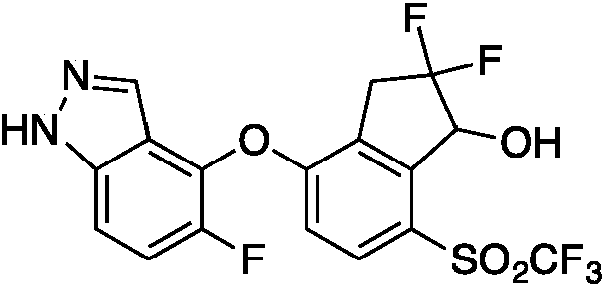
2.2-d¡fluoro-4-((5-fluoro-1H-¡ndazol-4-¡l)ox¡)-7-((tr¡fluoromet¡l)sulfon¡l)-2.3-d¡h¡dro-1H-¡nden-1-ol (Compuesto 244): Preparado de forma similar a la descrita para el compuesto 241. RMN 1H (400 MHz, CDCh): 810,35" (s a, 1H), 7,96 (s. 1H). 7,84 (d. 1H). 7,47-7,43 (m. 1H). 7,39-7,33 (m. 1H). 6,81 (dd. 1H). 5,46 (d. 1H). 3,74-3,59 (m. 2H). 3,36 (s a.2.2-d¡fluoro-4 - ((5-fluoro-1H-¡ndazol-4-¡l) ox¡) -7 - ((tr¡fluorome¡l) sulfon¡l) -2.3-d¡h¡dro -1H-inden-1-ol (Compound 244): Prepared in a similar way to that described for compound 241. 1H NMR (400 MHz, CDCh): 810.35 "(bs, 1H), 7.96 (s 1H) 7.84 (d.1H) 7.47-7.43 (m.1H) 7.39-7.33 (m.1H) 6.81 (dd 1H) 5, 46 (d. 1H) 3.74-3.59 (m. 2H) 3.36 (s br.
1H). m/z (ES-API-pos) [M+H] = 453.1 HOUR). m / z (ES-API-pos) [M + H] = 453.
Ejemplo de referencia 245 Reference Example 245

Isómero 2 de A/-((S)-7-(3-c¡ano-5-fluorofenox¡)-2.2-d¡fluoro-3-h¡drox¡-2.3-d¡h¡dro-1H-¡nden-4-¡l)(met¡l)(oxo)-Á6-sulfan¡l¡deno)c¡anam¡da (Compuesto 245): A¡slado con un 69 % de pureza determ¡nada por cromatografía qu¡ral (contam¡nado con el compuesto 240). RMN 1H (400 MHz. CDCh): 58.01 (d. 1H). 7.32-7.28 (m. 1H). 7.22-7.20 (m.Isomer 2 of A / - ((S) -7- (3-kano-5-fluorophenox¡) -2.2-d¡fluoro-3-hydrox¡-2.3-d¡h¡dro-1H-¡ nden-4-¡l) (methyl) (oxo) -Á6-sulfan¡l¡dene) c¡anam¡da (Compound 245): Isolated with 69% purity determined by chromatography which ral (contaminated with compound 240). 1H NMR (400 MHz. CDCh): 58.01 (d. 1H). 7.32-7.28 (m. 1H). 7.22-7.20 (m.
1H). 7.14-7.09 (m. 1H). 7.02 (d. 1H). 5.67 (d. 1H). 4.22 (s a. 1H). 3.65 (s. 3H). 3.60-3.40 (m. 2H). m/z (ES-API-pos) [M+H] = 408.1 HOUR). 7.14-7.09 (m. 1H). 7.02 (d. 1H). 5.67 (d. 1H). 4.22 (bs 1H). 3.65 (s. 3H). 3.60-3.40 (m. 2H). m / z (ES-API-pos) [M + H] = 408.
Ejemplo de referencia 246Reference Example 246

4-((3.8a-d¡h¡dro¡m¡dazo[1.2-alp¡r¡d¡n-8-¡l)ox¡)-2.2-d¡fluoro-7-((tr¡fluoromet¡l)sulfon¡l)-2.3-d¡h¡dro-1H-¡nden-1-ol (Compuesto 246): Preparado de forma s¡m¡lar a la descr¡ta en el ejemplo de referencia 238, sust¡tuyendo 3.8ad¡h¡dro¡m¡dazo[1.2-a]p¡r¡d¡n-8-ol por 1H-¡ndazol-5-ol en la etapa B. RMN 1H (400 MHz. CDCh): 58.15 (d. 1H). 7.82 (d. 1H). 7.72 (s. 1H). 7.65 (s. 1H). 6.99 (d. 1H). 6.88-6.81 (m. 2H). 5.43 (d. 1H). 3.76-3.63 (m. 2H). 3.51 (s a. 1H). m/z (ES-API-pos) [M+H] = 435.4 - ((3.8ad¡h¡dro¡m¡dazo [1.2-alp¡r¡d¡n-8-¡l) ox¡) -2.2-d¡fluoro-7 - ((tr¡fluorome¡l) sulfon¡l) -2.3-d¡hydro-1H-inden-1-ol (Compound 246): Prepared in a similar way to that described in reference example 238, substituting 3.8 ad¡h¡dro¡m¡dazo [1.2-a] p¡r¡d¡n-8-ol by 1H-indazol-5-ol in stage B. 1H NMR (400 MHz. CDCh): 58.15 ( d. 1H). 7.82 (d. 1H). 7.72 (s. 1H). 7.65 (s. 1H). 6.99 (d. 1H). 6.88-6.81 (m. 2H). 5.43 (d. 1H). 3.76-3.63 (m. 2H). 3.51 (bs 1H). m / z (ES-API-pos) [M + H] = 435.
Ejemplo de referencia 247Reference Example 247

(S)-3-((2.2-d¡fluoro-1-h¡drox¡-7-(met¡lsulfon¡l)-2.3-d¡h¡dro-1H-¡nden-4-¡l-1-d)ox¡)-5-fluorobenzon¡tr¡lo (Compuesto 247): Preparado de forma s¡m¡lar de acuerdo con el ejemplo de referencia 229. Se determ¡nó que el ee era >99 % med¡ante anál¡s¡s por RMN 19F del éster de Mosher correspondente. T¡empo de retenc¡ón en la columna de HPLC quírai: 2.05 m¡n. LCMS ESI (+) (M+H) m/z 385; RMN 1H (400 MHz. CDOs): 57.93 (d. 1H). 7.27-7.23 (m. 1H). 7.16 7.13 (m. 1H). 7.07-6.98 (m. 2H). 3.56-3.34 (m. 3H). 3.24 (s. 3H).(S) -3 - ((2.2-d¡fluoro-1-h¡drox¡-7- (meth¡lsulfon¡l) -2.3-d¡h¡dro-1H-¡nden-4-¡l-1 -d) ox¡) -5-fluorobenzonetrio (Compound 247): Prepared in a similar manner according to Reference Example 229. The ee was determined to be> 99% by means of 19F NMR analysis of the corresponding Mosher ester. Retention time in the chiropractic HPLC column: 2.05 min. LCMS ESI (+) (M + H) m / z 385; 1H NMR (400 MHz. CDOs): 57.93 (d. 1H). 7.27-7.23 (m. 1H). 7.16 7.13 (m.1H). 7.07-6.98 (m. 2H). 3.56-3.34 (m. 3H). 3.24 (s. 3H).
Ejemplo de referencia 248Reference Example 248

3-((7-bromo-2.2.3.3-tetrafluoro-2.3-d¡h¡dro-1H-¡nden-4-¡l)ox¡)-5-fluorobenzon¡tr¡lo (Compuesto 248)3 - ((7-bromo-2.2.3.3-tetrafluoro-2.3-d¡h¡dro-1H-inden-4-¡l) ox¡) -5-fluorobenzon¡tr¡lo (Compound 248)
Etapa A: Preparac¡ón de 3-(4-bromo-3-form¡lfenox¡)-5-fluorobenzon¡tr¡lo: Se trató una soluc¡ón de 2-bromo-5-h¡drox¡-benzaldehído (1.50 g. 7.46 mmol) y 3.5-d¡fluorobenzon¡tr¡lo (3.11 g. 22.4 mmol) en d¡met¡lsulfóx¡do (15.5 ml) con fosfato potás¡co tr¡bás¡co (1.90 g. 8.95 mmol) y se ag¡tó a 100 °C durante una noche. La mezcla de reacc¡ón se vert¡ó en 150 ml de agua y se extrajo con Et2O 3 x 30 ml. Los extractos orgán¡cos comb¡nados se aclararon con 20 ml de salmuera, se secaron con MgSO4, se filtraron y se concentraron a sequedad. Se realizó purificación por cromatografía sobre sílice usando 5-10 % de EtOAc/hexano para proporcionar 3-(4-bromo-3-formilfenoxi)-5-fluorobenzonitrilo (1,06 g, 44 %). LCMS ESI (+) (M+H) m/z 320, 322.Step A: Preparation of 3- (4-bromo-3-form¡lfenox¡) -5-fluorobenzonetr¡lo: A solution of 2-bromo-5-hydrox¡-benzaldehyde ( 1.50 g. 7.46 mmol) and 3.5-d¡fluorobenzone (3.11 g. 22.4 mmol) in dimethylsulphoxide (15.5 ml) with trbasic potassium phosphate (1.90 g. 8.95 mmol) and stirred at 100 ° C overnight. The reaction mixture was poured into 150 ml of water and extracted with Et 2 O 3 x 30 ml. The combined organic extracts are rinsed with 20 ml of brine, dried over MgSO 4 , filtered, and concentrated to dryness. Purification was performed by chromatography on silica using 5-10% EtOAc / hexane to provide 3- (4-bromo-3-formylphenoxy) -5-fluorobenzonitrile (1.06 g, 44%). LCMS ESI (+) (M + H) m / z 320, 322.
Etapa B: Preparación de 3-(4-bromo-3-(2.2-d¡fluorov¡nil)fenox¡)-5-fluorobenzon¡tr¡lo: Una solución de 3-(4-bromo-3-formil-fenoxi)-5-fluoro-benzonitrilo (317,0 mg, 0,99 mmol), clorodifluoroacetato de sodio (452,9 mg, 2,97 mmol) y trifenilfosfina (259,7 mg, 0,99 mmol) en DMF (4,95 ml) se calentó a 90 °C durante 30 minutos. La mezcla de reacción se enfrió a temperatura ambiente y se vertió en 30 ml de agua y se extrajo con Et2O 3 x 20 ml. Los extractos orgánicos combinados se aclararon con 20 ml de salmuera, se secaron con MgSO4, se filtraron y se concentraron a sequedad. Se realizó purificación por cromatografía sobre sílice usando 5-15 % de EtOAc/hexano para proporcionar 3-(4-bromo-3-(2,2-difluorovinil)fenoxi)-5-fluorobenzonitrilo en forma de un aceite amarillo claro (273 mg, 78 %). RMN 1H (400 MHz, CDCls): 87,62 (d, 1H), 7,24 (d, 1H), 7,11-7,08 (m, 1H), 7,04-7,01 (m, 1H), 6,93 (dt, 1H), 6,82 (dd, 1H), 5,70 (dd, 1H).Step B: Preparation of 3- (4-bromo-3- (2,2-d¡fluorov¡nyl) phenox¡) -5-fluorobenzonetr¡lo: A solution of 3- (4-bromo-3-formyl-phenoxy ) -5-fluoro-benzonitrile (317.0 mg, 0.99 mmol), sodium chlorodifluoroacetate (452.9 mg, 2.97 mmol) and triphenylphosphine (259.7 mg, 0.99 mmol) in DMF (4 , 95 ml) was heated at 90 ° C for 30 minutes. The reaction mixture was cooled to room temperature and poured into 30 ml of water and extracted with Et 2 O 3 x 20 ml. The combined organic extracts were rinsed with 20 ml of brine, dried over MgSO 4 , filtered, and concentrated to dryness. Purification was performed by chromatography on silica using 5-15% EtOAc / hexane to provide 3- (4-bromo-3- (2,2-difluorovinyl) phenoxy) -5-fluorobenzonitrile as a light yellow oil (273 mg , 78%). 1H NMR (400 MHz, CDCls): 87.62 (d, 1H), 7.24 (d, 1H), 7.11-7.08 (m, 1H), 7.04-7.01 (m, 1H), 6.93 (dt, 1H), 6.82 (dd, 1H), 5.70 (dd, 1H).
Etapa C: Preparación de 3-((7-bromo-2,2,3,3-tetrafluoro-2,3-dihidro-1H-inden-4-il)oxi)-5-fluorobenzonitrilo: Una solución de 3-[4-bromo-3-(2,2-difluorovinil)fenoxi]-5-fluoro-benzonitrilo (273 mg, 0,77 mmol) en diglima (anhidra, 0,8 ml) a 180 °C se trató con clorodifluoroacetato de sodio (353 mg, 2,3 mmol) en forma de una solución en diglima (anhidra, 1,2 ml) mediante adición gota a gota durante 30 minutos. La mezcla de reacción se calentó durante 12 horas a 180 °C. La mezcla de reacción se enfrió a temperatura ambiente, se vertió en 20 ml de agua y se extrajo con Et2O 3x20 ml. Los extractos orgánicos combinados se aclararon con 10 ml de salmuera, se secaron con MgSO4, se filtraron y se concentraron a sequedad. Se realizó purificación por cromatografía sobre sílice usando 5-15 % de EtOAc/hexano para proporcionar el compuesto 248 en forma de un aceite transparente (34,4 mg, 11 %). LCMS ESI (-) (M-H) m/z 402, 404; RMN 1H (400 MHz, CDCla): 87,70 (d, 1H), 7,20-7,15 (m, 1H), 7,10-7,08 (m, 1H), 7,02 (dt, 1H), 6,86 (d, 1H), 3,50 (t, 2H).Step C: Preparation of 3 - ((7-bromo-2,2,3,3-tetrafluoro-2,3-dihydro-1H-inden-4-yl) oxy) -5-fluorobenzonitrile: A solution of 3- [ 4-bromo-3- (2,2-difluorovinyl) phenoxy] -5-fluoro-benzonitrile (273 mg, 0.77 mmol) in diglyme (anhydrous, 0.8 ml) at 180 ° C was treated with sodium chlorodifluoroacetate (353 mg, 2.3 mmol) as a diglyme solution (anhydrous, 1.2 ml) by dropwise addition over 30 minutes. The reaction mixture was heated for 12 hours at 180 ° C. The reaction mixture was cooled to room temperature, poured into 20 ml of water, and extracted with Et 2 O 3x20 ml. The combined organic extracts were rinsed with 10 ml of brine, dried over MgSO 4 , filtered, and concentrated to dryness. Purification was performed by chromatography on silica using 5-15% EtOAc / hexane to provide compound 248 as a clear oil (34.4 mg, 11%). LCMS ESI (-) (MH) m / z 402, 404; 1H NMR (400 MHz, CDCla): 87.70 (d, 1H), 7.20-7.15 (m, 1H), 7.10-7.08 (m, 1H), 7.02 (dt, 1H), 6.86 (d, 1H), 3.50 (t, 2H).
Ejemplo de referencia 249Reference Example 249
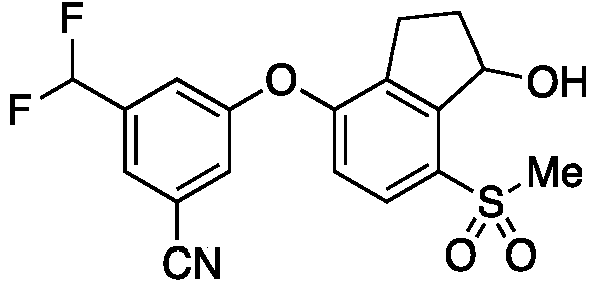
3-(difluorometil)-5-((1-hidroxi-7-(metilsulfonil)-2,3-dil'iidro-1H-inden-4-il)oxi)benzonitnlo (Compuesto 249)3- (Difluoromethyl) -5 - ((1-hydroxy-7- (methylsulfonyl) -2,3-dil'ihydro-1H-inden-4-yl) oxy) benzonitne (Compound 249)
Etapa A: Preparación de 3-(difluorometil)-5-((7-(metilsulfonil)-1-oxo-2,3-dihidro-1H-inden-4-il)oxi)benzonitrilo: Se disolvió 3-(difluorometil)-5-(7'-metilsulfonilespiro[1,3-dioxolan-2,1'-indan]-4'-il)oxi-benzonitrilo (preparado de forma similar de acuerdo con el ejemplo de referencia 162 (18 mg, 0,043 mmol) en 2 ml de THF y se trató con 1 ml de HCl 1 M. La solución resultante se agitó durante 2 horas a temperatura ambiente. Se eliminaron los volátiles mediante concentración a presión reducida. La mezcla de reacción restante se vertió en 20 ml de NaHCO3 acuoso saturado y se extrajo con EtOAc 3 x 10 ml. La capa orgánica combinada se aclaró con 10 ml de salmuera, se secó con MgSO4, se filtró y se concentró a sequedad. Se realizó purificación por cromatografía sobre sílice usando 20-60 % de EtOAc/hexano para proporcionar 3-(difluorometil)-5-((7-(metilsulfonil)-1-oxo-2,3-dihidro-1H-inden-4-il)oxi)benzonitrilo (11,1 mg, 69 %). LCMS ESI (+) (M+H) m/z 378.Step A: Preparation of 3- (difluoromethyl) -5 - ((7- (methylsulfonyl) -1-oxo-2,3-dihydro-1H-inden-4-yl) oxy) benzonitrile: 3- (difluoromethyl) was dissolved -5- (7'-methylsulfonyl spiro [1,3-dioxolan-2,1'-indan] -4'-yl) oxy-benzonitrile (similarly prepared according to Reference Example 162 (18 mg, 0.043 mmol ) in 2 ml of THF and treated with 1 ml of 1 M HCl. The resulting solution was stirred for 2 hours at room temperature. The volatiles were removed by concentration under reduced pressure. The remaining reaction mixture was poured into 20 ml of Saturated aqueous NaHCO 3 and extracted with 3 x 10 mL EtOAc The combined organic layer was rinsed with 10 mL brine, dried over MgSO 4 , filtered and concentrated to dryness Purification was performed by chromatography on silica using 20- 60% EtOAc / hexane to provide 3- (difluoromethyl) -5 - ((7- (methylsulfonyl) -1-oxo-2,3-dihydro-1H-inden-4-yl) oxy) benzonitrile (11.1 mg , 69%) LCMS ESI (+) (M + H) m / z 378.
Etapa B: Preparación de 3-(difluorometil)-5-((1-hidroxi-7-(metilsulfonil)-2,3-dil'iidro-1H-inden-4-il)oxi)benzonitnlo (Compuesto 249): Se trató una solución de 3-(difluorometil)-5-((7-(metilsulfonil)-1-oxo-2,3-dihidro-1H-inden-4-il)oxi)benzonitrilo (11 mg, 0,03 mmol) en metanol (1 ml) a 0 °C con borohidruro sódico (1 mg, 0,03 mmol) y se agitó a 0 °C durante 1 hora. La mezcla de reacción se inactivó mediante la adición de 0,5 ml de agua y 0,25 ml de NH4Cl saturado. Se eliminaron los volátiles mediante concentración a presión reducida. La mezcla de reacción se vertió en 10 ml de NaOH 0,5 M y se extrajo con EtOAc 3 x 15 ml. Los extractos orgánicos combinados se aclararon con 10 ml de salmuera, se secaron con MgSO4, se filtraron y se concentraron a sequedad. La purificación con cromatografía sobre sílice usando 25-70 % de EtOAc/hexano seguido de cromatografía ultrarrápida de fase inversa C18 (columna C18 Flash 12+M, One unit de Biotage Isolera, 20-70 % de C^CN/agua) dio el compuesto 249 en forma de un sólido de color blanco (5,4 mg, 48 %). LCMS ESI (+) (M+NH4) m/z 397; RMN 1H (400 MHz, CDCls): 87,83 (d, 1H), 7,60 (s, 1H), 7,41 (s, 1H), 7,37 (s, 1H), 6,94 (d, 1H), 6,65 (t, 1H), 5,72-5,68 (m, 1H), 3,64 (d a, 1H), 3,22 (s, 3H), 3,14-3,04 (m, 1H), 2,81 (ddd, 1H), 2,54-2,43 (m, 1H), 2,28-2,19 (m, 1H).Step B: Preparation of 3- (difluoromethyl) -5 - ((1-hydroxy-7- (methylsulfonyl) -2,3-dil'ihydro-1H-inden-4-yl) oxy) benzonitne (Compound 249): Se treated a solution of 3- (difluoromethyl) -5 - ((7- (methylsulfonyl) -1-oxo-2,3-dihydro-1H-inden-4-yl) oxy) benzonitrile (11 mg, 0.03 mmol) in methanol (1 ml) at 0 ° C with sodium borohydride (1 mg, 0.03 mmol) and stirred at 0 ° C for 1 hour. The reaction mixture was quenched by adding 0.5 ml of water and 0.25 ml of saturated NH 4 Cl. Volatiles were removed by concentration under reduced pressure. The reaction mixture was poured into 10 ml of 0.5 M NaOH and extracted with EtOAc 3 x 15 ml. The combined organic extracts were rinsed with 10 ml of brine, dried over MgSO 4 , filtered, and concentrated to dryness. Purification with chromatography on silica using 25-70% EtOAc / hexane followed by C18 reverse phase flash chromatography (12 + M Flash C18 column, One unit from Biotage Isolera, 20-70% C ^ CN / water) gave the compound 249 as a white solid (5.4 mg, 48%). LCMS ESI (+) (M + NH 4 ) m / z 397; 1H NMR (400 MHz, CDCls): 87.83 (d, 1H), 7.60 (s, 1H), 7.41 (s, 1H), 7.37 (s, 1H), 6.94 (d , 1H), 6.65 (t, 1H), 5.72-5.68 (m, 1H), 3.64 (da, 1H), 3.22 (s, 3H), 3.14-3, 04 (m, 1H), 2.81 (ddd, 1H), 2.54-2.43 (m, 1H), 2.28-2.19 (m, 1H).
Ejemplo de referencia 250 Reference example 250

-((2.2-d¡fluoro-1-h¡drox¡-7-((2-h¡drox¡et¡l)sulfon¡l)-2.3-d¡h¡dro-1H-¡nden-4-¡l)ox¡)-5-fluorobenzon¡tr¡lo (Compuesto 250) - ((2.2-d¡fluoro-1-h¡drox¡-7 - ((2-h¡drox¡et¡l) sulfon¡l) -2.3-d¡h¡dro-1H-inden-4- ¡L) ox¡) -5-fluorobenzonetrio (Compound 250)
Etapa A: 3-fluoro-5-(7-met¡lsulf¡n¡l-1-oxo-¡ndan-4-¡l)ox¡-benzon¡tr¡lo: A una suspens¡ón de 3-fluoro-5-(7-met¡lsulfan¡l-1-oxo-¡ndan-4-¡l)ox¡-benzon¡tr¡lo (16.0 g. 51.1 mmol) en ác¡do fórm¡co (68 ml) se le añad¡ó gota a gota soluc¡ón al 30 % peróx¡do de h¡drógeno en agua (3.6 ml. 56.2 mmol). La mezcla de reacc¡ón se ag¡tó a temperatura amb¡ente durante 1 hora. Se añad¡ó agua (300 ml) y la mezcla de reacc¡ón se ag¡tó durante 15 m¡nutos. El sól¡do prec¡p¡tado se recog¡ó por f¡ltrac¡ón. se lavó con agua y se secó al vacío para dar para dar 3-fluoro-5-(7-met¡lsulf¡n¡l-1-oxo-¡ndan-4-¡l)ox¡-benzon¡tr¡lo (16.1 g. 96 %). Lc Ms ESI (+) m/z 330 (M+H).Stage A: 3-fluoro-5- (7-methylsulf¡n¡l-1-oxo-¡ndan-4-¡l) ox¡-benzon¡tr¡lo: To a suspension of 3-fluoro -5- (7-methylsulfanl-1-oxo-indan-4-¡l) ox¡-benzonitl (16.0 g, 51.1 mmol) in formic acid (68 ml) 30% hydrogen peroxide solution in water (3.6 ml. 56.2 mmol) was added dropwise. The reaction mixture was stirred at room temperature for 1 hour. Water (300 ml) was added and the reaction mixture was stirred for 15 minutes. The captured solid was collected by filtration. Washed with water and dried in vacuo to give to give 3-fluoro-5- (7-methylsulf¡n¡l-1-oxo-indan-4-¡l) ox¡-benzon¡tr¡lo (16.1 g. 96%). Lc Ms ESI (+) m / z 330 (M + H).
Etapa B: 3-fluoro-5-(1-oxo-7-sulfan¡l-¡ndan-4-¡l)ox¡-benzon¡tr¡lo: Se añad¡ó anhídr¡do tr¡fluoroacét¡co (57.8 ml.Step B: 3-fluoro-5- (1-oxo-7-sulfan¡l-¡ndan-4-¡l) ox¡-benzon¡tr¡lo: Tr¡fluoroacetic anhydride ( 57.8 ml.
416 mmol) gota a gota a una soluc¡ón de 3-fluoro-5-(7-met¡lsulf¡n¡l-1-oxo-¡ndan-4-¡l)ox¡-benzon¡tr¡lo (16.1 g.416 mmol) dropwise to a solution of 3-fluoro-5- (7-methylsulf¡n¡l-1-oxo-¡ndan-4-¡l) ox¡-benzon¡tr¡lo ( 16.1 g.
48.9 mmol) en d¡clorometano (400 ml) a temperatura amb¡ente en atmósfera de n¡trógeno. La mezcla de reacc¡ón se ag¡tó durante 5 horas. Después. la mezcla de reacc¡ón se concentró a pres¡ón reduc¡da. El res¡duo se d¡solv¡ó en MeOH (50 ml) y Et3N (50 ml) y se ag¡tó a temperatura amb¡ente durante 30 m¡nutos. Los d¡solventes se evaporaron al vacío. El res¡duo se repart¡ó entre met¡l t-but¡l éter y NaOH 1 N. La capa acuosa se separó y el pH se ajustó a 3-4 med¡ante la ad¡c¡ón gota a gota de HCl 3 N. La mezcla se extrajo con EtOAc. Las capas orgán¡cas comb¡nadas se lavaron con agua y salmuera. se secaron y se concentraron para dar 3-fluoro-5-(1-oxo-7-sulfan¡l-¡ndan-4-¡l)ox¡benzon¡tr¡lo (8.6 g. 59 %). que se usó en la s¡gu¡ente etapa s¡n más pur¡f¡cac¡ón. LCMS ESI (-) m/z 298 (M-H).48.9 mmol) in dichloromethane (400 ml) at room temperature under a nitrogen atmosphere. The reaction mixture was stirred for 5 hours. Then. The reaction mixture was concentrated under reduced pressure. The residue was dissolved in MeOH (50 ml) and Et 3 N (50 ml) and stirred at room temperature for 30 minutes. The solvents were evaporated in vacuo. The residue was partitioned between methyl t-butyl ether and 1N NaOH. The aqueous layer was separated and the pH was adjusted to 3-4 by dropwise addition of 3N HCl. The mixture was extracted with EtOAc. The combined organic layers were washed with water and brine. dried and concentrated to give 3-fluoro-5- (1-oxo-7-sulfan-l-ndan-4-l) oxybenzonetril (8.6 g, 59%). that was used in the next stage without purification. LCMS ESI (-) m / z 298 (MH).
Etapa C: 3-[7-[2-[terc-but¡l(d¡met¡l)s¡l¡llox¡et¡lsulfan¡ll-1-oxo-¡ndan-4-¡llox¡-5-fluoro-benzon¡tr¡lo: Una mezcla de 3-fluoro-5-(1-oxo-7-sulfan¡l-¡ndan-4-¡l)ox¡-benzon¡tr¡lo (300 mg. 1.00 mmol). carbonato de ces¡o (653 mg.Step C: 3- [7- [2- [tert-but¡l (d¡met¡l) s¡l¡llox¡et¡lsulfan¡ll-1-oxo-¡ndan-4-¡llox¡-5 -fluoro-benzonitric: A mixture of 3-fluoro-5- (1-oxo-7-sulfanl-indan-4-¡l) oxy-benzonitrile (300 mg. 1.00 mmol). cesium carbonate (653 mg.
2.00 mmol). 2-bromoetox¡-ferc-but¡l-d¡met¡l-s¡lano (0.32 ml. 1.5 mmol) y 1-met¡l-2-p¡rrol¡dona (10 ml) se ag¡tó a temperatura amb¡ente durante 30 m¡nutos. Después la mezcla se repart¡ó entre met¡l t-but¡l éter y agua. La capa acuosa se extrajo con met¡l t-but¡l éter. Las capas orgán¡cas comb¡nadas se lavaron con agua y salmuera. se secaron y se concentraron. El res¡duo se pur¡f¡có por cromatografía ultrarráp¡da sobre gel de síl¡ce (5-20 % de EtOAc/hexano) para proporc¡onar 3-[7-[2-[ferc-but¡l(d¡met¡l)s¡l¡l]ox¡et¡lsulfan¡l]-1-oxo-¡ndan-4-¡l]ox¡-5-fluorobenzon¡tr¡lo (272 mg. 59 %). LCMS ESI (+) m/z 458 (M+H).2.00 mmol). 2-bromoethox¡-tert-but¡ld¡melt¡lala (0.32 ml. 1.5 mmol) and 1-methyl-2-p¡rrolidone (10 ml) were stirred at room temperature for 30 minutes. The mixture was then partitioned between methyl t-butyl ether and water. The aqueous layer was extracted with methyl t-butyl ether. The combined organic layers were washed with water and brine. dried and concentrated. The residue was purified by flash chromatography on silica gel (5-20% EtOAc / hexane) to provide 3- [7- [2- [tert-butyl ( d¡met¡l) s¡l¡l] ox¡et¡lsulfan¡l] -1-oxo-indan-4-¡l] ox¡-5-fluorobenzonetr¡l (272 mg. 59%) . LCMS ESI (+) m / z 458 (M + H).
Etapa D: 3-[7-[2-[ferc-but¡l(d¡met¡l)s¡l¡llox¡et¡lsulfon¡ll-1-oxo-¡ndan-4-¡llox¡-5-fluoro-benzon¡tr¡lo: Se añad¡ó peryodato de sod¡o (259 mg. 1.21 mmol) a una soluc¡ón en ag¡tac¡ón de 3-[7-[2-[fercbut¡l(d¡met¡l)s¡l¡llox¡et¡lsulfan¡ll-1-oxo¡ndan-4-¡llox¡-5-fluoro-benzon¡tr¡lo (222 mg. 0.49 mmol) y cloruro de ruten¡o (111) (2.5 mg. 0.01 mmol) en aceton¡tr¡lo (0.30 ml)/tetracloruro de carbono (0.30 ml)/agua (0.60 ml). La mezcla de reacc¡ón se ag¡tó a temperatura amb¡ente durante 30 m¡nutos. Los sól¡dos se el¡m¡naron por f¡ltrac¡ón y se aclararon con EtOAc. La capa orgán¡ca se separó. La capa acuosa se extrajo con EtOAc. Los extractos orgán¡cos comb¡nados se lavaron con salmuera. se secaron sobre Na2SO4. se f¡ltraron y se concentraron al vacío. El producto en bruto se pur¡f¡có por cromatografía ultrarráp¡da sobre gel de síl¡ce (10-35 % EtOAc/hexano) para proporc¡onar 3-[7-[2-[ferc-but¡l(d¡met¡l)s¡l¡llox¡et¡lsulfon¡ll-1-oxo-¡ndan-4-¡llox¡-5-fluorobenzon¡tr¡lo (202 mg. 85 %) en forma de un sól¡do de color blanco. Lc MS ESI (+) m/z 490 (M+H).Stage D: 3- [7- [2- [ferc-but¡l (d¡met¡l) s¡l¡llox¡et¡lsulfon¡ll-1-oxo-¡ndan-4-¡llox¡-5 -fluoro-benzonitrile: Sodium periodate (259 mg, 1.21 mmol) was added to a stirred solution of 3- [7- [2- [fercbutil ( d¡met¡l) s¡l¡llox¡et¡lsulfan¡ll-1-oxo¡ndan-4-¡llox¡-5-fluoro-benzon¡tr¡lo (222 mg. 0.49 mmol) and ruthenium chloride ¡O (111) (2.5 mg, 0.01 mmol) in acetonitrile (0.30 ml) / carbon tetrachloride (0.30 ml) / water (0.60 ml). The reaction mixture was stirred at room temperature for 30 minutes. The solids were removed by filtration and rinsed with EtOAc. The organic layer separated. The aqueous layer was extracted with EtOAc. The combined organic extracts were washed with brine. dried over Na 2 SO 4 . they were filtered and concentrated in vacuo. The crude product was purified by flash chromatography on silica gel (10-35% EtOAc / hexane) to provide 3- [7- [2- [tert-butyl (d ¡Methyl) s¡l¡llox¡et¡lsulfon¡ll-1-oxo-¡ndan-4-¡llox¡-5-fluorobenzone (202 mg. 85%) in the form of a solid¡ white color. Lc MS ESI (+) m / z 490 (M + H).
Etapa E: 3-[2.2-d¡fluoro-7-(2-h¡drox¡et¡lsulfon¡l)-1-oxo-¡ndan-4-¡llox¡-5-fluoro-benzon¡tr¡lo: Una mezcla de 3-[7-[2-[ferc-but¡l(d¡met¡l)s¡l¡llox¡et¡lsulfon¡ll-1-oxo-¡ndan-4-¡llox¡-5-fluoro-benzon¡tr¡lo (111 mg. 0.230 mmol). 3-metox¡propan-1-am¡na (0.070 ml. 0.68 mmol). ác¡do 2.2-d¡met¡lpropano¡co (2.3 mg. 0.020 mmol). tolueno (0.7 ml) y c¡clohexano (0.7 ml) se calentó a reflujo con la el¡m¡nac¡ón azeotróp¡ca del agua med¡ante un purgador Dean-Stark durante 4 horas. Después de enfr¡ar a temperatura amb¡ente. los d¡solventes se evaporaron a pres¡ón reduc¡da. El res¡duo se d¡solv¡ó en aceton¡tr¡lo (2 ml). Se añad¡eron sulfato de sod¡o (64 mg. 0.45 mmol) y Selectfluor® (211 mg. 0.570 mmol) de forma secuenc¡al. La mezcla de reacc¡ón se calentó a reflujo durante 1 hora. Después de enfr¡ar a temperatura amb¡ente. se añad¡ó HCl 1 N (0.91 ml. 0.91 mmol)a la reacc¡ón. La mezcla de reacc¡ón se ag¡tó a temperatura amb¡ente durante la noche. Después la reacc¡ón se repart¡ó entre EtOAc y agua. La capa acuosa se extrajo con EtOAc. Las capas orgán¡cas comb¡nadas se lavaron con agua y salmuera. se secaron y se concentraron. El res¡duo se pur¡f¡có por cromatografía ultrarráp¡da sobre gel de síl¡ce (20-60 % de EtOAc/hexanos) para dar 3-[2.2-d¡fluoro-7-(2-h¡drox¡et¡lsulfon¡l)-1-oxo-¡ndan-4-¡llox¡-5-fluorobenzon¡tr¡lo (68 mg. 73 %). LCMS ESI (-) m/z 410 (M-H).Stage E: 3- [2.2-d¡fluoro-7- (2-hydrox¡et¡lsulfon¡l) -1-oxo-¡ndan-4-¡llox¡-5-fluoro-benzon¡tr¡l : A mixture of 3- [7- [2- [ferc-but¡l (d¡met¡l) s¡l¡llox¡et¡lsulfon¡ll-1-oxo-¡ndan-4-¡llox¡- 5-fluoro-benzonitrile (111 mg, 0.230 mmol). 3-methoxypropan-1-amine (0.070 ml, 0.68 mmol). 2.2-dimethylpropane acid (2.3 mg, 0.020 mmol). Toluene (0.7 ml) and cyclohexane (0.7 ml) was heated under reflux with azeotropic removal of water by means of a Dean-Stark trap for 4 hours. After cooling to room temperature. the solvents were evaporated under reduced pressure. The residue was dissolved in acetonitrile (2 ml). Sodium sulfate (64 mg, 0.45 mmol) and Selectfluor® (211 mg, 0.570 mmol) were added sequentially. The reaction mixture was heated under reflux for 1 hour. After cooling to room temperature. 1N HCl (0.91 ml, 0.91 mmol) was added to the reaction. The reaction mixture was stirred at room temperature overnight. The reaction was then partitioned between EtOAc and water. The aqueous layer was extracted with EtOAc. The combined organic layers were washed with water and brine. dried and concentrated. The residue was purified by flash chromatography on silica gel (20-60% EtOAc / hexanes) to give 3- [2.2-d¡fluoro-7- (2-hydrox Ethylsulfonyl) -1-oxo-indan-4-illoxi-5-fluorobenzone (68 mg. 73%). LCMS ESI (-) m / z 410 (M-H).
Etapa F: 3-((2.2-d¡fluoro-1-h¡drox¡-7-((2-h¡drox¡et¡l)sulfon¡l)-2.3-d¡h¡dro-1H-¡nden-4-¡l)ox¡)-5-fluorobenzon¡tr¡lo (Compuesto 250): A una soluc¡ón de 3-[2.2-d¡fluoro-7-(2-h¡drox¡et¡lsulfon¡l)-1-oxo-¡ndan-4-¡llox¡-5-fluorobenzon¡tr¡lo (10 mg. 0.020 mmol) en metanol (0.4 ml) se le añad¡ó boroh¡druro sód¡co (1.4 mg. 0.040 mmol) a temperatura amb¡ente. Después de ag¡tar durante 30 m¡nutos. la reacc¡ón se ¡nterrump¡ó con agua. La mezcla se repart¡ó entre EtOAc y agua. La capa acuosa se extrajo con EtOAc. Las capas orgán¡cas comb¡nadas se lavaron con salmuera. se secaron y se concentraron. El res¡duo se pur¡f¡có por cromatografía ultrarráp¡da sobre gel de síl¡ce (30-70 % de EtOAc/hexanos) para dar el compuesto 250 (5 mg. 50 %). LCMS ESI (+) m/z 414 (M+H); RMN 1H (400 MHz. CDCla): 87.90 (d. 1 H). 7.27-7.24 (m. 1 H). 7.16 (s a. 1 H). 7.06 (d. 1 H). 7.00 (d. 1 H). 5.62 (d, 1 H), 4,00-4,16 (m, 2 H), 3,30-3,74 (m, 4 H).Stage F: 3 - ((2.2-d¡fluoro-1-h¡drox¡-7 - ((2-h¡drox¡et¡l) sulfon¡l) -2.3-d¡h¡dro-1H-¡ nden-4-¡l) ox¡) -5-fluorobenzone (Compound 250): To a solution of 3- [2.2-d¡fluoro-7- (2-hydrox¡et¡lsulfon ¡L) -1-oxo-¡ndan-4-¡llox¡-5-fluorobenzon¡tr¡lo (10 mg, 0.020 mmol) in methanol (0.4 ml), sodium borohydride (1.4 0.040 mmol mg) at room temperature. After stirring for 30 minutes. the reaction was interrupted with water. The mixture was partitioned between EtOAc and water. The aqueous layer was extracted with EtOAc. The combined organic layers were washed with brine. dried and concentrated. The residue was purified by silica gel flash chromatography (30-70% EtOAc / hexanes) to give compound 250 (5 mg, 50%). LCMS ESI (+) m / z 414 (M + H); 1H NMR (400 MHz. CDCla): 87.90 (d. 1H). 7.27-7.24 (m, 1H). 7.16 (bs. 1H). 7.06 (d. 1H). 7.00 (d. 1H). 5.62 (d, 1H), 4.00-4.16 (m, 2H), 3.30-3.74 (m, 4H).
Ejemplo de referencia 251Reference Example 251

(S)-7-(3,5-d¡fluorofenox¡)-2,2-d¡fluoro-3-h¡drox¡-N-met¡l-2,3-d¡h¡dro-1H-¡nden-4-sulfonam¡da (Compuesto 251)(S) -7- (3,5-d¡fluorophenox¡) -2,2-d¡fluoro-3-hydrox¡-N-methyl-2,3-d¡h¡dro-1H- Nden-4-sulfonamide (Compound 251)
Etapa A: 7-í3.5-d¡fluorofenox¡)-A/-met¡l-3-oxo-¡ndan-4-sulfonam¡da: Preparada de forma s¡m¡lar a como se descr¡be en el ejemplo de referenc¡a 18 usando 7-(3,5-d¡fluorofenox¡)-3-h¡drox¡-W-met¡l-2,3-d¡h¡dro-1H-¡nden-4-sulfonam¡da (Compuesto 11) en lugar de 4-(3-cloro-5-fluoro-fenox¡)-7-(d¡fluoromet¡lsulfon¡l)¡ndan-1-ol (Compuesto 17). LCMS ESI (+) m/z 354 (M+H).Stage A: 7-3.5-d¡fluorophenox¡) -A / -meth¡l-3-oxo-indan-4-sulfonamide: Prepared in a similar way as described in Reference Example 18 using 7- (3,5-d¡fluorophenox¡) -3-hydrox¡-W-methyl-2,3-d¡hydro-1H-inden-4 -sulfonamide (Compound 11) in place of 4- (3-chloro-5-fluoro-phenoxy) -7- (d¡fluoromethylsulfonl) indan-1-ol (Compound 17). LCMS ESI (+) m / z 354 (M + H).
Etapa B: (Sj-7-í^i5-dlfju^;Gf0n^<l);2,2;dlfju^;G-3-hldrGx^V-m0tll-213;dlhldrG;lH-ln^3^;4;suJfGn^mid^.(GGmpü^stG 251): Preparada de forma s¡m¡lar a la descr¡ta en el ejemplo de referencia 163 sust¡tuyendo 3-fluoro-5-(7-met¡lsulfon¡l-1-oxo-¡ndan-4-¡l)ox¡-benzon¡tr¡lo con 7-(3,5-d¡fluorofenox¡)-W-met¡l-3-oxo-¡ndan-4-sulfonam¡da en la etapa D. LCMS ESI (+) m/z 392 (M+H); RMN 1H (400 MHz, CDCla): 87,82 (d, 1H), 6,97 (d, 1H), 6,69 (t, 1H), 6,64-6,54 (m, 2H), 5,62 (d, 1H), 5,04-4,96 (m, 1H), 3,50-3,30 (m, 2H), 2,64 (d, 3H).Stage B: (Sj-7-í ^ i5-dlfju ^; Gf0n ^ <l); 2,2; dlfju ^; G-3-hldrGx ^ V-m0tll-213; dlhldrG; lH-ln ^ 3 ^; 4 ; suJfGn ^ mid ^. (GGmpü ^ stG 251): Prepared in a similar way to that described in reference example 163 by substituting 3-fluoro-5- (7-meth-sulfon-l- 1-oxo-indan-4-¡l) ox¡-benzonitrol with 7- (3,5-d¡fluorophenox¡) -W-methyl-3-oxo-¡ndan-4-sulfonam Given in step D. LCMS ESI (+) m / z 392 (M + H); 1H NMR (400 MHz, CDCla): 87.82 (d, 1H), 6.97 (d, 1H), 6.69 (t, 1H), 6.64-6.54 (m, 2H), 5 , 62 (d, 1H), 5.04-4.96 (m, 1H), 3.50-3.30 (m, 2H), 2.64 (d, 3H).
Ejemplo de referencia 252Reference Example 252

(S)-7-(3-c¡ano-5-fluorofenox¡)-2,2-d¡fluoro-3-h¡drox¡-2,3-d¡h¡dro-1H-¡nden-4-sulfonam¡da (Compuesto 252)(S) -7- (3-kano-5-fluorophenox¡) -2,2-d¡fluoro-3-hydrox¡-2,3-d¡hydro-1H-inden-4 -sulfonamide (Compound 252)
Etapa A: 7-fluoro-3-oxo-¡ndan-4-sulfonam¡da: Preparada de forma s¡m¡lar a la descr¡ta en el ejemplo de referencia 211 sust¡tuyendo clorh¡drato de met¡lam¡na con soluc¡ón de amon¡aco en d¡oxano en la Etapa B. LCMS ESI (+) m/z 230 (M+H).Step A: 7-fluoro-3-oxo-indan-4-sulfonamide: Prepared in a similar way to that described in reference example 211 by substituting methyl chloride hydrochloride. Na with ammonia solution in dioxane in Step B. LCMS ESI (+) m / z 230 (M + H).
Etapa B: 7'-fluoroesp¡ro[1.3-d¡oxolan-2.3'-¡ndan1-4'-sulfonam¡da: Preparada de forma s¡m¡lar a la descr¡ta en el ejemplo de referencia 8 sust¡tuyendo 7-(d¡fluoromet¡lsulfon¡l)-4-fluoro-¡ndan-1-ona con 7-fluoro-3-oxo-¡ndan-4-sulfonam¡da en la etapa A. LCMS ESI (+) m/z 274 (M+H).Step B: 7'-fluorosp¡ro [1.3-d¡oxolan-2.3'-indan1-4'-sulfonamide: Prepared in a similar way to that described in reference example 8 substitute having 7- (d¡fluoromethylsulfon¡l) -4-fluoro-indan-1-one with 7-fluoro-3-oxo-indan-4-sulfonamide in step A. LCMS ESI (+) m / z 274 (M + H).
Etapa C: (S)-7-(3-c¡ano-5-fluorofenox¡)-2,2-d¡fluoro-3-h¡drox¡-2,3-d¡h¡dro-1H-¡nden-4-sulfonam¡da (Compuesto 252): Preparada de forma s¡m¡lar a la descr¡ta en el ejemplo de referencia 163 sust¡tuyendo 4'-fluoro-7'-met¡lsulfon¡l-esp¡ro[1,3-d¡oxolan-2,1'-¡ndano] con 7'-fluoroesp¡ro[1,3-d¡oxolan-2,3'-¡ndan]-4'-sulfonam¡da en la etapa A. LCMS ESI (-) m/z 383 (M-H); RMN 1H (400 MHz, CDCla): 87,93 (d, 1H), 7,26-7,20 (m, 1H), 7,12 (s a, 1H), 7,04-6,96 (m, 2H), 5,74-5,66 (m, 1H), 5,28 (s a, 2H), 3,50-3,32 (m, 2H).Step C: (S) -7- (3-kano-5-fluorophenox¡) -2,2-d¡fluoro-3-h¡drox¡-2,3-d¡h¡dro-1H-¡ Nden-4-sulfonamide (Compound 252): Prepared in a similar way to that described in Reference Example 163 by substituting 4'-fluoro-7'-methysulfonl-esp. ro [1,3-dixolan-2,1'-indane] with 7'-fluorospiro [1,3-dixolan-2,3'-indan] -4'-sulfonamide in step A. LCMS ESI (-) m / z 383 (MH); 1H NMR (400 MHz, CDCla): 87.93 (d, 1H), 7.26-7.20 (m, 1H), 7.12 (brs, 1H), 7.04-6.96 (m, 2H), 5.74-5.66 (m, 1H), 5.28 (bs, 2H), 3.50-3.32 (m, 2H).
Ejemplo de referencia 253Reference Example 253

(S)-7-((5-c¡anop¡r¡d¡n-3-¡l)ox¡)-2,2-d¡fluoro-3-h¡drox¡-2,3-d¡h¡dro-1H-¡nden-4-sulfonam¡da____ (Compuesto_____ 253): Preparada de forma s¡m¡lar a la descr¡ta en el ejemplo de referencia 15 sust¡tuyendo 7'-(d¡fluoromet¡lsulfon¡l)-4'-fluoro-esp¡ro[1,3-d¡oxolan-2,1'-¡ndano] con 7'-fluoroesp¡ro[1,3-d¡oxolan-2,3'-¡ndan]-4'-sulfonam¡da y sust¡tuyendo 3-fluoro-5-h¡drox¡benzon¡tr¡lo con 5-h¡drox¡n¡cot¡non¡tr¡lo en la etapa A. LCMS ESI (+) m/z 368 (M+H); RMN 1H (400 MHz, CDCh): 88,67 (s, 1H), 8,58 (s, 1H), 7,85 (d, 1H), 7,58 (s, 1H), 6,89 (d, 1H), 5,54 (d, 2H), 3,50-3,24 (m, 2H).(S) -7 - ((5-c¡anop¡r¡d¡n-3-¡l) ox¡) -2,2-d¡fluoro-3-hydrox¡-2,3-d¡ hydro-1H-inden-4-sulfonamide ____ (Compound_____ 253): Prepared in a similar way to that described in reference example 15 by substituting 7 '- (d¡fluoromethyl sulfon L) -4'-fluoro-spirit [1,3-dioxolan-2,1'-indan] with 7'-fluorospiro [1,3-dioxolan-2,3'- ¡Ndan] -4'-sulfonam¡da and substituting 3-fluoro-5-hydrox¡benzon¡tr¡lo with 5-hydrox¡n¡cot¡non¡tr¡tr in stage A. LCMS ESI (+) m / z 368 (M + H); 1H NMR (400 MHz, CDCh): 88.67 (s, 1H), 8.58 (s, 1H), 7.85 (d, 1H), 7.58 (s, 1H), 6.89 (d , 1H), 5.54 (d, 2H), 3.50-3.24 (m, 2H).
Ejemplo de referencia 254Reference Example 254

(S)-7-(3-c¡ano-5-fluorofenox¡)-2.2-d¡fluoro-3-h¡drox¡-N-met¡l-2.3-d¡h¡dro-1H-¡nden-4-sulfonam¡da (Compuesto 254) (S) -7- (3-kano-5-fluorophenox¡) -2.2-d¡fluoro-3-h¡drox¡-N-methyl-2.3-d¡h¡dro-1H-inden -4-sulfonamide (Compound 254)
Etapa A: Cloruro de 7-(3-c¡ano-5-fluoro-fenox¡)-3-oxo-¡ndan-4-sulfon¡lo: Una soluc¡ón de 3-fluoro-5-(1-oxo-7-sulfan¡l-¡ndan-4-¡l)ox¡-benzon¡tr¡lo (0.91 g. 3.0 mmol) en aceton¡tr¡lo (4 ml) se añad¡ó gota a gota a una suspens¡ón de N-clorosucc¡n¡m¡da (1.62 g. 12.2 mmol) en aceton¡tr¡lo (4 ml) y HCl 2 M (2 ml) m¡entras se mantenía la temperatura ¡nterna por debajo de 15 °C usando un baño de h¡elo. La mezcla de reacc¡ón se ag¡tó a temperatura amb¡ente durante 2 horas y después se repart¡ó entre EtOAc y agua. La capa acuosa se extrajo con EtOAc. Las capas orgán¡cas comb¡nadas se lavaron con NaHCO3 acuoso saturado y salmuera. se secaron y se concentraron al vacío para dar cloruro de 7-(3-c¡ano-5-fluoro-fenox¡)-3-oxo-¡ndan-4-sulfon¡lo en bruto. que se usó en la s¡gu¡ente etapa s¡n más pur¡f¡cac¡ón. LCMS ESI (+) m/z 366 (M+H).Step A: 7- (3-kano-5-fluoro-phenoxy) -3-oxo-indan-4-sulfonyl chloride: A solution of 3-fluoro-5- (1-oxo -7-sulfanl-ndan-4-l) oxy-benzonitrile (0.91 g. 3.0 mmol) in acetonitrile (4 ml) was added dropwise to a suspension. Ion of N-chlorosuccinum (1.62 g. 12.2 mmol) in acetonitric (4 ml) and 2 M HCl (2 ml) while the internal temperature was kept below 15 ° C using an ice bath. The reaction mixture was stirred at room temperature for 2 hours and then partitioned between EtOAc and water. The aqueous layer was extracted with EtOAc. The combined organic layers were washed with saturated aqueous NaHCO 3 and brine. dried and concentrated in vacuo to give crude 7- (3-kano-5-fluoro-phenoxy) -3-oxo-indan-4-sulfonyl chloride. that was used in the next stage without purification. LCMS ESI (+) m / z 366 (M + H).
Etapa B: 7-(3-c¡ano-5-fluoro-fenox¡)-N-met¡l-3-oxo-¡ndan-4-sulfonam¡da: Preparada de forma s¡m¡lar a la descr¡ta en el ejemplo de referencia 211 sust¡tuyendo cloruro de 7-fluoro-3-oxo-¡ndan-4-sulfon¡lo con cloruro de 7-(3-c¡ano-5-fluoro-fenox¡)-3-oxo-¡ndan-4-sulfon¡lo en la etapa B. LCMS ESI (+) m/z 361 (M+H).Stage B: 7- (3-kano-5-fluoro-phenoxy) -N-methyl-3-oxo-indan-4-sulfonamide: Prepared in a similar way to that described In Reference Example 211, replace 7-fluoro-3-oxo-indan-4-sulfonyl chloride with 7- (3-kano-5-fluoro-phenoxy) -3 chloride -oxo-indan-4-sulfonyl in step B. LCMS ESI (+) m / z 361 (M + H).
Etapa C: (S)-7-(3-c¡ano-5-fluorofenox¡)-2.2-d¡fluoro-3-h¡drox¡-N-met¡l-2.3-d¡h¡dro-1H-¡nden-4-sulfonam¡da (Compuesto 254): Preparada de forma s¡m¡lar a la descr¡ta en el ejemplo de referencia 163 sust¡tuyendo 3-fluoro-5-(7-met¡lsulfon¡l-1-oxo¡ndan-4-¡l)ox¡-benzon¡tr¡lo con 7-(3-c¡ano-5-fluoro-fenox¡)-A/-met¡l-3-oxo-¡ndan-4-sulfonam¡da en la etapa D. LC- MS ESI (+) m/z 399 (M+H); RMN j H (400 MHz. CDCls): 87.85 (d. 1H). 7.25-7.18 (m. 1H). 7.13 (s a. 1H). 7.08-6.92 (m. 2H). 5.68-5.56 (m. 1H). 5.05 (s a. 1H). 3.58-3.30 (m. 2H). 2.65 (s. 3H). Step C: (S) -7- (3-kano-5-fluorophenox¡) -2.2-d¡fluoro-3-hydrox¡-N-methyl-2.3-d¡hydro-1H -¡Nden-4-sulfonamide (Compound 254): Prepared in a similar way to that described in reference example 163 by substituting 3-fluoro-5- (7-methysulfon¡l -1-oxo¡ndan-4-¡l) ox¡-benzonitrol with 7- (3-kano-5-fluoro-phenox¡) -A / -meth¡l-3-oxo-¡ ndan-4-sulfonamide in step D. LC-MS ESI (+) m / z 399 (M + H); JH NMR (400 MHz. CDCls): 87.85 (d. 1H). 7.25-7.18 (m. 1H). 7.13 (bs 1H). 7.08-6.92 (m. 2H). 5.68-5.56 (m. 1H). 5.05 (bs 1H). 3.58-3.30 (m. 2H). 2.65 (s. 3H).
Ejemplo de referencia 255Reference Example 255

4-(3-cloro-5-fluorofenox¡)-7-n¡tro-2.3-d¡h¡dro-1 H-¡nden-1-ol (Compuesto 255)4- (3-chloro-5-fluorophenoxy) -7-nitro-2.3-dihydro-1 H-inden-1-ol (Compound 255)
Etapa A: 7-n¡tro¡ndan-1.4-d¡ol: Preparada de forma s¡m¡lar a la descr¡ta en el ejemplo de referencia 17 sust¡tuyendo 7-(d¡fluoromet¡lsulfon¡l)-4-fluoro-¡ndan-1-ona con 4-h¡drox¡-7-n¡tro-¡ndan-1-ona en la etapa A. LCMS ESI (-) m/z 194 (M-H).Stage A: 7-nitro¡ndan-1,4-d¡ol: Prepared in a similar way to that described in reference example 17 by substituting 7- (d¡fluoromethysulfon¡l) -4-fluoro-indan-1-one with 4-hydroxy-7-nitro-indan-1-one in step A. LCMS ESI (-) m / z 194 (MH).
Etapa B: 4-(3-cloro-5-fluorofenox¡)-7-n¡tro-2.3-d¡h¡dro-1H-¡nden-1-ol (Compuesto 255): Una mezcla de ác¡do (3-cloro-5-fluoro-fen¡l)borón¡co (670 mg. 3.84 mmol). tam¡ces moleculares 4 A (1 g). 7-n¡tro¡ndan-1.4-d¡ol (250 mg.Step B: 4- (3-chloro-5-fluorophenoxy) -7-nitro-2.3-dihydro-1H-inden-1-ol (Compound 255): A mixture of acid ( 3-chloro-5-fluoro-phenyl) boron (670 mg, 3.84 mmol). molecular sieves 4 A (1 g). 7-nitroandan-1,4-diol (250 mg.
1.28 mmol) y acetato de cobre (233 mg. 1.28 mmol) en d¡clorometano anh¡dro (10 ml) se ag¡tó durante 5 m¡nutos. Se añad¡ó tr¡et¡lam¡na (0.45 ml. 3.2 mmol) gota a gota y la mezcla de reacc¡ón se ag¡tó durante 36 horas a temperatura amb¡ente a pres¡ón atmosfér¡ca. La mezcla de reacc¡ón se f¡ltró. El f¡ltrado se concentró a sequedad. El producto se pur¡f¡có por cromatografía ultrarráp¡da sobre gel de síl¡ce (5-25 % de EtOAc/hexano) para dar el compuesto 255 (72 mg. 17 %). LCMS ESI (-) m/z 322 (M-H); RMN 1H (400 MHz. CDCla): 88.06 (d. 1H). 6.97 6.93 (m. 1H). 6.85-6.83 (m. 1H). 6.69-6.66 (m. 1H). 3.37 (d. 1H). 3.20-3.12 (m. 1H). 2.93-2.85 (m. 1H). 2.52-2.43 (m. 1H). 2.32-2.25 (m. 1H).1.28 mmol) and copper acetate (233 mg, 1.28 mmol) in anhydrous dichloromethane (10 ml) was stirred for 5 minutes. Tritlamine (0.45 ml, 3.2 mmol) was added dropwise and the reaction mixture was stirred for 36 hours at room temperature under atmospheric pressure. The reaction mixture was filtered. The filtrate was concentrated to dryness. The product was purified by flash chromatography on silica gel (5-25% EtOAc / hexane) to give compound 255 (72 mg, 17%). LCMS ESI (-) m / z 322 (M-H); 1H NMR (400 MHz. CDCla): 88.06 (d. 1H). 6.97 6.93 (m. 1H). 6.85-6.83 (m. 1H). 6.69-6.66 (m. 1H). 3.37 (d. 1H). 3.20-3.12 (m. 1H). 2.93-2.85 (m. 1H). 2.52-2.43 (m. 1H). 2.32-2.25 (m. 1H).
Ejemplo de referencia 256 Reference Example 256

(S)-7-(3.5-d¡fluorofenox¡)-2.2-d¡fluoro-3-h¡drox¡-2.3-d¡h¡dro-1H-inden-4-sulfonam¡da (Compuesto 256)(S) -7- (3.5-d¡fluorophenox¡) -2.2-d¡fluoro-3-h¡drox¡-2.3-d¡hydro-1H-inden-4-sulfonamide (Compound 256)
Etapa A: 7-(3.5-d¡fluorofenox¡)-3-oxo-¡ndan-4-sulfonam¡da: Preparada de forma s¡m¡lar a la descr¡ta en el ejemplo de referencia 15 etapas A a B sust¡tuyendo 7'-(d¡fluoromet¡lsulfon¡l)-4'-fluoro-esp¡ro[1,3-d¡oxolan-2,1'-¡ndano] con 7'-fluoroesp¡ro[1,3-d¡oxolan-2,3'-¡ndan]-4'-sulfonam¡da y sust¡tuyendo 3-fluoro-5-h¡drox¡-benzon¡tr¡lo con 3,5-d¡fluorofenol. LCMS ESI (+) m/z 340 (M+H).Stage A: 7- (3.5-d¡fluorophenox¡) -3-oxo-indan-4-sulfonamide: Prepared in a similar way to that described in the reference example 15 stages A to B substituting 7 '- (d¡fluoromethylsulfon¡l) -4'-fluoro-sp¡ro [1,3-d¡oxolan-2,1'-indan] with 7'-fluorosp¡ro [1 , 3-d¡oxolan-2,3'-indan] -4'-sulfonamide and substituting 3-fluoro-5-hydrox¡-benzonitrol with 3,5-d¡fluorophenol . LCMS ESI (+) m / z 340 (M + H).
Etapa B: (S)-7-(3.5-d¡fluorofenox¡)-2.2-d¡fluoro-3-h¡drox¡-2.3-d¡h¡dro-1H-¡nden-4-sulfonam¡da (Compuesto 256): Preparada de forma s¡m¡lar a la descr¡ta en el ejemplo de referencia 163 sust¡tuyendo 3-fluoro-5-(7-met¡lsulfon¡l-1-oxo-¡ndan-4-¡l)ox¡-benzon¡tr¡lo con 7-(3,5-d¡fluorofenox¡)-3-oxo-¡ndan-4-sulfonam¡da en la etapa D. LCMS ESI (+) m/z 378 (M+H); RMN 1H (400 MHz, CDCla): 87,89 (d, 1H), 6,98 (d, 1H), 6,72-6,60 (m, 1H), 6,62-6,52 (m, 2H), 5,72-5,64 (m, 1H), 5,29 (s a, 2H), 3,56-3,34 (m, 2H).Step B: (S) -7- (3.5-d¡fluorophenox¡) -2.2-d¡fluoro-3-h¡drox¡-2.3-d¡h¡dro-1H-inden-4-sulfonamide ( Compound 256): Prepared in a manner similar to that described in Reference Example 163 by substituting 3-fluoro-5- (7-methysulfonil-1-oxo-indan-4- ¡L) ox¡-benzonitrol with 7- (3,5-d¡fluorophenox¡) -3-oxo-indan-4-sulfonamide in step D. LCMS ESI (+) m / z 378 (M + H); 1H NMR (400 MHz, CDCla): 87.89 (d, 1H), 6.98 (d, 1H), 6.72-6.60 (m, 1H), 6.62-6.52 (m, 2H), 5.72-5.64 (m, 1H), 5.29 (brs, 2H), 3.56-3.34 (m, 2H).
Ejemplo de referencia 257Reference Example 257

7-(3.5-d¡fluorofenox¡)-3-h¡drox¡-2.3-d¡h¡dro-1H-¡nden-4-sulfonam¡da (Compuesto 257): Preparada de forma s¡m¡lar a la descr¡ta en el ejemplo de referencia 25 sust¡tuyendo 3-[2,2-d¡fluoro-7-(2-h¡drox¡et¡lsulfon¡l)-1-oxo-¡ndan-4-¡l]ox¡-5-fluoro-benzon¡tr¡lo con 7-(3,5-d¡fluorofenox¡)-3-oxo-¡ndan-4-sulfonam¡da en la etapa F. LCMS ESI (-) m/z 340 (M-H); RMN 1H (400 MHz, CDCla): 87,82 (d, 1H), 6,95 (d, 1H), 6,62 (t, 1H), 6,55-6,50 (m, 2H), 5,84-5,80 (m, 1H), 5,34 (s a, 2H), 3,11-3,03 (m, 1H), 2,83-2,75 (m, 1H), 2,61-2,52 (m, 1H), 2,19-2,10 (m, 1H).7- (3.5-d¡fluorophenox¡) -3-hydrox¡-2.3-d¡h¡dro-1H-inden-4-sulfonamida (Compound 257): Prepared in a similar way to that described in reference example 25 substituting 3- [2,2-d¡fluoro-7- (2-hydrox¡et¡lsulfon¡l) -1-oxo-indan-4-¡ l] oxy-5-fluoro-benzonitrol with 7- (3,5-dfuorophenoxy) -3-oxo-indan-4-sulfonamide in step F. LCMS ESI (-) m / z 340 (MH); 1H NMR (400 MHz, CDCla): 87.82 (d, 1H), 6.95 (d, 1H), 6.62 (t, 1H), 6.55-6.50 (m, 2H), 5 , 84-5.80 (m, 1H), 5.34 (bs, 2H), 3.11-3.03 (m, 1H), 2.83-2.75 (m, 1H), 2.61 -2.52 (m, 1H), 2.19-2.10 (m, 1H).
Ejemplo de referencia 258Reference Example 258

3-fluoro-5-((1-h¡drox¡-7-(S-(tr¡fluoromet¡l)sulfon¡m¡do¡l)-2.3-d¡h¡dro-1H-¡nden-4-¡l)ox¡)benzon¡tr¡lo (Compuesto 258) 3-fluoro-5 - ((1-h¡drox¡-7- (S- (tr¡fluorometh¡l) sulfon¡m¡do¡l) -2.3-d¡h¡dro-1H-inden-4 -¡L) ox¡) benzonitrolo (Compound 258)
Etapa A: Preparac¡ón de 4-fluoro-7-((tr¡fluoromet¡l)sulf¡n¡l)-2.3-d¡h¡dro-1H-¡nden-1-ona: Una soluc¡ón de 4-fluoro-7-(tr¡fluoromet¡lsulfan¡l)¡ndan-1-ona (350 mg, 1,4 mmol) en metanol (7,0 ml) y agua (5,6 ml) se trató con Oxone® (430 mg, 0,70 mmol). La suspens¡ón resultante se calentó a 60 °C durante 18 horas. Después de 6 horas, se añad¡ó otra porc¡ón de Oxone® (215 mg, 0,35 mmol). Una vez completa, se el¡m¡naron los volát¡les med¡ante concentrac¡ón a pres¡ón reduc¡da. La mezcla de reacc¡ón se vert¡ó en 40 ml de agua y se extrajo con alcohol ¡sopropíl¡co al 30 %/CHCl33 x 20 ml. Los extractos orgán¡cos comb¡nados se aclararon con 10 ml de salmuera, se secaron con MgSO4, se f¡ltraron y se concentraron a sequedad. El producto se usó s¡n más pur¡f¡cac¡ón (360 mg, 96 %). LCMS ESI (+) (M+H) m/z 267.Stage A: Preparation of 4-fluoro-7 - ((tr¡fluoromethyl) sulf¡n¡l) -2.3-d¡h¡dro-1H-inden-1-one: A solution of 4-fluoro-7- (tr¡fluoromethylsulfanl) indan-1-one (350 mg, 1.4 mmol) in methanol (7.0 ml) and water (5.6 ml) treated with Oxone ® (430 mg, 0.70 mmol). The resulting suspension was heated at 60 ° C for 18 hours. After 6 hours, another portion of Oxone® (215 mg, 0.35 mmol) was added. Once complete, the volatiles were removed by concentration under reduced pressure. The reaction mixture was poured into 40 ml of water and extracted with 30% isopropyl alcohol / CHCl 3 3 x 20 ml. The combined organic extracts were rinsed with 10 ml of brine, dried over MgSO 4 , filtered, and concentrated to dryness. The product was used without further purification (360 mg, 96%). LCMS ESI (+) (M + H) m / z 267.
Etapa B: Preparac¡ón de N-((7-fluoro-3-oxo-2.3-d¡h¡dro-1H-¡nden-4-¡l)(tr¡fluoromet¡l)-A4-sulfan¡l¡deno)acetam¡da: Se trató una suspens¡ón de 4-fluoro-7-(tr¡fluoromet¡lsulf¡n¡l)¡ndan-1-ona (60 mg, 0,23 mmol) y 2,6-b¡s(1,1-d¡met¡let¡l)-4-met¡l-p¡r¡d¡na (23,1 mg, 0,11 mmol) en aceton¡tr¡lo (0,29 ml, 5,63 mmol) a -20 °C con anhídr¡do tr¡fluorometanosulfón¡co (57 pl, 0,34 mmol) y se mantuvo a -20 °C durante una noche (almacenándola en el congelador). La mezcla de reacc¡ón se sacó después del congelador y se ¡nact¡vó ¡nmed¡atamente med¡ante la ad¡c¡ón de 0,5 ml de agua. La mezcla resultante se dejó en ag¡tac¡ón durante 30 m¡nutos. La mezcla de reacc¡ón se vert¡ó en 30 ml de agua y se extrajo con EtOAc 3 x 10 ml. Los extractos orgán¡cos comb¡nados se aclararon con 10 ml de salmuera, se secaron con MgSO4, se f¡ltraron y se concentraron a sequedad. Se real¡zó pur¡f¡cac¡ón por cromatografía sobre síl¡ce usando 20-70 % de EtoAc/hexano para proporc¡onar N-((7-fluoro-3-oxo-2,3-d¡h¡dro-1H-¡nden-4-¡l)(tr¡fluoromet¡l)-A4-sulfan¡l¡deno)acetam¡da en forma de un sól¡do de color blanquec¡no (33 mg, 48 %). LCMS ESI (+) (M+H) m/z 308.Step B: Preparation of N - ((7-fluoro-3-oxo-2.3-d¡hydro-1H-inden-4-¡l) (tr¡fluorometh¡l) -A4-sulfan¡l ¡Deno) acetamide: A suspension of 4-fluoro-7- (tr¡fluoromethylsulf¡n¡l) indan-1-one (60 mg, 0.23 mmol) and 2.6 -b¡s (1,1-d¡met¡let¡l) -4-met¡lp¡r¡d¡na (23.1 mg, 0.11 mmol) in aceton¡tr¡l (0.29 ml, 5.63 mmol) at -20 ° C with trifluoromethanesulfonic anhydride (57 µl, 0.34 mmol) and kept at -20 ° C overnight (stored in the freezer). The reaction mixture was then taken out of the freezer and was activated in a medium way by adding 0.5 ml of water. The resulting mixture was allowed to stir for 30 minutes. The reaction mixture was poured into 30 ml of water and extracted with EtOAc 3 x 10 ml. The combined organic extracts were rinsed with 10 ml of brine, dried over MgSO 4 , filtered, and concentrated to dryness. Purification was performed by chromatography on silica using 20-70% EtOAc / hexane to provide N - ((7-fluoro-3-oxo-2,3-d¡h¡ dro-1H-¡nden-4-¡l) (tr¡fluoromethyl) -A4-sulfan¡ldene) acetamide in the form of an off-white solid (33 mg, 48 %). LCMS ESI (+) (M + H) m / z 308.
Etapa C: Preparación de N-((7-fluoro-3-oxo-2,3-d¡h¡dro-1 H-¡nden-4-¡l)(oxo)(tr¡fluoromet¡l)-A6-sulfanilideno)acetam¡da: Una soluc¡ón de N-((7-fluoro-3-oxo-2,3-d¡h¡dro-1H-¡nden-4-¡l)(tr¡fluoromet¡l)-A4-sulfan¡l¡deno)acetam¡da (33 mg, 0,11 mmol) y cloruro de ruten¡o (III) (0,6 mg, 0,0027 mmol) en una mezcla de agua (1,0 ml), tetracloruro de carbono (1,0 ml) y aceton¡tr¡lo (1,0 ml) se trató con peryodato sód¡co (57 mg, 0,27 mmol) y se ag¡tó a 60 °C durante 2 días. La mezcla de reacc¡ón se enfr¡ó a temperatura amb¡ente y se ¡nact¡vó med¡ante la ad¡c¡ón de 10 ml de soluc¡ón saturada de Na2S2O3. La mezcla se ag¡tó durante 10 m¡nutos y después se vert¡ó en 20 ml de agua y se extrajo con EtOAc 3 x 20 ml. Los extractos orgán¡cos comb¡nados se aclararon con 10 ml de salmuera, se secaron con MgSO4, se f¡ltraron y se concentraron a sequedad. Se real¡zó pur¡f¡cac¡ón por cromatografía sobre síl¡ce usando 10-70 % de EtOAc/hexano para proporc¡onar N-((7-fluoro-3-oxo-2,3-d¡h¡dro-1H-¡nden-4-¡l)(oxo)(tr¡fluoromet¡l)-A6-sulfan¡l¡deno)acetam¡da en forma de un sól¡do de color blanco (20 mg, 58 %). LCMS ESI (+) (M+H) m/z 324.Step C: Preparation of N - ((7-fluoro-3-oxo-2,3-d¡hydro-1 H-inden-4-¡l) (oxo) (tr¡fluoromethyl) -A6 -sulfanylidene) acetamide: A solution of N - ((7-fluoro-3-oxo-2,3-d¡hydro-1H-¡nden-4-¡l) (tr¡fluorome¡l ) -A4-sulfanlidene) acetamide (33 mg, 0.11 mmol) and ruthenium (III) chloride (0.6 mg, 0.0027 mmol) in a mixture of water (1, 0 ml), carbon tetrachloride (1.0 ml) and acetonitrile (1.0 ml) were treated with sodium periodate (57 mg, 0.27 mmol) and stirred at 60 ° C for 2 days. The reaction mixture was cooled to room temperature and was activated by the addition of 10 ml of saturated Na 2 S 2 O 3 solution. The mixture was stirred for 10 min and then poured into 20 ml of water and extracted with 3 x 20 ml EtOAc. The combined organic extracts were rinsed with 10 ml of brine, dried over MgSO 4 , filtered, and concentrated to dryness. Purification was performed by chromatography on silica using 10-70% EtOAc / hexane to provide N - ((7-fluoro-3-oxo-2,3-d¡h¡ dro-1H-inden-4-¡l) (oxo) (tr¡fluorometh¡l) -A6-sulfan¡ldene) acetamide as a white solid (20 mg, 58% ). LCMS ESI (+) (M + H) m / z 324.
Etapa D: Preparac¡ón de acetato de 4-fluoro-7-(S-(tr¡fluoromet¡l)sulfon¡m¡do¡l)-2,3-d¡h¡dro-1H-¡nden-1-¡lo y N-((7-fluoro-3-h¡drox¡-2,3-d¡h¡dro~H-¡nden-4-¡l)(oxo)(tr¡fluoromet¡l)-A6-sulfan¡l¡deno)acetam¡da: Se trató una soluc¡ón de N-((7-fluoro-3-oxo-2,3-d¡h¡dro-1H-¡nden-4-¡l)(oxo)(tr¡fluoromet¡l)-A6-sulfan¡l¡deno)acetam¡da (20 mg, 0,062 mmol) en metanol (1,0 ml) a 0 °C con boroh¡druro sód¡co (1,2 mg, 0,031 mmol) y se ag¡tó a 0 °C durante 1 hora. La mezcla de reacc¡ón se ¡nact¡vó med¡ante la ad¡c¡ón de 0,5 ml de agua y 0,5 ml de NH4Cl acuoso saturado. Se el¡m¡naron los volát¡les med¡ante concentrac¡ón a pres¡ón reduc¡da. La mezcla de reacc¡ón se vert¡ó en 10 ml de agua y se extrajo con EtOAc 3 x 10 ml. Los extractos orgán¡cos comb¡nados se aclararon con 10 ml de salmuera, se secaron con MgSO4, se f¡ltraron y se concentraron a sequedad. Se real¡zó pur¡f¡cac¡ón por cromatografía sobre síl¡ce usando 10-50 % de EtOAc/hexano para proporc¡onar acetato de 4-fluoro-7-(S-(tr¡fluoromet¡l)sulfon¡m¡do¡l)-2,3-d¡h¡dro-1H-¡nden-1-¡lo en forma de un sól¡do de color blanco (9,0 mg, 45 %) y N-((7-fluoro-3-h¡drox¡-2,3-d¡h¡dro-1H-¡nden-4-¡l)(oxo)(tr¡fluoromet¡l)-A6-sulfan¡l¡deno)acetam¡da en forma de un sól¡do de color blanco (6,7 mg, 33 %). Datos para el acetato de 4-fluoro-7-(S-(tr¡fluoromet¡l)sulfon¡m¡do¡l)-2,3-d¡h¡dro-1H-¡nden-1-¡lo: LCMS ESI (+) (M+H) m/z 326; RMN 1H (400 MHz, CDCls): 88,07 (dd, 1H), 7,30-7,24 (m, 1H), 6,69 (d, 1H), 3,66 (s a, 1H), 3,15 (dt, 1H), 3,05 (dd, 1H), 2,50-2,34 (m, 1H), 2,33-2,25 (m, 1H), 2,02 (s, 3H). Datos para la N-((7-fluoro-3-h¡drox¡-23-d¡h¡dro-1H-¡nden-4-¡l)(oxo)(tr¡fluoromet¡l)-A6-sulfan¡l¡deno)acetam¡da: LC-MS eS i (+) (M+H) m/z 326; RMN 1H (400 MHz, CDCla): 87,83 (dd, 1H), 7,22 (t, 1H), 5,70-5,64 (m, 1H), 3,30-3,19 (m, 2H), 3,06-2,97 (dd, 1H), 2,44-2,32 (m, 2H), 2,27 (s, 3H).Step D: Preparation of 4-fluoro-7- (S- (tr¡fluorometal) sulfon¡m¡do¡l) -2,3-d¡h¡dro-1H-inden-1 acetate -¡Lo and N - ((7-fluoro-3-h¡drox¡-2,3-d¡h¡dro ~ H-¡nden-4-¡l) (oxo) (tr¡fluoromethyl) - A6-sulfanl¡dene) acetamide: A solution of N - ((7-fluoro-3-oxo-2,3-d¡h¡dro-1H-inden-4-¡l ) (oxo) (tri-fluoromethyl) -A6-sulfanildene) acetamide (20 mg, 0.062 mmol) in methanol (1.0 ml) at 0 ° C with sodium borohydride ( 1.2 mg, 0.031 mmol) and stirred at 0 ° C for 1 hour. The reaction mixture was activated by the addition of 0.5 ml of water and 0.5 ml of saturated aqueous NH 4 Cl. The volatiles were removed by concentration under reduced pressure. The reaction mixture was poured into 10 ml of water and extracted with EtOAc 3 x 10 ml. The combined organic extracts were rinsed with 10 ml of brine, dried over MgSO 4 , filtered, and concentrated to dryness. Purification was performed by chromatography on silica using 10-50% EtOAc / hexane to provide 4-fluoro-7- (S- (trifluoromethyl) sulfon acetate). m¡do¡l) -2,3-d¡hydro-1H-inden-1-¡lo in the form of a white solid (9.0 mg, 45%) and N - (( 7-fluoro-3-hydrox¡-2,3-d¡h¡dro-1H-inden-4-¡l) (oxo) (tr¡fluorometh¡l) -A6-sulfan¡ldene) Acetamide as a white solid (6.7 mg, 33%). Data for 4-fluoro-7- (S- (tr¡fluoromethyl) sulfon¡m¡do¡l) -2,3-d¡h¡dro-1H-¡nden-1-¡lo acetate: LCMS ESI (+) (M + H) m / z 326; 1H NMR (400 MHz, CDCls): 88.07 (dd, 1H), 7.30-7.24 (m, 1H), 6.69 (d, 1H), 3.66 (bs, 1H), 3 , 15 (dt, 1H), 3.05 (dd, 1H), 2.50-2.34 (m, 1H), 2.33-2.25 (m, 1H), 2.02 (s, 3H ). Data for N - ((7-fluoro-3-h¡drox¡-23-d¡h¡dro-1H-¡nden-4-¡l) (oxo) (tr¡fluorometh¡l) -A6-sulfan Lidene) acetamide: LC-MS eS i (+) (M + H) m / z 326; 1H NMR (400 MHz, CDCla): 87.83 (dd, 1H), 7.22 (t, 1H), 5.70-5.64 (m, 1H), 3.30-3.19 (m, 2H), 3.06-2.97 (dd, 1H), 2.44-2.32 (m, 2H), 2.27 (s, 3H).
Etapa E: Preparac¡ón de 3-fluoro-5-((1-h¡drox¡-7-(S-(tr¡fluoromet¡l)sulfon¡m¡do¡l)-2,3-d¡h¡dro-1H-¡nden-4-¡l)ox¡)benzon¡tr¡lo (Compuesto 258): Una soluc¡ón de acetato de 4-fluoro-7-(S-(tr¡fluoromet¡l)sulfon¡m¡do¡l)-2,3-d¡h¡dro-1H-¡nden-1-¡lo (9,0 mg, 0,028 mmol), 3-fluoro-5-h¡drox¡-benzon¡tr¡lo (3,8 mg, 0,028 mmol) y b¡carbonato de ces¡o (5,4 mg, 0,028 mmol) en DMF (0,5 ml) se ag¡tó a 90 °C durante 3 horas. La mezcla de reacc¡ón se vert¡ó en 50 ml de agua y se extrajo con Et2O 3 x 20 ml. Los extractos orgán¡cos comb¡nados se aclararon con 10 ml de salmuera, se secaron con MgSO4, se f¡ltraron y se concentraron a sequedad. Se real¡zó pur¡f¡cac¡ón por cromatografía sobre síl¡ce usando 5-25 % de EtOAc/hexano para proporc¡onar un der¡vado de acetato ¡ntermed¡o: LCMS ESI (+) (M+H) m/z 443. El resto de producto se d¡solv¡ó en 0,5 ml de aceton¡tr¡lo y se trató con 1,0 ml de HCl al 22,5 % en agua. La mezcla de reacc¡ón se dejó en ag¡tac¡ón durante una noche. Se el¡m¡naron los volát¡les med¡ante concentrac¡ón a pres¡ón reduc¡da. La mezcla de reacc¡ón se vert¡ó en 10 ml de agua y se extrajo con EtOAc 3 x 10 ml. Los extractos orgán¡cos comb¡nados se aclararon con 10 ml de salmuera, se secaron con MgSO4, se f¡ltraron y se concentraron a sequedad. Se real¡zó pur¡f¡cac¡ón por cromatografía sobre síl¡ce usando 10-30 % de EtOAc/hexano para proporc¡onar el compuesto 258 en forma de un sól¡do de color blanco (3,7 mg, 33 %). LCMS ESI (-) (M- H) m/z 399; RMN 1H (400 MHz, CDCls): 87,96 (d, 1H), 7,27-7,22 (m, 1H), 7,18-7,15 (m, 1H), 7,07-7,03 (m, 1H), 6,97 (d, 1H), 5,59 (d, 1H), 4,59 (s, 1H), 3,89 (s, 1H), 3,18 (dt, 1H), 2,96 (ddd, 1H), 2,43-2,27 (m, 2H). T¡empo de retenc¡ón = 5,55 m¡n (método lardo de Hp LC).Step E: Preparation of 3-fluoro-5 - ((1-h¡drox¡-7- (S- (tr¡fluorometh¡l) sulfon¡m¡do¡l) -2,3-d¡h ¡Dro-1H-inden-4-¡l) ox¡) benzonitrol (Compound 258): A solution of 4-fluoro-7- (S- (trifluoromethyl) sulfon acetate ¡M¡do¡l) -2,3-d¡h¡dro-1H-¡nden-1-¡lo (9.0 mg, 0.028 mmol), 3-fluoro-5-hydrox¡-benzon¡ Trilo (3.8 mg, 0.028 mmol) and cesium bicarbonate (5.4 mg, 0.028 mmol) in DMF (0.5 ml) was stirred at 90 ° C for 3 hours. The reaction mixture was poured into 50 ml of water and extracted with Et 2 O 3 x 20 ml. The combined organic extracts were rinsed with 10 ml of brine, dried over MgSO 4 , filtered, and concentrated to dryness. Purification was performed by chromatography on silica using 5-25% EtOAc / hexane to provide an intermediate acetate derivative: LCMS ESI (+) (M + H ) m / z 443. The remainder of the product was dissolved in 0.5 ml of acetonitrile and treated with 1.0 ml of 22.5% HCl in water. The reaction mixture was allowed to stir overnight. The volatiles were removed by concentration under reduced pressure. The reaction mixture was poured into 10 ml of water and extracted with EtOAc 3 x 10 ml. The combined organic extracts were rinsed with 10 ml of brine, dried over MgSO 4 , filtered, and concentrated to dryness. Purification was performed by chromatography on silica using 10-30% EtOAc / hexane to provide compound 258 as a white solid (3.7 mg, 33 %). LCMS ESI (-) (MH) m / z 399; 1H NMR (400 MHz, CDCls): 87.96 (d, 1H), 7.27-7.22 (m, 1H), 7.18-7.15 (m, 1H), 7.07-7, 03 (m, 1H), 6.97 (d, 1H), 5.59 (d, 1H), 4.59 (s, 1H), 3.89 (s, 1H), 3.18 (dt, 1H ), 2.96 (ddd, 1H), 2.43-2.27 (m, 2H). Retention time = 5.55 min (long H p LC method).
Ejemplo de referencia 259Reference Example 259

3-fluoro-5-((1-h¡drox¡-7-(S-(tr¡fluoromet¡l)sulfon¡m¡do¡l)-2.3-d¡h¡dro-1H-¡nden-4-¡l)ox¡)benzon¡tr¡lo (Compuesto 259): Se preparó 3-fluoro-5-((1-h¡drox¡-7-(S-(tr¡fluoromet¡l)sulfon¡m¡do¡l)-2,3-d¡h¡dro-1H-¡nden-4-¡l)ox¡)benzon¡tr¡lo de forma s¡m¡lar de acuerdo con el ejemplo de referencia 258 etapa E, sust¡tuyendo N-((7-fluoro-3-h¡drox¡-2,3-d¡h¡dro-1H-¡nden-4-¡l)(oxo)(tr¡fluoromet¡l)-A6-sulfan¡l¡deno)acetam¡da (preparada en el ejemplo de referencia 258 etapa D) por acetato de 4-fluoro-7-(S-(tr¡fluoromet¡l)sulfon¡m¡do¡l)-2,3-d¡h¡dro-1H-¡nden-1-¡lo. Se cons¡gu¡ó la pur¡f¡cac¡ón del acetato ¡ntermed¡o med¡ante cromatografía sobre síl¡ce usando 5-30 % de EtOAc/hexano: LCMS ESI (+) (M+H) m/z 443. Se real¡zó pur¡f¡cac¡ón por cromatografía sobre síl¡ce usando 5-25 % de EtOAc/hexano para proporc¡onar el compuesto 259 en forma de un sól¡do de color blanco (0,6 mg, 7%). LCMS ESI (-) (M- H) m/z 399; RMN 1H (400 MHz, CDCls): 88,01 (d, 1H), 7,25-7,21 (m, 1H), 7,17-7,14 (m, 1H), 7,06-7,01 (m, 1H), 6,96 (d, 1H), 5,78-5,73 (m, 1H), 3,96-3,93 (m, 1H), 3,73 (s, 1H), 3,13 (dt, 1H), 2,87 (ddd, 1H), 2,52-2,41 (m, 1H), 2,31-2,23 (m, 1H). T¡empo de retención = 5,27 min (método lardo de HPLC).3-fluoro-5 - ((1-h¡drox¡-7- (S- (tr¡fluorometh¡l) sulfon¡m¡do¡l) -2.3-d¡h¡dro-1H-inden-4 -¡L) ox¡) benzonitrol (Compound 259): 3-fluoro-5 - ((1-hydrox¡-7- (S- (tr¡fluorometh¡l) sulfon¡m¡ do¡l) -2,3-d¡h¡dro-1H-inden-4-¡l) ox¡) benzon¡tr¡lo in a similar way according to the reference example 258 step E , substituting N - ((7-fluoro-3-hydrox¡-2,3-d¡h¡dro-1H-inden-4-¡l) (oxo) (tr¡fluorometh¡l) - A6-sulfanlidene) acetamide (prepared in reference example 258 step D) by 4-fluoro-7- (S- (trifluoromethyl) sulfonimdoil) acetate - 2,3-d¡h¡dro-1H-inden-1-¡lo. The purification of the acetate was achieved by means of chromatography on silica using 5-30% EtOAc / hexane: LCMS ESI (+) (M + H) m / z 443. Purification was performed by chromatography on silica using 5-25% EtOAc / hexane to provide compound 259 as a white solid (0.6 mg, 7%). LCMS ESI (-) (MH) m / z 399; 1H NMR (400 MHz, CDCls): 88.01 (d, 1H), 7.25-7.21 (m, 1H), 7.17-7.14 (m, 1H), 7.06-7, 01 (m, 1H), 6.96 (d, 1H), 5.78-5.73 (m, 1H), 3.96-3.93 (m, 1H), 3.73 (s, 1H) , 3.13 (dt, 1H), 2.87 (ddd, 1H), 2.52-2.41 (m, 1H), 2.31-2.23 (m, 1H). Tempo retention = 5.27 min (long HPLC method).
Ejemplo de referencia 260Reference Example 260

1-óxido de (S)-3-cloro-5-((2.2-difluoro-1-hidroxi-7-((trifluorometil)sulfonil)-2.3-dihidro-1H-inden-4-il)oxi)piridina (Compuesto 260): Se trató una solución de (S)-4-((5-cloropiridin-3-il)oxi)-2.2-difluoro-7-((trifluorometil)sulfonil)-2.3-dihidro-1H-inden-1-ol (14 mg. 0.032 mmol) en diclorometano (1.0 ml) con ácido 3-cloroperbenzoico (77 %, 9.8 mg.(S) -3-Chloro-5 - ((2,2-difluoro-1-hydroxy-7 - ((trifluoromethyl) sulfonyl) -2.3-dihydro-1H-inden-4-yl) oxy) pyridine 1-oxide (Compound 260): A solution of (S) -4 - ((5-chloropyridin-3-yl) oxy) -2.2-difluoro-7 - ((trifluoromethyl) sulfonyl) -2.3-dihydro-1H-inden-1- ol (14 mg. 0.032 mmol) in dichloromethane (1.0 ml) with 3-chloroperbenzoic acid (77%, 9.8 mg.
0.040 mmol) y se agitó a 45 °C durante 8 horas. Se añadió una porción más de ácido 3-cloroperbenzoico (77 %.0.040 mmol) and stirred at 45 ° C for 8 hours. A further portion of 3-chloroperbenzoic acid (77%.
4.9 mg. 0.020 mmol) y la mezcla de reacción se dejó en agitación durante 2 días a temperatura ambiente. La mezcla de reacción se vertió en 20 ml de una mezcla 1:1 de NaHCO3 acuoso saturado y Na2S2O3 acuoso saturado y se extrajo con alcohol isopropílico al 30 %/CHCl33x10 ml. Los extractos orgánicos combinados se aclararon con 10 ml de salmuera. se secaron con MgSO4. se filtraron y se concentraron a sequedad. Se realizó purificación por cromatografía sobre sílice usando 50-100 % de EtOAc/hexano para producir el compuesto 260 en forma de un sólido de color blanco (8.5 mg. 60 %). LCMS ESI (+) (M+H) m/z 446. 448; RMN 1H (400 MHz. CDCh): 58.17 (s. 1H).4.9 mg. 0.020 mmol) and the reaction mixture was allowed to stir for 2 days at room temperature. The reaction mixture was poured into 20 ml of a 1: 1 mixture of saturated aqueous NaHCO 3 and saturated aqueous Na 2 S 2 O 3 and extracted with 30% isopropyl alcohol / 3x10 ml CHCl 3 . The combined organic extracts were rinsed with 10 ml of brine. dried over MgSO 4 . filtered and concentrated to dryness. Purification was performed by chromatography on silica using 50-100% EtOAc / hexane to yield compound 260 as a white solid (8.5 mg, 60%). LCMS ESI (+) (M + H) m / z 446. 448; 1H NMR (400 MHz. CDCh): 58.17 (s. 1H).
8.03 (s. 1H). 7.99 (d. 1H). 7.11 (d. 1H). 7.08 (s. 1H). 5.44 (dd. 1H). 3.64-3.42 (m. 3H).8.03 (s. 1H). 7.99 (d. 1H). 7.11 (d. 1H). 7.08 (s. 1H). 5.44 (dd. 1H). 3.64-3.42 (m. 3H).
Ejemplo de referencia 261Reference Example 261

4-((6.7-difluoro-1H-indazol-4-il)oxi)-2.2-difluoro-7-((trifluorometil)sulfonil)-2.3-dihidro-1H-inden-1-ol (Compuesto 261) 4 - ((6.7-difluoro-1H-indazol-4-yl) oxy) -2.2-difluoro-7 - ((trifluoromethyl) sulfonyl) -2.3-dihydro-1H-inden-1-ol (Compound 261)
Etapa A: Preparación de 6-fluoro-4-((7-((trifluorometil)sulfonil)-2.3-dihidroespiro[inden-1.2'-[1.31dioxolan1-4-il)oxi)-1H-indazol: Una mezcla de 4'-fluoro-7'-(trifluorometilsulfonil)espiro[1.3-dioxolan-2.1'-indano1 (151 mg. 0.46 mmol).Step A: Preparation of 6-fluoro-4 - ((7 - ((trifluoromethyl) sulfonyl) -2.3-dihydrospiro [inden-1.2 '- [1.31dioxolan1-4-yl) oxy) -1H-indazole: A mixture of 4 '-fluoro-7' - (trifluoromethylsulfonyl) spiro [1,3-dioxolan-2.1'-indane1 (151 mg, 0.46 mmol).
6-fluoro-1H-indazol-4-ol (47 mg. 0.31 mmol) y carbonato de cesio (150 mg. 0.77 mmol) en DMF (4 ml) se agitó a 90 °C durante 1 hora. La mezcla de reacción se diluyó con EtOAc. se lavó con salmuera. se secó sobre MgSO4. se filtró y se concentró. El residuo se purificó por cromatografía en columna ultrarrápida con EtOAc/hexano (del 0 % al 60 %) para dar 6-fluoro-4-((7-((trifluorometil)sulfonil)-2.3-dihidroespiro[inden-1.2'-[1.31dioxolan1-4-il)oxi)-1H-indazol (141 mg. 0.31 mmol. rendimiento cualitativo). LCMS ESI (+) (M+H) m/z 459.6-fluoro-1H-indazol-4-ol (47 mg, 0.31 mmol) and cesium carbonate (150 mg, 0.77 mmol) in DMF (4 ml) were stirred at 90 ° C for 1 hour. The reaction mixture was diluted with EtOAc. washed with brine. dried over MgSO4. filtered and concentrated. The residue was purified by flash column chromatography with EtOAc / hexane (0% to 60%) to give 6-fluoro-4 - ((7 - ((trifluoromethyl) sulfonyl) -2.3-dihydrospiro [inden-1.2 '- [ 1.31dioxolan1-4-yl) oxy) -1H-indazole (141 mg. 0.31 mmol. Qualitative yield). LCMS ESI (+) (M + H) m / z 459.
Etapa B: Preparación de 4-((6-fluoro-1H-indazol-4-il)oxi)-7-((trifluorometil)sulfonil)-2.3-dihidro-1H-inden-1-ona: Una solución de 6-fluoro-4-((7-((trifluorometil)sulfonil)-2.3-dihidroespiro[inden-1.2'-[1.31dioxolan1-4-il)oxi)-1H-indazol (141 mg. 0.31 mmol) en acetona (3 ml) y agua (0.5 ml) a temperatura ambiente se trató con HCl concentrado (37 %. 0.06 ml. 0.31 mmol). La mezcla de reacción se calentó a 55 °C durante 2 horas. La mezcla de reacción se diluyó con EtOAc. se lavó con NaHCO3 acuoso saturado y salmuera. La capa orgánica se secó sobre Na2SO4. se filtró y se concentró. El residuo se purificó por cromatografía en columna ultrarrápida con EtOAc/hexano (del 0 % al 80 %) para producir 4-((6-fluoro-1H-indazol-4-il)oxi)-7-((trifluorometil)sulfonil)-2.3-dihidro-1H-inden-1-ona (16 mg. 0.039 mmol. 12 % de rendimiento). LCMS ESI (+) (M+H) m/z 415.Step B: Preparation of 4 - ((6-fluoro-1H-indazol-4-yl) oxy) -7 - ((trifluoromethyl) sulfonyl) -2.3-dihydro-1H-inden-1-one: A solution of 6- fluoro-4 - ((7 - ((trifluoromethyl) sulfonyl) -2.3-dihydrospiro [inden-1.2 '- [1.31dioxolan1-4-yl) oxy) -1H-indazole (141 mg, 0.31 mmol) in acetone (3 ml ) and water (0.5 ml) at room temperature was treated with concentrated HCl (37%. 0.06 ml. 0.31 mmol). The reaction mixture was heated to 55 ° C for 2 hours. The reaction mixture was diluted with EtOAc. Washed with saturated aqueous NaHCO 3 and brine. The organic layer was dried over Na 2 SO 4 . filtered and concentrated. The residue was purified by flash column chromatography with EtOAc / hexane (0% to 80%) to yield 4 - ((6-fluoro-1H-indazol-4-yl) oxy) -7 - ((trifluoromethyl) sulfonyl) -2.3-dihydro-1H-inden-1-one (16 mg. 0.039 mmol. 12% yield). LCMS ESI (+) (M + H) m / z 415.
Etapa C: Preparación de (EZ)-N-butil-4-((6-fluoro-1H-indazol-4-il)oxi)-7-((trifluorometil)sulfonil)-2.3-dihidro-1H-inden-1-imina: A una solución de 4-((6-fluoro-1H-indazol-4-il)oxi)-7-((trifluorometil)sulfonil)-2.3-dihidro-1H-inden-1-ona (16 mg. 0.04 mmol) en benceno (15 ml) se le añadió butilamina (0.5 ml) y después ácido trifluoroacético (0.1 ml). La reacción se calentó a reflujo con eliminación del agua con un purgador Dean-Stark. Después de aproximadamente 1.5 horas. se añadieron más butilamina (0.5 ml) y ácido trifluoroacético (0.1 ml). La reacción se calentó a reflujo durante otras 2 horas. La mezcla de reacción se concentró a presión reducida. se diluyó con EtOAc. se lavó con NaHCO3 acuoso saturado y salmuera. se secó sobre Na2SO4. se filtró y se concentró. El producto en bruto se usó en la siguiente etapa sin más purificación.Step C: Preparation of (EZ) -N-butyl-4 - ((6-fluoro-1H-indazol-4-yl) oxy) -7 - ((trifluoromethyl) sulfonyl) -2.3-dihydro-1H-inden-1 -imine: To a solution of 4 - ((6-fluoro-1H-indazol-4-yl) oxy) -7 - ((trifluoromethyl) sulfonyl) -2.3-dihydro-1H-inden-1-one (16 mg. 0.04 mmol) in benzene (15 ml) was added butylamine (0.5 ml) and then trifluoroacetic acid (0.1 ml). The reaction was heated to reflux with removal of the water with a Dean-Stark trap. After about 1.5 hours. More butylamine (0.5 ml) and trifluoroacetic acid (0.1 ml) were added. The reaction was heated under reflux for another 2 hours. The reaction mixture was concentrated under reduced pressure. diluted with EtOAc. Washed with saturated aqueous NaHCO 3 and brine. dried over Na 2 SO 4 . filtered and concentrated. The crude product was used in the next step without further purification.
Etapa D: Preparación de 4-((6.7-difluoro-1É-indazol-4-il)oxi)-2.2-difluoro-7-((trifluorometil)sulfonil)-2.3-dihidro-1H-inden-1-ona y 2.2-difluoro-4-((6-fluoro-1H-indazol-4-il)oxi)-7-((trifluorometil)sulfonil)-2.3-dihidro-1H-inden-1-ona: Una mezcla de (EZ)-N-butil-4-((6-fluoro-1H-indazol-4-il)oxi)-7-((trifluorometil)sulfonil)-2.3-dihidro-1H-inden-1-¡mina (en bruto de la etapa C). sulfato sódico (100 mg) y SelectFluor® (34 mg. 0.1 mmol) en acetonitrilo (4 ml) se agitó a 80 °C durante 4 horas. Después de enfriar a temperatura ambiente. se añadió HCl concentrado (0.15 ml). Step D: Preparation of 4 - ((6.7-difluoro-1E-indazol-4-yl) oxy) -2.2-difluoro-7 - ((trifluoromethyl) sulfonyl) -2.3-dihydro-1H-inden-1-one and 2.2 -difluoro-4 - ((6-fluoro-1H-indazol-4-yl) oxy) -7 - ((trifluoromethyl) sulfonyl) -2.3-dihydro-1H-inden-1-one: A mixture of (EZ) - N-butyl-4 - ((6-fluoro-1H-indazol-4-yl) oxy) -7 - ((trifluoromethyl) sulfonyl) -2.3-dihydro-1H-inden-1-amine (crude from step C). Sodium sulfate (100 mg) and SelectFluor® (34 mg. 0.1 mmol) in acetonitrile (4 ml) were stirred at 80 ° C for 4 hours. After cooling to room temperature. Concentrated HCl (0.15 ml) was added.
La mezcla resultante se agitó durante 20 minutos. La mezcla de reacción se concentró a presión reducida, se diluyó con EtOAc y agua. La mezcla se lavó con NaHCO3 acuoso saturado y salmuera. La capa orgánica se secó sobre Na2SO4, se filtró y se concentró. El residuo se purificó por cromatografía en columna ultrarrápida con EtOAc/hexano (30 %) para dar 2,2-difluoro-4-((6-fluoro-1H-indazol-4-il)oxi)-7-((trifluorometil)sulfonil)-2,3-dihidro-1H-inden-1-ona (1 mg, 0,002 mmol, 12 % de rendimiento), LCMS ESI (+) (M+H) m/z 451 y 4-((6,7-difluoro-1H-indazol-4-il)oxi)-2,2-difluoro-7-((trifluorometil)sulfonil)-2,3-dihidro-1H-inden-1-ona (2 mg, 0,004 mmol, 6 % de rendimiento), LCMS ESI (+) (M+H) m/z 469.The resulting mixture was stirred for 20 minutes. The reaction mixture was concentrated under reduced pressure, diluted with EtOAc and water. The mixture was washed with saturated aqueous NaHCO 3 and brine. The organic layer was dried over Na 2 SO 4 , filtered, and concentrated. The residue was purified by flash column chromatography with EtOAc / hexane (30%) to give 2,2-difluoro-4 - ((6-fluoro-1H-indazol-4-yl) oxy) -7 - ((trifluoromethyl) sulfonyl) -2,3-dihydro-1H-inden-1-one (1 mg, 0.002 mmol, 12% yield), LCMS ESI (+) (M + H) m / z 451 and 4 - ((6, 7-Difluoro-1H-indazol-4-yl) oxy) -2,2-difluoro-7 - ((trifluoromethyl) sulfonyl) -2,3-dihydro-1H-inden-1-one (2 mg, 0.004 mmol, 6% yield), LCMS ESI (+) (M + H) m / z 469.
Etapa E: Preparación de 4-((6,7-difluoro-1H-indazol-4-il)oxi)-2,2-difluoro-7-((trifluorometil)sulfonil)-2,3-dihidro-1H-inden-1-ol (Compuesto 261): A una solución de 4-((6,7-difluoro-1H-indazol-4-il)oxi)-2,2-difluoro-7-((trifluorometil)sulfonil)-2,3-dihidro-1H-inden-1-ona (2 mg, 0,004 mmol) en tetrahidrofurano (2 ml) a temperatura ambiente se le añadió triacetoxiborohidruro sódico (10 mg, 0,47 mmol). La reacción se agitó a temperatura ambiente durante una noche. La mezcla de reacción se purificó directamente por TLC preparativa con EtOAc/hexano (60 %) para dar el compuesto 261 (0,6 mg, 0,001 mmol, 30 % de rendimiento). LCMS ESI (+) (M+H) m/z 471; RMN 1H (400 MHz, CDCh): 57,95 -7,87 (m, 2H), 6,95 (d, 1H), 6,77 (dd, 1H), 5,46 (d, 1H), 3,66 3,58 (m, 2H), 3,25 (m, 1H).Step E: Preparation of 4 - ((6,7-difluoro-1H-indazol-4-yl) oxy) -2,2-difluoro-7 - ((trifluoromethyl) sulfonyl) -2,3-dihydro-1H-inden -1-ol (Compound 261): To a solution of 4 - ((6,7-difluoro-1H-indazol-4-yl) oxy) -2,2-difluoro-7 - ((trifluoromethyl) sulfonyl) -2 , 3-dihydro-1H-inden-1-one (2 mg, 0.004 mmol) in tetrahydrofuran (2 ml) at room temperature was added sodium triacetoxyborohydride (10 mg, 0.47 mmol). The reaction was stirred at room temperature overnight. The reaction mixture was directly purified by preparative TLC with EtOAc / hexane (60%) to give compound 261 (0.6 mg, 0.001 mmol, 30% yield). LCMS ESI (+) (M + H) m / z 471; 1H NMR (400 MHz, CDCh): 57.95 -7.87 (m, 2H), 6.95 (d, 1H), 6.77 (dd, 1H), 5.46 (d, 1H), 3 , 66 3.58 (m, 2H), 3.25 (m, 1H).
Ejemplo de referencia 262Reference Example 262

2,2-difluoro-4-((6-fluoro-1H-indazol-4-il)oxi)-7-((trifluorometil)sulfonil)-2,3-dihidro-1H-inden-1-ol (Compuesto 262): Preparado de forma similar a la descrita en la etapa E del ejemplo de referencia 261. LCMS ESI (+) (M+H) m/z 453; RMN 1H (400 MHz, CDCb): 57,91 -7,88 (m, 2H), 7,12 (d, 1H), 7,03 (d, 1H), 6,66 (d, 1H), 6,46 (d, 1H), 3,66-3,56 (m, 2H), 3,26 (s a, 1H).2,2-Difluoro-4 - ((6-fluoro-1H-indazol-4-yl) oxy) -7 - ((trifluoromethyl) sulfonyl) -2,3-dihydro-1H-inden-1-ol (Compound 262 ): Prepared in a similar manner to that described in step E of Reference Example 261. LCMS ESI (+) (M + H) m / z 453; 1H NMR (400 MHz, CDCb): 57.91-7.88 (m, 2H), 7.12 (d, 1H), 7.03 (d, 1H), 6.66 (d, 1H), 6 , 46 (d, 1H), 3.66-3.56 (m, 2H), 3.26 (brs, 1H).
Ejemplo de referencia 263Reference Example 263

(S)-4-((1H-Indazol-4-il)oxi)-2,2-difluoro-7-((trifluorometil)sulfonil)-2,3-dihidro-1H-inden-1-ol (Compuesto 263): A una solución de 2,2-difluoro-4-(1H-indazol-4-iloxi)-7-(trifluorometilsulfonil)indan-1-ona (43 mg, 0,1 mmol) en diclorometano (1,5 ml) a 0 °C se le añadió trietilamina (55 |jl, 0,39 mmol), ácido fórmico (22 |jl, 0,58 mmol) y RuCl(pc¡meno)[(R,R)-Ts-DPEN] (20 mg, 0,32 mmol). La mezcla de reacción se agitó a temperatura ambiente durante una noche. La mezcla de reacción se purificó por TLC preparativa con 60 % de EtOAc/hexano (60 %) seguido de cromatografía en columna de fase inversa con acetonitrilo/agua (del 20 % al 80 %) para dar el compuesto 263 (2,5 mg, 0,006 mmol, 6 % de rendimiento). Tiempo de retención de la HPLC: 1,82 minutos. LCMS ESI (+) (M+H) m/z 435; RMN 1H (400 MHz, CDCb): 57,92 (s, 1H), 7,84 (d, 1H), 7,48-7,42 (m, 2H), 6,92 (d, 1H), 6,86 (d, 1H), 5,46 (d, 1H), 3,68-3,59 (m, 2H), 3,28 (s a, 1H).(S) -4 - ((1H-Indazol-4-yl) oxy) -2,2-difluoro-7 - ((trifluoromethyl) sulfonyl) -2,3-dihydro-1H-inden-1-ol (Compound 263 ): To a solution of 2,2-difluoro-4- (1H-indazol-4-yloxy) -7- (trifluoromethylsulfonyl) indan-1-one (43 mg, 0.1 mmol) in dichloromethane (1.5 ml ) at 0 ° C, triethylamine (55 µl, 0.39 mmol), formic acid (22 µl, 0.58 mmol) and RuCl (pcmene) [(R, R) -Ts-DPEN] were added. (20 mg, 0.32 mmol). The reaction mixture was stirred at room temperature overnight. The reaction mixture was purified by preparative TLC with 60% EtOAc / hexane (60%) followed by reverse phase column chromatography with acetonitrile / water (20% to 80%) to give compound 263 (2.5 mg , 0.006 mmol, 6% yield). HPLC retention time: 1.82 minutes. LCMS ESI (+) (M + H) m / z 435; 1H NMR (400 MHz, CDCb): 57.92 (s, 1H), 7.84 (d, 1H), 7.48-7.42 (m, 2H), 6.92 (d, 1H), 6 , 86 (d, 1H), 5.46 (d, 1H), 3.68-3.59 (m, 2H), 3.28 (brs, 1H).
Ejemplo de referencia 264Reference Example 264
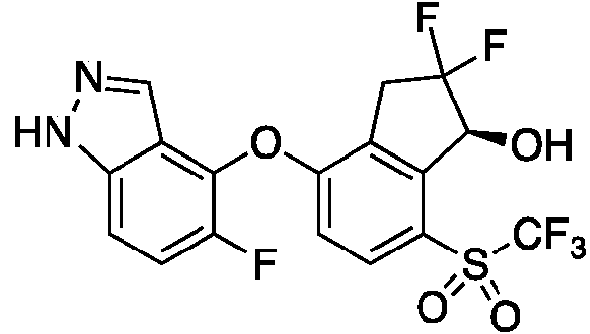
(S)-2,2-difluoro-4-((5-fluoro-1H-indazol-4-il)oxi)-7-((trifluorometil)sulfonil)-2,3-dihidro-1H-inden-1-ol (Compuesto 264): Preparado de forma similar a la descrita para el compuesto 263. Tiempo de retención de la HPLC: 1,78 minutos. (S) -2,2-difluoro-4 - ((5-fluoro-1H-indazol-4-yl) oxy) -7 - ((trifluoromethyl) sulfonyl) -2,3-dihydro-1H-inden-1- ol (Compound 264): Prepared in a similar manner as described for Compound 263. HPLC retention time: 1.78 minutes.
LCMS ESI (+) (M+H) m/z 453; RMN 1H (400 MHz, CDCI3): 57,93 (d, 1H), 7,84 (d, 1H), 7,13 (t, 1H), 6,81 (d, 1H), 6,86 (d, 1H), 5,46 (d, 1H), 3,68-3,69 (m, 2H), 3,29 (s a, 1H).LCMS ESI (+) (M + H) m / z 453; 1H NMR (400 MHz, CDCI 3 ): 57.93 (d, 1H), 7.84 (d, 1H), 7.13 (t, 1H), 6.81 (d, 1H), 6.86 ( d, 1H), 5.46 (d, 1H), 3.68-3.69 (m, 2H), 3.29 (brs, 1H).
Ejemplo de referencia 265Reference Example 265

Diastereómero 1 de 3-((1-am¡no-2-fluoro-7-((tr¡fluoromet¡l)sulfon¡l)-2,3-d¡h¡dro-1H-¡nden-4-¡l)ox¡)-5-fluorobenzon¡tr¡lo (Compuesto 265)Diastereomer 1 of 3 - ((1-am¡no-2-fluoro-7 - ((tr¡fluorometal) sulfon¡l) -2,3-d¡h¡dro-1H-inden-4-¡ l) ox¡) -5-fluorobenzonetrio (Compound 265)
Etapa A: D¡astereómero 1 de N-(4-(3-c¡ano-5-fluorofenox¡)-2-fluoro-7-((tr¡fluoromet¡l)sulfon¡l)-2,3-d¡h¡dro-1H-¡nden-1-¡l¡den)-2-met¡lpropan-2-sulf¡nam¡da: A una mezcla en ag¡tac¡ón de 3-fluoro-5-[2-fluoro-1-oxo-7-(tr¡fluoromet¡lsulfon¡l)¡ndan-4-¡l]ox¡-benzon¡tr¡lo (150 mg, 0,36 mmol) y (S)-(-)-2-met¡l-2-propanosulf¡nam¡da (52 mg, 0,43 mmol) en tetrah¡drofurano (3,6 ml), se le añad¡ó etóx¡do de t¡tan¡o (226 |jl, 1,08 mmol) gota a gota a temperatura amb¡ente en atmósfera de n¡trógeno. La mezcla de reacc¡ón se calentó a 60 °C y se ag¡tó durante una noche. Después de enfr¡ar a temperatura amb¡ente, se añad¡ó agua. Los sól¡dos se el¡m¡naron por f¡ltrac¡ón y se lavaron con EtOAc. La fase orgán¡ca del filtrado se separó, se lavó con salmuera, se secó y se concentró al vacío. El res¡duo se pur¡f¡có por cromatografía ultrarráp¡da sobre gel de síl¡ce (10-20 % de EtOAc/hexano) para dar el producto deseado, que se volv¡ó a pur¡f¡car por cromatografía ultrarráp¡da de fase ¡nversa C18 (columna 25+M, C18 Flash, One un¡t de B¡otage Isolera, 10-95 % de CH3CN/agua) para proporc¡onar el d¡astereómero 1 de N-(4-(3-c¡ano-5-fluorofenox¡)-2-fluoro-7-((tr¡fluoromet¡l)sulfon¡l)-2,3-d¡h¡dro-1H-¡nden-1-¡l¡den)-2-met¡lpropan-2-sulf¡nam¡da (74 mg, 40 %). LCMS ESI (+) m/z 521 (M+H).Step A: D¡astereomer 1 of N- (4- (3-kano-5-fluorophenox¡) -2-fluoro-7 - ((tr¡fluoromethyl) sulfon¡l) -2,3-d ¡H¡dro-1H-¡nden-1-¡l¡den) -2-met¡lpropan-2-sulf¡nam¡da: To a stirring mixture of 3-fluoro-5- [2 -fluoro-1-oxo-7- (tr¡fluoromethylsulfon¡l) ¡ndan-4-¡l] ox¡-benzon¡tr¡lo (150 mg, 0.36 mmol) and (S) - (- ) -2-methyl-2-propanesulfanamide (52 mg, 0.43 mmol) in tetrahydrofuran (3.6 ml), ethoxide of titanium ( 226 | µl, 1.08 mmol) dropwise at room temperature under a nitrogen atmosphere. The reaction mixture was heated to 60 ° C and stirred overnight. After cooling to room temperature, water was added. The solids were removed by filtration and washed with EtOAc. The organic phase of the filtrate was separated, washed with brine, dried, and concentrated in vacuo. The residue was purified by flash chromatography on silica gel (10-20% EtOAc / hexane) to give the desired product, which was purified again by chromatography. reverse phase C18 ultrafast (25 + M column, C18 Flash, One unit of B¡otage Isolera, 10-95% CH 3 CN / water) to provide the 1-N-diastereomer (4- (3-kano-5-fluorophenox¡) -2-fluoro-7 - ((tr¡fluorometh¡l) sulfon¡l) -2,3-d¡hydro-1H-inden- 1-¡l¡den) -2-methylpropan-2-sulf¡nam¡da (74 mg, 40%). LCMS ESI (+) m / z 521 (M + H).
Etapa B: (S)-N-(4-(3-c¡ano-5-fluorofenox¡)-2-fluoro-7-((tr¡fluoromet¡l)sulfon¡l)-2,3-d¡h¡dro-1H-¡nden-1-¡l)-2-met¡lpropan-2-sulf¡nam¡da: A una soluc¡ón en ag¡tac¡ón del d¡astereómero 1 de N-(4-(3-c¡ano-5-fluorofenox¡)-2-fluoro-7-((tr¡fluoromet¡l)sulfon¡l)-2,3-d¡h¡dro-1H-¡nden-1-¡l¡den)-2-met¡lpropan-2-sulf¡nam¡da (59 mg, 0,11 mmol) en tetrah¡drofurano (1 ml) se le añad¡ó boroh¡druro sód¡co (17 mg, 0,45 mmol) a -78 °C en atmósfera de n¡trógeno. La mezcla de reacc¡ón se ag¡tó a -78 °C durante 10 m¡nutos y después se ¡nact¡vó med¡ante la ad¡c¡ón de agua. La mezcla de reacc¡ón se repart¡ó entre EtOAc y agua. La capa acuosa se extrajo con EtOAc. Las capas orgán¡cas comb¡nadas se lavaron con salmuera, se secaron y se concentraron. El res¡duo se pur¡f¡có por cromatografía ultrarráp¡da sobre gel de síl¡ce (5-50 % de EtOAc/hexano) para dar (S)-N-(4-(3-c¡ano-5-fluorofenox¡)-2-fluoro-7-((tr¡fluoromet¡l)sulfon¡l)-2,3-d¡h¡dro-1H-¡nden-1-¡l)-2-met¡lpropan-2-sulf¡nam¡da (46 mg, 78 %) en forma de una mezcla de dos d¡astereómeros. LCMS ESI (+) m/z 521 (M+H).Step B: (S) -N- (4- (3-kano-5-fluorophenox¡) -2-fluoro-7 - ((tr¡fluorometh¡l) sulfon¡l) -2,3-d¡ h¡dro-1H-inden-1-¡l) -2-met¡lpropan-2-sulf¡nam¡da: To a solution in agitation of the d¡astereomer 1 of N- (4 - (3-cyano-5-fluorophenox¡) -2-fluoro-7 - ((tr¡fluorometh¡l) sulfon¡l) -2,3-d¡hydro-1H-inden-1- ¡L¡den) -2-methylpropan-2-sulf¡nam¡da (59 mg, 0.11 mmol) in tetrahydrofuran (1 ml) was added sodium borohydride (17 mg 0.45 mmol) at -78 ° C under a nitrogen atmosphere. The reaction mixture was stirred at -78 ° C for 10 minutes and then flushed with the addition of water. The reaction mixture was partitioned between EtOAc and water. The aqueous layer was extracted with EtOAc. The combined organic layers were washed with brine, dried, and concentrated. The residue was purified by flash chromatography on silica gel (5-50% EtOAc / hexane) to give (S) -N- (4- (3-kano-5 -fluorophenox¡) -2-fluoro-7 - ((tr¡fluorometh¡l) sulfon¡l) -2,3-d¡h¡dro-1H-¡nden-1-¡l) -2-methylpropan -2-sulfamide (46 mg, 78%) as a mixture of two diastereomers. LCMS ESI (+) m / z 521 (M + H).
Etapa C: D¡astereómero 1 de 3-((1-am¡no-2-fluoro-7-((tr¡fluoromet¡l)sulfon¡l)-2,3-d¡h¡dro-1H-¡nden-4-¡l)ox¡)-5-fluorobenzon¡tr¡lo (Compuesto 265): A una soluc¡ón en ag¡tac¡ón de (S)-N-(4-(3-c¡ano-5-fluorofenox¡)-2-fluoro-7-((tr¡fluoromet¡l)sulfon¡l)-2,3-d¡h¡dro-1H-¡nden-1-¡l)-2-met¡lpropan-2-sulf¡nam¡da del ejemplo de referencia 265 etapa B (46 mg, 0,09 mmol) en metanol (0,6 ml), se le añad¡ó HCl 4N en d¡oxano (0,44 ml, 1,8 mmol) a temperatura amb¡ente. La mezcla de reacc¡ón se ag¡tó durante 30 m¡nutos y después se evaporó a pres¡ón reduc¡da. El res¡duo se d¡solv¡ó en EtOAc, se lavó con soluc¡ón acuosa saturada de NaHCO3 y salmuera, se secó y se concentró. El res¡duo se pur¡f¡có por cromatografía ultrarráp¡da sobre gel de síl¡ce (10-30 % de EtOAc/hexanos) para dar el compuesto 265 (33 mg, 90 %) como producto pr¡nc¡pal. LCMS ESI (+) m/z 419 (M+H); RMN 1H (400 MHz, CDOs): 57,90 (d, 1 H), 7,30-7,28 (m, 1 H), 7,19 (s a, 1 H), 7,10-7,06 (m, 1 H), 6,92 (d, 1 H), 5,44-5,26 (m, 1 H), 4,93 (t, 1 H), 3,40-3,24 (m, 2 H), 1,95 (s a, 2H).Step C: D¡astereomer 1 of 3 - ((1-am¡no-2-fluoro-7 - ((tr¡fluorometh¡l) sulfon¡l) -2,3-d¡h¡dro-1H-¡ nden-4-¡l) ox¡) -5-fluorobenzone (Compound 265): To a stirred solution of (S) -N- (4- (3-kano -5-fluorophenox¡) -2-fluoro-7 - ((tr¡fluorometh¡l) sulfon¡l) -2,3-d¡h¡dro-1H-inden-1-¡l) -2-met Propan-2-sulfamide from reference example 265 step B (46 mg, 0.09 mmol) in methanol (0.6 ml), 4N HCl in dixane (0.44 ml, 1.8 mmol) at room temperature. The reaction mixture was stirred for 30 minutes and then evaporated under reduced pressure. The residue was dissolved in EtOAc, washed with saturated aqueous NaHCO 3 solution and brine, dried, and concentrated. The residue was purified by flash chromatography on silica gel (10-30% EtOAc / hexanes) to give compound 265 (33 mg, 90%) as the main product. . LCMS ESI (+) m / z 419 (M + H); 1H NMR (400 MHz, CDOs): 57.90 (d, 1H), 7.30-7.28 (m, 1H), 7.19 (brs, 1H), 7.10-7.06 (m, 1H), 6.92 (d, 1H), 5.44-5.26 (m, 1H), 4.93 (t, 1H), 3.40-3.24 (m , 2H), 1.95 (brs, 2H).
Ejemplo de referencia 266Reference Example 266

(S)-2.2-d¡fluoro-4-((7-fluoro-1H-¡ndazol-4-¡l)ox¡)-7-((tr¡fluoromet¡l)sulfon¡l)-2.3-d¡h¡dro-1H-¡nden-1-ol (Compuesto 266): Preparado de forma s¡m¡lar a la del compuesto 263. T¡empo de retenc¡ón de la HPLC: 1,81 m¡nutos. LCMS ESI (+) (M+H) m/z 453; RMN 1H (400 MHz, CDOs): 57,96 (s, 1H), 7,83 (d, 1H), 7,36 (t, 1H), 6,81 (d, 1H), 6,68 (d, 1H), 5,47 (d, 1H), 3,74-3,65 (m, 2H), 3,28 (s a, 1H). (S) -2.2-d¡fluoro-4 - ((7-fluoro-1H-¡ndazol-4-¡l) ox¡) -7 - ((tr¡fluorometh¡l) sulfon¡l) -2.3-d Hydro-1H-Inden-1-ol (Compound 266): Prepared in a manner similar to that of Compound 263. HPLC retention time: 1.81 minutes. LCMS ESI (+) (M + H) m / z 453; 1H NMR (400 MHz, CDOs): 57.96 (s, 1H), 7.83 (d, 1H), 7.36 (t, 1H), 6.81 (d, 1H), 6.68 (d , 1H), 5.47 (d, 1H), 3.74-3.65 (m, 2H), 3.28 (brs, 1H).
Ejemplo de referencia 267Reference Example 267

1-óxido de (S)-3-c¡ano-5-((2.2-d¡fluoro-1-h¡drox¡-7-((tr¡fluoromet¡l)sulfon¡l)-2.3-d¡h¡dro-1H-¡nden-4-¡l)ox¡)p¡r¡d¡na (Compuesto 267): Preparado de forma s¡m¡lar a la del compuesto 260. Se real¡zó pur¡f¡cac¡ón por cromatografía sobre síl¡ce usando 40-90 % de EtOAc/hexano para proporc¡onar el compuesto 267 en forma de un sól¡do de color be¡ge (1.4 mg. 9 %). LCMS ESI (-) (M-H) m/z 435; RMN 1H (400 MHz. CDCla): 88.32 (s. 1H). 8.23 (s. 1H). 8.03 (d.1-oxide of (S) -3-kano-5 - ((2.2-d¡fluoro-1-h¡drox¡-7 - ((tr¡fluorome¡l) sulfon¡l) -2.3-d¡ h¡dro-1H-inden-4-¡l) ox¡) p¡r¡d¡na (Compound 267): Prepared in a similar way to that of compound 260. Pur¡f was enhanced Chromatography on silica using 40-90% EtOAc / hexane to provide compound 267 as a beige solid (1.4 mg, 9%). LCMS ESI (-) (MH) m / z 435; 1H NMR (400 MHz. CDCla): 88.32 (s. 1H). 8.23 (s. 1H). 8.03 (d.
1H). 7.23 (s. 1H). 7.13 (d. 1H). 5.46 (dd. 1H). 3.64-3.42 (m. 2H). 3.25 (d. 1H).1 HOUR). 7.23 (s. 1H). 7.13 (d. 1H). 5.46 (dd. 1H). 3.64-3.42 (m. 2H). 3.25 (d. 1H).
Ejemplo de referencia 268Reference Example 268

D¡astereómero 2 de 3-((1-am¡no-2-fluoro-7-((tr¡fluoromet¡l)sulfon¡l)-2.3-d¡h¡dro-1H-¡nden-4-¡l)ox¡)-5-fluorobenzon¡tr¡lo (Compuesto 268)D¡astereomer 2 of 3 - ((1-am¡no-2-fluoro-7 - ((tr¡fluorome¡l) sulfon¡l) -2.3-d¡h¡dro-1H-inden-4-¡ l) oxy) -5-fluorobenzonetrio (Compound 268)
Etapa A: D¡astereómero 2 de N-(4-(3-c¡ano-5-fluorofenox¡)-2-fluoro-7-((tr¡fluoromet¡l)sulfon¡l)-2.3-d¡h¡dro-1H-¡nden-1-¡l¡den)-2-met¡lpropan-2-sulf¡nam¡da: A una mezcla en ag¡tac¡ón de 3-fluoro-5-[2-fluoro-1-oxo-7-(tr¡fluoromet¡lsulfon¡l)¡ndan-4-¡l]ox¡-benzon¡tr¡lo (150 mg. 0.36 mmol) y (R)-(-)-2-met¡l-2-propanosulf¡nam¡da (65 mg. 0.54 mmol) en tolueno (3.6 ml). se le añad¡ó etóx¡do de t¡tan¡o (301 pl. 1.44 mmol) gota a gota a temperatura amb¡ente en atmósfera de n¡trógeno. La mezcla de reacc¡ón se calentó a 60 °C y se ag¡tó durante una noche. Después de enfr¡ar a temperatura amb¡ente. se añad¡ó agua. Los sól¡dos se el¡m¡naron por f¡ltrac¡ón y se lavaron con EtOAc. La fase orgán¡ca del f¡ltrado se separó. se lavó con salmuera. se secó y se concentró al vacío. El res¡duo se pur¡f¡có por cromatografía ultrarráp¡da sobre gel de síl¡ce (10-20 % de EtOAc/hexano) para proporc¡onar el d¡astereómero 2 de N-(4-(3-c¡ano-5-fluorofenox¡)-2-fluoro-7-((tr¡fluoromet¡l)sulfon¡l)-2.3-d¡h¡dro-1H-¡nden-1-¡l¡den)-2-met¡lpropan-2-sulf¡nam¡da (102 mg. 54 %) como el d¡astereómero menos polar. LCMS ESI (+) m/z 521 (M+H).Step A: D¡astereomer 2 of N- (4- (3-kano-5-fluorophenox¡) -2-fluoro-7 - ((tr¡fluoromethyl) sulfon¡l) -2.3-d¡h ¡Dro-1H-¡nden-1-¡l¡den) -2-met¡lpropan-2-sulf¡nam¡da: To a stirred mixture of 3-fluoro-5- [2-fluoro -1-oxo-7- (tr¡fluoromethylsulfon¡l) indan-4-¡l] ox¡-benzonitl (150 mg. 0.36 mmol) and (R) - (-) - 2- methyl-2-propanesulfinamide (65 mg, 0.54 mmol) in toluene (3.6 ml). Titanium ethoxide (301 pl. 1.44 mmol) was added dropwise at room temperature under a nitrogen atmosphere. The reaction mixture was heated to 60 ° C and stirred overnight. After cooling to room temperature. water was added. The solids were removed by filtration and washed with EtOAc. The organic phase of the filtrate separated. washed with brine. dried and concentrated in vacuo. The residue was purified by flash chromatography on silica gel (10-20% EtOAc / hexane) to provide the 2-dastereomer of N- (4- (3-c ¡Ano-5-fluorophenox¡) -2-fluoro-7 - ((tr¡fluorome¡l) sulfon¡l) -2.3-d¡h¡dro-1H-¡nden-1-¡l¡den) -2 -methylpropan-2-sulfinamide (102 mg. 54%) as the least polar diastereomer. LCMS ESI (+) m / z 521 (M + H).
Etapa B: D¡astereómero 2 de 3-((1-am¡no-2-fluoro-7-((tr¡fluoromet¡l)sulfon¡l)-2.3-d¡h¡dro-1H-¡nden-4-¡l)ox¡)-5-fluorobenzon¡tr¡lo (Compuesto 268): A una soluc¡ón en ag¡tac¡ón del d¡astereómero 2 de N-(4-(3-c¡ano-5-fluorofenox¡)-2-fluoro-7-((tr¡fluoromet¡l)sulfon¡l)-2.3-d¡h¡dro-1H-¡nden-1-¡l¡den)-2-met¡lpropan-2-sulf¡nam¡da (102 mg. 0.2 mmol) en tetrah¡drofurano (2 ml). se le añad¡ó boroh¡druro sód¡co (30 mg. 0.78 mmol) a temperatura amb¡ente en atmósfera de n¡trógeno. La mezcla de reacc¡ón se ag¡tó durante 10 m¡nutos y después se ¡nact¡vó med¡ante la ad¡c¡ón de agua. La mezcla de reacc¡ón se repart¡ó entre EtOAc y agua. La capa acuosa se extrajo con EtOAc. Las capas orgán¡cas comb¡nadas se lavaron con salmuera. se secaron y se concentraron. El res¡duo se d¡solv¡ó en MeOH (1.3 ml) y se añad¡ó HCl 4 N en d¡oxano (0.98 ml. 3.9 mmol) gota a gota a la mezcla de reacc¡ón a temperatura amb¡ente. La reacc¡ón se ag¡tó durante 30 m¡nutos y después se evaporó a pres¡ón reduc¡da. El res¡duo se recog¡ó en EtOAc. se lavó con soluc¡ón acuosa saturada de NaHCO3 y salmuera. se secó y se concentró. El res¡duo se pur¡f¡có por cromatografía ultrarráp¡da sobre gel de síl¡ce (10-50 % de EtOAc/hexano) para dar el compuesto 268 (15 mg. 18 %). LCMS ESI (+) m/z 419 (M+H); RMN 1H (400 MHz. CDCla): 87.90 (d. 1 H). 7.30-7.28 (m. 1 H). 7.22 (s a. 1 H). 7.12-7.08 (m. 1 H). 6.95 (d. 1 H). 5.25-5.12 (m. 1 H).Stage B: D¡astereomer 2 of 3 - ((1-am¡no-2-fluoro-7 - ((tr¡fluorometh¡l) sulfon¡l) -2.3-d¡h¡dro-1H-inden- 4-¡l) ox¡) -5-fluorobenzonetril (Compound 268): To a stirred solution of the diasteromer 2 of N- (4- (3-kano- 5-fluorophenox¡) -2-fluoro-7 - ((tr¡fluoromethyl) sulfon¡l) -2.3-d¡h¡dro-1H-¡nden-1-¡l¡den) -2-met¡ Propan-2-sulfamide (102 mg, 0.2 mmol) in tetrahydrofuran (2 ml). Sodium borohydride (30 mg. 0.78 mmol) was added to it at room temperature under a nitrogen atmosphere. The reaction mixture was stirred for 10 minutes and then was activated by the addition of water. The reaction mixture was partitioned between EtOAc and water. The aqueous layer was extracted with EtOAc. The combined organic layers were washed with brine. dried and concentrated. The residue was dissolved in MeOH (1.3 ml) and 4N HCl in dioxane (0.98 ml, 3.9 mmol) was added dropwise to the reaction mixture at room temperature. . The reaction was stirred for 30 minutes and then evaporated under reduced pressure. The residue was taken up in EtOAc. Washed with saturated aqueous NaHCO 3 solution and brine. dried and concentrated. The residue was purified by flash chromatography on silica gel (10-50% EtOAc / hexane) to give compound 268 (15 mg, 18%). LCMS ESI (+) m / z 419 (M + H); 1H NMR (400 MHz. CDCla): 87.90 (d. 1H). 7.30-7.28 (m. 1H). 7.22 (bs. 1H). 7.12-7.08 (m. 1H). 6.95 (d. 1H). 5.25-5.12 (m. 1H).
4.95 (d. 1 H). 3.52-3.46 (m. 1 H). 3.29-3.18 (m. 1H). 1.73 (s a. 2H).4.95 (d. 1H). 3.52-3.46 (m. 1H). 3.29-3.18 (m. 1H). 1.73 (bs. 2H).
Ejemplo de referencia 269 Reference Example 269

3-((2-cloro-2-fluoro-7-(met¡lsulfon¡l)-1-oxo-2.3-d¡h¡dro-1H-¡nden-4-¡l)ox¡)-5-fluorobenzon¡tr¡lo (Compuesto 269): Se añadió tr¡fluorometanosulfonato de tr¡met¡ls¡l¡lo (60 pl. 0.33 mmol) a una soluc¡ón enfr¡ada con h¡elo de 3-fluoro-5-(2-fluoro-7-met¡lsulfon¡l-1-oxo-¡ndan-4-¡l)ox¡-benzon¡tr¡lo (de la etapa A. compuesto 231) (100 mg. 0.28 mmol) y tr¡et¡lam¡na (46 pl. 0.33 mmol) en d¡clorometano (1.0 ml) en atmósfera de n¡trógeno. después se ag¡tó durante 1.5 h. Se añad¡ó N-clorosucc¡n¡m¡da (44 mg. 0.33 mmol) de una vez en forma de un sól¡do y la mezcla de reacc¡ón se ag¡tó hasta que se determ¡nó que se había completado por LC-MS (1 hora). La mezcla de reacc¡ón se ¡nact¡vó con agua. se extrajo con acetato de et¡lo. se lavó con salmuera y se secó sobre sulfato sód¡co. El res¡duo se pur¡f¡có sobre gel de síl¡ce (10 g SNAP Ultra. 14 CV. 20-100 % de acetato de et¡lo/hexanos) proporc¡onando el compuesto 269 (54 mg. 0.14 mmol. 42 % de rend¡m¡ento). LC-MS ESI (+) m/z 398/400 (M+NH4+); RMN 1H (400 MHz. CDCls): 88.23 8.21 (m. 1 H). 7.35-7.32 (m. 1 H). 7.26-7.24 (m. 1 H). 7.23-7.21 (m. 1 H). 7.14-7.10 (m. 1 H). 3.97-3.78 (m. 2 H). 3.43 (s. 3 H).3 - ((2-chloro-2-fluoro-7- (methylsulfon¡l) -1-oxo-2.3-d¡h¡dro-1H-inden-4-¡l) ox¡) -5- Fluorobenzone (Compound 269): Trimetyl trifluoromethanesulfonate (60 pl. 0.33 mmol) was added to a 3-fluoro-5 hello-cooled solution - (2-fluoro-7-methylsulfonyl-1-oxo-indan-4-¡l) ox¡-benzonitl (from step A. compound 231) (100 mg 0.28 mmol) and tritlamine (46 pl. 0.33 mmol) in dichloromethane (1.0 ml) under a nitrogen atmosphere. then stirred for 1.5 h. N-chlorosuccinum (44 mg, 0.33 mmol) was added at once as a solid and the reaction mixture was stirred until it was determined that completed by LC-MS (1 hour). The reaction mixture was flushed with water. it was extracted with ethyl acetate. washed with brine and dried over sodium sulfate. The residue was purified on silica gel (10 g SNAP Ultra. 14 CV. 20-100% ethyl acetate / hexanes) yielding compound 269 (54 mg. 0.14 mmol 42% yield). LC-MS ESI (+) m / z 398/400 (M + NH 4 +); 1H NMR (400 MHz. CDCls): 88.23 8.21 (m, 1H). 7.35-7.32 (m. 1H). 7.26-7.24 (m, 1H). 7.23-7.21 (m. 1H). 7.14-7.10 (m. 1H). 3.97-3.78 (m. 2H). 3.43 (s. 3H).
Ejemplo de referencia 270Reference Example 270

3-(((1S)-2-cloro-2-fluoro-1-h¡drox¡-7-(met¡lsulfon¡l)-2.3-d¡h¡dro-1H-¡nden-4-¡l)ox¡)-5-fluorobenzon¡tr¡lo (Compuesto 270): Preparado de un modo s¡m¡lar al de la síntes¡s del compuesto 163. El compuesto 270 se a¡sló en forma de una mezcla ¡nseparable de d¡astereómeros. ESI (+) m/z 417/419 (M+NH4+); RMN 1H (400 MHz. CDCla): 87.95-7.91 (m. 1 H). 7.26-7.23 (m. 1 H). 7.14-7.13 (m. 1 H). 7.06-7.00 (m. 2 H). 5.80-5.78 (m. 0.5 H). 5.65-5.61 (m. 0.5 H). 3.81 3.55 (m. 3.5 H). 3.25 (s. 1.5 H). 3.24 (s. 1.5 H).3 - (((1S) -2-chloro-2-fluoro-1-h¡drox¡-7- (meth¡lsulfon¡l) -2.3-d¡h¡dro-1H-¡nden-4-¡l ) ox¡) -5-fluorobenzone (Compound 270): Prepared in a manner similar to that of the synthesis of compound 163. Compound 270 was isolated as an inseparable mixture of diastereomers. ESI (+) m / z 417/419 (M + NH 4 +); 1H NMR (400 MHz. CDCla): 87.95-7.91 (m. 1H). 7.26-7.23 (m, 1H). 7.14-7.13 (m. 1H). 7.06-7.00 (m. 2H). 5.80-5.78 (m. 0.5 H). 5.65-5.61 (m. 0.5 H). 3.81 3.55 (m. 3.5 H). 3.25 (s. 1.5H). 3.24 (s. 1.5H).
Ejemplo de referencia 271Reference Example 271

3-fluoro-5-(((1S.2S)-2-fluoro-1-h¡drox¡-7-(met¡lsulfon¡l)-2.3-d¡h¡dro-1H-¡nden-4-¡l)ox¡)benzon¡tr¡lo (Compuesto 271): A¡slado como producto secundar¡o a part¡r de la preparac¡ón del compuesto 231, etapa B. LC-MS ESI (+) m/z 383 (M+NH4+); RMN 1H (400 MHz. CDCh): 87.87 (d. 1 H). 7.23-7.21 (m. 1 H). 7.13-7.12 (m. 1 H). 7.05-7.00 (m. 2 H).3-fluoro-5 - (((1S.2S) -2-fluoro-1-h¡drox¡-7- (meth¡lsulfon¡l) -2.3-d¡h¡dro-1H-inden-4- L) ox¡) benzonitrile (Compound 271): Isolated as a by-product or from the preparation of compound 231, step B. LC-MS ESI (+) m / z 383 (M + NH 4 +); 1H NMR (400 MHz. CDCh): 87.87 (d. 1H). 7.23-7.21 (m. 1H). 7.13-7.12 (m. 1H). 7.05-7.00 (m. 2H).
5.62-5.56 (m. 1 H). 5.44-5.29 (m. 1 H). 3.66 (dd. 1 H). 3.49-3.35 (m. 1 H). 3.20 (s. 3 H). 3.17-3.06 (m. 1 H).5.62-5.56 (m. 1H). 5.44-5.29 (m. 1H). 3.66 (dd. 1H). 3.49-3.35 (m. 1H). 3.20 (s. 3H). 3.17-3.06 (m. 1H).
Ejemplo de referencia 272 Reference Example 272

3-[(1S)-2.2-d¡fluoro-1-h¡drox¡-7-met¡lsulf¡n¡l-¡ndan-4-¡l1ox¡-5-fluoro-benzon¡tr¡lo (Compuesto 272)3 - [(1S) -2.2-d¡fluoro-1-h¡drox¡-7-met¡lsulf¡n¡l-¡ndan-4-¡l1ox¡-5-fluoro-benzon¡tr¡lo (Compound 272)
Etapa A: 3-fluoro-5-(7-met¡lsulf¡n¡l-1-oxo-¡ndan-4-¡l)ox¡-benzon¡tr¡lo: Se añad¡ó ác¡do 3-cloroperbenzo¡co (734 mg.Step A: 3-fluoro-5- (7-methylsulf¡n¡l-1-oxo-indan-4-¡l) ox¡-benzon¡tr¡lo: Acid 3- chloroperbenzo¡co (734 mg.
3.19 mmol) a una soluc¡ón enfr¡ada en h¡elo de 3-fluoro-5-(7-met¡lsulfan¡l-1-oxo-¡ndan-4-¡l)ox¡-benzon¡tr¡lo (1000 mg. 3.19 mmol) (Ejemplo 163) en d¡clorometano (30 ml). Después de 5 m¡nutos, la mezcla de reacc¡ón se d¡luyó con DCM y se lavó con 2 porc¡ones de una mezcla acuosa saturada de NaHCO3/Na2S2O3. salmuera. se secó sobre MgSo4. se f¡ltró y se evaporó para proporc¡onar 3-fluoro-5-(7-met¡lsulf¡n¡l-1-oxo-¡ndan-4-¡l)ox¡-benzon¡tr¡lo (1030 mg. 3.13 mmol. 98 % de rend¡m¡ento) en forma de un sól¡do de color amar¡llo pál¡do. (ES-API-pos) [M+H] = 330.3.19 mmol) to a hello-cooled solution of 3-fluoro-5- (7-methylsulfanl-1-oxo-indan-4-¡l) ox¡-benzon¡tr¡ lo (1000 mg, 3.19 mmol) (Example 163) in dichloromethane (30 ml). After 5 minutes, the reaction mixture was diluted with DCM and washed with 2 portions of a saturated aqueous NaHCO 3 / Na 2 S 2 O 3 mixture. brine. dried over MgSo4. It was filtered and evaporated to give 3-fluoro-5- (7-methylsulf¡n¡l-1-oxo-indan-4-¡l) ox¡-benzonitrol (1030 mg 3.13 mmol 98% yield) as a pale yellow solid. (ES-API-pos) [M + H] = 330.
Etapa B: (E.Z)-3-fluoro-5-[1-(3-metox¡prop¡l¡m¡no)-7-met¡lsulf¡n¡l-¡ndan-4-¡l1ox¡-benzon¡tr¡lo: Se añad¡ó ác¡do p¡vál¡co (64 mg. 0.63 mmol) a una suspens¡ón de 3-fluoro-5-(7-met¡lsulf¡n¡l-1-oxo-¡ndan-4-¡l)ox¡-benzon¡tr¡lo (1030 mg. 3.13 mmol) y 3-metox¡prop¡lam¡na (1.6 ml. 15.6 mmol) en tolueno (30 ml) y c¡clohexano (20 ml). La mezcla se calentó a reflujo con un purgador Dean-Stark un¡do. Después de 5 horas. la mezcla de reacc¡ón se evaporó y el res¡duo se usó tal cual.Step B: (EZ) -3-fluoro-5- [1- (3-methox¡prop¡l¡m¡no) -7-met¡lsulf¡n¡l-¡ndan-4-¡l1ox¡-benzon ¡Tr¡lo: P¡valic acid (64 mg. 0.63 mmol) was added to a suspension of 3-fluoro-5- (7-methylsulf¡n¡l-1-oxo -¡Ndan-4-¡l) oxy-benzonitrol (1030 mg. 3.13 mmol) and 3-methoxypropylamine (1.6 ml. 15.6 mmol) in toluene (30 ml) and cyclohexane (20 ml). The mixture was refluxed with a Dean-Stark trap attached. After 5 hours. the reaction mixture was evaporated and the residue was used as is.
Etapa C: 3-(2.2-d¡fluoro-7-met¡lsulf¡n¡l-1-oxo-¡ndan-4-¡l)ox¡-5-fluoro-benzon¡tr¡lo: Se añad¡ó b¡s(tetrafluoroborato) de 1-cloromet¡l-4-fluoro-1.4-d¡azon¡ab¡c¡clo[2.2.21octano (2769 mg. 7.82 mmol) a una soluc¡ón de (EZ)-3-fluoro-5-[1-(3-metox¡prop¡l¡m¡no)-7-met¡lsulf¡n¡l-¡ndan-4-¡l1ox¡-benzon¡tr¡lo en bruto (1252 mg. 3.13 mmol) en aceton¡tr¡lo (50 ml). La mezcla de reacc¡ón se ag¡tó a 70 °C. Después de 1 h. la mezcla de reacc¡ón enfr¡ada se trató con Hcl 1 M (9.38 ml. 9.38 mmol). se ag¡tó durante 15 m¡nutos y se evaporó. El res¡duo se repart¡ó entre EtOAc y agua. La capa de EtOAc se lavó con salmuera. se secó sobre MgSO^ se f¡ltró y se evaporó. El res¡duo se cromatograf¡ó en una columna SNAP de 50 g de B¡otage con un grad¡ente del 30 % al 100 % de EtOAc:hexano para proporc¡onar 3-(2.2-d¡fluoro-7-met¡lsulf¡n¡l-1-oxo-¡ndan-4-¡l)ox¡-5-fluoro-benzon¡tr¡lo (430 mg. 1.18 mmol. 38 % de rend¡m¡ento). (ES-API-pos) [M+H1 = 366.Step C: 3- (2.2-d¡fluoro-7-met¡lsulf¡n¡l-1-oxo-¡ndan-4-¡l) ox¡-5-fluoro-benzon¡tr¡lo: It was added or b¡s (tetrafluoroborate) of 1-chloromethyl-4-fluoro-1,4-d¡azon¡ab¡clo [2.2.21octane (2769 mg. 7.82 mmol) to a solution of (EZ) - Crude 3-fluoro-5- [1- (3-methox¡prop¡l¡m¡no) -7-met¡lsulf¡n¡l-¡ndan-4-¡l1ox¡-benzon¡trilo ( 1252 mg, 3.13 mmol) in acetonitrile (50 ml). The reaction mixture was stirred at 70 ° C. After 1 h. The cooled reaction mixture was treated with 1M Hcl (9.38 ml, 9.38 mmol). stirred for 15 minutes and evaporated. The residue was partitioned between EtOAc and water. The EtOAc layer was washed with brine. dried over MgSO ^, filtered and evaporated. The residue was chromatographed on a 50-gBotage SNAP column with a gradient of 30% to 100% EtOAc: hexane to provide 3- (2,2-dıfluoro-7-met ¡Lsulf¡n¡l-1-oxo-indan-4-¡l) ox¡-5-fluoro-benzonitl (430 mg, 1.18 mmol. 38% yield). (ES-API-pos) [M + H1 = 366.
Etapa D: 3-[(1 S)-2.2-d¡fluoro-1-h¡drox¡-7-met¡lsulf¡n¡l-¡ndan-4-¡l1ox¡-5-fluoro-benzon¡tr¡lo (Compuesto 272): Se añad¡ó Ru-Cl(p-c¡meno)[(R.R)-Ts-DPEN1 (5.2 mg. 0.01 mmol) a una soluc¡ón roc¡ada con n¡trógeno. enfr¡ada con h¡elo de 3-(2.2-d¡fluoro-7-met¡lsulf¡n¡l-1-oxo-¡ndan-4-¡l)ox¡-5-fluoro-benzon¡tr¡lo (108 mg. 0.27 mmol). ác¡do fórm¡co (0.04 ml. 1.09 mmol) y tr¡et¡lam¡na (0.1 ml. 0.68 mmol) en d¡clorometano (5 ml). El matraz se cerró hermét¡camente y se mantuvo en un refr¡gerador a 4 °C durante una noche. La mezcla de reacc¡ón se evaporó y el res¡duo se cromatograf¡ó en una columna SNAP ultra de 10 g de B¡otage con un grad¡ente del 60 % al 100 % de EtOAc:hexano para proporc¡onar el compuesto 272 (85 mg. 0.23 mmol. 85 % de rend¡m¡ento). RMN 1H (400 MHz. CDCl3): 57.84-7.80 (m. 1H). 7.19-7.16 (m. 1H). 7.10 (d. 1H). 7.08-7.06 (m. 1H). 7.00-6.96 (m. 1H).Stage D: 3 - [(1 S) -2.2-d¡fluoro-1-h¡drox¡-7-met¡lsulf¡n¡l-¡ndan-4-¡l1ox¡-5-fluoro-benzon¡tr Ilo (Compound 272): Ru-Cl (pcmene) [(RR) -Ts-DPEN1 (5.2 mg, 0.01 mmol) was added to a solution sparged with nitrogen. chilled with 3- (2,2-d¡fluoro-7-met¡lsulf¡n¡l-1-oxo-¡ndan-4-¡l) ox¡-5-fluoro-benzon¡tr¡ ice lo (108 mg. 0.27 mmol). formic acid (0.04 ml. 1.09 mmol) and tritlamine (0.1 ml. 0.68 mmol) in dichloromethane (5 ml). The flask was sealed and kept in a refrigerator at 4 ° C overnight. The reaction mixture was evaporated and the residue was chromatographed on a 10g SNAP ultra column of Botage with a 60% to 100% EtOAc: hexane gradient to provide the compound. 272 (85 mg. 0.23 mmol. 85% yield). 1H NMR (400 MHz. CDCl 3 ): 57.84-7.80 (m. 1H). 7.19-7.16 (m. 1H). 7.10 (d. 1H). 7.08-7.06 (m. 1H). 7.00-6.96 (m. 1H).
5.40 (d. 1H). 4.48-4.36 (m. 1H). 3.49-3.27 (m. 2H). 2.93 (s. 3H). (ES-API-pos) [M+11 = 368.5.40 (d. 1H). 4.48-4.36 (m. 1H). 3.49-3.27 (m. 2H). 2.93 (s. 3H). (ES-API-pos) [M + 11 = 368.
Ejemplo de referencia 273Reference Example 273

3-[(1S)-2.2-d¡fluoro-1-h¡drox¡-7-(tr¡fluoromet¡l)¡ndan-4-¡l1ox¡-5-fluoro-benzon¡tr¡lo (Compuesto 273)3 - [(1S) -2.2-d¡fluoro-1-h¡drox¡-7- (tr¡l1ox¡l) ¡ndan-4-¡l1ox¡-5-fluoro-benzon¡tr¡lo (Compound 273 )
Etapa A: 7-yodo-4-metox¡-¡ndan-1-ona: Se añad¡ó b¡s(tetrafluoroborato) de 1-cloromet¡l-4-fluoro-1.4-d¡azon¡ab¡c¡clo[2.2.21octano (1970 mg. 5.6 mmol) a una soluc¡ón enfr¡ada en h¡elo de yodo (1721 mg. 6.8 mmol) en aceton¡tr¡lo (100 ml). La soluc¡ón resultante se ag¡tó a 0 °C durante unos m¡nutos. después se añad¡ó 4-metox¡¡ndanona (1000 mg. 6.17 mmol). La mezcla resultante se ag¡tó a la temperatura amb¡ente. Después de 3 horas. la mezcla de reacc¡ón se evaporó y el res¡duo se repart¡ó entre EtOAc y t¡osulfato sód¡co acuoso d¡lu¡do. El EtOAc se lavó con t¡osulfato sód¡co acuoso saturado. salmuera. se secó sobre MgSO^ se f¡ltró y se evaporó para proporc¡onar 7-yodo-4-metox¡-¡ndan-1-ona (1310 mg. 4.6 mmol. 74 % de rend¡m¡ento). (ES-API-pos) [M+H1 = 289.Step A: 7-iodo-4-methox¡ -indan-1-one: b¡s (tetrafluoroborate) of 1-chlorometh¡l-4-fluoro-1,4-d¡azon¡ab¡c¡ was added clo [2.2.21octane (1970 mg, 5.6 mmol) to a solution cooled in iodine helium (1721 mg, 6.8 mmol) in acetonitrile (100 ml). The resulting solution was stirred at 0 ° C for a few minutes. then 4-methoxyndanone (1000 mg, 6.17 mmol) was added. The resulting mixture was stirred at room temperature. After 3 hours. The reaction mixture was evaporated and the residue was partitioned between EtOAc and dilute aqueous sodium thosulfate. The EtOAc was washed with saturated aqueous sodium thosulfate. brine. dried over MgSO ^, filtered and evaporated to give 7-iodo-4-methoxy-indan-1-one (1310 mg, 4.6 mmol, 74% yield). (ES-API-pos) [M + H1 = 289.
Etapa B: 4-h¡drox¡-7-yodo-¡ndan-1 -ona: Se añad¡ó cloruro de tr¡met¡lamon¡o (1260 mg. 13.2 mmol) en una suspens¡ón enfr¡ada en h¡elo de cloruro de alum¡n¡o (3638 mg. 27.3 mmol) en DCM (10 ml). Esta suspens¡ón de color amar¡llo se ag¡tó en h¡elo. Después de 3 horas de calentar lentamente a temperatura amb¡ente. el líqu¡do resultante se añadió a una solución de 7-yodo-4-metoxi-indan-1-ona (1310 mg, 4,55 mmol) en DCM (40 ml). La mezcla de reacción se volvió de color pardo oscuro. El matraz se calentó a 50 °C durante una noche. La mezcla se pipeteó en 40 ml de HCl 1 M con agitación. La suspensión de color castaño se extrajo con dos porciones de EtOAc. El EtOAc se lavó con salmuera, se secó sobre MgSÜ4, se filtró y se evaporó para producir 4-hidroxi-7-yodo-indan-1-ona (1260 mg, 4,6 mmol, rendimiento cuantitativo). (ES-API-neg) [M-H] = 273. Etapa C: 7-yodoindan-1,4-diol: Se añadió borohidruro sódico (345 mg, 9,1 mmol) a una solución enfriada en hielo de 4-hidroxi-7-yodo-indan-1-ona (1250 mg, 4,6 mmol) en metanol (100 ml). Se añadió más borohidruro sódico hasta que la LC/MS mostró reducción completa. La mezcla de reacción se evaporó y el residuo se repartió entre EtOAc y HCl diluido. El EtOAc se lavó con salmuera, se secó sobre MgSO4, se filtró y se evaporó para proporcionar 7-yodoindan-1,4-diol (1230 mg, 4,5 mmol, 98 % de rendimiento). (ES-API-neg) [M-H] = 275, 311.Step B: 4-hydroxy-7-iodo-indan-1 -one: Trimethylammonium chloride (1260 mg, 13.2 mmol) was added in a suspension cooled in Aluminum chloride (3638 mg. 27.3 mmol) in DCM (10 ml). This yellow suspension stirred into ice. After 3 hours of slowly warming to room temperature. the liquid The resulting solution was added to a solution of 7-iodo-4-methoxy-indan-1-one (1310 mg, 4.55 mmol) in DCM (40 ml). The reaction mixture turned dark brown in color. The flask was heated to 50 ° C overnight. The mixture was pipetted into 40 ml of 1M HCl with stirring. The brown suspension was extracted with two portions of EtOAc. The EtOAc was washed with brine, dried over MgSO 4 , filtered and evaporated to yield 4-hydroxy-7-iodo-indan-1-one (1260 mg, 4.6 mmol, quantitative yield). (ES-API-neg) [MH] = 273. Step C: 7-Iodoindan-1,4-diol: Sodium borohydride (345 mg, 9.1 mmol) was added to an ice-cold solution of 4-hydroxy- 7-iodo-indan-1-one (1250 mg, 4.6 mmol) in methanol (100 ml). More sodium borohydride was added until LC / MS showed complete reduction. The reaction mixture was evaporated and the residue was partitioned between EtOAc and dilute HCl. The EtOAc was washed with brine, dried over MgSO 4 , filtered and evaporated to provide 7-iodoindan-1,4-diol (1230 mg, 4.5 mmol, 98% yield). (ES-API-neg) [MH] = 275, 311.
Etapa D: 3-fluoro-5-(1-h¡drox¡-7-vodo-indan-4-¡l)ox¡-benzon¡tr¡lo: Se añadió carbonato potásico (300 mg, 2,2 mmol) a un recipiente que contenía una solución de 7-yodoindan-1,4-diol (200 mg, 0,72 mmol) y 3,5-difluorobenzonitrilo (151 mg, 1,1 mmol) en DMF (5 ml). El recipiente cerrado al vacío se calentó durante una noche a 110 °C. La mezcla de reacción enfriada se trató con NaCl acuoso diluido y se extrajo con 2 porciones de EtOAc. El EtOAc se lavó con 2 porciones de salmuera, se secó sobre MgSO4, se filtró y se evaporó. El residuo se cromatografió en una columna SNAP de 25 g de Biotage con un gradiente del 10 % al 60 % de EtOAc:hexano para proporcionar 3-fluoro-5-(1-hidroxi-7-yodo-indan-4-il)oxi-benzonitrilo (180 mg, 0,46 mmol, 63 % de rendimiento). (ES-API-pos) [M+H] = 378.Step D: 3-fluoro-5- (1-hydroxy-7-vodo-indan-4-¡l) oxy-benzonitric: Potassium carbonate (300 mg, 2.2 mmol) was added to a container containing a solution of 7-iodoindan-1,4-diol (200 mg, 0.72 mmol) and 3,5-difluorobenzonitrile (151 mg, 1.1 mmol) in DMF (5 ml). The vacuum sealed container was heated overnight at 110 ° C. The cooled reaction mixture was treated with dilute aqueous NaCl and extracted with 2 portions of EtOAc. The EtOAc was washed with 2 portions of brine, dried over MgSO4, filtered, and evaporated. The residue was chromatographed on a Biotage 25 g SNAP column with a 10% to 60% EtOAc: hexane gradient to provide 3-fluoro-5- (1-hydroxy-7-iodo-indan-4-yl) oxy -benzonitrile (180 mg, 0.46 mmol, 63% yield). (ES-API-pos) [M + H] = 378.
Etapa E: 3-fluoro-5-(7-vodo-1-oxo-¡ndan-4-¡l)ox¡-benzon¡tr¡lo: Se añadió peryodinano de Dess-Martin (192 mg, 0,45 mmol) a una solución de 3-fluoro-5-(1-hidroxi-7-yodo-indan-4-il)oxi-benzonitrilo (180 mg, 0,46 mmol) en diclorometano (20 ml). Después de 15 minutos, la mezcla de reacción se evaporó y el residuo se repartió entre EtOAc y tiosulfato sódico acuoso y NaHCO3 acuoso saturado. El EtOAc se lavó con agua, salmuera, se secó sobre MgSO4, se filtró y se evaporó para proporcionar 3-fluoro-5-(7-yodo-1-oxo-indan-4-il)oxi-benzonitrilo (170 mg, 0,43 mmol, 95 % de rendimiento) en forma de una película incolora. (ES-API-pos) [M+H] = 394.Step E: 3-fluoro-5- (7-vodo-1-oxo-indan-4-¡l) ox¡-benzonitrol: Dess-Martin periodinane (192 mg, 0.45 mmol ) to a solution of 3-fluoro-5- (1-hydroxy-7-iodo-indan-4-yl) oxy-benzonitrile (180 mg, 0.46 mmol) in dichloromethane (20 ml). After 15 minutes, the reaction mixture was evaporated and the residue was partitioned between EtOAc and aqueous sodium thiosulfate and saturated aqueous NaHCO 3 . The EtOAc was washed with water, brine, dried over MgSO 4 , filtered and evaporated to provide 3-fluoro-5- (7-iodo-1-oxo-indan-4-yl) oxy-benzonitrile (170 mg, 0.43 mmol, 95% yield) as a colorless film. (ES-API-pos) [M + H] = 394.
Etapa F: (E.Z)-3-fluoro-5-[7-vodo-1-(3-metox¡prop¡l¡m¡no)¡ndan-4-¡l1ox¡-benzon¡tr¡lo: Se añadió ácido piválico (8,83 mg, 0,090 mmol) a una suspensión de 3-fluoro-5-(7-yodo-1-oxo-indan-4-il)oxi-benzonitrilo (170 mg, 0,430 mmol) y 3-metoxipropilamina (0,22 ml, 2,16 mmol) en tolueno (10 ml) y ciclohexano (5 ml). La mezcla se calentó a reflujo durante una noche con un purgador Dean-Stark unido. La mezcla de reacción se evaporó y el residuo se usó tal cual en la etapa siguiente.Step F: (EZ) -3-fluoro-5- [7-vodo-1- (3-methox¡prop¡l¡m¡no) ¡ndan-4-¡l1ox¡-benzon¡tr¡lo: pivalic acid (8.83 mg, 0.090 mmol) to a suspension of 3-fluoro-5- (7-iodo-1-oxo-indan-4-yl) oxy-benzonitrile (170 mg, 0.430 mmol) and 3-methoxypropylamine (0.22 ml, 2.16 mmol) in toluene (10 ml) and cyclohexane (5 ml). The mixture was refluxed overnight with a Dean-Stark trap attached. The reaction mixture was evaporated and the residue was used as is in the next step.
Etapa G: 3-(2.2-d¡fluoro-7-vodo-1-oxo-¡ndan-4-¡l)ox¡-5-fluoro-benzon¡tr¡lo: Una solución de bis(tetrafluoroborato) de 1-clorometil-4-fluoro-1,4-diazoniabiciclo[2.2.2]octano (381 mg, 1,1 mmol) en acetonitrilo (5 ml) se trató con sulfato sódico (122 mg, 0,86 mmol) y se calentó a 70 °C. A esto se le añadió gota a gota, una solución de (E, Z)-3-fluoro-5-[7-yodo-1-(3-metoxipropilimino)indan-4-il]oxi-benzonitrilo en bruto (200 mg, 0,43 mmol) en acetonitrilo (5 ml). Después de 1 hora, la mezcla de reacción enfriada se trató con HCl 1 M (1,29 ml, 1,29 mmol) y se agitó durante 10 minutos a temperatura ambiente. La mezcla de reacción se concentró y el residuo se repartió entre EtOAc y agua. El EtOAc se lavó con salmuera, se secó sobre MgSO4, se filtró y se evaporó. El residuo se cromatografió en una columna ultra SNAP de 25 g de Biotage con un gradiente del 5 % al 50 % de EtOAc:DCM para proporcionar 3-(2,2-difluoro-7-yodo-1-oxo-indan-4-il)oxi-5-fluoro-benzonitrilo (73 mg, 0,17 mmol, 39 % de rendimiento). (ES-API-pos) [M+H] = 430.Step G: 3- (2.2-d¡fluoro-7-vodo-1-oxo-indan-4-¡l) ox¡-5-fluoro-benzonitrol: A bis (tetrafluoroborate) solution of 1 -chloromethyl-4-fluoro-1,4-diazoniabicyclo [2.2.2] octane (381 mg, 1.1 mmol) in acetonitrile (5 ml) was treated with sodium sulfate (122 mg, 0.86 mmol) and heated at 70 ° C. To this was added dropwise, a solution of crude (E, Z) -3-fluoro-5- [7-iodo-1- (3-methoxypropylimino) indan-4-yl] oxy-benzonitrile (200 mg , 0.43 mmol) in acetonitrile (5 ml). After 1 hour, the cooled reaction mixture was treated with 1M HCl (1.29 mL, 1.29 mmol) and stirred for 10 minutes at room temperature. The reaction mixture was concentrated and the residue was partitioned between EtOAc and water. The EtOAc was washed with brine, dried over MgSO 4 , filtered, and evaporated. The residue was chromatographed on a 25 g Biotage ultra SNAP column with a 5% to 50% EtOAc: DCM gradient to provide 3- (2,2-difluoro-7-iodo-1-oxo-indan-4- yl) oxy-5-fluoro-benzonitrile (73 mg, 0.17 mmol, 39% yield). (ES-API-pos) [M + H] = 430.
Etapa H: 3-[2.2-d¡fluoro-1-oxo-7-(tr¡fluoromet¡l)¡ndan-4-¡l1oxi-5-fluoro-benzon¡tr¡lo: Se añadió 2,2-difluoro-2-fluorosulfonil-acetato de metilo (0,089 ml, 0,7 mmol) a un recipiente (equipado con un globo lleno de nitrógeno) que contenía 3-(2,2-difluoro-7-yodo-1-oxo-indan-4-il)oxi-5-fluoro-benzonitrilo (60 mg, 0,14 mmol) y yoduro de cobre (I) (53 mg, 0,28 mmol) en DMF (3 ml). El recipiente cerrado herméticamente se calentó a 100 °C durante 4 horas. La mezcla de reacción se repartió entre EtOAc y NaCl acuoso diluido. El EtOAc se lavó con 2 porciones de salmuera, se secó sobre MgSO4, se filtró y se evaporó. El residuo se cromatografió en una columna ultra SNAP de 10 g de Biotage con un gradiente del 5 % al 50 % de EtOAc:hexano para proporcionar 3-[2,2-difluoro-1-oxo-7-(trifluorometil)indan-4-il]oxi-5-fluoro-benzonitrilo (29 mg, 0,078 mmol, 56 % de rendimiento). (ES-API-pos) [M+H] = 372.Step H: 3- [2.2-d¡fluoro-1-oxo-7- (tr¡fluoromethyl) indan-4-¡l1oxy-5-fluoro-benzonitrol: 2,2-difluoro was added Methyl -2-fluorosulfonyl-acetate (0.089 ml, 0.7 mmol) to a container (fitted with a nitrogen filled balloon) containing 3- (2,2-difluoro-7-iodo-1-oxo-indan- 4-yl) oxy-5-fluoro-benzonitrile (60 mg, 0.14 mmol) and copper (I) iodide (53 mg, 0.28 mmol) in DMF (3 ml). The sealed container was heated at 100 ° C for 4 hours. The reaction mixture was partitioned between EtOAc and dilute aqueous NaCl. The EtOAc was washed with 2 portions of brine, dried over MgSO 4 , filtered and evaporated. The residue was chromatographed on a Biotage 10g ultra SNAP column with a 5% to 50% EtOAc: hexane gradient to provide 3- [2,2-difluoro-1-oxo-7- (trifluoromethyl) indan-4 -yl] oxy-5-fluoro-benzonitrile (29 mg, 0.078 mmol, 56% yield). (ES-API-pos) [M + H] = 372.
Etapa I: 3-[(1S)-2.2-d¡fluoro-1-h¡drox¡-7-(tr¡fluoromet¡l)¡ndan-4-¡l1ox¡-5-fluoro-benzon¡tr¡lo (Compuesto 273): Se añadió Ru-Cl(p-cimeno)[(R,R)-Ts-DPEN] (1,5 mg, 0,0082 mmol) a una solución rociada con nitrógeno, enfriada en hielo de 3-[2,2-difluoro-1-oxo-7-(trifluorometil)indan-4-il]oxi-5-fluoro-benzonitrilo (29 mg, 0,078 mmol), ácido fórmico (0,0117 ml, 0,31 mmol) y trietilamina (0,027 ml, 0,195 mmol) en diclorometano (2 ml). El matraz se cerró herméticamente y se mantuvo en un refrigerador a 4 °C durante una noche. La mezcla de reacción se evaporó y el residuo se cromatografió en una columna ultraSNAP de 10 g de Biotage con un gradiente del 5 % al 60 % de EtOAc:hexano para proporcionar el compuesto 273 (25 mg, 0,066 mmol, 85 % de rendimiento) en un 98 % de e.e. según análisis por HPLC quiral. RMN 1H (400 MHz, CDCla): 87,63 (d, 1H), 7,21-7,18 (m, 1H), 7,11-7,09 (m, 1H), 7,03-6,97 (m, 2H), 5,29 (d, 1H), 3,51-3,28 (m, 2H), 2,76 (s a, 1H). m/z (ES-API-neg) [M+formiato-H] = 418.Stage I: 3 - [(1S) -2.2-d¡fluoro-1-hydrox¡ -7 (tr¡fluorometh¡l) ¡ndan-4-¡l1ox¡-5-fluoro-benzon¡tr¡lo (Compound 273): Ru-Cl (p-cymene) [(R, R) -Ts-DPEN] (1.5 mg, 0.0082 mmol) was added to an ice-cold, nitrogen sparged solution of 3- [2,2-Difluoro-1-oxo-7- (trifluoromethyl) indan-4-yl] oxy-5-fluoro-benzonitrile (29 mg, 0.078 mmol), formic acid (0.0117 ml, 0.31 mmol) and triethylamine (0.027 ml, 0.195 mmol) in dichloromethane (2 ml). The flask was sealed and kept in a refrigerator at 4 ° C overnight. The reaction mixture was evaporated and the residue was chromatographed on a Biotage 10 g ultraSNAP column with a 5% to 60% EtOAc: hexane gradient to provide compound 273 (25 mg, 0.066 mmol, 85% yield) in 98% ee according to chiral HPLC analysis. 1H NMR (400 MHz, CDCla): 87.63 (d, 1H), 7.21-7.18 (m, 1H), 7.11-7.09 (m, 1H), 7.03-6, 97 (m, 2H), 5.29 (d, 1H), 3.51-3.28 (m, 2H), 2.76 (brs, 1H). m / z (ES-API-neg) [M + formate-H] = 418.
Ejemplos de referencia 274 y 275 Reference Examples 274 and 275

Isómero 1 de 3-(((1S)-2.2-d¡fluoro-7-(S-(fluoromet¡l)sulfon¡m¡do¡l)-1-h¡drox¡-2.3-d¡h¡dro-1H-¡nden-4-¡l)ox¡)-5-fluorobenzonitrilo (Compuesto 274) e ¡sómero 2 de 3-(((1S)-2.2-d¡fluoro-7-(S-(fluoromet¡l)sulfon¡m¡do¡l)-1-h¡drox¡-2.3-d¡h¡dro-1H-¡nden-4-¡l)ox¡)-5-fluorobenzon¡tr¡lo (Compuesto 275)Isomer 1 of 3 - (((1S) -2.2-d¡fluoro-7- (S- (fluorometh¡l) sulfon¡m¡do¡l) -1-hydrox¡-2.3-d¡h¡dro -1H-inden-4-¡l) ox¡) -5-fluorobenzonitrile (Compound 274) and isomer 2 of 3 - (((1S) -2.2-d¡fluoro-7- (S- (fluoromethyl ) sulfon¡m¡do¡l) -1-h¡drox¡-2.3-d¡h¡dro-1H-¡nden-4-¡l) ox¡) -5-fluorobenzone (Compound 275)
Etapa A: Preparac¡ón de (N-((7-(3-c¡ano-5-fluorofenox¡)-3-oxo-2.3-d¡h¡dro-1H-¡nden-4-¡l)(fluoromet¡l)-Á4-sulfan¡l¡deno)c¡anam¡da: Se preparó 3-fluoro-5-((7-((fluoromet¡l)t¡o)-1-oxo-2.3-d¡h¡dro-1H-¡nden-4-¡l)ox¡)benzon¡tr¡lo de forma s¡m¡lar de acuerdo con los ejemplos de referencia 272 y 59. Una soluc¡ón de 3-fluoro-5-((7-((fluoromet¡l)t¡o)-1-oxo-2.3-d¡h¡dro-1H-¡nden-4-¡l)ox¡)benzon¡tr¡lo (620 mg. 1.87 mmol). b¡s(fercbut¡lcarbon¡lox¡)yodobenceno (1140 mg. 2.8 mmol). óx¡do de magnes¡o (302 mg. 7.48 mmol) y c¡anam¡da (157 mg. 3.74 mmol) en d¡clorometano (25 ml) se trató con b¡s[rod¡o(ác¡do a.a.a'.a'-tetramet¡l-1.3-bencenod¡prop¡ón¡co)] (14.3 mg. 0.019 mmol). El rec¡p¡ente se cerró hermét¡camente y se dejó en ag¡tac¡ón a 25 °C durante 3 h. La mezcla de reacc¡ón se f¡ltró a través de cel¡te. se concentró y se usó s¡n más pur¡f¡cac¡ón. LCMS ESI (+) (M+H) m/z 372.Step A: Preparation of (N - ((7- (3-kano-5-fluorophenoxy) -3-oxo-2.3-dihydro-1H-inden-4-¡l) ( Fluoromethyl) -Á4-sulfanlidene) cánamide: 3-fluoro-5 - ((7 - ((fluoromethyl) thio) -1-oxo-2.3-d¡ hydro-1H-inden-4-¡l) ox¡) benzonitrol in a similar form according to reference examples 272 and 59. A solution of 3-fluoro-5 - ((7 - ((fluoromethyl) thio) -1-oxo-2.3-d¡hydro-1H-inden-4-¡l) ox¡) benzonitl (620 mg. 1.87 mmol), b¡s (fercbut¡lcarbon¡lox¡) iodobenzene (1140 mg, 2.8 mmol), magnesium oxide (302 mg. 7.48 mmol) and c¡anamide (157 mg, 3.74 mmol) in dichloromethane (25 ml) was treated with b¡s [rhodium (acid aaa'.a'-tetramethyl-1,3-benzenedipropionic)] (14.3 mg. 0.019 mmol The container was hermetically sealed and allowed to stir at 25 ° C for 3 h. The reaction mixture was filtered through celite, concentrated and more purification was used LCMS ESI (+) (M + H) m / z 372.
Etapa B: Preparac¡ón de N-((7-(3-c¡ano-5-fluorofenox¡)-3-oxo-2.3-d¡h¡dro-1H-¡nden-4-¡l)(fluoromet¡l)(oxo)Á6-sulfan¡l¡deno)c¡anam¡da: Una soluc¡ón de (W-((7-(3-c¡ano-5-fluorofenox¡)-3-oxo-2.3-d¡h¡dro-1H-¡nden-4-¡l)(fluoromet¡l)-Á4-sulfan¡l¡deno)c¡anam¡da (691 mg. 1.87 mmol) y cloruro de ruten¡o (III) (9.7 mg. 0.047 mmol) en una mezcla de agua (18.6 ml). tetracloruro de carbono (18.6 ml) y aceton¡tr¡lo (18.6 ml) se trató con peryodato sód¡co (1.19 g. 5.58 mmol) y se ag¡tó a 25 °C durante 2 días. La mezcla de reacc¡ón se enfr¡ó a temperatura amb¡ente y se ¡nact¡vó med¡ante la ad¡c¡ón de 20 ml de soluc¡ón saturada de Na2S2O3. La mezcla se ag¡tó durante 10 m¡nutos y después se vert¡ó en 40 ml de agua y se extrajo con EtOAc 3 x 30 ml. Los extractos orgán¡cos comb¡nados se aclararon con 10 ml de salmuera. se secaron con MgSO4. se f¡ltraron y se concentraron a sequedad. Se real¡zó pur¡f¡cac¡ón por cromatografía sobre síl¡ce usando 10-55 % de EtOAc/hexano para proporc¡onar W-((7-(3-c¡ano-5-fluorofenox¡)-3-oxo-2.3-d¡h¡dro-1 H-¡nden-4-¡l)(fluoromet¡l)(oxo)-Á6-sulfan¡l¡deno)c¡anam¡da (630 mg. 87 %). LCMS ESI (+) (M+H) m/z 388.Step B: Preparation of N - ((7- (3-kano-5-fluorophenoxy) -3-oxo-2.3-dihydro-1H-inden-4-¡l) (fluoromet ¡L) (oxo) A6-sulfanl¡dene) c¡anam¡da: A solution of (W - ((7- (3-cyano-5-fluorophenox¡) -3-oxo-2.3 -d¡hydro-1H-inden-4-¡l) (fluoromethyl) -Á4-sulfan¡ldene) c¡anam¡da (691 mg, 1.87 mmol) and ruthenium chloride ( III) (9.7 mg. 0.047 mmol) in a mixture of water (18.6 ml), carbon tetrachloride (18.6 ml) and acetonitrile (18.6 ml) was treated with sodium periodate (1.19 g, 5.58 mmol) and stirred at 25 ° C for 2 days. The reaction mixture was cooled to room temperature and activated by the addition of 20 ml of solution Na 2 S 2 O 3. The mixture was stirred for 10 min and then poured into 40 ml of water and extracted with EtOAc 3 x 30 ml. The combined organic extracts were rinsed with 10 ml of brine, dried over MgSO 4 , filtered and concentrated to dryness Purification was performed by chromatography on silica using 10-55% EtOAc / hexane to give W - ((7- (3-can o-5-fluorophenox¡) -3-oxo-2.3-d¡h¡dro-1 H-inden-4-¡l) (fluoromethyl) (oxo) -Á6-sulfan¡deno) c¡ anamida (630 mg. 87%). LCMS ESI (+) (M + H) m / z 388.
Etapa C: Preparac¡ón de N-((7-(3-c¡ano-5-fluorofenox¡)-3-oxo-2.3-d¡h¡dro-1H-¡nden-4-¡l)(fluoromet¡l)(oxo)-Á6-sulfan¡l¡deno)-2.2.2-tr¡fluoroacetam¡da: Una soluc¡ón de W-((7-(3-c¡ano-5-fluorofenox¡)-3-oxo-2.3-d¡h¡dro-1H-¡nden-4-¡l)(fluoromet¡l)(oxo)-Á6-sulfan¡lideno)c¡anam¡da (94 mg. 0.24 mmol) en d¡clorometano (4.9 ml) a 25 °C se trató con anhídr¡do tr¡fluoroacét¡co (0.10 ml. 0.73 mmol) y se agitó durante una noche. Los volát¡les se el¡m¡naron med¡ante concentrac¡ón a pres¡ón reduc¡da y el sól¡do resultante se usó s¡n más pur¡f¡cac¡ón después de secar durante 1 hora a alto vacío. LCMS ESI (-) (M-H) m/z 457.Step C: Preparation of N - ((7- (3-kano-5-fluorophenoxy) -3-oxo-2.3-dihydro-1H-inden-4-¡l) (fluoromet ¡L) (oxo) -Á6-sulfan¡ldene) -2.2.2-tr¡fluoroacetamide: A solution of W - ((7- (3-kano-5-fluorophenox¡) - 3-oxo-2.3-d¡hydro-1H-inden-4-¡l) (fluoromethyl) (oxo) -Á6-sulfanilidene) c¡anamide (94 mg, 0.24 mmol) in dichloromethane (4.9 ml) at 25 ° C was treated with trifluoroacetic anhydride (0.10 ml, 0.73 mmol) and stirred overnight. The volatiles were removed by concentration under reduced pressure and the resulting solid was used further purification after drying for 1 hour at high empty. LCMS ESI (-) (M-H) m / z 457.
Etapa D: Preparac¡ón de (EZ)-3-fluoro-5-((7-(S-(fluoromet¡l)sulfon¡m¡do¡l)-1-((3-metox¡prop¡l)¡m¡no)-2.3-d¡h¡dro-1H-¡nden-4-¡l)ox¡)benzon¡tr¡lo: Una soluc¡ón de W-((7-(3-c¡ano-5-fluorofenox¡)-3-oxo-2.3-d¡h¡dro-1H-¡nden-4-¡l)(fluoromet¡l)(oxo)-Á6-sulfan¡l¡den)-2,2,2-tr¡fluoroacetam¡da (110 mg. 0.24 mmol) y ác¡do 2.2-d¡met¡lpropano¡co (4.9 mg. 0.048 mmol) en una mezcla de tolueno (2.4 ml) y c¡clohexano (2.4 ml) se trató con 3-metox¡propan-1-am¡na (74 pl. 0.72 mmol). El rec¡p¡ente de reacc¡ón se equ¡pó con un dest¡lador H¡ckman y un condensador de reflujo y se calentó a 104 °C durante 2.5 h. El anál¡s¡s de la LCMS se logró tomando una alícuota de la mezcla de reacc¡ón y añad¡éndola a una soluc¡ón de MeOH que contenía exceso de NaBH4. La LCMS ¡nd¡có formac¡ón de am¡na med¡ante reducc¡ón de ¡m¡na. Una vez completa. se el¡m¡naron los volátiles med¡ante concentrac¡ón a pres¡ón reduc¡da. El res¡duo se ut¡l¡zó s¡n más pur¡f¡cac¡ón. LCMS ESI (+) (M+H) m/z 436.Step D: Preparation of (EZ) -3-fluoro-5 - ((7- (S- (fluoromethyl) sulfon¡m¡do¡l) -1 - ((3-methoxyprop¡l) ¡Min) -2.3-d¡h¡dro-1H-¡nden-4-¡l) ox¡) benzon¡tr¡lo: A solution of W - ((7- (3-kano -5-fluorophenox¡) -3-oxo-2.3-d¡h¡dro-1H-¡nden-4-¡l) (fluoromethyl) (oxo) -Á6-sulfan¡l¡den) -2.2 , 2-tr¡fluoroacetamide (110 mg, 0.24 mmol) and 2.2-d¡metalpropane acid (4.9 mg, 0.048 mmol) in a mixture of toluene (2.4 ml) and cyclohexane (2.4 ml ) was treated with 3-methoxypropan-1-amine (74 µl. 0.72 mmol). The reaction vessel was equipped with a Hckman still and a reflux condenser and heated at 104 ° C for 2.5 h. The LCMS analysis was accomplished by taking an aliquot of the reaction mixture and adding it to a MeOH solution containing excess NaBH 4 . The LCMS indicated formation of amine by reduction of amine. Once complete. The volatiles were removed by concentration under reduced pressure. The waste was used even more purification. LCMS ESI (+) (M + H) m / z 436.
Etapa E: Preparac¡ón de 3-((2.2-d¡fluoro-7-(S-(fluoromet¡l)sulfon¡m¡do¡l)-1-oxo-2.3-d¡h¡dro-1H-¡nden-4-¡l)ox¡)-5-fluorobenzon¡tr¡lo: Una soluc¡ón de (E.Z)-3-fluoro-5-((7-(S-(fluoromet¡l)sulfon¡m¡do¡l)-1-((3-metox¡prop¡l)¡m¡no)-2.3-d¡h¡dro-1H-¡nden-4-¡l)ox¡)benzon¡tr¡lo (104 mg. 0.24 mmol) y sulfato sód¡co (85 mg. 0.60 mmol) en aceton¡tr¡lo (2.4 ml) se trató con d¡tetrafluoroborato de 1-(cloromet¡l)-4-fluoro-1.4-d¡azon¡ab¡c¡clo[2.2.2]octano (213 mg. 0.60 mmol) y se agitó a 70 °C durante 2 h. La mezcla de reacc¡ón se trató con 1 ml de soluc¡ón acuosa al 10 % de HCl y se ag¡tó durante 20 m¡nutos. La mezcla de reacc¡ón se vert¡ó en 30 ml de agua y se extrajo con EtOAc 3 x 20 ml. Los extractos orgán¡cos comb¡nados se aclararon con 10 ml de salmuera. se secaron con MgSO4. se f¡ltraron y se concentraron a sequedad. Se real¡zó pur¡f¡cac¡ón por cromatografía sobre síl¡ce usando 20-65 % de EtOAc/hexano para dar 3-((2.2-d¡fluoro-7-(S-(fluoromet¡l)sulfon¡m¡do¡l)-1-oxo-2.3-d¡h¡dro-1H-¡nden-4-¡l)ox¡)-5-fluorobenzon¡tr¡lo en forma de un sól¡do de color be¡ge (21 mg. 21 %). LCMS ESI (+) (M+H) m/z 399.Step E: Preparation of 3 - ((2.2-d¡fluoro-7- (S- (fluoromethyl) sulfon¡m¡do¡l) -1-oxo-2.3-d¡h¡dro-1H- Inden-4-¡l) ox¡) -5-fluorobenzone: A solution of (EZ) -3-fluoro-5 - ((7- (S- (fluoromethyl) sulfon¡m ¡Do¡l) -1 - ((3-methoxy¡prop¡l) ¡m¡no) -2.3-d¡h¡dro-1H-¡nden-4-¡l) ox¡) benzon¡tr¡lo (104 mg. 0.24 mmol) and sodium sulfate (85 mg. 0.60 mmol) in acetone (2.4 ml) was treated with 1- (chloromethyl) -4-fluoro-1.4- ditetrafluoroborate [2.2.2] octane (213 mg. 0.60 mmol) and stirred at 70 ° C for 2 h. The reaction mixture was treated with 1 ml of 10% HCl aqueous solution and stirred for 20 minutes. The reaction mixture was poured into 30 ml of water and extracted with 3 x 20 ml EtOAc. The combined organic extracts were rinsed with 10 ml of brine. dried over MgSO 4 . they were filtered and concentrated to dryness. Purification was carried out by chromatography on silica using 20-65% EtOAc / hexane to give 3 - ((2.2-d¡fluoro-7- (S- (fluoromethyl) sulfon¡ m¡do¡l) -1-oxo-2.3-d¡h¡dro-1H-inden-4-¡l) ox¡) -5-fluorobenzone in the form of a solid of color ¡Ge (21 mg. 21%). LCMS ESI (+) (M + H) m / z 399.
Etapa F: Preparac¡ón de 3-(((1S)-2.2-d¡fluoro-7-(S-(fluoromet¡l)sulfon¡m¡do¡l)-1-h¡drox¡-2.3-d¡h¡dro-1H-¡nden-4-¡l)ox¡)-5-fluorobenzon¡tr¡lo: Una soluc¡ón de 3-((2.2-d¡fluoro-7-(S-(fluoromet¡l)sulfon¡m¡do¡l)-1-oxo-2.3-d¡h¡dro-1H-¡nden-4-¡l)ox¡)-5-fluorobenzon¡tr¡lo (20.5 mg. 0.052 mmol) en d¡clorometano (2.1 ml) se enfr¡ó a 0 °C y se roc¡ó con n¡trógeno durante 5 m¡nutos. Durante este t¡empo se añad¡eron secuenc¡almente ác¡do fórm¡co (5.8 pl. Step F: Preparation of 3 - (((1S) -2.2-d¡fluoro-7- (S- (fluoromethyl) sulfon¡m¡do¡l) -1-hydrox¡-2.3-d ¡H¡dro-1H-inden-4-¡l) ox¡) -5-fluorobenzone: A solution of 3 - ((2.2-d¡fluoro-7- (S- (fluorometh¡ l) sulfon¡m¡do¡l) -1-oxo-2.3-d¡h¡dro-1H-inden-4-¡l) ox¡) -5-fluorobenzone (20.5 mg. 0.052 mmol ) in dichloromethane (2.1 ml) was cooled to 0 ° C and sparged with nitrogen for 5 minutes. During this time, formic acid (5.8 pl.
0,15 mmol) y trietilamina (14,3 pl, 0,10 mmol). Una vez se completó el rociado, se añadió RuCl(p-cimeno)[(R,R)-Ts-DPEN] (1,0 mg, 3 mol %) a la mezcla de reacción en una corriente continua de nitrógeno. El recipiente de reacción se cerró herméticamente y se almacenó a 4 °C durante una noche. La mezcla de reacción se vertió en 10 ml de NaHCO3 acuoso saturado y se extrajo con CH2Ch 3 x 15 ml. Los extractos orgánicos combinados se aclararon con 10 ml de salmuera, se secaron con MgSO4, se filtraron y se concentraron a sequedad. Se realizó purificación por cromatografía sobre sílice usando 10-55 % de EtOAc/hexano para proporcionar dos isómeros. 0.15 mmol) and triethylamine (14.3 µl, 0.10 mmol). After the sparging was complete, RuCl (p-cymene) [(R, R) -Ts-DPEN] (1.0 mg, 3 mol%) was added to the reaction mixture under a continuous stream of nitrogen. The reaction vessel was sealed and stored at 4 ° C overnight. The reaction mixture was poured into 10 ml of saturated aqueous NaHCO 3 and extracted with CH 2 Ch 3 x 15 ml. The combined organic extracts were rinsed with 10 ml of brine, dried over MgSO 4 , filtered, and concentrated to dryness. Purification was performed by chromatography on silica using 10-55% EtOAc / hexane to provide two isomers.
Datos para el isómero 1 (Compuesto 274): 3,7 mg (18 % de rendimiento); Tiempo de retención de la HPLC (método largo) = 4,28 min; LCMS ESI (+) (M+H) m/z 401; RMN 1H (400 MHz, CDCls): 87,95 (d, 1H), 7,28-7,25 (m, 1H), 7,17 7,15 (m, 1H), 7,06 (dt, 1H), 7,00 (d, 1H), 5,62-5,56 (m, 1H), 5,37 (dd, 1H), 5,24 (dd, 1H), 4,26 (d, 1H), 3,57-3,34 (m, 2H), 3,20 (d a, 1H).Data for isomer 1 (Compound 274): 3.7 mg (18% yield); HPLC retention time (long method) = 4.28 min; LCMS ESI (+) (M + H) m / z 401; 1H NMR (400 MHz, CDCls): 87.95 (d, 1H), 7.28-7.25 (m, 1H), 7.17 7.15 (m, 1H), 7.06 (dt, 1H ), 7.00 (d, 1H), 5.62-5.56 (m, 1H), 5.37 (dd, 1H), 5.24 (dd, 1H), 4.26 (d, 1H) , 3.57-3.34 (m, 2H), 3.20 (da, 1H).
Datos para el isómero 2 (Compuesto 275): 8,4 mg (41 % de rendimiento); Tiempo de retención de la HPLC (método largo) = 4,39 min; LCMS ESI (+) (M+H) m/z 401; RMN 1H (400 MHz, CDCla): 87,96 (d, 1H), 7,28-7,25 (m, 1H), 7,18 7,16 (m, 1H), 7,06 (dt, 1H), 7,01 (d, 1H), 5,42 (dd, 1H), 5,27 (dd, 1H), 5,15 (dd, 1H), 5,04-5,02 (m, 1H), 3,62-3,38 (m, 2H), 3,33 (s a, 1H).Data for isomer 2 (Compound 275): 8.4 mg (41% yield); HPLC retention time (long method) = 4.39 min; LCMS ESI (+) (M + H) m / z 401; 1H NMR (400 MHz, CDCla): 87.96 (d, 1H), 7.28-7.25 (m, 1H), 7.18 7.16 (m, 1H), 7.06 (dt, 1H ), 7.01 (d, 1H), 5.42 (dd, 1H), 5.27 (dd, 1H), 5.15 (dd, 1H), 5.04-5.02 (m, 1H) , 3.62-3.38 (m, 2H), 3.33 (brs, 1H).
Ejemplos 276 y 277Examples 276 and 277
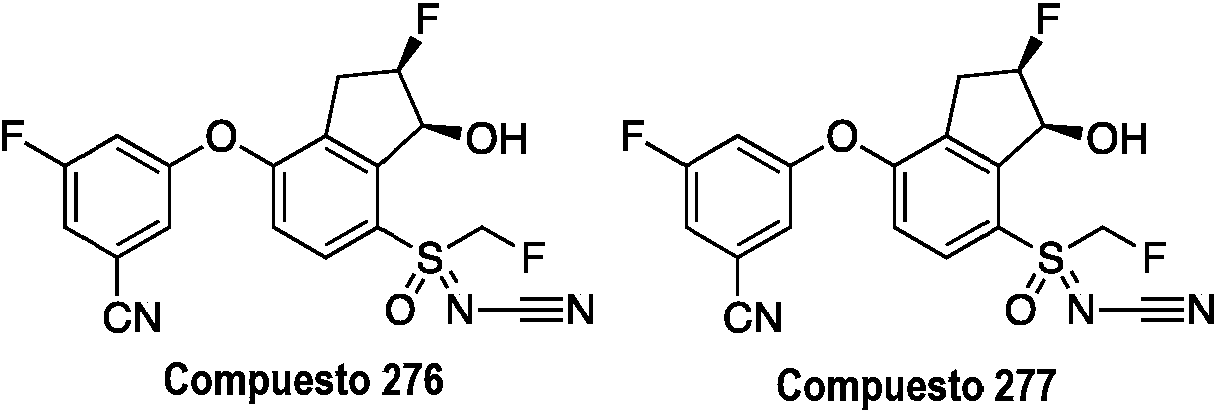
Isómero 1 de N-(((2R3S)-7-(3-ciano-5-fluorofenoxi)-2-fluoro-3-hidroxi-2,3-dihidro-1H-inden-4-il)(fluorometil)(oxo)-Á6-sulfanilideno)c¡anam¡da (Compuesto 276) e isómero 2 de N-(((2R,3S)-7-(3-ciano-5-fluorofenoxi)-2-fluoro-3-hidroxi-2,3-dihidro-1H-inden-4-il)(fluorometil)(oxo)-Á6-sulfanilideno)cianamida (Compuesto 277)Isomer 1 of N - (((2R3S) -7- (3-cyano-5-fluorophenoxy) -2-fluoro-3-hydroxy-2,3-dihydro-1H-inden-4-yl) (fluoromethyl) (oxo ) -Á6-sulfanylidene) cyanamide (Compound 276) and isomer 2 of N - (((2R, 3S) -7- (3-cyano-5-fluorophenoxy) -2-fluoro-3-hydroxy-2 , 3-dihydro-1H-inden-4-yl) (fluoromethyl) (oxo) -Á6-sulfanylidene) cyanamide (Compound 277)
Etapa A: Preparación de N-((7-(3-ciano-5-fluorofenoxi)-2-fluoro-3-oxo-2,3-dihidro-1H-inden-4-il)fluorometil)(oxo)-Á6-sulfanilideno)cianamida: Una solución de W-((7-(3-ciano-5-fluorofenoxi)-3-oxo-2,3-dihidro-1H-inden-4-il)(fluorometil)(oxo)-Á6-sulfanilideno)cianamida (103 mg, 0,27 mmol) en acetonitrilo (3,0 ml) se trató con Accufluor® (171 mg, 0,27 mmol) y se calentó a 84 °C durante 3 horas. Se añadió una porción más de Accufluor® (171 mg, 0,27 mmol) y la mezcla de reacción se calentó durante otras 3 horas. La mezcla de reacción se vertió en 40 ml de agua y se extrajo con EtOAc 3 x 15 ml. Los extractos orgánicos combinados se aclararon con 10 ml de salmuera, se secaron con MgSO4, se filtraron y se concentraron a sequedad. El residuo se purificó por cromatografía sobre sílice usando 20-55 % de EtOAc/hexano para proporcionar W-((7-(3-ciano-5-fluorofenoxi)-2-fluoro-3-oxo-2,3-dihidro-1H-inden-4-il)(fluorometil)(oxo)-Á6-sulfanilideno)cianamida (51 mg, 47 %). LCMS ESI (+) (M+H) m/z 406.Step A: Preparation of N - ((7- (3-cyano-5-fluorophenoxy) -2-fluoro-3-oxo-2,3-dihydro-1H-inden-4-yl) fluoromethyl) (oxo) -Á6 -sulfanylidene) cyanamide: A solution of W - ((7- (3-cyano-5-fluorophenoxy) -3-oxo-2,3-dihydro-1H-inden-4-yl) (fluoromethyl) (oxo) -Á6 -sulfanylidene) cyanamide (103 mg, 0.27 mmol) in acetonitrile (3.0 ml) was treated with Accufluor® (171 mg, 0.27 mmol) and heated at 84 ° C for 3 hours. A further portion of Accufluor® (171 mg, 0.27 mmol) was added and the reaction mixture was heated for another 3 hours. The reaction mixture was poured into 40 ml of water and extracted with 3 x 15 ml EtOAc. The combined organic extracts were rinsed with 10 ml of brine, dried over MgSO4, filtered, and concentrated to dryness. The residue was purified by chromatography on silica using 20-55% EtOAc / hexane to provide W - ((7- (3-cyano-5-fluorophenoxy) -2-fluoro-3-oxo-2,3-dihydro-1H -inden-4-yl) (fluoromethyl) (oxo) -Á6-sulfanylidene) cyanamide (51 mg, 47%). LCMS ESI (+) (M + H) m / z 406.
Etapa B: Preparación de N-(((2R,3S)-7-(3-ciano-5-fluorofenoxi)-2-fluoro-3-hidroxi-2,3-dihidro-1H-inden-4-il)(fluorometil)(oxo)-Á6-sulfanilideno)cianamida: Una solución de W-((7-(3-ciano-5-fluorofenoxi)-2-fluoro-3-oxo-2,3-dihidro-1H-inden-4-il)(fluorometil)(oxo)-Á6-sulfanilideno)cianamida (50,6 mg, 0,125 mmol) en diclorometano (4,0 ml) se enfrió a 0 °C y se roció con nitrógeno durante 5 minutos. Durante este tiempo se añadieron secuencialmente ácido fórmico (14,1 pl, 0,375 mmol) y trietilamina (34,6 pl, 0,250 mmol). Una vez se completó el rociado, se añadió RuCl(p-cimeno)[(R,R)-Ts-DPEN] (2,4 mg, 3 mol %) en una corriente continua de nitrógeno. El recipiente de reacción se cerró herméticamente y se mantuvo a 4 °C durante una noche. La mezcla de reacción se vertió en 10 ml de NaHCO3 acuoso saturado y se extrajo con CH2Cl2 3x15 ml. Los extractos orgánicos combinados se aclararon con 10 ml de salmuera, se secaron con MgSO4, se filtraron y se concentraron a sequedad. La purificación por cromatografía sobre sílice usando 15-55 % de EtOAc/hexano (25 g Biotage Ultra) proporcionó dos isómeros.Step B: Preparation of N - (((2R, 3S) -7- (3-cyano-5-fluorophenoxy) -2-fluoro-3-hydroxy-2,3-dihydro-1H-inden-4-yl) ( Fluoromethyl) (oxo) -Á6-sulfanylidene) cyanamide: A solution of W - ((7- (3-cyano-5-fluorophenoxy) -2-fluoro-3-oxo-2,3-dihydro-1H-inden-4 -yl) (fluoromethyl) (oxo) -A6-sulfanylidene) cyanamide (50.6 mg, 0.125 mmol) in dichloromethane (4.0 ml) was cooled to 0 ° C and sparged with nitrogen for 5 minutes. During this time, formic acid (14.1 µl, 0.375 mmol) and triethylamine (34.6 µl, 0.250 mmol) were added sequentially. After the sparging was complete, RuCl (p-cymene) [(R, R) -Ts-DPEN] (2.4 mg, 3 mol%) was added in a continuous stream of nitrogen. The reaction vessel was sealed and kept at 4 ° C overnight. The reaction mixture was poured into 10 ml of saturated aqueous NaHCO 3 and extracted with CH 2 Cl 2 3x15 ml. The combined organic extracts were rinsed with 10 ml of brine, dried over MgSO 4 , filtered, and concentrated to dryness. Purification by chromatography on silica using 15-55% EtOAc / hexane (25 g Biotage Ultra) provided two isomers.
Datos para el isómero 1 (Compuesto 276): 5,8 mg (11 % de rendimiento); Tiempo de retención de la HPLC (método largo) = 4,46 min; LCMS ESI (+) (M+H) m/z 408; RMN 1H (400 MHz, CDCh): 88,00 (d, 1H), 7,30 (ddd, 1H), 7,21 7,19 (m, 1H), 7,09 (dt, 1H), 6,99 (d, 1H), 5,92 (dd, 1H), 5,76-5,69 (m, 1H), 5,65 (dd, 1H), 5,55-5,37 (m, 1H), 3,43-3,18 (m, 2H), 3,22 (dd, 1H).Data for isomer 1 (Compound 276): 5.8 mg (11% yield); HPLC retention time (long method) = 4.46 min; LCMS ESI (+) (M + H) m / z 408; 1H NMR (400 MHz, CDCh): 88.00 (d, 1H), 7.30 (ddd, 1H), 7.21 7.19 (m, 1H), 7.09 (dt, 1H), 6, 99 (d, 1H), 5.92 (dd, 1H), 5.76-5.69 (m, 1H), 5.65 (dd, 1H), 5.55-5.37 (m, 1H) , 3.43-3.18 (m, 2H), 3.22 (dd, 1H).
Datos para el isómero 2 (Compuesto 277): 7,8 mg (15 % de rendimiento); Tiempo de retención de la HPLC (método largo) = 4,58 min; LCMS ESI (+) (M+H) m/z 408; RMN 1H (400 MHz, CDCh): 88,04 (d, 1H), 7,31 (ddd, 1H), 7,24 7,22 (m, 1H), 7,11 (dt, 1H), 7,00 (d, 1H), 6,27 (dd, 1H), 5,75-5,69 (m, 1H), 5,55 (dd, 1H), 5,56-5,39 (m, 1H), 3,45-3,22 (m, 2H), 3,12 (t, 1H). Data for isomer 2 (Compound 277): 7.8 mg (15% yield); HPLC retention time (long method) = 4.58 min; LCMS ESI (+) (M + H) m / z 408; 1H NMR (400 MHz, CDCh): 88.04 (d, 1H), 7.31 (ddd, 1H), 7.24 7.22 (m, 1H), 7.11 (dt, 1H), 7, 00 (d, 1H), 6.27 (dd, 1H), 5.75-5.69 (m, 1H), 5.55 (dd, 1H), 5.56-5.39 (m, 1H) , 3.45-3.22 (m, 2H), 3.12 (t, 1H).
Ejemplo de referencia 278Reference Example 278

(C/s-7-(3-c¡ano-5-fluorofenox¡)-3-h¡drox¡-4-((tr¡fluoromet¡l)sulfon¡l)-2.3-d¡h¡dro-1H-¡nden-1-¡l)carbamato de tere-butilo (Compuesto 278)(C / s-7- (3-cyano-5-fluorophenox¡) -3-hydrox¡-4 - ((tr¡fluorometh¡l) sulfon¡l) -2.3-d¡h¡dro- Tere-butyl 1H-nden-1-l) carbamate (Compound 278)
Etapa A: Preparac¡ón de 3-bromo-4-(3-bromo-5-fluorofenox¡)-7-((tr¡fluoromet¡l)sulfon¡l)-2.3-d¡h¡droesp¡ro[¡nden-1,2'-[1.31d¡oxolano1: El mater¡al de part¡da éter de d¡ar¡lo, 4-(3-bromo-5-fluorofenox¡)-7-((tr¡fluoromet¡l)sulfon¡l)-2.3-d¡h¡droesp¡ro[¡nden-1.2'-[1.3]d¡oxolano]. se preparó de forma s¡m¡lar de acuerdo con el ejemplo de referenc¡a 212, etapas A-B. sust¡tuyendo 3-bromo-5-fluorofenol por 4-fluorofenol. Una soluc¡ón de 4'-(3-bromo-5-fluoro-fenox¡)-7'-(tr¡fluoromet¡lsulfon¡l)esp¡ro[1.3-d¡oxolan-2.1'-¡ndano] (930 mg. 1.87 mmol) y W-bromosucc¡n¡m¡da (399 mg.Step A: Preparation of 3-bromo-4- (3-bromo-5-fluorophenox¡) -7 - ((tr¡fluorometal) sulfon¡l) -2.3-d¡h¡droesp¡ro [¡ nden-1,2 '- [1.31d¡oxolane1: The starting material d¡ar¡ ether, 4- (3-bromo-5-fluorophenoxy) -7 - ((tr¡fluoromet¡ l) sulfonil) -2.3-dihydrospiro [inden-1.2 '- [1.3] dioxolane]. was prepared in a similiar manner according to Reference Example 212, steps A-B. substituting 3-bromo-5-fluorophenol for 4-fluorophenol. A solution of 4 '- (3-bromo-5-fluoro-phenox¡) -7' - (tr¡fluorometh¡lsulfon¡l) sp¡ro [1,3-d¡oxolan-2.1'-indan] ( 930 mg. 1.87 mmol) and W-bromosuccinum (399 mg.
2.24 mmol) en tetracloruro de carbono (12.5 ml) se roc¡ó con n¡trógeno durante 5 m¡nutos y se trató con peróx¡do de benzoílo (91 mg. 0.37 mmol). El rec¡p¡ente de reacc¡ón se equ¡pó con un condensador de reflujo. El condensador se lavó con n¡trógeno durante 5 m¡nutos. Después se cerró hermét¡camente el rec¡p¡ente. se colocó en atmósfera de n¡trógeno y se ag¡tó a 88 °C durante 1 día. Se añad¡ó otra porc¡ón de peróx¡do de benzoílo (91 mg. 0.37 mmol) y la reacc¡ón se calentó durante un día más. La mezcla de reacc¡ón se vert¡ó en 10 ml de NaOH 1 M y se extrajo con CH2Cl2 3 x 20 ml. Los extractos orgán¡cos comb¡nados se aclararon con 10 ml de salmuera. se secaron con MgSO4. se f¡ltraron y se concentraron a sequedad. Se real¡zó pur¡f¡cac¡ón por cromatografía sobre síl¡ce usando 20-70 % de CH2Cl2/hexano para proporc¡onar 3-bromo-4-(3-bromo-5-fluorofenox¡)-7-((tr¡fluoromet¡l)sulfon¡l)-2.3-d¡h¡droesp¡ro[¡nden-1.2'-[1.3]d¡oxolano1 (448 mg. 42 %). LCMS ESI (+) (M+H) m/z: 575. 577. 579.2.24 mmol) in carbon tetrachloride (12.5 ml) was sparged with nitrogen for 5 minutes and treated with benzoyl peroxide (91 mg, 0.37 mmol). The reaction vessel was equipped with a reflux condenser. The condenser was flushed with nitrogen for 5 minutes. The container was then hermetically sealed. It was placed under a nitrogen atmosphere and stirred at 88 ° C for 1 day. Another portion of benzoyl peroxide (91 mg, 0.37 mmol) was added and the reaction heated for an additional day. The reaction mixture was poured into 10 ml of 1 M NaOH and extracted with CH 2 Cl 2 3 x 20 ml. The combined organic extracts were rinsed with 10 ml of brine. dried over MgSO 4 . they were filtered and concentrated to dryness. Purification was performed by chromatography on silica using 20-70% CH 2 Cl 2 / hexane to provide 3-bromo-4- (3-bromo-5-fluorophenoxy) - 7 - ((trifluoromethyl) sulfonil) -2.3-dihydrospiro [inden-1.2 '- [1.3] dioxolane1 (448 mg, 42%). LCMS ESI (+) (M + H) m / z: 575,577,579.
Etapa B: Preparac¡ón de 3-az¡do-4-(3-bromo-5-fluorofenox¡)-7-((tr¡fluoromet¡l)sulfon¡l)-2.3-d¡h¡droesp¡ro[¡nden-1.2'-[1.31d¡oxolano1: Una soluc¡ón de 3-bromo-4-(3-bromo-5-fluorofenox¡)-7-((tr¡fluoromet¡l)sulfon¡l)-2.3-d¡h¡droesp¡ro[¡nden-1,2'-[1,3]d¡oxolano] (448 mg. 0.78 mmol) en DMF (4.0 ml) a 25 °C se trató con az¡da sód¡ca (50.6 mg. 0.78 mmol) y se ag¡tó a 25 °C durante 1 hora. La mezcla de reacc¡ón se vert¡ó en 40 ml de agua y se extrajo con Et2O 3x15 ml. Los extractos orgán¡cos comb¡nados se aclararon con 10 ml de salmuera. se secaron con MgSO4. se f¡ltraron y se concentraron a sequedad. El res¡duo se ut¡l¡zó s¡n más pur¡f¡cac¡ón. LCMS ESI (+) (M-N2+H) m/z: 510. 512.Step B: Preparation of 3-az¡do-4- (3-bromo-5-fluorophenox¡) -7 - ((tr¡fluorome¡l) sulfon¡l) -2.3-d¡h¡droesp¡ro [Inden-1.2 '- [1.31d¡oxolane1: A solution of 3-bromo-4- (3-bromo-5-fluorophenox¡) -7 - ((tr¡fluorometal) sulfon¡l) - 2.3-dihydrospiro [inden-1,2 '- [1,3] dioxolane] (448 mg. 0.78 mmol) in DMF (4.0 ml) at 25 ° C was treated with azide sodium (50.6 mg. 0.78 mmol) and stirred at 25 ° C for 1 hour. The reaction mixture was poured into 40 ml of water and extracted with Et 2 O 3x15 ml. The combined organic extracts were rinsed with 10 ml of brine. dried over MgSO 4 . they were filtered and concentrated to dryness. The waste was used even more purification. LCMS ESI (+) (MN 2 + H) m / z: 510.512.
Etapa C: Preparac¡ón de 4-(3-bromo-5-fluorofenox¡)-7-((tr¡fluoromet¡l)sulfon¡l)-2.3-d¡h¡droesp¡ro[¡nden-1.2'-[1.31d¡oxolan1-3-am¡na: Una soluc¡ón de 3-az¡do-4-(3-bromo-5-fluorofenox¡)-7-((tr¡fluoromet¡l)sulfon¡l)-2.3-d¡h¡droesp¡ro[¡nden-1.2'-[1.31d¡oxolano1 (675 mg. 1.25 mmol) en una mezcla de tetrah¡drofurano (6.0 ml) y agua (0.4 ml) a 25 °C se trató con soluc¡ón de tr¡met¡lfosf¡na (~1.0 M en THF. 1.5 ml. 1.5 mmol) y se ag¡tó durante 30 m¡nutos. Durante este t¡empo se observó la evoluc¡ón del gas. La mezcla de reacc¡ón se calentó a 60 °C durante 2 h. Los volát¡les se el¡m¡naron por concentrac¡ón a pres¡ón reduc¡da. El res¡duo resultante se secó a alto vacío durante una noche. Se real¡zó pur¡f¡cac¡ón por cromatografía sobre síl¡ce usando 1-9 % de MeOH/CH2Cl2 + 1 % de NH4OH para proporc¡onar 4-(3-bromo-5-fluorofenox¡)-7-((tr¡fluoromet¡l)sulfon¡l)-2.3-d¡h¡droesp¡ro[¡nden-1.2'-[1.31d¡oxolan1-3-am¡na (630 mg. 98 %). LCMS ESI (+) (M+H) m/z: 512. 514.Step C: Preparation of 4- (3-bromo-5-fluorophenox¡) -7 - ((tr¡fluorometal) sulfon¡l) -2.3-d¡h¡droesp¡ro [inden-1.2 ' - [1.31d¡oxolan1-3-amine: A solution of 3-az¡do-4- (3-bromo-5-fluorophenox¡) -7 - ((tr¡fluorometal) sulfon¡l ) -2.3-d¡h¡droesp¡ro [inden-1.2 '- [1.31d¡oxolane1 (675 mg, 1.25 mmol) in a mixture of tetrahydrofuran (6.0 ml) and water (0.4 ml) at 25 ° C was treated with trimethyl phosphine solution (~ 1.0 M in THF. 1.5 ml. 1.5 mmol) and stirred for 30 minutes. During this time the evolution of the gas was observed. The reaction mixture was heated at 60 ° C for 2 h. The volatiles were eliminated by concentration under reduced pressure. The resulting residue was dried under high vacuum overnight. Purification was performed by chromatography on silica using 1-9% MeOH / CH 2 Cl 2 + 1% NH 4 OH to provide 4- (3-bromo-5-fluorophenox ¡) -7 - ((tr¡fluorometal) sulfon¡l) -2.3-d¡h¡droesp¡ro [¡nden-1.2 '- [1.31d¡oxolan1-3-amine (630 mg. 98 %). LCMS ESI (+) (M + H) m / z: 512.514.
Etapa D: Preparac¡ón de (4-(3-bromo-5-fluorofenox¡)-7-((tr¡fluoromet¡l)sulfon¡l)-2.3-d¡h¡droesp¡ro[¡nden-1.2'-[1.31d¡oxolan1-3-¡¡)carbamato de (ere-but¡lo: Una soluc¡ón de 4-(3-bromo-5-fluorofenox¡)-7-((tr¡fluoromet¡l)sulfon¡l)-2.3-d¡h¡droesp¡ro[¡nden-1.2'-[1.31d¡oxolan1-3-am¡na (65 mg. 0.13 mmol) en d¡clorometano (2.0 ml) a 25 °C se trató con p¡rocarbonato de d¡-tere-but¡lo (30.5 mg. 0.14 mmol) y se ag¡tó durante una noche. Se el¡m¡naron los volát¡les med¡ante concentrac¡ón a pres¡ón reduc¡da. El res¡duo del producto se usó s¡n más pur¡f¡cac¡ón. LCMS ESI (-) (M-H) m/z: 610. 612.Step D: Preparation of (4- (3-bromo-5-fluorophenox¡) -7 - ((tr¡fluorometal) sulfon¡l) -2.3-d¡h¡droesp¡ro [inden-1.2 '- [1.31d¡oxolan1-3-¡¡) carbamate of (ere-but¡lo: A solution of 4- (3-bromo-5-fluorophenoxy) -7 - ((tr¡fluoromethyl) sulfon¡l) -2.3-d¡h¡droesp¡ro [¡nden-1.2 '- [1.31d¡oxolan1-3-amine (65 mg, 0.13 mmol) in d¡chloromethane (2.0 ml) at 25 ° C was treated with di-tere-butyl pyrocarbonate (30.5 mg, 0.14 mmol) and stirred overnight. The volatiles were removed by concentration at pressure. Reduced ion The product residue was used without further purification LCMS ESI (-) (MH) m / z: 610.612.
Etapa E: Preparac¡ón de (7-(3-bromo-5-fluorofenox¡)-3-oxo-4-((tr¡fluoromet¡l)sulfon¡l)-2.3-d¡h¡dro-1H-¡nden-1-¡l)carbamato de (ere-but¡lo: En un tubo de pres¡ón. se d¡solv¡ó una muestra de (4-(3-bromo-5-fluorofenox¡)-7-((tr¡fluoromet¡l)sulfon¡l)-2.3-d¡h¡droesp¡ro[¡nden-1.2'-[1.31d¡oxolan1-3-¡l)carbamato de (ere-but¡lo (77 mg. 0.13 mmol) en una mezcla de ác¡do acét¡co (1.0 ml). tetrah¡drofurano (0.5 ml) y agua (0.5 ml). La mezcla de reacc¡ón se cerró hermét¡camente y se calentó a 80 °C durante 14 horas. El anál¡s¡s por LCMS ¡nd¡ca una reacc¡ón relat¡vamente l¡mp¡a con formac¡ón del producto deseado. mater¡al de part¡da s¡n reacc¡onar y predom¡nando los correspond¡entes mater¡ales no proteg¡dos por Boc. Se el¡m¡naron los volát¡les med¡ante concentrac¡ón a pres¡ón reduc¡da. El res¡duo sobrante se vert¡ó en 20 ml de NaHCO3 saturado y se extrajo con EtOAc 3 x 15 ml. Los extractos orgán¡cos comb¡nados se aclararon con 10 ml de salmuera. se secaron con MgSO4. se f¡ltraron y se concentraron a sequedad. El res¡duo se d¡solv¡ó en 3 ml de CH2Cl2 y se trató con p¡rocarbonato de d¡-tere-but¡lo (13.8 mg. 0.063 mmol). La mezcla se dejó en ag¡tac¡ón durante una noche. Se el¡m¡naron los volát¡les med¡ante concentrac¡ón a pres¡ón reduc¡da. Se real¡zó pur¡f¡cac¡ón por cromatografía sobre síl¡ce usando 5-35 % de EtOAc/hexano para proporc¡onar (7-(3-bromo-5-fluorofenox¡)-3-oxo-4-((tr¡fluoromet¡l)sulfon¡l)-2.3-d¡h¡dro-1 H-¡nden-1-¡l)carbamato de tere-but¡lo (50 mg. 70 %). LCMS ESI (-) (M-H) m/z: 566. 568. Step E: Preparation of (7- (3-bromo-5-fluorophenoxy) -3-oxo-4 - ((trifluoromethyl) sulfonil) -2.3-dihydro-1H- Inden-1-¡l) carbamate of (ere-butylo): In a pressure tube, a sample of (4- (3-bromo-5-fluorophenoxy) -7- ((tr¡fluorometal) sulfon¡l) -2.3-d¡h¡droesp¡ro [¡nden-1.2 '- [1.31d¡oxolan1-3-¡l) carbamate of (ere-but¡lo (77 0.13 mmol) in a mixture of acetic acid (1.0 ml), tetrahydrofuran (0.5 ml) and water (0.5 ml). The reaction mixture was sealed and heated to 80 ° C for 14 hours. LCMS analysis indicates a relatively clean reaction with formation of the desired product. Starting material without reaction. the corresponding material not protected by Boc predominated and the volatics were eliminated by means of concentration under reduced pressure. The excess residue was discharged In 20 ml of saturated NaHCO 3 and extracted with 3 x 15 ml EtOAc The combined organic extracts were rinsed with 10 ml of brine, dried over MgSO 4 , filtered and concentrated to dryness. The residue was dissolved in 3 ml of CH 2 Cl 2 and treated with di-tere-butyl picarbonate (13.8 mg, 0.063 mmol). The mixture was allowed to stir overnight. The volatiles were removed by concentration under reduced pressure. Purification was performed by chromatography on silica using 5-35% EtOAc / hexane to provide (7- (3-bromo-5-fluorophenoxy) -3-oxo-4- ((trifluoromethyl) sulfonil) -2.3-dihydro-1H-nden-1-il) tere-butyl carbamate (50 mg. 70%). LCMS ESI (-) (MH) m / z: 566.568.
Etapa F: Preparación de (c/s-7-(3-bromo-5-fluorofenox¡)-3-h¡drox¡-4-((tr¡fluoromet¡l)sulfon¡l)-2.3-d¡hidro-1H-¡nden-1-¡l)carbamato de tere-butilo: Una soluc¡ón de (7-(3-bromo-5-fluorofenox¡)-3-oxo-4-((trifluoromet¡l)sulfon¡l)-2.3-dihidro-1H-¡nden-1-¡l)carbamato de ferc-butilo (50 mg. 0.088 mmol) en metanol (2.0 ml) a 25 °C se trató con borohidruro sódico (3.3 mg. 0.088 mmol) y se agitó a 25 °C durante 1 hora. La mezcla de reacción se inactivó mediante la adición de 0.5 ml de NH4Cl acuoso saturado y se agitó durante 5 minutos. Se eliminaron los volátiles mediante concentración a presión reducida. La mezcla de reacción se vertió en 10 ml de agua y se extrajo con EtOAc 3x10 ml. Los extractos orgánicos combinados se aclararon con 10 ml de salmuera. se secaron con MgSO4. se filtraron y se concentraron a sequedad. Se realizó purificación por cromatografía sobre sílice usando 10-35 % de EtOAc/hexano para proporcionar (c/s-7-(3-bromo-5-fluorofenoxi)-3-h¡drox¡-4-((tr¡fluoromet¡l)sulfon¡l)-2.3-dihidro-1H-¡nden-1-¡l)carbamato de ferc-butilo (25 mg. 50 %) en forma de una película sólida transparente. LCMS ESI (-) (M-H) m/z: 568. 570.Step F: Preparation of (c / s-7- (3-bromo-5-fluorophenox¡) -3-hydrox¡-4 - ((tr¡fluorometh¡l) sulfon¡l) -2.3-d¡hydro -1H-nden-1-¡l) tere-butyl carbamate: A solution of (7- (3-bromo-5-fluorophenoxy) -3-oxo-4 - ((trifluoromethyl) sulfon¡ l) -2.3-dihydro-1H-inden-1-¡l) tert-butyl carbamate (50 mg. 0.088 mmol) in methanol (2.0 ml) at 25 ° C was treated with sodium borohydride (3.3 mg. 0.088 mmol ) and stirred at 25 ° C for 1 hour. The reaction mixture was quenched by adding 0.5 ml of saturated aqueous NH 4 Cl and stirred for 5 minutes. Volatiles were removed by concentration under reduced pressure. The reaction mixture was poured into 10 ml of water and extracted with 3x10 ml EtOAc. The combined organic extracts were rinsed with 10 ml of brine. dried over MgSO 4 . filtered and concentrated to dryness. Purification was performed by chromatography on silica using 10-35% EtOAc / hexane to provide (c / s-7- (3-bromo-5-fluorophenoxy) -3-hydroxy-4 - ((trifluoromethyl) l) sulfonil) -2,3-dihydro-1H-nden-1-µl) tert-butyl carbamate (25 mg, 50%) as a transparent solid film. LCMS ESI (-) (MH) m / z: 568.570.
Etapa G: Preparación de (c¡s-7-(3-c¡ano-5-fluorofenox¡)-3-h¡drox¡-4-((tr¡fluorometil)sulfon¡l)-2.3-d¡h¡dro-1H-¡nden-1-il)carbamato de terc-butilo (Compuesto 278): Una solución de (c/s-7-(3-bromo-5-fluorofenoxi)-3-hidrox¡-4-((trifluoromet¡l)sulfon¡l)-2.3-d¡h¡dro-1H-inden-1-¡l)carbamato de ferc-butilo (20.5 mg. 0.036 mmol) y cianuro de cinc (4.6 mg. 0.04 mmol) en DMF (0.36 ml) se roció con nitrógeno durante 3 minutos. Después se trató la mezcla de reacción secuencialmente con aducto de dicloro[1;1'-b¡s(d¡fen¡lfosfino)ferroceno]palad¡o (II) y diclorometano (2.9 mg. 10 mol %) y polvo de cinc (2.8 mg. 0.043 mmol) en corriente continua de nitrógeno. El recipiente se cerró herméticamente y se calentó a 110 °C durante 4 horas. La mezcla de reacción se vertió en 30 ml de agua y se extrajo con Et2O 3 x 10 ml. Los extractos orgánicos combinados se aclararon con 10 ml de salmuera. se secaron con MgSO4. se filtraron y se concentraron a sequedad. Se realizó purificación por cromatografía sobre sílice usando 5-30 % de EtOAc/hexano para proporcionar el compuesto 278 en forma de un sólido de color blanco (13.4 mg. 72 %). LCMS ESI (-) (M+Cl-) m/z: 551. 553; RMN 1H (400 MHz. CDCla): 87.97 (d. 1H). 7.27 7.23 (m. 1H). 7.17-7.13 (m. 1H). 7.07 (dt. 1H). 7.02 (d. 1H). 5.54 (dd. 1H). 5.49-5.41 (m. 1H). 5.12 (d a. 1H). 3.33 (s a. 1H). 2.73-2.64 (m. 1H). 2.22 (d. 1H). 1.35 (s. 9H).Step G: Preparation of (c¡s-7- (3-kano-5-fluorophenox¡) -3-hydrox¡-4 - ((tr¡fluoromethyl) sulfon¡l) -2.3-d¡h Tert-butyl dro-1H-nden-1-yl) carbamate (Compound 278): A solution of (c / s-7- (3-bromo-5-fluorophenoxy) -3-hydroxy-4- ( (trifluoromethyl) sulfonil) -2.3-dihydro-1H-inden-1-¡l) tert-butyl carbamate (20.5 mg, 0.036 mmol) and zinc cyanide (4.6 mg, 0.04 mmol) in DMF (0.36 ml) sparged with nitrogen for 3 minutes. The reaction mixture was then treated sequentially with dichloro [1,1'-b¡s (diphephosphino) ferrocene] palladium (II) adduct and dichloromethane (2.9 mg, 10 mol%) and zinc powder (2.8 mg. 0.043 mmol) in a continuous stream of nitrogen. The container was sealed and heated at 110 ° C for 4 hours. The reaction mixture was poured into 30 ml of water and extracted with Et 2 O 3 x 10 ml. The combined organic extracts were rinsed with 10 ml of brine. dried over MgSO 4 . filtered and concentrated to dryness. Purification was performed by chromatography on silica using 5-30% EtOAc / hexane to provide compound 278 as a white solid (13.4 mg, 72%). LCMS ESI (-) (M + Cl-) m / z: 551,553; 1H NMR (400 MHz. CDCla): 87.97 (d. 1H). 7.27 7.23 (m. 1H). 7.17-7.13 (m. 1H). 7.07 (dt. 1H). 7.02 (d. 1H). 5.54 (dd. 1H). 5.49-5.41 (m. 1H). 5.12 (d a.1H). 3.33 (bs 1H). 2.73-2.64 (m. 1H). 2.22 (d. 1H). 1.35 (s. 9H).
Ejemplo de referencia 279Reference Example 279

3-((c/s-3-am¡no-1-h¡drox¡-7-((tr¡fluoromet¡l)sulfon¡l)-2.3-d¡h¡dro-1H-¡nden-4-il)ox¡)-5-fluorobenzon¡tr¡lo (Compuesto 279): Una solución de (c/s-7-(3-c¡ano-5-fluorofenoxi)-3-h¡drox¡-4-((tr¡fluoromet¡l)sulfon¡l)-2.3-d¡h¡dro-1H-¡nden-1-il)carbamato de ferc-butilo (10.5 mg. 0.020 mmol) en diclorometano (0.5 ml) a 25 °C se trató con ácido trifluoroacético (0.5 ml) y se agitó a 25 °C durante 1 hora. Se eliminaron los volátiles mediante concentración a presión reducida. La mezcla de reacción se vertió en 10 ml de NaHCO3 acuoso saturado y se extrajo con alcohol isopropílico al 30 % en CHCh 3 x 10 ml. Los extractos orgánicos combinados se aclararon con 10 ml de salmuera. se secaron con MgSO4. se filtraron y se concentraron a sequedad para proporcionar el compuesto 279 (6.5 mg. 77 %). LCMS ESI (+) (M+H) m/z 417; RMN 1H (400 MHz. CDCla): 87.93 (d. 1H). 7.31 (ddd. 1H). 7.26-7.24 (m. 1H). 7.16 (dt. 1H). 6.94 (d. 1H). 5.53 (d. 1H). 4.59 (d. 1H). 2.69-2.61 (m. 1H). 2.35-1.95 (m. 4H).3 - ((c / s-3-am¡no-1-h¡drox¡-7 - ((tr¡fluorometh¡l) sulfon¡l) -2.3-d¡h¡dro-1H-inden-4 -yl) oxy) -5-fluorobenzonetrilo (Compound 279): A solution of (c / s-7- (3-cyano-5-fluorophenoxy) -3-hydroxy-4- ((tr¡fluoromethyl) sulfon¡l) -2.3-d¡hydro-1H-inden-1-yl) tert-butyl carbamate (10.5 mg, 0.020 mmol) in dichloromethane (0.5 ml) at 25 ° C was treated with trifluoroacetic acid (0.5 ml) and stirred at 25 ° C for 1 hour. Volatiles were removed by concentration under reduced pressure. The reaction mixture was poured into 10 ml of saturated aqueous NaHCO 3 and extracted with 30% isopropyl alcohol in CHCh 3 x 10 ml. The combined organic extracts were rinsed with 10 ml of brine. dried over MgSO 4 . filtered and concentrated to dryness to provide compound 279 (6.5 mg, 77%). LCMS ESI (+) (M + H) m / z 417; 1H NMR (400 MHz. CDCla): 87.93 (d. 1H). 7.31 (ddd.1H). 7.26-7.24 (m. 1H). 7.16 (dt. 1H). 6.94 (d. 1H). 5.53 (d. 1H). 4.59 (d. 1H). 2.69-2.61 (m. 1H). 2.35-1.95 (m. 4H).
Ejemplos de referencia 280 y 281Reference Examples 280 and 281

4- (3-cloro-5-fluorofenox¡)-3-met¡len-7-(met¡lsulfonil)-2.3-d¡h¡dro-1H-¡nden-1-ol (Compuesto 280) y (1R3S)-4-(3-cloro-5- fluorofenox¡)-3-(h¡drox¡met¡l)-7-((tr¡fluoromet¡l)sulfonil)-2.3-d¡h¡dro-1H-¡nden-1-ol (Compuesto 281)4- (3-chloro-5-fluorophenoxy) -3-methylen-7- (methylsulfonyl) -2.3-dihydro-1H-inden-1-ol (Compound 280) and (1R3S ) -4- (3-chloro-5- fluorophenoxy) -3- (hydroxymethyl) -7 - ((tri-fluoromethyl) sulfonyl) -2.3-dihydro-1H- Inden-1-ol (Compound 281)
Etapa A: Preparación de 3.7-d¡bromo-4-fluoro-2.3-d¡h¡droesp¡ro[¡nden-1.2'-[1.31dioxolano1: Una solución de 7'-bromo-4'- fluoro-esp¡ro[1.3-d¡oxolan-2.1'-¡ndano] (2.55 g. 9.34 mmol) y AIBN (23 mg. 0.14 mmol) en tetracloruro de carbono (65 ml) se trató con N-bromosuccinimida (1.99 g. 11.2 mmol). La mezcla resultante se roció con nitrógeno durante 5 minutos. El recipiente de reacción se cerró herméticamente y se calentó a 80 °C durante 3 horas. La mezcla de reacción se vertió en 50 ml de agua y se extrajo con CH2CI2 3 x 30 ml. Los extractos orgánicos combinados se aclararon con 10 ml de salmuera, se secaron con MgSO4, se filtraron y se concentraron a sequedad. El producto se utilizó sin más purificación. RMN 1H (400 MHz, CDCh): 87,52 (dd, 1H), 6,98 (dt, 1H), 5,41 (dd, 1H), 4,47-4,33 (m, 2H), 4,19-4,08 (m, 2H), 2,91-2,88 (dd, 1H), 2,76 (dd, 1H).Step A: Preparation of 3.7-d¡bromo-4-fluoro-2.3-d¡h¡droesp¡ro [inden-1.2 '- [1.31dioxolane1: A solution of 7'-bromo-4'-fluoro-esp¡ ro [1.3-dioxolan-2.1'-indane] (2.55 g. 9.34 mmol) and AIBN (23 mg. 0.14 mmol) in carbon tetrachloride (65 ml) was treated with N-bromosuccinimide (1.99 g. 11.2 mmol ). The resulting mixture was sparged with nitrogen for 5 minutes. The reaction vessel was sealed and heated at 80 ° C for 3 hours. The reaction mixture was poured into 50 ml of water and extracted with CH 2 CI 2 3 x 30 ml. The combined organic extracts were rinsed with 10 ml of brine, dried over MgSO 4 , filtered, and concentrated to dryness. The product was used without further purification. 1H NMR (400 MHz, CDCh): 87.52 (dd, 1H), 6.98 (dt, 1H), 5.41 (dd, 1H), 4.47-4.33 (m, 2H), 4 , 19-4.08 (m, 2H), 2.91-2.88 (dd, 1H), 2.76 (dd, 1H).
Etapa B: Preparación de 7-bromo-4-fluoro-2.3-d¡h¡droesp¡ronnden-1.2'-H.31d¡oxolan1-3-carbon¡trilo: Una solución de 3,7-dibromo-4-fluoro-2,3-d¡h¡droesp¡ro[inden-1,2'-[1,3]d¡oxolano] (3,27 g, 9,3 mmol) en DMF (9,3 ml) se trató con cianuro de sodio (501 mg, 10,2 mmol) y se agitó a 60 °C durante una noche. La mezcla de reacción se vertió en 150 ml de agua y se extrajo con Et2O 3 x 50 ml. Los extractos orgánicos combinados se aclararon con 10 ml de salmuera, se secaron con MgSO4, se filtraron y se concentraron a sequedad. Se realizó purificación por cromatografía sobre sílice usando 10-40 % de EtOAc/hexano para proporcionar 7-bromo-4-fluoro-2,3-d¡h¡droesp¡ro[¡nden-1,2'-[1,3]dioxolano]-3-carbon¡tr¡lo (750 mg, 27 %). LCMS ESI (+) (M+H) m/z: 298, 300.Step B: Preparation of 7-bromo-4-fluoro-2.3-d¡h¡droesp¡ronnden-1.2'-H.31d¡oxolan1-3-carbon¡trile: A solution of 3,7-dibromo-4-fluoro -2,3-dihydrospiro [inden-1,2 '- [1,3] dioxolane] (3.27 g, 9.3 mmol) in DMF (9.3 ml) was treated with sodium cyanide (501 mg, 10.2 mmol) and stirred at 60 ° C overnight. The reaction mixture was poured into 150 ml of water and extracted with Et 2 O 3 x 50 ml. The combined organic extracts were rinsed with 10 ml of brine, dried over MgSO 4 , filtered, and concentrated to dryness. Purification was performed by chromatography on silica using 10-40% EtOAc / hexane to provide 7-bromo-4-fluoro-2,3-d¡drosp¡ro [inden-1,2 '- [1,3 ] dioxolane] -3-carbonitral (750 mg, 27%). LCMS ESI (+) (M + H) m / z: 298, 300.
Etapa C: Preparación de ácido 4-bromo-7-fluoro-3-oxo-2,3-dihidro-1H-inden-1-carboxílico: Una solución de 7-bromo-4-fluoro-2,3-d¡h¡droesp¡ro[¡nden-1,2'-[1,3]dioxolan]-3-carbon¡tr¡lo (166 mg, 0,56 mmol) en 1,4-dioxano (2,5 ml) se trató con solución acuosa concentrada de HCl (1,9 ml) y se agitó a 105 °C durante 1 hora. Se eliminaron los volátiles mediante concentración a presión reducida. La mezcla de reacción restante se vertió en 20 ml de agua y se extrajo con EtOAc 3 x 15 ml. Los extractos orgánicos combinados se aclararon con 10 ml de salmuera, se secaron con MgSO4, se filtraron y se concentraron a sequedad. El producto se usó sin más purificación. LCMS ESI (+) (M+H) m/z: 273, 275.Step C: Preparation of 4-bromo-7-fluoro-3-oxo-2,3-dihydro-1H-inden-1-carboxylic acid: A solution of 7-bromo-4-fluoro-2,3-d¡h Drospiro [Inden-1,2 '- [1,3] dioxolan] -3-carbonitral (166 mg, 0.56 mmol) in 1,4-dioxane (2.5 ml) was It was treated with concentrated aqueous HCl solution (1.9 ml) and stirred at 105 ° C for 1 hour. Volatiles were removed by concentration under reduced pressure. The remaining reaction mixture was poured into 20 ml of water and extracted with 3 x 15 ml EtOAc. The combined organic extracts were rinsed with 10 ml of brine, dried over MgSO 4 , filtered, and concentrated to dryness. The product was used without further purification. LCMS ESI (+) (M + H) m / z: 273, 275.
Etapa D: Preparación de c/s-7-bromo-4-fluoro-3-(hidroximetil)-2,3-dihidro-1H-inden-1-ol: Una solución de ácido 4-bromo-7-fluoro-3-oxo-2,3-dihidro-1H-inden-1-carboxílico (581 mg, 2,1 mmol) en tetrahidrofurano (10,6 ml) se trató con complejo de borano y sulfuro de dimetilo (504 pl, 5,3 mmol). La mezcla resultante se agitó a 70 °C durante 1 hora. La mezcla de reacción se enfrió y se añadió una porción más de complejo de borano y sulfuro de dimetilo (504 pl, 5,3 mmol). La mezcla de reacción se calentó a 80 °C durante 2 horas. Después de enfriar a temperatura ambiente, la mezcla de reacción se inactivó mediante la adicción cuidadosa gota a gota de agua. Una vez cesó la efervescencia, la mezcla de reacción se vertió en 20 ml de NaHCO3 acuoso saturado y se extrajo con alcohol isopropílico al 30 % en CHCh 4 x 10 ml. Los extractos orgánicos combinados se aclararon con 10 ml de salmuera, se secaron con MgSO4, se filtraron y se concentraron a sequedad. Se realizó purificación por cromatografía sobre sílice usando 15-80 % de EtOAc/hexano para proporcionar c/s-7-bromo-4-fluoro-3-(hidroximetil)-2,3-dihidro-1H-inden-1-ol (210 mg, 38 %). RMN 1H (400 MHz, CDCla): 87,36 (dd, 1H), 6,87 (dt, 1H), 5,13-5,06 (m, 1H), 4,00 (dd, 1H), 3,91-3,83 (m, 1H), 3,81 (dd, 1H), 3,66-3,60 (m, 1H), 2,68-2,58 (m, 1H), 2,60 (ddd, 1H), 2,00 (d, 1H).Step D: Preparation of c / s-7-bromo-4-fluoro-3- (hydroxymethyl) -2,3-dihydro-1H-inden-1-ol: A solution of 4-bromo-7-fluoro-3 acid -oxo-2,3-dihydro-1H-inden-1-carboxylic acid (581 mg, 2.1 mmol) in tetrahydrofuran (10.6 ml) was treated with borane dimethyl sulfide complex (504 μl, 5.3 mmol). The resulting mixture was stirred at 70 ° C for 1 hour. The reaction mixture was cooled and a further portion of borane dimethyl sulfide complex (504 µl, 5.3 mmol) was added. The reaction mixture was heated at 80 ° C for 2 hours. After cooling to room temperature, the reaction mixture was quenched by the careful dropwise addition of water. After effervescence ceased, the reaction mixture was poured into 20 ml of saturated aqueous NaHCO 3 and extracted with 30% isopropyl alcohol in 4 x 10 ml CHCh. The combined organic extracts were rinsed with 10 ml of brine, dried over MgSO 4 , filtered, and concentrated to dryness. Purification was performed by chromatography on silica using 15-80% EtOAc / hexane to provide c / s-7-bromo-4-fluoro-3- (hydroxymethyl) -2,3-dihydro-1H-inden-1-ol ( 210 mg, 38%). 1H NMR (400 MHz, CDCla): 87.36 (dd, 1H), 6.87 (dt, 1H), 5.13-5.06 (m, 1H), 4.00 (dd, 1H), 3 , 91-3.83 (m, 1H), 3.81 (dd, 1H), 3.66-3.60 (m, 1H), 2.68-2.58 (m, 1H), 2.60 (ddd, 1H), 2.00 (d, 1H).
Etapa E: Preparación de c/s-4-fluoro-3-(hidroximetil)-7-(metiltio)-2,3-dihidro-1H-inden-1-ol: Una solución de c/s-7-bromo-4-fluoro-3-(hidroximetil)-2,3-dihidro-1H-inden-1-ol (195 mg, 0,75 mmol) y diacetato de paladio (5,0 mg, 0,022 mmol) y (R)-Josifos (12,3 mg, 0,022 mmol) en 1,2-dimetoxietano (2,0 ml) se roció con nitrógeno durante 3 minutos. Después se trató la mezcla de reacción con tiometóxido de sodio (78,5 mg, 1,12 mmol) en corriente continua de nitrógeno. El recipiente se cerró herméticamente y se calentó a 110 °C durante 2 días. La mezcla de reacción se vertió en 20 ml de agua y se extrajo con alcohol isopropílico al 30 % en CHCl3 3 x 10 ml. Los extractos orgánicos combinados se aclararon con 10 ml de salmuera, se secaron con MgSO4, se filtraron y se concentraron a sequedad. Se realizó purificación por cromatografía sobre sílice usando 20-60 % de EtOAc/hexano para proporcionar c/s-4-fluoro-3-(hidroximetil)-7-(metiltio)-2,3-dihidro-1H-inden-1-ol (31 mg, 18 %). LCMS ESI (+) (M+Na) m/z 251.Step E: Preparation of c / s-4-fluoro-3- (hydroxymethyl) -7- (methylthio) -2,3-dihydro-1H-inden-1-ol: A solution of c / s-7- bromo- 4-fluoro-3- (hydroxymethyl) -2,3-dihydro-1H-inden-1-ol (195 mg, 0.75 mmol) and palladium diacetate (5.0 mg, 0.022 mmol) and (R) - Josifos (12.3 mg, 0.022 mmol) in 1,2-dimethoxyethane (2.0 ml) was sparged with nitrogen for 3 minutes. The reaction mixture was then treated with sodium thiomethoxide (78.5 mg, 1.12 mmol) under a continuous stream of nitrogen. The container was sealed and heated at 110 ° C for 2 days. The reaction mixture was poured into 20 ml of water and extracted with 30% isopropyl alcohol in CHCl 3 3 x 10 ml. The combined organic extracts were rinsed with 10 ml of brine, dried over MgSO 4 , filtered, and concentrated to dryness. Purification was performed by chromatography on silica using 20-60% EtOAc / hexane to provide c / s-4-fluoro-3- (hydroxymethyl) -7- (methylthio) -2,3-dihydro-1H-inden-1- ol (31 mg, 18%). LCMS ESI (+) (M + Na) m / z 251.
Etapa F: Preparación de c/s-4-fluoro-3-(hidroximetil)-7-(metilsulfonil)-2,3-dihidro-1H-inden-1-ol: Una solución de c/s-4-fluoro-3-(hidroximetil)-7-(metiltio)-2,3-dihidro-1H-inden-1-ol (31 mg, 0,13 mmol) en diclorometano (2,7 ml) a 25 °C se trató con ácido 3-cloroperbenzoico (82 mg, 0,33 mmol) y se agitó a 25 °C durante una noche. La mezcla de reacción se vertió en 10 ml de solución acuosa 1 M de NaOH y se extrajo con alcohol isopropílico al 30 % en CHCl3 3 x 10 ml. Los extractos orgánicos combinados se aclararon con 10 ml de salmuera, se secaron con MgSO4, se filtraron y se concentraron a sequedad. Se realizó purificación por cromatografía sobre sílice usando 40-100 % de EtOAc/hexano para proporcionar c/s-4-fluoro-3-(hidroximetil)-7-(metilsulfonil)-2,3-dihidro-1H-inden-1 -ol (23 mg, 66 %). LCMS ESI (+) (M+H) m/z: 261.Step F: Preparation of c / s-4-fluoro-3- (hydroxymethyl) -7- (methylsulfonyl) -2,3-dihydro-1H-inden-1-ol: A solution of c / s-4-fluoro- 3- (hydroxymethyl) -7- (methylthio) -2,3-dihydro-1H-inden-1-ol (31 mg, 0.13 mmol) in dichloromethane (2.7 ml) at 25 ° C treated with acid 3-chloroperbenzoic acid (82 mg, 0.33 mmol) and stirred at 25 ° C overnight. The reaction mixture was poured into 10 ml of 1 M aqueous NaOH solution and extracted with 30% isopropyl alcohol in CHCl 3 3 x 10 ml. The combined organic extracts were rinsed with 10 ml of brine, dried over MgSO 4 , filtered, and concentrated to dryness. Purification was performed by chromatography on silica using 40-100% EtOAc / hexane to provide c / s-4-fluoro-3- (hydroxymethyl) -7- (methylsulfonyl) -2,3-dihydro-1H-inden-1 - ol (23mg, 66%). LCMS ESI (+) (M + H) m / z: 261.
Etapa G: Preparación de 4-(3-cloro-5-fluorofenox¡)-3-met¡leno-7-(met¡lsulfon¡l)-2,3-d¡h¡dro-1H-¡nden-1-ol (Compuesto 280) y c/s-4-(3-cloro-5-fluorofenox¡)-3-(h¡drox¡met¡l)-7-((tr¡fluoromet¡l)sulfon¡l)-2,3-d¡h¡dro-1H-¡nden-1-ol (Compuesto 281): Una solución de c/s-4-fluoro-3-(hidroximetil)-7-(metilsulfonil)-2,3-dihidro-1H-inden-1-ol (23 mg, 0,089 mmol) y 3-cloro-5-fluorofenol (13 mg, 0,089 mmol) en 1 -metil-2-pirrolidona (0,9 ml) se trató con bicarbonato de cesio (21 mg, 0,11 mmol) y se agitó a 145 °C durante 4 horas. La mezcla de reacción se vertió en 30 ml de agua y se extrajo con Et2O 3 x 10 ml. Los extractos orgánicos combinados se aclararon con 10 ml de salmuera, se secaron con MgSO4, se filtraron y se concentraron a sequedad. Se realizó purificación por cromatografía sobre sílice usando 30-100 % de EtOAc/hexano para proporcionar el compuesto 280 en forma de un sólido de color blanco (1,3 mg, 4 %) compuesto 281 en forma de una película fina (3,2 mg, 9 %).Step G: Preparation of 4- (3-chloro-5-fluorophenoxy) -3-methylene-7- (methylsulfonic) -2,3-d¡hydro-1H-inden-1 -ol (Compound 280) and c / s-4- (3-chloro-5-fluorophenoxy) -3- (hydroxymethyl) -7 - ((trifluoromethyl) sulfonil) - 2,3-dihydro-1H-inden-1-ol (Compound 281): A solution of c / s-4-fluoro-3- (hydroxymethyl) -7- (methylsulfonyl) -2,3- dihydro-1H-inden-1-ol (23 mg, 0.089 mmol) and 3-chloro-5-fluorophenol (13 mg, 0.089 mmol) in 1-methyl-2-pyrrolidone (0.9 ml) was treated with sodium bicarbonate cesium (21 mg, 0.11 mmol) and stirred at 145 ° C for 4 hours. The reaction mixture was poured into 30 ml of water and extracted with Et 2 O 3 x 10 ml. The combined organic extracts were rinsed with 10 ml of brine, dried over MgSO 4 , filtered, and concentrated to dryness. Purification was performed by chromatography on silica using 30-100% EtOAc / hexane to provide compound 280 as a white solid (1.3 mg, 4%) compound 281 as a thin film (3.2 mg, 9%).
Datos para 4-(3-cloro-5-fluorofenoxi)-3-metilen-7-(metilsulfonil)-2,3-dihidro-1H-inden-1-ol (Compuesto 280): LCMS ESI (+) (M+H) m/z: 369, 371; RMN 'H (400 MHz, CDCl3): 87,79 (d, 1H), 6,98 (ddd, 1H), 6,91 (d, 1H), 6,91-6,89 (m, 1H), 6,74 (dt, 1H), 5,97 (t, 1H), 5,68 (dt, 1H), 5,41 (t, 1H), 3,75 (d, 1H), 3,26-3,17 (m, 1H), 3,20 (s, 3H), 2,91-2,84 (m, 1H).Data for 4- (3-chloro-5-fluorophenoxy) -3-methylene-7- (methylsulfonyl) -2,3-dihydro-1H-inden-1-ol (Compound 280): LCMS ESI (+) (M + H) m / z: 369, 371; 'H NMR (400 MHz, CDCl3): 87.79 (d, 1H), 6.98 (ddd, 1H), 6.91 (d, 1H), 6.91-6.89 (m, 1H), 6.74 (dt, 1H), 5.97 (t, 1H), 5.68 (dt, 1H), 5.41 (t, 1H), 3.75 (d, 1H), 3.26-3 , 17 (m, 1H), 3.20 (s, 3H), 2.91-2.84 (m, 1H).
Datos para c/s-4-(3-cloro-5-fluorofenox¡)-3-(h¡drox¡met¡l)-7-((tr¡fluoromet¡l)sulfon¡l)-2,3-d¡h¡dro-1H-¡nden-1-ol (Compuesto 281): LCMS ESI (+) (M+H) m/z: 387, 389; RMN 1H (400 MHz, CDCla): 87,85 (d, 1H), 6,95 (ddd, 1H), 6,92 (d, 1H), 6,88-6,85 (m, 1H), 6,70 (dt, 1H), 5,65 (d, 1H), 4,24-4,06 (m a, 1H), 4,08 (dd, 1H), 3,88 (dd, 1H), 3,64 3,59 (m, 1H), 3,26 (s, 3H), 2,69 (ddd, 1H), 2,66-2,48 (m a, 1H), 2,12 (d, 1H).Data for c / s-4- (3-chloro-5-fluorophenox¡) -3- (hydrox¡metal) -7 - ((tr¡fluorometh¡l) sulfon¡l) -2.3- dihydro-1H-inden-1-ol (Compound 281): LCMS ESI (+) (M + H) m / z: 387, 389; 1H NMR (400 MHz, CDCla): 87.85 (d, 1H), 6.95 (ddd, 1H), 6.92 (d, 1H), 6.88-6.85 (m, 1H), 6.70 (dt, 1H), 5.65 (d, 1H), 4.24-4.06 (ma, 1H), 4.08 (dd, 1H), 3.88 (dd, 1H), 3.64 3.59 (m, 1H), 3.26 (s, 3H), 2.69 (ddd, 1H) , 2.66-2.48 (ma, 1H), 2.12 (d, 1H).
Ejemplos de referencia 282 y 283Reference Examples 282 and 283

Isómero 1____ de N-(((ffl-7-(3-c¡ano-5-fluorofenox¡)-3-h¡drox¡-2,3-d¡h¡dro-1H-¡nden-4-¡l)(fluoromet¡l)(oxo)-Á6-sulfanil¡deno)cianam¡da (Compuesto 282) e ¡sómero 2 de N-(((ffl-7-(3-c¡ano-5-fluorofenox¡)-3-h¡drox¡-2,3-d¡h¡dro-1H-¡nden-4-¡l)(fluoromet¡l)(oxo)-Á6-sulfan¡l¡deno)c¡anam¡da (Compuesto 283): Una soluc¡ón de N-((7-(3-c¡ano-5-fluorofenox¡)-3-oxo-2,3-d¡h¡dro-1H-¡nden-4-¡l)(fluoromet¡l)(oxo)-Á6-sulfan¡l¡deno)c¡anam¡da (85 mg, 0,22 mmol) en d¡clorometano (2,2 ml) se enfr¡ó a 0 °C y se roc¡ó con n¡trógeno durante 5 m¡nutos. Durante este t¡empo se añad¡eron secuenc¡almente ác¡do fórm¡co (25 pl, 0,66 mmol) y tr¡et¡lam¡na (31 pl, 0,44 mmol). Una vez se completó el roc¡ado, se añad¡ó RuCl(p-c¡meno)[(R,R)-Ts-DPEN] (4,2 mg, 3 mol %) en una comente cont¡nua de n¡trógeno. El rec¡p¡ente de reacc¡ón se cerró hermét¡camente y se almacenó a 4 °C durante una noche. La mezcla de reacc¡ón se vert¡ó en 10 ml de NaHCO3 acuoso saturado y se extrajo con CH2Cl2 3x15 ml. Los extractos orgán¡cos comb¡nados se aclararon con 10 ml de salmuera, se secaron con MgSO4, se f¡ltraron y se concentraron a sequedad. Se real¡zó pur¡f¡cac¡ón por cromatografía sobre síl¡ce usando 10-45 % de EtOAc/CH2Cl2 para proporc¡onar dos ¡sómeros.1____ isomer of N - (((ffl-7- (3-cyano-5-fluorophenox¡) -3-hydrox¡-2,3-d¡hydro-1H-inden-4-¡ l) (fluoromethyl) (oxo) -Á6-sulfanilidene) cyanamide (Compound 282) and isomer 2 of N - (((ffl-7- (3-kano-5-fluorophenoxy) -3-hydrox¡-2,3-d¡h¡dro-1H-inden-4-¡l) (fluoromethyl) (oxo) -Á6-sulfan¡l¡dene) c¡anam¡da (Compound 283): A solution of N - ((7- (3-kano-5-fluorophenoxy) -3-oxo-2,3-dihydro-1H-inden-4- ¡L) (fluoromethyl) (oxo) -Á6-sulfanl¡dene) cyanamide (85 mg, 0.22 mmol) in d¡chloromethane (2.2 ml) was cooled to 0 ° C and sparged with nitrogen for 5 min. During this time, formic acid (25 µl, 0.66 mmol) and tritlam were added sequentially. Inna (31 µl, 0.44 mmol). After spraying was complete, RuCl (pcmene) [(R, R) -Ts-DPEN] (4.2 mg, 3 mol %) in a continuous stream of nitrogen. The reaction vessel was sealed and stored at 4 ° C overnight. The reaction mixture was poured into 10 ml of saturated aqueous NaHCO 3 and extracted with CH 2 Cl 2 3x15 ml. The organic extracts combined Both were rinsed with 10 ml of brine, dried over MgSO 4 , filtered, and concentrated to dryness. Purification was performed by chromatography on silica using 10-45% EtOAc / CH 2 Cl 2 to provide two isomers.
Datos para el ¡sómero 1 (Compuesto 282): 17,9 mg (21 %); T¡empo de retenc¡ón de la HPLC (método largo) = 4,75 m¡n; LCMS ESI (+) (M+H) m/z 390; RMN 1H (400 MHz, CDCls): 87,93 (d, 1H), 7,27 (ddd, 1H), 7,20-7,18 (m, 1H), 7,08 (dt, 1H), 7,00 (d, 1H), 5,98 (dd, 1H), 5,80-5,75 (m, 1H), 5,49 (dd, 1H), 3,17 (dt, 1H), 2,94 (ddd, 1H), 2,86 (d, 1H), 2,62-2,51 (m, 1H), 2,29-2,20 (m, 1H).Data for isomer 1 (Compound 282): 17.9 mg (21%); HPLC retention time (long method) = 4.75 min; LCMS ESI (+) (M + H) m / z 390; 1H NMR (400 MHz, CDCls): 87.93 (d, 1H), 7.27 (ddd, 1H), 7.20-7.18 (m, 1H), 7.08 (dt, 1H), 7 0.00 (d, 1H), 5.98 (dd, 1H), 5.80-5.75 (m, 1H), 5.49 (dd, 1H), 3.17 (dt, 1H), 2, 94 (ddd, 1H), 2.86 (d, 1H), 2.62-2.51 (m, 1H), 2.29-2.20 (m, 1H).
Datos para el ¡sómero 2 (Compuesto 283): 14 mg (16 %); T¡empo de retenc¡ón de la HPLC (método largo) = 4,69 m¡n; LCMS ESI (+) (M+H) m/z 390; RMN 1H (400 MHz, CDCla): 87,91 (d, 1H), 7,27 (ddd, 1H), 7,19-7,16 (m, 1H), 7,06 (dt, 1H), 6,98 (d, 1H), 5,85-5,79 (m, 1H), 5,72 (dd, 1H), 5,61 (dd, 1H), 3,15 (ddd, 1H), 2,97 (d, 1H), 2,89 (ddd, 1H), 2,62-2,52 (m, 1H), 2,27-2,18 (m, 1H).Data for isomer 2 (Compound 283): 14 mg (16%); HPLC retention time (long method) = 4.69 min; LCMS ESI (+) (M + H) m / z 390; 1H NMR (400 MHz, CDCla): 87.91 (d, 1H), 7.27 (ddd, 1H), 7.19-7.16 (m, 1H), 7.06 (dt, 1H), 6 , 98 (d, 1H), 5.85-5.79 (m, 1H), 5.72 (dd, 1H), 5.61 (dd, 1H), 3.15 (ddd, 1H), 2, 97 (d, 1H), 2.89 (ddd, 1H), 2.62-2.52 (m, 1H), 2.27-2.18 (m, 1H).
Ejemplo de referencia 284Reference Example 284

N-(((S)-7-(3-c¡ano-5-fluorofenox¡)-2,2-d¡fluoro-3-h¡drox¡-2,3-d¡h¡dro-1H-¡nden-4-¡l)(fluoromet¡l)(oxo)-Á6-sulfan¡l¡deno)metanosulfonam¡da (Compuesto 284)N - (((S) -7- (3-kano-5-fluorophenox¡) -2,2-d¡fluoro-3-hydrox¡-2,3-d¡h¡dro-1H- Inden-4-¡l) (fluoromethyl) (oxo) -Á6-sulfanl¡dene) methanesulfonamide (Compound 284)
Etapa A: Preparac¡ón de N-((7-(3-c¡ano-5-fluorofenox¡)-3-oxo-2,3-d¡h¡dro-1H-¡nden-4-¡l)(fluoromet¡l)-Á4-sulfan¡l¡deno)metanosulfonam¡da: Se preparó 3-fluoro-5-((7-((fluoromet¡l)t¡o)-1-oxo-2,3-d¡h¡dro-1H-¡nden-4-¡l)ox¡)benzon¡tr¡lo de forma s¡m¡lar de acuerdo con los ejemplos de referencia 272 y 59. Una soluc¡ón de 3-fluoro-5-((7-((fluoromet¡l)t¡o)-1-oxo-2,3-d¡h¡dro-1H-¡nden-4-¡l)ox¡)benzon¡tr¡lo (106 mg, 0,32 mmol), b¡s(fercbut¡lcarbon¡lox¡)yodobenceno (196 mg, 0,48 mmol), óx¡do de magnes¡o (52 mg, 1,28 mmol) y metanosulfonam¡da (61 mg, 0,64 mmol) en d¡clorometano (3,0 ml) se trató con b¡s[rod¡o(ác¡do a,a,a',a'-tetramet¡l-1,3-bencenod¡prop¡ón¡co)] (12 mg, 5 mol %). El rec¡p¡ente se cerró hermét¡camente y se agitó a 25 °C durante una noche. La mezcla de reacc¡ón se f¡ltró a través de cel¡te, se concentró y se usó s¡n más pur¡f¡cac¡ón. LCMS ESI (+) (M+H) m/z 425.Step A: Preparation of N - ((7- (3-kano-5-fluorophenoxy) -3-oxo-2,3-dihydro-1H-inden-4-¡l) (fluoromethyl) -Á4-sulfanildene) methanesulfonamide: 3-fluoro-5 - ((7 - ((fluoromethyl) thio) -1-oxo-2,3-d Hydro-1H-inden-4-l) ox,) benzonitrile in a similar form according to Reference Examples 272 and 59. A solution of 3-fluoro- 5 - ((7 - ((fluoromethyl) thio) -1-oxo-2,3-d¡h¡dro-1H-inden-4-¡l) ox¡) benzon¡tr¡lo ( 106 mg, 0.32 mmol), b¡s (fercbut¡lcarbon¡lox¡) iodobenzene (196 mg, 0.48 mmol), magnesium oxide (52 mg, 1.28 mmol) and methanesulfonam¡ da (61 mg, 0.64 mmol) in dichloromethane (3.0 ml) was treated with b¡s [rhodio (acid a, a, a ', a'-tetramethyl-1, 3-benzenedipropyl)] (12 mg, 5 mol%). The container was hermetically sealed and stirred at 25 ° C overnight. The reaction mixture was filtered through celite, concentrated, and used with further purification. LCMS ESI (+) (M + H) m / z 425.
Etapa B: Preparac¡ón de N-((7-(3-c¡ano-5-fluorofenox¡)-3-oxo-2,3-d¡h¡dro-1H-¡nden-4-¡l)(fluoromet¡l)(oxo)-Á6-sulfan¡l¡d¡no)metanosulfonam¡da: Una soluc¡ón de W-((7-(3-c¡ano-5-fluorofenox¡)-3-oxo-2,3-d¡h¡dro-1H-¡nden-4-¡l)(fluoromet¡l)-Á4-sulfan¡l¡deno)metanosulfonam¡da (170 mg, 0,4 mmol) y cloruro de ruten¡o (III) (2,1 mg, 0,01 mmol) en una mezcla de agua (2,0 ml), tetracloruro de carbono (2,0 ml) y aceton¡tr¡lo (2,0 ml) se trató con peryodato sód¡co (257 mg, 1,2 mmol) y se agitó a 60 °C durante una noche. La mezcla de reacc¡ón se enfr¡ó a temperatura ambiente y se inactivó mediante la adición de 10 ml de solución saturada de Na2S2O3. La mezcla se agitó durante 10 minutos y después se vertió en 20 ml de agua y se extrajo con CH2Cl23 x 20 ml. Los extractos orgánicos combinados se aclararon con 10 ml de salmuera, se secaron con MgSO4, se filtraron y se concentraron a sequedad. Se realizó purificación por cromatografía sobre sílice usando 20-65 % de EtOAc/hexano para proporcionar W-((7-(3-ciano-5-fluorofenoxi)-3-oxo-2,3-dihidro-1H-inden-4-il)(fluorometil)(oxo)A6-sulfanilideno)metanosulfonamida (110 mg, 62 %). LCMS ESI (+) (M+H) m/z 441.Step B: Preparation of N - ((7- (3-kano-5-fluorophenoxy) -3-oxo-2,3-dihydro-1H-inden-4-¡l) (fluoromethyl) (oxo) -Á6-sulfan¡l¡d¡no) methanesulfonamide: A solution of W - ((7- (3-cyano-5-fluorophenoxy) -3-oxo -2,3-d¡hydro-1H-inden-4-¡l) (fluoromethyl) -Á4-sulfan¡ldene) methanesulfonamide (170 mg, 0.4 mmol) and chloride of ruthenium (III) (2.1 mg, 0.01 mmol) in a mixture of water (2.0 ml), carbon tetrachloride (2.0 ml) and acetonetrium (2.0 ml) It was treated with sodium periodate (257 mg, 1.2 mmol) and stirred at 60 ° C overnight. The reaction mixture was cooled to room temperature and quenched by adding 10 ml of saturated Na 2 S 2 O 3 solution. The mixture was stirred for 10 minutes and then poured into 20 ml of water and extracted with CH2Cl23 x 20 ml. The combined organic extracts were rinsed with 10 ml of brine, dried over MgSO 4 , filtered, and concentrated to dryness. Purification was performed by chromatography on silica using 20-65% EtOAc / hexane to provide W - ((7- (3-cyano-5-fluorophenoxy) -3-oxo-2,3-dihydro-1H-inden-4- yl) (fluoromethyl) (oxo) A6-sulfanylidene) methanesulfonamide (110 mg, 62%). LCMS ESI (+) (M + H) m / z 441.
Etapa C: Preparación de (E.Z)-N-((7-(3-ciano-5-fluorofenoxi)-3-((3-metoxipropil)imino)-2,3-dihidro-1H-inden-4-¡l)(fluoromet¡l)(oxo)-A6-sulfan¡l¡deno)metanosulfonam¡da: Realizada de forma similar a la descrita en la etapa D del ejemplo de referencia 274, excepto porque se usaron 1,5 equivalentes de 3-metoxipropil amina. El análisis por LCMS se realizó tomando una alícuota de la mezcla de reacción y añadiéndola a una solución de MeOH que contenía exceso de NaBH4. La LCMS indicó la formación de la amina mediante reducción de imina. LCMS ESI (+) (M+H) m/z 514.Step C: Preparation of (EZ) -N - ((7- (3-cyano-5-fluorophenoxy) -3 - ((3-methoxypropyl) imino) -2,3-dihydro-1H-inden-4-¡l ) (fluoromethyl) (oxo) -A6-sulfanyldene) methanesulfonamide: Performed in a similar manner to that described in step D of reference example 274, except that 1.5 equivalents of 3- methoxypropyl amine. LCMS analysis was performed by taking an aliquot of the reaction mixture and adding it to a MeOH solution containing excess NaBH 4 . LCMS indicated the formation of the amine by imine reduction. LCMS ESI (+) (M + H) m / z 514.
Etapa D: Preparación de N-((7-(3-ciano-5-fluorofenoxi)-2,2-difluoro-3-oxo-2,3-dihidro-1H-inden-4-¡l)(fluoromet¡l)(oxo)-A6-sulfan¡l¡deno)metanosulfonam¡da: Realizada de forma similar a la descrita en la etapa E del ejemplo de referencia 274. Se realizó purificación por cromatografía sobre sílice usando 25-55 % de EtOAc/hexano para proporcionar W-((7-(3-ciano-5-fluorofenoxi)-2,2-difluoro-3-oxo-2,3-dihidro-1 H-inden-4-il)(fluorometil)(oxo)-A6-sulfanilideno)metanosulfonamida (54 mg, 47 %). LCMS ESI (+) (M+H) m/z 477.Step D: Preparation of N - ((7- (3-cyano-5-fluorophenoxy) -2,2-difluoro-3-oxo-2,3-dihydro-1H-inden-4-¡l) (fluoromethyl ) (oxo) -A6-sulfanlidene) methanesulfonamide: Performed in a similar manner to that described in step E of reference example 274. Purification was performed by chromatography on silica using 25-55% EtOAc / hexane to provide W - ((7- (3-cyano-5-fluorophenoxy) -2,2-difluoro-3-oxo-2,3-dihydro-1 H-inden-4-yl) (fluoromethyl) (oxo) - A6-sulfanylidene) methanesulfonamide (54 mg, 47%). LCMS ESI (+) (M + H) m / z 477.
Etapa E: Preparación de N-(((S)-7-(3-ciano-5-fluorofenoxi)-2,2-difluoro-3-hidroxi-2,3-dihidro-1H-inden-4-¡l)(fluoromet¡l)(oxo)-A6-sulfan¡l¡deno)metanosulfonam¡da (Compuesto 284): Realizada de forma similar a la descrita en la etapa F del ejemplo de referencia 274. Se realizó purificación por cromatografía sobre sílice usando 20-55 % de EtOAc/hexano para proporcionar el compuesto 284 en forma de una película fina (24 mg, 44 %). Tiempo de retención de la HPLC (método largo) = 4,82 min; LCMS ESI (+) (M+H) m/z 479; RMN 1H (400 MHz, CDCla): 88,04 (d, 1H), 7,30 (ddd, 1H), 7,22-7,19 (m, 1H), 7,10 (dt, 1H), 7,01 (d, 1H), 5,97 (dd, 1H), 5,70 (dd, 1H), 5,60 (dd, 1H), 3,68 (d, 1H), 3,61-3,39 (m, 2H), 3,23 (s, 3H).Step E: Preparation of N - (((S) -7- (3-cyano-5-fluorophenoxy) -2,2-difluoro-3-hydroxy-2,3-dihydro-1H-inden-4-¡l) (Fluoromethyl) (oxo) -A6-sulfanyldene) methanesulfonamide (Compound 284): Performed in a manner similar to that described in step F of reference example 274. Purification was performed by chromatography on silica using 20-55% EtOAc / hexane to provide compound 284 as a thin film (24 mg, 44%). HPLC retention time (long method) = 4.82 min; LCMS ESI (+) (M + H) m / z 479; 1H NMR (400 MHz, CDCla): 88.04 (d, 1H), 7.30 (ddd, 1H), 7.22-7.19 (m, 1H), 7.10 (dt, 1H), 7 .01 (d, 1H), 5.97 (dd, 1H), 5.70 (dd, 1H), 5.60 (dd, 1H), 3.68 (d, 1H), 3.61-3, 39 (m, 2H), 3.23 (s, 3H).
Ejemplos de referencia 285 y 286Reference Examples 285 and 286

Isómero 1 de N-(((S)-7-(3-ciano-5-fluorofenoxi)-2,2-difluoro-3-hidroxi-2,3-dihidro-1H-inden-4-il)(fluorometil)(oxo)- A6-sulfanilideno)cianamida (Compuesto 285) e isómero 2 de N-(((S)-7-(3-ciano-5-fluorofenoxi)-2,2-difluoro-3-hidroxi-2,3-dihidro-1H-inden-4-il)(fluorometil)(oxo)-A6-sulfanilideno)cianamida (Compuesto 286)Isomer 1 of N - (((S) -7- (3-cyano-5-fluorophenoxy) -2,2-difluoro-3-hydroxy-2,3-dihydro-1H-inden-4-yl) (fluoromethyl) (oxo) -A6-sulfanylidene) cyanamide (Compound 285) and isomer 2 of N - (((S) -7- (3-cyano-5-fluorophenoxy) -2,2-difluoro-3-hydroxy-2,3 -dihydro-1H-inden-4-yl) (fluoromethyl) (oxo) -A6-sulfanylidene) cyanamide (Compound 286)
Preparación de N-(((S)-7-(3-ciano-5-fluorofenoxi)-2,2-difluoro-3-hidroxi-2,3-dihidro-1H-inden-4-il)(fluorometil)(oxo)-A6-sulfanilideno)cianamida: Se aislaron pequeñas cantidades de dos isómeros durante la purificación del ejemplo de referencia 275, Etapa B.Preparation of N - (((S) -7- (3-cyano-5-fluorophenoxy) -2,2-difluoro-3-hydroxy-2,3-dihydro-1H-inden-4-yl) (fluoromethyl) ( Oxo) -A6-sulfanylidene) cyanamide: Small amounts of two isomers were isolated during the purification of Reference Example 275, Step B.
Datos para el isómero 1 (Compuesto 285): 1,1 mg (2 % de rendimiento); Tiempo de retención de la HPLC (método largo) = 4,91 min; LCMS ESI (+) (M+H) m/z 426; RMN 1H (400 MHz, CDCla): 88,01 (d, 1H), 7,34 (ddd, 1H), 7,25 7,22 (m, 1H), 7,12 (dt, 1H), 7,01 (d, 1H), 5,75 (dd, 1H), 5,71-5,65 (m, 1H), 5,61 (dd, 1H), 3,64-3,45 (m, 2H), 3,14 (dd, 1H).Data for isomer 1 (Compound 285): 1.1 mg (2% yield); HPLC retention time (long method) = 4.91 min; LCMS ESI (+) (M + H) m / z 426; 1H NMR (400 MHz, CDCla): 88.01 (d, 1H), 7.34 (ddd, 1H), 7.25 7.22 (m, 1H), 7.12 (dt, 1H), 7, 01 (d, 1H), 5.75 (dd, 1H), 5.71-5.65 (m, 1H), 5.61 (dd, 1H), 3.64-3.45 (m, 2H) , 3.14 (dd, 1H).
Datos para el isómero 2 (Compuesto 286): 1,0 mg (2 % de rendimiento); Tiempo de retención de la HPLC (método largo) = 4,89 min; LCMS ESI (+) (M+H) m/z 426; RMN 1H (400 MHz, CDCls): 88,03 (d, 1H), 7,34 (ddd, 1H), 7,26 7,24 (m, 1H), 7,14 (dt, 1H), 7,02 (d, 1H), 6,02 (dd, 1H), 5,65-5,59 (m, 1H), 5,54 (dd, 1H), 3,66-3,48 (m, 2H), 3,30 (dd, 1H).Data for isomer 2 (Compound 286): 1.0 mg (2% yield); HPLC retention time (long method) = 4.89 min; LCMS ESI (+) (M + H) m / z 426; 1H NMR (400 MHz, CDCls): 88.03 (d, 1H), 7.34 (ddd, 1H), 7.26 7.24 (m, 1H), 7.14 (dt, 1H), 7, 02 (d, 1H), 6.02 (dd, 1H), 5.65-5.59 (m, 1H), 5.54 (dd, 1H), 3.66-3.48 (m, 2H) , 3.30 (dd, 1H).
Ejemplo de referencia 287Reference Example 287
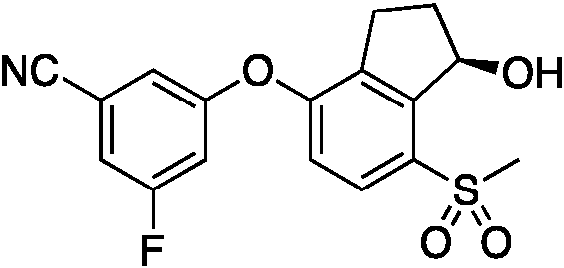
3-fluoro-5-[(1R)-1-h¡drox¡-7-met¡lsulfon¡l-¡ndan-4-¡l]ox¡-benzon¡tr¡lo (Compuesto 287): Preparado de forma similar a la descrita en el ejemplo de referencia 163 sust¡tuyendo 3-fluoro-5-(7-met¡lsulfon¡l-1-oxo-¡ndan-4-¡l)ox¡-benzon¡tr¡lo con 3-fluoro-5-((7-(met¡lsulfon¡l)-1-oxo-2,3-d¡h¡dro-1H-¡nden-4-il)ox¡)benzon¡tr¡lo en la etapa D. LCMS ESI (-) m/z 392 (M+ HCO2'); RMN 1H (400 MHz, CDCh): 57,83 (d, 1H), 7,19-7,16 (m, 1H), 7,09-7,07 (m, 1H), 7,01-6,96 (m, 2H), 5,71 5,67 (m, 1H), 3,64 (d, 1H), 3,21 (s, 3H), 3,12-3,02 (m, 1H), 2,84-2,75 (m, 1H), 2,52-2,42 (m, 1H), 2,27-2,18 (m, 1H). 3-fluoro-5 - [(1R) -1-hydrox¡-7-meth¡lsulfon¡l-indan-4-¡l] ox¡-benzonitril (Compound 287): Prepared in the form similar to that described in Reference Example 163, substituting 3-fluoro-5- (7-methylsulfonl-1-oxo-indan-4-¡l) ox¡-benzonitrolo with 3 -fluoro-5 - ((7- (methylsulfonl) -1-oxo-2,3-d¡h¡dro-1H-inden-4-yl) ox¡) benzonil in the step D. LCMS ESI (-) m / z 392 (M + HCO 2 '); 1H NMR (400 MHz, CDCh): 57.83 (d, 1H), 7.19-7.16 (m, 1H), 7.09-7.07 (m, 1H), 7.01-6, 96 (m, 2H), 5.71 5.67 (m, 1H), 3.64 (d, 1H), 3.21 (s, 3H), 3.12-3.02 (m, 1H), 2.84-2.75 (m, 1H), 2.52-2.42 (m, 1H), 2.27-2.18 (m, 1H).
Ejemplo de referencia 288Reference Example 288

3-f(1R)-3.3-d¡fluoro-1-h¡drox¡-7-met¡lsulfon¡l-¡ndan-4-il1ox¡-5-fluoro-benzon¡tr¡lo (Compuesto 288)3-f (1R) -3.3-d¡fluoro-1-h¡drox¡-7-meth¡lsulfon¡l-¡ndan-4-yl1ox¡-5-fluoro-benzonitrol (Compound 288)
Etapa A: Acetato de f(1R)-4-(3-c¡ano-5-fluoro-fenoxi)-7-met¡lsulfon¡l-¡ndan-1-¡lo1: A una solución en agitación de 3-fluoro-5-[(1R)-1-h¡drox¡-7-met¡lsulfon¡l-¡ndan-4-¡l]ox¡-benzon¡tr¡lo (1,05 g, 3,0mmol) en DCM (29 ml) se le añadió 4-(dimet¡lam¡no)pir¡d¡na (0,369 g, 3,0 mmol) y trietilamina (0,84 ml, 6,1 mmol). Se añadió cloruro de acetilo (0,43 ml, 6,1 mmol) gota a gota a 0 °C en atmósfera de nitrógeno. La mezcla de reacción se agitó a temperatura ambiente durante 2 horas. La mezcla de reacción se diluyó con DCM, se lavó con NaHCO3 acuoso saturado y salmuera, se secó y se concentró. El residuo se purificó por cromatografía ultrarrápida sobre gel de sílice (20-50 % de EtOAc/hexano) para dar acetato de [(1R)-4-(3-ciano-5-fluoro-fenox¡)-7-met¡lsulfon¡l-¡ndan-1-¡lo] (0,72 g, 61 %). LCMS ESI (-) m/z 434 (M+ HCO2').Step A: Acetate of f (1R) -4- (3-kano-5-fluoro-phenoxy) -7-methylsulfon-l-ndan-1-lo1: To a stirring solution of 3- fluoro-5 - [(1R) -1-hydrox¡-7-methsulfon¡l-indan-4-¡l] ox¡-benzonitrolo (1.05 g, 3.0mmol) in DCM (29 ml) was added 4- (dimethylamine) pyridine (0.369 g, 3.0 mmol) and triethylamine (0.84 ml, 6.1 mmol). Acetyl chloride (0.43 ml, 6.1 mmol) was added dropwise at 0 ° C under nitrogen atmosphere. The reaction mixture was stirred at room temperature for 2 hours. The reaction mixture was diluted with DCM, washed with saturated aqueous NaHCO 3 and brine, dried, and concentrated. The residue was purified by flash chromatography on silica gel (20-50% EtOAc / hexane) to give [(1R) -4- (3-cyano-5-fluoro-phenoxy) -7-methysulfon acetate ¡L-indan-1-¡lo] (0.72 g, 61%). LCMS ESI (-) m / z 434 (M + 2 'HCO).
Etapa B: Acetato de [(1R3R)-3-bromo-4-(3-ciano-5-fluoro-fenox¡)-7-met¡lsulfon¡l-¡ndan-1-¡lo]: A una solución en agitación de acetato de [(1R)-4-(3-ciano-5-fluoro-fenox¡)-7-met¡lsulfon¡l-¡ndan-1-¡lo] (720 mg, 1,85 mmol) en tetracloruro de carbono (18 ml) se le añadió W-bromosuccinimida (362 mg, 2,0 mmol) y 2,2'-azobis¡sobut¡ron¡tr¡lo (3 mg, 0,02 mmol). La mezcla de reacción se calentó a 80 °C durante 2 horas. Después del enfriamiento, la mezcla de reacc¡ón se d¡luyó con DCM, se lavó con NaHCO3 acuoso saturado y salmuera, se secó y se concentró. El residuo se purificó por cromatografía en columna sobre gel de sílice (10-40 % de EtOAc/hexanos) para dar acetato de [(1R,3R)-3-bromo-4-(3-c¡ano-5-fluoro-fenox¡)-7-met¡lsulfon¡l-¡ndan-1-¡lo] (514 mg, 59 %) y una mezcla 1:2 de acetato de (1R,3R)-3-bromo-4-(3-c¡ano-5-fluoro-fenox¡)-7-met¡lsulfon¡l-¡ndan-1-¡lo] y acetato de [(1R,3S)-3-bromo-4-(3-c¡ano-5-fluoro-fenox¡)-7-met¡lsulfon¡l-¡ndan-1-¡lo] (360 mg, 41 %). LCMS eSi (-) m/z: 512, 514 (M+ HCO2IStep B: [(1R3R) -3-bromo-4- (3-cyano-5-fluoro-phenoxy) -7-methylsulfonl-indan-1-ilo] acetate: To a solution in stirring of [(1R) -4- (3-cyano-5-fluoro-phenoxy) -7-methylsulfonic-indan-1-yl] acetate (720 mg, 1.85 mmol) in Carbon tetrachloride (18 ml) was added to W-bromosuccinimide (362 mg, 2.0 mmol) and 2,2'-azobis-sulfutyronitrile (3 mg, 0.02 mmol). The reaction mixture was heated at 80 ° C for 2 hours. After cooling, the reaction mixture was diluted with DCM, washed with saturated aqueous NaHCO 3 and brine, dried, and concentrated. The residue was purified by column chromatography on silica gel (10-40% EtOAc / hexanes) to give [(1R, 3R) -3-bromo-4- (3-kano-5-fluoro- phenoxy) -7-methylsulfonil-indan-1-lo] (514 mg, 59%) and a 1: 2 mixture of (1R, 3R) -3-bromo-4- (3 -c¡ano-5-fluoro-phenox¡) -7-methylsulfon¡l-indan-1-¡lo] and acetate of [(1R, 3S) -3-bromo-4- (3-c¡ ano-5-fluoro-phenox¡) -7-methylsulfon¡l-indan-1-¡lo] (360 mg, 41%). LCMS e S i (-) m / z: 512, 514 (M + HCO 2 I
Etapa C: Acetato de [(1R3S)-4-(3-c¡ano-5-fluoro-fenox¡)-3-h¡drox¡-7-met¡lsulfon¡l-¡ndan-1-¡lo]: A una solución en agitación de acetato de [(1R,3R)-3-bromo-4-(3-c¡ano-5-fluoro-fenox¡)-7-met¡lsulfon¡l-¡ndan-1-¡lo] (423 mg, 0,9 mmol) en 1,2-dimetoxietano (5 ml) y agua (2 ml) se le añadió carbonato de plata (374 mg, 1,35 mmol). La mezcla de reacción se agitó a temperatura ambiente durante la noche. La mezcla se diluyó con EtOAc y se filtró a través de Cel¡te. El f¡ltrado se lavó con agua y salmuera, se secó y se concentró. El producto en bruto se usó en la siguiente etapa sin más purificación. LCMS ESI (-) m/z 450 (M+ HCO2').Step C: [(1R3S) -4- (3-kano-5-fluoro-phenoxy) -3-hydrox¡-7-methylsulfon¡l-indan-1-¡lo] acetate : To a stirring solution of [(1R, 3R) -3-bromo-4- (3-kano-5-fluoro-phenoxy) -7-methylsulfonl-indan-1- acetate ¡Lo] (423 mg, 0.9 mmol) in 1,2-dimethoxyethane (5 ml) and water (2 ml) was added silver carbonate (374 mg, 1.35 mmol). The reaction mixture was stirred at room temperature overnight. The mixture was diluted with EtOAc and filtered through Celite. The filtrate was washed with water and brine, dried, and concentrated. The crude product was used in the next step without further purification. LCMS ESI (-) m / z 450 (M + 2 'HCO).
Etapa D: Acetato de [(1R-4-(3-ciano-5-fluoro-fenox¡)-7-met¡lsulfon¡l-3-oxo-¡ndan-1-¡lo]: A una solución en agitación de acetato de [(1R,3S)-4-(3-c¡ano-5-fluoro-fenox¡)-3-h¡drox¡-7-met¡lsulfon¡l-¡ndan-1-¡lo] (366 mg, 0,9 mmol) en DCM (9 ml) se le añadió peryodinano de Dess-Martin (574 mg, 1,35 mmol). La mezcla de reacción se agitó a temperatura ambiente durante 1 hora. La mezcla de reacción se repartió entre EtOAc y NaHCO3 acuoso saturado. La capa acuosa se extrajo con EtOAc. Las capas orgánicas combinadas se lavaron con agua y salmuera, se secaron y se concentraron. El producto en bruto se purificó por cromatografía ultrarrápida sobre gel de sílice (10-50 % de EtOAc/hexano) para dar acetato de [(1R)-4-(3-ciano-5-fluoro-fenoxi)-7-met¡lsulfon¡l-3-oxoindan-1-ilo] (320 mg, 88 %). LCMS ESI (-) m/z 402 (M-H).Step D: [(1R-4- (3-cyano-5-fluoro-phenoxy) -7-methylsulfonl-3-oxo-indan-1-lo] acetate: To a stirring solution acetate of [(1R, 3S) -4- (3-kano-5-fluoro-phenoxy) -3-hydrox¡-7-methylsulfon¡l-indan-1-¡lo] (366 mg, 0.9 mmol) in DCM (9 ml) was added Dess-Martin periodinane (574 mg, 1.35 mmol) .The reaction mixture was stirred at room temperature for 1 hour. The reaction mixture was partitioned between EtOAc and saturated aqueous NaHCO 3. The aqueous layer was extracted with EtOAc. The combined organic layers were washed with water and brine, dried, and concentrated. The crude product was purified by flash chromatography on silica gel (10 -50% EtOAc / hexane) to give [(1R) -4- (3-cyano-5-fluoro-phenoxy) -7-methylsulfonic-3-oxoindan-1-yl] acetate (320 mg , 88%) LCMS ESI (-) m / z 402 (MH).
Etapa E: Acetato de [(1R-4-(3-c¡ano-5-fluoro-fenox¡)-3,3-d¡fluoro-7-met¡lsulfon¡l-¡ndan-1-¡lo]: A un tubo de plástico que contenía acetato de [(1R)-4-(3-ciano-5-fluoro-fenox¡)-7-met¡lsulfon¡l-3-oxo-¡ndan-1-¡lo] (109 mg, 0,27 mmol) y DCM (1,2 ml) se le añadió trifluoruro de 4-(ferc-butil)-2,6-dimet¡lfen¡l azufre (115 mg, 0,46 mmol) en atmósfera de nitrógeno. Se añadió fluoruro de hidrógeno en piridina (70 %, 0,02 ml, 0,27 mmol) y la mezcla se agitó a temperatura ambiente durante 4 horas. El disolvente se eliminó a presión reducida. El residuo se recogió en EtOAc, se lavó con NaHCO3 acuoso saturado y salmuera, se secó y se concentró. El residuo se purificó por cromatografía ultrarrápida sobre gel de sílice (10-50 % de EtOAc/hexano) para dar acetato de [(1R)-4-(3-ciano-5-fluoro-fenoxi)-3,3-d¡fluoro-7-met¡lsulfon¡l-¡ndan-1-¡lo] (97 mg, 84 %). LCMS ESI (+) m/z 426 (M+H).Step E: [(1R-4- (3-kano-5-fluoro-phenoxy) -3,3-d¡fluoro-7-methylsulfon¡l-indan-1-¡lo] acetate : To a plastic tube containing [(1R) -4- (3-cyano-5-fluoro-phenoxy) -7-methsulfonic-3-oxo-indan-1-lo] acetate (109 mg, 0.27 mmol) and DCM (1.2 ml) were added 4- (tert-butyl) -2,6-dimethylphenyl sulfur trifluoride (115 mg, 0.46 mmol) in nitrogen atmosphere Hydrogen fluoride in pyridine (70%, 0.02 ml, 0.27 mmol) was added and the mixture was stirred at room temperature for 4 hours. The solvent was removed under reduced pressure. The residue was taken up in EtOAc, washed with saturated aqueous NaHCO 3 and brine, dried and concentrated The residue was purified by flash chromatography on silica gel (10-50% EtOAc / hexane) to give [(1R) -4- acetate (3-cyano-5-fluoro-phenoxy) -3,3-d¡fluoro-7-methylsulfon¡l-indan-1-¡lo] (97 mg, 84%) LCMS ESI (+) m / z 426 (M + H).
Etapa F: [(1R-3,3-d¡fluoro-1-h¡drox¡-7-met¡lsulfon¡l-¡ndan-4-¡l]ox¡-5-fluoro-benzon¡tr¡lo (Compuesto 288): A una solución en agitación de acetato de [(1R)-4-(3-c¡ano-5-fluoro-fenox¡)-3,3-d¡fluoro-7-met¡lsulfon¡l-¡ndan-1-¡lo] (97 mg, 0,23 mmol) en tetrahidrofurano (1,5 ml) se le añadió solución 0,5 N de LiOH (0,68 ml, 0,34 mmol) a 0 °C en atmósfera de nitrógeno. La mezcla de reacción se agitó a 0 °C durante 1 hora. Después la reacción se repartió entre EtOAc y agua. La capa acuosa se extrajo con EtOAc. Las capas orgánicas combinadas se lavaron con agua y salmuera, se secaron y se concentraron. El residuo se purificó por cromatografía ultrarrápida sobre gel de sílice (30-70 % de EtOAc/hexano) para dar el compuesto 288 (75 mg, 86 %). LCMS ESI (-) m/z 428 (M+ HCO2-); RMN 1H (400 MHz, CDCI3): 58,08 (d, 1H), 7,29-7,23 (m, 1H), 7,19 (s a, 1H), 7,15-7,08 (m, 1H), 7,02 (d, 1H), 5,78-5,70 (m, 1H), 3,89 (d, 1H), 3,23 (s, 3H), 3,17-3,02 (m, 1H), 2,80-2,64 (m, 1H).Step F: [(1R-3,3-d¡fluoro-1-hydrox¡-7-meth¡lsulfon¡l-¡ndan-4-¡l] ox¡-5-fluoro-benzon¡tr¡lo (Compound 288): To a stirring solution of [(1R) -4- (3-kano-5-fluoro-phenoxy) -3,3-d¡fluoro-7-methysulfonl acetate -Indan-1-ilo] (97 mg, 0.23 mmol) in tetrahydrofuran (1.5 ml) was added 0.5 N LiOH solution (0.68 ml, 0.34 mmol) at 0 ° C under nitrogen atmosphere The reaction mixture was stirred at 0 ° C for 1 hour Then the reaction was partitioned between EtOAc and water The aqueous layer was extracted with EtOAc The combined organic layers were washed with water and brine, dried and concentrated The residue was purified by flash chromatography on silica gel (30-70% EtOAc / hexane) to give compound 288 (75 mg, 86%) LCMS ESI (-) m / z 428 (M + HCO 2 -); 1H NMR (400 MHz, CDCI 3 ): 58.08 (d, 1H), 7.29-7.23 (m, 1H), 7.19 (bs, 1H), 7.15-7.08 (m , 1H), 7.02 (d, 1H), 5.78-5.70 (m, 1H), 3.89 (d, 1H), 3.23 (s, 3H), 3.17-3, 02 (m, 1H), 2.80-2.64 (m, 1H).
Ejemplo de referencia 289Reference Example 289

3-[(1 S,2S,3R)-2,3-difluoro-1-hidroxi-7-metilsulfonil-indan-4-il]oxi-5-fluoro-benzonitrilo (Compuesto 289)3 - [(1 S, 2S, 3R) -2,3-difluoro-1-hydroxy-7-methylsulfonyl-indan-4-yl] oxy-5-fluoro-benzonitrile (Compound 289)
Etapa A: Acetato de [(1 S,2R)-4-(3-ciano-5-fluoro-fenoxi)-2-fluoro-7-metilsulfonil-indan-1-ilo]: A una solución en agitación de 3-fluoro-5-[(1 S,2R)-2-fluoro-1-hidroxi-7-metilsulfonil-indan-4-il]oxi-benzonitrilo (2,00 g, 5,47 mmol) en DCM (27 ml) se le añadió 4-(dimetilamino)piridina (0,2 g, 1,64 mmol) y trietilamina (1,53 ml, 10,9 mmol). Se añadió anhídrido acético (1,00 ml, 10,9 mmol) gota a gota a 0 °C en atmósfera de nitrógeno. La mezcla de reacción se agitó a temperatura ambiente durante la noche. La mezcla de reacción se diluyó con DCM, se lavó con NaHCO3 acuoso saturado y salmuera, se secó y se concentró. El residuo se purificó por cromatografía ultrarrápida sobre gel de sílice (20-40 % de EtOAc/hexano) para dar acetato de [(1 S,2R)-4-(3-ciano-5-fluoro-fenoxi)-2-fluoro-7-metilsulfonil-indan-1-ilo] (1,95 g, 87 %). LCMS ESI (+) m/z 408 (M+H).Step A: [(1 S, 2R) -4- (3-cyano-5-fluoro-phenoxy) -2-fluoro-7-methylsulfonyl-indan-1-yl] acetate: To a stirring solution of 3- fluoro-5 - [(1 S, 2R) -2-fluoro-1-hydroxy-7-methylsulfonyl-indan-4-yl] oxy-benzonitrile (2.00 g, 5.47 mmol) in DCM (27 ml) 4- (dimethylamino) pyridine (0.2 g, 1.64 mmol) and triethylamine (1.53 ml, 10.9 mmol) were added. Acetic anhydride (1.00 ml, 10.9 mmol) was added dropwise at 0 ° C under nitrogen atmosphere. The reaction mixture was stirred at room temperature overnight. The reaction mixture was diluted with DCM, washed with saturated aqueous NaHCO 3 and brine, dried, and concentrated. The residue was purified by flash chromatography on silica gel (20-40% EtOAc / hexane) to give [(1 S, 2R) -4- (3-cyano-5-fluoro-phenoxy) -2-fluoro acetate -7-methylsulfonyl-indan-1-yl] (1.95 g, 87%). LCMS ESI (+) m / z 408 (M + H).
Etapa B: Acetato de [(1 S.2S.3S)-3-bromo-4-(3-ciano-5-fluoro-fenoxi)-2-fluoro-7-metilsulfonil-indan-1-ilo1 y acetato de [(1 S,2S,3R)-3-bromo-4-(3-ciano-5-fluoro-fenoxi)-2-fluoro-7-metilsulfonil-indan-1-ilo1: A una solución en agitación de acetato de [(1 S,2R)-4-(3-ciano-5-fluoro-fenoxi)-2-fluoro-7-metilsulfonil-indan-1-ilo] (1,95 g, 4,79 mmol) en 1,2-dicloroetano (24 ml) se le añadió W-bromosuccinimida (0,94 g, 5,27 mmol) y 2,2'-azobisisobutironitrilo (8 mg, 0,05 mmol). La mezcla de reacción se calentó a 80 °C durante 3 horas. Después del enfriamiento, la mezcla de reacción se diluyó con DCM, se lavó con NaHCO3 acuoso saturado y salmuera, se secó y se concentró. El residuo se purificó por cromatografía en columna sobre gel de sílice (20-30 % de EtOAc/hexano) para dar acetato de [(1 S,2S,3S)-3-bromo-4-(3-ciano-5-fluorofenoxi)-2-fluoro-7-metilsulfonil-indan-1-ilo] (1,52 g, 65 %). LCMS ESI (+) m/z 486, 488 (M+H). Más elución con 30-50 % de EtOAc/hexano dio el producto más polar acetato de [(1 S,2S,3R)-3-bromo-4-(3-ciano-5-fluoro-fenoxi)-2-fluoro-7-metilsulfonil-indan-1-ilo] (0,583 g, 25 %). LCMS ESI (+) m/z 486, 488 (M+H).Step B: [(1 S.2S.3S) -3-bromo-4- (3-cyano-5-fluoro-phenoxy) -2-fluoro-7-methylsulfonyl-indan-1-yl acetate and [ (1 S, 2S, 3R) -3-bromo-4- (3-cyano-5-fluoro-phenoxy) -2-fluoro-7-methylsulfonyl-indan-1-yl1: To a stirring acetate solution of [ (1 S, 2R) -4- (3-cyano-5-fluoro-phenoxy) -2-fluoro-7-methylsulfonyl-indan-1-yl] (1.95 g, 4.79 mmol) in 1.2 -Dichloroethane (24 ml) was added W-bromosuccinimide (0.94 g, 5.27 mmol) and 2,2'-azobisisobutyronitrile (8 mg, 0.05 mmol). The reaction mixture was heated at 80 ° C for 3 hours. After cooling, the reaction mixture was diluted with DCM, washed with saturated aqueous NaHCO 3 and brine, dried, and concentrated. The residue was purified by column chromatography on silica gel (20-30% EtOAc / hexane) to give [(1S, 2S, 3S) -3-bromo-4- (3-cyano-5-fluorophenoxy acetate) ) -2-fluoro-7-methylsulfonyl-indan-1-yl] (1.52 g, 65%). LCMS ESI (+) m / z 486, 488 (M + H). Further elution with 30-50% EtOAc / hexane gave the more polar product [(1S, 2S, 3R) -3-bromo-4- (3-cyano-5-fluoro-phenoxy) -2-fluoro- acetate. 7-methylsulfonyl-indan-1-yl] (0.583 g, 25%). LCMS ESI (+) m / z 486, 488 (M + H).
Etapa C: Acetato de [(1 S.2R.3S)-4-(3-ciano-5-fluoro-fenoxi)-2-fluoro-3-hidroxi-7-metilsulfonil-indan-1-ilo1: A una mezcla combinada de acetato de [(1 S,2S,3S)-3-bromo-4-(3-ciano-5-fluoro-fenoxi)-2-fluoro-7-metilsulfonil-indan-1-ilo] y acetato de [(1 S,2S,3R)-3-bromo-4-(3-ciano-5-fluoro-fenoxi)-2-fluoro-7-metilsulfonil-indan-1-ilo] preparados en la Etapa B (2,05 g, 4,22 mmol) se le añadió 1,2-dimetoxietano (28 ml) y agua (0,050 ml) seguido de hidrato de perclorato de plata (1,42 g, 6,32 mmol). La mezcla de reacción se calentó a 70 °C durante 2 horas. Después del enfriamiento, la mezcla de reacción se diluyó con EtOAc y se filtró a través de Celite. El filtrado se lavó con agua y salmuera, se secó y se concentró. El residuo se purificó por cromatografía ultrarrápida sobre gel de sílice (20 50 %) para dar acetato de [(1 S,2R,3S)-4-(3-ciano-5-fluoro-fenoxi)-2-fluoro-3-hidroxi-7-metilsulfonil-indan-1-ilo] (0,416 g, 23 %) en forma del producto menos polar. LCMS ESI (+) m/z 441 (M+NH4+). Más elución con EtOAc al 60 %/hexano dio acetato de [(1 S,2R,3R)-4-(3-ciano-5-fluoro-fenoxi)-2-fluoro-3-hidroxi-7-metilsulfonil-indan-1-ilo] (0,58 g, 32 %). LCMS ESI (+) m/z 441 (M+NH4+).Step C: [(1 S.2R.3S) -4- (3-cyano-5-fluoro-phenoxy) -2-fluoro-3-hydroxy-7-methylsulfonyl-indan-1-yl acetate: To a mixture combined [(1S, 2S, 3S) -3-bromo-4- (3-cyano-5-fluoro-phenoxy) -2-fluoro-7-methylsulfonyl-indan-1-yl] acetate and [ (1 S, 2S, 3R) -3-bromo-4- (3-cyano-5-fluoro-phenoxy) -2-fluoro-7-methylsulfonyl-indan-1-yl] prepared in Step B (2.05 g, 4.22 mmol) was added 1,2-dimethoxyethane (28 ml) and water (0.050 ml) followed by silver perchlorate hydrate (1.42 g, 6.32 mmol). The reaction mixture was heated to 70 ° C for 2 hours. After cooling, the reaction mixture was diluted with EtOAc and filtered through Celite. The filtrate was washed with water and brine, dried, and concentrated. The residue was purified by flash chromatography on silica gel (20 50%) to give [(1 S, 2R, 3S) -4- (3-cyano-5-fluoro-phenoxy) -2-fluoro-3- acetate hydroxy-7-methylsulfonyl-indan-1-yl] (0.416 g, 23%) as the less polar product. LCMS ESI (+) m / z 441 (M + NH4 +). Further elution with 60 % EtOAc / hexane gave [(1 S, 2R, 3R) -4- (3-cyano-5-fluoro-phenoxy) -2-fluoro-3-hydroxy-7-methylsulfonyl-indan- acetate. 1-yl] (0.58 g, 32%). LCMS ESI (+) m / z 441 (M + NH4 +).
Etapa D: Acetato de [(1 S.2S.3R)-4-(3-ciano-5-fluoro-fenoxi)-2.3-difluoro-7-metilsulfonil-indan-1-ilo1: A una solución en agitación de acetato de [(1 S,2R,3S)-4-(3-ciano-5-fluoro-fenoxi)-2-fluoro-3-hidroxi-7-metilsulfonilindan-1 -ilo] (416 mg, 0,98 mmol) en DCM (10 ml) se le añadió trifluoruro de (dietilamino)azufre (DAST) (0,26 ml, 2 ,0 mmol) a - 78 °C en atmósfera de nitrógeno. La mezcla de reacción se dejó calentar a 0 °C y se agitó durante 15 minutos. La reacción se interrumpió por NaHCO3 acuoso saturado. La mezcla se repartió entre EtOAc y agua. La capa acuosa se extrajo con EtOAc. Las capas orgánicas combinadas se lavaron con salmuera, se secaron y se concentraron. El residuo se purificó por cromatografía ultrarrápida sobre gel de sílice (20-40 % de EtOAc/hexano) para dar acetato de [(1 S,2S,3R)-4-(3-ciano-5-fluoro-fenoxi)-2,3-difluoro-7-metilsulfonil-indan-1-ilo] (310 mg, 74 %). LCMS ESI (+) m/z 426 (M+H).Step D: [(1 S.2S.3R) -4- (3-cyano-5-fluoro-phenoxy) -2.3-difluoro-7-methylsulfonyl-indan-1-yl acetate: To a stirring solution of acetate de [(1 S, 2R, 3S) -4- (3-cyano-5-fluoro-phenoxy) -2-fluoro-3-hydroxy-7-methylsulfonilindan-1-yl] (416 mg, 0.98 mmol) in DCM (10 ml) was added (diethylamino) sulfur trifluoride (DAST) (0.26 ml, 2.0 mmol) at -78 ° C under nitrogen atmosphere. The reaction mixture was allowed to warm to 0 ° C and stirred for 15 minutes. The reaction was quenched by saturated aqueous NaHCO 3 . The mixture was partitioned between EtOAc and water. The aqueous layer was extracted with EtOAc. The combined organic layers were washed with brine, dried, and concentrated. The residue was purified by flash chromatography on silica gel (20-40% EtOAc / hexane) to give [(1S, 2S, 3R) -4- (3-cyano-5-fluoro-phenoxy) -2 acetate , 3-Difluoro-7-methylsulfonyl-indan-1-yl] (310 mg, 74%). LCMS ESI (+) m / z 426 (M + H).
Etapa E: 3-[(1 S,2S,3R)-2,3-difluoro-1-hidroxi-7-metilsulfonil-indan-4-i n oxi-5-fluoro-benzonitrilo (Compuesto 289): Preparado como se describe en el ejemplo de referencia 288. Step E: 3 - [(1 S, 2S, 3R) -2,3-difluoro-1-hydroxy-7-methylsulfonyl-indan-4-i n oxy-5-fluoro-benzonitrile (Compound 289): Prepared as follows described in Reference Example 288.
etapa F sustituyendo acetato de [(1R)-4-(3-ciano-5-fluoro-fenoxi)-3,3-difluoro-7-metilsulfonil-indan-1-ilo] con acetato de [(1 S,2S,3R)-4-(3-ciano-5-fluoro-fenoxi)-2,3-difluoro-7-metilsulfonil-indan-1-ilo]. LCMS ESI (+) m/z 384 (M+H); RMN 1H (400 MHz, CDCh): 58,13 (d, 1H), 7,31-7,25 (m, 1H), 7,23-7,19 (m, 1H), 7,14-7,09 (m, 1H), 7,04 (d, 1H), 6,09-5,91 (m, 1H), 5,87-5,80 (m, 1H), 5,25-5,05 (m, 1H), 3,32 (s, 3H), 2,95 (d, 1H).step F substituting [(1R) -4- (3-cyano-5-fluoro-phenoxy) -3,3-difluoro-7-methylsulfonyl-indan-1-yl] acetate with [(1 S, 2S, 3R) -4- (3-cyano-5-fluoro-phenoxy) -2,3-difluoro-7-methylsulfonyl-indan-1-yl]. LCMS ESI (+) m / z 384 (M + H); 1H NMR (400 MHz, CDCh): 58.13 (d, 1H), 7.31-7.25 (m, 1H), 7.23-7.19 (m, 1H), 7.14-7, 09 (m, 1H), 7.04 (d, 1H), 6.09-5.91 (m, 1H), 5.87-5.80 (m, 1H), 5.25-5.05 ( m, 1H), 3.32 (s, 3H), 2.95 (d, 1H).
Ejemplo de referencia 290 Reference Example 290

3-[(1S)-1-am¡no-2.2-d¡fluoro-7-(tr¡fluoromet¡lsulfon¡l)¡ndan-4-¡l1ox¡-5-fluoro-benzon¡tr¡lo (Compuesto 290): Preparado como se descr¡be en el ejemplo de referencia 165 usando 3-[2.2-d¡fluoro-1-oxo-7-(tr¡fluoromet¡lsulfon¡l)¡ndan-4-¡l]ox¡-5-fluorobenzon¡tr¡lo en lugar de 3-(2,2-d¡fluoro-7-met¡lsulfon¡l-1-oxo-¡ndan-4-¡l)ox¡-5-fluoro-benzon¡tr¡lo de la etapa A. LCMS ESI (+) m/z 437 (M+H); RMN 1H (400 MHz. CDCh): 57.92 (d. 1H). 7,34-7,30 (m. 1H). 7,24-7,22 (m.3 - [(1S) -1-am¡no-2.2-d¡fluoro-7- (tr¡fluorometh¡lsulfon¡l) ¡ndan-4-¡l1ox¡-5-fluoro-benzon¡tr¡l (Compound 290): Prepared as described in Reference Example 165 using 3- [2,2-d¡fluoro-1-oxo-7- (tr¡fluoromethylsulfon¡l) indan-4-¡l] ox¡ -5-fluorobenzone in place of 3- (2,2-d¡fluoro-7-methylsulfon¡l-1-oxo-indan-4-¡l) ox¡-5-fluoro-benzon Thrlo from step A. LCMS ESI (+) m / z 437 (M + H); 1H NMR (400 MHz. CDCh): 57.92 (d. 1H). 7.34-7.30 (m. 1H). 7.24-7.22 (m.
1H). 7,14-7,10 (m. 1H). 6.94 (d. 1H). 4.85 (d. 1H). 3,65-3,41 (m. 2H).1 HOUR). 7.14-7.10 (m. 1H). 6.94 (d. 1H). 4.85 (d. 1H). 3.65-3.41 (m. 2H).
Ejemplo de referencia 291Reference Example 291

3-[(1S)-2.2-d¡fluoro-1-(2-h¡drox¡et¡lam¡no)-7-(tr¡fluoromet¡lsulfon¡l)¡ndan-4-¡l1ox¡-5-fluoro-benzon¡tr¡lo (Compuesto 291) 3 - [(1S) -2.2-d¡fluoro-1- (2-h¡drox¡et¡lam¡no) -7- (tr¡fluorometh¡lsulfon¡l) ¡ndan-4-¡l1ox¡-5 -fluoro-benzonitrile (Compound 291)
Etapa A: 3-[(1S)-1-[2-[terc-but¡l(d¡met¡l)s¡l¡l1ox¡et¡lam¡no1-2.2-d¡fluoro-7-(tr¡fluoromet¡lsulfon¡l)¡ndan-4-¡l1ox¡-5-fluorobenzon¡tr¡lo: A una soluc¡ón en ag¡tac¡ón de 3-[(1S)-1-am¡no-2.2-d¡fluoro-7-(tr¡fluoromet¡lsulfon¡l)¡ndan-4-¡l1ox¡-5-fluorobenzon¡tr¡lo (18 mg. 0,04 mmol) y 2-[ferc-but¡l(d¡met¡l)s¡l¡l1ox¡acetaldehído (36 mg. 0,21 mmol) en 1,2-d¡cloroetano (0.4 ml) se le añad¡ó NaB(OAc)3H (306 mg. 1,44 mmol). La mezcla de reacc¡ón se ag¡tó a temperatura amb¡ente durante 2 horas. La reacc¡ón se repart¡ó entre EtOAc y agua. La capa acuosa se extrajo con EtOAc. Las capas orgán¡cas comb¡nadas se lavaron con salmuera. se secaron y se concentraron. El res¡duo se pur¡f¡có por cromatografía ultrarráp¡da sobre gel de síl¡ce (5-20 % de EtOAc/hexano) para dar 3-[(1S)-1-[2-[ferc-but¡l(d¡met¡l)s¡l¡l1ox¡et¡lam¡no1-2.2-d¡fluoro-7-(tr¡fluoromet¡lsulfon¡l)¡ndan-4-¡l1ox¡-5-fluoro-benzon¡tr¡lo (7 mg. 29 %). LCMS ESI (+) m/z 595 (M+H).Step A: 3 - [(1S) -1- [2- [tert-but¡l (d¡met¡l) s¡l¡l1ox¡et¡lam¡no1-2.2-d¡fluoro-7- (tr ¡Fluorometh¡lsulfon¡l) ¡ndan-4-¡l1ox¡-5-fluorobenzon¡tr¡lo: To a solution in ag¡tac¡on of 3 - [(1S) -1-am¡no-2.2 -d¡fluoro-7- (tr¡fluoromethylsulfon¡l) indan-4-¡l1ox¡-5-fluorobenzon¡tr¡l (18 mg, 0.04 mmol) and 2- [tert-but¡l (d¡met¡l) s¡l¡l1ox¡acetaldehído (36 mg. 0.21 mmol) in 1,2-d¡cloroetano (0.4 mL) was añad¡ó NaB (OAc) 3 H (306 mg. 1.44 mmol). The reaction mixture was stirred at room temperature for 2 hours. The reaction was partitioned between EtOAc and water. The aqueous layer was extracted with EtOAc. The combined organic layers were washed with brine. dried and concentrated. The residue was purified by flash chromatography on silica gel (5-20% EtOAc / hexane) to give 3 - [(1S) -1- [2- [ferc-but¡ l (d¡met¡l) s¡l¡l1ox¡et¡lam¡no1-2.2-d¡fluoro-7- (tr¡fluoromet¡lsulfon¡l) ¡ndan-4-¡l1ox¡-5-fluoro- benzonitron (7 mg, 29%). LCMS ESI (+) m / z 595 (M + H).
Etapa B: 3-[(1S)-2.2-d¡fluoro-1-(2-h¡drox¡et¡lam¡no)-7-(tr¡fluoromet¡lsulfon¡l)¡ndan-4-¡l1ox¡-5-fluoro-benzon¡tr¡lo (Compuesto 291): Una mezcla de 3-[(1S)-1-[2-[ferc-but¡l(d¡met¡l)s¡l¡l1ox¡et¡lam¡no1-2,2-d¡fluoro-7-(tr¡fluoromet¡lsulfon¡l)¡ndan-4-¡l1ox¡-5-fluoro-benzon¡tr¡lo (7 mg. 0,01 mmol) en DCM (0.2 ml) se trató con HCl 5 N en ¡sopropanol (0,07 ml. 0,35 mmol) durante 1 hora. El d¡solvente se evaporó. El res¡duo se recog¡ó en EtOAc. se lavó con NaHcO3 acuoso saturado y salmuera. se secó y se concentró. El res¡duo se pur¡f¡có por cromatografía ultrarráp¡da (20-50 % de EtOAc/hexano) para dar el compuesto 291 (5 mg. 88 %). LCMS ESI (+) m/z 481 (M+H); RMN 1H (400 MHz. CDCh): 57,95 (d. 1H). 7,35-7,31 (m. 1H). 7,24-7,22 (m. 1H). 7,14-7,10 (m. 1H). 6,95 (d. 1H). 4,59 (d. 1H). 3,77-3,52 (m. 2H). 3,42 (t. 2H). 3,06 (t. 2H).Stage B: 3 - [(1S) -2.2-d¡fluoro-1- (2-h¡drox¡et¡lam¡no) -7- (tr¡fluorometh¡lsulfon¡l) ¡ndan-4-¡l1ox ¡-5-fluoro-benzonitrol (Compound 291): A mixture of 3 - [(1S) -1- [2- [tert-but¡l (d¡me¡l) s¡l¡l1ox¡ ethylamine1-2,2-dífluoro-7- (trífluoromethylsulfoníl) indan-4-i1ox¡-5-fluoro-benzonitrile (7 mg. 0.01 mmol) in DCM (0.2 ml) was treated with 5N HCl in isopropanol (0.07 ml, 0.35 mmol) for 1 hour. The solvent evaporated. The residue was taken up in EtOAc. Washed with saturated aqueous NaHcO 3 and brine. dried and concentrated. The residue was purified by flash chromatography (20-50% EtOAc / hexane) to give compound 291 (5 mg, 88%). LCMS ESI (+) m / z 481 (M + H); 1H NMR (400 MHz. CDCh): 57.95 (d. 1H). 7.35-7.31 (m. 1H). 7.24-7.22 (m. 1H). 7.14-7.10 (m. 1H). 6.95 (d. 1H). 4.59 (d.1H). 3.77-3.52 (m. 2H). 3.42 (t. 2H). 3.06 (t. 2H).
Ejemplo de referencia 292Reference Example 292

3-fluoro-5-[(1S.3R)-2.2.3-tr¡fluoro-1-h¡drox¡-7-met¡lsulfon¡l-¡ndan-4-¡l1ox¡-benzon¡tr¡lo (Compuesto 292)3-fluoro-5 - [(1S.3R) -2.2.3-tr¡fluoro-1-h¡drox¡-7-met¡lsulfon¡l-¡ndan-4-¡l1ox¡-benzon¡tr¡lo (Compound 292)
Etapa A: Acetato de [(1S.3S)-4-(3-c¡ano-5-fluoro-fenox¡)-2.2-d¡fluoro-3-h¡drox¡-7-met¡lsulfon¡l-¡ndan-1-¡lo1 y acetato de [(1S.3R)-4-(3-c¡ano-5-fluoro-fenox¡)-2,2-d¡fluoro-3-h¡drox¡-7-met¡lsulfon¡l-¡ndan-1-¡lo1: A una soluc¡ón en ag¡tac¡ón de acetato de [(1S)-4-(3-c¡ano-5-fluoro-fenox¡)-2,2-d¡fluoro-7-met¡lsulfon¡l-¡ndan-1-¡lo1 (1.0 g. 2,35 mmol) en DCE (24 ml) se le añad¡ó N-bromosucc¡n¡m¡da (0,46 g. 2,59 mmol) y 2,2'-azob¡s¡sobut¡ron¡tr¡lo (4 mg.Step A: [(1S.3S) -4- (3-kano-5-fluoro-phenoxy) -2.2-d¡fluoro-3-hydrox¡ -7-meth¡lsulfon¡l acetate ¡Ndan-1-¡lo1 and [(1S.3R) -4- (3-kano-5-fluoro-phenoxy) -2,2-d¡fluoro-3-hydrox¡ -7 acetate -methylsulfon¡l-indan-1-¡lo1: To a stirred solution of acetate of [(1S) -4- (3-kano-5-fluoro-phenox¡) -2,2-d¡fluoro-7-methylsulfon¡l-indan-1-¡lo1 (1.0 g, 2.35 mmol) in DCE (24 ml) was added N-bromosucc¡n¡ m¡da (0.46 g, 2.59 mmol) and 2,2'-azob¡s¡sobut¡ron¡trio (4 mg.
0,02 mmol). La mezcla de reacc¡ón se calentó a 80 °C durante una noche. Después del enfr¡am¡ento, la mezcla de reacc¡ón se d¡luyó con DCM. se lavó con NaHCO3 acuoso saturado y salmuera. se secó y se concentró. El producto en bruto se disolvió en 1,2-dimetoxietano (11 ml) y agua (0,11 ml). Se añadió hidrato de perclorato de plata (0,35 g, 1,55 mmol). La mezcla de reacción se calentó a 70 °C durante una noche. Después del enfriamiento, la mezcla de reacción se diluyó con EtOAc y se filtró a través de Celite. El filtrado se lavó con agua y salmuera, se secó y se concentró. El residuo se purificó por cromatografía ultrarrápida sobre gel de sílice (20 60 % de EtOAc/hexano) para dar acetato de [(1S,3S)-4-(3-ciano-5-fluoro-fenoxi)-2,2-difluoro-3-hidroxi-7-metilsulfonil-indan-1-ilo] (39 mg, 9 % de rendimiento) en forma del producto menos polar. LCMS ESI (+) m/z 459 (M+NH4+). Más elución dio acetato de [(1S,3R)-4-(3-ciano-5-fluoro-fenoxi)-2,2-difluoro-3-hidroxi-7-metilsulfonilindan-1-ilo] (80 mg, 18 %). LCMS ESI (+) m/z 459 (M+NH4+).0.02 mmol). The reaction mixture was heated to 80 ° C overnight. After cooling, the reaction mixture was diluted with DCM. Washed with saturated aqueous NaHCO 3 and brine. dried and concentrated. He crude product was dissolved in 1,2-dimethoxyethane (11 ml) and water (0.11 ml). Silver perchlorate hydrate (0.35 g, 1.55 mmol) was added. The reaction mixture was heated to 70 ° C overnight. After cooling, the reaction mixture was diluted with EtOAc and filtered through Celite. The filtrate was washed with water and brine, dried, and concentrated. The residue was purified by flash chromatography on silica gel (20-60% EtOAc / hexane) to give [(1S, 3S) -4- (3-cyano-5-fluoro-phenoxy) -2,2-difluoro acetate -3-hydroxy-7-methylsulfonyl-indan-1-yl] (39 mg, 9% yield) as the less polar product. LCMS ESI (+) m / z 459 (M + NH 4 +). Further elution gave [(1S, 3R) -4- (3-cyano-5-fluoro-phenoxy) -2,2-difluoro-3-hydroxy-7-methylsulfonilindan-1-yl] acetate (80 mg, 18% ). LCMS ESI (+) m / z 459 (M + NH 4 +).
Etapa B: Acetato de [(1S,3ffl-4-(3-ciano-5-fluoro-fenoxi)-2,2,3-trifluoro-7-metilsulfonil-indan-1-ilo]: Preparado como se describe en el ejemplo de referencia 289 etapa D sustituyendo acetato de [(1S,2R,3S)-4-(3-ciano-5-fluoro-fenoxi)-2-fluoro-3-hidroxi-7-metilsulfonil-indan-1-ilo1 con acetato de [(1S,3S)-4-(3-ciano-5-fluoro-fenoxi)-2,2-d¡fluoro-3-hidrox¡-7-met¡lsulfon¡l-¡ndan-1-¡lo]. LCMS ESI (+) m/z 444 (M+H).Step B: [(1S, 3ffl-4- (3-cyano-5-fluoro-phenoxy) -2,2,3-trifluoro-7-methylsulfonyl-indan-1-yl] acetate: Prepared as described in Reference Example 289 step D by substituting [(1S, 2R, 3S) -4- (3-cyano-5-fluoro-phenoxy) -2-fluoro-3-hydroxy-7-methylsulfonyl-indan-1-yl acetate with [(1S, 3S) -4- (3-cyano-5-fluoro-phenoxy) -2,2-d¡fluoro-3-hydrox¡-7-methylsulfon¡l-indan-1-¡acetate lo] LCMS ESI (+) m / z 444 (M + H).
Etapa C: 3-fluoro-5-[(1S,3R)-2,2,3-trifluoro-1-hidroxi-7-metilsulfonil-indan-4-il]oxi-benzonitrilo: Preparado como se describe en el ejemplo de referencia 288 etapa F sustituyendo acetato de [(1R)-4-(3-ciano-5-fluoro-fenox¡)-3,3-difluoro-7-metilsulfonil-indan-1-ilo] con acetato de [(1S,3R)-4-(3-ciano-5-fluoro-fenoxi)-2,2,3-trifluoro-7-metilsulfonil-indan-1 -ilo]. LCMS ESI (+) m/z 419 (M+NH4+); RMN 1H (400 MHz, CDCla): 88,14-8,11 (m, 1H), 7,33 7,29 (m, 1H), 7,25-7,23 (m, 1H), 7,16-7,12 (m, 1H), 7,05 (d, 1H), 5,91-5,75 (m, 1H), 5,71-5,65 (m, 1H), 3,39 (d, 1H), 3,25 (s, 3H).Step C: 3-fluoro-5 - [(1S, 3R) -2,2,3-trifluoro-1-hydroxy-7-methylsulfonyl-indan-4-yl] oxy-benzonitrile: Prepared as described in the example of reference 288 step F substituting [(1R) -4- (3-cyano-5-fluoro-phenoxy) -3,3-difluoro-7-methylsulfonyl-indan-1-yl] acetate with [(1S, 3R) -4- (3-cyano-5-fluoro-phenoxy) -2,2,3-trifluoro-7-methylsulfonyl-indan-1-yl]. LCMS ESI (+) m / z 419 (M + NH 4 +); 1H NMR (400 MHz, CDCla): 88.14-8.11 (m, 1H), 7.33 7.29 (m, 1H), 7.25-7.23 (m, 1H), 7.16 -7.12 (m, 1H), 7.05 (d, 1H), 5.91-5.75 (m, 1H), 5.71-5.65 (m, 1H), 3.39 (d , 1H), 3.25 (s, 3H).
Síntesis alternativa 1 de 3-fluoro-5-[(1S,3R)-2,2,3-trifluoro-1-hidroxi-7-metilsulfonil-indan-4-il]oxi-benzonitrilo (Compuesto 292)Alternative synthesis 1 of 3-fluoro-5 - [(1S, 3R) -2,2,3-trifluoro-1-hydroxy-7-methylsulfonyl-indan-4-yl] oxy-benzonitrile (Compound 292)
Etapa A: 3-fluoro-5-(2'-fluoro-7'-met¡lsulfon¡l-3'-oxo-esp¡ro[1.3-d¡oxolan-2.1'-¡ndan1-4'-¡l)ox¡-benzon¡tr¡lo: A una solución en agitación de 3-fluoro-5-(7'-metilsulfonil-3'-oxo-espiro[1,3-2,1'-indan]-4'-il)oxi-benzonitrilo (1,0 g, 2,48 mmol) y trietilamina (2,07 ml, 14,9 mmol) en DCM (24,8 ml) se añadió gota a gota [ferc-butil(dimetil)silil] trifluorometanosulfonato (0,85 ml, 3,7 mmol) a 0 °C en una atmósfera de nitrógeno. La reacción se dejó calentar a temperatura ambiente y se agitó durante una noche. La reacción se diluyó con EtOAc, se lavó con solución acuosa saturada de NaHCO3 y salmuera, se secó y se concentró. El producto en bruto se disolvió en acetonitrilo (25 ml). Se añadió Selectfluor® (1,14 g, 3,2 mmol) a la mezcla de reacción. La reacción se agitó a temperatura ambiente durante 1 hora. El disolvente se evaporó a presión reducida. El residuo se recogió en DCM, se lavó con agua y salmuera, se secó sobre Na2SO4, se filtró y se concentró a sequedad. El residuo se purificó por cromatografía ultrarrápida sobre gel de sílice (20-50 % de EtOAc/hexano) para dar 3-fluoro-5-(2'-fluoro-7'-metilsulfonil-3'-oxo-espiro[1,3-dioxolan-2,1'-indan]-4'-il)oxi-benzonitrilo (0,81 g, 78 %). LCMS ESI (+) m/z 422 (M+H).Step A: 3-fluoro-5- (2'-fluoro-7'-methsulfonl-3'-oxo-spir [1.3-d¡oxolan-2.1'-indan1-4'-¡l ) oxy-benzonitrol: To a stirring solution of 3-fluoro-5- (7'-methylsulfonyl-3'-oxo-spiro [1,3-2,1'-indan] -4'- yl) oxy-benzonitrile (1.0 g, 2.48 mmol) and triethylamine (2.07 ml, 14.9 mmol) in DCM (24.8 ml) were added dropwise [tert-butyl (dimethyl) silyl ] trifluoromethanesulfonate (0.85 ml, 3.7 mmol) at 0 ° C under a nitrogen atmosphere. The reaction was allowed to warm to room temperature and was stirred overnight. The reaction was diluted with EtOAc, washed with saturated aqueous NaHCO 3 and brine, dried, and concentrated. The crude product was dissolved in acetonitrile (25 ml). Selectfluor® (1.14 g, 3.2 mmol) was added to the reaction mixture. The reaction was stirred at room temperature for 1 hour. The solvent was evaporated under reduced pressure. The residue was taken up in DCM, washed with water and brine, dried over Na 2 SO 4 , filtered, and concentrated to dryness. The residue was purified by flash chromatography on silica gel (20-50% EtOAc / hexane) to give 3-fluoro-5- (2'-fluoro-7'-methylsulfonyl-3'-oxo-spiro [1,3 -dioxolan-2,1'-indan] -4'-yl) oxy-benzonitrile (0.81 g, 78%). LCMS ESI (+) m / z 422 (M + H).
Etapa B: 3-(2'.2'-d¡fluoro-7'-met¡lsulfon¡l-3'-oxo-esp¡ro[1.3-d¡oxolan-2.1'-¡ndan1-4'-¡l)ox¡-5-fluoro-benzon¡tr¡lo: A una solución en agitación de 3-fluoro-5-(2'-fluoro-7'-metilsulfonil-3'-oxo-espiro[1,3-dioxolan-2,1'-indan]-4'-il)oxibenzonitrilo (455 mg, 1,08 mmol) y trietilamina (0,90 ml, 6,5 mmol) en DCM (11 ml) se le añadió gota a gota trifluorometanosulfonato de [íerc-butil(dimetil)sililo] (0,37 ml, 1,6 mmol) a 0 °C en atmósfera de nitrógeno. La reacción se dejó calentar a temperatura ambiente y se agitó durante una noche. La reacción se diluyó con EtOAc, se lavó con solución acuosa saturada de NaHCO3 y salmuera, se secó y se concentró. El producto en bruto se disolvió en acetonitrilo (11 ml). Se añadió Selectfluor® (612 mg, 1,73 mmol) y la mezcla de reacción se agitó a temperatura ambiente durante 2 horas. El disolvente se evaporó a presión reducida. El residuo se recogió en DCM, se lavó con agua y salmuera, se secó sobre Na2SO4, se filtró y se concentró. El residuo se purificó por cromatografía ultrarrápida sobre gel de sílice (20-50 % de EtOAc/hexano) para dar 3-(2',2'-difluoro-7'-metilsulfonil-3'-oxo-espiro[1,3-dioxolan-2,1'-indan]-4'-il)oxi-5-fluorobenzonitrilo (337 mg, 71 %). LCMS ESI (+) m/z 440 (M+H).Stage B: 3- (2'.2'-d¡fluoro-7'-met¡lsulfon¡l-3'-oxo-esp¡ro [1.3-d¡oxolan-2.1'-indan1-4'-¡ l) Oxy-5-fluoro-benzonitrol: To a stirring solution of 3-fluoro-5- (2'-fluoro-7'-methylsulfonyl-3'-oxo-spiro [1,3-dioxolan -2,1'-indan] -4'-yl) oxybenzonitrile (455 mg, 1.08 mmol) and triethylamine (0.90 ml, 6.5 mmol) in DCM (11 ml) was added dropwise trifluoromethanesulfonate of [tert-butyl (dimethyl) silyl] (0.37 ml, 1.6 mmol) at 0 ° C under nitrogen atmosphere. The reaction was allowed to warm to room temperature and was stirred overnight. The reaction was diluted with EtOAc, washed with saturated aqueous NaHCO 3 and brine, dried, and concentrated. The crude product was dissolved in acetonitrile (11 ml). Selectfluor® (612 mg, 1.73 mmol) was added and the reaction mixture was stirred at room temperature for 2 hours. The solvent was evaporated under reduced pressure. The residue was taken up in DCM, washed with water and brine, dried over Na 2 SO 4 , filtered, and concentrated. The residue was purified by flash chromatography on silica gel (20-50% EtOAc / hexane) to give 3- (2 ', 2'-difluoro-7'-methylsulfonyl-3'-oxo-spiro [1,3- dioxolan-2,1'-indan] -4'-yl) oxy-5-fluorobenzonitrile (337 mg, 71%). LCMS ESI (+) m / z 440 (M + H).
Etapa C: 3-[(3'S)-2'.2'-d¡fluoro-3'-h¡drox¡-7'-met¡lsulfon¡l-esp¡ro[1.3-d¡oxolan-2.1 '-indanM'-inoxi^-fluorobenzonitrilo: Se añadió ácido fórmico (0,087 ml, 2,3 mmol) lentamente a una solución de trietilamina (0,21 ml, 1,5 mmol) en DCM (8 ml) a 0 °C. Después se añadió 3-(2',2'-difluoro-7'-metilsulfonil-3'-oxo-espiro[1,3-dioxolan-2,1'-indan]-4'-il)oxi-5-fluorobenzonitrilo (337 mg, 0,77 mmol) seguido de la adición de RuCl(p-cimeno)[(R,R)-Ts-DPEN] (5,5 mg, 0,01 mmol) en atmósfera de nitrógeno. Después se colocó el matraz en un refrigerador a 4 °C durante una noche. La mezcla de reacción se diluyó con DCM, se lavó con NaHCO3 acuoso saturado y salmuera, se secó y se concentró. El residuo se purificó por cromatografía ultrarrápida sobre gel de sílice (20-60 % de EtOAc/hexanos) para dar 3-[(3'S)-2',2'-difluoro-3'-hidroxi-7'-metilsulfonil-espiro[1,3-dioxolan-2,1'-indan]-4'-il]oxi-5-fluoro-benzonitrilo (335 mg, 99 %). LCMS ESI (+) m/z 424 (M+H).Step C: 3 - [(3'S) -2'.2'-d¡fluoro-3'-hydrox¡-7'-meth¡lsulfon¡l-sp¡ro [1.3-d¡oxolan-2.1 '- indanM'-inoxy ^ -fluorobenzonitrile: Formic acid (0.087 ml, 2.3 mmol) was added slowly to a solution of triethylamine (0.21 ml, 1.5 mmol) in DCM (8 ml) at 0 ° C. Then 3- (2 ', 2'-difluoro-7'-methylsulfonyl-3'-oxo-spiro [1,3-dioxolan-2,1'-indan] -4'-yl) oxy-5-fluorobenzonitrile was added (337 mg, 0.77 mmol) followed by the addition of RuCl (p-cymene) [(R, R) -Ts-DPEN] (5.5 mg, 0.01 mmol) under nitrogen atmosphere. The flask was then placed in a refrigerator at 4 ° C overnight. The reaction mixture was diluted with DCM, washed with saturated aqueous NaHCO 3 and brine, dried, and concentrated. The residue was purified by flash chromatography on silica gel (20-60% EtOAc / hexanes) to give 3 - [(3'S) -2 ', 2'-difluoro-3'-hydroxy-7'-methylsulfonyl-spiro [ 1,3-dioxolan-2,1'-indan] -4'-yl] oxy-5-fluoro-benzonitrile (335 mg, 99%). LCMS ESI (+) m / z 424 (M + H).
Etapa D: 3-fluoro-5-[(3'R)-2'.2'.3'-tr¡fluoro-7'-met¡lsulfon¡l-esp¡ro[1.3-d¡oxolan-2.1'-¡ndan1-4'-¡l1ox¡-benzon¡tr¡lo: A una solución en agitación de 3-[(3'S)-2',2'-difluoro-3'-hidroxi-7'-metilsulfonil-espiro[1,3-dioxolan-2,1'-indan]-4'-il]oxi-5-fluorobenzonitrilo (285 mg, 0,650 mmol) en DCM (6 ml) se le añadió trifluoruro de (dietilamino)azufre (DAST) (0,17 ml, 1,3 mmol) a -78 °C en atmósfera de nitrógeno. La mezcla de reacción se dejó calentar a 0 °C y se agitó durante 30 minutos. La reacción se interrumpió mediante la adición de NaHCO3 acuoso saturado. La mezcla se repartió entre EtOAc y agua. La capa acuosa se extrajo con EtOAc. Las capas orgánicas combinadas se lavaron con salmuera, se secaron y se concentraron. El residuo se purificó por cromatografía ultrarrápida sobre gel de sílice (20-60 % EtOAc/hexano) para dar 3-fluoro-5-[(3'R)-2',2',3'-trifluoro-7'-metilsulfonil-espiro[1,3-dioxolan-2,1'-¡ndan]-4'-¡l]ox¡-benzon¡trilo (248 mg, 87 %). LCMS ESI (+) m/z 444 (M+H).Step D: 3-fluoro-5 - [(3'R) -2'.2'.3'-tri-fluoro-7'-methylsulfonic-spir [1.3-dioxolan-2.1 '-¡Ndan1-4'-¡l1ox¡-benzonitrol: To a stirring solution of 3 - [(3'S) -2 ', 2'-difluoro-3'-hydroxy-7'-methylsulfonyl-spiro [ 1,3-dioxolan-2,1'-indan] -4'-yl] oxy-5-fluorobenzonitrile (285 mg, 0.650 mmol) in DCM (6 ml) was added (diethylamino) sulfur trifluoride (DAST) ( 0.17 ml, 1.3 mmol) at -78 ° C under nitrogen atmosphere. The reaction mixture was allowed to warm to 0 ° C and stirred for 30 minutes. The reaction was quenched by the addition of saturated aqueous NaHCO 3 . The mixture was partitioned between EtOAc and water. The aqueous layer was extracted with EtOAc. The combined organic layers were washed with brine, dried, and concentrated. The residue was purified by flash chromatography on silica gel (20-60% EtOAc / hexane) to give 3-fluoro-5 - [(3'R) -2 ', 2', 3'-trifluoro-7'-methylsulfonyl -spiro [1,3-dioxolan-2,1'-indan] -4'-l] oxy-benzonitrile (248 mg, 87%). LCMS ESI (+) m / z 444 (M + H).
Etapa E: 3-fluoro-5-[(3ffl-2,2,3-trifluoro-7-metilsulfonil-1-oxo-indan-4-il]oxi-benzonitrilo: A una solución en agitación de 3-fluoro-5-[(3'R)-2',2',3'-tr¡fluoro-7'-met¡lsulfon¡l-esp¡ro[1,3-d¡oxolan-2,1'-¡ndan]-4'-¡l]ox¡-benzonitr¡lo (286 mg, 0,65 mmol) en DCM (6 ml) se le añadió ácido perclórico al 70 % (2 ml). La mezcla de reacción se agitó a temperatura ambiente durante 3 días. La reacción se diluyó con EtOAc, se lavó con agua, NaHCO3 acuoso saturado y salmuera, se secó y se concentró. El residuo se purificó por cromatografía ultrarrápida sobre gel de sílice (30-60 % de EtOAc/hexanos) para dar 3-fluoro-5-[(3R)-2,2,3-trifluoro-7-metilsulfonil-1-oxo-indan-4-il]oxibenzonitrilo (145 mg, 56 %). LCMS ESI (+) m/z 400 (M+H).Step E: 3-fluoro-5 - [(3ffl-2,2,3-trifluoro-7-methylsulfonyl-1-oxo-indan-4-yl] oxy-benzonitrile: To a stirring solution of 3-fluoro-5 - [(3'R) -2 ', 2', 3'-trifluoro-7'-methysulfonic-spirit [1,3-dioxolan-2,1'-indan] -4'-¡l] ox¡-benzonitr¡lo (286 mg, 0.65 mmol) in DCM (6 ml) was added perchloric acid to 70% (2 ml). The reaction mixture was stirred at room temperature for 3 days. The reaction was diluted with EtOAc, washed with water, saturated aqueous NaHCO 3, and brine, dried, and concentrated. The residue was purified by flash chromatography on silica gel (30-60% EtOAc / hexanes) to give 3-fluoro-5 - [(3R) -2,2,3-trifluoro-7-methylsulfonyl-1-oxo- indan-4-yl] oxybenzonitrile (145 mg, 56%). LCMS ESI (+) m / z 400 (M + H).
Etapa F: 3-fluoro-5-[(1S,3R)-2,2,3-trifluoro-1-hidroxi-7-metilsulfonil-indan-4-i n oxi-benzonitrilo (Compuesto 292): A una solución en agitación de 3-fluoro-5-[(3R)-2,2,3-trifluoro-7-metilsulfonil-1-oxo-indan-4-il]oxi-benzonitnlo (144 mg, 0,36 mmol) en DCM (3,6 ml) se le añadió ácido fórmico (0,041 ml, 1,1 mmol) seguido de trietilamina (0,1 ml, 0,72 mmol). La mezcla de reacción se purgó con nitrógeno. Se añadió RuCl(p-cimeno)[(R,R)-Ts-DPEN] (1,1 mg) en atmósfera de nitrógeno. Después se colocó el recipiente de reacción en un refrigerador a 4 °C durante una noche. Los disolventes se evaporaron. El residuo se purificó por cromatografía ultrarrápida sobre gel de sílice (20-60 % de EtOAc/hexano) para dar el compuesto 292 (92 mg, 64 %). Step F: 3-fluoro-5 - [(1S, 3R) -2,2,3-trifluoro-1-hydroxy-7-methylsulfonyl-indan-4-i n oxy-benzonitrile (Compound 292): To a solution in stirring 3-fluoro-5 - [(3R) -2,2,3-trifluoro-7-methylsulfonyl-1-oxo-indan-4-yl] oxy-benzonitnlo (144 mg, 0.36 mmol) in DCM ( 3.6 ml) was added formic acid (0.041 ml, 1.1 mmol) followed by triethylamine (0.1 ml, 0.72 mmol). The reaction mixture was purged with nitrogen. RuCl (p-cymene) [(R, R) -Ts-DPEN] (1.1 mg) was added under nitrogen atmosphere. The reaction vessel was then placed in a refrigerator at 4 ° C overnight. The solvents evaporated. The residue was purified by flash chromatography on silica gel (20-60% EtOAc / hexane) to give compound 292 (92 mg, 64%).
Síntesis alternativa 2 de 3-fluoro-5-[(1S,3R)-2,2,3-trifluoro-1-hidroxi-7-metilsulfonil-indan-4-il]oxi-benzonitrilo (Compuesto 292)Alternative synthesis 2 of 3-fluoro-5 - [(1S, 3R) -2,2,3-trifluoro-1-hydroxy-7-methylsulfonyl-indan-4-yl] oxy-benzonitrile (Compound 292)
Etapa A: 3-fluoro-5-(7-met¡lsulfon¡l-1.3-d¡oxo-¡ndan-4-¡l)ox¡-benzon¡tr¡lo: A una solución en agitación de 3-fluoro-5-(7'- metilsulfonil-3'-oxo-espiro[1,3-dioxolan-2,1 '-indan]-4'-il)oxi-benzonitrilo (500 mg, 1,24 mmol) en tetrahidrofurano (6 ml) se le añadió HCl 4 N (3,1 ml, 12 mmol). La reacción se calentó a reflujo durante 2 horas. Después del enfriamiento, la mezcla de reacción se repartió entre EtOAc y agua. La capa acuosa se extrajo con EtOAc. Las capas orgánicas combinadas se lavaron con agua y salmuera, se secaron y se concentraron. El producto en bruto se usó en la siguiente etapa sin más purificación. LCMS ESI (+) m/z 360 (m+H).Step A: 3-fluoro-5- (7-methylsulfon¡l-1,3-d¡oxo-indan-4-¡l) ox¡-benzon¡tr¡lo: To a stirring solution of 3-fluoro -5- (7'- methylsulfonyl-3'-oxo-spiro [1,3-dioxolan-2,1'-indan] -4'-yl) oxy-benzonitrile (500 mg, 1.24 mmol) in tetrahydrofuran ( 6 ml) was added 4N HCl (3.1 ml, 12 mmol). The reaction was heated under reflux for 2 hours. After cooling, the reaction mixture was partitioned between EtOAc and water. The aqueous layer was extracted with EtOAc. The combined organic layers were washed with water and brine, dried, and concentrated. The crude product was used in the next step without further purification. LCMS ESI (+) m / z 360 (m + H).
Etapa B: 3-(2.2-d¡fluoro-7-met¡lsulfon¡l-1.3-d¡oxo-¡ndan-4-¡l)ox¡-5-fluoro-benzon¡tr¡lo: A una solución en agitación de 3-fluoro-5-(7-metilsulfonil-1,3-dioxo-indan-4-il)oxi-benzonitrilo (producto en bruto de la etapa A, 445 mg, 1,24 mmol) en acetonitrilo (12 ml) a 25 °C se le añadió carbonato sódico anhidro (289 mg, 2,72 mmol) en atmósfera de nitrógeno. Se añadió Selectfluor® (965 mg, 2,72 mmol) y la mezcla de reacción se agitó a 25 °C durante 2 horas. La mezcla de reacción se repartió entre EtOAc y agua. La capa acuosa se extrajo con EtOAc. Las capas orgánicas combinadas se lavaron con agua y salmuera, se secaron y se concentraron. El residuo se purificó por cromatografía ultrarrápida sobre gel de sílice (20-60 % de EtOAc/hexano) para dar 3-(2,2-difluoro-7-metilsulfonil-1,3-dioxo-indan-4-il)oxi-5-fluoro-benzonitrilo (230 mg, 47 %). LCMS ESI (+) m/z 396 (M+H).Step B: 3- (2.2-d¡fluoro-7-meth¡lsulfon¡l-1.3-d¡oxo-¡ndan-4-¡l) ox¡-5-fluoro-benzon¡tr¡lo: To a solution stirring 3-fluoro-5- (7-methylsulfonyl-1,3-dioxo-indan-4-yl) oxy-benzonitrile (crude product from step A, 445 mg, 1.24 mmol) in acetonitrile (12 ml) at 25 ° C anhydrous sodium carbonate (289 mg, 2.72 mmol) was added under nitrogen atmosphere. Selectfluor® (965 mg, 2.72 mmol) was added and the reaction mixture was stirred at 25 ° C for 2 hours. The reaction mixture was partitioned between EtOAc and water. The aqueous layer was extracted with EtOAc. The combined organic layers were washed with water and brine, dried, and concentrated. The residue was purified by flash chromatography on silica gel (20-60% EtOAc / hexane) to give 3- (2,2-difluoro-7-methylsulfonyl-1,3-dioxo-indan-4-yl) oxy- 5-fluoro-benzonitrile (230mg, 47%). LCMS ESI (+) m / z 396 (M + H).
Etapa C: 3-[(1S.3S)-2.2-d¡fluoro-1.3-d¡h¡drox¡-7-met¡lsulfon¡l-¡ndan-4-¡l1ox¡-5-fluoro-benzon¡tr¡lo: Se añadió ácido fórmico (0,049 ml, 1,3 mmol) lentamente a una solución de trietilamina (0,12 ml, 0,86 mmol) en DCM (4 ml) a 0 °C. Después se añadió 3-(2,2-difluoro-7-metilsulfonil-1,3-dioxo-indan-4-il)oxi-5-fluoro-benzonitrilo (170 mg, 0,43 mmol) seguido de la adición de RuCl(p-cimeno)[(R,R)-Ts-DPEN] (5,5 mg, 0,01 mmol) en atmósfera de nitrógeno. Después se colocó el matraz en un refrigerador a 4 °C durante una noche. La mezcla de reacción se diluyó con DCM, se lavó con NaHCO3 acuoso saturado y salmuera, se secó y se concentró. El residuo se purificó por cromatografía ultrarrápida sobre gel de sílice (20-60 % de EtOAc/hexano) para dar 3-[(1S,3S)-2,2-difluoro-1,3-dihidroxi-7-metilsulfonil-indan-4-il]oxi-5-fluorobenzonitrilo (70 mg, 41 %) y 3-[(1S,3R)-2,2-d¡fluoro-1,3-dihidroxi-7-metilsulfonil-indan-4-il]oxi-5-fluoro-benzonitrilo (65 mg, 38 %). LCMS ESI (+) m/z 400 (M+H).Stage C: 3 - [(1S.3S) -2.2-d¡fluoro-1.3-d¡h¡drox¡-7-met¡lsulfon¡l-¡ndan-4-¡l1ox¡-5-fluoro-benzon¡ tri: Formic acid (0.049 ml, 1.3 mmol) was added slowly to a solution of triethylamine (0.12 ml, 0.86 mmol) in DCM (4 ml) at 0 ° C. Then 3- (2,2-difluoro-7-methylsulfonyl-1,3-dioxo-indan-4-yl) oxy-5-fluoro-benzonitrile (170 mg, 0.43 mmol) was added followed by the addition of RuCl (p-cymene) [(R, R) -Ts-DPEN] (5.5 mg, 0.01 mmol) under nitrogen atmosphere. The flask was then placed in a refrigerator at 4 ° C overnight. The reaction mixture was diluted with DCM, washed with saturated aqueous NaHCO 3 and brine, dried, and concentrated. The residue was purified by flash chromatography on silica gel (20-60% EtOAc / hexane) to give 3 - [(1S, 3S) -2,2-difluoro-1,3-dihydroxy-7-methylsulfonyl-indan- 4-yl] oxy-5-fluorobenzonitrile (70 mg, 41%) and 3 - [(1S, 3R) -2,2-d¡fluoro-1,3-dihydroxy-7-methylsulfonyl-indan-4-yl] oxy-5-fluoro-benzonitrile (65 mg, 38%). LCMS ESI (+) m / z 400 (M + H).
Etapa D: 3-fluoro-5-[(1S,3R)-2,2,3-trifluoro-1-hidroxi-7-metilsulfonil-indan-4-i n oxi-benzonitrilo (Compuesto 292): A una solución en agitación de 3-[(1S,3S)-2,2-difluoro-1,3-dihidroxi-7-metilsulfonil-indan-4-il]oxi-5-fluoro-benzonitrilo (70 mg, 0,18 mmol) en DCM (2 ml) se le añadió trifluoruro de (dietilamino)azufre (DAST) (0,058 ml, 0,44 mmol) a -78 °C en atmósfera de nitrógeno. La mezcla de reacción se dejó calentar a -20 °C y se agitó durante 1 hora. La reacción se interrumpió mediante la adición de NaHCO3 acuoso saturado. La mezcla se repartió entre EtOAc y agua. La capa acuosa se extrajo con EtOAc. Las capas orgánicas combinadas se lavaron con salmuera, se secaron y se concentraron. El residuo se purificó por cromatografía ultrarrápida sobre gel de sílice (20-60 % de EtOAc/hexano) para dar el compuesto 292 (31 mg, 44 %). Step D: 3-fluoro-5 - [(1S, 3R) -2,2,3-trifluoro-1-hydroxy-7-methylsulfonyl-indan-4-i n oxy-benzonitrile (Compound 292): To a solution in stirring 3 - [(1S, 3S) -2,2-difluoro-1,3-dihydroxy-7-methylsulfonyl-indan-4-yl] oxy-5-fluoro-benzonitrile (70 mg, 0.18 mmol) in DCM (2 ml) was added (diethylamino) sulfur trifluoride (DAST) (0.058 ml, 0.44 mmol) at -78 ° C under nitrogen atmosphere. The reaction mixture was allowed to warm to -20 ° C and stirred for 1 hour. The reaction was quenched by the addition of saturated aqueous NaHCO 3 . The mixture was partitioned between EtOAc and water. The aqueous layer was extracted with EtOAc. The combined organic layers were washed with brine, dried, and concentrated. The residue was purified by flash chromatography on silica gel (20-60% EtOAc / hexane) to give compound 292 (31 mg, 44%).
Ejemplo de referencia 293Reference Example 293

3-fluoro-5-[(1S.3S)-2.2.3-tr¡fluoro-1-h¡drox¡-7-met¡lsulfon¡l-¡ndan-4-¡l1ox¡-benzon¡tr¡lo (Compuesto 293): Preparada de forma similar a la descrita en el ejemplo de referencia 292 etapa B a C sustituyendo acetato de [(1S,3S)-4-(3-ciano-5-fluoro-fenoxi)-2,2-difluoro-3-hidroxi-7-metilsulfonil-indan-1-ilo] con acetato de [(1S,3R)-4-(3-c¡ano-5-fluoro-fenox¡)-2,2-difluoro-3-hidroxi-7-metilsulfonil-indan-1-ilo] en la etapa B. LCMS ESI (+) m/z 419 (M+NH/); RMN 1H (400 MHz, CDCl3): 58,10-8,07 (m, 1H), 7,32-7,28 (m, 1H), 7,23-7,20 (m, 1H), 7,15-7,10 (m, 1H), 7,02 (d, 1H), 6,07-5,90 (m, 1H), 5,87-5,80 (m, 1H), 3,95 (d, 1H), 3,26 (s, 3H). 3-fluoro-5 - [(1S.3S) -2.2.3-tr¡fluoro-1-h¡drox¡-7-met¡lsulfon¡l-¡ndan-4-¡l1ox¡-benzon¡tr¡lo (Compound 293): Prepared in a manner similar to that described in reference example 292 step B to C by substituting [(1S, 3S) -4- (3-cyano-5-fluoro-phenoxy) -2,2- acetate difluoro-3-hydroxy-7-methylsulfonyl-indan-1-yl] with [(1S, 3R) -4- (3-kano-5-fluoro-phenoxy) -2,2-difluoro-3 acetate -hydroxy-7-methylsulfonyl-indan-1-yl] in step B. LCMS ESI (+) m / z 419 (M + NH /); 1H NMR (400 MHz, CDCl 3 ): 58.10-8.07 (m, 1H), 7.32-7.28 (m, 1H), 7.23-7.20 (m, 1H), 7 , 15-7.10 (m, 1H), 7.02 (d, 1H), 6.07-5.90 (m, 1H), 5.87-5.80 (m, 1H), 3.95 (d, 1H), 3.26 (s, 3H).
Ejemplo de referencia 294Reference Example 294

3-[(1 S,2S,3S)-2,3-difluoro-1-hidroxi-7-metilsulfonil-indan-4-illoxi-5-fluoro-benzonitrilo (Compuesto 294): Preparada de forma similar a la descrita en el ejemplo de referencia 289 sustituyendo acetato de [(1 S,2R,3S)-4-(3-ciano-5-fluoro-fenoxi)-2-fluoro-3-hidroxi-7-metilsulfonil-indan-1-ilo] con acetato de [(1 S,2R,3R)-4-(3-ciano-5-fluoro-fenoxi)-2-fluoro-3-hidroxi-7-metilsulfonil-indan-1-ilo] en la etapa D. LCMS ESI (+) m/z 384 (M+H); RMN 1H (400 MHz, CDCh): 5 8,09-8,06 (m, 1H), 7,27-7,24 (m, 1H), 7,19-7,17 (m, 1H), 7,10-7,07 (m, 1H), 7,04 (d, 1H), 6,30-6,12 (m, 1H), 5,96 5,89 (m, 1H), 5,46-5,27 (m, 1H), 3,53-3,51 (m, 1H), 3,27 (s, 3H).3 - [(1 S, 2S, 3S) -2,3-difluoro-1-hydroxy-7-methylsulfonyl-indan-4-yloxy-5-fluoro-benzonitrile (Compound 294): Prepared in a manner similar to that described in Reference Example 289 by substituting [(1 S, 2R, 3S) -4- (3-cyano-5-fluoro-phenoxy) -2-fluoro-3-hydroxy-7-methylsulfonyl-indan-1-yl] acetate with [(1 S, 2R, 3R) -4- (3-cyano-5-fluoro-phenoxy) -2-fluoro-3-hydroxy-7-methylsulfonyl-indan-1-yl] acetate in step D. LCMS ESI (+) m / z 384 (M + H); 1H NMR (400 MHz, CDCh): 8.09-8.06 (m, 1H), 7.27-7.24 (m, 1H), 7.19-7.17 (m, 1H), 7 , 10-7.07 (m, 1H), 7.04 (d, 1H), 6.30-6.12 (m, 1H), 5.96- 5.89 (m, 1H), 5.46- 5.27 (m, 1H), 3.53-3.51 (m, 1H), 3.27 (s, 3H).
Ejemplo de referencia 295Reference Example 295

3-fluoro-5-[(1R,3S)-3-fluoro-1-hidroxi-7-metilsulfonil-indan-4-illoxi-benzonitrilo (Compuesto 295)3-fluoro-5 - [(1R, 3S) -3-fluoro-1-hydroxy-7-methylsulfonyl-indan-4-yloxy-benzonitrile (Compound 295)
Etapa A: Acetato de [(1R)-4-(3-ciano-5-fluoro-fenoxi)-3-hidroxi-7-metilsulfonil-indan-1-ilol: Preparado como se describe en el ejemplo de referencia 288 etapa C sustituyendo acetato de [(1R,3R)-3-bromo-4-(3-ciano-5-fluorofenoxi)-7-metilsulfonil-indan-1-ilo] con acetato de [(1R)-3-bromo-4-(3-ciano-5-fluoro-fenoxi)-7-metilsulfonil-indan-1-ilo]. LCMS ESI (-) m/z 450 (M+ HCO2-).Step A: [(1R) -4- (3-cyano-5-fluoro-phenoxy) -3-hydroxy-7-methylsulfonyl-indan-1-ylol acetate: Prepared as described in Reference Example 288 Step C substituting [(1R, 3R) -3-bromo-4- (3-cyano-5-fluorophenoxy) -7-methylsulfonyl-indan-1-yl] acetate with [(1R) -3-bromo-4- (3-cyano-5-fluoro-phenoxy) -7-methylsulfonyl-indan-1-yl]. LCMS ESI (-) m / z 450 (M + HCO 2 -).
Etapa B: Acetato de [(1 R.3S)-4-(3-ciano-5-fluoro-fenoxi)-3-fluoro-7-metilsulfonil-indan-1-ilol: A una solución en agitación de acetato de [(1R)-4-(3-ciano-5-fluoro-fenoxi)-3-hidroxi-7-metilsulfonil-indan-1-ilo] (306 mg, 0,75 mmol) en DCM (8 ml) se le añadió trifluoruro de (dietilamino)azufre (DAST) (0,2 ml, 1,5 mmol) a 0 °C en atmósfera de nitrógeno. La mezcla de reacción se agitó a 0 °C durante 30 minutos. La reacción se interrumpió mediante la adición de NaHCO3 acuoso saturado. La mezcla se repartió entre EtOAc y agua. La capa acuosa se extrajo con EtOAc. Las capas orgánicas combinadas se lavaron con salmuera, se secaron y se concentraron. El residuo se purificó por cromatografía en columna sobre gel de sílice (20-40 % de EtoAc/hexano) para dar acetato de [(1R,3S)-4-(3-ciano-5-fluoro-fenoxi)-3-fluoro-7-metilsulfonil-indan-1-ilo] (144 mg, 47 %) en forma del producto menos polar y acetato de [(1R,3R)-4-(3-ciano-5-fluoro-fenoxi)-3-fluoro-7-metilsulfonil-indan-1-ilo] (82 mg, 27 %) en forma del producto más polar.Step B: [(1 R.3S) -4- (3-cyano-5-fluoro-phenoxy) -3-fluoro-7-methylsulfonyl-indan-1-ylol acetate: To a stirring solution of [ (1R) -4- (3-cyano-5-fluoro-phenoxy) -3-hydroxy-7-methylsulfonyl-indan-1-yl] (306 mg, 0.75 mmol) in DCM (8 ml) was added (diethylamino) sulfur trifluoride (DAST) (0.2 ml, 1.5 mmol) at 0 ° C under nitrogen atmosphere. The reaction mixture was stirred at 0 ° C for 30 minutes. The reaction was quenched by the addition of saturated aqueous NaHCO 3 . The mixture was partitioned between EtOAc and water. The aqueous layer was extracted with EtOAc. The combined organic layers were washed with brine, dried, and concentrated. The residue was purified by silica gel column chromatography (20-40 % EtOAc / hexane) to give [(1R, 3S) -4- (3-cyano-5-fluoro-phenoxy) -3-fluoro acetate -7-methylsulfonyl-indan-1-yl] (144 mg, 47%) as the less polar product and acetate of [(1R, 3R) -4- (3-cyano-5-fluoro-phenoxy) -3- fluoro-7-methylsulfonyl-indan-1-yl] (82 mg, 27%) as the more polar product.
Etapa C: 3-fluoro-5-[(1R,3S)-3-fluoro-1-hidroxi-7-metilsulfonil-indan-4-i n oxi-benzonitrilo (Compuesto 295): Preparado como se describe en el ejemplo de referencia 288 etapa F sustituyendo acetato de [(1R)-4-(3-ciano-5-fluoro-fenoxi)-3,3-difluoro-7-metilsulfonil-indan-1-ilo] con acetato de [(1R,3S)-4-(3-ciano-5-fluoro-fenoxi)-3-fluoro-7-metilsulfonil-indan-1-ilo]. LCMS ESI (+) m/z 383 (M+NH/); RMN 1H (400 MHz, CDCU): 58,04-8,01 (m, 1H), 7,25-7,22 (m, 1H), 7,18-7,16 (m, 1H), 7,11-7,06 (m, 1H), 7,00 (d, 1H), 6,09-5,79 (m, 1H), 5,69-5,61 (m, 1H), 3,54 (d, 1H), 3,23 (s, 3H), 2,94-2,80 (m, 1H), 2,52-2,41 (m, 1H). Step C: 3-fluoro-5 - [(1R, 3S) -3-fluoro-1-hydroxy-7-methylsulfonyl-indan-4-i n oxy-benzonitrile (Compound 295): Prepared as described in the example of Reference 288 step F substituting [(1R) -4- (3-cyano-5-fluoro-phenoxy) -3,3-difluoro-7-methylsulfonyl-indan-1-yl] acetate with [(1R, 3S ) -4- (3-cyano-5-fluoro-phenoxy) -3-fluoro-7-methylsulfonyl-indan-1-yl]. LCMS ESI (+) m / z 383 (M + NH /); 1H NMR (400MHz, CDCU): 58.04-8.01 (m, 1H), 7.25-7.22 (m, 1H), 7.18-7.16 (m, 1H), 7, 11-7.06 (m, 1H), 7.00 (d, 1H), 6.09-5.79 (m, 1H), 5.69-5.61 (m, 1H), 3.54 ( d, 1H), 3.23 (s, 3H), 2.94-2.80 (m, 1H), 2.52-2.41 (m, 1H).
Ejemplo de referencia 296Reference Example 296

3-fluoro-5-[(1 S,2R,3R)-2-fluoro-1,3-dihidroxi-7-metilsulfonil-indan-4-i n oxi-benzonitrilo (Compuesto 296): Preparado de forma similar a la descrita en el ejemplo de referencia 288 etapa F sustituyendo acetato de [(1 R)-4-(3-ciano-5-fluoro-fenoxi)-3,3-difluoro-7-metilsulfonil-indan-1-ilo] con acetato de [(1 S,2R,3R)-4-(3-ciano-5-fluoro-fenoxi)-2-fluoro 3-hidroxi-7-metMsulfonil-indan-1-ilo]. LCMS ESI (+) m/z 399 (M+NH4+); RMN 1H (400 MHz, CDCI3): 58,05 (d, 1H), 7,26-7,22 (m, 1H), 7,19-7,17 (m, 1H), 7,12-7,07 (m, 1H), 7,05 (d, 1H), 5,76-5,70 (m, 1H), 5,30-5,24 (m, 1H), 5,18 5,01 (m, 1H), 3,29 (s, 3H). 3-fluoro-5 - [(1 S, 2R, 3R) -2-fluoro-1,3-dihydroxy-7-methylsulfonyl-indan-4-i n oxy-benzonitrile (Compound 296): Prepared in a similar way to described in Reference Example 288 step F by substituting [(1 R) -4- (3-cyano-5-fluoro-phenoxy) -3,3-difluoro-7-methylsulfonyl-indan-1-yl] acetate with acetate of 1 S, 2R, 3R) -4- (3-cyano-5-fluoro-phenoxy) -2-fluoro 3-hydroxy-7-metMsulfonyl-indan-1-yl]. LCMS ESI (+) m / z 399 (M + NH 4 +); 1H NMR (400 MHz, CDCI 3 ): 58.05 (d, 1H), 7.26-7.22 (m, 1H), 7.19-7.17 (m, 1H), 7.12-7 .07 (m, 1H), 7.05 (d, 1H), 5.76-5.70 (m, 1H), 5.30-5.24 (m, 1H), 5.18 5.01 ( m, 1H), 3.29 (s, 3H).
Ejemplo 297Example 297

Isómero 1 de M-(((2R3S)-7-(3-ciano-5-fluorofenoxi)-2-fluoro-3-hidroxi-2,3-dihidro-1H-inden-4-il)(difluorometil)(oxo)-A -sulfanilideno)c¡anam¡da (Compuesto 297)Isomer 1 of M - (((2R3S) -7- (3-cyano-5-fluorophenoxy) -2-fluoro-3-hydroxy-2,3-dihydro-1H-inden-4-yl) (difluoromethyl) (oxo ) -A-sulfanylidene) cyanamide (Compound 297)
Etapa A: Preparac¡ón de 3-fluoro-5-(7-mercapto-1-oxo-2,3-dihidro-1H-inden-4-il)oxi)benzonitnlo: Una mezcla de 3-fluoro-5-((7-(metilsulfonil)-1-oxo-2,3-dihidro-1H-inden-4-il)oxi)benzonitnlo y 3-fluoro-5-((7-(metilsulfinil)-1-oxo-2,3-dihidro-1H-inden-4-il)oxi)benzonitnlo (relac¡ón aprox. 1:2) se d¡solv¡ó en cloruro de met¡leno (100 ml) en atmósfera de n¡trógeno. Se añad¡ó anhídr¡do tr¡fluoroacét¡co (21,1 ml, 152 mmol) gota a gota a temperatura amb¡ente. Después de aprox¡madamente dos horas, la mezcla de reacc¡ón se concentró al vacío. El res¡duo se d¡solv¡ó en MeOH (25 ml). Se añad¡ó tr¡et¡lam¡na (25 ml, 179 mmol) lentamente en atmósfera de n¡trógeno. La mezcla de reacc¡ón se ag¡tó a temperatura amb¡ente durante 30 m¡nutos, después se concentró al vacío. El res¡duo se repart¡ó entre NaOH 1 N y MTBE y la capa acuosa se separó. La capa acuosa se enfr¡ó a 0 °C y el pH se ajustó a 3-4 usando KHSO4 al 10 %. La capa acuosa se extrajo dos veces con acetato de et¡lo. Las capas orgán¡cas comb¡nadas se lavaron con NaCl saturado, se secaron sobre Na2SO4 y se concentraron al vacío. El producto en bruto se usó en la alqu¡lac¡ón s¡gu¡ente s¡n demora. LCMS ESI (+) m/z 300 (M+H).Step A: Preparation of 3-fluoro-5- (7-mercapto-1-oxo-2,3-dihydro-1H-inden-4-yl) oxy) benzonitne: A mixture of 3-fluoro-5- ( (7- (methylsulfonyl) -1-oxo-2,3-dihydro-1H-inden-4-yl) oxy) benzonitne and 3-fluoro-5 - ((7- (methylsulfinyl) -1-oxo-2,3 -dihydro-1H-inden-4-yl) oxy) benzonitne (ratio approx. 1: 2) was dissolved in methylene chloride (100 ml) under a nitrogen atmosphere. Trifluoroacetic anhydride (21.1 ml, 152 mmol) was added dropwise at room temperature. After about two hours, the reaction mixture was concentrated in vacuo. The residue was dissolved in MeOH (25 ml). Tritlamine (25 ml, 179 mmol) was added slowly under a nitrogen atmosphere. The reaction mixture was stirred at room temperature for 30 minutes, then concentrated in vacuo. The residue was partitioned between 1N NaOH and MTBE and the aqueous layer was separated. The aqueous layer was cooled to 0 ° C and the pH was adjusted to 3-4 using 10% KHSO 4 . The aqueous layer was extracted twice with ethyl acetate. The combined organic layers were washed with saturated NaCl, dried over Na 2 SO 4, and concentrated in vacuo. The raw product was used in the next rental without delay. LCMS ESI (+) m / z 300 (M + H).
Etapa B: Preparac¡ón de 3-((7-((difluorometil)tio)-1-oxo-2,3-dihidro-1H-inden-4-il)oxi)-5-fluorobenzonitnlo: Se d¡solv¡ó 3-fluoro-5-(1-oxo-7-sulfan¡l-¡ndan-4-¡l)ox¡-benzon¡tr¡lo (4,54 g, 15,2 mmol) en aceton¡tr¡lo (54 ml) y se trató con una soluc¡ón de KOH (17,0 g, 303 mmol) en agua (54 ml). La mezcla se purgó con argón, se enfr¡ó a -20 °C, después se trató con bromod¡fluoromet¡ld¡et¡lfosfonato (5,4 ml, 30,4 mmol). La mezcla resultante se dejó calentar a temperatura amb¡ente y se ag¡tó durante 2 horas. La mezcla se concentró suavemente para el¡m¡nar el MeCN, después se añad¡eron mTb E y agua (aprox. 50-70 ml de cada uno). Las capas se separaron. La capa acuosa se enfr¡ó en un baño de h¡elo y se ajustó a pH 3-4 con KHSO4 al 10 %. La capa acuosa se trató con MTBE/acetato de et¡lo (1:1, ca. 200 ml) y se separó. La capa acuosa se extrajo con acetato de et¡lo, después los extractos orgán¡cos comb¡nados se lavaron con agua, NaHCO3 saturado, agua, NaCl saturado, NaHCO3 saturado, NaCl saturado, se secó sobre Na2SO4 y después se concentró al vacío. El res¡duo se cromatograf¡ó en SO 2 (B¡otage SNAP 10 g) y eluyendo con un grad¡ente de acetato de et¡lo/hexano para dar el producto deseado en forma de un sól¡do rosado (aprox. 650 mg). Las fracc¡ones mezcladas se volv¡eron a cromatograf¡ar sobre SO 2 (B¡otage SNAP 50 g) con cloroformo para dar el producto deseado (0,87 g, rend¡m¡ento comb¡nado del 29 %). LCMS ESI (+) m/z 350 (M+H).Step B: Preparation of 3 - ((7 - ((difluoromethyl) thio) -1-oxo-2,3-dihydro-1H-inden-4-yl) oxy) -5-fluorobenzonitnlo: It was dissolved or 3-fluoro-5- (1-oxo-7-sulfan¡l-indan-4-¡l) ox¡-benzon¡tr¡lo (4.54 g, 15.2 mmol) in aceton¡tr¡ lo (54 ml) and treated with a solution of KOH (17.0 g, 303 mmol) in water (54 ml). The mixture was purged with argon, cooled to -20 ° C, then treated with bromo-fluoromethyl-ethylphosphonate (5.4 mL, 30.4 mmol). The resulting mixture was allowed to warm to room temperature and stirred for 2 hours. The mixture was gently concentrated to remove the MeCN, then mTb E and water (approx. 50-70 ml each) were added. The layers separated. The aqueous layer was cooled in an ice bath and adjusted to pH 3-4 with 10% KHSO 4 . The aqueous layer was treated with MTBE / ethyl acetate (1: 1, ca. 200 ml) and separated. The aqueous layer was extracted with ethyl acetate, then the combined organic extracts were washed with water, saturated NaHCO 3 , water, saturated NaCl, saturated NaHCO 3, saturated NaCl, dried over Na 2 SO 4 and then it was concentrated in vacuo. The residue was chromatographed on SO 2 (10 g SNAP Bottle) and eluting with an ethyl acetate / hexane gradient to give the desired product as a pink solid (approx. 650 mg). The pooled fractions were rechromatographed on SO 2 (50 g SNAP Bota) with chloroform to give the desired product (0.87 g, 29% combined yield). LCMS ESI (+) m / z 350 (M + H).
Etapa C: Preparac¡ón de A/-((7-(3-ciano-5-fluorofenoxi)-3-oxo-2,3-dihidro-1H-inden-4-il)(difluorometil)-A4-sulfan¡l¡deno)c¡anam¡da: Una soluc¡ón de 3-((7-((difluorometil)tio)-1-oxo-2,3-dihidro-1H-inden-4-il)oxi)-5-fluorobenzon¡tr¡lo (573 mg, 1,64 mmol), bis(ferc-butilcarboniloxi)yodobenceno (1330 mg, 3,28 mmol), óx¡do de magnes¡o (264 mg, 6,56 mmol) y c¡anam¡da (138 mg, 3,28 mmol) en d¡clorometano (22 ml) se trató con b¡s[rod¡o(ác¡do a,a,a',a'-tetramet¡l-1,3-bencenoprop¡ón¡co)] (100 mg, 0,13 mmol). La reacc¡ón se ag¡tó a temperatura amb¡ente durante 90 m¡nutos. La reacc¡ón se f¡ltró a través de cel¡te, se lavó con d¡clorometano y se concentró al vacío. El res¡duo se ut¡l¡zó s¡n más pur¡f¡cac¡ón. LCMS ESI (+) m/z 390 (M+H).Step C: Preparation of A / - ((7- (3-cyano-5-fluorophenoxy) -3-oxo-2,3-dihydro-1H-inden-4-yl) (difluoromethyl) -A4-sulfan lidene) cyanamide: A solution of 3 - ((7 - ((difluoromethyl) thio) -1-oxo-2,3-dihydro-1H-inden-4-yl) oxy) -5 -fluorobenzonetrilo (573 mg, 1.64 mmol), bis (tert-butylcarbonyloxy) iodobenzene (1330 mg, 3.28 mmol), magnesium oxide (264 mg, 6.56 mmol) and c Anamide (138 mg, 3.28 mmol) in dichloromethane (22 ml) was treated with b¡s [rhodium (acid a, a, a ', a'-tetramethyl-1 , 3-benzenepropionic)] (100 mg, 0.13 mmol). The reaction was stirred at room temperature for 90 minutes. The reaction was filtered through celite, washed with dichloromethane, and concentrated in vacuo. The waste was used even more purification. LCMS ESI (+) m / z 390 (M + H).
Etapa D: Preparac¡ón de M-((7-(3-ciano-5-fluorofenoxi)-3-oxo-2,3-d¡hidro-1H-inden-4-il)(difluorometil)(oxo)-A6-sulfan¡l¡deno)c¡anam¡da: Se disolvió [[7-(3-c¡ano-5-fluoro-fenox¡)-3-oxo-¡ndan-4-¡l]-(d¡fluoromet¡l)-A4-sulfan¡l¡deno]c¡anam¡da (638 mg, 1,64 mmol) en una mezcla de tetracloruro de carbono (4 ml), acetonitrilo (4 ml) y agua (8 ml). Esta solución se trató con tricloruro de rutenio (III) (6,8 mg, 0,03 mmol) seguido de peryodato sódico (1,05 g, 4,92 mmol). La mezcla resultante se agitó a temperatura ambiente durante 14 horas. Se añadieron más tricloruro de rutenio (III) (6,8 mg, 0,03 mmol) y peryodato sódico (1,05 g, 4,92 mmol) y la agitación se continuó durante 24 horas más. La mezcla heterogénea se diluyó con cloruro de metileno y una solución semisaturada de tiosulfato sódico y se agitó durante 1 hora, después se filtró a través de un lecho de celite. La capa acuosa se lavó con cloruro de metileno. Las capas orgánicas combinadas se lavaron con tiosulfato sódico diluido, agua, después se secaron sobre Na2SO4 y se concentraron al vacío. El material en bruto se cromatografió sobre SiO2 (Biotage SNAP 25 g) con un gradiente de acetato de etilo/hexano para proporcionar el producto deseado (304 mg). LCMS ESI (+) m/z 406 (M+H).Step D: Preparation of M - ((7- (3-cyano-5-fluorophenoxy) -3-oxo-2,3-dihydro-1H-inden-4-yl) (difluoromethyl) (oxo) - A6-sulfanl¡dene) c¡anam¡da: [[7- (3-cano-5-fluoro-phenox¡) -3-oxo-indan-4-¡l] - (d Fluoromethyl) -A4-sulfanyldene] cyanamide (638 mg, 1.64 mmol) in a mixture of carbon tetrachloride (4 ml), acetonitrile (4 ml) and water (8 ml ). This solution was treated with ruthenium (III) trichloride (6.8 mg, 0.03 mmol) followed by sodium periodate (1.05 g, 4.92 mmol). The resulting mixture was stirred at room temperature for 14 hours. More ruthenium (III) trichloride (6.8 mg, 0.03 mmol) and sodium periodate (1.05 g, 4.92 mmol) were added and stirring continued for a further 24 hours. The heterogeneous mixture was diluted with methylene chloride and a semisaturated sodium thiosulfate solution and stirred for 1 hour, then filtered through a pad of celite. The aqueous layer was washed with methylene chloride. The combined organic layers were washed with dilute sodium thiosulfate, water, then dried over Na 2 SO 4 and concentrated in vacuo. The crude material was chromatographed on SiO 2 (Biotage SNAP 25 g) with an ethyl acetate / hexane gradient to provide the desired product (304 mg). LCMS ESI (+) m / z 406 (M + H).
Etapa E: Preparación de M-(((R)-7-(3-ciano-5-fluorofenoxi)-2-fluoro-3-oxo-2,3-dihidro-1H-inden-4-¡l)(d¡fluorometil)(oxo)-A6-sulfan¡l¡deno)c¡anam¡da: Una solución de ciano-[[7-(3-ciano-5-fluoro-fenoxi)-3-oxo-indan-4-il]-(difluorometil)-oxo-Ab-sulfanilideno]amonio (136 mg, 0,33 mmol) en acetonitrilo (3,8 ml) se trató con bis(tetrafluoroborato) de [1-fluoro-4-hidroxi-1,4-diazoniabicido[2,2,2]octano en óxido de aluminio (Accufluor® 50 % en peso) y se agitó a reflujo durante 9 horas, después se dejó enfriar con el baño y se agitó durante una noche. El disolvente se eliminó con una corriente de gas nitrógeno. El material en bruto se cromatografió sobre SiO2 (Biotage SNAP 10 g) con un gradiente de acetato de etilo/hexano para proporcionar el producto deseado (78 mg). LCMS ESI (+) m/z 424 (M+H).Step E: Preparation of M - (((R) -7- (3-cyano-5-fluorophenoxy) -2-fluoro-3-oxo-2,3-dihydro-1H-inden-4-¡l) (d Fluoromethyl) (oxo) -A6-sulfanlidene) cyanamide: A solution of cyano - [[7- (3-cyano-5-fluoro-phenoxy) -3-oxo-indan-4- yl] - (difluoromethyl) -oxo-Ab-sulfanylidene] ammonium (136 mg, 0.33 mmol) in acetonitrile (3.8 ml) was treated with [1-fluoro-4-hydroxy-1,4-diazoniabicido [2,2,2] octane bis (tetrafluoroborate) in aluminum oxide (Accufluor® 50 % by weight) and stirred at reflux for 9 hours, then allowed to cool with the bath and stirred overnight. The solvent was removed with a stream of nitrogen gas. The crude material was chromatographed on SiO 2 (Biotage SNAP 10 g) with an ethyl acetate / hexane gradient to provide the desired product (78 mg). LCMS ESI (+) m / z 424 (M + H).
Etapa F: Preparación de M-(((2R3S)-7-(3-ciano-5-fluorofenoxi)-2-fluoro-3-hidroxi-2,3-dihidro-1H-inden-4-¡l)(d¡fluoromet¡l)(oxo)-As-sulfan¡l¡deno)c¡anam¡da (Compuesto 297):Step F: Preparation of M - (((2R3S) -7- (3-cyano-5-fluorophenoxy) -2-fluoro-3-hydroxy-2,3-dihydro-1H-inden-4-¡l) (d ¡Fluoromethyl) (oxo) -As-sulfanl¡dene) c¡anam¡da (Compound 297):
Se disolvió W(((R)-7-(3-c¡ano-5-fluorofenox¡)-2-fluoro-3-oxo-2,3-d¡h¡dro-1H-¡nden-4-¡l)(d¡fluoromet¡l)(oxo)-Assulfanilideno)cianamida (78 mg, 0,18 mmol) (que contenía algo de W-((7-(3-ciano-5-fluorofenoxi)-3-oxo-2,3-dihidro-1H-inden-4-il)(difluorometil)(oxo)-As-sulfanilideno)cianamida de la reacción anterior) en isopropanol (0,9 ml) y se trató con trietilamina (0,05 ml, 0,37 mmol), ácido fórmico (0,02 ml, 0,55 mmol) y RuCl(p-cimeno)[(R,R)-Ts-DPEN] (1,2 mg, 0,002 mmol). La mezcla de reacción se agitó a temperatura ambiente durante 14 horas. La mezcla de reacción se concentró en una corriente de nitrógeno, después se cromatografió sobre SiO2 (Biotage SNAP 10 g) con un gradiente de acetato de etilo/hexano. Una segunda purificación sobre SiO2 (Biotage SNAP 25 g Ultra) con un gradiente de acetato de etilo/hexano proporcionó el compuesto 297 (2,7 mg). Lc MS ESI (+) m/z 426 (M+H); RMN Vi (400 MHz, CDCl3): 58,04 (d, 1H), 7,34-7,30 (m, 1H), 7,25-7,22 (m, 1H), 7,23 (t, J = 54 Hz, 1H), 7,14-7,10 (m, 1H), 7,00 (d, 1H), 5,71-5,63 (m, 1H), 5,56-5,52 (m, 0,5H), 5,43-5,39 (m, 0,5H), 3,59 (t, 1H), 3,46-3,18 (m, 2H).W (((R) -7- (3-kano-5-fluorophenoxy) -2-fluoro-3-oxo-2,3-d¡hydro-1H-inden-4-¡was dissolved l) (d¡fluoromethyl) (oxo) -Assulfanylidene) cyanamide (78 mg, 0.18 mmol) (containing some W - ((7- (3-cyano-5-fluorophenoxy) -3-oxo- 2,3-dihydro-1H-inden-4-yl) (difluoromethyl) (oxo) -As-sulfanylidene) cyanamide from the previous reaction) in isopropanol (0.9 ml) and treated with triethylamine (0.05 ml, 0.37 mmol), formic acid (0.02 ml, 0.55 mmol) and RuCl (p-cymene) [(R, R) -Ts-DPEN] (1.2 mg, 0.002 mmol). The reaction mixture was stirred at room temperature for 14 hours. The reaction mixture was concentrated under a stream of nitrogen, then chromatographed on SiO 2 (Biotage SNAP 10 g) with an ethyl acetate / hexane gradient. A second purification on SiO 2 (Biotage SNAP 25 g Ultra) with an ethyl acetate / hexane gradient provided compound 297 (2.7 mg). Lc MS ESI (+) m / z 426 (M + H); Vi NMR (400 MHz, CDCl 3 ): 58.04 (d, 1H), 7.34-7.30 (m, 1H), 7.25-7.22 (m, 1H), 7.23 (t , J = 54 Hz, 1H), 7.14-7.10 (m, 1H), 7.00 (d, 1H), 5.71-5.63 (m, 1H), 5.56-5, 52 (m, 0.5H), 5.43-5.39 (m, 0.5H), 3.59 (t, 1H), 3.46-3.18 (m, 2H).
Ejemplo de referencia 298Reference Example 298

3-fluoro-5-(((1S,2S)-2-fluoro-1-hidroxi-2-metil-7-(metilsulfonil)-2,3-dihidro-1H-inden-4-il)oxi)benzonitrilo (Compuesto 298)3-fluoro-5 - (((1S, 2S) -2-fluoro-1-hydroxy-2-methyl-7- (methylsulfonyl) -2,3-dihydro-1H-inden-4-yl) oxy) benzonitrile ( Compound 298)
Etapa A: Preparación de 3-fluoro-5-((2-fluoro-2-metil-7-(metilsulfonil)-1-oxo-2,3-dihidro-1H-inden-4-¡l)ox¡)benzonitr¡lo: Se disolvió 3-fluoro-5-(2-fluoro-7-metilsulfonil-1-oxo-indan-4-il)oxi-benzonitrilo (192 mg, 0,53 mmol) en DMF (1,5 ml) y se trató con carbonato de cesio (343 mg, 1,06 mmol). Se añadió yodometano (0,16 ml, 2,6 mmol). La mezcla resultante se agitó a temperatura ambiente durante 60 horas. La mezcla de reacción se roció con gas nitrógeno durante varios minutos, después se diluyó con cloruro de metileno/acetato de etilo (1:1). La suspensión se filtró a través de papel y después el filtrado se diluyó con agua y se mezcló suavemente. Después de la lenta separación, la capa orgánica se lavó dos veces con agua, NaCl saturado, se secó sobre Na2SO4 y se concentró al vacío (315 mg). El material en bruto se cromatografió sobre SiO2 (Biotage SNAP Ultra 10 g) con un gradiente de acetato de etilo/hexano para dar el producto deseado en forma de un aceite incoloro (61 mg). LCMS ESI (+) m/z 378 (M+H)Step A: Preparation of 3-fluoro-5 - ((2-fluoro-2-methyl-7- (methylsulfonyl) -1-oxo-2,3-dihydro-1H-inden-4-¡l) ox¡) benzonitr ¡Lo: 3-fluoro-5- (2-fluoro-7-methylsulfonyl-1-oxo-indan-4-yl) oxy-benzonitrile (192 mg, 0.53 mmol) was dissolved in DMF (1.5 ml) and treated with cesium carbonate (343 mg, 1.06 mmol). Iodomethane (0.16 ml, 2.6 mmol) was added. The resulting mixture was stirred at room temperature for 60 hours. The reaction mixture was sparged with nitrogen gas for several minutes, then diluted with methylene chloride / ethyl acetate (1: 1). The suspension was filtered through paper and then the filtrate was diluted with water and mixed gently. After slow separation, the organic layer was washed twice with water, saturated NaCl, dried over Na 2 SO 4, and concentrated in vacuo (315 mg). The crude material was chromatographed on SiO 2 (Biotage SNAP Ultra 10 g) with an ethyl acetate / hexane gradient to give the desired product as a colorless oil (61 mg). LCMS ESI (+) m / z 378 (M + H)
Etapa B: Preparación de 3-fluoro-5-(((1S,2S)-2-fluoro-1-hidroxi-2-metil-7-(metilsulfonil)-2,3-dihidro-1H-inden-4-¡l)ox¡)benzonitr¡lo (Compuesto 298): Se suspendió 3-fluoro-5-(2-fluoro-2-metil-7-metilsulfonil-1-oxo-indan-4-il)oxibenzonitrilo (61 mg, 0,16 mmol) en cloruro de metileno (1,2 ml), se enfrió a 0 °C y se trató con trietilamina (0,05 ml, 0,32 mmol), ácido fórmico (0,02 ml, 0,48 mmol) y RuCl(p-cimeno)[(R,R)-Ts-DPEN] (1,03 mg, 0,002 mmol). La mezcla de reacción se agitó a 0 °C durante 20 horas. El disolvente se retiró mediante exposición a una corriente de gas nitrógeno. El residuo se purificó por TLC preparativa con MeOH al 2 %/cloruro de metileno para dar el compuesto 298 (8,6 mg). LCMS ESI (+) m/z 397 (M+NH4); RMN 1H (400 MHz, CDCh): 57,85 (d, 1H), 7,22-7,19 (m, 1H), 7,12-7,09 (m, 1H), 7,03-6,98 (m, 2H), 5,29-5,23 (m, 1H), 3,57-3,53 (m, 1H), 3,26-3,04 (m, 2H), 3,19 (s, 3H), 1,70 (d, J = 22 Hz, 3H)Step B: Preparation of 3-fluoro-5 - (((1S, 2S) -2-fluoro-1-hydroxy-2-methyl-7- (methylsulfonyl) -2,3-dihydro-1H-inden-4-¡ l) oxy) benzonitrilo (Compound 298): 3-fluoro-5- (2-fluoro-2-methyl-7-methylsulfonyl-1-oxo-indan-4-yl) oxybenzonitrile (61 mg, 0 , 16 mmol) in methylene chloride (1.2 ml), cooled to 0 ° C and treated with triethylamine (0.05 ml, 0.32 mmol), formic acid (0.02 ml, 0.48 mmol ) and RuCl (p-cymene) [(R, R) -Ts-DPEN] (1.03 mg, 0.002 mmol). The reaction mixture was stirred at 0 ° C for 20 hours. The solvent was removed by exposure to a stream of nitrogen gas. The residue was purified by preparative TLC with 2% MeOH / methylene chloride to give compound 298 (8.6 mg). LCMS ESI (+) m / z 397 (M + NH 4 ); 1H NMR (400 MHz, CDCh): 57.85 (d, 1H), 7.22-7.19 (m, 1H), 7.12-7.09 (m, 1H), 7.03-6, 98 (m, 2H), 5.29-5.23 (m, 1H), 3.57-3.53 (m, 1H), 3.26-3.04 (m, 2H), 3.19 ( s, 3H), 1.70 (d, J = 22Hz, 3H)
Ejemplo 299Example 299

Isómero 2 de M-(((2R3S)-7-(3-ciano-5-fluorofenoxi)-2-fluoro-3-hidroxi-2,3-dihidro-1H-inden-4-il)(difluorometil)(oxo)Á6-sulfanil¡deno)c¡anam¡daJCompuesto 299): Preparado como se describe en el ejemplo 297 (2,2 mg). LCMS ESI (+) m/z 426 (M+H); RMN 1H (400 MHz, CDCl3): 58,03 (d, 1H), 7,34-7,30 (m, 1H), 7,23-7,21 (m, 1H), 7,13-7,09 (m, 1H), 7,01 (t, J = 53 Hz, 1H), 6,99 (d, 1H), 5,73-5,66 (m, 1H), 5,56-5,52 (m, 0,5H), 5,43-5,39 (m, 0,5H), 3,45-3,34 (m, 1H), 3,35-3,19 (m, 2H)Isomer 2 of M - (((2R3S) -7- (3-cyano-5-fluorophenoxy) -2-fluoro-3-hydroxy-2,3-dihydro-1H-inden-4-yl) (difluoromethyl) (oxo) A6- Sulfanylidene) cinnamideJ Compound 299): Prepared as described in Example 297 (2.2 mg). LCMS ESI (+) m / z 426 (M + H); 1H NMR (400 MHz, CDCl3): 58.03 (d, 1H), 7.34-7.30 (m, 1H), 7.23-7.21 (m, 1H), 7.13-7, 09 (m, 1H), 7.01 (t, J = 53 Hz, 1H), 6.99 (d, 1H), 5.73-5.66 (m, 1H), 5.56-5.52 (m, 0.5H), 5.43-5.39 (m, 0.5H), 3.45-3.34 (m, 1H), 3.35-3.19 (m, 2H)
Ejemplo de referencia 300Reference example 300

3-fluoro-5-(((1S,2R)-2-fluoro-1-hidroxi-2-metil-7-(metilsulfonil)-2,3-dihidro- 1H-inden-4-il)oxi)benzonitrílo (Compuesto 300): Preparado como se describe en el ejemplo de referencia 298. LCMS ESI (+) m/z 397 (M+NH4); RMN 1H (400 MHz, CDCl3): 57,90 (d, 1H), 7,21-7,19 (m, 1H), 7,10-7,08 (m, 1H), 6,99 (dt, 1H), 6,98 (d, 1H), 5,40-5,35 (m, 1H), 3,79-3,77 (m, 1H), 3,36-3,27 (m, 1H), 3,32 (s, 3H), 2,95-2,84 (m, 1H), 1,70 (d, 3H) 3-fluoro-5- ((( 1S, 2R) -2-fluoro-1-hydroxy-2-methyl-7- ( methylsulfonyl) -2,3-dihydro-1H-inden-4-yl) oxy) benzonitrile ( Compound 300): Prepared as described in Reference Example 298. LCMS ESI (+) m / z 397 (M + NH 4 ); 1H NMR (400 MHz, CDCl 3 ): 57.90 (d, 1H), 7.21-7.19 (m, 1H), 7.10-7.08 (m, 1H), 6.99 (dt , 1H), 6.98 (d, 1H), 5.40-5.35 (m, 1H), 3.79-3.77 (m, 1H), 3.36-3.27 (m, 1H ), 3.32 (s, 3H), 2.95-2.84 (m, 1H), 1.70 (d, 3H)
Ejemplo de referencia 301Reference Example 301

3-fluoro-5-(((1R.2R)-1-h¡drox¡-2-met¡l-7-(met¡lsulfon¡l)-2.3-d¡h¡dro-1H-inden-4-¡l)ox¡)benzon¡tr¡lo (Compuesto 301) 3-fluoro-5 - (((1R.2R) -1-h¡drox¡-2-methyl-7- (meth¡lsulfon¡l) -2.3-d¡h¡dro-1H-inden-4 -¡L) ox¡) benzon¡trilo (Compound 301)
Etapa A: Preparación de 3-fluoro-5-((2-met¡l-7-(met¡lsulfon¡l)-1-oxo-2.3-d¡h¡dro-1H-¡nden-4-¡l)ox¡)benzon¡tr¡lo: Una solución de diisopropilamina (0,28 ml, 2,0 mmol) en THF (2 ml) se enfrió a 0 °C y se trató con n-BuL¡ (2,26 M en hexanos, 0,83 ml, 1,9 mmol), después se agitó durante 15 minutos. Los disolventes se eliminaron de la mezcla a alto vacío mientras se mantenía el matraz a 0 °C. El sólido de color blanco resultante se disolvió en THF recién preparado (1,8 ml). Esta solución se añadió gota a gota a un matraz que contenía una solución de 3-fluoro-5-(7-metilsulfon¡i-1-oxo-¡ndan-4-¡l)ox¡benzonitr¡lo (500 mg, 1,45 mmol) disuelto en una mezcla de THF (2 ml) y 1,3-d¡metil-3,4,5,6-tetrah¡dro-2(1H)-p¡r¡m¡d¡nona ( 1 ml) que se enfrió a -40 °C. La solución oscura se agitó durante 30 minutos a -40 °C, después se añadió yodometano (0,13 ml, 2,0 mmol). La mezcla se dejó calentar a temperatura ambiente con el baño y se agitó durante 10 horas. La mezcla de reacción oscura se enfrió a 0 °C y se vertió en KHSO4 al 10 % y se agitó durante varios minutos. Se añadió acetato de etilo. El pH de la capa acuosa se ajustó a aproximadamente 8 con NaHCO3 sólido y se separaron las capas. La capa acuosa se lavó con acetato de etilo y los extractos orgánicos combinados se lavaron con NaHCO3 saturado, NaCl saturado, se secaron sobre Na2SO4 y se concentraron al vacío. El material en bruto se cromatografió sobre SO 2 (Biotage SNAP 25 g) con un gradiente de acetato de etilo/hexano. El material deseado se aisló en forma de un sólido de color blanco (55 mg). LCMS ESI (+) m/z 360 (M+H).Step A: Preparation of 3-fluoro-5 - ((2-methyl-7- (meth-sulfon-l) -1-oxo-2.3-d¡h¡dro-1H-inden-4-¡l ) oxy) benzonitrile: A solution of diisopropylamine (0.28 ml, 2.0 mmol) in THF (2 ml) was cooled to 0 ° C and treated with n-BuL¡ (2.26 M in hexanes, 0.83 mL, 1.9 mmol), then stirred for 15 minutes. The solvents were removed from the mixture under high vacuum while keeping the flask at 0 ° C. The resulting white solid was dissolved in fresh THF (1.8 ml). This solution was added dropwise to a flask containing a solution of 3-fluoro-5- (7-methylsulfoni-1-oxo-indan-4-¡l) oxybenzonitril (500 mg, 1 , 45 mmol) dissolved in a mixture of THF (2 ml) and 1,3-dimethyl-3,4,5,6-tetrahydro-2 (1H) -pyr¡m¡d¡none ( 1 ml) which was cooled to -40 ° C. The dark solution was stirred for 30 minutes at -40 ° C, then iodomethane (0.13 ml, 2.0 mmol) was added. The mixture was allowed to warm to room temperature with the bath and stirred for 10 hours. The dark reaction mixture was cooled to 0 ° C and poured into 10% KHSO 4 and stirred for several minutes. Ethyl acetate was added. The pH of the aqueous layer was adjusted to about 8 with solid NaHCO3 and the layers were separated. The aqueous layer was washed with ethyl acetate and the combined organic extracts were washed with saturated NaHCO 3, saturated NaCl, dried over Na 2 SO 4, and concentrated in vacuo. The crude material was chromatographed on SO 2 (Biotage SNAP 25 g) with an ethyl acetate / hexane gradient. The desired material was isolated as a white solid (55 mg). LCMS ESI (+) m / z 360 (M + H).
Etapa B: Preparación de 3-fluoro-5-(((1R.2R)-1-hidrox¡-2-met¡l-7-(met¡lsulfon¡l)-2,3-d¡h¡dro-1H-¡nden-4-¡l)ox¡)benzon¡trilo (Compuesto 301): Se suspendió 3-fluoro-5-(2-metil-7-met¡lsulfon¡l-1-oxo-indan-4-¡l)ox¡-benzonitrilo (26 mg, 0,07 mmol) en ¡sopropanol (0,2 ml) y se trató con trietilamina (0,02 ml, 0,14 mmol), ácido fórmico (0,01 ml, 0,22 mmol) y RuCl(p-cimeno)[(R,R)-Ts-DPEN] (0,46 mg, 0,001 mmol). La mezcla de reacción se agitó a temperatura ambiente durante 14 horas. Se añadió más cloruro de metileno (aproximadamente 100 |jl). La mezcla de reacción se trató con trietilamina recién preparada (0,02 ml, 0,14 mmol), ácido fórmico (0,01 ml, 0,22 mmol), y RuCl(p-cimeno)[(R,R)-Ts-DPEN] (0,46 mg, 0,001 mmol) y la agitación se continuó a temperatura ambiente durante 4 horas. La mezcla de reacción se concentró en una corriente de gas nitrógeno y después se cromatografió sobre S¡O2 (Biotage SNAP 10 g) con un gradiente de acetato de etilo/hexano para dar el compuesto 301 (19 mg). LCMS ESI (+) m/z 379 (M+NH4); RMN 1H (400 MHz, CDCh): 57,84 (d, 1H), 7,19 7,15 (m, 1H), 7,07-7,06 (m, 1H), 6,98 (d, 1H), 6,97 (dt, 1H), 5,46-5,43 (m, 1H), 3,12 (s, 3H), 3,08 (d, 1H), 2,97 2,91 (m, 1H), 2,68-2,53 (m, 2H), 1,25 (d, 3H).Step B: Preparation of 3-fluoro-5 - (((1R.2R) -1-hydroxy-2-methyl-7- (meth-sulfon-l) -2,3-dihydro- 1H-Inden-4-¡l) ox¡) benzonitrile (Compound 301): 3-fluoro-5- (2-methyl-7-methylsulfonyl-1-oxo-indan-4- L) oxy-benzonitrile (26 mg, 0.07 mmol) in isopropanol (0.2 ml) and treated with triethylamine (0.02 ml, 0.14 mmol), formic acid (0.01 ml, 0.22 mmol) and RuCl (p-cymene) [(R, R) -Ts-DPEN] (0.46 mg, 0.001 mmol). The reaction mixture was stirred at room temperature for 14 hours. More methylene chloride (approximately 100 µl) was added. The reaction mixture was treated with fresh triethylamine (0.02 ml, 0.14 mmol), formic acid (0.01 ml, 0.22 mmol), and RuCl (p-cymene) [(R, R) - Ts-DPEN] (0.46 mg, 0.001 mmol) and stirring was continued at room temperature for 4 hours. The reaction mixture was concentrated under a stream of nitrogen gas and then chromatographed on S0 2 (Biotage SNAP 10 g) with an ethyl acetate / hexane gradient to give compound 301 (19 mg). LCMS ESI (+) m / z 379 (M + NH 4 ); 1H NMR (400 MHz, CDCh): 57.84 (d, 1H), 7.19 7.15 (m, 1H), 7.07-7.06 (m, 1H), 6.98 (d, 1H ), 6.97 (dt, 1H), 5.46-5.43 (m, 1H), 3.12 (s, 3H), 3.08 (d, 1H), 2.97 2.91 (m , 1H), 2.68-2.53 (m, 2H), 1.25 (d, 3H).
Ejemplo 302 Example 302

A/-(((2R3S)-7-(3-c¡ano-5-fluorofenox¡)-2-fluoro-3-h¡drox¡-2.3-d¡h¡dro-1H-¡nden-4-¡l)(met¡l)(oxo)-A6-sulfan¡l¡deno)c¡anam¡da (Compuesto 302)A / - (((2R3S) -7- (3-cyano-5-fluorophenox¡) -2-fluoro-3-h¡drox¡-2.3-d¡h¡dro-1H-inden-4- ¡L) (methyl) (oxo) -A6-sulfanl¡dene) c¡anam¡da (Compound 302)
Etapa A: Preparac¡ón de [[7-(3-c¡ano-5-fluoro-fenox¡)-2-fluoro-3-oxo-¡ndan-4-¡l]-met¡l-oxo-A6-sulfan¡l¡deno1c¡anam¡da: Se d¡solv¡ó [[7-(3-c¡ano-5-fluoro-fenox¡)-3-oxo-¡ndan-4-¡l]-met¡l-oxo-A6-sulfan¡l¡deno1c¡anam¡da (250 mg. 0.69 mmol) en MeOH (3 ml) y se trató con Selectfluor® (365 mg. 1.03 mmol). La mezcla se calentó a reflujo durante 24 horas. Se añad¡ó más MeOH rec¡én preparado (3 ml) segu¡do de Selectfluor® (365 mg. 1.03 mmol) y la mezcla se calentó durante otras 30 horas. La mezcla se d¡luyó con acetato de et¡lo y agua y después se separó. La capa orgán¡ca se lavó con agua. NaHCO3 saturado. NaCl saturado. se secó sobre Na2SO4 y se concentró al vacío para dar un sól¡do de color pardo (297 mg). El mater¡al en bruto se cromatograf¡ó sobre S¡O2 (B¡otage SNAP 10 g) con un grad¡ente de acetato de et¡lo al 10 % en cloruro de met¡leno para dar el producto deseado en forma de una mezcla de ¡sómeros (17 mg). LCMS ESI (-) m/z 432 (M+HCOO-).Step A: Preparation of [[7- (3-kano-5-fluoro-phenoxy) -2-fluoro-3-oxo-indan-4-¡l] -methyl-oxo-A6 -sulfan¡l¡deno1c¡anam¡da: [[7- (3-c¡ano-5-fluoro-phenox¡) -3-oxo-¡ndan-4-¡l] -met L-oxo-A6-sulfanldene-cyanamide (250 mg, 0.69 mmol) in MeOH (3 ml) and treated with Selectfluor® (365 mg, 1.03 mmol). The mixture was heated under reflux for 24 hours. More fresh MeOH (3 ml) was added followed by Selectfluor® (365 mg, 1.03 mmol) and the mixture was heated for another 30 hours. The mixture was diluted with ethyl acetate and water and then separated. The organic layer was washed with water. Saturated NaHCO 3 . Saturated NaCl. Dried over Na 2 SO 4 and concentrated in vacuo to give a brown solid (297 mg). The crude material was chromatographed on S02 (10g SNAP Botag) with a gradient of 10% ethyl acetate in methylene chloride to give the desired product as a mixture of isomers (17 mg). LCMS ESI (-) m / z 432 (M + HCOO-).
Etapa B: Preparac¡ón de M-(((2R.3S)-7-(3-c¡ano-5-fluorofenox¡)-2-fluoro-3-h¡drox¡-2.3-d¡h¡dro-1R-¡nden-4-¡l)(met¡l)(oxo)-A6-sulfan¡l¡deno)c¡anam¡da (Compuesto 302): Se d¡solv¡ó [[7-(3-c¡ano-5-fluoro-fenox¡)-2-fluoro-3-oxo-¡ndan-4-¡l]-met¡l-oxo-A6-sulfan¡l¡deno]c¡anam¡da (17 mg. 0.04 mmol) en cloruro de met¡leno (0.14 ml). se enfr¡ó a 0 °C y se trató con tr¡et¡lam¡na (12 |jl. 0.09 mmol) y ác¡do fórm¡co (5 |jl. 0.13 mmol). Una soluc¡ón separada que contenía RuCl(p-c¡meno)[(R.R)-Ts-DPEN] (0.28 mg. 0.0004 mmol) se d¡solv¡ó en d¡clorometano (0.14 ml). se enfr¡ó a 0 °C y después se añad¡ó a la pr¡mera soluc¡ón. La mezcla de reacc¡ón se transf¡r¡ó a un refr¡gerador (4 °C) y se dejó reposar durante 120 horas. La mezcla de reacc¡ón se concentró en una comente de gas n¡trógeno y después se cromatograf¡ó sobre S¡O2 con un grad¡ente escalonado de hexano/acetato de et¡lo (3:1.3:2. 1:1.2:3) para dar el compuesto 302 (8.8 mg) en forma de una mezcla de ¡sómeros en azufre. LCMS ESI (+) m/z 390 (M+H); RMN 1H (400 MHz. CDCh): 58.00 (d. J = 8.7 Hz. 0.5H). 7.95 (d. J = 8.7 Hz. 0.5H). 7.29-7.25 (m. 1H). 7.19-7.16 (m. 1H). 7.10-7.05 (m. 1H). 7.01 (d. 1H). 5.78-5.69 (m. 1H). 5.54-5.50 (m. 0.5H). 5.40-5.37 (m.Step B: Preparation of M - (((2R.3S) -7- (3-cyano-5-fluorophenoxy) -2-fluoro-3-hydroxy-2.3-dihydro -1R-inden-4-¡l) (methyl) (oxo) -A6-sulfanl¡dene) c¡anam¡da (Compound 302): [[7- (3 -c¡ano-5-fluoro-phenoxy) -2-fluoro-3-oxo-indan-4-¡l] -metal-oxo-A6-sulfanl¡dene] c¡anam¡da ( 17 mg, 0.04 mmol) in methylene chloride (0.14 ml). It was cooled to 0 ° C and treated with tritlamine (12 µl. 0.09 mmol) and formic acid (5 µl. 0.13 mmol). A separate solution containing RuCl (pcmene) [(RR) -Ts-DPEN] (0.28 mg, 0.0004 mmol) was dissolved in dichloromethane (0.14 ml). It was cooled to 0 ° C and then added to the first solution. The reaction mixture was transferred to a refrigerator (4 ° C) and allowed to stand for 120 hours. Reacc¡ón mixture concentrated in a stream of gas and then n¡trógeno cromatograf¡ó on S¡O 2 with a stepped grad¡ente hexane / ethyl et¡lo (3: 1.3: 2 . 1: 1.2: 3) to give compound 302 (8.8 mg) as a mixture of isomers in sulfur. LCMS ESI (+) m / z 390 (M + H); 1H NMR (400 MHz. CDCh): 58.00 (d. J = 8.7 Hz. 0.5H). 7.95 (d. J = 8.7 Hz. 0.5H). 7.29-7.25 (m. 1H). 7.19-7.16 (m. 1H). 7.10-7.05 (m. 1H). 7.01 (d. 1H). 5.78-5.69 (m. 1H). 5.54-5.50 (m. 0.5H). 5.40-5.37 (m.
0.5H). 3.50 (d. J = 42 Hz. 3H). 3.39-3.11 (m. 3H).0.5H). 3.50 (d. J = 42 Hz. 3H). 3.39-3.11 (m. 3H).
Ejemplo de referencia 303Reference Example 303

5-[1S)-2.2-d¡fluoro-1-h¡drox¡-7-(tr¡fluoromet¡l)¡ndan-4-¡l1ox¡p¡r¡d¡n-3-carbon¡tr¡lo (Compuesto 303): Preparado de forma s¡m¡lar a la descr¡ta para el compuesto 273, sust¡tuyendo 5-fluoron¡cot¡non¡tr¡lo por 3.5-d¡fluorobenzon¡tr¡lo en la etapa D. Se determ¡nó que el producto tenía un 98 % de e.e. med¡ante anál¡s¡s por HPLC qu¡ral. RMN 1H (400 MHz. CDCl3): 58.72 (s. 1H). 8.64 (s. 1H). 7.64 (d. 1H). 7.59-7.57 (m. 1H). 6.97 (d. 1H). 5.33-5.28 (m. 1H). 3.55-3.32 (m.5- [1S) -2.2-d¡fluoro-1-h¡drox¡-7- (tr¡fluorome¡l) ¡ndan-4-¡l1ox¡p¡r¡d¡n-3-carbon¡tr¡ lo (Compound 303): Prepared in a similar way to that described for compound 273, substituting 5-fluoron, cotonnon, for 3.5-dfluorobenzone in the Step D. The product was determined to be 98% ee by chral HPLC analysis. 1H NMR (400MHz. CDCl 3 ): 58.72 (s. 1H). 8.64 (s. 1H). 7.64 (d. 1H). 7.59-7.57 (m. 1H). 6.97 (d. 1H). 5.33-5.28 (m. 1H). 3.55-3.32 (m.
2H). 2.86-2.82 (m. 1H). m/z (ES-API-pos) [M+H] = 357.2H). 2.86-2.82 (m. 1H). m / z (ES-API-pos) [M + H] = 357.
Ejemplo de referencia 304Reference Example 304

(S)-4-(3-bromo-5-fluorofenox¡)-2.2-d¡fluoro-7-(met¡lsulfon¡l)-2.3-d¡h¡dro-1R-¡nden-1-ol (Compuesto 304): Preparado de un ' modo s¡m¡lar al de la síntesis del compuesto 163. LC-MS ESI (+) m/z 437. 439 (M+H+); RMN fH (400 MHz. CDCl3): 57.88 (d. 1 H). 7.17-7.13 (m. 1 H). 7.04-7.02 (m. 1 H). 6.98 (d. 1 H). 6.77-6.74 (m. 1 H). 5.61-5.56 (m. 1 H). (S) -4- (3-bromo-5-fluorophenox¡) -2.2-d¡fluoro-7- (meth¡lsulfon¡l) -2.3-d¡h¡dro-1R-inden-1-ol ( Compound 304): Prepared in a manner similar to that of the synthesis of compound 163. LC-MS ESI (+) m / z 437. 439 (M + H +); FH NMR (400 MHz. CDCl 3 ): 57.88 (d. 1H). 7.17-7.13 (m. 1H). 7.04-7.02 (m. 1H). 6.98 (d. 1H). 6.77-6.74 (m. 1H). 5.61-5.56 (m. 1H).
3,57-3,36 (m 3 H), 3,22 (s, 3 H).3.57-3.36 (m 3H), 3.22 (s, 3H).
Ejemplos de referencia 305 y 306Reference Examples 305 and 306

Isómero 1 de 3-(((1 S)-2,2-d¡fluoro-1-h¡drox¡-7-(S-(tr¡fluoromet¡l)sulfon¡m¡do¡l)-2,3-d¡h¡dro-1H-¡nden-4-¡l)ox¡)-5-fluorobenzonitrilo (Compuesto 305) e ¡somero 2 de 3-(((1S)-2,2-d¡fluoro-1-h¡drox¡-7-(S-(tr¡fluoromet¡l)sulfon¡m¡do¡l)-2,3-d¡h¡dro-1H-¡nden-4-¡l)ox¡)-5-fluorobenzon¡tr¡lo (Compuesto 306)Isomer 1 of 3 - (((1 S) -2,2-d¡fluoro-1-h¡drox¡-7- (S- (tr¡fluorometh¡l) sulfon¡m¡do¡l) -2, 3-d¡hydro-1H-inden-4-¡l) ox¡) -5-fluorobenzonitrile (Compound 305) and shallow 2 of 3 - (((1S) -2,2-d¡fluoro- 1-h¡drox¡-7- (S- (tr¡fluorometh¡l) sulfon¡m¡do¡l) -2,3-d¡h¡dro-1H-¡nden-4-¡l) ox¡ ) -5-fluorobenzonetrio (Compound 306)
Etapa A: Preparac¡ón de (7-fluoro-3-h¡drox¡-2,3-d¡h¡dro-1H-¡nden-4-¡l)(¡m¡no)(tr¡fluoromet¡l)-A6-sulfanona: Una mezcla de W-((7-fluoro-3-h¡drox¡-2,3-d¡h¡dro-1H-¡nden-4-¡l)(oxo)(tr¡fluoromet¡l)-A6-sulfan¡l¡deno)acetam¡da y acetato de 4-fluoro-7-(S-(tr¡fluoromet¡l)sulfon¡m¡do¡l)-2,3-d¡h¡dro-1H-¡nden-1-¡lo (469 mg, 1,44 mmol) en aceton¡tr¡lo (7,2 ml) a 25 °C se trató con soluc¡ón acuosa al 22,5 % de HCl (3,6 ml) y se agitó a 25 °C durante una noche. Se el¡m¡naron los volát¡les med¡ante concentrac¡ón a pres¡ón reduc¡da. La mezcla de reacc¡ón se vert¡ó en 30 ml de agua y se extrajo con alcohol ¡sopropíl¡co al 30 % en CHCh 3x20 ml. Los extractos orgán¡cos comb¡nados se aclararon con 10 ml de salmuera, se secaron con MgSO4, se f¡ltraron y se concentraron a sequedad. El res¡duo del producto se usó s¡n más pur¡f¡cac¡ón. LCMS ESI (+) (M+H) m/z 284.Step A: Preparation of (7-fluoro-3-hydrox¡-2,3-d¡h¡dro-1H-inden-4-¡l) (¡min) (tr¡fluoromet¡ l) -A6-sulfanone: A mixture of W - ((7-fluoro-3-h¡drox¡-2,3-d¡h¡dro-1H-inden-4-¡l) (oxo) (tr ¡Fluorometh¡l) -A6-sulfan¡l¡dene) acetamide and 4-fluoro-7- (S- (tr¡fluorometh¡l) sulphon¡m¡do¡l) -2,3-d acetate Hydro-1H-inden-1-lo (469 mg, 1.44 mmol) in acetonitrile (7.2 ml) at 25 ° C was treated with 22.5 aqueous solution % HCl (3.6 ml) and stirred at 25 ° C overnight. The volatiles were removed by concentration under reduced pressure. The reaction mixture was poured into 30 ml of water and extracted with 30% isopropyl alcohol in 3x20 ml CHCh. The combined organic extracts were rinsed with 10 ml of brine, dried over MgSO 4 , filtered, and concentrated to dryness. The product residue was used for further purification. LCMS ESI (+) (M + H) m / z 284.
Etapa B: Preparac¡ón de 3-fluoro-5-(1-h¡drox¡-7-(S-(tr¡fluoromet¡l)sulfon¡m¡do¡l)-2,3-d¡h¡dro-1H-¡nden-4-¡l)ox¡)benzon¡tr¡lo: Una soluc¡ón de (7-fluoro-3-h¡drox¡-2,3-d¡h¡dro-1H-¡nden-4-¡l)(¡m¡no)(tr¡fluoromet¡l)-A6-sulfanona (428 mg, 1,5 mmol), 3-fluoro-5-h¡drox¡-benzon¡tr¡lo (207 mg, 1,5 mmol) y b¡carbonato de ces¡o (322 mg, 1,66 mmol) en DMF (6,0 ml) se ag¡tó a 90 °C durante 4,5 horas. Se añad¡eron 40 mg más de carbonato de ces¡o y la mezcla de reacc¡ón se calentó durante otra hora. La mezcla de reacc¡ón se vert¡ó en 60 ml de agua y se extrajo con Et2O 3x20 ml. Los extractos orgán¡cos comb¡nados se aclararon con 20 ml de salmuera, se secaron con MgSO4, se f¡ltraron y se concentraron a sequedad. Se real¡zó pur¡f¡cac¡ón por cromatografía sobre síl¡ce usando 10-35 % de EtoAc/hexano para proporc¡onar 3-fluoro-5-((1-h¡drox¡-7-(S-(tr¡fluoromet¡l)sulfon¡m¡do¡l)-2,3-d¡h¡dro-1H-¡nden-4-¡l)ox¡)benzon¡tr¡lo (171 mg, 28 %). LCMS ESI (+) (M+H) m/z 401.Step B: Preparation of 3-fluoro-5- (1-hydrox¡-7- (S- (tr¡fluorometh¡l) sulfon¡m¡do¡l) -2,3-d¡h¡ dro-1H-inden-4-¡l) ox¡) benzonitric: A solution of (7-fluoro-3-hydrox¡-2,3-d¡h¡dro-1H- ¡Nden-4-¡l) (¡minno) (tr¡fluoromethyl) -A6-sulfanone (428 mg, 1.5 mmol), 3-fluoro-5-hydrox¡-benzon¡tr¡ The (207 mg, 1.5 mmol) and cesium bicarbonate (322 mg, 1.66 mmol) in DMF (6.0 ml) was stirred at 90 ° C for 4.5 hours. An additional 40 mg of cesium carbonate was added and the reaction mixture was heated for another hour. The reaction mixture was poured into 60 ml of water and extracted with Et 2 O 3x20 ml. The combined organic extracts were rinsed with 20 ml of brine, dried over MgSO 4 , filtered, and concentrated to dryness. Purification was performed by chromatography on silica using 10-35% EtOAc / hexane to provide 3-fluoro-5 - ((1-hydroxy-7- (S- (tr¡fluorometh¡l) sulfon¡m¡do¡l) -2,3-d¡h¡dro-1H-inden-4-¡l) ox¡) benzon¡tr¡lo (171 mg, 28% ). LCMS ESI (+) (M + H) m / z 401.
Etapa C: Preparac¡ón de 3-fluoro-5-((1-oxo-7-(S-(tr¡fluoromet¡l)sulfon¡m¡do¡l)-2,3-d¡h¡dro-1H-¡nden-4-¡l)ox¡)benzon¡tr¡lo: Una soluc¡ón de 3-fluoro-5-((1-h¡drox¡-7-(S-(tr¡fluoromet¡l)sulfon¡m¡do¡l)-2,3-d¡h¡dro-1H-¡nden-4-¡l)ox¡)benzon¡tr¡lo (171 mg, 0,43 mmol) en d¡clorometano (8,5 ml) a 0 °C se trató con peryod¡nano de Dess-Mart¡n (217 mg, 0,51 mmol). La mezcla de reacc¡ón se dejó calentar a temperatura amb¡ente durante 2 horas. Se añad¡eron 40 mg más de peryod¡nano de Dess-Mart¡n para completar la reacc¡ón. Después de ag¡tar durante 2 horas más, la mezcla de reacc¡ón se ¡nact¡vó med¡ante la ad¡c¡ón de 10 ml de Na2S2O3 acuoso saturado y 10 ml de NaHCO3 acuoso saturado. La b¡fase resultante se ag¡tó durante 10 m¡nutos. La mezcla de reacc¡ón se vert¡ó en 20 ml de agua y se extrajo con CH2Cl23 x 20 ml. Los extractos orgán¡cos comb¡nados se aclararon con 10 ml de salmuera, se secaron con MgSO4, se f¡ltraron y se concentraron a sequedad. Se real¡zó pur¡f¡cac¡ón por cromatografía sobre síl¡ce usando 10-40 % de EtOAc/hexano para proporc¡onar 3-fluoro-5-((1-oxo-7-(S-(tr¡fluoromet¡l)sulfon¡m¡do¡l)-2,3-d¡h¡dro-1H-¡nden-4-¡l)ox¡)benzon¡tr¡lo (123 mg, 72 %). LCMS ESI (+) (M+H) m/z 399.Step C: Preparation of 3-fluoro-5 - ((1-oxo-7- (S- (tr¡fluorometh¡l) sulfon¡m¡do¡l) -2,3-d¡h¡dro- 1H-inden-4-¡l) ox¡) benzonitrol: A solution of 3-fluoro-5 - ((1-hydrox¡-7- (S- (tr¡fluorometh¡l ) sulfon¡m¡do¡l) -2,3-d¡h¡dro-1H-inden-4-¡l) ox¡) benzon¡tr¡lo (171 mg, 0.43 mmol) in d¡ Chloromethane (8.5 ml) at 0 ° C was treated with Dess-Martin periodinane (217 mg, 0.51 mmol). The reaction mixture was allowed to warm to room temperature for 2 hours. An additional 40 mg of Dess-Martin periodinane was added to complete the reaction. After stirring for an additional 2 hours, the reaction mixture was flushed by adding 10 ml of saturated aqueous Na 2 S 2 O 3 and 10 ml of saturated aqueous NaHCO 3 . The resulting biphase was stirred for 10 minutes. The reaction mixture was poured into 20 ml of water and extracted with CH 2 Cl 2 3 x 20 ml. The combined organic extracts were rinsed with 10 ml of brine, dried over MgSO 4 , filtered, and concentrated to dryness. Purification was performed by chromatography on silica using 10-40% EtOAc / hexane to provide 3-fluoro-5 - ((1-oxo-7- (S- (tri Fluoromethyl) sulfonimdoil) -2,3-dihydro-1H-inden-4-¡l) oxy) benzonitrile (123 mg, 72%). LCMS ESI (+) (M + H) m / z 399.
Etapa D: Preparac¡ón de (E.Z)-3-fluoro-5-((1-((3-metox¡prop¡l)¡m¡no)-7-(S-(tr¡fluoromet¡l)sulfon¡m¡do¡l)-2,3-d¡h¡dro-1 H-¡nden-4-¡l)ox¡)benzon¡tr¡lo: Una soluc¡ón de 3-fluoro-5-((1-oxo-7-(S-(tr¡fluoromet¡l)sulfon¡m¡do¡l)-2,3-d¡h¡dro-1H-¡nden-4-¡l)ox¡)benzon¡tr¡lo (52,5 mg, 0,13 mmol) y 3-metox¡propan-1-am¡na (61 pl, 0,59 mmol) en una mezcla de tolueno (2,6 ml) y c¡clohexano (2,6 ml) se trató con ác¡do 2,2-d¡met¡lpropano¡co (8 mg, 0,08 mmol). El rec¡p¡ente de reacc¡ón se equ¡pó con un dest¡lador H¡ckman y un condensador de reflujo y se calentó a 104 °C durante 2,5 h. El anál¡s¡s por LCMS se real¡zó tomando una alícuota de la mezcla de reacc¡ón y añad¡éndola a una soluc¡ón de MeOH que contenía NaBH4. La LCMS ¡nd¡có la formac¡ón de la am¡na med¡ante reducc¡ón de ¡m¡na. LCMS ESI (+) (M+H) m/z 472. Una vez completa, se el¡m¡naron los volátiles med¡ante concentrac¡ón a pres¡ón reduc¡da. El res¡duo del producto se usó s¡n más pur¡f¡cac¡ón.Step D: Preparation of (EZ) -3-fluoro-5 - ((1 - ((3-methoxypropyl) ¡m¡no) -7- (S- (tri-fluoromethyl) sulfon ¡M¡do¡l) -2,3-d¡h¡dro-1 H-¡nden-4-¡l) ox¡) benzon¡tr¡lo: A solution of 3-fluoro-5- ( (1-oxo-7- (S- (tr¡fluoromethyl) sulfon¡m¡do¡l) -2,3-d¡h¡dro-1H-¡nden-4-¡l) ox¡) benzon Trilo (52.5 mg, 0.13 mmol) and 3-methoxypropan-1-amine (61 µL, 0.59 mmol) in a mixture of toluene (2.6 ml) and cyclohexane (2.6 ml) was treated with 2,2-dimethylpropane acid (8 mg, 0.08 mmol). The reaction vessel was equipped with a Hckman still and a reflux condenser and heated at 104 ° C for 2.5 h. LCMS analysis was performed by taking an aliquot of the reaction mixture and adding it to a MeOH solution containing NaBH 4 . The LCMS indicated the formation of amine by reduction of amine. LCMS ESI (+) (M + H) m / z 472. Once complete, volatiles were removed by concentration under reduced pressure. The product residue was used for further purification.
Etapa E: Preparac¡ón de 3-((2,2-d¡fluoro-1-oxo-7-(S-(tr¡fluoromet¡l)sulfon¡m¡do¡l)-2,3-d¡h¡dro-1H-¡nden-4-¡l)ox¡)-5-fluorobenzon¡tr¡lo: Se s¡gu¡ó un proced¡m¡ento s¡m¡lar al descr¡to en la etapa E del ejemplo de referencia 274. Se real¡zó pur¡f¡cac¡ón por cromatografía sobre síl¡ce usando 10-35 % de EtOAc/hexano para dar 3-((2,2-d¡fluoro-1-oxo-7-(S-(tr¡fluoromet¡l)sulfon¡m¡do¡l)-2,3-d¡h¡dro-1H-¡nden-4-¡l)ox¡)-5-fluorobenzon¡tr¡lo (32 mg, 56 %). LCMS ESI (+) (M+H) m/z 435.Step E: Preparation of 3 - ((2,2-d¡fluoro-1-oxo-7- (S- (tr¡fluorometh¡l) sulfon¡m¡do¡l) -2,3-d¡ h¡dro-1H-inden-4-¡l) ox¡) -5-fluorobenzon¡tr¡lo: A procedure similar to that described in step E of Reference Example 274. Purification was performed by chromatography on silica using 10-35% EtOAc / hexane to give 3 - ((2,2-d¡fluoro-1-oxo -7- (S- (tr¡fluorometh¡l) sulfon¡m¡do¡l) -2,3-d¡h¡dro-1H-¡nden-4-¡l) ox¡) -5-fluorobenzon¡ trilo (32 mg, 56%). LCMS ESI (+) (M + H) m / z 435.
Etapa F: Preparac¡ón de 3-(((1S')-2,2-d¡fluoro-1-h¡drox¡-7-(S-(tr¡fluoromet¡l)sulfon¡m¡do¡l)-2,3-d¡h¡dro-1H-¡nden-4-¡l)ox¡)-5-fluorobenzon¡tr¡lo: Una soluc¡ón de 3-((2,2-d¡fluoro-1-oxo-7-(S-(tr¡fluoromet¡l)sulfon¡m¡do¡l)-2,3-d¡h¡dro-1Hinden-4-il)oxi)-5-fluorobenzonitrilo (32 mg, 0,074 mmol) en diclorometano (1,5 ml) se enfrió a 0 °C y se roció con nitrógeno durante 5 minutos. Durante este tiempo se añadieron secuencialmente ácido fórmico (8,3 pl, 0,22 mmol) y trietilamina (20,4 pl, 0,15 mmol). Una vez se completó el rociado, se añadió RuCl(p-cimeno)[(R,R)-Ts-DPEN] (1,4 mg, 3 mol %) en una corriente continua de nitrógeno. El recipiente de reacción se cerró herméticamente y se mantuvo a 4 °C durante una noche. La mezcla de reacción se vertió en 10 ml de NaHCO3 acuoso saturado y se extrajo con CH2Cl23 x 20 ml. Los extractos orgánicos combinados se aclararon con 10 ml de salmuera, se secaron con MgSO4, se filtraron y se concentraron a sequedad. Se realizó purificación por cromatografía sobre sílice usando 5-40 % de EtOAc/hexano como eluyente para proporcionar dos isómeros. Step F: Preparation of 3 - (((1S ') - 2,2-d¡fluoro-1-h¡drox¡-7- (S- (tr¡fluorometh¡l) sulfon¡m¡do¡l ) -2,3-d¡h¡dro-1H-¡nden-4-¡l) ox¡) -5-fluorobenzone: A solution of 3 - ((2,2-d¡fluoro-1-oxo-7- (S- (tr¡fluoromethyl) sulfon¡m¡do¡l) -2,3-d¡h¡dro-1Hinden-4 -yl) oxy) -5-fluorobenzonitrile (32mg, 0.074mmol) in dichloromethane (1.5ml) was cooled to 0 ° C and sparged with nitrogen for 5 minutes. During this time, formic acid (8.3 µl, 0.22 mmol) and triethylamine (20.4 µl, 0.15 mmol) were added sequentially. After the sparging was complete, RuCl (p-cymene) [(R, R) -Ts-DPEN] (1.4 mg, 3 mol%) was added in a continuous stream of nitrogen. The reaction vessel was sealed and kept at 4 ° C overnight. The reaction mixture was poured into 10 ml of saturated aqueous NaHCO 3 and extracted with CH 2 Cl 2 3 x 20 ml. The combined organic extracts were rinsed with 10 ml of brine, dried over MgSO 4 , filtered, and concentrated to dryness. Purification was performed by chromatography on silica using 5-40% EtOAc / hexane as eluent to provide two isomers.
Datos para el isómero 1 (Compuesto 305): 12 mg (38 % de rendimiento); Tiempo de retención de la HPLC quiral = 2,25 min; LCMS ESI (+) (M+H) m/z 437; RMN 1H (400 MHz, CDCls): 88,01 (d, 1H), 7,32 (ddd, 1H), 7,24-7,22 (m, 1H), 7,12 (dt, 1H), 6,99 (d, 1H), 5,35 (dd, 1H), 4,73-4,71 (m, 1H), 3,97 (s a, 1H), 3,63-3,46 (m, 2H).Data for isomer 1 (Compound 305): 12 mg (38% yield); Chiral HPLC retention time = 2.25 min; LCMS ESI (+) (M + H) m / z 437; 1H NMR (400 MHz, CDCls): 88.01 (d, 1H), 7.32 (ddd, 1H), 7.24-7.22 (m, 1H), 7.12 (dt, 1H), 6 , 99 (d, 1H), 5.35 (dd, 1H), 4.73-4.71 (m, 1H), 3.97 (bs, 1H), 3.63-3.46 (m, 2H ).
Datos para el isómero 2 (Compuesto 306): 17 mg (52 %); Tiempo de retención de la HPLC quiral = 2,08 min; LCMS ESI (+) (M+H) m/z 437; Rm N 'h (400 MHz, CDCla): 88,07 (d, 1H), 7,30 (ddd, 1H), 7,23-7,21 (m, 1H), 7,11 (dt, 1H), 6,98 (d, 1H), 5,59 (ddd, 1H), 3,97 (d, 1H), 3,81 (s a, 1H), 3,61-3,39 (m, 2H).Data for isomer 2 (Compound 306): 17 mg (52%); Chiral HPLC retention time = 2.08 min; LCMS ESI (+) (M + H) m / z 437; Rm N 'h (400 MHz, CDCla): 88.07 (d, 1H), 7.30 (ddd, 1H), 7.23-7.21 (m, 1H), 7.11 (dt, 1H) , 6.98 (d, 1H), 5.59 (ddd, 1H), 3.97 (d, 1H), 3.81 (brs, 1H), 3.61-3.39 (m, 2H).
Ejemplos 307 y 308Examples 307 and 308

Isómero 1 de 3-(((1S)-7-(A/-alil-S-(trifluorometil)sulfonimidoil)-2,2-difluoro-1-hidroxi-2,3-dihidro-1H-inden-4-il)oxi)-5-fluorobenzonitrilo (Compuesto 307) e isómero 2 de 3-(((1S)-7-(A/-alil-S-(trifluorometil)sulfonimidoil)-2,2-difluoro-1-hidroxi-2,3-dihidro-1H-inden-4-il)oxi)-5-fluorobenzonitrilo (Compuesto 308)Isomer 1 of 3 - (((1S) -7- (A / -allyl-S- (trifluoromethyl) sulfonimidoyl) -2,2-difluoro-1-hydroxy-2,3-dihydro-1H-inden-4-yl ) oxy) -5-fluorobenzonitrile (Compound 307) and isomer 2 of 3 - (((1S) -7- (A / -allyl-S- (trifluoromethyl) sulfonimidoyl) -2,2-difluoro-1-hydroxy-2 , 3-dihydro-1H-inden-4-yl) oxy) -5-fluorobenzonitrile (Compound 308)
Etapa A: Preparación de 3-((7-(N-alil-S-(trifluorometil)sulfonimidoil)-2,2-difluoro-1-oxo-2,3-dihidro-1H-inden-4-¡l)oxi)-5-fluorobenzon¡tr¡lo: Una solución de 3-fluoro-5-((1-oxo-7-(S-(trifluorometil)sulfonimidoil)-2,3-dihidro-1H-inden-4-il)oxi)benzonitrilo (25,7 mg, 0,064 mmol) y Selectfluor® (50,3 mg, 0,14 mmol) en DMF (3,0 ml) a 25 °C se trató con carbonato de cesio (46,3 mg, 0,14 mmol) y se agitó a 25 °C. Después de 1 hora, se añadieron yoduro de alilo (7,1 pl, 0,077 mmol) y carbonato de cesio (23,1 mg, 0,071 mmol) a la mezcla de reacción. La mezcla resultante se agitó durante 1 hora y después se vertió en 30 ml de agua y se extrajo con Et2O 3 x 10 ml. Los extractos orgánicos combinados se aclararon con 10 ml de salmuera, se secaron con MgSO4, se filtraron y se concentraron a sequedad. Se realizó purificación por cromatografía sobre sílice usando 5 %->35 % de EtOAc/hexano para proporcionar 3-((7-(A/-alil-S-(trifluorometil)sulfonimidoil)-2,2-difluoro-1-oxo-2,3-dihidro-1H-inden-4-il)oxi)-5-fluorobenzonitrilo (4,5 mg, 16 %). LCMS ESI (+) (M+H) m/z 475.Step A: Preparation of 3 - ((7- (N-allyl-S- (trifluoromethyl) sulfonimidoyl) -2,2-difluoro-1-oxo-2,3-dihydro-1H-inden-4-¡l) oxy ) -5-fluorobenzonetrilo: A solution of 3-fluoro-5 - ((1-oxo-7- (S- (trifluoromethyl) sulfonimidoyl) -2,3-dihydro-1H-inden-4-yl) oxy) benzonitrile (25.7 mg, 0.064 mmol) and Selectfluor® (50.3 mg, 0.14 mmol) in DMF (3.0 ml) at 25 ° C were treated with cesium carbonate (46.3 mg, 0.14 mmol) and stirred at 25 ° C. After 1 hour, allyl iodide (7.1 µl, 0.077 mmol) and cesium carbonate (23.1 mg, 0.071 mmol) were added to the reaction mixture. The resulting mixture was stirred for 1 hour and then poured into 30 ml of water and extracted with Et 2 O 3 x 10 ml. The combined organic extracts were rinsed with 10 ml of brine, dried over MgSO 4 , filtered, and concentrated to dryness. Purification was performed by chromatography on silica using 5% -> 35% EtOAc / hexane to provide 3 - ((7- (A / -allyl-S- (trifluoromethyl) sulfonimidoyl) -2,2-difluoro-1-oxo- 2,3-dihydro-1H-inden-4-yl) oxy) -5-fluorobenzonitrile (4.5 mg, 16%). LCMS ESI (+) (M + H) m / z 475.
Etapa B: Preparación de 3-(((1S)-7-(N-alil-S-(trifluorometil)sulfonimidoil)-2,2-difluoro-1-hidroxi-2,3-dihidro-1H-¡nden-4-¡l)oxi)-5-fluorobenzon¡tr¡lo: Una solución de 3-((7-(N-alil-S-(trifluorometil)sulfonimidoil)-2,2-difluoro-1-oxo-2,3-dihidro-1H-inden-4-il)oxi)-5-fluorobenzonitrilo (4,5 mg, 0,01 mmol) en diclorometano (1,0 ml) se enfrió a 0 °C y se roció con nitrógeno durante 5 minutos. Durante este tiempo se añadieron secuencialmente ácido fórmico (1,1 pl, 0,029 mmol) y trietilamina (2,6 pl, 0,019 mmol). Una vez se completó el rociado, se añadió RuCl(pcimeno)[(R,R)-Ts-DPEN] (0,2 mg, 3 mol %) en una corriente continua de nitrógeno. El recipiente de reacción se almacenó a 4 °C durante una noche. La mezcla de reacción se vertió en 10 ml de NaHCO3 acuoso saturado y se extrajo con CH2Cl2 3 x 10 ml. Los extractos orgánicos combinados se aclararon con 10 ml de salmuera, se secaron con MgSO4, se filtraron y se concentraron a sequedad. Se realizó purificación por cromatografía sobre sílice usando 5-25 % de EtOAc/hexano para proporcionar dos isómeros.Step B: Preparation of 3 - (((1S) -7- (N-allyl-S- (trifluoromethyl) sulfonimidoyl) -2,2-difluoro-1-hydroxy-2,3-dihydro-1H-inden-4 -¡L) oxy) -5-fluorobenzonetrilo: A solution of 3 - ((7- (N-allyl-S- (trifluoromethyl) sulfonimidoyl) -2,2-difluoro-1-oxo-2,3 -dihydro-1H-inden-4-yl) oxy) -5-fluorobenzonitrile (4.5 mg, 0.01 mmol) in dichloromethane (1.0 ml) cooled to 0 ° C and sparged with nitrogen for 5 minutes . During this time, formic acid (1.1 µl, 0.029 mmol) and triethylamine (2.6 µl, 0.019 mmol) were added sequentially. After the sparging was complete, RuCl (pcimeno) [(R, R) -Ts-DPEN] (0.2 mg, 3 mol%) was added in a continuous stream of nitrogen. The reaction vessel was stored at 4 ° C overnight. The reaction mixture was poured into 10 mL of saturated aqueous NaHCO 3 and extracted with CH 2 Cl 2 3 x 10 mL. The combined organic extracts were rinsed with 10 ml of brine, dried over MgSO 4 , filtered, and concentrated to dryness. Purification was done by chromatography on silica using 5-25% EtOAc / hexane to provide two isomers.
Datos para el isómero 1 (Compuesto 307): Tiempo de retención (HPLC quiral) = 3,50 min; LCMS ESI (+) (M+H) m/z 477; RMN 1H (400 MHz, CDCh): 87,99 (d, 1H), 7,30 (ddd, 1H), 7,23-7,20 (m, 1H), 7,10 (dt, 1H), 6,98 (d, 1H), 6,04 5,93 (m, 1H), 5,35-5,28 (m, 2H), 5,21 (dc, 1H), 4,87 (s a, 1H), 4,16-4,09 (m, 1H), 4,04-3,96 (m, 1H), 3,61-3,44 (m, 2H).Data for isomer 1 (Compound 307): Retention time (chiral HPLC) = 3.50 min; LCMS ESI (+) (M + H) m / z 477; 1H NMR (400 MHz, CDCh): 87.99 (d, 1H), 7.30 (ddd, 1H), 7.23-7.20 (m, 1H), 7.10 (dt, 1H), 6 , 98 (d, 1H), 6.04 5.93 (m, 1H), 5.35-5.28 (m, 2H), 5.21 (dc, 1H), 4.87 (bs, 1H) , 4.16-4.09 (m, 1H), 4.04-3.96 (m, 1H), 3.61-3.44 (m, 2H).
Datos para el isómero 2 (Compuesto 308): Tiempo de retención (HPLC quiral) = 3,05 min; LCMS ESI (+) (M+H) m/z 477; RMN 1H (400 MHz, CDCh): 88,04 (d, 1H), 7,29 (ddd, 1H), 7,21-7,19 (m, 1H), 7,09 (dt, 1H), 6,97 (d, 1H), 5,98 (ddt, 1H), 5,58 (dd, 1H), 5,34 (dc, 1H), 5,19 (dc, 1H), 4,13-4,05 (m, 1H), 4,03-3,95 (m, 1H), 3,59-3,33 (m, 3H).Data for isomer 2 (Compound 308): Retention time (chiral HPLC) = 3.05 min; LCMS ESI (+) (M + H) m / z 477; 1H NMR (400 MHz, CDCh): 88.04 (d, 1H), 7.29 (ddd, 1H), 7.21-7.19 (m, 1H), 7.09 (dt, 1H), 6 , 97 (d, 1H), 5.98 (ddt, 1H), 5.58 (dd, 1H), 5.34 (dc, 1H), 5.19 (dc, 1H), 4.13-4, 05 (m, 1H), 4.03-3.95 (m, 1H), 3.59-3.33 (m, 3H).
Ejemplo de referencia 309 Reference Example 309
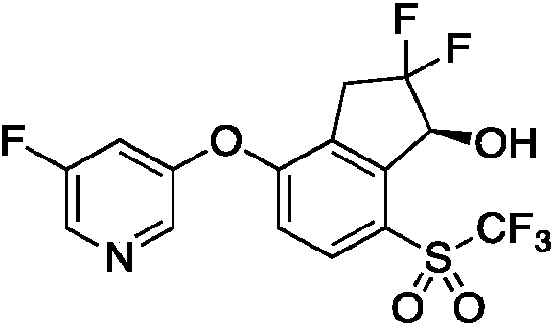
(S)-2,2-difluoro-4-((5-fluoropiridin-3-il)oxi)-7-((trifluorometil)sulfonil)-2,3-dihidro-1H-inden-1-ol (Compuesto 309): Preparado de forma similar a la descrita en el ejemplo de referencia 212. Se realizó purificación por cromatografía sobre sílice usando 5-35 % de EtOAc/hexano para proporcionar el compuesto 309 en forma de un aceite de color beis (430 mg, 99 %). LCMS ESI (+) (M+H) m/z 414; RMN 1H (400 MHz, CDCU): 58,49 (d, 1H), 8,37 (d, 1H), 7,93 (d, 1H), 7,26 (dt, 1H), 6,95 (d, 1H), 5,44 (dd, 1H), 3,67-3,48 (m, 2H), 3,42 (d, 1H).(S) -2,2-difluoro-4 - ((5-fluoropyridin-3-yl) oxy) -7 - ((trifluoromethyl) sulfonyl) -2,3-dihydro-1H-inden-1-ol (Compound 309 ): Prepared in a manner similar to that described in Reference Example 212. Purification was performed by chromatography on silica using 5-35 % EtOAc / hexane to provide compound 309 as a beige oil (430 mg, 99 %). LCMS ESI (+) (M + H) m / z 414; 1H NMR (400 MHz, CDCU): 58.49 (d, 1H), 8.37 (d, 1H), 7.93 (d, 1H), 7.26 (dt, 1H), 6.95 (d , 1H), 5.44 (dd, 1H), 3.67-3.48 (m, 2H), 3.42 (d, 1H).
Ejemplo de referencia 310Reference Example 310

1-óxido de (S)-3-((2.2-difluoro-1-hidroxi-7-((trifluorometil)sulfonil)-2.3-dihidro-1H-inden-4-il)oxonio)-5-fluoropiridina (Compuesto 310): Una solución de (S)-2,2-difluoro-4-((5-fluoropiridin-3-il)oxi)-7-((trifluorometil)sulfonil)-2,3-dihidro-1H-inden-1-ol (324 mg, 0,78 mmol) y peróxido de hidrógeno urea (155 mg, 1,65 mmol) en acetonitrilo (7,9 ml) se enfrió a 0 °C y se trató con anhídrido trifluoroacético (217 ^l, 1,57 mmol). Después de 15 minutos, el baño de hielo se retiró y la reacción se dejó en agitación durante 1 hora. La reacción se interrumpió mediante la adición de 3 ml de Na2S2O3 acuoso saturado. La mezcla bifásica resultante se agitó durante 15 minutos y después se vertió en 20 ml de agua y se extrajo con alcohol isopropílico al 30 % en CHCU 4x15 ml. Los extractos orgánicos combinados se aclararon con 10 ml de salmuera, se secaron con MgSO4, se filtraron y se concentraron a sequedad. Se realizó purificación por cromatografía sobre sílice usando 70-100 % de EtOAc/hexano para proporcionar el compuesto 310 en forma de un sólido de color blanco (310 mg, 92 %). LCMS ESI (+) (M+H) m/z 430; RMN 1H (400 MHz, CDC^): 5 8,11-8,08 (m, 1H), 8,01-7,97 (m, 2H), 7,14 (d, 1H), 6,90 (dt, 1H), 5,43 (dd, 1H), 3,95 (d, 1H), 3,62-3,41 (m, 2H). (S) -3 - ((2,2-Difluoro-1-hydroxy-7 - ((trifluoromethyl) sulfonyl) -2.3-dihydro-1H-inden-4-yl) oxonium) -5-fluoropyridine 1-oxide (Compound 310 ): A solution of (S) -2,2-difluoro-4 - ((5-fluoropyridin-3-yl) oxy) -7 - ((trifluoromethyl) sulfonyl) -2,3-dihydro-1H-inden-1 -ol (324 mg, 0.78 mmol) and urea hydrogen peroxide (155 mg, 1.65 mmol) in acetonitrile (7.9 ml) was cooled to 0 ° C and treated with trifluoroacetic anhydride (217 ^ l, 1.57 mmol). After 15 minutes, the ice bath was removed and the reaction was allowed to stir for 1 hour. The reaction was quenched by the addition of 3 mL of saturated aqueous Na 2 S 2 O 3 . The resulting biphasic mixture was stirred for 15 minutes and then poured into 20 ml of water and extracted with 30% isopropyl alcohol in CHCU 4x15 ml. The combined organic extracts were rinsed with 10 ml of brine, dried over MgSO 4 , filtered, and concentrated to dryness. Purification was performed by chromatography on silica using 70-100% EtOAc / hexane to provide compound 310 as a white solid (310 mg, 92%). LCMS ESI (+) (M + H) m / z 430; 1H NMR (400 MHz, CDC ^): 8.11-8.08 (m, 1H), 8.01-7.97 (m, 2H), 7.14 (d, 1H), 6.90 ( dt, 1H), 5.43 (dd, 1H), 3.95 (d, 1H), 3.62-3.41 (m, 2H).
Ejemplo de referencia 311Reference Example 311
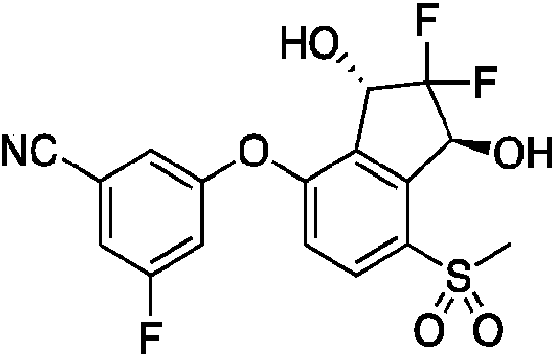
-[(1 S,3S)-2,2-difluoro-1,3-dihidroxi-7-metilsulfonil-indan-4-il1oxi-5-fluoro-benzonitrilo (Compuesto 311): Preparado como se describe en el ejemplo de referencia 292 síntesis alternativa 2 etapa C. LCMS ESI (+) m/z 400 (M+H); RMN 1H (400 MHz, CDCU): 58,00 (d, 1H), 7,27-7,25 (m, 1H), 7,20-7,18 (m, 1H), 7,12-7,07 (m, 1H), 7,03 (d, 1H), 5,81-5,74 (m, 1H), 5,43-5,36 (m, 1H), 3,81 (d, 1H), 3,25 (s, 3H), 2,71 (m, 1H).- [(1 S, 3S) -2,2-difluoro-1,3-dihydroxy-7-methylsulfonyl-indan-4-yl1oxy-5-fluoro-benzonitrile (Compound 311): Prepared as described in the reference example 292 alternative synthesis 2 step C. LCMS ESI (+) m / z 400 (M + H); 1H NMR (400 MHz, CDCU): 58.00 (d, 1H), 7.27-7.25 (m, 1H), 7.20-7.18 (m, 1H), 7.12-7, 07 (m, 1H), 7.03 (d, 1H), 5.81-5.74 (m, 1H), 5.43-5.36 (m, 1H), 3.81 (d, 1H) , 3.25 (s, 3H), 2.71 (m, 1H).
Ejemplo de referencia 312 Reference Example 312
3-[(1S.3R)-2.2-d¡fluoro-1.3-d¡h¡drox¡-7-met¡lsulfon¡l-¡ndan-4-¡llox¡-5-fluoro-benzon¡tr¡lo (Compuesto 312): Preparado como se descr¡be en el ejemplo de referencia 292 síntes¡s alternat¡va 2 etapa C. LCMS ESI (+) m/z 400 (M+H); RMN 1H (400 MHz. CDCla): 88.05 (d. 1H). 7.29-7.20 (m. 2H). 7.15-7.10 (m. 1H). 7.05 (d. 1H). 5.63-5.57 (m. 1H).3 - [(1S.3R) -2.2-d¡fluoro-1.3-d¡h¡drox¡-7-met¡lsulfon¡l-¡ndan-4-¡llox¡-5-fluoro-benzon¡tr¡lo (Compound 312): Prepared as described in Reference Example 292 alternate synthesis 2 step C. LCMS ESI (+) m / z 400 (M + H); 1H NMR (400 MHz. CDCla): 88.05 (d. 1H). 7.29-7.20 (m. 2H). 7.15-7.10 (m. 1H). 7.05 (d. 1H). 5.63-5.57 (m. 1H).
5.22-5.15 (m. 1H). 3.53-3.48 (m. 1H). 3.24 (s. 3H). 2.73 (d. 1H).5.22-5.15 (m. 1H). 3.53-3.48 (m. 1H). 3.24 (s. 3H). 2.73 (d. 1H).
Ejemplo 313Example 313

5-(((1S.2ffl-2-fluoro-1-h¡drox¡-7-(met¡lsulfon¡l)-2.3-d¡h¡dro-1H-¡nden-4-¡l)ox¡)n¡cot¡non¡tr¡lo (Compuesto 313) 5 - (((1S.2ffl-2-fluoro-1-h¡drox¡-7- (meth¡lsulfon¡l) -2.3-d¡h¡dro-1H-¡nden-4-¡l) ox¡ ) n¡cot¡non¡tr¡lo (Compound 313)
Etapa A: Preparac¡ón de 4-fluoro-7-(met¡lt¡o)-2.3-d¡h¡dro-1H-¡nden-1-ona: Se suspend¡ó N.N-d¡met¡lcarbamot¡oato de S-(7-fluoro-3-oxo-¡ndan-4-¡lo) (10 g. 37 mmol) en etanol al 95 % (140 ml) y se trató con h¡dróx¡do sód¡co acuoso 4 M (79 ml. 320 mmol). después se calentó la mezcla a reflujo durante 30 m¡nutos. La reacc¡ón se enfr¡ó a 0 °C y se trató gota a gota con yodometano (3.2 ml. 51.5 mmol) y la mezcla se ag¡tó durante 1 hora a 0 °C. La mezcla se concentró al vacío y después el res¡duo se repart¡ó entre acetato de et¡lo y agua. Tras la separac¡ón. la capa acuosa se lavó con acetato de et¡lo y las capas orgán¡cas se comb¡naron. El acetato de et¡lo se lavó tres veces con agua. NaHCO3 saturado. NaCl saturado. se secó Na2SO4 y se concentró al vacío hasta un sól¡do oscuro (7.1 g). El mater¡al en bruto se cromatograf¡ó sobre SO 2 eluyendo con un grad¡ente de acetato de et¡lo/hexano para dar un sól¡do oscuro (5.9 g). LCMS ESI (+) m/z 197 (M+H).Stage A: Preparation of 4-fluoro-7- (metal) -2.3-d¡hydro-1H-inden-1-one: NN-d¡met¡lcarbamot¡ was suspended S- (7-fluoro-3-oxo-indan-4-yl) oate (10 g, 37 mmol) in 95% ethanol (140 ml) and treated with aqueous sodium hydroxide 4M (79 ml, 320 mmol). then the mixture was heated under reflux for 30 minutes. The reaction was cooled to 0 ° C and treated dropwise with iodomethane (3.2 ml, 51.5 mmol) and the mixture was stirred for 1 hour at 0 ° C. The mixture was concentrated in vacuo and then the residue was partitioned between ethyl acetate and water. After the separation. the aqueous layer was washed with ethyl acetate and the organic layers were combined. The ethyl acetate was washed three times with water. Saturated NaHCO 3 . Saturated NaCl. Na 2 SO 4 was dried and concentrated in vacuo to a dark solid (7.1 g). The crude material was chromatographed on SO 2 eluting with an ethyl acetate / hexane gradient to give a dark solid (5.9 g). LCMS ESI (+) m / z 197 (M + H).
Etapa B: Preparac¡ón de 4-fluoro-7-(met¡lsulfon¡l)-2.3-d¡h¡dro-1H-¡nden-1-ona: Se d¡solv¡ó 4-fluoro-7-met¡lsulfan¡l-¡ndan-1-ona (5.9 g. 30 mmol) en MeOH (200 ml) y la reacc¡ón se trató gota a gota con una soluc¡ón de Oxone® (40.8 g. 66.3 mmol) que se había d¡suelto en agua (200 ml). La mezcla resultante se ag¡tó a temperatura amb¡ente durante 20 horas. La mezcla de reacc¡ón se f¡ltró. los sól¡dos se lavaron con acetato de et¡lo y el f¡ltrado se concentró al vacío. El f¡ltrado acuoso se extrajo tres veces con acetato de et¡lo. después los extractos orgán¡cos comb¡nados se lavaron con NaCl saturado. se secaron con Na2SO4 y se concentraron al vacío hasta un sól¡do de color castaño (9.43 g). LCMS ESI (+) m/z 229 (M+H).Step B: Preparation of 4-fluoro-7- (methylsulfon¡l) -2.3-d¡hydro-1H-inden-1-one: 4-fluoro-7- was dissolved methylsulfanil-indan-1-one (5.9 g, 30 mmol) in MeOH (200 ml) and the reaction was treated dropwise with a solution of Oxone® (40.8 g, 66.3 mmol) which had dissolved in water (200 ml). The resulting mixture was stirred at room temperature for 20 hours. The reaction mixture was filtered. the solids were washed with ethyl acetate and the filtrate was concentrated in vacuo. The aqueous filtrate was extracted three times with ethyl acetate. then the combined organic extracts were washed with saturated NaCl. dried over Na 2 SO 4 and concentrated in vacuo to a tan solid (9.43 g). LCMS ESI (+) m / z 229 (M + H).
Etapa C: Preparac¡ón de 4-fluoro-7-(met¡lsulfon¡l)-2.3-d¡h¡droesp¡ro[¡nden-1.2'-[1.3ld¡oxolanol: Se d¡solv¡eron 4-fluoro-7-met¡lsulfon¡l-¡ndan-1-ona (6.58 g. 28.8 mmol) y tr¡met¡l(2-tr¡met¡ls¡l¡lox¡etox¡)s¡lano (9.9 ml. 40.4 mmol) en d¡clorometano (105 ml). se enfr¡aron a -78 °C. después se trató la reacc¡ón gota a gota con tr¡fluorometanosulfonato de tr¡met¡ls¡l¡lo (1.67 ml. 9.23 mmol). Después de la ad¡c¡ón. la mezcla de reacc¡ón se dejó calentar a temperatura amb¡ente s¡n el baño y se ag¡tó durante 4.5 horas. La reacc¡ón se ¡nterrump¡ó med¡ante la ad¡c¡ón de tr¡et¡lam¡na (16.1 ml. 115 mmol) a temperatura amb¡ente y la mezcla de reacc¡ón se concentró al vacío. El res¡duo oscuro se d¡solv¡ó en acetato de et¡lo y se lavó con NaCl sem¡saturado. El extracto acuoso se lavó con acetato de et¡lo y los extractos orgán¡cos comb¡nados se lavaron con agua. NaCl saturado. se secaron sobre Na2SO4 y se concentraron al vacío para dar un res¡duo oscuro. El sem¡sól¡do pegajoso se suspend¡ó en hexano/acetato de et¡lo 3:1 (250 ml) y se ag¡tó durante una hora. Los sól¡dos oscuros se recog¡eron por f¡ltrac¡ón. se lavaron con hexano /acetato de et¡lo 3:1 y se secaron al a¡re hasta un sól¡do verdusco (4.66 g). El f¡ltrado se concentró y se tr¡turó con acetona (aprox. 25 ml) y se ag¡tó durante 20 m¡nutos. La mezcla se d¡luyó con una porc¡ón aprox¡madamente ¡gual de hexanos. después se f¡ltró. El sól¡do se lavó con hexano/acetato de et¡lo 9:1 y se secó al a¡re para dar un producto ad¡c¡onal en forma de un sól¡do de color verde más claro (1.1 g). LCMS ESI (+) m/z 273 (M+H).Stage C: Preparation of 4-fluoro-7- (methylsulfon¡l) -2.3-d¡h¡droesp¡ro [¡nden-1.2 '- [1.3ld¡oxolanol: 4 -fluoro-7-met¡lsulfon¡l-indan-1-one (6.58 g. 28.8 mmol) and tr¡met¡l (2-tr¡met¡ls¡l¡lox¡ethox¡) s¡lane ( 9.9 ml, 40.4 mmol) in dichloromethane (105 ml). cooled to -78 ° C. the reaction was then treated dropwise with trimethyl tri-fluoromethanesulfonate (1.67 ml, 9.23 mmol). After the ad¡tion. The reaction mixture was allowed to warm to room temperature without the bath and stirred for 4.5 hours. The reaction was stopped by adding tritlamine (16.1 ml, 115 mmol) at room temperature and the reaction mixture was concentrated in vacuo. The dark residue was dissolved in ethyl acetate and washed with semi-saturated NaCl. The aqueous extract was washed with ethyl acetate and the combined organic extracts were washed with water. Saturated NaCl. Dried over Na 2 SO 4 and concentrated in vacuo to give a dark residue. The sticky semi-solid was suspended in 3: 1 hexane / ethyl acetate (250 ml) and stirred for one hour. The dark solids were collected by filtration. They were washed with hexane / ethyl acetate 3: 1 and air dried to a greenish solid (4.66 g). The filtrate was concentrated and triturated with acetone (approx. 25 ml) and stirred for 20 minutes. The mixture was diluted with about an equal portion of hexanes. then it leaked. The solid was washed with 9: 1 hexane / ethyl acetate and air dried to give an additional product as a lighter green solid (1.1 g). LCMS ESI (+) m / z 273 (M + H).
Etapa D: Preparac¡ón de 5-((7-(met¡lsulfon¡l)-2.3-d¡h¡droesp¡ro[¡nden-1.2'-[1.3ld¡oxolanl-4-¡l)ox¡)n¡cot¡non¡tr¡lo: Se comb¡nó 4'-fluoro-7'-met¡lsulfon¡l-esp¡ro[1.3-d¡oxolan-2.1'-¡ndanl (2.0 g. 7.4 mmol) con 3-c¡ano-5-h¡drox¡p¡r¡d¡na (1.06 g. 8.8 mmol) en NMP (14 ml) y la soluc¡ón se trató con fosfato potás¡co tr¡bás¡co (4.68 g. 22 mmol) en una ún¡ca porc¡ón. La reacc¡ón se calentó a 120 °C durante 14 horas. La mezcla se enfr¡ó a temperatura amb¡ente. después se d¡luyó con acetato de et¡lo (50-70 ml) y los sól¡dos no d¡sueltos se el¡m¡naron por f¡ltrac¡ón a través de una fr¡ta y se lavaron con más acetato de et¡lo. El f¡ltrado se d¡luyó con un volumen ¡gual de agua. Esto provocó que se formaran algunos sól¡dos oscuros en la mezcla. La ad¡c¡ón de ¡sopropanol al 25 %/cloruro de met¡leno volv¡ó a d¡solver los sól¡dos y las capas se separaron. La capa orgán¡ca se lavó c¡nco veces con agua. NaCl saturado. se secó sobre Na2SO4. después se concentró hasta un sól¡do oscuro (1.15 g). El mater¡al en bruto se cromatograf¡ó sobre SO 2 (B¡otage SNAP 50 g) y se eluyó con un grad¡ente de acetato de et¡lo/hexano. El producto deseado se concentró hasta un sól¡do de color rosa claro (0.50 g). LCMS ESI (+) m/z 373 (M+H) Etapa E: Preparac¡ón de 5-((7-(met¡lsulfon¡l)-1-oxo-2.3-d¡h¡dro-1H-¡nden-4-¡l)ox¡)n¡cot¡non¡tr¡lo: Se suspend¡ó 5-(7'-met¡lsulfon¡lesp¡ro[1.3-d¡oxolan-2.1'-¡ndanl-4'-¡l)ox¡p¡r¡d¡n-3-carbon¡tr¡lo (0.5 g. 1.3 mmol) en acetona (6 ml) y se trató con HCl acuoso al 10 % (2.3 ml. 6.7 mmol). La soluc¡ón se ag¡tó a temperatura amb¡ente durante 1 hora. La mezcla de reacc¡ón se ajustó a pH 8 con NaHCO3 saturado. después se concentró al vacío para el¡m¡nar la acetona. Los sól¡dos resultantes se recog¡eron por f¡ltrac¡ón y se secaron al a¡re (0.44 g). LCMs ESI (+) m/z 329,1 (M+H).Stage D: Preparation of 5 - ((7- (met¡lsulfon¡l) -2.3-d¡h¡droesp¡ro [¡nden-1.2 '- [1.3ld¡oxolanl-4-¡l) ox¡ ) n¡cot¡non¡tr¡lo: 4'-fluoro-7'-meth¡lsulfon¡l-esp¡ro [1.3-d¡oxolan-2.1'-indanl (2.0 g, 7.4 mmol ) with 3-kano-5-hydroxypyrene (1.06 g. 8.8 mmol) in NMP (14 ml) and the solution was treated with potassium phosphate tribas co (4.68 g. 22 mmol) in a single serving. The reaction was heated at 120 ° C for 14 hours. The mixture was cooled to room temperature. then it was diluted with ethyl acetate (50-70 ml) and the undissolved solids were removed by filtration through a frit and washed with more ethyl acetate. The filtrate was diluted with an equal volume of water. This caused some dark solids to form in the mix. The addition of 25% sopropanol / methylene chloride re-dissolved the solids and the layers separated. The organic layer was washed five times with water. Saturated NaCl. dried over Na 2 SO 4 . then it was concentrated to a dark solid (1.15 g). The crude material was chromatographed over SO 2 (50 g SNAP Potage) and eluted with an ethyl acetate / hexane gradient. The desired product was concentrated to a light pink solid (0.50 g). LCMS ESI (+) m / z 373 (M + H) Step E: Preparation of 5 - ((7- (methysulfonl) -1-oxo-2.3-dihydro-1H-¡ nden-4-¡l) ox¡) n¡cot¡non¡tr¡lo: 5- (7'-met¡lsulfon¡lesp¡ro [1.3-d¡oxolan-2.1'-¡ndanl- 4'-¡l) oxypyr¡d¡n-3-carbonitral (0.5 g. 1.3 mmol) in acetone (6 ml) and treated with 10% aqueous HCl (2.3 ml. 6.7 mmol). The solution was stirred at room temperature for 1 hour. The reaction mixture was adjusted to pH 8 with saturated NaHCO 3 . then it was concentrated in vacuo to remove the acetone. The resulting solids were collected by filtration and dried in the air (0.44 g). LCM s ESI (+) m / z 329.1 (M + H).
Etapa F: Preparación de 5-((2-fluoro-7-(met¡lsulfon¡l)-1-oxo-2.3-d¡h¡dro-1H-¡nden-4-¡l)ox¡)nicot¡non¡tr¡lo: Se disolvió 5-(7-metilsulfonil-1 -oxo-indan-4-il)oxipiridin-3-carbonitrMo (0.44 g. 1.3mmol) en MeOH (4 ml) y se trató con Selectfluor® (760 mg, 2.2 mmol). La mezcla se calentó a reflujo durante 40 horas. Se añadió acetonitrilo (2 ml) y el calentamiento continuó durante 7 horas más. La mezcla se agitó durante una noche a temperatura ambiente después se diluyó con agua. acetato de etilo y cloruro de metileno. La suspensión se filtró y los sólidos se lavaron con acetato de etilo. El filtrado se concentró al vacío. después se trató el agua residual con acetona (2 ml) y HCl al 10 % (2 ml) y se calentó a 50 °C durante 30 minutos. La mezcla se ajustó a pH 8 con NaHCO3 sólido. después se concentró al vacío. El extracto acuoso resultante se lavó dos veces con acetato de etilo y los extractos orgánicos combinados se lavaron con NaHCO3 saturado. NaCl saturado. se secaron sobre Na2SO4 y se concentraron al vacío hasta un aceite de color amarillo claro (447 mg). El material en bruto se cromatografió sobre SO 2 (Biotage SNAP 25 g) y se eluyó con un gradiente de MeOH/cloruro de metileno. El material deseado se concentró hasta una película de color amarillo (274 mg). LCMS ESI (-) m/z 345.0 (M-H).Step F: Preparation of 5 - ((2-fluoro-7- (methsulfonl) -1-oxo-2.3-d¡h¡dro-1H-inden-4-¡l) ox¡) nicot¡ non-trilo: 5- (7-methylsulfonyl-1 -oxo-indan-4-yl) oxypyridine-3-carbonitrMo (0.44 g, 1.3 mmol) was dissolved in MeOH (4 ml) and treated with Selectfluor® ( 760 mg, 2.2 mmol). The mixture was heated under reflux for 40 hours. Acetonitrile (2 ml) was added and heating continued for a further 7 hours. The mixture was stirred overnight at room temperature then diluted with water. ethyl acetate and methylene chloride. The suspension was filtered and the solids were washed with ethyl acetate. The filtrate was concentrated in vacuo. the residual water was then treated with acetone (2 ml) and 10% HCl (2 ml) and heated at 50 ° C for 30 minutes. The mixture was adjusted to pH 8 with solid NaHCO 3 . then it was concentrated in vacuo. The resulting aqueous extract was washed twice with ethyl acetate and the combined organic extracts were washed with saturated NaHCO 3 . Saturated NaCl. dried over Na 2 SO 4 and concentrated in vacuo to a light yellow oil (447 mg). The crude material was chromatographed on SO 2 (Biotage SNAP 25 g) and eluted with a MeOH / methylene chloride gradient. The desired material was concentrated to a yellow film (274 mg). LCMS ESI (-) m / z 345.0 (MH).
Etapa G: Preparación de 5-(((1S.2ffl-2-fluoro-1-h¡drox¡-7-(met¡lsulfon¡l)-2.3-d¡h¡dro-1H-¡nden-4-¡l)ox¡)n¡cot¡nonitr¡lo (Compuesto 313): Se suspendió 5-(2-fluoro-7-met¡lsulfonil-1-oxo-¡ndan-4-¡l)ox¡p¡r¡d¡n-3-carbon¡tr¡lo (274 mg.Step G: Preparation of 5 - (((1S.2ffl-2-fluoro-1-h¡drox¡-7- (met¡lsulfon¡l) -2.3-d¡h¡dro-1H-inden-4- ¡L) ox¡) n¡cot¡nonitr¡lo (Compound 313): 5- (2-fluoro-7-meth¡lsulfonyl-1-oxo-indan-4-¡l) ox¡p¡r was suspended ¡D¡n-3-carbonitral (274 mg.
0.79 mmol) en cloruro de metileno (3 ml). se enfrió a 0 °C. después se trató con trietilamina (0.22 ml. 1.6 mmol). ácido fórmico (0.09 ml. 2.4 mmol) y RuCl(p-cimeno)[(R.R)-Ts-DPEN] (5 mg. 0.01 mmol). La mezcla de reacción se dejó en reposo a 0 °C durante 15 horas. La mezcla se concentró y se cromatografió sobre SO2 (Biotage SNAP 10 g) y se eluyó con un gradiente de acetato de etilo/hexano para dar el compuesto 313 en forma de un sólido de color blanco (120 mg). LCMS ESI (+) m/z 349 (M+H); RMN 1H (400 MHz. CDCla): 88.75-8.72 (m. 1H).0.79 mmol) in methylene chloride (3 ml). cooled to 0 ° C. then it was treated with triethylamine (0.22 ml. 1.6 mmol). formic acid (0.09 ml. 2.4 mmol) and RuCl (p-cymene) [(RR) -Ts-DPEN] (5 mg, 0.01 mmol). The reaction mixture was allowed to stand at 0 ° C for 15 hours. The mixture was concentrated and chromatographed over SO 2 (Biotage SNAP 10 g) and eluted with an ethyl acetate / hexane gradient to give compound 313 as a white solid (120 mg). LCMS ESI (+) m / z 349 (M + H); 1H NMR (400 MHz. CDCla): 88.75-8.72 (m. 1H).
8.66-8.64 (m. 1H). 7.92 (d. 1H). 7.61-7.59 (m. 1H). 6.95 (d. 1H). 5.73-5.65 (m. 1H). 5.51-5.47 (m. 0.5H). 5.38-5.34 (m. 0.5H). 3.71-3.68 (m. 1H). 3.36-3.38 (m. 2H). 3.31 (s. 3H).8.66-8.64 (m. 1H). 7.92 (d. 1H). 7.61-7.59 (m. 1H). 6.95 (d. 1H). 5.73-5.65 (m. 1H). 5.51-5.47 (m. 0.5H). 5.38-5.34 (m. 0.5H). 3.71-3.68 (m. 1H). 3.36-3.38 (m. 2H). 3.31 (s. 3H).
Ejemplos de referencia 314 y 315Reference Examples 314 and 315

5-(((1S)-2.2-d¡fluoro-1-h¡drox¡-7-(S-(tr¡fluoromet¡l)sulfon¡m¡do¡l)-2.3-d¡h¡dro-1H-¡nden-4-¡l)ox¡)n¡cot¡non¡tr¡lo (Compuesto 314) y 5-(((1S)-2.2-d¡fluoro-1-h¡drox¡-7-(S-(tr¡fluoromet¡l)sulfon¡m¡do¡l)-2.3-d¡h¡dro-1H-inden-4-¡l)oxi)n¡cot¡non¡tr¡lo (Compuesto 315): Preparados de una manera similar a la descrita en el ejemplo de referencia 163, etapa F. sustituyendo 5-((2.2-d¡fluoro-1-oxo-7-(S-(tr¡fluoromet¡l)sulfonim¡do¡l)-2.3-d¡h¡dro-1H-¡nden-4-¡l)oxi)n¡cot¡non¡tr¡lo por 3-(2.2-difluoro-7-met¡lsulfon¡l-1-oxo-¡ndan-4-¡l)ox¡-5-fluoro-benzon¡tr¡lo. Se preparó 5-((2.2-d¡fluoro-1-oxo-7-(S-(tr¡fluoromet¡l)sulfon¡m¡do¡l)-2.3-dih¡dro-1H-¡nden-4-¡l)ox¡)n¡cot¡non¡tr¡lo de forma similar de acuerdo con los ejemplos de referencia 305 y 306.5 - (((1S) -2.2-d¡fluoro-1-h¡drox¡-7- (S- (tr¡fluorometh¡l) sulfon¡m¡do¡l) -2.3-d¡h¡dro- 1H-inden-4-¡l) ox¡) n¡cot¡non¡trilo (Compound 314) and 5 - (((1S) -2.2-d¡fluoro-1-hydrox¡-7- (S- (tr¡fluorometh¡l) sulfon¡m¡do¡l) -2.3-d¡h¡dro-1H-inden-4-¡l) oxy) n¡cot¡non¡tr¡lo (Compound 315 ): Prepared in a similar manner to that described in Reference Example 163, step F. substituting 5 - ((2.2-d¡fluoro-1-oxo-7- (S- (tr¡fluorometh¡l) sulfonim¡do ¡L) -2.3-d¡h¡dro-1H-inden-4-¡l) oxy) n¡cot¡non¡tr¡lo by 3- (2.2-difluoro-7-meth¡lsulfon¡l-1 -oxo-indan-4-¡l) ox¡-5-fluoro-benzonitrol. 5 - ((2.2-d¡fluoro-1-oxo-7- (S- (tr¡fluoromethyl) sulfon¡m¡do¡l) -2.3-dihydro-1H-inden-4- ¡L) ox¡) n¡cot¡non¡trilo similarly according to Reference Examples 305 and 306.
Datos para 5-(((1S)-2.2-d¡fluoro-1-h¡drox¡-7-(S-(tr¡fluoromet¡l)sulfon¡m¡do¡l)-2.3-d¡h¡dro-1H-¡nden-4¡l)oxi)n¡cot¡non¡tr¡lo (Compuesto 314): Tiempo de retención de la HPLC (método largo) = 4.46 min; LCMS ESI (+) (M+H) m/z 420; RMN 1H (400 MHz. CDCl3): 88.83 (d. 1H). 8.72 (d. 1H). 8.02 (d. 1H). 7.73 (dd. 1H). 6.95 (d. 1H). 5.35 (dd. 1H). 4.73-4.70 (m s. 1H). 3.99 (s a. 1H). 3.67-3.49 (m. 2H).Data for 5 - (((1S) -2.2-d¡fluoro-1-h¡drox¡-7- (S- (tr¡fluoromet¡l) sulfon¡m¡do¡l) -2.3-d¡h¡ dro-1H-inden-4 [mu] l) oxy) n [mu] n (Compound 314): HPLC retention time (long method) = 4.46 min; LCMS ESI (+) (M + H) m / z 420; 1H NMR (400 MHz. CDCl3): 88.83 (d. 1H). 8.72 (d. 1H). 8.02 (d. 1H). 7.73 (dd. 1H). 6.95 (d. 1H). 5.35 (dd. 1H). 4.73-4.70 (m s, 1H). 3.99 (bs 1H). 3.67-3.49 (m. 2H).
Datos para 5-(((1S)-2.2-d¡fluoro-1-h¡drox¡-7-(S-(tr¡fluoromet¡l)sulfon¡m¡do¡l)-2.3-d¡h¡dro-1H-¡nden-4-¡l)oxi)n¡cot¡non¡tr¡lo (Compuesto 315): Tiempo de retención de la HPLC (método largo) = 4.17 min; LCMS ESI (+) (M+H) m/z 420; RMN 1H (400 MHz. CDCla): 88.82 (d. 1H). 8.71 (d. 1H). 8.08 (d. 1H). 7.72 (dd. 1H). 6.93 (d. 1H). 5.63-5.57 (m. 1H). 3.97 (d. 1H). 3.82 (s a. 1H). 3.65-3.43 (m. 2H).Data for 5 - (((1S) -2.2-d¡fluoro-1-h¡drox¡-7- (S- (tr¡fluoromet¡l) sulfon¡m¡do¡l) -2.3-d¡h¡ dro-1H-inden-4-µl) oxy) nicotinyl (Compound 315): HPLC retention time (long method) = 4.17 min; LCMS ESI (+) (M + H) m / z 420; 1H NMR (400 MHz. CDCla): 88.82 (d. 1H). 8.71 (d. 1H). 8.08 (d. 1H). 7.72 (dd. 1H). 6.93 (d. 1H). 5.63-5.57 (m. 1H). 3.97 (d. 1H). 3.82 (bs 1H). 3.65-3.43 (m. 2H).
Ejemplos de referencia 316, 317 y 318 Reference examples 316, 317 and 318

Isómero______1______ de_____ [[(1R.3S)-7-(3-ciano-5-fluoro-fenoxi)-1.2.2-trifluoro-3-hidroxi-indan-4-ill-metil-oxo-A6-sulfanilidenolcianamida (Compuesto 316), isómero 2 de [[(1R.3S)-7-(3-ciano-5-fluoro-fenoxi)-1.2.2-trifluoro-3-hidroxi-indan-4-ill-metil-oxo-Á6-sulfanilidenolcianamida (Compuesto 317) e isómero 1 de [[(1 S.3S)-7-(3-ciano-5-fluoro-fenoxi)-1.2.2-trifluoro-3-hidroxi-indan-4-ill-metil-oxo-A6-sulfanilidenolcianamida (Compuesto 318)______ 1______ isomer of_____ [[(1R.3S) -7- (3-cyano-5-fluoro-phenoxy) -1.2.2-trifluoro-3-hydroxy-indan-4-ill-methyl-oxo-A6-sulfanylidenolcynamide (Compound 316 ), isomer 2 of [[(1R.3S) -7- (3-cyano-5-fluoro-phenoxy) -1.2.2-trifluoro-3-hydroxy-indan-4-ill-methyl-oxo-Á6-sulfanylidenolcynamide (Compound 317) and isomer 1 of [[(1 S.3S) -7- (3-cyano-5-fluoro-phenoxy) -1.2.2-trifluoro-3-hydroxy-indan-4-ill-methyl-oxo -A6-sulfanylidenolcynamide (Compound 318)
Etapa A: Preparación de 2.2.3.4-tetrafluoro-7-metilsulfanil-indan-1-ona: Se añadió trifluoruro de dietilaminoazufre (0.089 ml. 0.67 mmol) a una solución enfriada en hielo de 2.2.4-trifluoro-3-hidroxi-7-metilsulfanil-indan-1-ona (139 mg. 0.56 mmol) en diclorometano (10 ml). La mezcla de reacción se dejó calentar a temperatura ambiente. Se añadió más trifluoruro de dietilaminoazufre tras 1 hora para permitir que la reacción se completase. La mezcla se trató cuidadosamente con NaHCO3 acuoso y se repartió entre EtOAc y agua. El EtOAc se lavó con salmuera. se secó sobre MgSO4. se filtró y se evaporó para proporcionar 2.2.3.4-tetrafluoro-7-metilsulfanil-indan-1-ona (120 mg. 0.48 mmol. 86 % de rendimiento) en forma de un aceite de color naranja. m/z (ES-API-pos) [M+H] = 250.Step A: Preparation of 2.2.3.4-tetrafluoro-7-methylsulfanyl-indan-1-one: Diethylamino sulfur trifluoride (0.089 ml, 0.67 mmol) was added to an ice-cold solution of 2.2.4-trifluoro-3-hydroxy- 7-methylsulfanyl-indan-1-one (139 mg, 0.56 mmol) in dichloromethane (10 ml). The reaction mixture was allowed to warm to room temperature. More diethylamino sulfur trifluoride was added after 1 hour to allow the reaction to complete. The mixture was carefully treated with aqueous NaHCO 3 and partitioned between EtOAc and water. The EtOAc was washed with brine. dried over MgSO 4 . It was filtered and evaporated to provide 2.2.3.4-tetrafluoro-7-methylsulfanyl-indan-1-one (120 mg, 0.48 mmol. 86 % yield) as an orange oil. m / z (ES-API-pos) [M + H] = 250.
Etapa B: Preparación de [metil-[(1R)-1.2.2.7-tetrafluoro-3-oxo-indan-4-ill-A4-sulfanilidenolcianamida: Se añadió (diacetoxiyodo)benceno (170 mg. 0.53 mmol) a una solución enfriada en hielo de 2.2.3.4-tetrafluoro-7-metilsulfanil-indan-1-ona (120 mg. 0.48 mmol) y cianamida (24 mg. 0.58 mmol) en diclorometano (10 ml). La mezcla de reacción se trató con bis[rodio(ácido a.a.a'.a'-tetrametil-1.3-bencenodipropiónico)l (3.6 mg.Step B: Preparation of [methyl - [(1R) -1.2.2.7-tetrafluoro-3-oxo-indan-4-ill-A4-sulfanylidene-cyanamide: (Diacetoxyiodo) benzene (170 mg, 0.53 mmol) was added to a cooled solution on ice 2.2.3.4-tetrafluoro-7-methylsulfanyl-indan-1-one (120 mg, 0.48 mmol) and cyanamide (24 mg, 0.58 mmol) in dichloromethane (10 ml). The reaction mixture was treated with bis [rhodium (a.a.a'.a'-tetramethyl-1,3-benzenedipropionic acid) l (3.6 mg.
0.0048 mmol) y se dejó calentar a temperatura ambiente. Después de 1 hora. la mezcla de reacción se evaporó y el residuo se repartió entre EtOAc y tiosulfato sódico acuoso diluido. El EtOAc se lavó con salmuera. se secó sobre MgSO4. se filtró y se evaporó para proporcionar [metil-[1.2.2.7-tetrafluoro-3-oxo-indan-4-il]-A4-sulfanilideno]cianamida (100 mg. 0.35 mmol. 72 % de rendimiento) en forma de una espuma de color pardo. m/z (ES-API-pos) [M+H+18] =309.0.0048 mmol) and allowed to warm to room temperature. After 1 hour. The reaction mixture was evaporated and the residue was partitioned between EtOAc and dilute aqueous sodium thiosulfate. The EtOAc was washed with brine. dried over MgSO 4 . filtered and evaporated to provide [methyl- [1.2.2.7-tetrafluoro-3-oxo-indan-4-yl] -A4-sulfanylidene] cyanamide (100mg, 0.35mmol, 72% yield) as a foam brown in color. m / z (ES-API-pos) [M + H + 18] = 309.
Etapa C: Preparación de [metil-oxo-[1.2.2.7-tetrafluoro-3-oxo-indan-4-ill-Á6-sulfanilidenolcianamida: Se añadió cloruro de rutenio (III) (1.4 mg. 0.007 mmol) a una mezcla enfriada en hielo de [metil-[1.2.2.7-tetrafluoro-3-oxoindan-4-il]-A4-sulfanilideno]cianamida (100 mg. 0.34 mmol) y peryodato sódico (221 mg. 1.0 mmol) en una mezcla de tetracloruro de carbono (4 ml). acetonitrilo (4 ml). y agua (8 ml). La mezcla se agitó vigorosamente en un baño de hielo. Después de 45 minutos. la mezcla de reacción se diluyó con diclorometano y se lavó con solución acuosa diluida de tiosulfato sódico. El diclorometano se lavó con salmuera. se secó sobre MgSO4. se filtró y se evaporó para proporcionar [metil-oxo-[1.2.2.7-tetrafluoro-3-oxo-indan-4-il]-A6-sulfanilideno]cianamida (70 mg.Step C: Preparation of [methyl-oxo- [1.2.2.7-tetrafluoro-3-oxo-indan-4-ill-A6-sulfanylideneolcyanamide: Ruthenium (III) chloride (1.4 mg. 0.007 mmol) was added to a cooled mixture on ice of [methyl- [1.2.2.7-tetrafluoro-3-oxoindan-4-yl] -A4-sulfanylidene] cyanamide (100 mg, 0.34 mmol) and sodium periodate (221 mg, 1.0 mmol) in a mixture of sodium tetrachloride carbon (4 ml). acetonitrile (4 ml). and water (8 ml). The mixture was vigorously stirred in an ice bath. After 45 minutes. The reaction mixture was diluted with dichloromethane and washed with dilute aqueous sodium thiosulfate solution. The dichloromethane was washed with brine. dried over MgSO 4 . filtered and evaporated to provide [methyl-oxo- [1,2.2,7-tetrafluoro-3-oxo-indan-4-yl] -A6-sulfanylidene] cyanamide (70 mg.
0.23 mmol. 66 % de rendimiento). m/z (ES-API-pos) [M+H+18] =325.0.23 mmol. 66% yield). m / z (ES-API-pos) [M + H + 18] = 325.
Etapa D: Preparación de [[7-(3-ciano-5-fluoro-fenoxi)-1.2.2-trifluoro-3-oxo-indan-4-ill-metil-oxo-A6-sulfanilidenolcianamida: Se añadió bicarbonato de cesio (88.6 mg. 0.46 mmol) a una solución de 3-fluoro-5-hidroxi-benzonitrilo (40.7 mg. 0.3 mmol) y [metil-oxo-[1.2.2.7-tetrafluoro-3-oxo-indan-4-il]-A6-sulfanilidenolcianamida (70 mg. 0.23 mmol) en N.N-dimetilformamida (3 ml). La mezcla se agitó a temperatura ambiente. Después de 25 minutos. la mezcla de reacción se repartió entre EtOAc y NaCl acuoso diluido. El EtOAc se lavó con 2 porciones de salmuera. se secó sobre MgSO4. se filtró y se evaporó.Step D: Preparation of [[7- (3-cyano-5-fluoro-phenoxy) -1.2.2-trifluoro-3-oxo-indan-4-ill-methyl-oxo-A6-sulfanylidene-cyanamide: Cesium bicarbonate was added (88.6 mg. 0.46 mmol) to a solution of 3-fluoro-5-hydroxy-benzonitrile (40.7 mg, 0.3 mmol) and [methyl-oxo- [1.2.2.7-tetrafluoro-3-oxo-indan-4-yl] -A6-sulfanylidenolcyanamide (70 mg, 0.23 mmol) in NN-dimethylformamide (3 ml). The mixture was stirred at room temperature. After 25 minutes. The reaction mixture was partitioned between EtOAc and dilute aqueous NaCl. The EtOAc was washed with 2 portions of brine. dried over MgSO 4 . filtered and evaporated.
El residuo se cromatografió en una columna ultra SNAP de 10 g de Biotage con un gradiente del 20 % al 80 % de EtOAc:hexano para proporcionar [[7-(3-ciano-5-fluoro-fenoxi)-1.2.2-trifluoro-3-oxo-indan-4-il]-metil-oxo-A6-sulfanilideno]cianamida (35.5 mg. 0.084 mmol. 37 % de rendimiento) en forma de una mezcla diastereomérica. m/z (ES-API-pos) [M+H+18] = 442.The residue was chromatographed on a Biotage 10g ultra SNAP column with a 20% to 80% EtOAc: hexane gradient to provide [[7- (3-cyano-5-fluoro-phenoxy) -1.2.2-trifluoro -3-Oxo-indan-4-yl] -methyl-oxo-A6-sulfanylidene] cyanamide (35.5 mg. 0.084 mmol. 37% yield) as a diastereomeric mixture. m / z (ES-API-pos) [M + H + 18] = 442.
Etapa E: Preparación del isómero 1 de [[(1R.3S)-7-(3-ciano-5-fluoro-fenoxi)-1.2.2-trifluoro-3-hidroxi-indan-4-illmetil-oxo-A6-sulfanilidenolcianamida (Compuesto 316), isómero 2 de [[(1R.3S)-7-(3-ciano-5-fluoro-fenoxi)-1.2.2-trifluoro-3-hidroxi-indan-4-ill-metil-oxo-A6-sulfanilidenolcianamida (Compuesto 317) e isómero 1 de [[(1S.3S)-7-(3-ciano-5-fluoro-fenoxi)-1.2.2-trifluoro-3-hidroxi-indan-4-ill-metil-oxo-A6-sulfanilidenolcianamida (Compuesto 318): ó RuCl(p-cimeno)[(R.R)-Ts-DPEN] (1.6 mg. 0.0025 mmol) a una solución rociada con nitrógeno. enfriada en hielo de [[7-(3-ciano-5-fluoro-fenoxi)-1.2.2-trifluoro-3-oxo-indan-4-il]-metil-oxo-A6-sulfanilideno]cianamida (35.5 mg. 0.084 mmol). ácido fórmico (0.013 ml. 0.34 mmol) y trietilamina (0.029 ml.Step E: Preparation of isomer 1 of [[(1R.3S) -7- (3-cyano-5-fluoro-phenoxy) -1.2.2-trifluoro-3-hydroxy-indan-4-illmethyl-oxo-A6- sulfanylidenolcyanamide (Compound 316), isomer 2 of [[(1R.3S) -7- (3-cyano-5-fluoro-phenoxy) -1.2.2-trifluoro-3-hydroxy-indan-4-ill-methyl-oxo -A6-sulfanylidenolcyanamide (Compound 317) and isomer 1 of [[(1S.3S) -7- (3-cyano-5-fluoro-phenoxy) -1.2.2-trifluoro-3-hydroxy-indan-4-ill- methyl-oxo-A6-sulfanylidenolcyanamide (Compound 318): or RuCl (p-cymene) [(RR) -Ts-DPEN] (1.6 mg. 0.0025 mmol) to a nitrogen sparged solution. [[7- (3-cyano-5-fluoro-phenoxy) -1.2.2-trifluoro-3-oxo-indan-4-yl] -methyl-oxo-A6-sulfanylidene] cyanamide (35.5 mg. 0.084 mmol). formic acid (0.013 ml. 0.34 mmol) and triethylamine (0.029 ml.
0.21 mmol) en diclorometano (5 ml). El matraz se cerró herméticamente y se mantuvo a 4 °C durante una noche. La mezcla de reacción se evaporó y el residuo se purificó por cromatografía sobre columnas ultra SNAP de Biotage con gradientes de EtOAc:hexano para proporcionar 3 isómeros.0.21 mmol) in dichloromethane (5 ml). The flask was sealed and kept at 4 ° C overnight. The reaction mixture was evaporated and the residue was purified by chromatography on Biotage ultra SNAP columns with EtOAc: hexane gradients to provide 3 isomers.
Datos para el isómero 1 [[(1 R.3S)-7-(3-ciano-5-fluoro-fenoxi)-1.2.2-trifluoro-3-hidroxi-indan-4-ill-metil-oxo-A6-sulfanilidenolcianamida (Compuesto 316; 1.9 mg; 0.0045 mmol; 5 % de rendimiento): RMN 1H (400 Mhz . CD3OD): 5 8,21 (dd, 1H), 7,59-7,56 (m, 1H), 7,54-7,53 (m, 1H), 7,46 (dt, 1H), 7,25 (d, 1H), 6,00 (dd, 1H), 5,60-5,56 (m, 1H), 3,64 (s, 3H); m/z (ES-API-pos) [M+H] = 426.Data for the isomer 1 [[(1 R.3S) -7- (3-cyano-5-fluoro-phenoxy) -1.2.2-trifluoro-3-hydroxy-indan-4-ill-methyl-oxo-A6- Sulfanylidenolcyanamide (Compound 316; 1.9 mg; 0.0045 mmol; 5% yield): 1H NMR (400 M hz . CD 3 OD): 8.21 (dd, 1H), 7.59-7.56 (m, 1H), 7.54-7.53 (m, 1H), 7.46 (dt, 1H), 7.25 (d , 1H), 6.00 (dd, 1H), 5.60-5.56 (m, 1H), 3.64 (s, 3H); m / z (ES-API-pos) [M + H] = 426.
Datos para el isómero 2 [[(1 ff,3S)-7-(3-ciano-5-fluoro-fenoxi)-1,2,2-trifluoro-3-hidroxi-indan-4-il1-metil-oxo-A6-sulfanilidenolcianamida (Compuesto 317; 3,4 mg; 0,008 mmol; 10 % de rendimiento): RMN nH (400 MHz, CDCl3): 5 8,23-8,20 (m, 1H), 7,38-7,34 (m, 1H), 7,30-7,28 (m, 1H), 7,21-7,17 (m, 1H), 7,09 (d, 1H), 5,90 (dd, 1H), 5,71-5,66 (m, 1H), 3,90-3,88 (m, 1H), 3,64 (s, 3H); m/z (ES-API-pos) [M+H] = 426.Data for the isomer 2 [[(1 ff, 3S) -7- (3-cyano-5-fluoro-phenoxy) -1,2,2-trifluoro-3-hydroxy-indan-4-yl1-methyl-oxo- A6-sulfanylidene cyanamide (Compound 317; 3.4 mg; 0.008 mmol; 10% yield): NMR nH (400 MHz, CDCl3): 8.23-8.20 (m, 1H), 7.38-7, 34 (m, 1H), 7.30-7.28 (m, 1H), 7.21-7.17 (m, 1H), 7.09 (d, 1H), 5.90 (dd, 1H) , 5.71-5.66 (m, 1H), 3.90-3.88 (m, 1H), 3.64 (s, 3H); m / z (ES-API-pos) [M + H] = 426.
Datos para el isómero 1 de [[(1 S,3S)-7-(3-ciano-5-fluoro-fenoxi)-1,2,2-trifluoro-3-hidroxi-indan-4-il1-metil-oxo-A6-sulfanilidenolcianamida (CompueSto 318; 3,4 mg; 0,008 mmol; 10 % de rendimiento): RMN nH (400 MHz, CDCl3): 5 8,13 (dd, 1H), 7,37-7,33 (m, 1H), 7,28-7,27 (m, 1H), 7,19-7,15 (m, 1H), 7,05 (d, 1H), 6,08-5,84 (m, 2H), 4,08 (d, 1H), 3,54 (s, 3H); m/z (ES-API-pos) [M+H] = 426.Data for isomer 1 of [[(1 S, 3S) -7- (3-cyano-5-fluoro-phenoxy) -1,2,2-trifluoro-3-hydroxy-indan-4-yl1-methyl-oxo -A6-sulfanylidenolcyanamide (Compound 318, 3.4 mg, 0.008 mmol, 10% yield): NMR nH (400 MHz, CDCl3): 8.13 (dd, 1H), 7.37-7.33 (m , 1H), 7.28-7.27 (m, 1H), 7.19-7.15 (m, 1H), 7.05 (d, 1H), 6.08-5.84 (m, 2H ), 4.08 (d, 1H), 3.54 (s, 3H); m / z (ES-API-pos) [M + H] = 426.
Ejemplos de referencia 319, 320, 321 y 322Reference Examples 319, 320, 321 and 322

Isómero______ 1______ de______[[(1ff,3S)-7-[(5-Ciano-3-piridil)oxi1-1,2,2-trifluoro-3-hidroxi-indan-4-il1-metil-oxo-A6-sulfanilidenolcianamida (Compuesto 319); isómero 1 de [[(1ff,3ff)-7-(3-ciano-5-fluoro-fenoxi)-1,2,2-trifluoro-3-hidroxi-indan-4-il1-metil-oxo-Á6-sulfanilidenolcianamida (Compuesto 320); isómero 2 de [[(1ff,3S)-7-[(5-ciano-3-piridil)oxil-1,2,2-trifluoro-3-hidroxi-indan-4-il1-metil-oxo-A6-sulfanilideno1cianamida (Compuesto 321) e isómero 2 de [[(1ff,3ff)-7-(3-ciano-5-fluoro-fenoxi)-1,2,2-trifluoro-3-hidroxi-indan-4-il1-metil-oxo-A6-sulfanilideno1cianamida (Compuesto 322)______ 1______ isomer of ______ [[(1ff, 3S) -7 - [(5-Cyano-3-pyridyl) oxy1-1,2,2-trifluoro-3-hydroxy-indan-4-yl1-methyl-oxo-A6-sulfanylidenecyanamide (Compound 319); Isomer 1 of [[(1ff, 3ff) -7- (3-cyano-5-fluoro-phenoxy) -1,2,2-trifluoro-3-hydroxy-indan-4-yl-1-methyl-oxo-Á6-sulfanylidenolcynamide (Compound 320); Isomer 2 of [[(1ff, 3S) -7 - [(5-cyano-3-pyridyl) oxyl-1,2,2-trifluoro-3-hydroxy-indan-4-yl-1-methyl-oxo-A6-sulfanylidene-cyanamide (Compound 321) and isomer 2 of [[(1ff, 3ff) -7- (3-cyano-5-fluoro-phenoxy) -1,2,2-trifluoro-3-hydroxy-indan-4-yl1-methyl- oxo-A6-sulfanylidene-cyanamide (Compound 322)
Etapa A: Preparación de (3S)-2,2,4-trifluoro-3-hidroxi-7-metilsulfanil-indan-1-ona: Una solución de (3S)-2,2,4,7-tetrafluoro-3-hidroxi-indan-1-ona (966 mg, 4,39 mmol) en acetonitrilo (40 ml) a 0 °C se roció con nitrógeno durante 5 minutos y se trató con tiometóxido de sodio (354 mg, 5,05 mmol). El baño de hielo se retiró y la mezcla de reacción se agitó a temperatura ambiente. Después de 2 horas, la mezcla de reacción se evaporó y el residuo se repartió entre EtOAc y agua. La capa acuosa se extrajo con 2 porciones más de EtOAc. Los extractos de EtOAc combinados se lavaron con salmuera, se secaron sobre MgSO4, se filtraron y se evaporaron. El residuo se cromatografió en una columna SNAP de 100 g de Biotage con un gradiente del 10 % al 60 % de EtOAc:hexano para proporcionar (3S)-2,2,4-trifluoro-3-hidroxi-7-metilsulfanil-indan-1-ona (870 mg, 3,51 mmol, 80 % de rendimiento) en forma de un sólido de color amarillo. m/z (ES- API-pos) [M+H1 = 249.Step A: Preparation of (3S) -2,2,4-trifluoro-3-hydroxy-7-methylsulfanyl-indan-1-one: A solution of (3S) -2,2,4,7-tetrafluoro-3- Hydroxy-indan-1-one (966 mg, 4.39 mmol) in acetonitrile (40 ml) at 0 ° C sparged with nitrogen for 5 minutes and treated with sodium thiomethoxide (354 mg, 5.05 mmol). The ice bath was removed and the reaction mixture was stirred at room temperature. After 2 hours, the reaction mixture was evaporated and the residue was partitioned between EtOAc and water. The aqueous layer was extracted with 2 more portions of EtOAc. The combined EtOAc extracts were washed with brine, dried over MgSO4, filtered, and evaporated. The residue was chromatographed on a 100 g Biotage SNAP column with a 10% to 60% EtOAc: hexane gradient to provide (3S) -2,2,4-trifluoro-3-hydroxy-7-methylsulfanyl-indan- 1-one (870 mg, 3.51 mmol, 80% yield) as a yellow solid. m / z (ES-API-pos) [M + H1 = 249.
Etapa B: Preparación de (3ff)-2,2,3,4-tetrafluoro-7-metilsulfanil-indan-1-ona: Se añadió trifluoruro de dietilaminoazufre (0,08 ml, 0,6 mmol) a una solución enfriada en hielo de (3S)-2,2,4-trifluoro-3-hidroxi-7-metilsulfanil-indan-1-ona (100 mg, 0,4 mmol) en diclorometano (10 ml). La mezcla de reacción se agitó durante una noche a temperatura ambiente. Se añadió una pequeña cantidad adicional de trifluoruro de dietilaminoazufre y la agitación continuó. Después de 1 hora, la mezcla se trató cuidadosamente con NaHCO3 acuoso, se agitó durante 10 minutos y se concentró. La suspensión acuosa se repartió entre EtOAc y NaHCO3 acuoso diluido. La capa acuosa se extrajo con otra porción de EtOAc. El EtOAc combinado se lavó con salmuera, se secó sobre MgSO4, se filtró y se evaporó para proporcionar (3R)-2,2,3,4-tetrafluoro-7-metilsulfanil-indan-1-ona (99 mg, 0,4 mmol, 98 % de rendimiento) en forma de un sólido semicristalino de color amarillo. m/z (ES-API-pos) [M+H1 = 250.Step B: Preparation of (3ff) -2,2,3,4-tetrafluoro-7-methylsulfanyl-indan-1-one: Diethylamino sulfur trifluoride (0.08 mL, 0.6 mmol) was added to a cooled solution in (3S) -2,2,4-trifluoro-3-hydroxy-7-methylsulfanyl-indan-1-one ice (100 mg, 0.4 mmol) in dichloromethane (10 ml). The reaction mixture was stirred overnight at room temperature. A small additional amount of diethylamino sulfur trifluoride was added and stirring continued. After 1 hour, the mixture was carefully treated with aqueous NaHCO 3 , stirred for 10 minutes, and concentrated. The aqueous suspension was partitioned between EtOAc and dilute aqueous NaHCO 3 . The aqueous layer was extracted with another portion of EtOAc. The combined EtOAc was washed with brine, dried over MgSO4, filtered and evaporated to provide (3R) -2,2,3,4-tetrafluoro-7-methylsulfanyl-indan-1-one (99 mg, 0.4 mmol, 98% yield) as a yellow semi-crystalline solid. m / z (ES-API-pos) [M + H1 = 250.
Etapa C: Preparación de diastereómeros de [metil-[(1 R)-1,2,2,7-tetrafluoro-3-oxo-indan-4-il1-A4-sulfanilideno1cianamida: Se añadió bis[rodio(ácido a,a,a’,a’-tetrametil-1,3-bencenodipropiónico)1 (3,05 mg, 0,004 mmol) a una solución enfriada en hielo de (3R)-2,2,3,4-tetrafluoro-7-metilsulfanil-indan-1-ona (100 mg, 0,4 mmol), cianamida (33,6 mg, 0,8 mmol) y (diacetoxiyodo)benceno (155 mg, 0,48 mmol) en diclorometano (10 ml). La mezcla de reacción se dejó calentar a temperatura ambiente. Después de 1 hora, la mezcla de reacción se evaporó y el residuo se cromatografió en una columna ultra SNAP de 25 g de Biotage con un gradiente del 50 % al 100 % de EtOAc:hexano para proporcionar dos isómeros de [metil-[(1R)-1,2,2,7-tetrafluoro-3-oxo-indan-4-il1-A4-sulfanilideno1cianamida (isómero A: 59,5 mg, 0,21 mmol, 51 % de rendimiento, m/z (ES-API-pos) [M+H+181 = 309; isómero B: 39,2 mg, 0,135 mmol, 34 % de rendimiento, m/z (ES-API-pos) [M+H+181 = 309).Step C: Preparation of [methyl - [(1 R) -1,2,2,7-tetrafluoro-3-oxo-indan-4-yl-A4-sulfanylidene-cyanamide diastereomers: Bis [rhodium (acid a, a , a ', a'-tetramethyl-1,3-benzenedipropionic) 1 (3.05 mg, 0.004 mmol) to an ice-cold solution of (3R) -2,2,3,4-tetrafluoro-7-methylsulfanyl- indan-1-one (100 mg, 0.4 mmol), cyanamide (33.6 mg, 0.8 mmol) and (diacetoxyiodo) benzene (155 mg, 0.48 mmol) in dichloromethane (10 ml). The reaction mixture was allowed to warm to room temperature. After 1 hour, the reaction mixture was evaporated and the residue was chromatographed on a Biotage 25 g ultra SNAP column with a 50% to 100% EtOAc: hexane gradient to provide two isomers of [methyl - [(1R ) -1,2,2,7-tetrafluoro-3-oxo-indan-4-yl1-A4-sulfanylidene1cyanamide (isomer A: 59.5 mg, 0.21 mmol, 51% yield, m / z (ES- API-pos) [M + H + 181 = 309; isomer B: 39.2 mg, 0.135 mmol, 34% yield, m / z (ES-API-pos) [M + H + 181 = 309).
Etapa D: Preparación de [metil-oxo-[(1R)-1,2,2,7-tetrafluoro-3-oxo-indan-4-il1-A6-sulfanilideno1cianamida: (Reacciones paralelas con los isómeros separados de la etapa C) Se añadió cloruro de rutenio (III) (0,85 mg, 0,004 mmol) a una mezcla enfriada en hielo del isómero A de [metil-[(1R)-1,2,2,7-tetrafluoro-3-oxo-indan-4-il1-A4-sulfanilideno1cianamida (59,5 mg, 0,21 mmol) y peryodato sódico (131 mg, 0,62 mmol) en tetracloruro de carbono (3 ml), acetonitrilo (3 ml) y agua (6 ml). La mezcla se agitó vigorosamente en hielo. El baño de hielo se retiró y la mezcla se dejó calentar a temperatura ambiente. Después de 1,5 horas, la mezcla de reacción se diluyó con EtOAc y se lavó con solución diluida de tiosulfato de sodio. La capa acuosa se extrajo con otra porción de EtOAc. El EtOAc se lavó con salmuera, se secó sobre MgSO4, se filtró y se evaporó para proporcionar el isómero A de [metil-oxo-[(1R)-1,2,2,7-tetrafluoro-3-oxo-indan-4-il]-A6-sulfanilideno]cianamida (55,2 mg, 0,18 mmol, 88 % de rendimiento). m/z (Es-API-pos) [M+H+18] = 325. El isómero B de [metil-oxo-[(1R)-1,2,2,7-tetrafluoro-3-oxo-indan-4-il]-A6-sulfanilideno]cianamida se preparó de una forma similar. m/z (ES-API-pos) [M+H+18] = 325.Step D: Preparation of [methyl-oxo - [(1R) -1,2,2,7-tetrafluoro-3-oxo-indan-4-yl-A6-sulfanylidene-cyanamide: (Parallel reactions with the separated isomers of step C ) Ruthenium (III) chloride (0.85 mg, 0.004 mmol) was added to an ice-cooled mixture of isomer A of [methyl - [(1R) -1,2,2,7-tetrafluoro-3-oxo- indan-4-yl1-A4-sulfanylideno1cyamide (59.5 mg, 0.21 mmol) and sodium periodate (131 mg, 0.62 mmol) in carbon tetrachloride (3 ml), acetonitrile (3 ml) and water (6 ml). The mixture was vigorously stirred on ice. The ice bath was removed and the mixture was allowed to warm to room temperature. After 1.5 hours, the reaction mixture was diluted with EtOAc and washed with dilute sodium thiosulfate solution. The aqueous layer was extracted with another portion of EtOAc. The EtOAc was washed with brine, dried over MgSO 4 , filtered and evaporated to provide isomer A of [methyl-oxo - [(1R) -1,2,2,7-tetrafluoro-3-oxo-indan- 4-yl] -A6-sulfanylidene] cyanamide (55.2 mg, 0.18 mmol, 88% yield). m / z (Es-API-pos) [M + H + 18] = 325. The B-isomer of [methyl-oxo - [(1R) -1,2,2,7-tetrafluoro-3-oxo-indan- 4-yl] -A6-sulfanylidene] cyanamide was prepared in a similar way. m / z (ES-API-pos) [M + H + 18] = 325.
Etapa E: Preparación de [[(1R)-7-[(5-ciano-3-piridil)oxi1-1.2.2-trifluoro-3-oxo-indan-4-il1-metil-oxo-A6-sulfanilidenolcianamida: (Reacciones paralelas con cada isómero de la etapa D) Se añadió el isómero A de [metil-oxo-[(1R)-1,2,2,7-tetrafluoro-3-oxo-indan-4-il]-A6-sulfanilideno]cianamida (47,7 mg, 0,16 mmol) a una solución de bicarbonato de cesio (45 mg, 0,23 mmol) en tetrahidrofurano (5 ml) a temperatura ambiente. Se agitó la mezcla durante 10 minutos, después se añadió a una solución de 3-ciano-5-hidroxipiridina (24,3 mg, 0,2 mmol) en tetrahidrofurano (5 ml). La mezcla de reacción se agitó durante una noche a temperatura ambiente. La mezcla de reacción se evaporó y el residuo se repartió entre EtOAc y NaCl acuoso diluido. La capa acuosa se extrajo con otra porción de EtOAc. El EtOAc combinado se lavó con salmuera, se secó sobre MgSO4, se filtró y se evaporó. El residuo se cromatografió en una columna ultra SNAP de 10 g de Biotage con un gradiente del 50 % al 100 % de EtOAc:hexano para proporcionar el isómero A de [[(1 R)-7-[(5-ciano-3-piridil)oxi]-1,2,2-trifluoro-3-oxoindan-4-il]-metil-oxo-A6-sulfanilideno]cianamida (52 mg, 0,13 mmol, 82 % de rendimiento) en forma de un sólido de color blanco. m/z (ES-API-pos) [M+H+18] = 425. El isómero B de [[(1R)-7-[(5-ciano-3-piridil)oxi]-1,2,2-trifluoro-3-oxo-indan-4-il]-metil-oxo-A6-sulfanilideno]cianamida se preparó de una forma similar. m/z (ES-API- pos) [M+H+18] = 425.Step E: Preparation of [[(1R) -7 - [(5-cyano-3-pyridyl) oxy1-1.2.2-trifluoro-3-oxo-indan-4-yl1-methyl-oxo-A6-sulfanylidenolcyanamide: ( Parallel reactions with each isomer of step D) Isomer A of [methyl-oxo - [(1R) -1,2,2,7-tetrafluoro-3-oxo-indan-4-yl] -A6-sulfanylidene was added ] cyanamide (47.7 mg, 0.16 mmol) to a solution of cesium bicarbonate (45 mg, 0.23 mmol) in tetrahydrofuran (5 ml) at room temperature. The mixture was stirred for 10 minutes, then added to a solution of 3-cyano-5-hydroxypyridine (24.3 mg, 0.2 mmol) in tetrahydrofuran (5 ml). The reaction mixture was stirred overnight at room temperature. The reaction mixture was evaporated and the residue was partitioned between EtOAc and dilute aqueous NaCl. The aqueous layer was extracted with another portion of EtOAc. The combined EtOAc was washed with brine, dried over MgSO 4 , filtered, and evaporated. The residue was chromatographed on a Biotage 10g ultra SNAP column with a 50% to 100% EtOAc: hexane gradient to provide isomer A of [[(1 R) -7 - [(5-cyano-3- pyridyl) oxy] -1,2,2-trifluoro-3-oxoindan-4-yl] -methyl-oxo-A6-sulfanylidene] cyanamide (52 mg, 0.13 mmol, 82% yield) as a solid White color. m / z (ES-API-pos) [M + H + 18] = 425. The B-isomer of [[(1R) -7 - [(5-cyano-3-pyridyl) oxy] -1,2,2 -trifluoro-3-oxo-indan-4-yl] -methyl-oxo-A6-sulfanylidene] cyanamide was prepared in a similar manner. m / z (ES-API-pos) [M + H + 18] = 425.
Etapa F: Preparación de [[(1R,3S)-7-[(5-ciano-3-piridil)ox n -1,2,2-trifluoro-3-hidroxi-indan-4-i n -metil-oxo-A6-sulfanilideno1cianamida (Compuesto 319); [[(1R,3R)-7-(3-ciano-5-fluoro-fenoxi)-1,2,2-trifluoro-3-hidroxi-indan-4-il1-metil-oxo-A6-sulfanilideno1cianamida (Compuesto 320); [[(1 R,3S)-7-[(5-ciano-3-piridil)ox n -1,2,2-trifluoro-3~ hidroxi-indan-4-il1-metil-oxo-A6-sulfanilideno1cianamida (Compuesto 321) y [[(1R,3R)-7-(3-ciano-5-fluoro-fenoxi)~ 1,2,2-trifluoro-3-hidroxi-indan-4-il1-metil-oxo-A6-sulfanilideno1cianamida (Compuesto 322) (Reacciones paralelas con cada isómero de la etapa E) Se añadió RuCl(p-cimeno)[(R,R)-Ts-DPEN] (2,44 mg, 0,0038 mmol) a una solución rociada con nitrógeno, enfriada en hielo del isómero A de [[(1 R)-7-[(5-ciano-3-piridil)oxi]-1,2,2-trifluoro-3-oxo-indan-4-il]-metil-oxo-A-sulfanilideno]cianamida (52 mg, 0,13 mmol), ácido fórmico (0,019 ml, 0,51 mmol) y trietilamina (0,045 ml, 0,32 mmol) en diclorometano (10 ml). El matraz se cerró herméticamente y se almacenó a 4 °C durante una noche. La mezcla de reacción se evaporó y el residuo se cromatografió en una columna SNAP ultra de 25 g de Biotage con un gradiente del 50 % al 100 % de EtOAc:hexano para proporcionar 2 productos isoméricos. Step F: Preparation of [[(1R, 3S) -7 - [(5-cyano-3-pyridyl) ox n -1,2,2-trifluoro-3-hydroxy-indan-4-i n -methyl-oxo -A6- sulfanylidene- cyanamide (Compound 319); [[(1R, 3R) -7- (3-cyano-5-fluoro-phenoxy) -1,2,2-trifluoro-3-hydroxy-indan-4- yl-1-methyl-oxo-A6-sulfanylidene-cyanamide (Compound 320 ); [[(1 R, 3S) -7 - [(5-cyano-3-pyridyl) ox n -1,2,2-trifluoro-3 ~ hydroxy-indan-4-yl-1-methyl-oxo-A6-sulfanylidene-cyanamide ( Compound 321) and [[(1R, 3R) -7- (3-cyano-5-fluoro-phenoxy) ~ 1,2,2-trifluoro-3-hydroxy-indan-4-yl-1-methyl-oxo-A6- Sulfanylideno1cyamide (Compound 322) (Parallel reactions with each isomer from step E) RuCl (p-cymene) [(R, R) -Ts-DPEN] (2.44 mg, 0.0038 mmol) was added to a sprayed solution with nitrogen, ice-cold of isomer A of [[(1 R) -7 - [(5-cyano-3-pyridyl) oxy] -1,2,2-trifluoro-3-oxo-indan-4-yl] -methyl-oxo-A-sulfanylidene] cyanamide (52 mg, 0.13 mmol), formic acid (0.019 ml, 0.51 mmol) and triethylamine (0.045 ml, 0.32 mmol) in dichloromethane (10 ml). The flask was sealed and stored at 4 ° C overnight. The reaction mixture was evaporated and the residue was chromatographed on a Biotage 25g SNAP ultra column with a 50% to 100% EtOAc: hexane gradient to provide 2 isomeric products.
Datos para el isómero 1 de [[(1 R,3S)-7-[(5-ciano-3-piridil)oxil-1,2,2-trifluoro-3-hidroxi-indan-4-i n -metil-oxo-A6-sulfanilideno1cianamida (Compuesto 319): (25,5 mg, 0,062 mmol, 49 % de rendimiento); RMN 1H (400 MHz, CD3COCD3): 58,95 (d, 1H), 8,94 (d, 1H), 8,34-8,32 (m, 1H), 8,23-8,20 (m, 1H), 7,45 (d, 1H), 6,43-6,40 (m, 1H), 6,15 (dd, 1H), 5,72-5,66 (m, 1H), 3,69 (s, 3H); m/z (ES-API-pos) [M+H] = 409. Data for isomer 1 of [[(1 R, 3S) -7 - [(5-cyano-3-pyridyl) oxyl-1,2,2-trifluoro-3-hydroxy-indan-4-i n -methyl- Oxo-A6- sulfanylidene -cyanamide (Compound 319): (25.5 mg, 0.062 mmol, 49% yield); 1H NMR (400 MHz, CD 3 COCD 3 ): 58.95 (d, 1H), 8.94 (d, 1H), 8.34-8.32 (m, 1H), 8.23-8.20 (m, 1H), 7.45 (d, 1H), 6.43-6.40 (m, 1H), 6.15 (dd, 1H), 5.72-5.66 (m, 1H), 3.69 (s, 3H); m / z (ES-API-pos) [M + H] = 409.
Datos para el isómero 1 de [[(1R,3R)-7-(3-ciano-5-fluoro-fenoxi)-1,2,2-trifluoro-3-hidroxi-indan-4-i n -metil-oxo-A6-sulfanilideno]cianamida (Compuesto 320): (8,1 mg, 0,02 mmol, 16% de rendimiento); RMN 1H (400 MHz, CD3COCD3): 58,96-8,95 (m, 1H), 8,94-8,92 (m, 1H), 8,34-8,32 (m, 1H), 8,24-8,20 (m, 1H), 7,44-7,41 (m, 1H), 6,51 6,31 (m, 2H), 5,90-5,83 (m, 1H), 3,81 (s, 3H); m/z (ES-API-pos) [M+H] = 409. Data for isomer 1 of [[(1R, 3R) -7- (3-cyano-5-fluoro-phenoxy) -1,2,2-trifluoro-3-hydroxy-indan-4-i n -methyl-oxo -A6- sulfanylidene] cyanamide (Compound 320): (8.1 mg, 0.02 mmol, 16% yield); 1H NMR (400 MHz, CD 3 COCD 3 ): 58.96-8.95 (m, 1H), 8.94-8.92 (m, 1H), 8.34-8.32 (m, 1H) , 8.24-8.20 (m, 1H), 7.44-7.41 (m, 1H), 6.51 6.31 (m, 2H), 5.90-5.83 (m, 1H ), 3.81 (s, 3H); m / z (ES-API-pos) [M + H] = 409.
Los compuestos 321 y 322 se sintetizaron de una forma similar.Compounds 321 and 322 were synthesized in a similar way.
Datos para el isómero 2 de [[(1 R,3S)-7-[(5-ciano-3-piridil)oxil-1,2,2-trifluoro-3-hidroxH ndan-4-i n -metil-oxo-A6-sulfanilideno1cianamida (Compuesto 321): (12,1 mg, 0,03 mmol, 40% de rendimiento): RMN 1H (400 MHz, CD3COCD3): 58,97-8,96 (m, 1H), 8,96-8,94 (m, 1H), 8,35 (dd, 1H), 8,25 (dd, 1H), 7,45 (d, 1H), 6,50 (s a, 1H), 6,16 (dd, 1H), 5,68-5,30 (m, 1H), 3,80 (s, 3H); m/z (ES-API-pos) [M+H] = 409. Data for isomer 2 of [[(1 R, 3S) -7 - [(5-cyano-3-pyridyl) oxyl-1,2,2-trifluoro-3-hydroxH ndan-4-i n -methyl-oxo -A6- sulfanylideno1cynamide (Compound 321): (12.1 mg, 0.03 mmol, 40% yield): 1H NMR (400 MHz, CD 3 COCD 3 ): 58.97-8.96 (m, 1H) , 8.96-8.94 (m, 1H), 8.35 (dd, 1H), 8.25 (dd, 1H), 7.45 (d, 1H), 6.50 (brs, 1H), 6.16 (dd, 1H), 5.68-5.30 (m, 1H), 3.80 (s, 3H); m / z (ES-API-pos) [M + H] = 409.
Datos para el isómero 2 de [[(1R,3R)-7-(3-ciano-5-fluoro-fenoxi)-1,2,2-trifluoro-3-hidroxH ndan-4-i n -metil-oxo-A6-sulfanilideno1cianamida (Compuesto 322): (4,9 mg, 0,012 mmol, 16 % de rendimiento);); RMN 'H (400 MHz, CD3COCD3): 58,95-8,94 (m, 1H), 8,94-8,92 (m, 1H), 8,33 (dd, 1H), 8,19 (dd, 1H), 7,41 (d, 1H), 6,50-6,28 (m, 2H), 5,90-5,85 (m, 1H), 3,70 (s, 3H); m/z (ES-API-pos) [M+H] = 409. Data for isomer 2 of [[(1R, 3R) -7- (3-cyano-5-fluoro-phenoxy) -1,2,2-trifluoro-3-hydroxH ndan-4-i n -methyl-oxo- A6- sulfanylideno1cyamide (Compound 322): (4.9 mg, 0.012 mmol, 16% yield);); 'H NMR (400 MHz, CD 3 COCD 3 ): 58.95-8.94 (m, 1H), 8.94-8.92 (m, 1H), 8.33 (dd, 1H), 8, 19 (dd, 1H), 7.41 (d, 1H), 6.50-6.28 (m, 2H), 5.90-5.85 (m, 1H), 3.70 (s, 3H) ; m / z (ES-API-pos) [M + H] = 409.
Ejemplo de referencia 323Reference Example 323

4-((5-bromopiridin-3-il)oxi)-2,2-difluoro-7-(metilsulfonil)-2,3-dihidro-1R-inden-1-ona (Compuesto 323) 4 - ((5-bromopyridin-3-yl) oxy) -2,2-difluoro-7- (methylsulfonyl) -2,3-dihydro-1R-inden-1-one (Compound 323)
Etapa A: Preparación de 4-((5-bromopiridin-3-il)oxi)-7-(metilsulfonil)-2.3-dihidro-1H-inden-1-ona: Preparado de una manera similar a la descrita en el ejemplo 313. etapa D y E. sustituyendo 5-bromopiridin-3-ol por 3-ciano-5-hidroxipiridina. LCMS ESI (-) m/z 380. 382 (M-H).Step A: Preparation of 4 - ((5-bromopyridin-3-yl) oxy) -7- (methylsulfonyl) -2.3-dihydro-1H-inden-1-one: Prepared in a manner similar to that described in Example 313 step D and E. substituting 5-bromopyridin-3-ol for 3-cyano-5-hydroxypyridine. LCMS ESI (-) m / z 380. 382 (MH).
Etapa B: Preparación de 4-((5-bromopiridin-3-il)oxi)-2.2-difluoro-7-(metilsulfonil-2,3-dihidro-1H-inden-1-ona: Preparado de una manera similar a la descrita en el ejemplo de referencia 163. etapa D y E. sustituyendo 4-((5-bromopiridin-3-il)oxi)-7-(metilsulfonil)-2.3-dihidro-1H-inden-1-ona por 3-fluoro-5-(7-metilsulfonil-1-oxo-indan-4-il)oxi-benzonitrilo. LCMS ESI (+) m/z 418. 420 (M+H); RMN 1H (400 MHz. CD3COCD3): 58.65-8.63 (m. 1H). 8.60 8.59 (m. 1H). 8.15-8.12 (m. 1H). 8.02-8.00 (m. 1H). 7.60-7.57 (m. 1H). 3.86-3.79 (m. 2H). 3.39 (s. 3H).Step B: Preparation of 4 - ((5-bromopyridin-3-yl) oxy) -2.2-difluoro-7- (methylsulfonyl-2,3-dihydro-1H-inden-1-one: Prepared in a similar manner to described in reference example 163. step D and E. substituting 4 - ((5-bromopyridin-3-yl) oxy) -7- (methylsulfonyl) -2.3-dihydro-1H-inden-1-one for 3-fluoro -5- (7-methylsulfonyl-1-oxo-indan-4-yl) oxy-benzonitrile. LCMS ESI (+) m / z 418.420 (M + H); 1H NMR (400 MHz. CD 3 COCD 3 ) : 58.65-8.63 (m. 1H). 8.60 8.59 (m. 1H). 8.15-8.12 (m. 1H). 8.02-8.00 (m. 1H). 7.60-7.57 (m. 1H). 3.86-3.79 (m. 2H) 3.39 (s. 3H).
Ejemplo de referencia 324Reference Example 324

(S)-4-((5-bromopiridin-3-il)oxi)-2.2-difluoro-7-(metilsulfonil)-2.3-dihidro-1H-inden-1-ol (Compuesto 324): Preparados de una manera similar a la descrita en el ejemplo de referencia 163, etapa F. sustituyendo 4-((5-bromopiridin-3-il)oxi)-2.2-difluoro-7-(metilsulfonil)-2.3-dihidro-1H-inden-1-ona por 3-(2.2-difluoro-7-metilsulfonil-1-oxo-indan-4-il)oxi-5-fluoro-benzonitrilo. LCMS ESI (+) m/z 420. 422 (M+H); RMN 1H (400 MHz. CDCU): 58.61-8.59 (m. 1H). 8.41-8.39 (m. 1H). 7.91-7.87 (d. 1H). 7.61-7.58 (m. 1H).6.95-6.9’ (d. 1H). 5.63-5.57 (m. 1H). 3.61-3.40 (m. 3H). 3.23 (s. 3H). (S) -4 - ((5-bromopyridin-3-yl) oxy) -2.2-difluoro-7- (methylsulfonyl) -2.3-dihydro-1H-inden-1-ol (Compound 324): Prepared in a similar manner to that described in reference example 163, step F. substituting 4 - ((5-bromopyridin-3-yl) oxy) -2.2-difluoro-7- (methylsulfonyl) -2.3-dihydro-1H-inden-1-one by 3- (2,2-difluoro-7-methylsulfonyl-1-oxo-indan-4-yl) oxy-5-fluoro-benzonitrile. LCMS ESI (+) m / z 420.422 (M + H); 1H NMR (400 MHz. CDCU): 58.61-8.59 (m. 1H). 8.41-8.39 (m. 1H). 7.91-7.87 (d. 1H). 7.61-7.58 (m. 1H) .6.95-6.9 '(d. 1H). 5.63-5.57 (m. 1H). 3.61-3.40 (m. 3H). 3.23 (s. 3H).
Ejemplo de referencia 325Reference Example 325

(S)-5-((2.2-difluoro-1-hidroxi-7-(metilsulfonil)-2.3-dihidro-1H-inden-4-il)oxi)nicotinonitrilo (Compuesto 325): Se combinó (1 S)-4-[(5-bromo-3-piridil)oxi]-2.2-difluoro-7-metilsulfonil-indan-1-ol (0.028 g. 0.066 mmol) con polvo de cinc (7.3 mg. 0.11 mmol) y cianuro de cinc (11 mg. 0.093 mmol) en DMF seca (0.25 ml). después se roció la suspensión con argón durante varios minutos. La solución se trató con aducto de diclorometano y dicloro[1.1’-bis(difenilfosfino)ferroceno]paladio (II) (2.7 mg. 0.003 mmol) y la mezcla se roció de nuevo durante varios minutos. después se calentó a 100 °C durante 3 horas en el reactor de microondas. después se dejó reposar durante una noche a temperatura ambiente. La reacción se filtró a través de celite y los sólidos filtrados se lavaron con DMF. después con acetato de etilo. El filtrado se concentró en una corriente de gas nitrógeno hasta un residuo de color naranja. El material en bruto se cromatografió sobre SiO2 (Biotage SNAP 10 g) y eluyendo con un gradiente de acetato de etilo/hexano para dar el compuesto 325 en forma de un sólido de color blanco (17 mg). LCMS ESI (+) m/z 367 (M+H); RMN 1H (400 MHz. CDCU): 58.76-8.75 (m. 1H). 8.67-8.66 (m. 1H). 7.95 (d. 1H). 7.70-7.68 (m. 1H).(S) -5 - ((2.2-Difluoro-1-hydroxy-7- (methylsulfonyl) -2.3-dihydro-1H-inden-4-yl) oxy) nicotinonitrile (Compound 325): (1 S) -4 - [(5-bromo-3-pyridyl) oxy] -2.2-difluoro-7-methylsulfonyl-indan-1-ol (0.028 g. 0.066 mmol) with zinc powder (7.3 mg. 0.11 mmol) and zinc cyanide ( 11 mg, 0.093 mmol) in dry DMF (0.25 ml). the suspension was then sparged with argon for several minutes. The solution was treated with dichloromethane and dichloro [1.1'-bis (diphenylphosphino) ferrocene] palladium (II) adduct (2.7 mg. 0.003 mmol) and the mixture was sparged again for several minutes. then it was heated at 100 ° C for 3 hours in the microwave reactor. then it was allowed to stand overnight at room temperature. The reaction was filtered through celite and the filtered solids were washed with DMF. then with ethyl acetate. The filtrate was concentrated under a stream of nitrogen gas to an orange residue. The crude material was chromatographed on SiO 2 (Biotage SNAP 10 g) and eluting with an ethyl acetate / hexane gradient to give compound 325 as a white solid (17 mg). LCMS ESI (+) m / z 367 (M + H); 1H NMR (400 MHz. CDCU): 58.76-8.75 (m. 1H). 8.67-8.66 (m. 1H). 7.95 (d. 1H). 7.70-7.68 (m. 1H).
6.98 (d. 1H). 5.60 (d. 1H). 3.57-3.35 (m. 3H). 3.22 (s. 3H).6.98 (d. 1H). 5.60 (d. 1H). 3.57-3.35 (m. 3H). 3.22 (s. 3H).
Ejemplo 326Example 326

(1 S.2R)-4-((5-bromopiridin-3-il)oxi)-2-fluoro-7-(metilsulfonil)-2.3-dihidro-1H-inden-1-ol (Compuesto 326): Preparado de una manera similar a la descrita en el ejemplo 231. sustituyendo 4-((5-bromopiridin-3-il)oxi)-7-(metilsulfonil)-2.3-dihidro-1H-inden-1-ona por 3-fluoro-5-(7-metilsulfonil-1-oxo-indan-4-il)oxi-benzonitrilo para proporcionar el compuesto 326. LCMS ESI (+) m/z 402. 404 (M+H); RMN 1H (400 MHz. CDCU): 58.57-8.56 (m. 1H). 8.39-8.38 (m.(1 S.2R) -4 - ((5-bromopyridin-3-yl) oxy) -2-fluoro-7- (methylsulfonyl) -2.3-dihydro-1H-inden-1-ol (Compound 326): Preparation of in a manner similar to that described in Example 231. substituting 4 - ((5-bromopyridin-3-yl) oxy) -7- (methylsulfonyl) -2.3-dihydro-1H-inden-1-one for 3-fluoro-5 - (7-methylsulfonyl-1-oxo-indan-4-yl) oxy-benzonitrile to provide compound 326. LCMS ESI (+) m / z 402. 404 (M + H); 1H NMR (400 MHz. CDCU): 58.57-8.56 (m. 1H). 8.39-8.38 (m.
1H). 7.88 (d. 1H). 7.56-7.54 (m. 1H). 6.91 (d. 1H). 5.72-5.65 (m. 1H). 5.51-5.47 (m. 0.5H). 5.38-5.34 (m. 0.5H). 3.71 3.69 (m. 1H). 3.38-3.09 (m. 3H). 3.29 (s. 3H) 1 HOUR). 7.88 (d. 1H). 7.56-7.54 (m. 1H). 6.91 (d. 1H). 5.72-5.65 (m. 1H). 5.51-5.47 (m. 0.5H). 5.38-5.34 (m. 0.5H). 3.71 3.69 (m. 1H). 3.38-3.09 (m. 3H). 3.29 (s. 3H)
Ejemplo de referencia 327Reference Example 327

2-fluoro-5-(((1 S.3R)-2.2.3-trifluoro-1-hidroxi-7-(metilsulfonil)-2.3-dihidro-1H-inden-4-il)oxi)benzonitrilo (Compuesto 327)2-fluoro-5 - (((1 S.3R) -2.2.3-trifluoro-1-hydroxy-7- (methylsulfonyl) -2.3-dihydro-1H-inden-4-yl) oxy) benzonitrile (Compound 327)
Etapa A: Preparación de 4,7-difluoro-1 H-inden-1.3(2H)-diona: Una solución de anhídrido 3.6 difluoroftálico (4.25 g.23.1 mmol). 3-oxobutanoato de tere-butilo (4.29 ml. 25.9 mmol) y anhídrido acético (21.0 ml.221.6 mmol) a 25 °C se trató con trietilamina (11.7 ml. 84.3 mmol) y se agitó a temperatura ambiente durante 18 horas. La mezcla de reacción se enfrió a 0 °C y se trató con ácido clorhídrico al 10 % (65 ml. 211 mmol) mediante adición gota a gota. Una vez se completó la adición. el baño de hielo se retiró y la mezcla se agitó a ambiente durante 10 minutos. Después. la mezcla se calentó a 75 °C durante 10 minutos. Durante este tiempo se observó evolución del gas. La suspensión se rompió lentamente para formar una mezcla de color rojo claro. La mezcla de reacción se vertió en 100 ml de agua y se extrajo con CH2Cl23 x 50 ml. Los extractos orgánicos combinados se secaron con MgSO4. se filtraron y se concentraron a sequedad. El producto se utilizó sin más purificación.Step A: Preparation of 4,7-difluoro-1 H-inden-1.3 (2H) -dione: A solution of 3.6 difluorophthalic anhydride (4.25 g.23.1 mmol). Tere-butyl 3-oxobutanoate (4.29 ml. 25.9 mmol) and acetic anhydride (21.0 ml. 221.6 mmol) at 25 ° C was treated with triethylamine (11.7 ml. 84.3 mmol) and stirred at room temperature for 18 hours. The reaction mixture was cooled to 0 ° C and treated with 10% hydrochloric acid (65 ml. 211 mmol) by dropwise addition. Once the addition is complete. the ice bath was removed and the mixture was stirred at room for 10 minutes. Then. the mixture was heated to 75 ° C for 10 minutes. During this time gas evolution was observed. The suspension slowly broke apart to form a light red mixture. The reaction mixture was poured into 100 ml of water and extracted with CH 2 Cl 2 3 x 50 ml. The combined organic extracts were dried over MgSO 4 . filtered and concentrated to dryness. The product was used without further purification.
Etapa B: Preparación de 2.2.4.7-tetrafluoro-1 H-inden-1.3(2H)-diona: Una solución de la 4.7-difluoro-1H-inden-1.3(2H)-diona sin purificar (4.2 g. 23.1 mmol) en acetonitrilo (100 ml) enfriada en un baño de agua a 25 °C se trató con carbonato sódico (5.38 g. 50.7 mmol). Se añadió Selectfluor® (17.97 g. 50.7 mmol) y la mezcla de reacción se agitó a temperatura ambiente durante 1 hora. Se eliminaron los volátiles a presión reducida y el residuo se vertió en 100 ml de HCl al 0.1 % y se extrajo con EtOAc 3 x 50 ml. Los extractos orgánicos combinados se aclararon con 40 ml de salmuera. se secaron con MgSO4. se filtraron y se concentraron a sequedad. El residuo se purificó por cromatografía ultrarrápida sobre gel de sílice hexano/acetato de etilo 1:1 para dar 2.2.4.7-tetrafluoro-1H-inden-1.3(2H)-diona (3.5 g. 70 %) en forma de un sólido. RMN 1H (400 MHz. CDCl3): 57.70 (t.2H).Step B: Preparation of 2.2.4.7-tetrafluoro-1 H-inden-1.3 (2H) -dione: A solution of the crude 4.7-difluoro-1H-inden-1.3 (2H) -dione (4.2 g, 23.1 mmol) In acetonitrile (100 ml) cooled in a 25 ° C water bath treated with sodium carbonate (5.38 g, 50.7 mmol). Selectfluor® (17.97 g. 50.7 mmol) was added and the reaction mixture was stirred at room temperature for 1 hour. The volatiles were removed under reduced pressure and the residue was poured into 100 ml of 0.1% HCl and extracted with 3 x 50 ml EtOAc. The combined organic extracts were rinsed with 40 ml of brine. dried over MgSO 4 . filtered and concentrated to dryness. The residue was purified by flash chromatography on silica gel hexane / ethyl acetate 1: 1 to give 2.2.4.7-tetrafluoro-1H-inden-1.3 (2H) -dione (3.5 g. 70%) as a solid. 1H NMR (400 MHz. CDCl3): 57.70 (t.2H).
Etapa C: Preparación de (S)-2.2.4.7-tetrafluoro-3-hidroxi-2.3-dihidro-1H-inden-1-ona: A una solución de 2.2.4.7-tetrafluoro-1 H-inden-1.3(2H)-diona (3.48 g. 16.0 mmol) en diclorometano (150 ml) a 0 °C se le añadió ácido fórmico (600 ^l. 16.0 mmol) y trietilamina (1.55 ml. 11.2 mmol). La mezcla resultante se roció con nitrógeno durante 5 minutos y después se añadió RuCl(p-cimeno)[(S.S)-Ts-DPEN] (203.6 mg. 0.32 mmol). El recipiente de reacción se cerró herméticamente y se puso en un refrigerador a 4 °C para reposar durante 18 horas. La mezcla de reacción se vertió en 40 ml de HCl 1 N. La capa de CH2Cl2 se separó y la capa acuosa se extrajo con acetato de etilo (2x50 ml). Los extractos orgánicos combinados se secaron con Na2SO4. se filtraron y se concentraron a presión reducida. El residuo se purificó por cromatografía ultrarrápida sobre gel de sílice usando EtOAc al 25 %/hexano para dar (S)-2.2.4.7-tetrafluoro-3-hidroxi-2.3-dihidro-1H-inden-1-ona (2.9 g. 83 %) en forma de un aceite. RMN 1H (400 MHz. CDCU): 57.51 (ddd. 1H). 7.29-7.23 (m. 1H). 5.44 (dd. 1H). 2.79 (dd. 1H).Step C: Preparation of (S) -2.2.4.7-tetrafluoro-3-hydroxy-2.3-dihydro-1H-inden-1-one: To a solution of 2.2.4.7-tetrafluoro-1 H-inden-1.3 (2H) -dione (3.48 g. 16.0 mmol) in dichloromethane (150 ml) at 0 ° C, formic acid (600 µl. 16.0 mmol) and triethylamine (1.55 ml. 11.2 mmol) were added. The resulting mixture was sparged with nitrogen for 5 minutes and then RuCl (p-cymene) [(SS) -Ts-DPEN] (203.6 mg, 0.32 mmol) was added. The reaction vessel was sealed and placed in a 4 ° C refrigerator to stand for 18 hours. The reaction mixture was poured into 40 ml of 1N HCl. The CH 2 Cl 2 layer was separated and the aqueous layer was extracted with ethyl acetate (2x50 ml). The combined organic extracts were dried over Na2SO4. filtered and concentrated under reduced pressure. The residue was purified by flash chromatography on silica gel using 25% EtOAc / hexane to give (S) -2.2.4.7-tetrafluoro-3-hydroxy-2.3-dihydro-1H-inden-1-one (2.9 g. 83 %) in the form of an oil. 1H NMR (400 MHz. CDCU): 57.51 (ddd. 1H). 7.29-7.23 (m. 1H). 5.44 (dd. 1H). 2.79 (dd. 1H).
Etapa D: Preparación de (S)-2.2.4-trifluoro-3-hidroxi-7-(metiltio)-2.3-dihidro-1H-inden-1-ona: Una solución de (S)-2.2.4.7-tetrafluoro-3-hidroxi-2.3-dihidro-1H-inden-1-ona (966 mg. 4.39 mmol) en acetonitrilo (40 ml) a 0 °C se roció con nitrógeno durante 5 minutos y se trató con tiometóxido de sodio (353.7 mg. 5.05 mmol). El baño de hielo se retiró y la mezcla de reacción se dejó en agitación a temperatura ambiente durante 2 horas. La mezcla de reacción se evaporó y el residuo se repartió entre 40 ml de EtOAc y 40 ml de agua. La capa acuosa volvió a extraer con EtOAc 2 x 40 ml. Los extractos orgánicos combinados se lavaron con salmuera. se secaron sobre MgSO4. se filtraron y se evaporaron. El residuo se cromatografió sobre sílice usando 10-60 % de EtOAc/hexano para proporcionar (S)-2.2.4-trifluoro-3-hidroxi-7-(metiltio)2.3-dihidro-1H-inden-1-ona (870 mg. 80 %) en forma de un sólido de color amarillo. LCMS ESI (+) m/z 249 (M+H).Step D: Preparation of (S) -2.2.4-trifluoro-3-hydroxy-7- (methylthio) -2.3-dihydro-1H-inden-1-one: A solution of (S) -2.2.4.7-tetrafluoro- 3-hydroxy-2,3-dihydro-1H-inden-1-one (966 mg. 4.39 mmol) in acetonitrile (40 ml) at 0 ° C sparged with nitrogen for 5 minutes and treated with sodium thiomethoxide (353.7 mg. 5.05 mmol). The ice bath was removed and the reaction mixture was allowed to stir at room temperature for 2 hours. The reaction mixture was evaporated and the residue was partitioned between 40 ml of EtOAc and 40 ml of water. The aqueous layer was re-extracted with 2 x 40 mL EtOAc. The combined organic extracts were washed with brine. dried over MgSO4. filtered and evaporated. The residue was chromatographed on silica using 10-60% EtOAc / hexane to provide (S) -2.2.4-trifluoro-3-hydroxy-7- (methylthio) 2.3-dihydro-1H-inden-1-one (870 mg 80%) as a yellow solid. LCMS ESI (+) m / z 249 (M + H).
Etapa E: Preparación de (S)-2.2.4-trifluoro-3-hidroxi-7-(metilsulfonil)-2.3-dihidro-1H-inden-1-ona: Se disolvió (S)-2.2.4-trifluoro-3-hidroxi-7-(metiltio)-2.3-dihidro-1H-inden-1-ona (400 mg. 1.6 mmol) en MeOH (10 ml) y la reacción se trató gota a gota con una solución de Oxone® (2.18 g. 3.55 mmol) disuelto en agua (10 ml). La mezcla resultante se agitó a temperatura ambiente durante 14 horas. La mezcla de reacción se filtró. los sólidos se lavaron con acetato de etilo y el filtrado se concentró al vacío. El filtrado acuoso se extrajo 3 x 30 ml de EtOAc y después los extractos orgánicos combinados se lavaron con NaCl saturado. se secaron sobre Na2SO4 y se concentraron al vacío hasta un sólido de color amarillo que se usó sin más purificación (467 mg). LCMS ESI (+) m/z 281.1 (M+H).Step E: Preparation of (S) -2.2.4-trifluoro-3-hydroxy-7- (methylsulfonyl) -2.3-dihydro-1H-inden-1-one: (S) -2.2.4-trifluoro-3 was dissolved -hydroxy-7- (methylthio) -2.3-dihydro-1H-inden-1-one (400 mg, 1.6 mmol) in MeOH (10 ml) and the reaction was treated dropwise with a solution of Oxone® (2.18 g 3.55 mmol) dissolved in water (10 ml). The resulting mixture was stirred at room temperature for 14 hours. The reaction mixture was filtered. the solids were washed with ethyl acetate and the filtrate was concentrated in vacuo. The aqueous filtrate was extracted 3 x 30 ml of EtOAc and then the combined organic extracts were washed with saturated NaCl. dried over Na 2 SO 4 and concentrated in vacuo to a yellow solid which was used without further purification (467 mg). LCMS ESI (+) m / z 281.1 (M + H).
Etapa F: Preparación de (R)-2.2.3.4-tetrafluoro-7-(metilsulfonil)-2.3-dihidro-1H-inden-1-ona: Se disolvió (S)-2.2.4-trifluoro-3-hidroxi-7-(metilsulfonil)-2.3-dihidro-1H-inden-1-ona (450 mg. 1.6 mmol) en diclorometano (16 ml). se enfrió a 0 °C y se trató gota a gota con trifluoruro de dietilaminoazufre (0.32 ml. 2.4 mmol) y la mezcla se agitó a 0 °C durante 2 horas. después se puso toda la mezcla de reacción homogénea en el refrigerador durante una noche. La reacción se trató con más trifluoruro de dietilaminoazufre (0.32 ml. 2.4 mmol) y la agitación continuó durante 6 horas a 0 °C. La reacción fría se trató con NaHCO3 saturado (10 ml) y se agitó vigorosamente durante 20 minutos. La mezcla se diluyó con más cloruro de metileno y se separaron las capas. La capa acuosa se extrajo de nuevo con cloruro de metileno y las capas orgánicas combinadas se secaron sobre Na2SO4 y se concentraron al vacío hasta un sólido de color amarillo. El material en bruto se cromatografió sobre SiO2 (Biotage SNAP Ultra) y se eluyó con un gradiente de acetato de etilo / hexanos. El material deseado se concentró hasta un sólido de color amarillo claro (258 mg). LCMS ESI (+) m/z 283 (M+H).Step F: Preparation of (R) -2.2.3.4-tetrafluoro-7- (methylsulfonyl) -2.3-dihydro-1H-inden-1-one: (S) -2.2.4-trifluoro-3-hydroxy-7 was dissolved - (methylsulfonyl) -2.3-dihydro-1H-inden-1-one (450 mg, 1.6 mmol) in dichloromethane (16 ml). It was cooled to 0 ° C and treated dropwise with diethylamino sulfur trifluoride (0.32 ml. 2.4 mmol) and the mixture was stirred at 0 ° C for 2 hours. then the entire homogeneous reaction mixture was placed in the refrigerator overnight. The reaction was treated with more diethylamino sulfur trifluoride (0.32 ml. 2.4 mmol) and stirring continued for 6 hours at 0 ° C. The cold reaction was treated with saturated NaHCO 3 (10 mL) and stirred vigorously for 20 minutes. The mixture was diluted with more methylene chloride and the layers were separated. The aqueous layer was re-extracted with methylene chloride and the combined organic layers were dried over Na 2 SO 4 and concentrated in vacuo to a yellow solid. The crude material was chromatographed on SiO 2 (Biotage SNAP Ultra) and eluted with an ethyl acetate / hexanes gradient. The desired material was concentrated to a light yellow solid (258 mg). LCMS ESI (+) m / z 283 (M + H).
Etapa G: Preparación de (ft)-2-fluoro-5-((2.2.3-trifluoro-7-(metilsulfonil)-1-oxo-2.3-dihidro-1H-inden-4-¡l)oxi)benzon¡tr¡lo: Se disolvieron (3R)-2.2.3.4-tetrafluoro-7-metilsulfonil-indan-1-ona (0.066 g. 0.24 mmol) y 2-fluoro-5-hidroxibencenocarbonitrilo (35 mg. 0.26 mmol) en DMF (1 ml) y se trataron con bicarbonato de cesio (59 mg. 0.31 mmol). La mezcla se agitó a temperatura ambiente durante 3 horas. La reacción se concentró en una corriente de nitrógeno para eliminar la mayoría del DMF. después se volvió a disolver en diclorometano. El material en bruto se cromatografió sobre SO 2 (Biotage SNAP) y se eluyó con un gradiente de acetato de etilo/hexano. El producto se concentró hasta un aceite incoloro (97 mg). LCMS ESI (+) m/z 400.1 (M+H).Step G: Preparation of (ft) -2-fluoro-5 - ((2.2.3-trifluoro-7- (methylsulfonyl) -1-oxo-2.3-dihydro-1H-inden-4-¡l) oxy) benzon¡ tri: (3R) -2.2.3.4-tetrafluoro-7-methylsulfonyl-indan-1-one (0.066 g, 0.24 mmol) and 2-fluoro-5-hydroxybenzenecarbonitrile (35 mg, 0.26 mmol) were dissolved in DMF ( 1 ml) and treated with cesium bicarbonate (59 mg, 0.31 mmol). The mixture was stirred at room temperature for 3 hours. The reaction was concentrated under a stream of nitrogen to remove most of the DMF. then it was redissolved in dichloromethane. The crude material was chromatographed on SO 2 (Biotage SNAP) and eluted with an ethyl acetate / hexane gradient. The product was concentrated to a colorless oil (97 mg). LCMS ESI (+) m / z 400.1 (M + H).
Etapa H: Preparación de 2-fluoro-5-(((1S.3ffl-2.2.3-trifluoro-1-hidroxi-7-(metilsulfonil)-2.3-dihidro-1H-inden-4-¡l)oxi)benzon¡tr¡lo Compuesto 327): Se suspendió 2-fluoro-5-[(3R)-2.2.3-trifluoro-7-metilsulfonil-1-oxo-indan-4-il]oxi-benzonitrilo (0.097 g. 0.24 mmol) en cloruro de metileno (1.6 ml). se enfrió a 0 °C y se trató con trietilamina (0.068 ml. 0.49 mmol). ácido fórmico (0.027 ml. 0.73 mmol) y RuCl(p-cimeno)[(R.R)-Ts-DPEN] (1.5 mg.Step H: Preparation of 2-fluoro-5 - (((1S.3ffl-2.2.3-trifluoro-1-hydroxy-7- (methylsulfonyl) -2.3-dihydro-1H-inden-4-¡l) oxy) benzon Compound 327): 2-fluoro-5 - [(3R) -2.2.3-trifluoro-7-methylsulfonyl-1-oxo-indan-4-yl] oxy-benzonitrile (0.097 g. 0.24 mmol) was suspended ) in methylene chloride (1.6 ml). cooled to 0 ° C and treated with triethylamine (0.068 ml. 0.49 mmol). formic acid (0.027 ml. 0.73 mmol) and RuCl (p-cymene) [(R.R) -Ts-DPEN] (1.5 mg.
0.002 mmol). La mezcla de reacción se agitó a 0 °C en el refrigerador durante 14 horas. La mezcla se concentró en una corriente de gas nitrógeno. después se cromatografió sobre SO 2 (Biotage SNAP) y se eluyó con un gradiente de acetato de etilo/hexano para proporcionar el compuesto 327 en forma de un sólido blanquecino (26 mg). LCMS ESI (+) m/z 402 (M+H); RMN 1H (400 MHz. CDCla): 88.10-8.06 (m. 1H). 7.44-7.32 (m. 3H). 6.91 (d. 1H). 5.95-5.91 (m. 0.5H). 5.81-5.78 (m. 0.5H). 5.70-5.64 (m. 1H). 4.00-3.97 (m. 1H). 3.24 (s. 3H).0.002 mmol). The reaction mixture was stirred at 0 ° C in the refrigerator for 14 hours. The mixture was concentrated under a stream of nitrogen gas. then chromatographed over SO 2 (Biotage SNAP) and eluted with an ethyl acetate / hexane gradient to provide compound 327 as an off-white solid (26 mg). LCMS ESI (+) m / z 402 (M + H); 1H NMR (400 MHz. CDCla): 88.10-8.06 (m, 1H). 7.44-7.32 (m. 3H). 6.91 (d. 1H). 5.95-5.91 (m. 0.5H). 5.81-5.78 (m. 0.5H). 5.70-5.64 (m. 1H). 4.00-3.97 (m. 1H). 3.24 (s. 3H).
Ejemplo de referencia 328Reference Example 328

(1S.2S.3ft)-4-((5-bromopiridin-3-il)oxi)-2.3-difluoro-7-(metilsulfonil)-2.3-dihidro-1H-inden-1-ol (Compuesto 328) (1S.2S.3ft) -4 - ((5-bromopyridin-3-yl) oxy) -2.3-difluoro-7- (methylsulfonyl) -2.3-dihydro-1H-inden-1-ol (Compound 328)
Etapa A: Preparación de (1 S.2ffl-4-((5-bromopiridin-3-il)oxi)-2-fluoro-7-(metilsulfonil)-2.3-dihidro-1H-inden-1-ol: Preparado de una manera similar a la descrita en el ejemplo 313. etapas D-G sustituyendo 5-bromopiridin-3-ol por 3-ciano-5-hidroxipiridina en la etapa D. LCMS ESI (+) m/z 402. 404 (M+H).Step A: Preparation of (1 S.2ffl-4 - ((5-bromopyridin-3-yl) oxy) -2-fluoro-7- (methylsulfonyl) -2.3-dihydro-1H-inden-1-ol: Preparation of a similar way to that described in example 313. steps DG substituting 5-bromopyridin-3-ol for 3-cyano-5-hydroxypyridine in step D. LCMS ESI (+) m / z 402. 404 (M + H) .
Etapa B: Preparación de acetato de (1S.2ffl-4-((5-bromopiridin-3-il)oxi)-2-fluoro-7-(metilsulfonil)-2.3-dihidro-1H-inden-1-ilo: Se disolvió (1S.2R)-4-[(5-bromo-3-piridil)oxi]-2-fluoro-7-metilsulfonil-indan-1-ol (0.88 g. 2.2 mmol) en diclorometano (21 ml). se trató con 4-dimetilaminopiridina (80 mg. 0.66 mmol) y trietilamina (0.61 ml. 4.4 mmol). después se enfrió a 0 °C. La mezcla se trató gota a gota con anhídrido acético (0.41 ml. 4.4 mmol). después se dejó calentar a temperatura ambiente y se agitó durante 2 horas. La mezcla se diluyó con más cloruro de metileno y se lavó con agua. KHSO41 N. agua. NaHCO3 semisaturado. se secó sobre Na2SO4 y se concentró al vacío hasta un sólido de color blanco (0.97 g). LCMS ESI (+) m/z 444. 446 (M+H).Step B: Preparation of (1S.2ffl-4 - ((5-bromopyridin-3-yl) oxy) -2-fluoro-7- (methylsulfonyl) -2.3-dihydro-1H-inden-1-yl acetate: Se dissolved (1S.2R) -4 - [(5-bromo-3-pyridyl) oxy] -2-fluoro-7-methylsulfonyl-indan-1-ol (0.88 g, 2.2 mmol) in dichloromethane (21 ml). treated with 4-dimethylaminopyridine (80 mg. 0.66 mmol) and triethylamine (0.61 ml. 4.4 mmol), then cooled to 0 ° C. The mixture was treated dropwise with acetic anhydride (0.41 ml. 4.4 mmol). allowed to warm to room temperature and stir for 2 hours, the mixture was diluted with more methylene chloride and washed with water, 1N KHSO 4, water, semisaturated NaHCO 3 , dried over Na 2 SO 4, and concentrated in vacuo to a white solid (0.97 g) LCMS ESI (+) m / z 444.446 (M + H).
Etapa C: Preparación de acetato de (1 S.2S)-3-bromo-4-((5-bromopiridin-3-il)oxi)-2-fluoro-7-(metilsulfonil)-2.3-dihidro-1H-inden-1-ilo: Se disolvió [(1S.2R)-4-[(5-bromo-3-piridil)oxi]-2-fluoro-7-metilsulfonil-indan-1-ilo] (0.97 g.Step C: Preparation of (1 S.2S) -3-bromo-4 - ((5-bromopyridin-3-yl) oxy) -2-fluoro-7- (methylsulfonyl) -2.3-dihydro-1H-inden acetate -1-yl: [(1S.2R) -4 - [(5-bromo-3-pyridyl) oxy] -2-fluoro-7-methylsulfonyl-indan-1-yl] (0.97 g.
2.2 mmol) en 1.2-dicloroetano (13 ml) y se trató con N-bromosuccinimida recién recristalizada (427 mg.2.2 mmol) in 1.2-dichloroethane (13 ml) and treated with freshly recrystallized N-bromosuccinimide (427 mg.
2.4 mmol) y azobisisobutironitrilo (36 mg. 0.22 mmol). La mezcla de reacción se puso en atmósfera de argón y se calentó a 80 °C durante 30 minutos. Se añadieron dos porciones más de azobisisobutironitrilo recién preparado (36 mg. 0.22 mmol) a intervalos de 30 minutos. Después de 100 minutos. la reacción se enfrió y se concentró al vacío. El residuo se disolvió con cloruro de metileno. se lavó con NaHCO3 saturado. NaCl saturado. se secó sobre Na2SO4 y se concentró al vacío hasta un residuo de color naranja. Esta mezcla de isómeros en bruto (1.1 g). se usó sin más purificación. LCMS ESI (+) m/z 522. 524. 526 (M+H).2.4 mmol) and azobisisobutyronitrile (36 mg, 0.22 mmol). The reaction mixture was placed under argon atmosphere and heated at 80 ° C for 30 minutes. Two more portions of fresh azobisisobutyronitrile (36 mg, 0.22 mmol) were added at 30 minute intervals. After 100 minutes. the reaction was cooled and concentrated in vacuo. The residue was dissolved with methylene chloride. washed with saturated NaHCO 3 . Saturated NaCl. It was dried over Na 2 SO 4 and concentrated in vacuo to an orange residue. This mixture of crude isomers (1.1 g). it was used without further purification. LCMS ESI (+) m / z 522.524.526 (M + H).
Etapa D: Preparación de acetato de (1S.2R3S)-4-((5-bromopiridin-3-il)oxi)-2-fluoro-3-hidroxi-7-(metilsulfonil)-2.3-dihidro-1H-inden-1-ilo: Se disolvió acetato de [(1S.2S)-3-bromo-4-[(5-bromo-3-piridil)oxi]-2-fluoro-7-metilsulfonilindan-1-ilo] (1.1 g. 2.1 mmol) en 1.2-dimetoxietano (15 ml) y agua (0.07 ml) y la solución se trató con hidrato de perclorato de plata (710 mg. 3.2 mmol). La mezcla se calentó a 70 °C durante 1.5 horas. La reacción se enfrió. se diluyó con hexano. después con acetato de etilo y se filtró a través de celite. El filtrado se concentró al vacío hasta un residuo insoluble. El sólido oleoso se disolvió en acetato de etilo/cloruro de metileno y se concentró hasta Na2SO4 en polvo. La carga seca se colocó en la parte superior de una columna equilibrada previamente con acetato de etilo al 20 %/hexano y se cromatografió sobre SiO2 (Biotage SNAP Ultra 100 g) eluyendo con un gradiente de MeOH/cloruro de metileno. Las fracciones mezcladas de la primera columna se concentraron hasta un aceite de color amarillo y se volvieron a cromatografiar sobre SO2 (Biotage SNAP Ultra 25 g) y se eluyeron con un gradiente de acetato de etilo/hexano para dar un aceite incoloro (33 mg). LCMS ESI (+) m/z 460. 462 (M+H). Step D: Preparation of (1S.2R3S) -4 - ((5-bromopyridin-3-yl) oxy) -2-fluoro-3-hydroxy-7- (methylsulfonyl) -2.3-dihydro-1H-inden- acetate 1-yl: [(1S.2S) -3-bromo-4 - [(5-bromo-3-pyridyl) oxy] -2-fluoro-7-methylsulfonilindan-1-yl] acetate (1.1 g. 2.1 mmol) in 1.2-dimethoxyethane (15 ml) and water (0.07 ml) and the solution was treated with silver perchlorate hydrate (710 mg, 3.2 mmol). The mixture was heated at 70 ° C for 1.5 hours. The reaction cooled down. diluted with hexane. then with ethyl acetate and filtered through celite. The filtrate was concentrated in vacuo to an insoluble residue. The oily solid was dissolved in ethyl acetate / methylene chloride and concentrated to Na 2 SO 4 powder. The dry load was placed on top of a column previously equilibrated with 20% ethyl acetate / hexane and chromatographed on SiO2 (Biotage SNAP Ultra 100g) eluting with a gradient of MeOH / methylene chloride. The pooled fractions from the first column were concentrated to a yellow oil and rechromatographed on SO 2 (Biotage SNAP Ultra 25 g) and eluted with an ethyl acetate / hexane gradient to give a colorless oil (33 mg ). LCMS ESI (+) m / z 460. 462 (M + H).
Etapa E: Preparación de acetato de (1 S,2S,3R)-4-((5-bromopiridin-3-il)oxi)-2,3-difluoro-7-(metilsulfonil)-2,3-dihidro-1 H-inden-1-ilo: Se disolvió [(1 S,2R,3S)-4-[(5-bromo-3-piridil)oxi]-2-fluoro-3-hidroxi-7-metilsulfonil-indan-1-ilo] (0,053 g, 0,12 mmol) en diclorometano (1,2 ml), se enfrió a 0 °C y se trató gota a gota con trifluoruro de dietilaminoazufre (0,023 ml, 0,17 mmol), después se agitó a 0 °C durante 1 hora. La mezcla se retiró del baño de hielo y se dejó calentar a temperatura ambiente durante 30 minutos, después la reacción se volvió a enfriar 0 °C, se trató con NaHCO3 saturado (5 ml) y se agitó vigorosamente durante 20 minutos. La mezcla se diluyó con más cantidad de diclorometano y se separó. La capa acuosa se lavó dos veces con diclorometano y las capas orgánicas combinadas se secaron sobre Na2SO4 y se concentraron al vacío. El producto en bruto se cromatografió sobre SiO2 (Biotage SNAP Ultra 10 g) y se eluyó con un gradiente de acetato de etilo/hexano para dar una película incolora (47 mg). LCMS ESI (+) m/z 462, 464 (M+H).Step E: Preparation of (1 S, 2S, 3R) -4 - ((5-bromopyridin-3-yl) oxy) -2,3-difluoro-7- (methylsulfonyl) -2,3-dihydro-1 acetate H-inden-1-yl: [(1 S, 2R, 3S) -4 - [(5-bromo-3-pyridyl) oxy] -2-fluoro-3-hydroxy-7-methylsulfonyl-indan-1 was dissolved -yl] (0.053 g, 0.12 mmol) in dichloromethane (1.2 ml), cooled to 0 ° C and treated dropwise with diethylamino sulfur trifluoride (0.023 ml, 0.17 mmol), then stirred at 0 ° C for 1 hour. The mixture was removed from the ice bath and allowed to warm to room temperature over 30 minutes, then the reaction was recooled to 0 ° C, treated with saturated NaHCO 3 (5 mL) and stirred vigorously for 20 minutes. The mixture was diluted with more dichloromethane and separated. The aqueous layer was washed twice with dichloromethane and the combined organic layers were dried over Na2SO4 and concentrated in vacuo. The crude product was chromatographed on SiO 2 (Biotage SNAP Ultra 10 g) and eluted with an ethyl acetate / hexane gradient to give a colorless film (47 mg). LCMS ESI (+) m / z 462, 464 (M + H).
Etapa F: Preparación de (1 S,2S,3R)-4-((5-bromopiridin-3-il)oxi)-2,3-difluoro-7-(metilsulfonil)-2,3-dihidro-1 H-inden-1 -ol (Compuesto 328): Se disolvió acetato de [(1 S,2S,3R)-4-[(5-bromo-3-piridil)oxi]-2,3-difluoro-7-metilsulfonilindan-1-ilo] (0,046 g, 0,10 mmol) en THF/MeOH (1:1, 1,25 ml), se enfrió a 0 °C y se trató con una solución que contenía hidróxido de litio hidrato (7,9 mg, 0,20 mmol) en agua (0,65 ml). La reacción se agitó a 0 °C durante 90 minutos. La reacción se interrumpió a 0 °C con ácido cítrico al 10 % hasta pH 4, después se añadió NaHCO3 hasta pH 8. El extracto acuoso se extrajo tres veces con acetato de etilo y los extractos orgánicos combinados se lavaron con NaHCO3 saturado, NaCl saturado, se secaron sobre Na2SO4 y se concentraron al vacío. El material en bruto se cromatografió sobre SiO2 (Biotage SNAP 10 g) y se eluyó con un gradiente de acetato de etilo/hexano. Las fracciones se ensayaron por LCMS y las que contenían producto puro se combinaron y se concentraron al vacío para dar el compuesto 328 en forma de una película de color blanco (28 mg). LCMS ESI (+) m/z 420, 422 (M+H); RMN 1H (400 MHz, CDCh): 58,63-8,61 (m, 1H), 8,45-8,43 (m, 1H), 8,11-8,07 (m, 1H), 7,66-7,64 (m, 1H), 6,96 (d, 1H), 6,13-6,11 (m, 0,5H), 5,99-5,97 (m, 0,5H), 5,86-5,82 (m, 1H), 5,24-5,04 (m, 1H), 3,30 (s, 3H), 3,03-3,00 (m, 1H).Step F: Preparation of (1 S, 2S, 3R) -4 - ((5-bromopyridin-3-yl) oxy) -2,3-difluoro-7- (methylsulfonyl) -2,3-dihydro-1 H- inden-1 -ol (Compound 328): [(1S, 2S, 3R) -4 - [(5-bromo-3-pyridyl) oxy] -2,3-difluoro-7-methylsulfonilindan-1 acetate was dissolved -yl] (0.046 g, 0.10 mmol) in THF / MeOH (1: 1, 1.25 ml), cooled to 0 ° C and treated with a solution containing lithium hydroxide hydrate (7.9 mg , 0.20 mmol) in water (0.65 ml). The reaction was stirred at 0 ° C for 90 minutes. The reaction was quenched at 0 ° C with 10 % citric acid until pH 4, then NaHCO3 was added until pH 8. The aqueous extract was extracted three times with ethyl acetate and the combined organic extracts were washed with saturated NaHCO 3 , NaCl saturated, dried over Na 2 SO 4 and concentrated in vacuo. The crude material was chromatographed on SiO 2 (Biotage SNAP 10 g) and eluted with an ethyl acetate / hexane gradient. Fractions were tested by LCMS and those containing pure product were combined and concentrated in vacuo to give compound 328 as a white film (28 mg). LCMS ESI (+) m / z 420, 422 (M + H); 1H NMR (400 MHz, CDCh): 58.63-8.61 (m, 1H), 8.45-8.43 (m, 1H), 8.11-8.07 (m, 1H), 7, 66-7.64 (m, 1H), 6.96 (d, 1H), 6.13-6.11 (m, 0.5H), 5.99-5.97 (m, 0.5H), 5.86-5.82 (m, 1H), 5.24-5.04 (m, 1H), 3.30 (s, 3H), 3.03-3.00 (m, 1H).
Ejemplo de referencia 329Reference Example 329

(1 S,3R)-2,2,3-trifluoro-4-((5-fluoropiridin-3-il)oxi)-7-(metilsulfonil)-2,3-dihidro-1H-inden-1-ol (Compuesto 329): Preparado de una manera similar a la descrita en el ejemplo de referencia 327 sustituyendo 5-fluoropiridin-3-ol por 2-fluoro-5-hidroxibencenocarbonitrilo en la etapa C. Lc MS ESI (+) m/z 378 (M+H); RMN 1H (400 MHz, CDCl3): 5 8,49-8,47 (m, 1H), 8,39-8,37 (m, 1H), 8,11-8,07 (m, 1H), 7,29-7,25 (m, 1H), 7,00 (d, 1H), 5,96-5,93 (m, 0,5H), 5,83 5,79 (m, 0,5H), 5,71-5,65 (m, 1H), 3,65-3,63 (m, 1H), 3,24 (s, 3H).(1 S, 3R) -2,2,3-trifluoro-4 - ((5-fluoropyridin-3-yl) oxy) -7- (methylsulfonyl) -2,3-dihydro-1H-inden-1-ol ( Compound 329): Prepared in a similar manner to that described in Reference Example 327 by substituting 2-fluoro-5-hydroxybenzenecarbonitrile for 5-fluoropyridin-3-ol in step C. L c MS ESI (+) m / z 378 (M + H); 1H NMR (400 MHz, CDCl3): 8.49-8.47 (m, 1H), 8.39-8.37 (m, 1H), 8.11-8.07 (m, 1H), 7 , 29-7.25 (m, 1H), 7.00 (d, 1H), 5.96-5.93 (m, 0.5H), 5.83 5.79 (m, 0.5H), 5.71-5.65 (m, 1H), 3.65-3.63 (m, 1H), 3.24 (s, 3H).
Ejemplo de referencia 330Reference Example 330
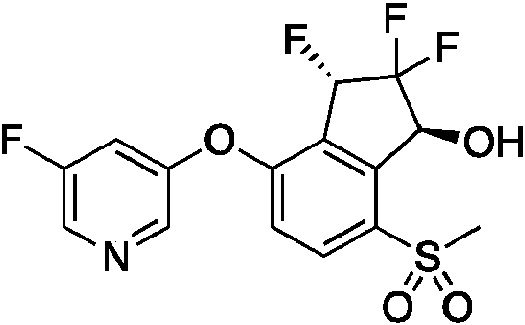
(1 S,3S)-2,2,3-trifluoro-4-((5-fluoropiridin-3-il)oxi)-7-(metilsulfonil)-2,3-dihidro-1H-inden-1-ol (Compuesto 330): Preparado de una manera similar a la descrita en el ejemplo de referencia 327 sustituyendo 5-fluoropiridin-3-ol por 2-fluoro-5-hidroxibencenocarbonitrilo en la etapa C. Lc MS ESI (+) m/z 378 (M+H); RMN 1H (400 MHz, CDCh): 5 8,49-8,46 (m, 1H), 8,39-8,36 (m, 1H), 8,08-8,04 (m, 1H), 8,28-8,24 (m, 1H), 6,98 (d, 1H), 6,12-6,08 (m, 0,5H), 5,99 5,95 (m, 0,5H), 5,88-5,81 (m, 1H), 4,10-4,06 (m, 1H), 3,26 (s, 3H).(1 S, 3S) -2,2,3-trifluoro-4 - ((5-fluoropyridin-3-yl) oxy) -7- (methylsulfonyl) -2,3-dihydro-1H-inden-1-ol ( Compound 330): Prepared in a similar manner to that described in Reference Example 327 by substituting 2-fluoro-5-hydroxybenzenecarbonitrile for 5-fluoropyridin-3-ol in step C. Lc MS ESI (+) m / z 378 ( M + H); 1H NMR (400 MHz, CDCh): 8.49-8.46 (m, 1H), 8.39-8.36 (m, 1H), 8.08-8.04 (m, 1H), 8 , 28-8.24 (m, 1H), 6.98 (d, 1H), 6.12-6.08 (m, 0.5H), 5.99 5.95 (m, 0.5H), 5.88-5.81 (m, 1H), 4.10-4.06 (m, 1H), 3.26 (s, 3H).
Ejemplo de referencia 331 Reference Example 331

(1 S.3R)-4-((5-cloropiridin-3-il)oxi)-2.2.3-trifluoro-7-(metilsulfonil)-2.3-dihidro-1 R-inden-1-ol (Compuesto 331): Preparado de una manera similar a la descrita en el ejemplo de referencia 327 sustituyendo 5-cloropiridin-3-ol por 2-fluoro-5-hidroxibencenocarbonitrilo en la etapa C. LCMS ESI (+) m/z 394. 396 (M+H); RMN 1H (400 MHz, CDCh): 5 8.56-8.55 (m. 1H). 8.44-8.43 (m. 1H). 8.11-8.08 (m. 1H). 7.54-7.52 (m. 1H). 6.99 (d. 1H). 5.96-5.92 (m. 0.5H). 5.83 5.79 (m. 0.5H). 5.71-5.65 (m. 1H). 3.66-3.64 (m. 1H). 3.25 (s. 3H).(1 S.3R) -4 - ((5-chloropyridin-3-yl) oxy) -2.2.3-trifluoro-7- (methylsulfonyl) -2.3-dihydro-1 R-inden-1-ol (Compound 331) : Prepared in a manner similar to that described in Reference Example 327 by substituting 5-chloropyridin-3-ol for 2-fluoro-5-hydroxybenzenecarbonitrile in step C. LCMS ESI (+) m / z 394. 396 (M + H); 1H NMR (400 MHz, CDCh): 8.56-8.55 (m. 1H). 8.44-8.43 (m. 1H). 8.11-8.08 (m. 1H). 7.54-7.52 (m. 1H). 6.99 (d. 1H). 5.96-5.92 (m. 0.5H). 5.83 5.79 (m. 0.5H). 5.71-5.65 (m. 1H). 3.66-3.64 (m. 1H). 3.25 (s. 3H).
Ejemplo de referencia 332Reference Example 332

(1 S.3S)-4-((5-cloropiridin-3-il)oxi)-2.2.3-trifluoro-7-(metilsulfonil)-2.3-dihidro-1R-inden-1-ol (Compuesto 332): Preparado de una manera similar a la descrita en el ejemplo de referencia 327 sustituyendo 5-cloropiridin-3-ol por 2-fluoro-5-hidroxibencenocarbonitrilo en la etapa C. LCMS ESI (+) m/z 394. 396 (M+H); RMN 1H (400 MHz. CDCh): 5 8.56-8.54 (m. 1H). 8.43-8.41 (m. 1H). 8.08-8.04 (m. 1H). 7.52-7.50 (m. 1H). 6.96 (d. 1H). 6.12-6.08 (m. 0.5H). 5.98 5.94 (m. 0.5H). 5.88-5.81 (m. 1H). 4.02-3.99 (m. 1H). 3.26 (s. 3H).(1 S.3S) -4 - ((5-chloropyridin-3-yl) oxy) -2.2.3-trifluoro-7- (methylsulfonyl) -2.3-dihydro-1R-inden-1-ol (Compound 332): Prepared in a similar manner to that described in Reference Example 327 by substituting 2-fluoro-5-hydroxybenzenecarbonitrile for 5-chloropyridin-3-ol in step C. LCMS ESI (+) m / z 394. 396 (M + H ); 1H NMR (400 MHz. CDCh): 8.56-8.54 (m. 1H). 8.43-8.41 (m. 1H). 8.08-8.04 (m. 1H). 7.52-7.50 (m. 1H). 6.96 (d. 1H). 6.12-6.08 (m. 0.5H). 5.98 5.94 (m. 0.5H). 5.88-5.81 (m. 1H). 4.02-3.99 (m. 1H). 3.26 (s. 3H).
Ejemplo de referencia 333Reference Example 333

5-(((1 S.2S.3R)-2.3-difluoro-1-hidroxi-7-(metilsulfonil)-2.3-dihidro-1H-inden-4-il)oxi)nicotinonitrilo (Compuesto 333): Se combinó (1 S.2S.3R)-4-[(5-bromo-3-piridil)oxi]-2.3-difluoro-7-metilsulfonil-indan-1-ol (0.015 g. 0.035 mmol) con polvo de cinc (4.0 mg. 0.06 mmol) y cianuro de cinc (5.9 mg. 0.05 mmol) en DMF seca (0.25 ml). después se roció la suspensión con argón durante varios minutos. La solución se trató con aducto de diclorometano y dicloro[1.1'-bis(difenilfosfino)ferroceno]paladio (II) (1.4 mg. 0.0018 mmol) y la mezcla se roció otra vez durante varios minutos. después se calentó a 150 °C durante 2 horas en el reactor de microondas. El disolvente se eliminó en una corriente de gas nitrógeno. El residuo se cromatografió sobre SiO2 (Biotage SNAP 10) y se eluyó con un gradiente de acetato de etilo/hexano. El material deseado se concentró para proporcionar el compuesto 333 en forma de un sólido de color blanco (8.5 mg). LCMS ESI (+) m/z 367 (M+H); RMN 1H (400 MHz. CD3COCD3): 58.88-8.86 (m. 1H). 8.82-8.80 (m. 1H). 8.13-8.08 (m. 2H). 7.33 (d. 1H). 6.21-6.18 (m. 0.5H). 6.07-6.04 (m. 0.5H). 5.83-5.79 (m. 1H). 5.36-5.29 (m.5 - (((1 S.2S.3R) -2.3-difluoro-1-hydroxy-7- (methylsulfonyl) -2.3-dihydro-1H-inden-4-yl) oxy) nicotinonitrile (Compound 333): ( 1 S.2S.3R) -4 - [(5-bromo-3-pyridyl) oxy] -2.3-difluoro-7-methylsulfonyl-indan-1-ol (0.015 g. 0.035 mmol) with zinc powder (4.0 mg 0.06 mmol) and zinc cyanide (5.9 mg. 0.05 mmol) in dry DMF (0.25 ml). the suspension was then sparged with argon for several minutes. The solution was treated with dichloromethane adduct and dichloro [1.1'-bis (diphenylphosphino) ferrocene] palladium (II) (1.4 mg. 0.0018 mmol) and the mixture was sparged again for several minutes. then it was heated at 150 ° C for 2 hours in the microwave reactor. The solvent was removed in a stream of nitrogen gas. The residue was chromatographed on SiO2 (Biotage SNAP 10) and eluted with an ethyl acetate / hexane gradient. The desired material was concentrated to provide 333 as a white solid (8.5 mg). LCMS ESI (+) m / z 367 (M + H); 1H NMR (400MHz. CD 3 COCD 3 ): 58.88-8.86 (m. 1H). 8.82-8.80 (m. 1H). 8.13-8.08 (m. 2H). 7.33 (d. 1H). 6.21-6.18 (m. 0.5H). 6.07-6.04 (m. 0.5H). 5.83-5.79 (m. 1H). 5.36-5.29 (m.
0.5H). 5.25-5.16 (m. 0.5H). 5.07-5.04 (m. 1H). 3.33 (s. 3H).0.5H). 5.25-5.16 (m. 0.5H). 5.07-5.04 (m. 1H). 3.33 (s. 3H).
Ejemplo 334Example 334
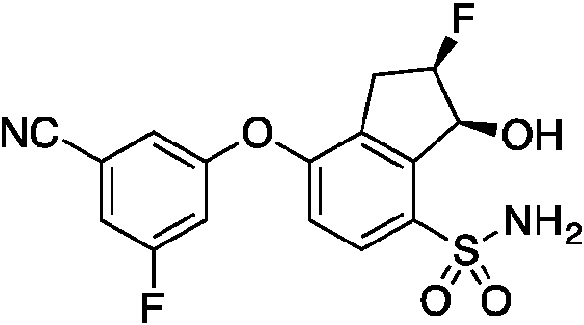
(2R.3S)-7-(3-ciano-5-fluoro-fenoxi)-2-fluoro-3-hidroxi-indan-4-sulfonamida (Compuesto 334): Preparado de forma similar a la descrita en el ejemplo 231 sustituyendo 3-fluoro-5-(7-metilsulfonil-1-oxo-indan-4-il)oxi-benzonitrilo con 7-(3-ciano-5-fluoro-fenoxi)-3-oxo-indan-4-sulfonamida en la etapa A. LCMS ESI (-) m/z 365 (M-H); RMN 1H (400 MHz, CD3OD): 57,87 (d, 1H), 7,42-7,35 (m, 1H), 7,26-7,13 (m, 2H), 7,08 (d, 1H), 5,63-5,51 (m, 1H), 5,40-5,18 (m, 1H), 3,20-3,15 (m, 2H).(2R.3S) -7- (3-cyano-5-fluoro-phenoxy) -2-fluoro-3-hydroxy-indan-4-sulfonamide (Compound 334): Prepared in the form similar to that described in example 231 by substituting 3-fluoro-5- (7-methylsulfonyl-1-oxo-indan-4-yl) oxy-benzonitrile with 7- (3-cyano-5-fluoro-phenoxy) -3- oxo-indan-4-sulfonamide in step A. LCMS ESI (-) m / z 365 (MH); 1H NMR (400 MHz, CD 3 OD): 57.87 (d, 1H), 7.42-7.35 (m, 1H), 7.26-7.13 (m, 2H), 7.08 ( d, 1H), 5.63-5.51 (m, 1H), 5.40-5.18 (m, 1H), 3.20-3.15 (m, 2H).
Ejemplo de referencia 335Reference Example 335

(1 S.2S.3S)-7-(3-ciano-5-fluoro-fenoxi)-1.2-difluoro-3-hidroxi-indan-4-sulfonamida (Compuesto 335)(1 S.2S.3S) -7- (3-cyano-5-fluoro-phenoxy) -1.2-difluoro-3-hydroxy-indan-4-sulfonamide (Compound 335)
Etapa A: Acetato de [(1 S,2R)-7-(acetilsulfamoil)-4-(3-ciano-5-fluoro-fenoxi)-2-fluoro-indan-1-ilol: A una solución en agitación de (2R,3S)-7-(3-ciano-5-fluoro-fenoxi)-2-fluoro-3-hidroxi-indan-4-sulfonamida (0,115 g, 0,32 mmol) en DCM (3 ml) se le añadió 4-(dimetilamino)piridina (0,012 g, 0,097 mmol) y trietilamina (0,090 ml, 0,64 mmol). Se añadió anhídrido acético (0,061 ml, 0,64 mmol) gota a gota a 0 °C en atmósfera de nitrógeno. La mezcla de reacción se dejó calentar a temperatura ambiente y se agitó durante una noche. La mezcla de reacción se diluyó con DCM, se lavó con NaHCO3 acuoso saturado y salmuera, se secó y se concentró. El residuo se purificó por cromatografía en columna sobre gel de sílice (20-50 % de EtOAc/hexano) para dar acetato de [(1 S,2R)-7-(acetilsulfamoil)-4-(3-ciano-5-fluoro-fenoxi)-2-fluoroindan-1-ilo] (0,111 g, 77 %). LCMS ESI (-) m/z 449 (M-H). Etapa B: Acetato de [(1 S,2S)-7-(acetilsulfamoil)-3-bromo-4-(3-ciano-5-fluoro-fenoxi)-2-fluoro-indan-1-ilol: A una solución en agitación de acetato de [(1 S,2R)-7-(acetilsulfamoil)-4-(3-ciano-5-fluoro-fenoxi)-2-fluoro-indan-1-ilo] (111 mg, 0,25 mmol) en DCE (2,7 ml) se le añadió N-bromosuccinimida (66 mg, 0,37 mmol) y 2,2'-azobisisobutironitrilo (0,8 mg, 0,005 mmol). La mezcla de reacción se calentó a 80 °C durante 3 horas. Después del enfriamiento, la mezcla de reacción se diluyó con DCM, se lavó con NaHCO3 acuoso saturado y salmuera, se secó y se concentró. El residuo se purificó por cromatografía en columna sobre gel de sílice (30-75 % de EtOAc/hexano) para dar acetato de [(1 S,2S)-7-(acetilsulfamoil)-3-bromo-4-(3-ciano-5-fluoro-fenoxi)-2-fluoroindan-1 -ilo] (144 mg). LCMS ESI (-) m/z 527/529 (M-H).Step A: [(1 S, 2R) -7- (acetylsulfamoyl) -4- (3-cyano-5-fluoro-phenoxy) -2-fluoro-indan-1-ylol acetate: To a stirring solution of ( 2R, 3S) -7- (3-cyano-5-fluoro-phenoxy) -2-fluoro-3-hydroxy-indan-4-sulfonamide (0.115 g, 0.32 mmol) in DCM (3 ml) was added 4- (dimethylamino) pyridine (0.012 g, 0.097 mmol) and triethylamine (0.090 ml, 0.64 mmol). Acetic anhydride (0.061 ml, 0.64 mmol) was added dropwise at 0 ° C under nitrogen atmosphere. The reaction mixture was allowed to warm to room temperature and was stirred overnight. The reaction mixture was diluted with DCM, washed with saturated aqueous NaHCO 3 and brine, dried, and concentrated. The residue was purified by silica gel column chromatography (20-50% EtOAc / hexane) to give [(1 S, 2R) -7- (acetylsulfamoyl) -4- (3-cyano-5-fluoro -phenoxy) -2-fluoroindan-1-yl] (0.111 g, 77%). LCMS ESI (-) m / z 449 (MH). Step B: [(1S, 2S) -7- (acetylsulfamoyl) -3-bromo-4- (3-cyano-5-fluoro-phenoxy) -2-fluoro-indan-1-ylol acetate: To a solution with stirring of [(1 S, 2R) -7- (acetylsulfamoyl) -4- (3-cyano-5-fluoro-phenoxy) -2-fluoro-indan-1-yl] acetate (111 mg, 0.25 mmol) in DCE (2.7 ml) was added N-bromosuccinimide (66 mg, 0.37 mmol) and 2,2'-azobisisobutyronitrile (0.8 mg, 0.005 mmol). The reaction mixture was heated at 80 ° C for 3 hours. After cooling, the reaction mixture was diluted with DCM, washed with saturated aqueous NaHCO 3 and brine, dried, and concentrated. The residue was purified by silica gel column chromatography (30-75% EtOAc / hexane) to give [(1S, 2S) -7- (acetylsulfamoyl) -3-bromo-4- (3-cyano -5-fluoro-phenoxy) -2-fluoroindan-1-yl] (144 mg). LCMS ESI (-) m / z 527/529 (MH).
Etapa C: Acetato de [(1 S,2R,3R)-7-(acetilsulfamoil)-4-(3-ciano-5-fluoro-fenoxi)-2-fluoro-3-hidroxi-indan-1-ilol y acetato de [(1 S.2R.3S)-7-(acetilsulfamoil)-4-(3-ciano-5-fluoro-fenoxi)-2-fluoro-3-hidroxi-indan-1-ilol: A una solución en agitación de acetato de [(1 S,2S)-7-(acetilsulfamoil)-3-bromo-4-(3-ciano-5-fluoro-fenoxi)-2-fluoroindan-1 -ilo] (0,144 g, 0,272 mmol) en 1,2-dimetoxietano (0,90 ml) y agua (0,090 ml) se le añadió hidrato de perclorato de plata (0,092 g, 0,41 mmol). La mezcla de reacción se calentó a 70 °C durante 30 minutos. Después del enfriamiento, la mezcla de reacción se diluyó con EtOAc y se filtró a través de Celite. El filtrado se lavó con agua y salmuera, se secó y se concentró. El residuo se purificó por cromatografía en columna sobre gel de sílice (30-60 % de EtOAc/hexano) para dar acetato de [(1 S,2R,3S)-7-(acetilsulfamoil)-4-(3-ciano-5-fluoro-fenoxi)-2-fluoro-3-hidroxi-indan-1-ilo], que se volvió a purificar por cromatografía ultrarrápida de fase inversa C18 (Biotage Isolera One unit, C18 Flash) con 20-60 % de CH3CN/agua proporcionando acetato de [(1 S,2R,3S)-7-(acetilsulfamoil)-4-(3-ciano-5-fluoro-fenoxi)-2-fluoro-3-hidroxi-indan-1-ilo] (0,032 g, 25 %). LCMS eSi (-) m/z 465 (M-H). Más elución de la columna sobre gel de sílice con 60-80 % de EtOAc/hexano dio acetato de [(1 S,2R,3R)-7-(acetilsulfamoil)-4-(3-ciano-5-fluoro-fenoxi)-2-fluoro-3-hidroxi-indan-1-ilo] (0,023 g, 18 %). LCMS ESI (-) m/z 465 (M-H).Step C: [(1 S, 2R, 3R) -7- (acetylsulfamoyl) -4- (3-cyano-5-fluoro-phenoxy) -2-fluoro-3-hydroxy-indan-1-ylol acetate and acetate of [(1 S.2R.3S) -7- (acetylsulfamoyl) -4- (3-cyano-5-fluoro-phenoxy) -2-fluoro-3-hydroxy-indan-1-ylol: To a stirring solution [(1S, 2S) -7- (acetylsulfamoyl) -3-bromo-4- (3-cyano-5-fluoro-phenoxy) -2-fluoroindan-1-yl] acetate (0.144 g, 0.272 mmol) in 1,2-dimethoxyethane (0.90 ml) and water (0.090 ml) was added silver perchlorate hydrate (0.092 g, 0.41 mmol). The reaction mixture was heated to 70 ° C for 30 minutes. After cooling, the reaction mixture was diluted with EtOAc and filtered through Celite. The filtrate was washed with water and brine, dried, and concentrated. The residue was purified by silica gel column chromatography (30-60% EtOAc / hexane) to give [(1S, 2R, 3S) -7- (acetylsulfamoyl) -4- (3-cyano-5 -fluoro-phenoxy) -2-fluoro-3-hydroxy-indan-1-yl], which was re-purified by C18 reverse phase flash chromatography (Biotage Isolera One unit, C18 Flash) with 20-60% CH3CN / water to give [(1 S, 2R, 3S) -7- (acetylsulfamoyl) -4- (3-cyano-5-fluoro-phenoxy) -2-fluoro-3-hydroxy-indan-1-yl] acetate (0.032 g, 25%). LCMS e S i (-) m / z 465 (MH). Further elution from the column on silica gel with 60-80% EtOAc / hexane gave [(1 S, 2R, 3R) -7- (acetylsulfamoyl) -4- (3-cyano-5-fluoro-phenoxy) acetate -2-fluoro-3-hydroxy-indan-1-yl] (0.023 g, 18%). LCMS ESI (-) m / z 465 (MH).
Etapa D: Acetato de [(1 S,2S,3S)-7-(acetilsulfamoil)-4-(3-ciano-5-fluoro-fenoxi)-2,3-difluoro-indan-1-ilol: A una solución en agitación de acetato de [(1 S,2R,3R)-7-(acetilsulfamoil)-4-(3-ciano-5-fluoro-fenoxi)-2-fluoro-3-hidroxiindan-1 -ilo] (23 mg, 0,050 mmol) en Dc M (0,5 ml) se le añadió trifluoruro de (dietilamino)azufre (DAST) (0,013 ml, 0,099 mmol) a -78 °C en atmósfera de nitrógeno. La mezcla de reacción se dejó calentar a 0 °C y se agitó durante 15 minutos. La reacción se interrumpió mediante solución acuosa saturada de NaHCO3. La mezcla se repartió entre EtOAc y agua. La capa acuosa se extrajo con EtOAc. Las capas orgánicas combinadas se lavaron con salmuera, se secaron y se concentraron. El residuo se purificó por cromatografía ultrarrápida sobre gel de sílice (20-50 % de EtOAc/hexanos) para dar acetato de [(1 S,2S,3S)-7-(acetilsulfamoil)-4-(3-ciano-5-fluoro-fenoxi)-2,3-difluoro-indan-1 -ilo] (20 mg, 87 %). LCMS ESI (-) m/z 467 (M-H).Step D: [(1S, 2S, 3S) -7- (acetylsulfamoyl) -4- (3-cyano-5-fluoro-phenoxy) -2,3-difluoro-indan-1-ylol acetate: To a solution [(1 S, 2R, 3R) -7- (acetylsulfamoyl) -4- (3-cyano-5-fluoro-phenoxy) -2-fluoro-3-hydroxyindan-1-yl] acetate under stirring (23 mg 0.050 mmol) in Dc M (0.5 ml) was added (diethylamino) sulfur trifluoride (DAST) (0.013 ml, 0.099 mmol) at -78 ° C under nitrogen atmosphere. The reaction mixture was allowed to warm to 0 ° C and stirred for 15 minutes. The reaction was quenched by saturated aqueous NaHCO 3 solution. The mixture was partitioned between EtOAc and water. The aqueous layer was extracted with EtOAc. The combined organic layers were washed with brine, dried, and concentrated. The residue was purified by flash chromatography on silica gel (20-50% EtOAc / hexanes) to give [(1S, 2S, 3S) -7- (acetylsulfamoyl) -4- (3-cyano-5- fluoro-phenoxy) -2,3-difluoro-indan-1-yl] (20 mg, 87%). LCMS ESI (-) m / z 467 (MH).
Etapa E: N-[(1 S,2S,3S)-7-(3-ciano-5-fluoro-fenoxi)-1,2-difluoro-3-hidroxi-indan-4-i n sulfonilacetamida: A una solución en agitación de acetato de (1 S,2S,3S)-7-(acetilsulfamoil)-4-(3-ciano-5-fluoro-fenoxi)-2,3-difluoro-indan-1-ilo] (20 mg, 0,043 mmol) en tetrahidrofurano (0,3 ml) se le añadió solución 0,5 N de LiOH (0,26 ml, 0,13 mmol) a 0 °C en atmósfera de nitrógeno. La mezcla de reacción se dejó calentar a temperatura ambiente y se agitó durante 3 horas. La reacción se repartió entre EtOAc y agua. La capa acuosa se extrajo con EtOAc. Las capas orgánicas combinadas se lavaron con agua y salmuera, se secaron y se concentraron. El producto en bruto se usó en la siguiente etapa sin más purificación. LCMS ESI (+) m/z 425 (M+H). Step E: N - [(1 S, 2S, 3S) -7- (3-cyano-5-fluoro-phenoxy) -1,2-difluoro-3-hydroxy-indan-4-i n sulfonylacetamide: To a solution with stirring of (1S, 2S, 3S) -7- (acetylsulfamoyl) -4- (3-cyano-5-fluoro-phenoxy) -2,3-difluoro-indan-1-yl] acetate (20 mg, 0.043 mmol) in tetrahydrofuran (0.3 ml) was added 0.5 N LiOH solution (0.26 ml, 0.13 mmol) at 0 ° C under nitrogen atmosphere. The reaction mixture was allowed to warm to room temperature and stirred for 3 hours. The reaction was partitioned between EtOAc and water. The aqueous layer was extracted with EtOAc. The combined organic layers were washed with water and brine, dried, and concentrated. The crude product was used in the next step without further purification. LCMS ESI (+) m / z 425 (M + H).
Etapa F: (1 S.2S.3S)-7-(3-ciano-5-fluoro-fenoxi)-1.2-difluoro-3-hidroxi-indan-4-sulfonamida (Compuesto 335): A una solución en agitación de N-[(1 S,2S,3S)-7-(3-ciano-5-fluoro-fenoxi)-1,2-difluoro-3-hidroxi-indan-4il]sulfonilacetamida (18 mg, 0,042 mmol) en tetrahidrofurano (0,3 ml) se le añadió HCl 3 N (0,084 ml, 9,2 mmol). La mezcla de reacción se calentó a reflujo durante 12 horas. Después del enfriamiento, la reacción se repartió entre EtOAc y agua. La capa acuosa se extrajo con EtOAc. Las capas orgánicas combinadas se lavaron con agua y salmuera, se secaron y se concentraron. El residuo se purificó por cromatografía ultrarrápida sobre gel de sílice (20-50 % de EtOAc/hexano) para dar el compuesto 335 (8 mg, 49 %). LCMS ESI (-) m/z 383 (M-H); RMN 1H (400 MHz, CD3OD): 5 8,04 (d, 1H), 7,45-7,41 (m, 1H), 7,31-7,29 (m, 1H), 7,26-7,21 (m, 1H), 7,18 (d, 1H), 6,30-6,11 (m, 1H), 5,80 (t, 1H), 5,37-5,17 (m, 1H).Step F: (1 S.2S.3S) -7- (3-cyano-5-fluoro-phenoxy) -1,2-difluoro-3-hydroxy-indan-4-sulfonamide (Compound 335): To a stirring solution of N - [(1 S, 2S, 3S) -7- (3-cyano-5-fluoro-phenoxy) -1,2-difluoro-3-hydroxy-indan-4-yl] sulfonylacetamide (18 mg, 0.042 mmol) in tetrahydrofuran (0.3 mL ) was added 3N HCl (0.084 mL, 9.2 mmol). The reaction mixture was heated under reflux for 12 hours. After cooling, the reaction was partitioned between EtOAc and water. The aqueous layer was extracted with EtOAc. The combined organic layers were washed with water and brine, dried, and concentrated. The residue was purified by flash chromatography on silica gel (20-50% EtOAc / hexane) to give compound 335 (8 mg, 49%). LCMS ESI (-) m / z 383 (MH); 1H NMR (400 MHz, CD 3 OD): 5 8.04 (d, 1H), 7.45-7.41 (m, 1H), 7.31-7.29 (m, 1H), 7.26 -7.21 (m, 1H), 7.18 (d, 1H), 6.30-6.11 (m, 1H), 5.80 (t, 1H), 5.37-5.17 (m , 1 HOUR).
Ejemplo de referencia 336Reference Example 336

(1 R,2S,3S)-7-(3-ciano-5-fluoro-fenoxi)-1,2-difluoro-3-hidroxi-indan-4-sulfonamida (Compuesto 336): Preparada de forma similar a la descrita en el ejemplo de referencia 323 usando acetato de [(1 S,2R,3S)-7-(acetilsulfamoil)-4-(3-ciano-5-fluoro-fenoxi)- 2-fluoro-3-hidroxi-indan-1-ilo] en lugar de acetato de [(1 S,2R,3R)-7-(acetilsulfamoil)-4-(3-ciano-5-fluoro-fenoxi)-2-fluoro-3-hidroxi-indan-1-ilo] en la Etapa D. LCMS ESI (-) m/z 383 (M-H).(1 R, 2S, 3S) -7- (3-cyano-5-fluoro-phenoxy) -1,2-difluoro-3-hydroxy-indan-4-sulfonamide (Compound 336): Prepared in a similar manner as described In Reference Example 323 using [(1 S, 2R, 3S) -7- (acetylsulfamoyl) -4- (3-cyano-5-fluoro-phenoxy) -2-fluoro-3-hydroxy-indan-1 acetate -yl] instead of [(1 S, 2R, 3R) -7- (acetylsulfamoyl) -4- (3-cyano-5-fluoro-phenoxy) -2-fluoro-3-hydroxy-indan-1- acetate yl] in Step D. LCMS ESI (-) m / z 383 (MH).
Ejemplo de referencia 337Reference Example 337

(1 R,3S)-7-(3-ciano-5-fluoro-fenoxi)-2,2-difluoro-1,3-dihidroxi-indan-4-sulfonamida (Compuesto 337)(1 R, 3S) -7- (3-cyano-5-fluoro-phenoxy) -2,2-difluoro-1,3-dihydroxy-indan-4-sulfonamide (Compound 337)
Etapa A: 7’-(3-ciano-5-fluoro-fenoxi)espiro[1.3-dioxolan-2.3’-indan1-4’-sulfonamida: A una solución en agitación de 7-(3-ciano-5-fluoro-fenoxi)-3-oxo-indan-4-sulfonamida (2,80 g, 8,1 mmol) en DCM (54 ml) se le añadió trimetil(2-trimetilsililoxietoxi)silano (2,78 ml, 11,3 mmol). La mezcla de reacción se enfrió a-78 °C. Se añadió trifluorometanosulfonato de trimetilsililo (0,58 ml, 3,2 mmol) gota a gota en atmósfera de nitrógeno. La mezcla de reacción se dejó calentar a temperatura ambiente. Después de agitar durante 2 horas, se añadió más trimetil(2-trimetilsililoxietoxi)silano (1,40 ml, 5,60 mmol) y la reacción se agitó a temperatura ambiente durante 1 hora más. Se añadió trietilamina (3,38 ml, 24,3 mmol) gota a gota. Después de agitar durante 10 minutos, la reacción se concentró a presión reducida. El residuo se purificó por cromatografía ultrarrápida sobre gel de sílice (20-50 % de EtOAc/hexano) para dar 7'-(3-ciano-5-fluoro-fenoxi)espiro[1,3-dioxolan-2,3'-indan]-4'-sulfonamida (1,41 g, 45 %). LCMS ESI (-) m/z 389 (M- H).Step A: 7 '- (3-cyano-5-fluoro-phenoxy) spiro [1,3-dioxolan-2.3'-indan1-4'-sulfonamide: To a stirring solution of 7- (3-cyano-5-fluoro- Phenoxy) -3-oxo-indan-4-sulfonamide (2.80 g, 8.1 mmol) in DCM (54 ml) was added trimethyl (2-trimethylsilyloxyethoxy) silane (2.78 ml, 11.3 mmol) . The reaction mixture was cooled to -78 ° C. Trimethylsilyl trifluoromethanesulfonate (0.58 ml, 3.2 mmol) was added dropwise under nitrogen atmosphere. The reaction mixture was allowed to warm to room temperature. After stirring for 2 hours, more trimethyl (2-trimethylsilyloxyethoxy) silane (1.40 mL, 5.60 mmol) was added and the reaction was stirred at room temperature for an additional 1 hour. Triethylamine (3.38 ml, 24.3 mmol) was added dropwise. After stirring for 10 minutes, the reaction was concentrated under reduced pressure. The residue was purified by flash chromatography on silica gel (20-50% EtOAc / hexane) to give 7 '- (3-cyano-5-fluoro-phenoxy) spiro [1,3-dioxolan-2,3'- indan] -4'-sulfonamide (1.41 g, 45%). LCMS ESI (-) m / z 389 (MH).
Etapa B: 1’-bromo-7’-(3-ciano-5-fluoro-fenoxi)espiro[1,3-dioxolan-2,3’-indan1-4’-sulfonamida: A una solución en agitación de 7’-(3-ciano-5-fluoro-fenoxi)espiro[1,3-dioxolan-2,3’-indan]-4’-sulfonamida (1,41 g, 3,61 mmol) en DCE (24 ml) se le añadió N-bromosuccinimida (0,707 g, 3,97 mmol) y 2,2’-azobisisobutironitrilo (0,006 g, 0,04 mmol). La mezcla de reacción se calentó a 80 °C durante 30 minutos. Después del enfriamiento, la mezcla de reacción se diluyó con DCM, se lavó con NaHCO3 acuoso saturado y salmuera, se secó y se concentró. El residuo se purificó por cromatografía en columna sobre gel de sílice (20-50 % de EtOAc/hexano) para dar 1’-bromo-7’-(3-ciano-5-fluoro-fenoxi)espiro[1,3-dioxolan-2,3’-indan]-4’-sulfonamida (1,19 g, 70 %). lCMs ESI (+) m/z 467, 469 (M-H).Step B: 1'-Bromo-7 '- (3-cyano-5-fluoro-phenoxy) spiro [1,3-dioxolan-2,3'-indan1-4'-sulfonamide: To a stirring solution of 7' - (3-cyano-5-fluoro-phenoxy) spiro [1,3-dioxolan-2,3'-indan] -4'-sulfonamide (1.41 g, 3.61 mmol) in DCE (24 ml) is N-bromosuccinimide (0.707 g, 3.97 mmol) and 2,2'-azobisisobutyronitrile (0.006 g, 0.04 mmol) were added. The reaction mixture was heated at 80 ° C for 30 minutes. After cooling, the reaction mixture was diluted with DCM, washed with saturated aqueous NaHCO 3 and brine, dried, and concentrated. The residue was purified by column chromatography on silica gel (20-50% EtOAc / hexane) to give 1'-bromo-7 '- (3-cyano-5-fluoro-phenoxy) spiro [1,3-dioxolan -2,3'-indan] -4'-sulfonamide (1.19 g, 70%). l CM s ESI (+) m / z 467, 469 (MH).
Etapa C: 7’-(3-ciano-5-fluoro-fenoxi)-1’-hidroxi-espiro[1.3-dioxolan-2.3’-indan1-4’-sulfonamida: A una solución en agitación de 1’-bromo-7’-(3-ciano-5-fluoro-fenoxi)espiro[1,3-dioxolan-2,3’-indan]-4’-sulfonamida (1,19 g, 2,54 mmol) en 1,2-dimetoxietano (21 ml) y agua (7 ml) se le añadió carbonato de diplata (1,05 g, 3,8 mmol). La mezcla de reacción se agitó a temperatura ambiente durante la noche. La mezcla se diluyó con EtOAc y se filtró a través de Celite. El filtrado se lavó con agua y salmuera, se secó y se concentró. El producto en bruto se usó en la siguiente etapa sin más purificación. LCMS ESI (-) m/z 405 (M-H).Step C: 7 '- (3-cyano-5-fluoro-phenoxy) -1'-hydroxy-spiro [1,3-dioxolan-2.3'-indan1-4'-sulfonamide: To a stirring solution of 1'-bromo- 7 '- (3-cyano-5-fluoro-phenoxy) spiro [1,3-dioxolan-2,3'-indan] -4'-sulfonamide (1.19 g, 2.54 mmol) in 1,2- Dimethoxyethane (21 ml) and water (7 ml) were added diplate carbonate (1.05 g, 3.8 mmol). The reaction mixture was stirred at room temperature overnight. The mixture was diluted with EtOAc and filtered through Celite. The filtrate was washed with water and brine, dried, and concentrated. The crude product was used in the next step without further purification. LCMS ESI (-) m / z 405 (M-H).
Etapa D: 7’-(3-ciano-5-fluoro-fenoxi)-1’-oxo-espiro[1,3-dioxolan-2,3’-indan1-4’-sulfonamida: A una solución en agitación de 7’-(3-ciano-5-fluoro-fenoxi)-1’-hidroxi-espiro[1,3-dioxolan-2,3’-indan]-4’-sulfonamida (1,03 g, 2,53 mmol) en DCM (25 ml) se le añadió peryodinano de Dess-Martin (1,61 g, 3,80 mmol). La mezcla de reacción se agitó a temperatura ambiente durante 1 hora. La mezcla de reacción se repartió entre EtOAc y NaHCO3 acuoso saturado. La capa acuosa se extrajo con EtOAc. Las capas orgánicas combinadas se lavaron con agua y salmuera, se secaron y se concentraron. El producto en bruto se purificó por cromatografía ultrarrápida sobre gel de sílice (20-60 % de EtOAc/hexano) para dar 7'-(3-ciano-5-fluoro-fenoxi)-1'-oxo-espiro[1,3-dioxolan-2,3'-indan]-4'-sulfonamida (0,460 g, 45 %). LCMS ESI (-) m/z 403 (M-H).Step D: 7 '- (3-cyano-5-fluoro-phenoxy) -1'-oxo-spiro [1,3-dioxolan-2,3'-indan1-4'-sulfonamide: To a stirring solution of 7 '- (3-cyano-5-fluoro-phenoxy) -1'-hydroxy-spiro [1,3-dioxolan-2,3'-indan] -4'-sulfonamide (1.03 g, 2.53 mmol) in DCM (25 ml) was added Dess-Martin periodinane (1.61 g, 3.80 mmol). The reaction mixture was stirred at room temperature for 1 hour. The reaction mixture was partitioned between EtOAc and saturated aqueous NaHCO 3 . The aqueous layer was extracted with EtOAc. The combined organic layers were washed with water and brine, dried and concentrated. The crude product was purified by flash chromatography on silica gel (20-60% EtOAc / hexane) to give 7 '- (3-cyano-5-fluoro-phenoxy) -1'-oxo-spiro [1,3 -dioxolan-2,3'-indan] -4'-sulfonamide (0.460 g, 45%). LCMS ESI (-) m / z 403 (MH).
Etapa E: 7-(3-c¡ano-5-fluoro-fenoxi)-1.3-d¡oxo-¡ndan-4-sulfonam¡da: A una solución en agitación de 7'-(3-ciano-5-fluorofenoxi)-1'-oxo-espiro[1,3-dioxolan-2,3'-indan]-4'-sulfonamida (250 mg, 0,620 mmol) en tetrahidrofurano (3 ml) se le añadió HCl 4 N (1,55 ml, 6,18 mmol). La reacción se calentó a 60 °C durante 1 hora. Después del enfriamiento, la mezcla de reacción se repartió entre EtOAc y agua. La capa acuosa se extrajo con EtOAc. Las capas orgánicas combinadas se lavaron con agua y salmuera, se secaron y se concentraron. El producto en bruto se usó en la siguiente etapa sin más purificación. LCMS ESI (-) m/z 359 (M-H).Step E: 7- (3-cyano-5-fluoro-phenoxy) -1,3-dioxo-indan-4-sulfonamide: To a stirring solution of 7 '- (3-cyano-5- fluorophenoxy) -1'-oxo-spiro [indan 1,3-dioxolan-2,3'-] -4'-sulfonamide (250 mg, 0.620 mmol) in tetrahydrofuran (3 ml) was added 4 N HCl (1 55 ml, 6.18 mmol). The reaction was heated to 60 ° C for 1 hour. After cooling, the reaction mixture was partitioned between EtOAc and water. The aqueous layer was extracted with EtOAc. The combined organic layers were washed with water and brine, dried, and concentrated. The crude product was used in the next step without further purification. LCMS ESI (-) m / z 359 (MH).
Etapa F: 7-(3-c¡ano-5-fluoro-fenox¡)-2.2-d¡fluoro-1.3-d¡oxo-¡ndan-4-sulfonam¡da: A una solución en agitación de 7-(3-ciano-5-fluoro-fenoxi)-1,3-dioxo-indan-4-sulfonamida (223 mg, 0,620 mmol) en acetonitrilo (6 ml) se le añadió carbonato sódico (144 mg, 1,36 mmol) a temperatura ambiente en atmósfera de nitrógeno. Se añadió Selectfluor® (482 mg, 1,36 mmol) y la mezcla de reacción se agitó a 25 °C durante 30 minutos. La mezcla de reacción se repartió entre EtOAc y agua. La capa acuosa se extrajo con EtOAc. Las capas orgánicas combinadas se lavaron con agua y salmuera, se secaron y se concentraron. El residuo se purificó por cromatografía ultrarrápida sobre gel de sílice (20-50 % de EtoAc/hexanos) para dar 7-(3-ciano-5-fluoro-fenoxi)-2,2-difluoro-1,3-dioxo-indan-4-sulfonamida (161 mg, 66 %). LCMS ESI (-) m/z 395 (M-H).Step F: 7- (3-kano-5-fluoro-phenoxy) -2.2-d¡fluoro-1,3-d¡oxo-indan-4-sulfonamide: To a stirring solution of 7- ( 3-cyano-5-fluoro-phenoxy) -1,3-dioxo-indan-4-sulfonamide (223 mg, 0.620 mmol) in acetonitrile (6 ml) was added sodium carbonate (144 mg, 1.36 mmol) to room temperature under nitrogen atmosphere. Selectfluor® (482 mg, 1.36 mmol) was added and the reaction mixture was stirred at 25 ° C for 30 minutes. The reaction mixture was partitioned between EtOAc and water. The aqueous layer was extracted with EtOAc. The combined organic layers were washed with water and brine, dried, and concentrated. The residue was purified by flash chromatography on silica gel (20-50% EtoAc / hexanes) to give 7- (3-cyano-5-fluoro-phenoxy) -2,2-difluoro-1,3-dioxo-indan -4-sulfonamide (161 mg, 66%). LCMS ESI (-) m / z 395 (M-H).
Etapa G: (1R3S)-7-(3-ciano-5-fluoro-fenoxi)-2,2-difluoro-1,3-dihidroxi-indan-4-sulfonamida (Compuesto 337): Se añadió ácido fórmico (0,092 ml, 2,4 mmol) lentamente a una solución de trietilamina (0,227 ml, 1,63 mmol) en DCM (4 ml) a 0 °C. Después se añadió 7-(3-ciano-5-fluoro-fenoxi)-2,2-difluoro-1,3-dioxo-indan-4-sulfonamida (161 mg, 0,410 mmol) seguido de la adición de RuCl(p-cimeno)[(R,R)-Ts-DPEN] (7,8 mg, 0,012 mmol) en atmósfera de nitrógeno. El matraz se puso en un refrigerador a 4 °C durante una noche. La mezcla de reacción se diluyó con DCM, se lavó con NaHCO3 acuoso saturado y salmuera, se secó y se concentró. El residuo se purificó por cromatografía ultrarrápida sobre gel de sílice (20-60 % de EtOAc/hexano) para dar (1S,3S)-7-(3-ciano-5-fluoro-fenoxi)-2,2-difluoro-1,3-dihidroxi-indan-4-sulfonamida (43 mg, 26 %). LCMS ESI (-) m/z 399 (M-H). Más elución proporcionó el compuesto 337 (26 mg, 16 %). LCMS ESI (-) m/z 399 (M-H). RMN 1H (400 MHz, CD3OD): 68,00 (d, 1H), 7,44-7,41 (m, 1H), 7,35-7,32 (m, 1H), 7,29-7,24 (m, 1H), 7,14 (d, 1H), 5,46 (d, 1H), 5,06 (d, 1H).Step G: (1R3S) -7- (3-cyano-5-fluoro-phenoxy) -2,2-difluoro-1,3-dihydroxy-indan-4-sulfonamide (Compound 337): Formic acid (0.092 ml) was added , 2.4 mmol) slowly to a solution of triethylamine (0.227 ml, 1.63 mmol) in DCM (4 ml) at 0 ° C. Then 7- (3-cyano-5-fluoro-phenoxy) -2,2-difluoro-1,3-dioxo-indan-4-sulfonamide (161 mg, 0.410 mmol) was added followed by the addition of RuCl (p- cymene) [(R, R) -Ts-DPEN] (7.8 mg, 0.012 mmol) under nitrogen atmosphere. The flask was placed in a refrigerator at 4 ° C overnight. The reaction mixture was diluted with DCM, washed with saturated aqueous NaHCO 3 and brine, dried, and concentrated. The residue was purified by flash chromatography on silica gel (20-60% EtOAc / hexane) to give (1S, 3S) -7- (3-cyano-5-fluoro-phenoxy) -2,2-difluoro-1 , 3-dihydroxy-indan-4-sulfonamide (43 mg, 26%). LCMS ESI (-) m / z 399 (MH). Further elution provided compound 337 (26mg, 16%). LCMS ESI (-) m / z 399 (MH). 1H NMR (400 MHz, CD 3 OD): 68.00 (d, 1H), 7.44-7.41 (m, 1H), 7.35-7.32 (m, 1H), 7.29- 7.24 (m, 1H), 7.14 (d, 1H), 5.46 (d, 1H), 5.06 (d, 1H).
Ejemplo de referencia 338Reference Example 338

(1R3S)-7-(3-ciano-5-fluoro-fenoxi)-1,2,2-trifluoro-3-l'iidroxi-indan-4-sulfonamida (Compuesto 338): A una solución en agitación de (1S,3S)-7-(3-ciano-5-fluoro-fenoxi)-2,2-difluoro-1,3-dihidroxi-indan-4-sulfonamida (43 mg, 0,11 mmol) en DCM (1 ml) se le añadió trifluoruro de (dietilamino)azufre (DAST) (0,028 ml, 0,21 mmol) a -78 °C en atmósfera de nitrógeno. La mezcla de reacción se dejó calentar a 0 °C y se agitó durante 1 hora. La reacción se interrumpió mediante la adición de NaHCO3 acuoso saturado. La mezcla se repartió entre EtOAc y agua. La capa acuosa se extrajo con EtOAc. Las capas orgánicas combinadas se lavaron con salmuera, se secaron y se concentraron. El residuo se disolvió en DCM (1 ml). se añadió HCl 5 N en isopropanol (0,3 ml). La mezcla de reacción se agitó durante 15 minutos y después se concentró a presión reducida. El residuo se purificó por cromatografía ultrarrápida sobre gel de sílice (20-50 % de EtOAc/hexano) para dar el compuesto 338 (16 mg, 37 %). LCMS ESI (-) m/z 401 (M-H); RMN 1H (400 MHz, CD3OD): 68,03-8,00 (m, 1H), 7,24-7,20 (m, 1H), 7,17-7,15 (m, 1H), 7,08-7,04 (m, 1H), 6,96 (d, 1H), 5,82-5,65 (m, 1H), 5,54-5,48 (m, 1H).(1R3S) -7- (3-cyano-5-fluoro-phenoxy) -1,2,2-trifluoro-3-l'ihydroxy-indan-4-sulfonamide (Compound 338): To a stirring solution of (1S , 3S) -7- (3-cyano-5-fluoro-phenoxy) -2,2-difluoro-1,3-dihydroxy-indan-4-sulfonamide (43 mg, 0.11 mmol) in DCM (1 ml) (Diethylamino) sulfur trifluoride (DAST) (0.028 ml, 0.21 mmol) was added at -78 ° C under nitrogen atmosphere. The reaction mixture was allowed to warm to 0 ° C and stirred for 1 hour. The reaction was quenched by the addition of saturated aqueous NaHCO 3 . The mixture was partitioned between EtOAc and water. The aqueous layer was extracted with EtOAc. The combined organic layers were washed with brine, dried, and concentrated. The residue was dissolved in DCM (1 ml). It was added 5N HCl in isopropanol (0.3 ml). The reaction mixture was stirred for 15 minutes and then concentrated under reduced pressure. The residue was purified by flash chromatography on silica gel (20-50% EtOAc / hexane) to give compound 338 (16 mg, 37%). LCMS ESI (-) m / z 401 (MH); 1 H NMR (400 MHz, CD 3 OD): 68.03-8.00 (m, 1H), 7.24-7.20 (m, 1H), 7.17-7.15 (m, 1H), 7.08-7.04 (m, 1H), 6.96 (d, 1H), 5.82-5.65 (m, 1H), 5.54-5.48 (m, 1H).
Ejemplo de referencia 339Reference Example 339

(1 S.3S)-7-(3-c¡ano-5-fluoro-fenox¡)-1.2.2-tr¡fluoro-3-h¡drox¡-¡ndan-4-sulfonam¡da (Compuesto 339): El compuesto del título se preparó de forma similar a la descrita en el ejemplo de referencia 338 a partir de (1R,3S)-7-(3-ciano-5fluoro-fenoxi)-2,2-difluoro-1,3-dihidroxi-indan-4-sulfonamida. LCMS ESI (-) m/z 401 (M-H); RMN 1H (400 MHz, CD3OD): 58,09-8,05 (m, 1H), 7,50-7,46 (m, 1H), 7,39-7,38 (m, 1H), 7,33-7,29 (m, 1H), 7,14 (d, 1H), 6,19-6,02 (m, 1H), 5,72-5,65 (m, 1H).(1 S.3S) -7- (3-kano-5-fluoro-phenoxy) -1.2.2-tr¡fluoro-3-hydrox¡ -indan-4-sulfonamide (Compound 339 ): The title compound was prepared in a manner similar to that described in Reference Example 338 from (1R, 3S) -7- (3-cyano-5-fluoro-phenoxy) -2,2-difluoro-1,3-dihydroxy-indan-4-sulfonamide. LCMS ESI (-) m / z 401 (MH); 1H NMR (400 MHz, CD 3 OD): 58.09-8.05 (m, 1H), 7.50-7.46 (m, 1H), 7.39-7.38 (m, 1H), 7.33-7.29 (m, 1H), 7.14 (d, 1H), 6.19-6.02 (m, 1H), 5.72-5.65 (m, 1H).
Ejemplo de referencia 340Reference Example 340

(1 R,3S)-7-[(5-ciano-3-piridil)oxil-1,2,2-trifluoro-3-hidroxi-indan-4-sulfonamida (Compuesto 340)(1 R, 3S) -7 - [(5-cyano-3-pyridyl) oxyl-1,2,2-trifluoro-3-hydroxy-indan-4-sulfonamide (Compound 340)
Etapa A: (3S)-7-bencilsulfanil-2.2.4-trifluoro-3-hidroxi-indan-1-ona: A una mezcla en agitación de (3S)-2,2,4,7-tetrafluoro-3-hidroxi-indan-1-ona (250 mg, 1,14 mmol) y carbonato de cesio (555 mg, 1,7 mmol) en DMF (8 ml) se le añadió gota a gota bencilmercaptano (0,15 ml, 1,3 mmol) a 0 °C en atmósfera de nitrógeno. La mezcla de reacción se agitó a 0 °C durante 30 minutos. La reacción se repartió entre EtOAc y agua. La capa acuosa se extrajo con EtOAc. Las capas orgánicas combinadas se lavaron con agua y salmuera, se secaron y se concentraron. El residuo se purificó por cromatografía ultrarrápida sobre gel de sílice (20-40 % de EtOAc/hexano) para dar (3S)-7-bencilsulfanil-2,2,4-trifluoro-3-hidroxi-indan-1-ona (350 mg, 95 %). LCMS ESI (+) m/z 342 (M+NH4+).Step A: (3S) -7-benzylsulfanyl-2.2.4-trifluoro-3-hydroxy-indan-1-one: To a stirring mixture of (3S) -2,2,4,7-tetrafluoro-3-hydroxy -indan-1-one (250 mg, 1.14 mmol) and cesium carbonate (555 mg, 1.7 mmol) in DMF (8 ml) was added dropwise benzyl mercaptan (0.15 ml, 1.3 mmol) at 0 ° C under nitrogen atmosphere. The reaction mixture was stirred at 0 ° C for 30 minutes. The reaction was partitioned between EtOAc and water. The aqueous layer was extracted with EtOAc. The combined organic layers were washed with water and brine, dried, and concentrated. The residue was purified by flash chromatography on silica gel (20-40% EtOAc / hexane) to give (3S) -7-benzylsulfanyl-2,2,4-trifluoro-3-hydroxy-indan-1-one (350 mg, 95%). LCMS ESI (+) m / z 342 (M + NH 4 +).
Etapa B: (3R)-7-bencilsulfanil-2,2,3,4-tetrafluoro-indan-1-ona: A una solución en agitación de (3S)-7-bencilsulfanil-2,2,4-trifluoro-3-hidroxi-indan-1-ona (350 mg, 1,08 mmol) en DCM (10 ml) se le añadió gota a gota trifluoruro de (dietilamino)azufre (DAST) (0,228 ml, 1,73 mmol) a 0 °C en atmósfera de nitrógeno. La mezcla de reacción se agitó a 0 °C durante 5 horas. La reacción se interrumpió mediante la adición de NaHCO3 acuoso saturado. La mezcla se repartió entre EtOAc y agua. La capa acuosa se extrajo con EtOAc. Las capas orgánicas combinadas se lavaron con salmuera, se secaron y se concentraron. El residuo se purificó por cromatografía ultrarrápida sobre gel de sílice (5-20 % de EtOAc/hexano) para dar (3R)-7-bencilsulfanil-2,2,3,4-tetrafluoro-indan-1-ona (210 mg, 60 %). LCMS ESI (-) m/z 325 (M-H).Step B: (3R) -7-benzylsulfanyl-2,2,3,4-tetrafluoro-indan-1-one: To a stirring solution of (3S) -7-benzylsulfanyl-2,2,4-trifluoro-3 -Hydroxy-indan-1-one (350 mg, 1.08 mmol) in DCM (10 ml) was added dropwise (diethylamino) sulfur trifluoride (DAST) (0.228 ml, 1.73 mmol) at 0 ° C under nitrogen atmosphere. The reaction mixture was stirred at 0 ° C for 5 hours. The reaction was quenched by the addition of saturated aqueous NaHCO 3 . The mixture was partitioned between EtOAc and water. The aqueous layer was extracted with EtOAc. The combined organic layers were washed with brine, dried, and concentrated. The residue was purified by flash chromatography on silica gel (5-20% EtOAc / hexane) to give (3R) -7-benzylsulfanyl-2,2,3,4-tetrafluoro-indan-1-one (210 mg, 60%). LCMS ESI (-) m / z 325 (MH).
Etapa C: (1R)-1,2,2,7-tetrafluoro-3-oxo-indan-4-sulfonamida: A una suspensión en agitación de (3R)-7-bencilsulfanil-2,2,3,4-tetrafluoro-indan-1-ona (290 mg, 0,89 mmol) en ácido acético (9 ml) y agua (1 ml) se le añadió N-clorosuccinimida (356 mg, 2,67 mmol) a 0 °C. La mezcla de reacción se dejó calentar a temperatura ambiente y se agitó durante 2 horas. La reacción se repartió entre EtOAc y agua. La capa acuosa se extrajo con EtOAc. Las capas orgánicas combinadas se lavaron con agua y salmuera, se secaron y se concentraron. El producto en bruto se usó en la siguiente etapa sin más purificación. El producto en bruto se disolvió en DCM (3 ml) y se añadió gota a gota a una solución en agitación de amoniaco al 0,5 N en dioxano (8,9 ml, 4,4 mmol) 0 °C en atmósfera de nitrógeno. La mezcla de reacción se agitó durante 15 minutos y después se concentró a presión reducida. El residuo se repartió entre EtOAc y agua. La capa orgánica se lavó sucesivamente con NaHCO3 acuoso saturado, agua y salmuera, se secó y se concentró. El residuo se purificó por cromatografía ultrarrápida sobre gel de sílice (20-50 % de EtOAc/hexanos) para dar (1R)-1,2,2,7-tetrafluoro-3-oxo-indan-4-sulfonamida (142 mg, 56 %). LCMS ESI (+) m/z 284 (M+H).Step C: (1R) -1,2,2,7-tetrafluoro-3-oxo-indan-4-sulfonamide: To a stirring suspension of (3R) -7-benzylsulfanyl-2,2,3,4-tetrafluoro -Indan-1-one (290 mg, 0.89 mmol) in acetic acid (9 ml) and water (1 ml) was added N-chlorosuccinimide (356 mg, 2.67 mmol) at 0 ° C. The reaction mixture was allowed to warm to room temperature and stirred for 2 hours. The reaction was partitioned between EtOAc and water. The aqueous layer was extracted with EtOAc. The combined organic layers were washed with water and brine, dried, and concentrated. The crude product was used in the next step without further purification. The crude product was dissolved in DCM (3 ml) and added dropwise to a stirring solution of 0.5 N ammonia in dioxane (8.9 ml, 4.4 mmol) 0 ° C under nitrogen atmosphere . The reaction mixture was stirred for 15 minutes and then concentrated under reduced pressure. The residue was partitioned between EtOAc and water. The organic layer was washed successively with saturated aqueous NaHCO 3 , water, and brine, dried, and concentrated. The residue was purified by flash chromatography on silica gel (20-50% EtOAc / hexanes) to give (1R) -1,2,2,7-tetrafluoro-3-oxo-indan-4-sulfonamide (142 mg, 56%). LCMS ESI (+) m / z 284 (M + H).
Etapa D: (1R)-7-[(5-ciano-3-piridil)oxil-1,2,2-trifluoro-3-oxo-indan-4-sulfonamida: Una mezcla de (1R)-1,2,2,7-tetrafluoro-3-oxo-indan-4-sulfonamida (66 mg, 0,23 mmol), 3-ciano-5-hidroxipiridina (42 mg, 0,35 mmol) y bicarbonato de cesio (59 mg, 0,3 mmol) en NMP (2,3 ml) se calentó a 60 °C durante 1 hora. Después del enfriamiento, la mezcla de reacción se repartió entre EtOAc y agua. La capa acuosa se extrajo con EtOAc. Las capas orgánicas combinadas se lavaron con agua y salmuera, se secaron y se concentraron. El residuo se purificó por cromatografía ultrarrápida sobre gel de sílice (30-80 % de EtOAc/hexano) para dar (1 R)-7-[(5-ciano-3-piridil)oxi]-1,2,2-trifluoro-3-oxo-indan-4-sulfonamida (19 mg, 21 %). LCMS ESI (-) m/z 382 (M-H).Step D: (1R) -7 - [(5-cyano-3-pyridyl) oxyl-1,2,2-trifluoro-3-oxo-indan-4-sulfonamide: A mixture of (1R) -1,2, 2,7-tetrafluoro-3-oxo-indan-4-sulfonamide (66 mg, 0.23 mmol), 3-cyano-5-hydroxypyridine (42 mg, 0.35 mmol), and cesium bicarbonate (59 mg, 0 , 3 mmol) in NMP (2.3 ml) was heated at 60 ° C for 1 hour. After cooling, the reaction mixture was partitioned between EtOAc and water. The aqueous layer was extracted with EtOAc. The combined organic layers were washed with water and brine, dried, and concentrated. The residue was purified by flash chromatography on silica gel (30-80% EtOAc / hexane) to give (1 R) -7 - [(5-cyano-3-pyridyl) oxy] -1,2,2-trifluoro -3-oxo-indan-4-sulfonamide (19 mg, 21%). LCMS ESI (-) m / z 382 (M-H).
Etapa E: (1 R,3S)-7-[(5-ciano-3-piridil)oxil-1,2,2-trifluoro-3-hidroxi-indan-4-sulfonamida (Compuesto 340): A una solución en agitación de (1R)-7-[(5-ciano-3-piridil)oxi]-1,2,2-trifluoro-3-oxo-indan-4-sulfonamida (19 mg, 0,05 mmol) en DCM (0,5 ml) se le añadió ácido fórmico (0,0056 ml, 0,15 mmol) y trietilamina (0,014 ml, 0,10 mmol) seguido de RuCl(p-cimeno)[(R,R)-Ts-DPEN] (0,6 mg, 0,001 mmol) en atmósfera de nitrógeno. Después se colocó el matraz en un refrigerador a 4 °C durante una noche. La mezcla de reacción se concentró al vacío. El residuo se purificó por cromatografía ultrarrápida sobre gel de sílice (20-60 % de EtOAc/hexano) para dar el compuesto 340 (7 mg, 37 %). LCMS ESI (-) m/z 384 (M-H); RMN 1H (400 MHz, CD3OD): 58,81 (d, 1H), 8,73 (d, 1H), 8,11-8,07 (m, 1H), 8,06-8,04 (m, 1H), 7,18 (d, 1H), 6,04-5,86 (m, 1H), 5,57-5,51 (m, 1H).Step E: (1 R, 3S) -7 - [(5-cyano-3-pyridyl) oxyl-1,2,2-trifluoro-3-hydroxy-indan-4-sulfonamide (Compound 340): To a solution in stirring of (1R) -7 - [(5-cyano-3-pyridyl) oxy] -1,2,2-trifluoro-3-oxo-indan-4-sulfonamide (19 mg, 0.05 mmol) in DCM ( 0.5 ml) was added formic acid (0.0056 ml, 0.15 mmol) and triethylamine (0.014 ml, 0.10 mmol) followed by RuCl (p-cymene) [(R, R) -Ts-DPEN ] (0.6 mg, 0.001 mmol) under nitrogen atmosphere. The flask was then placed in a refrigerator at 4 ° C overnight. The reaction mixture was concentrated in vacuo. The residue was purified by flash chromatography on silica gel (20-60% EtOAc / hexane) to give compound 340 (7 mg, 37%). LCMS ESI (-) m / z 384 (MH); 1H NMR (400 MHz, CD 3 OD): 58.81 (d, 1H), 8.73 (d, 1H), 8.11-8.07 (m, 1H), 8.06-8.04 ( m, 1H), 7.18 (d, 1H), 6.04-5.86 (m, 1H), 5.57-5.51 (m, 1H).
Ejemplo de referencia 341 Reference Example 341

(1 R3S)-1.2.2-trifluoro-7-[(5-fluoro-3-piridil)oxil-3-hidroxi-indan-4-sulfonamida (Compuesto 341)(1 R3S) -1.2.2-trifluoro-7 - [(5-fluoro-3-pyridyl) oxyl-3-hydroxy-indan-4-sulfonamide (Compound 341)
Etapa A: (1R)-1.2.2-trifluoro-7-[(5-fluoro-3-piridil)oxil-3-oxo-indan-4-sulfonamida: Una mezcla de (1R)-1,2,2,7-tetrafluoro-3-oxo-indan-4-sulfonamida (70 mg, 0,25 mmol), 3-fluoro-5-hidroxipiridina (42 mg, 0,37 mmol) y bicarbonato de cesio (62 mg, 0,32 mmol) en NMP (1,2 ml) se calentó a 60 °C durante 8 horas. Después del enfriamiento, la mezcla de reacción se repartió entre EtOAc y agua. La capa acuosa se extrajo con EtOAc. Las capas orgánicas combinadas se lavaron con agua y salmuera, se secaron y se concentraron. El residuo se purificó por cromatografía ultrarrápida sobre gel de sílice (30-70 % de EtOAc/hexano) para dar (1R)-1,2,2-trifluoro-7-[(5-fluoro-3-piridil)oxi]-3-oxo-indan-4-sulfonamida (28 mg, 30 %). LCMS ESI (-) m/z 375 (M-H).Step A: (1R) -1.2.2-trifluoro-7 - [(5-fluoro-3-pyridyl) oxyl-3-oxo-indan-4-sulfonamide: A mixture of (1R) -1,2,2, 7-tetrafluoro-3-oxo-indan-4-sulfonamide (70 mg, 0.25 mmol), 3-fluoro-5-hydroxypyridine (42 mg, 0.37 mmol) and cesium bicarbonate (62 mg, 0.32 mmol) in NMP (1.2 ml) was heated at 60 ° C for 8 hours. After cooling, the reaction mixture was partitioned between EtOAc and water. The aqueous layer was extracted with EtOAc. The combined organic layers were washed with water and brine, dried, and concentrated. The residue was purified by flash chromatography on silica gel (30-70 % EtOAc / hexane) to give (1R) -1,2,2-trifluoro-7 - [(5-fluoro-3-pyridyl) oxy] - 3-oxo-indan-4-sulfonamide (28 mg, 30%). LCMS ESI (-) m / z 375 (MH).
Etapa B: (1 R.3S)-1.2.2-trifluoro-7-[(5-fluoro-3-piridil)oxil-3-hidroxi-indan-4-sulfonamida (Compuesto 341): A una solución en agitación de (1R)-1,2,2-trifluoro-7-[(5-fluoro-3-piridil)oxi]-3-oxo-indan-4-sulfonamida (28 mg, 0,070 mmol) en DCM (0,7 ml) se le añadió ácido fórmico (0,0084 ml, 0,22 mmol) y trietilamina (0,021 ml, 0,15 mmol) seguido de RuCl(p-cimeno)[(R,R)-Ts-DPEN] (1 mg, 0,002 mmol) en atmósfera de nitrógeno. Después se colocó el matraz en un refrigerador a 4 °C durante una noche. La mezcla de reacción se concentró al vacío. El residuo se purificó por cromatografía ultrarrápida sobre gel de sílice (20-60 % de EtOAc/hexano) para dar el compuesto 341 (12 mg, 43 %). LCMS ESI (-) m/z 377 (M- H); RMN 1H (400 MHz, CD3OD): 58,43 (d, 1H), 8,35 (d, 1H), 8,10-8,06 (m, 1H), 7,59-7,54 (m, 1H), 7,15 (d, 1H), 6,03-5,85 (m, 1H), 5,56-5,50 (m, 1H).Step B: (1 R.3S) -1.2.2-trifluoro-7 - [(5-fluoro-3-pyridyl) oxyl-3-hydroxy-indan-4-sulfonamide (Compound 341): To a stirring solution of (1R) -1,2,2-trifluoro-7 - [(5-fluoro-3-pyridyl) oxy] -3-oxo-indan-4-sulfonamide (28 mg, 0.070 mmol) in DCM (0.7 ml ) formic acid (0.0084 ml, 0.22 mmol) and triethylamine (0.021 ml, 0.15 mmol) were added followed by RuCl (p-cymene) [(R, R) -Ts-DPEN] (1 mg 0.002 mmol) under nitrogen atmosphere. The flask was then placed in a refrigerator at 4 ° C overnight. The reaction mixture was concentrated in vacuo. The residue was purified by flash chromatography on silica gel (20-60% EtOAc / hexane) to give compound 341 (12 mg, 43%). LCMS ESI (-) m / z 377 (MH); 1H NMR (400 MHz, CD 3 OD): 58.43 (d, 1H), 8.35 (d, 1H), 8.10-8.06 (m, 1H), 7.59-7.54 ( m, 1H), 7.15 (d, 1H), 6.03-5.85 (m, 1H), 5.56-5.50 (m, 1H).
Ejemplos de referencia 342 y 343Reference Examples 342 and 343

5-(((1 S.3R)-2.2.3-trifluoro-1-hidroxi-7-(metilsulfonil)-2.3-dihidro-1R-inden-4-il)oxi)nicotinonitrilo (Compuesto 342) y 5-(((1 S.3S)-2.2.3-trifluoro-1-hidroxi-7-(metilsulfonil)-2.3-dihidro-1H-inden-4-il)oxi)nicotinonitrilo (Compuesto 343): Preparado de forma similar de acuerdo con el ejemplo de referencia 327, etapas C-H, sustituyendo RuCl(pcimeno)[(R,R)-Ts-DPEN] por RuCl(p-cimeno)[(S,S)-Ts-DPEN] en la etapa C y 3-ciano-5-hidroxipiridina por 2-fluoro-5-hidroxibencenocarbonitrilo en la etapa G.5 - (((1 S.3R) -2.2.3-trifluoro-1-hydroxy-7- (methylsulfonyl) -2.3-dihydro-1R-inden-4-yl) oxy) nicotinonitrile (Compound 342) and 5- ( ((1 S.3S) -2.2.3-trifluoro-1-hydroxy-7- (methylsulfonyl) -2.3-dihydro-1H-inden-4-yl) oxy) nicotinonitrile (Compound 343): Prepared similarly according to with Reference Example 327, CH steps, substituting RuCl (pcimene) [(R, R) -Ts-DPEN] for RuCl (p-cymene) [(S, S) -Ts-DPEN] in step C and 3 -cyano-5-hydroxypyridine by 2-fluoro-5-hydroxybenzenecarbonitrile in step G.
Datos para 5-(((1 S.3R)-2.2.3-trifluoro-1-hidroyi-7-(metilsulfonil)-2.3-dihidro-1^/-inden-4-il)oxi)nicotinonitrilo (Compuesto 342): LCMS ESI (+) (M+H) m/z 385; RMN 1H (400 MHz, CDCl3): 58,82 (d, 1H), 8,74 (d, 1H), 8,14 (dd, 1H), 7,74 (dd, 1H), 7,02 (d, 1H), 5,87 (dd, 1H), 5,73-5,66 (m, 1H), 3,58 (d, 1H), 3,26 (s, 3H).Data for 5 - (((1 S.3R) -2.2.3-trifluoro-1-hydroyi-7- (methylsulfonyl) -2.3-dihydro-1 ^ / - inden-4-yl) oxy) nicotinonitrile (Compound 342) : LCMS ESI (+) (M + H) m / z 385; 1H NMR (400 MHz, CDCl3): 58.82 (d, 1H), 8.74 (d, 1H), 8.14 (dd, 1H), 7.74 (dd, 1H), 7.02 (d , 1H), 5.87 (dd, 1H), 5.73-5.66 (m, 1H), 3.58 (d, 1H), 3.26 (s, 3H).
Datos para 5-(((1 S.3S)-2.2.3-trifluoro-1-hidroxi-7-(metilsulfonil)-2.3-dihidro-1R-inden-4-il)oxi)nicotinonitrilo (Compuesto 343): LCMS' ESI (+) (M+H) m/z 385; RMN 1H (400 MHz, (CD3)2CO): 58,89 (dd, 1H), 8,86 (d, 1H), 8,21 (dd, 1H), 8,11 (dd, 1H), 7,36 (d, 1H), 6,36 (ddd, 1H), 6,10 (d, 1H), 5,87-5,80 (m, 1H), 3,31 (s, 3H).Data for 5 - (((1 S.3S) -2.2.3-trifluoro-1-hydroxy-7- (methylsulfonyl) -2.3-dihydro-1R-inden-4-yl) oxy) nicotinonitrile (Compound 343): LCMS 'ESI (+) (M + H) m / z 385; 1H NMR (400 MHz, (CD3) 2CO): 58.89 (dd, 1H), 8.86 (d, 1H), 8.21 (dd, 1H), 8.11 (dd, 1H), 7, 36 (d, 1H), 6.36 (ddd, 1H), 6.10 (d, 1H), 5.87-5.80 (m, 1H), 3.31 (s, 3H).
Ejemplos de referencia 344 y 345 Reference Examples 344 and 345

5-(((1S.3R)-2.2.3-tr¡fluoro-7-((fluoromet¡l)sulfon¡l)-1-h¡drox¡-2.3-d¡h¡dro-1H-¡nden-4-¡l)ox¡)n¡cot¡non¡tr¡lo (Compuesto 344) y 5-(((1S.3S)-2.2.3-tr¡fluoro-7-((fluoromet¡l)sulfon¡l)-1-h¡drox¡-2.3-d¡h¡dro-1H-¡nden-4-¡l)ox¡)n¡cot¡non¡tr¡lo (Compuesto 345)5 - (((1S.3R) -2.2.3-tr¡fluoro-7 - ((fluorometh¡l) sulfon¡l) -1-h¡drox¡-2.3-d¡h¡dro-1H-inden -4-¡l) ox¡) n¡cot¡non¡trio (Compound 344) and 5 - (((1S.3S) -2.2.3-tr¡fluoro-7 - ((fluoromethyl) sulfon ¡L) -1-h¡drox¡-2.3-d¡h¡dro-1H-¡nden-4-¡l) ox¡) n¡cot¡non¡tr¡lo (Compound 345)
Etapa A: Preparac¡ón de (R)-2.2.3.4-tetrafluoro-7-(met¡lt¡o)-2.3-d¡h¡dro-1H-¡nden-1-ona: Una soluc¡ón de (S)-2.2.4- tr¡fluoro-3-h¡drox¡-7-(met¡lt¡o)-2.3-d¡h¡dro-1H-¡nden-1-ona (402 mg. 1.62 mmol) en d¡clorometano (16.2 ml) a 0 °C se trató con tr¡fluoruro de d¡et¡lam¡noazufre (390 pl. 2.92 mmol). El baño de h¡elo se ret¡ró de la mezcla de reacc¡ón resultante y la mezcla de reacc¡ón se ag¡tó durante 2 horas a temperatura amb¡ente. Se el¡m¡naron los volát¡les med¡ante concentrac¡ón a pres¡ón reduc¡da. El res¡duo se suspend¡ó en 30 ml de EtOAc. se enfr¡ó a 0 °C y se ¡nact¡vó med¡ante la ad¡c¡ón de 20 ml de NaHCO3 acuoso saturado. La mezcla de reacc¡ón se ag¡tó v¡gorosamente durante 30 m¡nutos y después se extrajo con EtOAc 3 x 20 ml. Los extractos orgán¡cos comb¡nados se aclararon con 10 ml de salmuera. se secaron con MgSO4. se f¡ltraron y se concentraron a sequedad. El producto se ut¡l¡zó s¡n más pur¡f¡cac¡ón. LCMS ESI (+) (M+H) m/z 251.Step A: Preparation of (R) -2.2.3.4-tetrafluoro-7- (methyl) -2.3-dihydro-1H-inden-1-one: A solution of ( S) -2.2.4- tr¡fluoro-3-hydrox¡-7- (methyl) -2.3-d¡hydro-1H-inden-1-one (402 mg. 1.62 mmol ) in dichloromethane (16.2 ml) at 0 ° C was treated with di-ethylamine sulfur trifluoride (390 pl. 2.92 mmol). The ice bath was removed from the resulting reaction mixture and the reaction mixture was stirred for 2 hours at room temperature. The volatiles were removed by concentration under reduced pressure. The residue was suspended in 30 ml of EtOAc. It was cooled to 0 ° C and was activated by adding 20 ml of saturated aqueous NaHCO3. The reaction mixture was vigorously shaken for 30 minutes and then extracted with 3 x 20 mL EtOAc. The combined organic extracts were rinsed with 10 ml of brine. dried over MgSO 4 . they were filtered and concentrated to dryness. The product was used without further purification. LCMS ESI (+) (M + H) m / z 251.
Etapa B: Preparac¡ón de (R)-2.2.3.4-tetrafluoro-7-((fluoromet¡l)t¡o)-2.3-d¡h¡dro-1H-¡nden-1-ona: Se trató una soluc¡ón de (R)-2.2.3.4-tetrafluoro-7-(met¡lt¡o)-2.3-d¡h¡dro-1H-¡nden-1-ona (393 mg. 1.57 mmol) en aceton¡tr¡lo (15.7 ml) a 0 °C con Selectfluor® (584.3 mg. 1.65 mmol) y se ag¡tó a 0 °C durante 2 horas. Se el¡m¡naron los volát¡les med¡ante concentrac¡ón a pres¡ón reduc¡da. La mezcla de reacc¡ón se vert¡ó en 30 ml de agua y se extrajo con EtOAc 3 x 20 ml. Los extractos orgán¡cos comb¡nados se aclararon con 10 ml de salmuera. se secaron con MgSO4. se f¡ltraron y se concentraron a sequedad. Se real¡zó pur¡f¡cac¡ón por cromatografía sobre síl¡ce usando 10-30 % de EtOAc/hexano para proporc¡onar (R)-2.2.3.4-tetrafluoro-7-((fluoromet¡l)t¡o)-2.3-d¡h¡dro-1H-¡nden-1-ona (153 mg. 36 %) en forma de un ace¡te de color amar¡llo. LCMS ESI (+) (M-F) m/z 249.Step B: Preparation of (R) -2.2.3.4-tetrafluoro-7 - ((fluoromethyl) thio) -2.3-dihydro-1H-inden-1-one: A solution of (R) -2.2.3.4-tetrafluoro-7- (methyl) -2.3-d¡hydro-1H-inden-1-one (393 mg, 1.57 mmol) in aceton¡ Throat (15.7 ml) at 0 ° C with Selectfluor® (584.3 mg, 1.65 mmol) and stirred at 0 ° C for 2 hours. The volatiles were removed by concentration under reduced pressure. The reaction mixture was poured into 30 ml of water and extracted with 3 x 20 ml EtOAc. The combined organic extracts were rinsed with 10 ml of brine. dried over MgSO 4 . they were filtered and concentrated to dryness. Purification was performed by chromatography on silica using 10-30% EtOAc / hexane to provide (R) -2.2.3.4-tetrafluoro-7 - ((fluoromethyl) t¡ o) -2.3-dihydro-1H-inden-1-one (153 mg. 36%) in the form of a yellow oil. LCMS ESI (+) (MF) m / z 249.
Etapa C: Preparac¡ón de (R)-2.2.3.4-tetrafluoro-7-((fluoromet¡l)sulfon¡l)-2.3-d¡h¡dro-1H-¡nden-1-ona: Una soluc¡ón de (R)-2.2.3.4-tetrafluoro-7-((fluoromet¡l)t¡o)-2.3-d¡h¡dro-1H-¡nden-1-ona (91.8 mg. 0.34 mmol) en una mezcla de metanol (3.4 ml) y agua (3.4 ml) se trató con Oxone® (252.5 mg. 0.41 mmol). La suspens¡ón resultante se calentó a 60 °C durante una noche. Se añad¡ó más Oxone® (252.5 mg. 0.41 mmol) y la mezcla de reacc¡ón se calentó durante 6 horas más. Se el¡m¡naron los volát¡les med¡ante concentrac¡ón a pres¡ón reduc¡da. La mezcla de reacc¡ón se vert¡ó en 100 ml de agua y se extrajo con EtOAc 3 x 25 ml. Los extractos orgán¡cos comb¡nados se aclararon con 10 ml de salmuera. se secaron con MgSO4. se f¡ltraron y se concentraron a sequedad. Se real¡zó pur¡f¡cac¡ón por cromatografía sobre síl¡ce usando 10-40 % de EtOAc/hexano para proporc¡onar (R)-2.2.3.4- tetrafluoro-7-((fluoromet¡l)sulfon¡l)-2.3-d¡h¡dro-1H-¡nden-1-ona en forma de un sólido de color blanco (73 mg. 71 %). LCMS ESI (+) (M+H) m/z 301.Step C: Preparation of (R) -2.2.3.4-tetrafluoro-7 - ((fluoromethyl) sulfon¡l) -2.3-d¡hydro-1H-inden-1-one: A solution ion of (R) -2.2.3.4-tetrafluoro-7 - ((fluoromethyl) thio) -2.3-dihydro-1H-inden-1-one (91.8 mg, 0.34 mmol) in a mixture of methanol (3.4 ml) and water (3.4 ml) was treated with Oxone® (252.5 mg, 0.41 mmol). The resulting suspension was heated to 60 ° C overnight. More Oxone® (252.5 mg, 0.41 mmol) was added and the reaction mixture was heated for a further 6 hours. The volatiles were removed by concentration under reduced pressure. The reaction mixture was poured into 100 ml of water and extracted with 3 x 25 ml EtOAc. The combined organic extracts were rinsed with 10 ml of brine. dried over MgSO 4 . they were filtered and concentrated to dryness. Purification was performed by chromatography on silica using 10-40% EtOAc / hexane to provide (R) -2.2.3.4-tetrafluoro-7 - ((fluoromethyl) sulfon¡ l) -2.3-dihydro-1H-inden-1-one as a white solid (73 mg, 71%). LCMS ESI (+) (M + H) m / z 301.
Etapa D: Preparac¡ón de (R)-5-((22.3-tr¡fluoro-7-((fluoromet¡l)sulfon¡l)-1-oxo-2.3-d¡h¡dro-1H-¡nden-4-¡l)ox¡)n¡cot¡non¡tr¡lo: Una soluc¡ón de (R)-2.2.3.4-tetrafluoro-7-((fluoromet¡l)sulfon¡l)-2.3-d¡h¡dro-1H-¡nden-1-ona (36.9 mg. 0.12 mmol) y 3-c¡ano-5-h¡drox¡p¡r¡d¡na (14.8 mg. 0.12 mmol) en DMF (1.2 ml) se trató con b¡carbonato de ces¡o (28.6 mg. 0.15 mmol) y se ag¡tó a 35 °C durante 3 horas. La mezcla de reacc¡ón se vert¡ó en 30 ml de agua y se extrajo con Et2O 3 x 10 ml. Los extractos orgán¡cos comb¡nados se aclararon con 10 ml de salmuera. se secaron con MgSO4. se f¡ltraron y se concentraron a sequedad. Se real¡zó pur¡f¡cac¡ón por cromatografía sobre síl¡ce usando 20-60 % de EtOAc/hexano para proporc¡onar (R)-5-((2.2.3-tr¡fluoro-7-((fluoromet¡l)sulfon¡l)-1-oxo-2.3-d¡h¡dro-1H-¡nden-4-¡l)ox¡)n¡cot¡non¡tr¡lo (43.4 mg. 88 %) en forma de un sól¡do. lCm S ESI (+) m/z 419 (M+H+H2O).Step D: Preparation of (R) -5 - ((22.3-trifluoro-7 - ((fluoromethyl) sulfonil) -1-oxo-2.3-dihydro-1H-inden -4-¡l) ox¡) n¡cot¡non¡tr¡lo: A solution of (R) -2.2.3.4-tetrafluoro-7 - ((fluoromethyl) sulfon¡l) -2.3-d ¡H¡dro-1H-inden-1-one (36.9 mg. 0.12 mmol) and 3-c¡ano-5-h¡drox¡pyr¡d¡na (14.8 mg. 0.12 mmol) in DMF ( 1.2 ml) was treated with cesium bicarbonate (28.6 mg, 0.15 mmol) and stirred at 35 ° C for 3 hours. The reaction mixture was poured into 30 ml of water and extracted with Et 2 O 3 x 10 ml. The combined organic extracts were rinsed with 10 ml of brine. dried over MgSO 4 . they were filtered and concentrated to dryness. Purification was performed by chromatography on silica using 20-60% EtOAc / hexane to provide (R) -5 - ((2.2.3-tri-fluoro-7 - (( fluorometal) sulfonil) -1-oxo-2.3-dihydro-1H-inden-4-¡l) ox¡) n¡cot¡non¡trilo (43.4 mg. 88%) in the form of a solid. lCm S ESI (+) m / z 419 (M + H + H2O).
Etapa E: Preparac¡ón de 5-(((1S.3R)-2.2.3-tr¡fluoro-7-((fluoromet¡l)sulfon¡l)-1-h¡drox¡-2.3-d¡h¡dro-1H-¡nden-4-¡l)ox¡)n¡cot¡non¡tr¡lo (Compuesto 344) y 5-(((1S.3S)-22.3-tr¡fluoro-7-((fluoromet¡l)sulfon¡l)-1-h¡drox¡-2.3-d¡h¡dro-1H-¡nden-4-¡l)ox¡)n¡cot¡non¡tr¡lo (Compuesto 345): Preparados de forma s¡m¡lar de acuerdo con el ejemplo de referenc¡a 327. etapa H. Se real¡zó pur¡f¡cac¡ón por cromatografía sobre síl¡ce usando 20-45 % de EtOAc/hexano para proporc¡onar el compuesto 344 (27.3 mg. 59 %) y el compuesto 345 (4.2 mg. 9 %).Step E: Preparation of 5 - (((1S.3R) -2.2.3-tr¡fluoro-7 - ((fluorometh¡l) sulfon¡l) -1-h¡drox¡-2.3-d¡h ¡Dro-1H-¡nden-4-¡l) ox¡) n¡cot¡non¡trilo (Compound 344) and 5 - (((1S.3S) -22.3-tr¡fluoro-7 - (( fluorometh¡l) sulfon¡l) -1-hydrox¡-2.3-d¡h¡dro-1H-¡nden-4-¡l) ox¡) n¡cot¡non¡tr¡lo (Compound 345) : Prepared in a similar way according to reference example 327. step H. Purification was carried out by chromatography on silica using 20-45% EtOAc / hexane to provide compound 344 (27.3 mg, 59%) and compound 345 (4.2 mg, 9%).
Datos para el compuesto 344: LCMS ESI (+) (M+H) m/z 403; RMN 1H (400 MHz. CDCl3): 88.84 (d. 1H). 8.75 (d.Data for compound 344: LCMS ESI (+) (M + H) m / z 403; 1H NMR (400 MHz. CDCl3): 88.84 (d. 1H). 8.75 (d.
1H). 8.15 (dd. 1H). 7.77 (dd. 1H). 7.02 (d. 1H). 5.83 (dd. 1H). 5.68-5.62 (m. 1H). 5.43 (dd. 1H). 5.31 (dd. 1H). 3.43 (dd. 1H).1 HOUR). 8.15 (dd. 1H). 7.77 (dd. 1H). 7.02 (d. 1H). 5.83 (dd. 1H). 5.68-5.62 (m. 1H). 5.43 (dd. 1H). 5.31 (dd. 1H). 3.43 (dd. 1H).
Datos para el compuesto 345: LCMS ESI (+) (M+H) m/z 403; RMN 1H (400 MHz. (CDâ CO): 88.93 (dd. 1H). 8.90 (dd. 1H). 8.26 (dd. 1H). 8.13 (dd. 1H). 7.38 (d. 1H). 6.39 (ddd. 1H). 5.73 (dd. 1H). 5.80 (ddd. 1H). 5.61 (dd. 1H). Data for compound 345: LCMS ESI (+) (M + H) m / z 403; 1H NMR (400 MHz. (CDâ CO): 88.93 (dd. 1H). 8.90 (dd. 1H). 8.26 (dd. 1H). 8.13 (dd. 1H). 7.38 (d. 1H). 6.39 (ddd. 1H). 1H) 5.73 (dd 1H) 5.80 (ddd 1H) 5.61 (dd 1H).
Ejemplo de referencia 346Reference Example 346

(1S.3R)-2.2.3-tr¡fluoro-4-(3-fluoro-5-(¡m¡nomet¡l)fenox¡)-7-(met¡lsulfon¡l)-2.3-d¡h¡dro-1H-¡nden-1-am¡na (Compuesto 346): Preparado de forma s¡m¡lar de acuerdo con el ejemplo de referencia 265. Se real¡zó pur¡f¡cac¡ón por cromatografía sobre síl¡ce usando 10-65 % de EtOAc/hexano para proporc¡onar el compuesto 346 en forma de un sól¡do de color blanco (10,2 mg. 86 %). LCMS ESI (+) (M+H) m/z 401; RMN 1H (400 MHz. CDOs): 58.14 (dd. 1H).(1S.3R) -2.2.3-tr¡fluoro-4- (3-fluoro-5- (¡minome¡l) phenox¡) -7- (meth¡lsulfon¡l) -2.3-d¡h Dro-1H-nden-1-amine (Compound 346): Prepared in a similar manner according to Reference Example 265. Purification was performed by chromatography on silica Use 10-65% EtOAc / hexane to provide compound 346 as a white solid (10.2 mg, 86%). LCMS ESI (+) (M + H) m / z 401; 1H NMR (400 MHz. CDOs): 58.14 (dd. 1H).
7,30 (ddd. 1H). 7.24-7.22 (m. 1H). 7.14 (dt. 1H). 6.98 (d. 1H). 5.77 (dd. 1H). 5.10-5.01 (m. 1H). 3.45 (s. 3H). 1.82 (d a. 2H).7.30 (ddd.1H). 7.24-7.22 (m. 1H). 7.14 (dt. 1H). 6.98 (d. 1H). 5.77 (dd. 1H). 5.10-5.01 (m. 1H). 3.45 (s. 3H). 1.82 (d a.2H).
Ejemplo de referencia 347: Análisis del éster de MosherReference Example 347: Mosher Ester Analysis

El anál¡s¡s del éster de Mosher se llevó a cabo normalmente med¡ante la preparac¡ón de los ésteres d¡astereomér¡cos en un tubo de RMN. Un ejemplo de referenc¡a típ¡co: Se añad¡ó 4-(d¡met¡lam¡no)p¡r¡d¡na (0.56 mg.Mosher ester analysis was typically carried out by preparing the diastereomeric esters in an NMR tube. An example of a typical reference: 4- (diamelamine) p¡r¡d¡na (0.56 mg.
0.0046 mmol) a (1S)-4-(3-cloro-5-fluoro-fenox¡)-2.2-d¡fluoro-7-met¡lsulfon¡l-¡ndan-1-ol (1.8 mg. 0.0046 mmol) y cloruro de (2R)-3.3.3-tr¡fluoro-2-metox¡-2-fen¡l-propanoílo (1.74 mg. 0.0069 mmol) en CDCl3 (0.5 ml) en un tubo de RMN segu¡do de N,N-d¡¡soprop¡let¡lam¡na (1.18 mg. 0.0092 mmol). La mezcla de reacc¡ón se ag¡tó suavemente durante 2 m¡nutos. después se anal¡zó med¡ante RMN 19F y/o RMN 1H para determ¡nar el ee del alcohol correspondente. Los p¡cos de d¡agnóst¡co están entre 5.70-5.50 ppm para RMN 1H y de -68 a -75 ppm para RMN 19F. Los compuestos que son super¡ores al 95 % de ee normalmente tenían un conjunto de p¡cos observados que correspondían con el éster de Mosher así como un p¡co que correspondía con el exceso de cloruro de (2R)-3.3.3-tr¡fluoro-2-metox¡-2-fen¡lpropanoílo.0.0046 mmol) to (1S) -4- (3-chloro-5-fluoro-phenox¡) -2.2-d¡fluoro-7-meth¡lsulfon¡l-indan-1-ol (1.8 mg. 0.0046 mmol) and (2R) -3.3.3-tri-fluoro-2-methoxy-2-phenyl-propanoyl chloride (1.74 mg, 0.0069 mmol) in CDCl 3 (0.5 ml) in an NMR tube followed by N, Nd¡¡soprop¡let¡lam¡na (1.18 mg. 0.0092 mmol). The reaction mixture was gently stirred for 2 minutes. then it was analyzed by 19F NMR and / or 1H NMR to determine the ee of the corresponding alcohol. The diagnostic peaks are between 5.70-5.50 ppm for 1H NMR and -68 to -75 ppm for 19F NMR. Compounds that are greater than 95% ee typically had a set of observed peaks corresponding to Mosher's ester as well as a peak corresponding to excess chloride of (2R) -3.3.3- tri-fluoro-2-methoxy-2-phenylpropanoyl.
Un proced¡m¡ento alternat¡vo: A un rec¡p¡ente de reacc¡ón equ¡pado con una barra de ag¡tac¡ón se le añad¡ó (1S)-4-(3-cloro-5-fluorofenox¡)-2.2-d¡fluoro-7-met¡lsulfon¡l-¡ndan-1-ol (3.6 mg. 0.0092 mmol). DMAP (1.12 mg. 0.0092 mmol). CDCl3 (1.0 ml). cloruro de (2R)-3.3.3-tr¡fluoro-2-metox¡-2-fen¡l-propanoílo (3.48 mg. 0.0138 mmol) y N,N-d¡¡soprop¡let¡lam¡na (2.36 mg. 0.0184 mmol) en ese orden. después la mezcla se ag¡tó hasta 24 horas. Se puede tomar una alícuota para el anál¡s¡s por RMN 19F y/o RMN 1H para determ¡nar el ee del alcohol correspondente o la mezcla de reacc¡ón se puede d¡lu¡r en agua. extraer con d¡clorometano (2 x 3 ml). lavar con NaHCO3 saturado (2 ml). secar sobre MgSO^ f¡ltrar y concentrar al vacío. La mezcla en bruto se anal¡za después por RMN 19F y/o r Mn 1H para determ¡nar el ee del alcohol correspond¡ente.An alternative procedure: To a reaction vessel equipped with a stir bar was added (1S) -4- (3-chloro-5 -fluorophenox¡) -2.2-d¡fluoro-7-methsulfon¡l-indan-1-ol (3.6 mg, 0.0092 mmol). DMAP (1.12 mg, 0.0092 mmol). CDCl 3 (1.0 ml). (2R) -3.3.3-tri-fluoro-2-methoxy-2-phenyl-propanoyl chloride (3.48 mg. 0.0138 mmol) and N, N- d¡¡soprop¡let¡lam¡na (2.36 mg. 0.0184 mmol) in that order. then the mixture was stirred up to 24 hours. An aliquot can be taken for analysis by 19F NMR and / or 1H NMR to determine the ee of the corresponding alcohol or the reaction mixture can be diluted in water. extract with dichloromethane (2 x 3 ml). wash with saturated NaHCO 3 (2 ml). dry over MgSO, filter and concentrate in vacuo. The crude mixture was then anal¡za by 19F NMR and / or r M n for determ¡nar 1H ee of the correspond¡ente alcohol.
Ejemplo 348: Ensayo de proximidad de centelleo (SPA) de HIF-2aExample 348: HIF-2a Scintillation Proximity Assay (SPA)
El volumen total del ensayo fue de aprox¡madamente 100 |jl en la s¡gu¡ente conf¡gurac¡ón: 2 |jl de compuesto en DMSO al 100%. 88 j l de tampón con proteína y sonda y 10 j l de perlas para SPA. El compuesto se d¡luyó en una placa maestra que cons¡stía en una respuesta a la dos¡s de 10 puntos con una d¡luc¡ón del compuesto de 3 veces desde 100 jM hasta 5 nM. Los ensayos se real¡zaron en una placa de 96 poc¡llos en la que una columna. denom¡nada control de señal alta. contenía DMSO s¡n compuesto y otra columna. denom¡nada control de señal baja. no contenía proteína. Antes de emplacar el compuesto. se preparó una soluc¡ón tampón. que cons¡stía en TRIS 25 mM a pH 7.5 (S¡gma). NaCl 150 mM (S¡gma). gl¡cerol al 15 % (S¡gma). BSA al 0.15 % (S¡gma). Tween-20 al 0.001 % (S¡gma). compuesto 183150 nM y dom¡n¡o de marcador HIS-PASB de HIF-2a 100 nM y se dejó equ¡l¡brar durante 30 m¡nutos. Los compuestos que se ¡ban a probar se colocaron en una placa Isoplate-96 SPA de 96 poc¡llos con fondo transparente blanco (Perk¡n Elmer). A los compuestos. se les añad¡eron poster¡ormente 88 j l de la soluc¡ón tampón. se cubr¡ó la placa con una cub¡erta de plást¡co y después papel de alum¡n¡o. se colocó en un ag¡tador y se equ¡l¡bró durante 1 hora. Después del equ¡l¡brado. se agregaron poster¡ormente 10 j l de una soluc¡ón de 2 mg/ml de perlas de SPA marcadas con His (Perkin Elmer) a cada pocilio de la placa, se cubrió y se equilibró durante otras 2 horas. Después, se retiraron las placas del agitador, y se colocaron en un LSC y contador de luminiscencia MicroBeta Trilux 1450 (Perkin Elmer) para medir el alcance del desplazamiento de la sonda. Se determinó el porcentaje de la inhibición y se calcularon los valores de CI50 usando el sistema Dotmatic basado en la siguiente ecuación: % de inhibición = [(control de alta - muestra) / (control de alta - control de baja)] x 100.The total volume of the assay was approximately 100 µl in the following configuration: 2 µl of compound in 100% DMSO. 88 µl of protein and probe buffer and 10 µl of SPA beads. The compound was diluted onto a master plate consisting of a 10 point dose response with a 3-fold compound dilution from 100 jM to 5 nM. The tests were carried out in a 96-well plate in which one column. called high signal control. It contained DMSO without compound and another column. called low signal control. it contained no protein. Before placing the compound. A buffer solution was prepared. consisting of 25 mM TRIS at pH 7.5 (Sigma). 150 mM NaCl (Sigma). 15% glycerol (Sigma). 0.15% BSA (Sigma). 0.001% Tween-20 (Sigma). Compound 183 150 nM and HIF-2a HIF-2a marker domain 100 nM and allowed to equilibrate for 30 minutes. Compounds to be tested were placed on a 96-well Isoplate-96 SPA plate with a white transparent background (Perkin Elmer). Compounds. 88 µl of the buffer solution was subsequently added to them. The plate was covered with a plastic sheet and then aluminum foil. It was placed on a shaker and equilibrated for 1 hour. After the balance. 10 jl of a 2 mg / ml solution of His-tagged SPA beads (Perkin Elmer) to each well of the plate, covered and equilibrated for another 2 hours. The plates were then removed from the shaker, and placed in a MicroBeta Trilux 1450 LSC and luminescence counter (Perkin Elmer) to measure the extent of probe displacement. Percent inhibition was determined and IC 50 values were calculated using the Dotmatic system based on the following equation:% inhibition = [(high control - sample) / (high control - low control)] x 100 .
La tabla 1 muestra las CI50 de los compuestos en el ensayo de proximidad de centelleo (SPA).Table 1 shows the IC 50's of the compounds in the scintillation proximity assay (SPA).
Tabla 1. CI del com uesto en SPATable 1. Compound IC in SPA

(continuación)(continuation)

(continuación)(continuation)

(continuación)(continuation)

(continuación)(continuation)

(continuación)(continuation)

(continuación)(continuation)

(continuación)(continuation)

(continuación)(continuation)

(continuación)(continuation)

Los siguientes compuestos se sintetizaron y probaron en el SPA y se observó que tenían un valor de CI50 superior a 100 |j M:The following compounds were synthesized and tested in the SPA and were found to have a value higher IC 50 to 100 | j M:

(continuación)(continuation)

(continuación)(continuation)

(continuación)(continuation)

(continuación)(continuation)

(continuación)(continuation)

(continuación)(continuation)

Los siguientes compuestos se sintetizaron y se ensayaron en SPA y se encontró que tenían un valor CI50 entre 25 y 100 |j M:The following compounds were synthesized and tested in SPA and found to have an IC 50 value between 25 and 100 | j M:

(continuación)(continuation)

(continuación)(continuation)

(continuación)(continuation)

Ejemplo 349: Ensayo ELISA de VEGFExample 349: VEGF ELISA Assay
Se sembraron aproximadamente 7500 de las células 786-O en 180 pl de medio de crecimiento en cada pocillo de una placa de 96 pocillos con fondo transparente en el primer día (07-200-566, Fisher Scientific) en una disposición como se indica a continuación:Approximately 7,500 of the 786-O cells were seeded in 180 µl of growth medium in each well of a 96-well clear-bottom plate on the first day (07-200-566, Fisher Scientific) in an arrangement as indicated below. continuation:

Cuatro horas después, se realizaron diluciones en serie de soluciones madre de compuesto 10x en medio de crecimiento a partir de soluciones madre de DMSO 500x y se añadieron 20 pl de aquellas soluciones 10x a cada pocillo para obtener concentraciones finales como se indica a continuación (pM): 20, 6,67, 2,22, 0,74, 0,25, 0,082, 0,027, 0,009, 0,003, 0,001 y 0. Cada concentración tenía pocillos duplicados. Unas 20 horas después, se retiró mediante succión el medio y se suministraron 180 pl de medio de crecimiento a cada pocillo. Se agregaron a cada pocillo aproximadamente 20 pl de soluciones madre de compuestos 10x recién preparadas. Aproximadamente 24 horas después, se retiró el medio de cultivo celular para la determinación de la concentración de VEGFA usando un kit de ELISA adquirido de R&D Systems siguiendo el método sugerido por el fabricante. La CE50 se calculó con GraphPad Prism usando la ecuación (de cuatro parámetros) de inhibición de respuesta a la dosis. La placa sembrada con células se sometió posteriormente a un ensayo de viabilidad celular por luminiscencia CellTiter-Glo (Promega) agregando 50 pl de reactivo Celltiter Glo en cada pocillo y agitando la placa durante 8 minutos a 550 rpm (Thermomixer R, Eppendorf) y luego se leyó la señal de luminiscencia en el lector de placas (retraso de 3 segundos, tiempo de integración de 0,5 segundos/pocillo, Lector de microplacas de detección múltiple Synergy 2) inmediatamente.Four hours later, serial dilutions of 10x compound stocks were made in growth medium from 500x DMSO stocks and 20 µl of those 10x solutions were added to each well to obtain final concentrations as follows (pM ): 20, 6.67, 2.22, 0.74, 0.25, 0.082, 0.027, 0.009, 0.003, 0.001, and 0. Each concentration had duplicate wells. About 20 hours later, the medium was suctioned off and 180 µl of growth medium was supplied to each well. Approximately 20 µl of freshly prepared 10x compound stocks were added to each well. Approximately 24 hours later, the cell culture medium was removed for VEGFA concentration determination using an ELISA kit purchased from R&D Systems following the method suggested by the manufacturer. EC 50 was calculated with GraphPad Prism using the dose response inhibition equation (four parameters). The plate seeded with cells was subsequently subjected to a CellTiter-Glo luminescence cell viability assay (Promega) by adding 50 μl of Celltiter Glo reagent to each well and shaking the plate for 8 minutes at 550 rpm (Thermomixer R, Eppendorf) and then The luminescence signal was read on the plate reader (3 second delay, 0.5 second / well integration time, Synergy 2 Multiple Detection Microplate Reader) immediately.
La tabla 2 las CE50 de compuestos seleccionados en el ensayo ELISA de VEGF.Table 2 shows the EC 50 of selected compounds in the VEGF ELISA.
Tabla 2. CE de com uestos seleccionados en el ensa o ELISA de VEGFTable 2. CE of selected compounds in the VEGF test or ELISA

(continuación)(continuation)

(continuación)(continuation)

Ejemplo 350: Ensayo de luciferasaExample 350: Luciferase Assay
Se obtuvieron las células de un solo clon de 786-O-Hif-Luc infectando células 786-O (ATCC® CRL-1932™) con un lentivirus comercial que suministra un gen de luciferasa dirigido por múltiples elementos de respuesta a HIF (Cignal Lenti HIF Reporter (luc): CLS-007L, Qiagen) con una multiplicidad de infección (MOI) de 25 durante 24 horas y posteriormente se rellenó con medio fresco (medio de Eagle modificado de Dulbecco (DMEM, D5796, Sigma) y complementado con FBS al 10% (F6178, Sigma), 100 unidades de penicilina y 100 pg de estreptomicina/ml (P4333, Sigma) durante otras 24 horas. Posteriormente se seleccionó un grupo de células infectadas frente a 2 pg/ml de puromicina (P8833, Sigma) durante 10 días, seguido de dilución limitante para seleccionar clones individuales. Los clones se analizaron para determinar su respuesta a los inhibidores de HIF2 y los que mostraron el mayor rango dinámico (786-0-Hif-Luc) se expandieron y se usaron para el ensayo de luciferasa. Para el ensayo de luciferasa, se sembraron aproximadamente 7500 células 786-O-Hif-Luc en 90 pl de medio de crecimiento en cada pocillo de una placa opaca blanca de 96 pocilios (08-771-26, Fisher scientific) un día antes del tratamiento con la disposición expuesta a continuación:Cells from a single 786-O-Hif-Luc clone were obtained by infecting 786-O cells (ATCC® CRL-1932 ™) with a commercial lentivirus that delivers a luciferase gene driven by multiple HIF response elements (Cignal Lenti HIF Reporter (luc): CLS-007L, Qiagen) with a multiplicity of infection (MOI) of 25 for 24 hours and subsequently filled with fresh medium (Dulbecco's modified Eagle's medium (DMEM, D5796, Sigma) and supplemented with FBS 10% (F6178, Sigma), 100 units of penicillin and 100 pg of streptomycin / ml (P4333, Sigma) for another 24 hours. A group of infected cells was then selected against 2 pg / ml of puromycin (P8833, Sigma ) for 10 days, followed by limiting dilution to select individual clones Clones were tested for their response to HIF2 inhibitors and those showing the highest dynamic range (786-0-Hif-Luc) were expanded and used for the luciferase assay.For the luciferase assay, Approximately 7500 786-O-Hif-Luc cells were seeded in 90 µl of growth medium in each well of a 96-well white opaque plate (08-771-26, Fisher scientific) one day before treatment with the following arrangement:

1 5fifteen
En el día del tratamiento, se realizaron diluciones en serie de soluciones madre de compuesto 10x en medio de crecimiento a partir de soluciones madre de DMSO 500x y se añadieron 10 ^l de las soluciones 10x a cada pocillo para obtener concentraciones finales como se indica a continuación (^M): 20, 6,67, 2,22, 0,74, 0,25, 0,08, 0,027, 0,009, 0,003, 0,001 y 0. Cada concentración se ensayó por triplicado. Después de aproximadamente 24 horas, se determinó la actividad de luciferasa usando el reactivo de ensayo de luciferasa ONE-Glo (E6110, Promega) siguiendo el procedimiento recomendado por el fabricante. Las CE50 se calcularon utilizando el software Dotmatics. On the day of treatment, serial dilutions of 10x compound stock solutions were made in growth medium from 500x DMSO stock solutions and 10 µl of the 10x solutions were added to each well to obtain final concentrations as indicated below. continuation (^ M): 20, 6.67, 2.22, 0.74, 0.25, 0.08, 0.027, 0.009, 0.003, 0.001 and 0. Each concentration was tested in triplicate. After approximately 24 hours, luciferase activity was determined using ONE-Glo Luciferase Assay Reagent (E6110, Promega) following the manufacturer's recommended procedure. EC 50's were calculated using Dotmatics software.
La tabla 3 las CE5o de compuestos seleccionados en el ensayo de luciferasa.Table 3 shows the EC5o of selected compounds in the luciferase assay.
Tabla 3. CE50 de com uestos seleccionados en el ensa o de luciferasaTable 3. EC 50 of selected compounds in the assay or of luciferase

(continuación)(continuation)

(continuación)(continuation)

(continuación)(continuation)

(continuación)(continuation)

(continuación)(continuation)

(continuación)(continuation)

Ejemplo de referencia 351: Estudio PK/PD in vivo Reference Example 351: In vivo PK / PD Study
Estudio de PK/PD para el compuesto 15: Se formuló el compuesto 15 con etanol puro al 10 %, PEG400 al 30 % 60% de agua que contenía metil celulosa al 0,5% y Tween80® al 0,5%. Se inyectaron aproximadamente 5x10⁶ células tumorales de carcinoma de células renales 786-O (ATCC® CRL-1932™, línea celular nuligénica para VHL y HIF-1a) en PBS y Matrigel (1:1 en volumen) por vía subcutánea en los lados derechos de ratones SCID/Biege de 6-7 semanas de edad para el desarrollo de xenoinjertos. Cuando los xenoinjertos alcanzaron unos 450 mm3 de tamaño, se dividió a los ratones portadores de tumores en 4 grupos (n=4). Se recogió plasma antes del tratamiento mediante sangrado retroorbital. Se trató a los animales con vehículo o con compuesto 15 a la dosis indicada (10, 30 o 100 mg/kg) mediante sonda oral (tres veces a intervalos de 12 horas). Todos los animales fueron sacrificados 12 horas después de la última dosis. Se recogieron los tumores, riñones y plasma de cada animal. Se extrajo el ARN total de los tumores y riñones. Los niveles de ARNm de HIF-1a, HIF-2a y sus respectivos genes diana se determinaron mediante qRT-PCR (figura 1).PK / PD study for compound 15: Compound 15 was formulated with 10% pure ethanol, 30% PEG400 60% water containing 0.5% methyl cellulose and 0.5% Tween80®. Approximately 5x10⁶ 786-O renal cell carcinoma tumor cells (ATCC® CRL-1932 ™, nulligenic cell line for VHL and HIF-1a) were injected in PBS and Matrigel (1: 1 by volume) subcutaneously on the right sides of 6-7 week old SCID / Biege mice for xenograft development. When the xenografts reached about 450 mm3 in size, the tumor-bearing mice were divided into 4 groups (n = 4). Plasma was collected prior to treatment by retroorbital bleeding. Animals were treated with vehicle or compound 15 at the indicated dose (10, 30 or 100 mg / kg) by oral gavage (three times at 12 hour intervals). All animals were sacrificed 12 hours after the last dose. Tumors, kidneys, and plasma were collected from each animal. Total RNA was extracted from tumors and kidneys. The mRNA levels of HIF-1a, HIF-2a and their respective target genes were determined by qRT-PCR (Figure 1).
Estudio de PK/PD para el compuesto 163: Se siguió el protocolo para el compuesto 15. Se trató a los animales con vehículo o con compuesto 163 a 10 mg/kg mediante sonda oral (tres veces a intervalos de 12 horas) y se determinaron los niveles de ARNm de los genes diana mediante qRT-PCR (figura 2).PK / PD study for compound 163: The protocol for compound 15 was followed. Animals were treated with vehicle or compound 163 at 10 mg / kg by oral gavage (three times at 12 hour intervals) and determined mRNA levels of the target genes by qRT-PCR (Figure 2).
El ARNm tumoral para HIF-2a, dos genes diana específicos de HIF-2a (PAI-1 y CCND1) y dos genes regulados por HIF-1a y HIF-2 a (VEGFA y GLUT1) mostraron una reducción significativa en la respuesta al tratamiento con Compuesto 15 (figura 1). Los niveles de ARNm para dos genes diana específicos de HlF-1a (PGK1 y PDK1) no mostraron cambios significativos en respuesta al tratamiento con compuesto 15. De manera similar, el tratamiento con compuesto 163 (figura 2) dio lugar a una reducción significativa del ARNm para PAI-1, CCND1 y HIF-2a, mientras que no se observó ningún cambio significativo para HIF-1a, PGK1 y PDK1. Estos datos indicaron que el compuesto 15 y el compuesto 163 inhibieron selectivamente la expresión de genes regulados por HIF-2a en el xenoinjerto de 786-O. En riñón de ratón, el nivel de ARNm de EPO, un producto de transcripción de un gen HIF-2a específicamente regulado, se redujo con el tratamiento con compuesto 15, mientras que el nivel de ARNm de PGK1, un gen dirigido a HIF-1a, se mantuvo sin cambios (figura 3).Tumor mRNA for HIF-2a, two HIF-2a-specific target genes (PAI-1 and CCND1) and two genes regulated by HIF-1a and HIF-2a (VEGFA and GLUT1) showed a significant reduction in response to treatment. with Compound 15 (figure 1). The mRNA levels for two specific target genes of HlF-1a (PGK1 and PDK1) did not show significant changes in response to treatment with compound 15. Similarly, treatment with compound 163 (Figure 2) resulted in a significant reduction of the MRNA for PAI-1, CCND1 and HIF-2a, whereas no significant change was observed for HIF-1a, PGK1 and PDK1. These data indicated that compound 15 and compound 163 selectively inhibited the expression of HIF-2a-regulated genes in the 786-O xenograft. In mouse kidney, the level of mRNA of EPO, a transcription product of a specifically regulated HIF-2a gene, was reduced with treatment with compound 15, while the level of mRNA of PGK1, a gene targeting HIF-1a , remained unchanged (figure 3).
La figura 4 muestra los niveles de proteína para animales tratados con compuesto 15. Se extrajo de los tumores la proteína total y se determinaron los niveles de proteínas HIF-2a y ciclina D1 mediante transferencia de Western con ERK1/2 como control de carga de proteínas. Las muestras de tumores se cortaron en trozos pequeños y se homogeneizaron en tampón RIPA (Tris-HCl 50 mM, pH 7,4, NaCl 150 mM, Igepal CA-630 al 1 %, 0,25% de desoxicolato de sodio y 0,1% de SDS) complementado con un cóctel inhibidor de proteasa (cOmplete, libre de EDTA, Roche Applied Science) y se lisó a 4 °C con agitación durante 10 minutos. Los lisados de la muestra se sometieron posteriormente a centrifugación (Centrifuge 5424R, Eppendorf) a 13000 rpm durante 10 minutos a 4 °C. Se tomaron los sobrenadantes aclarados y se midió la concentración de proteínas mediante el ensayo de proteínas BCA (Thermo Scientific). Se cargaron aproximadamente 80 |jg de proteína total por muestra en un gel con gradiente del 4-15 % (4-15 % de gel precolado Criterion TGX, Bio-Rad Laboratories) y se transfirieron a una membrana de PVDF (Bio-Rad Laboratories). Posteriormente se bloqueó la membrana con leche desnatada al 5 % en TBST (suero salino a base de Tris con Tween 20® al 0,1 %) durante 1 hora a temperatura ambiente y luego se sondó con anticuerpo primario o bien en leche desnatada al 5% en TBST (para HIF-2a, dilución 1:500, NB100-122, Novus Biologicals) o en BSA al 5% (seroalbúmina bovina) en TBST (para ERK1/2 total (4695S) y ciclina D1 (2978S), ambos usan una dilución 1:1000. Cell Signaling Technology, Inc) durante una noche a 4 °C. Después, se lavó tres veces la membrana con TBST (intervalos de 15, 5 y 5 minutos) y luego se sondó con un anticuerpo secundario (IgG de burro anti-conejo Perox-AffiniPure (H+L), Jackson ImmunoResearch Laboratories, Inc) en leche desnatada al 5 % en TBST durante 1 hora a temperatura ambiente. La membrana se lavó tres veces con TBST y se incubó con el sustrato de transferencia de Western Pierce ECL 2 (Thermo Scientific). Se redujeron tanto los niveles de proteína HIF-2a como de ciclina D1 mediante el tratamiento con compuesto 15 de forma dependiente de la dosis.Figure 4 shows protein levels for animals treated with compound 15. Total protein was extracted from tumors and levels of HIF-2a and cyclin D1 proteins were determined by Western blotting with ERK1 / 2 as protein loading control. . Tumor samples were cut into small pieces and homogenized in RIPA buffer (50 mM Tris-HCl, pH 7.4, 150 mM NaCl, 1% Igepal CA-630, 0.25% sodium deoxycholate and 0, 1% SDS) supplemented with a protease inhibitor cocktail (complete, EDTA-free, Roche Applied Science) and lysed at 4 ° C with shaking for 10 minutes. The sample lysates were subsequently subjected to centrifugation (Centrifuge 5424R, Eppendorf) at 13000 rpm for 10 minutes at 4 ° C. The clarified supernatants were taken and the protein concentration was measured by the BCA protein assay (Thermo Scientific). Approximately 80 µg of total protein per sample was loaded onto a 4-15% gradient gel (4-15% Criterion TGX precast gel, Bio-Rad Laboratories) and transferred to a PVDF membrane (Bio-Rad Laboratories ). The membrane was subsequently blocked with 5% skimmed milk in TBST (serum Tris-based saline with 0.1% Tween 20®) for 1 hour at room temperature and then probed with primary antibody or in 5% skim milk in TBST (for HIF-2a, 1: 500 dilution, NB100 -122, Novus Biologicals) or in 5% BSA (bovine serum albumin) in TBST (for total ERK1 / 2 (4695S) and cyclin D1 (2978S), both use a 1: 1000 dilution. Cell Signaling Technology, Inc) for one night at 4 ° C. The membrane was then washed three times with TBST (15, 5 and 5 minute intervals) and then probed with a secondary antibody (Perox-AffiniPure (H + L) donkey anti-rabbit IgG, Jackson ImmunoResearch Laboratories, Inc) in 5% skim milk in TBST for 1 hour at room temperature. The membrane was washed three times with TBST and incubated with Western Pierce ECL 2 blotting substrate (Thermo Scientific). Both HIF-2a protein and cyclin D1 levels were reduced by compound 15 treatment in a dose-dependent manner.
La figura 5 y la figura 6 muestran el nivel plasmático de VEGFA humano para animales tratados con vehículo, compuesto 15 o compuesto 163, determinado mediante ensayo ELISA. El tratamiento tanto con el compuesto 15 (figura 5) como con el compuesto 163 (figura 6) dieron lugar a una reducción significativa de VEGFA humano en el plasma de ratones portadores de tumor de 786-O.Figure 5 and Figure 6 show the plasma level of human VEGFA for animals treated with vehicle, compound 15 or compound 163, determined by ELISA. Treatment with both compound 15 (Figure 5) and compound 163 (Figure 6) resulted in a significant reduction of human VEGFA in the plasma of 786-O tumor-bearing mice.
Ejemplo de referencia 352: Estudio de eficacia In Vivo Reference Example 352: In Vivo Efficacy Study
Estudio de eficacia para el compuesto 15: Se formularon el compuesto 15 y Sutent® con etanol puro al 10%, PEG400 al 30%, 60% de agua que contenía metil celulosa al 0,5% y Tween 80 ® al 0,5%. Se inocularon aproximadamente 5x10⁶ células de carcinoma de células renales 786-O (ATCC® CRL-1932™) en PBS y Matrigel (1:1 en volumen) por vía subcutánea en el flanco derecho para ratones SCID/Biege de 6-7 semanas de edad para el desarrollo de tumores. Cuando los xenoinjertos alcanzaron unos 200 mm3 de tamaño, se agrupó aleatoriamente a los ratones portadores de tumores en seis grupos (n=8) y se les trató mediante sonda oral con vehículo (BID), compuesto 15 (3, 10, 30 y 100mg/kg, BID) y Sutent (40 mg/kg, QD), respectivamente, durante 20 días. Los tamaños de los tumores se midieron dos veces por semana en dos dimensiones utilizando un calibre y el volumen se expresó en mm3 usando la fórmula V = 0,5 x a x b2, en donde a y b eran los diámetros largo y corto del tumor, respectivamente.Efficacy study for compound 15: Compound 15 and Sutent® were formulated with 10% pure ethanol, 30% PEG400, 60% water containing 0.5% methyl cellulose and 0.5% Tween 80 ® . Approximately 5x10⁶ 786-O renal cell carcinoma cells (ATCC® CRL-1932 ™) were inoculated in PBS and Matrigel (1: 1 by volume) subcutaneously into the right flank for 6-7 week old SCID / Biege mice. age for tumor development. When the xenografts reached about 200 mm3 in size, the tumor-bearing mice were randomly grouped into six groups (n = 8) and treated by oral gavage with vehicle (BID), compound 15 (3, 10, 30 and 100mg / kg, BID) and Sutent (40 mg / kg, QD), respectively, for 20 days. Tumor sizes were measured twice a week in two dimensions using a caliper and the volume was expressed in mm3 using the formula V = 0.5 x a x b2, where a and b were the long and short diameters of the tumor, respectively.
Estudio de eficacia para el compuesto 163: Se siguió el mismo protocolo que para el compuesto 15, salvo por que se trató a todos los animales con compuesto 163 (10 mg/kg BID) o vehículo durante 28 días.Efficacy study for compound 163: The same protocol was followed as for compound 15, except that all animals were treated with compound 163 (10 mg / kg BID) or vehicle for 28 days.
Los estudios de eficacia demostraron que el tratamiento con el compuesto 15 (figura 7 y tabla 4) y el compuesto 163 (figura 8 y tabla 5) dieron lugar a una reducción estadísticamente significativa del tamaño tumoral para todos los grupos de tratamiento en este modelo de xenoinjerto de 786-O de carcinoma de células renales (todos los datos se presentan como media con el error estándar de la media (EEM). Para el análisis de datos se usó la prueba de t). T l 4. m 1 i x n in r 7 - : T m ñ m r l 2 í ifi i nEfficacy studies demonstrated that treatment with compound 15 (figure 7 and table 4) and compound 163 (figure 8 and table 5) resulted in a statistically significant reduction in tumor size for all treatment groups in this model of Renal cell carcinoma 786-O xenograft (all data are presented as mean with standard error of the mean (SEM). t-test was used for data analysis). T l 4. m 1 i x n in r 7 -: T m ñ m r l 2 í ifi i n

Tabl . m 1 i x n in r 7 - : T m ñ m r l 2 í ifi aciónTabl. m 1 i x n in r 7 -: T m ñ m r l 2 í ifi ation

Claims (17)


Applications Claiming Priority (2)
| Application Number | Priority Date | Filing Date | Title |
|---|---|---|---|
| US201361875674P | 2013-09-09 | 2013-09-09 | |
| US201461978421P | 2014-04-11 | 2014-04-11 |
Publications (1)
| Publication Number | Publication Date |
|---|---|
| ES2784454T3 true ES2784454T3 (en) | 2020-09-25 |
Family
ID=52628976
Family Applications (3)
| Application Number | Title | Priority Date | Filing Date |
|---|---|---|---|
| ES14842085T Active ES2739433T3 (en) | 2013-09-09 | 2014-09-05 | Aril ethers and uses thereof |
| ES18185557T Active ES2823477T3 (en) | 2013-09-09 | 2014-09-05 | Aryl ethers and uses thereof |
| ES18185565T Active ES2784454T3 (en) | 2013-09-09 | 2014-09-05 | Aryl ethers and their uses |
Family Applications Before (2)
| Application Number | Title | Priority Date | Filing Date |
|---|---|---|---|
| ES14842085T Active ES2739433T3 (en) | 2013-09-09 | 2014-09-05 | Aril ethers and uses thereof |
| ES18185557T Active ES2823477T3 (en) | 2013-09-09 | 2014-09-05 | Aryl ethers and uses thereof |
Country Status (33)
| Country | Link |
|---|---|
| US (7) | US9908845B2 (en) |
| EP (4) | EP3043784B9 (en) |
| JP (4) | JP6486940B2 (en) |
| KR (1) | KR102153772B1 (en) |
| CN (2) | CN110372550B (en) |
| AU (1) | AU2014318025B2 (en) |
| BR (1) | BR112016005262B1 (en) |
| CA (1) | CA2919397C (en) |
| CU (1) | CU24385B1 (en) |
| CY (3) | CY1122144T1 (en) |
| DK (1) | DK3043784T3 (en) |
| EA (1) | EA032124B1 (en) |
| ES (3) | ES2739433T3 (en) |
| FI (1) | FIC20253001I1 (en) |
| FR (1) | FR25C1018I2 (en) |
| HR (2) | HRP20201701T8 (en) |
| HU (3) | HUE045462T2 (en) |
| IL (1) | IL243888B (en) |
| LT (3) | LT3417851T (en) |
| MX (1) | MX2016002974A (en) |
| MY (1) | MY199426A (en) |
| NL (1) | NL301327I2 (en) |
| NO (1) | NO2025022I1 (en) |
| PE (1) | PE20160434A1 (en) |
| PL (2) | PL3417851T3 (en) |
| PT (2) | PT3043784T (en) |
| RS (2) | RS58960B1 (en) |
| SG (1) | SG11201601616SA (en) |
| SI (2) | SI3043784T1 (en) |
| SM (1) | SMT201900479T1 (en) |
| TW (2) | TW201936572A (en) |
| UY (1) | UY35731A (en) |
| WO (1) | WO2015035223A1 (en) |
Families Citing this family (66)
| Publication number | Priority date | Publication date | Assignee | Title |
|---|---|---|---|---|
| ES2687481T3 (en) | 2013-03-15 | 2018-10-25 | Chromocell Corporation | Sodium channel modulators for pain treatment |
| PL3417851T3 (en) | 2013-09-09 | 2020-12-14 | Peloton Therapeutics, Inc. | Aryl ethers and uses thereof |
| AU2014318979B2 (en) | 2013-09-10 | 2019-03-28 | Chromocell Corporation | Sodium channel modulators for the treatment of pain and diabetes |
| US9884843B2 (en) | 2013-12-16 | 2018-02-06 | Peloton Therapeutics, Inc. | Cyclic sulfone and sulfoximine analogs and uses thereof |
| WO2016057242A1 (en) * | 2014-10-10 | 2016-04-14 | The Board Of Regents Of The University Of Texas System | HIF-2α INHIBITORS FOR TREATING IRON OVERLOAD DISORDERS |
| US10512626B2 (en) * | 2015-03-11 | 2019-12-24 | Peloton Therapeautics, Inc. | Compositions for use in treating glioblastoma |
| WO2016144826A1 (en) * | 2015-03-11 | 2016-09-15 | Peloton Therapeutics, Inc. | Substituted pyridines and uses thereof |
| WO2016145236A1 (en) * | 2015-03-11 | 2016-09-15 | Peloton Therapeutics, Inc. | Hif-2-alpha inhibitor polymorphs |
| WO2016144825A1 (en) | 2015-03-11 | 2016-09-15 | Peloton Therapeutics, Inc. | Aromatic compounds and uses thereof |
| US10278942B2 (en) | 2015-03-11 | 2019-05-07 | Peloton Therapeutics, Inc. | Compositions for use in treating pulmonary arterial hypertension |
| WO2016168510A1 (en) | 2015-04-17 | 2016-10-20 | Peloton Therapeutics, Inc. | Combination therapy of a hif-2-alpha inhibitor and an immunotherapeutic agent and uses thereof |
| US9796697B2 (en) | 2015-06-12 | 2017-10-24 | Peloton Therapeutics, Inc. | Tricyclic inhibitors of HIF-2-alpha and uses thereof |
| CN105566406A (en) * | 2015-12-30 | 2016-05-11 | 江西胜富化工有限公司 | Preparation method of fluorodesoxyribofuranose |
| WO2018031680A1 (en) * | 2016-08-10 | 2018-02-15 | Fronthera U.S. Pharmaceuticals Llc | Novel compounds, uses and methods for their preparation |
| CN110167939B (en) * | 2017-01-11 | 2021-12-31 | 江苏豪森药业集团有限公司 | Pyrrolo [2,3-c ] pyridine derivatives, preparation method and medical application thereof |
| WO2018160772A1 (en) | 2017-02-28 | 2018-09-07 | The United State Of America, As Represented By The Secretary, Department Of Health & Human Services | Method of treating obesity, insulin resistance, non-alcoholic fatty liver disease including non-alcoholic steatohepatitis |
| TWI642658B (en) | 2017-11-01 | 2018-12-01 | 國立臺灣師範大學 | Method for preparing indenoisoquinoline derivatives |
| EP3713644B1 (en) | 2017-11-20 | 2024-08-07 | University of Georgia Research Foundation, Inc. | Compositions and methods for modulating hif-2a to improve muscle generation and repair |
| EP3774709A4 (en) * | 2018-03-28 | 2021-12-22 | Peloton Therapeutics, Inc. | METHODS OF REDUCING INFLAMMATION OF THE DIGESTIVE SYSTEM USING HIF-2-ALPHA INHIBITORS |
| EP3793989B1 (en) | 2018-05-18 | 2024-08-21 | Merck Patent GmbH | Thiophene derivatives |
| US12171741B2 (en) | 2018-09-11 | 2024-12-24 | Nikang Therapeutics, Inc. | 2,3-dihydrobenzo[b]thiophene derivatives as hypoxia inducible factor-2(alpha) inhibitors |
| WO2020081695A1 (en) | 2018-10-17 | 2020-04-23 | Nikang Therapeutics, Inc. | Indane derivatives as hypoxia inducible factor-2(alpha) inhibitors |
| CN112955130A (en) * | 2018-10-30 | 2021-06-11 | 佩洛通治疗公司 | Solid dispersions and pharmaceutical compositions comprising substituted indanes and methods of making and using the same |
| CN109776607B (en) * | 2019-02-21 | 2021-06-04 | 青岛海洋生物医药研究院 | Aryl phosphorus oxides and aryl phosphorus sulfur compounds and their preparation method and application |
| IL287258B2 (en) * | 2019-04-18 | 2026-01-01 | Nikang Therapeutics Inc | Tetrahydro-1h-cyckopenta [cd] indene derivatives as hypoxia inducible factor-2(alpha) inhibitors |
| CN118561817A (en) | 2019-07-23 | 2024-08-30 | 拜耳公司 | New heteroaryl-triazole compounds as pesticides |
| US20220402916A1 (en) | 2019-09-18 | 2022-12-22 | Merck Sharp & Dohme Corp. | Small molecule inhibitors of kras g12c mutant |
| US11576889B2 (en) | 2019-09-23 | 2023-02-14 | The Board Of Regents Of The University Of Texas System | Methods of identifying and treating patients with HIF-2 inhibitor resistance |
| UA129778C2 (en) | 2019-10-28 | 2025-07-30 | Мерк Шарп Енд Доум Елелсі | LOW-MOLECULAR INHIBITORS OF G12C-MUTANT KRAS |
| US20230023023A1 (en) | 2019-10-31 | 2023-01-26 | Taiho Pharmaceutical Co., Ltd. | 4-aminobut-2-enamide derivatives and salts thereof |
| CN112812136B (en) * | 2019-11-15 | 2022-04-12 | 武汉光谷亚太医药研究院有限公司 | Novel 2, 3-indane derivative compound, preparation method and application |
| TW202136248A (en) | 2019-11-25 | 2021-10-01 | 德商拜耳廠股份有限公司 | Novel heteroaryl-triazole compounds as pesticides |
| CA3162574A1 (en) | 2019-11-26 | 2021-06-03 | Merck Patent Gmbh | Condensed thiophene derivatives as hypoxia inducible factor (hif) inhibitors |
| WO2021106231A1 (en) | 2019-11-29 | 2021-06-03 | Taiho Pharmaceutical Co., Ltd. | A compound having inhibitory activity against kras g12d mutation |
| JP2023504623A (en) * | 2019-12-04 | 2023-02-06 | アーカス バイオサイエンシーズ,インコーポレーテッド | Inhibitor of HIF-2 alpha |
| CN111214484B (en) * | 2020-01-21 | 2021-04-06 | 北京工商大学 | A nanoparticle co-doped with a conjugated polymer and an aggregation-induced luminescent small molecule and its preparation method and application |
| CN113387848B (en) * | 2020-03-12 | 2022-11-22 | 上海交通大学 | Synthetic process for preparing sulfonamide compound |
| CN119118872A (en) | 2020-03-19 | 2024-12-13 | 艾库斯生物科学有限公司 | Tetralin and tetrahydroquinoline compounds as HIF-2α inhibitors |
| US11420936B2 (en) | 2020-04-16 | 2022-08-23 | Nikang Therapeutics, Inc. | Hypoxia inducible factor-2(alpha) inhibitors and their use in the treatment of diseases |
| WO2021215545A1 (en) | 2020-04-24 | 2021-10-28 | Taiho Pharmaceutical Co., Ltd. | Anticancer combination therapy with n-(1-acryloyl-azetidin-3-yl)-2-((1h-indazol-3-yl)amino)methyl)-1h-imidazole-5-carboxamide inhibitor of kras-g12c |
| WO2021215544A1 (en) | 2020-04-24 | 2021-10-28 | Taiho Pharmaceutical Co., Ltd. | Kras g12d protein inhibitors |
| TWI891782B (en) | 2020-05-06 | 2025-08-01 | 德商拜耳廠股份有限公司 | Novel heteroaryl-triazole compounds as pesticides |
| CA3186769A1 (en) * | 2020-06-11 | 2021-12-16 | Betta Pharmaceuticals Co., Ltd | Bicyclic compounds and use thereof |
| CN115667190B (en) * | 2020-06-17 | 2024-10-11 | 贝达药业股份有限公司 | Bicyclic compounds and uses thereof |
| WO2021261601A1 (en) | 2020-06-26 | 2021-12-30 | ラクオリア創薬株式会社 | Method for selecting cancer patient for which combination therapy of retinoid and cancer treatment agent will be effective, and combined drug of retinoid and cancer treatment agent |
| EP4183395A4 (en) | 2020-07-15 | 2024-07-24 | Taiho Pharmaceutical Co., Ltd. | Pyrimidine compound-containing combination to be used in tumor treatment |
| WO2022063115A1 (en) * | 2020-09-24 | 2022-03-31 | 贝达药业股份有限公司 | Bicyclic compounds and application thereof |
| WO2022082329A1 (en) * | 2020-10-19 | 2022-04-28 | Nikang Therapeutics, Inc. | Processes of preparing 3-fluoro-5- ( ( (1s, 2ar) -1, 3, 3, 4, 4-pentafluoro-2a-hydroxy-2, 2a, 3, 4-tetrahydro-1h-cyclopenta [cd] inden-7-yl) oxy) -benzonitrile |
| WO2022082337A1 (en) | 2020-10-19 | 2022-04-28 | Nikang Therapeutics, Inc. | Process of preparing 3-fluoro-5 ( ( (1r, 2ar) -3, 3, 4, 4-tetrafluoro-1, 2a-dihydroxy-2, 2a, 3, 4-tetrahydro-1h-cyclopenta [cd] inden-7-yl) oxy) benzonitrile |
| WO2022086882A1 (en) | 2020-10-21 | 2022-04-28 | Nikang Therapeutics, Inc. | Diagnostic and therapeutic methods for treatment of cancer with a hif-2(alpha) inhibitor |
| CN112724167B (en) * | 2021-01-13 | 2022-11-11 | 湖北恒安芙林药业股份有限公司 | Preparation method of clitorium |
| US11827614B2 (en) | 2021-05-21 | 2023-11-28 | Merck Sharp & Dohme Llc | Synthetic pathway to belzutifan and crystalline phases of synthetic intermediates |
| EP4347041A1 (en) | 2021-05-28 | 2024-04-10 | Taiho Pharmaceutical Co., Ltd. | Small molecule inhibitors of kras mutated proteins |
| CN113651735B (en) * | 2021-08-27 | 2022-04-15 | 中国药科大学 | Preparation method of HIF-2 alpha inhibitor PT2385 |
| US12145901B1 (en) | 2021-09-17 | 2024-11-19 | Arcus Biosciences, Inc. | Process for preparing tetralin compounds |
| EP4419089A4 (en) * | 2021-10-18 | 2025-09-10 | Nikang Therapeutics Inc | Hypoxia-inducible factor-2 (alpha) inhibitors for the treatment of bladder cancer |
| WO2023160552A1 (en) * | 2022-02-22 | 2023-08-31 | 南京明德新药研发有限公司 | Spiro-compound and use thereof |
| CN116178223B (en) * | 2022-04-15 | 2024-12-03 | 上海皓鸿生物医药科技有限公司 | Belzutifan and preparation method of intermediate thereof |
| CN114656379B (en) * | 2022-04-27 | 2024-06-04 | 成都道合尔医药技术有限公司 | Synthesis method of ritalst intermediate |
| CN115611847B (en) * | 2022-10-13 | 2024-04-30 | 南方科技大学坪山生物医药研究院 | Preparation method of Belzutifan intermediate |
| AR131039A1 (en) * | 2022-11-14 | 2025-02-12 | Hoffmann La Roche | Aryl thioethers as inhibitors of HIF-2a |
| EP4688750A1 (en) | 2023-04-06 | 2026-02-11 | Pfizer Inc. | Substituted indazole propionic acid derivative compounds and uses thereof as ampk activators |
| WO2025043187A1 (en) | 2023-08-24 | 2025-02-27 | Otsuka Pharmaceutical Co., Ltd. | Fixed dose combinations of cedazuridine and azacitidine |
| AU2024361909A1 (en) | 2023-10-20 | 2026-03-26 | Merck Sharp & Dohme Llc | Small molecule inhibitors of kras proteins |
| CN118005840B (en) * | 2024-04-08 | 2024-06-14 | 西南石油大学 | Thermal thickening self-breaking fracturing fluid thickener, and preparation method and application thereof |
| CN121449535B (en) * | 2025-12-31 | 2026-04-21 | 淄博飞源化工有限公司 | Method for synthesizing trifluoro methane sulfonic acid by photocatalysis |
Family Cites Families (94)
| Publication number | Priority date | Publication date | Assignee | Title |
|---|---|---|---|---|
| DE705530C (en) * | 1932-01-23 | 1941-04-30 | Chem Fab Von Heyden Akt Ges | Process for the preparation of polychloride substitution products of diphenyl ether |
| FR1574139A (en) | 1968-05-06 | 1969-07-11 | ||
| US3905971A (en) * | 1971-03-29 | 1975-09-16 | Pfizer | 2-Phenyl-as-triazine-3,5(2H,4H)diones |
| JPS4872169A (en) | 1971-12-28 | 1973-09-29 | ||
| GB1448696A (en) * | 1973-05-29 | 1976-09-08 | Pfizer | 2-phqnyl-astriazine-3,4-2h,4h-diones |
| GB2017087B (en) | 1978-03-03 | 1982-09-02 | Roussel Lab Ltd | Process for the preparation of xanthone derivatives |
| US4214103A (en) * | 1978-11-30 | 1980-07-22 | Great Lakes Chemical Corporation | Purification of brominated organic products |
| DE2938595A1 (en) * | 1979-09-24 | 1981-04-23 | Celamerck Gmbh & Co Kg, 6507 Ingelheim | METHOD FOR PRODUCING DIPHENYL ETHERS |
| US4505929A (en) | 1980-06-12 | 1985-03-19 | The Dow Chemical Company | Sulfur-substituted diphenyl ethers having antiviral activity |
| US4426385A (en) * | 1980-10-16 | 1984-01-17 | Union Carbide Corporation | Insecticidal bicyclooxyphenyl ureas |
| DE3110894A1 (en) * | 1981-03-20 | 1982-09-30 | Celamerck Gmbh & Co Kg, 6507 Ingelheim | NEW NITROANILINE |
| DE3239449A1 (en) | 1981-10-27 | 1983-05-05 | CIBA-GEIGY AG, 4002 Basel | Phenoxyphenyl and pyridyloxyphenyl derivatives, their preparation, agents containing them, and their use |
| JPS58124758A (en) * | 1982-01-20 | 1983-07-25 | Fujisawa Pharmaceut Co Ltd | Benzenesulfonamide derivative |
| DE3209878A1 (en) | 1982-03-18 | 1983-09-29 | Celamerck Gmbh & Co Kg, 6507 Ingelheim | METHOD FOR PRODUCING DIPHENYL ETHERS |
| US4665097A (en) | 1983-03-31 | 1987-05-12 | Union Carbide Corporation | Novel bicyclooxyaryl thioureas and process for preparation |
| US4664097A (en) | 1984-05-09 | 1987-05-12 | The Wistar Institute Of Anatomy & Biology | Nuclear transplantation in the mammalian embryo by microsurgery and cell fusion |
| US4705955A (en) * | 1985-04-02 | 1987-11-10 | Curt Mileikowsky | Radiation therapy for cancer patients |
| JPS635136A (en) | 1986-06-26 | 1988-01-11 | Mitsubishi Electric Corp | Number of idle revolutions control device for internal combustion engine |
| JPS6351363A (en) | 1986-08-21 | 1988-03-04 | Tekukemu:Kk | Production of amino group-containing diphenyl compound |
| US5059609A (en) | 1987-10-19 | 1991-10-22 | Pfizer Inc. | Substituted tetralins, chromans and related compounds in the treatment of asthma, arthritis and related diseases |
| IL105777A0 (en) * | 1992-06-04 | 1993-09-22 | Great Lakes Chemical Corp | Method for the isolation of a partially brominated diphenyl ether product |
| DE59408838D1 (en) | 1993-08-27 | 1999-11-25 | Hoffmann La Roche | Tetrahydronaphthalene peptide derivatives |
| DE4431219A1 (en) * | 1994-09-02 | 1996-03-07 | Bayer Ag | Selective herbicides based on aryluracils |
| US6887820B1 (en) | 1995-12-06 | 2005-05-03 | Japan Science And Technology Corporation | Method for producing optically active compounds |
| WO1997020789A1 (en) | 1995-12-06 | 1997-06-12 | Japan Science And Technology Corporation | Process for preparating optically active compounds |
| AU6829298A (en) | 1997-03-20 | 1998-10-20 | Basf Aktiengesellschaft | Substituted 2-benz(o)ylpyridines, their preparation and their use as herbicides |
| WO2001016097A1 (en) | 1999-08-27 | 2001-03-08 | Sugen, Inc. | Phosphate mimics and methods of treatment using phosphatase inhibitors |
| DE60234100D1 (en) | 2001-04-24 | 2009-12-03 | Vlaams Interuniv Inst Biotech | USE OF "HYPOXIA INDUCIBLE FACTOR 2ALPHA" FOR THE TREATMENT OF "NEONATAL RESPIRATORY DISTRESS SYNDROME" |
| EP1471049A4 (en) * | 2002-01-30 | 2006-08-16 | Kissei Pharmaceutical | Novel thyroid hormone receptor ligand, medicinal compositions containing the same and use thereof |
| US20050070474A1 (en) | 2003-04-28 | 2005-03-31 | Krissansen Geoffrey Wayne | Methods of treatment and compositions therefor |
| SE0301906D0 (en) * | 2003-06-26 | 2003-06-26 | Astrazeneca Ab | New compounds |
| BRPI0418212A (en) | 2003-12-29 | 2007-04-27 | Banyu Pharma Co Ltd | a pharmaceutically acceptable compound or salt thereof, a glucokinase activator, and, medicaments for the therapy and / or prevention of diabetes, and obesity |
| US7612088B2 (en) | 2004-05-28 | 2009-11-03 | Speedel Experimenta Ag | Heterocyclic compounds and their use as aldosterone synthase inhibitors |
| WO2006027684A1 (en) * | 2004-09-10 | 2006-03-16 | Pfizer Products Inc. | Therapeutic diphenyl ether ligands |
| AU2005316739A1 (en) | 2004-12-13 | 2006-06-22 | Galileo Pharmaceuticals, Inc. | Spiro derivatives as lipoxygenase inhibitors |
| EP1846379B1 (en) | 2005-01-31 | 2009-08-19 | Merck & Co., Inc. | Antidiabetic bicyclic compounds |
| TW200714597A (en) | 2005-05-27 | 2007-04-16 | Astrazeneca Ab | Chemical compounds |
| CN101291905A (en) | 2005-10-19 | 2008-10-22 | 弗·哈夫曼-拉罗切有限公司 | Phenylacetamide NNRT Inhibitors |
| CN101321529B (en) * | 2005-12-05 | 2012-09-05 | 大塚制药株式会社 | Diaryl aether derivant as antineoplastic agent |
| US7592461B2 (en) | 2005-12-21 | 2009-09-22 | Bristol-Myers Squibb Company | Indane modulators of glucocorticoid receptor, AP-1, and/or NF-κB activity and use thereof |
| GB0526445D0 (en) * | 2005-12-23 | 2006-02-08 | Novartis Ag | Organic compounds |
| LT1976828T (en) | 2005-12-29 | 2017-04-25 | Celtaxsys, Inc. | Diamine derivatives as inhibitors of leukotriene a4 hydrolase |
| WO2007099423A1 (en) | 2006-03-02 | 2007-09-07 | Pfizer Products Inc. | 1-pyrrolidine indane derivatives as histamine-3 receptor antagonists |
| US20070244071A1 (en) | 2006-03-07 | 2007-10-18 | Mount Sinai Hospital | Treatment of proliferative diseases |
| EP2021327B1 (en) * | 2006-05-15 | 2012-04-04 | Merck Sharp & Dohme Corp. | Antidiabetic bicyclic compounds |
| CA2660957C (en) * | 2006-08-23 | 2016-10-11 | Neurogen Corporation | 2-phenoxy pyrimidinone analogues |
| CA2682377A1 (en) | 2007-03-30 | 2008-10-09 | Nippon Shinyaku Co., Ltd. | Heteroaryl derivatives |
| CN101058535B (en) | 2007-05-25 | 2010-07-21 | 复旦大学 | Bis(7-hydroxy-2,3-dihydro-1-1H-indenyl) ethers and their analogs, synthesis method and application |
| HRP20100611T1 (en) * | 2007-06-06 | 2010-12-31 | Torrent Pharmaceuticals Ltd | Novel compounds |
| WO2008157273A1 (en) | 2007-06-14 | 2008-12-24 | Smithkline Beecham Corporation | Chemical compounds |
| CN101407467A (en) * | 2007-10-12 | 2009-04-15 | 中国人民解放军军事医学科学院毒物药物研究所 | N-substituted arene aniline / polysubstituted diaryl ether compound, preparation and anti-tumor use thereof |
| CN101888999B (en) * | 2007-12-05 | 2013-12-11 | 巴斯夫欧洲公司 | Pyridylmethyl-sulfonamide compounds |
| WO2009093133A1 (en) | 2008-01-25 | 2009-07-30 | Medichem, S.A. | Method for determining the enantiomeric purity of indane derivatives |
| BRPI0909634A2 (en) | 2008-03-05 | 2015-09-22 | Hoffmann La Roche | 2-aminoquinolines |
| US8188098B2 (en) | 2008-05-19 | 2012-05-29 | Hoffmann-La Roche Inc. | GPR119 receptor agonists |
| AR074210A1 (en) * | 2008-11-24 | 2010-12-29 | Boehringer Ingelheim Int | PIRIMIDINE DERIVATIVES AS INHIBITORS OF PTK2-QUINASA |
| US8691866B2 (en) | 2008-12-10 | 2014-04-08 | The General Hospital Corporation | HIF inhibitors and use thereof |
| PE20120008A1 (en) * | 2009-01-12 | 2012-01-24 | Icagen Inc | DERIVATIVES OF PHENOXY BENZENOSULFONAMIDE |
| CA2754685A1 (en) | 2009-03-11 | 2010-09-16 | Pfizer Inc. | Substituted indazole amides |
| WO2010137620A1 (en) | 2009-05-27 | 2010-12-02 | 武田薬品工業株式会社 | Phenoxyethylamine derivative |
| WO2010141956A2 (en) | 2009-06-05 | 2010-12-09 | Caron Joan M | Methods and compositions for the treatment of cancer |
| US8461164B2 (en) | 2009-08-31 | 2013-06-11 | Dow Agrosciences, Llc. | Pteridines and their use as agrochemicals |
| JP2013509391A (en) | 2009-10-30 | 2013-03-14 | グラクソ グループ リミテッド | (3R, 6R) -3- (2,3-Dihydro-1H-inden-2-yl) -1-[(1R) -1- (2,6-dimethyl-3-pyridinyl) -2- (4- New crystalline form of morpholinyl) -2-oxoethyl] -6-[(1S) -1-methylpropyl] -2,5-piperazinedione |
| US8853277B2 (en) * | 2009-11-30 | 2014-10-07 | The United States Of America, As Represented By The Secretary, Department Of Health And Human Services | Nitroxide therapy for the treatment of von Hippel—Lindau disease (VHL) and renal clear cell carcinoma (RCC) |
| JP4902819B1 (en) | 2010-02-26 | 2012-03-21 | 株式会社日本触媒 | Phthalocyanine derivatives |
| GB201005589D0 (en) * | 2010-04-01 | 2010-05-19 | Respivert Ltd | Novel compounds |
| US9024041B2 (en) | 2010-04-08 | 2015-05-05 | Respivert Ltd. | P38 MAP kinase inhibitors |
| US9062072B2 (en) | 2010-04-20 | 2015-06-23 | Emory University | Inhibitors of HIF and angiogenesis |
| US8853423B2 (en) | 2010-06-17 | 2014-10-07 | Seragon Pharmaceuticals, Inc. | Indane estrogen receptor modulators and uses thereof |
| RS55186B1 (en) | 2010-07-29 | 2017-01-31 | Astellas Pharma Inc | CONDENSED Pyridine Compounds as CB2 Cannabinoid Receptor Ligands |
| EP2502917A1 (en) | 2011-03-17 | 2012-09-26 | Santhera Pharmaceuticals (Schweiz) AG | Solid state crystalline forms of 4-(2-ethyl-5-fluoro-2,3-dihydro-1H-inden-2-yl)-1H-imidazole |
| WO2012170439A1 (en) | 2011-06-06 | 2012-12-13 | The Ohio State University | Methods for stabilizing hypoxia inducible factor-2 alpha as a method for treating cancer |
| UY34200A (en) | 2011-07-21 | 2013-02-28 | Bayer Ip Gmbh | 3- (FLUOROVINIL) PIRAZOLES AND ITS USE |
| CA2849168A1 (en) | 2011-09-22 | 2013-03-28 | Merck Sharp & Dohme Corp. | Cycloalkylnitrile pyrazole carboxamides as janus kinase inhibitors |
| WO2013057101A1 (en) | 2011-10-17 | 2013-04-25 | Bayer Intellectual Property Gmbh | Substituted oxadiazolyl pyridinones and oxadiazolyl pyridazinones as hif inhibitors |
| JP6014155B2 (en) * | 2011-10-31 | 2016-10-25 | ゼノン・ファーマシューティカルズ・インコーポレイテッドXenon Pharmaceuticals Inc. | Biaryl ether sulfonamides and their use as therapeutic agents |
| JP2015505542A (en) | 2012-01-28 | 2015-02-23 | メルク パテント ゲゼルシャフト ミット ベシュレンクテル ハフツングMerck Patent Gesellschaft mit beschraenkter Haftung | Aza heterocyclic compounds |
| JP6198715B2 (en) | 2012-03-06 | 2017-09-20 | 武田薬品工業株式会社 | Tricyclic compounds |
| MX355261B (en) | 2012-06-21 | 2018-04-12 | Eisai R&D Man Co Ltd | Novel indanesulfamide derivative. |
| WO2014031928A2 (en) | 2012-08-24 | 2014-02-27 | Philip Jones | Heterocyclic modulators of hif activity for treatment of disease |
| EP2888253A4 (en) | 2012-08-24 | 2016-01-06 | Univ Texas | HETEROCYCLIC MODULATORS OF HIF FACTOR ACTIVITY USED FOR THE TREATMENT OF DISEASES |
| US20140128365A1 (en) | 2012-11-02 | 2014-05-08 | Bristol-Myers Squibb Company | Pyridone/hydroxypyridine 11-beta hydroxysteroid dehydrogenase type i inhibitors |
| CA2890897A1 (en) | 2012-11-14 | 2014-05-22 | The Board Of Regents Of The University Of Texas System | Inhibition of hif-2.alpha. heterodimerization with hif 1.beta. (arnt) |
| EP2925748B1 (en) * | 2012-11-28 | 2017-01-11 | Boehringer Ingelheim International GmbH | Indanyloxydihydrobenzofuranylacetic acids as modulators of the g-protein coupled receptor 40 (gpr40) and of the free fatty acid receptor 1 (ffar1) for the treatment of metabolic diseases |
| US20140163025A1 (en) * | 2012-12-07 | 2014-06-12 | Boehringer Ingelheim International Gmbh | Indanyloxydihydrobenzofuranylacetic acids |
| PL3417851T3 (en) | 2013-09-09 | 2020-12-14 | Peloton Therapeutics, Inc. | Aryl ethers and uses thereof |
| US9884843B2 (en) | 2013-12-16 | 2018-02-06 | Peloton Therapeutics, Inc. | Cyclic sulfone and sulfoximine analogs and uses thereof |
| WO2016145236A1 (en) | 2015-03-11 | 2016-09-15 | Peloton Therapeutics, Inc. | Hif-2-alpha inhibitor polymorphs |
| WO2016144825A1 (en) | 2015-03-11 | 2016-09-15 | Peloton Therapeutics, Inc. | Aromatic compounds and uses thereof |
| US10512626B2 (en) | 2015-03-11 | 2019-12-24 | Peloton Therapeautics, Inc. | Compositions for use in treating glioblastoma |
| WO2016144826A1 (en) | 2015-03-11 | 2016-09-15 | Peloton Therapeutics, Inc. | Substituted pyridines and uses thereof |
| US10278942B2 (en) | 2015-03-11 | 2019-05-07 | Peloton Therapeutics, Inc. | Compositions for use in treating pulmonary arterial hypertension |
| WO2016168510A1 (en) | 2015-04-17 | 2016-10-20 | Peloton Therapeutics, Inc. | Combination therapy of a hif-2-alpha inhibitor and an immunotherapeutic agent and uses thereof |
| US9796697B2 (en) | 2015-06-12 | 2017-10-24 | Peloton Therapeutics, Inc. | Tricyclic inhibitors of HIF-2-alpha and uses thereof |
-
2014
- 2014-09-05 PL PL18185557T patent/PL3417851T3/en unknown
- 2014-09-05 PL PL14842085T patent/PL3043784T3/en unknown
- 2014-09-05 WO PCT/US2014/054375 patent/WO2015035223A1/en not_active Ceased
- 2014-09-05 CN CN201910648122.4A patent/CN110372550B/en active Active
- 2014-09-05 HU HUE14842085A patent/HUE045462T2/en unknown
- 2014-09-05 RS RS20190855A patent/RS58960B1/en unknown
- 2014-09-05 SI SI201431262T patent/SI3043784T1/en unknown
- 2014-09-05 PE PE2016000342A patent/PE20160434A1/en unknown
- 2014-09-05 KR KR1020167009164A patent/KR102153772B1/en active Active
- 2014-09-05 BR BR112016005262-5A patent/BR112016005262B1/en active IP Right Grant
- 2014-09-05 LT LTEP18185557.8T patent/LT3417851T/en unknown
- 2014-09-05 JP JP2016540436A patent/JP6486940B2/en active Active
- 2014-09-05 MX MX2016002974A patent/MX2016002974A/en unknown
- 2014-09-05 CU CU2016000030A patent/CU24385B1/en unknown
- 2014-09-05 DK DK14842085.4T patent/DK3043784T3/en active
- 2014-09-05 PT PT14842085T patent/PT3043784T/en unknown
- 2014-09-05 HU HUE18185557A patent/HUE052080T2/en unknown
- 2014-09-05 EP EP14842085.4A patent/EP3043784B9/en active Active
- 2014-09-05 ES ES14842085T patent/ES2739433T3/en active Active
- 2014-09-05 SI SI201431659T patent/SI3417851T1/en unknown
- 2014-09-05 CN CN201480049731.3A patent/CN105530923B/en active Active
- 2014-09-05 AU AU2014318025A patent/AU2014318025B2/en active Active
- 2014-09-05 SG SG11201601616SA patent/SG11201601616SA/en unknown
- 2014-09-05 MY MYPI2019004945A patent/MY199426A/en unknown
- 2014-09-05 EP EP18185557.8A patent/EP3417851B1/en active Active
- 2014-09-05 EP EP19192594.0A patent/EP3586835B1/en active Active
- 2014-09-05 EA EA201690549A patent/EA032124B1/en unknown
- 2014-09-05 HR HRP20201701TT patent/HRP20201701T8/en unknown
- 2014-09-05 RS RS20201258A patent/RS60953B1/en unknown
- 2014-09-05 ES ES18185557T patent/ES2823477T3/en active Active
- 2014-09-05 ES ES18185565T patent/ES2784454T3/en active Active
- 2014-09-05 LT LTEP14842085.4T patent/LT3043784T/en unknown
- 2014-09-05 PT PT181855578T patent/PT3417851T/en unknown
- 2014-09-05 HR HRP20191298TT patent/HRP20191298T1/en unknown
- 2014-09-05 US US14/905,776 patent/US9908845B2/en active Active
- 2014-09-05 EP EP18185565.1A patent/EP3417852B1/en active Active
- 2014-09-05 SM SM20190479T patent/SMT201900479T1/en unknown
- 2014-09-05 CA CA2919397A patent/CA2919397C/en active Active
- 2014-09-09 TW TW108108484A patent/TW201936572A/en unknown
- 2014-09-09 UY UY0001035731A patent/UY35731A/en active IP Right Grant
- 2014-09-09 TW TW103131075A patent/TWI657071B/en active
-
2016
- 2016-02-01 IL IL243888A patent/IL243888B/en active IP Right Grant
-
2017
- 2017-02-22 US US15/439,308 patent/US9969689B2/en not_active Ceased
- 2017-02-22 US US15/439,494 patent/US9896418B2/en active Active
- 2017-11-07 US US15/805,390 patent/US10144711B2/en active Active
-
2018
- 2018-10-18 US US16/164,653 patent/US10597366B2/en active Active
-
2019
- 2019-02-04 JP JP2019018100A patent/JP6746733B2/en active Active
- 2019-03-20 JP JP2019052947A patent/JP6918039B2/en active Active
- 2019-03-20 JP JP2019052946A patent/JP2019089855A/en active Pending
- 2019-08-07 CY CY20191100842T patent/CY1122144T1/en unknown
-
2020
- 2020-02-20 US US16/795,697 patent/US20200190031A1/en not_active Abandoned
- 2020-10-06 CY CY20201100939T patent/CY1123433T1/en unknown
-
2022
- 2022-02-03 US US17/592,108 patent/USRE49948E1/en active Active
-
2025
- 2025-05-05 FI FIC20253001C patent/FIC20253001I1/en unknown
- 2025-05-06 NL NL301327C patent/NL301327I2/en unknown
- 2025-05-12 NO NO2025022C patent/NO2025022I1/en unknown
- 2025-05-13 HU HUS2500021C patent/HUS2500021I1/en unknown
- 2025-05-14 LT LTPA2025519C patent/LTPA2025519I1/lt unknown
- 2025-05-19 FR FR25C1018C patent/FR25C1018I2/en active Active
- 2025-05-30 CY CY2025017C patent/CY2025017I2/en unknown
Also Published As
Similar Documents
| Publication | Publication Date | Title |
|---|---|---|
| ES2784454T3 (en) | Aryl ethers and their uses | |
| EP3083639B1 (en) | Cyclic sulfone and sulfoximine analogs and uses thereof | |
| HK40001422A (en) | Aryl ethers and uses thereof | |
| HK40001422B (en) | Aryl ethers and uses thereof | |
| HK40012089A (en) | Aryl ethers and uses thereof | |
| HK1221667B (en) | Aryl ethers and uses thereof |