ES2796285T3 - Substituted indazoles, procedures for their preparation, pharmaceutical preparations containing them, as well as their use for the preparation of drugs - Google Patents
Substituted indazoles, procedures for their preparation, pharmaceutical preparations containing them, as well as their use for the preparation of drugs Download PDFInfo
- Publication number
- ES2796285T3 ES2796285T3 ES15800828T ES15800828T ES2796285T3 ES 2796285 T3 ES2796285 T3 ES 2796285T3 ES 15800828 T ES15800828 T ES 15800828T ES 15800828 T ES15800828 T ES 15800828T ES 2796285 T3 ES2796285 T3 ES 2796285T3
- Authority
- ES
- Spain
- Prior art keywords
- hydroxy
- alkyl
- trifluoromethyl
- carboxamide
- methyl
- Prior art date
- Legal status (The legal status is an assumption and is not a legal conclusion. Google has not performed a legal analysis and makes no representation as to the accuracy of the status listed.)
- Active
Links
- 0 CC(*)=NC(C(Nc1cc2c[n](*)nc2cc1C(*)(*)O)=O)=CC#SS Chemical compound CC(*)=NC(C(Nc1cc2c[n](*)nc2cc1C(*)(*)O)=O)=CC#SS 0.000 description 1
- ISYMNCGJTMTOLQ-UHFFFAOYSA-N CC(C)(CC[n]1nc(cc(C(C)(C)O)c(NC(c(cc2)nc(C)c2F)=O)c2)c2c1)O Chemical compound CC(C)(CC[n]1nc(cc(C(C)(C)O)c(NC(c(cc2)nc(C)c2F)=O)c2)c2c1)O ISYMNCGJTMTOLQ-UHFFFAOYSA-N 0.000 description 1
- DUDSAXPWHNQELI-UHFFFAOYSA-N CC(C)(CC[n]1nc(cc(C(C)(C)O)c(NC(c2nc(C)ccc2)=O)c2)c2c1)O Chemical compound CC(C)(CC[n]1nc(cc(C(C)(C)O)c(NC(c2nc(C)ccc2)=O)c2)c2c1)O DUDSAXPWHNQELI-UHFFFAOYSA-N 0.000 description 1
- IXRQDHBIEOXTEY-UHFFFAOYSA-N CC(C)(CC[n]1nc(cc(C(OC)=O)c(NC(c2cccc(C(F)F)n2)=O)c2)c2c1)O Chemical compound CC(C)(CC[n]1nc(cc(C(OC)=O)c(NC(c2cccc(C(F)F)n2)=O)c2)c2c1)O IXRQDHBIEOXTEY-UHFFFAOYSA-N 0.000 description 1
- CXQHNQYMKFWDNV-UHFFFAOYSA-N CC(C)(c1cc2n[n](CCC3(CC3)O)cc2cc1NC(c1nc(C(F)(F)F)ccc1)=O)O Chemical compound CC(C)(c1cc2n[n](CCC3(CC3)O)cc2cc1NC(c1nc(C(F)(F)F)ccc1)=O)O CXQHNQYMKFWDNV-UHFFFAOYSA-N 0.000 description 1
- ZGLSMCVMIIQWMG-UHFFFAOYSA-N CC(C)(c1cc2n[n](CCOC)cc2cc1NC(c1nc(C(F)(F)F)ccc1)=O)O Chemical compound CC(C)(c1cc2n[n](CCOC)cc2cc1NC(c1nc(C(F)(F)F)ccc1)=O)O ZGLSMCVMIIQWMG-UHFFFAOYSA-N 0.000 description 1
- KCKMLTMGAUALMW-UHFFFAOYSA-N CC(C)(c1cc2n[n](CCS(C)(=O)=O)cc2cc1NC(c1cccc(C(F)F)n1)=O)O Chemical compound CC(C)(c1cc2n[n](CCS(C)(=O)=O)cc2cc1NC(c1cccc(C(F)F)n1)=O)O KCKMLTMGAUALMW-UHFFFAOYSA-N 0.000 description 1
- WOZIBMAGLNSOOJ-UHFFFAOYSA-N COC(c(cc1[nH]ncc1c1)c1NC(c1cccc(C(F)F)n1)=O)=O Chemical compound COC(c(cc1[nH]ncc1c1)c1NC(c1cccc(C(F)F)n1)=O)=O WOZIBMAGLNSOOJ-UHFFFAOYSA-N 0.000 description 1
Classifications
-
- C—CHEMISTRY; METALLURGY
- C07—ORGANIC CHEMISTRY
- C07D—HETEROCYCLIC COMPOUNDS
- C07D401/00—Heterocyclic compounds containing two or more hetero rings, having nitrogen atoms as the only ring hetero atoms, at least one ring being a six-membered ring with only one nitrogen atom
- C07D401/02—Heterocyclic compounds containing two or more hetero rings, having nitrogen atoms as the only ring hetero atoms, at least one ring being a six-membered ring with only one nitrogen atom containing two hetero rings
- C07D401/12—Heterocyclic compounds containing two or more hetero rings, having nitrogen atoms as the only ring hetero atoms, at least one ring being a six-membered ring with only one nitrogen atom containing two hetero rings linked by a chain containing hetero atoms as chain links
-
- A—HUMAN NECESSITIES
- A61—MEDICAL OR VETERINARY SCIENCE; HYGIENE
- A61K—PREPARATIONS FOR MEDICAL, DENTAL OR TOILETRY PURPOSES
- A61K31/00—Medicinal preparations containing organic active ingredients
- A61K31/33—Heterocyclic compounds
- A61K31/395—Heterocyclic compounds having nitrogen as a ring hetero atom, e.g. guanethidine or rifamycins
- A61K31/435—Heterocyclic compounds having nitrogen as a ring hetero atom, e.g. guanethidine or rifamycins having six-membered rings with one nitrogen as the only ring hetero atom
- A61K31/44—Non condensed pyridines; Hydrogenated derivatives thereof
- A61K31/4427—Non condensed pyridines; Hydrogenated derivatives thereof containing further heterocyclic ring systems
- A61K31/4439—Non condensed pyridines; Hydrogenated derivatives thereof containing further heterocyclic ring systems containing a five-membered ring with nitrogen as a ring hetero atom, e.g. omeprazole
-
- A—HUMAN NECESSITIES
- A61—MEDICAL OR VETERINARY SCIENCE; HYGIENE
- A61P—SPECIFIC THERAPEUTIC ACTIVITY OF CHEMICAL COMPOUNDS OR MEDICINAL PREPARATIONS
- A61P17/00—Drugs for dermatological disorders
-
- A—HUMAN NECESSITIES
- A61—MEDICAL OR VETERINARY SCIENCE; HYGIENE
- A61P—SPECIFIC THERAPEUTIC ACTIVITY OF CHEMICAL COMPOUNDS OR MEDICINAL PREPARATIONS
- A61P19/00—Drugs for skeletal disorders
- A61P19/02—Drugs for skeletal disorders for joint disorders, e.g. arthritis, arthrosis
-
- A—HUMAN NECESSITIES
- A61—MEDICAL OR VETERINARY SCIENCE; HYGIENE
- A61P—SPECIFIC THERAPEUTIC ACTIVITY OF CHEMICAL COMPOUNDS OR MEDICINAL PREPARATIONS
- A61P29/00—Non-central analgesic, antipyretic or antiinflammatory agents, e.g. antirheumatic agents; Non-steroidal antiinflammatory drugs [NSAID]
-
- A—HUMAN NECESSITIES
- A61—MEDICAL OR VETERINARY SCIENCE; HYGIENE
- A61P—SPECIFIC THERAPEUTIC ACTIVITY OF CHEMICAL COMPOUNDS OR MEDICINAL PREPARATIONS
- A61P35/00—Antineoplastic agents
-
- A—HUMAN NECESSITIES
- A61—MEDICAL OR VETERINARY SCIENCE; HYGIENE
- A61P—SPECIFIC THERAPEUTIC ACTIVITY OF CHEMICAL COMPOUNDS OR MEDICINAL PREPARATIONS
- A61P9/00—Drugs for disorders of the cardiovascular system
-
- C—CHEMISTRY; METALLURGY
- C07—ORGANIC CHEMISTRY
- C07D—HETEROCYCLIC COMPOUNDS
- C07D405/00—Heterocyclic compounds containing both one or more hetero rings having oxygen atoms as the only ring hetero atoms, and one or more rings having nitrogen as the only ring hetero atom
- C07D405/14—Heterocyclic compounds containing both one or more hetero rings having oxygen atoms as the only ring hetero atoms, and one or more rings having nitrogen as the only ring hetero atom containing three or more hetero rings
-
- C—CHEMISTRY; METALLURGY
- C07—ORGANIC CHEMISTRY
- C07F—ACYCLIC, CARBOCYCLIC OR HETEROCYCLIC COMPOUNDS CONTAINING ELEMENTS OTHER THAN CARBON, HYDROGEN, HALOGEN, OXYGEN, NITROGEN, SULFUR, SELENIUM OR TELLURIUM
- C07F7/00—Compounds containing elements of Groups 4 or 14 of the Periodic Table
- C07F7/02—Silicon compounds
- C07F7/08—Compounds having one or more C—Si linkages
- C07F7/18—Compounds having one or more C—Si linkages as well as one or more C—O—Si linkages
- C07F7/1804—Compounds having Si-O-C linkages
Landscapes
- Chemical & Material Sciences (AREA)
- Organic Chemistry (AREA)
- Health & Medical Sciences (AREA)
- Animal Behavior & Ethology (AREA)
- Life Sciences & Earth Sciences (AREA)
- Pharmacology & Pharmacy (AREA)
- General Health & Medical Sciences (AREA)
- Public Health (AREA)
- Veterinary Medicine (AREA)
- Medicinal Chemistry (AREA)
- Nuclear Medicine, Radiotherapy & Molecular Imaging (AREA)
- General Chemical & Material Sciences (AREA)
- Chemical Kinetics & Catalysis (AREA)
- Engineering & Computer Science (AREA)
- Bioinformatics & Cheminformatics (AREA)
- Epidemiology (AREA)
- Rheumatology (AREA)
- Physical Education & Sports Medicine (AREA)
- Orthopedic Medicine & Surgery (AREA)
- Immunology (AREA)
- Cardiology (AREA)
- Heart & Thoracic Surgery (AREA)
- Dermatology (AREA)
- Pain & Pain Management (AREA)
- Pharmaceuticals Containing Other Organic And Inorganic Compounds (AREA)
- Plural Heterocyclic Compounds (AREA)
- Nitrogen Condensed Heterocyclic Rings (AREA)
- Organic Low-Molecular-Weight Compounds And Preparation Thereof (AREA)
Abstract
Compuestos la fórmula general (I) **(Ver fórmula)** en la que: R1 representa alquilo C1-C6, en donde el resto alquilo C1-C6 no está sustituido o está mono- o polisustituido, igual o diferente con halógeno, hidroxi, un cicloalquilo C3-C6 no sustituido o mono- o polisustituido con halógeno, un resto R6 o R8O o representa un grupo seleccionado de: **(Ver fórmula)** en donde * representa el sitio de unión del grupo con el resto de la molécula; R2 y R3 siempre tienen el mismo significado y al mismo tiempo representan hidrógeno o alquilo C1-C6; R4 representa halógeno, ciano, alquilo C1-C6 no sustituido o mono- o polisustituido, igual o diferente entre sí o cicloalquilo C3-C6 no sustituido o mono- o polisustituido, igual o diferente entre sí, y los sustituyentes se seleccionan del grupo de halógeno e hidroxi; R5 representa hidrógeno, halógeno o un alquilo C1-C6 no sustituido o mono- o polisustituido con halógeno; R6 representa un heterociclo saturado monocíclico no sustituido o mono- o disustituido con metilo con 4 a 6 átomos de anillo, que contiene un heteroátomo o un heterogrupo de la serie O, S, SO y SO2; R8 representa alquilo C1-C6, en donde el resto alquilo C1-C6 no está sustituido o está mono- o polisustituido, igual o diferente, con halógeno; y sus diastereómeros, enantiómeros, sus sales, sus solvatos o los solvatos de sus sales.Compounds the general formula (I) ** (See formula) ** in which: R1 represents C1-C6 alkyl, where the C1-C6 alkyl radical is unsubstituted or mono- or polysubstituted, the same or different with halogen, hydroxy, an unsubstituted or mono- or polysubstituted C3-C6 cycloalkyl with halogen, an R6 or R8O residue or represents a group selected from: ** (See formula) ** where * represents the binding site of the group with the residue of the molecule; R2 and R3 always have the same meaning and at the same time represent hydrogen or C1-C6 alkyl; R4 represents halogen, cyano, unsubstituted or mono- or polysubstituted C1-C6 alkyl, the same or different from each other, or unsubstituted or mono- or polysubstituted C3-C6 cycloalkyl, the same or different from each other, and the substituents are selected from the group of halogen and hydroxy; R5 represents hydrogen, halogen or an unsubstituted or mono- or polysubstituted C1-C6 alkyl with halogen; R6 represents an unsubstituted or mono- or disubstituted methyl monocyclic saturated heterocycle with 4 to 6 ring atoms, containing a heteroatom or a heterogroup of the series O, S, SO and SO2; R8 represents C1-C6 alkyl, wherein the C1-C6 alkyl moiety is unsubstituted or mono- or polysubstituted, the same or different, with halogen; and their diastereomers, enantiomers, their salts, their solvates or the solvates of their salts.
Description
DESCRIPCIÓNDESCRIPTION
Indazoles sustituidos, procedimientos para su preparación, preparaciones farmacéuticas que los contienen, así como su uso para la preparación de medicamentosSubstituted indazoles, procedures for their preparation, pharmaceutical preparations containing them, as well as their use for the preparation of drugs
La presente solicitud se refiere a nuevos indazoles sustituidos, a procedimientos para su preparación, intermediarios para su uso en la preparación de los nuevos compuestos, al uso de los nuevos indazoles sustituidos para el tratamiento y/o la profilaxis de enfermedades, así como a su uso para la preparación de medicamentos para el tratamiento y/o la profilaxis de enfermedades, en particular de enfermedades proliferativas, de enfermedades autoinmunitarias, de enfermedades metabólicas y de enfermedades inflamatorias tales como, por ejemplo, artritis reumatoide, espondiloartritis (en particular espondiloartritis psoriásica y enfermedad de Bechterew), enfermedad pulmonar obstructiva crónica (en inglés, chronic obstructive pulmonary disease, abreviatura: COPD), esclerosis múltiple, lupus eritematoso sistémico, gota, síndrome metabólico, hepatitis por hígado graso, resistencia a la insulina, endometriosis y dolor inducido por inflamación o dolor crónico, así como linfomas.The present application refers to new substituted indazoles, to processes for their preparation, intermediates for their use in the preparation of the new compounds, to the use of the new substituted indazoles for the treatment and / or prophylaxis of diseases, as well as their use for the preparation of medicaments for the treatment and / or prophylaxis of diseases, in particular proliferative diseases, autoimmune diseases, metabolic diseases and inflammatory diseases such as, for example, rheumatoid arthritis, spondyloarthritis (in particular psoriatic spondyloarthritis and Bechterew's disease), chronic obstructive pulmonary disease (COPD), multiple sclerosis, systemic lupus erythematosus, gout, metabolic syndrome, fatty liver hepatitis, insulin resistance, endometriosis and pain induced by inflammation or chronic pain, as well as lymphomas.
La presente invención se refiere a nuevos imidazoles sustituidos de la fórmula general (I), que inhiben la quinasa 4 asociada al receptor 1 de interleucina (IRAK4).The present invention relates to new substituted imidazoles of the general formula (I), which inhibit interleukin receptor 1-associated kinase 4 (IRAK4).
La IRAK4 humana (quinasa 4 asociada al receptor de interleucina 1) desempeña un papel clave durante la activación del sistema inmunitario. Por ello esta quinasa es una importante molécula terapéutica diana para el desarrollo de sustancias inhibidoras de la inflamación. La IRAK4 es expresada por una pluralidad de células y media la transducción de señales de receptores de tipo Toll (TLR), excepto TLR3, como también de receptores de la familia de la Interleucina (IL)-1p consistente en IL-1R (receptor), IL-18R, IL-33R e IL-36R (Janeway y Medzhitov, Annu. Rev. Immunol., 2002; Dinarello, Annu. Rev. Immunol., 2009; Flannery y Bowie, Biochemical Pharmacology, 2010). Ni los ratones IRAK4 desactivados ni las células humanas de pacientes, cuya IRAK4 falta, reaccionan a la estimulación de los TLR (excepto TLR3) y de la familia IL-1p (Suzuki, Suzuki, et al., Nature, 2002; Davidson, Currie, et al., The Journal of Immunology, 2006; Ku, von Bernuth, et al., JEM, 2007; Kim, Staschke, et al., JEM, 2007).Human IRAK4 (interleukin 1 receptor associated kinase 4) plays a key role during the activation of the immune system. For this reason this kinase is an important therapeutic target molecule for the development of substances that inhibit inflammation. IRAK4 is expressed by a plurality of cells and mediates the signal transduction of Toll-like receptors (TLR), except TLR3, as well as receptors of the Interleukin (IL) -1p family consisting of IL-1R (receptor) , IL-18R, IL-33R and IL-36R (Janeway and Medzhitov, Annu. Rev. Immunol., 2002; Dinarello, Annu. Rev. Immunol., 2009; Flannery and Bowie, Biochemical Pharmacology, 2010). Neither inactivated IRAK4 mice nor human cells from patients, whose IRAK4 is missing, react to stimulation by TLRs (except TLR3) and the IL-1p family (Suzuki, Suzuki, et al., Nature, 2002; Davidson, Currie , et al., The Journal of Immunology, 2006; Ku, von Bernuth, et al., JEM, 2007; Kim, Staschke, et al., JEM, 2007).
La unión de los ligandos de TLR o de los ligandos de la familia IL-1p al receptor respectivo conduce al reclutamiento y unión de MyD88 [Myeloid differentiation primary response gene (88)] al receptor. Por ello el MyD88 interactúa con IRAK4 y se llega a la formación de un complejo activo, que interactúa con las quinasas IRAK1 o IRAK2 y activa las mismas (Kollewe, Mackensen, et al., Journal of Biological Chemistry, 2004; Precious et al., J. Biol. Chem., 2009). Debido a ello la vía de señalización NF (nuclear factor)-KB y la vía de señalización MAPK (Mitogen-activated protein kinase) se activan (Wang, Deng, et al., Nature, 2001). La activación de la vía de señalización NF-kB como también de la vía de señalización MAPK conduce a procesos que están asociados a diversos inmunoprocesos. Así, se llega por ejemplo a una expresión más elevada de diversas moléculas de señales y de enzimas inflamatorias, como por ejemplo citocinas, quimioquinas y COX-2 (ciclooxigenasa-2), y a una estabilidad aumentada de genes asociados a la inflamación tales como por ejemplo COX-2, IL-6 (Interleucina-6), IL-8 (Holtmann, Enninga, et al., Journal of Biological Chemistry, 2001; Datta, Novotny, et al., The Journal of Immunology, 2004). Por otra parte, estos procesos pueden ser concomitantes con la proliferación y diferenciación de determinados tipos de células, tales como monocitos, macrófagos, células dendríticas, células T y células B (Wan, Chi, et al., Nat Immunol, 2006; McGettrick and J. O'Neill, British Journal of Haematology, 2007).Binding of TLR ligands or IL-1p family ligands to the respective receptor leads to the recruitment and binding of MyD88 [Myeloid differentiation primary response gene (88)] to the receptor. For this reason, MyD88 interacts with IRAK4 and an active complex is formed, which interacts with the IRAK1 or IRAK2 kinases and activates them (Kollewe, Mackensen, et al., Journal of Biological Chemistry, 2004; Precious et al. , J. Biol. Chem., 2009). Due to this, the NF (nuclear factor) -KB signaling pathway and the MAPK (Mitogen-activated protein kinase) signaling pathway are activated (Wang, Deng, et al., Nature, 2001). Activation of the NF-kB signaling pathway as well as the MAPK signaling pathway leads to processes that are associated with various immunoprocesses. Thus, for example, a higher expression of various inflammatory signal molecules and enzymes, such as cytokines, chemokines and COX-2 (cyclooxygenase-2), and an increased stability of genes associated with inflammation such as by Example COX-2, IL-6 (Interleukin-6), IL-8 (Holtmann, Enninga, et al., Journal of Biological Chemistry, 2001; Datta, Novotny, et al., The Journal of Immunology, 2004). On the other hand, these processes can be concomitant with the proliferation and differentiation of certain types of cells, such as monocytes, macrophages, dendritic cells, T cells and B cells (Wan, Chi, et al., Nat Immunol, 2006; McGettrick and J. O'Neill, British Journal of Haematology, 2007).
El papel central de IRAK4 en la patología de diversas enfermedades inflamatorias ya pudo demostrarse mediante la comparación directa de ratones de tipo salvaje (WT) con animales genéticamente modificados con una forma inactiva de quinasa de la IRAK4 (IRAK4 KDKi). Los animales IRAK4 KDKI presentan un cuadro de enfermedad mejorado en el modelo animal para la esclerosis múltiple, aterosclerosis, infarto cardíaco y Alzheimer (Rekhter, Staschke, et al., Biochemical and Biophysical Research Communication, 2008; Maekawa, Mizue, et al., Circulation, 2009; Staschke, Dong, et al., The Journal of Immunology, 2009; Kim, Febbraio, et al., The Journal of Immunology, 2011; Cameron, Tse, et al., The Journal of Neuroscience, 2012). Además, se comprobó que la deleción de IRAK4 en el modelo animal antes de una miocarditis inducida por virus, debido una mejor reacción antiviral, ofrece una protección junto con una menor inflamación sistémica (Valaperti, Nishii, et al., Circulation, 2013). Además se comprobó que la expresión de IRAK4 está correlacionada con la extensión del síndrome de Vogt-Koyanagi-Harada (Sun, Yang, et al., PLoS ONE, 2014). Además, pudo demostrarse la elevada relevancia de IRAK4 para la producción del INFa (interferón-alfa) mediada por el inmunocomplejo por células dendríticas plasmacitoides, un procesos clave en la patogenia del lupus eritematoso sistémico (SLE) (Chiang et al., The Journal of Immunology, 2010). Por otra parte, la vía de señales está asociada con la obesidad (adiposidad) (Ahmad, R., P. Shihab, et al., Diabetology & Metabolic Syndrome, 2015).The central role of IRAK4 in the pathology of various inflammatory diseases could already be demonstrated by direct comparison of wild-type (WT) mice with animals genetically modified with an inactive kinase form of IRAK4 (IRAK4 KDKi). IRAK4 KDKI animals present an improved disease picture in the animal model for multiple sclerosis, atherosclerosis, heart attack and Alzheimer's (Rekhter, Staschke, et al., Biochemical and Biophysical Research Communication, 2008; Maekawa, Mizue, et al., Circulation, 2009; Staschke, Dong, et al., The Journal of Immunology, 2009; Kim, Febbraio, et al., The Journal of Immunology, 2011; Cameron, Tse, et al., The Journal of Neuroscience, 2012). Furthermore, the deletion of IRAK4 in the animal model before virus-induced myocarditis, due to a better antiviral reaction, was found to offer protection along with less systemic inflammation (Valaperti, Nishii, et al., Circulation, 2013). In addition, it was found that the expression of IRAK4 is correlated with the extension of the Vogt-Koyanagi-Harada syndrome (Sun, Yang, et al., PLoS ONE, 2014). Furthermore, it was possible to demonstrate the high relevance of IRAK4 for the production of INFa (interferon-alpha) mediated by the immune complex by plasmacytoid dendritic cells, a key process in the pathogenesis of systemic lupus erythematosus (SLE) (Chiang et al., The Journal of Immunology, 2010). On the other hand, the signal pathway is associated with obesity (adiposity) (Ahmad, R., P. Shihab, et al., Diabetology & Metabolic Syndrome, 2015).
Además del papel esencial de IRAK4 en el caso de la inmunidad congénita también hay indicios de que IRAK4 influye sobre la diferenciación de las denominadas células Th17 T, que son componentes de la inmunidad adaptativa. En ausencia de la actividad de quinasa IRAK4 se genera una menor cantidad de células productoras de IL-17 (Células Th17 T) en comparación con los ratones WT. Debido a la inhibición de IRAK4, es posible la profilaxis y tratamiento de la aterosclerosis, diabetes mellitus tipo 1, artritis reumatoide, espondiloartritis (en particular, espondiloartritis psoriásica y enfermedad de Bechterew), Lupus eritematoso, psoriasis, vitíligo, arteritis de células gigantes, enfermedad de la inflamación intestinal crónica y enfermedades víricas, como por ejemplo el VIH (Virus de Inmunodeficiencia Humana), hepatitis vírica (Staschke, et al., The Journal of Immunology, 2009; Márquez, et al., Ann Rheum Dis, 2014; Zambrano-Zaragoza, et al., International Journal of Inflammation, 2014; Wang, et al., Experimental and Therapeutic Medicine, 2015; Ciccia, et al., Rheumatology, 2015). In addition to the essential role of IRAK4 in congenital immunity, there are also indications that IRAK4 influences the differentiation of so-called Th17 T cells, which are components of adaptive immunity. In the absence of the IRAK4 kinase activity, fewer IL-17 producing cells (Th17 T cells) are generated compared to WT mice. Due to the inhibition of IRAK4, the prophylaxis and treatment of atherosclerosis, type 1 diabetes mellitus, rheumatoid arthritis, spondyloarthritis (in particular, psoriatic spondyloarthritis and Bechterew's disease), lupus erythematosus, psoriasis, vitiligo, giant cell arteritis, is possible. chronic intestinal inflammation disease and viral diseases, such as HIV (Human Immunodeficiency Virus), viral hepatitis (Staschke, et al., The Journal of Immunology, 2009; Márquez, et al., Ann Rheum Dis, 2014; Zambrano-Zaragoza, et al., International Journal of Inflammation, 2014; Wang, et al., Experimental and Therapeutic Medicine, 2015; Ciccia, et al., Rheumatology, 2015).
Gracias al papel central de IRAK4 en la cascada de señalización mediada por MyD88 de TLR (excepto TLR3) y la familia de receptores de IL-1 es posible utilizar la inhibición por IRAK4 para la profilaxis y/o el tratamiento de enfermedades mediadas por los receptores mencionados. Los TLR como también los componentes de la familia de receptores IL-1 intervienen en la patogenia de la artritis reumatoide, artritis psoriásica, miastenia grave, vasculitis como por ejemplo enfermedad de Behget, granulomatosis con poliagiitis y arteritis de células gigantes, pancreatitis, lupus eritematoso sistémico, dermamiositis y polimiositis, del síndrome metabólico, inclusive, por ejemplo la resistencia a la insulina, hipertonía, dislipoproteinemia y adiposidad, diabetes mellitus (de tipo 1 y de tipo 2), nefropatía diabética, osteoartritis, síndrome de Sjogren, y septicemia (Yang, Tuzun, et al., J Immunol, 2005; Candia, Marquez et al., The Journal of Rheumatology, 2007; Scanzello, Plaas, et al. Curr Opin Rheumatol, 2008; Deng, Ma-Krupa, et al., Circ Res, 2009; Roger, Froidevaux, et al, PNAS, 2009; Devaraj, Tobias, et al., Arterioscler Thromb Vasc Biol, 2011; Kim, Cho, et al., Clin Rheumatol, 2010; Carrasco et al., Clinical and Experimental Rheumatology, 2011; Gambuzza, Licata, et al., Journal of Neuroimmunology, 2011; Fresno, Archives Of Physiology And Biochemistry, 2011; Volin and Koch, J Interferon Cytokine Res, 2011; Akash, Shen, et al., Journal of Pharmaceutical Sciences, 2012; Goh and Midwood, Rheumatology, 2012; Dasu, Ramirez, et al., Clinical Science, 2012; Ouziel, Gustot, et al., Am J Patho, 2012; Ramirez and Dasu, Curr Diabetes Rev, 2012, Okiyama et al., Arthritis Rheum, 2012; Chen et al., Arthritis Research & Therapy, 2013; Holle, Windmoller, et al., Rheumatology (Oxford), 2013; Li, Wang, et al., Pharmacology & Therapeutics, 2013; Sedimbi, Hagglof, et al., Cell Mol Life Sci, 2013; Caso, Costa, et al., Mediators of Inflammation, 2014; Cordiglieri, Marolda, et al., J Autoimmun, 2014; Jialal, Major, et al., J Diabetes Complications, 2014; Kaplan, Yazgan, et al., Scand J Gastroenterol, 2014; Talabot-Aye, et al., Cytokine, 2014; Zong, Dorph, et al., Ann Rheum Di, 2014; Ballak, Stienstra, et al., Cytokine, 2015; Timper, Seelig, et al., J Diabetes Complications, 2015). Las enfermedades de la piel como psoriasis, dermatitis atópica, síndrome de Kindler, penfigoide ampolloso, dermatitis de contacto alérgica, Alopecia areata, acné inversa y acné vulgar están asociadas con la vía de señalización de TLR mediada por IRAK4 o la familia de IL-1R (Schmidt, Mittnacht, et al., J Dermatol Sci, 1996; Hoffmann, J Investig Dermatol Symp Proc, 1999; Gilliet, Conrad, et al., Archives of Dermatology, 2004; Niebuhr, Langnickel, et al., Allergy, 2008; Miller, Adv Dermatol, 2008; Terhorst, Kalali, et al., Am J Clin Dermatol, 2010; Viguier, Guigue, et al., Annals of Internal Medicine, 2010; Cevikbas, Steinhoff, J Invest Dermatol, 2012; Minkis, Aksentijevich, et al., Archives of Dermatology, 2012; Dispenza, Wolpert, et al., J Invest Dermatol, 2012; Minkis, Aksentijevich, et al., Archives of Dermatology, 2012; Gresnigt and van de Veerdonk, Seminars in Immunology, 2013; Selway, Kurczab, et al., BMC Dermatology, 2013; Sedimbi, Hagglof, et al., Cell Mol Life Sci, 2013; Wollina, Koch, et al. Indian Dermatol Online, 2013; Foster, Baliwag, et al., The Journal of Immunology, 2014).Thanks to the central role of IRAK4 in the MyD88-mediated signaling cascade of TLR (except TLR3) and the IL-1 receptor family, inhibition by IRAK4 can be used for the prophylaxis and / or treatment of receptor-mediated diseases. mentioned. TLRs as well as components of the IL-1 receptor family are involved in the pathogenesis of rheumatoid arthritis, psoriatic arthritis, myasthenia gravis, vasculitis such as Behget's disease, granulomatosis with polyyagiitis and giant cell arteritis, pancreatitis, lupus erythematosus systemic, dermamyositis and polymyositis, including metabolic syndrome, for example insulin resistance, hypertonia, dyslipoproteinemia and adiposity, diabetes mellitus (type 1 and type 2), diabetic nephropathy, osteoarthritis, Sjogren's syndrome, and septicemia ( Yang, Tuzun, et al., J Immunol, 2005; Candia, Marquez et al., The Journal of Rheumatology, 2007; Scanzello, Plaas, et al. Curr Opin Rheumatol, 2008; Deng, Ma-Krupa, et al., Circ Res, 2009; Roger, Froidevaux, et al, PNAS, 2009; Devaraj, Tobias, et al., Arterioscler Thromb Vasc Biol, 2011; Kim, Cho, et al., Clin Rheumatol, 2010; Carrasco et al., Clinical and Experimental Rheumatology, 2011; Gambuzza, Licata, et al., Journal of Neuroimmunology, 2011; Fresno, Archives Of Physiology And Biochemistry, 2011; Volin and Koch, J Interferon Cytokine Res, 2011; Akash, Shen, et al., Journal of Pharmaceutical Sciences, 2012; Goh and Midwood, Rheumatology, 2012; Dasu, Ramirez, et al., Clinical Science, 2012; Ouziel, Gustot, et al., Am J Patho, 2012; Ramirez and Dasu, Curr Diabetes Rev, 2012, Okiyama et al., Arthritis Rheum, 2012; Chen et al., Arthritis Research & Therapy, 2013; Holle, Windmoller, et al., Rheumatology (Oxford), 2013; Li, Wang, et al., Pharmacology & Therapeutics, 2013; Sedimbi, Hagglof, et al., Cell Mol Life Sci, 2013; Caso, Costa, et al., Mediators of Inflammation, 2014; Cordiglieri, Marolda, et al., J Autoimmun, 2014; Jialal, Major, et al., J Diabetes Complications, 2014; Kaplan, Yazgan, et al., Scand J Gastroenterol, 2014; Talabot-Aye, et al., Cytokine, 2014; Zong, Dorph, et al., Ann Rheum Di, 2014; Ballak, Stienstra, et al., Cytokine, 2015; Timper, Seelig, et al., J Diabetes Complications, 2015). Skin diseases such as psoriasis, atopic dermatitis, Kindler's syndrome, bullous pemphigoid, allergic contact dermatitis, Alopecia areata, acne inverse and acne vulgaris are associated with the IRAK4-mediated TLR signaling pathway or the IL-1R family (Schmidt, Mittnacht, et al., J Dermatol Sci, 1996; Hoffmann, J Investig Dermatol Symp Proc, 1999; Gilliet, Conrad, et al., Archives of Dermatology, 2004; Niebuhr, Langnickel, et al., Allergy, 2008 ; Miller, Adv Dermatol, 2008; Terhorst, Kalali, et al., Am J Clin Dermatol, 2010; Viguier, Guigue, et al., Annals of Internal Medicine, 2010; Cevikbas, Steinhoff, J Invest Dermatol, 2012; Minkis, Aksentijevich, et al., Archives of Dermatology, 2012; Dispenza, Wolpert, et al., J Invest Dermatol, 2012; Minkis, Aksentijevich, et al., Archives of Dermatology, 2012; Gresnigt and van de Veerdonk, Seminars in Immunology, 2013; Selway, Kurczab, et al., BMC Dermatology, 2013; Sedimbi, Hagglof, et al., Cell Mol Life Sci, 2013; Wollina , Koch, et al. Indian Dermatol Online, 2013; Foster, Baliwag, et al., The Journal of Immunology, 2014).
También en el caso de enfermedades pulmonares tales como fibrosis pulmonar, EPOC (enfermedad pulmonar obstructiva crónica), síndrome de insuficiencia respiratoria aguda, lesión aguda pulmonar (LAP), enfermedad pulmonar intersticial (EPI), sarcoidosis e hipertonía pulmonar, se presenta una asociación con diferentes vías de señalización mediadas por TLR. Por lo tanto, en el caso de la patogenia de las enfermedades pulmonares puede tratarse tanto de procesos mediados por infecciones como también de procesos no mediados por infecciones (Ramírez Cruz, Maldonado Bernal, et al., Rev Alerg Mex, 2004; Jeyaseelan, Chu, et al., Infection and Immunity, 2005; Seki, Tasaka, et al., Inflammation Research, 2010; Xiang, Fan, et al., Mediators of Inflammation, 2010; Margaritopoulos, Antoniou, et al., Fibrogenesis & Tissue Repair, 2010; Hilberath, Carlo, et al., The FASEB Journal, 2011; Nadigel, Prefontaine, et al., Respiratory Research, 2011; Kovach and Standiford, International Immunopharmacology, 2011; Bauer, Shapiro, et al., Mol Med, 2012; Deng, Yang, et al., PLoS One, 2013; Freeman, Martinez, et al., Respiratory Research, 2013; Dubaniewicz, A., Human Immunology, 2013). Los TLR como también los miembros de la familia IL-1R también intervienen en la patogenia de otras enfermedades inflamatorias tales como alergia, enfermedad de Behget, gota, lupus eritematoso sistémico, enfermedad de Still en adultos, pericarditis y enfermedades inflamatorias del intestino crónicas, como la colitis ulcerosa y enfermedad de Crohn, rechazo de trasplantes y reacción de injerto contra huésped, de manera tal que en este caso la inhibición de lRAK4 es un adecuado enfoque profiláctico y/o terapéutico (Liu-Bryan, Scott, et al., Arthritis & Rheumatism, 2005; Piggott, Eisenbarth, et al., J Clin Inves, 2005; Christensen, Shupe, et al., Immunity, 2006; Cario, Inflammatory Bowel Diseases, 2010; Nickerson, Christensen, et al., The Journal of Immunology, 2010; Rakoff-Nahoum, Hao, et al., Immunity, 2006; Heimesaat, Fischer, et al., PLoS ONE, 2007; Heimesaat, Nogai, et al., Gut, 2010; Kobori, Yagi, et al., J Gastroenterol, 2010; Schmidt, Raghavan, et al., Nat Immunol, 2010; Shi, Mucsi, et al., Immunological Reviews, 2010; Leventhal and Schroppel, Kidney Int, 2012; Chen, Lin, et al., Arthritis Res Ther, 2013; Hao, Liu, et al., Curr Opin Gastroenterol, 2013; Kreisel and Goldstein, Transplant International, 2013; Li, Wang, et al., Pharmacology & Therapeutics, 2013; Walsh, Carthy, et al., Cytokine & Growth Factor Reviews, 2013; Zhu, Jiang, et al., Autoimmunity, 2013; Yap and Lai, Nephrology, 2013; Vennegaard, Dyring-Andersen, et al., Contact Dermatitis, 2014; D'Elia, Brucato, et al., Clin Exp Rheumatol, 2015; Jain, Thongprayoon, et al., Am J Cardiol., 2015; Li, Zhang, et al., Oncol Rep., 2015).Also in the case of lung diseases such as pulmonary fibrosis, COPD (chronic obstructive pulmonary disease), acute respiratory distress syndrome, acute lung injury (LAP), interstitial lung disease (ILD), sarcoidosis and pulmonary hypertonia, there is an association with different TLR-mediated signaling pathways. Therefore, in the case of the pathogenesis of pulmonary diseases, it can be both processes mediated by infections as well as processes not mediated by infections (Ramírez Cruz, Maldonado Bernal, et al., Rev Alerg Mex, 2004; Jeyaseelan, Chu , et al., Infection and Immunity, 2005; Seki, Tasaka, et al., Inflammation Research, 2010; Xiang, Fan, et al., Mediators of Inflammation, 2010; Margaritopoulos, Antoniou, et al., Fibrogenesis & Tissue Repair , 2010; Hilberath, Carlo, et al., The FASEB Journal, 2011; Nadigel, Prefontaine, et al., Respiratory Research, 2011; Kovach and Standiford, International Immunopharmacology, 2011; Bauer, Shapiro, et al., Mol Med, 2012; Deng, Yang, et al., PLoS One, 2013; Freeman, Martinez, et al., Respiratory Research, 2013; Dubaniewicz, A., Human Immunology, 2013). TLRs as well as members of the IL-1R family are also involved in the pathogenesis of other inflammatory diseases such as allergy, Behget's disease, gout, systemic lupus erythematosus, Still's disease in adults, pericarditis, and chronic inflammatory bowel diseases, such as ulcerative colitis and Crohn's disease, transplant rejection and graft-versus-host reaction, so that in this case the inhibition of lRAK4 is an appropriate prophylactic and / or therapeutic approach (Liu-Bryan, Scott, et al., Arthritis & Rheumatism, 2005; Piggott, Eisenbarth, et al., J Clin Inves, 2005; Christensen, Shupe, et al., Immunity, 2006; Cario, Inflammatory Bowel Diseases, 2010; Nickerson, Christensen, et al., The Journal of Immunology, 2010; Rakoff-Nahoum, Hao, et al., Immunity, 2006; Heimesaat, Fischer, et al., PLoS ONE, 2007; Heimesaat, Nogai, et al., Gut, 2010; Kobori, Yagi, et al. , J Gastroenterol, 2010; Schmidt, Raghavan, et al., Nat Immunol, 2010; Shi, Mucsi, et al., Immunological Reviews, 2010; Leventhal and Schroppel, Kidney Int, 2012; Chen, Lin, et al., Arthritis Res Ther, 2013; Hao, Liu, et al., Curr Opin Gastroenterol, 2013; Kreisel and Goldstein, Transplant International, 2013; Li, Wang, et al., Pharmacology & Therapeutics, 2013; Walsh, Carthy, et al., Cytokine & Growth Factor Reviews, 2013; Zhu, Jiang, et al., Autoimmunity, 2013; Yap and Lai, Nephrology, 2013; Vennegaard, Dyring-Andersen, et al., Contact Dermatitis, 2014; D'Elia, Brucato, et al., Clin Exp Rheumatol, 2015; Jain, Thongprayoon, et al., Am J Cardiol., 2015; Li, Zhang, et al., Oncol Rep., 2015).
En cuanto a TLR y a las enfermedades ginecológicas mediadas por la familia IL-1R tales como la adenomiosis, dismenorrea, dispareunia y endometriosis, en particular los dolores asociados con endometriosis y otros síntomas asociados con endometriosis tales como dismenorrea, dispareunia, disuria y disquecia, es también posible influir de manera positiva mediante la utilización profiláctica y/o terapéutica de inhibidores de IRAK4 (Akoum, Lawson, et al., Human Reproduction, 2007; Allhorn, Boing, et al., Reproductive Biology and Endocrinology, 2008; Lawson, Bourcier, et al., Journal of Reproductive Immunology, 2008; Sikora, Mielczarek-Palacz, et al., American Journal of Reproductive Immunology, 2012; Khan, Kitajima, et al., Journal of Obstetrics and Gynaecology Research, 2013; Santulli, Borghese, et al., Human Reproduction, 2013). El uso preventivo y/o terapéutico de inhibidores de IRAK4 puede influir positivamente sobre la aterosclerosis (Seneviratne, Sivagurunathan, et al., Clinica Chimica Acta, 2012; Falck-Hansen, Kassiteridi, et al., International Journal of Molecular Sciences, 2013; Sedimbi, Hagglof, et al., Cell Mol Life Sci, 2013). Además de las enfermedades ya señaladas, se describen procesos de TLR mediados por IRAK4 en la patogenia de enfermedades oculares tales como isquemia retiniana, queratitis, conjuntivitis originada por alergias, queratoconjuntivitis seca, degeneración macular y uveítis (Kaarniranta and Salminen, J Mol Med (Berl), 2009; Sun and Pearlman, Investigative Ophthalmology & Visual Science, 2009; Redfern and McDermott, Experimental Eye Research, 2010; Kezic, Taylor, et al., J Leukoc Biol, 2011; Chang, McCluskey, et al., Clinical & Experimental Ophthalmology, 2012; Guo, Gao, et al., Immunol Cell Biol, 2012; Lee, Hattori, et al., Investigative Ophthalmology & Visual Science, 2012; Qi, Zhao, et al., Investigative Ophthalmology & Visual Science, 2014).Regarding TLR and gynecological diseases mediated by the IL-1R family such as adenomyosis, dysmenorrhea, dyspareunia and endometriosis, in particular pain associated with endometriosis and other symptoms associated with endometriosis such as dysmenorrhea, dyspareunia, dysuria and dysquecia, it is It is also possible to have a positive influence through the prophylactic and / or therapeutic use of IRAK4 inhibitors (Akoum, Lawson, et al., Human Reproduction, 2007; Allhorn, Boing, et al., Reproductive Biology and Endocrinology, 2008; Lawson, Bourcier , et al., Journal of Reproductive Immunology, 2008; Sikora, Mielczarek-Palacz, et al., American Journal of Reproductive Immunology, 2012; Khan, Kitajima, et al., Journal of Obstetrics and Gynaecology Research, 2013; Santulli, Borghese , et al., Human Reproduction, 2013). The preventive and / or therapeutic use of IRAK4 inhibitors can positively influence atherosclerosis (Seneviratne, Sivagurunathan, et al., Clinica Chimica Acta, 2012; Falck-Hansen, Kassiteridi, et al., International Journal of Molecular Sciences, 2013; Sedimbi, Hagglof, et al., Cell Mol Life Sci, 2013). In addition to the diseases already mentioned, TLR processes mediated by IRAK4 in the pathogenesis of eye diseases such as retinal ischemia, keratitis, conjunctivitis caused by allergies, keratoconjunctivitis sicca, macular degeneration and uveitis (Kaarniranta and Salminen, J Mol Med (Berl), 2009; Sun and Pearlman, Investigative Ophthalmology & Visual Science, 2009; Redfern and McDermott , Experimental Eye Research, 2010; Kezic, Taylor, et al., J Leukoc Biol, 2011; Chang, McCluskey, et al., Clinical & Experimental Ophthalmology, 2012; Guo, Gao, et al., Immunol Cell Biol, 2012; Lee, Hattori, et al., Investigative Ophthalmology & Visual Science, 2012; Qi, Zhao, et al., Investigative Ophthalmology & Visual Science, 2014).
La inhibición de IRAK4 es además un enfoque terapéutico adecuado para las enfermedades fibróticas como por ejemplo fibrosis hepática, miocarditis, cirrosis biliar primaria, fibrosis quística (Zhao, Zhao, et al., Scand J Gastroenterol, 2011; Benias, Gopal, et al., Clin Res Hepatol Gastroenterol, 2012; Yang, L. and E. Seki, Front Physiol, 2012; Liu, Hu, et al., Biochim Biophys Acta., 2015).Inhibition of IRAK4 is also a suitable therapeutic approach for fibrotic diseases such as liver fibrosis, myocarditis, primary biliary cirrhosis, cystic fibrosis (Zhao, Zhao, et al., Scand J Gastroenterol, 2011; Benias, Gopal, et al. , Clin Res Hepatol Gastroenterol, 2012; Yang, L. and E. Seki, Front Physiol, 2012; Liu, Hu, et al., Biochim Biophys Acta., 2015).
Debido a la posición clave que tiene el IRAK4 en las enfermedades mediadas por TLR y por la familia IL-1R, es posible tratar enfermedades hepáticas crónicas tales como por ejemplo la hepatitis de hígado graso y en particular la enfermedad del hígado graso no alcohólico (NAFLD - non-alcoholic fatty liver disease) y/o la esteatohepatitis no alcohólica (NASH - non-alcoholic steatohepatitis), hepatitis tóxica alcohólica (ASH - esteatohepatitis alkcohólica) a título preventivo y/o terapéutico, con inhibidores de IRAK4 (Nozaki, Saibara, et al., Alcohol Clin Exp Res, 2004; Csak, T., A. Velayudham, et al., Am J Physiol Gastrointest Liver Physiol, 2011; Miura, Kodama, et al., Gastroenterology, 2010; Kamari, Shaish, et al., J Hepatol, 2011; Ye, Li, et al., Gut, 2012; Roh, Seki, J Gastroentero1Hepatol, 2013; Ceccarelli, S., V. Nobili, et al., World J Gastroenterol, 2014; Miura, Ohnishi, World J Gastroenterol, 2014; Stojsavljevic, Palcic, et al., World J Gastroenterol, 2014).Due to the key position that IRAK4 has in diseases mediated by TLR and by the IL-1R family, it is possible to treat chronic liver diseases such as for example fatty liver hepatitis and in particular non-alcoholic fatty liver disease (NAFLD - non-alcoholic fatty liver disease) and / or non-alcoholic steatohepatitis (NASH - non-alcoholic steatohepatitis), alcoholic toxic hepatitis (ASH - alcoholic steatohepatitis) as preventive and / or therapeutic, with IRAK4 inhibitors (Nozaki, Saibara, et al., Alcohol Clin Exp Res, 2004; Csak, T., A. Velayudham, et al., Am J Physiol Gastrointest Liver Physiol, 2011; Miura, Kodama, et al., Gastroenterology, 2010; Kamari, Shaish, et al., J Hepatol, 2011; Ye, Li, et al., Gut, 2012; Roh, Seki, J Gastroentero1Hepatol, 2013; Ceccarelli, S., V. Nobili, et al., World J Gastroenterol, 2014; Miura, Ohnishi, World J Gastroenterol, 2014; Stojsavljevic, Palcic, et al., World J Gastroenterol, 2014).
Debido al papel central de IRAK4 en los procesos mediados por el TLR, por medio de la inhibición de IRAK4, es también posible el tratamiento y/o prevención de enfermedades cardiovasculares y neurológicas tales como por ejemplo de los daños ocasionados por la reperfusión en el miocardio, infarto de miocardio, hipertonía, elevada tensión sanguínea (Oyama, Blais, et al., Circulation, 2004; Timmers, Sluijter, et al., Circulation Research, 2008; Fang and Hu, Med Sci Monit, 2011; Bijani, International Reviews of Immunology, 2012; Bomfim, Dos Santos, et al., Clin Sci (Lond), 2012; Christia and Frangogiannis, European Journal of Clinical Investigation, 2013; Thompson and Webb, Clin Sci (Lond), 2013; Hernanz, Martínez-Revelles, et al., British Journal of Pharmacology, 2015; Frangogiannis, Curr Opin Cardiol, 2015; Bomfim, Echem, et al., Life Sciences, 2015), así como Alzheimer, apoplejía, ACV, lesión cerebral traumática, esclerosis lateral amiotrófica (ALS) y Parkinson (Brough, Tyrrell, et al., Trends in Pharmacological Sciences, 2011; Carty and Bowie, Biochemical Pharmacology, 2011; Denes, Kitazawa, Cheng, et al., The Journal of Immunology, 2011; Lim, Kou, et al., The American Journal of Pathology, 2011; Béraud and Maguire-Zeiss, Parkinsonism & Related Disorders, 2012; Denes, Wilkinson, et al., Disease Models & Mechanisms, 2013; Noelker, Morel, et al., Sci. Rep., 2013; Wang, Wang, et al., Stroke, 2013; Xiang, Chao, et al., Rev Neurosci, 2015; Lee, Lee, et al., J Neuroinflammation, 2015).Due to the central role of IRAK4 in the processes mediated by TLR, by means of the inhibition of IRAK4, the treatment and / or prevention of cardiovascular and neurological diseases such as, for example, damage caused by reperfusion in the myocardium is also possible. , myocardial infarction, hypertonia, elevated blood pressure (Oyama, Blais, et al., Circulation, 2004; Timmers, Sluijter, et al., Circulation Research, 2008; Fang and Hu, Med Sci Monit, 2011; Bijani, International Reviews of Immunology, 2012; Bomfim, Dos Santos, et al., Clin Sci (Lond), 2012; Christia and Frangogiannis, European Journal of Clinical Investigation, 2013; Thompson and Webb, Clin Sci (Lond), 2013; Hernanz, Martínez- Revelles, et al., British Journal of Pharmacology, 2015; Frangogiannis, Curr Opin Cardiol, 2015; Bomfim, Echem, et al., Life Sciences, 2015), as well as Alzheimer's, stroke, stroke, traumatic brain injury, amyotrophic lateral sclerosis (ALS) and Parkinson (Brough, Tyrrell, et al., Trends in Pharmacological Sciences, 2011; Carty and Bowie, Biochemical Pharmacology, 2011; Denes, Kitazawa, Cheng, et al., The Journal of Immunology, 2011; Lim, Kou, et al., The American Journal of Pathology, 2011; Béraud and Maguire-Zeiss, Parkinsonism & Related Disorders, 2012; Denes, Wilkinson, et al., Disease Models & Mechanisms, 2013; Noelker, Morel, et al., Sci. Rep., 2013; Wang, Wang, et al., Stroke, 2013; Xiang, Chao, et al., Rev Neurosci, 2015; Lee, Lee, et al., J Neuroinflammation, 2015).
Debido a la participación de las señales mediadas por TLR y de las señales mediadas por la familia de receptores IL-1 por medio de IRAK4 en el caso de picazón y dolor inclusive dolor agudo, crónico, inflamatorio y neuropático, puede suponerse una acción terapéutica en las indicaciones mencionadas por medio de la inhibición del IRAK4. En cuanto al dolor cabe mencionar por ejemplo la hiperalgesia, alodinia, dolores premenstruales, dolores asociados con endometriosis, dolor postoperatorio, cistitis intersticial, CRPS (komplexes regionales Schmerzsyndrom, síndrome de dolor regional complejo), neuralgia del trigémino, prostatitis, dolor causado por lesiones en la médula espinal, dolor inducido por inflamaciones, dolores lumbares, dolores causados por cáncer, dolor asociado con quimioterapia, neuropatía inducida por el tratamiento del VIH, dolores inducidos por quemaduras y dolor crónico (Wolf, Livshits, et al., Brain, Behavior, and Immunity, 2008; Kim, Lee, et al., Toll-like Receptors: Roles in Infection and Neuropathology, 2009; del Rey, Apkarian, et al., Annals of the New York Academy of Sciences, 2012; Guerrero, Cunha, et al., European Journal of Pharmacology, 2012; Kwok, Hutchinson, et al., PLoS ONE, 2012; Nicotra, Loram, et al., Experimental Neurology, 2012; Chopra and Cooper, J Neuroimmune Pharmacol, 2013; David, Ratnayake, et al., Neurobiology of Disease, 2013; Han, Zhao, et al., Neuroscience, 2013; Liu and Ji, Pflugers Arch., 2013; Stokes, Cheung, et al., Journal of Neuroinflammation, 2013; Zhao, Zhang, et al., Neuroscience, 2013; Liu, Zhang, et al., Cell Research, 2014; Park, Stokes, et al., Cancer Chemother Pharmacol, 2014; Van der Watt, Wilkinson, et al., BMC Infect Dis, 2014; Won, K. A., M. J. Kim, et al., J Pain, 2014; Min, Ahmad, et al., Photochem Photobiol., 2015; Schrepf, Bradley, et al., Brain Behav Immun, 2015; Wong, L., J. D. Done, et al., Prostate, 2015).Due to the participation of the signals mediated by TLR and of the signals mediated by the family of IL-1 receptors through IRAK4 in the case of itching and pain including acute, chronic, inflammatory and neuropathic pain, a therapeutic action can be assumed in the indications mentioned by means of the inhibition of IRAK4. Regarding pain, it is worth mentioning for example hyperalgesia, allodynia, premenstrual pain, pain associated with endometriosis, postoperative pain, interstitial cystitis, CRPS (Schmerzsyndrom regional komplexes, complex regional pain syndrome), trigeminal neuralgia, prostatitis, pain caused by injuries in the spinal cord, inflammation-induced pain, low back pain, cancer pain, chemotherapy-associated pain, HIV treatment-induced neuropathy, burn-induced pain, and chronic pain (Wolf, Livshits, et al., Brain, Behavior , and Immunity, 2008; Kim, Lee, et al., Toll-like Receptors: Roles in Infection and Neuropathology, 2009; del Rey, Apkarian, et al., Annals of the New York Academy of Sciences, 2012; Guerrero, Cunha , et al., European Journal of Pharmacology, 2012; Kwok, Hutchinson, et al., PLoS ONE, 2012; Nicotra, Loram, et al., Experimental Neurology, 2012; Chopra and Cooper, J Neuroimmune Pharmacol, 2013; David,Ratnayake, et al., Neurobiology of Disease, 2013; Han, Zhao, et al., Neuroscience, 2013; Liu and Ji, Pflugers Arch., 2013; Stokes, Cheung, et al., Journal of Neuroinflammation, 2013; Zhao, Zhang, et al., Neuroscience, 2013; Liu, Zhang, et al., Cell Research, 2014; Park, Stokes, et al., Cancer Chemother Pharmacol, 2014; Van der Watt, Wilkinson, et al., BMC Infect Dis, 2014; Won, K. A., M. J. Kim, et al., J Pain, 2014; Min, Ahmad, et al., Photochem Photobiol., 2015; Schrepf, Bradley, et al., Brain Behav Immun, 2015; Wong, L., J. D. Done, et al., Prostate, 2015).
Esto rige también para algunas enfermedades oncológicas. Determinados linfomas, tales como por ejemplo el ABC-DLBCL (linfoma de las células B grandes difusas de células B activadas), linfoma de las células del manto y enfermedad de Waldenstrom como también la leucemia linfática crónica, melanoma, tumor de páncreas y carcinoma de células hepáticas, se caracterizan por mutaciones en el MyD88 o por modificaciones en la actividad del MyD88, que pueden ser tratadas mediante un inhibidor del IRAK4 (Ngo, Young, et al., Nature, 2011; Puente, Pinyol, et al., Nature, 2011; Ochi, Nguyen, et al., J Exp Med, 2012; Srivastava, Geng, et al., Cancer Research, 2012; Treon, Xu, et al., New England Journal of Medicine, 2012; Choi, Kim, et al., Human Pathology, 2013; (Liang, Chen, et al., Clinical Cancer Research, 2013). Por otra parte, MyD88 desempeña un papel importante en los tumores dependientes de Ras, por lo que los inhibidores de IRAK4 también son adecuados para su tratamiento (Kfoury, A., K. L. Corf, et al., Journal of the National Cancer Institute, 2013). También cabe suponer una acción terapéutica en el cáncer de mama, carcinoma de ovario, carcinoma colorrectal, carcinoma de cuello y cabeza, cáncer pulmonar, cáncer de próstata, mediante la inhibición de IRAK4, ya que las indicaciones mencionadas están asociados con la vía de señalización (Szczepanski, Czystowska, et al., Cancer Res, 2009; Zhang, He, et al., Mol Biol Rep, 2009; Wang, Qian, et al., Br J Cancer Kim, 2010; Jo, et al., World J Surg Oncol, 2012; Zhao, Zhang, et al.; Front Immunol, 2014; Chen, Zhao, et al., Int J Clin Exp Pathol, 2015). Las enfermedades inflamatorias tales como el CAPS (síndrome periódico asociado con la criopirina), lo que incluye el FCAS (criourticaria familiar), MWS (Síndrome de Muckle-Wells), NOMID (enfermedad inflamatoria multisistémica de presentación neonatal) y el síndrome de CONCA (crónico infantil, neurológico, cutáneo y articular), FMF (fiebre familiar del Mediterráneo), HIDS (síndrome de Hiper-IgD), TRAPS (síndrome periódico asociado con el receptor 1 del factor de necrosis tumoral), artritis idiopática juvenil, enfermedad de Still en adultos, enfermedad de Adamantiades-Behget, artritis reumatoide, osteoartritis, queratoconjuntivitis seca, síndrome de PAPA (artritis pirógena, Pyoderma gangraenosum y acné), síndrome de Schnitzler y síndrome de Sjogren son tratados mediante el bloqueo de la vía de señalización de IL-1, por lo que también en este caso es adecuado un inhibidor del IRAK4 para el tratamiento de las enfermedades mencionadas (Narayanan, Corrales, et al., Cornea, 2008; Brenner, Ruzicka, et al., British Journal of Dermatology, 2009; Henderson and Goldbach-Mansky, Clinical Immunology, 2010; Dinarello, European Journal of Immunology, 2011; Gul, Tugal-Tutkun, et al., Ann Rheum Dis, 2012; Pettersson, Annals of MedicinePetterson, 2012; Ruperto, Brunner, et al., New England Journal of Medicine, 2012; Nordstrom, Knight, et al., The Journal of Rheumatology, 2012; Vijmasi, Chen, et al., Mol Vis, 2013; Yamada, Arakaki, et al., Opinion on Therapeutic Targets, 2013; de Koning, Clin Transl Allergy, 2014). El ligando de IL-33R, IL-33, interviene en particular en la patogenia de la insuficiencia renal aguda, por lo que la inhibición de IRAK4 para la prevención y/o tratamiento es un enfoque terapéutico adecuado (Akcay, Nguyen, et al., Journal of the American Society of Nephrology, 2011). Los componentes de la familia de receptores de IL-1 están asociados con infarto de miocardio, diversas enfermedades pulmonares tales como asma, EPOC, pulmonía intersticial idiopática, rinitis alérgica, fibrosis pulmonar y síndrome de insuficiencia respiratoria aguda (ARSD), por lo que cabe prever una acción profiláctica y/o terapéutica en las indicaciones mencionadas por medio de la inhibición del IRAK4 (Kang, Homer, et al., The Journal of Immunology, 2007; Imaoka, Hoshino, et al., European Respiratory Journal, 2008; Couillin, Vasseur, et al., The Journal of Immunology, 2009; Abbate, Kontos, et al., The American Journal of Cardiology, 2010; Lloyd, Current Opinion in Immunology, 2010; Pauwels, Bracke, et al., European Respiratory Journal, 2011; Haenuki, Matsushita, et al., Journal of Allergy and Clinical Immunology, 2012; Yin, Li, et al., Clinical & Experimental Immunology, 2012; Abbate, Van Tassell, et al., The American Journal of Cardiology, 2013; Alexander-Brett, et al., The Journal of Clinical Investigation, 2013; Bunting, Shadie, et al., BioMed Research International, 2013; Byers, Alexander-Brett, et al., The Journal of Clinical Investigation, 2013; Kawayama, Okamoto, et al., J Interferon Cytokine Res, 2013; Martínez-González, Roca, et al., American Journal of Respiratory Cell and Molecular Biology, 2013; Nakanishi, Yamaguchi, et al., PLoS ONE, 2013; Qiu, Li, et al., Immunology, 2013; Li, Guabiraba, et al., Journal of Allergy and Clinical Immunology, 2014; Saluja, Ketelaar, et al., Molecular Immunology, 2014; Lugrin, Parapanov, et al., The Journal of Immunology, 2015).This also applies to some oncological diseases. Certain lymphomas, such as ABC-DLBCL (diffuse large activated B-cell lymphoma), mantle cell lymphoma and Waldenstrom's disease as well as chronic lymphatic leukemia, melanoma, pancreatic tumor and carcinoma of the liver cells are characterized by mutations in MyD88 or by modifications in the activity of MyD88, which can be treated by an IRAK4 inhibitor (Ngo, Young, et al., Nature, 2011; Puente, Pinyol, et al., Nature , 2011; Ochi, Nguyen, et al., J Exp Med, 2012; Srivastava, Geng, et al., Cancer Research, 2012; Treon, Xu, et al., New England Journal of Medicine, 2012; Choi, Kim, et al., Human Pathology, 2013; (Liang, Chen, et al., Clinical Cancer Research, 2013) On the other hand, MyD88 plays an important role in Ras-dependent tumors, so IRAK4 inhibitors are also suitable for their treatment (Kfoury, A., KL Corf, et al., Journal of the National Cancer Institute, 2013). A therapeutic action can also be assumed in breast cancer, ovarian carcinoma, colorectal carcinoma, head and neck carcinoma, lung cancer, prostate cancer, through the inhibition of IRAK4, since the mentioned indications are associated with the signaling pathway (Szczepanski, Czystowska, et al., Cancer Res, 2009; Zhang, He, et al., Mol Biol Rep, 2009; Wang, Qian, et al., Br J Cancer Kim, 2010; Jo, et al., World J Surg Oncol, 2012; Zhao, Zhang, et al .; Front Immunol, 2014; Chen, Zhao, et al., Int J Clin Exp Pathol, 2015). Inflammatory diseases such as CAPS (Cryopyrin Associated Periodic Syndrome), including FCAS (Familial Cryourticaria), MWS (Muckle-Wells Syndrome), NOMID (Muckle-Wells Syndrome) neonatal presentation) and the CONCA syndrome (chronic infantile, neurological, cutaneous and articular), FMF (Mediterranean familial fever), HIDS (Hyper-IgD syndrome), TRAPS (periodic syndrome associated with factor 1 receptor necrosis), juvenile idiopathic arthritis, adult Still's disease, Adamantiades-Behget disease, rheumatoid arthritis, osteoarthritis, keratoconjunctivitis sicca, PAPA syndrome (pyrogenic arthritis, Pyoderma gangraenosum and acne), Schnitzler syndrome and Sjogren syndrome are treated by blocking the IL-1 signaling pathway, therefore an IRAK4 inhibitor is suitable for the treatment of the aforementioned diseases (Narayanan, Corrales, et al., Cornea, 2008; Brenner, Ruzicka , et al., British Journal of Dermatology, 2009; Henderson and Goldbach-Mansky, Clinical Immunology, 2010; Dinarello, European Journal of Immunology, 2011; Gul, Tugal-Tutkun, et al., Ann Rheum Di s, 2012; Pettersson, Annals of MedicinePetterson, 2012; Ruperto, Brunner, et al., New England Journal of Medicine, 2012; Nordstrom, Knight, et al., The Journal of Rheumatology, 2012; Vijmasi, Chen, et al., Mol Vis, 2013; Yamada, Arakaki, et al., Opinion on Therapeutic Targets, 2013; de Koning, Clin Transl Allergy, 2014). The IL-33R ligand, IL-33, is particularly involved in the pathogenesis of acute renal failure, so inhibition of IRAK4 for prevention and / or treatment is an appropriate therapeutic approach (Akcay, Nguyen, et al. , Journal of the American Society of Nephrology, 2011). Components of the IL-1 receptor family are associated with myocardial infarction, various lung diseases such as asthma, COPD, idiopathic interstitial pneumonia, allergic rhinitis, pulmonary fibrosis, and acute respiratory distress syndrome (ARSD), thus it is foresee a prophylactic and / or therapeutic action in the mentioned indications through the inhibition of IRAK4 (Kang, Homer, et al., The Journal of Immunology, 2007; Imaoka, Hoshino, et al., European Respiratory Journal, 2008; Couillin , Vasseur, et al., The Journal of Immunology, 2009; Abbate, Kontos, et al., The American Journal of Cardiology, 2010; Lloyd, Current Opinion in Immunology, 2010; Pauwels, Bracke, et al., European Respiratory Journal , 2011; Haenuki, Matsushita, et al., Journal of Allergy and Clinical Immunology, 2012; Yin, Li, et al., Clinical & Experimental Immunology, 2012; Abbate, Van Tassell, et al., The American Journal of Cardiology, 2013; Alexander-Brett, et al., The Journal of Clinical Investigation, 2013; Bunting, Shadie, et al., BioMed Research International, 2013; Byers, Alexander-Brett, et al., The Journal of Clinical Investigation, 2013; Kawayama, Okamoto, et al., J Interferon Cytokine Res, 2013; Martínez-González, Roca, et al., American Journal of Respiratory Cell and Molecular Biology, 2013; Nakanishi, Yamaguchi, et al., PLoS ONE, 2013; Qiu, Li, et al., Immunology, 2013; Li, Guabiraba, et al., Journal of Allergy and Clinical Immunology, 2014; Saluja, Ketelaar, et al., Molecular Immunology, 2014; Lugrin, Parapanov, et al., The Journal of Immunology, 2015).
Del estado de la técnica, se conocen una pluralidad de inhibidores de IRAK4 (ver, por ejemplo, Annual Reports in Medicinal Chemistry (2014), 49, 117 - 133).From the state of the art, a plurality of IRAK4 inhibitors are known (see, for example, Annual Reports in Medicinal Chemistry (2014), 49, 117-133).
Los documentos US8293923 y US20130274241 divulgan inhibidores de IRAK4 con una estructura de indazol sustituido en la posición 3. Los 2-indazoles sustituidos no se describen.US8293923 and US20130274241 disclose IRAK4 inhibitors with a 3-substituted indazole backbone. Substituted 2-indazoles are not disclosed.
En los documentos WO2013106254 y WO2011153588, se divulgan derivados de indazol 2,3-disustituidos.2,3-disubstituted derivatives of indazole are disclosed in WO2013106254 and WO2011153588.
En el documento WO2007091107, se describen derivados de indazol 2-sustituidos para el tratamiento de distrofia muscular de Duchenne. Los compuestos divulgados no presentan una sustitución de 6-hidroxialquilo.In WO2007091107, 2-substituted indazole derivatives are described for the treatment of Duchenne muscular dystrophy. The disclosed compounds do not have a 6-hydroxyalkyl substitution.
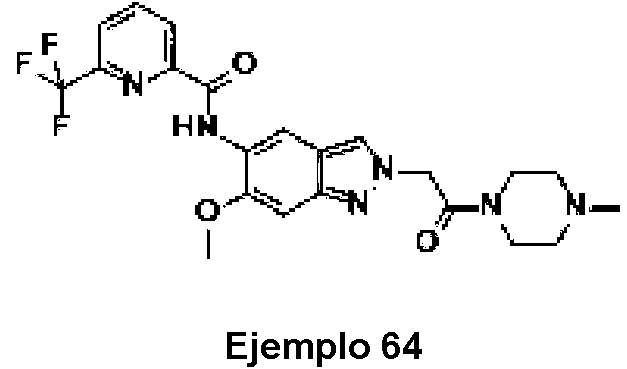
El documento WO2015091426 describe indazoles como en el Ejemplo 64, que están sustituidos en la posición 2 con una cadena lateral de carboxamida.WO2015091426 describes indazoles as in Example 64, which are substituted at the 2-position with a carboxamide side chain.
En el documento WO2015104662, se divulgan 2-indazoles sustituidos de la siguiente fórmula general:In WO2015104662, substituted 2-indazoles of the following general formula are disclosed:

en donde R2 es un grupo alquilo o cicloalquilo. Explícitamente se describen 2-indazoles sustituidos con un grupo metilo, 2-metoxietilo y ciclopentilo en la posición 2 (ejemplos 1,4 y 76). Además, se describe con el Ejemplo 117 un derivado de indazol con un sustituyente de hidroxietilo en la posición 1. Sin embargo, no se describen derivados de indazol con un sustituyente de 3-hidroxi-3-metilbutilo en la posición 1 o la posición 2.wherein R2 is an alkyl or cycloalkyl group. 2-Indazoles substituted with a methyl, 2-methoxyethyl and cyclopentyl group at position 2 are explicitly described (Examples 1,4 and 76). Furthermore, Example 117 describes an indazole derivative with a hydroxyethyl substituent at position 1. However, indazole derivatives with a 3-hydroxy-3-methylbutyl substituent at position 1 or position 2 are not described. .
Los indazoles, que presentan en la posición 2 un grupo alquilo sustituido con hidroxi, están comprendidos genéricamente en la fórmula general, pero no se divulgan explícitamente en el documento WO2015104662. Los indazoles con un grupo alquilo en la posición 2, en donde el grupo alquilo está sustituido adicionalmente con un grupo metilsulfonilo, no están comprendidos en la fórmula general y las definiciones para los sustituyentes R2 en el documento WO2015104662.Indazoles, which have a hydroxy-substituted alkyl group in the 2-position, are generically included in the general formula, but are not explicitly disclosed in WO2015104662. The indazoles with an alkyl group at the 2-position, wherein the alkyl group is further substituted with a methylsulfonyl group, are not encompassed by the general formula and definitions for the R2 substituents in WO2015104662.
Adicionalmente al modelo de sustitución descrito anteriormente en el indazol en la posición 1 y 2, se describen en el documento WO2015104662 indazoles con una sustitución en la posición 6, para los que R1 tiene el siguiente significado: alquilo, ciano, -NRaRb o grupos opcionalmente sustituidos seleccionados de cicloalquilo, arilo o heterociclilo, en donde los sustituyentes son, de modo independiente entre sí, alquilo, alcoxi, halógeno, hidroxilo, hidroxialquilo, amino, aminoalquilo, nitro, ciano, haloalquilo, haloalcoxi, -OCOCH2-O-alquilo, -OP(O)(O-alquilo)2 o -CH2-OP(O)(O-alquilo)2. Para compuestos de indazol, en los que R1 es un grupo alquilo, la fecha de solicitud efectiva es el 7 de enero de 2015 (fecha de solicitud internacional del documento WO2015104662). Las solicitudes de la India reivindicadas en la prioridad 146/CHE/2014 y 3018/CHE/2014 no manifiestan compuestos de indazol, para los que R1 es un grupo alquilo.In addition to the substitution model described above in indazole in positions 1 and 2, indazoles with a substitution in position 6 are described in document WO2015104662, for which R1 has the following meaning: alkyl, cyano, -NRaRb or optionally groups Substituents selected from cycloalkyl, aryl or heterocyclyl, wherein the substituents are, independently of each other, alkyl, alkoxy, halogen, hydroxyl, hydroxyalkyl, amino, aminoalkyl, nitro, cyano, haloalkyl, haloalkoxy, -OCOCH2-O-alkyl, -OP (O) (O-alkyl) 2 or -CH2-OP (O) (O-alkyl) 2. For indazole compounds, where R1 is an alkyl group, the effective application date is January 7, 2015 (international application date of WO2015104662). The Indian applications claimed in priority 146 / CHE / 2014 and 3018 / CHE / 2014 do not disclose indazole compounds, for which R1 is an alkyl group.
Así, los compuestos de indazol de la fórmula general siguienteThus, the indazole compounds of the following general formula

en los que R1 es un grupo alquilo opcionalmente sustituido, se describieron por primera vez el 7 de enero de 2015 y con ello, después de la fecha de prioridad de la presente solicitud.in which R1 is an optionally substituted alkyl group, were first described on January 7, 2015, and thus after the priority date of the present application.
Como ejemplos de los sustituyentes en la posición 6, se describen en el documento WO2015104662 para R1 ciclopropilo, ciclohexilo, ciano, 3-fluorofenilo y sustituyentes heterocíclicos saturados. Los indazoles con un grupo alquilo sustituido con hidroxi en la posición 6 no se describen explícitamente en el documento WO2015104662.As examples of the 6-position substituents, R1 cyclopropyl, cyclohexyl, cyano, 3-fluorophenyl and saturated heterocyclic substituents are described in WO2015104662. Indazoles with a hydroxy substituted alkyl group at position 6 are not explicitly described in WO2015104662.
El objetivo de la presente invención consiste en poner a disposición nuevos compuestos que actúan como inhibidores de quinasa-4 asociada al receptor de interleucina-1 (IRAK4).The aim of the present invention is to make available new compounds that act as inhibitors of interleukin-1 receptor associated kinase-4 (IRAK4).
Los nuevos inhibidores de IRAK4 son en particular adecuados para el tratamiento y para la prevención de enfermedades proliferativas, metabólicas e inflamatorias, que se caracterizan por un sistema inmunitario que hiperreacciona. Al respecto, en este caso cabe mencionar especialmente enfermedades de la piel, enfermedades del sistema cardiovascular, enfermedades pulmonares, enfermedades oculares, enfermedades neurológicas, enfermedades dolorosas y enfermedades cancerosas.The new IRAK4 inhibitors are in particular suitable for the treatment and for the prevention of proliferative, metabolic and inflammatory diseases, which are characterized by an overreactive immune system. In this regard, in this case, it is especially worth mentioning skin diseases, diseases of the cardiovascular system, lung diseases, eye diseases, neurological diseases, painful diseases and cancerous diseases.
Además, los nuevos inhibidores de IRAK4 son adecuados para el tratamiento y prevención:In addition, the new IRAK4 inhibitors are suitable for treatment and prevention:
• de enfermedades autoinmunitarias e inflamatorias, en particular artritis reumatoide, esclerosis múltiple, lupus eritematoso sistémico, espondilartritis y gota;• from autoimmune and inflammatory diseases, in particular rheumatoid arthritis, multiple sclerosis, systemic lupus erythematosus, spondylarthritis and gout;
• de enfermedades metabólicas, en particular de enfermedades hepáticas tales como hígado graso, como también:• from metabolic diseases, particularly liver diseases such as fatty liver, as well as:
• de enfermedades ginecológicas, en particular de endometriosis como también de los dolores asociados con endometriosis y de otros síntomas asociados con endometriosis tales como dismenorrea, disparunia, disuria y disquecia.• from gynecological diseases, in particular endometriosis as well as the pain associated with endometriosis and other symptoms associated with endometriosis such as dysmenorrhea, dysparunia, dysuria and dyschecia.
Son objeto de la presente invención compuestos de la fórmula general (I)Object of the present invention are compounds of the general formula (I)

en la que:in which:
R1 representa alquilo C1-C6, en donde el resto alquilo C1-C6 no está sustituido o está mono- o polisustituido, igual o diferente con R1 represents C1-C6 alkyl, wherein the C1-C6 alkyl moiety is unsubstituted or mono- or polysubstituted, the same or different with
halógeno, hidroxi, un cicloalquilo C3-C6 no sustituido o mono- o polisustituido con halógeno, un resto R6, R7SO2, R7SO o R8O o representa un grupo seleccionado de:halogen, hydroxy, an unsubstituted or mono- or polysubstituted C3-C6 cycloalkyl with halogen, an R6, R7SO2, R7SO or R8O residue or represents a group selected from:

en donde * representa un sitio de unión del grupo con el resto de la molécula;where * represents a binding site of the group with the rest of the molecule;
R2 y R3 siempre tienen el mismo significado y al mismo tiempo representan hidrógeno o alquilo C1-C6;R2 and R3 always have the same meaning and at the same time represent hydrogen or C1-C6 alkyl;
R4 representa halógeno, ciano, alquilo C1-C6 no sustituido o mono- o polisustituido, igual o diferente entre sí o cicloalquilo C3-C6 no sustituido o mono- o polisustituido, igual o diferente entre sí, y los sustituyentes se seleccionan del grupo de halógeno e hidroxi;R4 represents halogen, cyano, unsubstituted or mono- or polysubstituted C1-C6 alkyl, the same or different from each other, or unsubstituted or mono- or polysubstituted C3-C6 cycloalkyl, the same or different from each other, and the substituents are selected from the group of halogen and hydroxy;
R5 representa hidrógeno, halógeno o un alquilo C1-C6 no sustituido o mono- o polisustituido con halógeno; R5 represents hydrogen, halogen or an unsubstituted or mono- or polysubstituted C1-C6 alkyl with halogen;
R6 representa un heterociclo saturado monocíclico no sustituido o mono- o disustituido con metilo con 4 a 6 átomos de anillo, que contiene un heteroátomo o un heterogrupo de la serie O, S, SO y SO2;R6 represents an unsubstituted or mono- or disubstituted methyl monocyclic saturated heterocycle with 4 to 6 ring atoms, containing a heteroatom or a heterogroup of the series O, S, SO and SO2;
R7 representa alquilo C1-C6, en donde el resto alquilo C1-C6 no está sustituido o está mono- o polisustituido, igual o diferente con halógeno, hidroxi o cicloalquilo C3-C6, o R7 representa cicloalquilo C3-C6;R7 represents C1-C6 alkyl, wherein the C1-C6 alkyl moiety is unsubstituted or mono- or polysubstituted, the same or different from halogen, hydroxy or C3-C6 cycloalkyl, or R7 represents C3-C6 cycloalkyl;
R8 representa alquilo C1-C6, en donde el resto alquilo C1-C6 no está sustituido o está mono- o polisustituido, igual o diferente, con halógeno;R8 represents C1-C6 alkyl, wherein the C1-C6 alkyl moiety is unsubstituted or mono- or polysubstituted, the same or different, with halogen;
y sus diastereómeros, enantiómeros, sus sales, sus solvatos o los solvatos de sus sales.and their diastereomers, enantiomers, their salts, their solvates or the solvates of their salts.
Cuando en el caso de los intermediarios de síntesis y ejemplos de realización de la invención descritos más abajo se enumera un compuesto en la forma de una sal de la correspondiente base o ácido, por lo general, no se conoce así la composición estequiométrica exacta de dicha sal, tal como se obtuvo según el correspondiente procedimiento de preparación y/o purificación. Siempre que no se especifique más precisamente, los adicionales de los nombres y fórmulas estructurales como, por ejemplo, "clorhidrato", "trifluoroacetato", "sal de sodio" o "x HCl", "x CF3COOH", "x Na+" en tales sales no se han de comprender de modo estequiométrico, sino que tienen un carácter descriptivo con respecto a los componentes contenidos formadores de sales.When a compound is listed in the form of a salt of the corresponding base or acid in the case of the synthesis intermediates and embodiments of the invention described below, the exact stoichiometric composition of said compound is generally not known. salt, as obtained according to the corresponding preparation and / or purification procedure. Unless specified more precisely, additional names and structural formulas such as "hydrochloride", "trifluoroacetate", "sodium salt" or "x HCl", "x CF3COOH", "x Na +" in such salts are not to be understood stoichiometrically, but are descriptive in character with respect to the contained salt-forming components.
Análogamente, lo mismo rige para el caso en que los intermediarios de síntesis o ejemplos de realización o sus sales se obtuvieron según los procedimientos de preparación y/o purificación descritos en forma de solvatos como, por ejemplo, hidratos, cuya composición estequiométrica (siempre que sea tipo definido) no es conocida.Similarly, the same applies to the case in which the synthesis intermediates or exemplary embodiments or their salts were obtained according to the preparation and / or purification procedures described in the form of solvates such as, for example, hydrates, whose stoichiometric composition (provided that be defined type) is not known.
Los compuestos de acuerdo con la invención son los compuestos de la fórmula (I) y sus sales, solvatos y solvatos de las sales, los compuestos comprendidos por la fórmula (I) de las fórmulas mencionadas más abajo y sus sales, solvatos y solvatos de las sales, así como los compuestos comprendidos por la fórmula (I), a continuación mencionados como ejemplos de realización y sus sales, solvatos y solvatos de las sales, siempre que en el caso de los compuestos comprendidos por la fórmula (I), mencionados a continuación no se trate ya de sales, solvatos y solvatos de las sales. Como sales se prefieren en el marco de la presente invención las sales fisiológicamente inocuas de los compuestos de acuerdo con la invención. Pero están comprendidas también las sales que en sí no son apropiadas por aplicaciones farmacéuticas, pero, por ejemplo, que se usan por ejemplo para el aislamiento o la purificación de los compuestos de acuerdo con la invención.The compounds according to the invention are the compounds of the formula (I) and their salts, solvates and solvates of the salts, the compounds comprised by the formula (I) of the formulas mentioned below and their salts, solvates and solvates of the salts, as well as the compounds comprised by formula (I), mentioned below as exemplary embodiments, and their salts, solvates and solvates of the salts, provided that in the case of the compounds comprised by formula (I), mentioned the following are no longer salts, solvates and solvates of salts. Preferred salts within the framework of the present invention are the physiologically safe salts of the compounds according to the invention. However, salts are also included which in themselves are not suitable for pharmaceutical applications, but, for example, which are used for example for the isolation or purification of the compounds according to the invention.
Las sales fisiológicamente inocuas de los compuestos de acuerdo con la invención comprenden sales de adición de ácido de ácidos minerales, ácidos carboxílicos y ácidos sulfónicos, por ejemplo, sales del ácido de cloruro de hidrógeno, ácido bromhídrico, ácido sulfúrico, ácido fosfórico, ácido metansulfónico, ácido etansulfónico, ácido toluensulfónico, ácido bencensulfónico, ácido naftalendisulfónico, ácido acético, ácido trifluoroacético, ácido propiónico, ácido láctico, ácido tartárico, ácido málico, ácido cítrico, ácido fumárico, ácido maleico y ácido benzoico. Physiologically harmless salts of the compounds according to the invention comprise acid addition salts of mineral acids, carboxylic acids and sulfonic acids, for example, salts of hydrogen chloride, hydrobromic acid, sulfuric acid, phosphoric acid, methanesulfonic acid. , ethanesulfonic acid, toluenesulfonic acid, benzenesulfonic acid, naphthalenedisulfonic acid, acetic acid, trifluoroacetic acid, propionic acid, lactic acid, tartaric acid, malic acid, citric acid, fumaric acid, maleic acid and benzoic acid.
Las sales fisiológicamente inocuas de los compuestos de acuerdo con la invención comprenden también sales de bases usuales tales como, por ejemplo, y con preferencia, sales de metales alcalinos (por ejemplo, sales de sodio y de potasio), sales de metales alcalinotérreos (por ejemplo, sales de calcio y de magnesio) y sales de amonio, derivadas de amoníaco o aminas orgánicas con 1 a 16 átomos de C tales como, por ejemplo, y con preferencia, etilamina, dietilamina, trietilamina, etildiisopropilamina, monoetanolamina, dietanolamina, trietanolamina, diciclohexilamina, dimetilaminoetanol, procaína, dibencilamina, N-metilmorfolina, arginina, lisina, etilendiamina y N-metilpiperidina. Como solvatos se denominan, en el marco de la invención, aquellas formas de los compuestos de acuerdo con la invención que en estado sólido o líquido forman un complejo por coordinación con moléculas de disolvente. Los hidratos son una forma especial de solvatos, en los que la coordinación se realiza con agua.The physiologically harmless salts of the compounds according to the invention also comprise salts of customary bases such as, for example, and preferably alkali metal salts (for example sodium and potassium salts), alkaline earth metal salts (for example example, calcium and magnesium salts) and ammonium salts, derived from ammonia or organic amines with 1 to 16 C atoms such as, for example, and preferably ethylamine, diethylamine, triethylamine, ethyldiisopropylamine, monoethanolamine, diethanolamine, triethanolamine , dicyclohexylamine, dimethylaminoethanol, procaine, dibenzylamine, N-methylmorpholine, arginine, lysine, ethylenediamine, and N-methylpiperidine. As solvates, within the framework of the invention, are those forms of the compounds according to the invention which, in the solid or liquid state, form a complex by coordination with solvent molecules. Hydrates are a special form of solvates, in which the coordination takes place with water.
Los compuestos de acuerdo con la invención pueden existir en función de su estructura en diversas formas estereoisoméricas, es decir, en forma de isómeros de configuración o eventualmente también como isómeros conformacionales (enantiómeros y/o diastereómeros, incluyendo aquellos en caso de atropisómeros). La presente invención comprende, por ello, los enantiómeros y diastereómeros y sus correspondientes mezclas. De tales mezclas de enantiómeros y/o diastereómeros, se pueden aislar los componentes unitarios estereoisoméricos de manera conocida; con preferencia, pcara ello se usan procedimientos cromatográficos, en particular la cromatografía HPLC en fase aquiral o quiral.The compounds according to the invention can exist depending on their structure in various stereoisomeric forms, that is to say in the form of configuration isomers or optionally also as conformational isomers (enantiomers and / or diastereomers, including those in the case of atropisomers). The present The invention therefore encompasses enantiomers and diastereomers and their corresponding mixtures. From such mixtures of enantiomers and / or diastereomers, the stereoisomeric unit components can be isolated in known manner; preferably, chromatographic procedures are used, in particular achiral or chiral phase HPLC chromatography.
Siempre que los compuestos de acuerdo con la invención puedan existir en formas tautoméricas, la presente invención comprende todas las formas tautomérias.Provided that the compounds according to the invention can exist in tautomeric forms, the present invention encompasses all tautomeric forms.
La presente invención comprende también todas las variantes isotópicas apropiadas de los compuestos de acuerdo con la invención. Por una variante isotópica de un compuesto de acuerdo con la invención se entiende en este caso un compuesto en el que al menos un átomo dentro del compuesto de acuerdo con la invención se intercambia por otro átomo del mismo número atómico, pero con otra masa atómica que la masa atómica usual o presente preponderantemente en la naturaleza. Los ejemplos de isótopos que se pueden incorporar en un compuesto de acuerdo con la invención son aquellos de hidrógeno, carbono, nitrógeno, oxígeno, fósforo, azufre, flúor, cloro, bromo y yodo, tales como 2H (deuterio), 3H (tritio), 13C, 14C, 15N, 17O, 18O, 32P, 33P, 33S, 34S, 35S, 36S, 18F, 36Cl, 82Br, 123I, 124I, 129I y 131I. Variantes isotópicas determinadas de un compuesto de acuerdo con la invención, como en particular aquellas en las que se incorporan uno o varios isótopos radiactivo, pueden ser de utilidad, por ejemplo, para la investigación del mecanismo de acción o la distribución de los principios activos en el organismo; en virtud de la factibilidad de preparación y detección relativamente sencilla, son apropiados para ello en particular compuestos marcados con isótopos 3H o 14C. Además, la incorporación de isótopos como, por ejemplo, de deuterio, puede producir determinadas ventajas terapéuticas como consecuencia de una estabilidad metabólica mayor del compuesto como, por ejemplo, una prolongación del tiempo de vida media en el organismo o una reducción de la dosis activa necesaria; estas modificaciones de los compuestos de acuerdo con la invención eventualmente también pueden presentar, por ello, una forma de realización preferida de la presente invención. Las variantes isotópicas de los compuestos de acuerdo con la invención se pueden preparar de acuerdo con procedimientos conocidos por el experto en la técnica, así, por ejemplo, según los métodos descritos más abajo y las disposiciones reproducidas en los ejemplos de realización, al usar las correspondientes modificaciones isotópicas de los distintos reactivos y/o compuestos de partida.The present invention also encompasses all appropriate isotopic variants of the compounds according to the invention. By an isotopic variant of a compound according to the invention is meant in this case a compound in which at least one atom within the compound according to the invention is exchanged for another atom of the same atomic number, but with another atomic mass that the atomic mass usual or predominantly present in nature. Examples of isotopes that can be incorporated into a compound according to the invention are those of hydrogen, carbon, nitrogen, oxygen, phosphorus, sulfur, fluorine, chlorine, bromine and iodine, such as 2H (deuterium), 3H (tritium) , 13C, 14C, 15N, 17O, 18O, 32P, 33P, 33S, 34S, 35S, 36S, 18F, 36Cl, 82Br, 123I, 124I, 129I and 131I. Certain isotopic variants of a compound according to the invention, such as in particular those in which one or more radioactive isotopes are incorporated, may be useful, for example, for investigating the mechanism of action or the distribution of the active principles in the organism; By virtue of the relatively simple preparation and detection feasibility, compounds labeled with 3H or 14C isotopes are particularly suitable for this. In addition, the incorporation of isotopes, such as deuterium, can produce certain therapeutic advantages as a consequence of a greater metabolic stability of the compound, such as, for example, a prolongation of the half-life in the body or a reduction in the active dose. necessary; These modifications of the compounds according to the invention can therefore optionally also present a preferred embodiment of the present invention. The isotopic variants of the compounds according to the invention can be prepared according to procedures known to the person skilled in the art, thus, for example, according to the methods described below and the arrangements reproduced in the embodiments, by using the corresponding isotopic modifications of the different reagents and / or starting compounds.
Otro objeto de la presente invención son todas las posibles formas cristalinas y polimorfas de los compuestos de acuerdo con la invención, en donde los polimorfos pueden existir como polimorfos individuales o como mezcla de varios polimorfos en todos los intervalos de concentración.Another object of the present invention are all possible crystalline and polymorphic forms of the compounds according to the invention, wherein the polymorphs can exist as individual polymorphs or as a mixture of several polymorphs in all concentration ranges.
En el marco de la presente invención, los sustituyentes, siempre y cuando no se especifique otra cosa, tienen los siguientes significados:In the context of the present invention, the substituents, unless otherwise specified, have the following meanings:
Alquilo representa, en el marco de la invención un resto alquilo lineal o ramificado con el número de átomos de carbono indicada en cada caso. A modo de ejemplo, se han de mencionar metilo, etilo, n-propilo, Isopropilo, nbutilo, iso-butilo, 1 -metilpropilo, 2-metilpropilo, terc-butilo, n-pentilo, 1 -etilpropilo, 1 -metilbutilo, 2-metilbutilo, 3-metilbutilo, 2,2-dimetilpropilo, n-hexilo, 1 -metilpentilo, 2-metilpentilo, 3-metilpentilo, 4-metilpentilo, 1 -etilbutilo y 2-etilbutilo. Se prefieren metilo, etilo, n-propilo, n-butilo, 2-metilbutilo, 3-metilbutilo y 2,2-dimetilpropilo.Alkyl represents, within the framework of the invention, a linear or branched alkyl radical with the number of carbon atoms indicated in each case. By way of example, mention should be made of methyl, ethyl, n-propyl, Isopropyl, n-butyl, iso-butyl, 1-methylpropyl, 2-methylpropyl, tert-butyl, n-pentyl, 1-ethylpropyl, 1-methylbutyl, 2 -methylbutyl, 3-methylbutyl, 2,2-dimethylpropyl, n-hexyl, 1-methylpentyl, 2-methylpentyl, 3-methylpentyl, 4-methylpentyl, 1-ethylbutyl and 2-ethylbutyl. Methyl, ethyl, n-propyl, n-butyl, 2-methylbutyl, 3-methylbutyl and 2,2-dimethylpropyl are preferred.
Cicloalquilo representa, en el marco de la invención, un resto alquilo saturado monocíclico con el número de átomos de carbono indicada en cada caso. A modo de ejemplo y con preferencia, se ha de mencionar ciclopropilo, ciclobutilo, ciclopentilo y ciclohexilo.Cycloalkyl represents, within the framework of the invention, a monocyclic saturated alkyl radical with the number of carbon atoms indicated in each case. By way of example and preference, mention should be made of cyclopropyl, cyclobutyl, cyclopentyl and cyclohexyl.
Alcoxi representa, en el marco de la invención, un resto alcoxi lineal o ramificado con el número de átomos de carbono indicada en cada caso. Se prefieren 1 a 6 átomos de carbono. A modo de ejemplo se han de mencionar metoxi, etoxi, n-propoxi, Isopropoxi, 1-metilpropoxi, n-butoxi, iso-butoxi, terc-butoxi, n-pentoxi, iso-pentoxi, 1-etilpropoxi, 1-metilbutoxi, 2-metilbutoxi, 3-metilbutoxi y n-hexoxi. Se prefiere en particular un resto alcoxi lineal o ramificado con 1 a 4 átomos de carbono. A modo de ejemplo y con preferencia, se han de mencionar metoxi, etoxi, n-propoxi, 1-metilpropoxi, n-butoxi e iso-butoxi.Alkoxy represents, within the framework of the invention, a linear or branched alkoxy radical with the number of carbon atoms indicated in each case. 1 to 6 carbon atoms are preferred. By way of example, mention should be made of methoxy, ethoxy, n-propoxy, isopropoxy, 1-methylpropoxy, n-butoxy, iso-butoxy, tert-butoxy, n-pentoxy, iso-pentoxy, 1-ethylpropoxy, 1-methylbutoxy, 2-methylbutoxy, 3-methylbutoxy, and n-hexoxy. A linear or branched alkoxy moiety having 1 to 4 carbon atoms is particularly preferred. By way of example and preference, mention should be made of methoxy, ethoxy, n-propoxy, 1-methylpropoxy, n-butoxy and iso-butoxy.
Halógeno representa, en el marco de la invención, flúor, cloro y bromo. Se prefiere flúor.Halogen represents, within the framework of the invention, fluorine, chlorine and bromine. Fluorine is preferred.
Hidroxi representa, en el marco de la invención, OH.Hydroxy represents, within the framework of the invention, OH.
Un heterociclo saturado monocíclico representa un heterociclo saturado monocíclico con 4 a 6 átomos de anillo, que contiene un heteroátomo o un heterogrupo de la serie O, S, SO y SO2. Se prefiere un heterociclo con un heteroátomo o un heterogrupo de la serie O, SO y SO2. A modo de ejemplo, se han de mencionar: oxetano, tetrahidrofurano, tetrahidro-2H-piran-4-ilo, 1,1 -dioxidotetrahidro-2H-tiopiran-3-ilo, 1,1-dioxidotetrahidro-2H-tiopiran-2-ilo, 1,1 -dioxidotetrahidro-2H-tiopiran-4-ilo, 1,1 -dioxidotetrahidrotiofen-3-ilo, 1,1 -dioxidotetrahidrotiofen-2-ilo, 1,1-dioxidotietan-2-ilo o 1,1 -dioxidotietan-3-ilo. En este caso, se prefieren con preferencia especial oxetano y tetrahidrofurano. Se prefiere muy especialmente oxetan-3-ilo.A monocyclic saturated heterocycle represents a monocyclic saturated heterocycle with 4 to 6 ring atoms, containing a heteroatom or a heterogroup of the series O, S, SO and SO2. A heterocycle with one heteroatom or heterogroup of the series O, SO and SO2 is preferred. By way of example, mention should be made of: oxetane, tetrahydrofuran, tetrahydro-2H-pyran-4-yl, 1,1-dioxytetrahydro-2H-thiopyran-3-yl, 1,1-dioxytetrahydro-2H-thiopyran-2- yl, 1,1-dioxidotetrahydro-2H-thiopyran-4-yl, 1,1-dioxytetrahydrothiophen-3-yl, 1,1-dioxytetrahydrothiophen-2-yl, 1,1-dioxidothiethane-2-yl or 1,1 - dioxydothiethane-3-yl. In this case, oxetane and tetrahydrofuran are especially preferred. Oxetan-3-yl is very especially preferred.
Un símbolo * en un enlace significa el sitio de unión en la molécula.A symbol * in a bond means the binding site on the molecule.
Cuando los restos en los compuestos de acuerdo con la invención están sustituidos, los restos pueden ser mono- o polisustituidos, siempre que no se especifique otra cosa. En el marco de la presente invención rige que, para todos los restos que aparecen varias veces, su definición es independiente entre sí. Se prefiere una sustitución con uno, dos o tres sustituyentes iguales o diferentes.When the moieties in the compounds according to the invention are substituted, the moieties may be mono- or polysubstituted, provided that nothing else is specified. Within the framework of the present invention, it applies that, for all the remains that appear several times, their definition is independent of each other. A substitution with one, two or three identical or different substituents is preferred.
Una forma de realización preferida de R1 es un resto alquilo C2-C6 sustituido con 1,2 o 3 átomos de flúor. Se prefieren especialmente 2,2,2-trifluoroetilo, 3,3,3-trifluorpropilo y 4,4,4-trifluorobutilo. Se prefiere muy especialmente un resto 4,4,4-trifluorobutilo.A preferred embodiment of R1 is a C2-C6 alkyl moiety substituted with 1,2 or 3 fluorine atoms. 2,2,2-trifluoroethyl, 3,3,3-trifluoropropyl and 4,4,4-trifluorobutyl are especially preferred. A 4,4,4-trifluorobutyl residue is very particularly preferred.
Otra forma de realización preferida de R1 es un resto alquilo C2-C6, que está sustituido con uno o dos grupos hidroxi o un alcoxi C1-C3 o un alcoxi C1-C3 trisustituido con flúor. Se prefiere especialmente un resto alquilo C2-C5, que está sustituido con hidroxi o alcoxi C1-C3 o con trifluorometoxi o 2,2,2-trifluoroetoxi. Se prefieren muy especialmente 3-hidroxi-3-metilbutilo, 3-metoxipropilo, 3-hidroxipropilo, 3-trifluorometoxipropilo, 2-metoxietilo o 2-hidroxietilo. En particular se prefiere en resto 3-hidroxi-3-metilbutilo.Another preferred embodiment of R1 is a C2-C6 alkyl moiety, which is substituted with one or two hydroxy groups or a C1-C3 alkoxy or a C1-C3 alkoxy trisubstituted with fluorine. A C2-C5 alkyl moiety is especially preferred, which is substituted with hydroxy or C1-C3 alkoxy or with trifluoromethoxy or 2,2,2-trifluoroethoxy. Very particularly preferred are 3-hydroxy-3-methylbutyl, 3-methoxypropyl, 3-hydroxypropyl, 3-trifluoromethoxypropyl, 2-methoxyethyl or 2-hydroxyethyl. In particular, 3-hydroxy-3-methylbutyl radical is preferred.
Con mayor preferencia, R1 representa un resto alquilo C2-C6 sustituido con un grupo alquil C1-C6-SO2. Un resto alquilo C2-C4 sustituido con metil-SO2 se prefiere especialmente. En particular se prefieren para R12-(metilsulfonil)etilo o 3-(metilsulfonil)propilo. Del último grupo mencionado, se prefiere especialmente 2-(metilsulfonil)etilo.More preferably, R1 represents a C2-C6 alkyl moiety substituted with a C1-C6 alkyl-SO2 group. A C2-C4 alkyl moiety substituted with methyl-SO2 is especially preferred. Particularly preferred for R12- (methylsulfonyl) ethyl or 3- (methylsulfonyl) propyl. Of the last mentioned group, 2- (methylsulfonyl) ethyl is especially preferred.
Con mayor preferencia, R1 representa un resto alquilo C1-C3 sustituido con oxetanilo, tetrahidrofuranilo, tetrahidro-2H-piran-4-ilo, 1,1-dioxidotetrahidro-2H-tiopiran-3-ilo, 1,1-dioxidotetrahidro-2H-tiopiran-2-ilo, 1,1-dioxidotetrahidro-2H-tiopiran-4-ilo, 1,1 -dioxidotetrahidrotiofen-3-ilo, 1,1 -dioxidotetrahidrotiofen-2-ilo, 1,1 -dioxidotietan-2-ilo o 1,1-dioxidotietan-3-ilo. Se prefiere especialmente un resto alquilo C1-C3 sustituido con un grupo oxetano. En particular se prefiere un grupo oxetan-3-ilmetilo para R1.More preferably, R1 represents a C1-C3 alkyl moiety substituted with oxethanyl, tetrahydrofuranyl, tetrahydro-2H-pyran-4-yl, 1,1-dioxytetrahydro-2H-thiopyran-3-yl, 1,1-dioxytetrahydro-2H- thiopyran-2-yl, 1,1-dioxydotetrahydro-2H-thiopyran-4-yl, 1,1-dioxytetrahydrothiophen-3-yl, 1,1-dioxytetrahydrothiophene-2-yl, 1,1-dioxydothiethane-2-yl or 1,1-dioxydothiethane-3-yl. A C1-C3 alkyl moiety substituted with an oxetane group is especially preferred. In particular, an oxethan-3-ylmethyl group is preferred for R1.
Para R2 y R3, que siempre tienen el mismo significado, se prefieren hidrógeno o metilo. En este caso, se prefiere en particular metilo.For R2 and R3, which always have the same meaning, hydrogen or methyl are preferred. In this case, methyl is particularly preferred.
En el caso de R4 se prefiere un resto alquilo C1-C3 no sustituido o mono- o polisustituido con halógeno o un resto alquilo C1-C3 sustituido con un grupo hidroxi o un resto alquilo C1-C2 sustituido con un grupo hidroxi y tres átomos de flúor.In the case of R4, an unsubstituted or mono- or polysubstituted C1-C3 alkyl radical with halogen or a C1-C3 alkyl radical substituted with a hydroxy group or a C1-C2 alkyl radical substituted with one hydroxy group and three carbon atoms are preferred. fluorine.
Se prefieren especialmente para R4 los siguientes restos: metilo, etilo, trifluoroalquilo C1-C3, difluoroalquilo C1-C3, hidroximetilo, 1 -hidroxietilo, 2-hidroxipropan-2-ilo y 2,2,2-trifluoro-1 -hidroxietilo. Se prefieren especialmente para R4 los restos metilo, trifluorometilo y difluorometilo. En este caso, se prefiere especialmente un resto trifluorometilo.Especially preferred for R4 are the following moieties: methyl, ethyl, C1-C3 trifluoroalkyl, C1-C3 difluoroalkyl, hydroxymethyl, 1-hydroxyethyl, 2-hydroxypropan-2-yl and 2,2,2-trifluoro-1-hydroxyethyl. Especially preferred for R4 are methyl, trifluoromethyl and difluoromethyl moieties. In this case, a trifluoromethyl moiety is especially preferred.
Una forma de realización de realización preferida de R5 es hidrógeno, flúor, cloro o alquilo C1-C3. Se prefiere especialmente que R5 sea hidrógeno, flúor o metilo. Con preferencia muy especial, R5 es hidrógeno o flúor.A preferred embodiment of R5 is hydrogen, fluorine, chlorine or C1-C3 alkyl. It is especially preferred that R5 is hydrogen, fluoro or methyl. With very special preference, R5 is hydrogen or fluorine.
Además, se prefieren especialmente los compuestos cuyo R4 significa metilo o trifluorometilo y R5 significa flúor. Se prefieren muy especialmente los compuestos en los que R4 representa metilo y R5 representa flúor, en donde R5 se encuentra en posición orto con respecto a R4.Furthermore, compounds in which R4 represents methyl or trifluoromethyl and R5 represents fluorine are especially preferred. Compounds in which R4 represents methyl and R5 represents fluoro, where R5 is ortho to R4, are very particularly preferred.
Para R6 se han de mencionar como formas de realización preferidas oxetanilo, tetrahidrofuranilo, tetrahidro-2H-piran-4-ilo, 1,1 -dioxidotetrahidro-2H-tiopiran-3-ilo, 1,1-dioxidotetrahidro-2H-tiopiran-2-ilo, 1,1-dioxidotetrahidro-2H-tiopiran-4-ilo, 1,1 -dioxidotetrahidrotiofen-3-ilo, 1,1 -dioxidotetrahidrotiofen-2-ilo, 1,1-dioxidotietan-2-ilo o 1,1-dioxidotietan-3-ilo. Se prefieren aquí especialmente el oxetanilo. Se prefiere muy especialmente el oxetan-3-ilo.For R6, oxethanyl, tetrahydrofuranyl, tetrahydro-2H-pyran-4-yl, 1,1-dioxytetrahydro-2H-thiopyran-3-yl, 1,1-dioxytetrahydro-2H-thiopyran-2 are to be mentioned as preferred embodiments. -yl, 1,1-dioxytetrahydro-2H-thiopyran-4-yl, 1,1-dioxytetrahydrothiophen-3-yl, 1,1-dioxytetrahydrothiophene-2-yl, 1,1-dioxydothiethane-2-yl or 1,1 -dioxydothiethane-3-yl. Oxethanyl is especially preferred here. Oxetan-3-yl is very especially preferred.
R7 representa exclusivamente en relación con los grupos funcionales -SO2- y -SO-, es decir, un grupo -SO2- o SO sustituido con R7. En este contexto, se prefiere para R7 alquilo C1-C4, en donde el resto alquilo C1-C4 no está sustituido o está monosustituido con hidroxi o con ciclopropilo o con tres átomos de flúor. Además, para R7 se prefiere un resto ciclopropilo. Se prefieren especialmente para R7 metilo, etilo o hidroxietilo. Se prefiere muy especialmente metilo para R7.R7 represents exclusively in relation to the functional groups -SO2- and -SO-, that is, a group -SO2- or SO substituted with R7. In this context, C1-C4 alkyl is preferred for R7, wherein the C1-C4 alkyl moiety is unsubstituted or monosubstituted with hydroxy or with cyclopropyl or with three fluorine atoms. Furthermore, for R7 a cyclopropyl moiety is preferred. Especially preferred for R7 are methyl, ethyl or hydroxyethyl. Methyl is very especially preferred for R7.
Esto significa que, en el caso de un resto alquilo C1-C6 sustituido con R7SO2 o R7SO en el sentido de R1, se prefiere un alquilo C1-C6 sustituido con un alquil C1-C6-SO2 o un alquil C1-C6-SO. En este caso, para R1 se prefieren en particular metilsulfoniletilo y metilsulfonilpropilo. En este caso, se prefiere muy especialmente metilsulfoniletilo.This means that, in the case of a C1-C6 alkyl radical substituted with R7SO2 or R7SO in the sense of R1, a C1-C6 alkyl substituted with a C1-C6 alkyl-SO2 or a C1-C6 alkyl-SO is preferred. In this case, for R1, methylsulfonylethyl and methylsulfonylpropyl are particularly preferred. In this case, methylsulfonylethyl is very especially preferred.
Para R8 se prefiere un resto alquilo C1-C4 no sustituido o un resto alquilo C1-C4 trisustituido con flúor. Se prefiere especialmente metilo, etilo, trifluorometilo o 2,2,2-trifluoroetilo. Se prefieren muy especialmente metilo, trifluorometilo o 2,2,2-trifluoroetilo.For R8, an unsubstituted C1-C4 alkyl moiety or a fluorine tri-substituted C1-C4 alkyl moiety is preferred. Methyl, ethyl, trifluoromethyl or 2,2,2-trifluoroethyl are especially preferred. Methyl, trifluoromethyl or 2,2,2-trifluoroethyl are very particularly preferred.
Se prefieren los compuestos de la fórmula (I), en la queCompounds of formula (I), in which
R1 representa alquilo C1-C6, en donde el resto alquilo C1-C6 no está sustituido o está mono- o polisustituido, igual o diferente, con flúor, hidroxi, un resto R6, R7SO2, R7SO o R8O;R1 represents C1-C6 alkyl, where the C1-C6 alkyl moiety is unsubstituted or is mono- or polysubstituted, the same or different, with fluorine, hydroxy, a moiety R6, R7SO2, R7SO or R8O;
R2 y R3 siempre tienen el mismo significado y al mismo tiempo representan hidrógeno o alquilo C1-C3;R2 and R3 always have the same meaning and at the same time represent hydrogen or C1-C3 alkyl;
R4 representa halógeno, ciano o alquilo C1-C3, en donde el resto alquilo C1-C3 no está sustituido o está mono- o polisustituido, igual o diferente con halógeno o hidroxi;R4 represents halogen, cyano or C1-C3 alkyl, wherein the C1-C3 alkyl moiety is unsubstituted or mono- or polysubstituted, the same or different with halogen or hydroxy;
R5 representa hidrógeno, flúor, cloro o alquilo C1-C3;R5 represents hydrogen, fluorine, chlorine or C1-C3 alkyl;
R6 representa oxetanilo o tetrahidrofuranilo;R6 represents oxetanyl or tetrahydrofuranyl;
R7 representa alquilo C1-C4, en donde el resto alquilo C1-C4 no está sustituido o está monosustituido con hidroxi o con ciclopropilo o con tres átomos de flúor; R7 represents C1-C4 alkyl, wherein the C1-C4 alkyl moiety is unsubstituted or monosubstituted with hydroxy or with cyclopropyl or with three fluorine atoms;
R8 representa alquilo C1-C4 no sustituido o alquilo C1-C4 trisustituido con flúor;R8 represents unsubstituted C1-C4 alkyl or C1-C4 alkyl trisubstituted with fluorine;
así como sus diastereómeros, enantiómeros, sus sales, sus solvatos o los solvatos de sus sales.as well as their diastereomers, enantiomers, their salts, their solvates or the solvates of their salts.
También se prefieren los compuestos de la fórmula (I), en la queAlso preferred are compounds of formula (I), in which
R1 representa alquilo C2-C6, en donde alquilo C2-C6 no está sustituido, o alquilo C2-C6 está mono-, di- o trisustituido con flúor o alquilo C2-C6 está monosustituido con hidroxi, R6, R7SO2, o R8O o en la que R1 representa alquilo C1-C3 sustituido con oxetanilo;R1 represents C2-C6 alkyl, where C2-C6 alkyl is unsubstituted, or C2-C6 alkyl is mono-, di- or trisubstituted with fluorine or C2-C6 alkyl is monosubstituted with hydroxy, R6, R7SO2, or R8O or in where R1 represents C1-C3 alkyl substituted with oxetanyl;
R2 y R3 siempre tienen el mismo significado y al mismo tiempo representan hidrógeno o metilo;R2 and R3 always have the same meaning and at the same time represent hydrogen or methyl;
R4 representa un resto alquilo C1-C3 no sustituido o mono- o polisustituido con halógeno o un resto alquilo C1-C3 sustituido con un grupo hidroxi o un resto alquilo C1-C3 sustituido con un grupo hidroxi y tres átomos de flúor;R4 represents an unsubstituted or mono- or polysubstituted C1-C3 alkyl radical with halogen or a C1-C3 alkyl radical substituted with a hydroxy group or a C1-C3 alkyl radical substituted with a hydroxy group and three fluorine atoms;
R5 representa hidrógeno, flúor o alquilo C1-C3;R5 represents hydrogen, fluoro or C1-C3 alkyl;
R7 representa alquilo C1-C3;R7 represents C1-C3 alkyl;
R8 representa alquilo C1-C4, en donde el resto alquilo C1-C4 no está sustituido o está mono-, di- o trisustituido con flúor;R8 represents C1-C4 alkyl, wherein the C1-C4 alkyl moiety is unsubstituted or mono-, di- or tri-substituted with fluoro;
así como sus diastereómeros, enantiómeros, sus sales, sus solvatos o los solvatos de sus sales.as well as their diastereomers, enantiomers, their salts, their solvates or the solvates of their salts.
Además, se prefieren especialmente los compuestos de la fórmula general (I), en la queFurthermore, compounds of the general formula (I), in which
R1 representa un resto alquilo C2-C5, que está sustituido con hidroxi o alcoxi C1-C3 o trifluorometoxi o 2,2,2-trifluoroetoxi o trifluorometilo o representa un resto alquilo C2-C4 sustituido con metil-SO2 o representa un resto alquilo C1-C2 sustituido con oxetan-3-ilo;R1 represents a C2-C5 alkyl radical, which is substituted with hydroxy or C1-C3 alkoxy or trifluoromethoxy or 2,2,2-trifluoroethoxy or trifluoromethyl or represents a C2-C4 alkyl radical substituted with methyl-SO2 or represents a C1 alkyl radical. -C2 substituted with oxetan-3-yl;
R2 y R3 siempre tienen el mismo significado y al mismo tiempo representan hidrógeno o metilo;R2 and R3 always have the same meaning and at the same time represent hydrogen or methyl;
R4 representa metilo, etilo, trifluoroalquilo C1-C3, difluoroalquilo C1-C3, hidroximetilo, 1-hidroxietilo, 2-hidroxipropan-2-ilo y 2,2,2-trifluoro-1 -hidroxietilo yR4 represents methyl, ethyl, C1-C3 trifluoroalkyl, C1-C3 difluoroalkyl, hydroxymethyl, 1-hydroxyethyl, 2-hydroxypropan-2-yl, and 2,2,2-trifluoro-1-hydroxyethyl and
R5 representa hidrógeno, flúor o metilo;R5 represents hydrogen, fluoro or methyl;
así como sus diastereómeros, enantiómeros, sus sales, sus solvatos o los solvatos de sus sales.as well as their diastereomers, enantiomers, their salts, their solvates or the solvates of their salts.
Se prefiere muy especialmente los compuestos, en los queCompounds, in which
R1 representa 4,4,4-trifluorobutilo, 3-hidroxi-3-metilbutilo, 3-hidroxibutilo, 3-metoxipropilo, 3-hidroxipropilo, 3-hidroxi-2-metilpropilo, 3-hidroxi-2,2-dimetilpropilo, 3-trifluorometoxipropilo, 2-metoxietilo, 2-hidroxietilo, 2-(metilsulfonil)etilo o 3-(metilsulfonil)propilo;R1 represents 4,4,4-trifluorobutyl, 3-hydroxy-3-methylbutyl, 3-hydroxybutyl, 3-methoxypropyl, 3-hydroxypropyl, 3-hydroxy-2-methylpropyl, 3-hydroxy-2,2-dimethylpropyl, 3- trifluoromethoxypropyl, 2-methoxyethyl, 2-hydroxyethyl, 2- (methylsulfonyl) ethyl or 3- (methylsulfonyl) propyl;
R2 y R3 al mismo tiempo representan metilo o hidrógeno yR2 and R3 at the same time represent methyl or hydrogen and
R4 representa difluorometilo, trifluorometilo o metilo yR4 represents difluoromethyl, trifluoromethyl or methyl and
R5 representan hidrógeno o flúor;R5 represent hydrogen or fluorine;
así como sus diastereómeros, enantiómeros, sus sales, sus solvatos o los solvatos de sus sales.as well as their diastereomers, enantiomers, their salts, their solvates or the solvates of their salts.
Además, se prefieren muy especialmente los compuestos, en los queFurthermore, compounds are very particularly preferred, in which
R1 representa 3-hidroxi-3-metilbutilo, 3-hidroxibutilo, 3-hidroxi-2-metilpropilo, 3-hidroxi-2,2-dimetilpropilo, 3-(metilsulfonil)propilo o 2-(metilsulfonil)etilo;R1 represents 3-hydroxy-3-methylbutyl, 3-hydroxybutyl, 3-hydroxy-2-methylpropyl, 3-hydroxy-2,2-dimethylpropyl, 3- (methylsulfonyl) propyl or 2- (methylsulfonyl) ethyl;
R2 y R3 al mismo tiempo representan metilo;R2 and R3 at the same time represent methyl;
R4 representa difluorometilo o trifluorometilo; yR4 represents difluoromethyl or trifluoromethyl; and
R5 representa hidrógeno;R5 represents hydrogen;
así como sus diastereómeros, enantiómeros, sus sales, sus solvatos o los solvatos de sus sales.as well as their diastereomers, enantiomers, their salts, their solvates or the solvates of their salts.
También se prefieren especialmente los compuestos en los queAlso especially preferred are compounds in which
R1 representa 3-hidroxi-3-metilbutilo, 3-hidroxibutilo, 3-hidroxi-2-metilpropilo, 3-hidroxi-2,2-dimetilpropilo, 3-(metilsulfonil)propilo o 2-(metilsulfonil)etilo; R1 represents 3-hydroxy-3-methylbutyl, 3-hydroxybutyl, 3-hydroxy-2-methylpropyl, 3-hydroxy-2,2-dimethylpropyl, 3- (methylsulfonyl) propyl or 2- (methylsulfonyl) ethyl;
R2 y R3 al mismo tiempo representan metilo;R2 and R3 at the same time represent methyl;
R4 representa metilo yR4 represents methyl and
R5 representa flúor, en donde R5 se encuentra en posición orto con respecto a R4;R5 represents fluorine, where R5 is ortho to R4;
así como sus diastereómeros, enantiómeros, sus sales, sus solvatos o los solvatos de sus sales.as well as their diastereomers, enantiomers, their salts, their solvates or the solvates of their salts.
Son objeto de la presente invención en particular los siguientes compuestos:The following compounds are the object of the present invention in particular:
1) N-[6-(2-hidroxipropan-2-il)-2-(2-metoxietil)-2H-indazol-5-il]-6-(trifluorometil)piridin-2-carboxamida1) N- [6- (2-hydroxypropan-2-yl) -2- (2-methoxyethyl) -2H-indazol-5-yl] -6- (trifluoromethyl) pyridine-2-carboxamide
2) N-[6-(hidroximetil)-2-(2-metoxietil)-2H-indazol-5-il]-6-(trifluorometil)piridin-2-carboxamida2) N- [6- (hydroxymethyl) -2- (2-methoxyethyl) -2H-indazol-5-yl] -6- (trifluoromethyl) pyridine-2-carboxamide
3) N-[6-(2-hidroxipropan-2-il)-2-(3-metoxipropil)-2H-indazol-5-il]-6-(trifluorometil)piridin-2-carboxamida3) N- [6- (2-hydroxypropan-2-yl) -2- (3-methoxypropyl) -2H-indazol-5-yl] -6- (trifluoromethyl) pyridine-2-carboxamide
4) N-[6-(hidroximetil)-2-(3-metoxipropil)-2H-indazol-5-il]-6-(trifluorometil)piridin-2-carboxamida4) N- [6- (hydroxymethyl) -2- (3-methoxypropyl) -2H-indazol-5-yl] -6- (trifluoromethyl) pyridine-2-carboxamide
5) N-[2-(2-hidroxietil)-6-(2-hidroxipropan-2-il)-2H-indazol-5-il]-6-(trifluorometil)piridin-2-carboxamida5) N- [2- (2-hydroxyethyl) -6- (2-hydroxypropan-2-yl) -2H-indazol-5-yl] -6- (trifluoromethyl) pyridine-2-carboxamide
6) N-[6-(2-hidroxipropan-2-il)-2-(3-hidroxipropil)-2H-indazol-5-il]-6-(trifluorometil)piridin-2-carboxamida6) N- [6- (2-hydroxypropan-2-yl) -2- (3-hydroxypropyl) -2H-indazol-5-yl] -6- (trifluoromethyl) pyridine-2-carboxamide
7) N-[2-(2-hidroxietil)-6-(hidroximetil)-2H-indazol-5-il]-6-(trifluorometil)piridin-2-carboxamida7) N- [2- (2-hydroxyethyl) -6- (hydroxymethyl) -2H-indazol-5-yl] -6- (trifluoromethyl) pyridine-2-carboxamide
8) N-[6-(2-hidroxipropan-2-il)-2-(oxetan-3-ilmetil)-2H-indazol-5-il]-6-(trifluorometil)piridin-2-carboxamida8) N- [6- (2-hydroxypropan-2-yl) -2- (oxetan-3-ylmethyl) -2H-indazol-5-yl] -6- (trifluoromethyl) pyridine-2-carboxamide
9) N-[6-(hidroximetil)-2-(oxetan-3-ilmetil)-2H-indazol-5-il]-6-(trifluorometil)piridin-2-carboxamida9) N- [6- (hydroxymethyl) -2- (oxetan-3-ylmethyl) -2H-indazol-5-yl] -6- (trifluoromethyl) pyridine-2-carboxamide
10) N-{6-(2-hidroxipropan-2-il)-2-[3-(metilsulfonil)propil]-2H-indazol-5-il}-6-(trifluorometil)piridin-2-carboxamida 11) N-[2-(3-hidroxi-3-metilbutil)-6-(2-hidroxipropan-2-il)-2H-indazol-5-il]-6-(trifluorometil)piridin-2-carboxamida 12) N-{6-(2-hidroxipropan-2-il)-2-[2-(metilsulfonil)etil]-2H-indazol-5-il}-6-(trifluorometil)piridin-2-carboxamida 13) 6-(difluorometil)-N-[2-(3-hidroxi-3-metilbutil)-6-(2-hidroxipropan-2-il)-2H-indazol-5-il]piridin-2-carboxamida 14) 6-(difluorometil)-N-{6-(2-hidroxipropan-2-il)-2-[2-(metilsulfonil)etil]-2H-indazol-5-il}piridin-2-carboxamida 15) 6-(difluorometil)-N-[6-(2-hidroxipropan-2-il)-2-(3-hidroxipropil)-2H-indazol-5-il]piridin-2-carboxamida10) N- {6- (2-hydroxypropan-2-yl) -2- [3- (methylsulfonyl) propyl] -2H-indazol-5-yl} -6- (trifluoromethyl) pyridine-2-carboxamide 11) N - [2- (3-hydroxy-3-methylbutyl) -6- (2-hydroxypropan-2-yl) -2H-indazol-5-yl] -6- (trifluoromethyl) pyridine-2-carboxamide 12) N- { 6- (2-hydroxypropan-2-yl) -2- [2- (methylsulfonyl) ethyl] -2H-indazol-5-yl} -6- (trifluoromethyl) pyridine-2-carboxamide 13) 6- (difluoromethyl) - N- [2- (3-hydroxy-3-methylbutyl) -6- (2-hydroxypropan-2-yl) -2H-indazol-5-yl] pyridine-2-carboxamide 14) 6- (difluoromethyl) -N- {6- (2-hydroxypropan-2-yl) -2- [2- (methylsulfonyl) ethyl] -2H-indazol-5-yl} pyridine-2-carboxamide 15) 6- (difluoromethyl) -N- [6- (2-hydroxypropan-2-yl) -2- (3-hydroxypropyl) -2H-indazol-5-yl] pyridine-2-carboxamide
16) N-[6-(2-hidroxipropan-2-il)-2-(4,4,4-trifluorobutil)-2H-indazol-5-il]-6-(trifluorometil)piridin-2-carboxamida 17) N-{6-(2-hidroxipropan-2-il)-2-[3-(trifluorometoxi)propil]-2H-indazol-5-il}-6-(trifluorometil)piridin-2-carboxamida 18) N-{6-(2-hidroxipropan-2-il)-2-[3-(2,2,2-trifluoroetoxi)propil]-2H-indazol-5-il}-6-(trifluorometil)piridin-2-carboxamida16) N- [6- (2-hydroxypropan-2-yl) -2- (4,4,4-trifluorobutyl) -2H-indazol-5-yl] -6- (trifluoromethyl) pyridine-2-carboxamide 17) N- {6- (2-hydroxypropan-2-yl) -2- [3- (trifluoromethoxy) propyl] -2H-indazol-5-yl} -6- (trifluoromethyl) pyridine-2-carboxamide 18) N- { 6- (2-hydroxypropan-2-yl) -2- [3- (2,2,2-trifluoroethoxy) propyl] -2H-indazol-5-yl} -6- (trifluoromethyl) pyridine-2-carboxamide
19) 5-fluoro-N-[2-(3-hidroxi-3-metilbutil)-6-(2-hidroxipropan-2-il)-2H-indazol-5-il]-6-metilpiridin-2-carboxamida 20) N-[2-(3-hidroxi-3-metilbutil)-6-(2-hidroxipropan-2-il)-2H-indazol-5-il]-6-metilpiridin-2-carboxamida19) 5-fluoro-N- [2- (3-hydroxy-3-methylbutyl) -6- (2-hydroxypropan-2-yl) -2H-indazol-5-yl] -6-methylpyridine-2-carboxamide 20 ) N- [2- (3-hydroxy-3-methylbutyl) -6- (2-hydroxypropan-2-yl) -2H-indazol-5-yl] -6-methylpyridine-2-carboxamide
21) 6-(2-hidroxipropan-2-il)-N-[6-(2-hidroxipropan-2-il)-2-(4,4,4-trifluorobutil)-2H-indazol-5-il]piridin-2-carboxamida 22 ) N-{2-[2-(1-hidroxiciclopropil)etil]-6-(2-hidroxipropan-2-il)-2H-indazol-5-il}-6-(trifluorometil)piridin-2-carboxamida.21) 6- (2-hydroxypropan-2-yl) -N- [6- (2-hydroxypropan-2-yl) -2- (4,4,4-trifluorobutyl) -2H-indazol-5-yl] pyridin -2-carboxamide 22) N- {2- [2- (1-hydroxycyclopropyl) ethyl] -6- (2-hydroxypropan-2-yl) -2H-indazol-5-yl} -6- (trifluoromethyl) pyridin- 2-carboxamide.
Otro objeto de la invención es un procedimiento para la preparación de compuestos de la fórmula general (III) a partir de los compuestos de la fórmula general (II)Another object of the invention is a process for the preparation of compounds of the general formula (III) from the compounds of the general formula (II)

en dondewhere
R1 representa 4,4,4-trifluorobutilo, 3-hidroxi-3-metilbutilo, 3-metoxipropilo, 3-hidroxipropilo, 3-hidroxi-2-metilpropilo, 3-hidroxi-2,2-dimetilpropilo, 3-trifluorometoxipropilo, 2-metoxietilo, 2-hidroxietilo, 2-(metilsulfonil)etilo, 3-(metilsulfonil)propilo o 2-(1-hidroxiciclopropil)etilo;R1 represents 4,4,4-trifluorobutyl, 3-hydroxy-3-methylbutyl, 3-methoxypropyl, 3-hydroxypropyl, 3-hydroxy-2-methylpropyl, 3-hydroxy-2,2-dimethylpropyl, 3-trifluoromethoxypropyl, 2- methoxyethyl, 2-hydroxyethyl, 2- (methylsulfonyl) ethyl, 3- (methylsulfonyl) propyl or 2- (1-hydroxycyclopropyl) ethyl;
R4 representa difluorometilo, trifluorometilo o metilo; yR4 represents difluoromethyl, trifluoromethyl or methyl; and
R5 representan hidrógeno o flúor;R5 represent hydrogen or fluorine;
por medio de la reacción de (II) con haluros de alquilo o 4-metilbencensulfonatos de alquilo correspondientemente sustituidos en presencia de carbonato de potasio.by reacting (II) with correspondingly substituted alkyl halides or alkyl 4-methylbenzenesulfonates in the presence of potassium carbonate.
Otro objeto de la invención son compuestos de la fórmula general (III), Another object of the invention are compounds of the general formula (III),

en dondewhere
R1 representa 4,4,4-trifluorobutilo, 3-hidroxi-3-metilbutilo, 3-metoxipropilo, 3-hidroxipropilo, 3-hidroxibutilo, 3-hidroxi-2-metilpropilo, 3-hidroxi-2,2-dimetilpropilo, 3-trifluorometoxipropilo, 2-metoxietilo, 2-hidroxietilo, 2-(metilsulfonil)etilo, 3-(metilsulfonil)propilo o 2-(1-hidroxicidopropN)etNo;R1 represents 4,4,4-trifluorobutyl, 3-hydroxy-3-methylbutyl, 3-methoxypropyl, 3-hydroxypropyl, 3-hydroxybutyl, 3-hydroxy-2-methylpropyl, 3-hydroxy-2,2-dimethylpropyl, 3- trifluoromethoxypropyl, 2-methoxyethyl, 2-hydroxyethyl, 2- (methylsulfonyl) ethyl, 3- (methylsulfonyl) propyl or 2- (1-hydroxycidopropN) etNo;
R4 representa difluorometilo, trifluorometilo o metilo; yR4 represents difluoromethyl, trifluoromethyl or methyl; and
R5 representan hidrógeno o flúor,R5 represent hydrogen or fluorine,
así como sus diastereómeros, enantiómeros, sus sales, sus solvatos o los solvatos de sus sales.as well as their diastereomers, enantiomers, their salts, their solvates or the solvates of their salts.
Se prefieren especialmente los siguientes compuestos de la fórmula general (III), en concreto, 5-{[(5-fluoro-6-metilpiridin-2-il)carbonil]amino}-2-(3-hidroxi-3-metilbutil)-2H-indazol-6-carboxilato de metilo y 2-(3-hidroxi-3-metilbutil)-5-({[6-(trifluorometil)piridin-2-il]carbonil}amino)-2H-indazol-6-carboxilato de metilo.The following compounds of the general formula (III) are especially preferred, namely, 5 - {[(5-fluoro-6-methylpyridin-2-yl) carbonyl] amino} -2- (3-hydroxy-3-methylbutyl) Methyl -2H-indazole-6-carboxylate and 2- (3-hydroxy-3-methylbutyl) -5 - ({[6- (trifluoromethyl) pyridin-2-yl] carbonyl} amino) -2H-indazole-6- methyl carboxylate.
Los compuestos de la fórmula general (III) son apropiados para la preparación de una cantidad parcial de los compuestos de la fórmula general (I).The compounds of the general formula (III) are suitable for the preparation of a partial amount of the compounds of the general formula (I).
Además, los compuestos de la fórmula general (III) son inhibidores de la quinasa 4 asociada con el receptor de interleucina 1 (IRAK4).Furthermore, the compounds of the general formula (III) are inhibitors of interleukin 1 receptor associated kinase 4 (IRAK4).
Otro objeto de la invención es un procedimiento para la preparación de los compuestos de acuerdo con la invención de la fórmula general (I) a partir de los compuestos de la fórmula (III)Another object of the invention is a process for the preparation of the compounds according to the invention of the general formula (I) from the compounds of the formula (III)

en dondewhere
R1 es 4,4,4-trifluorobutilo, 3-hidroxi-3-metilbutilo, 3-hidroxibutilo, 3-metoxipropilo, 3-hidroxipropilo, 3-hidroxi-2-metilpropilo, 3-hidroxi-2,2-dimetilpropilo, 3-trifluorometoxipropilo, 2-metoxietilo, 2-hidroxietilo, 3-(metilsulfonil)propilo o 2-(1-hidroxiciclopropil)etilo;R1 is 4,4,4-trifluorobutyl, 3-hydroxy-3-methylbutyl, 3-hydroxybutyl, 3-methoxypropyl, 3-hydroxypropyl, 3-hydroxy-2-methylpropyl, 3-hydroxy-2,2-dimethylpropyl, 3- trifluoromethoxypropyl, 2-methoxyethyl, 2-hydroxyethyl, 3- (methylsulfonyl) propyl or 2- (1-hydroxycyclopropyl) ethyl;
R2 y R3 representan metilo;R2 and R3 represent methyl;
R4 representa difluorometilo, trifluorometilo o metilo; yR4 represents difluoromethyl, trifluoromethyl or methyl; and
R5 representan hidrógeno o flúor.R5 represent hydrogen or fluorine.
por medio de una reacción de Grignard con bromuro de metilmagnesio.by means of a Grignard reaction with methyl magnesium bromide.
Los compuestos de acuerdo con la mención actúan como inhibidores de la IRAK4 quinasa, y presentan un espectro farmacológico útil, no previsible.The compounds according to the mention act as IRAK4 kinase inhibitors, and present a useful, unpredictable pharmacological spectrum.
Por lo tanto, además del objeto mencionado más anteriormente, es otro objeto de la presente invención el uso de los compuestos de acuerdo con la invención para el tratamiento y/o la profilaxis de enfermedades en seres humanos y animales:Therefore, in addition to the object mentioned above, it is another object of the present invention to use the compounds according to the invention for the treatment and / or prophylaxis of diseases in humans and animals:
Se prefiere especialmente el tratamiento y/o la profilaxis de enfermedades ginecológicas, enfermedades inflamatorias de la piel, enfermedades circulatorias, enfermedades pulmonares, enfermedades oculares, enfermedades autoinmunitarias, enfermedades dolorosas, enfermedades metabólicas, gota, enfermedades hepáticas, síndromes metabólicos, resistencia a la insulina y enfermedades hepáticas, con los inhibidores de IRAK de acuerdo con la invención.The treatment and / or prophylaxis of gynecological diseases, inflammatory diseases is especially preferred of the skin, circulatory diseases, lung diseases, eye diseases, autoimmune diseases, painful diseases, metabolic diseases, gout, liver diseases, metabolic syndromes, insulin resistance and liver diseases, with the IRAK inhibitors according to the invention.
Los compuestos de acuerdo con la invención son adecuados para la profilaxis y/o el tratamiento de diversas enfermedades y condiciones impuestas por enfermedad, en particular de enfermedades mediadas por TLR (excepto TLR3) y/o mediadas por la familia de receptores de IL-1, o bien de enfermedades cuya patología está directamente mediada por IRAK4. Como enfermedades asociadas con IRAK4 cabe mencionar la esclerosis múltiple, ateroesclerosis, infarto cardíaco, Alzheimer, miocarditis inducida por virus, gota, síndrome de Vogt-Koianagi, lupus eritematoso sistémico, psoriasis, espondiloartritis y artritis.The compounds according to the invention are suitable for the prophylaxis and / or treatment of various diseases and conditions imposed by disease, in particular of diseases mediated by TLR (except TLR3) and / or mediated by the family of IL-1 receptors. , or diseases whose pathology is directly mediated by IRAK4. As diseases associated with IRAK4 include multiple sclerosis, atherosclerosis, heart attack, Alzheimer's, virus-induced myocarditis, gout, Vogt-Koianagi syndrome, systemic lupus erythematosus, psoriasis, spondyloarthritis and arthritis.
Los compuestos de acuerdo con la invención pueden utilizarse también para la profilaxis y/o el tratamiento de enfermedades mediadas por MiD88 y TLR (excepto TLR3). Esto comprende la esclerosis múltiple, artritis reumatoide, espondilartritis (en particular espondiloartritis psoriásica y enfermedad de Bechterew), síndromes metabólicos que incluyen la resistencia insulínica, diabetes mellitus, osteoartritis, síndrome de Sjogren, arteritis relacionada con células gigantes, septicemia, poli- y dermatomiositis, enfermedades de la piel tal como psoriasis, dermatitis atópica, alopecia areata, acné inverso y acné vulgar, enfermedades pulmonares tales como fibrosis pulmonar, EPOC (enfermedad pulmonar obstructiva crónica), síndrome de insuficiencia respiratoria aguda (ARDS), lesión aguda pulmonar (ALI), enfermedad pulmonar intersticial (ILD), sarcoidosis e hipertonía pulmonar.The compounds according to the invention can also be used for the prophylaxis and / or treatment of diseases mediated by MiD88 and TLR (except TLR3). This includes multiple sclerosis, rheumatoid arthritis, spondylarthritis (particularly psoriatic spondyloarthritis and Bechterew's disease), metabolic syndromes including insulin resistance, diabetes mellitus, osteoarthritis, Sjogren's syndrome, giant cell-related arteritis, septicemia, poly- and dermatomyositis. , skin diseases such as psoriasis, atopic dermatitis, alopecia areata, acne inverse and acne vulgaris, lung diseases such as pulmonary fibrosis, COPD (chronic obstructive pulmonary disease), acute respiratory distress syndrome (ARDS), acute lung injury (ALI) ), interstitial lung disease (ILD), sarcoidosis, and pulmonary hypertonia.
Debido al mecanismo de acción de los compuestos de acuerdo con la invención, ellos son adecuados para la profilaxis y/o el tratamiento de las enfermedades mediadas por TLR tales como la enfermedad de Behget, gota, endometriosis como también los dolores asociados con endometriosis y otros síntomas asociados con la endometriosis tales como dismenorrea, disparunia, disuria y disquecia. Además, los compuestos de acuerdo con la invención son adecuados para la profilaxis y/o el tratamiento en caso de rechazo de implantes, de lupus eritematoso sistémico, enfermedad de Still en adultos y enfermedades intestinales inflamatorias crónicas tales como la colitis ulcerosa y enfermedad de Crohn.Due to the mechanism of action of the compounds according to the invention, they are suitable for the prophylaxis and / or treatment of TLR-mediated diseases such as Behget's disease, gout, endometriosis as well as pain associated with endometriosis and others. symptoms associated with endometriosis such as dysmenorrhea, dysparunia, dysuria and dyschecia. Furthermore, the compounds according to the invention are suitable for the prophylaxis and / or treatment of implant rejection, systemic lupus erythematosus, Still's disease in adults and chronic inflammatory bowel diseases such as ulcerative colitis and Crohn's disease. .
Además de las enfermedades anteriormente mencionadas, es adecuado el uso de los compuestos de acuerdo con la invención también para el tratamiento y/o la prevención de las siguientes enfermedades: enfermedades oculares tales como la queratitis, conjuntivitis originada por alergias, queratoconjuntivitis seca, degeneración macular y uveítis; enfermedades cardiovasculares tales como aterosclerosis, daños por reperfusión en el miocardio, infarto de miocardio, hipertonía y enfermedades neurológicas tales como Alzheimer, ataque apopléjico y Parkinson.In addition to the above-mentioned diseases, the use of the compounds according to the invention is also suitable for the treatment and / or prevention of the following diseases: eye diseases such as keratitis, conjunctivitis caused by allergies, keratoconjunctivitis sicca, macular degeneration and uveitis; cardiovascular diseases such as atherosclerosis, myocardial reperfusion damage, myocardial infarction, hypertonia and neurological diseases such as Alzheimer's, stroke, and Parkinson's.
El mecanismo de acción de los compuestos de acuerdo con la invención permite además la profilaxis y/o el tratamiento de enfermedades hepáticas mediadas por TLR y la familia de receptores de IL-1, en particular de NAFLD, NASH, ASH, fibrosis hepática y cirrosis hepática.The mechanism of action of the compounds according to the invention further allows the prophylaxis and / or treatment of liver diseases mediated by TLR and the IL-1 family of receptors, in particular NAFLD, NASH, ASH, liver fibrosis and cirrhosis liver.
Además está dada la profilaxis y/o el tratamiento de picazón y dolor, en particular de dolor agudo, crónico, inflamatorio y neuropático, por medio de los compuestos de acuerdo con la invención.Furthermore, the prophylaxis and / or treatment of itching and pain, in particular of acute, chronic, inflammatory and neuropathic pain, is provided by means of the compounds according to the invention.
Debido al mecanismo de acción de los compuestos de acuerdo con la invención los mismos son adecuados para la profilaxis y/o el tratamiento de enfermedades oncológicas tales como linfomas, leucemia linfática crónica, melanoma y carcinoma de células hepáticas, cáncer de mama, cáncer de próstata, y tumores dependientes de Ras.Due to the mechanism of action of the compounds according to the invention they are suitable for the prophylaxis and / or treatment of oncological diseases such as lymphomas, chronic lymphatic leukemia, melanoma and liver cell carcinoma, breast cancer, prostate cancer , and Ras-dependent tumors.
Además, los compuestos de acuerdo con la invención son adecuados para el tratamiento y/o la profilaxis de enfermedades mediadas por la familia de receptores de IL-1. Estas enfermedades abarcan CAPS (síndrome periódico asociado con criopirina) lo que incluye FCAs (criourticaria familiar), MWS (síndrome de Muckle-Well, NOMID (enfermedad inflamatoria multisistémica de presentación neonatal) y CONCA (síndrome infantil crónica, neurológica, cutánea y articular), FMF (fiebre familiar del Mediterráneo), HIDS (síndrome hiper-IgD), TRAPS (síndrome periódico asociado con el receptor 1 del factor de la necrosis tumoral), artritis idiopática juvenil, enfermedad de Still en adultos, enfermedad de Adamantiades-Behget, artritis reumatoide, artritis psoriásica, enfermedad de Bechterew, osteoartritis, queratoconjuntivitis seca y síndrome de Sjogren, esclerosis múltiple, lupus eritematoso sistémico, alopecia areata, diabetes mellitus de Tipo 1, diabetes mellitus de Tipo 2 y las secuelas de un infarto de miocardio. Las enfermedades pulmonares tales como asma, EPOC, pulmonía intersticial idiopática y ARDS, las enfermedades ginecológicas tales como endometriosis como también los dolores asociados con endometriosis y otros síntomas asociados con endometriosis tales como dismenorrea, disparunia, disuria y disquecia, enfermedades intestinales inflamatorias crónicas tales como el Mal de Crohn y la colitis ulcerosa están asociadas con una desregulación de la familia de receptores de IL-1 y son adecuadas para la utilización terapéutica y/o profiláctica de los compuestos de acuerdo con la invención.Furthermore, the compounds according to the invention are suitable for the treatment and / or prophylaxis of diseases mediated by the IL-1 receptor family. These diseases include CAPS (Cryopyrin Associated Periodic Syndrome) including FCAs (Familial Cryourticaria), MWS (Muckle-Well Syndrome, NOMID (Neonatal Presentation Multisystem Inflammatory Disease) and CONCA (Chronic Infant Neurological, Skin and Joint Syndrome) , FMF (familial Mediterranean fever), HIDS (hyper-IgD syndrome), TRAPS (recurrent syndrome associated with tumor necrosis factor receptor 1), juvenile idiopathic arthritis, adult Still's disease, Adamantiades-Behget disease, Rheumatoid arthritis, psoriatic arthritis, Bechterew's disease, osteoarthritis, keratoconjunctivitis sicca and Sjogren's syndrome, multiple sclerosis, systemic lupus erythematosus, alopecia areata, Type 1 diabetes mellitus, Type 2 diabetes mellitus, and the aftermath of a myocardial infarction. lung diseases such as asthma, COPD, idiopathic interstitial pneumonia and ARDS, gynecological diseases such as endometriosis as t Also the pain associated with endometriosis and other symptoms associated with endometriosis such as dysmenorrhea, dysparunia, dysuria and dyschecia, chronic inflammatory bowel diseases such as Crohn's disease and ulcerative colitis are associated with a dysregulation of the IL-1 receptor family and are suitable for the therapeutic and / or prophylactic use of the compounds according to the invention.
Los compuestos de acuerdo con la invención pueden además utilizarse para el tratamiento y/o la prevención de enfermedades neurológicas mediadas por la familia de receptores de IL-1 tales como accidente cerebrovascular, Alzheimer, ataque apopléjico, traumas de cráneo y cerebro y enfermedades dermatológicas tales como psoriasis, dermatitis atópica, acne inverso, alopecia areata y dermatitis alérgica de contacto.The compounds according to the invention can also be used for the treatment and / or prevention of neurological diseases mediated by the IL-1 receptor family such as stroke, Alzheimer's, stroke, head and brain trauma and dermatological diseases such such as psoriasis, atopic dermatitis, acne inverse, alopecia areata and allergic contact dermatitis.
Por otra parte, los compuestos de acuerdo con la invención son adecuados para el tratamiento y/o la profilaxis de enfermedades dolorosas, en particular de dolor agudo, crónico, inflamatorio y neuropático. En este caso cabe mencionar preferentemente la hiperalgesia, alodinia, dolor por artritis (tal como osteoartritis, artritis reumatoide y espondilartritis), dolor premenstrual, dolor asociado con endometriosis, dolor posoperatorio, dolor asociado con cistitis intersticial, CRPS (síndrome de dolor regional complejo), neuralgia del trigémino, dolor por prostatitis, dolor causado por lesiones de la médula espinal, dolor inducido por inflamación, dolores lumbares, dolores por cáncer, dolor asociado con quimioterapia, neuropatía inducida por el tratamiento del VIH, dolor inducido por quemaduras y dolor crónico. Furthermore, the compounds according to the invention are suitable for the treatment and / or prophylaxis of painful diseases, particularly acute, chronic, inflammatory and neuropathic pain. In this case, mention should preferably be made of hyperalgesia, allodynia, arthritic pain (such as osteoarthritis, rheumatoid arthritis and spondylarthritis), premenstrual pain, pain associated with endometriosis, postoperative pain, pain associated with interstitial cystitis, CRPS (complex regional pain syndrome) , trigeminal neuralgia, prostatitis pain, pain caused by spinal cord injury, pain induced by inflammation, lower back pain, pain due to cancer, pain associated with chemotherapy, neuropathy induced by HIV treatment, pain induced by burns and chronic pain .
Además, es objeto de la presente invención también un procedimiento para el tratamiento y/o la prevención de enfermedades, en particular de las enfermedades anteriormente mencionadas, con el uso de una cantidad efectiva de por lo menos uno de los compuestos de acuerdo con la invención.Furthermore, the object of the present invention is also a method for the treatment and / or prevention of diseases, in particular of the aforementioned diseases, with the use of an effective amount of at least one of the compounds according to the invention .
En el sentido de la presente invención, mediante los términos “tratamiento” o “tratar” se da entender una inhibición, retardo, suspensión, mejoría, debilitamiento, restricción, supresión o curación de una enfermedad, un padecimiento, una enfermedad, una lesión, un trastorno relacionado con la salud, la presentación, desarrollo o continuación de tales estados y/o de los síntomas de tales estados. En este aspecto, el término “terapia” se utiliza como sinónimo del término “tratamiento”.In the sense of the present invention, by the terms "treatment" or "treat" is meant an inhibition, delay, suspension, improvement, weakening, restriction, suppression or cure of a disease, a disease, a disease, an injury, a disorder related to the health, the presentation, development or continuation of such conditions and / or the symptoms of such conditions. In this regard, the term "therapy" is used synonymously with the term "treatment."
Los términos “prevención” o “profilaxis”, tal como se utilizan dentro de los alcances de la presente invención, se utilizan como sinónimos y se refieren a evitar o reducir el riesgo de contraer una enfermedad, un padecimiento, una lesión o un trastorno de la salud, una presentación o una continuación de tales estados y/o de los síntomas de tales estados. The terms "prevention" or "prophylaxis", as used within the scope of the present invention, are used synonymously and refer to avoiding or reducing the risk of contracting a disease, condition, injury or disorder of health, a presentation or a continuation of such conditions and / or the symptoms of such conditions.
El tratamiento o la prevención de una enfermedad, de un padecimiento, de una lesión o de un trastorno de la salud, pueden efectuarse de manera completa o parcial.The treatment or prevention of a disease, a disease, an injury or a health disorder, can be carried out completely or partially.
Los compuestos de acuerdo con la invención pueden utilizarse solos, o en caso de necesidad en combinación con otros principios activos. Otro objeto de la presente invención son medicamentos que contienen por lo menos uno de los compuestos de acuerdo con la invención y uno o más principios activos adicionales, en particular para el tratamiento y/o la prevención de las enfermedades anteriormente mencionadas. Como combinaciones adecuadas de principios activos se mencionan a título de ejemplo y de manera preferencial:The compounds according to the invention can be used alone, or if necessary in combination with other active ingredients. Another object of the present invention are medicaments containing at least one of the compounds according to the invention and one or more additional active principles, in particular for the treatment and / or prevention of the aforementioned diseases. Suitable combinations of active ingredients are mentioned by way of example and with preference:
En general se han de mencionar principios activos tales como sustancias antibacterianas (por ejemplo, penicilina, vancomicina, ciprofloxacina), antivirales (por ejemplo, aciclovir, oseltamivir) y antimicóticas (por ejemplo, naftifina, nistatina) y gammaglobulinas, compuestos inmunomoduladores e inmmunosupresores tales como ciclosporina, Metotrexat®, antagonistas de TNF (por ejemplo, Humira®,, Etanercept, infliximab), inhibidores de IL-1 (por ejemplo, anakinra, canakinumab, rilonacept), inhibidores de la fosfodiesterasa (por ejemplo, apremilast), inhibidores de Jak/STAT (por ejemplo, tofacitinib, baricitinib, GLPG0634), leflunomida, ciclofosfamida, rituximab, belimumab, tacrolimus, rapamicina, micofenolato, mofetilo, interferonas, corticosteroides (por ejemplo, prednisona, prednisolona, metilprednisolona, hidrocortisona, betametasona), ciclofofamidas, azatioprinas y sulfasalazinas; paracetamol, sustancias antiinflamatorias no esteroides (NSAIDS) (por ejemplo, aspirina, ibuprofeno, naproxeno, etodolac, celecoxib, colchicina).In general, active principles such as antibacterial substances (for example, penicillin, vancomycin, ciprofloxacin), antivirals (for example, acyclovir, oseltamivir) and antimycotics (for example, naphifine, nystatin) and gamma globulins, such immunomodulatory and immunosuppressive compounds such as cyclosporine, Methotrexat®, TNF antagonists (for example, Humira®, Etanercept, infliximab), IL-1 inhibitors (for example, anakinra, canakinumab, rilonacept), phosphodiesterase inhibitors (for example, apremilast), inhibitors Jak / STAT (for example, tofacitinib, baricitinib, GLPG0634), leflunomide, cyclophosphamide, rituximab, belimumab, tacrolimus, rapamycin, mycophenolate, mofetil, interferons, corticosteroids (for example, prednisone, prednisolofednisolone) , azathioprines and sulfasalazines; paracetamol, non-steroidal anti-inflammatory substances (NSAIDS) (for example, aspirin, ibuprofen, naproxen, etodolac, celecoxib, colchicine).
Para la terapia tumoral, se han de mencionar: inmunoterapia (por ejemplo, aldesleucina, alemtuzumab, basiliximab, catumaxomab, celmoleucina, denileucina-diftitox, eculizumab, edrecolomab, gemtuzumab, ibritumomab-tiuxetano, imiquimod, interferón alfa, interferón beta, interferón gamma, ipilimumab, lenalidomida, lenograstim, mifamurtida, ofatumumab, oprelvequina, picibanilo, plerixafor, polisacárido K, sargramostim, sipuleucel-T, tasonermina, teceleucina, tocilizumab), sustancias antiproliferativas tales como, por ejemplo, pero no exclusivamente, amsacrina, arglabina, trióxido de arsénico, asparaginasa, bleomicina, busulfano, dactinomicina, docetaxel, epirrubicina, peplomicina, trastuzumab, rituximab, obinutuzumab, ofatumumab, tositumomab, inhibidores de aromatasa (por ejemplo, exemestano, fadrozol, formestano, letrozol, anastrozol, vorozol), antiestrógenos (por ejemplo, cloromadinona, fulvestrant, mepitiostano, tamoxifeno, toremifeno), estrógenos (por ejemplo, estradiol, fosfato de poliestradiol, raloxifeno), gestágenos (por ejemplo, medroxiprogesterona, megestrol), inhibidores de la topoisomerasa I (por ejemplo, irinotecano, topotecano), inhibidores de las topoisomerasas II (por ejemplo, amrubicina, daunorrubicina, acetato de eliptinio, etopósido, idarrubicina, mitoxantrona, tenipósido), principios activos de microtúbulos (por ejemplo, cabazitaxel, eribulina, paclitaxel, vinblastina, vincristina, vindesina, vinorelbina), inhibidores de la telomerasa (por ejemplo, imetelstat), sustancias alquilantes e inhibidores de histona-desacetilasas (por ejemplo, bendamustina, carmustina, clorometina, dacarbazina, estramustina, ifosfamida, lomustina, mitobronitol, mitolactol, nimustina, prednimustina, procarbazina, ranimustina, estreptozotocina, temozolomida, tiotepa, treosulfano, trofosfamida, vorinostat, romidepsina, panobinostat); sustancias que influyen sobre los procesos de la diferenciación celular tales como abarelix, aminoglutetimida, bexaroteno, inhibidores de MMP (peptidomiméticos, no peptidomiméticos y tetraciclinas tales como, por ejemplo, marimastat, BAY 12-9566, BMS-275291, clodronato, prinomastat, doxiciclina), inhibidores de mTOR (por ejemplo, sirolimus, everolimus, temsirolimus, zotarolimus), antimetabolitos (por ejemplo, clofarabina, doxifluridina, metotrexato, 5-fluoruracilo, cladribina, citarabina, fludarabina, mercaptopurina, metotrexat, pemetrexed, raltitrexed, tegafur, tioguanina), compuestos de platino (por ejemplo, carboplatino, cisplatino, cisplatino, eptaplatino, lobaplatino, miriplatino, nedaplatino, oxaliplatino); compuestos antiangiogénicos (por ejemplo, bevacizumab), compuestos antiandrogénicos (por ejemplo, bevacizumab, enzalutamida, flutamida, nilutamida, bicalutamida, ciproterona, acetato de ciproterona), inhibidores de proteasoma (por ejemplo, bortezomib, carfilzomib, oprozomib, ONYX0914), agonistas y antagonistas de gonadoliberina (por ejemplo, abarelix, buserelina, deslorelina, ganirelix, goserelina, histrelina, triptorelina, degarelix, leuprorelina), inhibidores de la metionina aminopeptidasa (por ejemplo, derivados de bengamida, TNP-470, PPI-2458), inhibidores de heparanasa (por ejemplo, SST0001, PI-88); inhibidores contra proteína Ras genéticamente modificada (por ejemplo, inhibidores de la farnesil-transferasa como lonafarnib, tipifarnib), inhibidores de HSP90 (por ejemplo, derivados de geldamicina como 17-alilaminogeldanamicina, 17-demetoxigeldanamicina (17AAG), 17-DMAG, clorhidrato de retaspimicina, IPI-493, AUY922, BIIB028, STA-9090, KW-2478), inhibidores de la proteína del husillo de quinesina (por ejemplo, SB715992, SB743921, pentamidina/cloropromazina), inhibidores de MEK (proteína quina quinasa activada por mitógeno) (por ejemplo, Trametinib, BAY 86-9766 (Refametinib), AZD6244), inhibidores de quinasa (por ejemplo: sorafenib, regorafenib, lapatinib, sutent, dasatinib, cetuximab, Bm S-908662, GSK2118436, AMG 706, erlotinib, gefitinib, imatinib, nilotinib, pazopanib, roniciclib, sunitinib, vandetanib, vemurafenib), inhibidores de la seña1Hedgehog (por ejemplo, ciclopamina, vismodegib), inhibidor de BTK (tirosina quinasa de Bruton) (por ejemplo, ibrutinib), inhibidor de JAK/pan-JAK (Janus quinasa) (por ejemplo, SB-1578, baricitinib, tofacitinib, pacritinib, momelotinib, ruxolitinib, VX-509, AZD-1480, TG-101348), inhibidor de PI3K (por ejemplo, BAY 1082439, BAY 80-6946 (copanlisib), ATU-027, SF-1126, DS-7423, GSK-2126458, buparlisib, PF-4691502, BYL-719, XL-147, XL-765, idelalisib), inhibidor de SYK (tirosina quinasa del bazo) (por ejemplo, fostamatinib, excellair, PRT-062607), terapia génica con p53, bisfosfonatos (por ejemplo, etridonato, clodronato, tiludronato, pamidronato, ácido alendrónico, ibandronato, risedronato, zoledronato). Para la combinación, también se han de mencionar como ilustrativos, pero no exclusivos, los siguientes principios activos: rituximab, ciclofosfamida, doxorrubicina, doxorrubicina en combinación con estrona, vancristina, cloroambucilo, fludarabina, dexametasona, cladribina, prednisona, 131I-chTNT, abiraterona, aclarrubicina, alitretinoína, bisantreno, folinato de calcio, levofolinato de calcio, capecitabina, carmofur, ácido clodrónico, romiplostim, crisantaspasa, darbepoyetina-alfa, decitabina, denosumab, cloruro de dibrospidio, eltrombopag, endostatina, epitiostanol, epoyetina-alfa, filgrastim, fotemustina, nitrato de galio, gemcitabina, glutoxim, diclorhidrato de histamina, hidroxicarbamida, Improsulfano, ixabepilona, lanreotido, lentinano, levamisol, lisurida, lonidamina, masoprocol, metiltestosterona, metoxsaleno, metilaminolevulinato, miltefosina, mitoguazona, mitomicina, mitotano, nelarabina, nimotuzumab, nitracrina, omeprazol, palifermina, panitumumab, pegaspargasa, PEG-epoyetina-beta (metoxi-PEG-epoyetina-beta), pegfilgrastim, Peginterferón-alfa-2b, pentazocina, pentostatina, perfosfamida, pirarrubicina, plicamicina, poliglusam, porfímero sodio, pralatrexato, quinagolida, razoxano, sizofirano, sobuzoxano, glicididazol de sodio, tamibaroteno, la combinación de tegafur y gimeracilo y oteracilo, testosterona, tetrofosmina, talidomida, timalfasina, trabectedina, tretinoína, trilostano, triptófano, ubenimex, vapreotida, microesferas de vidrio de itrio 90, zinostatina, estimalámero de zinostatina.For tumor therapy, mention should be made of: immunotherapy (for example, aldesleucine, alemtuzumab, basiliximab, catumaxomab, celmoleucine, denileucine-diftitox, eculizumab, edrecolomab, gemtuzumab, ibritumomab-tiuxetane, imiquimon, interferon alfa, interferon alfa, interferon alfa, interferon alfa. ipilimumab, lenalidomide, lenograstim, mifamurtide, ofatumumab, oprelvequina, picibanil, plerixafor, polysaccharide K, sargramostim, sipuleucel-T, tasonermin, teceleucine, tocilizumab), antiproliferative substances such as, exclusively, arglabin, peroxide noxide arsenic, asparaginase, bleomycin, busulfan, dactinomycin, docetaxel, epirubicin, peplomycin, trastuzumab, rituximab, obinutuzumab, ofatumumab, tositumomab, aromatase inhibitors (for example, exemestane, fadrozole, fororozole, antrozol), antitrust , chloromadinone, fulvestrant, mepitiostane, tamoxifen, toremifene), estrogens (for example, estradiol, polyphosphate estradiol, raloxifene), gestagens (eg, medroxyprogesterone, megestrol), topoisomerase I inhibitors (eg, irinotecan, topotecan), topoisomerase II inhibitors (eg, amrubicin, daunorubicin, eliptinium acetate, etoposide, idarubicide, idarubicide, mitoxantrone, teniposide), microtubule active substances (eg cabazitaxel, eribulin, paclitaxel, vinblastine, vincristine, vindesine, vinorelbine), telomerase inhibitors (eg imetelstat), alkylating substances and histone deacetylase inhibitors (eg , bendamustine, carmustine, chloromethine, dacarbazine, estramustine, ifosfamide, lomustine, mitobronitol, mitolactol, nimustine, prednimustine, procarbazine, ranimustine, streptozotocin, temozolomide, thiotepa, treosulfan, romidepsorphostatin); substances influencing the processes of cell differentiation such as abarelix, aminoglutethimide, bexarotene, MMP inhibitors (peptidomimetics, non-peptidomimetics and tetracyclines such as, for example, marimastat, BAY 12-9566, BMS-275291, clodronate, prinomastat, doxycycline ), mTOR inhibitors (eg, sirolimus, everolimus, temsirolimus, zotarolimus), antimetabolites (eg, clofarabine, doxifluridine, methotrexate, 5-fluorouracil, cladribine, cytarabine, fludarabine, mercaptopurine, metxotedio, ragaltmetrerexat, ragaltmetrerexat, ), platinum compounds (for example, carboplatin, cisplatin, cisplatin, eptaplatin, lobaplatin, myriplatin, nedaplatin, oxaliplatin); anti-angiogenic compounds (eg, bevacizumab), antiandrogenic compounds (eg, bevacizumab, enzalutamide, flutamide, nilutamide, bicalutamide, cyproterone, cyproterone acetate), proteasome inhibitors (eg, bortezomib, agonylzomib, ONY09, carfilistas y09) Gonadoliberin antagonists (for example, abarelix, buserelin, deslorelin, ganirelix, goserelin, histrelin, triptorelin, degarelix, leuprorelin), methionine aminopeptidase inhibitors (for eg bengamide derivatives, TNP-470, PPI-2458), heparanase inhibitors (eg SST0001, PI-88); inhibitors against genetically modified Ras protein (for example, farnesyl transferase inhibitors such as Lanafarnib, tipifarnib), HSP90 inhibitors (for example, geldamycin derivatives such as 17-allylaminogeldanamycin, 17-demethoxygeldanamycin (17AAG), 17-DMAG, hydrochloride retaspimycin, IPI-493, AUY922, BIIB028, STA-9090, KW-2478), kinesin spindle protein inhibitors (e.g. SB715992, SB743921, pentamidine / chlorpromazine), MEK (mitogen activated protein kinase) inhibitors ) (eg Trametinib, BAY 86-9766 (Refametinib), AZD6244), kinase inhibitors (eg: sorafenib, regorafenib, lapatinib, sutent, dasatinib, cetuximab, Bm S-908662, GSK2118436, AMG 706, erfitinlotinib, gefitinlotinib, , imatinib, nilotinib, pazopanib, roniciclib, sunitinib, vandetanib, vemurafenib), Hedgehog signal1 inhibitors (eg, cyclopamine, vismodegib), BTK inhibitor (Bruton's tyrosine kinase) (eg, ibrutinib / pan inhibitor) -J AK (Janus kinase) (for example, SB-1578, baricitinib, tofacitinib, pacritinib, momelotinib, ruxolitinib, VX-509, AZD-1480, TG-101348), PI3K inhibitor (for example, BAY 1082439, BAY 80-6946 (copanlisib), ATU-027, SF-1126, DS-7423, GSK-2126458, buparlisib, PF-4691502, BYL-719, XL-147, XL-765, idelalisib), SYK inhibitor (spleen tyrosine kinase) (eg, fostamatinib, excellair, PRT-062607), p53 gene therapy, bisphosphonates (eg, etridonate, clodronate, tiludronate, pamidronate, alendronic acid, ibandronate, risedronate, zoledronate). For the combination, the following active principles must also be mentioned as illustrative, but not exclusive: rituximab, cyclophosphamide, doxorubicin, doxorubicin in combination with estrone, vancristine, chloroambucil, fludarabine, dexamethasone, cladribine, prednisone, 131I-chTNT, abiraterone , aclarubicin, alitretinoin, bisanthrene, calcium folinate, calcium levofolinate, capecitabine, carmofur, clodronic acid, romiplostim, chrisantaspase, darbepoietin-alfa, decitabine, denosumab, dibrospidium chloride, eltrombopag, epitimstinum-endostatin fotemustine, gallium nitrate, gemcitabine, glutoxim, histamine dihydrochloride, hydroxycarbamide, improsulfan, ixabepilone, lanreotide, lentinan, levamisole, lisuride, lonidamine, masoprochol, methyltestosterone, methoxsalene, methylazoulaminolevulinate, mitotimylamine, mitorabomycin, militlaminolevulinate nitracrine, omeprazole, palifermin, panitumumab, pegaspargasse, PEG-epoetin -beta (methoxy-PEG-epoetin-beta), pegfilgrastim, Peginterferon-alfa-2b, pentazocine, pentostatin, perphosphamide, pyrarubicin, plicamycin, polyglusam, sodium porfimer, pralatrexate, quinagolide, razoxane, sodium siphosphamide, tamifluidium-brazen , the combination of tegafur and gimeracil and oteracil, testosterone, tetrofosmin, thalidomide, thymalfasin, trabectedin, tretinoin, trilostane, tryptophan, ubenimex, vapreotide, yttrium-90 glass microspheres, zinostatin, zinostatin stimalamer.
Para la terapia tumoral es también adecuada una combinación de una terapia no medicamentosa tal como la quimioterapia (por ejemplo, azacitidina, belotecano, enocitabina, melfalano, valrubicina, vinflunina, zorrubicina), la radioterapia (por ejemplo, semillas de I-125, semillas de paladio 103, cloruro de radio 223) o la fototerapia (por ejemplo, temoporfina, talaporfina), que son acompañadas por un tratamiento medicamentoso con los inhibidores de IRAK4 de acuerdo con la invención o que después de la terminación de la terapia antitumoral medicamentosa tal como quimioterapia, radioterapia o fototerapia son completadas con los inhibidores de IRAK4 de acuerdo con la invención. Además de los principios activos mencionados, los inhibidores de IRAK4 también pueden combinarse con los siguientes principios activos:Also suitable for tumor therapy is a combination of a non-drug therapy such as chemotherapy (eg azacitidine, belotecan, enocytabine, melphalan, valrubicin, vinflunine, zorubicin), radiotherapy (eg 125 I-seeds, seeds of palladium 103, radium 223 chloride) or phototherapy (for example, temoporfin, talaporfin), which are accompanied by a drug treatment with the IRAK4 inhibitors according to the invention or which after termination of drug antitumor therapy such as chemotherapy, radiotherapy or phototherapy they are supplemented with the IRAK4 inhibitors according to the invention. In addition to the active ingredients mentioned, IRAK4 inhibitors can also be combined with the following active ingredients:
principios activos para la terapia de Alzheimer como por ejemplo los inhibidores de acetilcolinesterasa (por ejemplo, donepezilo, rivastigmina, galantamina, tacrina), NMDA (antagonistas de N-metil-D-aspartato) (por ejemplo, memantina); L-DOPA/carbidopa (L-3,4-dihidroxifenilalanina), inhibidores de COMT (catecol-O-metiltransferasa) (por ejemplo, entacapona), agonistas de dopamina (por ejemplo, ropinrol, pramipexol, bromocriptina), inhibidores de mAO-B (monoaminooxidasa-B) (por ejemplo, selegilina), anticolinérgicos (por ejemplo, trihexifenidilo) y antagonistas de NMDA (por ejemplo, amantadina) para el tratamiento del Parkinson; Beta-interferón (IFN-beta) (por ejemplo, IFN beta-1b, IFN beta-1a Avonex® y Betaferon®), acetato de glatirámero, inmunglobulina, nNatalizumab, fingolimod e inmunosupresores tales como mitoxantrona, azatioprina y ciclofosfamida para el tratamiento de la esclerosis múltiple, sustancias para el tratamiento de enfermedades pulmonares como por ejemplo Beta-2-Simpatomiméticos (por ejemplo, Salbutamol), anticolinérgicos (por ejemplo, glicopirronio), metilxantina (por ejemplo, teofilina), antagonistas del receptor de leucotrieno (por ejemplo, Montelukast), inhibidores de PDE-4 (fosfodiesterasa Tipo 4) (por ejemplo, roflumilast), metotrexato, anticuerpos de IgE, azatioprina y ciclofosfamida, preparaciones que contienen cortisol, sustancias para el tratamiento de la osteoartritis tales como sustancias antiinflamatorias no esteroides (NSAID). Además del metotrexato para las enfermedades reumatoides como por ejemplo la artritis reumatoide, espondilartritis y artritis idiopática juvenil cabe mencionar fármacos para la terapia de células T (por ejemplo, rituximab, abatacept), las sustancias neutrótrofas tales como los inhibidores de la acetilcolinesterasa (por ejemplo, donepezilo), los inhibidores de MAO (monoaminooxidasa), (por ejemplo, selegilina), interferones y agentes anticonvulsivos (por ejemplo, gabapentina); principios activos para el tratamiento de enfermedades cardiovasculares tales como los betabloqueadores (por ejemplo, metoprolol), inhibidores de ACE (por ejemplo, benazeprilo), bloqueadores del receptor de angiotensina (por ejemplo, losartano, valsartano), diuréticos (por ejemplo, hidroclorotiazida), bloqueadores de los canales de potasio (por ejemplo, nifedipina), estatinas (por ejemplo, simvastatina, fluvastatina); antidiabéticos como por ejemplo, metformina, glinidas (por ejemplo, nateglinida), inhibidores de DPP-4 (dipeptidil-peptidase-4) (por ejemplo, linagliptina, saxagliptina, sitagliptina, vildagliptina), inhibidores de SGLT2 (cotransportador 2 de sodio/glucosa)/gliflozina (por ejemplo, dapagliflozina, empagliflozina), incretinmiméticos (péptido insulinotrópica independiente de hormona glucosa (GIP)- y péptido 1 similar a glucagón (GLP-1)-análogos/agonistas (por ejemplo, exenatida, liraglutida, lixisenatida), inhibidores de a-glucosidasa (por ejemplo, acarbosa, miglitol, voglibiosa) y sulfonilureas (por ejemplo, glibenclamida, tolbutamida), sensibilizadores a la insulina (por ejemplo, pioglitazona) e insulinoterapia (por ejemplo, NPH-insulina, insulina lispro), sustancias para el tratamiento de una hipoglicemia para el tratamiento de diabetes y del síndrome metabólico, reductores de lípidos como por ejemplo los fibratos (por ejemplo, bezafibrato, etofibrato, fenofibrato, femfibrozilo), derivados de ácido nicotínico (por ejemplo, ácido nicotínico/laropiprant), ezetimib, estatinas (por ejemplo, simvastatina, fluvastatina), intercambiadores de aniones (por ejemplo, colestiramina, colestipol, colesevelam); principios activos como mesalazina, sulfasalazina, azatioprina, 6-mercaptopurina o metotrexato, bacterias probióticas (Mutaflor, VSL#3®, Lactobacillus GG, Lactobacillus plantarum, L. acidofilus, L. casei, bifidobacterium infantis 35624, Enterococcus fecium SF68 , bifidobacterium longum, Escherichia coli nissle 1917), antibióticos como por ejemplo ciprofloxacina y metronidazol, antidiarreicos como por ejemplo loperamida o laxantes (bisacodilo) para el tratamiento de enfermedades intestinales crónicas e inflamatorias, inmunosupresores tales como glucocorticoides y sustancias antiinflamatorias no esteroides y no esteroides (NSAIDs), cortisona, cloroquina, ciclosporina, azatioprina, belimumab, rituximab, ciclofosfamida para el tratamiento de lupus eritematoso sistémico. Como ejemplo, pero sin limitación, los inhibidores de calcineurina (por ejemplo, tacrolimus y ciclosporina), inhibidores de la división celular (por ejemplo, azatioprina, micofenolato mofetilo, ácido micofenólico, everolimus o sirolimus), rapamicina, basiliximab, daclizumab, anticuerpos anti-CD3, linfocitoglobulina anti T/globulina anti-linfocitos en caso de trasplante de órganos; análogos de vitamina D3 como por ejemplo calcipotriol, tacalcitol o calcitriol; ácido salicílico, urea, ciclosporina, metotrexato, efalizumab para enfermedades dermatológicas.active principles for Alzheimer's therapy such as acetylcholinesterase inhibitors (for example donepezil, rivastigmine, galantamine, tacrine), NMDA (N-methyl-D-aspartate antagonists) (for example, memantine); L-DOPA / carbidopa (L-3,4-dihydroxyphenylalanine), COMT (catechol-O-methyltransferase) inhibitors (eg, entacapone), dopamine agonists (eg, ropinrole, pramipexole, bromocriptine), mAO- inhibitors B (monoamine oxidase-B) (eg selegiline), anticholinergics (eg trihexyphenidyl) and NMDA antagonists (eg amantadine) for the treatment of Parkinson's; Beta-interferon (IFN-beta) (for example, IFN beta-1b, IFN beta-1a Avonex® and Betaferon®), glatiramer acetate, immunoglobulin, nNatalizumab, fingolimod and immunosuppressants such as mitoxantrone, azathioprine and cyclophosphamide for the treatment of multiple sclerosis, substances for the treatment of lung diseases such as Beta-2-Sympathomimetics (for example, Salbutamol), anticholinergics (for example, glycopyrronium), methylxanthine (for example, theophylline), leukotriene receptor antagonists (for example , Montelukast), PDE-4 (phosphodiesterase Type 4) inhibitors (for example, roflumilast), methotrexate, IgE antibodies, azathioprine and cyclophosphamide, cortisol-containing preparations, substances for the treatment of osteoarthritis such as non-steroidal anti-inflammatory substances ( NSAID). In addition to methotrexate for rheumatoid diseases such as rheumatoid arthritis, spondylarthritis and juvenile idiopathic arthritis, it is worth mentioning drugs for T-cell therapy (for example rituximab, abatacept), neutrotrophic substances such as acetylcholinesterase inhibitors (for example , donepezil), MAO (monoamine oxidase) inhibitors, (eg selegiline), interferons, and anticonvulsant agents (eg gabapentin); active substances for the treatment of cardiovascular diseases such as beta-blockers (eg metoprolol), ACE inhibitors (eg benazepril), angiotensin receptor blockers (eg losartan, valsartan), diuretics (eg hydrochlorothiazide) , potassium channel blockers (eg, nifedipine), statins (eg, simvastatin, fluvastatin); antidiabetic drugs such as metformin, glinides (eg, nateglinide), DPP-4 (dipeptidyl-peptidase-4) inhibitors (eg, linagliptin, saxagliptin, sitagliptin, vildagliptin), SGLT2 inhibitors (sodium / glucose cotransporter 2 ) / gliflozin (eg dapagliflozin, empagliflozin), incretinmimetics (glucose hormone independent insulinotropic peptide (GIP) - and glucagon-like peptide 1 (GLP-1) -analogs / agonists (eg exenatide, liraglutide, lixisenatide), α-glucosidase inhibitors (eg, acarbose, miglitol, voglibios) and sulfonylureas (eg, glibenclamide, tolbutamide), insulin sensitizers (eg, pioglitazone), and insulin therapy (eg, NPH-insulin, insulin lispro), substances for the treatment of hypoglycemia for the treatment of diabetes and metabolic syndrome, lipid reducers such as fibrates (for example, bezafibrate, etofibrate, fenofibrate, femfibrozil), nicotinic acid derivatives (eg, nicotinic acid / laropiprant), ezetimib, statins (eg, simvastatin, fluvastatin), anion exchangers (eg, cholestyramine, colestipol), cholesevelam active ingredients such as mesalazine, sulfasalazine, azathioprine, 6-mercaptopurine or methotrexate, probiotic bacteria (Mutaflor, VSL # 3®, Lactobacillus GG, Lactobacillus plantarum, L. acidophilus, L. casei, bifidobacterium infantis 35624, Enterococium longus infantis 35624, Enterococillus 68 Escherichia coli nissle 1917), antibiotics such as ciprofloxacin and metronidazole, antidiarrheals such as loperamide or laxatives (bisacodyl) for the treatment of chronic and inflammatory intestinal diseases, immunosuppressants such as glucocorticoids and non-steroidal and non-steroidal anti-inflammatory substances (NSAIDs), cortisone, chloroquine, cyclosporine, azathioprine, belimumab, rituximab, cyclophosphamide for the treatment of systemic lupus erythematosus. As an example, but not limited to, calcineurin inhibitors (eg, tacrolimus and cyclosporine), cell division inhibitors (eg, azathioprine, mycophenolate mofetil, mycophenolic acid, everolimus, or sirolimus), rapamycin, basiliximab, daclizumab, anti -CD3, anti-T lymphocytoglobulin / anti-lymphocyte globulin in case of organ transplantation; vitamin D3 analogs such as calcipotriol, tacalcitol or calcitriol; salicylic acid, urea, cyclosporine, methotrexate, efalizumab for dermatological diseases.
Además, deben mencionarse medicamentos que contienen por lo menos uno de los principios activos de acuerdo con la invención y uno o varios principios activos, en particular inhibidores de EP4 (inhibidores del receptor 4 de la prostaglandina E2), inhibidores de P2X3 (P2X Purinoceptor 3), inhibidores de PTGES (inhibidores de la prostaglandina E sintasa) o inhibidores de AKR1 C3 (inhibidores C3 de la familia 1 de aldo-ceto reductasas), para el tratamiento y/o la prevención de las enfermedades anteriormente mencionadas.Furthermore, drugs containing at least one of the active principles according to the invention and one or more active principles, in particular EP4 inhibitors (prostaglandin E2 receptor 4 inhibitors), P2X3 inhibitors (P2X Purinoceptor 3 ), PTGES inhibitors (prostaglandin E synthase inhibitors) or AKR1 C3 inhibitors (C3 inhibitors of aldo-keto reductases family 1), for the treatment and / or prevention of the aforementioned diseases.
Los compuestos de acuerdo con la invención pueden actuar de manera sistémica y/o local. Para ello, se pueden aplicar de manera apropiada como, por ejemplo, por vía oral, parenteral, pulmonar, nasal, sublingual, lingual, bucal, rectal, dérmica, transdérmica, conjuntival, ótica o como implante o stent.The compounds according to the invention can act systemically and / or locally. To this end, they can be applied appropriately, such as orally, parenterally, pulmonary, nasal, sublingual, lingual, buccal, rectal, dermal, transdermal, conjunctival, otic, or as an implant or stent.
Para estas vías de aplicación, se pueden administrar los compuestos de acuerdo con la invención en formas de aplicación apropiadas.For these routes of application, the compounds according to the invention can be administered in appropriate application forms.
Para la aplicación oral, son apropiadas según el estado de la técnica las formas de aplicación que suministran los compuestos de acuerdo con la invención de función rápida y/o modificados, que contienen los compuestos de acuerdo con la invención en forma cristalina y/o amorfa y/o disuelta como, por ejemplo, comprimidos (comprimidos no recubiertos y recubiertos, por ejemplo, con cubiertas resistentes a los jugos gástricos o de disolución retardada o insoluble, que controlan la liberación del compuesto de acuerdo con la invención), comprimidos que se desintegran rápidamente en la cavidad bucal o películas/obleas, películas/liofilizados, cápsulas (por ejemplo, cápsulas de gelatina dura o blanda), grageas, granulados, pellets, polvos, emulsiones, suspensiones, aerosoles o soluciones.For oral application, according to the state of the art, the application forms which provide the compounds according to the invention with rapid function and / or modified, which contain the compounds according to the invention in crystalline and / or amorphous form, are suitable. and / or dissolved such as, for example, tablets (uncoated and coated tablets, for example, with shells resistant to gastric juices or delayed dissolving or insoluble, which control the release of the compound according to the invention), tablets that are rapidly disintegrate in the oral cavity or films / wafers, films / lyophilisates, capsules (eg hard or soft gelatin capsules), lozenges, granules, pellets, powders, emulsions, suspensions, aerosols or solutions.
La aplicación parenteral puede ocurrir pasando por alto una etapa de resorción (por ejemplo, intravenosa, intraarterial, intracardíaca, intraespinal o intralumbal) o incorporando una resorción (por ejemplo, intramuscular, subcutánea, intracutánea, percutánea o intraperitoneal). Para la aplicación parenteral, son apropiadas como formas de aplicación, por ejemplo, preparaciones inyectables y de infusión en forma de soluciones, suspensiones, emulsiones, liofilizados o polvos estériles.Parenteral application can occur by bypassing a resorption step (eg, intravenous, intraarterial, intracardiac, intraspinal, or intralumbal) or by incorporating a resorption (eg, intramuscular, subcutaneous, intracutaneous, percutaneous, or intraperitoneal). For parenteral application, for example, injectable and infusion preparations in the form of solutions, suspensions, emulsions, lyophilisates or sterile powders are suitable as forms of application.
Para las demás vías de aplicación, son apropiadas, por ejemplo, las formas farmacéuticas inhalativas (por ejemplo, inhaladores de polvo, nebulizadores), gotas nasales, soluciones nasales, sprays nasales; comprimidos de aplicación lingual, sublingual o bucal, películas/obleas o cápsulas, supositorios, preparaciones óticas u oftálmicas, cápsulas vaginales, suspensiones acuosas (lociones, mezclas para agitar), suspensiones lipofílicas, ungüentos, cremas, sistemas terapéuticos transdérmicos (como, por ejemplo, parches), leche, pastas, espumas, polvos espolvoreables, implantes o stents.For the other routes of application, for example inhalation pharmaceutical forms (eg powder inhalers, nebulizers), nasal drops, nasal solutions, nasal sprays; lingual, sublingual or buccal application tablets, films / wafers or capsules, suppositories, otic or ophthalmic preparations, vaginal capsules, aqueous suspensions (lotions, shake mixes), lipophilic suspensions, ointments, creams, transdermal therapeutic systems (such as, for example , patches), milk, pastes, foams, dusts, implants or stents.
Se prefiere la aplicación oral o parenteral, en particular la aplicación oral.Oral or parenteral application is preferred, in particular oral application.
Los compuestos de acuerdo con la invención se pueden convertir en las formas de aplicación explicadas. Esto se puede realizar de una manera en sí conocida mezclando con excipientes inertes, no tóxicos, farmacéuticamente apropiados. Entre estos excipientes se cuentan, entre otros, vehículos (por ejemplo, celulosa microcristalina, lactosa, manitol), disolventes (por ejemplo, polietilenglicoles líquidos), emulsionantes y dispersantes o reticulantes (por ejemplo, dodecilsulfato sódico, oleato de polioxisorbitano), aglutinantes (por ejemplo, polivinilpirrolidona), polímeros sintéticos y naturales (por ejemplo, albúmina), estabilizantes (por ejemplo, antioxidantes tales como, por ejemplo, ácido ascórbico), colorantes (por ejemplo, pigmentos inorgánicos tales como, por ejemplo, óxidos de hierro) y correctores del sabor y/o del olor.The compounds according to the invention can be converted into the explained application forms. This can be done in a manner known per se by mixing with inert, non-toxic, pharmaceutically appropriate excipients. These excipients include, but are not limited to, vehicles (eg, microcrystalline cellulose, lactose, mannitol), solvents (eg, liquid polyethylene glycols), emulsifiers, and dispersants or cross-linkers (eg, sodium dodecyl sulfate, polyoxysorbitan oleate), binders ( eg polyvinylpyrrolidone), synthetic and natural polymers (eg albumin), stabilizers (eg antioxidants such as eg ascorbic acid), colorants (eg inorganic pigments such as eg iron oxides) and flavor and / or odor correctors.
Otro objeto de la presente invención son medicamentos que contienen al menos un compuesto de acuerdo con la invención, con preferencia junto con uno o varios excipientes no tóxicos inertes farmacéuticamente apropiados, así como su uso con los fines antes mencionados.Another object of the present invention are medicaments containing at least one compound according to the invention, preferably together with one or more pharmaceutically appropriate inert non-toxic excipients, as well as their use for the aforementioned purposes.
En general, se mostró ventajoso administrar, en el caso de una aplicación parenteral, cantidades de aproximadamente 0,001 a 1 mg/kg, con preferencia, aproximadamente 0,01 a 0,5 mg/kg de peso corporal para lograr resultados eficaces. En caso de la aplicación oral, la dosis es de aproximadamente 0,01 a 100 mg/kg, con preferencia, de aproximadamente 0,01 a 20 mg/kg y con preferencia muy especial, 0,1 a 10 mg/kg de peso corporal. In general, it was found to be advantageous to administer, in the case of parenteral application, amounts of about 0.001 to 1 mg / kg, preferably about 0.01 to 0.5 mg / kg of body weight to achieve effective results. In case of oral application, the dose is from about 0.01 to 100 mg / kg, preferably from about 0.01 to 20 mg / kg and very particularly preferably 0.1 to 10 mg / kg of weight. bodily.
A pesar de que puede ser eventualmente necesario apartarse de las cantidades mencionadas, para ser precisos, en función del peso corporal, la vía de aplicación, el comportamiento individual con respecto al principio activo, el tipo de preparación y el momento o el intervalo en el que se produce la aplicación. Así, puede ser suficiente en algunos casos arreglarse con menos de la cantidad mínima previamente mencionada, mientras que, en otros casos, el límite superior mencionado se debe superar. En el caso de la aplicación de mayores cantidades, puede ser recomendable dividirlas en varias dosis individuales durante el día.Although it may eventually be necessary to deviate from the amounts mentioned, to be precise, depending on body weight, the route of application, individual behavior with regard to the active ingredient, the type of preparation and the time or interval in which the application is produced. Thus, it may be sufficient in some cases to settle with less than the previously mentioned minimum amount, while, in other cases, the upper limit mentioned must be exceeded. In the case of applying larger amounts, it may be advisable to divide them into several individual doses during the day.
Los siguientes ejemplos de realización explican la invención. La invención no está limitada a los ejemplos.The following exemplary embodiments explain the invention. The invention is not limited to the examples.
Los porcentajes en los siguientes ensayos y ejemplos son, siempre que no se indique otra cosa, porcentajes en peso; las partes son partes en peso. Las relaciones de disolvente, relaciones de diluyentes y datos de concentración de soluciones líquido/líquido se refieren en cada caso al volumen.The percentages in the following tests and examples are, unless otherwise indicated, percentages by weight; parts are parts by weight. Solvent ratios, diluent ratios, and liquid / liquid solution concentration data refer to volume in each case.
Preparación de los compuestos de acuerdo con la invenciónPreparation of the compounds according to the invention
La preparación de los compuestos de acuerdo con la invención se aclara por medio de los siguientes esquemas de síntesis.The preparation of the compounds according to the invention is elucidated by means of the following synthetic schemes.
Como material de partida para la síntesis de los compuestos de acuerdo con la invención se usan ácidos carboxílicos (intermediario V3), que se pueden adquirir en comercios o que se pueden preparar por vías conocidas en la literatura o análogamente a vías conocidas en la literatura (ver, por ejemplo, European Journal of Organic Chemistry 2003, 8, 1559 - 1568, Chemical and Pharmaceutical Bulletin, 1990, 38, 9, 2446 - 2458, Synthetic Communications 2012, 42, 658 - 666, Tetrahedron, 2004, 60, 51, 11869 - 11874) (ver, por ejemplo, Esquema de síntesis 1). Algunos ácidos carboxílicos V3 se pueden preparar a partir de ésteres de ácidos carboxílicos (intermediario V2) por saponificación (comparar, por ejemplo, la reacción de 6-(hidroximetil)piridin-2-carboxilato de etilo con solución acuosa de hidróxido de sodio en metanol, documento WO 200411328) o -en el caso de que se trate de un éster terc-butílico- por reacción con un ácido como, por ejemplo, cloruro de hidrógeno o ácido trifluoroacético (comparar, por ejemplo, Dalton Transactions, 2014, 43, 19, 7176 - 7190). Los ácidos carboxílicos V3 también se pueden usar en forma de sus sales de metal alcalino. La preparación de los intermediarios V2 eventualmente se puede producir a partir de los intermediarios V1, que como sustituyente X1 llevan un cloro, bromo o yodo, por reacción en una atmósfera de monóxido de carbono eventualmente bajo sobrepresión en presencia de un ligando de fosfina como, por ejemplo, 1,3-bis(difenilfosfino)propano, un compuesto de paladio como, por ejemplo, acetato de paladio (II) y una base como, por ejemplo, trietilamina con adición de etanol o metanol en un disolvente como, por ejemplo, dimetilsulfóxiso (para métodos de preparación, comparar, por ejemplo, los documentos WO 2012112743, WO 2005082866, Chemical Communications (Cambridge, Inglaterra), 2003, 15, 1948 - 1949, documento WO 200661715). Los intermediarios V1 se pueden obtener en comercios o se pueden preparar por vías conocidas en la literatura. Los métodos de preparación de ejemplo se enumeran en el documento WO 2012061926, European Journal of Organic Chemistry, 2002, 2, 327 -330, Synthesis, 2004, 10, 1619 - 1624, Journal of the American Chemical Society, 2013, 135, 32, 12122 - 12134, Bioorganic and Medicinal Chemistry Letters, 2014, 24, 16, 4039 - 4043, US 2007185058, WO 2009117421.As starting material for the synthesis of the compounds according to the invention, carboxylic acids (intermediate V3) are used, which are commercially available or which can be prepared by ways known in the literature or analogously to ways known in the literature ( see, for example, European Journal of Organic Chemistry 2003, 8, 1559-1568, Chemical and Pharmaceutical Bulletin, 1990, 38, 9, 2446-2458, Synthetic Communications 2012, 42, 658-666, Tetrahedron, 2004, 60, 51 , 11869-11874) (see, eg, Synthesis Scheme 1). Some V3 carboxylic acids can be prepared from carboxylic acid esters (intermediate V2) by saponification (compare, for example, the reaction of ethyl 6- (hydroxymethyl) pyridine-2-carboxylate with aqueous solution of sodium hydroxide in methanol , document WO 200411328) or -in the case of a tert-butyl ester- by reaction with an acid such as, for example, hydrogen chloride or trifluoroacetic acid (compare, for example, Dalton Transactions, 2014, 43, 19, 7176-7190). The V3 carboxylic acids can also be used in the form of their alkali metal salts. The preparation of the intermediates V2 can optionally be produced from the intermediates V1, which as substituent X1 carry a chlorine, bromine or iodine, by reaction in an atmosphere of carbon monoxide optionally under overpressure in the presence of a phosphine ligand such as, for example 1,3-bis (diphenylphosphino) propane, a palladium compound such as palladium (II) acetate and a base such as triethylamine with the addition of ethanol or methanol in a solvent such as , dimethylsulphoxide (for methods of preparation, compare, for example, WO 2012112743, WO 2005082866, Chemical Communications (Cambridge, England), 2003, 15, 1948-1949, WO 200661715). Intermediates V1 are commercially available or can be prepared by ways known in the literature. Example preparation methods are listed in WO 2012061926, European Journal of Organic Chemistry, 2002, 2, 327-330, Synthesis, 2004, 10, 1619-1624, Journal of the American Chemical Society, 2013, 135, 32 , 12122-12134, Bioorganic and Medicinal Chemistry Letters, 2014, 24, 16, 4039-4043, US 2007185058, WO 2009117421.

Esquema de síntesis 1Synthesis scheme 1
X1 es cloro, bromo o yodo.X1 is chlorine, bromine, or iodine.
Rd es metilo, etilo, bencilo o ferc-butilo.Rd is methyl, ethyl, benzyl, or tert-butyl.
R4, R5 tienen las definiciones descritas en la fórmula general (I).R4, R5 have the definitions described in the general formula (I).
El 5-amino-1H-indazol-6-carboxilato de metilo (intermediario 2) se puede obtener a partir de 1H-indazol-6-carboxilato de metilo (intermediario 0) de acuerdo con el Esquema de síntesis 2 por nitración y reducción del grupo nitro del intermediario 1 por hidrógeno en presencia de paladio sobre carbón análogamente al documento WO 2008/001883. Para la preparación de los intermediarios 3 a partir del intermediario 2, se pueden usar distintos reactivos de acoplamiento conocidos en la literatura (Amino Acids, Peptides and Proteins in Organic Chemistry. Vol,3 - Building Blocks, Catalysis and Coupling Chemistry, Andrew B. Hughes, Wiley, capítulo 12 - Peptide-Coupling Reagents, 407 442; Chem. Soc. Rev., 2009, 38, 606). A modo de ejemplo, se pueden usar clorhidrato de 1-(3-dimetilaminopropil)-3-etilcarbodiimida en combinación con hidrato de 1-hidroxi-1H-benzotriazol (HOBt, documento WO 2012107475; Bioorg. Med. Chem. Lett., 2008, 18, 2093), tetrafluoroborato de (1H-benzotriazol-1-iloxi)(dimetilamino)-N,N-dimetilmetaniminio (TBTU, CAS 125700-67-6), hexafluorofosfato de (dimetilamino)-N,N-dimetil(3H-[1,2,3]triazolo[4,5-b]piridin-3-iloxi)metaniminio (HATU, CAS 148893-10-1), anhídrido de ácido propanfosfónico (como solución en acetato de etilo o DMF, CAS68957-94-8) o di-1H-imidazol-1-ilmetanona (CDI) como reactivos de acoplamiento, en donde en cada caso a la mezcla de reacción se añade otra base como trietilamina o N-etil-N-isopropilpropan-2-amina. Se prefiere el uso de TBTU y N-etil-N-isopropilpropan-2-amina en THF.Methyl 5-amino-1H-indazole-6-carboxylate (intermediate 2) can be obtained from methyl 1H-indazole-6-carboxylate (intermediate 0) according to Synthesis Scheme 2 by nitration and reduction of the nitro group of intermediate 1 by hydrogen in the presence of palladium on carbon analogous to WO 2008/001883. For the preparation of intermediates 3 from intermediate 2, different coupling reagents known in the literature can be used (Amino Acids, Peptides and Proteins in Organic Chemistry. Vol, 3 - Building Blocks, Catalysis and Coupling Chemistry, Andrew B. Hughes, Wiley, Chapter 12 - Peptide-Coupling Reagents, 407-442; Chem. Soc. Rev., 2009, 38, 606). By way of example, 1- (3-dimethylaminopropyl) -3-ethylcarbodiimide hydrochloride can be used in combination with 1-hydroxy-1H-benzotriazole hydrate (HOBt, WO 2012107475; Bioorg. Med. Chem. Lett., 2008 , 18, 2093), (1H-benzotriazol-1-yloxy) (dimethylamino) -N, N-dimethylmethaniminium tetrafluoroborate (TBTU, CAS 125700-67-6), (dimethylamino) -N, N-dimethyl (3H) hexafluorophosphate - [1,2,3] triazolo [4,5-b] pyridin-3-yloxy) methaniminium (HATU, CAS 148893-10-1), propanephosphonic acid anhydride (as a solution in ethyl acetate or DMF, CAS68957- 94-8) or di-1H-imidazol-1-ylmethanone (CDI) as coupling reagents, where in each case another base such as triethylamine or N-ethyl-N-isopropylpropan-2-amine is added to the reaction mixture . Use is preferred of TBTU and N-ethyl-N-isopropylpropan-2-amine in THF.

Esquema de síntesis 2Synthesis scheme 2
Los sustituyentes R4, R5 tienen las definiciones indicadas en la fórmula general (I).The substituents R4, R5 have the definitions indicated in the general formula (I).
A partir de los intermediarios 3, se pueden preparar derivados de indazol 2-sustituidos (intermediarios 4) (ver el Esquema de síntesis 3). Para ello, se tienen en cuenta reacciones con cloruros de alquilo, bromuros de alquilo, yoduros de alquilo o 4-metilbencensulfonatos de alquilo opcionalmente sustituidos. Los haluros de alquilo o 4-metilbencensulfonatos de alquilo utilizados se pueden obtener en comercios o se pueden preparar análogamente a las vías conocidas en la literatura (para la preparación de 4-metilbencensulfonatos de alquilo se ha de mencionar, por ejemplo, la reacción de un correspondiente alcohol con cloruro de 4-metilbencensulfonilo en presencia de trietilamina o piridina, ver, por ejemplo, Bioorganic and Medicinal Chemistry, 2006, 14, 124277 - 4294). Opcionalmente, al usar cloruros de alquilo o bromuros de alquilo, se puede añadir otro yoduro de metal alcalino como yoduro de potasio o yoduro de sodio. Como bases se pueden usar, por ejemplo, carbonato de potasio, carbonato de cesio o hidruro de sodio. En caso de haluros de alquilo reactivos, también se puede usar en algunos casos N-ciclohexil-N-metilciclohexanamina. Como disolventes se tienen en cuenta, por ejemplo, 1 -metilpirrolidin-2-ona, DMF, DMSO o THF. Opcionalmente, los haluros de alquilo o 4-metilbencensulfonatos de alquilo utilizados pueden presentar grupos funcionales que, con anterioridad, fueron protegidos opcionalmente con un grupo protector (comparar también P. G. M. Wuts, T. W. Greene, Greene’s Protective Groups in Organic Synthesis, Fourth Edition, Is Bn : 9780471697541). Si, por ejemplo, se usan haluros de alquilo o 4-metilbencensulfonatos de alquilo que presentan uno o varios grupos hidroxi, estos grupos hidroxi pueden estar protegidos opcionalmente por un grupo terc-butil(dimetil)sililo o un grupo protector con contenido de silicio similar habitual para el experto. Alternativamente, los grupos hidroxi también pueden estar protegidos con el grupo tetrahidro-2H-pirano (grupo THP) o con el grupo acetilo o benzoílo. Los grupos protectores usados se pueden separar luego después de la síntesis del intermediario 4, pero también después de la síntesis de (I). Si, por ejemplo, se usa n grupo terc-butil(dimetilsililo) como grupo protector, así se puede separar usando fluoruro de tetrabutilamonio en un disolvente como, por ejemplo, THF. Un grupo protector de THP se puede separar, por ejemplo, usando ácido 4-metilbencensulfónico (eventualmente como monohidrato). Los grupos acetilo o grupos benzoílo se pueden separar por tratamiento con lejía de sosa acuosa.From intermediates 3, 2-substituted indazole derivatives (intermediates 4) can be prepared (see Synthesis Scheme 3). For this, reactions with optionally substituted alkyl chlorides, alkyl bromides, alkyl iodides or alkyl 4-methylbenzenesulfonates are taken into account. The alkyl halides or alkyl 4-methylbenzenesulfonates used can be obtained commercially or can be prepared analogously to the ways known in the literature (for the preparation of alkyl 4-methylbenzenesulfonates, for example, the reaction of a corresponding alcohol with 4-methylbenzenesulfonyl chloride in the presence of triethylamine or pyridine, see, for example, Bioorganic and Medicinal Chemistry, 2006, 14, 124277-4294). Optionally, when using alkyl chlorides or alkyl bromides, another alkali metal iodide such as potassium iodide or sodium iodide can be added. As bases, for example, potassium carbonate, cesium carbonate or sodium hydride can be used. In case of reactive alkyl halides, N-cyclohexyl-N-methylcyclohexanamine can also be used in some cases. Examples of suitable solvents are 1-methylpyrrolidin-2-one, DMF, DMSO or THF. Optionally, the alkyl halides or alkyl 4-methylbenzenesulfonates used may have functional groups that were previously optionally protected with a protecting group (compare also PGM Wuts, TW Greene, Greene's Protective Groups in Organic Synthesis, Fourth Edition, Is Bn : 9780471697541). If, for example, alkyl halides or alkyl 4-methylbenzenesulfonates having one or more hydroxy groups are used, these hydroxy groups may optionally be protected by a tert-butyl (dimethyl) silyl group or a similar silicon-containing protecting group usual for the expert. Alternatively, the hydroxy groups can also be protected with the tetrahydro-2H-pyran group (THP group) or with the acetyl or benzoyl group. The protecting groups used can then be removed after the synthesis of intermediate 4, but also after the synthesis of (I). If, for example, n tert-butyl (dimethylsilyl) group is used as the protecting group, so it can be removed using tetrabutylammonium fluoride in a solvent such as, for example, THF. A THP protecting group can be removed, for example, using 4-methylbenzenesulfonic acid (optionally as monohydrate). Acetyl groups or benzoyl groups can be removed by treatment with aqueous sodium hydroxide solution.
Opcionalmente, los haluros de alquilo o 4-metilbencensulfonatos de alquilo utilizados pueden contener grupos funcionales que se pueden hacer reaccionar por medio de reacciones de oxidación o reducción conocidas por el experto (comparar, por ejemplo, Science of Synthesis, Georg Thieme Verlag). Si, por ejemplo, se trata en el caso del grupo funcional de un grupo sulfuro, entonces se puede oxidar por medio de métodos conocidos en la literatura en un grupo sulfóxido o sulfona. Si se trata de un grupo sulfóxido, asimismo se puede oxidar en un grupo sulfona. A modo de ejemplo, se puede usar para estas etapas de oxidación ácido 3-cloroperbenzoico (CAS 937-14-4) (comparar para ello, por ejemplo, también el documento US201094000 para la oxidación de un derivado de 2-(metilsulfanil)etil-1H-pirazol en un derivado de 2-(metilsulfinil)etil-1H-pirazol y la oxidación de otro derivado de 2-(metilsulfanil)etil-1H-pirazol en un derivado de 2-(metilsulfonil)etil-1H-pirazol). Si los haluros o tosilatos de alquilo contienen un grupo cero, entonces se pueden reducir por métodos de reducción conocidos por el experto en la técnica (comparar, por ejemplo, Chemische Berichte, 1980, 113, 1907 - 1920 para el uso de borhidruro de sodio). Estas etapas de oxidación o reducción se pueden producir después de la síntesis del intermediario 4, pero también después de la síntesis de los compuestos de acuerdo con la invención de la fórmula general (I). Alternativamente, la preparación del intermediario 4 se puede llevar a cabo por reacción de Mitsunobu (ver, por ejemplo, K. C. K. Swami et. al. Chem. Rev. 2009, 109, 2551 -2651) del intermediario 3 con opcionalmente alcoholes de alquilo sustituidos. Se pueden usar distintas fosfinas tales como trifenilfosfina, tributilfosfina o 1,2-difenilfosfinoetano en combinación con éster diisopropílico de ácido azodicarboxílico (CAS 2446-83-5) u otros derivados de diazeno conocidos de la literatura (K. C. K. Swami et. al. Chem. Optionally, the alkyl halides or alkyl 4-methylbenzenesulfonates used may contain functional groups that can be reacted by means of oxidation or reduction reactions known to the skilled person (compare, for example, Science of Synthesis, Georg Thieme Verlag). If, for example, it is the functional group of a sulfide group, then it can be oxidized by means of methods known in the literature to a sulfoxide or sulfone group. If it is a sulfoxide group, it can also be oxidized to a sulphone group. By way of example, 3-chloroperbenzoic acid (CAS 937-14-4) can be used for these oxidation steps (compare, for example, also US201094000 for the oxidation of a 2- (methylsulfanyl) ethyl derivative -1H-pyrazole to a 2- (methylsulfinyl) ethyl-1H-pyrazole derivative and the oxidation of another 2- (methylsulfanyl) ethyl-1H-pyrazole derivative to a 2- (methylsulfonyl) ethyl-1H-pyrazole derivative) . If the alkyl halides or tosylates contain a zero group, then they can be reduced by reduction methods known to those skilled in the art (compare, for example, Chemische Berichte, 1980, 113, 1907-1920 for the use of sodium borohydride ). These oxidation or reduction steps can occur after the synthesis of intermediate 4, but also after the synthesis of the compounds according to the invention of the general formula (I). Alternatively, the preparation of intermediate 4 can be carried out by the Mitsunobu reaction (see, eg, KCK Swami et. Al. Chem. Rev. 2009, 109, 2551-2651) of intermediate 3 with optionally substituted alkyl alcohols. Various phosphines such as triphenylphosphine, tributylphosphine or 1,2-diphenylphosphinoethane can be used in combination with diisopropyl azodicarboxylic acid ester (CAS 2446-83-5) or other diazene derivatives known from literature (KCK Swami et. Al. Chem.
Rev. 2009, 109, 2551 - 2651). Se prefiere el uso de trifenilfosfina y éster diisopropílico del ácido azodicarboxílico. Si el alcohol de alquilo lleva un grupo funcional, entonces se pueden usar conocidas estrategias de grupos protectores -como en las reacciones antes mencionadas con haluros de alquilo-(otras indicaciones se han de extraer de P. G. M. Wuts, T. W. Greene, Greene's Protective Groups in Organic Synthesis, Fourth Edition, ISBN: 9780471697541) así como -tal como en las reacciones antes mencionadas con haluros de alquilo- etapas de oxidación o reducción según la síntesis del intermediario 4, pero también después de la síntesis de los compuestos de acuerdo con la invención de la fórmula general (I). A partir de intermediario 4 se pueden obtener los compuestos de la fórmula general (I) siguiente con el significado de R2 y R3 = alquilo C1-C6 (en donde R2 y R3 tienen el mismo significado), mediante una reacción de Grignard (comparar, por ejemplo, la reacción de un derivado de 1H-indazol-6-carboxilato de metilo con bromuro de metilmagnesio en el documento EP 2489663). Para la reacción de Grignard, se pueden usar haluros de alquilmagnesio. Se prefieren especialmente cloruro de metilmagnesio o bromuro de metilmagnesio en THF o éter dietílico o también en mezclas de THF y éter dietílico. Alternativamente, a partir del intermediario 4 se pueden obtener compuestos de la fórmula general (I) según la invención con el significado de R2 y R3 = alquilo C1-C6 (en donde R2 y R3 tienen el mismo significado), mediante una reacción con un reactivo de alquil-litio (comparar, por ejemplo, la reacción de un derivado de 2-amino-4-cloro-1-metil-1H-bencimidazol-7-carboxilato de metilo con isopropil-litio o tercbutil-litio, documento WO2006116412). A partir del intermediario 4 se pueden preparar los compuestos de la fórmula general (I) siguiente con el significado de R2 = H y R3 = H por reducción con anhídrido de litio y aluminio en THF, borhidruro de litio en THF o borhidruro de sodio en THF opcionalmente con adición de metanol o mezclas de borhidruro de litio y borhidruro de sodio.Rev. 2009, 109, 2551-2651). The use of triphenylphosphine and azodicarboxylic acid diisopropyl ester is preferred. If the alkyl alcohol carries a functional group, then known protecting group strategies can be used -as in the aforementioned reactions with alkyl halides- (further indications to be taken from PGM Wuts, TW Greene, Greene's Protective Groups in Organic Synthesis, Fourth Edition, ISBN: 9780471697541) as well as - as in the aforementioned reactions with alkyl halides - oxidation or reduction steps according to the synthesis of intermediate 4, but also after the synthesis of the compounds according to the invention of the general formula (I). From intermediate 4, the compounds of the following general formula (I) with the meaning of R2 and R3 = C1-C6 alkyl (where R2 and R3 have the same meaning) can be obtained, by means of a Grignard reaction (compare, for example, the reaction of a derivative of methyl 1H-indazole-6-carboxylate with methylmagnesium bromide in EP 2489663). For the Grignard reaction, alkylmagnesium halides can be used. Methylmagnesium chloride or methylmagnesium bromide in THF or diethyl ether or else in mixtures of THF and diethyl ether are particularly preferred. Alternatively, from intermediate 4, compounds of the general formula (I) according to the invention can be obtained with the meaning of R2 and R3 = C1-C6 alkyl (where R2 and R3 have the same meaning), by a reaction with a alkyl lithium reagent (compare, for example, the reaction of a methyl 2-amino-4-chloro-1-methyl-1H-benzimidazole-7-carboxylate derivative with isopropyl lithium or tert-butyl lithium, WO2006116412) . From intermediate 4, the compounds of the following general formula (I) with the meaning of R2 = H and R3 = H can be prepared by reduction with lithium aluminum anhydride in THF, lithium borohydride in THF or sodium borohydride in THF optionally with the addition of methanol or mixtures of lithium borohydride and sodium borohydride.

Esquema de síntesis 3Synthesis scheme 3
Los sustituyentes R1, R2, R3, R4, R5 tienen las definiciones indicadas en la fórmula general (I).The substituents R1, R2, R3, R4, R5 have the definitions indicated in the general formula (I).
A partir del intermediario 3 se puede obtener el intermediario 5 con el significado de R2 y R3 = alquilo C1-C6 (en donde R2 y R3 tienen el mismo significado) por medio de una reacción de Grignard (ver el Esquema de síntesis 4). Para ello se pueden usar haluros de alquilmagnesio apropiados tales como, por ejemplo, cloruro de metilmagnesio o bromuro de metilmagnesio en THF o en éter dietílico o también en mezclas de THF y éter dietílico.From intermediate 3, intermediate 5 with the meaning of R2 and R3 = C1-C6 alkyl (where R2 and R3 have the same meaning) can be obtained by means of a Grignard reaction (see Synthesis scheme 4). Suitable alkylmagnesium halides can be used for this, such as, for example, methylmagnesium chloride or methylmagnesium bromide in THF or in diethyl ether or else in mixtures of THF and diethyl ether.
A partir del intermediario 5 se puede preparar luego una cantidad parcial (I-a) con el significado R2 y R3 = alquilo C1-C6 (en donde R2 y R3 tienen el mismo significado) de los compuestos de acuerdo con la invención (I). Para ello se tienen en cuenta análogamente al Esquema de síntesis 3 (preparación del intermediario 3) reacciones del intermediario 5 con cloruros de alquilo, bromuros de alquilo, yoduros de alquilo o 4-metilbencensulfonatos de alquilo opcionalmente sustituidos. Se pueden usar estrategias de grupos protectores análogamente a las descritas en el Esquema de síntesis 3. Alternativamente se puede usar para la preparación de una cantidad parcial (I-a) con el significado R2 y R3 = alquilo C1-C6 (en donde R2 y R3 tienen el mismo significado) de los compuestos de acuerdo con la invención (I) la reacción de Mitsunobu del intermediario 5 con alcoholes de alquilo opcionalmente sustituidos (análogamente al Esquema de síntesis 3).From intermediate 5, a partial quantity (I-a) with the meaning R2 and R3 = C1-C6 alkyl (where R2 and R3 have the same meaning) of the compounds according to the invention (I) can then be prepared. For this purpose, analogously to Synthesis Scheme 3 (preparation of intermediate 3) reactions of intermediate 5 with alkyl chlorides, alkyl bromides, alkyl iodides or optionally substituted alkyl 4-methylbenzenesulfonates are taken into account. Protecting group strategies can be used analogously to those described in Synthesis Scheme 3. Alternatively, it can be used for the preparation of a partial amount (Ia) with the meaning R2 and R3 = C1-C6 alkyl (where R2 and R3 have the same meaning) of the compounds according to the invention (I) the Mitsunobu reaction of intermediate 5 with optionally substituted alkyl alcohols (analogously to Synthesis Scheme 3).
Si R1 de los compuestos de la fórmula (I-a) contiene un grupo funcional apropiado, entonces se pueden usar luego opcionalmente por analogía al Esquema de síntesis 3 reacciones de oxidación o reducción para la preparación de otros compuestos de acuerdo con la invención. If R1 of the compounds of formula (Ia) contains an appropriate functional group, then then optionally by analogy to Synthesis Scheme 3 oxidation or reduction reactions can be used for the preparation of other compounds according to the invention.

Esquema de síntesis 4Synthesis scheme 4
Los sustituyentes R1, R4, R5 tienen las definiciones indicadas en la fórmula general (I). R2y R3 tienen siempre el mismo significado y representan al mismo tiempo alquilo C1-C6.The substituents R1, R4, R5 have the definitions indicated in the general formula (I). R2 and R3 always have the same meaning and represent C1-C6 alkyl at the same time.
A partir del intermediario 1 se puede preparar el intermediario 4 de modo alternativo (ver el Esquema de síntesis 5). Primero se hace reaccionar el intermediario 1 con métodos descritos como en el Esquema de síntesis 3 (preparación del intermediario 4 a partir del intermediario 3) en el intermediario 6.Alternatively, intermediate 4 can be prepared from intermediate 1 (see Synthesis Scheme 5). Intermediate 1 is first reacted with methods described as in Synthesis Scheme 3 (preparation of intermediate 4 from intermediate 3) at intermediate 6.
El intermediario 6 se puede hacer reaccionar luego por reducción del grupo nitro en el intermediario 7. A modo de ejemplo, el grupo nitro se puede reducir con paladio sobre carbón bajo una atmósfera de hidrógeno (comparar, por ejemplo, el documento WO2013174744 para la reducción de 6-isopropoxi-5-nitro-1H-indazol en 6-Isopropoxi-1H-indazol-5-amina) o usando hierro y cloruro de amonio en agua y etanol (ver, por ejemplo, también el Journal of the Chemical Society, 1955, 2412 -2419), o por uso de cloruro de estaño (II) (CAS 7772-99-8). El uso de hierro y cloruro de amonio en agua y etanol se prefiere. La preparación del intermediario 4 a partir del intermediario 7 se puede realizar análogamente al Esquema de síntesis 2 (preparación del intermediario 3 a partir del intermediario 2).Intermediate 6 can then be reacted by reduction of the nitro group in intermediate 7. By way of example, the nitro group can be reduced with palladium on carbon under an atmosphere of hydrogen (compare, for example, WO2013174744 for reduction of 6-isopropoxy-5-nitro-1H-indazole in 6-Isopropoxy-1H-indazol-5-amine) or using iron and ammonium chloride in water and ethanol (see, for example, also the Journal of the Chemical Society, 1955, 2412-2419), or by the use of tin (II) chloride (CAS 7772-99-8). The use of iron and ammonium chloride in water and ethanol is preferred. The preparation of intermediate 4 from intermediate 7 can be carried out analogously to Synthesis Scheme 2 (preparation of intermediate 3 from intermediate 2).
Como se describe en el Esquema de síntesis 3, se pueden usar opcionalmente también en el Esquema de síntesis 5 estrategias de grupos protectores. Opcionalmente se pueden realizar de forma adicional a partir del intermediario 6 o bien del intermediario 7 como se describe en el Esquema de síntesis 3 reacciones de oxidación o reducción conocidas por el experto (comparar, por ejemplo, Science of Synthesis, Georg Thieme Verlag).As described in Synthesis Scheme 3, protecting group strategies can optionally also be used in Synthesis Scheme. Optionally, 3 oxidation or reduction reactions known to the skilled person can be additionally carried out from intermediate 6 or intermediate 7 as described in the Synthesis Scheme (compare, for example, Science of Synthesis, Georg Thieme Verlag).

Esquema de síntesis 5 Synthesis scheme 5
Los sustituyentes R1, R4, R5 tienen las definiciones indicadas en la fórmula general (I).The substituents R1, R4, R5 have the definitions indicated in the general formula (I).
Síntesis de los compuestos de ejemploSynthesis of Example Compounds
Abreviaturas y explicacionesAbbreviations and explanations

El término solución de cloruro de sodio significa una solución acuosa saturada de cloruro de sodio.The term " sodium chloride solution" means a saturated aqueous solution of sodium chloride.
La denominación química de los intermediarios y ejemplos se preparó usando el software de ACD / LABS (Batch Version 12.01.).The chemical names of the intermediates and examples were prepared using ACD / LABS software (Batch Version 12.01.).
MétodosMethods
En algunos casos, se analizaron los compuestos de acuerdo con la invención, así como sus precursores y/o intermediarios mediante LC-MS:In some cases, the compounds according to the invention, as well as their precursors and / or intermediates, were analyzed by LC-MS:
Método A1: UPLC (MeCN-HCOOH):Method A1: UPLC (MeCN-HCOOH):
Instrumento: Waters Acquity UPLC-MS SQD 3001; columna: Acquity UPLC BEH C18 1,750x2,1mm; eluyente A: agua 0,1% en vol. de ácido fórmico (99%), eluyente B: acetonitrilo; gradiente: 0-1,6 min 1-99% de B, 1,6-2,0 min 99% de B; flujo 0,8 ml/min; temperatura: 60 °C.; inyección: 2 pl; barrido DAD: 210-400 nm; MS ESI+, ESI-, intervalo de barrido 160-1000 m/z; ELs D.Instrument: Waters Acquity UPLC-MS SQD 3001; column: Acquity UPLC BEH C18 1,750x2,1mm; eluent A: water 0.1% by vol. formic acid (99%), eluent B: acetonitrile; gradient: 0-1.6 min 1-99% B, 1.6-2.0 min 99% B; flow 0.8 ml / min; temperature: 60 ° C .; injection: 2 pl; DAD scan: 210-400 nm; MS ESI +, ESI-, scan range 160-1000 m / z; ELs D.
Método A2: UPLC (MeCN-NHa):Method A2: UPLC (MeCN-NHa):
Instrumento: Waters Acquity UPLC-MS SQD 3001; columna: Acquity UPLC BEH C18 1,750x2,1mm; eluyente A: agua 0,2% en vol. de amoníaco (32%), eluyente B: acetonitrilo; gradiente: 0-1,6 min 1-99% de B, 1,6-2,0 min 99% de B; flujo 0,8 ml/min; temperatura: 60 °C; inyección: 2 pl; barrido DAD: 210-400 nm; MS ESI+, ESI-, intervalo de barrido 160-1000 m/z; ELs D.Instrument: Waters Acquity UPLC-MS SQD 3001; column: Acquity UPLC BEH C18 1,750x2,1mm; eluent A: water 0.2% by vol. ammonia (32%), eluent B: acetonitrile; gradient: 0-1.6 min 1-99% B, 1.6-2.0 min 99% B; flow 0.8 ml / min; temperature: 60 ° C; injection: 2 pl; DAD scan: 210-400 nm; MS ESI +, ESI-, scan range 160-1000 m / z; ELs D.
Método A3: (LC-MS)Method A3: (LC-MS)
Instrumento: Agilent 1290 Infinity LC; columna: Acquity UPLC BEH C18 1,750x2,1mm; eluyente A: agua 0,05% en vol. de ácido fórmico, eluyente B: acetonitrilo 0,05% en vol. de ácido fórmico; gradiente: 0-1,7 min 2-90% de B, 1,7-2,0 min 90% de B; flujo 1,2 ml/min; temperatura: 60 °C; inyección: 2 pl; barrido DAD: 190-390 nm; MS: Agilent TOF 6230.Instrument: Agilent 1290 Infinity LC; column: Acquity UPLC BEH C18 1,750x2,1mm; eluent A: water 0.05% by vol. of formic acid, eluent B: acetonitrile 0.05% vol. formic acid; gradient: 0-1.7 min 2-90% B, 1.7-2.0 min 90% B; flow 1.2 ml / min; temperature: 60 ° C; injection: 2 pl; DAD scan: 190-390 nm; MS: Agilent TOF 6230.
Método A4: (LC-MS)Method A4: (LC-MS)
Instrumento: Waters Acquity; columna: Kinetex (fenomenex), 50x2 mm; eluyente A: agua 0,05% en vol. de ácido fórmico, eluyente B: acetonitrilo 0,05% en vol. de ácido fórmico; gradiente: 0-1,9 min 1-99% de B, 1,9-2,1 min 99% de B; flujo 1,5 ml/min; temperatura: 60 °C; inyección: 0,5 pl; barrido DAD: 200 -400 nm.Instrument: Waters Acquity; column: Kinetex (fenomenex), 50x2 mm; eluent A: water 0.05% by vol. of formic acid, eluent B: acetonitrile 0.05% vol. formic acid; gradient: 0-1.9 min 1-99% B, 1.9-2.1 min 99% B; flow 1.5 ml / min; temperature: 60 ° C; injection: 0.5 pl; DAD scan: 200 -400 nm.
En algunos casos, se purificaron los compuestos de acuerdo con la invención así como sus precursores y/o intermediarios con los siguientes métodos de HPLC preparativa ilustrativos: In some cases, the compounds according to the invention as well as their precursors and / or intermediates were purified with the following illustrative preparative HPLC methods:
Método P1: Sistema: sistema de autopurificación Waters: bomba 2545, Sample Manager 2767, CFO, DAD 2996, ELSD 2424, SQD; columna: XBrigde C18 5 jm 100x30 mm; eluyente: A: agua 0,1% en vol. de ácido fórmico, eluyente B: acetonitrilo; gradiente: 0-8 min 10-100% de B, 8-10 min 100% de B; flujo: 50 ml/min; temperatura: temperatura ambiente; solución: Máx. 250 mg / máx. 2,5 ml DMSO o. DMF; inyección: 1 x 2,5 ml; detección: intervalo de barrido DAD 210-400 nm; MS ESI+, ESI-, intervalo de barrido 160-1000 m/z.Method P1: System: Waters self-purification system: pump 2545, Sample Manager 2767, CFO, DAD 2996, ELSD 2424, SQD; column: XBrigde C18 5 µm 100x30 mm; eluent: A: water 0.1% by vol. formic acid, eluent B: acetonitrile; gradient: 0-8 min 10-100% B, 8-10 min 100% B; flow: 50 ml / min; temperature: room temperature; solution: Max. 250 mg / max. 2.5 ml DMSO or. DMF; injection: 1 x 2.5 ml; detection: DAD scanning range 210-400 nm; MS ESI +, ESI-, scan range 160-1000 m / z.
Método P2: Sistema: sistema de autopurificación Waters: bomba 254, Sample Manager 2767, CFO, DAD 2996, ELSD 2424, SQD 3100; columna: XBrigde C185 jm 100x30 mm; eluyente: A: agua 0,2% en vol. de amoníaco (32%), eluyente B: metanol; gradiente: 0-8 min 30-70% de B; flujo: 50 ml/min; temperatura: temperatura ambiente; detección: intervalo de barrido DAD 210-400 nm; MS ESI+, ESI-, intervalo de barrido 160-1000 m/z; ELSD. Method P2: System: Waters Self-Purification System: Pump 254, Sample Manager 2767, CFO, DAD 2996, ELSD 2424, SQD 3100; column: XBrigde C185 jm 100x30 mm; eluent: A: water 0.2% by vol. ammonia (32%), eluent B: methanol; gradient: 0-8 min 30-70% B; flow: 50 ml / min; temperature: room temperature; detection: DAD scanning range 210-400 nm; MS ESI +, ESI-, scan range 160-1000 m / z; ELSD.
Método P3: Sistema: Labomatic, bomba: HD-5000, recolector de fracciones: LABOCOL Vario-4000, detector UV: Knauer UVD 2,1S; columna: XBrigde C185 jm 100x30 mm; eluyente A: agua 0,2% en vol. de amoníaco (25%), eluyente B: acetonitrilo; gradiente: 0-1 min 15% de B, 1-6,3 min 15-55% de B, 6,3-6,4min 55-100% de B, 6,4-7,4min 100% de B; flujo: 60 ml/min; temperatura: temperatura ambiente; solución: Máx. 250 mg / 2 ml de DMSO; inyección: 2 x 2mL; detección: UV 218 nm; Software: s CpA PrepCon5.Method P3: System: Labomatic, pump: HD-5000, fraction collector: LABOCOL Vario-4000, UV detector: Knauer UVD 2.1S; column: XBrigde C185 jm 100x30 mm; eluent A: water 0.2% by vol. ammonia (25%), eluent B: acetonitrile; gradient: 0-1 min 15% B, 1-6.3 min 15-55% B, 6.3-6.4 min 55-100% B, 6.4-7.4 min 100% B; flow: 60 ml / min; temperature: room temperature; solution: Max. 250 mg / 2 ml DMSO; injection: 2 x 2mL; detection: UV 218 nm; Software: s CpA PrepCon5.
Método P4: Sistema: Labomatic, bomba: HD-5000, recolector de fracciones: LABOCOL Vario-4000, detector UV: Knauer UVD 2,1S; columna: Chromatorex RP C18 10jm 125x30 mm, eluyente: A: agua 0,1% en vol. de ácido fórmico, eluyente B: Acetonitrilo; gradiente: 0 -15 min 65 - 100% de B; flujo: 60 ml/min; temperatura: temperatura ambiente; solución: Máx. 250 mg / 2 ml de DMSO; inyección: 2 x 2mL; detección: UV 254 nm; Software: SCPA PrepCon5.P4 method: System: Labomatic, pump: HD-5000, fraction collector: LABOCOL Vario-4000, UV detector: Knauer UVD 2.1S; column: Chromatorex RP C18 10jm 125x30 mm, eluent: A: water 0.1% by vol. from formic acid, eluent B: Acetonitrile; gradient: 0-15 min 65-100% B; flow: 60 ml / min; temperature: room temperature; solution: Max. 250 mg / 2 ml DMSO; injection: 2 x 2mL; detection: UV 254 nm; Software: SCPA PrepCon5.
Método P5: Sistema: Sepiatec: Prep SFC100, columna: Chiralpak IA 5 jm 250x20 mm; eluyente A: dióxido de carbono, eluyente B: etanol; gradiente: isocrático 20% de B; flujo: 80 ml/min; temperatura: 40 °C; solución: Máx.Method P5: System: Sepiatec: Prep SFC100, column: Chiralpak IA 5 jm 250x20 mm; eluent A: carbon dioxide, eluent B: ethanol; gradient: isocratic 20% B; flow: 80 ml / min; temperature: 40 ° C; solution: Max.
250 mg / 2 ml de DMSO; inyección: 5 x 0,4 ml detección: UV 254 nm.250 mg / 2 ml DMSO; injection: 5 x 0.4 ml detection: UV 254 nm.
Método P6: Sistema: Agilent: Prep 1200, 2xPrep Pump, DLA, MWD, Gilson: Liquid Handler 215; columna: Chiralcel OJ-H 5|jm 250x20 mm; eluyente A: hexano, eluyente B: etanol; gradiente: isocrático 30% de B; flujo: 25 ml/min; temperatura: 25 °C; solución: 187 mg / 8 ml de etanol/metanol; inyección: 8 x 1,0 ml detección: UV 280 nm. Method P6: System: Agilent: Prep 1200, 2xPrep Pump, DLA, MWD, Gilson: Liquid Handler 215; column: Chiralcel OJ-H 5 | jm 250x20 mm; eluent A: hexane, eluent B: ethanol; gradient: isocratic 30% B; flow: 25 ml / min; temperature: 25 ° C; solution: 187 mg / 8 ml of ethanol / methanol; injection: 8 x 1.0 ml detection: UV 280 nm.
Método P7: Sistema: Labomatic, bomba: HD-5000, recolector de fracciones: LABOCOL Vario-4000, detector UV: Knauer UVD 2,1S; columna: XBrigde C18 5 jm 100x30 mm; eluyente A: agua 0,1% en vol. de ácido fórmico, eluyente B: acetonitrilo; gradiente: 0-3min: 65% de B isocrático, 3-13min: 65-100% de B; flujo: 60ml/min; temperatura: temperatura ambiente; solución: Max. 250 mg / 2mL DMSO; inyección: 2 x 2mL; detección: UV 254 nm.P7 method: System: Labomatic, pump: HD-5000, fraction collector: LABOCOL Vario-4000, UV detector: Knauer UVD 2.1S; column: XBrigde C18 5 µm 100x30 mm; eluent A: water 0.1% by vol. formic acid, eluent B: acetonitrile; gradient: 0-3min: 65% B isocratic, 3-13min: 65-100% B; flow: 60ml / min; temperature: room temperature; solution: Max. 250 mg / 2mL DMSO; injection: 2 x 2mL; detection: UV 254 nm.
Método P8: Sistema: Agilent: Prep 1200, 2xPrep Pump, DLA, MWD, Gilson: Liquid Handler 215; columna: Chiralpak IF 5 jm 250x20 mm; eluyente A: etanol, eluyente B: metanol; gradiente: isocrático 50% de B; flujo: 25 ml/min; temperatura: 25 °C; solución: 600 mg / 7 ml de N,N-dimetilformamida; inyección: 10 x 0,7 ml detección: UV 254 nm Method P8: System: Agilent: Prep 1200, 2xPrep Pump, DLA, MWD, Gilson: Liquid Handler 215; column: Chiralpak IF 5 µm 250x20 mm; eluent A: ethanol, eluent B: methanol; gradient: isocratic 50% B; flow: 25 ml / min; temperature: 25 ° C; solution: 600 mg / 7 ml of N, N-dimethylformamide; injection: 10 x 0.7 ml detection: UV 254 nm
En algunos casos, la purificación de mezclas de sustancias se realizó por cromatografía en columna de gel de sílice. In some cases, purification of substance mixtures was carried out by silica gel column chromatography.
Para la preparación de algunos de los compuestos de acuerdo con la invención así como sus precursores y/o intermediarios, se realizó una purificación por cromatografía en columna (cromatografía flash) en gel de sílice usando equipos Isolera® de la empresa Biotage. En este caso, se usaron cartuchos de la empresa Biotage como, por ejemplo, el cartucho “SNAP cartridge, KP_SIL” de distinto tamaño, así como cartuchos “Interchim Puriflash Silica HP 15UM flash column” de la empresa Interchim de distinto tamaño.For the preparation of some of the compounds according to the invention as well as their precursors and / or intermediates, purification was carried out by column chromatography (flash chromatography) on silica gel using Isolera® equipment from Biotage. In this case, cartridges from the company Biotage were used, such as the "SNAP cartridge, KP_SIL" cartridge of different sizes, as well as "Interchim Puriflash Silica HP 15UM flash column" cartridges from the Interchim company of different sizes.
Compuestos de partidaStarting compounds
Intermediario V2-1Intermediary V2-1
6-(2-hidroxipropan-2-il)piridin-2-carboxilato de metiloMethyl 6- (2-hydroxypropan-2-yl) pyridine-2-carboxylate

2,00 g (9,26 mmol) de 2-(6-bromopiridin-2-il)propan-2-ol (CAS 638218-78-7) se disolvieron en 20 ml de metanol y 20 ml de DMSO. Luego se añadieron 250 mg de 1,3-bis(difenilfosfino)-propano, 130 mg de acetato de paladio (II) y 3 ml de trietilamina. La mezcla de reacción se enjuagó a temperatura ambiente tres veces con monóxido de carbono y se agitó bajo 13 bar de atmósfera de monóxido de carbono durante 30 min. Se retiró la atmósfera de monóxido de carbono por aplicación de un vacío y se agitó bajo 14 bar de atmósfera de monóxido de carbono a 100 °C durante 24 h. Se relajó el autoclave, se mezcló la mezcla de reacción con agua, se extrajo tres veces con acetato de etilo, se lavó con solución acuosa saturada de hidrógeno-carbonato de sodio, solución de cloruro de sodio, se filtró sobre un filtro repelente de agua y se concentró. Se obtuvieron 1,60 g de un producto crudo.2.00 g (9.26 mmol) of 2- (6-bromopyridin-2-yl) propan-2-ol (CAS 638218-78-7) was dissolved in 20 ml of methanol and 20 ml of DMSO. Then 250 mg of 1,3-bis (diphenylphosphino) -propane, 130 mg of palladium (II) acetate and 3 ml of triethylamine were added. The reaction mixture was rinsed at room temperature three times with carbon monoxide and stirred under a 13 bar carbon monoxide atmosphere for 30 min. Carbon monoxide atmosphere removed by applying a vacuum and stirring under 14 bar of carbon monoxide atmosphere at 100 ° C for 24 h. The autoclave was relaxed, the reaction mixture was mixed with water, extracted three times with ethyl acetate, washed with saturated aqueous sodium hydrogen carbonate solution, sodium chloride solution, filtered over a water repellent filter and concentrated. 1.60 g of a crude product were obtained.
UPLC-MS (método A1): Rt = 0,76 min (detector UV: TIC), masa hallada 195,00.UPLC-MS (method A1): Rt = 0.76 min (UV detector: TIC), found mass 195.00.
Intermediario V3-1Intermediary V3-1
6-(2-hidroxipropan-2-il)piridin-2-carboxilato de potasioPotassium 6- (2-hydroxypropan-2-yl) pyridine-2-carboxylate

1,60 g del producto crudo intermediario 0-1 se dispusieron en 15 ml de metanol, se añadieron 0,74 g de hidróxido de potasio y se agitó durante 16,5 h a 50 °C. Después de concentrar, se obtuvieron 2,1 g de un residuo, que se usó sin ulterior purificación.1.60 g of intermediate crude product 0-1 were placed in 15 ml of methanol, 0.74 g of potassium hydroxide were added and the mixture was stirred for 16.5 h at 50 ° C. After concentrating, 2.1 g of a residue were obtained, which was used without further purification.
UPLC-MS (método A1): Rt = 0,47 min (detector UV: TIC), masa hallada 181,00.UPLC-MS (method A1): Rt = 0.47 min (UV detector: TIC), found mass 181.00.
Intermediario 1-1Intermediary 1-1
5-nitro-1H-indazol-6-carboxilato de metiloMethyl 5-nitro-1H-indazole-6-carboxylate

4,60 g (26,1 mmol) de 1H-indazol-6-carboxilato de metilo (CAS N.°: 170487-40-8) se disolvieron en 120 ml de ácido sulfúrico (al 96%) y se enfriaron en un matraz de tres bocas con agitador KPG, embudo de goteo y termómetro interno hasta -15 °C. A esta solución se añadió gota a gota en un lapso de 15 min el ácido nitrante previamente preparado y enfriado (10 ml de ácido sulfúrico al 96% en 5 ml de ácido nítrico al 65%). Después de terminar la adición gota a gota, se agitó luego durante 1 h (temperatura interna a -13 °C). La mezcla de reacción se vertió en hielo, el precipitado se filtró por succión, se lavó con agua y se secó en el armario de secado a 50 °C al vacío. Se obtuvieron 5,49 g del compuesto del título.4.60 g (26.1 mmol) of methyl 1H-indazole-6-carboxylate (CAS No: 170487-40-8) were dissolved in 120 ml of sulfuric acid (96%) and cooled in a 3-neck flask with KPG stirrer, dropping funnel and internal thermometer down to -15 ° C. The previously prepared and cooled nitrating acid (10 ml of 96% sulfuric acid in 5 ml of 65% nitric acid) was added dropwise to this solution over a period of 15 min. After completion of the dropwise addition, it was then stirred for 1 h (internal temperature -13 ° C). The reaction mixture was poured onto ice, the precipitate was suction filtered, washed with water and dried in a drying cabinet at 50 ° C under vacuum. 5.49 g of the title compound were obtained.
UPLC-MS (método A2): Rt = 0,75 minUPLC-MS (method A2): Rt = 0.75 min
MS (ESlpos): m/z = 222(M+H)+MS (ESlpos): m / z = 222 (M + H) +
1H RMN (400 MHz, DMSO-d6): 8 [ppm] = 3,87 (s, 3 H), 7,96 (s, 1 H), 8,44 (s, 1 H), 8,70 (s, 1 H), 13,98 (s. a., 1 H).1H NMR (400 MHz, DMSO-d6): 8 [ppm] = 3.87 (s, 3H), 7.96 (s, 1H), 8.44 (s, 1H), 8.70 ( s, 1H), 13.98 (brs, 1H).
Intermediario 2-1Intermediary 2-1
5-amino-1H-indazol-6-carboxilato de metiloMethyl 5-amino-1H-indazole-6-carboxylate

4,40 g (19,8 mmol) de 5-nitro-1H-indazol-6-carboxilato de metilo (intermediario 1-1) se disolvieron en 236 ml de metanol y se hidrogenaron con 1,06 g (0,99 mmol) de paladio sobre carbón activado durante 3 h a 25 °C a presión normal de hidrógeno. La mezcla de reacción se filtró sobre Celite, el filtro se lavó con metanol y el filtrado se concentró. Se obtuvieron 3,53 g del compuesto del título.4.40 g (19.8 mmol) of methyl 5-nitro-1H-indazole-6-carboxylate (intermediate 1-1) was dissolved in 236 ml of methanol and hydrogenated with 1.06 g (0.99 mmol ) of palladium on activated carbon for 3 h at 25 ° C under normal hydrogen pressure. The reaction mixture was filtered over Celite, the filter was washed with methanol, and the filtrate was concentrated. 3.53 g of the title compound were obtained.
1H RMN (300 MHz, DMSO-d6): 8 [ppm] = 3,85 (s, 3 H) 6,01 (s, 2 H) 6,98 (s, 1 H) 7,79 - 7,91 (m, 1 H) 7,99 (s, 1 H) 12,84 (s. a., 1 H).1H NMR (300 MHz, DMSO-d6): 8 [ppm] = 3.85 (s, 3H) 6.01 (s, 2H) 6.98 (s, 1H) 7.79-7.91 (m, 1H) 7.99 (s, 1H) 12.84 (brs, 1H).
Intermediario 3-1Intermediary 3-1
5-({[6-(trifluorometil)piridin-2-il]carbonil}amino)-1H-indazol-6-carboxilato de metilo Methyl 5 - ({[6- (trifluoromethyl) pyridin-2-yl] carbonyl} amino) -1H-indazole-6-carboxylate

4,95 g (25,9 mmol) de ácido 6-(trifluorometil)piridin-2-carboxílico se dispusieron en 45 ml de THF. Se añadieron 9,07 g (28,2 mmol) de tetrafluoroborato de O-(benzotriazol-1-il)-N,N,N',N'-tetrametiluronio y 4,92 ml (28,2 mmol) de N-etil-N-isopropilpropan-2-amina y se agitó durante 30 min a 25 °C. Luego se añadieron 4,50 g (23,5 mmol) de 5-amino-1H-indazol-6-carboxilato de metilo (intermediario 2-1) y se agitaron durante 24 h a 25 °C. La mezcla de reacción se filtró por succión a través de un filtro de membrana y el sólido se lavó con THF y con agua y se secó durante la noche en el armario de secado. Se obtuvieron 7,60 g del compuesto del título.4.95 g (25.9 mmol) of 6- (trifluoromethyl) pyridine-2-carboxylic acid were placed in 45 ml of THF. 9.07 g (28.2 mmol) of O- (benzotriazol-1-yl) -N, N, N ', N'-tetramethyluronium tetrafluoroborate and 4.92 ml (28.2 mmol) of N- ethyl-N-isopropylpropan-2-amine and stirred for 30 min at 25 ° C. Then 4.50 g (23.5 mmol) of methyl 5-amino-1H-indazole-6-carboxylate (intermediate 2-1) were added and stirred for 24 h at 25 ° C. The reaction mixture was suction filtered through a membrane filter and the solid was washed with THF and with water and dried overnight in the drying cabinet. 7.60 g of the title compound were obtained.
UPLC-MS (método A2): Rt = 1,16 minUPLC-MS (method A2): Rt = 1.16 min
MS (ESlpos): m/z = 365 (M+H)+MS (ESlpos): m / z = 365 (M + H) +
1H RMN (400 MHz, DMSO-d6): 8 [ppm] = 3,97 (s, 3 H), 8,13 - 8,27 (m, 2 H), 8,30 (s, 1 H), 8,33 - 8,45 (m, 1 H), 8,45 -8,51 (m, 1 H), 9,15 (s, 1 H), 12,57 (s, 1 H), 13,44 (s, 1 H).1H NMR (400 MHz, DMSO-d6): 8 [ppm] = 3.97 (s, 3H), 8.13-8.27 (m, 2H), 8.30 (s, 1H), 8.33 - 8.45 (m, 1H), 8.45-8.51 (m, 1H), 9.15 (s, 1H), 12.57 (s, 1H), 13, 44 (s, 1H).
Intermediario 3-2Intermediary 3-2
5-({[6-(difluorometil)piridin-2-il]carbonil}amino)-1H-indazol-6-carboxilato de metiloMethyl 5 - ({[6- (difluoromethyl) pyridin-2-yl] carbonyl} amino) -1H-indazole-6-carboxylate

2,85 g (23,5 mmol) de ácido 6-(difluorometil)piridin-2-carboxílico se dispusieron en 30 ml de THF. Se añadieron 6,05 g (18,8 mmol) de tetrafluoroborato de O-(benzotriazol-1-il)-N,N,N',N'-tetrametiluronio y 3,3 ml de N-etil-N-isopropilpropan-2-amina y se agitó durante 10 minutos a temperatura ambiente. Luego se añadieron 3,00 g (15,7 mmol) de 5-amino-1H-indazol-6-carboxilato de metilo y se agitó durante la noche a temperatura ambiente. La mezcla de reacción se mezcló con agua, el precipitado se filtró por succión y se lavó varias veces con agua y diclorometano. Se obtuvieron 1,53 g (27% d. t.) del compuesto del título. Se separaron las fases del filtrado, se concentró la fase orgánica, se mezcló con un poco de diclorometano, se suspendió en baño de ultrasonido y se filtró el precipitado. Se obtuvieron otros 1,03 g del compuesto del título.2.85 g (23.5 mmol) of 6- (difluoromethyl) pyridine-2-carboxylic acid were placed in 30 ml of THF. 6.05 g (18.8 mmol) of O- (benzotriazol-1-yl) -N, N, N ', N'-tetramethyluronium tetrafluoroborate and 3.3 ml of N-ethyl-N-isopropylpropan- 2-amine and stirred for 10 minutes at room temperature. Then 3.00 g (15.7 mmol) of methyl 5-amino-1H-indazole-6-carboxylate were added and the mixture was stirred overnight at room temperature. The reaction mixture was mixed with water, the precipitate was suction filtered and washed several times with water and dichloromethane. 1.53 g (27% of theory) of the title compound were obtained. The phases of the filtrate were separated, the organic phase was concentrated, a little dichloromethane was added, it was suspended in an ultrasound bath and the precipitate was filtered. Another 1.03 g of the title compound were obtained.
1H-RMN (primera fracción de producto, 300 MHz, DMSO-d6): 8 [ppm] = 3,99 (s, 3H), 7,09 (t, 1H), 8,00 (d, 1H), 8,21 -8,40 (m, 4H), 9,14 (s, 1H), 12,53 (s, 1H), 13,44 (s, 1H).1H-NMR (first product fraction, 300 MHz, DMSO-d6): 8 [ppm] = 3.99 (s, 3H), 7.09 (t, 1H), 8.00 (d, 1H), 8 , 21-8.40 (m, 4H), 9.14 (s, 1H), 12.53 (s, 1H), 13.44 (s, 1H).
Intermediario 3-3Intermediary 3-3
5-({[6-(2-hidroxipropan-2-il)piridin-2-il]carbonil}amino)-1H-indazol-6-carboxilato de metilo Methyl 5 - ({[6- (2-hydroxypropan-2-yl) pyridin-2-yl] carbonyl} amino) -1H-indazole-6-carboxylate

2,10 g de 6-(2-hidroxipropan-2-il)piridin-2-carboxilato de potasio (intermediario V3-1) se dispusieron en 15 ml de THF. Se añadieron 3,69 g (11,5 mmol) tetrafluoroborato de O-(benzotriazol-1-il)-N,N,N',N'-tetrametiluronio y 2,00 ml de N-etil-N-isopropilpropan-2-amina y se agitó durante 15 min a temperatura ambiente. Luego se añadieron 1,83 g (9,58 mmol) de 5-amino-1H-indazol-6-carboxilato de metilo (intermediario 2-1) y se agitó durante 19 h a temperatura ambiente. Se mezcló con agua y acetato de etilo, se filtró el sólido no disuelto, se separaron las fases del filtrado, se extrajo la fase acuosa dos veces con acetato de etilo, se lavó con solución de cloruro de sodio, se filtró sobre un filtro que repele el agua, se concentró y se purificó por cromatografía en columna en gel de sílice (hexano/acetato de etilo). Después de separar los disolventes, se obtuvieron 1,56 g del compuesto del título en forma de espuma amarilla. UPLC-MS (método A1): Rt = 1,00 min (detector UV: TIC Smooth), masa hallada 354,00.2.10 g of potassium 6- (2-hydroxypropan-2-yl) pyridine-2-carboxylate (intermediate V3-1) were placed in 15 ml of THF. 3.69 g (11.5 mmol) O- (benzotriazol-1-yl) -N, N, N ', N'-tetramethyluronium tetrafluoroborate and 2.00 ml of N-ethyl-N-isopropylpropan-2 were added -amine and stirred for 15 min at room temperature. Then 1.83 g (9.58 mmol) of methyl 5-amino-1H-indazole-6-carboxylate (intermediate 2-1) were added and the mixture was stirred for 19 h at room temperature. Water was mixed with ethyl acetate, the undissolved solid was filtered, the filtrate phases were separated, the aqueous phase was extracted twice with ethyl acetate, washed with sodium chloride solution, filtered on a filter that Water repellent, concentrated, and purified by silica gel column chromatography (hexane / ethyl acetate). After removing the solvents, 1.56 g of the title compound was obtained as a yellow foam. UPLC-MS (method A1): Rt = 1.00 min (UV detector: TIC Smooth), found mass 354.00.
1H-RMN (500 MHz, DMSO-d6): 8 [ppm] = 1,63 (s, 6H), 3,97 (s, 3H), 5,37 (s, 1H), 7,90 - 7,95 (m, 1H), 8,03-8,07 (m, 2H), 8,23(s, 1H),8,29 (s, 1H), 9,19 (s, 1H), 12,79 (s, 1H), 13,41 (s.a., 1H).1H-NMR (500 MHz, DMSO-d6): 8 [ppm] = 1.63 (s, 6H), 3.97 (s, 3H), 5.37 (s, 1H), 7.90-7, 95 (m, 1H), 8.03-8.07 (m, 2H), 8.23 (s, 1H), 8.29 (s, 1H), 9.19 (s, 1H), 12.79 (s, 1H), 13.41 (brs, 1H).
Intermediario 4-1Intermediary 4-1
2-(oxetan-3-ilmetil)-5-({[6-(trifluorometil)piridin-2-il]carbonil}amino)-2H-indazol-6-carboxilato de metiloMethyl 2- (oxetan-3-ylmethyl) -5 - ({[6- (trifluoromethyl) pyridin-2-yl] carbonyl} amino) -2H-indazole-6-carboxylate

1,00 g (2,66 mmol) de 5-({[6-(trifluorometil)piridin-2-il]carbonil}amino)-1H-indazol-6-carboxilato de etilo (intermediario 3-1) se disolvió en 10 ml de DMF y después de añadir 1,10 g (7,99 mmol) de carbonato de potasio y 221 mg (1,33 mmol) de yoduro de potasio, se agitó durante 30 min a 25 °C. Se obtuvieron 603 mg (3,99 mmol) de 3-bromometiloxetano y se agitaron durante 24 h a 25 °C. La mezcla de reacción se dividió entre agua y acetato de etilo. Se extrajo dos veces con acetato de etilo, las fases orgánicas combinadas se filtraron sobre un filtro repelente de agua y se concentraron. El residuo se purificó por cromatografía en columna en gel de sílice (hexano/acetato de etilo). Se obtuvieron 260 mg del compuesto del título.1.00 g (2.66 mmol) of ethyl 5 - ({[6- (trifluoromethyl) pyridin-2-yl] carbonyl} amino) -1H-indazole-6-carboxylate (intermediate 3-1) was dissolved in 10 ml of DMF and after adding 1.10 g (7.99 mmol) of potassium carbonate and 221 mg (1.33 mmol) of potassium iodide, it was stirred for 30 min at 25 ° C. 603 mg (3.99 mmol) of 3-bromomethyloxetane were obtained and stirred for 24 h at 25 ° C. The reaction mixture was partitioned between water and ethyl acetate. It was extracted twice with ethyl acetate, the combined organic phases were filtered over a water repellent filter and concentrated. The residue was purified by silica gel column chromatography (hexane / ethyl acetate). 260 mg of the title compound were obtained.
UPLC-MS (método A2): Rt = 1,24 minUPLC-MS (method A2): Rt = 1.24 min
MS (ESlpos): m/z = 435(M+H)+MS (ESlpos): m / z = 435 (M + H) +
1H RMN (400 MHz, DMSO-d6): 8 [ppm] = 3,49 - 3,64 (m, 1 H), 3,95 (s, 3 H), 4,49 (t, 2 H), 4,68 (dd, 2 H), 4,81 (d, 2 H), 8,20 (dd, 1 H), 8,35 - 8,41 (m, 1 H), 8,43 - 8,49 (m, 2 H), 8,55 - 8,58 (m, 1 H), 9,06 (s, 1 H), 12,53 (s, 1 H).1H NMR (400MHz, DMSO-d6): 8 [ppm] = 3.49-3.64 (m, 1H), 3.95 (s, 3H), 4.49 (t, 2H), 4.68 (dd, 2H), 4.81 (d, 2H), 8.20 (dd, 1H), 8.35-8.41 (m, 1H), 8.43-8, 49 (m, 2H), 8.55-8.58 (m, 1H), 9.06 (s, 1H), 12.53 (s, 1H).
Intermediario 4-2Intermediary 4-2
2-(2-metoxietil)-5-({[6-(trifluorometil)piridin-2-il]carbonil}amino)-2H-indazol-6-carboxilato de metilo 2- (2-methoxyethyl) -5 - ({[6- (trifluoromethyl) pyridin-2-yl] carbonyl} amino) -2H-indazole-6-carboxylate methyl

1,00 g (2,75 mmol) de 5-({[6-(trifluorometil)piridin-2-il]carbonil}amino)-1H-indazol-6-carboxilato de metilo (intermediario 3-1) se disolvieron en 5 ml de DMF y se mezclaron bajo agitación con 387 |jl (4,12 mmol) de éter 2-bromoetil-metílico, 1,14 g (8,23 mmol) de carbonato de potasio y 228 mg (1,37 mmol) de yoduro de potasio. La mezcla de reacción se agitó durante 24 h a 25 °C, se diluyó con agua y se extrajo dos veces con acetato de etilo. Las fases orgánicas combinadas se filtraron sobre un filtro repelente de agua y se concentraron. El residuo se purificó por cromatografía en columna en gel de sílice (hexano/acetato de etilo). Se obtuvieron 12 mg del compuesto del título.1.00 g (2.75 mmol) of methyl 5 - ({[6- (trifluoromethyl) pyridin-2-yl] carbonyl} amino) -1H-indazole-6-carboxylate (intermediate 3-1) was dissolved in 5 ml of DMF and mixed with stirring with 387 µl (4.12 mmol) of 2-bromoethyl-methyl ether, 1.14 g (8.23 mmol) of potassium carbonate and 228 mg (1.37 mmol) of potassium iodide. The reaction mixture was stirred for 24 h at 25 ° C, diluted with water and extracted twice with ethyl acetate. The combined organic phases were filtered over a water repellent filter and concentrated. The residue was purified by silica gel column chromatography (hexane / ethyl acetate). 12 mg of the title compound were obtained.
UPLC-MS (método A1): Rt = 1,24 minUPLC-MS (method A1): Rt = 1.24 min
MS (ESlpos): m/z = 423 (M+H)+MS (ESlpos): m / z = 423 (M + H) +
1H RMN (400 MHz, DMSO-d6): 8 [ppm] = 3,24 (s, 3 H), 3,86 (t, 2 H), 3,96 (s, 3 H), 4,65 (t, 2 H), 8,21 (dd, 1 H), 8,35 -8,42 (m, 1 H), 8,43 - 8,51 (m, 2 H), 8,52 (d, 1 H), 9,06 (s, 1 H), 12,53 (s, 1 H).1H NMR (400 MHz, DMSO-d6): 8 [ppm] = 3.24 (s, 3H), 3.86 (t, 2H), 3.96 (s, 3H), 4.65 ( t, 2H), 8.21 (dd, 1H), 8.35-8.42 (m, 1H), 8.43-8.51 (m, 2H), 8.52 (d, 1H), 9.06 (s, 1H), 12.53 (s, 1H).
Intermediario 4-3Intermediary 4-3
2-(3-metoxipropil)-5-({[6-(trifluorometil)piridin-2-il]carbonil}amino)-2H-indazol-6-carboxilato de metiloMethyl 2- (3-methoxypropyl) -5 - ({[6- (trifluoromethyl) pyridin-2-yl] carbonyl} amino) -2H-indazole-6-carboxylate

1,00 g (2,75 mmol) de 5-({[6-(trifluorometil)piridin-2-il]carbonil}amino)-1H-indazol-6-carboxilato de metilo (intermediario 3-1) se disolvió en 5 ml de DMF y se mezcló bajo agitación con 460 j l (4,12 mmol) de 1-bromo-3-metoxipropano, 1,14 g (8,23 mmol) de carbonato de potasio y 228 mg (1,37 mmol) de yoduro de potasio. La mezcla de reacción se agitó durante 72 h a 25 °C, se diluyó con agua y se extrajo dos veces con acetato de etilo. Las fases orgánicas combinadas se filtraron sobre un filtro repelente de agua y se concentraron. El residuo se purificó por cromatografía en columna en gel de sílice (hexano/acetato de etilo). Se obtuvieron 28 mg del compuesto del título.1.00 g (2.75 mmol) of methyl 5 - ({[6- (trifluoromethyl) pyridin-2-yl] carbonyl} amino) -1H-indazole-6-carboxylate (intermediate 3-1) was dissolved in 5 ml of DMF and 460 µl (4.12 mmol) of 1-bromo-3-methoxypropane, 1.14 g (8.23 mmol) of potassium carbonate and 228 mg (1.37 mmol) were mixed with stirring. of potassium iodide. The reaction mixture was stirred for 72 h at 25 ° C, diluted with water and extracted twice with ethyl acetate. The combined organic phases were filtered over a water repellent filter and concentrated. The residue was purified by silica gel column chromatography (hexane / ethyl acetate). 28 mg of the title compound were obtained.
UPLC-MS (método A1): Rt = 1,29 minUPLC-MS (method A1): Rt = 1.29 min
MS (ESlpos): m/z = 437 (M+H)+MS (ESlpos): m / z = 437 (M + H) +
1H RMN (400 MHz, DMSO-d6): 8 [ppm] = 2,17 (quin, 2 H), 3,24 (s, 3 H), 3,33 - 3,36 (m, 2 H), 3,96 (s, 3 H), 4,53 (t, 2 H), 8,21 (dd, 1 H), 8,35 - 8,42 (m, 1 H), 8,45 - 8,49 (m, 2 H), 8,54 (d, 1 H), 9,06 (s, 1 H), 12,54 (s, 1 H).1H NMR (400 MHz, DMSO-d6): 8 [ppm] = 2.17 (quin, 2H), 3.24 (s, 3H), 3.33-3.36 (m, 2H), 3.96 (s, 3H), 4.53 (t, 2H), 8.21 (dd, 1H), 8.35-8.42 (m, 1H), 8.45-8, 49 (m, 2H), 8.54 (d, 1H), 9.06 (s, 1H), 12.54 (s, 1H).
Intermediario 4-4Intermediary 4-4
2-(3-hidroxi-3-metilbutil)-5-({[6-(trifluorometil)piridin-2-il]carbonil}amino)-2H-indazol-6-carboxilato de metilo Methyl 2- (3-hydroxy-3-methylbutyl) -5 - ({[6- (trifluoromethyl) pyridin-2-yl] carbonyl} amino) -2H-indazole-6-carboxylate
Método de preparación 1 Preparation method 1

930 mg (2,55 mmol) de 5-({[6-(trifluorometil)piridin-2-il]carbonil}amino)-1H-indazol-6-carboxilato de metilo (intermediario 3-1), 1,06 g de carbonato de potasio y 212 mg de yoduro de potasio se dispusieron en 9 ml de DMF y la mezcla se agitó durante 15 min. Luego se añadieron 0,62 ml de 4-bromo-2-metilbutan-2-ol y se agitó a 60 °C durante 16 h. Se mezcló con agua, se extrajo dos veces con acetato de etilo y se lavó tres veces con solución saturada de cloruro de sodio, se filtró y se concentró. Después de cromatografiar en columna de gel de sílice (hexano/acetato de etilo), se obtuvieron 424 mg del compuesto del título.930 mg (2.55 mmol) of methyl 5 - ({[6- (trifluoromethyl) pyridin-2-yl] carbonyl} amino) -1H-indazole-6-carboxylate (intermediate 3-1), 1.06 g of potassium carbonate and 212 mg of potassium iodide were placed in 9 ml of DMF and the mixture was stirred for 15 min. Then 0.62 ml of 4-bromo-2-methylbutan-2-ol was added and it was stirred at 60 ° C for 16 h. It was mixed with water, extracted twice with ethyl acetate and washed three times with saturated sodium chloride solution, filtered and concentrated. After chromatography on a silica gel column (hexane / ethyl acetate), 424 mg of the title compound were obtained.
UPLC-MS (método A2): Rt = 1,21 min (UV detector: TIC), masa hallada 450,00.UPLC-MS (method A2): Rt = 1.21 min (UV detector: TIC), found mass 450.00.
1H-RMN (400 MHz, DMSO-d6): 8 [ppm] = 1,16 (s, 6 H) 2,02 -2,11 (m, 2 H) 3,96 (s, 3 H) 4,51 -4,60 (m, 3 H) 8,20 (dd, J=7,83, 1,01 Hz, 1 H) 8,39 (s, 1 H) 8,45 (s, 2 H) 8,55 (d, J=0,76 Hz, 1 H) 9,05 (s, 1 H) 12,52 (s, 1 H)1H-NMR (400 MHz, DMSO-d6): 8 [ppm] = 1.16 (s, 6H) 2.02 -2.11 (m, 2H) 3.96 (s, 3H) 4, 51 -4.60 (m, 3H) 8.20 (dd, J = 7.83, 1.01 Hz, 1H) 8.39 (s, 1H) 8.45 (s, 2H) 8 .55 (d, J = 0.76 Hz, 1H) 9.05 (s, 1H) 12.52 (s, 1H)
Método de preparación 2Preparation method 2
1,95 g (7,03 mmol) de 5-amino-2-(3-hidroxi-3-metilbutil)-2H-indazol-6-carboxilato de metilo (intermediario 7-1) se dispusieron en 30 ml de THF. Se añadieron 1,48 g (7,73 mmol) de ácido 6-(trifluorometil)piridin-2-carboxílico, 2,71 g (8,44 mmol) de tetrafluoroborato de O-(benzotriazol-1-il)-N,N,N',N'-tetrametiluronio y 1,47 ml (8,44 mmol) de N-etil-N-isopropilpropan-2-amina y se agitó durante 20,5 h a 25 °C. Se mezcló con agua, se extrajo tres veces con acetato de etilo, se lavó con solución de cloruro de sodio, se filtró sobre un filtro repelente de agua y se concentró. El residuo se separó por cromatografía en columna en gel de sílice (gradiente de hexano/acetato de etilo). Se obtuvieron 2,79 g del compuesto del título.1.95 g (7.03 mmol) of methyl 5-amino-2- (3-hydroxy-3-methylbutyl) -2H-indazole-6-carboxylate (intermediate 7-1) were placed in 30 ml of THF. 1.48 g (7.73 mmol) of 6- (trifluoromethyl) pyridine-2-carboxylic acid, 2.71 g (8.44 mmol) of O- (benzotriazol-1-yl) -N tetrafluoroborate were added, N, N ', N'-tetramethyluronium and 1.47 ml (8.44 mmol) of N-ethyl-N-isopropylpropan-2-amine and stirred for 20.5 h at 25 ° C. It was mixed with water, extracted three times with ethyl acetate, washed with sodium chloride solution, filtered on a water repellent filter and concentrated. The residue was separated by column chromatography on silica gel (hexane / ethyl acetate gradient). 2.79 g of the title compound were obtained.
UPLC-MS (método A1): Rt = 1,23 min (detector UV: TIC), masa hallada 450,00UPLC-MS (method A1): Rt = 1.23 min (UV detector: TIC), found mass 450.00
Intermediario 4-5Intermediary 4-5
2-(2-{[terc-butil(dimetil)silil]oxi}etil)-5-({[6-(trifluorometil)piridin-2-il]carbonil}amino)-2H-indazol-6-carboxilato de metiloMethyl 2- (2 - {[tert-butyl (dimethyl) silyl] oxy} ethyl) -5 - ({[6- (trifluoromethyl) pyridin-2-yl] carbonyl} amino) -2H-indazole-6-carboxylate

1,00 g (2,66 mmol, 97%) de 5-({[6-(trifluorometil)piridin-2-il]carbonil}amino)-1H-indazol-6-carboxilato de metilo (intermediario 3-1) se dispusieron en 50 ml de DMF, se mezclaron bajo agitación con 1,10 g (7,99 mmol) de carbonato de potasio y 221 mg (1,33 mmol) de yoduro de potasio y se agitaron durante 30 min a 25 °C. Luego se añadieron 857 |jl (3,99 mmol) de (2-bromoetoxi)(terc-butil)dimetilsilano y se agitaron durante 24 h a 25 °C. La mezcla de reacción se diluyó con agua y se extrajo con acetato de etilo. Las fases orgánicas combinadas se filtraron sobre un filtro repelente de agua y se concentraron. El residuo se purificó por cromatografía en columna en gel de sílice (hexano/acetato de etilo). Se obtuvieron 400 mg del compuesto del título.1.00 g (2.66 mmol, 97%) of methyl 5 - ({[6- (trifluoromethyl) pyridin-2-yl] carbonyl} amino) -1H-indazole-6-carboxylate (intermediate 3-1) They were placed in 50 ml of DMF, mixed with 1.10 g (7.99 mmol) of potassium carbonate and 221 mg (1.33 mmol) of potassium iodide and stirred for 30 min at 25 ° C . Then 857 µl (3.99 mmol) of (2-bromoethoxy) (tert-butyl) dimethylsilane were added and stirred for 24 h at 25 ° C. The reaction mixture was diluted with water and extracted with ethyl acetate. The combined organic phases were filtered over a water repellent filter and concentrated. The residue was purified by silica gel column chromatography (hexane / ethyl acetate). 400 mg of the title compound were obtained.
UPLC-MS (método A1): Rt = 1,58 minUPLC-MS (method A1): Rt = 1.58 min
MS (ESlpos): m/z = 523(M+H)+MS (ESlpos): m / z = 523 (M + H) +
1H RMN (300 MHz, DMSO-d6): 8 [ppm] = -0,18 - -0,13 (m, 6 H), 0,74 (s, 9 H), 3,96 (s, 3 H), 4,08 (t, 2 H), 4,57 (t, 2 H), 8,15 - 8,25 (m, 1 H), 8,32 - 8,43 (m, 1 H), 8,43 - 8,52 (m, 3 H), 9,07 (s, 1 H), 12,53 (s, 1 H).1H NMR (300 MHz, DMSO-d6): 8 [ppm] = -0.18 - -0.13 (m, 6H), 0.74 (s, 9H), 3.96 (s, 3H ), 4.08 (t, 2H), 4.57 (t, 2H), 8.15-8.25 (m, 1H), 8.32-8.43 (m, 1H), 8.43-8.52 (m, 3H), 9.07 (s, 1H), 12.53 (s, 1H).
Intermediario 4-6 Intermediary 4-6
2-(3-{[terc-butil(dimetil)silil]oxi}propil)-5-({[6-(trifluorometil)piridin-2-il]carbonil}amino)-2H-indazol-6-carboxilato de metiloMethyl 2- (3 - {[tert-butyl (dimethyl) silyl] oxy} propyl) -5 - ({[6- (trifluoromethyl) pyridin-2-yl] carbonyl} amino) -2H-indazole-6-carboxylate

Análogamente al intermediario 4-5, se disolvió 1,00 g (2,75 mmol) de 5-({[6-(trifluorometil)piridin-2-il]carbonil}amino)-1H-indazol-6-carboxilato de metilo (intermediario 3-1) en 10 ml de DMF, se mezclaron bajo agitación con 1,14 g (8,24 mmol) de carbonato de potasio y 228 mg (1,37 mmol) de yoduro de potasio y se agitaron durante 30 min a 25 °C. Luego se añadieron 1,04 g (4,12 mmol) de (3-bromopropoxi)(terc-butil)dimetilsilano y se agitaron durante 24 h a 25 °C. La mezcla de reacción se filtró y la torta filtrante se lavó con acetato de etilo. Se dividió entre agua y acetato de etilo y se extrajo dos veces con acetato de etilo. Las fases orgánicas combinadas se filtraron sobre un filtro repelente de agua y se concentraron. Después de la purificación del residuo por HPLC preparativa, se obtuvieron 428 mg del compuesto del título.Analogously to intermediate 4-5, 1.00 g (2.75 mmol) of methyl 5 - ({[6- (trifluoromethyl) pyridin-2-yl] carbonyl} amino) -1H-indazole-6-carboxylate was dissolved (intermediate 3-1) in 10 ml of DMF, 1.14 g (8.24 mmol) of potassium carbonate and 228 mg (1.37 mmol) of potassium iodide were mixed with stirring and stirred for 30 min at 25 ° C. Then 1.04 g (4.12 mmol) of (3-bromopropoxy) (tert-butyl) dimethylsilane were added and the mixture was stirred for 24 h at 25 ° C. The reaction mixture was filtered and the filter cake was washed with ethyl acetate. It was partitioned between water and ethyl acetate and extracted twice with ethyl acetate. The combined organic phases were filtered over a water repellent filter and concentrated. After purification of the residue by preparative HPLC, 428 mg of the title compound were obtained.
UPLC-MS (método A1): Rt = 1,63 minUPLC-MS (method A1): Rt = 1.63 min
MS (ESIpos): m/z = 537(M+H)+MS (ESIpos): m / z = 537 (M + H) +
1H RMN (400 MHz, DMSO-d6): 8 [ppm] = -0,02 - 0,06 (m, 6 H), 0,87 (s, 9 H), 2,14 (quin, 2 H), 3,62 (t, 2 H), 3,96 (s, 3 H), 4,54 (t, 2 H), 8,20 (d, 1 H), 8,35 - 8,42 (m, 1 H), 8,43 - 8,48 (m, 3 H), 8,49 - 8,53 (m, 1 H), 9,06 (s, 1 H).1H NMR (400 MHz, DMSO-d6): 8 [ppm] = -0.02-0.06 (m, 6H), 0.87 (s, 9H), 2.14 (quin, 2H) , 3.62 (t, 2H), 3.96 (s, 3H), 4.54 (t, 2H), 8.20 (d, 1H), 8.35-8.42 (m , 1H), 8.43-8.48 (m, 3H), 8.49-8.53 (m, 1H), 9.06 (s, 1H).
Intermediario 4-7Intermediary 4-7
5-({[6-(2-hidroxipropan-2-il)piridin-2-il]carbonil}amino)-2-(4,4,4-trifluorobutil)-2H-indazol-6-carboxilato de metiloMethyl 5 - ({[6- (2-hydroxypropan-2-yl) pyridin-2-yl] carbonyl} amino) -2- (4,4,4-trifluorobutyl) -2H-indazole-6-carboxylate

300 mg (0,80 mmol) de 5-({[6-(2-hidroxipropan-2-il)piridin-2-il]carbonil}amino)-1H-indazol-6-carboxilato de metilo (intermediario 3-3) se dispusieron en 4,5 ml de DMF. Se añadieron 287 mg (1,21 mmol) de 1,1,1-trifluoro-4-yodobutano y 333 mg de carbonato de potasio y se agitaron a 100 °C durante 23 h. Se añadieron agua y se extrajo tres veces con acetato de etilo. Se concentró y se purificó por HPLC preparativa. Se obtuvieron 72 mg del compuesto del título. UPLC-MS (método A1): Rt = 1,26 min (detector UV: TIC), masa hallada 464,17.300 mg (0.80 mmol) of methyl 5 - ({[6- (2-hydroxypropan-2-yl) pyridin-2-yl] carbonyl} amino) -1H-indazole-6-carboxylate (intermediate 3-3 ) were placed in 4.5 ml of DMF. 287 mg (1.21 mmol) of 1,1,1-trifluoro-4-iodobutane and 333 mg of potassium carbonate were added and stirred at 100 ° C for 23 h. Water was added and it was extracted three times with ethyl acetate. It was concentrated and purified by preparative HPLC. 72 mg of the title compound were obtained. UPLC-MS (method A1): Rt = 1.26 min (UV detector: TIC), found mass 464.17.
Intermediario 4-8Intermediary 4-8
5-{[(5-fluoro-6-metilpiridin-2-il)carbonil]amino}-2-(3-hidroxi-3-metilbutil)-2H-indazol-6-carboxilato de metilo Methyl 5 - {[(5-fluoro-6-methylpyridin-2-yl) carbonyl] amino} -2- (3-hydroxy-3-methylbutyl) -2H-indazole-6-carboxylate

195 mg (0,46 mmol) de 5-amino-2-(3-hidroxi-3-metilbutil)-2H-indazol-6-carboxilato de metilo (intermediario 7-1) se hicieron reaccionar con 78 mg (0,50 mmol) de ácido 5-fluoro-6-metilpiridin-2-carboxílico análogamente al intermediario 4-4 (Método de preparación 2) en 19,5 h. Se obtuvieron 228 mg de un producto crudo después de una elaboración acuosa análoga.195 mg (0.46 mmol) of methyl 5-amino-2- (3-hydroxy-3-methylbutyl) -2H-indazole-6-carboxylate (intermediate 7-1) was reacted with 78 mg (0.50 mmol) of 5-fluoro-6-methylpyridine-2-carboxylic acid analogously to intermediate 4-4 (Preparation method 2) in 19.5 h. 228 mg of a crude product were obtained after analogous aqueous work-up.
UPLC-MS (método A1): Rt = 1,20 min (detector UV: TIC), masa hallada 414,00.UPLC-MS (method A1): Rt = 1.20 min (UV detector: TIC), found mass 414.00.
Intermediario 4-9Intermediary 4-9
2-(3-hidroxi-3-metilbutil)-5-{[(6-metilpiridin-2-il)carbonil]amino}-2H-indazol-6-carboxilato de metiloMethyl 2- (3-hydroxy-3-methylbutyl) -5 - {[(6-methylpyridin-2-yl) carbonyl] amino} -2H-indazole-6-carboxylate

195 mg (0,45 mmol) de 5-amino-2-(3-hidroxi-3-metilbutil)-2H-indazol-6-carboxilato de metilo (intermediario 7-1) se hicieron reaccionar con 70 mg (0,50 mmol) de ácido 6-metilpiridin-2-carboxílico análogamente a la preparación del intermediario 4-4 (Método de preparación 2) en 19,5 h. Se obtuvieron 278 mg del compuesto del título en forma de producto crudo después de una elaboración acuosa análoga.195 mg (0.45 mmol) of methyl 5-amino-2- (3-hydroxy-3-methylbutyl) -2H-indazole-6-carboxylate (intermediate 7-1) was reacted with 70 mg (0.50 mmol) of 6-methylpyridine-2-carboxylic acid analogously to the preparation of intermediate 4-4 (Preparation method 2) in 19.5 h. 278 mg of the title compound were obtained as a crude product after analogous aqueous work-up.
UPLC-MS (método A1): Rt = 1,14 min (detector UV: TIC), masa hallada 396,00.UPLC-MS (method A1): Rt = 1.14 min (UV detector: TIC), found mass 396.00.
Intermediario 4-10Intermediary 4-10
2-[3-(2,2,2-trifluoroetoxi)propil]-5-({[6-(trifluorometil)piridin-2-il]carbonil}amino)-2H-indazol-6-carboxilato de metiloMethyl 2- [3- (2,2,2-trifluoroethoxy) propyl] -5 - ({[6- (trifluoromethyl) pyridin-2-yl] carbonyl} amino) -2H-indazole-6-carboxylate

Una mezcla de 250 mg (0,58 mmol) de 5-({[6-(trifluorometil)piridin-2-il]carbonil}amino)-1H-indazol-6-carboxilato de metilo (intermediario 3-1), 193 mg (0,88 mmol) de éter 3-bromopropil-2,2,2-trifluoroetílico, 242 mg carbonato de potasio y 145 mg de yoduro de potasio en 3 ml de DMF se agitó durante 20 h a 100 °C. Se mezcló con agua, se extrajo con acetato de etilo, se lavó con solución de cloruro de sodio y se concentró. Después de purificar por HPLC preparativa se obtuvieron 52 mg del compuesto del título. A 250 mg (0.58 mmol) mixture of methyl 5 - ({[6- (trifluoromethyl) pyridin-2-yl] carbonyl} amino) -1H-indazole-6-carboxylate (intermediate 3-1), 193 mg (0.88 mmol) of 3-bromopropyl-2,2,2-trifluoroethyl ether, 242 mg of potassium carbonate and 145 mg of potassium iodide in 3 ml of DMF was stirred for 20 h at 100 ° C. It was mixed with water, extracted with ethyl acetate, washed with sodium chloride solution and concentrated. After purification by preparative HPLC, 52 mg of the title compound were obtained.
UPLC-MS (método A1): Rt = 1,39 min (detector UV: TIC), masa hallada 504,12.UPLC-MS (method A1): Rt = 1.39 min (UV detector: TIC), found mass 504.12.
Intermediario 4-11Intermediary 4-11
5-({[6-(difluorometil)piridin-2-il]carbonil}amino)-2-(3-hidroxi-3-metilbutil)-2H-indazol-6-carboxilato de metiloMethyl 5 - ({[6- (difluoromethyl) pyridin-2-yl] carbonyl} amino) -2- (3-hydroxy-3-methylbutyl) -2H-indazole-6-carboxylate

2,00 g de 5-amino-2-(3-hidroxi-3-metilbutil)-2H-indazol-6-carboxilato de metilo (intermediario 7-1) se dispusieron en 40 ml de THF. Se añadieron 1,50 g de ácido 6-(difluorometil)piridin-2-carboxílico, 2,78 g de tetrafluoroborato de O-(benzotriazol-1-il)-N,N,N',N'-tetrametiluronio (TBTU, número Ca s 125700-67-6) y 1,5 ml de N-etil-N-isopropilpropan-2-amina y la mezcla se agitó durante 24 h a temperatura ambiente. Se mezcló con agua, se extrajo tres veces con acetato de etilo, se lavaron las fases orgánicas combinadas con solución de cloruro de sodio y se filtraron mediante un filtro repelente de agua. Se concentró y se purificó el residuo por cromatografía en columna de gel de sílice (hexano/acetato de etilo). Se obtuvieron 3,05 g del compuesto del título en forma de sólido amarillo.2.00 g of methyl 5-amino-2- (3-hydroxy-3-methylbutyl) -2H-indazole-6-carboxylate (intermediate 7-1) were placed in 40 ml of THF. 1.50 g of 6- (difluoromethyl) pyridine-2-carboxylic acid, 2.78 g of O- (benzotriazol-1-yl) -N, N, N ', N'-tetramethyluronium tetrafluoroborate (TBTU, number Ca s 125700-67-6) and 1.5 ml of N-ethyl-N-isopropylpropan-2-amine and the mixture was stirred for 24 h at room temperature. It was mixed with water, extracted three times with ethyl acetate, the combined organic phases were washed with sodium chloride solution and filtered through a water repellent filter. The residue was concentrated and purified by silica gel column chromatography (hexane / ethyl acetate). 3.05 g of the title compound were obtained as a yellow solid.
UPLC-MS (método A1): Rt = 1,15 min (detector UV: TIC), masa hallada 432,00.UPLC-MS (method A1): Rt = 1.15 min (UV detector: TIC), found mass 432.00.
1H-RMN (400 MHz, DMSO-da): 8 [ppm] = 1,17 (s, 6H), 2,04 -2,11 (m, 2H), 3,99 (s, 3H), 4,52 - 4,60 (m, 3H), 7,10 (t, 1H), 8,00 (dd, 1H), 8,28 - 8,38 (m, 2H), 8,44 - 8,47 (m, 1H), 8,56 (d, 1H), 9,05 (s, 1H), 12,49 (s, 1H).1H-NMR (400 MHz, DMSO-da): 8 [ppm] = 1.17 (s, 6H), 2.04-2.11 (m, 2H), 3.99 (s, 3H), 4, 52-4.60 (m, 3H), 7.10 (t, 1H), 8.00 (dd, 1H), 8.28-8.38 (m, 2H), 8.44-8.47 ( m, 1H), 8.56 (d, 1H), 9.05 (s, 1H), 12.49 (s, 1H).
Intermediario 5-1Intermediary 5-1
N-[6-(2-hidroxipropan-2-il)-1H-indazol-5-il]-6-(trifluorometil)piridin-2-carboxamidaN- [6- (2-hydroxypropan-2-yl) -1H-indazol-5-yl] -6- (trifluoromethyl) pyridine-2-carboxamide

A una solución enfriada en baño de refrigeración con agua helada de 1,50 g (4,12 mmol) de 5-({[6-(trifluorometil)piridin-2-il]carbonil}amino)-1H-indazol-6-carboxilato de metilo (intermediario 3-1) en 20 ml de THF se añadieron cuidadosamente 6,9 ml (5 equivalentes) de una solución 3 M de bromuro de metilmagnesio en éter dietílico. Se agitó durante 1 h con enfriamiento de baño con agua helada y durante 19,5 h a temperatura ambiente. Se añadieron nuevamente 2 equivalentes de la solución de bromuro de metilmagnesio y se dejaron bajo agitación durante otras 24 h a temperatura ambiente. Se mezcló con solución acuosa saturada de cloruro de amonio, se agitó la mezcla y se extrajo tres veces con acetato de etilo. Las fases orgánicas combinadas se lavaron con solución de cloruro de sodio, se filtraron sobre un filtro repelente de agua y se concentraron. El residuo se purificó por cromatografía en columna en gel de sílice (hexano/acetato de etilo). Se obtuvieron 763 mg del compuesto del título.To a solution cooled in a cooling bath with ice water of 1.50 g (4.12 mmol) of 5 - ({[6- (trifluoromethyl) pyridin-2-yl] carbonyl} amino) -1H-indazole-6- methyl carboxylate (intermediate 3-1) in 20 ml of THF was carefully added 6.9 ml (5 equivalents) of a 3M solution of methyl magnesium bromide in diethyl ether. It was stirred for 1 hr with ice water bath cooling and for 19.5 hr at room temperature. 2 equivalents of the methylmagnesium bromide solution were added again and they were left under stirring for another 24 h at room temperature. A saturated aqueous ammonium chloride solution was added, the mixture was stirred and extracted three times with ethyl acetate. The combined organic phases were washed with sodium chloride solution, filtered on a water repellent filter and concentrated. The residue was purified by silica gel column chromatography (hexane / ethyl acetate). 763 mg of the title compound were obtained.
1H-RMN (400 MHz, DMSO-d6): 8 [ppm] = 1,63 (s, 6H), 5,99 (s, 1H), 7,49 (s, 1H), 8,06 (s, 1H), 8,14 -8,19 (m, 1H), 8,37 (t, 1H), 8,46 (d, 1H), 8,78 (s, 1H), 12,32 (s, 1H), 12,97 (s, 1H).1H-NMR (400 MHz, DMSO-d6): 8 [ppm] = 1.63 (s, 6H), 5.99 (s, 1H), 7.49 (s, 1H), 8.06 (s, 1H), 8.14-8.19 (m, 1H), 8.37 (t, 1H), 8.46 (d, 1H), 8.78 (s, 1H), 12.32 (s, 1H ), 12.97 (s, 1H).
Intermediario 5-2Intermediary 5-2
6-(difluorometil)-N-[6-(2-hidroxipropan-2-il)-1H-indazol-5-il]piridin-2-carboxamida 6- (Difluoromethyl) -N- [6- (2-hydroxypropan-2-yl) -1H-indazol-5-yl] pyridine-2-carboxamide

Análogamente a la preparación del intermediario 5-1, se hicieron reaccionar 2,40 g (6,93 mmol) de 5-({[6-(difluorometil)piridin-2-il]carbonil}amino)-1H-indazol-6-carboxilato de metilo (intermediario 3-2) en 10 ml de THF con tres porciones de solución 3 M de bromuro de metilmagnesio en éter dietílico (6,9 ml, luego 45 min de agitación a temperatura ambiente; 11,6 ml, luego 2 h de agitación a temperatura ambiente; 6,9 ml, luego 2 h de agitación a temperatura ambiente). Después de elaborar como en el intermediario 5-1, se obtuvieron 2,39 g de un producto crudo, que se siguió usando sin ulterior purificación.Analogously to the preparation of intermediate 5-1, 2.40 g (6.93 mmol) of 5 - ({[6- (difluoromethyl) pyridin-2-yl] carbonyl} amino) -1H-indazole-6 were reacted -methyl carboxylate (intermediate 3-2) in 10 ml of THF with three portions of 3 M solution of methyl magnesium bromide in diethyl ether (6.9 ml, then 45 min stirring at room temperature; 11.6 ml, then 2 hrs of stirring at room temperature; 6.9 ml, then 2 hrs of stirring at room temperature). After working up as in intermediate 5-1, 2.39 g of a crude product were obtained, which was continued to be used without further purification.
Intermediario 6-1Intermediary 6-1
2-(3-hidroxi-3-metilbutil)-5-nitro-2H-indazol-6-carboxilato de metiloMethyl 2- (3-hydroxy-3-methylbutyl) -5-nitro-2H-indazole-6-carboxylate

5,00 g (22,6 mmol) de 5-nitro-1H-indazol-6-carboxilato de metilo (intermediario 1-1) se dispusieron en 40 ml de DMF. Se añadieron 5,65 g (33,9 mmol) de 4-bromo-2-metilbutan-2-ol, 9,37 g (67,8 mmol) de carbonato de potasio y 5,63 g (33,9 mmol) de yoduro de potasio y la mezcla se agitó durante 20 h a 100 °C. Se mezcló con agua, se extrajo tres veces con acetato de etilo, se lavó con solución de cloruro de sodio, se filtró sobre un filtro repelente de agua y se concentró. El residuo se purificó por cromatografía en columna de gel de sílice (hexano/acetato de etilo). El sólido obtenido se extrajo en éter dietílico, se filtró por succión, se lavó luego con éter dietílico y se secó. Se obtuvieron 2,49 g del compuesto del título.5.00 g (22.6 mmol) of methyl 5-nitro-1H-indazole-6-carboxylate (intermediate 1-1) were placed in 40 ml of DMF. 5.65 g (33.9 mmol) of 4-bromo-2-methylbutan-2-ol, 9.37 g (67.8 mmol) of potassium carbonate and 5.63 g (33.9 mmol) were added of potassium iodide and the mixture was stirred for 20 h at 100 ° C. It was mixed with water, extracted three times with ethyl acetate, washed with sodium chloride solution, filtered on a water repellent filter and concentrated. The residue was purified by silica gel column chromatography (hexane / ethyl acetate). The solid obtained was extracted into diethyl ether, filtered off with suction, then washed with diethyl ether and dried. 2.49 g of the title compound were obtained.
UPLC-MS (método A1): Rt = 0,93 min (detector UV: TIC), masa hallada 307,00.UPLC-MS (method A1): Rt = 0.93 min (UV detector: TIC), found mass 307.00.
1H-RMN (400 MHz, DMSO-d6): 8 [ppm] = 1,15 (s, 6 H), 2,02 -2,11 (m, 2H), 3,84 (s, 3H), 4,54 (s, 1H), 4,58 -4,65 (m, 2H), 8,05 (s, 1H), 8,69 (s, 1H), 8,86 (s, 1H).1H-NMR (400 MHz, DMSO-d6): 8 [ppm] = 1.15 (s, 6H), 2.02-2.11 (m, 2H), 3.84 (s, 3H), 4 , 54 (s, 1H), 4.58-4.65 (m, 2H), 8.05 (s, 1H), 8.69 (s, 1H), 8.86 (s, 1H).
Intermediario 7-1Intermediary 7-1
5-amino-2-(3-hidroxi-3-metilbutil)-2H-indazol-6-carboxilato de metiloMethyl 5-amino-2- (3-hydroxy-3-methylbutyl) -2H-indazole-6-carboxylate

Se añadieron 4,53 g de hierro y 217 mg de cloruro de amonio a 2,49 g (8,10 mmol) de 2-(3-hidroxi-3-metilbutil)-5-nitro-2H-indazol-6-carboxilato de metilo (intermediario 6-1) en 30 ml de etanol y 10 ml agua y se agitó la mezcla durante 21,5 h a 90 °C. Se filtró sobre Celite, se lavó tres veces con etanol, se concentró el filtrado y se mezcló el residuo con agua. Se extrajo tres veces con acetato de etilo (para mejorar la separación de fases se mezcló con solución de cloruro de sodio). Las fases orgánicas combinadas se lavaron con solución de cloruro de sodio, se filtraron sobre un filtro repelente de agua y se concentraron. Se obtuvieron 1,95 g (85% del teórico) del compuesto del título.4.53 g of iron and 217 mg of ammonium chloride were added to 2.49 g (8.10 mmol) of 2- (3-hydroxy-3-methylbutyl) -5-nitro-2H-indazole-6-carboxylate of methyl (intermediate 6-1) in 30 ml of ethanol and 10 ml of water and the mixture was stirred for 21.5 h at 90 ° C. It was filtered over Celite, washed three times with ethanol, the filtrate was concentrated and the residue was mixed with water. It was extracted three times with ethyl acetate (to improve the phase separation, it was mixed with sodium chloride solution). The combined organic phases were washed with sodium chloride solution, filtered on a water repellent filter and concentrated. 1.95 g (85% of theory) of the title compound were obtained.
UPLC-MS (método A1): Rt = 0,67 min (detector UV: TIC), masa hallada 277,00.UPLC-MS (method A1): Rt = 0.67 min (UV detector: TIC), found mass 277.00.
1H-RMN (400 MHz, DMSO-d6): 8 [ppm] = 1,14 (s, 6 H), 1,96 - 2,08 (m, 2H), 3,85 (s, 3H), 4,39 - 4,51 (m, 3H), 5,81 (s, 2H), 6,80 (s, 1H), 8,05 (s, 1H), 8,18 (s, 1H).1H-NMR (400MHz, DMSO-d6): 8 [ppm] = 1.14 (s, 6H), 1.96-2.08 (m, 2H), 3.85 (s, 3H), 4 , 39-4.51 (m, 3H), 5.81 (s, 2H), 6.80 (s, 1H), 8.05 (s, 1H), 8.18 (s, 1H).
Ejemplos de realización Realization examples
Ejemplo 1Example 1
N-[6-(2-hidroxipropan-2-il)-2-(2-metoxietil)-2H-indazol-5-il]-6-(trifluorometil)piridin-2-carboxamidaN- [6- (2-hydroxypropan-2-yl) -2- (2-methoxyethyl) -2H-indazol-5-yl] -6- (trifluoromethyl) pyridine-2-carboxamide

75 mg (0,18 mmol) de 2-(2-metoxietil)-5-({[6-(trifluorometil)piridin-2-il]carbonil}amino)-2H-indazol-6-carboxilato de metilo (intermediario 4-2) se disolvieron en 500 |jl de THF y se mezclaron con 887 |jl (0,89 mmol) de una solución 1 M de bromuro de metilmagnesio en THF. La mezcla de reacción se agitó durante 60 min a 25 °C. Luego se añadió cuidadosamente 1 ml de una solución acuosa saturada de cloruro de amonio y se filtró. La fase acuosa se extrajo dos veces con acetato de etilo, las fases orgánicas se combinaron, se filtraron sobre un filtro repelente de agua y se concentraron. El residuo se disolvió en 3 ml de DMSO y se purificaron por HPLC preparativa. Las fracciones con contenido de producto se liofilizaron. Se obtuvieron 20 mg del compuesto del título.75 mg (0.18 mmol) of methyl 2- (2-methoxyethyl) -5 - ({[6- (trifluoromethyl) pyridin-2-yl] carbonyl} amino) -2H-indazole-6-carboxylate methyl ester (intermediate 4 -2) were dissolved in 500 µl of THF and mixed with 887 µl (0.89 mmol) of a 1 M solution of methyl magnesium bromide in THF. The reaction mixture was stirred for 60 min at 25 ° C. Then 1 ml of a saturated aqueous ammonium chloride solution was carefully added and filtered. The aqueous phase was extracted twice with ethyl acetate, the organic phases were combined, filtered on a water repellent filter and concentrated. The residue was dissolved in 3 ml of DMSO and purified by preparative HPLC. The product-containing fractions were lyophilized. 20 mg of the title compound were obtained.
UPLC-MS (método A1): Rt = 1,08 minUPLC-MS (method A1): Rt = 1.08 min
MS (ESlpos): m/z = 423 (M+H)+MS (ESlpos): m / z = 423 (M + H) +
1H RMN (300 MHz, DMSO-d6): 8 [ppm] = 1,62 (s, 6 H), 3,22 (s, 3 H), 3,82 (t, 2 H), 4,55 (t, 2 H), 5,96 (s, 1 H), 7,57 (s, 1 H), 8,16 (d1 H), 8,29 - 8,42 (m, 2 H), 8,42 - 8,50 (m, 1 H), 8,71 (s, 1 H), 12,36 (s, 1 H)1H NMR (300MHz, DMSO-d6): 8 [ppm] = 1.62 (s, 6H), 3.22 (s, 3H), 3.82 (t, 2H), 4.55 ( t, 2H), 5.96 (s, 1H), 7.57 (s, 1H), 8.16 (d1H), 8.29-8.42 (m, 2H), 8, 42-8.50 (m, 1H), 8.71 (s, 1H), 12.36 (s, 1H)
Ejemplo 2Example 2
N-[6-(hidroximetil)-2-(2-metoxietil)-2H-indazol-5-il]-6-(trifluorometil)piridin-2-carboxamidaN- [6- (hydroxymethyl) -2- (2-methoxyethyl) -2H-indazol-5-yl] -6- (trifluoromethyl) pyridine-2-carboxamide
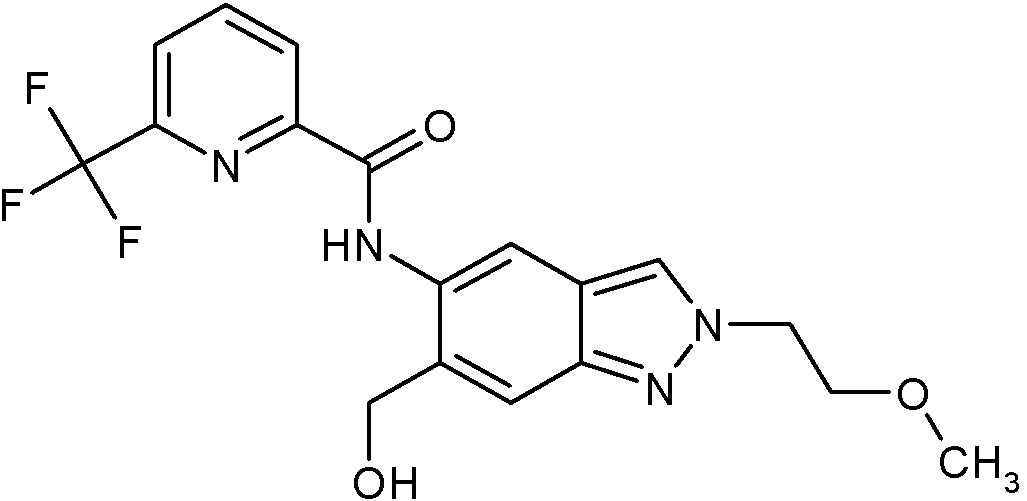
13 mg (0,36 mmol) de anhídrido de litio y aluminio se suspendieron en 1 ml de THF y se enfriaron hasta 0 °C. 75 mg (0,17 mmol) de 2-(2-metoxietil)-5-({[6-(trifluorometil)piridin-2-il]carbonil}amino)-2H-indazol-6-carboxilato de metilo (intermediario 4-2) disueltos en 500 j l de THF se añadieron gota a gota y se agitaron durante 60 min a 25 °C. Se diluyó con agua, se extrajo dos veces con acetato de etilo y Las fases orgánicas combinadas se lavaron con solución de cloruro de sodio, se filtraron sobre un filtro repelente de agua, se concentraron y se secaron al vacío. Se obtuvieron 13 mg del compuesto del título.13 mg (0.36 mmol) of lithium aluminum anhydride were suspended in 1 ml of THF and cooled to 0 ° C. 75 mg (0.17 mmol) of methyl 2- (2-methoxyethyl) -5 - ({[6- (trifluoromethyl) pyridin-2-yl] carbonyl} amino) -2H-indazole-6-carboxylate methyl ester (intermediate 4 -2) dissolved in 500 µl of THF were added dropwise and stirred for 60 min at 25 ° C. It was diluted with water, extracted twice with ethyl acetate and the combined organic phases were washed with sodium chloride solution, filtered on a water repellent filter, concentrated and dried under vacuum. 13 mg of the title compound were obtained.
UPLC-MS (método A2): Rt = 0,99 minUPLC-MS (method A2): Rt = 0.99 min
MS (ESlpos): m/z = 394 (M+H)+MS (ESlpos): m / z = 394 (M + H) +
1H RMN (400 MHz, DMSO-d6): 8 [ppm] = 3,23 (s, 3 H), 3,83 (t, 2 H), 4,56 (t, 2 H), 4,69 (d, 2 H), 5,77 (t, 1 H), 7,57 (s, 1 H), 8,19 (d, 1 H), 8,33 -8,41 (m, 2 H), 8,43 -8,47 (m, 1 H), 8,51 (s, 1 H), 11,20 (s, 1 H)1H NMR (400 MHz, DMSO-d6): 8 [ppm] = 3.23 (s, 3H), 3.83 (t, 2H), 4.56 (t, 2H), 4.69 ( d, 2H), 5.77 (t, 1H), 7.57 (s, 1H), 8.19 (d, 1H), 8.33-8.41 (m, 2H), 8.43-8.47 (m, 1H), 8.51 (s, 1H), 11.20 (s, 1H)
Ejemplo 3Example 3
N-[6-(2-hidroxipropan-2-il)-2-(3-metoxipropil)-2H-indazol-5-il]-6-(trifluorometil)piridin-2-carboxamida N- [6- (2-hydroxypropan-2-yl) -2- (3-methoxypropyl) -2H-indazol-5-yl] -6- (trifluoromethyl) pyridine-2-carboxamide

75 mg (0,17 mmol) de 2-(3-metoxipropil)-5-({[6-(trifluorometil)piridin-2-il]carbonil}amino)-2H-indazol-6-carboxilato de metilo (intermediario 4-3) se disolvieron en 500 |jl de THF y se mezclaron con 859 |jl (0,86 mmol) de una solución 1 M de bromuro de metilmagnesio en THF. La mezcla de reacción se agitó durante 60 min a 25 °C. Luego se añadió cuidadosamente 1 ml de una solución saturada de cloruro de amonio y se filtró. La fase acuosa se extrajo dos veces con acetato de etilo, las fases orgánicas se combinaron, se filtraron sobre un filtro repelente de agua y se concentraron. El residuo se disolvió en 3 ml de DMSO y se purificó por HPLC preparativa. Las fracciones con contenido de producto se liofilizaron. Se obtuvieron 25 mg del compuesto del título.75 mg (0.17 mmol) of methyl 2- (3-methoxypropyl) -5 - ({[6- (trifluoromethyl) pyridin-2-yl] carbonyl} amino) -2H-indazole-6-carboxylate methyl ester (intermediate 4 -3) were dissolved in 500 µl of THF and mixed with 859 µl (0.86 mmol) of a 1 M solution of methyl magnesium bromide in THF. The reaction mixture was stirred for 60 min at 25 ° C. Then 1 ml of a saturated ammonium chloride solution was carefully added and filtered. The aqueous phase was extracted twice with ethyl acetate, the organic phases were combined, filtered on a water repellent filter and concentrated. The residue was dissolved in 3 ml of DMSO and purified by preparative HPLC. The product-containing fractions were lyophilized. 25 mg of the title compound were obtained.
UPLC-MS (método A1): Rt = 1,13 minUPLC-MS (method A1): Rt = 1.13 min
MS (ESlpos): m/z = 437 (M+H)+MS (ESlpos): m / z = 437 (M + H) +
1H RMN (400 MHz, DMSO-d6): 8 [ppm] = 1,62 (s, 6 H), 2,14 (quin, 2 H), 3,23 (s, 3 H), 3,26 - 3,32 (m, 2 H), 4,44 (t, 2 H), 5,95 (s, 1 H), 7,58 (s, 1 H), 8,16 (d, 1 H), 8,31 - 8,40 (m, 2 H), 8,43 - 8,48 (m, 1 H), 8,72 (s, 1 H), 12,36 (s, 1 H).1H NMR (400 MHz, DMSO-d6): 8 [ppm] = 1.62 (s, 6H), 2.14 (quin, 2H), 3.23 (s, 3H), 3.26 - 3.32 (m, 2H), 4.44 (t, 2H), 5.95 (s, 1H), 7.58 (s, 1H), 8.16 (d, 1H), 8.31-8.40 (m, 2H), 8.43-8.48 (m, 1H), 8.72 (s, 1H), 12.36 (s, 1H).
Ejemplo 4Example 4
N-[6-(hidroximetil)-2-(3-metoxipropil)-2H-indazol-5-il]-6-(trifluorometil)piridin-2-carboxamidaN- [6- (hydroxymethyl) -2- (3-methoxypropyl) -2H-indazol-5-yl] -6- (trifluoromethyl) pyridine-2-carboxamide

Se suspendieron 13 mg de anhídrido de litio y aluminio en THF y la mezcla se enfrió hasta 0 °C. Se vertieron gota a gota 75 mg (0,17 mmol) de 2-(3-metoxipropil)-5-({[6-(trifluorometil)piridin-2-il]carbonil}amino)-2H-indazol-6-carboxilato de metilo (intermediario 4-3) en THF y se dejó llegar en un lapso de 30 min a temperatura ambiente. Se diluyó con agua, se filtró, se lavó el residuo con acetato de etilo y el filtrado se extrajo con acetato de etilo. Las fases combinadas de acetato de etilo se lavaron con solución de cloruro de sodio, se filtraron sobre un filtro repelente de agua y se concentraron. Se purificó el residuo por HPLC preparativa.13 mg of lithium aluminum anhydride were suspended in THF and the mixture was cooled to 0 ° C. 75 mg (0.17 mmol) of 2- (3-methoxypropyl) -5 - ({[6- (trifluoromethyl) pyridin-2-yl] carbonyl} amino) -2H-indazole-6-carboxylate were dropped of methyl (intermediate 4-3) in THF and allowed to arrive within 30 min at room temperature. It was diluted with water, filtered, the residue was washed with ethyl acetate and the filtrate was extracted with ethyl acetate. The combined ethyl acetate phases were washed with sodium chloride solution, filtered over a water repellent filter, and concentrated. The residue was purified by preparative HPLC.
1H RMN (300 MHz, DMSO-cfe): 8 [ppm] = 2,14 (quin, 2 H), 3,23 (s, 3 H), 3,29 (t, 2 H), 4,45 (t, 2 H), 4,68 (d, 2 H), 5,77 (t, 1 H), 7,58 (s, 1 H), 8,18 (d, 1 H), 8,32 -8,48 (m, 3 H), 8,51 (s, 1 H), 11,21 (s, 1 H).1H NMR (300 MHz, DMSO-cfe): 8 [ppm] = 2.14 (quin, 2H), 3.23 (s, 3H), 3.29 (t, 2H), 4.45 ( t, 2H), 4.68 (d, 2H), 5.77 (t, 1H), 7.58 (s, 1H), 8.18 (d, 1H), 8.32 - 8.48 (m, 3H), 8.51 (s, 1H), 11.21 (s, 1H).
Ejemplo 5Example 5
N-[2-(2-hidroxietil)-6-(2-hidroxipropan-2-il)-2H-indazol-5-il]-6-(trifluorometil)piridin-2-carboxamidaN- [2- (2-hydroxyethyl) -6- (2-hydroxypropan-2-yl) -2H-indazol-5-yl] -6- (trifluoromethyl) pyridine-2-carboxamide
Etapa A:Stage A:
Preparación de N -[2-(2-{[te rc-butil(d im etil)s ilil]oxi}etil)-6 -(2-h idroxipropan-2-il)-2H -indazo l-5-il]-6-(trifluorom etil)p irid in -2-carboxam ida Preparation of N - [2- (2 - {[te rc-butyl (d im ethyl) s ylyl] oxy} ethyl) -6 - (2-h -hydroxypropan-2-yl) -2H -indazo l-5-yl ] -6- (trifluorom ethyl) p irid in -2-carboxam ida

100 mg (0,19 mmol) de 2-(2-{[terc-butil(dimetil)silil]oxi}etil)-5-({[6-(trifluorometil)piridin-2-il]carbonil}amino)-2H-indazol-6-carboxilato de metilo (intermediario 4-5) se disolvieron en 1 ml de THF y se mezclaron con 669 |jl (0,67 mmol) de una solución 1 M de bromuro de metilmagnesio en THF. La mezcla de reacción se agitó durante 60 min a 25 °C. Se añadieron nuevamente 287 j l (0,29 mmol) de una solución 1 M de bromuro de metilmagnesio en THF y se agitaron durante 3 h a 25 °C. Luego se añadieron cuidadosamente 20 ml de una solución saturada de cloruro de amonio y se filtraron. La fase acuosa se extrajo dos veces con acetato de etilo, las fases orgánicas se combinaron, se secaron sobre sulfato de magnesio, se filtraron, se concentraron y se secaron al vacío. Se obtuvieron 50 mg de N-[2-(2-{[tercbutil(dimetil)silil]oxi}etil)-6-(2-hidroxipropan-2-il)-2H-indazol-5-il]-6-(trifluorometil)piridin-2-carboxamida.100 mg (0.19 mmol) of 2- (2 - {[tert-butyl (dimethyl) silyl] oxy} ethyl) -5 - ({[6- (trifluoromethyl) pyridin-2-yl] carbonyl} amino) - Methyl 2H-indazole-6-carboxylate (intermediate 4-5) was dissolved in 1 ml of THF and mixed with 669 µl (0.67 mmol) of a 1 M solution of methyl magnesium bromide in THF. The reaction mixture was stirred for 60 min at 25 ° C. 287 µl (0.29 mmol) of a 1M solution of methylmagnesium bromide in THF were added again and the mixture was stirred for 3 h at 25 ° C. Then 20 ml of a saturated ammonium chloride solution were carefully added and filtered. The aqueous phase was extracted twice with ethyl acetate, the organic phases were combined, dried over magnesium sulfate, filtered, concentrated and dried under vacuum. 50 mg of N- [2- (2 - {[tert-butyl (dimethyl) silyl] oxy} ethyl) -6- (2-hydroxypropan-2-yl) -2H-indazol-5-yl] -6- ( trifluoromethyl) pyridine-2-carboxamide.
UPLC-MS (método A2): Rt = 1,51 minUPLC-MS (method A2): Rt = 1.51 min
MS (ESlpos): m/z = 523(M+H)+MS (ESlpos): m / z = 523 (M + H) +
1H RMN (300 MHz, DMSO-d6): 8 [ppm] = -0,17 --0,09 (m, 6 H), 0,78 (s, 9 H), 1,62 (s, 6 H), 4,04 (t, 2 H), 4,47 (t, 2 H), 5,98 (s, 1 H), 7,57 (s, 1 H), 8,16 (d, 1 H), 8,29 (s, 1 H), 8,37 (t, 1 H), 8,45 (d, 1 H), 8,73 (s, 1 H), 12,38 (s, 1 H).1H NMR (300 MHz, DMSO-d6): 8 [ppm] = -0.17 --0.09 (m, 6H), 0.78 (s, 9H), 1.62 (s, 6H ), 4.04 (t, 2H), 4.47 (t, 2H), 5.98 (s, 1H), 7.57 (s, 1H), 8.16 (d, 1H ), 8.29 (s, 1H), 8.37 (t, 1H), 8.45 (d, 1H), 8.73 (s, 1H), 12.38 (s, 1H ).
Etapa B:Stage B:

50 mg (96 jm ol) de N-[2-(2-{[terc-butil(dimetil)silil]oxi}etil)-6-(hidroximetil)-2H-indazol-5-il]-6-(trifluorometil)piridin-2-carboxamida se disolvieron en 1,0 ml de THF y se mezclaron con 144 j l (0,14 mmol) de una solución 1 M de fluoruro de tetrabutilamonio en THF. La mezcla de reacción se agitó durante 1 h a temperatura ambiente. Se diluyó con agua, se extrajo dos veces con acetato de etilo y las fases orgánicas combinadas se lavaron con solución saturada de cloruro de sodio, se filtraron sobre un filtro repelente de agua y se concentraron. Se obtuvieron 36 mg de N-[2-(2-hidroxietil)-6-(2-hidroxipropan-2-il)-2H-indazol-5-il]-6-(trifluorometil)piridin-2-carboxamida (Ejemplo 5).50 mg (96 µl) of N- [2- (2 - {[tert-butyl (dimethyl) silyl] oxy} ethyl) -6- (hydroxymethyl) -2H-indazol-5-yl] -6- (trifluoromethyl ) pyridine-2-carboxamide were dissolved in 1.0 ml of THF and mixed with 144 µl (0.14 mmol) of a 1 M solution of tetrabutylammonium fluoride in THF. The reaction mixture was stirred for 1 hr at room temperature. It was diluted with water, extracted twice with ethyl acetate and the combined organic phases were washed with saturated sodium chloride solution, filtered through a water repellent filter and concentrated. 36 mg of N- [2- (2-hydroxyethyl) -6- (2-hydroxypropan-2-yl) -2H-indazol-5-yl] -6- (trifluoromethyl) pyridine-2-carboxamide were obtained (Example 5 ).
1H-RMN (400 MHz, DMSO-d6): d [ppm] = 1,62 (s, 6H), 3,86 (q, 2H), 4,43 (t, 2H), 4,95 (t, 1H), 5,94 (s, 1H), 7,57 (s, 1H), 8,16 (dd, 1H), 8,30 (s, 1H), 8,37 (t, 1H), 8,45 (d, 1H), 8,72 (s, 1H), 12,36 (s, 1H).1H-NMR (400 MHz, DMSO-d6): d [ppm] = 1.62 (s, 6H), 3.86 (q, 2H), 4.43 (t, 2H), 4.95 (t, 1H), 5.94 (s, 1H), 7.57 (s, 1H), 8.16 (dd, 1H), 8.30 (s, 1H), 8.37 (t, 1H), 8, 45 (d, 1H), 8.72 (s, 1H), 12.36 (s, 1H).
UPLC-MS (método A2): Rt = 0,97 min (detector UV: TIC), masa hallada 408,00.UPLC-MS (method A2): Rt = 0.97 min (UV detector: TIC), found mass 408.00.
Ejemplo 6Example 6
N-[6-(2-hidroxipropan-2-il)-2-(3-hidroxipropil)-2H-indazol-5-il]-6-(trifluorometil)piridin-2-carboxamida N- [6- (2-hydroxypropan-2-yl) -2- (3-hydroxypropyl) -2H-indazol-5-yl] -6- (trifluoromethyl) pyridine-2-carboxamide
Etapa A:Stage A:
Preparación de N-[2-(3-{[terc-butil(dimetil)silil]oxi}propil)-6-(2-hidroxipropan-2-il)-2H-indazol-5-il]-6-(trifluorometil)piridin-2-carboxamida Preparation of N- [2- (3 - {[tert-butyl (dimethyl) silyl] oxy} propyl) -6- (2-hydroxypropan-2-yl) -2H-indazol-5-yl] -6- (trifluoromethyl ) pyridine-2-carboxamide

50 mg (0,09 mmol) de 2-(3-{[terc-butil(dimetil)silil]oxi}propil)-5-({[6-(trifluorometil)piridin-2-il]carbonil}amino)-2H-indazol-6-carboxilato de metilo (intermediario 4-6) se disolvieron en 50o |jl de THF y se mezclaron con 326 |jl (0,33 mmol) de una solución 1 M de bromuro de metilmagnesio en THF. La mezcla de reacción se agitó durante 60 min a 25 °C. Luego se añadieron cuidadosamente 20 ml de una solución saturada de cloruro de amonio y se extrajeron dos veces con acetato de etilo. Las fases orgánicas combinadas se filtraron sobre un filtro repelente de agua, se concentraron y se secaron al vacío. El residuo se purificó por HPLC preparativa. Se obtuvieron 40 mg de N-[2-(3-{[tercbutil(dimetil)silil]oxi}propil)-6-(2-hidroxipropan-2-il)-2H-indazol-5-il]-6-(trifluorometil)piridin-2-carboxamida.50 mg (0.09 mmol) of 2- (3 - {[tert-butyl (dimethyl) silyl] oxy} propyl) -5 - ({[6- (trifluoromethyl) pyridin-2-yl] carbonyl} amino) - Methyl 2H-indazole-6-carboxylate (intermediate 4-6) were dissolved in 50 µl of THF and mixed with 326 µl (0.33 mmol) of a 1 M solution of methyl magnesium bromide in THF. The reaction mixture was stirred for 60 min at 25 ° C. Then 20 ml of a saturated ammonium chloride solution were carefully added and extracted twice with ethyl acetate. The combined organic phases were filtered on a water repellent filter, concentrated and dried under vacuum. The residue was purified by preparative HPLC. 40 mg of N- [2- (3 - {[tert-butyl (dimethyl) silyl] oxy} propyl) -6- (2-hydroxypropan-2-yl) -2H-indazol-5-yl] -6- ( trifluoromethyl) pyridine-2-carboxamide.
UPLC-MS (método A1): Rt = 1,58 minUPLC-MS (method A1): Rt = 1.58 min
MS (ESlpos): m/z = 537(M+H)+MS (ESlpos): m / z = 537 (M + H) +
1H RMN (300 MHz, DMSO-d6): 8 [ppm] = 0,02 - 0,05 (m, 6 H), 0,84 - 0,91 (m, 9 H), 1,62 (s, 6 H), 2,02 - 2,18 (m, 2 H), 3,55 - 3,62 (m, 2 H), 4,45 (t, 2 H), 5,96 (s, 1 H), 7,57 (s, 1 H), 8,16 (d, 1 H), 8,31 (s, 1 H), 8,33 - 8,42 (m, 1 H), 8,45 (d, 1 H), 8,72 (s, 1 H), 12,37 (s, 1 H).1H NMR (300 MHz, DMSO-d6): 8 [ppm] = 0.02-0.05 (m, 6H), 0.84-0.91 (m, 9H), 1.62 (s, 6H), 2.02-2.18 (m, 2H), 3.55-3.62 (m, 2H), 4.45 (t, 2H), 5.96 (s, 1H ), 7.57 (s, 1H), 8.16 (d, 1H), 8.31 (s, 1H), 8.33-8.42 (m, 1H), 8.45 ( d, 1H), 8.72 (s, 1H), 12.37 (s, 1H).
Etapa B:Stage B:

37 mg (0,07 mmol) de N-[2-(3-{[terc-butil(dimetil)silil]oxi}propil)-6-(2-hidroxipropan-2-il)-2H-indazol-5-il]-6-(trifluorometil)piridin-2-carboxamida se disolvieron en 500 j l de THF y se mezclaron con 207 j l (0,21 mmol) de una solución 1 M de fluoruro de tetrabutilamonio en THF. La mezcla de reacción se agitó durante 2 h a 25 °C. Se diluyó con agua, se extrajo dos veces con acetato de etilo y las fases orgánicas combinadas se lavaron con solución saturada de cloruro de sodio, se filtraron y se concentraron. Después de purificar por HPLC preparativa se obtuvieron 10 mg de N-[6-(2-hidroxipropan-2-il)-2-(3-hidroxipropil)-2H-indazol-5-il]-6-(trifluorometil)piridin-2-carboxamida (Ejemplo 6, contenía componente secundario).37 mg (0.07 mmol) of N- [2- (3 - {[tert-butyl (dimethyl) silyl] oxy} propyl) -6- (2-hydroxypropan-2-yl) -2H-indazol-5- yl] -6- (trifluoromethyl) pyridine-2-carboxamide were dissolved in 500 µl of THF and mixed with 207 µl (0.21 mmol) of a 1M solution of tetrabutylammonium fluoride in THF. The reaction mixture was stirred for 2 h at 25 ° C. It was diluted with water, extracted twice with ethyl acetate, and the combined organic phases were washed with saturated sodium chloride solution, filtered and concentrated. After purification by preparative HPLC, 10 mg of N- [6- (2-hydroxypropan-2-yl) -2- (3-hydroxypropyl) -2H-indazol-5-yl] -6- (trifluoromethyl) pyridine- 2-carboxamide (Example 6, contained minor component).
UPLC-MS (método A2): Rt = 1,00 minUPLC-MS (method A2): Rt = 1.00 min
MS (ESlpos): m/z = 423 (M+H)+MS (ESlpos): m / z = 423 (M + H) +
1H RMN señales seleccionadas (400 MHz, DMSO-d6): 8 [ppm] = 1,61 (s), 2,00 - 2,12 (m), 3,38 (t, 2 H), 4,44 (t, 2 H), 4,62 (s. a., 1 H), 5,93 (s. a., 1 H), 7,55 (s, 1 H), 8,13 (d, 1 H), 8,27 - 8,38 (m, 2 H), 8,43 (d, 1 H), 8,71 (s, 1 H), 12,30 (s. a., 1 H).1H NMR selected signals (400MHz, DMSO-d6): 8 [ppm] = 1.61 (s), 2.00-2.12 (m), 3.38 (t, 2H), 4.44 ( t, 2H), 4.62 (bs, 1H), 5.93 (bs, 1H), 7.55 (s, 1H), 8.13 (d, 1H), 8.27 - 8.38 (m, 2H), 8.43 (d, 1H), 8.71 (s, 1H), 12.30 (brs, 1H).
Ejemplo 7Example 7
N-[2-(2-hidroxietil)-6-(hidroximetil)-2H-indazol-5-il]-6-(trifluorometil)piridin-2-carboxamidaN- [2- (2-hydroxyethyl) -6- (hydroxymethyl) -2H-indazol-5-yl] -6- (trifluoromethyl) pyridine-2-carboxamide
Etapa A:Stage A:
N-[2-(2-{[terc-butil(dimetil)silil]oxi}etil)-6-(hidroximetil)-2H-indazol-5-il]-6-(trifluorometil)piridin-2-carboxamida N- [2- (2 - {[tert-butyl (dimethyl) silyl] oxy} ethyl) -6- (hydroxymethyl) -2H-indazol-5-yl] -6- (trifluoromethyl) pyridine-2-carboxamide

100 mg (0,19 mmol) de 2-(2-{[terc-butil(dimetil)silil]oxi}etil)-5-({[6-(trifluorometil)piridin-2-il]carbonil}amino)-2H-indazol-6-carboxilato de metilo (intermediario 4-5) se disolvieron en 1 ml de THF y se mezclaron con 191 |jl (0,38 mmol) de una solución 2 M de borhidruro de litio. Se dejó agitar durante 24 h a 25 °C. Se añadieron 14 mg (0,38 mmol) de borhidruro de sodio y 500 j l de metanol y se agitaron durante 4 h a 25 °C. Se añadieron nuevamente 14 mg (0,38 mmol) de borhidruro de sodio y se agitaron durante 24 h a 25 °C. La mezcla de reacción se mezcló cuidadosamente con agua y la fase orgánica se separó. Luego se extrajo dos veces con acetato de etilo y las fases orgánicas combinadas se lavaron con solución saturada de cloruro de sodio, se filtraron sobre un filtro repelente de agua y se concentraron. El residuo se extrajo en 2 ml de DMSO y se purificaron por HPLC preparativa. Se obtuvieron 30 mg de N-[2-(2-{[terc-butil(dimetil)silil]oxi}etil)-6-(hidroximetil)-2H-indazol-5-il]-6-(trifluorometil)piridin-2-carboxamida.100 mg (0.19 mmol) of 2- (2 - {[tert-butyl (dimethyl) silyl] oxy} ethyl) -5 - ({[6- (trifluoromethyl) pyridin-2-yl] carbonyl} amino) - Methyl 2H-indazole-6-carboxylate (intermediate 4-5) were dissolved in 1 ml of THF and mixed with 191 µl (0.38 mmol) of a 2M solution of lithium borohydride. It was allowed to stir for 24 h at 25 ° C. 14 mg (0.38 mmol) of sodium borohydride and 500 µl of methanol were added and stirred for 4 h at 25 ° C. 14 mg (0.38 mmol) of sodium borohydride were added again and the mixture was stirred for 24 h at 25 ° C. The reaction mixture was carefully mixed with water and the organic phase was separated. It was then extracted twice with ethyl acetate and the combined organic phases were washed with saturated sodium chloride solution, filtered on a water repellent filter and concentrated. The residue was extracted into 2 ml of DMSO and purified by preparative HPLC. 30 mg of N- [2- (2 - {[tert-butyl (dimethyl) silyl] oxy} ethyl) -6- (hydroxymethyl) -2H-indazol-5-yl] -6- (trifluoromethyl) pyridin- 2-carboxamide.
UPLC-MS (método A2): Rt = 1,44 minUPLC-MS (method A2): Rt = 1.44 min
MS (ESlpos): m/z = 495(M+H)+MS (ESlpos): m / z = 495 (M + H) +
1H RMN (300 MHz, DMSO-d6): 8 [ppm] = -0,16 - -0,12 (m, 6 H), 0,75 - 0,79 (m, 9 H), 4,05 (t, 2 H), 4,48 (t, 2 H), 4,69 (d, 2 H), 5,75 - 5,77 (m, 1 H), 7,57 (s, 1 H), 8,18 (dd, 1 H), 8,30 - 8,33 (m, 1 H), 8,38 (t, 1 H), 8,45 (d, 1 H), 8,51 (s, 1 H), 11,20 (s, 1 H).1H NMR (300 MHz, DMSO-d6): 8 [ppm] = -0.16 - -0.12 (m, 6H), 0.75 - 0.79 (m, 9H), 4.05 ( t, 2H), 4.48 (t, 2H), 4.69 (d, 2H), 5.75-5.77 (m, 1H), 7.57 (s, 1H), 8.18 (dd, 1H), 8.30-8.33 (m, 1H), 8.38 (t, 1H), 8.45 (d, 1H), 8.51 (s, 1H), 11.20 (s, 1H).
Etapa B:Stage B:

33 mg (0,07 mmol) de N-[2-(2-{[terc-butil(dimetil)silil]oxi}etil)-6-(hidroximetil)-2H-indazol-5-il]-6-(trifluorometil)piridin-2-carboxamida se disolvieron en 1 ml de THF y se mezclaron con 100 j l (0,10 mmol) de una solución 1 M de fluoruro de tetrabutilamonio en THF. La mezcla de reacción se agitó durante 1 h a 25 °C. Se diluyó con agua, se extrajo dos veces con acetato de etilo y las fases orgánicas combinadas se lavaron con solución saturada de cloruro de sodio, se filtraron sobre un filtro repelente de agua, se concentraron y se secaron al vacío. Se obtuvieron 25 mg de N-[2-(2-hidroxietil)-6-(hidroximetil)-2H-indazol-5-il]-6-(trifluorometil)piridin-2-carboxamida (Ejemplo 7).33 mg (0.07 mmol) of N- [2- (2 - {[tert-butyl (dimethyl) silyl] oxy} ethyl) -6- (hydroxymethyl) -2H-indazol-5-yl] -6- ( trifluoromethyl) pyridine-2-carboxamide were dissolved in 1 ml of THF and mixed with 100 µl (0.10 mmol) of a 1 M solution of tetrabutylammonium fluoride in THF. The reaction mixture was stirred for 1 hr at 25 ° C. It was diluted with water, extracted twice with ethyl acetate and the combined organic phases were washed with saturated sodium chloride solution, filtered on a water repellent filter, concentrated and dried under vacuum. 25 mg of N- [2- (2-hydroxyethyl) -6- (hydroxymethyl) -2H-indazol-5-yl] -6- (trifluoromethyl) pyridine-2-carboxamide were obtained (Example 7).
UPLC-MS (método A2): Rt = 0,87 minUPLC-MS (method A2): Rt = 0.87 min
MS (ESlpos): m/z = 381 (M+H)+MS (ESlpos): m / z = 381 (M + H) +
1H RMN (300 MHz, DMSO-d6): 8 [ppm] = 3,87 (q, 2 H), 4,44 (t, 2 H), 4,69 (d, 2 H), 4,98 (t, 1 H), 5,70 - 5,81 (m, 1 H), 7,57 (s, 1 H), 8,11 -8,23 (m, 1 H), 8,31 -8,42 (m, 2 H), 8,43 -8,49 (m, 1 H), 8,51 (s, 1 H), 11,20 (s, 1 H).1H NMR (300 MHz, DMSO-d6): 8 [ppm] = 3.87 (q, 2H), 4.44 (t, 2H), 4.69 (d, 2H), 4.98 ( t, 1H), 5.70-5.81 (m, 1H), 7.57 (s, 1H), 8.11-8.23 (m, 1H), 8.31-8, 42 (m, 2H), 8.43-8.49 (m, 1H), 8.51 (s, 1H), 11.20 (s, 1H).
Ejemplo 8Example 8
N-[6-(2-hidroxipropan-2-il)-2-(oxetan-3-ilmetil)-2H-indazol-5-il]-6-(trifluorometil)piridin-2-carboxamida N- [6- (2-hydroxypropan-2-yl) -2- (oxetan-3-ylmethyl) -2H-indazol-5-yl] -6- (trifluoromethyl) pyridine-2-carboxamide

50 mg (0,12 mmol) de 2-(oxetan-3-ilmetil)-5-({[6-(trifluorometil)piridin-2-il]carbonil}amino)-2H-indazol-6-carboxilato de metilo (intermediario 4-1) se disolvieron en 500 |jl de THF y se mezclaron con 576 |jl (0,58 mmol) de una solución 1 M de bromuro de metilmagnesio en THF. La mezcla de reacción se agitó durante 60 min a 25 °C. Luego se añadieron cuidadosamente 20 ml de una solución acuosa saturada de cloruro de amonio y se concentraron. La fase acuosa se extrajo dos veces con acetato de etilo, las fases orgánicas se combinaron, se secaron sobre sulfato de magnesio, se filtraron y se concentraron. Se disolvió el residuo en 2,0 ml de DMSO y se purificó por HPLC preparativa. Las fracciones con contenido de producto se liofilizaron. Se obtuvieron 30 mg del compuesto del título.50 mg (0.12 mmol) of methyl 2- (oxetan-3-ylmethyl) -5 - ({[6- (trifluoromethyl) pyridin-2-yl] carbonyl} amino) -2H-indazole-6-carboxylate ( Intermediate 4-1) were dissolved in 500 µl of THF and mixed with 576 µl (0.58 mmol) of a 1 M solution of methylmagnesium bromide in THF. The reaction mixture was stirred for 60 min at 25 ° C. Then 20 ml of a saturated aqueous ammonium chloride solution was carefully added and concentrated. The aqueous phase was extracted twice with ethyl acetate, the organic phases were combined, dried over magnesium sulfate, filtered and concentrated. The residue was dissolved in 2.0 ml of DMSO and purified by preparative HPLC. The product-containing fractions were lyophilized. 30 mg of the title compound were obtained.
UPLC-MS (método A2): Rt = 1,03 minUPLC-MS (method A2): Rt = 1.03 min
MS (ESlpos): m/z = 435 (M+H)+MS (ESlpos): m / z = 435 (M + H) +
1H RMN (400 MHz, DMSO-d6): 8 [ppm] = 1,62 (s, 6 H), 3,45 - 3,61 (m, 1 H), 4,48 (t, 2 H), 4,66 (dd, 2 H), 4,72 (d, 2 H), 5,94 (s, 1 H), 7,57 (s, 1 H), 8,16 (d, 1 H), 8,33 - 8,42 (m, 2 H), 8,42 - 8,47 (m, 1 H), 8,72 (s, 1 H), 12,36 (s, 1 H). 1H NMR (400MHz, DMSO-d6): 8 [ppm] = 1.62 (s, 6H), 3.45-3.61 (m, 1H), 4.48 (t, 2H), 4.66 (dd, 2H), 4.72 (d, 2H), 5.94 (s, 1H), 7.57 (s, 1H), 8.16 (d, 1H), 8.33-8.42 (m, 2H), 8.42-8.47 (m, 1H), 8.72 (s, 1H), 12.36 (s, 1H).
Ejemplo 9Example 9
N-[6-(hidroximetil)-2-(oxetan-3-ilmetil)-2H-indazol-5-il]-6-(trifluorometil)piridin-2-carboxamidaN- [6- (hydroxymethyl) -2- (oxetan-3-ylmethyl) -2H-indazol-5-yl] -6- (trifluoromethyl) pyridine-2-carboxamide
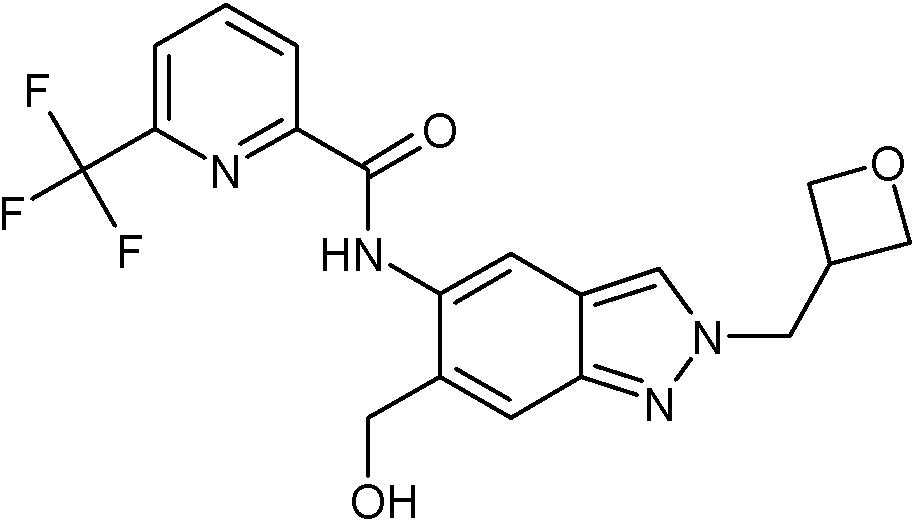
75 mg (0,17 mmol) de 2-(oxetan-3-ilmetil)-5-({[6-(trifluorometil)piridin-2-il]carbonil}amino)-2H-indazol-6-carboxilato de metilo (intermediario 4-1) se disolvieron en 1 ml de una mezcla de THF/metanol (1:1) y se mezclaron con 8 mg (0,21 mmol) de borhidruro de sodio. Se dejó agitar durante 60 min a 25 °C. La mezcla de reacción se concentró y el residuo se mezcló con agua. La suspensión se agitó fuertemente durante 15 min, el sólido se filtró por succión, se lavó dos veces con agua y dos veces con éter dietílico y se secó al vacío. Se obtuvieron 48 mg del compuesto del título. UPLC-MS (método A2): Rt = 0,94 min75 mg (0.17 mmol) of methyl 2- (oxetan-3-ylmethyl) -5 - ({[6- (trifluoromethyl) pyridin-2-yl] carbonyl} amino) -2H-indazole-6-carboxylate ( intermediate 4-1) were dissolved in 1 ml of a mixture of THF / methanol (1: 1) and mixed with 8 mg (0.21 mmol) of sodium borohydride. It was allowed to stir for 60 min at 25 ° C. The reaction mixture was concentrated and the residue was mixed with water. The suspension was vigorously stirred for 15 min, the solid was suction filtered, washed twice with water and twice with diethyl ether and dried under vacuum. 48 mg of the title compound were obtained. UPLC-MS (method A2): Rt = 0.94 min
MS (ESlpos): m/z = 407 (M+H)+MS (ESlpos): m / z = 407 (M + H) +
1H RMN (300 MHz, DMSO-d6): 8 [ppm] = 3,55 (s, 1 H), 4,48 (t, 2 H), 4,61 - 4,77 (m, 6 H), 7,57 (s, 1 H), 8,18 (dd, 1 H), 8,33 -8,49 (m, 3 H), 8,51 (s, 1 H), 11,21 (s, 1 H).1H NMR (300 MHz, DMSO-d6): 8 [ppm] = 3.55 (s, 1H), 4.48 (t, 2H), 4.61-4.77 (m, 6H), 7.57 (s, 1H), 8.18 (dd, 1H), 8.33-8.49 (m, 3H), 8.51 (s, 1H), 11.21 (s, 1 HOUR).
Ejemplo 10Example 10
N-{6-(2-hidroxipropan-2-il)-2-[3-(metilsulfonil)propil]-2H-indazol-5-il}-6-(trifluorometil)piridin-2-carboxamida N- {6- (2-hydroxypropan-2-yl) -2- [3- (methylsulfonyl) propyl] -2H-indazol-5-yl} -6- (trifluoromethyl) pyridine-2-carboxamide

Una mezcla de 500 mg (1,32 mmol) de N-[6-(2-hidroxipropan-2-il)-1H-indazol-5-il]-6-(trifluorometil)piridin-2-carboxamida (intermediario 5-1), 569 mg de carbonato de potasio y 114 mg de yoduro de potasio en 5,0 ml de DMF se agitó durante 15 min a temperatura ambiente. Se añadieron 414 mg de 1-bromo-3-(metilsulfonil)propano y se agitó a temperatura ambiente durante la noche. Se mezcló con agua, se extrajo dos veces con acetato de etilo, se lavó con solución de cloruro de sodio y se concentró. El residuo se purificó por cromatografía en columna (gradiente de diclorometano-metanol). Después de agitar la fracción de producto en éter dietílico, se obtuvieron 59 mg del compuesto del título.A mixture of 500 mg (1.32 mmol) of N- [6- (2-hydroxypropan-2-yl) -1H-indazol-5-yl] -6- (trifluoromethyl) pyridine-2-carboxamide (intermediate 5- 1), 569 mg of potassium carbonate and 114 mg of potassium iodide in 5.0 ml of DMF was stirred for 15 min at room temperature. 414 mg of 1-bromo-3- (methylsulfonyl) propane was added and stirred at room temperature overnight. It was mixed with water, extracted twice with ethyl acetate, washed with sodium chloride solution and concentrated. The residue was purified by column chromatography (dichloromethane-methanol gradient). After stirring the product fraction in diethyl ether, 59 mg of the title compound was obtained.
UPLC-MS (método A2): Rt = 1,02 minUPLC-MS (method A2): Rt = 1.02 min
MS (ESIpos): m/z = 485 (M+H)+MS (ESIpos): m / z = 485 (M + H) +
1H-RMN (300 MHz, DMSO-da): 8 [ppm] = 1,63 (s, 6H), 2,26 -2,42 (m, 2H), 2,99 (s, 3H), 3,06 - 3,16 (m, 2H), 4,55 (t, 2H), 5,96 (s, 1H), 7,60 (s, 1H), 8,16 (d, 1H), 8,33 - 8,48 (m, 3H), 8,73 (s, 1H), 12,37 (s, 1H).1H-NMR (300 MHz, DMSO-da): 8 [ppm] = 1.63 (s, 6H), 2.26-2.42 (m, 2H), 2.99 (s, 3H), 3, 06-3.16 (m, 2H), 4.55 (t, 2H), 5.96 (s, 1H), 7.60 (s, 1H), 8.16 (d, 1H), 8.33 - 8.48 (m, 3H), 8.73 (s, 1H), 12.37 (s, 1H).
Ejemplo 11Example 11
N-[2-(3-hidroxi-3-metilbutil)-6-(2-hidroxipropan-2-il)-2H-indazol-5-il]-6-(trifluorometil)piridin-2-carboxamidaN- [2- (3-hydroxy-3-methylbutyl) -6- (2-hydroxypropan-2-yl) -2H-indazol-5-yl] -6- (trifluoromethyl) pyridine-2-carboxamide

Método de preparación 1Preparation method 1
705 mg (1,57 mmol) de 2-(3-hidroxi-3-metilbutil)-5-({[6-(trifluorometil)piridin-2-il]carbonil}amino)-2H-indazol-6-carboxilato de metilo (intermediario 4-4) se dispusieron en 10 ml de THF y se enfriaron en baño de enfriamiento de agua helada. Se añadieron 2,6 ml (5,0 equivalentes) de solución 3 M de bromuro de metilmagnesio (en éter dietílico) y se dejó agitar durante 1 h baño enfriamiento con hielo y 4,5 h a temperatura ambiente. Se añadió nuevamente 1 equivalente de solución de bromuro de metilmagnesio y se dejó agitar durante 20,5 h a temperatura ambiente. Otra vez se añadió 1 equivalente de solución de bromuro de metilmagnesio y se dejó agitar durante 22 h a temperatura ambiente. La mezcla de reacción se combinó con solución acuosa saturada de cloruro de amonio, se agitó y se extrajo tres veces con acetato de etilo. Las fases orgánicas combinadas se lavaron con solución de cloruro de sodio, se filtraron sobre un filtro repelente de agua y se concentraron. Se obtuvieron 790 mg de un residuo que se purificó por HPLC preparativa. Se obtuvieron 234 mg del compuesto del título y 164 mg de una fracción de producto que se agitó con éter dietílico. Después de filtrar por succión y secar posteriormente, se obtuvieron otros 146 mg del compuesto del título.705 mg (1.57 mmol) of 2- (3-hydroxy-3-methylbutyl) -5 - ({[6- (trifluoromethyl) pyridin-2-yl] carbonyl} amino) -2H-indazole-6-carboxylate methyl (intermediate 4-4) were placed in 10 ml of THF and cooled in an ice water cooling bath. 2.6 ml (5.0 equivalents) of 3M methylmagnesium bromide solution (in diethyl ether) were added and the mixture was stirred for 1 h in the ice-cooling bath and 4.5 h at room temperature. 1 equivalent of methyl magnesium bromide solution was added again and the mixture was stirred for 20.5 h at room temperature. Again 1 equivalent of methylmagnesium bromide solution was added and the mixture was stirred for 22 h at room temperature. The reaction mixture was combined with saturated aqueous ammonium chloride solution, stirred, and extracted three times with ethyl acetate. The combined organic phases were washed with sodium chloride solution, filtered on a water repellent filter and concentrated. 790 mg of a residue were obtained which was purified by preparative HPLC. 234 mg of the title compound and 164 mg of a product fraction were obtained which was stirred with diethyl ether. After suction filtration and subsequent drying, a further 146 mg of the title compound was obtained.
UPLC-MS (método A1): Rt = 1,10 min (detector UV: TIC), masa hallada 450,00.UPLC-MS (method A1): Rt = 1.10 min (UV detector: TIC), found mass 450.00.
1H-RMN (400 MHz, DMSO-d6): 8 [ppm] = 1,14 (s, 6H), 1,61 (s, 6H), 1,99 - 2,08 (m, 2H), 4,42 - 4,55 (m, 3H), 5,93 (s, 1H), 7,56 (s, 1H), 8,15 (dd, 1H), 8,32 - 8,39 (m, 2H), 8,41 - 8,47 (m, 1H), 8,70 (s, 1H), 12,34 (s, 1H).1H-NMR (400MHz, DMSO-d6): 8 [ppm] = 1.14 (s, 6H), 1.61 (s, 6H), 1.99-2.08 (m, 2H), 4, 42-4.55 (m, 3H), 5.93 (s, 1H), 7.56 (s, 1H), 8.15 (dd, 1H), 8.32-8.39 (m, 2H) , 8.41-8.47 (m, 1H), 8.70 (s, 1H), 12.34 (s, 1H).
Método de preparación 2Preparation method 2
Una mezcla de 500 mg (1,37 mmol) de N-[6-(2-hidroxipropan-2-il)-1H-indazol-5-il]-6-(trifluorometil)piridin-2-carboxamida (intermediario 5-1), 569 mg de carbonato de potasio y 114 mg de yoduro de potasio en 5 ml de DMF se agitó durante 15 min a temperatura ambiente. Se añadieron 344 mg (1,5 equivalentes) de 4-bromo-2-metilbutan-2-ol y se calentó durante 2 h hasta 100 °C. Se añadieron nuevamente 0,5 equivalentes de 4-bromo-2-metilbutan-2-ol y se agitó a temperatura ambiente durante 16 h. La mezcla se mezcló con agua, se extrajo dos veces con acetato de etilo, las fases orgánicas combinadas se lavaron con solución saturada de cloruro de sodio y se filtraron sobre un filtro repelente de agua y se concentraron. El residuo se purificó por cromatografía en columna de gel de sílice (hexano/acetato de etilo). Se obtuvieron 100 mg de una fracción de producto que se extrajo con éter dietílico. Después de secar se obtuvieron 60 mg del compuesto del título.A mixture of 500 mg (1.37 mmol) of N- [6- (2-hydroxypropan-2-yl) -1H-indazol-5-yl] -6- (trifluoromethyl) pyridine-2-carboxamide (intermediate 5- 1), 569 mg of potassium carbonate and 114 mg of potassium iodide in 5 ml of DMF was stirred for 15 min at room temperature. 344 mg (1.5 equivalents) of 4-bromo-2-methylbutan-2-ol were added and heated for 2 h to 100 ° C. 0.5 equivalents of 4-bromo-2-methylbutan-2-ol were added again and stirred at room temperature for 16 h. The mixture was mixed with water, extracted twice with ethyl acetate, the combined organic phases were washed with saturated sodium chloride solution and filtered on a water repellent filter and concentrated. The residue was purified by silica gel column chromatography (hexane / ethyl acetate). 100 mg of a product fraction were obtained which was extracted with diethyl ether. After drying, 60 mg of the title compound were obtained.
1H-RMN (400 MHz, DMSO-da): 8 [ppm] = 1,14 (s, 6 H), 1,61 (s, 6H), 1,99 - 2,07 (m, 2 H), 4,43 - 4,52 (m, 3 H) 5,94 (s, 1 H) 7,57 (s, 1 H) 8,15 (dd, 1H) 8,33 - 8,40 (m, 2 H), 8,42 - 8,48 (m, 1 H), 8,71 (s, 1 H), 12,35 (s, 1 H)1H-NMR (400 MHz, DMSO-da): 8 [ppm] = 1.14 (s, 6H), 1.61 (s, 6H), 1.99-2.07 (m, 2H), 4.43 - 4.52 (m, 3H) 5.94 (s, 1H) 7.57 (s, 1H) 8.15 (dd, 1H) 8.33 - 8.40 (m, 2 H), 8.42-8.48 (m, 1H), 8.71 (s, 1H), 12.35 (s, 1H)
Ejemplo 12Example 12
N-{6-(2-hidroxipropan-2-il)-2-[2-(metilsulfonil)etil]-2H-indazol-5-il}-6-(trifluorometil)piridin-2-carboxamidaN- {6- (2-hydroxypropan-2-yl) -2- [2- (methylsulfonyl) ethyl] -2H-indazol-5-yl} -6- (trifluoromethyl) pyridine-2-carboxamide

160 mg (0,44 mmol) de N-[6-(2-hidroxipropan-2-il)-1H-indazol-5-il]-6-(trifluorometil)piridin-2-carboxamida (intermediario 5-1) se suspendieron junto con 182 mg de carbonato de potasio y 36 mg de yoduro de potasio en 1,0 ml de DMF y la mezcla se agitó durante 15 min a temperatura ambiente. Luego se añadieron 123 mg de 2-bromoetilmetilsulfona (0,66 mmol) y se agitaron durante la noche a temperatura ambiente. Se añadió agua, se extrajo dos veces con acetato de etilo, se lavó con solución acuosa saturada de cloruro de sodio, se filtró sobre un filtro repelente de agua y se concentró. Después de la purificación del residuo por HPLC preparativa se obtuvieron 20 mg del compuesto del título.160 mg (0.44 mmol) of N- [6- (2-hydroxypropan-2-yl) -1H-indazol-5-yl] -6- (trifluoromethyl) pyridine-2-carboxamide (intermediate 5-1) is they were suspended together with 182 mg of potassium carbonate and 36 mg of potassium iodide in 1.0 ml of DMF and the mixture was stirred for 15 min at room temperature. Then 123 mg of 2-bromoethylmethylsulfone (0.66 mmol) were added and stirred overnight at room temperature. Water was added, extracted twice with ethyl acetate, washed with saturated aqueous sodium chloride solution, filtered on a water repellent filter, and concentrated. After purification of the residue by preparative HPLC, 20 mg of the title compound were obtained.
UPLC (método A2): Rt = 1,01 min;UPLC (method A2): Rt = 1.01 min;
MS (ESlpos): m/z = 471 (M+H)+MS (ESlpos): m / z = 471 (M + H) +
1H RMN (400 MHz, DMSO-cfe): 8 [ppm] = 1,63 (s, 6 H), 2,90 (s, 3 H), 3,85 (t, 2 H), 4,86 (t, 2 H), 5,97 (s, 1 H), 7,59 (s, 1 H), 8,13 - 8,19 (m, 1 H), 8,37 (s, 1 H), 8,41 - 8,48 (m, 2 H), 8,74 (s, 1 H), 12,37 (s, 1 H).1H NMR (400 MHz, DMSO-cfe): 8 [ppm] = 1.63 (s, 6H), 2.90 (s, 3H), 3.85 (t, 2H), 4.86 ( t, 2H), 5.97 (s, 1H), 7.59 (s, 1H), 8.13-8.19 (m, 1H), 8.37 (s, 1H), 8.41-8.48 (m, 2H), 8.74 (s, 1H), 12.37 (s, 1H).
Ejemplo 13Example 13
6-(difluorometil)-N-[2-(3-hidroxi-3-metilbutil)-6-(2-hidroxipropan-2-il)-2H-indazol-5-il]piridin-2-carboxamida6- (Difluoromethyl) -N- [2- (3-hydroxy-3-methylbutyl) -6- (2-hydroxypropan-2-yl) -2H-indazol-5-yl] pyridine-2-carboxamide

Método de preparación 1Preparation method 1
Una mezcla de 250 mg de 6-(difluorometil)-N-[6-(2-hidroxipropan-2-il)-1H-indazol-5-il]piridin-2-carboxamida (producto crudo intermediario 5-2), 144 mg de yoduro de potasio y 239 mg de carbonato de potasio en 2,5 ml de DMF se agitaron durante 15 min a temperatura ambiente. Se añadieron 145 mg (0,87 mmol) de 4-bromo-2-metilbutan-2-ol, se agitó a 110 °C durante 3 h, se añadieron nuevamente 96 mg de 4-bromo-2-metilbutan-2-ol y se agitó a 110 °C 4 h. Se mezcló con agua, se extrajo dos veces con acetato de etilo, se lavó con solución acuosa semisaturada de cloruro de sodio, se filtró sobre un filtro repelente de agua y se concentró. Se purificó por cromatografía en columna en gel de sílice (hexano/acetato de etilo). Se obtuvieron 61 mg del compuesto del título.A mixture of 250 mg of 6- (difluoromethyl) -N- [6- (2-hydroxypropan-2-yl) -1H-indazol-5-yl] pyridine-2-carboxamide (crude intermediate 5-2), 144 mg of potassium iodide and 239 mg of potassium carbonate in 2.5 ml of DMF were stirred for 15 min at room temperature. 145 mg (0.87 mmol) of 4-bromo-2-methylbutan-2-ol were added, it was stirred at 110 ° C for 3 h, 96 mg of 4-bromo-2-methylbutan-2-ol were added again and stirred at 110 ° C for 4 h. It was mixed with water, extracted twice with ethyl acetate, washed with semisaturated aqueous sodium chloride solution, filtered on a water repellent filter and concentrated. It was purified by silica gel column chromatography (hexane / ethyl acetate). 61 mg of the title compound were obtained.
UPLC-MS (método A1): Rt = 1,00 min (detector UV: TIC), masa hallada 432,00. UPLC-MS (method A1): Rt = 1.00 min (UV detector: TIC), found mass 432.00.
1H-RMN (300 MHz, DMSO-da): 5 [ppm] = 1,14 (s, 6H), 1,63 (s, 6H), 1,97 - 2,08 (m, 2H), 4,41 - 4,55 (m, 3H), 5,99 (s, 1H), 7,03 (t, 1H), 7,56 (s, 1H), 7,94 - 8,00 (m, 1H), 8,24 - 8,38 (m, 3H), 8,71 (s, 1H), 12,49 (s, 1H).1H-NMR (300MHz, DMSO-da): 5 [ppm] = 1.14 (s, 6H), 1.63 (s, 6H), 1.97-2.08 (m, 2H), 4, 41 - 4.55 (m, 3H), 5.99 (s, 1H), 7.03 (t, 1H), 7.56 (s, 1H), 7.94-8.00 (m, 1H) , 8.24-8.38 (m, 3H), 8.71 (s, 1H), 12.49 (s, 1H).
Método de preparación 2Preparation method 2
Análogamente a la preparación de Ejemplo 11 (Método de preparación 1) se hicieron reaccionar 3,00 g de 5-({[6-(difluorometil)piridin-2-il]carbonil}amino)-2-(3-hidroxi-3-metilbutil)-2H-indazol-6-carboxilato de metilo (intermediario 4 11) con solución 3 M de bromuro de metilmagnesio (en éter dietílico). Después de purificar el producto crudo por agitación en éter dietílico y luego por HPLC preparativa, se obtuvieron 1,37 g del compuesto del título.Analogously to the preparation of Example 11 (Preparation method 1), 3.00 g of 5 - ({[6- (difluoromethyl) pyridin-2-yl] carbonyl} amino) -2- (3-hydroxy-3 Methyl -methylbutyl) -2H-indazole-6-carboxylate (intermediate 4 11) with 3M solution of methylmagnesium bromide (in diethyl ether). After purifying the crude product by stirring in diethyl ether and then by preparative HPLC, 1.37 g of the title compound were obtained.
Ejemplo 14Example 14
6-(difluorometil)-N-{6-(2-hidroxipropan-2-il)-2-[2-(metilsulfonil)etil]-2H-indazol-5-il}piridin-2-carboxamida6- (Difluoromethyl) -N- {6- (2-hydroxypropan-2-yl) -2- [2- (methylsulfonyl) ethyl] -2H-indazol-5-yl} pyridine-2-carboxamide

Una mezcla de 250 mg de 6-(difluorometil)-N-[6-(2-hidroxipropan-2-il)-1H-indazol-5-il]piridin-2-carboxamida (producto crudo intermediario 5-2), 144 mg de yoduro de potasio y 239 mg de carbonato de potasio en 2,5 ml de DMF se agitó durante 15 min a temperatura ambiente. Se añadieron 162 mg (0,87 mmol) de 2-bromoetil-metilsulfona y se agitaron a 110 °C 3 h. Se mezcló con agua, se extrajo dos veces con acetato de etilo, se lavó con solución acuosa semisaturada de cloruro de sodio, se filtró sobre un filtro repelente de agua y se concentró. El residuo se purificó por HPLC preparativa y las fracciones de producción se purificaron adicionalmente por purificación por cromatografía en columna de gel de sílice (hexano-acetato de etilo). Se obtuvieron 40 mg del compuesto del título.A mixture of 250 mg of 6- (difluoromethyl) -N- [6- (2-hydroxypropan-2-yl) -1H-indazol-5-yl] pyridine-2-carboxamide (crude intermediate 5-2), 144 mg of potassium iodide and 239 mg of potassium carbonate in 2.5 ml of DMF was stirred for 15 min at room temperature. 162 mg (0.87 mmol) of 2-bromoethyl-methylsulfone were added and the mixture was stirred at 110 ° C for 3 h. It was mixed with water, extracted twice with ethyl acetate, washed with semisaturated aqueous sodium chloride solution, filtered on a water repellent filter and concentrated. The residue was purified by preparative HPLC and the production fractions were further purified by purification by silica gel column chromatography (hexane-ethyl acetate). 40 mg of the title compound were obtained.
1H-RMN (400 MHz, DMSO-d6): 5 [ppm] = 1,65 (s, 6H), 2,90 (s, 3H), 3,85 (t, 2H), 4,85 (t, 2H), 6,03 (s, 1H), 7,04 (t, 1H), 7,59 (s, 1H), 7,98 (d, 1H), 8,25 - 8,36 (m, 2H), 8,43 (s, 1H), 8,75 (s, 1H), 12,52 (s, 1H).1H-NMR (400 MHz, DMSO-d6): 5 [ppm] = 1.65 (s, 6H), 2.90 (s, 3H), 3.85 (t, 2H), 4.85 (t, 2H), 6.03 (s, 1H), 7.04 (t, 1H), 7.59 (s, 1H), 7.98 (d, 1H), 8.25-8.36 (m, 2H ), 8.43 (s, 1H), 8.75 (s, 1H), 12.52 (s, 1H).
Ejemplo 15Example 15
6-(difluorometil)-N-[6-(2-hidroxipropan-2-il)-2-(3-hidroxipropil)-2H-indazol-5-il]piridin-2-carboxamida 6- (Difluoromethyl) -N- [6- (2-hydroxypropan-2-yl) -2- (3-hydroxypropyl) -2H-indazol-5-yl] pyridine-2-carboxamide
Etapa A:Stage A:
Preparación de N-[2-(3-{[terc-butil(dimetil)silil]oxi}propil)-6-(2-hidroxipropan-2-il)-2H-indazol-5-il]-6-(difluorometil)piridin-2-carboxamidaPreparation of N- [2- (3 - {[tert-butyl (dimethyl) silyl] oxy} propyl) -6- (2-hydroxypropan-2-yl) -2H-indazol-5-yl] -6- (difluoromethyl ) pyridine-2-carboxamide

Una mezcla de 250 mg de 6-(difluorometil)-N-[6-(2-hidroxipropan-2-il)-1H-indazol-5-il]piridin-2-carboxamida (intermediario 5-2), 48 mg de yoduro de potasio y 239 mg de carbonato de potasio en 2,5 ml de DMF se agitó durante 15 min a temperatura ambiente. Se añadieron 219 mg (0,87 mmol, 1,5 equivalentes) de (3-bromopropoxi)(tercbutil)dimetilsilano y se agitó durante 3 h a 110 °C. Se añadió nuevamente 1 equivalente de (3-bromopropoxi)(tercbutil)dimetilsilano y se agitó durante 4 h a 100 °C. Se mezcló con agua, se extrajo con acetato de etilo, se lavó con solución acuosa de cloruro de sodio, se filtró mediante un filtro repelente de agua y se concentró. El residuo se purificó por cromatografía en columna (hexano/acetato de etilo). Se obtuvieron 92 mg del compuesto del título. A mixture of 250 mg of 6- (difluoromethyl) -N- [6- (2-hydroxypropan-2-yl) -1H-indazol-5-yl] pyridine-2-carboxamide (intermediate 5-2), 48 mg of potassium iodide and 239 mg of potassium carbonate in 2.5 ml of DMF was stirred for 15 min at room temperature. 219 mg (0.87 mmol, 1.5 equivalents) of (3-bromopropoxy) (tert-butyl) dimethylsilane were added and the mixture was stirred for 3 h at 110 ° C. 1 equivalent of (3-bromopropoxy) (tert-butyl) dimethylsilane was added again and stirred for 4 h at 100 ° C. It was mixed with water, extracted with ethyl acetate, washed with aqueous sodium chloride solution, filtered through a water repellent filter and concentrated. The residue was purified by column chromatography (hexane / ethyl acetate). 92 mg of the title compound were obtained.
Etapa B:Stage B:

Análogamente a la preparación del Ejemplo 6, Etapa B, se hicieron reaccionar 92 mg de N-[2-(3-{[tercbutil(dimetil)silil]oxi}propil)-6-(2-hidroxipropan-2-il)-2H-indazol-5-il]-6-(difluorometil)piridin-2-carboxamida con 0,53 ml de una solución 1 M de fluoruro de tetrabutilamonio en THF en un lapso de von 1 h. Después de la elaboración acuosa como en el Ejemplo 6 y purificación por HPLC preparativa se obtuvieron 46 mg del compuesto del título.Analogously to the preparation of Example 6, Step B, 92 mg of N- [2- (3 - {[tert-butyl (dimethyl) silyl] oxy} propyl) -6- (2-hydroxypropan-2-yl) - were reacted 2H-indazol-5-yl] -6- (difluoromethyl) pyridine-2-carboxamide with 0.53 ml of a 1 M solution of tetrabutylammonium fluoride in THF over a period of 1 h. After aqueous work-up as in Example 6 and purification by preparative HPLC, 46 mg of the title compound were obtained.
UPLC-MS (método A1): Rt = 0,92 min (detector UV: TIC), masa hallada 404,00.UPLC-MS (method A1): Rt = 0.92 min (UV detector: TIC), found mass 404.00.
1H-RMN (400 MHz, DMSO-da): 8 [ppm] = 1,64 (s, 6H), 2,05 (quin, 2H), 3,35 - 3,46 (m, 2H), 4,45 (t, 2H), 4,64 (t, 1H), 5,99 (s, 1H), 7,04 (t, 1H), 7,57 (s, 1H), 7,95 - 7,99 (m, 1H), 8,25 - 8,36 (m, 3H), 8,73 (s, 1H), 12,50 (s, 1H).1H-NMR (400 MHz, DMSO-da): 8 [ppm] = 1.64 (s, 6H), 2.05 (quin, 2H), 3.35-3.46 (m, 2H), 4, 45 (t, 2H), 4.64 (t, 1H), 5.99 (s, 1H), 7.04 (t, 1H), 7.57 (s, 1H), 7.95-7.99 (m, 1H), 8.25-8.36 (m, 3H), 8.73 (s, 1H), 12.50 (s, 1H).
Ejemplo 16Example 16
N-[6-(2-hidroxipropan-2-il)-2-(4,4,4-trifluorobutil)-2H-indazol-5-il]-6-(trifluorometil)piridin-2-carboxamidaN- [6- (2-hydroxypropan-2-yl) -2- (4,4,4-trifluorobutyl) -2H-indazol-5-yl] -6- (trifluoromethyl) pyridine-2-carboxamide

Una mezcla de 210 mg (0,58 mmol) de N-[6-(2-hidroxipropan-2-il)-1H-indazol-5-il]-6-(trifluorometil)piridin-2-carboxamida (intermediario 5-1) en 3 ml de DMF se mezcló con 0,11 ml (0,87 mmol) de 1,1,1-trifluoro-4-yodobutano y 239 mg de carbonato de potasio y la mezcla se agitó durante 6 h a 80 °C. Después de la adición de agua, se extrajo tres veces con acetato de etilo y las fases orgánicas combinadas se filtraron con solución saturada de cloruro de sodio mediante un filtro repelente de agua y se concentraron. El producto crudo se purificó por HPLC preparativa. Se obtuvieron 19 mg del compuesto del título.A mixture of 210 mg (0.58 mmol) of N- [6- (2-hydroxypropan-2-yl) -1H-indazol-5-yl] -6- (trifluoromethyl) pyridine-2-carboxamide (intermediate 5- 1) 0.11 ml (0.87 mmol) of 1,1,1-trifluoro-4-iodobutane and 239 mg of potassium carbonate were mixed in 3 ml of DMF and the mixture was stirred for 6 h at 80 ° C . After the addition of water, it was extracted three times with ethyl acetate and the combined organic phases were filtered with saturated sodium chloride solution through a water repellent filter and concentrated. The crude product was purified by preparative HPLC. 19 mg of the title compound were obtained.
UPLC-MS (método A1): Rt = 1,27 min (detector UV: TIC), masa hallada 474,15.UPLC-MS (method A1): Rt = 1.27 min (UV detector: TIC), found mass 474.15.
1H-RMN (400 MHz, DMSO-d6): 8 [ppm] = 1,62 (s, 6H), 2,10 -2,33 (m), 4,49 (t, 2H), 5,94 (s, 1H), 7,59 (s, 1H), 8,13 -8,18 (m, 1H), 8,32 - 8,41 (m, 2H), 8,41 - 8,47 (m, 1H), 8,72 (s, 1H), 12,35 (s, 1H).1H-NMR (400 MHz, DMSO-d6): 8 [ppm] = 1.62 (s, 6H), 2.10-2.33 (m), 4.49 (t, 2H), 5.94 ( s, 1H), 7.59 (s, 1H), 8.13-8.18 (m, 1H), 8.32-8.41 (m, 2H), 8.41-8.47 (m, 1H), 8.72 (s, 1H), 12.35 (s, 1H).
Ejemplo 17Example 17
N-{6-(2-hidroxipropan-2-il)-2-[3-(trifluorometoxi)propil]-2H-indazol-5-il}-6-(trifluorometil)piridin-2-carboxamida N- {6- (2-hydroxypropan-2-yl) -2- [3- (trifluoromethoxy) propyl] -2H-indazol-5-yl} -6- (trifluoromethyl) pyridine-2-carboxamide

150 mg (0,33 mmol) de N-[6-(2-hidroxipropan-2-il)-1H-indazol-5-il]-6-(trifluorometil)piridin-2-carboxamida (intermediario 5-1) se dispusieron en 2 ml de TH-. Se añadieron 58 mg (0,40 mmol) de 3-(trifluorometoxi)propan-1-ol, 131 mg de trifenilfosfina y 71 |jl de azodicarboxilato de diisopropilo (DIAD, CAS 2446-83-5) y se agitó durante 19 h a temperatura ambiente. Se mezcló con 0,83 ml de lejía de sosa (2 M) y se agitó durante 5 h a 40 °C. Se diluyó con agua, se extrajo tres veces con acetato de etilo, las fases orgánicas combinadas se concentraron y se purificaron por HPLC preparativa. Se obtuvieron 16 mg del compuesto del título en forma de producto crudo.150 mg (0.33 mmol) of N- [6- (2-hydroxypropan-2-yl) -1H-indazol-5-yl] -6- (trifluoromethyl) pyridine-2-carboxamide (intermediate 5-1) is placed in 2 ml of TH-. 58 mg (0.40 mmol) of 3- (trifluoromethoxy) propan-1-ol, 131 mg of triphenylphosphine and 71 µl of diisopropyl azodicarboxylate (DIAD, CAS 2446-83-5) were added and stirred for 19 h room temperature. 0.83 ml of sodium hydroxide solution (2M) was added and the mixture was stirred for 5 h at 40 ° C. It was diluted with water, extracted three times with ethyl acetate, the combined organic phases were concentrated and purified by preparative HPLC. 16 mg of the title compound were obtained as a crude product.
UPLC-MS (método A2): Rt = 1,26 min (detector UV: TIC), masa hallada 490,14.UPLC-MS (method A2): Rt = 1.26 min (UV detector: TIC), found mass 490.14.
1H-RMN (400 MHz, DMSO-da, señales seleccionadas): 8 [ppm] = 1,61 (s, 6H), 1,84 (d, 1H), 2,32 (quint., 2H), 4,08 (t, 2H), 4,51 (t, 2H), 7,58 (s, 1H), 8,15 (d, 1H), 8,31 - 8,39 (m, 2H), 8,44 (d, 1H), 8,72 (s, 1H), 12,35 (s, 1H).1H-NMR (400 MHz, DMSO-da, selected signals): 8 [ppm] = 1.61 (s, 6H), 1.84 (d, 1H), 2.32 (quint., 2H), 4, 08 (t, 2H), 4.51 (t, 2H), 7.58 (s, 1H), 8.15 (d, 1H), 8.31-8.39 (m, 2H), 8.44 (d, 1H), 8.72 (s, 1H), 12.35 (s, 1H).
Ejemplo 18Example 18
N-{6-(2-hidroxipropan-2-il)-2-[3-(2,2,2-trifluoroetoxi)propil]-2H-indazol-5-il}-6-(trifluorometil)piridin-2-carboxamidaN- {6- (2-hydroxypropan-2-yl) -2- [3- (2,2,2-trifluoroethoxy) propyl] -2H-indazol-5-yl} -6- (trifluoromethyl) pyridin-2- carboxamide

Análogamente a la preparación del Ejemplo 11 (Método de preparación 1) se hicieron reaccionar 52 mg (0,10 mmol) de 2-[3-(2,2,2-trifluoroetoxi)propil]-5-({[6-(trifluorometil)piridin-2-il]carbonil}amino)-2H-indazol-6-carboxilato de metilo (intermediario 4-10) en 3 ml de TH - con 2 veces 171 j l de solución 3 M de bromuro de magnesio en éter dietílico. Después de purificar por HPLC preparativa, se obtuvieron 12 mg del compuesto del título.Analogously to the preparation of Example 11 (Preparation method 1), 52 mg (0.10 mmol) of 2- [3- (2,2,2-trifluoroethoxy) propyl] -5 - ({[6- ( methyl trifluoromethyl) pyridin-2-yl] carbonyl} amino) -2H-indazole-6-carboxylate (intermediate 4-10) in 3 ml of TH - with 2 times 171 µl of 3 M solution of magnesium bromide in diethyl ether . After purification by preparative HPLC, 12 mg of the title compound was obtained.
UPLC-MS (método A1): Rt = 1,25 min (detector UV: TIC), masa hallada 504,16.UPLC-MS (method A1): Rt = 1.25 min (UV detector: TIC), found mass 504.16.
1H-RMN (500 MHz, DMSO-d6): 8 [ppm] = 1,63 (s, 6H), 2,20 (quin, 2H), 3,58 (t, 2H), 4,05 (q, 2H), 4,47 (t, 2H), 5,94 (s, 1H), 7,58 (s, 1H), 8,15 (dd, 1H), 8,32 (s, 1H), 8,36 (t, 1H), 8,45 (d, 1H), 8,73 (s, 1H), 12,36 (s, 1H).1H-NMR (500 MHz, DMSO-d6): 8 [ppm] = 1.63 (s, 6H), 2.20 (quin, 2H), 3.58 (t, 2H), 4.05 (q, 2H), 4.47 (t, 2H), 5.94 (s, 1H), 7.58 (s, 1H), 8.15 (dd, 1H), 8.32 (s, 1H), 8, 36 (t, 1H), 8.45 (d, 1H), 8.73 (s, 1H), 12.36 (s, 1H).
Ejemplo 19Example 19
5-fluoro-N-[2-(3-hidroxi-3-metilbutil)-6-(2-hidroxipropan-2-il)-2H-indazol-5-il]-6-metilpiridin-2-carboxamida 5-fluoro-N- [2- (3-hydroxy-3-methylbutyl) -6- (2-hydroxypropan-2-yl) -2H-indazol-5-yl] -6-methylpyridine-2-carboxamide

228 mg (0,31 mmol) de 5-{[(5-fluoro-6-metilpiridin-2-il)carbonil]amino}-2-(3-hidroxi-3-metilbutil)-2H-indazol-6-carboxilato de metilo (intermediario 4-8) se dispusieron en 4,5 ml de t Hf y se enfriaron con un baño de enfriamiento con hielo. Se añadieron 0,63 ml de solución 3 M de bromuro de metilmagnesio (in éter dietílico) y se dejó bajo agitación durante 2 h en baño enfriamiento con hielo y 21 h a temperatura ambiente. La mezcla de reacción se combinó con solución acuosa saturada de cloruro de amonio y tres veces se extrajo con acetato de etilo. Las fases orgánicas combinadas se concentraron. El residuo se purificó por HPLC preparativa. Se obtuvieron 82 mg del compuesto del título.228 mg (0.31 mmol) of 5 - {[(5-fluoro-6-methylpyridin-2-yl) carbonyl] amino} -2- (3-hydroxy-3-methylbutyl) -2H-indazole-6-carboxylate of methyl (intermediate 4-8) were placed in 4.5 ml of tHf and cooled with an ice-cooling bath. 0.63 ml of 3M methylmagnesium bromide solution (in diethyl ether) were added and the mixture was stirred for 2 h in an ice-cooling bath and 21 h at room temperature. The reaction mixture was combined with saturated aqueous ammonium chloride solution and extracted three times with ethyl acetate. The combined organic phases were concentrated. The residue was purified by preparative HPLC. 82 mg of the title compound were obtained.
UPLC-MS (método A2): Rt = 1,03 min (detector UV: TIC), masa hallada 414,21.UPLC-MS (method A2): Rt = 1.03 min (UV detector: TIC), found mass 414.21.
1H-RMN (400 MHz, DMSO-da): 8 [ppm] = 1,13 (s, 6H), 1,63 (s, 6H), 1,99 - 2,05 (m, 2H), 2,55 - 2,59 (m, 3H), 4,42 -4,50 (m, 3H), 5,95 (s, 1H), 7,54 (s, 1H), 7,83 (t, 1H), 8,05 (dd, 1H), 8,31 (s, 1H), 8,68 (s, 1H), 12,33 (s, 1H).1H-NMR (400 MHz, DMSO-da): 8 [ppm] = 1.13 (s, 6H), 1.63 (s, 6H), 1.99 - 2.05 (m, 2H), 2, 55-2.59 (m, 3H), 4.42 -4.50 (m, 3H), 5.95 (s, 1H), 7.54 (s, 1H), 7.83 (t, 1H) , 8.05 (dd, 1H), 8.31 (s, 1H), 8.68 (s, 1H), 12.33 (s, 1H).
Ejemplo 20Example 20
N-[2-(3-hidroxi-3-metilbutil)-6-(2-hidroxipropan-2-il)-2H-indazol-5-il]-6-metilpiridin-2-carboxamidaN- [2- (3-hydroxy-3-methylbutyl) -6- (2-hydroxypropan-2-yl) -2H-indazol-5-yl] -6-methylpyridine-2-carboxamide

278 mg (0,48 mmol) de 2-(3-hidroxi-3-metilbutil)-5-{[(6-metilpiridin-2-il)carbonil]amino}-2H-indazol-6-carboxilato de metilo (intermediario 4-9) se dispusieron en 5,0 ml de THF y se enfriaron con un baño de enfriamiento con hielo. Se añadieron 0,97 ml de solución 3 M de bromuro de metilmagnesio (en éter dietílico) y se dejó bajo agitación durante 2 h en baño enfriamiento con hielo y 20,5 h a temperatura ambiente. Se añadieron nuevamente 0,48 ml de solución 3 M de bromuro de metilmagnesio y se dejó bajo agitación durante 67 h a temperatura ambiente. Se mezcló con solución acuosa saturada de cloruro de amonio, se extrajo tres veces con acetato de etilo, se lavó con solución de cloruro de sodio, se filtró sobre un filtro repelente de agua y se concentró. El residuo se purificó por HPLC preparativa. Se obtuvieron 111 mg del compuesto del título.278 mg (0.48 mmol) of methyl 2- (3-hydroxy-3-methylbutyl) -5 - {[(6-methylpyridin-2-yl) carbonyl] amino} -2H-indazole-6-carboxylate 4-9) were placed in 5.0 ml of THF and cooled with an ice-cooling bath. 0.97 ml of 3 M methylmagnesium bromide solution (in diethyl ether) were added and the mixture was stirred for 2 h in an ice-cooling bath and 20.5 h at room temperature. 0.48 ml of 3M methyl magnesium bromide solution were added again and the mixture was left stirring for 67 h at room temperature. Saturated aqueous ammonium chloride solution was added, extracted three times with ethyl acetate, washed with sodium chloride solution, filtered on a water-repellent filter and concentrated. The residue was purified by preparative HPLC. 111 mg of the title compound were obtained.
UPLC-MS (método A2): Rt = 0,97 min (detector UV: TIC), masa hallada 396,22.UPLC-MS (method A2): Rt = 0.97 min (UV detector: TIC), found mass 396.22.
1H-RMN (400 MHz, DMSO-d6): 8 [ppm] = 1,15 (s, 6H), 1,64 (s, 6H), 2,00 - 2,08 (m, 2H), 2,61 (s, 3H), 4,41 - 4,59 (m, 3H), 5,92 (s, 1H), 7,50 (dd, 1H), 7,56 (s, 1H), 7,90 - 7,99 (m, 2H), 8,33 (s, 1H), 8,70 (s, 1H), 12,39 (s, 1H).1H-NMR (400 MHz, DMSO-d6): 8 [ppm] = 1.15 (s, 6H), 1.64 (s, 6H), 2.00-2.08 (m, 2H), 2, 61 (s, 3H), 4.41-4.59 (m, 3H), 5.92 (s, 1H), 7.50 (dd, 1H), 7.56 (s, 1H), 7.90 - 7.99 (m, 2H), 8.33 (s, 1H), 8.70 (s, 1H), 12.39 (s, 1H).
Ejemplo 21Example 21
6-(2-hidroxipropan-2-il)-N-[6-(2-hidroxipropan-2-il)-2-(4,4,4-trifluorobutil)-2H-indazol-5-il]piridin-2-carboxamida 6- (2-hydroxypropan-2-yl) -N- [6- (2-hydroxypropan-2-yl) -2- (4,4,4-trifluorobutyl) -2H-indazol-5-yl] pyridin-2 -carboxamide

Una solución de 72 mg (0,16 mmol) de 5-({[6-(2-hidroxipropan-2-il)piridin-2-il]carbonil}amino)-2-(4,4,4-trifluorobutil)-2H-indazol-6-carboxilato de metilo (intermediario 4-7) en 10 ml de THF se enfrió en un baño de enfriamiento con hielo. Se añadieron 0,26 ml de una solución 3 M de bromuro de metilmagnesio en éter dietílico, se agitó durante 2 h y luego durante 20 h a temperatura ambiente. Se añadió nuevamente 1 equivalente de solución 3 M de bromuro de metilmagnesio y se agitó durante 24 h a temperatura ambiente. Se añadió solución acuosa saturada de cloruro de amonio, se extrajo tres veces con acetato de etilo, se lavó con solución de cloruro de sodio y se concentró. Después de HPLC preparativa, se obtuvieron 22 mg (31% d. t.) del compuesto del título.A 72 mg (0.16 mmol) solution of 5 - ({[6- (2-hydroxypropan-2-yl) pyridin-2-yl] carbonyl} amino) -2- (4,4,4-trifluorobutyl) Methyl -2H-indazole-6-carboxylate (intermediate 4-7) in 10 mL of THF was cooled in an ice-cooling bath. 0.26 ml of a 3M solution of methyl magnesium bromide in diethyl ether were added, stirred for 2 h and then for 20 h at room temperature. 1 equivalent of 3M methyl magnesium bromide solution was added again and stirred for 24 h at room temperature. Saturated aqueous ammonium chloride solution was added, extracted three times with ethyl acetate, washed with sodium chloride solution, and concentrated. After preparative HPLC, 22 mg (31% of t.) Of the title compound were obtained.
UPLC-MS (método A2): Rt = 1,15 min (detector UV: TIC), masa hallada 464,20.UPLC-MS (method A2): Rt = 1.15 min (UV detector: TIC), found mass 464.20.
1H-RMN (400 MHz, DMSO-da): 8 [ppm] = 1,56 (s, 6H), 1,64 (s, 6H), 2,07 - 2,34 (m, 4H), 4,49 (t, 2H), 5,32 (s, 1H), 6,05 (s, 1H), 7,60 (s, 1H), 7,87 (dd, 1H), 7,99 - 8,05 (m, 2H), 8,35 (s, 1H), 8,79 (s, 1H), 12,45 (s, 1H).1H-NMR (400 MHz, DMSO-da): 8 [ppm] = 1.56 (s, 6H), 1.64 (s, 6H), 2.07-2.34 (m, 4H), 4, 49 (t, 2H), 5.32 (s, 1H), 6.05 (s, 1H), 7.60 (s, 1H), 7.87 (dd, 1H), 7.99-8.05 (m, 2H), 8.35 (s, 1H), 8.79 (s, 1H), 12.45 (s, 1H).
Ejemplo 22Example 22
N-{2-[2-(1-hidroxiciclopropil)etM]-6-(2-hidroxipropan-2-M)-2H-indazol-5-M}-6-(trifluorometM)piridin-2-carboxamidaN- {2- [2- (1-hydroxycyclopropyl) etM] -6- (2-hydroxypropan-2-M) -2H-indazole-5-M} -6- (trifluorometM) pyridine-2-carboxamide

250 mg (0,69 mmol) de N-[6-(2-hidroxipropan-2-il)-1H-indazol-5-il]-6-(trifluorometil)piridin-2-carboxamida (intermediario 5-1) se dispusieron en 5 ml de DMSO. Se añadieron 159 mg (0,96 mmol) de 1-(2-bromoetil)ciclopropanol, 285 mg de carbonato de potasio y 171 mg de yoduro de potasio y la mezcla se agitó durante 5 h a 100 °C. Se añadió agua y se extrajo tres veces con acetato de etilo. Las fases orgánicas combinadas se filtraron con solución de cloruro de sodio mediante un filtro repelente de agua y se concentraron. El residuo se purificó por HPLC preparativa (columna: Waters XBrigde C185|j 100x30mm, eluyente A: agua ácido fórmico al 0,1% en volumen (99%), eluyente B: acetonitrilo). Después de liofilización, se obtuvieron 45 mg del compuesto del título.250 mg (0.69 mmol) of N- [6- (2-hydroxypropan-2-yl) -1H-indazol-5-yl] -6- (trifluoromethyl) pyridine-2-carboxamide (intermediate 5-1) is placed in 5 ml of DMSO. 159 mg (0.96 mmol) of 1- (2-bromoethyl) cyclopropanol, 285 mg of potassium carbonate and 171 mg of potassium iodide were added and the mixture was stirred for 5 h at 100 ° C. Water was added and extracted three times with ethyl acetate. The combined organic phases were filtered with sodium chloride solution through a water repellent filter and concentrated. The residue was purified by preparative HPLC (column: Waters XBrigde C185 | j 100x30mm, eluent A: 0.1% by volume formic acid water (99%), eluent B: acetonitrile). After lyophilization, 45 mg of the title compound was obtained.
1H-RMN (500 MHz, DMSO-d6): 8 [ppm] = 0,18 -0,22 (m, 2H), 0,48 -0,52 (m, 2H), 1,62 (s, 6H), 2,08 (t, 2H), 4,54 -4,60 (m, 2H), 5,36 (s, 1H), 5,96 (s, 1H), 7,57 (s, 1H), 8,16 (dd, 1H), 8,34 - 8,39 (m, 2H), 8,45 (d, 1H), 8,72 (s, 1H), 12,36 (s, 1H).1H-NMR (500 MHz, DMSO-d6): 8 [ppm] = 0.18 -0.22 (m, 2H), 0.48 -0.52 (m, 2H), 1.62 (s, 6H ), 2.08 (t, 2H), 4.54 -4.60 (m, 2H), 5.36 (s, 1H), 5.96 (s, 1H), 7.57 (s, 1H) , 8.16 (dd, 1H), 8.34-8.39 (m, 2H), 8.45 (d, 1H), 8.72 (s, 1H), 12.36 (s, 1H).
Evaluación de la eficacia fisiológicaAssessment of physiological efficacy
Ensayo de IRAK4IRAK4 trial
La eficacia inhibidora sobre IRAK4 de las sustancias de acuerdo con la invención se midió de acuerdo con el ensayo IRAK4-TR-FRET-descrito a continuación (TR-FRET = Time Resolved Fluorescence Energy Transfer = Transferencia de Energía de Resonancia Fluorescente Resuelta en el Tiempo).The inhibitory efficacy on IRAK4 of the substances according to the invention was measured according to the IRAK4-TR-FRET-test described below (TR-FRET = Time Resolved Fluorescence Energy Transfer = Time Resolved Fluorescent Resonance Energy Transfer ).
Una proteína de fusión recombinante de GST N-terminal (GST = glutatión-S-transferasa) e IRAK4 humana, expresada en células de insectos infectadas con baculovirus (Hi5, BTI-TN-5B1-4, línea de células comprada a Invitrogen, n.° de catálogo B855-02) y purificada mediante cromatografía de afinidad, fue utilizada como enzima. Como sustrato para la reacción de quinasa se utilizó el péptido biotinilado biotina-Ahx-KKARFSRFAGSSPSQASFAEPG (extremo C terminal en forma de amida), que puede comprarse por ejemplo a la empresa Biosyntan GmbH (Berlín-Buch).A recombinant fusion protein of N-terminal GST (GST = glutathione-S-transferase) and human IRAK4, expressed in baculovirus-infected insect cells (Hi5, BTI-TN-5B1-4, cell line purchased from Invitrogen, n Catalog No. B855-02) and purified by affinity chromatography, it was used as an enzyme. As substrate for the kinase reaction, the biotinylated peptide biotin-Ahx-KKARFSRFAGSSPSQASFAEPG (C-terminal end in amide form), which can be purchased, for example, from the company Biosyntan GmbH (Berlin-Buch).
Para el ensayo se prepararon 11 concentraciones distintas en el intervalo de 20 pM a 0,073 nM a partir de una solución 2 mM de la sustancia de ensayo en DMSO. 50 nl de la solución correspondiente son introducidas, pipeta mediante, en una placa de microtitulación de 384 cavidades, negra, de bajo volumen (Greiner Bio-One, Frickenhausen, Alemania), se añaden 2 pl de una solución de IRAK4 en tampón de ensayo [50 mM de HEPES pH 7,5, 5 mM de MgCh, 1,0 mM de ditiotreitol, 30 pM de ortovanadato de sodio activado, 0,1% (peso/volumen) de gamma globulina bovina (BGG) 0,04% (v/v) de Nonidet-P40 (Sigma)], y la mezcla se sometió a incubación durante 15 minutos, a efectos de posibilitar una unión previa de las sustancias a la enzima antes de la reacción de quinasa. Seguidamente se dio inicio a la reacción de quinasa mediante la adición de 3 pl de una solución de trifosfato de adenosina (ATP, 1,67 mM = la concentración final en 5 pl de volumen de ensayo es de 1 mM) y de sustrato péptido (0,83 pM = la concentración final en 5 pl de volumen de ensayo es de 0,5 pM) en tampón de ensayo, y la mezcla resultante es sometida a incubación durante un tiempo de reacción de 45 min a 22 °C. La concentración de IRAK4 se adaptó a la correspondiente actividad de la enzima, y se la reguló de manera tal que el ensayo trabajó en el intervalo lineal. Las concentraciones típicas se encontraban en el orden de magnitud de aproximadamente 0,2 nM. La reacción fue detenida mediante la adición de 5 pl de una solución de reactivos de detección de TR-FRET-[0,1 pM estreptavidina-XL665 (Cisbio Bioassays; Francia, Número de catálogo 610SAXLG) y 1,5 nM de anticuerpos Antifosfo-Serina [Merck Millipore, “STK Antibody”, N.° de catálogo 35-002] y 0,6 nM de anticuerpos de IgG anti-ratón marcado con LANCE EU-W1024-(Perkin-Elmer, Producto N. ° AD0077. Como alternativa puede emplearse un anticuerpo IgG anti-ratón marcado con Terbio-criptato de Cisbio Bioassays) en solución acuosa de EDTA (100 mM de EDTA, 0,4% [peso/volumen] de albúmina de suero bovino [BSA] en 25 mM de HEPES pH 7,5].For the test, 11 different concentrations in the range of 20 pM to 0.073 nM were prepared from a 2 mM solution of the test substance in DMSO. 50 nl of the corresponding solution are pipetted into a low-volume, black, 384-well microtiter plate (Greiner Bio-One, Frickenhausen, Germany), 2 pl of a solution of IRAK4 in assay buffer are added [50 mM HEPES pH 7.5, 5 mM MgCh, 1.0 mM dithiothreitol, 30 pM activated sodium orthovanadate, 0.1% (w / v) bovine gamma globulin (BGG) 0.04% (v / v) of Nonidet-P40 (Sigma)], and the mixture was subjected to incubation for 15 minutes, in order to allow a previous binding of the substances to the enzyme before the kinase reaction. The kinase reaction was then started by adding 3 µl of an adenosine triphosphate solution (ATP, 1.67 mM = final concentration in 5 µl of test volume is 1 mM) and peptide substrate ( 0.83 pM = final concentration in 5 µl assay volume is 0.5 µM) in assay buffer, and the resulting mixture is incubated for a reaction time of 45 min at 22 ° C. The IRAK4 concentration was adapted to the corresponding activity of the enzyme, and it was regulated in such a way that the assay worked in the linear range. Typical concentrations were in the order of magnitude of approximately 0.2 nM. The reaction was stopped by adding 5 µl of a TR-FRET- [0.1 µM streptavidin-XL665 detection reagent solution (Cisbio Bioassays; France, Catalog Number 610SAXLG) and 1.5 nM Antiphospho- Serine [Merck Millipore, "STK Antibody", Catalog No. 35-002] and 0.6 nM LANCE-labeled anti-mouse IgG antibodies EU-W1024- (Perkin-Elmer, Product No. AD0077. As Alternatively, an anti-mouse IgG antibody labeled with Terbio-Cryptate from Cisbio Bioassays) in aqueous EDTA solution (100 mM EDTA, 0.4% [w / v] bovine serum albumin [BSA] in 25 mM of HEPES pH 7.5].
La mezcla resultante fue sometida a incubación durante una hora a 22 °C, a efectos de posibilitar la formación de un complejo consistente en el sustrato biotinilado y fosforilado y los reactivos de detección. Seguidamente se evaluó la cantidad de sustrato fosforilado mediante una medición de la energía de transferencia de resonancia desde el anticuerpo de IgG anti-ratón marcado con el europio-quelato hacia la estreptavidina-XL665. A tal efecto, como en un aparato de medición de TR-FRET, por ejemplo un instrumento Rubystar (b Mg Labtechnologies, Offenburg, Alemania) o mediante un instrumento Viewlux (Perkin-Elmer), se midieron las emisiones de fluorescencia a 620 nm y a 665 nm después de excitación a 350 nm. La relación entre las emisiones a 665 nm y a 622 nm se tomó como medida para la cantidad de sustrato fosforilado. Los datos fueron normalizados (reacción de enzima sin sustancia de ensayo = 0 % de inhibición, todos los otros componentes del ensayo pero sin enzima = 100% de inhibición). De la manera usual se ensayaron las sustancias de ensayo sobre la misma placa de microtitulación en 11 concentraciones diferentes en el intervalo de 20 pM a 0,073 nM (20 pM, 5,7 pM, 1,6 pM, 0,47 pM, 0,13 pM, 38 nM, 11 nM, 3,1 nM, 0,89 nM, 0,25 nM y O, 073 nM). Las series de dilución fueron preparadas antes del ensayo (de 2 mM a 7,3 nM en DMSO al 100%) mediante diluciones seriadas. Los valores del CI50 se calcularon mediante un ajuste de 4 parámetros.The resulting mixture was incubated for one hour at 22 ° C, in order to enable the formation of a complex consisting of the biotinylated and phosphorylated substrate and the detection reagents. The amount of phosphorylated substrate was then evaluated by a measurement of the resonance transfer energy from europium-chelated anti-mouse IgG antibody to streptavidin-XL665. To this end, as in a TR-FRET measuring device, for example a Rubystar instrument (b Mg Labtechnologies, Offenburg, Germany) or using a Viewlux instrument (Perkin-Elmer), the fluorescence emissions were measured at 620 nm and 665 nm after excitation at 350 nm. The relationship between the emissions at 665 nm and at 622 nm was taken as a measure for the amount of phosphorylated substrate. The data were normalized (enzyme reaction without test substance = 0% inhibition, all other components of the assay but without enzyme = 100% inhibition). In the usual way, the test substances were tested on the same microtiter plate at 11 different concentrations in the range of 20 pM to 0.073 nM (20 pM, 5.7 pM, 1.6 pM, 0.47 pM, 0, 13 pM, 38 nM, 11 nM, 3.1 nM, 0.89 nM, 0.25 nM and 0.073 nM). Dilution series were prepared prior to testing (2 mM to 7.3 nM in 100% DMSO) by serial dilutions. IC50 values were calculated by a 4-parameter fit.
Tabla 1: Valores de CI50 de los compuestos, dados como ejemplo, en el ensayo de IRAK4 quinasaTable 1: IC50 values of compounds, given as example, in the IRAK4 kinase assay


La actividad inhibidora de las sustancias de acuerdo con la invención de la fórmula general (III) sobre IRAK4 también fue medida en el ensayo IRAK4-TR-FRET anteriormente descrito. Como ejemplos cabe mencionar el compuesto intermedio 4-2 con una CI50 = 21,7 nM, el compuesto intermediario 4-3 con una CI50 = 13,0 nM y el compuesto intermediario 4-4 con una CI50 = 6,2 nM.The inhibitory activity of the substances according to the invention of the general formula (III) on IRAK4 was also measured in the previously described IRAK4-TR-FRET assay. Examples include intermediate 4-2 with IC50 = 21.7 nM, intermediate 4-3 with IC50 = 13.0 nM, and intermediate 4-4 with IC50 = 6.2 nM.
Aplicación de TNF-a en células THP-1Application of TNF-a in THP-1 cells
Mediante este ensayo es posible someter las sustancias a ensayo a efectos de establecer su capacidad de inhibir la distribución de TNF-a (factor a de necrosis tumoral) en células THP-1 (línea de células de leucemia humana monocítica aguda). El TNF-a es una citocina que interviene en procesos inflamatorios. En este ensayo, la distribución de TNF-a se activa mediante incubación con lipopolisacárido (LPS) bacteriano.By this assay it is possible to test substances in order to establish their ability to inhibit the distribution of TNF-a (tumor necrosis factor a) in THP-1 cells (acute monocytic human leukemia cell line). TNF-a is a cytokine that is involved in inflammatory processes. In this assay, the distribution of TNF-a is activated by incubation with bacterial lipopolysaccharide (LPS).
Unas células THP-1 fueron mantenidas en un cultivo celular en suspensión continua [medio RPMI 1460 con L-Glutamax (Gibco, n.° de cat. 61870-044) complementada con suero de ternero fetal (FCS) al 10% (Invitrogen, n.° de cat. 10082-147), 1% de penicilina/estreptomicina (Gibco BRL, n.° de cat. 15140-114)] y no deberían superar una concentración de células de 1x10⁶ células/ml. El ensayo tuvo lugar en un medio para cultivo celular (medio RPMI 1460 con L-Glutamax complementado con FCS al 10%).THP-1 cells were maintained in continuous suspension cell culture [RPMI 1460 medium with L-Glutamax (Gibco, cat # 61870-044) supplemented with 10% fetal calf serum (FCS) (Invitrogen, Cat. No. 10082-147), 1% Penicillin / Streptomycin (Gibco BRL, Cat. No. 15140-114)] and should not exceed a cell concentration of 1x10 6 cells / ml. The assay took place in a cell culture medium (RPMI 1460 medium with L-Glutamax supplemented with 10% FCS).
Una cantidad correspondiente de 2-2,5 pl de la suspensión de células (correspondiente a 4.000 células) fue dispensada por cavidad en una placa de ensayo de 384 cavidades (Greiner n.° de cat. 784076) en cada una de las cuales cavidades se encontraba una cantidad de 40-50 nl de sustancia disuelta en DMSO al 100%. Al respecto, en cada caso se emplearon 10 concentraciones distintas en el intervalo de 20 pM a 0,073 nM para cada sustancia. Las células fueron sometidas a incubación a temperatura ambiente durante 15 minutos a temperatura ambiente. Seguidamente se dispensaron 2-2,5 pl por cavidades a razón de 0,1 pg/ml de LPS (Sigma, Escherichia coli 055:B5, n.° de cat. L5418) disuelto en medio de cultivo (concentración final: 0,05 pg/ml). Como controles neutrales se trataron células con 0,05 pg/ml de LPS y con DMSO al 100%, y como controles de inhibidor se las trató con solamente DMSO al 1%.A corresponding amount of 2-2.5 µl of the cell suspension (corresponding to 4,000 cells) was dispensed per well into a 384 well assay plate (Greiner cat. # 784076) in each well. a quantity of 40-50 nl of substance was found dissolved in 100% DMSO. In this regard, in each case 10 different concentrations were used in the range from 20 pM to 0.073 nM for each substance. Cells were incubated at room temperature for 15 minutes at room temperature. 2-2.5 µl were then dispensed per well at a rate of 0.1 µg / ml of LPS (Sigma, Escherichia coli 055: B5, cat no. L5418) dissolved in culture medium (final concentration: 0, 05 pg / ml). As neutral controls, cells were treated with 0.05 pg / ml LPS and with 100% DMSO, and as inhibitor controls they were treated with only 1% DMSO.
Las placas fueron sometidas a centrifugación durante 30 segundos a 80 g y se las sometió a incubación a 37 °C, CO2 al 5%, bajo una humedad ambiente del 95%. Para determinar las cantidades de TNF-a se utilizó el kit de detección TNF-alpha HTRF t (Cisbio, n.° de cat. 62TNFPEB/C). A tal efecto se añadieron de manera correspondiente 2 pl de la solución de detección, consistente en conjugado Anti-TNF-a-XL665 y conjugado Anti-TNF-a-criptato, disuelto en tampón de reconstitución de acuerdo con las instrucciones del fabricante, para el ensayo de HTRF (Homogeneous Time-Resolved Fluorescence, Fluorescencia Homogénea Resuelta en Tiempo). Después de la adición se sometió a incubación sea durante 3 h a temperatura ambiente sea durante la noche a 4 °C. Seguidamente se midieron las señales con un aparato de medición apto para HTRF tal como el instrumento BMG PheraStar a 620/665 nm.The plates were centrifuged for 30 seconds at 80 g and incubated at 37 ° C, 5% CO2, under 95% ambient humidity. The TNF-alpha HTRF t detection kit (Cisbio, cat no. 62TNFPEB / C) was used to determine the amounts of TNF-α. For this purpose, 2 μl of the detection solution, consisting of Anti-TNF-a-XL665 conjugate and Anti-TNF-a-cryptate conjugate, dissolved in reconstitution buffer according to the manufacturer's instructions, were added correspondingly to the HTRF test (Homogeneous Time-Resolved Fluorescence, Homogeneous Time-Resolved Fluorescence). After the addition, it was incubated either for 3 h at room temperature or overnight at 4 ° C. The signals were then measured with an HTRF-capable measuring device such as the BMG PheraStar instrument at 620/665 nm.
La acción de las sustancias se expresó como una relación entre controles neutrales y de inhibidor, en forma de porcentaje. Los valores de CI50 fueron calculados mediante un ajuste de 4 parámetros.The action of the substances was expressed as a ratio between neutral and inhibitor controls, as a percentage. IC50 values were calculated through a 4-parameter fit.
Tabla 2: Valores de CI50 de los compuestos de ejemplo, con respecto a la distribución de TNF-a en células THP-1Table 2: IC50 values of the example compounds, relative to the distribution of TNF-a in THP-1 cells


Producción in vitro de citocinas, inducida por LPS (lipopolisacáridos), en PBMC (peripheral blood mononuclear cells, células mononucleares de sangre periférica) humanas In vitro production of cytokines, induced by LPS (lipopolysaccharides), in human PBMC (peripheral blood mononuclear cells, mononuclear cells of peripheral blood)
Se investigó la acción de los compuestos de acuerdo con la invención de la fórmula general (I) sobre la producción, inducida de citocinas en PBMC humanas. Al respecto, la inducción de la producción de citocinas tuvo lugar por medio de LPS, un ligando de TLR4, que conduce a la activación de la vía de señalización mediada por IRAK4.The action of the compounds according to the invention of the general formula (I) on the induced production of cytokines in human PBMC was investigated. In this regard, the induction of cytokine production took place by means of LPS, a TLR4 ligand, which leads to the activation of the IRAK4-mediated signaling pathway.
La obtención de las PBMC humanas tuvo lugar a partir de sangre humana completa anticoagulada. A tal efecto, en unos tubitos Leucosep se introdujeron 15 ml de Ficoll-Paque (Biochrom, n.° de cat. L6115) y se añadieron 20 ml de sangre humana completa. Después de centrifugación de la sangre a 800 g durante 15 minutos a temperatura ambiente se retiró el plasma inclusive los trombocitos, y se los desechó. Las PBMC fueron transferidas a tubitos de centrifugación y se completó con PBS (solución salina tamponada con fosfato) (Gibco, n.° de cat. 14190). La suspensión de células fue sometida a centrifugación a 250 g durante 10 min a temperatura ambiente, y se desechó el material sobrenadante. La resuspensión de las PBMC tuvo lugar en medio completo (RPMI 1640, sin L-glutamina (PAA, n.° de cat. E15-039), 10% de Fc S; 50 U/ml de penicilina, 50 pg/ml de estreptomicina (PAA, n.° de cat. P11-010) y 1% de L-glutamina (Sigma, n.° de cat. G7513)).Obtaining the human PBMC took place from anticoagulated whole human blood. To this end, 15 ml of Ficoll-Paque (Biochrom, cat. No. L6115) were introduced into Leucosep tubes and 20 ml of whole human blood were added. After centrifugation of the blood at 800 g for 15 minutes at room temperature, the plasma including the thrombocytes was removed and discarded. The PBMC were transferred to spin tubes and made up with PBS (phosphate buffered saline) (Gibco, cat # 14190). The cell suspension was subjected to centrifugation at 250 g for 10 min at room temperature, and the supernatant was discarded. Resuspension of the PBMC took place in complete medium (RPMI 1640, without L-glutamine (PAA, cat # E15-039), 10% Fc S; 50 U / ml penicillin, 50 pg / ml Streptomycin (PAA, Cat. No. P11-010) and 1% L-glutamine (Sigma, Cat. No. G7513)).
También el ensayo tuvo lugar en medio completo. Las PBMC fueron sembradas en placas de 96 cavidades con una densidad celular de 2,5x10⁵ células/cavidad. Los compuestos de acuerdo con la invención fueron diluidos en serie en un volumen constante de DMSO al 100% y se los utilizó en el ensayo en 8 concentraciones diversas en el intervalo de 10 pM a 3 nM, de manera tal que la concentración final del DMSO era de DMSO al 0,4%. Con ello las células fueron preincubadas durante 30 minutos antes de la estimulación propiamente dicha. Para la inducción de la secreción de citocinas tuvo lugar una estimulación con 0,1 pg/ml de LPS (Sigma, Escherichia coli 0128:B12, n.° de cat. L2887) durante 24 horas. La determinación de la viabilidad de las células tuvo lugar utilizando el ensayo CellTiter-Glo Luminescent Assay (Promega, n.° de cat. G7571 (G755/G756A)), siguiéndose las instrucciones del fabricante. La determinación de la cantidad de TNF-a secretado en el material sobrenadante del cultivo celular tuvo lugar mediante el kit Human ProInflammatory 9-Plex Tissue Culture Kit (MSD, n.° de cat. K15007B), en base a las indicaciones del fabricante. A título de ejemplo se mencionan los Compuestos Ejemplos 11 y 12 con una actividad < 1 pMa.Also the trial took place in full medium. The PBMC were seeded in 96 well plates with a cell density of 2.5x10 5 cells / well. The compounds according to the invention were serially diluted in a constant volume of 100% DMSO and used in the assay in 8 different concentrations in the range of 10 pM to 3 nM, such that the final concentration of DMSO it was 0.4% DMSO. With this, the cells were preincubated for 30 minutes before stimulation itself. For induction of cytokine secretion, stimulation with 0.1 pg / ml of LPS (Sigma, Escherichia coli 0128: B12, cat. No. L2887) took place for 24 hours. Determination of cell viability took place using the CellTiter-Glo Luminescent Assay (Promega, cat # G7571 (G755 / G756A)), following the manufacturer's instructions. The determination of the amount of TNF-a secreted in the cell culture supernatant was carried out using the Human ProInflammatory 9-Plex Tissue Culture Kit (MSD, cat. No. K15007B), based on the manufacturer's instructions. By way of example, Compounds Examples 11 and 12 with an activity <1 pMa are mentioned.
Secreción in vitro de interleucina (IL)-23, inducida por TLR-4/TLR-7, en células dendríticas humanas (DC) In vitro secretion of interleukin (IL) -23, induced by TLR-4 / TLR-7, in human dendritic cells (DC)
Se investigó la acción de los compuestos de acuerdo con la invención de la fórmula (II) sobre la producción inducida de la citocina proinflamatoria IL-23, que desempeña un papel esencial en la generación de células TH-17, en las DC humanas. Se ha descrito que las células TH-17 desempeñan un papel importante en la patogenia de enfermedades tales como la artritis reumatoide, artritis psoriásica, Mal de Bechterew (Espondilitis anquilosante) o también esclerosis múltiple (Lubberts, Nat. Rev. Rheumatol., 2015; Marinoni et al., Auto. Immun. Highlights, 2014; Isailovic et al., J. Autoimmun., 2015; Staschke et al., J Immunol., 2009). Para la determinación de la acción de los compuestos de acuerdo con la invención sobre la producción de IL-23 se sometieron monocitos primarios humanos (aislados a partir de PBMC humanas con ayuda de separación magnética [Miltenyi Biotech, Monocyte Isolation Kit, n.° de cat. 130-091 153] bajo adición de factores de crecimiento (GM-CSF Humano Recombinante [PeproTech, n.° de cat. 300-03] e IL-4 [PeproTech, n.° de cat. 200-04]) en medio completo (RPMI 1640 VLE (very low endotoxin, muy bajo contenido de endotoxina)) [Biochrom AG, n.° de cat. FG1415], suero bovino fetal al 10% (FBS) [Gibco, n.° de cat. 10493-106]; 50 pM de p-mercaptoetanol (Gibco, n.° de cat. 31350], 50 U/ml de penicilina y estreptomicina [Gibco, n.° de cat. 15140 114]) a una diferenciación de 6 días de manera de obtener DC : Después de una cosecha exitosa de estas DC las mismas fueron suspendidas en medio completo, y con una densidad de células de 2x10⁵ células/cavidad se las sembró en una placa de 96 cavidades (Costar, n.° de cat. 3599). Los compuestos de acuerdo con la invención fueron diluidos en serie en un volumen constante de DMSO al 100% y se los utilizó en el ensayo bajo 9 concentraciones diferentes en el intervalo de 10 pM a 1 nM. Al respecto se tuvo en cuenta que para cada uno de las 9 concentraciones utilizadas la concentración de DMSO obtenida era siempre de DMSO al 0,1%. Tuvo lugar una preincubación de 30 minutos de las DC con los compuestos de acuerdo con la invención. Después de ello se estimularon las DC mediante 10 ng/ml de LPS (Sigma, serotipo de Escherichia coli 0127:B8, n.° de cat. L3129) (ligando de TLR4) y 2,5 pg/ml del ligando TLR-7/8 R848 (Invivogen, n.° de cat. tlrl-r848-5), los que, ambos, tienen como efecto la activación de la vía de señalización mediada por IRAK4, durante 24 horas en la incubadora (37 °C, 95% de humedad relativa, 5% CO2) para producir IL-23. Después de este período de incubación de 24 horas se removieron los materiales sobrenadantes y con ayuda de un ELISA hIL-23, obtenible en el comercio, (eBiosciences, n.° de cat. 88-7237-88), que se implemento de acuerdo con las instrucciones fabricante, se los analizó. El resultado de la inhibición por el IL-23 en las De humanas se muestra a título de ejemplo para el compuesto de ejemplo 2 en la Figura 1.The action of the compounds according to the invention of the formula (II) on the induced production of the pro-inflammatory cytokine IL-23, which plays an essential role in the generation of TH-17 cells, in human DCs was investigated. TH-17 cells have been described to play an important role in the pathogenesis of diseases such as rheumatoid arthritis, psoriatic arthritis, Bechterew's disease (ankylosing spondylitis) or multiple sclerosis (Lubberts, Nat. Rev. Rheumatol., 2015; Marinoni et al., Auto. Immun. Highlights, 2014; Isailovic et al., J. Autoimmun., 2015; Staschke et al., J Immunol., 2009). To determine the action of the compounds according to the invention on the production of IL-23, human primary monocytes (isolated from human PBMC with the aid of magnetic separation [Miltenyi Biotech, Monocyte Isolation Kit, no. cat. 130-091 153] under the addition of growth factors (Recombinant Human GM-CSF [PeproTech, cat. # 300-03] and IL-4 [PeproTech, cat. # 200-04]) in complete medium (RPMI 1640 VLE (very low endotoxin, very low endotoxin)) [Biochrom AG, cat. # FG1415], 10% fetal bovine serum (FBS) [Gibco, cat. 10493-106]; 50 pM p-mercaptoethanol (Gibco, Cat. No. 31350], 50 U / ml Penicillin and Streptomycin [Gibco, Cat. No. 15140 114]) at 6 days differentiation in order to obtain DC: After a successful harvest of these DC, they were suspended in complete medium, and with a cell density of 2x10⁵ cells / well, they were seeded in a 96 well plate (Costar, n. Cat no. 3599). The compounds according to the invention were serially diluted in a constant volume of 100% DMSO and used in the assay under 9 different concentrations in the range of 10 pM to 1 nM. In this regard, it was taken into account that for each of the 9 concentrations used, the DMSO concentration obtained was always 0.1% DMSO. A 30 minute preincubation of the DCs took place with the compounds according to the invention. After that, DCs were stimulated by 10 ng / ml of LPS (Sigma, Escherichia coli serotype 0127: B8, cat. No. L3129) (TLR4 ligand) and 2.5 pg / ml of TLR-7 ligand / 8 R848 (Invivogen, cat. # Tlrl-r848-5), both of which have the effect of activating the IRAK4-mediated signaling, for 24 hours in the incubator (37 ° C, 95% relative humidity, 5% CO2) to produce IL-23. After this 24-hour incubation period, the supernatants were removed and with the aid of a commercially available hIL-23 ELISA (eBiosciences, cat. No. 88-7237-88), which was implemented according to With the manufacturer's instructions, they were analyzed. The result of inhibition by IL-23 in human Dens is shown by way of example for Example compound 2 in Figure 1.
Producción in vitro de IFNa inducida por TLR-7/8 o bien TLR-9, en células dendríticas plasmacitoides humanas (PDC) In vitro production of IFNa induced by TLR-7/8 or TLR-9, in human plasmacytoid dendritic cells (PDC)
Con ayuda de este ensayo es posible investigar la acción de los compuestos de acuerdo con la invención de la fórmula general (I) sobre la producción de IFNa (interferón alfa), que es una citocina clave en la patogenia del lupus eritematoso sistémico (Mathian et al., Arthritis Rheum, 2009; Crow M.K., Rheum Dis Clin N Am, 2010), en pDC humanas. A tal efecto, y como se describió anteriormente se aislaron PBMC humanas a partir de sangre completa y seguidamente se aislaron las DC plasmacitoides (pDC) a partir de éstas con ayuda de un kit de separación celular obtenible en el comercio (Miltenyi Biotech, Plasmacytoid Dendritic Cell Isolation Kit II, n.° de cat. 130-097-415). Las pDC así obtenidas fueron resuspendidas en medio completo (RPMI 1640 GlutaMax [Gibco, n.° de cat. 61870-010] complementado con FBS al 10% [Gibco, n.° de cat. 10493-106] y 50 U de penicilina/estreptomicina [Gibco, n.° de cat. 15140-114]) y se las aplicó con una densidad de células de 5x10⁴ células/cavidad en una placa de titulación de 96 cavidades (Costar, n.° de cat. 3599). Los compuestos de acuerdo con la invención fueron diluidos en serie en un volumen constante de DMSO al 100% y se los utilizó en el ensayo en 9 concentraciones diferentes en el intervalo de 10 pM a 1 nM. Al respecto se tuvo en cuenta que para cada una de las 9 concentraciones utilizadas la concentración de DMSO obtenida era siempre de DMSO al 0,1%. Tuvo lugar una incubación preliminar de 30 minutos de las pDC con los compuestos de acuerdo con la invención. La estimulación de las pDC tuvo lugar sea con un ligando TLR7/8 (Imiquimod, R837, Invivogen, n.° de cat. tlrl-imq) sea con un ligando TLR-9 (CPG-A, ODN2216, Invivogen, n.° de cat. tlrl-2216-1) y condujo a una activación de la vía de señalización mediada por IRAK4. Después de una incubación de 24 horas se retiraron los materiales sobrenadantes del cultivo celular y se los analizó mediante un ELISA para INFa humano obtenible en el comercio (IFNalpha Multi-Subtype ELISA Kit, pbl Assay Science, n.° de cat. 41105-1). Los resultados de la inhibición de IFNa en los DC plasmacitoides humanos han sido representados por ejemplo para el compuesto de ejemplo 12 en la Figura 2.With the help of this test it is possible to investigate the action of the compounds according to the invention of the general formula (I) on the production of IFNa (interferon alpha), which is a key cytokine in the pathogenesis of systemic lupus erythematosus ( Mathian et al. al., Arthritis Rheum, 2009; Crow MK, Rheum Dis Clin N Am, 2010), in human pDC. For this purpose, and as described above, human PBMC were isolated from whole blood and then plasmacytoid DC (pDC) were isolated from them using a commercially available cell separation kit (Miltenyi Biotech, Plasmacytoid Dendritic Cell Isolation Kit II, Cat # 130-097-415). The pDCs thus obtained were resuspended in complete medium (RPMI 1640 GlutaMax [Gibco, cat. No. 61870-010] supplemented with 10% FBS [Gibco, cat. No. 10493-106] and 50 U of penicillin. / streptomycin [Gibco, cat. # 15140-114]) and applied at a cell density of 5x10⁴ cells / well in a 96-well titer plate (Costar, cat. # 3599). The compounds according to the invention were serially diluted in a constant volume of 100% DMSO and used in the assay in 9 different concentrations in the range of 10 pM to 1 nM. In this regard, it was taken into account that for each of the 9 concentrations used, the DMSO concentration obtained was always 0.1% DMSO. A preliminary 30 minute incubation of the pDCs with the compounds according to the invention took place. The stimulation of the pDCs took place either with a TLR7 / 8 ligand (Imiquimod, R837, Invivogen, cat. No. Tlrl-imq) or with a TLR-9 ligand (CPG-A, ODN2216, Invivogen, no. tlrl-2216-1) and led to an activation of the signaling pathway mediated by IRAK4. After a 24 hour incubation, cell culture supernatants were removed and analyzed by a commercially available human INFa ELISA (IFNalpha Multi-Subtype ELISA Kit, pbl Assay Science, Cat. # 41105-1 ). The results of IFNa inhibition in human plasmacytoid DCs have been depicted for example for example compound 12 in Figure 2.
Modelo de inflamación in vivo mediado por TLR In vivo model of inflammation mediated by TLR
Se investigaron los compuestos de acuerdo con la invención de la fórmula general (I) en un modelo de inflamación por TLR in vivo, para establecer su eficacia in vivo. Este modelo mecanicista muestra en particular la acción potencial de los compuestos de acuerdo con la invención sobre las enfermedades mediadas por TLR4, ya que se utilizó un modelo de inflamación mediado por-LPS. A tal efecto se subdividieron ratones hembra Balb/c (de una edad aproximada de 8 semanas, Charles River Laboratories, Alemania) en grupos de 5 individuos cada uno. El grupo de control fue tratado con el vehículo, en el que estaba disuelta la sustancia (sustancia vehículo), como también con el vehículo en el que se había disuelto el LPS. Además de los grupos tratados con la sustancia también se administró al grupo de control positivo de manera correspondiente 0,2 mg LPS/kg el peso corporal (Sigma, n.° de cat. L4391) (lipopolisacáridos de E. co li0111:B4) por vía intraperitoneal (i.p.). Además, el grupo de control positivo también recibió la sustancia vehículo anteriormente descrita. a administración de la sustancia tuvo lugar oralmente a las 16 horas antes de la inducción de la inflamación mediante la administración de LPS. Para la investigación de la acción de las sustancias de acuerdo con la invención sobre la inflamación, después de 1,5 horas tuvo lugar una extracción final de sangre en los animales. La determinación de la concentración de determinadas citocinas en el plasma tuvo lugar mediante la utilización del kit Mouse ProInflammatory 7-Plex Tissue Culture Kit (MSD, n.° de cat. K15012B), siguiéndose las instrucciones del fabricante. Los inhibidores del IRAK4 son efectivos en el modelo de inflamación mediado por TLR. En la Figura 3 se muestra la cantidad de TNF-a en el plasma, en comparación con la concentración inducida por LPS debida a la administración del compuesto ejemplo 11, presenta una reducción función de la dosis.The compounds according to the invention of the general formula (I) were investigated in an in vivo TLR inflammation model to establish their in vivo efficacy . This mechanistic model shows in particular the potential action of the compounds according to the invention on TLR4-mediated diseases, since an LPS-mediated inflammation model was used. For this purpose, female Balb / c mice (approximately 8 weeks old, Charles River Laboratories, Germany) were subdivided into groups of 5 individuals each. The control group was treated with the vehicle, in which the substance was dissolved (vehicle substance), as well as with the vehicle in which the LPS had been dissolved. In addition to the groups treated with the substance, the positive control group was also administered correspondingly 0.2 mg LPS / kg body weight (Sigma, cat no. L4391) (lipopolysaccharides from E. coli 0111: B4 ) intraperitoneally (ip). In addition, the positive control group also received the carrier substance described above. The administration of the substance took place orally at 16 hours before the induction of inflammation by the administration of LPS. For the investigation of the action of the substances according to the invention on inflammation, after 1.5 hours a final blood draw took place in the animals. Determination of the concentration of certain cytokines in plasma was carried out using the Mouse ProInflammatory 7-Plex Tissue Culture Kit (MSD, cat. No. K15012B), following the manufacturer's instructions. IRAK4 inhibitors are effective in the TLR-mediated model of inflammation. Figure 3 shows the amount of TNF-α in plasma, compared to the concentration induced by LPS due to the administration of the example compound 11, it shows a reduction as a function of the dose.
Modelo de información in vivo mediado por IL-ipIL-ip-mediated in vivo information model
Para determinar la potencial efectividad de los compuestos de acuerdo con la invención de la fórmula general (I) en las enfermedades mediadas por IL-1p, a unos ratones hembra Balb/c (De aproximadamente 8 semanas de edad, Charles River Laboratories, Alemania) se les aplicó IL-1p i.p. y se investigó la acción de los compuestos de acuerdo con la invención sobre la secreción de citocinas mediada por IL-1p. Cada uno de los grupos estaba constituido por animales. Los grupos de control fueron tratados con los vehículos que fueron utilizados para la solución de la sustancia y de IL-1p. A cada uno de los grupos de tratamiento con la sustancia y a los grupos de control positivo se les administró 90 pg de IL-1p /kg de peso corporal (R&D, n.° de cat. 401-ML/c F) i.p. La sustancia o bien sus vehículos fueron aplicados en los grupos de control positivo 6 horas ante la administración de IL-1p. La determinación del TNF-a en el plasma después de la extracción final de la sangre tuvo lugar a las 2 horas después de la administración de IL-1p mediante el kit Mouse ProInflammatory 7-Plex Tissue Culture Kit (MSD, n.° de cat. K15012B), en base a las instrucciones del fabricante. La administración de IL-1p condujo a un aumento en la concentración del TNF-a en el plasma, que fue inhibido mediante el tratamiento con los compuestos del Ejemplo 11 y 12. Esto se pone de manifiesto mediante la Figura 4.To determine the potential effectiveness of the compounds according to the invention of the general formula (I) in diseases mediated by IL-1p, in female Balb / c mice (approximately 8 weeks old, Charles River Laboratories, Germany) IL-1p was applied ip and the action of the compounds according to the invention on IL-1p mediated cytokine secretion was investigated. Each of the groups was made up of animals. The control groups were treated with the vehicles that were used for the solution of the substance and IL-1p. Each of the substance treatment groups and positive control groups were administered 90 pg IL-1p / kg body weight (R&D, cat. # 401-ML / c F) i.p. The substance or its vehicles were applied in the positive control groups 6 hours before the administration of IL-1p. Plasma TNF-α determination after final blood draw occurred 2 hours after IL-1p administration using the Mouse ProInflammatory 7-Plex Tissue Culture Kit (MSD, Cat. . K15012B), based on the manufacturer's instructions. Administration of IL-1p led to an increase in the concentration of TNF-α in plasma, which was inhibited by treatment with the compounds of Example 11 and 12. This is evidenced by Figure 4.
Modelo de artritis inducido por adyuvante in vivo In vivo adjuvant-induced arthritis model
Para la determinación de la actividad antinflamatoria de los compuestos de acuerdo con la invención de la fórmula general (I) se investigaron los mismos en un modelo de artritis a efectos de establecer su efectividad in vivo. A tal efecto, a cada una de unas ratas Lewis macho (de aproximadamente 100-125 g, Charles River Laboratories, Alemania) se inyectaron 100 pl de un Adyuvante Completo de Freund (CFA, Complete Freund'schen Adjuvanz) en solución (H37Ra de M. tuberculosis [Difo Lab, n.° de cat. -231141] disuelto en adyuvante incompleto de Freund [Difco Lab, n.° de cat. -263910]) por vía subcutánea en la raíz caudal, en el día 0. El orden de magnitud de los grupos era de 8 ratas por grupo. De esta manera, en el experimento se introdujo un grupo de control sano como también un grupo de control de la enfermedad. Ambos grupos de control fueron tratados, cada uno de ellos, solamente con el vehículo de la sustancia de ensayo, p.o. El tratamiento con las diversas dosificaciones de la sustancia de ensayo fue llevado a cabo de manera preventiva, es decir a partir del día 0, mediante administración oral. Además, en el día 0 se determinó la situación inicial de los animales en cuanto a las Puntuaciones de Actividad de la Enfermedad (evaluación del grado de gravedad de la artritis, en base un sistema de puntuación). En este sistema de puntos (puntuación) se asignaron en función de la inflamación articular, puntos de 0 a 4 para la presencia de un eritema inclusive de una inflamación articular (0 = ninguno; 1 = liviano; 2 = moderado; 3 = manifiesto; 4 = masiva) para ambas patas traseras, y se adicionó. Para la determinación de la efectividad antiinflamatoria de los compuestos, a partir del día 8, en el que los animales muestran por primera vez signos de una artritis, y subsiguientemente 3 veces por semana, se evalúa el status de enfermedad de los animales mediante la Puntuación de Actividad de la Enfermedad hasta el final (día 20). El análisis estadístico tuvo lugar con utilización del análisis de varianza unifactorial (ANOVA; Analysis of Variance) y la comparación con respecto grupo de control mediante análisis comparativo múltiple (test de Dunnett).For the determination of the anti-inflammatory activity of the compounds according to the invention of the general formula (I), they were investigated in an arthritis model in order to establish their effectiveness in vivo. For this purpose, each of male Lewis rats (approximately 100-125 g, Charles River Laboratories, Germany) was injected with 100 µl of Complete Freund's Adjuvant (CFA, Complete Freund'schen Adjuvanz) in solution (H37Ra from M. tuberculosis [Difo Lab, cat # -231141] dissolved in incomplete Freund's adjuvant [Difco Lab, cat # -263910]) subcutaneously in the caudal root, on day 0. The order of magnitude of the groups was 8 rats per group. In this way, a healthy control group as well as a disease control group was introduced into the experiment. Both control groups were each treated only with the vehicle of the test substance, po The treatment with the various dosages of the test substance was carried out preventively, that is, from day 0, by oral administration. In addition, on day 0 the initial situation of the animals was determined in terms of Disease Activity Scores (evaluation of the degree of severity of arthritis, based on a scoring system). In this point system (score), points from 0 to 4 were assigned according to joint inflammation, for the presence of an erythema including joint inflammation (0 = none; 1 = light; 2 = moderate; 3 = manifest; 4 = massive) for both hind legs, and was added. For the determination of the anti-inflammatory effectiveness of the compounds, starting from day 8, in which the animals show signs of arthritis for the first time, and subsequently 3 times a week, the disease status of the animals is evaluated using the Score of Disease Activity until the end (day 20). The statistical analysis was carried out using the univariate analysis of variance (ANOVA; Analysis of Variance) and the comparison with the control group by multiple comparative analysis (Dunnett's test).
La aplicación s. c. del CFA en las ratas conduce a una artritis aguda en las ratas con una manifiesta inflamación articular en las ratas. Esta artritis inducida pudo inhibirse mediante tratamiento con el compuesto de ejemplo 11. Esto puede observarse en la Figura 5.The application s. c. CFA in rats leads to acute arthritis in rats with overt joint inflammation in rats. This induced arthritis could be inhibited by treatment with Example compound 11. This can be seen in Figure 5.
Modelo de artritis en ratón inducida in vivo por anticuerpo de colágenoCollagen antibody-induced in vivo mouse arthritis model
Se investigó la acción antiinflamatoria de los compuestos de acuerdo con la invención de la fórmula general (I) en otro modelo de artritis murino. A tal efecto, a cada uno de unos ratones Balb/c hembra (de aproximadamente 9 semanas de edad, Charles River Laboratories, Kingston, Canadá) se inyectaron en el día 0200 pl de un cóctel de colágenoanticuerpo (10 mg/ml; ArthritoMab, MD Bioproducts) por vía intravenosa en la vena caudal (con excepción del grupo de control sano introducido en el estudio). En el día 6 cada uno de estos ratones recibió seguidamente otra inyección intraperitoneal de 200 pl de LPS. La magnitud de cada uno de los grupos de control era de n = 10 ratones. En el experimento se incluyeron tanto un grupo de control sano como un grupo de control de enfermedad. Cada uno de ambos grupos de control fue tratado p.o. con solamente el vehículo de la sustancia de ensayo. El tratamiento con las diferentes dosificaciones de la sustancia de ensayo fue llevado a cabo de manera preventiva, es decir a partir del día 0, por administración oral. Durante el desarrollo del experimento se evaluó la amplitud de la enfermedad en base al sistema de asignación de puntos para la Puntuación de Actividad de la Enfermedad en la totalidad de las cuatro patas. Esta asignación de puntos prevé que para una pata sana no se asignan puntos, mientras que para la correspondiente extensión de la enfermedad articular, desde las garras hasta la articulación de la pata, pasando por la articulación medio de la pata, se asignan en cada caso puntos que abarcan de 1 (inflamación moderada por ejemplo de la o de las garras) hasta 4 (fuerte inflamación con extensión sobre la totalidad de la pata), como se explica seguidamente:The anti-inflammatory action of the compounds according to the invention of the general formula (I) was investigated in another murine arthritis model. To this end, each of a female Balb / c mice (approximately 9 weeks old, Charles River Laboratories, Kingston, Canada) was injected on day 0200 µl of a collagen-antibody cocktail (10 mg / ml; ArthritoMab, MD Bioproducts) intravenously into the tail vein (except for the healthy control group introduced in the study). On day 6 each of these mice subsequently received another 200 µl intraperitoneal injection of LPS. The magnitude of each of the control groups was n = 10 mice. Both a healthy control group and a disease control group were included in the experiment. Each of both control groups was treated p.o. with only the vehicle of the test substance. Treatment with the different dosages of the test substance was carried out preventively, ie from day 0, by oral administration. During the development of the experiment, the amplitude of the disease was evaluated based on the point allocation system for the Disease Activity Score in all four legs. This point assignment foresees that no points are assigned for a healthy leg, while for the corresponding extension of the joint disease, from the claws to the leg joint, passing through the middle leg joint, they are assigned in each case points that range from 1 (moderate inflammation, for example of the claw or claws) to 4 (strong inflammation with extension over the entire foot), as explained below:
• 0 = normal• 0 = normal
• 1 = eritema e hinchazón suave que abarca la región tarsal o articulación de pata o garras• 1 = erythema and mild swelling encompassing the tarsal region or paw / claw joint
• 2 = eritema e hinchazón suave, que se extiende desde la articulación de la pata hasta la pata media (2 segmentos) • 2 = erythema and mild swelling, extending from the paw joint to the middle paw (2 segments)
• 3 = eritema e inflación moderada, que se extiende desde la articulación de la pata hasta las articulaciones metatarsales• 3 = erythema and moderate inflation, extending from the paw joint to the metatarsal joints
• 4 = eritema y fuerte hinchazón, que abarca tanto la articulación de la pata, pata y garras.• 4 = erythema and strong swelling, covering both the paw, paw and claw joint.
Para este parámetro se determinó previamente la situación de partida un día antes del inicio del experimento (Día -1) y seguidamente se evaluó a partir del Día 8 tres veces por semana este Disease Activity Score. El análisis estadístico tuvo lugar utilizando un análisis de varianza unifactorial ANOVA y la comparación con respecto al grupo de control mediante análisis comparativo múltiple (test de Dunnett).For this parameter, the starting situation was previously determined one day before the start of the experiment (Day -1) and then this Disease Activity Score was evaluated from Day 8 three times a week. Statistical analysis took place using a one-way ANOVA analysis of variance and comparison with the control group by multiple comparative analysis (Dunnett's test).
La aplicación de un cóctel colágeno-anticuerpo inclusive de la aplicación i.p. subsiguiente de LPS en los ratones conduce a una artritis aguda con manifiesta inflamación articular en los ratones. Esta artritis inducida pudo inhibirse mediante tratamiento con el compuesto de ejemplo 12 . Esto ha sido representado en la Figura 6.The application of a collagen-antibody cocktail including the i.p. Subsequent use of LPS in mice leads to acute arthritis with manifest joint inflammation in mice. This induced arthritis could be inhibited by treatment with Example compound 12. This has been represented in Figure 6.
Modelo de ratón NASH in vivo In vivo NASH mouse model
Para la inducción experimental de un NASH, a cada uno de 45 ratones Cs7BL/6 macho con una edad de 2 días, se le inyectó por vía subcutánea 200 pg de estreptozotocina (STZ; Sigma-Aldrich, Estados Unidos). A partir de una edad de 4 semanas, estos animales son alimentados ad libitum para fines de investigación con una dieta de elevado contenido de grasa (HFD; 57 kcal% de grasa, n.° de cat. HFD32 de la empresa CLEA, Japón). A una edad de 6 semanas, los animales son distribuidos aleatoriamente en 3 grupos (a razón de 15 animales por grupo). Mientras uno de los grupos no recibe ningún tratamiento, los otros 2 grupos son tratados sea con vehículo sea con la sustancia de ensayo, a lo largo de 4 semanas, diariamente y en forma oral. Después de concluido el tratamiento de 4 semanas, todos los animales son sacrificados de manera indolora bajo narcosis, se extrae el hígado y se lo fija para investigación histológica en solución de Bouin (H. Denk, “Fixierung histologischer Praparate”. En: P. Bock (ed.): “Romeis Mikroskopische Technik”, Urban & Schwarzenberg, München-Wien-Baltimore 1989, 17. ed., página 97, ISBN 3-541 11227-1). Seguidamente se embeben muestras de hígado en parafina y se preparan cortes parafinados de 5 micrones de espesor. De cada hígado se tiñen cortes histológicos: a) para la determinación de las puntuaciones de actividad de NAFLD (NAS) con hematoxilina /eosina HE), y: b) para la determinación de la formación de fibras en el hígado con rojo de Pikro (Waldeck, Alemania). Se modifica la Puntuación de Actividad de NAFLD apartándose de los criterios recomendados por D.E. Kleiner et al., Hepatology 41 (2005), 1313-1321 (Tabla 1) para los cortes de hematoxilina/eosina. Para la cuantificación histológica de las áreas fibróticas se preparan 5 fotografías digitales con una ampliación de 200 veces (DFC28O; Leica, Alemania) por corte, y con ayuda del software ImageJ Software (National Institue of Health, EE. UU.) se determina el porcentaje de fibrosis.For the experimental induction of a NASH, each of 45 male Cs7BL / 6 mice aged 2 days was injected subcutaneously with 200 pg of streptozotocin (STZ; Sigma-Aldrich, USA). From the age of 4 weeks, these animals are fed ad libitum for research purposes on a high-fat diet (HFD; 57 kcal% fat, cat. No. HFD32 from CLEA, Japan) . At an age of 6 weeks, the animals are randomly distributed into 3 groups (at a rate of 15 animals per group). While one of the groups does not receive any treatment, the other 2 groups are treated either with vehicle or with the test substance, for 4 weeks, daily and orally. After completion of the 4-week treatment, all animals are painlessly euthanized under narcosis, the liver is removed and fixed for histological investigation in Bouin's solution (H. Denk, “Fixierung histologischer Praparate.” In: P. Bock (ed.): "Romeis Mikroskopische Technik", Urban & Schwarzenberg, München-Wien-Baltimore 1989, 17. ed., Page 97, ISBN 3-541 11227-1). Liver samples are then embedded in paraffin and 5 micron thick paraffin sections are prepared. Histological sections of each liver are stained: a) for the determination of NAFLD activity scores (NAS) with hematoxylin / eosin HE), and: b) for the determination of fiber formation in the liver with Pikro red ( Waldeck, Germany). The NAFLD Activity Score is modified away from the criteria recommended by DE Kleiner et al., Hepatology 41 (2005), 1313-1321 (Table 1) for hematoxylin / eosin slices. For the histological quantification of the fibrotic areas, 5 digital photographs are prepared with a magnification of 200 times (DFC28O; Leica, Germany) per section, and with the help of the ImageJ Software (National Institute of Health, USA) the fibrosis percentage.
Modelo de ratón db/db in vivo In vivo db / db mouse model
Se emplearon 30 ratones db/db macho con una edad de 8 semanas. En este caso se trata de un modelo reconocido de-adiposidad, resistencia a la insulina y diabetes de Tipo 2 (Aileen JF King; The use of animal models in diabetes research; British Journal of Pharmacology 166 (2012), 877-894). Durante la investigación los animales obtuvieron una dieta estándar (RM1 (E) 801492, SDS) y agua de grifo ad libitum. Los animales fueron distribuidos aleatoriamente entre grupos (a razón de 10 animales por grupo) y durante 6 semanas se los trató oralmente con la sustancia de ensayo. A los animales se les extrajo sangre durante el período de investigación y en diferentes instantes de tiempo (antes del inicio de la terapia, tres semanas después del inicio de la terapia, y dos días antes del fin de la terapia), para determinar los parámetros de la sensibilidad a la insulina (por ejemplo, HbA1c, contenido, de glucosa, contenido de insulina). Además, en el día 1 antes del inicio de la terapia y en el día 2 antes del fin de la terapia se llevó a cabo un-OGTT (test oral de la tolerancia a la glucosa), también como parámetros para determinar la sensibilidad a la insulina. Adicionalmente se calcula el índice HOMA-IR (nivel de insulina en ayunas (mU/l) * nivel de glucosa en ayunas (mmol/l) / 22,5).30 male db / db mice with an age of 8 weeks were used. In this case it is a recognized model of adiposity, insulin resistance and Type 2 diabetes (Aileen JF King; The use of animal models in diabetes research; British Journal of Pharmacology 166 (2012), 877-894). During the investigation the animals obtained a standard diet (RM1 (E) 801492, SDS) and tap water ad libitum. The animals were randomly distributed between groups (at the rate of 10 animals per group) and were treated orally with the test substance for 6 weeks. The animals were bled during the investigation period and at different times (before the start of therapy, three weeks after the start of therapy, and two days before the end of therapy), to determine the parameters insulin sensitivity (eg HbA1c, glucose content, insulin content). In addition, on day 1 before the start of therapy and on day 2 before the end of therapy, an -OGTT (oral glucose tolerance test) was carried out, also as parameters to determine sensitivity to glucose. insulin. Additionally, the HOMA-IR index (fasting insulin level (mU / l) * fasting glucose level (mmol / l) / 22.5) is calculated.
Modelo de xenotrasplante in vivo asociado con linfoma de células B In vivo xenotransplantation model associated with B-cell lymphoma
Se investigó la actividad antitumoral de los compuestos de acuerdo con la invención de la fórmula general (I) en modelos de xenotrasplante murinos. Para ello, a unos ratones C.B-17 SCID hembra se les implantó líneas de células tumorales subcutáneas de linfomas de células B humanas, por ejemplo, TMD-8. En el caso de un tumor con un gran magnitud media de 20 a 30 mm2, el tratamiento monoterapéutico oral empieza con un compuesto de acuerdo con la invención o con el tratamiento por medio de la administración de un compuesto de acuerdo con la invención en combinación con una terapia estándar, que en cada caso se administran oralmente. Sin embargo, previamente se lleva a cabo una aleatorización de los animales. El tratamiento se da por terminado en cuanto el grupo de control presenta tumores de gran tamaño. El tamaño de los tumores como también el peso corporal se determinan tres veces por semana. Las reducciones de peso corporal representan una medida de la toxicidad función del tratamiento (>10% = crítico, interrupción del tratamiento hasta curación, >20% toxico, terminación). El área del tumor se determina mediante un calibre de medición electrónico-[longitud (mm) x ancho (mm)]. Al final del estudio se determina además el peso del tumor. La efectividad antitumoral define la relación entre el peso del tumor antes del tratamiento en función del control (T/D) [peso de tumores de los grupos de control en el Día x] o la relación entre el área del tumor antes del tratamiento frente al control [área del tumor de los grupos de tratamiento en el Día x/Área de los tumores de los grupo de control en el día x]. Un compuesto con una relación T/C mayor que o igual a 0,5 se considera activo (eficaz). El análisis estadístico tiene lugar bajo utilización del ANOVA unifactorial y la comparación con respecto al grupo de control mediante análisis comparativo apareado (test de Dunnet).The antitumor activity of the compounds according to the invention of the general formula (I) was investigated in murine xenotransplantation models. To do this, female C.B-17 SCID mice were implanted with subcutaneous tumor cell lines of human B-cell lymphomas, for example, TMD-8. In the case of a tumor with a large mean magnitude of 20 to 30 mm2, the oral monotherapeutic treatment begins with a compound according to the invention or with the treatment by means of the administration of a compound according to the invention in combination with a standard therapy, which in each case is administered orally. However, a randomization of the animals is previously carried out. Treatment is terminated as soon as the control group has large tumors. The size of the tumors as well as the body weight are determined three times a week. Body weight reductions represent a measure of toxicity as a function of treatment (> 10% = critical, interruption of treatment until cure,> 20% toxic, termination). The tumor area is determined by an electronic measuring caliper - [length (mm) x width (mm)]. At the end of the study, the weight of the tumor is also determined. Antitumor effectiveness defines the ratio of tumor weight before treatment versus control (T / D) [weight of tumors in control groups on Day x] or the ratio of tumor area before treatment vs. control [tumor area of treatment groups on Day x / Area of control group tumors on day x]. A compound with a T / C ratio greater than or equal to 0.5 is considered active (effective). Statistical analysis takes place using the one-factor ANOVA and comparison with the control group by paired comparative analysis (Dunnet's test).
Figura 1: Inhibición de IL-23 en DC generadas en monocitos humanos para el compuesto de ejemplo 12. Los datos han sido representados como valores medios con desviaciones estándar. Figure 1 : Inhibition of IL-23 in DC generated in human monocytes for Example compound 12. Data have been represented as mean values with standard deviations.
Figura 2: Inhibición de INF-a en: n (A) DC plasmacitoides humanas estimuladas por Imiquimod (R837)- o bien: (B) DC plasmacitoides humanas estimuladas por CpG-A para el compuesto de ejemplo 12. Los datos han sido representados como valores medios con desviaciones estándar. Figure 2 : Inhibition of INF-a in: n (A) Imiquimod (R837) -stimulated human plasmacytoid DCs - or: (B) CpG-A stimulated human plasmacytoid DCs for example compound 12. Data have been represented as mean values with standard deviations.
Figura 3: El tratamiento de la inflamación inducida por LPS con el compuesto de ejemplo 11 conduce a una reducción de TNF-a secretado. Los datos han sido representados como valores medios con desviaciones estándar. Figure 3 : Treatment of LPS-induced inflammation with Example compound 11 leads to a reduction in secreted TNF-α. The data have been represented as mean values with standard deviations.
Figura 4 : El tratamiento de una inflamación inducida por IL-1p con los compuestos del Ejemplo 11 (a la izquierda) y 12 (a la derecha) conduce a una reducción, función de la dosis, de la cantidad de TNF-a secretado. Los datos han sido representados como valores medios con desviaciones estándar. Figure 4 : Treatment of IL-1p-induced inflammation with the compounds of Example 11 (left) and 12 (right) leads to a dose-dependent reduction in the amount of TNF-α secreted. The data have been represented as mean values with standard deviations.
Figura 5: Efectos antiinflamatorios del compuesto de ejemplo 11 en el modelo animal de la artritis reumatoide (Modelo rata inducido por adyuvante). Inhibición significativa, función de la dosis, de la inflamación reumática de las articulaciones medida con ayuda de las Puntuaciones de la Actividad de la Enfermedad. Los datos corresponden a valores medios desviaciones estándar. ANOVA de análisis de varianza unifactorial con análisis comparativo múltiple subsiguiente para grupo de control CFA mediante el Test de Dunnet, *p <0,05; **p <0,01; ***p <0,001; ****p <0,0001. Figure 5 : Anti-inflammatory effects of example compound 11 in the rheumatoid arthritis animal model (adjuvant-induced rat model). Significant dose-dependent inhibition of rheumatic joint inflammation as measured with the aid of Disease Activity Scores. The data correspond to mean values standard deviations. ANOVA of one-way analysis of variance with subsequent multiple comparative analysis for CFA control group by Dunnet's Test, * p <0.05; ** p <0.01; *** p <0.001; **** p <0.0001.
Figura 6: Efectos antiinflamatorios del compuesto de ejemplo 12 en el modelo animal de la artritis reumatoide (Modelo de ratón inducido por colágeno-anticuerpo). Inhibición significativa, función de la dosis, de la inflamación reumática de las articulaciones medida con ayuda de las Puntuaciones de la Actividad de la Enfermedad. Los datos corresponden a valores medios desviaciones estándar. Las significancias estadísticas entre los controles de colágeno-anticuerpos (AK) y los grupos de tratamiento se calculó mediante análisis de varianza unifactorial ANOVA con análisis comparativo múltiple subsiguiente (test de Dunnet) (*p <0,05; **p <0,01;***p <0,001; ****p <0,0001). Figure 6 : Anti-inflammatory effects of example compound 12 in rheumatoid arthritis animal model (Collagen-antibody induced mouse model). Significant dose-dependent inhibition of rheumatic joint inflammation as measured with the aid of Disease Activity Scores. The data correspond to mean values standard deviations. Statistical significance between collagen-antibody (AK) controls and treatment groups was calculated by one-factor analysis of variance ANOVA with subsequent multiple comparative analysis (Dunnet's test) (* p <0.05; ** p <0, 01; *** p <0.001; **** p <0.0001).
Claims (19)




Applications Claiming Priority (2)
| Application Number | Priority Date | Filing Date | Title |
|---|---|---|---|
| EP14195032 | 2014-11-26 | ||
| PCT/EP2015/077596 WO2016083433A1 (en) | 2014-11-26 | 2015-11-25 | New substituted indazoles, methods for the production thereof, pharmaceutical preparations that contain said new substituted indazoles, and use of said new substituted indazoles to produce drugs |
Publications (1)
| Publication Number | Publication Date |
|---|---|
| ES2796285T3 true ES2796285T3 (en) | 2020-11-26 |
Family
ID=51982455
Family Applications (2)
| Application Number | Title | Priority Date | Filing Date |
|---|---|---|---|
| ES19191936T Active ES2976932T3 (en) | 2014-11-26 | 2015-11-25 | Substituted indazoles, procedures for their preparation, pharmaceutical preparations containing them, as well as their use for the preparation of medicines |
| ES15800828T Active ES2796285T3 (en) | 2014-11-26 | 2015-11-25 | Substituted indazoles, procedures for their preparation, pharmaceutical preparations containing them, as well as their use for the preparation of drugs |
Family Applications Before (1)
| Application Number | Title | Priority Date | Filing Date |
|---|---|---|---|
| ES19191936T Active ES2976932T3 (en) | 2014-11-26 | 2015-11-25 | Substituted indazoles, procedures for their preparation, pharmaceutical preparations containing them, as well as their use for the preparation of medicines |
Country Status (42)
Families Citing this family (61)
| Publication number | Priority date | Publication date | Assignee | Title |
|---|---|---|---|---|
| BR112016015983A2 (en) | 2014-01-10 | 2017-08-08 | Aurigene Discovery Tech Ltd | INDAZOLE COMPOUNDS AS IRAK4 INHIBITORS, THEIR USES, AND PHARMACEUTICAL COMPOSITION |
| SMT202400142T1 (en) | 2014-01-13 | 2024-05-14 | Aurigene Oncology Ltd | (r) and (s) enantiomers of n-(5-(3-hydroxypyrrolidin-1-yl)-2-morpholinooxazolo[4,5-b]pyridin-6-yl)-2-(2-methylpyridin-4-yl)oxazole-carboxamide as irak4 inhibitors for the treatment of cancer |
| JO3705B1 (en) | 2014-11-26 | 2021-01-31 | Bayer Pharma AG | Novel substituted indazoles, processes for preparation thereof, pharmaceutical preparations comprising them and use thereof for production of medicaments |
| EP3195865A1 (en) * | 2016-01-25 | 2017-07-26 | Bayer Pharma Aktiengesellschaft | Combinations of inhibitors of irak4 with inhibitors of btk |
| TW201701879A (en) * | 2015-04-30 | 2017-01-16 | 拜耳製藥公司 | Combinations of IRAK4 inhibitors |
| JP6871919B2 (en) | 2015-06-16 | 2021-05-19 | ナノファギックス エルエルシー | Drug Delivery and Imaging Chemical Conjugates, Formulations and Methods of Use |
| JP6947743B2 (en) | 2016-03-03 | 2021-10-13 | バイエル・ファルマ・アクティエンゲゼルシャフト | A novel 2-substituted indazole, a method for producing the indazole, a pharmaceutical preparation containing the novel 2-substituted indazole, and its use for producing a drug. |
| EP3219329A1 (en) * | 2016-03-17 | 2017-09-20 | Bayer Pharma Aktiengesellschaft | Combinations of copanlisib |
| US10501437B2 (en) * | 2016-04-29 | 2019-12-10 | Bayer Pharma Aktiengesellschaft | Crystalline forms of N-[2-(3-Hydroxy-3-methylbutyl)-6-(2-hydroxypropan-2-yl)-2H-indazol-5-yl]-6-(trifluoromethyl)pyridine-2-carboxamide |
| EA035867B1 (en) * | 2016-04-29 | 2020-08-24 | Байер Фарма Акциенгезельшафт | Synthesis of indazoles |
| HUE064389T2 (en) | 2016-04-29 | 2024-03-28 | Bayer Pharma AG | The polymorphic form of N-{6-(2-hydroxypropan-2-yl)-2-[2-(methylsulfonyl)ethyl]-2h-indazol-5-yl}-6-(trifluoromethyl)pyridine-2-carboxamide |
| UA124237C2 (en) | 2016-06-01 | 2021-08-11 | Байєр Енімал Хелс Гмбх | Substituted indazoles useful for treatment and prevention of allergic and/or inflammatory diseases in animals |
| NZ748907A (en) * | 2016-06-01 | 2023-04-28 | Bayer Pharma AG | Use of 2-substituted indazoles for the treatment and prophylaxis of autoimmune diseases |
| AR109595A1 (en) | 2016-09-09 | 2018-12-26 | Incyte Corp | PIRAZOLOPIRIMIDINE COMPOUNDS AND USES OF THESE AS HPK1 INHIBITORS |
| IL292977A (en) | 2016-09-09 | 2022-07-01 | Incyte Corp | Pyrazolopyridine derivatives as hpk1 modulators and uses thereof for the treatment of cancer |
| US20180072718A1 (en) | 2016-09-09 | 2018-03-15 | Incyte Corporation | Pyrazolopyridine compounds and uses thereof |
| WO2018060072A1 (en) | 2016-09-29 | 2018-04-05 | Bayer Pharma Aktiengesellschaft | New substituted benzimidazoles, methods for the production of same, pharmaceutical preparations containing same, and use of same to produce drugs |
| WO2018152220A1 (en) | 2017-02-15 | 2018-08-23 | Incyte Corporation | Pyrazolopyridine compounds and uses thereof |
| TWI733982B (en) | 2017-02-16 | 2021-07-21 | 美商基利科學股份有限公司 | PYRROLO[1,2-b]PYRIDAZINE DERIVATIVES |
| CN120267671A (en) | 2017-03-31 | 2025-07-08 | 奥锐金肿瘤有限公司 | Compounds and compositions for treating hematological disorders |
| US11957931B2 (en) | 2017-04-26 | 2024-04-16 | Yale University | Compositions and methods for treating vitiligo |
| PE20200756A1 (en) | 2017-08-16 | 2020-07-27 | Univ Vanderbilt | INDAZOLE COMPOUNDS AS MGLUR4 ALOSTERIC ENHANCERS, COMPOSITIONS AND METHODS OF TREATMENT OF NEUROLOGICAL DYSFUNCTION |
| US10722495B2 (en) | 2017-09-08 | 2020-07-28 | Incyte Corporation | Cyanoindazole compounds and uses thereof |
| IL315310A (en) * | 2017-12-26 | 2024-10-01 | Kymera Therapeutics Inc | IRAK joints and used in them |
| CN111989137A (en) | 2018-01-05 | 2020-11-24 | 赛博克萨1公司 | Compounds, compositions and methods for treating diseases involving acidic or hypoxic diseased tissue |
| US10752635B2 (en) | 2018-02-20 | 2020-08-25 | Incyte Corporation | Indazole compounds and uses thereof |
| US10745388B2 (en) | 2018-02-20 | 2020-08-18 | Incyte Corporation | Indazole compounds and uses thereof |
| JP7526673B2 (en) | 2018-02-20 | 2024-08-01 | インサイト・コーポレイション | N-(phenyl)-2-(phenyl)pyrimidine-4-carboxamide derivatives and related compounds as HPK1 inhibitors for treating cancer - Patents.com |
| US11299473B2 (en) | 2018-04-13 | 2022-04-12 | Incyte Corporation | Benzimidazole and indole compounds and uses thereof |
| WO2020002280A1 (en) | 2018-06-27 | 2020-01-02 | F. Hoffmann-La Roche Ag | Novel azetidine-substituted pyridine and pyrazine compounds as inhibitors of cannabinoid receptor 2 |
| MA53002A (en) | 2018-06-27 | 2021-05-05 | Eth Zuerich | NEW COMPOUNDS OF PYRIDINE AND PYRAZINE AS CANNABINOID 2 RECEPTOR INHIBITORS |
| EP3813888B1 (en) | 2018-06-27 | 2025-11-26 | F. Hoffmann-La Roche AG | Radiolabeled cannabinoid receptor 2 ligand |
| TWI721483B (en) | 2018-07-13 | 2021-03-11 | 美商基利科學股份有限公司 | Pyrrolo[1,2-b]pyridazine derivatives |
| US10899755B2 (en) | 2018-08-08 | 2021-01-26 | Incyte Corporation | Benzothiazole compounds and uses thereof |
| CN110835338A (en) * | 2018-08-17 | 2020-02-25 | 浙江海正药业股份有限公司 | Imidazopyridine derivative, preparation method and medical application thereof |
| US11897863B2 (en) | 2018-08-17 | 2024-02-13 | Zhejiang Hisun Pharmaceutical Co., Ltd. | Indazole amine derivative, preparation method therefor and medical use thereof |
| ES2973117T3 (en) | 2018-09-25 | 2024-06-18 | Incyte Corp | Pyrazolo[4,3-d]pyrimidine compounds as modulators of ALK2 and/or FGFR |
| US20220204473A1 (en) * | 2018-12-25 | 2022-06-30 | Shanghai Meiyue Biotech Development Co., Ltd. | Compound as irak inhibitor |
| CN111362920B (en) * | 2018-12-25 | 2024-06-07 | 上海美悦生物科技发展有限公司 | Compound as IRAK inhibitor |
| CN111499612B (en) * | 2019-01-30 | 2022-12-30 | 上海美悦生物科技发展有限公司 | Compound as IRAK inhibitor and preparation method and application thereof |
| CN111560012B (en) * | 2019-02-14 | 2023-06-23 | 上海美悦生物科技发展有限公司 | Compound as IRAK inhibitor |
| CN111793064B (en) * | 2019-04-02 | 2023-06-23 | 上海美悦生物科技发展有限公司 | Compound serving as IRAK inhibitor as well as preparation method and application thereof |
| US20220227758A1 (en) * | 2019-06-26 | 2022-07-21 | Medshine Discovery Inc. | Imidazopyridine compound as irak4 inhibitor |
| WO2020263967A1 (en) * | 2019-06-27 | 2020-12-30 | Biogen Ma Inc. | 2h-indazole derivatives and their use in the treatment of disease |
| PH12022550037A1 (en) | 2019-07-10 | 2023-04-12 | Cybrexa 3 Inc | Peptide conjugates of microtubule-targeting agents as therapeutics |
| KR20220052918A (en) | 2019-07-10 | 2022-04-28 | 싸이브렉사 2, 인크. | Peptide conjugates of cytotoxins as therapeutic agents |
| CN114450274A (en) | 2019-07-11 | 2022-05-06 | 伊斯凯普生物公司 | Indazoles and azaindazoles as LRRK2 inhibitors |
| KR20220059480A (en) | 2019-08-06 | 2022-05-10 | 인사이트 코포레이션 | HPK1 inhibitor in solid form |
| CN114391013B (en) * | 2019-09-24 | 2024-01-26 | 上海美悦生物科技发展有限公司 | An IRAK inhibitor and its preparation method and use |
| CN111072634B (en) * | 2020-01-03 | 2022-07-22 | 中国医科大学 | 1-substituted-3-substituted-5-substituted amide-1H-indole compound and preparation method and application thereof |
| CN113521079A (en) * | 2020-04-20 | 2021-10-22 | 上海领泰生物医药科技有限公司 | Use of IRAK4 inhibitors for the treatment of ALI/ARDS |
| US11866405B2 (en) | 2020-12-10 | 2024-01-09 | Astrazeneca Ab | Substituted indazoles as IRAK4 inhibitors |
| US12178821B2 (en) | 2021-04-08 | 2024-12-31 | Curis, Inc. | Combination therapies for the treatment of cancer |
| CN113278017B (en) * | 2021-05-27 | 2023-03-28 | 上海应用技术大学 | Substituted indazoles, preparation method, application and composition containing same |
| CN113402499B (en) | 2021-06-21 | 2022-05-13 | 上海勋和医药科技有限公司 | Sulfimide substituted indazole IRAK4 kinase inhibitor, preparation method and application |
| JP2024525580A (en) * | 2021-07-07 | 2024-07-12 | バイオジェン・エムエイ・インコーポレイテッド | Compounds for targeting the degradation of IRAK4 protein |
| WO2023098857A1 (en) * | 2021-12-03 | 2023-06-08 | 武汉人福创新药物研发中心有限公司 | Irak4 inhibitor and use thereof |
| AU2023371864A1 (en) | 2022-11-04 | 2025-04-17 | Leadingtac Pharmaceutical (Shaoxing) Co., Ltd. | Irak4 degradation agent and use thereof |
| CN120344245A (en) * | 2022-11-17 | 2025-07-18 | 礼蓝动物健康有限公司 | Methods and compositions for managing pain and inflammation |
| CN116120283B (en) * | 2022-12-13 | 2025-01-28 | 药康众拓(北京)医药科技有限公司 | A deuterated pyridine amide IRAK-4 inhibitor drug and its use |
| KR20250004525A (en) * | 2023-06-29 | 2025-01-08 | 동화약품주식회사 | Novel Carboxamide Derivative Compound and Pharmaceutical Composition Comprising the Same |
Family Cites Families (39)
| Publication number | Priority date | Publication date | Assignee | Title |
|---|---|---|---|---|
| ES2246606B1 (en) | 2002-07-23 | 2007-06-01 | Izar Construcciones Navales S.A. | SEMI-SUBMERSIBLE SELF-PROMISED UNIT FOR TRANSPORTATION AND LIVING OF LIVING FISH. |
| CA2493026C (en) | 2002-07-31 | 2011-05-24 | Bayer Schering Pharma Aktiengesellschaft | Vegfr-2 and vegfr-3 inhibitory anthranilamide pyridines |
| EP1646608B1 (en) | 2003-06-25 | 2011-03-02 | JE IL Pharmaceutical Co., Ltd. | Tricyclic derivatives or pharmaceutically acceptable salts thereof, their preparations and pharmaceutical compositions containing them |
| WO2005082866A2 (en) | 2004-02-20 | 2005-09-09 | Pfizer Limited | Substituted 1, 2, 4- triazole derivatives as oxytocin antagonists |
| JP2008523046A (en) | 2004-12-08 | 2008-07-03 | ワーナー−ランバート カンパニー リミテッド ライアビリティー カンパニー | Methylene derivative |
| TWI370820B (en) | 2005-04-27 | 2012-08-21 | Takeda Pharmaceutical | Fused heterocyclic compounds |
| GB0518671D0 (en) * | 2005-09-13 | 2005-10-19 | Novartis Ag | Organic compounds |
| GT200600411A (en) * | 2005-09-13 | 2007-05-21 | Novartis Ag | COMBINATIONS THAT INCLUDE AN INHIBITOR OF THE RECEIVER OF THE VASCULAR ENDOTELIAL GROWTH FACTOR |
| US7745477B2 (en) | 2006-02-07 | 2010-06-29 | Hoffman-La Roche Inc. | Heteroaryl and benzyl amide compounds |
| MX2008010193A (en) | 2006-02-10 | 2008-11-27 | Summit Corp Plc | Treatment of duchenne muscular dystrophy. |
| TWI435863B (en) | 2006-03-20 | 2014-05-01 | Nihon Nohyaku Co Ltd | N-2-(hetero) arylethylcarboxamide derivative and pest controlling |
| WO2008001883A1 (en) | 2006-06-29 | 2008-01-03 | Nissan Chemical Industries, Ltd. | α-AMINO ACID DERIVATIVE AND PHARMACEUTICAL COMPRISING THE SAME AS ACTIVE INGREDIENT |
| RU2459821C2 (en) * | 2006-09-07 | 2012-08-27 | Байоджен Айдек Ма Инк. | Modulators of interleukin-1 receptor-associated kinase |
| FR2917735B1 (en) | 2007-06-21 | 2009-09-04 | Sanofi Aventis Sa | NEW SUBSTITUTED INDAZOLES, THEIR PREPARATION AND THEIR THERAPEUTIC USE |
| US20090069288A1 (en) * | 2007-07-16 | 2009-03-12 | Breinlinger Eric C | Novel therapeutic compounds |
| WO2009117421A2 (en) | 2008-03-17 | 2009-09-24 | Kalypsys, Inc. | Heterocyclic modulators of gpr119 for treatment of disease |
| US20100094000A1 (en) | 2008-09-03 | 2010-04-15 | Takeda Pharmaceutical Company Limited | Pyrazole compounds |
| JP2013512878A (en) * | 2009-12-03 | 2013-04-18 | グラクソ グループ リミテッド | New compounds |
| WO2011153588A1 (en) | 2010-06-10 | 2011-12-15 | Biota Scientific Management Pty Ltd | Viral polymerase inhibitors |
| US20140113898A1 (en) | 2010-11-08 | 2014-04-24 | Zalicus Pharmaceuticals Ltd. | Bisarylsulfone and dialkylarylsulfone compounds as calcium channel blockers |
| WO2012084704A1 (en) * | 2010-12-20 | 2012-06-28 | Merck Serono S.A. | Indazolyl triazole derivatives as irak inhibitors |
| WO2012107475A1 (en) | 2011-02-10 | 2012-08-16 | Syngenta Participations Ag | Microbiocidal pyrazole derivatives |
| EP2489663A1 (en) | 2011-02-16 | 2012-08-22 | Almirall, S.A. | Compounds as syk kinase inhibitors |
| CN103443105A (en) | 2011-02-18 | 2013-12-11 | 沃泰克斯药物股份有限公司 | Chroman-spirocyclic piperidine amides as modulators of ion channels |
| WO2013106254A1 (en) | 2012-01-11 | 2013-07-18 | Dow Agrosciences Llc | Pesticidal compositions and processes related thereto |
| EP2852596B1 (en) | 2012-05-21 | 2016-06-22 | Bayer Pharma Aktiengesellschaft | Thienopyrimidines |
| JP2015002717A (en) | 2013-06-21 | 2015-01-08 | 住友ベークライト株式会社 | Container with lid |
| TWI667233B (en) * | 2013-12-19 | 2019-08-01 | 德商拜耳製藥公司 | Novel indazolecarboxamides, processes for their preparation, pharmaceutical preparations comprising them and their use for producing medicaments |
| BR112016015983A2 (en) | 2014-01-10 | 2017-08-08 | Aurigene Discovery Tech Ltd | INDAZOLE COMPOUNDS AS IRAK4 INHIBITORS, THEIR USES, AND PHARMACEUTICAL COMPOSITION |
| KR20170016500A (en) | 2014-06-20 | 2017-02-13 | 오리진 디스커버리 테크놀로지스 리미티드 | Substituted indazole compounds as irak4 inhibitors |
| JO3705B1 (en) * | 2014-11-26 | 2021-01-31 | Bayer Pharma AG | Novel substituted indazoles, processes for preparation thereof, pharmaceutical preparations comprising them and use thereof for production of medicaments |
| TW201701879A (en) | 2015-04-30 | 2017-01-16 | 拜耳製藥公司 | Combinations of IRAK4 inhibitors |
| AU2016293441A1 (en) | 2015-07-15 | 2018-02-01 | Aurigene Discovery Technologies Limited | Indazole and azaindazole compounds as IRAK-4 inhibitors |
| JP6947743B2 (en) | 2016-03-03 | 2021-10-13 | バイエル・ファルマ・アクティエンゲゼルシャフト | A novel 2-substituted indazole, a method for producing the indazole, a pharmaceutical preparation containing the novel 2-substituted indazole, and its use for producing a drug. |
| EP3219329A1 (en) | 2016-03-17 | 2017-09-20 | Bayer Pharma Aktiengesellschaft | Combinations of copanlisib |
| US10501437B2 (en) | 2016-04-29 | 2019-12-10 | Bayer Pharma Aktiengesellschaft | Crystalline forms of N-[2-(3-Hydroxy-3-methylbutyl)-6-(2-hydroxypropan-2-yl)-2H-indazol-5-yl]-6-(trifluoromethyl)pyridine-2-carboxamide |
| HUE064389T2 (en) | 2016-04-29 | 2024-03-28 | Bayer Pharma AG | The polymorphic form of N-{6-(2-hydroxypropan-2-yl)-2-[2-(methylsulfonyl)ethyl]-2h-indazol-5-yl}-6-(trifluoromethyl)pyridine-2-carboxamide |
| NZ748907A (en) | 2016-06-01 | 2023-04-28 | Bayer Pharma AG | Use of 2-substituted indazoles for the treatment and prophylaxis of autoimmune diseases |
| UA124237C2 (en) | 2016-06-01 | 2021-08-11 | Байєр Енімал Хелс Гмбх | Substituted indazoles useful for treatment and prevention of allergic and/or inflammatory diseases in animals |
-
2015
- 2015-11-23 JO JOP/2015/0287A patent/JO3705B1/en active
- 2015-11-25 TN TN2017000226A patent/TN2017000226A1/en unknown
- 2015-11-25 MX MX2020010623A patent/MX390119B/en unknown
- 2015-11-25 PT PT158008284T patent/PT3224254T/en unknown
- 2015-11-25 RS RS20200564A patent/RS60284B1/en unknown
- 2015-11-25 WO PCT/EP2015/077596 patent/WO2016083433A1/en not_active Ceased
- 2015-11-25 NZ NZ732126A patent/NZ732126A/en unknown
- 2015-11-25 SG SG10201903475TA patent/SG10201903475TA/en unknown
- 2015-11-25 PE PE2017000922A patent/PE20171376A1/en unknown
- 2015-11-25 ME MEP-2020-115A patent/ME03745B/en unknown
- 2015-11-25 FI FIEP19191936.4T patent/FI3674298T3/en active
- 2015-11-25 CN CN201580073989.1A patent/CN107406416B/en active Active
- 2015-11-25 DK DK15800828.4T patent/DK3224254T3/en active
- 2015-11-25 US US15/529,996 patent/US10308634B2/en active Active
- 2015-11-25 CN CN201910670725.4A patent/CN110305109B/en active Active
- 2015-11-25 SI SI201531182T patent/SI3224254T1/en unknown
- 2015-11-25 ES ES19191936T patent/ES2976932T3/en active Active
- 2015-11-25 MX MX2017006910A patent/MX380150B/en unknown
- 2015-11-25 UA UAA201706382A patent/UA120948C2/en unknown
- 2015-11-25 HR HRP20240414TT patent/HRP20240414T1/en unknown
- 2015-11-25 JP JP2017528139A patent/JP6496823B2/en active Active
- 2015-11-25 SG SG10201903474PA patent/SG10201903474PA/en unknown
- 2015-11-25 HU HUE15800828A patent/HUE049341T2/en unknown
- 2015-11-25 SG SG11201704092YA patent/SG11201704092YA/en unknown
- 2015-11-25 LT LTEP19191936.4T patent/LT3674298T/en unknown
- 2015-11-25 EP EP19191936.4A patent/EP3674298B9/en active Active
- 2015-11-25 BR BR112017011005-9A patent/BR112017011005B1/en active IP Right Grant
- 2015-11-25 PL PL15800828T patent/PL3224254T3/en unknown
- 2015-11-25 CR CR20170220A patent/CR20170220A/en unknown
- 2015-11-25 BR BR122021002613-0A patent/BR122021002613B1/en active IP Right Grant
- 2015-11-25 EP EP15800828.4A patent/EP3224254B1/en active Active
- 2015-11-25 CU CU2017000073A patent/CU24448B1/en unknown
- 2015-11-25 KR KR1020177017079A patent/KR102083857B1/en not_active Expired - Fee Related
- 2015-11-25 HU HUE19191936A patent/HUE065938T2/en unknown
- 2015-11-25 LT LTEP15800828.4T patent/LT3224254T/en unknown
- 2015-11-25 CA CA2968614A patent/CA2968614C/en active Active
- 2015-11-25 RS RS20240330A patent/RS65327B1/en unknown
- 2015-11-25 AU AU2015352603A patent/AU2015352603B2/en active Active
- 2015-11-25 EP EP23189515.2A patent/EP4260909A3/en not_active Withdrawn
- 2015-11-25 PL PL19191936.4T patent/PL3674298T3/en unknown
- 2015-11-25 PT PT191919364T patent/PT3674298T/en unknown
- 2015-11-25 UA UAA201909772A patent/UA123813C2/en unknown
- 2015-11-25 HR HRP20200974TT patent/HRP20200974T1/en unknown
- 2015-11-25 ES ES15800828T patent/ES2796285T3/en active Active
- 2015-11-25 EA EA201791137A patent/EA032509B1/en not_active IP Right Cessation
- 2015-11-25 SI SI201532005T patent/SI3674298T1/en unknown
- 2015-11-25 MA MA41011A patent/MA41011B1/en unknown
- 2015-11-25 DK DK19191936.4T patent/DK3674298T3/en active
- 2015-11-26 AR ARP150103876A patent/AR102827A1/en active IP Right Grant
- 2015-11-26 TW TW108137338A patent/TWI717061B/en active
- 2015-11-26 UY UY0001036411A patent/UY36411A/en active IP Right Grant
- 2015-11-26 TW TW104139563A patent/TWI689502B/en not_active IP Right Cessation
-
2017
- 2017-05-09 IL IL25218517A patent/IL252185B/en active IP Right Grant
- 2017-05-25 EC ECIEPI201732530A patent/ECSP17032530A/en unknown
- 2017-05-25 PH PH12017500972A patent/PH12017500972A1/en unknown
- 2017-05-26 NI NI201700063A patent/NI201700063A/en unknown
- 2017-05-26 CL CL2017001364A patent/CL2017001364A1/en unknown
- 2017-05-26 DO DO2017000127A patent/DOP2017000127A/en unknown
- 2017-06-26 CO CONC2017/0005374A patent/CO2017005374A2/en unknown
-
2019
- 2019-04-05 US US16/377,025 patent/US10793545B2/en active Active
- 2019-06-20 IL IL267537A patent/IL267537B/en active IP Right Grant
- 2019-09-19 IL IL269444A patent/IL269444B/en active IP Right Grant
-
2020
- 2020-02-11 AU AU2020200979A patent/AU2020200979B2/en active Active
- 2020-06-05 CY CY20201100506T patent/CY1123815T1/en unknown
- 2020-09-01 US US17/009,553 patent/US20210053941A1/en not_active Abandoned
-
2022
- 2022-07-20 US US17/869,674 patent/US12006304B2/en active Active
- 2022-07-20 US US17/869,673 patent/US12006303B2/en active Active
-
2024
- 2024-04-30 US US18/651,572 patent/US12559473B2/en active Active
Also Published As
Similar Documents
| Publication | Publication Date | Title |
|---|---|---|
| US12006304B2 (en) | Substituted indazoles, methods for the production thereof, pharmaceutical preparations that contain said substituted indazoles, and use of said substituted indazoles to produce drugs | |
| ES2966772T3 (en) | Polymorphic form of n-{6-(2-hydroxypropan-2-yl)-2-[2-(methylsulfonyl)ethyl]-2H-indazol-5-yl}-6-(trifluoromethyl)pyridine-2-carboxamide | |
| TW201734004A (en) | Novel 2-substituted indazoles, processes for preparation thereof, pharmaceutical preparations comprising them and use thereof for production of medicaments | |
| EP3638670B1 (en) | Substituted pyrrolopyridine-derivatives as map4k1 modulators for the treatment of cancer diseases | |
| CA3074381A1 (en) | Substituted pyrrolopyridine-derivatives | |
| HK1242324B (en) | New substituted indazoles, methods for the production thereof, pharmaceutical preparations that contain said new substituted indazoles, and use of said new substituted indazoles to produce drugs | |
| HK1261874B (en) | New 2-substituted indazoles, methods for producing same, pharmaceutical preparations that contain same, and use of same to produce drugs | |
| HK1242324A1 (en) | New substituted indazoles, methods for the production thereof, pharmaceutical preparations that contain said new substituted indazoles, and use of said new substituted indazoles to produce drugs |