ES2801874T3 - Beta-lactamase inhibitors - Google Patents
Beta-lactamase inhibitors Download PDFInfo
- Publication number
- ES2801874T3 ES2801874T3 ES17791737T ES17791737T ES2801874T3 ES 2801874 T3 ES2801874 T3 ES 2801874T3 ES 17791737 T ES17791737 T ES 17791737T ES 17791737 T ES17791737 T ES 17791737T ES 2801874 T3 ES2801874 T3 ES 2801874T3
- Authority
- ES
- Spain
- Prior art keywords
- alkyl
- compound
- beta
- mmol
- optionally substituted
- Prior art date
- Legal status (The legal status is an assumption and is not a legal conclusion. Google has not performed a legal analysis and makes no representation as to the accuracy of the status listed.)
- Active
Links
- 239000003781 beta lactamase inhibitor Substances 0.000 title description 24
- 229940126813 beta-lactamase inhibitor Drugs 0.000 title description 24
- 150000001875 compounds Chemical class 0.000 claims abstract description 297
- -1 -OH Chemical group 0.000 claims abstract description 111
- 150000003839 salts Chemical class 0.000 claims abstract description 79
- 125000004178 (C1-C4) alkyl group Chemical group 0.000 claims abstract description 65
- 125000005843 halogen group Chemical group 0.000 claims abstract description 38
- 125000000217 alkyl group Chemical group 0.000 claims abstract description 26
- RWRDLPDLKQPQOW-UHFFFAOYSA-N Pyrrolidine Chemical compound C1CCNC1 RWRDLPDLKQPQOW-UHFFFAOYSA-N 0.000 claims abstract description 24
- 229910052757 nitrogen Inorganic materials 0.000 claims abstract description 22
- 125000004043 oxo group Chemical group O=* 0.000 claims abstract description 19
- YNAVUWVOSKDBBP-UHFFFAOYSA-N Morpholine Chemical compound C1COCCN1 YNAVUWVOSKDBBP-UHFFFAOYSA-N 0.000 claims abstract description 16
- NQRYJNQNLNOLGT-UHFFFAOYSA-N Piperidine Chemical compound C1CCNCC1 NQRYJNQNLNOLGT-UHFFFAOYSA-N 0.000 claims abstract description 16
- 125000005842 heteroatom Chemical group 0.000 claims abstract description 13
- 229910052760 oxygen Inorganic materials 0.000 claims abstract description 13
- 229910052717 sulfur Inorganic materials 0.000 claims abstract description 11
- HONIICLYMWZJFZ-UHFFFAOYSA-N azetidine Chemical compound C1CNC1 HONIICLYMWZJFZ-UHFFFAOYSA-N 0.000 claims abstract description 8
- 125000005913 (C3-C6) cycloalkyl group Chemical group 0.000 claims abstract description 7
- 125000004433 nitrogen atom Chemical group N* 0.000 claims abstract description 7
- 238000000034 method Methods 0.000 claims description 124
- 239000003782 beta lactam antibiotic agent Substances 0.000 claims description 71
- 239000002132 β-lactam antibiotic Substances 0.000 claims description 71
- 229940124586 β-lactam antibiotics Drugs 0.000 claims description 71
- 238000011282 treatment Methods 0.000 claims description 29
- 239000003795 chemical substances by application Substances 0.000 claims description 24
- 230000000844 anti-bacterial effect Effects 0.000 claims description 21
- 239000011734 sodium Substances 0.000 claims description 19
- 208000035143 Bacterial infection Diseases 0.000 claims description 18
- 208000022362 bacterial infectious disease Diseases 0.000 claims description 18
- 239000008194 pharmaceutical composition Substances 0.000 claims description 18
- 229910052708 sodium Inorganic materials 0.000 claims description 18
- DGAQECJNVWCQMB-PUAWFVPOSA-M Ilexoside XXIX Chemical group C[C@@H]1CC[C@@]2(CC[C@@]3(C(=CC[C@H]4[C@]3(CC[C@@H]5[C@@]4(CC[C@@H](C5(C)C)OS(=O)(=O)[O-])C)C)[C@@H]2[C@]1(C)O)C)C(=O)O[C@H]6[C@@H]([C@H]([C@@H]([C@H](O6)CO)O)O)O.[Na+] DGAQECJNVWCQMB-PUAWFVPOSA-M 0.000 claims description 16
- 230000008569 process Effects 0.000 claims description 14
- 241000588914 Enterobacter Species 0.000 claims description 10
- 238000000634 powder X-ray diffraction Methods 0.000 claims description 10
- 241000894007 species Species 0.000 claims description 10
- 241000589291 Acinetobacter Species 0.000 claims description 8
- 241000589516 Pseudomonas Species 0.000 claims description 8
- 241000607142 Salmonella Species 0.000 claims description 8
- 241000588923 Citrobacter Species 0.000 claims description 7
- 241000588769 Proteus <enterobacteria> Species 0.000 claims description 7
- 241000607720 Serratia Species 0.000 claims description 7
- 125000002091 cationic group Chemical group 0.000 claims description 7
- 208000027096 gram-negative bacterial infections Diseases 0.000 claims description 7
- 238000004519 manufacturing process Methods 0.000 claims description 7
- 239000000546 pharmaceutical excipient Substances 0.000 claims description 7
- 241000588722 Escherichia Species 0.000 claims description 6
- XEEYBQQBJWHFJM-UHFFFAOYSA-N Iron Chemical group [Fe] XEEYBQQBJWHFJM-UHFFFAOYSA-N 0.000 claims description 6
- 241000588748 Klebsiella Species 0.000 claims description 6
- 241000588771 Morganella <proteobacterium> Species 0.000 claims description 6
- QGZKDVFQNNGYKY-UHFFFAOYSA-O Ammonium Chemical group [NH4+] QGZKDVFQNNGYKY-UHFFFAOYSA-O 0.000 claims description 5
- 241000606125 Bacteroides Species 0.000 claims description 5
- 239000011575 calcium Chemical group 0.000 claims description 5
- 229910052791 calcium Inorganic materials 0.000 claims description 5
- 229910052700 potassium Inorganic materials 0.000 claims description 5
- OYPRJOBELJOOCE-UHFFFAOYSA-N Calcium Chemical group [Ca] OYPRJOBELJOOCE-UHFFFAOYSA-N 0.000 claims description 4
- 241000589876 Campylobacter Species 0.000 claims description 4
- 241000588653 Neisseria Species 0.000 claims description 4
- ZLMJMSJWJFRBEC-UHFFFAOYSA-N Potassium Chemical group [K] ZLMJMSJWJFRBEC-UHFFFAOYSA-N 0.000 claims description 4
- 239000010949 copper Chemical group 0.000 claims description 4
- 239000011777 magnesium Chemical group 0.000 claims description 4
- 229910052749 magnesium Inorganic materials 0.000 claims description 4
- 239000011591 potassium Chemical group 0.000 claims description 4
- 125000000229 (C1-C4)alkoxy group Chemical group 0.000 claims description 3
- RYGMFSIKBFXOCR-UHFFFAOYSA-N Copper Chemical group [Cu] RYGMFSIKBFXOCR-UHFFFAOYSA-N 0.000 claims description 3
- 241000588921 Enterobacteriaceae Species 0.000 claims description 3
- FYYHWMGAXLPEAU-UHFFFAOYSA-N Magnesium Chemical group [Mg] FYYHWMGAXLPEAU-UHFFFAOYSA-N 0.000 claims description 3
- BQCADISMDOOEFD-UHFFFAOYSA-N Silver Chemical group [Ag] BQCADISMDOOEFD-UHFFFAOYSA-N 0.000 claims description 3
- HCHKCACWOHOZIP-UHFFFAOYSA-N Zinc Chemical group [Zn] HCHKCACWOHOZIP-UHFFFAOYSA-N 0.000 claims description 3
- 229910052802 copper Chemical group 0.000 claims description 3
- 238000000113 differential scanning calorimetry Methods 0.000 claims description 3
- 229910052742 iron Inorganic materials 0.000 claims description 3
- 229910052709 silver Inorganic materials 0.000 claims description 3
- 239000004332 silver Chemical group 0.000 claims description 3
- 229910052725 zinc Inorganic materials 0.000 claims description 3
- 239000011701 zinc Chemical group 0.000 claims description 3
- 208000036209 Intraabdominal Infections Diseases 0.000 claims description 2
- 241000588621 Moraxella Species 0.000 claims description 2
- 206010035664 Pneumonia Diseases 0.000 claims description 2
- 125000001997 phenyl group Chemical group [H]C1=C([H])C([H])=C(*)C([H])=C1[H] 0.000 claims description 2
- 238000002560 therapeutic procedure Methods 0.000 claims description 2
- 208000019206 urinary tract infection Diseases 0.000 claims description 2
- 241000193403 Clostridium Species 0.000 claims 1
- 208000008745 Healthcare-Associated Pneumonia Diseases 0.000 claims 1
- 241000605861 Prevotella Species 0.000 claims 1
- 241000588768 Providencia Species 0.000 claims 1
- YMWUJEATGCHHMB-UHFFFAOYSA-N Dichloromethane Chemical compound ClCCl YMWUJEATGCHHMB-UHFFFAOYSA-N 0.000 description 124
- 239000000203 mixture Substances 0.000 description 97
- XLYOFNOQVPJJNP-UHFFFAOYSA-N water Substances O XLYOFNOQVPJJNP-UHFFFAOYSA-N 0.000 description 90
- 229910001868 water Inorganic materials 0.000 description 83
- 239000000243 solution Substances 0.000 description 79
- OKKJLVBELUTLKV-UHFFFAOYSA-N Methanol Chemical compound OC OKKJLVBELUTLKV-UHFFFAOYSA-N 0.000 description 73
- XEKOWRVHYACXOJ-UHFFFAOYSA-N Ethyl acetate Chemical compound CCOC(C)=O XEKOWRVHYACXOJ-UHFFFAOYSA-N 0.000 description 68
- CSCPPACGZOOCGX-UHFFFAOYSA-N Acetone Chemical compound CC(C)=O CSCPPACGZOOCGX-UHFFFAOYSA-N 0.000 description 60
- WYURNTSHIVDZCO-UHFFFAOYSA-N Tetrahydrofuran Chemical compound C1CCOC1 WYURNTSHIVDZCO-UHFFFAOYSA-N 0.000 description 60
- 238000004895 liquid chromatography mass spectrometry Methods 0.000 description 57
- 238000003756 stirring Methods 0.000 description 56
- PMZURENOXWZQFD-UHFFFAOYSA-L Sodium Sulfate Chemical compound [Na+].[Na+].[O-]S([O-])(=O)=O PMZURENOXWZQFD-UHFFFAOYSA-L 0.000 description 48
- 102000006635 beta-lactamase Human genes 0.000 description 47
- 229910052938 sodium sulfate Inorganic materials 0.000 description 47
- 235000011152 sodium sulphate Nutrition 0.000 description 45
- 239000007832 Na2SO4 Substances 0.000 description 42
- 239000000725 suspension Substances 0.000 description 39
- 239000012044 organic layer Substances 0.000 description 38
- 238000010898 silica gel chromatography Methods 0.000 description 37
- WEVYAHXRMPXWCK-UHFFFAOYSA-N Acetonitrile Chemical compound CC#N WEVYAHXRMPXWCK-UHFFFAOYSA-N 0.000 description 36
- 239000007787 solid Substances 0.000 description 36
- ZMANZCXQSJIPKH-UHFFFAOYSA-N Triethylamine Chemical compound CCN(CC)CC ZMANZCXQSJIPKH-UHFFFAOYSA-N 0.000 description 34
- 239000012267 brine Substances 0.000 description 34
- HPALAKNZSZLMCH-UHFFFAOYSA-M sodium;chloride;hydrate Chemical compound O.[Na+].[Cl-] HPALAKNZSZLMCH-UHFFFAOYSA-M 0.000 description 34
- HEMHJVSKTPXQMS-UHFFFAOYSA-M Sodium hydroxide Chemical compound [OH-].[Na+] HEMHJVSKTPXQMS-UHFFFAOYSA-M 0.000 description 33
- YXFVVABEGXRONW-UHFFFAOYSA-N Toluene Chemical compound CC1=CC=CC=C1 YXFVVABEGXRONW-UHFFFAOYSA-N 0.000 description 33
- 235000019439 ethyl acetate Nutrition 0.000 description 33
- LFQSCWFLJHTTHZ-UHFFFAOYSA-N Ethanol Chemical compound CCO LFQSCWFLJHTTHZ-UHFFFAOYSA-N 0.000 description 32
- 239000002955 immunomodulating agent Substances 0.000 description 32
- 239000000543 intermediate Substances 0.000 description 32
- 229940121354 immunomodulator Drugs 0.000 description 31
- 238000005160 1H NMR spectroscopy Methods 0.000 description 29
- IAZDPXIOMUYVGZ-WFGJKAKNSA-N Dimethyl sulfoxide Chemical compound [2H]C([2H])([2H])S(=O)C([2H])([2H])[2H] IAZDPXIOMUYVGZ-WFGJKAKNSA-N 0.000 description 29
- IJGRMHOSHXDMSA-UHFFFAOYSA-N nitrogen Substances N#N IJGRMHOSHXDMSA-UHFFFAOYSA-N 0.000 description 29
- JUJWROOIHBZHMG-UHFFFAOYSA-N Pyridine Chemical compound C1=CC=NC=C1 JUJWROOIHBZHMG-UHFFFAOYSA-N 0.000 description 28
- 239000012634 fragment Substances 0.000 description 28
- 238000012575 bio-layer interferometry Methods 0.000 description 27
- 239000003814 drug Substances 0.000 description 27
- 239000010410 layer Substances 0.000 description 27
- 108020004256 Beta-lactamase Proteins 0.000 description 26
- 230000000694 effects Effects 0.000 description 25
- 150000003952 β-lactams Chemical class 0.000 description 24
- 241000894006 Bacteria Species 0.000 description 23
- 108090000204 Dipeptidase 1 Proteins 0.000 description 23
- BZLVMXJERCGZMT-UHFFFAOYSA-N Methyl tert-butyl ether Chemical compound COC(C)(C)C BZLVMXJERCGZMT-UHFFFAOYSA-N 0.000 description 23
- 230000002584 immunomodulator Effects 0.000 description 23
- ZMXDDKWLCZADIW-UHFFFAOYSA-N N,N-Dimethylformamide Chemical compound CN(C)C=O ZMXDDKWLCZADIW-UHFFFAOYSA-N 0.000 description 22
- UIIMBOGNXHQVGW-UHFFFAOYSA-M Sodium bicarbonate Chemical compound [Na+].OC([O-])=O UIIMBOGNXHQVGW-UHFFFAOYSA-M 0.000 description 22
- 239000003112 inhibitor Substances 0.000 description 21
- 239000003921 oil Substances 0.000 description 21
- 235000019198 oils Nutrition 0.000 description 21
- 102100024216 Programmed cell death 1 ligand 1 Human genes 0.000 description 19
- VYPSYNLAJGMNEJ-UHFFFAOYSA-N Silicium dioxide Chemical compound O=[Si]=O VYPSYNLAJGMNEJ-UHFFFAOYSA-N 0.000 description 19
- 239000003242 anti bacterial agent Substances 0.000 description 19
- 229910052805 deuterium Inorganic materials 0.000 description 19
- 208000037265 diseases, disorders, signs and symptoms Diseases 0.000 description 19
- 108090000623 proteins and genes Proteins 0.000 description 19
- 239000002253 acid Substances 0.000 description 18
- 230000001580 bacterial effect Effects 0.000 description 18
- 230000002401 inhibitory effect Effects 0.000 description 18
- 239000002904 solvent Substances 0.000 description 18
- 108010074708 B7-H1 Antigen Proteins 0.000 description 17
- YZCKVEUIGOORGS-OUBTZVSYSA-N Deuterium Chemical compound [2H] YZCKVEUIGOORGS-OUBTZVSYSA-N 0.000 description 17
- 238000006243 chemical reaction Methods 0.000 description 17
- 125000000051 benzyloxy group Chemical group [H]C1=C([H])C([H])=C(C([H])=C1[H])C([H])([H])O* 0.000 description 16
- 239000012074 organic phase Substances 0.000 description 16
- WGLUMOCWFMKWIL-UHFFFAOYSA-N dichloromethane;methanol Chemical compound OC.ClCCl WGLUMOCWFMKWIL-UHFFFAOYSA-N 0.000 description 15
- 125000000623 heterocyclic group Chemical group 0.000 description 15
- 239000000463 material Substances 0.000 description 15
- KDLHZDBZIXYQEI-UHFFFAOYSA-N palladium Substances [Pd] KDLHZDBZIXYQEI-UHFFFAOYSA-N 0.000 description 15
- 125000000999 tert-butyl group Chemical group [H]C([H])([H])C(*)(C([H])([H])[H])C([H])([H])[H] 0.000 description 15
- IMNFDUFMRHMDMM-UHFFFAOYSA-N N-Heptane Chemical compound CCCCCCC IMNFDUFMRHMDMM-UHFFFAOYSA-N 0.000 description 14
- DTQVDTLACAAQTR-UHFFFAOYSA-N Trifluoroacetic acid Chemical class OC(=O)C(F)(F)F DTQVDTLACAAQTR-UHFFFAOYSA-N 0.000 description 14
- 239000002585 base Substances 0.000 description 14
- 230000014509 gene expression Effects 0.000 description 14
- SHFJWMWCIHQNCP-UHFFFAOYSA-M hydron;tetrabutylazanium;sulfate Chemical compound OS([O-])(=O)=O.CCCC[N+](CCCC)(CCCC)CCCC SHFJWMWCIHQNCP-UHFFFAOYSA-M 0.000 description 14
- 239000012071 phase Substances 0.000 description 14
- UMJSCPRVCHMLSP-UHFFFAOYSA-N pyridine Natural products COC1=CC=CN=C1 UMJSCPRVCHMLSP-UHFFFAOYSA-N 0.000 description 14
- 229940124597 therapeutic agent Drugs 0.000 description 14
- VEXZGXHMUGYJMC-UHFFFAOYSA-N Hydrochloric acid Chemical compound Cl VEXZGXHMUGYJMC-UHFFFAOYSA-N 0.000 description 13
- 201000010099 disease Diseases 0.000 description 13
- 239000013598 vector Substances 0.000 description 13
- 0 *CCN(CC(C[C@](C1)N2*)[C@]3N1C2=O)C3=O Chemical compound *CCN(CC(C[C@](C1)N2*)[C@]3N1C2=O)C3=O 0.000 description 12
- OKTJSMMVPCPJKN-UHFFFAOYSA-N Carbon Chemical compound [C] OKTJSMMVPCPJKN-UHFFFAOYSA-N 0.000 description 12
- 241000588724 Escherichia coli Species 0.000 description 12
- CSNNHWWHGAXBCP-UHFFFAOYSA-L Magnesium sulfate Chemical compound [Mg+2].[O-][S+2]([O-])([O-])[O-] CSNNHWWHGAXBCP-UHFFFAOYSA-L 0.000 description 12
- 230000003115 biocidal effect Effects 0.000 description 12
- KRKNYBCHXYNGOX-UHFFFAOYSA-N citric acid Chemical compound OC(=O)CC(O)(C(O)=O)CC(O)=O KRKNYBCHXYNGOX-UHFFFAOYSA-N 0.000 description 12
- 238000012360 testing method Methods 0.000 description 12
- QTBSBXVTEAMEQO-UHFFFAOYSA-N Acetic acid Chemical compound CC(O)=O QTBSBXVTEAMEQO-UHFFFAOYSA-N 0.000 description 11
- XLYOFNOQVPJJNP-ZSJDYOACSA-N Heavy water Chemical compound [2H]O[2H] XLYOFNOQVPJJNP-ZSJDYOACSA-N 0.000 description 11
- 229960002379 avibactam Drugs 0.000 description 11
- NDCUAPJVLWFHHB-UHNVWZDZSA-N avibactam Chemical compound C1N2[C@H](C(N)=O)CC[C@@]1([H])N(OS(O)(=O)=O)C2=O NDCUAPJVLWFHHB-UHNVWZDZSA-N 0.000 description 11
- 229940079593 drug Drugs 0.000 description 11
- 239000006260 foam Substances 0.000 description 11
- 125000004435 hydrogen atom Chemical group [H]* 0.000 description 11
- 229960003301 nivolumab Drugs 0.000 description 11
- 239000013612 plasmid Substances 0.000 description 11
- DZLFLBLQUQXARW-UHFFFAOYSA-N tetrabutylammonium Chemical class CCCC[N+](CCCC)(CCCC)CCCC DZLFLBLQUQXARW-UHFFFAOYSA-N 0.000 description 11
- 101100026178 Caenorhabditis elegans egl-3 gene Proteins 0.000 description 10
- 101100407308 Mus musculus Pdcd1lg2 gene Proteins 0.000 description 10
- 108700030875 Programmed Cell Death 1 Ligand 2 Proteins 0.000 description 10
- 102100024213 Programmed cell death 1 ligand 2 Human genes 0.000 description 10
- 238000004458 analytical method Methods 0.000 description 10
- 239000000427 antigen Substances 0.000 description 10
- 102000036639 antigens Human genes 0.000 description 10
- 108091007433 antigens Proteins 0.000 description 10
- 125000004432 carbon atom Chemical group C* 0.000 description 10
- 239000003153 chemical reaction reagent Substances 0.000 description 10
- 239000002552 dosage form Substances 0.000 description 10
- 239000003937 drug carrier Substances 0.000 description 10
- 235000019441 ethanol Nutrition 0.000 description 10
- DEQYTNZJHKPYEZ-UHFFFAOYSA-N ethyl acetate;heptane Chemical compound CCOC(C)=O.CCCCCCC DEQYTNZJHKPYEZ-UHFFFAOYSA-N 0.000 description 10
- 238000010348 incorporation Methods 0.000 description 10
- 238000002347 injection Methods 0.000 description 10
- 239000007924 injection Substances 0.000 description 10
- 239000000047 product Substances 0.000 description 10
- 230000002829 reductive effect Effects 0.000 description 10
- XKRFYHLGVUSROY-UHFFFAOYSA-N Argon Chemical compound [Ar] XKRFYHLGVUSROY-UHFFFAOYSA-N 0.000 description 9
- 102000037982 Immune checkpoint proteins Human genes 0.000 description 9
- 108091008036 Immune checkpoint proteins Proteins 0.000 description 9
- WZPBZJONDBGPKJ-VEHQQRBSSA-N aztreonam Chemical compound O=C1N(S([O-])(=O)=O)[C@@H](C)[C@@H]1NC(=O)C(=N/OC(C)(C)C(O)=O)\C1=CSC([NH3+])=N1 WZPBZJONDBGPKJ-VEHQQRBSSA-N 0.000 description 9
- 229960003644 aztreonam Drugs 0.000 description 9
- 238000004587 chromatography analysis Methods 0.000 description 9
- 239000013078 crystal Substances 0.000 description 9
- 239000003480 eluent Substances 0.000 description 9
- 208000015181 infectious disease Diseases 0.000 description 9
- 239000000843 powder Substances 0.000 description 9
- 102000004169 proteins and genes Human genes 0.000 description 9
- WZPBZJONDBGPKJ-UHFFFAOYSA-N Antibiotic SQ 26917 Natural products O=C1N(S(O)(=O)=O)C(C)C1NC(=O)C(=NOC(C)(C)C(O)=O)C1=CSC(N)=N1 WZPBZJONDBGPKJ-UHFFFAOYSA-N 0.000 description 8
- RTZKZFJDLAIYFH-UHFFFAOYSA-N Diethyl ether Chemical compound CCOCC RTZKZFJDLAIYFH-UHFFFAOYSA-N 0.000 description 8
- JGFZNNIVVJXRND-UHFFFAOYSA-N N,N-Diisopropylethylamine (DIPEA) Chemical compound CCN(C(C)C)C(C)C JGFZNNIVVJXRND-UHFFFAOYSA-N 0.000 description 8
- 230000002378 acidificating effect Effects 0.000 description 8
- 229940088710 antibiotic agent Drugs 0.000 description 8
- 238000001816 cooling Methods 0.000 description 8
- 230000000139 costimulatory effect Effects 0.000 description 8
- 229940126546 immune checkpoint molecule Drugs 0.000 description 8
- 238000001802 infusion Methods 0.000 description 8
- ZXEKIIBDNHEJCQ-UHFFFAOYSA-N isobutanol Chemical compound CC(C)CO ZXEKIIBDNHEJCQ-UHFFFAOYSA-N 0.000 description 8
- 125000004184 methoxymethyl group Chemical group [H]C([H])([H])OC([H])([H])* 0.000 description 8
- VLKZOEOYAKHREP-UHFFFAOYSA-N n-Hexane Chemical compound CCCCCC VLKZOEOYAKHREP-UHFFFAOYSA-N 0.000 description 8
- 235000018102 proteins Nutrition 0.000 description 8
- 101150019395 pspB gene Proteins 0.000 description 8
- 239000011541 reaction mixture Substances 0.000 description 8
- 239000011347 resin Substances 0.000 description 8
- 229920005989 resin Polymers 0.000 description 8
- AJPJDKMHJJGVTQ-UHFFFAOYSA-M sodium dihydrogen phosphate Chemical compound [Na+].OP(O)([O-])=O AJPJDKMHJJGVTQ-UHFFFAOYSA-M 0.000 description 8
- KEICUBJHMOUMBG-UHFFFAOYSA-N 2-(2-decyl-2-oxo-1,3,6,2$l^{5}-dioxazaphosphocan-6-yl)ethanol Chemical compound CCCCCCCCCCP1(=O)OCCN(CCO)CCO1 KEICUBJHMOUMBG-UHFFFAOYSA-N 0.000 description 7
- 238000005481 NMR spectroscopy Methods 0.000 description 7
- 206010028980 Neoplasm Diseases 0.000 description 7
- FAPWRFPIFSIZLT-UHFFFAOYSA-M Sodium chloride Chemical compound [Na+].[Cl-] FAPWRFPIFSIZLT-UHFFFAOYSA-M 0.000 description 7
- 125000001495 ethyl group Chemical group [H]C([H])([H])C([H])([H])* 0.000 description 7
- 239000000706 filtrate Substances 0.000 description 7
- 238000004128 high performance liquid chromatography Methods 0.000 description 7
- 230000001404 mediated effect Effects 0.000 description 7
- 125000002496 methyl group Chemical group [H]C([H])([H])* 0.000 description 7
- 230000003287 optical effect Effects 0.000 description 7
- 229960002621 pembrolizumab Drugs 0.000 description 7
- 229920001467 poly(styrenesulfonates) Polymers 0.000 description 7
- 125000001424 substituent group Chemical group 0.000 description 7
- 238000006467 substitution reaction Methods 0.000 description 7
- QAOWNCQODCNURD-UHFFFAOYSA-L sulfate group Chemical group S(=O)(=O)([O-])[O-] QAOWNCQODCNURD-UHFFFAOYSA-L 0.000 description 7
- 230000001225 therapeutic effect Effects 0.000 description 7
- 229940126085 β‑Lactamase Inhibitor Drugs 0.000 description 7
- MTCFGRXMJLQNBG-REOHCLBHSA-N (2S)-2-Amino-3-hydroxypropansäure Chemical compound OC[C@H](N)C(O)=O MTCFGRXMJLQNBG-REOHCLBHSA-N 0.000 description 6
- VHYFNPMBLIVWCW-UHFFFAOYSA-N 4-Dimethylaminopyridine Chemical compound CN(C)C1=CC=NC=C1 VHYFNPMBLIVWCW-UHFFFAOYSA-N 0.000 description 6
- QGZKDVFQNNGYKY-UHFFFAOYSA-N Ammonia Chemical compound N QGZKDVFQNNGYKY-UHFFFAOYSA-N 0.000 description 6
- HEDRZPFGACZZDS-UHFFFAOYSA-N Chloroform Chemical compound ClC(Cl)Cl HEDRZPFGACZZDS-UHFFFAOYSA-N 0.000 description 6
- QMMFVYPAHWMCMS-UHFFFAOYSA-N Dimethyl sulfide Chemical compound CSC QMMFVYPAHWMCMS-UHFFFAOYSA-N 0.000 description 6
- IAZDPXIOMUYVGZ-UHFFFAOYSA-N Dimethylsulphoxide Chemical compound CS(C)=O IAZDPXIOMUYVGZ-UHFFFAOYSA-N 0.000 description 6
- 101000801234 Homo sapiens Tumor necrosis factor receptor superfamily member 18 Proteins 0.000 description 6
- 241000124008 Mammalia Species 0.000 description 6
- 229930182555 Penicillin Natural products 0.000 description 6
- JGSARLDLIJGVTE-MBNYWOFBSA-N Penicillin G Chemical compound N([C@H]1[C@H]2SC([C@@H](N2C1=O)C(O)=O)(C)C)C(=O)CC1=CC=CC=C1 JGSARLDLIJGVTE-MBNYWOFBSA-N 0.000 description 6
- DNIAPMSPPWPWGF-UHFFFAOYSA-N Propylene glycol Chemical compound CC(O)CO DNIAPMSPPWPWGF-UHFFFAOYSA-N 0.000 description 6
- MTCFGRXMJLQNBG-UHFFFAOYSA-N Serine Natural products OCC(N)C(O)=O MTCFGRXMJLQNBG-UHFFFAOYSA-N 0.000 description 6
- 102100033728 Tumor necrosis factor receptor superfamily member 18 Human genes 0.000 description 6
- 239000000556 agonist Substances 0.000 description 6
- 201000011510 cancer Diseases 0.000 description 6
- 229910052799 carbon Inorganic materials 0.000 description 6
- 230000001143 conditioned effect Effects 0.000 description 6
- 239000013058 crude material Substances 0.000 description 6
- 229940111685 dibasic potassium phosphate Drugs 0.000 description 6
- ZPWVASYFFYYZEW-UHFFFAOYSA-L dipotassium hydrogen phosphate Chemical compound [K+].[K+].OP([O-])([O-])=O ZPWVASYFFYYZEW-UHFFFAOYSA-L 0.000 description 6
- 208000035475 disorder Diseases 0.000 description 6
- 238000009472 formulation Methods 0.000 description 6
- 229910052739 hydrogen Inorganic materials 0.000 description 6
- 239000001257 hydrogen Substances 0.000 description 6
- 238000000338 in vitro Methods 0.000 description 6
- 230000001965 increasing effect Effects 0.000 description 6
- 230000005764 inhibitory process Effects 0.000 description 6
- 239000003446 ligand Substances 0.000 description 6
- 229910052943 magnesium sulfate Inorganic materials 0.000 description 6
- 235000019341 magnesium sulphate Nutrition 0.000 description 6
- 229960002260 meropenem Drugs 0.000 description 6
- DMJNNHOOLUXYBV-PQTSNVLCSA-N meropenem Chemical compound C=1([C@H](C)[C@@H]2[C@H](C(N2C=1C(O)=O)=O)[C@H](O)C)S[C@@H]1CN[C@H](C(=O)N(C)C)C1 DMJNNHOOLUXYBV-PQTSNVLCSA-N 0.000 description 6
- 235000019799 monosodium phosphate Nutrition 0.000 description 6
- 229960002292 piperacillin Drugs 0.000 description 6
- WCMIIGXFCMNQDS-IDYPWDAWSA-M piperacillin sodium Chemical compound [Na+].O=C1C(=O)N(CC)CCN1C(=O)N[C@H](C=1C=CC=CC=1)C(=O)N[C@@H]1C(=O)N2[C@@H](C([O-])=O)C(C)(C)S[C@@H]21 WCMIIGXFCMNQDS-IDYPWDAWSA-M 0.000 description 6
- BWHMMNNQKKPAPP-UHFFFAOYSA-L potassium carbonate Chemical compound [K+].[K+].[O-]C([O-])=O BWHMMNNQKKPAPP-UHFFFAOYSA-L 0.000 description 6
- 125000006239 protecting group Chemical group 0.000 description 6
- 239000000741 silica gel Substances 0.000 description 6
- 229910002027 silica gel Inorganic materials 0.000 description 6
- 229910000162 sodium phosphate Inorganic materials 0.000 description 6
- DYHSDKLCOJIUFX-UHFFFAOYSA-N tert-butoxycarbonyl anhydride Chemical compound CC(C)(C)OC(=O)OC(=O)OC(C)(C)C DYHSDKLCOJIUFX-UHFFFAOYSA-N 0.000 description 6
- RMVRSNDYEFQCLF-UHFFFAOYSA-N thiophenol Chemical compound SC1=CC=CC=C1 RMVRSNDYEFQCLF-UHFFFAOYSA-N 0.000 description 6
- RIOQSEWOXXDEQQ-UHFFFAOYSA-N triphenylphosphine Chemical compound C1=CC=CC=C1P(C=1C=CC=CC=1)C1=CC=CC=C1 RIOQSEWOXXDEQQ-UHFFFAOYSA-N 0.000 description 6
- 238000005406 washing Methods 0.000 description 6
- 125000000954 2-hydroxyethyl group Chemical group [H]C([*])([H])C([H])([H])O[H] 0.000 description 5
- HBAQYPYDRFILMT-UHFFFAOYSA-N 8-[3-(1-cyclopropylpyrazol-4-yl)-1H-pyrazolo[4,3-d]pyrimidin-5-yl]-3-methyl-3,8-diazabicyclo[3.2.1]octan-2-one Chemical class C1(CC1)N1N=CC(=C1)C1=NNC2=C1N=C(N=C2)N1C2C(N(CC1CC2)C)=O HBAQYPYDRFILMT-UHFFFAOYSA-N 0.000 description 5
- NLXLAEXVIDQMFP-UHFFFAOYSA-N Ammonia chloride Chemical compound [NH4+].[Cl-] NLXLAEXVIDQMFP-UHFFFAOYSA-N 0.000 description 5
- 229940125565 BMS-986016 Drugs 0.000 description 5
- 229930186147 Cephalosporin Natural products 0.000 description 5
- 102100039498 Cytotoxic T-lymphocyte protein 4 Human genes 0.000 description 5
- PEDCQBHIVMGVHV-UHFFFAOYSA-N Glycerine Chemical compound OCC(O)CO PEDCQBHIVMGVHV-UHFFFAOYSA-N 0.000 description 5
- 241000282412 Homo Species 0.000 description 5
- 101000889276 Homo sapiens Cytotoxic T-lymphocyte protein 4 Proteins 0.000 description 5
- KFZMGEQAYNKOFK-UHFFFAOYSA-N Isopropanol Chemical compound CC(C)O KFZMGEQAYNKOFK-UHFFFAOYSA-N 0.000 description 5
- 241000588747 Klebsiella pneumoniae Species 0.000 description 5
- 102000017578 LAG3 Human genes 0.000 description 5
- AFVFQIVMOAPDHO-UHFFFAOYSA-N Methanesulfonic acid Chemical compound CS(O)(=O)=O AFVFQIVMOAPDHO-UHFFFAOYSA-N 0.000 description 5
- 241000122971 Stenotrophomonas Species 0.000 description 5
- 229940126547 T-cell immunoglobulin mucin-3 Drugs 0.000 description 5
- 239000003963 antioxidant agent Substances 0.000 description 5
- 235000006708 antioxidants Nutrition 0.000 description 5
- 229910052786 argon Inorganic materials 0.000 description 5
- 229960000484 ceftazidime Drugs 0.000 description 5
- ORFOPKXBNMVMKC-DWVKKRMSSA-N ceftazidime Chemical compound S([C@@H]1[C@@H](C(N1C=1C([O-])=O)=O)NC(=O)\C(=N/OC(C)(C)C(O)=O)C=2N=C(N)SC=2)CC=1C[N+]1=CC=CC=C1 ORFOPKXBNMVMKC-DWVKKRMSSA-N 0.000 description 5
- 229940124587 cephalosporin Drugs 0.000 description 5
- 150000001780 cephalosporins Chemical class 0.000 description 5
- 238000002425 crystallisation Methods 0.000 description 5
- 230000008025 crystallization Effects 0.000 description 5
- 239000011521 glass Substances 0.000 description 5
- 230000012010 growth Effects 0.000 description 5
- 125000001072 heteroaryl group Chemical group 0.000 description 5
- 238000001727 in vivo Methods 0.000 description 5
- 238000012544 monitoring process Methods 0.000 description 5
- 239000012299 nitrogen atmosphere Substances 0.000 description 5
- 150000002960 penicillins Chemical class 0.000 description 5
- 238000002360 preparation method Methods 0.000 description 5
- 238000010992 reflux Methods 0.000 description 5
- 239000012258 stirred mixture Substances 0.000 description 5
- QAEDZJGFFMLHHQ-UHFFFAOYSA-N trifluoroacetic anhydride Chemical compound FC(F)(F)C(=O)OC(=O)C(F)(F)F QAEDZJGFFMLHHQ-UHFFFAOYSA-N 0.000 description 5
- PAQZWJGSJMLPMG-UHFFFAOYSA-N 2,4,6-tripropyl-1,3,5,2$l^{5},4$l^{5},6$l^{5}-trioxatriphosphinane 2,4,6-trioxide Chemical compound CCCP1(=O)OP(=O)(CCC)OP(=O)(CCC)O1 PAQZWJGSJMLPMG-UHFFFAOYSA-N 0.000 description 4
- 241001453380 Burkholderia Species 0.000 description 4
- 102100024263 CD160 antigen Human genes 0.000 description 4
- FEWJPZIEWOKRBE-JCYAYHJZSA-N Dextrotartaric acid Chemical compound OC(=O)[C@H](O)[C@@H](O)C(O)=O FEWJPZIEWOKRBE-JCYAYHJZSA-N 0.000 description 4
- KCXVZYZYPLLWCC-UHFFFAOYSA-N EDTA Chemical compound OC(=O)CN(CC(O)=O)CCN(CC(O)=O)CC(O)=O KCXVZYZYPLLWCC-UHFFFAOYSA-N 0.000 description 4
- 102000004190 Enzymes Human genes 0.000 description 4
- 108090000790 Enzymes Proteins 0.000 description 4
- 102100034458 Hepatitis A virus cellular receptor 2 Human genes 0.000 description 4
- 101000761938 Homo sapiens CD160 antigen Proteins 0.000 description 4
- 102100025390 Integrin beta-2 Human genes 0.000 description 4
- WHXSMMKQMYFTQS-UHFFFAOYSA-N Lithium Chemical compound [Li] WHXSMMKQMYFTQS-UHFFFAOYSA-N 0.000 description 4
- LUCDMXVKOHOOBP-UHFFFAOYSA-N OS(OC1=NN=CC=CC1)(=O)=O Chemical compound OS(OC1=NN=CC=CC1)(=O)=O LUCDMXVKOHOOBP-UHFFFAOYSA-N 0.000 description 4
- NBIIXXVUZAFLBC-UHFFFAOYSA-N Phosphoric acid Chemical compound OP(O)(O)=O NBIIXXVUZAFLBC-UHFFFAOYSA-N 0.000 description 4
- GLUUGHFHXGJENI-UHFFFAOYSA-N Piperazine Chemical compound C1CNCCN1 GLUUGHFHXGJENI-UHFFFAOYSA-N 0.000 description 4
- 108010076504 Protein Sorting Signals Proteins 0.000 description 4
- QAOWNCQODCNURD-UHFFFAOYSA-N Sulfuric acid Chemical compound OS(O)(=O)=O QAOWNCQODCNURD-UHFFFAOYSA-N 0.000 description 4
- 239000004480 active ingredient Substances 0.000 description 4
- 125000000129 anionic group Chemical group 0.000 description 4
- JTWOMNBEOCYFNV-NFFDBFGFSA-N azlocillin Chemical compound N([C@@H](C(=O)N[C@H]1[C@H]2SC([C@@H](N2C1=O)C(O)=O)(C)C)C=1C=CC=CC=1)C(=O)N1CCNC1=O JTWOMNBEOCYFNV-NFFDBFGFSA-N 0.000 description 4
- 229960003623 azlocillin Drugs 0.000 description 4
- 230000015572 biosynthetic process Effects 0.000 description 4
- 230000005587 bubbling Effects 0.000 description 4
- 238000002648 combination therapy Methods 0.000 description 4
- 238000010276 construction Methods 0.000 description 4
- 239000012043 crude product Substances 0.000 description 4
- 125000004122 cyclic group Chemical group 0.000 description 4
- 238000011161 development Methods 0.000 description 4
- 230000003993 interaction Effects 0.000 description 4
- 238000001990 intravenous administration Methods 0.000 description 4
- 150000002500 ions Chemical class 0.000 description 4
- 229960005386 ipilimumab Drugs 0.000 description 4
- 230000000155 isotopic effect Effects 0.000 description 4
- 150000003951 lactams Chemical group 0.000 description 4
- 239000007788 liquid Substances 0.000 description 4
- 229910052744 lithium Inorganic materials 0.000 description 4
- 230000002503 metabolic effect Effects 0.000 description 4
- 125000002950 monocyclic group Chemical group 0.000 description 4
- 239000004302 potassium sorbate Substances 0.000 description 4
- 235000010241 potassium sorbate Nutrition 0.000 description 4
- 230000003389 potentiating effect Effects 0.000 description 4
- VVWRJUBEIPHGQF-MDZDMXLPSA-N propan-2-yl (ne)-n-propan-2-yloxycarbonyliminocarbamate Chemical compound CC(C)OC(=O)\N=N\C(=O)OC(C)C VVWRJUBEIPHGQF-MDZDMXLPSA-N 0.000 description 4
- 230000009467 reduction Effects 0.000 description 4
- 229920006395 saturated elastomer Polymers 0.000 description 4
- 239000011780 sodium chloride Substances 0.000 description 4
- 239000012453 solvate Substances 0.000 description 4
- 238000001228 spectrum Methods 0.000 description 4
- 239000007858 starting material Substances 0.000 description 4
- AKEJUJNQAAGONA-UHFFFAOYSA-N sulfur trioxide Chemical compound O=S(=O)=O AKEJUJNQAAGONA-UHFFFAOYSA-N 0.000 description 4
- 230000002195 synergetic effect Effects 0.000 description 4
- YLQBMQCUIZJEEH-UHFFFAOYSA-N tetrahydrofuran Natural products C=1C=COC=1 YLQBMQCUIZJEEH-UHFFFAOYSA-N 0.000 description 4
- OHKOGUYZJXTSFX-KZFFXBSXSA-N ticarcillin Chemical compound C=1([C@@H](C(O)=O)C(=O)N[C@H]2[C@H]3SC([C@@H](N3C2=O)C(O)=O)(C)C)C=CSC=1 OHKOGUYZJXTSFX-KZFFXBSXSA-N 0.000 description 4
- 229960004659 ticarcillin Drugs 0.000 description 4
- VZCYOOQTPOCHFL-UHFFFAOYSA-N trans-butenedioic acid Natural products OC(=O)C=CC(O)=O VZCYOOQTPOCHFL-UHFFFAOYSA-N 0.000 description 4
- 238000004704 ultra performance liquid chromatography Methods 0.000 description 4
- 238000000825 ultraviolet detection Methods 0.000 description 4
- VNDYJBBGRKZCSX-UHFFFAOYSA-L zinc bromide Chemical compound Br[Zn]Br VNDYJBBGRKZCSX-UHFFFAOYSA-L 0.000 description 4
- 125000004765 (C1-C4) haloalkyl group Chemical group 0.000 description 3
- VRPJIFMKZZEXLR-UHFFFAOYSA-N 2-[(2-methylpropan-2-yl)oxycarbonylamino]acetic acid Chemical compound CC(C)(C)OC(=O)NCC(O)=O VRPJIFMKZZEXLR-UHFFFAOYSA-N 0.000 description 3
- YSEQNZOXHCKLOG-UHFFFAOYSA-N 2-methyl-octanoic acid Chemical compound CCCCCCC(C)C(O)=O YSEQNZOXHCKLOG-UHFFFAOYSA-N 0.000 description 3
- MSXVEPNJUHWQHW-UHFFFAOYSA-N 2-methylbutan-2-ol Chemical compound CCC(C)(C)O MSXVEPNJUHWQHW-UHFFFAOYSA-N 0.000 description 3
- UUKWKUSGGZNXGA-UHFFFAOYSA-N 3,5-dinitrobenzamide Chemical compound NC(=O)C1=CC([N+]([O-])=O)=CC([N+]([O-])=O)=C1 UUKWKUSGGZNXGA-UHFFFAOYSA-N 0.000 description 3
- 125000003349 3-pyridyl group Chemical group N1=C([H])C([*])=C([H])C([H])=C1[H] 0.000 description 3
- 229960000549 4-dimethylaminophenol Drugs 0.000 description 3
- QTBSBXVTEAMEQO-UHFFFAOYSA-M Acetate Chemical compound CC([O-])=O QTBSBXVTEAMEQO-UHFFFAOYSA-M 0.000 description 3
- WFDIJRYMOXRFFG-UHFFFAOYSA-N Acetic anhydride Chemical compound CC(=O)OC(C)=O WFDIJRYMOXRFFG-UHFFFAOYSA-N 0.000 description 3
- 241000606124 Bacteroides fragilis Species 0.000 description 3
- UHOVQNZJYSORNB-UHFFFAOYSA-N Benzene Chemical compound C1=CC=CC=C1 UHOVQNZJYSORNB-UHFFFAOYSA-N 0.000 description 3
- 102100027207 CD27 antigen Human genes 0.000 description 3
- 101150013553 CD40 gene Proteins 0.000 description 3
- 108010021064 CTLA-4 Antigen Proteins 0.000 description 3
- 241000588919 Citrobacter freundii Species 0.000 description 3
- 206010011409 Cross infection Diseases 0.000 description 3
- 102000013816 Cytotoxic T-lymphocyte antigen 4 Human genes 0.000 description 3
- 108020004414 DNA Proteins 0.000 description 3
- QOSSAOTZNIDXMA-UHFFFAOYSA-N Dicylcohexylcarbodiimide Chemical compound C1CCCCC1N=C=NC1CCCCC1 QOSSAOTZNIDXMA-UHFFFAOYSA-N 0.000 description 3
- 101000740462 Escherichia coli Beta-lactamase TEM Proteins 0.000 description 3
- 241000192125 Firmicutes Species 0.000 description 3
- PXGOKWXKJXAPGV-UHFFFAOYSA-N Fluorine Chemical compound FF PXGOKWXKJXAPGV-UHFFFAOYSA-N 0.000 description 3
- VZCYOOQTPOCHFL-OWOJBTEDSA-N Fumaric acid Chemical compound OC(=O)\C=C\C(O)=O VZCYOOQTPOCHFL-OWOJBTEDSA-N 0.000 description 3
- AEMRFAOFKBGASW-UHFFFAOYSA-N Glycolic acid Chemical compound OCC(O)=O AEMRFAOFKBGASW-UHFFFAOYSA-N 0.000 description 3
- 101000914511 Homo sapiens CD27 antigen Proteins 0.000 description 3
- 101001137987 Homo sapiens Lymphocyte activation gene 3 protein Proteins 0.000 description 3
- UFHFLCQGNIYNRP-UHFFFAOYSA-N Hydrogen Chemical compound [H][H] UFHFLCQGNIYNRP-UHFFFAOYSA-N 0.000 description 3
- 239000012448 Lithium borohydride Substances 0.000 description 3
- 241001465754 Metazoa Species 0.000 description 3
- MUBZPKHOEPUJKR-UHFFFAOYSA-N Oxalic acid Chemical compound OC(=O)C(O)=O MUBZPKHOEPUJKR-UHFFFAOYSA-N 0.000 description 3
- OFOBLEOULBTSOW-UHFFFAOYSA-N Propanedioic acid Natural products OC(=O)CC(O)=O OFOBLEOULBTSOW-UHFFFAOYSA-N 0.000 description 3
- 241000588770 Proteus mirabilis Species 0.000 description 3
- 241000589517 Pseudomonas aeruginosa Species 0.000 description 3
- 241000191967 Staphylococcus aureus Species 0.000 description 3
- 210000001744 T-lymphocyte Anatomy 0.000 description 3
- FEWJPZIEWOKRBE-UHFFFAOYSA-N Tartaric acid Natural products [H+].[H+].[O-]C(=O)C(O)C(O)C([O-])=O FEWJPZIEWOKRBE-UHFFFAOYSA-N 0.000 description 3
- WKDDRNSBRWANNC-UHFFFAOYSA-N Thienamycin Natural products C1C(SCCN)=C(C(O)=O)N2C(=O)C(C(O)C)C21 WKDDRNSBRWANNC-UHFFFAOYSA-N 0.000 description 3
- 102100040245 Tumor necrosis factor receptor superfamily member 5 Human genes 0.000 description 3
- 150000007513 acids Chemical class 0.000 description 3
- 239000012190 activator Substances 0.000 description 3
- 150000001412 amines Chemical class 0.000 description 3
- 125000003277 amino group Chemical group 0.000 description 3
- 229910021529 ammonia Inorganic materials 0.000 description 3
- 229960003022 amoxicillin Drugs 0.000 description 3
- LSQZJLSUYDQPKJ-NJBDSQKTSA-N amoxicillin Chemical compound C1([C@@H](N)C(=O)N[C@H]2[C@H]3SC([C@@H](N3C2=O)C(O)=O)(C)C)=CC=C(O)C=C1 LSQZJLSUYDQPKJ-NJBDSQKTSA-N 0.000 description 3
- 229960000723 ampicillin Drugs 0.000 description 3
- AVKUERGKIZMTKX-NJBDSQKTSA-N ampicillin Chemical compound C1([C@@H](N)C(=O)N[C@H]2[C@H]3SC([C@@H](N3C2=O)C(O)=O)(C)C)=CC=CC=C1 AVKUERGKIZMTKX-NJBDSQKTSA-N 0.000 description 3
- 230000000845 anti-microbial effect Effects 0.000 description 3
- 239000008346 aqueous phase Substances 0.000 description 3
- 238000003556 assay Methods 0.000 description 3
- 239000012298 atmosphere Substances 0.000 description 3
- 125000004429 atom Chemical group 0.000 description 3
- 244000052616 bacterial pathogen Species 0.000 description 3
- 230000008901 benefit Effects 0.000 description 3
- WPYMKLBDIGXBTP-UHFFFAOYSA-N benzoic acid Chemical compound OC(=O)C1=CC=CC=C1 WPYMKLBDIGXBTP-UHFFFAOYSA-N 0.000 description 3
- 125000003460 beta-lactamyl group Chemical group 0.000 description 3
- 239000000872 buffer Substances 0.000 description 3
- 125000000484 butyl group Chemical group [H]C([*])([H])C([H])([H])C([H])([H])C([H])([H])[H] 0.000 description 3
- 239000004303 calcium sorbate Substances 0.000 description 3
- 235000010244 calcium sorbate Nutrition 0.000 description 3
- 108010068385 carbapenemase Proteins 0.000 description 3
- 229940041011 carbapenems Drugs 0.000 description 3
- FPPNZSSZRUTDAP-UWFZAAFLSA-N carbenicillin Chemical compound N([C@H]1[C@H]2SC([C@@H](N2C1=O)C(O)=O)(C)C)C(=O)C(C(O)=O)C1=CC=CC=C1 FPPNZSSZRUTDAP-UWFZAAFLSA-N 0.000 description 3
- 229960003669 carbenicillin Drugs 0.000 description 3
- 239000000969 carrier Substances 0.000 description 3
- 239000003054 catalyst Substances 0.000 description 3
- GCFBRXLSHGKWDP-XCGNWRKASA-N cefoperazone Chemical compound O=C1C(=O)N(CC)CCN1C(=O)N[C@H](C=1C=CC(O)=CC=1)C(=O)N[C@@H]1C(=O)N2C(C(O)=O)=C(CSC=3N(N=NN=3)C)CS[C@@H]21 GCFBRXLSHGKWDP-XCGNWRKASA-N 0.000 description 3
- 229960004682 cefoperazone Drugs 0.000 description 3
- 229960004261 cefotaxime Drugs 0.000 description 3
- AZZMGZXNTDTSME-JUZDKLSSSA-M cefotaxime sodium Chemical compound [Na+].N([C@@H]1C(N2C(=C(COC(C)=O)CS[C@@H]21)C([O-])=O)=O)C(=O)\C(=N/OC)C1=CSC(N)=N1 AZZMGZXNTDTSME-JUZDKLSSSA-M 0.000 description 3
- 210000004027 cell Anatomy 0.000 description 3
- 239000000460 chlorine Substances 0.000 description 3
- 238000011260 co-administration Methods 0.000 description 3
- 238000007796 conventional method Methods 0.000 description 3
- 230000034994 death Effects 0.000 description 3
- 231100000517 death Toxicity 0.000 description 3
- UAOMVDZJSHZZME-UHFFFAOYSA-N diisopropylamine Chemical compound CC(C)NC(C)C UAOMVDZJSHZZME-UHFFFAOYSA-N 0.000 description 3
- 239000003085 diluting agent Substances 0.000 description 3
- 238000010790 dilution Methods 0.000 description 3
- 239000012895 dilution Substances 0.000 description 3
- 239000006185 dispersion Substances 0.000 description 3
- AVAACINZEOAHHE-VFZPANTDSA-N doripenem Chemical compound C=1([C@H](C)[C@@H]2[C@H](C(N2C=1C(O)=O)=O)[C@H](O)C)S[C@@H]1CN[C@H](CNS(N)(=O)=O)C1 AVAACINZEOAHHE-VFZPANTDSA-N 0.000 description 3
- 229960000895 doripenem Drugs 0.000 description 3
- 238000001914 filtration Methods 0.000 description 3
- 229910052731 fluorine Inorganic materials 0.000 description 3
- 239000011737 fluorine Substances 0.000 description 3
- 238000001640 fractional crystallisation Methods 0.000 description 3
- 102000037865 fusion proteins Human genes 0.000 description 3
- 108020001507 fusion proteins Proteins 0.000 description 3
- 239000007789 gas Substances 0.000 description 3
- 229910052736 halogen Inorganic materials 0.000 description 3
- 150000002367 halogens Chemical class 0.000 description 3
- 150000004677 hydrates Chemical class 0.000 description 3
- ZSKVGTPCRGIANV-ZXFLCMHBSA-N imipenem Chemical compound C1C(SCC\N=C\N)=C(C(O)=O)N2C(=O)[C@H]([C@H](O)C)[C@H]21 ZSKVGTPCRGIANV-ZXFLCMHBSA-N 0.000 description 3
- 229960002182 imipenem Drugs 0.000 description 3
- 230000003259 immunoinhibitory effect Effects 0.000 description 3
- 238000007918 intramuscular administration Methods 0.000 description 3
- 238000005342 ion exchange Methods 0.000 description 3
- 239000003456 ion exchange resin Substances 0.000 description 3
- 229920003303 ion-exchange polymer Polymers 0.000 description 3
- GOTYRUGSSMKFNF-UHFFFAOYSA-N lenalidomide Chemical compound C1C=2C(N)=CC=CC=2C(=O)N1C1CCC(=O)NC1=O GOTYRUGSSMKFNF-UHFFFAOYSA-N 0.000 description 3
- YPBATNHYBCGSSN-VWPFQQQWSA-N mezlocillin Chemical compound N([C@@H](C(=O)N[C@H]1[C@H]2SC([C@@H](N2C1=O)C(O)=O)(C)C)C=1C=CC=CC=1)C(=O)N1CCN(S(C)(=O)=O)C1=O YPBATNHYBCGSSN-VWPFQQQWSA-N 0.000 description 3
- 229960000198 mezlocillin Drugs 0.000 description 3
- 229940041009 monobactams Drugs 0.000 description 3
- SYSQUGFVNFXIIT-UHFFFAOYSA-N n-[4-(1,3-benzoxazol-2-yl)phenyl]-4-nitrobenzenesulfonamide Chemical class C1=CC([N+](=O)[O-])=CC=C1S(=O)(=O)NC1=CC=C(C=2OC3=CC=CC=C3N=2)C=C1 SYSQUGFVNFXIIT-UHFFFAOYSA-N 0.000 description 3
- BDERNNFJNOPAEC-UHFFFAOYSA-N n-propyl alcohol Natural products CCCO BDERNNFJNOPAEC-UHFFFAOYSA-N 0.000 description 3
- 230000007935 neutral effect Effects 0.000 description 3
- 239000002674 ointment Substances 0.000 description 3
- LSQZJLSUYDQPKJ-UHFFFAOYSA-N p-Hydroxyampicillin Natural products O=C1N2C(C(O)=O)C(C)(C)SC2C1NC(=O)C(N)C1=CC=C(O)C=C1 LSQZJLSUYDQPKJ-UHFFFAOYSA-N 0.000 description 3
- 229910052763 palladium Inorganic materials 0.000 description 3
- 238000007911 parenteral administration Methods 0.000 description 3
- 239000008363 phosphate buffer Substances 0.000 description 3
- 229950010773 pidilizumab Drugs 0.000 description 3
- 235000015320 potassium carbonate Nutrition 0.000 description 3
- 229910000027 potassium carbonate Inorganic materials 0.000 description 3
- 235000019252 potassium sulphite Nutrition 0.000 description 3
- 125000002924 primary amino group Chemical group [H]N([H])* 0.000 description 3
- 108090000765 processed proteins & peptides Proteins 0.000 description 3
- 230000002285 radioactive effect Effects 0.000 description 3
- 102000005962 receptors Human genes 0.000 description 3
- 108020003175 receptors Proteins 0.000 description 3
- 238000000926 separation method Methods 0.000 description 3
- 238000007920 subcutaneous administration Methods 0.000 description 3
- 239000000758 substrate Substances 0.000 description 3
- 239000000829 suppository Substances 0.000 description 3
- 208000024891 symptom Diseases 0.000 description 3
- 238000003786 synthesis reaction Methods 0.000 description 3
- 239000011975 tartaric acid Substances 0.000 description 3
- 235000002906 tartaric acid Nutrition 0.000 description 3
- LPQZKKCYTLCDGQ-WEDXCCLWSA-N tazobactam Chemical compound C([C@]1(C)S([C@H]2N(C(C2)=O)[C@H]1C(O)=O)(=O)=O)N1C=CN=N1 LPQZKKCYTLCDGQ-WEDXCCLWSA-N 0.000 description 3
- 229960003865 tazobactam Drugs 0.000 description 3
- QBYIENPQHBMVBV-HFEGYEGKSA-N (2R)-2-hydroxy-2-phenylacetic acid Chemical compound O[C@@H](C(O)=O)c1ccccc1.O[C@@H](C(O)=O)c1ccccc1 QBYIENPQHBMVBV-HFEGYEGKSA-N 0.000 description 2
- OWBIWXQBHVVZQZ-JKUQZMGJSA-N (2S,6S,8R)-9-hydroxy-1,4,9-triazatricyclo[6.2.1.02,6]undecane-3,10-dione Chemical compound ON1C(N2[C@H]3[C@@H](C[C@@H]1C2)CNC3=O)=O OWBIWXQBHVVZQZ-JKUQZMGJSA-N 0.000 description 2
- UGJSIHABRPTBQK-XQQFMLRXSA-N (2S,6S,8R)-9-phenylmethoxy-1,4,9-triazatricyclo[6.2.1.02,6]undecane-3,10-dione Chemical compound C(C1=CC=CC=C1)ON1C(N2[C@H]3[C@@H](C[C@@H]1C2)CNC3=O)=O UGJSIHABRPTBQK-XQQFMLRXSA-N 0.000 description 2
- WDLWHQDACQUCJR-ZAMMOSSLSA-N (6r,7r)-7-[[(2r)-2-azaniumyl-2-(4-hydroxyphenyl)acetyl]amino]-8-oxo-3-[(e)-prop-1-enyl]-5-thia-1-azabicyclo[4.2.0]oct-2-ene-2-carboxylate Chemical compound C1([C@@H](N)C(=O)N[C@H]2[C@@H]3N(C2=O)C(=C(CS3)/C=C/C)C(O)=O)=CC=C(O)C=C1 WDLWHQDACQUCJR-ZAMMOSSLSA-N 0.000 description 2
- GPYKKBAAPVOCIW-HSASPSRMSA-N (6r,7s)-7-[[(2r)-2-amino-2-phenylacetyl]amino]-3-chloro-8-oxo-1-azabicyclo[4.2.0]oct-2-ene-2-carboxylic acid;hydrate Chemical compound O.C1([C@H](C(=O)N[C@@H]2C(N3C(=C(Cl)CC[C@@H]32)C(O)=O)=O)N)=CC=CC=C1 GPYKKBAAPVOCIW-HSASPSRMSA-N 0.000 description 2
- 125000004191 (C1-C6) alkoxy group Chemical group 0.000 description 2
- 125000004169 (C1-C6) alkyl group Chemical group 0.000 description 2
- 125000006552 (C3-C8) cycloalkyl group Chemical group 0.000 description 2
- 108091032973 (ribonucleotides)n+m Proteins 0.000 description 2
- WSLDOOZREJYCGB-UHFFFAOYSA-N 1,2-Dichloroethane Chemical compound ClCCCl WSLDOOZREJYCGB-UHFFFAOYSA-N 0.000 description 2
- NWUYHJFMYQTDRP-UHFFFAOYSA-N 1,2-bis(ethenyl)benzene;1-ethenyl-2-ethylbenzene;styrene Chemical compound C=CC1=CC=CC=C1.CCC1=CC=CC=C1C=C.C=CC1=CC=CC=C1C=C NWUYHJFMYQTDRP-UHFFFAOYSA-N 0.000 description 2
- RYHBNJHYFVUHQT-UHFFFAOYSA-N 1,4-Dioxane Chemical compound C1COCCO1 RYHBNJHYFVUHQT-UHFFFAOYSA-N 0.000 description 2
- NFDXQGNDWIPXQL-UHFFFAOYSA-N 1-cyclooctyldiazocane Chemical class C1CCCCCCC1N1NCCCCCC1 NFDXQGNDWIPXQL-UHFFFAOYSA-N 0.000 description 2
- IIZPXYDJLKNOIY-JXPKJXOSSA-N 1-palmitoyl-2-arachidonoyl-sn-glycero-3-phosphocholine Chemical compound CCCCCCCCCCCCCCCC(=O)OC[C@H](COP([O-])(=O)OCC[N+](C)(C)C)OC(=O)CCC\C=C/C\C=C/C\C=C/C\C=C/CCCCC IIZPXYDJLKNOIY-JXPKJXOSSA-N 0.000 description 2
- UKHJNJFJCGBKSF-UHFFFAOYSA-N 2,5-diazabicyclo[2.2.1]heptane Chemical compound C1NC2CNC1C2 UKHJNJFJCGBKSF-UHFFFAOYSA-N 0.000 description 2
- UEJJHQNACJXSKW-UHFFFAOYSA-N 2-(2,6-dioxopiperidin-3-yl)-1H-isoindole-1,3(2H)-dione Chemical compound O=C1C2=CC=CC=C2C(=O)N1C1CCC(=O)NC1=O UEJJHQNACJXSKW-UHFFFAOYSA-N 0.000 description 2
- IOOWNWLVCOUUEX-WPRPVWTQSA-N 2-[(3r,6s)-2-hydroxy-3-[(2-thiophen-2-ylacetyl)amino]oxaborinan-6-yl]acetic acid Chemical compound OB1O[C@H](CC(O)=O)CC[C@@H]1NC(=O)CC1=CC=CS1 IOOWNWLVCOUUEX-WPRPVWTQSA-N 0.000 description 2
- QKNYBSVHEMOAJP-UHFFFAOYSA-N 2-amino-2-(hydroxymethyl)propane-1,3-diol;hydron;chloride Chemical compound Cl.OCC(N)(CO)CO QKNYBSVHEMOAJP-UHFFFAOYSA-N 0.000 description 2
- 125000000022 2-aminoethyl group Chemical group [H]C([*])([H])C([H])([H])N([H])[H] 0.000 description 2
- HMDOHALMCRHCFZ-UHFFFAOYSA-N 2-nitro-n-phenylmethoxybenzenesulfonamide Chemical compound [O-][N+](=O)C1=CC=CC=C1S(=O)(=O)NOCC1=CC=CC=C1 HMDOHALMCRHCFZ-UHFFFAOYSA-N 0.000 description 2
- DIQOUXNTSMWQSA-UHFFFAOYSA-N 2-oxa-5-azabicyclo[2.2.1]heptane Chemical compound C1OC2CNC1C2 DIQOUXNTSMWQSA-UHFFFAOYSA-N 0.000 description 2
- LKDJYZBKCVSODK-UHFFFAOYSA-N 3,8-diazabicyclo[3.2.1]octane Chemical compound C1NCC2CCC1N2 LKDJYZBKCVSODK-UHFFFAOYSA-N 0.000 description 2
- MNILDQSRDHCFJG-UHFFFAOYSA-N 3-oxa-8-azabicyclo[3.2.1]octane Chemical compound C1OCC2CCC1N2 MNILDQSRDHCFJG-UHFFFAOYSA-N 0.000 description 2
- ALYNCZNDIQEVRV-UHFFFAOYSA-N 4-aminobenzoic acid Chemical compound NC1=CC=C(C(O)=O)C=C1 ALYNCZNDIQEVRV-UHFFFAOYSA-N 0.000 description 2
- DGGKXQQCVPAUEA-UHFFFAOYSA-N 8-azabicyclo[3.2.1]octane Chemical compound C1CCC2CCC1N2 DGGKXQQCVPAUEA-UHFFFAOYSA-N 0.000 description 2
- POOPWPIOIMBTOH-UHFFFAOYSA-N 8-oxa-3-azabicyclo[3.2.1]octane Chemical compound C1NCC2CCC1O2 POOPWPIOIMBTOH-UHFFFAOYSA-N 0.000 description 2
- DLFVBJFMPXGRIB-UHFFFAOYSA-N Acetamide Chemical compound CC(N)=O DLFVBJFMPXGRIB-UHFFFAOYSA-N 0.000 description 2
- 241000588626 Acinetobacter baumannii Species 0.000 description 2
- CIWBSHSKHKDKBQ-JLAZNSOCSA-N Ascorbic acid Chemical compound OC[C@H](O)[C@H]1OC(=O)C(O)=C1O CIWBSHSKHKDKBQ-JLAZNSOCSA-N 0.000 description 2
- 102100029822 B- and T-lymphocyte attenuator Human genes 0.000 description 2
- BVKZGUZCCUSVTD-UHFFFAOYSA-M Bicarbonate Chemical compound OC([O-])=O BVKZGUZCCUSVTD-UHFFFAOYSA-M 0.000 description 2
- 241000589513 Burkholderia cepacia Species 0.000 description 2
- 239000004322 Butylated hydroxytoluene Substances 0.000 description 2
- NLZUEZXRPGMBCV-UHFFFAOYSA-N Butylhydroxytoluene Chemical compound CC1=CC(C(C)(C)C)=C(O)C(C(C)(C)C)=C1 NLZUEZXRPGMBCV-UHFFFAOYSA-N 0.000 description 2
- ZIDYJBUCEYCINJ-ZEVJAHDQSA-N C(C1=CC=CC=C1)ON(S(=O)(=O)C1=C(C=CC=C1)[N+](=O)[O-])[C@@H]1C[C@@H]2[C@H](NC1)C(N(C2)CCO[Si](C)(C)C(C)(C)C)=O Chemical compound C(C1=CC=CC=C1)ON(S(=O)(=O)C1=C(C=CC=C1)[N+](=O)[O-])[C@@H]1C[C@@H]2[C@H](NC1)C(N(C2)CCO[Si](C)(C)C(C)(C)C)=O ZIDYJBUCEYCINJ-ZEVJAHDQSA-N 0.000 description 2
- YMCWRWPBOWJMQF-ZCNNSNEGSA-N C(C1=CC=CC=C1)ON1C(N2[C@H]3[C@@H](C[C@@H]1C2)CN(C3=O)CCO[Si](C)(C)C(C)(C)C)=O Chemical compound C(C1=CC=CC=C1)ON1C(N2[C@H]3[C@@H](C[C@@H]1C2)CN(C3=O)CCO[Si](C)(C)C(C)(C)C)=O YMCWRWPBOWJMQF-ZCNNSNEGSA-N 0.000 description 2
- 102100035793 CD83 antigen Human genes 0.000 description 2
- 229940045513 CTLA4 antagonist Drugs 0.000 description 2
- 241000589875 Campylobacter jejuni Species 0.000 description 2
- BVKZGUZCCUSVTD-UHFFFAOYSA-L Carbonate Chemical compound [O-]C([O-])=O BVKZGUZCCUSVTD-UHFFFAOYSA-L 0.000 description 2
- GNWUOVJNSFPWDD-XMZRARIVSA-M Cefoxitin sodium Chemical compound [Na+].N([C@]1(OC)C(N2C(=C(COC(N)=O)CS[C@@H]21)C([O-])=O)=O)C(=O)CC1=CC=CS1 GNWUOVJNSFPWDD-XMZRARIVSA-M 0.000 description 2
- ZAMOUSCENKQFHK-UHFFFAOYSA-N Chlorine atom Chemical compound [Cl] ZAMOUSCENKQFHK-UHFFFAOYSA-N 0.000 description 2
- 241000588917 Citrobacter koseri Species 0.000 description 2
- HZZVJAQRINQKSD-UHFFFAOYSA-N Clavulanic acid Natural products OC(=O)C1C(=CCO)OC2CC(=O)N21 HZZVJAQRINQKSD-UHFFFAOYSA-N 0.000 description 2
- 244000110556 Cyclopia subternata Species 0.000 description 2
- 108090000695 Cytokines Proteins 0.000 description 2
- 102000004127 Cytokines Human genes 0.000 description 2
- FBPFZTCFMRRESA-FSIIMWSLSA-N D-Glucitol Natural products OC[C@H](O)[C@H](O)[C@@H](O)[C@H](O)CO FBPFZTCFMRRESA-FSIIMWSLSA-N 0.000 description 2
- FBPFZTCFMRRESA-JGWLITMVSA-N D-glucitol Chemical compound OC[C@H](O)[C@@H](O)[C@H](O)[C@H](O)CO FBPFZTCFMRRESA-JGWLITMVSA-N 0.000 description 2
- LVGKNOAMLMIIKO-UHFFFAOYSA-N Elaidinsaeure-aethylester Natural products CCCCCCCCC=CCCCCCCCC(=O)OCC LVGKNOAMLMIIKO-UHFFFAOYSA-N 0.000 description 2
- 241000588697 Enterobacter cloacae Species 0.000 description 2
- ULGZDMOVFRHVEP-RWJQBGPGSA-N Erythromycin Chemical compound O([C@@H]1[C@@H](C)C(=O)O[C@@H]([C@@]([C@H](O)[C@@H](C)C(=O)[C@H](C)C[C@@](C)(O)[C@H](O[C@H]2[C@@H]([C@H](C[C@@H](C)O2)N(C)C)O)[C@H]1C)(C)O)CC)[C@H]1C[C@@](C)(OC)[C@@H](O)[C@H](C)O1 ULGZDMOVFRHVEP-RWJQBGPGSA-N 0.000 description 2
- WQZGKKKJIJFFOK-GASJEMHNSA-N Glucose Natural products OC[C@H]1OC(O)[C@H](O)[C@@H](O)[C@@H]1O WQZGKKKJIJFFOK-GASJEMHNSA-N 0.000 description 2
- 239000007821 HATU Substances 0.000 description 2
- 101710083479 Hepatitis A virus cellular receptor 2 homolog Proteins 0.000 description 2
- 101000864344 Homo sapiens B- and T-lymphocyte attenuator Proteins 0.000 description 2
- 101000946856 Homo sapiens CD83 antigen Proteins 0.000 description 2
- 101001068133 Homo sapiens Hepatitis A virus cellular receptor 2 Proteins 0.000 description 2
- 101000935040 Homo sapiens Integrin beta-2 Proteins 0.000 description 2
- 101000971538 Homo sapiens Killer cell lectin-like receptor subfamily F member 1 Proteins 0.000 description 2
- 101001138062 Homo sapiens Leukocyte-associated immunoglobulin-like receptor 1 Proteins 0.000 description 2
- 101001109503 Homo sapiens NKG2-C type II integral membrane protein Proteins 0.000 description 2
- 101000633784 Homo sapiens SLAM family member 7 Proteins 0.000 description 2
- 101000914496 Homo sapiens T-cell antigen CD7 Proteins 0.000 description 2
- 101000831007 Homo sapiens T-cell immunoreceptor with Ig and ITIM domains Proteins 0.000 description 2
- 101000934346 Homo sapiens T-cell surface antigen CD2 Proteins 0.000 description 2
- 101000914514 Homo sapiens T-cell-specific surface glycoprotein CD28 Proteins 0.000 description 2
- 101000795169 Homo sapiens Tumor necrosis factor receptor superfamily member 13C Proteins 0.000 description 2
- 101000851376 Homo sapiens Tumor necrosis factor receptor superfamily member 8 Proteins 0.000 description 2
- 101000666896 Homo sapiens V-type immunoglobulin domain-containing suppressor of T-cell activation Proteins 0.000 description 2
- SIKJAQJRHWYJAI-UHFFFAOYSA-N Indole Chemical compound C1=CC=C2NC=CC2=C1 SIKJAQJRHWYJAI-UHFFFAOYSA-N 0.000 description 2
- 108010064593 Intercellular Adhesion Molecule-1 Proteins 0.000 description 2
- 102100037877 Intercellular adhesion molecule 1 Human genes 0.000 description 2
- 102100021458 Killer cell lectin-like receptor subfamily F member 1 Human genes 0.000 description 2
- 241000588749 Klebsiella oxytoca Species 0.000 description 2
- 201000008225 Klebsiella pneumonia Diseases 0.000 description 2
- 101000740455 Klebsiella pneumoniae Metallo-beta-lactamase type 2 Proteins 0.000 description 2
- 101150030213 Lag3 gene Proteins 0.000 description 2
- 102100020943 Leukocyte-associated immunoglobulin-like receptor 1 Human genes 0.000 description 2
- 108010064548 Lymphocyte Function-Associated Antigen-1 Proteins 0.000 description 2
- 108010061593 Member 14 Tumor Necrosis Factor Receptors Proteins 0.000 description 2
- RJQXTJLFIWVMTO-TYNCELHUSA-N Methicillin Chemical compound COC1=CC=CC(OC)=C1C(=O)N[C@@H]1C(=O)N2[C@@H](C(O)=O)C(C)(C)S[C@@H]21 RJQXTJLFIWVMTO-TYNCELHUSA-N 0.000 description 2
- 241000588772 Morganella morganii Species 0.000 description 2
- MZRVEZGGRBJDDB-UHFFFAOYSA-N N-Butyllithium Chemical compound [Li]CCCC MZRVEZGGRBJDDB-UHFFFAOYSA-N 0.000 description 2
- SECXISVLQFMRJM-UHFFFAOYSA-N N-Methylpyrrolidone Chemical compound CN1CCCC1=O SECXISVLQFMRJM-UHFFFAOYSA-N 0.000 description 2
- 102100022683 NKG2-C type II integral membrane protein Human genes 0.000 description 2
- 241000588652 Neisseria gonorrhoeae Species 0.000 description 2
- PVNIIMVLHYAWGP-UHFFFAOYSA-N Niacin Chemical compound OC(=O)C1=CC=CN=C1 PVNIIMVLHYAWGP-UHFFFAOYSA-N 0.000 description 2
- ZSRKMAIRNLFKAW-CIUDSAMLSA-N O[C@H]1C[C@@H]2[C@H](N(C1)C(=O)OC(C)(C)C)C(NC2)=O Chemical compound O[C@H]1C[C@@H]2[C@H](N(C1)C(=O)OC(C)(C)C)C(NC2)=O ZSRKMAIRNLFKAW-CIUDSAMLSA-N 0.000 description 2
- TYMABNNERDVXID-DLYFRVTGSA-N Panipenem Chemical compound C([C@@H]1[C@H](C(N1C=1C(O)=O)=O)[C@H](O)C)C=1S[C@H]1CCN(C(C)=N)C1 TYMABNNERDVXID-DLYFRVTGSA-N 0.000 description 2
- 229930195708 Penicillin V Natural products 0.000 description 2
- 101710205263 Peptidoglycan D,D-transpeptidase MrdA Proteins 0.000 description 2
- ISWSIDIOOBJBQZ-UHFFFAOYSA-N Phenol Chemical compound OC1=CC=CC=C1 ISWSIDIOOBJBQZ-UHFFFAOYSA-N 0.000 description 2
- YGYAWVDWMABLBF-UHFFFAOYSA-N Phosgene Chemical compound ClC(Cl)=O YGYAWVDWMABLBF-UHFFFAOYSA-N 0.000 description 2
- OAICVXFJPJFONN-UHFFFAOYSA-N Phosphorus Chemical compound [P] OAICVXFJPJFONN-UHFFFAOYSA-N 0.000 description 2
- 206010035717 Pneumonia klebsiella Diseases 0.000 description 2
- 239000002202 Polyethylene glycol Substances 0.000 description 2
- 239000004285 Potassium sulphite Substances 0.000 description 2
- 101710116427 Probable peptidoglycan D,D-transpeptidase PenA Proteins 0.000 description 2
- ZTHYODDOHIVTJV-UHFFFAOYSA-N Propyl gallate Chemical compound CCCOC(=O)C1=CC(O)=C(O)C(O)=C1 ZTHYODDOHIVTJV-UHFFFAOYSA-N 0.000 description 2
- SMWDFEZZVXVKRB-UHFFFAOYSA-N Quinoline Chemical compound N1=CC=CC2=CC=CC=C21 SMWDFEZZVXVKRB-UHFFFAOYSA-N 0.000 description 2
- IWYDHOAUDWTVEP-UHFFFAOYSA-N R-2-phenyl-2-hydroxyacetic acid Natural products OC(=O)C(O)C1=CC=CC=C1 IWYDHOAUDWTVEP-UHFFFAOYSA-N 0.000 description 2
- 102100029198 SLAM family member 7 Human genes 0.000 description 2
- 241000607715 Serratia marcescens Species 0.000 description 2
- CDBYLPFSWZWCQE-UHFFFAOYSA-L Sodium Carbonate Chemical compound [Na+].[Na+].[O-]C([O-])=O CDBYLPFSWZWCQE-UHFFFAOYSA-L 0.000 description 2
- 241000122973 Stenotrophomonas maltophilia Species 0.000 description 2
- 102100027208 T-cell antigen CD7 Human genes 0.000 description 2
- 102100024834 T-cell immunoreceptor with Ig and ITIM domains Human genes 0.000 description 2
- 102100025237 T-cell surface antigen CD2 Human genes 0.000 description 2
- 102100027213 T-cell-specific surface glycoprotein CD28 Human genes 0.000 description 2
- 239000004098 Tetracycline Substances 0.000 description 2
- 102100029690 Tumor necrosis factor receptor superfamily member 13C Human genes 0.000 description 2
- 102100028785 Tumor necrosis factor receptor superfamily member 14 Human genes 0.000 description 2
- 102100022153 Tumor necrosis factor receptor superfamily member 4 Human genes 0.000 description 2
- 101710165473 Tumor necrosis factor receptor superfamily member 4 Proteins 0.000 description 2
- 102100036857 Tumor necrosis factor receptor superfamily member 8 Human genes 0.000 description 2
- 102100038282 V-type immunoglobulin domain-containing suppressor of T-cell activation Human genes 0.000 description 2
- SMOBCLHAZXOKDQ-ZJUUUORDSA-N [(2s,5r)-7-oxo-2-(piperidin-4-ylcarbamoyl)-1,6-diazabicyclo[3.2.1]octan-6-yl] hydrogen sulfate Chemical compound O=C([C@H]1N2C[C@@](CC1)(N(C2=O)OS(O)(=O)=O)[H])NC1CCNCC1 SMOBCLHAZXOKDQ-ZJUUUORDSA-N 0.000 description 2
- 238000010521 absorption reaction Methods 0.000 description 2
- 239000003513 alkali Substances 0.000 description 2
- 229910052784 alkaline earth metal Inorganic materials 0.000 description 2
- 150000001342 alkaline earth metals Chemical group 0.000 description 2
- BJEPYKJPYRNKOW-UHFFFAOYSA-N alpha-hydroxysuccinic acid Natural products OC(=O)C(O)CC(O)=O BJEPYKJPYRNKOW-UHFFFAOYSA-N 0.000 description 2
- 229910000147 aluminium phosphate Inorganic materials 0.000 description 2
- 150000003863 ammonium salts Chemical class 0.000 description 2
- 238000010171 animal model Methods 0.000 description 2
- 238000005349 anion exchange Methods 0.000 description 2
- 239000005557 antagonist Substances 0.000 description 2
- 239000004599 antimicrobial Substances 0.000 description 2
- 238000013459 approach Methods 0.000 description 2
- 239000007864 aqueous solution Substances 0.000 description 2
- 239000012300 argon atmosphere Substances 0.000 description 2
- QVGXLLKOCUKJST-UHFFFAOYSA-N atomic oxygen Chemical group [O] QVGXLLKOCUKJST-UHFFFAOYSA-N 0.000 description 2
- WQZGKKKJIJFFOK-VFUOTHLCSA-N beta-D-glucose Chemical compound OC[C@H]1O[C@@H](O)[C@H](O)[C@@H](O)[C@@H]1O WQZGKKKJIJFFOK-VFUOTHLCSA-N 0.000 description 2
- MRMBZHPJVKCOMA-YJFSRANCSA-N biapenem Chemical compound C1N2C=NC=[N+]2CC1SC([C@@H]1C)=C(C([O-])=O)N2[C@H]1[C@@H]([C@H](O)C)C2=O MRMBZHPJVKCOMA-YJFSRANCSA-N 0.000 description 2
- 229960003169 biapenem Drugs 0.000 description 2
- 125000002619 bicyclic group Chemical group 0.000 description 2
- 239000011230 binding agent Substances 0.000 description 2
- 229920002988 biodegradable polymer Polymers 0.000 description 2
- 239000004621 biodegradable polymer Substances 0.000 description 2
- 235000010354 butylated hydroxytoluene Nutrition 0.000 description 2
- 229940095259 butylated hydroxytoluene Drugs 0.000 description 2
- 239000004294 calcium hydrogen sulphite Substances 0.000 description 2
- 235000010260 calcium hydrogen sulphite Nutrition 0.000 description 2
- 150000001721 carbon Chemical group 0.000 description 2
- BUZRUIZTMOKRPB-UHFFFAOYSA-N carboxycarbamic acid Chemical compound OC(=O)NC(O)=O BUZRUIZTMOKRPB-UHFFFAOYSA-N 0.000 description 2
- QYIYFLOTGYLRGG-GPCCPHFNSA-N cefaclor Chemical compound C1([C@H](C(=O)N[C@@H]2C(N3C(=C(Cl)CS[C@@H]32)C(O)=O)=O)N)=CC=CC=C1 QYIYFLOTGYLRGG-GPCCPHFNSA-N 0.000 description 2
- 229960005361 cefaclor Drugs 0.000 description 2
- CZTQZXZIADLWOZ-CRAIPNDOSA-N cefaloridine Chemical compound O=C([C@@H](NC(=O)CC=1SC=CC=1)[C@H]1SC2)N1C(C(=O)[O-])=C2C[N+]1=CC=CC=C1 CZTQZXZIADLWOZ-CRAIPNDOSA-N 0.000 description 2
- 229960001139 cefazolin Drugs 0.000 description 2
- MLYYVTUWGNIJIB-BXKDBHETSA-N cefazolin Chemical compound S1C(C)=NN=C1SCC1=C(C(O)=O)N2C(=O)[C@@H](NC(=O)CN3N=NN=C3)[C@H]2SC1 MLYYVTUWGNIJIB-BXKDBHETSA-N 0.000 description 2
- 229960002682 cefoxitin Drugs 0.000 description 2
- 229960002580 cefprozil Drugs 0.000 description 2
- 229960002588 cefradine Drugs 0.000 description 2
- NNULBSISHYWZJU-LLKWHZGFSA-N ceftizoxime Chemical compound N([C@@H]1C(N2C(=CCS[C@@H]21)C(O)=O)=O)C(=O)\C(=N/OC)C1=CSC(N)=N1 NNULBSISHYWZJU-LLKWHZGFSA-N 0.000 description 2
- 229960001991 ceftizoxime Drugs 0.000 description 2
- 229960004755 ceftriaxone Drugs 0.000 description 2
- VAAUVRVFOQPIGI-SPQHTLEESA-N ceftriaxone Chemical compound S([C@@H]1[C@@H](C(N1C=1C(O)=O)=O)NC(=O)\C(=N/OC)C=2N=C(N)SC=2)CC=1CSC1=NC(=O)C(=O)NN1C VAAUVRVFOQPIGI-SPQHTLEESA-N 0.000 description 2
- 229960001668 cefuroxime Drugs 0.000 description 2
- JFPVXVDWJQMJEE-IZRZKJBUSA-N cefuroxime Chemical compound N([C@@H]1C(N2C(=C(COC(N)=O)CS[C@@H]21)C(O)=O)=O)C(=O)\C(=N/OC)C1=CC=CO1 JFPVXVDWJQMJEE-IZRZKJBUSA-N 0.000 description 2
- 210000002421 cell wall Anatomy 0.000 description 2
- 229940106164 cephalexin Drugs 0.000 description 2
- ZAIPMKNFIOOWCQ-UEKVPHQBSA-N cephalexin Chemical compound C1([C@@H](N)C(=O)N[C@H]2[C@@H]3N(C2=O)C(=C(CS3)C)C(O)=O)=CC=CC=C1 ZAIPMKNFIOOWCQ-UEKVPHQBSA-N 0.000 description 2
- RDLPVSKMFDYCOR-UEKVPHQBSA-N cephradine Chemical compound C1([C@@H](N)C(=O)N[C@H]2[C@@H]3N(C2=O)C(=C(CS3)C)C(O)=O)=CCC=CC1 RDLPVSKMFDYCOR-UEKVPHQBSA-N 0.000 description 2
- 150000001793 charged compounds Chemical class 0.000 description 2
- JQXXHWHPUNPDRT-BQVAUQFYSA-N chembl1523493 Chemical compound O([C@](C1=O)(C)O\C=C/[C@@H]([C@H]([C@@H](OC(C)=O)[C@H](C)[C@H](O)[C@H](C)[C@@H](O)[C@@H](C)/C=C\C=C(C)/C(=O)NC=2C(O)=C3C(O)=C4C)C)OC)C4=C1C3=C(O)C=2C=NN1CCN(C)CC1 JQXXHWHPUNPDRT-BQVAUQFYSA-N 0.000 description 2
- 238000002512 chemotherapy Methods 0.000 description 2
- 229910052801 chlorine Inorganic materials 0.000 description 2
- OSASVXMJTNOKOY-UHFFFAOYSA-N chlorobutanol Chemical compound CC(C)(O)C(Cl)(Cl)Cl OSASVXMJTNOKOY-UHFFFAOYSA-N 0.000 description 2
- MYSWGUAQZAJSOK-UHFFFAOYSA-N ciprofloxacin Chemical compound C12=CC(N3CCNCC3)=C(F)C=C2C(=O)C(C(=O)O)=CN1C1CC1 MYSWGUAQZAJSOK-UHFFFAOYSA-N 0.000 description 2
- 229940092534 citrobacter koseri Drugs 0.000 description 2
- HZZVJAQRINQKSD-PBFISZAISA-N clavulanic acid Chemical compound OC(=O)[C@H]1C(=C/CO)/O[C@@H]2CC(=O)N21 HZZVJAQRINQKSD-PBFISZAISA-N 0.000 description 2
- 229960003324 clavulanic acid Drugs 0.000 description 2
- 238000003776 cleavage reaction Methods 0.000 description 2
- 229960003326 cloxacillin Drugs 0.000 description 2
- LQOLIRLGBULYKD-JKIFEVAISA-N cloxacillin Chemical compound N([C@@H]1C(N2[C@H](C(C)(C)S[C@@H]21)C(O)=O)=O)C(=O)C1=C(C)ON=C1C1=CC=CC=C1Cl LQOLIRLGBULYKD-JKIFEVAISA-N 0.000 description 2
- 239000012141 concentrate Substances 0.000 description 2
- 239000000470 constituent Substances 0.000 description 2
- 125000000753 cycloalkyl group Chemical group 0.000 description 2
- 238000013461 design Methods 0.000 description 2
- 150000001975 deuterium Chemical group 0.000 description 2
- YFAGHNZHGGCZAX-JKIFEVAISA-N dicloxacillin Chemical compound N([C@@H]1C(N2[C@H](C(C)(C)S[C@@H]21)C(O)=O)=O)C(=O)C1=C(C)ON=C1C1=C(Cl)C=CC=C1Cl YFAGHNZHGGCZAX-JKIFEVAISA-N 0.000 description 2
- 229960001585 dicloxacillin Drugs 0.000 description 2
- HPNMFZURTQLUMO-UHFFFAOYSA-N diethylamine Chemical compound CCNCC HPNMFZURTQLUMO-UHFFFAOYSA-N 0.000 description 2
- XBDQKXXYIPTUBI-UHFFFAOYSA-N dimethylselenoniopropionate Natural products CCC(O)=O XBDQKXXYIPTUBI-UHFFFAOYSA-N 0.000 description 2
- 229950009791 durvalumab Drugs 0.000 description 2
- 239000003995 emulsifying agent Substances 0.000 description 2
- 230000002255 enzymatic effect Effects 0.000 description 2
- 150000002148 esters Chemical class 0.000 description 2
- MMXKVMNBHPAILY-UHFFFAOYSA-N ethyl laurate Chemical compound CCCCCCCCCCCC(=O)OCC MMXKVMNBHPAILY-UHFFFAOYSA-N 0.000 description 2
- LVGKNOAMLMIIKO-QXMHVHEDSA-N ethyl oleate Chemical compound CCCCCCCC\C=C/CCCCCCCC(=O)OCC LVGKNOAMLMIIKO-QXMHVHEDSA-N 0.000 description 2
- 229940093471 ethyl oleate Drugs 0.000 description 2
- 239000012065 filter cake Substances 0.000 description 2
- IJJVMEJXYNJXOJ-UHFFFAOYSA-N fluquinconazole Chemical compound C=1C=C(Cl)C=C(Cl)C=1N1C(=O)C2=CC(F)=CC=C2N=C1N1C=NC=N1 IJJVMEJXYNJXOJ-UHFFFAOYSA-N 0.000 description 2
- 239000012458 free base Substances 0.000 description 2
- 230000004927 fusion Effects 0.000 description 2
- 239000008103 glucose Substances 0.000 description 2
- 235000011187 glycerol Nutrition 0.000 description 2
- 229940093915 gynecological organic acid Drugs 0.000 description 2
- XMBWDFGMSWQBCA-UHFFFAOYSA-N hydrogen iodide Chemical compound I XMBWDFGMSWQBCA-UHFFFAOYSA-N 0.000 description 2
- QAOWNCQODCNURD-UHFFFAOYSA-M hydrogensulfate Chemical compound OS([O-])(=O)=O QAOWNCQODCNURD-UHFFFAOYSA-M 0.000 description 2
- 125000002887 hydroxy group Chemical group [H]O* 0.000 description 2
- 230000002458 infectious effect Effects 0.000 description 2
- 239000004615 ingredient Substances 0.000 description 2
- 150000007529 inorganic bases Chemical class 0.000 description 2
- 238000003780 insertion Methods 0.000 description 2
- 230000037431 insertion Effects 0.000 description 2
- QWXYZCJEXYQNEI-OSZHWHEXSA-N intermediate I Chemical compound COC(=O)[C@@]1(C=O)[C@H]2CC=[N+](C\C2=C\C)CCc2c1[nH]c1ccccc21 QWXYZCJEXYQNEI-OSZHWHEXSA-N 0.000 description 2
- 125000000959 isobutyl group Chemical group [H]C([H])([H])C([H])(C([H])([H])[H])C([H])([H])* 0.000 description 2
- 125000001449 isopropyl group Chemical group [H]C([H])([H])C([H])(*)C([H])([H])[H] 0.000 description 2
- 229960000318 kanamycin Drugs 0.000 description 2
- SBUJHOSQTJFQJX-NOAMYHISSA-N kanamycin Chemical compound O[C@@H]1[C@@H](O)[C@H](O)[C@@H](CN)O[C@@H]1O[C@H]1[C@H](O)[C@@H](O[C@@H]2[C@@H]([C@@H](N)[C@H](O)[C@@H](CO)O2)O)[C@H](N)C[C@@H]1N SBUJHOSQTJFQJX-NOAMYHISSA-N 0.000 description 2
- 229930027917 kanamycin Natural products 0.000 description 2
- 229930182823 kanamycin A Natural products 0.000 description 2
- 239000000787 lecithin Substances 0.000 description 2
- 235000010445 lecithin Nutrition 0.000 description 2
- 229940067606 lecithin Drugs 0.000 description 2
- 229960001977 loracarbef Drugs 0.000 description 2
- 239000006210 lotion Substances 0.000 description 2
- HQKMJHAJHXVSDF-UHFFFAOYSA-L magnesium stearate Chemical compound [Mg+2].CCCCCCCCCCCCCCCCCC([O-])=O.CCCCCCCCCCCCCCCCCC([O-])=O HQKMJHAJHXVSDF-UHFFFAOYSA-L 0.000 description 2
- VZCYOOQTPOCHFL-UPHRSURJSA-N maleic acid Chemical compound OC(=O)\C=C/C(O)=O VZCYOOQTPOCHFL-UPHRSURJSA-N 0.000 description 2
- 229960002510 mandelic acid Drugs 0.000 description 2
- 238000004949 mass spectrometry Methods 0.000 description 2
- 230000007246 mechanism Effects 0.000 description 2
- 229910052751 metal Chemical class 0.000 description 2
- 239000002184 metal Chemical class 0.000 description 2
- 108060004734 metallo-beta-lactamase Proteins 0.000 description 2
- 102000020235 metallo-beta-lactamase Human genes 0.000 description 2
- QARBMVPHQWIHKH-UHFFFAOYSA-N methanesulfonyl chloride Chemical compound CS(Cl)(=O)=O QARBMVPHQWIHKH-UHFFFAOYSA-N 0.000 description 2
- BDAGIHXWWSANSR-UHFFFAOYSA-N methanoic acid Natural products OC=O BDAGIHXWWSANSR-UHFFFAOYSA-N 0.000 description 2
- YDCHPLOFQATIDS-UHFFFAOYSA-N methyl 2-bromoacetate Chemical compound COC(=O)CBr YDCHPLOFQATIDS-UHFFFAOYSA-N 0.000 description 2
- UAEPNZWRGJTJPN-UHFFFAOYSA-N methylcyclohexane Chemical compound CC1CCCCC1 UAEPNZWRGJTJPN-UHFFFAOYSA-N 0.000 description 2
- 229960003085 meticillin Drugs 0.000 description 2
- 150000007522 mineralic acids Chemical class 0.000 description 2
- 150000002772 monosaccharides Chemical class 0.000 description 2
- 229940076266 morganella morganii Drugs 0.000 description 2
- GPXLMGHLHQJAGZ-JTDSTZFVSA-N nafcillin Chemical compound C1=CC=CC2=C(C(=O)N[C@@H]3C(N4[C@H](C(C)(C)S[C@@H]43)C(O)=O)=O)C(OCC)=CC=C21 GPXLMGHLHQJAGZ-JTDSTZFVSA-N 0.000 description 2
- 229960000515 nafcillin Drugs 0.000 description 2
- 238000006386 neutralization reaction Methods 0.000 description 2
- 235000001968 nicotinic acid Nutrition 0.000 description 2
- 239000011664 nicotinic acid Substances 0.000 description 2
- 239000012457 nonaqueous media Substances 0.000 description 2
- RZJRJXONCZWCBN-UHFFFAOYSA-N octadecane Chemical compound CCCCCCCCCCCCCCCCCC RZJRJXONCZWCBN-UHFFFAOYSA-N 0.000 description 2
- 210000000056 organ Anatomy 0.000 description 2
- 150000007524 organic acids Chemical class 0.000 description 2
- 235000005985 organic acids Nutrition 0.000 description 2
- 150000007530 organic bases Chemical class 0.000 description 2
- UWYHMGVUTGAWSP-JKIFEVAISA-N oxacillin Chemical compound N([C@@H]1C(N2[C@H](C(C)(C)S[C@@H]21)C(O)=O)=O)C(=O)C1=C(C)ON=C1C1=CC=CC=C1 UWYHMGVUTGAWSP-JKIFEVAISA-N 0.000 description 2
- 229960001019 oxacillin Drugs 0.000 description 2
- 239000001301 oxygen Chemical group 0.000 description 2
- 229950011346 panipenem Drugs 0.000 description 2
- 108010044644 pegfilgrastim Proteins 0.000 description 2
- 229940049954 penicillin Drugs 0.000 description 2
- 229940056360 penicillin g Drugs 0.000 description 2
- 229940056367 penicillin v Drugs 0.000 description 2
- 210000003899 penis Anatomy 0.000 description 2
- 239000000825 pharmaceutical preparation Substances 0.000 description 2
- BPLBGHOLXOTWMN-MBNYWOFBSA-N phenoxymethylpenicillin Chemical compound N([C@H]1[C@H]2SC([C@@H](N2C1=O)C(O)=O)(C)C)C(=O)COC1=CC=CC=C1 BPLBGHOLXOTWMN-MBNYWOFBSA-N 0.000 description 2
- 235000011007 phosphoric acid Nutrition 0.000 description 2
- SMCWNPAVVQIDBM-UHFFFAOYSA-N piperidine-1,2-dicarboxylic acid Chemical compound OC(=O)C1CCCCN1C(O)=O SMCWNPAVVQIDBM-UHFFFAOYSA-N 0.000 description 2
- 229920001223 polyethylene glycol Polymers 0.000 description 2
- 229920000642 polymer Polymers 0.000 description 2
- 229920005862 polyol Polymers 0.000 description 2
- 150000003077 polyols Chemical class 0.000 description 2
- UVSMNLNDYGZFPF-UHFFFAOYSA-N pomalidomide Chemical compound O=C1C=2C(N)=CC=CC=2C(=O)N1C1CCC(=O)NC1=O UVSMNLNDYGZFPF-UHFFFAOYSA-N 0.000 description 2
- 238000002600 positron emission tomography Methods 0.000 description 2
- LPNYRYFBWFDTMA-UHFFFAOYSA-N potassium tert-butoxide Chemical compound [K+].CC(C)(C)[O-] LPNYRYFBWFDTMA-UHFFFAOYSA-N 0.000 description 2
- 238000002953 preparative HPLC Methods 0.000 description 2
- 239000003755 preservative agent Substances 0.000 description 2
- 102000004196 processed proteins & peptides Human genes 0.000 description 2
- OVARTBFNCCXQKS-UHFFFAOYSA-N propan-2-one;hydrate Chemical compound O.CC(C)=O OVARTBFNCCXQKS-UHFFFAOYSA-N 0.000 description 2
- 125000001436 propyl group Chemical group [H]C([*])([H])C([H])([H])C([H])([H])[H] 0.000 description 2
- 229950011310 relebactam Drugs 0.000 description 2
- 229960001225 rifampicin Drugs 0.000 description 2
- 125000002914 sec-butyl group Chemical group [H]C([H])([H])C([H])([H])C([H])(*)C([H])([H])[H] 0.000 description 2
- 238000002603 single-photon emission computed tomography Methods 0.000 description 2
- 238000002741 site-directed mutagenesis Methods 0.000 description 2
- 235000017557 sodium bicarbonate Nutrition 0.000 description 2
- 229910000030 sodium bicarbonate Inorganic materials 0.000 description 2
- WBHQBSYUUJJSRZ-UHFFFAOYSA-M sodium bisulfate Chemical compound [Na+].OS([O-])(=O)=O WBHQBSYUUJJSRZ-UHFFFAOYSA-M 0.000 description 2
- 229910000342 sodium bisulfate Inorganic materials 0.000 description 2
- 159000000000 sodium salts Chemical class 0.000 description 2
- GEHJYWRUCIMESM-UHFFFAOYSA-L sodium sulfite Chemical compound [Na+].[Na+].[O-]S([O-])=O GEHJYWRUCIMESM-UHFFFAOYSA-L 0.000 description 2
- 235000010356 sorbitol Nutrition 0.000 description 2
- 239000000600 sorbitol Substances 0.000 description 2
- 230000006641 stabilisation Effects 0.000 description 2
- 238000011105 stabilization Methods 0.000 description 2
- UCSJYZPVAKXKNQ-HZYVHMACSA-N streptomycin Chemical compound CN[C@H]1[C@H](O)[C@@H](O)[C@H](CO)O[C@H]1O[C@@H]1[C@](C=O)(O)[C@H](C)O[C@H]1O[C@@H]1[C@@H](NC(N)=N)[C@H](O)[C@@H](NC(N)=N)[C@H](O)[C@H]1O UCSJYZPVAKXKNQ-HZYVHMACSA-N 0.000 description 2
- 239000000126 substance Substances 0.000 description 2
- 235000000346 sugar Nutrition 0.000 description 2
- 150000008163 sugars Chemical class 0.000 description 2
- FKENQMMABCRJMK-RITPCOANSA-N sulbactam Chemical compound O=S1(=O)C(C)(C)[C@H](C(O)=O)N2C(=O)C[C@H]21 FKENQMMABCRJMK-RITPCOANSA-N 0.000 description 2
- 229960005256 sulbactam Drugs 0.000 description 2
- 230000002194 synthesizing effect Effects 0.000 description 2
- 235000019364 tetracycline Nutrition 0.000 description 2
- 150000003522 tetracyclines Chemical class 0.000 description 2
- 230000000699 topical effect Effects 0.000 description 2
- 239000000080 wetting agent Substances 0.000 description 2
- QIJRTFXNRTXDIP-UHFFFAOYSA-N (1-carboxy-2-sulfanylethyl)azanium;chloride;hydrate Chemical compound O.Cl.SCC(N)C(O)=O QIJRTFXNRTXDIP-UHFFFAOYSA-N 0.000 description 1
- BRKKHEBODUPCBR-ZNMIVQPWSA-N (2S,6S,8R)-4-(2-hydroxyethyl)-9-phenylmethoxy-1,4,9-triazatricyclo[6.2.1.02,6]undecane-3,10-dione Chemical compound C(C1=CC=CC=C1)ON1C(N2[C@H]3[C@@H](C[C@@H]1C2)CN(C3=O)CCO)=O BRKKHEBODUPCBR-ZNMIVQPWSA-N 0.000 description 1
- FPZXFGXCKONVDO-ZQARSLAVSA-N (2S,6S,8R)-4-cyclopropyl-9-hydroxy-1,4,9-triazatricyclo[6.2.1.02,6]undecane-3,10-dione Chemical compound C1(CC1)N1C([C@H]2N3C(N([C@H](C[C@H]2C1)C3)O)=O)=O FPZXFGXCKONVDO-ZQARSLAVSA-N 0.000 description 1
- WTUMVJJHDFHCAK-IMJJTQAJSA-N (2S,6S,8R)-4-cyclopropyl-9-phenylmethoxy-1,4,9-triazatricyclo[6.2.1.02,6]undecane-3,10-dione Chemical compound C(C1=CC=CC=C1)ON1C(N2[C@H]3[C@@H](C[C@@H]1C2)CN(C3=O)C1CC1)=O WTUMVJJHDFHCAK-IMJJTQAJSA-N 0.000 description 1
- PSYFLUFNRXXGQV-XVMARJQXSA-N (2S,6S,8R)-9-hydroxy-4-methyl-1,4,9-triazatricyclo[6.2.1.02,6]undecane-3,10-dione Chemical compound ON1C(N2[C@H]3[C@@H](C[C@@H]1C2)CN(C3=O)C)=O PSYFLUFNRXXGQV-XVMARJQXSA-N 0.000 description 1
- ZEWYMNIGPWLTSA-YIZRAAEISA-N (2S,6S,8R)-9-hydroxy-4-propyl-1,4,9-triazatricyclo[6.2.1.02,6]undecane-3,10-dione Chemical compound ON1C(N2[C@H]3[C@@H](C[C@@H]1C2)CN(C3=O)CCC)=O ZEWYMNIGPWLTSA-YIZRAAEISA-N 0.000 description 1
- JVGFCCSWDWKTEL-QYNIQEEDSA-N (2S,7R,9R)-10-hydroxy-1,4,10-triazatricyclo[7.2.1.02,7]dodecane-3,11-dione Chemical compound ON1C(N2[C@H]3[C@@H](C[C@@H]1C2)CCNC3=O)=O JVGFCCSWDWKTEL-QYNIQEEDSA-N 0.000 description 1
- JKJDKEDVTRYNMS-MCIONIFRSA-N (2S,7R,9R)-10-phenylmethoxy-1,4,10-triazatricyclo[7.2.1.02,7]dodecane-3,11-dione Chemical compound C(C1=CC=CC=C1)ON1C(N2[C@H]3[C@@H](C[C@@H]1C2)CCNC3=O)=O JKJDKEDVTRYNMS-MCIONIFRSA-N 0.000 description 1
- OBETXYAYXDNJHR-SSDOTTSWSA-M (2r)-2-ethylhexanoate Chemical compound CCCC[C@@H](CC)C([O-])=O OBETXYAYXDNJHR-SSDOTTSWSA-M 0.000 description 1
- DNISEZBAYYIQFB-PHDIDXHHSA-N (2r,3r)-2,3-diacetyloxybutanedioic acid Chemical compound CC(=O)O[C@@H](C(O)=O)[C@H](C(O)=O)OC(C)=O DNISEZBAYYIQFB-PHDIDXHHSA-N 0.000 description 1
- CIDUJQMULVCIBT-MQDUPKMGSA-N (2r,3r,4r,5r)-2-[(1s,2s,3r,4s,6r)-4-amino-3-[[(2s,3r)-3-amino-6-(aminomethyl)-3,4-dihydro-2h-pyran-2-yl]oxy]-6-(ethylamino)-2-hydroxycyclohexyl]oxy-5-methyl-4-(methylamino)oxane-3,5-diol Chemical compound O([C@@H]1[C@@H](N)C[C@H]([C@@H]([C@H]1O)O[C@@H]1[C@@H]([C@@H](NC)[C@@](C)(O)CO1)O)NCC)[C@H]1OC(CN)=CC[C@H]1N CIDUJQMULVCIBT-MQDUPKMGSA-N 0.000 description 1
- XIEOURUKUMUEIS-MSOLQXFVSA-N (2s,5r)-1-[(2-methylpropan-2-yl)oxycarbonyl]-5-[(2-methylpropan-2-yl)oxycarbonyl-phenylmethoxyamino]piperidine-2-carboxylic acid Chemical compound CC(C)(C)OC(=O)N([C@H]1CN([C@@H](CC1)C(O)=O)C(=O)OC(C)(C)C)OCC1=CC=CC=C1 XIEOURUKUMUEIS-MSOLQXFVSA-N 0.000 description 1
- UMHGLONVYIYIOU-NEPJUHHUSA-N (2s,5r)-7-oxo-6-phenylmethoxy-1,6-diazabicyclo[3.2.1]octane-2-carboxylic acid Chemical compound C([C@]1(CC[C@H]2C(O)=O)[H])N2C(=O)N1OCC1=CC=CC=C1 UMHGLONVYIYIOU-NEPJUHHUSA-N 0.000 description 1
- BXXQVSOAFDLQIW-MCIONIFRSA-N (3R,4aR,8aS)-3-(phenylmethoxyamino)-2,3,4,4a,5,6,7,8a-octahydro-1H-1,7-naphthyridin-8-one Chemical compound C(C1=CC=CC=C1)ON[C@H]1CN[C@@H]2C(NCC[C@@H]2C1)=O BXXQVSOAFDLQIW-MCIONIFRSA-N 0.000 description 1
- XIYOPDCBBDCGOE-IWVLMIASSA-N (4s,4ar,5s,5ar,12ar)-4-(dimethylamino)-1,5,10,11,12a-pentahydroxy-6-methylidene-3,12-dioxo-4,4a,5,5a-tetrahydrotetracene-2-carboxamide Chemical compound C=C1C2=CC=CC(O)=C2C(O)=C2[C@@H]1[C@H](O)[C@H]1[C@H](N(C)C)C(=O)C(C(N)=O)=C(O)[C@@]1(O)C2=O XIYOPDCBBDCGOE-IWVLMIASSA-N 0.000 description 1
- SGKRLCUYIXIAHR-AKNGSSGZSA-N (4s,4ar,5s,5ar,6r,12ar)-4-(dimethylamino)-1,5,10,11,12a-pentahydroxy-6-methyl-3,12-dioxo-4a,5,5a,6-tetrahydro-4h-tetracene-2-carboxamide Chemical compound C1=CC=C2[C@H](C)[C@@H]([C@H](O)[C@@H]3[C@](C(O)=C(C(N)=O)C(=O)[C@H]3N(C)C)(O)C3=O)C3=C(O)C2=C1O SGKRLCUYIXIAHR-AKNGSSGZSA-N 0.000 description 1
- FFTVPQUHLQBXQZ-KVUCHLLUSA-N (4s,4as,5ar,12ar)-4,7-bis(dimethylamino)-1,10,11,12a-tetrahydroxy-3,12-dioxo-4a,5,5a,6-tetrahydro-4h-tetracene-2-carboxamide Chemical compound C1C2=C(N(C)C)C=CC(O)=C2C(O)=C2[C@@H]1C[C@H]1[C@H](N(C)C)C(=O)C(C(N)=O)=C(O)[C@@]1(O)C2=O FFTVPQUHLQBXQZ-KVUCHLLUSA-N 0.000 description 1
- SOVUOXKZCCAWOJ-HJYUBDRYSA-N (4s,4as,5ar,12ar)-9-[[2-(tert-butylamino)acetyl]amino]-4,7-bis(dimethylamino)-1,10,11,12a-tetrahydroxy-3,12-dioxo-4a,5,5a,6-tetrahydro-4h-tetracene-2-carboxamide Chemical compound C1C2=C(N(C)C)C=C(NC(=O)CNC(C)(C)C)C(O)=C2C(O)=C2[C@@H]1C[C@H]1[C@H](N(C)C)C(=O)C(C(N)=O)=C(O)[C@@]1(O)C2=O SOVUOXKZCCAWOJ-HJYUBDRYSA-N 0.000 description 1
- GVJHHUAWPYXKBD-IEOSBIPESA-N (R)-alpha-Tocopherol Natural products OC1=C(C)C(C)=C2O[C@@](CCC[C@H](C)CCC[C@H](C)CCCC(C)C)(C)CCC2=C1C GVJHHUAWPYXKBD-IEOSBIPESA-N 0.000 description 1
- QKDHBVNJCZBTMR-LLVKDONJSA-N (R)-temafloxacin Chemical compound C1CN[C@H](C)CN1C(C(=C1)F)=CC2=C1C(=O)C(C(O)=O)=CN2C1=CC=C(F)C=C1F QKDHBVNJCZBTMR-LLVKDONJSA-N 0.000 description 1
- MIOPJNTWMNEORI-GMSGAONNSA-N (S)-camphorsulfonic acid Chemical compound C1C[C@@]2(CS(O)(=O)=O)C(=O)C[C@@H]1C2(C)C MIOPJNTWMNEORI-GMSGAONNSA-N 0.000 description 1
- BJEPYKJPYRNKOW-REOHCLBHSA-N (S)-malic acid Chemical compound OC(=O)[C@@H](O)CC(O)=O BJEPYKJPYRNKOW-REOHCLBHSA-N 0.000 description 1
- 102000040650 (ribonucleotides)n+m Human genes 0.000 description 1
- KZPYGQFFRCFCPP-UHFFFAOYSA-N 1,1'-bis(diphenylphosphino)ferrocene Chemical compound [Fe+2].C1=CC=C[C-]1P(C=1C=CC=CC=1)C1=CC=CC=C1.C1=CC=C[C-]1P(C=1C=CC=CC=1)C1=CC=CC=C1 KZPYGQFFRCFCPP-UHFFFAOYSA-N 0.000 description 1
- JYEUMXHLPRZUAT-UHFFFAOYSA-N 1,2,3-triazine Chemical compound C1=CN=NN=C1 JYEUMXHLPRZUAT-UHFFFAOYSA-N 0.000 description 1
- 125000001399 1,2,3-triazolyl group Chemical group N1N=NC(=C1)* 0.000 description 1
- 125000001376 1,2,4-triazolyl group Chemical group N1N=C(N=C1)* 0.000 description 1
- ZXSQEZNORDWBGZ-UHFFFAOYSA-N 1,3-dihydropyrrolo[2,3-b]pyridin-2-one Chemical compound C1=CN=C2NC(=O)CC2=C1 ZXSQEZNORDWBGZ-UHFFFAOYSA-N 0.000 description 1
- OGYGFUAIIOPWQD-UHFFFAOYSA-N 1,3-thiazolidine Chemical compound C1CSCN1 OGYGFUAIIOPWQD-UHFFFAOYSA-N 0.000 description 1
- JBYHSSAVUBIJMK-UHFFFAOYSA-N 1,4-oxathiane Chemical compound C1CSCCO1 JBYHSSAVUBIJMK-UHFFFAOYSA-N 0.000 description 1
- BSIMZHVOQZIAOY-SCSAIBSYSA-N 1-carbapenem-3-carboxylic acid Chemical compound OC(=O)C1=CC[C@@H]2CC(=O)N12 BSIMZHVOQZIAOY-SCSAIBSYSA-N 0.000 description 1
- DFPYXQYWILNVAU-UHFFFAOYSA-N 1-hydroxybenzotriazole Chemical compound C1=CC=C2N(O)N=NC2=C1.C1=CC=C2N(O)N=NC2=C1 DFPYXQYWILNVAU-UHFFFAOYSA-N 0.000 description 1
- LNETULKMXZVUST-UHFFFAOYSA-N 1-naphthoic acid Chemical compound C1=CC=C2C(C(=O)O)=CC=CC2=C1 LNETULKMXZVUST-UHFFFAOYSA-N 0.000 description 1
- BAXOFTOLAUCFNW-UHFFFAOYSA-N 1H-indazole Chemical compound C1=CC=C2C=NNC2=C1 BAXOFTOLAUCFNW-UHFFFAOYSA-N 0.000 description 1
- NFTOEHBFQROATQ-UHFFFAOYSA-N 2,3-dihydrofuran-5-carboxylic acid Chemical compound OC(=O)C1=CCCO1 NFTOEHBFQROATQ-UHFFFAOYSA-N 0.000 description 1
- KGSVNOLLROCJQM-UHFFFAOYSA-N 2-(benzylamino)acetic acid Chemical compound OC(=O)CNCC1=CC=CC=C1 KGSVNOLLROCJQM-UHFFFAOYSA-N 0.000 description 1
- LBLYYCQCTBFVLH-UHFFFAOYSA-N 2-Methylbenzenesulfonic acid Chemical compound CC1=CC=CC=C1S(O)(=O)=O LBLYYCQCTBFVLH-UHFFFAOYSA-N 0.000 description 1
- IZXIZTKNFFYFOF-UHFFFAOYSA-N 2-Oxazolidone Chemical class O=C1NCCO1 IZXIZTKNFFYFOF-UHFFFAOYSA-N 0.000 description 1
- WXHLLJAMBQLULT-UHFFFAOYSA-N 2-[[6-[4-(2-hydroxyethyl)piperazin-1-yl]-2-methylpyrimidin-4-yl]amino]-n-(2-methyl-6-sulfanylphenyl)-1,3-thiazole-5-carboxamide;hydrate Chemical compound O.C=1C(N2CCN(CCO)CC2)=NC(C)=NC=1NC(S1)=NC=C1C(=O)NC1=C(C)C=CC=C1S WXHLLJAMBQLULT-UHFFFAOYSA-N 0.000 description 1
- JTJQIUJKAQDRJR-UHFFFAOYSA-N 2-[benzyl-[(2-methylpropan-2-yl)oxycarbonyl]amino]acetic acid Chemical compound CC(C)(C)OC(=O)N(CC(O)=O)CC1=CC=CC=C1 JTJQIUJKAQDRJR-UHFFFAOYSA-N 0.000 description 1
- VPTQREPNFSXDEM-UHFFFAOYSA-N 2-[cyclopropyl-[(2-methylpropan-2-yl)oxycarbonyl]amino]acetic acid Chemical compound CC(C)(C)OC(=O)N(CC(O)=O)C1CC1 VPTQREPNFSXDEM-UHFFFAOYSA-N 0.000 description 1
- YRXIMPFOTQVOHG-UHFFFAOYSA-N 2-[methyl-[(2-methylpropan-2-yl)oxycarbonyl]amino]acetic acid Chemical compound OC(=O)CN(C)C(=O)OC(C)(C)C YRXIMPFOTQVOHG-UHFFFAOYSA-N 0.000 description 1
- FBPINGSGHKXIQA-UHFFFAOYSA-N 2-amino-3-(2-carboxyethylsulfanyl)propanoic acid Chemical compound OC(=O)C(N)CSCCC(O)=O FBPINGSGHKXIQA-UHFFFAOYSA-N 0.000 description 1
- KMGUEILFFWDGFV-UHFFFAOYSA-N 2-benzoyl-2-benzoyloxy-3-hydroxybutanedioic acid Chemical compound C=1C=CC=CC=1C(=O)C(C(C(O)=O)O)(C(O)=O)OC(=O)C1=CC=CC=C1 KMGUEILFFWDGFV-UHFFFAOYSA-N 0.000 description 1
- KQSZRCPDBKWQGB-UHFFFAOYSA-M 2-ethylhexanoate;tetrabutylazanium Chemical compound CCCCC(CC)C([O-])=O.CCCC[N+](CCCC)(CCCC)CCCC KQSZRCPDBKWQGB-UHFFFAOYSA-M 0.000 description 1
- 125000002941 2-furyl group Chemical group O1C([*])=C([H])C([H])=C1[H] 0.000 description 1
- SCNWTQPZTZMXBG-UHFFFAOYSA-N 2-methyloct-2-enoic acid Chemical compound CCCCCC=C(C)C(O)=O SCNWTQPZTZMXBG-UHFFFAOYSA-N 0.000 description 1
- TYEYBOSBBBHJIV-UHFFFAOYSA-M 2-oxobutanoate Chemical compound CCC(=O)C([O-])=O TYEYBOSBBBHJIV-UHFFFAOYSA-M 0.000 description 1
- 125000004105 2-pyridyl group Chemical group N1=C([*])C([H])=C([H])C([H])=C1[H] 0.000 description 1
- 125000000389 2-pyrrolyl group Chemical group [H]N1C([*])=C([H])C([H])=C1[H] 0.000 description 1
- 125000000175 2-thienyl group Chemical group S1C([*])=C([H])C([H])=C1[H] 0.000 description 1
- HGWUUOXXAIISDB-UHFFFAOYSA-N 3-azabicyclo[3.1.0]hexane Chemical compound C1NCC2CC21 HGWUUOXXAIISDB-UHFFFAOYSA-N 0.000 description 1
- BMYNFMYTOJXKLE-UHFFFAOYSA-N 3-azaniumyl-2-hydroxypropanoate Chemical compound NCC(O)C(O)=O BMYNFMYTOJXKLE-UHFFFAOYSA-N 0.000 description 1
- 125000003682 3-furyl group Chemical group O1C([H])=C([*])C([H])=C1[H] 0.000 description 1
- 125000001397 3-pyrrolyl group Chemical group [H]N1C([H])=C([*])C([H])=C1[H] 0.000 description 1
- 125000001541 3-thienyl group Chemical group S1C([H])=C([*])C([H])=C1[H] 0.000 description 1
- HETSDWRDICBRSQ-UHFFFAOYSA-N 3h-quinolin-4-one Chemical class C1=CC=C2C(=O)CC=NC2=C1 HETSDWRDICBRSQ-UHFFFAOYSA-N 0.000 description 1
- OSWFIVFLDKOXQC-UHFFFAOYSA-N 4-(3-methoxyphenyl)aniline Chemical compound COC1=CC=CC(C=2C=CC(N)=CC=2)=C1 OSWFIVFLDKOXQC-UHFFFAOYSA-N 0.000 description 1
- FWMNVWWHGCHHJJ-SKKKGAJSSA-N 4-amino-1-[(2r)-6-amino-2-[[(2r)-2-[[(2r)-2-[[(2r)-2-amino-3-phenylpropanoyl]amino]-3-phenylpropanoyl]amino]-4-methylpentanoyl]amino]hexanoyl]piperidine-4-carboxylic acid Chemical compound C([C@H](C(=O)N[C@H](CC(C)C)C(=O)N[C@H](CCCCN)C(=O)N1CCC(N)(CC1)C(O)=O)NC(=O)[C@H](N)CC=1C=CC=CC=1)C1=CC=CC=C1 FWMNVWWHGCHHJJ-SKKKGAJSSA-N 0.000 description 1
- FJKROLUGYXJWQN-UHFFFAOYSA-N 4-hydroxybenzoic acid Chemical compound OC(=O)C1=CC=C(O)C=C1 FJKROLUGYXJWQN-UHFFFAOYSA-N 0.000 description 1
- OTLNPYWUJOZPPA-UHFFFAOYSA-N 4-nitrobenzoic acid Chemical compound OC(=O)C1=CC=C([N+]([O-])=O)C=C1 OTLNPYWUJOZPPA-UHFFFAOYSA-N 0.000 description 1
- 125000000339 4-pyridyl group Chemical group N1=C([H])C([H])=C([*])C([H])=C1[H] 0.000 description 1
- KDDQRKBRJSGMQE-UHFFFAOYSA-N 4-thiazolyl Chemical compound [C]1=CSC=N1 KDDQRKBRJSGMQE-UHFFFAOYSA-N 0.000 description 1
- CWDWFSXUQODZGW-UHFFFAOYSA-N 5-thiazolyl Chemical group [C]1=CN=CS1 CWDWFSXUQODZGW-UHFFFAOYSA-N 0.000 description 1
- ZCYVEMRRCGMTRW-UHFFFAOYSA-N 7553-56-2 Chemical compound [I] ZCYVEMRRCGMTRW-UHFFFAOYSA-N 0.000 description 1
- WREVVZMUNPAPOV-UHFFFAOYSA-N 8-aminoquinoline Chemical compound C1=CN=C2C(N)=CC=CC2=C1 WREVVZMUNPAPOV-UHFFFAOYSA-N 0.000 description 1
- GSDSWSVVBLHKDQ-UHFFFAOYSA-N 9-fluoro-3-methyl-10-(4-methylpiperazin-1-yl)-7-oxo-2,3-dihydro-7H-[1,4]oxazino[2,3,4-ij]quinoline-6-carboxylic acid Chemical compound FC1=CC(C(C(C(O)=O)=C2)=O)=C3N2C(C)COC3=C1N1CCN(C)CC1 GSDSWSVVBLHKDQ-UHFFFAOYSA-N 0.000 description 1
- 241000251468 Actinopterygii Species 0.000 description 1
- 229920001817 Agar Polymers 0.000 description 1
- 241000588986 Alcaligenes Species 0.000 description 1
- GUBGYTABKSRVRQ-XLOQQCSPSA-N Alpha-Lactose Chemical compound O[C@@H]1[C@@H](O)[C@@H](O)[C@@H](CO)O[C@H]1O[C@@H]1[C@@H](CO)O[C@H](O)[C@H](O)[C@H]1O GUBGYTABKSRVRQ-XLOQQCSPSA-N 0.000 description 1
- USFZMSVCRYTOJT-UHFFFAOYSA-N Ammonium acetate Chemical compound N.CC(O)=O USFZMSVCRYTOJT-UHFFFAOYSA-N 0.000 description 1
- 239000005695 Ammonium acetate Substances 0.000 description 1
- VHUUQVKOLVNVRT-UHFFFAOYSA-N Ammonium hydroxide Chemical compound [NH4+].[OH-] VHUUQVKOLVNVRT-UHFFFAOYSA-N 0.000 description 1
- 241000416162 Astragalus gummifer Species 0.000 description 1
- 241000271566 Aves Species 0.000 description 1
- 108010001478 Bacitracin Proteins 0.000 description 1
- 241000606123 Bacteroides thetaiotaomicron Species 0.000 description 1
- 239000005711 Benzoic acid Substances 0.000 description 1
- 101710096488 Beta-lactamase 1 Proteins 0.000 description 1
- 101710096489 Beta-lactamase 2 Proteins 0.000 description 1
- 101710096487 Beta-lactamase 3 Proteins 0.000 description 1
- 241000283690 Bos taurus Species 0.000 description 1
- 108091003079 Bovine Serum Albumin Proteins 0.000 description 1
- CPELXLSAUQHCOX-UHFFFAOYSA-M Bromide Chemical compound [Br-] CPELXLSAUQHCOX-UHFFFAOYSA-M 0.000 description 1
- WKBOTKDWSSQWDR-UHFFFAOYSA-N Bromine atom Chemical compound [Br] WKBOTKDWSSQWDR-UHFFFAOYSA-N 0.000 description 1
- FCNJTVBYPDFMBM-ZCNNSNEGSA-N C(C1=CC=CC=C1)ON[C@@H]1C[C@@H]2[C@H](NC1)C(N(C2)CCO[Si](C)(C)C(C)(C)C)=O Chemical compound C(C1=CC=CC=C1)ON[C@@H]1C[C@@H]2[C@H](NC1)C(N(C2)CCO[Si](C)(C)C(C)(C)C)=O FCNJTVBYPDFMBM-ZCNNSNEGSA-N 0.000 description 1
- LPSRENQMFMQXAQ-UHFFFAOYSA-N CCCC/[I]=N/CC(C)C Chemical compound CCCC/[I]=N/CC(C)C LPSRENQMFMQXAQ-UHFFFAOYSA-N 0.000 description 1
- 102100038078 CD276 antigen Human genes 0.000 description 1
- 101710185679 CD276 antigen Proteins 0.000 description 1
- PCBZRNYXXCIELG-WYFCWLEVSA-N COC1=CC=C(C[C@H](NC(=O)OC2CCCC3(C2)OOC2(O3)C3CC4CC(C3)CC2C4)C(=O)N[C@@H]2[C@@H](CO)O[C@H]([C@@H]2O)N2C=NC3=C2N=CN=C3N(C)C)C=C1 Chemical compound COC1=CC=C(C[C@H](NC(=O)OC2CCCC3(C2)OOC2(O3)C3CC4CC(C3)CC2C4)C(=O)N[C@@H]2[C@@H](CO)O[C@H]([C@@H]2O)N2C=NC3=C2N=CN=C3N(C)C)C=C1 PCBZRNYXXCIELG-WYFCWLEVSA-N 0.000 description 1
- 101100510617 Caenorhabditis elegans sel-8 gene Proteins 0.000 description 1
- 241000282472 Canis lupus familiaris Species 0.000 description 1
- 241000283707 Capra Species 0.000 description 1
- 239000004215 Carbon black (E152) Substances 0.000 description 1
- UQLLWWBDSUHNEB-CZUORRHYSA-N Cefaprin Chemical compound N([C@H]1[C@@H]2N(C1=O)C(=C(CS2)COC(=O)C)C(O)=O)C(=O)CSC1=CC=NC=C1 UQLLWWBDSUHNEB-CZUORRHYSA-N 0.000 description 1
- VEXZGXHMUGYJMC-UHFFFAOYSA-M Chloride anion Chemical compound [Cl-] VEXZGXHMUGYJMC-UHFFFAOYSA-M 0.000 description 1
- 239000004099 Chlortetracycline Substances 0.000 description 1
- 101150065749 Churc1 gene Proteins 0.000 description 1
- KRKNYBCHXYNGOX-UHFFFAOYSA-K Citrate Chemical compound [O-]C(=O)CC(O)(CC([O-])=O)C([O-])=O KRKNYBCHXYNGOX-UHFFFAOYSA-K 0.000 description 1
- 108091026890 Coding region Proteins 0.000 description 1
- 108010078777 Colistin Proteins 0.000 description 1
- 208000035473 Communicable disease Diseases 0.000 description 1
- 229920002261 Corn starch Polymers 0.000 description 1
- XDTMQSROBMDMFD-UHFFFAOYSA-N Cyclohexane Chemical compound C1CCCCC1 XDTMQSROBMDMFD-UHFFFAOYSA-N 0.000 description 1
- 201000003883 Cystic fibrosis Diseases 0.000 description 1
- FBPFZTCFMRRESA-KVTDHHQDSA-N D-Mannitol Chemical compound OC[C@@H](O)[C@@H](O)[C@H](O)[C@H](O)CO FBPFZTCFMRRESA-KVTDHHQDSA-N 0.000 description 1
- RGHNJXZEOKUKBD-SQOUGZDYSA-M D-gluconate Chemical compound OC[C@@H](O)[C@@H](O)[C@H](O)[C@@H](O)C([O-])=O RGHNJXZEOKUKBD-SQOUGZDYSA-M 0.000 description 1
- AEMOLEFTQBMNLQ-AQKNRBDQSA-N D-glucopyranuronic acid Chemical compound OC1O[C@H](C(O)=O)[C@@H](O)[C@H](O)[C@H]1O AEMOLEFTQBMNLQ-AQKNRBDQSA-N 0.000 description 1
- 208000008960 Diabetic foot Diseases 0.000 description 1
- HDFFVHSMHLDSLO-UHFFFAOYSA-N Dibenzyl phosphate Chemical compound C=1C=CC=CC=1COP(=O)(O)OCC1=CC=CC=C1 HDFFVHSMHLDSLO-UHFFFAOYSA-N 0.000 description 1
- 239000003508 Dilauryl thiodipropionate Substances 0.000 description 1
- XTHFKEDIFFGKHM-UHFFFAOYSA-N Dimethoxyethane Chemical compound COCCOC XTHFKEDIFFGKHM-UHFFFAOYSA-N 0.000 description 1
- 239000002656 Distearyl thiodipropionate Substances 0.000 description 1
- 241000194032 Enterococcus faecalis Species 0.000 description 1
- 241000194031 Enterococcus faecium Species 0.000 description 1
- 241000283086 Equidae Species 0.000 description 1
- 239000001856 Ethyl cellulose Substances 0.000 description 1
- ZZSNKZQZMQGXPY-UHFFFAOYSA-N Ethyl cellulose Chemical compound CCOCC1OC(OC)C(OCC)C(OCC)C1OC1C(O)C(O)C(OC)C(CO)O1 ZZSNKZQZMQGXPY-UHFFFAOYSA-N 0.000 description 1
- 108010046276 FLP recombinase Proteins 0.000 description 1
- 108010087819 Fc receptors Proteins 0.000 description 1
- 102000009109 Fc receptors Human genes 0.000 description 1
- 241000282326 Felis catus Species 0.000 description 1
- 108010010803 Gelatin Proteins 0.000 description 1
- 108700039691 Genetic Promoter Regions Proteins 0.000 description 1
- CEAZRRDELHUEMR-URQXQFDESA-N Gentamicin Chemical compound O1[C@H](C(C)NC)CC[C@@H](N)[C@H]1O[C@H]1[C@H](O)[C@@H](O[C@@H]2[C@@H]([C@@H](NC)[C@@](C)(O)CO2)O)[C@H](N)C[C@@H]1N CEAZRRDELHUEMR-URQXQFDESA-N 0.000 description 1
- 229930182566 Gentamicin Natural products 0.000 description 1
- 108010015899 Glycopeptides Proteins 0.000 description 1
- 102000002068 Glycopeptides Human genes 0.000 description 1
- AIJTTZAVMXIJGM-UHFFFAOYSA-N Grepafloxacin Chemical compound C1CNC(C)CN1C(C(=C1C)F)=CC2=C1C(=O)C(C(O)=O)=CN2C1CC1 AIJTTZAVMXIJGM-UHFFFAOYSA-N 0.000 description 1
- 101001117317 Homo sapiens Programmed cell death 1 ligand 1 Proteins 0.000 description 1
- 101000662028 Homo sapiens Ubiquitin-associated domain-containing protein 1 Proteins 0.000 description 1
- 101000955999 Homo sapiens V-set domain-containing T-cell activation inhibitor 1 Proteins 0.000 description 1
- CPELXLSAUQHCOX-UHFFFAOYSA-N Hydrogen bromide Chemical compound Br CPELXLSAUQHCOX-UHFFFAOYSA-N 0.000 description 1
- 108010043766 IRX 2 Proteins 0.000 description 1
- 229940076838 Immune checkpoint inhibitor Drugs 0.000 description 1
- 108060003951 Immunoglobulin Proteins 0.000 description 1
- 102000008394 Immunoglobulin Fragments Human genes 0.000 description 1
- 108010021625 Immunoglobulin Fragments Proteins 0.000 description 1
- 102000037984 Inhibitory immune checkpoint proteins Human genes 0.000 description 1
- 108091008026 Inhibitory immune checkpoint proteins Proteins 0.000 description 1
- 108010050904 Interferons Proteins 0.000 description 1
- 102000014150 Interferons Human genes 0.000 description 1
- 102000000589 Interleukin-1 Human genes 0.000 description 1
- 108010002352 Interleukin-1 Proteins 0.000 description 1
- 108010002350 Interleukin-2 Proteins 0.000 description 1
- 102000000588 Interleukin-2 Human genes 0.000 description 1
- JUZNIMUFDBIJCM-ANEDZVCMSA-N Invanz Chemical compound O=C([C@H]1NC[C@H](C1)SC=1[C@H](C)[C@@H]2[C@H](C(N2C=1C(O)=O)=O)[C@H](O)C)NC1=CC=CC(C(O)=O)=C1 JUZNIMUFDBIJCM-ANEDZVCMSA-N 0.000 description 1
- 241000588915 Klebsiella aerogenes Species 0.000 description 1
- 239000011786 L-ascorbyl-6-palmitate Substances 0.000 description 1
- QAQJMLQRFWZOBN-LAUBAEHRSA-N L-ascorbyl-6-palmitate Chemical compound CCCCCCCCCCCCCCCC(=O)OC[C@H](O)[C@H]1OC(=O)C(O)=C1O QAQJMLQRFWZOBN-LAUBAEHRSA-N 0.000 description 1
- CKLJMWTZIZZHCS-REOHCLBHSA-N L-aspartic acid Chemical compound OC(=O)[C@@H](N)CC(O)=O CKLJMWTZIZZHCS-REOHCLBHSA-N 0.000 description 1
- KDXKERNSBIXSRK-YFKPBYRVSA-N L-lysine Chemical compound NCCCC[C@H](N)C(O)=O KDXKERNSBIXSRK-YFKPBYRVSA-N 0.000 description 1
- XAGMUUZPGZWTRP-ZETCQYMHSA-N LSM-5745 Chemical compound C([C@@H](N1C2=C(C(C(C(O)=O)=C1)=O)C=C1F)C)OC2=C1C1(N)CC1 XAGMUUZPGZWTRP-ZETCQYMHSA-N 0.000 description 1
- JVTAAEKCZFNVCJ-UHFFFAOYSA-M Lactate Chemical compound CC(O)C([O-])=O JVTAAEKCZFNVCJ-UHFFFAOYSA-M 0.000 description 1
- GUBGYTABKSRVRQ-QKKXKWKRSA-N Lactose Natural products OC[C@H]1O[C@@H](O[C@H]2[C@H](O)[C@@H](O)C(O)O[C@@H]2CO)[C@H](O)[C@@H](O)[C@H]1O GUBGYTABKSRVRQ-QKKXKWKRSA-N 0.000 description 1
- GSDSWSVVBLHKDQ-JTQLQIEISA-N Levofloxacin Chemical compound C([C@@H](N1C2=C(C(C(C(O)=O)=C1)=O)C=C1F)C)OC2=C1N1CCN(C)CC1 GSDSWSVVBLHKDQ-JTQLQIEISA-N 0.000 description 1
- OJMMVQQUTAEWLP-UHFFFAOYSA-N Lincomycin Natural products CN1CC(CCC)CC1C(=O)NC(C(C)O)C1C(O)C(O)C(O)C(SC)O1 OJMMVQQUTAEWLP-UHFFFAOYSA-N 0.000 description 1
- 102000004882 Lipase Human genes 0.000 description 1
- 108090001060 Lipase Proteins 0.000 description 1
- 239000004367 Lipase Substances 0.000 description 1
- 239000004472 Lysine Substances 0.000 description 1
- KDXKERNSBIXSRK-UHFFFAOYSA-N Lysine Natural products NCCCCC(N)C(O)=O KDXKERNSBIXSRK-UHFFFAOYSA-N 0.000 description 1
- OFOBLEOULBTSOW-UHFFFAOYSA-L Malonate Chemical compound [O-]C(=O)CC([O-])=O OFOBLEOULBTSOW-UHFFFAOYSA-L 0.000 description 1
- 229930195725 Mannitol Natural products 0.000 description 1
- 238000003820 Medium-pressure liquid chromatography Methods 0.000 description 1
- MSFSPUZXLOGKHJ-UHFFFAOYSA-N Muraminsaeure Natural products OC(=O)C(C)OC1C(N)C(O)OC(CO)C1O MSFSPUZXLOGKHJ-UHFFFAOYSA-N 0.000 description 1
- 241000699670 Mus sp. Species 0.000 description 1
- FXHOOIRPVKKKFG-UHFFFAOYSA-N N,N-Dimethylacetamide Chemical compound CN(C)C(C)=O FXHOOIRPVKKKFG-UHFFFAOYSA-N 0.000 description 1
- GXCLVBGFBYZDAG-UHFFFAOYSA-N N-[2-(1H-indol-3-yl)ethyl]-N-methylprop-2-en-1-amine Chemical compound CN(CCC1=CNC2=C1C=CC=C2)CC=C GXCLVBGFBYZDAG-UHFFFAOYSA-N 0.000 description 1
- QIAFMBKCNZACKA-UHFFFAOYSA-N N-benzoylglycine Chemical compound OC(=O)CNC(=O)C1=CC=CC=C1 QIAFMBKCNZACKA-UHFFFAOYSA-N 0.000 description 1
- MBBZMMPHUWSWHV-BDVNFPICSA-N N-methylglucamine Chemical compound CNC[C@H](O)[C@@H](O)[C@H](O)[C@H](O)CO MBBZMMPHUWSWHV-BDVNFPICSA-N 0.000 description 1
- 229910002651 NO3 Inorganic materials 0.000 description 1
- 229930193140 Neomycin Natural products 0.000 description 1
- NHNBFGGVMKEFGY-UHFFFAOYSA-N Nitrate Chemical compound [O-][N+]([O-])=O NHNBFGGVMKEFGY-UHFFFAOYSA-N 0.000 description 1
- GRYLNZFGIOXLOG-UHFFFAOYSA-N Nitric acid Chemical compound O[N+]([O-])=O GRYLNZFGIOXLOG-UHFFFAOYSA-N 0.000 description 1
- 108091028043 Nucleic acid sequence Proteins 0.000 description 1
- VABZKCQCAZBHQY-UHFFFAOYSA-N OS(OC1=CC=CC=NN1)(=O)=O Chemical compound OS(OC1=CC=CC=NN1)(=O)=O VABZKCQCAZBHQY-UHFFFAOYSA-N 0.000 description 1
- ZSRKMAIRNLFKAW-YIZRAAEISA-N O[C@@H]1C[C@@H]2[C@H](N(C1)C(=O)OC(C)(C)C)C(NC2)=O Chemical compound O[C@@H]1C[C@@H]2[C@H](N(C1)C(=O)OC(C)(C)C)C(NC2)=O ZSRKMAIRNLFKAW-YIZRAAEISA-N 0.000 description 1
- HAJYTQVMBUGENX-DCAQKATOSA-N O[C@H]1C[C@@H]2[C@H](N(C1)C(=O)OC(C)(C)C)C(N(C2)CCO)=O Chemical compound O[C@H]1C[C@@H]2[C@H](N(C1)C(=O)OC(C)(C)C)C(N(C2)CCO)=O HAJYTQVMBUGENX-DCAQKATOSA-N 0.000 description 1
- 240000007817 Olea europaea Species 0.000 description 1
- 108010038807 Oligopeptides Proteins 0.000 description 1
- 102000015636 Oligopeptides Human genes 0.000 description 1
- 241000283973 Oryctolagus cuniculus Species 0.000 description 1
- WYNCHZVNFNFDNH-UHFFFAOYSA-N Oxazolidine Chemical compound C1COCN1 WYNCHZVNFNFDNH-UHFFFAOYSA-N 0.000 description 1
- 239000003216 Oxystearin Substances 0.000 description 1
- 239000004100 Oxytetracycline Substances 0.000 description 1
- 101150026476 PAO1 gene Proteins 0.000 description 1
- 238000012408 PCR amplification Methods 0.000 description 1
- 239000012270 PD-1 inhibitor Substances 0.000 description 1
- 239000012668 PD-1-inhibitor Substances 0.000 description 1
- 229910019142 PO4 Inorganic materials 0.000 description 1
- 229910002666 PdCl2 Inorganic materials 0.000 description 1
- 235000019483 Peanut oil Nutrition 0.000 description 1
- 241001494479 Pecora Species 0.000 description 1
- 108700020474 Penicillin-Binding Proteins Proteins 0.000 description 1
- 108010087702 Penicillinase Proteins 0.000 description 1
- 108010013639 Peptidoglycan Proteins 0.000 description 1
- 208000037581 Persistent Infection Diseases 0.000 description 1
- NBIIXXVUZAFLBC-UHFFFAOYSA-L Phosphate ion(2-) Chemical compound OP([O-])([O-])=O NBIIXXVUZAFLBC-UHFFFAOYSA-L 0.000 description 1
- 229920002732 Polyanhydride Polymers 0.000 description 1
- 229920000954 Polyglycolide Polymers 0.000 description 1
- 108010040201 Polymyxins Proteins 0.000 description 1
- 229920001710 Polyorthoester Polymers 0.000 description 1
- 241000288906 Primates Species 0.000 description 1
- 101710094000 Programmed cell death 1 ligand 1 Proteins 0.000 description 1
- XBDQKXXYIPTUBI-UHFFFAOYSA-M Propionate Chemical compound CCC([O-])=O XBDQKXXYIPTUBI-UHFFFAOYSA-M 0.000 description 1
- CZPWVGJYEJSRLH-UHFFFAOYSA-N Pyrimidine Chemical compound C1=CN=CN=C1 CZPWVGJYEJSRLH-UHFFFAOYSA-N 0.000 description 1
- 241000700159 Rattus Species 0.000 description 1
- URWAJWIAIPFPJE-UHFFFAOYSA-N Rickamicin Natural products O1CC(O)(C)C(NC)C(O)C1OC1C(O)C(OC2C(CC=C(CN)O2)N)C(N)CC1N URWAJWIAIPFPJE-UHFFFAOYSA-N 0.000 description 1
- 229930189077 Rifamycin Natural products 0.000 description 1
- ZCTKRFPPYLTMRO-LPXHZEAVSA-M S(=O)(=O)(ON1C(N2[C@H]3[C@@H](C[C@@H]1C2)CN(C3=O)C)=O)[O-].C(CCC)[N+](CCCC)(CCCC)CCCC Chemical compound S(=O)(=O)(ON1C(N2[C@H]3[C@@H](C[C@@H]1C2)CN(C3=O)C)=O)[O-].C(CCC)[N+](CCCC)(CCCC)CCCC ZCTKRFPPYLTMRO-LPXHZEAVSA-M 0.000 description 1
- 235000019485 Safflower oil Nutrition 0.000 description 1
- 241000607149 Salmonella sp. Species 0.000 description 1
- 206010040047 Sepsis Diseases 0.000 description 1
- 108091027967 Small hairpin RNA Proteins 0.000 description 1
- 108020004459 Small interfering RNA Proteins 0.000 description 1
- DBMJMQXJHONAFJ-UHFFFAOYSA-M Sodium laurylsulphate Chemical compound [Na+].CCCCCCCCCCCCOS([O-])(=O)=O DBMJMQXJHONAFJ-UHFFFAOYSA-M 0.000 description 1
- 229920002472 Starch Polymers 0.000 description 1
- 241000193998 Streptococcus pneumoniae Species 0.000 description 1
- 108010034396 Streptogramins Proteins 0.000 description 1
- KDYFGRWQOYBRFD-UHFFFAOYSA-N Succinic acid Natural products OC(=O)CCC(O)=O KDYFGRWQOYBRFD-UHFFFAOYSA-N 0.000 description 1
- CZMRCDWAGMRECN-UGDNZRGBSA-N Sucrose Chemical compound O[C@H]1[C@H](O)[C@@H](CO)O[C@@]1(CO)O[C@@H]1[C@H](O)[C@@H](O)[C@H](O)[C@@H](CO)O1 CZMRCDWAGMRECN-UGDNZRGBSA-N 0.000 description 1
- 229930006000 Sucrose Natural products 0.000 description 1
- NHUHCSRWZMLRLA-UHFFFAOYSA-N Sulfisoxazole Chemical compound CC1=NOC(NS(=O)(=O)C=2C=CC(N)=CC=2)=C1C NHUHCSRWZMLRLA-UHFFFAOYSA-N 0.000 description 1
- NINIDFKCEFEMDL-UHFFFAOYSA-N Sulfur Chemical group [S] NINIDFKCEFEMDL-UHFFFAOYSA-N 0.000 description 1
- 108091008874 T cell receptors Proteins 0.000 description 1
- 102000016266 T-Cell Antigen Receptors Human genes 0.000 description 1
- 108010053950 Teicoplanin Proteins 0.000 description 1
- DHXVGJBLRPWPCS-UHFFFAOYSA-N Tetrahydropyran Chemical compound C1CCOCC1 DHXVGJBLRPWPCS-UHFFFAOYSA-N 0.000 description 1
- YPWFISCTZQNZAU-UHFFFAOYSA-N Thiane Chemical compound C1CCSCC1 YPWFISCTZQNZAU-UHFFFAOYSA-N 0.000 description 1
- 239000003490 Thiodipropionic acid Substances 0.000 description 1
- 229920001615 Tragacanth Polymers 0.000 description 1
- 102100037937 Ubiquitin-associated domain-containing protein 1 Human genes 0.000 description 1
- 208000012931 Urologic disease Diseases 0.000 description 1
- 102100038929 V-set domain-containing T-cell activation inhibitor 1 Human genes 0.000 description 1
- 108010059993 Vancomycin Proteins 0.000 description 1
- XTXRWKRVRITETP-UHFFFAOYSA-N Vinyl acetate Chemical compound CC(=O)OC=C XTXRWKRVRITETP-UHFFFAOYSA-N 0.000 description 1
- 206010052428 Wound Diseases 0.000 description 1
- 208000027418 Wounds and injury Diseases 0.000 description 1
- YCZPXRQPDCXTIO-BBBLOLIVSA-N [(2s,5r)-7-oxo-2-[[[(3r)-piperidine-3-carbonyl]amino]carbamoyl]-1,6-diazabicyclo[3.2.1]octan-6-yl] hydrogen sulfate Chemical compound O=C([C@H]1N2C[C@@H](CC1)N(C2=O)OS(=O)(=O)O)NNC(=O)[C@@H]1CCCNC1 YCZPXRQPDCXTIO-BBBLOLIVSA-N 0.000 description 1
- ZWBTYMGEBZUQTK-PVLSIAFMSA-N [(7S,9E,11S,12R,13S,14R,15R,16R,17S,18S,19E,21Z)-2,15,17,32-tetrahydroxy-11-methoxy-3,7,12,14,16,18,22-heptamethyl-1'-(2-methylpropyl)-6,23-dioxospiro[8,33-dioxa-24,27,29-triazapentacyclo[23.6.1.14,7.05,31.026,30]tritriaconta-1(32),2,4,9,19,21,24,26,30-nonaene-28,4'-piperidine]-13-yl] acetate Chemical compound CO[C@H]1\C=C\O[C@@]2(C)Oc3c(C2=O)c2c4NC5(CCN(CC(C)C)CC5)N=c4c(=NC(=O)\C(C)=C/C=C/[C@H](C)[C@H](O)[C@@H](C)[C@@H](O)[C@@H](C)[C@H](OC(C)=O)[C@@H]1C)c(O)c2c(O)c3C ZWBTYMGEBZUQTK-PVLSIAFMSA-N 0.000 description 1
- PMWLQPZMYYXZHJ-UHFFFAOYSA-M [O-]S(OC1=NN=CC=CC1)(=O)=O.[Na+] Chemical compound [O-]S(OC1=NN=CC=CC1)(=O)=O.[Na+] PMWLQPZMYYXZHJ-UHFFFAOYSA-M 0.000 description 1
- IFQHPIQIAQPUCN-XQQFMLRXSA-N [Si](C)(C)(C(C)(C)C)OCCN1C([C@H]2N3C(N([C@H](C[C@H]2C1)C3)O)=O)=O Chemical compound [Si](C)(C)(C(C)(C)C)OCCN1C([C@H]2N3C(N([C@H](C[C@H]2C1)C3)O)=O)=O IFQHPIQIAQPUCN-XQQFMLRXSA-N 0.000 description 1
- 239000000370 acceptor Substances 0.000 description 1
- DPXJVFZANSGRMM-UHFFFAOYSA-N acetic acid;2,3,4,5,6-pentahydroxyhexanal;sodium Chemical compound [Na].CC(O)=O.OCC(O)C(O)C(O)C(O)C=O DPXJVFZANSGRMM-UHFFFAOYSA-N 0.000 description 1
- CSCPPACGZOOCGX-WFGJKAKNSA-N acetone d6 Chemical compound [2H]C([2H])([2H])C(=O)C([2H])([2H])[2H] CSCPPACGZOOCGX-WFGJKAKNSA-N 0.000 description 1
- PBCJIPOGFJYBJE-UHFFFAOYSA-N acetonitrile;hydrate Chemical compound O.CC#N PBCJIPOGFJYBJE-UHFFFAOYSA-N 0.000 description 1
- 230000009471 action Effects 0.000 description 1
- 230000033289 adaptive immune response Effects 0.000 description 1
- 238000011374 additional therapy Methods 0.000 description 1
- 239000000654 additive Substances 0.000 description 1
- 230000000996 additive effect Effects 0.000 description 1
- 239000002671 adjuvant Substances 0.000 description 1
- 239000003463 adsorbent Substances 0.000 description 1
- 239000008272 agar Substances 0.000 description 1
- 150000001298 alcohols Chemical class 0.000 description 1
- 235000010443 alginic acid Nutrition 0.000 description 1
- 239000000783 alginic acid Substances 0.000 description 1
- 229920000615 alginic acid Polymers 0.000 description 1
- 229960001126 alginic acid Drugs 0.000 description 1
- 150000004781 alginic acids Chemical class 0.000 description 1
- 229910052783 alkali metal Inorganic materials 0.000 description 1
- 125000003545 alkoxy group Chemical group 0.000 description 1
- BHELZAPQIKSEDF-UHFFFAOYSA-N allyl bromide Chemical compound BrCC=C BHELZAPQIKSEDF-UHFFFAOYSA-N 0.000 description 1
- 229940087168 alpha tocopherol Drugs 0.000 description 1
- OBETXYAYXDNJHR-UHFFFAOYSA-N alpha-ethylcaproic acid Natural products CCCCC(CC)C(O)=O OBETXYAYXDNJHR-UHFFFAOYSA-N 0.000 description 1
- WNROFYMDJYEPJX-UHFFFAOYSA-K aluminium hydroxide Chemical compound [OH-].[OH-].[OH-].[Al+3] WNROFYMDJYEPJX-UHFFFAOYSA-K 0.000 description 1
- 150000001408 amides Chemical class 0.000 description 1
- 229960004821 amikacin Drugs 0.000 description 1
- LKCWBDHBTVXHDL-RMDFUYIESA-N amikacin Chemical compound O([C@@H]1[C@@H](N)C[C@H]([C@@H]([C@H]1O)O[C@@H]1[C@@H]([C@@H](N)[C@H](O)[C@@H](CO)O1)O)NC(=O)[C@@H](O)CCN)[C@H]1O[C@H](CN)[C@@H](O)[C@H](O)[C@H]1O LKCWBDHBTVXHDL-RMDFUYIESA-N 0.000 description 1
- 125000004103 aminoalkyl group Chemical group 0.000 description 1
- 229940126575 aminoglycoside Drugs 0.000 description 1
- 235000019257 ammonium acetate Nutrition 0.000 description 1
- 229940043376 ammonium acetate Drugs 0.000 description 1
- 235000019270 ammonium chloride Nutrition 0.000 description 1
- 235000011114 ammonium hydroxide Nutrition 0.000 description 1
- 150000008064 anhydrides Chemical class 0.000 description 1
- 150000001450 anions Chemical class 0.000 description 1
- 239000003429 antifungal agent Substances 0.000 description 1
- 229940121375 antifungal agent Drugs 0.000 description 1
- 239000008365 aqueous carrier Substances 0.000 description 1
- 150000004945 aromatic hydrocarbons Chemical class 0.000 description 1
- 125000003118 aryl group Chemical group 0.000 description 1
- 235000010323 ascorbic acid Nutrition 0.000 description 1
- 229960005070 ascorbic acid Drugs 0.000 description 1
- 239000011668 ascorbic acid Substances 0.000 description 1
- 235000010385 ascorbyl palmitate Nutrition 0.000 description 1
- 229940009098 aspartate Drugs 0.000 description 1
- 229960004099 azithromycin Drugs 0.000 description 1
- MQTOSJVFKKJCRP-BICOPXKESA-N azithromycin Chemical compound O([C@@H]1[C@@H](C)C(=O)O[C@@H]([C@@]([C@H](O)[C@@H](C)N(C)C[C@H](C)C[C@@](C)(O)[C@H](O[C@H]2[C@@H]([C@H](C[C@@H](C)O2)N(C)C)O)[C@H]1C)(C)O)CC)[C@H]1C[C@@](C)(OC)[C@@H](O)[C@H](C)O1 MQTOSJVFKKJCRP-BICOPXKESA-N 0.000 description 1
- 210000003719 b-lymphocyte Anatomy 0.000 description 1
- 229960003071 bacitracin Drugs 0.000 description 1
- 229930184125 bacitracin Natural products 0.000 description 1
- CLKOFPXJLQSYAH-ABRJDSQDSA-N bacitracin A Chemical compound C1SC([C@@H](N)[C@@H](C)CC)=N[C@@H]1C(=O)N[C@@H](CC(C)C)C(=O)N[C@H](CCC(O)=O)C(=O)N[C@@H]([C@@H](C)CC)C(=O)N[C@@H]1C(=O)N[C@H](CCCN)C(=O)N[C@@H]([C@@H](C)CC)C(=O)N[C@H](CC=2C=CC=CC=2)C(=O)N[C@@H](CC=2N=CNC=2)C(=O)N[C@H](CC(O)=O)C(=O)N[C@@H](CC(N)=O)C(=O)NCCCC1 CLKOFPXJLQSYAH-ABRJDSQDSA-N 0.000 description 1
- 230000003385 bacteriostatic effect Effects 0.000 description 1
- 230000009286 beneficial effect Effects 0.000 description 1
- JUHORIMYRDESRB-UHFFFAOYSA-N benzathine Chemical compound C=1C=CC=CC=1CNCCNCC1=CC=CC=C1 JUHORIMYRDESRB-UHFFFAOYSA-N 0.000 description 1
- SRSXLGNVWSONIS-UHFFFAOYSA-M benzenesulfonate Chemical compound [O-]S(=O)(=O)C1=CC=CC=C1 SRSXLGNVWSONIS-UHFFFAOYSA-M 0.000 description 1
- 235000010233 benzoic acid Nutrition 0.000 description 1
- 229960004365 benzoic acid Drugs 0.000 description 1
- 102000023732 binding proteins Human genes 0.000 description 1
- 108091008324 binding proteins Proteins 0.000 description 1
- 230000031018 biological processes and functions Effects 0.000 description 1
- 210000004369 blood Anatomy 0.000 description 1
- 239000008280 blood Substances 0.000 description 1
- 230000037396 body weight Effects 0.000 description 1
- 229940098773 bovine serum albumin Drugs 0.000 description 1
- GDTBXPJZTBHREO-UHFFFAOYSA-N bromine Substances BrBr GDTBXPJZTBHREO-UHFFFAOYSA-N 0.000 description 1
- 229910052794 bromium Inorganic materials 0.000 description 1
- 238000002815 broth microdilution Methods 0.000 description 1
- 239000006172 buffering agent Substances 0.000 description 1
- KDYFGRWQOYBRFD-NUQCWPJISA-N butanedioic acid Chemical compound O[14C](=O)CC[14C](O)=O KDYFGRWQOYBRFD-NUQCWPJISA-N 0.000 description 1
- 235000019282 butylated hydroxyanisole Nutrition 0.000 description 1
- 239000004295 calcium sulphite Substances 0.000 description 1
- 235000010261 calcium sulphite Nutrition 0.000 description 1
- MIOPJNTWMNEORI-UHFFFAOYSA-N camphorsulfonic acid Chemical compound C1CC2(CS(O)(=O)=O)C(=O)CC1C2(C)C MIOPJNTWMNEORI-UHFFFAOYSA-N 0.000 description 1
- 239000002775 capsule Substances 0.000 description 1
- 150000001720 carbohydrates Chemical class 0.000 description 1
- 235000014633 carbohydrates Nutrition 0.000 description 1
- 239000001569 carbon dioxide Substances 0.000 description 1
- 125000003178 carboxy group Chemical group [H]OC(*)=O 0.000 description 1
- 239000001768 carboxy methyl cellulose Substances 0.000 description 1
- 150000001244 carboxylic acid anhydrides Chemical class 0.000 description 1
- 150000001735 carboxylic acids Chemical class 0.000 description 1
- 239000012876 carrier material Substances 0.000 description 1
- 230000015556 catabolic process Effects 0.000 description 1
- 150000001768 cations Chemical class 0.000 description 1
- 229960003866 cefaloridine Drugs 0.000 description 1
- OLVCFLKTBJRLHI-AXAPSJFSSA-N cefamandole Chemical compound CN1N=NN=C1SCC1=C(C(O)=O)N2C(=O)[C@@H](NC(=O)[C@H](O)C=3C=CC=CC=3)[C@H]2SC1 OLVCFLKTBJRLHI-AXAPSJFSSA-N 0.000 description 1
- 229960003012 cefamandole Drugs 0.000 description 1
- 229960004350 cefapirin Drugs 0.000 description 1
- 229960002100 cefepime Drugs 0.000 description 1
- HVFLCNVBZFFHBT-ZKDACBOMSA-O cefepime(1+) Chemical compound S([C@@H]1[C@@H](C(N1C=1C(O)=O)=O)NC(=O)\C(=N/OC)C=2N=C(N)SC=2)CC=1C[N+]1(C)CCCC1 HVFLCNVBZFFHBT-ZKDACBOMSA-O 0.000 description 1
- JHFNIHVVXRKLEF-DCZLAGFPSA-N ceftolozane Chemical compound CN1C(N)=C(NC(=O)NCCN)C=[N+]1CC1=C(C(O)=O)N2C(=O)[C@@H](NC(=O)C(=N/OC(C)(C)C([O-])=O)\C=3N=C(N)SN=3)[C@H]2SC1 JHFNIHVVXRKLEF-DCZLAGFPSA-N 0.000 description 1
- 229960002405 ceftolozane Drugs 0.000 description 1
- 230000003915 cell function Effects 0.000 description 1
- 239000001913 cellulose Substances 0.000 description 1
- 229920002678 cellulose Polymers 0.000 description 1
- 229920002301 cellulose acetate Polymers 0.000 description 1
- 210000003169 central nervous system Anatomy 0.000 description 1
- 125000001550 cephem group Chemical group 0.000 description 1
- 150000001782 cephems Chemical class 0.000 description 1
- 239000002738 chelating agent Substances 0.000 description 1
- 229920001429 chelating resin Polymers 0.000 description 1
- HLFSMUUOKPBTSM-ISIOAQNYSA-N chembl1951095 Chemical compound C([C@H]1C[C@H]2[C@@H](C(=C(C(N)=O)C(=O)[C@@]2(O)C(O)=C1C(=O)C1=C2O)O)N(C)C)C1=C(F)C=C2NC(=O)CN1CCCC1 HLFSMUUOKPBTSM-ISIOAQNYSA-N 0.000 description 1
- DDTDNCYHLGRFBM-YZEKDTGTSA-N chembl2367892 Chemical compound CC(=O)N[C@H]1[C@@H](O)[C@H](O)[C@H](CO)O[C@H]1O[C@@H]([C@H]1C(N[C@@H](C2=CC(O)=CC(O[C@@H]3[C@H]([C@H](O)[C@H](O)[C@@H](CO)O3)O)=C2C=2C(O)=CC=C(C=2)[C@@H](NC(=O)[C@@H]2NC(=O)[C@@H]3C=4C=C(O)C=C(C=4)OC=4C(O)=CC=C(C=4)[C@@H](N)C(=O)N[C@H](CC=4C=C(Cl)C(O5)=CC=4)C(=O)N3)C(=O)N1)C(O)=O)=O)C(C=C1Cl)=CC=C1OC1=C(O[C@H]3[C@H]([C@@H](O)[C@H](O)[C@H](CO)O3)NC(C)=O)C5=CC2=C1 DDTDNCYHLGRFBM-YZEKDTGTSA-N 0.000 description 1
- 239000007795 chemical reaction product Substances 0.000 description 1
- 239000013626 chemical specie Substances 0.000 description 1
- 239000012069 chiral reagent Substances 0.000 description 1
- 229960004926 chlorobutanol Drugs 0.000 description 1
- CYDMQBQPVICBEU-UHFFFAOYSA-N chlorotetracycline Natural products C1=CC(Cl)=C2C(O)(C)C3CC4C(N(C)C)C(O)=C(C(N)=O)C(=O)C4(O)C(O)=C3C(=O)C2=C1O CYDMQBQPVICBEU-UHFFFAOYSA-N 0.000 description 1
- 229960004475 chlortetracycline Drugs 0.000 description 1
- CYDMQBQPVICBEU-XRNKAMNCSA-N chlortetracycline Chemical compound C1=CC(Cl)=C2[C@](O)(C)[C@H]3C[C@H]4[C@H](N(C)C)C(O)=C(C(N)=O)C(=O)[C@@]4(O)C(O)=C3C(=O)C2=C1O CYDMQBQPVICBEU-XRNKAMNCSA-N 0.000 description 1
- 235000019365 chlortetracycline Nutrition 0.000 description 1
- OEYIOHPDSNJKLS-UHFFFAOYSA-N choline Chemical compound C[N+](C)(C)CCO OEYIOHPDSNJKLS-UHFFFAOYSA-N 0.000 description 1
- 229960001231 choline Drugs 0.000 description 1
- 238000013375 chromatographic separation Methods 0.000 description 1
- 229960003405 ciprofloxacin Drugs 0.000 description 1
- 229960004106 citric acid Drugs 0.000 description 1
- 229960002626 clarithromycin Drugs 0.000 description 1
- AGOYDEPGAOXOCK-KCBOHYOISA-N clarithromycin Chemical compound O([C@@H]1[C@@H](C)C(=O)O[C@@H]([C@@]([C@H](O)[C@@H](C)C(=O)[C@H](C)C[C@](C)([C@H](O[C@H]2[C@@H]([C@H](C[C@@H](C)O2)N(C)C)O)[C@H]1C)OC)(C)O)CC)[C@H]1C[C@@](C)(OC)[C@@H](O)[C@H](C)O1 AGOYDEPGAOXOCK-KCBOHYOISA-N 0.000 description 1
- 229960002227 clindamycin Drugs 0.000 description 1
- KDLRVYVGXIQJDK-AWPVFWJPSA-N clindamycin Chemical compound CN1C[C@H](CCC)C[C@H]1C(=O)N[C@H]([C@H](C)Cl)[C@@H]1[C@H](O)[C@H](O)[C@@H](O)[C@@H](SC)O1 KDLRVYVGXIQJDK-AWPVFWJPSA-N 0.000 description 1
- 238000010367 cloning Methods 0.000 description 1
- 238000003181 co-melting Methods 0.000 description 1
- 239000011248 coating agent Substances 0.000 description 1
- 238000000576 coating method Methods 0.000 description 1
- 229940110456 cocoa butter Drugs 0.000 description 1
- 235000019868 cocoa butter Nutrition 0.000 description 1
- 229960003346 colistin Drugs 0.000 description 1
- 230000001332 colony forming effect Effects 0.000 description 1
- 239000012230 colorless oil Substances 0.000 description 1
- 230000000295 complement effect Effects 0.000 description 1
- 230000002079 cooperative effect Effects 0.000 description 1
- 235000005687 corn oil Nutrition 0.000 description 1
- 239000002285 corn oil Substances 0.000 description 1
- 239000008120 corn starch Substances 0.000 description 1
- 230000000875 corresponding effect Effects 0.000 description 1
- 235000012343 cottonseed oil Nutrition 0.000 description 1
- 239000002385 cottonseed oil Substances 0.000 description 1
- 150000004292 cyclic ethers Chemical class 0.000 description 1
- 125000001995 cyclobutyl group Chemical group [H]C1([H])C([H])([H])C([H])(*)C1([H])[H] 0.000 description 1
- 125000000113 cyclohexyl group Chemical group [H]C1([H])C([H])([H])C([H])([H])C([H])(*)C([H])([H])C1([H])[H] 0.000 description 1
- 125000001511 cyclopentyl group Chemical group [H]C1([H])C([H])([H])C([H])([H])C([H])(*)C1([H])[H] 0.000 description 1
- 125000001559 cyclopropyl group Chemical group [H]C1([H])C([H])([H])C1([H])* 0.000 description 1
- 125000000151 cysteine group Chemical group N[C@@H](CS)C(=O)* 0.000 description 1
- 229960001305 cysteine hydrochloride Drugs 0.000 description 1
- 230000006378 damage Effects 0.000 description 1
- DEZRYPDIMOWBDS-UHFFFAOYSA-N dcm dichloromethane Chemical compound ClCCl.ClCCl DEZRYPDIMOWBDS-UHFFFAOYSA-N 0.000 description 1
- 230000003247 decreasing effect Effects 0.000 description 1
- 238000006731 degradation reaction Methods 0.000 description 1
- 239000008367 deionised water Substances 0.000 description 1
- 229910021641 deionized water Inorganic materials 0.000 description 1
- 238000001514 detection method Methods 0.000 description 1
- FDSGHYHRLSWSLQ-UHFFFAOYSA-N dichloromethane;propan-2-one Chemical compound ClCCl.CC(C)=O FDSGHYHRLSWSLQ-UHFFFAOYSA-N 0.000 description 1
- ZBCBWPMODOFKDW-UHFFFAOYSA-N diethanolamine Chemical compound OCCNCCO ZBCBWPMODOFKDW-UHFFFAOYSA-N 0.000 description 1
- 230000029087 digestion Effects 0.000 description 1
- NBIIXXVUZAFLBC-UHFFFAOYSA-M dihydrogenphosphate Chemical compound OP(O)([O-])=O NBIIXXVUZAFLBC-UHFFFAOYSA-M 0.000 description 1
- 229940043279 diisopropylamine Drugs 0.000 description 1
- 235000019304 dilauryl thiodipropionate Nutrition 0.000 description 1
- JMRYOSQOYJBDOI-UHFFFAOYSA-N dilithium;di(propan-2-yl)azanide Chemical compound [Li+].CC(C)[N-]C(C)C.CC(C)N([Li])C(C)C JMRYOSQOYJBDOI-UHFFFAOYSA-N 0.000 description 1
- FPAFDBFIGPHWGO-UHFFFAOYSA-N dioxosilane;oxomagnesium;hydrate Chemical compound O.[Mg]=O.[Mg]=O.[Mg]=O.O=[Si]=O.O=[Si]=O.O=[Si]=O.O=[Si]=O FPAFDBFIGPHWGO-UHFFFAOYSA-N 0.000 description 1
- 239000002270 dispersing agent Substances 0.000 description 1
- 238000009826 distribution Methods 0.000 description 1
- CETRZFQIITUQQL-UHFFFAOYSA-N dmso dimethylsulfoxide Chemical compound CS(C)=O.CS(C)=O CETRZFQIITUQQL-UHFFFAOYSA-N 0.000 description 1
- MOTZDAYCYVMXPC-UHFFFAOYSA-N dodecyl hydrogen sulfate Chemical compound CCCCCCCCCCCCOS(O)(=O)=O MOTZDAYCYVMXPC-UHFFFAOYSA-N 0.000 description 1
- 229940043264 dodecyl sulfate Drugs 0.000 description 1
- 229960003722 doxycycline Drugs 0.000 description 1
- 239000006196 drop Substances 0.000 description 1
- 239000012636 effector Substances 0.000 description 1
- 230000001804 emulsifying effect Effects 0.000 description 1
- 239000000839 emulsion Substances 0.000 description 1
- 238000003821 enantio-separation Methods 0.000 description 1
- 238000005516 engineering process Methods 0.000 description 1
- 230000002708 enhancing effect Effects 0.000 description 1
- 229960002549 enoxacin Drugs 0.000 description 1
- IDYZIJYBMGIQMJ-UHFFFAOYSA-N enoxacin Chemical compound N1=C2N(CC)C=C(C(O)=O)C(=O)C2=CC(F)=C1N1CCNCC1 IDYZIJYBMGIQMJ-UHFFFAOYSA-N 0.000 description 1
- 229940092559 enterobacter aerogenes Drugs 0.000 description 1
- 229940032049 enterococcus faecalis Drugs 0.000 description 1
- 238000006345 epimerization reaction Methods 0.000 description 1
- 229950004877 eravacycline Drugs 0.000 description 1
- 229960002770 ertapenem Drugs 0.000 description 1
- 229960003276 erythromycin Drugs 0.000 description 1
- AFAXGSQYZLGZPG-UHFFFAOYSA-L ethane-1,2-disulfonate Chemical compound [O-]S(=O)(=O)CCS([O-])(=O)=O AFAXGSQYZLGZPG-UHFFFAOYSA-L 0.000 description 1
- CCIVGXIOQKPBKL-UHFFFAOYSA-M ethanesulfonate Chemical compound CCS([O-])(=O)=O CCIVGXIOQKPBKL-UHFFFAOYSA-M 0.000 description 1
- BEFDCLMNVWHSGT-UHFFFAOYSA-N ethenylcyclopentane Chemical compound C=CC1CCCC1 BEFDCLMNVWHSGT-UHFFFAOYSA-N 0.000 description 1
- 150000002170 ethers Chemical class 0.000 description 1
- PYUXATUBICTSNB-DFQHDRSWSA-N ethyl (2s,5r)-5-(phenylmethoxyamino)piperidine-2-carboxylate;oxalic acid Chemical compound OC(=O)C(O)=O.C1N[C@H](C(=O)OCC)CC[C@H]1NOCC1=CC=CC=C1 PYUXATUBICTSNB-DFQHDRSWSA-N 0.000 description 1
- 235000019325 ethyl cellulose Nutrition 0.000 description 1
- 229920001249 ethyl cellulose Polymers 0.000 description 1
- OJCSPXHYDFONPU-UHFFFAOYSA-N etoac etoac Chemical compound CCOC(C)=O.CCOC(C)=O OJCSPXHYDFONPU-UHFFFAOYSA-N 0.000 description 1
- 238000001704 evaporation Methods 0.000 description 1
- 230000008020 evaporation Effects 0.000 description 1
- 230000017188 evasion or tolerance of host immune response Effects 0.000 description 1
- 230000029142 excretion Effects 0.000 description 1
- 230000001747 exhibiting effect Effects 0.000 description 1
- 239000000945 filler Substances 0.000 description 1
- 229960003306 fleroxacin Drugs 0.000 description 1
- XBJBPGROQZJDOJ-UHFFFAOYSA-N fleroxacin Chemical compound C1CN(C)CCN1C1=C(F)C=C2C(=O)C(C(O)=O)=CN(CCF)C2=C1F XBJBPGROQZJDOJ-UHFFFAOYSA-N 0.000 description 1
- 238000005187 foaming Methods 0.000 description 1
- 235000019253 formic acid Nutrition 0.000 description 1
- 238000004108 freeze drying Methods 0.000 description 1
- 229940050411 fumarate Drugs 0.000 description 1
- 239000001530 fumaric acid Substances 0.000 description 1
- 230000006870 function Effects 0.000 description 1
- 125000000524 functional group Chemical group 0.000 description 1
- 238000007306 functionalization reaction Methods 0.000 description 1
- 229940083124 ganglion-blocking antiadrenergic secondary and tertiary amines Drugs 0.000 description 1
- 239000008273 gelatin Substances 0.000 description 1
- 229920000159 gelatin Polymers 0.000 description 1
- 235000019322 gelatine Nutrition 0.000 description 1
- 235000011852 gelatine desserts Nutrition 0.000 description 1
- 229960002518 gentamicin Drugs 0.000 description 1
- 229960001731 gluceptate Drugs 0.000 description 1
- KWMLJOLKUYYJFJ-VFUOTHLCSA-N glucoheptonic acid Chemical compound OC[C@@H](O)[C@@H](O)[C@H](O)[C@@H](O)[C@@H](O)C(O)=O KWMLJOLKUYYJFJ-VFUOTHLCSA-N 0.000 description 1
- 229940050410 gluconate Drugs 0.000 description 1
- 229940097042 glucuronate Drugs 0.000 description 1
- 150000002334 glycols Chemical class 0.000 description 1
- 230000013595 glycosylation Effects 0.000 description 1
- 238000006206 glycosylation reaction Methods 0.000 description 1
- 244000000058 gram-negative pathogen Species 0.000 description 1
- 244000000059 gram-positive pathogen Species 0.000 description 1
- 229960000642 grepafloxacin Drugs 0.000 description 1
- 238000000227 grinding Methods 0.000 description 1
- 230000009036 growth inhibition Effects 0.000 description 1
- 150000008282 halocarbons Chemical class 0.000 description 1
- 230000036541 health Effects 0.000 description 1
- 230000003862 health status Effects 0.000 description 1
- 238000010438 heat treatment Methods 0.000 description 1
- IPCSVZSSVZVIGE-UHFFFAOYSA-M hexadecanoate Chemical compound CCCCCCCCCCCCCCCC([O-])=O IPCSVZSSVZVIGE-UHFFFAOYSA-M 0.000 description 1
- 229930195733 hydrocarbon Natural products 0.000 description 1
- 150000002430 hydrocarbons Chemical group 0.000 description 1
- 150000003840 hydrochlorides Chemical class 0.000 description 1
- 230000007062 hydrolysis Effects 0.000 description 1
- 238000006460 hydrolysis reaction Methods 0.000 description 1
- XLYOFNOQVPJJNP-UHFFFAOYSA-M hydroxide Chemical compound [OH-] XLYOFNOQVPJJNP-UHFFFAOYSA-M 0.000 description 1
- 125000002768 hydroxyalkyl group Chemical group 0.000 description 1
- 125000004029 hydroxymethyl group Chemical group [H]OC([H])([H])* 0.000 description 1
- 239000005457 ice water Substances 0.000 description 1
- 238000003384 imaging method Methods 0.000 description 1
- 230000002519 immonomodulatory effect Effects 0.000 description 1
- 210000002865 immune cell Anatomy 0.000 description 1
- 230000008629 immune suppression Effects 0.000 description 1
- 239000012274 immune-checkpoint protein inhibitor Substances 0.000 description 1
- 102000018358 immunoglobulin Human genes 0.000 description 1
- 230000002779 inactivation Effects 0.000 description 1
- PZOUSPYUWWUPPK-UHFFFAOYSA-N indole Natural products CC1=CC=CC2=C1C=CN2 PZOUSPYUWWUPPK-UHFFFAOYSA-N 0.000 description 1
- RKJUIXBNRJVNHR-UHFFFAOYSA-N indolenine Natural products C1=CC=C2CC=NC2=C1 RKJUIXBNRJVNHR-UHFFFAOYSA-N 0.000 description 1
- 230000000977 initiatory effect Effects 0.000 description 1
- 239000007972 injectable composition Substances 0.000 description 1
- 239000002054 inoculum Substances 0.000 description 1
- 239000002198 insoluble material Substances 0.000 description 1
- 229940079322 interferon Drugs 0.000 description 1
- 238000001361 intraarterial administration Methods 0.000 description 1
- 238000007912 intraperitoneal administration Methods 0.000 description 1
- 238000007913 intrathecal administration Methods 0.000 description 1
- 239000011630 iodine Substances 0.000 description 1
- 229910052740 iodine Inorganic materials 0.000 description 1
- 238000000752 ionisation method Methods 0.000 description 1
- SUMDYPCJJOFFON-UHFFFAOYSA-N isethionic acid Chemical compound OCCS(O)(=O)=O SUMDYPCJJOFFON-UHFFFAOYSA-N 0.000 description 1
- 238000002955 isolation Methods 0.000 description 1
- JJWLVOIRVHMVIS-UHFFFAOYSA-N isopropylamine Chemical compound CC(C)N JJWLVOIRVHMVIS-UHFFFAOYSA-N 0.000 description 1
- ZLTPDFXIESTBQG-UHFFFAOYSA-N isothiazole Chemical compound C=1C=NSC=1 ZLTPDFXIESTBQG-UHFFFAOYSA-N 0.000 description 1
- 239000007951 isotonicity adjuster Substances 0.000 description 1
- 235000015110 jellies Nutrition 0.000 description 1
- 239000008274 jelly Substances 0.000 description 1
- 239000003835 ketolide antibiotic agent Substances 0.000 description 1
- 229940001447 lactate Drugs 0.000 description 1
- 229940099584 lactobionate Drugs 0.000 description 1
- JYTUSYBCFIZPBE-AMTLMPIISA-N lactobionic acid Chemical compound OC(=O)[C@H](O)[C@@H](O)[C@@H]([C@H](O)CO)O[C@@H]1O[C@H](CO)[C@H](O)[C@H](O)[C@H]1O JYTUSYBCFIZPBE-AMTLMPIISA-N 0.000 description 1
- 239000008101 lactose Substances 0.000 description 1
- 229960004942 lenalidomide Drugs 0.000 description 1
- 229960003376 levofloxacin Drugs 0.000 description 1
- 230000000670 limiting effect Effects 0.000 description 1
- 229960005287 lincomycin Drugs 0.000 description 1
- OJMMVQQUTAEWLP-KIDUDLJLSA-N lincomycin Chemical compound CN1C[C@H](CCC)C[C@H]1C(=O)N[C@H]([C@@H](C)O)[C@@H]1[C@H](O)[C@H](O)[C@@H](O)[C@@H](SC)O1 OJMMVQQUTAEWLP-KIDUDLJLSA-N 0.000 description 1
- 229940041028 lincosamides Drugs 0.000 description 1
- 229960003907 linezolid Drugs 0.000 description 1
- TYZROVQLWOKYKF-ZDUSSCGKSA-N linezolid Chemical compound O=C1O[C@@H](CNC(=O)C)CN1C(C=C1F)=CC=C1N1CCOCC1 TYZROVQLWOKYKF-ZDUSSCGKSA-N 0.000 description 1
- 235000019421 lipase Nutrition 0.000 description 1
- 239000002502 liposome Substances 0.000 description 1
- 238000004811 liquid chromatography Methods 0.000 description 1
- ZCSHNCUQKCANBX-UHFFFAOYSA-N lithium diisopropylamide Substances [Li+].CC(C)[N-]C(C)C ZCSHNCUQKCANBX-UHFFFAOYSA-N 0.000 description 1
- 229960002422 lomefloxacin Drugs 0.000 description 1
- ZEKZLJVOYLTDKK-UHFFFAOYSA-N lomefloxacin Chemical compound FC1=C2N(CC)C=C(C(O)=O)C(=O)C2=CC(F)=C1N1CCNC(C)C1 ZEKZLJVOYLTDKK-UHFFFAOYSA-N 0.000 description 1
- 239000000314 lubricant Substances 0.000 description 1
- 210000004698 lymphocyte Anatomy 0.000 description 1
- 229960003646 lysine Drugs 0.000 description 1
- 239000003120 macrolide antibiotic agent Substances 0.000 description 1
- 229940041033 macrolides Drugs 0.000 description 1
- VTHJTEIRLNZDEV-UHFFFAOYSA-L magnesium dihydroxide Chemical compound [OH-].[OH-].[Mg+2] VTHJTEIRLNZDEV-UHFFFAOYSA-L 0.000 description 1
- 239000000347 magnesium hydroxide Substances 0.000 description 1
- 229910001862 magnesium hydroxide Inorganic materials 0.000 description 1
- 159000000003 magnesium salts Chemical class 0.000 description 1
- 235000019359 magnesium stearate Nutrition 0.000 description 1
- 230000014759 maintenance of location Effects 0.000 description 1
- 229940049920 malate Drugs 0.000 description 1
- 239000011976 maleic acid Substances 0.000 description 1
- 239000001630 malic acid Substances 0.000 description 1
- 235000011090 malic acid Nutrition 0.000 description 1
- IWYDHOAUDWTVEP-UHFFFAOYSA-M mandelate Chemical compound [O-]C(=O)C(O)C1=CC=CC=C1 IWYDHOAUDWTVEP-UHFFFAOYSA-M 0.000 description 1
- 235000010355 mannitol Nutrition 0.000 description 1
- 239000000594 mannitol Substances 0.000 description 1
- 239000003550 marker Substances 0.000 description 1
- 238000001819 mass spectrum Methods 0.000 description 1
- 230000010534 mechanism of action Effects 0.000 description 1
- 229960003194 meglumine Drugs 0.000 description 1
- 239000012528 membrane Substances 0.000 description 1
- COTNUBDHGSIOTA-UHFFFAOYSA-N meoh methanol Chemical compound OC.OC COTNUBDHGSIOTA-UHFFFAOYSA-N 0.000 description 1
- 230000004060 metabolic process Effects 0.000 description 1
- 150000002736 metal compounds Chemical class 0.000 description 1
- 150000002739 metals Chemical class 0.000 description 1
- 229940042016 methacycline Drugs 0.000 description 1
- 229940098779 methanesulfonic acid Drugs 0.000 description 1
- PKTJAAWONIDLRO-ZNMIVQPWSA-N methyl (2S,3S,5R)-3-(methylaminomethyl)-7-oxo-6-phenylmethoxy-1,6-diazabicyclo[3.2.1]octane-2-carboxylate Chemical compound C(C1=CC=CC=C1)ON1[C@@H]2C[C@H]([C@H](N(C1=O)C2)C(=O)OC)CNC PKTJAAWONIDLRO-ZNMIVQPWSA-N 0.000 description 1
- YJJUEXDKLHCGEM-OLZOCXBDSA-N methyl (2s,5r)-7-oxo-6-phenylmethoxy-1,6-diazabicyclo[3.2.1]octane-2-carboxylate Chemical compound C([C@]1(CC[C@H]2C(=O)OC)[H])N2C(=O)N1OCC1=CC=CC=C1 YJJUEXDKLHCGEM-OLZOCXBDSA-N 0.000 description 1
- JZMJDSHXVKJFKW-UHFFFAOYSA-M methyl sulfate(1-) Chemical compound COS([O-])(=O)=O JZMJDSHXVKJFKW-UHFFFAOYSA-M 0.000 description 1
- GYNNXHKOJHMOHS-UHFFFAOYSA-N methyl-cycloheptane Natural products CC1CCCCCC1 GYNNXHKOJHMOHS-UHFFFAOYSA-N 0.000 description 1
- 239000004530 micro-emulsion Substances 0.000 description 1
- 244000005700 microbiome Species 0.000 description 1
- 229960004023 minocycline Drugs 0.000 description 1
- 239000002808 molecular sieve Substances 0.000 description 1
- 210000001616 monocyte Anatomy 0.000 description 1
- 230000036457 multidrug resistance Effects 0.000 description 1
- JORAUNFTUVJTNG-BSTBCYLQSA-N n-[(2s)-4-amino-1-[[(2s,3r)-1-[[(2s)-4-amino-1-oxo-1-[[(3s,6s,9s,12s,15r,18s,21s)-6,9,18-tris(2-aminoethyl)-3-[(1r)-1-hydroxyethyl]-12,15-bis(2-methylpropyl)-2,5,8,11,14,17,20-heptaoxo-1,4,7,10,13,16,19-heptazacyclotricos-21-yl]amino]butan-2-yl]amino]-3-h Chemical compound CC(C)CCCCC(=O)N[C@@H](CCN)C(=O)N[C@H]([C@@H](C)O)CN[C@@H](CCN)C(=O)N[C@H]1CCNC(=O)[C@H]([C@@H](C)O)NC(=O)[C@H](CCN)NC(=O)[C@H](CCN)NC(=O)[C@H](CC(C)C)NC(=O)[C@@H](CC(C)C)NC(=O)[C@H](CCN)NC1=O.CCC(C)CCCCC(=O)N[C@@H](CCN)C(=O)N[C@H]([C@@H](C)O)CN[C@@H](CCN)C(=O)N[C@H]1CCNC(=O)[C@H]([C@@H](C)O)NC(=O)[C@H](CCN)NC(=O)[C@H](CCN)NC(=O)[C@H](CC(C)C)NC(=O)[C@@H](CC(C)C)NC(=O)[C@H](CCN)NC1=O JORAUNFTUVJTNG-BSTBCYLQSA-N 0.000 description 1
- RHUCQDQRNUUMKY-UHFFFAOYSA-N n-benzylprop-2-en-1-amine Chemical compound C=CCNCC1=CC=CC=C1 RHUCQDQRNUUMKY-UHFFFAOYSA-N 0.000 description 1
- WOOWBQQQJXZGIE-UHFFFAOYSA-N n-ethyl-n-propan-2-ylpropan-2-amine Chemical compound CCN(C(C)C)C(C)C.CCN(C(C)C)C(C)C WOOWBQQQJXZGIE-UHFFFAOYSA-N 0.000 description 1
- RSBPYSTVZQAADE-RQJHMYQMSA-N nacubactam Chemical compound C1N2[C@H](C(=O)NOCCN)CC[C@@]1([H])N(OS(O)(=O)=O)C2=O RSBPYSTVZQAADE-RQJHMYQMSA-N 0.000 description 1
- 229950005001 nacubactam Drugs 0.000 description 1
- MHWLWQUZZRMNGJ-UHFFFAOYSA-N nalidixic acid Chemical compound C1=C(C)N=C2N(CC)C=C(C(O)=O)C(=O)C2=C1 MHWLWQUZZRMNGJ-UHFFFAOYSA-N 0.000 description 1
- 229960000210 nalidixic acid Drugs 0.000 description 1
- 229960004927 neomycin Drugs 0.000 description 1
- 229960000808 netilmicin Drugs 0.000 description 1
- 229940071846 neulasta Drugs 0.000 description 1
- 230000003472 neutralizing effect Effects 0.000 description 1
- 229910017604 nitric acid Inorganic materials 0.000 description 1
- 150000002825 nitriles Chemical class 0.000 description 1
- QJGQUHMNIGDVPM-UHFFFAOYSA-N nitrogen group Chemical group [N] QJGQUHMNIGDVPM-UHFFFAOYSA-N 0.000 description 1
- 231100000252 nontoxic Toxicity 0.000 description 1
- 230000003000 nontoxic effect Effects 0.000 description 1
- 229960001180 norfloxacin Drugs 0.000 description 1
- OGJPXUAPXNRGGI-UHFFFAOYSA-N norfloxacin Chemical compound C1=C2N(CC)C=C(C(O)=O)C(=O)C2=CC(F)=C1N1CCNCC1 OGJPXUAPXNRGGI-UHFFFAOYSA-N 0.000 description 1
- 238000000655 nuclear magnetic resonance spectrum Methods 0.000 description 1
- 108020004707 nucleic acids Proteins 0.000 description 1
- 102000039446 nucleic acids Human genes 0.000 description 1
- 150000007523 nucleic acids Chemical class 0.000 description 1
- 239000002773 nucleotide Substances 0.000 description 1
- 125000003729 nucleotide group Chemical group 0.000 description 1
- 229960003347 obinutuzumab Drugs 0.000 description 1
- 229940038384 octadecane Drugs 0.000 description 1
- QIQXTHQIDYTFRH-UHFFFAOYSA-N octadecanoic acid Chemical compound CCCCCCCCCCCCCCCCCC(O)=O QIQXTHQIDYTFRH-UHFFFAOYSA-N 0.000 description 1
- OIPZNTLJVJGRCI-UHFFFAOYSA-M octadecanoyloxyaluminum;dihydrate Chemical compound O.O.CCCCCCCCCCCCCCCCCC(=O)O[Al] OIPZNTLJVJGRCI-UHFFFAOYSA-M 0.000 description 1
- 229960001699 ofloxacin Drugs 0.000 description 1
- 239000004006 olive oil Substances 0.000 description 1
- 235000008390 olive oil Nutrition 0.000 description 1
- 150000002895 organic esters Chemical class 0.000 description 1
- 239000011368 organic material Substances 0.000 description 1
- 239000003960 organic solvent Substances 0.000 description 1
- 230000008520 organization Effects 0.000 description 1
- WCPAKWJPBJAGKN-UHFFFAOYSA-N oxadiazole Chemical compound C1=CON=N1 WCPAKWJPBJAGKN-UHFFFAOYSA-N 0.000 description 1
- 235000006408 oxalic acid Nutrition 0.000 description 1
- AHHWIHXENZJRFG-UHFFFAOYSA-N oxetane Chemical compound C1COC1 AHHWIHXENZJRFG-UHFFFAOYSA-N 0.000 description 1
- 230000003647 oxidation Effects 0.000 description 1
- 238000007254 oxidation reaction Methods 0.000 description 1
- 229960000321 oxolinic acid Drugs 0.000 description 1
- 229960000625 oxytetracycline Drugs 0.000 description 1
- IWVCMVBTMGNXQD-PXOLEDIWSA-N oxytetracycline Chemical compound C1=CC=C2[C@](O)(C)[C@H]3[C@H](O)[C@H]4[C@H](N(C)C)C(O)=C(C(N)=O)C(=O)[C@@]4(O)C(O)=C3C(=O)C2=C1O IWVCMVBTMGNXQD-PXOLEDIWSA-N 0.000 description 1
- 235000019366 oxytetracycline Nutrition 0.000 description 1
- PIBWKRNGBLPSSY-UHFFFAOYSA-L palladium(II) chloride Chemical compound Cl[Pd]Cl PIBWKRNGBLPSSY-UHFFFAOYSA-L 0.000 description 1
- 239000002245 particle Substances 0.000 description 1
- 238000005192 partition Methods 0.000 description 1
- 244000052769 pathogen Species 0.000 description 1
- 230000007170 pathology Effects 0.000 description 1
- 229960002625 pazufloxacin Drugs 0.000 description 1
- 229940121655 pd-1 inhibitor Drugs 0.000 description 1
- 239000000312 peanut oil Substances 0.000 description 1
- 229960004236 pefloxacin Drugs 0.000 description 1
- FHFYDNQZQSQIAI-UHFFFAOYSA-N pefloxacin Chemical compound C1=C2N(CC)C=C(C(O)=O)C(=O)C2=CC(F)=C1N1CCN(C)CC1 FHFYDNQZQSQIAI-UHFFFAOYSA-N 0.000 description 1
- HQQSBEDKMRHYME-UHFFFAOYSA-N pefloxacin mesylate Chemical compound [H+].CS([O-])(=O)=O.C1=C2N(CC)C=C(C(O)=O)C(=O)C2=CC(F)=C1N1CCN(C)CC1 HQQSBEDKMRHYME-UHFFFAOYSA-N 0.000 description 1
- 229960001373 pegfilgrastim Drugs 0.000 description 1
- HHXMXAQDOUCLDN-RXMQYKEDSA-N penem Chemical compound S1C=CN2C(=O)C[C@H]21 HHXMXAQDOUCLDN-RXMQYKEDSA-N 0.000 description 1
- 235000019371 penicillin G benzathine Nutrition 0.000 description 1
- 229950009506 penicillinase Drugs 0.000 description 1
- VLTRZXGMWDSKGL-UHFFFAOYSA-N perchloric acid Chemical class OCl(=O)(=O)=O VLTRZXGMWDSKGL-UHFFFAOYSA-N 0.000 description 1
- 230000000737 periodic effect Effects 0.000 description 1
- 230000002093 peripheral effect Effects 0.000 description 1
- 210000001322 periplasm Anatomy 0.000 description 1
- 150000002978 peroxides Chemical class 0.000 description 1
- 239000008177 pharmaceutical agent Substances 0.000 description 1
- WJCXADMLESSGRI-UHFFFAOYSA-N phenyl selenohypochlorite Chemical compound Cl[Se]C1=CC=CC=C1 WJCXADMLESSGRI-UHFFFAOYSA-N 0.000 description 1
- NBIIXXVUZAFLBC-UHFFFAOYSA-K phosphate Chemical compound [O-]P([O-])([O-])=O NBIIXXVUZAFLBC-UHFFFAOYSA-K 0.000 description 1
- 239000010452 phosphate Substances 0.000 description 1
- 229910052698 phosphorus Inorganic materials 0.000 description 1
- 239000011574 phosphorus Substances 0.000 description 1
- 238000006303 photolysis reaction Methods 0.000 description 1
- 230000015843 photosynthesis, light reaction Effects 0.000 description 1
- 230000000704 physical effect Effects 0.000 description 1
- 230000004962 physiological condition Effects 0.000 description 1
- 239000000467 phytic acid Substances 0.000 description 1
- OXNIZHLAWKMVMX-UHFFFAOYSA-N picric acid Chemical class OC1=C([N+]([O-])=O)C=C([N+]([O-])=O)C=C1[N+]([O-])=O OXNIZHLAWKMVMX-UHFFFAOYSA-N 0.000 description 1
- 229960005141 piperazine Drugs 0.000 description 1
- 239000013600 plasmid vector Substances 0.000 description 1
- 229920003023 plastic Polymers 0.000 description 1
- 239000004033 plastic Substances 0.000 description 1
- XDJYMJULXQKGMM-UHFFFAOYSA-N polymyxin E1 Natural products CCC(C)CCCCC(=O)NC(CCN)C(=O)NC(C(C)O)C(=O)NC(CCN)C(=O)NC1CCNC(=O)C(C(C)O)NC(=O)C(CCN)NC(=O)C(CCN)NC(=O)C(CC(C)C)NC(=O)C(CC(C)C)NC(=O)C(CCN)NC1=O XDJYMJULXQKGMM-UHFFFAOYSA-N 0.000 description 1
- KNIWPHSUTGNZST-UHFFFAOYSA-N polymyxin E2 Natural products CC(C)CCCCC(=O)NC(CCN)C(=O)NC(C(C)O)C(=O)NC(CCN)C(=O)NC1CCNC(=O)C(C(C)O)NC(=O)C(CCN)NC(=O)C(CCN)NC(=O)C(CC(C)C)NC(=O)C(CC(C)C)NC(=O)C(CCN)NC1=O KNIWPHSUTGNZST-UHFFFAOYSA-N 0.000 description 1
- 229920001184 polypeptide Polymers 0.000 description 1
- 229960000688 pomalidomide Drugs 0.000 description 1
- 239000004323 potassium nitrate Substances 0.000 description 1
- 235000010333 potassium nitrate Nutrition 0.000 description 1
- BHZRJJOHZFYXTO-UHFFFAOYSA-L potassium sulfite Chemical compound [K+].[K+].[O-]S([O-])=O BHZRJJOHZFYXTO-UHFFFAOYSA-L 0.000 description 1
- 229920001592 potato starch Polymers 0.000 description 1
- 239000002244 precipitate Substances 0.000 description 1
- 238000001556 precipitation Methods 0.000 description 1
- 239000002243 precursor Substances 0.000 description 1
- 230000002265 prevention Effects 0.000 description 1
- 150000003141 primary amines Chemical class 0.000 description 1
- 230000035755 proliferation Effects 0.000 description 1
- 230000002035 prolonged effect Effects 0.000 description 1
- 230000000069 prophylactic effect Effects 0.000 description 1
- 235000019260 propionic acid Nutrition 0.000 description 1
- 239000000473 propyl gallate Substances 0.000 description 1
- 235000010388 propyl gallate Nutrition 0.000 description 1
- 229940075579 propyl gallate Drugs 0.000 description 1
- 238000000746 purification Methods 0.000 description 1
- 125000004307 pyrazin-2-yl group Chemical group [H]C1=C([H])N=C(*)C([H])=N1 0.000 description 1
- 125000002206 pyridazin-3-yl group Chemical group [H]C1=C([H])C([H])=C(*)N=N1 0.000 description 1
- 125000004940 pyridazin-4-yl group Chemical group N1=NC=C(C=C1)* 0.000 description 1
- 125000000246 pyrimidin-2-yl group Chemical group [H]C1=NC(*)=NC([H])=C1[H] 0.000 description 1
- 125000004527 pyrimidin-4-yl group Chemical group N1=CN=C(C=C1)* 0.000 description 1
- 125000004528 pyrimidin-5-yl group Chemical group N1=CN=CC(=C1)* 0.000 description 1
- HNJBEVLQSNELDL-UHFFFAOYSA-N pyrrolidin-2-one Chemical compound O=C1CCCN1 HNJBEVLQSNELDL-UHFFFAOYSA-N 0.000 description 1
- 238000003908 quality control method Methods 0.000 description 1
- 125000001453 quaternary ammonium group Chemical group 0.000 description 1
- IUVKMZGDUIUOCP-BTNSXGMBSA-N quinbolone Chemical compound O([C@H]1CC[C@H]2[C@H]3[C@@H]([C@]4(C=CC(=O)C=C4CC3)C)CC[C@@]21C)C1=CCCC1 IUVKMZGDUIUOCP-BTNSXGMBSA-N 0.000 description 1
- 229960005442 quinupristin Drugs 0.000 description 1
- WTHRRGMBUAHGNI-LCYNINFDSA-N quinupristin Chemical compound N([C@@H]1C(=O)N[C@@H](C(N2CCC[C@H]2C(=O)N(C)[C@@H](CC=2C=CC(=CC=2)N(C)C)C(=O)N2C[C@@H](CS[C@H]3C4CCN(CC4)C3)C(=O)C[C@H]2C(=O)N[C@H](C(=O)O[C@@H]1C)C=1C=CC=CC=1)=O)CC)C(=O)C1=NC=CC=C1O WTHRRGMBUAHGNI-LCYNINFDSA-N 0.000 description 1
- 108700028429 quinupristin Proteins 0.000 description 1
- 150000003254 radicals Chemical class 0.000 description 1
- 238000001953 recrystallisation Methods 0.000 description 1
- 238000006722 reduction reaction Methods 0.000 description 1
- 230000001105 regulatory effect Effects 0.000 description 1
- 230000003362 replicative effect Effects 0.000 description 1
- 230000004044 response Effects 0.000 description 1
- 230000002441 reversible effect Effects 0.000 description 1
- 229940120975 revlimid Drugs 0.000 description 1
- 229960000885 rifabutin Drugs 0.000 description 1
- BTVYFIMKUHNOBZ-QXMMDKDBSA-N rifamycin s Chemical class O=C1C(C(O)=C2C)=C3C(=O)C=C1NC(=O)\C(C)=C/C=C\C(C)C(O)C(C)C(O)C(C)C(OC(C)=O)C(C)C(OC)\C=C/OC1(C)OC2=C3C1=O BTVYFIMKUHNOBZ-QXMMDKDBSA-N 0.000 description 1
- 229940081192 rifamycins Drugs 0.000 description 1
- WDZCUPBHRAEYDL-GZAUEHORSA-N rifapentine Chemical compound O([C@](C1=O)(C)O/C=C/[C@@H]([C@H]([C@@H](OC(C)=O)[C@H](C)[C@H](O)[C@H](C)[C@@H](O)[C@@H](C)\C=C\C=C(C)/C(=O)NC=2C(O)=C3C(O)=C4C)C)OC)C4=C1C3=C(O)C=2\C=N\N(CC1)CCN1C1CCCC1 WDZCUPBHRAEYDL-GZAUEHORSA-N 0.000 description 1
- 229960002599 rifapentine Drugs 0.000 description 1
- 229960003040 rifaximin Drugs 0.000 description 1
- NZCRJKRKKOLAOJ-XRCRFVBUSA-N rifaximin Chemical compound OC1=C(C(O)=C2C)C3=C4N=C5C=C(C)C=CN5C4=C1NC(=O)\C(C)=C/C=C/[C@H](C)[C@H](O)[C@@H](C)[C@@H](O)[C@@H](C)[C@H](OC(C)=O)[C@H](C)[C@@H](OC)\C=C\O[C@@]1(C)OC2=C3C1=O NZCRJKRKKOLAOJ-XRCRFVBUSA-N 0.000 description 1
- 125000006413 ring segment Chemical group 0.000 description 1
- 235000005713 safflower oil Nutrition 0.000 description 1
- 239000003813 safflower oil Substances 0.000 description 1
- MOODSJOROWROTO-UHFFFAOYSA-N salicylsulfuric acid Chemical compound OC(=O)C1=CC=CC=C1OS(O)(=O)=O MOODSJOROWROTO-UHFFFAOYSA-N 0.000 description 1
- 229930195734 saturated hydrocarbon Natural products 0.000 description 1
- 230000007017 scission Effects 0.000 description 1
- 238000005201 scrubbing Methods 0.000 description 1
- 238000011896 sensitive detection Methods 0.000 description 1
- 230000035945 sensitivity Effects 0.000 description 1
- 238000012163 sequencing technique Methods 0.000 description 1
- 239000008159 sesame oil Substances 0.000 description 1
- 235000011803 sesame oil Nutrition 0.000 description 1
- 238000007086 side reaction Methods 0.000 description 1
- LKZMBDSASOBTPN-UHFFFAOYSA-L silver carbonate Substances [Ag].[O-]C([O-])=O LKZMBDSASOBTPN-UHFFFAOYSA-L 0.000 description 1
- 229910001958 silver carbonate Inorganic materials 0.000 description 1
- 238000009097 single-agent therapy Methods 0.000 description 1
- URWAJWIAIPFPJE-YFMIWBNJSA-N sisomycin Chemical compound O1C[C@@](O)(C)[C@H](NC)[C@@H](O)[C@H]1O[C@@H]1[C@@H](O)[C@H](O[C@@H]2[C@@H](CC=C(CN)O2)N)[C@@H](N)C[C@H]1N URWAJWIAIPFPJE-YFMIWBNJSA-N 0.000 description 1
- 206010040872 skin infection Diseases 0.000 description 1
- 239000004055 small Interfering RNA Substances 0.000 description 1
- URGAHOPLAPQHLN-UHFFFAOYSA-N sodium aluminosilicate Chemical compound [Na+].[Al+3].[O-][Si]([O-])=O.[O-][Si]([O-])=O URGAHOPLAPQHLN-UHFFFAOYSA-N 0.000 description 1
- 229940100996 sodium bisulfate Drugs 0.000 description 1
- 239000012279 sodium borohydride Substances 0.000 description 1
- 229910000033 sodium borohydride Inorganic materials 0.000 description 1
- 235000017550 sodium carbonate Nutrition 0.000 description 1
- 229910000029 sodium carbonate Inorganic materials 0.000 description 1
- 235000019812 sodium carboxymethyl cellulose Nutrition 0.000 description 1
- 229920001027 sodium carboxymethylcellulose Polymers 0.000 description 1
- HRZFUMHJMZEROT-UHFFFAOYSA-L sodium disulfite Chemical compound [Na+].[Na+].[O-]S(=O)S([O-])(=O)=O HRZFUMHJMZEROT-UHFFFAOYSA-L 0.000 description 1
- 235000019333 sodium laurylsulphate Nutrition 0.000 description 1
- 229940001584 sodium metabisulfite Drugs 0.000 description 1
- 235000010262 sodium metabisulphite Nutrition 0.000 description 1
- 229940001482 sodium sulfite Drugs 0.000 description 1
- 235000010265 sodium sulphite Nutrition 0.000 description 1
- VYPDUQYOLCLEGS-UHFFFAOYSA-M sodium;2-ethylhexanoate Chemical compound [Na+].CCCCC(CC)C([O-])=O VYPDUQYOLCLEGS-UHFFFAOYSA-M 0.000 description 1
- 238000000638 solvent extraction Methods 0.000 description 1
- 239000011877 solvent mixture Substances 0.000 description 1
- 238000003797 solvolysis reaction Methods 0.000 description 1
- 235000010199 sorbic acid Nutrition 0.000 description 1
- 239000004334 sorbic acid Substances 0.000 description 1
- 229940075582 sorbic acid Drugs 0.000 description 1
- 239000003549 soybean oil Substances 0.000 description 1
- 235000012424 soybean oil Nutrition 0.000 description 1
- 229960000268 spectinomycin Drugs 0.000 description 1
- UNFWWIHTNXNPBV-WXKVUWSESA-N spectinomycin Chemical compound O([C@@H]1[C@@H](NC)[C@@H](O)[C@H]([C@@H]([C@H]1O1)O)NC)[C@]2(O)[C@H]1O[C@H](C)CC2=O UNFWWIHTNXNPBV-WXKVUWSESA-N 0.000 description 1
- 239000007921 spray Substances 0.000 description 1
- 238000010561 standard procedure Methods 0.000 description 1
- 235000019698 starch Nutrition 0.000 description 1
- 229940114926 stearate Drugs 0.000 description 1
- 239000008223 sterile water Substances 0.000 description 1
- 229940031000 streptococcus pneumoniae Drugs 0.000 description 1
- 229940041030 streptogramins Drugs 0.000 description 1
- 229960005322 streptomycin Drugs 0.000 description 1
- 238000000859 sublimation Methods 0.000 description 1
- 125000000547 substituted alkyl group Chemical group 0.000 description 1
- 229940086735 succinate Drugs 0.000 description 1
- KDYFGRWQOYBRFD-UHFFFAOYSA-L succinate(2-) Chemical compound [O-]C(=O)CCC([O-])=O KDYFGRWQOYBRFD-UHFFFAOYSA-L 0.000 description 1
- 239000005720 sucrose Substances 0.000 description 1
- SEEPANYCNGTZFQ-UHFFFAOYSA-N sulfadiazine Chemical compound C1=CC(N)=CC=C1S(=O)(=O)NC1=NC=CC=N1 SEEPANYCNGTZFQ-UHFFFAOYSA-N 0.000 description 1
- 229960004306 sulfadiazine Drugs 0.000 description 1
- 229960000654 sulfafurazole Drugs 0.000 description 1
- 229960005404 sulfamethoxazole Drugs 0.000 description 1
- 229940124530 sulfonamide Drugs 0.000 description 1
- 150000003456 sulfonamides Chemical class 0.000 description 1
- 229940071103 sulfosalicylate Drugs 0.000 description 1
- 239000011593 sulfur Chemical group 0.000 description 1
- JLKIGFTWXXRPMT-UHFFFAOYSA-N sulphamethoxazole Chemical compound O1C(C)=CC(NS(=O)(=O)C=2C=CC(N)=CC=2)=N1 JLKIGFTWXXRPMT-UHFFFAOYSA-N 0.000 description 1
- 230000001629 suppression Effects 0.000 description 1
- 239000004094 surface-active agent Substances 0.000 description 1
- 239000000375 suspending agent Substances 0.000 description 1
- 238000010189 synthetic method Methods 0.000 description 1
- 238000007910 systemic administration Methods 0.000 description 1
- 229940095064 tartrate Drugs 0.000 description 1
- 229960003879 tedizolid Drugs 0.000 description 1
- XFALPSLJIHVRKE-GFCCVEGCSA-N tedizolid Chemical compound CN1N=NC(C=2N=CC(=CC=2)C=2C(=CC(=CC=2)N2C(O[C@@H](CO)C2)=O)F)=N1 XFALPSLJIHVRKE-GFCCVEGCSA-N 0.000 description 1
- 229960001608 teicoplanin Drugs 0.000 description 1
- LMBFAGIMSUYTBN-MPZNNTNKSA-N teixobactin Chemical compound C([C@H](C(=O)N[C@@H]([C@@H](C)CC)C(=O)N[C@@H](CO)C(=O)N[C@H](CCC(N)=O)C(=O)N[C@H]([C@@H](C)CC)C(=O)N[C@@H]([C@@H](C)CC)C(=O)N[C@@H](CO)C(=O)N[C@H]1C(N[C@@H](C)C(=O)N[C@@H](C[C@@H]2NC(=N)NC2)C(=O)N[C@H](C(=O)O[C@H]1C)[C@@H](C)CC)=O)NC)C1=CC=CC=C1 LMBFAGIMSUYTBN-MPZNNTNKSA-N 0.000 description 1
- LJVAJPDWBABPEJ-PNUFFHFMSA-N telithromycin Chemical compound O([C@@H]1[C@@H](C)C(=O)[C@@H](C)C(=O)O[C@@H]([C@]2(OC(=O)N(CCCCN3C=C(N=C3)C=3C=NC=CC=3)[C@@H]2[C@@H](C)C(=O)[C@H](C)C[C@@]1(C)OC)C)CC)[C@@H]1O[C@H](C)C[C@H](N(C)C)[C@H]1O LJVAJPDWBABPEJ-PNUFFHFMSA-N 0.000 description 1
- 229960003250 telithromycin Drugs 0.000 description 1
- 229960004576 temafloxacin Drugs 0.000 description 1
- BVCKFLJARNKCSS-DWPRYXJFSA-N temocillin Chemical compound N([C@]1(OC)C(N2[C@H](C(C)(C)S[C@@H]21)C(O)=O)=O)C(=O)C(C(O)=O)C=1C=CSC=1 BVCKFLJARNKCSS-DWPRYXJFSA-N 0.000 description 1
- 229960001114 temocillin Drugs 0.000 description 1
- IWVCMVBTMGNXQD-UHFFFAOYSA-N terramycin dehydrate Natural products C1=CC=C2C(O)(C)C3C(O)C4C(N(C)C)C(O)=C(C(N)=O)C(=O)C4(O)C(O)=C3C(=O)C2=C1O IWVCMVBTMGNXQD-UHFFFAOYSA-N 0.000 description 1
- RHCKFMABJMJPJU-AQNXPRMDSA-N tert-butyl (3R,4aR,8aS)-3-[(2-methylpropan-2-yl)oxycarbonyl-phenylmethoxyamino]-8-oxo-2,3,4,4a,5,6,7,8a-octahydro-1,7-naphthyridine-1-carboxylate Chemical compound C(C1=CC=CC=C1)ON([C@H]1CN([C@@H]2C(NCC[C@@H]2C1)=O)C(=O)OC(C)(C)C)C(=O)OC(C)(C)C RHCKFMABJMJPJU-AQNXPRMDSA-N 0.000 description 1
- XCAQIUOFDMREBA-UHFFFAOYSA-N tert-butyl n-[(2-methylpropan-2-yl)oxycarbonyl]carbamate Chemical compound CC(C)(C)OC(=O)NC(=O)OC(C)(C)C XCAQIUOFDMREBA-UHFFFAOYSA-N 0.000 description 1
- RLYPNSCHZBHWPJ-UHFFFAOYSA-N tert-butyl n-benzyl-n-[2-[benzyl(prop-2-enyl)amino]-2-oxoethyl]carbamate Chemical compound C=1C=CC=CC=1CN(C(=O)OC(C)(C)C)CC(=O)N(CC=C)CC1=CC=CC=C1 RLYPNSCHZBHWPJ-UHFFFAOYSA-N 0.000 description 1
- 125000005931 tert-butyloxycarbonyl group Chemical group [H]C([H])([H])C(OC(*)=O)(C([H])([H])[H])C([H])([H])[H] 0.000 description 1
- FPGGTKZVZWFYPV-UHFFFAOYSA-M tetrabutylammonium fluoride Chemical compound [F-].CCCC[N+](CCCC)(CCCC)CCCC FPGGTKZVZWFYPV-UHFFFAOYSA-M 0.000 description 1
- ZXUCBXRTRRIBSO-UHFFFAOYSA-L tetrabutylazanium;sulfate Chemical compound [O-]S([O-])(=O)=O.CCCC[N+](CCCC)(CCCC)CCCC.CCCC[N+](CCCC)(CCCC)CCCC ZXUCBXRTRRIBSO-UHFFFAOYSA-L 0.000 description 1
- 229960002180 tetracycline Drugs 0.000 description 1
- 229930101283 tetracycline Natural products 0.000 description 1
- 229940040944 tetracyclines Drugs 0.000 description 1
- WHRNULOCNSKMGB-UHFFFAOYSA-N tetrahydrofuran thf Chemical compound C1CCOC1.C1CCOC1 WHRNULOCNSKMGB-UHFFFAOYSA-N 0.000 description 1
- RAOIDOHSFRTOEL-UHFFFAOYSA-N tetrahydrothiophene Chemical compound C1CCSC1 RAOIDOHSFRTOEL-UHFFFAOYSA-N 0.000 description 1
- 125000003831 tetrazolyl group Chemical group 0.000 description 1
- WROMPOXWARCANT-UHFFFAOYSA-N tfa trifluoroacetic acid Chemical compound OC(=O)C(F)(F)F.OC(=O)C(F)(F)F WROMPOXWARCANT-UHFFFAOYSA-N 0.000 description 1
- 229960003433 thalidomide Drugs 0.000 description 1
- 229940034915 thalomid Drugs 0.000 description 1
- 231100001274 therapeutic index Toxicity 0.000 description 1
- 230000004797 therapeutic response Effects 0.000 description 1
- 238000002411 thermogravimetry Methods 0.000 description 1
- VLLMWSRANPNYQX-UHFFFAOYSA-N thiadiazole Chemical compound C1=CSN=N1.C1=CSN=N1 VLLMWSRANPNYQX-UHFFFAOYSA-N 0.000 description 1
- 239000002562 thickening agent Substances 0.000 description 1
- 235000019303 thiodipropionic acid Nutrition 0.000 description 1
- 229960004089 tigecycline Drugs 0.000 description 1
- 210000001519 tissue Anatomy 0.000 description 1
- 238000003354 tissue distribution assay Methods 0.000 description 1
- 229960000707 tobramycin Drugs 0.000 description 1
- NLVFBUXFDBBNBW-PBSUHMDJSA-N tobramycin Chemical compound N[C@@H]1C[C@H](O)[C@@H](CN)O[C@@H]1O[C@H]1[C@H](O)[C@@H](O[C@@H]2[C@@H]([C@@H](N)[C@H](O)[C@@H](CO)O2)O)[C@H](N)C[C@@H]1N NLVFBUXFDBBNBW-PBSUHMDJSA-N 0.000 description 1
- AOBORMOPSGHCAX-DGHZZKTQSA-N tocofersolan Chemical compound OCCOC(=O)CCC(=O)OC1=C(C)C(C)=C2O[C@](CCC[C@H](C)CCC[C@H](C)CCCC(C)C)(C)CCC2=C1C AOBORMOPSGHCAX-DGHZZKTQSA-N 0.000 description 1
- 229960000984 tocofersolan Drugs 0.000 description 1
- JOXIMZWYDAKGHI-UHFFFAOYSA-N toluene-4-sulfonic acid Chemical compound CC1=CC=C(S(O)(=O)=O)C=C1 JOXIMZWYDAKGHI-UHFFFAOYSA-N 0.000 description 1
- 238000003325 tomography Methods 0.000 description 1
- 238000011200 topical administration Methods 0.000 description 1
- 231100000331 toxic Toxicity 0.000 description 1
- 230000002588 toxic effect Effects 0.000 description 1
- 239000003440 toxic substance Substances 0.000 description 1
- 235000010487 tragacanth Nutrition 0.000 description 1
- 239000000196 tragacanth Substances 0.000 description 1
- 229940116362 tragacanth Drugs 0.000 description 1
- 238000011269 treatment regimen Methods 0.000 description 1
- 229950007217 tremelimumab Drugs 0.000 description 1
- 229960001082 trimethoprim Drugs 0.000 description 1
- IEDVJHCEMCRBQM-UHFFFAOYSA-N trimethoprim Chemical compound COC1=C(OC)C(OC)=CC(CC=2C(=NC(N)=NC=2)N)=C1 IEDVJHCEMCRBQM-UHFFFAOYSA-N 0.000 description 1
- UCPYLLCMEDAXFR-UHFFFAOYSA-N triphosgene Chemical compound ClC(Cl)(Cl)OC(=O)OC(Cl)(Cl)Cl UCPYLLCMEDAXFR-UHFFFAOYSA-N 0.000 description 1
- LENZDBCJOHFCAS-UHFFFAOYSA-N tris Chemical compound OCC(N)(CO)CO LENZDBCJOHFCAS-UHFFFAOYSA-N 0.000 description 1
- 229960000281 trometamol Drugs 0.000 description 1
- 229960000497 trovafloxacin Drugs 0.000 description 1
- WVPSKSLAZQPAKQ-CDMJZVDBSA-N trovafloxacin Chemical compound C([C@H]1[C@@H]([C@H]1C1)N)N1C(C(=CC=1C(=O)C(C(O)=O)=C2)F)=NC=1N2C1=CC=C(F)C=C1F WVPSKSLAZQPAKQ-CDMJZVDBSA-N 0.000 description 1
- 229910052721 tungsten Inorganic materials 0.000 description 1
- 241001148471 unidentified anaerobic bacterium Species 0.000 description 1
- 208000014001 urinary system disease Diseases 0.000 description 1
- 229950007158 vaborbactam Drugs 0.000 description 1
- 229960005486 vaccine Drugs 0.000 description 1
- MYPYJXKWCTUITO-LYRMYLQWSA-N vancomycin Chemical compound O([C@@H]1[C@@H](O)[C@H](O)[C@@H](CO)O[C@H]1OC1=C2C=C3C=C1OC1=CC=C(C=C1Cl)[C@@H](O)[C@H](C(N[C@@H](CC(N)=O)C(=O)N[C@H]3C(=O)N[C@H]1C(=O)N[C@H](C(N[C@@H](C3=CC(O)=CC(O)=C3C=3C(O)=CC=C1C=3)C(O)=O)=O)[C@H](O)C1=CC=C(C(=C1)Cl)O2)=O)NC(=O)[C@@H](CC(C)C)NC)[C@H]1C[C@](C)(N)[C@H](O)[C@H](C)O1 MYPYJXKWCTUITO-LYRMYLQWSA-N 0.000 description 1
- 229960003165 vancomycin Drugs 0.000 description 1
- MYPYJXKWCTUITO-UHFFFAOYSA-N vancomycin Natural products O1C(C(=C2)Cl)=CC=C2C(O)C(C(NC(C2=CC(O)=CC(O)=C2C=2C(O)=CC=C3C=2)C(O)=O)=O)NC(=O)C3NC(=O)C2NC(=O)C(CC(N)=O)NC(=O)C(NC(=O)C(CC(C)C)NC)C(O)C(C=C3Cl)=CC=C3OC3=CC2=CC1=C3OC1OC(CO)C(O)C(O)C1OC1CC(C)(N)C(O)C(C)O1 MYPYJXKWCTUITO-UHFFFAOYSA-N 0.000 description 1
- 235000015112 vegetable and seed oil Nutrition 0.000 description 1
- 239000008158 vegetable oil Substances 0.000 description 1
- 239000003981 vehicle Substances 0.000 description 1
- 230000035899 viability Effects 0.000 description 1
- 230000001018 virulence Effects 0.000 description 1
- 230000000007 visual effect Effects 0.000 description 1
- 239000003643 water by type Substances 0.000 description 1
- 239000001993 wax Substances 0.000 description 1
- 238000009736 wetting Methods 0.000 description 1
- 229950007224 zidebactam Drugs 0.000 description 1
- 239000002076 α-tocopherol Substances 0.000 description 1
- 235000004835 α-tocopherol Nutrition 0.000 description 1
Classifications
-
- C—CHEMISTRY; METALLURGY
- C07—ORGANIC CHEMISTRY
- C07D—HETEROCYCLIC COMPOUNDS
- C07D471/00—Heterocyclic compounds containing nitrogen atoms as the only ring hetero atoms in the condensed system, at least one ring being a six-membered ring with one nitrogen atom, not provided for by groups C07D451/00 - C07D463/00
- C07D471/12—Heterocyclic compounds containing nitrogen atoms as the only ring hetero atoms in the condensed system, at least one ring being a six-membered ring with one nitrogen atom, not provided for by groups C07D451/00 - C07D463/00 in which the condensed system contains three hetero rings
- C07D471/18—Bridged systems
-
- A—HUMAN NECESSITIES
- A61—MEDICAL OR VETERINARY SCIENCE; HYGIENE
- A61K—PREPARATIONS FOR MEDICAL, DENTAL OR TOILETRY PURPOSES
- A61K31/00—Medicinal preparations containing organic active ingredients
- A61K31/33—Heterocyclic compounds
- A61K31/395—Heterocyclic compounds having nitrogen as a ring hetero atom, e.g. guanethidine or rifamycins
- A61K31/40—Heterocyclic compounds having nitrogen as a ring hetero atom, e.g. guanethidine or rifamycins having five-membered rings with one nitrogen as the only ring hetero atom, e.g. sulpiride, succinimide, tolmetin, buflomedil
- A61K31/407—Heterocyclic compounds having nitrogen as a ring hetero atom, e.g. guanethidine or rifamycins having five-membered rings with one nitrogen as the only ring hetero atom, e.g. sulpiride, succinimide, tolmetin, buflomedil condensed with other heterocyclic ring systems, e.g. ketorolac, physostigmine
-
- A—HUMAN NECESSITIES
- A61—MEDICAL OR VETERINARY SCIENCE; HYGIENE
- A61K—PREPARATIONS FOR MEDICAL, DENTAL OR TOILETRY PURPOSES
- A61K31/00—Medicinal preparations containing organic active ingredients
- A61K31/33—Heterocyclic compounds
- A61K31/395—Heterocyclic compounds having nitrogen as a ring hetero atom, e.g. guanethidine or rifamycins
- A61K31/41—Heterocyclic compounds having nitrogen as a ring hetero atom, e.g. guanethidine or rifamycins having five-membered rings with two or more ring hetero atoms, at least one of which being nitrogen, e.g. tetrazole
- A61K31/425—Thiazoles
- A61K31/427—Thiazoles not condensed and containing further heterocyclic rings
-
- A—HUMAN NECESSITIES
- A61—MEDICAL OR VETERINARY SCIENCE; HYGIENE
- A61K—PREPARATIONS FOR MEDICAL, DENTAL OR TOILETRY PURPOSES
- A61K31/00—Medicinal preparations containing organic active ingredients
- A61K31/33—Heterocyclic compounds
- A61K31/395—Heterocyclic compounds having nitrogen as a ring hetero atom, e.g. guanethidine or rifamycins
- A61K31/41—Heterocyclic compounds having nitrogen as a ring hetero atom, e.g. guanethidine or rifamycins having five-membered rings with two or more ring hetero atoms, at least one of which being nitrogen, e.g. tetrazole
- A61K31/425—Thiazoles
- A61K31/429—Thiazoles condensed with heterocyclic ring systems
- A61K31/43—Compounds containing 4-thia-1-azabicyclo [3.2.0] heptane ring systems, i.e. compounds containing a ring system of the formula, e.g. penicillins, penems
- A61K31/431—Compounds containing 4-thia-1-azabicyclo [3.2.0] heptane ring systems, i.e. compounds containing a ring system of the formula, e.g. penicillins, penems containing further heterocyclic rings, e.g. ticarcillin, azlocillin, oxacillin
-
- A—HUMAN NECESSITIES
- A61—MEDICAL OR VETERINARY SCIENCE; HYGIENE
- A61K—PREPARATIONS FOR MEDICAL, DENTAL OR TOILETRY PURPOSES
- A61K31/00—Medicinal preparations containing organic active ingredients
- A61K31/33—Heterocyclic compounds
- A61K31/395—Heterocyclic compounds having nitrogen as a ring hetero atom, e.g. guanethidine or rifamycins
- A61K31/435—Heterocyclic compounds having nitrogen as a ring hetero atom, e.g. guanethidine or rifamycins having six-membered rings with one nitrogen as the only ring hetero atom
- A61K31/439—Heterocyclic compounds having nitrogen as a ring hetero atom, e.g. guanethidine or rifamycins having six-membered rings with one nitrogen as the only ring hetero atom the ring forming part of a bridged ring system, e.g. quinuclidine
-
- A—HUMAN NECESSITIES
- A61—MEDICAL OR VETERINARY SCIENCE; HYGIENE
- A61K—PREPARATIONS FOR MEDICAL, DENTAL OR TOILETRY PURPOSES
- A61K31/00—Medicinal preparations containing organic active ingredients
- A61K31/33—Heterocyclic compounds
- A61K31/395—Heterocyclic compounds having nitrogen as a ring hetero atom, e.g. guanethidine or rifamycins
- A61K31/435—Heterocyclic compounds having nitrogen as a ring hetero atom, e.g. guanethidine or rifamycins having six-membered rings with one nitrogen as the only ring hetero atom
- A61K31/44—Non condensed pyridines; Hydrogenated derivatives thereof
- A61K31/445—Non condensed piperidines, e.g. piperocaine
- A61K31/4523—Non condensed piperidines, e.g. piperocaine containing further heterocyclic ring systems
- A61K31/4545—Non condensed piperidines, e.g. piperocaine containing further heterocyclic ring systems containing a six-membered ring with nitrogen as a ring hetero atom, e.g. pipamperone, anabasine
-
- A—HUMAN NECESSITIES
- A61—MEDICAL OR VETERINARY SCIENCE; HYGIENE
- A61K—PREPARATIONS FOR MEDICAL, DENTAL OR TOILETRY PURPOSES
- A61K31/00—Medicinal preparations containing organic active ingredients
- A61K31/33—Heterocyclic compounds
- A61K31/395—Heterocyclic compounds having nitrogen as a ring hetero atom, e.g. guanethidine or rifamycins
- A61K31/495—Heterocyclic compounds having nitrogen as a ring hetero atom, e.g. guanethidine or rifamycins having six-membered rings with two or more nitrogen atoms as the only ring heteroatoms, e.g. piperazine or tetrazines
- A61K31/496—Non-condensed piperazines containing further heterocyclic rings, e.g. rifampin, thiothixene or sparfloxacin
-
- A—HUMAN NECESSITIES
- A61—MEDICAL OR VETERINARY SCIENCE; HYGIENE
- A61K—PREPARATIONS FOR MEDICAL, DENTAL OR TOILETRY PURPOSES
- A61K31/00—Medicinal preparations containing organic active ingredients
- A61K31/33—Heterocyclic compounds
- A61K31/395—Heterocyclic compounds having nitrogen as a ring hetero atom, e.g. guanethidine or rifamycins
- A61K31/495—Heterocyclic compounds having nitrogen as a ring hetero atom, e.g. guanethidine or rifamycins having six-membered rings with two or more nitrogen atoms as the only ring heteroatoms, e.g. piperazine or tetrazines
- A61K31/50—Pyridazines; Hydrogenated pyridazines
- A61K31/5025—Pyridazines; Hydrogenated pyridazines ortho- or peri-condensed with heterocyclic ring systems
-
- A—HUMAN NECESSITIES
- A61—MEDICAL OR VETERINARY SCIENCE; HYGIENE
- A61K—PREPARATIONS FOR MEDICAL, DENTAL OR TOILETRY PURPOSES
- A61K31/00—Medicinal preparations containing organic active ingredients
- A61K31/33—Heterocyclic compounds
- A61K31/395—Heterocyclic compounds having nitrogen as a ring hetero atom, e.g. guanethidine or rifamycins
- A61K31/535—Heterocyclic compounds having nitrogen as a ring hetero atom, e.g. guanethidine or rifamycins having six-membered rings with at least one nitrogen and one oxygen as the ring hetero atoms, e.g. 1,2-oxazines
-
- A—HUMAN NECESSITIES
- A61—MEDICAL OR VETERINARY SCIENCE; HYGIENE
- A61K—PREPARATIONS FOR MEDICAL, DENTAL OR TOILETRY PURPOSES
- A61K31/00—Medicinal preparations containing organic active ingredients
- A61K31/33—Heterocyclic compounds
- A61K31/395—Heterocyclic compounds having nitrogen as a ring hetero atom, e.g. guanethidine or rifamycins
- A61K31/54—Heterocyclic compounds having nitrogen as a ring hetero atom, e.g. guanethidine or rifamycins having six-membered rings with at least one nitrogen and one sulfur as the ring hetero atoms, e.g. sulthiame
- A61K31/542—Heterocyclic compounds having nitrogen as a ring hetero atom, e.g. guanethidine or rifamycins having six-membered rings with at least one nitrogen and one sulfur as the ring hetero atoms, e.g. sulthiame ortho- or peri-condensed with heterocyclic ring systems
- A61K31/545—Compounds containing 5-thia-1-azabicyclo [4.2.0] octane ring systems, i.e. compounds containing a ring system of the formula:, e.g. cephalosporins, cefaclor, or cephalexine
- A61K31/546—Compounds containing 5-thia-1-azabicyclo [4.2.0] octane ring systems, i.e. compounds containing a ring system of the formula:, e.g. cephalosporins, cefaclor, or cephalexine containing further heterocyclic rings, e.g. cephalothin
-
- A—HUMAN NECESSITIES
- A61—MEDICAL OR VETERINARY SCIENCE; HYGIENE
- A61K—PREPARATIONS FOR MEDICAL, DENTAL OR TOILETRY PURPOSES
- A61K31/00—Medicinal preparations containing organic active ingredients
- A61K31/33—Heterocyclic compounds
- A61K31/395—Heterocyclic compounds having nitrogen as a ring hetero atom, e.g. guanethidine or rifamycins
- A61K31/55—Heterocyclic compounds having nitrogen as a ring hetero atom, e.g. guanethidine or rifamycins having seven-membered rings, e.g. azelastine, pentylenetetrazole
- A61K31/551—Heterocyclic compounds having nitrogen as a ring hetero atom, e.g. guanethidine or rifamycins having seven-membered rings, e.g. azelastine, pentylenetetrazole having two nitrogen atoms, e.g. dilazep
-
- A—HUMAN NECESSITIES
- A61—MEDICAL OR VETERINARY SCIENCE; HYGIENE
- A61K—PREPARATIONS FOR MEDICAL, DENTAL OR TOILETRY PURPOSES
- A61K45/00—Medicinal preparations containing active ingredients not provided for in groups A61K31/00 - A61K41/00
- A61K45/06—Mixtures of active ingredients without chemical characterisation, e.g. antiphlogistics and cardiaca
-
- A—HUMAN NECESSITIES
- A61—MEDICAL OR VETERINARY SCIENCE; HYGIENE
- A61P—SPECIFIC THERAPEUTIC ACTIVITY OF CHEMICAL COMPOUNDS OR MEDICINAL PREPARATIONS
- A61P31/00—Antiinfectives, i.e. antibiotics, antiseptics, chemotherapeutics
- A61P31/04—Antibacterial agents
-
- C—CHEMISTRY; METALLURGY
- C07—ORGANIC CHEMISTRY
- C07B—GENERAL METHODS OF ORGANIC CHEMISTRY; APPARATUS THEREFOR
- C07B2200/00—Indexing scheme relating to specific properties of organic compounds
- C07B2200/13—Crystalline forms, e.g. polymorphs
-
- Y—GENERAL TAGGING OF NEW TECHNOLOGICAL DEVELOPMENTS; GENERAL TAGGING OF CROSS-SECTIONAL TECHNOLOGIES SPANNING OVER SEVERAL SECTIONS OF THE IPC; TECHNICAL SUBJECTS COVERED BY FORMER USPC CROSS-REFERENCE ART COLLECTIONS [XRACs] AND DIGESTS
- Y02—TECHNOLOGIES OR APPLICATIONS FOR MITIGATION OR ADAPTATION AGAINST CLIMATE CHANGE
- Y02A—TECHNOLOGIES FOR ADAPTATION TO CLIMATE CHANGE
- Y02A50/00—TECHNOLOGIES FOR ADAPTATION TO CLIMATE CHANGE in human health protection, e.g. against extreme weather
- Y02A50/30—Against vector-borne diseases, e.g. mosquito-borne, fly-borne, tick-borne or waterborne diseases whose impact is exacerbated by climate change
Landscapes
- Health & Medical Sciences (AREA)
- Chemical & Material Sciences (AREA)
- Veterinary Medicine (AREA)
- Public Health (AREA)
- General Health & Medical Sciences (AREA)
- Animal Behavior & Ethology (AREA)
- Life Sciences & Earth Sciences (AREA)
- Pharmacology & Pharmacy (AREA)
- Medicinal Chemistry (AREA)
- Epidemiology (AREA)
- Organic Chemistry (AREA)
- Nuclear Medicine, Radiotherapy & Molecular Imaging (AREA)
- General Chemical & Material Sciences (AREA)
- Chemical Kinetics & Catalysis (AREA)
- Oncology (AREA)
- Communicable Diseases (AREA)
- Pharmaceuticals Containing Other Organic And Inorganic Compounds (AREA)
- Nitrogen Condensed Heterocyclic Rings (AREA)
- Medicines That Contain Protein Lipid Enzymes And Other Medicines (AREA)
- Preparation Of Compounds By Using Micro-Organisms (AREA)
- Immobilizing And Processing Of Enzymes And Microorganisms (AREA)
- Pyrrole Compounds (AREA)
- Organic Low-Molecular-Weight Compounds And Preparation Thereof (AREA)
Abstract
Un compuesto de Fórmula (A): **(Ver fórmula)** en la que p es 1 o 2; R1 y R2 se seleccionan independientemente entre H y alquilo C1-C4 opcionalmente sustituido con hasta tres grupos seleccionados entre halo, CN, -OR, oxo y -NRR'; Z es NR3 o N-OR3; R3 se selecciona, independientemente en cada caso, entre H, Cy y alquilo C1-C4 opcionalmente sustituido con hasta tres grupos seleccionados entre Cy, halo, CN, -OR y -NRR'; Cy es un anillo cicloalquilo C3-C6 o anillo heterocíclico de 4-6 miembros que contiene uno o dos heteroátomos seleccionados entre N, O y S como miembros del anillo, y Cy está opcionalmente sustituido con hasta tres grupos seleccionados entre oxo, halo, alquilo C1-C2, CN, -OR y -NRR'; y R y R' se seleccionan independientemente entre H y alquilo C1-C4 opcionalmente sustituido con uno o dos grupos seleccionados entre halo, -OH, -CN, -O-(alquilo C1-C4), oxo, -NH2, -NH(alquilo C1-C4) y -N(alquilo C1-C4)2, o R y R', tomados junto con el átomo de nitrógeno al que están ambos unidos, pueden formar un anillo seleccionado entre piperidina, morfolina, pirrolidina y azetidina, en el que el anillo está opcionalmente sustituido con uno o dos grupos seleccionados entre halo, alquilo C1-C2, -OH, -CN, -O-(alquilo C1-C4), oxo, -NH2, -NH(alquilo C1-C4) y - N(alquilo C1-C4)2; o una sal o forma zwitteriónica del mismo.A compound of Formula (A): ** (See formula) ** wherein p is 1 or 2; R1 and R2 are independently selected from H and C1-C4 alkyl optionally substituted with up to three groups selected from halo, CN, -OR, oxo, and -NRR '; Z is NR3 or N-OR3; R3 is selected, independently at each occurrence, from H, Cy, and C1-C4 alkyl optionally substituted with up to three groups selected from Cy, halo, CN, -OR, and -NRR '; Cy is a C3-C6 cycloalkyl ring or 4-6 membered heterocyclic ring containing one or two heteroatoms selected from N, O and S as ring members, and Cy is optionally substituted with up to three groups selected from oxo, halo, alkyl C1-C2, CN, -OR and -NRR '; and R and R 'are independently selected from H and C1-C4 alkyl optionally substituted with one or two groups selected from halo, -OH, -CN, -O- (C1-C4 alkyl), oxo, -NH2, -NH ( C1-C4 alkyl) and -N (C1-C4 alkyl) 2, or R and R ', taken together with the nitrogen atom to which they are both attached, can form a ring selected from piperidine, morpholine, pyrrolidine and azetidine, in wherein the ring is optionally substituted with one or two groups selected from halo, C1-C2 alkyl, -OH, -CN, -O- (C1-C4 alkyl), oxo, -NH2, -NH (C1-C4 alkyl) and - N (C1-C4 alkyl) 2; or a salt or zwitterionic form thereof.
Description
DESCRIPCIÓNDESCRIPTION
Inhibidores de beta-lactamasasBeta-lactamase inhibitors
Referencia cruzada a solicitud relacionadaCross reference to related request
La presente solicitud reivindica los derechos de prioridad de la Solicitud Provisional de EE. UU. n°. 62/401.022, presentada el 28 de septiembre de 2016.The present application claims the priority rights of US Provisional Application no. 62 / 401.022, filed on September 28, 2016.
Campo de la invenciónField of the invention
La presente invención se refiere a compuestos que inhiben las beta-lactamasas, a métodos de elaboración de estos compuestos y a su uso en combinación con antibióticos beta-lactámicos para el tratamiento de infecciones bacterianas.The present invention relates to compounds that inhibit beta-lactamases, to methods of manufacturing these compounds and to their use in combination with beta-lactam antibiotics for the treatment of bacterial infections.
AntecedentesBackground
En las últimas décadas, la frecuencia de la resistencia antimicrobiana y su asociación con enfermedades infecciosas graves ha aumentado a tasas alarmantes. La creciente frecuencia de resistencia entre patógenos nosocomiales es particularmente preocupante. De los más de 2 millones de infecciones nosocomiales que se producen cada año en Estados Unidos, del 50 al 60 % están provocadas por cepas de bacterias resistentes a los agentes antimicrobianos. La alta tasa de resistencia a los agentes bacterianos usados comúnmente aumenta la morbilidad, la mortalidad y los costes asociados con las infecciones nosocomiales. En Estados Unidos, se cree que las infecciones nosocomiales contribuyen a o provocan más de 77.000 muertes al año, y cuestan entre aproximadamente 5 y 10 mil millones de dólares al año.In recent decades, the frequency of antimicrobial resistance and its association with serious infectious diseases has increased at alarming rates. The increasing frequency of resistance among nosocomial pathogens is of particular concern. Of the more than 2 million nosocomial infections that occur each year in the United States, 50-60% are caused by strains of bacteria resistant to antimicrobial agents. The high rate of resistance to commonly used bacterial agents increases the morbidity, mortality, and costs associated with nosocomial infections. In the United States, nosocomial infections are believed to contribute to or cause more than 77,000 deaths a year, and cost between about $ 5 and $ 10 billion a year.
Entre los antibióticos más importantes de los que se dispone en la actualidad se encuentran varias clases de compuestos que contienen un anillo beta-lactámico, incluyendo penicilinas, penemos, carbapenemos, cefalosporinas, monobactamos y sulfactamos. Estos antibióticos beta-lactámicos inhiben la biosíntesis de la pared celular al unirse a proteínas denominadas proteínas de unión a la penicilina (PBP, Penicillin-Binding Proteins), que son esenciales para la síntesis de peptidoglicano, El principal componente de la pared celular de las bacterias Gram-negativas y Grampositivas. Si bien los antibióticos beta-lactámicos siguen siendo sumamente importantes a nivel mundial, su amplio uso ha conducido a un gran problema cada vez mayor: las bacterias han desarrollado resistencia a las beta-lactamas, tal como lo hacen con la mayoría de los otros antibióticos disponibles. De hecho, la Organización Mundial de la Salud (OMS) dice que la resistencia a los antibióticos es una "grave amenaza mundial [...]"Among the most important antibiotics currently available are several classes of compounds that contain a beta-lactam ring, including penicillins, penises, carbapenems, cephalosporins, monobactams, and sulfactams. These beta-lactam antibiotics inhibit cell wall biosynthesis by binding to proteins called Penicillin-Binding Proteins (PBPs ), which are essential for the synthesis of peptidoglycan, the main component of the cell wall of Gram-negative and Gram-positive bacteria. While beta-lactam antibiotics remain extremely important globally, their widespread use has led to a huge and growing problem: bacteria have developed resistance to beta-lactams, just as they do with most other antibiotics. available. In fact, the World Health Organization (WHO) says that resistance to antibiotics is a "serious global threat [...]"
Se han identificado varios mecanismos diferentes de resistencia a los antibióticos beta-lactámicos: algunas cepas resistentes poseen bombas de evacuación para excretar antibióticos, y otras desarrollan PBP mutantes que son menos sensibles al antibiótico. Una forma de resistencia especialmente preocupante es el desarrollo de enzimas bacterianas que reaccionan con estos antibióticos, destruyendo el antibiótico mediante la apertura del anillo beta-lactámico. Estas enzimas que degradan los antibióticos se denominan beta-lactamasas, y son particularmente problemáticas, porque pueden conferir resistencia a muchos antibióticos beta-lactámicos diferentes, y pueden transferirse a través de plásmidos entre diferentes cepas y especies bacterianas. Entre las bacterias Gram-negativas, hay cuatro clases de beta-lactamasas, las serina beta-lactamasas de las clases A, C y D, y las metalo beta-lactamasas (clase B).Several different mechanisms of resistance to beta-lactam antibiotics have been identified: some resistant strains possess evacuation pumps to excrete antibiotics, and others develop mutant PBPs that are less sensitive to the antibiotic. A form of resistance of particular concern is the development of bacterial enzymes that react with these antibiotics, destroying the antibiotic by opening the beta-lactam ring. These antibiotic-degrading enzymes are called beta-lactamases, and they are particularly problematic, because they can confer resistance to many different beta-lactam antibiotics, and can be transferred via plasmids between different bacterial strains and species. Among Gram-negative bacteria, there are four classes of beta-lactamases, the serine beta-lactamases of classes A, C and D, and the metallo beta-lactamases (class B).
Las causas importantes de resistencia a los antibióticos beta-lactámicos incluyen las beta-lactamasas de espectro extendido (BLEe , Extended-Spectrum Beta-Lactamases), las serina carbapenemasas de la clase A, (por ejemplo, KPC-2) y de la clase D (por ejemplo, OXA-48) en Klebsiella pneumoniae, Escherichia coli, y Proteus mirabilis, así como la resistencia de alto nivel contra las cefalosporinas de tercera generación mediadas por la beta-lactamasa de clase C AmpC entre las especies de Enterobactery Citrobacterfreundii, y las cepas de resistencia a múltiples fármacos de Pseudomonas, Acinetobacter, y Stenotrophomonas. El problema de la resistencia antibacteriana se agrava por la existencia de cepas bacterianas que contienen múltiples beta-lactamasas. Por ejemplo, Klebsiella pneumonia que alberga la metalo-beta-lactamasa de NDM-1 con frecuencia transporta serina-beta-lactamasas adicionales en el mismo plásmido portador de NDM-1.Important causes of resistance to beta-lactam antibiotics include Extended-Spectrum Beta-Lactamases (ESBL), Class A serine carbapenemases (for example, KPC-2), and Class A D (for example, OXA-48) in Klebsiella pneumoniae, Escherichia coli, and Proteus mirabilis, as well as high-level resistance against third-generation beta-lactamase-mediated AmpC class C cephalosporins among Enterobacter and Citrobacterfreundii species , and the multidrug resistance strains of Pseudomonas, Acinetobacter, and Stenotrophomonas. The problem of antibacterial resistance is compounded by the existence of bacterial strains that contain multiple beta-lactamases. For example, Klebsiella pneumonia harboring the NDM-1 metallo-beta-lactamase frequently carries additional serine-beta-lactamases on the same NDM-1-bearing plasmid.
Dado que los antibióticos beta-lactámicos se encuentran entre las pocas clases que son eficaces contra las bacterias Gram negativas, se han hecho muchos esfuerzos en reforzar su capacidad de controlar las cepas bacterianas resistentes, para evitar la pérdida de estos agentes antibacterianos enormemente valiosos. Por ejemplo, se han modificado estructuralmente algunas beta-lactamas para hacerlas menos susceptibles a las beta-lactamasas, aunque este enfoque es complicado por el hecho de que ya hay muchas beta-lactamasas diferentes, y constantemente surgen nuevas. Otro enfoque ha sido inhibir las enzimas beta-lactamasas que degradan estos antibióticos mediante el uso de un inhibidor de beta-lactamasas (BLI, Beta-Lactamase Inhibitor) de bajo peso molecular en combinación con un antibiótico beta-lactámico. Estos BLI se pueden usar en combinación con un antibiótico beta-lactámico aprobado para el tratamiento de pacientes infectados con bacterias que son resistentes al antibiótico solo debido a la actividad betalactamasa. Los ejemplos de BLI aprobados incluyen ácido clavulánico, sulbactamo, tazobactamo y avibactamo. Según los informes, hay otros en desarrollo (relebactamo, vaborbactamo (RPX7009), zidebactamo y nacubactamo). Since beta-lactam antibiotics are among the few classes that are effective against Gram negative bacteria, much effort has been made to enhance their ability to control resistant bacterial strains, to prevent the loss of these highly valuable antibacterial agents. For example, some beta-lactams have been structurally modified to make them less susceptible to beta-lactamases, although this approach is complicated by the fact that there are already many different beta-lactamases, and new ones are constantly emerging. Another approach has been to inhibit the beta-lactamase enzymes that degrade these antibiotics by using a low molecular weight beta-lactamase inhibitor (BLI ) in combination with a beta-lactam antibiotic. These BLIs can be used in combination with an approved beta-lactam antibiotic for the treatment of patients infected with bacteria that are resistant to the antibiotic only due to beta-lactamase activity. Examples of approved BLIs include clavulanic acid, sulbactam, tazobactam, and avibactam. Others are reportedly in development (relebactam, vaborbactam (RPX7009), zidebactam, and nacubactam).
En los organismos Gram-positivos, la resistencia a la penicilina mediada por las beta-lactamasas de tipo penicilinasa es un mecanismo importante de resistencia en Staphylococcus aureus (MSSA). La resistencia mediada por las betalactamasas a las penicilinas también se encuentra en las especies anaerobias, como los bacteroides.In Gram-positive organisms, penicillinase-mediated resistance to penicillin is an important mechanism of resistance in Staphylococcus aureus (MSSA). Beta-lactamase-mediated resistance to penicillins is also found in anaerobic species, such as bacteroides.
Los tres inhibidores de serina beta-lactamasa más comúnmente usados, ácido clavulánico, tazobactamo y sulbactamo, tienen actividad potente solo contra algunas beta-lactamasas de clase A, excluyendo las serina carbapenemasas. El Avibactam es un miembro de la clase de inhibidores de beta-lactamasas de los diazabiciclooctanos (DBO), y tiene una amplia cobertura de los inhibidores de la clase A (incluyendo los KPC), clase C y cierta inhibición de la clase D. Junto con la inhibición de las beta-lactamasas, el avibactam también tiene actividad antibacteriana contra algunas cepas clínicas mediante la inhibición de la proteína de unión a la penicilina 2 (PBP-2) (Asli et al., "Antimicrobial Agents and Chemotherapy", 60, n.° 2, 752, 2016). Los compuestos antibacterianos con este mecanismo de acción, incluyendo los DBO, seleccionan la resistencia a frecuencias muy altas in vitro (Doumith et al., J. Antimicrobial Chemotherapy 2016, 71, 2810-2814). Debido a esto, en la actualidad, no está claro que haya un posible beneficio clínico de la actividad antibacteriana intrínseca de algunos inhibidores de la beta-lactamasa DBO. La débil actividad antibacteriana de avibactam puede no ser clínicamente relevante, ya que la dosis clínica de avibactam es bastante baja, sin embargo, puede complicar las pruebas de susceptibilidad in vitro y/o potenciar la resistencia. Las pruebas de susceptibilidad in vitro de combinaciones de avibactam/beta-lactama contra aislados clínicos normalmente se realizan usando una concentración fija alta de avibactam (4 |jg/ml) que probablemente no refleja los niveles alcanzados a nivel clínico. La contribución directa del avibactam a la actividad antibacteriana en estas condiciones artificiales de prueba in vitro podría afectar a la exactitud en la predicción de la eficacia clínica de las combinaciones de avibactam/beta-lactamasa. Un inhibidor de la beta-lactamasa DBO desprovisto de actividad antibacteriana significativa no tendría esta actividad de confusión adicional, y los protocolos de prueba in vitro medirían solo la reversión de la resistencia mediada por la beta-lactamasa en aislados clínicos, permitiendo una predicción más exacta de la eficacia clínica basada en los resultados de susceptibilidad in vitro. The three most commonly used serine beta-lactamase inhibitors, clavulanic acid, tazobactam, and sulbactam, have potent activity only against some class A beta-lactamases, excluding serine carbapenemases. Avibactam is a member of the beta-lactamase inhibitor class of diazabicyclooctanes (BOD), and has broad coverage of class A (including KPC), class C, and some class D inhibitors. with inhibition of beta-lactamases, avibactam also has antibacterial activity against some clinical strains by inhibiting penicillin-binding protein 2 (PBP-2) (Asli et al., "Antimicrobial Agents and Chemotherapy", 60 , No. 2, 752, 2016). Antibacterial compounds with this mechanism of action, including BODs, select for resistance at very high frequencies in vitro (Doumith et al., J. Antimicrobial Chemotherapy 2016, 71, 2810-2814). Because of this, at present, it is not clear that there is a possible clinical benefit from the intrinsic antibacterial activity of some BOD beta-lactamase inhibitors. The weak antibacterial activity of avibactam may not be clinically relevant, as the clinical dose of avibactam is quite low, however, it can complicate in vitro susceptibility testing and / or enhance resistance. In vitro susceptibility testing of avibactam / beta-lactam combinations against clinical isolates is typically performed using a fixed high concentration of avibactam (4 µg / ml) that probably does not reflect the levels achieved clinically. The direct contribution of avibactam to antibacterial activity under these artificial in vitro test conditions could affect the accuracy in predicting the clinical efficacy of avibactam / beta-lactamase combinations. A BOD beta-lactamase inhibitor devoid of significant antibacterial activity would not have this additional confounding activity, and in vitro test protocols would only measure beta-lactamase-mediated resistance reversal in clinical isolates, allowing a more accurate prediction. of clinical efficacy based on in vitro susceptibility results .
Además de los BLI actualmente disponibles para su uso, otros compuestos con actividad BLI se describen en los documentos W02002/100860, US2003/0199541, US2004/0157826, WO2008/039420 y WO2009/091856, US2010092443, WO2010/126820, WO2013/122888, WO2013/038330, US2013/0225554, WO2013149121, WO2013149136, WO2014141132 y WO2014/033560.In addition to the BLIs currently available for use, other compounds with BLI activity are described in documents W02002 / 100860, US2003 / 0199541, US2004 / 0157826, WO2008 / 039420 and WO2009 / 091856, US2010092443, WO2010 / 126820, WO2013 / 122888, WO2013 / 038330, US2013 / 0225554, WO2013149121, WO2013149136, WO2014141132 and WO2014 / 033560.
Las propiedades farmacocinéticas y físicas de los BLI descritos anteriormente pueden no ser ideales para su uso con cada antibiótico beta-lactámico. Además, según se informa, los BLI van perdiendo eficacia a lo largo del tiempo (K. Bush, Int. J. Antimicrob. Agents 46(5), 483-93 (noviembre de 2015)), a medida que se desarrollan cepas bacterianas resistentes y van surgiendo continuamente nuevas enzimas beta-lactamasas. Por consiguiente, sigue existiendo la necesidad de nuevos inhibidores de beta-lactamasas para ampliar la utilidad de los valiosos antibióticos betalactámicos; de hecho, los nuevos BLI también pueden combatir la resistencia a los BLI conocidos, así como la resistencia a los antibióticos beta-lactámicos que se conocen y a los que se desarrollarán en el futuro. La presente invención proporciona nuevos inhibidores de beta-lactamasas que potencian la actividad de distintos antibióticos betalactámicos, mientras que presentan poca actividad antibiótica intrínseca (directa) propia.The pharmacokinetic and physical properties of the BLIs described above may not be ideal for use with every beta-lactam antibiotic. In addition, BLIs are reported to lose efficacy over time (K. Bush, Int. J. Antimicrob. Agents 46 (5), 483-93 (November 2015)) as bacterial strains develop. resistant and new beta-lactamase enzymes are continually emerging. Therefore, there is still a need for new beta-lactamase inhibitors to expand the usefulness of the valuable beta-lactam antibiotics; in fact, new BLIs can also combat resistance to known BLIs, as well as resistance to beta-lactam antibiotics that are known and will be developed in the future. The present invention provides new beta-lactamase inhibitors that potentiate the activity of various beta-lactam antibiotics, while exhibiting little intrinsic (direct) antibiotic activity of their own.
SumarioSummary
La invención incluye nuevos compuestos BLI, combinaciones y formulaciones farmacéuticas que incluyen estos compuestos, y usos médicos de dichos compuestos y dichas composiciones para el tratamiento de pacientes con infecciones bacterianas. Los BLI se usan en combinación con un antibiótico beta-lactámico, por ejemplo, derivados de penicilina, penemo, carbapenemo, cefalosporina (cefemo), monobactamo o sulfactamo, y son principalmente útiles para el tratamiento de infecciones bacterianas Gram-negativas, pero también son útiles para el tratamiento de infecciones Gram-positivas y anaerobias, donde la resistencia está mediada por la producción de una beta-lactamasa por la bacteria. La invención incluye compuestos de Fórmula (A) y variantes de los mismos, The invention includes new BLI compounds, combinations and pharmaceutical formulations that include these compounds, and medical uses of said compounds and said compositions for the treatment of patients with bacterial infections. BLIs are used in combination with a beta-lactam antibiotic, for example derivatives of penicillin, penem, carbapenem, cephalosporin (cephem), monobactam, or sulfactam, and are primarily useful for treating Gram-negative bacterial infections, but are also useful for the treatment of Gram-positive and anaerobic infections, where resistance is mediated by the production of a beta-lactamase by the bacteria. The invention includes compounds of Formula (A) and variants thereof,

en donde los compuestos de Fórmula (I) pueden estar en forma de sal o de ion híbrido, como se describe además en el presente documento.wherein the compounds of Formula (I) may be in salt or zwitterionic form, as further described herein.
Los compuestos BLI de la invención se usan en combinación con un antibiótico beta-lactámico, cuyos ejemplos se desvelan en el presente documento, para tratar infecciones bacterianas, en especial, infecciones bacterianas Gramnegativas. El BLI y el antibiótico beta-lactámico se pueden administrar juntos o por separado, y el BLI potencia la eficacia del antibiótico beta-lactámico contra al menos cepas bacterianas que muestran resistencia a los antibióticos beta-lactámicos, donde la resistencia está mediada por una actividad beta-lactamasa. Las combinaciones de antibiótico beta-lactámico y BLI de Fórmula (A) pueden usarse para tratar infecciones causadas por bacterias Gram negativas, que incluyen Enterobacteriaceae, tales como Salmonella, E. coli, Klebsiella pneumoniae, Proteus, Enterobacter, Serratia, y Citrobacter, bacterias no fermentadoras, que incluyen Pseudomonas aeruginosa, Acinetobacter, Burkholderia, Moraxella y Stenotrophomonas, Las bacterias Gram-positivas, tales como Staphylococcus aureus productora de beta-lactamasas, así como las bacterias anaerobias, tales como Bacteroides fragilis o Bacteroides thetaiotaomicron. The BLI compounds of the invention are used in combination with a beta-lactam antibiotic, examples of which are disclosed herein, to treat bacterial infections, especially Gram-negative bacterial infections. BLI and beta-lactam antibiotic can be administered together or separately, and BLI enhances the efficacy of beta-lactam antibiotic against at least bacterial strains that show resistance to beta-lactam antibiotics, where resistance is mediated by an activity beta-lactamase. Formula (A) beta-lactam and BLI antibiotic combinations can be used to treat infections caused by Gram negative bacteria, including Enterobacteriaceae, such as Salmonella, E. coli, Klebsiella pneumoniae, Proteus, Enterobacter, Serratia, and Citrobacter bacteria. non-fermentative, including Pseudomonas aeruginosa, Acinetobacter, Burkholderia, Moraxella, and Stenotrophomonas, Gram-positive bacteria, such as beta-lactamase-producing Staphylococcus aureus , as well as anaerobic bacteria, such as Bacteroides fragilis or Bacteroides thetaiotaomicron.
En un aspecto, la invención proporciona nuevos compuestos de Fórmula (A) y Fórmula (I), incluyendo sus formas de sal o de ion híbrido, que son eficaces como inhibidores de una o más beta-lactamasas bacterianas. Los compuestos son útiles para potenciar la actividad antibacteriana de un antibiótico beta-lactámico. Por lo tanto, se pueden usar en combinación con un antibiótico beta-lactámico. El BLI y el antibiótico beta-lactámico se pueden administrar juntos o por separado; en algunas realizaciones, se combinan un BLI de Fórmula (A) o Fórmula (I) y un antibiótico betalactámico en una composición farmacéutica que normalmente también comprende al menos un vehículo farmacéuticamente aceptable.In one aspect, the invention provides novel compounds of Formula (A) and Formula (I), including their salt or zwitterionic forms, that are effective as inhibitors of one or more bacterial beta-lactamases. The compounds are useful for enhancing the antibacterial activity of a beta-lactam antibiotic. Therefore, they can be used in combination with a beta-lactam antibiotic. BLI and the beta-lactam antibiotic can be administered together or separately; In some embodiments, a BLI of Formula (A) or Formula (I) and a beta-lactam antibiotic are combined in a pharmaceutical composition that typically also comprises at least one pharmaceutically acceptable carrier.
En un aspecto, la invención proporciona métodos para preparar compuestos de Fórmula (A) o Fórmula (I) y nuevos precursores útiles para preparar compuestos de Fórmula (A) o Fórmula (I) como se describen en el presente documento. En particular, la invención proporciona un proceso para convertir un compuesto de Fórmula (V) en un compuesto de Fórmula (IV); y un método para convertir un compuesto de Fórmula (III) en compuestos de Fórmula (I). In one aspect, the invention provides methods for preparing compounds of Formula (A) or Formula (I) and novel precursors useful for preparing compounds of Formula (A) or Formula (I) as described herein. In particular, the invention provides a process for converting a compound of Formula (V) to a compound of Formula (IV); and a method of converting a compound of Formula (III) to compounds of Formula (I).
En otro aspecto, la invención proporciona composiciones farmacéuticas que comprenden un compuesto de Fórmula (A) y Fórmula (I) mezclado con al menos un vehículo o excipiente farmacéuticamente aceptable. En algunas realizaciones, la composición comprende dos o más de dichos vehículos o excipientes. Opcionalmente, la composición farmacéutica incluye además un antibiótico beta-lactámico, aunque el compuesto BLI puede formularse y administrarse por separado del antibiótico beta-lactámico.In another aspect, the invention provides pharmaceutical compositions comprising a compound of Formula (A) and Formula (I) in admixture with at least one pharmaceutically acceptable carrier or excipient. In some embodiments, the composition comprises two or more of such carriers or excipients. Optionally, the pharmaceutical composition further includes a beta-lactam antibiotic, although the BLI compound can be formulated and administered separately from the beta-lactam antibiotic.
En otro aspecto, la invención proporciona un compuesto de Fórmula (A) o Fórmula (I), incluyendo formas de sal o de ion híbrido farmacéuticamente aceptables, para su uso en el tratamiento de una infección bacteriana, donde el compuesto se usa en combinación con un antibiótico beta-lactámico. También incluye el uso de un compuesto de Fórmula (A) o Fórmula (I), o una sal o forma de ion híbrido del mismo, en la fabricación de un medicamento. Preferentemente, el medicamento es uno para usar en el tratamiento de una infección bacteriana Gram-negativa, en especial, uno que tenga una actividad beta-lactamasa suficiente para conferir cierto nivel de resistencia al antibiótico beta-lactámico, donde el medicamento está adaptado para usar en combinación con un antibiótico beta-lactámico tal como los descritos en el presente documento. El antibiótico beta-lactámico y el compuesto BLI de Fórmula (A) o Fórmula (I) pueden administrarse simultáneamente o por separado y en cualquier orden, siempre que el BLI esté presente in vivo al mismo tiempo que el antibiótico beta-lactámico para potenciar la eficacia del antibiótico betalactámico. En ciertas realizaciones, el sujeto es un mamífero y, en algunas realizaciones, el sujeto es un ser humano. In another aspect, the invention provides a compound of Formula (A) or Formula (I), including pharmaceutically acceptable salt or zwitterion forms, for use in treating a bacterial infection, where the compound is used in combination with a beta-lactam antibiotic. It also includes the use of a compound of Formula (A) or Formula (I), or a salt or zwitterionic form thereof, in the manufacture of a medicament. Preferably, the drug is one for use in treating a Gram-negative bacterial infection, especially one that has sufficient beta-lactamase activity to confer some level of resistance to the beta-lactam antibiotic, where the drug is adapted to use in combination with a beta-lactam antibiotic such as those described herein. The beta-lactam antibiotic and the BLI compound of Formula (A) or Formula (I) can be administered simultaneously or separately and in any order, provided that the BLI is present in vivo at the same time as the beta-lactam antibiotic to enhance the efficacy of beta-lactam antibiotic. In certain embodiments, the subject is a mammal, and in some embodiments, the subject is a human.
Las bacterias Gram-negativas pueden ser de un género seleccionado entre Citrobacter, Enterobacter, Escherichia, Klebsiella, Morganella, Proteus, Salmonella, Serratia, Pseudomonas, Acinetobacter, Bacteroides, Burkholderia, Campylobacter, Neisseria, y Stenotrophomonas. En particular, una infección bacteriana causada por una especie de Citrobacter, Enterobacter, Escherichia, Klebsiella, Morganella, Proteus, Salmonella, Serratia, Pseudomonas, o Acinetobacter se puede tratar mediante los usos médicos desvelados en el presente documento. Las especies bacterianas particulares para dicho tratamiento incluyen Citrobacter freundii, Citrobacterkoseri, Enterobacter cloacae, Enterobacter aerogenes, Escherichia coli, Klebsiella pneumoniae, Klebsiella oxytoca, Morganella morganii, Proteus mirabilis, especie Salmonella, Serratia marcescens, Pseudomonas aeruginosa, y Acinetobacter baumannii, así como Bacteroides fragilis, Burkholderia cepacia, Campylobacter jejuni, Neisseria gonorrhoeae y Stenotrophomonas maltophilia. Las bacterias Gram-positivas pueden ser, por ejemplo, Enterococcus faecalis, Enterococcus faecium, Staphylococcus aureus o Streptococcus pneumoniae. Gram-negative bacteria can be of a genus selected from Citrobacter, Enterobacter, Escherichia, Klebsiella, Morganella, Proteus, Salmonella, Serratia, Pseudomonas, Acinetobacter, Bacteroides, Burkholderia, Campylobacter, Neisseria, and Stenotrophomonas. In particular, a bacterial infection caused by a Citrobacter, Enterobacter, Escherichia, Klebsiella, Morganella, Proteus, Salmonella, Serratia, Pseudomonas, or Acinetobacter species can be treated by the medical uses disclosed herein. Particular bacterial species for such treatment include Citrobacter freundii, Citrobacterkoseri, Enterobacter cloacae, Enterobacter aerogenes, Escherichia coli, Klebsiella pneumoniae, Klebsiella oxytoca, Morganella morganii, Proteus mirabilis, Salmonella species, Serratia marcescens, Pseudomonas aeruginosa and Acinetobacter baumannii, and Bacteroides fragilis, Burkholderia cepacia, Campylobacter jejuni, Neisseria gonorrhoeae, and Stenotrophomonas maltophilia. Gram-positive bacteria can be, for example, Enterococcus faecalis, Enterococcus faecium, Staphylococcus aureus or Streptococcus pneumoniae.
En otro aspecto, la invención proporciona un compuesto de Fórmula (A) o Fórmula (I) para usar en la inhibición del crecimiento bacteriano o la modulación de la virulencia de una infección bacteriana, en donde el método comprende administrar a un paciente que necesita dicha inhibición un compuesto de Fórmula (A) o Fórmula (I) y un antibiótico beta-lactámico. En el presente documento, se describen antibióticos beta-lactámicos adecuados para usar en estos usos médicos.In another aspect, the invention provides a compound of Formula (A) or Formula (I) for use in inhibiting bacterial growth or modulating virulence of a bacterial infection, wherein the method comprises administering to a patient in need of said inhibition of a compound of Formula (A) or Formula (I) and a beta-lactam antibiotic. Herein, beta-lactam antibiotics suitable for use in these medical uses are described.
Se proporcionan composiciones farmacéuticas de acuerdo con la presente invención que incluyen cualquiera de los compuestos descritos en el presente documento y un vehículo farmacéuticamente aceptable. En algunas realizaciones, la composición incluye un agente terapéutico adicional tal como un antibiótico beta-lactámico.Pharmaceutical compositions are provided in accordance with the present invention that include any of the compounds described herein and a pharmaceutically acceptable carrier. In some embodiments, the composition includes an additional therapeutic agent such as a beta-lactam antibiotic.
En el presente documento, se discuten otros aspectos de la invención.Other aspects of the invention are discussed herein.
Breve descripción de las figurasBrief description of the figures
Figura 1. MEB del compuesto cristalino de Fórmula (VII).Figure 1. SEM of the crystalline compound of Formula (VII).
Figura 2. XRPD del compuesto cristalino de Fórmula (VII).Figure 2. XRPD of the crystalline compound of Formula (VII).
Figura 3. Análisis termogravimétrico y análisis de calorimetría diferencial de barrido del compuesto cristalino de Fórmula (VII).Figure 3. Thermogravimetric analysis and differential scanning calorimetry analysis of the crystalline compound of Formula (VII).
Descripción detalladaDetailed description
Con el fin de interpretar la presente memoria descriptiva, se aplican las siguientes definiciones a menos que se especifique lo contrario o estén claramente contradichas por el contexto. Cuando sea apropiado, los términos usados en singular también incluirán el plural y viceversa.For the purpose of interpreting the present specification, the following definitions apply unless otherwise specified or clearly contradicted by the context. Where appropriate, terms used in the singular will also include the plural and vice versa.
DefinicionesDefinitions
Los términos usados en la presente memoria tienen los siguientes significados:The terms used herein have the following meanings:
Como se usa en el presente documento, el término "sujeto" se refiere a un animal. En determinados aspectos, el animal es un mamífero. Un sujeto también se refiere a, por ejemplo, primates (por ejemplo, seres humanos), vacas, ovejas, cabras, caballos, perros, gatos, conejos, ratas, ratones, peces, aves y similares. En ciertas realizaciones, el sujeto es un ser humano.As used herein, the term "subject" refers to an animal. In certain aspects, the animal is a mammal. A subject also refers to, for example, primates (eg, humans), cows, sheep, goats, horses, dogs, cats, rabbits, rats, mice, fish, birds, and the like. In certain embodiments, the subject is a human.
Como se usa en el presente documento, el término "inhibición" o "inhibir" se refiere a la reducción o supresión de una afección, síntoma, o trastorno, o enfermedad, o una disminución significativa en la actividad inicial de una actividad o proceso biológico, o una disminución en la viabilidad, el número o la velocidad de crecimiento de una población bacteriana.As used herein, the term "inhibition" or "inhibit" refers to the reduction or suppression of a condition, symptom, or disorder, or disease, or a significant decrease in the initial activity of an activity or biological process, or a decrease in the viability, number, or rate of growth of a bacterial population.
Como se usa en el presente documento, el término "tratar" o "tratamiento" de cualquier enfermedad o trastorno se refiere, en una realización, a mejorar la enfermedad o trastorno (es decir, ralentizar o detener o reducir el desarrollo de la enfermedad o al menos uno de sus síntomas clínicos). En otra realización, "tratar" o "tratamiento" se refiere a aliviar o mejorar al menos un parámetro físico que incluye aquellos que pueden no ser discernibles por el paciente. En otra realización más, "tratando" o "tratamiento" se refiere a modular la enfermedad o trastorno, ya sea físicamente, (por ejemplo, estabilización de un síntoma discernible), fisiológicamente, (por ejemplo, estabilización de un parámetro físico), o ambos. En otra realización más, "tratando" o "tratamiento" se refiere a prevenir o retrasar el inicio o desarrollo o avance de la enfermedad o trastorno.As used herein, the term "treat" or "treatment" of any disease or disorder refers, in one embodiment, to ameliorating the disease or disorder (ie, slowing or stopping or reducing the development of the disease or at least one of its clinical symptoms). In another embodiment, "treat" or "treatment" refers to alleviating or ameliorating at least one physical parameter including those that may not be discernible by the patient. In yet another embodiment, "treating" or "treatment" refers to modulating the disease or disorder, either physically, (eg, stabilization of a discernible symptom), physiologically, (eg, stabilization of a physical parameter), or both of them. In yet another embodiment, "treating" or "treatment" refers to preventing or delaying the onset or development or progression of the disease or disorder.
Como se usa en el presente documento, El término "un", "una", "el/la" y los términos similares usados en el contexto de la presente invención (en especial, en el contexto de las reivindicaciones) se ha de interpretar que cubren tanto el singular como el plural a menos que se indique otra cosa en el presente documento o se contradiga claramente por el contexto.As used herein, the term "a", "an", "the" and similar terms used in the context of the present invention (especially in the context of the claims) are to be construed covering both the singular and plural unless otherwise indicated herein or clearly contradicted by context.
Todos los métodos descritos en el presente documento se pueden realizar en cualquier orden adecuado a menos que se indique otra cosa en el presente documento o se contradiga claramente de otro modo por el contexto. El uso de todos y cada uno de los ejemplos o de las expresiones ilustrativas (por ejemplo, "tal como") proporcionados en el presente documento tiene la intención de iluminar mejor la invención y no plantea una limitación en el alcance de la invención reivindicada de otra manera.All of the methods described herein may be performed in any suitable order unless otherwise indicated herein or otherwise clearly contradicted by context. The use of any and all examples or illustrative expressions (eg, "such as") provided herein is intended to better illuminate the invention and does not pose a limitation on the scope of the claimed invention. another way.
La expresión "agente antibacteriano" se refiere a los agentes sintetizados o modificados en el laboratorio que tienen actividad bien bactericida o bacteriostática. Un agente "activo" en este contexto inhibirá el crecimiento de P. aeruginosa y/u otras bacterias Gram-negativas. La expresión "inhibición del crecimiento" indica que se reduce la velocidad de aumento del número de una población de una determinada bacteria. Por lo tanto, la expresión incluye situaciones en las que la población bacteriana aumenta pero a una velocidad reducida, así como situaciones donde se detiene el crecimiento de la población, así como situaciones donde se reduce el número de bacterias de la población o incluso se elimina la población.The term "antibacterial agent" refers to agents synthesized or modified in the laboratory that have either bactericidal or bacteriostatic activity. An "active" agent in this context will inhibit the growth of P. aeruginosa and / or other Gram-negative bacteria. The expression "growth inhibition" indicates that the rate of increase in the number of a population of a certain bacterium is reduced. Therefore, the expression includes situations in which the bacterial population increases but at a reduced rate, as well as situations where population growth stops, as well as situations where the number of bacteria in the population is reduced or even eliminated. the population.
La expresión "antibiótico beta-lactámico" se refiere a un agente antibacteriano que contiene un anillo lactámico de 4 miembros, también conocido como beta-lactama, que posee actividad antibacteriana. Las clases de antibióticos betalactámicos incluyen penicilinas, cefalosporinas, monobactamos, carbapenemos, oxapenemos, cefemos, carbacefemos, oxacefemos, penemos, penamos, sulbactamos y clavamos. En el presente documento, se describen antibióticos beta-lactámicos particulares adecuados para usar en los métodos y en las composiciones de la invención, e incluyen aztreonam, piperacilina, ceftazidima, meropenemo y beta-lactama 5.The term "beta-lactam antibiotic" refers to an antibacterial agent containing a 4-membered lactam ring, also known as a beta-lactam, which possesses antibacterial activity. Classes of beta-lactam antibiotics include penicillins, cephalosporins, monobactams, carbapenems, oxapenems, cephemes, carbacephams, oxacephemes, penis, penamos, sulbactams, and nails. Described herein are particular beta-lactam antibiotics suitable for use in the methods and compositions of the invention, and include aztreonam, piperacillin, ceftazidime, meropenem, and beta-lactam.
El término "beta-lactamasa", como se usa en el presente documento, se refiere a una actividad enzimática poseída o presentada por una bacteria, que cataliza la degradación o inactivación de un antibiótico beta-lactámico. Por lo general, cataliza la hidrólisis del anillo beta-lactámico de un antibiótico beta-lactámico monocíclico o bicíclico, y se expresa en una bacteria Gram-negativa o Gram-positiva que puede causar infección en mamíferos, especialmente, seres humanos. Las beta-lactamasas de interés incluyen las beta-lactamasas de Clase A (incluyendo las beta-lactamasas de espectro prolongado y las serina carbapenemasas), así como las beta-lactamasas de clase C y D.The term "beta-lactamase", as used herein, refers to an enzymatic activity possessed or exhibited by a bacterium, which catalyzes the degradation or inactivation of a beta-lactam antibiotic. It generally catalyzes the hydrolysis of the beta-lactam ring of a monocyclic or bicyclic beta-lactam antibiotic, and is expressed in a Gram-negative or Gram-positive bacterium that can cause infection in mammals, especially humans. The beta-lactamases of interest include the Class A beta-lactamases (including the long-spectrum beta-lactamases and the serine carbapenemases), as well as the class C and D beta-lactamases.
La expresión "inhibidor de beta-lactamasa" o "BLI", como se usa en el presente documento, se refiere a un compuesto que inhibe al menos una beta-lactamasa bacteriana. Esto significa que inhibe al menos un miembro de las clases de serina beta-lactamasas, por ejemplo, una beta-lactamasa de clase A, C o D. Al reducir la actividad beta-lactamasa, estos compuestos potencian la actividad de un antibiótico beta-lactámico usado en combinación con el BLI; este efecto se denomina en el presente documento potenciación, dado que el BLI no tiene actividad antibacteriana significativa por sí mismo, pero aumenta o potencia la actividad antibacteriana del antibiótico en las bacterias que poseen actividad beta-lactamasa. La potenciación se debe al hecho de que el BLI permite que el antibiótico beta-lactámico perdure más tiempo in vivo dentro del compartimento periplasmático bacteriano o en la proximidad de los patógenos bacterianos, haciendo que el antibiótico sea más eficaz o haciéndolo eficaz a una dosis menor de la que se requeriría en ausencia del BLI de Fórmula (A). Preferentemente, un BLI es eficaz a una concentración inhibidora del 50 % por debajo de aproximadamente 100|jg/ml (microgramos/ml) o por debajo de aproximadamente 50 jg/m l o por debajo de aproximadamente 25 jg/ml.The term "beta-lactamase inhibitor" or "BLI", as used herein, refers to a compound that inhibits at least one bacterial beta-lactamase. This means that it inhibits at least one member of the serine beta-lactamase classes, for example, a beta-lactamase class A, C, or D. By reducing beta-lactamase activity, these compounds potentiate the activity of a beta-antibiotic. lactam used in combination with BLI; this effect is referred to herein as potentiation, since BLI does not have significant antibacterial activity by itself, but increases or potentiates the antibacterial activity of the antibiotic in bacteria that possess beta-lactamase activity. The potentiation is due to the fact that BLI allows the beta-lactam antibiotic to last longer in vivo within the bacterial periplasmic compartment or in the proximity of bacterial pathogens, making the antibiotic more effective or making it effective at a lower dose than would be required in the absence of the BLI of Formula (A). Preferably, a BLI is effective at a 50% inhibitory concentration below about 100 µg / ml (micrograms / ml) or below about 50 µg / ml or below about 25 µg / ml.
Los antibióticos beta-lactámicos adecuados para usar en combinación con los BLI de la invención incluyen, por ejemplo, aztreonam, imipenemo, ertapenemo, meropenemo, doripenemo, biapenemo, piperacilina, ceftriaxona, cefoperazona, cefotaxima, ceftazidima, ceftolozana, cefepima, panipenemo, ticarcilina, ampicilina, amoxicilina, carbenicilina, azlocilina, mezlocilina, ticarcilina, cefoperazona, beta-lactama 5 (mostrada en el presente documento) y similares.Suitable beta-lactam antibiotics for use in combination with the BLIs of the invention include, for example, aztreonam, imipenem, ertapenem, meropenem, doripenem, biapenem, piperacillin, ceftriaxone, cefoperazone, cefotaxime, ceftazidime, ceftolozillin, ceftapenem, ticarcillin, ceftapenem. , ampicillin, amoxicillin, carbenicillin, azlocillin, mezlocillin, ticarcillin, cefoperazone, beta-lactam 5 (shown herein) and the like.
"Opcionalmente sustituido" significa que el grupo al que se hace referencia puede estar sustituido en una o más posiciones con uno cualquiera o una combinación de radicales listados más adelante en el presente documento. Dicha sustitución implica el reemplazo de un átomo de hidrógeno del grupo no sustituido por otro resto; por tanto, el número de sustituyentes que pueden añadirse al grupo no sustituido es igual al número de átomos de hidrógeno en el grupo no sustituido. Si no se especifica lo contrario, "opcionalmente sustituido" significa que pueden estar presentes hasta tres grupos sustituyentes distintos de hidrógeno."Optionally substituted" means that the group referred to may be substituted in one or more positions with any one or a combination of radicals listed hereinafter. Bliss substitution involves the replacement of a hydrogen atom of the unsubstituted group by another residue; therefore, the number of substituents that can be added to the unsubstituted group is equal to the number of hydrogen atoms in the unsubstituted group. If not specified otherwise, "optionally substituted" means that up to three substituent groups other than hydrogen may be present.
"Halo" o "halógeno", como se usa en el presente documento, puede ser flúor, cloro, bromo o yodo."Halo" or "halogen", as used herein, can be fluorine, chlorine, bromine, or iodine.
"Alquilo C1-C6" o "alquilo C1-6", como se usa en el presente documento, representa alquilo de cadena lineal o ramificado que tiene 1-6 átomos de carbono. Si se especifica un número diferente de átomos de carbono, tal como C8 o C3, entonces la definición debe interpretarse en consecuencia, tal como que "alquilo C1-C4" incluirá metilo, etilo, propilo, isopropilo, butilo, isobutilo, sec-butilo y ferc-butilo."C1-C6 alkyl" or "C1-6 alkyl", as used herein, represents straight chain or branched alkyl having 1-6 carbon atoms. If a different number of carbon atoms is specified, such as C8 or C3, then the definition should be interpreted accordingly, such that "C1-C4 alkyl" will include methyl, ethyl, propyl, isopropyl, butyl, isobutyl, sec-butyl and tert-butyl.
"Alcoxi C1-C6" o "alcoxi C1-6", como se usa en el presente documento, representa alcoxi de cadena lineal o ramificado que tiene 1-6 átomos de carbono. Si se especifica un número diferente de átomos de carbono, tal como C8 o C3, entonces la definición debe interpretarse en consecuencia, por ejemplo, "alcoxi C1-C4" representará metoxi, etoxi, propoxi, isopropoxi, butoxi, isobutoxi, sec-butoxi y ferc-butoxi."C1-C6 alkoxy" or "C1-6 alkoxy", as used herein, represents straight or branched chain alkoxy having 1-6 carbon atoms. If a different number of carbon atoms is specified, such as C8 or C3, then the definition should be interpreted accordingly, for example "C1-C4 alkoxy" will represent methoxy, ethoxy, propoxy, isopropoxy, butoxy, isobutoxy, sec-butoxy and ferc-butoxy.
"Haloalquilo C1-C4" o "haloalquilo C1-4", como se usa en el presente documento, representa alquilo de cadena lineal o ramificado que tiene 1-4 átomos de carbono, en el que al menos un hidrógeno se ha reemplazado por un halógeno. Si se especifica un número diferente de átomos de carbono, tal como C6 o C3, entonces la definición debe interpretarse en consecuencia, por tanto "haloalquilo C1-C4" representará metilo, etilo, propilo, isopropilo, butilo, isobutilo, sec-butilo y ferc-butilo que tienen al menos un hidrógeno sustituido con halógeno, tal como cuando el halógeno es flúor: CF3CF2-, (CF3)2CH-, CH3-CF2-, CF3CF2-, CF3, CF2H-, CF3CF2CHCF3 o CF3CF2CF2CF2-."C1-C4 haloalkyl" or "C1-4 haloalkyl", as used herein, represents straight or branched chain alkyl having 1-4 carbon atoms, in which at least one hydrogen has been replaced by a halogen. If a different number of carbon atoms is specified, such as C6 or C3, then the definition must be interpreted accordingly, therefore "C1-C4 haloalkyl" will represent methyl, ethyl, propyl, isopropyl, butyl, isobutyl, sec-butyl and tert-butyl having at least one halogen-substituted hydrogen, such as when the halogen is fluorine: CF3CF2-, (CF3) 2CH-, CH3-CF2-, CF3CF2-, CF3, CF2H-, CF3CF2CHCF3 or CF3CF2CF2CF2-.
"Cicloalquilo C3-C8" o "cicloalquilo C3-8", como se usa en el presente documento, se refiere a u anillo hidrocarburo saturado monocíclico de 3 a 8 átomos de carbono. Los ejemplos de tales grupos incluyen ciclopropilo, ciclobutilo, ciclopentilo y ciclohexilo. Si se especifica un número diferente de átomos de carbono, tal como C3-C6, entonces la definición debe interpretarse en consecuencia."C3-C8 cycloalkyl" or "C3-8 cycloalkyl", as used herein, refers to a monocyclic saturated hydrocarbon ring of 3 to 8 carbon atoms. Examples of such groups include cyclopropyl, cyclobutyl, cyclopentyl, and cyclohexyl. If a different number of carbon atoms is specified, such as C3-C6, then the definition must be interpreted accordingly.
"Heterociclilo de 4 a 8 miembros", "heterociclilo de 5 a 6 miembros", "heterociclilo de 3 a 10 miembros", "heterociclilo de 3 a 14 miembros", "heterociclilo de 4 a 14 miembros" y "heterociclilo de 5 a 14 miembros", se refieren, respectivamente, a anillos heterocíclicos de 4 a 8 miembros, de 5 a 6 miembros, de 3 a 10 miembros, de 3 a 14 miembros, de 4 a 14 miembros y de 5 a 14 miembros que contienen de 1 a 7, de 1 a 5 o de 1 a 4 heteroátomos seleccionados entre el grupo que consiste en nitrógeno, oxígeno y azufre, que pueden ser saturados o parcialmente insaturados. "Heterocíclico" puede usarse indistintamente con "heterociclilo". El grupo heterocíclico puede estar unido a un heteroátomo o un átomo de carbono. El término "heterociclilo" incluye grupos de un solo anillo, grupos de anillos condensados y grupos puenteados. Los ejemplos de dicho heterociclilo incluyen, pirrolidina, piperidina, piperazina, oxazolidina, pirrolidinona, morfolina, tetrahidrofurano, tetrahidrotiofeno, tetrahidrotiopirano, tetrahidropirano, 1,4-dioxano, 1,4-oxatiano, 8-aza-biciclo[3.2.1]octano, 3,8-diazabiciclo[3.2.1]octano, 3-oxa-8-aza-biciclo[3.2.1]octano, 8-oxa-3-aza-biciclo[3.2.1]octano, 2-oxa-5-aza-biciclo[2.2.1]heptano, 2,5-diaza-biciclo[2.2.1]heptano, azetidina, etilenodioxo, oxetano y tiazolidina. Preferentemente, un grupo heterocíclico o heterociclilo es un grupo monocíclico saturado o parcialmente saturado a menos que se indique otra cosa, y contiene 5-7 átomos en el anillo con hasta dos heteroátomos seleccionados entre N, O y S como miembros del anillo. En algunas realizaciones, un grupo heterocíclico incluye además sistemas de anillo bicíclicos que contienen 1 o 2 heteroátomos, tales como N, O o S como miembros de anillo y que comprenden dos anillos condensados de 3, 4, 5 o 6 miembros, tales como 3-azabiciclo[3.1.0]hexano, 8-aza-biciclo[3.2.1]octano, 3,8-diazabiciclo[3.2.1]octano, 3-oxa-8-aza-biciclo[3.2.1]octano, 8-oxa-3-azabiciclo[3.2.1]octano, 2-oxa-5-aza-biciclo[2.2.1]heptano, 2,5-diaza-biciclo[2.2.1]heptano."4 to 8 membered heterocyclyl", "5 to 6 membered heterocyclyl", "3 to 10 membered heterocyclyl", "3 to 14 membered heterocyclyl", "4 to 14 membered heterocyclyl" and "5 to 5 membered heterocyclyl" 14-membered ", refer respectively to 4- to 8-membered, 5 to 6-membered, 3 to 10-membered, 3 to 14-membered, 4 to 14-membered, and 5 to 14-membered heterocyclic rings containing 1 to 7, 1 to 5, or 1 to 4 heteroatoms selected from the group consisting of nitrogen, oxygen, and sulfur, which may be saturated or partially unsaturated. "Heterocyclic" can be used interchangeably with "heterocyclyl". The heterocyclic group can be attached to a hetero atom or a carbon atom. The term "heterocyclyl" includes single ring groups, fused ring groups, and bridged groups. Examples of such a heterocyclyl include, pyrrolidine, piperidine, piperazine, oxazolidine, pyrrolidinone, morpholine, tetrahydrofuran, tetrahydrothiophene, tetrahydrothiopyran, tetrahydropyran, 1,4-dioxane, 1,4-oxathian, 8-aza-bicyclo [3.2.1] octane , 3,8-diazabicyclo [3.2.1] octane, 3-oxa-8-aza-bicyclo [3.2.1] octane, 8-oxa-3-aza-bicyclo [3.2.1] octane, 2-oxa-5 -aza-bicyclo [2.2.1] heptane, 2,5-diaza-bicyclo [2.2.1] heptane, azetidine, ethylenedioxo, oxetane and thiazolidine. Preferably, a heterocyclic or heterocyclyl group is a saturated or partially saturated monocyclic group unless otherwise indicated, and contains 5-7 ring atoms with up to two heteroatoms selected from N, O, and S as ring members. In some embodiments, a heterocyclic group further includes bicyclic ring systems that contain 1 or 2 heteroatoms, such as N, O, or S as ring members and that comprise two fused 3, 4, 5, or 6-membered rings, such as 3 -azabicyclo [3.1.0] hexane, 8-aza-bicyclo [3.2.1] octane, 3,8-diazabicyclo [3.2.1] octane, 3-oxa-8-aza-bicyclo [3.2.1] octane, 8 -oxa-3-azabicyclo [3.2.1] octane, 2-oxa-5-aza-bicyclo [2.2.1] heptane, 2,5-diaza-bicyclo [2.2.1] heptane.
"Heteroarilo" es un anillo completamente insaturado (aromático). El término "heteroarilo" se refiere a un sistema de anillos monocíclico o bicíclico o tricíclico de 5-14 miembros, que tiene de 1 a 8 heteroátomos seleccionados entre N, O y S. Típicamente, el heteroarilo es un sistema de anillos de 5-10 miembros (por ejemplo, monociclo de 5-6 miembros o un biciclo de 8-10 miembros) o un sistema de anillos de 5-6 miembros. A menos que se especifique de otro modo, un heteroarilo es preferiblemente un anillo aislado de 5-6 miembros que contiene hasta 4 heteroátomos seleccionados entre N, O y S como miembros del anillo. Los grupos heteroarilo típicos incluyen furano, isotiazol, tiadiazol, oxadiazol, indazol, indol, quinolina, 2- o 3-tienilo; 2- o 3-furilo; 2- o 3-pirrolilo; 1-, 2-, 4- o 5-imidazolilo; 1, 3-, 4- o 5-pirazolilo; 2-, 4- o 5-tiazolilo, 3-, 4- o 5-isotiazolilo, 2-, 4- o 5-oxazolilo, 3-, 4- o 5-isoxazolilo, 3- o 5-(1,2,4-triazolilo), 4- o 5-(1,2,3-triazolilo), tetrazolilo, triazina, pirimidina, 2-, 3- o 4-piridilo, 3- o 4-piridazinilo, 3-, 4- o 5-pirazinilo, 2-pirazinilo y 2-, 4- o 5- pirimidinilo."Heteroaryl" is a completely unsaturated (aromatic) ring. The term "heteroaryl" refers to a 5-14 membered monocyclic or bicyclic or tricyclic ring system, having 1 to 8 heteroatoms selected from N, O and S. Typically, heteroaryl is a 5-14 membered ring system 10-membered (eg, 5-6-membered monocycle or 8-10-membered bicycle) or 5-6-membered ring system. Unless otherwise specified, a heteroaryl is preferably an isolated 5-6 membered ring containing up to 4 heteroatoms selected from N, O and S as ring members. Typical heteroaryl groups include furan, isothiazole, thiadiazole, oxadiazole, indazole, indole, quinoline, 2- or 3-thienyl; 2- or 3-furyl; 2- or 3-pyrrolyl; 1-, 2-, 4- or 5-imidazolyl; 1, 3-, 4- or 5-pyrazolyl; 2-, 4- or 5-thiazolyl, 3-, 4- or 5-isothiazolyl, 2-, 4- or 5-oxazolyl, 3-, 4- or 5-isoxazolyl, 3- or 5- (1,2, 4-triazolyl), 4- or 5- (1,2,3-triazolyl), tetrazolyl, triazine, pyrimidine, 2-, 3- or 4-pyridyl, 3- or 4-pyridazinyl, 3-, 4- or 5 -pyrazinyl, 2-pyrazinyl and 2-, 4- or 5-pyrimidinyl.
El término "hidroxi" o "hidroxilo" se refiere al grupo -OH, o cuando se usa como parte de un nombre de un grupo, tal como hidroxialquilo, se refiere al grupo nombrado sustituido con un -OH.The term "hydroxy" or "hydroxyl" refers to the group -OH, or when used as part of a group name, such as hydroxyalkyl, it refers to the named group substituted with an -OH.
Un "zwitterión" es una molécula que tiene grupos cargados tanto positivamente como negativamente pero que no tiene carga general, es decir, las cargas y - están equilibradas dentro de la molécula. Para convertir una molécula aniónica en una molécula neutra, los aniones se reemplazarían típicamente por grupos neutros, pero para convertir una molécula aniónica en un zwitterión, entonces un grupo neutro se reemplaza por un grupo catiónico. A "zwitterion" is a molecule that has both positively and negatively charged groups but has no overall charge, that is, the and - charges are balanced within the molecule. To convert an anionic molecule to a neutral molecule, the anions would typically be replaced by neutral groups, but to convert an anionic molecule to a zwitterion, then a neutral group is replaced by a cationic group.
Los compuestos de fórmula (A) existen en forma libre, como una sal o como un zwitterión. En la presente memoria descriptiva, a menos que se indique de otra manera, debe entenderse que un lenguaje, tal como "compuestos de fórmula (A)" abarca los compuestos en cualquier forma, por ejemplo forma de base libre o adición de ácidos o sal de intercambio. Las sales que pueden ser inadecuadas para usos farmacéuticos, pero que pueden emplearse, por ejemplo, para el aislamiento o purificación de compuestos libres de fórmula (A), tales como picratos o percloratos, se incluyen también. Para uso terapéutico, solo se emplean sales, zwitteriones o compuestos libres farmacéuticamente aceptables (cuando sea aplicable, en forma de preparaciones farmacéuticas), y por tanto son preferidos. Las sales son preferiblemente sales fisiológicamente aceptables, formadas, cuando sea aplicable, mediante la adición de un ácido o base o mediante intercambio iónico.The compounds of formula (A) exist in free form, as a salt or as a zwitterion. In the present specification, unless otherwise indicated, language, such as "compounds of formula (A)" is to be understood to encompass compounds in any form, for example free base form or acid or salt addition. exchange. Salts which may be unsuitable for pharmaceutical uses, but which may be employed, for example, for the isolation or purification of free compounds of formula (A), such as picrates or perchlorates, are also included. For therapeutic use, only pharmaceutically acceptable salts, zwitterions or free compounds (where applicable, in the form of pharmaceutical preparations) are employed, and are therefore preferred. The salts are preferably physiologically acceptable salts, formed, where applicable, by the addition of an acid or base or by ion exchange.
Los compuestos de fórmula (A) pueden existir en forma de diversos zwitteriones. Por ejemplo, los compuestos de fórmula (A) pueden mostrar grupos amino protonados y grupos sulfato desprotonados. En la presente memoria descriptiva, el dibujo del compuesto en forma libre incluye también otros zwitteriones posibles. Los zwitteriones de los compuestos de fórmula (A) también están abarcados por la invención.The compounds of formula (A) can exist in the form of various zwitterions. For example, compounds of formula (A) can display protonated amino groups and deprotonated sulfate groups. In the present specification, the free form compound pattern also includes other possible zwitterions. The zwitterions of the compounds of formula (A) are also encompassed by the invention.
Los compuestos de fórmula (A) pueden existir en forma ópticamente activa o en forma de mezclas de isómeros ópticos, por ejemplo, en forma de mezclas racémicas o mezclas diastereoméricas. En particular, uno o más átomos de carbono asimétricos pueden estar presentes en los compuestos de fórmula (A) y sus sales. Todos los isómeros ópticos y sus mezclas, incluyendo las mezclas racémicas, se incluyen por la invención. En el presente documento se describen diversas realizaciones de la invención. Se reconocerá que las características especificadas en cada realización pueden combinarse con otras características especificadas para proporcionar realizaciones adicionales. Las siguientes realizaciones numeradas son representativas de aspectos adicionales de la invención.The compounds of formula (A) may exist in optically active form or in the form of mixtures of optical isomers, for example in the form of racemic mixtures or diastereomeric mixtures. In particular, one or more asymmetric carbon atoms may be present in the compounds of formula (A) and their salts. All optical isomers and their mixtures, including racemic mixtures, are included by the invention. Various embodiments of the invention are described herein. It will be recognized that the features specified in each embodiment may be combined with other specified features to provide additional embodiments. The following numbered embodiments are representative of additional aspects of the invention.
En una realización, la invención proporciona compuestos de Fórmula (A):In one embodiment, the invention provides compounds of Formula (A):

en la que p es 1 o 2;where p is 1 or 2;
R1 y R2 se seleccionan independientemente entre H y alquilo C1-C4 opcionalmente sustituido con hasta tres grupos seleccionados entre halo, CN, -OR, oxo y -NRR';R1 and R2 are independently selected from H and C1-C4 alkyl optionally substituted with up to three groups selected from halo, CN, -OR, oxo, and -NRR ';
Z es NR3 o N-OR3;Z is NR3 or N-OR3;
R3 se selecciona, independientemente en cada caso, entre H, Cy y alquilo C1-C4 opcionalmente sustituido con hasta tres grupos seleccionados entre Cy, halo, CN, -OR y -NRR';R3 is selected, independently at each occurrence, from H, Cy, and C1-C4 alkyl optionally substituted with up to three groups selected from Cy, halo, CN, -OR, and -NRR ';
Cy es un anillo cicloalquilo C3-C6 o anillo heterocíclico de 4-6 miembros que contiene uno o dos heteroátomos seleccionados entre N, O y S como miembros del anillo, y Cy está opcionalmente sustituido con hasta tres grupos seleccionados entre oxo, halo, alquilo C1-C2, CN, -OR y -NRR'; yCy is a C3-C6 cycloalkyl ring or 4-6 membered heterocyclic ring containing one or two heteroatoms selected from N, O and S as ring members, and Cy is optionally substituted with up to three groups selected from oxo, halo, alkyl C1-C2, CN, -OR and -NRR '; Y
R y R' se seleccionan independientemente entre H y alquilo C1-C4 opcionalmente sustituido con uno o dos grupos seleccionados entre halo, -OH, -CN, -O-(alquilo C1-C4), oxo, -NH2, -NH(alquilo C1-C4) y -N(alquilo C1-C4)2, o R y R' tomados junto con el átomo de nitrógeno al que están ambos unidos pueden formar un anillo seleccionado entre piperidina, morfolina, pirrolidina y azetidina, en el que el anillo está opcionalmente sustituido con uno o dos grupos seleccionados entre halo, alquilo C1-C2, -OH, -CN, -O-(alquilo C1-C4), oxo, -NH2, -NH(alquilo C1-C4) y -N(alquilo C1-C4)2;R and R 'are independently selected from H and C1-C4 alkyl optionally substituted with one or two groups selected from halo, -OH, -CN, -O- (C1-C4 alkyl), oxo, -NH2, -NH (alkyl C1-C4) and -N (C1-C4 alkyl) 2, or R and R 'taken together with the nitrogen atom to which they are both attached can form a ring selected from piperidine, morpholine, pyrrolidine and azetidine, in which the ring is optionally substituted with one or two groups selected from halo, C1-C2 alkyl, -OH, -CN, -O- (C1-C4 alkyl), oxo, -NH2, -NH (C1-C4 alkyl) and -N (C1-C4 alkyl) 2;
o una sal o forma zwitteriónica del mismo.or a salt or zwitterionic form thereof.
Las realizaciones particulares de estos compuestos incluyen compuestos de las siguientes fórmulas: Particular embodiments of these compounds include compounds of the following formulas:

o una sal o forma zwitteriónica del mismo.or a salt or zwitterionic form thereof.
Una realización de interés especial es un compuesto de Fórmula (I):An embodiment of special interest is a compound of Formula (I):
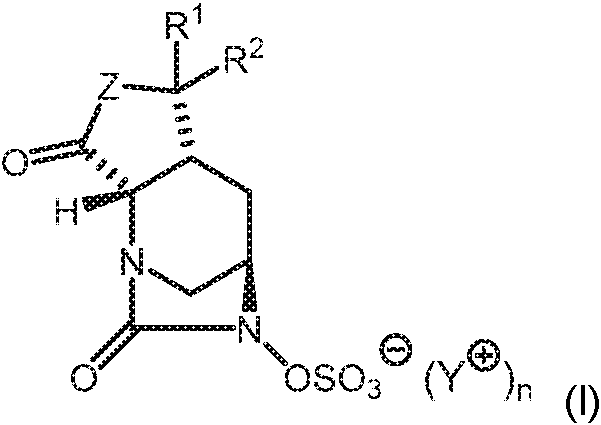
en la que:in which:
R1 y R2 se seleccionan independientemente entre H y alquilo C1-C4 opcionalmente sustituido con hasta tres grupos seleccionados entre halo, CN, -OR, oxo y -NRR';R1 and R2 are independently selected from H and C1-C4 alkyl optionally substituted with up to three groups selected from halo, CN, -OR, oxo, and -NRR ';
Z es NR3 o N-OR3;Z is NR3 or N-OR3;
R3 se selecciona, independientemente en cada caso, entre H, Cy y alquilo C1-C4 opcionalmente sustituido con hasta tres grupos seleccionados entre Cy, halo, CN, -OR y -NRR';R3 is selected, independently at each occurrence, from H, Cy, and C1-C4 alkyl optionally substituted with up to three groups selected from Cy, halo, CN, -OR, and -NRR ';
Cy es un anillo cicloalquilo C3-C6 o anillo heterocíclico de 4-6 miembros que contiene uno o dos heteroátomos seleccionados entre N, O y S como miembros del anillo, y Cy está opcionalmente sustituido con hasta tres grupos seleccionados entre oxo, halo, alquilo C1-C2, CN, -OR y -NRR'; yCy is a C3-C6 cycloalkyl ring or 4-6 membered heterocyclic ring containing one or two heteroatoms selected from N, O and S as ring members, and Cy is optionally substituted with up to three groups selected from oxo, halo, alkyl C1-C2, CN, -OR and -NRR '; Y
R y R' se seleccionan independientemente entre H y alquilo C1-C4 opcionalmente sustituido con uno o dos grupos seleccionados entre halo, -OH, -CN, -O-(alquilo C1-C4), oxo, -NH2, -NH(alquilo C1-C4) y -N(alquilo C1-C4)2, o R y R' tomados junto con el átomo de nitrógeno al que están ambos unidos pueden formar un anillo seleccionado entre piperidina, morfolina, pirrolidina y azetidina, en el que el anillo está opcionalmente sustituido con uno o dos grupos seleccionados entre halo, alquilo C1-C2, -OH, -CN, -O-(alquilo C1-C4), oxo, -NH2, -NH(alquilo C1-C4) y -N(alquilo C1-C4)2;R and R 'are independently selected from H and C1-C4 alkyl optionally substituted with one or two groups selected from halo, -OH, -CN, -O- (C1-C4 alkyl), oxo, -NH2, -NH (alkyl C1-C4) and -N (C1-C4 alkyl) 2, or R and R 'taken together with the nitrogen atom to which they are both attached can form a ring selected from piperidine, morpholine, pyrrolidine and azetidine, in which the ring is optionally substituted with one or two groups selected from halo, C1-C2 alkyl, -OH, -CN, -O- (C1-C4 alkyl), oxo, -NH2, -NH (C1-C4 alkyl) and -N (C1-C4 alkyl) 2;
Y es un grupo catiónico;Y is a cationic group;
n es 0 o 1; yn is 0 or 1; Y
cuando n es 0, el compuesto de Fórmula I es una forma zwitteriónica.when n is 0, the compound of Formula I is a zwitterionic form.
Cada uno de los compuestos de los Ejemplos en el presente documento es una realización específica de la invención. Each of the compounds of the Examples herein is a specific embodiment of the invention.
El compuesto de cualquiera de las realizaciones anteriores, en el que Z es NR3,The compound of any of the above embodiments, wherein Z is NR3,
y R3 es H o alquilo C1-C4 opcionalmente sustituido con -OR o -NRR', o una sal o forma zwitteriónica del mismo. and R3 is H or C1-C4 alkyl optionally substituted with -OR or -NRR ', or a salt or zwitterionic form thereof.
El compuesto de la realización 4, en el que R3 es alquilo C1-C2 opcionalmente sustituido con -OR o -NRR', o una sal o forma zwitteriónica del mismo.The compound of embodiment 4, wherein R3 is C1-C2 alkyl optionally substituted with -OR or -NRR ', or a salt or zwitterionic form thereof.
El compuesto de la realización 4, en el que R3 es H, o una sal o forma zwitteriónica del mismo.The compound of embodiment 4, wherein R3 is H, or a salt or zwitterionic form thereof.
El compuesto de una cualquiera de las realizaciones 1-6, en el que R1 y R2 son ambos H, o una sal o forma zwitteriónica del mismo.The compound of any one of embodiments 1-6, wherein R1 and R2 are both H, or a salt or zwitterionic form thereof.
El compuesto de la realización 1, que tiene esta estructura: The compound of embodiment 1, having this structure:

en la que X es -OR o -NRR';where X is -OR or -NRR ';
Y es un grupo catiónico;Y is a cationic group;
n es 0 o 1; yn is 0 or 1; Y
cuando n es 0, el compuesto de Fórmula II está en forma zwitteriónica.when n is 0, the compound of Formula II is in zwitterionic form.
El compuesto de la realización 1, que se selecciona de entre:The compound of embodiment 1, which is selected from:


como una sal o forma zwitteriónica del mismo.as a salt or zwitterionic form thereof.
El compuesto de cualquiera de las realizaciones anteriores, en el que n es 1 e Y se selecciona entre sodio, potasio, amonio, calcio, magnesio, hierro, plata, cinc y cobre.The compound of any of the above embodiments, wherein n is 1 and Y is selected from sodium, potassium, ammonium, calcium, magnesium, iron, silver, zinc, and copper.
El compuesto de cualquiera de las realizaciones anteriores, en el que Y es sodio.The compound of any of the above embodiments, wherein Y is sodium.
El compuesto de cualquiera de las realizaciones anteriores, que es una sal farmacéuticamente aceptable o zwitterión. Una realización de interés especial es un compuesto de Fórmula (VI):The compound of any of the above embodiments, which is a pharmaceutically acceptable salt or zwitterion. An embodiment of special interest is a compound of Formula (VI):

en la que:in which:
R1 y R2 se seleccionan independientemente entre H y alquilo C1-C4 opcionalmente sustituido con hasta tres grupos seleccionados entre halo, CN, -OR, oxo y -NRR';R1 and R2 are independently selected from H and C1-C4 alkyl optionally substituted with up to three groups selected from halo, CN, -OR, oxo, and -NRR ';
Z es NR3 o N-OR3;Z is NR3 or N-OR3;
R3 se selecciona, independientemente en cada caso, entre H, Cy y alquilo C1-C4 opcionalmente sustituido con hasta tres grupos seleccionados entre Cy, halo, CN, -OR y -NRR';R3 is selected, independently at each occurrence, from H, Cy, and C1-C4 alkyl optionally substituted with up to three groups selected from Cy, halo, CN, -OR, and -NRR ';
Cy es un anillo cicloalquilo C3-C6 o anillo heterocíclico de 4-6 miembros que contiene uno o dos heteroátomos seleccionados entre N, O y S como miembros del anillo, y Cy está opcionalmente sustituido con hasta tres grupos seleccionados entre oxo, halo, alquilo C1-C2, CN, -OR y -NRR'; yCy is a C3-C6 cycloalkyl ring or 4-6 membered heterocyclic ring containing one or two heteroatoms selected from N, O and S as ring members, and Cy is optionally substituted with up to three groups selected from oxo, halo, alkyl C1-C2, CN, -OR and -NRR '; Y
R y R' se seleccionan independientemente entre H y alquilo C1-C4 opcionalmente sustituido con uno o dos grupos seleccionados entre halo, alquilo C1-C2, -OH, -CN, -O-(alquilo C1-C4), oxo, -NH2, -NH(alquilo C1-C4) y -N(alquilo C1-C4)2, o R y R' tomados junto con el átomo de nitrógeno al que están ambos unidos pueden formar un anillo seleccionado entre piperidina, morfolina, pirrolidina y azetidina, en el que el anillo está opcionalmente sustituido con uno o dos grupos seleccionados entre halo, alquilo C1-C2, -OH, -CN, -O-(alquilo C1-C4), oxo, -NH2, -NH(alquilo C1-C4) y -N(alquilo C1-C4)2;R and R 'are independently selected from H and C1-C4 alkyl optionally substituted with one or two groups selected from halo, C1-C2 alkyl, -OH, -CN, -O- (C1-C4 alkyl), oxo, -NH2 , -NH (C1-C4 alkyl) and -N (C1-C4 alkyl) 2, or R and R 'taken together with the nitrogen atom to which they are both attached can form a ring selected from piperidine, morpholine, pyrrolidine and azetidine , wherein the ring is optionally substituted with one or two groups selected from halo, C1-C2 alkyl, -OH, -CN, -O- (C1-C4 alkyl), oxo, -NH2, -NH (C1-C4 alkyl) C4) and -N (C1-C4 alkyl) 2;
A es H o -CH2-Ph, donde Ph representa fenilo opcionalmente sustituido con uno o dos grupos seleccionados entre halo, alquilo C1-C4, alcoxi C1-C4;A is H or -CH2-Ph, where Ph represents phenyl optionally substituted with one or two groups selected from halo, C1-C4 alkyl, C1-C4 alkoxy;
o una sal o zwitterión del mismo.or a salt or zwitterion thereof.
Una realización de interés especial es un compuesto de la fórmula (VII): An embodiment of special interest is a compound of formula (VII):

El compuesto de la realización 12 en forma cristalina.The compound of embodiment 12 in crystalline form.
El compuesto de la realización 13, que muestra una endotermia en calorimetría diferencial de barrido entre 283 °C y 350 °C.The compound of embodiment 13, showing an endotherm in differential scanning calorimetry between 283 ° C and 350 ° C.
El compuesto de la realización 13, caracterizado por picos de XRPD en ángulos de difracción (2Theta) de 8,3 y 16,6 grados.The compound of embodiment 13, characterized by XRPD peaks at diffraction angles (2Theta) of 8.3 and 16.6 degrees.
El compuesto de la realización 15, caracterizado además por uno o más picos de XRPD adicionales en ángulos de difracción (2Theta) de 25,1 o 31,3 grados.The compound of embodiment 15, further characterized by one or more additional XRPD peaks at diffraction angles (2Theta) of 25.1 or 31.3 degrees.
El compuesto de la realización 16, caracterizado además por uno o más picos de XRPD adicionales en ángulos de difracción (2Theta) de 27,4 o 28,7 grados.The compound of embodiment 16, further characterized by one or more additional XRPD peaks at diffraction angles (2Theta) of 27.4 or 28.7 degrees.
El compuesto de la realización 17, caracterizado además por picos de XRPD adicionales en ángulos de difracción (2Theta) de 19,5 grados o 21,7 grados.The compound of embodiment 17, further characterized by additional XRPD peaks at diffraction angles (2Theta) of 19.5 degrees or 21.7 degrees.
Un proceso para preparar un compuesto de Fórmula (I),A process for preparing a compound of Formula (I),

de acuerdo con la realización 3, como una sal o forma zwitteriónica del mismo;according to embodiment 3, as a salt or zwitterionic form thereof;
en el que el proceso comprende poner en contacto un compuesto de Fórmula (III)wherein the process comprises contacting a compound of Formula (III)
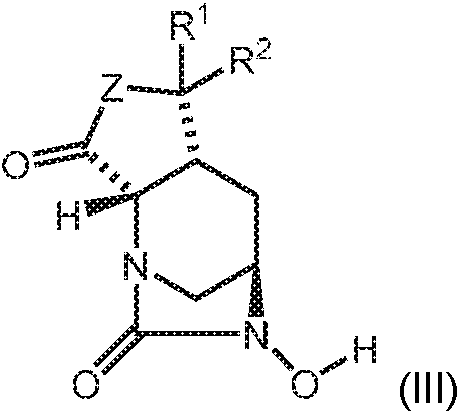
en la que Z, R1 y R2 y R3 son como se definen en la realización 3, con un agente de sulfonilación en presencia de una base.wherein Z, R1 and R2 and R3 are as defined in embodiment 3, with a sulfonylating agent in the presence of a base.
El proceso de la realización 19, en el que Z es NR3, y R3 es H o alquilo C1-C2 opcionalmente sustituido con -OR o -NRR',The process of embodiment 19, wherein Z is NR3, and R3 is H or C1-C2 alkyl optionally substituted with -OR or -NRR ',
o una sal farmacéuticamente aceptable del mismo.or a pharmaceutically acceptable salt thereof.
El proceso de la realización 19 o 20, en el que el compuesto de Fórmula (I) es de la fórmula The process of embodiment 19 or 20, wherein the compound of Formula (I) is of the formula

o una sal o forma zwitteriónica del mismo.or a salt or zwitterionic form thereof.
El proceso de una cualquiera de las realizaciones 19 a 21, en el que R3 es H.The process of any one of embodiments 19 to 21, wherein R3 is H.
Los compuestos de Fórmula (III) son útiles para sintetizar compuestos de Fórmula (I) como se describe en la Realización 3 y otras realizaciones anteriores.Compounds of Formula (III) are useful for synthesizing compounds of Formula (I) as described in Embodiment 3 and other embodiments above.
Los compuestos específicos de Fórmula (A) y Fórmula (I) incluyen:Specific compounds of Formula (A) and Formula (I) include:

o una sal o zwitterión del mismo.or a salt or zwitterion thereof.
En un aspecto adicional, la invención proporciona:In a further aspect, the invention provides:
Una combinación farmacéutica que comprende (a) un primer agente terapéutico que es un compuesto de la invención, por ejemplo, un compuesto de fórmula (A) o cualquier subfórmula de la misma descrita en el presente documento y (b) un segundo agente terapéutico como se ha descrito anteriormente. El segundo agente terapéutico normalmente es un antibiótico beta-lactámico.A pharmaceutical combination comprising (a) a first therapeutic agent that is a compound of the invention, for example, a compound of formula (A) or any sub-formula thereof described herein and (b) a second therapeutic agent such as described above. The second therapeutic agent is usually a beta-lactam antibiotic.
Un método como se ha definido anteriormente que comprende la administración conjunta, por ejemplo, concomitantemente o por orden, de una cantidad terapéuticamente eficaz de un compuesto de la invención, por ejemplo, un compuesto de fórmula (A) o cualquier subfórmula de la misma que se describe en el presente documento y un segundo agente terapéutico como se ha descrito anteriormente.A method as defined above which comprises the co-administration, for example, concomitantly or in order, of a therapeutically effective amount of a compound of the invention, for example, a compound of formula (A) or any sub-formula thereof that described herein and a second therapeutic agent as described above.
Los términos "administración conjunta" o "administración combinada" o similares, como se utilizan en el presente documento, pretenden abarcar la administración de los agentes terapéuticos seleccionados a un solo paciente, y pretenden incluir regímenes de tratamiento en los que los agentes no se administran necesariamente por la misma vía de administración o al mismo tiempo. Las combinaciones fijas también están dentro del alcance de la presente invención. La administración de una combinación farmacéutica de la invención da lugar a un efecto beneficioso, por ejemplo, un efecto terapéutico sinérgico, en comparación con una monoterapia que aplica solo uno de sus principios farmacéuticamente activos.The terms "co-administration" or "combined administration" or the like, as used herein, are intended to encompass the administration of selected therapeutic agents to a single patient, and they are intended to include treatment regimens in which the agents are not necessarily administered by the same route of administration or at the same time. Fixed combinations are also within the scope of the present invention. The administration of a pharmaceutical combination of the invention gives rise to a beneficial effect, for example, a synergistic therapeutic effect, compared to a monotherapy that applies only one of its pharmaceutically active principles.
Cada componente de una combinación de acuerdo con la presente invención puede administrarse por separado, juntos o en cualquier combinación de los mismos.Each component of a combination according to the present invention can be administered separately, together or in any combination thereof.
El compuesto de la invención y cualquier agente adicional se pueden formular en formas farmacéuticas separadas. Como alternativa, para disminuir el número de formas farmacéuticas administradas a un paciente, el compuesto de la invención y cualquier agente adicional se pueden formular juntos en cualquier combinación. Por ejemplo, el compuesto del inhibidor de la invención puede formularse en una forma farmacéutica y el agente adicional puede formularse junto en otra forma farmacéutica. Cualquier forma farmacéutica separada puede administrarse al mismo tiempo o en momentos diferentes.The compound of the invention and any additional agents can be formulated in separate dosage forms. Alternatively, to decrease the number of dosage forms administered to a patient, the compound of the invention and any additional agents can be formulated together in any combination. For example, the inhibitor compound of the invention may be formulated in one dosage form and the additional agent may be formulated together in another dosage form. Any separate dosage form can be administered at the same time or at different times.
Como alternativa, una composición de la presente invención comprende un agente adicional como se describe en el presente documento. Cada componente puede estar presente en composiciones individuales, composiciones combinadas o en una sola composición.Alternatively, a composition of the present invention comprises an additional agent as described herein. Each component can be present in individual compositions, combined compositions, or in a single composition.
Los compuestos de la invención pueden sintetizarse por las vías de síntesis generales que se presentan a continuación, cuyos ejemplos específicos se describen con más detalle en los Ejemplos.The compounds of the invention can be synthesized by the general synthetic routes presented below, specific examples of which are described in more detail in the Examples.
Los compuestos de la presente invención y los intermedios también pueden convertirse entre sí de acuerdo con métodos conocidos generalmente por los expertos en la materia.The compounds of the present invention and the intermediates can also be converted to each other according to methods generally known to those skilled in the art.
Dentro del ámbito de este texto, solamente un grupo fácilmente eliminable que no es un constituyente del producto final deseado particular de los compuestos de la presente invención se designa como "grupo protector", a menos que el contexto indique lo contrario. La protección de grupos funcionales mediante tales grupos protectores, los grupos protectores en sí mismo y sus reacciones de escisión se describen, por ejemplo, en trabajos de referencia convencionales, tales como J. F. W. McOmie, "Protective Groups in Organic Chemistry", Plenum Press, Londres y Nueva York 1973, en T. W. Greene y P. G. M. Wuts, "Protective Groups in Organic Synthesis", Tercera edición, Wiley, Nueva York 1999, en "The Peptides"; Volumen 3 (editores: E. Gross y J. Meienhofer), Academic Press, Londres y Nueva York 1981, en "Methoden der organischen Chemie" (Métodos de Síntesis Orgánica), Houben Weilo, 4.a edición, Volumen 15/I, Georg Thieme Verlag, Stuttgart 1974, en H.-D. Jakubke y H. Jeschkeit, "Aminosauren, Peptide, Proteine" (Aminoácidos, Péptidos, Proteínas), Verlag Chemie, Weinheim, Deerfield Beach, y Basel 1982, y en Jochen Lehmann, "Chemie der Kohlenhidrato: Monosaccharide und Derivate" (Química de Carbohidratos: Monosacáridos y Derivados), Georg Thieme Verlag, Stuttgart 1974. Una característica de los grupos protectores es que pueden retirarse fácilmente (es decir sin la aparición de reacciones secundarias indeseadas) por ejemplo mediante solvólisis, reducción, fotólisis o alternativamente en condiciones fisiológicas (por ejemplo mediante escisión enzimática).Within the scope of this text, only a readily removable group that is not a constituent of the particular desired end product of the compounds of the present invention is designated as a "protecting group", unless the context indicates otherwise. The protection of functional groups by such protecting groups, the protecting groups themselves and their cleavage reactions are described, for example, in standard reference works, such as JFW McOmie, "Protective Groups in Organic Chemistry", Plenum Press, London and New York 1973, in TW Greene and PGM Wuts, "Protective Groups in Organic Synthesis", Third Edition, Wiley, New York 1999, in "The Peptides"; Volume 3 (editors: E. Gross and J. Meienhofer), Academic Press, London and New York 1981, in "Methoden der organischen Chemie" (Methods of Organic Synthesis), Houben Weilo, 4th edition, Volume 15 / I, Georg Thieme Verlag, Stuttgart 1974, in H.-D. Jakubke and H. Jeschkeit, "Aminosauren, Peptide, Proteine", Verlag Chemie, Weinheim, Deerfield Beach, and Basel 1982, and in Jochen Lehmann, "Chemie der Kohlenhydrato: Monosaccharide und Derivate" (Chemistry of Carbohydrates: Monosaccharides and Derivatives), Georg Thieme Verlag, Stuttgart 1974. A characteristic of protecting groups is that they can be easily removed (ie without the appearance of undesired side reactions) for example by solvolysis, reduction, photolysis or alternatively under physiological conditions ( eg by enzymatic cleavage).
Las sales de compuestos de la presente invención que tienen al menos un grupo formador de sales pueden prepararse de forma conocida por los expertos en la materia. Por ejemplo, las sales de compuestos de la presente invención que tienen grupos ácidos pueden formarse, por ejemplo, tratando los compuestos, o una sal de los compuestos como la sal tetrabutilamonio, con compuestos metálicos, tales como sales de metales alcalinos de ácidos carboxílicos orgánicos adecuados, por ejemplo la sal sódica de ácido 2-etilhexanoico en un disolvente adecuado apropiado, tal como una mezcla de isobutanol/agua, que puede facilitar que precipite el par iónico indeseado (por ejemplo, el 2-etilhexanoato de tetrabutilamonio si se usa la sal de tetrabutilamonio). Preferentemente, una sal de un compuesto de la invención, tal como la sal de amonio, puede someterse a una resina de intercambio iónico en su forma de metal alcalino o alcalinotérreo para promover un intercambio de contraiones. Las sales de adición de ácidos o de intercambio de compuestos de la presente invención se obtienen de la manera habitual, por ejemplo tratando los compuestos con un ácido o un reactivo de intercambio aniónico adecuado. Los zwitteriones o sales internas de compuestos de la presente invención que contienen grupos formadores de sales ácidas y básicas, por ejemplo un grupo de sulfato libre y un grupo de amino libre, pueden formarse, por ejemplo, por neutralización de las sales, tales como sales de adición de ácidos, al punto isoeléctrico, por ejemplo, con bases débiles, o por tratamiento con intercambiadores iónicos. The salts of compounds of the present invention having at least one salt-forming group can be prepared in a manner known to those skilled in the art. For example, salts of compounds of the present invention having acidic groups can be formed, for example, by treating the compounds, or a salt of the compounds such as the tetrabutylammonium salt, with metal compounds, such as alkali metal salts of organic carboxylic acids. For example, the sodium salt of 2-ethylhexanoic acid in a suitable suitable solvent, such as an isobutanol / water mixture, which may facilitate the precipitation of the undesired ion pair (for example, tetrabutylammonium 2-ethylhexanoate if the tetrabutylammonium salt). Preferably, a salt of a compound of the invention, such as the ammonium salt, can be subjected to an ion exchange resin in its alkali or alkaline earth metal form to promote counter ion exchange. The acid addition or compound exchange salts of the present invention are obtained in the usual manner, for example by treating the compounds with a suitable acid or anion exchange reagent. Zwitterions or internal salts of compounds of the present invention containing acidic and basic salt-forming groups, for example a free sulfate group and a free amino group, can be formed, for example, by neutralization of the salts, such as salts by adding acids, to the isoelectric point, for example, with weak bases, or by treatment with ion exchangers.
Las sales pueden convertirse en los compuestos libres de acuerdo con métodos conocidos por los expertos en la materia. Las sales clorhidrato pueden convertirse, por ejemplo, por tratamiento con un agente básico adecuado. Las mezclas de isómeros obtenibles de acuerdo con la invención pueden separarse en isómeros individuales generalmente de forma conocida por los expertos en la materia; los diastereoisómeros pueden separarse, por ejemplo, repartiendo entre mezclas de disolventes polifásicos, recristalización y/o separación cromatográfica, por ejemplo sobre gel de sílice o, por ejemplo, mediante cromatografía líquida de presión media sobre columna en fase inversa, y los racematos pueden separarse, por ejemplo, mediante la formación de sales con reactivos formadores de sal ópticamente puros y la separación de la mezcla de diastereoisómeros así obtenibles, por ejemplo por medio de cristalización fraccionada, o por cromatografía sobre materiales de columna ópticamente activos. The salts can be converted to the free compounds according to methods known to those skilled in the art. The hydrochloride salts can be converted, for example, by treatment with a suitable basic agent. The isomer mixtures obtainable according to the invention can be separated into individual isomers generally in a manner known to those skilled in the art; the diastereoisomers can be separated, for example, by partitioning between mixtures of polyphasic solvents, recrystallization and / or chromatographic separation, for example on silica gel or, for example, by medium pressure liquid chromatography on a reverse phase column, and the racemates can be separated , for example, by the formation of salts with optically pure salt-forming reagents and the separation of the mixture of diastereoisomers thus obtainable, for example by means of fractional crystallization, or by chromatography on optically active column materials.
Los productos intermedios y finales pueden elaborarse y/o purificarse de acuerdo con métodos estándar, por ejemplo usando métodos cromatográficos, métodos de distribución, (re) cristalización, y similares.Intermediates and final products can be made and / or purified according to standard methods, for example using chromatographic methods, distribution methods, (re) crystallization, and the like.
Lo siguiente se aplica en general a todos los procesos mencionados anteriormente en el presente documento y en lo sucesivo en el presente documento.The following generally applies to all the processes mentioned hereinabove and hereinafter.
Todas las etapas de proceso para preparar de la invención pueden realizarse en condiciones de reacción que son conocidas para los expertos en la técnica, incluyendo las mencionadas específicamente, en ausencia o, habitualmente, en presencia de disolventes o diluyentes, incluyendo, por ejemplo, disolventes o diluyentes que son inertes frente a los reactivos utilizados y los disuelven, en ausencia o presencia de catalizadores, agentes de condensación o neutralizantes, por ejemplo, intercambiadores de iones, tales como intercambiadores de cationes, por ejemplo en forma de H+, dependiendo de la naturaleza de la reacción y/o de los reactivos a temperatura reducida, normal o elevada, por ejemplo en un intervalo de temperaturas de aproximadamente -100 °C a aproximadamente 190 °C, incluyendo, por ejemplo, de aproximadamente -80 °C a aproximadamente 150 °C, por ejemplo a entre -80 y -60 °C, a temperatura ambiente, a entre -20 y 40 °C o a la temperatura de reflujo, a presión atmosférica o en un recipiente cerrado, cuando sea apropiado a presión, y/o en una atmósfera inerte, por ejemplo, en una atmósfera de argón o nitrógeno.All process steps for preparing the invention can be carried out under reaction conditions that are known to those skilled in the art, including those specifically mentioned, in the absence or, usually, in the presence of solvents or diluents, including, for example, solvents or diluents that are inert towards the reagents used and dissolve them, in the absence or presence of catalysts, condensing or neutralizing agents, for example ion exchangers, such as cation exchangers, for example in the H + form, depending on the nature of the reaction and / or reagents at reduced, normal or elevated temperature, for example in a temperature range from about -100 ° C to about 190 ° C, including, for example, from about -80 ° C to about 150 ° C, for example at -80 to -60 ° C, at room temperature, at -20 to 40 ° C or at reflux temperature, at atmospheric pressure or at a closed container, where appropriate under pressure, and / or in an inert atmosphere, for example, in an argon or nitrogen atmosphere.
En todas las fases de las reacciones, las mezclas de isómeros que se forman pueden separarse en isómeros individuales, por ejemplo, diastereoisómeros o enantiómeros, o en cualquier mezcla deseada de isómeros, por ejemplo, racematos o mezclas de diastereoisómeros.In all stages of the reactions, the isomer mixtures that are formed can be separated into individual isomers, eg, diastereoisomers or enantiomers, or into any desired mixture of isomers, eg, racemates or diastereoisomer mixtures.
Los disolventes a partir de los cuales pueden seleccionarse aquellos disolventes que son adecuados para cualquier reacción particular incluyen los mencionados específicamente o, por ejemplo, agua, ésteres, tales como alcanoatos inferiores de alquilo inferior, por ejemplo, acetato de etilo, éteres, tales como éteres alifáticos, por ejemplo, éter dietílico, o éteres cíclicos, por ejemplo, tetrahidrofurano o dioxano, hidrocarburos aromáticos líquidos, tales como benceno o tolueno, alcoholes, tales como metanol, etanol o 1- o 2-propanol, nitrilos, tal como acetonitrilo, hidrocarburos halogenados, tales como cloruro de metileno o cloroformo, amidas de ácido, tales como dimetilformamida o dimetilacetamida, bases, tales como bases nitrogenadas heterocíclicas, por ejemplo piridina o N-metilpirrolidin-2-ona, anhídridos de ácido carboxílico, tales como anhídridos de ácido alcanoico inferior, por ejemplo, anhídrido acético, cíclicos, lineales o ramificados, tales como ciclohexano, hexano o isopentano, metilciclohexano o mezclas de esos disolventes, por ejemplo, soluciones acuosas, a menos que se indique otra cosa en la descripción de los procesos. Dichas mezclas de disolventes también pueden usarse en el tratamiento, por ejemplo, mediante cromatografía o reparto.Solvents from which those solvents that are suitable for any particular reaction can be selected include those specifically mentioned or, for example, water, esters, such as lower alkyl lower alkanoates, for example, ethyl acetate, ethers, such as aliphatic ethers, eg, diethyl ether, or cyclic ethers, eg, tetrahydrofuran or dioxane, liquid aromatic hydrocarbons, such as benzene or toluene, alcohols, such as methanol, ethanol, or 1- or 2-propanol, nitriles, such as acetonitrile , halogenated hydrocarbons, such as methylene chloride or chloroform, acid amides, such as dimethylformamide or dimethylacetamide, bases, such as heterocyclic nitrogenous bases, for example pyridine or N-methylpyrrolidin-2-one, carboxylic acid anhydrides, such as anhydrides of lower alkanoic acid, for example, acetic anhydride, cyclic, linear or branched, such as cyclohexane, hexane or isopen tannum, methylcyclohexane or mixtures of these solvents, eg aqueous solutions, unless otherwise indicated in the description of the processes. Such solvent mixtures can also be used in treatment, for example by chromatography or partition.
Los compuestos de la presente invención, incluidas sus sales, también pueden obtenerse en forma de hidratos, o sus cristales pueden incluir, por ejemplo, el disolvente utilizado para la cristalización. Pueden estar presentes diferentes formas cristalinas.The compounds of the present invention, including their salts, can also be obtained in the form of hydrates, or their crystals can include, for example, the solvent used for crystallization. Different crystal forms may be present.
Todos los materiales de partida, componentes básicos, reactivos, ácidos, bases, agentes deshidratantes, disolventes y catalizadores utilizados para sintetizar los compuestos de la presente invención están disponibles en el mercado o pueden producirse por métodos de síntesis orgánicas conocidos para alguien con una habilidad habitual en la técnica. All the starting materials, building blocks, reagents, acids, bases, dehydrating agents, solvents and catalysts used to synthesize the compounds of the present invention are commercially available or can be produced by organic synthetic methods known to one of ordinary skill. in technique.
La expresión "isómero óptico" o "estereoisómero" se refiere a cualquiera de las diversas configuraciones estereoisoméricas que pueden existir para un compuesto dado de la presente invención e incluye isómeros geométricos. Se entiende que un sustituyente puede estar unido a un centro quiral de un átomo de carbono. El término "quiral" se refiere a moléculas que tienen la propiedad de no superponerse sobre su compañero de imagen especular, mientras que el término "aquiral" se refiere a moléculas que son superponibles con su compañera de imagen especular. Por lo tanto, la invención incluye enantiómeros, diastereómeros o racematos del compuesto. "Enantiómeros" son un par de estereoisómeros que no son imágenes especulares superponibles entre sí. Una mezcla 1:1 de un par de enantiómeros es una mezcla "racémica". El término se usa para designar una mezcla racémica cuando sea apropiado. "Diaestereoisómeros" son estereoisómeros que tienen al menos dos átomos asimétricos, pero que no son imágenes especulares entre sí. La estereoquímica absoluta se especifica de acuerdo con el sistema Cahn-Ingold-Prelog R-S. Cuando un compuesto es un enantiómero puro, la estereoquímica en cada carbono quiral puede especificarse por R o S. Los compuestos resueltos cuya configuración absoluta es desconocida pueden designarse (+) o (-) dependiendo de la dirección (dextro- o levógira) que giran el plano de luz polarizada a la longitud de onda de la línea D de sodio. Ciertos compuestos descritos en el presente documento contienen uno o más centros o ejes asimétricos y por lo tanto pueden dar lugar a enantiómeros, diastereómeros y otras formas estereoisoméricas que pueden definirse, en términos de estereoquímica absoluta, como (R)- o (S)-.The term "optical isomer" or "stereoisomer" refers to any of the various stereoisomeric configurations that may exist for a given compound of the present invention and includes geometric isomers. It is understood that a substituent can be attached to a chiral center of a carbon atom. The term "chiral" refers to molecules that have the property of not overlapping on their mirror image partner, while the term "achiral" refers to molecules that are superimposable with their mirror image partner. Therefore, the invention includes enantiomers, diastereomers or racemates of the compound. "Enantiomers" are a pair of stereoisomers that are not superimposable mirror images of each other. A 1: 1 mixture of a pair of enantiomers is a "racemic" mixture. The term is used to designate a racemic mixture where appropriate. "Diatereoisomers" are stereoisomers that have at least two asymmetric atoms, but are not mirror images of each other. The absolute stereochemistry is specified according to the Cahn-Ingold-Prelog RS system. When a compound is a pure enantiomer, the stereochemistry at each chiral carbon can be specified by R or S. Resolved compounds whose absolute configuration is unknown can be designated (+) or (-) depending on the direction (dextro- or left-handed) that they rotate. the plane of light polarized at the wavelength of the sodium D line. Certain compounds described herein contain one or more asymmetric centers or axes and therefore can give rise to enantiomers, diastereomers and other stereoisomeric forms that can be defined, in terms of absolute stereochemistry, as (R) - or (S) - .
Dependiendo de la elección de los materiales de partida y los procedimientos, los nuevos compuestos pueden estar presentes en forma de uno de los isómeros posibles o como mezclas de los mismos, por ejemplo como isómeros ópticos puros, o como mezclas de isómeros, tal como racematos y mezclas de diastereoisómeros, dependiendo del número de átomos de carbono asimétricos. La presente invención pretende incluir todos estos estereoisómeros posibles, incluyendo mezclas racémicas, mezclas diastereoméricas y formas ópticamente puras. Pueden prepararse (R) y (S)-isómeros ópticamente activos usando sintones quirales o reactivos quirales, o se resuelven usando técnicas convencionales. Si el compuesto contiene un doble enlace, el sustituyente puede tener una configuración E o Z. Si el compuesto contiene un cicloalquilo disustituido, el sustituyente del cicloalquilo puede tener una configuración cis o trans. Se pretende que todas las formas tautoméricas estén incluidas.Depending on the choice of starting materials and processes, the new compounds may be present in the form of one of the possible isomers or as mixtures thereof, for example as pure optical isomers, or as mixtures of isomers, such as racemates. and mixtures of diastereoisomers, depending on the number of asymmetric carbon atoms. The present invention is intended to include all of these possible stereoisomers, including racemic mixtures, diastereomeric mixtures, and optically pure forms. Optically active (R) and (S) -isomers can be prepared using chiral synthons or chiral reagents, or resolved using techniques conventional. If the compound contains a double bond, the substituent can have an E or Z configuration. If the compound contains a disubstituted cycloalkyl, the substituent on the cycloalkyl can have a cis or trans configuration. All tautomeric forms are intended to be included.
Cualquier mezcla de isómeros resultante puede separarse basándose en las diferencias fisicoquímicas de los constituyentes, en los isómeros geométricos u ópticos puros o sustancialmente puros, diastereómeros, racematos, por ejemplo, por cromatografía y/o cristalización fraccionada.Any resulting mixture of isomers can be separated based on the physicochemical differences of the constituents, on the pure or substantially pure geometric or optical isomers, diastereomers, racemates, for example, by chromatography and / or fractional crystallization.
Cualquier racemato resultante de productos finales o intermedios puede resolverse en los antípodos ópticos por métodos conocidos, por ejemplo, por separación de las sales diastereoméricas de los mismos, obtenidas con un ácido o base ópticamente activo, y liberando el compuesto ácido o básico ópticamente activo. En particular, un resto básico puede emplearse de ese modo para resolver los compuestos de la presente invención en sus antípodos ópticos, por ejemplo, por cristalización fraccionada de una sal formada con un ácido ópticamente activo, por ejemplo, ácido tartárico, ácido dibenzoil tartárico, ácido diacetil tartárico, ácido di-0,0'-p-toluoil tartárico, ácido mandélico, ácido málico o ácido alcanfor-10-sulfónico. Los productos racémicos también pueden resolverse por cromatografía quiral, por ejemplo, cromatografía líquida de alta presión (HPLC) usando un adsorbente quiral.Any resulting racemate of final products or intermediates can be resolved into the optical antipodes by known methods, for example, by removing the diastereomeric salts thereof, obtained with an optically active acid or base, and releasing the optically active acid or base compound. In particular, a basic moiety may thus be employed to resolve the compounds of the present invention to their optical antipodes, for example by fractional crystallization of a salt formed with an optically active acid, for example tartaric acid, dibenzoyl tartaric acid, diacetyl tartaric acid, di-0,0'-p-toluoyl tartaric acid, mandelic acid, malic acid or camphor-10-sulfonic acid. Racemic products can also be resolved by chiral chromatography, eg, high pressure liquid chromatography (HPLC) using a chiral adsorbent.
Además, los compuestos de la presente invención, incluidas sus sales, también pueden obtenerse en forma de sus hidratos, o incluir otros disolventes usados para su cristalización. Los compuestos de la presente invención pueden formar inherentemente o por diseño solvatos con disolventes farmacéuticamente aceptables (incluyendo agua); por lo tanto, se pretende que la invención abarque tanto formas solvatadas como no solvatadas. El término "solvato" se refiere a un complejo molecular de un compuesto de la presente invención (incluyendo formas de sal o zwitteriónicas del mismo) con una o más moléculas de disolvente. Dichas moléculas de disolvente son las comúnmente usadas en la técnica farmacéutica, que se sabe que son inocuas para el receptor, por ejemplo, agua, etanol, y similares. El término "hidrato" se refiere al complejo donde la molécula disolvente es agua.Furthermore, the compounds of the present invention, including their salts, can also be obtained in the form of their hydrates, or include other solvents used for their crystallization. The compounds of the present invention may inherently or by design form solvates with pharmaceutically acceptable solvents (including water); therefore, the invention is intended to encompass both solvated and unsolvated forms. The term "solvate" refers to a molecular complex of a compound of the present invention (including salt or zwitterionic forms thereof) with one or more solvent molecules. Said solvent molecules are those commonly used in the pharmaceutical art, which are known to be harmless to the receptor, eg, water, ethanol, and the like. The term "hydrate" refers to the complex where the solvent molecule is water.
Los compuestos de la presente invención, incluyendo sales, hidratos y solvatos de los mismos, pueden formar polimorfos de forma inherente o por diseño.The compounds of the present invention, including salts, hydrates, and solvates thereof, can form polymorphs inherently or by design.
Como se usa en el presente documento, los términos "sal" o "sales" se refieren a una sal de adición de ácidos o adición de bases de un compuesto de la presente invención. Las "sales" incluyen en particular "sales farmacéuticamente aceptables". La expresión "sales farmacéuticamente aceptables" se refiere a sales que conservan la eficacia biológica y las propiedades de los compuestos de esta invención y, que típicamente no son biológicamente ni de otro modo indeseables. En muchos casos, los compuestos de la presente invención son capaces de formar sales de ácidos y/o bases en virtud de la presencia de grupos amino y/o sulfato o grupos similares a los mismos.As used herein, the terms "salt" or "salts" refer to an acid addition or base addition salt of a compound of the present invention. The "salts" include in particular "pharmaceutically acceptable salts". The term "pharmaceutically acceptable salts" refers to salts which retain the biological efficacy and properties of the compounds of this invention and which are typically not biologically or otherwise undesirable. In many cases, the compounds of the present invention are capable of forming acid and / or base salts by virtue of the presence of amino and / or sulfate groups or groups similar thereto.
Las sales de adición o intercambio de ácidos farmacéuticamente aceptables pueden formarse con ácidos inorgánicos y ácidos orgánicos, por ejemplo, acetato, aspartato, benzoato, besilato, bromuro/bromhidrato, bicarbonato/carbonato, bisulfato/sulfato, alcanforsulfonato, cloruro/clorhidrato, clorteofilonato, citrato, etandisulfonato, fumarato, gluceptato, gluconato, glucuronato, hipurato, yodhidrato/yoduro, isetionato, lactato, lactobionato, laurilsulfato, malato, maleato, malonato, mandelato, mesilato, metilsulfato, naftoato, napsilato, nicotinato, nitrato, octadecanoato, oleato, oxalato, palmitato, pamoato, fosfato/hidrogenofosfato/dihidrogenofosfato, poligalacturonato, propionato, estearato, succinato, sulfosalicilato, tartrato, tosilato y sales trifluoroacetato.Pharmaceutically acceptable acid addition or exchange salts can be formed with inorganic acids and organic acids, for example, acetate, aspartate, benzoate, besylate, bromide / hydrobromide, bicarbonate / carbonate, bisulfate / sulfate, camphor sulfonate, chloride / hydrochloride, chlorteophyllonate, citrate, ethanedisulfonate, fumarate, gluceptate, gluconate, glucuronate, hippurate, hydroiodide / iodide, isethionate, lactate, lactobionate, lauryl sulfate, malate, maleate, malonate, mandelate, mesylate, methyl sulfate, naphthoate, napsylate, nicotinate, octadecane, nitrate, napsylate, nicotinate, octadecane oxalate, palmitate, pamoate, phosphate / hydrogen phosphate / dihydrogen phosphate, polygalacturonate, propionate, stearate, succinate, sulfosalicylate, tartrate, tosylate and trifluoroacetate salts.
Los ácidos inorgánicos o "grupos aniónicos" que pueden introducirse o a partir de los cuales pueden derivarse sales incluyen, por ejemplo, ácido clorhídrico, ácido bromhídrico, ácido sulfúrico, ácido nítrico, ácido fosfórico y similares. Inorganic acids or "anionic groups" that can be introduced or from which salts can be derived include, for example, hydrochloric acid, hydrobromic acid, sulfuric acid, nitric acid, phosphoric acid, and the like.
Los ácidos orgánicos o "grupos aniónicos" que pueden introducirse o a partir de los cuales pueden derivarse sales incluyen, por ejemplo, ácido acético, ácido propiónico, ácido glicólico, ácido oxálico, ácido maleico, ácido malónico, ácido succínico, ácido fumárico, ácido tartárico, ácido cítrico, ácido benzoico, ácido mandélico, ácido metanosulfónico, ácido etanosulfónico, ácido toluenosulfónico, ácido sulfosalicílico, y similares. Las sales de adición o intercambio de bases farmacéuticamente aceptables pueden formarse con bases inorgánicas y orgánicas.Organic acids or "anionic groups" that can be introduced or from which salts can be derived include, for example, acetic acid, propionic acid, glycolic acid, oxalic acid, maleic acid, malonic acid, succinic acid, fumaric acid, tartaric acid. , citric acid, benzoic acid, mandelic acid, methanesulfonic acid, ethanesulfonic acid, toluenesulfonic acid, sulfosalicylic acid, and the like. Pharmaceutically acceptable base addition or exchange salts can be formed with inorganic and organic bases.
Las bases inorgánicas o "grupos catiónicos" que pueden introducirse o a partir de las cuales pueden derivarse sales incluyen, por ejemplo, sales de amonio y metales de las columnas I a XII de la tabla periódica. En ciertas realizaciones, las sales se derivan de grupos catiónicos sodio, potasio, amonio, calcio, magnesio, hierro, plata, cinc y cobre; las sales particularmente adecuadas incluyen sales de amonio, potasio, sodio, calcio y magnesio.Inorganic bases or "cationic groups" that can be introduced or from which salts can be derived include, for example, salts of ammonium and metals from columns I to XII of the periodic table. In certain embodiments, the salts are derived from cationic groups sodium, potassium, ammonium, calcium, magnesium, iron, silver, zinc, and copper; particularly suitable salts include ammonium, potassium, sodium, calcium and magnesium salts.
Las bases orgánicas o "grupos catiónicos" que pueden introducirse o a partir de las cuales pueden derivarse sales incluyen, por ejemplo, aminas primarias, secundarias y terciarias, aminas sustituidas, incluyendo aminas sustituidas de origen natural, aminas cíclicas, resinas de intercambio iónico básicas, y similares. Determinadas aminas orgánicas incluyen isopropilamina, benzatina, colinato, dietanolamina, dietilamina, lisina, meglumina, piperazina y trometamina. Organic bases or "cationic groups" that can be introduced or from which salts can be derived include, for example, primary, secondary and tertiary amines, substituted amines, including naturally occurring substituted amines, cyclic amines, basic ion exchange resins, and the like. Certain organic amines include isopropylamine, benzathine, choline, diethanolamine, diethylamine, lysine, meglumine, piperazine, and tromethamine.
Las sales de la presente invención pueden sintetizarse a partir de un resto básico o ácido, por métodos químicos convencionales. En general, dichas sales pueden prepararse haciendo reaccionar formas de ácido libre de estos compuestos con una cantidad estequiométrica de la base adecuada (tal como, hidróxido, carbonato, bicarbonato de Na, Ca, Mg o K, o similares), o haciendo reaccionar formas de base libre de estos compuestos con una cantidad estequiométrica del ácido adecuado. Preferentemente, una sal de un compuesto de la invención, tal como una sal de amonio, puede someterse a una resina de intercambio iónico en su forma de metal alcalino o alcalinotérreo para promover un intercambio de contraiones. Las sales de adición de ácidos o de intercambio de compuestos de la presente invención se obtienen de la manera habitual, por ejemplo tratando los compuestos con un ácido o un reactivo de intercambio aniónico adecuado. Los zwitteriones o sales internas de compuestos de la presente invención que contienen grupos formadores de sales ácidas y básicas, por ejemplo un grupo de sulfato libre y un grupo de amino libre, pueden formarse, por ejemplo, por neutralización de las sales, tales como sales de adición de ácidos, al punto isoeléctrico, por ejemplo, con bases débiles, o por tratamiento con intercambiadores iónicos. Dichas reacciones se realizan normalmente en agua o en un disolvente orgánico, o en una mezcla de los dos. En general, es deseable el uso de medios no acuosos como éter, acetato de etilo, etanol, isopropanol o acetonitrilo, cuando sea posible. Pueden encontrarse sales adecuadas adicionales, por ejemplo, en "Remington's Pharmaceutical Sciences", 20.a ed., Mack Publishing Company, Easton, Pa., (1985); y en "Handbook of Pharmaceutical Salts: Properties, Selection, and Use" de Stahl y Wermuth (Wiley-VCH, Weinheim, Alemania, 2002).The salts of the present invention can be synthesized from a basic or an acidic moiety, by conventional chemical methods. In general, such salts can be prepared by reacting free acid forms of these compounds with a stoichiometric amount of the appropriate base (such as hydroxide, carbonate, bicarbonate of Na, Ca, Mg or K, or the like), or by reacting free base forms of these compounds with a stoichiometric amount of the appropriate acid. Preferably, a salt of a compound of the invention, such as an ammonium salt, can be subjected to an ion exchange resin in its alkali or alkaline earth metal form to promote counter ion exchange. The acid addition or compound exchange salts of the present invention are obtained in the usual manner, for example by treating the compounds with a suitable acid or anion exchange reagent. Zwitterions or internal salts of compounds of the present invention containing acidic and basic salt-forming groups, for example a free sulfate group and a free amino group, can be formed, for example, by neutralization of the salts, such as salts by adding acids, to the isoelectric point, for example, with weak bases, or by treatment with ion exchangers. Such reactions are normally carried out in water or in an organic solvent, or in a mixture of the two. In general, the use of non-aqueous media such as ether, ethyl acetate, ethanol, isopropanol, or acetonitrile is desirable, when possible. Additional suitable salts can be found, for example, in "Remington's Pharmaceutical Sciences", 20th ed., Mack Publishing Company, Easton, Pa., (1985); and in "Handbook of Pharmaceutical Salts: Properties, Selection, and Use" by Stahl and Wermuth (Wiley-VCH, Weinheim, Germany, 2002).
Cualquier fórmula dada en el presente documento también pretende representar formas no marcadas, así como formas marcadas isotópicamente de los compuestos de la presente invención. Los compuestos marcados isotópicamente tienen estructuras representadas por las fórmulas dadas en el presente documento, excepto por que uno o más átomos están reemplazados por un átomo que tiene una masa atómica o número másico seleccionado. Los ejemplos de isótopos que pueden incorporarse en los compuestos de la invención incluyen isótopos de hidrógeno, carbono, nitrógeno, oxígeno, fósforo, flúor y cloro, tales como 2H, 3H, 11C, 13C, 14C, 15N, 18F, 31P, 32P, 35S, 36Cl, 125I, respectivamente. La invención incluye diversos compuestos marcados isotópicamente de la presente invención, por ejemplo, aquellos en los que están presentes isótopos radiactivos, tales como 3H y 14C, o aquellos en los que están presentes isótopos no radioactivos, tales como 2H y 13C. Dichos compuestos marcados isotópicamente son útiles en estudios metabólicos (con 14C), estudios de cinética de reacción (con, por ejemplo 2H o 3H), técnicas de detección o formación de imágenes, tales como la tomografía por emisión de positrones (PET) o la tomografía de emisión monofotónica (SPECT), incluyendo ensayos de distribución en tejidos de sustrato o de fármaco, o en el tratamiento radioactivo de pacientes. En particular, un compuesto marcado con 18F de la presente invención puede ser particularmente deseable para estudios de PET o SPECT. Los compuestos marcados con isótopos de la presente invención pueden prepararse generalmente por técnicas convencionales conocidas por los expertos en la materia o por procesos análogos a los descritos en los Ejemplos y Preparaciones adjuntas usando un reactivo marcado isotópicamente adecuado en lugar del reactivo no marcado empleado previamente.Any formula given herein is also intended to represent unlabeled as well as isotopically-labeled forms of the compounds of the present invention. Isotopically labeled compounds have structures represented by the formulas given herein, except that one or more atoms are replaced by an atom having a selected atomic mass or mass number. Examples of isotopes that can be incorporated into the compounds of the invention include isotopes of hydrogen, carbon, nitrogen, oxygen, phosphorus, fluorine, and chlorine, such as 2H, 3H, 11C, 13C, 14C, 15N, 18F, 31P, 32P, 35S, 36Cl, 125I, respectively. The invention includes various isotopically-labeled compounds of the present invention, for example, those in which radioactive isotopes, such as 3H and 14C are present, or those in which non-radioactive isotopes, such as 2H and 13C are present. Such isotopically-labeled compounds are useful in metabolic studies (with 14C), reaction kinetic studies (with, for example 2H or 3H), detection or imaging techniques, such as positron emission tomography (PET) or single photon emission tomography (SPECT), including drug or substrate tissue distribution assays, or in radioactive treatment of patients. In particular, an 18F-labeled compound of the present invention may be particularly desirable for PET or SPECT studies. The isotope-labeled compounds of the present invention may generally be prepared by conventional techniques known to those skilled in the art or by processes analogous to those described in the Examples and accompanying Preparations using a suitable isotopically-labeled reagent in place of the previously employed unlabeled reagent.
Además, la sustitución con isótopos más pesados, particularmente deuterio (es decir, 2H o D) puede proporcionar ciertas ventajas terapéuticas resultantes de una mayor estabilidad metabólica, por ejemplo, una semivida in vivo aumentada o unos requisitos de dosis reducidos o una mejora en el índice terapéutico. Se entiende que en este contexto el deuterio se considera un sustituyente de un compuesto de presente invención. La concentración de dicho isótopo más pesado, específicamente deuterio, puede definirse por el factor de enriquecimiento isotópico. La expresión "factor de enriquecimiento isotópico", como se usa en el presente documento, se refiere a la relación entre la abundancia isotópica y la abundancia natural de un isótopo especificado. Si un sustituyente en un compuesto de la presente invención se denomina deuterio, dicho compuesto tiene un factor de enriquecimiento isotópico para cada átomo de deuterio designado de al menos 3500 (52,5 % de incorporación de deuterio en cada átomo de deuterio designado), al menos 4000 (60 % de incorporación de deuterio), al menos 4500 (67,5 % de incorporación de deuterio), al menos 5000 (75 % de incorporación de deuterio), al menos 5500 (82,5 % de incorporación de deuterio), al menos 6000 (90 % de incorporación de deuterio), al menos 6333,3 (95 % de incorporación de deuterio), al menos 6466,7 (97 % de incorporación de deuterio), al menos 6600 (99 % de incorporación de deuterio) o al menos 6633,3 (99,5 % de incorporación de deuterio).Furthermore, substitution with heavier isotopes, particularly deuterium (i.e., 2H or D) may provide certain therapeutic benefits resulting from increased metabolic stability, for example, increased in vivo half-life or reduced dose requirements or improved performance. therapeutic index. It is understood that in this context deuterium is considered a substituent of a compound of the present invention. The concentration of said heavier isotope, specifically deuterium, can be defined by the isotopic enrichment factor. The term "isotopic enrichment factor", as used herein, refers to the relationship between isotopic abundance and natural abundance of a specified isotope. If a substituent in a compound of the present invention is called deuterium, said compound has an isotopic enrichment factor for each designated deuterium atom of at least 3500 (52.5% deuterium incorporation in each designated deuterium atom), at minus 4000 (60% deuterium incorporation), at least 4500 (67.5% deuterium incorporation), at least 5000 (75% deuterium incorporation), at least 5500 (82.5% deuterium incorporation) , at least 6000 (90% deuterium incorporation), at least 6333.3 (95% deuterium incorporation), at least 6466.7 (97% deuterium incorporation), at least 6600 (99% deuterium incorporation) deuterium) or at least 6633.3 (99.5% deuterium incorporation).
Los solvatos farmacéuticamente aceptables de acuerdo con la invención incluyen aquellos en los que el disolvente de cristalización puede estar sustituido isotópicamente, por ejemplo D2O, d6-acetona, d6-DMSO.Pharmaceutically acceptable solvates according to the invention include those in which the crystallization solvent may be isotopically substituted, for example D2O, d6-acetone, d6-DMSO.
Los compuestos de la presente invención que contienen grupos capaces de actuar como donantes y/o aceptores para enlaces de hidrógeno pueden ser capaces de formar co-cristales con formadores de co-cristal adecuados. Estos cocristales pueden prepararse a partir de compuestos de la presente invención por procedimientos de formación de cocristales conocidos. Dichos procedimientos incluyen trituración, calentamiento, co-sublimación, co-fusión, o poniendo en contacto en solución compuestos de la presente invención con el formador de co-cristal en condiciones de cristalización y aislando los co-cristales formados de este modo. Los formadores de cocristal adecuados incluyen los descritos en el documento WO 2004/078163. Por tanto, la invención también proporciona co-cristales que comprenden un compuesto de la presente invención.Compounds of the present invention that contain groups capable of acting as donors and / or acceptors for hydrogen bonds may be capable of forming co-crystals with suitable co-crystal formers. These cocrystals can be prepared from compounds of the present invention by known cocrystal forming procedures. Such processes include grinding, heating, co-sublimation, co-melting, or by contacting compounds of the present invention in solution with the co-crystal former under crystallization conditions and isolating the co-crystals thus formed. Suitable cocrystal formers include those described in WO 2004/078163. Thus, the invention also provides co-crystals comprising a compound of the present invention.
Todos los métodos descritos en el presente documento pueden realizarse en cualquier orden adecuado a menos que se indique otra cosa en el presente documento o se contradiga claramente de otro modo por el contexto. El uso de cualquiera y todos los ejemplos, o un lenguaje ejemplar (por ejemplo, "tal como") proporcionado en el presente documento está destinado meramente a ilustrar mejor la invención y no tienen ninguna limitación sobre el ámbito de la invención de otro modo reivindicada. All of the methods described herein may be performed in any suitable order unless otherwise indicated herein or otherwise clearly contradicted by context. The use of any and all examples, or exemplary language (eg "such as") provided herein is merely intended to better illustrate the invention and does not have any limitation on the scope of the invention otherwise claimed. .
La presente invención proporciona nuevos compuestos, formulaciones farmacéuticas que incluyen los compuestos y usos médicos del tratamiento de infecciones bacterianas Gram-negativas. En particular, los compuestos son adecuados para usar en el tratamiento de infecciones causadas por bacterias Burkholderia, Citrobacter, Enterobacter, Escherichia, Klebsiella, Morganella, Pseudomonas, Proteus, Salmonella, Serratia, Acinetobacter, Bacteroides, Campylobacter, Neisseria, o Stenotrophomonas, incluyendo las especies nombradas en el presente documento. The present invention provides new compounds, pharmaceutical formulations including the compounds and medical uses of treating Gram-negative bacterial infections. In particular, the compounds are suitable for use in the treatment of infections caused by Burkholderia, Citrobacter, Enterobacter, Escherichia, Klebsiella, Morganella, Pseudomonas, Proteus, Salmonella, Serratia, Acinetobacter, Bacteroides, Campylobacter, Neisseria, or Stenotrophomonas bacteria, including lastenotrophomonas. species named in this document.
La sustitución con isótopos más pesados tales como deuterio, es decir 2H, puede proporcionar ciertas ventajas terapéuticas resultantes de una mayor estabilidad metabólica, por ejemplo, mayor semivida in vivo o menores requisitos de dosificación y, por lo tanto, pueden preferirse en algunas circunstancias. Por ejemplo, la sustitución de deuterio en enlaces de hidrocarburo no intercambiables (por ejemplo, C-H) puede retrasar la epimerización y/u oxidación metabólica in vivo. Substitution with heavier isotopes such as deuterium, i.e. 2H, may provide certain therapeutic benefits resulting from increased metabolic stability, eg, longer in vivo half-life or lower dosage requirements, and may therefore be preferred in some circumstances. For example, substitution of deuterium on non-exchangeable hydrocarbon bonds (eg, CH) can delay epimerization and / or metabolic oxidation in vivo.
Los compuestos marcados con isótopos de la invención, es decir compuestos de fórmula (A), pueden prepararse generalmente por técnicas convencionales conocidas por los expertos en la materia o por procesos análogos a los descritos en las secciones adjuntas de Ejemplos y Preparaciones usando un reactivo marcado isotópicamente adecuado en lugar del reactivo no marcado empleado previamente.The isotope-labeled compounds of the invention, i.e. compounds of formula (A), can generally be prepared by conventional techniques known to those skilled in the art or by processes analogous to those described in the accompanying Examples and Preparations sections using a labeled reagent. isotopically suitable in place of the previously used unlabeled reagent.
En otro aspecto más, la invención proporciona un compuesto de Fórmula (A) o Fórmula (I) para usar en el tratamiento de un sujeto con una infección bacteriana, comprendiendo el método la etapa de administrar al sujeto que lo necesita una cantidad eficaz contra la bacteria de un compuesto de la invención, por ejemplo, un compuesto de Fórmula (A) o una sal del mismo con un vehículo farmacéuticamente aceptable, en combinación con un antibiótico beta-lactámico. Los antibióticos beta-lactámicos adecuados para usar en estos métodos incluyen, pero sin limitación, penicilinas tales como penicilina G, penicilina V, meticilina, oxacilina, cloxacilina, dicloxacilina, nafcilina, ampicilina, amoxicilina, carbenicilina, ticarcilina, mezlocilina, piperacilina, azlocilina, temocilina, cefalosporinas tales como cepalotina, cefapirina, cefradina, cefaloridina, cefazolina, cefamandol, cefuroxima, cefalexina, cefprozilo, cefaclor, loracarbef, cefoxitina, cefinetazol, cefotaxima, ceftizoxima, ceftriaxona, cefoperazona, ceftazidima, cefixima, cefpodoxima, ceftibuteno, cefdinir, cefpiroma, cefepima, ceftolozano; carbapenemos tales como doripenemo, imipenemo, meropenemo, panipenemo, biapenemo; y monobactamos como aztreonam y beta-lactama 5, que se desvela en el presente documento.In yet another aspect, the invention provides a compound of Formula (A) or Formula (I) for use in treating a subject with a bacterial infection, the method comprising the step of administering to the subject in need thereof an amount effective against bacterium of a compound of the invention, for example, a compound of Formula (A) or a salt thereof with a pharmaceutically acceptable carrier, in combination with a beta-lactam antibiotic. Suitable beta-lactam antibiotics for use in these methods include, but are not limited to, penicillins such as penicillin G, penicillin V, methicillin, oxacillin, cloxacillin, dicloxacillin, nafcillin, ampicillin, amoxicillin, carbenicillin, ticarcillin, mezlocillin, piperacillin, azlocillin, and azlocillin. temocillin, cephalosporins such as cepalotin, cephapirin, cephradine, cephaloridin, cefazolin, cefamandeol, cefuroxime, cephalexin, cefprozil, cefaclor, loracarbef, cefoxitin, cefinetazole, cefotaxime, ceftizoxime, cefhopeftriaidone, cefynofyme, cefhopeftriaxone, , cefepime, ceftolozane; carbapenems such as doripenem, imipenem, meropenem, panipenem, biapenem; and monobactans such as aztreonam and beta-lactam 5, which is disclosed herein.
Una "cantidad eficaz" de un compuesto de la invención es una cantidad que potencia sustancialmente la actividad de un antibiótico beta-lactámico usado en combinación con el compuesto de la invención, tal como una cantidad que hace que el antibiótico sea al menos cuatro veces más activo contra una bacteria diana, es decir, una cantidad que reduce la concentración inhibidora mínima (o "CIM") para la bacteria diana en al menos 4 veces y, preferentemente, en al menos 8 veces.An "effective amount" of a compound of the invention is an amount that substantially enhances the activity of a beta-lactam antibiotic used in combination with the compound of the invention, such as an amount that makes the antibiotic at least four times more active against a target bacterium, that is, an amount that reduces the minimal inhibitory concentration (or "MIC") for the target bacterium by at least 4 times, and preferably by at least 8 times.
Una "cantidad eficaz" de una combinación de un BLI más antibiótico beta-lactámico como se usa en el presente documento se refiere a una cantidad eficaz para tratar una infección bacteriana en un sujeto, normalmente, un sujeto humano. La cantidad eficaz depende de la sensibilidad de la bacteria infecciosa hacia el antibiótico seleccionado y del grado de potenciación proporcionado por el BLI usado en la combinación. El experto puede determinar una cantidad eficaz de dichas combinaciones en función de los parámetros del sujeto que se vaya a tratar, la bacteria infecciosa y la combinación que se usará, que puede incluir determinar la CIM para la combinación particular en la bacteria diana. Por lo general, la bacteria que se va a tratar es una que sea resistente a al menos algunos antibióticos beta-lactámicos, porque la bacteria expresa una actividad beta-lactamasa.An "effective amount" of a combination of a BLI plus beta-lactam antibiotic as used herein refers to an amount effective to treat a bacterial infection in a subject, typically a human subject. The effective amount depends on the sensitivity of the infectious bacteria to the selected antibiotic and the degree of enhancement provided by the BLI used in the combination. The skilled person can determine an effective amount of such combinations based on the parameters of the subject to be treated, the infectious bacteria, and the combination to be used, which may include determining the MIC for the particular combination in the target bacteria. Generally, the bacteria to be treated is one that is resistant to at least some beta-lactam antibiotics, because the bacteria express beta-lactamase activity.
Los compuestos de la invención también son útiles en el tratamiento de pacientes que padecen o que son susceptibles a infecciones cutáneas, neumonía, sepsis, fibrosis quística, herida, pie diabético con complicaciones, infecciones intraabdominales con complicaciones o infecciones del tracto urinario con complicaciones y enfermedades de transmisión sexual causadas por patógenos Gram-negativos o Gram-positivos. Los compuestos de la invención también son útiles en las afecciones causadas por una especie de Citrobacter, Enterobacter, Escherichia, Klebsiella, Morganella, Proteus, Salmonella, Serratia, Pseudomonas, Acinetobacter, Bacteroides, Burkholderia, Campylobacter, Neisseria, o Stenotrophomonas. En particular, una infección bacteriana causada por una especie de Citrobacter, Enterobacter, Escherichia, Klebsiella, Morganella, Proteus, Salmonella, Serratia, Pseudomonas, o Acinetobacter se puede tratar mediante los métodos de la presente invención. Las especies bacterianas particulares para dicho tratamiento incluyen Citrobacter freundii, Citrobacter koseri, Enterobacter cloacae, Enterobacter faecalis, Enterobacter faecium, Escherichia coli, Klebsiella pneumonia, Klebsiella oxytoca, Morganella morganii, Proteus mirabilis, Salmonella sp., Serratia marcescens, Pseudomonas aeruginosa, y Acinetobacter baumannii, así como Bacteroides fragilis, Burkholderia cepacia, Campylobacter jejuni, Neisseria gonorrhoeae y Stenotrophomonas maltophilia. The compounds of the invention are also useful in the treatment of patients suffering from or susceptible to skin infections, pneumonia, sepsis, cystic fibrosis, wound, complicated diabetic foot, complicated intra-abdominal infections or complicated urinary tract infections and diseases. infections caused by Gram-negative or Gram-positive pathogens. The compounds of the invention are also useful in conditions caused by a species of Citrobacter, Enterobacter, Escherichia, Klebsiella, Morganella, Proteus, Salmonella, Serratia, Pseudomonas, Acinetobacter, Bacteroides, Burkholderia, Campylobacter, Neisseria, or Stenotrophomonas. In particular, a bacterial infection caused by a Citrobacter, Enterobacter, Escherichia, Klebsiella, Morganella, Proteus, Salmonella, Serratia, Pseudomonas, or Acinetobacter species can be treated by the methods of the present invention. Particular bacterial species for such treatment include Citrobacter freundii, Citrobacter koseri, Enterobacter cloacae, Enterobacter faecalis, Enterobacter faecium, Escherichia coli, Klebsiella pneumonia, Klebsiella oxytoca, Morganella morganii, Proteus mirabilis, Salmonella sp., Serratia marcescens, Pseudomonas aeruginosa, and Acinetobacter baumannii, as well as Bacteroides fragilis, Burkholderia cepacia, Campylobacter jejuni, Neisseria gonorrhoeae, and Stenotrophomonas maltophilia.
Por el término "combinación", se entiende bien una combinación fija en una forma farmacéutica unitaria, o un kit o instrucciones para la administración combinada en la que un compuesto de la presente invención y un antibiótico betalactámico combinado pueden administrarse independiente o conjuntamente, al mismo tiempo o por separado, en intervalos de tiempo que permiten, en especial, que los miembros de la combinación muestren un efecto cooperativo, por ejemplo, sinérgico, o cualquier combinación de los mismos.By the term "combination", it is meant either a fixed combination in a unit dosage form, or a kit or instructions for combined administration in which a compound of the present invention and a combined beta-lactam antibiotic can be administered independently or together, at the same time or separately, in time intervals that allow, in particular, that the members of the combination show a cooperative effect, eg synergistic, or any combination thereof.
Una realización de la presente invención proporciona compuestos de la presente invención en una combinación farmacéutica con un antibiótico beta-lactámico y un tercer agente terapéutico. En algunas realizaciones, el tercer agente terapéutico es un agente antibacteriano adicional o un inhibidor adicional de la beta-lactamasa. En algunas realizaciones, la combinación incluye al menos otro agente antibacteriano, que puede ser otro antibiótico betalactámico u otro agente antibacteriano seleccionado de las clases que se describen a continuación. Los ejemplos no limitantes de agentes antibacterianos adicionales para usar en combinaciones farmacéuticas de la invención pueden seleccionarse de los siguientes grupos:One embodiment of the present invention provides compounds of the present invention in a combination pharmaceutical with a beta-lactam antibiotic and a third therapeutic agent. In some embodiments, the third therapeutic agent is an additional antibacterial agent or an additional beta-lactamase inhibitor. In some embodiments, the combination includes at least one other antibacterial agent, which may be another beta-lactam antibiotic or another antibacterial agent selected from the classes described below. Non-limiting examples of additional antibacterial agents for use in pharmaceutical combinations of the invention can be selected from the following groups:
(1) macrólidos o cetólidos tales como eritromicina, azitromicina, claritromicina y telitromicina;(1) macrolides or ketolides such as erythromycin, azithromycin, clarithromycin, and telithromycin;
(2) antibióticos beta-lactámicos, incluyendo penicilina, tal como penicilina G, penicilina V, meticilina, oxacilina, cloxacilina, dicloxacilina, nafcilina, ampicilina, amoxicilina, carbenicilina, ticarcilina, mezlocilina, piperacilina, azlocilina, temocilina, cefalosporina tal como cepalotina, cefapirina, cefradina, cefaloridina, cefazolina, cefamandol, cefuroxima, cefalexina, cefprozilo, cefaclor, loracarbef, cefoxitina, cefinetazol, cefotaxima, ceftizoxima, ceftriaxona, cefoperazona, ceftazidima, cefixima, cefpodoxima, ceftibuteno, cefdinir, cefpiroma, cefepima, ceftolozano y carbapenemos tales como doripenemo, imipenemo, meropenemo, panipenemo y monobactamos tales como aztreonam y beta-lactama 5 en el presente documento;(2) beta-lactam antibiotics, including penicillin, such as penicillin G, penicillin V, methicillin, oxacillin, cloxacillin, dicloxacillin, nafcillin, ampicillin, amoxicillin, carbenicillin, ticarcillin, mezlocillin, piperacillin, azlocillin, talloxacillin, cepalotmocillin cephapyrin, cephradine, cephaloridine, cefazolin, cefamandole, cefuroxime, cephalexin, cefprozil, cefaclor, loracarbef, cefoxitin, cefinetazole, cefotaxime, ceftizoxime, ceftriaxone, cefoperazone, ceftazidime, cefpophenoxime, and cebuphenoxime, cepephynixime, cebuphenoxime, such as doripenem, imipenem, meropenem, panipenem, and monobactams such as aztreonam and beta-lactam herein;
(3) glicopéptidos tales como vancomicina y teicoplanina;(3) glycopeptides such as vancomycin and teicoplanin;
(4) quinolonas tales como ácido nalidíxico, ácido oxolínico, norfloxacino, pefloxacino, enoxacino, ofloxacino, levofloxacino, ciprofloxacino, temafloxacino, lomefloxacino, fleroxacino, grepafloxacino, esparfloxacino, trovafloxacino, clinafloxacino, gatifloxacino, moxifloxacino, sitafloxacino, ganefloxacino, gemifloxacino, delafloxacino y pazufloxacino;(4) quinolones such as nalidixic acid, oxolinic acid, norfloxacin, pefloxacin, enoxacin, ofloxacin, levofloxacin, ciprofloxacin, temafloxacin, lomefloxacin, fleroxacin, grepafloxacin, esparfloxacin, trovafloxacin, gemloxane and moxafloxacin, gacinifloxacin, gatinafloxacin, and moxafloxacin pazufloxacin;
(5) sulfonamidas antibacterianas y sulfanilamidas antibacterianas, incluyendo ácido para-aminobenzoico, sulfadiazina, sulfisoxazol, sulfametoxazol y sulfatalidina;(5) antibacterial sulfonamides and antibacterial sulfanilamides, including para-aminobenzoic acid, sulfadiazine, sulfisoxazole, sulfamethoxazole, and sulfatalidine;
(6) aminoglicósidos tales como la estreptomicina, neomicina, kanamicina, paromicina, gentamicina, tobramicina, amikacina, netilmicina, espectinomicina, sisomicina, dibecalina, plazomicina e isepamicina;(6) aminoglycosides such as streptomycin, neomycin, kanamycin, paromycin, gentamicin, tobramycin, amikacin, netilmicin, spectinomycin, sisomycin, dibecalin, plazomycin and isepamycin;
(7) tetraciclinas tales como la tetraciclina, clortetraciclina, desmeclociclina, minociclina, oxitetraciclina, metaciclina, doxiciclina, tigeciclina y eravaciclina;(7) tetracyclines such as tetracycline, chlortetracycline, desmeclocycline, minocycline, oxytetracycline, methacycline, doxycycline, tigecycline, and eravacycline;
(8) rifamicinas tales como rifampicina (también denominada rifampicina), rifapentina, rifabutina, bezoxazinorifamicina y rifaximina;(8) rifamycins such as rifampin (also called rifampin), rifapentine, rifabutin, bezoxazinorifamycin, and rifaximin;
(9) lincosamidas tales como lincomicina y clindamicina;(9) lincosamides such as lincomycin and clindamycin;
(10) estreptograminas tales como quinupristina y daflopristina;(10) streptogramins such as quinupristin and daflopristin;
(11) oxazolidinonas tales como linezolid o tedizolid;(11) oxazolidinones such as linezolid or tedizolid;
(12) polimixina, colistina y colimicina;(12) polymyxin, colistin, and cholimycin;
(13) trimetoprima y bacitracina; y(13) trimethoprim and bacitracin; Y
(14) inhibidores de la bomba de evacuación;(14) evacuation pump inhibitors;
(15) inhibidores de la beta-lactamasa, tales como los inhibidores de la metalo beta-lactamasa.(15) beta-lactamase inhibitors, such as metallo beta-lactamase inhibitors.
La beta-lactama o el segundo agente antibacteriano se pueden administrar en combinación con los compuestos de la presente invención en donde la beta-lactama o el segundo agente antibacteriano se administran antes de, simultáneamente o después del compuesto o compuestos de la presente invención. Cuando se desea la administración simultánea de un compuesto de la invención con un segundo o tercer agente y la vía de administración es la misma, entonces, un compuesto de la invención puede formularse con un segundo o tercer agente en la misma forma farmacéutica. Un ejemplo de una forma farmacéutica que contiene un compuesto de la invención y un segundo o tercer agente es una administración intravenosa. Un ejemplo alternativo es una administración intramuscular de una solución que comprende un compuesto de la invención y un segundo o tercer agente.The beta-lactam or the second antibacterial agent can be administered in combination with the compounds of the present invention wherein the beta-lactam or the second antibacterial agent is administered before, simultaneously with, or after the compound (s) of the present invention. When simultaneous administration of a compound of the invention with a second or third agent is desired and the route of administration is the same, then a compound of the invention may be formulated with a second or third agent in the same dosage form. An example of a dosage form containing a compound of the invention and a second or third agent is intravenous administration. An alternative example is an intramuscular administration of a solution comprising a compound of the invention and a second or third agent.
Los compuestos y las composiciones descritos en el presente documento pueden usarse o administrarse en combinación con una beta-lactama y uno o más agentes terapéuticos que actúan como inmunomoduladores, por ejemplo, un activador de una molécula coestimuladora o un inhibidor de una molécula inmuno-inhibidora, o una vacuna. La proteína de la muerte programada 1 (PD-1) es un miembro inhibidor de la familia ampliada de reguladores de linfocitos T CD28/CTLA4 (Okazaki et al. (2002) Curr Opin Immunol 14: 391779-82; Bennett et al. (2003) J. Immunol. The compounds and compositions described herein can be used or administered in combination with a beta-lactam and one or more therapeutic agents that act as immunomodulators, for example, an activator of a costimulatory molecule or an inhibitor of an immuno-inhibitory molecule. , or a vaccine. Programmed death protein 1 (PD-1) is an inhibitory member of the extended family of CD28 / CTLA4 T cell regulators (Okazaki et al. (2002) Curr Opin Immunol 14: 391779-82; Bennett et al. ( 2003) J. Immunol.
170:711-8). PD-1 se expresa en linfocitos B activados, linfocitos T y monocitos. PD-1 es una proteína inmuno-inhibidora que regula negativamente las señales de TCR (Ishida, Y. et al. (1992) EMBO J. 11: 3887-3895; Blank, C. et al. (Epub 2006 Dec. 29) Immunol. Immunother. 56 (5): 739-745), y está regulada positivamente en las infecciones crónicas. La interacción entre PD-1 y PD-L1 puede actuar como un punto de control inmunitario, que puede conducir a, por ejemplo, una disminución de los linfocitos infiltrantes, una disminución en la proliferación mediada por el receptor de linfocitos T y/o la evasión inmunitaria por células cancerosas o infectadas (Dong et al. (2003) J. Mol. Med. 81:281-7; Blank et al. (2005) Cancer Immunol. Immunother. 54:307-314; Konishi et al. (2004) Clin. Cancer Res. 10:5094-100). La supresión inmunitaria puede revertirse inhibiendo la interacción local de PD-1 con PD-L1 o PD-L2; el efecto es aditivo cuando también se bloquea la interacción de PD-1 con PD-L2 (Iwai et al. (2002) Proc. Nat'l. Acad. Sci. EE.UU. 99:12293-7; Brown et al. (2003) J. Immunol. 170:1257-66). La inmunomodulación puede lograrse uniéndose a la proteína inhibidora inmunitaria (por ejemplo, PD-1) o a proteínas de unión que modulan la proteína inhibidora (por ejemplo, PD-L1, PD-L2).170: 711-8). PD-1 is expressed on activated B lymphocytes, T lymphocytes, and monocytes. PD-1 is an immuno-inhibitory protein that negatively regulates TCR signals (Ishida, Y. et al. (1992) EMBO J. 11: 3887-3895; Blank, C. et al. (Epub 2006 Dec. 29) Immunol. Immunother. 56 (5): 739-745), and is up-regulated in chronic infections. The interaction between PD-1 and PD-L1 can act as an immune checkpoint, which can lead to, for example, a decrease in infiltrating lymphocytes, a decrease in T-cell receptor-mediated proliferation and / or immune evasion by cancer or infected cells (Dong et al. (2003) J. Mol. Med. 81: 281-7; Blank et al. (2005) Cancer Immunol. Immunother. 54: 307-314; Konishi et al. ( 2004) Clin. Cancer Res. 10: 5094-100). Immune suppression can be reversed by inhibiting the local interaction of PD-1 with PD-L1 or PD-L2; the effect is additive when the interaction of PD-1 with PD-L2 is also blocked (Iwai et al. (2002) Proc. Nat'l. Acad. Sci. USA 99: 12293-7; Brown et al. (2003) J. Immunol. 170: 1257-66). Immunomodulation can be achieved by binding to the immune inhibitory protein (eg, PD-1) or to binding proteins that modulate the inhibitory protein (eg, PD-L1, PD-L2).
En una realización, las terapias combinadas de la invención incluyen un inmunomodulador que es un inhibidor o antagonista de una molécula inhibidora de una molécula de punto de control inmunitario. En otra realización, el inmunomodulador se une a una proteína que inhibe de manera natural la molécula de punto de control inmunoinhibidora. Cuando se usan en combinación con compuestos antibacterianos, estos inmunomoduladores pueden mejorar la respuesta antimicrobiana y, por lo tanto, mejorar la eficacia en relación con el tratamiento con el compuesto antibacteriano solo.In one embodiment, the combination therapies of the invention include an immunomodulator that is an inhibitor or antagonist of an inhibitory molecule of an immune checkpoint molecule. In another embodiment, the immunomodulator binds to a protein that naturally inhibits the checkpoint molecule. immunoinhibitory. When used in combination with antibacterial compounds, these immunomodulators can enhance the antimicrobial response and therefore improve efficacy relative to treatment with the antibacterial compound alone.
La expresión "puntos de control inmunitarios" se refiere a un grupo de moléculas en la superficie celular de los linfocitos T CD4 y CD8. Estas moléculas pueden servir efectivamente como "frenos" para modular negativamente o inhibir una respuesta inmunitaria adaptativa. Las moléculas de puntos de control inmunitarios incluyen, pero sin limitación, células de muerte programada 1 (PD-1), antígeno 4 de linfocitos T citotóxicos (CTLA-4), B7H1, B7H4, OX-40, CD137, CD40 y LAG3, que inhiben directamente las células inmunitarias. Los agentes inmunoterapéuticos que pueden actuar como inhibidores del punto de control inmunitario útiles en los métodos de la presente invención incluyen, pero sin limitación, inhibidores de PD-L1, PD-L2, CTLA4, TIM3, LAG3, VISTA, BTLA, TIGIT, LAIR1, CD160, 2B4 y/o TGFR beta. La inhibición de una molécula inhibidora puede realizarse mediante la inhibición a nivel de ADN, ARN o proteína. En algunas realizaciones, un ácido nucleico inhibidor (por ejemplo, un ARNbc, ARNip o ARNhc), puede usarse para inhibir la expresión de una molécula inhibidora. En otras realizaciones, el inhibidor de una señal inhibidora es un polipéptido, por ejemplo, un ligando soluble, o un anticuerpo o fragmento de unión al antígeno del mismo, que se une a la molécula inhibidora.The term "immune checkpoints" refers to a group of molecules on the cell surface of CD4 and CD8 T lymphocytes. These molecules can effectively serve as "brakes" to negatively modulate or inhibit an adaptive immune response. Immune checkpoint molecules include, but are not limited to, programmed death cells 1 (PD-1), cytotoxic T lymphocyte antigen 4 (CTLA-4), B7H1, B7H4, OX-40, CD137, CD40, and LAG3, that directly inhibit immune cells. Immunotherapeutic agents that can act as immune checkpoint inhibitors useful in the methods of the present invention include, but are not limited to, inhibitors of PD-L1, PD-L2, CTLA4, TIM3, LAG3, VISTA, BTLA, TIGIT, LAIR1 , CD160, 2B4 and / or TGFR beta. Inhibition of an inhibitory molecule can be accomplished by inhibition at the DNA, RNA or protein level. In some embodiments, an inhibitory nucleic acid (eg, a dsRNA, siRNA or shRNA) can be used to inhibit the expression of an inhibitory molecule. In other embodiments, the inhibitor of an inhibitory signal is a polypeptide, eg, a soluble ligand, or an antibody or antigen-binding fragment thereof, that binds to the inhibitory molecule.
La expresión "en combinación con" no pretende implicar que la terapia o los agentes terapéuticos deben administrarse al mismo tiempo y/o formularse para la administración conjunta, aunque estos métodos de administración están dentro del alcance descrito en el presente documento. El inmunomodulador se puede administrar simultáneamente con, antes que o después de, uno o más compuestos de la invención y la pareja beta-lactámica y, opcionalmente, una o más terapias o agentes terapéuticos adicionales. Los agentes terapéuticos de la combinación se pueden administrar en cualquier orden. En general, cada agente se administrará a una dosis y/o en un cronograma determinado para ese agente. Se apreciará además que los agentes terapéuticos utilizados en esta combinación pueden administrarse juntos en una composición única o administrarse por separado en diferentes composiciones. En general, se espera que cada uno de los agentes terapéuticos utilizados en combinación se utilicen a niveles que no superen los niveles a los que se utilizan individualmente. En algunas realizaciones, los niveles utilizados en combinación serán menores que los utilizados individualmente.The term "in combination with" is not intended to imply that the therapy or therapeutic agents should be administered at the same time and / or formulated for co-administration, although these methods of administration are within the scope described herein. The immunomodulator can be administered simultaneously with, before or after, one or more compounds of the invention and the beta-lactam partner and, optionally, one or more additional therapies or therapeutic agents. The therapeutic agents of the combination can be administered in any order. In general, each agent will be administered at a dose and / or on a schedule determined for that agent. It will further be appreciated that the therapeutic agents used in this combination can be administered together in a single composition or administered separately in different compositions. In general, each of the therapeutic agents used in combination is expected to be used at levels not to exceed the levels at which they are used individually. In some embodiments, the levels used in combination will be less than those used individually.
En ciertas realizaciones, el inhibidor beta descrito en el presente documento se administra en combinación con una beta-lactama y uno o más inmunomoduladores que son inhibidores de PD-1, PD-L1 y/o PD-L2. Cada uno de dichos inhibidores puede ser un anticuerpo, un fragmento de unión al antígeno del mismo, una inmunoadhesina, una proteína de fusión o un oligopéptido. Los ejemplos de dichos inmunomoduladores son conocidos en la técnica.In certain embodiments, the beta inhibitor described herein is administered in combination with a beta-lactam and one or more immunomodulators that are inhibitors of PD-1, PD-L1, and / or PD-L2. Each such inhibitor can be an antibody, an antigen-binding fragment thereof, an immunoadhesin, a fusion protein, or an oligopeptide. Examples of such immunomodulators are known in the art.
En algunas realizaciones, el inmunomodulador es un anticuerpo anti-PD-1 seleccionado entre MDX-1106, Merck 3475 o CT-011.In some embodiments, the immunomodulator is an anti-PD-1 antibody selected from MDX-1106, Merck 3475, or CT-011.
En algunas realizaciones, el inmunomodulador es una inmunoadhesina (por ejemplo, una inmunoadhesina que comprende una porción extracelular o de unión a PD-1 de PD-L1 o PD-L2 fusionada a una región constante (por ejemplo, una región Fc de una secuencia de inmunoglobulina).In some embodiments, the immunomodulator is an immunoadhesin (eg, an immunoadhesin comprising an extracellular or PD-1 binding portion of PD-L1 or PD-L2 fused to a constant region (eg, an Fc region of a sequence immunoglobulin).
En algunas realizaciones, el inmunomodulador es un inhibidor de PD-1 tal como AMP-224.In some embodiments, the immunomodulator is a PD-1 inhibitor such as AMP-224.
En algunas realizaciones, el inmunomodulador es un inhibidor de PD-LI tal como el anticuerpo anti-PD-LI.In some embodiments, the immunomodulator is a PD-LI inhibitor such as anti-PD-LI antibody.
En algunas realizaciones, el inmunomodulador es un antagonista de unión anti-PD-LI seleccionado entre YW243.55.S70, MPDL3280A, MEDI-4736, MSB-0010718C o MDX-1105. MDX-1105, también conocido como BMS-936559, es un anticuerpo anti-PD-LI descrito en el documento WO2007/005874. El anticuerpo YW243.55.S70 es un anti-PD-LI descrito en el documento WO 2010/077634.In some embodiments, the immunomodulator is an anti-PD-LI binding antagonist selected from YW243.55.S70, MPDL3280A, MEDI-4736, MSB-0010718C, or MDX-1105. MDX-1105, also known as BMS-936559, is an anti-PD-LI antibody described in WO2007 / 005874. The YW243.55.S70 antibody is an anti-PD-LI described in WO 2010/077634.
En algunas realizaciones, el inmunomodulador es nivolumab (número de registro CAS: 946414-94-4). Los nombres alternativos para el nivolumab incluyen MDX-1106, MDX-1106-04, ONO-4538 o BMS-936558. El nivolumab es un anticuerpo monoclonal IgG4 completamente humano que bloquea específicamente a PD-1. Nivolumab (clon 5C4) y otros anticuerpos monoclonales humanos que se unen específicamente a PD-1 se desvelan en los documentos US 8.008.449, EP2161336 y WO2006/121168.In some embodiments, the immunomodulator is nivolumab (CAS registry number: 946414-94-4). Alternative names for nivolumab include MDX-1106, MDX-1106-04, ONO-4538, or BMS-936558. Nivolumab is a fully human IgG4 monoclonal antibody that specifically blocks PD-1. Nivolumab (clone 5C4) and other human monoclonal antibodies that specifically bind PD-1 are disclosed in US 8,008,449, EP2161336, and WO2006 / 121168.
En algunas realizaciones, el inmunomodulador es un anticuerpo anti-PD-1 Pembrolizumab. El pembrolizumab ( también conocido como Lambrolizumab, MK-3475, MK03475, SCH-900475 o KEYTRUDA®; Merck) es un anticuerpo monoclonal lgG4 humanizado que se une a PD-1. El pembrolizumab y otros anticuerpos anti-PD-1 humanizados se desvelan en Hamid, O. et al., (2013) New England Journal of Medicine 369 (2): 134-44, documentos US 8.354.509, WO2009/114335 y WO2013/079174.In some embodiments, the immunomodulator is an anti-PD-1 Pembrolizumab antibody. Pembrolizumab (also known as Lambrolizumab, MK-3475, MK03475, SCH-900475, or KEYTRUDA®; Merck) is a humanized IgG4 monoclonal antibody that binds to PD-1. Pembrolizumab and other humanized anti-PD-1 antibodies are disclosed in Hamid, O. et al., (2013) New England Journal of Medicine 369 (2): 134-44, US 8,354,509, WO2009 / 114335 and WO2013 / 079174.
En algunas realizaciones, el inmunomodulador es Pidilizumab (CT-011; Cure Tech), un anticuerpo monoclonal IgG1k humanizado que se une a PD1. El pidilizumab y otros anticuerpos monoclonales anti-PD-1 humanizados se desvelan en el documento WO2009/101611. In some embodiments, the immunomodulator is Pidilizumab (CT-011; Cure Tech), a humanized IgG1k monoclonal antibody that binds PD1. Pidilizumab and other humanized anti-PD-1 monoclonal antibodies are disclosed in WO2009 / 101611.
Otros anticuerpos anti-PD1 útiles como inmunomoduladores para usar en los métodos desvelados en el presente documento incluyen AMP 514 (Amplimmune) y anticuerpos anti-PD1 desvelados en el documento US 8.609.089, US 2010028330 y/o US 20120114649. En algunas realizaciones, el anticuerpo anti-PD-L1 es MSB0010718C. MSB0010718C (también denominado A09-246-2; Merck Serono) es un anticuerpo monoclonal que se une a PD-L1. Other anti-PD1 antibodies useful as immunomodulators for use in the methods disclosed herein include AMP 514 (Amplimmune) and anti-PD1 antibodies disclosed in US 8,609,089, US 2010028330 and / or US 20120114649. In some embodiments, the anti-PD-L1 antibody is MSB0010718C. MSB0010718C (also called A09-246-2; Merck Serono) is a monoclonal antibody that binds to PD-L1.
En algunas realizaciones, el inmunomodulador es MDPL3280A (Genentech/Roche), un anticuerpo monoclonal IgG1 optimizado para Fc humano que se une a PD-L1. MDPL3280A y otros anticuerpos monoclonales humanos contra PD-L1 se desvelan en la patente de EE.UU. n.° 7.943.743 y la publicación de EE.Uu . n.° 20120039906. Otros agentes de unión anti-PD-L1 útiles como inmunomoduladores para los métodos de la invención incluyen YW243.55.S70 (véase WO2010/077634), MDX-1105 (también denominado BMS-936559) y agentes de unión anti-PD-L1 desvelados en el documento WO2007/005874.In some embodiments, the immunomodulator is MDPL3280A (Genentech / Roche), an IgG1 monoclonal antibody optimized for human Fc that binds PD-L1. MDPL3280A and other human monoclonal antibodies against PD-L1 are disclosed in US Patent No. 7,943,743 and US Publication. No. 20120039906. Other anti-PD-L1 binding agents useful as immunomodulators for the methods of the invention include YW243.55.S70 (see WO2010 / 077634), MDX-1105 (also referred to as BMS-936559) and binding agents anti-PD-L1 disclosed in WO2007 / 005874.
En algunas realizaciones, el inmunomodulador es AMP-224 (B7-DCIg; El amplimmune; por ejemplo, desvelado en los documentos WO2010/027827 y WO2011/066342), es un receptor de fusión de PD-L2 Fc soluble que bloquea la interacción entre PD1 y B7-H1.In some embodiments, the immunomodulator is AMP-224 (B7-DCIg; The amplimmune; for example, disclosed in WO2010 / 027827 and WO2011 / 066342), it is a soluble PD-L2 Fc fusion receptor that blocks the interaction between PD1 and B7-H1.
En algunas realizaciones, el inmunomodulador es un anticuerpo anti-LAG-3 tal como BMS-986016. El BMS-986016 (también denominado BMS986016) es un anticuerpo monoclonal que se une a LAG-3. El BMS-986016 y otros anticuerpos anti-LAG-3 humanizados se desvelan en los documentos US 2011/ 0150892, WO2010/019570 y WO2014/008218.In some embodiments, the immunomodulator is an anti-LAG-3 antibody such as BMS-986016. BMS-986016 (also called BMS986016) is a monoclonal antibody that binds to LAG-3. BMS-986016 and other humanized anti-LAG-3 antibodies are disclosed in US 2011/0150892, WO2010 / 019570 and WO2014 / 008218.
En ciertas realizaciones, las terapias combinadas desveladas en el presente documento incluyen un modulador de una molécula coestimuladora o una molécula inhibidora, por ejemplo, un ligando o receptor coinhibidor.In certain embodiments, the combination therapies disclosed herein include a modulator of a costimulatory molecule or an inhibitory molecule, eg, a co-inhibitory ligand or receptor.
En una realización, el modulador coestimulador, por ejemplo, agonista, de una molécula coestimuladora se selecciona entre un agonista (por ejemplo, un anticuerpo agonista o fragmento de unión al antígeno del mismo, o fusión soluble) de ligando OX40, CD2, CD27, CDS, ICAM-1, LFA-1 (CD11a/CD18), ICOS (CD278), 4-1BB (CD137), GITR, CD30, CD40, BAFFR, HVEM, CD7, LIGHT, NKG2C, SLAMF7, NKp80, CD160, B7-H3 o CD83.In one embodiment, the costimulatory modulator, eg, agonist, of a costimulatory molecule is selected from an agonist (eg, an agonist antibody or antigen-binding fragment thereof, or soluble fusion) of ligand OX40, CD2, CD27, CDS, ICAM-1, LFA-1 (CD11a / CD18), ICOS (CD278), 4-1BB (CD137), GITR, CD30, CD40, BAFFR, HVEM, CD7, LIGHT, NKG2C, SLAMF7, NKp80, CD160, B7 -H3 or CD83.
En otra realización, las terapias combinadas desveladas en el presente documento incluyen un inmunomodulador que es una molécula coestimuladora, por ejemplo, un agonista asociado con una señal positiva que incluye un dominio coestimulador de CD28, CD27, ICOS y/o GITR.In another embodiment, the combination therapies disclosed herein include an immunomodulator that is a costimulatory molecule, eg, an agonist associated with a positive signal that includes a costimulatory domain of CD28, CD27, ICOS, and / or GITR.
Los agonistas ilustrativos de GITR incluyen, por ejemplo, proteínas de fusión de GITR y anticuerpos anti-GITR (por ejemplo, anticuerpos bivalentes anti-GITR), tales como, una proteína de fusión de GITR descrita en la patente de Estados Unidos n.°: 6.111.090, la patente Europea n.°: 090505B1, la patente de Estados Unidos n.°: 8.586.023, Las publicaciones PCT n.°: WO 2010/003118 y 2011/090754, o un anticuerpo anti-GITR descrito, por ejemplo, en la patente de Estados Unidos n.°: 7.025.962, la patente Europea n.°: 1947183B1, la patente de Estados Unidos n.°: 7.812.135, la patente de Estados Unidos n.°: 8.388.967, la patente de Estados Unidos n.°: 8.591.886, la patente Europea n.°: EP 1866339, la publicación PCT n.°: WO 2011/028683, Publicación PCT n.°: WO 2013/039954, la publicación PCT n.°: WO2005/007190, la publicación PCT n.°: WO 2007/133822, la publicación PCT n.°: WO2005/055808, la publicación PCT n.°: WO 99/40196, la publicación PCT n.°: WO 2001/03720, la publicación PCT n.°: WO99/20758, la publicación PCT n.°: WO2006/083289, la publicación PCT n.°: WO 2005/115451, la patente de Estados Unidos n.°: 7.618.632 y Publicación PCT n.°: WO 2011/051726.Exemplary GITR agonists include, for example, GITR fusion proteins and anti-GITR antibodies (eg, anti-GITR bivalent antibodies), such as, a GITR fusion protein described in US Patent No. No. 6,111,090, European Patent No. 090505B1, United States Patent No. 8,586,023, PCT Publication No. WO 2010/003118 and 2011/090754, or an anti-GITR antibody described , for example, in United States Patent No.: 7,025,962, European Patent No.: 1947183B1, United States Patent No.: 7,812,135, United States Patent No.: 8,388 .967, US Patent No: 8,591,886, European Patent No: EP 1866339, PCT Publication No: WO 2011/028683, PCT Publication No: WO 2013/039954, the PCT publication no: WO2005 / 007190, PCT publication no: WO 2007/133822, PCT publication no: WO2005 / 055808, PCT publication no: WO 99/40196, PCT publication no. : WO 2001/03720, PCT Publication No.: WO99 / 20 758, PCT Publication No. WO2006 / 083289, PCT Publication No. WO 2005/115451, US Patent No. 7,618,632 and PCT Publication No. WO 2011/051726.
En una realización, el inmunomodulador usado es un ligando soluble (por ejemplo, un CTLA-4-Ig), o un anticuerpo o fragmento de anticuerpo que se une a PD-L1, PD-L2 o CTLA4. Por ejemplo, la molécula de anticuerpo anti-PD-1 se puede administrar en combinación con un anticuerpo anti-CTLA-4, por ejemplo, ipilimumab, por ejemplo. Los ejemplos de anticuerpos anti-CTLA4 incluyen tremelimumab (anticuerpo monoclonal IgG2 disponible de Pfizer, anteriormente conocido como ticilimumab, CP-675,206); e ipilimumab (anticuerpo CTLA-4, también conocido como MDX-010, CAS n.° 477202-00-9).In one embodiment, the immunomodulator used is a soluble ligand (eg, a CTLA-4-Ig), or an antibody or antibody fragment that binds to PD-L1, PD-L2, or CTLA4. For example, the anti-PD-1 antibody molecule can be administered in combination with an anti-CTLA-4 antibody, eg, ipilimumab, for example. Examples of anti-CTLA4 antibodies include tremelimumab (IgG2 monoclonal antibody available from Pfizer, formerly known as ticilimumab, CP-675,206); and ipilimumab (CTLA-4 antibody, also known as MDX-010, CAS # 477202-00-9).
En una realización, se administra una molécula de anticuerpo anti-PD-1 después del tratamiento con un compuesto de la invención como se describe en el presente documento.In one embodiment, an anti-PD-1 antibody molecule is administered after treatment with a compound of the invention as described herein.
En otra realización, una molécula de anticuerpo anti-PD-1 o PD-L1 se administra en combinación con un anticuerpo anti-LAG-3 o un fragmento de unión al antígeno del mismo. En otra realización, la molécula de anticuerpo anti-PD-1 o PD-L1 se administra en combinación con un anticuerpo anti-TIM-3 o fragmento de unión al antígeno del mismo. En otras realizaciones más, la molécula de anticuerpo anti-PD-1 o PD-L1 se administra en combinación con un anticuerpo anti-LAG-3 y un anticuerpo anti-TIM-3, o fragmentos de unión al antígeno de los mismos. La combinación de anticuerpos citados en el presente documento puede administrarse por separado, por ejemplo, como anticuerpos separados, o unidos, por ejemplo, como una molécula de anticuerpo biespecífico o triespecífico. En una realización, se administra un anticuerpo biespecífico que incluye una molécula de anticuerpo anti-PD-1 o PD-L1 y un anticuerpo anti-TIM-3 o anti-LAG-3, o un fragmento de unión al antígeno de los mismos. En ciertas realizaciones, la combinación de anticuerpos que se menciona en el presente documento se usa para tratar un cáncer, por ejemplo, un cáncer como se describe en el presente documento (por ejemplo, un tumor sólido). La eficacia de las combinaciones mencionadas puede probarse en modelos animales conocidos en la técnica. Por ejemplo, se describen los modelos animales para probar el efecto sinérgico de anti-PD-1 y anti-LAG-3, por ejemplo, en Woo et al. (2012) Cáncer Res. 72(4):917-27). In another embodiment, an anti-PD-1 or PD-L1 antibody molecule is administered in combination with an anti-LAG-3 antibody or an antigen-binding fragment thereof. In another embodiment, the anti-PD-1 or PD-L1 antibody molecule is administered in combination with an anti-TIM-3 antibody or antigen-binding fragment thereof. In still other embodiments, the anti-PD-1 or PD-L1 antibody molecule is administered in combination with an anti-LAG-3 antibody and an anti-TIM-3 antibody, or antigen-binding fragments thereof. The combination of antibodies cited herein can be administered separately, for example, as separate antibodies, or linked, for example, as a bispecific or trispecific antibody molecule. In one embodiment, a bispecific antibody is administered that includes an anti-PD-1 or PD-L1 antibody molecule and an anti-TIM-3 or anti-LAG-3 antibody, or an antigen-binding fragment thereof. In certain embodiments, the combination of antibodies mentioned herein is used to treat a cancer, eg, a cancer as described herein (eg, a solid tumor). The effectiveness of the mentioned combinations it can be tested in animal models known in the art. For example, animal models for testing the synergistic effect of anti-PD-1 and anti-LAG-3 are described, eg, in Woo et al. (2012) Cancer Res. 72 (4): 917-27).
Los inmunomoduladores ilustrativos que se pueden usar en las terapias combinadas incluyen, pero sin limitación, por ejemplo, afutuzumab (disponible en Roche®); pegfilgrastim (Neulasta®); lenalidomida (CC-5013, Revlimid®); talidomida (Thalomid®), actimid (CC4047); y citocinas, por ejemplo, IL-21 o IRX-2 (mezcla de citocinas humanas, incluida la interleucina 1, interleucina 2 e interferón y, CAS 951209-71-5, disponible en IRX Therapeutics).Illustrative immunomodulators that can be used in combination therapies include, but are not limited to, for example, afutuzumab (available from Roche®); pegfilgrastim (Neulasta®); Lenalidomide (CC-5013, Revlimid®); thalidomide (Thalomid®), actimid (CC4047); and cytokines, for example, IL-21 or IRX-2 (mixture of human cytokines, including interleukin 1, interleukin 2, and interferon and, CAS 951209-71-5, available from IRX Therapeutics).
Las dosis ilustrativas de dichos inmunomoduladores que se pueden usar en combinación con los compuestos antibacterianos de la invención incluyen una dosis de molécula de anticuerpo anti-PD-1 de aproximadamente 1 a 10mg/kg, por ejemplo, 3 mg/kg y una dosis de un anticuerpo anti-CTLA-4, por ejemplo, ipilimumab, de aproximadamente 3 mg/kg.Illustrative doses of such immunomodulators that can be used in combination with the antibacterial compounds of the invention include a dose of anti-PD-1 antibody molecule of about 1 to 10mg / kg, eg, 3 mg / kg and a dose of an anti-CTLA-4 antibody, eg, ipilimumab, of about 3 mg / kg.
Los ejemplos de realizaciones del uso de los compuestos de la invención en combinación con un antibiótico betalactámico y un inmunomodulador incluyenExamples of embodiments of the use of the compounds of the invention in combination with a beta-lactam antibiotic and an immunomodulator include
i. tratar una infección bacteriana en un sujeto, que comprende administrar al sujeto un compuesto de Fórmula (A) como se describe en el presente documento y un inmunomodulador.i. treating a bacterial infection in a subject, which comprises administering to the subject a compound of Formula (A) as described herein and an immunomodulator.
ii. realización i, en donde el inmunomodulador es un activador de una molécula coestimuladora o un inhibidor de una molécula de punto de control inmunitario.ii. embodiment i, wherein the immunomodulator is an activator of a costimulatory molecule or an inhibitor of an immune checkpoint molecule.
iii. cualquiera de las realizaciones i e ii, en donde el activador de la molécula coestimuladora es un agonista de uno 0 más de OX40, CD2, CD27, CDS, ICAM-1, LFA-1 (CD11a/CD18), ICOS (CD278), 4-1BB (CD137), GITR, CD30, CD40, BAFFR, HVEM, CD7, LIGHT, NKG2C, SLAMF7, NKp80, CD160, B7-H3 y ligando CD83.iii. any of the embodiments ie ii, wherein the activator of the costimulatory molecule is an agonist of one or more of OX40, CD2, CD27, CDS, ICAM-1, LFA-1 (CD11a / CD18), ICOS (CD278), 4 -1BB (CD137), GITR, CD30, CD40, BAFFR, HVEM, CD7, LIGHT, NKG2C, SLAMF7, NKp80, CD160, B7-H3 and CD83 ligand.
iv. cualquiera de las realizaciones i-iii anteriores, en donde el inhibidor de la molécula de punto de control inmunitario se selecciona de PD-1, PD-L1, PD-L2, CTLA4, TIM3, LAG3, VISTA, BTLA, TIGIT, LAIR1, CD160, 2B4 y TGFR beta.iv. any of the above embodiments i-iii, wherein the immune checkpoint molecule inhibitor is selected from PD-1, PD-L1, PD-L2, CTLA4, TIM3, LAG3, VISTA, BTLA, TIGIT, LAIR1, CD160, 2B4 and TGFR beta.
v. cualquiera de cualquiera de las realizaciones i-iii, en donde el inhibidor de la molécula de punto de control inmunitario se selecciona entre un inhibidor de PD-1, PD-L1, LAG-3, TIM-3 o CTLA4, o cualquier combinación de los mismos.v. any of any of embodiments i-iii, wherein the inhibitor of the immune checkpoint molecule is selected from an inhibitor of PD-1, PD-L1, LAG-3, TIM-3 or CTLA4, or any combination of the same.
vi. cualquiera de las realizaciones i-v, en donde el inhibidor de la molécula de punto de control inmunitario es un ligando soluble, o un anticuerpo o fragmento de unión al antígeno del mismo, que se une a la molécula de punto de control inmunitario.saw. any of embodiments i-v, wherein the inhibitor of the immune checkpoint molecule is a soluble ligand, or an antibody or antigen-binding fragment thereof, that binds to the immune checkpoint molecule.
vii. cualquiera de las realizaciones i-vi, en donde el anticuerpo o fragmento de unión al antígeno del mismo es de una IgG1 o IgG4 (por ejemplo, IgG1 o IgG4 humana).vii. any of embodiments i-vi, wherein the antibody or antigen-binding fragment thereof is from an IgG1 or IgG4 (eg, human IgG1 or IgG4).
viii. cualquiera de las realizaciones i-vii, en donde el anticuerpo o fragmento de unión al antígeno del mismo se modifica, por ejemplo, se muta, para aumentar o disminuir uno o más de entre: unión al receptor de Fc, glicosilación de anticuerpos, el número de restos de cisteína, la función de la célula efectora o la función del complemento. ix. cualquiera de las realizaciones i-viii, en donde la molécula de anticuerpo es una molécula de anticuerpo biespecífica o multiespecífica que tiene una primera especificidad de unión a PD-1 o PD-L1 y una segunda especificidad de unión a TIM-3, LAG-3 o PD-L2.viii. any of embodiments i-vii, wherein the antibody or antigen-binding fragment thereof is modified, e.g., mutated, to increase or decrease one or more of: binding to the Fc receptor, glycosylation of antibodies, the number of cysteine residues, effector cell function, or complement function. ix. any of embodiments i-viii, wherein the antibody molecule is a bispecific or multispecific antibody molecule having a first binding specificity to PD-1 or PD-L1 and a second binding specificity to TIM-3, LAG- 3 or PD-L2.
x. cualquiera de las realizaciones i-ix, en donde el inmunomodulador es un anticuerpo anti-PD-1 seleccionado entre Nivolumab, Pembrolizumab o Pidilizumab.x. any of embodiments i-ix, wherein the immunomodulator is an anti-PD-1 antibody selected from Nivolumab, Pembrolizumab or Pidilizumab.
xi. cualquiera de las realizaciones i-x, en donde el inmunomodulador es un anticuerpo anti-PD-L1 seleccionado entre YW243.55.S70, MPDL3280A, MEDI-4736, MSB-0010718C o MDX-1105.xi. any of the i-x embodiments, wherein the immunomodulator is an anti-PD-L1 antibody selected from YW243.55.S70, MPDL3280A, MEDI-4736, MSB-0010718C or MDX-1105.
xii. cualquiera de las realizaciones i-x, en donde el inmunomodulador es una molécula de anticuerpo anti-LAG-3. xiii. realización xii, en donde la molécula de anticuerpo anti-LAG-3 es BMS-986016,xii. any of embodiments i-x, wherein the immunomodulator is an anti-LAG-3 antibody molecule. xiii. embodiment xii, wherein the anti-LAG-3 antibody molecule is BMS-986016,
xiv. cualquiera de las realizaciones i-x, en donde el inmunomodulador es una molécula de anticuerpo anti-PD-1 administrada mediante inyección (por ejemplo, por vía subcutánea o intravenosa) a una dosis de aproximadamente 1 a 30 mg/kg, por ejemplo, de aproximadamente 5 a 25 mg/kg, de aproximadamente 10 a 20 mg/kg, de aproximadamente 1 a 5 mg/kg o de aproximadamente 3 mg/kg, por ejemplo, de una vez a la semana a una vez cada 2, 3 o 4 semanas.xiv. any of embodiments ix, wherein the immunomodulator is an anti-PD-1 antibody molecule administered by injection (eg, subcutaneously or intravenously) at a dose of about 1 to 30 mg / kg, eg, about 5 to 25 mg / kg, about 10 to 20 mg / kg, about 1 to 5 mg / kg, or about 3 mg / kg, for example, once a week to once every 2, 3, or 4 weeks.
xv. realización xiv, en donde la molécula de anticuerpo anti-PD-1 se administra a una dosis de aproximadamente 10 a 20 mg/kg cada dos semanas.xv. embodiment xiv, wherein the anti-PD-1 antibody molecule is administered at a dose of about 10 to 20 mg / kg every two weeks.
xvi. realización xv, en donde la molécula de anticuerpo anti-PD-1, por ejemplo, nivolumab, se administra por vía intravenosa a una dosis de aproximadamente 1 mg/kg a 3 mg/kg, por ejemplo, aproximadamente 1 mg/kg, 2 mg/kg o 3 mg/kg, cada dos semanas.xvi. embodiment xv, wherein the anti-PD-1 antibody molecule, eg, nivolumab, is administered intravenously at a dose of about 1 mg / kg to 3 mg / kg, eg, about 1 mg / kg, 2 mg / kg or 3 mg / kg, every two weeks.
xvii. realización xv, en donde la molécula de anticuerpo anti-PD-1, por ejemplo, nivolumab, se administra por vía intravenosa a una dosis de aproximadamente 2 mg/kg a intervalos de 3 semanas.xvii. embodiment xv, wherein the anti-PD-1 antibody molecule, eg, nivolumab, is administered intravenously at a dose of about 2 mg / kg at 3 week intervals.
La expresión "cantidad eficaz" del compuesto es la cantidad necesaria o suficiente para potenciar la eficacia de un antibiótico beta-lactámico usado para tratar o prevenir una infección bacteriana y/o una enfermedad o afección descrita en el presente documento. En un ejemplo, una cantidad eficaz del compuesto es una cantidad suficiente para tratar la infección bacteriana en un sujeto, cuando se dosifica junto con una beta-lactama. En otro ejemplo, una cantidad eficaz del compuesto es una cantidad suficiente para tratar una infección bacteriana, cuando se dosifica en combinación con un antibiótico beta-lactámico, causada por, pero sin limitación, especies de Enterobacteriaceae y similares en un sujeto. La cantidad eficaz puede variar dependiendo de factores tales como el tamaño y el peso del sujeto, el tipo de enfermedad, las características del patógeno bacteriano causante de la enfermedad (por ejemplo, el tipo y nivel de producción de beta-lactamasa) o el compuesto particular de la invención, así como el antibiótico beta-lactámico que se usará junto con el compuesto de la invención. Por ejemplo, la elección del compuesto de la invención puede afectar a lo que constituye una "cantidad eficaz". Un experto en la materia sería capaz de estudiar los factores contenidos en el presente documento y hacer la determinación respecto a la cantidad eficaz de los compuestos de la invención sin experimentación excesiva.The term "effective amount" of the compound is the amount necessary or sufficient to enhance the efficacy of a beta-lactam antibiotic used to treat or prevent a bacterial infection and / or a disease or condition described herein. In one example, an effective amount of the compound is an amount sufficient to treat bacterial infection in a subject, when dosed in conjunction with a beta-lactam. In another example, an effective amount of the compound is an amount sufficient to treat a bacterial infection, when dosed in combination with a beta-lactam antibiotic, caused by, but not limited to, Enterobacteriaceae species and the like in a subject. The effective amount may vary depending on factors such as the size and weight of the subject, the type of disease, the characteristics of the disease-causing bacterial pathogen (for example, the type and level of beta-lactamase production) or the particular compound of the invention, as well as the beta-lactam antibiotic to be used in conjunction with the compound of the invention. For example, the choice of the compound of the invention can affect what constitutes an "effective amount." One skilled in the art would be able to study the factors contained herein and make the determination regarding the effective amount of the compounds of the invention without undue experimentation.
El régimen de administración puede afectar a lo que constituye una cantidad eficaz. El compuesto de la invención puede administrarse al sujeto antes o después de la aparición de una infección bacteriana. Por lo general, el compuesto se administra a un sujeto diagnosticado de una infección bacteriana y, por lo tanto, que necesita tratamiento. Además, pueden administrarse varias dosificaciones divididas, así como dosificaciones graduales, cada 6 horas, cada 8 horas, cada 12 horas o diariamente, o de forma secuencial, o la dosis puede infundirse de manera continua, o puede ser una inyección embolada. Además, las dosificaciones del compuesto o compuestos de la invención pueden aumentarse o disminuirse proporcionalmente según indiquen las exigencias de las situación terapéutica o profiláctica. Por lo general, el compuesto de la invención se administraría en el transcurso de al menos 5 días, más comúnmente al menos 7 días o al menos 10 días o al menos 14 días, a través de 3 o 4 infusiones por día (cada 6 u 8 horas).The regimen of administration can affect what constitutes an effective amount. The compound of the invention can be administered to the subject before or after the onset of a bacterial infection. Generally, the compound is administered to a subject diagnosed with a bacterial infection and therefore in need of treatment. In addition, several divided dosages, as well as graduated dosages, can be administered every 6 hours, every 8 hours, every 12 hours, or daily, or sequentially, or the dose can be infused continuously, or it can be a bolus injection. Furthermore, the dosages of the compound (s) of the invention may be proportionally increased or decreased as indicated by the exigencies of the therapeutic or prophylactic situation. Typically, the compound of the invention would be administered over the course of at least 5 days, more commonly at least 7 days or at least 10 days or at least 14 days, through 3 or 4 infusions per day (every 6 u 8 hours).
Los compuestos de la invención pueden usarse en el tratamiento de patologías, trastornos o enfermedades como se describe en el presente documento, o para la fabricación de composiciones farmacéuticas para su uso en el tratamiento de estas enfermedades. La invención proporciona métodos de uso de compuestos de la presente invención en el tratamiento de estas enfermedades o preparaciones farmacéuticas que tienen compuestos de la presente invención para el tratamiento de estas enfermedades.The compounds of the invention can be used in the treatment of pathologies, disorders or diseases as described herein, or for the manufacture of pharmaceutical compositions for use in the treatment of these diseases. The invention provides methods of using compounds of the present invention in the treatment of these diseases or pharmaceutical preparations having compounds of the present invention for the treatment of these diseases.
La expresión "composición farmacéutica" incluye preparaciones adecuadas para la administración a mamíferos, por ejemplo, seres humanos. Cuando los compuestos de la presente invención se administran como agentes farmacéuticos a los mamíferos, por ejemplo, seres humanos, estos se pueden dar per se o como una composición farmacéutica que contiene, por ejemplo, del 0,1 al 99,5 % (más preferentemente, del 0,5 al 90 %) de principio activo en combinación con un vehículo farmacéuticamente aceptable.The term "pharmaceutical composition" includes preparations suitable for administration to mammals, eg humans. When the compounds of the present invention are administered as pharmaceutical agents to mammals, for example humans, they can be given per se or as a pharmaceutical composition containing, for example, 0.1 to 99.5% (plus preferably 0.5 to 90%) of active principle in combination with a pharmaceutically acceptable carrier.
La expresión "vehículo farmacéuticamente aceptable" está reconocida en la técnica e incluye un material, una composición o un vehículo farmacéuticamente aceptable, adecuado para la administración de compuestos de la presente invención a mamíferos. Los vehículos incluyen cargas líquidas o sólidas, diluyente, excipiente, disolvente o material de encapsulación, implicados en portar o transportar el agente objeto de un órgano, o parte del cuerpo, a otro órgano o parte del cuerpo. Cada vehículo debe ser "aceptable" en el sentido de ser compatible con los otros ingredientes de la formulación y no ser perjudicial para el paciente. Algunos ejemplos de materiales que pueden servir como vehículos farmacéuticamente aceptables incluyen: azúcares, tales como lactosa, glucosa y sacarosa; almidones, tales como almidón de maíz y almidón de patata; celulosa y sus derivados, tales como carboximetilcelulosa de sodio, etilcelulosa y acetato de celulosa; tragacanto en polvo; malta; gelatina; talco; excipientes, tales como manteca de cacao y ceras para supositorios; aceites, tales como aceite de cacahuete, aceite de semilla de algodón, aceite de cártamo, aceite de sésamo, aceite de oliva, aceite de maíz y aceite de soja; glicoles, tales como propilenglicol; polioles, tales como glicerina, sorbitol, manitol y polietilenglicol; ésteres, tales como oleato de etilo y laurato de etilo; agar; agentes tamponantes, tales como hidróxido de magnesio e hidróxido de aluminio; ácido algínico; agua apirógena; solución salina isotónica; solución de Ringer; alcohol etílico; soluciones de tampón de fosfato; y otras sustancias compatibles no tóxicas empleadas en formulaciones farmacéuticas. En algunas realizaciones, un vehículo farmacéuticamente aceptable se esteriliza antes de la combinación con el compuesto de la invención.The term "pharmaceutically acceptable carrier" is recognized in the art and includes a pharmaceutically acceptable material, composition or carrier, suitable for the administration of compounds of the present invention to mammals. Carriers include liquid or solid fillers, diluent, excipient, solvent, or encapsulating material, involved in carrying or transporting the target agent from one organ, or part of the body, to another organ or part of the body. Each vehicle must be "acceptable" in the sense of being compatible with the other ingredients of the formulation and not being harmful to the patient. Some examples of materials that can serve as pharmaceutically acceptable carriers include: sugars, such as lactose, glucose, and sucrose; starches, such as corn starch and potato starch; cellulose and its derivatives, such as sodium carboxymethyl cellulose, ethyl cellulose and cellulose acetate; powdered tragacanth; malt; jelly; talcum powder; excipients, such as cocoa butter and suppository waxes; oils, such as peanut oil, cottonseed oil, safflower oil, sesame oil, olive oil, corn oil, and soybean oil; glycols, such as propylene glycol; polyols, such as glycerin, sorbitol, mannitol, and polyethylene glycol; esters, such as ethyl oleate and ethyl laurate; agar; buffering agents, such as magnesium hydroxide and aluminum hydroxide; alginic acid; pyrogen-free water; isotonic saline; Ringer's solution; ethyl alcohol; phosphate buffer solutions; and other compatible non-toxic substances used in pharmaceutical formulations. In some embodiments, a pharmaceutically acceptable carrier is sterilized prior to combination with the compound of the invention.
En algunas realizaciones, la composición farmacéutica de la invención comprende un compuesto de cualquiera de las realizaciones numeradas y al menos un vehículo o excipiente farmacéuticamente aceptable. En ciertas realizaciones, la composición farmacéutica de la invención comprende un compuesto de cualquiera de las realizaciones numeradas y al menos dos vehículos o excipientes farmacéuticamente aceptables.In some embodiments, the pharmaceutical composition of the invention comprises a compound of any of the numbered embodiments and at least one pharmaceutically acceptable carrier or excipient. In certain embodiments, the pharmaceutical composition of the invention comprises a compound of any of the numbered embodiments and at least two pharmaceutically acceptable carriers or excipients.
Los agentes humectantes, emulsionantes y lubricantes, tales como lauril sulfato de sodio y estearato de magnesio, así como conservantes y antioxidantes también pueden estar presentes en las composiciones.Wetting, emulsifying and lubricating agents, such as sodium lauryl sulfate and magnesium stearate, as well as preservatives and antioxidants may also be present in the compositions.
Los ejemplos de antioxidantes farmacéuticamente aceptables incluyen: antioxidantes solubles en agua, tales como ácido ascórbico, clorhidrato de cisteína, bisulfato de sodio, metabisulfito de sodio, sulfito de sodio y similares; antioxidantes solubles en aceite, tales como palmitato de ascorbilo, hidroxianisol butilado (BHA), hidroxitolueno butilado (BHT), lecitina, galato de propilo, a-tocoferol y similares; y agentes quelantes de metales, tales como ácido cítrico, ácido etilendiaminotetraacético (EDTA), sorbitol, ácido tartárico, ácido fosfórico y similares.Examples of pharmaceutically acceptable antioxidants include: water soluble antioxidants, such as ascorbic acid, cysteine hydrochloride, sodium bisulfate, sodium metabisulfite, sodium sulfite, and the like; oil soluble antioxidants such as ascorbyl palmitate, butylated hydroxyanisole (BHA), butylated hydroxytoluene (BHT), lecithin, propyl gallate, α-tocopherol, and the like; and metal chelating agents, such as citric acid, ethylenediaminetetraacetic acid (EDTA), sorbitol, tartaric acid, phosphoric acid, and the like.
Las formulaciones de la presente invención incluyen aquellas adecuadas para la administración oral, nasal, por inhalación, tópica, transdérmica, bucal, sublingual, rectal, vaginal y/o parenteral. Por lo general, los compuestos de la invención se administrarían por vía intravenosa, en forma de una solución que suele ser isotónica, tal como una solución salina o de glucosa. Las formulaciones pueden estar presentes convenientemente en forma de dosis unitaria y se pueden preparar mediante cualquier método bien conocido en la técnica de farmacia. La cantidad de principio activo que puede combinarse con un material de vehículo para producir una forma de monodosis, en general, será aquella cantidad del compuesto que produce un efecto terapéutico. En general, de un cien por ciento, esta cantidad variará de aproximadamente el 1 por ciento a aproximadamente el noventa y nueve por ciento de principio activo, preferentemente de aproximadamente el 5 por ciento a aproximadamente el 70 por ciento, más preferentemente, de aproximadamente el 10 por ciento a aproximadamente el 30 por ciento.The formulations of the present invention include those suitable for oral, nasal, inhalation, topical, transdermal, buccal, sublingual, rectal, vaginal, and / or parenteral administration. In general, the compounds of the invention would be administered intravenously, in the form of a solution that is usually isotonic, such as a saline or glucose solution. The formulations may conveniently be present in unit dose form and may be prepared by any method well known in the art of pharmacy. The amount of principle The active ingredient that can be combined with a carrier material to produce a unit dose form will generally be that amount of the compound that produces a therapeutic effect. In general, from one hundred percent, this amount will range from about 1 percent to about ninety-nine percent of active ingredient, preferably from about 5 percent to about 70 percent, more preferably, from about 10 percent to about 30 percent.
Los métodos de preparación de estas formulaciones o composiciones incluyen la etapa de asociar un compuesto de la presente invención con el vehículo y, opcionalmente, uno o más ingredientes auxiliares. En general, las formulaciones se preparan asociando de manera uniforme e íntima un compuesto de la presente invención con vehículos líquidos.The methods of preparing these formulations or compositions include the step of associating a compound of the present invention with the carrier and, optionally, one or more auxiliary ingredients. In general, formulations are prepared by uniformly and intimately associating a compound of the present invention with liquid carriers.
Las composiciones farmacéuticas de la presente invención adecuadas para la administración parenteral comprenden uno o más compuestos de la invención en combinación con una o más soluciones acuosas o no acuosas isotónicas estériles, dispersiones, suspensiones o emulsiones farmacéuticamente aceptables, o polvos estériles que se pueden reconstituir en soluciones o dispersiones inyectables solo antes de su uso, que pueden contener antioxidantes, tampones, bacteriostáticos, solutos que hacen que la formulación sea isotónica con la sangre del destinatario final o agentes de suspensión o espesantes.The pharmaceutical compositions of the present invention suitable for parenteral administration comprise one or more compounds of the invention in combination with one or more sterile isotonic aqueous or non-aqueous solutions, pharmaceutically acceptable dispersions, suspensions or emulsions, or sterile powders that can be reconstituted into Injectable solutions or dispersions only before use, which may contain antioxidants, buffers, bacteriostats, solutes that make the formulation isotonic with the blood of the final recipient, or suspending or thickening agents.
Los ejemplos de vehículos acuosos y no acuosos adecuados que pueden emplearse en las composiciones farmacéuticas de la invención incluyen agua, etanol, polioles (tales como glicerol, propilenglicol, polietilenglicol y similares) y mezclas adecuadas de los mismos, aceites vegetales, tales como aceite de oliva y ésteres orgánicos inyectables, tales como oleato de etilo. La fluidez adecuada se puede mantener, por ejemplo, mediante el uso de materiales de recubrimiento, tal como lecitina, mediante el mantenimiento del tamaño de partícula necesario en caso de dispersiones, y mediante el uso de tensioactivos.Examples of suitable aqueous and non-aqueous carriers that may be employed in the pharmaceutical compositions of the invention include water, ethanol, polyols (such as glycerol, propylene glycol, polyethylene glycol, and the like), and suitable mixtures thereof, vegetable oils, such as oil of olive and injectable organic esters, such as ethyl oleate. Adequate fluidity can be maintained, for example, by the use of coating materials, such as lecithin, by maintaining the necessary particle size in case of dispersions, and by the use of surfactants.
Estas composiciones también pueden contener adyuvantes tales como agentes conservantes, agentes humectantes, agentes emulsionantes y agentes dispersantes. La prevención de la acción de microorganismos puede asegurarse por la inclusión de diversos agentes antibacterianos y antifúngicos, por ejemplo, parabeno, clorobutanol, fenol de ácido sórbico y similares. También puede ser deseable incluir agentes isotónicos, tales como azúcares, cloruro sódico y similares en las composiciones. Además, la absorción prolongada de la forma inyectable del fármaco se puede llevar a cabo mediante la inclusión de agentes que retrasen la absorción, tales como monoestearato de aluminio y gelatina. These compositions may also contain adjuvants such as preserving agents, wetting agents, emulsifying agents, and dispersing agents. Prevention of the action of microorganisms can be ensured by the inclusion of various antibacterial and antifungal agents, for example, paraben, chlorobutanol, sorbic acid phenol and the like. It may also be desirable to include isotonic agents, such as sugars, sodium chloride, and the like in the compositions. In addition, prolonged absorption of the injectable form of the drug can be accomplished by the inclusion of agents that delay absorption, such as aluminum monostearate and gelatin.
Las formas de depósito inyectables se preparan formando matrices microencapsuladas de los compuestos en cuestión en polímeros biodegradables tales como poliláctido-poliglicólido. Dependiendo de la relación de fármaco a polímero y la naturaleza del polímero particular empleado, puede controlarse la velocidad de liberación del fármaco. Los ejemplos de otros polímeros biodegradables incluyen poli(ortoésteres) y poli(anhídridos). Las formulaciones inyectables de depósito también se preparan atrapando el fármaco en liposomas o microemulsiones que son compatibles con tejido corporal.Injectable depot forms are prepared by forming microencapsulated matrices of the compounds in question in biodegradable polymers such as polylactide-polyglycolide. Depending on the ratio of drug to polymer and the nature of the particular polymer employed, the rate of drug release can be controlled. Examples of other biodegradable polymers include poly (orthoesters) and poly (anhydrides). Depot injectable formulations are also prepared by trapping the drug in liposomes or microemulsions that are compatible with body tissue.
Las preparaciones de la presente invención pueden administrarse por vía oral, parenteral, tópica o rectal. Por supuesto, se proporcionan mediante formas adecuadas para cada vía de administración. Por ejemplo, se administran en forma de comprimidos o cápsulas, por inyección, por inhalación, loción ocular, pomada, supositorio, etc., administración por inyección, infusión o inhalación; tópica por loción o pomada; y rectal por supositorios. Se prefiere la administración intravenosa.The preparations of the present invention can be administered orally, parenterally, topically, or rectally. Of course, they are provided in forms suitable for each route of administration. For example, they are administered in the form of tablets or capsules, by injection, by inhalation, eye lotion, ointment, suppository, etc., administration by injection, infusion or inhalation; topical by lotion or ointment; and rectally by suppositories. Intravenous administration is preferred.
Las expresiones "administración parenteral" y "administrado/a por vía parenteral", tal como se usan en el presente documento, se refieren a modos de administración distintos de la administración entérica y tópica, normalmente, mediante inyección, e incluyen, sin limitación, inyección intravenosa, intramuscular, intraarterial, intratecal, intracapsular, intraorbital, intracardíaca, intradérmica, intraperitoneal, transtraqueal, subcutánea, subcuticular, intraarticular, subcapsular, subaracnoidea, intraespinal e intraesternal e infusión.The terms "parenteral administration" and "parenterally administered", as used herein, refer to modes of administration other than enteric and topical administration, typically by injection, and include, without limitation, intravenous, intramuscular, intraarterial, intrathecal, intracapsular, intraorbital, intracardiac, intradermal, intraperitoneal, transtracheal, subcutaneous, subcuticular, intraarticular, subcapsular, subarachnoid, intraspinal and intrasternal injection and infusion.
Las expresiones "administración sistémica", "administrado/a por vía sistémica", "administración periférica" y "administrado/a por vía periférica", tal como se usa en el presente documento, significan la administración de un compuesto, fármaco u otro material distinto de directamente en el sistema nervioso central, de manera que entra en el sistema del paciente y, por lo tanto, se somete al metabolismo y otros procesos similares, por ejemplo, administración subcutánea.The terms "systemic administration", "administered systemically", "peripheral administration" and "administered peripherally", as used herein, mean the administration of a compound, drug, or other material. other than directly in the central nervous system, so that it enters the patient's system and therefore undergoes metabolism and other similar processes, eg subcutaneous administration.
Estos compuestos pueden administrarse a seres humanos y otros animales para el tratamiento por cualquier vía adecuada de administración, incluyendo inyección intramuscular, oral, nasal, inhalados como mediante, por ejemplo, una pulverización, por vía rectal, intravaginal, parenteral, intracisternal y tópica, como mediante polvos, pomadas o gotas, incluyendo bucal y sublingual. En algunas realizaciones, el compuesto de la invención se administra por inyección o infusión, a menudo por infusión, y puede administrarse conjuntamente con un antibiótico beta-lactámico. El antibiótico beta-lactámico puede administrarse por cualquier vía apropiada; en algunas realizaciones, el antibiótico beta-lactámico se administra por vía oral y, en otras realizaciones, el antibiótico beta-lactámico se administra por inyección o por infusión. Cuando el compuesto de la invención se administra conjuntamente con un antibiótico betalactámico y ambos se administran por la misma vía, opcionalmente, se pueden mezclar para la administración por inyección o infusión, o se pueden administrar por separado siempre que el inhibidor de beta-lactamasa esté presente sistémicamente en el sujeto tratado junto con el antibiótico beta-lactámico para que pueda producirse la potenciación. These compounds can be administered to humans and other animals for treatment by any suitable route of administration, including intramuscular, oral, nasal, inhaled injection such as by, for example, spray, rectally, intravaginally, parenterally, intracisternally and topically, as through powders, ointments or drops, including buccal and sublingual. In some embodiments, the compound of the invention is administered by injection or infusion, often by infusion, and can be co-administered with a beta-lactam antibiotic. The beta-lactam antibiotic can be administered by any appropriate route; In some embodiments, the beta-lactam antibiotic is administered orally, and in other embodiments, the beta-lactam antibiotic is administered by injection or infusion. When the compound of the invention is administered together with a beta-lactam antibiotic and both are administered by the same route, optionally, they can be mixed for administration by injection or infusion, or they can be administered separately as long as the beta-lactamase inhibitor is present systemically in the treated subject together with the beta-lactam antibiotic so that potentiation can occur.
Independientemente de la vía de administración seleccionada, los compuestos de la presente invención, que pueden usarse en una forma hidratada adecuada y/o las composiciones farmacéuticas de la presente invención, se formulan en formas de dosificación farmacéuticamente aceptables mediante métodos convencionales conocidos por los expertos en la materia.Regardless of the selected route of administration, the compounds of the present invention, which can be used in a suitable hydrated form and / or the pharmaceutical compositions of the present invention, are formulated into pharmaceutically acceptable dosage forms by conventional methods known to those skilled in the art. The matter.
Los niveles reales de dosificación de los principios activos en las composiciones farmacéuticas de la presente invención pueden variarse para obtenerse una cantidad del principio activo que sea eficaz para conseguir la respuesta terapéutica deseada para un paciente, una composición y un modo de administración particular, sin que sean tóxicos para el paciente.The actual dosage levels of the active ingredients in the pharmaceutical compositions of the present invention can be varied to obtain an amount of the active ingredient that is effective to achieve the desired therapeutic response for a patient, a composition and a particular mode of administration, without are toxic to the patient.
El nivel de dosificación seleccionado dependerá de una diversidad de factores incluyendo la actividad del compuesto de la presente invención empleado en particular, o la sal del mismo, la vía de administración, el tiempo de administración, la tasa de excreción del compuesto que se está empleando en particular, la duración del tratamiento, otros fármacos, compuestos y/o materiales usados en combinación con el compuesto empleado en particular, la edad, el sexo, el peso, la afección, el estado de salud general e historial médico previo del paciente que está siendo tratado, el género, la especie y cepa del patógeno bacteriano causante de la infección y factores similares bien conocidos en las técnicas médicas.The selected dosage level will depend on a variety of factors including the activity of the particular compound of the present invention employed, or the salt thereof, the route of administration, the time of administration, the rate of excretion of the compound being employed. in particular, the duration of treatment, other drugs, compounds and / or materials used in combination with the particular compound employed, the age, sex, weight, condition, general health status and previous medical history of the patient that being treated, the genus, species and strain of the bacterial pathogen causing the infection and similar factors well known in the medical arts.
En general, una dosis diaria adecuada de un compuesto de la invención será aquella cantidad del compuesto que sea la dosis eficaz para producir un efecto terapéutico. En general, dicha dosis eficaz dependerá de los factores descritos anteriormente. En general, las dosis intravenosa y subcutánea de los compuesto de la invención para un paciente, cuando se usan en combinación con una beta-lactama para los efectos antibacterianos indicados, variarán de aproximadamente 2 a aproximadamente 100 mg por kilogramo de peso corporal por día, más preferentemente, de aproximadamente 5 a aproximadamente 100 mg por kg por día, y aún más preferentemente de aproximadamente 10 a aproximadamente 50 mg por kg por día. Una cantidad eficaz es aquella cantidad que trata una infección bacteriana, cuando se dosifica en combinación con un antibiótico beta-lactámico.In general, a suitable daily dose of a compound of the invention will be that amount of the compound that is the effective dose to produce a therapeutic effect. In general, such an effective dose will depend on the factors described above. In general, intravenous and subcutaneous doses of the compounds of the invention for a patient, when used in combination with a beta-lactam for the indicated antibacterial effects, will range from about 2 to about 100 mg per kilogram of body weight per day, more preferably, about 5 to about 100 mg per kg per day, and even more preferably about 10 to about 50 mg per kg per day. An effective amount is that amount that treats a bacterial infection, when dosed in combination with a beta-lactam antibiotic.
Si se desea, la dosis diaria eficaz del compuesto activo puede administrarse como dos, tres, cuatro, cinco, seis o más subdosis administradas por separado a intervalos apropiados durante todo el día, opcionalmente, en formas farmacéuticas unitarias o como infusión continua.If desired, the effective daily dose of the active compound can be administered as two, three, four, five, six or more sub-doses administered separately at appropriate intervals throughout the day, optionally in unit dosage forms or as a continuous infusion.
Si bien es posible que un compuesto de la presente invención se administre solo, Es preferible administrar el compuesto como una composición farmacéutica.While it is possible for a compound of the present invention to be administered alone, it is preferable to administer the compound as a pharmaceutical composition.
Los compuestos como se definen en las realizaciones pueden sintetizarse por las vías sintéticas generales que se presentan a continuación, cuyos ejemplos específicos se describen con más detalle en los Ejemplos.Compounds as defined in the embodiments can be synthesized by the general synthetic routes presented below, specific examples of which are described in more detail in the Examples.
Esquemas sintéticos generalesGeneral synthetic schemes
Un método para sintetizar compuestos de Fórmula (I) se representa en los siguientes esquemas de reacción. El Esquema A ilustra la funcionalización de un esqueleto de diazabiciclooctano conocido en forma protegida para introducir un grupo aminoalquilo, como se describe en los ejemplos funcionales. El Esquema B ilustra la formación del anillo de lactama condensado, que también se ilustra mediante los Ejemplos. El Esquema C ilustra cómo podría N-alquilarse fácilmente la lactama para introducir un grupo alquilo opcionalmente sustituido.A method for synthesizing compounds of Formula (I) is depicted in the following reaction schemes. Scheme A illustrates the functionalization of a known diazabicyclooctane backbone in protected form to introduce an aminoalkyl group, as described in the functional examples. Scheme B illustrates the formation of the condensed lactam ring, which is also illustrated by the Examples. Scheme C illustrates how lactam could easily be N-alkylated to introduce an optionally substituted alkyl group.
Esquema A Scheme A

Los ejemplos de agentes de sulfonilación incluyen, pero sin limitación, complejo de trióxido de azufre piridina, y similares.Examples of sulfonylating agents include, but are not limited to, pyridine sulfur trioxide complex, and the like.
Los ejemplos de bases incluyen, pero sin limitación, piridina y similares.Examples of bases include, but are not limited to, pyridine and the like.
EjemplosExamples
La invención se ilustra adicionalmente mediante los siguientes ejemplos, que no se deben considerarse limitantes. Se aceptan los ensayos usados a lo largo de los Ejemplos. La demostración de la eficacia en estos ensayos es predictiva de la eficacia en los sujetos.The invention is further illustrated by the following examples, which are not to be construed as limiting. The tests used throughout the Examples are accepted. The demonstration of efficacy in these trials is predictive of efficacy in subjects.
Condiciones generalesGeneral conditions
Los espectros de masas se adquirieron en sistemas CL-EM, SFC-EM o CG-EM usando métodos de electronebulización, químicos e ionización por impacto de electrones desde una variedad de instrumentos con las siguientes configuraciones: Sistema Waters ACQUITY UPLC y equipado con un sistema de EM ZQ 2000 o SQD donde (M+1) se refiere al ion molecular protonado de la especie química, (M+) se refiere al catión de amonio cuaternario no protonado y (M-1) se refiere al ion molecular desprotonado de la especie química. Mass spectra were acquired on LC-MS, CFS-MS, or CG-MS systems using electrospray, chemical, and electron impact ionization methods from a variety of instruments with the following configurations: Waters ACQUITY UPLC system and equipped with a system from MS ZQ 2000 or SQD where (M + 1) refers to the protonated molecular ion of the chemical species, (M +) refers to the non-protonated quaternary ammonium cation and (M-1) refers to the deprotonated molecular ion of the species chemistry.
Los espectros de RMN se ejecutaron en espectrómetros de RMN Bruker BioSpin 600 MHz, Bruker AVANCE 500 MHz o Varían 400 MHz usando ICON-RMN, bajo el control del programa TopSpin. Los espectros se midieron a 298K, a menos que se indique otra cosa, y se hace referencia a ellos con respecto a la resonancia del disolvente.The NMR spectra were run on Bruker BioSpin 600 MHz, Bruker AVANCE 500 MHz or Vary 400 MHz NMR spectrometers using ICON-NMR, under the control of the TopSpin program. Spectra were measured at 298K, unless otherwise indicated, and are referenced with respect to solvent resonance.
InstrumentaciónInstrumentation
Métodos de EM:EM methods:
Método 2m_acidic:2m_acidic method:
Columna Kinetex C1850 x 2,1 mm, 2,6 pmKinetex C1850 column x 2.1 mm, 2.6 pm
Temperatura de la 50 X50 X temperature
ColumnaColumn
Eluyentes A: H2O, B: acetonitrílo, conteniendo ambos un 0,1 %Eluents A: H2O, B: acetonitrile, both containing 0.1%
de TFAby TFA
Caudal 1,2 ml/minFlow rate 1.2 ml / min
Gradiente del 2 % al 88 % de B en 1,30 min, 0,15 min 95 % deGradient from 2% to 88% of B in 1.30 min, 0.15 min 95% of
BB
Método 2m_acidic_polar:2m_acidic_polar method:
Columna Kinetex C1850 x 2,1 mm, 2,6 pmKinetex C1850 column x 2.1 mm, 2.6 pm
Temperatura de la 50 X50 X temperature
ColumnaColumn
Eluyentes A: H2O, B: acetonitrilo, conteniendo ambos unEluents A: H2O, B: acetonitrile, both containing a
0,1 % de TFA0.1% TFA
Caudal 1,2 ml/minFlow rate 1.2 ml / min
Gradiente del 1 % al 30 % de B en 1,30 min, 0,15 min 98 %Gradient from 1% to 30% of B in 1.30 min, 0.15 min 98%
de Bof B
Método T3_3m_polar:T3_3m_polar method:
Columna T3 C1850 x2,1 mm. 2,6 pmColumn T3 C1850 x2.1 mm. 2.6 pm
Temperatura de la 50 X50 X temperature
ColumnaColumn
Eluyentes A: H2O, B: acetonitrilo, conteniendo ambos unEluents A: H2O, B: acetonitrile, both containing a
0,1 % de TFA0.1% TFA
Caudal 1,2 ml/minFlow rate 1.2 ml / min
Gradiente 100 % de A durante 1,1 min, 30 % de B enGradient 100% A over 1.1 min, 30% B in
1,20 min, 95 % de B en 0,7 min1.20 min, 95% B in 0.7 min
Método LCMS_2 MIN REACTION MONITORING:LCMS_2 MIN REACTION MONITORING method:
Columna Acquity UPLC HSS T350 x 2,1 mm, 1,8 pmAcquity UPLC HSS column T350 x 2.1 mm, 1.8 pm
Temperatura de la 60 X60 X temperature
ColumnaColumn
Eluyentes A: H2O, B: acetonitrilo, conteniendo ambos unEluents A: H2O, B: acetonitrile, both containing a
0,05 % de TFA0.05% TFA
Caudal 1,0 ml/minFlow rate 1.0 ml / min
Gradiente del 5 % al 98 % de B en 1,4 minGradient from 5% to 98% B in 1.4 min
detección UV TAC (210-450 nm)UV detection TAC (210-450 nm)
Método LCMS_2_MIN_FINAL_ANALYSIS:LCMS_2_MIN_FINAL_ANALYSIS method:
Columna Acquity UPLC HSS T350 x2,1 mm, 1,8 pmAcquity UPLC HSS T350 column x2.1 mm, 1.8 pm
Temperatura de la Columna 60 XColumn Temperature 60 X
Eluyentes A: H2O (0,05 % de FA+AA 3,75 mM, B:Eluents A: H2O (0.05% FA + AA 3.75 mM, B:
acetonitrilo (0,04 % de FA)acetonitrile (0.04% FA)
Caudal 1,0 ml/minFlow rate 1.0 ml / min
Gradiente del 5 % al 98 % de B en 1,4 minGradient from 5% to 98% B in 1.4 min
detección UV TAC (210-450 nm) UV detection TAC (210-450 nm)
Método LCMS_2_MIN_Polar:LCMS_2_MIN_Polar method:
Columna Acquity UPLC HSS T350 x 2,1 mm, 1,8 pm Temperatura de la Columna 60 °CAcquity UPLC HSS Column T350 x 2.1 mm, 1.8 pm Column Temperature 60 ° C
Eluyentes A: H2O (0,05 % de FA+AA 3,75 mM, B:Eluents A: H2O (0.05% FA + AA 3.75 mM, B:
acetonitrilo (0,04 % de FA)acetonitrile (0.04% FA)
Caudal 1.0 ml/minFlow rate 1.0 ml / min
Gradiente cóncavo del 1 % al 98 % de B en 1,4 min detección UV TAC (210-450 nm)Concave gradient from 1% to 98% of B in 1.4 min UV detection TAC (210-450 nm)
Método HPLC_CHIRAL:HPLC_CHIRAL method:
Columna Chiralpak IC KK025250 x 4,6 mm, 5 pm Temperatura de la Columna taChiralpak IC column KK025 250 x 4.6 mm, 5 pm Column temperature ta
Eluyentes heptano/EtOH/dietilamina 92:8:0,05Eluents heptane / EtOH / diethylamine 92: 8: 0.05
Caudal 1.0 ml/minFlow rate 1.0 ml / min
detección UV 220 nmUV detection 220 nm
Abreviaturas:Abbreviations:
AA acetato amónicoAA ammonium acetate
ACN acetonitriloACN acetonitrile
app aparenteapparent app
ATP 5'-trifosfato adenosinaATP 5'-adenosine triphosphate
BINAP 2,2'-bis(difenilfosfino)-1,1'-binaftilo racémicoBINAP 2,2'-bis (diphenylphosphino) -1,1'-binaphthyl racemic
Boc butil carboxi terciarioBoc butyl tertiary carboxy
a anchowide
s a singlete anchos to broad singlet
BSA albúmina sérica bovinaBSA bovine serum albumin
d dobleted doublet
dd doblete de dobletesdd doublet of doublets
DCC diciclohexilcarbodiimidaDCC dicyclohexylcarbodiimide
DCE 1,2-dicloroetanoDCE 1,2-dichloroethane
DCM diclorometanoDichloromethane DCM
DIAD azodicarboxilato de diisopropiloDIAD diisopropyl azodicarboxylate
DIPEA diisopropiletilaminaDIPEA diisopropylethylamine
DMAP 4-(A/,W-dimetilamino)piridinaDMAP 4- (A /, W-dimethylamino) pyridine
DME 1,4-dimetoxietanoDME 1,4-dimethoxyethane
DMF W,W-dimetilformamidaDMF W, W-dimethylformamide
DMSO dimetilsulfóxidoDMSO dimethylsulfoxide
EDTA ácido etilendiamino tetraacéticoEDTA ethylenediamine tetraacetic acid
IEN ionización por electronebulizaciónESI ionization by electrospray
EtOAc acetato de etiloEtOAc ethyl acetate
FA ácido fórmicoFormic acid FA
g gramog gram
h hora u horash hour or hours
HATU Hexafluorofosfato de 3-óxido de 1-[bis(dimetilamino)metileno]-1H-1,2,3-triazolo[4,5-b] piridinioHATU 1- [bis (dimethylamino) methylene] -1H-1,2,3-triazolo [4,5-b] pyridinium 3-oxide hexafluorophosphate
HBTU (1-) 3-óxido de hexafluorofosfato de 1-[bis(dimetilamino)metileno]-1H-benzotriazolio HCl ácido clorhídricoHBTU (1-) 1- [bis (dimethylamino) methylene] -1H-benzotriazolium hexafluorophosphate 3-oxide hydrochloric acid
HOBt 1-hidroxibenzotriazolHOBt 1-hydroxybenzotriazole
HPLC cromatografía líquida de alto rendimientoHPLC high performance liquid chromatography
CLEM cromatografía líquida y espectrometría de masasLCMS liquid chromatography and mass spectrometry
LDA diisopropilamida de litioLDA lithium diisopropylamide
MeOH metanolMeOH methanol
EM espectrometría de masasMS mass spectrometry
m multipletem multiplet
mg miligramo mg milligram
CMI concentración inhibidora mínima o de mínimosMinimum or minimum MIC inhibitory concentration
min minutosmin minutes
ml mililitroml milliliter
mmol milimolmmol millimole
m/z relación masa a cargam / z mass to charge ratio
RMN resonancia magnética nuclearNMR nuclear magnetic resonance
o/n durante una nocheo / n for one night
p pentupletep pentuplet
PdCl2(dppf)-CH2Cl2 Complejo de diclorometano dicloruro de 1,1'-Bis(difenilfosfino)ferrocen-paladio II)PdCl2 (dppf) -CH2Cl2 Dichloromethane complex 1,1'-Bis (diphenylphosphino) ferrocen-palladium II dichloride)
ppm partes por millónppm parts per million
PyBOP hexafluorofosfato de benzotriazol-1-iloxitripirrolidinofosfonioPyBOP Benzotriazol-1-yloxytrypyrrolidinophosphonium hexafluorophosphate
c cuadrupletec quadruplet
rac racémicoracemic rac
mfr matraz de fondo redondomfr round bottom flask
ta temperatura ambienteroom temperature
Tr tiempo de retenciónTr retention time
s singletes singlet
t tripletet triplet
TBME metil terc-butil éterTBME methyl tert-butyl ether
TFA ácido trifluoroacéticoTFA trifluoroacetic acid
TFAA anhídrido del ácido trifluoroacéticoTFAA trifluoroacetic acid anhydride
THF tetrahidrofuranoTHF tetrahydrofuran
TrisHCl clorhidrato de aminotris(hidroximetil)metanoTrisHCl aminotris (hydroxymethyl) methane hydrochloride
Preparación de IntermediosIntermediate Preparation

Intermedio A: (2S,5R)-6-(Benciloxi)-7-oxo-1,6-diazabiciclo[3.2.1]octano-2-carboxilato de metilo. A una solución de ácido (2S,5R)-6-(benciloxi)-7-oxo-1,6-diazabiciclo[3.2.1]octano-2-carboxílico (5,0 g, 18,1 mmol), MeOH (880 Ml, 21,7 mmol) y DMAP (44 mg, 0,36 mmol) en DCM (50 ml) a 0 °C se añadió DCC (3,92 g, 19,0 mmol). Después de 2 h a ta, se diluyó con d Cm y se lavó con agua y después salmuera. Las capas acuosas se extrajeron con DCM (2 x) y las capas orgánicas combinadas se secaron sobre Na2SO4, se filtraron, después se concentraron al vacío. El residuo en bruto se trituró con éter dietílico, se filtró y se concentró al vacío. El filtrado en bruto se purificó por cromatografía de gel de sílice para proporcionar el compuesto del título (4,3 g, 82 %). Tr de CLEM = 0,87 min, m/z = 291,3 (M+1), Método 2 MIN REACTION MONITORING. Intermediate A: methyl ( 2S, 5R) -6- ( Benzyloxy) -7-oxo-1,6-diazabicyclo [3.2.1] octane-2-carboxylate. To a solution of (2S, 5R) -6- (benzyloxy) -7-oxo-1,6-diazabicyclo [3.2.1] octane-2-carboxylic acid (5.0 g, 18.1 mmol), MeOH ( 880 ml, 21.7 mmol) and DMAP (44 mg, 0.36 mmol) in DCM (50 ml) at 0 ° C was added DCC (3.92 g, 19.0 mmol). After 2 h at rt, it was diluted with d Cm and washed with water and then brine. The aqueous layers were extracted with DCM (2x) and the combined organic layers were dried over Na2SO4, filtered, then concentrated in vacuo. The crude residue was triturated with diethyl ether, filtered, and concentrated in vacuo. The crude filtrate was purified by silica gel chromatography to provide the title compound (4.3 g, 82%). LCMS Tr = 0.87 min, m / z = 291.3 (M + 1), Method 2 MIN REACTION MONITORING.

Intermedio B: (5R)-6-(Benciloxi)-7-oxo-2-(fenilselanil)-1,6-diazabiciclo[3.2.1]octano-2-carboxilato de metilo. A una solución de diisopropilamina (29,6 ml, 210 mmol) en THF (800 ml) a -70 °C se añadió gota a gota n-butillitio (1,6 M en hexanos, 108 ml, 172 mmol) durante 10 minutos. Después de agitar durante 50 minutos a -73 °C, se añadió gota a gota una solución de (2S,5R)-6-(benciloxi)-7-oxo-1,6-diazabiciclo[3.2.1]octano-2-carboxilato de metilo (43,5 g, 150 mmol) en THF (350 ml) durante 45 minutos. Después de agitar a -78 °C durante 1,5 horas, se añadió gota a gota cloruro de fenilselenilo (57,4 g, 300 mmol) en THF (260 ml) durante 45 minutos. Después de agitar a -78 °C durante 45 min, se dejó calentar a -10 °C durante 60 minutos y se agitó durante una hora más, momento en el que se enfrió a -30 °C y se inactivó con HCI (2 M, 50 ml), seguido de la adición de metanol (250 ml). Se dejó que la mezcla alcanzara ta durante 15 min, después se diluyó con TBME (1 l) y se lavó con salmuera:agua (2:1,2 l). Las fases se separaron y la fase orgánica se lavó son salmuera (2 l). Las capas acuosas se extrajeron con TBME (2 x 500 ml). Las fases orgánicas combinadas se secaron sobre Na2SO4, se filtraron y se concentraron al vacío. El residuo en bruto se purificó por cromatografía sobre gel de sílice, proporcionando el compuesto del título (23,70 g, 36 %, mezcla 3:1 de diastereómeros) en forma de un aceite de color pardo. Tr de CLEM = 1,12/1,16 min, m/z = 447,3 (M+1), Método 2 MIN_REACTION_MONITORING; RMN 1H (600 MHz, CDCI3, diastereómero principal) 57,59 (d, J = 7,9 Hz, 2H), 7,42 7,30 (m, 8H), 5,00 (d, J = 11,5 Hz, 1H), 4,88 (d, J = 11,5 Hz, 1H), 4,15 (d, J = 11,7 Hz, 1H), 3,68 (s, 3H), 3,35 (s, 1H), 3,18 (d, J = 11,8 Hz, 1H), 2,44 (ddd, J = 17,4, 11,8, 6,6 Hz, 1H), 2,07-2,01 (m, 1H), 1,91 (dd, J = 16,6, 5,8 Hz, 1H), 1,72 (td, J = 12,9, 6,0 Hz, 1H). Intermediate B: methyl ( 5R) -6- ( Benzyloxy) -7-oxo-2- ( phenylselanyl) -1,6-diazabicyclo [3.2.1] octane-2-carboxylate. To a solution of diisopropylamine (29.6 ml, 210 mmol) in THF (800 ml) at -70 ° C was added n-butyllithium (1.6M in hexanes, 108 ml, 172 mmol) dropwise over 10 minutes . After stirring for 50 minutes at -73 ° C, a solution of (2S, 5R) -6- (benzyloxy) -7-oxo-1,6-diazabicyclo [3.2.1] octane-2- was added dropwise. methyl carboxylate (43.5 g, 150 mmol) in THF (350 ml) for 45 minutes. After stirring at -78 ° C for 1.5 hours, phenylselenyl chloride (57.4 g, 300 mmol) in THF (260 ml) was added dropwise over 45 minutes. After stirring at -78 ° C for 45 min, it was allowed to warm to -10 ° C over 60 minutes and stirred for an additional hour, at which point it was cooled to -30 ° C and quenched with HCl (2 M , 50 ml), followed by the addition of methanol (250 ml). The mixture was allowed to reach rt for 15 min, then diluted with TBME (1 L) and washed with brine: water (2: 1.2 L). The phases were separated and the organic phase was washed with brine (2 L). The aqueous layers were extracted with TBME (2 x 500 ml). The combined organic phases were dried over Na2SO4, filtered, and concentrated in vacuo. The crude residue was purified by silica gel chromatography to provide the title compound (23.70 g, 36%, 3: 1 mixture of diastereomers) as a brown oil. LCMS Tr = 1.12 / 1.16 min, m / z = 447.3 (M + 1), Method 2 MIN_REACTION_MONITORING; 1H NMR (600 MHz, CDCI3, major diastereomer) 7.59 (d, J = 7.9 Hz, 2H), 7.42 7.30 (m, 8H), 5.00 (d, J = 11, 5Hz, 1H), 4.88 (d, J = 11.5Hz, 1H), 4.15 (d, J = 11.7Hz, 1H), 3.68 (s, 3H), 3.35 (s, 1H), 3.18 (d, J = 11.8 Hz, 1H), 2.44 (ddd, J = 17.4, 11.8, 6.6 Hz, 1H), 2.07- 2.01 (m, 1H), 1.91 (dd, J = 16.6, 5.8 Hz, 1H), 1.72 (td, J = 12.9, 6.0 Hz, 1H).

Intermedio C: (5R)-6-(Benáloxi)-7-oxo-1,6-diazabiádo[3.2.1]oct-2-eno-2-carboxilato de metilo. A una solución del Intermedio B en THF:agua (20:1, 22 ml) a 0 °C se añadió H2O2 (ac al 30 %, 0,8 ml, 7,83 mmol) y AcOH (0,55 ml, 9,61 mmol). Después de agitar durante 1 hora a 0 °C, se diluyó con EtOAc y se añadió sulfito potásico (ac. al 5 %). Tras la destrucción de todos los peróxidos (KJ-starke-test), las fases se separaron y la capa orgánica se lavó con salmuera. Las capas acuosas se extrajeron con EtOAc y las capas orgánicas combinadas se lavaron con NaHCO3 (ac. al 5 %), salmuera, se secaron sobre Na2SO4, se filtraron y se concentraron al vacío. El residuo en bruto se purificó por cromatografía sobre gel de sílice para proporcionar el compuesto del título (419 mg, 81 %). CLEM: Tr = 0,88 min, m/z = 288,1 (M+1), Método 2_MIN_FINAL_ANALYSIS. RMN 1H (600 MHz, DMSO-d6) 57,45-7,41 (m, 2H), 7,40-7,33 (m, 3H), 6 ,88-6,86 (m, 1H), 4,89 (s, 2H), 3,96 (s a, 1H), 3,67 (s, 3H), 3,35-3,28 (m, 1H), 2,82 (d, J = 11,0 Hz, 1H), 2,58 2,52 (m, 1H), 2,38 (s, 1H), 2,34 (s, 1H). Intermediate C: methyl ( 5R) -6- ( Benaloxy) -7-oxo-1,6-diazabide [3.2.1] oct-2-ene-2-carboxylate. To a solution of Intermediate B in THF: water (20: 1, 22 ml) at 0 ° C was added H2O2 (30% aq, 0.8 ml, 7.83 mmol) and AcOH (0.55 ml, 9 , 61 mmol). After stirring for 1 hour at 0 ° C, it was diluted with EtOAc and potassium sulfite (5% aq.) Was added. After destruction of all peroxides (KJ-starke-test), the phases were separated and the organic layer was washed with brine. The aqueous layers were extracted with EtOAc and the combined organic layers were washed with NaHCO3 (5% aq), brine, dried over Na2SO4, filtered and concentrated in vacuo. The crude residue was purified by silica gel chromatography to provide the title compound (419 mg, 81%). LCMS: Tr = 0.88 min, m / z = 288.1 (M + 1), Method 2_MIN_FINAL_ANALYSIS. 1H NMR (600 MHz, DMSO-d6) 57.45-7.41 (m, 2H), 7.40-7.33 (m, 3H), 6.88-6.86 (m, 1H), 4 , 89 (s, 2H), 3.96 (bs, 1H), 3.67 (s, 3H), 3.35-3.28 (m, 1H), 2.82 (d, J = 11.0 Hz, 1H), 2.58 2.52 (m, 1H), 2.38 (s, 1H), 2.34 (s, 1H).

Intermedio D: N-bencil-N-(terc-butoxicarbonil)glicina. A una suspensión de N-bencilglicina (24,3 g, 147 mmol) en THF:agua (1:1, 500 ml) se añadió Boc-anhídrido (33,7 g, 154 mmol). Después de 6,5 h, la mezcla se diluyó con TBME (250 ml) y se añadió ácido cítrico (33 g) hasta pH = 4. Después de 10 min de agitación, las fases se separaron y la fase orgánica se lavó con salmuera (250 ml). La capa acuosa se lavó con TBME (2 x 100 ml) y las fases orgánicas combinadas se secaron sobre Na2SO4, se filtraron y después se concentraron al vacío (45 °C), proporcionando el compuesto del título (40,70 g) en forma de un aceite incoloro, que comenzó a cristalizar después de un periodo de reposo. HPLC: 99,7 % por UV, CLEM: Tr = 0,94 min, m/z = 264,3 (M-H), Método LCMS_ 2_MIN_FINAL_ANALYSIS. RMN 1H (600 MHz, DMSO-d6)* 512,62 (s a, 1H), 7,44-7,09 (m, 5H), 4,41 (d, J = 8,1 Hz, 2H), 1,44-1,24 (m, 9H), 3,89 3,67 (m, 2h ). *Como una mezcla con O(Boc)2 (aprox. 9 %). Intermediate D: N-benzyl-N- ( tert-butoxycarbonyl) glycine. To a suspension of N-benzylglycine (24.3 g, 147 mmol) in THF: water (1: 1, 500 ml) was added Boc-anhydride (33.7 g, 154 mmol). After 6.5 h, the mixture was diluted with TBME (250 ml) and citric acid (33 g) was added until pH = 4. After 10 min of stirring, the phases were separated and the organic phase was washed with brine (250 ml). The aqueous layer was washed with TBME (2 x 100 ml) and the combined organic phases were dried over Na2SO4, filtered and then concentrated in vacuo (45 ° C) to provide the title compound (40.70 g) as of a colorless oil, which began to crystallize after a period of standing. HPLC: 99.7% by UV, LCMS: Tr = 0.94 min, m / z = 264.3 (MH), Method LCMS_ 2_MIN_FINAL_ANALYSIS. 1H NMR (600 MHz, DMSO-d6) * 512.62 (bs, 1H), 7.44-7.09 (m, 5H), 4.41 (d, J = 8.1 Hz, 2H), 1 , 44-1.24 (m, 9H), 3.89 3.67 (m, 2h). * As a mixture with O (Boc) 2 (approx. 9%).

Intermedio E: (2-(Alil(bencil)amino)-2-oxoetil)(bencil)carbamato de terc-butilo. Un matraz de reacción de 4 bocas y 1500 ml con un agitador mecánico, un termómetro interno, un condensador y una entrada de nitrógeno se cargó con el intermedio D (31,6 g, 107 mmol), seguido de EtOAc (500 ml). La mezcla de reacción se enfrió en un baño de hielo (4 °C), seguido de la adición de N-alilbencilamina (16,44 g, 107 mmol) y anhídrido propilfosfónico (T3P, 136 g, 214 mmol, 50 % en acetato de etilo). A la mezcla se le añadió gota a gota trietilamina (90 ml, 643 mmol), durante 5 min. La solución de color pardo se agitó durante 20 min a ta, después se vertió en una mezcla agitada de agua helada (500 ml). Las fases se separaron y la fase orgánica se lavó sucesivamente con HCl (0,5 N, 500 ml), NaHCO3 saturado (500 ml) y salmuera (500 ml). La capa acuosa inicial se extrajo con EtOAc (2 x 250 ml) y las capas orgánicas combinadas se secaron sobre Na2SO4, se filtraron y se concentraron al vacío a (45 °C), proporcionando el compuesto del título (43,94 g) en forma de un aceite de color pardo. CLEM: Tr = 1,31 min, m/z = 395,5 (M+1), método LCMS_ 2_MIN_FINAL_ANALYSIS. RMN 1H (400 MHz, DMSO-d6) 57,53-6,99 (m, 10H), 5,94-5,55 (m, 1H), 5,24-4,97 (m, 2H), 4,55-4,25 (m, 4H), 4,16-3,68 (m, 4H), 1,42-1,28 (m, 9H). Intermediate E: tert-butyl ( 2- ( Allyl ( benzyl) amino) -2-oxoethyl) ( benzyl) carbamate. A 1500 mL 4-necked reaction flask with a mechanical stirrer, internal thermometer, condenser and nitrogen inlet was charged with intermediate D (31.6 g, 107 mmol), followed by EtOAc (500 mL). The reaction mixture was cooled in an ice bath (4 ° C), followed by the addition of N-allylbenzylamine (16.44 g, 107 mmol) and propylphosphonic anhydride (T3P, 136 g, 214 mmol, 50% in acetate ethyl). Triethylamine (90 ml, 643 mmol) was added dropwise to the mixture over 5 min. The brown solution was stirred for 20 min at rt, then poured into a stirred mixture of ice water (500 ml). The phases were separated and the organic phase was washed successively with HCl (0.5N, 500 ml), saturated NaHCO3 (500 ml) and brine (500 ml). The initial aqueous layer was extracted with EtOAc (2 x 250 mL) and the combined organic layers were dried over Na2SO4, filtered and concentrated in vacuo at (45 ° C) to provide the title compound (43.94 g) in form of a brown oil. LCMS: Tr = 1.31 min, m / z = 395.5 (M + 1), LCMS_ 2_MIN_FINAL_ANALYSIS method. 1H NMR (400MHz, DMSO-d6) 57.53-6.99 (m, 10H), 5.94-5.55 (m, 1H), 5.24-4.97 (m, 2H), 4 , 55-4.25 (m, 4H), 4.16-3.68 (m, 4H), 1.42-1.28 (m, 9H).

Intermedio F: N-alil-N-bencil-2-(benálamino)acetamida. Un matraz de reacción de 4 bocas y 750 ml equipado con un agitador mecánico, un termómetro interno, un condensador y una entrada de nitrógeno se cargó con el intermedio E (43,9 g, 108 mmol) en DCM (400 ml). A la solución se añadió TFA (83 ml, 1,079 mol). Después de agitar durante una noche, la solución de color amarillo se vertió lentamente (desprendimiento rápido de gas) en una mezcla agitada de solución saturada de NaHCO3 (ac., 1,5 l) y hielo (1 kg). Después de 10 min de agitación, las fases se separaron y la fase orgánica se lavó con NaHCO3 semisaturado (ac., 0,5 l), después salmuera (0,5 l). La capa acuosa se extrajo con DCM (0,5 l) y las capas orgánicas combinadas se secaron sobre Na2SO4, se filtraron y se concentraron al vacío (45 °C) para proporcionar el compuesto del título (31,30 g) en forma de un aceite de color pardo. CLEM: Tr = 0,71 min, m/z = 295,3 (M+1), método LCMS_2_MIN_FINAL_ANALYSIS. RMN 1H (400 MHz, DMSO-da) 8 ppm 7,49-7,04 (m, 10H), 5,90-5,55 (m, 1H), 5,19-4,92 (m, 2H), 4,64-4,37 (m, 2H), 3,98-3,76 (m, 2H), 3,73-3,61 (m, 2H), 3,44-3,32 (m, 2H), 2,44 2,28 (m, 1H). Intermediate F: N-allyl-N-benzyl-2- ( benálamino) acetamide. A 750 ml 4 necked reaction flask equipped with a mechanical stirrer, an internal thermometer, a condenser and a nitrogen inlet was charged with intermediate E (43.9 g, 108 mmol) in DCM (400 ml). TFA (83 ml, 1.079 mol) was added to the solution. After stirring overnight, the yellow solution was slowly poured (rapid evolution of gas) into a stirred mixture of saturated NaHCO3 solution (aq., 1.5 L) and ice (1 kg). After 10 min of stirring, the phases were separated and the Organic phase was washed with semisaturated NaHCO3 (aq., 0.5 L), then brine (0.5 L). The aqueous layer was extracted with DCM (0.5 L) and the combined organic layers were dried over Na2SO4, filtered and concentrated in vacuo (45 ° C) to provide the title compound (31.30 g) as a brown oil. LCMS: Tr = 0.71 min, m / z = 295.3 (M + 1), method LCMS_2_MIN_FINAL_ANALYSIS. 1 H NMR (400 MHz, DMSO-da) 8 ppm 7.49-7.04 (m, 10H), 5.90-5.55 (m, 1H), 5.19-4.92 (m, 2H) , 4.64-4.37 (m, 2H), 3.98-3.76 (m, 2H), 3.73-3.61 (m, 2H), 3.44-3.32 (m, 2H), 2.44-2.28 (m, 1H).

Intermedio G: rac (2S*,3aS*,6aS*)-1,5-dibencil-6-oxooctahidropirrolo[3,4-b]pirrol-2-carboxilato de etilo. En un reactor CR60 de Buechi de 60 l inertizado con nitrógeno equipado con un termostato Huber de 390 W, Flexy ALR con temperatura automatizada, un control de dosis y una entrada de nitrógeno se añadieron una solución del intermedio F (1,460 kg, 4,81 mol) en tolueno (20 l), sulfato de magnesio (2,32 kg, 19,24 mol) y trietilamina (0,872 l, 6,25 mol). La suspensión de color amarillo pálido se calentó a reflujo en 1 hora. A la mezcla a reflujo se añadió glioxilato de etilo (50 % en tolueno, 1,179 kg, 5,77 mol) durante 15 h mediante una bomba de dosificación. Después de agitar durante 6 h más a reflujo, la suspensión de color amarillo se enfrió a 15 °C (temp. interna), tras lo cual se añadió agua (20 l) (exotérmica). Después de agitar durante 15 min, la mezcla se transfirió a un recipiente de separación de 80 l y las fases se separaron. La capa orgánica se extrajo sucesivamente con agua (15 l), después salmuera (15 l). La capa acuosa se lavó con TBME (2 x 10 l). El segundo lavado de TBME se filtró a través de celite (contenía material insoluble), eluyendo con TBME. Las fases orgánicas combinadas se concentraron parcialmente al vacío (45 °C) hasta un volumen de 6 l, se secaron sobre Na2SO4, se filtraron y se concentraron al vacío (50 °C). Este material se secó adicionalmente durante una noche (50 °C, 10 mbar) para proporcionar el compuesto del título (1,970 kg) en forma de un aceite de color pardo que era una mezcla 5,2:1 de diastereómeros. CLEM: Tr = 1,21 min (67,1 % de a) m/z = 379,3 (M+1); (12,9 % de a) a Tr = 1,16 min, m/z = 379,3 (M+1), método LCMS 2 MIN FINAL ANALYSIS. Intermediate G: ethyl rac ( 2S *, 3aS *, 6aS *) - 1,5-dibenzyl-6-oxooctahydropyrrolo [3,4-b] pyrrole-2-carboxylate. In a 60 L Buechi CR60 reactor inerted with nitrogen equipped with a 390 W Huber thermostat, Flexy ALR with automated temperature, a dose control and a nitrogen inlet, a solution of intermediate F (1,460 kg, 4.81 mol) in toluene (20 L), magnesium sulfate (2.32 kg, 19.24 mol) and triethylamine (0.872 L, 6.25 mol). The pale yellow suspension was refluxed in 1 hour. Ethyl glyoxylate (50% in toluene, 1.179 kg, 5.77 mol) was added to the refluxing mixture over 15 h by means of a metering pump. After stirring for a further 6 h at reflux, the yellow suspension was cooled to 15 ° C (internal temp.), After which water (20 L) (exothermic) was added. After stirring for 15 min, the mixture was transferred to an 80 L separator vessel and the phases were separated. The organic layer was successively extracted with water (15 L), then brine (15 L). The aqueous layer was washed with TBME (2 x 10 L). The second TBME wash was filtered through celite (contained insoluble material), eluting with TBME. The combined organic phases were partially concentrated in vacuo (45 ° C) to a volume of 6 L, dried over Na2SO4, filtered and concentrated in vacuo (50 ° C). This material was further dried overnight (50 ° C, 10 mbar) to provide the title compound (1,970 kg) as a brown oil which was a 5.2: 1 mixture of diastereomers. LCMS: Tr = 1.21 min (67.1% of a) m / z = 379.3 (M + 1); (12.9% a) at T r = 1.16 min, m / z = 379.3 (M + 1), LCMS method 2 MIN FINAL ANALYSIS.

Intermedio H: rac (2S*,3aS*,6aS*)-1,5-dibencil-2-(hidroximetil)-hexahidropirrolo-[3,4-b]pirrol-6(1H)-ona. A una solución del intermedio G (1,967 kg, 5,847 mol) en THF (20 l) a 0 °C en un reactor CR30 Büchi de 30 l inertizado con nitrógeno equipado con un termostato Huber de 1015 W, Flexy ALR, un control de temperatura automatizado y una entrada de nitrógeno se añadió en porciones borohidruro de litio (0,238 kg, 10,39 mol) durante 10 min (ligera exotermia). Después de 5 días a ta, se introdujo más cantidad de borohidruro de litio (0,025 kg, 1,143 mol). Después de 5 días más a ta, se añadió borohidruro de litio (0,017 kg, 0,780 mol). Después de 6 días más, la mezcla se enfrió a -10 °C, tras lo cual se añadió gota a gota HCl (2 N, 8 l) mediante una bomba de dosificación durante 2 h, dando como resultado un pH = 3 (precaución: ¡gas muy fuerte y formación de espuma!). Después de agitación vigorosa, se formó una suspensión de color amarillo, que se agitó durante 30 min a 0 °C. Se añadió NaHCO3 saturado (ac., 10 l) y la mezcla se transfirió a un recipiente de separación de 80 l y se extrajo con TBME (20 l) después de la adición de agua (8 l), que ayudó en la fase de separación. La fase orgánica se lavó con salmuera (2x10 l) y la capa acuosa se extrajo con TBME (2x7 l). Las capas orgánicas combinadas se concentraron al vacío (45 °C) hasta un volumen de 8 l, después se secó sobre Na2SO4, se filtró y se concentró al vacío (50 °C). El residuo se disolvió en tolueno (3 l), se concentró al vacío y se secó durante 3 h (50 °C, 10 mbar) para proporcionar el compuesto del título (1,630 kg) en forma de un aceite de color amarillo-pardo, que era una mezcla 10,5:1 de diastereómeros. CLEM: Tr = 0,77 min*, m/z = 337,3 (M+1), método LCMS_ 2_MIN_FINAL_ANALYSIS. * Diastereómero principal. Intermediate H: rac ( 2S *, 3aS *, 6aS *) - 1,5-dibenzyl-2- ( hydroxymethyl) -hexahydropyrrolo- [3,4-b] pyrrole-6 ( 1H) -one. To a solution of intermediate G (1,967 kg, 5,847 mol) in THF (20 l) at 0 ° C in a CR30 Büchi 30 l reactor inerted with nitrogen equipped with a Huber 1015 W thermostat, Flexy ALR, a temperature control automated and a nitrogen inlet was added portionwise lithium borohydride (0.238 kg, 10.39 mol) over 10 min (slight exotherm). After 5 days at rt, more lithium borohydride (0.025 kg, 1.143 mol) was introduced. After an additional 5 days at rt, lithium borohydride (0.017 kg, 0.780 mol) was added. After a further 6 days, the mixture was cooled to -10 ° C, after which HCl (2 N, 8 L) was added dropwise via a metering pump over 2 h, resulting in a pH = 3 (caution : Very strong gas and foaming!). After vigorous stirring, a yellow suspension formed, which was stirred for 30 min at 0 ° C. Saturated NaHCO3 (aq., 10 L) was added and the mixture was transferred to an 80 L separation vessel and extracted with TBME (20 L) after the addition of water (8 L), which assisted in the separation phase. . The organic phase was washed with brine (2x10 L) and the aqueous layer was extracted with TBME (2x7 L). The combined organic layers were concentrated in vacuo (45 ° C) to a volume of 8 L, then dried over Na2SO4, filtered and concentrated in vacuo (50 ° C). The residue was dissolved in toluene (3 L), concentrated in vacuo, and dried for 3 h (50 ° C, 10 mbar) to provide the title compound (1,630 kg) as a yellow-brown oil, which was a 10.5: 1 mixture of diastereomers. LCMS: Tr = 0.77 min *, m / z = 337.3 (M + 1), LCMS_ 2_MIN_FINAL_ANALYSIS method. * Main diastereomer.

Intermedio I: rac (3R*,4aS*,7aS*)-1,6-dibencil-3-hidroxioctahidro-7H-pirrolo[3,4-b]piridin-7-ona. A una suspensión del intermedio H (1,627 kg, 4,836 mol), tamices moleculares (4 A, 2,5 kg) y THF (23 l) en un reactor Amsi Glas de camisa triple de 30 l inertizado con nitrógeno, equipado con un control de temperatura automatizado, Unistat 390 W, un condensador de reflujo y una entrada de nitrógeno a -5 °C se añadió gota a gota TFAA (0,820 l, 5,81 mol), durante 35 min. Después de agitar durante 15 min a 0 °C, se añadió trietilamina (3,37 l, 24,18 mol) durante 10 min, tras lo cual se calentó a reflujo (temperatura interna 68 °C) durante 6 días, alcanzando una proporción de equilibrio de producto con respecto a material de partida de 9:1. La mezcla se transfirió en un recipiente de separación de 80 l que contenía NaOH enfriado con hielo (1 M, 24 l) y se agitó durante 15 min. A la suspensión de color pardo se añadió Celite (3 kg), donde se agitó durante 15 min, después se filtró sobre una capa de celite, lavando con TBME. El filtrado se extrajo con TBME (20 l). La fase orgánica se lavó con NaHCO3 saturado (ac, 10 l), después salmuera (1 x 15 l). Las capas acuosas se extrajeron con TBME (2 x 7 l) y las capas orgánicas combinadas se concentraron al vacío (45 °C) hasta un volumen de 8 l y se secaron sobre Na2SO4 (2 kg). La suspensión se filtró sobre gel de sílice (1 kg, 40-63 |jm), lavando con EtOAc (4 x 2 l). El eluyente se concentró al vacío (45 °C) y se secó durante 3 h (50 °C, 15 mbar) para proporcionar el compuesto del título (1,366 kg) en forma de un aceite de color pardo oscuro. CLEM: Tr = 0,84 min, m/z = 337,3 (M+1), método LCMS_ 2_MIN_FINAL_ANALYSIS. RMN 1H (600 MHz, DMSO-da) 87,40-7,15 (m, 10H), 4,69 4,57 (m, 1H), 4,65-4,56 (m, 1H), 4,43 (d, J = 13,8 Hz, 1H), 4,29-4,21 (m, 1H), 3,62-3,49 (m, 1H), 3,46-3,39 (m, 1H), 3,18 (d, J = 8,3 Hz, 2H), 2,86 (d, J = 5,7 Hz, 1H), 2,70 (dd, J = 10,7, 2,7 Hz, 1H), 2,66-2,56 (m, 1H), 1,83-1,67 (m, 2H), 1,39-1,29 (m, 1H). Intermediate I: rac ( 3R *, 4aS *, 7aS *) - 1,6-dibenzyl-3-hydroxyoctahydro-7H-pyrrolo [3,4-b] pyridin-7-one. To a suspension of intermediate H (1.627 kg, 4.836 mol), molecular sieves (4 A, 2.5 kg) and THF (23 L) in a 30 L triple jacketed Amsi Glas reactor inerted with nitrogen, equipped with a control temperature control, Unistat 390 W, a reflux condenser and a nitrogen inlet at -5 ° C, TFAA (0.820 L, 5.81 mol) was added dropwise, during 35 min. After stirring for 15 min at 0 ° C, triethylamine (3.37 L, 24.18 mol) was added over 10 min, after which it was heated under reflux (internal temperature 68 ° C) for 6 days, reaching a proportion product balance relative to starting material 9: 1. The mixture was transferred into an 80 L separator containing ice cold NaOH (1 M, 24 L) and stirred for 15 min. Celite (3 kg) was added to the brown suspension, where it was stirred for 15 min, then filtered over a pad of celite, washing with TBME. The filtrate was extracted with TBME (20 L). The organic phase was washed with saturated NaHCO3 (aq, 10 L), then brine (1 x 15 L). The aqueous layers were extracted with TBME (2 x 7 L) and the combined organic layers were concentrated in vacuo (45 ° C) to a volume of 8 L and dried over Na2SO4 (2 kg). The suspension was filtered over silica gel (1 kg, 40-63 µm), washing with EtOAc (4 x 2 L). The eluent was concentrated in vacuo (45 ° C) and dried for 3 h (50 ° C, 15 mbar) to provide the title compound (1.366 kg) as a dark brown oil. LCMS: Tr = 0.84 min, m / z = 337.3 (M + 1), LCMS_ 2_MIN_FINAL_ANALYSIS method. 1H NMR (600 MHz, DMSO-da) 87.40-7.15 (m, 10H), 4.69 4.57 (m, 1H), 4.65-4.56 (m, 1H), 4, 43 (d, J = 13.8 Hz, 1H), 4.29-4.21 (m, 1H), 3.62-3.49 (m, 1H), 3.46-3.39 (m, 1H), 3.18 (d, J = 8.3 Hz, 2H), 2.86 (d, J = 5.7 Hz, 1H), 2.70 (dd, J = 10.7, 2.7 Hz, 1H), 2.66-2.56 (m, 1H), 1.83-1.67 (m, 2H), 1.39-1.29 (m, 1H).

Intermedio J: Acetato de (3R,4aS,7aS)-1, 6-dibendl-7-oxooctahidro-1H-pirrolo[3,4-b]-piridin-3-ilo. Una suspensión del intermedio I (1,364 kg, 3,04 mol), acetato de vinilo (4,20 l, 45,6 mol), Lipasa QLM (Alcaligenes sp de Meito Sangyo, actividad: 101400 U/g, 25 g, 3,04 mol) y TBME (21 l) en un reactor de triple camisa de 30 l inertizado con nitrógeno con un control de temperatura automatizado, Unistat 390 W, un condensador y una entrada de nitrógeno se agitó a 30 °C (temp. interna) durante 6 días. La mezcla se enfrió a 20 °C y se filtró sobre Hyflo (500 g). El filtrado se concentró al vacío (35 °C) hasta un volumen de 3 l, tras lo cual se añadió tolueno (1 l), después se concentró adicionalmente al vacío (35 °C después a 50 °C). El producto en bruto se disolvió en TBME:heptano (2:1, 3 l) y se purificó en varias porciones por cromatografía sobre gel de sílice (heptano-EtOAc-metanol), proporcionando el compuesto del título (626 g) en forma de un aceite de color pardo. CLEM: Tr = 1,16 min, m/z = 379,3 (M+1), Método LCMS_ 2_MIN_FINAL_ANALYSIS. HPLC: Tr = 33,45 min, 98,2 % ee (enantiómero menor: Tr = 23,92 min) método HPLC_ CHIRAL. RMN 1H (600 MHz, DMSO-d6) 8 ppm 7,41-7,22 (m, 10H), 4,74-4,65 (m, 1H), 4,56-4,51 (m, 1H), 4,36-4,26 (m, 2H), 3,75 (d, J = 14,3 Hz, 1H), 3,30-3,21 (m, 2H), 3,00 (dd, J = 9,5, 5,9 Hz, 1H), 2,75-2,68 (m, 1H), 2,62 (sext., J = 6,2 Hz, 1H), 2,23 (dd, J = 11,6, 7,2 Hz, 1H), 1,97 (s, 3H), 1,66 (t, J = 6,05 Hz, 2H). Intermediate J: ( 3R, 4aS, 7aS) -1, 6-dibendl-7-oxooctahydro-1H-pyrrolo [3,4-b] -pyridin-3-yl acetate. A suspension of intermediate I (1.364 kg, 3.04 mol), vinyl acetate (4.20 L, 45.6 mol), Lipase QLM (Alcaligenes sp from Meito Sangyo, activity: 101 400 U / g, 25 g, 3 , 04 mol) and TBME (21 L) in a 30 L triple jacket reactor inerted with nitrogen with an automated temperature control, Unistat 390 W, a condenser and a nitrogen inlet was stirred at 30 ° C (internal temp. ) for 6 days. The mixture was cooled to 20 ° C and filtered over Hyflo (500g). The filtrate was concentrated in vacuo (35 ° C) to a volume of 3 L, after which toluene (1 L) was added, then further concentrated in vacuo (35 ° C then 50 ° C). The crude product was dissolved in TBME: heptane (2: 1, 3 L) and purified in several portions by chromatography on silica gel (heptane-EtOAc-methanol) to provide the title compound (626 g) as a brown oil. LCMS: Tr = 1.16 min, m / z = 379.3 (M + 1), LCMS_ 2_MIN_FINAL_ANALYSIS method. HPLC: Tr = 33.45 min, 98.2% ee (minor enantiomer: Tr = 23.92 min) HPLC_CHIRAL method. 1H NMR (600 MHz, DMSO-d6) 8 ppm 7.41-7.22 (m, 10H), 4.74-4.65 (m, 1H), 4.56-4.51 (m, 1H) , 4.36-4.26 (m, 2H), 3.75 (d, J = 14.3 Hz, 1H), 3.30-3.21 (m, 2H), 3.00 (dd, J = 9.5, 5.9 Hz, 1H), 2.75-2.68 (m, 1H), 2.62 (sext., J = 6.2 Hz, 1H), 2.23 (dd, J = 11.6, 7.2 Hz, 1H), 1.97 (s, 3H), 1.66 (t, J = 6.05 Hz, 2H).

Intermedio K: (3R,4aS,7aS)-1,6-dibencil-3-hidroxioctahidro-7H-pirrolo[3,4-b]-piridin-7-ona. Una mezcla del intermedio J (616 g, 1221 mmol), THF (4 l) y NaOH (2 N, 3,97 l, 7,94 mol) en un matraz de fondo redondo de 20 l de un Rotavapor Büchi se agitó vigorosamente durante 18 h a 25 °C y 6 h a 40 °C, tras lo cual se enfrió a 25 °C, seguido de la adición de MeOH (2 l) y se agitó durante una noche. La mezcla se extrajo con TBME (6 l) y la fase orgánica se lavó con salmuera (4 l). La capa acuosa se extrajo con TBME (3 x 3 l) y las fases orgánicas combinadas se concentraron al vacío (45 °C) hasta un volumen de 5 l, después se secó sobre sulfato sódico anhidro (1 kg), se filtró y se concentró al vacío (45 °C). El residuo se disolvió en tolueno (3 l) y se concentró de nuevo, después se secó durante 2 h (60 °C, 20 mbar), proporcionando el compuesto del título (555 g) en forma de un aceite de color pardo. CLEM: Tr = 0,84 min, m/z = 337,3 (M+1), Método LCMS_ 2_MIN_FINAL_ANALYSIS. RMN 1H (600 MHz, DMSO-d6) 87,58-7,04 (m, 10H), 4,66-4,5 (m, 2H), 4,43 (d, J = 13,9 Hz, 1H), 4,25 (d, J = 15,2 Hz, 1H), 3,54 (ct, J = 9,3, 4,5 Hz, 1H), 3,47-3,39 (m, 1H), 3,18 (d, J = 8,3 Hz, 2H), 2,85 (d, J = 5,9 Hz, 1H), 2,70 (dd, J = 11,0, 2,8 Hz, 1H), 2,64-2,57 (m, 1H), 1,78-1,67 (m, 2H), 1,27 - 1,39 (m, 1H). Intermediate K: ( 3R, 4aS, 7aS) -1,6-dibenzyl-3-hydroxyoctahydro-7H-pyrrolo [3,4-b] -pyridin-7-one. A mixture of intermediate J (616 g, 1221 mmol), THF (4 L) and NaOH (2 N, 3.97 L, 7.94 mol) in a 20 L round bottom flask of a Büchi Rotavapor was shaken vigorously for 18 h at 25 ° C and 6 h at 40 ° C, after which it was cooled to 25 ° C, followed by the addition of MeOH (2 L) and stirred overnight. The mixture was extracted with TBME (6 L) and the organic phase was washed with brine (4 L). The aqueous layer was extracted with TBME (3 x 3 L) and the combined organic phases were concentrated under vacuum (45 ° C) to a volume of 5 L, then dried over anhydrous sodium sulfate (1 kg), filtered and concentrated in vacuo (45 ° C). The residue was dissolved in toluene (3 L) and concentrated again, then dried for 2 h (60 ° C, 20 mbar) to provide the title compound (555 g) as a brown oil. LCMS: Tr = 0.84 min, m / z = 337.3 (M + 1), LCMS_ 2_MIN_FINAL_ANALYSIS method. 1H NMR (600 MHz, DMSO-d6) 87.58-7.04 (m, 10H), 4.66-4.5 (m, 2H), 4.43 (d, J = 13.9 Hz, 1H ), 4.25 (d, J = 15.2 Hz, 1H), 3.54 (ct, J = 9.3, 4.5 Hz, 1H), 3.47-3.39 (m, 1H) , 3.18 (d, J = 8.3 Hz, 2H), 2.85 (d, J = 5.9 Hz, 1H), 2.70 (dd, J = 11.0, 2.8 Hz, 1H), 2.64-2.57 (m, 1H), 1.78-1.67 (m, 2H), 1.27-1.39 (m, 1H).

Intermedio L: (3R,4aS,7aS)-1-bencil-3-hidroxioctahidro-7H-pirrolo[3,4-b]-piridin-7-ona. En un reactor CR30 de Büchi de 30 l equipado con un termostato Huber 1015, un Flexy ALR con control de temperatura automatizado, un entada de argón y una de amoniaco se inertizó con argón, se preenfrió a -80 °C, se cargó con amoniaco líquido (anhidro,10,0 kg, 587 mol), con la salida unida a una torre de lavado de gases cargada con ácido sulfúrico (30 %, 100 l), se añadió una solución del intermedio K (543 g, 1,614 mol) en THF (1,5 l), seguido de etanol (anhidro, 236 ml, 4,04 mol). A la solución resultante se añadió en porciones litio (granular, 44,8 g, 6,46 mol), durante 15 min (la temp. se elevó de -72 °C a -63 °C). A la mezcla de color gris, después de 1 h, se añadió litio (22,4 g, 3,23 mol) y etanol (anhidro, 94 ml, 1,616 mol) mientras se mantenía la agitación a -60 °C. Después de 1 h, se añadieron más cantidad de litio (11,2 g, 1,615 mol) y etanol (anhidro, 47 ml, 0,808 mol). Después de 45 min más, se añadió litio (11,2 g, 1,615 mol). Después de 15 h, se añadió etanol (anhidro, 94 ml, 1,616 mol) a la mezcla de color azul intenso. La agitación se continuó hasta que quedada <5 % de material de partida y se inactivó mediante la adición en porciones de cloruro de amonio (2,0 kg, 37,4 mol) durante 10 min. La mezcla de reacción se agitó durante 17 h a -28 °C y ~2 h a 2 °C, dando como resultado la evaporación completa del amoniaco. A la mezcla se le añadió agua (15 l) y TBME (8 l), seguido de HCl (32 %) hasta que se obtuvo pH = 9-10. Las fases se separaron y la capa orgánica se lavó con salmuera (5 l). La capa acuosa se extrajo con DCM (3 x 2 l) y las capas orgánicas combinadas se concentraron al vacío a 45 °C hasta un volumen de 3 l, después se secaron sobre Na2SO4 (1 kg), se filtraron y se concentraron al vacío (45 °C después 2 h a 65 °C, 20 mbar), proporcionando el compuesto del título (373 g) en forma de un aceite de color pardo. CLEM: Tr = 0,75, m/z = 247,2 (M+H), Método LCMS_ 2_MIN_POLAR. RMN 1H (600 MHz, DMSO-da) 8 7,78 (s, 1H), 7,34-7,24 (m, 4H), 7,27-7,16 (m, 1H), 4,65-4,60 (m, 1H), 4,32 (d, J = 13,9 Hz, 1H), 3,64-3,54 (m, 1H), 3,44 (d, J = 13,9 Hz, 1H), 3,13 (d, J = 8,1 Hz, 2H), 2,69 (dd, J = 10,82, 2,75 Hz, 1H), 2,66-2,62 (m, 1H), 2,60-2,54 (m, 1H), 1,80-1,69 (m, 2H), 1,41-1,30 (m, 1H). Intermediate L: ( 3R, 4aS, 7aS) -1-benzyl-3-hydroxyoctahydro-7H-pyrrolo [3,4-b] -pyridin-7-one. In a 30 l Büchi CR30 reactor equipped with a Huber 1015 thermostat, a Flexy ALR with automated temperature control, an argon inlet and an ammonia inlet, it was inerted with argon, pre-cooled to -80 ° C, charged with ammonia liquid (anhydrous, 10.0 kg, 587 mol), with the outlet connected to a gas scrubbing tower charged with sulfuric acid (30%, 100 L), a solution of intermediate K (543 g, 1.614 mol) was added in THF (1.5 L), followed by ethanol (anhydrous, 236 mL, 4.04 mol). Lithium (granular, 44.8 g, 6.46 mol) was added portionwise to the resulting solution over 15 min (the temp. Was raised from -72 ° C to -63 ° C). To the gray mixture, after 1 hr, lithium (22.4 g, 3.23 mol) and ethanol (anhydrous, 94 ml, 1.616 mol) were added while maintaining stirring at -60 ° C. After 1 h, more lithium (11.2 g, 1.615 mol) and ethanol (anhydrous, 47 ml, 0.808 mol) were added. After an additional 45 min, lithium (11.2 g, 1.615 mol) was added. After 15 h, ethanol (anhydrous, 94 mL, 1.616 mol) was added to the deep blue mixture. The Stirring was continued until <5 % starting material remained and was quenched by portionwise addition of ammonium chloride (2.0 kg, 37.4 mol) over 10 min. The reaction mixture was stirred for 17 h at -28 ° C and ~ 2 h at 2 ° C, resulting in complete evaporation of the ammonia. Water (15 L) and TBME (8 L) were added to the mixture, followed by HCl (32%) until pH = 9-10 was obtained. The phases were separated and the organic layer was washed with brine (5 L). The aqueous layer was extracted with DCM (3 x 2 L) and the combined organic layers were concentrated in vacuo at 45 ° C to a volume of 3 L, then dried over Na2SO4 (1 kg), filtered and concentrated in vacuo (45 ° C then 2 hr at 65 ° C, 20 mbar) to give the title compound (373 g) as a brown oil. LCMS: Tr = 0.75, m / z = 247.2 (M + H), LCMS_ 2_MIN_POLAR method. 1H NMR (600 MHz, DMSO-da) 8 7.78 (s, 1H), 7.34-7.24 (m, 4H), 7.27-7.16 (m, 1H), 4.65- 4.60 (m, 1H), 4.32 (d, J = 13.9 Hz, 1H), 3.64-3.54 (m, 1H), 3.44 (d, J = 13.9 Hz , 1H), 3.13 (d, J = 8.1 Hz, 2H), 2.69 (dd, J = 10.82, 2.75 Hz, 1H), 2.66-2.62 (m, 1H), 2.60-2.54 (m, 1H), 1.80-1.69 (m, 2H), 1.41-1.30 (m, 1H).

Intermedio M: (3R,4aS,7aS)-3-hidroxi-7-oxooctahidro-1H-pirrolo-[3,4-b]piridin-1-carboxilato de terc-butilo. A una solución del intermedio L (372,0 g, 1,51 mol) y Boc-anhídrido (346 g, 1,59 mol) en THF (4,0 l) se añadió Pd al 10 %/C (15 g). La mezcla se agitó en un dispositivo sacudidor a 22-25 °C y una presión de 0,1 bar de H2 durante 89 h. Después de una absorción de hidrógeno del 57 %, se añadió otra porción de Pd al 10 %-C (15 g). La mezcla se filtró sobre Celite, se lavó con THF y se concentró al vacío para obtener un producto en bruto (545 g) en forma de un sólido de color pardo pálido. El residuo se suspendió en EtOAc (1 l) y se agitó durante 1 hora a 75 °C. A la suspensión se añadió lentamente heptano (1,5 l) a 75 °C. Después de agitar durante 2 h a ta, el producto se recogió por filtración, el sólido se lavó con heptano, después se secó al vacío (45 °C), proporcionando el compuesto del título (278,5 g) en forma de cristales de color blanco. CLEM: Tr= 0,86 min, m/z = 257,3 (M+1), Método LCMS_ 2_MIN_POLAR. RMN 1H (600 MHz, DMSO-d6) 87,83-7,65 (m, 1H), 4,80-4,49 (m, 2H), 3,93-3,67 (m, 2H), 3,43-3,37 (m, 1H), 2,72 (d a, J = 9,5 Hz, 1H), 2,60 (d a, J = 12,5 Hz, 1H), 2,48-2,39 (m, 1H), 1,82-1,70 (m, 1H), 1,40 (d a, J = 6,8 Hz, 9H), 1,36-1,27 (m, 1H). Intermediate M: tert-butyl ( 3R, 4aS, 7aS) -3-hydroxy-7-oxooctahydro-1H-pyrrolo- [3,4-b] pyridine-1-carboxylate. To a solution of intermediate L (372.0 g, 1.51 mol) and Boc-anhydride (346 g, 1.59 mol) in THF (4.0 L) was added 10% Pd / C (15 g) . The mixture was shaken on a shaker at 22-25 ° C and a pressure of 0.1 bar H2 for 89 h. After 57% hydrogen uptake, another portion of 10% Pd -C (15 g) was added. The mixture was filtered over Celite, washed with THF, and concentrated in vacuo to obtain a crude product (545 g) as a pale brown solid. The residue was suspended in EtOAc (1 L) and stirred for 1 hour at 75 ° C. Heptane (1.5 L) was slowly added to the suspension at 75 ° C. After stirring for 2 h at rt, the product was collected by filtration, the solid was washed with heptane, then dried under vacuum (45 ° C) to provide the title compound (278.5 g) as colored crystals. White. LCMS: Tr = 0.86 min, m / z = 257.3 (M + 1), LCMS_ 2_MIN_POLAR method. 1 H NMR (600 MHz, DMSO-d6) 87.83-7.65 (m, 1H), 4.80-4.49 (m, 2H), 3.93-3.67 (m, 2H), 3 , 43-3.37 (m, 1H), 2.72 (da, J = 9.5 Hz, 1H), 2.60 (da, J = 12.5 Hz, 1H), 2.48-2, 39 (m, 1H), 1.82-1.70 (m, 1H), 1.40 (da, J = 6.8 Hz, 9H), 1.36-1.27 (m, 1H).
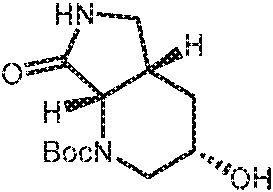
Intermedio N: (3S,4aS,7aS)-3-hidroxi-7-oxooctahidro-1H-pirrolo-[3,4-b]piridin-1-carboxilato de terc-butilo. A una solución del intermedio M (270 g, 948 mmol) en THF (13 l) contenida en un reactor de triple camisa de 20 l inertizado con nitrógeno (Amsi Glas) con un control de temperatura inertizado, Unistat 390 W, un condensador y una entrada de nitrógeno t -5 °C (temp. interna) se añadió ácido 4-nitrobenzoico (323 g, 1,90 mol) y trifenilfosfina (524 g, 1,90 mol). A la solución resultante se añadió gota a gota una solución de DIAD (359 ml, 1,85 mol) en THF (1,3 l), durante 30 min mientras se mantenía la temperatura interna a entre -4 y -10 °C. La mezcla se dejó calentar a ta y se agitó durante una noche, después se concentró al vacío (45 °C) para proporcionar un material en bruto (1,64 kg, húmedo) en forma de un aceite de color pardo. A una solución de residuo oleoso en MeOH (15 l) se añadió K2CO3 (393 g, 2,844 mol). Después de 1 h de agitación, la suspensión se concentró al vacío (40 °C), proporcionando un sólido de color naranja al que se añadió DCM (6 l). Después de 30 min, la suspensión se filtró, lavando con DCM, y el filtrado se concentró al vacío (45 °C). El residuo se suspendió en DCM:MeOH (97:3, 4 l) y se agitó durante 30 min a ta. La suspensión se filtró, lavando con DCM, y el filtrado se concentró al vacío (45 °C) hasta un volumen de 3 l y se purificó en dos porciones por cromatografía sobre gel de sílice, proporcionando el producto (189 g) en forma de un sólido. A este material disuelto en DCM:MeOH (95:5, 5 l) a 45 °C se añadió lentamente heptano (5 l). La solución se concentró parcialmente (45 °C), retirando un poco de DCM, causando que el producto cristalizara después de 15 min. Después de 1 h a ta, el sólido se recogió por filtración, se lavó con heptano y se secó al vacío (45 °C) hasta que se obtuvo un peso constante, proporcionando el compuesto del título (167,7 g) en forma de cristales. CLEM: Tr = 0,95 min, m/z = 257,3 (M+1), Método LCMS_ 2_MIN_POLAR. RMN 1H (600 MHz, DMSO-d6)* 87,80 (d, J = 20,2 Hz, 1H), 4,97 (t, J = 4,8 Hz, 1H), 4,57 (dd, J = 92,2, 7,0 Hz, 1H), 3,89 (ddd, J = 18,8, 9,3, 6,5 Hz, 1H), 3,33-3,23 (m, 1H), 2,75 (ddd, J = 9,7, 4,6, 2,0 Hz, 1H), 2,43 (ddt, J = 16,9, 11,8, 6,1 Hz, 1H), 2,08 (ddd, J = 86 ,6 , 12,5, 10,7 Hz, 1H), 1,94 (dd, J = 12,2, 5,5 Hz, 1H), 1,39 (d, J = 22,6 Hz, 9H), 1,04 (dc, J = 15,2, 12,0 Hz, 1H). *Indicado como rotámeros observados. Intermediate N: tert-butyl ( 3S, 4aS, 7aS) -3-hydroxy-7-oxooctahydro-1H-pyrrolo- [3,4-b] pyridine-1-carboxylate. To a solution of intermediate M (270 g, 948 mmol) in THF (13 L) contained in a 20 L triple jacket reactor inerted with nitrogen (Amsi Glas) with an inerted temperature control, Unistat 390 W, a condenser and a nitrogen inlet t -5 ° C (internal temp.) 4-nitrobenzoic acid (323 g, 1.90 mol) and triphenylphosphine (524 g, 1.90 mol) were added. To the resulting solution, a solution of DIAD (359 ml, 1.85 mol) in THF (1.3 L) was added dropwise over 30 min while maintaining the internal temperature between -4 and -10 ° C. The mixture was allowed to warm to rt and stir overnight, then concentrated in vacuo (45 ° C) to provide a crude material (1.64 kg, wet) as a brown oil. To a solution of oily residue in MeOH (15 L) was added K2CO3 (393 g, 2.844 mol). After 1 hr of stirring, the suspension was concentrated in vacuo (40 ° C) to provide an orange solid to which DCM (6 L) was added. After 30 min, the suspension was filtered, washing with DCM, and the filtrate was concentrated in vacuo (45 ° C). The residue was suspended in DCM: MeOH (97: 3, 4 L) and stirred for 30 min at rt. The suspension was filtered, washing with DCM, and the filtrate was concentrated in vacuo (45 ° C) to a volume of 3 L and purified in two portions by chromatography on silica gel to give the product (189 g) as a solid. To this material dissolved in DCM: MeOH (95: 5.5 L) at 45 ° C heptane (5 L) was slowly added. The solution was partially concentrated (45 ° C), removing a little DCM, causing the product to crystallize after 15 min. After 1 hr at rt, the solid was collected by filtration, washed with heptane and dried under vacuum (45 ° C) until a constant weight was obtained, yielding the title compound (167.7 g) as crystals. . LCMS: Tr = 0.95 min, m / z = 257.3 (M + 1), LCMS_ 2_MIN_POLAR method. 1H NMR (600 MHz, DMSO-d6) * 87.80 (d, J = 20.2 Hz, 1H), 4.97 (t, J = 4.8 Hz, 1H), 4.57 (dd, J = 92.2, 7.0 Hz, 1H), 3.89 (ddd, J = 18.8, 9.3, 6.5 Hz, 1H), 3.33-3.23 (m, 1H), 2.75 (ddd, J = 9.7, 4.6, 2.0 Hz, 1H), 2.43 (ddt, J = 16.9, 11.8, 6.1 Hz, 1H), 2, 08 (ddd, J = 86, 6, 12.5, 10.7 Hz, 1H), 1.94 (dd, J = 12.2, 5.5 Hz, 1H), 1.39 (d, J = 22.6 Hz, 9H), 1.04 (dc, J = 15.2, 12.0 Hz, 1H). * Indicated as observed rotamers.

Ejemplo 1. (4R,5aS,8aS)-2,8-Dioxohexahidro-2H-1,4-metanopirrolo[3,4-d][1,3]diazepin-3(4H)-il sulfato sódico. Example 1. ( 4R, 5aS, 8aS) -2,8-Dioxohexahydro-2H-1,4-methanopyrrolo [3,4-d] [1,3] diazepine-3 ( 4H) -yl sulfate sodium.

Etapa 1: (2S,3S,5R)-6-(Benciloxi)-3-(((terc-butoxicarbonil)amino)-metil)-7-oxo-1,6-diazabidclo[3.2.1]octano-2-carboxilato de metilo. El Intermedio C (0,82 g, 2,84 mmol), Boc-Gly-OH (1,00 g, 5,69 mmol) e Ir[df(CF3)ppy2(dtbpy)]PFa (32 mg, 0,028 mmol) se disolvieron en DMF (20 ml). A la solución se añadió fosfato potásico dibásico finamente molido (0,59 g, 3,41 mmol) y la suspensión resultante se irradió en una atmósfera de argón (globo) en un embudo de goteo de 500 ml (cerrado con un matraz de fondo redondo en la parte inferior y un septo en la superior) durante 7 días con un tubo de fluorescencia UVA de 8 W. El matraz se puso horizontalmente en la parte superior de la lámpara (refrigerada por aire) para asegurar una irradiación máxima. Después de 4 días, se añadió Ir[df(CF3)ppy2(dtbpy)]PF6 (32 mg, 0,028 mmol). Step 1: ( 2S, 3S, 5R) -6- ( Benzyloxy) -3- ((( tert-butoxycarbonyl) amino) -methyl) -7-oxo-1,6-diazabidclo [3.2.1] octane-2- methyl carboxylate. Intermediate C (0.82 g, 2.84 mmol), Boc-Gly-OH (1.00 g, 5.69 mmol) and Ir [df (CF3) ppy2 (dtbpy)] PFa (32 mg, 0.028 mmol ) were dissolved in DMF (20 ml). Finely ground dibasic potassium phosphate (0.59 g, 3.41 mmol) was added to the solution and the resulting suspension was irradiated under an argon atmosphere (balloon) in a 500 ml dropping funnel (closed with a bottom flask round at the bottom and a septum at the top) for 7 days with an 8W UVA fluorescence tube. The flask was placed horizontally on top of the lamp (air-cooled) to ensure maximum irradiation. After 4 days, Ir [df (CF3) ppy2 (dtbpy)] PF6 (32 mg, 0.028 mmol) was added.
A la mezcla se añadieron agua (100 ml), después NaHCO3 saturado (ac., 100 ml) y se extrajo con TBME (4 x 80 ml). Las fases orgánicas combinadas se lavaron secuencialmente con NaHCO3 saturado (ac., 50 ml), agua (50 ml), después salmuera (50 ml). La capa orgánica se secó sobre Na2SO4, se filtró y se concentró al vacío. El residuo en bruto se purificó por cromatografía sobre gel de sílice (EtOAc-heptano, 15-100 %) para proporcionar el compuesto del título (108 mg, 9 %) en forma de un aceite. CLEM: Tr = 1,04 min, Método 2m_acidic.Water (100 ml) was added to the mixture, then saturated NaHCO3 (aq, 100 ml) and extracted with TBME (4 x 80 ml). The combined organic phases were washed sequentially with saturated NaHCO3 (aq., 50 ml), water (50 ml), then brine (50 ml). The organic layer was dried over Na2SO4, filtered, and concentrated in vacuo. The crude residue was purified by silica gel chromatography (EtOAc-heptane, 15-100%) to provide the title compound (108 mg, 9%) as an oil. LCMS: Tr = 1.04 min, Method 2m_acidic.

Etapa 2: (4R,5aS,8aS)-3-(benciloxi)hexahidro-2H-1,4-metanopirrolo[3,4-d][1,3]diazepin-2,8(3H)-diona. A una solución de (2S,3S,5R)-6-(benciloxi)-3-(((terc-butoxicarbonil)amino)-metil)-7-oxo-1,6-diazabiciclo[3.2.1]octano-2-carboxilato de metilo (108 mg, 0,26 mmol) en DCM (3 ml) a ta se añadió gota a gota TFA (1,0 ml, 13 mmol). Se dejó en agitación a ta durante 3 h, tras lo cual se concentró al vacío. El residuo en bruto se disolvió en DCM (3 ml), se enfrió a 0 °C y se añadió trietilamina (0,31 ml, 2,3 mmol). Después de 1 h más, se añadieron trietilamina (0,11 ml, 0,75 mmol) y DCM (5 ml). El baño de hielo se retiró y la mezcla de reacción se agitó a ta durante una noche (o/n), tras lo cual se lavó con ácido cítrico (10 ml, aprox. 20 % ac.). La fase acuosa se extrajo con DCM (3 x 8 ml) y las fases orgánicas combinadas se lavaron con agua (5 ml) y salmuera (2 x 10 ml), se secaron sobre Na2SO4, se filtraron y se concentraron al vacío. El residuo en bruto se purificó por cromatografía sobre gel de sílice (DCM-MeOH, 2-7 %) para proporcionar el compuesto del título (47 mg, 61 %) en forma de un sólido de color beige. CLEM: Tr = 0,61 min, m/z = 288 (M+1), Método 2m_acidic. Step 2: ( 4R, 5aS, 8aS) -3- ( benzyloxy) hexahydro-2H-1,4-methanopyrrolo [3,4-d] [1,3] diazepine-2,8 ( 3H) -dione. To a solution of (2S, 3S, 5R) -6- (benzyloxy) -3 - (((tert-butoxycarbonyl) amino) -methyl) -7-oxo-1,6-diazabicyclo [3.2.1] octane-2 -methyl carboxylate (108 mg, 0.26 mmol) in DCM (3 ml) at rt was added TFA (1.0 ml, 13 mmol) dropwise. It was allowed to stir at rt for 3 h, after which it was concentrated in vacuo. The crude residue was dissolved in DCM (3 ml), cooled to 0 ° C and triethylamine (0.31 ml, 2.3 mmol) was added. After an additional 1 hr, triethylamine (0.11 ml, 0.75 mmol) and DCM (5 ml) were added. The ice bath was removed and the reaction mixture was stirred at rt overnight (o / n), after which it was washed with citric acid (10 mL, ca 20% aq). The aqueous phase was extracted with DCM (3 x 8 ml) and the combined organic phases were washed with water (5 ml) and brine (2 x 10 ml), dried over Na2SO4, filtered and concentrated in vacuo. The crude residue was purified by silica gel chromatography (DCM-MeOH, 2-7%) to provide the title compound (47 mg, 61%) as a beige solid. LCMS: Tr = 0.61 min, m / z = 288 (M + 1), 2m_acidic method.

Etapa 3: (4R,5aS,8aS)-3-hidroxihexahidro-2H-1,4-metanopirrolo[3,4-d][1,3]diazepin-2,8(3H)-diona. Una suspensión de (4R,5aS,8aS)-3-(benciloxi)hexahidro-2H-1,4-metanopirrolo[3,4-d][1,3]diazepin-2,8(3H)-diona (80 mg, 0,278 mmol) y Pd-C (10 %, tipo Degussa 101,50 % de agua, 34 mg) en MeOH (1,8 ml) se evacuó y se cargó de nuevo con H2 (3 x). Después de 2,5 h, se filtró a través de un lecho de Celite, se lavó con MeOH y se concentró al vacío, proporcionando el compuesto del título (40 mg, 74 %). CLEM: Tr = 0,13 min, m/z = 198,1 (M+1), Método 2m_acidic. Step 3: ( 4R, 5aS, 8aS) -3-hydroxyhexahydro-2H-1,4-methanopyrrolo [3,4-d] [1,3] diazepine-2,8 ( 3H) -dione. A suspension of (4R, 5aS, 8aS) -3- (benzyloxy) hexahydro-2H-1,4-methanopyrrolo [3,4-d] [1,3] diazepine-2,8 (3H) -dione (80 mg , 0.278 mmol) and Pd-C (10%, Degussa type 101.50% water, 34 mg) in MeOH (1.8 ml) was evacuated and recharged with H2 (3x). After 2.5 h, filtered through a pad of Celite, washed with MeOH and concentrated under vacuum to afford the title compound (40 mg, 74%). LCMS: Tr = 0.13 min, m / z = 198.1 (M + 1), 2m_acidic method.

Etapa 4: (4R,5aS,8aS)-2,8-Dioxohexahidro-2H-1,4-metanopirrolo[3,4-d][1,3]diazepin-3(4H)-il sulfato sódico. A una suspensión de (4R,5aS,8aS)-3-hidroxihexahidro-2H-1,4-metanopirrolo[3,4-d][1,3]diazepin-2,8(3H)-diona en bruto (40,7 mg, 0,206 mmol) en piridina (2 ml) a 0 °C se añadió complejo de SO3 py (335 mg, 2,064 mmol). Después de 19 h de agitación vigorosa, la suspensión se filtró y se concentró al vacío. El residuo en bruto se disolvió en THF:agua (1:1, 6 ml) y se añadió resina de intercambio de Na Amberlite 200 (1,5 g). La suspensión se agitó durante 2 h, tras lo cual se filtró, se concentró parcialmente al vacío, se congelaron y se liofilizaron. El sólido resultante se sometió a cromatografía sobre gel de sílice (agua-acetonitrilo, 2-5 %), proporcionando el compuesto del título (12,3 mg, 16 %, en 2 etapas) en forma de un sólido amorfo. CLEM: Tr = 0,25 min, m/z = 278,0 (M+1). Método T3_3m_polar; RMN 1H (500 MHz, D2O) 84,24-4,18 (m, 2H), 3,52 (dd, J = 10,7, 6,2 Hz, 1H), 3,33 (d, J = 12,3 Hz, 1H), 3,10 (d, J = 10,7 Hz, 1H), 2,95 (d, J = 12,3 Hz, 1H), 2,81 (p, J = 8,5 Hz, 1H), 2,54-2,46 (m, 1H), 1,65 (dd, J = 14,7, 9,2 Hz, 1H). Step 4: ( 4R, 5aS, 8aS) -2,8-Dioxohexahydro-2H-1,4-methanopyrrolo [3,4-d] [1,3] diazepin-3 ( 4H) -yl sodium sulfate. To a suspension of crude (4R, 5aS, 8aS) -3-hydroxyhexahydro-2H-1,4-methanopyrrolo [3,4-d] [1,3] diazepine-2,8 (3H) -dione (40, 7 mg, 0.206 mmol) in pyridine (2 ml) at 0 ° C was added SO3 py complex (335 mg, 2.064 mmol). After 19 h of vigorous stirring, the suspension was filtered and concentrated in vacuo. The crude residue was dissolved in THF: water (1: 1, 6 ml) and Amberlite 200 Na exchange resin (1.5 g) was added. The suspension was stirred for 2 h, after which it was filtered, partially concentrated in vacuo, frozen and lyophilized. The resulting solid was subjected to silica gel chromatography (water-acetonitrile, 2-5%) to provide the title compound (12.3 mg, 16%, in 2 steps) as an amorphous solid. LCMS: Tr = 0.25 min, m / z = 278.0 (M + 1). T3_3m_polar method; 1H NMR (500 MHz, D2O) 84.24-4.18 (m, 2H), 3.52 (dd, J = 10.7, 6.2 Hz, 1H), 3.33 (d, J = 12 , 3 Hz, 1H), 3.10 (d, J = 10.7 Hz, 1H), 2.95 (d, J = 12.3 Hz, 1H), 2.81 (p, J = 8.5 Hz, 1H), 2.54-2.46 (m, 1H), 1.65 (dd, J = 14.7, 9.2 Hz, 1H).
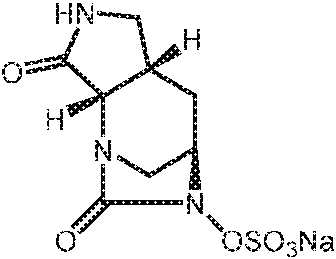
Ejemplo 1. Procedimiento alternativo. (4R,5aS,8aS)-2,8-Dioxohexahidro-2H-1,4-metanopirrolo[3,4-d][1,3]diazepin-3(4H)-il sulfato sódico. Example 1. Alternative procedure. ( 4R, 5aS, 8aS) -2,8-Dioxohexahydro-2H-1,4-methanopyrrolo [3,4-d] [1,3] diazepin-3 ( 4H) -yl sulfate sodium.

Etapa 1: 6-(Benciloxi)-3-(((terc-butoxicarbonil)amino)metil)-7-oxo-1,6-diazabiciclo[3.2.1]octano-2-carboxilato de (2S,3S,5R)-metilo. Una mezcla agitada del Intermedio C (3 g, 10,41 mmol), ácido 2-((terc-butoxicarbonil)amino)acético (2,55 g, 14,57 mmol), Ir[df(CF3)ppy]2(dtbpy)PF6 (0,117 g, 0,104 mmol) y fosfato potásico dibásico (2,72 g, 15,61 mmol) en DMF (30,6 ml) se desgasificó mediante un rociado con N2 durante 15 min y se irradió con un LED azul Kessil H150 (enfriamiento con ventilador), en una atmósfera de N2 durante 92 h. Se añadieron ácido 2-((terc-butoxicarbonil)amino)acético (2,55 g, 14,57 mmol), fosfato potásico dibásico (2,72 g, 15,61 mmol) e Ir[df(CF3)ppy2(dtbpy)PF6 (0,117 g, 0,104 mmol) y la mezcla se irradió con un LED azul Kessil H150 (enfriamiento con ventilador), en una atmósfera de N2 durante 20 h más. La mezcla se diluyó con NaHCO3 saturado (ac.) y se extrajo con EtOAc (3 x). Las capas orgánicas combinadas se lavaron con agua y salmuera, se secaron sobre Na2SO4, se filtraron y se concentraron a presión reducida. El material en bruto se purificó por cromatografía sobre gel de sílice (EtOAc-Heptanos, 0-100 %) para proporcionar el compuesto del título (352 mg, 8 %) en forma de una espuma de color amarillo. CL/EM: Tr = 0,87 min; m/z = 420,2 (M+1). Método 2m_acidic; RMN 1H (500 MHz, DMSO-d6) 87,46-7,42 (m, 2H), 7,42-7,34 (m, 3H), 6,84 (s a, 1H), 4,93 (d, J = 4,3 Hz, 2H), 3,88 (d, J = 6,7 Hz, 1H), 3,76 (s a, 1H), 3,66-3,65 (m, 3H), 3,21 (d, J = 12,0 Hz, 1H), 3,12-3,03 (m, 1H), 2,86-2,78 (m, 2H), 2,14 (s a, 1H), 2,00-1,93 (m, 1H), 1,51 (t, J = 12,3 Hz, 1H), 1,34 (s, 9H) Step 1: 6- ( Benzyloxy) -3- ((( tert-butoxycarbonyl) amino) methyl) -7-oxo-1,6-diazabicyclo [3.2.1] octane-2-carboxylate of ( 2S, 3S, 5R) -methyl. A stirred mixture of Intermediate C (3 g, 10.41 mmol), 2 - ((tert-butoxycarbonyl) amino) acetic acid (2.55 g, 14.57 mmol), Ir [df (CF3) ppy] 2 ( dtbpy) PF6 (0.117 g, 0.104 mmol) and dibasic potassium phosphate (2.72 g, 15.61 mmol) in DMF (30.6 mL) was degassed by sparging with N2 for 15 min and irradiated with a blue LED Kessil H150 (fan cooling), in a N2 atmosphere for 92 h. 2- (( tert- butoxycarbonyl) amino) acetic acid (2.55 g, 14.57 mmol), dibasic potassium phosphate (2.72 g, 15.61 mmol) and Ir [df (CF3) ppy2 (dtbpy) were added ) PF6 (0.117 g, 0.104 mmol) and the mixture was irradiated with a Kessil H150 blue LED (fan cooling), under N2 atmosphere for a further 20 h. The mixture was diluted with saturated NaHCO3 (aq.) And extracted with EtOAc (3x). The combined organic layers were washed with water and brine, dried over Na2SO4, filtered, and concentrated under reduced pressure. The crude material was purified by silica gel chromatography (EtOAc-Heptanes, 0-100%) to provide the title compound (352 mg, 8%) as a yellow foam. LC / MS: Tr = 0.87 min; m / z = 420.2 (M + 1). 2m_acidic method; 1H NMR (500 MHz, DMSO-d6) 87.46-7.42 (m, 2H), 7.42-7.34 (m, 3H), 6.84 (bs, 1H), 4.93 (d , J = 4.3 Hz, 2H), 3.88 (d, J = 6.7 Hz, 1H), 3.76 (bs, 1H), 3.66-3.65 (m, 3H), 3 , 21 (d, J = 12.0 Hz, 1H), 3.12-3.03 (m, 1H), 2.86-2.78 (m, 2H), 2.14 (bs, 1H), 2.00-1.93 (m, 1H), 1.51 (t, J = 12.3 Hz, 1H), 1.34 (s, 9H)

Etapa 2: (4R,5aS,8aS)-3-(benciloxi)hexahidro-2H-1,4-metanopirrolo[3,4-d][1,3]diazepin-2,8(8aH)-diona. A una solución de 6-(benciloxi)-3-(((terc-butoxicarbonil)amino)metil)-7-oxo-1,6-diazabiciclo[3.2.1]octano-2-carboxilato de (2S,3S,5R)-metilo (352 mg, 0,839 mmol) en DCM (4,19 ml) se añadió gota a gota TFA (1,61 ml, 20,98 mmol). Después de 90 min, se concentró al vacío, se disolvió en DCM y se concentró de nuevo (3 x). Al residuo, disuelto en DCM (5 ml) a 0 °C, se añadió TEA (1,17 ml, 8,39 mmol), después de lo cual se retiró el baño de refrigeración. Después de 20 h a ta, la mezcla se diluyó con NaHCO3 saturado (ac.) y se extrajo con EtOAc (3 x). Las capas orgánicas combinadas se lavaron con agua y salmuera, se secaron sobre Na2SO4, se filtraron y se concentraron al vacío. El material en bruto se purificó por cromatografía sobre gel de sílice (MeOH-DCM, 0-20 %), proporcionando el compuesto del título (158 mg, 66 %, 2 etapas) en forma de una película transparente. CL/EM: Tr = 0,65 min; m/z = 288,0 (M+1). Método 2m_acidic; RMN 1H (400 MHz, DMSO-d6) 87,99 (s, 1H), 7,48-7,33 (m, 5H), 4,99-4,88 (m, 2H), 3,81 (d, J = 7,8 Hz, 1H), 3,59 (s a, 1H), 3,32-3,22 (m, 1H), 2,89 (d a, J = 11,9 Hz, 1H), 2,75 (d, J = 9,8 Hz, 1H), 2,63 (d, J = 11,9 Hz, 1H), 2,26-2,17 (m, 1H), 1,38 (ddd, J = 14,3, 9,2, 1,9 Hz, 1H) Step 2: ( 4R, 5aS, 8aS) -3- ( benzyloxy) hexahydro-2H-1,4-methanopyrrolo [3,4-d] [1,3] diazepine-2,8 ( 8aH) -dione. To a solution of 6- (benzyloxy) -3 - (((tert-butoxycarbonyl) amino) methyl) -7-oxo-1,6-diazabicyclo [3.2.1] octane-2-carboxylate of (2S, 3S, 5R ) -methyl (352 mg, 0.839 mmol) in DCM (4.19 ml) TFA (1.61 ml, 20.98 mmol) was added dropwise. After 90 min, it was concentrated in vacuo, dissolved in DCM, and concentrated again (3x). To the residue, dissolved in DCM (5 ml) at 0 ° C, TEA (1.17 ml, 8.39 mmol) was added, after which the cooling bath was removed. After 20 h at rt, the mixture was diluted with saturated NaHCO3 (aq) and extracted with EtOAc (3x). The combined organic layers were washed with water and brine, dried over Na2SO4, filtered, and concentrated in vacuo. The crude material was purified by silica gel chromatography (MeOH-DCM, 0-20%) to provide the title compound (158 mg, 66%, 2 steps) as a clear film. LC / MS: Tr = 0.65 min; m / z = 288.0 (M + 1). 2m_acidic method; 1H NMR (400MHz, DMSO-d6) 87.99 (s, 1H), 7.48-7.33 (m, 5H), 4.99-4.88 (m, 2H), 3.81 (d , J = 7.8 Hz, 1H), 3.59 (bs, 1H), 3.32-3.22 (m, 1H), 2.89 (da, J = 11.9 Hz, 1H), 2 , 75 (d, J = 9.8 Hz, 1H), 2.63 (d, J = 11.9 Hz, 1H), 2.26-2.17 (m, 1H), 1.38 (ddd, J = 14.3, 9.2, 1.9 Hz, 1H)

Etapa 3: (4R,5aS,8aS)-3-hidroxihexahidro-2H-1,4-metanopirrolo[3,4-d][1,3]diazepin-2,8(8aH)-diona. Una suspensión de (4R,5aS,8aS)-3-(benciloxi)hexahidro-2H-1,4-metanopirrolo[3,4-d][1,3]diazepin-2,8(8aH)-diona (158 mg, 0,550 mmol) y Pd-C (10 %, tipo Degussa 101, 50 % de agua, 117 mg, 0,055 mmol) en MeOH:DCM (3:1, 3,67 ml) se evacuó y se cargó de nuevo con H2. Después de 2 h, la mezcla se filtró a través de celite y se concentró al vacío (temp. del baño < 30 °C) para proporcionar el compuesto del título (102 mg, 94 %) en forma de un sólido de color blanquecino. CL/EM: Tr = 0,12 min; m/z = 198,0 (M+1). Método 2m_acidic. Step 3: ( 4R, 5aS, 8aS) -3-hydroxyhexahydro-2H-1,4-methanopyrrolo [3,4-d] [1,3] diazepine-2,8 ( 8aH) -dione. A suspension of (4R, 5aS, 8aS) -3- (benzyloxy) hexahydro-2H-1,4-methanopyrrolo [3,4-d] [1,3] diazepine-2,8 (8aH) -dione (158 mg , 0.550 mmol) and Pd-C (10%, Degussa 101 type, 50% water, 117 mg, 0.055 mmol) in MeOH: DCM (3: 1, 3.67 ml) was evacuated and recharged with H2 . After 2 h, the mixture was filtered through celite and concentrated in vacuo (bath temp <30 ° C) to provide the title compound (102 mg, 94%) as an off-white solid. LC / MS: Tr = 0.12 min; m / z = 198.0 (M + 1). 2m_acidic method.

Etapa 4: (4R,5aS,8aS)-2,8-Dioxohexahidro-2H-1,4-metanopirrolo[3,4-d][1,3]diazepin-3(4H)-il sulfato de tetrabutilamonio. A una solución de (4R,5aS,8aS)-3-hidroxihexahidro-2H-1,4-metanopirrolo[3,4-d][1,3]diazepin-2,8(8aH)-diona en bruto (102 mg, 0,517 mmol) en Piridina (5,17 ml) se añadió SO3-Py (412 mg, 2,59 mmol). Después de 19 h de agitación vigorosa, la mezcla se filtró y se concentró al vacío (temp. del baño < 30 °C). El material resultante se se disolvió en NaH2PO4 (1 M, 10 ml), tras lo cual se añadió hidrogenosulfato de tetrabutilamonio (263 mg, 0,776 mmol). Después de 30 min de agitación, se extrajo con IPA:CHCl3 (1:4, 3x). Las capas orgánicas combinadas se secaron sobre Na2SO4, se filtraron y se concentraron al vacío (temp. del baño < 30 °C). El residuo en bruto se purificó por cromatografía sobre gel de sílice (MeOH-DCM, 0-30 %) para proporcionar el compuesto del título (180 mg, 67 %) en forma de una espuma de color blanco. CL/EM: Tr = 0,13 min; m/z = 278 (M+1). Método 2m_acidic; RMN 1H (500 MHz, DMSO-d6) 67,97 (s, 1H), 3,98 (s a, 1H), 3,81 (d, J = 7,8 Hz, 1H), 3,28 (dd, J = 6,1, 9,9 Hz, 1H), 3,19 -3,13 (m, 8H), 2,98 (d a, J = 12,1 Hz, 1H), 2,78 (d, J = 9,9 Hz, 1H), 2,65 (d, J = 12,1 Hz, 1H), 2,49-2,44 (m, 1H), 2,28-2,19 (m, 1H), 1,63-1,51 (m, 8H), 1,40 (dd a, J = 9,3, 12,7 Hz, 1H), 1,31 (sext., J = 7,4 Hz, 8H), 0,93 (t, J = 7,3 Hz, 12H) Step 4: ( 4R, 5aS, 8aS) -2,8-Dioxohexahydro-2H-1,4-methanopyrrolo [3,4-d] [1,3] diazepin-3 ( 4H) -yl tetrabutylammonium sulfate. To a solution of crude (4R, 5aS, 8aS) -3-hydroxyhexahydro-2H-1,4-methanopyrrolo [3,4-d] [1,3] diazepine-2,8 (8aH) -dione (102 mg , 0.517 mmol) in Pyridine (5.17 ml) was added SO3-Py (412 mg, 2.59 mmol). After 19 h of vigorous stirring, the mixture was filtered and concentrated in vacuo (bath temp. <30 ° C). The resulting material was dissolved in NaH2PO4 (1 M, 10 mL), after which tetrabutylammonium hydrogen sulfate (263 mg, 0.776 mmol) was added. After 30 min of stirring, it was extracted with IPA: CHCl3 (1: 4, 3x). The combined organic layers were dried over Na2SO4, filtered, and concentrated in vacuo (bath temp <30 ° C). The crude residue was purified by silica gel chromatography (MeOH-DCM, 0-30%) to provide the title compound (180 mg, 67%) as a white foam. LC / MS: Tr = 0.13 min; m / z = 278 (M + 1). 2m_acidic method; 1H NMR (500 MHz, DMSO-d6) 67.97 (s, 1H), 3.98 (bs, 1H), 3.81 (d, J = 7.8 Hz, 1H), 3.28 (dd, J = 6.1, 9.9 Hz, 1H), 3.19 -3.13 (m, 8H), 2.98 (da, J = 12.1 Hz, 1H), 2.78 (d, J = 9.9 Hz, 1H), 2.65 (d, J = 12.1 Hz, 1H), 2.49-2.44 (m, 1H), 2.28-2.19 (m, 1H) , 1.63-1.51 (m, 8H), 1.40 (dd a, J = 9.3, 12.7 Hz, 1H), 1.31 (sext., J = 7.4 Hz, 8H ), 0.93 (t, J = 7.3 Hz, 12H)

Etapa 5: (4R,5aS,8aS)-2,8-Dioxohexahidro-2H-1,4-metanopirrolo[3,4-d][1,3]diazepin-3(4H)-ilsulfato sódico. Una DOWEX 50Wx8, forma de hidrógeno, malla 200-400, se acondicionó agitando con NaOH (2 N) durante 3 h. La resina se cargó sobre una columna y se lavó con agua hasta que el pH fue ~6. Después, se lavó con 1:1 de agua/acetona. Se disolvió (4R,5aS,8aS)-2,8-dioxohexahidro-2H-1,4-metanopirrolo[3,4-d][1,3]diazepin-3(4H)-il sulfato de tetrabutilamonio (180 mg, 0,347 mmol) en 1:1 de acetona/agua y se eluyó a través de la resina con 1:1 de acetona/agua. La muestra se concentró parcialmente al vacío (temp. del baño < 30 °C) y se liofilizó para proporcionar el compuesto del título (75 mg, 68 %) en forma de un sólido de color blanco. CL/EM: Tr = 0,25 min; m/z = 278,0 (M+1). Método T3_3m_polar; RMN 1H (500 MHz, D2O) 6 4,24-4,18 (m, 2H), 3,51 (dd, J = 10,7, 6,2 Hz, 1H), 3,33 (d a, J = 12,3 Hz, 1H), 3,10 (d, J = 10,7 Hz, 1H), 2,95 (d, J = 12,3 Hz, 1H), 2,81 (p, J = 8,1 Hz, 1H), 2,54-2,46 (m, 1H), 1,65 (dd, J = 14,7, 9,2 Hz, 1H). Step 5: ( 4R, 5aS, 8aS) -2,8-Dioxohexahydro-2H-1,4-methanopyrrolo [3,4-d] [1,3] diazepine-3 ( 4H) -ylsulfate sodium. A DOWEX 50Wx8, hydrogen form, 200-400 mesh, was conditioned by stirring with NaOH (2N) for 3 h. The resin was loaded onto a column and washed with water until the pH was ~ 6. Then it was washed with 1: 1 water / acetone. (4R, 5aS, 8aS) -2,8-dioxohexahydro-2H-1,4-methanopyrrolo [3,4-d] [1,3] diazepin-3 (4H) -yl tetrabutylammonium sulfate (180 mg, 0.347 mmol) in 1: 1 acetone / water and eluted through the resin with 1: 1 acetone / water. The sample was partially concentrated in vacuo (bath temp <30 ° C) and lyophilized to provide the title compound (75 mg, 68%) as a white solid. LC / MS: Tr = 0.25 min; m / z = 278.0 (M + 1). T3_3m_polar method; 1H NMR (500 MHz, D2O) 6 4.24-4.18 (m, 2H), 3.51 (dd, J = 10.7, 6.2 Hz, 1H), 3.33 (da, J = 12.3 Hz, 1H), 3.10 (d, J = 10.7 Hz, 1H), 2.95 (d, J = 12.3 Hz, 1H), 2.81 (p, J = 8, 1Hz, 1H), 2.54-2.46 (m, 1H), 1.65 (dd, J = 14.7, 9.2Hz, 1H).
Procedimiento alternativo de la Etapa 5: Hidrogenosulfato de (4R,5aS,8aS)-2,8-dioxohexahidro-2H-1,4-metanopirrolo[3,4-d][1,3]diazepin-3(4H)-ilo. A una solución de (4R,5aS,8aS)-2,8-dioxohexahidro-2H-1,4-metanopirrolo[3,4-d][1,3]diazepin-3(4H)-ilsulfato de tetrabutilamonio (6,9 g, 13,30 mmol) en isobutanol (20,8 ml) y agua (1,35 ml) a 40 °C se añadió una solución de 2-etilhexanoato sódico (4,56 g, 26,6 mmol) en isobutanol (20,8 ml) y agua (1,35 ml) mediante una bomba de jeringa a 8 ml/h. La mezcla se agitó durante 1 h a 40 °C, después se enfrió a ta y se agitó durante una noche, tras lo cual se filtró con un embudo Buchner usando un papel de filtro cualitativo Whatman. La torta de filtro se lavó con isobutanol (3 x) y después acetona enfriada con hielo (3 x). Se aplicó vacío al embudo con una corriente de N2 sobre la torta de filtro durante 3 h, seguido de liofilización durante 3 días, lo que proporcionó el compuesto del título (3,05 g, 73%) en forma de un sólido cristalino de color blanco. CL/EM: Tr = 0,25 min; m/z = 278,0 (M+1), Método T3_3m_polar. Alternative procedure from Step 5: ( 4R, 5aS, 8aS) -2,8-dioxohexahydro-2H-1,4-methanopyrrolo [3,4-d] [1,3] diazepin-3 ( 4H) -yl hydrogen sulfate . To a solution of (4R, 5aS, 8aS) -2,8-dioxohexahydro-2H-1,4-methanopyrrolo [3,4-d] [1,3] diazepin-3 (4H) -ylsulfate of tetrabutylammonium (6, 9 g, 13.30 mmol) in isobutanol (20.8 ml) and water (1.35 ml) at 40 ° C a solution of sodium 2-ethylhexanoate (4.56 g, 26.6 mmol) in isobutanol was added (20.8 ml) and water (1.35 ml) via a syringe pump at 8 ml / hr. The mixture was stirred for 1 h at 40 ° C, then cooled to rt and stirred overnight, after which it was filtered with a Buchner funnel using Whatman qualitative filter paper. The filter cake was washed with isobutanol (3x) and then ice cold acetone (3x). Vacuum was applied to the funnel with a stream of N2 on the filter cake for 3 h, followed by lyophilization for 3 days, which provided the title compound (3.05 g, 73%) as a colored crystalline solid. White. LC / MS: Tr = 0.25 min; m / z = 278.0 (M + 1), Method T3_3m_polar.
RMN 1H (500 MHz, D2O) 6 =4,20 - 4,12 (m, 2H), 3,48 (dd, J = 6,2, 10,7 Hz, 1H), 3,33 - 3,25 (m, 1H), 3,05 (d, J = 10,7 Hz, 1H), 2,90 (d, J = 12,2 Hz, 1H), 2,82 -2,71 (m, 1H), 2,46 (tdd, J = 2,8, 8,7, 14,7 Hz, 1H), 1,66 - 1,56 (m, 1H) 1H NMR (500 MHz, D2O) 6 = 4.20 - 4.12 (m, 2H), 3.48 (dd, J = 6.2, 10.7 Hz, 1H), 3.33 - 3.25 (m, 1H), 3.05 (d, J = 10.7 Hz, 1H), 2.90 (d, J = 12.2 Hz, 1H), 2.82-2.71 (m, 1H), 2.46 (tdd, J = 2.8, 8 , 7.14.7 Hz, 1H), 1.66-1.56 (m, 1H)
El espectro de difracción de polvo de rayos X para la sal de sodio se muestra en la Figura 1.The X-ray powder diffraction spectrum for the sodium salt is shown in Figure 1.
Instrumento: Difractómetro de rayos X (Bruker, modelo D8)Instrument: X-ray diffractometer (Bruker, model D8)
Fuente - Cu k a, ancho de Etapa 0,02°Source - Cu k a, Stage width 0.02 °
Voltaje 40 kVVoltage 40 kV
Corriente 40 mACurrent 40 mA
Tiempo por etapa 120 segundosTime per stage 120 seconds
Intervalo de exploración de 3 a 39°3 to 39 ° scan range
Pico 2theta2theta peak
1 8,31 (± 0,2)1 8.31 (± 0.2)
2 11,66 ( ± 0 ,2) 2 11.66 (± 0, 2)
3 14,45| (± 0,2)3 14.45 | (± 0.2)
4 16,63 (± 0,2)4 16.63 (± 0.2)
5 17,64 (±0,2)5 17.64 (± 0.2)
6 18,12 (± 0,2 )6 18.12 (± 0.2)
7 18,64 (±0,2)7 18.64 (± 0.2)
8 19,51 (±0,2)8 19.51 (± 0.2)
9 21,68 (±0,2)9 21.68 (± 0.2)
10 23,54 (±0,2)10 23.54 (± 0.2)
11 24,32 (±0,2)11 24.32 (± 0.2)
12 25,06 (±0,2)12 25.06 (± 0.2)
13 27,37 (±0,2)13 27.37 (± 0.2)
14 27,86 (±0,2)14 27.86 (± 0.2)
15 28,72 (±0,2)15 28.72 (± 0.2)
16 31,33 (±0,2)16 31.33 (± 0.2)
17 32,60 (±0,2)17 32.60 (± 0.2)
18 33,58 (±0,2)18 33.58 (± 0.2)
19 34,43 (±0,2)19 34.43 (± 0.2)
20 35,40 (± 0,2)20 35.40 (± 0.2)
21 38,17 (±0,2)21 38.17 (± 0.2)

Ejemplo 2. (4R,5aS,8aS)-7-Metil-2,8-dioxohexahidro-2H-1,4-metanopirrolo[3,4-d][1,3]diazepin-3(4H)-ilsulfato sódico. Example 2. Sodium ( 4R, 5aS, 8aS) -7-Methyl-2,8-dioxohexahydro-2H-1,4-methanopyrrolo [3,4-d] [1,3] diazepine-3 ( 4H) -ylsulfate.

Etapa 1: 6-(Bendloxi)-3-(((terc-butoxicarbonil)(metil)amino)metil)-7-oxo-1,6-diazabiddo[3.2.1]octano-2-carboxilato de (2S,3S,5R)-metilo. Una mezcla agitada del Intermedio C (3 g, 10,41 mmol), ácido 2-((terc-butoxicarbonil)(metil)amino)acético (2,56 g, 13,53 mmol), Ir[df(CF3)ppy2(dtbpy)PF6 (0,117 g, 0,104 mmol) y fosfato potásico dibásico (2,175 g, 12,49 mmol) en DMF (30 ml) se desgasificó burbujeando N2 a través de la suspensión durante 15 min y después se dejó en una línea de N2 y se irradió con un LED azul Kessil H150 (enfriamiento con ventilador) durante 48 h. La reacción se diluyó con NaHCO3 saturado y se extrajo con EtOAc (3 x). Las capas orgánicas combinadas se lavaron con agua y salmuera, se secaron sobre Na2SO4, se filtraron y se concentraron al vacío. El material en bruto se purificó por cromatografía sobre gel de sílice (EtOAc-Heptanos, 0-100 %) para proporcionar una espuma de color naranja (233 mg). Este material se purificó de nuevo por cromatografía sobre gel de sílice (EtOAc-Heptanos, 0-70 %), proporcionando el compuesto del título (140 mg, 3 %) en forma de un sólido de color amarillo. CL/EM: Tr = 0,92 min; m/z = 434,1 (M+1). Método 2m_acidic; RMN 1H (500 MHz, DMSO-da) 87,46-7,42 (m, 2H), 7,41 7,33 (m, 3H), 4,98-4,91 (m, 2H), 3,88-3,81 (m, 1H), 3,78 (s a, 1H), 3,68 (s a, 3H), 3,26-3,03 (m, 2H), 2,84 (d a, J = 11,6 Hz, 1H), 2,67 (s, 3H), 1,97-1,88 (m, 1H), 1,62 (t a, J = 12,6 Hz, 1H), 1,34 (s a, 9H) Step 1: 6- ( Bendloxy) -3- ((( tert-butoxycarbonyl) ( methyl) amino) methyl) -7-oxo-1,6-diazabiddo [3.2.1] octane-2-carboxylate of ( 2S, 3S , 5R) -methyl. A stirred mixture of Intermediate C (3 g, 10.41 mmol), 2- (( tert- butoxycarbonyl) (methyl) amino) acetic acid (2.56 g, 13.53 mmol), Ir [df (CF3) ppy2 (dtbpy) PF6 (0.117 g, 0.104 mmol) and dibasic potassium phosphate (2.175 g, 12.49 mmol) in DMF (30 mL) was degassed by bubbling N2 through the suspension for 15 min and then left in a line of N2 and irradiated with a Kessil H150 blue LED (fan cooling) for 48 h. The reaction was diluted with saturated NaHCO3 and extracted with EtOAc (3x). The combined organic layers were washed with water and brine, dried over Na2SO4, filtered, and concentrated in vacuo. The Crude material was purified by silica gel chromatography (EtOAc-Heptanes, 0-100%) to provide an orange foam (233 mg). This material was purified again by silica gel chromatography (EtOAc-Heptanes, 0-70%) to provide the title compound (140 mg, 3%) as a yellow solid. LC / MS: Tr = 0.92 min; m / z = 434.1 (M + 1). 2m_acidic method; 1 H NMR (500 MHz, DMSO-da) 87.46-7.42 (m, 2H), 7.41 7.33 (m, 3H), 4.98-4.91 (m, 2H), 3, 88-3.81 (m, 1H), 3.78 (brs, 1H), 3.68 (brs, 3H), 3.26-3.03 (m, 2H), 2.84 (da, J = 11.6 Hz, 1H), 2.67 (s, 3H), 1.97-1.88 (m, 1H), 1.62 (rt, J = 12.6 Hz, 1H), 1.34 ( sa, 9H)

Etapa 2: 6-(Bendloxi)-3-((metilamino)metil)-7-oxo-1,6-diazabiddo[3.2.1]octano-2-carboxilato de (2S,3S,5R)-metilo. A una solución agitada de 6-(benciloxi)-3-(((terc-butoxicarbonil)(metil)amino)metil)-7-oxo-1,6-diazabiciclo[3.2.1]octano-2-carboxilato de (2S,3S,5R)-metilo (140 mg, 0,323 mmol) en DCM (1,6 ml), se añadió gota a gota TFA (0,622 ml, 8,07 mmol) a ta en una atmósfera de N2. La reacción se agitó a ta durante 90 min y después se concentró y se coevaporó con DCM (3 x). El residuo se disolvió en DCM (2 ml) y se enfrió a 0 °C. Se añadió TEA (0,450 ml, 3,23 mmol), el baño de refrigeración se retiró y la reacción se agitó a ta durante 90 min. La reacción se diluyó con NaHCO3 saturado y se extrajo con EtOAc (3 x). Las capas orgánicas combinadas se lavaron con agua y salmuera, se secaron sobre Na2SO4, se filtraron y se concentraron al vacío. El material en bruto se purificó por cromatografía sobre gel de sílice (MeOH-DCM, 0-20 %) para proporcionar el compuesto del título (86 mg, 88 %) en forma de una película transparente. CL/EM: Tr= 0,46 min; m/z = 301,9 (M+1). Método 2m_acidic; RMN 1H (400 MHz, DMSO-d6) 87,50-7,32 (m, 5H), 5,03-4,86 (m, 2H), 3,86 (d, J = 7,9 Hz, 1H), 3,60 (s a, 1H), 3,39-3,34 (m, 1H), 2,93-2,83 (m, 2H), 2,76 (s, 3H), 2,57 (d, J = 11,9 Hz, 1H), 2,49-2,42 (m, 1H), 2,32-2,18 (m, 1H), 1,38 (ddd, J = 14,3, 9,0, 1,9 Hz, 1H) Step 2: ( 2S, 3S, 5R) -methyl 6- ( Bendloxy) -3- (( methylamino) methyl) -7-oxo-1,6-diazabiddo [3.2.1] octane-2-carboxylate . To a stirred solution of 6- (benzyloxy) -3 - (((tert-butoxycarbonyl) (methyl) amino) methyl) -7-oxo-1,6-diazabicyclo [3.2.1] octane-2-carboxylate of (2S , 3S, 5R) -methyl (140mg, 0.323mmol) in DCM (1.6ml), TFA (0.622ml, 8.07mmol) was added dropwise at rt under N2. The reaction was stirred at rt for 90 min and then concentrated and coevaporated with DCM (3x). The residue was dissolved in DCM (2 ml) and cooled to 0 ° C. TEA (0.450 mL, 3.23 mmol) was added, the cooling bath was removed, and the reaction was stirred at rt for 90 min. The reaction was diluted with saturated NaHCO3 and extracted with EtOAc (3x). The combined organic layers were washed with water and brine, dried over Na2SO4, filtered, and concentrated in vacuo. The crude material was purified by silica gel chromatography (MeOH-DCM, 0-20%) to provide the title compound (86 mg, 88%) as a clear film. LC / MS: Tr = 0.46 min; m / z = 301.9 (M + 1). 2m_acidic method; 1H NMR (400 MHz, DMSO-d6) 87.50-7.32 (m, 5H), 5.03-4.86 (m, 2H), 3.86 (d, J = 7.9 Hz, 1H ), 3.60 (bs, 1H), 3.39-3.34 (m, 1H), 2.93-2.83 (m, 2H), 2.76 (s, 3H), 2.57 ( d, J = 11.9 Hz, 1H), 2.49-2.42 (m, 1H), 2.32-2.18 (m, 1H), 1.38 (ddd, J = 14.3, 9.0, 1.9 Hz, 1H)

Etapa 3: (4R,5aS,8aS)-3-hidroxi-7-metilhexahidro-2H-1,4-metanopirrolo[3,4-d][1,3]diazepin-2,8(8aH)-diona. Se disolvió 6-(benciloxi)-3-((metilamino)metil)-7-oxo-1,6-diazabiciclo[3.2.1]octano-2-carboxilato de (2S,3S,5R)-metilo (143 mg, 0,475 mmol) en metanol (2,4 ml) y se añadió Pd-C (10%, tipo Degussa 101, 50% de agua, 101 mg, 0,047 mmol). La mezcla se evacuó al vacío y se cargó de nuevo con H2. Después de 1 h de agitación, la mezcla se filtró a través de celite y se concentró al vacío (temp. del baño < 30 °C) para proporcionar el compuesto del título (63 mg, 63 %) en forma de un sólido de color blanco. CL/EM: Tr = 0,11 min; m/z = 211,9 (M+1), Método 2m_acidic. Step 3: ( 4R, 5aS, 8aS) -3-hydroxy-7-methylhexahydro-2H-1,4-methanopyrrolo [3,4-d] [1,3] diazepine-2,8 ( 8aH) -dione. (2S, 3S, 5R) -methyl 6- (benzyloxy) -3 - ((methylamino) methyl) -7-oxo-1,6-diazabicyclo [3.2.1] octane-2-carboxylate (143 mg, 0.475 mmol) in methanol (2.4 ml) and Pd-C (10%, Degussa 101 type, 50% water, 101 mg, 0.047 mmol) was added. The mixture was evacuated in vacuo and recharged with H2. After 1 hr of stirring, the mixture was filtered through celite and concentrated in vacuo (bath temp <30 ° C) to provide the title compound (63 mg, 63%) as a colored solid White. LC / MS: Tr = 0.11 min; m / z = 211.9 (M + 1), Method 2m_acidic.

Etapa 4: (4R,5aS,8aS)-7-Metil-2,8-dioxohexahidro-2H-1,4-metanopirrolo[3,4-d][1,3]diazepin-3(4H)-ilsulfato de tetrabutilamonio. Se disolvió (4R,5aS,8aS)-3-hidroxi-7-metilhexahidro-2H-1,4-metanopirrolo[3,4-d][1,3]diazepin-2 ,8(8aH)-diona (63 mg, 0,298 mmol) en piridina (2,9 ml) y se añadió SOapiridina (237 mg, 1,49 mmol). La reacción se agitó a ta durante 20 h. La reacción se filtró a través de un filtro de plástico desechable y se concentró a presión reducida (temp. del baño < 30 °C). Este material se se disolvió en NaH2PO4 (1 M, 10 ml) y se añadió hidrogenosulfato de tetrabutilamonio (152 mg, 0,447 mmol). Después de agitar durante 30 min a ta, se extrajo con EtOAc (4x). Las capas orgánicas combinadas se lavaron con salmuera, se secaron sobre Na2SO4, se filtraron y se concentraron al vacío. El material acuoso se extrajo adicionalmente con IPA al 20 % en CHCh (2 x), se secó sobre sulfato sódico y se concentró al vacío (temp. del baño < 30 °C). El material orgánico combinado se purificó por cromatografía sobre gel de sílice (MeOH-DCM, 0-30%) para proporcionar el compuesto del título (62 mg, 39% ) en forma de una película transparente. CL/EM: Tr = 0,13 min; m/z = 291,9 (M+1). Método 2m_acidic; RMN 1H (400 MHz, CDCla) 8 = 4,34 (s a, 1H), 4,04 (d a, J = 7,3 Hz, 1H), 3,44 (dd, J = 10,0, 5,6 Hz, 1H), 3,34 (d a, J = 2,6 Hz, 1H), 3,28 (dd a, J = 10,3 Hz, 5,1 Hz, 8H), 2,97-2,91 (m, 4H), 2,80 (d, J = 12,0 Hz, 1H), 2,75-2,61 (m, 2H), 1,74-1,60 (m, 9H), 1,44 (sext., J = 7,4 Hz, 8H), 1,00 (t, J = 7,3 Hz, 12H). Step 4: ( 4R, 5aS, 8aS) -7-Methyl-2,8-dioxohexahydro-2H-1,4-methanopyrrolo [3,4-d] [1,3] diazepine-3 ( 4H) -ylsulfate tetrabutylammonium . (4R, 5aS, 8aS) -3-hydroxy-7-methylhexahydro-2H-1,4-methanopyrrolo [3,4-d] [1,3] diazepin-2,8 (8aH) -dione (63 mg 0.298 mmol) in pyridine (2.9 ml) and SOapyridine (237 mg, 1.49 mmol) was added. The reaction was stirred at rt for 20 h. The reaction was filtered through a disposable plastic filter and concentrated under reduced pressure (bath temp. <30 ° C). This material was dissolved in NaH2PO4 (1M, 10 mL) and tetrabutylammonium hydrogen sulfate (152 mg, 0.447 mmol) was added. After stirring for 30 min at rt, it was extracted with EtOAc (4x). The combined organic layers were washed with brine, dried over Na2SO4, filtered, and concentrated in vacuo. The aqueous material was further extracted with 20% IPA in CHCh (2x), dried over sodium sulfate and concentrated in vacuo (bath temp <30 ° C). The combined organic material was purified by silica gel chromatography (MeOH-DCM, 0-30%) to provide the title compound (62 mg, 39%) as a clear film. LC / MS: Tr = 0.13 min; m / z = 291.9 (M + 1). 2m_acidic method; 1H NMR (400 MHz, CDCla) 8 = 4.34 (bs, 1H), 4.04 (da, J = 7.3 Hz, 1H), 3.44 (dd, J = 10.0, 5.6 Hz, 1H), 3.34 (da, J = 2.6 Hz, 1H), 3.28 (dd a, J = 10.3 Hz, 5.1 Hz, 8H), 2.97-2.91 (m, 4H), 2.80 (d, J = 12, 0 Hz, 1H), 2.75-2.61 (m, 2H), 1.74-1.60 (m, 9H), 1.44 (sext., J = 7.4 Hz, 8H), 1 0.00 (t, J = 7.3 Hz, 12H).

Etapa 5: (4R,5aS,8aS)-7-Metil-2,8-dioxohexahidro-2H-1,4-metanopirrolo[3,4-d][1,3]diazepin-3(4H)-ilsulfato sódico. Una DOWEX 50Wx8, forma de hidrógeno, malla 200-400, se acondicionó agitando con NaOH (2 N) durante 3 h. La resina se cargó sobre una columna de vidrio y se lavó con agua hasta que el pH fue ~6. Después, se lavó con agua:acetona (1:1). Se disolvió (4R,5aS,8aS)-7-metil-2,8-dioxohexahidro-2H-1,4-metanopirrolo[3,4-d][1,3]diazepin-3(4H)-ilsulfato de tetrabutilamonio (62 mg, 0,12 mmol) en 1:1 de acetona:agua y se pasó hacia abajo de la columna con acetona:agua (1:1). La muestra se concentró parcialmente al vacío (temp. del baño < 30 °C), después se liofilizó para proporcionar el compuesto del título (32 mg, 83 %) en forma de un polvo de color blanco. CL/EM: Tr = 0,48 min; m/z = 291,8 (M+1). Método T3_3m_polar; RMN 1H (500 MHz, D2O) 8 = 4,20-4,15 (m, 2H), 3,60 (dd, J = 10,6, 6,4 Hz, 1H), 3,30 (dddd, J = 12,3, 4,0, 2,7, 1,3 Hz, 1H), 3,13 (d, J = 10,4 Hz, 1H), 2,90 (s, 3H), 2,86 (d, J = 12,1 Hz, 1H), 2,77 2,69 (m, 1H), 2,49 (tdd, J = 14,8, 8,8, 3,0 Hz, 1H), 1,59 (ddd, J = 14,8, 8,9, 2,0 Hz, 1H). Step 5: ( 4R, 5aS, 8aS) -7-Methyl-2,8-dioxohexahydro-2H-1,4-methanopyrrolo [3,4-d] [1,3] diazepine-3 ( 4H) -ylsulfate sodium. A DOWEX 50Wx8, hydrogen form, 200-400 mesh, was conditioned by stirring with NaOH (2N) for 3 h. The resin was loaded onto a glass column and washed with water until the pH was ~ 6. Then it was washed with water: acetone (1: 1). Tetrabutylammonium (4R, 5aS, 8aS) -7-methyl-2,8-dioxohexahydro-2H-1,4-methanopyrrolo [3,4-d] [1,3] diazepin-3 (4H) -yl sulfate was dissolved ( 62 mg, 0.12 mmol) in 1: 1 acetone: water and passed down the column with acetone: water (1: 1). The sample was partially concentrated in vacuo (bath temp <30 ° C), then lyophilized to provide the title compound (32 mg, 83%) as a white powder. LC / MS: Tr = 0.48 min; m / z = 291.8 (M + 1). T3_3m_polar method; 1H NMR (500 MHz, D2O) 8 = 4.20-4.15 (m, 2H), 3.60 (dd, J = 10.6, 6.4 Hz, 1H), 3.30 (dddd, J = 12.3, 4.0, 2.7, 1.3 Hz, 1H), 3.13 (d, J = 10.4 Hz, 1H), 2.90 (s, 3H), 2.86 ( d, J = 12.1 Hz, 1H), 2.77 2.69 (m, 1H), 2.49 (tdd, J = 14.8, 8.8, 3.0 Hz, 1H), 1, 59 (ddd, J = 14.8, 8.9, 2.0 Hz, 1H).

Ejemplo 3. (4R,5aS,8aS)-7-Ciclopropil-2,8-dioxohexahidro-2H-1,4-metanopirrolo[3,4-d][1,3]diazepin-3(4H)-ilsulfato sódico. Example 3. ( 4R, 5aS, 8aS) -7-Cyclopropyl-2,8-dioxohexahydro-2H-1,4-methanopyrrolo [3,4-d] [1,3] diazepine-3 ( 4H) -ylsulfate sodium.

Etapa 1: 6-(Bendloxi)-3-(((terc-butoxicarbonil)(ddopropil)amino)metil)-7-oxo-1,6-diazabiddo[3.2.1]octano-2-carboxilato de (2S,3S,5R)-metilo. Una mezcla agitada del Intermedio C (4 g, 13,87 mmol), ácido 2-((terc-butoxicarbonil)(ciclopropil)amino)acético (3,88 g, 18,04 mmol), Ir[df(CF3)ppy2(dtbpy)]PF6 (0,156 g, 0,139 mmol) y fosfato potásico dibásico (2,90 g, 16,65 mmol) en DMF (40 ml) se desgasificó mediante un rociado con N2 durante 15 min. La mezcla se irradió en atmósfera de N2 con un LED azul Kessil H150 (enfriamiento con ventilador) durante 42 h, después de lo cual se diluyó con NaHCO3 saturado, se filtró y se extrajo con EtOAc (3 x). Las capas orgánicas combinadas se lavaron con agua y salmuera, se secaron sobre Na2SO4, se filtraron y se concentraron al vacío. El residuo en bruto se purificó por cromatografía sobre gel de sílice (EtOAc-Heptanos, 0-100 %). Este material se purificó de nuevo 2 veces más por cromatografía sobre gel de sílice (EtOAc-Heptanos, 0-100 % después EtOAc-Heptanos, 0 70 %), proporcionando el compuesto del título (190 mg, rendimiento del 3 %) en forma de una película transparente. CL/EM: Tr = 0,99 min; m/z = 460,2 (M+1). Método 2m_acidic; RMN 1H (400 MHz, CDCh) 8 = 7,45-7,34 (m, 5H), 5,05 (d, J = 11,5 Hz, 1H), 4,89 (d, J = 11,5 Hz, 1H), 4,09 (d, J = 6,5 Hz, 1H), 3,74 (s, 3H), 3,37-3,25 (m, 2H), 3,17-3,07 (m, 1H), 2,92-2,83 (m, 1H), 2,64-2,52 (m, 1H), 2,44-2,35 (m, 1H), 2,09-1,98 (m, 1H), 1,68 (t, J = 12,7 Hz, 1H), 1,58-1,52 (m, 1H), 1,44-1,39 (m, 9H), 0,80-0,66 (m, 2H), 0,59-0,46 (m, 2H) Step 1: 6- ( Bendloxy) -3- ((( tert-butoxycarbonyl) ( ddopropyl) amino) methyl) -7-oxo-1,6-diazabiddo [3.2.1] octane-2-carboxylate of ( 2S, 3S , 5R) -methyl. A stirred mixture of Intermediate C (4 g, 13.87 mmol), 2- (( tert- butoxycarbonyl) (cyclopropyl) amino) acetic acid (3.88 g, 18.04 mmol), Ir [df (CF3) ppy2 (dtbpy)] PF6 (0.156 g, 0.139 mmol) and dibasic potassium phosphate (2.90 g, 16.65 mmol) in DMF (40 mL) was degassed by sparging with N2 for 15 min. The mixture was irradiated under an N2 atmosphere with a Kessil H150 blue LED (fan cooling) for 42 h, after which it was diluted with saturated NaHCO3, filtered and extracted with EtOAc (3x). The combined organic layers were washed with water and brine, dried over Na2SO4, filtered, and concentrated in vacuo. The crude residue was purified by silica gel chromatography (EtOAc-Heptanes, 0-100%). This material was purified again 2 more times by silica gel chromatography (EtOAc-Heptanes, 0-100% then EtOAc-Heptanes, 0-70%) to provide the title compound (190 mg, 3% yield) as of a transparent film. LC / MS: Tr = 0.99 min; m / z = 460.2 (M + 1). 2m_acidic method; 1H NMR (400 MHz, CDCh) 8 = 7.45-7.34 (m, 5H), 5.05 (d, J = 11.5 Hz, 1H), 4.89 (d, J = 11.5 Hz, 1H), 4.09 (d, J = 6.5 Hz, 1H), 3.74 (s, 3H), 3.37-3.25 (m, 2H), 3.17-3.07 (m, 1H), 2.92-2.83 (m, 1H), 2.64-2.52 (m, 1H), 2.44-2.35 (m, 1H), 2.09-1 , 98 (m, 1H), 1.68 (t, J = 12.7 Hz, 1H), 1.58-1.52 (m, 1H), 1.44-1.39 (m, 9H), 0.80-0.66 (m, 2H), 0.59-0.46 (m, 2H)

Etapa 2: (4R,5aS, 8aS)-3-(bendloxi)-7-ddopropilhexahidro-2H-1,4-metanopirrolo[3,4-d][1,3]diazepin-2,8(8aH)-diona. A una solución agitada de 6-(benciloxi)-3-(((terc-butoxicarbonil)(ciclopropil)amino)metil)-7-oxo-1,6-diazabicido[3.2.1]octano-2-carboxNato de (2S,3s,5R)-metilo (l90m g, 0,413 mmol) disuelta en DCM (4,1 ml), se añadió gota a gota TFA (0,796 ml, 10,34 mmol) a ta en una atmósfera de N2. La solución se agitó a ta durante 90 min y después se concentró al vacío, se diluyó con DCM y se concentró de nuevo (3 x). El residuo se disolvió en DCM (2 ml) y se enfrió a 0 °C. Se añadió TEA (0,576 ml, 4,13 mmol) y se agitó durante 18 h a ta. La solución se concentró a presión reducida y el material en bruto se purificó por cromatografía sobre gel de sílice (MeOH-DCM, 0-20 %), proporcionando el compuesto del título (103 mg, 76 %) en forma de una película transparente. CL/EM: Tr = 0,69 min; m/z = 328,0 (M+1). Método 2m_acidic; RMN 1H (500 MHz, DMSO-d6) 8 = 7,46-7,42 (m, 2H), 7,41-7,33 (m, 3H), 4,97 4,89 (m, 2H), 3,87 (d, J = 7,8 Hz, 1H), 3,59 (s a, 1H), 3,31-3,27 (m, 1H), 2,91-2,85 (m, 1H), 2,76 (d, J = 9,8 Hz, 1H), 2,66 (tt, J = 7,5, 4,1 Hz, 1H), 2,56 (d, J = 11,9 Hz, 1H), 2,42 (dd, J = 8,5, 6,1 Hz, 1H), 2,19 (ddt, J = 14,3, 8,5, 3,0 Hz, 1H), 1,31 (ddd, J = 14,3, 9,2, 1,9 Hz, 1H), 0,78-0,68 (m, 2H), 0,66-0,55 (m, 2H). Step 2: ( 4R, 5aS, 8aS) -3- ( bendloxy) -7-ddopropylhexahydro-2H-1,4-methanopyrrolo [3,4-d] [1,3] diazepine-2,8 ( 8aH) -dione . To a stirred solution of 6- (benzyloxy) -3 - (((tert-butoxycarbonyl) (cyclopropyl) amino) methyl) -7-oxo-1,6-diazabicido [3.2.1] octane-2-carboxNate of (2S , 3s, 5R) -methyl (190 µg, 0.413 mmol) dissolved in DCM (4.1 mL), TFA (0.796 mL, 10.34 mmol) was added dropwise at rt under N2. The solution was stirred at rt for 90 min and then concentrated in vacuo, diluted with DCM, and concentrated again (3x). The residue was dissolved in DCM (2 ml) and cooled to 0 ° C. TEA (0.576 mL, 4.13 mmol) was added and stirred for 18 h at rt. The solution was concentrated under reduced pressure and the crude material was purified by silica gel chromatography (MeOH-DCM, 0-20%) to provide the title compound (103 mg, 76%) as a clear film. LC / MS: Rt = 0.69 min; m / z = 328.0 (M + 1). 2m_acidic method; 1H NMR (500 MHz, DMSO-d6) 8 = 7.46-7.42 (m, 2H), 7.41-7.33 (m, 3H), 4.97 4.89 (m, 2H), 3.87 (d, J = 7.8 Hz, 1H), 3.59 (bs, 1H), 3.31-3.27 (m, 1H), 2.91-2.85 (m, 1H) , 2.76 (d, J = 9.8 Hz, 1H), 2.66 (tt, J = 7.5, 4.1 Hz, 1H), 2.56 (d, J = 11.9 Hz, 1H), 2.42 (dd, J = 8.5, 6.1 Hz, 1H), 2.19 (ddt, J = 14.3, 8.5, 3.0 Hz, 1H), 1.31 (ddd, J = 14.3, 9.2, 1.9 Hz, 1H), 0.78-0.68 (m, 2H), 0.66-0.55 (m, 2H).

Etapa 3: (4R,5aS,8aS)-7-ddopmpil-3-hidmxihexahidro-2H-1,4-metanopirrolo[3,4-d][1,3]diazepin-2,8(8aH)-diona. Se disolvió (4R,5aS,8aS)-3-(benciloxi)-7-ciclopropilhexahidro-2H-1,4-metanopirrolo[3,4-d][1,3]diazepin-2,8(8aH)-diona (103 mg, 0,315 mmol) en MeOH (3,2 ml) y se añadió Pd-C (10%, tipo Degussa 101, 50% de agua, 67,0 mg, 0,031 mmol). La mezcla se desgasificó al vacío y se cargó de nuevo con H2. Después de agitar durante 40 min, se filtró a través de celite y se concentró al vacío (temp. del baño < 30 °C) para proporcionar el compuesto del título (75 mg, 100 %) en forma de un sólido de color blanco. CL/EM: Tr = 0,54 min; m/z = 238,0 (M+1), Método 2m_acidic. Step 3: ( 4R, 5aS, 8aS) -7-ddopmpyl-3-hydmxyhexahydro-2H-1,4-methanopyrrolo [3,4-d] [1,3] diazepine-2,8 ( 8aH) -dione. (4R, 5aS, 8aS) -3- (benzyloxy) -7-cyclopropylhexahydro-2H-1,4-methanopyrrolo [3,4-d] [1,3] diazepine-2,8 (8aH) -dione ( 103 mg, 0.315 mmol) in MeOH (3.2 ml) and Pd-C (10%, Degussa 101 type, 50% water, 67.0 mg, 0.031 mmol) was added. The mixture was degassed in vacuo and recharged with H2. After stirring for 40 min, it was filtered through celite and concentrated in vacuo (bath temp <30 ° C) to provide the title compound (75 mg, 100%) as a white solid. LC / MS: Tr = 0.54 min; m / z = 238.0 (M + 1), Method 2m_acidic.

Etapa 4: (4R,5aS,8aS)-7-Cidopropil-2,8-dioxohexahidm-2H-1,4-metanopirrolo[3,4-d][1,3]diazepin-3(4H)-ilsulfato de tetrabutilamonio. A una solución de (4R,5aS,8aS)-7-ciclopropil-3-hidroxihexahidro-2H-1,4-metanopirrolo[3,4-d][1,3]diazepin-2,8(8aH)-diona (75 mg, 0,316 mmol) en piridina (3,16 ml) se añadió SOapiridina (151 mg, 0,948 mmol). Después de agitar durante durante 20 h, la suspensión se filtró y se concentró al vacío (temp. del baño < 30 °C). El residuo en bruto se disolvió en NaH2PO4 saturado (10 ml) y se lavó con EtOAc. A la capa acuosa se añadió hidrogenosulfato de tetrabutilamonio (161 mg, 0,474 mmol). Después de agitar durante 45 min, se extrajo con DCM (4x), se secó sobre Na2SO4, se filtró y se concentró al vacío (temp. del baño < 30 °C). El residuo en bruto se purificó por cromatografía sobre gel de sílice (Acetona-DCM, 0-100%) para proporcionar 121 mg de una película transparente. CL/EM: Tr = 0,14 min; m/z = 318,0 (M+1). Método 2m_acidic; RMN 1H (400 MHz, DMSO-d6) 8 = 3,93 (s a, 1H), 3,87 (d, J = 7,8 Hz, 1H), 3,34-3,29 (m, 1H), 3,19-3,13 (m, 8H), 2,99-2,94 (m, 1H), 2,78 (d, J = 9,7 Hz, 1H), 2,68 (tt, J = 7,4, 4,2 Hz, 1H), 2,57 (d, J = 11,9 Hz, 1H), 2,46-2,36 (m, 1H), 2,26-2,17 (m, 1H), 1,61-1,52 (m, 8H), 1,35-1,26 (m, 9H), 0,93 (t, J = 7,3 Hz, 12H), 0,78-0,69 (m, 2H), 0,66-0,57 (m, 2H). Step 4: ( 4R, 5aS, 8aS) -7-Cidopropyl-2,8-dioxohexahydm-2H-1,4-methanopyrrolo [3,4-d] [1,3] diazepin-3 ( 4H) -ylsulfate tetrabutylammonium . To a solution of (4R, 5aS, 8aS) -7-cyclopropyl-3-hydroxyhexahydro-2H-1,4-methanopyrrolo [3,4-d] [1,3] diazepine-2,8 (8aH) -dione ( 75 mg, 0.316 mmol) in pyridine (3.16 ml) was added SOapyridine (151 mg, 0.948 mmol). After stirring for 20 h, the suspension was filtered and concentrated in vacuo (bath temp <30 ° C). The crude residue was dissolved in saturated NaH2PO4 (10 mL) and washed with EtOAc. Tetrabutylammonium hydrogen sulfate (161 mg, 0.474 mmol) was added to the aqueous layer. After stirring for 45 min, it was extracted with DCM (4x), dried over Na2SO4, filtered and concentrated in vacuo (bath temp <30 ° C). The crude residue was purified by silica gel chromatography (Acetone-DCM, 0-100%) to provide 121 mg of a clear film. LC / MS: Tr = 0.14 min; m / z = 318.0 (M + 1). 2m_acidic method; 1H NMR (400 MHz, DMSO-d6) 8 = 3.93 (bs, 1H), 3.87 (d, J = 7.8 Hz, 1H), 3.34-3.29 (m, 1H), 3.19-3.13 (m, 8H), 2.99-2.94 (m, 1H), 2.78 (d, J = 9.7 Hz, 1H), 2.68 (tt, J = 7.4, 4.2 Hz, 1H), 2.57 (d, J = 11.9 Hz, 1H), 2.46-2.36 (m, 1H), 2.26-2.17 (m , 1H), 1.61-1.52 (m, 8H), 1.35-1.26 (m, 9H), 0.93 (t, J = 7.3 Hz, 12H), 0.78- 0.69 (m, 2H), 0.66-0.57 (m, 2H).

Etapa 5: (4R,5aS,8aS)-7-Ciclopropil-2,8-dioxohexahidro-2H-1,4-metanopirrolo[3,4-d][1,3]diazepin-3(4H)-ilsulfato sódico. Una DOWEX 50Wx8, forma de hidrógeno, malla 200-400, se acondicionó agitando con NaOH (2 N) durante 3 h. La resina se cargó sobre una columna de vidrio y se lavó con agua (hasta pH “ 6 ), seguido de agua:acetona (1:1). Se cargó una solución de (4R,5aS,8aS)-7-ciclopropil-2,8-dioxohexahidro-2H-1,4-metanopirrolo[3,4-d][1,3]diazepin-3(4H)-ilsulfato de tetrabutilamonio (121 mg, 0,217 mmol) en agua:acetona (1:1) y se pasó a través de la columna, eluyendo con agua:acetona (1:1). La muestra se concentró al vacío (temp. del baño < 30 °C) y se liofilizó, proporcionando el compuesto del título (51 mg, rendimiento del 66 %) en forma de un polvo de color blanco. CL/EM: Tr= 0,36 min; m/z = 318,0 (M+1). Método 2m_acidic; RMN 1H (500 MHz, D2O) 84,20-4,14 (m, 2H), 3,55 (dd, J = 10,6, 6,1 Hz, 1H), 3,32-3,26 (m, 1H), 3,09 (d, J = 10,6 Hz, 1H), 2,83 (d, J = 12,3 Hz, 1H), 2,73-2,65 (m, 2H), 2,50-2,42 (m, 1H), 1,51 (dd, J = 14,6, 9,1 Hz, 1H), 0,90-0,74 (m, 3H), 0,71-0,63 (m, 1H). Step 5: ( 4R, 5aS, 8aS) -7-Cyclopropyl-2,8-dioxohexahydro-2H-1,4-methanopyrrolo [3,4-d] [1,3] diazepine-3 ( 4H) -ylsulfate sodium. A DOWEX 50Wx8, hydrogen form, 200-400 mesh, was conditioned by stirring with NaOH (2N) for 3 h. The resin was loaded onto a glass column and washed with water (until pH "6), followed by water: acetone (1: 1). A solution of (4R, 5aS, 8aS) -7-cyclopropyl-2,8-dioxohexahydro-2H-1,4-methanopyrrolo [3,4-d] [1,3] diazepin-3 (4H) -ylsulfate was charged of tetrabutylammonium (121 mg, 0.217 mmol) in water: acetone (1: 1) and passed through the column, eluting with water: acetone (1: 1). The sample was concentrated in vacuo (bath temp <30 ° C) and lyophilized to provide the title compound (51 mg, 66% yield) as a white powder. LC / MS: Tr = 0.36 min; m / z = 318.0 (M + 1). 2m_acidic method; 1H NMR (500 MHz, D2O) 84.20-4.14 (m, 2H), 3.55 (dd, J = 10.6, 6.1 Hz, 1H), 3.32-3.26 (m , 1H), 3.09 (d, J = 10.6 Hz, 1H), 2.83 (d, J = 12.3 Hz, 1H), 2.73-2.65 (m, 2H), 2 , 50-2.42 (m, 1H), 1.51 (dd, J = 14.6, 9.1 Hz, 1H), 0.90-0.74 (m, 3H), 0.71-0 , 63 (m, 1H).

Ejemplo 4. (4R,5aS,8aS) -7-(2-hidroxietil)-2,8-dioxohexahidro-2H-1,4-metanopirrolo[3,4-d][1,3]diazepin-3(4H)-ilsulfato sódico. Example 4. ( 4R, 5aS, 8aS) -7- ( 2-hydroxyethyl) -2,8-dioxohexahydro-2H-1,4-methanopyrrolo [3,4-d] [1,3] diazepin-3 ( 4H) -sodium sulfate.

Etapa 1: (3S,4aS,7aS)-6-Alil-3-hidroxi-7-oxooctahidro-1H-pirrolo[3,4-b]piridin-1-carboxilato de terc-butilo. A una solución de (3S,4aS,7aS)-3-hidroxi-7-oxooctahidro-1H-pirrolo[3,4-b]piridin-1-carboxilato de terc-butilo (1,50 g, 5,62 mmol) en DMF (56 ml) a 0 °C se añadió terc-butóxido potásico (1 M en THF, 5,6 ml, 5,6 mmol). Después de 5 min, el baño de refrigeración se retiró y se dejó en agitación a ta durante 30 min, después se enfrió a 0 °C, después de lo cual se añadió gota a gota bromuro de alilo (490 pl, 5,66 mmol). El baño de refrigeración se retiró después de 5 min y después de 2 h más a ta, se concentró al vacío y se purificó directamente por cromatografía sobre gel de sílice (etilacetato-heptano, 0-100 %) para proporcionar el compuesto del título (1,688 g, 81 %) en forma de un sólido de color blanco. CL/EM: Tr = 0,70 min; m/z = 297,1 (M+1). Método 2m_acidic; RMN 1H (500 MHz, DMSO-d6)* 8 = 5,72 (ddt, J = 16,4, 11,1, 5,9 Hz, 1H), 5,23-5,15 (m, 2H), 4,96 (s, 1H), 4,77 (d, J = 7,1 Hz, 0.5H), 4,62 (d, J = 7,1 Hz, 0.5H), 3,97 3,85 (m, 1.5H), 3,85-3,75 (m, 1H), 3,71 (dd, J = 15,3, 6,3 Hz, 0,5H), 3,49-3,42 (m, 1H), 2,83 - 2,77 (m, 1H), 2,50-2,40 (m, 1H), 2,14 (t, J = 11,6 Hz, 0.5H), 2,03-1,91 (m, 1.5H), 1,42 (s, 4.5H), 1,38 (s, 4,5H), 0,96 (p, J = 12,1 Hz, 1H). *Indicado como una mezcla de rotámeros. Step 1: tert-butyl ( 3S, 4aS, 7aS) -6-Allyl-3-hydroxy-7-oxooctahydro-1H-pyrrolo [3,4-b] pyridine-1-carboxylate. To a solution of tert-butyl (3S, 4aS, 7aS) -3-hydroxy-7-oxooctahydro-1H-pyrrolo [3,4-b] pyridine-1-carboxylate (1.50 g, 5.62 mmol) in DMF (56 ml) at 0 ° C was added potassium tert-butoxide (1M in THF, 5.6 ml, 5.6 mmol). After 5 min, the cooling bath was removed and allowed to stir at rt for 30 min, then cooled to 0 ° C, after which allyl bromide (490 µl, 5.66 mmol) was added dropwise ). The cooling bath was removed after 5 min and after an additional 2 h at rt, concentrated in vacuo and directly purified by chromatography on silica gel (ethyl acetate-heptane, 0-100%) to provide the title compound ( 1.688 g, 81%) as a white solid. LC / MS: Tr = 0.70 min; m / z = 297.1 (M + 1). 2m_acidic method; 1H NMR (500 MHz, DMSO-d6) * 8 = 5.72 (ddt, J = 16.4, 11.1, 5.9 Hz, 1H), 5.23-5.15 (m, 2H), 4.96 (s, 1H), 4.77 (d, J = 7.1 Hz, 0.5H), 4.62 (d, J = 7.1 Hz, 0.5H), 3.97 3.85 ( m, 1.5H), 3.85-3.75 (m, 1H), 3.71 (dd, J = 15.3, 6.3 Hz, 0.5H), 3.49-3.42 (m , 1H), 2.83-2.77 (m, 1H), 2.50-2.40 (m, 1H), 2.14 (t, J = 11.6 Hz, 0.5H), 2.03 -1.91 (m, 1.5H), 1.42 (s, 4.5H), 1.38 (s, 4.5H), 0.96 (p, J = 12.1 Hz, 1H). * Indicated as a mixture of rotamers.

Etapa 2: (3S,4aS,7aS)-3-Hidroxi-6-(2-hidroxietil)-7-oxooctahidro-1H-pirrolo[3,4-b]piridin-1-carboxilato de terc-butilo. Una solución de (3S,4aS,7aS)-6-alil-3-hidroxi-7-oxooctahidro-1H-pirrolo[3,4-b]piridin-1-carboxilato de terc-butilo (2,72 g, 9,18 mmol) en DCM (92 ml) a -78 °C se roció con O3 durante 30 min. Después, se purgó burbujeando con O2 durante 20 min más a -78 °C. A la solución transparente se añadió sulfuro de dimetilo (6,74 ml, 92 mmol) y se calentó a ta y se agitó durante 30 min. Se enfrió a 0 °C y se añadió MeOH (18 ml), seguido de borohidruro sódico (694 mg, 18,4 mmol), después se dejó calentar lentamente a ta. Después de 14 h a ta, se enfrió a 0 °C y se añadió NH4Cl saturado (ac., 10 ml). Después de 20 min a ta, se concentró al vacío, seguido de la adición de MeOH y se reconcentró. El residuo se recogió en MeOH, se filtró y después se reconcentró. Se añadió tolueno y la suspensión se sometió a ultrasonidos y después se reconcentró. CLEM: Tr = 0,40 min; m/z = 301,4 (M+1), Método 2m_acidic. Step 2: tert-butyl ( 3S, 4aS, 7aS) -3-Hydroxy-6- ( 2-hydroxyethyl) -7-oxooctahydro-1H-pyrrolo [3,4-b] pyridine-1-carboxylate. A solution of tert-butyl (3S, 4aS, 7aS) -6-allyl-3-hydroxy-7-oxooctahydro-1H-pyrrolo [3,4-b] pyridine-1-carboxylate (2.72 g, 9, 18 mmol) in DCM (92 ml) at -78 ° C sparged with O3 for 30 min. Then it was purged by bubbling with O2 for a further 20 min at -78 ° C. Dimethyl sulfide (6.74 mL, 92 mmol) was added to the clear solution and warmed to rt and stirred for 30 min. It was cooled to 0 ° C and MeOH (18 mL) was added, followed by sodium borohydride (694 mg, 18.4 mmol), then allowed to slowly warm to rt. After 14 h at rt, it was cooled to 0 ° C and saturated NH4Cl (aq, 10 mL) was added. After 20 min at rt, it was concentrated in vacuo, followed by the addition of MeOH and reconcentrated. The residue was taken up in MeOH, filtered, and then reconcentrated. Toluene was added and the suspension was sonicated and then reconcentrated. LCMS: Tr = 0.40 min; m / z = 301.4 (M + 1), Method 2m_acidic.

Etapa 3: (3S,4aS,7aS)-6-(2-((terc-butildimetilsilil)oxi)etil)-3-hidroxi-7-oxooctahidro-1H-pirrolo[3,4-b]pirídin-1-carboxilato de terc-butilo. A una solución de (3S,4aS,7aS)-3-hidroxi-6-(2-hidroxietil)-7-oxooctahidro-1H-pirrolo[3,4-b]piridin-1 -carboxilato de terc-butilo (9,18 mmol) en piridina (18 ml) se añadió TBS-CI (1,384 g, 9,18 mmol). Después de agitar durante 24 h a ta, se concentró al vacío y se recogió en EtOAc y se lavó con agua. La capa acuosa se extrajo con EtOAc (2 x) y las capas orgánicas combinadas se lavaron con salmuera, se secaron sobre Na2SO4, se filtraron y se concentraron al vacío. El residuo en bruto se purificó por cromatografía sobre gel de sílice, proporcionando el compuesto del título (2,433 g, 64 %, 3 etapas) en forma de un sólido de color blanco. CLEM: Tr = 0,89 min; m/z = 415,4 (M+1), Método 2m_acidic. Step 3: ( 3S, 4aS, 7aS) -6- ( 2- (( tert-butyldimethylsilyl) oxy) ethyl) -3-hydroxy-7-oxooctahydro-1H-pyrrolo [3,4-b] pyridin-1-carboxylate tert-butyl. To a solution of tert-butyl (3S, 4aS, 7aS) -3-hydroxy-6- (2-hydroxyethyl) -7-oxooctahydro-1H-pyrrolo [3,4-b] pyridine-1-carboxylate (9, 18 mmol) in pyridine (18 ml) was added TBS-CI (1.384 g, 9.18 mmol). After stirring for 24 h at rt, it was concentrated in vacuo and taken up in EtOAc and washed with water. The aqueous layer was extracted with EtOAc (2x) and the combined organic layers were washed with brine, dried over Na2SO4, filtered, and concentrated in vacuo. The crude residue was purified by silica gel chromatography to provide the title compound (2.433 g, 64%, 3 steps) as a white solid. LCMS: Tr = 0.89 min; m / z = 415.4 (M + 1), Method 2m_acidic.

Etapa 4: (3R,4aS,7aS)-3-((N-(Benciloxi)-2-nitrofenil)sulfonamido)-6-(2-((terc-butildimetilsilil)oxi)etil)-7-oxooctahidro-1H-pirrolo[3,4-b]piridin-1-carboxilato de terc-butilo. A una solución de (3S,4aS,7aS)-6-(2-((terc-butildimetilsilil)oxi)etil)-3-hidroxi-7-oxooctahidro-1H-pirrolo[3,4-b]piridin-1-carboxilato de terc-butilo (2,411 g, 5,82 mmol), N-(benciloxi)-2-nitrobencenosulfonamida (2,160 g, 7,01 mmol) y trifenilfosfina (1,830 g, 6,98 mmol) en THF (65 ml) a -17 °C se añadió gota a gota DIAD (1,40 ml, 6,98 mmol) en forma de una solución en THF (10 ml). Se dejó calentar lentamente a ta y se agitó durante 18 h, después se concentró al vacío y se purificó directamente mediante cromatografía de gel de sílice, proporcionando el compuesto del título (1,785 g, rendimiento del 44 %) en forma de un sólido de color blanco. CLEM: Tr = 1,15 min; m/z = 705,4 (M+1). Método 2m_acidic. Step 4: ( 3R, 4aS, 7aS) -3- (( N- ( Benzyloxy) -2-nitrophenyl) sulfonamido) -6- ( 2- (( tert-butyldimethylsilyl) oxy) ethyl) -7-oxooctahydro-1H- tert-butyl pyrrolo [3,4-b] pyridine-1-carboxylate. To a solution of (3S, 4aS, 7aS) -6- (2 - ((tert-butyldimethylsilyl) oxy) ethyl) -3-hydroxy-7-oxooctahydro-1H-pyrrolo [3,4-b] pyridin-1- tert-Butyl carboxylate (2.411 g, 5.82 mmol), N- (benzyloxy) -2-nitrobenzenesulfonamide (2.160 g, 7.01 mmol) and triphenylphosphine (1.830 g, 6.98 mmol) in THF (65 ml) at -17 ° C DIAD (1.40 ml, 6.98 mmol) was added dropwise as a solution in THF (10 ml). Allow to warm slowly to rt and stir for 18 h, then concentrate in vacuo and directly purify by silica gel chromatography to provide the title compound (1.785 g, 44% yield) as a colored solid. White. LCMS: Tr = 1.15 min; m / z = 705.4 (M + 1). 2m_acidic method.

Etapa 4: N-(benciloxi)-N-((3R,4aS, 7aS)-6-(2-((terc-butildimetilsilil)oxi)etil)-7-oxooctahidro-1H-pirrolo[3,4-b]piridin-3-il)-2-nitrobencenosulfonamida. En un matraz cargado con bromuro de cinc (II) (1,21 g, 5,37 mmol, secado a 200 °C durante 3 h), se añadió una solución de (3R,4aS,7aS)-3-((N-(benciloxi)-2-nitrofenil)sulfonamido)-6-(2-((tercbutildimetilsilil)oxi)etil)-7-oxooctahidro-1H-pirrolo[3,4-b]piridin-1 -carboxilato de terc-butilo (1,79 g, 2,53 mmol) en DCM (8,5 ml). Después de agitar a ta durante 18 h, se diluyó con DCM y se inactivó con NaHCO3 saturado. Tras el cese del burbujeo, las capas se separaron y la acuosa se extrajo con DCM (3 x). Las capas orgánicas combinadas se secaron sobre Na2SO4, se filtraron y se concentraron al vacío, dando como resultado una espuma de color blanco. CLEM: Tr = 0,94 min; m/z = 605,3 (M+1), Método 2m_acidic. Step 4: N- ( benzyloxy) -N- (( 3R, 4aS, 7aS) -6- ( 2- (( tert-butyldimethylsilyl) oxy) ethyl) -7-oxooctahydro-1H-pyrrolo [3,4-b] pyridin-3-yl) -2-nitrobenzenesulfonamide. In a flask charged with zinc (II) bromide (1.21 g, 5.37 mmol, dried at 200 ° C for 3 h), a solution of (3R, 4aS, 7aS) -3 - ((N - (benzyloxy) -2-nitrophenyl) sulfonamido) -6- (2 - ((tert-butyldimethylsilyl) oxy) ethyl) -7-oxooctahydro-1H-pyrrolo [3,4-b] pyridine-1-carboxylic acid tert-butyl ester ( 1.79 g, 2.53 mmol) in DCM (8.5 ml). After stirring at rt for 18 h, it was diluted with DCM and quenched with saturated NaHCO3. After the bubbling had stopped, the layers were separated and the aqueous was extracted with DCM (3x). The combined organic layers were dried over Na2SO4, filtered, and concentrated in vacuo, resulting in a white foam. LCMS: Tr = 0.94 min; m / z = 605.3 (M + 1), Method 2m_acidic.

Etapa 5: (3R,4aS,7aS)-3-((benciloxi)amino)-6-(2-((terc-butildimetilsilil)oxi)etil)octahidro-7H-pirrolo[3,4-b]piridin-7-ona. A una suspensión de N-(benciloxi)-N-((3R,4aS,7aS)-6-(2-((terc-butildimetilsilil)oxi)etil)-7-oxooctahidro-1H-pirrolo[3,4-b]piridin-3-il)-2-nitrobencenosulfonamida (1,53 g, 2,53 mmol) y K2CO3 (1,753 g, 12,68 mmol) en ACN (25 ml) se añadió tiofenol (1,343 ml, 12,65 mmol). Después de 22 h, se filtró y se concentró al vacío. El residuo en bruto se purificó por cromatografía sobre gel de sílice, proporcionando el compuesto del título (919 mg, 87 %, 2 etapas) en forma de una espuma de color blanquecino. Cl Em : Tr = 0,82 min; m/z = 420,4 (M+1), Método 2m_acidic. Step 5: ( 3R, 4aS, 7aS) -3- (( benzyloxy) amino) -6- ( 2- (( tert-butyldimethylsilyl) oxy) ethyl) octahydro-7H-pyrrolo [3,4-b] pyridin-7 -ona. To a suspension of N- (benzyloxy) -N - ((3R, 4aS, 7aS) -6- (2 - ((tert-butyldimethylsilyl) oxy) ethyl) -7-oxooctahydro-1H-pyrrolo [3,4-b ] pyridin-3-yl) -2-nitrobenzenesulfonamide (1.53 g, 2.53 mmol) and K2CO3 (1.753 g, 12.68 mmol) in ACN (25 ml) was added thiophenol (1.343 ml, 12.65 mmol ). After 22 h, it was filtered and concentrated in vacuo. The crude residue was purified by silica gel chromatography to provide the title compound (919 mg, 87%, 2 steps) as an off-white foam. Cl Em: Tr = 0.82 min; m / z = 420.4 (M + 1), Method 2m_acidic.

Etapa 6: (4R,5aS,8aS)-3-(benciloxi)-7-(2-((terc-butildimetilsilil)oxi)etil)-hexahidro-2H-1,4-metanopirrolo[3,4-d][1,3]diazepin-2,8(3H)-diona. A una solución de (3R,4aS,7aS)-3-((benciloxi)amino)-6-(2-((tercbutildimetilsilil)oxi)etil)octahidro-7H-pirrolo[3,4-b]piridin-7-ona (919 mg, 2,19 mmol) y DIPEA (1,2 ml, 6,87 mmol) en acetonitrilo (68,4 ml) a 0 °C se añadió fosgeno (15-20 % en tolueno, 1,60 ml, 2,24 mmol) en forma de una solución en acetonitrilo (10 ml) a una tasa de 8 ml/h. Después, se dejó que alcanzara lentamente ta. Después de 20 h, se concentró al vacío, se repartió entre EtOAc/HCl (ac., 0,2 M) y las fases se separaron. La capa acuosa se extrajo con EtOAc (2 x) y las capas orgánicas combinadas se lavaron con salmuera, NaHCO3 saturado, se secaron sobre Na2SO4/MgSO4, se filtraron y se concentraron al vacío. El residuo en bruto se purificó por cromatografía sobre gel de sílice, proporcionando el compuesto del título (549 mg, 56 %) en forma de una espuma de color blanco. CLEM: Tr = 0,95 min; m/z = 446,4 (M+1), Método 2m_acidic. Step 6: ( 4R, 5aS, 8aS) -3- ( benzyloxy) -7- ( 2- (( tert-butyldimethylsilyl) oxy) ethyl) -hexahydro-2H-1,4-methanopyrrolo [3,4-d] [ 1,3] diazepine-2,8 ( 3H) -dione. To a solution of (3R, 4aS, 7aS) -3 - ((benzyloxy) amino) -6- (2 - ((tert-butyldimethylsilyl) oxy) ethyl) octahydro-7H-pyrrolo [3,4-b] pyridin-7- one (919 mg, 2.19 mmol) and DIPEA (1.2 ml, 6.87 mmol) in acetonitrile (68.4 ml) at 0 ° C added phosgene (15-20% in toluene, 1.60 ml , 2.24 mmol) as a solution in acetonitrile (10 ml) at a rate of 8 ml / h. Then it was allowed to slowly reach ta. After 20 h, it was concentrated in vacuo, partitioned between EtOAc / HCl (aq, 0.2 M) and the phases were separated. The aqueous layer was extracted with EtOAc (2x) and the combined organic layers were washed with brine, saturated NaHCO3, dried over Na2SO4 / MgSO4, filtered, and concentrated in vacuo. The crude residue was purified by silica gel chromatography to provide the title compound (549 mg, 56%) as a white foam. LCMS: Tr = 0.95 min; m / z = 446.4 (M + 1), Method 2m_acidic.

Etapa 7: (4R,5aS,8aS)-7-(2-((terc-butildimetilsilil)oxi)etil)-3-hidroxihexahidro-2H-1,4-metanopirrolo[3,4-d][1,3]diazepin-2,8(3H)-diona. Una suspensión de (4R,5aS,8aS)-3-(benciloxi)-7-(2-((terc-butildimetilsilil)oxi)etil)hexahidro-2H-1,4-metanopirrolo[3,4-d][1,3]diazepin-2,8(3H)-diona (110 mg, 0,247 mmol) y Pd-C (10 %, tipo Degussa 101 , 50 % de gua, 25 mg, 0,012 mmol) en MeOH (2,5 ml) se desgasificó y se cargó de nuevo con H2 (3 x). Después de 3 h de agitación vigorosa, la suspensión se purgó con N2, se filtró a través de celite y se concentró al vacío. Se añadió tolueno y se sometió a ultrasonidos, después se reconcentró. Asumido rendimiento cuantitativo. CLEM: Tr = 0,71 min; m/z = 356,4 (M+1), Método 2m_acidic. Step 7: ( 4R, 5aS, 8aS) -7- ( 2- (( tert-butyldimethylsilyl) oxy) ethyl) -3-hydroxyhexahydro-2H-1,4-methanopyrrolo [3,4-d] [1,3] diazepine-2,8 ( 3H) -dione. A suspension of (4R, 5aS, 8aS) -3- (benzyloxy) -7- (2 - ((tert-butyldimethylsilyl) oxy) ethyl) hexahydro-2H-1,4-methanopyrrolo [3,4-d] [1 , 3] diazepine-2,8 (3H) -dione (110 mg, 0.247 mmol) and Pd-C (10%, Degussa 101 type, 50% gua, 25 mg, 0.012 mmol) in MeOH (2.5 ml ) was degassed and recharged with H2 (3x). After 3 h of vigorous stirring, the suspension was purged with N2, filtered through celite, and concentrated in vacuo. Toluene was added and sonicated, then reconcentrated. Assumed quantitative yield. LCMS: Tr = 0.71 min; m / z = 356.4 (M + 1), Method 2m_acidic.

Etapa 8: (4R,5aS,8aS)-7-(2-((terc-Butildimetilsilil)oxi)etil)-2,8-dioxohexahidro-2H-1,4-metanopirrolo[3,4- d][1,3]diazepin-3(4H)-ilsulfato de tetrabutilamonio. A una solución de (4R,5aS,8aS)-7-(2-((terc-butildimetilsilil)oxi)etil)-3-hidroxihexahidro-2H-1,4-metanopirrolo[3,4-d][1,3]diazepin-2,8(3H)-diona (0,247 mmol) en piridina (1,6 ml) se añadió SOaPy (197 mg, 1,24 mmol). Después de agitar durante 17 h a ta, la mezcla se concentró al vacío y se suspendió en DCM, después se filtró y se concentró de nuevo al vacío. El sólido resultante se disolvió en NaH2PO4 (ac. 1 M, 20 ml), tras lo cual se añadió hidrogenosulfato de tetrabutilamonio (131 mg, 0,386 mmol). Después de agitar durante 45 min, se extrajo con DCM (4x) y las capas orgánicas combinadas se secaron sobre Na2SO4, se filtraron y se concentraron al vacío. El residuo en bruto se purificó por cromatografía sobre gel de sílice (MeOH-DCM, 0-20 %) para proporcionar el compuesto del título (56 mg, 34 %, 3 etapas) en forma de una espuma de color blanquecino. CLEM: Tr = 0,81 min; m/z = 436,3 (M+1), Método 2m_acidic. Stage 8: ( 4R, 5aS, 8aS) -7- ( 2- (( tert-Butyldimethylsilyl) oxy) ethyl) -2,8-dioxohexahydro-2H-1,4-methanopyrrolo [3,4- d] [1,3] diazepine Tetrabutylammonium -3 ( 4H) -ylsulfate. To a solution of (4R, 5aS, 8aS) -7- (2 - ((tert-butyldimethylsilyl) oxy) ethyl) -3-hydroxyhexahydro-2H-1,4-methanopyrrolo [3,4-d] [1,3 ] diazepine-2,8 (3H) -dione (0.247 mmol) in pyridine (1.6 ml) was added SOaPy (197 mg, 1.24 mmol). After stirring for 17 h at rt, the mixture was concentrated in vacuo and suspended in DCM, then filtered and concentrated again in vacuo. The resulting solid was dissolved in NaH2PO4 (1M aq., 20 mL), after which tetrabutylammonium hydrogen sulfate (131 mg, 0.386 mmol) was added. After stirring for 45 min, it was extracted with DCM (4x) and the combined organic layers were dried over Na2SO4, filtered and concentrated in vacuo. The crude residue was purified by silica gel chromatography (MeOH-DCM, 0-20%) to provide the title compound (56 mg, 34%, 3 steps) as an off-white foam. LCMS: Tr = 0.81 min; m / z = 436.3 (M + 1), Method 2m_acidic.

Etapa 9: (4R,5aS,8aS)-7-(2-((terc-Butildimetilsilil)oxi)etil)-2,8-dioxohexahidro-2H-1,4-metanopirrolo[3,4-d][1,3]diazepin-3(4H)-ilsulfato sódico. Una DOWEX 50Wx8, forma de hidrógeno, malla 200-400, se acondicionó agitando con NaOH (2 N) durante 3 h. La resina se cargó sobre una columna de vidrio y se lavó con agua (hasta pH “ 6 ), seguido de agua:acetona (1:1). Se cargó una solución de (4R,5aS,8aS)-7-(2-((terc-butildimetilsilil)oxi)etil)-2,8-dioxohexahidro-2H-1,4-metanopirrolo[3,4-d][1,3]diazepin-3(4H)-ilsulfato de tetrabutilamonio (56 mg, 0,083 mmol) en agua:acetona (1:1) y se pasó a través de la columna, eluyendo con agua:acetona (1:1). La muestra se concentró al vacío (temp. del baño < 30 °C) y se liofilizó, proporcionando el compuesto del título (36 mg, rendimiento del 95 %) en forma de un polvo de color blanco. CLEM: Tr = 0,84 min; m/z = 436,3 (M+1), Método 2m_acidic. Step 9: ( 4R, 5aS, 8aS) -7- ( 2- (( tert-Butyldimethylsilyl) oxy) ethyl) -2,8-dioxohexahydro-2H-1,4-methanopyrrolo [3,4-d] [1, 3] sodium diazepine-3 ( 4H) -ylsulfate. A DOWEX 50Wx8, hydrogen form, 200-400 mesh, was conditioned by stirring with NaOH (2N) for 3 h. The resin was loaded onto a glass column and washed with water (until pH "6), followed by water: acetone (1: 1). A solution of (4R, 5aS, 8aS) -7- (2 - ((tert-butyldimethylsilyl) oxy) ethyl) -2,8-dioxohexahydro-2H-1,4-methanopyrrolo [3,4-d] [ Tetrabutylammonium 1,3] diazepin-3 (4H) -ylsulfate (56 mg, 0.083 mmol) in water: acetone (1: 1) and passed through the column, eluting with water: acetone (1: 1). The sample was concentrated in vacuo (bath temp <30 ° C) and lyophilized to provide the title compound (36 mg, 95% yield) as a white powder. LCMS: Tr = 0.84 min; m / z = 436.3 (M + 1), Method 2m_acidic.

Etapa 10: (4R,5aS,8aS)-7-(2-Hidroxietil)-2,8-dioxohexahidro-2H-1,4-metanopirrolo[3,4-d][1,3]diazepin-3(4H)-ilsulfato sódico. A una suspensión de (4R,5aS,8aS)-7-(2-((terc-butildimetilsilil)oxi)etil)-2,8-dioxohexahidro-2H-1,4-metanopirrolo[3,4-d][1,3]diazepin-3(4H)-ilsulfato sódico (36 mg, 0,079 mmol) en acetonitrilo (790 pl) se añadió gota a gota trifluorhidrato de trietilamina (13,07 pl, 0,079 mmol) y la solución resultante se calentó a 45 °C durante 3 h. Se añadió más cantidad de trifluorhidrato de trietilamina (13,07 pl, 0,079 mmol) y se calentó a 45 °C durante 2 h, después se concentró al vacío. El residuo en bruto se recogió en tampón fosfato (pH = 6 ) y se purificó por HPLC prep. de fase inversa (T3, columna Atlantis, 30 x 100 mm, 5 □m, columna C18; ACN-agua con tampón de NH4OAC 3,75 mmol, 20 60 ml/min), proporcionando el compuesto del título (13,9 mg) en forma de un polvo de color blanco. CLEM: Tr = 0,34 min; m/z = 322,2 (M+1), Método T3_3m_polar. RMN 1H (500 MHz, D2O) 84,8 (d, J = 8,0 Hz, 1H), 4,14 (s, 1H), 3,69 (t, J = 5,4 Hz, 2H), 3,61 (dd, J = 10,7, 6,3 Hz, 1H), 3,49-3,37 (m, 2H), 3,29-3,22 (m, 1H), 3,17-3,14 (m, 1H), 2,84 (d, J = 12,2 Hz, 1H), 2,75 -2,67 (m, 1H), 2,45 (ddt, J = 14,7, 8,7, 3,0 Hz, 1H), 1,54 (ddd, J = 14,8, 9,0, 2,0 Hz, 1H). Step 10: ( 4R, 5aS, 8aS) -7- ( 2-Hydroxyethyl) -2,8-dioxohexahydro-2H-1,4-methanopyrrolo [3,4-d] [1,3] diazepin-3 ( 4H) -sodium sulfate. To a suspension of (4R, 5aS, 8aS) -7- (2 - ((tert-butyldimethylsilyl) oxy) ethyl) -2,8-dioxohexahydro-2H-1,4-methanopyrrolo [3,4-d] [1 , 3] Sodium diazepin-3 (4H) -ylsulfate (36 mg, 0.079 mmol) in acetonitrile (790 µl) Triethylamine trifluorohydrate (13.07 µl, 0.079 mmol) was added dropwise and the resulting solution was heated to 45 ° C for 3 h. Additional triethylamine trifluorohydrate (13.07 µl, 0.079 mmol) was added and heated at 45 ° C for 2 h, then concentrated in vacuo. The crude residue was taken up in phosphate buffer (pH = 6) and purified by prep HPLC. phase reversed (T3, Atlantis column, 30 x 100 mm, 5 □ m, C18 column; ACN-water with NH4OAC buffer 3.75 mmol, 60 ml / min), yielding the title compound (13.9 mg ) in the form of a white powder. LCMS: Tr = 0.34 min; m / z = 322.2 (M + 1), Method T3_3m_polar. 1H NMR (500 MHz, D2O) 84.8 (d, J = 8.0 Hz, 1H), 4.14 (s, 1H), 3.69 (t, J = 5.4 Hz, 2H), 3 , 61 (dd, J = 10.7, 6.3 Hz, 1H), 3.49-3.37 (m, 2H), 3.29-3.22 (m, 1H), 3.17-3 , 14 (m, 1H), 2.84 (d, J = 12.2 Hz, 1H), 2.75-2.67 (m, 1H), 2.45 (ddt, J = 14.7, 8 , 7, 3.0 Hz, 1H), 1.54 (ddd, J = 14.8, 9.0, 2.0 Hz, 1H).

Ejemplo 5. hidrogenosulfato de (4R,5aS,8aS)-7-(2-aminoetil)-2,8-dioxohexahidro-2H-1,4-metanopirrolo[3,4-d][1,3]diazepin-3(4H)-ilo. Example 5. ( 4R, 5aS, 8aS) -7- ( 2-aminoethyl) -2,8-dioxohexahydro-2H-1,4-methanopyrrolo [3,4-d] [1,3] diazepin-3 ( 4H) -yl.

Etapa 1: (4R,5aS, 8aS)-3-(bendloxi)-7-(2-hidroxietil)hexahidro-2H-1,4-metanopirrolo[3,4-d][1,3]diazepin-2,8(3H)-diona. A una solución de (4R,5aS,8aS)-3-(benciloxi)-7-(2-((terc-butildimetilsilil)oxi)etil)hexahidro-2H-1,4-metanopirrolo[3,4-d][1,3]diazepin-2,8(3H)-diona (530 mg, 1,19 mmol) en THF (12 ml) a 0 °C se añadió TBAF (1,2 ml, 1,20 mmol). Después de 1 h a 0 °C, se concentró al vacío, se repartió entre EtOAc/agua y las fases se separaron. La capa acuosa se extrajo con EtOAc (2 x) y las capas orgánicas combinadas se lavaron con salmuera, se secaron sobre Na2SO4/MgSO4, se filtraron y se concentraron al vacío. El residuo en bruto se purificó por cromatografía sobre gel de sílice (MeOH-DCM, 0-7 %) para proporcionar el compuesto del título (268 mg, 68 %) en forma de un sólido de color blanco. CLEM: Tr= 0,55 min; m/z = 332,3 (M+1), Método 2m_acidic. RMN 1H (500 MHz, CDCh-d) 87,48-7,36 (m, 5H), 5,09 (d, J = 11,3 Hz, 1H), 4,93 (d, J = 11,2 Hz, 1H), 4,18 (d, J = 7,8 Hz, 1H), 3,87-3,75 (m, 2H), 3,66-3,54 (m, 2H), 3,42-3,35 (m, 1H), 3,30 (s, 1H), 3,10 (d, J = 12,2 Hz, 1H), 3,03 (d, J = 10,1 Hz, 1H), 2,81-2,72 (m, 2H), 2,48-2,39 (m, 2H), 1,38 (dd, J = 14,2, 9,2 Hz, 1H). Step 1: ( 4R, 5aS, 8aS) -3- ( bendloxy) -7- ( 2-hydroxyethyl) hexahydro-2H-1,4-methanopyrrolo [3,4-d] [1,3] diazepine-2,8 ( 3H) -dione. To a solution of (4R, 5aS, 8aS) -3- (benzyloxy) -7- (2 - ((tert-butyldimethylsilyl) oxy) ethyl) hexahydro-2H-1,4-methanopyrrolo [3,4-d] [ 1,3] diazepine-2,8 (3H) -dione (530 mg, 1.19 mmol) in THF (12 ml) at 0 ° C was added TBAF (1.2 ml, 1.20 mmol). After 1 hr at 0 ° C, it was concentrated in vacuo, partitioned between EtOAc / water and the phases were separated. The aqueous layer was extracted with EtOAc (2x) and the combined organic layers were washed with brine, dried over Na2SO4 / MgSO4, filtered, and concentrated in vacuo. The crude residue was purified by silica gel chromatography (MeOH-DCM, 0-7%) to provide the title compound (268 mg, 68%) as a white solid. LCMS: Tr = 0.55 min; m / z = 332.3 (M + 1), Method 2m_acidic. 1H NMR (500 MHz, CDCh-d) 87.48-7.36 (m, 5H), 5.09 (d, J = 11.3 Hz, 1H), 4.93 (d, J = 11.2 Hz, 1H), 4.18 (d, J = 7.8 Hz, 1H), 3.87-3.75 (m, 2H), 3.66-3.54 (m, 2H), 3.42 -3.35 (m, 1H), 3.30 (s, 1H), 3.10 (d, J = 12.2 Hz, 1H), 3.03 (d, J = 10.1 Hz, 1H) , 2.81-2.72 (m, 2H), 2.48-2.39 (m, 2H), 1.38 (dd, J = 14.2, 9.2 Hz, 1H).

Etapa 2: metanosulfonato de 2-((4R,5aS,8aS)-3-(benciloxi)-2,8-dioxooctahidro-7H-1,4-metanopirrolo[3,4-d][1,3]diazepin-7-il)etilo. A una solución de (4R,5aS,8aS)-3-(benciloxi)-7-(2-hidroxietil)hexahidro-2H-1,4-metanopirrolo[3,4-d][1,3]diazepin-2,8(3H)-diona (265,4 mg, 0,801 mmol) y TEA (140 pl, 1,00 mmol) en DCM (4,0 ml) se añadió MsCl (65,5 pl, 0,841 mmol). Después de 45 min, se lavó con agua. La capa acuosa se extrajo con DCM (2 x) y las capas orgánicas combinadas se secaron sobre Na2SO^MgSO4, se filtraron y se concentraron al vacío, proporcionando el compuesto del título (332 mg) en forma de un sólido de color blanco. CLEM: Tr = 0,55 min; m/z = 410,3 (M+1), Método 2m_acidic. Step 2: 2- (( 4R, 5aS, 8aS) -3- ( benzyloxy) -2,8-dioxooctahydro-7H-1,4-methanopyrrolo [3,4-d] [1,3] diazepin-7 methanesulfonate -yl) ethyl. To a solution of (4R, 5aS, 8aS) -3- (benzyloxy) -7- (2-hydroxyethyl) hexahydro-2H-1,4-methanopyrrolo [3,4-d] [1,3] diazepin-2, 8 (3H) -dione (265.4 mg, 0.801 mmol) and TEA (140 µl, 1.00 mmol) in DCM (4.0 ml) was added MsCl (65.5 µl, 0.841 mmol). After 45 min, it was washed with water. The aqueous layer was extracted with DCM (2x) and the combined organic layers were dried over Na2SO ^ MgSO4, filtered and concentrated in vacuo to provide the title compound (332 mg) as a white solid. LCMS: Tr = 0.55 min; m / z = 410.3 (M + 1), Method 2m_acidic.

Etapa 3: (2-((4R,5aS,8aS)-3-(Benciloxi)-2,8-dioxooctahidro-7H-1,4-metanopirrolo[3,4-d][1,3]diazepin-7-il)etil)iminodicarboxilato de di-terc-butilo. A una solución de iminodicarboxilato de di-terc-butilo (153 mg, 0,704 mmol) en DMF (3,2 ml) se añadió terc-butóxido potásico (1 M en THF, 700 pl, 0,700 mmol). Después de 30 min a ta, se añadió una solución de metanosulfonato de 2-((4R,5aS,8aS)-3-(benciloxi)-2,8-dioxooctahidro-7H-14-metanopirrolo[3,4-d][13]diazepin-7-il)etilo (262 mg, 0,640 mmol) en DMF (2 ml, lavados de 2 x 500 pl). Se agitó a ta durante 10 min, se calentó a 50 °C durante 100 min, después se agitó a ta durante 12 h, tras lo cual se diluyó con EtOAc y se lavó con salmuera (semisaturada). La capa acuosa se extrajo con EtOAc (2 x) y las capas orgánicas combinadas se secaron sobre Na2SO4/MgSO4, se filtraron y se concentraron al vacío. El residuo en bruto se purificó mediante cromatografía de gel de sílice (EtOAc-heptano, 0-90 %), proporcionando el compuesto del título (293 mg, 86 %) en forma de un sólido de color blanco. CLEM: Tr = 0,87 min; m/z = 431,4 (M - Boc 1). Método 2m_acidic. Step 3: ( 2- (( 4R, 5aS, 8aS) -3- ( Benzyloxy) -2,8-dioxooctahydro-7H-1,4-methanopyrrolo [3,4-d] [1,3] diazepin-7- di-tert-butyl yl) ethyl) iminodicarboxylate. To a solution of di-tert-butyl iminodicarboxylate (153 mg, 0.704 mmol) in DMF (3.2 ml) was added potassium tert-butoxide (1 M in THF, 700 µl, 0.700 mmol). After 30 min at rt, a methanesulfonate solution of 2 - ((4R, 5aS, 8aS) -3- (benzyloxy) -2,8-dioxooctahydro-7H-14-methanopyrrolo [3,4-d] [was added 13] diazepin-7-yl) ethyl (262 mg, 0.640 mmol) in DMF (2 mL, 2 x 500 µl washes). It was stirred at rt for 10 min, heated at 50 ° C for 100 min, then stirred at rt for 12 h, after which it was diluted with EtOAc and washed with brine (semi-saturated). The aqueous layer was extracted with EtOAc (2x) and the combined organic layers were dried over Na2SO4 / MgSO4, filtered, and concentrated in vacuo . The crude residue was purified by silica gel chromatography (EtOAc-heptane, 0-90%) to provide the title compound (293 mg, 86%) as a white solid. LCMS: Tr = 0.87 min; m / z = 431.4 (M-Boc 1). 2m_acidic method.

Etapa 4: (2-((4R,5aS,8aS)-3-Hidroxi-2,8-dioxooctahidro-7H-1,4-metanopirrolo[3,4-d][1,3]diazepin-7-il)etil)carbamato de terc-butilo. Una suspensión de (2-((4R,5aS,8aS)-3-(benciloxi)-2,8-dioxooctahidro-7H-1,4-metanopirrolo[3,4-d][1,3]diazepin-7-il)etil)iminodicarboxilato de di-terc-butilo (226,8 mg, 0,427 mmol) y Pd-C (10%, tipo Degussa 101, 50 % de agua, 45,3 mg, 0,021 mmol) en MeOH (4,2 ml) se desgasificó y se cargó de nuevo con H2 (3 x). Después de 3 h de agitación vigorosa, la suspensión se purgó con N2, se filtró a través de celite y se concentró al vacío. Se añadió tolueno y se sometió a ultrasonidos, después se reconcentró. Asumido rendimiento cuantitativo. CLEM: Tr = 0,65 min; m/z = 341,4 (M+1), Método 2m_acidic. Step 4: ( 2- (( 4R, 5aS, 8aS) -3-Hydroxy-2,8-dioxooctahydro-7H-1,4-methanopyrrolo [3,4-d] [1,3] diazepin-7-yl) ethyl) tert-butyl carbamate. A suspension of (2 - ((4R, 5aS, 8aS) -3- (benzyloxy) -2,8-dioxooctahydro-7H-1,4-methanopyrrolo [3,4-d] [1,3] diazepin-7- di-tert-butyl yl) ethyl) iminodicarboxylate (226.8 mg, 0.427 mmol) and Pd-C (10%, Degussa 101 type, 50% water, 45.3 mg, 0.021 mmol) in MeOH (4, 2 ml) was degassed and recharged with H2 (3x). After 3 h of vigorous stirring, the suspension was purged with N2, filtered through celite, and concentrated in vacuo. Toluene was added and sonicated, then reconcentrated. Assumed quantitative yield. LCMS: Tr = 0.65 min; m / z = 341.4 (M + 1), Method 2m_acidic.

Etapa 5: (4R,5aS,8aS)-7-(2-((terc-Butoxicarbonil)amino)etil)-2,8-dioxohexahidro-2H-1,4-metanopirrolo[3,4-d][1,3]diazepin-3(4H)-ilsulfato de piridin-1-io. A una solución de (2-((4R,5aS,8aS)-3-hidroxi-2,8-dioxooctahidro-7H-1,4-metanopirrolo[3,4-d][1,3]diazepin-7-il)etil)carbamato de terc-butilo en piridina (3 ml) se añadió SOapiridina (335 mg, 2,10 mmol). Después de 15 h a ta, se concentró al vacío, se suspendió en DCM y se filtró, proporcionando el compuesto del título en forma de un sólido de color blanquecino. Asumido rendimiento cuantitativo. CLEM: Tr = 0,59 min; m/z = 321,4 (M - Boc 1). Método 2m_acidic. Step 5: ( 4R, 5aS, 8aS) -7- ( 2- (( tert-Butoxycarbonyl) amino) ethyl) -2,8-dioxohexahydro-2H-1,4-methanopyrrolo [3,4-d] [1, 3] pyridin-1-io diazepin-3 ( 4H) -ylsulfate. To a solution of (2 - ((4R, 5aS, 8aS) -3-hydroxy-2,8-dioxooctahydro-7H-1,4-methanopyrrolo [3,4-d] [1,3] diazepin-7-yl ) tert-butyl) ethyl) carbamate in pyridine (3 mL) was added SOapyridine (335 mg, 2.10 mmol). After 15 h at rt, it was concentrated in vacuo, suspended in DCM, and filtered to provide the title compound as an off-white solid. Assumed quantitative yield. LCMS: Tr = 0.59 min; m / z = 321.4 (M-Boc 1). 2m_acidic method.

Etapa 6: Hidrogenosulfato de (4R,5aS, 8aS)-7-(2-aminoetil)-2,8-dioxohexahidro-2H-1,4-metanopirrolo[3,4-d][1,3]diazepin-3(4H)-ilo. A una suspensión de (4R,5aS,8aS)-7-(2-((terc-butoxicarbonil)amino)etil)-2,8-dioxohexahidro-2H-1,4-metanopirrolo[3,4-d][1,3]diazepin-3(4H)-ilsulfato de piridin-1-io (210 mg, 0,421 mmol) en DCM (4,2 ml) a 0 °C se añadió TFA (973 pl, 12,63 mmol). Después de 2,5 h a 0 °C, se concentró al vacío, se suspendió en DCM y se concentró de nuevo. El residuo en bruto se recogió en tampón fosfato (pH = 6 ), se filtró y se purificó por HPLC prep. de fase inversa (T3, columna Atlantis, 30 x 100 mm, 5 pm, columna C18; agua con tampón de NH4OAC 3,75 mmol, 20-60 ml/min), proporcionando el compuesto del título (155 mg) en forma de un polvo de color blanco. CLEM: Tr = 0,22 min; m/z = 321,4 (M+1), Método T3_3m_polar. RMN 1H (500 MHz, D2O) 84,00 (d, J = 8,1 Hz, 1H), 3,94 (s, 1H), 3,61 (dt, J = 14,3, 6,9 Hz, 1H), 3,45 (dd, J = 10,5, 6,4 Hz, 1H), 3,28 (dt, J = 14,8, 5,6 Hz, 1H), 3,06 (d a, J = 12,4 Hz, 1H), 2,96 (t, J = 6,2 Hz, 2H), 2,92 (d, J = 10,5 Hz, 1H), 2,68 (d, J = 12,3 Hz, 1H), 2,55 (p, J = 8,3 Hz, 1H), 2,31-2,21 (m, 1H), 1,38 (dd, J = 14,9, 9,1 Hz, 1H). Step 6: ( 4R, 5aS, 8aS) -7- ( 2-aminoethyl) -2,8-dioxohexahydro-2H-1,4-methanopyrrolo [3,4-d] [1,3] diazepin-3 ( 4H) -yl. To a suspension of (4R, 5aS, 8aS) -7- (2 - ((tert-butoxycarbonyl) amino) ethyl) -2,8-dioxohexahydro-2H-1,4-methanopyrrolo [3,4-d] [1 , 3] pyridin-1-io diazepin-3 (4H) -ylsulfate (210 mg, 0.421 mmol) in DCM (4.2 ml) at 0 ° C was added TFA (973 µl, 12.63 mmol). After 2.5 h at 0 ° C, it was concentrated in vacuo, suspended in DCM, and concentrated again. The crude residue was taken up in phosphate buffer (pH = 6), filtered and purified by prep HPLC. phase reversed (T3, Atlantis column, 30 x 100 mm, 5 pm, C18 column; water with NH4OAC buffer 3.75 mmol, 20-60 ml / min), yielding the title compound (155 mg) as a white powder. LCMS: Tr = 0.22 min; m / z = 321.4 (M + 1), Method T3_3m_polar. 1H NMR (500 MHz, D2O) 84.00 (d, J = 8.1 Hz, 1H), 3.94 (s, 1H), 3.61 (dt, J = 14.3, 6.9 Hz, 1H), 3.45 (dd, J = 10.5, 6.4 Hz, 1H), 3.28 (dt, J = 14.8, 5.6 Hz, 1H), 3.06 (da, J = 12.4 Hz, 1H), 2.96 (t, J = 6.2 Hz, 2H), 2.92 (d, J = 10.5 Hz, 1H), 2.68 (d, J = 12 , 3 Hz, 1H), 2.55 (p, J = 8.3 Hz, 1H), 2.31-2.21 (m, 1H), 1.38 (dd, J = 14.9, 9, 1 Hz, 1H).

Ejemplo 6. (4R,5aS,8aS)-2,8-Dioxo-7-propilhexahidro-2H-1,4-metanopirrolo[3,4-d][1,3]diazepin-3(4H)-ilsulfato sódico. Example 6. ( 4R, 5aS, 8aS) -2,8-Dioxo-7-propylhexahydro-2H-1,4-methanopyrrolo [3,4-d] [1,3] diazepine-3 ( 4H) -ylsulfate sodium.

Etapa 1: (3R,4aS,7aS)-6-Alil-3-((N-(benciloxi)-2-nitrofenil)sulfonamido)-7-oxooctahidro-1H-pirrolo[3,4-b]piridin-1-carboxilato de terc-butilo. A una solución de (3S,4aS,7aS)-6-alil-3-hidroxi-7-oxooctahidro-1H-pirrolo[3,4-b]piridin-1-carboxilato de terc-butilo (786,4 mg, 2,65 mmol), N-(benciloxi)-2-nitrobencenosulfonamida (90o mg, 2,92 mmol) y trifenilfosfina (835 mg, 3,18 mmol) en THF (29 ml) a -17 °C se añadió gota a gota DIAD (0,640 ml, 3,18 mmol) en forma de una solución en THF (4,1 ml) a 6:30 pm. Se dejó calentar lentamente a ta y se agitó durante 22 h, después se concentró al vacío y se purificó directamente por cromatografía sobre gel de sílice (EtOAc-heptano, 0-40 %), proporcionando el compuesto del título (846 mg, 54 %) en forma de un sólido de color blanquecino. CLEM: Tr = 0,95 min; m/z = 587,3 (M+1 ), Método 2 m_acidic. Step 1: ( 3R, 4aS, 7aS) -6-Allyl-3- (( N- ( benzyloxy) -2-nitrophenyl) sulfonamido) -7-oxooctahydro-1H-pyrrolo [3,4-b] pyridin-1- tert-butyl carboxylate. To a solution of tert-butyl (3S, 4aS, 7aS) -6-allyl-3-hydroxy-7-oxooctahydro-1H-pyrrolo [3,4-b] pyridine-1-carboxylate (786.4 mg, 2 , 65 mmol), N- (benzyloxy) -2-nitrobenzenesulfonamide (90 mg, 2.92 mmol) and triphenylphosphine (835 mg, 3.18 mmol) in THF (29 ml) at -17 ° C was added dropwise DIAD (0.640 ml, 3.18 mmol) as a solution in THF (4.1 ml) at 6:30 pm. Allow to warm slowly to rt and stir for 22 h, then concentrate in vacuo and directly purify by chromatography on silica gel (EtOAc-heptane, 0-40%) to provide the title compound (846 mg, 54%). ) as an off-white solid. LCMS: Tr = 0.95 min; m / z = 587.3 (M + 1), Method 2 m_acidic.

Etapa 2: N-((3R,4aS, 7aS)-6-alil-7-oxooctahidro-1H-pirrolo[3,4-b]piridin-3-il)-N-(benciloxi)-2-nitrobencenosulfonamida. En un matraz cargado con bromuro de cinc (II) (681 mg, 3,02 mmol, secado a 200 °C durante 4 h) y (3R,4aS,7aS)-6-alil-3-((N-(benciloxi)-2-nitrofenil)sulfonamido)-7-oxooctahidro-1H-pirrolo[3,4-b]piridin-1-carboxilato de terc-butilo (845 mg, 1,44 mmol), en una atmósfera de N2, se añadió DCM (4,8 ml). Después de agitar a ta durante 15 h, se diluyó con DCM y se inactivó con NaHCO3 saturado. Tras el cese del burbujeo, las capas se separaron y la acuosa se extrajo con DCM (3 x). Las capas orgánicas combinadas se secaron sobre Na2SO4 y se concentraron al vacío, dando como resultado una espuma de color blanco. Asumido rendimiento cuantitativo. CLEM: Tr = 0,70 min; m/z = 487,2 (M+1), Método 2m_acidic. Step 2: N- (( 3R, 4aS, 7aS) -6-allyl-7-oxooctahydro-1H-pyrrolo [3,4-b] pyridin-3-yl) -N- ( benzyloxy) -2-nitrobenzenesulfonamide. In a flask charged with zinc (II) bromide (681 mg, 3.02 mmol, dried at 200 ° C for 4 h) and (3R, 4aS, 7aS) -6-allyl-3 - ((N- (benzyloxy Tert-butyl) -2-nitrophenyl) sulfonamido) -7-oxooctahydro-1H-pyrrolo [3,4-b] pyridine-1-carboxylate (845 mg, 1.44 mmol), under an atmosphere of N2, was added DCM (4.8 ml). After stirring at rt for 15 h, it was diluted with DCM and quenched with saturated NaHCO3. After the bubbling had stopped, the layers were separated and the aqueous was extracted with DCM (3x). The combined organic layers were dried over Na2SO4 and concentrated in vacuo, resulting in a white foam. Assumed quantitative yield. LCMS: Tr = 0.70 min; m / z = 487.2 (M + 1), Method 2m_acidic.

Etapa 3: (3R,4aS,7aS)-6-alil-3-((benciloxi)amino)octahidro-7H-pirrolo[3,4-b]piridin-7-ona. A una suspensión de N-((3R,4aS,7aS)-6-alil-7-oxooctahidro-1H-pirrolo[3,4-b]piridin-3-il)-N-(benciloxi)-2-nitrobencenosulfonamida (1,44 mmol) y K2CO3 (995 mg, 7,20 mmol) en ACN (14,4 ml) se añadió tiofenol (764 □l, 7,20 mmol). Después de 21 h, se filtró y se concentró al vacío. El residuo en bruto se purificó por cromatografía sobre gel de sílice (MeOH-DCM, 0-8 %), proporcionando el compuesto del título (385 mg, 89 %, 2 etapas) en forma de una espuma de color blanquecino. CLEM: Tr = 0,49 min; m/z = 302,4 (M+1). Método 2m_acidic. Step 3: ( 3R, 4aS, 7aS) -6-allyl-3- (( benzyloxy) amino) octahydro-7H-pyrrolo [3,4-b] pyridin-7-one. To a suspension of N - ((3R, 4aS, 7aS) -6-allyl-7-oxooctahydro-1H-pyrrolo [3,4-b] pyridin-3-yl) -N- (benzyloxy) -2-nitrobenzenesulfonamide ( 1.44 mmol) and K2CO3 (995 mg, 7.20 mmol) in ACN (14.4 ml) was added thiophenol (764 □ l, 7.20 mmol). After 21 h, it was filtered and concentrated in vacuum. The crude residue was purified by silica gel chromatography (MeOH-DCM, 0-8%) to provide the title compound (385 mg, 89%, 2 steps) as an off-white foam. LCMS: Tr = 0.49 min; m / z = 302.4 (M + 1). 2m_acidic method.

Etapa 4: (4R,5aS,8aS)-7-alil-3-(benciloxi)hexahidro-2H-1,4-metanopirrolo[3,4-d][1,3]diazepin-2,8(3H)-diona. A una solución de (3R,4aS,7aS)-6-alil-3-((benciloxi)amino)octahidro-7H-pirrolo[3,4-b]piridin-7-ona (385 mg, 1,28 mmol) y DIPEA (670 |jl, 3,83 mmol) en ACN (40 ml) a 0 °C se añadió fosgeno (1,2o ml, 1,66 mmol) en forma de una solución en ACN (5,7 ml) a una tasa de 6,5 ml/h. Después, se dejó que alcanzara lentamente ta. Después de 20 h, se concentró al vacío, se repartió entre EtOAc/HCl (0,2 N) y las fases se separaron. La capa acuosa se extrajo con EtOAc (3 x) y las capas orgánicas combinadas se lavaron con salmuera y NaHCO3 saturado. El lavado de se combinó con el lavado de NaHCO3 y la solución se extrajo con MeOH al 10 %/DCM (2 x). La capa acuosa ácida se extrajo de nuevo con MeOH al 10 %/DCM (2 x) y las capas orgánicas combinadas se secaron sobre Na2SO4, se filtraron y se concentraron al vacío. El residuo en bruto se purificó por cromatografía sobre gel de sílice (MeOH-DCM, 0-10 %), proporcionando el compuesto del título (369,2 mg, 88 %) en forma de una espuma de color blanco. CLEM: Tr = 0,60 min; m/z = 328,4 (M+1), Método 2m_acidic. Step 4: ( 4R, 5aS, 8aS) -7-allyl-3- ( benzyloxy) hexahydro-2H-1,4-methanopyrrolo [3,4-d] [1,3] diazepin-2,8 ( 3H) - diona. To a solution of (3R, 4aS, 7aS) -6-allyl-3 - ((benzyloxy) amino) octahydro-7H-pyrrolo [3,4-b] pyridin-7-one (385 mg, 1.28 mmol) and DIPEA (670 µl, 3.83 mmol) in ACN (40 ml) at 0 ° C Phosgene (1.2 ml, 1.66 mmol) was added as a solution in ACN (5.7 ml) to a rate of 6.5 ml / h. Then it was allowed to slowly reach ta. After 20 h, it was concentrated in vacuo, partitioned between EtOAc / HCl (0.2N) and the phases were separated. The aqueous layer was extracted with EtOAc (3x) and the combined organic layers were washed with brine and saturated NaHCO3. The wash was combined with the NaHCO3 wash and the solution was extracted with 10% MeOH / DCM (2x). The acidic aqueous layer was re-extracted with 10% MeOH / DCM (2x) and the combined organic layers were dried over Na2SO4, filtered, and concentrated in vacuo. The crude residue was purified by silica gel chromatography (MeOH-DCM, 0-10%) to provide the title compound (369.2 mg, 88%) as a white foam. LCMS: Tr = 0.60 min; m / z = 328.4 (M + 1), Method 2m_acidic.

Etapa 5: (4R,5aS,8aS)-3-hidroxi-7-propilhexahidro-2H-1,4-metanopirrolo[3,4-d][1,3]diazepin-2,8(3H)-diona. Una suspensión de (4R,5aS,8aS)-7-alil-3-(benciloxi)hexahidro-2H-1,4-metanopirrolo[3,4-d][1,3]diazepin-2,8(3H)-diona (209 mg, 0,638 mmol) y Pd-C (10 %, tipo Degussa 101 , 50 % de agua, 41 mg, 0,019 mmol) en MeOH (6,4 ml) se desgasificó y se cargó de nuevo con H2 (3 x). Después de 5 h de agitación vigorosa, la suspensión se purgó con N2, se añadió más cantidad de Pd-C (10 %, tipo Degussa 101, 50 % de agua, 41 mg, 0,019 mmol) y se desgasificó y se cargó de nuevo con H2 (3 x). Después de 2 h de agitación vigorosa, se purgó con N2, después se filtró a través de celite y se concentró al vacío. Se añadió tolueno y se sometió a ultrasonidos, después se reconcentró. Asumido rendimiento cuantitativo. CLEM: Tr = 0,27 min; m/z = 240,3 (M+1). Método 2m_acidic. Step 5: ( 4R, 5aS, 8aS) -3-hydroxy-7-propylhexahydro-2H-1,4-methanopyrrolo [3,4-d] [1,3] diazepine-2,8 ( 3H) -dione. A suspension of (4R, 5aS, 8aS) -7-allyl-3- (benzyloxy) hexahydro-2H-1,4-methanopyrrolo [3,4-d] [1,3] diazepin-2,8 (3H) - dione (209 mg, 0.638 mmol) and Pd-C (10%, Degussa 101 type, 50% water, 41 mg, 0.019 mmol) in MeOH (6.4 ml) was degassed and recharged with H2 (3 x). After 5 h of vigorous stirring, the suspension was purged with N2, more Pd-C (10%, Degussa 101 type, 50% water, 41 mg, 0.019 mmol) was added and it was degassed and recharged with H2 (3x). After 2 h of vigorous stirring, it was purged with N2, then filtered through celite and concentrated in vacuo. Toluene was added and sonicated, then reconcentrated. Assumed quantitative yield. LCMS: Tr = 0.27 min; m / z = 240.3 (M + 1). 2m_acidic method.

Etapa 6: (4R,5aS,8aS)-2,8-Dioxo-7-propilhexahidro-2H-1,4-metanopirrolo[3,4-d][1,3]diazepin-3(4H)-ilsulfato de tetrabutilamonio. A una solución de (4R,5aS,8aS)-3-hidroxi-7-propilhexahidro-2H-1,4-metanopirrolo[3,4-d][1,3]diazepin-2,8(3H)-diona (0,638 mmol) en piridina (6,4 ml) se añadió S o 3'Py (508 mg, 3,19 mmol). Después de agitar durante 13 h a ta, la mezcla se filtró y se concentró al vacío. El sólido resultante se disolvió en NaH2PO4 (ac. Step 6: Tetrabutylammonium ( 4R, 5aS, 8aS) -2,8-Dioxo-7-propylhexahydro-2H-1,4-methanopyrrolo [3,4-d] [1,3] diazepin-3 ( 4H) -ylsulfate . To a solution of (4R, 5aS, 8aS) -3-hydroxy-7-propylhexahydro-2H-1,4-methanopyrrolo [3,4-d] [1,3] diazepine-2,8 (3H) -dione ( 0.638 mmol) in pyridine (6.4 ml) was added S or 3'Py (508 mg, 3.19 mmol). After stirring for 13 h at rt, the mixture was filtered and concentrated in vacuo . The resulting solid was dissolved in NaH2PO4 (aq.
1 M, 40 ml), tras lo cual se añadió hidrogenosulfato de tetrabutilamonio (325 mg, 0,957 mmol). Después de agitar durante 1,5 h, se extrajo con DCM (4x) y las capas orgánicas combinadas se secaron sobre Na2SO4, se filtraron y se concentraron al vacío. El residuo en bruto se purificó por cromatografía sobre gel de sílice (MeOH-DCM, 0-15 %) para proporcionar el com puesto del títu lo (229 mg, 64 %, 3 etapas) en form a de un sólido de color blanco. CLEM: Tr = 0,81 min; m/z = 436,3 (M+1), M étodo 2m _acidic.1M, 40 mL), after which tetrabutylammonium hydrogen sulfate (325 mg, 0.957 mmol) was added. After stirring for 1.5 h, it was extracted with DCM (4x) and the combined organic layers were dried over Na2SO4, filtered and concentrated in vacuo. The crude residue was purified by silica gel chromatography (MeOH-DCM, 0-15%) to Provide the title compound (229 mg, 64%, 3 steps) as a white solid. LCMS: Tr = 0.81 min; m / z = 436.3 (M + 1), Method 2m_acidic.

Etapa 7: (4R,5aS,8aS)-2,8-Dioxo-7-propilhexahidro-2H-1,4-metanopirrolo[3,4-d][1,3]diazepin-3(4H)-ilsulfato sódico. Una DOWEX 50Wx8, forma de hidrógeno, malla 200-400, se acondicionó agitando con NaOH (2 N) durante 2 h. La resina se cargó sobre una columna de vidrio y se lavó con agua (hasta pH = 6 ), seguido de agua:acetona (1:1). Se cargó una solución de (4R,5aS,8aS)-2,8-dioxo-7-propilhexahidro-2H-1,4-metanopirrolo[3,4-d][1,3]diazepin-3(4H)-ilsulfato de tetrabutilamonio (228 mg, 0,408 mmol) en agua:acetona (1:1) y se pasó a través de la columna, eluyendo con agua:acetona (1:1). La muestra se concentró al vacío (temp. del baño < 30 °C) y se liofilizó, proporcionando el compuesto del título (120 mg, 85 %) en forma de un polvo de color blanco. CLEM: Tr = 0,30 min; m/z = 320,3 (M+1), Método 2m_acidic. RMN 1H (500 MHz, D2O) 84,18 (d, J = 8,0 Hz, 1H), 4,14 (s, 1H), 3,54 (dd, J = 10,9, 6,3 Hz, 1H), 3,32-3,17 (m, 3H), 3,10 (d, J = 10,8 Hz, 1H), 2,80 (d, J = 12,2 Hz, 1H), 2,69 (p, J = 8,2 Hz, 1H), 2,50-2,41 (m, 1H), 1,57-1,47 (m, 3H), 0,81 (t, J = 7,4, 3H). Step 7: ( 4R, 5aS, 8aS) -2,8-Dioxo-7-propylhexahydro-2H-1,4-methanopyrrolo [3,4-d] [1,3] diazepine-3 ( 4H) -ylsulfate sodium. A DOWEX 50Wx8, hydrogen form, 200-400 mesh, was conditioned by stirring with NaOH (2N) for 2 h. The resin was loaded onto a glass column and washed with water (until pH = 6), followed by water: acetone (1: 1). A solution of (4R, 5aS, 8aS) -2,8-dioxo-7-propylhexahydro-2H-1,4-methanopyrrolo [3,4-d] [1,3] diazepin-3 (4H) -ylsulfate was charged of tetrabutylammonium (228 mg, 0.408 mmol) in water: acetone (1: 1) and passed through the column, eluting with water: acetone (1: 1). The sample was concentrated in vacuo (bath temp <30 ° C) and lyophilized to provide the title compound (120 mg, 85%) as a white powder. LCMS: Tr = 0.30 min; m / z = 320.3 (M + 1), Method 2m_acidic. 1H NMR (500 MHz, D2O) 84.18 (d, J = 8.0 Hz, 1H), 4.14 (s, 1H), 3.54 (dd, J = 10.9, 6.3 Hz, 1H), 3.32-3.17 (m, 3H), 3.10 (d, J = 10.8 Hz, 1H), 2.80 (d, J = 12.2 Hz, 1H), 2, 69 (p, J = 8.2 Hz, 1H), 2.50-2.41 (m, 1H), 1.57-1.47 (m, 3H), 0.81 (t, J = 7, 4, 3H).

Ejemplo 7. (4R,5aR,9aS)-2,9-Dioxooctahidro-1,4-metanopirido[3,4-d][1,3]diazepin-3(2H)-ilhidrogenosulfato sódico. Example 7. ( 4R, 5aR, 9aS) -2,9-Dioxooctahydro-1,4-methanopyrido [3,4-d] [1,3] diazepin-3 ( 2H) -ylhydrogenosulfate sodium.

Etapa 1: (2S,5R)-5-((benciloxi)(terc-butoxicarbonil)amino)piperidin-1,2-dicarboxilato de 1-(terc-butil)2-etilo. A una suspensión de oxalato de 5-((benciloxi)amino)piperidin-2-carboxilato de (2S,5R)-etilo (13,25 g, 36,0 mmol) en EtOAc (200 ml) se añadieron Na2cOa (2,0 M, 80 ml, 160 mmol) e hidróxido sódico (1,0 M, 40 ml, 40 mmol). La mezcla se agitó a temperatura ambiente durante 30 min. El precipitado formado se retiró por filtración y las dos capas del filtrado se separaron. La capa orgánica se lavó con salmuera (50 ml), se secó sobre Na2SO4, se filtró y se concentró al vacío, proporcionando un aceite viscoso (10,0 g). A una solución de este aceite (10,0 g, 35,9 mmol) en THF (100 ml) se añadieron Boc-anhídrido (23,5 g, 108 mmol), trietilamina (15,0 ml, 108 mmol) y DMAP (4,38 g, 35,9 mmol). La mezcla de reacción se agitó durante 60 h y después se calentó a 50 °C durante 2 días. El disolvente se retiró al vacío y se recogió de nuevo en EtOAc/Heptano (300 ml, 1/1), se lavó con agua (100 ml), HCl (0,1 N, 50 ml) y salmuera (50 ml), se secó sobre Na2SO4, se filtró y se concentró al vacío. El residuo en bruto se purificó mediante cromatografía de gel de sílice (EtOAc-Heptano, 0-40 %) para proporcionar el compuesto del título (9,6 g, 55 %) en forma de un aceite. CLEM: Tr = 1,19 min, m/z = 479,2 (M+1), Método 2m_acidic. Step 1: 1- ( tert-Butyl) 2-ethyl ( 2S, 5R) -5- (( benzyloxy) ( tert-butoxycarbonyl) amino) piperidine-1,2-dicarboxylate . To a suspension of (2S, 5R) -ethyl 5 - ((benzyloxy) amino) piperidine-2-carboxylate oxalate (13.25 g, 36.0 mmol) in EtOAc (200 ml) was added Na2cOa (2, 0 M, 80 ml, 160 mmol) and sodium hydroxide (1.0 M, 40 ml, 40 mmol). The mixture was stirred at room temperature for 30 min. The precipitate formed was removed by filtration and the two layers of the filtrate were separated. The organic layer was washed with brine (50 ml), dried over Na2SO4, filtered and concentrated in vacuo to provide a viscous oil (10.0 g). To a solution of this oil (10.0 g, 35.9 mmol) in THF (100 ml) were added Boc-anhydride (23.5 g, 108 mmol), triethylamine (15.0 ml, 108 mmol) and DMAP (4.38 g, 35.9 mmol). The reaction mixture was stirred for 60h and then heated at 50 ° C for 2 days. The solvent was removed in vacuo and taken up again in EtOAc / Heptane (300 ml, 1/1), washed with water (100 ml), HCl (0.1 N, 50 ml) and brine (50 ml), dried over Na2SO4, filtered, and concentrated in vacuo. The crude residue was purified by silica gel chromatography (EtOAc-Heptane, 0-40%) to provide the title compound (9.6 g, 55%) as an oil. LCMS: Tr = 1.19 min, m / z = 479.2 (M + 1), 2m_acidic method.

Etapa 2: Ácido (2S,5R)-5-((benciloxi)(terc-butoxicarbonil)amino)-1-(terc-butoxicarbonil)piperidin-2-carboxílico. A una solución de (2S,5R)-5-((benciloxi)(terc-butoxicarbonil)amino)piperidin-1,2-dicarboxilato de 1 -(terc-butil) 2-etilo (9,60 mg, 20,06 mmol) en THF:MeOH (3:1, 80 ml) a 0 °C se añadió lentamente una solución de hidróxido sódico (1 N, 40 ml). Después de 5 h a ta, se añadió lentamente HCl (1 N, 41 ml), después se extrajo con EtOAc (300 ml). La capa orgánica se secó sobre Na2SO4, se filtró y se concentró al vacío para proporcionar el compuesto del título (8,78 g, 97 %) en forma de un sólido blando. CLEM: Tr = 1,05 min, m/z = 451,2 (M+1), Método 2m_acidic. Step 2: ( 2S, 5R) -5- (( benzyloxy) ( tert-butoxycarbonyl) amino) -1- ( tert-butoxycarbonyl) piperidine-2-carboxylic acid. To a solution of (2S, 5R) -5 - ((benzyloxy) (tert-butoxycarbonyl) amino) piperidine-1,2-dicarboxylate of 1 - (tert-Butyl) 2-ethyl ester (9.60 mg, 20.06 mmol) in THF: MeOH (3: 1, 80 ml) at 0 ° C a solution of sodium hydroxide (1 N, 40 ml). After 5 h at rt, HCl (1 N, 41 mL) was added slowly, then extracted with EtOAc (300 mL). The organic layer was dried over Na2SO4, filtered, and concentrated in vacuo to provide the title compound (8.78 g, 97%) as a soft solid. LCMS: Tr = 1.05 min, m / z = 451.2 (M + 1), Method 2m_acidic.

Etapa 3: (2S,5R)-5-((Bendloxi)(terc-butoxicarbonil)amino)-2-(quinolin-8-ilcarbamoil)piperidin-1-carboxilato de tercbutilo. A una solución de ácido (2S,5R)-5-((benciloxi)(terc-butoxicarbonil)amino)-1-(terc-butoxicarbonil)piperidin-2-carboxílico (6,010 g, 13,34 mmol) en DCM (100 ml) a 0 °C se añadió quinolin-8-amina (2116 mg, 14,67 mmol), seguido de DIPEA (4,66 ml, 26,7 mmol) y HATU (6,087 g, 16,01 mmol). Después de agitar en una atmósfera de argón a ta durante 2,5 h, la mezcla se vertió en agua (150 ml) y se extrajo con DCM (100 ml). La capa orgánica se secó sobre MgSO4, se filtró y se concentró al vacío. El residuo en bruto se purificó mediante cromatografía de gel de sílice (EtOAc-Heptano, 10-40 %), proporcionando el compuesto del título (6,60 g, 86 %) en forma de un sólido blando. CLEM: Tr = 1,22 min, m/z = 577,3 (M+1 ), Método 2 m_acidic. Step 3: tert-butyl ( 2S, 5R) -5- (( Bendloxy) ( tert-butoxycarbonyl) amino) -2- ( quinolin-8-ylcarbamoyl) piperidine-1-carboxylate. To a solution of (2S, 5R) -5 - ((benzyloxy) (tert-butoxycarbonyl) amino) -1- (tert-butoxycarbonyl) piperidine-2-carboxylic acid (6.010 g, 13.34 mmol) in DCM (100 ml) at 0 ° C quinolin-8-amine (2116 mg, 14.67 mmol) was added, followed by DIPEA (4.66 ml, 26.7 mmol) and HATU (6.087 g, 16.01 mmol). After stirring under argon at rt for 2.5 h, the mixture was poured into water (150 ml) and extracted with DCM (100 ml). The organic layer was dried over MgSO4, filtered, and concentrated in vacuo. The crude residue was purified by silica gel chromatography (EtOAc-Heptane, 10-40%) to provide the title compound (6.60 g, 86%) as a soft solid. LCMS: Tr = 1.22 min, m / z = 577.3 (M + 1), Method 2 m_acidic.

Etapa 4: (2S,3S,5R)-5-((Benciloxi)(terc-butoxicarbonil)amino)-3-(2-metoxi-2-oxoetil)-2-(quinolin-8-ilcarbamoil)piperidin-1-carboxilato de terc-butilo. A una solución de (2S,5R)-5-((benciloxi)(terc-butoxicarbonil)amino)-2-(quinolin-8-ilcarbamoil)piperidin-1-carboxilato de terc-butilo (5,580 g, 9,68 mmol) en 2-metil-2-butanol (95 ml) se añadieron hidrogenofosfato de dibencilo (538 mg, 1,94 mmol), carbonato de plata (5,336 mg, 19,35 mmol), acetato de Pd (II) (434 mg, 1,94 mmol) y 2-bromoacetato de metilo (2,83 ml, 29,0 mmol). La mezcla se purgó con argón, se cerró herméticamente y se calentó a 110 °C durante 20 h. Se añadieron más acetato de Pd(II) (217 mg, 0,97 mmol) y 2-bromoacetato de metilo (1,88 ml, 19,36 mmol) y la mezcla de reacción se agitó a 110 °C durante 20 h más. La mezcla se enfrió a temperatura ambiente, se diluyó con DCM (100 ml), se filtró y se concentró al vacío. El residuo en bruto se purificó mediante cromatografía de gel de sílice (EtOAc-Heptano, 0-35 %) para proporcionar el compuesto del título (2,170 g, 35 %) en forma de un aceite viscoso. c Le M: Tr = 1,26 min, m/z = 649,3 (M+1), Método 2m_acidic. Step 4: ( 2S, 3S, 5R) -5- (( Benzyloxy) ( tert-butoxycarbonyl) amino) -3- ( 2-methoxy-2-oxoethyl) -2- ( quinolin-8-ylcarbamoyl) piperidin-1- tert-butyl carboxylate. To a solution of tert-butyl (2S, 5R) -5 - ((benzyloxy) (tert-butoxycarbonyl) amino) -2- (quinolin-8-ylcarbamoyl) piperidine-1-carboxylate (5.580 g, 9.68 mmol ) in 2-methyl-2-butanol (95 ml) were added dibenzyl hydrogen phosphate (538 mg, 1.94 mmol), silver carbonate (5.336 mg, 19.35 mmol), Pd (II) acetate (434 mg , 1.94 mmol) and methyl 2-bromoacetate (2.83 ml, 29.0 mmol). The mixture was purged with argon, sealed and heated at 110 ° C for 20 h. More Pd (II) acetate (217 mg, 0.97 mmol) and methyl 2-bromoacetate (1.88 mL, 19.36 mmol) were added and the reaction mixture was stirred at 110 ° C for a further 20 h . The mixture was cooled to room temperature, diluted with DCM (100 ml), filtered, and concentrated in vacuo. The crude residue was purified by silica gel chromatography (EtOAc-Heptane, 0-35%) to provide the title compound (2.170 g, 35%) as a viscous oil. c Le M: Tr = 1.26 min, m / z = 649.3 (M + 1), Method 2m_acidic.

Etapa 5: (2S,3S,5R)-5-((Benciloxi)(terc-butoxicarbonil)amino)-3-(2-hidroxietil)-2-(quinolin-8-il-carbamoil)piperidin-1-carboxilato de terc-butilo. A una solución de (2S,3S,5R)-5-((benciloxi)(terc-butoxicarbonil)amino)-3-(2-metoxi-2-oxoetil)-2-(quinolin-8-ilcarbamoil)piperidin-1-carboxilato de terc-butilo (2,40 g, 3,70 mmol) en THF (60 ml) a 0 °C se añadió súper-hidruro (1,0 M en THF, 18,50 ml, 18,5 mmol). Después de agitar a 0 °C durante 5 h, se añadió AcOH (50 % ac., 10 ml), seguido de NH4Cl saturado (30 ml) y EtOAc (150 ml). Las capas se separaron y la capa orgánica se lavó con salmuera (50 ml), se secó sobre Na2SO4, se filtró y se concentró al vacío. El residuo en bruto se purificó mediante cromatografía de gel de sílice (EtOAc-Heptano, 10-60 %) para proporcionar el compuesto del título (680 mg, 30 % ). CLEM: Tr = 1,16 min, m/z = 621,1 (M+1), M étodo 2m_acidic. Step 5: ( 2S, 3S, 5R) -5- (( Benzyloxy) ( tert-butoxycarbonyl) amino) -3- ( 2-hydroxyethyl) -2- ( quinolin-8-yl-carbamoyl) piperidine-1-carboxylate tert-butyl. To a solution of (2S, 3S, 5R) -5 - ((benzyloxy) (tert-butoxycarbonyl) amino) -3- (2-methoxy-2-oxoethyl) -2- (quinolin-8-ylcarbamoyl) piperidin-1 -tert-butyl carboxylate (2.40 g, 3.70 mmol) in THF (60 ml) at 0 ° C was added superhydride (1.0 M in THF, 18.50 ml, 18.5 mmol) . After stirring at 0 ° C for 5 h, AcOH (50% aq., 10 ml) was added, followed by saturated NH4Cl (30 ml) and EtOAc (150 ml). The layers were separated and the organic layer was washed with brine (50 mL), dried over Na2SO4, filtered, and concentrated in vacuo. The crude residue was purified by silica gel chromatography (EtOAc-Heptane, 10-60%) to provide the title compound (680 mg, 30%). LCMS: Tr = 1.16 min, m / z = 621.1 (M + 1), Method 2m_acidic.

Etapa 6: (2S,3S,5R)-5-((Bendloxi)(terc-butoxicarbonil)amino)-3-(2-((metilsulfoniloxi)etil)-2-(quinolin-8-ilcarbamoil)piperídin-1-carboxilato de terc-butilo. A una solución de (2S,3S,5R)-5-((benciloxi)(tercbutoxicarbonil)amino)-3-(2-hidroxietil)-2-(quinolin-8-ilcarbamoil)piperidin-1-carboxilato de terc-butilo (680 mg, 1,10 mmol) en diclorometano (20 ml) a 0 °C se añadieron trietilamina (0,30 ml, 2,19 mmol) y cloruro de metilsulfonilo (0,17 ml, 2,19 mmol). Después de agitar durante 20 h a ta, la mezcla se diluyó con agua (20 ml) y EtOAc (100 ml) y se agitó durante 5 min más, tras lo cual las capas se separaron. La capa orgánica se lavó con NaH2PO4 (1,0 M, 2x40 ml) y salmuera (30 ml), se secaron sobre Na2SO4, se filtraron y se concentraron al vacío, proporcionando el compuesto del título (rendimiento cuantitativo) en forma de un sólido blando. CLEM: Tr = 1,22 min, m/z = 699,4 (M+1), Método 2m acidic. Step 6: ( 2S, 3S, 5R) -5- (( Bendloxy) ( tert-butoxycarbonyl) amino) -3- ( 2- (( methylsulfonyloxy) ethyl) -2- ( quinolin-8-ylcarbamoyl) piperiddin-1- tert-butyl carboxylate. To a solution of (2S, 3S, 5R) -5 - ((benzyloxy) (tert-butoxycarbonyl) amino) -3- (2-hydroxyethyl) -2- (quinolin-8-ylcarbamoyl) piperidin-1 -tert-butyl carboxylate (680 mg, 1.10 mmol) in dichloromethane (20 ml) at 0 ° C, triethylamine (0.30 ml, 2.19 mmol) and methylsulfonyl chloride (0.17 ml, 2 , 19 mmol) After stirring for 20 h at rt, the mixture was diluted with water (20 ml) and EtOAc (100 ml) and stirred for a further 5 min, after which the layers were separated The organic layer was washed with NaH2PO4 (1.0 M, 2x40 mL) and brine (30 mL), dried over Na2SO4, filtered and concentrated in vacuo to provide the title compound (quantitative yield) as a soft solid. LCMS: Tr = 1.22 min, m / z = 699.4 (M + 1), 2m acidic method.

Etapa 7: (3R,4aR,8aS)-3-((Benciloxi)(terc-butoxicarbonil)amino)-8-oxo-7-(quinolin-8-il)octahidro-1,7-naftiridin-1(2H)-carboxilato de terc-butilo. A una solución de (2S,3S,5R)-5-((benciloxi)(terc-butoxicarbonil)amino)-3-(2-((metilsulfonil)oxi)etil)-2-(quinolin-8-ilcarbamoil)piperidin-1-carboxilato de terc-butilo (690 mg, 0,99 mmol) en THF (16 ml) a 0 °C se añadió LDA (1,0 M en THF/hexano, 1,97 ml). Después de agitar a 0 °C durante 2,5 h, se calentó a ta y se agitó durante una noche. Se añadió una solución saturada de NH4Cl (20 ml) y la mezcla se extrajo con EtOAc (80 ml). La capa orgánica se lavó con salmuera (20 ml), se secó sobre Na2SO4, se filtró y se concentró al vacío. El residuo en bruto se purificó mediante cromatografía de gel de sílice (EtOAc-Heptano, 30-80 %) para proporcionar el compuesto del título (680 mg, 45 %) en forma de un sólido blando. CLEM: Tr = 1,03 min, m/z = 603,4 (M+1), Método 2 m acidic. Step 7: ( 3R, 4aR, 8aS) -3- (( Benzyloxy) ( tert-butoxycarbonyl) amino) -8-oxo-7- ( quinolin-8-yl) octahydro-1,7-naphthyridin-1 ( 2H) -tert-butyl carboxylate. To a solution of (2S, 3S, 5R) -5 - ((benzyloxy) (tert-butoxycarbonyl) amino) -3- (2 - ((methylsulfonyl) oxy) ethyl) -2- (quinolin-8-ylcarbamoyl) piperidine Tert-Butyl -1-carboxylate (690 mg, 0.99 mmol) in THF (16 ml) at 0 ° C was added LDA (1.0 M in THF / hexane, 1.97 ml). After stirring at 0 ° C for 2.5 h, it was warmed to rt and stirred overnight. Saturated NH4Cl solution (20 ml) was added and the mixture was extracted with EtOAc (80 ml). The organic layer was washed with brine (20 ml), dried over Na2SO4, filtered, and concentrated in vacuo. The crude residue was purified by silica gel chromatography (EtOAc-Heptane, 30-80%) to provide the title compound (680 mg, 45%) as a soft solid. LCMS: Tr = 1.03 min, m / z = 603.4 (M + 1), Method 2 m acidic.

Etapa 8: (3R,4aR, 8aS)-3-((Benciloxi)(terc-butoxicarbonil)amino)-8-oxooctahidro-1,7-naftiridin-1(2H)-carboxilato de terc-butilo. Una solución de (3R,4aR,8aS)-3-((benciloxi)(terc-butoxicarbonil)amino)-8-oxo-7-(quinolin-8-il)octahidro-1,7-naftiridin-1(2H)-carboxilato de terc-butilo (270 mg, 0,448 mmol) en DCM seco (15 ml) a -78 °C se roció con O3 hasta que persistió un color azul, tras lo cual se retiró la línea de rociado. Después de agitar a -78 °C durante 45 min, el color azul desapareció y se roció de nuevo con O3 hasta que persistió el color azul. Después de 15 min de agitación, el sistema se roció con O2 hasta que se quedó incoloro. A la solución se añadió sulfuro de dimetilo (100 pl, 1,36 mmol). Después de agitar a temperatura ambiente durante 1 h, la mezcla se concentró al vacío. El residuo se disolvió de nuevo en THF (5 ml) y se añadió NH4OH (25 % ac., 5 ml). Después de agitar durante 16 h, la mezcla se diluyó con EtOAc (50 ml) y la capa orgánica se lavó con agua (20 ml) y salmuera (20 ml), se secó sobre Na2SO4, se filtró y se concentró al vacío. El residuo en bruto se purificó mediante cromatografía de gel de sílice (EtOAc-Heptano, 70-100 %) para proporcionar el compuesto del título (96 mg, 45 %) en forma de un sólido. CLEM: Tr = 1,00 min, m/z = 476,2 (M+1 ), Método 2m_acidic. Step 8: tert-butyl ( 3R, 4aR, 8aS) -3- (( Benzyloxy) ( tert-butoxycarbonyl) amino) -8-oxooctahydro-1,7-naphthyridine-1 ( 2H) -carboxylate. A solution of (3R, 4aR, 8aS) -3 - ((benzyloxy) (tert-butoxycarbonyl) amino) -8-oxo-7- (quinolin-8-yl) octahydro-1,7-naphthyridin-1 (2H) -tert-butyl carboxylate (270 mg, 0.448 mmol) in dry DCM (15 ml) at -78 ° C was sparged with O3 until a blue color persisted, after which the sparging line was removed. After stirring at -78 ° C for 45 min, the blue color disappeared and it was again sparged with O3 until the blue color persisted. After 15 min of stirring, the system was sparged with O2 until colorless. Dimethyl sulfide (100 µl, 1.36 mmol) was added to the solution. After stirring at room temperature for 1 h, the mixture was concentrated in vacuo. The residue was redissolved in THF (5 ml) and NH4OH (25% aq., 5 ml) was added. After stirring for 16 h, the mixture was diluted with EtOAc (50 ml) and the organic layer was washed with water (20 ml) and brine (20 ml), dried over Na2SO4, filtered, and concentrated in vacuo. The crude residue was purified by silica gel chromatography (EtOAc-Heptane, 70-100%) to provide the title compound (96 mg, 45%) as a solid. LCMS: Tr = 1.00 min, m / z = 476.2 (M + 1), Method 2m_acidic.

Etapa 9: (3R,4aR,8aS)-3-((bendloxi)amino)odahidro-1J-naftiridin-8(2H)-ona. A una solución de (3R,4aR,8aS)-3-((benciloxi)(terc-butoxicarbonil)amino)-8-oxooctahidro-1,7-naftiridin-1(2H)-carboxilato de terc-butilo (120 mg, 0,252 mmol) en DCM (3 ml) a 0 °C se añadió lentamente TFA (1,5 ml). Después de 3 h a 0 °C, después ta durante 1 h, se concentró al vacío (temp. del baño <30 °C). El residuo se recogió en DCM:EtOH (5:1, 30 ml) y se añadió Na2CO3 (2 M, 10 ml). Las capas se separaron y la capa acuosa se extrajo con DCM:EtOH (5:1,2 x 30 ml). Las capas orgánicas combinadas se secaron sobre Na2SO4, se filtraron y se concentraron al vacío. El residuo en bruto se purificó por cromatografía sobre gel de sílice (MeOH-DCM, 10-25 %) para proporcionar el compuesto del título (60 mg, 86 %) en forma de un sólido. CLEM: Tr = 0,58 min, m/z = 276,1 (M+1), Método 2m_acidic. Step 9: ( 3R, 4aR, 8aS) -3- (( bendloxy) amino) odahydro-1J-naphthyridine-8 ( 2H) -one. To a solution of tert-butyl (3R, 4aR, 8aS) -3 - ((benzyloxy) (tert-butoxycarbonyl) amino) -8-oxooctahydro-1,7-naphthyridine-1 (2H) -carboxylate (120 mg, 0.252 mmol) in DCM (3 ml) at 0 ° C TFA (1.5 ml) was added slowly. After 3 hr at 0 ° C, then rt for 1 hr, it was concentrated in vacuo (bath temp. <30 ° C). The residue was taken up in DCM: EtOH (5: 1, 30 ml) and Na2CO3 (2M, 10 ml) was added. The layers were separated and the aqueous layer was extracted with DCM: EtOH (5: 1.2 x 30 mL). The combined organic layers were dried over Na2SO4, filtered, and concentrated in vacuo. The crude residue was purified by silica gel chromatography (MeOH-DCM, 10-25%) to provide the title compound (60 mg, 86%) as a solid. LCMS: Tr = 0.58 min, m / z = 276.1 (M + 1), 2m_acidic method.

Etapa 10: (4R,5aR,9aS)-3-(bendloxi)hexahidro-1,4-metanopirido[3,4-d][1,3]diazepin-2,9(3H,6H)-diona. A una solución de (3R,4aR,8aS)-3-((benciloxi)amino)octahidro-1,7-naftiridin-8(2H)-ona (56 mg, 0,20 mmol) en ACN (21 ml) a 0 °C en una atmósfera de N2 se añadió DIPEA (140 pl, 0,81 mmol). Se añadió una solución de trifosgeno (24 mg, 0,08 mmol) en ACN (3 ml) mediante una bomba de jeringa (0,1 ml/min). Después de agitar a 0 °C durante 6 h, se concentró parcialmente (~10 ml) al vacío, se diluyó con DCM (40 ml), se lavó con agua (20 ml) y salmuera (20 ml), se secó sobre Na2SO4, se filtró y se concentró al vacío. El residuo en bruto se purificó mediante cromatografía de gel de sílice (MeOH-DCM, 0-5 %) para proporcionar el compuesto del título (50 mg, 82 %) en forma de un sólido de color blanquecino. CLEM: Tr = 0,65 min, m/z = 302,0 (M+1 ), Método 2m_acidic. Step 10: ( 4R, 5aR, 9aS) -3- ( bendloxy) hexahydro-1,4-methanopyrido [3,4-d] [1,3] diazepine-2,9 ( 3H, 6H) -dione. To a solution of (3R, 4aR, 8aS) -3 - ((benzyloxy) amino) octahydro-1,7-naphthyridine-8 (2H) -one (56 mg, 0.20 mmol) in ACN (21 mL) a 0 ° C under N2 atmosphere DIPEA (140 µl, 0.81 mmol) was added. A solution of triphosgene (24 mg, 0.08 mmol) in ACN (3 ml) was added via syringe pump (0.1 ml / min). After stirring at 0 ° C for 6 h, it was partially concentrated (~ 10 ml) in vacuo, diluted with DCM (40 ml), washed with water (20 ml) and brine (20 ml), dried over Na2SO4 , filtered and concentrated in vacuo. The crude residue was purified by silica gel chromatography (MeOH-DCM, 0-5%) to provide the title compound (50 mg, 82%) as an off-white solid. LCMS: Tr = 0.65 min, m / z = 302.0 (M + 1), Method 2m_acidic.

Etapa 11: (4R,5aR,9aS)-3-hidroxihexahidro-1,4-metanopirido[3,4-d][1,3]diazepin-2,9(3H,6H)-diona. Una suspensión de (4R,5aR,9aS)-3-(benciloxi)hexahidro-1,4-metanopirido[3,4-d][1,3]diazepin-2,9(3H,6H)-diona (50 mg, 0,17 mmol) y Pd-C (10 %, tipo Degussa 101, 50 % de agua, 27 mg) en MeoH:DCM (3:1, 4 ml) se evacuó y se cargó de nuevo con H2. Después de 2 h de agitación vigorosa, se filtró a través de un lecho de celite, lavando con MeOH, y se concentró al vacío. CLEM: Tr = 0,20 min, m/z = 212,0 (M+1), Método 2m_acidic. Step 11: ( 4R, 5aR, 9aS) -3-hydroxyhexahydro-1,4-methanopyrido [3,4-d] [1,3] diazepine-2,9 ( 3H, 6H) -dione. A suspension of (4R, 5aR, 9aS) -3- (benzyloxy) hexahydro-1,4-methanopyrido [3,4-d] [1,3] diazepine-2,9 (3H, 6H) -dione (50 mg , 0.17 mmol) and Pd-C (10%, Degussa 101 type, 50% water, 27 mg) in MeoH: DCM (3: 1, 4 ml) was evacuated and recharged with H2. After 2 h of vigorous stirring, it was filtered through a pad of celite, washing with MeOH, and concentrated in vacuo. LCMS: Tr = 0.20 min, m / z = 212.0 (M + 1), Method 2m_acidic.

Etapa 12: (4R,5aR,9aS)-2,9-Dioxooctahidro-1,4-metanopirido[3,4-d][1,3]diazepin-3(2H)-ilsulfato de tetrabutilamonio. A una suspensión de (4R,5aR,9aS)-3-hidroxihexahidro-1,4-metanopirido[3,4-d][1,3]diazepin-2,9(3H,6H)-diona en bruto (35 mg, 0,17 mmol) en piridina (3 ml) a 0 °C se añadió SO3-Py (132 mg, 0,83 mmol). Después de agitación vigorosa a ta durante 20 h, la suspensión se filtró y el sólido se lavó con DCM frío (5 ml). El filtrado se concentró al vacío (temp. del baño <30 °C) y el residuo en bruto se disolvió en NaH2PO4 (1 M, 10 ml), tras lo cual se añadió hidrogenosulfato de tetrabutilamonio (84 mg, 0,25 mmol). Después de 30 min se extrajo con CHCl3:IPA (4:1, 3 x 30 ml). Las capas orgánicas combinadas se secaron sobre Na2SO4, se filtraron y se concentraron al vacío. El residuo en bruto se purificó mediante cromatografía de gel de sílice (MeOH-DCM, 5-20 %) para proporcionar el compuesto del título en forma de una espum a de co lor blanco. CLEM: Tr = 0,15 min, m/z = 292,0 (M+1), M étodo 2m _acidic. Step 12: Tetrabutylammonium ( 4R, 5aR, 9aS) -2,9-Dioxooctahydro-1,4-methanopyrido [3,4-d] [1,3] diazepine-3 ( 2H) -ylsulfate. To a suspension of crude (4R, 5aR, 9aS) -3-hydroxyhexahydro-1,4-methanopyrido [3,4-d] [1,3] diazepine-2,9 (3H, 6H) -dione (35 mg , 0.17 mmol) in pyridine (3 ml) at 0 ° C was added SO3-Py (132 mg, 0.83 mmol). After vigorous stirring at rt for 20 h, the suspension was filtered and the solid was washed with cold DCM (5 ml). The filtrate was concentrated in vacuo (bath temp. <30 ° C) and the crude residue was dissolved in NaH2PO4 (1M, 10 ml), after which tetrabutylammonium hydrogen sulfate (84 mg, 0.25 mmol) was added . After 30 min it was extracted with CHCl3: IPA (4: 1, 3 x 30 ml). The combined organic layers were dried over Na2SO4, filtered, and concentrated in vacuo. The crude residue was purified by silica gel chromatography (MeOH-DCM, 5-20%) to provide the title compound as a white colored foam. LCMS: Tr = 0.15 min, m / z = 292.0 (M + 1), Method 2m_acidic.
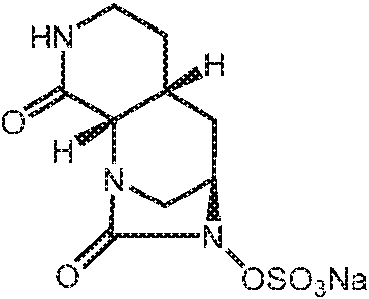
Etapa 13: (4R,5aR,9aS)-2,9-Dioxooctahidro-1,4-metanopirido[3,4-d][1,3]diazepin-3(2H)-ilhidrogenosulfato sódico. Una DOWEX 50Wx8, forma de hidrógeno, malla 200-400, se acondicionó agitando con NaOH (2 N) durante 2 h. La resina se cargó sobre una columna de vidrio y se lavó con agua (hasta pH “ 6 ), seguido de agua:acetona (1:1). Se cargó (4R,5aR,9aS)-2,9-dioxooctahidro-1,4-metanopirido[3,4-d][1,3]diazepin-3(2H)-ilsulfato de tetrabutilamonio (228 mg, 0,408 mmol) en acetona:agua (1:1) y se pasó a través de la columna, eluyendo con agua (20 ml), después acetona:agua (1:4, 30 ml). La muestra se liofilizó para proporcionar el compuesto del título (28 mg, 52 %) en forma de un sólido de color blanco. CLEM: Tr = 0,29 min, m/z = 291,8 (M+1). Método T3_3m_polar; RMN 1H (500 MHz, D2O) 8 4,31(m, 1H), 4,09 (d, J = 7,1 Hz, 1H), 3,55 (td, J = 12,8, 4,3 Hz, 1H), 3,26-3,34 (m, 2H), 2,87 (d, J = 12,3 Hz, 1H), 2,55 2,64 (m, 1H), 2,21-2,30 (m, 1H), 1,99-2,09 (m, 1H), 1,80-1,88 (m, 1H), 1,72-1,79 (m, 1H). Step 13: ( 4R, 5aR, 9aS) -2,9-Dioxooctahydro-1,4-methanopyrido [3,4-d] [1,3] diazepin-3 ( 2H) -ylhydrogen sulfate. A DOWEX 50Wx8, hydrogen form, 200-400 mesh, was conditioned by stirring with NaOH (2N) for 2 h. The resin was loaded onto a glass column and washed with water (until pH "6), followed by water: acetone (1: 1). Tetrabutylammonium (4R, 5aR, 9aS) -2,9-dioxooctahydro-1,4-methanopyrido [3,4-d] [1,3] diazepin-3 (2H) -ylsulfate (228 mg, 0.408 mmol) was charged in acetone: water (1: 1) and passed through the column, eluting with water (20 ml), then acetone: water (1: 4, 30 ml). The sample was lyophilized to provide the title compound (28mg, 52%) as a white solid. LCMS: Tr = 0.29 min, m / z = 291.8 (M + 1). T3_3m_polar method; 1H NMR (500 MHz, D2O) 8 4.31 (m, 1H), 4.09 (d, J = 7.1 Hz, 1H), 3.55 (td, J = 12.8, 4.3 Hz , 1H), 3.26-3.34 (m, 2H), 2.87 (d, J = 12.3 Hz, 1H), 2.55 2.64 (m, 1H), 2.21-2 , 30 (m, 1H), 1.99-2.09 (m, 1H), 1.80-1.88 (m, 1H), 1.72-1.79 (m, 1H).
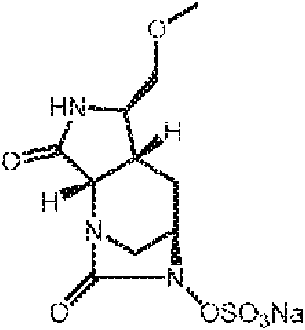
Ejemplo 8. (4R,5aS,6R,8aS)-6-(Metoximetil)-2,8-dioxohexahidro-2H-1,4-metanopirrolo[3,4-d][1,3]diazepin-3(4H)-ilhidrógenosulfato sódico Example 8. ( 4R, 5aS, 6R, 8aS) -6- ( Methoxymethyl) -2,8-dioxohexahydro-2H-1,4-methanopyrrolo [3,4-d] [1,3] diazepin-3 ( 4H) sodium hydrogensulfate
Etapa 1: (5R)-6-(Benciloxi)-3-(1-((terc-butoxicarbonil)amino)-2-metoxietil)-7-oxo-1,6-diazabiciclo[3.2.1]octano-2-carboxilato de metilo (mezcla de diaestereoisómeros). Step 1: ( 5R) -6- ( Benzyloxy) -3- ( 1- (( tert-butoxycarbonyl) amino) -2-methoxyethyl) -7-oxo-1,6-diazabicyclo [3.2.1] octane-2- methyl carboxylate ( mixture of diastereoisomers).
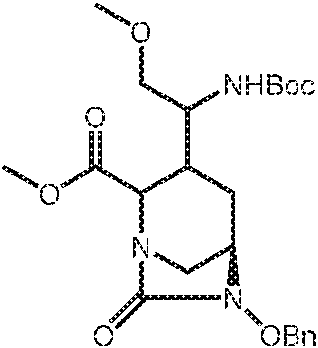
El Intermedio C (1,10 g, 3,82 mmol), Boc-L-Ser(OMe)-OH (1,04 g, 4,58 mmol) e Ir[df(CFa)ppy2(dtbpy)]PF6 (43 mg, 0,04 mmol) se disolvieron en DMF (16 ml). A la solución se añadió fosfato potásico dibásico finamente molido (0,62 g, 4,58 mmol) y la suspensión resultante se agitó y se irradió durante 12 días con una lámpara Kessil H150-Blue desde una distancia de <2 cm. Después de 3 y después de 9 días, se añadió Ir[df(CF3)ppy2(dtbpy)]PF6 (43 mg, 0,04 mmol) (total de 3 %mol de catalizador). A la mezcla de reacción se añadió agua (15 ml), seguido de NaHCO3 saturado (ac., 15 ml), que después se extrajo con TBME (3 x 60 ml). Las fases orgánicas combinadas se lavaron con salmuera (10 ml), se secaron sobre Na2SO4y se concentraron al vacío, dando como resultado en el compuesto del título (1,85 g) en forma de un aceite de color amarillo que consistía en 4 diaestereoisómeros (proporción 39:16:11:34). CLEM: Tr = 1,02 min, 1,05 min, 1,08 min, 1,12 min todos con m/z = 464 (M+1), LCMS_2 MIN_REACTION_MONITORING.Intermediate C (1.10 g, 3.82 mmol), Boc-L-Ser (OMe) -OH (1.04 g, 4.58 mmol) and Ir [df (CFa) ppy2 (dtbpy)] PF6 ( 43 mg, 0.04 mmol) were dissolved in DMF (16 ml). Finely ground dibasic potassium phosphate (0.62 g, 4.58 mmol) was added to the solution and the resulting suspension was stirred and irradiated for 12 days with a Kessil H150-Blue lamp from a distance of <2 cm. After 3 and after 9 days, Ir [df (CF3) ppy2 (dtbpy)] PF6 (43 mg, 0.04 mmol) (total 3 mol% catalyst) was added. Water (15 ml) was added to the reaction mixture, followed by saturated NaHCO3 (aq., 15 ml), which was then extracted with TBME (3 x 60 ml). The combined organic phases were washed with brine (10 mL), dried over Na2SO4, and concentrated in vacuo, yielding the title compound (1.85 g) as a yellow oil consisting of 4 diastereoisomers ( ratio 39: 16: 11: 34). LCMS: Tr = 1.02 min, 1.05 min, 1.08 min, 1.12 min all with m / z = 464 (M + 1), LCMS_2 MIN_REACTION_MONITORING.
Etapa 2: (4R,5aS,6R,8aS)-3-(benciloxi)-6-(metoximetil)hexahidro-2H-1,4-metanopirrolo[3,4-d][1,3]diazepin-2,8(3H)-diona. Step 2: ( 4R, 5aS, 6R, 8aS) -3- ( benzyloxy) -6- ( methoxymethyl) hexahydro-2H-1,4-methanopyrrolo [3,4-d] [1,3] diazepine-2,8 ( 3H) -dione.
A una solución de (5R)-6-(benciloxi)-3-(1-((terc-butoxicarbonil)amino)-2-metoxietil)-7-oxo-1,6-diazabiddo[3.2.1]octano-2-carboxilato de metilo (1,85 g, 4,0 mmol) en DCM (60 ml) a 0 °C se añadió gota a gota TFA (15,4 ml, 200 mmol). La mezcla de reacción se agitó a ta durante 1,5 h, después se concentró al vacío. El residuo en bruto se disolvió en DCM (60 ml), después se añadió gota a gota trietilamina (11,1 ml, 80 mmol). La mezcla de reacción se agitó a ta durante una noche, tras lo cual se concentró para formar un aceite rojizo (6,8 g). Se añadió agua (20 ml) y la mezcla se extrajo con TBME (3 x 80 ml). Las fases orgánicas combinadas se secaron sobre Na2SO4 y se concentraron al vacío para producir un aceite de color amarillo (1,13 g). La fase acuosa se saturó con NaCl (s) y se extrajo adicionalmente con DCM (3 x 80 ml). Las fases orgánicas combinadas se secaron sobre Na2SO4 y se concentraron al vacío para producir más cantidad de producto en bruto (0,95 g). El producto en bruto combinado se purificó por HPLC cromatografía (Sunfire-C18, 5um, 50 x 250 mm, agua/ACN 0,1 % de TFA, 100 ml/min, 18-38 % de 21 min, total 35 min) donde el pH de las fracciones se ajustó a 6,9 mediante la adición de NaHCO3 saturado (ac.) y se liofilizó para proporcionar un residuo de color pardo claro (0,59 g). Este residuo se disolvió en ACN/agua y se purificó en un cartucho C18 (ACN-agua), tras lo cual el material liofilizado proporcionó el compuesto del título (62 mg, 4,1 %, 3 etapas). CLEM: Tr= 0,70 min, m/z = 332 (M+1), LCMS_2 MIN_REACTION_MONITORING.To a solution of (5R) -6- (benzyloxy) -3- (1 - ((tert-butoxycarbonyl) amino) -2-methoxyethyl) -7-oxo-1,6-diazabiddo [3.2.1] octane-2 -methyl carboxylate (1.85 g, 4.0 mmol) in DCM (60 ml) at 0 ° C TFA (15.4 ml, 200 mmol) was added dropwise. The reaction mixture was stirred at rt for 1.5 h, then concentrated in vacuo. The crude residue was dissolved in DCM (60 ml), then triethylamine (11.1 ml, 80 mmol) was added dropwise. The reaction mixture was stirred at rt overnight, after which it was concentrated to a reddish oil (6.8 g). Water (20 ml) was added and the mixture was extracted with TBME (3 x 80 ml). The combined organic phases were dried over Na2SO4 and concentrated in vacuo to give a yellow oil (1.13 g). The aqueous phase was saturated with NaCl (s) and further extracted with DCM (3 x 80 ml). The combined organic phases were dried over Na2SO4 and concentrated in vacuo to yield more crude product (0.95 g). The combined crude product was purified by HPLC chromatography (Sunfire-C18, 5um, 50 x 250 mm, water / ACN 0.1% TFA, 100 ml / min, 18-38% of 21 min, total 35 min) where the pH of the fractions was adjusted to 6.9 by the addition of saturated NaHCO3 (aq) and lyophilized to provide a light brown residue (0.59 g). This residue was dissolved in ACN / water and purified on a C18 cartridge (ACN-water), whereupon the lyophilized material provided the title compound (62mg, 4.1%, 3 steps). LCMS: Tr = 0.70 min, m / z = 332 (M + 1), LCMS_2 MIN_REACTION_MONITORING.
Etapa 3: (4R,5aS,6R,8aS)-3-hidroxi-6-(metoximetil)hexahidro-2H-1,4-metanopirrolo[3,4-d][1,3]diazepin-2,8(8aH)-diona. Se disolvió (4R,5aS,6R,8aS)-3-(benciloxi)-6-(metoximetil)hexahidro-2H-1,4-metanopirrolo[3,4-d][1,3]diazepin-2,8(8aH)-diona (59 mg, 0,178 mmol) en MeOH:DCM (1:1, 1,78 ml). La mezcla se purgó con nitrógeno, se añadió Pd-C (10 %, tipo Degussa,101, 50 % de agua, 37,9 mg, 0,018 mmol), después se dejó en una atmósfera de H2 a durante 90 min. La mezcla se filtró a través de celite, eluyendo con DCM:MeOH (1:1) y se concentró al vacío para proporcionar el compuesto del título (49 mg, cuantitativo) en forma de un sólido incoloro. Cl/EM: Tr = 0,12 min; m/z = 242,0 (M+1 ). Método 2m_acidic. Step 3: ( 4R, 5aS, 6R, 8aS) -3-hydroxy-6- ( methoxymethyl) hexahydro-2H-1,4-methanopyrrolo [3,4-d] [1,3] diazepin-2,8 ( 8aH ) -diona. (4R, 5aS, 6R, 8aS) -3- (benzyloxy) -6- (methoxymethyl) hexahydro-2H-1,4-methanopyrrolo [3,4-d] [1,3] diazepine-2,8 ( 8aH) -dione (59mg, 0.178mmol) in MeOH: DCM (1: 1, 1.78ml). The mixture was purged with nitrogen, Pd-C (10%, Degussa type, 101, 50% water, 37.9 mg, 0.018 mmol) was added, then left under a H2 atmosphere for 90 min. The mixture was filtered through celite, eluting with DCM: MeOH (1: 1) and concentrated in vacuo to provide the title compound (49 mg, quantitative) as a colorless solid. Cl / MS: Tr = 0.12 min; m / z = 242.0 (M + 1). 2m_acidic method.

Etapa 4: (4R,5aS,6R,8aS)-6-(Metoximetil)-2,8-dioxohexahidro-2H-1,4-metanopirrolo[3,4-d][1,3]diazepin-3(4H)-ilsulfato de tetrabutilamonio. A una solución de (4R,5aS,6R,8aS)-3-hidroxi-6-(metoximetil)hexahidro-2H-1,4-metanopirrolo[3,4-d][1,3]diazepin-2,8(8aH)-diona (42 mg, 0,174 mmol) en piridina (1,85 ml) se añadió SO3piridina (139 mg, 0,870 mmol). La mezcla se agitó durante 18 h, después se filtró a través de una membrana de filtro y se concentró al vacío (temp. del baño < 30 °C). El residuo en bruto se disolvió en NaH2PO4 saturado y se lavó con EtOAc. Las capas se separaron y a la fase acuosa se añadió hidrogenosulfato de tetrabutilamonio (89 mg, 0,261 mmol). La mezcla se agitó durante 30 minutos, después se extrajo con DCM, se secó sobre sulfato sódico y se concentró al vacío. El residuo en bruto se purificó por cromatografía sobre gel de sílice (MeOH-DCM, 0-30 %), proporcionando el compuesto del título (57 mg, 58 %) en forma de una película incolora. CL/EM: Tr = 0,12 min; m/z = 322,0 (M+1), Método 2 m acidic. Step 4: ( 4R, 5aS, 6R, 8aS) -6- ( Methoxymethyl) -2,8-dioxohexahydro-2H-1,4-methanopyrrolo [3,4-d] [1,3] diazepin-3 ( 4H) -tetrabutylammonium sulfate. To a solution of (4R, 5aS, 6R, 8aS) -3-hydroxy-6- (methoxymethyl) hexahydro-2H-1,4-methanopyrrolo [3,4-d] [1,3] diazepin-2,8 ( 8aH) -dione (42 mg, 0.174 mmol) in pyridine (1.85 ml) was added SO3 pyridine (139 mg, 0.870 mmol). The mixture was stirred for 18 h, then filtered through a filter membrane and concentrated in vacuo (bath temp <30 ° C). The crude residue was dissolved in saturated NaH2PO4 and washed with EtOAc. The layers were separated and tetrabutylammonium hydrogen sulfate (89 mg, 0.261 mmol) was added to the aqueous phase. The mixture was stirred for 30 minutes, then extracted with DCM, dried over sodium sulfate, and concentrated in vacuo. The crude residue was purified by silica gel chromatography (MeOH-DCM, 0-30%) to provide the title compound (57 mg, 58%) as a colorless film. LC / MS: Tr = 0.12 min; m / z = 322.0 (M + 1), Method 2 m acidic.

Etapa 5: (4R,5aS,6R,8aS)-6-(Metoximetil)-2,8-dioxohexahidro-2H-1,4-metanopirrolo[3,4-d][1,3]diazepin-3(4H)-ilhidrogenosulfato sódico. Una DOWEX 50Wx8, forma de hidrógeno, malla 200-400, se agitó con NaOH (2 N) durante 3 h, después se cargó en una columna y se lavó con agua hasta que el pH del eluyente fue ~6 , seguido de lavado con agua-acetona (1:1). Se disolvió (4R,5aS,6R,8aS)-6-(metoximetil)-2,8-dioxohexahidro-2H-1,4-metanopirrolo[3,4-d][1,3]diazepin-3(4H)-ilsulfato de tetrabutilamonio (57 mg, 0,101 mmol) en acetona-agua (1:1) y se pasó a través de la columna, eluyendo con 1:1 de acetona/agua. Las fracciones se concentraron al vacío y se liofilizaron para proporcionar el producto deseado (27 mg, 70 %) en forma de un polvo incoloro. CL/EM: Tr = 0,41 min; m/z = 321,9 (M+1). Método T3_3m_polar; RMN 1H (500 MHz, D2O) 8 = 4,30 (d, J = 8,0 Hz, 1H), 4,24 (s a, 1H), 3,60-3,56 (m, 1H), 3,56-3,45 (m, 3H), 3,39 (s, 3H), 3,38-3,34 (m, 1H), 2,97 (d, J = 12,3 Hz, 1H), 2,67 (c, J = 8,4 Hz,1H), 2,64-2,56 (m, 1H), 1,72 (dd, J = 14,7, 8,4 Hz, 1H). Step 5: ( 4R, 5aS, 6R, 8aS) -6- ( Methoxymethyl) -2,8-dioxohexahydro-2H-1,4-methanopyrrolo [3,4-d] [1,3] diazepin-3 ( 4H) -sodium -ylhydrogen sulfate. A DOWEX 50Wx8, hydrogen form, 200-400 mesh, was stirred with NaOH (2N) for 3 h, then loaded onto a column and washed with water until the pH of the eluent was ~ 6, followed by washing with water-acetone (1: 1). (4R, 5aS, 6R, 8aS) -6- (methoxymethyl) -2,8-dioxohexahydro-2H-1,4-methanopyrrolo [3,4-d] [1,3] diazepin-3 (4H) - was dissolved Tetrabutylammonium ylsulfate (57 mg, 0.101 mmol) in acetone-water (1: 1) and passed through the column, eluting with 1: 1 acetone / water. The fractions were concentrated in vacuo and lyophilized to provide the desired product (27 mg, 70%) as a colorless powder. LC / MS: Tr = 0.41 min; m / z = 321.9 (M + 1). T3_3m_polar method; 1H NMR (500 MHz, D2O) 8 = 4.30 (d, J = 8.0 Hz, 1H), 4.24 (bs, 1H), 3.60-3.56 (m, 1H), 3, 56-3.45 (m, 3H), 3.39 (s, 3H), 3.38-3.34 (m, 1H), 2.97 (d, J = 12.3 Hz, 1H), 2 , 67 (q, J = 8.4 Hz, 1H), 2.64-2.56 (m, 1H), 1.72 (dd, J = 14.7, 8.4 Hz, 1H).
Prueba de susceptibilidadSusceptibility test
Se determinaron las CIM mediante el método de microdilución en caldo de acuerdo con las pautas del Instituto Clínico y de Laboratorios (CLSI, Clinical and Laboratories Institute). En síntesis, se suspendieron cultivos bacterianos recién preparados durante la noche en solución salina estéril y se ajustaron a un patrón de turbidez de 0,5 McFarland. Las suspensiones bacterianas se diluyeron en caldo Mueller-Hinton ajustado con cationes (MHB II; BBL) para producir un inóculo final de aproximadamente 5 x 10⁵ unidades formadoras de colonias (UFC)/ml. Se preparó una placa maestra de antibióticos a una concentración equivalente a cien veces la concentración final más alta deseada en dimetilsulfóxido al 100 % (DMSO). La placa antibiótica maestra se diluyó luego mediante dilución doble en serie con una pipeta multicanal. La serie de dilución de los compuestos resultante se diluyó 1:10 con agua estéril o una solución de inhibidor de beta-lactamasa preparada a una concentración equivalente a once veces la concentración final de disred en agua desionizada que conduce a una concentración final de DMSO al 10 %. Se transfirió un volumen de 10 |jl de la serie de dilución del fármaco a placas de ensayo de 96 pocillos. Las placas de ensayo se inocularon con 90 j l de suspensiones bacterianas y se incubaron a 35 °C durante 20 h. Las placas de ensayo se leyeron usando un lector de placas de microtitulación (Molecular Devices) a 600 nm, así como mediante observación visual con un espejo de lectura. La concentración más baja del compuesto que evitó el crecimiento visible se registró como la CIM. El rendimiento del ensayo se controló probando aztreonam contra cepas de control de calidad de laboratorio de acuerdo con las pautas del CLSI.MICs were determined using the broth microdilution method according to the guidelines of the Clinical and Laboratories Institute (CLSI ). Briefly, freshly prepared bacterial cultures were suspended overnight in sterile saline and adjusted to a 0.5 McFarland turbidity standard. Bacterial suspensions were diluted in cation-adjusted Mueller-Hinton broth (MHB II; BBL) to produce a final inoculum of approximately 5 x 10⁵ colony forming units (CFU) / ml. An antibiotic master plate was prepared at a concentration equivalent to one hundred times the highest final concentration desired in 100% dimethylsulfoxide (DMSO). The master antibiotic plate was then diluted by serial two-fold dilution with a multichannel pipet. The resulting compound dilution series was diluted 1:10 with sterile water or a beta-lactamase inhibitor solution prepared at a concentration equivalent to eleven times the final concentration of disred in deionized water leading to a final concentration of DMSO at 10%. A 10 µl volume of the drug dilution series was transferred to 96-well assay plates. The test plates were inoculated with 90 µl of bacterial suspensions and incubated at 35 ° C for 20 h. Assay plates were read using a microtiter plate reader (Molecular Devices) at 600 nm, as well as by visual observation with a reading mirror. The lowest concentration of the compound that prevented visible growth was recorded as the MIC. Assay performance was controlled by testing aztreonam against laboratory quality control strains according to CLSI guidelines.
En las siguientes tablas, se mencionan los siguientes inhibidores de beta-lactamasa y antibióticos beta-lactámicos: Inhibidor de beta-lactamasa 1: AvibactamIn the following tables, the following beta-lactamase inhibitors and beta-lactam antibiotics are listed: Beta-lactamase 1 inhibitor: Avibactam

Inhibidor de beta-lactamasa 2: RelebactamBeta-lactamase 2 inhibitor: Relebactam

Inhibidor de beta-lactamasa 3: TazobactamBeta-lactamase 3 inhibitor: Tazobactam

Beta-Lactama 1: AztreonamBeta-Lactam 1: Aztreonam

Beta-Lactama 2: Ceftazidima Beta-Lactam 2: Ceftazidime

Beta-Lactama 3: MeropenemBeta-Lactam 3: Meropenem

Beta-Lactama 4: PiperacilinaBeta-Lactam 4: Piperacillin

Beta-Lactama 5 (LYS228):Beta-Lactam 5 (LYS228):

Sinergia con beta-lactamas a través de la inhibición de beta-lactamasasSynergy with beta-lactams through inhibition of beta-lactamases
Se evaluó la sinergia o potenciación de los antibióticos beta-lactámicos mediante la inhibición de las L-lactamasas frente a un panel isogénico de cepas de E. coli, cada una expresando una beta-lactamasa única y contra cepas clínicas.The synergy or potentiation of beta-lactam antibiotics by inhibiting L-lactamases was evaluated against an isogenic panel of E. coli strains , each expressing a unique beta-lactamase and against clinical strains.
Construcción de cepas isogénicas de E. coli NB27273-CDY0026 (original), NB27273-CDY0033 (KPC-2), NB27273-CDY0030 (SHV-12), NB27273-CDY0034 (CTX-M-15) y NB27273-CDY0036 (AmpC).Construction of isogenic strains of E. coli NB27273-CDY0026 (original), NB27273-CDY0033 (KPC-2), NB27273-CDY0030 (SHV-12), NB27273-CDY0034 (CTX-M-15) and NB27273-CDY0036 (AmpC) .
La cepa NB27273 (BW25113 pspB::Kmr) se obtuvo de la colección de inserciones de transposones Keio. La cepa tiene el gen pspB reemplazado por un marcador de resistencia a la kanamicina (BW25113 pspB::Kmr). Esta cepa se curó del transposón en pspB a través de recombinasa FLP usando la metodología publicada. La cepa resultante, BW25113 pspB, se usó como hospedadora para vectores multicopia que expresaban beta-lactamasas clave. Los plásmidos multicopia que dirigen la expresión constitutiva de las beta-lactamasas se establecieron de la siguiente manera: Se crearon genes con optimización de codones, sintéticos, codificantes de las beta-lactamasas KPC-2, SHV-12 y CTX-M-15 de E. coli con DNA2.0 (Palo Alto, CA). Cada uno de los fragmentos sintéticos fue diseñado para contener sitios de restricción de Notl y Ncol en sus extremos, permitiendo la ligadura en un derivado de pET28a (+) digerido con Notl/Ncol para la expresión de proteínas. Las inserciones en estos vectores sirvieron como molde de a DN para la amplificación por PCR de los genes codificantes de KPC-2, SHV-12 y CTX-M-15 usando los pares de cebadores E225 (tcgcCTCGAGgcgactgcgctgacgaatttgg) (SEQ ID NO: 1) y E202 (aatcGAATTCttactgaccattaacgcccaagc) (SEQ ID NO: 2) y E227 (tcgcCTCGAGgcgagcccgcaaccgctgga) (SEQ ID NO: 3) y E204 (aatcGAATTCttaacgctgccagtgctcaatc) (SEQ iD NO: 4) y E226 (cgctCTCGAGagcgtcccgctgtacgcacaaacg) (SEq ID n O: 5) y E203, (aatcGAATTCttacagaccgtcggtgacaatc) (SEq ID n O: 6), respectivamente. A continuación, se muestran las secuencias de nucleótidos con optimización de codones y la información relevante de reconocimiento de cebadores:The strain NB27273 (BW25113 pspB :: Kmr) was obtained from the Keio transposon insert collection. The strain has the pspB gene replaced by a kanamycin resistance marker (BW25113 pspB :: Kmr). This strain was cured of the transposon into pspB via FLP recombinase using published methodology. The resulting strain, BW25113 pspB, was used as a host for multicopy vectors expressing key beta-lactamases. The multicopy plasmids that direct the constitutive expression of beta-lactamases were established as follows: Synthetic codon-optimizing genes encoding the beta-lactamases KPC-2, SHV-12 and CTX-M-15 of E. coli with DNA2.0 (Palo Alto, CA). Each of the synthetic fragments was designed to contain Notl and Ncol restriction sites at their ends, allowing ligation into a Notl / Ncol digested pET28a (+) derivative for protein expression. The inserts in these vectors served as a DN template for PCR amplification of the genes encoding KPC-2, SHV-12 and CTX-M-15 using primer pairs E225 (tcgcCTCGAGgcgactgcgctgacgaatttgg) (SEQ ID NO: 1) and E202 (aatcGAATTCttactgaccattaacgcccaagc) (SEQ ID NO: 2) and E227 (tcgcCTCGAGgcgagcccgcaaccgctgga) (SEQ ID NO: 3) and E204 (aatcGAATTCttaacgctgccagtgctcaatc) (SEQcagcc OTCTAC) (cAGcagcc ncc) (cAGcagccagcc) (SEQcagcc and E204) E203, (aatcGAATTCttacagaccgtcggtgacaatc) (SEq ID no: 6), respectively. The codon-optimized nucleotide sequences and relevant primer recognition information are shown below:
KPC-2KPC-2
ATGGGCCATCATCATCATCATCACAGCAGCGGCCTGGAAGTTCTGTTCCAGGGGCCCGCGACTGCGCTATGGGCCATCATCATCATCATCACAGCAGCGGCCTGGAAGTTCTGTTCCAGGGGCCCGCGACTGCGCT
GAGA
CGAATTTGGTGGCCGAGCCGTTCGCGAAATTGGAGCAAGATTTTGGTGGTTCGATCGGTGTCTACGCGCGAATTTGGTGGCCGAGCCGTTCGCGAAATTGGAGCAAGATTTTGGTGGTTCGATCGGTGTCTACGCG
ATAT
GGACACCGGTAGCGGTGCCACCGTGAGCTACCGTGCCGAAGAGCGTTTTCCGCTGTGTAGCTCTTTCAGGACACCGGTAGCGGTGCCACCGTGAGCTACCGTGCCGAAGAGCGTTTTCCGCTGTGTAGCTCTTTCA
AGAG
GGTTTTCTGGCCGCAGCCGTGCTGGCACGCAGCCAACAGCAAGCGGGCCTGCTGGACACCCCGATCCGGGTTTTCTGGCCGCAGCCGTGCTGGCACGCAGCCAACAGCAAGCGGGCCTGCTGGACACCCCGATCCG
TTTT
ACGGCAAAAATGCGCTGGTTCCGTGGAGCCCGATTAGCGAAAAGTACCTGACCACCGGCATGACGGTGACGGCAAAAATGCGCTGGTTCCGTGGAGCCCGATTAGCGAAAAGTACCTGACCACCGGCATGACGGTG
GCGC
GGAGTTGAGCGCTGCGGCGGTTCAGTATTCCGATAACGCTGCGGCAAATCTGCTGCTGAAAGAACTGGGGAGTTGAGCGCTGCGGCGGTTCAGTATTCCGATAACGCTGCGGCAAATCTGCTGCTGAAAGAACTGG
GCGC
GGTCCAGCGGGTCTGACGGCTTTCATGCGTTCTATTGGCGACACCACCTTTCGCTTGGACCGCTGGGAGGTCCAGCGGGTCTGACGGCTTTCATGCGTTCTATTGGCGACACCACCTTTCGCTTGGACCGCTGGGA
GCGC
TGGAGCTGAACAGCGCGATTCCGGGCGACGCACGTGATACGAGCAGCCCGCGTGCAGTGACCGAGAGCTGGAGCTGAACAGCGCGATTCCGGGCGACGCACGTGATACGAGCAGCCCGCGTGCAGTGACCGAGAGC
CTCT
GCAGAAGCTGACCCTGGGCAGCGCACTGGCCGCACCGCAGCGCCAACAGTTCGTCGATTGGCTGAAGGGCAGAAGCTGACCCTGGGCAGCGCACTGGCCGCACCGCAGCGCCAACAGTTCGTCGATTGGCTGAAGG
GTGT
AACACCACCGGTAACCATCGTATTCGCGCAGCGGTCCCGGCTGATTGGGCAGTTGGTGACAAGACTGGAACACCACCGGTAACCATCGTATTCGCGCAGCGGTCCCGGCTGATTGGGCAGTTGGTGACAAGACTGG
TATA
CGTGCGGCGTTTATGGTACGGCGAATGACTACGCGGTTGTTTGGCCTACGGGTCGTGCGCCGATCGTCCGTGCGGCGTTTATGGTACGGCGAATGACTACGCGGTTGTTTGGCCTACGGGTCGTGCGCCGATCGTC
CTCT
GGCGGTGTATACCCGTGCTCCGAACAAAGACGATAAACACTCCGAAGCGGTCATCGCCGCAGCAGCGCGGCGGTGTATACCCGTGCTCCGAACAAAGACGATAAACACTCCGAAGCGGTCATCGCCGCAGCAGCGC
GTGT
CTGGCCCTGGAAGGCTTGGGCGTTAATGGTCAGTAACGCCGGCG (SEQ ID NO:7)CTGGCCCTGGAAGGCTTGGGCGTTAATGGTCAGTAACGCCGGCG (SEQ ID NO: 7)
E225 TCGCCTCGAGGCGACTGCGCTGACGAATTTGG (SEQ ID NO: 8) E225 TCGCCTCGAGGCGACTGCGCTGACGAATTTGG (SEQ ID NO: 8)
E202 AATCGAATTCTTACTGACCATTAACGCCCAAGC (SEQ ID NO: 9) E202 AATCGAATTCTTACTGACCATTAACGCCCAAGC (SEQ ID NO: 9)
REV. COMP. E202 GCTTGGGCGTTAATGGTCAGTAAGAATTCGATT (SEQ ID NO: 10) REV. COMP. E202 GCTTGGGCGTTAATGGTCAGTAAGAATTCGATT (SEQ ID NO: 10)
SUBRAYADO = ADN CODIFICANTE DE BLUNDERLINED = BL ENCODING DNA
SHV-12 SHV-12
ATGGGCCATCATCATCATCATCACAGCAGCGGCCTGGAAGTTCTGTTCCAGGGGCCCGCGAGATGGGCCATCATCATCATCATCACAGCAGCGGCCTGGAAGTTCTGTTCCAGGGGCCCGCGAG
CCCGCAACCGCTGGAGCAGATCAAGCAGTCTGAGAGCCAGCTGAGCGGCCGTGTGGGTATGATCGAGACCCGCAACCGCTGGAGCAGATCAAGCAGTCTGAGAGCCAGCTGAGCGGCCGTGTGGGTATGATCGAGA
TGGATCTGGCTTCCGGCCGTACGCTGACGGCATGGCGTGCCGACGAACGTTTCCCGATGATGTCGACCTGGATCTGGCTTCCGGCCGTACGCTGACGGCATGGCGTGCCGACGAACGTTTCCCGATGATGTCGACC
TTTAAAGTTGTTCTGTGTGGTGCGGTCTTGGCACGTGTAGACGCGGGTGACGAACAACTGGAGCGCAATTTAAAGTTGTTCTGTGTGGTGCGGTCTTGGCACGTGTAGACGCGGGTGACGAACAACTGGAGCGCAA
GATCCATTACCGCCAACAGGACTTGGTCGACTACAGCCCGGTTAGCGAAAAGCACCTGGCGGATGGCAGATCCATTACCGCCAACAGGACTTGGTCGACTACAGCCCGGTTAGCGAAAAGCACCTGGCGGATGGCA
TGACCGTGGGTGAATTGTGCGCCGCTGCGATTACCATGAGCGACAATAGCGCGGCTAATCTGCTGTTGTGACCGTGGGTGAATTGTGCGCCGCTGCGATTACCATGAGCGACAATAGCGCGGCTAATCTGCTGTTG
GCGACCGTTGGTGGCCCAGCGGGCTTGACCGCATTTCTGCGTCAAATCGGCGATAATGTTACGCGTCTGCGACCGTTGGTGGCCCAGCGGGCTTGACCGCATTTCTGCGTCAAATCGGCGATAATGTTACGCGTCT
GGATCGCTGGGAAACGGAGCTGAACGAGGCACTGCCGGGTGATGCCCGTGATACCACGACTCCTGCTAGGATCGCTGGGAAACGGAGCTGAACGAGGCACTGCCGGGTGATGCCCGTGATACCACGACTCCTGCTA
GCATGGCAGCGACCCTGCGTAAACTGCTGACCAGCCAGCGTCTGAGCGCACGTAGCCAACGCCAGCTGGCATGGCAGCGACCCTGCGTAAACTGCTGACCAGCCAGCGTCTGAGCGCACGTAGCCAACGCCAGCTG
CTGCAATGGATGGTGGATGACCGCGTGGCGGGTCCGCTGATCCGCTCCGTCCTGCCAGCAGGCTGGTTCTGCAATGGATGGTGGATGACCGCGTGGCGGGTCCGCTGATCCGCTCCGTCCTGCCAGCAGGCTGGTT
CATTGCGGACAAAACTGGTGCCTCTAAGCGTGGTGCGCGTGGTATCGTCGCGCTGCTGGGTCCGAACACATTGCGGACAAAACTGGTGCCTCTAAGCGTGGTGCGCGTGGTATCGTCGCGCTGCTGGGTCCGAACA
ACAAAGCCGAACGTATTGTGGTTATCTATCTGCGCGACACCCCGGCAAGCATGGCCGAGCGCAACCAGACAAAGCCGAACGTATTGTGGTTATCTATCTGCGCGACACCCCGGCAAGCATGGCCGAGCGCAACCAG
CAAATTGCGGGCATTGGTGCGGCACTGATTGAGCACTGGCAGCGTTAACGCCGGCG (SEQ IDCAAATTGCGGGCATTGGTGCGGCACTGATTGAGCACTGGCAGCGTTAACGCCGGCG (SEQ ID
NO:11)NO: 11)
E227 TCGCCTCGAGGCGAGCCCGCAACCGCTGGA (SEQ ID NO:12)E227 TCGCCTCGAGGCGAGCCCGCAACCGCTGGA (SEQ ID NO: 12)
E204 AATCGAATTCTTAACGCTGCCAGTGCTCAATC (SEQ ID NO:13)E204 AATCGAATTCTTAACGCTGCCAGTGCTCAATC (SEQ ID NO: 13)
REV. COMP. E204 GATTGAGCACTGGCAGCGTTAAGAATTCGATT (SEQ ID NO: 14)REV. COMP. E204 GATTGAGCACTGGCAGCGTTAAGAATTCGATT (SEQ ID NO: 14)
CTX-M-15CTX-M-15
ATGGGCCATCATCATCATCATCACAGCAGCGGCCTGGAAGTTCTGTTCCAGGGGCCCAGCGTATGGGCCATCATCATCATCATCACAGCAGCGGCCTGGAAGTTCTGTTCCAGGGGCCCAGCGT
CCCGCTGTACGCACAAACGGCCGACGTGCAACAGAAACTGGCGGAGTTGGAACGTCAGAGCGGTGGCCCCCGCTGTACGCACAAACGGCCGACGTGCAACAGAAACTGGCGGAGTTGGAACGTCAGAGCGGTGGCC
GTTTGGGTGTAGCCCTGATCAATACCGCGGACAATAGCCAAATTCTGTATCGTGCGGACGAACGCTTCGTTTGGGTGTAGCCCTGATCAATACCGCGGACAATAGCCAAATTCTGTATCGTGCGGACGAACGCTTC
GCGATGTGCAGCACGAGCAAGGTGATGGCCGCTGCGGCCGTTCTGAAGAAATCCGAGAGCGAGCCGAAGCGATGTGCAGCACGAGCAAGGTGATGGCCGCTGCGGCCGTTCTGAAGAAATCCGAGAGCGAGCCGAA
CTTGCTGAATCAGCGCGTTGAGATCAAGAAGTCGGATCTGGTGAACTATAACCCTATCGCGGAAAAACCTTGCTGAATCAGCGCGTTGAGATCAAGAAGTCGGATCTGGTGAACTATAACCCTATCGCGGAAAAAC
ATGTCAACGGCACCATGTCCCTGGCAGAGCTGAGCGCGGCTGCGTTGCAGTACTCTGATAACGTCGCAATGTCAACGGCACCATGTCCCTGGCAGAGCTGAGCGCGGCTGCGTTGCAGTACTCTGATAACGTCGCA
ATGAATAAACTGATCGCACACGTCGGTGGCCCAGCAAGCGTGACCGCCTTTGCGCGTCAACTGGGCGAATGAATAAACTGATCGCACACGTCGGTGGCCCAGCAAGCGTGACCGCCTTTGCGCGTCAACTGGGCGA
TGAAACTTTTCGTCTGGATCGTACCGAACCGACCCTGAATACGGCAATTCCGGGTGATCCGCGCGACATGAAACTTTTCGTCTGGATCGTACCGAACCGACCCTGAATACGGCAATTCCGGGTGATCCGCGCGACA
CGACGAGCCCGCGTGCAATGGCACAGACCCTGCGCAACCTGACCCTGGGTAAAGCGCTGGGCGATAGCCGACGAGCCCGCGTGCAATGGCACAGACCCTGCGCAACCTGACCCTGGGTAAAGCGCTGGGCGATAGC
CAACGTGCGCAGCTGGTTACGTGGATGAAGGGTAACACCACCGGTGCGGCCAGCATTCAAGCGGGCCTCAACGTGCGCAGCTGGTTACGTGGATGAAGGGTAACACCACCGGTGCGGCCAGCATTCAAGCGGGCCT
GCCGGCCAGCTGGGTTGTTGGTGATAAAACTGGCTCCGGTGGTTATGGTACCACGAATGACATCGCGGGCCGGCCAGCTGGGTTGTTGGTGATAAAACTGGCTCCGGTGGTTATGGTACCACGAATGACATCGCGG
TTATTTGGCCGAAGGACCGTGCGCCGTTGATCCTGGTGACCTACTTCACCCAGCCGCAGCCGAAAGCTTTATTTGGCCGAAGGACCGTGCGCCGTTGATCCTGGTGACCTACTTCACCCAGCCGCAGCCGAAAGCT
GAGTCTCGCCGTGACGTGCTGGCGAGCGCAGCTAAGATTGTCACCGACGGTCTGTAACGCCGGCGGAGTCTCGCCGTGACGTGCTGGCGAGCGCAGCTAAGATTGTCACCGACGGTCTGTAACGCCGGCG
E226 cgctCTCGAGagcgtcccgctgtacgcacaaacg (SEQ ID NO:15)E226 cgctCTCGAGagcgtcccgctgtacgcacaaacg (SEQ ID NO: 15)
E203, aatcGAATTCttacagaccgtcggtgacaatc (SEQ ID NO:16)E203, aatcGAATTCttacagaccgtcggtgacaatc (SEQ ID NO: 16)
El gen codificante de AmpC se amplificó por PCR a partir del genoma de la cepa de P. aeruginosa PAO1 (NB52019) (GenBank ID U5R279) usando el par de cebadores E252 (gccCTCGAGggcgaggccccggcggatcgc) (SEQ ID NO: 17) and E253 (tgaGAATTCtcagcgcttcagcggcacct) (SEQ ID NO: 18).The gene coding for AmpC was amplified by PCR from the genome of the P. aeruginosa strain PAO1 (NB52019) (GenBank ID U5R279) using the E252 primer pair (gccCTCGAGggcgaggccccggcggatcgc) (SEQ ID NO: 17) and E253 (tgaggccactcagGActTCTCAgCGATTC). (SEQ ID NO: 18).
Después, se digirieron los productos de PCR con Xhol y EcoRI, y se ligaron en el plásmido pAH63-pstS(BlaP) digerido de manera similar. El plásmido pAH63-pstS(BlaP) es un derivado del plásmido pAH63 (J Bacteriol:183(21): 6384 6393) creado mediante la clonación del promotor TEM-1 (bla) y la región codificante del péptido señal del plásmido pBAD (J Bacteriol. Julio de 1995. 177(14):4121-30) en el plásmido pAH63. Este fragmento se amplificó por PCR a partir de pBAD usando el par de cebadoresE192 (ttcaCTGCAGtgaacgttgcgaagcaacggC) (SEQ iD NO:19) y E194 (TCGAggatcctcgagagcaaaaacaggaaggcaaaatgccg) (SEQ ID NO:20), se digirió con Pstl y BamHI, y se insertó en el plásmido digerido de manera similar pAH63. Por lo tanto, la expresión de beta-lactamasas a partir de construcciones basadas en pAH63-pstS(BlaP) es constitutiva, y se proporciona la secuencia señal para dirigir estas proteínas al periplasma. Los vectores basados en el plásmido pAH63 se usan para la inserción en el genoma en una sola copia, sin embargo, para proporcionar niveles de expresión más altos que permitieran una detección más sensible de la susceptibilidad de los compuestos a las beta-lactamasas expresadas, se trasladaron las inserciones de expresión contenidas en estos vectores al vector multicopia replicativo pBAD-Kan (J Bacteriol. Julio de 1995. 177(14):4121-30). Para conseguir esto, las inserciones que abarcan los genes de beta-lactamasa, con el promotor de TEM asociado y las secuencias de señal, se amplificaron por PCR a partir de sus vectores correspondientes usando el cebador E268 (ccgTCTAGAcggatggcctttttgcgtttc) (SEQ ID NO:21) y E202 (aatcGAATTCttactgaccattaacgcccaagc) (SEQ ID NO:22) para la construcción KPC2, E204 (aatcGAATTCttaacgctgccagtgctcaatc) (SEQ ID NO: 23) para la construcción SHV-12 y E203 (aatcGAATTCttacagaccgtcggtgacaatc) (SEQ ID NO: 24) para la construcción CTX-M-15. Estos fragmentos se digirieron luego con Xbal y EcoRI, y cada uno fue insertado en pBAD18-kan que había sido digerido con las mismas enzimas para generar vectores multicopia que expresaran KPC-2, SHV-12 y CTX-M-15, respectivamente. Estos vectores se transformaron en BW25113 pspB para generar las cepas NB27273-CDY0033 (que expresan KPC-2), NB27273-CDY0030 (que expresan SHV-12), NB27273-CDY0034 (que expresan CTX-M-15) y NB27273-CDY0036 (que expresan AmpC). El vector pBAD18-kan también contiene la región promotora de TEM y la secuencia de señal, (pero carece de cualquier gen intacto de beta-lactamasa), y se transformó en BW25113 pspB usando protocolos convencionales para generar la cepa de control NB27273-CDY0026. La expresión de las beta-lactamasas se confirmó verificando la reducción de la susceptibilidad a los antibióticos de prueba de ejemplo que son sustratos conocidos de KPC-2, SHV-12, CTX-M-15 o AmpC.The PCR products were then digested with Xhol and EcoRI, and ligated into the similarly digested plasmid pAH63-pstS (BlaP). The plasmid pAH63-pstS (BlaP) is a derivative of the plasmid pAH63 ( J Bacteriol: 183 ( 21): 6384 6393) created by cloning the TEM-1 promoter ( bla) and the signal peptide coding region of plasmid pBAD (J Bacteriol. 1995 Jul. 177 (14): 4121-30) in plasmid pAH63. This fragment was amplified by PCR from pBAD using the primer pair E192 (ttcaCTGCAGtgaacgttgcgaagcaacggC) (SEQ iD NO: 19) and E194 (TCGAggatcctcgagagcaaaaacaggaaggcaaaatgccg) (SEQ ID NO: 20), digested with Pstl and BamHI, and inserted into the similarly digested plasmid pAH63. Therefore, the expression of beta-lactamases from constructs based on pAH63-pstS (BlaP) is constitutive, and the signal sequence is provided to direct these proteins to the periplasm. Vectors based on plasmid pAH63 are used for insertion into the genome in a single copy, however, to provide higher expression levels that allow a more sensitive detection of the susceptibility of compounds to expressed beta-lactamases, they translated the expression insertions contained in these vectors to the replicative multicopy vector pBAD-Kan ( J Bacteriol. July 1995. 177 (14): 4121-30). To achieve this, inserts spanning beta-lactamase genes, with associated TEM promoter and signal sequences, were PCR amplified from their corresponding vectors using primer E268 (ccgTCTAGAcggatggcctttttgcgtttc) (SEQ ID NO: 21 ) and E202 (aatcGAATTCttactgaccattaacgcccaagc) (SEQ ID NO: 22) for construction KPC2, E204 (aatcGAATTCttaacgctgccagtgctcaatc) (SEQ ID NO: 23) for construction SHV-12 and E203 (aatcGAATTCttacagacaccattcg: CTX-M-15. These fragments were then digested with Xbal and EcoRI, and each was inserted into pBAD18-kan that had been digested with the same enzymes to generate multicopy vectors expressing KPC-2, SHV-12, and CTX-M-15, respectively. These vectors were transformed into BW25113 pspB to generate the strains NB27273-CDY0033 (expressing KPC-2), NB27273-CDY0030 (expressing SHV-12), NB27273-CDY0034 (expressing CTX-M-15) and NB27273-CDY0036 ( expressing AmpC). The pBAD18-kan vector also contains the TEM promoter region and signal sequence, (but lacks any intact beta-lactamase genes), and was transformed into BW25113 pspB using standard protocols to generate the control strain NB27273-CDY0026. The expression of the beta-lactamases was confirmed by verifying the reduced susceptibility to the example test antibiotics that are known substrates of KPC-2, SHV-12, CTX-M-15 or AmpC.
Construcción de cepas isogénicas de E. coli, NB27273-CDY0105 (OXA-18) y NB27273-CDY0048 (TEM-10). El vector plasmídico para la expresión de OXA-18, fue construido de la siguiente manera: Life Technologies sintetizó los genes codificantes de GIM-1 (GenBank ID Q704V1) y OXA-18 (GenBank ID 007293) con secuencias flanqueantes de 5'-tgccttcctgtttttgctctcgag y gaattcgctagcccaaaaaaacgg-3' (SEQ ID NO: 25). El fragmento codificante de GIM-1 se digirió con Xhol y EcoRI y se insertó en la construcción de expresión de KPC-2 descrita anteriormente de la que se eliminó el gen codificante de KPC-2 mediante la digestión con XhoI y EcoRI. La secuenciación de nucleótidos confirmatoria reveló un sitio XhoI en la cadena principal del vector que luego se eliminó mediante mutagénesis dirigida usando el par de cebadores E396 (cgtcttgctccaggccgcgattaaattcc) (SEQ ID NO: 26) y E397 (tcgcggcctggagcaagacgtttc) (SEQ ID NO: 27). El gen codificante de OXA-18 se digirió luego con XhoI y EcoRI y se insertó en este vector, del que se había eliminado el gen para GIM-1 con XhoI y EcoRI.Construction of isogenic strains of E. coli, NB27273-CDY0105 (OXA-18) and NB27273-CDY0048 (TEM-10). The plasmid vector for the expression of OXA-18 was constructed as follows: Life Technologies synthesized the genes coding for GIM-1 (GenBank ID Q704V1) and OXA-18 (GenBank ID 007293) with flanking sequences of 5'-tgccttcctgtttttgctctcgag and gaattcgctagcccaaaaaaacgg-3 '(SEQ ID NO: 25). The GIM-1 encoding fragment was digested with Xhol and EcoRI and inserted into the KPC-2 expression construct described above from which the KPC-2 encoding gene was removed by digestion with XhoI and EcoRI. Confirmatory nucleotide sequencing revealed an XhoI site in the vector backbone which was then removed by site-directed mutagenesis using the primer pair E396 (cgtcttgctccaggccgcgattaaattcc) (SEQ ID NO: 26) and E397 (tcgcggcctggagcaagacgtttc) (SEQ ID ID NO: 27) . The gene coding for OXA-18 was then digested with XhoI and EcoRI and inserted into this vector, from which the gene for GIM-1 had been deleted with XhoI and EcoRI.
Para generar un vector que expresara TEM-10, se usó el plásmido pBAD18 (J Bacteriol. Julio de 1995, 177(14):4121-30), que contiene el gen codificante de TEM-1, como molde para la mutagénesis dirigida basada en PCR para convertir el gen codificante de TEM-1 en un codificante de TEM-10. De este molde de ADN, se generaron tres fragmentos por PCR usando los siguientes pares de cebadores;To generate a vector expressing TEM-10, the plasmid pBAD18 (J Bacteriol. July 1995, 177 (14): 4121-30), which contains the gene encoding TEM-1, was used as a template for site-specific mutagenesis based in PCR to convert the TEM-1 coding gene to TEM-10 coding. From this DNA template, three fragments were generated by PCR using the following primer pairs;
B124 (tcacgtagcgatagcggag) (SEQ ID NO: 28) y E387 (tggagccggtaagcgtgggtctcgcggt) (SEQ ID NO: 28) para generar el fragmento A codificante de una sustitución E237KB124 (tcacgtagcgatagcggag) (SEQ ID NO: 28) and E387 (tggagccggtaagcgtgggtctcgcggt) (SEQ ID NO: 28) to generate fragment A encoding an E237K substitution
E389 (cgcgagacccacgcttaccggctccaga) (SEQ ID NO: 29) y E391 (ctcgccttgatagttgggaaccgga) (SEQ ID NO: 30) para generar el fragmento B codificante de las sustituciones E237K y R162SE389 (cgcgagacccacgcttaccggctccaga) (SEQ ID NO: 29) and E391 (ctcgccttgatagttgggaaccgga) (SEQ ID NO: 30) to generate the fragment B encoding the E237K and R162S substitutions
E393 (cggttcccaactatcaaggcgagt) (SEQ ID NO: 31) y E289 (gacattgccgtcactgcgtct) SEQ ID NO: 32) para generar el fragmento C, también introduciendo una sustitución R162.E393 (cggttcccaactatcaaggcgagt) (SEQ ID NO: 31) and E289 (gacattgccgtcactgcgtct) SEQ ID NO: 32) to generate fragment C, also introducing an R162 substitution.
Luego se usaron los fragmentos A, B y C como molde para generar un gen completo codificante de TEM-10 de la siguiente manera:Fragments A, B and C were then used as a template to generate a complete gene encoding TEM-10 as follows:
Los fragmentos A y B se usaron como molde para la PCR usando los cebadores B124 (tcacgtagcgatagcggag) (SEQ ID NO: 33) y E390 (gtaactcgccttgatagttgggaaccggagctgaatgaagc) (SEQ ID NO: 34) para combinar los fragmentos A y B en el fragmento DFragments A and B were used as template for PCR using primers B124 (tcacgtagcgatagcggag) (SEQ ID NO: 33) and E390 (gtaactcgccttgatagttgggaaccggagctgaatgaagc) (SEQ ID NO: 34) to combine fragments A and B into fragment D
Los fragmentos B y C se usaron como molde para la PCR usando los cebadores E290 (gcgggaccaaagccatgaca) (SEQ ID NO: 35) y E388 (accgcgagacccacgcttaccggctccagatttatcagcaataaacc) (SEQ ID NO: 36) para combinar los fragmentos B y C en el fragmento EFragments B and C were used as template for PCR using primers E290 (gcgggaccaaagccatgaca) (SEQ ID NO: 35) and E388 (accgcgagacccacgcttaccggctccagatttatcagcaataaacc) (SEQ ID NO: 36) to combine fragments B and C in fragment E
Finalmente, se usaron los fragmentos D y E como molde para la PCR usando los cebadores E395 (gtaaGAATTCttaccaatgcttaatcagtgaggc) (SEQ ID NO: 37), E268 (ccgTCTAGAcggatggcctttttgcgtttc) (SEQ ID NO: 38) para combinar los fragmentos D y E en el producto codificante de TEM-10 intacto. Este fragmento se digirió luego con Xbal y EcoRI, y se insertó en pBAD-kan que también se cortó con las mismas enzimas.Finally, fragments D and E were used as template for PCR using primers E395 (gtaaGAATTCttaccaatgcttaatcagtgaggc) (SEQ ID NO: 37), E268 (ccgTCTAGAcggatggcctttttgcgtttc) (SEQ ID NO: 38) to combine fragments D and E into the product coding for intact TEM-10. This fragment was then digested with Xbal and EcoRI, and inserted into pBAD-kan which was also cut with the same enzymes.
Estos vectores finales para la expresión de OXA-18 y TEM-10 se transformaron en BW25113 pspB para generar las cepas NB27273-CDY0105 (que expresaba OXA-18) y NB27273-CDY0048 (que expresaba Te M-10). La expresión de beta-lactamasa se confirmó verificando la reducción de la susceptibilidad a los antibióticos de prueba ilustrativos que son sustratos conocidos de OXA-18 o TEM-10. These final vectors for the expression of OXA-18 and TEM-10 were transformed into BW25113 pspB to generate the strains NB27273-CDY0105 (expressing OXA-18) and NB27273-CDY0048 (expressing Te M-10). Expression of beta-lactamase was confirmed by verifying reduced susceptibility to illustrative test antibiotics that are known substrates of OXA-18 or TEM-10.
Tabla A: Concentraciones inhibidoras mínimas (CIM), en gg/ml de BU seleccionados Table A: Minimum Inhibitory Concentrations ( MICs), in gg / ml of selected BU

La Tabla 1 anterior demuestra que, si bien algunos inhibidores de la beta-lactamasa, tales como avibactam, presentan actividad antibacteriana directa, los compuestos de Fórmula (A) muestran poca actividad directa.Table 1 above demonstrates that while some beta-lactamase inhibitors, such as avibactam, exhibit direct antibacterial activity, the compounds of Formula (A) exhibit little direct activity.
Los siguientes datos demuestran el efecto de potenciación o actividad sinérgica de los compuestos de la invención, según lo ilustrado por el compuesto del Ejemplo 1, cuando se usa en combinación con distintos antibióticos betalactámicos. Como el compuesto del Ejemplo 1 no presenta mucha actividad antibiótica directa (véase la Tabla 1), la sinergia o potenciación se define en el presente documento como una reducción de cuatro veces o más en la CIM del antibiótico beta-lactámico causada por la presencia del compuesto de fórmula (A), en comparación con el antibiótico beta-lactámico solo. Preferentemente, las combinaciones de la invención presentan al menos una reducción de 8 veces en la CIM en comparación con el antibiótico beta-lactámico solo.The following data demonstrate the potentiating effect or synergistic activity of the compounds of the invention, as illustrated by the compound of Example 1, when used in combination with various beta-lactam antibiotics. As the compound of Example 1 does not exhibit much direct antibiotic activity (see Table 1), synergy or potentiation is defined herein as a four-fold or more reduction in MIC of the beta-lactam antibiotic caused by the presence of the compound of formula (A), compared to beta-lactam antibiotic alone. Preferably, the combinations of the invention exhibit at least an 8-fold reduction in MIC compared to the beta-lactam antibiotic alone.
Potenciación de la actividad (CIM en gg/ml) de aztreonam por inhibidores de beta-lactamasas en cepas isogénicas de E. coli que expresan beta-lactamasas individuales. Potentiation of the activity ( MIC in gg / ml) of aztreonam by beta-lactamase inhibitors in isogenic strains of E. coli expressing individual beta-lactamases.

Potenciación de la actividad (CIM en gg/ml) de ceftazidima por inhibidores de beta-lactamasas en cepas isogénicas de E. coli que expresan beta-lactamasas individuales. Potentiation of the activity ( MIC in gg / ml) of ceftazidime by beta-lactamase inhibitors in isogenic strains of E. coli expressing individual beta-lactamases.

Potenciación de la actividad (CIM en jg /m i) de meropenemo por inhibidores de beta-lactamasas en cepas iso énicas de E. coli que expresan beta-lactamasas individuales. Potentiation of the activity ( MIC in jg / ml) of meropenem by beta-lactamase inhibitors in isogenic strains of E. coli expressing individual beta-lactamases.

Potenciación de ia actividad (CIM en jg /m i) de piperaciiina por inhibidores de beta-lactamasas en cepas isogénicas de E. coli que expresan beta-lactamasas individuales. Potentiation of the activity ( MIC in µg / ml) of piperaziiina by beta-lactamase inhibitors in isogenic strains of E. coli expressing individual beta-lactamases.

Potenciación de ia actividad (jg/m i) de Beta-Lactama 5 por inhibidores de beta-iactamasas en cepas isogénicas de E. coii que expresan beta-iactamasas individuaies. Potentiation of the activity ( µg / ml) of Beta-Lactama 5 by beta-iactamase inhibitors in isogenic strains of E. coii expressing individual beta-iactamases.

Potenciación de la actividad (jg/m l) de aztreonam por inhibidores de beta-lactamasas en aislados clínicos resistentes a beta-lactamas. Potentiation of the activity ( µg / ml) of aztreonam by beta-lactamase inhibitors in beta-lactam resistant clinical isolates.

Potenciación de la actividad (jg/m l) de la piperacilina por inhibidores de beta-lactamasas en aislados clínicos resistentes a beta-lactamas. Potentiation of the activity ( jg / ml) of piperacillin by beta-lactamase inhibitors in beta-lactam resistant clinical isolates.

Estos datos demuestran que la potenciación de los compuestos de la invención es similar o superior a la de algunos inhibidores de beta-lactamasas usados en la clínica cuando se usan en combinación con antibióticos beta-lactámicos comerciales para tratar infecciones causadas por bacterias que son resistentes a algunos antibióticos beta-lactámicos conocidos. These data demonstrate that the potentiation of the compounds of the invention is similar to or greater than that of some beta-lactamase inhibitors used clinically when used in combination with commercial beta-lactam antibiotics to treat infections caused by bacteria that are resistant to some known beta-lactam antibiotics.
Claims (20)


Applications Claiming Priority (2)
| Application Number | Priority Date | Filing Date | Title |
|---|---|---|---|
| US201662401022P | 2016-09-28 | 2016-09-28 | |
| PCT/IB2017/055973 WO2018060926A1 (en) | 2016-09-28 | 2017-09-28 | Beta-lactamase inhibitors |
Publications (1)
| Publication Number | Publication Date |
|---|---|
| ES2801874T3 true ES2801874T3 (en) | 2021-01-14 |
Family
ID=60191429
Family Applications (2)
| Application Number | Title | Priority Date | Filing Date |
|---|---|---|---|
| ES17791737T Active ES2801874T3 (en) | 2016-09-28 | 2017-09-28 | Beta-lactamase inhibitors |
| ES20165564T Active ES2902579T3 (en) | 2016-09-28 | 2017-09-28 | Pharmaceutical combination of a tricyclic beta-lactam inhibitor with beta-lactam specific antibiotics |
Family Applications After (1)
| Application Number | Title | Priority Date | Filing Date |
|---|---|---|---|
| ES20165564T Active ES2902579T3 (en) | 2016-09-28 | 2017-09-28 | Pharmaceutical combination of a tricyclic beta-lactam inhibitor with beta-lactam specific antibiotics |
Country Status (42)
Families Citing this family (4)
| Publication number | Priority date | Publication date | Assignee | Title |
|---|---|---|---|---|
| JOP20190061A1 (en) | 2016-09-28 | 2019-03-26 | Novartis Ag | Beta-lactamase inhibitors |
| EP3854786B1 (en) | 2018-09-21 | 2026-02-18 | UBE Corporation | Method for producing amino acid derivatives |
| AU2021473165B2 (en) * | 2021-11-09 | 2025-05-22 | Guangzhou HC New Drug Research Co., Ltd. | PHARMACEUTICAL COMPOSITION CONTAINING β-LACTAM COMPOUND AND USE THEREOF |
| CN115368261A (en) * | 2022-07-29 | 2022-11-22 | 武汉理工大学 | Synthesis method of N-allyl-N-benzyl-2- (benzylamino) acetamide |
Family Cites Families (60)
| Publication number | Priority date | Publication date | Assignee | Title |
|---|---|---|---|---|
| EP0090505B1 (en) | 1982-03-03 | 1990-08-08 | Genentech, Inc. | Human antithrombin iii, dna sequences therefor, expression vehicles and cloning vectors containing such sequences and cell cultures transformed thereby, a process for expressing human antithrombin iii, and pharmaceutical compositions comprising it |
| CA2143519A1 (en) * | 1994-03-11 | 1995-09-12 | F. Hoffmann-La Roche Ag | Beta-lactams |
| ES2308787T3 (en) | 1996-08-16 | 2008-12-01 | Schering Corporation | ANTIGENS OF MAMPHERE CELL SURFACE; RELATED REAGENTS. |
| US6111090A (en) | 1996-08-16 | 2000-08-29 | Schering Corporation | Mammalian cell surface antigens; related reagents |
| JP2001520039A (en) | 1997-10-21 | 2001-10-30 | ヒューマン ジノーム サイエンシーズ, インコーポレイテッド | Human tumor necrosis factor receptor-like proteins, TR11, TR11SV1 and TR11SV2 |
| AU2591599A (en) | 1998-02-09 | 1999-08-23 | Genentech Inc. | Novel tumor necrosis factor receptor homolog and nucleic acids encoding the same |
| AU6085700A (en) | 1999-07-12 | 2001-01-30 | Genentech Inc. | Promotion or inhibition of angiogenesis and cardiovascularization by tumor necrosis factor ligand/receptor homologs |
| FR2812635B1 (en) | 2000-08-01 | 2002-10-11 | Aventis Pharma Sa | NOVEL HETEROCYCLIC COMPOUNDS, PREPARATION AND USE AS MEDICAMENTS IN PARTICULAR AS ANTI-BACTERIALS |
| FR2825705B1 (en) | 2001-06-08 | 2005-05-20 | Aventis Pharma Sa | NOVEL HETEROCYCLIC COMPOUNDS, THEIR PREPARATION AND THEIR USE AS MEDICAMENTS, IN PARTICULAR AS ANTI-BACTERIANS |
| FR2835186B1 (en) | 2002-01-28 | 2006-10-20 | Aventis Pharma Sa | NOVEL HETEROCYCLIC COMPOUNDS ACTIVE AS BETA-LACTAMASES INHIBITORS |
| WO2004078163A2 (en) | 2003-02-28 | 2004-09-16 | Transform Pharmaceuticals, Inc. | Pharmaceutical co-crystal compositions of drugs such as carbamazepine, celecoxib, olanzapine, itraconazole, topiramate, modafinil, 5-fluorouracil, hydrochlorothiazide, acetaminophen, aspirin, flurbiprofen, phenytoin and ibuprofen |
| US7439253B2 (en) | 2002-12-06 | 2008-10-21 | Novexel | Heterocyclic compounds, their preparation and their use as medicaments, in particular as antibacterials and beta-lactamase inhibitors |
| FR2848210B1 (en) | 2002-12-06 | 2007-10-19 | Aventis Pharma Sa | NOVEL HETEROCYCLIC COMPOUNDS, PREPARATION THEREOF AND THEIR USE AS MEDICAMENTS, IN PARTICULAR AS ANTI-BACTERIALS AND INHIBITORS OF BETA-LACTAMASES |
| CN1753912B (en) | 2002-12-23 | 2011-11-02 | 惠氏公司 | Anti-PD-1 antibodies and uses thereof |
| JP4638876B2 (en) | 2003-05-23 | 2011-02-23 | ワイス | GITR ligand, GITR ligand-related molecule and antibody and use thereof |
| WO2005007190A1 (en) | 2003-07-11 | 2005-01-27 | Schering Corporation | Agonists or antagonists of the clucocorticoid-induced tumour necrosis factor receptor (gitr) or its ligand for the treatment of immune disorders, infections and cancer |
| EP1692318A4 (en) | 2003-12-02 | 2008-04-02 | Genzyme Corp | COMPOSITIONS AND METHODS FOR THE DIAGNOSIS AND TREATMENT OF LUNG CANCER |
| GB0409799D0 (en) | 2004-04-30 | 2004-06-09 | Isis Innovation | Method of generating improved immune response |
| EP1765402A2 (en) | 2004-06-04 | 2007-03-28 | Duke University | Methods and compositions for enhancement of immunity by in vivo depletion of immunosuppressive cell activity |
| AU2006230099B2 (en) | 2005-03-25 | 2012-04-19 | Gitr, Inc. | GITR binding molecules and uses therefor |
| RU2494107C2 (en) | 2005-05-09 | 2013-09-27 | Оно Фармасьютикал Ко., Лтд. | Human monoclonal antibodies specific for programmed cell death 1 (pd1) protein and methods of treating cancer with using anti-pd1 antibodies either individually, or in combination with other immunotherapeutic agents |
| CN104356236B (en) | 2005-07-01 | 2020-07-03 | E.R.施贵宝&圣斯有限责任公司 | Human monoclonal antibody against programmed death ligand 1 (PD-L1) |
| WO2007133822A1 (en) | 2006-01-19 | 2007-11-22 | Genzyme Corporation | Gitr antibodies for the treatment of cancer |
| EP2069347A2 (en) | 2006-09-27 | 2009-06-17 | Merck & Co., Inc. | Novel inhibitors of beta-lactamase |
| HRP20131167T1 (en) | 2007-06-18 | 2014-01-03 | Merck Sharp & Dohme B.V. | Antibodies to human programmed death receptor pd-1 |
| ES2776406T3 (en) | 2007-07-12 | 2020-07-30 | Gitr Inc | Combination therapies using GITR-binding molecules |
| WO2009091856A2 (en) * | 2008-01-18 | 2009-07-23 | Merck & Co., Inc. | Beta-lactamase inhibitors |
| PT2242773T (en) | 2008-02-11 | 2017-09-15 | Cure Tech Ltd | Monoclonal antibodies for tumor treatment |
| WO2009114335A2 (en) | 2008-03-12 | 2009-09-17 | Merck & Co., Inc. | Pd-1 binding proteins |
| NZ590667A (en) | 2008-07-02 | 2013-01-25 | Emergent Product Dev Seattle | Tgf-b antagonist multi-target binding proteins |
| AR072999A1 (en) | 2008-08-11 | 2010-10-06 | Medarex Inc | HUMAN ANTIBODIES THAT JOIN GEN 3 OF LYMPHOCYTARY ACTIVATION (LAG-3) AND THE USES OF THESE |
| CN102203132A (en) | 2008-08-25 | 2011-09-28 | 安普利穆尼股份有限公司 | Compositions and methods of use of PD-1 antagonists |
| WO2010098788A2 (en) | 2008-08-25 | 2010-09-02 | Amplimmune, Inc. | Pd-i antagonists and methods for treating infectious disease |
| JPWO2010030002A1 (en) | 2008-09-12 | 2012-02-02 | 国立大学法人三重大学 | Foreign GITR ligand expressing cells |
| FR2936951B1 (en) | 2008-10-10 | 2010-12-03 | Novexel | NOVEL COMBINATIONS OF ANTIBACTERIAL NITROGENIC HETEROCYCLIC COMPOUNDS WITH OTHER ANTIBACTERIAL COMPOUNDS AND THEIR USE AS MEDICAMENTS |
| AU2009333580B2 (en) | 2008-12-09 | 2016-07-07 | Genentech, Inc. | Anti-PD-L1 antibodies and their use to enhance T-cell function |
| WO2010089411A2 (en) | 2009-02-09 | 2010-08-12 | Universite De La Mediterranee | Pd-1 antibodies and pd-l1 antibodies and uses thereof |
| US20120053350A1 (en) | 2009-04-30 | 2012-03-01 | Ian Mangion | Preparation of alkyl esters of n-protected oxo-azacycloalkylcarboxylic acids |
| EP2473531A4 (en) | 2009-09-03 | 2013-05-01 | Merck Sharp & Dohme | ANTI-GITR ANTIBODY |
| GB0919054D0 (en) | 2009-10-30 | 2009-12-16 | Isis Innovation | Treatment of obesity |
| WO2011066342A2 (en) | 2009-11-24 | 2011-06-03 | Amplimmune, Inc. | Simultaneous inhibition of pd-l1/pd-l2 |
| CN102958942A (en) | 2009-12-29 | 2013-03-06 | 新兴产品开发西雅图有限公司 | Heterodimer binding proteins and uses thereof |
| CA2845108C (en) * | 2011-08-30 | 2015-06-16 | Wockhardt Limited | 1,6-diazabicyclo[3,2,1]octan-7-one derivatives and their use in the treatment of bacterial infections |
| CA2846107C (en) | 2011-09-13 | 2016-06-21 | Wockhardt Limited | Nitrogen containing compounds and their use |
| US20130108641A1 (en) | 2011-09-14 | 2013-05-02 | Sanofi | Anti-gitr antibodies |
| HRP20201595T1 (en) | 2011-11-28 | 2020-12-11 | Merck Patent Gmbh | Anti-pd-l1 antibodies and uses thereof |
| US8796257B2 (en) | 2011-12-02 | 2014-08-05 | Naeja Pharmaceutical Inc. | Bicyclic compounds and their use as antibacterial agents and β-lactamase inhibitors |
| US9025112B2 (en) | 2012-02-02 | 2015-05-05 | Apple Inc. | Display with color mixing prevention structures |
| EP2814483A2 (en) | 2012-02-15 | 2014-12-24 | Rempex Pharmaceuticals, Inc. | Methods of treating bacterial infections |
| WO2013149136A1 (en) | 2012-03-30 | 2013-10-03 | Cubist Pharmaceuticals, Inc. | ISOXAZOLE β-LACTAMASE INHIBITORS |
| US8940897B2 (en) | 2012-03-30 | 2015-01-27 | Cubist Pharmaceuticals, Inc. | 1,3,4-oxadiazole and 1,3,4-thiadiazole β-lactamase inhibitors |
| AR090539A1 (en) | 2012-04-02 | 2014-11-19 | Astrazeneca Ab | INHIBITING COMPOUNDS OF B LACTAMASA |
| AR091649A1 (en) | 2012-07-02 | 2015-02-18 | Bristol Myers Squibb Co | OPTIMIZATION OF ANTIBODIES THAT FIX THE LYMPHOCYTE ACTIVATION GEN 3 (LAG-3) AND ITS USES |
| RU2614418C2 (en) | 2012-08-25 | 2017-03-28 | Вокхардт Лимитед | 1,6-diazabicyclo [3,2,1] octane-7-ona derivatives and use thereof for treating bacterial infections |
| WO2014141132A1 (en) | 2013-03-14 | 2014-09-18 | Naeja Pharmaceutical Inc. | NEW HETEROCYCLIC COMPOUNDS AND THEIR USE AS ANTIBACTERIAL AGENTS AND β-LACTAMASE INHIBITORS |
| IN2013MU03216A (en) * | 2013-10-11 | 2015-07-03 | Wockhardt Ltd | |
| WO2016116788A1 (en) * | 2015-01-24 | 2016-07-28 | Wockhardt Limited | Nitrogen containing bicyclic compounds and their use in treatment of bacterial infections |
| EP3075381A1 (en) * | 2015-04-03 | 2016-10-05 | Mutabilis | Heterocyclic compounds and their use in preventing or treating bacterial infections |
| WO2016156597A1 (en) * | 2015-04-03 | 2016-10-06 | Mutabilis | Heterocyclic compounds and their use in preventing or treating bacterial infections |
| JOP20190061A1 (en) | 2016-09-28 | 2019-03-26 | Novartis Ag | Beta-lactamase inhibitors |
-
2017
- 2017-06-16 JO JOP/2019/0061A patent/JOP20190061A1/en unknown
- 2017-09-27 TW TW106133157A patent/TWI746652B/en not_active IP Right Cessation
- 2017-09-28 HR HRP20200986TT patent/HRP20200986T1/en unknown
- 2017-09-28 WO PCT/IB2017/055973 patent/WO2018060926A1/en not_active Ceased
- 2017-09-28 AU AU2017335405A patent/AU2017335405B2/en not_active Ceased
- 2017-09-28 MY MYPI2019000304A patent/MY189632A/en unknown
- 2017-09-28 RS RS20200740A patent/RS60483B1/en unknown
- 2017-09-28 US US15/718,571 patent/US10065957B2/en active Active
- 2017-09-28 HU HUE17791737A patent/HUE049788T2/en unknown
- 2017-09-28 US US16/323,668 patent/US10597396B2/en active Active
- 2017-09-28 EA EA201990819A patent/EA036675B1/en not_active IP Right Cessation
- 2017-09-28 UY UY0001037424A patent/UY37424A/en unknown
- 2017-09-28 PE PE2019000446A patent/PE20190459A1/en unknown
- 2017-09-28 CA CA3030373A patent/CA3030373A1/en active Pending
- 2017-09-28 SM SM20200343T patent/SMT202000343T1/en unknown
- 2017-09-28 SG SG11201900394SA patent/SG11201900394SA/en unknown
- 2017-09-28 TN TNP/2019/000020A patent/TN2019000020A1/en unknown
- 2017-09-28 CU CU2019000016A patent/CU24562B1/en unknown
- 2017-09-28 AR ARP170102682A patent/AR109737A1/en not_active Application Discontinuation
- 2017-09-28 MA MA050427A patent/MA50427A/en unknown
- 2017-09-28 LT LTEP17791737.4T patent/LT3519419T/en unknown
- 2017-09-28 CN CN201780060128.9A patent/CN109843894B/en not_active Expired - Fee Related
- 2017-09-28 EP EP17791737.4A patent/EP3519419B1/en active Active
- 2017-09-28 MX MX2019003640A patent/MX380076B/en unknown
- 2017-09-28 JP JP2019516249A patent/JP7094275B2/en not_active Expired - Fee Related
- 2017-09-28 UA UAA201900256A patent/UA123833C2/en unknown
- 2017-09-28 ME MEP-2020-111A patent/ME03735B/en unknown
- 2017-09-28 EP EP20165564.4A patent/EP3698796B1/en active Active
- 2017-09-28 SI SI201730285T patent/SI3519419T1/en unknown
- 2017-09-28 KR KR1020197008487A patent/KR20190058492A/en not_active Abandoned
- 2017-09-28 ES ES17791737T patent/ES2801874T3/en active Active
- 2017-09-28 CR CR20190104A patent/CR20190104A/en unknown
- 2017-09-28 DK DK17791737.4T patent/DK3519419T3/en active
- 2017-09-28 MA MA46356A patent/MA46356B1/en unknown
- 2017-09-28 MD MDE20190874T patent/MD3519419T2/en not_active IP Right Cessation
- 2017-09-28 ES ES20165564T patent/ES2902579T3/en active Active
- 2017-09-28 PT PT177917374T patent/PT3519419T/en unknown
- 2017-09-28 BR BR112019002195-7A patent/BR112019002195A2/en not_active Application Discontinuation
- 2017-09-28 PL PL17791737T patent/PL3519419T3/en unknown
-
2019
- 2019-01-09 ZA ZA2019/00137A patent/ZA201900137B/en unknown
- 2019-01-29 CL CL2019000232A patent/CL2019000232A1/en unknown
- 2019-02-15 PH PH12019500331A patent/PH12019500331A1/en unknown
- 2019-02-28 CO CONC2019/0001995A patent/CO2019001995A2/en unknown
- 2019-03-08 EC ECSENADI201916602A patent/ECSP19016602A/en unknown
- 2019-03-26 IL IL265626A patent/IL265626B/en unknown
-
2020
- 2020-06-17 CY CY20201100557T patent/CY1123062T1/en unknown
Also Published As
Similar Documents
| Publication | Publication Date | Title |
|---|---|---|
| AU2015223084B2 (en) | Compounds for treatment of complement mediated disorders | |
| ES2990061T3 (en) | Spirocyclic degronimers for the degradation of target proteins | |
| AU2025283424A1 (en) | Ras inhibitors | |
| ES2968467T3 (en) | Monobactam chromane compounds for the treatment of bacterial infections | |
| AU2024219343A1 (en) | Antimicrobial organosilanes | |
| WO2022235699A2 (en) | Potent asgpr-binding compounds for the degradation of immunoglobulins and other proteins | |
| US20240024488A1 (en) | Compounds and uses thereof | |
| EP2686320B1 (en) | Tricyclic gyrase inhibitors | |
| ES2801874T3 (en) | Beta-lactamase inhibitors | |
| WO2022155593A1 (en) | Inhibitors and degraders of janus kinase 2 | |
| US20180318311A1 (en) | Tricyclic 2-quinolinones as antibacterials | |
| HK40036799B (en) | Pharmaceutical combination of a tricyclic beta-lactamase inhibitor with specific beta-lactam antibiotics | |
| HK40036799A (en) | Pharmaceutical combination of a tricyclic beta-lactamase inhibitor with specific beta-lactam antibiotics | |
| HK40005785A (en) | Beta-lactamase inhibitors | |
| HK40005785B (en) | Beta-lactamase inhibitors | |
| NZ786969A (en) | Beta-lactamase inhibitors | |
| EA044287B1 (en) | CHROMANMONOBACTAM COMPOUNDS FOR TREATMENT OF BACTERIAL INFECTIONS | |
| BR112020006381B1 (en) | COMPOUND, PHARMACEUTICAL COMPOSITION, AND USE OF A COMPOUND OR PHARMACEUTICAL COMPOSITION |