ES2802156T3 - Immediate release film coatings containing medium chain glycerides and substrates coated therewith - Google Patents
Immediate release film coatings containing medium chain glycerides and substrates coated therewith Download PDFInfo
- Publication number
- ES2802156T3 ES2802156T3 ES15740927T ES15740927T ES2802156T3 ES 2802156 T3 ES2802156 T3 ES 2802156T3 ES 15740927 T ES15740927 T ES 15740927T ES 15740927 T ES15740927 T ES 15740927T ES 2802156 T3 ES2802156 T3 ES 2802156T3
- Authority
- ES
- Spain
- Prior art keywords
- film coating
- coating composition
- medium chain
- chain glycerides
- pva
- Prior art date
- Legal status (The legal status is an assumption and is not a legal conclusion. Google has not performed a legal analysis and makes no representation as to the accuracy of the status listed.)
- Active
Links
Classifications
-
- A—HUMAN NECESSITIES
- A61—MEDICAL OR VETERINARY SCIENCE; HYGIENE
- A61K—PREPARATIONS FOR MEDICAL, DENTAL OR TOILETRY PURPOSES
- A61K9/00—Medicinal preparations characterised by special physical form
- A61K9/20—Pills, tablets, discs, rods
- A61K9/28—Dragees; Coated pills or tablets, e.g. with film or compression coating
- A61K9/2806—Coating materials
- A61K9/2833—Organic macromolecular compounds
- A61K9/286—Polysaccharides, e.g. gums; Cyclodextrin
- A61K9/2866—Cellulose; Cellulose derivatives, e.g. hydroxypropyl methylcellulose
-
- A—HUMAN NECESSITIES
- A61—MEDICAL OR VETERINARY SCIENCE; HYGIENE
- A61K—PREPARATIONS FOR MEDICAL, DENTAL OR TOILETRY PURPOSES
- A61K9/00—Medicinal preparations characterised by special physical form
- A61K9/20—Pills, tablets, discs, rods
- A61K9/28—Dragees; Coated pills or tablets, e.g. with film or compression coating
- A61K9/2806—Coating materials
- A61K9/2813—Inorganic compounds
-
- A—HUMAN NECESSITIES
- A61—MEDICAL OR VETERINARY SCIENCE; HYGIENE
- A61K—PREPARATIONS FOR MEDICAL, DENTAL OR TOILETRY PURPOSES
- A61K9/00—Medicinal preparations characterised by special physical form
- A61K9/20—Pills, tablets, discs, rods
- A61K9/28—Dragees; Coated pills or tablets, e.g. with film or compression coating
- A61K9/2806—Coating materials
- A61K9/282—Organic compounds, e.g. fats
-
- A—HUMAN NECESSITIES
- A61—MEDICAL OR VETERINARY SCIENCE; HYGIENE
- A61K—PREPARATIONS FOR MEDICAL, DENTAL OR TOILETRY PURPOSES
- A61K9/00—Medicinal preparations characterised by special physical form
- A61K9/20—Pills, tablets, discs, rods
- A61K9/28—Dragees; Coated pills or tablets, e.g. with film or compression coating
- A61K9/2806—Coating materials
- A61K9/2833—Organic macromolecular compounds
- A61K9/284—Organic macromolecular compounds obtained by reactions only involving carbon-to-carbon unsaturated bonds, e.g. polyvinyl pyrrolidone
-
- A—HUMAN NECESSITIES
- A61—MEDICAL OR VETERINARY SCIENCE; HYGIENE
- A61K—PREPARATIONS FOR MEDICAL, DENTAL OR TOILETRY PURPOSES
- A61K9/00—Medicinal preparations characterised by special physical form
- A61K9/20—Pills, tablets, discs, rods
- A61K9/28—Dragees; Coated pills or tablets, e.g. with film or compression coating
- A61K9/2893—Tablet coating processes
-
- C—CHEMISTRY; METALLURGY
- C08—ORGANIC MACROMOLECULAR COMPOUNDS; THEIR PREPARATION OR CHEMICAL WORKING-UP; COMPOSITIONS BASED THEREON
- C08J—WORKING-UP; GENERAL PROCESSES OF COMPOUNDING; AFTER-TREATMENT NOT COVERED BY SUBCLASSES C08B, C08C, C08F, C08G or C08H
- C08J3/00—Processes of treating or compounding macromolecular substances
- C08J3/02—Making solutions, dispersions, lattices or gels by other methods than by solution, emulsion or suspension polymerisation techniques
- C08J3/03—Making solutions, dispersions, lattices or gels by other methods than by solution, emulsion or suspension polymerisation techniques in aqueous media
Landscapes
- Health & Medical Sciences (AREA)
- Chemical & Material Sciences (AREA)
- Medicinal Chemistry (AREA)
- Public Health (AREA)
- Bioinformatics & Cheminformatics (AREA)
- Pharmacology & Pharmacy (AREA)
- Epidemiology (AREA)
- Life Sciences & Earth Sciences (AREA)
- Animal Behavior & Ethology (AREA)
- General Health & Medical Sciences (AREA)
- Engineering & Computer Science (AREA)
- Veterinary Medicine (AREA)
- Inorganic Chemistry (AREA)
- Dispersion Chemistry (AREA)
- Chemical Kinetics & Catalysis (AREA)
- Polymers & Plastics (AREA)
- Organic Chemistry (AREA)
- Medicinal Preparation (AREA)
- Paints Or Removers (AREA)
- Application Of Or Painting With Fluid Materials (AREA)
Abstract
Una composición de recubrimiento en película de liberación inmediata en forma de polvo, que comprende un polímero seleccionado del grupo que consiste en hipromelosa (hidroxipropilmetilcelulosa), hidroxipropilcelulosa, carboximetilcelulosa sódica, alcohol polivinílico (PVA), copolímeros basados en PVA y mezclas de los mismos y un antiadherente seleccionado del grupo que consiste en glicéridos de cadena media, en donde los glicéridos de cadena media comprenden <= 10% en peso de triésteres de glicerina, y en donde dicha composición de recubrimiento en película de liberación inmediata en forma de polvo es dispersable en agua a temperatura ambiente.An immediate release film coating composition in powder form, comprising a polymer selected from the group consisting of hypromellose (hydroxypropylmethylcellulose), hydroxypropylcellulose, sodium carboxymethylcellulose, polyvinyl alcohol (PVA), PVA-based copolymers, and mixtures thereof, and a release agent selected from the group consisting of medium chain glycerides, wherein the medium chain glycerides comprise <= 10% by weight glycerin triesters, and wherein said immediate release film coating composition in powder form is dispersible in water at room temperature.
Description
DESCRIPCIÓNDESCRIPTION
Recubrimientos en película de liberación inmediata que contienen glicéridos de cadena media y sustratos recubiertos con los mismosImmediate release film coatings containing medium chain glycerides and substrates coated therewith
Referencia cruzada a solicitudes relacionadasCross reference to related requests
Esta solicitud reivindica el beneficio de la prioridad de la Solicitud Provisional en los EE UU con Número de Serie 61/929.735, presentada el 21 de enero, 2014.This application claims the benefit of the priority of the Provisional Application in the United States with Serial Number 61 / 929,735, filed on January 21, 2014.
1. Campo de la invención1. Field of the invention
La presente invención se refiere a formulaciones de recubrimiento en película de liberación inmediata que contienen glicéridos de cadena media como antiadherentes. La invención también se refiere a sustratos farmacéuticos que tienen tales recubrimientos en película y métodos de preparar los mismos.The present invention relates to immediate release film coating formulations containing medium chain glycerides as antisticks. The invention also relates to pharmaceutical substrates having such film coatings and methods of preparing the same.
2. Antecedentes de la invención2. Background of the invention
El uso de antiadherentes en composiciones de recubrimiento en película se describe en el estado de la técnica para aplicaciones de recubrimiento en película tanto de liberación inmediata como entéricas. La patente en EE UU 8.388.983 conjuntamente cedida describe formulaciones de recubrimiento en película, que comprenden antiadherentes de tamaño de partículas finas que son prácticamente insolubles en agua. Estos antiadherentes están en forma sólida a temperatura ambiente, solos, como parte de una formulación de recubrimiento en película, y cuando se dispersan en agua. Mientras que los recubrimientos en película que contienen estos antiadherentes de tamaño de partículas finas tienen muchas ventajas tal como buena barrera a la humedad y alta productividad, se han observado problemas estéticos ocasionales cuando se usan estos recubrimientos. Los antiadherentes de tamaño de partícula fina, prácticamente insolubles en agua pueden estar presentes en logotipos en formas farmacéuticas o se pueden observar como motas en superficies de comprimidos, especialmente cuando el color del recubrimiento es oscuro. The use of release agents in film coating compositions is described in the state of the art for both enteric and immediate release film coating applications. Jointly assigned US Patent 8,388,983 describes film coating formulations comprising fine particle size non-sticks that are practically insoluble in water. These release agents are in solid form at room temperature, alone, as part of a film coating formulation, and when dispersed in water. While film coatings containing these fine particle size release agents have many advantages such as good moisture barrier and high productivity, occasional cosmetic problems have been observed when using these coatings. Fine particle size, virtually water-insoluble non-sticks may be present in logos in dosage forms or may be seen as specks on tablet surfaces, especially when the coating color is dark.
Según esto, todavía hay una necesidad para composiciones de recubrimiento en película mejoradas que tengan las ventajas de buenas propiedades de barrera a la humedad y alta productividad. La presente invención aborda esta necesidad.Accordingly, there is still a need for improved film coating compositions that have the advantages of good moisture barrier properties and high productivity. The present invention addresses this need.
El documento WO 2006/111980 A2 divulga recubrimientos en película acuosos de disolución rápida con adherencia mínima para uso en el recubrimiento de un comprimido farmacéutico con PVA y monoestearato de glicerol que actúa como plastificante y antiadherente.WO 2006/111980 A2 discloses minimal tack fast dissolving aqueous film coatings for use in coating a pharmaceutical tablet with PVA and glycerol monostearate which acts as a plasticizer and release agent.
El documento WO 2006/048895 A1 divulga composiciones de recubrimiento de comprimidos acuosas que comprenden hipromelosa o PVA y Capmul MCM (glicérido de cadena media: mono y diésteres de glicerina, con menos del 10% de triésteres de glicerina). No se divulgan composiciones de recubrimiento en película en forma de polvo.WO 2006/048895 A1 discloses aqueous tablet coating compositions comprising hypromellose or PVA and Capmul MCM (medium chain glyceride: glycerin mono and diesters, with less than 10% glycerin triesters). Film coating compositions in powder form are not disclosed.
3. Compendio de la invención3. Summary of the invention
Se ha encontrado sorprendentemente que formulaciones de recubrimiento en película de liberación inmediata que comprenden glicéridos de cadena media como antiadherentes se dispersan bien en agua a temperatura ambiente y, cuando recubren composiciones farmacéuticas, se disgregan por completo en menos de dos horas en fluidos simulados tanto gástricos como intestinales.It has surprisingly been found that immediate release film coating formulations comprising medium chain glycerides as release agents disperse well in water at room temperature and, when coating pharmaceutical compositions, disintegrate completely in less than two hours in simulated gastric fluids. as intestinal.
La presente invención se refiere a una composición de recubrimiento en película de liberación inmediata en forma de polvo según la reivindicación 1. La invención se refiere además a suspensiones acuosas según la reivindicación 11, que comprenden tales composiciones de recubrimiento en película de liberación inmediata, a un método (según la reivindicación 15) de preparar tales suspensiones acuosas por dispersión de la composición de recubrimiento en película en agua a temperatura ambiente y al sustrato ingerible por vía oral según la reivindicación 12.The present invention relates to an immediate release film coating composition in powder form according to claim 1. The invention further relates to aqueous suspensions according to claim 11, comprising such immediate release film coating compositions, to A method (according to claim 15) of preparing such aqueous suspensions by dispersing the film coating composition in water at room temperature and the orally ingestible substrate according to claim 12.
Las composiciones de recubrimiento en película en polvo seco pueden incluir deslizantes, pigmentos y tensioactivos. En aspectos preferidos de esta invención, los glicéridos de cadena media comprenden una mezcla de mono- y diésteres caprílicos (cadena de 8 carbonos) y cápricos (cadena de 10 carbonos) de glicerina.Dry powder film coating compositions can include glidants, pigments, and surfactants. In preferred aspects of this invention, the medium chain glycerides comprise a mixture of caprylic (8 carbon chain) and capric (10 carbon chain) mono- and diesters of glycerin.
En los aspectos preferidos de esta invención, se preparan recubrimientos en película de liberación inmediata que se disgregan por completo a las 2 horas en fluidos simulados tanto gástricos como intestinales cuando recubren sustratos ingeribles por vía oral en las cantidades (aumento de peso) descritas en el presente documento. Además, los sustratos ingeribles recubiertos tienen bajos niveles de motas visibles en las superficies de los sustratos recubiertos ingeribles por vía oral, en particular en regiones grabadas o entalladas que pueden contener logotipos o similares. Esta combinación de propiedades para un sistema de recubrimiento en película de liberación inmediata es claramente ventajosa sobre el estado de la técnica y productos comercializados existentes. In preferred aspects of this invention, immediate release film coatings are prepared that fully disintegrate within 2 hours in simulated gastric and intestinal fluids when coating orally ingestible substrates in the amounts (weight gain) described in the present document. In addition, coated ingestible substrates have low levels of visible speckles on the surfaces of orally ingestible coated substrates, particularly in etched or notched regions that may contain logos or the like. This combination of properties for an immediate release film coating system is clearly advantageous over the state of the art and existing marketed products.
El uso de recubrimientos en película inventivos en sustratos orales tal como comprimidos produce un aspecto del producto mejorado, por ejemplo, en términos de cantidades reducidas de motas visibles, así como rendimiento de barrera a la humedad comparable o mejor de sistemas de recubrimiento formulados cuando se comparan con los del estado de la técnica.The use of inventive film coatings on oral substrates such as tablets produces an improved product appearance, for example, in terms of reduced amounts of visible speckles, as well as comparable or better moisture barrier performance of formulated coating systems when used. compared with those of the state of the art.
4. Descripción detalla de la invención4. Detailed description of the invention
Para los fines de la presente invención, a los siguientes términos se les da aclaración adicional respecto a sus significados:For the purposes of the present invention, the following terms are given further clarification regarding their meanings:
“sustrato ingerible por vía oral” se debe entender que significa cualquier forma posológica farmacéuticamente aceptable, por ejemplo, comprimido, cápsula, comprimido oblongo, etc. o cualquier otro producto veterinario o de confitería que se pretende que se trague;"Orally ingestible substrate" is to be understood as meaning any pharmaceutically acceptable dosage form, eg, tablet, capsule, caplet, etc. or any other veterinary or confectionery product that is intended to be swallowed;
“polvo seco” se debe entender que significa polvos que están relativamente secos al tacto más que polvos que son esencialmente sin contenido líquido;"Dry powder" is to be understood to mean powders that are relatively dry to the touch rather than powders that are essentially without liquid content;
“temperatura ambiente” se debe entender que significa temperaturas en general en el intervalo de aproximadamente 20°C (68°F) hasta aproximadamente 30°C (86°F) /- 3°C;"Room temperature" is to be understood to mean temperatures generally in the range of about 20 ° C (68 ° F) to about 30 ° C (86 ° F) / -3 ° C;
“glicerina” es sinónimo de “glicerol”, y “ésteres de glicerol” es sinónimo de glicéridos;"Glycerin" is synonymous with "glycerol", and "glycerol esters" is synonymous with glycerides;
“fluidos gástricos simulados” son medios que tienen un pH desde aproximadamente 1 hasta aproximadamente 5,5, que pueden estar tamponados o sin tamponar, con o sin enzimas; y"Simulated gastric fluids" are media having a pH of from about 1 to about 5.5, which may be buffered or unbuffered, with or without enzymes; Y
“fluidos intestinales simulados” son medios que tienen un pH desde aproximadamente 5,5 hasta aproximadamente 8, que pueden estar tamponados o sin tamponar, con o sin enzimas."Simulated intestinal fluids" are media having a pH of from about 5.5 to about 8, which can be buffered or unbuffered, with or without enzymes.
Las composiciones de recubrimiento en película inventivas comprenden uno o más polímeros, glicéridos de cadena media y opcionalmente deslizantes, pigmentos, tensioactivos u otros auxiliares de recubrimiento en película.The inventive film coating compositions comprise one or more polymers, medium chain and optionally slip glycerides, pigments, surfactants or other film coating aids.
El polímero puede ser cualquiera de los formadores de película de liberación inmediata comúnmente usados en la técnica de recubrimiento en película. Estos pueden incluir hipromelosa (hidroxipropilmetilcelulosa), hidroxipropilcelulosa, carboximetilcelulosa sódica, alcohol polivinílico (PVA), y copolímeros basados en PVA. Un grado preferido de PVA es uno preparado al hidrolizar del 86,5 al 89% molar de los grupos acetato en acetato de polivinilo. Los copolímeros de PVA pueden incluir copolímeros de injerto PVA-polietilenglicol tal como los vendidos bajo el nombre comercial KOLLICOAT IR o copolímeros de PVA-metacrilato de metilo-ácido acrílico como los vendidos bajo el nombre comercial POVACOAT. En algunos aspectos, los polímeros son de tamaño de partícula suficientemente pequeño, preferiblemente menos de 250 micrómetros, para facilitar la disolución en agua ambiente cuando se forman las soluciones de recubrimiento acuosas. Se pueden usar dos o más de estos polímeros juntos. PVA es un polímero preferido para muchos aspectos de la invención.The polymer can be any of the immediate release film formers commonly used in the film coating art. These can include hypromellose (hydroxypropylmethylcellulose), hydroxypropylcellulose, sodium carboxymethylcellulose, polyvinyl alcohol (PVA), and PVA-based copolymers. A preferred grade of PVA is one prepared by hydrolyzing 86.5 to 89 mole% of the acetate groups in polyvinyl acetate. The PVA copolymers may include PVA-polyethylene glycol graft copolymers such as those sold under the trade name KOLLICOAT IR or PVA-methyl methacrylate-acrylic acid copolymers such as those sold under the trade name POVACOAT. In some aspects, the polymers are small enough particle size, preferably less than 250 microns, to facilitate dissolution in ambient water when aqueous coating solutions are formed. Two or more of these polymers can be used together. PVA is a preferred polymer for many aspects of the invention.
En la mayoría de las formas de realización, la cantidad de polímero incluido en las mezclas en polvo de la presente invención es desde aproximadamente el 20 hasta aproximadamente el 70% en peso. En algunas formas de realización preferidas, varía desde aproximadamente el 25 hasta aproximadamente el 60% y más preferiblemente varía desde aproximadamente el 30 hasta aproximadamente el 50%. Cuando se usan dos o más polímeros juntos, el total combinado de los polímeros es desde aproximadamente el 20 hasta aproximadamente el 70% en peso. Además, cuando dos o más polímeros se usan, la cantidad total preferida de polímeros es desde aproximadamente el 25 hasta aproximadamente el 60% y más preferiblemente desde aproximadamente el 30 hasta aproximadamente el 50%. In most embodiments, the amount of polymer included in the powder blends of the present invention is from about 20 to about 70% by weight. In some preferred embodiments, it ranges from about 25 to about 60% and more preferably ranges from about 30 to about 50%. When two or more polymers are used together, the combined total of the polymers is from about 20 to about 70% by weight. In addition, when two or more polymers are used, the preferred total amount of polymers is from about 25 to about 60% and more preferably from about 30 to about 50%.
Los glicéridos de cadena media pueden ser monoésteres, diésteres y triésteres de glicerina con ácidos carboxílicos alifáticos saturados que tiene desde 6 hasta 10 átomos de carbono. Los ejemplos de tales ácidos incluyen ácidos de cadena lineal tal como ácido hexanoico, ácido heptanoico, ácido octanoico (también conocido como ácido caprílico), ácido nonanoico y ácido decanoico (también conocido como ácido cáprico), así como ácidos carboxílicos alifáticos ramificados con un contenido de carbono total de 6 a 10 átomos. Los monoésteres, diésteres y triésteres de glicerina más preferidos permanecen en el estado líquido a temperaturas ambiente. Cuando se emplea un diéster o triéster de glicerina, las fracciones de ácido carboxílico en cada molécula pueden ser iguales o diferentes. También se pueden emplear mezclas de ésteres, que pueden ser monoésteres, diésteres y/o triésteres con diferentes ácidos carboxílicos. The medium chain glycerides can be glycerol monoesters, diesters and triesters with saturated aliphatic carboxylic acids having from 6 to 10 carbon atoms. Examples of such acids include straight chain acids such as hexanoic acid, heptanoic acid, octanoic acid (also known as caprylic acid), nonanoic acid and decanoic acid (also known as capric acid), as well as branched aliphatic carboxylic acids containing total carbon from 6 to 10 atoms. The most preferred glycerol monoesters, diesters and triesters remain in the liquid state at room temperatures. When a glycerin diester or triester is used, the carboxylic acid moieties in each molecule may be the same or different. It is also possible to use mixtures of esters, which can be monoesters, diesters and / or triesters with different carboxylic acids.
En general los ésteres de ácidos carboxílicos de glicerina son mezclas de monoéster, diéster y triéster. Los monoésteres y diésteres son preferidos debido a la presencia de grupos hidroxilo como se explicará después. Con frecuencia, cuando se preparan ésteres de glicerina, los mono-, d i-y triésteres se forman juntos. La proporción relativa de los ésteres dependerá de las condiciones de fabricación y la proporción de reactivos. Los triésteres se pueden eliminar de la mezcla, pero con frecuencia no es económicamente práctico desde un punto de vista de fabricación eliminar por completo todas las trazas del triéster. Por tanto, muchos productos de monoéster y diéster comerciales contienen un nivel bajo de triésteres -por ejemplo, hasta el 10% en peso, es decir, el 90% en peso de mono y diésteres de glicerina.In general, the carboxylic acid esters of glycerol are mixtures of monoester, diester and triester. Monoesters and diesters are preferred due to the presence of hydroxyl groups as will be explained later. Often when glycerin esters are prepared, the mono-, di, and triesters are formed together. The relative proportion of the esters will depend on the manufacturing conditions and the proportion of reagents. Triesters can be removed from the mixture, but it is often not economically practical from a manufacturing standpoint to completely remove all traces of the triester. Therefore, many commercial monoester and diester products they contain a low level of triesters - for example, up to 10% by weight, ie, 90% by weight of glycerol mono- and diesters.
Asimismo, en muchos casos puede haber pequeñas cantidades de glicerina sin reaccionar (hasta aproximadamente el 10%) en productos de monoéster y diéster comerciales. La presencia de glicerina a estos bajos niveles no afecta apreciablemente las propiedades de los mono- y diésteres. Los glicéridos de cadena media también pueden contener pequeñas cantidades (hasta el 10% en peso) de ésteres de glicerina de mayor peso molecular sin afectar de forma adversa sus propiedades. Estos pueden incluir ácidos carboxílicos que tienen 11-18 átomos de carbono. Se prefiere que los glicéridos de cadena media permanezcan en el estado líquido a temperaturas ambiente.Also, in many cases there may be small amounts of unreacted glycerin (up to about 10%) in commercial monoester and diester products. The presence of glycerin at these low levels does not appreciably affect the properties of the mono- and diesters. Medium chain glycerides can also contain small amounts (up to 10% by weight) of higher molecular weight glycerin esters without adversely affecting their properties. These can include carboxylic acids that have 11-18 carbon atoms. It is preferred that the medium chain glycerides remain in the liquid state at room temperatures.
En los aspectos más preferidos de la invención, los glicéridos de cadena media comprenden una mezcla de mono- y diésteres de glicerina caprílicos (cadena de 8 carbonos) y cápricos (cadena de 10 carbonos) de glicerina. Los monocaprilocapratos de glicerol son preferidos. El monocaprilocaprato de glicerol de tipo I como se enumera en la Farmacopea Europea (EP) es uno de tales ejemplos y está disponible bajo el nombre comercial Imwitor 742, de Cremer Oleo, GmbH and Co. KG, Hamburgo, Alemania. Suministradores alternativos incluyen Abitec, de Columbus OH con productos disponibles bajo los nombres comerciales Capmul MCM, EP y Capmul m Cm , NF. El monocaprilocaprato de glicerol de tipo I comprende el 45-75% de monoésteres, el 20-50% de diésteres, menos del 10% de triésteres y menos del 3% de glicerina libre. La distribución de cadena de carbonos es el 50-90% C8 (o 8 carbonos), el 10-50% C10, menos del 3% C12 y menos del 1% C14. Otro monocaprilocaprato de glicerol preferido comprende el 49-61% de monoésteres y el 7% o menos de glicerina libre.In the most preferred aspects of the invention, the medium chain glycerides comprise a mixture of caprylic (8-carbon chain) and capric (10-carbon chain) glycerin mono- and diesters of glycerin. Glycerol monocaprylocaprates are preferred. Type I glycerol monocaprylocaprate as listed in the European Pharmacopoeia (EP) is one such example and is available under the trade name Imwitor 742, from Cremer Oleo, GmbH and Co. KG, Hamburg, Germany. Alternative suppliers include Abitec, of Columbus OH with products available under the trade names Capmul MCM, EP and Capmul m Cm, NF. Type I glycerol monocaprylocaprate comprises 45-75% monoesters, 20-50% diesters, less than 10% triesters, and less than 3% free glycerin. The carbon chain distribution is 50-90% C8 (or 8 carbons), 10-50% C10, less than 3% C12, and less than 1% C14. Another preferred glycerol monocaprylocaprate comprises 49-61% monoesters and 7% or less free glycerin.
Los glicéridos de cadena media se usan principalmente como antiadherentes para reducir la incidencia de que se peguen comprimido a comprimido que se puede producir durante el recubrimiento en película de los comprimidos farmacéuticos y similares usando suspensiones/dispersiones acuosas basadas en las composiciones inventivas. Mientras no se quiere estar vinculado a ninguna teoría particular, se cree que los mono- y diésteres funcionan bien como antiadherentes para los polímeros, porque poseen tanto grupos hidroxilo libres como ésteres de ácido carboxílico. Los grupos hidroxilo en los glicéridos de cadena media pueden formar enlaces de hidrógeno con los grupos hidroxilo en las cadenas de polímero, mientras que los grupos éster más hidrofóbicos actúan como barreras para limitar la asociación extensa entre cadenas de polímeros. Ambos mecanismos funcionan juntos para prevenir las asociaciones intermoleculares entre cadenas de polímero que de otra manera producirían adherencia. La cantidad total de antiadherente de glicérido de cadena media presente en la mezcla de polvo seco dependerá de la necesidad, pero puede variar ampliamente desde aproximadamente el 1 hasta aproximadamente el 30% en peso. Preferiblemente, el intervalo es desde aproximadamente el 2 hasta aproximadamente el 15% y más preferiblemente desde aproximadamente el 3 hasta aproximadamente el 7% en peso.Medium chain glycerides are primarily used as release agents to reduce the incidence of tablet-to-tablet sticking that can occur during film coating of pharmaceutical tablets and the like using aqueous suspensions / dispersions based on the inventive compositions. While not wishing to be bound by any particular theory, it is believed that mono- and diesters work well as release agents for polymers, because they possess both free hydroxyl groups and carboxylic acid esters. Hydroxyl groups on medium chain glycerides can form hydrogen bonds with hydroxyl groups on polymer chains, while more hydrophobic ester groups act as barriers to limit extensive association between polymer chains. Both mechanisms work together to prevent intermolecular associations between polymer chains that would otherwise produce adherence. The total amount of medium chain glyceride release present in the dry powder mixture will depend on need, but can vary widely from about 1 to about 30% by weight. Preferably the range is from about 2 to about 15% and more preferably from about 3 to about 7% by weight.
Opcionalmente se usa un deslizante para ayudar a que los comprimidos fluyan unos encima de otros y generar así un acabado de superficie lisa. Talco y caolín son los deslizantes preferidos. Los grados preferidos de talco tienen el 90% de partículas constituyentes menores de 50 micrómetros para eliminar la presencia de motas visibles en la superficie de sustratos recubiertos, ingeribles por vía oral. Los grados más preferidos de talco tienen el 90% de partículas constituyentes menores de 20 micrómetros para reducir más la presencia de motas visibles y también aumentar las propiedades de dispersión. La cantidad de deslizante, cuando está presente, dependerá de la necesidad, pero puede variar ampliamente desde aproximadamente el 1 hasta aproximadamente el 50% en peso. Preferiblemente, el intervalo es desde aproximadamente el 4 hasta aproximadamente el 40%, y, más preferiblemente, desde aproximadamente el 10 hasta aproximadamente el 35%.Optionally, a slider is used to help the tablets flow on top of each other and thus generate a smooth surface finish. Talc and kaolin are the preferred glidants. Preferred grades of talc have 90% constituent particles smaller than 50 microns to eliminate the presence of visible specks on the surface of coated, orally ingestible substrates. The most preferred grades of talc have 90% constituent particles smaller than 20 microns to further reduce the presence of visible speckles and also increase dispersion properties. The amount of glidant, when present, will depend on need, but can vary widely from about 1 to about 50% by weight. Preferably, the range is from about 4 to about 40%, and more preferably, from about 10 to about 35%.
También se añaden opcionalmente pigmentos y pueden ser cualquier color, opacificante o tinte alimentario o farmacéuticamente aprobado. Por ejemplo, los pigmentos pueden ser lacas de aluminio, óxidos de hierro, dióxido de titanio, colores naturales o pigmentos nacarados (por ejemplo, pigmentos basados en mica vendidos bajo el nombre comercial Candurin). Los ejemplos de tales pigmentos se enumeran en el documento US 4543570. Cuando se incluyen, los pigmentos se pueden usar en las mezclas en polvo en un intervalo (en peso) desde aproximadamente más del 0 hasta aproximadamente el 40% de pigmento, preferiblemente, desde aproximadamente el 4 hasta aproximadamente el 32% y, más preferiblemente desde aproximadamente el 7 hasta aproximadamente el 30%. Se entenderá, sin embargo, que la cantidad de pigmento empleado en las mezclas en polvo de la invención es una cantidad que es suficiente o eficaz para impartir el aspecto requerido del recubrimiento externo de la superficie del sustrato que se va a recubrir.Pigments are also optionally added and can be any food or pharmaceutically approved color, opacifier or dye. For example, the pigments can be aluminum lakes, iron oxides, titanium dioxide, natural colors, or pearlescent pigments (eg, mica-based pigments sold under the trade name Candurin). Examples of such pigments are listed in US 4543570. When included, the pigments can be used in powder mixtures in a range (by weight) of from about greater than 0 to about 40% pigment, preferably from about 4 to about 32%, and more preferably from about 7 to about 30%. It will be understood, however, that the amount of pigment employed in the powder mixtures of the invention is an amount that is sufficient or effective to impart the required appearance of the external coating on the surface of the substrate to be coated.
Además, las mezclas en polvo también pueden incluir ingredientes suplementarios o auxiliares típicamente encontrados en recubrimientos en película. Una lista no limitante de tales adyuvantes incluye tensioactivos, ayudas de suspensión, edulcorantes, saborizantes, plastificantes, etc., y mezclas de los mismo. Los tensioactivos preferidos son lauril sulfato de sodio y polisorbato 80. El lauril sulfato de sodio es un tensioactivo más preferido. El tensioactivo puede estar incluido en el intervalo desde aproximadamente el 0,1 a aproximadamente el 5% en la composición de recubrimiento en película seca y, más preferiblemente, entre aproximadamente el 1 hasta aproximadamente el 4%. El uso y función del tensioactivo es aumentar el proceso de formación de película como comúnmente se enseña y usa en el estado de la técnica. Additionally, the powder mixes can also include supplemental or auxiliary ingredients typically found in film coatings. A non-limiting list of such adjuvants includes surfactants, suspending aids, sweeteners, flavors, plasticizers, etc., and mixtures thereof. Preferred surfactants are sodium lauryl sulfate and polysorbate 80. Sodium lauryl sulfate is a more preferred surfactant. The surfactant may be included in the range of from about 0.1 to about 5% in the dry film coating composition, and more preferably, from about 1 to about 4%. The use and function of the surfactant is to enhance the film formation process as commonly taught and used in the state of the art.
Las mezclas en polvo se preparan usando técnicas de combinación o mezclado en seco estándares que conocen los expertos en la materia. Por ejemplo, los ingredientes se pesan individualmente, se añaden a un aparato adecuado y se mezclan durante un tiempo suficiente hasta que se obtiene una mezcla sustancialmente uniforme de los ingredientes. El tiempo requerido para alcanzar tal uniformidad sustancial dependerá, por supuesto, del tamaño del lote y el aparato usado. La adición de líquidos tal como los glicéridos de cadena media se producirá de modo que no se produzca aglomeración o separación significativa. Esto se puede lograr al añadir gradualmente los glicéridos de cadena media líquidos a los ingredientes secos mientras se mezclan. También se puede utilizar una premezcla, en donde los glicéridos de cadena media líquidos se añaden primero a una parte de los ingredientes secos y después se añade el resto del material seco. La premezcla se puede preparar a granel y usarse según se necesite para reducir el tiempo de mezclado requerido para lotes más pequeños. En todos los casos, cuando los glicéridos de cadena media líquidos se añaden a los ingredientes secos, los componentes se deben mezclar durante un tiempo suficiente para asegurar homogeneidad.Powder mixtures are prepared using standard dry mixing or blending techniques known to those of skill in the art. For example, the ingredients are weighed individually, added to a suitable apparatus, and mixed for a sufficient time until a substantially uniform mixture of the ingredients is obtained. The time required to achieve such substantial uniformity will, of course, depend on the size of the batch and the apparatus used. The addition of liquids such as medium chain glycerides will occur so that no significant agglomeration or separation occurs. This can be accomplished by gradually adding the liquid medium chain glycerides to the dry ingredients while mixing. A premix can also be used, where the liquid medium chain glycerides are first added to a portion of the dry ingredients and then the remainder of the dry material is added. The premix can be prepared in bulk and used as needed to reduce the mixing time required for smaller batches. In all cases, when liquid medium chain glycerides are added to dry ingredients, the components must be mixed for a sufficient time to ensure homogeneity.
Como se ha mencionado anteriormente, los tamaños de lote variarán según la necesidad. Una lista no limitante de dispositivos de mezcla adecuados incluye mezcladores de difusión tal como un mezclador en V, de flujo cruzado, o mezcladores de cubo, disponibles de Patterson-Kelly, o mezcladores de convección, tal como mezcladores Ruberg/Azo, Readco/CVM o Servolift se pueden usar. El mezclado de las formulaciones anteriormente mencionadas también se puede lograr por procesamiento de los ingredientes a una forma granular para producir una composición de recubrimiento granular sin polvo por métodos que incluyen, pero no están limitados a, aglomeración en húmedo, granulación en lecho fluido, granulación por rociado y compactación en seco, compactación por rodillo o golpeteo. Otras maneras de mezclar serán aparentes a los expertos en la materia.As mentioned above, lot sizes will vary based on need. A non-limiting list of suitable mixing devices includes diffusion mixers such as a V-mixer, cross-flow, or bucket mixers, available from Patterson-Kelly, or convection mixers, such as Ruberg / Azo, Readco / CVM mixers. or Servolift can be used. Mixing of the aforementioned formulations can also be achieved by processing the ingredients into a granular form to produce a powderless granular coating composition by methods including, but not limited to, wet agglomeration, fluid bed granulation, granulation by spraying and dry compaction, roller compaction or tapping. Other ways of mixing will be apparent to those skilled in the art.
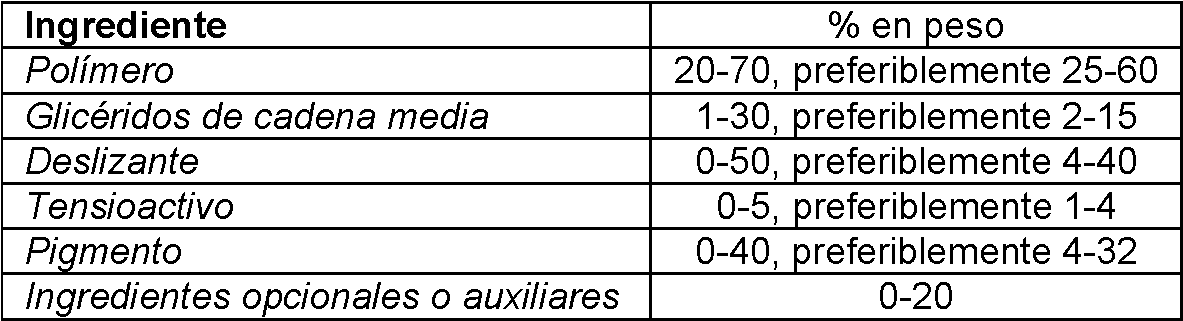
Algunas composiciones de recubrimiento en película seca preferidas según la invención incluyen:Some preferred dry film coating compositions according to the invention include:

Se entenderá de la tabla anterior que las composiciones de recubrimiento en película secas preferidas incluirán al menos un polímero y un glicérido de cadena media como se describe en el presente documento. Los ingredientes adicionales, si se incluyen, producirán que la cantidad de polímero y glicérido de cadena media se reduzcan proporcionalmente, pero ambos componentes todavía estarán dentro de los intervalos descritos en el presente documento, de modo que la cantidad total de todos lo ingredientes en la mezcla seca será del 100% en peso.It will be understood from the table above that preferred dry film coating compositions will include at least one polymer and one medium chain glyceride as described herein. Additional ingredients, if included, will cause the amount of polymer and medium chain glyceride to be proportionally reduced, but both components will still be within the ranges described herein, such that the total amount of all ingredients in the dry mix will be 100% by weight.
Para fines de ilustración y no limitación, se puede formar una dispersión acuosa que tiene aproximadamente el 20% de ingredientes no acuosos dispersando 100 gramos de una mezcla en polvo combinada descrita en el presente documento anteriormente en 400 gramos de agua a temperatura ambiente. El agua se pesa en un recipiente adecuado, es decir, uno con un diámetro aproximadamente igual a la profundidad de la suspensión final. Un mezclador de baja cizalla, preferiblemente uno que tiene una pala de mezclado con un diámetro de aproximadamente un tercio del diámetro del recipiente de mezclado, se hace descender al agua y se enciende para crear un vórtice desde el extremo del recipiente hacia abajo hasta aproximadamente justo por encima de la pala de mezclado para prevenir atrapamiento de aire. Los 100 gramos de la composición de recubrimiento en película seca se añaden al vórtice a una velocidad donde no hay acumulación excesiva de polvo seco. La velocidad y profundidad de la pala de mezclado se ajusta para evitar que se arrastre aire a la suspensión para evitar espuma. La suspensión se agita a baja velocidad, preferiblemente 350 rpm o menos, durante un tiempo suficiente para asegurar que se forma una mezcla homogénea. Usando el tamaño de lote anterior como guía, se requieren aproximadamente 45 minutos de tiempo de mezclado. La suspensión está entonces lista para rociar sobre sustratos farmacéuticos y similares. Los expertos en la materia también se darán cuenta de que hay muchas maneras de preparar una mezcla sustancialmente homogénea de los sólidos en agua y que el ámbito de la invención no depende en modo alguno del aparato usado. Se contempla que las dispersiones acuosas adecuadas contendrán desde aproximadamente el 5 hasta aproximadamente el 40% y preferiblemente desde aproximadamente el 15 hasta aproximadamente el 35% de ingredientes no acuosos en las mismas.For purposes of illustration and not limitation, an aqueous dispersion having approximately 20% non-aqueous ingredients can be formed by dispersing 100 grams of a combined powder mixture described herein above in 400 grams of water at room temperature. The water is weighed into a suitable container, that is, one with a diameter approximately equal to the depth of the final suspension. A low shear mixer, preferably one having a mixing blade with a diameter of about one-third the diameter of the mixing bowl, is lowered into the water and turned on to create a vortex from the end of the bowl down to about just above the mixing paddle to prevent air entrapment. The 100 grams of the dry film coating composition is added to the vortex at a rate where there is no excessive accumulation of dry powder. The speed and depth of the mixing paddle is adjusted to prevent air being drawn into the suspension to avoid foaming. The suspension is stirred at low speed, preferably 350 rpm or less, for a time sufficient to ensure that a homogeneous mixture is formed. Using the batch size above as a guide, approximately 45 minutes of mixing time is required. The suspension is then ready for spraying onto pharmaceutical substrates and the like. Those skilled in the art will also realize that there are many ways to prepare a substantially homogeneous mixture of the solids in water and that the scope of the invention is in no way dependent on the apparatus used. It is contemplated that suitable aqueous dispersions will contain from about 5 to about 40% and preferably from about 15 to about 35% of non-aqueous ingredients therein.
En formas de realización aún adicionales de la invención, se proporcionan sustratos ingeribles por vía oral recubiertos con las formulaciones de recubrimiento en película inventivas. Los sustratos recubiertos tienen aspecto y uniformidad excelente, así como estabilidad aumentada en presencia de humedad y oxígeno medioambientales. In still further embodiments of the invention, orally ingestible substrates coated with the inventive film coating formulations are provided. The coated substrates have excellent appearance and uniformity, as well as increased stability in the presence of environmental moisture and oxygen.
Como se describirá en los ejemplos posteriormente, los métodos incluyen aplicar las composiciones de recubrimiento en película como suspensiones acuosas a las superficies de sustratos ingeribles por vía oral. El recubrimiento en película se puede aplicar como parte de un proceso de recubrimiento en tambor o recubrimiento por rociado comúnmente usado para recubrir tales artículos. La cantidad de recubrimiento aplicado dependerá de varios factores, incluyendo la naturaleza y funcionalidad del recubrimiento en película, el sustrato que se va a recubrir y el aparato empleado para aplicar el recubrimiento, etc. En algunas aplicaciones de liberación inmediata de la invención, los sustratos serán comprimidos y se recubrirán hasta un aumento de peso teórico desde aproximadamente el 0,25 hasta aproximadamente el 5,0%. Preferiblemente, el aumento en peso teórico es desde aproximadamente el 1,0 hasta aproximadamente el 4,5% y más preferiblemente, el aumento en peso teórico es desde aproximadamente el 2,0 hasta aproximadamente el 4,0% en peso de dicho sustrato. Como se ha mencionado anteriormente, las soluciones de recubrimiento de la presente invención también pueden incluir ingredientes auxiliares además de la mezcla en polvo y el agua.As will be described in the examples below, the methods include applying the film coating compositions as aqueous suspensions to the surfaces of orally ingestible substrates. Film coating can be applied as part of a commonly used drum coating or spray coating process to coat such articles. The amount of coating applied will depend on various factors, including the nature and functionality of the film coating, the substrate to be coated, and the apparatus used to apply the coating, etc. In some immediate release applications of the invention, the substrates will be compressed and coated to a theoretical weight gain of from about 0.25 to about 5.0%. Preferably, the theoretical weight increase is from about 1.0 to about 4.5% and more preferably, the theoretical weight increase is from about 2.0 to about 4.0% by weight of said substrate. As mentioned above, the coating solutions of the present invention can also include auxiliary ingredients in addition to the powder mixture and water.
Los sustratos ingeribles por vía oral, recubiertos descritos anteriormente también pueden incluir un recubrimiento en película subcapa entre el sustrato ingerible por vía oral y el recubrimiento en película inventivo que comprende glicéridos de cadena media. La subcapa seleccionada preferiblemente se basa en una composición de recubrimiento en película comestible que sea compatible con y se adhiera tanto al sustrato ingerible por vía oral como al recubrimiento inventivo. Por tanto, el experto puede elegir de una amplia variedad de recubrimientos farmacéuticos y alimentarios aceptables para uso como subcapas en la presente invención. La subcapa también se aplica al sustrato para proporcionar desde aproximadamente un 0,25 hasta aproximadamente un 5,0% de aumento de peso al sustrato ingerible por vía oral.The coated orally ingestible substrates described above may also include a sublayer film coating between the orally ingestible substrate and the inventive film coating comprising medium chain glycerides. The selected undercoat is preferably based on an edible film coating composition that is compatible with and adheres to both the orally ingestible substrate and the inventive coating. Thus, the skilled person can choose from a wide variety of pharmaceutical and food acceptable coatings for use as subcoats in the present invention. The undercoat is also applied to the substrate to provide from about 0.25 to about 5.0% weight gain to the orally ingestible substrate.
Independientemente del método empleado o los materiales específicos incluidos en las composiciones de recubrimiento en película, los sustratos ingeribles por vía oral de la presente invención incluirán un polímero y glicéridos de cadena media.Regardless of the method employed or the specific materials included in film coating compositions, the orally ingestible substrates of the present invention will include a polymer and medium chain glycerides.
5. Ejemplos5. Examples
Los siguientes ejemplos sirven para proporcionar apreciación adicional de la invención, pero no se pretende en modo alguno que restrinjan el ámbito eficaz de la invención. Todos los ingredientes se expresan como que son en % en peso.The following examples serve to provide further appreciation of the invention, but are not intended in any way to restrict the effective scope of the invention. All ingredients are expressed as being% by weight.
Ejemplo 1Example 1
Una formulación preferida para una composición de recubrimiento en seco inventiva es la siguiente:A preferred formulation for an inventive dry coating composition is as follows:
Componente Partes en pesoComponent Parts by weight
PVA 37,0PVA 37.0
Talco 31,0Talc 31.0
Monocaprilocaprato de glicerol 4,0Glycerol Monocaprylocaprate 4.0
Lauril sulfato de sodio 3,0Sodium Lauryl Sulfate 3.0
Dióxido de titanio 20,0Titanium dioxide 20.0
Pigmento laca de aluminio Blue#2 _______ 5,0_______Blue # 2 Aluminum Lacquer Pigment _______ 5.0 _______
100,0100.0
Preparación de la composición de recubrimiento en película seca:Preparation of dry film coating composition:
La composición de recubrimiento en película seca se preparó añadiendo todos los ingredientes secos (PVA, talco, lauril sulfato de sodio y dióxido de titanio) a un mezclador de laboratorio y mezclando durante 5 minutos hasta que se produjo una mezcla homogénea. Después se añadió gradualmente monocaprilocaprato de glicerol, el único componente líquido, a la mezcla seca, y la mezcla total se mezcló durante 2 minutos adicionales hasta que se introdujo todo el líquido.The dry film coating composition was prepared by adding all the dry ingredients (PVA, talc, sodium lauryl sulfate, and titanium dioxide) to a laboratory mixer and mixing for 5 minutes until a homogeneous mixture was produced. Glycerol monocaprylocaprate, the only liquid component, was then gradually added to the dry mixture, and the whole mixture was mixed for an additional 2 minutes until all the liquid was introduced.
Preparación de la dispersión acuosa:Preparation of the aqueous dispersion:
La composición de recubrimiento en película seca (100 gramos) se dispersó en 400 gramos de agua a temperatura ambiente para hacer una suspensión de recubrimiento acuosa que tenía el 20% p/p de ingredientes no acuosos. El agua se pesó en un recipiente con un diámetro aproximadamente igual a la profundidad de la dispersión final. Un mezclador de baja cizalla se hizo descender al agua y se encendió para crear un vórtice desde el extremo del recipiente hacia abajo hasta justo por encima de la pala de mezclado para prevenir atrapamiento de aire. Los 100 gramos de la composición de recubrimiento en película seca se añadieron al vórtice a una velocidad donde no había acumulación excesiva de polvo seco o espuma. La velocidad y profundidad de la pala de mezclado se ajustó para evitar que se arrastrara aire en la suspensión para evitar espuma. La suspensión se agitó a baja velocidad (350 rpm o menos) durante 45 minutos para formar una dispersión acuosa homogénea adecuada para recubrimiento. The dry film coating composition (100 grams) was dispersed in 400 grams of room temperature water to make an aqueous coating suspension having 20% w / w non-aqueous ingredients. The water was weighed into a container with a diameter approximately equal to the depth of the final dispersion. A low shear mixer was lowered into the water and turned on to create a vortex from the end of the container down to just above the mixing paddle to prevent air entrapment. The 100 grams of the dry film coating composition was added to the vortex at a rate where there was no excessive build-up of dry powder or foam. The speed and depth of the mixing paddle was adjusted to avoid entrainment of air in the suspension to avoid foaming. The suspension was stirred at low speed (350 rpm or less) for 45 minutes to form a homogeneous aqueous dispersion suitable for coating.
Recubrimiento de comprimidos:Tablet coating:
Un lote de 2,5 kilogramos de comprimidos de placebo convexos (diámetro de 10 mm) se recubrió por rociado con la dispersión acuosa descrita anteriormente en un tambor de recubrimiento con ventilación lateral completamente perforado O'Hara LabCoat equipado con un inserto de tambor que tenía un diámetro de 15” y una pistola rociadora ajustada con una boquilla que tiene una apertura de 1 mm. Los parámetros de recubrimiento medios fueron: temperatura de entrada (IT) 76°C, temperatura de escape (ET) 48°C, temperatura del lecho de recubrimiento (BT) 45°C, flujo de aire 297 metros cúbicos/hora, presión diferencial -0,1 pulgadas de agua, presión del aire de atomización (AP) 1,4 baros, velocidad del tambor (PS) 18 rpm. No se observó adherencia comprimido a comprimido o comprimido a tambor de recubrimiento a una velocidad de rociado de 30 gramos/minuto. Se aplicó un aumento de peso de recubrimiento teórico del 4,0% a los comprimidos. Los comprimidos recubiertos resultantes eran lisos, no adherentes y brillantes.A 2.5 kilogram batch of convex placebo tablets (10 mm diameter) was spray coated with the aqueous dispersion described above in an O'Hara LabCoat fully perforated side-vented coating drum equipped with a drum insert having a 15 ”diameter and a spray gun fitted with a nozzle that has a 1mm opening. The mean coating parameters were: inlet temperature (IT) 76 ° C, exhaust temperature (ET) 48 ° C, coating bed temperature (BT) 45 ° C, air flow 297 cubic meters / hour, differential pressure -0.1 inches of water, Atomizing Air Pressure (AP) 1.4 baros, Drum Speed (PS) 18 rpm. No adhesion compressed to tablet or tablet to coating drum was observed at a spray rate of 30 grams / minute. A theoretical coating weight increase of 4.0% was applied to the tablets. The resulting coated tablets were smooth, non-sticky and glossy.
Determinación de la velocidad de transmisión de vapor de agua:Determination of the water vapor transmission rate:
La velocidad de transmisión de vapor de agua (MVTR) se determinó preparando primero una muestra de película fundida a partir de la dispersión acuosa descrita anteriormente rociando secuencialmente la dispersión en una superficie plana de tereftalato de polietileno (PET) asegurada en una placa metálica calentada a 60°C. Se obtuvo así una película de 100 micrómetros de espesor para ensayo. La MVTR de la película se midió en una unidad Mocon PermaTran-W 1/50 donde la muestra se ensayó a un gradiente de HR del 80% a 25°C. La MVTR para la película fundida preparada de la formulación del ejemplo 1 fue 95 gramos de H2 O/día/m2The water vapor transmission rate (MVTR) was determined by first preparing a molten film sample from the aqueous dispersion described above by sequentially spraying the dispersion onto a flat surface of polyethylene terephthalate (PET) secured to a metal plate heated to 60 ° C. Thus, a 100 micron thick film was obtained for testing. The MVTR of the film was measured in a Mocon PermaTran-W 1/50 unit where the sample was tested at an 80% RH gradient at 25 ° C. The MVTR for the cast film prepared from the formulation of Example 1 was 95 grams H 2 O / day / m2
Evaluación visual de los comprimidos recubiertos:Visual evaluation of the coated tablets:
100 comprimidos seleccionados al azar se observaron cuidadosamente para la presencia de pequeñas motas blancas. Solo 9 de 100 comprimidos tenían al menos una mota muy pequeña en la superficie del comprimido. No se observó relleno del logotipo.100 randomly selected tablets were carefully observed for the presence of small white specks. Only 9 out of 100 tablets had at least one very small speck on the tablet surface. No logo fill was observed.
Prueba de disgregación:Disintegration test:
Se realizó el ensayo de disgregación según el método de disgregación de la USP. Se prepararon seis comprimidos como se ha descrito previamente y se colocaron en un ensamblaje de cesto y se sumergieron en fluido gástrico simulado (HCl 0,1 N, pH 1,2) o fluido intestinal simulado (tampón fosfato pH 6,8). El cesto se movió arriba y abajo a una velocidad de aproximadamente 28-32 ciclos/por minuto. La integridad de los comprimidos se evaluó a lo largo del periodo de ensayo, y se anotó el tiempo para que el primer y último comprimido se disgregaran. Estos valores se usaron después para determinar el tiempo medio de disgregación para las muestras en cada medio. El tiempo medio de disgregación de los comprimidos en HCl 0,1 N y tampón fosfato a pH 6,8 fue 86 y 93 segundos, respectivamente.The disintegration test was carried out according to the USP disintegration method. Six tablets were prepared as previously described and placed in a basket assembly and immersed in simulated gastric fluid (0.1 N HCl, pH 1.2) or simulated intestinal fluid (phosphate buffer pH 6.8). The basket moved up and down at a rate of approximately 28-32 cycles / minute. The integrity of the tablets was evaluated throughout the test period, and the time for the first and last tablet to disintegrate was noted. These values were then used to determine the mean disintegration time for the samples in each medium. The mean disintegration time of the tablets in 0.1N HCl and phosphate buffer at pH 6.8 was 86 and 93 seconds, respectively.
Ejemplo comparativo AComparative Example A
Se preparó una formulación similar a la del ejemplo 1 excepto que se eliminó el monocaprilocaprato de glicerol de la formulación, y el nivel de talco se aumentó para compensar.A formulation similar to that of Example 1 was prepared except that glycerol monocaprylocaprate was removed from the formulation, and the talc level was increased to compensate.
Componente Partes en pesoComponent Parts by weight
PVA 37,0PVA 37.0
Talco 35,0Talc 35.0
Monocaprilocaprato de glicerol 0,0Glycerol monocaprylocaprate 0.0
Lauril sulfato de sodio 3,0Sodium Lauryl Sulfate 3.0
Dióxido de titanio 20,0Titanium dioxide 20.0
Pigmento laca de aluminio Blue#2 _______5,0_______Blue # 2 Aluminum Lacquer Pigment _______ 5.0 _______
100,0100.0
La preparación de la dispersión acuosa y el proceso de recubrimiento se realizaron de una manera análoga a la descrita en el ejemplo 1. La formulación no se dispersó bien en el medio acuoso, y se observó espumación significativa. Se observó que 20-25 comprimidos se pegaban al interior del tambor de recubrimiento por revolución según se aplicaba el recubrimiento a una velocidad de rociado de 30 gramos/minuto. 100 de 100 comprimidos mostraron la presencia de motas visibles en la superficie del comprimido, y se observó relleno del logotipo.The preparation of the aqueous dispersion and the coating process were carried out in a manner analogous to that described in Example 1. The formulation did not disperse well in the aqueous medium, and significant foaming was observed. 20-25 tablets were observed to stick to the inside of the coating drum per revolution as the coating was applied at a spray rate of 30 grams / minute. 100 out of 100 tablets showed visible speckles on the tablet surface, and logo fill was observed.
Ejemplos 2-12Examples 2-12
Se prepararon composiciones de recubrimiento en película (100 gramos cada una) y dispersiones que las comprendían por métodos similares a los descritos en el ejemplo 1. Se evaluaron de forma similar el rendimiento del recubrimiento y las propiedades de los comprimidos. Film coating compositions (100 grams each) and dispersions comprising them were prepared by methods similar to those described in Example 1. The coating performance and properties of tablets were similarly evaluated.

Los ejemplos 2-6 mostraron todos que tanto el número de comprimidos que mostraban motas blancas como el número de comprimidos que se pegaban al interior del tambor de recubrimiento disminuían significativamente frente al ejemplo comparativo A. Las mayores mejoras se observaron cuando la cantidad de monocaprilocaprato de glicerol era al menos el 4% de la composición.Examples 2-6 all showed that both the number of tablets showing white specks and the number of tablets sticking to the inside of the coating drum decreased significantly compared to Comparative Example A. The greatest improvements were observed when the amount of monocaprylocaprate of glycerol was at least 4% of the composition.
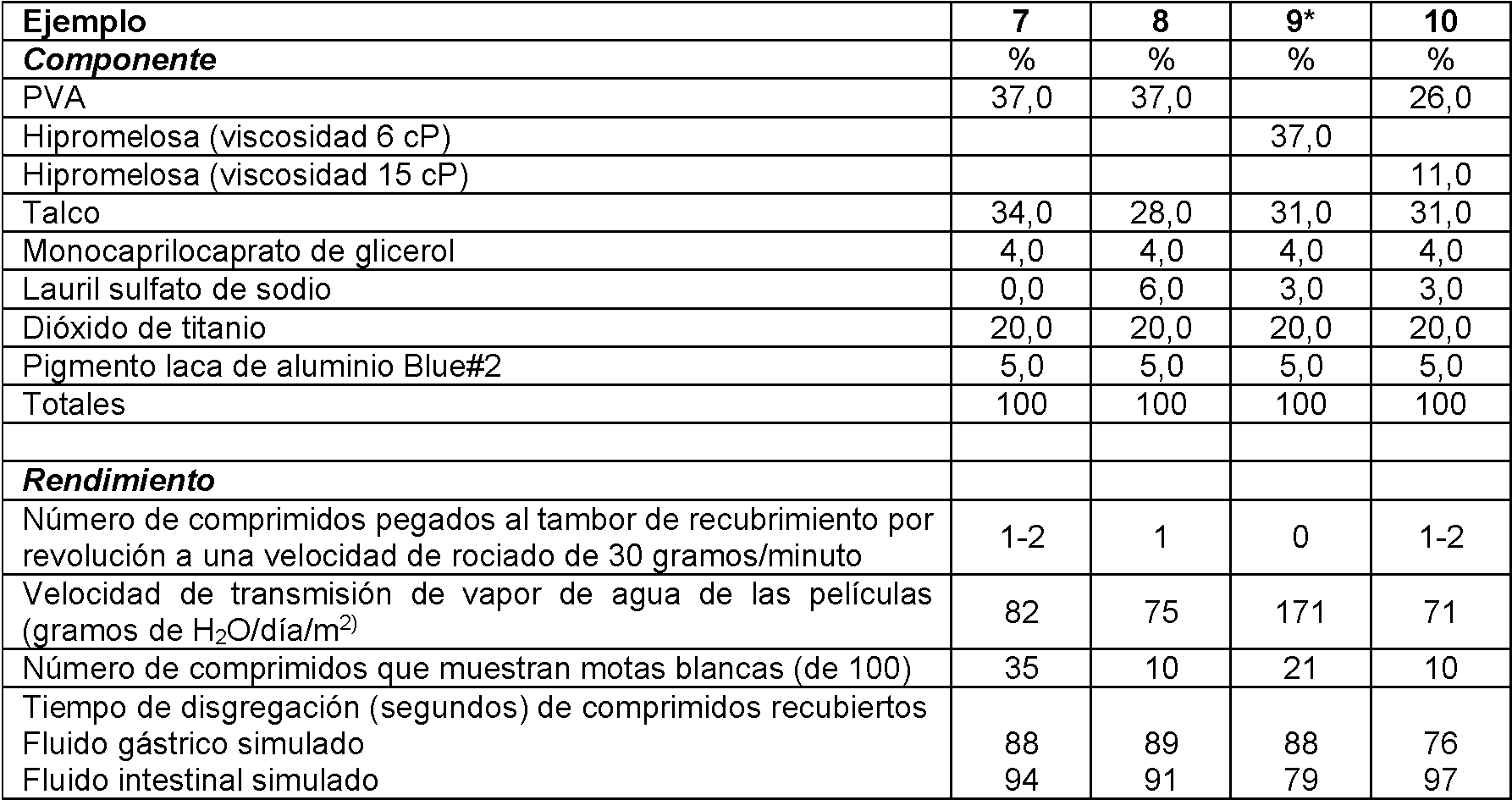
*Debido a limitaciones de viscosidad, la dispersión acuosa hecha del ejemplo 9 contenía el 15 más que el 20% de componentes no acuosos.* Due to viscosity limitations, the aqueous dispersion made from Example 9 contained more than 20% non-aqueous components.
Los ejemplos 7-10 mostraron todos que tanto el número de comprimidos que mostraban motas blancas como el número de comprimidos que se pegaban al interior del tambor de recubrimiento disminuían significativamente frente al ejemplo comparativo A. Esto se mantuvo cierto cuando el nivel de tensioactivo (lauril sulfato de sodio) se varió y el tipo de polímero se cambió. Examples 7-10 all showed that both the number of tablets showing white specks and the number of tablets sticking to the inside of the coating drum decreased significantly compared to Comparative Example A. This held true when the level of surfactant (lauryl sodium sulfate) was varied and the type of polymer was changed.

Los ejemplos 11 y 12 mostraron que tanto el número de comprimidos que mostraban motas blancas como el número de comprimidos que se pegaban al interior del tambor de recubrimiento disminuían significativamente frente al ejemplo comparativo A cuando se cambiaba el tipo de tensioactivo.Examples 11 and 12 showed that both the number of tablets showing white specks and the number of tablets sticking to the inside of the coating drum decreased significantly compared to Comparative Example A when the type of surfactant was changed.

Los ejemplos 13-15 mostraron que tanto el número de comprimidos que mostraban motas blancas como el número de comprimidos que se pegaban al interior del tambor de recubrimiento disminuían significativamente frente al ejemplo comparativo A cuando se cambiaba el polímero de PVA a Kollicoat IR y se usaba monocaprilocaprato de glicerol como el antiadherente.Examples 13-15 showed that both the number of tablets showing white specks and the number of tablets sticking to the inside of the coating drum decreased significantly compared to Comparative Example A when the polymer was switched from PVA to Kollicoat IR and used glycerol monocaprylocaprate as the non-stick.
Mientras que se han descrito las que actualmente se cree que son las formas de realización preferidas de la invención, los expertos en la materia advertirán de se pueden hacer cambios y modificaciones a las mismas, siempre que no superen el ámbito definido por las reivindicaciones adjuntas. While what are currently believed to be the preferred embodiments of the invention have been described, those skilled in the art will appreciate that changes and modifications may be made thereto, provided they do not exceed the scope defined by the appended claims.
Claims (15)

Applications Claiming Priority (2)
| Application Number | Priority Date | Filing Date | Title |
|---|---|---|---|
| US201461929735P | 2014-01-21 | 2014-01-21 | |
| PCT/US2015/011422 WO2015112400A1 (en) | 2014-01-21 | 2015-01-14 | Immediate release film coatings containing medium chain glycerides and substrates coated therewith |
Publications (1)
| Publication Number | Publication Date |
|---|---|
| ES2802156T3 true ES2802156T3 (en) | 2021-01-15 |
Family
ID=53543848
Family Applications (1)
| Application Number | Title | Priority Date | Filing Date |
|---|---|---|---|
| ES15740927T Active ES2802156T3 (en) | 2014-01-21 | 2015-01-14 | Immediate release film coatings containing medium chain glycerides and substrates coated therewith |
Country Status (14)
| Country | Link |
|---|---|
| US (2) | US9504654B2 (en) |
| EP (1) | EP3096891B1 (en) |
| JP (1) | JP6541687B2 (en) |
| KR (1) | KR102287342B1 (en) |
| CN (1) | CN105916598B (en) |
| AU (1) | AU2015209674B2 (en) |
| BR (1) | BR112016016623B1 (en) |
| CA (1) | CA2933202C (en) |
| ES (1) | ES2802156T3 (en) |
| HU (1) | HUE049598T2 (en) |
| MX (1) | MX378845B (en) |
| PL (1) | PL3096891T3 (en) |
| RU (1) | RU2686183C2 (en) |
| WO (1) | WO2015112400A1 (en) |
Families Citing this family (7)
| Publication number | Priority date | Publication date | Assignee | Title |
|---|---|---|---|---|
| KR102158339B1 (en) * | 2016-02-05 | 2020-09-21 | 삼진제약주식회사 | Carvedilol immediate release formulation having improved madescent |
| RU2753049C2 (en) * | 2016-08-04 | 2021-08-11 | БиПиЭсАй ХОЛДИНГЗ, ЭлЭлСи | Easy-to-swallow coatings and substrates coated with them |
| US20180338922A1 (en) * | 2017-05-26 | 2018-11-29 | Esperion Therapeutics, Inc. | Fixed dose formulations |
| TR201721437A2 (en) * | 2017-12-25 | 2019-07-22 | Sanovel Ilac Sanayi Ve Ticaret Anonim Sirketi | FORMULATIONS OF FESOTHERODY PROVIDING MODIFIED EMISSION |
| KR102103530B1 (en) | 2018-06-29 | 2020-04-22 | 주식회사 코피텍 | Composition for film-coating and tablet coated with the composition |
| KR102265977B1 (en) | 2018-07-16 | 2021-06-16 | 주식회사 코피텍 | Composition for film-coating having improved damp-proof property and tablet coated with the composition |
| JPWO2023063296A1 (en) * | 2021-10-11 | 2023-04-20 |
Family Cites Families (28)
| Publication number | Priority date | Publication date | Assignee | Title |
|---|---|---|---|---|
| JPS57171428A (en) * | 1981-04-13 | 1982-10-22 | Sankyo Co Ltd | Preparation of coated solid preparation |
| DE3220434A1 (en) | 1982-05-29 | 1983-12-01 | Robert Bosch Gmbh, 7000 Stuttgart | METHOD FOR MONITORING A MEASUREMENT |
| JPS5973529A (en) | 1982-10-12 | 1984-04-25 | Sankyo Co Ltd | Preparation of coated solid drug |
| JPS59193831A (en) * | 1983-04-18 | 1984-11-02 | Sankyo Co Ltd | Preparation of enteric drug |
| US6248363B1 (en) * | 1999-11-23 | 2001-06-19 | Lipocine, Inc. | Solid carriers for improved delivery of active ingredients in pharmaceutical compositions |
| US6448323B1 (en) * | 1999-07-09 | 2002-09-10 | Bpsi Holdings, Inc. | Film coatings and film coating compositions based on polyvinyl alcohol |
| KR100425226B1 (en) * | 2001-07-03 | 2004-03-30 | 주식회사 팜트리 | Compositions and preparation methods for bioavailable oral aceclofenac dosage forms |
| EP1465592A2 (en) * | 2001-12-19 | 2004-10-13 | Alza Corporation | Formulation and dosage form for increasing oral bioavailability of hydrophilic macromolecules |
| FR2838647B1 (en) * | 2002-04-23 | 2006-02-17 | PROLONGED RELEASE PARTICLES, PROCESS FOR THEIR PREPARATION AND TABLETS CONTAINING SAME | |
| DE10311585A1 (en) * | 2003-03-14 | 2004-09-23 | Basf Ag | Adsorbates for use in human or animal nutrition or cosmetics are produced by introducing material to be adsorbed together with stabilizer on to carrier |
| MXPA06010488A (en) | 2004-03-31 | 2006-12-19 | Bpsi Holdings Inc | Enteric coatings for orally ingestible substrates. |
| TWI354569B (en) * | 2004-05-28 | 2011-12-21 | Bristol Myers Squibb Co | Coated tablet formulation and method |
| US20080096979A1 (en) * | 2004-11-08 | 2008-04-24 | Rubicon Research Pvt. Ltd. | Aqueous Pharmaceutical Coating |
| WO2006111980A2 (en) | 2005-04-20 | 2006-10-26 | Ideal Cures Pvt. Ltd. | Pva based film coating and film coating compositions |
| JP2007217390A (en) * | 2006-02-20 | 2007-08-30 | Hitoshi Ichihashi | Pharmaceutical composition containing caprylocaproyl macrogol-8-glyceride |
| US20080181928A1 (en) | 2006-12-22 | 2008-07-31 | Miv Therapeutics, Inc. | Coatings for implantable medical devices for liposome delivery |
| BRPI0919249B1 (en) | 2008-09-25 | 2017-12-19 | Isp Investments Inc. | Coating composition, method for coating solids and coated product |
| TWI438012B (en) | 2008-12-25 | 2014-05-21 | Toray Industries | Coating agent for solid formulations and solid formulations using thereof |
| WO2010112965A1 (en) * | 2009-03-30 | 2010-10-07 | Abdi Ibrahim Ilac Sanayi Ve Ticaret Anonim Sirketi | Isolation coating of diclofenac tablets |
| WO2010122583A2 (en) | 2009-04-24 | 2010-10-28 | Rubicon Research Private Limited | Oral pharmaceutical compositions of acid labile substances |
| KR101783945B1 (en) * | 2009-05-12 | 2017-10-10 | 비피에스아이 홀딩스, 엘엘씨. | Enhanced moisture barrier immediate release film coating systems and substrates coated therewith |
| KR20120033305A (en) * | 2009-05-12 | 2012-04-06 | 비피에스아이 홀딩스, 엘엘씨. | Film coatings containing fine particle size detackifiers and substrates coated therewith |
| SG10201500152UA (en) * | 2009-12-22 | 2015-03-30 | Abbvie Inc | Abt-263 capsule |
| US20130095141A1 (en) * | 2010-03-08 | 2013-04-18 | Beverly A. Schad | Food grade dry film coating composition and methods of making and using the same |
| WO2012120364A2 (en) * | 2011-03-09 | 2012-09-13 | Ideal Cures Pvt. Ltd. | Novel immediate release film coating compositions |
| US20150320679A1 (en) * | 2012-12-12 | 2015-11-12 | Leo Laboratories Limited | Gel compositions |
| WO2014096983A1 (en) * | 2012-12-21 | 2014-06-26 | Wockhardt Limited | Stable pharmaceutical compositions of saxagliptin or salts thereof |
| GB201319792D0 (en) * | 2013-11-08 | 2013-12-25 | Sigmoid Pharma Ltd | Formulations |
-
2015
- 2015-01-14 RU RU2016133221A patent/RU2686183C2/en active
- 2015-01-14 CA CA2933202A patent/CA2933202C/en active Active
- 2015-01-14 WO PCT/US2015/011422 patent/WO2015112400A1/en not_active Ceased
- 2015-01-14 AU AU2015209674A patent/AU2015209674B2/en active Active
- 2015-01-14 KR KR1020167017556A patent/KR102287342B1/en active Active
- 2015-01-14 JP JP2016565103A patent/JP6541687B2/en active Active
- 2015-01-14 HU HUE15740927A patent/HUE049598T2/en unknown
- 2015-01-14 BR BR112016016623-0A patent/BR112016016623B1/en active IP Right Grant
- 2015-01-14 US US14/597,025 patent/US9504654B2/en active Active
- 2015-01-14 PL PL15740927T patent/PL3096891T3/en unknown
- 2015-01-14 CN CN201580005058.8A patent/CN105916598B/en active Active
- 2015-01-14 ES ES15740927T patent/ES2802156T3/en active Active
- 2015-01-14 EP EP15740927.7A patent/EP3096891B1/en active Active
- 2015-01-14 MX MX2016008583A patent/MX378845B/en unknown
-
2016
- 2016-10-24 US US15/332,319 patent/US9789067B2/en active Active
Also Published As
| Publication number | Publication date |
|---|---|
| JP6541687B2 (en) | 2019-07-10 |
| US9504654B2 (en) | 2016-11-29 |
| AU2015209674B2 (en) | 2018-11-08 |
| MX378845B (en) | 2025-03-10 |
| KR102287342B1 (en) | 2021-08-06 |
| AU2015209674A1 (en) | 2016-06-23 |
| CA2933202C (en) | 2022-05-31 |
| US20170035697A1 (en) | 2017-02-09 |
| RU2016133221A (en) | 2018-03-02 |
| WO2015112400A1 (en) | 2015-07-30 |
| BR112016016623B1 (en) | 2022-02-01 |
| CN105916598B (en) | 2020-07-17 |
| RU2016133221A3 (en) | 2018-07-17 |
| US20150202160A1 (en) | 2015-07-23 |
| EP3096891B1 (en) | 2020-04-08 |
| EP3096891A1 (en) | 2016-11-30 |
| CA2933202A1 (en) | 2015-07-30 |
| PL3096891T3 (en) | 2020-08-24 |
| BR112016016623A2 (en) | 2017-08-08 |
| JP2017509691A (en) | 2017-04-06 |
| MX2016008583A (en) | 2017-02-02 |
| RU2686183C2 (en) | 2019-04-24 |
| HUE049598T2 (en) | 2020-09-28 |
| KR20160111375A (en) | 2016-09-26 |
| EP3096891A4 (en) | 2017-10-04 |
| CN105916598A (en) | 2016-08-31 |
| US9789067B2 (en) | 2017-10-17 |
Similar Documents
| Publication | Publication Date | Title |
|---|---|---|
| ES2802156T3 (en) | Immediate release film coatings containing medium chain glycerides and substrates coated therewith | |
| CA2903375C (en) | Delayed release film coatings containing calcium silicate and substrates coated therewith | |
| CN102421423B (en) | Enhanced moisture barrier immediate release film coating system and substrate coated therewith | |
| JP7041120B2 (en) | Easy-to-swallow coating and substrate covered by it |