ES2807241T3 - Encoding method, encoder, program and recording medium - Google Patents
Encoding method, encoder, program and recording medium Download PDFInfo
- Publication number
- ES2807241T3 ES2807241T3 ES19169511T ES19169511T ES2807241T3 ES 2807241 T3 ES2807241 T3 ES 2807241T3 ES 19169511 T ES19169511 T ES 19169511T ES 19169511 T ES19169511 T ES 19169511T ES 2807241 T3 ES2807241 T3 ES 2807241T3
- Authority
- ES
- Spain
- Prior art keywords
- gain
- bits
- update
- samples
- lower limit
- Prior art date
- Legal status (The legal status is an assumption and is not a legal conclusion. Google has not performed a legal analysis and makes no representation as to the accuracy of the status listed.)
- Active
Links
Classifications
-
- G—PHYSICS
- G10—MUSICAL INSTRUMENTS; ACOUSTICS
- G10L—SPEECH ANALYSIS TECHNIQUES OR SPEECH SYNTHESIS; SPEECH RECOGNITION; SPEECH OR VOICE PROCESSING TECHNIQUES; SPEECH OR AUDIO CODING OR DECODING
- G10L19/00—Speech or audio signals analysis-synthesis techniques for redundancy reduction, e.g. in vocoders; Coding or decoding of speech or audio signals, using source filter models or psychoacoustic analysis
- G10L19/02—Speech or audio signals analysis-synthesis techniques for redundancy reduction, e.g. in vocoders; Coding or decoding of speech or audio signals, using source filter models or psychoacoustic analysis using spectral analysis, e.g. transform vocoders or subband vocoders
- G10L19/032—Quantisation or dequantisation of spectral components
-
- G—PHYSICS
- G10—MUSICAL INSTRUMENTS; ACOUSTICS
- G10L—SPEECH ANALYSIS TECHNIQUES OR SPEECH SYNTHESIS; SPEECH RECOGNITION; SPEECH OR VOICE PROCESSING TECHNIQUES; SPEECH OR AUDIO CODING OR DECODING
- G10L19/00—Speech or audio signals analysis-synthesis techniques for redundancy reduction, e.g. in vocoders; Coding or decoding of speech or audio signals, using source filter models or psychoacoustic analysis
- G10L19/002—Dynamic bit allocation
-
- G—PHYSICS
- G10—MUSICAL INSTRUMENTS; ACOUSTICS
- G10L—SPEECH ANALYSIS TECHNIQUES OR SPEECH SYNTHESIS; SPEECH RECOGNITION; SPEECH OR VOICE PROCESSING TECHNIQUES; SPEECH OR AUDIO CODING OR DECODING
- G10L19/00—Speech or audio signals analysis-synthesis techniques for redundancy reduction, e.g. in vocoders; Coding or decoding of speech or audio signals, using source filter models or psychoacoustic analysis
- G10L19/02—Speech or audio signals analysis-synthesis techniques for redundancy reduction, e.g. in vocoders; Coding or decoding of speech or audio signals, using source filter models or psychoacoustic analysis using spectral analysis, e.g. transform vocoders or subband vocoders
- G10L19/032—Quantisation or dequantisation of spectral components
- G10L19/035—Scalar quantisation
-
- G—PHYSICS
- G10—MUSICAL INSTRUMENTS; ACOUSTICS
- G10L—SPEECH ANALYSIS TECHNIQUES OR SPEECH SYNTHESIS; SPEECH RECOGNITION; SPEECH OR VOICE PROCESSING TECHNIQUES; SPEECH OR AUDIO CODING OR DECODING
- G10L19/00—Speech or audio signals analysis-synthesis techniques for redundancy reduction, e.g. in vocoders; Coding or decoding of speech or audio signals, using source filter models or psychoacoustic analysis
- G10L19/04—Speech or audio signals analysis-synthesis techniques for redundancy reduction, e.g. in vocoders; Coding or decoding of speech or audio signals, using source filter models or psychoacoustic analysis using predictive techniques
- G10L19/08—Determination or coding of the excitation function; Determination or coding of the long-term prediction parameters
- G10L19/083—Determination or coding of the excitation function; Determination or coding of the long-term prediction parameters the excitation function being an excitation gain
Landscapes
- Engineering & Computer Science (AREA)
- Physics & Mathematics (AREA)
- Spectroscopy & Molecular Physics (AREA)
- Health & Medical Sciences (AREA)
- Audiology, Speech & Language Pathology (AREA)
- Human Computer Interaction (AREA)
- Signal Processing (AREA)
- Acoustics & Sound (AREA)
- Multimedia (AREA)
- Computational Linguistics (AREA)
- Compression, Expansion, Code Conversion, And Decoders (AREA)
- Compression Or Coding Systems Of Tv Signals (AREA)
- Transmission Systems Not Characterized By The Medium Used For Transmission (AREA)
Abstract
Un método de codificación para una cadena de muestras derivada de una señal de audio de entrada en un intervalo de tiempo dado, la cadena de muestras que consiste en una pluralidad de muestras, obteniendo el método de codificación un código de ganancia correspondiente a una ganancia obtenida por un paso de procesamiento de bucle de actualización de ganancia de obtención la ganancia por procesamiento en bucle y un código de señal entero obtenido al codificar una cadena de muestras de valor entero obtenidas dividiendo cada muestra en la cadena de muestra que consiste en la pluralidad de muestras por la ganancia; en donde el paso de procesamiento del bucle de actualización de ganancia comprende un paso de actualización de expansión de ganancia y un paso de actualización de reducción de ganancia; el paso de actualización de expansión de ganancia comprende: un paso de ajuste de ganancia de límite inferior de, cuando el número de bits o el número estimado de bits c en un código obtenido codificando una cadena de muestras de valor entero obtenidas dividiendo cada muestra en la cadena de muestra que consiste en la pluralidad de muestras por una ganancia antes una actualización es mayor que un número predeterminado B de bits asignados, configurando la ganancia antes de la actualización como un límite inferior gmin de la ganancia; y un primer paso de actualización de ganancia de, cuando el número de bits o el número estimado de bits c es mayor que el número predeterminado B de bits asignados y se ha establecido un límite superior gmax de la ganancia, estableciendo una media ponderada del límite superior gmax de la ganancia y el límite inferior gmin de la ganancia como una ganancia actualizada, donde se asigna un mayor peso al límite inferior gmin de la ganancia o al límite superior gmax de la ganancia, lo que sea más probable según un indicador basado en al menos el número predeterminado B de bits asignados, una cantidad de configuración de de bits consumidos en el ajuste del límite inferior y una cantidad de configuración de bits consumidos en el ajuste del límite inferior, y la cantidad de configuración de bits consumidos en el ajuste del límite inferiores el número de bits o el número estimado de bits; y el paso de actualización de reducción de ganancia comprende: un paso de ajuste de ganancia de límite superior de, cuando el número de bits o el número estimado de bits c en un código obtenido codificando una cadena de muestras de valor entero obtenidas dividiendo cada muestra en la cadena de muestra que consiste en la pluralidad de muestras por la ganancia anterior una actualización es menor que el número predeterminado B de bits asignados, configurando la ganancia antes de la actualización como un límite superior gmax de la ganancia; y un segundo paso de actualización de ganancia de, cuando el número de bits o el número estimado de bits c es menor que el número predeterminado B de bits asignados y se ha establecido el límite inferior gmin de la ganancia, estableciendo una media ponderada del límite superior gmax de la ganancia y el límite inferior gmin de la ganancia como una ganancia actualizada, donde se asigna un mayor peso al límite inferior gmin de la ganancia o al límite superior gmax de la ganancia, lo que sea más probable según un indicador basado en al menos el número predeterminado B de bits asignados, el número de bits consumidos en el límite inferior, y el número de bits consumidos en el límite superior, y el número de bits consumidos en el límite superior se puede establecer que es el número de bits o el número estimado de bits.An encoding method for a string of samples derived from an input audio signal in a given time interval, the string of samples consisting of a plurality of samples, the encoding method obtaining a gain code corresponding to a gain obtained by a gain update loop processing step of obtaining the loop processing gain and an integer signal code obtained by encoding a string of integer samples obtained by dividing each sample into the sample string consisting of the plurality of samples for profit; wherein the gain update loop processing step comprises a gain expansion update step and a gain reduction update step; the gain expansion update step comprises: a lower bound gain adjustment step of, when the number of bits or the estimated number of bits c in a code obtained by encoding a string of integer samples obtained by dividing each sample into the sample string consisting of the plurality of samples for a gain before an update is greater than a predetermined number B of allocated bits, the gain before the update being configured as a lower limit gmin of the gain; and a first gain update step of, when the number of bits or the estimated number of bits c is greater than the predetermined number B of allocated bits and an upper limit gmax of the gain has been established, establishing a weighted average of the limit upper gmax of the gain and the lower limit gmin of the gain as an updated gain, where greater weight is assigned to the lower limit gmin of the gain or to the upper limit gmax of the gain, whichever is more likely based on an indicator based on at least the predetermined number B of allocated bits, a set amount of bits consumed in the lower limit setting and a set amount of bits consumed in the lower limit setting, and the set amount of bits consumed in the setting the lower limit is the number of bits or the estimated number of bits; and the gain reduction update step comprises: an upper limit gain adjustment step of, when the number of bits or the estimated number of bits c in a code obtained by encoding a string of integer value samples obtained by dividing each sample in the sample chain consisting of the plurality of samples times the previous gain an update is less than the predetermined number B of allocated bits, setting the gain before the update as an upper limit gmax of the gain; and a second gain update step of, when the number of bits or the estimated number of bits c is less than the predetermined number B of allocated bits and the lower limit gmin of the gain has been established, establishing a weighted average of the limit upper gmax of the gain and the lower limit gmin of the gain as an updated gain, where greater weight is assigned to the lower limit gmin of the gain or to the upper limit gmax of the gain, whichever is more likely based on an indicator based on at least the predetermined number B of allocated bits, the number of bits consumed in the lower limit, and the number of bits consumed in the upper limit, and the number of bits consumed in the upper limit can be set which is the number of bits or the estimated number of bits.
Description
DESCRIPCIÓNDESCRIPTION
Método de codificación, codificador, programa y medio de grabaciónEncoding method, encoder, program and recording medium
[Campo técnico][Technical field]
La presente invención se refiere a una técnica de codificación para señales de audio y, en particular, a una técnica de codificación para codificar una secuencia obtenida dividiendo una cadena de muestras derivada de una señal de audio por una ganancia.The present invention relates to a coding technique for audio signals and, in particular, to a coding technique for coding a sequence obtained by dividing a string of samples derived from an audio signal by a gain.
[Antecedentes de la técnica][Background of the technique]
La codificación adaptativa que codifica coeficientes ortogonales tales como coeficientes de DFT (Transformada Discreta de Fourier) y de MDCT (Transformada Discreta Coseno Modificada) es conocida como método para codificar señales de habla y señales de audio a tasas de bit bajas (por ejemplo, de alrededor de 10 a 20 Kbit/s). Por ejemplo, AMR-WB+ (Multitasa Adaptativa de Banda Ancha Extendida), que es una técnica estándar, tiene el modo de codificación TCX (excitación codificada por transformada). En codificación TCX, se determina una ganancia para una cadena de coeficientes obtenida normalizando una secuencia de señales digitales de audio en el dominio de frecuencia con una cadena de coeficientes de envolvente de espectro de potencia de modo que una secuencia obtenida dividiendo cada uno de los coeficientes en la cadena de coeficientes por la ganancia se pueda codificar con un número predeterminado de bits.Adaptive coding that encodes orthogonal coefficients such as DFT (Discrete Fourier Transform) and MDCT (Modified Discrete Cosine Transform) coefficients is known as a method of encoding speech signals and audio signals at low bit rates (e.g. about 10 to 20 Kbit / s). For example, AMR-WB + (Extended Broadband Adaptive Multitasing), which is a standard technique, has the TCX (Transform Coded Excitation) encoding mode. In TCX encoding, a gain is determined for a chain of coefficients obtained by normalizing a sequence of digital audio signals in the frequency domain with a chain of power spectrum envelope coefficients such that a sequence obtained by dividing each of the coefficients in the chain of coefficients the gain can be encoded with a predetermined number of bits.
El documento de patente US 2008/065376 eneña a restringir el espacio de búsqueda para la ganancia óptima iterativamente.The patent document US 2008/065376 teaches to restrict the search space for the optimal gain iteratively.
<Codificador 1000 TCX><1000 TCX Encoder>
La Figura 1 ilustra una configuración ejemplar de un codificador 1000 que realiza codificación TCX convencional. Los componentes en la Figura 1 se explicarán a continuación.Figure 1 illustrates an exemplary configuration of an encoder 1000 that performs conventional TCX encoding. The components in Figure 1 will be explained below.
<Transformador 1001 en el dominio de frecuencia><Transformer 1001 in frequency domain>
Un transformador 1001 en el dominio de frecuencia transforma una señal digital de audio de entrada en una cadena de coeficientes MDCT X(1), ..., X(N) en N puntos en el dominio de frecuencia sobre una base trama por trama en un periodo de tiempo dado y emite la cadena de coeficientes MDCT. Aquí, N es un número entero positivo.A frequency domain transformer 1001 transforms an input digital audio signal into a chain of MDCT coefficients X (1), ..., X (N) at N points in the frequency domain on a frame-by-frame basis in a given period of time and outputs the chain of MDCT coefficients. Here, N is a positive integer.
<Unidad 1002 aritmética de cadena de coeficientes de envoltura de espectro de potencia><Unit 1002 Power Spectrum Envelope Coefficients String Arithmetic>
Una unidad 1002 aritmética de cadena de coeficientes de envoltura de espectro de potencia realiza un análisis de predicción lineal de una señal digital de audio en cada trama para obtener coeficientes predictivos lineales y usa los coeficientes predictivos lineales para obtener y emitir una cadena de coeficientes de envoltura de espectro de potencia W(1), ..., W(N) de la señal digital de audio en N puntos.A power spectrum envelope coefficient string arithmetic unit 1002 performs linear predictive analysis of a digital audio signal in each frame to obtain linear predictive coefficients and uses the linear predictive coefficients to obtain and output a string of envelope coefficients power spectrum W (1), ..., W (N) of the digital audio signal at N points.
<Normalización 1003 de envoltura ponderada><1003 Weighted Envelope Normalization>
Un normalizador 1003 de envoltura ponderada usa una cadena de coeficientes de envoltura de espectro de potencia obtenida por la unidad 1002 aritmética de cadena de coeficientes de envoltura de espectro de potencia para normalizar cada uno de los coeficientes en una cadena de coeficientes MDCT obtenida por el transformador 1001 en el dominio de frecuencia y emite una cadena de coeficientes MDCT normalizados ponderados Xn(1), ..., Xn(N). Aquí, con el fin de realizar cuantificación que minimiza auditivamente la distorsión, el normalizador 1003 de envoltura ponderada usa una cadena de coeficientes de envoltura de espectro de potencia ponderados obtenida moderando una envoltura de espectro de potencia para normalizar los coeficientes en las cadenas de coeficientes MDCT sobre una base trama por trama. Como resultado, la cadena de coeficientes MDCT normalizados ponderados Xn(1), ..., XN(N) no tiene una pendiente pronunciada de amplitud o grandes variaciones de amplitud en comparación con la cadena de coeficientes MDCT de entrada pero tiene variaciones de magnitud similares a las de la cadena de coeficientes de envoltura de espectro de potencia de la señal digital de audio. Es decir, la cadena de coeficientes MDCT normalizados ponderados tiene amplitudes algo mayores en una región de coeficientes correspondiente a bajas frecuencias y tiene una estructura fina debida a un periodo de tono.A weighted envelope normalizer 1003 uses a chain of power spectrum envelope coefficients obtained by the power spectrum envelope coefficient chain arithmetic unit 1002 to normalize each of the coefficients into a chain of MDCT coefficients obtained by the transformer. 1001 in the frequency domain and outputs a chain of weighted normalized MDCT coefficients Xn (1), ..., Xn (N). Here, in order to perform quantization that auditory minimizes distortion, the weighted envelope normalizer 1003 uses a chain of weighted power spectrum envelope coefficients obtained by moderating a power spectrum envelope to normalize the coefficients in the MDCT coefficient chains. on a frame-by-frame basis. As a result, the chain of weighted normalized MDCT coefficients X n (1), ..., XN (N) does not have a steep amplitude slope or large amplitude variations compared to the input MDCT coefficient chain but has variations of magnitudes similar to those of the chain of power spectrum envelope coefficients of the digital audio signal. That is, the chain of weighted normalized MDCT coefficients has somewhat larger amplitudes in a coefficient region corresponding to low frequencies and has a fine structure due to a pitch period.
<Inicializador 1004><1004 Initializer>
Un inicializador 1004 establece un valor inicial de ganancia (ganancia global) g. El valor inicial de la ganancia se puede determinar a partir de la energía de una cadena de coeficientes MDCT normalizados ponderados Xn(1), ..., Xn(N) y el número de bits asignado de antemano a una salida codificada de un codificador 1006 de longitud variable, por ejemplo. El número de bits asignado de antemano a una salida de código del codificador 1006 de longitud variable es conocido en lo sucesivo como el número B de bits asignados. El iniciador también establece 0 como el valor inicial del número de actualizaciones de ganancia.An initializer 1004 sets an initial value of gain (overall gain) g. The initial value of the gain can be determined from the energy of a string of weighted normalized MDCT coefficients Xn (1), ..., Xn (N) and the number of bits assigned in advance to an encoded output of an encoder 1006 of variable length, for example. The number of bits assigned in advance to a code output of the variable-length encoder 1006 is hereinafter referred to as the number B of assigned bits. The initiator also sets 0 as the initial value for the number of gain updates.
<Procesador 1130 de bucle de actualización de ganancia> <Gain update loop 1130 processor>
Un procesador 1130 de bucle de actualización de ganancia determina la ganancia de manera que una secuencia obtenida dividiendo cada coeficiente en una cadena de coeficientes MDCT normalizados ponderados Xn(1), XN(N) por la ganancia se puede codificar con un número predeterminado de bits, y emite un código de señal de número entero obtenido mediante codificación de longitud variable de la secuencia obtenida dividiendo cada coeficiente en la cadena de coeficientes MDCT normalizados ponderados Xn(1), Xn(N) por la ganancia determinada y un código de ganancia obtenido codificando la ganancia determinada.A gain update loop processor 1130 determines the gain such that a sequence obtained by dividing each coefficient into a string of normalized MDCT coefficients weighted X n (1), XN (N) by the gain can be encoded with a predetermined number of bits, and outputs an integer signal code obtained by variable-length encoding of the sequence obtained by dividing each coefficient into the string of weighted normalized MDCT coefficients X n (1), X n (N) by the determined gain and a code gain obtained by encoding the determined gain.
El procesador 1130 de bucle de actualización incluye un cuantificador 1005, el codificador 1006 de longitud variable, un determinador 1007, un actualizador 1131 de expansión de ganancia, un actualizador 1132 de reducción de ganancia, una unidad 1016 de truncamiento, y un codificador 1017 de ganancia.The update loop processor 1130 includes a quantizer 1005, the variable length encoder 1006, a determiner 1007, a gain expansion updater 1131, a gain reduction updater 1132, a truncation unit 1016, and an encoder 1017 of gain.
<Cuantificador 1005><Quantifier 1005>
El cuantificador 1005 cuantifica un valor obtenido dividiendo cada coeficiente en una cadena de coeficientes MDCT normalizados ponderados Xn(1), ..., Xn(N) por la ganancia g para obtener y emitir una secuencia de coeficientes normalizados cuantificados Xq(1), ..., Xq(N), que es una secuencia de valores enteros.The quantizer 1005 quantizes a value obtained by dividing each coefficient into a chain of weighted normalized MDCT coefficients Xn (1), ..., Xn (N) by the gain g to obtain and output a sequence of quantized normalized coefficients X q (1) , ..., X q (N), which is a sequence of integer values.
<Codificador 1006 de longitud variable><Variable-length 1006 encoder>
El codificador 1006 de longitud variable codifica una secuencia de coeficientes normalizados cuantificados Xq(1), ..., Xq(N) para obtener y emitir un código. El código se conoce como código de señal de número entero. La codificación de longitud variable puede usar un método que codifica una pluralidad de coeficientes en una cadena de coeficientes normalizados cuantificados en un tiempo, por ejemplo. Además, el codificador 1006 de longitud variable mide el número de bits en el código de señal de número entero obtenido mediante la codificación de longitud variable. El número de bits se conoce en lo sucesivo como el número c de bits consumidos.The variable length encoder 1006 encodes a sequence of quantized normalized coefficients Xq (1), ..., Xq (N) to obtain and output a code. The code is known as an integer signal code. Variable-length encoding may use a method that encodes a plurality of coefficients in a string of normalized coefficients quantized at one time, for example. In addition, the variable-length encoder 1006 measures the number of bits in the integer signal code obtained by the variable-length encoding. The number of bits is hereinafter referred to as the number c of bits consumed.
<Determinador 1007><Determinator 1007>
El determinador 1007 emite ganancia, código de señal de número entero, y el número c de bits consumidos cuando el número de actualizaciones de ganancia es igual a un número predeterminado.The determiner 1007 outputs gain, integer signal code, and the number c of bits consumed when the number of gain updates equals a predetermined number.
Cuando el número de actualizaciones de ganancia es menor que el número predeterminado, el determinador 1007 realiza un control para hacer que un actualizador 1131 de expansión de ganancia realice un siguiente proceso si el número c de bits consumidos medido por el codificador 1006 de longitud variable es mayor que el número B de bits asignados, o para hacer que un actualizador 1132 de reducción de ganancia realice un siguiente proceso si el número c de bits consumidos medido por el codificador 1006 de longitud variable es menor que el número B de bits asignados. Señalar que si el número c de bits consumidos es igual al número B de bits asignados, significa que el valor actual de ganancia es óptimo y por lo tanto el determinador 1007 emite la ganancia, el código de señal de número entero y el número c de bits consumidos.When the number of gain updates is less than the predetermined number, the determiner 1007 performs a control to cause a gain expansion updater 1131 to perform a next process if the number c of consumed bits measured by the variable length encoder 1006 is greater than the number B of allocated bits, or to cause a gain reduction updater 1132 to perform a next process if the number c of consumed bits measured by the variable length encoder 1006 is less than the number B of allocated bits. Note that if the number c of bits consumed is equal to the number B of bits allocated, it means that the current value of gain is optimal and therefore the determiner 1007 outputs the gain, the integer signal code and the number c of bits consumed.
<Actualizador 1131 de expansión de ganancia><Gain Expansion Updater 1131>
El actualizador 1131 de expansión de ganancia establece un valor mayor que el valor actual de ganancia g como nueva ganancia g’>g. El actualizador 1131 de expansión de ganancia incluye un establecedor 1008 de ganancia de límite inferior, un primer controlador 1009 de ramificación, un primer actualizador 1010 de ganancia, y un extensor 1011 de ganancia.The gain expansion updater 1131 sets a value greater than the current value of gain g as the new gain g '> g. The gain expansion updater 1131 includes a lower limit gain setter 1008, a first branch controller 1009, a first gain updater 1010, and a gain extender 1011.
<Establecedor 1008 de ganancia de límite inferior><Lower limit gain setter 1008>
El establecedor 1008 de ganancia de límite inferior establece el valor actual de ganancia g como la ganancia gmin de límite inferior (gmin ^ g). La ganancia gmin de límite inferior significa el valor de ganancia más bajo permitido.The lower limit gain setter 1008 sets the current value of gain g as the lower limit gain gmin (gmin ^ g). The lower limit gmin gain means the lowest allowable gain value.
<Primer controlador 1009 de ramificación><First branch controller 1009>
Cuando la ganancia gmin de límite inferior se establece por el establecedor 1008 de ganancia de límite inferior, el primer controlador 1009 de ramificación realiza un control para hacer que el primer actualizador 1010 de ganancia realice un siguiente proceso si ya se ha establecido un valor de ganancia gmax de límite superior o para hacer que el extensor 1011 de ganancia realice un siguiente proceso si no se ha establecido la ganancia gmax de límite superior. <Primer actualizador 1010 de ganancia>When the lower limit gain gmin is set by the lower limit gain setter 1008, the first branch controller 1009 performs a control to make the first gain updater 1010 perform a next process if a gain value has already been set. upper limit gmax or to have the gain extender 1011 perform a next process if the upper limit gmax gain has not been set. <First Gain 1010 Updater>
El primer actualizador 1010 de ganancia establece la media del valor actual de ganancia g y la ganancia gmax de límite superior como nuevo valor de ganancia g (g ^ (g gmax )/2). Esto es debido a que un valor óptimo de ganancia está entre el valor actual de ganancia g y la ganancia gmax de límite superior. Dado que el valor actual de ganancia g se ha establecido como la ganancia gmin de límite inferior, se puede decir que la media de la ganancia gmax de límite superior y la ganancia gmin de límite inferior se establece como nuevo valor de ganancia g (g ^ (gmax gmin)/2). Entonces el control vuelve al proceso en el cuantificador 1005. The first gain updater 1010 sets the average of the current gain value g and the upper limit gain gmax as the new gain value g (g ^ (g gmax) / 2). This is because an optimal gain value is between the current gain value g and the upper limit gain gmax. Since the current value of gain g has been set as the lower bound gain gmin, it can be said that the mean of the upper bound gain gmax and the lower bound gain gmin is set as the new value of gain g (g ^ (gmax gmin) / 2). Control then returns to the process in quantizer 1005.
<Extensor 1011 de ganancia><Gain Extender 1011>
El extensor 1011 de ganancia establece un valor mayor que el valor actual de ganancia g como nuevo valor de ganancia g. Por ejemplo, el extensor 1011 de ganancia establece un valor que es igual al valor actual de ganancia g más una cantidad de cambio de ganancia Ag, que es un valor predeterminado, como nuevo valor de ganancia g (g ^ g Ag). Si no se ha establecido la ganancia gmax de límite superior y el número c de bits consumidos ha sido mayor que el número B de bits asignados sucesivas veces, por ejemplo, un valor mayor que el valor predeterminado se usa como la cantidad de cambio de ganancia Ag. Entonces el control vuelve al proceso en el cuantificador 1005. <Actualizador 1132 de reducción de ganancia>The gain extender 1011 sets a value greater than the current value of gain g as the new value of gain g. For example, the gain extender 1011 sets a value that is equal to the current gain value g plus a gain change amount Ag, which is a predetermined value, as the new gain value g (g ^ g Ag). If the upper bound gain gmax has not been set and the number c of bits consumed has been greater than the number B of bits allocated successively, for example, a value greater than the default value is used as the amount of gain change Ag. Then control returns to processing in quantizer 1005. <Gain reduction updater 1132>
El actualizador 1132 de reducción de ganancia establece un valor menor que el valor actual de ganancia g como nueva ganancia g’ < g. El actualizador 1132 de reducción de ganancia incluye un establecedor 1012 de ganancia de límite superior, un segundo controlador 1013 de ramificación, un segundo actualizador 1014 de ganancia, y un reductor 1015 de ganancia.Gain reduction updater 1132 sets a value less than the current value of gain g as new gain g '<g. The gain reduction updater 1132 includes an upper limit gain setter 1012, a second branch controller 1013, a second gain updater 1014, and a gain reducer 1015.
<Establecedor 1012 de ganancia de límite superior><Upper limit gain setter 1012>
El establecedor 1012 de ganancia de límite superior establece el valor actual de ganancia g como la ganancia gmax de límite superior (gmax ^ g). La ganancia gmax de límite superior significa la ganancia más alta permitida.The upper limit gain setter 1012 sets the current value of gain g as the upper limit gain gmax (gmax ^ g). The upper limit gmax gain means the highest allowable gain.
<Segundo controlador 1013 de ramificación><Second branch controller 1013>
Cuando la ganancia gmax de límite superior se establece por el establecedor 1012 de ganancia de límite superior, el segundo controlador 1013 de ramificación realiza un control para hacer que el segundo actualizador 1014 de ganancia realice un siguiente proceso si ya se ha establecido el valor de ganancia gmin de límite inferior o para hacer que el reductor 1015 de ganancia realice un siguiente proceso si no se ha establecido aún la ganancia gmin de límite inferior.When the upper limit gain gmax is set by the upper limit gain setter 1012, the second branch controller 1013 performs a control to make the second gain updater 1014 perform a next process if the gain value has already been set. lower limit gmin or to have the gain reducer 1015 perform a next process if the lower limit gmin gain has not yet been set.
<Segundo actualizador 1014 de ganancia><Second Gain Updater 1014>
El segundo actualizador 1014 de ganancia establece la media del valor actual de ganancia g y la ganancia gmin de límite inferior como nuevo valor de ganancia g (g ^ (g gmin)/2). Esto es debido a que un valor óptimo de ganancia está entre el valor actual de ganancia g y la ganancia gmin de límite inferior. Dado que el valor actual de ganancia g se ha establecido como la ganancia gmax de límite superior, se puede decir que la media de la ganancia gmax de límite superior y la ganancia gmin de límite inferior se establece como nuevo valor de ganancia g (g ^ (gmax gmin)/2). Entonces el control vuelve al proceso en el cuantificador 1005.The second gain updater 1014 sets the average of the current value of gain g and the lower limit gain gmin as the new value of gain g (g ^ (g gmin) / 2). This is because an optimal gain value is between the current value of gain g and the lower limit gain gmin. Since the current value of gain g has been set as the upper limit gain gmax, it can be said that the mean of the upper limit gain gmax and the lower limit gain gmin is set as the new value of gain g (g ^ (gmax gmin) / 2). Control then returns to the process in quantizer 1005.
<Reductor 1015 de ganancia><Gain Reducer 1015>
El reductor 1015 de ganancia establece un valor menor que el valor actual de ganancia g como nuevo valor de ganancia g. Por ejemplo, el reductor 1015 de ganancia establece un valor que es igual al valor actual de ganancia g menos una cantidad de cambio de ganancia Ag, que es un valor predeterminado, como nuevo valor de ganancia g (g ^ g - Ag). Si no se ha establecido la ganancia gmin de límite inferior y el número c de bits consumidos ha sido menor que el número B de bits asignados sucesivas veces, por ejemplo, un valor mayor que el valor predeterminado se usa como la cantidad de cambio de ganancia Ag. Entonces el control vuelve al proceso en el cuantificador 1005. <Unidad 1016 de truncamiento >The gain reducer 1015 sets a value less than the current value of gain g as the new value of gain g. For example, the gain reducer 1015 sets a value that is equal to the current value of gain g minus an amount of change in gain Ag, which is a predetermined value, as the new value of gain g (g ^ g - Ag). If the lower bound gain gmin has not been set and the number c of bits consumed has been less than the number B of bits allocated successively, for example, a value greater than the default value is used as the amount of gain change Ag. Then control returns to process in quantizer 1005. <Truncation unit 1016>
Cuando el número c de bits consumidos emitidos desde el determinador 1007 es mayor que el número B de bits asignados, la unidad de truncamiento 1016 elimina una cantidad de código equivalente a bits por los que el número c de bits consumidos excede el número B de bits asignados del código correspondiente a los coeficientes normalizados cuantificados en el lado de frecuencia alta en un código de señal de número entero emitido desde el determinador 1007 y emite el código resultante como nuevo código de señal de número entero. Es decir, la unidad 1016 de truncamiento elimina la cantidad de código equivalente al número de bits c - B por el cual el número c de bits consumidos excede el número B de bits asignados que corresponde a coeficientes normalizados cuantificados en el lado de frecuencia alta a partir del código de señal de número entero y emite el código restante como nuevo código de señal de número entero.When the number c of consumed bits emitted from the determiner 1007 is greater than the number B of allocated bits, the truncation unit 1016 removes an amount of code equivalent to bits whereby the number c of consumed bits exceeds the number B of bits assigned of the code corresponding to the quantized normalized coefficients on the high frequency side in an integer signal code output from the determiner 1007 and outputs the resulting code as a new integer signal code. That is, the truncation unit 1016 removes the amount of code equivalent to the number of bits c - B by which the number c of bits consumed exceeds the number B of allocated bits corresponding to normalized coefficients quantized on the high frequency side to starts from the integer signal code and outputs the remaining code as the new integer signal code.
<Codificador 1017 de ganancia><Gain 1017 encoder>
El codificador 1017 de ganancia codifica ganancia emitida desde el determinador 1007 con un número predeterminado de bits para obtener y emitir un código de ganancia. Gain encoder 1017 encodes gain output from determiner 1007 with a predetermined number of bits to obtain and output a gain code.
[Bibliografía de la técnica anterior][Prior Art Bibliography]
[Bibliografía no de patente][Non-patent bibliography]
Bibliografía no de patente 1: Proyecto de Cooperación de 3a Generación (3GPP), Especificación Técnica (TS) 26.290, “Extended Adaptative Multi-Rate - Wideband (AMR-WB+) codec; Transcoding functions”, Versión 10.0.0 (03-2011)Non-patent bibliography 1: 3rd Generation Cooperative Project (3GPP), Technical Specification (TS) 26.290, “Extended Adaptive Multi-Rate - Wideband (AMR-WB +) codec; Transcoding functions ”, Version 10.0.0 (03-2011)
[Compendio de la invención][Compendium of the invention]
[Problemas a ser resueltos por la invención][Problems to be solved by the invention]
El extensor 1011 de ganancia del codificador 1000 convencional establece un valor de ganancia g más una cantidad de cambio de ganancia Ag, que es un valor predeterminado, como nuevo valor de ganancia g para extender el valor de ganancia a una tasa constante.The conventional encoder 1000 gain extender 1011 sets a gain value g plus a gain change amount Ag, which is a predetermined value, as a new gain value g to extend the gain value at a constant rate.
Si no se establece la ganancia de límite superior y el proceso en el extensor 1011 de ganancia necesita ser repetido un número de veces, el valor inicial de ganancia puede ser demasiado pequeño. Por lo tanto, la cantidad de cambio de ganancia Ag necesita ser aumentada por encima del valor predeterminado para aumentar la probabilidad de que la ganancia de límite superior sea alcanzada. Como resultado, sin embargo, un valor que es significativamente mayor que una ganancia óptima se puede establecer posiblemente como nuevo valor de ganancia, el proceso puede necesitar ser repetido muchas veces para lograr convergencia, y se puede alcanzar un número especificado de tiempo antes de que se pueda obtener un valor apropiado de ganancia.If the upper limit gain is not set and the process in the gain extender 1011 needs to be repeated a number of times, the initial gain value may be too small. Therefore, the amount of change of gain Ag needs to be increased above the predetermined value to increase the probability that the upper limit gain will be reached. As a result, however, a value that is significantly greater than an optimal gain can possibly be set as a new gain value, the process may need to be repeated many times to achieve convergence, and a specified number of time can be reached before an appropriate gain value can be obtained.
De manera similar, el reductor 1015 de ganancia del codificador 1000 convencional establece un valor de ganancia g menos una cantidad de cambio de ganancia Ag, que es un valor predeterminado, como nuevo valor de ganancia g para reducir el valor de ganancia a una tasa constante.Similarly, the conventional encoder 1000 gain reducer 1015 sets a gain value g minus a gain change amount Ag, which is a predetermined value, as a new gain value g to reduce the gain value at a constant rate. .
Si no se establece la ganancia de límite superior y el proceso en el reductor 1015 de ganancia necesita ser repetido un número de veces, el valor inicial de ganancia puede ser demasiado grande. Por lo tanto, la cantidad de cambio de ganancia Ag necesita ser aumentada por encima del valor predeterminado para aumentar la probabilidad de que la ganancia de límite superior sea alcanzada. Como resultado, sin embargo, un valor que es significativamente mayor que una ganancia óptima se puede establecer posiblemente como nuevo valor de ganancia, el proceso puede necesitar ser repetido muchas veces para lograr convergencia, y se puede alcanzar un número especificado de tiempo antes de que se pueda obtener un valor apropiado de ganancia.If the upper limit gain is not set and the process in the gain reducer 1015 needs to be repeated a number of times, the initial gain value may be too large. Therefore, the amount of change of gain Ag needs to be increased above the predetermined value to increase the probability that the upper limit gain will be reached. As a result, however, a value that is significantly greater than an optimal gain can possibly be set as a new gain value, the process may need to be repeated many times to achieve convergence, and a specified number of time can be reached before an appropriate gain value can be obtained.
Si un valor obtenido cuando se alcanza el número especificado de veces es demasiado pequeño, el número de bits en un código obtenido mediante codificación de longitud variable es mayor que el número de bits asignados y por lo tanto solamente se puede emitir parte del código obtenido mediante codificación de longitud variable como un código de señal de número entero y un código correspondiente a los coeficientes normalizados cuantificados en una banda de alta frecuencia no se emiten desde el codificador y no se proporcionan al decodificador. En consecuencia, el decodificador tiene que usar 0 como coeficientes en la banda de alta frecuencia para obtener una señal decodificada, lo que puede conducir a una distorsión grande de la señal decodificada. Si el valor de ganancia obtenido cuando se alcanza el número especificado de veces es demasiado grande, el número de bits en el código de señal de número entero es menor que el número de bits permitidos y por lo tanto no se puede lograr una calidad de señal de audio suficientemente buena.If a value obtained when the specified number of times is reached is too small, the number of bits in a code obtained by variable-length encoding is greater than the number of bits allocated and therefore only part of the code obtained by using Variable-length encoding such as an integer signal code and a code corresponding to the quantized normalized coefficients in a high-frequency band are not output from the encoder and are not provided to the decoder. Consequently, the decoder has to use 0 as coefficients in the high frequency band to obtain a decoded signal, which can lead to large distortion of the decoded signal. If the gain value obtained when the specified number of times is reached is too large, the number of bits in the integer signal code is less than the allowed number of bits and therefore signal quality cannot be achieved. good enough audio.
[Medios para resolver los problemas][Means to solve problems]
La invención se define mediante las reivindicaciones adjuntas. Un valor de ganancia se actualiza de modo que cuanto mayor es la diferencia entre el número de bits o el número estimado de bits en un código obtenido codificando una cadena de muestras de valores enteros obtenidas dividiendo cada muestra en una cadena de muestras derivada de una señal de audio de entrada en un intervalo dado por la ganancia antes de la actualización y un número predeterminado B de bits asignados, mayor es la diferencia entre la ganancia antes de la actualización y la ganancia actualizada. Se obtienen un código de ganancia correspondiente a la ganancia actualizada y un código de señal de número entero obtenido codificando una cadena de muestras de valores enteros que se puede obtener dividiendo cada muestra en la cadena de muestras por la ganancia.The invention is defined by the appended claims. A gain value is updated so that the greater the difference between the number of bits or the estimated number of bits in a code obtained by encoding a string of samples of integer values obtained by dividing each sample into a string of samples derived from a signal. audio input in a range given by the gain before update and a predetermined number B of allocated bits, the greater the difference between the gain before update and the updated gain. A gain code corresponding to the updated gain and an integer signal code obtained by encoding a string of samples of integer values are obtained which can be obtained by dividing each sample in the string of samples by the gain.
[Efectos de la invención][Effects of the invention]
La codificación según la presente invención facilita la convergencia de ganancia a un valor óptimo. Por consiguiente, el número de bits en un código obtenido mediante codificación de longitud variable se puede hacer más cercano al número de bits asignados que lo que es posible con la técnica convencional y se puede lograr una codificación de calidad más alta que la calidad que se puede lograr con la técnica convencional.Coding according to the present invention facilitates gain convergence to an optimal value. Consequently, the number of bits in a code obtained by variable-length encoding can be made closer to the number of allocated bits than is possible with the conventional technique, and higher quality encoding than the quality can be achieved. can be achieved with conventional technique.
[Breve descripción de los dibujos][Brief description of the drawings]
La Figura 1 es un diagrama de bloques que ilustra una configuración de un codificador convencional; Figure 1 is a block diagram illustrating a conventional encoder configuration;
la Figura 2 es un diagrama de bloques que ilustra una configuración de un codificador según una primera realización;Figure 2 is a block diagram illustrating a configuration of an encoder according to a first embodiment;
la Figura 3 es un diagrama de bloques que ilustra una configuración de un codificador según una modificación de la primera realización;Figure 3 is a block diagram illustrating a configuration of an encoder according to a modification of the first embodiment;
la Figura 4 es un diagrama de bloques que ilustra una configuración de un codificador según una segunda realización;Figure 4 is a block diagram illustrating a configuration of an encoder according to a second embodiment;
la Figura 5 es un diagrama de bloques que ilustra una configuración de un codificador según una modificación de la segunda realización; yFigure 5 is a block diagram illustrating a configuration of an encoder according to a modification of the second embodiment; Y
la Figura 6 es un diagrama de bloques que ilustra una configuración de un codificador según una tercera realización.Figure 6 is a block diagram illustrating a configuration of an encoder according to a third embodiment.
[Descripción detallada de las realizaciones][Detailed description of the realizations]
Las realizaciones de la presente invención se describirán con referencia a los dibujos. Se asignan a los mismos componentes o procesos los mismos números de referencia y se puede omitir una descripción repetida de esos componentes y procesos. Señalar que las señales digitales de audio (señales de audio de entrada) manejadas en las realizaciones son señales producidas digitalizando señales de audio tales como habla o música. Se supone en las realizaciones que una señal digital de audio de entrada es una señal en el dominio de tiempo en un periodo de tiempo dado, la señal digital de audio se transforma a una señal en el dominio de frecuencia y una cadena obtenida normalizando la señal en el dominio de frecuencia usando una cadena de coeficientes de envoltura de espectro de potencia es una cadena de muestras a ser codificada (una cadena de muestras derivada de la señal de audio de entrada). Sin embargo, una señal digital de audio de entrada puede ser una señal en el dominio de tiempo en un periodo de tiempo dado y la señal digital de audio puede ser una cadena de muestras a ser codificada, o una señal residual obtenida mediante análisis de predicción lineal de la señal digital de audio puede ser una cadena de muestras a ser codificada, o una señal en el dominio de frecuencia transformada a partir de la señal digital de audio puede ser una cadena de muestras a ser codificada. Alternativamente, una señal digital de audio de entrada puede ser una señal en el dominio de frecuencia en un intervalo dado (una señal en el dominio de frecuencia correspondiente a un periodo de tiempo dado o una señal en el dominio de frecuencia en un intervalo de frecuencia dado de la señal en el dominio de frecuencia) y la señal digital de audio puede ser una cadena de muestras a ser codificada, o una señal en el dominio de tiempo transformada a partir de la señal digital de audio puede ser una cadena de muestras a ser codificada, o una señal residual obtenida mediante análisis de predicción lineal de la señal en el dominio de tiempo puede ser una cadena de muestras a ser codificada. Es decir, una señal digital de audio de entrada puede ser una señal en el dominio de tiempo o una señal en el dominio de frecuencia y una cadena de muestras a ser codificada puede ser una señal en el dominio de tiempo o una señal en el dominio de frecuencia. Además, se puede usar cualquier método de transformación de una señal en el dominio de tiempo a una señal en el dominio de frecuencia y se puede usar cualquier método de transformación de una señal en el dominio de frecuencia a una señal en el dominio de tiempo. Por ejemplo, se puede usar MDCT (Transformada Discreta Coseno Modificada) o DCT (Transformada Discreta Coseno) o una transformada inversa de cualquiera de éstas.The embodiments of the present invention will be described with reference to the drawings. The same components or processes are assigned the same reference numbers and a repeated description of those components and processes may be omitted. Note that the digital audio signals (input audio signals) handled in the embodiments are signals produced by digitizing audio signals such as speech or music. It is assumed in the embodiments that an input digital audio signal is a time domain signal in a given period of time, the digital audio signal is transformed to a frequency domain signal and a string obtained by normalizing the signal in the frequency domain using a chain of power spectrum envelope coefficients is a chain of samples to be encoded (a chain of samples derived from the input audio signal). However, an input digital audio signal can be a time domain signal in a given period of time and the digital audio signal can be a string of samples to be encoded, or a residual signal obtained by predictive analysis. Linear of the digital audio signal may be a string of samples to be encoded, or a signal in the frequency domain transformed from the digital audio signal may be a string of samples to be encoded. Alternatively, an input digital audio signal may be a frequency domain signal in a given interval (a frequency domain signal corresponding to a given period of time or a frequency domain signal in a frequency interval given of the signal in the frequency domain) and the digital audio signal may be a string of samples to be encoded, or a signal in the time domain transformed from the digital audio signal may be a string of samples to be encoded, or a residual signal obtained by linear prediction analysis of the signal in the time domain may be a string of samples to be encoded. That is, an input digital audio signal can be a time-domain signal or a frequency-domain signal and a string of samples to be encoded can be a time-domain signal or a signal in the domain. of frequency. Furthermore, any method of transforming a signal in the time domain to a signal in the frequency domain can be used, and any method of transforming a signal in the frequency domain to a signal in the time domain can be used. For example, one can use MDCT (Modified Discrete Cosine Transform) or DCT (Discrete Cosine Transform) or an inverse transform of any of these.
En base a la suposición descrita anteriormente, las realizaciones se describirán con ejemplos en los que un codificador incluye un transformador en el dominio de frecuencia, una unidad aritmética de cadena de coeficientes de envoltura de espectro de potencia, y un normalizador de envoltura ponderada y una cadena de muestras obtenida en el normalizador de envoltura ponderada se introduce en un cuantificador. Sin embargo, si una señal digital de audio de entrada en sí misma es una cadena de muestras a ser codificada, el transformador en el dominio de frecuencia, la unidad aritmética de cadena de coeficientes de envoltura de espectro de potencia y el normalizador de envoltura ponderada se pueden omitir y la cadena de muestras de la cadena digital de audio se puede introducir directamente en el cuantificador. Si una señal residual obtenida mediante análisis de predicción lineal de una señal digital de audio que es una señal de entrada en el dominio de tiempo es una cadena de muestras a ser codificada, el codificador puede incluir una unidad de predicción lineal que toma una entrada de una señal digital de audio y obtiene coeficientes predictivos lineales o coeficientes que se pueden transformar a coeficientes predictivos lineales y una unidad aritmética residual que obtiene residuos predictivos a partir de un filtro de predicación lineal para los coeficientes predictivos lineales y una señal digital de audio en lugar del transformador en el dominio de frecuencia, la unidad aritmética de cadena de coeficientes de envoltura de espectro de potencia y el normalizador de envoltura ponderada, y la cadena de muestras de la señal residual se puede introducir en el cuantificador. Si una señal en el dominio de frecuencia transformada a partir de una señal digital de audio que es una señal de entrada en el dominio de tiempo es una cadena de muestras a ser codificada, la unidad aritmética de cadena de coeficientes de envoltura de espectro de potencia y el normalizador de envoltura ponderada se pueden omitir y una cadena de muestras de una señal en el dominio de frecuencia obtenida en el transformador en el dominio de frecuencia se puede introducir en el cuantificador. Si una señal en el dominio de tiempo transformada a partir de una señal digital de audio que es una señal de entrada en el dominio de frecuencia es una cadena de muestras a ser codificada, el codificador puede incluir un transformador en el dominio de tiempo que transforma una señal digital de audio a una señal en el dominio de tiempo en lugar del transformador en el dominio de frecuencia, la unidad aritmética de cadena de coeficientes de envoltura de espectro de potencia y el normalizador de envoltura ponderada y una cadena de muestras de la señal en el dominio de tiempo se pueden introducir en el cuantificador. Si una señal residual obtenida mediante análisis de predicción lineal de una señal en el dominio de tiempo transformada a partir de una señal digital de audio que es una señal en el dominio de frecuencia es una cadena de muestras a ser codificada, el codificador puede incluir un transformador en el dominio de tiempo, una unidad de predicción lineal y una unidad aritmética residual en lugar del transformador en el dominio de frecuencia, la unidad aritmética de cadena de coeficientes de envoltura de espectro de potencia y el normalizador de envoltura ponderada y una cadena de muestras de la señal residual obtenida en la unidad aritmética residual se puede introducir en el cuantificador.Based on the assumption described above, embodiments will be described with examples in which an encoder includes a frequency domain transformer, a power spectrum envelope coefficient string arithmetic unit, and a weighted envelope normalizer and a String of samples obtained in the weighted envelope normalizer is fed into a quantizer. However, if an input digital audio signal itself is a string of samples to be encoded, the transformer in the frequency domain, the power spectrum envelope coefficient string arithmetic unit, and the weighted envelope normalizer can be skipped and the sample chain from the digital audio chain can be input directly into the quantizer. If a residual signal obtained by linear prediction analysis of a digital audio signal that is an input signal in the time domain is a string of samples to be encoded, the encoder may include a linear prediction unit that takes an input from a digital audio signal and obtains linear predictive coefficients or coefficients that can be transformed to linear predictive coefficients and a residual arithmetic unit that obtains predictive residuals from a linear prediction filter for linear predictive coefficients and a digital audio signal instead of the transformer in the frequency domain, the power spectrum envelope coefficient string arithmetic unit and the weighted envelope normalizer, and the residual signal sample string can be input to the quantizer. If a signal in the frequency domain transformed from a digital audio signal that is an input signal in the time domain is a string of samples to be encoded, the arithmetic unit of power spectrum envelope coefficient string and the weighted envelope normalizer can be omitted and a string of samples of a signal in the frequency domain obtained at the transformer in the frequency domain can be input to the quantizer. If a time domain signal transformed from a digital audio signal that is an input signal in the frequency domain is a string of samples to be encoded, the encoder may include a time domain transformer that transforms a digital audio signal to a signal in the time domain rather than the transformer in the frequency domain, the power spectrum envelope coefficient string arithmetic unit and the weighted envelope normalizer and a string of samples of the signal in the time domain can be entered into the quantizer. If a residual signal obtained by analysis of linear prediction of a transformed time domain signal from a digital audio signal that is a frequency domain signal is a string of samples to be encoded, the encoder may include a time domain transformer, a linear prediction unit and a residual arithmetic unit in place of the transformer in the frequency domain, the power spectrum envelope coefficient string arithmetic unit and the weighted envelope normalizer and a string of samples of the residual signal obtained in the Residual arithmetic unit can be entered into the quantizer.
[Primera realización][First realization]
<Codificador 100><Encoder 100>
Con referencia a la Figura 2, se describirá un proceso de codificación realizado por un codificador 100 según una primera realización.With reference to Fig. 2, an encoding process performed by an encoder 100 according to a first embodiment will be described.
<Transformador 101 en el dominio de frecuencia><Transformer 101 in frequency domain>
Un transformador 101 en el dominio de frecuencia transforma una señal digital de audio de entrada (señal de audio de entrada) en una cadena de coeficientes MDCT X(1), ..., X(N) en N puntos en el dominio de frecuencia sobre la base trama por trama en un periodo de tiempo dado y emite la cadena de coeficientes MDCT X(1), ..., X(N), donde N es un número entero positivo.A transformer 101 in the frequency domain transforms an input digital audio signal (input audio signal) into a chain of MDCT coefficients X (1), ..., X (N) at N points in the frequency domain on a frame-by-frame basis in a given period of time and outputs the chain of MDCT coefficients X (1), ..., X (N), where N is a positive integer.
<Unidad 102 aritmética de cadena de coeficientes de envoltura de espectro de potencia><Unit 102 Power Spectrum Envelope Coefficient String Arithmetic>
Una unidad 102 aritmética de cadena de coeficientes de envoltura de espectro de potencia realiza un análisis de predicción lineal trama por trama de una señal digital de audio para obtener coeficientes predictivos lineales, usa los coeficientes predictivos lineales para obtener una cadena de coeficientes de envoltura de espectro de potencia W(1), ..., W(N) de la señal digital de audio en N puntos y emite la cadena de coeficientes de envoltura de espectro de potencia W(1), ..., W(N).A power spectrum envelope coefficient string arithmetic unit 102 performs a frame-by-frame linear prediction analysis of a digital audio signal to obtain linear predictive coefficients, uses the linear predictive coefficients to obtain a string of spectrum envelope coefficients of power W (1), ..., W (N) of the digital audio signal at N points and outputs the chain of power spectrum envelope coefficients W (1), ..., W (N).
<Normalizador 103 de envoltura ponderada><Weighted Envelope Normalizer 103>
Un normalizador 103 de envoltura ponderada usa una cadena de coeficientes de envoltura de espectro de potencia obtenida por la unidad 102 aritmética de cadena de coeficientes de envoltura de espectro de potencia para normalizar cada uno de los coeficientes en una cadena de coeficientes MDCT obtenida por el transformador 101 en el dominio de frecuencia y emite una cadena de coeficientes MDCT normalizados ponderados Xn(1), ..., Xn(N). Aquí, con el fin de lograr una cuantificación que minimice la distorsión de manera auditiva, el normalizador 103 de envoltura ponderada usa una cadena de coeficientes de envoltura de espectro de potencia ponderada obtenida moderando la envoltura de espectro de potencia para normalizar los coeficientes en la cadena de coeficientes MDCT sobre una base trama por trama. Como resultado, la cadena de coeficientes MDCT normalizados ponderados Xn(1), ..., Xn(N) no tiene una pendiente pronunciada de amplitud o grandes variaciones de amplitud en comparación con la cadena de coeficientes MDCT de entrada sino que tiene variaciones de magnitud similares a las de la cadena de coeficientes de envoltura de espectro de potencia de la señal digital de audio, es decir, la cadena de coeficientes MDCT normalizados ponderados tiene amplitudes algo mayores en una región de coeficientes correspondiente a frecuencias bajas y tiene una estructura fina debido a un periodo de tono.A weighted envelope normalizer 103 uses a chain of power spectrum envelope coefficients obtained by the power spectrum envelope coefficient chain arithmetic unit 102 to normalize each of the coefficients into a chain of MDCT coefficients obtained by the transformer. 101 in the frequency domain and outputs a chain of weighted normalized MDCT coefficients Xn (1), ..., Xn (N). Here, in order to achieve quantization that minimizes distortion audibly, the weighted envelope normalizer 103 uses a chain of weighted power spectrum envelope coefficients obtained by moderating the power spectrum envelope to normalize the coefficients in the chain. of MDCT coefficients on a frame-by-frame basis. As a result, the chain of weighted normalized MDCT coefficients X n (1), ..., Xn (N) does not have a steep slope of amplitude or large amplitude variations compared to the chain of input MDCT coefficients but instead has variations of similar magnitude to those of the chain of envelope coefficients of the power spectrum of the digital audio signal, that is, the chain of weighted normalized MDCT coefficients has somewhat higher amplitudes in a region of coefficients corresponding to low frequencies and has a structure fine due to a period of tone.
Ejemplos de proceso de normalización de envoltura ponderadaWeighted envelope normalization process examples
Los coeficientes W(1), ..., W(N) de una cadena de coeficientes de envoltura de espectro de potencia que corresponden a los coeficientes X(1), ..., X(N) de una cadena de coeficientes MDCT en N puntos se pueden obtener transformando coeficientes predictivos lineales a un dominio de frecuencia. Por ejemplo, según un proceso autorregresivo de orden p (donde p es un número entero positivo), que es un modelo de todos los polos, una señal de tiempo x(t) en un tiempo t se puede expresar por la fórmula (1) con valores pasados x(t-1), ..., x(t-p) de la señal de tiempo en sí misma en los puntos p de tiempo pasados, residuos e(t) predictivos y coeficientes a1, ..., ap predictivos lineales. Entonces, los coeficientes W(n) [1 < n <N] de la cadena de coeficientes de envoltura de espectro de potencia se pueden expresar por la fórmula (2), donde exp() es una función exponencial con una base de constante de Napier base, j es una unidad imaginaria y o2 es una energía residual predictiva.The coefficients W (1), ..., W (N) of a chain of power spectrum envelope coefficients that correspond to the coefficients X (1), ..., X (N) of a chain of MDCT coefficients at N points can be obtained by transforming linear predictive coefficients to a frequency domain. For example, according to an autoregressive process of order p (where p is a positive integer), which is an all-pole model, a time signal x (t) at time t can be expressed by the formula (1) with past values x (t-1), ..., x (tp) of the time signal itself at past time points p, predictive residuals e (t) and predictive coefficients a1, ..., ap linear. Then, the coefficients W (n) [1 <n <N] of the chain of power spectrum envelope coefficients can be expressed by the formula (2), where exp () is an exponential function with a constant base of Napier base, j is an imaginary unit and o2 is a predictive residual energy.

Los coeficientes predictivos lineales se pueden obtener mediante análisis predictivo lineal por el normalizador 103 de envoltura ponderada de una señal digital de audio introducida en el transformador 101 en el dominio de frecuencia o se pueden obtener mediante análisis predictivo lineal de una señal digital de sonido por otros medios, no representados, en el codificador 100. En ese caso, el normalizador 103 de envoltura ponderada obtiene los coeficientes W(1), W(N) en la cadena de coeficientes de envoltura de espectro de potencia usando un coeficiente predictivo lineal. Si los coeficientes W(1), W(N) en la cadena de coeficientes de envoltura de espectro de potencia ya se han obtenido con otros medios (tales como la unidad 102 aritmética de cadena de coeficientes de envoltura de espectro de potencia) en el codificador 100, el normalizador 103 de envoltura ponderada puede usar los coeficientes W(1), W(N) en la cadena de coeficientes de envoltura de espectro de potencia. Señalar que dado que un decodificador necesita obtener los mismos valores obtenidos en el codificador 100, se usan coeficientes predictivos lineales cuantificados y/o cadenas de coeficientes de envoltura de espectro de potencia. En lo sucesivo, el término “coeficiente predictivo lineal” o “cadena de coeficientes de envoltura de espectro de potencia” significan un coeficiente predictivo lineal cuantificado o una cadena de coeficientes de envoltura de espectro de potencia cuantificada a menos que se exprese de otro modo. Los coeficientes predictivos lineales se codifican usando una técnica de codificación convencional y un código de coeficientes predictivo se transmite entonces al lado de decodificación. La técnica de codificación convencional puede ser una técnica de codificación que proporciona un código correspondiente a coeficientes predictivos lineales en sí mismos como código de coeficientes predictivos, una técnica de codificación que convierte coeficientes predictivos lineales en parámetros LSP y proporciona un código correspondiente a los parámetros LSP como código de coeficientes predictivos, o una técnica de codificación que convierte los coeficientes predictivos lineales en coeficientes PARCOR y proporciona un código correspondiente a los coeficientes PARCOR como código de coeficientes predictivos, por ejemplo. Si las cadenas de coeficientes de envoltura de espectro de potencia se obtienen con otros medios proporcionados en el codificador 100, otros medios en el codificador 100 codifican los coeficientes predictivos lineales mediante una técnica de codificación convencional y transmiten un código de coeficientes predictivos al lado de decodificación.Linear predictive coefficients can be obtained by linear predictive analysis by the weighted envelope normalizer 103 of a digital audio signal input to transformer 101 in the frequency domain or they can be obtained by linear predictive analysis of a digital sound signal by others. means, not shown, in the encoder 100. In that case, the weighted envelope normalizer 103 obtains the coefficients W (1), W (N) in the power spectrum envelope coefficient chain using a linear predictive coefficient. If the coefficients W (1), W (N) in the power spectrum envelope coefficient chain have already been obtained by other means (such as power spectrum envelope coefficient chain arithmetic unit 102) in the encoder 100, the weighted envelope normalizer 103 may use the coefficients W (1), W (N) in the power spectrum envelope coefficient chain. Note that since a decoder needs to obtain the same values obtained in the encoder 100, quantized linear predictive coefficients and / or chains of power spectrum envelope coefficients are used. Hereinafter, the term "linear predictive coefficient" or "chain of power spectrum envelope coefficients" means a quantized linear predictive coefficient or a chain of quantized power spectrum envelope coefficients unless otherwise expressed. The linear predictive coefficients are encoded using a conventional coding technique and a predictive coefficient code is then transmitted to the decoding side. The conventional coding technique may be a coding technique that provides a code corresponding to linear predictive coefficients themselves as predictive coefficient code, a coding technique that converts linear predictive coefficients to LSP parameters and provides a code corresponding to LSP parameters as predictive coefficients code, or a coding technique that converts linear predictive coefficients into PARCOR coefficients and provides a code corresponding to PARCOR coefficients as predictive coefficients code, for example. If the power spectrum envelope coefficient strings are obtained by other means provided in the encoder 100, other means in the encoder 100 encode the linear predictive coefficients by a conventional coding technique and transmit a predictive coefficient code to the decoding side. .
Mientras que se dan aquí dos ejemplos de un proceso de normalización de envoltura de ponderación, la presente invención no está limitada a los ejemplos.While two examples of a weight wrap normalization process are given here, the present invention is not limited to the examples.
<Ejemplo 1><Example 1>
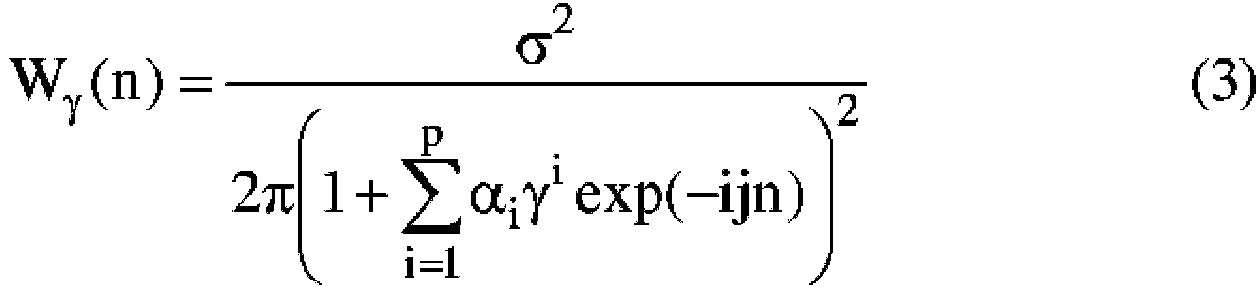
El normalizador 103 de envoltura ponderada divide los coeficientes X(1), ..., X(N) en una cadena de coeficientes MDCT por los valores de corrección WY(1), ..., WV(N) de los coeficientes en una cadena de coeficientes de envoltura de espectro de potencia que corresponde a los coeficientes para obtener los coeficientes X(1)/Wy (1), ..., X(N)/Wy (N) en una cadena de coeficientes MDCT normalizados ponderados. Los valores de corrección WY(n) [1 < n < N] se dan por la fórmula (3), donde y es una constante positiva menor o igual a 1 y modera los coeficientes de espectro de potencia.The weighted envelope normalizer 103 divides the coefficients X (1), ..., X (N) in a chain of MDCT coefficients by the correction values WY (1), ..., WV (N) of the coefficients in a chain of power spectrum wrapping coefficients corresponding to the coefficients to obtain the coefficients X (1) / W and (1), ..., X (N) / W and (N) in a chain of MDCT coefficients weighted normalized. The correction values WY (n) [1 <n <N] are given by formula (3), where y is a positive constant less than or equal to 1 and moderates the power spectrum coefficients.
<Ejemplo 2><Example 2>
El normalizador 103 de envoltura ponderada eleva los coeficientes en una cadena de coeficientes de envoltura de espectro de potencia que corresponden a los coeficientes X(1), ..., X(N) en una cadena de coeficientes MDCT a la potencia de orden p (0 < p <1) y divide los coeficientes X(1), ..., X(N) por los valores elevados W(1)p, ...,W(N)p para obtener los coeficientes X(1)/W(1)p, ..., X(N)/W(N)p en una cadena de coeficientes MDCT normalizados ponderados. Como resultado, se obtiene una cadena de coeficientes MDCT normalizados ponderados en una trama. La cadena de coeficientes MDCT normalizados ponderados no tiene una pendiente pronunciada de amplitud o grandes variaciones de amplitud en comparación con la cadena de coeficientes MDCT de entrada pero tiene variaciones de magnitud similares a las de la envoltura de espectro de potencia de la cadena de coeficientes MDCT de entrada, es decir, la cadena de coeficientes MDCT normalizados ponderados tiene amplitudes algo mayores en una región de coeficientes correspondientes a frecuencias bajas y tiene una estructura fina debida a un periodo de tono.The weighted envelope normalizer 103 raises the coefficients in a chain of power spectrum envelope coefficients that correspond to the coefficients X (1), ..., X (N) in a chain of MDCT coefficients to the power of order p (0 <p <1) and divide the coefficients X (1), ..., X (N) by the high values W (1) p, ..., W (N) p to obtain the coefficients X (1 ) / W (1) p, ..., X (N) / W (N) p in a chain of weighted normalized MDCT coefficients. As a result, a chain of weighted normalized MDCT coefficients is obtained in one frame. The weighted normalized MDCT coefficient chain does not have a steep amplitude slope or large amplitude variations compared to the input MDCT coefficient chain but has similar magnitude variations as the power spectrum envelope of the MDCT coefficient chain input, that is, the chain of weighted normalized MDCT coefficients has somewhat larger amplitudes in a region of coefficients corresponding to low frequencies and has a fine structure due to a pitch period.
Señalar que el proceso inverso del proceso de normalización de envoltura ponderada, es decir, el proceso para reconstruir la cadena de coeficientes MDCT a partir de la cadena de coeficientes MDCT normalizados ponderados, se realiza en el lado de decodificación, los ajustes para el método para calcular cadenas de coeficientes de envoltura de espectro de potencia ponderada a partir de cadenas de coeficientes de envoltura de espectro de potencia necesitan ser comunes entre los lados de codificación y de decodificación.Note that the reverse process of the weighted envelope normalization process, that is, the process to reconstruct the chain of MDCT coefficients from the chain of weighted normalized MDCT coefficients, is performed on the decoding side, the settings for the method for calculating strings of weighted power spectrum envelope coefficients from strings of power spectrum envelope coefficients need to be common between the encoding and decoding sides.
<Inicializador 104><Initializer 104>
Un inicializador 104 establece un valor inicial de ganancia (ganancia global) g. El valor inicial de la ganancia se puede determinar a partir de la energía de una cadena de coeficientes normalizados ponderados Xn(1), ..., Xn(N) y el número de bits asignados de antemano a un código emitido desde un codificador 106 de longitud variable, por ejemplo. El valor inicial de ganancia g es un valor positivo. El número de bits asignados de antemano a un código emitido desde el codificador 106 de longitud variable se conoce en lo sucesivo como el número de bits B asignados. El inicializador también establece 0 como el valor inicial del número de actualizaciones de ganancia.An initializer 104 sets an initial value of gain (overall gain) g. The initial value of the gain can be determined from the energy of a chain of weighted normalized coefficients Xn (1), ..., Xn (N) and the number of bits assigned in advance to a code emitted from an encoder 106 of variable length, for example. The initial value of gain g is a positive value. The number of bits assigned in advance to a code emitted from the variable-length encoder 106 is hereinafter referred to as the number of allocated B-bits. The initializer also sets 0 as the initial value for the number of gain updates.
<Procesador 130 de bucle de actualización de ganancia><Gain update loop processor 130>
Un procesador 130 de bucle de actualización de ganancia determina la ganancia de manera que una secuencia (una secuencia de muestras de valores enteros) obtenida dividiendo cada coeficiente en una cadena de coeficientes MDCT normalizados ponderados Xn(1), Xn(N) por la ganancia se puede codificar con un número predeterminado de bits, y emite un código de señal de número entero obtenido mediante codificación de longitud variable de la secuencia (la secuencia de muestras de valores enteros) obtenida dividiendo la cadena de coeficientes MDCT normalizados ponderados Xn(1), Xn(N) por la ganancia determinada y un código de ganancia (el código de ganancia correspondiente a la ganancia) obtenido codificando la ganancia determinada. El procesador 130 de bucle de actualización de ganancia actualiza el valor de ganancia de modo que cuanto mayor es la diferencia entre el número de bits en el código obtenido codificando la secuencia de muestras de valores enteros y el número dado de bits B asignados, mayor es la diferencia entre la ganancia antes de la actualización y la ganancia actualizada.A gain update loop processor 130 determines the gain such that a sequence (a sequence of samples of integer values) obtained by dividing each coefficient into a chain of weighted normalized MDCT coefficients Xn (1), Xn (N) by the gain can be encoded with a predetermined number of bits, and outputs an integer signal code obtained by variable-length encoding of the sequence (the sequence of integer samples) obtained by dividing the string of weighted normalized MDCT coefficients X n (1 ), X n (N) times the determined gain and a gain code (the gain code corresponding to the gain) obtained by encoding the determined gain. The gain update loop processor 130 updates the gain value so that the greater the difference between the number of bits in the code obtained by encoding the sequence of integer value samples and the given number of allocated B bits, the greater is the difference between the profit before the update and the updated profit.
El procesador 130 de bucle de actualización de ganancia incluye un cuantificador 105, el codificador 106 de longitud variable, un determinador 107, un actualizador 131 de expansión de ganancia, un actualizador 132 de reducción de ganancia, una unidad 116 de truncamiento, y un codificador 117 de ganancia.Gain update loop processor 130 includes quantizer 105, variable length encoder 106, determiner 107, gain expansion updater 131, gain reduction updater 132, truncation unit 116, and encoder. 117 profit.
<Cuantificador 105><Quantifier 105>
El cuantificador 105 cuantifica un valor obtenido dividiendo cada coeficiente (cada muestra) en una cadena de coeficientes MDCT normalizados ponderados Xn(1), ..., Xn(N) (una cadena de muestras derivada de una señal de audio de entrada en un intervalo dado) por la ganancia g para obtener una secuencia de coeficientes normalizados cuantificados Xq(1), ..., Xq(N) que es una secuencia de valores enteros (muestras normalizadas cuantificadas) y emite la secuencia de coeficientes normalizados cuantificados Xq(1), ..., Xq(N).The quantizer 105 quantizes a value obtained by dividing each coefficient (each sample) into a chain of weighted normalized MDCT coefficients X n (1), ..., X n (N) (a chain of samples derived from an input audio signal in a given interval) by the gain g to obtain a sequence of quantized normalized coefficients X q (1), ..., X q (N) which is a sequence of integer values (quantized normalized samples) and outputs the sequence of coefficients normalized quantized X q (1), ..., X q (N).
El cuantificador 105 también mide el número s de muestras en el intervalo desde el coeficiente normalizado cuantificado a la frecuencia más baja al coeficiente normalizado cuantificado que no es cero a la frecuencia más alta y emite el número s de muestras.The quantizer 105 also measures the number s of samples in the range from the normalized coefficient quantized at the lowest frequency to the normalized coefficient quantized that is not zero at the highest frequency and outputs the number s of samples.
<Codificador 106 de longitud variable><Variable-length encoder 106>
El codificador 106 de longitud variable codifica una secuencia de coeficientes normalizados cuantificados Xq(1), ..., Xq(N) mediante codificación de longitud variable para obtener y emitir un código (código de cadena de muestras). El código se conoce como código de señal de número entero. La codificación de longitud variable puede usar un método que codifica una pluralidad de coeficientes en una cadena de coeficientes normalizados cuantificados en un tiempo, por ejemplo. Además, el codificador 106 de longitud variable mide el número de bits en el código de señal de número entero obtenido mediante la codificación de longitud variable. En esta realización, el número de bits se conoce como el número c de bits consumidos.The variable length encoder 106 encodes a sequence of quantized normalized coefficients Xq (1), ..., X q (N) by variable length encoding to obtain and output a code (sample string code). The code is known as an integer signal code. Variable-length encoding may use a method that encodes a plurality of coefficients in a string of normalized coefficients quantized at one time, for example. Furthermore, the variable length encoder 106 measures the number of bits in the integer signal code obtained by the variable length encoding. In this embodiment, the number of bits is known as the number c of bits consumed.
<Determinador 107><Determinator 107>
El determinador 107 emite la ganancia g, el código de señal de número entero, y el número c de bits consumidos cuando el número de actualizaciones de ganancia es igual a un número predeterminado.The determiner 107 outputs the gain g, the integer signal code, and the number c of bits consumed when the number of gain updates equals a predetermined number.
Cuando el número de actualizaciones de ganancia es menor que el número predeterminado, el determinador 107 realiza un control para hacer que un actualizador 131 de expansión de ganancia realice un siguiente proceso si el número c de bits consumidos medido por el codificador 106 de longitud variable es mayor que el número B de bits asignados, o para hacer que un actualizador 132 de reducción de ganancia realice un siguiente proceso si el número c de bits consumidos medido por el codificador 106 de longitud variable es menor que el número B de bits asignados. Señalar que cuando el número c de bits consumidos medidos por el decodificador 106 de longitud variable es igual al número B de bits asignados, el determinador 107 emite la ganancia g, el código de señal de número entero y el número c de bits consumidos.When the number of gain updates is less than the predetermined number, the determiner 107 performs a control to cause a gain expansion updater 131 to perform a next process if the number c of consumed bits measured by the variable length encoder 106 is greater than the number B of allocated bits, or to cause a gain reduction updater 132 to perform a next process if the number c of consumed bits measured by the variable length encoder 106 is less than the number B of allocated bits. Note that when the number c of consumed bits measured by the variable length decoder 106 is equal to the number B of allocated bits, the determiner 107 outputs the gain g, the integer signal code and the number c of bits consumed.
<Actualizador 131 de expansión de ganancia><Gain Expansion Updater 131>
El actualizador 131 de expansión de ganancia establece un valor mayor que el valor actual de ganancia g como nueva ganancia g’>g. El actualizador 131 de expansión de ganancia incluye un contador 118 de muestras, un establecedor 108 de ganancia de límite inferior, un primer controlador 109 de ramificación, un primer actualizador 110 de ganancia, y un extensor 111 de ganancia.The gain expansion updater 131 sets a value greater than the current value of gain g as the new gain g '> g. The gain expansion updater 131 includes a sample counter 118, a lower limit gain setter 108, a first branch controller 109, a first gain updater 110, and a gain extender 111.
<Contador 118 de muestras><Sample counter 118>
Cuando el número c de bits consumidos es mayor que el número B de bits asignados, el contador 118 de muestras emite el número t de muestras de coeficientes normalizados cuantificados correspondientes a un código restante después de eliminar una cantidad de código correspondiente a coeficientes normalizados cuantificados en el lado de frecuencia alta de un código de señal de número entero emitido desde el determinador 107, de modo que el número c de bits consumidos no exceda el número B de bits asignados.When the number c of consumed bits is greater than the number B of allocated bits, the sample counter 118 outputs the number t of samples of quantized normalized coefficients corresponding to a remaining code after removing a code quantity corresponding to quantized normalized coefficients in the side of high frequency of an integer signal code output from the determiner 107, so that the number c of bits consumed does not exceed the number B of bits allocated.
Específicamente, el contador 118 de muestras emite el número t de muestras de coeficientes normalizados cuantificados que se han dejado después de eliminar los coeficientes normalizados cuantificados en el lado de frecuencia alta que corresponde a un código (código de truncamiento) correspondiente a la cantidad c - B por la cual el número c de bits consumidos excede el número B de bits asignados a partir de una cadena de coeficientes normalizados cuantificados emitida desde el cuantificador 105, es decir, el número t de muestras de coeficientes normalizados cuantificados cuyo código correspondiente no se ha eliminado. Un ejemplo de código de truncamiento es un código con un número de bits mayor o igual que c - B y el más pequeño entre el código correspondiente a uno o más coeficientes normalizados cuantificados en una región que incluye la frecuencia más alta. En otras palabras, t es el número de muestras de coeficientes normalizados cuantificados a ser codificadas cuando la longitud del código de longitud variable correspondiente es menor o igual que el número B de bits asignados y es el mayor excluyendo los coeficientes normalizados cuantificados en el lado de frecuencia alta para dejar solamente los coeficientes normalizados cuantificados en los lados de frecuencia baja como coeficientes a ser codificados.Specifically, the sample counter 118 outputs the number t of quantized normalized coefficient samples that have been left after removing the quantized normalized coefficients on the high frequency side that corresponds to a code (truncation code) corresponding to the amount c - B by which the number c of bits consumed exceeds the number B of bits allocated from a string of quantized normalized coefficients emitted from quantizer 105, that is, the number t of samples of quantized normalized coefficients whose corresponding code has not been removed. An example of a truncation code is a code with a number of bits greater than or equal to c-B and the smallest of the code corresponding to one or more quantized normalized coefficients in a region that includes the highest frequency. In other words, t is the number of samples of quantized normalized coefficients to be encoded when the length of the corresponding variable-length code is less than or equal to the number B of allocated bits and is the largest excluding the quantized normalized coefficients on the side of high frequency to leave only the quantized normalized coefficients on the low frequency sides as coefficients to be encoded.
<Establecedor 108 de ganancia de límite inferior><Lower limit gain setter 108>
Cuando el número c de bits consumidos es mayor que el número B de bits asignados, el establecedor 108 de ganancia de límite inferior establece el valor actual de ganancia g (ganancia g correspondiente al número c de bits consumidos) como la ganancia gmin de límite inferior (gmin ^ g). La ganancia gmin de límite inferior significa el valor de ganancia más bajo permitido.When the number c of bits consumed is greater than the number B of bits allocated, the lower bound gain setter 108 sets the current value of gain g (gain g corresponding to the number c of bits consumed) as the lower bound gain gmin (gmin ^ g). The lower limit gmin gain means the lowest allowable gain value.
<Primer controlador 109 de ramificación><First branch controller 109>
Cuando la ganancia gmin de límite inferior se establece por el establecedor 108 de ganancia de límite inferior, el primer controlador 109 de ramificación realiza un control para hacer que el primer actualizador 110 de ganancia realice un siguiente proceso si ya se ha establecido un valor de ganancia gmax de límite superior o para hacer que el extensor 111 de ganancia realice un siguiente proceso si no se ha establecido la ganancia gmax de límite superior. <Primer actualizador 110 de ganancia>When the lower limit gain gmin is set by the lower limit gain setter 108, the first branch controller 109 performs a control to cause the first gain updater 110 to perform a next process if a gain value has already been set. upper limit gmax or to cause the gain extender 111 to perform a next process if the upper limit gain gmax has not been set. <First Gain Updater 110>
El primer actualizador 110 de ganancia establece un valor entre el valor actual de ganancia g (el valor de ganancia g correspondiente al número c de bits consumidos) y la ganancia gmax de límite superior como nuevo valor de ganancia g. Esto es debido a que un valor óptimo de ganancia está entre el valor actual de ganancia g y la ganancia gmax de límite superior. Por ejemplo, el primer actualizador 110 de ganancia establece la media del valor actual de ganancia g y la ganancia gmax de límite superior como nuevo valor de ganancia g (g ^ (g gmax)/2). Dado que el valor actual de ganancia g se ha establecido como la ganancia gmin de límite inferior, se puede decir que la media de la ganancia gmax de límite superior y la ganancia gmin de límite inferior se establece como nuevo valor de ganancia g (g ^ (gmax gmin)/2). Entonces el control vuelve al proceso en el cuantificador 105.The first gain updater 110 sets a value between the current gain value g (the gain value g corresponding to the number c of bits consumed) and the upper limit gain gmax as the new gain value g. This is because an optimal gain value is between the current value of gain g and the upper limit gain gmax. For example, the first gain updater 110 sets the average of the current gain value g and the upper limit gain gmax as the new gain value g (g ^ (g gmax) / 2). Since the current value of gain g has been set as the lower bound gain gmin, it can be said that the mean of the upper bound gain gmax and the lower bound gain gmin is set as the new value of gain g (g ^ (gmax gmin) / 2). Control then returns to the process in quantizer 105.
<Extensor 111 de ganancia><Gain Extender 111>
El extensor 111 de ganancia aumenta el valor de ganancia de modo que cuanto mayor es el número s de muestras en el intervalo del coeficiente normalizado cuantificado a la frecuencia más baja al coeficiente normalizado cuantificado que no es cero a la frecuencia más alta menos el número t de muestras emitidas desde el contador 118 de muestras, u = s - t, mayor es la cantidad por la cual la ganancia actual aumenta a una nueva ganancia. Por ejemplo, el extensor 111 de ganancia aumenta el valor de ganancia de manera que la nueva ganancia g ^ ganancia actual g x (1 u/N x a), donde a es una constante positiva predeterminada.The gain extender 111 increases the gain value so that the greater the number s of samples in the range from the normalized coefficient quantized at the lowest frequency to the normalized coefficient quantized that is not zero at the highest frequency minus the number t of samples output from sample counter 118, u = s-t, the greater the amount by which the current gain increases to a new gain. For example, the gain extender 111 increases the gain value so that the new gain g ^ current gain g x (1 u / N x a), where a is a predetermined positive constant.
Alternativamente, el extensor 111 de ganancia aumenta el valor de ganancia de modo que cuanto mayor es el número N de todas las muestras a ser codificadas menos el número t de muestras emitidas desde el contador 118 de muestras, v = N - t, mayor es la cantidad por la cual la ganancia actual aumenta a una nueva ganancia. Por ejemplo, el extensor 111 de ganancia aumenta el valor de ganancia de manera que la nueva ganancia g ^ ganancia actual g x (1 v/N x a).Alternatively, the gain extender 111 increases the gain value so that the greater the number N of all samples to be encoded minus the number t of samples output from the sample counter 118, v = N - t, the greater is the amount by which the current profit increases to a new profit. For example, the gain extender 111 increases the gain value so that the new gain g ^ current gain g x (1 v / N x a).
Específicamente, cuanto mayor es el número de algunas de o todas las muestras en la cadena de muestras normalizadas cuantificadas menos el número de muestras de coeficientes normalizados cuantificados cuyo código correspondiente no se ha eliminado, mayor es la cantidad por la cual el extensor 111 de ganancia aumenta el valor de ganancia g. Entonces el control vuelve al proceso en el cuantificador 105. En otras palabras, el extensor 111 de ganancia actualiza el valor de ganancia de modo que cuanto mayor es el número de algunas de o todas las muestras en una cadena de muestras normalizadas cuantificadas menos el número de muestras de coeficientes normalizados cuantificados cuyo código correspondiente no se ha eliminado, mayor es la cantidad por la cual el valor de ganancia antes de la actualización aumenta a un valor actualizado. Entonces el extensor 111 de ganancia hace que el cuantificador 105 realice el proceso posterior. Specifically, the greater the number of some or all of the samples in the chain of quantized normalized samples minus the number of quantized normalized coefficient samples whose corresponding code has not been removed, the greater the amount by which the gain extender 111 increase the gain value g. Control then returns to processing in quantizer 105. In other words, gain extender 111 updates the gain value so that the greater the number of some or all of the samples in a chain of quantized normalized samples, the less the number of samples of quantized normalized coefficients whose corresponding code has not been removed, the greater the amount by which the gain value before update increases to an updated value. Then the gain extender 111 causes the quantizer 105 to do the post-processing.
<Actualizador 132 de reducción de ganancia><Gain Reduction Updater 132>
El actualizador 132 de reducción de ganancia establece un valor menor que el valor actual de ganancia g como nueva ganancia g’ < g. El actualizador 132 de reducción de ganancia incluye un establecedor 112 de ganancia de límite superior, un segundo controlador 113 de ramificación, un segundo actualizador 114 de ganancia, y un reductor 115 de ganancia.The gain reduction updater 132 sets a value less than the current value of gain g as the new gain g '<g. The gain reduction updater 132 includes an upper limit gain setter 112, a second branch controller 113, a second gain updater 114, and a gain reducer 115.
<Establecedor 112 de ganancia de límite superior><Upper limit gain setter 112>
Cuando el número c de bits consumidos es menor que el número B de bits asignados, el establecedor 112 de ganancia de límite superior establece el valor actual de ganancia g (el valor de ganancia g correspondiente al número c de bits consumidos) como la ganancia gmax de límite superior (gmax ^ g). La ganancia gmax de límite superior significa la ganancia más alta permitida.When the number c of bits consumed is less than the number B of bits allocated, the upper bound gain setter 112 sets the current value of gain g (the value of gain g corresponding to the number c of bits consumed) as the gain gmax upper limit (gmax ^ g). The upper limit gmax gain means the highest allowable gain.
<Segundo controlador 113 de ramificación><Second branch controller 113>
Cuando la ganancia gmax de límite superior se establece por el establecedor 112 de ganancia de límite superior, el segundo controlador 113 de ramificación realiza un control para hacer que el segundo actualizador 114 de ganancia realice un siguiente proceso si ya se ha establecido la ganancia gmin de límite inferior o para hacer que el reductor 115 de ganancia realice un siguiente proceso si no se ha establecido aún la ganancia gmin de límite inferior.When the upper limit gain gmax is set by the upper limit gain setter 112, the second branch controller 113 controls to cause the second gain updater 114 to perform a next process if the gain gmin of has already been set. lower limit or to cause the gain reducer 115 to perform a next process if the lower limit gain gmin has not yet been set.
<Segundo actualizador 114 de ganancia><Second Gain Updater 114>
El segundo actualizador 114 de ganancia establece un valor entre el valor actual de ganancia g (el valor de ganancia g correspondiente al número c de bits consumidos) y la ganancia gmin de límite inferior como nuevo valor de ganancia g. Esto es debido a que un valor óptimo de ganancia está entre el valor actual de ganancia g y la ganancia gmin de límite inferior. Por ejemplo, el segundo actualizador 114 de ganancia establece la media del valor actual de ganancia g y la ganancia gmin de límite inferior como nuevo valor de ganancia g (g ^ (g gmin)/2). Dado que el valor actual de ganancia g se ha establecido como la ganancia gmax de límite superior, se puede decir que la media de la ganancia gmax de límite superior y la ganancia gmin de límite inferior se establece como nuevo valor de ganancia g (g ^ (gmax gmin)/2). Entonces el control vuelve al proceso en el cuantificador 105.The second gain updater 114 sets a value between the current gain value g (the gain value g corresponding to the number c of bits consumed) and the lower bound gain gmin as the new gain value g. This is because an optimal gain value is between the current value of gain g and the lower limit gain gmin. For example, the second gain updater 114 sets the average of the current gain value g and the lower limit gain gmin as the new gain value g (g ^ (g gmin) / 2). Since the current value of gain g has been set as the upper limit gain gmax, it can be said that the mean of the upper limit gain gmax and the lower limit gain gmin is set as the new value of gain g (g ^ (gmax gmin) / 2). Control then returns to the process in quantizer 105.
<Reductor 115 de ganancia><Gain Reducer 115>
El reductor 115 de ganancia reduce el valor de ganancia g de modo que cuanto mayor es el número de bits residuales que es el número B de bits asignados menos el número c de bits consumidos, B - c, mayor es la cantidad por la cual el valor actual de ganancia g disminuye a un nuevo valor de ganancia g. Aquí, el nuevo valor de ganancia g también es un valor positivo. Por ejemplo, nueva ganancia ^ ganancia actual g x (1 - (B - c)/B x p), donde p es una constante positiva predeterminada. Es decir, cuanto mayor es el número B de bits asignados menos el número c de bits consumidos, B - c, mayor es la cantidad por la cual el reductor 115 de ganancia disminuye el valor de ganancia g. Entonces el control vuelve al proceso en el cuantificador 105. En otras palabras, el reductor 115 de ganancia actualiza el valor de ganancia g de modo que cuanto mayor es el número B de bits asignados menos el número c de bits consumidos, B - c, mayor es la cantidad por la cual el valor de ganancia g antes de la actualización disminuye a un valor actualizado y entonces hace que el cuantificador 105 realice el proceso posterior.The gain reducer 115 reduces the gain value g so that the greater the number of residual bits that is the number B of allocated bits minus the number c of consumed bits, B - c, the greater the amount by which the current value of gain g decreases to a new value of gain g. Here, the new gain value g is also a positive value. For example, new gain ^ current gain g x (1 - (B - c) / B x p), where p is a predetermined positive constant. That is, the greater the number B of allocated bits minus the number c of consumed bits, B-c, the greater the amount by which the gain reducer 115 decreases the gain value g. Control then returns to processing in quantizer 105. In other words, gain reducer 115 updates the gain value g so that the greater the number B of allocated bits, the less the number c of bits consumed, B - c, the greater the amount by which the pre-update gain value g decreases to an updated value and then causes the quantizer 105 to perform post-processing.
<Unidad 116 de truncamiento><Truncation Unit 116>
Cuando el número c de bits consumidos emitidos desde el determinador 107 es mayor que el número B de bits asignados, la unidad 116 de truncamiento elimina una cantidad de código equivalente a bits por los que el número c de bits consumidos excede el número B de bits asignados del código correspondiente a los coeficientes normalizados cuantificados en el lado de frecuencia alta en un código de señal de número entero emitido desde el determinador 107 y emite el código resultante como un nuevo código de señal de número entero. Es decir, la unidad 116 de truncamiento elimina la cantidad de código (código de truncamiento) equivalente al número de bits c - B por el cual el número c de bits consumidos excede el número B de bits asignados que corresponde a los coeficientes normalizados cuantificados en el lado de frecuencia alta a partir del código de señal de número entero (código de cadena de muestras) y emite el código restante (código de cadena de muestras truncadas) como un nuevo código de señal de número entero.When the number c of consumed bits emitted from the determiner 107 is greater than the number B of allocated bits, the truncation unit 116 removes an amount of code equivalent to bits whereby the number c of consumed bits exceeds the number B of bits assigned of the code corresponding to the quantized normalized coefficients on the high frequency side in an integer signal code output from the determiner 107 and outputs the resulting code as a new integer signal code. That is, the truncation unit 116 removes the amount of code (truncation code) equivalent to the number of bits c-B by which the number c of bits consumed exceeds the number B of allocated bits corresponding to the normalized coefficients quantized in the high frequency side starts from the integer signal code (sample string code) and outputs the remaining code (truncated sample string code) as a new integer signal code.
<Codificador 117 de ganancia ><Encoder 117 Gain>
El codificador 117 de ganancia codifica la salida de ganancia del determinador 107 con un número predeterminado de bits para obtener y emitir un código de ganancia.Gain encoder 117 encodes the gain output of determiner 107 with a predetermined number of bits to obtain and output a gain code.
[Modificación de la primera realización][Modification of the first embodiment]
<Codificador 150><Encoder 150>
Un proceso de codificación realizado por un codificador 150 de una modificación de la primera realización se describirá con referencia a la Figura 3. El codificador 150 de la modificación de la primera realización difiere del codificador 100 de la primera realización en que el codificador 150 usa, en lugar del número de bits en un código de señal de número entero obtenido mediante codificación de longitud variable, un número estimado de bits en un código de señal de número entero como el número c de bits consumidos. El codificador 150 incluye un procesador 190 de bucle de actualización de ganancia en lugar del procesador 130 de bucle de actualización de ganancia del codificador 100. El procesador 190 de bucle de actualización de ganancia incluye un estimador 156 de recuento de bits, un determinador 157, un actualizador 191 de expansión de ganancia, y un codificador 159 de longitud variable en lugar del codificador 106 de longitud variable, el determinador 107, el actualizador 131 de expansión de ganancia y la unidad 116 de truncamiento del procesador 130 de bucle de actualización de ganancia. El actualizador 191 de expansión de ganancia incluye un extensor 151 de ganancia y un contador 168 de muestras en lugar del extensor 111 de ganancia y el contador 118 de muestras del actualizador 131 de expansión de ganancia.An encoding process performed by an encoder 150 of a modification of the first embodiment will be described with reference to Figure 3. The encoder 150 of the modification of the first embodiment differs from that of encoder 100 of the first embodiment in which encoder 150 uses, instead of the number of bits in an integer signal code obtained by variable length encoding, an estimated number of bits in an integer signal code as the number c of bits consumed. Encoder 150 includes a gain update loop processor 190 in place of encoder 100 gain update loop processor 130. Gain update loop processor 190 includes a bit count estimator 156, a determiner 157, a gain expansion updater 191, and a variable length encoder 159 in place of the variable length encoder 106, the determiner 107, the gain expansion updater 131 and the truncation unit 116 of the gain update loop processor 130 . The gain expansion updater 191 includes a gain extender 151 and a sample counter 168 in place of the gain extender 111 and the sample counter 118 of the gain expansion updater 131.
Las diferencias de las primeras realizaciones se describirán a continuación.The differences of the first embodiments will be described below.
<Estimador 156 de recuento de bits><Bit count estimator 156>
El estimador 156 de recuento de bits obtiene un valor estimado del número de bits (número estimado de bits) en un código que se puede obtener mediante codificación de longitud variable de una secuencia de código de coeficientes normalizados Xq(1), ..., Xq(N). En la modificación de la primera realización, el número de bits estimado se conoce como el número c de bits consumidos.The bit count estimator 156 obtains an estimated value of the number of bits (estimated number of bits) in a code that can be obtained by variable-length encoding of a code sequence of normalized coefficients Xq (1), ..., Why not). In the modification of the first embodiment, the estimated number of bits is known as the number c of bits consumed.
<Determinador 157><Determinator 157>
El determinador 157 emite la ganancia g y una secuencia de coeficientes normalizados cuantificados Xq(1), ..., Xq(N) cuando el número de actualizaciones de ganancia es igual a un número predeterminado.The determiner 157 outputs the gain g and a sequence of quantized normalized coefficients X q (1), ..., X q (N) when the number of gain updates equals a predetermined number.
Cuando el número de actualizaciones de ganancia es menor que el número predeterminado, el determinador 157 realiza un control para hacer que el actualizador 191 de expansión de ganancia realice un siguiente proceso si el número c de bits consumidos estimado por el estimador 156 de recuento de bits es mayor que el número B de bits asignados, o para hacer que el actualizador 132 de reducción de ganancia realice un siguiente proceso si el número c de bits consumidos estimado por el estimador 156 de recuento de bits es menor que el número B de bits asignados. Señalar que si el número c de bits consumidos estimado por el estimador 156 de recuento de bits es igual al número B de bits asignados, el determinador 157 emite la ganancia g y una secuencia de coeficientes normalizados cuantificados Xq(1), ..., Xq(N).When the number of gain updates is less than the predetermined number, the determiner 157 performs a control to cause the gain expansion updater 191 to perform a next process if the number c of consumed bits estimated by the bit count estimator 156 is greater than the number B of allocated bits, or to cause the gain reduction updater 132 to perform a following process if the number c of consumed bits estimated by the bit count estimator 156 is less than the number B of allocated bits . Note that if the number c of consumed bits estimated by the bit count estimator 156 is equal to the number B of allocated bits, the determiner 157 outputs the gain g and a sequence of quantized normalized coefficients X q (1), ..., X q (N).
<Contador 168 de muestras><168 sample counter>
Cuando el número c de bits consumidos es mayor que el número B de bits asignados, el contador 168 de muestras emite el número t de muestras de coeficientes normalizados cuantificados que se han dejado después de eliminar los coeficientes normalizados cuantificados en el lado de frecuencia alta que se dirigen a un código (código de truncamiento) correspondiente a la cantidad c - B por la cual el número c de bits consumidos excede el número B de bits asignados a partir de una secuencia de coeficientes normalizados cuantificados Xq(1), ..., Xq(N) emitida desde el cuantificador 105.When the number c of bits consumed is greater than the number B of allocated bits, the sample counter 168 outputs the number t of samples of quantized normalized coefficients that have been left after removing the quantized normalized coefficients on the high frequency side that are directed to a code (truncation code) corresponding to the quantity c - B by which the number c of bits consumed exceeds the number B of bits allocated from a sequence of quantized normalized coefficients Xq (1), ... , Xq (N) emitted from quantizer 105.
<Extensor 151 de ganancia><Gain Extender 151>
El extensor 151 de ganancia es el mismo que el extensor 111 de ganancia de la primera realización, excepto que el extensor 151 de ganancia usa el número t de muestras emitidas desde el contador 168 de muestras en lugar del número t de muestras emitidas desde el contador 118 de muestras en el extensor 111 de ganancia.The gain extender 151 is the same as the gain extender 111 of the first embodiment, except that the gain extender 151 uses the number t of samples output from the sample counter 168 instead of the number t of samples output from the counter. 118 samples on the gain extender 111.
El extensor 151 de ganancia aumenta el valor de ganancia de modo que cuanto mayor es el número s de muestras en el intervalo desde el coeficiente normalizado cuantificado en la frecuencia más baja al coeficiente normalizado cuantificado que no es cero a la frecuencia más alta menos el número t de muestras emitidas desde el contador 118 de muestras, u = s - t, mayor es la cantidad por la cual la ganancia actual aumenta a una nueva ganancia. Por ejemplo, el extensor 151 de ganancia aumenta el valor de ganancia de manera que la nueva ganancia g ^ ganancia actual g x (1 u/N x a), donde a es una constante positiva predeterminada.The gain extender 151 increases the gain value so that the greater the number s of samples in the range from the normalized coefficient quantized at the lowest frequency to the normalized coefficient quantized that is not zero at the highest frequency minus the number t of samples output from sample counter 118, u = s-t, the greater the amount by which the current gain increases to a new gain. For example, the gain extender 151 increases the gain value so that the new gain g ^ current gain g x (1 u / N x a), where a is a predetermined positive constant.
Alternativamente, el extensor 151 de ganancia aumenta el valor de ganancia de modo que cuanto mayor es el número N de todas las muestras a ser codificadas menos el número t de muestras emitidas desde el contador 118 de muestras, v = N - t, mayor es la cantidad por la cual la ganancia actual aumenta a una nueva ganancia. Por ejemplo, el extensor 151 de ganancia aumenta el valor de ganancia de manera que nueva ganancia g ^ ganancia actual g x (1 v/N x a).Alternatively, the gain extender 151 increases the gain value so that the greater the number N of all samples to be encoded minus the number t of samples output from the sample counter 118, v = N - t, the greater is the amount by which the current profit increases to a new profit. For example, the gain extender 151 increases the gain value so that new gain g ^ current gain g x (1 v / N x a).
Específicamente, cuanto mayor es el número de algunas de o todas las muestras en una cadena de muestras normalizadas cuantificadas menos el número de muestras de coeficientes normalizados cuantificados cuyo código correspondiente no se ha eliminado, mayor es la cantidad por la cual el extensor 151 de ganancia aumenta el valor de ganancia g. Entonces el control vuelve al proceso en el cuantificador 105. En otras palabras, el extensor 111 de ganancia actualiza el valor de ganancia de modo que cuanto mayor es el número de algunas de o todas las muestras en una cadena de muestras normalizadas cuantificadas menos el número t de muestras de coeficientes normalizados cuantificados dejados después de eliminar los coeficientes normalizados cuantificados en el lado de frecuencia alta que se dirigen al código de truncamiento a partir de la secuencia de coeficientes normalizados cuantificados Xq(1), Xq(N) emitida desde el cuantificador 105, mayor es la cantidad por la cual el valor de ganancia antes de la actualización aumenta a un valor actualizado y entonces hace que el cuantificador 105 realice el proceso posterior.Specifically, the greater the number of some or all of the samples in a chain of quantized normalized samples minus the number of quantized normalized coefficient samples whose corresponding code has not been removed, the greater the amount by which the gain extender 151 increase the gain value g. Control then returns to processing in quantizer 105. In other words, gain extender 111 updates the gain value so that the greater the number of some or all of the samples in a chain of quantized normalized samples, the less the number t of coefficient samples quantized normalized coefficients left after removing the quantized normalized coefficients on the high frequency side that are directed to the truncation code from the sequence of quantized normalized coefficients Xq (1), Xq (N) emitted from quantizer 105, the higher the amount by which the pre-update gain value increases to an updated value and then causes quantizer 105 to perform post-processing.
<Codificador 159 de longitud variable><Variable-length encoder 159>
El codificador 159 de longitud variable codifica una secuencia de coeficientes normalizados cuantificados Xq(1), Xq(N) emitida desde el determinador 157 mediante codificación de longitud variable para obtener un código y emite el código obtenido como un código de señal de número entero (un código de cadena de muestras). Cuando el número de bits en el código obtenido mediante la codificación de longitud variable excede el número B de bits asignados, el codificador 159 de longitud variable elimina la cantidad de código por la cual el número B de bits asignados se excede desde el código correspondiente a los coeficientes normalizados cuantificados en el lado de frecuencia alta en el código obtenido mediante la codificación de longitud variable y emite el código resultante como un código de señal de número entero.Variable length encoder 159 encodes a sequence of quantized normalized coefficients Xq (1), X q (N) output from determiner 157 by variable length encoding to obtain a code and outputs the obtained code as an integer signal code (a sample string code). When the number of bits in the code obtained by variable length encoding exceeds the number B of allocated bits, the variable length encoder 159 removes the amount of code by which the number B of allocated bits is exceeded from the code corresponding to the normalized coefficients quantized on the high frequency side in the code obtained by variable length encoding and outputs the resulting code as an integer signal code.
[Segunda realización][Second embodiment]
<Codificador 200><Encoder 200>
Un proceso de codificación realizado por un codificador 200 de una segunda realización se describirá con referencia a la Figura 4. El codificador 200 de la segunda realización difiere del codificador 100 de la primera realización en que el codificador 200 incluye un procesador 230 de bucle de actualización de ganancia en lugar del procesador 130 de bucle de actualización de ganancia, que el procesador 230 de bucle de actualización de ganancia incluye un cuantificador 205, un determinador 207, un actualizador 231 de expansión de ganancia, y una unidad 216 de truncamiento en lugar del cuantificador 105, el determinador 107, el actualizador 131 de expansión de ganancia, y la unidad 116 de truncamiento del procesador 130 de bucle de actualización de ganancia, y que el control vuelve a un proceso en el cuantificador 205 en lugar de volver al proceso en el cuantificador 105 después de que el proceso realizado por el primer actualizador 110 de ganancia, el segundo actualizador 114 de ganancia y el reductor 115 de ganancia. El actualizador 231 de expansión de ganancia no incluye el contador 118 de muestras del actualizador 131 de expansión de ganancia de la primera realización pero incluye un establecedor 108 de ganancia de límite inferior, un primer controlador 109 de ramificación, un primer actualizador 110 de ganancia y un extensor 211 de ganancia. Las diferencias de la primera realización se describirán a continuación.An encoding process performed by an encoder 200 of a second embodiment will be described with reference to Figure 4. The encoder 200 of the second embodiment differs from the encoder 100 of the first embodiment in that the encoder 200 includes an update loop processor 230 that the gain update loop processor 230 includes a quantizer 205, a determiner 207, a gain expansion updater 231, and a truncation unit 216 in place of the gain update loop processor 130. quantizer 105, determiner 107, gain expansion updater 131, and truncation unit 116 of gain update loop processor 130, and that control returns to a process in quantizer 205 instead of returning to the process in quantizer 105 after processing performed by first gain updater 110, second gain updater 114 and the gain reducer 115. The gain expansion updater 231 does not include the sample counter 118 of the gain expansion updater 131 of the first embodiment but includes a lower limit gain setter 108, a first branch controller 109, a first gain updater 110 and a gain extender 211. Differences from the first embodiment will be described below.
<Cuantificador 205><Quantifier 205>
El cuantificador 205 cuantifica un valor obtenido dividiendo cada coeficiente (cada muestra) en una cadena de coeficientes MDCT normalizados ponderados de entrada Xn(1), ..., Xn(N) (una cadena de muestras derivada de una señal de audio de entrada en un intervalo dado) por la ganancia g para obtener una secuencia de coeficientes normalizados cuantificados Xq(1), ..., Xq(N) que es una secuencia de valores enteros (muestras normalizadas cuantificadas) y emite la secuencia de coeficientes normalizados cuantificados Xq(1), ..., Xq(N).The quantizer 205 quantizes a value obtained by dividing each coefficient (each sample) into a chain of input weighted normalized MDCT coefficients Xn (1), ..., Xn (N) (a chain of samples derived from an input audio signal in a given interval) by the gain g to obtain a sequence of quantized normalized coefficients Xq (1), ..., Xq (N) which is a sequence of integer values (quantized normalized samples) and outputs the sequence of quantized normalized coefficients Xq (1), ..., Xq (N).
<Determinador 207><Determinator 207>
El determinador 207 emite una ganancia, un código de señal de número entero, y el número c de bits consumidos cuando el número de actualizaciones de ganancia es igual a un número predeterminado.The determiner 207 outputs a gain, an integer signal code, and the number c of bits consumed when the number of gain updates equals a predetermined number.
Cuando el número de actualizaciones de ganancia es menor que el número predeterminado, el determinador 207 realiza un control para hacer que el actualizador 231 de expansión de ganancia realice un siguiente proceso si el número c de bits consumidos medido por el codificador 106 de longitud variable es mayor que el número B de bits asignados, o para hacer que un actualizador 132 de reducción de ganancia realice un siguiente proceso si el número c de bits consumidos medido por el codificador 106 de longitud variable es menor que el número B de bits asignados. Señalar que si el número c de bits consumidos es igual al número B de bits asignados, el determinador 207 emite la ganancia, el código de señal de número entero y el número c de bits consumidos.When the number of gain updates is less than the predetermined number, the determiner 207 performs a control to cause the gain expansion updater 231 to perform a next process if the number c of consumed bits measured by the variable length encoder 106 is greater than the number B of allocated bits, or to cause a gain reduction updater 132 to perform a next process if the number c of consumed bits measured by the variable length encoder 106 is less than the number B of allocated bits. Note that if the number c of bits consumed is equal to the number B of bits allocated, the determiner 207 outputs the gain, the integer signal code and the number c of bits consumed.
<Unidad 216 de truncamiento><Unit 216 of truncation>
Cuando el número c de bits consumidos emitidos desde el determinador 207 es mayor que el número B de bits asignados, la unidad 216 de truncamiento elimina una cantidad de código equivalente a bits por los que el número c de bits consumidos excede el número B de bits asignados del código correspondiente a los coeficientes normalizados cuantificados en el lado de frecuencia alta en un código de señal de número entero emitido desde el determinador 207 y emite el código resultante como un nuevo código de señal de número entero. Es decir, la unidad 216 de truncamiento elimina la cantidad de código (código de truncamiento) equivalente al número de bits c - B por el cual el número c de bits consumidos excede el número B de bits asignados que corresponde a coeficientes normalizados cuantificados en el lado de frecuencia alta a partir del código de señal de número entero (código de cadena de muestras) y emite el código restante (código de cadena de muestras truncadas) como nuevo código de señal de número entero. When the number c of consumed bits emitted from the determiner 207 is greater than the number B of allocated bits, the truncation unit 216 removes an amount of code equivalent to bits whereby the number c of consumed bits exceeds the number B of bits assigned of the code corresponding to the quantized normalized coefficients on the high frequency side in an integer signal code output from the determiner 207 and outputs the resulting code as a new integer signal code. That is, the truncation unit 216 removes the amount of code (truncation code) equivalent to the number of bits c-B by which the number c of bits consumed exceeds the number B of allocated bits that correspond to normalized coefficients quantized in the high frequency side from the integer signal code (sample string code) and outputs the remaining code (truncated sample string code) as the new integer signal code.
<Extensor 211 de ganancia><Gain Extender 211>
El extensor 211 de ganancia aumenta la ganancia de modo que cuanto mayor es un déficit de bits que es el número c de bits consumidos menos el número B de bits asignados, c - B, mayor es la cantidad por la cual la ganancia actual aumenta a una nueva ganancia. Por ejemplo, nueva ganancia g ^ ganancia actual g x (1 (c - B)/B x a), donde a es una constante positiva predeterminada. Es decir, cuando el número c de bits consumidos es mayor que el número B de bits asignados y no se ha fijado la ganancia gmax de límite superior, el extensor 211 de ganancia aumenta el valor de ganancia g de modo que cuanto mayor es el número c de bits consumidos menos el número B de bits asignados, c - B, mayor es la cantidad por la cual se aumenta el valor de ganancia g. Entonces el control vuelve al proceso en el cuantificador 205. En otras palabras, el extensor 211 de ganancia actualiza el valor de ganancia g de modo que cuanto mayor es el número c de bits consumidos menos el número B de bits asignados, c -B, mayor es la cantidad por la cual el valor de ganancia g antes de que aumente la actualización a un valor actualizado y hace que el cuantificador 205 realice el proceso posterior.The gain extender 211 increases the gain so that the greater a bit deficit which is the number c of bits consumed minus the number B of allocated bits, c - B, the greater the amount by which the current gain increases to a new profit. For example, new gain g ^ current gain g x (1 (c - B) / B x a), where a is a predetermined positive constant. That is, when the number c of bits consumed is greater than the number B of allocated bits and the upper limit gain gmax has not been set, the gain extender 211 increases the gain value g so that the greater the number c of bits consumed minus the number B of bits allocated, c - B, the greater the amount by which the gain value g is increased. Control then returns to processing at quantizer 205. In other words, gain extender 211 updates the gain value g so that the greater the number c of bits consumed, the less the number B of allocated bits, c -B, the greater the amount by which the gain value g before the update increases to an updated value and causes the quantizer 205 to perform post processing.
[Modificación de la segunda realización][Modification of the second embodiment]
<Codificador 250><Encoder 250>
Un proceso de codificación realizado por un codificador 250 de una modificación de la segunda realización se describirá con referencia a la Figura 5. El codificador 250 de la modificación difiere del codificador 200 de la segunda realización en que el codificador 250 usa, en lugar del número de bits en un código de señal de número entero obtenido mediante codificación de longitud variable, un número estimado de bits en un código de señal de número entero como el número c de bits consumidos. El codificador 250 incluye un procesador 290 de bucle de actualización de ganancia en lugar del procesador 230 de bucle de actualización de ganancia del codificador 200, el procesador 290 de bucle de actualización de ganancia incluye un estimador 156 de recuento de bits, un codificador 159 de longitud variable y un determinador 257 en lugar del codificador 106 de longitud variable, la unidad 216 de truncamiento y el determinador 270 del procesador 230 de bucle de actualización de ganancia. Las diferencias de la segunda realización se describirán a continuación.An encoding process performed by an encoder 250 of a modification of the second embodiment will be described with reference to Figure 5. The encoder 250 of the modification differs from the encoder 200 of the second embodiment in that the encoder 250 uses, instead of the number of bits in an integer signal code obtained by variable-length encoding, an estimated number of bits in an integer signal code as the number c of bits consumed. Encoder 250 includes a gain update loop processor 290 in place of encoder 200 gain update loop processor 230, gain update loop processor 290 includes a bit count estimator 156, an encoder 159 of variable length and a determiner 257 in place of the variable length encoder 106, the truncation unit 216, and the determiner 270 of the gain update loop processor 230. The differences of the second embodiment will be described below.
<Estimador 156 de recuento de bits><Bit count estimator 156>
El estimador 156 de recuento de bits es el mismo que el de la modificación de la primera realización.The bit count estimator 156 is the same as that of the modification of the first embodiment.
<Determinador 257><Determinator 257>
Cuando el número de actualizaciones de ganancia es igual a un número predeterminado de actualizaciones, el determinador 257 emite una ganancia, una secuencia de coeficientes normalizados cuantificados, y el número c de bits consumidos.When the number of gain updates equals a predetermined number of updates, the determiner 257 outputs a gain, a sequence of quantized normalized coefficients, and the number c of bits consumed.
Cuando el número de actualizaciones es menor que el número predeterminado de actualizaciones, el determinador 257 realiza un control para hacer que el actualizador 231 de expansión de ganancia realice el proceso descrito en la primera realización si el número c de bits consumidos estimado por el estimador 156 de recuento de bits es mayor que el número B de bits asignados, o para hacer que el actualizador 132 de reducción de ganancia realice proceso descrito en la primera realización si el número c de bits consumidos estimado por el estimador 156 de recuento de bits es menor que el número B de bits asignados. Señalar que si el número c de bits consumidos estimado por el estimador 156 de recuento de bits es igual al número B de bits asignados, el determinador 257 emite la ganancia, una secuencia de coeficientes normalizados cuantificados, y el número c de bits consumidos.When the number of updates is less than the predetermined number of updates, the determiner 257 performs a control to make the gain expansion updater 231 perform the process described in the first embodiment if the number c of consumed bits estimated by the estimator 156 bit count is greater than the number B of allocated bits, or to make the gain reduction updater 132 perform the process described in the first embodiment if the number c of consumed bits estimated by the bit count estimator 156 is less than the number B of allocated bits. Note that if the number c of bits consumed estimated by the bit count estimator 156 equals the number B of bits allocated, the determiner 257 outputs the gain, a sequence of quantized normalized coefficients, and the number c of bits consumed.
<Codificador 159 de longitud variable><Variable-length encoder 159>
El codificador 159 de longitud variable es el mismo que el de la modificación de la primera realización.The variable length encoder 159 is the same as that of the modification of the first embodiment.
[Tercera realización][Third embodiment]
<Codificador 300><Encoder 300>
Un proceso de codificación realizado por un codificador 300 de una tercera realización se describirá con referencia a la Figura 6. El codificador 300 de la tercera realización difiere del codificador 100 de la primera realización en que el codificador 300 incluye un establecedor 308 de ganancia de límite inferior, un primer actualizador 310 de ganancia, un establecedor 312 de ganancia de límite superior, un segundo actualizador 314 de ganancia, y un almacenamiento 320 de consumo de bits en lugar del establecedor 108 de ganancia de límite inferior, el primer actualizador 110 de ganancia, el establecedor 112 de ganancia de límite superior y el segundo actualizador 114 de ganancia. Un actualizador 331 de expansión de ganancia incluye un establecedor 308 de ganancia de límite inferior y un primer actualizador 310 de ganancia en lugar del establecedor 108 de ganancia de límite inferior y el primer actualizador 110 de ganancia del actualizador 131 de expansión de ganancia. Un actualizador 332 de reducción de ganancia incluye un establecedor 312 de ganancia de límite superior y un segundo actualizador 314 de ganancia en lugar del establecedor 112 de ganancia de límite superior y el segundo actualizador 114 de ganancia del actualizador 132 de reducción de ganancia. Un procesador 330 de bucle de actualización de ganancia incluye el actualizador 331 de expansión de ganancia y el actualizador 332 de reducción de ganancia en lugar del actualizador 131 de expansión de ganancia y el actualizador 132 de reducción de ganancia del procesador 130 de bucle de actualización de ganancia. Las diferencias de la primera realización se describirán a continuación.An encoding process performed by a third embodiment encoder 300 will be described with reference to Figure 6. The third embodiment encoder 300 differs from the first embodiment encoder 100 in that the encoder 300 includes a limit gain setter 308. lower limit, a first gain updater 310, an upper limit gain setter 312, a second gain updater 314, and a bit consumption storage 320 in place of the lower limit gain setter 108, the first gain updater 110 , the upper limit gain setter 112 and the second gain updater 114. A gain expansion updater 331 includes a lower limit gain setter 308 and a first gain updater 310 in place of the lower limit gain setter 108 and the first gain updater 110 of the gain expansion updater 131. A gain reduction updater 332 includes an upper limit gain setter 312 and a second gain updater 314 in place of the upper limit gain setter 112 and the second gain updater 114 of the gain reduction updater 132. A gain update loop processor 330 includes the update updater 331 gain expansion and gain reduction updater 332 in place of gain expansion updater 131 and gain reduction updater 132 of gain update loop processor 130. Differences from the first embodiment will be described below.
<Establecedor 308 de ganancia de límite inferior><Lower limit gain setter 308>
El establecedor 308 de ganancia de límite inferior establece el valor actual de ganancia g como la ganancia gmin de límite inferior (gmin ^ g). Adicionalmente, el establecedor 308 de ganancia de límite inferior almacena el número c de bits consumidos como el número cl de bits consumidos en el establecimiento de límite inferior en el almacenamiento 320 de consumo de bits. Es decir, cuando el número c de bits consumidos es mayor que el número B de bits asignados, el establecedor 308 de ganancia de límite inferior establece el número c de bits consumidos como el número cl de bits consumidos con el establecimiento de límite inferior y almacena el número cl de bits consumidos en el establecimiento de límite inferior en el almacenamiento 320 de consumo de bits además de realizar el proceso en el establecedor 108 de ganancia de límite inferior de la primera realización.The lower limit gain setter 308 sets the current value of gain g as the lower limit gain gmin (gmin ^ g). Additionally, the lower bound gain setter 308 stores the number c of bits consumed as the number cl of bits consumed in the lower bound set in the bit consumption storage 320. That is, when the number c of bits consumed is greater than the number B of allocated bits, the lower bound gain setter 308 sets the number c of bits consumed as the number cl of bits consumed with the lower bound setting and stores the number cl of bits consumed in the lower limit setting in the bit consumption storage 320 in addition to performing the processing in the lower limit gain setter 108 of the first embodiment.
<Establecedor 312 de ganancia de límite superior><Upper limit gain setter 312>
El establecedor 312 de ganancia de límite superior establece el valor actual de ganancia g como la ganancia gmax de límite superior (gmax ^ g). Adicionalmente el establecedor 312 de ganancia de límite superior almacena el número c de bits consumidos en el almacenamiento 320 de consumo de bits como el número cu de bits consumidos en el establecimiento de límite superior. Es decir, cuando el número c de bits consumidos es menor que el número B de bits asignados, el establecedor 312 de ganancia de límite superior establece el número c de bits consumidos como el número cu de bits consumidos en el establecimiento de límite superior y almacena el número cu de bits consumidos en el establecimiento de límite superior en el almacenamiento 320 de consumo de bits además de realizar el proceso en el establecedor 112 de ganancia de límite superior de la primera realización.The upper limit gain setter 312 sets the current value of gain g as the upper limit gain gmax (gmax ^ g). Additionally, the upper limit gain setter 312 stores the number c of bits consumed in the bit consumption storage 320 as the number cu of bits consumed in the upper limit setting. That is, when the number c of bits consumed is less than the number B of allocated bits, the upper bound gain setter 312 sets the number c of bits consumed as the number cu of bits consumed in the upper bound setting and stores the number cu of bits consumed in the upper limit setting in the bit consumption storage 320 in addition to performing the processing in the upper limit gain set 112 of the first embodiment.
<Primer actualizador 310 de ganancia><First Gain Updater 310>
Cuando el número c de bits consumidos es mayor que el número B de bits asignados y ya se ha establecido la ganancia gmax de límite superior, el primer actualizador 310 de ganancia obtiene al menos uno de un indicador de la probabilidad de la ganancia gmin de límite inferior y un indicador de la probabilidad de la ganancia gmax de límite superior en base al número B de bits asignados, el número cu de bits consumidos en el establecimiento de límite superior y el número cl de bits consumidos en el establecimiento de límite inferior. Señalar que el “indicador de la probabilidad” significa un indicador de la probabilidad de un valor de ganancia g.When the number c of bits consumed is greater than the number B of bits allocated and the upper limit gain gmax has already been set, the first gain updater 310 gets at least one of an indicator of the probability of the limit gain gmin lower limit and an indicator of the probability of the upper limit gain gmax based on the number B of allocated bits, the number cu of bits consumed in the upper limit setting, and the cl number of bits consumed in the lower limit setting. Note that the "probability indicator" means an indicator of the probability of a profit value g.
Indicador de probabilidad de ganancia gmin de límite inferiorLower Limit Gmin Win Probability Indicator
El primer actualizador 310 de ganancia obtiene un indicador w de la probabilidad relativa de ganancia gmin de límite inferior según la fórmula A, por ejemplo.The first gain updater 310 obtains an indicator w of the lower bound relative probability of gain gmin according to formula A, for example.
w = (B - Cu)/(cl - cu) (Fórmula A)w = (B - Cu) / (cl - cu) (Formula A)
La fórmula A es la misma en significado que la fórmula B, que se basa en la diferencia entre el número B de bits asignados y el número cu de bits consumidos en el establecimiento de límite superior y la diferencia entre el número cL de bits consumidos en el establecimiento de límite inferior y el número de bits asignados B, con una modificación en el lado derecho de la fórmula B.Formula A is the same in meaning as Formula B, which is based on the difference between the number B of bits allocated and the number cu of bits consumed in setting the upper limit and the difference between the number cL of bits consumed in the setting of the lower limit and the number of allocated bits B, with a modification to the right side of the formula B.
w = (B - cu)/(B - cu cl - B) (Fórmula B)w = (B - cu) / (B - cu cl - B) (Formula B)
Por lo tanto, el indicador w se puede obtener según la fórmula B en lugar de la fórmula A.Therefore, the indicator w can be obtained according to formula B instead of formula A.
Cuando el indicador w obtenido según la fórmula A o B es grande, la ganancia gmin de límite inferior es más probable que sea el valor de ganancia; cuando el indicador w es pequeño, la ganancia gmax de límite superior es más probable que sea el valor de la ganancia g.When the indicator w obtained according to formula A or B is large, the lower bound gain gmin is more likely to be the gain value; when the indicator w is small, the upper bound gain gmax is more likely to be the value of gain g.
Indicador de probabilidad de ganancia gmax de límite superiorUpper Limit Gmax Win Probability Indicator
La probabilidad relativa de la ganancia gmax de límite superior es (1 - w).The relative probability of the upper bound gmax gain is (1 - w).
Es decir, el indicador (1 - w) de la probabilidad de la ganancia gmax de límite superior se puede obtener según la fórmula C en lugar de obtener el indicador w según la fórmula A o B.That is, the indicator (1 - w) of the probability of the upper bound gmax gain can be obtained according to the formula C instead of the indicator w according to the formula A or B.
(1 - w) = (cl - B)/(cl - cu) (Fórmula C)(1 - w) = (cl - B) / (cl - cu) (Formula C)
La fórmula C es la misma en significado que la fórmula D, que se basa en la diferencia B - cu entre el número B de bits asignados y el número cu de bits consumidos en el establecimiento de límite superior y la diferencia cl - B entre el número cl de bits consumidos en el establecimiento de límite inferior y el número B de bits asignados, con una modificación en el lado derecho de la fórmula D. Formula C is the same in meaning as formula D, which is based on the difference B - cu between the number B of allocated bits and the number cu of bits consumed in setting the upper limit and the difference cl - B between the cl number of bits consumed in setting the lower limit and the number B of allocated bits, with a modification to the right side of formula D.
1 - w = (cl - B)/(B - cu cl - B) (Fórmula D)1 - w = ( cl - B) / (B - cu cl - B) (Formula D)
Por lo tanto, el indicador (1 - w) se puede obtener según la fórmula D en lugar de la fórmula C.Therefore, the indicator (1 - w) can be obtained according to formula D instead of formula C.
Cuando el indicador (1 - w) obtenido según la fórmula A o B es grande, la ganancia gmax de límite superior es más probable que sea el valor de ganancia g; cuando el indicador (1 - w) es pequeño, la ganancia gmin de límite inferior es más probable que sea el valor de la ganancia g.When the indicator (1 - w) obtained according to formula A or B is large, the upper bound gain gmax is more likely to be the gain value g; when the indicator (1 - w) is small, the lower bound gain gmin is more likely to be the value of gain g.
El primer actualizador 310 de ganancia entonces establece y emite una media ponderada con una ponderación mayor asignada a la ganancia gmax de límite superior o a la ganancia gmin de límite inferior, la que sea más probable que sea un nuevo valor de ganancia g (g — gmin X w gmax x (1 - w)). Es decir, cuando la diferencia entre el número B de bits asignados y el número cu de bits consumidos en el establecimiento de límite superior es mayor que la diferencia entre el número cl de bits consumidos en el establecimiento de límite inferior y el número B de bits asignados, la ganancia gmin de límite inferior es más probable y más cercana a un valor preferible de la ganancia g. Alternativamente, el primer actualizador 310 de ganancia puede usar una constante C, que es un valor positivo, para obtener el indicador w con la ponderación disminuida como w = (B - cu C)/(cl - cu 2 x C). En este caso,The first gain updater 310 then sets and outputs a weighted average with a higher weight assigned to the upper bound gain gmax or the lower bound gain gmin, whichever is more likely to be a new value of gain g (g - gmin X w gmax x (1 - w)). That is, when the difference between the number B of bits allocated and the number cu of bits consumed in setting the upper limit is greater than the difference between the number cl of bits consumed in setting the lower limit and the number B of bits assigned, the lower bound gain gmin is more likely and closer to a preferable value of gain g. Alternatively, the first gain updater 310 may use a constant C, which is a positive value, to obtain the indicator w with the decreased weight as w = (B - cu C) / (cl - cu 2 x C). In this case,
(1 - w) = (cl - B C)/(cl - cu 2 x C)(1 - w) = (cl - B C) / (cl - cu 2 x C)
y el nuevo valor de ganancia g es el intermedio entre la media aritmética y la ganancia gmax de límite superior y la ganancia gmin de límite inferior y la media ponderada en base a la diferencia entre el número de bits consumidos y el número de bits asignados.and the new gain value g is the intermediate between the arithmetic mean and the upper limit gain gmax and the lower limit gain gmin and the weighted average based on the difference between the number of bits consumed and the number of bits allocated.
Señalar que si el número de muestras normalizadas cuantificadas correspondientes a un código de truncamiento (el número de muestras truncadas Tr) se ha obtenido por el contador 118 de muestras, el número Tr de muestras truncadas se puede usar en lugar de la diferencia entre el número cl de bits consumidos en el establecimiento de límite inferior y el número B de bits asignados. Esto es debido a que cuanto mayor es la diferencia entre el número cl de bits consumidos en el establecimiento de límite inferior y el número B de bits asignados, mayor es el número Tr de muestras truncadas. La correlación entre la diferencia entre el número de cl de los bits consumidos en el establecimiento de límite inferior y el número B de bits asignados y el número Tr de muestras truncadas se puede obtener experimentalmente de antemano y el número Tr de muestras truncadas se puede convertir aproximadamente a la diferencia entre el número cl de bits consumidos en el establecimiento de límite inferior y el número B de bits asignados. Sustituyendo (cl - B) = y x Tr, donde y es un coeficiente determinado experimentalmente para conversión, entonces w se puede escribir como w = (B - cu)/(B - Cu Y x Tr). De manera similar, una constante C, que es un valor positivo, se puede usar para obtener el indicador w con ponderación disminuida como w = (B - cu C)/(B - cu Y x Tr 2 x C). Es decir, el primer actualizador 310 de ganancia puede usar el número B de bits asignados, el número Tr de muestras truncadas y el número cu de bits consumidos en el establecimiento de límite superior para obtener al menos uno del indicador de la probabilidad de un valor de ganancia límite inferior y del indicador de la probabilidad de un valor de la ganancia límite superior. Mientras que es deseable que sea usado el último número Tr de las muestras obtenidas en el último proceso en el contador 118 de muestras, se puede usar el número Tr de muestras obtenidas en un proceso anterior en el contador 118 de muestras.Note that if the number of quantized normalized samples corresponding to a truncation code (the number of truncated samples Tr) has been obtained by the sample counter 118, the number Tr of truncated samples can be used instead of the difference between the number cl of bits consumed in setting lower bound and number B of allocated bits. This is because the greater the difference between the number cl of bits consumed in setting the lower limit and the number B of allocated bits, the greater the number Tr of truncated samples. The correlation between the difference between the number of cl of the bits consumed in the lower bound setting and the number B of allocated bits and the number Tr of truncated samples can be obtained experimentally in advance and the number Tr of truncated samples can be converted roughly the difference between the number cl of bits consumed in setting the lower limit and the number B of bits allocated. Substituting ( cl - B) = yx Tr, where y is an experimentally determined coefficient for conversion, then w can be written as w = (B - cu) / (B - Cu Y x Tr). Similarly, a constant C, which is a positive value, can be used to obtain the indicator w with decreased weighting as w = (B - cu C) / (B - cu Y x Tr 2 x C). That is, the first gain updater 310 can use the number B of allocated bits, the number Tr of truncated samples, and the number cu of bits consumed in the upper bound setting to obtain at least one of the probability indicator of a value. lower limit gain and indicator of the probability of a value of the upper limit gain. While it is desirable that the last number Tr of samples obtained in the last run be used in sample counter 118, the number Tr of samples obtained in a previous run can be used in sample counter 118.
Entonces el control vuelve al proceso en el cuantificador 105.Control then returns to the process in quantizer 105.
<Segundo actualizador 314 de ganancia><Second Gain Updater 314>
Cuando el número c de bits consumidos es menor que el número B de bits asignados y ya se ha establecido la ganancia gmin de límite inferior, el segundo actualizador 314 de ganancia realiza la misma operación que la del primer actualizador 310 de ganancia.When the number c of consumed bits is less than the number B of allocated bits and the lower limit gain gmin has already been set, the second gain updater 314 performs the same operation as that of the first gain updater 310.
El “indicador de la probabilidad” descrito anteriormente representa hacia cuál de la ganancia gmin de límite inferior y la ganancia gmax de límite superior el valor de ganancia g se debería de cambiar y cuánto con el fin de que la ganancia g se aproxime a un valor óptimo. Dado que la ganancia g se actualiza a un nuevo valor en base al indicador en esta realización, se puede reducir el número de actualizaciones necesarias para que la ganancia g converja a un valor óptimo.The "probability indicator" described above represents towards which of the lower bound gain gmin and the upper bound gain gmax the value of gain g should be changed and by how much in order for the gain g to approach a value. optimum. Since the gain g is updated to a new value based on the flag in this embodiment, the number of updates required for the gain g to converge to an optimal value can be reduced.
El primer actualizador 310 de ganancia y el segundo actualizador 314 de ganancia de esta realización obtienen al menos uno del indicador de la probabilidad del valor de la ganancia gmin de límite inferior y el indicador de la probabilidad del valor de la ganancia gmax de límite superior, asignan una ponderación mayor a la ganancia gmin de límite inferior o a la ganancia gmax de límite superior, la que sea más probable, y establecen la media ponderada de la ganancia gmin de límite inferior y la ganancia gmax de límite superior como nuevo valor de ganancia g. Sin embargo, el primer actualizador 310 de ganancia y el segundo actualizador 314 de ganancia puede asignar una ponderación mayor a la ganancia gmin de límite inferior o a la ganancia gmax de límite superior, la que sea más probable, y la media ponderada de la ganancia gmin de límite inferior y la ganancia gmax de límite superior se puede establecer como nuevo valor de ganancia g sin obtener un indicador de la probabilidad. Por ejemplo, en base al número cu de bits consumidos en el establecimiento de límite superior y el número cl de bits consumidos en el establecimiento de límite inferior y el número B de bits asignados, el primer actualizador 310 de ganancia y el segundo actualizador 314 de ganancia pueden establecerThe first gain updater 310 and the second gain updater 314 of this embodiment obtain at least one of the probability indicator of the lower limit gain value gmin and the probability indicator of the upper limit gain value gmax, assign a higher weight to the lower bound gain gmin or the upper bound gain gmax, whichever is more likely, and set the weighted average of the lower bound gain gmin and the upper bound gain gmax as the new gain value g . However, the first gain updater 310 and the second gain updater 314 may assign a higher weight to the lower limit gain gmin or the upper limit gain gmax, whichever is more likely, and the weighted average of the gain gmin. lower limit and upper limit gain gmax can be set as the new value of gain g without getting a probability indicator. For example, based on the number cu of bits consumed in setting the upper limit and the number cl of bits consumed in setting lower limit and the number B of allocated bits, the first gain updater 310 and the second gain updater 314 can set

como nuevo valor de ganancia g sin obtener cualquiera de los indicadores w y (1 - W). Es esencial solamente que cuanto mayor es la diferencia entre el número B de bits asignados y el número cu de bits consumidos en el establecimiento de límite superior, mayor es la ponderación que se asigna a la ganancia gmax de límite superior, o cuanto mayor es la diferencia entre el número cl de de bits consumidos en el establecimiento de límite inferior y el número B de bits asignados, mayor es la ponderación que se asigna a la ganancia gmin de límite inferior y la media ponderada de la ganancia gmin de límite inferior y la ganancia gmax de límite superior se establece como nuevo valor de ganancia g. El proceso de establecimiento de un nuevo valor de ganancia g no está limitado.as a new profit value g without obtaining any of the indicators w and (1 - W). It is essential only that the greater the difference between the number B of allocated bits and the number cu of bits consumed in the upper limit setting, the greater the weight that is assigned to the upper limit gain gmax, or the greater the The difference between the number cl of bits consumed in setting the lower limit and the number B of allocated bits, the greater the weight that is assigned to the lower limit gain gmin and the weighted average of the lower limit gain gmin and the Upper limit gain gmax is set as the new value of gain g. The process of setting a new gain value g is not limited.
Alternativamente, si el primer actualizador 310 de ganancia y el segundo actualizador 314 de ganancia están configurados para actualizar la ganancia g en base al número Tr de muestras truncadas, el primer actualizador 310 de ganancia puede obtenerAlternatively, if the first gain updater 310 and the second gain updater 314 are configured to update the gain g based on the number Tr of truncated samples, the first gain updater 310 may obtain

como nuevo valor de ganancia g.as a new gain value g.
Alternativamente, una ponderación se puede asignar a la ganancia gmin de límite inferior o a la ganancia gmax de límite superior y la media ponderada de la ganancia gmin de límite inferior y la ganancia gmax de límite superior se pueden establecer como nuevo valor de ganancia g. Por ejemplo,Alternatively, a weight can be assigned to the lower limit gain gmin or the upper limit gain gmax and the weighted average of the lower limit gain gmin and the upper limit gain gmax can be set as the new value of gain g. For example,
(W1 x gmin gmax)/(W1 1)(W1 x gmin gmax) / (W1 1)
se puede establecer como nuevo valor de ganancia g. Aquí, W1 se puede establecer para tomar un valor positivo mayor o igual a 1 cuando gmin es más probable, es decir, cuando (B - cu) > (cl - B), tomar un valor positivo menor o igual a 1 cuando gmax es más probable, es decir, cuando (B - cu) < (cl - B), y aumentar con el aumento de B - cu. Por ejemplo, W1 puede ser un valor de función monótonamente creciente con respecto a B - cu. Alternativamente,can be set as new gain value g. Here, W1 can be set to take a positive value greater than or equal to 1 when gmin is most likely, that is, when (B - cu)> (cl - B), take a positive value less than or equal to 1 when gmax is more likely, that is, when (B - cu) <( cl - B), and increase with increasing B - cu. For example, W1 can be a monotonically increasing function value with respect to B - cu. Alternatively,
(gmin W2 x gmax)/(1 W2)(gmin W2 x gmax) / (1 W2)
se puede establecer como nuevo valor de ganancia g. Aquí, W2 se puede establecer para tomar un valor positivo mayor o igual a 1 cuando gmax es más probable, tomar un valor positivo menor o igual a 1 cuando g min es más probable, y aumentar con el aumento de cl - B. Por ejemplo, W2 puede ser un valor de función monótonamente creciente con respecto a cl - B. Alternativamente, cuando gmin es más probable (cuando (B - cu) > (cl - B)),can be set as new gain value g. Here, W2 can be set to take a positive value greater than or equal to 1 when gmax is most likely, take a positive value less than or equal to 1 when g min is most likely, and increase with increasing cl - B. For example , W2 can be a monotonically increasing function value with respect to cl - B. Alternatively, when gmin is more likely (when (B - cu)> ( cl - B)),
(W3 x gmin gmax)/(W3 1) (W3 x gmin gmax) / (W3 1)
se puede establecer como nuevo valor de ganancia g, y cuando gmax es más probable (cuando (B - cu) < (cl - B))can be set as new gain value g, and when gmax is most likely (when (B - cu) <(cl - B))
(gmin W4 x gmax)/(1 W4)(gmin W4 x gmax) / (1 W4)
se puede establecer como nuevo valor de ganancia g, donde W3 toma un valor positivo que es mayor o igual a 1 y es un valor de función monótonamente creciente con respecto a B - cu, y W4 toma un valor positivo que es mayor o igual a 1 y es un valor de función monótonamente creciente con respecto a cl - B.can be set as new gain value g, where W3 takes a positive value that is greater than or equal to 1 and is a monotonically increasing function value with respect to B - cu, and W4 takes a positive value that is greater than or equal to 1 and is a monotonically increasing function value with respect to cl - B.
De este modo, una media ponderada de la ganancia de límite superior y la ganancia límite inferior se puede establecer como ganancia actualizada donde una ponderación basada en al menos el número B de bits asignados, el número cl de bits consumidos en el establecimiento de límite inferior y el número cu de bits consumidos en el establecimiento de límite superior se asigna a al menos una de la ganancia gmax de límite superior y la ganancia gmin de límite inferior.Thus, a weighted average of the upper bound gain and the lower bound gain can be set as updated gain where a weight based on at least the number B of allocated bits, the cl number of bits consumed in the lower bound setting and the number cu of bits consumed in the upper limit setting is assigned to at least one of the upper limit gain gmax and the lower limit gain gmin.
[Modificación de la tercera realización][Modification of the third embodiment]
Aunque la tercera realización se ha descrito en donde se sustituyen el establecedor 108 de ganancia de límite inferior, el establecedor 112 de ganancia de límite superior, el primer actualizador 110 de ganancia y el segundo actualizador 114 de ganancia de la primera realización, el establecedor 108 de ganancia de límite inferior, el establecedor 112 de ganancia de límite superior, el primer actualizador 110 de ganancia y el segundo actualizador 114 de ganancia de la segunda realización se pueden sustituir con las secciones descritas en la tercera realización, o el establecedor 1008 de ganancia de límite inferior, el establecedor 1012 de ganancia de límite superior, el primer actualizador 1010 de ganancia y el segundo actualizador 1014 de ganancia del codificador 1000 para codificación TCX descrita en los [Antecedentes de la técnica] se pueden sustituir con las secciones descritas en la tercera realización.Although the third embodiment has been described where the lower limit gain setter 108, the upper limit gain setter 112, the first gain updater 110 and the second gain updater 114 of the first embodiment are replaced, the setter 108 lower limit gain setter, upper limit gain setter 112, first gain updater 110 and second gain updater 114 of the second embodiment may be substituted with the sections described in the third embodiment, or the gain setter 1008 The lower limit gain setter 1012, the first gain updater 1010, and the second gain updater 1014 of the encoder 1000 for TCX encoding described in the [Background Art] may be replaced with the sections described in the third embodiment.
Alternativamente, el establecedor 108 de ganancia de límite inferior, el establecedor 112 de ganancia de límite superior, el primer actualizador 110 de ganancia y el segundo actualizador 114 de ganancia de la modificación de la primera realización se pueden sustituir con las secciones descritas en la tercera realización, o el establecedor 108 de ganancia de límite inferior, el establecedor 112 de ganancia de límite superior, el primer actualizador 110 de ganancia y el segundo actualizador 114 de ganancia de la modificación de la segunda realización se pueden sustituir con las secciones descritas en la tercera realización.Alternatively, the lower limit gain setter 108, the upper limit gain setter 112, the first gain updater 110, and the second gain updater 114 of the modification of the first embodiment may be replaced with the sections described in the third embodiment. The embodiment, or the lower limit gain setter 108, the upper limit gain setter 112, the first gain updater 110, and the second gain updater 114 of the modification of the second embodiment may be substituted with the sections described in the third embodiment.
Es decir, cuando el número de bits o número estimado de bits en un código, obtenido codificando una cadena de muestras de valores enteros obtenida dividiendo cada muestra en una cadena de muestras por la ganancia antes de una actualización es mayor que un número B predeterminado de bits asignados, la ganancia antes de la actualización se puede establecer como la ganancia gmin de límite inferior, el número de bits o número estimado de bits se puede establecer como el número cl de bits consumidos en el establecimiento de límite inferior; cuando el número de bits o el número estimado de bits en un código obtenido codificando una cadena de muestras de valores enteros obtenida dividiendo cada muestra en una cadena de muestras por la ganancia antes de una actualización es menor que el número B predeterminado de bits asignados, la ganancia antes de la actualización se puede establecer como la ganancia gmax de límite superior, el número de bits o el número estimado de bits se puede establecer como el número cu de bits consumidos en el establecimiento de límite superior. Una ponderación basada en al menos el número B de bits asignados, el número cl de bits consumidos en el establecimiento de límite inferior y el número cu de bits consumidos en el establecimiento del límite superior se puede asignar a al menos una de la ganancia gmax de límite superior y la ganancia gmin de límite inferior y la media ponderada de la ganancia de límite superior y la ganancia de límite inferior se puede establecer como ganancia actualizada.That is, when the number of bits or estimated number of bits in a code, obtained by encoding a string of samples of integer values obtained by dividing each sample in a string of samples by the gain before an update is greater than a predetermined number B of allocated bits, the gain before update can be set as the lower limit gain gmin, the number of bits or estimated number of bits can be set as the cl number of bits consumed in the lower limit setting; when the number of bits or the estimated number of bits in a code obtained by encoding a string of integer-value samples obtained by dividing each sample in a string of samples by the gain before an update is less than the predetermined number B of allocated bits, the gain before update can be set as the upper limit gain gmax, the number of bits or the estimated number of bits can be set as the number cu of bits consumed in the upper limit setting. A weight based on at least the number B of bits allocated, the number cl of bits consumed in setting the lower limit, and the number cu of bits consumed in setting the upper limit can be assigned to at least one of the gain gmax of upper limit and lower limit gain gmin and the weighted average of the upper limit gain and lower limit gain can be set as updated gain.
<Configuración de hardware ejemplar de codificador><Encoder Exemplary Hardware Configuration>
un codificador según las realizaciones descritas anteriormente incluye una unidad de entrada a la que se pueden conectar un teclado y similares, una unidad de salida a la que se pueden conectar un visualizador de cristal líquido y similares, una CPu (unidad Central de Procesamiento) (que puede incluir una memoria tal como una memoria caché), memorias tales como una RAM (Memoria de Acceso Aleatorio) y una ROM (Memoria de Sólo Lectura), un almacenamiento externo, que es un disco duro, y un bus que interconecta la unidad de entrada, la unidad de salida, la CPu, la RAM, la ROM y el almacenamiento externo de tal manera que pueden intercambiar datos. un dispositivo (unidad) capaz de leer y escribir datos en un medio de grabación tal como un CD-ROM se puede proporcionar en el codificador según sea necesario.An encoder according to the embodiments described above includes an input unit to which a keyboard and the like can be connected, an output unit to which a liquid crystal display and the like can be connected, a CPu (Central Processing Unit) ( which can include a memory such as a cache memory), memories such as a RAM (Random Access Memory) and a ROM (Read Only Memory), an external storage, which is a hard disk, and a bus that interconnects the unit input, output drive, CPu, RAM, ROM, and external storage in such a way that they can exchange data. a device (drive) capable of reading and writing data on a recording medium such as a CD-ROM can be provided in the encoder as required.
Los programas para realizar codificación y los datos requeridos para procesamiento por los programas están almacenados en el almacenamiento externo del codificador (el almacenamiento no está limitado a un almacenamiento externo; por ejemplo los programas se pueden almacenar en un dispositivo de almacenamiento de sólo lectura tal como una ROM). Los datos obtenidos en el procesamiento de los programas se almacenan en la RAM o el dispositivo de almacenamiento externo según sea apropiado. un dispositivo de almacenamiento que almacena datos y direcciones de sus ubicaciones de almacenamiento se conocen en lo sucesivo simplemente como el “almacenamiento”. Los programas y similares para ejecutar codificación están almacenados en el almacenamiento del codificador. The programs for performing encoding and the data required for processing by the programs are stored on the encoder's external storage (the storage is not limited to external storage; for example, the programs can be stored on a read-only storage device such as a ROM). The data obtained in the processing of the programs is stored in RAM or external storage device as appropriate. A storage device that stores data and addresses of its storage locations are hereinafter simply referred to as the "storage". Programs and the like for executing encoding are stored in encoder storage.
En el codificador, los programas almacenados en el almacenamiento y los datos requeridos para el procesamiento de los programas se cargan en la RAM según se requiera y se interpretan y ejecutan o procesan por la CPU. Como resultado, la CPU implementa funciones dadas para implementar la codificación.In the encoder, the programs stored in the storage and the data required for the processing of the programs are loaded into RAM as required and interpreted and executed or processed by the CPU. As a result, the CPU implements given functions to implement encoding.
<Apéndice><Appendix>
La presente invención no está limitada a las realizaciones descritas anteriormente y se pueden hacer modificaciones sin apartarse del espíritu de la presente invención. Por ejemplo, cuando el número de bits consumidos es menor que el número de bits asignados, se realiza el proceso en el actualizador de reducción de ganancia mientras que cuando el número de bits consumidos es igual al número de bits asignados, el determinador emite la ganancia y otra información. Sin embargo, el proceso en el actualizador de reducción de ganancia se puede realizar cuando el número de bits consumidos no es mayor que el número de bits asignados. Además, los procesos descritos en las realizaciones se pueden realizar no solamente en la secuencia de tiempo como se escribe o se puede realizar en paralelo uno con otro o individualmente, dependiendo del flujo máximo de los aparatos que realizan los procesos o los requisitos.The present invention is not limited to the embodiments described above and modifications can be made without departing from the spirit of the present invention. For example, when the number of bits consumed is less than the number of bits allocated, the process is performed in the gain reduction updater while when the number of bits consumed is equal to the number of bits allocated, the determiner outputs the gain and other information. However, the process in the gain reduction updater can be performed when the number of bits consumed is not greater than the number of bits allocated. Furthermore, the processes described in the embodiments may be performed not only in the time sequence as written or may be performed in parallel with each other or individually, depending on the maximum flow of the apparatuses performing the processes or the requirements.
Si las funciones de procesamiento de cualquiera de las entidades de hardware (el codificador) descritas en las realizaciones se implementan por un ordenador, el procesamiento de las funciones que deberían incluir las entidades de hardware se describe en un programa. El programa se ejecuta en el ordenador para implementar las funciones de procesamiento de la entidad de hardware en el ordenador.If the processing functions of any of the hardware entities (the encoder) described in the embodiments are implemented by a computer, the processing of the functions that the hardware entities should include is described in a program. The program runs on the computer to implement the hardware entity processing functions on the computer.
Los programas que describen el procesamiento se pueden grabar en un medio de grabación legible por ordenador. Un ejemplo del medio de grabación legible por ordenador es un medio de grabación no transitorio. El medio de grabación legible por ordenador puede ser cualquier medio de grabación tal como un dispositivo de grabación magnética, un disco óptico, un medio de grabación magneto-óptica, y una memoria de semiconductores. Específicamente, por ejemplo, un dispositivo de disco duro, un disco flexible, o una cinta magnética se pueden usar como dispositivo de grabación magnética, un DVD (Disco Digital Versátil), un DVD-RAM (Memoria de Acceso Aleatorio), un CD-ROM (Memoria de Sólo Lectura de Disco Compacto), o un CD-R (Grabable)/RW (Regrabable) se puede usar como disco óptico, un MO (disco Magneto-óptico) se puede usar como medio de grabación magnetoóptica, y una EEP-ROM (Memoria de Sólo Lectura Borrable y Programable Electrónicamente) se puede usar como memoria de semiconductores.The programs describing the processing can be recorded on a computer-readable recording medium. An example of the computer-readable recording medium is a non-transient recording medium. The computer-readable recording medium can be any recording medium such as a magnetic recording device, an optical disk, a magneto-optical recording medium, and a semiconductor memory. Specifically, for example, a hard disk device, a floppy disk, or a magnetic tape can be used as a magnetic recording device, a DVD (Digital Versatile Disk), a DVD-RAM (Random Access Memory), a CD- ROM (Compact Disc Read Only Memory), or a CD-R (Recordable) / RW (Rewritable) can be used as an optical disc, an MO (Magneto-optical disc) can be used as a magneto-optical recording medium, and a EEP-ROM (Electronically Programmable Erasable Read Only Memory) can be used as semiconductor memory.
El programa se distribuye vendiendo, transfiriendo, o prestando un medio de grabación portátil en el que está grabado el programa, tal como un DVD o un CD-ROM. El programa puede estar almacenado en un dispositivo de almacenamiento de un ordenador servidor y se puede transferir desde el ordenador servidor a otros ordenadores sobre una red, distribuyendo por ello el programa.The program is distributed by selling, transferring, or loaning a portable recording medium on which the program is recorded, such as a DVD or CD-ROM. The program can be stored on a storage device of a server computer and can be transferred from the server computer to other computers over a network, thereby distributing the program.
Un ordenador que ejecuta el programa almacena primero el programa grabado en un medio de grabación portátil o transferido desde un ordenador servidor temporalmente a un dispositivo de almacenamiento del ordenador. Cuando el ordenador ejecuta los procesos, el ordenador lee el programa almacenado en el medio de grabación del ordenador y ejecuta el procesamiento según el programa leído. En otro modo de ejecución del programa, el ordenador puede leer el programa directamente de un medio de grabación portátil y ejecutar los procesos según el programa o puede ejecutar los procesos según el programa recibido cada vez que el programa se transfiere desde el ordenador servidor al ordenador. Alternativamente, los procesos se pueden ejecutar usando un denominado servicio ASP (Proveedor de Servicios de Aplicaciones) en el que el programa no se transfiere desde un ordenador servidor al ordenador sino que las funciones del proceso se implementan mediante instrucciones para ejecutar el programa y la adquisición de los resultados de la ejecución. Señalar que el programa en este modo abarca información que se proporciona para procesamiento por un ordenador electrónico y es equivalente al programa (tal como datos que no son comandos directos a un ordenador sino que tienen la naturaleza que define el procesamiento del ordenador).A computer running the program first stores the recorded program on portable recording medium or temporarily transferred from a server computer to a storage device on the computer. When the computer executes the processes, the computer reads the program stored on the computer's recording medium and executes the processing according to the read program. In another mode of program execution, the computer can read the program directly from a portable recording medium and execute the processes according to the program or it can execute the processes according to the received program each time the program is transferred from the server computer to the computer. . Alternatively, the processes can be executed using a so-called ASP (Application Service Provider) service in which the program is not transferred from a server computer to the computer but the functions of the process are implemented by instructions to execute the program and the acquisition of the execution results. Note that the program in this mode encompasses information that is provided for processing by an electronic computer and is equivalent to the program (such as data that are not direct commands to a computer but have the nature that defines computer processing).
Aunque las entidades hardware están configuradas haciendo que un ordenador ejecute un programa predeterminado en las realizaciones descritas anteriormente, al menos algunos de los procesos se pueden implementar por hardware. Although the hardware entities are configured by causing a computer to execute a predetermined program in the embodiments described above, at least some of the processes can be implemented by hardware.
Claims (6)


Applications Claiming Priority (1)
| Application Number | Priority Date | Filing Date | Title |
|---|---|---|---|
| JP2012122785 | 2012-05-30 |
Publications (1)
| Publication Number | Publication Date |
|---|---|
| ES2807241T3 true ES2807241T3 (en) | 2021-02-22 |
Family
ID=49673352
Family Applications (3)
| Application Number | Title | Priority Date | Filing Date |
|---|---|---|---|
| ES19169511T Active ES2807241T3 (en) | 2012-05-30 | 2013-05-29 | Encoding method, encoder, program and recording medium |
| ES13796771.7T Active ES2661504T3 (en) | 2012-05-30 | 2013-05-29 | Encoding method, encoder, program and recording medium |
| ES17175244T Active ES2742481T3 (en) | 2012-05-30 | 2013-05-29 | Encoding method, encoder, program and recording medium |
Family Applications After (2)
| Application Number | Title | Priority Date | Filing Date |
|---|---|---|---|
| ES13796771.7T Active ES2661504T3 (en) | 2012-05-30 | 2013-05-29 | Encoding method, encoder, program and recording medium |
| ES17175244T Active ES2742481T3 (en) | 2012-05-30 | 2013-05-29 | Encoding method, encoder, program and recording medium |
Country Status (8)
| Country | Link |
|---|---|
| US (1) | US9552821B2 (en) |
| EP (3) | EP3236468B1 (en) |
| JP (1) | JP5872034B2 (en) |
| KR (4) | KR101661917B1 (en) |
| CN (1) | CN104321813B (en) |
| ES (3) | ES2807241T3 (en) |
| PL (2) | PL3236468T3 (en) |
| WO (1) | WO2013180164A1 (en) |
Families Citing this family (8)
| Publication number | Priority date | Publication date | Assignee | Title |
|---|---|---|---|---|
| BR112016006925B1 (en) * | 2013-12-02 | 2020-11-24 | Huawei Technologies Co., Ltd.. | CODING METHOD AND APPLIANCE |
| PL3385948T3 (en) * | 2014-03-24 | 2020-01-31 | Nippon Telegraph And Telephone Corporation | Encoding method, encoder, program and recording medium |
| CN106448688B (en) | 2014-07-28 | 2019-11-05 | 华为技术有限公司 | Audio coding method and relevant apparatus |
| KR102070145B1 (en) * | 2015-01-30 | 2020-01-28 | 니폰 덴신 덴와 가부시끼가이샤 | Parameter determination device, method, program and recording medium |
| US11087774B2 (en) * | 2017-06-07 | 2021-08-10 | Nippon Telegraph And Telephone Corporation | Encoding apparatus, decoding apparatus, smoothing apparatus, inverse smoothing apparatus, methods therefor, and recording media |
| US10950251B2 (en) * | 2018-03-05 | 2021-03-16 | Dts, Inc. | Coding of harmonic signals in transform-based audio codecs |
| US20240256506A1 (en) * | 2021-10-18 | 2024-08-01 | S&P Global Inc. | String alignment with translocation insensitivity |
| US20230121712A1 (en) * | 2021-10-18 | 2023-04-20 | S&P Global Inc. | String Alignment with Translocation Insensitivity |
Family Cites Families (14)
| Publication number | Priority date | Publication date | Assignee | Title |
|---|---|---|---|---|
| US6732071B2 (en) | 2001-09-27 | 2004-05-04 | Intel Corporation | Method, apparatus, and system for efficient rate control in audio encoding |
| US7940839B2 (en) * | 2004-01-26 | 2011-05-10 | Diablo Technologies Inc. | Fully adaptive equalization for high loss communications channels |
| US7292092B2 (en) * | 2004-08-31 | 2007-11-06 | Integration Associates Inc. | Tunable poly-phase filter and method for calibration thereof |
| EP1632902B1 (en) * | 2004-09-03 | 2007-12-05 | STMicroelectronics S.r.l. | Method for image compression, related system and computer product therefor |
| KR100682890B1 (en) * | 2004-09-08 | 2007-02-15 | 삼성전자주식회사 | Audio coding method and apparatus capable of high-speed bit rate control |
| JP4639073B2 (en) * | 2004-11-18 | 2011-02-23 | キヤノン株式会社 | Audio signal encoding apparatus and method |
| JP4641272B2 (en) * | 2006-03-08 | 2011-03-02 | シャープ株式会社 | Digital data decoding device |
| US8374857B2 (en) * | 2006-08-08 | 2013-02-12 | Stmicroelectronics Asia Pacific Pte, Ltd. | Estimating rate controlling parameters in perceptual audio encoders |
| JP5224666B2 (en) * | 2006-09-08 | 2013-07-03 | 株式会社東芝 | Audio encoding device |
| EP2159790B1 (en) * | 2007-06-27 | 2019-11-13 | NEC Corporation | Audio encoding method, audio decoding method, audio encoding device, audio decoding device, program, and audio encoding/decoding system |
| CN101842833B (en) * | 2007-09-11 | 2012-07-18 | 沃伊斯亚吉公司 | Method and device for fast algebraic codebook search in speech and audio coding |
| JP2010281965A (en) * | 2009-06-03 | 2010-12-16 | Sony Corp | Quantization device, playback device, quantization method and program |
| TW201209805A (en) * | 2010-07-06 | 2012-03-01 | Panasonic Corp | Device and method for efficiently encoding quantization parameters of spectral coefficient coding |
| US20150341158A1 (en) * | 2014-05-23 | 2015-11-26 | Mediatek Inc. | Loop gain calibration apparatus for controlling loop gain of timing recovery loop and related loop gain calibration method |
-
2013
- 2013-05-29 WO PCT/JP2013/064877 patent/WO2013180164A1/en not_active Ceased
- 2013-05-29 US US14/394,158 patent/US9552821B2/en active Active
- 2013-05-29 EP EP17175244.7A patent/EP3236468B1/en active Active
- 2013-05-29 KR KR1020147032029A patent/KR101661917B1/en active Active
- 2013-05-29 PL PL17175244T patent/PL3236468T3/en unknown
- 2013-05-29 KR KR1020177015496A patent/KR101762205B1/en active Active
- 2013-05-29 JP JP2014518696A patent/JP5872034B2/en active Active
- 2013-05-29 ES ES19169511T patent/ES2807241T3/en active Active
- 2013-05-29 EP EP19169511.3A patent/EP3534367B1/en active Active
- 2013-05-29 ES ES13796771.7T patent/ES2661504T3/en active Active
- 2013-05-29 EP EP13796771.7A patent/EP2827328B1/en active Active
- 2013-05-29 KR KR1020167026537A patent/KR101746697B1/en active Active
- 2013-05-29 ES ES17175244T patent/ES2742481T3/en active Active
- 2013-05-29 PL PL19169511T patent/PL3534367T3/en unknown
- 2013-05-29 KR KR1020177015504A patent/KR101762210B1/en active Active
- 2013-05-29 CN CN201380026180.4A patent/CN104321813B/en active Active
Also Published As
| Publication number | Publication date |
|---|---|
| US20150088529A1 (en) | 2015-03-26 |
| EP3534367A1 (en) | 2019-09-04 |
| US9552821B2 (en) | 2017-01-24 |
| EP2827328A1 (en) | 2015-01-21 |
| KR20170068617A (en) | 2017-06-19 |
| ES2661504T3 (en) | 2018-04-02 |
| EP3236468B1 (en) | 2019-05-29 |
| KR20170069294A (en) | 2017-06-20 |
| JP5872034B2 (en) | 2016-03-01 |
| JPWO2013180164A1 (en) | 2016-01-21 |
| KR20150003817A (en) | 2015-01-09 |
| CN104321813A (en) | 2015-01-28 |
| KR20160114200A (en) | 2016-10-04 |
| PL3534367T3 (en) | 2020-10-05 |
| EP3534367B1 (en) | 2020-05-13 |
| ES2742481T3 (en) | 2020-02-14 |
| KR101746697B1 (en) | 2017-06-14 |
| KR101762210B1 (en) | 2017-07-27 |
| KR101762205B1 (en) | 2017-07-27 |
| CN104321813B (en) | 2016-12-14 |
| EP2827328A4 (en) | 2016-04-13 |
| WO2013180164A1 (en) | 2013-12-05 |
| KR101661917B1 (en) | 2016-10-05 |
| EP2827328B1 (en) | 2018-01-03 |
| PL3236468T3 (en) | 2019-10-31 |
| EP3236468A1 (en) | 2017-10-25 |
Similar Documents
| Publication | Publication Date | Title |
|---|---|---|
| ES2742481T3 (en) | Encoding method, encoder, program and recording medium | |
| US11074919B2 (en) | Encoding method, decoding method, encoder, decoder, program, and recording medium | |
| ES2999011T3 (en) | Determining a weighting function having low complexity for linear predictive coding (lpc) coefficients quantization | |
| ES2689072T3 (en) | Encoding an audio signal | |
| JP6595687B2 (en) | Encoding method, encoding device, program, and recording medium | |
| ES3047823T3 (en) | Audio encoder with a signal-dependent number and precision control, related methods and computer programs | |
| US9838700B2 (en) | Encoding apparatus, decoding apparatus, and method and program for the same |