ES2811090T3 - Therapeutics targeting adenomatous polyposis coli (apc) truncated proteins - Google Patents
Therapeutics targeting adenomatous polyposis coli (apc) truncated proteins Download PDFInfo
- Publication number
- ES2811090T3 ES2811090T3 ES14843412T ES14843412T ES2811090T3 ES 2811090 T3 ES2811090 T3 ES 2811090T3 ES 14843412 T ES14843412 T ES 14843412T ES 14843412 T ES14843412 T ES 14843412T ES 2811090 T3 ES2811090 T3 ES 2811090T3
- Authority
- ES
- Spain
- Prior art keywords
- apc
- tasin
- compound
- cells
- truncated
- Prior art date
- Legal status (The legal status is an assumption and is not a legal conclusion. Google has not performed a legal analysis and makes no representation as to the accuracy of the status listed.)
- Active
Links
- 0 *C(CC1)OCN1C(CC1)CCN1IO* Chemical compound *C(CC1)OCN1C(CC1)CCN1IO* 0.000 description 2
- OSEWBZPKHQOFRZ-UHFFFAOYSA-O CC(CC1)CC(C)[NH+]1C(CC1)CCN1S(c1c(C)cc(C)cc1C)(=O)=O Chemical compound CC(CC1)CC(C)[NH+]1C(CC1)CCN1S(c1c(C)cc(C)cc1C)(=O)=O OSEWBZPKHQOFRZ-UHFFFAOYSA-O 0.000 description 1
- FTRHIDUMIZYKBI-UHFFFAOYSA-N CC(CC1)CCN1C(CC1)CCN1S(c(cc1)cc(Cl)c1Cl)(=O)=O Chemical compound CC(CC1)CCN1C(CC1)CCN1S(c(cc1)cc(Cl)c1Cl)(=O)=O FTRHIDUMIZYKBI-UHFFFAOYSA-N 0.000 description 1
- TUXWDUQDYJRALJ-UHFFFAOYSA-N CC(CC1)CCN1C(CC1)CCN1S(c1ccc(C)cc1)(=O)=O Chemical compound CC(CC1)CCN1C(CC1)CCN1S(c1ccc(C)cc1)(=O)=O TUXWDUQDYJRALJ-UHFFFAOYSA-N 0.000 description 1
- XCBHYDPDIJQQGM-UHFFFAOYSA-O CC(CC1)CC[NH+]1C(CC1)CCN1S(c(cc1)ccc1OC)(=O)=O Chemical compound CC(CC1)CC[NH+]1C(CC1)CCN1S(c(cc1)ccc1OC)(=O)=O XCBHYDPDIJQQGM-UHFFFAOYSA-O 0.000 description 1
- NVYJPCABKSOUAD-UHFFFAOYSA-N CC1CC(C)C(CCC(CC2)CCN2S(c2cc(OC)ccc2OC)(=O)=O)CCC1 Chemical compound CC1CC(C)C(CCC(CC2)CCN2S(c2cc(OC)ccc2OC)(=O)=O)CCC1 NVYJPCABKSOUAD-UHFFFAOYSA-N 0.000 description 1
Classifications
-
- C—CHEMISTRY; METALLURGY
- C07—ORGANIC CHEMISTRY
- C07D—HETEROCYCLIC COMPOUNDS
- C07D401/00—Heterocyclic compounds containing two or more hetero rings, having nitrogen atoms as the only ring hetero atoms, at least one ring being a six-membered ring with only one nitrogen atom
- C07D401/02—Heterocyclic compounds containing two or more hetero rings, having nitrogen atoms as the only ring hetero atoms, at least one ring being a six-membered ring with only one nitrogen atom containing two hetero rings
- C07D401/04—Heterocyclic compounds containing two or more hetero rings, having nitrogen atoms as the only ring hetero atoms, at least one ring being a six-membered ring with only one nitrogen atom containing two hetero rings directly linked by a ring-member-to-ring-member bond
-
- A—HUMAN NECESSITIES
- A61—MEDICAL OR VETERINARY SCIENCE; HYGIENE
- A61K—PREPARATIONS FOR MEDICAL, DENTAL OR TOILETRY PURPOSES
- A61K31/00—Medicinal preparations containing organic active ingredients
- A61K31/33—Heterocyclic compounds
- A61K31/395—Heterocyclic compounds having nitrogen as a ring hetero atom, e.g. guanethidine or rifamycins
- A61K31/41—Heterocyclic compounds having nitrogen as a ring hetero atom, e.g. guanethidine or rifamycins having five-membered rings with two or more ring hetero atoms, at least one of which being nitrogen, e.g. tetrazole
- A61K31/425—Thiazoles
- A61K31/427—Thiazoles not condensed and containing further heterocyclic rings
-
- A—HUMAN NECESSITIES
- A61—MEDICAL OR VETERINARY SCIENCE; HYGIENE
- A61K—PREPARATIONS FOR MEDICAL, DENTAL OR TOILETRY PURPOSES
- A61K31/00—Medicinal preparations containing organic active ingredients
- A61K31/33—Heterocyclic compounds
- A61K31/395—Heterocyclic compounds having nitrogen as a ring hetero atom, e.g. guanethidine or rifamycins
- A61K31/435—Heterocyclic compounds having nitrogen as a ring hetero atom, e.g. guanethidine or rifamycins having six-membered rings with one nitrogen as the only ring hetero atom
- A61K31/44—Non condensed pyridines; Hydrogenated derivatives thereof
- A61K31/4427—Non condensed pyridines; Hydrogenated derivatives thereof containing further heterocyclic ring systems
- A61K31/444—Non condensed pyridines; Hydrogenated derivatives thereof containing further heterocyclic ring systems containing a six-membered ring with nitrogen as a ring heteroatom, e.g. amrinone
-
- A—HUMAN NECESSITIES
- A61—MEDICAL OR VETERINARY SCIENCE; HYGIENE
- A61K—PREPARATIONS FOR MEDICAL, DENTAL OR TOILETRY PURPOSES
- A61K31/00—Medicinal preparations containing organic active ingredients
- A61K31/33—Heterocyclic compounds
- A61K31/395—Heterocyclic compounds having nitrogen as a ring hetero atom, e.g. guanethidine or rifamycins
- A61K31/435—Heterocyclic compounds having nitrogen as a ring hetero atom, e.g. guanethidine or rifamycins having six-membered rings with one nitrogen as the only ring hetero atom
- A61K31/44—Non condensed pyridines; Hydrogenated derivatives thereof
- A61K31/445—Non condensed piperidines, e.g. piperocaine
- A61K31/4523—Non condensed piperidines, e.g. piperocaine containing further heterocyclic ring systems
- A61K31/4545—Non condensed piperidines, e.g. piperocaine containing further heterocyclic ring systems containing a six-membered ring with nitrogen as a ring hetero atom, e.g. pipamperone, anabasine
-
- A—HUMAN NECESSITIES
- A61—MEDICAL OR VETERINARY SCIENCE; HYGIENE
- A61K—PREPARATIONS FOR MEDICAL, DENTAL OR TOILETRY PURPOSES
- A61K31/00—Medicinal preparations containing organic active ingredients
- A61K31/33—Heterocyclic compounds
- A61K31/395—Heterocyclic compounds having nitrogen as a ring hetero atom, e.g. guanethidine or rifamycins
- A61K31/495—Heterocyclic compounds having nitrogen as a ring hetero atom, e.g. guanethidine or rifamycins having six-membered rings with two or more nitrogen atoms as the only ring heteroatoms, e.g. piperazine or tetrazines
- A61K31/4965—Non-condensed pyrazines
- A61K31/497—Non-condensed pyrazines containing further heterocyclic rings
-
- A—HUMAN NECESSITIES
- A61—MEDICAL OR VETERINARY SCIENCE; HYGIENE
- A61K—PREPARATIONS FOR MEDICAL, DENTAL OR TOILETRY PURPOSES
- A61K31/00—Medicinal preparations containing organic active ingredients
- A61K31/33—Heterocyclic compounds
- A61K31/395—Heterocyclic compounds having nitrogen as a ring hetero atom, e.g. guanethidine or rifamycins
- A61K31/535—Heterocyclic compounds having nitrogen as a ring hetero atom, e.g. guanethidine or rifamycins having six-membered rings with at least one nitrogen and one oxygen as the ring hetero atoms, e.g. 1,2-oxazines
- A61K31/5355—Non-condensed oxazines and containing further heterocyclic rings
-
- A—HUMAN NECESSITIES
- A61—MEDICAL OR VETERINARY SCIENCE; HYGIENE
- A61P—SPECIFIC THERAPEUTIC ACTIVITY OF CHEMICAL COMPOUNDS OR MEDICINAL PREPARATIONS
- A61P35/00—Antineoplastic agents
-
- C—CHEMISTRY; METALLURGY
- C07—ORGANIC CHEMISTRY
- C07D—HETEROCYCLIC COMPOUNDS
- C07D211/00—Heterocyclic compounds containing hydrogenated pyridine rings, not condensed with other rings
- C07D211/04—Heterocyclic compounds containing hydrogenated pyridine rings, not condensed with other rings with only hydrogen or carbon atoms directly attached to the ring nitrogen atom
- C07D211/06—Heterocyclic compounds containing hydrogenated pyridine rings, not condensed with other rings with only hydrogen or carbon atoms directly attached to the ring nitrogen atom having no double bonds between ring members or between ring members and non-ring members
-
- C—CHEMISTRY; METALLURGY
- C07—ORGANIC CHEMISTRY
- C07D—HETEROCYCLIC COMPOUNDS
- C07D211/00—Heterocyclic compounds containing hydrogenated pyridine rings, not condensed with other rings
- C07D211/92—Heterocyclic compounds containing hydrogenated pyridine rings, not condensed with other rings with a hetero atom directly attached to the ring nitrogen atom
- C07D211/96—Sulfur atom
-
- C—CHEMISTRY; METALLURGY
- C07—ORGANIC CHEMISTRY
- C07D—HETEROCYCLIC COMPOUNDS
- C07D401/00—Heterocyclic compounds containing two or more hetero rings, having nitrogen atoms as the only ring hetero atoms, at least one ring being a six-membered ring with only one nitrogen atom
- C07D401/14—Heterocyclic compounds containing two or more hetero rings, having nitrogen atoms as the only ring hetero atoms, at least one ring being a six-membered ring with only one nitrogen atom containing three or more hetero rings
-
- C—CHEMISTRY; METALLURGY
- C07—ORGANIC CHEMISTRY
- C07D—HETEROCYCLIC COMPOUNDS
- C07D405/00—Heterocyclic compounds containing both one or more hetero rings having oxygen atoms as the only ring hetero atoms, and one or more rings having nitrogen as the only ring hetero atom
- C07D405/14—Heterocyclic compounds containing both one or more hetero rings having oxygen atoms as the only ring hetero atoms, and one or more rings having nitrogen as the only ring hetero atom containing three or more hetero rings
-
- C—CHEMISTRY; METALLURGY
- C07—ORGANIC CHEMISTRY
- C07D—HETEROCYCLIC COMPOUNDS
- C07D413/00—Heterocyclic compounds containing two or more hetero rings, at least one ring having nitrogen and oxygen atoms as the only ring hetero atoms
- C07D413/02—Heterocyclic compounds containing two or more hetero rings, at least one ring having nitrogen and oxygen atoms as the only ring hetero atoms containing two hetero rings
- C07D413/04—Heterocyclic compounds containing two or more hetero rings, at least one ring having nitrogen and oxygen atoms as the only ring hetero atoms containing two hetero rings directly linked by a ring-member-to-ring-member bond
-
- C—CHEMISTRY; METALLURGY
- C07—ORGANIC CHEMISTRY
- C07D—HETEROCYCLIC COMPOUNDS
- C07D413/00—Heterocyclic compounds containing two or more hetero rings, at least one ring having nitrogen and oxygen atoms as the only ring hetero atoms
- C07D413/14—Heterocyclic compounds containing two or more hetero rings, at least one ring having nitrogen and oxygen atoms as the only ring hetero atoms containing three or more hetero rings
-
- C—CHEMISTRY; METALLURGY
- C07—ORGANIC CHEMISTRY
- C07D—HETEROCYCLIC COMPOUNDS
- C07D417/00—Heterocyclic compounds containing two or more hetero rings, at least one ring having nitrogen and sulfur atoms as the only ring hetero atoms, not provided for by group C07D415/00
- C07D417/14—Heterocyclic compounds containing two or more hetero rings, at least one ring having nitrogen and sulfur atoms as the only ring hetero atoms, not provided for by group C07D415/00 containing three or more hetero rings
-
- C—CHEMISTRY; METALLURGY
- C07—ORGANIC CHEMISTRY
- C07D—HETEROCYCLIC COMPOUNDS
- C07D453/00—Heterocyclic compounds containing quinuclidine or iso-quinuclidine ring systems, e.g. quinine alkaloids
- C07D453/02—Heterocyclic compounds containing quinuclidine or iso-quinuclidine ring systems, e.g. quinine alkaloids containing not further condensed quinuclidine ring systems
-
- C—CHEMISTRY; METALLURGY
- C07—ORGANIC CHEMISTRY
- C07D—HETEROCYCLIC COMPOUNDS
- C07D471/00—Heterocyclic compounds containing nitrogen atoms as the only ring hetero atoms in the condensed system, at least one ring being a six-membered ring with one nitrogen atom, not provided for by groups C07D451/00 - C07D463/00
- C07D471/02—Heterocyclic compounds containing nitrogen atoms as the only ring hetero atoms in the condensed system, at least one ring being a six-membered ring with one nitrogen atom, not provided for by groups C07D451/00 - C07D463/00 in which the condensed system contains two hetero rings
- C07D471/08—Bridged systems
-
- C—CHEMISTRY; METALLURGY
- C12—BIOCHEMISTRY; BEER; SPIRITS; WINE; VINEGAR; MICROBIOLOGY; ENZYMOLOGY; MUTATION OR GENETIC ENGINEERING
- C12N—MICROORGANISMS OR ENZYMES; COMPOSITIONS THEREOF; PROPAGATING, PRESERVING, OR MAINTAINING MICROORGANISMS; MUTATION OR GENETIC ENGINEERING; CULTURE MEDIA
- C12N5/00—Undifferentiated human, animal or plant cells, e.g. cell lines; Tissues; Cultivation or maintenance thereof; Culture media therefor
- C12N5/06—Animal cells or tissues; Human cells or tissues
- C12N5/0602—Vertebrate cells
- C12N5/0679—Cells of the gastro-intestinal tract
-
- C—CHEMISTRY; METALLURGY
- C12—BIOCHEMISTRY; BEER; SPIRITS; WINE; VINEGAR; MICROBIOLOGY; ENZYMOLOGY; MUTATION OR GENETIC ENGINEERING
- C12N—MICROORGANISMS OR ENZYMES; COMPOSITIONS THEREOF; PROPAGATING, PRESERVING, OR MAINTAINING MICROORGANISMS; MUTATION OR GENETIC ENGINEERING; CULTURE MEDIA
- C12N2510/00—Genetically modified cells
- C12N2510/04—Immortalised cells
Landscapes
- Chemical & Material Sciences (AREA)
- Organic Chemistry (AREA)
- Health & Medical Sciences (AREA)
- Life Sciences & Earth Sciences (AREA)
- General Health & Medical Sciences (AREA)
- Veterinary Medicine (AREA)
- Medicinal Chemistry (AREA)
- Pharmacology & Pharmacy (AREA)
- Animal Behavior & Ethology (AREA)
- Public Health (AREA)
- Epidemiology (AREA)
- Engineering & Computer Science (AREA)
- Biomedical Technology (AREA)
- Bioinformatics & Cheminformatics (AREA)
- Zoology (AREA)
- Wood Science & Technology (AREA)
- Genetics & Genomics (AREA)
- Biotechnology (AREA)
- Cell Biology (AREA)
- Gastroenterology & Hepatology (AREA)
- General Engineering & Computer Science (AREA)
- Microbiology (AREA)
- Biochemistry (AREA)
- General Chemical & Material Sciences (AREA)
- Nuclear Medicine, Radiotherapy & Molecular Imaging (AREA)
- Chemical Kinetics & Catalysis (AREA)
- Pharmaceuticals Containing Other Organic And Inorganic Compounds (AREA)
- Medicines That Contain Protein Lipid Enzymes And Other Medicines (AREA)
- Peptides Or Proteins (AREA)
- Hydrogenated Pyridines (AREA)
- Plural Heterocyclic Compounds (AREA)
- Nitrogen Condensed Heterocyclic Rings (AREA)
- Micro-Organisms Or Cultivation Processes Thereof (AREA)
Abstract
Un compuesto seleccionado del grupo que consiste en: **(Ver fórmula)** o una sal farmaceuticamente aceptable de este.A compound selected from the group consisting of: ** (See formula) ** or a pharmaceutically acceptable salt thereof.
Description
DESCRIPCIÓNDESCRIPTION
Terapéuticos dirigidos a proteínas truncadas de poliposis adenomatosa coli (apc)Therapeutics targeting adenomatous polyposis coli (apc) truncated proteins
Referencia cruzada a las aplicaciones relacionadasCross reference to related applications
Esta solicitud reclama el beneficio de prioridad para la solicitud provisional de los EE. UU. núm.61/875,933 (presentada el 10 de septiembre de 2013) y la Solicitud provisional de los EE. UU. núm. 61/930,754 (presentada el 23 de enero, 2014).This application claims the priority benefit for US Provisional Application No. 61 / 875,933 (filed September 10, 2013) and US Provisional Application No. 61 / 930,754 (filed January 23, 2014).
Campo de la invenciónField of the invention
La invención descrita se refiere al cáncer colorrectal, el gen supresor de los tumores APC, los productos del gen APC truncados producidos por la mutación del gen y los agentes terapéuticos dirigidos a las líneas celulares del cáncer de colon y otras líneas celulares del cáncer humano con los productos de los genes de la APC truncados.The disclosed invention relates to colorectal cancer, the APC tumor suppressor gene, truncated APC gene products produced by gene mutation, and therapeutic agents targeting colon cancer cell lines and other human cancer cell lines with the truncated APC gene products.
Antecedentes de la invenciónBackground of the invention
El cáncer colorrectal (CCR) es el tercer cáncer más comúnmente diagnosticado y la tercera causa principal de mortalidad relacionada con el cáncer en los Estados Unidos, con un estimado de 141 000 casos de cáncer de colon y recto diagnosticados en 2011. De este modo, 1 de cada 19 estadounidenses será diagnosticado con CCR en su vida con un riesgo general de 5,4 %. Afortunadamente, la escisión quirúrgica de los adenomas no invasivos tempranos es esencialmente curativa. Sin embargo, hay pocas opciones de tratamiento efectivas para los pacientes que padecen formas avanzadas de CCR, y el pronóstico a menudo es pobre. A pesar de una fase de latencia prolongada, se identifican muy pocas lesiones en una etapa en la que puedan extirparse quirúrgicamente (ver Phelps y otros. Cell Cycle, 2009; 8:16, 2549-2556).Colorectal cancer (CRC) is the third most commonly diagnosed cancer and the third leading cause of cancer-related mortality in the United States, with an estimated 141,000 cases of colon and rectal cancer diagnosed in 2011. Thus, 1 in 19 Americans will be diagnosed with CRC in their lifetime with an overall risk of 5.4%. Fortunately, surgical excision of early noninvasive adenomas is essentially curative. However, there are few effective treatment options for patients with advanced forms of CRC, and the prognosis is often poor. Despite a long latency phase, very few lesions are identified at a stage where they can be surgically removed ( see Phelps et al. Cell Cycle, 2009; 8:16, 2549-2556).
Las mutaciones en el gen supresor tumoral APC humano se relacionan con la poliposis adenomatosa familiar (PAF), una afección hereditaria propensa al cáncer en la que se forman numerosos pólipos en el epitelio del intestino grueso (ver Kinzler y otros, Science, 1991; 253: 661-665; Kinzler y Vogelstein, Cell, 1996; 87: 159-170; Half y otros, Orphanet Journal of Rare Diseases, 2009; 4:22). El desarrollo del CCR se inicia por el crecimiento aberrante de los pólipos adenomatosos del epitelio colónico que finalmente evoluciona a carcinomas agresivos (ver Kinzler y Vogelstein, Cell, 1996; 87: 159-170). Se ha informado que alrededor del 85 % de los cánceres colorrectales esporádicos albergan mutaciones truncadoras de la APC (ver Kinzler y Vogelstein, Cell, 1996; 87: 159-170). El crecimiento de los pólipos se asocia en la mayoría de los casos con alteraciones de ambos alelos del gen de la poliposis adenomatosa coli (APC). Un primer golpe mutacional ocurre aproximadamente en el medio del marco de lectura abierto, generando una molécula APC truncada que carece de la mitad C-terminal. Dichas mutaciones de truncamiento se encuentran en la denominada región de agrupación de mutaciones (MCR) (ver Schneikert y otros, Human Molecular Genetics, 2006; 16: 199-209). El segundo golpe mutacional implica la eliminación del segundo alelo o una mutación que conduce a la síntesis de un producto truncado, que casi nunca ocurre después de la MCR (ver Schneikert y otros, Human Molecular Genetics, 2006; 16: 199-209). De este modo, las células de cáncer de colon expresan al menos una molécula APC truncada cuya longitud se define por la posición de la MCR y, ocasionalmente, un fragmento adicional pero más corto. Mutations in the human APC tumor suppressor gene are associated with familial adenomatous polyposis (FAP), an inherited cancer-prone condition in which numerous polyps form in the epithelium of the large intestine ( see Kinzler et al., Science, 1991; 253 : 661-665; Kinzler and Vogelstein, Cell, 1996; 87: 159-170; Half and others, Orphanet Journal of Rare Diseases, 2009; 4:22). The development of CRC is initiated by the aberrant growth of adenomatous polyps of the colonic epithelium that eventually evolves into aggressive carcinomas ( see Kinzler and Vogelstein, Cell, 1996; 87: 159-170). About 85% of sporadic colorectal cancers have been reported to harbor truncating APC mutations ( see Kinzler and Vogelstein, Cell, 1996; 87: 159-170). The growth of polyps is associated in most cases with alterations in both alleles of the adenomatous polyposis coli ( APC) gene. A first mutational hit occurs approximately in the middle of the open reading frame, generating a truncated APC molecule lacking the C-terminal half. Said truncation mutations are found in the so-called mutation clustering region (MCR) ( see Schneikert et al., Human Molecular Genetics, 2006; 16: 199-209). The second mutational hit involves the deletion of the second allele or a mutation that leads to the synthesis of a truncated product, which almost never occurs after RCM ( see Schneikert et al., Human Molecular Genetics, 2006; 16: 199-209). Thus, colon cancer cells express at least one truncated APC molecule whose length is defined by the position of the MCR and occasionally an additional but shorter fragment.
El tratamiento del CCR depende principalmente de los agentes quimioterapéuticos que actúan con una especificidad mínima para la base genética subyacente de la enfermedad. Estos agentes quimioterapéuticos con frecuencia interrumpen la función de las células normales al tiempo que interrumpen las células cancerosas debido a la dependencia compartida del objetivo químico. Se necesitan mejores agentes terapéuticos más precisos para mejorar el tratamiento de los pacientes diagnosticados con CCR.Treatment of CRC relies primarily on chemotherapeutic agents that act with minimal specificity for the underlying genetic basis of the disease. These chemotherapeutic agents often disrupt normal cell function while disrupting cancer cells due to shared dependence on the chemical target. Better and more precise therapeutic agents are needed to improve the treatment of patients diagnosed with CRC.
Gen de la poliposis adenomatosa coli (APC)Adenomatous polyposis coli (APC) gene
La APC, que no actúa como un supresor tumoral clásico, influye en la señalización de Wnt regulando así la transcripción génica. Los Wnt son una familia de glicoproteínas ricas en cisteína secretadas que se han implicado en la regulación del mantenimiento, la proliferación y la diferenciación de las células madre durante el desarrollo embrionario. La señalización Wnt canónica aumenta la estabilidad de la p-catenina citoplasmática mediante la inactivación mediada por el receptor de la actividad de la quinasa GSK-3 y promueve la translocación de p-catenina en el núcleo. La vía de señalización Wnt canónica funciona además como un mitógeno de las células madre mediante la estabilización de la p-catenina intracelular y la activación del complejo de transcripción p-catenina/TCF/LEF, lo que resulta en la expresión activada de los genes reguladores del ciclo celular, como Myc, ciclina D1, EPhrinB (EPhB) y Msx1, que promueven la proliferación celular (ver Cayuso y Marti, Journal of Neurobiology, 2005; 64: 376-387). APC, which does not act as a classical tumor suppressor, influences Wnt signaling thereby regulating gene transcription. Wnts are a family of secreted cysteine-rich glycoproteins that have been implicated in the regulation of stem cell maintenance, proliferation, and differentiation during embryonic development. Canonical Wnt signaling increases the stability of cytoplasmic p-catenin through receptor-mediated inactivation of GSK-3 kinase activity and promotes translocation of p-catenin in the nucleus. The canonical Wnt signaling pathway further functions as a stem cell mitogen by stabilizing intracellular p-catenin and activating the transcription complex p-catenin / TCF / LEF, resulting in activated expression of regulatory genes. of the cell cycle, such as Myc, cyclin D1, EPhrinB (EPhB) and Msx1, which promote cell proliferation ( see Cayuso and Marti, Journal of Neurobiology, 2005; 64: 376-387).
APC es el regulador negativo de la señalización Wnt. Sin esta regulación negativa, la vía Wnt es más activa y es importante en el cáncer (ver Polakis, Current Opinion in Genetics & Development, 2007; 17: 45-51). Los estudios que comparan las células tumorales con mutaciones en ambos alelos APC para correlacionar los niveles de la señalización de Wnt y la gravedad de la enfermedad tanto en los humanos como en los ratones han ayudado a establecer un modelo en el que los efectos de la dosificación de los genes generan una ventana definida de la señalización de Wnt mejorada, lo que conduce a la formación de los pólipos en el intestino. Las combinaciones de las mutaciones APC 'más leves', asociadas con una mejora más débil de la señalización de Wnt, dan lugar a los tumores en los tejidos extra intestinales. De acuerdo con este modelo, la naturaleza de la mutación de la línea germinal en APC determina el tipo de la mutación somática que ocurre en el segundo alelo. (ver Minde y otros. Molecular Cancer, 2011; 10: 101). APC is the negative regulator of Wnt signaling. Without this negative regulation, the Wnt pathway is more active and important in cancer ( see Polakis, Current Opinion in Genetics & Development, 2007; 17: 45-51). Studies comparing tumor cells with mutations in both APC alleles to correlate levels of Wnt signaling and disease severity in both humans and mice have helped establish a model in which the effects of dosing of genes generate a defined window of Wnt signaling improved, which leads to the formation of polyps in the intestine. Combinations of the 'milder' APC mutations, associated with a weaker enhancement of Wnt signaling, result in tumors in extra-intestinal tissues. According to this model, the nature of the germline mutation in APC determines the type of somatic mutation that occurs in the second allele. ( see Minde et al. Molecular Cancer, 2011; 10: 101).
Proteína APCAPC protein
El producto del gen APC es una proteína de 312 kDa que consta de múltiples dominios, que se unen a varias proteínas, que incluyen la beta-catenina, axina, proteína de unión al terminal C (CtBP), factores de intercambio de los nucleótidos de guanina estimulados por APC (Asefs), Ras GTPasa- proteína de tipo activador (IQGAP1), unión final 1 (EB1) y los microtúbulos. Los estudios que usan los ratones mutantes y células cultivadas demostraron que la APC suprime la señalización Wnt canónica, que es esencial para la tumorigénesis, el desarrollo y la homeostasis de una variedad de tipos de células, incluidas las células epiteliales y linfoides. Otros estudios han sugerido que la proteína APC funciona en varios otros procesos celulares fundamentales. Estos procesos celulares incluyen la adhesión y migración celular, organización de redes de actina y microtúbulos, la formación del huso y la segregación cromosómica. La desregulación de estos procesos causados por las mutaciones en la APC se implica en el inicio y la expansión del cáncer de colon (ver Aoki y Taketo, Journal of Cell Science, 2007; 120: 3327-3335).The product of the APC gene is a 312 kDa protein consisting of multiple domains, which bind to various proteins, including beta-catenin, axin, C-terminal binding protein (CtBP), nucleotide exchange factors of Guanine stimulated by APC (Asefs), Ras GTPase-type activator protein (IQGAP1), junction 1 (EB1) and microtubules. Studies using mutant mice and cultured cells demonstrated that APC suppresses canonical Wnt signaling, which is essential for tumorigenesis, development, and homeostasis of a variety of cell types, including epithelial and lymphoid cells. Other studies have suggested that the APC protein functions in several other fundamental cellular processes. These cellular processes include cell adhesion and migration, organization of actin and microtubule networks, spindle formation, and chromosome segregation. Dysregulation of these processes caused by APC mutations is implicated in the initiation and spread of colon cancer ( see Aoki and Taketo, Journal of Cell Science, 2007; 120: 3327-3335).
La proteína APC funciona como un centro o andamio de la señalización, ya que interactúa físicamente con una serie de proteínas relevantes para la carcinogénesis. La pérdida de la APC influye en la adhesión celular, la migración celular, el citoesqueleto y la segregación cromosómica (ver Aoki y Taketo, Journal of Cell Science, 2007; 120: 3327 3335).The APC protein functions as a signaling center or scaffold, as it physically interacts with a number of proteins relevant to carcinogenesis. Loss of APC influences cell adhesion, cell migration, cytoskeleton, and chromosomal segregation ( see Aoki and Taketo, Journal of Cell Science, 2007; 120: 3327-3335).
La mayoría de los investigadores creen que las mutaciones de la APC causan una pérdida de cambio de función en el cáncer de colon. Las mutaciones sin sentido producen mutaciones puntuales en la APC, mientras que las mutaciones de truncamiento causan la pérdida de grandes porciones de la proteína APC, que incluyen los dominios reguladores definidos. Se ha informado un número significativo de mutaciones sin sentido de la APC en los tumores que se originan en varios tejidos, y se han relacionado con un peor resultado de la enfermedad en carcinomas uroteliales invasivos (ver Kastritis y otros, International Journal of Cancer, 2009; 124: 103-108), sugiriendo la relevancia funcional de la proteína APC mutada puntual en el desarrollo de los tumores extra intestinales. La base molecular por la cual estas mutaciones interfieren con la función de la APC permanece sin resolver.Most researchers believe that APC mutations cause a loss of function change in colon cancer. Nonsense mutations produce point mutations in APC, while truncation mutations cause the loss of large portions of the APC protein, including defined regulatory domains. A significant number of nonsense APC mutations have been reported in tumors originating in various tissues, and have been linked to worse disease outcome in invasive urothelial carcinomas ( see Kastritis et al., International Journal of Cancer, 2009 ; 124: 103-108), suggesting the functional relevance of the point mutated APC protein in the development of extra-intestinal tumors. The molecular basis for which these mutations interfere with APC function remains unresolved.
La mutación APC que resulta en un cambio de función puede influir en la inestabilidad cromosómica de al menos tres maneras: al disminuir la interacción cinetocoro-microtúbulo, al perder la función del punto de control mitótico y al generar las células poliploides. Por ejemplo, los estudios han demostrado que la APC unida a los microtúbulos aumentó la estabilidad de los microtúbulos in vivo e in vitro, lo que sugiere un papel de la APC en la estabilidad de los microtúbulos (ver Zumbrunn y otros, Current Biology, 2001; 11: 44-49). La APC truncada condujo a la inestabilidad cromosómica en las células madre embrionarias de ratón (ver Fodde y otros, Nature Cell Biology, 2001; 3: 433-438), interfirió con la unión de los microtúbulos más extremos y causó un aumento dramático en las anormalidades mitóticas (ver Verde y Kaplan, Journal of Cell Biology, 2003; 163: 949-961). Los estudios han demostrado que las células cancerosas con las mutaciones APC tienen una capacidad disminuida para corregir las uniones erróneas de los microtúbulos cinetocóricos, lo que explica la aparición generalizada de la inestabilidad cromosómica en los tumores (ver Bakhoum y otros, Current Biology, 2009; 19:1937-1942). Además, se notificó la abrogación de la función del punto de control del huso con la pérdida de la función APC. La inactivación de APC con siRNA indicó que la pérdida de APC causa la pérdida de la función del punto de control del huso mitótico al reducir la asociación entre el cinetocoro y las proteínas del punto de control Bub1 y BubR1. De este modo, la pérdida de la APC reduce la apoptosis e induce poliploidía (ver Kaplan y otros, Nature Cell Biology, 2001; 3: 429-432; Dikovskaya y otros, Journal of Cell Biology, 2007; 176: 183-195; Rusan y Peifer, Journal of Cell Biology, 2008; 181: 719-726). La poliploidía es una fuente importante de aneuploidía ya que puede conducir a la mitosis multipolar (ver Shi y King, Nature, 2005; 437: 1038-1042).The APC mutation that results in a change in function can influence chromosomal instability in at least three ways: by decreasing the kinetochore-microtubule interaction, by losing the function of the mitotic checkpoint, and by generating polyploid cells. For example, studies have shown that microtubule-bound APC increased microtubule stability in vivo and in vitro, suggesting a role for APC in microtubule stability ( see Zumbrunn et al., Current Biology, 2001 ; 11: 44-49). The truncated APC led to chromosomal instability in mouse embryonic stem cells ( see Fodde et al., Nature Cell Biology, 2001; 3: 433-438), interfered with the binding of the most extreme microtubules, and caused a dramatic increase in the mitotic abnormalities ( see Verde and Kaplan, Journal of Cell Biology, 2003; 163: 949-961). Studies have shown that cancer cells with APC mutations have a decreased ability to correct kinetochoric microtubule mismatches, which explains the widespread occurrence of chromosomal instability in tumors ( see Bakhoum et al., Current Biology, 2009; 19: 1937-1942). In addition, abrogation of spindle checkpoint function with loss of APC function was reported. Inactivation of APC with siRNA indicated that loss of APC causes loss of mitotic spindle checkpoint function by reducing the association between the kinetochore and the Bub1 and BubR1 checkpoint proteins. Thus, loss of APC reduces apoptosis and induces polyploidy ( see Kaplan et al., Nature Cell Biology, 2001; 3: 429-432; Dikovskaya et al., Journal of Cell Biology, 2007; 176: 183-195; Rusan and Peifer, Journal of Cell Biology, 2008; 181: 719-726). Polyploidy is an important source of aneuploidy as it can lead to multipolar mitosis ( see Shi and King, Nature, 2005; 437: 1038-1042).
Si bien la pérdida de la función debido a la APC puede ser parcialmente correcta, hay informes que muestran que una gran fracción de los pacientes con cáncer de colon tiene al menos un producto del gen APC que se trunca, y que esto tiene una ganancia de la función. De este modo, las proteínas APC truncadas pueden desempeñar un papel activo en la iniciación y la progresión del cáncer de colon en lugar de ser recesivo; por ejemplo, la APC truncada, pero no la APC de longitud completa, puede activar Asef y promover la migración celular. Un informe reciente divulga que los inhibidores de tankirasa de molécula pequeña, G007-LK y G244-LM, que suprimen el crecimiento tumoral en un modelo animal mutante de APC, son efectivos para bloquear la señalización de Wnt/p-catenina que se induce por la mutación APC, (Leu T y otros, Cancer Res., 73(10) 2013).While the loss of function due to APC may be partially correct, there are reports showing that a large fraction of colon cancer patients have at least one APC gene product that is truncated, and that this has a gain of the function. Thus, the truncated APC proteins can play an active role in the initiation and progression of colon cancer rather than being recessive; for example, truncated APC, but not full-length APC, can activate Asef and promote cell migration. A recent report discloses that the small molecule tankyrase inhibitors, G007-LK and G244-LM, which suppress tumor growth in an APC mutant animal model, are effective in blocking Wnt / p-catenin signaling that is induced by the APC mutation, (Leu T et al., Cancer Res., 73 (10) 2013).
A pesar de que los defectos en la APC ocurren en una alta fracción de los casos de cáncer de colon, actualmente no existen terapéuticos dirigidos a las vulnerabilidades resultantes de estos defectos. La invención descrita proporciona compuestos inhibidores de molécula pequeña que se dirigen selectivamente a la APC truncada en las células epiteliales de colon humano inmortalizadas (HCEC) para tratar el cáncer de colon.Despite the fact that APC defects occur in a high fraction of colon cancer cases, currently there are no therapeutics targeting the vulnerabilities resulting from these defects. The disclosed invention provides small molecule inhibitory compounds that selectively target truncated APC in immortalized human colon epithelial cells (HCEC) to treat colon cancer.
Breve descripción de la invención Brief description of the invention
De acuerdo con un aspecto, la invención descrita proporciona una serie de compuestos de molécula pequeña que inhiben selectivamente el crecimiento de las células cancerosas humanas que contienen una proteína truncada de poliposis adenomatosa coli (APC).In accordance with one aspect, the disclosed invention provides a series of small molecule compounds that selectively inhibit the growth of human cancer cells that contain a truncated adenomatous polyposis coli (APC) protein.
De acuerdo con una modalidad, el compuesto anticancerígeno de molécula pequeña es un compuesto de Fórmula I. De acuerdo con otra modalidad, el compuesto anticancerígeno de molécula pequeña es un compuesto de Fórmula I-a. De acuerdo con otra modalidad, el compuesto anticancerígeno de molécula pequeña es un compuesto de Fórmula I-b. De acuerdo con otra modalidad, el compuesto anticancerígeno de molécula pequeña es un compuesto de Fórmula I-c. De acuerdo con otra modalidad, el compuesto anticancerígeno de molécula pequeña es un compuesto de Fórmula I-d. De acuerdo con otra modalidad, el compuesto anticancerígeno de molécula pequeña es un compuesto seleccionado del grupo que consiste en las 43 estructuras descritas en la reivindicación 3. De acuerdo con otra modalidad, el compuesto anticancerígeno de molécula pequeña es un compuesto de la fórmula estructural descrita en la reivindicación 5. De acuerdo con otra modalidad, el compuesto anticancerígeno de molécula pequeña se selecciona del grupo que consiste en las 5 estructuras descritas en la reivindicación 7. De acuerdo con otra modalidad, el compuesto anticancerígeno de molécula pequeña es un compuesto de la fórmula estructural descrita en la reivindicación 9. De acuerdo con otra modalidad, el IC50 del compuesto anticancerígeno de molécula pequeña molécula es de 0,01 nM a 5 pM. De acuerdo con otra modalidad, el compuesto anticancerígeno de molécula pequeña está en forma de una composición farmacéutica que comprende una cantidad terapéutica del compuesto y un portador farmacéuticamente aceptable. De acuerdo con otra modalidad, la cantidad terapéutica del compuesto anticancerígeno de molécula pequeña es eficaz para inhibir el crecimiento tumoral, inhibir la proliferación tumoral, inducir la muerte celular o una combinación de estos.According to one embodiment, the small molecule anticancer compound is a compound of Formula I. According to another embodiment, the small molecule anticancer compound is a compound of Formula Ia. According to another embodiment, the small molecule anticancer compound is a compound of Formula Ib. According to another embodiment, the small molecule anticancer compound is a compound of Formula Ic. According to another embodiment, the small molecule anticancer compound is a compound of Formula Id. According to another embodiment, the small molecule anticancer compound is a compound selected from the group consisting of the 43 structures described in claim 3. From According to another embodiment, the small molecule anticancer compound is a compound of the structural formula described in claim 5. According to another embodiment, the small molecule anticancer compound is selected from the group consisting of the 5 structures described in claim 7. According to another embodiment, the small molecule anticancer compound is a compound of the structural formula described in claim 9. According to another embodiment, the IC 50 of the small molecule anticancer compound is 0.01 nM at 5 pm. According to another embodiment, the small molecule anticancer compound is in the form of a pharmaceutical composition comprising a therapeutic amount of the compound and a pharmaceutically acceptable carrier. According to another embodiment, the therapeutic amount of the small molecule anticancer compound is effective to inhibit tumor growth, inhibit tumor proliferation, induce cell death, or a combination of these.
De acuerdo con otro aspecto, la invención descrita proporciona una composición farmacéutica para usar en el tratamiento del cáncer colorrectal en un individuo cuyas células epiteliales del colon expresan al menos una proteína APC truncada, que comprende administrar al individuo una composición farmacéutica que comprende una cantidad terapéutica de al menos un compuesto anticancerígeno de molécula pequeña de cualquiera de las reivindicaciones 1 a 19 y un portador farmacéuticamente aceptable, en donde, la cantidad terapéutica es eficaz para inhibir el crecimiento tumoral, inhibir la proliferación tumoral, inducir la muerte celular, o una combinación de estos.According to another aspect, the described invention provides a pharmaceutical composition for use in the treatment of colorectal cancer in an individual whose colon epithelial cells express at least one truncated APC protein, which comprises administering to the individual a pharmaceutical composition comprising a therapeutic amount of at least one small molecule anticancer compound of any of claims 1 to 19 and a pharmaceutically acceptable carrier, wherein the therapeutic amount is effective to inhibit tumor growth, inhibit tumor proliferation, induce cell death, or a combination of these.
De acuerdo con otro aspecto, la invención descrita proporciona una célula epitelial colónica humana (HCEC) inmortalizada que comprende un gen APC de tipo salvaje de longitud completa, en donde, la célula comprende al menos uno de los siguientes: un vector expresado ectópicamente que contiene un homólogo del oncogén viral de sarcoma de rata de Kirsten (Krasv12), un ARN de horquilla pequeña contra la proteína tumoral p53 (shp53) y un ARN de horquilla pequeña contra la APC (shAPC). De acuerdo con una modalidad, el gen APC contiene una mutación somática en el codón 1450. De acuerdo con otra modalidad, el gen APC contiene una mutación somática en el codón 1309. De acuerdo con otra modalidad, la célula expresa una proteína LacZ. De acuerdo con otra modalidad, la célula expresa el homólogo del oncogén viral del sarcoma de rata Kirsten (Krasv12) y el ARN de horquilla pequeño contra APC (shAPC). De acuerdo con otra modalidad, la célula se transduce con la quinasa 4 dependiente de ciclina retroviral (Cdk4) y un componente catalítico de la telomerasa humana (hTERT). In accordance with another aspect, the disclosed invention provides an immortalized human colonic epithelial cell (HCEC) comprising a full-length wild-type APC gene, wherein the cell comprises at least one of the following: an ectopically expressed vector containing a homolog of Kirsten's rat sarcoma viral oncogene ( Krasv12), a small hairpin RNA against tumor protein p53 (shp53) and a small hairpin RNA against APC (shAPC). According to one embodiment, the APC gene contains a somatic mutation at codon 1450. According to another embodiment, the APC gene contains a somatic mutation at codon 1309. According to another embodiment, the cell expresses a LacZ protein. According to another embodiment, the cell expresses the Kirsten rat sarcoma viral oncogene homolog ( Krasv12) and the anti-APC small hairpin RNA (shAPC). According to another embodiment, the cell is transduced with retroviral cyclin-dependent kinase 4 ( Cdk4) and a catalytic component of human telomerase ( hTERT).
Breve descripción de los dibujosBrief description of the drawings
La Figura 1 es un diagrama de una cripta colónica. Las criptas del colon están compuestas por una capa epitelial de células que incluye las células madre sometidas a mitosis, células de absorción columnar, células caliciformes productoras de mucina y células enteroendocrinas. Las células se diferencian y migran a la superficie luminal de la cripta, donde son extruidas hacia la luz del intestino por la muerte celular programada. Se cree que la APC participa en todos estos procesos directa o indirectamente modulando los perfiles de la transcripción dentro de las células epiteliales intestinales (ver Goss y otros, Journal of Clinical Oncology, 2000; 18: 1967-1979). La APC influye en la señalización de Wnt a través de la beta-catenina/TCF. La APC de longitud completa influye en el control del ciclo celular al detener las células en G1/S a través de la vía del retinoblastoma (Rb) y localizarlo en los husos mitóticos y centrosomas durante la fase M. La APC influye en la migración celular al estabilizar los microtúbulos y activar la división celular proteína de control 42 (cdc42). Por último, la APC de longitud completa influye en la diferenciación celular y la apoptosis.Figure 1 is a diagram of a colonic crypt. The crypts of the colon are composed of an epithelial layer of cells that includes mitosis stem cells, columnar uptake cells, mucin-producing goblet cells, and enteroendocrine cells. Cells differentiate and migrate to the luminal surface of the crypt, where they are extruded into the lumen of the intestine by programmed cell death. APC is believed to participate in all of these processes directly or indirectly by modulating transcription profiles within intestinal epithelial cells ( see Goss et al., Journal of Clinical Oncology, 2000; 18: 1967-1979). APC influences Wnt signaling through beta-catenin / TCF. Full-length APC influences cell cycle control by arresting cells in G1 / S via the retinoblastoma (Rb) pathway and locating it in mitotic spindles and centrosomes during M phase. APC influences cell migration by stabilizing microtubules and activating cell division control protein 42 (cdc42). Finally, full-length APC influences cell differentiation and apoptosis.
La Figura 2 ilustra los posibles genes implicados en la progresión del epitelio colónico normal al cáncer de colon. Se cree que la mutación APC es un evento frecuente y temprano en el cáncer colorrectal, ya que las mutaciones APC se detectan en más del 80 % de los tumores colorrectales, y más del 90 % de las mutaciones APC generan codones de parada prematuros que resultan en productos genéticos truncados.Figure 2 illustrates the possible genes involved in the progression of normal colonic epithelium to colon cancer. The APC mutation is believed to be a frequent and early event in colorectal cancer, as APC mutations are detected in more than 80% of colorectal tumors, and more than 90% of APC mutations generate premature stop codons that result in truncated gene products.
La Figura 3 muestra la estructura de APC de longitud completa y truncada. La APC truncada carece de los dominios de unión para la beta-catenina y los microtúbulos, pero retiene los dominios de unión para Asef, de este modo conduce a la activación de la proliferación, la inducción de la inestabilidad cromosómica y la estimulación de la migración celular. (ver Fodde y otros, Nat Rev Cancer, 1:55-67) Las mutaciones A1309 y A1450 están más representadas.Figure 3 shows the full-length and truncated APC structure. Truncated APC lacks the binding domains for beta-catenin and microtubules, but retains the binding domains for Asef, thus leading to activation of proliferation, induction of chromosomal instability, and stimulation of migration. cellular. ( see Fodde et al., Nat Rev Cancer, 1: 55-67) The A1309 and A1450 mutations are more widely represented.
La Figura 4 ilustra que las células epiteliales del colon humano inmortalizadas (HCEC) son diploides normales y pueden diferenciarse. (A) Las pequeñas estructuras multicelulares autoorganizadas muestran evidencia de la villina polarizada y la tinción nuclear general. (B) Las pequeñas estructuras multicelulares autoorganizadas (día 11) muestran evidencia de la proteína de unión estrecha-1 (ZO-1) y la tinción nuclear general. (C) Las pequeñas estructuras multicelulares autoorganizadas (día 11) muestran evidencia de la mucina [MUC]2, la proteína de unión estrecha -1 (ZO-1) y la tinción nuclear general. (D) Muestra que hTERT CDK4 inmortalizó las células epiteliales del colon humano diferenciadas de manera similar a las células intestinales primarias de ratón. Las células hTERT CDK son 100 % LGR-5 positivas. El LGR-5 es un biomarcador aceptado de las células madre del colon. (ver Roig y otros. Gastro, 2010; 138:1012-1021).Figure 4 illustrates that immortalized human colon epithelial cells (HCEC) are normal diploid and can differentiate. (A) Small self-organizing multicellular structures show evidence of polarized villin and general nuclear staining. (B) The small self-organizing multicellular structures (day 11) show evidence of tight junction protein-1 (ZO-1) and general nuclear staining. (C) Small self-organizing multicellular structures (day 11) show evidence of mucin [MUC] 2, tight binding protein -1 (ZO-1), and general nuclear staining. (D) Shows that hTERT CDK4 immortalized human colon epithelial cells differentiated similarly to mouse primary intestinal cells. HTERT CDK cells are 100% LGR-5 positive. LGR-5 is an accepted biomarker of colon stem cells. ( see Roig et al. Gastro, 2010; 138: 1012-1021).
La Figura 5 muestra que los truncamientos de la APC confieren propiedades tumorigénicas. Las células epiteliales del colon humano isogénicas (HCEC) usadas fueron: HCEC inmortalizadas con quinasa 4 dependiente de ciclina (CDK4) y transcriptasa inversa de la telomerasa humana (hTERT) (1CT); HCEC con las alteraciones genéticas CDK4, hTERT, homólogo del oncogén viral de sarcoma de rata Kirsten (Krasv12), ARN de horquilla pequeña contra la APC (shAPC), (1CTRA); HCEC con las alteraciones genéticas CDK4, hTERT, Krasv12, ARN de horquilla pequeña contra la proteína tumoral p53 (shp53), shAPC (1CTRPA); 1CTRPA que expresa LacZ (1CTRPA LacZ); 1c Tr PA que tiene una mutación somática en el codón 1450 (1CTRPA 1450); y 1CTRPA que tiene una mutación somática en el codón 1309 (1CTRPA 1309). Mientras que una pérdida del 90 % de la función APC no aumenta las propiedades tumorogénicas, el derivado de la línea celular isogénica que contiene un APC truncado muestra las características de la transformación. Esto indica que la APC truncada proporciona una ganancia de la función que representa un aumento en la progresión del cáncer y puede explicar por qué una gran fracción de pacientes con CRC retiene una proteína APC truncada.Figure 5 shows that APC truncations confer tumorigenic properties. The isogenic human colon epithelial cells (HCEC) used were: HCECs immortalized with cyclin-dependent kinase 4 (CDK4) and human telomerase reverse transcriptase (hTERT) (1CT); HCEC with the genetic alterations CDK4, hTERT, Kirsten rat sarcoma viral oncogene homolog ( Krasv12), small hairpin RNA against APC ( shAPC), (1CTRA); HCEC with the genetic alterations CDK4, hTERT, Krasv12, small hairpin RNA against the tumor protein p53 ( shp53), shAPC (1CTRPA); 1CTRPA expressing LacZ (1CTRPA LacZ); 1c Tr PA having a somatic mutation at codon 1450 (1CTRPA 1450); and 1CTRPA having a somatic mutation at codon 1309 (1CTRPA 1309). While a 90% loss of APC function does not increase tumorigenic properties, the isogenic cell line derivative containing a truncated APC shows the characteristics of transformation. This indicates that truncated APC provides a gain of function representing an increase in cancer progression and may explain why a large fraction of CRC patients retain a truncated APC protein.
La Figura 6 es un diagrama de flujo que muestra las etapas en la identificación de TASIN-1 (inhibidor selectivo de APC truncada) a través de la detección de alto rendimiento.Figure 6 is a flow chart showing the steps in the identification of TASIN-1 (selective inhibitor of truncated APC) through high throughput detection.
La Figura 7 muestra que TASIN-1 es selectivamente tóxico para las líneas de cáncer colorrectal (CRC) con truncamiento de la APC. (b) Validación de la expresión ectópica del truncamiento de APC, inactivación de WT APC y p53 y expresión de Krasv12 oncogénico por Transferencia Western o un ensayo de digestión de restricción. La línea celular usada en la pantalla principal se resalta en el cuadro rojo. (e) Curva de respuesta a la dosis de TASIN-1 en las células HCT116 y DLD1. La tabla (e) enumera el valor de IC50 para ambas líneas celulares. DLD1 expresa la APC truncada, mientras que HCT116 expresa la APC de tipo salvaje. De este modo, TASIN-1 inhibe que las células DLD1 que expresan las APC truncadas sobrevivan y formen colonias, pero tiene poco o ningún efecto sobre las células HCT116 (f) Fotografías representativas y cuantificación de las células HCT116 y DLD1 cultivadas en agar blando en presencia o ausencia de TASIN-1 durante 7 días. Los datos representan la media ± desviación estándar, n=3. Prueba t de Student, ***P <0,001.Figure 7 shows that TASIN-1 is selectively toxic to APC truncation colorectal cancer (CRC) lines. (b) Validation of ectopic expression of APC truncation, inactivation of WT APC and p53, and expression of oncogenic Krasv12 by Western Blot or a restriction digest assay. The cell line used on the main screen is highlighted in the red box. (e) TASIN-1 dose response curve in HCT116 and DLD1 cells. Table (e) lists the IC 50 value for both cell lines. DLD1 expresses the truncated APC, while HCT116 expresses the wild-type APC. Thus, TASIN-1 inhibits DLD1 cells expressing truncated APCs from surviving and forming colonies, but has little or no effect on HCT116 cells (f) Representative photographs and quantification of HCT116 and DLD1 cells grown on soft agar in presence or absence of TASIN-1 for 7 days. Data represent mean ± standard deviation, n = 3. Student's t test, *** P <0.001.
La Figura 8 ilustra que la expresión ectópica del truncamiento de APC confiere propiedades tumorigénicas. (a) La expresión ectópica del truncamiento de la APC aumentó la tasa de crecimiento en las células 1CTRPA A1309 en comparación con 1CTRPA. Cambio de pliegue en la eficiencia de formación de las colonias de agar blando (b) o la invasión a través de Matrigel® (c) en las células 1CTRPA A1309 en comparación con 1CTRPA. Los datos representan la media ± desviación estándar, n=3. Prueba t de Student, *P <0,05, **P <0,01, ***P <0,001.Figure 8 illustrates that ectopic expression of APC truncation confers tumorigenic properties. (a) Ectopic expression of APC truncation increased the growth rate in 1CTRPA A1309 cells compared to 1CTRPA. Fold change in the efficiency of soft agar colony formation (b) or invasion through Matrigel® (c) in 1CTRPA A1309 cells compared to 1CTRPA. Data represent mean ± standard deviation, n = 3. Student's t test, * P <0.05, ** P <0.01, *** P <0.001.
La Figura 9 ilustra que la inactivación de la APC truncada desensibiliza las células DLD1 a TASIN-1, proporcionando evidencia de que la APC es el objetivo de TASIN-1.Figure 9 illustrates that inactivation of truncated APC desensitizes DLD1 cells to TASIN-1, providing evidence that APC is the target of TASIN-1.
La Figura 10 muestra que se requiere el truncamiento de la APC para los efectos citotóxicos de TASIN-1. (a) Curva de respuesta a la dosis de las células DLD1 que expresan shRNA o shRNA no silenciadores (Nsi) contra la APC. La tabla (a) enumera el valor IC50 para cada línea celular. (b) La curva de la respuesta a la dosis de las células HCT116 y HCT116 p53-/-, un mutante nulo para la proteína tumoral 53 (que es un supresor tumoral conocido), infectado con un vector lentiviral que expresa APC A1309 truncada, se usó para expresar la transacetilasa betagalactósido (LacA) o el mutante de truncamiento APC A1309. La LacA se expresó ectópicamente en las líneas celulares como un control negativo. Los datos representan las medias ± desviación estándar, n=3. La inactivación y la expresión ectópica se demostraron mediante Transferencia Western. (c) El gráfico de barras izquierdo muestra la fracción superviviente de cada línea celular tratada con DMSO, 2,5 M o 5 pM de TASIN-1 durante 72 horas. En la tabla de la derecha (c) se enumeran los promedios de los valores de IC50 para cada línea celular a partir de triplicados biológicos. Se determinó la significación estadística entre el promedio de los valores de IC50 de las líneas celulares con APC WT y las líneas celulares con APC truncada. Prueba t de Student, ****p <0 , 0001. El estado de la APC en cada línea celular se basa en datos publicados (Chandra, SH, Wacker, I. Appelt, Reino Unido, Behrens, J. & Schneikert, J. A common role for various human truncated adenomatous polyposis coli isoforms in the control of beta-catenin activity and cell proliferation. PloS one 7, e34479 (2012)) y la Base de datos del Proyecto Genoma del Cáncer (www.sanger.ac.uk/genetics/CGP).Figure 10 shows that APC truncation is required for the cytotoxic effects of TASIN-1. (a) Dose response curve of DLD1 cells expressing non-silencing shRNA or shRNA (Nsi) against APC. Table (a) lists the IC 50 value for each cell line. (b) The dose response curve of HCT116 and HCT116 p53 - / - cells, a null mutant for tumor protein 53 (which is a known tumor suppressor), infected with a lentiviral vector expressing truncated APC A1309, was used to express betagalactoside transacetylase (LacA) or the truncation mutant APC A1309. LacA was ectopically expressed in cell lines as a negative control. Data represent means ± standard deviation, n = 3. Inactivation and ectopic expression were demonstrated by Western blotting. (c) The left bar graph shows the surviving fraction of each cell line treated with DMSO, 2.5 M or 5 pM TASIN-1 for 72 hours. The table to the right (c) lists the averages of IC 50 values for each cell line from biological triplicates. Statistical significance was determined between the mean IC 50 values of APC WT cell lines and truncated APC cell lines. Student t test, **** p <0, 0001. The state of the APC in each cell line is based on published data (Chandra, SH, Wacker, I. Appelt, UK, Behrens, J. & Schneikert, J. A common role for various human truncated adenomatous polyposis coli isoforms in the control of beta-catenin activity and cell proliferation. PloS one 7, e34479 (2012)) and the Cancer Genome Project Database (www.sanger.ac .uk / genetics / CGP).
La Figura 11 muestra que TASIN-1 es selectivamente tóxico para las células con la APC truncada. TASIN-1 no afecta la viabilidad de las líneas celulares normales (a) y otras células de tipo canceroso (b) con WT APC, pero mata las células DU4457 con la APC truncada. Los datos representan la media ± desviación estándar, n=3. Prueba t de Student, ***P <0,001.Figure 11 shows that TASIN-1 is selectively toxic to cells with truncated APC. TASIN-1 does not affect the viability of normal cell lines (a) and other cancer-type cells (b) with WT APC, but kills DU4457 cells with truncated APC. Data represent mean ± standard deviation, n = 3. Student's t test, *** P <0.001.
La Figura 12 ilustra las respuestas de las líneas celulares de cáncer colorrectal con un estado APC variable a TASIN-1. Las líneas celulares epiteliales del colon humano que expresan APC HT-29 truncada, DLD1, SW620, SW480, HCT15, Lovo y Caco-2, y las células que expresan APC, HCT116, HCT116 p53-/-, HCEC, C26Ci, HBEC y BJ de tipo salvaje, se trataron con TASIN-1 y se evaluó la fracción celular sobreviviente. Tenga en cuenta que HCT116, HCT116 p53-/-, HCEC y C26Ci son líneas celulares colónicas, mientras que las líneas celulares HBEC y BJ son líneas celulares epiteliales bronquiales y fibroblastos de prepucio, respectivamente. En ambas condiciones, TASIN-1 a 2 |jM y 5 j M, todas las líneas celulares que expresan la APC truncada demostraron sensibilidad a TASIN-1, mientras que las líneas celulares que expresan APC de tipo salvaje no demostraron sensibilidad a TASIN-1. Esto sugiere que las células normales que contienen niveles de la APC de tipo salvaje no deberían afectarse por TASIN-1.Figure 12 illustrates the responses of colorectal cancer cell lines with variable APC status to TASIN-1. Human colon epithelial cell lines expressing truncated APC HT-29, DLD1, SW620, SW480, HCT15, Lovo and Caco-2, and cells expressing APC, HCT116, HCT116 p53 - / -, HCEC, C26Ci, HBEC and Wild-type BJs were treated with TASIN-1 and the surviving cell fraction was evaluated. Note that HCT116, HCT116 p53 - / -, HCEC, and C26Ci are colonic cell lines, while HBEC and BJ cell lines are bronchial epithelial cell lines and foreskin fibroblasts, respectively. Under both conditions, TASIN-1 at 2 | jM and 5 jM, all cell lines expressing truncated APC demonstrated sensitivity to TASIN-1, while cell lines expressing wild-type APC did not demonstrate sensitivity to TASIN-1 . This suggests that normal cells containing levels of the wild-type APC should not be affected. by TASIN-1.
La Figura 13 muestra que el tratamiento sostenido con dosis bajas de TASIN-1 suprimió el crecimiento independiente del anclaje en las células DLD1.Figure 13 shows that sustained treatment with low doses of TASIN-1 suppressed anchor-independent growth in DLD1 cells.
La Figura 14 muestra que TASIN-1 induce la apoptosis en las células DLD1. Después de 72 horas de incubación de las células HCT116 o DLD1 con DMSO, TASlN-1 2,5 pM o BARD, los niveles de PARP escindido se analizaron mediante transferencia Western. El DMSO sirvió como control negativo, sin influir en la cantidad de PARP escindido en las líneas celulares. Sin embargo, BARD sirvió como control positivo, facilitando el aumento de PARP escindido en las líneas celulares HCT116 y DLD1. Las células DLD1 tratadas con TASIN-1 exhibieron un aumento en la PARP escindida, mientras que en las mismas condiciones las células HCT116 no lo hicieron. La HCT116 expresa la APC de tipo salvaje, mientras que la DLD1 expresa la APC truncada. Además, la actividad de la caspasa se incrementó en las células DLD1 tratadas con TASIN-1,2,5 pM.Figure 14 shows that TASIN-1 induces apoptosis in DLD1 cells. After 72 hours of incubation of HCT116 or DLD1 cells with DMSO, 2.5 pM TASIN-1 or BARD, the levels of cleaved PARP were analyzed by Western blotting. DMSO served as a negative control, without influencing the amount of cleaved PARP in the cell lines. However, BARD served as a positive control, facilitating the increase in cleaved PARP in the HCT116 and DLD1 cell lines. DLD1 cells treated with TASIN-1 exhibited an increase in cleaved PARP, while under the same conditions HCT116 cells did not. HCT116 expresses wild-type APC, while DLD1 expresses truncated APC. Furthermore, caspase activity was increased in DLD1 cells treated with TASIN-1.2.5 pM.
La Figura 15 ilustra que TASIN-1 induce la apoptosis dependiente de la quinasa N-terminal c-Jun (JNK) en DLD1 pero no en las células HCT116. La incubación con TASIN-1 induce la escisión de PARP (a), la liberación del citocromo c de las mitocondrias (b) y la activación de la caspasa 3 en las células DLD1 (c). La doxorrubincina (DOX) se usó como control positivo para la apoptosis. Se usó la p-actina como control de carga. Los valores en (c) representan el doble de la inducción de la actividad caspasa3/7 normalizada a las células tratadas con el DMSO. r LU: unidad relativa de luciferasa. (d) El tratamiento con TASIN-1 induce la fosforilación de JNK en las células DLD1. (e)-(g) El cotratamiento de t As iN-1 con SP600125 revierte los efectos destructores de TASIN-1 (e), inhibe la fosforilación de JNK, elimina la escisión de PARP inducida por el tratamiento de TASIN-1 (f) y reduce la actividad de la caspasa3/7 (g). Los datos representan la media ± desviación estándar, n=3. Prueba t de Student, **P <0,01, *** P <0,001.Figure 15 illustrates that TASIN-1 induces apoptosis dependent on the N-terminal c-Jun kinase (JNK) in DLD1 but not in HCT116 cells. Incubation with TASIN-1 induces cleavage of PARP (a), release of cytochrome c from mitochondria (b), and activation of caspase 3 in DLD1 cells (c). Doxorubincin (DOX) was used as a positive control for apoptosis. P-actin was used as a loading control. The values in (c) represent twice the induction of caspase3 / 7 activity normalized to cells treated with DMSO. r LU: relative unit of luciferase. (d) Treatment with TASIN-1 induces phosphorylation of JNK in DLD1 cells. (e) - (g) Co-treatment of t As iN-1 with SP600125 reverses the destructive effects of TASIN-1 (e), inhibits JNK phosphorylation, eliminates PARP cleavage induced by TASIN-1 treatment (f ) and reduces the activity of caspase3 / 7 (g). Data represent mean ± standard deviation, n = 3. Student's t test, ** P <0.01, *** P <0.001.
La Figura 16 muestra que TASIN-1 indujo la liberación del citocromo C en las células DLD1. Cito: citoplasma; mito: mitocondrias. Canal aniónico dependiente de voltaje (VDAC), que se encuentra en la membrana externa mitocondrial.Figure 16 shows that TASIN-1 induced cytochrome C release in DLD1 cells. I quote: cytoplasm; myth: mitochondria. Voltage-gated anion channel (VDAC), found in the mitochondrial outer membrane.
La Figura 17 muestra la estabilidad metabólica de TASIN-1 en S9 de ratón y los ensayos de los hepatocitos. La Figura 18 muestra que TASIN-1 se retiene en el intestino grueso después de absorberse por el espacio peritoneal. LIC: contenido del intestino grueso.Figure 17 shows the metabolic stability of TASIN-1 in mouse S9 and hepatocyte assays. Figure 18 shows that TASIN-1 is retained in the large intestine after being absorbed from the peritoneal space. LIC: contents of the large intestine.
La Figura 19 ilustra el método por el cual la potencia y la selectividad de los compuestos de plomo se caracterizaron in vivo. Figure 19 illustrates the method by which the potency and selectivity of lead compounds were characterized in vivo.
La Figura 20 muestra que TASIN-1 inhibe el crecimiento tumoral en los xenoinjertos DLD1. El programa de dosificación fue intraperitoneal durante 18 días a 40 mg/kg, administrado dos veces al día. (a) Los tamaños del tumor de los xenoinjertos DLD1 tratados con TASIN-1 (abajo) son más pequeños que los de los ratones control (arriba). Barra de escala, 10 mm. TASIN-1 reduce significativamente la tasa del crecimiento tumoral de DLD1 (b). La Figura 21 muestra que TASIN-1 inhibe selectivamente el crecimiento tumoral en los xenoinjertos con truncamiento de la APC (c-d) y reduce la tumorigenicidad en un modelo genético de ratón CRC (e-g). TASIN-1 reduce significativamente la tasa del crecimiento tumoral de HT29 (c) pero no los xenoinjertos de HCT116 (d). (c)-(d), los datos representan las medias ± desviación estándar de 8 tumores. El tratamiento con TASIN-1 reduce significativamente el número de los tumores benignos (pólipos) (e) y disminuye el tamaño del pólipo (f) en CPC; ratones Apc. En (e), cada punto representa un ratón. La media se indica mediante la línea negra continua. (g) TASIN-1 no inhibió el crecimiento de los ratones. En (f) y (g), los datos representan la media ± desviación estándar de 8-10 ratones. Se usaron la prueba t de Student (c)-(e), (g) y la prueba t múltiple ((f), FDR=1 %). *P <0,05, **P <0,01, ***P <0,001.Figure 20 shows that TASIN-1 inhibits tumor growth in DLD1 xenografts. The dosing schedule was intraperitoneal for 18 days at 40 mg / kg, administered twice daily. (a) TASIN-1 treated DLD1 xenografts (bottom) tumor sizes are smaller than control mice (top). Scale bar, 10 mm. TASIN-1 significantly reduces the tumor growth rate of DLD1 (b). Figure 21 shows that TASIN-1 selectively inhibits tumor growth in APC truncation xenografts (cd) and reduces tumorigenicity in a CRC (eg) mouse genetic model. TASIN-1 significantly reduces the tumor growth rate of HT29 (c) but not HCT116 (d) xenografts. (c) - (d), the data represent the means ± standard deviation of 8 tumors. Treatment with TASIN-1 significantly reduces the number of benign tumors (polyps) (e) and decreases the size of the polyp (f) in CPC; Apc mice. In (e), each point represents a mouse. The mean is indicated by the solid black line. (g) TASIN-1 did not inhibit the growth of the mice. In (f) and (g), the data represent the mean ± standard deviation of 8-10 mice. Student's t-test (c) - (e), (g) and multiple t-test ((f), FDR = 1%) were used. * P <0.05, ** P <0.01, *** P <0.001.
La Figura 22 muestra que TASIN-1 inhibió el crecimiento tumoral en los xenoinjertos HT29. El programa de dosificación fue intraperitoneal durante 18 días a 40 mg/kg, administrado dos veces al día.Figure 22 shows that TASIN-1 inhibited tumor growth in HT29 xenografts. The dosing schedule was intraperitoneal for 18 days at 40 mg / kg, administered twice daily.
La Figura 23 muestra que TASIN-1 no inhibe el crecimiento tumoral en xenoinjertos de HCT116. El programa de dosificación fue intraperitoneal durante 18 días a 40 mg/kg, administrado dos veces al día. HCT116 tiene APC de tipo salvaje. De este modo, TASIN-1 mantiene la selectividad para APC truncada in vivo. Figure 23 shows that TASIN-1 does not inhibit tumor growth in HCT116 xenografts. The dosing schedule was intraperitoneal for 18 days at 40 mg / kg, administered twice daily. HCT116 has wild-type APC. Thus, TASIN-1 maintains selectivity for truncated APC in vivo.
La Figura 24 muestra que TASIN-1 reduce la tumorigénesis en un modelo de ratón CRC genéticamente modificado. (a) TASIN-1 se retiene principalmente en el tejido del intestino grueso después de la inyección intraperitoneal. (b) Fotografías representativas de dos colon de los grupos de control y tratados con TASIN-1. (c) TASIN-1 suprime la expresión del conjunto de genes inflamatorios in vivo. Se extrajo el ARN de los lisados tumorales de control y del grupo tratado con TASIN-1, se sintetizó el ADNc y se sometió a análisis de qPCR. Los datos representan la media ± desviación estándar de 5 ratones. Prueba t de Student, *P <0,05, **P <0,01.Figure 24 shows that TASIN-1 reduces tumorigenesis in a genetically modified CRC mouse model. (a) TASIN-1 is retained primarily in the tissue of the large intestine after intraperitoneal injection. (b) Representative photographs of two colons from the control and TASIN-1 treated groups. (c) TASIN-1 suppresses the expression of the inflammatory gene pool in vivo. RNA was extracted from the control tumor lysates and the TASIN-1 treated group, the cDNA was synthesized and subjected to qPCR analysis. Data represent the mean ± standard deviation of 5 mice. Student's t test, * P <0.05, ** P <0.01.
La Figura 25 muestra que TASIN-1 inhibe el tumor en el modelo de ratón de xenoinjerto mediante la inducción de la apoptosis sin toxicidad notable. (a) Pesos corporales antes y después del tratamiento en los ratones control o tratados con TASIN-1. (b) Imágenes representativas de tinción H&E e inmunohistoquímica para la caspasa 3 escindida en TASIN-1 o los xenoinjertos DLD1 tratados con el disolvente. Barra de escala (izquierda), 50 pM; (derecha), 200 pM. Los tumores tratados con TASIN-1 mostraron las áreas de las células tumorales apoptóticas (marcadas con un recuadro, abajo a la izquierda) y mostraron la tinción positiva para la caspasa 3 escindida (abajo a la derecha). (c) PARP escindido se detectó en los extractos del control o en las muestra de tumor tratada con TASIN-1 mediante transferencia Western.Figure 25 shows that TASIN-1 inhibits the tumor in the xenograft mouse model by inducing apoptosis without noticeable toxicity. (a) Body weights before and after treatment in control or TASIN-1 treated mice. (b) Representative H&E staining and immunohistochemistry images for TASIN-1 cleaved caspase 3 or solvent treated DLD1 xenografts. Scale bar (left), 50 pM; (right), 200 pM. TASIN-1 treated tumors showed apoptotic tumor cell areas (boxed, bottom left) and showed positive staining for cleaved caspase 3 (bottom right). (c) Cleaved PARP was detected in control extracts or TASIN-1 treated tumor samples by Western blotting.
La Figura 26 muestra el análisis de la relación estructura-actividad (SAR) para identificar los análogos de TASIN-1. Los análogos se probaron con diferentes quimiotipos. Se han probado 101 análogos y 40 de estos análogos muestran una mayor potencia en las células DLD1 que TASIN-1.Figure 26 shows the structure-activity relationship (SAR) analysis to identify TASIN-1 analogs. Analogs were tested with different chemotypes. 101 analogs have been tested and 40 of these analogs show higher potency in DLD1 cells than TASIN-1.
La Figura 27 muestra que los compuestos anticancerígenos de molécula pequeña PDSA-010, PDSA-011, PDSA-013 y PDSA-014 matan de forma potente y selectiva las células DLD1 y 1CTRPA A1309. Figure 27 shows that the small molecule anticancer compounds PDSA-010, PDSA-011, PDSA-013 and PDSA-014 potently and selectively kill DLD1 and 1CTRPA A1309 cells.
La Figura 28 muestra que el compuesto anticancerígeno de molécula pequeña PDSA-014, administrada por inyección intraperitoneal a 10 mg/kg dos veces al día, inhibe el crecimiento tumoral en xenoinjertos DLD1.Figure 28 shows that the small molecule anticancer compound PDSA-014, administered by intraperitoneal injection at 10 mg / kg twice daily, inhibits tumor growth in DLD1 xenografts.
La Figura 29 muestra que el compuesto anticancerígeno de molécula pequeña PDSA-014, administrado por inyección intraperitoneal a 10mg/kg dos veces al día, no inhibe el crecimiento tumoral en los xenoinjertos de HCT116.Figure 29 shows that the small molecule anticancer compound PDSA-014, administered by intraperitoneal injection at 10mg / kg twice daily, does not inhibit tumor growth in HCT116 xenografts.
La Figura 30 muestra que TASIN-1,2,5 pM induce la muerte celular lenta y reversible.Figure 30 shows that TASIN-1,2,5 pM induces slow and reversible cell death.
La Figura 31 muestra que TASIN-1 aumenta el índice mitótico 4 veces sobre las células de control.Figure 31 shows that TASIN-1 increases the mitotic index 4 times over control cells.
La Figura 32 muestra que TASIN-1 altera la congregación cromosómica similar al control positivo PITSTOP2. La Figura 33 muestra que TASIN-1 altera los husos mitóticos, la alineación cromosómica y la organización de la fibra K durante la mitosis en las células DLD1. (a) El ancho de la placa de la metafase. (b) La relación del ancho del huso/ancho total de las células de las células de la metafase. Pitstop2 es un control positivo para la interrupción del huso. Cada punto representa una célula. La media se indica mediante la línea negra continua. (c) Imágenes representativas de las células sincronizadas con la metafase teñidas para a-tubulina (rojo), HURP (verde) y ADN (DAPI, azul). El gráfico muestra el porcentaje de las células tratadas con TASIN-1 con localización anormal de HURP. Los datos representan la media ± error estándar de la media de 50 células acumuladas de 3 triplicados biológicos. Prueba t de Student, **P <0,001. (d) El tratamiento con TASIN-1 induce puentes microsómicos y anafásicos rezagados como lo indica la flecha roja. Todas las barras de escala: 10 pM.Figure 32 shows that TASIN-1 alters chromosomal congregation similar to the PITSTOP2 positive control. Figure 33 shows that TASIN-1 alters mitotic spindles, chromosomal alignment, and K fiber organization during mitosis in DLD1 cells. (a) The width of the metaphase plate. (b) The ratio of the spindle width / total width of the cells of the metaphase cells. Pitstop2 is a positive control for spindle disruption. Each point represents a cell. The mean is indicated by the solid black line. (c) Representative images of metaphase-gated cells stained for α-tubulin (red), HURP (green), and DNA (DAPI, blue). The graph shows the percentage of TASIN-1 treated cells with abnormal localization of HURP. The data represent the mean ± standard error of the mean of 50 cells accumulated from 3 biological triplicates. Student's t test, ** P <0.001. (d) TASIN-1 treatment induces lagged microsomal and anaphasic bridges as indicated by the red arrow. All scale bars: 10 pM.
La Figura 34 muestra que TASIN-1 no afecta la actividad de la vía Wnt en las células DLD1. Inmunotinción para la P-catenina activa (a) y la transferencia Western para la p-catenina total (b) en las células DLD1 tratadas con Ta SIN-1 durante 24 horas. (c) TASIN-1 no afectó la actividad de la vía Wnt mediante el uso del indicador STF. IWR se usó como control positivo (Chen, C. y otros. Small molecule-mediated disruption of Wnt-dependent signaling in tissue regeneration and cancer. Nature Chemical Biology 5, 100-107 (2009)). Los datos representan la media ± desviación estándar, n=3. Prueba t de Student, **P <0,01, *** P <0,001. Todas las barras de escala: 10 pM. La Figura 35 muestra que TASIN-1 retrasa la entrada en la fase G1 en células DLD-1 después de la liberación de la sincronización de nocodazol.Figure 34 shows that TASIN-1 does not affect the activity of the Wnt pathway in DLD1 cells. Immunostaining for active P-catenin (a) and Western blotting for total p-catenin (b) in DLD1 cells treated with Ta SIN-1 for 24 hours. (c) TASIN-1 did not affect the activity of the Wnt pathway by using the STF indicator. IWR was used as a positive control (Chen, C. et al. Small molecule-mediated disruption of Wnt-dependent signaling in tissue regeneration and cancer. Nature Chemical Biology 5, 100-107 (2009)). Data represent mean ± standard deviation, n = 3. Student's t test, ** P <0.01, *** P <0.001. All scale bars: 10 pM. Figure 35 shows that TASIN-1 delays entry into G1 phase in DLD-1 cells after release of nocodazole synchronization.
Las Figuras 36 (a-z) y (aa) muestran espectros de RMN de compuestos ejemplificados.Figures 36 (a-z) and (aa) show NMR spectra of exemplified compounds.
Descripción detalladaDetailed description
La invención descrita puede entenderse mejor a partir de la siguiente descripción de las modalidades ilustrativas, tomadas en conjunto con las figuras y los dibujos adjuntos. Debería ser evidente para los expertos en la técnica que las modalidades descritas de la invención descrita proporcionadas en la presente son meramente ejemplares e ilustrativas y no limitantes.The disclosed invention can be better understood from the following description of illustrative embodiments, taken in conjunction with the accompanying figures and drawings. It should be apparent to those skilled in the art that the described embodiments of the described invention provided herein are merely exemplary and illustrative and not limiting.
Definiciones:Definitions:
Varios términos usados a lo largo de esta especificación tendrán las definiciones establecidas en la presente descripción.Various terms used throughout this specification will have the definitions set forth in the present description.
El término "gen de la poliposis adenomatosa coli " o "gen APC" o "APC" como se usa en la presente, se refiere a una secuencia de ADN de mamífero que codifica una proteína APC. Un ejemplo de un gen APC humano se encuentra en el cromosoma 5, 5q21-q22, GenBank: M74088.1. Los sinónimos para el gen APC humano incluyen: BTPS2, DP2, DP2.5, DP3, PPP1R46 y la "proteína fosfatasa 1, subunidad reguladora 46". Un ejemplo de un gen APC de ratón se encuentra en el cromosoma 18 B1, MGI: 88039. Los sinónimos para el gen APC de ratón incluyen: CC2, Min, mAPC, AI0147805, AU020952 y AW124434.The term "adenomatous polyposis coli gene" or "APC gene" or "APC" as used herein, refers to a mammalian DNA sequence encoding an APC protein. An example of a human APC gene is found on chromosome 5, 5q21-q22, GenBank: M74088.1. Synonyms for the human APC gene include: BTPS2, DP2, DP2.5, DP3, PPP1R46, and "protein phosphatase 1, regulatory subunit 46". An example of a mouse APC gene is found on chromosome 18 B1, MGI: 88039. Synonyms for the mouse APC gene include: CC2, Min, mAPC, AI0147805, AU020952, and AW124434.
El término "compuestos anticancerígenos", como se usa en la presente, se refiere a los compuestos de molécula pequeña que se dirigen selectivamente e inhiben la actividad biológica de las APC truncadas.The term "anticancer compounds", as used herein, refers to small molecule compounds that selectively target and inhibit the biological activity of truncated APCs.
El término "proteína de poliposis adenomatosa coli " o "proteína APC" o "APC" como se usa en la presente, se refiere a una secuencia de la proteína de mamífero de 2843 aminoácidos. Un ejemplo de una secuencia APC humana es GenBank: AAA03586. Un ejemplo de una secuencia APC de ratón es GenBank: AAB59632.The term "adenomatous polyposis coli protein" or "APC protein" or "APC" as used herein, refers to a 2843 amino acid mammalian protein sequence. An example of a human APC sequence is GenBank: AAA03586. An example of a mouse APC sequence is GenBank: AAB59632.
El término "truncamiento de APC" o "mutante de truncamiento de APC" o "mutación de truncamiento de APC" se refiere a un producto proteico truncado que resulta de una mutación que ocurre dentro del gen APC. Un truncamiento APC puede ser, por ejemplo, pero no se limita, a un producto de 1309 aminoácidos o un producto de 1450 aminoácidos.The term "APC truncation" or "APC truncation mutant" or "APC truncation mutation" refers to a truncated protein product that results from a mutation that occurs within the APC gene. An APC truncation can be, for example, but is not limited to, a 1309 amino acid product or a 1450 amino acid product.
El término "administrar" como se usa en la presente, incluye la administración in vivo, así como la administración directamente al tejido ex vivo. Generalmente, las composiciones pueden administrarse sistémicamente por vía oral, bucal, parenteral, tópica, por inhalación o insuflación (es decir, por la boca o por la nariz), o rectalmente en formulaciones de unidades de dosificación que contienen portadores farmacéuticamente aceptables no tóxicos, adyuvantes y portadores como deseado, o puede administrarse localmente por medios tales como, pero no se limitan a, la inyección, implantación, injerto, aplicación tópica o parenteralmente. The term "administering" as used herein, includes vivo administration as well as administration directly to the ex vivo tissue. Generally, the compositions can be administered systemically orally, buccally, parenterally, topically, by inhalation or insufflation (i.e., by mouth or nose), or rectally in dosage unit formulations containing non-toxic pharmaceutically acceptable carriers, adjuvants and carriers as desired, or can be administered locally by means such as, but not limited to, injection, implantation, grafting, topical application, or parenterally.
Los términos "análogo" y "derivado" se usan indistintamente para significar un compuesto producido a partir de otro compuesto de estructura similar en una o más etapas. Un "derivado" o "análogo" de un compuesto retiene al menos un grado de la función deseada del compuesto de referencia. En consecuencia, un término alternativo para "derivado" puede ser "derivado funcional". Los derivados pueden incluir modificaciones químicas, como la alquilación, la acilación, la carbamilación, la yodación o cualquier modificación que deriva del compuesto. Dichas moléculas derivadas incluyen, por ejemplo, aquellas moléculas en las que los grupos amino libres se han derivado para formar clorhidratos de amina, grupos p-toluenosulfonilo, grupos carbobenzoxi, grupos t-butiloxicarbonilo, grupos cloroacetilo o grupos formales. Los grupos carboxilo libres pueden derivatizarse para formar sales, ésteres, amidas o hidrazidas. Los grupos hidroxilo libres pueden derivatizarse para formar derivados de O-acilo o O-alquilo. El término "condición", como se usa en la presente, se refiere a una variedad de estados de salud y está destinado a incluir trastornos o enfermedades causadas por cualquier mecanismo subyacente o lesión. Las enfermedades asociadas con la APC incluyen, pero no se limitan, al cáncer de colon.The terms "analog" and "derivative" are used interchangeably to mean a compound produced from another compound of similar structure in one or more steps. A "derivative" or "analog" of a compound retains at least a degree of the desired function of the reference compound. Accordingly, an alternative term for "derivative" may be "functional derivative". Derivatives can include chemical modifications, such as alkylation, acylation, carbamylation, iodination, or any modification derived from the compound. Such derived molecules include, for example, those molecules in which free amino groups have been derived to form amine hydrochlorides, p-toluenesulfonyl groups, carbobenzoxy groups, t-butyloxycarbonyl groups, chloroacetyl groups, or formal groups. Free carboxyl groups can be derivatized to form salts, esters, amides, or hydrazides. Free hydroxyl groups can be derivatized to form O-acyl or O-alkyl derivatives. The term "condition", as used herein, refers to a variety of health conditions and is intended to include disorders or diseases caused by any underlying mechanism or injury. Diseases associated with APC include, but are not limited to, colon cancer.
El término "enfermedad" o "trastorno", como se usa en la presente, se refiere a un deterioro de la salud o una condición de funcionamiento anormal.The term "disease" or "disorder", as used herein, refers to a deterioration in health or an abnormal functioning condition.
El término "fármaco" como se usa en la presente, se refiere a un agente terapéutico o cualquier sustancia usada en la prevención, diagnóstico, alivio, tratamiento o cura de la enfermedad.The term "drug" as used herein refers to a therapeutic agent or any substance used in the prevention, diagnosis, alleviation, treatment or cure of disease.
Como se usa en la presente, el término "actividad enzimática" se refiere a la cantidad del sustrato consumido (o producto formado) en un tiempo dado en las condiciones dadas. La actividad enzimática puede denominarse además como el "número de recambio".As used herein, the term "enzyme activity" refers to the amount of the substrate consumed (or product formed) in a given time under the given conditions. Enzyme activity can be further referred to as the "spare number".
El término "inhibidor", como se usa en la presente, se refiere a reducir o modular la actividad química o biológica de una sustancia o compuesto.The term "inhibitor", as used herein, refers to reducing or modulating the chemical or biological activity of a substance or compound.
El término "lesión", como se usa en la presente, se refiere al daño o perjuicio a una estructura o función del cuerpo causada por un agente externo o fuerza, que puede ser física o química.The term "injury", as used herein, refers to damage or injury to a body structure or function caused by an external agent or force, which can be physical or chemical.
El término "síndrome", como se usa en la presente, se refiere a un patrón de síntomas indicativos de alguna enfermedad o afección.The term "syndrome", as used herein, refers to a pattern of symptoms indicative of some disease or condition.
El término "agente terapéutico" como se usa en la presente, se refiere a un fármaco, molécula, ácido nucleico, proteína, metabolito, composición u otra sustancia que proporciona un efecto terapéutico. El término "activo" como se usa en la presente, se refiere al ingrediente, componente o constituyente de las composiciones de la invención descrita, responsables del efecto terapéutico pretendido. Los términos "agente terapéutico" y "agente activo" se usan indistintamente en la presente. El agente activo puede ser, por ejemplo, pero sin limitarse al menos a uno de un compuesto de la fórmula I, o una sal farmacéuticamente aceptable de este.The term "therapeutic agent" as used herein refers to a drug, molecule, nucleic acid, protein, metabolite, composition, or other substance that provides a therapeutic effect. The term "active" as used herein, refers to the ingredient, component or constituent of the compositions of the invention described, responsible for the intended therapeutic effect. The terms "therapeutic agent" and "active agent" are used interchangeably herein. The active agent can be, for example, but not limited to at least one of a compound of formula I, or a pharmaceutically acceptable salt thereof.
El término "modificar", como se usa en la presente, significa cambiar, variar, ajustar, templar, alterar, afectar o regular en cierta medida o proporción en uno o más detalles.The term "modify", as used herein, means to change, vary, adjust, tune, alter, affect or regulate to a certain extent or proportion in one or more details.
El término "agente modificador" como se usa en la presente, se refiere a una sustancia, composición, extracto, ingrediente botánico, extracto botánico, constituyente botánico, componente terapéutico, constituyente activo, agente terapéutico, fármaco, metabolito, agente activo, proteína, componente no terapéutico, constituyente no activo, agente no terapéutico o agente no activo que reduce, disminuye en grado o extensión, o modera la forma, síntomas, signos, cualidades, carácter o propiedades de una condición, estado, trastorno, enfermedad, síntoma o síndrome.The term "modifying agent" as used herein refers to a substance, composition, extract, botanical ingredient, botanical extract, botanical constituent, therapeutic component, active constituent, therapeutic agent, drug, metabolite, active agent, protein, non-therapeutic component, non-active constituent, non-therapeutic agent or non-active agent that reduces, diminishes in degree or extent, or moderates the form, symptoms, signs, qualities, character or properties of a condition, state, disorder, disease, symptom or syndrome.
El término "modular" como se usa en la presente, significa regular, alterar, adaptar o ajustar a una determinada medida o proporción.The term "modulate" as used herein, means to regulate, alter, adapt or adjust to a certain measure or proportion.
El término "parenteral" como se usa en la presente, se refiere a la introducción en el cuerpo mediante una inyección (es decir, administración por inyección), que incluye, por ejemplo, por vía subcutánea (es decir, una inyección debajo de la piel), intramuscularmente (es decir, una inyección en un músculo); intravenosamente (es decir, una inyección en una vena), intratecalmente (es decir, una inyección en el espacio alrededor de la médula espinal o debajo de la membrana aracnoidea del cerebro), inyección intraesternal o técnicas de infusión. Una composición administrada parenteralmente se administra mediante el uso de una aguja, por ejemplo, una aguja quirúrgica. El término "aguja quirúrgica", como se usa en la presente, se refiere a cualquier aguja adaptada para el suministro de las composiciones fluidas (es decir, capaces de fluir) en una estructura anatómica seleccionada. Las preparaciones inyectables, tales como las suspensiones acuosas u oleaginosas inyectables estériles, pueden formularse de acuerdo con la técnica conocida mediante el uso de agentes dispersantes o humectantes ejemplares y agentes de suspensión.The term "parenteral" as used herein refers to introduction into the body by injection (ie, administration by injection), including, for example, subcutaneously (ie, injection under the skin), intramuscularly (i.e., an injection into a muscle); intravenously (ie, an injection into a vein), intrathecally (ie, an injection into the space around the spinal cord or below the arachnoid membrane of the brain), intrasternal injection, or infusion techniques. A parenterally administered composition is administered through the use of a needle, eg, a surgical needle. The term "surgical needle", as used herein, refers to any needle adapted for the delivery of the fluid compositions (ie, capable of flow) in a selected anatomical structure. Injectable preparations, such as sterile injectable aqueous or oleaginous suspensions, can be formulated according to the known art using exemplary dispersing or wetting agents and suspending agents.
El término "reduce" o "reducir" como se usa en la presente, se refiere a la aparición limitada de un trastorno en los individuos con riesgo de desarrollar el trastorno. The term "reduce" or "reduce" as used herein refers to the limited occurrence of a disorder in individuals at risk of developing the disorder.
Como se usa en la presente, los términos "sujeto" o "individuo" o "paciente" se usan indistintamente para referirse a un miembro de una especie animal de origen mamífero, que incluyen los humanos.As used herein, the terms "subject" or "individual" or "patient" are used interchangeably to refer to a member of an animal species of mammalian origin, including humans.
El término "síntoma", como se usa en la presente, se refiere a un fenómeno que surge y acompaña a una enfermedad o trastorno particular y sirve como una indicación de ello.The term "symptom", as used herein, refers to a phenomenon that arises and accompanies a particular disease or disorder and serves as an indication thereof.
El término "componente terapéutico" como se usa en la presente, se refiere a una dosificación terapéuticamente efectiva (es decir, dosis y frecuencia de administración) que elimina, reduce o previene la progresión de una manifestación de la enfermedad particular en un porcentaje de una población. Un ejemplo de un componente terapéutico comúnmente usado es el ED50, que describe la dosis en una dosis particular que es terapéuticamente efectiva para una manifestación de una enfermedad en particular en el 50 % de una población.The term "therapeutic component" as used herein refers to a therapeutically effective dosage (ie, dosage and frequency of administration) that eliminates, reduces, or prevents the progression of a particular disease manifestation by a percentage of one population. An example of a commonly used therapeutic component is the ED50, which describes the dose at a particular dose that is therapeutically effective for a particular disease manifestation in 50% of a population.
El término "efecto terapéutico" como se usa en la presente, se refiere a una consecuencia del tratamiento, cuyos resultados se consideran deseables y beneficiosos. Un efecto terapéutico puede incluir, directa o indirectamente, el arresto, reducción o eliminación de una manifestación de la enfermedad. Un efecto terapéutico puede incluir, además, directa o indirectamente, la reducción de la detención o la eliminación de la progresión de una manifestación de la enfermedad.The term "therapeutic effect" as used herein refers to a consequence of treatment, the results of which are considered desirable and beneficial. A therapeutic effect can include, directly or indirectly, the arrest, reduction or elimination of a manifestation of the disease. A therapeutic effect may further include, directly or indirectly, reducing the arrest or elimination of the progression of a disease manifestation.
Como se usa en la presente, el término "tópico" se refiere a la administración de una composición en, o inmediatamente debajo, del punto de la aplicación. La frase "aplicación tópica" describe la aplicación en una o más superficies que incluyen las superficies epiteliales. A pesar de que la administración tópica, en contraste con la administración transdérmica, generalmente proporciona un efecto local en lugar de un efecto sistémico, los términos "administración tópica" y "administración transdérmica" como se usan en la presente, a menos que se indique o implique de cualquier otra forma, se usan indistintamente.As used herein, the term "topical" refers to the administration of a composition at, or immediately below, the point of application. The phrase "topical application" describes application to one or more surfaces including epithelial surfaces. Although topical administration, in contrast to transdermal administration, generally provides a local effect rather than a systemic effect, the terms "topical administration" and "transdermal administration" as used herein, unless indicated or implies in any other way, they are used interchangeably.
Como se usa en la presente, el término "mutación" se refiere a un cambio de la secuencia de ADN dentro de un gen o cromosoma de un organismo que resulta en la creación de un nuevo carácter o rasgo que no se encuentra en el tipo parental, o el proceso por el cual dicho cambio ocurre en un cromosoma, ya sea a través de una alteración en la secuencia de los nucleótidos del ADN que codifica un gen o mediante un cambio en la disposición física de un cromosoma. Tres mecanismos de mutación incluyen la sustitución (intercambio de un par de bases por otro), la adición (la inserción de una o más bases en una secuencia) y la eliminación (pérdida de uno o más pares de bases).As used herein, the term "mutation" refers to a change in the DNA sequence within a gene or chromosome of an organism that results in the creation of a new character or trait that is not found in the parental type. , or the process by which said change occurs in a chromosome, either through an alteration in the nucleotide sequence of the DNA that encodes a gene or through a change in the physical arrangement of a chromosome. Three mechanisms of mutation include substitution (exchange of one base pair for another), addition (insertion of one or more bases into a sequence), and deletion (loss of one or more base pairs).
Los términos "mutantes" y "variantes" se usan indistintamente en la presente, para referirse a las secuencias de los nucleótidos con identidad sustancial a una secuencia de los nucleótidos de referencia. Las diferencias en las secuencias pueden ser el resultado de los cambios en la secuencia o la estructura, ya sea naturalmente o por diseño. Pueden surgir cambios naturales durante el curso de la replicación normal o la duplicación en la naturaleza de la secuencia particular del ácido nucleico. Los cambios diseñados pueden diseñarse específicamente e introducirse en la secuencia para fines específicos. Dichos cambios específicos pueden realizarse in vitro mediante el uso de una variedad de técnicas.The terms "mutants" and "variants" are used interchangeably herein to refer to nucleotide sequences with substantial identity to a reference nucleotide sequence. Differences in sequences can be the result of changes in sequence or structure, either naturally or by design. Natural changes can arise during the course of normal replication or duplication in the nature of the particular nucleic acid sequence. Engineered changes can be specifically designed and sequenced for specific purposes. Such specific changes can be made in vitro using a variety of techniques.
El término "composición farmacéutica" como se usa en la presente, se refiere a una preparación que comprende un producto farmacéutico, fármaco o ingrediente activo.The term "pharmaceutical composition" as used herein refers to a preparation comprising a pharmaceutical product, drug or active ingredient.
Como se usa en la presente, el término "tratar" incluye anular, inhibir, ralentizar o revertir sustancialmente la progresión de una afección, mejorar sustancialmente los síntomas clínicos de una afección o prevenir sustancialmente la aparición de los síntomas clínicos de una afección. El tratamiento adicional se refiere a lograr uno o más de los siguientes: (a) reducir la gravedad del trastorno; (b) limitar el desarrollo de los síntomas característicos de los trastornos que se están tratando; (c) limitar el empeoramiento de los síntomas característicos de los trastornos que se tratan; (d) limitar la recurrencia de los trastornos en los pacientes que han tenido previamente los trastornos; y (e) limitar la recurrencia de los síntomas en los pacientes que anteriormente eran asintomáticos para el trastorno(s). El término "condición", como se usa en la presente, se refiere a una variedad de estados de salud y está destinado a incluir los trastornos o las enfermedades causadas por cualquier mecanismo subyacente o trastorno en el que se expresa una proteína APC truncada. Un sujeto que lo necesita es un paciente que tiene o está en riesgo de tener un trastorno relacionado con la mutación APC.As used herein, the term "treating" includes substantially abrogating, inhibiting, slowing or reversing the progression of a condition, substantially ameliorating the clinical symptoms of a condition, or substantially preventing the onset of the clinical symptoms of a condition. Further treatment refers to achieving one or more of the following: (a) reducing the severity of the disorder; (b) limit the development of characteristic symptoms of the disorders being treated; (c) limit the worsening of characteristic symptoms of the disorders being treated; (d) limit the recurrence of the disorders in patients who have previously had the disorders; and (e) limiting the recurrence of symptoms in patients who were previously asymptomatic for the disorder (s). The term "condition", as used herein, refers to a variety of health conditions and is intended to include disorders or diseases caused by any underlying mechanism or disorder in which a truncated APC protein is expressed. A subject in need is a patient who has or is at risk of having an APC mutation-related disorder.
CompuestosCompounds
En la presente se describe un compuesto anticancerígeno de molécula pequeña de Fórmula I: Described herein is a small molecule anticancer compound of Formula I:

en donde:where:
Y1 y Y2 son cada uno independientemente CH o N;Y 1 and Y 2 are each independently CH or N;
L es SO2 , CO, CH2 , o CHMe;L is SO 2 , CO, CH 2 , or CHMe;
X 2 se selecciona del grupo que consiste en CH2 , CHR2,NR3, O, S;X 2 is selected from the group consisting of CH 2 , CHR 2 , NR3, O, S;
X I se selecciona del grupo que consiste en CH2 , CHR4, NR5, O, S;X I is selected from the group consisting of CH 2 , CHR4, NR5, O, S;
n = 0 , 1 , 2 n = 0 , 1, 2
R1 y R2 se seleccionan cada uno independientemente del grupo que consiste en H, alquilo C 1-4 , alquenilo C1-4 , alquinilo C1-4 , CH2arilo, CH2heteroariloR 1 and R 2 each are independently selected from the group consisting of H, C 1 alkyl - 4 alkyl , C 1-4 alkynyl, C 1-4, CH2arilo, CH2heteroarilo
R3, R4 y R5 se seleccionan cada uno independientemente del grupo que consiste en alquilo C1-6 , cicloalquilo C 1-6 , alquenilo C 1-6 , alquinilo, arilo, heteroarilo, CH2arilo, CH2heteroarilo;R3, R4 and R5 are each independently selected from the group consisting of C 1 alkyl - 6 cycloalkyl C 1-6 alkyl , C 1-6 alkynyl, aryl, heteroaryl, CH2arilo, CH2heteroarilo;
R3 puede formar un puente de metileno o etileno a uno de los otros átomos del anillo, proporcionando de este modo una estructura de anillo bicíclico; y el anillo conectado a L puede ser arilo, heteroarilo, heterociclilo, cicloalquilarilo fundido, heterociclilarilo fundido, arilheterociclilo fundido, cicloalquilheteroarilo fundido, heterociclilheteroarilo fundido, heteroarilheterociclilo fundido;R3 can form a methylene or ethylene bridge to one of the other ring atoms, thereby providing a bicyclic ring structure; and the ring connected to L can be aryl, heteroaryl, heterocyclyl, fused cycloalkylaryl, fused heterocyclylaryl, fused arylheterocyclyl, fused cycloalkylheteroaryl, fused heterocyclylheteroaryl, fused heteroarylheterocyclyl;
de modo que todos los estereoisómeros posibles, que incluyen los isómeros ópticamente activos, se incluyen siempre que haya centros estereogénicos presentes.so all possible stereoisomers, including optically active isomers, are included as long as there are stereogenic centers present.
Ejemplos de los compuestos anticancerígenos de molécula pequeña de fórmula I se encuentran en la Tabla A (SAR). Todos los estereoisómeros posibles, que incluyen los isómeros ópticamente activos, se incluyen siempre que existan centros esterogénicos.Examples of the small molecule anticancer compounds of formula I are found in Table A (SAR). All possible stereoisomers, including optically active isomers, are included as long as there are stereogenic centers.
Se describe un compuesto anticancerígeno de molécula pequeña de Fórmula Ia:A small molecule anticancer compound of Formula Ia is described:

en donde:where:
Y1 y Y2 son cada uno independientemente CH o N;Y1 and Y2 are each independently CH or N;
L es SO2 , CO, CH2 , o CHMe;L is SO 2 , CO, CH 2 , or CHMe;
X1 se selecciona del grupo que consiste en CH2 , CHR4, NR5, O, S;X1 is selected from the group consisting of CH 2 , CHR4, NR5, O, S;
R1 y R2 son cada uno independientemente H o Me;R1 and R2 are each independently H or Me;
R4 y R5 se seleccionan cada uno independientemente del grupo que consiste en alquilo C1-6; cicloalquilo C 1-6, alquinilo C 1-6, alquinilo C 1-6, arilo, heteroarilo, CH2arilo, CH2heteroarilo;R4 and R5 are each independently selected from the group consisting of C 1-6 alkyl; C 1-6 cycloalkyl, C 1-6 alkynyl, C 1-6 alkynyl, aryl, heteroaryl, CH2arilo, CH 2 -heteroaryl;
el anillo que se conecta a L puede ser arilo, heteroarilo, heterociclilarilo fusionado;the ring connecting to L can be aryl, heteroaryl, fused heterocyclylaryl;
de modo que todos los estereoisómeros posibles, que incluyen los isómeros ópticamente activos, se incluyen siempre que haya centros estereogénicos presentes.so all possible stereoisomers, including optically active isomers, are included as long as there are stereogenic centers present.
Se describe un compuesto anticancerígeno de molécula pequeña de Fórmula I-b: A small molecule anticancer compound of Formula Ib is described:

en donde:where:
L es SO2 , CO, CH2 , o CHMeL is SO 2 , CO, CH 2 , or CHMe
R1 y R2 son cada uno independientemente H o Me;R1 and R2 are each independently H or Me;
R4 se selecciona del grupo que consiste en alquilo C1-6 ; alquinilo C1-6, arilo, CH2arilo;R4 is selected from the group consisting of C 1 alkyl - 6; alkynyl C 1-6, aryl, aryl CH 2;
el anillo que se conecta a L puede ser arilo, heteroarilo, heterociclilarilo fusionado;the ring connecting to L can be aryl, heteroaryl, fused heterocyclylaryl;
de modo que todos los estereoisómeros posibles, que incluyen los isómeros ópticamente activos, se incluyen siempre que haya centros esterogénicos presentes.so that all possible stereoisomers, including optically active isomers, are included as long as there are stereogenic centers present.
Un compuesto anticancerígeno de molécula pequeña se representa por la Fórmula I-c:A small molecule anticancer compound is represented by Formula I-c:

en donde:where:
L es SO2 , CH2, o CHMe;L is SO 2 , CH 2 , or CHMe;
el anillo que se conecta a L puede ser arilo, heteroarilo, heterociclilarilo fusionado;the ring connecting to L can be aryl, heteroaryl, fused heterocyclylaryl;
de modo que todos los estereoisómeros posibles, que incluyen los isómeros ópticamente activos, se incluyen siempre que haya centros estereogénicos presentes.so all possible stereoisomers, including optically active isomers, are included as long as there are stereogenic centers present.
Un compuesto anticancerígeno de molécula pequeña se representa por la Fórmula I-d:A small molecule anticancer compound is represented by Formula I-d:

en donde:where:
L es SO2 , CH2, o CHMe;L is SO 2 , CH 2 , or CHMe;
R4 se selecciona del grupo que consiste en alquilo C1-6; alquinilo C1-6, arilo, CH2arilo;R4 is selected from the group consisting of C 1-6 alkyl; alkynyl C 1-6, aryl, aryl CH 2;
el anillo que se conecta a L puede ser arilo, heteroarilo, heterociclilarilo fusionado;the ring connecting to L can be aryl, heteroaryl, fused heterocyclylaryl;
de modo que todos los estereoisómeros posibles, que incluyen los isómeros ópticamente activos, se incluyen siempre que haya centros estereogénicos presentes.so all possible stereoisomers, including optically active isomers, are included as long as there are stereogenic centers present.
Un compuesto anticancerígeno de molécula pequeña se representa por la Fórmula I-e: A small molecule anticancer compound is represented by Formula Ie:

en donde:where:
R1 y R2 son cada uno independientemente H o Me;R1 and R2 are each independently H or Me;
R4 se selecciona del grupo que consiste en H, Me, propargilo, isopropilo, ciclopropilo, CH2arilo;R4 is selected from the group consisting of H, Me, propargyl, isopropyl, cyclopropyl, CH2aryl;
R6-10 se seleccionan cada uno independientemente del grupo que consiste en H, F, Cl, Br, Me, Et, CF3 , ciclopropilo, isopropilo, terc-butilo, arilo, OMe, OCF3, OCHF2 , OAril, CN, N3 , CO Arilo, CO2H, CO2R, CHO, CONH2, CONR2 , CONHR. En el contexto de este párrafo, R se selecciona independientemente del grupo que consiste en H, alquilo C1-4 , cicloalquilo C1-4, arilo, CH2Arilo, CH2Heteroarilo;R6-10 are each independently selected from the group consisting of H, F, Cl, Br, Me, Et, CF 3 , cyclopropyl, isopropyl, tert-butyl, aryl, OMe, OCF 3 , OCHF 2 , OAril, CN, N 3 , CO Aryl, CO 2 H, CO 2 R, CHO, CONH2, CONR 2 , CONHR. In the context of this paragraph, R is independently selected from the group consisting of H, C 1 alkyl - 4, C 1-4 cycloalkyl, aryl, CH2Arilo, CH2Heteroarilo;
de modo que todos los estereoisómeros posibles, que incluyen los isómeros ópticamente activos, se incluyen siempre que haya centros estereogénicos presentes.so all possible stereoisomers, including optically active isomers, are included as long as there are stereogenic centers present.
Los compuestos anticancerígenos de molécula pequeña se representan por la Fórmula I-e, R1 y R2 son cada uno independientemente H o Me; R4 se selecciona de H, Me, propargilo, isopropilo, ciclopropilo, CH2aryl; R6-10 se seleccionan cada uno independientemente de H, F, Cl, Br, Me, Et, CF3 , ciclopropilo, isopropilo, arilo, OMe, OCF3 , OCHF2 , OArilo;Small molecule anticancer compounds are represented by Formula Ie, R1 and R2 are each independently H or Me; R4 is selected from H, Me, propargyl, isopropyl, cyclopropyl, CH2aryl; R6-10 are each independently selected from H, F, Cl, Br, Me, Et, CF 3 , cyclopropyl, isopropyl, aryl, OMe, OCF 3 , OCHF 2 , OAryl;
Los compuestos anticancerígenos de molécula pequeña se representan por la Fórmula I-e, R1 y R2 son cada uno independientemente H o Me; R4 se selecciona de H, Me, propargilo, isopropilo, ciclopropilo, CH2aryl; R6 es arilo, R7-10 se seleccionan cada uno independientemente de H, F, Cl, CF3, Me, ciclopropilo, isopropilo, OMe, OCF3 , OCHF2; Small molecule anticancer compounds are represented by Formula Ie, R1 and R2 are each independently H or Me; R4 is selected from H, Me, propargyl, isopropyl, cyclopropyl, CH2aryl; R6 is aryl, R7-10 are each independently selected from H, F, Cl, CF 3 , Me, cyclopropyl, isopropyl, OMe, OCF 3 , OCHF 2 ;
Los compuestos anticancerígenos de molécula pequeña se representan por la Fórmula I-e, R1 y R2 son cada uno independientemente H o Me; R4 se selecciona de H, Me, propargilo, isopropilo, ciclopropilo, CH2arilo; R7 es Arilo, R6, R8, R9 y R10 se seleccionan cada uno independientemente de H, F, Cl, CF3 , Me, ciclopropilo, isopropilo, OMe, OCF3 , OCHF2;Small molecule anticancer compounds are represented by Formula Ie, R1 and R2 are each independently H or Me; R4 is selected from H, Me, propargyl, isopropyl, cyclopropyl, CH2aryl; R7 is Aryl, R6, R8, R9, and R10 are each independently selected from H, F, Cl, CF 3 , Me, cyclopropyl, isopropyl, OMe, OCF 3 , OCHF2;
Los compuestos anticancerígenos de molécula pequeña se representan por la Fórmula I-e, R1 y R2 son cada uno independientemente H o Me; R4 se selecciona de H, Me, propargilo, isopropilo, ciclopropilo, CH2aryl; R8 es Arilo, R6, R7, R9 y R10 se seleccionan cada uno independientemente de H, F, Cl, CF3, Me, ciclopropilo, isopropilo, OMe, OCF3 , OCHF2;Small molecule anticancer compounds are represented by Formula Ie, R1 and R2 are each independently H or Me; R4 is selected from H, Me, propargyl, isopropyl, cyclopropyl, CH2aryl; R8 is Aryl, R6, R7, R9 and R10 are each independently selected from H, F, Cl, CF 3 , Me, cyclopropyl, isopropyl, OMe, OCF 3 , OCHF2;
Los compuestos anticancerígenos de molécula pequeña se representan por la Fórmula I-e, R1 y R2 son cada uno independientemente H o Me; R4 se selecciona de H, Me, propargilo, isopropilo, ciclopropilo, CH2arilo; R7 es COArilo, R6, R8, R9 y R10 se seleccionan cada uno independientemente de H, F, Cl, CF3, Me, ciclopropilo, isopropilo, OMe, OCF3, OCHF2;Small molecule anticancer compounds are represented by Formula Ie, R1 and R2 are each independently H or Me; R4 is selected from H, Me, propargyl, isopropyl, cyclopropyl, CH2aryl; R7 is COAryl, R6, R8, R9, and R10 are each independently selected from H, F, Cl, CF 3 , Me, cyclopropyl, isopropyl, OMe, OCF3, OCHF2;
Un compuesto anticancerígeno de molécula pequeña se representa por la fórmula I-f:A small molecule anticancer compound is represented by the formula I-f:

en donde:where:
Y1 y Y2 son cada uno independientemente CH o N;Y1 and Y2 are each independently CH or N;
R1 y R2 son cada uno independientemente H o Me;R1 and R2 are each independently H or Me;
R4 se selecciona del grupo que consiste en alquilo C1-6; cicloalquilo C1-6, alquenilo C1-6, alquinilo C1-6, CH2arilo; R11 y R12 se seleccionan cada uno independientemente de H, F, Cl, Br, Me, CF3 , ciclopropilo, arilo, heteroarilo; de modo que todos los estereoisómeros posibles, que incluyen los isómeros ópticamente activos, se incluyen siempre que haya centros estereogénicos presentes.R4 is selected from the group consisting of C 1-6 alkyl; C 1-6 cycloalkyl, C 1-6 alkenyl, C 1-6 alkynyl, CH 2 aryl; R11 and R12 are each independently selected from H, F, Cl, Br, Me, CF 3 , cyclopropyl, aryl, heteroaryl; so all possible stereoisomers, including optically active isomers, are included as long as there are stereogenic centers present.
Los compuestos anticancerígenos de molécula pequeña se representan por la Fórmula I-f, Y1 es CH; Y2 es N; R1 y R2 son cada uno independientemente H o Me; R4 se selecciona de H, Me, propargilo, isopropilo, ciclopropilo, CH2arilo; R11 es H, Me, CF3, ciclopropilo, arilo; y R12 se selecciona de H, F, Cl, CF3 , Arilo;Small molecule anticancer compounds are represented by the Formula If, Y1 is CH; Y2 is N; R1 and R2 are each independently H or Me; R4 is selected from H, Me, propargyl, isopropyl, cyclopropyl, CH2aryl; R11 is H, Me, CF 3 , cyclopropyl, aryl; and R12 is selected from H, F, Cl, CF 3 , Aryl;
La presente invención se refiere a los compuestos específicos reivindicados en las reivindicaciones 1-6.The present invention relates to the specific compounds claimed in claims 1-6.
En una modalidad, la presente invención se refiere a un compuesto seleccionado del grupo que consiste en:In one embodiment, the present invention relates to a compound selected from the group consisting of:

Claims (6)


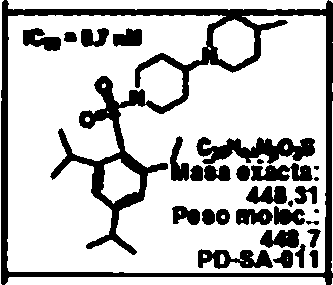


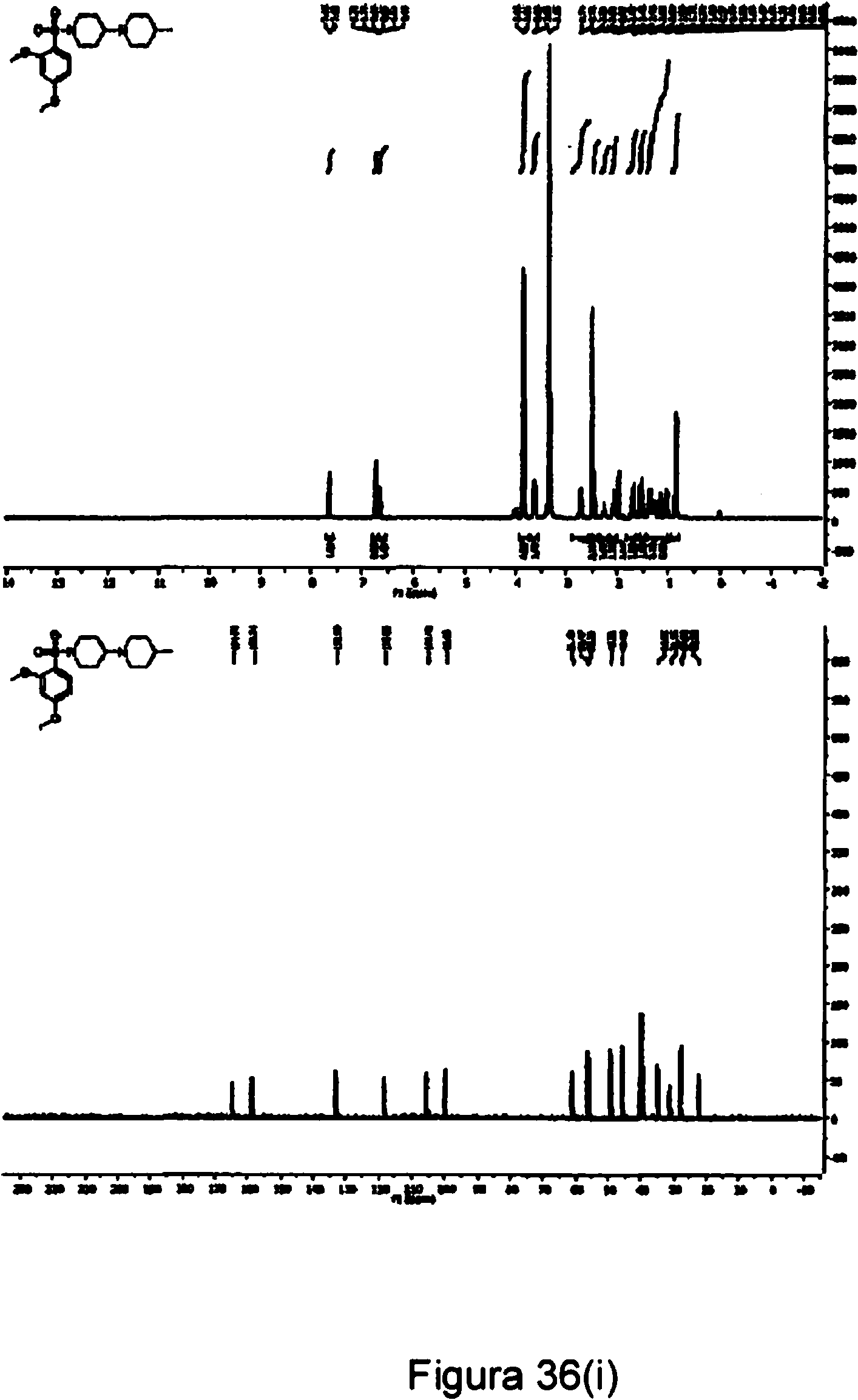


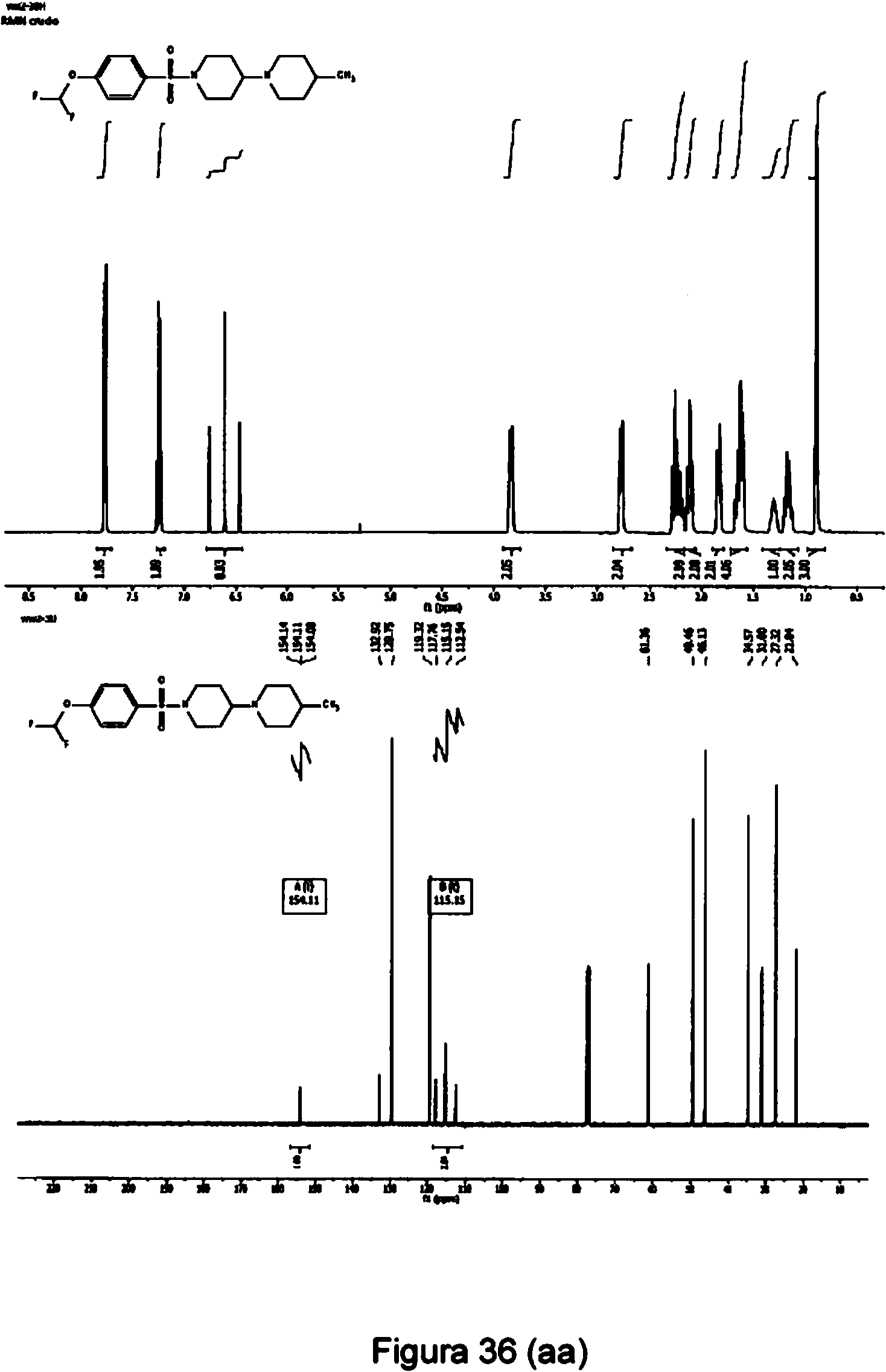
Applications Claiming Priority (3)
| Application Number | Priority Date | Filing Date | Title |
|---|---|---|---|
| US201361875933P | 2013-09-10 | 2013-09-10 | |
| US201461930754P | 2014-01-23 | 2014-01-23 | |
| PCT/US2014/054987 WO2015038644A2 (en) | 2013-09-10 | 2014-09-10 | Therapeutics targeting truncated adenomatous polyposis coli (apc) proteins |
Publications (2)
| Publication Number | Publication Date |
|---|---|
| ES2811090T3 true ES2811090T3 (en) | 2021-03-10 |
| ES2811090T8 ES2811090T8 (en) | 2022-09-29 |
Family
ID=52666505
Family Applications (1)
| Application Number | Title | Priority Date | Filing Date |
|---|---|---|---|
| ES14843412T Active ES2811090T3 (en) | 2013-09-10 | 2014-09-10 | Therapeutics targeting adenomatous polyposis coli (apc) truncated proteins |
Country Status (16)
| Country | Link |
|---|---|
| US (2) | US9856233B2 (en) |
| EP (1) | EP3044218B1 (en) |
| JP (1) | JP6506291B2 (en) |
| KR (2) | KR102300576B1 (en) |
| CN (1) | CN105873913B (en) |
| AU (2) | AU2014318821B2 (en) |
| BR (1) | BR112016005252A2 (en) |
| CA (1) | CA2924062C (en) |
| DK (1) | DK3044218T3 (en) |
| ES (1) | ES2811090T3 (en) |
| HK (1) | HK1224291A1 (en) |
| MX (1) | MX2016003082A (en) |
| RU (1) | RU2727516C2 (en) |
| SG (1) | SG11201601850YA (en) |
| WO (1) | WO2015038644A2 (en) |
| ZA (2) | ZA201601798B (en) |
Families Citing this family (10)
| Publication number | Priority date | Publication date | Assignee | Title |
|---|---|---|---|---|
| KR102300576B1 (en) | 2013-09-10 | 2021-09-08 | 보드 오브 리전츠 더 유니버시티 오브 텍사스 시스템 | Therapeutics targeting truncated adenomatous polyposis coli (apc) proteins |
| US10082496B2 (en) | 2014-09-10 | 2018-09-25 | Board Of Regents Of The University Of Texas System | Targeting emopamil binding protein (EBP) with small molecules that induce an abnormal feedback response by lowering endogenous cholesterol biosynthesis |
| CA2991420A1 (en) * | 2015-07-15 | 2017-01-19 | The Board Of Regents Of The University Of Texas System | Targeting emopamil binding protein (ebp) with small molecules that induce an abnormal feedback response by lowering endogenous cholesterol biosynthesis |
| CA3015817A1 (en) | 2016-03-09 | 2017-09-14 | President And Fellows Of Harvard College | Direct palladium-catalyzed aromatic fluorination |
| CN114652735A (en) * | 2016-07-27 | 2022-06-24 | 凯斯西储大学 | Compounds and methods for promoting myelination |
| WO2019126702A1 (en) | 2017-12-22 | 2019-06-27 | Case Western Reserve University | Compounds for promoting myelination |
| CN108250111B (en) * | 2018-01-15 | 2020-04-28 | 华南理工大学 | A dual-acceptor organic light-emitting small molecule material and its preparation method and application |
| US20220024891A1 (en) * | 2018-12-04 | 2022-01-27 | The Board Of Regents Of The University Of Texas System | Therapeutics targeting mutant adenomatous polyposis coli (apc) for the treatment of cancer |
| CN113624665A (en) * | 2021-07-30 | 2021-11-09 | 中国药科大学 | Application of anti-tumor candidate compound in medicine for treating colorectal cancer and determination method |
| EP4558481A1 (en) * | 2022-07-22 | 2025-05-28 | Biogen MA Inc. | Emopamil-binding protein inhibitors and uses thereof |
Family Cites Families (32)
| Publication number | Priority date | Publication date | Assignee | Title |
|---|---|---|---|---|
| GB1521000A (en) | 1975-06-13 | 1978-08-09 | Syntex Puerto Rico Inc | Inhalation device |
| US4227522A (en) | 1978-09-05 | 1980-10-14 | Syntex Puerto Rico, Inc. | Inhalation device |
| US4192309A (en) | 1978-09-05 | 1980-03-11 | Syntex Puerto Rico, Inc. | Inhalation device with capsule opener |
| GB2129691B (en) | 1982-10-08 | 1987-08-05 | Glaxo Group Ltd | Devices for administering medicaments to patients |
| US4778054A (en) | 1982-10-08 | 1988-10-18 | Glaxo Group Limited | Pack for administering medicaments to patients |
| AU591152B2 (en) | 1985-07-30 | 1989-11-30 | Glaxo Group Limited | Devices for administering medicaments to patients |
| JPH0667926B2 (en) * | 1985-11-12 | 1994-08-31 | 旭化成工業株式会社 | Cyclic isoquinoline sulfonamide derivative |
| JPH05963A (en) | 1990-04-13 | 1993-01-08 | Toray Ind Inc | Polypeptides composition |
| US6582728B1 (en) | 1992-07-08 | 2003-06-24 | Inhale Therapeutic Systems, Inc. | Spray drying of macromolecules to produce inhaleable dry powders |
| IL117149A0 (en) * | 1995-02-23 | 1996-06-18 | Schering Corp | Muscarinic antagonists |
| JP2001172257A (en) | 1999-10-05 | 2001-06-26 | Fujisawa Pharmaceut Co Ltd | Organic sulfonamide compound |
| AR033517A1 (en) * | 2000-04-08 | 2003-12-26 | Astrazeneca Ab | PIPERIDINE DERIVATIVES, PROCESS FOR THE PREPARATION AND USE OF THESE DERIVATIVES IN THE MANUFACTURE OF MEDICINES |
| CA2364178C (en) | 2000-12-05 | 2006-01-10 | Yasuhiro Katsu | N-benzenesulfonyl l-proline compounds as bradykinin antagonists |
| MY130778A (en) * | 2001-02-09 | 2007-07-31 | Vertex Pharma | Heterocyclic inhibitiors of erk2 and uses thereof |
| WO2002070469A2 (en) * | 2001-03-05 | 2002-09-12 | Icos Corporation | Selective pde3b inhibitors and use of the same in therapy |
| DE10155684A1 (en) * | 2001-11-13 | 2003-05-22 | Bayer Ag | New 1-thiazolyl-3-substituted phenyl-urea derivatives, useful for treating or preventing bacterial infection, are inhibitors of phenylalanyl-tRNA synthase |
| WO2004069828A1 (en) * | 2003-02-04 | 2004-08-19 | Mitsubishi Pharma Corporation | Piperidine compound and medicinal use thereof |
| US20060035884A1 (en) * | 2004-05-20 | 2006-02-16 | Elan Pharmaceuticals, Inc. | N-cyclic sulfonamido inhibitors of gamma secretase |
| EP1866298A2 (en) * | 2005-03-31 | 2007-12-19 | Takeda San Diego, Inc. | Hydroxysteroid dehydrogenase inhibitors |
| WO2006134481A1 (en) * | 2005-06-16 | 2006-12-21 | Pfizer Inc. | Inhibitors of 11-beta hydroxysteroid dehydrogenase type 1 |
| WO2007115805A2 (en) * | 2006-04-05 | 2007-10-18 | European Molecular Biology Laboratory (Embl) | Aurora kinase inhibitors |
| CN101466670B (en) * | 2006-04-07 | 2013-04-17 | 梅特希尔基因公司 | Inhibitors of histone deacetylase |
| US8603465B1 (en) * | 2006-08-07 | 2013-12-10 | Merck Sharp & Dohme, Corp. | Methods for treatment of polyposis |
| AU2008296479A1 (en) | 2007-08-28 | 2009-03-12 | Dana Farber Cancer Institute | Amino substituted pyrimidine, pyrollopyridine and pyrazolopyrimidine derivatives useful as kinase inhibitors and in treating proliferative disorders and diseases associated with angiogenesis |
| WO2009086303A2 (en) * | 2007-12-21 | 2009-07-09 | University Of Rochester | Method for altering the lifespan of eukaryotic organisms |
| CN102027133A (en) | 2008-05-07 | 2011-04-20 | 温瑟瑞克斯有限公司 | Methods of identifying compounds that modulate Wnt signaling in cancer cells |
| US9623109B2 (en) * | 2008-05-27 | 2017-04-18 | Yissum Research Development Company Of The Hebrew University Of Jerusalem Ltd. | Methods of killing cells and use of same in prevention and treatment of cancer |
| TW201028421A (en) * | 2009-01-15 | 2010-08-01 | Abbott Lab | Novel benzenesulfonamides as calcium channel blockers |
| CA2874998A1 (en) | 2011-05-27 | 2012-12-06 | Cytocure Llc | Methods, compositions, and kits for the treatment of cancer |
| WO2013119950A2 (en) | 2012-02-08 | 2013-08-15 | Insight Genetics, Inc. | Methods and compositions relating to fusions of ros1 for diagnosing and treating cancer |
| US20130330761A1 (en) | 2012-06-12 | 2013-12-12 | Celcuity, LLC | Whole cell assays and methods |
| KR102300576B1 (en) | 2013-09-10 | 2021-09-08 | 보드 오브 리전츠 더 유니버시티 오브 텍사스 시스템 | Therapeutics targeting truncated adenomatous polyposis coli (apc) proteins |
-
2014
- 2014-09-10 KR KR1020187002519A patent/KR102300576B1/en active Active
- 2014-09-10 EP EP14843412.9A patent/EP3044218B1/en active Active
- 2014-09-10 SG SG11201601850YA patent/SG11201601850YA/en unknown
- 2014-09-10 JP JP2016542070A patent/JP6506291B2/en active Active
- 2014-09-10 CA CA2924062A patent/CA2924062C/en active Active
- 2014-09-10 WO PCT/US2014/054987 patent/WO2015038644A2/en not_active Ceased
- 2014-09-10 US US14/482,659 patent/US9856233B2/en active Active
- 2014-09-10 AU AU2014318821A patent/AU2014318821B2/en not_active Ceased
- 2014-09-10 DK DK14843412.9T patent/DK3044218T3/en active
- 2014-09-10 HK HK16112580.3A patent/HK1224291A1/en unknown
- 2014-09-10 MX MX2016003082A patent/MX2016003082A/en unknown
- 2014-09-10 BR BR112016005252A patent/BR112016005252A2/en not_active Application Discontinuation
- 2014-09-10 CN CN201480061472.6A patent/CN105873913B/en active Active
- 2014-09-10 RU RU2016113279A patent/RU2727516C2/en not_active Application Discontinuation
- 2014-09-10 ES ES14843412T patent/ES2811090T3/en active Active
- 2014-09-10 KR KR1020167009391A patent/KR101824230B1/en active Active
-
2016
- 2016-03-15 ZA ZA2016/01798A patent/ZA201601798B/en unknown
-
2017
- 2017-11-27 US US15/823,150 patent/US10577344B2/en active Active
-
2018
- 2018-04-27 AU AU2018202898A patent/AU2018202898A1/en not_active Abandoned
- 2018-08-01 ZA ZA2018/05172A patent/ZA201805172B/en unknown
Also Published As
| Publication number | Publication date |
|---|---|
| US20190135776A1 (en) | 2019-05-09 |
| MX2016003082A (en) | 2016-09-13 |
| CN105873913B (en) | 2019-12-03 |
| ZA201805172B (en) | 2019-08-28 |
| AU2018202898A1 (en) | 2018-05-17 |
| JP6506291B2 (en) | 2019-04-24 |
| KR20180011890A (en) | 2018-02-02 |
| JP2016534140A (en) | 2016-11-04 |
| CA2924062C (en) | 2019-05-14 |
| KR20160049014A (en) | 2016-05-04 |
| RU2727516C2 (en) | 2020-07-22 |
| CA2924062A1 (en) | 2015-03-19 |
| US10577344B2 (en) | 2020-03-03 |
| SG11201601850YA (en) | 2016-04-28 |
| WO2015038644A2 (en) | 2015-03-19 |
| EP3044218A4 (en) | 2017-02-22 |
| DK3044218T3 (en) | 2020-07-27 |
| EP3044218B1 (en) | 2020-05-27 |
| AU2014318821A1 (en) | 2016-04-14 |
| AU2014318821B2 (en) | 2018-04-19 |
| US20150232444A1 (en) | 2015-08-20 |
| CN105873913A (en) | 2016-08-17 |
| RU2016113279A (en) | 2017-10-16 |
| KR102300576B1 (en) | 2021-09-08 |
| ES2811090T8 (en) | 2022-09-29 |
| US9856233B2 (en) | 2018-01-02 |
| KR101824230B1 (en) | 2018-01-31 |
| HK1224291A1 (en) | 2017-08-18 |
| WO2015038644A3 (en) | 2015-05-14 |
| EP3044218A2 (en) | 2016-07-20 |
| BR112016005252A2 (en) | 2017-09-12 |
| ZA201601798B (en) | 2022-05-25 |
Similar Documents
| Publication | Publication Date | Title |
|---|---|---|
| ES2811090T3 (en) | Therapeutics targeting adenomatous polyposis coli (apc) truncated proteins | |
| Momtazi‐borojeni et al. | The novel role of pyrvinium in cancer therapy | |
| Teh et al. | Glutamatergic signaling in cellular transformation | |
| ES2791539T3 (en) | Compounds for the treatment of diseases related to the expression of DUX4 | |
| CN115768427A (en) | Novel small molecules for targeted degradation of untargetable KRAS in cancer therapy | |
| Li et al. | A novel imidazopyridine derivative, HS-106, induces apoptosis of breast cancer cells and represses angiogenesis by targeting the PI3K/mTOR pathway | |
| Tsimafeyeu et al. | Targeting FGFR2 with alofanib (RPT835) shows potent activity in tumour models | |
| Wang et al. | RNA-binding protein RBM6 as a tumor suppressor gene represses the growth and progression in laryngocarcinoma | |
| CA2276306C (en) | Loss of imprinting-based in vitro diagnostic method to determine the propensity to develop cancer | |
| AU2021261882B2 (en) | Cancer treatment | |
| BR112020025946A2 (en) | bifunctional compositions for the treatment of cancer | |
| Wen et al. | A carbazole compound, 9-ethyl-9H-carbazole-3-carbaldehyde, plays an antitumor function through reactivation of the p53 pathway in human melanoma cells | |
| Qi et al. | EGPI-1, a novel eIF4E/eIF4G interaction inhibitor, inhibits lung cancer cell growth and angiogenesis through Ras/MNK/ERK/eIF4E signaling pathway | |
| Dong et al. | Inhibition of CISD1 attenuates cisplatin-induced hearing loss in mice via the PI3K and MAPK pathways | |
| JP5033624B2 (en) | GSK-3β alteration and proliferative disease treatment method | |
| ES2738864T3 (en) | Combinations of MEK, EGFR and ERBB2 inhibitors in the treatment of lung cancer caused by a KRAS mutant | |
| CA2986248C (en) | Methods of targeting ape1/ref-1 to inhibit hypoxia signaling genes | |
| Pan et al. | Aurora kinase small molecule inhibitor destroys mitotic spindle, suppresses cell growth, and induces apoptosis in oral squamous cancer cells | |
| Cheng et al. | Sevoflurane suppresses glioma tumorigenesis via regulating circ_0079593/miR-633/ROCK1 axis | |
| EA021951B1 (en) | Anticancer combination | |
| Zhou et al. | COM33 suppresses carboplatin-induced epithelial-mesenchymal transition via inhibition of Twist1 in ovarian cancer: COM33 sensitizes ovarian cancer to carboplatin | |
| Zhu et al. | Regulation of the cilia as a potential treatment for senescence and tumors: a review | |
| Hong et al. | Inhibition of Akt/FOXO3a signaling by constitutively active FOXO3a suppresses growth of follicular thyroid cancer cell lines | |
| WO2020229688A1 (en) | Combination therapy for proliferative conditions | |
| KR101599259B1 (en) | HIF-1 alpha inhibitory compound for the treatment of angiogenesis-related diseases |