ES2812848T3 - Process for the preparation of tert-butyl 4 - ((2S, 5R) -6- (benzyloxy) -7-oxo-1,6-diazabicyclo [3.2.1] octane-2-carboxamido) piperidine-1-carboxylate and analogues of the same - Google Patents
Process for the preparation of tert-butyl 4 - ((2S, 5R) -6- (benzyloxy) -7-oxo-1,6-diazabicyclo [3.2.1] octane-2-carboxamido) piperidine-1-carboxylate and analogues of the same Download PDFInfo
- Publication number
- ES2812848T3 ES2812848T3 ES15865871T ES15865871T ES2812848T3 ES 2812848 T3 ES2812848 T3 ES 2812848T3 ES 15865871 T ES15865871 T ES 15865871T ES 15865871 T ES15865871 T ES 15865871T ES 2812848 T3 ES2812848 T3 ES 2812848T3
- Authority
- ES
- Spain
- Prior art keywords
- alkyl
- compound
- formula
- aryl
- mixture
- Prior art date
- Legal status (The legal status is an assumption and is not a legal conclusion. Google has not performed a legal analysis and makes no representation as to the accuracy of the status listed.)
- Active
Links
- 0 C*(*1)(CC2(CC2)C*2N(C)O3)C1(*)[C@@]2C3=N Chemical compound C*(*1)(CC2(CC2)C*2N(C)O3)C1(*)[C@@]2C3=N 0.000 description 3
- KDHVGJXJKNQZHE-RVQOOOLUSA-N CC(C)(C)OC(N(CC1)CCC1/N=C1\OS(C)(C)N(C2)[C@H]1CC[C@H]2NOCc1ccccc1)=O Chemical compound CC(C)(C)OC(N(CC1)CCC1/N=C1\OS(C)(C)N(C2)[C@H]1CC[C@H]2NOCc1ccccc1)=O KDHVGJXJKNQZHE-RVQOOOLUSA-N 0.000 description 1
- XSVAMFJWYPLKRW-OAQYLSRUSA-N CC(C)(C)OC(N(CC1)CCC1N(N=O)[Si](C)(C)N(CCC1)C[C@@H]1NOCc1ccccc1)=O Chemical compound CC(C)(C)OC(N(CC1)CCC1N(N=O)[Si](C)(C)N(CCC1)C[C@@H]1NOCc1ccccc1)=O XSVAMFJWYPLKRW-OAQYLSRUSA-N 0.000 description 1
Classifications
-
- C—CHEMISTRY; METALLURGY
- C07—ORGANIC CHEMISTRY
- C07D—HETEROCYCLIC COMPOUNDS
- C07D471/00—Heterocyclic compounds containing nitrogen atoms as the only ring hetero atoms in the condensed system, at least one ring being a six-membered ring with one nitrogen atom, not provided for by groups C07D451/00 - C07D463/00
- C07D471/02—Heterocyclic compounds containing nitrogen atoms as the only ring hetero atoms in the condensed system, at least one ring being a six-membered ring with one nitrogen atom, not provided for by groups C07D451/00 - C07D463/00 in which the condensed system contains two hetero rings
- C07D471/08—Bridged systems
-
- C—CHEMISTRY; METALLURGY
- C07—ORGANIC CHEMISTRY
- C07F—ACYCLIC, CARBOCYCLIC OR HETEROCYCLIC COMPOUNDS CONTAINING ELEMENTS OTHER THAN CARBON, HYDROGEN, HALOGEN, OXYGEN, NITROGEN, SULFUR, SELENIUM OR TELLURIUM
- C07F7/00—Compounds containing elements of Groups 4 or 14 of the Periodic Table
- C07F7/02—Silicon compounds
- C07F7/08—Compounds having one or more C—Si linkages
- C07F7/10—Compounds having one or more C—Si linkages containing nitrogen having a Si-N linkage
-
- C—CHEMISTRY; METALLURGY
- C07—ORGANIC CHEMISTRY
- C07F—ACYCLIC, CARBOCYCLIC OR HETEROCYCLIC COMPOUNDS CONTAINING ELEMENTS OTHER THAN CARBON, HYDROGEN, HALOGEN, OXYGEN, NITROGEN, SULFUR, SELENIUM OR TELLURIUM
- C07F7/00—Compounds containing elements of Groups 4 or 14 of the Periodic Table
- C07F7/02—Silicon compounds
- C07F7/08—Compounds having one or more C—Si linkages
- C07F7/18—Compounds having one or more C—Si linkages as well as one or more C—O—Si linkages
- C07F7/1804—Compounds having Si-O-C linkages
Landscapes
- Chemical & Material Sciences (AREA)
- Organic Chemistry (AREA)
- Pharmaceuticals Containing Other Organic And Inorganic Compounds (AREA)
- Nitrogen Condensed Heterocyclic Rings (AREA)
Abstract
Un proceso para preparar un compuesto de Fórmula I: **(Ver fórmula)** o una sal farmacéuticamente aceptable del mismo, que comprende: (a) hacer reaccionar un compuesto de Fórmula (II): **(Ver fórmula)** con un compuesto de fórmula (X) **(Ver fórmula)** y una base para obtener un compuesto de Fórmula (III) o (IV), o una mezcla de los mismos; **(Ver fórmula)** (b) tratar el compuesto de fórmulas (III) o (IV) o la mezcla de los mismos, con un equivalente de fosgeno para obtener un compuesto de fórmulas (V) o (VI) o una mezcla de los mismos **(Ver fórmula)** y (c) tratar el compuesto de fórmulas (V) o (VI) o una mezcla de los mismos, con un reactivo de hidrólisis para obtener el compuesto de fórmula (I); en las que Z es O o -NR5 k es un número entero igual a 0, 1 o 2; R2 y R3 se definen de la siguiente manera: (a) R2 es H, alquilo C1-6, -O-alquilo C1-6, -O-Si-(alquilo C1-6)3, o -O-Si-(alquil C1-6)(fenilo)2, y cada R3 es H o alquilo C1-6; o (b) como alternativa y con la condición de que k sea 1 o 2, R2 y el R3 adyacente a R2, junto con los átomos de carbono a los que cada uno está unido, forman cicloalquilo C5-7 que está opcionalmente sustituido con 1 a 3 sustituyentes cada uno de los cuales es independientemente alquilo C1-6, -O-alquilo C1-6, -O-Si-(alquilo C1-6)3, o -O-Si-(alquil C1-6)(fenilo)2; y cualquier otro R3 es H o alquilo C1-6; R5 es H, alquilo C1-6, cicloalquilo C3-6, arilo, -alquil C1-6-arilo, heteroarilo, -alquil C1-6-heteroarilo, o **(Ver fórmula)** R6 y R8 son independientemente H, alquilo C1-3, -O-alquilo C1-3 o -N-(alquilo C1-3)2; cada R7 y R9 es independientemente H o alquilo C1-6; PG2 es un grupo protector de amina seleccionado entre carbamatos, bencilaminas, sulfonamidas y amidas; R10 es bencilo o alilo, en donde el bencilo o el alilo están opcionalmente sustituidos con alquilo C1-6, alcoxi C1-6, flúor o -NO2; R11 y R12 son alquilo C1-6 o arilo; o R11 y R12, junto con el silano al que están unidos forman un anillo monocíclico saturado de 4 a 6 miembros que contiene 0 o 1 heteroátomos seleccionados entre N y O, que está opcionalmente condensado con 1 o 2 anillos aromáticos, conteniendo cada uno opcionalmente 0 o 1 heteroátomo seleccionados entre N y O; R13 es imidazolilo; p es 0, 1 o 2; q es 0, 1 o 2; p + q = 0, 1, 2 o 3; y Ra y Rb son halo; en donde el reactivo de hidrólisis es un disolvente prótico y la expresión "disolvente prótico" se refiere a cualquier disolvente que tenga un átomo de hidrógeno enlazado a un oxígeno como en un grupo hidroxilo o un nitrógeno como en un grupo amina, un ácido o una fuente de fluoruro; en donde el equivalente de fosgeno es carbonildiimidazol.A process for preparing a compound of Formula I: ** (See formula) ** or a pharmaceutically acceptable salt thereof, comprising: (a) reacting a compound of Formula (II): ** (See formula) ** with a compound of formula (X) ** (See formula) ** and a base to obtain a compound of Formula (III) or (IV), or a mixture thereof; ** (See formula) ** (b) treat the compound of formulas (III) or (IV) or the mixture thereof, with one equivalent of phosgene to obtain a compound of formulas (V) or (VI) or a mixture thereof ** (See formula) ** and (c) treating the compound of formulas (V) or (VI) or a mixture thereof, with a hydrolysis reagent to obtain the compound of formula (I); where Z is O or -NR5 k is an integer equal to 0, 1 or 2; R2 and R3 are defined as follows: (a) R2 is H, C1-6 alkyl, -O-C1-6 alkyl, -O-Si- (C1-6 alkyl) 3, or -O-Si- ( C1-6 alkyl) (phenyl) 2, and each R3 is H or C1-6 alkyl; or (b) alternatively and provided that k is 1 or 2, R2 and the R3 adjacent to R2, together with the carbon atoms to which each is attached, form C5-7 cycloalkyl which is optionally substituted with 1 to 3 substituents each of which is independently C1-6 alkyl, -O-C1-6 alkyl, -O-Si- (C1-6 alkyl) 3, or -O-Si- (C1-6 alkyl) ( phenyl) 2; and any other R3 is H or C1-6 alkyl; R5 is H, C1-6 alkyl, C3-6 cycloalkyl, aryl, -C 1-6 alkyl-aryl, heteroaryl, -C 1-6 alkyl-heteroaryl, or ** (See formula) ** R6 and R8 are independently H, C1-3 alkyl, -O-C1-3 alkyl or -N- (C1-3 alkyl) 2; each R7 and R9 is independently H or C1-6 alkyl; PG2 is an amine protecting group selected from carbamates, benzylamines, sulfonamides, and amides; R10 is benzyl or allyl, wherein the benzyl or allyl is optionally substituted with C1-6 alkyl, C1-6 alkoxy, fluoro, or -NO2; R11 and R12 are C1-6 alkyl or aryl; or R11 and R12, together with the silane to which they are attached form a saturated 4- to 6-membered monocyclic ring containing 0 or 1 heteroatoms selected from N and O, which is optionally fused with 1 or 2 aromatic rings, each optionally containing 0 or 1 heteroatom selected from N and O; R13 is imidazolyl; p is 0, 1 or 2; q is 0, 1 or 2; p + q = 0, 1, 2 or 3; and Ra and Rb are halo; wherein the hydrolysis reagent is a protic solvent and the term "protic solvent" refers to any solvent having a hydrogen atom bonded to an oxygen as in a hydroxyl group or a nitrogen as in an amine group, an acid or a source of fluoride; wherein the phosgene equivalent is carbonyldiimidazole.
Description
DESCRIPCIÓNDESCRIPTION
Proceso para la preparación de 4-((2S,5R)-6-(benciloxi)-7-oxo-1,6-diazabiciclo[3.2.1]octano-2-carboxamido)piperidin-1-carboxilato de tere-butilo y análogos del mismoProcess for the preparation of tere-butyl 4 - ((2S, 5R) -6- (benzyloxy) -7-oxo-1,6-diazabicyclo [3.2.1] octane-2-carboxamido) piperidine-1-carboxylate and analogues of the same
Campo de la invenciónField of the invention
La invención se refiere a la preparación de (2S,5R)-6-(benciloxi)-7-oxo-1,6-diazabiciclo[3.2.1]octano-2-carboxamidas y análogos de las mismas. Estas carboxamidas son adecuadas para su uso como intermedios que conducen, a través de una serie de etapas de proceso adicionales, a la preparación de los inhibidores de beta lactamasa, incluyendo (2S,5R)-7-oxo-N-piperidin-4-il-6-(sulfoxi)-1,6-diazabiciclo[3.2.1]octano-2-carboxamida.The invention relates to the preparation of (2S, 5R) -6- (benzyloxy) -7-oxo-1,6-diazabicyclo [3.2.1] octane-2-carboxamides and analogs thereof. These carboxamides are suitable for use as intermediates leading, through a number of additional process steps, to the preparation of beta lactamase inhibitors, including (2S, 5R) -7-oxo-N-piperidin-4- yl-6- (sulfoxy) -1,6-diazabicyclo [3.2.1] octane-2-carboxamide.
Antecedentes de la invenciónBackground of the invention
Determinadas 7-oxo-1,6-diazabiciclo[3.2.1]octano-2-carboxamidas son inhibidores de p-lactamasa y, cuando se usan junto con antibióticos de p-lactama, pueden ser eficaces para el tratamiento de infecciones bacterianas. Véase, por ejemplo, la Patente de Estados Unidos N.° 8.487.093 que desvela 7-oxo-1,6-diazabiciclo[3.2.1]octano-2-carboxamidas y sus síntesis a partir de un intermedio de iluro de cetosulfoxonio que contiene una cadena lateral de amida, donde el intermedio de iluro se cicla en una 5-oxo-piperidin-2-carboxamida usando un catalizador de Ir, Rh o Ru. De un modo similar, Baldwin et al. desvelan la transformación de iluros de p-cetosulfoxonio derivados de lactona en heterociclos de p-oxonitrógeno en presencia de un catalizador de rodio. Véase Baldwin et al., 1993, J. Chem. Soc., Chem. Commun.Certain 7-oxo-1,6-diazabicyclo [3.2.1] octane-2-carboxamides are inhibitors of p-lactamase and, when used in conjunction with p-lactam antibiotics, may be effective in treating bacterial infections. See, for example, US Patent No. 8,487,093 which discloses 7-oxo-1,6-diazabicyclo [3.2.1] octane-2-carboxamides and their syntheses from a ketosulfoxonium ylide intermediate that contains an amide side chain, where the ylide intermediate is cyclized to a 5-oxo-piperidine-2-carboxamide using an Ir, Rh or Ru catalyst. Similarly, Baldwin et al. disclose the transformation of lactone-derived p-ketosulfoxonium ylides into p-oxonitrogen heterocycles in the presence of a rhodium catalyst. See Baldwin et al., 1993, J. Chem. Soc., Chem. Commun.
18 :1434-1435. Mangion et al. desvelan inserciones de X-H catalizadas por iridio (por ejemplo, inserciones de N-H) de iluros de sulfoxonio. Véase Mangion et al., 2009, Org. Lett., 11:3566-3569 y Mangion et al., 2011, Org. Lett. 13:5480-5483.18: 1434-1435. Mangion et al. reveal iridium-catalyzed XH insertions (eg, NH insertions) of sulfoxonium ylides. See Mangion et al., 2009, Org. Lett., 11: 3566-3569 and Mangion et al., 2011, Org. Lett. 13: 5480-5483.
La Patente de Estados Unidos N.°7.112.592 desvela compuestos heterocíclicos y sus sales, procesos para preparar los compuestos y métodos de uso de los compuestos como agentes antibacterianos. Uno de tales compuestos es sal sódica de 7-oxo-6-(sulfoxi)-1,6-diazabiciclo[3.2.1]octano-2-carboxamida. La publicación de solicitud de Patente de Estados Unidos N.° US2003/0199541 desvela métodos para preparar compuestos azabicíclicos que son útiles como medicamentos, en particular agentes antibacterianos. Las publicaciones de solicitud de patente internacional N.°WO 2002/10172, WO2008/039420 y WO2012/172368 desvelan métodos para preparar determinadas 7-oxo-1,6-diazabiciclo[3.2.0]heptano-2-carboxamidas o trans-7-oxo-6-(sulfoxi)-1,6-diazabiciclo[3.2.1]octano-2-carboxamidas que son útiles como inhibidores de p-lactamasa.US Patent No. 7,112,592 discloses heterocyclic compounds and their salts, processes for preparing the compounds, and methods of using the compounds as antibacterial agents. One such compound is 7-oxo-6- (sulfoxy) -1,6-diazabicyclo [3.2.1] octane-2-carboxamide sodium salt. United States Patent Application Publication No. US2003 / 0199541 discloses methods for preparing azabicyclic compounds that are useful as medicaments, in particular antibacterial agents. International patent application publications Nos. WO 2002/10172, WO2008 / 039420 and WO2012 / 172368 disclose methods for preparing certain 7-oxo-1,6-diazabicyclo [3.2.0] heptane-2-carboxamides or trans-7 -oxo-6- (sulfoxy) -1,6-diazabicyclo [3.2.1] octane-2-carboxamides which are useful as p-lactamase inhibitors.
La publicación de solicitud de patente internacional N.° WO2010/126820 desvela la preparación de alquilo ésteres de ácidos oxo-azacicloalquilcarboxílicos N-protegidos. Estos ésteres pueden usarse como intermedios en la síntesis de 7-oxo-1,6-diazabiciclo[3.2.1]octano-2-carboxamidas y ésteres. Miller et al., desvelan una ruta de fabricación para la síntesis de un inhibidor de p-lactamasa. Véase Miller et al., 2014, Org. Lett. 16:174-177.International Patent Application Publication No. WO2010 / 126820 discloses the preparation of alkyl esters of N-protected oxo-azacycloalkylcarboxylic acids. These esters can be used as intermediates in the synthesis of 7-oxo-1,6-diazabicyclo [3.2.1] octane-2-carboxamides and esters. Miller et al., Disclose a manufacturing route for the synthesis of a p-lactamase inhibitor. See Miller et al., 2014, Org. Lett. 16: 174-177.
Sumario de la invenciónSummary of the invention
La presente invención se refiere a un proceso para preparar un compuesto de Fórmula I:The present invention relates to a process for preparing a compound of Formula I:

o una sal farmacéuticamente aceptable del mismo; que comprende:or a pharmaceutically acceptable salt thereof; comprising:
(a) hacer reaccionar un compuesto de Fórmula (II):(a) reacting a compound of Formula (II):

con un compuesto de fórmula (X) with a compound of formula (X)

y una base para obtener un compuesto de Fórmula (NI) o (IV), o una mezcla de los mismos;and a base to obtain a compound of Formula (NI) or (IV), or a mixture thereof;

(b) tratar el compuesto de fórmula (III) o (IV), o una mezcla de los mismos, con un equivalente de fosgeno para obtener un compuesto de fórmula (V) o (VI), o una mezcla de los mismos,(b) treating the compound of formula (III) or (IV), or a mixture thereof, with one equivalent of phosgene to obtain a compound of formula (V) or (VI), or a mixture thereof,

yY
(c) tratar el compuesto de fórmula (V) o (VI), o la mezcla de los mismos, con un reactivo de hidrólisis para obtener el(c) treating the compound of formula (V) or (VI), or the mixture thereof, with a hydrolysis reagent to obtain the
compuesto de fórmula (I);compound of formula (I);
en la quein which
Z es O o -NR5Z is O or -NR5
k es un número entero igual a 0, 1 o 2;k is an integer equal to 0, 1 or 2;
R2 y R3 se definen de la siguiente manera:R2 and R3 are defined as follows:
(a) R2 es H, alquilo C1-6, -O-alquilo C1-6, -O-Si-(alquilo 01 - 6 )3 , o(a) R2 is H, C 1-6 alkyl, -O-C1-6 alkyl, -O-Si- (alkyl 01-6) 3, or
-O-Si-(alquil C1-6)(fenilo)2 , y-O-Si- (C 1-6 alkyl) (phenyl) 2 , and
cada R3 es H o alquilo C1-6; oeach R3 is H or C 1-6 alkyl; or
(b) como alternativa y con la condición de que k sea 1 o 2, R2 y el R3 adyacente a R2, junto con los átomos de carbono a los que cada uno está unido, forman cicloalquilo C5-7 que está opcionalmente sustituido con 1 a 3 sustituyentes cada uno de los cuales es independientemente alquilo C1-6, -O-alquilo C1-6, -O-Si-(alquilo C1-6)3 , o(b) alternatively and provided that k is 1 or 2, R2 and the R3 adjacent to R2, together with the carbon atoms to which each is attached, form C 5-7 cycloalkyl which is optionally substituted with 1 to 3 substituents each of which is independently C 1-6 alkyl, -O-C 1-6 alkyl, -O-Si- (C 1-6 alkyl) 3 , or
-O-Si-(alquil C1-6)(fenilo)2 ; y cualquier otro R3 es H o alquilo C1-6;-O-Si- (C 1-6 alkyl) (phenyl) 2 ; and any other R3 is H or C 1-6 alkyl;
R5 es H, alquilo C1-6, cicloalquilo C3-6, arilo, alquil C1-6-arilo, heteroarilo, alquil C1-6-heteroarilo, oR5 is H, C 1-6 alkyl, C 3-6 cycloalkyl, aryl, C 1-6 alkyl-aryl, heteroaryl, C 1-6 alkyl-heteroaryl, or
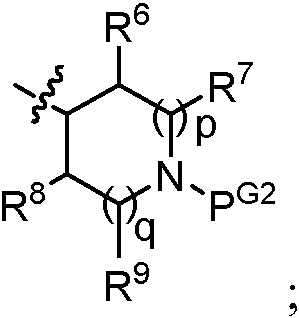
R6 y R8 son independientemente H, alquilo C1-3, -O-alquilo C1-3 o -N-(alquilo ^ -3)2 ;R6 and R8 are independently H, C 1-3 alkyl, -O-C 1-3 alkyl or -N- (^ -3 alkyl) 2 ;
cada R7 y R9 es independientemente H o alquilo C1-6;each R7 and R9 is independently H or C 1-6 alkyl;
PG2 es un grupo protector de amina seleccionado entre carbamatos, bencilaminas, sulfonamidas y amidas; R10 es bencilo o alilo, en el que el bencilo o alilo está opcionalmente sustituido con alquilo C1-6 , alcoxi C1-6 , flúor o -NO2 ;PG2 is an amine protecting group selected from carbamates, benzylamines, sulfonamides, and amides; R10 It is benzyl or allyl, in which the benzyl or allyl optionally substituted with alkyl C 1-6, alkoxy C 1-6, fluoro or -NO 2;
R11 y R12 son alquilo C1-6 o arilo; oR11 and R12 are C 1-6 alkyl or aryl; or
R11 y R12, junto con el silano al que están unidos forman un anillo monocíclico saturado de 4 a 6 miembros que contiene 0 o 1 heteroátomos seleccionados entre N y O, que está opcionalmente condensado con 1 o 2 anillos aromáticos, conteniendo cada uno opcionalmente 0 o 1 heteroátomo seleccionados entre N y O;R11 and R12, together with the silane to which they are attached form a saturated 4- to 6-membered monocyclic ring containing 0 or 1 heteroatoms selected from N and O, which is optionally fused with 1 or 2 aromatic rings, each optionally containing 0 or 1 heteroatom selected from N and O;
R13 es imidazolilo;R13 is imidazolyl;
p es 0, 1 o 2;p is 0, 1 or 2;
q es 0, 1 o 2;q is 0, 1 or 2;
p q = 0, 1,2 o 3; yp q = 0, 1,2 or 3; Y
Ra y Rb son halo;Ra and Rb are halo;
en el que el reactivo de hidrólisis es un disolvente prótico y el la expresión "disolvente prótico" se refiere a cualquier disolvente que tiene un átomo de hidrógeno enlazado a un oxígeno como en un grupo hidroxilo o un nitrógeno como en un grupo amina, ácido o una fuente de fluoruro;wherein the hydrolysis reagent is a protic solvent and the term "protic solvent" refers to any solvent having a hydrogen atom bonded to an oxygen as in a hydroxyl group or a nitrogen as in an amine, acid, or group. a source of fluoride;
en el que el equivalente de fosgeno es carbonildiimidazol.wherein the phosgene equivalent is carbonyldiimidazole.
En una realización de la invención, Z es -NR5. En una realización de la invención, k es 1. En una realización de la invención, R2 y R3 son H. En una realización de la invención, R5 es H oIn one embodiment of the invention, Z is -NR5. In one embodiment of the invention, k is 1. In one embodiment of the invention, R2 and R3 are H. In one embodiment of the invention, R5 is H or

En un aspecto de esta realización, R5 esIn one aspect of this embodiment, R5 is

En una realización de la invención, PG2 es t-Boc.In one embodiment of the invention, PG2 is t-Boc.
En la etapa (a) de la invención, en una realización, el compuesto de Fórmula X es un dihalodialquilsilano, dihalodiarilsilano o dihaloalquilarilsilano. En un aspecto de la realización, el compuesto de Fórmula X es diclorodimetilsilano. En una realización, la base es base de Hunig.In step (a) of the invention, in one embodiment, the compound of Formula X is a dihalodialkylsilane, dihalodyrylsilane, or dihaloalkylarylsilane. In one aspect of the embodiment, the compound of Formula X is dichlorodimethylsilane. In one embodiment, the base is Hunig's base.
En la etapa (c) de la invención, en una realización, el reactivo de hidrólisis es un disolvente prótico, que puede ser alcohol isopropílico.In step (c) of the invention, in one embodiment, the hydrolysis reagent is a protic solvent, which can be isopropyl alcohol.
En determinadas realizaciones de la invención, el compuesto de Fórmula (I) es 4-((2S,5R)-7-oxo-6-benciloxi-1,6-diazabiciclo[3.2.1]octano-2-carboxamido)piperidin-1-carboxilato de ferc-butilo o una sal farmacéuticamente aceptable del mismo.In certain embodiments of the invention, the compound of Formula (I) is 4 - ((2S, 5R) -7-oxo-6-benzyloxy-1,6-diazabicyclo [3.2.1] octane-2-carboxamido) piperidine- Tert-Butyl 1-carboxylate or a pharmaceutically acceptable salt thereof.
La presente invención también se refiere a un compuesto que es:The present invention also relates to a compound that is:

o or

o una sal del mismoor a salt of it
en la quein which
Z es O o -NR5Z is O or -NR5
k es un número entero igual a 0, 1 o 2;k is an integer equal to 0, 1 or 2;
R2 y R3 se definen de la siguiente manera:R2 and R3 are defined as follows:
(a) R2 es H, alquilo C1-6, -O-alquilo C1-6, -O-Si-(alquilo C1-a)3, o(a) R2 is H, C 1-6 alkyl, -O-C 1-6 alkyl, -O-Si- (C1-a alkyl) 3, or
-O-Si-(alquil C1-6)(fenilo)2, y-O-Si- (C 1-6 alkyl) (phenyl) 2 , and
cada R3 es H o alquilo C1-6; oeach R3 is H or C 1-6 alkyl; or
(b) como alternativa y con la condición de que k sea 1 o 2, R2 y el R3 adyacente a R2, junto con los átomos de carbono a los que cada uno está unido, forman cicloalquilo C5-7 que está opcionalmente sustituido con 1 a 3 sustituyentes cada uno de los cuales es independientemente alquilo C1-6, -O-alquilo C1-6, -O-Si-(alquilo C1-6)3, o(b) alternatively and provided that k is 1 or 2, R2 and the R3 adjacent to R2, together with the carbon atoms to which each is attached, form C 5-7 cycloalkyl which is optionally substituted with 1 to 3 substituents each of which is independently C 1-6 alkyl, -O-C 1-6 alkyl, -O-Si- (C 1-6 alkyl) 3, or
-O-Si-(alquil C1-6)(fenilo)2; y cualquier otro R3 es H o alquilo C1-6;-O-Si- (C 1-6 alkyl) (phenyl) 2 ; and any other R3 is H or C 1-6 alkyl;
R5 es H, alquilo C1-6, cicloalquilo C3-6, arilo, alquil C1-6-arilo, heteroarilo,R5 is H, C 1-6 alkyl, C 3-6 cycloalkyl, aryl, C 1-6 alkyl-aryl, heteroaryl,
alquil C1-6-heteroarilo, o C 1-6 alkyl-heteroaryl, or

R6 y R8 son independientemente H, alquilo C1-3, -O-alquilo C1.3 o -N-(alquilo C1-3)2;R6 and R8 are independently H, C 1-3 alkyl, -O-C 1.3 alkyl or -N- (C 1-3 alkyl) 2 ;
cada R7 y R9 es independientemente H o alquilo C1-6;each R7 and R9 is independently H or C 1-6 alkyl;
PG2 es un grupo protector de amina seleccionado entre carbamatos, bencilaminas, sulfonamidas y amidas; R10 es bencilo o alilo, en el que el bencilo o alilo está opcionalmente sustituido con alquilo C1-6, alcoxi C1-6, flúor o -NO2 ; R11 y R12 son alquilo C1-6 o arilo; oPG2 is an amine protecting group selected from carbamates, benzylamines, sulfonamides, and amides; R10 is benzyl or allyl, in which the benzyl or allyl optionally substituted with C 1-6 alkyl, C 1-6 alkoxy, fluoro or -NO 2; R11 and R12 are C 1-6 alkyl or aryl; or
R11 y R12, junto con el silano al que están unidos forman un anillo monocíclico saturado de 4 a 6 miembros que contiene 0 o 1 heteroátomos seleccionados entre N y O, que está opcionalmente condensado con 1 o 2 anillos aromáticos, conteniendo cada uno opcionalmente 0 o 1 heteroátomo seleccionados entre N y O; R13 es un grupo saliente;R11 and R12, together with the silane to which they are attached form a saturated 4- to 6-membered monocyclic ring containing 0 or 1 heteroatoms selected from N and O, which is optionally fused with 1 or 2 aromatic rings, each optionally containing 0 or 1 heteroatom selected from N and O; R13 is a leaving group;
p es 0, 1 o 2;p is 0, 1 or 2;
q es 0, 1 o 2;q is 0, 1 or 2;
p q = 0, 1, 2 o 3;p q = 0, 1, 2 or 3;
en el que el grupo saliente es imidazolilo.wherein the leaving group is imidazolyl.
En determinadas realizaciones, Z es -NR5. En determinados aspectos de la invención, el compuesto es un compuesto que es: In certain embodiments, Z is -NR5. In certain aspects of the invention, the compound is a compound that is:

Otras realizaciones, aspectos y características de la presente invención se describen adicionalmente o serán evidentes a partir de la siguiente descripción, ejemplos y reivindicaciones adjuntas.Other embodiments, aspects, and features of the present invention are further described or will be apparent from the following description, examples, and appended claims.
Descripción detallada de la invenciónDetailed description of the invention
La presente invención se refiere a un proceso para preparar un compuesto de Fórmula I, un intermedio de urea en la síntesis de 7-oxo-1,6-diazabiciclo[3.2.1]octano-2-carboxamidas y sales farmacéuticamente aceptables de las mismas, que emplean un compuesto que contiene silicio junto con un equivalente de fosgeno, carbonildiimidazol (CDI). El compuesto que contiene silicio puede reaccionar con la diamina de Fórmula II en presencia de una base, tal como una base de Hunig, para generar un nuevo intermedio de N-Si-N (III) o N-Si-O (IV) de 5 miembros en el caso en el que Z es -NR5, seguido de reacción con el equivalente de fosgeno (CDI) para generar un compuesto de Fórmula V o VI, o una mezcla de los mismos. Después, la urea deseada can puede formarse a través de hidrólisis del grupo sililo con agua, un alcohol o ion fluoruro y ciclación espontánea. En la primera etapa de sililación, se observó sililación parcial en el nitrógeno en el resto hidroxilamina en los compuestos de Fórmula III y/o IV, pero tras la reacción con CDI los intermedios parcialmente sililados se convirtieron limpiamente en el compuesto de Fórmula V o VI, o una mezcla de los mismos. Una urea de alta calidad se aísla con un rendimiento entorno al 90 % después de un tratamiento convencional. Un compuesto de Fórmula I es útil como intermedio en el proceso para la síntesis del inhibidor de betalactamasa, (2S,5R)-7-oxo-N-piperidin-4-il-6-(sulfoxi)-1,6-diazabiciclo[3.2.1]octano-2-carboxamida. Además, el material aislado da un rendimiento superior en la etapa sintética posterior - una desbencilación catalizada por paladio. The present invention relates to a process for preparing a compound of Formula I, a urea intermediate in the synthesis of 7-oxo-1,6-diazabicyclo [3.2.1] octane-2-carboxamides and pharmaceutically acceptable salts thereof. , which employ a silicon-containing compound together with a phosgene equivalent, carbonyldiimidazole (CDI). The silicon-containing compound can react with the diamine of Formula II in the presence of a base, such as a Hunig's base, to generate a new N-Si-N (III) or N-Si-O (IV) intermediate of 5-membered in the case where Z is -NR5, followed by reaction with the phosgene equivalent (CDI) to generate a compound of Formula V or VI, or a mixture thereof. The desired urea can then be formed through hydrolysis of the silyl group with water, an alcohol or fluoride ion and spontaneous cyclization. In the first silylation step, partial silylation at nitrogen was observed at the hydroxylamine moiety in the Formula III and / or IV compounds, but upon reaction with CDI the partially silylated intermediates were cleanly converted to the Formula V or VI compound. , or a mixture thereof. A high-quality urea is isolated with a yield of around 90% after conventional treatment. A compound of Formula I is useful as an intermediate in the process for the synthesis of the beta-lactamase inhibitor, (2S, 5R) -7-oxo-N-piperidin-4-yl-6- (sulfoxy) -1,6-diazabicyclo [ 3.2.1] octane-2-carboxamide. In addition, the isolated material gives superior performance in the subsequent synthetic step - a palladium catalyzed debenzylation.
El proceso original para la preparación de la urea de Fórmula I implicó tratar la diamina de Fórmula II con trifosgeno. Los primeros intentos para reemplazar trifosgeno por CDI, un reactivo más ecológico y seguro en comparación con el trifosgeno, no proporcionaron un rendimiento satisfactorio de la urea deseada debido a reacciones competitivas de los otros átomos de nitrógeno en la molécula. Los inventores de la presente invención han descubierto que a través del uso de un compuesto que contiene silicio pueden mejorarse los rendimientos del intermedio de urea deseado.The original process for the preparation of the urea of Formula I involved treating the diamine of Formula II with triphosgene. Early attempts to replace triphosgene with CDI, a safer and more environmentally friendly reagent compared to triphosgene, did not provide a satisfactory yield of the desired urea due to competing reactions of the other nitrogen atoms in the molecule. The inventors of the present invention have discovered that through the use of a silicon-containing compound the yields of the desired urea intermediate can be improved.
Como tal, la presente invención proporciona un proceso más seguro, altamente selectivo, más robusto y más ecológico para la formación de urea cíclica que utiliza un compuesto que contiene silicio, tal como diclorodimetilsilano para introducir un grupo protector temporal, en combinación con un equivalente de fosgeno, CDI, como un reactivo de carbonilación.As such, the present invention provides a safer, highly selective, more robust, and more environmentally friendly process for the formation of cyclic urea that uses a silicon-containing compound, such as dichlorodimethylsilane to introduce a temporary protecting group, in combination with an equivalent of phosgene, CDI, as a carbonylating reagent.
El término "alquilo" se refiere a un radical hidrocarburo monovalente alifático saturado de cadena lineal o ramificada que tiene un número de átomos de carbono en el intervalo especificado. Por lo tanto, por ejemplo, "alquilo C-i-a" (o "alquilo Ci-Ca") se refiere a cualquiera de los isómeros de hexil y pentil alquilo, así como a n-, iso-, sec- y t-butilo, n- e iso-propilo, etilo y metilo. Como otro ejemplo, "alquilo C1-4" se refiere a cualquiera de n-, iso-, sec- y t-butilo, n- e isopropilo, etilo y metilo. Como otro ejemplo, "alquilo C1-3" se refiere a cualquiera de n-propilo, isopropilo, etilo y metilo. The term "alkyl" refers to a straight or branched chain saturated aliphatic monovalent hydrocarbon radical having a number of carbon atoms in the specified range. Thus, for example, "Cia alkyl" (or "Ci-Ca alkyl") refers to any of the hexyl and pentyl alkyl isomers, as well as n-, iso-, sec- and t-butyl, n - and iso-propyl, ethyl and methyl. As another example, "C 1-4 alkyl" refers to any of n-, iso-, sec- and t-butyl, n- and isopropyl, ethyl and methyl. As another example, "C 1-3 alkyl" refers to any of n-propyl, isopropyl, ethyl, and methyl.
La expresión "alquilo ramificado" se refiere a un grupo alquilo como se ha definido anteriormente, excepto porque se excluyen grupos alquilo de cadena lineal en el intervalo especificado. Como se define en el presente documento, alquilo ramificado incluye grupos alquilo en los que el alquilo se une al resto del compuesto mediante un carbono secundario o terciario; por ejemplo, isopropilo es un grupo alquilo ramificado.The term "branched alkyl" refers to an alkyl group as defined above, except that straight chain alkyl groups in the specified range are excluded. As defined herein, branched alkyl includes alkyl groups in which the alkyl is attached to the remainder of the compound through a secondary or tertiary carbon; for example, isopropyl is a branched alkyl group.
El término "alilo" se refiere a un sustituyente con la fórmula estructura1H2C=CH-CH2R, donde R es un sustituyente. Un alilo está opcionalmente sustituido en cualquier átomo de carbono de dicho alquilo C1-4 o arilo. The term "allyl" refers to a substituent with the structural formula 1H 2 C = CH-CH 2 R, where R is a substituent. An allyl is optionally substituted at any carbon atom of said C 1-4 alkyl or aryl.
El término "arilo" se refiere a un sistema de anillos, monocíclico o bicíclico, aromático que comprende de 5 a 14 átomos de carbono, por ejemplo, de 5 a 8 átomos de carbono. En determinadas realizaciones, un arilo monocíclico comprenderá de 5 a 7 átomos de carbono. En determinadas realizaciones, un arilo bicíclico comprenderá de 8 a 11 átomos de carbono. Los grupos arilo adecuados incluyen fenilo, naftilo y antracenilo. Un arilo está opcionalmente sustituido con halógeno, alquilo C1-6, -O-alquilo C1-6, -CN o - NO2.The term "aryl" refers to an aromatic monocyclic or bicyclic ring system comprising 5 to 14 carbon atoms, for example 5 to 8 carbon atoms. In certain embodiments, a monocyclic aryl will comprise from 5 to 7 carbon atoms. In certain embodiments, a bicyclic aryl will comprise from 8 to 11 carbon atoms. Suitable aryl groups include phenyl, naphthyl, and anthracenyl. An aryl is optionally substituted with halogen, C 1 alkyl - 6, -O-alkyl C 1 to 6, -CN or - NO 2.
El término "halógeno" (o "halo") se refiere a flúor, cloro, bromo o yodo (como alternativa denominado flúor, cloro, bromo o yodo). En determinadas realizaciones de la invención, el halógeno es cloro o bromo. En un aspecto de estas realizaciones, el halógeno es cloro.The term "halogen" (or "halo") refers to fluorine, chlorine, bromine, or iodine (alternatively referred to as fluorine, chlorine, bromine, or iodine). In certain embodiments of the invention, the halogen is chlorine or bromine. In one aspect of these embodiments, the halogen is chlorine.
El término "heteroarilo" se refiere a un sistema de anillos, monocíclico o bicíclico, aromático que contiene de 1 a 3 heteroátomos seleccionados entre N, S y O y que comprende de 5 a 14 átomos de carbono, por ejemplo, de 5 a 8 átomos de carbono. En determinadas realizaciones, un heteroarilo monocíclico comprenderá de 5 a 7 átomos de carbono. En determinadas realizaciones, un heteroarilo bicíclico comprenderá de 8 a 11 átomos de carbono. Los grupos heteroarilo adecuados incluyen, pero sin limitación, pirrolilo, imidazolilo, pirazolilo, oxazolilo, isoxazolilo, tiazolilo, isotiazolilo, furanilo, piridinilo, indolilo, quinolidinilo, benzoimidazolilo, benzoxazoilo, benzoisoxazolilo y benzotiazolilo. Un heteroarilo está opcionalmente sustituido con halógeno, alquilo C1-6 , -Oalquilo C1-6 o -NO2.The term "heteroaryl" refers to a monocyclic or bicyclic aromatic ring system containing 1 to 3 heteroatoms selected from N, S and O and comprising 5 to 14 carbon atoms, for example 5 to 8 carbon atoms. In certain embodiments, a monocyclic heteroaryl will comprise 5 to 7 carbon atoms. In certain embodiments, a bicyclic heteroaryl will comprise from 8 to 11 carbon atoms. Suitable heteroaryl groups include, but are not limited to, pyrrolyl, imidazolyl, pyrazolyl, oxazolyl, isoxazolyl, thiazolyl, isothiazolyl, furanyl, pyridinyl, indolyl, quinolidinyl, benzoimidazolyl, benzoxazoyl, benzoisoxazolyl, and benzothiazolyl. A heteroaryl is optionally substituted with halogen, C 1-6, C 1-6 -O or -NO2.
La expresión "grupo saliente" se refiere a un fragmento molecular que parte de un par de electrones en una escisión de enlace heterólítico. Los grupos salientes pueden ser aniones de moléculas neutras, pero en cualquier caso, es crucial que el grupo saliente sea capaz de estabilizar la densidad electrónica adicional que resulta de la heterólisis del enlace. Los grupos salientes aniónicos comunes son haluros, tales como Cl-, B r e I-, ésteres de sulfonato, tales como tosilato (TsO-), triflato (TfO-), mesilato (MsO-), grupos ariloxi, tales como p-nitrofenilo, o-nitrofenilo, o,p-dinitrofenilo y pentafluorofenilo, y grupos heterocicloxi, tales como 2-metil-2-piridiniloxi, 2-oxo-2-piridiniloxi, pirrolidin-2,5-diona-1-oxi, isoindolin-1,3-diona-2-oxi y 1H-benzo[d][1.2.3]triazol-1-oxi. Los grupos salientes adecuados incluyen, pero sin limitación, halógeno, imidazolilo, -O-alquilo C1-6, -O-arilo y -O-heteroarilo.The term "leaving group" refers to a molecular fragment that starts from an electron pair in a heterolytic bond cleavage. The leaving groups can be anions of neutral molecules, but in any case, it is crucial that the leaving group is able to stabilize the additional electron density that results from bond heterolysis. Common anionic leaving groups are halides, such as Cl-, B re I-, sulfonate esters, such as tosylate (TsO-), triflate (TfO-), mesylate (MsO-), aryloxy groups, such as p-nitrophenyl , o-nitrophenyl, o, p-dinitrophenyl and pentafluorophenyl, and heterocycloxy groups, such as 2-methyl-2-pyridinyloxy, 2-oxo-2-pyridinyloxy, pyrrolidine-2,5-dione-1-oxy, isoindolin-1 , 3-dione-2-oxy and 1H-benzo [d] [1.2.3] triazole-1-oxy. Suitable leaving groups include but are not limited to , halogen, imidazolyl, -O-alkyl C 1-6, -O-aryl and -O-heteroaryl.
La expresión "disolvente prótico" se refiere a cualquier disolvente que tiene un átomo de hidrógeno enlazado a un oxígeno (como en un grupo hidroxilo) o un nitrógeno (como en un grupo amina). En términos generales, cualquier disolvente que contiene H+ lábil se llama un disolvente prótico. Las moléculas de dichos disolventes donan protones fácilmente (H+) a reactivos. Los disolventes próticos incluyen, pero sin limitación, ácido fórmico, n-butanol, sec-butanol, ferc-butanol, isopropanol, propanol, nitrometano, etanol, metanol, ácido acético y agua.The term "protic solvent" refers to any solvent that has a hydrogen atom linked to an oxygen (as in a hydroxyl group) or a nitrogen (as in an amine group). Generally speaking, any solvent that contains labile H + is called a protic solvent. The molecules of these solvents readily donate protons (H +) to reagents. Protic solvents include, but are not limited to, formic acid, n-butanol, sec-butanol, ferc-butanol, isopropanol, propanol, nitromethane, ethanol, methanol, acetic acid, and water.
PG2 es un grupo protector de amina que, en combinación con el nitrógeno de amino al que está unido, es adecuadamente un carbamato, incluyendo alquil carbamato, aril carbamato, vinil carbamato, alil carbamato, bencilamina (opcionalmente sustituida) o amida incluyendo sulfonamida. Los grupos PG2 adecuados incluyen 9-fluorenilmetoxicarbonilo (Fmoc), ferc-butoxicarbonilo (Boc), benciloxicarbonilo (CBz), aliloxicarbonilo (Alloc), metoxibencilo, nitrobencilo y bencilo. En algunas realizaciones, PG2 puede ser un grupo protector e incluye Fmoc, Boc, Cbz, etil- o metiloxicarbonilo, fenoxicarbonilo, Alloc y grupos equivalente conocidos para un experto en la materia con el beneficio de la presente divulgación. En realizaciones a modo de ejemplo, PG2 puede ser ferc-butoxicarbonilo (Boc). PG2 is an amine protecting group which, in combination with the amino nitrogen to which it is attached, is suitably a carbamate, including alkyl carbamate, aryl carbamate, vinyl carbamate, allyl carbamate, benzylamine (optionally substituted), or amide including sulfonamide. Suitable PG2 groups include 9-fluorenylmethoxycarbonyl (Fmoc), tert-butoxycarbonyl (Boc), benzyloxycarbonyl (CBz), allyloxycarbonyl (Alloc), methoxybenzyl, nitrobenzyl, and benzyl. In some embodiments, PG2 can be a protecting group and includes Fmoc, Boc, Cbz, ethyl- or methyloxycarbonyl, phenoxycarbonyl, Alloc, and equivalent groups known to one of ordinary skill in the art with the benefit of the present disclosure. In exemplary embodiments, PG2 can be tert-butoxycarbonyl (Boc).
A menos que se indique expresamente lo contrario, todos los intervalos citados en el presente documento son inclusivos; es decir, el intervalo incluye los valores para los límites superior e inferior del intervalo, así como todos los valores entre ellos. Por ejemplo, un anillo fenilo descrito como opcionalmente sustituido con "1 a 3 sustituyentes" pretende incluir como aspectos del mismo, un anillo sustituido con 0 a 3 sustituyentes, 1 a 3 sustituyentes, 2 a 3 sustituyentes, 3 sustituyentes, 1 a 2 sustituyentes, 2 sustituyentes, 1 sustituyente y 0 sustituyentes. Como otro ejemplo, los intervalos de temperatura, los intervalos de equivalentes y similares descritos en el presente documento incluyen los límites superior e inferior del intervalo y cualquier valor en el continuo entre ellos.Unless expressly stated otherwise, all ranges cited herein are inclusive; that is, the range includes the values for the upper and lower limits of the range, as well as all the values in between. For example, a phenyl ring described as optionally substituted with "1 to 3 substituents" is intended to include as aspects thereof, a ring substituted with 0 to 3 substituents, 1 to 3 substituents, 2 to 3 substituents, 3 substituents, 1 to 2 substituents. , 2 substituents, 1 substituent and 0 substituents. As another example, the temperature ranges, equivalent ranges and the like described herein include the upper and lower limits of the range and any value on the continuum between them.
La etapa (a) implica:Stage (a) involves:
hacer reaccionar un compuesto de Fórmula (II):reacting a compound of Formula (II):

con un compuesto de fórmula (X) with a compound of formula (X)

y una base para obtener un compuesto de Fórmula (III) o (IV), o una mezcla de los mismos;and a base to obtain a compound of Formula (III) or (IV), or a mixture thereof;

Los compuestos de Fórmula II pueden obtenerse como se describe en la publicación de solicitud de patente internacional N.° WO2010/126820 y WO2012/172368, la solicitud de patente internacional N.° PCT/US14/040983, Mangion et al., 2009, Org. Lett., 11:3566-3569, Mangion et al., 2011, Org. Lett. 13:5480-5483 y Miller et al., 2014, Org. Lett. 16:174.Compounds of Formula II can be obtained as described in International Patent Application Publication No. WO2010 / 126820 and WO2012 / 172368, International Patent Application No. PCT / US14 / 040983, Mangion et al., 2009, Org. Lett., 11: 3566-3569, Mangion et al., 2011, Org. Lett. 13: 5480-5483 and Miller et al., 2014, Org. Lett. 16: 174.
En determinadas realizaciones, el Compuesto II incluye lo siguiente:In certain embodiments, Compound II includes the following:
(la ) k es 0 o 1;(a) k is 0 or 1;
(lb ) k es 0;(lb) k is 0;
(lc ) k es 1;(lc) k is 1;
(2a) R2 es H, alquilo C1-4, -O-alquilo C1-4, -O-Si-(alquilo C-m )3 u -O-Si-(alquil C1-4)(fenilo)2, y cada R3 es H o alquilo C1-4;(2a) R2 is H, C 1-4 alkyl, -O-C 1-4 alkyl, -O-Si- (Cm alkyl) 3 or -O-Si- (C 1-4 alkyl) (phenyl) 2 , and each R3 is H or C 1-4 alkyl;
(2b) R2 es H, CH3 , -OCH3 , -O-trimetilsililo (TMS), -O-t-butildifenilsililo (TBDPS), -O-t-butildimetilsililo (TBS) u -O-triisopropilsililo (TIPS), y cada R3 es H o CH3 ;(2b) R2 is H, CH 3 , -OCH 3 , -O-trimethylsilyl (TMS), -Ot-butyldiphenylsilyl (TBDPS), -Ot-butyldimethylsilyl (TBS) or -O-triisopropylsilyl (TIPS), and each R3 is H or CH 3 ;
(2c) R2 es H o CH3 , y cada R3 es H o CH3 ;(2c) R2 is H or CH 3 , and each R3 is H or CH 3 ;
(2d) R2 es H, y cada R3 es H;(2d) R2 is H, and each R3 is H;
(2e) con la condición de que k sea 1 o 2, R2 y el R3 adyacente a R2, junto con los átomos de carbono a los que cada uno está nido, forman cicloalquilo C5-6; y cualquier otro R3 es H.(2e) provided that k is 1 or 2, R2 and the R3 adjacent to R2, together with the carbon atoms to which each is attached, form C 5-6 cycloalkyl; and any other R3 is H.
Una o más de estas realizaciones (1) a (2) pueden combinarse entre sí, en las que cada una de dichas combinaciones es una realización separada. En otras palabras, cualquier realización del grupo 1 (1a, 1b o 1c) pueden combinarse con cualquier realización del grupo 2 (2a, 2b, 2c, 2d o 2e).One or more of these embodiments (1) to (2) can be combined with each other, wherein each of said combinations is a separate embodiment. In other words, any embodiment of group 1 (1a, 1b or 1c) can be combined with any embodiment of group 2 (2a, 2b, 2c, 2d or 2e).
En una realización de la invención, Z es -NR5. En una realización de la invención, k es 1. En una realización de la invención, R2 y R3 son H. En una realización de la invención, R5 es H oIn one embodiment of the invention, Z is -NR5. In one embodiment of the invention, k is 1. In one embodiment of the invention, R2 and R3 are H. In one embodiment of the invention, R5 is H or

En un aspecto de esta realización, R5 esIn one aspect of this embodiment, R5 is

En una realización de la invención, PG2 es t-Boc.In one embodiment of the invention, PG2 is t-Boc.
En realizaciones específicas, un compuesto de fórmula II se selecciona entre In specific embodiments, a compound of formula II is selected from

Los compuestos de fórmula X son compuestos que contienen silicio. En determinadas realizaciones, Ra y Rb se seleccionan independientemente entre cloro o bromo. En un aspecto de esta realización, Ra y Rb son cloro. En determinadas realizaciones, R11 y R12 son alquilo C1-6 o arilo. En determinadas realizaciones, R11 y R12, junto con el átomo de silicio al que están unidos, forman un anillo monocíclico saturado de 4 a 6 miembros que contiene 0 o 1 heteroátomos seleccionados entre N y O, que está opcionalmente condensado con 1 o 2 anillos aromáticos, conteniendo cada uno opcionalmente 0 o 1 heteroátomo seleccionado entre N, S y O. En algunas realizaciones, cuando 2 anillos aromáticos están condensados cada uno al anillo monocíclico saturado, los anillos aromáticos pueden separarse o condensarse entre sí.Compounds of formula X are silicon-containing compounds. In certain embodiments, Ra and Rb are independently selected from chlorine or bromine. In one aspect of this embodiment, Ra and Rb are chlorine. In certain embodiments, R11 and R12 are C 1-6 alkyl or aryl. In certain embodiments, R11 and R12, together with the silicon atom to which they are attached, form a saturated 4- to 6-membered monocyclic ring containing 0 or 1 heteroatoms selected from N and O, which is optionally fused with 1 or 2 rings. aromatics, each optionally containing 0 or 1 heteroatom selected from N, S, and O. In some embodiments, when 2 aromatic rings are each fused to the saturated monocyclic ring, the aromatic rings can be separated or fused with each other.
Los ejemplos de compuestos que contienen silicio adecuados incluyen diclorodimetilsilano, diclorometiletilsilano, diclorodietilsilano, diclorometilisopropilsilano, dicloroetilisopropilsilano, diclorodiisopropilsilano, diclorometil-fercbutilsilano, diclorodifenilsilano y compuestos cuyas estructuras se exponen más adelante.Examples of suitable silicon-containing compounds include dichlorodimethylsilane, dichloromethylethylsilane, dichlorodiethylsilane, dichloromethylisopropylsilane, dichloroethylisopropylsilane, dichlorodiisopropylsilane, dichloromethyl-tertbutylsilane, dichlorodiphenylsilane, and compounds whose structures are discussed below.

El compuesto que contiene silicio se emplea normalmente en una cantidad en el intervalo de aproximadamente 0,5 a aproximadamente 6 equivalentes por equivalente de compuesto de Fórmula II y se emplea más normalmente en una cantidad en el intervalo de aproximadamente 1 a aproximadamente 2 equivalentes (por ejemplo, aproximadamente 1,25 equivalentes).The silicon-containing compound is usually employed in an amount in the range of about 0.5 to about 6 equivalents per equivalent of compound of Formula II and is more usually employed in an amount in the range of about 1 to about 2 equivalents (for example, about 1.25 equivalents).
Las bases adecuadas incluyen bases orgánicas y bases inorgánicas. Los ejemplos de bases adecuadas incluyen, pero sin limitación, base de Hunig, trietilamina, N-metilmorfolina, piridina, piridinas sustituidas, lutidina y colidina. Normalmente, la base se emplea en una cantidad en el intervalo de aproximadamente 1 a aproximadamente 6 equivalentes por equivalente del compuesto de Fórmula II y más normalmente se emplea en una cantidad en el intervalo de aproximadamente 2,5 a aproximadamente 5 equivalentes (por ejemplo, aproximadamente 3,2 equivalentes).Suitable bases include organic bases and inorganic bases. Examples of suitable bases include, but are not limited to, Hunig's base, triethylamine, N-methylmorpholine, pyridine, substituted pyridines, lutidine, and collidine. Typically, the base is used in an amount in the range of about 1 to about 6 equivalents per equivalent of the compound of Formula II and more usually it is used in an amount in the range of about 2.5 to about 5 equivalents (for example, approximately 3.2 equivalents).
La etapa (a) se realiza en cualquier disolvente orgánico adecuado, es decir, uno en el que los reactivos son solubles. Los disolventes adecuados incluyen, pero sin limitación, DCM y acetonitrilo. Un disolvente preferido es acetonitrilo. Step (a) is carried out in any suitable organic solvent, that is, one in which the reagents are soluble. Suitable solvents include, but are not limited to, DCM and acetonitrile. A preferred solvent is acetonitrile.
La reacción de un compuesto de Fórmula II con un compuesto que contiene silicio puede realizarse adecuadamente a una temperatura en un intervalo de aproximadamente -10 °C a aproximadamente 40 °C y se realiza normalmente a una temperatura en un intervalo de aproximadamente -5 °C a aproximadamente 20 °C (por ejemplo, aproximadamente 5 °C). En general, se genera una mezcla del compuesto de Fórmula III y el compuesto de Fórmula IV. Sin embargo, cuando Z es O, entonces los compuestos de Fórmula III y IV son idénticos. A una temperatura más baja, está presente una proporción mayor del compuesto de Fórmula IV y a temperaturas mayores, está presente una proporción mayor del compuesto de Fórmula III.The reaction of a compound of Formula II with a silicon-containing compound can be suitably carried out at a temperature in a range of about -10 ° C to about 40 ° C and is normally carried out at a temperature in a range of about -5 ° C. at about 20 ° C (for example, about 5 ° C). In general, a mixture of the compound of Formula III and the compound of Formula IV is generated. However, when Z is O, then the compounds of Formula III and IV are identical. At a lower temperature, a greater proportion of the compound of Formula IV is present and at higher temperatures, a greater proportion of the compound of Formula III is present.
La etapa (b) implica tratar el compuesto de Fórmula (III) o (IV) con un equivalente de fosgeno para obtener un compuesto de Fórmula (V) o (VI), o una mezcla de los mismosStep (b) involves treating the compound of Formula (III) or (IV) with one equivalent of phosgene to obtain a compound of Formula (V) or (VI), or a mixture thereof.

en el que el equivalente de fosgeno es carbonildiimidazol.wherein the phosgene equivalent is carbonyldiimidazole.
La especie predominante es el compuesto de Fórmula (V). The predominant species is the compound of Formula (V).
Un equivalente de fosgeno adecuado es un que proporciona una fuente adecuada para una reacción de carbonilación. Los ejemplos de equivalentes de fosgeno incluyen difosgeno, trifosgeno, carbodiimidazol y haloformiato, por ejemplo, cloroformiato de triclorometilo.A suitable phosgene equivalent is one that provides a suitable source for a carbonylation reaction. Examples of phosgene equivalents include diphosgene, triphosgene, carbodiimidazole, and haloformate, eg, trichloromethyl chloroformate.
El equivalente de fosgeno se emplea normalmente en una cantidad en el intervalo de aproximadamente 1 a aproximadamente 4 equivalentes por equivalente de Compuesto II, y se emplea más normalmente en una cantidad en el intervalo de aproximadamente 1 a aproximadamente 2 equivalentes (por ejemplo, aproximadamente 1,5 equivalentes).The phosgene equivalent is normally used in an amount in the range of about 1 to about 4 equivalents per equivalent of Compound II, and is more usually used in an amount in the range of about 1 to about 2 equivalents (for example, about 1 , 5 equivalents).
Poner en contacto compuestos de Fórmula III y/o IV con el equivalente de fosgeno puede realizarse adecuadamente a una temperatura en un intervalo de aproximadamente 15 °C a aproximadamente 80 °C y se realiza normalmente a una temperatura en un intervalo de aproximadamente 35 °C a aproximadamente 55 °C.Contacting compounds of Formula III and / or IV with the phosgene equivalent can suitably be carried out at a temperature in a range of about 15 ° C to about 80 ° C and is normally carried out at a temperature in a range of about 35 ° C. at about 55 ° C.
La etapa (c) implica tratar el compuesto de Fórmula (V) o (VI), o una mezcla de los mismos, con un reactivo de hidrólisis para obtener el compuesto de fórmula (I), en el que el reactivo de hidrólisis es un disolvente prótico, un ácido o una fuente de fluoruro. Un reactivo de hidrólisis es cualquier reactivo que proporciona hidrólisis selectiva de los enlaces Si N en los compuestos de Fórmula (V) o (VI). Los ejemplos de reactivos de hidrólisis incluyen disolventes próticos, agua, ácidos, tales como ácido fluorhídrico, ácido fosfórico, ácido toluenosulfónico y fuentes de fluoruro. La adición de agua o diversos alcoholes (por ejemplo, alcoholes primarios, tales como MeOH, EtOH, n-PrOH, alcoholes secundarios, tales como IPA y alcoholes terciarios, tales como terc-BuOH) hidrolizarán los enlaces Si-N y/o Si-O. En una realización, el reactivo de hidrólisis es IPA. La cantidad de IPA utilizada tiene un impacto mínimo para el perfil de la reacción. La cantidad óptima de IPA es 2-6 equivalentes (del total de los compuestos de Fórmula (V) y (VI)).Step (c) involves treating the compound of Formula (V) or (VI), or a mixture thereof, with a hydrolysis reagent to obtain the compound of formula (I), wherein the hydrolysis reagent is a protic solvent, an acid or a source of fluoride. A hydrolysis reagent is any reagent that provides selective hydrolysis of Si N bonds in compounds of Formula (V) or (VI). Examples of hydrolysis reagents include protic solvents, water, acids, such as hydrofluoric acid, phosphoric acid, toluenesulfonic acid, and fluoride sources. The addition of water or various alcohols (for example, primary alcohols, such as MeOH, EtOH, n-PrOH, secondary alcohols, such as IPA, and tertiary alcohols, such as tert-BuOH) will hydrolyze the Si-N and / or Si bonds. -OR. In one embodiment, the hydrolysis reagent is IPA. The amount of IPA used has a minimal impact on the reaction profile. The optimal amount of IPA is 2-6 equivalents (of the total of the compounds of Formula (V) and (VI)).
El compuesto de Fórmula I obtenido a través de los procesos de la invención puede procesarse posteriormente como se describe en las solicitudes de patente internacional N.° WO2010/126820 y WO2012/172368, la solicitud de patente internacional N.° PCT/US14/040983, Mangion et al., 2009, Org. Lett., 11:3566-3569, Mangion et al., 2011, Org. Lett.The compound of Formula I obtained through the processes of the invention can be further processed as described in international patent applications No. WO2010 / 126820 and WO2012 / 172368, international patent application No. PCT / US14 / 040983 , Mangion et al., 2009, Org. Lett., 11: 3566-3569, Mangion et al., 2011, Org. Lett.
13:5480-5483 o y Miller et al., 2014, Org. Lett. 16:174 para obtener un inhibidor de beta lactamasa, tal como (2S,5R)-7-oxo-N-piperidin-4-il-6-(sulfoxi)-1,6-diazabiciclo[3.2.1]octano-2-carboxamida.13: 5480-5483 and Miller et al., 2014, Org. Lett. 16: 174 to obtain a beta lactamase inhibitor, such as (2S, 5R) -7-oxo-N-piperidin-4-yl-6- (sulfoxy) -1,6-diazabicyclo [3.2.1] octane-2 -carboxamide.
Los disolventes, agentes, catalizadores, cantidades de reacción, temperaturas de reacción, etc. descritos anteriormente para las Etapas (a) a (c) que conducen al compuesto de Fórmula I son aplicables a las etapas (a) a (c) expuestas en la subrealización precedente que conduce al compuesto 1, excepto donde se coloquen limitaciones expresas tras una o más de estas variables en las subrealizaciones.Solvents, agents, catalysts, reaction amounts, reaction temperatures, etc. described above for Steps (a) to (c) leading to the compound of Formula I are applicable to Steps (a) to (c) set forth in the preceding sub-embodiment leading to Compound 1, except where express limitations are placed after a or more of these variables in the sub-realizations.
En una realización particular, la presente invención proporciona un proceso para preparar el compuesto 1:In a particular embodiment, the present invention provides a process for preparing compound 1 :

o una sal farmacéuticamente aceptable del mismo; que comprende:or a pharmaceutically acceptable salt thereof; comprising:
(a) tratar un compuesto 2 (a) treat compound 2
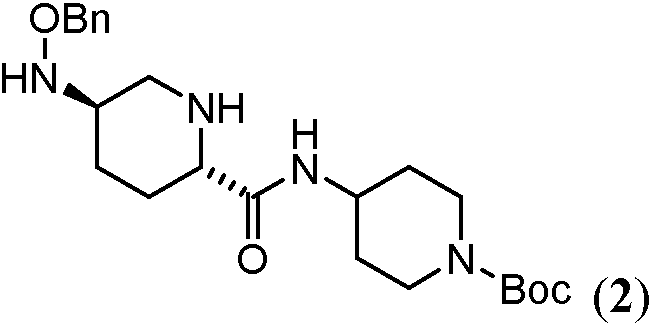
con diclorodimetilsilano y base de Hunig en presencia de un disolvente orgánico, tal como acetonitrilo, para obtener el compuesto 3 o 4 o una mezcla de los mismos, with dichlorodimethylsilane and Hunig's base in the presence of an organic solvent, such as acetonitrile, to obtain compound 3 or 4 or a mixture thereof,

(b) tratar el compuesto 3 o 4 o la mezcla de los mismos, con carbonildiimidazol para obtener el compuesto 5 o 6 o una mezcla de los mismos; y(b) treating compound 3 or 4 or the mixture thereof, with carbonyldiimidazole to obtain compound 5 or 6 or a mixture thereof; Y

(c) tratar el compuesto 5 o 6 o la mezcla de los mismos, con alcohol isopropílico para obtener el compuesto 1. (c) treating compound 5 or 6 or the mixture thereof, with isopropyl alcohol to obtain compound 1 .
Los compuestos, tales como (2S,SR)-7-oxo-N-piperidin-4-il-6-(sulfoxi)-1,6-diazabiciclo[3.2.1]octano-2-carboxamida pueden mostrar inhibición de p-lactamasa y por tanto pueden utilizarse como inhibidores de p-lactamasa junto con antibióticos de p-lactama (por ejemplo, imipenem, ceftazidima y piperacilina) para tratar infecciones bacterianas causada por microorganismos normalmente resistentes a antibióticos de p-lactama debido a la presencia de las plactamasas.Compounds, such as (2S, SR) -7-oxo-N-piperidin-4-yl-6- (sulfoxy) -1,6-diazabicyclo [3.2.1] octane-2-carboxamide can show inhibition of p- lactamase and therefore can be used as p-lactamase inhibitors together with p-lactam antibiotics (for example, imipenem, ceftazidime and piperacillin) to treat bacterial infections caused by microorganisms normally resistant to p-lactam antibiotics due to the presence of the plactamases.
Debe apreciarse que los disolventes, agentes, catalizadores, cantidades de reacción, temperaturas de reacción, etc. descritos anteriormente con respecto a los procesos y sus realizaciones y subrealizaciones pretenden únicamente ilustrar, no limitar, el ámbito del proceso. Por ejemplo, el disolvente empleado en cualquiera de las Etapas (a) a (c) puede ser cualquier sustancia orgánica que, en las condiciones de reacción empleadas en la etapa de interés, está en la fase líquida, es químicamente inerte y disolverá, suspenderá y/o dispersará los reactantes y cualquier reactivo para poner en contacto los reactantes y los reactivos y para permitir que tenga lugar la reacción. Se aplican consideraciones similares a la elección de las bases, catalizadores y otros reactivos empleados en las etapas de proceso. Asimismo, cada una de las etapas puede realizarse a cualquier temperatura a la que pueda tener lugar de un modo detectable la reacción que forma el producto deseado. Los reactantes, catalizadores y reactivos en una etapa dada pueden emplearse en cualquier cantidad que dé como resultado la formación de al menos un poco del producto deseado. Por supuesto, una alta conversión (por ejemplo, al menos aproximadamente un 60 % y preferiblemente superior) de materiales de partida junto con un alto rendimiento (por ejemplo, al menos aproximadamente un 60 % y preferiblemente superior) de productos deseados es normalmente el objetivo en cada etapa y la elección de los disolventes, agentes, catalizadores, cantidades de reacción, temperaturas, etc. que pueden proporcionar conversiones y rendimientos de producto relativamente buenos son preferidos, y son más preferidas las elecciones que puedan proporcionar conversiones y rendimientos óptimos. Los disolventes particulares, agentes, catalizadores, cantidades de reacción, temperaturas de reacción, etc. descritos anteriormente con respecto a los procesos y sus realizaciones y subrealizaciones pueden proporcionar conversiones y rendimientos de buenos a óptimos.It should be appreciated that solvents, agents, catalysts, reaction amounts, reaction temperatures, etc. described above with respect to the processes and their embodiments and sub-embodiments are only intended to illustrate, not limit, the scope of the process. For example, the solvent used in any of Steps (a) to (c) can be any organic substance that, under the reaction conditions used in the step of interest, is in the liquid phase, is chemically inert and will dissolve, suspend and / or will disperse the reactants and any reagents to bring the reactants and reagents into contact and to allow the reaction to take place. Similar considerations apply to the choice of bases, catalysts, and other reagents used in the process steps. Also, each of the steps can be carried out at any temperature at which the reaction that forms the desired product can take place in a detectable way. The reactants, catalysts, and reagents in a given step can be employed in any amount that results in the formation of at least a little of the desired product. Of course, a high conversion (eg, at least about 60% and preferably higher) of starting materials together with a high yield (eg, at least about 60% and preferably higher) of desired products is usually the goal. at each stage and the choice of solvents, agents, catalysts, reaction amounts, temperatures, etc. that can provide relatively good product yields and conversions are preferred, and choices that can provide optimal yields and conversions are more preferred. The particular solvents, agents, catalysts, reaction amounts, reaction temperatures, etc. described above with respect to the processes and their embodiments and sub-embodiments can provide good to optimal conversions and yields.
Los tiempos de reacción para las etapas de proceso descritas anteriormente dependen de factores, tales como (i) la elección y proporciones relativas del sustrato de partida y otros reactivos, (ii) la elección del disolvente, (iii) la elección de la temperatura de reacción y (iv) el nivel de conversión deseado. Las reacciones se realizan normalmente durante un tiempo suficiente para alcanzar un 100 % o casi un 100 % de conversión (por ejemplo, 99,5 %, 99,0 %, 98,0 %, 97,0 % o 95 %).The reaction times for the process steps described above depend on factors, such as (i) the choice and relative proportions of the starting substrate and other reagents, (ii) the choice of solvent, (iii) the choice of the temperature of reaction and (iv) the desired level of conversion. Reactions are typically run for a time sufficient to achieve 100% or nearly 100% conversion (eg, 99.5%, 99.0%, 98.0%, 97.0%, or 95%).
El progreso de cualquier etapa de reacción expuesta en el presente documento puede seguirse controlando la desaparición de un reactante y/o la aparición del producto deseado usando técnicas analíticas, tales como TLC, HPLC, IR, RMN o CG.The progress of any reaction step set forth herein can be followed by monitoring the disappearance of a reactant and / or the appearance of the desired product using analytical techniques, such as TLC, HPLC, IR, NMR, or GC.
La presente invención también se refiere a un compuesto de Fórmula: The present invention also relates to a compound of Formula:

o una sal del mismoor a salt of it
en la que:in which:
Z es O o -NR5Z is O or -NR5
k es un número entero igual a 0, 1 o 2;k is an integer equal to 0, 1 or 2;
R2 y R3 se definen de la siguiente manera:R2 and R3 are defined as follows:
(a) R2 es H, alquilo C1-6, -O-alquilo C1-6, -O-Si-(alquilo C1-a)3, o(a) R2 is H, C 1-6 alkyl, -O-C 1-6 alkyl, -O-Si- (C1-a alkyl) 3, or
-O-Si-(alquil C1-6)(fenilo)2, y-O-Si- (C 1-6 alkyl) (phenyl) 2 , and
cada R3 es H o alquilo C1-6; oeach R3 is H or C 1-6 alkyl; or
(b) como alternativa y con la condición de que k sea 1 o 2, R2 y el R3 adyacente a R2, junto con los átomos de carbono a los que cada uno está unido, forman cicloalquilo C5-7 que está opcionalmente sustituido con 1 a 3 sustituyentes cada uno de los cuales es independientemente alquilo C1-6, -O-alquilo C1-6, -O-Si-(alquilo C1-6)3, o(b) alternatively and provided that k is 1 or 2, R2 and the R3 adjacent to R2, together with the carbon atoms to which each is attached, form C 5-7 cycloalkyl which is optionally substituted with 1 to 3 substituents each of which is independently C 1-6 alkyl, -O-C 1-6 alkyl, -O-Si- (C 1-6 alkyl) 3, or
-O-Si-(alquil C1-6)(fenilo)2; y cualquier otro R3 es H o alquilo C1-6;-O-Si- (C 1-6 alkyl) (phenyl) 2 ; and any other R3 is H or C 1-6 alkyl;
R5 es H, alquilo C1-6, cicloalquilo C3-6, arilo, alquil C1-6-arilo, heteroarilo, alquil C1-6-heteroarilo, oR5 is H, C 1-6 alkyl, C 3-6 cycloalkyl, aryl, C 1-6 alkyl-aryl, heteroaryl, C 1-6 alkyl-heteroaryl, or

R6 y R8 son independientemente H, alquilo C1.3 , -O-alquilo C1-3 o -N-(alquilo C1-3)2;R6 and R8 are independently H, C 1.3 alkyl, -O-C 1-3 alkyl or -N- (C 1-3 alkyl) 2 ;
cada R7 y R9 es independientemente H o alquilo C1-6;each R7 and R9 is independently H or C 1-6 alkyl;
PG2 es un grupo protector de amina seleccionado entre carbamatos, bencilaminas, sufonilamida y amidas; R10 es bencilo o alilo, en el que el bencilo o alilo está opcionalmente sustituido con alquilo C1-6, alcoxi C1-6, flúor o -NO2 ; R11 y R12 son alquilo C1-6 o arilo; oPG2 is an amine protecting group selected from carbamates, benzylamines, sufonylamide, and amides; R10 is benzyl or allyl, in which the benzyl or allyl optionally substituted with C 1-6 alkyl, C 1-6 alkoxy, fluoro or -NO 2; R11 and R12 are C 1-6 alkyl or aryl; or
R11 y R12, junto con el silano al que están unidos forman un anillo monocíclico saturado de 4 a 6 miembros que contiene 0 o 1 heteroátomos seleccionados entre N y O, que está opcionalmente condensado con 1 o 2 anillos aromáticos, conteniendo cada uno opcionalmente 0 o 1 heteroátomo seleccionados entre N y O; R13 es imidazolilo;R11 and R12, together with the silane to which they are attached form a saturated 4- to 6-membered monocyclic ring containing 0 or 1 heteroatoms selected from N and O, which is optionally fused with 1 or 2 aromatic rings, each optionally containing 0 or 1 heteroatom selected from N and O; R13 is imidazolyl;
p es 0, 1 o 2;p is 0, 1 or 2;
q es 0, 1 o 2;q is 0, 1 or 2;
p q = 0, 1,2 o 3; yp q = 0, 1,2 or 3; Y
Ra y Rb son halo.Ra and Rb are halo.
En una realización de la invención, Z es -NR5. En una realización de la invención, k es 1. En una realización de la invención, R2 y R3 son H. En una realización de la invención, R5 es H o In one embodiment of the invention, Z is -NR5. In one embodiment of the invention, k is 1. In one embodiment of the invention, R2 and R3 are H. In one embodiment of the invention, R5 is H or

En un aspecto de esta realización, R5 esIn one aspect of this embodiment, R5 is

En una realización de la invención, PG2 es t-Boc.In one embodiment of the invention, PG2 is t-Boc.
La presente invención también se refiere a compuestos que incluyen:The present invention also relates to compounds including:

o una de sus sales. or one of its salts.
Esquema a modo de ejemploSchematic as an example


continuacióncontinuation

Los siguientes ejemplos sirven solo para ilustrar la invención y su práctica. Los ejemplos no deben interpretarse como imitaciones sobre el ámbito de la invención.The following examples serve only to illustrate the invention and its practice. The examples are not to be construed as imitations of the scope of the invention.
EjemplosExamples
EJEMPLO 1EXAMPLE 1
Preparación de 4-((1R,2S,5R)-6-(benciloxi)-7-oxo-1,6-diazabiciclo[3.2.1]octano-2-carboxamido)piperidin-1-carboxilato de ferc-butilo Preparation of tert-butyl 4 - ((1R, 2S, 5R) -6- (benzyloxy) -7-oxo-1,6-diazabicyclo [3.2.1] octane-2-carboxamido) piperidine-1-carboxylate

La diamina 2 se preparó de acuerdo con Miller et al., 2014, Org. Lett. 16:174-177. En un matraz de fondo redondo de 3 bocas y 100 ml con un agitador en su parte superior y un termómetro, la diamina 2 (5 g) se suspendió en acetonitrilo (25 ml), seguido de la adición de base de Hunig (4,5 g). Se añadió lentamente diclorodimetilsilano (2,0 g) en la mezcla de reacción controlando la temperatura por debajo de 10 °C con agitación. Después de la adición, la mezcla se agitó a esta temperatura durante 1 h (confirmada la conversión completa en el intermedio 3 o 4 por RMN).Diamine 2 was prepared according to Miller et al., 2014, Org. Lett. 16: 174-177. In a 100 ml 3 necked round bottom flask with a top stirrer and a thermometer, diamine 2 (5 g) was suspended in acetonitrile (25 ml), followed by the addition of Hunig's base (4, 5 g). Dichlorodimethylsilane (2.0 g) was slowly added into the reaction mixture while controlling the temperature below 10 ° C with stirring. After the addition, the mixture was stirred at this temperature for 1 h (complete conversion to intermediate 3 or 4 confirmed by NMR).
2: RMN 1H (CD3CN, 600 MHz): 51,19 (m, 1H), 1,25-1,38 (m, 3H), 1,42 (s, 9H), 1,75 (d a, 2H, J = 12,9 Hz), 1,86 (m, 1H), 1,91 (m, 1H), 2,32 (dd, 1H, J = 11,9, 9,8 Hz), 2,84 (m, 3H), 2,98 (dd, 1H, J = 10,9, 3,1 Hz), 3,20 (m, 1H), 3,77 (m, 1H), 3,92 (d a, 2H, J = 13,0 Hz), 4,62 (t, 2H, J = 12,0 Hz), 5,73 (s a, 1H), 6,72 (d a, 1H, J = 8,0 Hz), 7,27-7,37 (m, 5H). 2 : 1H NMR (CD 3 CN, 600 MHz): 51.19 (m, 1H), 1.25-1.38 (m, 3H), 1.42 (s, 9H), 1.75 (da, 2H, J = 12.9 Hz), 1.86 (m, 1H), 1.91 (m, 1H), 2.32 (dd, 1H, J = 11.9, 9.8 Hz), 2, 84 (m, 3H), 2.98 (dd, 1H, J = 10.9, 3.1 Hz), 3.20 (m, 1H), 3.77 (m, 1H), 3.92 (da , 2H, J = 13.0 Hz), 4.62 (t, 2H, J = 12.0 Hz), 5.73 (bs, 1H), 6.72 (da, 1H, J = 8.0 Hz ), 7.27-7.37 (m, 5H).
3: RMN 1H (CD3CN, 600 MHz): 50,26 (s, 3H), 0,29 (s, 3H), 1,06-1,18 (m, 2H), 1,37 (m, 2H), 1,41 (s, 9H), 1,76 (m, 2H), I , 87 (m, 1H), 1,97 (m, 1H), 2,36 (dd, 1H, J = 12,6, 10,1 Hz), 2,63-2,78 (m, 3H), 3,17 (dd, 1H, J = 11,2, 3,2 Hz), 3,36 (ddd, 1H, J = 12,6, 4,4, 1,9 Hz), 3,81 (tt, 1H, J = 12,1,3,9 Hz), 4,06 (d a, 2H, J = 11,6 Hz), 4,59 (d, 1H, J = 11,8 Hz), 4,61 (d, 1H, J = 11,8 Hz), 5,81 (d, 1H, J = 6,2 Hz), 6,72 (d a, 1H, J = 8,0 Hz), 7,26-7,35 (m, 5H). 3 : 1H NMR (CD 3 CN, 600 MHz): 50.26 (s, 3H), 0.29 (s, 3H), 1.06-1.18 (m, 2H), 1.37 (m, 2H), 1.41 (s, 9H), 1.76 (m, 2H), I, 87 (m, 1H), 1.97 (m, 1H), 2.36 (dd, 1H, J = 12 , 6, 10.1 Hz), 2.63-2.78 (m, 3H), 3.17 (dd, 1H, J = 11.2, 3.2 Hz), 3.36 (ddd, 1H, J = 12.6, 4.4, 1.9 Hz), 3.81 (tt, 1H, J = 12.1.3.9 Hz), 4.06 (da, 2H, J = 11.6 Hz ), 4.59 (d, 1H, J = 11.8 Hz), 4.61 (d, 1H, J = 11.8 Hz), 5.81 (d, 1H, J = 6.2 Hz), 6.72 (da, 1H, J = 8.0 Hz), 7.26-7.35 (m, 5H).
4 : RMN 1H (CD3CN, 600 MHz): 50,21 (s, 3H), 0,25 (s, 3H), 1,17 (m, 2H), 1,29 (m, 2H), 1,40 (s, 9H), 1,58 (m, 2H), 1,85 (m, 1H), 1,93 (m, 1H), 2,42 (dd, 1H, J = 12,6, 10,1 Hz), 2,45 (m, 1H), 2,71 (m, 1H), 3,31 (m, 1H), 3,43 (d a, 1H, J = 10,3 Hz), 3,71 (m, 1H), 3,82 (m, 2H), 4,59 (d, 1H, J = 11,8 Hz), 4,62 (d, 1H, J = 11,8 Hz), 5,81 (d, 1H, J = 6,1 Hz), 6,72 (d a, 1H, J = 8,0 Hz), 7,26-7,35 (m, 5H). 4 : 1H NMR (CD 3 CN, 600 MHz): 50.21 (s, 3H), 0.25 (s, 3H), 1.17 (m, 2H), 1.29 (m, 2H), 1 , 40 (s, 9H), 1.58 (m, 2H), 1.85 (m, 1H), 1.93 (m, 1H), 2.42 (dd, 1H, J = 12.6, 10 , 1Hz), 2.45 (m, 1H), 2.71 (m, 1H), 3.31 (m, 1H), 3.43 (da, 1H, J = 10.3Hz), 3, 71 (m, 1H), 3.82 (m, 2H), 4.59 (d, 1H, J = 11.8 Hz), 4.62 (d, 1H, J = 11.8 Hz), 5, 81 (d, 1H, J = 6.1Hz), 6.72 (da, 1H, J = 8.0Hz), 7.26-7.35 (m, 5H).
Se cargó carbonildiimidazol (CDI) (2,45 g) en la mezcla de reacción. La mezcla se calentó a 45 °C hasta la conversión completa en el intermedio 5.Carbonyldiimidazole (CDI) (2.45 g) was charged into the reaction mixture. The mixture was heated to 45 ° C until complete conversion to intermediate 5 .
5: RMN 1H (CD3CN, 600 MHz): 50,27 (s, 3H), 0,31 (s, 3H), 1,23 (m, 1H), 1,36 (m, 2H), 1,39 (s, 9H), 1,76 (m, 2H), 2,01 (m, 1H), 2,07-2,15 (m, 2H), 2,70 (s a, 2H), 3,03 (m, 1H), 3,29 (dd, 1H, J = 11,9, 3,1 Hz), 3,38 (dd, 1H, J = 12,7, 3,1 Hz), 3,80 (tt, 1H, J = 12,1,3,9 Hz), 3,88 (tt, 1H, J = 11,6, 3,8 Hz), 4,05 (d a, 2H, J = 10,3 Hz), 4,73 (t, 2H, J = 10,5 Hz), 6,96 (dd, 1H, J = 1,4, 0,8 Hz), 7,27-7,35 (m, 5H), 7,45 (t, 1H, J = 1,4 Hz), 8,04 (t, 1H, J = 0,8 Hz). 5 : 1H NMR (CD 3 CN, 600 MHz): 50.27 (s, 3H), 0.31 (s, 3H), 1.23 (m, 1H), 1.36 (m, 2H), 1 , 39 (s, 9H), 1.76 (m, 2H), 2.01 (m, 1H), 2.07-2.15 (m, 2H), 2.70 (bs, 2H), 3, 03 (m, 1H), 3.29 (dd, 1H, J = 11.9, 3.1 Hz), 3.38 (dd, 1H, J = 12.7, 3.1 Hz), 3.80 (tt, 1H, J = 12.1,3.9 Hz), 3.88 (tt, 1H, J = 11.6, 3.8 Hz), 4.05 (da, 2H, J = 10.3 Hz), 4.73 (t, 2H, J = 10.5 Hz), 6.96 (dd, 1H, J = 1.4, 0.8 Hz), 7.27-7.35 (m, 5H ), 7.45 (t, 1H, J = 1.4 Hz), 8.04 (t, 1H, J = 0.8 Hz).
Se añadió alcohol isopropílico (IPA) (2,1 g) en la mezcla de reacción a 45 °C y la reacción se agitó durante 6-10 h. Después, la reacción se enfrió a temperatura ambiente. Se cargó tolueno (50 ml) en el lote, seguido de la adición de una solución de HCl (2 N, 35 ml) para lavar la mezcla de reacción. Se cortaron las fases de la mezcla de reacción para retirar la solución de HCl de la parte inferior, que se extrajo de nuevo con tolueno (10 ml). La solución de tolueno combinada se lavó con NaHCO3 sat. (15 ml), seguido de lavado con agua (10 ml). La solución final de tolueno se concentró a 2,5 volúmenes (13 ml), seguido de adición lenta de heptano (70 ml) para proporcionar una suspensión. El compuesto de urea final 1 (4,95 g, rendimiento del 93 %) se aisló por filtración y se lavó con una solución de heptano/tolueno (6:1).Isopropyl alcohol (IPA) (2.1 g) was added to the reaction mixture at 45 ° C and the reaction was stirred for 6-10 h. The reaction was then cooled to room temperature. Toluene (50 ml) was loaded into the batch, followed by the addition of a HCl solution (2N, 35 ml) to wash the reaction mixture. The reaction mixture was phased to remove the bottom HCl solution, which was re-extracted with toluene (10 ml). The combined toluene solution was washed with sat. NaHCO 3. (15 ml), followed by washing with water (10 ml). The final toluene solution was concentrated to 2.5 volumes (13 ml), followed by slow addition of heptane (70 ml) to provide a suspension. The final urea compound 1 (4.95 g, 93% yield) was isolated by filtration and washed with a heptane / toluene solution (6: 1).
1: RMN 1H (CDCl3, 500 MHz) 5: 7,45-7,32 (m, 5H), 6,55 (d, J = 8,2 Hz, 1H), 5,05 (d, J = 11,6 Hz, 1H), 4,90 (d, J = I I , 6 Hz, 1H), 4,02 (m, 2H), 3,90 (m, 2H), 3,30 (m, 1H), 2,99 (dt, J = 11,7, 1,1 Hz, 1H), 2,86 (m, 2H), 2,64 (d, J = 11,7 Hz, 1H), 2,37 10 (dd, J = 14,6, 6,9 Hz, 1H), 2,04-1,82 (m, 4H), 1,58 (m, 1H), 1,45 (s, 9H), 1,30 (m, 2H); RMN 13C (CDCh, 125 MHz) 5: 168,3, 167,5, 154,7, 135,6, 129,2 (2 C), 128,8, 128,6 (2 C), 79,7, 78,3, 60,4, 57,8, 47,5, 46,8, 42,5 (a, 2 C), 32,0, 31,7, 28,4 (3 C), 20,8, 17,2. 1: 1H NMR (CDCl3, 500 MHz) 5: 7.45-7.32 (m, 5H), 6.55 (d, J = 8.2 Hz, 1H), 5.05 (d, J = 11.6 Hz, 1H), 4.90 (d, J = II, 6 Hz, 1H), 4.02 (m, 2H), 3.90 (m, 2H), 3.30 (m, 1H) , 2.99 (dt, J = 11.7, 1.1 Hz, 1H), 2.86 (m, 2H), 2.64 (d, J = 11.7 Hz, 1H), 2.37 (dd, J = 14.6, 6.9 Hz, 1H), 2.04-1.82 (m, 4H), 1.58 (m, 1H), 1.45 (s, 9H), 1, 30 (m, 2H); 13C NMR (CDCh, 125 MHz) 5: 168.3, 167.5, 154.7, 135.6, 129.2 (2 C), 128.8, 128.6 (2 C), 79.7, 78.3, 60.4, 57.8, 47.5, 46.8, 42.5 (A, 2 C), 32.0, 31.7, 28.4 (3 C), 20.8, 17.2.
EJEMPLO 2EXAMPLE 2
Preparación de 4-((1R,2S,5R)-6-hidroxi-7-oxo-1,6-diazabiciclo[3.2.1]octano-2-carboxamido)piperidin-1-carboxilato de tere-butiloPreparation of tere-butyl 4 - ((1R, 2S, 5R) -6-hydroxy-7-oxo-1,6-diazabicyclo [3.2.1] octane-2-carboxamido) piperidine-1-carboxylate
El compuesto 1 preparado de acuerdo con el Ejemplo 1 se usó en la reacción de hidrodesbencilación posterior mostrada más adelante. El compuesto 1 preparado usando trifosgeno se usó como comparador. Compound 1 prepared according to Example 1 was used in the subsequent hydrodebenzylation reaction shown below. Compound 1 prepared using triphosgene was used as a comparator.
En un autoclave secado y limpiado se cargó la urea 1 (3,0 g) y THF (72 ml). Después, se cargó Pd/C (carga al 10 % en peso) en la mezcla de reacción, seguido de carga de H2 a 340 kPa (50 psig) (presión interna total). La mezcla se maduró de nuevo a 25 °C, 340 kPa (50 psig) durante 4 horas para conseguir una conversión completa. La mezcla de reacción se ventiló con gas de H2 y se filtró para retirar el Pd/C y se lavó con THF (5x vol., 15 ml). La solución orgánica se concentró a 1/10 de volumen y el disolvente se cambió a IPAc (45 ml) para proporcionar una suspensión del producto. La suspensión se agitó durante 4 h más. La mezcla de reacción se filtró para recoger el sólido y se lavó con IPAc (9 ml) para proporcionar un sólido de color blanco. El sólido se secó al vacío y arrastró con N2 para proporcionar el compuesto del título (rendimiento de ~95 %, >98 LCAP). Los datos espectrales coincidieron con los del compuesto indicado previamente. Véase Mangion et al., 2011, Org. Lett. 13:5480. La Tabla 1 muestra la comparación de la urea 1 preparada usando el proceso de la invención (es decir, con un compuesto que contiene silicio y CDI) o un proceso publicado previamente (es decir, con trifosgeno) en la reacción de hidroxil-desbencilación posterior. Urea 1 (3.0 g) and THF (72 ml) were loaded into a dried and cleaned autoclave. Then, Pd / C (10 wt% loading) was charged to the reaction mixture, followed by H 2 loading at 340 kPa (50 psig) (total internal pressure). The mixture was re-aged at 25 ° C, 340 kPa (50 psig) for 4 hours to achieve complete conversion. The reaction mixture was vented with H 2 gas and filtered to remove Pd / C and washed with THF (5x vol., 15 mL). The organic solution was concentrated to 1/10 volume and the solvent was changed to IPAc (45 ml) to provide a suspension of the product. The suspension was stirred for a further 4 h. The reaction mixture was filtered to collect the solid and washed with IPAc (9 ml) to provide a white solid. The solid was dried in vacuo and stripped with N 2 to provide the title compound (~ 95% yield,> 98 LCAP). The spectral data was in agreement with that of the compound indicated previously. See Mangion et al., 2011, Org. Lett. 13: 5480. Table 1 shows the comparison of urea 1 prepared using the process of the invention (i.e. with a compound containing silicon and CDI) or a previously published process (i.e. with triphosgene) in the subsequent hydroxyl-debenzylation reaction. .
Tabla 1Table 1

Mientras que la memoria descriptiva anterior enseña los principios de la presente invención, con ejemplos provistos con propósito de ilustración, la práctica de la invención abarca todas las variaciones habituales, adaptaciones y/o modificaciones que entren dentro del alcance de las siguientes reivindicaciones. While the foregoing specification teaches the principles of the present invention, with examples provided for the purpose of illustration, the practice of the invention encompasses all common variations, adaptations, and / or modifications that fall within the scope of the following claims.
Claims (13)


Applications Claiming Priority (2)
| Application Number | Priority Date | Filing Date | Title |
|---|---|---|---|
| US201462086420P | 2014-12-02 | 2014-12-02 | |
| PCT/US2015/062884 WO2016089718A1 (en) | 2014-12-02 | 2015-11-30 | Process for the preparation of tert-butyl 4-((2s,5r)-6-(benzyloxy)-7-oxo-1,6-diazabicyclo[3.2.1]octane-2-carboxamido)piperidine-1-carboxylate and analogs thereof |
Publications (1)
| Publication Number | Publication Date |
|---|---|
| ES2812848T3 true ES2812848T3 (en) | 2021-03-18 |
Family
ID=56092279
Family Applications (1)
| Application Number | Title | Priority Date | Filing Date |
|---|---|---|---|
| ES15865871T Active ES2812848T3 (en) | 2014-12-02 | 2015-11-30 | Process for the preparation of tert-butyl 4 - ((2S, 5R) -6- (benzyloxy) -7-oxo-1,6-diazabicyclo [3.2.1] octane-2-carboxamido) piperidine-1-carboxylate and analogues of the same |
Country Status (5)
| Country | Link |
|---|---|
| US (1) | US10053460B2 (en) |
| EP (1) | EP3227306B1 (en) |
| CN (1) | CN107428784B (en) |
| ES (1) | ES2812848T3 (en) |
| WO (1) | WO2016089718A1 (en) |
Families Citing this family (3)
| Publication number | Priority date | Publication date | Assignee | Title |
|---|---|---|---|---|
| CN114206851B (en) | 2019-04-26 | 2025-02-11 | 默沙东有限责任公司 | Preparation method of intermediate for preparing (2S,5R)-7-oxo-N-piperidin-4-yl-6-(sulfate)-1,6-diazabicyclo[3.2.1]octane-2-carboxamide |
| JP7354950B2 (en) * | 2020-07-10 | 2023-10-03 | 信越化学工業株式会社 | Organosilicon compound having a cyclic silazane structure, composition containing the same, and method for producing the same |
| CN114671885A (en) * | 2022-04-14 | 2022-06-28 | 中国人民解放军空军军医大学 | A class of [3.2.1] bridged cyclic lactones and lactam compounds and their derivatives and preparation methods |
Family Cites Families (10)
| Publication number | Priority date | Publication date | Assignee | Title |
|---|---|---|---|---|
| FR2725207B1 (en) | 1994-09-30 | 1996-11-29 | Exsymol Sa | BIOLOGICALLY ACTIVE SILICON-BASED COMPOUNDS, THEIR THERAPEUTIC AND COSMETIC APPLICATIONS |
| FR2725208B1 (en) | 1994-09-30 | 1996-11-29 | Exsymol Sa | PROCESS FOR THE PREPARATION OF BIOLOGICALLY ACTIVE SILICON COMPOUNDS IN CONCENTRATED FORM |
| FR2812635B1 (en) | 2000-08-01 | 2002-10-11 | Aventis Pharma Sa | NOVEL HETEROCYCLIC COMPOUNDS, PREPARATION AND USE AS MEDICAMENTS IN PARTICULAR AS ANTI-BACTERIALS |
| AU2007300531A1 (en) | 2006-09-27 | 2008-04-03 | Merck Sharp & Dohme Corp. | Novel inhibitors of beta-lactamase |
| ES2533826T3 (en) | 2008-01-18 | 2015-04-15 | Merck Sharp & Dohme Corp. | Beta-lactamase inhibitors |
| US20120053350A1 (en) | 2009-04-30 | 2012-03-01 | Ian Mangion | Preparation of alkyl esters of n-protected oxo-azacycloalkylcarboxylic acids |
| US8772490B2 (en) * | 2010-12-22 | 2014-07-08 | Meiji Seika Pharma Co., Ltd. | Optically active diazabicyclooctane derivatives and process for preparing the same |
| KR102143660B1 (en) | 2011-06-17 | 2020-08-11 | 화이자 안티-인펙티브스 에이비 | Process for preparing heterocyclic compounds including trans-7-oxo-6-(sulphooxy)-1,6-diazabicyclo[3,2,1]octane-2-carboxamide and salts thereof |
| RU2693898C2 (en) * | 2012-05-30 | 2019-07-05 | Мейдзи Сейка Фарма Ко., Лтд. | Novel beta-lactamase inhibitor and method for production thereof |
| AU2014278556B2 (en) | 2013-06-10 | 2018-07-19 | Merck Sharp & Dohme Llc | Preparation of tert-butyl 4-((1R,2S,5R)-6- (benzyloxy)-7-oxo-1,6-diazabicyclo[3.2.1]octane-2- carboxamido)piperidine-1-carboxylate |
-
2015
- 2015-11-30 ES ES15865871T patent/ES2812848T3/en active Active
- 2015-11-30 US US15/532,788 patent/US10053460B2/en active Active
- 2015-11-30 EP EP15865871.6A patent/EP3227306B1/en active Active
- 2015-11-30 CN CN201580065961.3A patent/CN107428784B/en active Active
- 2015-11-30 WO PCT/US2015/062884 patent/WO2016089718A1/en not_active Ceased
Also Published As
| Publication number | Publication date |
|---|---|
| EP3227306A1 (en) | 2017-10-11 |
| WO2016089718A1 (en) | 2016-06-09 |
| US10053460B2 (en) | 2018-08-21 |
| CN107428784B (en) | 2020-08-21 |
| EP3227306A4 (en) | 2018-05-02 |
| CN107428784A (en) | 2017-12-01 |
| EP3227306B1 (en) | 2020-07-15 |
| US20170362233A1 (en) | 2017-12-21 |
Similar Documents
| Publication | Publication Date | Title |
|---|---|---|
| ES2390042T3 (en) | Novel intermediates useful for the preparation of alpha- (N-sulfonamido) acetamide compounds | |
| US20120053350A1 (en) | Preparation of alkyl esters of n-protected oxo-azacycloalkylcarboxylic acids | |
| EP1328509B1 (en) | Methods of producing oxazolidinone compounds | |
| EP2665728B1 (en) | Preparation method of intermediate of sitagliptin | |
| BRPI0615775A2 (en) | optically active diamine derivative and process for producing the same | |
| NZ259114A (en) | Pyrazolopyrimidines and pharmaceutical compositions thereof | |
| AU2004287416B2 (en) | CCR-2 antagonist salt | |
| ES2812848T3 (en) | Process for the preparation of tert-butyl 4 - ((2S, 5R) -6- (benzyloxy) -7-oxo-1,6-diazabicyclo [3.2.1] octane-2-carboxamido) piperidine-1-carboxylate and analogues of the same | |
| WO2010081014A1 (en) | Novel 4-fluoropyrrolidine-2-carbonyl fluoride compounds and their preparative methods | |
| AU2014278556B2 (en) | Preparation of tert-butyl 4-((1R,2S,5R)-6- (benzyloxy)-7-oxo-1,6-diazabicyclo[3.2.1]octane-2- carboxamido)piperidine-1-carboxylate | |
| AU2004287810B2 (en) | Process for the preparation of CCR-2 antagonist | |
| US20090088571A1 (en) | Synthesis of 6,7-Dihydro-5H-imidazo[1,2-a]imidazole-3-sulfonic acid amides | |
| EP3959205B1 (en) | Process for the preparation of intermediates useful for making (2s,5r)-7-oxo-n-piperidin-4-yl-6-(sulfoxy)-1,6-diazabicyclo[3.2.1]octane-2-carboxamide | |
| CN101801974B (en) | Process for the manufacture of bridged monobactam intermediates | |
| US10556887B2 (en) | Processes for the preparation of Veliparib and intermediates thereof | |
| Pandey et al. | Sequential two electron photooxidation of t-amines: generation of a regiospecific iminium cation and its application in organic synthesis | |
| JP2020527576A (en) | N-((1R, 2S, 5R) -5- (tert-butylamino) -2-((S) -3- (7-tert-butylpyrazolo [1,5-A]] [1,3,5] triazine Method for producing -4-ylamino) -2-oxopyrrolidine-1-yl) cyclohexyl) acetamide | |
| Songsichan | Macrocyclization of omega-Isocyanoaldehydes and Towards the Total Synthesis of Jamaicensamide A | |
| US20050124673A1 (en) | Methods of preparing compounds useful as protease inhibitors | |
| WO2012035549A2 (en) | An improved process for the synthesis of beta amino acid derivatives | |
| WO2020138015A1 (en) | Pyrazolo[1,5-a]pyrimidine macrocyclic compound | |
| Csillag | Stereoselective synthesis of monoterpene-based 1, 3-diamines and 3-amino-1, 2-diols and their application in enantioselective transformations | |
| Peltier | Development of tert-butanesulfinamide-based methods and the application of these methods toward the stereoselective syntheses of biologically relevant molecules including tubulysin D | |
| JP2002201183A (en) | Amino acid-n-carboxyanhydride with substituent on nitrogen atom | |
| MXPA00002220A (en) | Process for enhancing the optical purity of 2r-[1-hydroxy- 1-trifluoromethyl- 3 -cyclopropylpropyn- 2yl]-4-chloroaniline |