ES2819528T3 - Hair compositions and methods of using them - Google Patents
Hair compositions and methods of using them Download PDFInfo
- Publication number
- ES2819528T3 ES2819528T3 ES16701377T ES16701377T ES2819528T3 ES 2819528 T3 ES2819528 T3 ES 2819528T3 ES 16701377 T ES16701377 T ES 16701377T ES 16701377 T ES16701377 T ES 16701377T ES 2819528 T3 ES2819528 T3 ES 2819528T3
- Authority
- ES
- Spain
- Prior art keywords
- hair
- composition
- composition according
- concentration
- weight
- Prior art date
- Legal status (The legal status is an assumption and is not a legal conclusion. Google has not performed a legal analysis and makes no representation as to the accuracy of the status listed.)
- Active
Links
- 210000004209 hair Anatomy 0.000 title claims abstract description 105
- 239000000203 mixture Substances 0.000 title claims abstract description 105
- 238000000034 method Methods 0.000 title claims description 10
- 239000004005 microsphere Substances 0.000 claims abstract description 67
- 239000012530 fluid Substances 0.000 claims abstract description 32
- LFQSCWFLJHTTHZ-UHFFFAOYSA-N Ethanol Chemical compound CCO LFQSCWFLJHTTHZ-UHFFFAOYSA-N 0.000 claims abstract description 24
- 239000003380 propellant Substances 0.000 claims abstract description 17
- 239000000834 fixative Substances 0.000 claims abstract description 10
- XLYOFNOQVPJJNP-UHFFFAOYSA-N water Substances O XLYOFNOQVPJJNP-UHFFFAOYSA-N 0.000 claims abstract description 6
- 125000004432 carbon atom Chemical group C* 0.000 claims abstract 2
- 229920001577 copolymer Polymers 0.000 claims description 45
- 229920000642 polymer Polymers 0.000 claims description 27
- NLHHRLWOUZZQLW-UHFFFAOYSA-N Acrylonitrile Chemical compound C=CC#N NLHHRLWOUZZQLW-UHFFFAOYSA-N 0.000 claims description 20
- NNPPMTNAJDCUHE-UHFFFAOYSA-N isobutane Chemical compound CC(C)C NNPPMTNAJDCUHE-UHFFFAOYSA-N 0.000 claims description 18
- 239000002245 particle Substances 0.000 claims description 18
- LCGLNKUTAGEVQW-UHFFFAOYSA-N Dimethyl ether Chemical compound COC LCGLNKUTAGEVQW-UHFFFAOYSA-N 0.000 claims description 16
- 239000000178 monomer Substances 0.000 claims description 14
- 239000000443 aerosol Substances 0.000 claims description 13
- 239000012815 thermoplastic material Substances 0.000 claims description 12
- VVQNEPGJFQJSBK-UHFFFAOYSA-N Methyl methacrylate Chemical compound COC(=O)C(C)=C VVQNEPGJFQJSBK-UHFFFAOYSA-N 0.000 claims description 11
- PPBRXRYQALVLMV-UHFFFAOYSA-N Styrene Chemical compound C=CC1=CC=CC=C1 PPBRXRYQALVLMV-UHFFFAOYSA-N 0.000 claims description 9
- 239000001282 iso-butane Substances 0.000 claims description 9
- ATUOYWHBWRKTHZ-UHFFFAOYSA-N Propane Chemical compound CCC ATUOYWHBWRKTHZ-UHFFFAOYSA-N 0.000 claims description 6
- KFZMGEQAYNKOFK-UHFFFAOYSA-N Isopropanol Chemical compound CC(C)O KFZMGEQAYNKOFK-UHFFFAOYSA-N 0.000 claims description 5
- 150000001252 acrylic acid derivatives Chemical class 0.000 claims description 5
- IJGRMHOSHXDMSA-UHFFFAOYSA-N Atomic nitrogen Chemical compound N#N IJGRMHOSHXDMSA-UHFFFAOYSA-N 0.000 claims description 4
- CURLTUGMZLYLDI-UHFFFAOYSA-N Carbon dioxide Chemical compound O=C=O CURLTUGMZLYLDI-UHFFFAOYSA-N 0.000 claims description 4
- 206010019049 Hair texture abnormal Diseases 0.000 claims description 4
- GQPLMRYTRLFLPF-UHFFFAOYSA-N Nitrous Oxide Chemical compound [O-][N+]#N GQPLMRYTRLFLPF-UHFFFAOYSA-N 0.000 claims description 4
- OFBQJSOFQDEBGM-UHFFFAOYSA-N Pentane Chemical compound CCCCC OFBQJSOFQDEBGM-UHFFFAOYSA-N 0.000 claims description 4
- QWTDNUCVQCZILF-UHFFFAOYSA-N isopentane Chemical compound CCC(C)C QWTDNUCVQCZILF-UHFFFAOYSA-N 0.000 claims description 4
- NPNPZTNLOVBDOC-UHFFFAOYSA-N 1,1-difluoroethane Chemical compound CC(F)F NPNPZTNLOVBDOC-UHFFFAOYSA-N 0.000 claims description 3
- 150000008360 acrylonitriles Chemical class 0.000 claims description 3
- 238000010438 heat treatment Methods 0.000 claims description 3
- 150000002734 metacrylic acid derivatives Chemical class 0.000 claims description 3
- IJDNQMDRQITEOD-UHFFFAOYSA-N n-butane Chemical compound CCCC IJDNQMDRQITEOD-UHFFFAOYSA-N 0.000 claims description 3
- 239000001294 propane Substances 0.000 claims description 3
- 150000003440 styrenes Chemical class 0.000 claims description 3
- LVGUZGTVOIAKKC-UHFFFAOYSA-N 1,1,1,2-tetrafluoroethane Chemical compound FCC(F)(F)F LVGUZGTVOIAKKC-UHFFFAOYSA-N 0.000 claims description 2
- BZHJMEDXRYGGRV-UHFFFAOYSA-N Vinyl chloride Chemical compound ClC=C BZHJMEDXRYGGRV-UHFFFAOYSA-N 0.000 claims description 2
- 239000003570 air Substances 0.000 claims description 2
- 239000001569 carbon dioxide Substances 0.000 claims description 2
- 229910002092 carbon dioxide Inorganic materials 0.000 claims description 2
- AFABGHUZZDYHJO-UHFFFAOYSA-N dimethyl butane Natural products CCCC(C)C AFABGHUZZDYHJO-UHFFFAOYSA-N 0.000 claims description 2
- 229910001873 dinitrogen Inorganic materials 0.000 claims description 2
- 239000001272 nitrous oxide Substances 0.000 claims description 2
- 239000008266 hair spray Substances 0.000 claims 1
- XEEYBQQBJWHFJM-UHFFFAOYSA-N Iron Chemical compound [Fe] XEEYBQQBJWHFJM-UHFFFAOYSA-N 0.000 description 24
- 210000003128 head Anatomy 0.000 description 20
- 229910052742 iron Inorganic materials 0.000 description 12
- 239000000835 fiber Substances 0.000 description 11
- 239000007858 starting material Substances 0.000 description 11
- 239000007788 liquid Substances 0.000 description 9
- 230000008901 benefit Effects 0.000 description 8
- 239000003795 chemical substances by application Substances 0.000 description 7
- 239000011521 glass Substances 0.000 description 7
- VTYYLEPIZMXCLO-UHFFFAOYSA-L Calcium carbonate Chemical compound [Ca+2].[O-]C([O-])=O VTYYLEPIZMXCLO-UHFFFAOYSA-L 0.000 description 6
- GYCMBHHDWRMZGG-UHFFFAOYSA-N Methylacrylonitrile Chemical compound CC(=C)C#N GYCMBHHDWRMZGG-UHFFFAOYSA-N 0.000 description 6
- 230000003741 hair volume Effects 0.000 description 6
- 239000000463 material Substances 0.000 description 6
- WHNWPMSKXPGLAX-UHFFFAOYSA-N N-Vinyl-2-pyrrolidone Chemical compound C=CN1CCCC1=O WHNWPMSKXPGLAX-UHFFFAOYSA-N 0.000 description 5
- 230000000694 effects Effects 0.000 description 5
- 239000007789 gas Substances 0.000 description 5
- 239000007921 spray Substances 0.000 description 5
- 239000002537 cosmetic Substances 0.000 description 4
- 229910000267 dualite Inorganic materials 0.000 description 4
- 239000002184 metal Substances 0.000 description 4
- 229910052751 metal Inorganic materials 0.000 description 4
- 239000002304 perfume Substances 0.000 description 4
- 239000001433 sodium tartrate Substances 0.000 description 4
- OEPOKWHJYJXUGD-UHFFFAOYSA-N 2-(3-phenylmethoxyphenyl)-1,3-thiazole-4-carbaldehyde Chemical compound O=CC1=CSC(C=2C=C(OCC=3C=CC=CC=3)C=CC=2)=N1 OEPOKWHJYJXUGD-UHFFFAOYSA-N 0.000 description 3
- NIXOWILDQLNWCW-UHFFFAOYSA-N 2-Propenoic acid Natural products OC(=O)C=C NIXOWILDQLNWCW-UHFFFAOYSA-N 0.000 description 3
- DNIAPMSPPWPWGF-UHFFFAOYSA-N Propylene glycol Chemical compound CC(O)CO DNIAPMSPPWPWGF-UHFFFAOYSA-N 0.000 description 3
- HEMHJVSKTPXQMS-UHFFFAOYSA-M Sodium hydroxide Chemical compound [OH-].[Na+] HEMHJVSKTPXQMS-UHFFFAOYSA-M 0.000 description 3
- 229910021536 Zeolite Inorganic materials 0.000 description 3
- 229910000019 calcium carbonate Inorganic materials 0.000 description 3
- 239000012141 concentrate Substances 0.000 description 3
- HNPSIPDUKPIQMN-UHFFFAOYSA-N dioxosilane;oxo(oxoalumanyloxy)alumane Chemical compound O=[Si]=O.O=[Al]O[Al]=O HNPSIPDUKPIQMN-UHFFFAOYSA-N 0.000 description 3
- 150000002148 esters Chemical class 0.000 description 3
- 229930195733 hydrocarbon Natural products 0.000 description 3
- 150000002430 hydrocarbons Chemical class 0.000 description 3
- 235000000396 iron Nutrition 0.000 description 3
- 230000014759 maintenance of location Effects 0.000 description 3
- 238000006116 polymerization reaction Methods 0.000 description 3
- 229920005989 resin Polymers 0.000 description 3
- 239000011347 resin Substances 0.000 description 3
- 239000000126 substance Substances 0.000 description 3
- 239000000725 suspension Substances 0.000 description 3
- -1 thiol compound Chemical class 0.000 description 3
- 239000010457 zeolite Substances 0.000 description 3
- SMZOUWXMTYCWNB-UHFFFAOYSA-N 2-(2-methoxy-5-methylphenyl)ethanamine Chemical compound COC1=CC=C(C)C=C1CCN SMZOUWXMTYCWNB-UHFFFAOYSA-N 0.000 description 2
- SVTBMSDMJJWYQN-UHFFFAOYSA-N 2-methylpentane-2,4-diol Chemical compound CC(O)CC(C)(C)O SVTBMSDMJJWYQN-UHFFFAOYSA-N 0.000 description 2
- MXRGSJAOLKBZLU-UHFFFAOYSA-N 3-ethenylazepan-2-one Chemical compound C=CC1CCCCNC1=O MXRGSJAOLKBZLU-UHFFFAOYSA-N 0.000 description 2
- NIXOWILDQLNWCW-UHFFFAOYSA-M Acrylate Chemical compound [O-]C(=O)C=C NIXOWILDQLNWCW-UHFFFAOYSA-M 0.000 description 2
- CIWBSHSKHKDKBQ-JLAZNSOCSA-N Ascorbic acid Chemical compound OC[C@H](O)[C@H]1OC(=O)C(O)=C1O CIWBSHSKHKDKBQ-JLAZNSOCSA-N 0.000 description 2
- KAKZBPTYRLMSJV-UHFFFAOYSA-N Butadiene Chemical compound C=CC=C KAKZBPTYRLMSJV-UHFFFAOYSA-N 0.000 description 2
- PEDCQBHIVMGVHV-UHFFFAOYSA-N Glycerine Chemical compound OCC(O)CO PEDCQBHIVMGVHV-UHFFFAOYSA-N 0.000 description 2
- CERQOIWHTDAKMF-UHFFFAOYSA-N Methacrylic acid Chemical compound CC(=C)C(O)=O CERQOIWHTDAKMF-UHFFFAOYSA-N 0.000 description 2
- 229920001328 Polyvinylidene chloride Polymers 0.000 description 2
- 229920002125 Sokalan® Polymers 0.000 description 2
- XTXRWKRVRITETP-UHFFFAOYSA-N Vinyl acetate Chemical class CC(=O)OC=C XTXRWKRVRITETP-UHFFFAOYSA-N 0.000 description 2
- 229920006243 acrylic copolymer Polymers 0.000 description 2
- WNLRTRBMVRJNCN-UHFFFAOYSA-N adipic acid Chemical compound OC(=O)CCCCC(O)=O WNLRTRBMVRJNCN-UHFFFAOYSA-N 0.000 description 2
- 150000001298 alcohols Chemical class 0.000 description 2
- CBTVGIZVANVGBH-UHFFFAOYSA-N aminomethyl propanol Chemical compound CC(C)(N)CO CBTVGIZVANVGBH-UHFFFAOYSA-N 0.000 description 2
- 238000004458 analytical method Methods 0.000 description 2
- 125000000129 anionic group Chemical group 0.000 description 2
- 229960001716 benzalkonium Drugs 0.000 description 2
- CYDRXTMLKJDRQH-UHFFFAOYSA-N benzododecinium Chemical compound CCCCCCCCCCCC[N+](C)(C)CC1=CC=CC=C1 CYDRXTMLKJDRQH-UHFFFAOYSA-N 0.000 description 2
- 125000002091 cationic group Chemical group 0.000 description 2
- 239000003086 colorant Substances 0.000 description 2
- 238000009472 formulation Methods 0.000 description 2
- BXWNKGSJHAJOGX-UHFFFAOYSA-N hexadecan-1-ol Chemical compound CCCCCCCCCCCCCCCCO BXWNKGSJHAJOGX-UHFFFAOYSA-N 0.000 description 2
- 231100000824 inhalation exposure Toxicity 0.000 description 2
- 230000003993 interaction Effects 0.000 description 2
- QQVIHTHCMHWDBS-UHFFFAOYSA-N isophthalic acid Chemical compound OC(=O)C1=CC=CC(C(O)=O)=C1 QQVIHTHCMHWDBS-UHFFFAOYSA-N 0.000 description 2
- 238000005259 measurement Methods 0.000 description 2
- 238000002156 mixing Methods 0.000 description 2
- 239000003921 oil Substances 0.000 description 2
- 239000005033 polyvinylidene chloride Substances 0.000 description 2
- 239000000843 powder Substances 0.000 description 2
- 239000007787 solid Substances 0.000 description 2
- 229920001169 thermoplastic Polymers 0.000 description 2
- 239000012855 volatile organic compound Substances 0.000 description 2
- PUPZLCDOIYMWBV-UHFFFAOYSA-N (+/-)-1,3-Butanediol Chemical compound CC(O)CCO PUPZLCDOIYMWBV-UHFFFAOYSA-N 0.000 description 1
- LGXVIGDEPROXKC-UHFFFAOYSA-N 1,1-dichloroethene Chemical compound ClC(Cl)=C LGXVIGDEPROXKC-UHFFFAOYSA-N 0.000 description 1
- 229940043375 1,5-pentanediol Drugs 0.000 description 1
- PTBDIHRZYDMNKB-UHFFFAOYSA-N 2,2-Bis(hydroxymethyl)propionic acid Chemical compound OCC(C)(CO)C(O)=O PTBDIHRZYDMNKB-UHFFFAOYSA-N 0.000 description 1
- OMIGHNLMNHATMP-UHFFFAOYSA-N 2-hydroxyethyl prop-2-enoate Chemical compound OCCOC(=O)C=C OMIGHNLMNHATMP-UHFFFAOYSA-N 0.000 description 1
- WHNPOQXWAMXPTA-UHFFFAOYSA-N 3-methylbut-2-enamide Chemical compound CC(C)=CC(N)=O WHNPOQXWAMXPTA-UHFFFAOYSA-N 0.000 description 1
- JLBJTVDPSNHSKJ-UHFFFAOYSA-N 4-Methylstyrene Chemical compound CC1=CC=C(C=C)C=C1 JLBJTVDPSNHSKJ-UHFFFAOYSA-N 0.000 description 1
- HRPVXLWXLXDGHG-UHFFFAOYSA-N Acrylamide Chemical compound NC(=O)C=C HRPVXLWXLXDGHG-UHFFFAOYSA-N 0.000 description 1
- 239000004475 Arginine Substances 0.000 description 1
- 239000004215 Carbon black (E152) Substances 0.000 description 1
- SNPLKNRPJHDVJA-ZETCQYMHSA-N D-panthenol Chemical compound OCC(C)(C)[C@@H](O)C(=O)NCCCO SNPLKNRPJHDVJA-ZETCQYMHSA-N 0.000 description 1
- 108010068977 Golgi membrane glycoproteins Proteins 0.000 description 1
- DGAQECJNVWCQMB-PUAWFVPOSA-M Ilexoside XXIX Chemical compound C[C@@H]1CC[C@@]2(CC[C@@]3(C(=CC[C@H]4[C@]3(CC[C@@H]5[C@@]4(CC[C@@H](C5(C)C)OS(=O)(=O)[O-])C)C)[C@@H]2[C@]1(C)O)C)C(=O)O[C@H]6[C@@H]([C@H]([C@@H]([C@H](O6)CO)O)O)O.[Na+] DGAQECJNVWCQMB-PUAWFVPOSA-M 0.000 description 1
- 239000005058 Isophorone diisocyanate Substances 0.000 description 1
- 102000011782 Keratins Human genes 0.000 description 1
- 108010076876 Keratins Proteins 0.000 description 1
- ODKSFYDXXFIFQN-BYPYZUCNSA-P L-argininium(2+) Chemical compound NC(=[NH2+])NCCC[C@H]([NH3+])C(O)=O ODKSFYDXXFIFQN-BYPYZUCNSA-P 0.000 description 1
- 239000005913 Maltodextrin Substances 0.000 description 1
- 229920002774 Maltodextrin Polymers 0.000 description 1
- BAPJBEWLBFYGME-UHFFFAOYSA-N Methyl acrylate Chemical class COC(=O)C=C BAPJBEWLBFYGME-UHFFFAOYSA-N 0.000 description 1
- 229920000688 Poly[(2-ethyldimethylammonioethyl methacrylate ethyl sulfate)-co-(1-vinylpyrrolidone)] Polymers 0.000 description 1
- 239000004113 Sepiolite Substances 0.000 description 1
- 239000004115 Sodium Silicate Substances 0.000 description 1
- GSEJCLTVZPLZKY-UHFFFAOYSA-N Triethanolamine Chemical compound OCCN(CCO)CCO GSEJCLTVZPLZKY-UHFFFAOYSA-N 0.000 description 1
- SLINHMUFWFWBMU-UHFFFAOYSA-N Triisopropanolamine Chemical compound CC(O)CN(CC(C)O)CC(C)O SLINHMUFWFWBMU-UHFFFAOYSA-N 0.000 description 1
- 239000002253 acid Substances 0.000 description 1
- 150000007513 acids Chemical class 0.000 description 1
- 239000004480 active ingredient Substances 0.000 description 1
- 239000000654 additive Substances 0.000 description 1
- 239000001361 adipic acid Substances 0.000 description 1
- 235000011037 adipic acid Nutrition 0.000 description 1
- 125000005250 alkyl acrylate group Chemical group 0.000 description 1
- 150000001413 amino acids Chemical class 0.000 description 1
- 239000002518 antifoaming agent Substances 0.000 description 1
- 239000003963 antioxidant agent Substances 0.000 description 1
- 235000006708 antioxidants Nutrition 0.000 description 1
- ODKSFYDXXFIFQN-UHFFFAOYSA-N arginine Natural products OC(=O)C(N)CCCNC(N)=N ODKSFYDXXFIFQN-UHFFFAOYSA-N 0.000 description 1
- 235000010323 ascorbic acid Nutrition 0.000 description 1
- 229960005070 ascorbic acid Drugs 0.000 description 1
- 239000011668 ascorbic acid Substances 0.000 description 1
- 230000009286 beneficial effect Effects 0.000 description 1
- 229910021538 borax Inorganic materials 0.000 description 1
- 239000005388 borosilicate glass Substances 0.000 description 1
- 230000001680 brushing effect Effects 0.000 description 1
- 239000006172 buffering agent Substances 0.000 description 1
- 235000014121 butter Nutrition 0.000 description 1
- 229960001631 carbomer Drugs 0.000 description 1
- 150000001767 cationic compounds Chemical class 0.000 description 1
- 239000001913 cellulose Substances 0.000 description 1
- 229920002678 cellulose Polymers 0.000 description 1
- 229940106189 ceramide Drugs 0.000 description 1
- 150000001783 ceramides Chemical class 0.000 description 1
- 229960000541 cetyl alcohol Drugs 0.000 description 1
- 239000011248 coating agent Substances 0.000 description 1
- 238000000576 coating method Methods 0.000 description 1
- 230000003750 conditioning effect Effects 0.000 description 1
- LDHQCZJRKDOVOX-NSCUHMNNSA-N crotonic acid Chemical compound C\C=C\C(O)=O LDHQCZJRKDOVOX-NSCUHMNNSA-N 0.000 description 1
- 239000008367 deionised water Substances 0.000 description 1
- 229910021641 deionized water Inorganic materials 0.000 description 1
- GUJOJGAPFQRJSV-UHFFFAOYSA-N dialuminum;dioxosilane;oxygen(2-);hydrate Chemical compound O.[O-2].[O-2].[O-2].[Al+3].[Al+3].O=[Si]=O.O=[Si]=O.O=[Si]=O.O=[Si]=O GUJOJGAPFQRJSV-UHFFFAOYSA-N 0.000 description 1
- 238000000113 differential scanning calorimetry Methods 0.000 description 1
- 238000009792 diffusion process Methods 0.000 description 1
- 238000009826 distribution Methods 0.000 description 1
- 239000000975 dye Substances 0.000 description 1
- 239000003974 emollient agent Substances 0.000 description 1
- TVFJAZCVMOXQRK-UHFFFAOYSA-N ethenyl 7,7-dimethyloctanoate Chemical compound CC(C)(C)CCCCCC(=O)OC=C TVFJAZCVMOXQRK-UHFFFAOYSA-N 0.000 description 1
- 150000002170 ethers Chemical class 0.000 description 1
- 238000002474 experimental method Methods 0.000 description 1
- 230000006355 external stress Effects 0.000 description 1
- 238000000605 extraction Methods 0.000 description 1
- 210000000720 eyelash Anatomy 0.000 description 1
- 150000002191 fatty alcohols Chemical class 0.000 description 1
- 239000000945 filler Substances 0.000 description 1
- 230000009477 glass transition Effects 0.000 description 1
- 150000004676 glycans Chemical class 0.000 description 1
- 235000011187 glycerol Nutrition 0.000 description 1
- 150000002334 glycols Chemical class 0.000 description 1
- 210000004919 hair shaft Anatomy 0.000 description 1
- 230000003699 hair surface Effects 0.000 description 1
- 229940051250 hexylene glycol Drugs 0.000 description 1
- 231100000092 inhalation hazard Toxicity 0.000 description 1
- 239000003112 inhibitor Substances 0.000 description 1
- 230000001788 irregular Effects 0.000 description 1
- NIMLQBUJDJZYEJ-UHFFFAOYSA-N isophorone diisocyanate Chemical compound CC1(C)CC(N=C=O)CC(C)(CN=C=O)C1 NIMLQBUJDJZYEJ-UHFFFAOYSA-N 0.000 description 1
- 229940035034 maltodextrin Drugs 0.000 description 1
- 229910052901 montmorillonite Inorganic materials 0.000 description 1
- SLCVBVWXLSEKPL-UHFFFAOYSA-N neopentyl glycol Chemical compound OCC(C)(C)CO SLCVBVWXLSEKPL-UHFFFAOYSA-N 0.000 description 1
- 150000002825 nitriles Chemical class 0.000 description 1
- 229910052757 nitrogen Inorganic materials 0.000 description 1
- 235000016709 nutrition Nutrition 0.000 description 1
- 229940101267 panthenol Drugs 0.000 description 1
- 235000020957 pantothenol Nutrition 0.000 description 1
- 239000011619 pantothenol Substances 0.000 description 1
- WCVRQHFDJLLWFE-UHFFFAOYSA-N pentane-1,2-diol Chemical compound CCCC(O)CO WCVRQHFDJLLWFE-UHFFFAOYSA-N 0.000 description 1
- 239000000049 pigment Substances 0.000 description 1
- 239000004014 plasticizer Substances 0.000 description 1
- 229920002553 poly(2-methacrylolyloxyethyltrimethylammonium chloride) polymer Polymers 0.000 description 1
- 229920002239 polyacrylonitrile Polymers 0.000 description 1
- 229920005862 polyol Polymers 0.000 description 1
- 150000003077 polyols Chemical class 0.000 description 1
- 229920001282 polysaccharide Polymers 0.000 description 1
- 239000005017 polysaccharide Substances 0.000 description 1
- 229920001296 polysiloxane Polymers 0.000 description 1
- 239000004814 polyurethane Substances 0.000 description 1
- 229920002635 polyurethane Polymers 0.000 description 1
- 238000002360 preparation method Methods 0.000 description 1
- 239000003755 preservative agent Substances 0.000 description 1
- ULWHHBHJGPPBCO-UHFFFAOYSA-N propane-1,1-diol Chemical compound CCC(O)O ULWHHBHJGPPBCO-UHFFFAOYSA-N 0.000 description 1
- 108090000623 proteins and genes Proteins 0.000 description 1
- 102000004169 proteins and genes Human genes 0.000 description 1
- 238000010926 purge Methods 0.000 description 1
- 150000003242 quaternary ammonium salts Chemical class 0.000 description 1
- 230000001105 regulatory effect Effects 0.000 description 1
- 210000004761 scalp Anatomy 0.000 description 1
- 229910052624 sepiolite Inorganic materials 0.000 description 1
- 235000019355 sepiolite Nutrition 0.000 description 1
- 229910052708 sodium Inorganic materials 0.000 description 1
- 239000011734 sodium Substances 0.000 description 1
- NTHWMYGWWRZVTN-UHFFFAOYSA-N sodium silicate Chemical compound [Na+].[Na+].[O-][Si]([O-])=O NTHWMYGWWRZVTN-UHFFFAOYSA-N 0.000 description 1
- 229910052911 sodium silicate Inorganic materials 0.000 description 1
- 235000010339 sodium tetraborate Nutrition 0.000 description 1
- HUAUNKAZQWMVFY-UHFFFAOYSA-M sodium;oxocalcium;hydroxide Chemical compound [OH-].[Na+].[Ca]=O HUAUNKAZQWMVFY-UHFFFAOYSA-M 0.000 description 1
- 239000002904 solvent Substances 0.000 description 1
- 229940102548 stearalkonium hectorite Drugs 0.000 description 1
- 238000003756 stirring Methods 0.000 description 1
- 230000010512 thermal transition Effects 0.000 description 1
- 239000004416 thermosoftening plastic Substances 0.000 description 1
- 230000003813 thin hair Effects 0.000 description 1
- LDHQCZJRKDOVOX-UHFFFAOYSA-N trans-crotonic acid Natural products CC=CC(O)=O LDHQCZJRKDOVOX-UHFFFAOYSA-N 0.000 description 1
- BSVBQGMMJUBVOD-UHFFFAOYSA-N trisodium borate Chemical compound [Na+].[Na+].[Na+].[O-]B([O-])[O-] BSVBQGMMJUBVOD-UHFFFAOYSA-N 0.000 description 1
- 229920006163 vinyl copolymer Polymers 0.000 description 1
- 125000000391 vinyl group Chemical group [H]C([*])=C([H])[H] 0.000 description 1
- 229920002554 vinyl polymer Polymers 0.000 description 1
- 239000004034 viscosity adjusting agent Substances 0.000 description 1
- 239000011782 vitamin Substances 0.000 description 1
- 235000013343 vitamin Nutrition 0.000 description 1
- 229940088594 vitamin Drugs 0.000 description 1
- 229930003231 vitamin Natural products 0.000 description 1
- 238000005303 weighing Methods 0.000 description 1
- 210000000216 zygoma Anatomy 0.000 description 1
Classifications
-
- A—HUMAN NECESSITIES
- A61—MEDICAL OR VETERINARY SCIENCE; HYGIENE
- A61K—PREPARATIONS FOR MEDICAL, DENTAL OR TOILETRY PURPOSES
- A61K8/00—Cosmetics or similar toiletry preparations
- A61K8/02—Cosmetics or similar toiletry preparations characterised by special physical form
- A61K8/0241—Containing particulates characterized by their shape and/or structure
- A61K8/0279—Porous; Hollow
-
- A—HUMAN NECESSITIES
- A61—MEDICAL OR VETERINARY SCIENCE; HYGIENE
- A61K—PREPARATIONS FOR MEDICAL, DENTAL OR TOILETRY PURPOSES
- A61K8/00—Cosmetics or similar toiletry preparations
- A61K8/02—Cosmetics or similar toiletry preparations characterised by special physical form
- A61K8/04—Dispersions; Emulsions
- A61K8/046—Aerosols; Foams
-
- A—HUMAN NECESSITIES
- A61—MEDICAL OR VETERINARY SCIENCE; HYGIENE
- A61K—PREPARATIONS FOR MEDICAL, DENTAL OR TOILETRY PURPOSES
- A61K8/00—Cosmetics or similar toiletry preparations
- A61K8/18—Cosmetics or similar toiletry preparations characterised by the composition
- A61K8/30—Cosmetics or similar toiletry preparations characterised by the composition containing organic compounds
- A61K8/33—Cosmetics or similar toiletry preparations characterised by the composition containing organic compounds containing oxygen
- A61K8/34—Alcohols
-
- A—HUMAN NECESSITIES
- A61—MEDICAL OR VETERINARY SCIENCE; HYGIENE
- A61K—PREPARATIONS FOR MEDICAL, DENTAL OR TOILETRY PURPOSES
- A61K8/00—Cosmetics or similar toiletry preparations
- A61K8/18—Cosmetics or similar toiletry preparations characterised by the composition
- A61K8/72—Cosmetics or similar toiletry preparations characterised by the composition containing organic macromolecular compounds
- A61K8/81—Cosmetics or similar toiletry preparations characterised by the composition containing organic macromolecular compounds obtained by reactions involving only carbon-to-carbon unsaturated bonds
- A61K8/8141—Compositions of homopolymers or copolymers of compounds having one or more unsaturated aliphatic radicals, each having only one carbon-to-carbon double bond, and at least one being terminated by only one carboxyl radical, or of salts, anhydrides, esters, amides, imides or nitriles thereof; Compositions of derivatives of such polymers
- A61K8/8152—Homopolymers or copolymers of esters, e.g. (meth)acrylic acid esters; Compositions of derivatives of such polymers
-
- A—HUMAN NECESSITIES
- A61—MEDICAL OR VETERINARY SCIENCE; HYGIENE
- A61Q—SPECIFIC USE OF COSMETICS OR SIMILAR TOILETRY PREPARATIONS
- A61Q5/00—Preparations for care of the hair
- A61Q5/06—Preparations for styling the hair, e.g. by temporary shaping or colouring
-
- A—HUMAN NECESSITIES
- A61—MEDICAL OR VETERINARY SCIENCE; HYGIENE
- A61K—PREPARATIONS FOR MEDICAL, DENTAL OR TOILETRY PURPOSES
- A61K2800/00—Properties of cosmetic compositions or active ingredients thereof or formulation aids used therein and process related aspects
- A61K2800/20—Chemical, physico-chemical or functional or structural properties of the composition as a whole
- A61K2800/30—Characterized by the absence of a particular group of ingredients
- A61K2800/31—Anhydrous
-
- A—HUMAN NECESSITIES
- A61—MEDICAL OR VETERINARY SCIENCE; HYGIENE
- A61K—PREPARATIONS FOR MEDICAL, DENTAL OR TOILETRY PURPOSES
- A61K2800/00—Properties of cosmetic compositions or active ingredients thereof or formulation aids used therein and process related aspects
- A61K2800/40—Chemical, physico-chemical or functional or structural properties of particular ingredients
- A61K2800/41—Particular ingredients further characterized by their size
- A61K2800/412—Microsized, i.e. having sizes between 0.1 and 100 microns
Landscapes
- Health & Medical Sciences (AREA)
- Life Sciences & Earth Sciences (AREA)
- Animal Behavior & Ethology (AREA)
- General Health & Medical Sciences (AREA)
- Public Health (AREA)
- Veterinary Medicine (AREA)
- Birds (AREA)
- Epidemiology (AREA)
- Emergency Medicine (AREA)
- Chemical & Material Sciences (AREA)
- Dispersion Chemistry (AREA)
- Cosmetics (AREA)
Abstract
Composición para el tratamiento del cabello, que comprende - al menos un alcohol monohidroxilado que tiene de 1 a 6 átomos de carbono; - microesferas huecas rellenas de fluido presentes a una concentración del 0,01% al 2,0% en peso de la composición; - al menos un fijador polimérico presente a una concentración del 0,1% al 10% en peso de la composición; y - al menos un propelente presente a una concentración del 65% al 85% en peso de la composición, y en la que la composición comprende agua a una concentración de menos del 1% en peso de la composición.Composition for treating the hair, comprising - at least one monohydric alcohol having 1 to 6 carbon atoms; - fluid-filled hollow microspheres present at a concentration of 0.01% to 2.0% by weight of the composition; - at least one polymeric fixative present at a concentration of 0.1% to 10% by weight of the composition; and - at least one propellant present at a concentration of 65% to 85% by weight of the composition, and wherein the composition comprises water at a concentration of less than 1% by weight of the composition.
Description
DESCRIPCIÓNDESCRIPTION
Composiciones para el cabello y métodos de uso de las mismasHair compositions and methods of using them
Solicitudes relacionadasRelated requests
Esta solicitud reivindica el beneficio de la solicitud de patente provisional estadounidense n.° 62/101.651, presentada el 9 de enero de 2015.This application claims the benefit of US Provisional Patent Application No. 62 / 101,651, filed on January 9, 2015.
AntecedentesBackground
“Plano” o “lacio” son quejas comunes de los consumidores con cabello fino y escaso. Para mejorar su satisfacción con su cabello, los consumidores desean más volumen: aumentando el espacio que ocupa el cabello, haciendo que el cabello parezca más voluminoso y abundante. Existen muchos factores que influyen en el volumen del cabello: el número total de fibras de cabello, el diámetro del cabello y las interacciones entre fibras de cabello son factores clave. "Flat" or "straight" are common complaints from consumers with thinning hair. To improve their satisfaction with their hair, consumers want more volume: increasing the space that the hair occupies, making the hair appear fuller and fuller. There are many factors that influence hair volume: the total number of hair fibers, the diameter of the hair, and the interactions between hair fibers are key factors.
En un intento de aumentar el volumen del cabello, se han usado polímeros modeladores para alterar las interacciones entre fibras y fijar el volumen. Estos enlaces fibra-fibra pueden romperse fácilmente a causa de tensiones externas, tales como cepillarse o pasar los dedos por el cabello, dando como resultado una disminución del volumen. Tales polímeros modeladores también pueden dar como resultado un aspecto rígido del cabello o presentar la descamación del polímero después de su aplicación al cabello. Otros productos incorporan partículas sólidas para aumentar el diámetro percibido de la fibra de cabello y/o aumentar la fricción para hacer que las fibras de cabello individuales parezcan y se sientan más gruesas. Sin embargo, las partículas sólidas usadas en estos productos para el cabello pueden ser pesadas y, aunque se produce una potenciación inicial del volumen, tales componentes apelmazan el cabello con el paso del tiempo.In an attempt to increase hair volume, styling polymers have been used to alter fiber interactions and set volume. These fiber-fiber bonds can easily be broken by external stresses, such as brushing or running your fingers through the hair, resulting in a decrease in volume. Such modeling polymers can also result in a stiff appearance of the hair or exhibit flaking of the polymer after application to the hair. Other products incorporate solid particles to increase the perceived diameter of the hair fiber and / or increase friction to make individual hair fibers look and feel thicker. However, the solid particles used in these hair products can be heavy and, although initial volume enhancement occurs, such components weigh down the hair over time.
Por tanto, existe la necesidad de un tratamiento del cabello que aumente el volumen del cabello en un sujeto sin la desventaja de incorporar materiales que contrarresten el aumento de volumen con el paso del tiempo y/o tengan una mala sensación al tacto. El documento de patente US 2002/0034486 divulga composiciones cosméticas para el cabello que no se aclaran para potenciar el volumen del cabello.Thus, there is a need for a hair treatment that increases the volume of the hair in a subject without the disadvantage of incorporating materials that counteract the increase in volume over time and / or have a poor feel to the touch. US 2002/0034486 discloses non-lightening hair cosmetic compositions to enhance hair volume.
Sumario de la invenciónSummary of the invention
Existían distintos desafíos en la incorporación de partículas rellenas de fluido (por ejemplo, microesferas) en sistemas de base anhidra (por ejemplo, etanol), específicamente aerosoles, antes de la invención divulgada en el presente documento. En primer lugar, las partículas son insolubles y es necesario que se suspendan de manera uniforme en la totalidad de la composición. En sistemas de base acuosa, están disponibles numerosos agentes modificadores de la viscosidad para mantener las partículas rellenas de fluido en suspensión para garantizar una aplicación uniforme por parte del consumidor. Sin embargo, existen significativamente menos modificadores de la viscosidad disponibles para los sistemas anhidros. Dado que es necesario que la viscosidad del sistema sea lo suficientemente baja para que la composición pueda pulverizarse sin obstruir el dispositivo de administración, pero lo suficientemente alta para mantener las microesferas rellenas de fluido en suspensión lo suficiente larga para lograr una aplicación uniforme, tener menos opciones para los agentes modificadores de la viscosidad para un sistema anhidro era un inconveniente. De manera adicional, un sistema de administración en aerosol de partículas rellenas de fluido planteaba desafíos de seguridad debido al riesgo de exposición por inhalación.Various challenges existed in incorporating fluid-filled particles (eg, microspheres) into anhydrous-based systems (eg, ethanol), specifically aerosols, prior to the invention disclosed herein. First, the particles are insoluble and need to be uniformly suspended throughout the composition. In water-based systems, numerous viscosity modifying agents are available to keep the fluid-filled particles in suspension to ensure uniform application by the consumer. However, there are significantly fewer viscosity modifiers available for anhydrous systems. Since the viscosity of the system needs to be low enough so that the composition can be sprayed without clogging the delivery device, but high enough to keep the fluid-filled microspheres in suspension long enough for uniform application, have less Choices for viscosity modifying agents for an anhydrous system was inconvenient. Additionally, a fluid-filled particle aerosol delivery system posed safety challenges due to the risk of exposure by inhalation.
La presente invención es una composición para el cabello que aumenta de manera sorprendente el volumen del cabello en un sujeto. La composición para el cabello es la que se expone en las presentes reivindicaciones.The present invention is a hair composition that surprisingly increases hair volume in a subject. The hair composition is that set forth in the present claims.
La composición para el cabello de la presente invención deposita las microesferas huecas rellenas de fluido a lo largo del tallo del cabello, entre las fibras de cabello. Se usa una baja concentración de resina para adherir las microesferas a la fibra de cabello. Estas microesferas son los suficientemente grandes como para evitar que las fibras de cabello adyacentes entren en contacto directo entre sí, creando espacios entre las fibras para dar la apariencia de un cabello más grueso y más voluminoso. De manera adicional, las microesferas tienen una densidad menor que los polvos convencionales, lo que les impide apelmazar el cabello con el paso del tiempo, dando como resultado una pérdida de volumen. Además, la composición para el cabello de la presente invención también añade una sensación de textura al cabello. Al aumentar la textura en la superficie de las fibras de cabello, los consumidores tienen la sensación al tacto de que su cabello es más grueso y más abundante.The hair composition of the present invention deposits the fluid-filled hollow microspheres along the hair shaft, between the hair fibers. A low concentration of resin is used to adhere the microspheres to the hair fiber. These microspheres are large enough to prevent adjacent hair fibers from coming into direct contact with each other, creating spaces between the fibers to give the appearance of thicker and more voluminous hair. Additionally, the microspheres have a lower density than conventional powders, which prevents them from weighing down the hair over time, resulting in a loss of volume. Furthermore, the hair composition of the present invention also adds a textured feel to the hair. By increasing the texture on the surface of the hair fibers, consumers feel that their hair is thicker and fuller.
La presente invención aprovecha el uso de microesferas huecas rellenas de fluido en un sistema de administración en aerosol esencialmente anhidro para mejorar la apariencia del volumen en el cabello, así como alterar la sensación al tacto de modo que el cabello se sienta más grueso.The present invention takes advantage of the use of fluid-filled hollow microspheres in an essentially anhydrous aerosol delivery system to improve the appearance of volume in the hair as well as alter the feel to the touch so that the hair feels thicker.
Breve descripción de los dibujosBrief description of the drawings
Otros objectos y ventajas de la divulgación resultarán evidentes a partir de la siguiente descripción y a partir de los dibujos adjuntos, en los que:Other objects and advantages of the disclosure will be apparent from the following description and from the attached drawings, in which:
La figura 1 es una fotografía de la cabeza de un maniquí sobre la que se aplicó una composición de la invención al lado derecho de la cabeza del maniquí y se aplicó una composición de control al lado izquierdo.Figure 1 is a photograph of the head of a manikin on which a composition of the invention was applied to the right side of the head of the manikin and a control composition was applied to the left side.
La figura 2 es una fotografía de la cabeza de un maniquí antes de la aplicación de una composición para el cabello (izquierda, “antes”) y una fotografía de la cabeza de un maniquí sobre la que se aplicó una composición de la invención al lado derecho de la cabeza del maniquí y se dejó sin tratar el lado izquierdo de la cabeza del maniquí (derecha, “después”).Figure 2 is a photograph of the head of a mannequin before the application of a composition to the hair (left, "before") and a photograph of the head of a mannequin on which a composition of the invention was applied to the side right side of the manikin head and the left side of the manikin head was left untreated (right, "after").
La figura 3 es una fotografía de la cabeza de un maniquí antes de la aplicación de una composición para el cabello (izquierda, “antes”) y una fotografía de la cabeza de un maniquí sobre la que se aplicó una composición de la invención al lado derecho de la cabeza del maniquí y se dejó sin tratar el lado izquierdo de la cabeza del maniquí (derecha, “después”).Figure 3 is a photograph of the head of a mannequin before the application of a composition to the hair (left, "before") and a photograph of the head of a mannequin on which a composition of the invention was applied to the side right side of the manikin head and the left side of the manikin head was left untreated (right, "after").
Descripción detalladaDetailed description
La composición de la presente invención incluye un portador líquido, microesferas huecas rellenas de fluido, un fijador polimérico y propelente. En una realización de la invención, las composiciones son en forma de líquidos aerosolizados. En una realización de la invención, las composiciones son en forma de líquidos aerosolizados esencialmente anhidros. The composition of the present invention includes a liquid carrier, fluid-filled hollow microspheres, a polymeric fixative, and propellant. In one embodiment of the invention, the compositions are in the form of aerosolized liquids. In one embodiment of the invention, the compositions are in the form of essentially anhydrous aerosolized liquids.
Portador líquidoLiquid carrier
La composición comprende un portador líquido, que está presente a una concentración de desde aproximadamente el 2% hasta el 50% de la fórmula, preferiblemente desde aproximadamente el 2% hasta el 20%, en peso de la composición. El portador líquido es un alcohol volátil, pero puede incluir una baja concentración de agua u otros disolventes, especialmente para cumplir con las restricciones regionales de compuesto orgánicos volátiles (COV). Los alcoholes volátiles incluyen alcoholes monohidroxilados que tienen de 1 a 6 carbonos, preferiblemente etanol e isopropanol, más preferiblemente etanol.The composition comprises a liquid carrier, which is present at a concentration of from about 2% to 50% of the formula, preferably from about 2% to 20%, by weight of the composition. The liquid carrier is a volatile alcohol, but may include a low concentration of water or other solvents, especially to meet regional volatile organic compound (VOC) restrictions. Volatile alcohols include monohydric alcohols having 1 to 6 carbons, preferably ethanol and isopropanol, more preferably ethanol.
Microesferas huecas rellenas de fluidoHollow Fluid Filled Microspheres
Las microesferas rellenas de fluido consisten en una cubierta hueca, elaborada normalmente usando o bien un polímero o bien vidrio. Tal como se usa en el presente documento, una “microesfera” es una partícula de cualquier forma geométrica (es decir, una esfera, un cilindro, un cubo, un ovoide, etc., o de forma irregular). El término “fluido”, tal como se usa en el presente documento, significa un líquido o un gas que tiende a tomar la forma de su recipiente, siendo el recipiente la pared de las microesferas flexibles. La cubierta se llena con un líquido o gas, normalmente aire o un hidrocarburo como el isobutano. Cuando se calienta, la cubierta flexible y no rígida se ablanda y el fluido en su interior se expande (de líquido a gas, de gas a gas expandido), dando como resultado una esfera que se expande como un globo hasta cuatro veces su tamaño inicial (véase https://www.akzonobel.com/expancel/knowledge_center/tutorials/one/ para información adicional). Después de retirar la fuente de calor, la cubierta permanece en su estado deformado/expandido.Fluid-filled microspheres consist of a hollow shell, typically made using either a polymer or glass. As used herein, a "microsphere" is a particle of any geometric shape (ie, a sphere, a cylinder, a cube, an ovoid, etc., or irregular in shape). The term "fluid", as used herein, means a liquid or gas that tends to take the shape of its container, the container being the wall of the flexible microspheres. The cover is filled with a liquid or gas, usually air or a hydrocarbon such as isobutane. When heated, the flexible, non-rigid shell softens and the fluid inside expands (from liquid to gas, from gas to expanded gas), resulting in a sphere that expands like a balloon up to four times its initial size (see https://www.akzonobel.com/expancel/knowledge_center/tutorials/one/ for additional information). After removing the heat source, the cover remains in its deformed / expanded state.
En algunas realizaciones, las microesferas usadas en la presente composición se expanden antes de su inclusión en la presente composición. En particular, las microesferas usadas en la presente invención se expanden con calor antes de su combinación con el resto de componentes de las composiciones descritas en el presente documento. Como tal, no es necesario calor adicional para expandir las microesferas, y las microesferas proporcionarán un efecto voluminizador instantáneo tras su aplicación al cabello.In some embodiments, the microspheres used in the present composition are expanded prior to inclusion in the present composition. In particular, the microspheres used in the present invention are heat expanded prior to their combination with the rest of the components of the compositions described herein. As such, no additional heat is necessary to expand the microspheres, and the microspheres will provide an instant volumizing effect upon application to the hair.
El polímero es normalmente un polímero termoplástico. En algunas realizaciones de la invención, las microesferas comprenden una pared de material termoplástico. En particular, el material termoplástico es un polímero o copolímero de al menos un monómero seleccionado del grupo que consiste en acrilatos, metacrilatos (por ejemplo, metilacrilatos), estireno, estireno sustituido, dihaluros insaturados (por ejemplo, 1,1-dicloroeteno (también denominado cloruro de vinilideno), acrilonitrilos, metacrilonitrilos y cloruro de vinilo. En una realización específica, el material termoplástico es un copolímero de acrilonitrilo/metacrilato de metilo/cloruro de vinilideno. En otra realización específica, el material termoplástico es un copolímero de acrilonitrilo/metacrilonitrilo/metacrilato de metilo. En otra realización específica, el material termoplástico es un copolímero de acrilonitrilo/metacrilato de metilo.The polymer is normally a thermoplastic polymer. In some embodiments of the invention, the microspheres comprise a wall of thermoplastic material. In particular, the thermoplastic material is a polymer or copolymer of at least one monomer selected from the group consisting of acrylates, methacrylates (for example, methylacrylates), styrene, substituted styrene, unsaturated dihalides (for example, 1,1-dichloroethene (also referred to as vinylidene chloride), acrylonitriles, methacrylonitriles and vinyl chloride. In a specific embodiment, the thermoplastic material is an acrylonitrile / methyl methacrylate / vinylidene chloride copolymer. In another specific embodiment, the thermoplastic material is an acrylonitrile / copolymer methacrylonitrile / methyl methacrylate In another specific embodiment, the thermoplastic material is an acrylonitrile / methyl methacrylate copolymer.
En otro aspecto, la microesfera rellena de fluido comprende un copolímero de o bien copolímero de acrilonitrilo/metacrilato de metilo/cloruro de vinilideno, copolímero de acrilonitrilo/metacrilonitrilo/metacrilato de metilo, o bien un copolímero termoplástico equivalente, tal como el vendido con el nombre comercial EXPANCEL@ por Akzo Nobel. En una realización, pueden usarse EXPANCEL@ 461 DE 20 d70 (copolímero de acrilonitrilo/metacrilato de metilo/cloruro de vinilideno, isobutano), EXPANCEL@ 461 WEP 20 d36 (copolímero de acrilonitrilo/metacrilato de metilo/cloruro de vinilideno) o EXPANCEL® 551 DE 40 d42 (copolímero de acrilonitrilo/metacrilato de metilo/cloruro de vinilideno, isobutano), cada uno elaborado a partir de un copolímero de monómeros de acrilonitrilo, metacrilato de metilo y cloruro de vinilideno, como microesfera rellena de fluido. In another aspect, the fluid-filled microsphere comprises a copolymer of either acrylonitrile / methyl methacrylate / vinylidene chloride copolymer, acrylonitrile / methacrylonitrile / methyl methacrylate copolymer, or an equivalent thermoplastic copolymer, such as sold with the trade name EXPANCEL @ by Akzo Nobel. In one embodiment, EXPANCEL @ 461 DE 20 d70 (acrylonitrile / methyl methacrylate / vinylidene chloride copolymer, isobutane), EXPANCEL @ 461 WEP 20 d36 (acrylonitrile / methyl methacrylate / vinylidene chloride copolymer) or EXPANCEL® can be used. 551 DE 40 d42 (acrylonitrile / methyl methacrylate / vinylidene chloride copolymer, isobutane), each made from a copolymer of acrylonitrile monomers, methyl methacrylate and vinylidene chloride, as a fluid-filled microsphere.
En una realización, pueden usarse EXPANCEL@ 920 DU 80 (copolímero de acrilonitrilo/metacrilonitrilo/metacrilato de metilo, isobutano) y EXPANCEL@ 920 WEP (copolímero de acrilonitrilo/metacrilonitrilo/metacrilato de metilo, isobutano), cada uno elaborado a partir de un copolímero de monómeros de acrilonitrilo, metacrilonitrilo y metacrilato de metilo, como microesfera rellena de fluido.In one embodiment, EXPANCEL @ 920 DU 80 (acrylonitrile / methacrylonitrile / methyl methacrylate copolymer, isobutane) and EXPANCEL @ 920 WEP (acrylonitrile / methacrylonitrile / methyl methacrylate copolymer, isobutane each) can be used, each copolymer of acrylonitrile, methacrylonitrile and methyl methacrylate monomers, as a fluid-filled microsphere.
En una realización, puede usarse EXPANCEL® FG52 DU 80 (copolímero de acrilonitrilo/metacrilato de metilo, isobutano), elaborado a partir de un copolímero de monómeros de acrilonitrilo y metacrilato de metilo, como microesfera rellena de fluido.In one embodiment, EXPANCEL® FG52 DU 80 (acrylonitrile / methyl methacrylate copolymer, isobutane), made from a copolymer of acrylonitrile monomers and methyl methacrylate, can be used as a fluid-filled microsphere.
En otro aspecto, la microesfera rellena de fluido comprende una cubierta de polímero que consiste en o bien copolímero de acrilonitrilo o bien copolímero de poli(cloruro de vinilideno) con un recubrimiento de carbonato de calcio, tal como las microesferas poliméricas vendidas con el nombre comercial Dualite® por Henkel. En una realización, pueden usarse Dualite® E135-040D (copolímero de acrilonitrilo, carbonato de calcio) o Dualite® E130-055D (copolímero de poli(cloruro de vinilideno), carbonato de calcio) como microesfera rellena de fluido. Pueden usarse otras microesferas Dualite® con un tamaño de partícula más grande, sin embargo, tales microesferas pueden ser visible en el cabello. Para reducir la visibilidad de las microesferas de mayor tamaño, tales microesferas pueden recubrirse con un agente colorante o un agente que modifique el índice de refracción para reducir la visibilidad de la microesfera en el cabello.In another aspect, the fluid-filled microsphere comprises a polymer shell consisting of either acrylonitrile copolymer or polyvinylidene chloride copolymer with a calcium carbonate coating, such as the polymeric microspheres sold under the trade name Dualite® by Henkel. In one embodiment, Dualite® E135-040D (acrylonitrile copolymer, calcium carbonate) or Dualite® E130-055D (polyvinylidene chloride copolymer, calcium carbonate) can be used as the fluid-filled microsphere. Other Dualite® microspheres with a larger particle size can be used, however such microspheres may be visible on hair. To reduce the visibility of larger microspheres, such microspheres can be coated with a coloring agent or an agent that modifies the index of refraction to reduce the visibility of the microsphere in the hair.
En otro aspecto, la microesfera rellena de fluido comprende una cubierta de vidrio, tal como la vendida con el nombre comercial Hollow Glass Microspheres de Cospheric. En una realización, puede usarse Hollow Glass Microsphere HGMS-0,36 de 27-32 |im (silicato de sodio, borato de sodio) como microesfera rellena de fluido.In another aspect, the fluid-filled microsphere comprises a glass cover, such as that sold under the trade name Hollow Glass Microspheres by Cospheric. In one embodiment, 27-32 µm Hollow Glass Microsphere HGMS-0.36 (sodium silicate, sodium borate) can be used as the fluid-filled microsphere.
En otro aspecto, la microesfera rellena de fluido comprende una cubierta de vidrio, tal como las microesferas huecas de vidrio vendidas con el nombre comercial Q-Cel® y Sphericel® de Potters Industries. En una realización, puede usarse Sphericel® 45P25 (borosilicato de sodio) como microesfera rellena de fluido.In another aspect, the fluid-filled microsphere comprises a glass cover, such as the hollow glass microspheres sold under the trade names Q-Cel® and Sphericel® from Potters Industries. In one embodiment, Sphericel® 45P25 (sodium borosilicate) can be used as a fluid-filled microsphere.
En otro aspecto, la microesfera rellena de fluido comprende una cubierta de vidrio, tal como la vendida con el nombre comercial 3M Glass Bubbles® de 3M, o cualquier otra microesfera hueca. En una realización, puede usarse 3M Glass Bubble® iM30K (vidrio de borosilicato de cal sodada) como microesfera rellena de fluido.In another aspect, the fluid-filled microsphere comprises a glass cover, such as sold under the trade name 3M Glass Bubbles® from 3M, or any other hollow microsphere. In one embodiment, 3M Glass Bubble® iM30K (soda lime borosilicate glass) can be used as the fluid-filled microsphere.
En otra realización, el material termoplástico es un copolímero que está esencialmente libre de materiales de partida residuales. “Esencialmente libre de materiales de partida residuales” incluye polímeros que cumplen los requisitos de seguridad y reguladores en la industria cosmética. La retirada de materiales de partida residuales es beneficiosa ya que algunos materiales de partida pueden ser un peligro de inhalación y, por consiguiente, debe evitarse o reducirse su presencia en un pulverizador aerosolizado. “Esencialmente libre de materiales de partida residuales” también significa que, después de completarse la reacción de polimerización, el polímero resultante contiene menos de aproximadamente el 0,01% de cualquier material de partida residual. Un “material de partida residual” incluye cualquier monómero sin reaccionar remanente usado en la preparación del polímero. En una realización, el polímero resultante contiene menos de aproximadamente el 0,01%; aproximadamente el 0,001%; aproximadamente el 0,0001%; aproximadamente el 0,00001% de uno cualquiera de los materiales de partida residuales, en la que uno cualquiera de estos valores puede ser un límite superior o inferior del intervalo.In another embodiment, the thermoplastic material is a copolymer that is essentially free of residual starting materials. "Essentially free of residual starting materials" includes polymers that meet safety and regulatory requirements in the cosmetic industry. Removal of residual starting materials is beneficial as some starting materials can be an inhalation hazard and therefore their presence in an aerosolized spray should be avoided or reduced. "Essentially free of residual starting materials" also means that, after completion of the polymerization reaction, the resulting polymer contains less than about 0.01% of any residual starting material. A "residual starting material" includes any remaining unreacted monomer used in the preparation of the polymer. In one embodiment, the resulting polymer contains less than about 0.01%; about 0.001%; about 0.0001%; about 0.00001% of any one of the residual starting materials, wherein any one of these values may be an upper or lower limit of the range.
Los materiales de partida residuales incluyen, por ejemplo, acrilonitrilo, metacrilonitrilo, acrilamida, butadieno, metacrilato de metilo y cloruro de vinilideno. En algunas realizaciones, “esencialmente libre de materiales de partida residuales” significa que, después de completarse la reacción de polimerización, el polímero resultante contiene menos de aproximadamente el 0,01% de acrilonitrilo residual. En una realización, el polímero resultante contiene menos de aproximadamente el 0,01%; aproximadamente el 0,001%; aproximadamente el 0,0001%; aproximadamente el 0,00001% de acrilonitrilo residual, en la que uno cualquiera de estos valores puede ser un límite superior o inferior del intervalo.Residual starting materials include, for example, acrylonitrile, methacrylonitrile, acrylamide, butadiene, methyl methacrylate, and vinylidene chloride. In some embodiments, "essentially free of residual starting materials" means that after completion of the polymerization reaction, the resulting polymer contains less than about 0.01% residual acrylonitrile. In one embodiment, the resulting polymer contains less than about 0.01%; about 0.001%; about 0.0001%; approximately 0.00001% residual acrylonitrile, where any one of these values may be an upper or lower limit of the range.
Los monómeros sin reaccionar pueden retirarse a través de un vapor en un separador de suspensión, purga usando lechos fluidizados (difusión), extracción con nitrógeno, polimerización posterior, desvolatilización u otros métodos conocidos por un experto en la técnica. Alternativamente, los monómeros sin reaccionar pueden retirarse tratando el polímero resultante con un agente que reaccionará con el material de partida sin reaccionar remanente. Por ejemplo, un polímero elaborado a partir de acrilonitrilo puede tratarse con un compuesto de tiol.Unreacted monomers can be removed via steam in a suspension stripper, purging using fluidized beds (diffusion), nitrogen extraction, post polymerization, devolatilization, or other methods known to one of ordinary skill in the art. Alternatively, unreacted monomers can be removed by treating the resulting polymer with an agent that will react with the remaining unreacted starting material. For example, a polymer made from acrylonitrile can be treated with a thiol compound.
En otra realización, el material termoplástico es un copolímero con una temperatura de ablandamiento más baja que se expandiría cuando se exponga al calor procedente de una herramienta de modelado, tal como, pero sin limitarse a, un secador comercial, cepillos calentados (ejemplo, T3 Volumizer Heat Brush), plancha para ondular el cabello, plancha rizadora, varilla rizadora, rulos calientes u otros útiles rizadores, plancha caliente giratoria (ejemplo, Instyler®) o plancha alisadora plana convencional, por ejemplo, desde aproximadamente 40 hasta aproximadamente 230°C; desde aproximadamente 40 hasta aproximadamente 200°C; desde aproximadamente 40 hasta aproximadamente 150°C; desde aproximadamente 40 hasta aproximadamente 100°C; desde aproximadamente 40 hasta aproximadamente 50°C. En una realización, el material termoplástico es un copolímero con una temperatura de ablandamiento más baja que se expandiría cuando se exponga al calor de un secador comercial, por ejemplo, desde aproximadamente 40 hasta aproximadamente 50°C. Un experto en la técnica sería capaz de medir la temperatura de ablandamiento basándose en protocolos conocidos. Por ejemplo, un experto en la técnica podría realizar un análisis de las transiciones térmicas usando calorimetría diferencial de barrido (DSC) para determinar la temperatura de transición vítrea o la temperatura de ablandamiento del copolímero. En algunas realizaciones, el copolímero se elabora a partir de al menos un monómero seleccionado del grupo que consiste en acrilatos, metacrilatos, estireno, ametilestireno, estireno sustituido, acetato de vinilo, dihaluros insaturados, nitrilos, acrilonitrilos y metacrilonitrilos. En algunas realizaciones, cuando las microesferas se elaboran a partir de un copolímero con una temperatura de ablandamiento más baja, la microesfera puede expandirse o no antes de su inclusión en la presente composición. Cuando la microesfera no se expande antes de su combinación con el resto de componentes de las composiciones descritas en el presente documento, puede aplicarse calor (por ejemplo, con un secador) tras la aplicación de la composición al cabello para dar volumen al cabello. Cuando la microesfera no se expande antes de su combinación con el resto de componentes de las composiciones descritas en el presente documento, la microesfera sin expandir proporciona el volumen inicial. La aplicación de calor al cabello después de la aplicación de la composición que contiene la microesfera sin expandir proporciona un aumento adicional de volumen a medida que la microesfera rellena de fluido se expande por la exposición al calor.In another embodiment, the thermoplastic material is a copolymer with a lower softening temperature that would expand when exposed to heat from a modeling tool, such as, but not limited to, a commercial dryer, heated brushes (example, T3 Volumizer Heat Brush), curling iron, curling iron, curling wand, hot rollers or other useful curling irons, rotating hot iron (example Instyler®) or conventional flat iron, for example from about 40 to about 230 ° C ; from about 40 to about 200 ° C; from about 40 to about 150 ° C; from about 40 to about 100 ° C; from about 40 to about 50 ° C. In one embodiment, the thermoplastic material is a copolymer with a temperature of lower softening that would expand when exposed to the heat of a commercial dryer, for example, from about 40 to about 50 ° C. One skilled in the art would be able to measure softening temperature based on known protocols. For example, one of skill in the art could perform an analysis of thermal transitions using differential scanning calorimetry (DSC) to determine the glass transition temperature or softening temperature of the copolymer. In some embodiments, the copolymer is made from at least one monomer selected from the group consisting of acrylates, methacrylates, styrene, methylstyrene, substituted styrene, vinyl acetate, unsaturated dihalides, nitriles, acrylonitriles, and methacrylonitriles. In some embodiments, when the microspheres are made from a copolymer with a lower softening temperature, the microsphere may or may not expand prior to inclusion in the present composition. When the microsphere is not expanded prior to combining with the other components of the compositions described herein, heat can be applied (eg, with a blow dryer) after application of the composition to the hair to give the hair volume. When the microsphere is not expanded prior to combining with the other components of the compositions described herein, the unexpanded microsphere provides the initial volume. The application of heat to the hair after application of the composition containing the unexpanded microsphere provides a further increase in volume as the fluid-filled microsphere expands upon exposure to heat.
Las microesferas tienen un tamaño medio de partícula entre aproximadamente 10 y aproximadamente 40 o entre aproximadamente 10 y aproximadamente 120 micrómetros. Las microesferas con un tamaño medio de partícula mayor de aproximadamente 40 micrómetros añadirán volumen, pero son más fácilmente visibles a simple vista. Las microesferas con un tamaño medio de partícula menor de 10 micrómetros también pueden usarse para añadir volumen. Sin embargo, el riesgo de exposición por inhalación en una aplicación en aerosol aumenta para tamaños de partícula por debajo de 10 micrómetros. En una realización, las microesferas tienen un tamaño medio de partícula entre aproximadamente 15 y 25 micrómetros o entre aproximadamente 10 y aproximadamente 40 micrómetros. En una realización particular, las microesferas tienen un tamaño medio de partícula de aproximadamente 20 micrómetros. The microspheres have an average particle size between about 10 and about 40 or between about 10 and about 120 microns. Microspheres with a mean particle size greater than about 40 microns will add bulk, but are more easily visible to the naked eye. Microspheres with a mean particle size less than 10 microns can also be used to add bulk. However, the risk of inhalation exposure from an aerosol application increases for particle sizes below 10 microns. In one embodiment, the microspheres have an average particle size between about 15 and 25 microns or between about 10 and about 40 microns. In a particular embodiment, the microspheres have an average particle size of approximately 20 microns.
Las microesferas rellenas de fluido de la presente invención, cuando están en su estado expandido, tienen una densidad baja, entre 0,01 g/cm3 y 0,6 g/cm3, dependiendo del material. En una realización, la densidad es de aproximadamente 0,01 a aproximadamente 0,07 g/cm3. En una realización, la densidad es de aproximadamente 0,01 a aproximadamente 0,1 g/cm3; de aproximadamente 0,01 a aproximadamente 0,05 g/cm3; de aproximadamente 0,01 a aproximadamente 0,5 g/cm3; de aproximadamente 0,01 a aproximadamente 0,4 g/cm3; de aproximadamente 0,01 a aproximadamente 0,3 g/cm3; de aproximadamente 0,01 a aproximadamente 0,2 g/cm3; de aproximadamente 0,05 a aproximadamente 0,2 g/cm3; de aproximadamente 0,01 a aproximadamente 0,09 g/cm3; o de aproximadamente 0,01 a aproximadamente 0,08 g/cm3.The fluid-filled microspheres of the present invention, when in their expanded state, have a low density, between 0.01 g / cm3 and 0.6 g / cm3, depending on the material. In one embodiment, the density is from about 0.01 to about 0.07 g / cm3. In one embodiment, the density is from about 0.01 to about 0.1 g / cm3; from about 0.01 to about 0.05 g / cm3; from about 0.01 to about 0.5 g / cm3; from about 0.01 to about 0.4 g / cm3; from about 0.01 to about 0.3 g / cm3; from about 0.01 to about 0.2 g / cm3; from about 0.05 to about 0.2 g / cm3; from about 0.01 to about 0.09 g / cm3; or from about 0.01 to about 0.08 g / cm3.
Las microesferas rellenas de fluido de la presente invención, cuando se usan sin expansión adicional, tienen una densidad baja, entre 0,01 g/cm3 y 1,2 g/cm3, dependiendo del material. En una realización, la densidad es de aproximadamente 0,02 a aproximadamente 0,6 g/cm3. En una realización, la densidad es de aproximadamente 0,01 a aproximadamente 0,1 g/cm3; de aproximadamente 0,01 a aproximadamente 0,05 g/cm3; de aproximadamente 0,01 a aproximadamente 0,5 g/cm3; de aproximadamente 0,01 a aproximadamente 0,4 g/cm3; de aproximadamente 0,01 a aproximadamente 0,3 g/cm3; de aproximadamente 0,01 a aproximadamente 0,2 g/cm3; de aproximadamente 0,05 a aproximadamente 0,2 g/cm3; de aproximadamente 0,01 a aproximadamente 0,09 g/cm3; o de aproximadamente 0,01 a aproximadamente 0,08 g/cm3. En una realización, la densidad es de aproximadamente 0,1 a aproximadamente 1.2 g/cm3; de aproximadamente 0,2 a aproximadamente 1,2 g/cm3; de aproximadamente 0,3 a aproximadamente 1.2 g/cm3; de aproximadamente 0,4 a aproximadamente 1,2 g/cm3; de aproximadamente 0,5 a aproximadamente 1.2 g/cm3; de aproximadamente 0,6 a aproximadamente 1,2 g/cm3; de aproximadamente 0,7 a aproximadamente 1.2 g/cm3; de aproximadamente 0,8 a aproximadamente 1,2 g/cm3; de aproximadamente 0,9 a aproximadamente 1.2 g/cm3; de aproximadamente 1,0 a aproximadamente 1,2; o de aproximadamente 1,1 a aproximadamente 1,2. The fluid-filled microspheres of the present invention, when used without further expansion, have a low density, between 0.01 g / cm3 and 1.2 g / cm3, depending on the material. In one embodiment, the density is from about 0.02 to about 0.6 g / cm3. In one embodiment, the density is from about 0.01 to about 0.1 g / cm3; from about 0.01 to about 0.05 g / cm3; from about 0.01 to about 0.5 g / cm3; from about 0.01 to about 0.4 g / cm3; from about 0.01 to about 0.3 g / cm3; from about 0.01 to about 0.2 g / cm3; from about 0.05 to about 0.2 g / cm3; from about 0.01 to about 0.09 g / cm3; or from about 0.01 to about 0.08 g / cm3. In one embodiment, the density is from about 0.1 to about 1.2 g / cm3; from about 0.2 to about 1.2 g / cm3; from about 0.3 to about 1.2 g / cm3; from about 0.4 to about 1.2 g / cm3; from about 0.5 to about 1.2 g / cm3; from about 0.6 to about 1.2 g / cm3; from about 0.7 to about 1.2 g / cm3; from about 0.8 to about 1.2 g / cm3; from about 0.9 to about 1.2 g / cm3; from about 1.0 to about 1.2; or from about 1.1 to about 1.2.
La composición de la presente invención incluye microesferas huecas e insolubles rellenas de fluido, que están presentes a una concentración de entre el 0,01 y el 5% de la fórmula, o entre el 0,01 y el 2% de la fórmula, preferiblemente entre aproximadamente el 0,01 y el 2% de la fórmula y lo más preferiblemente entre aproximadamente el 0,1% y el 0,5% en peso de la composición.The composition of the present invention includes hollow and insoluble fluid-filled microspheres, which are present at a concentration of between 0.01 and 5% of the formula, or between 0.01 and 2% of the formula, preferably between about 0.01 and 2% of the formula and most preferably between about 0.1% and 0.5% by weight of the composition.
Fijador polimérico:Polymeric fixative:
La composición para el cabello de la presente invención incluye un fijador polimérico (también denominado “resina”) para facilitar la adherencia de las microesferas a la superficie del cabello. La cantidad de polímero oscila desde el 0,1 hasta el 10% en peso de la composición total, preferiblemente desde el 0,5 hasta el 5% en peso de la composición total.The hair composition of the present invention includes a polymeric fixative (also referred to as "resin") to facilitate adherence of the microspheres to the hair surface. The amount of polymer ranges from 0.1 to 10% by weight of the total composition, preferably from 0.5 to 5% by weight of the total composition.
Puede usarse cualquier polímero, independientemente de la carga, que tenga una propiedad formadora de película o fijadora en la composición para el cabello divulgada en el presente documento. Una propiedad “formadora de película” o “fijadora” significa que el polímero es capaz de formar, por sí mismo o en presencia de un agente formador de película auxiliar, una película continua que se adhiere a un soporte, tal como materiales de queratina (por ejemplo, el cabello en la cabeza de una persona). A medida que se seca el formador de película, crea una película invisible y une las hebras de cabello en un punto de contacto, o une otro material (por ejemplo, una microesfera) a la hebra de cabello. Un “fijador del cabello” es cualquier componente que otorga propiedades de sujeción o retención del modelado al cabello. Puede usarse cualquier formador de película o fijador del cabello en la presente formulación. Puede encontrarse una lista no limitativa de ejemplos de tales polímeros que tienen una propiedad “formadora de película” o “fijadora” en “Polymers for Personal Care and Cosmetics” ACS Symposium Series, editado por A. Patil y M. Ferritto, agosto de 2014.Any polymer, regardless of filler, having a film-forming or setting property can be used in the hair composition disclosed herein. A "film-forming" or "fixing" property means that the polymer is capable of forming, by itself or in the presence of an auxiliary film-forming agent, a continuous film that adheres to a support, such as keratin materials ( for example, the hair on a person's head). As the film former dries, it creates an invisible film and bonds the hair strands at a point of contact, or binds another material (eg, a microsphere) to the hair strand. A "hair fixer" is any component that imparts styling hold or retention properties to hair. Any film former or hair setting can be used in the present formulation. A non-limiting list of examples of such polymers having a "film-forming" or "fixing" property can be found in "Polymers for Personal Care and Cosmetics" ACS Symposium Series, edited by A. Patil and M. Ferritto, August 2014 .
En algunas realizaciones, los fijadores poliméricos pueden tener una carga no iónica, aniónica o catiónica. Los ejemplos de fijadores poliméricos aniónicos incluyen, pero no se limitan a, copolímeros acrílicos como copolímero de acrilatos/acrilatos de hidroxiésteres, que es un copolímero de uno o más monómeros que consiste en ácido acrílico, ácido metacrílico o sus ésteres simples y uno o más monómeros de ésteres de hidroxiacrilato (nombre comercial: Acudyne™ 1000 de Dow Chemical); copolímeros de vinilo como copolímero de VA/crotonatos/neodecanoato de vinilo (nombre comercial: Luviset CAN de BASF), que es un polímero formado a partir de monómeros de acetato de vinilo, ácido crotónico y neodecanoato de vinilo; copolímero de acrilatos, que es un copolímero de dos o más monómeros que consiste en ácido acrílico, ácido metacrílico o uno de sus ésteres simples (nombre comercial: Tilamar® Fix de DSM Nutritionals); poliuretanos tales como poliuretano-1, que es un copolímero de monómeros de ácido isoftálico, ácido adípico, hexilenglicol, neopentilglicol, ácido dimetilolpropanoico y diisocianato de isoforona (nombre comercial: Luviset® P.U.R. de BASF); o combinaciones de los anteriores, tal como poliuretano-14 y copolímero de AMP-acrilatos (nombre comercial: DynamX® de Akzo Nobel).In some embodiments, the polymeric fixatives can have a nonionic, anionic, or cationic charge. Examples of anionic polymeric fixatives include, but are not limited to, acrylic copolymers such as acrylates / hydroxy ester acrylates copolymer, which is a copolymer of one or more monomers consisting of acrylic acid, methacrylic acid, or their simple esters, and one or more hydroxyacrylate ester monomers (trade name: Acudyne ™ 1000 from Dow Chemical); vinyl copolymers such as VA / vinyl crotonates / neodecanoate copolymer (trade name: Luviset CAN from BASF), which is a polymer formed from vinyl acetate, crotonic acid and vinyl neodecanoate monomers; acrylate copolymer, which is a copolymer of two or more monomers consisting of acrylic acid, methacrylic acid, or one of their simple esters (trade name: Tilamar® Fix from DSM Nutritionals); polyurethanes such as polyurethane-1, which is a copolymer of monomers of isophthalic acid, adipic acid, hexylene glycol, neopentyl glycol, dimethylolpropanoic acid and isophorone diisocyanate (trade name: Luviset® P.U.R. from BASF); or combinations of the above, such as polyurethane-14 and AMP-acrylates copolymer (trade name: DynamX® from Akzo Nobel).
Los ejemplos de fijadores poliméricos no iónicos incluyen, pero no se limitan a, PVP, copolímeros de vinilpirrolidona como copolímero de VP/VA (nombre comercial: PVP/v A E-335 de Ashland) y copolímero de maltodextrina/VP (nombre comercial: BioStyle CGP™ de Akzo Nobel), copolímeros acrílicos como copolímero de dimetilacrilamida/acrilato de hidroxietilo/acrilato de metoxietilo (nombre comercial: Plascize L-2700 de Goo Chemical) y copolímero de vinilocaprolactama/VP/metacrilato de dimetilaminoetilo (nombre comercial: Advantage® LC-A de Ashland), copolímeros de acrilato como copolímero de acrilatos de VP/vinilcaprolactama/DMAPA (nombre comercial: Aquaflex™ SF-40 de Ashland).Examples of nonionic polymeric fixatives include, but are not limited to, PVP, vinylpyrrolidone copolymers as VP / VA copolymer (trade name: PVP / v A E-335 from Ashland) and maltodextrin / VP copolymer (trade name: BioStyle CGP ™ by Akzo Nobel), acrylic copolymers such as dimethylacrylamide / hydroxyethyl acrylate / methoxyethyl acrylate copolymer (trade name: Plascize L-2700 from Goo Chemical) and vinylcaprolactam / VP / dimethylaminogethyl methacrylate copolymer (trade name Advantage: Advantage LC-A from Ashland), acrylate copolymers such as VP acrylates / vinylcaprolactam / DMAPA copolymer (trade name: Aquaflex ™ SF-40 from Ashland).
Los ejemplos de fijadores poliméricos catiónicos incluyen, pero no se limitan a, sales poliméricas de amonio cuaternario como policuaternio-69 (nombre comercial: Aquastyle™ 300 de Ashland), policuaternio-11 (nombre comercial: Gafquat® 440 de Ashland) o policuaternio-4 (nombre comercial: Celquat L®-200 de Akzo Nobel).Examples of cationic polymeric fixatives include, but are not limited to, polymeric quaternary ammonium salts such as polyquaternium-69 (trade name: Aquastyle ™ 300 from Ashland), polyquaternium-11 (trade name: Gafquat® 440 from Ashland) or polyquaternium- 4 (trade name: Celquat L®-200 from Akzo Nobel).
Propelente en aerosol:Aerosol propellant:
La presente invención incluye un propelente adecuado para administrar el material en forma de pulverización. La cantidad de propelente oscila desde aproximadamente el 40 hasta aproximadamente el 90% o desde aproximadamente el 55 hasta aproximadamente el 90% en peso de la composición total, preferiblemente desde aproximadamente el 65 hasta aproximadamente el 85% en peso de la composición total. Los ejemplos de propelentes adecuados incluyen, pero no se limitan a, dimetil éter (Dymel® A), difluoroetano (Dymel® 152a), hidrocarburos tales como n-butano, isobutano, propano, o combinaciones de cualquier de los anteriores. Los ejemplos de propelentes adecuados incluyen, pero no se limitan a, dimetil éter (Dymel® A), difluoroetano (Dymel® 152a), tetrafluoroetano (Dymel® 134a), hidrocarburos tales como propano, n-butano, isobutano, n-pentano, isopentano, aire comprimido, dióxido de carbono, gas de nitrógeno, óxido nitroso o combinaciones de cualquiera de los anteriores.The present invention includes a propellant suitable for delivering the material in spray form. The amount of propellant ranges from about 40 to about 90% or from about 55 to about 90% by weight of the total composition, preferably from about 65 to about 85% by weight of the total composition. Examples of suitable propellants include, but are not limited to, dimethyl ether (Dymel® A), difluoroethane (Dymel® 152a), hydrocarbons such as n-butane, isobutane, propane, or combinations of any of the foregoing. Examples of suitable propellants include, but are not limited to, dimethyl ether (Dymel® A), difluoroethane (Dymel® 152a), tetrafluoroethane (Dymel® 134a), hydrocarbons such as propane, n-butane, isobutane, n-pentane, isopentane, compressed air, carbon dioxide, nitrogen gas, nitrous oxide, or combinations of any of the above.
Componentes opcionales:Optional components:
Debido a la baja densidad de las microesferas rellenas de fluido, las composiciones también pueden incluir un componente para modificar el rendimiento del sistema para evitar que las microesferas floten hacia la superficie. Los componentes usados para modificar el rendimiento incluyen, pero no se limitan a: carbómero y/u otros polímeros a base de acrilato, polímeros a base de compuestos catiónicos (ejemplo: policuaternio-37), gomas, arcillas (por ejemplo: hectorita de estearalconio, sepiolita de benzalconio, montmorillonita de benzalconio y combinaciones de los mismos), derivados de celulosa, etc.Due to the low density of fluid-filled microspheres, the compositions can also include a component to modify the performance of the system to prevent the microspheres from floating to the surface. Components used to modify performance include, but are not limited to: carbomer and / or other acrylate-based polymers, polymers based on cationic compounds (example: polyquaternium-37), gums, clays (eg: stearalkonium hectorite , benzalkonium sepiolite, benzalkonium montmorillonite and combinations thereof), cellulose derivatives, etc.
De manera similar, las composiciones pueden formularse para que contengan pocos o ningún componente para modificar el rendimiento del sistema, reconociendo que será necesario que tales composiciones se agiten bien para redispersar las microesferas rellenas de fluido antes de su uso. Puede añadirse opcionalmente una bola agitadora para facilitar la redispersión de las microesferas rellenas de fluido.Similarly, compositions can be formulated to contain little or no components to modify system performance, recognizing that such compositions will need to be well agitated to redisperse the fluid-filled microspheres prior to use. A stirring ball can optionally be added to facilitate redispersion of the fluid-filled microspheres.
Un componente opcional preferido en la invención es un agente acondicionador seleccionado de emolientes volátiles y no volátiles, incluyendo, pero sin limitarse a: alcoholes grasos (tal como alcohol cetílico); aceites naturales; mantequillas; siliconas; ésteres; éteres; ceramidas; proteínas; aminoácidos; polisacáridos; vitaminas tales como pantenol y/o sus derivados, ácido ascórbico y/o sus derivados; glicoles tales como glicerina, butilenglicol, propilenglicol, propanodiol o pentilenglicol; polioles tales como PEG-8; ácidos tales como aspártico, cítrico, glucónico, glicólico, láctico, málico, fítico, salicílico, tartárico; bases tales como aminometilpropanol, arginina, hidróxido de sodio, trietanolamina y triisopropanolamina. A preferred optional component in the invention is a conditioning agent selected from volatile and non-volatile emollients, including, but not limited to: fatty alcohols (such as cetyl alcohol); natural oils; butters; silicones; esters; ethers; ceramides; proteins; amino acids; polysaccharides; vitamins such as panthenol and / or its derivatives, ascorbic acid and / or its derivatives; glycols such as glycerin, butylene glycol, propylene glycol, propanediol, or pentylene glycol; polyols such as PEG-8; acids such as aspartic, citric, gluconic, glycolic, lactic, malic, phytic, salicylic, tartaric; bases such as aminomethylpropanol, arginine, sodium hydroxide, triethanolamine, and triisopropanolamine.
Otros componentes opcionales pueden incluir agentes antiespumantes, agentes plastificantes, componentes activos, polvos para la absorción de aceite, otras partículas, antioxidantes, conservantes, inhibidores de UV, perfume, agentes colorantes, incluyendo tintes y pigmentos, y agentes de tamponamiento.Other optional components may include antifoam agents, plasticizers, active ingredients, oil absorbing powders, other particles, antioxidants, preservatives, UV inhibitors, perfume, coloring agents, including dyes and pigments, and buffering agents.
FormulaciónFormulation
La composición para el cabello es esencialmente una composición aerosolizada anhidra. Mientras que la composición para el cabello actual administrará un beneficio voluminizador en sistemas acuosos y en sistemas que no son en aerosol, tantos los sistemas acuosos como los sistemas que no son en aerosol humedecen el cabello significativamente tras su aplicación, que “desinfla” el cabello seco, lo que requiere calor, normalmente de un secador, para secar el producto en el cabello antes de lograr un modelado voluminoso final. Por el contrario, la presente invención es una composición para el cabello que proporciona un volumen instantáneo cuando se aplica a cabello seco, sin la necesidad aplicar calor. Las composiciones para el cabello que son sistemas en aerosol esencialmente anhidros e hidroalcohólicos administran una pulverización suficientemente fina como para no humedecer o desinflar el cabello tras su aplicación. “Esencialmente anhidro” significa que la composición final comprende menos del 1% de agua.The hair composition is essentially an anhydrous aerosolized composition. While the current hair composition will deliver volumizing benefit in aqueous systems and non-aerosol systems, both aqueous and non-aerosol systems moisten the hair significantly upon application, which "deflates" the hair. dry, which requires heat, usually from a blow dryer, to dry the product on the hair before achieving a final voluminous styling. Rather, the present invention is a hair composition that provides instant volume when applied to dry hair, without the need to apply heat. Hair compositions that are essentially anhydrous and hydroalcoholic aerosol systems deliver a sufficiently fine spray not to wet or deflate the hair after application. "Essentially anhydrous" means that the final composition comprises less than 1% water.
Métodos de usoMethods of use
Las composiciones pueden usarse para cualquier aplicación cosmética. En particular, las composiciones se usan de manera convencional para proporcionar beneficios de modelado del cabello/sujeción. Se pulveriza o aplica una cantidad eficaz de la composición sobre el cabello seco o mojado antes y/o después de modelarse el cabello. Tal como se usa en el presente documento, “cantidad eficaz” significa una cantidad suficiente para proporcionar el volumen de cabello y el rendimiento de modelado deseados según la longitud y la textura del cabello. En algunas realizaciones, “cabello” no incluye las pestañas.The compositions can be used for any cosmetic application. In particular, the compositions are used in a conventional manner to provide hair styling / holding benefits. An effective amount of the composition is sprayed or applied to dry or wet hair before and / or after styling the hair. As used herein, "effective amount" means an amount sufficient to provide the desired hair volume and styling performance based on hair length and texture. In some embodiments, "hair" does not include the eyelashes.
En particular, es un método para dar volumen al cabello de un sujeto, que comprende las etapas de aplicar una composición descrita en el presente documento al cabello; y opcionalmente calentar el cabello, dando volumen de ese modo al cabello. En algunas realizaciones, la composición se aplica a cabello seco. Alternativamente, el cabello está húmedo. En determinadas realizaciones, el cabello se calienta desde aproximadamente 40 hasta aproximadamente 230°C tras la aplicación de la composición. En particular, el cabello se calienta desde aproximadamente 40 hasta aproximadamente 200°C; desde aproximadamente 40 hasta aproximadamente 150°C; desde aproximadamente 40 hasta aproximadamente 100°C; desde aproximadamente 40 hasta aproximadamente 50°C. En determinadas realizaciones, el cabello se calienta con una herramienta de modelado, tal como, pero sin limitarse a, un secador comercial, cepillos calentados, plancha para ondular el cabello, plancha rizadora, varilla rizadora, rulos calientes u otros útiles rizadores, plancha caliente giratoria o plancha alisadora plana convencional. Los métodos de medición del efecto voluminizador se describen a continuación.In particular, it is a method of volumizing the hair of a subject, comprising the steps of applying a composition described herein to the hair; and optionally heating the hair, thereby volumizing the hair. In some embodiments, the composition is applied to dry hair. Alternatively, the hair is damp. In certain embodiments, the hair is heated from about 40 to about 230 ° C after application of the composition. In particular, the hair is heated from about 40 to about 200 ° C; from about 40 to about 150 ° C; from about 40 to about 100 ° C; from about 40 to about 50 ° C. In certain embodiments, the hair is heated with a styling tool, such as, but not limited to, a commercial blow dryer, heated brushes, curling iron, curling iron, curling wand, hot rollers or other useful curling irons, hot iron. rotary or conventional flat iron. The methods for measuring the volumizing effect are described below.
En particular, es método de fijar el cabello de un sujeto, que comprende las etapas de aplicar una composición descrita en el presente documento al cabello; y opcionalmente calentar el cabello, fijando de ese modo el cabello. En algunas realizaciones, la composición se aplica a cabello seco. Alternativamente, el cabello está húmedo. En determinadas realizaciones el cabello se calienta desde aproximadamente 40 hasta aproximadamente 230°C tras la aplicación de la composición. En particular, el cabello se calienta desde aproximadamente 40 hasta aproximadamente 200°C; desde aproximadamente 40 hasta aproximadamente 150°C; desde aproximadamente 40 hasta aproximadamente 100°C; desde aproximadamente 40 hasta aproximadamente 50°C. En determinadas realizaciones, el cabello se calienta con una herramienta de modelado, tal como, pero sin limitarse a, un secador comercial, cepillos calentados, plancha para ondular el cabello, plancha rizadora, varilla rizadora, rulos calientes u otros útiles rizadores, plancha caliente giratoria o plancha alisadora plana convencional. La medición de las propiedades fijadoras de la composición puede llevarse a cabo mediante métodos conocidos por un experto en la técnica, por ejemplo, la prueba de retención de rizo a alta humedad (prueba HHCR, High Humidity Curl Retention Test). In particular, it is a method of fixing the hair of a subject, comprising the steps of applying a composition described herein to the hair; and optionally heating the hair, thereby setting the hair. In some embodiments, the composition is applied to dry hair. Alternatively, the hair is damp. In certain embodiments the hair is heated from about 40 to about 230 ° C after application of the composition. In particular, the hair is heated from about 40 to about 200 ° C; from about 40 to about 150 ° C; from about 40 to about 100 ° C; from about 40 to about 50 ° C. In certain embodiments, the hair is heated with a styling tool, such as, but not limited to, a commercial blow dryer, heated brushes, curling iron, curling iron, curling wand, hot rollers or other useful curling irons, hot iron. rotary or conventional flat iron. Measurement of the fixing properties of the composition can be carried out by methods known to one skilled in the art, for example, the high humidity curl retention test (HHCR test, High Humidity Curl Retention Test).
Forma de productoProduct form
Convenientemente las composiciones de la invención pueden estar en forma de aerosol. Una forma de producto particularmente preferida es un pulverizador en aerosol. En algunas realizaciones, el producto no está en forma de un rímel.Conveniently the compositions of the invention may be in the form of an aerosol. A particularly preferred product form is an aerosol spray. In some embodiments, the product is not in the form of a mascara.
Medición del efecto voluminizadorMeasuring the volumizing effect
Las presentes composiciones para el cabello aumentan el volumen de espacio ocupado por el cabello de un sujeto. “Voluminización” significa que se ha aumentado la cantidad de espacio ocupado por el cabello del sujeto. El efecto voluminizador puede medirse de manera o bien cualitativa o bien cuantitativa. Para determinar el efecto cualitativo, la composición puede aplicarse al cabello y se le puede pedir, o bien al sujeto o bien a un técnico experto, que evalúe la apariencia del cabello y, en particular, si se observa una diferencia entre el cabello pretratado y el cabello tratado en cuanto al espacio ocupado por el cabello o la apariencia general del cabello. Las mediciones cuantitativas del aumento de volumen, que se usaron para composiciones de ejemplo, pueden realizarse, por ejemplo, usando análisis de imágenes. Se toma una imagen de referencia del cabello limpio sin tratar usando una cámara digital fija. Se toma una segunda imagen después de la aplicación del producto de prueba, asegurándose de que la cabeza (de maniquí o humana) esté colocada de manera similar a la imagen anterior. Se comparan las fotos del antes y después usando un software de edición de fotos (ejemplos: Adobe Photoshop, GIMP, etc.). Se abre la imagen del antes en el software. Se crea una máscara usando la herramienta de selección o lazo magnético, siguiendo el borde del cabello. Una vez que el cabello está enmascarado, el histograma proporcionará un recuento de píxeles de la selección. El aumento de volumen se mide según lo siguiente:The present hair compositions increase the volume of space occupied by a subject's hair. "Volumization" means that the amount of space taken up by the subject's hair has been increased. The volumizing effect can be measured either qualitatively or quantitatively. To determine the qualitative effect, the composition can be applied to the hair and either the subject or a skilled technician may be asked to evaluate the appearance of the hair and, in particular, whether a difference is observed between pre-treated hair and treated hair in terms of the space occupied by the hair or the general appearance of the hair. Quantitative measurements of bulking, which were used for example compositions, can be performed, for example, using analysis of images. A reference image of clean, untreated hair is taken using a still digital camera. A second image is taken after application of the test product, ensuring that the head (mannequin or human) is positioned similarly to the previous image. Before and after photos are compared using photo editing software (examples: Adobe Photoshop, GIMP, etc.). The before image opens in the software. A mask is created using the selection tool or magnetic lasso, following the edge of the hair. Once the hair is masked, the histogram will provide a pixel count of the selection. The increase in volume is measured by the following:
recuento de píxeles (tratado) - recuento de píxeles (sin tratar)pixel count (treated) - pixel count (untreated)
aumento de volumen = ------------------------------------------------------------------------------------------- X 100 %volume increase = ---------------------------------------------- --------------------------------------------- X 100%
recuento de píxeles (sin tratar)pixel count (raw)
EjemplosExamples
Las composiciones enumeradas en los siguientes ejemplos ilustran realizaciones específicas de las composiciones de la presente invención, pero no se pretende que se limiten a las mismas. Estos ejemplos de la composición de la presente invención proporcionan beneficios voluminizadores al cabello.The compositions listed in the following examples illustrate specific embodiments of the compositions of the present invention, but are not intended to be limited thereto. These examples of the composition of the present invention provide volumizing benefits to hair.
Ejemplo 1 (no según la invención o las reivindicaciones)Example 1 (not according to invention or claims)

1Disponible comercialmente como polímero Carbopol® Ultrez 21 de Lubrizol.1Commercially available as Carbopol® Ultrez 21 polymer from Lubrizol.
2Disponible comercialmente como EXPANCEL® 920 WEP 40 d24 de Akzo Nobel.2 Commercially available as EXPANCEL® 920 WEP 40 d24 from Akzo Nobel.
3Disponible comercialmente como AMP Ultra™ PC-2000 de Angus Chemical.3 Commercially available as AMP Ultra ™ PC-2000 from Angus Chemical.
4Disponible comercialmente como DynamX® de Akzo Nobel.4Commercially available as DynamX® from Akzo Nobel.
Tamizar el crospolímero de acrilatos/acrilato de alquilo C10-30 (“polímero”) sobre la superficie de agua desionizada en reposo. Dejar que el polímero se humedezca por completo. Empezar a mezclar. Añadir etanol. Mezclar hasta que esté uniforme. Añadir las microesferas y mezclar hasta que se dispersen de manera uniforme. Neutralizar con aminometilpropanol. Añadir poliuretano-14, copolímero de AMP-acrilatos (“combinación de resina”). Mezclar hasta que esté uniforme. Ajustar el lote hasta un peso total con etanol adicional para tener en cuenta cualquier pérdida por evaporación durante el mezclado.Sift the C10-30 alkyl acrylate / acrylate crospolymer ("polymer") over the surface of deionized water while standing. Allow the polymer to fully wet. Start mixing. Add ethanol. Mix until smooth. Add the microspheres and mix until evenly dispersed. Neutralize with aminomethylpropanol. Add polyurethane-14, AMP-acrylates copolymer ("resin blend"). Mix until smooth. Adjust batch to total weight with additional ethanol to account for any evaporative losses during mixing.
Se dividió por la mitad el cabello de la cabeza de un maniquí. Se aplicó el producto de prueba anterior a cada mitad de la cabeza del maniquí de la siguiente manera:Hair on a mannequin's head was parted in half. The above test product was applied to each half of the mannequin head as follows:

Se peinó el producto hasta el final para garantizar una distribución uniforme y se secó con un secador a alta temperatura porque el producto humedece el cabello. Tal como se observa en la figura 1, la fórmula #R-7, que contenía las microesferas, añadió más volumen que el control de #R-7 en el lado izquierdo.The product was combed to the end to ensure even distribution and dried with a high temperature blow dryer because the product moistens the hair. As seen in Figure 1, the # R-7 formula, containing the microspheres, added more volume than the # R-7 control on the left side.
Ejemplo 2Example 2


1Disponible comercialmente como PVP/VA E-335 de Ashland.1Commercially available as PVP / VA E-335 from Ashland.
2Disponible comercialmente como perfume SZ-80580 de Sozio.2Commercially available as SZ-80580 perfume from Sozio.
3Disponible comercialmente como EXPANCEL® 920 DU 80 de Akzo Nobel.3 Commercially available as EXPANCEL® 920 DU 80 from Akzo Nobel.
4Disponible comercialmente como Natrasorb® HFB de Akzo Nobel.4Commercially available as Natrasorb® HFB from Akzo Nobel.
5Disponible comercialmente como Asensa® DS912 de Honeywell.5Commercially available as Asensa® DS912 from Honeywell.
6Disponible comercialmente como propelente Dymel® 152a de Dupont.6 Commercially available as Dymel® 152a propellant from Dupont.
7Disponible comercialmente como propelente Dymel® A de Dupont.7 Commercially available as Dymel® A propellant from Dupont.
Cargar el recipiente con etanol. Añadir copolímero de VP/VA y mezclar hasta que esté uniforme. Añadir los siguientes seis componentes (hasta la zeolita incluida) en orden, mezclar bien entre cada adición. Llenar envases metálicos para aerosol con concentrado y cargar con cantidades apropiadas de los dos propelentes.Fill the container with ethanol. Add VP / VA copolymer and mix until uniform. Add the next six components (up to the zeolite included) in order, mix well between each addition. Fill metal aerosol containers with concentrate and load with appropriate quantities of the two propellants.
Se dividió por la mitad el cabello de la cabeza limpia y seca de un maniquí. Se aplicaron 25 gramos de producto de prueba anterior al lado derecho de la cabeza del maniquí. El lado izquierdo se dejó sin tratar. La figura 2 muestra fotografías tomadas antes y después de la aplicación para ilustrar el cambio de volumen. Se calculó el aumento de volumen tanto para el lado tratado como para el lado sin tratar tal como se describió anteriormente. Los resultados se enumeran a continuación:Hair on a clean, dry head of a mannequin was parted in half. 25 grams of the above test product was applied to the right side of the manikin's head. The left side was left untreated. Figure 2 shows photographs taken before and after application to illustrate the change in volume. The volume increase was calculated for both the treated and untreated sides as described above. The results are listed below:
% de aumento (tratado) = 56,1%% increase (treated) = 56.1%
% de aumento (sin tratar) = 7,7%% increase (untreated) = 7.7%
Ejemplo 3Example 3
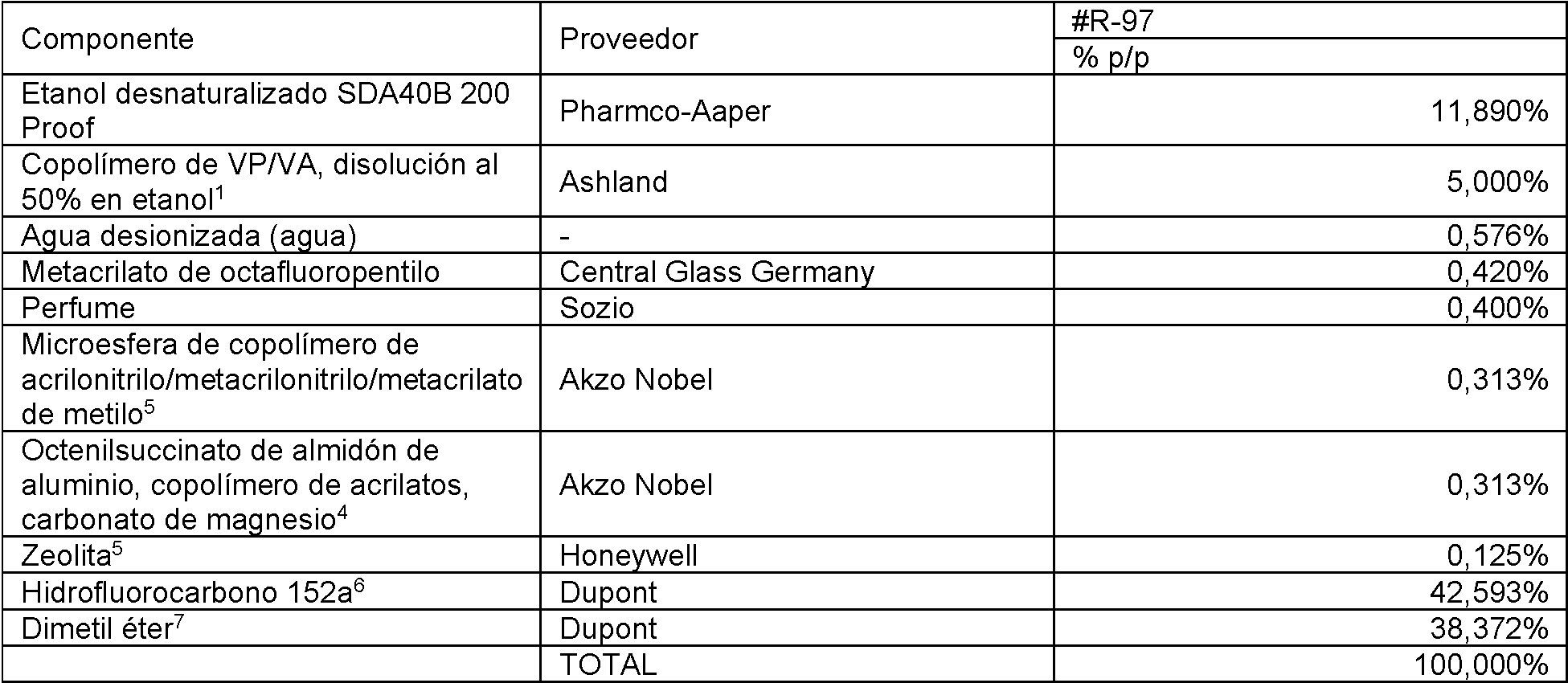
1Disponible comercialmente como PVP/VA E-335 de Ashland.1Commercially available as PVP / VA E-335 from Ashland.
2Disponible comercialmente como perfume SZ-80580 de Sozio.2Commercially available as SZ-80580 perfume from Sozio.
3Disponible comercialmente como EXPANCEL® 920 DU 80 de Akzo Nobel.3 Commercially available as EXPANCEL® 920 DU 80 from Akzo Nobel.
4Disponible comercialmente como Natrasorb® HFB de Akzo Nobel.4Commercially available as Natrasorb® HFB from Akzo Nobel.
5Disponible comercialmente como Asensa® DS912 de Honeywell.5Commercially available as Asensa® DS912 from Honeywell.
6Disponible comercialmente como propelente Dymel® 152a de Dupont.6 Commercially available as Dymel® 152a propellant from Dupont.
7Disponible comercialmente como propelente Dymel® A de Dupont.7 Commercially available as Dymel® A propellant from Dupont.
Cargar el recipiente con etanol. Añadir copolímero de VP/VA y mezclar hasta que esté uniforme. Añadir los siguientes seis componentes (hasta la zeolita incluida) en orden, mezclar bien entre cada adición. Llenar envases metálicos para aerosol con concentrado y cargar con cantidades apropiadas de los dos propelentes.Fill the container with ethanol. Add VP / VA copolymer and mix until uniform. Add the next six components (up to the zeolite included) in order, mix well between each addition. Fill metal containers to spray with concentrate and load with appropriate amounts of the two propellants.
Se dividió por la mitad el cabello de la cabeza limpia y seca de un maniquí. Se aplicaron 25 gramos de producto de prueba anterior al lado derecho de la cabeza del maniquí. El lado izquierdo se dejó sin tratar. La figura 3 muestra fotografías tomadas antes y después de la aplicación para ilustrar el cambio de volumen. Se calculó el aumento de volumen tanto para el lado tratado como para el lado sin tratar tal como se describió anteriormente. Los resultados se enumeran a continuación:Hair on a clean, dry head of a mannequin was parted in half. 25 grams of the above test product was applied to the right side of the manikin's head. The left side was left untreated. Figure 3 shows photographs taken before and after application to illustrate the volume change. The volume increase was calculated for both the treated and untreated sides as described above. The results are listed below:
% de aumento (tratado) = 20,86%% increase (treated) = 20.86%
% de aumento (sin tratar) = -14,37%% increase (untreated) = -14.37%
El experimento se repitió para mostrar la reproducibilidad. Se calculó el aumento de volumen tanto para el lado tratado como para el lado sin tratar tal como se describió anteriormente. Los resultados se enumeran a continuación:The experiment was repeated to show reproducibility. The volume increase was calculated for both the treated and untreated sides as described above. The results are listed below:
% de aumento (tratado) = 52,76%% increase (treated) = 52.76%
% de aumento (sin tratar) = 13%% increase (untreated) = 13%
Ejemplo 4Example 4

1Disponible comercialmente como Garamite 7305 de Byk Additives1Commercially available as Garamite 7305 from Byk Additives
2Disponible comercialmente como PVP/VA E-335 de Ashland.2Commercially available as PVP / VA E-335 from Ashland.
3Disponible comercialmente como perfume SZ-80580 de Sozio.3 Commercially available as SZ-80580 perfume from Sozio.
4Disponible comercialmente como Natpure Hollowbead.4Commercially available as Natpure Hollowbead.
5Disponible comercialmente como Ex Pa NCEL® FG52 DU 80 de Akzo Nobel.5Commercially available as Ex Pa NCEL® FG52 DU 80 from Akzo Nobel.
6Disponible comercialmente como Natrasorb® HFB de Akzo Nobel.6 Commercially available as Natrasorb® HFB from Akzo Nobel.
7Disponible comercialmente como Asensa® DS912 de Honeywell.7Commercially available as Asensa® DS912 from Honeywell.
8Disponible comercialmente como propelente Dymel® 152a de Dupont.8 Commercially available as Dymel® 152a propellant from Dupont.
Cargar el recipiente con etanol. Añadir Garamite, mezclar hasta que esté disperso. Añadir copolímero de VP/VA y mezclar hasta que esté uniforme. Añadir los siguientes seis componentes (hasta la zeolita incluida) en orden, mezclar bien entre cada adición. Llenar envases metálicos para aerosol con concentrado y cargar con cantidades apropiadas de propelente.Fill the container with ethanol. Add Garamite, mix until dispersed. Add VP / VA copolymer and mix until uniform. Add the next six components (up to the zeolite included) in order, mix well between each addition. Fill metal aerosol containers with concentrate and load with appropriate amounts of propellant.
Se dividió por la mitad el cabello de un grupo de expertos de prueba. Se aplicó el producto de control (#R-130A) anterior al lado izquierdo de la cabeza del grupo de expertos. Se aplicó el producto de prueba (#R-130B) anterior al lado derecho de la cabeza del grupo de expertos. Se pesaron los envases metálicos para aerosol antes y después de la aplicación para garantizar que se aplicaron las mismas cantidades de producto de prueba y de control en cada lado. Peluqueros capacitados para analizar las diferencias en el cabello evaluaron los resultados. Los peluqueros notaron más volumen y elevación en la raíz del cabello cerca del cuero cabelludo proporcionados por el producto de prueba frente al control. De manera adicional, los peluqueros notaron un aumento del ancho del cabello medido cerca de los pómulos. The hair of a group of test experts was divided in half. The control product (# R-130A) above was applied to the left side of the head of the expert group. The test product (# R-130B) above was applied to the right side of the head of the expert group. The metal aerosol containers were weighed before and after the application to ensure that the same amounts of test and control product were applied to each side. Hairdressers trained to analyze differences in hair evaluated the results. The hairdressers noticed more volume and lift at the hair roots near the scalp provided by the test product versus the control. Additionally, hairdressers noticed an increase in hair width measured near the cheekbones.
Claims (14)
Applications Claiming Priority (2)
| Application Number | Priority Date | Filing Date | Title |
|---|---|---|---|
| US201562101651P | 2015-01-09 | 2015-01-09 | |
| PCT/US2016/012693 WO2016112320A1 (en) | 2015-01-09 | 2016-01-08 | Hair compositions and methods of use thereof |
Publications (1)
| Publication Number | Publication Date |
|---|---|
| ES2819528T3 true ES2819528T3 (en) | 2021-04-16 |
Family
ID=55221557
Family Applications (1)
| Application Number | Title | Priority Date | Filing Date |
|---|---|---|---|
| ES16701377T Active ES2819528T3 (en) | 2015-01-09 | 2016-01-08 | Hair compositions and methods of using them |
Country Status (11)
| Country | Link |
|---|---|
| US (3) | US10987286B2 (en) |
| EP (1) | EP3247326B1 (en) |
| JP (1) | JP6762944B2 (en) |
| KR (1) | KR102546399B1 (en) |
| CN (1) | CN107106432B (en) |
| AU (1) | AU2016205061B2 (en) |
| BR (1) | BR112017013504A2 (en) |
| CA (1) | CA2971449C (en) |
| ES (1) | ES2819528T3 (en) |
| MX (1) | MX373585B (en) |
| WO (1) | WO2016112320A1 (en) |
Families Citing this family (9)
| Publication number | Priority date | Publication date | Assignee | Title |
|---|---|---|---|---|
| ES2819528T3 (en) | 2015-01-09 | 2021-04-16 | Living Proof Inc | Hair compositions and methods of using them |
| US11622929B2 (en) | 2016-03-08 | 2023-04-11 | Living Proof, Inc. | Long lasting cosmetic compositions |
| EP3681920B1 (en) | 2017-09-13 | 2025-06-25 | Living Proof, Inc. | Long lasting cosmetic compositions |
| EP3681921A2 (en) | 2017-09-13 | 2020-07-22 | Living Proof, Inc. | Color protectant compositions |
| AU2018370210B2 (en) | 2017-11-20 | 2024-09-26 | Living Proof, Inc. | Properties for achieving long-lasting cosmetic performance |
| EP3784711A1 (en) | 2018-04-27 | 2021-03-03 | Living Proof, Inc. | Long lasting cosmetic compositions |
| EP3659673B1 (en) * | 2018-11-28 | 2023-12-20 | Kao Corporation | Aerosol composition for keratin fibers |
| JP7304054B2 (en) * | 2019-03-15 | 2023-07-06 | 株式会社アリミノ | hair styling composition |
| US11816088B2 (en) * | 2021-03-26 | 2023-11-14 | Anaplan, Inc. | Method and system for managing cross data source data access requests |
Family Cites Families (23)
| Publication number | Priority date | Publication date | Assignee | Title |
|---|---|---|---|---|
| AU695077B2 (en) * | 1993-09-08 | 1998-08-06 | Pq Holding, Inc. | Hollow borosilicate microspheres and method of making |
| FR2722116B1 (en) | 1994-07-11 | 1996-08-23 | Oreal | OIL-IN-WATER EMULSION WITHOUT SURFACTANT, STABILIZED BY HOLLOW THERMOPLASTIC PARTICLES |
| FR2740334B1 (en) * | 1995-10-25 | 1997-12-05 | Oreal | COSMETIC COMPOSITION CONTAINING A MONOESTER OF C4-C10 ACID AND C16-C18 ALCOHOL AND HOLLOW PARTICLES |
| AU3232800A (en) * | 1999-05-05 | 2000-11-21 | Procter & Gamble Company, The | Hair styling compositions providing improved hair volume and hair hold performance |
| FR2801201B1 (en) * | 1999-11-19 | 2003-02-14 | Oreal | HIGH-RESISTANCE COSMETIC COMPOSITION COMPRISING AT LEAST ONE FILM-FORMING POLYMER |
| FR2801502B1 (en) * | 1999-11-25 | 2002-01-18 | Oreal | ANHYDROUS DEODORANT COSMETIC COMPOSITION |
| MXPA02009634A (en) * | 2000-03-31 | 2003-03-12 | Procter & Gamble | COSMETIC COMPOSITIONS, TO BE APPLIED WITHOUT RINING, TO INCREASE THE HAIR VOLUME. |
| WO2003028678A1 (en) | 2001-10-01 | 2003-04-10 | The Procter & Gamble Company | Shampoo containing hollow particles |
| EP1434555A1 (en) | 2001-10-03 | 2004-07-07 | The Procter & Gamble Company | Hair styling composition containing particles |
| EP1569624A4 (en) * | 2002-11-27 | 2009-05-27 | Kobo Products Inc | PARTICULAR SUSPENSIONS WITH CONTROLLED DENSITY FOR FOODSTUFFS, COSMETICS, PHARMACEUTICALS AND OTHER USES |
| FR2861290B1 (en) | 2003-10-24 | 2006-02-10 | Oreal | THERMOGONFLANT COSMETIC COMPOSITION. |
| FR2861291A1 (en) | 2003-10-24 | 2005-04-29 | Oreal | CAPILLARY COSMETIC COMPOSITION BASED ON FIXING POLYMERS AND COMPOUNDS LIKELY TO INFLATE UNDER THE ACTION OF HEAT. |
| US7998465B2 (en) | 2003-10-24 | 2011-08-16 | L'oreal S.A. | Heat-swelling cosmetic composition |
| US20060083762A1 (en) | 2004-10-13 | 2006-04-20 | Gaelle Brun | Uses of compositions comprising electrophilic monomers and micro-particles or nanoparticles |
| CN101040827A (en) * | 2006-03-21 | 2007-09-26 | 莱雅公司 | Cosmetic or dermatologic compositions containing microspheres |
| EP2033618A1 (en) | 2007-08-30 | 2009-03-11 | Wella Aktiengesellschaft | Leave-in hair styling product with particles for improving hair volume |
| US20090285866A1 (en) * | 2008-05-13 | 2009-11-19 | Afriat Isabelle R | Self-healing polymer compositions |
| US9005591B2 (en) * | 2008-05-16 | 2015-04-14 | Avon Products, Inc. | Compositions for imparting hydrophobicity and water repellency to hair |
| JP5782295B2 (en) * | 2011-05-13 | 2015-09-24 | 花王株式会社 | Hair cosmetics |
| EP2753298B1 (en) | 2011-09-07 | 2016-03-16 | Akzo Nobel Chemicals International B.V. | Hair fixative compositions |
| EP2630950A1 (en) * | 2012-02-21 | 2013-08-28 | Kao Germany GmbH | Hair treatment method |
| US20130280174A1 (en) * | 2012-04-20 | 2013-10-24 | The Gillette Company | Personal care composition comprising metathesized unsaturated polyol esters |
| ES2819528T3 (en) | 2015-01-09 | 2021-04-16 | Living Proof Inc | Hair compositions and methods of using them |
-
2016
- 2016-01-08 ES ES16701377T patent/ES2819528T3/en active Active
- 2016-01-08 WO PCT/US2016/012693 patent/WO2016112320A1/en not_active Ceased
- 2016-01-08 US US15/540,581 patent/US10987286B2/en active Active
- 2016-01-08 CA CA2971449A patent/CA2971449C/en active Active
- 2016-01-08 JP JP2017536016A patent/JP6762944B2/en active Active
- 2016-01-08 CN CN201680005321.8A patent/CN107106432B/en active Active
- 2016-01-08 KR KR1020177022277A patent/KR102546399B1/en active Active
- 2016-01-08 BR BR112017013504A patent/BR112017013504A2/en not_active Application Discontinuation
- 2016-01-08 AU AU2016205061A patent/AU2016205061B2/en active Active
- 2016-01-08 MX MX2017008888A patent/MX373585B/en active IP Right Grant
- 2016-01-08 EP EP16701377.0A patent/EP3247326B1/en active Active
-
2021
- 2021-03-29 US US17/215,292 patent/US11547642B2/en active Active
-
2024
- 2024-03-01 US US18/593,041 patent/US20250025382A1/en not_active Abandoned
Also Published As
| Publication number | Publication date |
|---|---|
| US11547642B2 (en) | 2023-01-10 |
| US20180000699A1 (en) | 2018-01-04 |
| US20220040056A1 (en) | 2022-02-10 |
| AU2016205061B2 (en) | 2020-10-01 |
| CA2971449C (en) | 2023-09-19 |
| WO2016112320A1 (en) | 2016-07-14 |
| KR102546399B1 (en) | 2023-06-21 |
| CN107106432B (en) | 2021-06-08 |
| US20250025382A1 (en) | 2025-01-23 |
| EP3247326B1 (en) | 2020-06-17 |
| US10987286B2 (en) | 2021-04-27 |
| CA2971449A1 (en) | 2016-07-14 |
| BR112017013504A2 (en) | 2018-01-02 |
| CN107106432A (en) | 2017-08-29 |
| AU2016205061A1 (en) | 2017-07-06 |
| JP6762944B2 (en) | 2020-09-30 |
| MX373585B (en) | 2020-05-08 |
| EP3247326A1 (en) | 2017-11-29 |
| JP2018501284A (en) | 2018-01-18 |
| KR20170102007A (en) | 2017-09-06 |
| MX2017008888A (en) | 2017-10-25 |
Similar Documents
| Publication | Publication Date | Title |
|---|---|---|
| US20250025382A1 (en) | Hair compositions and methods of use thereof | |
| ES2502590T5 (en) | Crosslinked Acrylic Copolymers | |
| KR102412339B1 (en) | Mascara formulation | |
| ES2330651T3 (en) | COSMETIC COMPOSITION BASED ON A CATIONIC TENSIOACTIVE, AN AMINED SILICONE, A GREAT ALCOHOL AND A PROPULSING AGENT. | |
| CN108025192B (en) | Film-forming composition | |
| KR20190037192A (en) | Compositions containing polycarbodiimide and latex polymers for treating keratin substrates | |
| CN106999409A (en) | The cosmetic composition of cationic polymer comprising organosilan, cationic surfactant and with more than or equal to 4meq/g charge density | |
| JP2019501922A (en) | Composition for treatment of keratin substrate containing polycarbodiimide | |
| JP2017206483A (en) | Hair cosmetic | |
| JP2008290973A (en) | Foamy hair-dressing cosmetic | |
| US20170065513A1 (en) | Mascara Composition | |
| ES2320465T3 (en) | COSMETIC COMPOSITIONS BASED ON A CATIONIC TENSIOACTIVE, AN AMINED SILICONE, A GREAT ALCOHOL AND A DIOL. | |
| BR112019004612B1 (en) | TENSIONING COSMETIC COMPOSITION | |
| ES2911379T3 (en) | Composition and procedure for molding or altering the shape of the hair | |
| JP6717594B2 (en) | Non-aqueous hair cosmetic and hair treatment method | |
| ES2338354T3 (en) | COSMETIC COMPOSITION INCLUDING AN OXIETINELATED SORBITAN ESTER, A CATIONIC POLYMER AND A SOLID FAT MATERIAL. | |
| BR112015010587B1 (en) | cosmetic composition, keratin fiber straightening process and use of the composition | |
| JP6717775B2 (en) | Non-aqueous hair cosmetic and hair treatment method | |
| JP6717774B2 (en) | Non-aqueous hair cosmetic and hair treatment method | |
| JP7103800B2 (en) | How to maintain the curl shape of the eyelashes | |
| JP2017109990A (en) | Non-aqueous hair cosmetic and hair treatment method | |
| JP5988723B2 (en) | Hair treatment composition | |
| JP5069446B2 (en) | Emulsified cosmetic for hairdressing | |
| BR112021009838A2 (en) | cosmetic compositions and hair care method | |
| JP2017109984A (en) | Nonaqueous hair cosmetic and hair treatment method |