ES2828751T3 - Downstream Processing of Fatty Alcohol Compositions Produced by Recombinant Host Cells - Google Patents
Downstream Processing of Fatty Alcohol Compositions Produced by Recombinant Host Cells Download PDFInfo
- Publication number
- ES2828751T3 ES2828751T3 ES14717901T ES14717901T ES2828751T3 ES 2828751 T3 ES2828751 T3 ES 2828751T3 ES 14717901 T ES14717901 T ES 14717901T ES 14717901 T ES14717901 T ES 14717901T ES 2828751 T3 ES2828751 T3 ES 2828751T3
- Authority
- ES
- Spain
- Prior art keywords
- falc
- weight
- mixture
- less
- ffa
- Prior art date
- Legal status (The legal status is an assumption and is not a legal conclusion. Google has not performed a legal analysis and makes no representation as to the accuracy of the status listed.)
- Active
Links
Classifications
-
- C—CHEMISTRY; METALLURGY
- C07—ORGANIC CHEMISTRY
- C07C—ACYCLIC OR CARBOCYCLIC COMPOUNDS
- C07C29/00—Preparation of compounds having hydroxy or O-metal groups bound to a carbon atom not belonging to a six-membered aromatic ring
- C07C29/74—Separation; Purification; Use of additives, e.g. for stabilisation
- C07C29/88—Separation; Purification; Use of additives, e.g. for stabilisation by treatment giving rise to a chemical modification of at least one compound
-
- C—CHEMISTRY; METALLURGY
- C07—ORGANIC CHEMISTRY
- C07C—ACYCLIC OR CARBOCYCLIC COMPOUNDS
- C07C29/00—Preparation of compounds having hydroxy or O-metal groups bound to a carbon atom not belonging to a six-membered aromatic ring
- C07C29/17—Preparation of compounds having hydroxy or O-metal groups bound to a carbon atom not belonging to a six-membered aromatic ring by hydrogenation of carbon-to-carbon double or triple bonds
- C07C29/172—Preparation of compounds having hydroxy or O-metal groups bound to a carbon atom not belonging to a six-membered aromatic ring by hydrogenation of carbon-to-carbon double or triple bonds with the obtention of a fully saturated alcohol
-
- C—CHEMISTRY; METALLURGY
- C12—BIOCHEMISTRY; BEER; SPIRITS; WINE; VINEGAR; MICROBIOLOGY; ENZYMOLOGY; MUTATION OR GENETIC ENGINEERING
- C12P—FERMENTATION OR ENZYME-USING PROCESSES TO SYNTHESISE A DESIRED CHEMICAL COMPOUND OR COMPOSITION OR TO SEPARATE OPTICAL ISOMERS FROM A RACEMIC MIXTURE
- C12P7/00—Preparation of oxygen-containing organic compounds
- C12P7/02—Preparation of oxygen-containing organic compounds containing a hydroxy group
-
- Y—GENERAL TAGGING OF NEW TECHNOLOGICAL DEVELOPMENTS; GENERAL TAGGING OF CROSS-SECTIONAL TECHNOLOGIES SPANNING OVER SEVERAL SECTIONS OF THE IPC; TECHNICAL SUBJECTS COVERED BY FORMER USPC CROSS-REFERENCE ART COLLECTIONS [XRACs] AND DIGESTS
- Y02—TECHNOLOGIES OR APPLICATIONS FOR MITIGATION OR ADAPTATION AGAINST CLIMATE CHANGE
- Y02E—REDUCTION OF GREENHOUSE GAS [GHG] EMISSIONS, RELATED TO ENERGY GENERATION, TRANSMISSION OR DISTRIBUTION
- Y02E50/00—Technologies for the production of fuel of non-fossil origin
- Y02E50/10—Biofuels, e.g. bio-diesel
Landscapes
- Chemical & Material Sciences (AREA)
- Organic Chemistry (AREA)
- Chemical Kinetics & Catalysis (AREA)
- General Chemical & Material Sciences (AREA)
- Organic Low-Molecular-Weight Compounds And Preparation Thereof (AREA)
- Life Sciences & Earth Sciences (AREA)
- Wood Science & Technology (AREA)
- Zoology (AREA)
- Engineering & Computer Science (AREA)
- Bioinformatics & Cheminformatics (AREA)
- Microbiology (AREA)
- Biotechnology (AREA)
- Health & Medical Sciences (AREA)
- Biochemistry (AREA)
- General Engineering & Computer Science (AREA)
- General Health & Medical Sciences (AREA)
- Genetics & Genomics (AREA)
- Preparation Of Compounds By Using Micro-Organisms (AREA)
- Mycology (AREA)
- Micro-Organisms Or Cultivation Processes Thereof (AREA)
Abstract
Un método de purificación de un alcohol graso (FALC) con al menos cinco átomos de carbono, que comprende: (a) producir un material de partida que comprende FALC e impurezas saponificables mediante la fermentación de un microorganismo cultivado en un caldo de fermentación; (b) añadir una base fuerte a dicho material de partida para generar una primera mezcla; y (c) evaporar dicha primera mezcla para generar una segunda mezcla enriquecida con FALC.A method of purifying a fatty alcohol (FALC) with at least five carbon atoms, comprising: (a) producing a starting material comprising FALC and saponifiable impurities by fermenting a microorganism grown in a fermentation broth; (b) adding a strong base to said starting material to generate a first mixture; and (c) evaporating said first mixture to generate a second FALC-enriched mixture.
Description
DESCRIPCIÓNDESCRIPTION
Procesamiento corriente abajo de composiciones de alcohol graso producidas por células huésped recombinantes Downstream Processing of Fatty Alcohol Compositions Produced by Recombinant Host Cells
CampoCountryside
La divulgación se refiere al procesamiento corriente abajo de alcoholes grasos. En el presente documento, la divulgación abarca un novedoso método de purificación que proporciona alcoholes grasos con alta pureza y rendimiento.The disclosure relates to the downstream processing of fatty alcohols. Herein, the disclosure encompasses a novel purification method that provides fatty alcohols in high purity and yield.
AntecedentesBackground
Los alcoholes grasos tienen muchos usos comerciales. Los alcoholes grasos de cadena más corta se usan en las industrias cosmética y alimentaria como emulsionantes, emolientes y espesantes. Debido a su naturaleza anfífila, los alcoholes grasos se comportan como tensioactivos no iónicos, que son útiles en productos de cuidado personal y para el hogar, tales como, por ejemplo, detergentes y composiciones de limpieza. Además, se usan alcoholes grasos en ceras, gomas, resinas, ungüentos y lociones farmacéuticas, aditivos de aceite lubricante, antiestáticos textiles y agentes de acabado, plastificantes, cosméticos, disolventes industriales y disolventes para grasas. El alcohol graso (FALC, por sus siglas en inglés) se puede obtener a partir de aceite de palma, aceite de grano de palma, aceites vegetales, soja o cebo, no obstante a costes financieros y ambientales considerables. Cuando FALC se deriva de fuentes convencionales (p. ej., aceite vegetal, aceite de palma, etc.), la mezcla inicial contiene numerosas impurezas que incluyen ácidos grasos libres, éster metílico de ácidos grasos (FAME, por sus siglas en inglés), ésteres grasosgrasos pesados (es decir, moléculas de cadena larga que incluyen C20 a C30) así como otras impurezas.Fatty alcohols have many commercial uses. Shorter chain fatty alcohols are used in the cosmetic and food industries as emulsifiers, emollients, and thickeners. Due to their amphiphilic nature, fatty alcohols behave as nonionic surfactants, which are useful in household and personal care products, such as, for example, detergents and cleaning compositions. In addition, fatty alcohols are used in pharmaceutical waxes, gums, resins, ointments and lotions, lubricating oil additives, textile antistatic and finishing agents, plasticizers, cosmetics, industrial solvents, and fat solvents. Fatty alcohol (FALC) can be obtained from palm oil, palm kernel oil, vegetable oils, soy or bait, however at considerable financial and environmental costs. When FALC is derived from conventional sources (e.g. vegetable oil, palm oil, etc.), the initial mixture contains numerous impurities including free fatty acids, fatty acid methyl ester (FAME) heavy, fatty fatty esters (i.e. long chain molecules including C20 to C30) as well as other impurities.
FALC también puede obtenerse a partir de la fermentación (cultivo) de un microorganismo, que se ha modificado para producir FALC que tiene una longitud de cadena de C6 a C18. En determinadas condiciones de cultivo, FALC crudo que se produce a partir de un caldo de fermentación microbiana puede contener, además de FALC, determinadas impurezas. Tales impurezas incluyen, pero no se limitan a, ácidos grasos libres (FFA, por sus siglas en inglés); ésteres grasos-grasos (FFE, por sus siglas en inglés); aldehídos grasos, cetonas grasas y compuestos que contienen carbonilo; compuestos de azufre y metálicos; agua e impurezas adicionales. Las impurezas se eliminan normalmente de FALC para cumplir con las especificaciones del producto final. La eliminación de FFA (desacidificación) se lleva a cabo comúnmente mediante métodos de refinación alcalina (es decir, a través de métodos químicos) y métodos de refinación física (es decir, a través de la evaporación del FFA), tales como en las operaciones comerciales. Los métodos convencionales de refinación alcalina no están exentos de defectos; particularmente son propensos a experimentar dificultades cuando se intenta separar el jabón finamente dispersado y parcialmente solubilizado (p. ej., C8-C18 de longitud de cadena) lejos de FALC, que ocurre durante la centrifugación seguida por lavado con agua. Generalmente, los métodos de refinación alcalina están afectados por una pérdida de alcohol inaceptablemente alta y contaminación de FFE, que han de reducirse a través de una etapa de procesamiento separada. Además, la refinación física es casi imposible puesto que FALC, FFA y FFE tienen puntos de ebullición similares. Por otra parte, FFA tiene una distribución de longitud de cadena similar a FALC y algunas de FFE se superponen en longitud de cadena con FALC. Por tanto, a escala comercial, los métodos de refinación alcalina y física no son adecuados para la eliminación de FFA y FFE que están presentes en FALC crudo. Por tanto, se necesitan métodos nuevos y mejores que produzcan FALC con características (p. ej., pureza) necesarios para cumplir con las especificaciones necesarias para el uso en productos particulares.FALC can also be obtained from the fermentation (cultivation) of a microorganism, which has been modified to produce FALC having a chain length of C6 to C18. Under certain culture conditions, crude FALC produced from a microbial fermentation broth may contain, in addition to FALC, certain impurities. Such impurities include, but are not limited to, free fatty acids (FFA); Fatty-Fatty Esters (FFE); fatty aldehydes, fatty ketones, and carbonyl-containing compounds; sulfur and metal compounds; water and additional impurities. Impurities are typically removed from FALC to meet end product specifications. FFA removal (deacidification) is commonly carried out by alkaline refining methods (i.e., through chemical methods) and physical refining methods (i.e., through evaporation of the FFA), such as in operations commercial. Conventional alkaline refining methods are not without flaws; they are particularly prone to difficulties when attempting to separate finely dispersed and partially solubilized soap (eg, C8-C18 chain length) away from FALC, which occurs during centrifugation followed by washing with water. Generally, alkaline refining methods are affected by unacceptably high alcohol loss and FFE contamination, which have to be reduced through a separate processing step. Furthermore, physical refining is almost impossible since FALC, FFA and FFE have similar boiling points. On the other hand, FFA has a chain length distribution similar to FALC and some of FFE overlap in chain length with FALC. Therefore, on a commercial scale, alkaline and physical refining methods are not suitable for the removal of FFA and FFE that are present in crude FALC. Therefore, there is a need for new and better methods that produce FALC with characteristics (eg, purity) necessary to meet the necessary specifications for use in particular products.
SumarioSummary
Un aspecto de la divulgación proporciona un método de purificación de un alcohol graso (FALC) con al menos cinco átomos de carbono, que incluye (a) proporcionar un material de partida que incluye FALC e impurezas saponificables; (b) añadir una base fuerte al material de partida para generar una primera mezcla; y (c) evaporar la primera mezcla para generar una segunda mezcla enriquecida con FALC. El FALC se produce mediante la fermentación de un microorganismo cultivado en un caldo de fermentación. En una realización, las impurezas saponificables incluyen ácido graso libre (FFA), éster graso-graso (FFE), y compuestos que contienen carbonilo. En otra realización, la base fuerte comprende 0,3 a 0,6 por ciento en peso de exceso de hidróxido de sodio (NaOH). En otra realización, la base fuerte reduce el FFA y el FFE mediante la neutralización del FAA y la saponificación del FEE, en donde la saponificación del FEE genera FFA adicional para la neutralización y el FALC adicional. La base fuerte reduce además los compuestos que contienen carbonilo. En todavía otra realización, la neutralización y la saponificación se pueden llevar a cabo a una temperatura de aproximadamente 100 °C a aproximadamente 130 °C, a presión ambiente a vacío parcial de aproximadamente 80 torr (10,66 kPa). Aún en otra realización más, la neutralización y la saponificación se llevan a cabo durante aproximadamente 2 a 4 horas. En todavía otra realización, la cantidad de FFA en la segunda mezcla es inferior a aproximadamente 0,03 mg KOH/g de muestra y la cantidad de FFE en la segunda mezcla es inferior a aproximadamente 0,4 mg KOH/g de muestra. En otra realización, la cantidad de jabón de sodio en la segunda mezcla es inferior a aproximadamente 20 ppm. El FALC obtenido en la segunda mezcla tiene por lo general una pureza de aproximadamente 98 %.One aspect of the disclosure provides a method of purifying a fatty alcohol (FALC) with at least five carbon atoms, including (a) providing a starting material that includes FALC and saponifiable impurities; (b) adding a strong base to the starting material to generate a first mixture; and (c) evaporating the first mixture to generate a second FALC-enriched mixture. FALC is produced by fermenting a microorganism grown in a fermentation broth. In one embodiment, saponifiable impurities include free fatty acid (FFA), fatty-fatty ester (FFE), and carbonyl-containing compounds. In another embodiment, the strong base comprises 0.3 to 0.6 percent by weight of excess sodium hydroxide (NaOH). In another embodiment, the strong base reduces FFA and FFE by neutralizing FAA and saponification of FEE, wherein saponification of FEE generates additional FFA for neutralization and additional FALC. The strong base further reduces carbonyl-containing compounds. In still another embodiment, the neutralization and saponification can be carried out at a temperature of from about 100 ° C to about 130 ° C, at ambient pressure under partial vacuum of about 80 torr (10.66 kPa). In yet another embodiment, the neutralization and saponification are carried out for about 2 to 4 hours. In still another embodiment, the amount of FFA in the second mix is less than about 0.03 mg KOH / g of sample and the amount of FFE in the second mix is less than about 0.4 mg KOH / g of sample. In another embodiment, the amount of sodium soap in the second mix is less than about 20 ppm. The FALC obtained in the second mixture is generally about 98% pure.
Otro aspecto de la divulgación proporciona un método de purificación de FALC, que incluye (a) proporcionar un material de partida que incluye FALC e impurezas saponificables; (b) añadir una base fuerte al material de partida para generar una primera mezcla; (c) evaporar la primera mezcla para generar una segunda mezcla enriquecida con FALC; y (d) blanquear la segunda mezcla con un agente blanqueador para generar FALC blanqueado. En una realización, el agente blanqueador incluye, pero no se limita a, hipoclorito, un peróxido, una arcilla blanqueadora, y un absorbente. En otra realización, el agente blanqueador es eficaz para eliminar los compuestos metálicos; cuerpos de color; niveles de trazas de impurezas adicionales que incluyen compuestos grasos oxidados o compuestos grasos con radicales libres, o combinaciones de los mismos.Another aspect of the disclosure provides a method of purification of FALC, including (a) providing a starting material including FALC and saponifiable impurities; (b) adding a strong base to the starting material to generate a first mixture; (c) evaporating the first mixture to generate a second FALC-enriched mixture; and (d) bleaching the second mixture with a bleaching agent to generate bleached FALC. In one embodiment, the bleaching agent includes, but is not limited to, hypochlorite, a peroxide, a bleaching clay, and an absorbent. In another embodiment, the bleaching agent is effective in removing metal compounds; colored bodies; trace levels of additional impurities including oxidized fatty compounds or free radical fatty compounds, or combinations thereof.
Otro aspecto de la divulgación proporciona un método de purificación de FALC, que incluye (a) proporcionar un material de partida que incluye FALC e impurezas saponificables; (b) añadir una base fuerte al material de partida para generar una primera mezcla; (c) evaporar la primera mezcla para generar una segunda mezcla enriquecida con FALC; (d) blanquear la segunda mezcla con un agente blanqueador para generar FALC blanqueado; y (e) hidrogenar la segunda mezcla con hidrógeno y un catalizador para generar FALC hidrogenado. En una realización, el hidrogenante incluye, pero no se limita a, una reacción de suspensión en un recipiente único, una reacción de suspensión seguida por una reacción en lecho compacto y dos reacciones en lecho compacto en serie. En otra realización, el método incluye además el fraccionamiento del FALC hidrogenado de acuerdo con el punto de ebullición, en donde FALC que tiene una diferencia en la longitud de cadena de dos o más carbonos están separados. En otra realización, el FALC hidrogenado comprende al menos aproximadamente 50 por ciento de alcohol graso C12 a C18.Another aspect of the disclosure provides a method of purifying FALC, including (a) providing a starting material that includes FALC and saponifiable impurities; (b) adding a strong base to the starting material to generate a first mixture; (c) evaporating the first mixture to generate a second FALC-enriched mixture; (d) bleaching the second mixture with a bleaching agent to generate bleached FALC; and (e) hydrogenating the second mixture with hydrogen and a catalyst to generate hydrogenated FALC. In one embodiment, the hydrogenator includes, but is not limited to, a single pot slurry reaction, a slurry reaction followed by a packed bed reaction, and two packed bed reactions in series. In another embodiment, the method further includes fractionating the hydrogenated FALC according to boiling point, wherein FALC having a difference in chain length of two or more carbons are separated. In another embodiment, the hydrogenated FALC comprises at least about 50 percent C 12 to C 18 fatty alcohol.
Otro aspecto de la divulgación proporciona un método de purificación de FALC, en donde el material de partida comprende al menos 0,1 a 0,5 por ciento en peso de FFA y/o al menos 0,1 a 0,5 por ciento en peso de FFE. El material de partida puede incluir además al menos 0,1 a 0,5 por ciento en peso de compuestos que contienen carbonilo. Además, el material de partida puede incluir además menos de 1 por ciento en peso de compuestos de dialcohol. El material de partida puede incluir además azufre o al menos un compuesto que contiene azufre y/o agua. En una realización, el material de partida es un producto de un caldo de fermentación. En otra realización, el caldo de fermentación es un caldo de fermentación de E. coli. En aún otra realización, el material de partida abarca un valor de saponificación (SAP) de aproximadamente 20 mg KOH/g o menos.Another aspect of the disclosure provides a method of purification of FALC, wherein the starting material comprises at least 0.1 to 0.5 percent by weight of FFA and / or at least 0.1 to 0.5 percent by weight of FFE. The starting material may further include at least 0.1 to 0.5 percent by weight of carbonyl-containing compounds. In addition, the starting material may further include less than 1 percent by weight of dialcohol compounds. The starting material may further include sulfur or at least one sulfur and / or water-containing compound. In one embodiment, the starting material is a product of a fermentation broth. In another embodiment, the fermentation broth is an E. coli fermentation broth. In yet another embodiment, the starting material encompasses a saponification value (SAP) of about 20 mg KOH / g or less.
Otro aspecto de la divulgación proporciona un método de purificación de FALC, que incluye (a) proporcionar un material de partida que incluye FALC e impurezas saponificables; (b) añadir una base fuerte al material de partida para generar una primera mezcla; y (c) evaporar la primera mezcla para generar una segunda mezcla enriquecida con FALC, en donde la evaporación se lleva a cabo a una temperatura inferior a aproximadamente 150 °C a aproximadamente 1 torr (0,133 kPa). En otra realización, la evaporación se lleva a cabo a una temperatura inferior a aproximadamente 187 °C a aproximadamente 5 torr (0,66 kPa). En todavía otra realización, la evaporación se lleva a cabo a una temperatura que corresponde a una presión de vapor de un alcohol C18.Another aspect of the disclosure provides a method of purifying FALC, including (a) providing a starting material that includes FALC and saponifiable impurities; (b) adding a strong base to the starting material to generate a first mixture; and (c) evaporating the first mixture to generate a second FALC-enriched mixture, wherein the evaporation is carried out at a temperature below about 150 ° C at about 1 torr (0.133 kPa). In another embodiment, evaporation is carried out at a temperature below about 187 ° C at about 5 torr (0.66 kPa). In still another embodiment, evaporation is carried out at a temperature corresponding to a vapor pressure of a C 18 alcohol.
Descripción detalladaDetailed description
El desarrollo de un nuevo método de purificación proporciona un rendimiento de alcohol graso significativamente mayor sobre los métodos conocidos de refinación alcalina y se usa para producir alcohol graso con características necesarias para cumplir con las especificaciones para productos particulares que incluyen una mayor pureza. El nuevo método implica la neutralización y saponificación de un material de partida. Como tal, el nuevo método incluye la adición de una base fuerte a un material de partida que incluye alcohol graso (FALC) e impurezas saponificables. Tales impurezas incluyen, por ejemplo, ácidos grasos libres (FFA), ésteres grasos-grasos (FFE), y compuestos que contienen carbonilo. El material de partida se deriva por lo general de un microorganismo cultivado en un caldo de fermentación. Cuando se añade la base fuerte al material de partida, se reducen el FFA y FFE por neutralización del FFA y saponificación del FFE en la mezcla. Además, la base fuerte oxida algunos compuestos que contienen carbonilo en la mezcla en FFA, y reduce otros compuestos que contienen carbonilo en aldehídos y cetonas, que dividen aún más en FFA. La saponificación de FFE da como resultado la generación de FFA adicional y FALC, en donde el FFA se neutraliza de nuevo y de este modo se saponifica. En un momento determinado, todos los FFA que han sido convertidos a jabón y el FALC se enriquece. Por lo tanto, la saponificación de FFE y la neutralización de FFA usando un exceso de base fuerte convierte casi todo el FFA y casi todo el FFE en jabones, dando como resultado una solución altamente enriquecida con FALC. El uso posterior de evaporación de alcohol graso produce un FALC de alta pureza casi libre de FFA, FFE, y sales. Sorprendentemente, los solicitantes han descubierto que este método simple de dos etapas da como resultado un FALC con una pureza del 98 %. Por consiguiente, la divulgación proporciona un nuevo y mejor método de purificación de FALC partir de un material de partida que comprende FALC e impurezas saponificables. La mezcla final se enriquece con FALC, en donde la cantidad de jabón (es decir, la sal de FFA) en la mezcla final es inferior a 20 ppm. El nuevo método produce un producto de FALC que está casi libre de FFA y FFE, en donde FFA son aproximadamente 0,1 % (p. ej., aproximadamente 0,05 %, aproximadamente 0,03 %, o aproximadamente 0,01 %), y en donde FFE tienen aproximadamente un valor de saponificación (SAP) de 0,5 (p. ej., aproximadamente 0,4, aproximadamente 0,3 o aproximadamente 0,2).The development of a new purification method provides a significantly higher yield of fatty alcohol over known alkaline refining methods and is used to produce fatty alcohol with characteristics necessary to meet specifications for particular products including higher purity. The new method involves the neutralization and saponification of a starting material. As such, the new method includes the addition of a strong base to a starting material that includes fatty alcohol (FALC) and saponifiable impurities. Such impurities include, for example, free fatty acids (FFA), fatty-fatty esters (FFE), and carbonyl-containing compounds. The starting material is generally derived from a microorganism grown in a fermentation broth. When the strong base is added to the starting material, the FFA and FFE are reduced by neutralizing the FFA and saponifying the FFE in the mixture. Additionally, the strong base oxidizes some carbonyl-containing compounds in the mixture to FFA, and reduces other carbonyl-containing compounds to aldehydes and ketones, which further break down FFA. Saponification of FFE results in the generation of additional FFA and FALC, where the FFA is again neutralized and thus saponified. At a certain point in time, all the FFAs that have been converted to soap and the FALC becomes enriched. Therefore, saponification of FFE and neutralization of FFA using excess strong base converts almost all of the FFA and almost all of the FFE to soaps, resulting in a highly enriched solution with FALC. The subsequent use of fatty alcohol evaporation produces a high purity FALC almost free of FFA, FFE, and salts. Surprisingly, applicants have found that this simple two-step method results in a FALC with a purity of 98%. Accordingly, the disclosure provides a new and better method of purifying FALC from a starting material comprising FALC and saponifiable impurities. The final mix is enriched with FALC, where the amount of soap (i.e. the FFA salt) in the final mix is less than 20 ppm. The new method produces a FALC product that is nearly free of FFA and FFE, where FFA are about 0.1% (eg, about 0.05%, about 0.03%, or about 0.01% ), and wherein FFE have about a saponification value (SAP) of 0.5 (eg, about 0.4, about 0.3, or about 0.2).
El material de partida puede comprender cualquier combinación de FALC e impurezas saponificables, incluyendo, FFA, FFE, y/o compuestos que contienen carbonilo en un determinado porcentaje en peso (% en peso). En una realización preferida, el material de partida comprende al menos aproximadamente 0,5 (% en peso) (p. ej., al menos 1,0 % en peso) de FFE y/o al menos aproximadamente 0,5 % en peso (p. ej., al menos 1,0 % en peso) de FFA y/o al menos aproximadamente 0,5 % en peso (p. ej., al menos 1,0 % en peso) de compuestos que contienen carbonilo. El material de partida comprenderá normalmente menos de aproximadamente 5 % (p. ej., menos de 4 % en peso, menos de 3 % en peso, menos de 2 % en peso, y/o menos de 1 % en peso) de compuestos que contienen carbonilo. El material de partida también puede incluir otros componentes y/o impurezas, tal como menos de aproximadamente 1 % en peso (p. ej., menos de 0,5 %) de compuestos de dialcohol, azufre, al menos un compuesto que contiene azufre, y/o agua a menos de aproximadamente 5 % en peso (p. ej., menos de 3,5 % en peso). Preferentemente, el material de partida comprende un valor de saponificación (SAP) de aproximadamente 20 mg (p. ej., 15 mg, 10 mg, 5 mg, o 2 mg) KOH/g o menos. Un ejemplo de un material de partida comprende menos de aproximadamente 10 % de FFA, menos de aproximadamente 5 % en peso de FFE, menos de aproximadamente 2 % en peso de compuestos que contienen carbonilo, aproximadamente 250 ppm de azufre, aproximadamente 3,5 % en peso de agua, y una porción restante que contiene alcoholes grasos que van de C6 a C18. En una realización de la divulgación, el material de partida es un producto de un caldo de fermentación. El caldo de fermentación puede ser, por ejemplo, un caldo de fermentación microbiana, tal como un caldo de fermentación de E. coli. La célula microbiana está modificada preferentemente por ingeniería genética para optimizar la producción de FALC. Los métodos y composiciones para optimizar la producción de FALC en células microbianas modificadas por ingeniería genética se describen, por ejemplo, en las publicaciones de solicitudes de patente estadounidenses 2012/0142979, 2011/0256599, 2011/0250663, y 2010/0105963. El documento WO98/37045 divulga una purificación alcalina de alcoholes grasos.The starting material can comprise any combination of FALC and saponifiable impurities, including, FFA, FFE, and / or carbonyl-containing compounds in a certain weight percent (weight%). In a preferred embodiment, the starting material comprises at least about 0.5 (wt%) (eg, at least 1.0 wt%) FFE and / or at least about 0.5 wt% (eg, at least 1.0% by weight) of FFA and / or al less about 0.5 % by weight (eg, at least 1.0 % by weight) of carbonyl-containing compounds. The starting material will typically comprise less than about 5% (eg, less than 4% by weight, less than 3% by weight, less than 2% by weight, and / or less than 1% by weight) of compounds. containing carbonyl. The starting material may also include other components and / or impurities, such as less than about 1% by weight (eg, less than 0.5%) of dialcohol compounds, sulfur, at least one sulfur-containing compound , and / or water to less than about 5% by weight (eg, less than 3.5% by weight). Preferably, the starting material comprises a saponification value (SAP) of about 20 mg (eg, 15 mg, 10 mg, 5 mg, or 2 mg) KOH / g or less. An example of a starting material comprises less than about 10% FFA, less than about 5% by weight FFE, less than about 2% by weight carbonyl-containing compounds, about 250 ppm sulfur, about 3.5% by weight water and a remaining portion containing fatty alcohols ranging from C 6 to C 18. In one embodiment of the disclosure, the starting material is a product of a fermentation broth. The fermentation broth can be, for example, a microbial fermentation broth, such as an E. coli fermentation broth. The microbial cell is preferably genetically engineered to optimize FALC production. Methods and compositions for optimizing FALC production in engineered microbial cells are described, for example, in US patent application publications 2012/0142979, 2011/0256599, 2011/0250663, and 2010/0105963. WO98 / 37045 discloses an alkaline purification of fatty alcohols.
Una base fuerte es cualquier base que hidroliza (p. ej., hidroliza completamente) y puede neutralizar el FFA y saponificar el FFE. Normalmente, dicha base fuerte es un hidróxido de un metal alcalino del Grupo I o Il. Las bases fuertes incluyen, por ejemplo, hidróxido de potasio, hidróxido de bario, hidróxido de cesio, hidróxido de sodio, hidróxido de estroncio, hidróxido de calcio, hidróxido de litio e hidróxido de rubidio. En una realización preferida, la base fuerte es hidróxido de sodio. La base fuerte se puede usar en cualquier concentración adecuada para neutralizar el FFA y saponificar el FFE. En general, se usará un exceso de una base fuerte, tal como aproximadamente 0,01 % en peso o más (p. ej., 0,05 % en peso o más, 0,1 % en peso o más, 0,2 % en peso o más, 0,3 % en peso o más, 0,4 % en peso o más, o 0,5 % en peso o más exceso de base al valor SAP total relativo al material de partida). Como alternativa (o adicionalmente), el exceso de la base fuerte usada puede ser de aproximadamente 1,0 % en peso o menos, (p. ej., 0,9 % en peso o menos, 0,8 % en peso o menos, 0,7 % en peso o menos, 0,6 % en peso o menos, 0,5 % en peso o menos, o 0,4 % en peso o menos exceso de base al valor SAP total relativo al material de partida). Por tanto, el exceso de la base fuerte puede ser en una cantidad limitada por dos cualesquiera de los criterios de valoración anteriores (p. ej., 0,1-0,5 % en peso, 0,3-0,6 % en peso, 0,5-1,0 % en peso, 0,6-0,8 % en peso, o 0,05-1,0 % en peso). Por ejemplo, la saponificación de FFE en FFA y alcohol graso y la neutralización de FFA en general se ha logrado de manera efectiva en el presente documento usando el exceso de 0,2-0,5 % en peso de NaOH. La cantidad teórica de NaOH representa FFA, FFE, y carbonilo en el alcohol graso crudo. La base fuerte normalmente se usará en forma de una mezcla acuosa que comprende al menos aproximadamente 1 % en peso (p. ej., al menos 5 % en peso, al menos 10 % en peso, al menos 15 % en peso, al menos 20 % en peso, al menos 25 % en peso, al menos 30 % en peso, al menos 40 % en peso, al menos 50 % en peso, y al menos 60 % en peso de base). El jabón (es decir, la sal de FFA) es el subproducto de la reacción de saponificación entre el FFA y la base fuerte. El jabón depende de la naturaleza del álcali usado para la base fuerte e incluye, por ejemplo, miembros del Grupo I (p. ej., Li, Na, K, etc.) y/o el Grupo II (p. ej., Mg, Ca, etc.). En una realización preferida, el jabón es un jabón de sodio.A strong base is any base that hydrolyzes (eg, fully hydrolyzes) and can neutralize FFA and saponify FFE. Typically, such a strong base is a Group I or II alkali metal hydroxide. Strong bases include, for example, potassium hydroxide, barium hydroxide, cesium hydroxide, sodium hydroxide, strontium hydroxide, calcium hydroxide, lithium hydroxide, and rubidium hydroxide. In a preferred embodiment, the strong base is sodium hydroxide. The strong base can be used in any suitable concentration to neutralize the FFA and saponify the FFE. In general, an excess of a strong base will be used, such as about 0.01% by weight or more (eg, 0.05% by weight or more, 0.1% by weight or more, 0.2 % by weight or more, 0.3% by weight or more, 0.4% by weight or more, or 0.5% by weight or more based on the total SAP value relative to the starting material). Alternatively (or additionally), the excess strong base used may be about 1.0% by weight or less, (eg, 0.9% by weight or less, 0.8% by weight or less , 0.7% by weight or less, 0.6% by weight or less, 0.5% by weight or less, or 0.4% by weight or less based on the total SAP value relative to the starting material) . Thus, the excess of the strong base may be in an amount limited by any two of the above endpoints (e.g., 0.1-0.5% by weight, 0.3-0.6% by weight). weight, 0.5-1.0% by weight, 0.6-0.8% by weight, or 0.05-1.0% by weight). For example, the saponification of FFE in FFA and fatty alcohol and the neutralization of FFA in general has been effectively achieved herein using the excess of 0.2-0.5% by weight of NaOH. The theoretical amount of NaOH represents FFA, FFE, and carbonyl in the crude fatty alcohol. The strong base will normally be used in the form of an aqueous mixture comprising at least about 1% by weight (eg, at least 5% by weight, at least 10% by weight, at least 15% by weight, at least 20% by weight, at least 25% by weight, at least 30% by weight, at least 40% by weight, at least 50% by weight, and at least 60% by weight basis). Soap (i.e., the FFA salt) is the by-product of the saponification reaction between the FFA and the strong base. Soap depends on the nature of the alkali used for the strong base and includes, for example, members of Group I (eg, Li, Na, K, etc.) and / or Group II (eg, Mg, Ca, etc.). In a preferred embodiment, the soap is a sodium soap.
Las condiciones típicas del proceso de saponificación/neutralización incluyen una temperatura de funcionamiento en el intervalo de 110 °C-140 °C, un tiempo de reacción de al menos 1 hora, y/o presiones que van desde la presión ambiente a vacío parcial de 360 torr (48 kPa). En una realización de la divulgación, la generación de la primera mezcla (p. ej., la neutralización de FFA y la saponificación FFE) se puede llevar a cabo, por ejemplo, a aproximadamente 80 °C-180 °C durante aproximadamente 0,5-4 horas con un exceso de aproximadamente 0,05-1,0 % en peso de base al valor SAP total relativo al material de partida. A medida que el FFA se neutraliza, la viscosidad del alcohol graso crudo aumenta sustancialmente. Normalmente, un alcohol graso crudo neutralizado puede ser solidificado a temperaturas por debajo de aproximadamente 110 °C cuando la humedad se elimina por completo. A una temperatura superior a aproximadamente 130 °C, el alcohol graso crudo neutralizado y deshumectado, que tiene niveles de FFA hasta aproximadamente 10 %, se observa que está en la fase líquida.Typical conditions for the saponification / neutralization process include an operating temperature in the range of 110 ° C-140 ° C, a reaction time of at least 1 hour, and / or pressures ranging from ambient pressure to partial vacuum of 360 torr (48 kPa). In one embodiment of the disclosure, generation of the first mixture (eg, FFA neutralization and FFE saponification) can be carried out, for example, at about 80 ° C-180 ° C for about 0, 5-4 hours with an excess of about 0.05-1.0% by weight basis of the total SAP value relative to the starting material. As the FFA is neutralized, the viscosity of the crude fatty alcohol increases substantially. Typically, a neutralized crude fatty alcohol can be solidified at temperatures below about 110 ° C when the moisture is completely removed. At a temperature above about 130 ° C, the neutralized and dehumidified crude fatty alcohol, having FFA levels up to about 10%, is observed to be in the liquid phase.
Normalmente, el material de partida contiene humedad (p. ej., al menos 1 % en peso, al menos 2 % en peso, al menos 3 % en peso, al menos 4 % en peso, y al menos 5 % en peso; pero menos de 10 % en peso, menos de 8 % en peso, y menos de 6 % en peso). Por ejemplo, un material de partida puede comprender aproximadamente 3,5 % en peso de agua. La humedad adicional, por la adición de 20 %-50 % de solución de base y la generación de humedad durante la neutralización de FFA, provoca una formación de espuma significativa durante la evaporación de alcohol graso. Un proceso de secado por humedad (p. ej., con temperaturas de funcionamiento de aproximadamente de 130 °C y 80 torr (10,6 kPa)) se puede instalar ya sea antes o después de la reacción de reducción de SAP, que normalmente se realiza a 130 °C y 360 torr (48 kPa) durante 2 horas. Se puede aplicar un vacío parcial para reducir la oxidación del producto graso de alcohol en ambas etapas de secado y reacción de reducción de SAP. Una pequeña cantidad de hexanol presentado en el alcohol graso crudo es un componente de subproducto indeseable, y se puede eliminar de forma simultánea durante la etapa de secado por humedad para alcanzar el nivel deseado para el posterior procesamiento corriente abajo. La etapa de neutralización del FFA y saponificación del FFE (es decir, hidrolización) con una base fuerte puede incluir la reducción de la cantidad de compuestos que contiene carbonilo (p. ej., aldehídos grasos y cetonas grasas). Por ejemplo, la concentración de compuestos que contienen carbonilo se reduce en al menos 1 %, al menos 5 %, al menos 10 %, al menos 15 %, al menos 20 %, al menos 25 %, al menos 30 %, al menos 40 %, al menos 50 %, al menos 60 %, al menos 70 %, al menos 80 %, o al menos 90 %. La evaporación puede llevarse a cabo a una temperatura de vapor de aproximadamente 155 °C a 1 torr (0,133 kPa), 187 °C a 5 torr (0,666 kPa), o a una temperatura que corresponde a la presión de vapor de un alcohol C18. La temperatura del vapor se mide normalmente en la parte superior de un separador de arrastre. Un gráfico VLE de alcoholes normales de parafina se puede usar para determinar la temperatura del vapor y el nivel de vacío. Cuando se completa la evaporación, el fondo del evaporador altamente viscoso contiene alcohol graso (en su mayoría C18OH), sales, y el exceso de base. Para mantener un estado líquido o de gel en el fondo del evaporador, la temperatura se mantiene normalmente alrededor de 130 °C o superior. La temperatura del fondo del evaporador es normalmente 10-50 °C más alta que la temperatura de vapor correspondiente, que está determinada por la caída de presión de la superficie de evaporación respecto al punto de condensación completa. La temperatura de fondo del evaporador, por lo tanto, depende del equipo empleado. El destilado de la evaporación de FALC crudo se denomina "EC-FALC", en donde la producción de EC-FALC es opcional (véase el Ejemplo 3). SAP total de EC-FALC es de aproximadamente 6.5 mg KOH/g (2,5 % de FFA equivalente).Typically, the starting material contains moisture (eg, at least 1% by weight, at least 2% by weight, at least 3% by weight, at least 4% by weight, and at least 5% by weight; but less than 10% by weight, less than 8% by weight, and less than 6% by weight). For example, a starting material can comprise about 3.5% by weight of water. Additional moisture, from the addition of 20% -50% base solution and the generation of moisture during FFA neutralization, causes significant foaming during fatty alcohol evaporation. A moisture drying process (e.g. with operating temperatures of approximately 130 ° C and 80 torr (10.6 kPa)) can be installed either before or after the SAP reduction reaction, which normally It is carried out at 130 ° C and 360 torr (48 kPa) for 2 hours. A partial vacuum can be applied to reduce oxidation of the fatty alcohol product in both the drying and SAP reduction reaction stages. A small amount of hexanol presented in the crude fatty alcohol is an undesirable by-product component, and can be removed simultaneously during the moisture drying step to achieve the desired level for further downstream processing. The step of neutralizing the FFA and saponifying the FFE (ie, hydrolyzing) with a strong base may include reducing the amount of carbonyl-containing compounds (eg, fatty aldehydes and fatty ketones). For example, the concentration of carbonyl-containing compounds is reduced by at least 1%, at least 5%, at least 10%, at least 15%, at least 20%, at least 25%, at least 30%, at least 40%, at least 50%, at least 60%, at least 70%, at least 80%, or at least 90%. Evaporation can be carried out at a vapor temperature of approximately 155 ° C at 1 torr (0.133 kPa), 187 ° C at 5 torr (0.666 kPa), or at a temperature corresponding to the vapor pressure of a C 18 alcohol. . Steam temperature is typically measured on top of a stripper. A VLE chart of normal paraffin alcohols can be used to determine vapor temperature and vacuum level. When evaporation is complete, the highly viscous bottom of the evaporator contains fatty alcohol (mostly C 18 OH), salts, and excess base. To maintain a liquid or gel state at the bottom of the evaporator, the temperature is normally kept around 130 ° C or higher. The temperature of the bottom of the evaporator is normally 10-50 ° C higher than the corresponding vapor temperature, which is determined by the pressure drop of the evaporating surface relative to the full dew point. The bottom temperature of the evaporator, therefore, depends on the equipment used. The distillate from the evaporation of crude FALC is called "EC-FALC", where the production of EC-FALC is optional (see Example 3). EC-FALC total SAP is approximately 6.5 mg KOH / g (2.5% FFA equivalent).
Como se ha indicado anteriormente (supra), las condiciones típicas de saponificación/neutralización incluyen una temperatura de funcionamiento en el intervalo de aproximadamente 110°C-140 °C (p. ej., 100-130 °C), un tiempo de reacción de al menos 1 hora (p. ej., 2-4 horas), y/o presiones que van desde la presión ambiente a vacío parcial de 360 torr (48 kPa) (p. ej., 80 torr (10,66 kPa)). En un ejemplo específico, un proceso de neutralización y saponificación se lleva a cabo a aproximadamente 130 °C durante aproximadamente 2 horas que emplea 0,3-0,5 % en peso de exceso de NaOH produce sales de sodio y alcohol graso con un nivel no detectable de FFA, valor SAP inferior a 0,2 y reduce significativamente la concentración de carbonilo. En otro ejemplo específico, un proceso de neutralización y saponificación se lleva a cabo a aproximadamente 130 °C durante aproximadamente 4 horas a aproximadamente 80 torr que emplea aproximadamente 0,4 % en peso de exceso de NaOH produce sales de sodio y alcohol graso con un nivel de manera similar no detectable de FFA, inferior a 0,2 de valor SAP y concentración de carbonilo significativamente reducida. La evaporación de alcohol graso neutralizado/saponificado se lleva a cabo a aproximadamente 155 °C de la temperatura de vapor a 1 torr (0,133 kPa), aproximadamente 187 °C a 5 torr (0,66 kPa), o a una temperatura que corresponde a la presión de vapor de un alcohol C18 elimina todas las sales de sodio y reduce la concentración de azufre en el destilado a 20-30 ppm. El rendimiento de destilado de alcohol graso puede ser de aproximadamente 98 % o más de contenido de alcohol graso en el alcohol graso crudo que contiene aproximadamente 5 % de FFA y un valor SAP global superior a 20 mg KOH/g.As noted above ( supra), typical saponification / neutralization conditions include an operating temperature in the range of about 110 ° C-140 ° C (eg, 100-130 ° C), a reaction time of at least 1 hour (eg, 2-4 hours), and / or pressures ranging from ambient pressure to partial vacuum of 360 torr (48 kPa) (eg, 80 torr (10.66 kPa) )). In a specific example, a neutralization and saponification process is carried out at approximately 130 ° C for approximately 2 hours employing 0.3-0.5% by weight of excess NaOH produces sodium salts and fatty alcohol with a level No detectable FFA, SAP value less than 0.2 and significantly reduces carbonyl concentration. In another specific example, a neutralization and saponification process is carried out at about 130 ° C for about 4 hours at about 80 torr employing about 0.4% by weight excess NaOH produces sodium salts and fatty alcohol with a similarly non-detectable level of FFA, less than 0.2 SAP value and significantly reduced carbonyl concentration. Evaporation of neutralized / saponified fatty alcohol is carried out at about 155 ° C from the vapor temperature at 1 torr (0.133 kPa), about 187 ° C at 5 torr (0.66 kPa), or at a temperature corresponding to The vapor pressure of a C 18 alcohol removes all sodium salts and reduces the sulfur concentration in the distillate to 20-30 ppm. The fatty alcohol distillate yield can be about 98% or more of the fatty alcohol content in the crude fatty alcohol containing about 5% FFA and an overall SAP value greater than 20 mg KOH / g.
El método puede comprender además (d) acidular el fondo de destilación de la primera mezcla (alcohol graso neutralizado/saponificado) para generar un fondo acidulado. Puede usarse cualquier ácido adecuado, tal como un ácido mineral o un ácido orgánico (p. ej., ácido sulfónico, ácido carboxílico). Los ejemplos de ácidos minerales incluyen, pero no se limitan a, ácido clorhídrico, ácido bromhídrico, ácido yodhídrico, ácido hipocloroso, ácido cloroso, ácido clórico, ácido perclórico, ácido sulfúrico, ácido fluorosulfónico, ácido nítrico, ácido fosfórico, ácido hexafluorofosfórico, ácido crómico, y ácido bórico. Los ejemplos de ácidos orgánicos incluyen, pero no se limitan a, ácido metansulfónico, ácido p-toluensulfónico, ácido acético, ácido cítrico, ácido láctico, ácido glucónico, y ácido fórmico. En una realización preferida, el ácido es un ácido mineral (p. ej., ácido sulfúrico). El ácido se puede usar en cualquier concentración adecuada para acidular la primera mezcla (alcohol graso neutralizado/saponificado). Por ejemplo, el ácido puede ser una mezcla acuosa que comprende al menos aproximadamente 1 % en peso (p. ej., al menos 5 % en peso, al menos 10 % en peso, al menos 15 % en peso, al menos 20 % en peso, y al menos 25 % en peso) de ácido. Un proceso de acidulación in situ puede llevarse a cabo para simular un proceso comercial, en el que la descarga de los fondos de un evaporador de película barrida por debajo de 240 °C puede ser acidulada a través de un intenso mezclador en línea o en un tanque de mezcla por lotes. En un ejemplo particular, se usó un exceso estequiométrico al 20 % de 20 % en peso de solución de ácido sulfúrico para reaccionar con el jabón de sodio y NaOH residual para formar FFA, Na2SO4, y agua. Este proceso se llevó a cabo manteniendo la temperatura del fondo del evaporador a 130 °C y bajo presión ambiente. La adición de 20 % en peso de solución de ácido sulfúrico se introdujo lentamente para no causar humos de vapor de agua excesivos. A medida que aumentaba la dosis de ácido, la temperatura del fondo del evaporador se redujo a aproximadamente 100 °C. El fondo del evaporador resultante se licuó completamente después de 10 minutos de tiempo de reacción a 100 °C. En esta etapa, se añadió aproximadamente un volumen igual de agua desionizada al fondo del evaporador completamente licuado para fines de limpieza y para diluir la mezcla acidulada. Una vez que se ha apagado el calor, la mezcla resultante se mezcló durante la noche para limpiar a fondo la configuración de la evaporación.The method may further comprise (d) acidifying the distillation bottom of the first mixture (neutralized / saponified fatty alcohol) to generate an acidic bottom. Any suitable acid can be used, such as a mineral acid or an organic acid (eg, sulfonic acid, carboxylic acid). Examples of mineral acids include, but are not limited to, hydrochloric acid, hydrobromic acid, hydroiodic acid, hypochlorous acid, chlorous acid, chloric acid, perchloric acid, sulfuric acid, fluorosulfonic acid, nitric acid, phosphoric acid, hexafluorophosphoric acid, acid chromic, and boric acid. Examples of organic acids include, but are not limited to, methanesulfonic acid, p-toluenesulfonic acid, acetic acid, citric acid, lactic acid, gluconic acid, and formic acid. In a preferred embodiment, the acid is a mineral acid (eg, sulfuric acid). The acid can be used in any suitable concentration to acidify the first mixture (neutralized / saponified fatty alcohol). For example, the acid can be an aqueous mixture comprising at least about 1% by weight (eg, at least 5% by weight, at least 10% by weight, at least 15% by weight, at least 20% by weight, and at least 25% by weight) of acid. An in-situ acidification process can be carried out to simulate a commercial process, in which the bottom discharge from a swept film evaporator below 240 ° C can be acidified through an intensive in-line mixer or in a batch mixing tank. In one particular example, a 20% stoichiometric excess of 20% by weight sulfuric acid solution was used to react with the sodium soap and residual NaOH to form FFA, Na2SO4, and water. This process was carried out keeping the temperature of the bottom of the evaporator at 130 ° C and under ambient pressure. The addition of 20% by weight of sulfuric acid solution was introduced slowly so as not to cause excessive steam fumes. As the acid dose increased, the temperature at the bottom of the evaporator dropped to approximately 100 ° C. The bottom of the resulting evaporator was completely liquefied after 10 minutes of reaction time at 100 ° C. At this stage, approximately an equal volume of deionized water was added to the bottom of the fully liquefied evaporator for cleaning purposes and to dilute the acidified mixture. After the heat was turned off, the resulting mixture was mixed overnight to thoroughly clean the evaporation pattern.
Un material de partida puede comprender hasta 40-90 % de alcohol graso monoinsaturado de varias longitudes de cadena. En determinadas realizaciones, el FALC tiene al menos 5, al menos 6, al menos 7, al menos 8, al menos 9, al menos 10, al menos 11, al menos 12, al menos 13, al menos 14, al menos 15, al menos 16, al menos 17, al menos 18 o al menos 19, carbonos de longitud. Como alternativa, o además, el FALC tiene 20 o menos, 19 o menos, 18 o menos, 17 o menos, 16 o menos, 15 o menos, 14 o menos, 13 o menos, 12 o menos, 11 o menos, 10 o menos, 9 o menos, 8 o menos, 7 o menos, o 6 o menos átomos de carbono de longitud. Por tanto, el FALC puede tener una longitud de cadena limitada por dos cualesquiera de los criterios de valoración anteriores. Por ejemplo, el grupo R puede tener 6-16 átomos de carbono de longitud, 10-14 átomos de carbono de longitud, o 12-18 átomos de carbono de longitud. En algunas realizaciones, el FALC es un FALC de C6, C7, Cs, C9 , C10, C11, C12, C13, C14, C15, C16, C17, C18, C19, C20, C21, C22, C23, C24, C25 o C26. En determinadas realizaciones, el FALC es un FALC de C12, C13, C14, C15, C16, C17 o Ci8. El material de partida puede comprender FALC de cualquiera de las longitudes de cadena anterior en cualquier cantidad. Un material de partida también puede comprender FALC ramificado o no ramificado. Las cadenas ramificadas pueden tener más de un punto de ramificación y pueden incluir ramificaciones cíclicas. En algunas realizaciones, el FALC es un FALC ramificado de C6, C7 , C8, C9 , C10, C11, C12 C13, C14, C15, C16, C17, C18, C19, C20, C21, C22, C23, C24, C25, o C26. En una realización, el FALC ramificado es un FALC ramificado de C6, C8, C10, C12, C13, C14, C15, C16, C17, o C18. En otra realización, el grupo hidroxilo del FALC ramificado está en la posición primaria (C1). En otra realización, el FALC ramificado es un alcohol iso-graso, o un alcohol antesio-graso. En todavía otra realización, el FALC ramificado incluye, pero no se limita a, alcohol graso ramificado iso-C7:0, iso-C8:0, iso-C9:0, iso-Cmü, iso-Cn :0, iso-C12:0, iso-C13:0, iso-C14:0, iso-C15:0, iso-C16:0, iso-C17:0, iso-C18:0, iso-C19:0, anteiso-C7:0, anteiso-C8:0, anteiso-C9:0, anteiso-C10:0, anteiso-Cn :0,anteiso-C12:0, anteiso-C13:0, anteiso-C14:0, anteiso-C15:0, anteiso-C16:0, anteiso-C17:0, anteiso-C180 , y anteiso-C190. Es más, un material de partida puede comprender FALC saturado o insaturado. Si está insaturado, el FALC puede tener uno o más de un punto de insaturación. En una realización, el FALC insaturado es un FALC monoinsaturado. En otra realización, el FALC insaturado incluye, pero no se limita a, FALC insaturado C6:1, C7:1, C8:1, C9:1, C10:1, C11:1, C12:1, C13:1, C14:1, C15:1, C16:1, C17:1, C18:1, C19:1, C20:1, C21:1, C22:1, C23:1, C24:1, C25:1, y C26:1. En determinadas realizaciones, el FALC insaturado es C10:1, C12:1, C14:1, C16:1 o C18:1. En otras realizaciones, el FALC insaturado está insaturado en la posición omega-7. En otras realizaciones más, el FALC insaturado comprende un enlace doble cis.A starting material can comprise up to 40-90% monounsaturated fatty alcohol of various chain lengths. In certain embodiments, the FALC has at least 5, at least 6, at least 7, at least 8, at least 9, at least 10, at least 11, at least 12, at least 13, at least 14, at least 15 , at least 16, at least 17, at least 18 or at least 19, carbons in length. Alternatively, or in addition, the FALC has 20 or less, 19 or less, 18 or less, 17 or less, 16 or less, 15 or less, 14 or less, 13 or less, 12 or less, 11 or less, 10 or less, 9 or less, 8 or less, 7 or less, or 6 or less carbon atoms in length. Thus, the FALC may have a string length limited by any two of the above endpoints. For example, the R group can be 6-16 carbon atoms in length, 10-14 carbon atoms in length, or 12-18 carbon atoms in length. In some embodiments, the FALC is a FALC of C6, C 7 , Cs, C 9 , C 10 , C 11 , C 12 , C 13 , C 14 , C 15 , C 16 , C 17 , C 18 , C 19 , C 20 , C 21 , C 22 , C 23 , C 24 , C 25 or C 26 . In certain embodiments, the FALC is a C 12 , C 13 , C 14 , C 15 , C 16 FALC, C 17 or Ci8. The starting material can comprise FALC of any of the above chain lengths in any amount. A starting material can also comprise branched or unbranched FALC. Branched chains can have more than one branch point and can include cyclic branches. In some embodiments, the FALC is a branched FALC of C6, C 7 , C8, C 9 , C 10 , C 11 , C 12 C 13 , C 14 , C 15 , C 16 , C 17 , C 18 , C 19 , C 20 , C 21 , C 22 , C 23 , C 24 , C 25 , or C 26 . In one embodiment, the branched FALC is a C6, C8, C 10 , C 12 , C 13 , C 14 , C 15 , C 16 , C 17 , or C 18 branched FALC. In another embodiment, the hydroxyl group of the branched FALC is in the primary position (C 1 ). In another embodiment, the branched FALC is an iso-fatty alcohol, or an antero-fatty alcohol. In yet another embodiment, the branched FALC includes, but is not limited to, branched fatty alcohol iso-C7: 0, iso-C 8: 0 , iso-C9: 0, iso-Cmü, iso-Cn : 0 , iso- C 12: 0 , iso-C13: 0, iso-C14: 0, iso-C15: 0, iso-C 16: 0 , iso-C17: 0, iso-C 18: 0 , iso-C19: 0, anteiso -C7: 0, anteiso-C 8: 0 , anteiso-C9: 0, anteiso-C 10: 0 , anteiso-Cn : 0 , anteiso-C 12: 0 , anteiso-C13: 0, anteiso-C14: 0, anteiso-C15: 0, anteiso-C 16: 0 , anteiso-C17: 0, anteiso-C 180 , and anteiso-C190. Furthermore, a starting material can comprise saturated or unsaturated FALC. If unsaturated, the FALC may have one or more than one point of unsaturation. In one embodiment, the unsaturated FALC is a monounsaturated FALC. In another embodiment, unsaturated FALC includes, but is not limited to, C6: 1, C7: 1, C8: 1, C9: 1, C10: 1, C11: 1, C12: 1, C13: 1, C14 unsaturated FALC. : 1, C15: 1, C16: 1, C17: 1, C18: 1, C19: 1, C20: 1, C21: 1, C22: 1, C23: 1, C24: 1, C25: 1, and C26: 1. In certain embodiments, the unsaturated FALC is C10: 1, C12: 1, C14: 1, C16: 1, or C18: 1. In other embodiments, the unsaturated FALC is unsaturated at the omega-7 position. In still other embodiments, the unsaturated FALC comprises a cis double bond.
El FALC insaturado se puede convertir para completar o casi completar la saturación. Por consiguiente, el método puede comprender además (d) hidrogenar la segunda mezcla con hidrógeno y un catalizador para generar FALC hidrogenado. La etapa de hidrogenación se puede realizar usando métodos conocidos en la técnica, incluyendo una reacción de suspensión en un recipiente único, una reacción de suspensión seguido por una reacción en lecho compacto, dos reacciones en lecho compacto en serie, o una combinación de estas técnicas. El FALC hidrogenado comprende al menos aproximadamente 50 % (p. ej., al menos 55 %, al menos 60 %, al menos 65 %, al menos 70 %, al menos 75 % y al menos 80 %) alcohol graso C12 a C18. En general, el FALC hidrogenado comprenderá hasta aproximadamente 100 % (p. ej., hasta 99 %, hasta 97 %, hasta 95 %, hasta 93 %, hasta 91 %, hasta 88 % y hasta 85 %) de alcohol graso C12 a C18. El FALC hidrogenado puede comprender cualquier intervalo en cualquier combinación de los valores anteriores, tal como 50-99 %, 55-97 %, y similares, de alcohol graso C12 a C18. Los parámetros clave que determinan la estequiometría de la reacción de hidrogenación y la cinética son nivel de saturación del alcohol graso de alimentación (conforme lo determinado por el valor de yodo (IV, por sus siglas en inglés)), la densidad de alcohol graso, la solubilidad de hidrógeno en el alcohol graso, la carga del catalizador, y la temperatura de reacción y/o la presión. Además de realizar la titulación IV, el nivel de saturación también se puede determinar a través de análisis GC o GC-MS. Se puede usar un catalizador para dirigir la reacción de hidrogenación. En la primera etapa de reacción, un alcohol graso térmica y/o cinéticamente insaturado comienza a girar bajo las condiciones de reacción para reformarse de la posición cis a la posición trans. Los alcoholes grasos trans generalmente son favorecidos por reacciones de hidrogenación debido a su estado de menor energía. El hidrógeno se añade luego a través del doble enlace en la superficie del catalizador para formar alcoholes grasos saturados. La completud de la reacción de hidrogenación depende de la elección del catalizador, carga del catalizador, condiciones de reacción, y tiempo. Una serie de catalizadores se puede usar para el proceso de hidrogenación de alcohol graso. Los catalizadores comercialmente disponibles incluyen zinc, níquel, paladio, platino, y cobre-cromo. Los catalizadores a base de níquel tienen menor coste, sin embargo las cinéticas de la reacción pueden ser más lentas, la selectividad puede ser inferior y el catalizador puede ensuciarse más fácilmente. El níquel puede ser usado como un reactor inicial que proporciona una mayor reducción en la insaturación, conforme lo medido por la titulación IV. Se sabe que los catalizadores de paladio y a base de platino tienen una mejor cinética de la reacción de saturación y una mejor selectividad. El coste de estos catalizadores es sustancialmente mayor que el níquel, y pueden ser mejor usados en una etapa de hidrogenación de pulido con el fin de obtener la saturación completa (es decir, IV <0,1). También se puede usar un catalizador de cobre-cromo. En un ejemplo específico, el níquel se usa como un catalizador. La carga del catalizador y el tiempo de vida útil del catalizador son altamente dependientes de la completud de saturación, la cinética de reacción e impurezas potenciales en la corriente de alimentación. Las cantidades típicas de catalizador son al menos aproximadamente 0,01 % en peso (p. ej., al menos 0,02 % en peso, al menos 0,03 % en peso, al menos 0,05 % en peso, al menos 0,08 % en peso, al menos 0,1 % en peso, al menos 0,2 % en peso, al menos 0,5 % en peso, al menos 1 % en peso, y al menos 1,5 % en peso). Habitualmente, la cantidad de catalizador es menos de aproximadamente 10 % en peso (p. ej., menos de 8 % en peso, menos de 5 % en peso, menos de 3 % en peso, menos de 2 % en peso, menos de 1 % en peso, menos de 0,5 % en peso, menos de 0,1 % en peso, menos de 0,08 % en peso, y menos de 0,05 % en peso). La cantidad de catalizador también puede comprender cualquier intervalo en cualquier combinación de los valores anteriores, tales como 0,01-10 % en peso. Generalmente, los catalizadores pueden ser un contribuyente importante en el coste del proceso de hidrogenación. Como resultado, se deben adoptar medidas para eliminar las impurezas en la alimentación de alcohol graso que potencialmente podrían inactivar el catalizador y acortar su ciclo de vida útil. Las impurezas tales como azufre, fósforo, selenio, sodio, magnesio, potasio, calcio, sílice, y compuestos de nitrógeno (p. ej., aminoácido, péptidos, proteínas, y aminas) se sabe que tienen algún impacto perjudicial sobre catalizadores. La evaporación puede reducir significativamente estas impurezas, así como la eliminación de antiespumante (en caso presente), cuerpos de color y ácidos grasos libres (FFA).The unsaturated FALC can be converted to complete or nearly complete saturation. Accordingly, the method may further comprise (d) hydrogenating the second mixture with hydrogen and a catalyst to generate hydrogenated FALC. The hydrogenation step can be performed using methods known in the art, including a single pot slurry reaction, a slurry reaction followed by a packed bed reaction, two packed bed reactions in series, or a combination of these techniques. . The hydrogenated FALC comprises at least about 50% (e.g., at least 55%, at least 60%, at least 65%, at least 70%, at least 75%, and at least 80%) C 12 fatty alcohol to C 18 . In general, the hydrogenated FALC will comprise up to about 100% (eg, up to 99%, up to 97%, up to 95%, up to 93%, up to 91%, up to 88%, and up to 85%) C 12 fatty alcohol to C 18 . The hydrogenated FALC can comprise any range in any combination of the above values, such as 50-99%, 55-97%, and the like, of C 12 to C 18 fatty alcohol. The key parameters that determine the stoichiometry of the hydrogenation reaction and the kinetics are saturation level of the feed fatty alcohol (as determined by the iodine value (IV)), the density of fatty alcohol, the solubility of hydrogen in the fatty alcohol, the catalyst charge, and the reaction temperature and / or pressure. In addition to performing IV titration, the saturation level can also be determined through GC or GC-MS analysis. A catalyst can be used to drive the hydrogenation reaction. In the first reaction step, a thermally and / or kinetically unsaturated fatty alcohol begins to rotate under the reaction conditions to reform from the cis position to the trans position. Trans fatty alcohols are generally favored for hydrogenation reactions due to their lower energy state. Hydrogen is then added through the double bond on the catalyst surface to form saturated fatty alcohols. The completeness of the hydrogenation reaction depends on the choice of catalyst, catalyst loading, reaction conditions, and time. A number of catalysts can be used for the fatty alcohol hydrogenation process. Commercially available catalysts include zinc, nickel, palladium, platinum, and copper-chromium. Nickel-based catalysts are lower in cost, however the reaction kinetics may be slower, the selectivity may be lower, and the catalyst may become more easily fouled. Nickel can be used as an initial reactor that provides a further reduction in unsaturation, as measured by titration IV. Palladium and platinum-based catalysts are known to have better saturation reaction kinetics and better selectivity. The cost of these catalysts is substantially higher than nickel, and they can be better used in a polishing hydrogenation stage in order to obtain complete saturation (ie, IV <0.1). A copper-chromium catalyst can also be used. In a specific example, nickel is used as a catalyst. Catalyst loading and catalyst pot life are highly dependent on saturation completeness, reaction kinetics, and potential impurities in the feed stream. Typical amounts of catalyst are at least about 0.01% by weight (eg, at least 0.02% by weight, at least 0.03% by weight, at least 0.05% by weight, at least 0.08% by weight, at least 0.1% by weight, at least 0.2% by weight, at least 0.5% by weight, at least 1% by weight, and at least 1.5% by weight ). Usually, the amount of catalyst is less than about 10% by weight (eg, less than 8% by weight, less than 5% by weight, less than 3% by weight, less than 2% by weight, less than 1% by weight, less than 0.5% by weight, less than 0.1% by weight, less than 0.08% by weight, and less than 0.05% by weight). The amount of catalyst can also comprise any range in any combination of the above values, such as 0.01-10% by weight. Generally, catalysts can be a major contributor to the cost of the hydrogenation process. As a result, steps must be taken to remove impurities in the fatty alcohol feed that could potentially inactivate the catalyst and shorten its life cycle. Impurities such as sulfur, phosphorus, selenium, sodium, magnesium, potassium, calcium, silica, and nitrogen compounds (eg, amino acids, peptides, proteins, and amines) are known to have some detrimental impact on catalysts. Evaporation can significantly reduce these impurities, as well as the removal of defoamer (if present), color bodies and free fatty acids (FFA).
En cualquiera de los métodos anteriores, la etapa de hidrogenación es una reacción de suspensión en un recipiente único, y la etapa de hidrogenación se lleva a cabo con 1-3 % en peso de catalizador de níquel a 100-135 °C a 100 500 psi (690-3447 kPa) durante aproximadamente 4-8 horas, dando como resultado un producto de FALC que es al menos aproximadamente 97 % (p. ej., al menos 98 % o al menos 99 %) puro con un rendimiento de producto total de FALC de al menos aproximadamente 90 %, en donde el producto de FALc tiene un valor de yodo ("IV") de menos de aproximadamente 0,3 y un nivel de carbonilo de menos de aproximadamente 150 ppm. Como alternativa, la etapa de hidrogenación es una reacción de suspensión seguido por una reacción en lecho compacto, en donde la reacción de suspensión se lleva a cabo con 0,03-0,05 % en peso de catalizador de níquel a aproximadamente 100-135 °C y aproximadamente 100-500 psi (690-3447 kPa) durante aproximadamente 0,5-2 horas, y la reacción en lecho compacto se lleva a cabo durante un tiempo de residencia de 4-8 horas equivalente usando un catalizador de níquel granulado a 100-135 °C y aproximadamente 100-500 psi (690-3447 kPa) resultando en un producto de FALC que es al menos aproximadamente 97 % (p. ej., al menos 98 % o al menos 99 %) puro con un rendimiento de producto total de FALC de al menos aproximadamente 90 %, en donde el producto de FALC tiene un valor de yodo ("IV") de menos de aproximadamente 0,3 y un nivel de carbonilo de menos de aproximadamente 150 ppm. Además, la etapa de hidrogenación puede ser dos reacciones en lecho compacto en serie con un tiempo de residencia de 0,5-1 horas equivalente usando níquel para un primer reactor en lecho compacto seguido de un tiempo de residencia de 4-8 horas equivalente usando un catalizador de níquel granulado a 100-135 °C y aproximadamente 100-500 psi resultando en un producto de FALC que es al menos aproximadamente 97 % (p. ej., al menos 98 % o al menos 99 %) puro con un rendimiento de producto total de FALC de al menos aproximadamente 90 %, en donde el producto de FALC tiene un valor de yodo ("IV") de menos de aproximadamente 0,3 y un nivel de carbonilo de menos de aproximadamente 150 ppm. Antes de la hidrogenación en la etapa (d), el método puede comprender además blanqueamiento de la segunda mezcla (p. ej., destilado de FALC neutralizado/saponificado) con un agente blanqueador. El agente blanqueador es cualquier material adecuado, tal como un hipoclorito, un peróxido, una arcilla blanqueadora, un material absorbente eficaz para eliminar los compuestos metálicos (p. ej., azufre, fósforo, sodio, calcio, magnesio, etc.), cuerpos de color, y/o niveles de trazas de otras impurezas. El agente blanqueador también puede comprender una combinación de cualquiera de los materiales anteriores. En una realización de la divulgación, se usa una arcilla blanqueadora, tal como F-160 (BASF) o Biosil (Süd Chemie). La arcilla blanqueadora gastada puede ser eliminada a través de filtración MF (microfiltro). Cualquier cantidad adecuada de agente blanqueador se puede usar siempre y cuando la cantidad sea eficaz para la eliminación de impurezas, tales como compuestos metálicos y cuerpos de color. Las cantidades típicas incluyen al menos 0,1 % en peso, al menos 0,2 % en peso, al menos 0,3 % en peso, al menos 0,4 % en peso, al menos 0,5 % en peso, al menos 0,6 % en peso, al menos 0,8 % en peso, al menos 1 % en peso, y al menos 2 % en peso. Los ejemplos de las condiciones usadas para la etapa de blanqueamiento se describen en el presente documento, pero normalmente la temperatura variará de aproximadamente 80-120 °C (p. ej., 105-115 °C) y/o aproximadamente 60-100 torr (8-13,32 kPa) (p. ej., 60 torr, 70 torr, 80 torr, 90 torr, o 100 torr). El período de tiempo para el blanqueamiento dependerá de la concentración de los componentes en el material de partida, y el tipo y cantidad de agente blanqueador. Un ejemplo de un período de tiempo de blanqueamiento es al menos aproximadamente 15 min (p. ej., al menos 20 min, al menos 30 min, al menos 45 min, al menos 60 min, al menos 90 min, y al menos 120 min). El método puede comprender además (e) fraccionar el FALC hidrogenado bajo condiciones en las que el FALC que tiene una diferencia en la longitud de cadena de dos o más carbonos están separados. En un proceso ejemplar, un material de partida que comprende FALC crudo se somete a las siguientes etapas de proceso, como se describe en el presente documento: (A) evaporación de FALC, (B) una saponificación consecutiva y evaporación, (C) blanqueamiento, (D) hidrogenación en un recipiente único, y (E) al menos destilación fraccionada en dos fases.In any of the above methods, the hydrogenation step is a single pot slurry reaction, and the hydrogenation step is carried out with 1-3% by weight of nickel catalyst at 100-135 ° C at 100 500 psi (690-3447 kPa) for approximately 4-8 hours, resulting in a FALC product that is al less about 97 % (eg, at least 98 % or at least 99%) pure with a total FALC product yield of at least about 90%, where the FALc product has an iodine value ("IV ") of less than about 0.3 and a carbonyl level of less than about 150 ppm. Alternatively, the hydrogenation step is a slurry reaction followed by a packed bed reaction, where the slurry reaction is carried out with 0.03-0.05% by weight nickel catalyst at about 100-135 ° C and about 100-500 psi (690-3447 kPa) for about 0.5-2 hours, and the packed bed reaction is carried out for an equivalent 4-8 hour residence time using a granulated nickel catalyst at 100-135 ° C and about 100-500 psi (690-3447 kPa) resulting in a FALC product that is at least about 97% (e.g., at least 98% or at least 99%) pure with a total FALC product yield of at least about 90%, wherein the FALC product has an iodine value ("IV") of less than about 0.3 and a carbonyl level of less than about 150 ppm. Furthermore, the hydrogenation step can be two packed bed reactions in series with a 0.5-1 hour equivalent residence time using nickel for a first packed bed reactor followed by a 4-8 equivalent hour residence time using a nickel catalyst granulated at 100-135 ° C and about 100-500 psi resulting in a FALC product that is at least about 97% (eg, at least 98% or at least 99%) pure in yield of total FALC product of at least about 90%, wherein the FALC product has an iodine value ("IV") of less than about 0.3 and a carbonyl level of less than about 150 ppm. Before hydrogenation in step (d), the method may further comprise bleaching the second mixture (eg, neutralized / saponified FALC distillate) with a bleaching agent. The bleaching agent is any suitable material, such as a hypochlorite, a peroxide, a bleaching clay, an absorbent material effective to remove metal compounds (eg, sulfur, phosphorus, sodium, calcium, magnesium, etc.), bodies color, and / or trace levels of other impurities. The bleaching agent can also comprise a combination of any of the above materials. In one embodiment of the disclosure, a bleaching clay is used, such as F-160 (BASF) or Biosil (Süd Chemie). Spent bleaching clay can be removed through MF (microfilter) filtration. Any suitable amount of bleaching agent can be used as long as the amount is effective for removing impurities, such as metallic compounds and color bodies. Typical amounts include at least 0.1% by weight, at least 0.2% by weight, at least 0.3% by weight, at least 0.4% by weight, at least 0.5% by weight, at least minus 0.6% by weight, at least 0.8% by weight, at least 1% by weight, and at least 2% by weight. Examples of the conditions used for the bleaching step are described herein, but typically the temperature will range from about 80-120 ° C (eg, 105-115 ° C) and / or about 60-100 torr. (8-13.32 kPa) (eg, 60 torr, 70 torr, 80 torr, 90 torr, or 100 torr). The time period for bleaching will depend on the concentration of the components in the starting material, and the type and amount of bleaching agent. An example of a whitening time period is at least about 15 min (e.g., at least 20 min, at least 30 min, at least 45 min, at least 60 min, at least 90 min, and at least 120 min. min). The method may further comprise (e) fractionating the hydrogenated FALC under conditions where the FALC having a difference in chain length of two or more carbons are separated. In an exemplary process, a starting material comprising crude FALC is subjected to the following process steps, as described herein: (A) evaporation of FALC, (B) a consecutive saponification and evaporation, (C) bleaching , (D) single pot hydrogenation, and (E) at least two-stage fractional distillation.
EjemplosExamples
Los siguientes ejemplos ilustran adicionalmente la divulgación pero, por supuesto, no deben interpretarse de ninguna manera como limitantes de su alcance. La Tabla 1 a continuación describe algunos términos usados en el presente documento.The following examples further illustrate the disclosure but, of course, should not be construed as limiting its scope in any way. Table 1 below describes some terms used in this document.

Ejemplo 1Example 1
Este ejemplo demuestra la purificación del FALC crudo usando la neutralización y la saponificación seguido por la evaporación de alcohol graso.This example demonstrates the purification of crude FALC using neutralization and saponification followed by evaporation of fatty alcohol.
El material de partida comprendió, entre otras cosas, 88,6 % de FALC crudo, 12,8 mg KOH/g de muestra de FFA, 7,3 mg KOH/g de muestra de FFE, 1800 ppm de compuestos que contienen carbonilo, y 3 % de humedad. Se añadió un total de 2,23 % en peso de NaOH (con un exceso de 0,61 % en peso de NaOH) al material de partida a 110 °C y 480 mbar y se agitó durante 2 horas. La mezcla se evaporó a continuación a 240 °C de temperatura del fondo y 2-4 torr (0,266-0,533 kPa) para generar SE-FALC enriquecido con FALC. La composición de la mezcla se expone en la Tabla 2.The starting material comprised, among other things, 88.6% crude FALC, 12.8 mg KOH / g FFA sample, 7.3 mg KOH / g of FFE sample, 1800 ppm of carbonyl-containing compounds, and 3 % moisture. A total of 2.23% by weight of NaOH (with an excess of 0.61% by weight of NaOH) was added to the starting material at 110 ° C and 480 mbar and stirred for 2 hours. The mixture was then evaporated at 240 ° C bottom temperature and 2-4 torr (0.266-0.533 kPa) to generate FALC-enriched SE-FALC. The composition of the mixture is set forth in Table 2.
El SE-FALC (destilado de FALC neutralizado/saponificado) incluye un FALC intermedio donde impurezas de FFA y FFE (que cumplen con las especificaciones de detergente o de la materia prima de alimentación) se pueden eliminar a través del proceso saponificación/evaporación (SAP/EVAP). Otras impurezas (carbonilo, azufre y de insaturación) se pueden reducir a través de etapas de proceso posteriores, por ejemplo, blanqueo, hidrogenación y destilación fraccionada.SE-FALC (Neutralized / Saponified FALC Distillate) includes an intermediate FALC where FFA and FFE impurities (meeting detergent or feedstock specifications) can be removed through the saponification / evaporation process (SAP / EVAP). Other impurities (carbonyl, sulfur, and unsaturation) can be reduced through subsequent process steps, eg, bleaching, hydrogenation, and fractional distillation.
Tabla 2Table 2

Ejemplo 2Example 2
Este ejemplo demuestra los resultados de tres análisis de hidrogenación de un material de partida que comprende el BF-FALC (SE-FALC blanqueado y filtrado) y un catalizador de níquel. La alimentación representa el material de partida antes de la hidrogenación. Se analizaron tres temperaturas diferentes a 100 psig de presión usando 0,27 gramos de Pricat 9910, un catalizador a base de níquel. Los resultados se exponen en la Tabla 3.This example demonstrates the results of three hydrogenation analyzes of a starting material comprising the BF-FALC (SE-FALC bleached and filtered) and a nickel catalyst. The feed represents the starting material before hydrogenation. Three different temperatures were analyzed at 100 psig pressure using 0.27 grams of Pricat 9910, a nickel-based catalyst. The results are shown in Table 3.
Tabla 3Table 3

Tanto los datos de IV y de GC en los Análisis 1 y 2 muestran una reducción significativa de insaturación. Aunque los datos del Análisis 3 no están disponibles, el consumo de hidrógeno sugiere que el grado de conversión es comparable. El valor de hidroxilo (HV) es un índice del número del grupo hidroxilo intacto. Una reducción en el número HV indicaría una reacción lateral de estos grupos a alcanos. Dado que no hubo reducción en e1HV, era factible una temperatura de funcionamiento de 170 °C.Both the IV and GC data in Analyzes 1 and 2 show a significant reduction in unsaturation. Although data from Analysis 3 are not available, hydrogen consumption suggests that the degree of conversion is comparable. The hydroxyl value (HV) is an index of the intact hydroxyl group number. A reduction in the HV number would indicate a side reaction of these groups to alkanes. Since there was no reduction in e1HV, an operating temperature of 170 ° C was feasible.
Ejemplo 3Example 3
Este ejemplo demuestra la purificación del FALC crudo en una realización de la divulgación. Se proporcionaron varias muestras de FALC crudo que tienen 1-2 % de FFA de fermentaciones piloto (1 m3) o fórmica (20 m3). Se empleó una etapa inicial de evaporación de FALC para reducir sustancialmente el contenido de FFA y FFE del FALC crudo para proporcionar "EC-FALC". Para recuperar cerca del 100 % de FALC con una reducción máxima de FFA y FFE, la temperatura de vapor de evaporación era 187 °C a 5 torr o 155 °C a 1 torr (0,133 kPa), medido en la parte superior del separador de arrastre. Las características del EC-FALC se proporcionan en la Tabla 4. La etapa de evaporación adicional para generar EC-FALC es opcional y solo es necesaria si el material de partida contiene altos niveles de FFA y FFE ya que tales altos niveles de f Fa y FFE pueden causar dificultades de procesamiento durante el procedimiento de saponificación/evaporación (SAP/EVADP).This example demonstrates the purification of crude FALC in one embodiment of the disclosure. Several samples of crude FALC were provided that have 1-2% FFA from pilot (1 m3) or formic (20 m3) fermentations. An initial FALC evaporation step was employed to substantially reduce the FFA and FFE content of the crude FALC to provide "EC-FALC". To recover close to 100% FALC with maximum reduction of FFA and FFE, the evaporating vapor temperature was 187 ° C at 5 torr or 155 ° C at 1 torr (0.133 kPa), measured at the top of the separator. drag. The characteristics of the EC-FALC are provided in Table 4. The evaporation stage Additional to generate EC-FALC is optional and only necessary if the starting material contains high levels of FFA and FFE as such high levels of F Fa and FFE can cause processing difficulties during the saponification / evaporation procedure (SAP / EVADP ).
Tabla 4Table 4

El EC-FALC tenía un SAP total de aproximadamente 6,5 (~2,5 % de FFA equivalente).The EC-FALC had a total SAP of approximately 6.5 (~ 2.5% FFA equivalent).
Seguidamente, el EC-FALC se sometió a un proceso de saponificación/evaporación consecutiva (CSEP), que incluye saponificación, secado por humedad, eliminación de C6OH y evaporación del FALC saponificado para formar "SE-FALC", (p. ej., segunda mezcla de FALC). Un 0,2 % en peso-0,4 % en peso de exceso de NaOH al valor total de SAP usando un 50 % de solución de NaOH se añadió a EC-FALC para neutralizar por completo y para saponificar el FFE. El FFE saponificado se dividió en FFA y FALC. Algunos compuestos que contienen carbonilo se oxidaron para generar FFA, compuestos saponificables y compuestos de cadena larga que tienen un punto de ebullición más alto que el C18OH saturado e insaturado. Todo el FFE en el reactor de saponificación se convirtió a jabón de sodio. La saponificación se llevó a cabo a 110-130 °C y 60 torr (8 kPa) durante 2 horas. Posteriormente, la humedad se eliminó mediante la reducción del vacío a 20-30 torr (2,66-4 kPa) durante 1 hora. Al final del secado, el contenido de humedad esperado del EC-FALC saponificado está por debajo de 1000 ppm. El agua condensada contenía una cantidad significativa de hexanol (C6OH), pero en estas condiciones, el C6OH se eliminó solo parcialmente del EC-FALC saponificado. El EC-FAl C saponificado se evaporó a 155 °C a 1 torr (0,133 kPa) o 187 °C a 5 torr (0,666 kPa). El destilado de la primera mezcla (FALC neutralizado/saponificado) de evaporación se denomina como "SE-FALC", (p. ej., segunda mezcla de FALC). Una temperatura del fondo del evaporador de 215 °C a 5 torr (0,66 kPa) puede proporcionar un rendimiento deseable. La fase de jabón en el evaporador también puede ser razonablemente seco. The EC-FALC was then subjected to a consecutive saponification / evaporation process (CSEP), which includes saponification, moisture drying, removal of C6OH and evaporation of the saponified FALC to form "SE-FALC", (eg, second mix of FALC). A 0.2% wt-0.4% wt excess NaOH to the total SAP value using a 50% NaOH solution was added to EC-FALC to completely neutralize and to saponify the FFE. The saponified FFE was divided into FFA and FALC. Some carbonyl-containing compounds were oxidized to generate FFA, saponifiable compounds, and long-chain compounds that have a higher boiling point than saturated and unsaturated C 18 OH. All of the FFE in the saponification reactor was converted to sodium soap. Saponification was carried out at 110-130 ° C and 60 torr (8 kPa) for 2 hours. Subsequently, the moisture was removed by reducing the vacuum to 20-30 torr (2.66-4 kPa) for 1 hour. At the end of drying, the expected moisture content of the saponified EC-FALC is below 1000 ppm. The condensed water contained a significant amount of hexanol (C6OH), but under these conditions, the C6OH was only partially removed from the saponified EC-FALC. The saponified EC-FAl C was evaporated at 155 ° C at 1 torr (0.133 kPa) or 187 ° C at 5 torr (0.666 kPa). The distillate from the first evaporation mixture (neutralized / saponified FALC) is referred to as "SE-FALC", (eg second FALC mixture). A bottom evaporator temperature of 215 ° C at 5 torr (0.66 kPa) can provide desirable performance. The soap phase on the evaporator can also be reasonably dry.
El valor de jabón del SE-FALC debe ser inferior a 30 ppm (0,01 n.° de ácido equivalente) cuando una columna de arrastre o de destilación adecuada está equipada en la parte superior del evaporador. Con el fin de lograr una eliminación continua de jabón y un rendimiento máximo de FALC, se puede usar una evaporación de dos fases para un sistema comercial. La unidad de evaporación comercial de dos fases consistiría en una película descendente, película ascendente o evaporador de circulación forzada con columna de relleno en la parte superior del evaporador seguido de evaporador de película barrida (WFE) con un separador de arrastre en la parte superior de WFE. En este ejemplo, se empleó un evaporador por lotes para generar el SE-FALC. El evaporador tiene una capacidad de calentamiento efectiva desde el lado y el fondo de las camisas del reactor y está equipado con un mezclador con múltiples cuchillas para romper una espuma estable formada por jabón y un separador de arrastre en la parte superior del evaporador. Un separador de arrastre también está encamisado para el calentamiento de aceite o vapor caliente a 190 °C.The SE-FALC soap value should be less than 30 ppm (0.01 # acid equivalent) when a suitable stripping or stripping column is fitted on top of the evaporator. In order to achieve continuous soap removal and maximum FALC performance, a two-stage evaporation can be used for a commercial system. The commercial two-stage evaporation unit would consist of a falling film, rising film, or forced circulation evaporator with packed column on top of the evaporator followed by a swept film evaporator (WFE) with a stripper on top of WFE. In this example, a batch evaporator was used to generate the SE-FALC. The evaporator has effective heating capacity from the side and bottom of the reactor jackets and is equipped with a multi-blade mixer to break up a stable soap-formed foam and a drag separator on top of the evaporator. A stripper is also jacketed for heating hot oil or steam to 190 ° C.
Las características de SE-FALC se proporcionan en la Tabla 5 a continuación.The characteristics of SE-FALC are provided in Table 5 below.
Tabla 5Table 5

Después de la terminación de la etapa del proceso de saponificación/evaporación, el SE-FALC no tiene ácido detectable, < 0,4 del valor de SAP, < 1 ppm de Na, 50-100 ppm de Si, 7-20 ppm de azufre, un color amarillo pálido a muy claro, e IV aproximadamente el mismo que el FALC crudo. También se eliminó antiespumante y la mayoría de los cuerpos de color del EC-FALC. También se ha observado la reducción parcial de carbonilo a través de la etapa de saponificación/evaporación.After the completion of the saponification / evaporation process step, the SE-FALC has no detectable acid, <0.4 of the SAP value, <1 ppm of Na, 50-100 ppm of Si, 7-20 ppm of sulfur, a pale to very light yellow color, and IV approximately the same as crude FALC. Defoamer and most of the EC-FALC color bodies were also removed. Partial carbonyl reduction has also been observed through the step of saponification / evaporation.
Después de completar la evaporación del EC-FALC neutralizado/saponificado, el jabón generado permaneció en el fondo del evaporador para el proceso de evaporación por lotes. La fase de jabón contenía aproximadamente la misma cantidad de jabón y FALC. La acidulación del jabón en el evaporador se llevó a cabo para recuperar especies grasas y CIP (limpieza en sitio) del evaporador usando H2SO4 a 100-130 °C durante 1 hora. Se usó un exceso del 20 % de H2SO4 (10 % de solución). La CIP completa se logra a través de una hora adicional de cocción con una cantidad igual adicional de agua DI. La adición de agua se hizo para humedecer completamente la superficie del recipiente de reacción revestida con jabón.After completion of the evaporation of the neutralized / saponified EC-FALC, the generated soap remained at the bottom of the evaporator for the batch evaporation process. The soap phase contained approximately the same amount of soap and FALC. Acidification of the soap in the evaporator was carried out to recover fatty species and CIP (cleaning in place) from the evaporator using H 2 SO 4 at 100-130 ° C for 1 hour. A 20% excess of H 2 SO 4 (10% solution) was used. Full CIP is achieved through an additional hour of cooking with an equal amount of additional DI water. The addition of water was made to completely wet the surface of the reaction vessel coated with soap.
Se empleó una operación de la unidad de blanqueamiento para proteger el catalizador de hidrogenación. El blanqueamiento puede reducir cantidades sustanciales de impurezas de azufre, metálicas, cuerpos de color, y otras impurezas mínimas del SE-FALC. El blanqueamiento se llevó a cabo a 115 °C y 80 torr con 0,5 % de arcilla blanqueadora (F160 de BASF) durante 1 hora de tiempo de adsorción. Después, la mezcla se enfrió a 60 °C antes de filtrarse. El SE-FALC blanqueado y filtrado se refiere como "BE-FALC". Normalmente, los niveles de azufre y sodio después de blanqueamiento son <5 ppm y <1 ppm, respectivamente. De color amarillo pálido puede intensificarse minuciosamente debido a la oxidación en condiciones de temperatura de reacción empleada a vacío parcial. Las características de BE-FALC se proporcionan en la Tabla 6 a continuación.A bleaching unit operation was employed to protect the hydrogenation catalyst. Bleaching can reduce substantial amounts of sulfur, metallic, color bodies, and other minor impurities from SE-FALC. Bleaching was carried out at 115 ° C and 80 torr with 0.5% bleaching clay (F160 from BASF) for 1 hour adsorption time. The mixture was then cooled to 60 ° C before being filtered. The bleached and filtered SE-FALC is referred to as "BE-FALC". Normally, the levels of sulfur and sodium after bleaching are <5 ppm and <1 ppm, respectively. Pale yellow in color, it can intensify thoroughly due to oxidation under reaction temperature conditions used under partial vacuum. The characteristics of BE-FALC are provided in Table 6 below.
Tabla 6Table 6

Como se observa en la Tabla 6, los compuestos que contienen carbonilo son la impureza restante de BF-FALC. El nivel de compuestos insaturados era el mismo que el FALC crudo inicial (expresado como IV). En el mejor de los casos, a través de la hidrogenación, los compuestos que contienen carbonilo e IV se reducen por debajo de 150 ppm y 0,15, respectivamente. PRICAT™ 9910 (Johnson Matthey, Billingham, Inglaterra), un catalizador de níquel activo al 22 % en soporte de sílice que se recubre con un recubrimiento C16OH/C18OH completamente saturado o un recubrimiento de aceite vegetal completamente endurecido (TAG) como un medio de protección, se puede usar como un catalizador para una hidrogenación de suspensión por lotes. El níquel granulado soportado sobre sílice o alúmina puede usarse como un catalizador para la hidrogenación en lecho compacto. Se puede usar una hidrogenación de dos fases (es decir, una hidrogenación IV de suspensión por lotes seguido de hidrogenación de carbonilo en lecho compacto y pulido IV). Las condiciones del proceso de hidrogenación en un recipiente único se pueden aplicar para cubrir tanto IV como la hidrogenación de carbonilo.As seen in Table 6, the carbonyl-containing compounds are the remaining impurity of BF-FALC. The level of unsaturated compounds was the same as the starting crude FALC (expressed as IV). At best, through hydrogenation, the carbonyl and IV-containing compounds are reduced below 150 ppm and 0.15, respectively. PRICAT ™ 9910 (Johnson Matthey, Billingham, England), a 22% active nickel catalyst on silica support that is coated with a fully saturated C 16 OH / C 18 OH coating or a fully hardened vegetable oil coating (TAG) as a means of protection, it can be used as a catalyst for a batch suspension hydrogenation. Granulated nickel supported on silica or alumina can be used as a catalyst for packed bed hydrogenation. A two-stage hydrogenation can be used (ie, a batch slurry IV hydrogenation followed by packed bed carbonyl hydrogenation and IV polishing). One pot hydrogenation process conditions can be applied to cover both IV and carbonyl hydrogenation.
Las condiciones de hidrogenación en un recipiente único normalmente pueden ser 5-13 % de catalizador PRICAT™ 9910 (1,1-2,86 % de Ni activo), 100-130 °C, 100-300 psi (689-2068 kPa) (p. ej., 250 psi o 1723 kPa) H2 , y tiempo de reacción de 4-8 horas. N2 se usa para limpiar con chorro de agua el reactor. Después de completarse la hidrogenación, el FALC hidrogenado se enfría a 60 °C para la filtración del catalizador. La filtración tipo sparkler (filtro MF de 1 pm) puede usarse para la filtración del catalizador PRICAT™ 9910. Cuando se usa Pricat9910 recubierto con TAG, el TAG (recubrimiento de aceite vegetal protector sobre el catalizador) permanecerá en el filtrado del FALC completamente hidrogenado. El FALC completamente hidrogenado/filtrado se llama "HF-FALC". El TAG se puede eliminarse antes de la destilación fraccionada empleando una etapa de evaporación o eliminado como un residuo de destilación final. El destilado de la HF-FALC se denomina como "HFE-FAl C". El HFE-FALC ha de tener IV <0,15, carbonilo <150 ppm, y alcano insignificante. Las características de HF-FALC se proporcionan en la Tabla 7 a continuación.Single pot hydrogenation conditions typically can be 5-13% PRICAT ™ 9910 catalyst (1.1-2.86% active Ni), 100-130 ° C, 100-300 psi (689-2068 kPa) (eg, 250 psi or 1723 kPa) H 2 , and reaction time of 4-8 hours. N 2 is used to flush the reactor. After hydrogenation is complete, the hydrogenated FALC is cooled to 60 ° C for catalyst filtration. Sparkler filtration (1 pm MF filter) can be used for filtration of PRICAT ™ 9910 catalyst. When using TAG coated Pricat9910, the TAG (protective vegetable oil coating on catalyst) will remain in the fully hydrogenated FALC filtrate . Fully hydrogenated / filtered FALC is called "HF-FALC". TAG can be removed prior to fractional distillation using an evaporation step or removed as a final distillation residue. The distillate of HF-FALC is referred to as "HFE-FAl C". The HFE-FALC must have IV <0.15, carbonyl <150 ppm, and negligible alkane. The characteristics of HF-FALC are provided in Table 7 below.
Tabla 7Table 7

(continuación)(continuation)

La Tabla 8 presenta las características de un corte de CsOH.Table 8 presents the characteristics of a CsOH cut.
Tabla 8Table 8
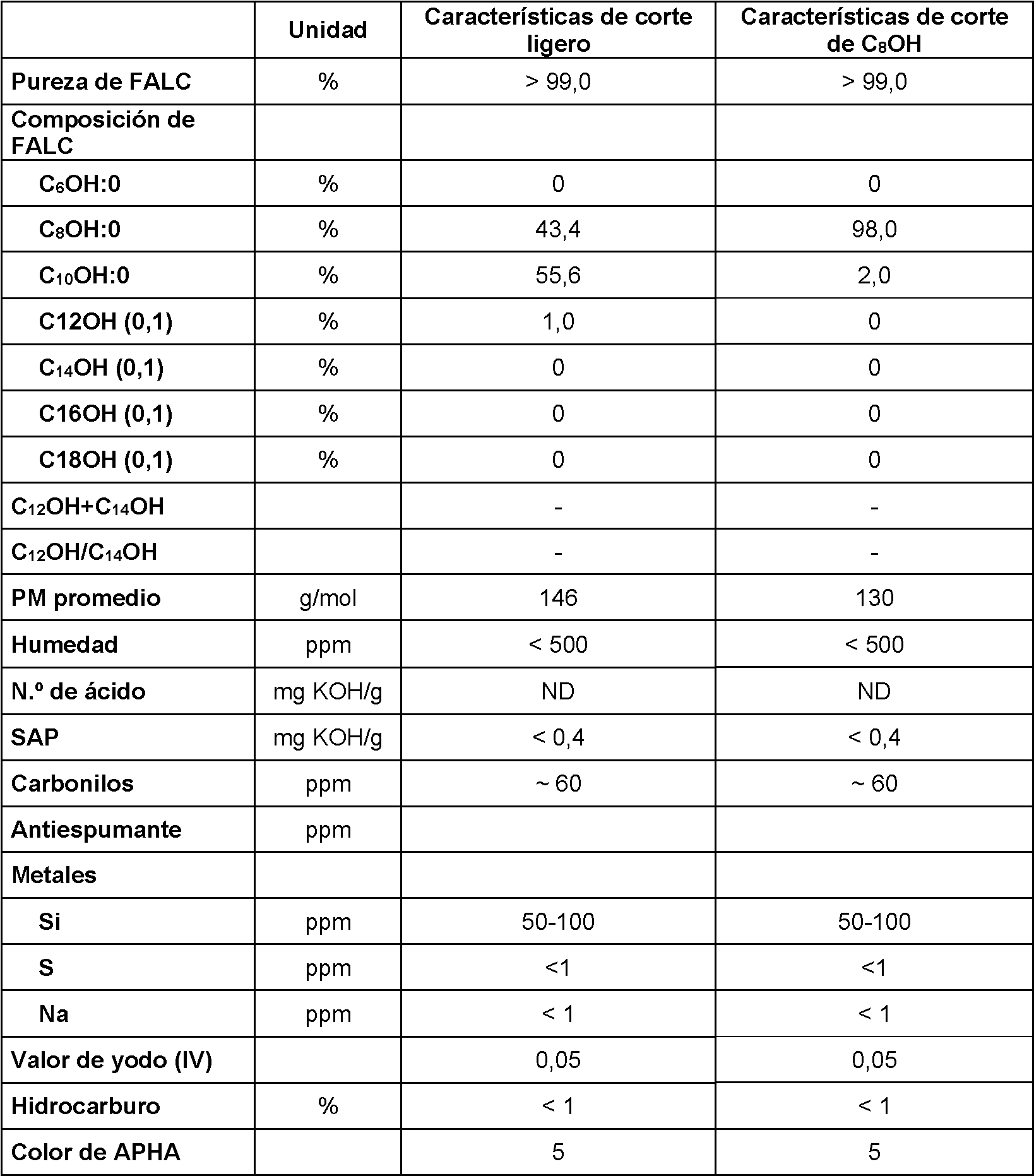
La Tabla 9 presenta las características de un corte de C10OH. Table 9 presents the characteristics of a C 10 OH cut.
Tabla 9Table 9

La Tabla 10 presenta las características de un FALC de corte medio.Table 10 presents the characteristics of a mid-cut FALC.
Tabla 10Table 10

(continuación)(continuation)

La Tabla 11 presenta las características de FALC de corte pesado.Table 11 presents the characteristics of heavy-cut FALC.
Tabla 11Table 11

(continuación)(continuation)

La Tabla 12 resume las condiciones del proceso como se describe en este ejemplo.Table 12 summarizes the process conditions as described in this example.
Tabla 12Table 12

Las condiciones de destilación fraccionada habitualmente dependen del tipo de equipo de destilación y un experto puede emplearlas según sea necesario. El rendimiento de cada etapa de procesamiento se controla para asegurar la calidad de los productos intermedios y productos finales de FALC. El requisito analítico de FALC crudo, productos intermedios y productos finales se resumen en la Tabla 13 a continuación.Fractional distillation conditions usually depend on the type of distillation equipment and can be employed by a skilled person as required. The performance of each processing stage is controlled to ensure the quality of FALC's intermediate and final products. The analytical requirement for crude FALC, intermediate products and final products are summarized in Table 13 below.
Tabla 13Table 13

(continuación)(continuation)

Ejemplo 4Example 4
Este ejemplo demuestra la purificación de FALC en otra realización más de la divulgación. En este ejemplo, la purificación de FALC se llevó a cabo sin el empleo de la etapa de evaporación adicional para generar una forma de FALC crudo (es decir, EC-FALC; véase el Ejemplo 3). Además, este ejemplo muestra la alta pureza que se puede lograr cuando FALC se enriquece con el presente método a través de la neutralización y saponificación con una base fuerte para generar la primera mezcla, y luego se evapora para generar la segunda mezcla.This example demonstrates the purification of FALC in yet another embodiment of the disclosure. In this example, the purification of FALC was carried out without the use of the additional evaporation step to generate a crude form of FALC (ie, EC-FALC; see Example 3). Furthermore, this example shows the high purity that can be achieved when FALC is enriched with the present method through neutralization and saponification with a strong base to generate the first mixture, and then evaporated to generate the second mixture.
El material de partida incluyó aproximadamente 89,95 % de FALC de cadena par, 0,78 % de FALC de cadena impar, 1,28 mg KOH/g de muestra de FFA, 13,71 mg KOH/g de muestra de FFE, 2061 ppm de compuestos que contienen carbonilo, y 2,99 % de humedad. Se añadió un total de 1,47 % en peso de NaOH (con un exceso de 0,4 % en peso de NaOH) al material de partida a 130 °C y 360 torr (48 kPa) y se agitó durante 2 horas para ir a través del proceso de neutralización y saponificación para obtener una primera mezcla. La primera mezcla (destilado de FALC neutralizado/saponificado) incluyó un FALC intermedio, donde las impurezas de FFA y FFE (que cumplen con las especificaciones de detergente o de la materia prima de alimentación) se eliminan a través de la evaporación. En el presente documento, la primera mezcla se evapora a 240 °C de temperatura de fondo de evaporación y 2 torr para generar una segunda mezcla enriquecida con FALC. La composición de la segunda mezcla se muestra en la Tabla 14 a continuación. Especialmente, la composición de la segunda mezcla incluyó FALC de aproximadamente 98,5 % de pureza. La alta pureza de la mezcla de FALC enriquecido fue sorprendente, ya que se consigue mediante un procedimiento de dos etapas relativamente simple (es decir, saponificación y evaporación (SAP/EVAP)). El 98,5 % de FALC puro aún contenía pequeñas cantidades de algunas impurezas tales como 600 ppm de carbonilo y 7,8 ppm de azufre. Estas impurezas son tan pequeñas que no interfieren con el uso de 98,5 % de FALC para los productos comerciales. Sin embargo, cualquier impureza dejada se puede eliminar a través de blanqueo, pulido y destilación fraccionada. Además, la insaturación de FALC se puede reducir a través de una etapa de hidrogenación posterior. The starting material included approximately 89.95% even chain FALC, 0.78% odd chain FALC, 1.28 mg KOH / g FFA sample, 13.71 mg KOH / g FFE sample, 2061 ppm of carbonyl-containing compounds, and 2.99% moisture. A total of 1.47% by weight of NaOH (with an excess of 0.4% by weight of NaOH) was added to the starting material at 130 ° C and 360 torr (48 kPa) and stirred for 2 hours to go through the process of neutralization and saponification to obtain a first mixture. The first blend (neutralized / saponified FALC distillate) included an intermediate FALC, where FFA and FFE impurities (meeting detergent or feedstock specifications) are removed through evaporation. Herein, the first mixture is evaporated at 240 ° C evaporating bottom temperature and 2 torr to generate a second mixture enriched with FALC. The composition of the second blend is shown in Table 14 below. Especially, the composition of the second blend included FALC of about 98.5% purity. The high purity of the enriched FALC mixture was surprising, as it is achieved by a relatively simple two-step procedure (ie, saponification and evaporation (SAP / EVAP)). 98.5% pure FALC still contained small amounts of some impurities such as 600 ppm carbonyl and 7.8 ppm sulfur. These impurities are so small that they do not interfere with the use of 98.5% FALC for commercial products. However, any impurities left can be removed through bleaching, polishing, and fractional distillation. Furthermore, the unsaturation of FALC can be reduced through a subsequent hydrogenation step.
Para ensayar la eliminación de pequeñas impurezas, se usaron las siguientes condiciones para el blanqueo a 115 °C a 80 torr (10,66 kPa) durante 1 hora de tiempo de reacción usando 0,5 % en peso de arcilla blanqueadora F-160 (BASF). Se empleó una etapa de hidrogenación de suspensión por lotes en un recipiente único para reducir FALC insaturado a 130 °C, 450 psi (3102 kPa) de H2, 4 horas de tiempo de reacción usando 1,5 % de níquel activo ((PRICAT™ 9910 de Johnson Matthey). Después del blanqueo y la hidrogenación, la pureza del FALC aumentó a aproximadamente 98,8 %. Para demostrar la calidad de FALC de corte medio (MC-FALC) generado a través de las nuevas etapas del proceso de la invención actual, la fracción ligera (LC-FALC) se eliminó primero a 83 °C de temperatura de vapor y 2 torr con relación de reflujo de 2:1 seguido por destilación de MC-FALC a 168 °C de temperatura de vapor y 2 torr con relación de reflujo de 2:1. Aunque la distribución de longitud de cadena de MC-FALC generada no está cumpliendo con exactamente MC-FALC comercial, está lo suficientemente cerca para demostrar todas las demás especificaciones excepto el valor de hidroxilo.To test the removal of small impurities, the following bleaching conditions were used at 115 ° C at 80 torr (10.66 kPa) for 1 hour of reaction time using 0.5% by weight of bleaching clay F-160 ( BASF). A single pot slurry hydrogenation step was employed to reduce unsaturated FALC to 130 ° C, 450 psi (3102 kPa) H2, 4 hour reaction time using 1.5% active nickel ((PRICAT ™ 9910 from Johnson Matthey). After bleaching and hydrogenation, the purity of the FALC increased to approximately 98.8%. To demonstrate the quality of mid-cut FALC (MC-FALC) generated through the new process steps of the Current invention, the light fraction (LC-FALC) was removed first at 83 ° C vapor temperature and 2 torr with reflux ratio of 2: 1 followed by distillation of MC-FALC at 168 ° C vapor temperature and 2 torr with 2: 1 reflux ratio Although the MC-FALC chain length distribution generated is not exactly meeting commercial MC-FALC, it is close enough to demonstrate all other specifications except the hydroxyl value.
Tabla 14Table 14

(continuación)(continuation)

Claims (18)
Applications Claiming Priority (2)
| Application Number | Priority Date | Filing Date | Title |
|---|---|---|---|
| US201361774375P | 2013-03-07 | 2013-03-07 | |
| PCT/US2014/021776 WO2014138590A2 (en) | 2013-03-07 | 2014-03-07 | Downstream processing of fatty alcohol compositions produced by recombinant host cells |
Publications (1)
| Publication Number | Publication Date |
|---|---|
| ES2828751T3 true ES2828751T3 (en) | 2021-05-27 |
Family
ID=50489383
Family Applications (1)
| Application Number | Title | Priority Date | Filing Date |
|---|---|---|---|
| ES14717901T Active ES2828751T3 (en) | 2013-03-07 | 2014-03-07 | Downstream Processing of Fatty Alcohol Compositions Produced by Recombinant Host Cells |
Country Status (13)
| Country | Link |
|---|---|
| US (3) | US11053184B2 (en) |
| EP (2) | EP3770142A1 (en) |
| JP (4) | JP6335934B2 (en) |
| KR (4) | KR102363796B1 (en) |
| CN (1) | CN105324358B (en) |
| AU (1) | AU2014225436B2 (en) |
| BR (1) | BR112015021763B1 (en) |
| CA (1) | CA2904406C (en) |
| ES (1) | ES2828751T3 (en) |
| MX (2) | MX2015011738A (en) |
| MY (1) | MY180895A (en) |
| SI (1) | SI2964598T1 (en) |
| WO (1) | WO2014138590A2 (en) |
Families Citing this family (2)
| Publication number | Priority date | Publication date | Assignee | Title |
|---|---|---|---|---|
| BR112015021763B1 (en) | 2013-03-07 | 2021-06-08 | Genomatica, Inc | method of purifying a fatty alcohol (falc) |
| KR20230128706A (en) | 2022-02-28 | 2023-09-05 | 엘지디스플레이 주식회사 | Light emitting display apparatus |
Family Cites Families (27)
| Publication number | Priority date | Publication date | Assignee | Title |
|---|---|---|---|---|
| US2753297A (en) | 1952-02-28 | 1956-07-03 | Exxon Research Engineering Co | Process for removal of sulfur impurities from alcohols |
| JPS59118090A (en) | 1982-12-22 | 1984-07-07 | Shozaburo Kitaoka | Preparation of wax ester, higher fatty alcohol and higher fatty acid |
| JPH0763561B2 (en) * | 1986-10-29 | 1995-07-12 | ケイエフエンジニアリング株式会社 | Distillation method of acetone, butanol and ethanol fermentation broth |
| DE3828537A1 (en) | 1988-08-23 | 1990-03-01 | Basf Ag | NEW N-SUBSTITUTED BENZIMIDAZOLE-2-CARBON-SAFE ANILIDES, THEIR USE AS LIGHT PROTECTION AGENTS, ESPECIALLY POLYMERS AND ORGANIC MATERIAL CONTAINING THOSE ANILIDES |
| GB8906443D0 (en) * | 1989-03-21 | 1989-05-04 | Unilever Plc | Process for refining glyceride oil using silica hydrogel |
| JPH02298239A (en) * | 1989-05-12 | 1990-12-10 | Kobe Steel Ltd | Method for rolling al-si series alloy |
| HUP9900184A3 (en) * | 1995-06-29 | 2000-01-28 | Sasol Tech Pty Ltd | Process for producing oxygenated products and reaction products made by these processes |
| WO1998037045A1 (en) * | 1997-02-24 | 1998-08-27 | Sasol Technology (Proprietary) Limited | Treatment of an organic feedstock containing undesired oxygenated organic compounds |
| DE19848548C2 (en) * | 1998-10-21 | 2001-06-13 | Cognis Deutschland Gmbh | Process for processing contaminated fatty alcohol mixtures |
| MY128880A (en) | 2001-06-12 | 2007-02-28 | Shell Int Research | Process for the preparation of a highly liear alcohol composition |
| DK1270734T3 (en) | 2001-06-21 | 2008-05-05 | T & T Oleochemie Gmbh | Process for enzymatic cleavage of oils and fats |
| DE10252173B3 (en) * | 2002-11-09 | 2004-06-03 | Celanese Chemicals Europe Gmbh | Process for the recovery of aliphatic C3-C10 alcohols from high boilers |
| JP4034289B2 (en) * | 2004-04-02 | 2008-01-16 | 花王株式会社 | Method for producing fatty alcohol |
| US8110670B2 (en) | 2006-05-19 | 2012-02-07 | Ls9, Inc. | Enhanced production of fatty acid derivatives |
| US20100242345A1 (en) | 2006-05-19 | 2010-09-30 | LS9, Inc | Production of fatty acids & derivatives thereof |
| AU2007254151A1 (en) | 2006-05-19 | 2007-11-29 | Ls9, Inc. | Production of fatty acids and derivatives thereof |
| CA3035878C (en) * | 2007-03-28 | 2023-01-03 | REG Life Sciences, LLC | Enhanced production of fatty acid derivatives |
| US8143034B2 (en) * | 2007-08-21 | 2012-03-27 | Polytechnic Institute Of New York University | Method for preparing long-chain hydroxyacids, diacids and oligomers and polymers thereof |
| MX338039B (en) * | 2008-04-09 | 2016-03-30 | Solazyme Inc | DIRECT CHEMICAL MODIFICATION OF BACTERIAL BIOMASS AND MICROBIAL OILS. |
| JP2011522525A (en) * | 2008-05-16 | 2011-08-04 | エルエス9・インコーポレイテッド | Methods and compositions for producing hydrocarbons |
| WO2010062480A2 (en) | 2008-10-28 | 2010-06-03 | Ls9, Inc. | Methods and compositions for producing fatty alcohols |
| KR101742749B1 (en) | 2009-05-20 | 2017-06-01 | 바스프 에스이 | Process for producing fatty alcohols by hydrogenation of fatty acid triglycerides on a copper-containing heterogeneous catalyst |
| WO2011127409A2 (en) | 2010-04-08 | 2011-10-13 | Ls9, Inc. | Methods and compositions related to fatty alcohol biosynthetic enzymes |
| KR20130032897A (en) * | 2010-06-18 | 2013-04-02 | 부타맥스 어드밴스드 바이오퓨얼스 엘엘씨 | Production of alcohol esters and in situ product removal during alcohol fermentation |
| CA2825691C (en) | 2011-02-02 | 2020-08-25 | Solazyme, Inc. | Tailored oils produced from recombinant oleaginous microorganisms |
| EP2522650B1 (en) * | 2011-05-13 | 2016-03-09 | Cognis IP Management GmbH | Process for purifying crude fatty alcohols |
| BR112015021763B1 (en) | 2013-03-07 | 2021-06-08 | Genomatica, Inc | method of purifying a fatty alcohol (falc) |
-
2014
- 2014-03-07 BR BR112015021763-0A patent/BR112015021763B1/en active IP Right Grant
- 2014-03-07 MY MYPI2015002213A patent/MY180895A/en unknown
- 2014-03-07 CN CN201480022365.2A patent/CN105324358B/en not_active Expired - Fee Related
- 2014-03-07 WO PCT/US2014/021776 patent/WO2014138590A2/en not_active Ceased
- 2014-03-07 KR KR1020217019437A patent/KR102363796B1/en not_active Expired - Fee Related
- 2014-03-07 CA CA2904406A patent/CA2904406C/en active Active
- 2014-03-07 KR KR1020157027462A patent/KR102271255B1/en not_active Expired - Fee Related
- 2014-03-07 KR KR1020227035633A patent/KR20220143966A/en not_active Ceased
- 2014-03-07 SI SI201431707T patent/SI2964598T1/en unknown
- 2014-03-07 US US14/773,149 patent/US11053184B2/en not_active Expired - Fee Related
- 2014-03-07 EP EP20183045.2A patent/EP3770142A1/en not_active Withdrawn
- 2014-03-07 ES ES14717901T patent/ES2828751T3/en active Active
- 2014-03-07 EP EP14717901.4A patent/EP2964598B1/en active Active
- 2014-03-07 MX MX2015011738A patent/MX2015011738A/en unknown
- 2014-03-07 KR KR1020227004739A patent/KR102456004B1/en active Active
- 2014-03-07 AU AU2014225436A patent/AU2014225436B2/en not_active Ceased
- 2014-03-07 JP JP2015561715A patent/JP6335934B2/en not_active Expired - Fee Related
-
2015
- 2015-09-07 MX MX2020002127A patent/MX2020002127A/en unknown
-
2017
- 2017-12-18 JP JP2017241266A patent/JP6933971B2/en active Active
-
2020
- 2020-01-31 JP JP2020014262A patent/JP7330907B2/en active Active
-
2021
- 2021-05-25 US US17/330,026 patent/US20210323900A1/en not_active Abandoned
-
2022
- 2022-01-26 JP JP2022009779A patent/JP2022045359A/en active Pending
-
2023
- 2023-06-14 US US18/334,745 patent/US12516007B2/en active Active
Also Published As
Similar Documents
| Publication | Publication Date | Title |
|---|---|---|
| US12516007B2 (en) | Downstream processing of fatty alcohol compositions produced by recombinant host cells | |
| FR2929621A1 (en) | Esterifying free fatty acid, useful to prepare bio-diesel, comprises providing a fatty substance comprising free fatty acid, adding alcohol and methane sulfonic acid, conducting esterification reaction, and recovering the fatty substance | |
| KR101757094B1 (en) | Use of sulphonic acid for recovering glycerol from a triglyceride transesterification reaction | |
| JP5145588B2 (en) | Method for producing fatty acid lower alkyl ester | |
| WO2007060993A1 (en) | Process for producing fatty acid alkyl ester | |
| JP2009126847A (en) | Method for removing trace glycerin from fatty acid alkyl ester | |
| JP2009167141A (en) | Hydrogenated fatty acid alkyl ester for producing fatty acid alkyl ester sulfonate and method for producing the same, fatty acid alkyl ester sulfonate and method for producing the same | |
| JP2938586B2 (en) | Method for producing α-sulfofatty acid ester | |
| JP2024125431A (en) | Method for producing fatty acid alkyl ester sulfonate using coffee oil | |
| RO133834A2 (en) | Process for preparing glycerin carbonate from plant or animal () renewable sources by producing biodisel and recovery of glycerin as by-product of the process | |
| JP5538236B2 (en) | Method for selecting fatty acid alkyl ester for production of α-sulfo fatty acid alkyl ester (salt), method for predicting coloring degree of reaction product, method for producing α-sulfo fatty acid alkyl ester (salt) | |
| AU2024298670A1 (en) | Method for producing biofuel and method for improving methyl esterification efficiency of tamanu oil | |
| FR2960874A1 (en) | PROCESS FOR THE PRODUCTION OF ALCOHOL ESTERS FROM TRIGLYCERIDES AND ALCOHOLS USING HETEROGENEOUS CATALYSTS BASED ON NITROGEN METALLOPHOSPHATES | |
| FR2952636A1 (en) | Catalytic process for producing composition of linear monocarboxylic acid alcohol esters and glycerin, comprises reacting neutral or acidic, virgin or recycled vegetable or animal oil and monohydric alcohol with heterogeneous catalyst | |
| FR2970250A1 (en) | PROCESS FOR PRODUCING ALCOHOLIC ESTERS FROM TRIGLYCERIDES AND ALCOHOLS USING HETEROGENEOUS CATALYSTS BASED ON GROUP 13 TRANSITION METAL PHOSPHATES |