ES2829253T3 - Resolution of racemic beta-aminosulfone compounds - Google Patents
Resolution of racemic beta-aminosulfone compounds Download PDFInfo
- Publication number
- ES2829253T3 ES2829253T3 ES18716164T ES18716164T ES2829253T3 ES 2829253 T3 ES2829253 T3 ES 2829253T3 ES 18716164 T ES18716164 T ES 18716164T ES 18716164 T ES18716164 T ES 18716164T ES 2829253 T3 ES2829253 T3 ES 2829253T3
- Authority
- ES
- Spain
- Prior art keywords
- ethoxy
- methoxyphenyl
- amine
- methylsulfonyl
- formula
- Prior art date
- Legal status (The legal status is an assumption and is not a legal conclusion. Google has not performed a legal analysis and makes no representation as to the accuracy of the status listed.)
- Active
Links
- 0 COc1c(*)cc(C(CS(C)(=O)=O)N)cc1 Chemical compound COc1c(*)cc(C(CS(C)(=O)=O)N)cc1 0.000 description 3
Classifications
-
- C—CHEMISTRY; METALLURGY
- C07—ORGANIC CHEMISTRY
- C07D—HETEROCYCLIC COMPOUNDS
- C07D209/00—Heterocyclic compounds containing five-membered rings, condensed with other rings, with one nitrogen atom as the only ring hetero atom
- C07D209/02—Heterocyclic compounds containing five-membered rings, condensed with other rings, with one nitrogen atom as the only ring hetero atom condensed with one carbocyclic ring
- C07D209/44—Iso-indoles; Hydrogenated iso-indoles
- C07D209/48—Iso-indoles; Hydrogenated iso-indoles with oxygen atoms in positions 1 and 3, e.g. phthalimide
-
- C—CHEMISTRY; METALLURGY
- C07—ORGANIC CHEMISTRY
- C07C—ACYCLIC OR CARBOCYCLIC COMPOUNDS
- C07C233/00—Carboxylic acid amides
- C07C233/01—Carboxylic acid amides having carbon atoms of carboxamide groups bound to hydrogen atoms or to acyclic carbon atoms
- C07C233/45—Carboxylic acid amides having carbon atoms of carboxamide groups bound to hydrogen atoms or to acyclic carbon atoms having the nitrogen atom of at least one of the carboxamide groups bound to a carbon atom of a hydrocarbon radical substituted by carboxyl groups
- C07C233/46—Carboxylic acid amides having carbon atoms of carboxamide groups bound to hydrogen atoms or to acyclic carbon atoms having the nitrogen atom of at least one of the carboxamide groups bound to a carbon atom of a hydrocarbon radical substituted by carboxyl groups with the substituted hydrocarbon radical bound to the nitrogen atom of the carboxamide group by an acyclic carbon atom
- C07C233/47—Carboxylic acid amides having carbon atoms of carboxamide groups bound to hydrogen atoms or to acyclic carbon atoms having the nitrogen atom of at least one of the carboxamide groups bound to a carbon atom of a hydrocarbon radical substituted by carboxyl groups with the substituted hydrocarbon radical bound to the nitrogen atom of the carboxamide group by an acyclic carbon atom having the carbon atom of the carboxamide group bound to a hydrogen atom or to a carbon atom of an acyclic saturated carbon skeleton
-
- C—CHEMISTRY; METALLURGY
- C07—ORGANIC CHEMISTRY
- C07C—ACYCLIC OR CARBOCYCLIC COMPOUNDS
- C07C317/00—Sulfones; Sulfoxides
- C07C317/26—Sulfones; Sulfoxides having sulfone or sulfoxide groups and nitrogen atoms, not being part of nitro or nitroso groups, bound to the same carbon skeleton
- C07C317/28—Sulfones; Sulfoxides having sulfone or sulfoxide groups and nitrogen atoms, not being part of nitro or nitroso groups, bound to the same carbon skeleton with sulfone or sulfoxide groups bound to acyclic carbon atoms of the carbon skeleton
Landscapes
- Chemical & Material Sciences (AREA)
- Organic Chemistry (AREA)
- Organic Low-Molecular-Weight Compounds And Preparation Thereof (AREA)
Abstract
Procedimiento para la preparación de una sal de N-formil leucina enantioméricamente pura de 1-(3-etoxi-4- metoxifenil)-2-(metilsulfonil)etan-1-amina (4) **(Ver fórmula)** comprendiendo dicho procedimiento las etapas de: a) proporcionar 1-(3-etoxi-4-20 metoxifenil)-2-(metilsulfonil)etan-1-amina en forma de una mezcla racémica (1') o en forma de una mezcla enantioméricamente enriquecida de la misma (1"); **(Ver fórmula)** b) resolver ópticamente dicha mezcla racémica (1') o enantioméricamente enriquecida (1") mediante tratamiento con una N-formil leucina enantioméricamente pura en presencia de un disolvente para producir las correspondientes sales de N-formil-leucina enantioméricamente puras (4).Procedure for the preparation of an enantiomerically pure N-formyl leucine salt of 1- (3-ethoxy-4-methoxyphenyl) -2- (methylsulfonyl) ethane-1-amine (4) ** (See formula) ** comprising said process the steps of: a) providing 1- (3-ethoxy-4-20 methoxyphenyl) -2- (methylsulfonyl) ethan-1-amine in the form of a racemic mixture (1 ') or in the form of an enantiomerically enriched mixture of the same (1 "); ** (See formula) ** b) optically resolve said racemic (1 ') or enantiomerically enriched mixture (1") by treatment with an enantiomerically pure N-formyl leucine in the presence of a solvent to produce the corresponding enantiomerically pure N-formyl-leucine salts (4).
Description
DESCRIPCIÓNDESCRIPTION
Resolución de compuestos de beta-aminosulfona racémicosResolution of racemic beta-aminosulfone compounds
Campo de la invenciónField of the invention
[0001] La presente invención proporciona un procedimiento industrialmente viable y ventajoso para la preparación de la (S)-beta-aminosulfona que tiene el nombre IUPAC (S)-2-(3-etoxi-4-metoxifenil)-1-(metilsulfonil)-et-2-ilamina y la fórmula (1) representada a continuación, partiendo de la correspondiente mezcla racémica. Dicha (S)-betaaminosulfona es un intermedio útil para la preparación de W-(2-((1S)-1-(3-etoxi-4-metoxifenil)-2-(metilsulfonil)etil)-2,3-dihidro-1,3-dioxo-1H-isoindol-4-il)acetamida, también conocida como Apremilast (compuesto que tiene la fórmula que se muestra a continuación), siendo ésta última adecuada para tratar, prevenir y/o controlar la psoriasis o la artritis psoriásica.[0001] The present invention provides an industrially viable and advantageous process for the preparation of (S) -beta-aminosulfone having the IUPAC name (S) -2- (3-ethoxy-4-methoxyphenyl) -1- (methylsulfonyl ) -et-2-ylamine and formula (1) represented below, starting from the corresponding racemic mixture. Said (S) -betaaminosulfone is a useful intermediate for the preparation of W- (2 - ((1S) -1- (3-ethoxy-4-methoxyphenyl) -2- (methylsulfonyl) ethyl) -2,3-dihydro- 1,3-dioxo-1H-isoindol-4-yl) acetamide, also known as Apremilast (compound that has the formula shown below), the latter being suitable for treating, preventing and / or controlling psoriasis or arthritis psoriatic.

Antecedentes de la invenciónBackground of the invention
[0002] Apremilast es un inhibidor de molécula pequeña oral novedoso de la fosfodiesterasa 4 (PDE4) que funciona intracelularmente para modular una red de mediadores proinflamatorios y antiinflamatorios. La fosfodiesterasa 4 es una PDE específica del monofosfato de adenosina cíclico (AMPc) y es la PDE dominante en las células inflamatorias. La inhibición de PDE4 eleva los niveles intracelulares de AMPc, que a su vez regula a la baja la respuesta inflamatoria al modular la expresión del factor de necrosis tumoral alfa (TNF-a), interleucina (IL)-23, IL-17 y otras citocinas proinflamatorias. La elevación de AMPc también aumenta las citocinas antiinflamatorias. Estos mediadores proinflamatorios y antiinflamatorios se han relacionado con la psoriasis y la artritis psoriásica.[0002] Apremilast is a novel oral small molecule inhibitor of phosphodiesterase 4 (PDE4) that functions intracellularly to modulate a network of pro-inflammatory and anti-inflammatory mediators. Phosphodiesterase 4 is a specific PDE for cyclic adenosine monophosphate (cAMP) and is the dominant PDE in inflammatory cells. Inhibition of PDE4 elevates intracellular levels of cAMP, which in turn downregulates the inflammatory response by modulating the expression of tumor necrosis factor-alpha (TNF-a), interleukin (IL) -23, IL-17, and others pro-inflammatory cytokines. Elevation of cAMP also increases anti-inflammatory cytokines. These pro-inflammatory and anti-inflammatory mediators have been linked to psoriasis and psoriatic arthritis.
[0003] En base a estos efectos, se está desarrollando Apremilast para su uso en el tratamiento de diversas afecciones inflamatorias mediadas por el sistema inmunitario, tales como psoriasis, artritis reumatoide, enfermedad de Behget y espondilitis anquilosante.[0003] Based on these effects, Apremilast is being developed for use in treating various inflammatory conditions mediated by the immune system, such as psoriasis, rheumatoid arthritis, Behget's disease, and ankylosing spondylitis.
[0004] Como es el caso de la gran mayoría de fármacos, Apremilast es una molécula quiral y sólo el enantiómero [5] de beta-aminosulfona (1) es útil para la preparación de la misma. En general, una mezcla de enantiómeros (R, S) puede contener los dos enantiómeros en cualquier proporción entre sí. La pureza enantiomérica se expresa generalmente como "exceso enantiomérico" o ee y se define, por ejemplo, para el enantiómero (S), como [(S-R)/(R+S)] x 100, donde S y R son respectivamente las cantidades de los enantiómeros (S) y (R) (tal como se determina, por ejemplo, mediante CG o HPLC en una fase estacionaria quiral o polarimetría).[0004] As is the case with the vast majority of drugs, Apremilast is a chiral molecule and only the [5] enantiomer of beta-aminosulfone (1) is useful for its preparation. In general, a mixture of (R, S) enantiomers can contain the two enantiomers in any ratio to each other. Enantiomeric purity is generally expressed as "enantiomeric excess" or ee and is defined, for example, for the (S) enantiomer, as [(SR) / (R + S)] x 100, where S and R are respectively the amounts of the (S) and (R) enantiomers (as determined, for example, by GC or HPLC in a chiral stationary phase or polarimetry).
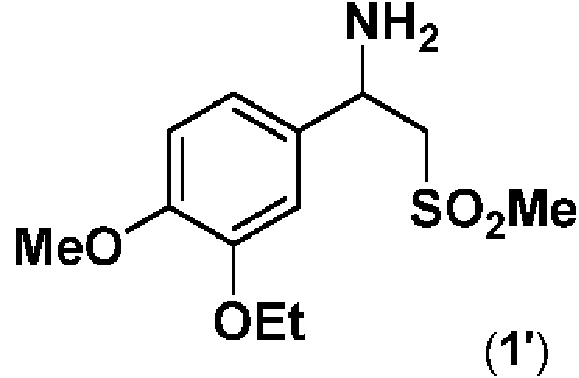
[0005] La beta-aminosulfona (1) podría obtenerse en la forma enantiomérica deseada (S) mediante síntesis enantioselectiva directa o mediante síntesis no enantioselectiva, seguida de separación de la mezcla de enantiómeros y aislamiento del de interés. Las rutas sintéticas no enantioselectivas conducen a una mezcla racémica, es decir, una mezcla en la que dos posibles enantiómeros de un compuesto están presentes en cantidades iguales; en el presente documento, (1) designará un enantiómero enantioméricamente puro, mientras que con (1') se indicará la mezcla racémica (racemato) del compuesto (1), y con (1") una mezcla enantioméricamente enriquecida del mismo.[0005] Beta-aminosulfone (1) could be obtained in the desired enantiomeric form (S) by direct enantioselective synthesis or by non-enantioselective synthesis, followed by separation of the enantiomeric mixture and isolation of the one of interest. Non-enantioselective synthetic pathways lead to a racemic mixture, that is, a mixture in which two possible enantiomers of a compound are present in equal amounts; Herein, (1) will designate an enantiomerically pure enantiomer, while with (1 ') the racemic mixture (racemate) of compound (1) will be indicated, and with (1 ") an enantiomerically enriched mixture thereof.
[0006] Los procedimientos enantioselectivos se basan en catálisis asimétrica, tal como, por ejemplo, hidrogenación o transferencia catalítica asimétrica, aminación reductora asimétrica, reducción asimétrica a través de oxazaborolidina quiral. Sin embargo, estas rutas sintéticas requieren el uso de materiales costosos, por ejemplo, metales de transición, tales como Rh o Ru, y también pueden ser ineficientes e inconvenientes debido a las condiciones extremas que a menudo se requieren (temperaturas muy bajas, condiciones estrictamente anhidras, altas presiones), lo que limita la utilidad de estas rutas en procedimientos industriales viables. Además, en algunos casos, la catálisis asimétrica puede carecer de enantioselectividad de modo que se requieren otras etapas, por ejemplo, cristalización, de todos modos para obtener la pureza óptica deseada. [0006] Enantioselective processes are based on asymmetric catalysis, such as, for example, asymmetric catalytic hydrogenation or transfer, asymmetric reductive amination, asymmetric reduction via chiral oxazaborolidine. However, these synthetic routes require the use of expensive materials, for example, transition metals, such as Rh or Ru, and can also be inefficient and inconvenient due to the extreme conditions that are often required (very low temperatures, strictly anhydrous, high pressures), which limits the usefulness of these routes in viable industrial processes. Furthermore, in some cases, asymmetric catalysis may lack enantioselectivity so that other steps, eg crystallization, are required anyway to obtain the desired optical purity.
[0007] Por consiguiente, en la industria, generalmente, se prefiere adoptar rutas sintéticas no enantioselectivas y aislar el enantiómero de interés al final de la síntesis con procedimientos denominados de resolución de la mezcla de enantiómeros.[0007] Accordingly, in industry, it is generally preferred to adopt non-enantioselective synthetic routes and isolate the enantiomer of interest at the end of synthesis with so-called enantiomer mixture resolution procedures.
[0008] El apremilast y otros compuestos similares se describieron por primera vez en la solicitud de patente internacional WO 00/25777 A1. El procedimiento allí descrito implica, como etapas clave, una reacción aldólica entre 3-etoxi-4-metoxibenzaldehído y dimetilsulfona en presencia de n-butil litio, bis (trimetilsilil) amida de litio y trifluoruro de boro dietileterato; la reacción de W-(1-(3-etoxi-4-metoxifenil)-2-(metilsulfonil)etil)-1,1,1-trimetilsilanamina con ácido clorhídrico; la reacción entre 1-(3-etoxi-4-metoxifenil)-2-(metilsulfonil)etan-1-amina y W-(1,3-dioxo-1,3-dihidroisobenzofuran-4-il)acetamida, y la separación final de isómeros mediante cromatografía en fase estacionaria quiral.[0008] Apremilast and other similar compounds were first described in international patent application WO 00/25777 A1. The process described there involves, as key steps, an aldol reaction between 3-ethoxy-4-methoxybenzaldehyde and dimethylsulfone in the presence of n-butyl lithium, lithium bis (trimethylsilyl) amide and boron trifluoride diethyl etherate; the reaction of W- (1- (3-ethoxy-4-methoxyphenyl) -2- (methylsulfonyl) ethyl) -1,1,1-trimethylsilanamine with hydrochloric acid; the reaction between 1- (3-ethoxy-4-methoxyphenyl) -2- (methylsulfonyl) ethan-1-amine and W- (1,3-dioxo-1,3-dihydroisobenzofuran-4-yl) acetamide, and the separation end of isomers by chiral stationary phase chromatography.

[0009] A escala industrial, el uso de esta vía de síntesis tiene varios inconvenientes causados por el pobre rendimiento de la reacción aldólica o la etapa tardía en la que se realiza la separación de enantiómeros de Apremilast. En este último aspecto, vale la pena señalar que, al convertir un compuesto racémico en un producto final enantioméricamente puro (como en el caso de Apremilast), se puede alcanzar un rendimiento máximo del 50%, lo que conduce a una pérdida de al menos el 50% del producto final.[0009] On an industrial scale, the use of this synthetic route has several drawbacks caused by the poor performance of the aldol reaction or the late stage in which the separation of enantiomers of Apremilast is carried out. In this last aspect, it is worth noting that, by converting a racemic compound into an enantiomerically pure final product (as in the case of Apremilast), a maximum yield of 50% can be achieved, which leads to a loss of at least 50% of the final product.
[0010] En la solicitud internacional WO 03/080049 A1 de Celgene se ha descrito un procedimiento alternativo para la preparación de Apremilast que implica una etapa de resolución óptica. Según esta solicitud de patente, una mezcla racémica (1') de 1-(3-etoxi-4-metoxifenil)-2-(metilsulfonil)etan-1-amina puede resolverse ópticamente mediante tratamiento con una sal de aminoácido quiral seleccionada del grupo que consiste en los isómeros L de alanina, arginina, asparagina, ácido aspártico, cisteína, glutamina, ácido glutámico, glicina, histidina, isoleucina, leucina, lisina, metionina, fenilalanina, prolina, serina, treonina, triptófano, tirosina, valina, ornitina, ácido 4-aminobutírico, ácido 2-amino isobutírico, ácido 3-amino propiónico, norleucina, norvalina, hidroxiprolina, sarcosina, citrulina, ácido cisteico, terc-butilglicina, terc-butilalanina, fenilglicina,ciclohexilalanina o preferiblemente W-acetil-leucina. [0010] An alternative method for the preparation of Apremilast involving an optical resolution step has been described in Celgene's international application WO 03/080049 A1. According to this patent application, a racemic mixture (1 ') of 1- (3-ethoxy-4-methoxyphenyl) -2- (methylsulfonyl) ethan-1-amine can be optically resolved by treatment with a chiral amino acid salt selected from the group consisting of the L isomers of alanine, arginine, asparagine, aspartic acid, cysteine, glutamine, glutamic acid, glycine, histidine, isoleucine, leucine, lysine, methionine, phenylalanine, proline, serine, threonine, tryptophan, tyrosine, valine, ornithine , 4-aminobutyric acid, 2-amino isobutyric acid, 3-amino propionic acid, norleucine, norvaline, hydroxyproline, sarcosine, citrulline, cysteic acid, tert-butylglycine, tert-butylalanine, phenylglycine, cyclohexylalanine or preferably W-acetyl-leucine.
[0011] A pesar de la gran variedad de sales que caen dentro de esta descripción, en un informe experimental presentado posteriormente el Solicitante del documento WO 03/080049 A1 comparó el uso de A/-acetil-L-leucina y N-acetil-L-fenilalanina como agentes de resolución y mostró que la N-acetil-L-leucina proporcionó la sal de aminoácido con un 77% de ee. después de una primera cristalización, mientras que la N-acetil-L-fenilalalnina solo proporcionó un 14% de ee.Despite the wide variety of salts that fall within this description, in an experimental report subsequently submitted the Applicant of WO 03/080049 A1 compared the use of A / -acetyl-L-leucine and N- acetyl- L-phenylalanine as resolving agents and showed that N-acetyl-L-leucine provided the amino acid salt with 77% ee. after a first crystallization, while N-acetyl-L-phenylalalnine only provided 14% ee.
[0012] Un inconveniente asociado con este procedimiento deriva del uso de N-acetil-L-leucina para separar los dos enantiómeros de la 1-(3-etoxi-4-metoxifenil)-2-(metilsulfonil)etan-1-amina, que conduce al aislamiento, después de dos etapas de cristalización, de un producto con un exceso enantiomérico del 98,5 % y un rendimiento global del 25% (con respecto a la 1-(3-etoxi-4-metoxifenil)-2-(metilsulfonil)etan-1-amina racémica).[0012] A drawback associated with this procedure derives from the use of N-acetyl-L-leucine to separate the two enantiomers of 1- (3-ethoxy-4-methoxyphenyl) -2- (methylsulfonyl) ethane-1-amine, which leads to the isolation, after two crystallization stages, of a product with an enantiomeric excess of 98.5% and an overall yield of 25% (with respect to 1- (3-ethoxy-4-methoxyphenyl) -2- racemic (methylsulfonyl) ethane-1-amine).
[0013] Basándose en el hecho de que, a fin de cumplir con la especificación de ICH, todos los compuestos farmacéuticamente aceptables deben tener un grado de pureza de al menos el 99,8 %, un producto que tiene un exceso enantiomérico del 98,5% debe ser sometido a al menos una etapa de cristalización adicional destinada a aumentar su perfil de pureza, lo que inevitablemente da como resultado una disminución adicional del rendimiento general y, como consecuencia, un mayor impacto económico del procedimiento.Based on the fact that, in order to meet the ICH specification, all pharmaceutically acceptable compounds must have a degree of purity of at least 99.8%, a product having an enantiomeric excess of 98, 5% must be subjected to at least one additional crystallization step aimed at increasing its purity profile, which inevitably results in a further decrease in overall yield and, as a consequence, a greater economic impact of the process.
[0014] La solicitud de patente EP 2431371 A1 describe la resolución de 1-(3-etoxi-4-metoxifenil)-2-(metilsulfonil) etan-1-amina (1') a través de la formación de sal diastereomérica con N-acetil-L-Valina (N-Ac-L-Val), tal como se muestra a continuación:[0014] Patent application EP 2431371 A1 describes the resolution of 1- (3-ethoxy-4-methoxyphenyl) -2- (methylsulfonyl) ethan-1-amine (1 ') through the formation of diastereomeric salt with N -acetyl-L-Valine (N-Ac-L-Val), as shown below:

[0015] Aunque no se hace referencia al enriquecimiento diastereomérico, el procedimiento se caracteriza por rendimientos bajos, lo que limita su escalado industrial.Although no reference is made to diastereomeric enrichment, the process is characterized by low yields, which limits its industrial scalability.
[0016] El objetivo de la presente invención es dar a conocer un nuevo procedimiento químico para preparar Apremilast o intermedios útiles en la síntesis del mismo, caracterizado por altos rendimientos y que proporciona los compuestos deseados con una pureza apropiada para su uso en productos farmacéuticos.[0016] The objective of the present invention is to provide a new chemical process to prepare Apremilast or useful intermediates in the synthesis thereof, characterized by high yields and which provides the desired compounds with an appropriate purity for use in pharmaceutical products.
Características de la invenciónCharacteristics of the invention
[0017] Estos objetivos se consiguen con la presente invención que, en un primer aspecto de la misma, se refiere a un procedimiento para la preparación de una sal de N-formil leucina enantioméricamente pura de 1-(3-etoxi-4-metoxifenil)-2-(metilsulfonil)etan-1-amina (4): These objectives are achieved with the present invention which, in a first aspect thereof, relates to a process for the preparation of an enantiomerically pure N-formyl leucine salt of 1- (3-ethoxy-4-methoxyphenyl ) -2- (methylsulfonyl) ethan-1-amine (4):
comprendiendo dicho procedimiento las siguientes operaciones:said procedure comprising the following operations:
a) proporcionar 1-(3-etoxi-4-metoxifenil)-2-(metilsulfonil)etan-1-amina en forma de una mezcla racémica (1') o en forma de una mezcla enantioméricamente enriquecida de la misma
b) resolver ópticamente dicha mezcla racémica (1') o enantioméricamente enriquecida (1") mediante tratamiento con una W-formil leucina enantioméricamente pura en presencia de un disolvente, para producir las correspondientes sales de W-formil-leucina enantioméricamente puras (4).b) optically resolving said racemic (1 ') or enantiomerically enriched (1 ") mixture by treatment with an enantiomerically pure W-formyl leucine in the presence of a solvent, to produce the corresponding enantiomerically pure W-formyl-leucine salts (4) .
[0018] En una posible variante de este aspecto de la invención, se lleva a cabo una etapa adicional b') después de la etapa b), que comprende desbloquear la sal enantioméricamente pura (4) preparada en la etapa b) para producir una 1-(3-etoxi-4-metoxifenil)-2-(metilsulfonil)etan-1-amina (1) enantioméricamente pura.In a possible variant of this aspect of the invention, an additional step b ') is carried out after step b), which comprises deblocking the enantiomerically pure salt (4) prepared in step b) to produce a Enantiomerically pure 1- (3-ethoxy-4-methoxyphenyl) -2- (methylsulfonyl) ethane-1-amine (1).
Descripción detallada de la invenciónDetailed description of the invention
[0019] Todos los términos utilizados en la presente solicitud, a menos que se indique lo contrario, deben interpretarse en su significado ordinario, tal como se conocen en el campo técnico. Otras definiciones más específicas para algunos términos usados en la presente solicitud se proporcionan a continuación y pretenden aplicarse uniformemente a la descripción completa y las reivindicaciones, a menos que se indique lo contrario.All the terms used in the present application, unless otherwise indicated, must be interpreted in their ordinary meaning, as they are known in the technical field. Other more specific definitions for some terms used in the present application are provided below and are intended to apply uniformly to the entire description and claims, unless otherwise indicated.
[0020] En general, la nomenclatura utilizada en esta solicitud se basa en AUTONOM™ v.4.0, un sistema computerizado del Beilstein Institute para la generación de nomenclatura sistemática IUPAC. Si hay una discrepancia entre una estructura representada y el nombre que se le da a esa estructura, la estructura representada debe considerarse correcta. Además, si la estereoquímica de una estructura o una parte de una estructura no se indica, por ejemplo, con líneas en negrita o discontinuas, la estructura o parte de la estructura debe interpretarse como que abarca todos los estereoisómeros existentes de la misma.In general, the nomenclature used in this application is based on AUTONOM ™ v.4.0, a computerized system from the Beilstein Institute for the generation of systematic IUPAC nomenclature. If there is a discrepancy between a rendered structure and the name given to that structure, the rendered structure should be considered correct. Furthermore, if the stereochemistry of a structure or a part of a structure is not indicated, for example, by bold or broken lines, the structure or part of the structure should be interpreted as encompassing all existing stereoisomers thereof.
[0021] Los compuestos preparados mediante los procedimientos de la presente invención pueden tener uno o más centros estereogénicos y pueden existir y pueden ser utilizados o aislados en formas enantioméricamente puras, como mezclas enantioméricas enriquecidas, así como formas diastereoméricamente puras o como mezclas diastereoméricas enriquecidas. Debe entenderse que los procedimientos de la presente invención pueden dar lugar a cualquiera de las formas anteriores o una combinación de las mismas. Debe entenderse además que los productos de los procedimientos descritos en el presente documento se pueden aislar como formas enantiomérica y diastereoméricamente puras o como mezclas enantiomérica y diastereoméricamente enriquecidas.[0021] Compounds prepared by the methods of the present invention may have one or more stereogenic centers and may exist and can be used or isolated in enantiomerically pure forms, as enantiomeric enriched mixtures, as well as diastereomerically pure forms or as enriched diastereomeric mixtures. It should be understood that the processes of the present invention can give rise to any of the above forms or a combination thereof. It should further be understood that the products of the methods described herein can be isolated as enantiomerically and diastereomerically pure forms or as enantiomerically and diastereomerically enriched mixtures.
[0022] El término "arilo" se refiere a cualquier sustituyente derivado de un hidrocarburo aromático monocíclico o policíclico mediante eliminación de un átomo de hidrógeno de un átomo de carbono del anillo (por ejemplo fenilo, tolilo, 1-naftilo o 2-naftilo).The term "aryl" refers to any substituent derived from a monocyclic or polycyclic aromatic hydrocarbon by removal of a hydrogen atom from a ring carbon atom (eg phenyl, tolyl, 1-naphthyl or 2-naphthyl) .
[0023] El signo "*" (asterisco) presente en algunas fórmulas de esta descripción indica un centro estereogénico (asimétrico), aunque la ausencia de asteriscos no implica necesariamente que el compuesto carece de un estereocentro. Tales fórmulas pueden referirse al racemato o a enantiómeros o diastereómeros individuales, que pueden ser o no sustancialmente puros.The sign "*" (asterisk) present in some formulas of this description indicates a stereogenic (asymmetric) center, although the absence of asterisks does not necessarily imply that the compound lacks a stereocenter. Such formulas may refer to the racemate or to individual enantiomers or diastereomers, which may or may not be substantially pure.
[0024] El término "racémico" se refiere a una muestra de un compuesto quiral que contiene los isómeros (+) y (-) en la misma cantidad.The term "racemic" refers to a sample of a chiral compound that contains the (+) and (-) isomers in the same amount.
[0025] El término "enantioméricamente enriquecido", tal como se usa en este documento, significa que uno de los enantiómeros de un compuesto está presente en exceso comparado con el otro enantiómero.The term "enantiomerically enriched", as used herein, means that one of the enantiomers of a compound is present in excess compared to the other enantiomer.
[0026] El término "enantioméricamente puro", tal como se usa en este documento, significa que la pureza enantiomérica es habitualmente al menos aproximadamente el 96%, preferiblemente al menos el 99%, más preferiblemente al menos el 99,5%. The term "enantiomerically pure", as used herein, means that the enantiomeric purity is usually at least about 96%, preferably at least 99%, more preferably at least 99.5%.
[0027] El símbolo ..... (enlace discontinuo) presente en algunas de las fórmulas de la descripción y de las reivindicaciones indica que el sustituyente esta dirigido por debajo del plano de la hoja.The symbol ..... (discontinuous bond) present in some of the formulas of the description and of the claims indicates that the substituent is directed below the plane of the sheet.
[0028] El símbolo — (enlace en cuña) presente en algunas de las fórmulas de la descripción y de las reivindicaciones indica que el sustituyente está dirigido por encima del plano de la hoja.The symbol - (wedge bond) present in some of the formulas of the description and of the claims indicates that the substituent is directed above the plane of the sheet.
[0029] Los compuestos obtenidos mediante las transformaciones químicas de la presente invención se pueden utilizar en las siguientes etapas sin purificación adicional u, opcionalmente, pueden separarse y purificarse empleando procedimientos convencionales bien conocidos por los expertos en la técnica, tales como recristalización, cromatografía en columna, o transformándolos en una sal o en un cocristal con un coformador apropiado, o lavando con un disolvente orgánico o con una solución acuosa, opcionalmente ajustando el pH.[0029] The compounds obtained by the chemical transformations of the present invention can be used in the following steps without further purification or, optionally, they can be separated and purified using conventional procedures well known to those skilled in the art, such as recrystallization, chromatography in column, or by transforming them into a salt or a cocrystal with an appropriate coformer, or by washing with an organic solvent or an aqueous solution, optionally adjusting the pH.
[0030] Se entenderá que cualquier compuesto descrito en este documento también puede describir cualquier sal o cocristal del mismo.[0030] It will be understood that any compound described herein can also describe any salt or cocrystal thereof.
[0031] El término "semilla" se refiere a una sustancia cristalina que se añade a una solución de la misma sustancia para inducir su cristalización. La siembra con un isómero óptico específico a menudo tiene el efecto útil de promover la cristalización de la sustancia en la misma forma de la semilla.[0031] The term "seed" refers to a crystalline substance that is added to a solution of the same substance to induce its crystallization. Seeding with a specific optical isomer often has the useful effect of promoting crystallization of the substance in the same form as the seed.
[0032] Cabe señalar que, durante la conversión de la 1-(3-etoxi-4-metoxifenil)-2-(metilsulfonil)etan-1-amina (1) enantioméricamente pura o la sal W-formil-leucina de la misma (4) en una 1,3-dioxoisoindolin-4-ilacetamida enantioméricamente pura (6), no se observa racemización (conversión del enantiómero principal en el menor que conduce a un ee. inferior). En consecuencia, el ee detectado en la 1-(3-etoxi-4-metoxifenil)-2-(metilsulfonil)etan-1-amina pura (1) o en la sal de W-formil-leucina de la misma (4), se retiene sin cambios en la 1,3-dioxoisoindolin-4-ilacetamida pura de fórmula (6).[0032] It should be noted that, during the conversion of enantiomerically pure 1- (3-ethoxy-4-methoxyphenyl) -2- (methylsulfonyl) ethan-1-amine (1) or the W-formyl-leucine salt thereof (4) In an enantiomerically pure 1,3-dioxoisoindolin-4-ylacetamide (6), no racemization is observed (conversion of the major enantiomer to the minor one leading to a lower ee.). Consequently, the ee detected in the pure 1- (3-ethoxy-4-methoxyphenyl) -2- (methylsulfonyl) ethan-1-amine (1) or in the W-formyl-leucine salt thereof (4) , is retained unchanged in the pure 1,3-dioxoisoindolin-4-ylacetamide of formula (6).
[0033] De acuerdo con su aspecto más general, la presente invención se refiere a un procedimiento para la preparación de una sal de W-formil-leucina enantioméricamente pura de 1-(3-etoxi-4-metoxifenil)-2-(metilsulfonil) etan-1-amina (4).According to its most general aspect, the present invention relates to a process for the preparation of an enantiomerically pure W-formyl-leucine salt of 1- (3-ethoxy-4-methoxyphenyl) -2- (methylsulfonyl ) ethan-1-amine (4).
[0034] La primera operación del procedimiento de la invención, a), consiste en la provisión de una 1-(3-etoxi-4-metoxifenil)-2-(metilsulfonil)etan-1-amina (1') o una mezcla enriquecida enantioméricamente de la misma (1"). Esta operación se puede realizar según dos rutas alternativas de síntesis a.i) y a.ii).[0034] The first step of the process of the invention, a), consists of providing a 1- (3-ethoxy-4-methoxyphenyl) -2- (methylsulfonyl) ethan-1-amine (1 ') or a mixture enantiomerically enriched thereof (1 "). This operation can be performed according to two alternative synthesis routes ai) and a.ii).
[0035] La ruta sintética a.i) conduce a la preparación de 1-(3-etoxi-4-metoxifenil)-2-(metilsulfonil)etan-1-amina en forma de una mezcla racémica (1'). Este esquema se puede desarrollar, por ejemplo, de acuerdo con los procedimientos detallados en el documento WO 2010/030345 A2 (a través de 3-etoxi-4-metoxibenzonitrilo) o, preferiblemente, implica las siguientes etapas:The synthetic route a.i) leads to the preparation of 1- (3-ethoxy-4-methoxyphenyl) -2- (methylsulfonyl) ethan-1-amine in the form of a racemic mixture (1 '). This scheme can be developed, for example, according to the procedures detailed in WO 2010/030345 A2 (via 3-ethoxy-4-methoxybenzonitrile) or, preferably, involves the following steps:
d) hacer reaccionar 3-etoxi-4-metoxibenzaldehído (9) con un compuesto de fórmula R1-NH2 y un compuesto de fórmula R2-S(O)OH, o una sal del mismo para obtener una aminosulfona de fórmula (2):d) reacting 3-ethoxy-4-methoxybenzaldehyde (9) with a compound of formula R1-NH2 and a compound of formula R2-S (O) OH, or a salt thereof to obtain an aminosulfone of formula (2):

en la que:in which:
R1 es un grupo protector de amino; yR1 is an amino protecting group; Y
R2 es un alquilo C1-C6, un alquilo C1-C6 sustituido, un arilo C6-C10 o un arilo C6-C10 sustituido;R2 is a C1-C6 alkyl, a substituted C1-C6 alkyl, a C6-C10 aryl or a substituted C6-C10 aryl;
e) convertir la aminosulfona de fórmula (2) en una sulfona de fórmula (3) mediante tratamiento con un carbanión derivado de dimetilsulfona: e) converting the aminosulfone of formula (2) into a sulfone of formula (3) by treatment with a carbanion derived from dimethylsulfone:
f) desproteger la sulfona (3) para obtener 1-(3-etoxi-4-metoxifenil)-2-(metilsulfonil)etan-1-amina en forma de una mezcla racémica (1').f) deprotect the sulfone (3) to obtain 1- (3-ethoxy-4-methoxyphenyl) -2- (methylsulfonyl) ethane-1-amine in the form of a racemic mixture (1 ').

Los grupos protectores de amina útiles para la presente invención son, por ejemplo, carbamatos (en los que el átomo de nitrógeno está unido a un grupo de fórmula -C(O)OR, en la que R es, por ejemplo, carbamato de metilo, etilo, terc-butoxi, alilo, bencilo, p-metoxibencilo, p-nitrobencilo, p-clorobencilo o 2,4-diclorobencilo), amidas (en las que el átomo de nitrógeno está unido a un grupo de fórmula -C(O)-R', en la que R' es, por ejemplo, hidrógeno, metilo, clorometilo, triclorometilo, trifluorometilo, fenilo o bencilo) o fosfinoamidas (en las que el átomo de nitrógeno está unido a un grupo de fórmula -P(O)-(R")2, en la que R' es, por ejemplo, arilo, preferiblemente fenilo).Amine protecting groups useful for the present invention are, for example, carbamates (where the nitrogen atom is attached to a group of the formula -C (O) OR, where R is, for example, methyl carbamate , ethyl, tert-butoxy, allyl, benzyl, p-methoxybenzyl, p-nitrobenzyl, p-chlorobenzyl or 2,4-dichlorobenzyl), amides (in which the nitrogen atom is attached to a group of formula -C (O ) -R ', in which R' is, for example, hydrogen, methyl, chloromethyl, trichloromethyl, trifluoromethyl, phenyl or benzyl) or phosphinoamides (in which the nitrogen atom is attached to a group of formula -P (O ) - (R ") 2 , where R 'is, for example, aryl, preferably phenyl).
[0036] La etapa d) incluye la conversión de 3-etoxi-4-metoxibenzaldehído (9) en una aminosulfona de fórmula (2). Esta operación se puede realizar convenientemente haciendo reaccionar 3-etoxi-4-metoxibenzaldehído (9) con un compuesto de fórmula R1-NH2 y un compuesto de fórmula R2-S(O)OH o una sal del compuesto de fórmula R2-S(O)OH, en el que los sustituyentes adoptan los significados indicados anteriormente. La etapa d) se lleva a cabo convenientemente en presencia de un ácido, preferiblemente seleccionado del grupo que consiste en un ácido de Lewis (más preferiblemente, clorotrimetilsilano) y un ácido carboxílico (más preferiblemente, ácido fórmico).[0036] Step d) includes the conversion of 3-ethoxy-4-methoxybenzaldehyde (9) into an aminosulfone of formula (2). This operation can be conveniently carried out by reacting 3-ethoxy-4-methoxybenzaldehyde (9) with a compound of formula R 1 -NH 2 and a compound of formula R 2 -S (O) OH or a salt of the compound of formula R2- S (O) OH, in which the substituents take on the meanings indicated above. Step d) is conveniently carried out in the presence of an acid, preferably selected from the group consisting of a Lewis acid (more preferably chlorotrimethylsilane) and a carboxylic acid (more preferably formic acid).
[0037] Preferiblemente, la etapa d) se lleva a cabo en presencia de una sal del compuesto de fórmula R2-S(O)OH (generalmente referido como sulfinato). Más preferiblemente, dicho sulfinato es un compuesto de fórmula R2-S(O)OM, en la que los sustituyentes adoptan los significados indicados anteriormente y M es un ión, tal como sodio, potasio, litio, calcio, magnesio, cobre o cesio. Incluso más preferiblemente, dicha sal del compuesto de fórmula R2-S(O)OH es p-toluenosulfinato de sodio.[0037] Preferably, step d) is carried out in the presence of a salt of the compound of formula R 2 -S (O) OH (generally referred to as sulphinate). More preferably, said sulphinate is a compound of formula R 2 -S (O) OM, in which the substituents take the meanings indicated above and M is an ion, such as sodium, potassium, lithium, calcium, magnesium, copper or cesium . Even more preferably, said salt of the compound of formula R 2 -S (O) OH is sodium p-toluenesulfinate.
[0038] El compuesto de fórmula R1-NH2 se selecciona preferiblemente del grupo que consiste en carbamatos (preferiblemente, carbamato de terc-butilo o bencilo), amidas (por ejemplo, formamida o acetamida), fosfinoamidas (preferiblemente, difenilfosfinoamida) o mezclas de los mismos.[0038] The compound of formula R 1 -NH 2 is preferably selected from the group consisting of carbamates (preferably, tert-butyl or benzyl carbamate), amides (for example, formamide or acetamide), phosphinoamides (preferably, diphenylphosphinoamide) or mixtures thereof.
[0039] Preferiblemente, la etapa d) se lleva a cabo en al menos un disolvente, más preferiblemente, en una mezcla que comprende agua y al menos un disolvente seleccionado del grupo que consiste en disolventes alcohólicos (por ejemplo, metanol, etanol, 2-propanol, 1-butanol, 2-butanol, terc-butanol y mezclas de los mismos) y éteres (por ejemplo, tetrahidrofurano). Según una realización preferida de este aspecto de la invención, la etapa d) se lleva a cabo en una mezcla que comprende un alcohol (preferiblemente, 1-butanol) y agua, teniendo dicha mezcla, en una realización aún más preferida, una relación del disolvente alcohólico con respecto al agua de aproximadamente 1:0,5 vol/vol a aproximadamente 1:10 vol/vol. Preferiblemente, la relación de disolvente alcohólico con respecto a agua es de aproximadamente 1:2 vol/vol a aproximadamente 1:4 vol/vol.Preferably, step d) is carried out in at least one solvent, more preferably, in a mixture comprising water and at least one solvent selected from the group consisting of alcoholic solvents (for example, methanol, ethanol, 2 -propanol, 1-butanol, 2-butanol, tert-butanol and mixtures thereof) and ethers (eg tetrahydrofuran). According to a preferred embodiment of this aspect of the invention, step d) is carried out in a mixture comprising an alcohol (preferably 1-butanol) and water, said mixture having, in an even more preferred embodiment, a ratio of alcoholic solvent to water from about 1: 0.5 vol / vol to about 1:10 vol / vol. Preferably, the ratio of alcoholic solvent to water is from about 1: 2 vol / vol to about 1: 4 vol / vol.
[0040] En la etapa d) la temperatura de reacción puede estar entre de 0 °C a 40 °C, preferiblemente de aproximadamente 10 °C a aproximadamente 20 °C. En general, cuanto mayor es la temperatura de reacción, menor es el tiempo de reacción.[0040] In step d) the reaction temperature can be between 0 ° C to 40 ° C, preferably from about 10 ° C to about 20 ° C. In general, the higher the reaction temperature, the shorter the reaction time.
[0041] La cantidad de ácido usado opcionalmente en la etapa d) (preferiblemente un ácido de Lewis o un ácido carboxílico) es convenientemente de aproximadamente 1 a aproximadamente 2 equivalentes, preferiblemente de 1,05 a 1,50 equivalentes, más preferiblemente, de 1,10 a 1,40, incluso más preferiblemente, de 1,15 a 1,35, con respecto a la cantidad molar del aldehído de partida (9).[0041] The amount of acid optionally used in step d) (preferably a Lewis acid or a carboxylic acid) is conveniently about 1 to about 2 equivalents, preferably 1.05 to 1.50 equivalents, more preferably, of 1.10 to 1.40, even more preferably 1.15 to 1.35, relative to the molar amount of the starting aldehyde (9).
El compuesto de fórmula R2-S(O)OH o la sal del mismo se utilizan en la etapa d) en cantidades convenientemente de 1 a 2 equivalentes, preferiblemente de 1,01 a 1,50 equivalentes, más preferiblemente de 1,05 a 1,40, incluso más preferiblemente de 1,08 a 1,35, con respecto a la cantidad molar del aldehído de partida (9).The compound of formula R 2 -S (O) OH or the salt thereof is used in step d) in suitably 1 to 2 equivalents, preferably 1.01 to 1.50 equivalents, more preferably 1.05 equivalents. to 1.40, even more preferably 1.08 to 1.35, relative to the molar amount of the starting aldehyde (9).
La cantidad del compuesto de fórmula R1-NH2 usado en la etapa d) es convenientemente de 1 a 2 equivalentes, preferiblemente de 1,01 a 1,50 equivalentes, más preferiblemente de 1,05 a 1,40, incluso más preferiblemente de 1,08 a 1,35, con respecto a la cantidad molar del aldehído de partida (9).The amount of the compound of formula R 1 -NH 2 used in step d) is conveniently 1 to 2 equivalents, preferably 1.01 to 1.50 equivalents, more preferably 1.05 to 1.40, even more preferably from 1.08 to 1.35, with respect to the molar amount of the starting aldehyde (9).
[0042] Los inventores han observado que, en la mezcla de reacción, la aminosulfona (2) está en equilibrio con el aldehído de partida (9), y que el equilibrio se puede desplazar hacia la aminosulfona de reacción (2) al permitir que este compuesto cristalice fuera de la mezcla de reacción, llevando así la reacción a una finalización sustancial. [0042] The inventors have observed that, in the reaction mixture, the aminosulfone (2) is in equilibrium with the starting aldehyde (9), and that the equilibrium can be shifted towards the reaction aminosulfone (2) by allowing this compound crystallizes out of the reaction mixture, thus bringing the reaction to substantial completion.
[0043] Dichas condiciones de cristalización se pueden determinar fácilmente por una persona experta en la técnica por medio de una investigación preliminar que incluya la dispersión de la aminosulfona (2) en el disolvente o mezcla de disolventes utilizados en la etapa d seleccionado) a fin de determinar su equilibrio de solubilidad.[0043] Said crystallization conditions can be easily determined by a person skilled in the art by means of a preliminary investigation that includes the dispersion of the aminosulfone (2) in the solvent or mixture of solvents used in the selected step d) in order to determine its solubility balance.
[0044] En una realización de este aspecto de la invención, la aminosulfona precipitada (2) se tritura y, finalmente, se lava con acetato de iso-propilo y posteriormente se convierte en una sulfona de fórmula (3).[0044] In one embodiment of this aspect of the invention, the precipitated aminosulfone (2) is triturated and finally washed with iso-propyl acetate and subsequently converted to a sulfone of formula (3).
[0045] La aminosulfona de fórmula (2) así obtenida, opcionalmente aislada, se convierte posteriormente en una sulfona de fórmula (3), según la etapa e).[0045] The aminosulfone of formula (2) thus obtained, optionally isolated, is subsequently converted into a sulfone of formula (3), according to step e).
[0046] La etapa e) se puede realizar tratando la aminosulfona de fórmula (2), opcionalmente convertida en la imina correspondiente (10) como se detalla a continuación, con un carbanión de dimetilsulfona. Esta etapa se puede llevar a cabo en cualquier disolvente adecuado, tales como éteres (preferiblemente éter dietílico, tetrahidrofurano, 2-metiltetrahidrofurano, terc-butil metil éter), N-metil pirrolidona, N, N-dimetilacetamida, N, N-dimetilformamida, glima, diglima, tolueno, xileno, hexano o mezclas de los mismos; a una temperatura de -80 a -30 °C, preferiblemente de -60 a -50 °C, por ejemplo a -55 °C.[0046] Step e) can be carried out by treating the aminosulfone of formula (2), optionally converted to the corresponding imine (10) as detailed below, with a dimethylsulfone carbanion. This step can be carried out in any suitable solvent, such as ethers (preferably diethyl ether, tetrahydrofuran, 2-methyltetrahydrofuran, tert-butyl methyl ether), N-methyl pyrrolidone, N, N-dimethylacetamide, N, N-dimethylformamide, glyme, diglyme, toluene, xylene, hexane, or mixtures thereof; at a temperature of -80 to -30 ° C, preferably -60 to -50 ° C, for example -55 ° C.
[0047] El carbanión de dimetilsulfona puede prepararse de acuerdo con técnicas convencionales en síntesis orgánica, por ejemplo, mediante el tratamiento de dimetilsulfona con una base fuerte. Las bases fuertes adecuadas se seleccionan preferiblemente del grupo que consiste en reactivos de organolitio, reactivos de organomagnesio o amidas de sodio, litio, potasio o magnesio. La preparación del carbanión de dimetilsulfona normalmente tiene lugar a una temperatura de -80 a -30 °C, por ejemplo de -60 a -50 °C, en un éter (preferiblemente tetrahidrofurano, éter dietílico, 2-metiltetrahidrofurano, terc-butil metil éter, bis(2-metoxietil) éter) opcionalmente en mezcla con un hidrocarburo, alifático o aromático (preferiblemente hexano, tolueno o xileno). Preferiblemente, el disolvente utilizado es una mezcla de tetrahidrofurano y n-hexano.[0047] Dimethylsulfone carbanion can be prepared according to conventional techniques in organic synthesis, for example, by treating dimethylsulfone with a strong base. Suitable strong bases are preferably selected from the group consisting of organolithium reagents, organomagnesium reagents, or sodium, lithium, potassium or magnesium amides. The preparation of the dimethylsulfone carbanion usually takes place at a temperature of -80 to -30 ° C, for example -60 to -50 ° C, in an ether (preferably tetrahydrofuran, diethyl ether, 2-methyltetrahydrofuran, tert-butyl methyl ether, bis (2-methoxyethyl) ether) optionally in admixture with a hydrocarbon, aliphatic or aromatic (preferably hexane, toluene or xylene). Preferably, the solvent used is a mixture of tetrahydrofuran and n-hexane.
[0048] Los reactivos de organolitio útiles para este propósito son, por ejemplo n-butil litio, sec-butil litio, fenil litio, neopentil litio, propil litio, terc-butil litio o preferiblemente hexil litio; los reactivos de organomagnesio son, por ejemplo, un haluro de terc-butilmagnesio o isopropilmagnesio (preferiblemente cloruro de terc-butilmagnesio o isopropilmagnesio); las amidas de litio, sodio, potasio o magnesio se seleccionan, por ejemplo, del grupo que comprende bis(trimetilsilil) amidas de sodio, litio o potasio (NaHMDS, LiHMDS o KHMDS), diisopropilamida de litio (LDA) o bis(diisopropilamida) de magnesio (MDA).[0048] Organolithium reagents useful for this purpose are, for example, n-butyl lithium, sec-butyl lithium, phenyl lithium, neopentyl lithium, propyl lithium, tert-butyl lithium or preferably hexyl lithium; organomagnesium reagents are, for example, a tert-butylmagnesium or isopropylmagnesium halide (preferably tert-butylmagnesium or isopropylmagnesium chloride); lithium, sodium, potassium or magnesium amides are selected, for example, from the group comprising sodium, lithium or potassium bis (trimethylsilyl) amides (NaHMDS, LiHMDS or KHMDS), lithium diisopropylamide (LDA) or bis (diisopropylamide) magnesium (MDA).
[0049] En el caso cuando un reactivo de organomagnesio se utiliza para preparar el carbanión de dimetilsulfona, las condiciones de reacción convenientes incluyen la presencia de al menos un haluro alcalino (preferiblemente un cloruro), por ejemplo un cloruro de litio, sodio, potasio o cesio, o de un haluro de zinc o cobre. Más preferiblemente, el carbanión de dimetilsulfona se prepara mediante una mezcla de cloruro de isopropilmagnesio y cloruro de litio.[0049] In the case when an organomagnesium reagent is used to prepare the dimethylsulfone carbanion, convenient reaction conditions include the presence of at least one alkali halide (preferably a chloride), for example a lithium, sodium, potassium chloride or cesium, or a zinc or copper halide. More preferably, the dimethylsulfone carbanion is prepared by a mixture of isopropylmagnesium chloride and lithium chloride.
[0050] Alternativamente, dicho carbanión se puede preparar mediante el tratamiento de dimetilsulfona con un hidruro (preferiblemente hidruro de sodio, litio o potasio) o un terc-butóxido de metal alcalino (tal como terc-butóxido de sodio o potasio) a una temperatura de -40 a 50 °C, por ejemplo de -30 a 40 °C, en un éter (preferiblemente tetrahidrofurano), en N, N-dimetilacetamida o en N, N-dimetilformamida.Alternatively, said carbanion can be prepared by treating dimethylsulfone with a hydride (preferably sodium, lithium or potassium hydride) or an alkali metal tert-butoxide (such as sodium or potassium tert-butoxide) at a temperature from -40 to 50 ° C, for example from -30 to 40 ° C, in an ether (preferably tetrahydrofuran), in N, N-dimethylacetamide or in N, N-dimethylformamide.
[0051] La base fuerte se utiliza preferiblemente en cantidad estequiométrica con respecto a la cantidad molar de dimetilsulfona utilizada.[0051] The strong base is preferably used in a stoichiometric amount relative to the molar amount of dimethylsulfone used.
[0052] La proporción molar del carbanión de dimetilsulfona con respecto a la aminosulfona de fórmula (2) es normalmente de 1 a 6, preferiblemente de 3 a 4.[0052] The molar ratio of the dimethylsulfone carbanion to the aminosulfone of formula (2) is usually 1 to 6, preferably 3 to 4.
[0053] En una posible variante de esta operación, la aminosulfona de fórmula (2) se convierte en la imina correspondiente (10):[0053] In a possible variant of this operation, the aminosulfone of formula (2) is converted into the corresponding imine (10):

en la que R1 puede adoptar cualquiera de los significados indicados anteriormente;wherein R1 can take any of the meanings indicated above;
que posteriormente se trata con el carbanión de dimetilsulfona. which is subsequently treated with dimethylsulfone carbanion.
[0054] Dicha imina (10) puede preparse, por ejemplo, mediante tratamiento de la aminosulfona (2) con una de las bases mencionadas anteriormente para operar la etapa e). Alternativamente, dicha etapa se puede realizar tratando la aminosulfona (2) con un hidróxido o un carbonato de un metal alcalino (tal como K2CO3, Na2CO3, Li2CO3, Cs2CO3, KOH, NaOH, LiOH) en un disolvente miscible en agua (por ejemplo, metanol, etanol, tetrahidrofurano, dimetoxietano, dioxano o una mezcla de los mismos) opcionalmente en mezcla con agua. La cantidad del hidróxido o carbonato del metal alcalino utilizada es normalmente de 1 a 5 equivalentes, preferiblemente de 1,5 a 2 equivalentes, en comparación con la cantidad molar de la aminosulfona (2) utilizada.[0054] Said imine (10) can be prepared, for example, by treating the aminosulfone (2) with one of the bases mentioned above to operate step e). Alternatively, said step can be carried out by treating the aminosulfone (2) with an alkali metal hydroxide or carbonate (such as K2CO3, Na2CO3, Li2CO3, Cs2CO3, KOH, NaOH, LiOH) in a water-miscible solvent (for example, methanol, ethanol, tetrahydrofuran, dimethoxyethane, dioxane or a mixture thereof) optionally in admixture with water. The amount of the alkali metal hydroxide or carbonate used is usually 1 to 5 equivalents, preferably 1.5 to 2 equivalents, compared to the molar amount of the aminosulfone (2) used.
[0055] Preferiblemente, el carbanión de dimetilsulfona utilizado en la etapa e) es LiCH2SO2Me, más preferiblemente, LiCH2SO2Me preparado in situ por reacción de Me2SO2 con nBuLi o, incluso más preferiblemente, con nHexLi.[0055] Preferably, the dimethylsulfone carbanion used in step e) is LiCH2SO2Me, more preferably LiCH2SO2Me prepared in situ by reacting Me2SO2 with nBuLi or, even more preferably, with nHexLi.
[0056] Preferiblemente, en el caso cuando nHexLi se utiliza para preparar el carbanión de dimetilsulfona, la relación de compuesto intermedio (2) con respecto a dimetilsulfona y nHexLi es de aproximadamente 1:2:2 a aproximadamente 1:6:6 en base molar, preferiblemente aproximadamente 1:4:4 en base molar.[0056] Preferably, in the case when nHexLi is used to prepare the dimethylsulfone carbanion, the ratio of intermediate (2) to dimethylsulfone and nHexLi is from about 1: 2: 2 to about 1: 6: 6 on a basis molar, preferably about 1: 4: 4 on a molar basis.
[0057] La siguiente etapa f), implica la conversión de sulfona (3), opcionalmente aislada, en una mezcla racémica de 1-(3-etoxi-4-metoxifenil)-2-(metilsulfonil)etan-1-amina (1'). Esta operación se puede realizar usando cualquiera de los procedimientos generalmente conocidos en el campo para eliminar un grupo protector de amino, por ejemplo, uno de los descritos en Theodora W. Green, Protective Groups in Organic Synthesis, John Wiley & Sons (1999), páginas 503-598, que se incorporan en el presente documento como referencia. Preferiblemente, en el caso en el que R1 forma, junto con el átomo de nitrógeno al que está unido, un grupo carbamato, dicha etapa de desprotección se puede realizar de acuerdo con los procedimientos detallados en las páginas 504-540 del texto referido anteriormente, mientras que, en el caso donde R1 forme, junto con el átomo de nitrógeno al que está unido, una amida o un grupo fosfinoamida, dicha etapa de desprotección se puede realizar según los procedimientos descritos respectivamente en las páginas 551-561 y 598 del mismo texto. De acuerdo con una realización aún más preferida de este aspecto de la invención, en el caso en el que R1 es un benciloxicarbonilo, la etapa f) se puede llevar a cabo mediante tratamiento con hidrógeno en presencia de un catalizador (por ejemplo, paladio, platino o níquel) opcionalmente soportado sobre un portador apropiado, tal como carbonato de carbono o bario en un alcohol (preferiblemente, metanol o etanol) o una mezcla de los mismos con agua. Por el contrario, cuando R1 es un grupo terc-butoxicarbonilo, puede llevarse a cabo de acuerdo con uno de los procedimientos descritos en Theodora W. Green, Protective Groups in Organic Synthesis, John Wiley & Sons (1999), páginas 520-522. Preferiblemente, la etapa f) se realiza tratando la sulfona (3) con una solución de cloruro de hidrógeno en agua o en un disolvente orgánico.[0057] The next step f), involves the conversion of sulfone (3), optionally isolated, in a racemic mixture of 1- (3-ethoxy-4-methoxyphenyl) -2- (methylsulfonyl) ethane-1-amine (1 '). This operation can be carried out using any of the procedures generally known in the field to remove an amino protecting group, for example, one of those described in Theodora W. Green, Protective Groups in Organic Synthesis, John Wiley & Sons (1999), pages 503-598, which are incorporated herein by reference. Preferably, in the case where R1 forms, together with the nitrogen atom to which it is attached, a carbamate group, said deprotection step can be carried out according to the procedures detailed on pages 504-540 of the text referred to above, whereas, in the case where R1 forms, together with the nitrogen atom to which it is attached, an amide or a phosphinoamide group, said deprotection step can be carried out according to the procedures described respectively on pages 551-561 and 598 thereof. text. According to an even more preferred embodiment of this aspect of the invention, in the case where R1 is a benzyloxycarbonyl, step f) can be carried out by treatment with hydrogen in the presence of a catalyst (e.g. palladium, platinum or nickel) optionally supported on a suitable carrier, such as carbon or barium carbonate in an alcohol (preferably methanol or ethanol) or a mixture thereof with water. In contrast, when R1 is a tert-butoxycarbonyl group, it can be carried out according to one of the procedures described in Theodora W. Green, Protective Groups in Organic Synthesis, John Wiley & Sons (1999), pages 520-522. Preferably, step f) is carried out by treating the sulfone (3) with a solution of hydrogen chloride in water or in an organic solvent.
[0058] La ruta sintética alternativa a.ii) conduce a la preparación de una mezcla enantioméricamente enriquecida de 1-(3-etoxi-4-metoxifenil)-2-(metilsulfonil)etan-1-amina (1"). Esta etapa puede llevarse a cabo de acuerdo con procedimientos conocidos en la técnica, por ejemplo los detallados en WO 2013/126360 A2 o en WO 2013/126495 A2.The alternative synthetic route a.ii) leads to the preparation of an enantiomerically enriched mixture of 1- (3-ethoxy-4-methoxyphenyl) -2- (methylsulfonyl) ethan-1-amine (1 "). This step It can be carried out according to procedures known in the art, for example those detailed in WO 2013/126360 A2 or in WO 2013/126495 A2.
[0059] La 1-(3-etoxi-4-metoxifenil)-2-(metilsulfonil)etan-1-amina (1') o (1") opcionalmente aislada proporcionada en la etapa a), se trata posteriormente, según la etapa b), con una W-formil leucina enantioméricamente pura, preferiblemente W-formil-L-leucina, en presencia de un disolvente para obtener las correspondientes sales diastereoméricas de W-formil leucina que finalmente se purifican ópticamente por resolución de la sal diastereomérica a la sal de W-formil-leucina enantiomérica pura de 1-(3-etoxi-4-metoxifenil)-2-(metilsulfonil)etan-1-amina (4).[0059] The optionally isolated 1- (3-ethoxy-4-methoxyphenyl) -2- (methylsulfonyl) ethan-1-amine (1 ') or (1 ") provided in step a), is further treated according to step b), with an enantiomerically pure W-formyl leucine, preferably W-formyl-L-leucine, in the presence of a solvent to obtain the corresponding diastereomeric salts of W-formyl leucine which are finally optically purified by resolution of the diastereomeric salt to the pure enantiomeric W-formyl-leucine salt of 1- (3-ethoxy-4-methoxyphenyl) -2- (methylsulfonyl) ethan-1-amine (4).
[0060] La formación y el fraccionamiento de las sales diastereoméricas se realizan generalmente por calentamiento hasta una temperatura próxima al punto de ebullición del disolvente utilizado, seguido de enfriamiento hasta una temperatura entre 0 y 40 °C, preferiblemente entre 10 y 30 °C. La formación de la sal se completa en unos minutos, pero el tiempo de reacción puede extenderse a varias horas sin causar ninguna alteración. La relación molar de W-formil leucina con respecto a 1-(3-etoxi-4-metoxifenil)-2-(metilsulfonil)etan-1-amina (1') o (1") es normalmente de 0,5 a 1,5, preferiblemente 1. Ejemplos de disolventes adecuados para la formación y fraccionamiento de las sales son alcoholes (por ejemplo, etanol, 2-propanol, 1-butanol, 2-butanol o preferiblemente metanol), opcionalmente en mezcla con agua.[0060] The formation and fractionation of the diastereomeric salts are generally carried out by heating to a temperature close to the boiling point of the solvent used, followed by cooling to a temperature between 0 and 40 ° C, preferably between 10 and 30 ° C. Salt formation is complete in a few minutes, but the reaction time can be extended to several hours without causing any disturbance. The molar ratio of W- formyl leucine to 1- (3-ethoxy-4-methoxyphenyl) -2- (methylsulfonyl) ethane-1-amine (1 ') or (1 ") is normally 0.5 to 1 , 5, preferably 1. Examples of suitable solvents for the formation and fractionation of the salts are alcohols (for example, ethanol, 2-propanol, 1-butanol, 2-butanol or preferably methanol), optionally in admixture with water.
[0061] El volumen del disolvente es normalmente de 5 ml a 20 ml por gramo de 1-(3-etoxi-4-metoxifenil)-2-(metilsulfonil)etan-1-amina (1') o (1") utilizada; preferiblemente, dicho volumen es de 6 a 12 ml por gramo de 1-(3-etoxi-4-metoxifenil)-2-(metilsulfonil)etan-1-amina (1') o (1"), incluso más preferiblemente de 8 a 11 ml.[0061] The volume of the solvent is usually 5 ml to 20 ml per gram of 1- (3-ethoxy-4-methoxyphenyl) -2- (methylsulfonyl) ethane-1-amine (1 ') or (1 ") used ; preferably, said volume is 6 to 12 ml per gram of 1- (3-ethoxy-4-methoxyphenyl) -2- (methylsulfonyl) ethane-1-amine (1 ') or (1 "), even more preferably of 8 to 11 ml.
[0062] En una posible variante de esta operación, una semilla del isómero ópticamente activo deseado se añade a la solución de las sales diastereoméricas antes de enfriarla.[0062] In a possible variant of this operation, a seed of the desired optically active isomer is added to the solution of the diastereomeric salts before cooling it.
[0063] Si el exceso enantiomérico de la sal de W-formil leucina (4) todavía no es adecuado para el uso previsto, se lleva a cabo trituración en caliente, según la etapa g), a temperatura de reflujo en los mismos disolventes alcohólicos usados para realizar la etapa b), preferiblemente en metanol. Durante dicha trituración en caliente, la relación de disolvente alcohólico con respecto a la sal de A/-form¡l leucina (4) es de 6:1 v/p a 4:1 v/p, preferiblemente de 5:1 v/p a 4,5:1 v/p.[0063] If the enantiomeric excess of the W-formyl leucine salt (4) is still not suitable for the intended use, hot grinding is carried out, according to step g), at reflux temperature in the same alcoholic solvents used to carry out step b), preferably in methanol. During such hot grinding, the ratio of alcoholic solvent with respect to the A / -formil leucine salt (4) is 6: 1 v / p to 4: 1 v / p, preferably 5: 1 v / p to 4.5: 1 v / p.
[0064] Una variante del procedimiento objeto de este aspecto de la invención incluye una etapa adicional b'), llevada a cabo después de la etapa b), que comprende desbloquear la sal (4) enantioméricamente pura recuperada en la etapa b) para producir la correspondiente 1-(3-etox¡-4-metox¡fen¡l)-2-(met¡lsulfon¡l)etan-1-am¡na (1) enantioméricamente pura. Preferiblemente, dicho desbloqueo se lleva a cabo poniendo en contacto la sal pura preparada en la etapa b) con un hidróxido o un carbonato de un metal alcalino (tal como K2CO3, Na2CO3, LhCO3, Cs2CO3, KOH, NaOH, LiOH) en agua o en una mezcla que comprende agua y al menos un disolvente, preferiblemente seleccionado del grupo que consiste en disolventes miscibles en agua (por ejemplo, metanol, etanol, tetrahidrofurano, dioxano y una mezcla de los mismos); éteres (por ejemplo, tetrahidrofurano, 2-metiltetrahidrofurano); ésteres (por ejemplo, acetato de etilo, acetato de isopropilo, acetato de n-propilo, acetato de n-butilo); hidrocarburos alifáticos o aromáticos (por ejemplo, hexano, heptano o tolueno) y disolventes halogenados (preferiblemente, diclorometano). La cantidad del hidróxido o carbonato del metal alcalino utilizada es normalmente de 1 a 5 equivalentes, preferiblemente de 1,05 a 4 equivalentes, más preferiblemente de 1,1 a 3 equivalentes, en comparación con la cantidad molar de la sal (4) enantioméricamente pura.[0064] A variant of the process object of this aspect of the invention includes an additional step b '), carried out after step b), which comprises deblocking the enantiomerically pure salt (4) recovered in step b) to produce the corresponding enantiomerically pure 1- (3-ethoxy-4-methoxyphenyl) -2- (methysulfonl) ethan-1-amine (1). Preferably, said deblocking is carried out by contacting the pure salt prepared in step b) with an alkali metal hydroxide or carbonate (such as K2CO3, Na2CO3, LhCO3, Cs2CO3, KOH, NaOH, LiOH) in water or in a mixture comprising water and at least one solvent, preferably selected from the group consisting of water-miscible solvents (eg, methanol, ethanol, tetrahydrofuran, dioxane, and a mixture thereof); ethers (eg tetrahydrofuran, 2-methyltetrahydrofuran); esters (eg, ethyl acetate, isopropyl acetate, n-propyl acetate, n-butyl acetate); aliphatic or aromatic hydrocarbons (eg hexane, heptane or toluene) and halogenated solvents (preferably dichloromethane). The amount of the alkali metal hydroxide or carbonate used is usually 1 to 5 equivalents, preferably 1.05 to 4 equivalents, more preferably 1.1 to 3 equivalents, compared to the molar amount of the salt (4) enantiomerically pure.
[0065] De acuerdo con una realización alternativa y preferida de este aspecto de la invención, el desbloqueo de la etapa b') se lleva a cabo en agua a una temperatura de 20 a 100 °C. Incluso más preferiblemente, el desbloqueo de la etapa b') se lleva a cabo en agua a una temperatura de 40 a 100 °C, seguido de enfriamiento hasta una temperatura de 0 a 35 °C para promover la cristalización de la 1-(3-etox¡-4-metox¡fen¡l)-2-(met¡lsulfon¡l)etan-1-am¡na (1) enantioméricamente pura.According to an alternative and preferred embodiment of this aspect of the invention, the deblocking of step b ') is carried out in water at a temperature of 20 to 100 ° C. Even more preferably, the deblocking of step b ') is carried out in water at a temperature of 40 to 100 ° C, followed by cooling to a temperature of 0 to 35 ° C to promote the crystallization of 1- (3 -ethoxy-4-methoxyphenyl) -2- (methysulfonl) ethan-1-amine (1) enantiomerically pure.
[0066] En otra realización preferida de la invención, la sal W-formil-leucina (4) enantioméricamente pura preparada en la etapa b), o la 1-(3-etox¡-4-metox¡fen¡l)-2-(met¡lsulfon¡l)etan-1-am¡na (1) enantioméricamente pura producida en la etapa b') se hacen reaccionar adicionalmente, en una etapa c) opcional, con W-(1,3-dioxo-1,3-dihidroisobenzofuran^-i^acetamida (5) para producir una 1,3-d¡oxo¡so¡ndol¡n-4-¡lacetam¡da enantioméricamente pura de fórmula (6), un cocristal, un solvato o un hidrato de la misma:[0066] In another preferred embodiment of the invention, the enantiomerically pure W-formyl-leucine (4) salt prepared in step b), or 1- (3-ethoxy-4-methoxyphenyl) -2 - (methylsulfonic) ethan-1-amine (1) enantiomerically pure produced in step b ') are further reacted, in an optional step c), with W- (1,3-dioxo-1 , 3-dihydroisobenzofuran ^ -i ^ acetamide (5) to produce an enantiomerically pure 1,3-d¡oxo¡so¡ndol¡n-4-acetamide of formula (6), a cocrystal, a solvate or a hydrate of it:

[0067] La W-(1,3-d¡oxo-1,3-d¡h¡dro¡sobenzofuran-4-¡l)acetam¡da (5) usada como reactivo en esta etapa está disponible comercialmente; alternativamente, se puede preparar de acuerdo con técnicas estándar en síntesis orgánica, por ejemplo, de acuerdo con el procedimiento descrito en el documento US 4.456.595 A.[0067] W- (1,3-dioxo-1,3-d¡hydro¡sobenzofuran-4-¡l) acetamide (5) used as reagent in this step is commercially available; alternatively, it can be prepared according to standard techniques in organic synthesis, for example according to the procedure described in US 4,456,595 A.
[0068] El acoplamiento entre la 1-(3-etox¡-4-metox¡fen¡l)-2-(met¡lsulfon¡l)etan-1-am¡na (1) pura o la sal de W-formil leucina pura (4) y W-(1,3-d¡oxo-1,3-d¡h¡dro¡sobenzofuran-4-¡l)acetam¡da (5) se lleva a cabo, en la etapa c) opcional, a una temperatura de 30 °C hasta el punto de ebullición del disolvente utilizado, preferiblemente de 40 a 90 °C, por ejemplo a 75°C, en un disolvente adecuado, preferiblemente una mezcla de W, W-dimetilacetamida y ácido acético.[0068] The coupling between 1- (3-ethoxy-4-methoxyphenyl) -2- (methysulfonl) ethan-1-amine (1) or the salt of W- pure formyl leucine (4) and W- (1,3-d¡oxo-1,3-d¡h¡dro¡sobenzofuran-4-¡l) acetamide (5) is carried out, in step c ) optional, at a temperature of 30 ° C to the boiling point of the solvent used, preferably 40 to 90 ° C, for example 75 ° C, in a suitable solvent, preferably a mixture of W, W-dimethylacetamide and acid acetic.
[0069] La cantidad de W-(1,3-d¡oxo-1,3-d¡h¡dro¡sobenzofuran-4-¡l)acetam¡da (5) es normalmente de 1 a 2 equivalentes, preferiblemente de 1,03 a 1,05 equivalentes, con respecto a la cantidad molar de la 1-(3-etoxi-4-metox¡fen¡l)-2-(met¡lsulfon¡l)etan-1-am¡na (1) enantioméricamente pura o de la sal pura (4).[0069] The amount of W- (1,3-dioxo-1,3-d¡hydro¡sobenzofuran-4-¡l) acetamide (5) is usually 1 to 2 equivalents, preferably 1.03 to 1.05 equivalents, based on the molar amount of 1- (3-ethoxy-4-methoxyphenyl) -2- (methysulfonic) ethan-1-amine ( 1) enantiomerically pure or of the pure salt (4).
[0070] En una realización más preferida del mismo, el procedimiento objeto de este aspecto de la invención puede comprender una etapa opcional adicional h) que incluye la cristalización de la 1,3-d¡oxo¡so¡ndol¡n-4-¡lacetam¡da enantioméricamente pura de fórmula (6) preparada de acuerdo con la etapa c).[0070] In a more preferred embodiment thereof, the process object of this aspect of the invention may comprise an additional optional step h) that includes the crystallization of 1,3-dioxo¡so¡ndol¡n-4- Enantiomerically pure latamide of formula (6) prepared according to step c).
[0071] Dicha cristalización se realiza, generalmente, calentando una solución de la 1,3-d¡oxo¡so¡ndol¡n-4-¡lacetam¡da de fórmula (6) hasta una temperatura próxima al punto de ebullición del disolvente utilizado, seguido de enfriamiento hasta una temperatura de 0 a 30 °C. Los ejemplos de disolventes adecuados para el objetivo son agua; alcoholes (por ejemplo, metanol, etanol); hidrocarburos, alifáticos o aromáticos (preferiblemente hexano, heptano o tolueno); acetatos (preferiblemente acetato de etilo o acetato de isopropilo); éteres (preferiblemente, terc-butil metil éter o tetrahidrofurano); cetonas (preferiblemente, acetona o 2-butanona); disolventes clorados (preferiblemente, diclorometano) y mezclas de los mismos. [0071] Said crystallization is generally carried out by heating a solution of the 1,3-d¡oxo¡so¡ndolin-4-acetamide of formula (6) to a temperature close to the boiling point of the solvent used, followed by cooling to a temperature of 0 to 30 ° C. Examples of solvents suitable for the purpose are water; alcohols (eg, methanol, ethanol); hydrocarbons, aliphatic or aromatic (preferably hexane, heptane or toluene); acetates (preferably ethyl acetate or isopropyl acetate); ethers (preferably tert-butyl methyl ether or tetrahydrofuran); ketones (preferably acetone or 2-butanone); chlorinated solvents (preferably dichloromethane) and mixtures thereof.
[0072] Preferiblemente, la sal de A-formil-leucina enantioméricamente pura de 1-(3-etoxi-4-metoxifenil)-2-(metilsulfonil)etan-l-amina (4), preparada en la operación b) del procedimiento, es una sal de A-formil-L-leucina de fórmula (4A):[0072] Preferably, the enantiomerically pure A-formyl-leucine salt of 1- (3-ethoxy-4-methoxyphenyl) -2- (methylsulfonyl) ethan-1-amine (4), prepared in step b) of the process , is an A-formyl-L-leucine salt of formula (4A):

[0073] En este caso, el procedimiento de la invención conduce, después de la etapa opcional c), a la formación de Apremilast, un cocristal, un solvato o un hidrato del mismo.In this case, the process of the invention leads, after optional step c), to the formation of Apremilast, a cocrystal, a solvate or a hydrate thereof.
[0074] En otra realización de la misma, este aspecto de la invención se refiere a un procedimiento para la preparación de una 1,3-dioxoisoindolin-4-ilacetamida enantioméricamente pura de fórmula (6) (preferiblemente Apremilast), un cocristal, un solvato o una hidrato de la misma, que comprende hacer reaccionar 1-(3-etoxi-4-metoxifenil)-2-(metilsulfonil)etan-1-amina (1) o su sal de A-formil leucina (4) con A-(1,3-dioxo-1,3-dihidroisobenzofuran-4-il)acetamida (5).[0074] In another embodiment thereof, this aspect of the invention relates to a process for the preparation of an enantiomerically pure 1,3-dioxoisoindolin-4-ylacetamide of formula (6) (preferably Apremilast), a cocrystal, a solvate or a hydrate thereof, comprising reacting 1- (3-ethoxy-4-methoxyphenyl) -2- (methylsulfonyl) ethan-1-amine (1) or its A-formyl leucine salt (4) with A - (1,3-dioxo-1,3-dihydroisobenzofuran-4-yl) acetamide (5).
[0075] El procedimiento de la presente invención alcanza el objeto propuesto ya que, sorprendentemente, sólo se requiere una cristalización y una trituración en caliente de la sal de A-formil-leucina de 1-(3-etoxi-4-metoxifenil)-2-(metilsulfonil)etan-1-amina (4) para lograr una beta-aminosulfona (1) con una pureza óptica adecuada para usos farmacéuticos. En comparación, el procedimiento de WO 03/080049 A1, además de mayores volúmenes de disolvente, requiere más de dos etapas de cristalización de la sal diastereomérica correspondiente para lograr el mismo objetivo. Por tanto, es sorprendente que pueda obtenerse una mejora notable del rendimiento de la resolución de la mezcla racémica simplemente cambiando el radical unido al átomo de nitrógeno de la leucina, de acetilo a formilo.[0075] The process of the present invention achieves the proposed object since, surprisingly, only a crystallization and a hot grinding of the A-formyl-leucine salt of 1- (3-ethoxy-4-methoxyphenyl) - is required. 2- (methylsulfonyl) ethan-1-amine (4) to achieve a beta-aminosulfone (1) with an optical purity suitable for pharmaceutical uses. In comparison, the process of WO 03/080049 A1, in addition to higher volumes of solvent, requires more than two crystallization steps of the corresponding diastereomeric salt to achieve the same objective. It is therefore surprising that a marked improvement in the resolution performance of the racemic mixture can be obtained simply by changing the radical attached to the nitrogen atom of leucine from acetyl to formyl.
[0076] El uso de la 1-(3-etoxi-4-metoxifenil)-2-(metilsulfonil)etan-1-amina (1) enantioméricamente pura para preparar directamente Apremilast es ventajoso, ya que el Apremilast puede aislarse mediante precipitación inducida por dilución con un antidisolvente cuando la reacción alcanza su finalización sustancial.[0076] The use of enantiomerically pure 1- (3-ethoxy-4-methoxyphenyl) -2- (methylsulfonyl) ethane-1-amine (1) to directly prepare Apremilast is advantageous, since Apremilast can be isolated by induced precipitation by dilution with an antisolvent when the reaction reaches substantial completion.
[0077] La invención se ilustra adicionalmente mediante los siguientes Ejemplos.The invention is further illustrated by the following Examples.
Ejemplo 1Example 1
Resolución de la mezcla racémica (1') con A-Formil-L-Leucina (A-CHO-L-Leu).Resolution of the racemic mixture (1 ') with A-Formyl-L-Leucine (A-CHO-L-Leu).
[0078] En un reactor de vidrio con camisa de 3 litros, equipado con agitador mecánico, termómetro, condensador y mantenido bajo gas inerte, se cargaron a 20-25 °C beta-aminosulfona racémica (1') (200 g, 0731 moles), A-Formil-L-leucina (115 g, 0,722 moles) y metanol (2200 ml). Con agitación, la temperatura se llevó a reflujo del sistema (aproximadamente 65 °C) y se mantuvo en estas condiciones hasta que se obtuvo una solución. A continuación, la solución se dejó enfriar hasta 40° C y, a continuación, se mantuvo con agitación a 40° C hasta que se observó la formación de una suspensión espesa. La suspensión se calentó hasta 45 - 47 ° C para homogeneizar la masa durante 30 minutos adicionales y, a continuación, se enfrió hasta 20 - 25 °C durante un período de tres a cuatro horas. El sólido se filtró mediante un embudo Buckner y se lavó con metanol frío (3 x 100 ml). La torta húmeda se secó al horno a 45-50 °C a presión reducida hasta peso constante, produciendo así 110 g (0,256 moles) del producto en bruto (rendimiento molar de la beta-aminosulfona racémica 35,0%, 97,65 de ee, S:R 98,8:1,2).[0078] In a 3-liter jacketed glass reactor, equipped with a mechanical stirrer, thermometer, condenser and kept under inert gas, racemic beta-aminosulfone (1 ') (200 g, 0731 mol ), A-Formyl-L-leucine (115 g, 0.722 mol) and methanol (2200 ml). With stirring, the temperature was brought to reflux of the system (approximately 65 ° C) and kept under these conditions until a solution was obtained. The solution was then allowed to cool to 40 ° C and then kept under stirring at 40 ° C until the formation of a thick suspension was observed. The suspension was heated to 45-47 ° C to homogenize the mass for an additional 30 minutes and then cooled to 20-25 ° C over a period of three to four hours. The solid was filtered through a Buckner funnel and washed with cold methanol (3 x 100 ml). The wet cake was oven dried at 45-50 ° C under reduced pressure to constant weight, thus yielding 110 g (0.256 mol) of the crude product (molar yield of racemic beta-aminosulfone 35.0%, 97.65 of ee, S: R 98.8: 1.2).
[0079] El sólido en bruto (110 g) se mezcló con 500 ml de metanol fresco y la mezcla se llevó hasta temperatura de reflujo (65 °C) y se mantuvo en estas condiciones durante dos horas. A continuación, la suspensión se enfrió hasta 20-25 °C durante un período de tres a cuatro horas y se mantuvo en estas condiciones durante dos horas más. Finalmente, la suspensión se filtró mediante un embudo Buckner y se lavó con metanol (3 x 100 ml). La torta húmeda se secó en horno a 45 - 50 °C a presión reducida hasta peso constante, produciendo así 95 g (0,220 moles) de la sal diastereomérica (4') (99,8% de ee, S:R 99,9:0,1, rendimiento molar total de beta-aminosulfona racémica: 30%).[0079] The crude solid (110 g) was mixed with 500 ml of fresh methanol and the mixture was brought to reflux temperature (65 ° C) and kept under these conditions for two hours. The suspension was then cooled to 20-25 ° C over a period of three to four hours and kept under these conditions for a further two hours. Finally, the suspension was filtered through a Buckner funnel and washed with methanol (3 x 100 ml). The wet cake was oven dried at 45-50 ° C under reduced pressure to constant weight, thus producing 95 g (0.220 mol) of the diastereomeric salt (4 ') (99.8% ee, S: R 99.9 : 0.1, total molar yield of racemic beta-aminosulfone: 30%).
Ejemplo 2Example 2
[0080] Este ejemplo es representativo de la etapa d) de la presente invención. [0080] This example is representative of step d) of the present invention.

[0081] En un reactor de vidrio con camisa de 3 litros, equipado con agitador mecánico, termómetro, condensador y mantenido bajo gas inerte, se cargaron a 20-25 °C 3-etoxi-4-metoxibenzaldehído (200 g), carbamato de terc-butilo (144 g), p-toluenosulfinato de sodio (216 g), 1-butanol (130 ml) y agua (1080 ml). La adición de los disolventes sobre los sólidos dio como resultado una endotermia latente del sistema (disolución endotérmica). Con agitación, se ajustó la temperatura a 20-25°C, se añadieron 68 g de ácido fórmico y se mantuvo el sistema en estas condiciones durante 48 horas adicionales, para que el producto intermedio (11) precipitara abundantemente. A continuación, el sistema se diluyó con 800 ml de agua y se mantuvo en agitación durante 24 horas adicionales.[0081] In a 3-liter jacketed glass reactor, equipped with a mechanical stirrer, thermometer, condenser and kept under inert gas, 3-ethoxy-4-methoxybenzaldehyde (200 g), carbamate of tert-butyl (144 g), sodium p-toluenesulfinate (216 g), 1-butanol (130 ml) and water (1080 ml). The addition of the solvents on the solids resulted in a latent endotherm of the system (endothermic dissolution). With stirring, the temperature was adjusted to 20-25 ° C, 68 g of formic acid were added and the system was kept under these conditions for an additional 48 hours, so that the intermediate (11) precipitated abundantly. The system was then diluted with 800 ml of water and kept stirring for an additional 24 hours.
Después de enfriar a 0-5°C, se añadió lentamente a la suspensión una solución acuosa de hidrogenocarbonato de sodio al 15% (p/p) hasta un pH estable de 7,0 - 7,3. La mezcla resultante se filtró finalmente a presión reducida y la torta húmeda se lavó con 3 x 100 ml de agua. El sólido húmedo se cargó nuevamente en el mismo reactor y se agregaron 1200 ml de acetato de isopropilo. La suspensión resultante se agitó durante una hora a 20-25°C, a continuación se filtró y la torta húmeda se lavó con 3 x 60 ml de acetato de isopropilo. El producto final se secó al vacío a 40°C, proporcionando así 300 g de intermedio (11).After cooling to 0-5 ° C, a 15% (w / w) aqueous sodium hydrogen carbonate solution was slowly added to the suspension to a stable pH of 7.0-7.3. The resulting mixture was finally filtered under reduced pressure and the wet cake was washed with 3 x 100 ml of water. The wet solid was recharged into the same reactor and 1200 ml of isopropyl acetate was added. The resulting suspension was stirred for one hour at 20-25 ° C, then filtered and the wet cake was washed with 3 x 60 ml of isopropyl acetate. The final product was dried under vacuum at 40 ° C, thus yielding 300 g of intermediate (11).
Ejemplo 3Example 3
[0082] Este ejemplo es representativo de las etapas e) y f) de la presente invención.[0082] This example is representative of steps e) and f) of the present invention.

[0083] Se cargaron dimetilsulfona (310 g) y tetrahidrofurano (1800 ml) a 20-25 °C en un reactor de vidrio con camisa de 10 litros equipado con agitador mecánico, termómetro, condensador y se mantuvo bajo gas inerte. La suspensión resultante se enfrió hasta -60 °C. Con agitación, se añadió n-hexil litio (solución 2,3 M en hexano, 1440 ml) a una velocidad tal que la temperatura de reacción no excediera de -40 °C (reacción exotérmica). A continuación, se añadió al reactor una solución preparada previamente de intermedio activado (11) (360 g) en tetrahidrofurano (3600 ml) a una velocidad tal que la temperatura de reacción no excediera de -55°C. Al final de la adición, el sistema se mantuvo a -55 °C durante una hora adicional. A continuación, la masa se vertió rápidamente en otro reactor que contenía 1260 mL de agua a 20-25 °C. El reactor se enjuagó con 360 ml de tetrahidrofurano y el enjuague se combinó con la mezcla inactivada. La temperatura de la masa se ajustó a 20-25 °C y se dejó que las capas se separaran. La fase acuosa inferior se transfirió a otro reactor adecuado y se contraextrajo con 540 ml de tolueno a 45-50 °C. Las capas orgánicas combinadas se concentraron a presión reducida (25-40 mbar; T = 50-55 °C) hasta un residuo viscoso.[0083] Dimethylsulfone (310 g) and tetrahydrofuran (1800 ml) were charged at 20-25 ° C in a 10 liter jacketed glass reactor equipped with mechanical stirrer, thermometer, condenser and kept under inert gas. The resulting suspension was cooled to -60 ° C. With stirring, n-hexyl lithium (2.3 M solution in hexane, 1440 ml) was added at such a rate that the reaction temperature did not exceed -40 ° C (exothermic reaction). Next, a pre-prepared solution of activated intermediate (11) (360 g) in tetrahydrofuran (3600 ml) was added to the reactor at such a rate that the reaction temperature did not exceed -55 ° C. At the end of the addition, the system was kept at -55 ° C for an additional hour. The mass was then quickly poured into another reactor containing 1260 mL of water at 20-25 ° C. The reactor was rinsed with 360 ml of tetrahydrofuran and the rinse was combined with the quenched mixture. The temperature of the dough was adjusted to 20-25 ° C and the layers were allowed to separate. The lower aqueous phase was transferred to another suitable reactor and back extracted with 540 ml of toluene at 45-50 ° C. The combined organic layers were concentrated under reduced pressure (25-40 mbar; T = 50-55 ° C) to a viscous residue.
Después de haber añadido tolueno (1080 ml), agua (270 ml) y ácido clorhídrico (12 N, 170 g), la solución resultante se calentó hasta 65-70 °C y se mantuvo bajo agitación en estas condiciones durante una hora adicional. La mezcla se enfrió hasta 25-30 °C y se dejó que las capas se separaran. La capa acuosa inferior se transfirió a otro reactor, donde se añadieron 1440 ml de 1-butanol y 240 g de solución acuosa de hidróxido de sodio al 30% (p/p), manteniendo la temperatura interna por debajo de 50 °C. La temperatura de la masa se ajustó a 45-50 °C y se dejó que las capas se separaran. La fase acuosa inferior se transfirió a otro reactor adecuado y se contraextrajo con 180 ml de 1-butanol. Las capas orgánicas combinadas se concentraron a presión reducida (25-40 mbar; T = 55-60 °C) hasta un residuo viscoso. La masa se diluyó con 540 ml de 1-butanol, se calentó hasta 75-80 °C y se filtró a través de una almohadilla de celita para eliminar las partículas insolubles. El reactor y los conductos se enjuagaron con 180 ml de 1-butanol y las fases alcohólicas combinadas se dejaron enfriar hasta 0-5 °C para que cristalizara el compuesto (1'). El sólido obtenido se filtró, la torta húmeda se lavó con 2 x 180 ml de 1-butanol y el producto final se secó al vacío a 45-50 °C, proporcionando así 145 g del compuesto (1'). After adding toluene (1080 ml), water (270 ml) and hydrochloric acid (12 N, 170 g), the resulting solution was heated to 65-70 ° C and kept under stirring under these conditions for an additional hour. The mixture was cooled to 25-30 ° C and the layers were allowed to separate. The lower aqueous layer was transferred to another reactor, where 1440 ml of 1-butanol and 240 g of 30% (w / w) aqueous sodium hydroxide solution were added, keeping the internal temperature below 50 ° C. The temperature of the dough was adjusted to 45-50 ° C and the layers were allowed to separate. The lower aqueous phase was transferred to another suitable reactor and back extracted with 180 ml of 1-butanol. The combined organic layers were concentrated under reduced pressure (25-40 mbar; T = 55-60 ° C) to a viscous residue. The mass was diluted with 540 ml of 1-butanol, heated to 75-80 ° C and filtered through a pad of celite to remove insoluble particles. The reactor and lines were rinsed with 180 ml of 1-butanol and the combined alcoholic phases were allowed to cool to 0-5 ° C for compound (1 ') to crystallize. The solid obtained was filtered, the wet cake was washed with 2 x 180 ml of 1-butanol and the final product was dried under vacuum at 45-50 ° C, thus yielding 145 g of compound (1 ').
1H RMN (CDCI3): 51,43-1,46 (t, 3H), 2,88 (s, 3H), 3,18-3,32 (m, 2H), 3,83 (s, 3H), 4,07-4,11 (q, 2H), 4,55-4,58 (d, 1H), 6,81-6,89 (m, 3H), 8,71 (2H). 1 H NMR (CDCI 3): 51.43 to 1.46 (t, 3H), 2.88 (s, 3H), 3.18 to 3.32 (m, 2H), 3.83 (s, 3H ), 4.07-4.11 (q, 2H), 4.55-4.58 (d, 1H), 6.81-6.89 (m, 3H), 8.71 (2H).
Ejemplo 4Example 4
[0084] Este ejemplo es representativo de la etapa adicional b') de la presente invención.[0084] This example is representative of the additional step b ') of the present invention.
[0085] A una solución de carbonato de sodio (17,5 g, 165 mmol) en agua (220 ml) a 20-25 °C, se añadió la sal de N-formil-L-Leucina (4') (65,0 g, 150 mmol) bajo agitación. La mezcla se calentó hasta 65-70 °C hasta que se obtuvo una solución, a continuación se enfrió hasta 50-55°C y se mantuvo en las mismas condiciones hasta que se produjo la cristalización (aproximadamente 30 minutos). La suspensión se enfrió hasta 25 °C durante 3-4 horas y el sólido se filtró y se lavó con agua. El sólido se secó a presión reducida a 55 °C para producir 40 g de 1-(3-etoxi-4-metoxifenil)-2-(metilsulfonil)etan-1-amina (1) enantioméricamente pura (rendimiento del 97% de la sal 4'). [0085] To a solution of sodium carbonate (17.5 g, 165 mmol) in water (220 ml) at 20-25 ° C, the salt of N- formyl-L-Leucine (4 ') (65 , 0 g, 150 mmol) under stirring. The mixture was heated to 65-70 ° C until a solution was obtained, then it was cooled to 50-55 ° C and kept under the same conditions until crystallization occurred (approximately 30 minutes). The suspension was cooled to 25 ° C over 3-4 hours and the solid was filtered and washed with water. The solid was dried under reduced pressure at 55 ° C to yield 40 g of enantiomerically pure 1- (3-ethoxy-4-methoxyphenyl) -2- (methylsulfonyl) ethane-1-amine (1) (yield 97% of the salt 4 ').
Claims (15)


Applications Claiming Priority (2)
| Application Number | Priority Date | Filing Date | Title |
|---|---|---|---|
| EP17382175 | 2017-04-04 | ||
| PCT/EP2018/057898 WO2018184936A1 (en) | 2017-04-04 | 2018-03-28 | Resolution of racemic beta-aminosulfone compounds |
Publications (1)
| Publication Number | Publication Date |
|---|---|
| ES2829253T3 true ES2829253T3 (en) | 2021-05-31 |
Family
ID=58501429
Family Applications (1)
| Application Number | Title | Priority Date | Filing Date |
|---|---|---|---|
| ES18716164T Active ES2829253T3 (en) | 2017-04-04 | 2018-03-28 | Resolution of racemic beta-aminosulfone compounds |
Country Status (7)
| Country | Link |
|---|---|
| US (1) | US11149003B2 (en) |
| EP (1) | EP3606908B1 (en) |
| ES (1) | ES2829253T3 (en) |
| HR (1) | HRP20201376T1 (en) |
| HU (1) | HUE051684T2 (en) |
| SI (1) | SI3606908T1 (en) |
| WO (1) | WO2018184936A1 (en) |
Families Citing this family (1)
| Publication number | Priority date | Publication date | Assignee | Title |
|---|---|---|---|---|
| US11149003B2 (en) | 2017-04-04 | 2021-10-19 | Quimica Sintetica, S.A. | Resolution of racemic beta-aminosulfone compounds |
Family Cites Families (11)
| Publication number | Priority date | Publication date | Assignee | Title |
|---|---|---|---|---|
| US4456595A (en) | 1982-12-06 | 1984-06-26 | E. R. Squibb & Sons, Inc. | Carboxy and substituted carboxy aroly peptides |
| US6020358A (en) | 1998-10-30 | 2000-02-01 | Celgene Corporation | Substituted phenethylsulfones and method of reducing TNFα levels |
| US6962940B2 (en) * | 2002-03-20 | 2005-11-08 | Celgene Corporation | (+)-2-[1-(3-Ethoxy-4-methoxyphenyl)-2-methylsulfonylethyl]-4-acetylaminoisoindoline-1,3-dione: methods of using and compositions thereof |
| CA2736171A1 (en) | 2008-09-10 | 2010-03-18 | Celgene Corporation | Processes for the preparation of aminosulfone compounds |
| RU2536865C2 (en) | 2009-05-14 | 2014-12-27 | Тяньцзинь Химэй Байо-Тек Ко., Лтд. | Thiophene derivatives |
| AR090100A1 (en) | 2012-02-21 | 2014-10-22 | Celgene Corp | PROCESSES FOR THE PREPARATION OF (S) -1- (3-ETOXI-4-METOXIFENIL) -2-METHANOSULPHONILETILAMINE |
| US9126906B2 (en) | 2012-02-21 | 2015-09-08 | Celgene Corporation | Asymmetric synthetic processes for the preparation of aminosulfone compounds |
| CN107635962A (en) * | 2015-03-19 | 2018-01-26 | 印度商西伯拉有限公司 | Improved process for preparing apremilast |
| US10975117B2 (en) * | 2015-11-13 | 2021-04-13 | Api Corporation | Method for producing lacosamide and intermediate thereof |
| CN105348172B (en) * | 2015-12-04 | 2017-11-14 | 新发药业有限公司 | (S) preparation method of the preparation of the mesyl ethamine of 1 (ethyoxyl of 4 methoxyl group 3) phenyl 2 and Apremilast |
| US11149003B2 (en) | 2017-04-04 | 2021-10-19 | Quimica Sintetica, S.A. | Resolution of racemic beta-aminosulfone compounds |
-
2018
- 2018-03-28 US US16/500,671 patent/US11149003B2/en active Active
- 2018-03-28 WO PCT/EP2018/057898 patent/WO2018184936A1/en not_active Ceased
- 2018-03-28 ES ES18716164T patent/ES2829253T3/en active Active
- 2018-03-28 EP EP18716164.1A patent/EP3606908B1/en active Active
- 2018-03-28 HU HUE18716164A patent/HUE051684T2/en unknown
- 2018-03-28 SI SI201830111T patent/SI3606908T1/en unknown
- 2018-03-28 HR HRP20201376TT patent/HRP20201376T1/en unknown
Also Published As
| Publication number | Publication date |
|---|---|
| WO2018184936A1 (en) | 2018-10-11 |
| US11149003B2 (en) | 2021-10-19 |
| SI3606908T1 (en) | 2020-10-30 |
| EP3606908B1 (en) | 2020-06-17 |
| HUE051684T2 (en) | 2021-03-29 |
| US20200199072A1 (en) | 2020-06-25 |
| EP3606908A1 (en) | 2020-02-12 |
| HRP20201376T1 (en) | 2020-12-11 |
Similar Documents
| Publication | Publication Date | Title |
|---|---|---|
| KR100572687B1 (en) | Method for preparing optically pure 4-hydroxy-2-oxo-1-pyrrolidineacetamide | |
| JP4170753B2 (en) | Method for producing oxazolidinone compound | |
| ES2398579T3 (en) | An asymmetric synthesis of (S) - (+) - 3- (aminomethyl) -5-methylhexanoic acid | |
| US10858324B2 (en) | Processes for the preparation of pyrimidinylcyclopentane compounds | |
| WO2015037460A1 (en) | METHOD FOR PRODUCING OPTICALLY ACTIVE 3-(BIPHENYL-4-YL)-2-[(t-BUTOXYCARBONYL)AMINO]PROPAN-1-OL | |
| TWI397380B (en) | Method for producing α-amino acid including phosphorus and its production intermediate | |
| JP2010090031A (en) | Method of producing bicyclic proline compound | |
| KR101430116B1 (en) | Method for producing chiral α-aminonitrile using catalyst for streaker reaction | |
| EP3606908B1 (en) | Resolution of racemic beta-aminosulfone compounds | |
| Sibi et al. | Synthesis of silicon containing alanines | |
| ES2866476T3 (en) | Racemic beta-aminosulfone compounds | |
| JP2013010732A (en) | Method for producing proline compound | |
| JP5569938B2 (en) | Pyrrolidine derivative and method for producing the same | |
| WO2000053571A1 (en) | PROCESSES FOR THE PREPARATION OF α-AMINOKETONES | |
| EP1078919B1 (en) | Synthesis of alpha-amino-alpha',alpha'-dihaloketones and process for the preparation of beta)-amino acid derivatives by the use of the same | |
| JP2021512162A (en) | (6S, 15S) -3,8,13,18-Method for producing tetraazaicosan-6,15-diol | |
| CA3089388C (en) | Methods for producing (6s,15s)-3,8,13,18-tetraazaicosane-6,15-diol | |
| JP3855323B2 (en) | Method for producing 3-amino-2-oxo-1-halogenopropane derivative | |
| JP4187822B2 (en) | Process for producing optically active 4-hydroxy-2-pyrrolidone | |
| JP3778843B2 (en) | Optically active amine derivatives and synthetic methods | |
| CN115996730A (en) | Method for Synthesizing Cationic Lipids | |
| JP5757022B2 (en) | Process for producing optically active alkylaminosulfonamide derivative and optically active β-aminoalcohol derivative | |
| WO2017098975A1 (en) | Method for producing biphenyl compound | |
| CN103435534A (en) | Preparation method of S-proline having cyclopropane structure | |
| JP2000319235A (en) | PRODUCTION OF alpha-AMINOKETONE COMPOUND |