ES2830249T3 - Low Haze Polypropylene Impact Copolymers - Google Patents
Low Haze Polypropylene Impact Copolymers Download PDFInfo
- Publication number
- ES2830249T3 ES2830249T3 ES14775618T ES14775618T ES2830249T3 ES 2830249 T3 ES2830249 T3 ES 2830249T3 ES 14775618 T ES14775618 T ES 14775618T ES 14775618 T ES14775618 T ES 14775618T ES 2830249 T3 ES2830249 T3 ES 2830249T3
- Authority
- ES
- Spain
- Prior art keywords
- propylene
- dispersed phase
- ethylene
- copolymer
- impact copolymer
- Prior art date
- Legal status (The legal status is an assumption and is not a legal conclusion. Google has not performed a legal analysis and makes no representation as to the accuracy of the status listed.)
- Active
Links
- 229920001577 copolymer Polymers 0.000 title claims abstract description 40
- 239000004743 Polypropylene Substances 0.000 title description 16
- -1 Polypropylene Polymers 0.000 title description 15
- 229920001155 polypropylene Polymers 0.000 title description 14
- QQONPFPTGQHPMA-UHFFFAOYSA-N propylene Natural products CC=C QQONPFPTGQHPMA-UHFFFAOYSA-N 0.000 claims abstract description 45
- 125000004805 propylene group Chemical group [H]C([H])([H])C([H])([*:1])C([H])([H])[*:2] 0.000 claims abstract description 43
- VGGSQFUCUMXWEO-UHFFFAOYSA-N Ethene Chemical compound C=C VGGSQFUCUMXWEO-UHFFFAOYSA-N 0.000 claims abstract description 19
- 239000005977 Ethylene Substances 0.000 claims abstract description 19
- 239000011159 matrix material Substances 0.000 claims abstract description 16
- 238000006116 polymerization reaction Methods 0.000 claims abstract description 15
- 239000000178 monomer Substances 0.000 claims abstract description 9
- 229920005604 random copolymer Polymers 0.000 claims abstract description 9
- 239000004711 α-olefin Substances 0.000 claims abstract description 8
- 238000002844 melting Methods 0.000 claims abstract description 7
- 230000008018 melting Effects 0.000 claims abstract description 7
- 229920005629 polypropylene homopolymer Polymers 0.000 claims abstract description 6
- 239000012071 phase Substances 0.000 claims description 42
- 238000000034 method Methods 0.000 claims description 16
- 239000011954 Ziegler–Natta catalyst Substances 0.000 claims description 8
- 230000001747 exhibiting effect Effects 0.000 claims description 5
- 238000007872 degassing Methods 0.000 claims description 3
- 238000002347 injection Methods 0.000 claims description 3
- 239000007924 injection Substances 0.000 claims description 3
- 239000007791 liquid phase Substances 0.000 claims description 3
- CTQNGGLPUBDAKN-UHFFFAOYSA-N O-Xylene Chemical compound CC1=CC=CC=C1C CTQNGGLPUBDAKN-UHFFFAOYSA-N 0.000 claims description 2
- 239000008096 xylene Substances 0.000 claims description 2
- 239000000203 mixture Substances 0.000 description 15
- 239000003054 catalyst Substances 0.000 description 14
- 229920001971 elastomer Polymers 0.000 description 10
- 230000000052 comparative effect Effects 0.000 description 6
- 229920001940 conductive polymer Polymers 0.000 description 6
- 239000000806 elastomer Substances 0.000 description 6
- 238000009616 inductively coupled plasma Methods 0.000 description 6
- 229920000642 polymer Polymers 0.000 description 6
- 239000000463 material Substances 0.000 description 5
- TWRXJAOTZQYOKJ-UHFFFAOYSA-L Magnesium chloride Chemical compound [Mg+2].[Cl-].[Cl-] TWRXJAOTZQYOKJ-UHFFFAOYSA-L 0.000 description 4
- 229910052751 metal Inorganic materials 0.000 description 4
- 239000002184 metal Substances 0.000 description 4
- 239000012968 metallocene catalyst Substances 0.000 description 4
- 239000002245 particle Substances 0.000 description 4
- 230000000704 physical effect Effects 0.000 description 4
- 238000013329 compounding Methods 0.000 description 3
- 239000003085 diluting agent Substances 0.000 description 3
- 230000010354 integration Effects 0.000 description 3
- 229920000098 polyolefin Polymers 0.000 description 3
- 239000004609 Impact Modifier Substances 0.000 description 2
- 239000000654 additive Substances 0.000 description 2
- 230000005540 biological transmission Effects 0.000 description 2
- 239000002131 composite material Substances 0.000 description 2
- 150000001875 compounds Chemical class 0.000 description 2
- 238000001938 differential scanning calorimetry curve Methods 0.000 description 2
- 238000009826 distribution Methods 0.000 description 2
- 238000005516 engineering process Methods 0.000 description 2
- 230000004927 fusion Effects 0.000 description 2
- 238000010438 heat treatment Methods 0.000 description 2
- 239000007788 liquid Substances 0.000 description 2
- 235000011147 magnesium chloride Nutrition 0.000 description 2
- 238000004519 manufacturing process Methods 0.000 description 2
- 238000002156 mixing Methods 0.000 description 2
- 229920006132 styrene block copolymer Polymers 0.000 description 2
- XJDNKRIXUMDJCW-UHFFFAOYSA-J titanium tetrachloride Chemical compound Cl[Ti](Cl)(Cl)Cl XJDNKRIXUMDJCW-UHFFFAOYSA-J 0.000 description 2
- 229910052723 transition metal Inorganic materials 0.000 description 2
- 150000003624 transition metals Chemical class 0.000 description 2
- VOITXYVAKOUIBA-UHFFFAOYSA-N triethylaluminium Chemical compound CC[Al](CC)CC VOITXYVAKOUIBA-UHFFFAOYSA-N 0.000 description 2
- VXNZUUAINFGPBY-UHFFFAOYSA-N 1-Butene Chemical compound CCC=C VXNZUUAINFGPBY-UHFFFAOYSA-N 0.000 description 1
- LIKMAJRDDDTEIG-UHFFFAOYSA-N 1-hexene Chemical compound CCCCC=C LIKMAJRDDDTEIG-UHFFFAOYSA-N 0.000 description 1
- KWKAKUADMBZCLK-UHFFFAOYSA-N 1-octene Chemical compound CCCCCCC=C KWKAKUADMBZCLK-UHFFFAOYSA-N 0.000 description 1
- FYYHWMGAXLPEAU-UHFFFAOYSA-N Magnesium Chemical compound [Mg] FYYHWMGAXLPEAU-UHFFFAOYSA-N 0.000 description 1
- 206010034962 Photopsia Diseases 0.000 description 1
- 229920000034 Plastomer Polymers 0.000 description 1
- RTAQQCXQSZGOHL-UHFFFAOYSA-N Titanium Chemical compound [Ti] RTAQQCXQSZGOHL-UHFFFAOYSA-N 0.000 description 1
- QCWXUUIWCKQGHC-UHFFFAOYSA-N Zirconium Chemical compound [Zr] QCWXUUIWCKQGHC-UHFFFAOYSA-N 0.000 description 1
- 230000000996 additive effect Effects 0.000 description 1
- 150000001298 alcohols Chemical class 0.000 description 1
- 150000001299 aldehydes Chemical class 0.000 description 1
- 125000000217 alkyl group Chemical group 0.000 description 1
- 229910052782 aluminium Inorganic materials 0.000 description 1
- XAGFODPZIPBFFR-UHFFFAOYSA-N aluminium Chemical compound [Al] XAGFODPZIPBFFR-UHFFFAOYSA-N 0.000 description 1
- 150000001412 amines Chemical class 0.000 description 1
- 238000013459 approach Methods 0.000 description 1
- IAQRGUVFOMOMEM-UHFFFAOYSA-N butene Natural products CC=CC IAQRGUVFOMOMEM-UHFFFAOYSA-N 0.000 description 1
- 239000007795 chemical reaction product Substances 0.000 description 1
- 238000001816 cooling Methods 0.000 description 1
- 125000000058 cyclopentadienyl group Chemical group C1(=CC=CC1)* 0.000 description 1
- 238000000113 differential scanning calorimetry Methods 0.000 description 1
- 150000002148 esters Chemical class 0.000 description 1
- 239000002815 homogeneous catalyst Substances 0.000 description 1
- 150000004678 hydrides Chemical class 0.000 description 1
- 238000010348 incorporation Methods 0.000 description 1
- 229910052749 magnesium Inorganic materials 0.000 description 1
- 239000011777 magnesium Substances 0.000 description 1
- OTCKOJUMXQWKQG-UHFFFAOYSA-L magnesium bromide Chemical compound [Mg+2].[Br-].[Br-] OTCKOJUMXQWKQG-UHFFFAOYSA-L 0.000 description 1
- 229910000065 phosphene Inorganic materials 0.000 description 1
- 238000002360 preparation method Methods 0.000 description 1
- 239000000047 product Substances 0.000 description 1
- 229920001384 propylene homopolymer Polymers 0.000 description 1
- 238000010926 purge Methods 0.000 description 1
- 238000000926 separation method Methods 0.000 description 1
- 239000002002 slurry Substances 0.000 description 1
- 239000000243 solution Substances 0.000 description 1
- 230000000707 stereoselective effect Effects 0.000 description 1
- 239000000725 suspension Substances 0.000 description 1
- 229910052719 titanium Inorganic materials 0.000 description 1
- 239000010936 titanium Substances 0.000 description 1
- 238000002834 transmittance Methods 0.000 description 1
- 239000012780 transparent material Substances 0.000 description 1
- 229910052726 zirconium Inorganic materials 0.000 description 1
Classifications
-
- B—PERFORMING OPERATIONS; TRANSPORTING
- B29—WORKING OF PLASTICS; WORKING OF SUBSTANCES IN A PLASTIC STATE IN GENERAL
- B29C—SHAPING OR JOINING OF PLASTICS; SHAPING OF MATERIAL IN A PLASTIC STATE, NOT OTHERWISE PROVIDED FOR; AFTER-TREATMENT OF THE SHAPED PRODUCTS, e.g. REPAIRING
- B29C48/00—Extrusion moulding, i.e. expressing the moulding material through a die or nozzle which imparts the desired form; Apparatus therefor
- B29C48/16—Articles comprising two or more components, e.g. co-extruded layers
- B29C48/18—Articles comprising two or more components, e.g. co-extruded layers the components being layers
- B29C48/21—Articles comprising two or more components, e.g. co-extruded layers the components being layers the layers being joined at their surfaces
-
- B—PERFORMING OPERATIONS; TRANSPORTING
- B32—LAYERED PRODUCTS
- B32B—LAYERED PRODUCTS, i.e. PRODUCTS BUILT-UP OF STRATA OF FLAT OR NON-FLAT, e.g. CELLULAR OR HONEYCOMB, FORM
- B32B27/00—Layered products comprising a layer of synthetic resin
- B32B27/30—Layered products comprising a layer of synthetic resin comprising vinyl (co)polymers; comprising acrylic (co)polymers
-
- B—PERFORMING OPERATIONS; TRANSPORTING
- B29—WORKING OF PLASTICS; WORKING OF SUBSTANCES IN A PLASTIC STATE IN GENERAL
- B29C—SHAPING OR JOINING OF PLASTICS; SHAPING OF MATERIAL IN A PLASTIC STATE, NOT OTHERWISE PROVIDED FOR; AFTER-TREATMENT OF THE SHAPED PRODUCTS, e.g. REPAIRING
- B29C49/00—Blow-moulding, i.e. blowing a preform or parison to a desired shape within a mould; Apparatus therefor
- B29C49/02—Combined blow-moulding and manufacture of the preform or the parison
- B29C49/06905—Using combined techniques for making the preform
- B29C49/0691—Using combined techniques for making the preform using sheet like material, e.g. sheet blow-moulding from joined sheets
-
- B—PERFORMING OPERATIONS; TRANSPORTING
- B29—WORKING OF PLASTICS; WORKING OF SUBSTANCES IN A PLASTIC STATE IN GENERAL
- B29C—SHAPING OR JOINING OF PLASTICS; SHAPING OF MATERIAL IN A PLASTIC STATE, NOT OTHERWISE PROVIDED FOR; AFTER-TREATMENT OF THE SHAPED PRODUCTS, e.g. REPAIRING
- B29C49/00—Blow-moulding, i.e. blowing a preform or parison to a desired shape within a mould; Apparatus therefor
- B29C49/22—Blow-moulding, i.e. blowing a preform or parison to a desired shape within a mould; Apparatus therefor using multilayered preforms or parisons
-
- B—PERFORMING OPERATIONS; TRANSPORTING
- B32—LAYERED PRODUCTS
- B32B—LAYERED PRODUCTS, i.e. PRODUCTS BUILT-UP OF STRATA OF FLAT OR NON-FLAT, e.g. CELLULAR OR HONEYCOMB, FORM
- B32B1/00—Layered products having a non-planar shape
-
- B—PERFORMING OPERATIONS; TRANSPORTING
- B32—LAYERED PRODUCTS
- B32B—LAYERED PRODUCTS, i.e. PRODUCTS BUILT-UP OF STRATA OF FLAT OR NON-FLAT, e.g. CELLULAR OR HONEYCOMB, FORM
- B32B27/00—Layered products comprising a layer of synthetic resin
- B32B27/06—Layered products comprising a layer of synthetic resin as the main or only constituent of a layer, which is next to another layer of the same or of a different material
- B32B27/08—Layered products comprising a layer of synthetic resin as the main or only constituent of a layer, which is next to another layer of the same or of a different material of synthetic resin
-
- B—PERFORMING OPERATIONS; TRANSPORTING
- B32—LAYERED PRODUCTS
- B32B—LAYERED PRODUCTS, i.e. PRODUCTS BUILT-UP OF STRATA OF FLAT OR NON-FLAT, e.g. CELLULAR OR HONEYCOMB, FORM
- B32B27/00—Layered products comprising a layer of synthetic resin
- B32B27/32—Layered products comprising a layer of synthetic resin comprising polyolefins
-
- C—CHEMISTRY; METALLURGY
- C08—ORGANIC MACROMOLECULAR COMPOUNDS; THEIR PREPARATION OR CHEMICAL WORKING-UP; COMPOSITIONS BASED THEREON
- C08F—MACROMOLECULAR COMPOUNDS OBTAINED BY REACTIONS ONLY INVOLVING CARBON-TO-CARBON UNSATURATED BONDS
- C08F210/00—Copolymers of unsaturated aliphatic hydrocarbons having only one carbon-to-carbon double bond
- C08F210/04—Monomers containing three or four carbon atoms
- C08F210/06—Propene
-
- C—CHEMISTRY; METALLURGY
- C08—ORGANIC MACROMOLECULAR COMPOUNDS; THEIR PREPARATION OR CHEMICAL WORKING-UP; COMPOSITIONS BASED THEREON
- C08J—WORKING-UP; GENERAL PROCESSES OF COMPOUNDING; AFTER-TREATMENT NOT COVERED BY SUBCLASSES C08B, C08C, C08F, C08G or C08H
- C08J5/00—Manufacture of articles or shaped materials containing macromolecular substances
-
- C—CHEMISTRY; METALLURGY
- C08—ORGANIC MACROMOLECULAR COMPOUNDS; THEIR PREPARATION OR CHEMICAL WORKING-UP; COMPOSITIONS BASED THEREON
- C08J—WORKING-UP; GENERAL PROCESSES OF COMPOUNDING; AFTER-TREATMENT NOT COVERED BY SUBCLASSES C08B, C08C, C08F, C08G or C08H
- C08J5/00—Manufacture of articles or shaped materials containing macromolecular substances
- C08J5/18—Manufacture of films or sheets
-
- C—CHEMISTRY; METALLURGY
- C08—ORGANIC MACROMOLECULAR COMPOUNDS; THEIR PREPARATION OR CHEMICAL WORKING-UP; COMPOSITIONS BASED THEREON
- C08L—COMPOSITIONS OF MACROMOLECULAR COMPOUNDS
- C08L23/00—Compositions of homopolymers or copolymers of unsaturated aliphatic hydrocarbons having only one carbon-to-carbon double bond; Compositions of derivatives of such polymers
- C08L23/02—Compositions of homopolymers or copolymers of unsaturated aliphatic hydrocarbons having only one carbon-to-carbon double bond; Compositions of derivatives of such polymers not modified by chemical after-treatment
- C08L23/10—Homopolymers or copolymers of propene
- C08L23/12—Polypropene
-
- C—CHEMISTRY; METALLURGY
- C08—ORGANIC MACROMOLECULAR COMPOUNDS; THEIR PREPARATION OR CHEMICAL WORKING-UP; COMPOSITIONS BASED THEREON
- C08L—COMPOSITIONS OF MACROMOLECULAR COMPOUNDS
- C08L23/00—Compositions of homopolymers or copolymers of unsaturated aliphatic hydrocarbons having only one carbon-to-carbon double bond; Compositions of derivatives of such polymers
- C08L23/02—Compositions of homopolymers or copolymers of unsaturated aliphatic hydrocarbons having only one carbon-to-carbon double bond; Compositions of derivatives of such polymers not modified by chemical after-treatment
- C08L23/10—Homopolymers or copolymers of propene
- C08L23/14—Copolymers of propene
-
- C—CHEMISTRY; METALLURGY
- C08—ORGANIC MACROMOLECULAR COMPOUNDS; THEIR PREPARATION OR CHEMICAL WORKING-UP; COMPOSITIONS BASED THEREON
- C08L—COMPOSITIONS OF MACROMOLECULAR COMPOUNDS
- C08L23/00—Compositions of homopolymers or copolymers of unsaturated aliphatic hydrocarbons having only one carbon-to-carbon double bond; Compositions of derivatives of such polymers
- C08L23/02—Compositions of homopolymers or copolymers of unsaturated aliphatic hydrocarbons having only one carbon-to-carbon double bond; Compositions of derivatives of such polymers not modified by chemical after-treatment
- C08L23/10—Homopolymers or copolymers of propene
- C08L23/14—Copolymers of propene
- C08L23/142—Copolymers of propene at least partially crystalline copolymers of propene with other olefins
-
- B—PERFORMING OPERATIONS; TRANSPORTING
- B29—WORKING OF PLASTICS; WORKING OF SUBSTANCES IN A PLASTIC STATE IN GENERAL
- B29C—SHAPING OR JOINING OF PLASTICS; SHAPING OF MATERIAL IN A PLASTIC STATE, NOT OTHERWISE PROVIDED FOR; AFTER-TREATMENT OF THE SHAPED PRODUCTS, e.g. REPAIRING
- B29C49/00—Blow-moulding, i.e. blowing a preform or parison to a desired shape within a mould; Apparatus therefor
- B29C49/02—Combined blow-moulding and manufacture of the preform or the parison
- B29C49/0685—Compression blow-moulding
-
- B—PERFORMING OPERATIONS; TRANSPORTING
- B29—WORKING OF PLASTICS; WORKING OF SUBSTANCES IN A PLASTIC STATE IN GENERAL
- B29K—INDEXING SCHEME ASSOCIATED WITH SUBCLASSES B29B, B29C OR B29D, RELATING TO MOULDING MATERIALS OR TO MATERIALS FOR MOULDS, REINFORCEMENTS, FILLERS OR PREFORMED PARTS, e.g. INSERTS
- B29K2023/00—Use of polyalkenes or derivatives thereof as moulding material
- B29K2023/10—Polymers of propylene
- B29K2023/12—PP, i.e. polypropylene
-
- B—PERFORMING OPERATIONS; TRANSPORTING
- B29—WORKING OF PLASTICS; WORKING OF SUBSTANCES IN A PLASTIC STATE IN GENERAL
- B29K—INDEXING SCHEME ASSOCIATED WITH SUBCLASSES B29B, B29C OR B29D, RELATING TO MOULDING MATERIALS OR TO MATERIALS FOR MOULDS, REINFORCEMENTS, FILLERS OR PREFORMED PARTS, e.g. INSERTS
- B29K2105/00—Condition, form or state of moulded material or of the material to be shaped
- B29K2105/25—Solid
- B29K2105/253—Preform
- B29K2105/258—Tubular
-
- B—PERFORMING OPERATIONS; TRANSPORTING
- B29—WORKING OF PLASTICS; WORKING OF SUBSTANCES IN A PLASTIC STATE IN GENERAL
- B29K—INDEXING SCHEME ASSOCIATED WITH SUBCLASSES B29B, B29C OR B29D, RELATING TO MOULDING MATERIALS OR TO MATERIALS FOR MOULDS, REINFORCEMENTS, FILLERS OR PREFORMED PARTS, e.g. INSERTS
- B29K2995/00—Properties of moulding materials, reinforcements, fillers, preformed parts or moulds
- B29K2995/0018—Properties of moulding materials, reinforcements, fillers, preformed parts or moulds having particular optical properties, e.g. fluorescent or phosphorescent
- B29K2995/0026—Transparent
-
- B—PERFORMING OPERATIONS; TRANSPORTING
- B32—LAYERED PRODUCTS
- B32B—LAYERED PRODUCTS, i.e. PRODUCTS BUILT-UP OF STRATA OF FLAT OR NON-FLAT, e.g. CELLULAR OR HONEYCOMB, FORM
- B32B2250/00—Layers arrangement
- B32B2250/03—3 layers
-
- B—PERFORMING OPERATIONS; TRANSPORTING
- B32—LAYERED PRODUCTS
- B32B—LAYERED PRODUCTS, i.e. PRODUCTS BUILT-UP OF STRATA OF FLAT OR NON-FLAT, e.g. CELLULAR OR HONEYCOMB, FORM
- B32B2250/00—Layers arrangement
- B32B2250/24—All layers being polymeric
- B32B2250/242—All polymers belonging to those covered by group B32B27/32
-
- B—PERFORMING OPERATIONS; TRANSPORTING
- B32—LAYERED PRODUCTS
- B32B—LAYERED PRODUCTS, i.e. PRODUCTS BUILT-UP OF STRATA OF FLAT OR NON-FLAT, e.g. CELLULAR OR HONEYCOMB, FORM
- B32B2270/00—Resin or rubber layer containing a blend of at least two different polymers
-
- B—PERFORMING OPERATIONS; TRANSPORTING
- B32—LAYERED PRODUCTS
- B32B—LAYERED PRODUCTS, i.e. PRODUCTS BUILT-UP OF STRATA OF FLAT OR NON-FLAT, e.g. CELLULAR OR HONEYCOMB, FORM
- B32B2307/00—Properties of the layers or laminate
- B32B2307/40—Properties of the layers or laminate having particular optical properties
- B32B2307/412—Transparent
-
- B—PERFORMING OPERATIONS; TRANSPORTING
- B32—LAYERED PRODUCTS
- B32B—LAYERED PRODUCTS, i.e. PRODUCTS BUILT-UP OF STRATA OF FLAT OR NON-FLAT, e.g. CELLULAR OR HONEYCOMB, FORM
- B32B2307/00—Properties of the layers or laminate
- B32B2307/50—Properties of the layers or laminate having particular mechanical properties
- B32B2307/558—Impact strength, toughness
-
- B—PERFORMING OPERATIONS; TRANSPORTING
- B32—LAYERED PRODUCTS
- B32B—LAYERED PRODUCTS, i.e. PRODUCTS BUILT-UP OF STRATA OF FLAT OR NON-FLAT, e.g. CELLULAR OR HONEYCOMB, FORM
- B32B2439/00—Containers; Receptacles
- B32B2439/02—Open containers
-
- C—CHEMISTRY; METALLURGY
- C08—ORGANIC MACROMOLECULAR COMPOUNDS; THEIR PREPARATION OR CHEMICAL WORKING-UP; COMPOSITIONS BASED THEREON
- C08J—WORKING-UP; GENERAL PROCESSES OF COMPOUNDING; AFTER-TREATMENT NOT COVERED BY SUBCLASSES C08B, C08C, C08F, C08G or C08H
- C08J2323/00—Characterised by the use of homopolymers or copolymers of unsaturated aliphatic hydrocarbons having only one carbon-to-carbon double bond; Derivatives of such polymers
- C08J2323/02—Characterised by the use of homopolymers or copolymers of unsaturated aliphatic hydrocarbons having only one carbon-to-carbon double bond; Derivatives of such polymers not modified by chemical after treatment
- C08J2323/10—Homopolymers or copolymers of propene
- C08J2323/12—Polypropene
-
- C—CHEMISTRY; METALLURGY
- C08—ORGANIC MACROMOLECULAR COMPOUNDS; THEIR PREPARATION OR CHEMICAL WORKING-UP; COMPOSITIONS BASED THEREON
- C08J—WORKING-UP; GENERAL PROCESSES OF COMPOUNDING; AFTER-TREATMENT NOT COVERED BY SUBCLASSES C08B, C08C, C08F, C08G or C08H
- C08J2323/00—Characterised by the use of homopolymers or copolymers of unsaturated aliphatic hydrocarbons having only one carbon-to-carbon double bond; Derivatives of such polymers
- C08J2323/02—Characterised by the use of homopolymers or copolymers of unsaturated aliphatic hydrocarbons having only one carbon-to-carbon double bond; Derivatives of such polymers not modified by chemical after treatment
- C08J2323/10—Homopolymers or copolymers of propene
- C08J2323/14—Copolymers of propene
-
- C—CHEMISTRY; METALLURGY
- C08—ORGANIC MACROMOLECULAR COMPOUNDS; THEIR PREPARATION OR CHEMICAL WORKING-UP; COMPOSITIONS BASED THEREON
- C08J—WORKING-UP; GENERAL PROCESSES OF COMPOUNDING; AFTER-TREATMENT NOT COVERED BY SUBCLASSES C08B, C08C, C08F, C08G or C08H
- C08J2423/00—Characterised by the use of homopolymers or copolymers of unsaturated aliphatic hydrocarbons having only one carbon-to-carbon double bond; Derivatives of such polymers
- C08J2423/02—Characterised by the use of homopolymers or copolymers of unsaturated aliphatic hydrocarbons having only one carbon-to-carbon double bond; Derivatives of such polymers not modified by chemical after treatment
- C08J2423/04—Homopolymers or copolymers of ethene
- C08J2423/08—Copolymers of ethene
-
- C—CHEMISTRY; METALLURGY
- C08—ORGANIC MACROMOLECULAR COMPOUNDS; THEIR PREPARATION OR CHEMICAL WORKING-UP; COMPOSITIONS BASED THEREON
- C08L—COMPOSITIONS OF MACROMOLECULAR COMPOUNDS
- C08L2203/00—Applications
- C08L2203/10—Applications used for bottles
-
- C—CHEMISTRY; METALLURGY
- C08—ORGANIC MACROMOLECULAR COMPOUNDS; THEIR PREPARATION OR CHEMICAL WORKING-UP; COMPOSITIONS BASED THEREON
- C08L—COMPOSITIONS OF MACROMOLECULAR COMPOUNDS
- C08L2205/00—Polymer mixtures characterised by other features
- C08L2205/02—Polymer mixtures characterised by other features containing two or more polymers of the same C08L -group
- C08L2205/025—Polymer mixtures characterised by other features containing two or more polymers of the same C08L -group containing two or more polymers of the same hierarchy C08L, and differing only in parameters such as density, comonomer content, molecular weight, structure
-
- C—CHEMISTRY; METALLURGY
- C08—ORGANIC MACROMOLECULAR COMPOUNDS; THEIR PREPARATION OR CHEMICAL WORKING-UP; COMPOSITIONS BASED THEREON
- C08L—COMPOSITIONS OF MACROMOLECULAR COMPOUNDS
- C08L2207/00—Properties characterising the ingredient of the composition
- C08L2207/02—Heterophasic composition
-
- Y—GENERAL TAGGING OF NEW TECHNOLOGICAL DEVELOPMENTS; GENERAL TAGGING OF CROSS-SECTIONAL TECHNOLOGIES SPANNING OVER SEVERAL SECTIONS OF THE IPC; TECHNICAL SUBJECTS COVERED BY FORMER USPC CROSS-REFERENCE ART COLLECTIONS [XRACs] AND DIGESTS
- Y10—TECHNICAL SUBJECTS COVERED BY FORMER USPC
- Y10T—TECHNICAL SUBJECTS COVERED BY FORMER US CLASSIFICATION
- Y10T428/00—Stock material or miscellaneous articles
- Y10T428/13—Hollow or container type article [e.g., tube, vase, etc.]
-
- Y—GENERAL TAGGING OF NEW TECHNOLOGICAL DEVELOPMENTS; GENERAL TAGGING OF CROSS-SECTIONAL TECHNOLOGIES SPANNING OVER SEVERAL SECTIONS OF THE IPC; TECHNICAL SUBJECTS COVERED BY FORMER USPC CROSS-REFERENCE ART COLLECTIONS [XRACs] AND DIGESTS
- Y10—TECHNICAL SUBJECTS COVERED BY FORMER USPC
- Y10T—TECHNICAL SUBJECTS COVERED BY FORMER US CLASSIFICATION
- Y10T428/00—Stock material or miscellaneous articles
- Y10T428/13—Hollow or container type article [e.g., tube, vase, etc.]
- Y10T428/1352—Polymer or resin containing [i.e., natural or synthetic]
Landscapes
- Chemical & Material Sciences (AREA)
- Engineering & Computer Science (AREA)
- Organic Chemistry (AREA)
- Health & Medical Sciences (AREA)
- Chemical Kinetics & Catalysis (AREA)
- Medicinal Chemistry (AREA)
- Polymers & Plastics (AREA)
- Manufacturing & Machinery (AREA)
- Mechanical Engineering (AREA)
- Materials Engineering (AREA)
- Crystallography & Structural Chemistry (AREA)
- Addition Polymer Or Copolymer, Post-Treatments, Or Chemical Modifications (AREA)
- Manufacture Of Macromolecular Shaped Articles (AREA)
- Laminated Bodies (AREA)
- Graft Or Block Polymers (AREA)
- Transition And Organic Metals Composition Catalysts For Addition Polymerization (AREA)
- Compositions Of Macromolecular Compounds (AREA)
Abstract
Copolímero de impacto de propileno que comprende: (a) una matriz que comprende un homopolímero de polipropileno o un copolímero aleatorio de propileno/alfa-olefina que comprende más de 50% en peso de unidades derivadas de monómero de propileno; y (b) una fase dispersa que comprende un copolímero de etileno-propileno, en el que la fase dispersa presenta un punto de fusión entre 100ºC y 130ºC y una entalpía superior a 11 J/g, y es obtenible en una etapa de polimerización de fase dispersa a una relación molar gaseosa de etileno al total de etileno y propileno superior a 0.82.Propylene impact copolymer comprising: (a) a matrix comprising a polypropylene homopolymer or a propylene / alpha-olefin random copolymer comprising more than 50% by weight of units derived from propylene monomer; and (b) a dispersed phase comprising an ethylene-propylene copolymer, in which the dispersed phase has a melting point between 100 ° C and 130 ° C and an enthalpy greater than 11 J / g, and is obtainable in a polymerization stage of dispersed phase at a gas molar ratio of ethylene to total ethylene and propylene greater than 0.82.
Description
DESCRIPCIÓNDESCRIPTION
Copolímeros de impacto de polipropileno con turbidez bajaLow Haze Polypropylene Impact Copolymers
Antecedentes de la invenciónBackground of the invention
Las composiciones de polipropileno han obtenido una amplia aceptación comercial y una utilización en numerosas aplicaciones debido al coste relativamente bajo de los polímeros y las propiedades deseables que exhiben. En general, los polímeros de polipropileno, particularmente los homopolímeros de propileno, tienen la desventaja de ser frágiles, con baja resistencia al impacto, especialmente a bajas temperaturas. Para combatir estos problemas, los fabricantes han incorporado caucho, que forma una fase dispersa dentro de la matriz de polipropileno. Estos materiales bifásicos se denominan copolímeros de impacto o ICP.Polypropylene compositions have gained wide commercial acceptance and use in numerous applications due to the relatively low cost of polymers and the desirable properties they exhibit. In general, polypropylene polymers, particularly propylene homopolymers, have the disadvantage of being brittle, with low impact resistance, especially at low temperatures. To combat these problems, manufacturers have incorporated rubber, which forms a dispersed phase within the polypropylene matrix. These two-phase materials are called impact copolymers or ICPs.
Si bien se mejora la resistencia al impacto, un inconveniente importante de tales materiales es su poca transparencia, principalmente debido a que las partículas de caucho son lo suficientemente grandes como para afectar la transmisión de luz en el sistema heterofásico. En consecuencia, se han realizado varios intentos para mejorar la transparencia de los sistemas de polímeros heterofásicos.Although impact resistance is improved, a major drawback of such materials is their poor transparency, mainly because the rubber particles are large enough to affect the transmission of light in the heterophasic system. Consequently, various attempts have been made to improve the transparency of heterophasic polymer systems.
Algunos ICP han sido capaces de lograr claridad haciendo coincidir el índice de refracción de la fase dispersa con el material de la matriz. Otros ICP han intentado lograr claridad aumentando la miscibilidad de la fase dispersa para lograr partículas que no son lo suficientemente grandes como para afectar la transmisión de luz. Si bien estos enfoques pueden producir materiales transparentes, generalmente carecen de la rigidez y/o resistencia de un ICP convencional.Some ICPs have been able to achieve clarity by matching the refractive index of the dispersed phase to the matrix material. Other ICPs have attempted to achieve clarity by increasing the miscibility of the dispersed phase to achieve particles that are not large enough to affect light transmission. While these approaches can produce transparent materials, they generally lack the stiffness and / or strength of a conventional ICP.
Los ICP se pueden formar mezclando un caucho con una fase de matriz, pero es más preferido, desde el punto de vista del coste de producción, que se preparen usando un procedimiento en el reactor, en el que la matriz y la fase dispersa se forman en reactores separados, típicamente hechos funcionar en serie. De este modo, sería deseable tener un ICP en el reactor que fuese transparente, rígido, resistente, y que no se base en la coincidencia del índice de refracción o que use caucho con una mayor miscibilidad con la matriz.ICPs can be formed by mixing a rubber with a matrix phase, but it is more preferred, from a production cost point of view, that they are prepared using an in-reactor process, in which the matrix and the dispersed phase are formed. in separate reactors, typically operated in series. Thus, it would be desirable to have an ICP in the reactor that is transparent, rigid, strong, and does not rely on refractive index coincidence or uses rubber with greater miscibility with the matrix.
En la patente US n° 6.015.854, incorporada en la presente memoria como referencia, McCullough describe copolímeros de impacto que contienen 0.1-10% en peso de etileno y una fase dispersa que contiene 30-90% en peso de etileno. Sin embargo, se cree que las partículas de la fase de copolímero dispersas dispersan la luz en virtud de propiedades físicas tales como el tamaño, la densidad y la composición no homogénea, dando como resultado una turbidez observada. Se han usado copolímeros aleatorios, es decir, polipropileno monofásico con un comonómero, para aplicaciones que requieren claridad. Sin embargo, estos copolímeros aleatorios no tienen las propiedades físicas necesarias para aplicaciones en las que normalmente se usan copolímeros de impacto, en este caso, resistencia al impacto a temperaturas frías (por ejemplo, aproximadamente 4°C).In US Patent No. 6,015,854, incorporated herein by reference, McCullough describes impact copolymers containing 0.1-10% by weight of ethylene and a dispersed phase containing 30-90% by weight of ethylene. However, dispersed copolymer phase particles are believed to scatter light by virtue of physical properties such as size, density, and inhomogeneous composition, resulting in observed haze. Random copolymers, ie, single phase polypropylene with a comonomer, have been used for applications requiring clarity. However, these random copolymers do not have the necessary physical properties for applications where impact copolymers are normally used, in this case impact resistance at cold temperatures (eg, about 4 ° C).
Para superar la limitación de la baja resistencia al impacto, a veces se mezclan en polipropileno copolímeros de metaloceno (elastómeros y plastómeros) y copolímeros de bloques estirénicos. Estos aditivos funcionan ya sea (a) teniendo índices de refracción que coinciden con los del polipropileno (aproximadamente 1.50), o (b) tamaños de partícula que son lo suficientemente pequeños como para no refractar la luz y, por lo tanto, causar turbidez. To overcome the limitation of low impact resistance, metallocene copolymers (elastomers and plastomers) and styrenic block copolymers are sometimes mixed in polypropylene. These additives work by either (a) having refractive indices that match those of polypropylene (about 1.50), or (b) particle sizes that are small enough not to refract light and therefore cause haze.
La incorporación de tales componentes aditivos en polipropileno no es deseable, por varias razones. Por ejemplo, requiere una etapa de formación adicional de compuesto, que añade costes y complejidad tanto en la producción como en la logística. Además, los elastómeros de metaloceno y los copolímeros de bloques estirénicos son a menudo costosos de producir en comparación con el polipropileno de Ziegler-Natta convencional (ZN-PP).Incorporation of such additive components into polypropylene is undesirable, for a number of reasons. For example, it requires an additional compounding stage, which adds cost and complexity in both production and logistics. Furthermore, metallocene elastomers and styrenic block copolymers are often expensive to produce compared to conventional Ziegler-Natta polypropylene (ZN-PP).
Además, se sabe que los copolímeros de propileno multifásico que tienen una buena resistencia al impacto y una menor rigidez pueden prepararse por medio de sistemas catalíticos de Ziegler-Natta en una reacción de polimerización de múltiples etapas. Sin embargo, las composiciones conocidas que incorporan copolímeros de etileno-propileno que tienen una alta proporción de etileno en una matriz polimérica hacen que el copolímero de propileno multifásico sea turbio. La mala miscibilidad de la fase dispersa con la matriz polimérica conduce a una separación de las fases, y de este modo, a turbidez y a valores pobres de transparencia del copolímero heterogéneo. Los copolímeros de etileno-propileno preparados por medio de catalizadores de Ziegler-Natta convencionales también tienen una composición muy heterogénea.Furthermore, it is known that multiphase propylene copolymers having good impact resistance and lower stiffness can be prepared by means of Ziegler-Natta catalyst systems in a multi-stage polymerization reaction. However, known compositions incorporating ethylene-propylene copolymers having a high proportion of ethylene in a polymeric matrix render the multiphase propylene copolymer cloudy. The poor miscibility of the dispersed phase with the polymeric matrix leads to a separation of the phases, and thus to turbidity and poor transparency values of the heterogeneous copolymer. Ethylene-propylene copolymers prepared by means of conventional Ziegler-Natta catalysts also have a very heterogeneous composition.
La patente US n° 6.015.854 describe un copolímero de impacto de propileno que comprende: (a) una matriz que comprende un homopolímero de polipropileno o un copolímero aleatorio de propileno/alfa-olefina, y (b) una fase dispersa que comprende un copolímero de etileno-propileno, en el que la fase dispersa se puede obtener en una etapa de polimerización de fase dispersa, en una relación de 0.1 a 10 moles de etileno por mol de propileno. US Patent No. 6,015,854 describes a propylene impact copolymer comprising: (a) a matrix comprising a polypropylene homopolymer or a propylene / alpha-olefin random copolymer, and (b) a dispersed phase comprising a ethylene-propylene copolymer, in which the dispersed phase can be obtained in a dispersed phase polymerization stage, in a ratio of 0.1 to 10 moles of ethylene per mole of propylene.
Sumario de la invenciónSummary of the invention
La presente invención proporciona una disolución en el reactor que evita el mezclamiento costoso y la utilización de elastómeros de metaloceno. La composición de polipropileno de Ziegler-Natta de la invención (“ZN-PP”) también incluye componentes adicionales que pueden mejorar las propiedades con respecto a los elastómeros catalizados con metaloceno.The present invention provides a reactor solution that avoids costly mixing and the use of metallocene elastomers. The Ziegler-Natta polypropylene composition of the invention ("ZN-PP") also includes additional components that can improve properties over metallocene-catalyzed elastomers.
La presente invención es una composición de polipropileno de impacto transparente que se fabrica en el reactor con catalizador de ZN y es adecuada para un amplio intervalo de procedimientos. A diferencia de otros copolímeros de impacto transparentes, no se basa en procedimientos de alto cizallamiento o formación de compuestos con elastómeros. La invención usa tecnología convencional de reactor de polipropileno para producir estas composiciones.The present invention is a transparent impact polypropylene composition that is made in the ZN catalyst reactor and is suitable for a wide range of processes. Unlike other transparent impact copolymers, it does not rely on high shear or compounding procedures with elastomers. The invention uses conventional polypropylene reactor technology to produce these compositions.
La presente invención proporciona los [1] a [13] siguientes.The present invention provides the following [1] to [13].
[1] Un copolímero de impacto de propileno que comprende: (a) una matriz que comprende un homopolímero de polipropileno o un copolímero aleatorio de propileno/alfa-olefina que comprende más de 50% en peso de unidades derivadas de monómero de propileno; y (b) una fase dispersa que comprende un copolímero de etileno-propileno, en el que la fase dispersa presenta un punto de fusión entre 100°C y 130°C y una entalpía mayor que 11 J/g, y se puede obtener en una etapa de polimerización de fase dispersa en una relación molar gaseosa de etileno al total de etileno y propileno mayor que 0.82.[1] A propylene impact copolymer comprising: (a) a matrix comprising a polypropylene homopolymer or a propylene / alpha-olefin random copolymer comprising more than 50% by weight of units derived from propylene monomer; and (b) a dispersed phase comprising an ethylene-propylene copolymer, in which the dispersed phase has a melting point between 100 ° C and 130 ° C and an enthalpy greater than 11 J / g, and can be obtained in a dispersed phase polymerization stage in a gas molar ratio of ethylene to total ethylene and propylene greater than 0.82.
[2] El copolímero de impacto de propileno de [1], que presenta un valor de turbidez menor que 30% en una placa de 50 mil, o que presenta un valor de turbidez menor que 15% en una placa de 20 mm.[2] The propylene impact copolymer of [1], which has a haze value of less than 30% on a 50 mil plate, or which has a haze value of less than 15% on a 20mm plate.
[3] El copolímero de impacto de propileno de [1], que presenta un valor de impacto de Gardner mayor que 2.30 mkg (200 in-lbs).[3] The propylene impact copolymer of [1], which exhibits a Gardner impact value greater than 2.30 mkg (200 in-lbs).
[4] El copolímero de impacto de propileno de [1], catalizado con un catalizador de Ziegler-Natta.[4] The propylene impact copolymer of [1], catalyzed with a Ziegler-Natta catalyst.
[5] Un procedimiento para producir un copolímero de impacto de propileno como se describe en [1], que comprende las etapas de: (a) una o más etapas de polimerización de fase de matriz, que tienen lugar en uno o más reactores de fase gaseosa; (b) una o más etapas de polimerización de fase dispersa a una relación molar gaseosa mayor que 0.82, que se producen en uno o más reactores de fase líquida; y (c) por lo menos una etapa de desgasificación.[5] A process for producing a propylene impact copolymer as described in [1], comprising the steps of: (a) one or more matrix phase polymerization steps, taking place in one or more reactors of gas phase; (b) one or more dispersed phase polymerization stages at a gas molar ratio greater than 0.82, occurring in one or more liquid phase reactors; and (c) at least one degassing step.
[6] El copolímero de impacto de propileno producido por el procedimiento de [5] que presenta un valor de turbidez menor que 30% en una placa de 50 mil, o que presenta un valor de turbidez menor que 15% en una placa de 20 mm.[6] The propylene impact copolymer produced by the process of [5] exhibiting a haze value less than 30% on a 50 mil plate, or exhibiting a haze value less than 15% on a 20 mil plate mm.
[7] El copolímero de impacto de propileno producido por el procedimiento de [5], que presenta un valor de impacto de Gardner mayor que 2.30 mkg (200 in-lbs).[7] The propylene impact copolymer produced by the process of [5], exhibiting a Gardner impact value greater than 2.30 mkg (200 in-lbs).
[8] El copolímero de impacto de propileno producido por el procedimiento de [6], catalizado con un catalizador de Ziegler-Natta.[8] The propylene impact copolymer produced by the process of [6], catalyzed with a Ziegler-Natta catalyst.
[9] Un artículo fabricado que comprende (a) una matriz que comprende un homopolímero de polipropileno o un copolímero aleatorio de propileno/alfa-olefina que comprende más del 50% en peso de unidades derivadas de monómero de propileno; y (b) una fase dispersa que comprende un copolímero de etilenopropileno, en el que la fase dispersa presenta un punto de fusión entre 100°C y 130°C y una entalpía mayor que 11 J/g, y se puede obtener en una etapa de polimerización de fase dispersa a una relación molar gaseosa de etileno a la cantidad total de etileno y propileno mayor que 0.82.[9] A manufactured article comprising (a) a matrix comprising a polypropylene homopolymer or a propylene / alpha-olefin random copolymer comprising more than 50% by weight of units derived from propylene monomer; and (b) a dispersed phase comprising an ethylenepropylene copolymer, in which the dispersed phase has a melting point between 100 ° C and 130 ° C and an enthalpy greater than 11 J / g, and can be obtained in one step. of dispersed phase polymerization at a gas molar ratio of ethylene to the total amount of ethylene and propylene greater than 0.82.
[10] El artículo fabricado de [9], catalizado con un catalizador de Ziegler-Natta.[10] The article made of [9], catalyzed with a Ziegler-Natta catalyst.
[11] El artículo fabricado de [9] que es un recipiente termoformado o un recipiente moldeado por soplado.[11] The article made of [9] which is a thermoformed container or a blow molded container.
[12] El artículo fabricado de [9] que es un recipiente moldeado por inyección.[12] The article made of [9] which is an injection molded container.
[13] El copolímero de impacto de propileno de [1], que presenta 10% en peso o menos de solubles en xileno. Los artículos fabricados en la presente memoria pueden adoptar muchas formas, tales como artículos termoformados, artículos moldeados por soplado, y artículos moldeados por inyección. [13] The propylene impact copolymer of [1], which is 10% by weight or less soluble in xylene. The articles manufactured herein can take many forms, such as thermoformed articles, blow molded articles, and injection molded articles.
Breve descripción de los dibujosBrief description of the drawings
La figura 1 representa los valores de turbidez en función de la relación molar de fase gaseosa.Figure 1 represents the turbidity values as a function of the gas phase molar ratio.
La figura 2 representa valores de turbidez de ejemplos inventivos y comparativos.Figure 2 represents haze values of inventive and comparative examples.
La figura 3 representa valores de módulo de flexión de ejemplos inventivos y comparativos.Figure 3 represents flexural modulus values of inventive and comparative examples.
La figura 4 describe los valores de impacto de Gardner de ejemplos inventivos y comparativos.Figure 4 depicts the Gardner impact values of inventive and comparative examples.
La figura 5 representa valores de fusión de ejemplos inventivos y comparativos.Figure 5 represents melt values of inventive and comparative examples.
La figura 6 representa valores de fusión de ejemplos inventivos y comparativos.Figure 6 depicts melt values of inventive and comparative examples.
Descripción de las formas de realización preferidasDescription of preferred embodiments
En el contexto de la descripción en la presente memoria en adelante, debe apreciarse que las formas de realización descritas en la presente memoria pueden asumir variaciones y formas de realización alternativas. También debe apreciarse que los artículos, composiciones y/o procedimientos específicos descritos en la presente memoria son ejemplificativos, y no deben considerarse limitativos.In the context of the description hereinafter, it should be appreciated that the embodiments described herein may assume variations and alternative embodiments. It should also be appreciated that the specific articles, compositions, and / or procedures described herein are exemplary, and should not be construed as limiting.
Como se usa en la presente memoria, la turbidez se refiere generalmente a un aspecto causado por la luz dispersa al pasar a través de una película o lámina de un material que puede producir un campo ahumado o translúcido. La turbidez de la presente invención se mide usando ASTM D1003-97, en la que las placas de turbidez se moldearon en dos grosores: 50 y 20 mil.As used herein, haze generally refers to an appearance caused by scattered light passing through a film or sheet of a material that can produce a smoky or translucent field. The haze of the present invention is measured using ASTM D1003-97, in which the haze plates were cast in two thicknesses: 50 and 20 mil.
Como se usa en la presente memoria, la claridad se refiere generalmente a la cantidad de transmitancia luminosa descrita y medida según ASTM D1003 en una placa de 20 mil.As used herein, "brightness" generally refers to the amount of light transmittance described and measured according to ASTM D1003 on a 20 mil plate.
Como se usa en la presente memoria, el módulo de flexión (expresado en unidades de PSI) es el módulo secante al uno por ciento, que se describe con mayor detalle y se mide según ASTM D790 a 230°C.As used herein, flexural modulus (expressed in units of PSI) is one percent secant modulus, which is described in greater detail and is measured according to ASTM D790 at 230 ° C.
Como se usa en la presente memoria, la velocidad de flujo del fundido (MFR; unidades de g/10 min o dg/min) se describe y se mide de acuerdo con ASTM D1238 usando una carga de 2.16 kg a 230°C.As used herein, melt flow rate (MFR; units of g / 10 min or dg / min) is described and measured in accordance with ASTM D1238 using a load of 2.16 kg at 230 ° C.
Como se usa en la presente memoria, la resistencia al impacto Izod con entalla (expresada en ft-lbs/in) se midió a 23°C como se describe y se mide según ASTM D256.As used herein, Notched Izod Impact Strength (expressed in ft-lbs / in) was measured at 23 ° C as described and measured according to ASTM D256.
Como se usa en la presente memoria, el impacto de Gardner se midió a 0, 4 y 23°C de acuerdo con ASTM D5420 -10 en la configuración GC. Se expresa en in-lbs.As used herein, Gardner impact was measured at 0, 4, and 23 ° C in accordance with ASTM D5420-10 in the GC setting. It is expressed in in-lbs.
Como se usa en la presente memoria, la relación molar de fase gaseosa (o relación molar gaseosa) se refiere a la cantidad de etileno en una etapa de polimerización de fase dispersa y, de este modo, la fase dispersa. Se define por la ecuación:As used herein, gas phase molar ratio (or gas molar ratio) refers to the amount of ethylene in a dispersed phase polymerization step and thus the dispersed phase. It is defined by the equation:
Relación molar gaseosa = mol C2/(mol C2 mol C3)Gaseous molar ratio = mol C2 / (mol C2 mol C3)
en la que C2 es etileno, y C3 es propileno.where C2 is ethylene, and C3 is propylene.
Como se usa en la presente memoria, la calorimetría diferencial de barrido (o “DSC”) describe una técnica termoanalítica en la que la diferencia en la cantidad de calor requerida para aumentar la temperatura de una muestra y referencia se mide como una función de la temperatura. Se retiran aproximadamente 5 a 10 mg de una lámina del polímero prensado a aproximadamente 200°C con una matriz de punzón, y se colocan en una bandeja de aluminio ligera (aproximadamente 50 mg) y se cerró mediante corrugación. El comportamiento térmico se investigó utilizando el siguiente perfil: las muestras se calentaron hasta 200°C y se mantuvieron isotérmicas durante 3 minutos para eliminar cualquier historial térmico previo. Las curvas de enfriamiento y segundo calentamiento se registraron en el intervalo de temperatura de -20°C a 200°C usando una velocidad de barrido de 10°C/min. Los catalizadores empleados en la polimerización de a-olefinas se pueden caracterizar como catalizadores soportados o catalizadores no soportados, a veces denominados catalizadores homogéneos. Los denominados catalizadores de Ziegler-Natta convencionales son complejos estereoespecíficos formados a partir de un haluro de metal de transición y un alquilo o hidruro metálico, tal como tetracloruro de titanio soportado sobre un dicloruro de magnesio activo. Un componente de catalizador soportado incluye, pero no se limita necesariamente a, tetracloruro de titanio soportado sobre un dihaluro de magnesio anhidro “activo”, tal como dicloruro de magnesio o dibromuro de magnesio. Puede utilizarse un componente de catalizador soportado junto con un cocatalizador tal como un compuesto de alquilaluminio, por ejemplo trietilaluminio (TEAL). Los catalizadores de Ziegler-Natta también pueden incorporar un compuesto dador de electrones que puede adoptar la forma de diversas aminas, fosfenos, ésteres, aldehidos y alcoholes.As used herein, Differential Scanning Calorimetry (or "DSC") describes a thermoanalytical technique in which the difference in the amount of heat required to increase the temperature of a sample and reference is measured as a function of the temperature. Approximately 5 to 10 mg of a sheet of the polymer pressed at approximately 200 ° C is removed with a punch die, and placed in a light aluminum tray (approximately 50 mg) and closed by corrugation. Thermal behavior was investigated using the following profile: samples were heated to 200 ° C and held isothermal for 3 minutes to eliminate any previous thermal history. The cooling and second heating curves were recorded in the temperature range of -20 ° C to 200 ° C using a scan rate of 10 ° C / min. The catalysts used in the polymerization of α-olefins can be characterized as supported catalysts or unsupported catalysts, sometimes referred to as homogeneous catalysts. Conventional so-called Ziegler-Natta catalysts are stereospecific complexes formed from a transition metal halide and a metal alkyl or hydride, such as titanium tetrachloride supported on an active magnesium dichloride. A supported catalyst component includes, but is not necessarily limited to, titanium tetrachloride supported on an "active" anhydrous magnesium dihalide, such as magnesium dichloride or magnesium dibromide. A supported catalyst component can be used in conjunction with a cocatalyst such as an alkylaluminum compound, for example triethylaluminum (TEAL). Ziegler-Natta catalysts can also incorporating an electron donor compound that can take the form of various amines, phosphenes, esters, aldehydes, and alcohols.
Las poliolefinas catalizadas de un solo sitio pueden diferir de las poliolefinas catalizadas por Ziegler-Natta en términos de estructura molecular, particularmente peso molecular y distribución de comonómeros. Los catalizadores de sitio único, tales como los catalizadores de metaloceno, pueden crear poliolefinas con una distribución de peso molecular estrecha.Single site catalyzed polyolefins can differ from Ziegler-Natta catalyzed polyolefins in terms of molecular structure, particularly molecular weight and comonomer distribution. Single site catalysts, such as metallocene catalysts, can create polyolefins with a narrow molecular weight distribution.
Los catalizadores de metaloceno son compuestos de coordinación o grupos ciclopentadienílicos coordinados con metales de transición a través de enlaces n. Los catalizadores de metaloceno se utilizan a menudo como catalizadores homogéneos o no soportados, aunque también se pueden utilizar en componentes de catalizadores soportados. Con respecto a los copolímeros aleatorios de metaloceno, este término denota polímeros obtenidos por copolimerización de etileno y una a-olefina, tal como propileno, buteno, hexeno u octeno, en presencia de un catalizador de un solo sitio que generalmente consiste en un átomo de un metal que puede ser, por ejemplo, circonio o titanio, y de dos moléculas de alquilo cíclicas enlazadas al metal. Más específicamente, los catalizadores de metaloceno están compuestos habitualmente por dos anillos de tipo ciclopentadieno enlazados al metal. Metallocene catalysts are coordination compounds or cyclopentadienyl groups coordinated with transition metals through n bonds. Metallocene catalysts are often used as homogeneous or unsupported catalysts, although they can also be used in supported catalyst components. With respect to metallocene random copolymers, this term denotes polymers obtained by copolymerizing ethylene and an α-olefin, such as propylene, butene, hexene, or octene, in the presence of a single-site catalyst generally consisting of a a metal that can be, for example, zirconium or titanium, and of two cyclic alkyl molecules bonded to the metal. More specifically, metallocene catalysts are usually composed of two cyclopentadiene-type rings bonded to the metal.
Los componentes modificadores del impacto en esta composición se prepararon utilizando un catalizador heterogéneo de Ziegler-Natta. Por tanto, se espera que existan varias composiciones en el componente modificador de impacto.The impact modifying components in this composition were prepared using a heterogeneous Ziegler-Natta catalyst. Thus, various compositions are expected to exist in the impact modifier component.
Fue inesperado que el PP catalizado con ZN produjera un componente de fase dispersa que evita una turbidez significativa en la composición final. La presente invención prefiere un alto contenido de etileno para conseguir un producto que tenga tanto una alta resistencia al impacto como una baja turbidez. En las tablas 1-4 y las figuras 1-6 adjuntas se encuentran ejemplos con comparaciones. It was unexpected that the ZN catalyzed PP produced a dispersed phase component that prevents significant haze in the final composition. The present invention prefers a high ethylene content to achieve a product that has both high impact resistance and low haze. Examples with comparisons are found in Tables 1-4 and the accompanying Figures 1-6.


Como se muestra en la figura 1, un PP catalizado con ZN de la invención puede demostrar una reducción sustancial de la turbidez cuando la relación molar gaseosa es mayor que 0.82.As shown in Figure 1, a ZN catalyzed PP of the invention can demonstrate a substantial reduction in haze when the gas molar ratio is greater than 0.82.
Como se muestra en las figuras 2-4, las propiedades físicas de las composiciones inventivas son comparables o superiores a otras composiciones conocidas en la técnica, sin ninguna etapa de composición adicional o la adición de elastómeros de metaloceno.As shown in Figures 2-4, the physical properties of the inventive compositions are comparable to or superior to other compositions known in the art, without any additional compounding steps or the addition of metallocene elastomers.
Como se muestra en las figuras 5 y 6, una diferencia de propiedad física importante entre la muestra de la invención y las composiciones compuestas (por ejemplo, comparativo 18) es el primer punto de fusión de DSC de las muestras inventivas, que es 119°C, mientras que las composiciones compuestas tienen un primer punto de fusión de 99°C.As shown in Figures 5 and 6, a major physical property difference between the inventive sample and composite compositions (e.g. comparative 18) is the first DSC melting point of the inventive samples, which is 119 ° C, while composite compositions have a first melting point of 99 ° C.
En una forma de realización de la invención, se hipotetiza que la presente invención es clara a pesar de la heterogeneidad en el componente modificador de impacto, debido a que ese componente presenta un índice de refracción promedio de aproximadamente 1.50, que es similar al del polipropileno. Las fases dispersas pueden permitir que la luz pase a través de los artículos realizados en este material con solo una pérdida limitada debido a la difracción.In an embodiment of the invention, it is hypothesized that the present invention is clear despite the heterogeneity in the impact modifier component, because that component has an average refractive index of approximately 1.50, which is similar to that of polypropylene. . Scattered phases can allow light to pass through articles made of this material with only limited loss due to diffraction.
En una forma de realización de la invención, el copolímero de impacto de propileno se puede preparar usando una o más etapas de polimerización en fase de matriz, que se producen en uno o más reactores de fase gaseosa; una 0 más etapas de polimerización de fase dispersa, que se producen en uno o más reactores de fase líquida; y por lo menos una etapa de desgasificación.In one embodiment of the invention, the propylene impact copolymer can be prepared using one or more matrix phase polymerization steps, which occur in one or more gas phase reactors; one or more dispersed phase polymerization stages, occurring in one or more liquid phase reactors; and at least one degassing stage.
De este modo, se ha logrado un método mejorado y comercialmente viable para producir un grado de alto contenido de C2 en el reactor en suspensión de monómero líquido.Thus, an improved and commercially viable method of producing a high grade of C2 in the liquid monomer slurry reactor has been achieved.
A diferencia de la patente US n° 6.015.854 enseña que sin la tecnología de fase gaseosa, la preparación de los materiales de su invención no sería practicable comercialmente, debido a las grandes cantidades de monómero de propileno presentes en el procedimiento de suspensión de monómero a granel o líquido; ese monómero debe eliminarse para lograr los altos contenidos de etileno deseados en el producto de reacción en el segundo reactor. Con un procedimiento de diluyente, el propileno se disolvería en el diluyente dentro del primer reactor, y se tendrían que eliminar porciones del diluyente para purgar el sistema de gran parte del propileno antes de la introducción del polímero de la primera etapa y las especies catalíticas en el segundo reactor (verla patente US n° 6.015.854 en la columna 5, líneas 38-48).Unlike US Patent No. 6,015,854, it teaches that without gas phase technology, the preparation of the materials of your invention would not be commercially practicable, due to the large amounts of propylene monomer present in the monomer suspension process. bulk or liquid; that monomer must be removed to achieve the desired high ethylene contents in the reaction product in the second reactor. With a diluent procedure, the propylene would dissolve in the diluent within the first reactor, and portions of the diluent would have to be removed to purge the system of much of the propylene prior to introduction of the first stage polymer and catalyst species into the second reactor (see US Patent No. 6,015,854 at column 5, lines 38-48).
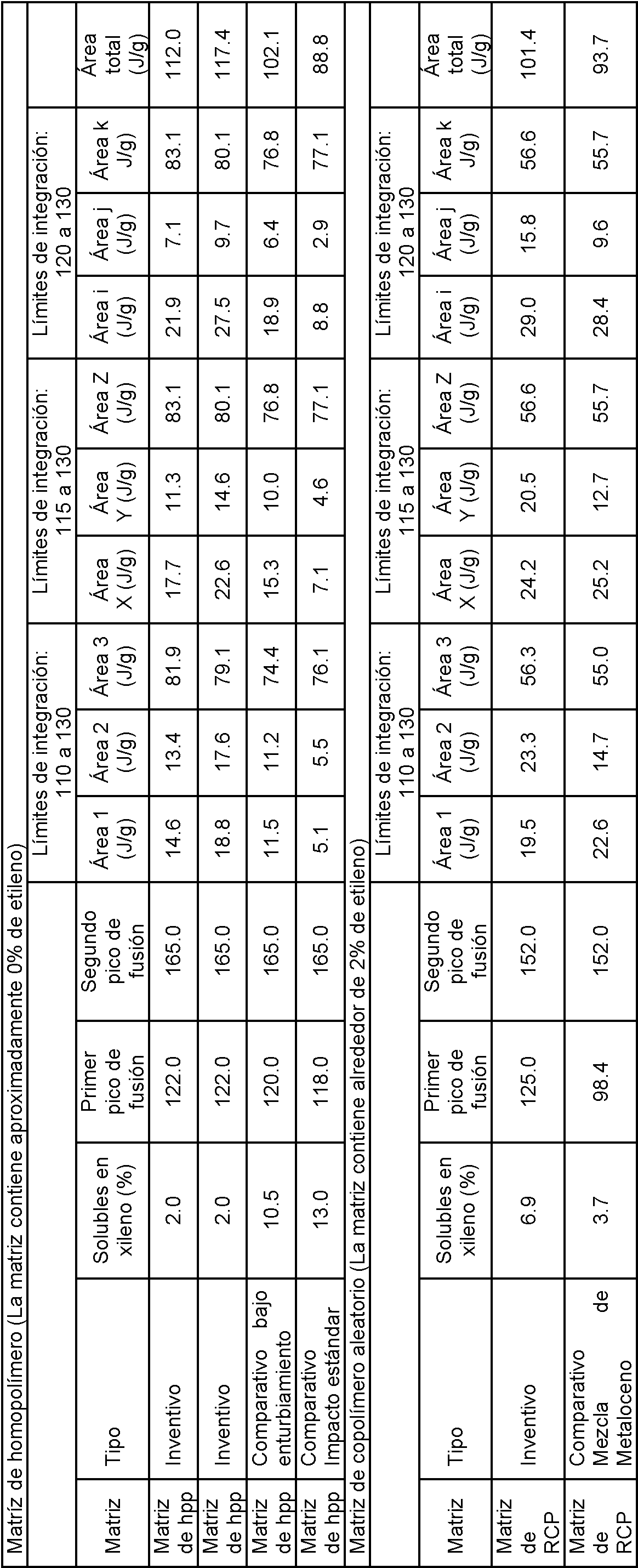
Usando el software analítico TA, se trazó una línea de base en la segunda curva de calentamiento. La línea de base se extendió de 20°C a 170°C. Las líneas perpendiculares (llamadas “gotas perpendiculares” en el software TA) se colocaron a 110°C y 130°C, y se usaron como límites de integración. Los límites de integración se colocaron a 20°C, 130°C, 110°C, 115°C y 170°C. Se realizaron integraciones para obtener tres áreas diferenciadas. El área 1 se define como el área bajo la curva de DSC (entalpía de fusión) entre 110°C y 130°C. El área 2 se define como el área bajo la curva de DSC (entalpía de fusión) entre 115°C y 130°C. El área 3 es el área entre 120°C y 130°C. Más resultados se muestran en la tabla 5, a continuación. Using TA analytical software, a baseline was drawn on the second heating curve. The baseline ranged from 20 ° C to 170 ° C. The perpendicular lines (called "perpendicular drops" in the TA software) were placed at 110 ° C and 130 ° C, and were used as limits of integration. The integration limits were set at 20 ° C, 130 ° C, 110 ° C, 115 ° C and 170 ° C. Integrations were carried out to obtain three different areas. Area 1 is defined as the area under the DSC curve (enthalpy of fusion) between 110 ° C and 130 ° C. Area 2 is defined as the area under the DSC curve (enthalpy of fusion) between 115 ° C and 130 ° C. Area 3 is the area between 120 ° C and 130 ° C. More results are shown in Table 5, below.
Claims (13)
Applications Claiming Priority (2)
| Application Number | Priority Date | Filing Date | Title |
|---|---|---|---|
| US201361783894P | 2013-03-14 | 2013-03-14 | |
| PCT/US2014/026292 WO2014160311A1 (en) | 2013-03-14 | 2014-03-13 | Polypropylene impact copolymers with low haze |
Publications (1)
| Publication Number | Publication Date |
|---|---|
| ES2830249T3 true ES2830249T3 (en) | 2021-06-03 |
Family
ID=51581275
Family Applications (1)
| Application Number | Title | Priority Date | Filing Date |
|---|---|---|---|
| ES14775618T Active ES2830249T3 (en) | 2013-03-14 | 2014-03-13 | Low Haze Polypropylene Impact Copolymers |
Country Status (5)
| Country | Link |
|---|---|
| US (3) | US10808111B2 (en) |
| EP (1) | EP2970646B1 (en) |
| BR (1) | BR112015022690B1 (en) |
| ES (1) | ES2830249T3 (en) |
| WO (2) | WO2014160311A1 (en) |
Families Citing this family (18)
| Publication number | Priority date | Publication date | Assignee | Title |
|---|---|---|---|---|
| KR102488414B1 (en) * | 2015-07-16 | 2023-01-12 | 토탈에너지스 원테크 벨지움 | Polypropylene composition and thermoformed sheet thereof |
| KR101707221B1 (en) | 2015-09-23 | 2017-02-15 | 롯데케미칼 주식회사 | Manufacturing method of block copolymer for transparent molded article |
| US10113058B2 (en) | 2015-12-30 | 2018-10-30 | Braskem America, Inc. | Clear and impact resistant polymer composition and fabricated article |
| US11000148B2 (en) | 2016-06-28 | 2021-05-11 | Berry Plastics Corporation | Beverage-brewing package |
| US10577159B2 (en) | 2017-04-07 | 2020-03-03 | Berry Plastics Corporation | Drink cup lid |
| EP3664668B1 (en) | 2017-08-07 | 2023-06-28 | Berry Global, Inc. | Method and apparatus for thermoforming an article |
| GB201809708D0 (en) | 2018-06-13 | 2018-08-01 | Obrist Closures Switzerland | Beverage capsule |
| USD907997S1 (en) | 2018-08-10 | 2021-01-19 | Berry Global, Inc. | Drink cup lid |
| CA3129224A1 (en) | 2019-02-06 | 2020-08-13 | Berry Global, Inc. | Process of forming polymeric material |
| CA3129416A1 (en) * | 2019-02-06 | 2020-08-13 | Berry Global, Inc. | Polypropylene sheets and articles |
| USD911168S1 (en) | 2019-03-05 | 2021-02-23 | Berry Global, Inc. | Drink cup lid |
| WO2020206225A1 (en) | 2019-04-05 | 2020-10-08 | W.R. Grace & Co.-Conn. | Polypropylene copolymer composition having subzero impact resistance |
| CN114945469B (en) | 2019-05-17 | 2025-06-27 | 阿科玛公司 | Thin multi-layer panel structure |
| EP4480846A1 (en) | 2019-08-15 | 2024-12-25 | Berry Global, Inc. | Drink cup lid |
| CA3188065A1 (en) | 2020-08-05 | 2022-02-10 | Jonathan EICKHOFF | Polypropylene sheets and articles |
| US12325579B2 (en) | 2020-10-22 | 2025-06-10 | Berry Global, Inc. | Beverage capsule cup with enhanced material distribution |
| WO2023283119A1 (en) | 2021-07-06 | 2023-01-12 | Berry Global, Inc. | Drink cup lid |
| USD1061244S1 (en) | 2021-07-09 | 2025-02-11 | Berry Global, Inc. | Drink cup lid |
Family Cites Families (20)
| Publication number | Priority date | Publication date | Assignee | Title |
|---|---|---|---|---|
| EP0877050B1 (en) | 1992-09-15 | 2008-05-21 | Dow Global Technologies Inc. | Impact modification of thermoplastics |
| US6015854A (en) * | 1997-10-24 | 2000-01-18 | Union Carbide Chemicals & Plastics Technology Corporation | Polypropylene impact copolymers with high clarity |
| US6197886B1 (en) * | 1997-10-24 | 2001-03-06 | Union Carbide Chemicals & Plastics Technology Corporation | Compositions containing impact copolymers made from a blend of a homopolymer phase and a rubber phase having a high ethylene content |
| US20040159972A1 (en) * | 2000-08-04 | 2004-08-19 | Koschmieder Stefan U. | Propylene polymers having agreeable odor characteristics and shaped articles thereof |
| DE60211012T2 (en) * | 2001-11-27 | 2007-05-03 | Basell Poliolefine Italia S.R.L. | Transparent and flexible polypropylene compositions |
| BR0311862B1 (en) * | 2002-06-12 | 2013-08-06 | propylene copolymer composition, process for preparing propylene copolymer compositions, use of the propylene copolymer composition, fibers, films, or molded articles. | |
| US7662885B2 (en) * | 2002-08-12 | 2010-02-16 | Exxonmobil Chemical Patents Inc. | Method to make an article comprising polymer concentrate |
| JP2008510872A (en) * | 2004-08-23 | 2008-04-10 | エクソンモービル・ケミカル・パテンツ・インク | Equipment for polymerization process |
| US7476710B2 (en) * | 2004-12-17 | 2009-01-13 | Exxonmobil Chemical Patents Inc. | Heterogeneous polymer blends and molded articles therefrom |
| US8084537B2 (en) * | 2005-03-17 | 2011-12-27 | Dow Global Technologies Llc | Polymer blends from interpolymers of ethylene/α-olefin with improved compatibility |
| WO2006138052A1 (en) | 2005-06-13 | 2006-12-28 | Exxonmobil Chemical Patents Inc. | Thermoplastic blend compositions |
| US8247512B2 (en) * | 2007-03-05 | 2012-08-21 | Fina Technology, Inc. | Metallocene random copolymers with cool temperature impact properties |
| US20080255303A1 (en) | 2007-04-13 | 2008-10-16 | Chou Richard T | Blends of polyolefins, polar ethylene copolymers and functionalized ethylene copolymers |
| EP2022824A1 (en) * | 2007-08-08 | 2009-02-11 | Borealis Technology Oy | Sterilisable and Tough Impact Polypropylene Composition |
| US8076429B2 (en) * | 2009-03-11 | 2011-12-13 | Lummus Novolen Technology Gmbh | Supertransparent high impact strength random block copolymer |
| RU2548013C2 (en) | 2009-11-25 | 2015-04-10 | ДАУ ГЛОБАЛ ТЕКНОЛОДЖИЗ ЭлЭлСи | Moulded polymer article characterised by low turbidity and high transparency |
| US8044135B2 (en) | 2010-02-24 | 2011-10-25 | Braskem America, Inc. | Polypropylene impact copolymer compositions |
| BR112013015109B1 (en) * | 2010-12-23 | 2020-07-07 | Prysmian S.P.A. | cable |
| US8748539B2 (en) * | 2011-05-24 | 2014-06-10 | Braskem America, Inc. | Propylene impact copolymers having good optical properties |
| US9000097B2 (en) * | 2011-07-07 | 2015-04-07 | Basell Poliolefine Italia S.R.L. | Polypropylene composition |
-
2014
- 2014-03-13 ES ES14775618T patent/ES2830249T3/en active Active
- 2014-03-13 US US14/773,976 patent/US10808111B2/en active Active
- 2014-03-13 WO PCT/US2014/026292 patent/WO2014160311A1/en not_active Ceased
- 2014-03-13 BR BR112015022690-6A patent/BR112015022690B1/en not_active IP Right Cessation
- 2014-03-13 EP EP14775618.3A patent/EP2970646B1/en not_active Revoked
- 2014-03-14 US US14/774,021 patent/US10184044B2/en active Active
- 2014-03-14 WO PCT/US2014/027590 patent/WO2014152662A1/en not_active Ceased
-
2018
- 2018-12-05 US US16/210,164 patent/US11027473B2/en active Active
Also Published As
| Publication number | Publication date |
|---|---|
| US10184044B2 (en) | 2019-01-22 |
| EP2970646A1 (en) | 2016-01-20 |
| WO2014152662A1 (en) | 2014-09-25 |
| BR112015022690A2 (en) | 2017-07-18 |
| US10808111B2 (en) | 2020-10-20 |
| US20190106558A1 (en) | 2019-04-11 |
| US20160040000A1 (en) | 2016-02-11 |
| US11027473B2 (en) | 2021-06-08 |
| WO2014160311A1 (en) | 2014-10-02 |
| EP2970646A4 (en) | 2016-07-27 |
| US20160016389A1 (en) | 2016-01-21 |
| BR112015022690B1 (en) | 2020-11-24 |
| EP2970646B1 (en) | 2020-08-19 |
Similar Documents
| Publication | Publication Date | Title |
|---|---|---|
| ES2830249T3 (en) | Low Haze Polypropylene Impact Copolymers | |
| CN103649207B (en) | There is the high fluidity polyolefin composition of low-shrinkage and CLTE | |
| US10800908B2 (en) | Polyethylene composition, method of making the same, and films made therefrom | |
| CN101541879B (en) | Polyolefin compositions | |
| CN103827200B (en) | There is the heterophasic propylene copolymers of excellent rigidity and shock resistance balance | |
| KR101788433B1 (en) | Multimodal polypropylene composition for pipe applications | |
| CN108350239B (en) | Heterophasic polypropylene composition | |
| CN105164201B (en) | Polyolefin composition | |
| CN103649206B (en) | There is the heterophasic polypropylene of low CLTE and high rigidity | |
| JP2019525986A (en) | Mixed catalyst system for multimodal elastomer production | |
| CN105745269A (en) | Polypropylene composition with low shrinkage and balanced mechanical properties | |
| JP2006316267A (en) | Polypropylene composition having excellent impact resistance, flexural modulus, and transparency, and product produced from the composition | |
| WO2020217829A1 (en) | Propylene resin composition and molded body | |
| KR102733740B1 (en) | Propylene polymer composition, non-stretchy film and laminate | |
| CN108727704B (en) | Propylene resin composition and injection molded article | |
| KR101780751B1 (en) | Propylene random copolymer composition for pipe applications | |
| CN104448538A (en) | Polypropylene composition, preparation method thereof, and product prepared from composition | |
| CA2969901C (en) | Polyethylene compositions having living hinge properties | |
| CN104955891B (en) | The polymer composition based on ethene with improved machinability | |
| JP2020158652A (en) | Propylene-based polymer composition and its molded product | |
| CN107805340B (en) | Polyolefin composition and polyolefin material | |
| WO2019030139A1 (en) | Composition comprising heterophasic propylene copolymer | |
| ES2987105T3 (en) | Procedure for preparing a polypropylene composition | |
| KR102766413B1 (en) | Non-foaming sheets and containers | |
| CN110612314A (en) | Heterophasic polyolefin compositions with excellent optical properties |