ES2841306T3 - Procedure for the preparation of alcohols from alpha, beta-unsaturated aldehydes and ketones - Google Patents
Procedure for the preparation of alcohols from alpha, beta-unsaturated aldehydes and ketones Download PDFInfo
- Publication number
- ES2841306T3 ES2841306T3 ES17731109T ES17731109T ES2841306T3 ES 2841306 T3 ES2841306 T3 ES 2841306T3 ES 17731109 T ES17731109 T ES 17731109T ES 17731109 T ES17731109 T ES 17731109T ES 2841306 T3 ES2841306 T3 ES 2841306T3
- Authority
- ES
- Spain
- Prior art keywords
- formula
- methyl
- hydrogen
- compound
- catalyst
- Prior art date
- Legal status (The legal status is an assumption and is not a legal conclusion. Google has not performed a legal analysis and makes no representation as to the accuracy of the status listed.)
- Active
Links
- 238000000034 method Methods 0.000 title claims abstract description 23
- 150000001299 aldehydes Chemical class 0.000 title description 12
- 150000001298 alcohols Chemical class 0.000 title description 10
- 150000002576 ketones Chemical class 0.000 title description 6
- 238000002360 preparation method Methods 0.000 title description 3
- 150000001875 compounds Chemical class 0.000 claims abstract description 24
- 239000003054 catalyst Substances 0.000 claims abstract description 17
- UFHFLCQGNIYNRP-UHFFFAOYSA-N Hydrogen Chemical compound [H][H] UFHFLCQGNIYNRP-UHFFFAOYSA-N 0.000 claims abstract description 14
- 229910052739 hydrogen Inorganic materials 0.000 claims abstract description 14
- 239000001257 hydrogen Substances 0.000 claims abstract description 14
- 125000002496 methyl group Chemical group [H]C([H])([H])* 0.000 claims abstract description 14
- 230000008569 process Effects 0.000 claims abstract description 13
- 239000011203 carbon fibre reinforced carbon Substances 0.000 claims abstract description 9
- KJTLSVCANCCWHF-UHFFFAOYSA-N Ruthenium Chemical compound [Ru] KJTLSVCANCCWHF-UHFFFAOYSA-N 0.000 claims abstract description 7
- 229910052707 ruthenium Inorganic materials 0.000 claims abstract description 7
- 238000010438 heat treatment Methods 0.000 claims abstract description 4
- 125000001495 ethyl group Chemical group [H]C([H])([H])C([H])([H])* 0.000 claims abstract description 3
- 239000002585 base Substances 0.000 claims description 7
- PIICEJLVQHRZGT-UHFFFAOYSA-N Ethylenediamine Chemical compound NCCN PIICEJLVQHRZGT-UHFFFAOYSA-N 0.000 claims description 6
- YAYGSLOSTXKUBW-UHFFFAOYSA-N ruthenium(2+) Chemical compound [Ru+2] YAYGSLOSTXKUBW-UHFFFAOYSA-N 0.000 claims description 6
- LFQSCWFLJHTTHZ-UHFFFAOYSA-N Ethanol Chemical compound CCO LFQSCWFLJHTTHZ-UHFFFAOYSA-N 0.000 claims description 5
- 125000000217 alkyl group Chemical group 0.000 claims description 5
- 150000001339 alkali metal compounds Chemical class 0.000 claims description 2
- 150000004985 diamines Chemical class 0.000 claims description 2
- 239000003446 ligand Substances 0.000 claims description 2
- 239000007858 starting material Substances 0.000 claims description 2
- 125000004435 hydrogen atom Chemical group [H]* 0.000 abstract 3
- OKKJLVBELUTLKV-UHFFFAOYSA-N Methanol Chemical compound OC OKKJLVBELUTLKV-UHFFFAOYSA-N 0.000 description 12
- 238000006243 chemical reaction Methods 0.000 description 12
- WQDUMFSSJAZKTM-UHFFFAOYSA-N Sodium methoxide Chemical compound [Na+].[O-]C WQDUMFSSJAZKTM-UHFFFAOYSA-N 0.000 description 10
- CSNNHWWHGAXBCP-UHFFFAOYSA-L Magnesium sulfate Chemical compound [Mg+2].[O-][S+2]([O-])([O-])[O-] CSNNHWWHGAXBCP-UHFFFAOYSA-L 0.000 description 6
- KWYUFKZDYYNOTN-UHFFFAOYSA-M Potassium hydroxide Chemical compound [OH-].[K+] KWYUFKZDYYNOTN-UHFFFAOYSA-M 0.000 description 6
- HEMHJVSKTPXQMS-UHFFFAOYSA-M Sodium hydroxide Chemical compound [OH-].[Na+] HEMHJVSKTPXQMS-UHFFFAOYSA-M 0.000 description 6
- 238000004817 gas chromatography Methods 0.000 description 6
- RIOQSEWOXXDEQQ-UHFFFAOYSA-N triphenylphosphine Chemical compound C1=CC=CC=C1P(C=1C=CC=CC=1)C1=CC=CC=C1 RIOQSEWOXXDEQQ-UHFFFAOYSA-N 0.000 description 6
- -1 3-methyl-but-2-enyl Chemical group 0.000 description 5
- BZLVMXJERCGZMT-UHFFFAOYSA-N Methyl tert-butyl ether Chemical compound COC(C)(C)C BZLVMXJERCGZMT-UHFFFAOYSA-N 0.000 description 5
- 239000007788 liquid Substances 0.000 description 5
- 239000000758 substrate Substances 0.000 description 5
- 229920006395 saturated elastomer Polymers 0.000 description 4
- XLYOFNOQVPJJNP-UHFFFAOYSA-N water Substances O XLYOFNOQVPJJNP-UHFFFAOYSA-N 0.000 description 4
- WMFOQBRAJBCJND-UHFFFAOYSA-M Lithium hydroxide Chemical compound [Li+].[OH-] WMFOQBRAJBCJND-UHFFFAOYSA-M 0.000 description 3
- 101100030361 Neurospora crassa (strain ATCC 24698 / 74-OR23-1A / CBS 708.71 / DSM 1257 / FGSC 987) pph-3 gene Proteins 0.000 description 3
- 239000008346 aqueous phase Substances 0.000 description 3
- 239000012267 brine Substances 0.000 description 3
- 238000004821 distillation Methods 0.000 description 3
- 239000003205 fragrance Substances 0.000 description 3
- 238000005984 hydrogenation reaction Methods 0.000 description 3
- 229910052943 magnesium sulfate Inorganic materials 0.000 description 3
- 235000019341 magnesium sulphate Nutrition 0.000 description 3
- 239000011541 reaction mixture Substances 0.000 description 3
- HPALAKNZSZLMCH-UHFFFAOYSA-M sodium;chloride;hydrate Chemical compound O.[Na+].[Cl-] HPALAKNZSZLMCH-UHFFFAOYSA-M 0.000 description 3
- 239000002904 solvent Substances 0.000 description 3
- 238000003756 stirring Methods 0.000 description 3
- 239000000126 substance Substances 0.000 description 3
- UHELJNANGXRBDI-UHFFFAOYSA-N 2,4,7-trimethyloct-6-en-1-ol Chemical compound CC(CO)CC(CC=C(C)C)C UHELJNANGXRBDI-UHFFFAOYSA-N 0.000 description 2
- PSIOIPWJOZPZPA-UHFFFAOYSA-N 2,4,7-trimethylocta-2,6-dien-1-ol Chemical compound CC(CC=C(C)C)C=C(C)CO PSIOIPWJOZPZPA-UHFFFAOYSA-N 0.000 description 2
- MNYYWGFHVAKLTC-UHFFFAOYSA-N 2,4,7-trimethylocta-2,6-dienal Chemical compound CC(C)=CCC(C)C=C(C)C=O MNYYWGFHVAKLTC-UHFFFAOYSA-N 0.000 description 2
- KFZMGEQAYNKOFK-UHFFFAOYSA-N Isopropanol Chemical compound CC(C)O KFZMGEQAYNKOFK-UHFFFAOYSA-N 0.000 description 2
- LRHPLDYGYMQRHN-UHFFFAOYSA-N N-Butanol Chemical compound CCCCO LRHPLDYGYMQRHN-UHFFFAOYSA-N 0.000 description 2
- 238000005481 NMR spectroscopy Methods 0.000 description 2
- 239000005662 Paraffin oil Substances 0.000 description 2
- CDBYLPFSWZWCQE-UHFFFAOYSA-L Sodium Carbonate Chemical compound [Na+].[Na+].[O-]C([O-])=O CDBYLPFSWZWCQE-UHFFFAOYSA-L 0.000 description 2
- UIIMBOGNXHQVGW-UHFFFAOYSA-M Sodium bicarbonate Chemical compound [Na+].OC([O-])=O UIIMBOGNXHQVGW-UHFFFAOYSA-M 0.000 description 2
- DHCWLIOIJZJFJE-UHFFFAOYSA-L dichlororuthenium Chemical compound Cl[Ru]Cl DHCWLIOIJZJFJE-UHFFFAOYSA-L 0.000 description 2
- 239000002815 homogeneous catalyst Substances 0.000 description 2
- 239000008240 homogeneous mixture Substances 0.000 description 2
- 239000000543 intermediate Substances 0.000 description 2
- 238000004519 manufacturing process Methods 0.000 description 2
- 239000000203 mixture Substances 0.000 description 2
- 239000012044 organic layer Substances 0.000 description 2
- SCVFZCLFOSHCOH-UHFFFAOYSA-M potassium acetate Chemical compound [K+].CC([O-])=O SCVFZCLFOSHCOH-UHFFFAOYSA-M 0.000 description 2
- BWHMMNNQKKPAPP-UHFFFAOYSA-L potassium carbonate Chemical compound [K+].[K+].[O-]C([O-])=O BWHMMNNQKKPAPP-UHFFFAOYSA-L 0.000 description 2
- 230000009257 reactivity Effects 0.000 description 2
- 229910001220 stainless steel Inorganic materials 0.000 description 2
- 239000010935 stainless steel Substances 0.000 description 2
- 238000004809 thin layer chromatography Methods 0.000 description 2
- YHRUHBBTQZKMEX-YFVJMOTDSA-N (2-trans,6-trans)-farnesal Chemical compound CC(C)=CCC\C(C)=C\CC\C(C)=C\C=O YHRUHBBTQZKMEX-YFVJMOTDSA-N 0.000 description 1
- YHRUHBBTQZKMEX-UHFFFAOYSA-N (2E,6E)-3,7,11-trimethyl-2,6,10-dodecatrien-1-al Natural products CC(C)=CCCC(C)=CCCC(C)=CC=O YHRUHBBTQZKMEX-UHFFFAOYSA-N 0.000 description 1
- WNHPULBFSIXBBG-YFHOEESVSA-N (3Z)-2,4,7-trimethylocta-3,6-dien-1-ol Chemical compound CC(CO)\C=C(/CC=C(C)C)\C WNHPULBFSIXBBG-YFHOEESVSA-N 0.000 description 1
- FMNYBZZASGQQRB-POHAHGRESA-N (4Z)-2,4,7-trimethylocta-4,6-dienal Chemical compound CC(C/C(=C\C=C(C)C)/C)C=O FMNYBZZASGQQRB-POHAHGRESA-N 0.000 description 1
- NQCRUFZLNUQXJU-UHFFFAOYSA-N 2,3,6,7-tetramethylocta-2,6-dienal Chemical compound CC(C)=C(C)CCC(C)=C(C)C=O NQCRUFZLNUQXJU-UHFFFAOYSA-N 0.000 description 1
- WKBGMSFKBREYCQ-UHFFFAOYSA-N 2,4,6-trimethylnon-6-en-1-ol Chemical compound CCC=C(C)CC(C)CC(C)CO WKBGMSFKBREYCQ-UHFFFAOYSA-N 0.000 description 1
- BAQFFLADENVMGM-UHFFFAOYSA-N 2,4,6-trimethylnona-2,6-dienal Chemical compound CC(C=O)=CC(CC(=CCC)C)C BAQFFLADENVMGM-UHFFFAOYSA-N 0.000 description 1
- ZBZVGPWGDRUEDJ-UHFFFAOYSA-N 2,4,7,11-tetramethyldodeca-2,6,10-trienal Chemical compound CC(C=O)=CC(CC=C(CCC=C(C)C)C)C ZBZVGPWGDRUEDJ-UHFFFAOYSA-N 0.000 description 1
- CVQZVKMMUIRRQI-UHFFFAOYSA-N 2,4-dimethylocta-2,6-dienal Chemical compound CC(C=O)=CC(CC=CC)C CVQZVKMMUIRRQI-UHFFFAOYSA-N 0.000 description 1
- MFGOFGRYDNHJTA-UHFFFAOYSA-N 2-amino-1-(2-fluorophenyl)ethanol Chemical compound NCC(O)C1=CC=CC=C1F MFGOFGRYDNHJTA-UHFFFAOYSA-N 0.000 description 1
- 125000004974 2-butenyl group Chemical group C(C=CC)* 0.000 description 1
- LQOWZJPSSOYMQH-UHFFFAOYSA-N 3,6,8,11-tetramethyldodeca-2,6,10-trienal Chemical compound CC(=CC=O)CCC(=CC(CC=C(C)C)C)C LQOWZJPSSOYMQH-UHFFFAOYSA-N 0.000 description 1
- WTEVQBCEXWBHNA-UHFFFAOYSA-N Citral Natural products CC(C)=CCCC(C)=CC=O WTEVQBCEXWBHNA-UHFFFAOYSA-N 0.000 description 1
- XDTMQSROBMDMFD-UHFFFAOYSA-N Cyclohexane Chemical compound C1CCCCC1 XDTMQSROBMDMFD-UHFFFAOYSA-N 0.000 description 1
- VMHLLURERBWHNL-UHFFFAOYSA-M Sodium acetate Chemical compound [Na+].CC([O-])=O VMHLLURERBWHNL-UHFFFAOYSA-M 0.000 description 1
- 150000001336 alkenes Chemical class 0.000 description 1
- 125000005233 alkylalcohol group Chemical group 0.000 description 1
- 230000008901 benefit Effects 0.000 description 1
- 230000015572 biosynthetic process Effects 0.000 description 1
- 230000002051 biphasic effect Effects 0.000 description 1
- 238000009835 boiling Methods 0.000 description 1
- 229910052794 bromium Inorganic materials 0.000 description 1
- FJDQFPXHSGXQBY-UHFFFAOYSA-L caesium carbonate Chemical compound [Cs+].[Cs+].[O-]C([O-])=O FJDQFPXHSGXQBY-UHFFFAOYSA-L 0.000 description 1
- 229910000024 caesium carbonate Inorganic materials 0.000 description 1
- HUCVOHYBFXVBRW-UHFFFAOYSA-M caesium hydroxide Inorganic materials [OH-].[Cs+] HUCVOHYBFXVBRW-UHFFFAOYSA-M 0.000 description 1
- BVKZGUZCCUSVTD-UHFFFAOYSA-N carbonic acid Chemical class OC(O)=O BVKZGUZCCUSVTD-UHFFFAOYSA-N 0.000 description 1
- 150000004649 carbonic acid derivatives Chemical class 0.000 description 1
- 125000002915 carbonyl group Chemical group [*:2]C([*:1])=O 0.000 description 1
- 150000007942 carboxylates Chemical class 0.000 description 1
- 238000006555 catalytic reaction Methods 0.000 description 1
- 239000003153 chemical reaction reagent Substances 0.000 description 1
- 229910052801 chlorine Inorganic materials 0.000 description 1
- 230000000052 comparative effect Effects 0.000 description 1
- 239000002537 cosmetic Substances 0.000 description 1
- 239000012847 fine chemical Substances 0.000 description 1
- WTEVQBCEXWBHNA-JXMROGBWSA-N geranial Chemical compound CC(C)=CCC\C(C)=C\C=O WTEVQBCEXWBHNA-JXMROGBWSA-N 0.000 description 1
- 239000011521 glass Substances 0.000 description 1
- 229910052736 halogen Inorganic materials 0.000 description 1
- 150000002367 halogens Chemical class 0.000 description 1
- 150000004679 hydroxides Chemical class 0.000 description 1
- 238000011065 in-situ storage Methods 0.000 description 1
- 239000004615 ingredient Substances 0.000 description 1
- 229910052740 iodine Inorganic materials 0.000 description 1
- 239000010410 layer Substances 0.000 description 1
- XGZVUEUWXADBQD-UHFFFAOYSA-L lithium carbonate Chemical compound [Li+].[Li+].[O-]C([O-])=O XGZVUEUWXADBQD-UHFFFAOYSA-L 0.000 description 1
- 229910052808 lithium carbonate Inorganic materials 0.000 description 1
- 239000012046 mixed solvent Substances 0.000 description 1
- 238000012986 modification Methods 0.000 description 1
- 230000004048 modification Effects 0.000 description 1
- 239000012074 organic phase Substances 0.000 description 1
- 125000002524 organometallic group Chemical group 0.000 description 1
- 239000012071 phase Substances 0.000 description 1
- 235000011056 potassium acetate Nutrition 0.000 description 1
- 229910000027 potassium carbonate Inorganic materials 0.000 description 1
- RPDAUEIUDPHABB-UHFFFAOYSA-N potassium ethoxide Chemical compound [K+].CC[O-] RPDAUEIUDPHABB-UHFFFAOYSA-N 0.000 description 1
- 239000012041 precatalyst Substances 0.000 description 1
- 230000009467 reduction Effects 0.000 description 1
- 239000001632 sodium acetate Substances 0.000 description 1
- 235000017281 sodium acetate Nutrition 0.000 description 1
- 229910000030 sodium bicarbonate Inorganic materials 0.000 description 1
- 235000017557 sodium bicarbonate Nutrition 0.000 description 1
- 229910000029 sodium carbonate Inorganic materials 0.000 description 1
- 238000003786 synthesis reaction Methods 0.000 description 1
- 125000003944 tolyl group Chemical group 0.000 description 1
- 238000009901 transfer hydrogenation reaction Methods 0.000 description 1
Classifications
-
- C—CHEMISTRY; METALLURGY
- C07—ORGANIC CHEMISTRY
- C07C—ACYCLIC OR CARBOCYCLIC COMPOUNDS
- C07C29/00—Preparation of compounds having hydroxy or O-metal groups bound to a carbon atom not belonging to a six-membered aromatic ring
- C07C29/17—Preparation of compounds having hydroxy or O-metal groups bound to a carbon atom not belonging to a six-membered aromatic ring by hydrogenation of carbon-to-carbon double or triple bonds
- C07C29/175—Preparation of compounds having hydroxy or O-metal groups bound to a carbon atom not belonging to a six-membered aromatic ring by hydrogenation of carbon-to-carbon double or triple bonds with simultaneous reduction of an oxo group
-
- B—PERFORMING OPERATIONS; TRANSPORTING
- B01—PHYSICAL OR CHEMICAL PROCESSES OR APPARATUS IN GENERAL
- B01J—CHEMICAL OR PHYSICAL PROCESSES, e.g. CATALYSIS OR COLLOID CHEMISTRY; THEIR RELEVANT APPARATUS
- B01J31/00—Catalysts comprising hydrides, coordination complexes or organic compounds
- B01J31/16—Catalysts comprising hydrides, coordination complexes or organic compounds containing coordination complexes
- B01J31/24—Phosphines, i.e. phosphorus bonded to only carbon atoms, or to both carbon and hydrogen atoms, including e.g. sp2-hybridised phosphorus compounds such as phosphabenzene, phosphole or anionic phospholide ligands
- B01J31/2404—Cyclic ligands, including e.g. non-condensed polycyclic ligands, the phosphine-P atom being a ring member or a substituent on the ring
-
- C—CHEMISTRY; METALLURGY
- C07—ORGANIC CHEMISTRY
- C07C—ACYCLIC OR CARBOCYCLIC COMPOUNDS
- C07C31/00—Saturated compounds having hydroxy or O-metal groups bound to acyclic carbon atoms
- C07C31/02—Monohydroxylic acyclic alcohols
-
- C—CHEMISTRY; METALLURGY
- C07—ORGANIC CHEMISTRY
- C07C—ACYCLIC OR CARBOCYCLIC COMPOUNDS
- C07C33/00—Unsaturated compounds having hydroxy or O-metal groups bound to acyclic carbon atoms
- C07C33/02—Acyclic alcohols with carbon-to-carbon double bonds
- C07C33/025—Acyclic alcohols with carbon-to-carbon double bonds with only one double bond
-
- B—PERFORMING OPERATIONS; TRANSPORTING
- B01—PHYSICAL OR CHEMICAL PROCESSES OR APPARATUS IN GENERAL
- B01J—CHEMICAL OR PHYSICAL PROCESSES, e.g. CATALYSIS OR COLLOID CHEMISTRY; THEIR RELEVANT APPARATUS
- B01J2231/00—Catalytic reactions performed with catalysts classified in B01J31/00
- B01J2231/60—Reduction reactions, e.g. hydrogenation
- B01J2231/64—Reductions in general of organic substrates, e.g. hydride reductions or hydrogenations
- B01J2231/641—Hydrogenation of organic substrates, i.e. H2 or H-transfer hydrogenations, e.g. Fischer-Tropsch processes
- B01J2231/643—Hydrogenation of organic substrates, i.e. H2 or H-transfer hydrogenations, e.g. Fischer-Tropsch processes of R2C=O or R2C=NR (R= C, H)
-
- B—PERFORMING OPERATIONS; TRANSPORTING
- B01—PHYSICAL OR CHEMICAL PROCESSES OR APPARATUS IN GENERAL
- B01J—CHEMICAL OR PHYSICAL PROCESSES, e.g. CATALYSIS OR COLLOID CHEMISTRY; THEIR RELEVANT APPARATUS
- B01J2231/00—Catalytic reactions performed with catalysts classified in B01J31/00
- B01J2231/60—Reduction reactions, e.g. hydrogenation
- B01J2231/64—Reductions in general of organic substrates, e.g. hydride reductions or hydrogenations
- B01J2231/641—Hydrogenation of organic substrates, i.e. H2 or H-transfer hydrogenations, e.g. Fischer-Tropsch processes
- B01J2231/645—Hydrogenation of organic substrates, i.e. H2 or H-transfer hydrogenations, e.g. Fischer-Tropsch processes of C=C or C-C triple bonds
-
- B—PERFORMING OPERATIONS; TRANSPORTING
- B01—PHYSICAL OR CHEMICAL PROCESSES OR APPARATUS IN GENERAL
- B01J—CHEMICAL OR PHYSICAL PROCESSES, e.g. CATALYSIS OR COLLOID CHEMISTRY; THEIR RELEVANT APPARATUS
- B01J2531/00—Additional information regarding catalytic systems classified in B01J31/00
- B01J2531/80—Complexes comprising metals of Group VIII as the central metal
- B01J2531/82—Metals of the platinum group
- B01J2531/821—Ruthenium
Landscapes
- Chemical & Material Sciences (AREA)
- Organic Chemistry (AREA)
- Inorganic Chemistry (AREA)
- Engineering & Computer Science (AREA)
- Materials Engineering (AREA)
- Chemical Kinetics & Catalysis (AREA)
- Organic Low-Molecular-Weight Compounds And Preparation Thereof (AREA)
- Low-Molecular Organic Synthesis Reactions Using Catalysts (AREA)
Abstract
Un procedimiento, que comprende las etapas de: (a) Calentar a 30-70ºC un compuesto de fórmula (II) **(Ver fórmula)** en presencia de gas hidrógeno, una base y un catalizador de rutenio homogéneo, lo que da como resultado un compuesto de fórmula (III) **(Ver fórmula)** (b) Seguido de un aumento de la temperatura hasta 100-150ºC, dando como resultado un compuesto de fórmula (I) **(Ver fórmula)** donde R1 es hidrógeno o metilo; R2 es hidrógeno o metilo; R3 es metilo o etilo; R4 es hidrógeno o metilo; y R es un alquilo de C3-C10 lineal o ramificado que comprende al menos un doble enlace carbono-carbono no terminal.A process, which comprises the steps of: (a) Heating to 30-70ºC a compound of formula (II) ** (See formula) ** in the presence of hydrogen gas, a base and a homogeneous ruthenium catalyst, which gives resulting in a compound of formula (III) ** (See formula) ** (b) Followed by an increase in temperature to 100-150 ° C, resulting in a compound of formula (I) ** (See formula) ** where R1 is hydrogen or methyl; R2 is hydrogen or methyl; R3 is methyl or ethyl; R4 is hydrogen or methyl; and R is a straight or branched C3-C10 alkyl comprising at least one non-terminal carbon-carbon double bond.
Description
DESCRIPCIÓNDESCRIPTION
Procedimiento para la preparación de alcoholes a partir de aldehidos y cetonas alfa,beta-insaturadosProcedure for the preparation of alcohols from alpha, beta-unsaturated aldehydes and ketones
La presente invención se refiere a ingredientes de fragancias y a métodos para formarlos. En particular, la presente invención se refiere a un método para producir alcoholes a partir de aldehídos y cetonas a,|3-insaturados.The present invention relates to fragrance ingredients and methods for forming them. In particular, the present invention relates to a method for producing alcohols from α, 3-unsaturated aldehydes and ketones.
La reducción de aldehídos a,p-insaturados es una reacción importante, porque los posibles productos, tales como los aldehídos saturados y los alcoholes saturados o insaturados, han encontrado muchos usos en las industrias de fragancias, cosméticos y farmacéutica; también constituyen productos intermedios relevantes en la síntesis de diversos productos de química fina. Debido a la presencia de dos o más restos con reactividad similar, la reacción es complicada, en particular, cuando se desea que no todos los restos reaccionen.The reduction of aldehydes to, p-unsaturated is an important reaction, because possible products, such as saturated aldehydes and saturated or unsaturated alcohols, have found many uses in the fragrance, cosmetic and pharmaceutical industries; they are also relevant intermediates in the synthesis of various fine chemical products. Due to the presence of two or more moieties with similar reactivity, the reaction is complicated, particularly when it is desired that not all moieties react.
Los métodos de producción de alcoholes a partir de aldehídos a,p-insaturados se describen en la bibliografía. Por ejemplo, P. J. Baricelli et al. (Catalysis Letters 2011,141,709-716) describen una hidrogenación bifásica de aldehídos a,p-insaturados con un precatalizador iónico de rutenio hidrosoluble. Dependiendo de las condiciones, se obtienen mezclas de aldehídos, alcoholes saturados y alcoholes insaturados. Alternativamente, se pueden producir alcoholes a partir de aldehídos a,p-insaturados mediante hidrogenación por transferencia en disolventes mixtos como es descrito, por ejemplo, por Zhao et al. (Applied Organometallic Chemistry 2010, 24, 763-766). Desafortunadamente, los procedimientos conocidos carecen de selectividad con respecto a la reactividad similar del grupo carbonilo y los enlaces C=C.Methods of production of alcohols from α, p-unsaturated aldehydes are described in the literature. For example, P. J. Baricelli et al. (Catalysis Letters 2011,141,709-716) describe a biphasic hydrogenation of α, p-unsaturated aldehydes with a water-soluble ruthenium ionic precatalyst. Depending on the conditions, mixtures of aldehydes, saturated alcohols and unsaturated alcohols are obtained. Alternatively, alcohols can be produced from α, p-unsaturated aldehydes by transfer hydrogenation in mixed solvents as described, for example, by Zhao et al. (Applied Organometallic Chemistry 2010, 24, 763-766). Unfortunately, known procedures lack selectivity for similar reactivity of the carbonyl group and C = C bonds.
Sin embargo, para que un procedimiento sea útil en un contexto industrial, en particular en la industria de las fragancias, tiene que lograr la alta quimioselectividad requerida y también transcurrir con conversión completa, o sustancialmente completa, del sustrato.However, for a process to be useful in an industrial context, particularly in the fragrance industry, it has to achieve the required high chemoselectivity and also have to proceed with complete, or substantially complete, conversion of the substrate.
Por tanto, sigue existiendo la necesidad de un procedimiento industrialmente aceptable para la preparación de alcoholes a partir de aldehídos y cetonas a,p-insaturados que contengan además uno o más enlaces dobles carbonocarbono de olefinas di- o trisustituidas, que transcurra con alta conversión y con alta quimioselectividad para el doble enlace en posición a,p, sin hidrogenación de los enlaces C=C restantes.Therefore, there is still a need for an industrially acceptable process for the preparation of alcohols from aldehydes and a, p-unsaturated ketones that also contain one or more carbon-carbon double bonds of di- or trisubstituted olefins, which takes place with high conversion and with high chemoselectivity for the double bond in position a, p, without hydrogenation of the remaining C = C bonds.
Sorprendentemente, los solicitantes encontraron que un procedimiento de dos etapas que comprende calentar aldehídos/cetonas a,p-insaturados que contienen al menos un doble enlace carbono-carbono di- y/o trisustituido adicional, en presencia de un catalizador homogéneo, una base e hidrógeno permite una conversión de los aldehídos/cetonas a,p-insaturados selectivamente en sus respectivos alcoholes saturados, sin hidrogenación del o de los dobles enlaces restantes.Surprisingly, the applicants found that a two-step process comprising heating aldehydes / ketones to, p-unsaturated containing at least one additional di- and / or trisubstituted carbon-carbon double bond, in the presence of a homogeneous catalyst, an e-base Hydrogen allows a conversion of the aldehydes / ketones to, p-unsaturated selectively in their respective saturated alcohols, without hydrogenation of the remaining double bond (s).
Por tanto, en un primer aspecto se proporciona un procedimiento que comprende las etapas de:Therefore, in a first aspect a process is provided comprising the steps of:
(a) Calentar a 30-70°C (preferiblemente a aproximadamente 40-60°C (por ej., aproximadamente 45°C, aproximadamente 50°C o aproximadamente 55°C) un compuesto de fórmula (II)(a) Heating to 30-70 ° C (preferably about 40-60 ° C (eg, about 45 ° C, about 50 ° C, or about 55 ° C) a compound of formula (II)
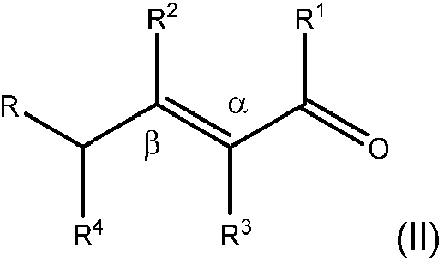
en presencia de gas hidrógeno, una base y un catalizador de rutenio homogéneo que da como resultado un compuesto de fórmula (III)in the presence of hydrogen gas, a base and a homogeneous ruthenium catalyst resulting in a compound of formula (III)

(b) Seguido de un aumento de la temperatura hasta 100-150°C (preferiblemente aproximadamente 110-130°C (por ejemplo, aproximadamente 115°C, aproximadamente 120°C o aproximadamente 125°C), dando como resultado un compuesto de fórmula (I) (b) Followed by an increase in temperature to 100-150 ° C (preferably about 110-130 ° C (for example, about 115 ° C, about 120 ° C, or about 125 ° C), resulting in a compound of formula (I)

donde R1 es hidrógeno o metilo;where R 1 is hydrogen or methyl;
R2 es hidrógeno o metilo;R 2 is hydrogen or methyl;
R3 es metilo o etilo;R 3 is methyl or ethyl;
R4 es hidrógeno o metilo; yR 4 is hydrogen or methyl; Y
R es un alquilo de C3-C15 lineal o ramificado que comprende al menos un (por ej., 2 o 3 dobles enlaces) doble enlace carbono-carbono no terminal (tal como 3-metil-but-2-enilo, 3,7-dimetilocta-2,6-dienoilo, 2,3-dimetilbut-2-enilo, but-2-enilo, 2,4,7-trimetilocta-2,6-dienoilo, 2-metilpent-2-enilo)R is a linear or branched C 3 -C 15 alkyl comprising at least one (e.g. 2 or 3 double bonds) non-terminal carbon-carbon double bond (such as 3-methyl-but-2-enyl, 3 , 7-dimethylocta-2,6-dienoyl, 2,3-dimethylbut-2-enyl, but-2-enyl, 2,4,7-trimethylocta-2,6-dienoyl, 2-methylpent-2-enyl)
Por la expresión "doble enlace carbono-carbono no terminal" se entiende un doble enlace carbono-carbono vecinal disustituido, un doble enlace carbono-carbono tri-sustituido o un doble enlace carbono-carbono tetra-sustituido. Los ejemplos no limitantes son compuestos de fórmula (II), en la que R1 es hidrógeno.By the term "non-terminal carbon-carbon double bond" is meant a disubstituted vicinal carbon-carbon double bond, a tri-substituted carbon-carbon double bond, or a tetra-substituted carbon-carbon double bond. Non-limiting examples are compounds of formula (II), in which R 1 is hydrogen.
Además, ejemplos no limitantes son compuestos de fórmula (II), en la que R1y R2 son hidrógeno.Furthermore, non-limiting examples are compounds of formula (II), in which R 1 and R 2 are hydrogen.
Además, ejemplos no limitantes son compuestos de fórmula (II), en la que R1 es hidrógeno y R2 es metilo. Además, ejemplos no limitantes son compuestos de fórmula (II), 
Además, ejemplos no limitantes son compuestos de fórmula (II), en la que el doble enlace a,p-insaturado está preferiblemente en configuración E.Furthermore, non-limiting examples are compounds of formula (II), in which the α, p-unsaturated double bond is preferably in the E configuration.
Además, ejemplos no limitantes son compuestos de fórmula (II), en la que R3 y R4 son metilo, y el doble enlace a,pinsaturado está preferiblemente en configuración E.Furthermore, non-limiting examples are compounds of formula (II), in which R 3 and R 4 are methyl, and the a, pinsaturated double bond is preferably in the E configuration.
Además, ejemplos no limitantes son compuestos de fórmula (II) en la que R es un alquilo de C5-C15 ramificado (que incluye alquilo de C6 , C7 , C8 , C9 , C10 y C11) que comprende al menos un doble enlace carbono-carbono (p. ej., 2 o 3 dobles enlaces) trisustituido.Furthermore, non-limiting examples are compounds of formula (II) wherein R is a branched C 5 -C 15 alkyl (including C 6 , C 7 , C 8 , C 9 , C 10 and C 11 alkyl) which it comprises at least one trisubstituted carbon-carbon double bond (eg 2 or 3 double bonds).
Además, ejemplos no limitantes de compuestos de fórmula (II) son compuestos seleccionados de 3,7-dimetilocta-2,6-dienal (R es alquilo de C5 que comprende un doble enlace trisustituido); 2,4,7,11-tetrametildodeca-2,6,10-trienal (R es alquilo de C10 que comprende dos dobles enlaces trisustituidos); 2,3,6,7-tetrametilocta-2,6-dienal (R es alquilo de C6 que comprende un doble enlace tetra-sustituido); 2,4-dimetilocta-2,6-dienal (R es alquilo de C4 que comprende un doble enlace disustituido vecinal); 3,7,11 -trimetildodeca-2,6,10-trienal (R es alquilo de C10 que comprende dos dobles enlaces trisustituidos); 3,6,8,11 -tetrametildodeca-2,6,10-trienal (R es alquilo de C11 que comprende dos dobles enlaces trisustituidos); y 2,4,6-trimetilnona-2,6-dienal (R es alquilo de C6 que comprende un doble enlace trisustituido).Furthermore, non-limiting examples of compounds of formula (II) are compounds selected from 3,7-dimethylocta-2,6-dienal (R is C 5 alkyl comprising a trisubstituted double bond); 2,4,7,11-tetramethyldodeca-2,6,10-trienal (R is C 10 alkyl comprising two trisubstituted double bonds); 2,3,6,7-tetramethylocta-2,6-dienal (R is C 6 alkyl comprising a tetra-substituted double bond); 2,4-dimethylocta-2,6-dienal (R is C 4 alkyl comprising a vicinal disubstituted double bond); 3,7,11-trimethyldodeca-2,6,10-trienal (R is C 10 alkyl comprising two trisubstituted double bonds); 3,6,8,11 -tetramethyldodeca-2,6,10-trienal (R is C 11 alkyl comprising two trisubstituted double bonds); and 2,4,6-trimethylnone-2,6-dienal (R is C 6 alkyl comprising a trisubstituted double bond).
El catalizador de rutenio empleado en la presente invención puede ser cualquiera de los descritos en el documento EP1970360, documento que, con el propósito de divulgar los catalizadores de rutenio contenidos en el mismo, se incorpora a este documento por referencia.The ruthenium catalyst used in the present invention can be any of those described in document EP1970360, a document which, for the purpose of disclosing the ruthenium catalysts contained therein, is incorporated herein by reference.
En una realización particular de la presente invención, el procedimiento transcurre en presencia de un catalizador de rutenio (II) homogéneo. La expresión "catalizador homogéneo" es bien conocida por los expertos en la técnica y se refiere a catalizadores que están presentes en la misma fase que el sustrato.In a particular embodiment of the present invention, the process takes place in the presence of a homogeneous ruthenium (II) catalyst. The term "homogeneous catalyst" is well known to those skilled in the art and refers to catalysts that are present in the same phase as the substrate.
En una realización, el catalizador de rutenio (II) homogéneo es un complejo (A)In one embodiment, the homogeneous ruthenium (II) catalyst is a complex (A)

con dos triarilfosfinas, una diamina y dos ligandos electronegativos (por ej., X puede ser un halógeno tal como Cl, Br e I).with two triarylphosphines, one diamine, and two electronegative ligands (eg, X can be a halogen such as Cl, Br, and I).
En una realización específica, el catalizador de rutenio (II) es un compuesto de fórmula (A) en la que Ar es para metilfenilo.In a specific embodiment, the ruthenium (II) catalyst is a compound of formula (A) wherein Ar is for methylphenyl.
En otra realización específica, el catalizador de rutenio (II) es RuCl2(PPh3)2(etilendiamina), que está disponible comercialmente o puede prepararse in situ a partir de reactivos disponibles comercialmente mediante un procedimiento como es descrito, por ejemplo, por Takeshi Ohkuma y col. (J. Am. Chem. Soc. 1995, 117, 10417). In another specific embodiment, the ruthenium (II) catalyst is RuCl 2 (PPh 3 ) 2 (ethylenediamine), which is commercially available or can be prepared in situ from commercially available reagents by a procedure as described, for example, by Takeshi Ohkuma et al. (J. Am. Chem. Soc. 1995, 117, 10417).
Para ser de alto valor comercial, la relación molar entre el sustrato (compuesto de fórmula (II)) y el catalizador es al menos 500:1, preferiblemente entre aproximadamente 1000:1 y aproximadamente 10000:1, o incluso mayor.To be of high commercial value, the molar ratio between the substrate (compound of formula (II)) and the catalyst is at least 500: 1, preferably between about 1000: 1 and about 10,000: 1, or even higher.
Para obtener altos rendimientos, la etapa (b) sigue después de que sustancialmente todo el sustrato (II) se haya convertido en compuestos de fórmula (III), por ejemplo, 88% o más (incluyendo 90, 92, 95, 98, 99%) del sustrato se ha convertido, medido mediante el área relativa del pico en cromatografía de gases (GC). Por ejemplo, una conversión del 50% significa que el área del pico del material de partida (compuesto de fórmula (II)) se reduce en un 50% en las mismas condiciones de GC. La conversión se puede medir mediante técnicas conocidas en la técnica. Por ejemplo, se puede medir tomando una muestra de la mezcla de reacción después de un tiempo determinado y analizando dicha mezcla mediante análisis GC. Opcionalmente, también se puede seguir la reacción mediante espectroscopía de resonancia magnética nuclear (RMN) o cromatografía en capa fina (TLC).To obtain high yields, step (b) follows after substantially all of the substrate (II) has been converted to compounds of formula (III), for example, 88% or more (including 90, 92, 95, 98, 99 %) of the substrate has been converted, measured by the relative area of the peak in gas chromatography (GC). For example, a conversion of 50% means that the peak area of the starting material (compound of formula (II)) is reduced by 50% under the same GC conditions. Conversion can be measured by techniques known in the art. For example, it can be measured by taking a sample of the reaction mixture after a specified time and analyzing the mixture by GC analysis. Optionally, the reaction can also be followed by nuclear magnetic resonance spectroscopy (NMR) or thin layer chromatography (TLC).
Además de la alta quimioselectividad de los procedimientos descritos en este documento, una ventaja adicional del procedimiento es que se puede realizar casi sin disolvente. El único disolvente necesario es para ayudar a la solubilidad de la base. Los disolventes adecuados incluyen alcoholes de alquilo, tales como metanol, etanol, isopropanol, n-butanol.In addition to the high chemoselectivity of the procedures described herein, an additional advantage of the procedure is that it can be performed almost solvent-free. The only solvent needed is to aid the solubility of the base. Suitable solvents include alkyl alcohols, such as methanol, ethanol, isopropanol, n-butanol.
Las bases adecuadas incluyen compuestos de metales alcalinos seleccionados del grupo que consiste en hidróxidos (tales como hidróxido de sodio, hidróxido de litio, hidróxido de potasio, hidróxido de cesio y similares), alcoholatos (tales como metóxido de sodio, etóxido de potasio y similares), carboxilatos (tales como como acetato de sodio, acetato de potasio y similares), carbonatos e hidrógeno-carbonatos que incluyen carbonato de sodio, hidrógeno-carbonato de sodio, carbonato de litio, carbonato de potasio, carbonato de cesio y similares.Suitable bases include alkali metal compounds selected from the group consisting of hydroxides (such as sodium hydroxide, lithium hydroxide, potassium hydroxide, cesium hydroxide, and the like), alcoholates (such as sodium methoxide, potassium ethoxide, and the like). ), carboxylates (such as sodium acetate, potassium acetate and the like), carbonates and hydrogen carbonates including sodium carbonate, sodium hydrogen carbonate, lithium carbonate, potassium carbonate, cesium carbonate and the like.
En una realización, el procedimiento de la invención se lleva a cabo en presencia de una base seleccionada entre hidróxido de sodio, metóxido de sodio e hidróxido de potasio.In one embodiment, the process of the invention is carried out in the presence of a base selected from sodium hydroxide, sodium methoxide, and potassium hydroxide.
La invención se describe ahora adicionalmente con referencia a los siguientes ejemplos no limitantes. Estos ejemplos son sólo con fines ilustrativos y se entiende que un experto en la técnica puede realizar variaciones y modificaciones. The invention is now further described with reference to the following non-limiting examples. These examples are for illustrative purposes only and it is understood that one of ordinary skill in the art may make variations and modifications.
Ejemplo 1Example 1
En atmósfera de aire, se añadió NaOMe (30% en peso en MeOH) (19,8 g, 4,0% en peso, 0,11 moles) a un autoclave de acero inoxidable de 1 L que contenía catalizador RuCl2(PPh3)2(etilendiamina) (0,197 g, 0,26 mmoles), 2,4,7-trimetilocta-2,6-dienal (94,2% de pureza, E/Z, 50:1) (499,2 g, 3,00 moles) e /'-PrOH (10 g). Mientras se agitaba con un agitador suspendido, se hizo fluir tres veces N2 por el autoclave, luego tres veces H2 , luego se puso bajo H2 presión (41,0 bares) y se calentó a 50°C. Después de 3,9 horas, se observó una conversión de C=O casi completa (> 95,5%) mediante GC (área relativa del pico) dando como resultado 2,4,7-trimetilocta-2,6-dienol (compuesto de fórmula (III)). La temperatura del autoclave se elevó a 120°C (la temperatura se alcanzó en 0,2 h). Después de otras 3,9 h, se detuvo la reacción, se enfrió a temperatura ambiente, se liberó la presión y se hizo fluir N2 tres veces por el autoclave. La mezcla homogénea de color amarillo se lavó con agua (210 mL). La fase acuosa se extrajo con metil terc-butil éter (350 mL). La capa orgánica se lavó con salmuera (100 mL), agua (100 mL) y se secó sobre MgSO4 (50,0 g), se filtró y se concentró a vacío. Al líquido amarillo obtenido se añadió aceite de parafina (12,3 g) y después de la destilación usando una columna Vigreux, se obtuvo un líquido incoloro de 2,4,7-trimetiloct-6-en-1-ol (426,2 g, 92,4% de pureza, 81,9% en moles de rendimiento químico, punto de ebullición = 75°C a 0,5 mbar). Además del producto principal, se han identificado trazas del intermedio 2,4,7-trimetilocta-2,6-dienol e isómeros de doble enlace del mismo en bajas concentraciones, tales como (E)/(Z)-2,4,7-trimetiloct-3,6-dien-1-ol y (E)/(Z)-2,4,7-trimetilocta-4,6-dienal.In an air atmosphere, NaOMe (30% by weight in MeOH) (19.8 g, 4.0% by weight, 0.11 mol) was added to a 1 L stainless steel autoclave containing catalyst RuCl2 (PPh3) 2 (ethylenediamine) (0.197 g, 0.26 mmol), 2,4,7-trimethylocta-2,6-dienal (94.2% purity, E / Z, 50: 1) (499.2 g, 3 0.00 mol) e / '- PrOH (10 g). While stirring with a suspended stirrer, N 2 was flushed through the autoclave three times , then H 2 three times, then placed under H 2 pressure (41.0 bar) and heated to 50 ° C. After 3.9 hours, almost complete C = O conversion (> 95.5%) was observed by GC (relative peak area) resulting in 2,4,7-trimethylocta-2,6-dienol (compound of formula (III)). The autoclave temperature was raised to 120 ° C (the temperature was reached in 0.2 h). After another 3.9 h, the reaction was stopped, cooled to room temperature, pressure was released, and N 2 was flushed through the autoclave three times. The yellow homogeneous mixture was washed with water (210 mL). The aqueous phase was extracted with methyl tert-butyl ether (350 mL). The organic layer was washed with brine (100 mL), water (100 mL), and dried over MgSO4 (50.0 g), filtered, and concentrated in vacuo. Paraffin oil (12.3 g) was added to the yellow liquid obtained and after distillation using a Vigreux column, a colorless liquid of 2,4,7-trimethyloct-6-en-1-ol (426.2 g, 92.4% purity, 81.9% by mole of chemical yield, boiling point = 75 ° C at 0.5 mbar). In addition to the main product, traces of the intermediate 2,4,7-trimethylocta-2,6-dienol and double bond isomers of it have been identified in low concentrations, such as (E) / (Z) -2,4,7 -trimethyloct-3,6-dien-1-ol and (E) / (Z) -2,4,7-trimethylocta-4,6-dienal.
Ejemplo 2Example 2
Se cargó un vial de vidrio de 10 mL con 1 g de 2,4,6-trimetilnona-2,6-dienal (99% de pureza, E/Z, 32:1), 1 mL de ciclohexano, 2,1 mg de CbRu (PPh3)2(etilendiamina) y 210 pL de NaOMe (30% en peso en MeOH). El vial se equipó con una barra de agitación y se selló. Se hizo fluir N2 (1 bar) por el vial y luego tres veces H2 (1 bar) antes de ajustar la presión de H2 (40 bar). La mezcla de reacción se calentó a 50°C durante 2 h y luego a 120°C durante 2 h más. Una vez enfriado, la sobrepresión de H2 se purgó y se hizo fluir N2 por el vial. La mezcla de reacción se inactivó con H2O, las capas se separaron y la fase acuosa se extrajo dos veces con MTBE. Las fases orgánicas combinadas se lavaron con salmuera, se secaron sobre MgSO4, se filtraron y la eliminación del disolvente proporcionó el alcohol bruto que se purificó por destilación usando Kugelrohr (T = 100°C, t = 15 min, p = 0,2 mbar) para proporcionar un líquido incoloro de 2,4,6-trimetilnon-6-en-1-ol (450 mg, pureza 82%, rendimiento químico 36,9% en moles).A 10 mL glass vial was filled with 1 g of 2,4,6-trimethylnon-2,6-dienal (99% purity, E / Z, 32: 1), 1 mL of cyclohexane, 2.1 mg of CbRu (PPh3) 2 (ethylenediamine) and 210 pL of NaOMe (30% by weight in MeOH). The vial was fitted with a stir bar and sealed. N 2 (1 bar) was flushed through the vial and then H 2 (1 bar) three times before the H 2 pressure (40 bar) was adjusted. The reaction mixture was heated at 50 ° C for 2 h and then at 120 ° C for a further 2 h. Once cooled, the overpressure of H 2 was purged and N 2 was flushed through the vial. The reaction mixture was quenched with H 2 O, the layers were separated and the aqueous phase was extracted twice with MTBE. The combined organic phases were washed with brine, dried over MgSO4, filtered and removal of the solvent provided the crude alcohol which was purified by distillation using Kugelrohr (T = 100 ° C, t = 15 min, p = 0.2 mbar ) to provide a colorless liquid of 2,4,6-trimethylnon-6-en-1-ol (450 mg, purity 82%, chemical yield 36.9% by mole).
Ejemplo comparativo 1Comparative Example 1
En atmósfera de aire, se añade NaOMe (30% en peso en MeOH) (19,8 g, 4,0% en peso, 0,11 moles) a un autoclave de acero inoxidable de 1 L que contiene catalizador RuCl2(PPh3)2(etilendiamina) (0,197 g, 0,26 mmoles), 2,4,7-trimetilocta-2,6-dienal (pureza 94,2%, E/Z, 50:1) (499,35 g, 2,78 moles) e /'-PrOH (10 g). Mientras se agita con un agitador suspendido, se hace fluir tres veces N2 por el autoclave, luego tres veces H2 , luego se pone bajo H2 presión (41,0 bares) y se calienta a 120°C. Después de 22 horas, se observa una conversión de C=O casi completa (> 95,5%) medida por GC (área de pico relativa). La reacción se detiene, se enfría a temperatura ambiente, se libera la presión y se hace fluir tres veces N2 por el autoclave. La mezcla homogénea de color amarillo se lava con agua (210 mL). La fase acuosa se extrae con metil terc-butil éter (350 mL). La capa orgánica se lava con salmuera (100 mL), agua (100 mL) y se seca sobre MgSO4 (50,0 g), se filtra y se concentra a vacío. Al líquido amarillo obtenido se le añade aceite de parafina (12,3 g) y después de la destilación usando una columna Vigreux se obtiene un líquido incoloro de 2,4,7 trimetiloct-6-en-1-ol (298,5 g, pureza 89,1%, rendimiento químico 69% en moles). In an air atmosphere, NaOMe (30% by weight in MeOH) (19.8 g, 4.0% by weight, 0.11 mol) is added to an autoclave 1 L stainless steel containing catalyst RuCl2 (PPh3) 2 (ethylenediamine) (0.197 g, 0.26 mmol), 2,4,7-trimethylocta-2,6-dienal (purity 94.2%, E / Z , 50: 1) (499.35 g, 2.78 mol) e / '- PrOH (10 g). While stirring with a suspended stirrer, N 2 is flushed through the autoclave three times , then H 2 three times, then placed under H 2 pressure (41.0 bar) and heated to 120 ° C. After 22 hours, almost complete C = O conversion (> 95.5%) as measured by GC (relative peak area) is observed. The reaction is stopped, cooled to room temperature, the pressure is released and N 2 is flushed through the autoclave three times. The yellow homogeneous mixture is washed with water (210 mL). The aqueous phase is extracted with methyl tert-butyl ether (350 mL). The organic layer is washed with brine (100 mL), water (100 mL), and dried over MgSO4 (50.0 g), filtered, and concentrated in vacuo. Paraffin oil (12.3 g) is added to the yellow liquid obtained and after distillation using a Vigreux column a colorless liquid of 2,4,7 trimethyloct-6-en-1-ol (298.5 g , purity 89.1%, chemical yield 69% by mole).
Claims (7)


Applications Claiming Priority (2)
| Application Number | Priority Date | Filing Date | Title |
|---|---|---|---|
| GBGB1610149.5A GB201610149D0 (en) | 2016-06-10 | 2016-06-10 | Process |
| PCT/EP2017/064285 WO2017212069A1 (en) | 2016-06-10 | 2017-06-12 | Process for the preparation of alcohols from alfa,beta-unsaturated aldehydes and ketones |
Publications (1)
| Publication Number | Publication Date |
|---|---|
| ES2841306T3 true ES2841306T3 (en) | 2021-07-08 |
Family
ID=56894801
Family Applications (1)
| Application Number | Title | Priority Date | Filing Date |
|---|---|---|---|
| ES17731109T Active ES2841306T3 (en) | 2016-06-10 | 2017-06-12 | Procedure for the preparation of alcohols from alpha, beta-unsaturated aldehydes and ketones |
Country Status (9)
| Country | Link |
|---|---|
| US (1) | US10570072B2 (en) |
| EP (1) | EP3468943B1 (en) |
| JP (1) | JP6968834B2 (en) |
| CN (1) | CN109311790A (en) |
| BR (1) | BR112018075314B1 (en) |
| ES (1) | ES2841306T3 (en) |
| GB (1) | GB201610149D0 (en) |
| MX (1) | MX393136B (en) |
| WO (1) | WO2017212069A1 (en) |
Families Citing this family (1)
| Publication number | Priority date | Publication date | Assignee | Title |
|---|---|---|---|---|
| CN117447302B (en) * | 2023-08-28 | 2024-11-19 | 江苏宏邦化工科技有限公司 | Green synthesis method of 2-campholenic propanol |
Family Cites Families (5)
| Publication number | Priority date | Publication date | Assignee | Title |
|---|---|---|---|---|
| DE2934250A1 (en) * | 1979-08-24 | 1981-03-19 | Basf Ag, 6700 Ludwigshafen | METHOD FOR PRODUCING OLEFINICALLY UNSATURATED CARBONYL COMPOUNDS AND ALCOHOLS |
| CN1331874C (en) * | 2005-01-27 | 2007-08-15 | 中国科学院上海有机化学研究所 | Transition metal complex, synthesis method and use thereof |
| EP1970360B1 (en) * | 2007-03-16 | 2016-08-31 | Takasago International Corporation | Method for producing alcohols |
| EP2765126A1 (en) | 2013-02-06 | 2014-08-13 | DSM IP Assets B.V. | Hydrogenation of citral in a solvent |
| JP6074858B2 (en) * | 2013-09-04 | 2017-02-08 | 国立大学法人東北大学 | Process for producing unsaturated alcohol |
-
2016
- 2016-06-10 GB GBGB1610149.5A patent/GB201610149D0/en not_active Ceased
-
2017
- 2017-06-12 EP EP17731109.9A patent/EP3468943B1/en active Active
- 2017-06-12 US US16/302,522 patent/US10570072B2/en active Active
- 2017-06-12 MX MX2018014285A patent/MX393136B/en unknown
- 2017-06-12 ES ES17731109T patent/ES2841306T3/en active Active
- 2017-06-12 WO PCT/EP2017/064285 patent/WO2017212069A1/en not_active Ceased
- 2017-06-12 BR BR112018075314-9A patent/BR112018075314B1/en active IP Right Grant
- 2017-06-12 CN CN201780035039.9A patent/CN109311790A/en active Pending
- 2017-06-12 JP JP2018564385A patent/JP6968834B2/en active Active
Also Published As
| Publication number | Publication date |
|---|---|
| BR112018075314A2 (en) | 2019-03-19 |
| US20190218164A1 (en) | 2019-07-18 |
| MX2018014285A (en) | 2019-03-14 |
| EP3468943B1 (en) | 2020-10-21 |
| CN109311790A (en) | 2019-02-05 |
| EP3468943A1 (en) | 2019-04-17 |
| BR112018075314B1 (en) | 2022-03-29 |
| US10570072B2 (en) | 2020-02-25 |
| MX393136B (en) | 2025-03-24 |
| JP2019517558A (en) | 2019-06-24 |
| WO2017212069A1 (en) | 2017-12-14 |
| JP6968834B2 (en) | 2021-11-17 |
| GB201610149D0 (en) | 2016-07-27 |
Similar Documents
| Publication | Publication Date | Title |
|---|---|---|
| US8318990B2 (en) | Process of producing alcohol | |
| JP5388569B2 (en) | Hydrogenation of esters using Ru / bidentate ligand complexes | |
| JP6560685B2 (en) | Improvements in or relating to organic compounds | |
| CN107580593A (en) | The method for preparing salt unsaturated carboxylic acid | |
| JP5803007B2 (en) | Method for producing aldehyde | |
| CN111051314B (en) | Method for preparing bicyclic enol ethers | |
| US20140024854A1 (en) | Process for preparing carboxylic acid esters | |
| JP5493497B2 (en) | Method for producing alcohol | |
| EP3468943B1 (en) | Process for the preparation of alcohols from alfa,beta-unsaturated aldehydes and ketones | |
| JP2008303160A (en) | Method for producing alcohol | |
| US20160288111A1 (en) | Method For Synthesising Esters And Catalyst For Said Synthesis | |
| KR100878911B1 (en) | One-step production method for producing 1,3-propanediol from ethylene oxide and syngas using a catalyst with phosphoranoalkane ligand | |
| ES2629084T3 (en) | Procedure for the catalytic preparation of unsaturated aldehydes | |
| RU2732499C1 (en) | Catalysed by metal alkoxycarbonylation of lactone | |
| CN111039927B (en) | A reusable catalytic system for the synthesis of β-aryl ketones at room temperature | |
| EP3679005A2 (en) | Synthesis of building blocks and feedstocks for manufacturing renewable polymers | |
| JP2009173611A (en) | Production method of β-branched alcohol | |
| CN116924897B (en) | A method for preparing γ,γ-geminal difluoroallyl ketone compound | |
| ES2991963T3 (en) | Process for preparing a conjugated diene from an allylic alcohol | |
| JP2015526414A (en) | Transition metal carbene complex catalyzed process for the preparation of carboxylic acid esters from alcohols under dehydration | |
| JP7248214B2 (en) | Synthesis of alkyl 2-acetyl-5,9,13-trimethyltetradeca-4,8,12-trienoates and derivatives by a discontinuous process | |
| JP6216638B2 (en) | Method for producing α-methyl-γ-butyrolactone | |
| EA042793B1 (en) | SYNTHESIS OF ALKYL 2-ACETYL-5,9,13-TRIMETHYLTETRADECA-4,8,12-TRIENOATES AND THEIR DERIVATIVES IN A PERIODIC METHOD | |
| MX2014014620A (en) | Method for reprocessing mixtures. | |
| JP2013213022A (en) | Method for producing terminal alcohol |