ES2848152T3 - Methods for preparing compounds based on 4-phenyl-6- (2,2,2-trifluoro-1-phenylethoxy) pyrimidine - Google Patents
Methods for preparing compounds based on 4-phenyl-6- (2,2,2-trifluoro-1-phenylethoxy) pyrimidine Download PDFInfo
- Publication number
- ES2848152T3 ES2848152T3 ES17201452T ES17201452T ES2848152T3 ES 2848152 T3 ES2848152 T3 ES 2848152T3 ES 17201452 T ES17201452 T ES 17201452T ES 17201452 T ES17201452 T ES 17201452T ES 2848152 T3 ES2848152 T3 ES 2848152T3
- Authority
- ES
- Spain
- Prior art keywords
- solution
- compound
- alkyl
- phenyl
- added
- Prior art date
- Legal status (The legal status is an assumption and is not a legal conclusion. Google has not performed a legal analysis and makes no representation as to the accuracy of the status listed.)
- Active
Links
- 0 C*C1(*CCCCCCCCC1)C(C)(/C=C1)/C=C/C(/*)=C/C1(C)NC=CCCC=* Chemical compound C*C1(*CCCCCCCCC1)C(C)(/C=C1)/C=C/C(/*)=C/C1(C)NC=CCCC=* 0.000 description 2
Classifications
-
- C—CHEMISTRY; METALLURGY
- C07—ORGANIC CHEMISTRY
- C07D—HETEROCYCLIC COMPOUNDS
- C07D403/00—Heterocyclic compounds containing two or more hetero rings, having nitrogen atoms as the only ring hetero atoms, not provided for by group C07D401/00
- C07D403/02—Heterocyclic compounds containing two or more hetero rings, having nitrogen atoms as the only ring hetero atoms, not provided for by group C07D401/00 containing two hetero rings
- C07D403/12—Heterocyclic compounds containing two or more hetero rings, having nitrogen atoms as the only ring hetero atoms, not provided for by group C07D401/00 containing two hetero rings linked by a chain containing hetero atoms as chain links
-
- C—CHEMISTRY; METALLURGY
- C07—ORGANIC CHEMISTRY
- C07D—HETEROCYCLIC COMPOUNDS
- C07D231/00—Heterocyclic compounds containing 1,2-diazole or hydrogenated 1,2-diazole rings
- C07D231/02—Heterocyclic compounds containing 1,2-diazole or hydrogenated 1,2-diazole rings not condensed with other rings
- C07D231/10—Heterocyclic compounds containing 1,2-diazole or hydrogenated 1,2-diazole rings not condensed with other rings having two or three double bonds between ring members or between ring members and non-ring members
- C07D231/12—Heterocyclic compounds containing 1,2-diazole or hydrogenated 1,2-diazole rings not condensed with other rings having two or three double bonds between ring members or between ring members and non-ring members with only hydrogen atoms, hydrocarbon or substituted hydrocarbon radicals, directly attached to ring carbon atoms
Landscapes
- Chemical & Material Sciences (AREA)
- Organic Chemistry (AREA)
- Pharmaceuticals Containing Other Organic And Inorganic Compounds (AREA)
- Plural Heterocyclic Compounds (AREA)
- Organic Low-Molecular-Weight Compounds And Preparation Thereof (AREA)
Abstract
Un compuesto cristalino de la fórmula: **(Ver fórmula)**A crystalline compound of the formula: **(See formula)**
Description
DESCRIPCIÓNDESCRIPTION
Métodos de preparación de compuestos a base de 4-fenil-6-(2,2,2-trifluoro-1-feniletoxi)pirimidinaMethods for preparing compounds based on 4-phenyl-6- (2,2,2-trifluoro-1-phenylethoxy) pyrimidine
Esta solicitud reclama prioridad sobre la solicitud provisional de EE. UU. n.° 60/957.744, presentada el viernes, 24 de agosto de 2007.This application claims priority over US Provisional Application No. 60 / 957,744, filed on Friday, August 24, 2007.
1. Campo de la invención1. Field of the invention
Esta invención se refiere a métodos para fabricar intermedios para la preparación de compuestos a base de 4-fenil-6-(2,2,2-trifluoro-1-feniletoxi)pirimidina.This invention relates to methods for making intermediates for the preparation of compounds based on 4-phenyl-6- (2,2,2-trifluoro-1-phenylethoxy) pyrimidine.
2. Antecedentes2. Background
Determinados compuestos a base de 4-fenil-6-(2,2,2-trifluoro-1-feniletoxi)pirimidina son inhibidores de la enzima triptófano hidroxilasa (TPH), la cual cataliza el paso limitante de la velocidad de la biosíntesis de la serotonina. Véase, la publicación de solicitud de patente de Estados Unidos n.° 2007/0191370, presentada el 12 de diciembre de 2006. Se cree que estos compuestos se pueden usar para tratar una amplia gama de enfermedades y trastornos asociados con el sistema serotoninérgico. Id. Por consiguiente, se desean métodos eficientes para su fabricación.Certain 4-phenyl-6- (2,2,2-trifluoro-1-phenylethoxy) pyrimidine-based compounds are inhibitors of the enzyme tryptophan hydroxylase (TPH), which catalyzes the rate-limiting step of the biosynthesis of the serotonin. See, US Patent Application Publication No. 2007/0191370, filed December 12, 2006. It is believed that these compounds can be used to treat a wide range of diseases and disorders associated with the serotonergic system. Id. Accordingly, efficient methods for their manufacture are desired.
3. Sumario de la invención3. Summary of the invention
Esta invención abarca compuestos cristalinos de fórmulas:This invention encompasses crystalline compounds of the formulas:
o 
4. Breve descripción de las figuras4. Brief description of the figures
La Figura 1 es un patrón de difracción de rayos X de una forma sólida cristalina de (R)-1-(4-cloro-2-(3-metil-1H-pirazol-1-il)fenil)-2,2,2-trifluoroetanol. El patrón se obtuvo usando un difractómetro Rigaku MiniFlex (radiación Cu (1,54060 A)).Figure 1 is an X-ray diffraction pattern of a crystalline solid form of (R) -1- (4-chloro-2- (3-methyl-1H-pyrazol-1-yl) phenyl) -2,2, 2-trifluoroethanol. The pattern was obtained using a Rigaku MiniFlex diffractometer (Cu radiation (1.54060 A)).
La Figura 2 es un patrón de difracción de rayos X de una forma sólida cristalina de 1-(4-cloro-2-(3-metil-1H-pirazol-1-il)fenil)-2,2,2-trifluoroetanona. El patrón se obtuvo usando un difractómetro Rigaku MiniFlex (radiación Cu (1,54060 A)). Figure 2 is an X-ray diffraction pattern of a crystalline solid form of 1- (4-chloro-2- (3-methyl-1H-pyrazol-1-yl) phenyl) -2,2,2-trifluoroethanone. The pattern was obtained using a Rigaku MiniFlex diffractometer (Cu radiation (1.54060 A)).
La Figura 3 es un patrón de difracción de rayos X de una forma sólida cristalina de 1-(2-bromo-5-clorofenil)-3-metil-IH-pirazol. El patrón se obtuvo usando un difractómetro Rigaku MiniFlex (radiación Cu (1,54060 A)).Figure 3 is an X-ray diffraction pattern of a crystalline solid form of 1- (2-bromo-5-chlorophenyl) -3-methyl-IH-pyrazole. The pattern was obtained using a Rigaku MiniFlex diffractometer (Cu radiation (1.54060 A)).
5. Descripción detallada5. Detailed description
Esta invención se basa en el descubrimiento de métodos novedosos para preparar compuestos intermedios que, cuando se administran a mamíferos, inhiben la TPH y pueden usarse en el tratamiento de una variedad de enfermedades y trastornos. Véase, en general, la publicación de solicitud de patente de Estados Unidos n.° 2007/0191370, presentada el 12 de diciembre de 2006.This invention is based on the discovery of novel methods for preparing intermediates which, when administered to mammals, inhibit TPH and can be used in the treatment of a variety of diseases and disorders. See generally United States Patent Application Publication No. 2007/0191370, filed December 12, 2006.
5.1. Definiciones5.1. Definitions
A menos que se indique otra cosa, el término "alquenilo" significa un hidrocarburo de cadena lineal, ramificada y/o cíclica que tiene de 2 a 20 (por ejemplo, 2 a 10 o 2 a 6) átomos de carbono, e incluye al menos un doble enlace carbono-carbono. Los restos alquenilo representativos incluyen vinilo, alilo, 1 -butenilo, 2-butenilo, isobutilenilo, 1-pentenilo, 2-pentenilo, 3-metil-1-butenilo, 2-metil-2-butenilo, 2,3-dimetil-2-butenilo, 1-hexenilo, 2-hexenilo, 3-hexenilo, 1- heptenilo, 2-heptenilo, 3-heptenilo, 1-octenilo, 2-octenilo, 3-octenilo, 1-nonenilo, 2-nonenilo, 3-nonenilo, 1-decenilo, 2- decenilo y 3-decenilo.Unless otherwise indicated, the term "alkenyl" means a straight, branched and / or cyclic chain hydrocarbon having 2 to 20 (eg, 2 to 10 or 2 to 6) carbon atoms, and includes al minus one carbon-carbon double bond. Representative alkenyl moieties include vinyl, allyl, 1-butenyl, 2-butenyl, isobutylenyl, 1-pentenyl, 2-pentenyl, 3-methyl-1-butenyl, 2-methyl-2-butenyl, 2,3-dimethyl-2 -butenyl, 1-hexenyl, 2-hexenyl, 3-hexenyl, 1-heptenyl, 2-heptenyl, 3-heptenyl, 1-octenyl, 2-octenyl, 3-octenyl, 1-nonenyl, 2-nonenyl, 3-nonenyl , 1-decenyl, 2-decenyl and 3-decenyl.
A menos que se indique otra cosa, el término "alcoxi" significa un grupo -O-alquilo. Ejemplos de grupos alcoxi incluyen -OCH3, -OCH2CH3, -O(CH2)2CH3, -O(CH2)3CH3, -O(CH2)4CH3, -O(ciclopenilo) y -O(CH2)sCH3. La expresión "alcoxi inferior" se refiere a -O-(alquilo inferior).Unless otherwise indicated, the term "alkoxy" means an -O-alkyl group. Examples of alkoxy groups include -OCH3, -OCH2CH3, -O (CH2) 2CH3, -O (CH2) 3CH3, -O (CH2) 4CH3, -O (cyclopenyl), and -O (CH2) sCH3. The term "lower alkoxy" refers to -O- (lower alkyl).
A menos que se indique otra cosa, el término "alquilo" significa un hidrocarburo de cadena lineal, ramificado y/o cíclico ("cicloalquilo") que tiene de 1 a 20 (por ejemplo, de 1 a 10 o de 1 a 4) átomos de carbono. Los restos alquilo que tienen de 1 a 4 carbonos se denominan "alquilo inferior". Los ejemplos de grupos alquilo incluyen grupos metilo, etilo, propilo, isopropilo, n-butilo, t-butilo, isobutilo, pentilo, hexilo, isohexilo, heptilo, 4,4-dimetilpentilo, octilo, 2,2,4-trimetilpentilo, nonilo, decilo, undecilo y dodecilo. Los restos cicloalquilo pueden ser monocíclicos o multicíclicos, y los ejemplos incluyen ciclopropilo, ciclobutilo, ciclopentilo, ciclohexilo y adamantilo. Los ejemplos adicionales de restos alquilo tienen porciones lineales, ramificadas y/o cíclicas (por ejemplo, 1 -etil-4-metilciclohexilo). El término "alquilo" incluye hidrocarburos saturados así como restos alquenilo y alquinilo.Unless otherwise indicated, the term "alkyl" means a straight chain, branched and / or cyclic hydrocarbon ("cycloalkyl") having 1 to 20 (eg 1 to 10 or 1 to 4) carbon atoms. Alkyl moieties having 1 to 4 carbons are called "lower alkyl". Examples of alkyl groups include methyl, ethyl, propyl, isopropyl, n-butyl, t-butyl, isobutyl, pentyl, hexyl, isohexyl, heptyl, 4,4-dimethylpentyl, octyl, 2,2,4-trimethylpentyl, nonyl groups. , decyl, undecyl and dodecyl. Cycloalkyl moieties can be monocyclic or multicyclic, and examples include cyclopropyl, cyclobutyl, cyclopentyl, cyclohexyl, and adamantyl. Additional examples of alkyl moieties have linear, branched, and / or cyclic portions (eg, 1-ethyl-4-methylcyclohexyl). The term "alkyl" includes saturated hydrocarbons as well as alkenyl and alkynyl moieties.
A menos que se indique otra cosa, el término "alquilarilo" o "alquil-arilo" significa un resto alquilo unido a un resto arilo. Unless otherwise indicated, the term "alkylaryl" or "alkyl aryl" means an alkyl moiety attached to an aryl moiety.
A menos que se indique otra cosa, el término "alquilheteroarilo" o "alquil-heteroarilo" significa un resto alquilo unido a un resto heteroarilo.Unless otherwise indicated, the term "alkylheteroaryl" or "alkyl-heteroaryl" means an alkyl moiety attached to a heteroaryl moiety.
A menos que se indique otra cosa, el término "alquilheterociclo" o "alquil-heterociclo" significa un resto alquilo unido a un resto heterociclo.Unless otherwise indicated, the term "alkylheterocycle" or "alkyl-heterocycle" means an alkyl moiety attached to a heterocycle moiety.
A menos que se indique otra cosa, el término "alquinilo" significa un hidrocarburo de cadena lineal, ramificada o cíclica que tiene de 2 a 20 (por ejemplo, 2 a 20 o 2 a 6) átomos de carbono, e incluye al menos un triple enlace carbonocarbono. Los restos alquinilo representativos incluyen acetilenilo, propinilo, 1 -butinilo, 2-butinilo, 1 -pentinilo, 2-pentinilo, 3- metil-1 -butinilo, 4-pentinilo, 1 -hexinilo, 2-hexinilo, 5-hexinilo, 1 -heptinilo, 2-heptinilo, 6-heptinilo, 1 -octinilo, 2-octinilo, 7-octinilo, 1 -noninilo, 2-noninilo, 8-noninilo, 1 -decinilo, 2-decinilo y 9-decinilo.Unless otherwise indicated, the term "alkynyl" means a straight, branched, or cyclic chain hydrocarbon having 2 to 20 (eg, 2 to 20 or 2 to 6) carbon atoms, and includes at least one carbon-carbon triple bond. Representative alkynyl moieties include acetylenyl, propynyl, 1-butynyl, 2-butynyl, 1-pentynyl, 2-pentynyl, 3-methyl-1-butynyl, 4-pentynyl, 1-hexinyl, 2-hexynyl, 5-hexynyl, 1 -heptinyl, 2-heptynyl, 6-heptynyl, 1-octinyl, 2-octynyl, 7-octinyl, 1-noninyl, 2-noninyl, 8-noninyl, 1-decynyl, 2-decynyl and 9-decynyl.
A menos que se indique otra cosa, el término "arilo" significa un anillo aromático o un sistema de anillo aromático o parcialmente aromático compuesto por átomos de carbono e hidrógeno. Un resto arilo puede comprender múltiples anillos unidos o fusionados entre sí. Los ejemplos de restos arilo incluyen antracenilo, azulenilo, bifenilo, fluorenilo, indano, indenilo, naftilo, fenantrenilo, fenilo, 1,2,3,4-tetrahidro-naftaleno y tolilo.Unless otherwise indicated, the term "aryl" means an aromatic ring or an aromatic or partially aromatic ring system composed of carbon and hydrogen atoms. An aryl moiety can comprise multiple rings linked or fused together. Examples of aryl moieties include anthracenyl, azulenyl, biphenyl, fluorenyl, indane, indenyl, naphthyl, phenanthrenyl, phenyl, 1,2,3,4-tetrahydro-naphthalene, and tolyl.
A menos que se indique otra cosa, el término "arilalquilo" o "aril-alquilo" significa un resto arilo unido a un resto alquilo. Unless otherwise indicated, the term "arylalkyl" or "aryl-alkyl" means an aryl moiety attached to an alkyl moiety.
A menos que se indique otra cosa, las expresiones "amida biohidrolizable", "éster biohidrolizable", "carbamato biohidrolizable", "carbonato biohidrolizable", "ureido biohidrolizable" y "fosfato biohidrolizable" significan una amida, éster, carbamato, carbonato, ureido o fosfato, respectivamente, de un compuesto que: 1) no interfiere con la actividad biológica del compuesto pero puede conferir a ese compuesto propiedades ventajosas in vivo, tales como absorción, duración de la acción o inicio de la acción; o 2) es biológicamente inactivo pero se convierte in vivo en el compuesto biológicamente activo. Ejemplos de ésteres biohidrolizables incluyen ésteres de alquilo inferior, ésteres de alcoxiaciloxi, ésteres de alquil acilamino alquilo y ésteres de colina. Ejemplos de amidas biohidrolizables incluyen amidas de alquilo inferior, amidas de a-aminoácidos, alcoxiacil amidas y alquilaminoalquilcarbonilamidas. Ejemplos de carbamatos biohidrolizables incluyen alquilaminas inferiores, etilendiaminas sustituidas, aminoacidos, hidroxialquilaminas, aminas heterocíclicas y heteroaromáticas y poliéter aminas.Unless otherwise indicated, the terms "biohydrolyzable amide", "biohydrolyzable ester", "biohydrolyzable carbamate", "biohydrolyzable carbonate", "biohydrolyzable ureide" and "biohydrolyzable phosphate" mean an amide, ester, carbamate, carbonate, ureido or phosphate, respectively, of a compound that: 1) does not interfere with the biological activity of the compound but can confer advantageous properties on that compound in vivo, such as absorption, duration of action or onset of action; or 2) is biologically inactive but is converted in vivo to the biologically active compound. Examples of biohydrolyzable esters include lower alkyl esters, alkoxyacyloxy esters, alkyl acylamino alkyl esters, and choline esters. Examples of biohydrolyzable amides include lower alkyl amides, α-amino acid amides, alkoxyacyl amides, and alkylaminoalkylcarbonylamides. Examples of biohydrolyzable carbamates include lower alkylamines, substituted ethylenediamines, amino acids, hydroxyalkylamines, heterocyclic and heteroaromatic amines, and polyether amines.
A menos que se indique otra cosa, los términos "halógeno" y "halo" abarcan flúor, cloro, bromo y yodo. Unless otherwise indicated, the terms "halogen" and "halo" encompass fluorine, chlorine, bromine and iodine.
A menos que se indique otra cosa, el término "heteroalquilo" se refiere a un resto alquilo (por ejemplo, alquilo, alquenilo o alquinilo lineal, ramificado o cíclico) en el cual, al menos uno de sus átomos de carbono ha sido reemplazado por un heteroátomo (por ejemplo, N, O o S).Unless otherwise indicated, the term "heteroalkyl" refers to an alkyl moiety (eg, linear, branched, or cyclic alkyl, alkenyl, or alkynyl) in which at least one of its carbon atoms has been replaced by a hetero atom (eg, N, O, or S).
A menos que se indique otra cosa, el término "heteroarilo" significa un resto arilo en donde al menos uno de sus átomos de carbono ha sido reemplazado por un heteroátomo (por ejemplo, N, O o S). Los ejemplos incluyen acridinilo, benzoimidazolilo, benzofuranilo, benzoisotiazolilo, benzoisoxazolilo, benzoquinazolinilo, benzotiazolilo, benzoxazolilo, furilo, imidazolilo, indolilo, isotiazolilo, isoxazolilo, oxadiazolilo, oxazolilo, ftalazinilo, pirazinilo, pirazolilo, piridazinilo, piridilo, pirimidinilo, pirimidilo, pirrolilo, quinazolinilo, quinolinilo, tetrazolilo, tiazolilo y triazinilo.Unless otherwise indicated, the term "heteroaryl" means an aryl moiety in which at least one of its carbon atoms has been replaced by a heteroatom (eg, N, O, or S). Examples include acridinyl, benzoimidazolyl, benzofuranyl, benzoisothiazolyl, benzoisoxazolyl, benzoquinazolinyl, benzothiazolyl, benzoxazolyl, furyl, imidazolyl, indolyl, isothiazolyl, isoxazolyl, oxadiazolyl, oxazolyl, phthalazinyl, pyrrolidimyl, pyrazolinyl, pyrolidimyl, pyrazolinyl, pyrolidyl, pyrazolinyl, pyrazolinyl, pyrolidyl, pyrazolinyl, pyrazinyl, pyrazolinyl, pyrolidynyl, pyrazolinyl, pyrazolinyl, pyrazolinyl , quinolinyl, tetrazolyl, thiazolyl and triazinyl.
A menos que se indique otra cosa, el término "heteroarilalquilo" o "heteroaril-alquilo" significa un resto heteroarilo unido a un resto alquilo.Unless otherwise indicated, the term "heteroarylalkyl" or "heteroaryl-alkyl" means a heteroaryl moiety attached to an alkyl moiety.
A menos que se indique otra cosa, el término "heterociclo" se refiere a un anillo o sistema de anillo aromático, parcialmente aromático o no aromático monocíclico o policíclico compuesto por carbono, hidrógeno y al menos un heteroátomo (por ejemplo, N, O o S). Un heterociclo puede comprender múltiples (es decir, dos o más) anillos fusionados o unidos entre sí. Los heterociclos incluyen heteroarilos. Los heterociclos particulares son heterociclos de 5 a 13 miembros que contienen de 1 a 4 heteroátomos seleccionados entre nitrógeno, oxígeno y azufre. Otros son heterociclos de 5 a 10 miembros que contienen de 1 a 4 heteroátomos seleccionados entre nitrógeno, oxígeno y azufre. Ejemplos de heterociclos incluyen benzo[1,3]dioxolilo, 2,3-dihidro-benzo[1,4]dioxinilo, cinolinilo, furanilo, hidantoinilo, morfolinilo, oxetanilo, oxiranilo, piperazinilo, piperidinilo, pirrolidinonilo, pirrolidinilo, tetrahidrofuranilo, tetrahidropiranilo, tetrahidropiridinilo, tetrahidropirimidinilo, tetrahidrotiofenilo, tetrahidrotiopiranilo y valerolactamailo. Unless otherwise indicated, the term "heterocycle" refers to a monocyclic or polycyclic aromatic, partially aromatic, or non-aromatic ring or ring system composed of carbon, hydrogen, and at least one heteroatom (eg, N, O, or S). A heterocycle can comprise multiple (ie, two or more) rings fused or linked together. Heterocycles include heteroaryls. Particular heterocycles are 5 to 13 membered heterocycles containing 1 to 4 heteroatoms selected from nitrogen, oxygen, and sulfur. Others are 5 to 10 membered heterocycles containing 1 to 4 heteroatoms selected from nitrogen, oxygen, and sulfur. Examples of heterocycles include benzo [1,3] dioxolyl, 2,3-dihydro-benzo [1,4] dioxynyl, cinnolinyl, furanyl, hydantoinyl, morpholinyl, oxetanyl, oxiranyl, piperazinyl, piperidinyl, pyrrolidinonyl, pyrrolidinyl, tetrahydrofuranyl, tetrahydropyranyl, tetrahydrofuranyl, tetrahydropyranyl tetrahydropyridinyl, tetrahydropyrimidinyl, tetrahydrothiophenyl, tetrahydrothiopyranyl, and valerolactamayl.
A menos que se indique otra cosa, el término "heterocicloalquilo" o "heterociclo-alquilo" se refiere a un resto heterociclo unido a un resto alquilo.Unless otherwise indicated, the term "heterocycloalkyl" or "heterocyclo-alkyl" refers to a heterocycle moiety attached to an alkyl moiety.
A menos que se indique otra cosa, el término "heterocicloalquilo" se refiere a un heterociclo no aromático.Unless otherwise indicated, the term "heterocycloalkyl" refers to a non-aromatic heterocycle.
A menos que se indique otra cosa, el término "heterocicloalquilalquilo" o "heterocicloalquil-alquilo" se refiere a un resto heterocicloalquilo unido a un resto alquilo.Unless otherwise indicated, the term "heterocycloalkylalkyl" or "heterocycloalkyl-alkyl" refers to a heterocycloalkyl moiety attached to an alkyl moiety.
A menos que se indique otra cosa, el término "profármaco" abarca ésteres farmacéuticamente aceptables, carbonatos, tiocarbonatos, derivados de W-acilo, derivados de W-aciloxialquilo, derivados cuaternarios de aminas terciarias, bases de N-Mannich, beses de Schiff, conjugados de aminoácidos, ésteres de fosfato, sales metálicas y ésteres de sulfonato de compuestos descritos en el presente documento. Ejemplos de profármacos incluyen compuestos que comprenden un resto biohidrolizable (por ejemplo, una amida biohidrolizable, carbamato biohidrolizable, carbonato biohidrolizable, éster biohidrolizable, fosfato biohidrolizable o análogo de ureido biohidrolizable). Los profármacos de los compuestos descritos en este documento se visualizan y preparan fácilmente por los expertos en la materia. Véase, por ejemplo, Design of Prodrugs, Bundgaard, A. Ed., Elseview, 1985; Bundgaard, hours., "Design and Application of Prodrugs", A Textbook of Drug Design and Development, Krosgaard-Larsen and hours. Bundgaard, Ed., 1991, capítulo 5, pág. 113 191; y Bundgaard, hours., Advanced Drug Delivery Review, 1992, 8, 1-38.Unless otherwise indicated, the term "prodrug" encompasses pharmaceutically acceptable esters, carbonates, thiocarbonates, W-acyl derivatives, W-acyloxyalkyl derivatives, quaternary tertiary amine derivatives, N-Mannich bases, Schiff's beses, conjugates of amino acids, phosphate esters, metal salts and sulfonate esters of compounds described herein. Examples of prodrugs include compounds that comprise a biohydrolyzable moiety (eg, a biohydrolyzable amide, biohydrolyzable carbamate, biohydrolyzable carbonate, biohydrolyzable ester, biohydrolyzable phosphate, or biohydrolyzable ureide analog). Prodrugs of the compounds described herein are readily visualized and prepared by those of skill in the art. See, for example, Design of Prodrugs, Bundgaard, A. Ed., Elseview, 1985; Bundgaard, hours., "Design and Application of Prodrugs", A Textbook of Drug Design and Development, Krosgaard-Larsen and hours. Bundgaard, Ed., 1991, chapter 5, p. 113 191; and Bundgaard, hours., Advanced Drug Delivery Review, 1992, 8, 1-38.
A menos que se indique otra cosa, la expresión "grupo protector" o "grupo protector", cuando se usa para referirse a parte de una molécula sometida a una reacción química, significa un resto químico que no es reactivo en las condiciones de esa reacción química, y que puede eliminarse para proporcionar un resto que es reactivo en esas condiciones. Los grupos protectores son bien conocidos en la técnica. Véase, por ejemplo, Greene, T.W. y Wuts, P.G.M., Protective Groups in Organic Synthesis (3a ed., John Wiley & Sons: 1999); Larock, R.C., Comprehensive Organic Transformations (2a ed., John Wiley & Sons: 1999). Algunos ejemplos incluyen bencilo, difenilmetilo, tritilo, Cbz, Boc, Fmoc, metoxicarbonilo, etoxicarbonilo y ptalimido.Unless otherwise indicated, the term "protecting group" or "protecting group", when used to refer to part of a molecule subjected to a chemical reaction, means a chemical moiety that is not reactive under the conditions of that reaction. chemistry, and that can be removed to provide a moiety that is reactive under those conditions. Protecting groups are well known in the art. See, for example, Greene, T.W. and Wuts, P.G.M., Protective Groups in Organic Synthesis (3rd ed., John Wiley & Sons: 1999); Larock, R.C., Comprehensive Organic Transformations (2nd ed., John Wiley & Sons: 1999). Some examples include benzyl, diphenylmethyl, trityl, Cbz, Boc, Fmoc, methoxycarbonyl, ethoxycarbonyl, and pthalimido.
A menos que se indique otra cosa, el término "pseudohalógeno" se refiere a un anión poliatómico que se asemeja a un ion haluro en su química ácido-base, sustitución y redox, generalmente tiene baja basicidad y forma un radical libre en condiciones de polimerización de radicales por transferencia de átomos. Ejemplos de pseudohalógenos incluyen iones azida, cianuro, cianato, tiocianato, tiosulfato, sulfonatos y haluro de sulfonilos.Unless otherwise indicated, the term "pseudohalogen" refers to a polyatomic anion that resembles a halide ion in its acid-base, substitution, and redox chemistry, generally has low basicity, and forms a free radical under polymerization conditions. of radicals by transfer of atoms. Examples of pseudohalogens include azide, cyanide, cyanate, thiocyanate, thiosulfate, sulfonates, and sulfonyl halide ions.
A menos que se indique otra cosa, la expresión "composición enriquecida estereoméricamente de un compuesto" se refiere a una mezcla del compuesto mencionado y su estereoisómero(s) que contiene más del compuesto mencionado que sus estereoisómeros. Por ejemplo, una composición enriquecida estereoisoméricamente de (S)-butan-2-ol abarca mezclas de (S)-butan-2-ol y (R)-butan-2-ol en proporciones de, por ejemplo, aproximadamente 60/40, 70/30, 80/20, 90/10, 95/5 y 98/2.Unless otherwise indicated, the term "stereomerically enriched composition of a compound" refers to a mixture of the mentioned compound and its stereoisomer (s) that contains more of the mentioned compound than its stereoisomers. For example, a stereoisomerically enriched composition of (S) -butan-2-ol encompasses mixtures of (S) -butan-2-ol and (R) -butan-2-ol in proportions of, for example, about 60/40 , 70/30, 80/20, 90/10, 95/5 and 98/2.
A menos que se indique otra cosa, la expresión "mezcla estereoisomérica" abarca mezclas racémicas así como mezclas enriquecidas estereoméricamente (por ejemplo, R/S = 30/70, 35/65, 40/60, 45/55, 55/45, 60/40, 65/35 y 70/30).Unless otherwise indicated, the term "stereoisomeric mixture" encompasses racemic mixtures as well as stereomerically enriched mixtures (eg, R / S = 30/70, 35/65, 40/60, 45/55, 55/45, 60/40, 65/35 and 70/30).
A menos que se indique otra cosa, la expresión "estereoméricamente pura" significa una composición que comprende un estereoisómero de un compuesto y está sustancialmente libre de otros estereoisómeros de ese compuesto. Por ejemplo, una composición estereoméricamente pura de un compuesto que tiene un estereocentro estará sustancialmente libre del estereoisómero opuesto del compuesto. Una composición estereoméricamente pura de un compuesto que tiene dos estereocentros estará sustancialmente libre de otros diastereómeros del compuesto. Una composición estereoméricamente pura de un compuesto que tiene múltiples estereocentros, pero que se dibuja o nombra de tal manera que se definen las estereoquímicas de menos de todos sus estereocentros, está sustancialmente libre de los isómeros del compuesto que tienen diferentes estereoquímicas en el estereocentros para los que se define la estereoquímica. Por ejemplo, "((1R)-1,2-dicloropropil)benceno estereoméricamente puro" se refiere a ((1R)-1,2-dicloropropil)benceno que está sustancialmente libre de ((1S)-1,2-dicloropropil)benceno.Unless otherwise indicated, the term "stereomerically pure" means a composition comprising a stereoisomer of a compound and is substantially free of other stereoisomers of that compound. For example, a stereomerically pure composition of a compound having a stereocenter will be substantially free of the opposite stereoisomer of the compound. A stereomerically pure composition of a compound having two stereocenters will be substantially free of other diastereomers of the compound. A stereomerically pure composition of a compound that has multiple stereocenters, but is drawn or named in such a way that the stereochemistry of less than all of its stereocenters are defined, is substantially free of isomers of the compound that have different stereochemistry at the stereocenters for which defines the stereochemistry. For example, "((1R) -1,2-dichloropropyl) benzene stereomerically pure" refers to ((1R) -1,2-dichloropropyl) benzene that is substantially free of ((1S) -1,2-dichloropropyl) benzene.
Un compuesto estereoméricamente puro típico comprende más de aproximadamente 80 % en peso de un estereoisómero del compuesto y menos de aproximadamente 20 % en peso de otros estereoisómeros del compuesto, más de aproximadamente 90 % en peso de un estereoisómero del compuesto y menos de aproximadamente 10 % en peso de los otros estereoisómeros del compuesto, más de aproximadamente 95 % en peso de un estereoisómero del compuesto y menos de aproximadamente 5 % en peso de los otros estereoisómeros del compuesto, más de aproximadamente 97 % en peso de un estereoisómero del compuesto y menos de aproximadamente 3 % en peso de los otros estereoisómeros del compuesto, o más de aproximadamente 99 % en peso de un estereoisómero del compuesto y menos de aproximadamente 1 % en peso de los otros estereoisómeros del compuesto.A typical stereomerically pure compound comprises more than about 80% by weight of a stereoisomer of the compound and less than about 20% by weight of other stereoisomers of the compound, more than about 90% by weight of a stereoisomer of the compound, and less than about 10% by weight of the other stereoisomers of the compound, more than about 95% by weight of a stereoisomer of the compound and less than about 5% by weight of the other stereoisomers of the compound, more than about 97% by weight of a stereoisomer of the compound and less of about 3% by weight of the other stereoisomers of the compound, or more than about 99% by weight of one stereoisomer of the compound and less than about 1% by weight of the other stereoisomers of the compound.
A menos que se indique otra cosa, el término "sustituido", cuando se usa para describir una estructura o resto químico, se refiere a un derivado de esa estructura o resto en el que uno o más de sus átomos de hidrógeno está sustituido con un átomo, resto químico o grupo funcional, tal como alcohol, aldehído, alcoxi, alcanoiloxi, alcoxicarbonilo, alquenilo, alquilo (por ejemplo, metilo, etilo, propilo, t-butilo), alquinilo, alquilcarboniloxi (-OC(O)alquilo), amida (-C(O)NH-alquil- o -alquilNHC(O)alquilo), amidinilo (-C(NH)NH-alquil- o -C(NR)NH2), amina (primaria, secundaria y terciaria, tal como alquilamino, arilamino, arilalquilamino), aroílo, arilo, ariloxi, azo, carbamoílo (-NHC(O)O-alquil- o -OC(O)NH-alquilo), carbamilo (por ejemplo, CONH2, así como CONH- alquilo, CONH-arilo y CONH-arilalquilo), carbonilo, carboxilo, ácido carboxílico, ácido carboxílico anhídrido, cloruro de ácido carboxílico, ciano, éster, epóxido, éter (por ejemplo, metoxi, etoxi), guanidino, halo, haloalquilo (por ejemplo, -CCh, -CF3, -C(CF3)3), heteroalquilo, hemiacetal, imina (primaria y secundaria), isocianato, isotiocianato, cetona, nitrilo, nitro, oxígeno (es decir, para proporcionar un grupo oxo), fosfodiéster, sulfuro, sulfonamido (por ejemplo, SO2NH2), sulfona, sulfonilo (incluyendo alquilsulfonilo, arilsulfonilo y arilalquilsulfonilo), sulfóxido, tiol (por ejemplo, sulfhidrilo, tioéter) y urea (-NHCONH-alquil-).Unless otherwise indicated, the term "substituted", when used to describe a chemical structure or moiety, refers to a derivative of that structure or moiety in which one or more of its hydrogen atoms is substituted with a atom, chemical moiety or functional group, such as alcohol, aldehyde, alkoxy, alkanoyloxy, alkoxycarbonyl, alkenyl, alkyl (for example, methyl, ethyl, propyl, t-butyl), alkynyl, alkylcarbonyloxy (-OC (O) alkyl), amide (-C (O) NH-alkyl- or -alkylNHC (O) alkyl), amidinyl (-C (NH) NH-alkyl- or -C (NR) NH2), amine (primary, secondary and tertiary, such as alkylamino, arylamino, arylalkylamino), aroyl, aryl, aryloxy, azo, carbamoyl (-NHC (O) O-alkyl- or -OC (O) NH-alkyl), carbamyl (e.g. CONH2, as well as CONH-alkyl, CONH-aryl and CONH-arylalkyl), carbonyl, carboxyl, carboxylic acid, anhydrous carboxylic acid, carboxylic acid chloride, cyano, ester, epoxide, ether (for example, methoxy, ethoxy), guanidino, halo, haloalkyl (for example, -CCh, -CF3, -C (CF3) 3), heteroalkyl, hemiacetal, imine (primary and secondary), isocyanate, isothiocyanate, ketone, nitrile, nitro, oxygen (i.e. to provide an oxo group), phosphodiester , sulfide, sulfonamido (eg SO2NH2), sulfone, sulfonyl (including alkylsulfonyl, arylsulfonyl, and arylalkylsulfonyl), sulfoxide, thiol (eg, sulfhydryl, thioether), and urea (-NHCONH-alkyl-).
A menos que se indique otra cosa, la frase "mayor que X", cuando X es un número, tiene el mismo significado que "X o mayor que X". De forma análoga, la frase "mayor que aproximadamente X", cuando X es un número, tiene el mismo significado que "aproximadamente X o mayor que aproximadamente X".Unless otherwise stated, the phrase "greater than X", when X is a number, has the same meaning as "X or greater than X". Similarly, the phrase "greater than approximately X", when X is a number, has the same meaning as "approximately X or greater than approximately X".
A menos que se indique otra cosa, la frase "menor que X", cuando X es un número, tiene el mismo significado que "X o menor que X". De forma análoga, la frase "menor que aproximadamente X", cuando X es un número, tiene el mismo significado que "aproximadamente X o menor que aproximadamente X".Unless otherwise stated, the phrase "less than X", when X is a number, has the same meaning as "X or less than X". Similarly, the phrase "less than about X", when X is a number, has the same meaning as "about X or less than about X".
A menos que se indique otra cosa, la frase "entre X e Y" abarca valores entre X e Y así como X e Y mismos. De forma análoga, las frases "entre aproximadamente X y aproximadamente Y" y "entre aproximadamente X e Y" se refieren a valores entre aproximadamente X y aproximadamente Y, incluyendo aproximadamente X y aproximadamente Y. Unless otherwise indicated, the phrase "between X and Y" encompasses values between X and Y as well as X and Y themselves. Similarly, the phrases "between about X and about Y" and "between about X and Y" refer to values between about X and about Y, including about X and about Y.
A menos que se indique otra cosa, el término "incluye" tiene el mismo significado que "incluye" y el término "incluye" tiene el mismo significado que "incluye, pero no se limita a". De forma análoga, la expresión "tal como" tiene el mismo significado que el término "tal como, pero no se limita a".Unless otherwise indicated, the term "includes" has the same meaning as "includes" and the term "includes" has the same meaning as "includes, but is not limited to". Similarly, the term "such as" has the same meaning as the term "such as, but is not limited to".
A menos que se indique otra cosa, uno o más adjetivos que preceden inmediatamente a una serie de sustantivos debe interpretarse como aplicable a cada uno de los sustantivos. Por ejemplo, la frase "alquilo, arilo o heteroarilo opcionalmente sustituido" tiene el mismo significado que "alquilo opcionalmente sustituido, arilo opcionalmente sustituido, o heteroarilo opcionalmente sustituido".Unless otherwise stated, one or more adjectives immediately preceding a series of nouns should be interpreted as applicable to each of the nouns. For example, the phrase "optionally substituted alkyl, aryl, or heteroaryl" has the same meaning as "optionally substituted alkyl, optionally substituted aryl, or optionally substituted heteroaryl."
A menos que se indique otra cosa, una estructura o nombre de un compuesto o género de compuestos abarca todas las formas de ese compuesto o género de compuestos, y todas las composiciones que comprenden ese compuesto o género de compuestos.Unless otherwise indicated, a structure or name of a compound or genus of compounds encompasses all forms of that compound or genus of compounds, and all compositions comprising that compound or genus of compounds.
Cabe señalar que un resto químico que forma parte de un compuesto más grande puede describirse en el presente documento usando un nombre que se le asigna comúnmente cuando existe como una molécula única o un nombre que se asigna comúnmente a su radical. Por ejemplo, los términos "piridina" y "piridilo" reciben el mismo significado cuando se usan para describir un resto unido a otros restos químicos. Por tanto, las dos frases "XOH, en donde X es piridilo" y "XOH, en donde X es piridina" tienen el mismo significado y abarcan los compuestos piridin-2-ol, piridin-3-ol y piridin-4-ol.It should be noted that a chemical moiety that is part of a larger compound can be described herein using a name that is commonly assigned to it when it exists as a single molecule or a name that is commonly assigned to its radical. For example, the terms "pyridine" and "pyridyl" are given the same meaning when used to describe a moiety linked to other chemical moieties. Therefore, the two phrases "XOH, where X is pyridyl" and "XOH, where X is pyridine" have the same meaning and include the compounds pyridin-2-ol, pyridin-3-ol and pyridin-4-ol. .
También debe observarse que si la estereoquímica de una estructura o una parte de una estructura no se indica con, por ejemplo, líneas en negrita o discontinuas, la estructura o la parte de la estructura debe interpretarse como que abarca todos los estereoisómeros de la misma. De forma análoga, los nombres de compuestos que tienen uno o más centros quirales que no especifican la estereoquímica de estos centros incluyen estereoisómeros puros y mezclas de los mismos. Además, se supone que cualquier átomo mostrado en un dibujo con valencias insatisfechas está unido a suficientes átomos de hidrógeno para satisfacer las valencias. Además, los enlaces químicos representados con una línea continua paralela a una línea discontinua abarcan enlaces sencillos y dobles (por ejemplo, aromáticos), si las valencias lo permiten.It should also be noted that if the stereochemistry of a structure or a part of a structure is not indicated by, for example, bold or dashed lines, the structure or part of the structure should be interpreted as encompassing all stereoisomers thereof. Similarly, names of compounds that have one or more chiral centers that do not specify the stereochemistry of these centers include pure stereoisomers and mixtures thereof. Furthermore, any atom shown in a drawing with unsatisfied valences is assumed to be bonded to enough hydrogen atoms to satisfy the valences. Also, chemical bonds represented by a solid line parallel to a dashed line encompass single and double bonds (eg, aromatic), if valences allow.
5.2. Métodos de síntesis5.2. Synthesis methods
Esta invención se refiere a precursores útiles en métodos para preparar compuestos de fórmula I:This invention relates to precursors useful in methods for preparing compounds of formula I:

y sales (por ejemplo, sales farmacéuticamente aceptables) de los mismos, en donde: A1 es heterocilo opcionalmente sustituido; cada R1 es independientemente amino, halógeno, hidrógeno, C(O)Ra, ORa, NRbRc , S(O2)Ra o alquilo opcionalmente sustituido, alquil-arilo o alquil-heterociclo; R2 es independientemente amino, halógeno, hidrógeno, C(O)Ra, ORa, NRbRc , S(O2)Ra o alquilo opcionalmente sustituido, alquil-arilo o alquil-heterociclo; R3 es hidrógeno, C(O)Ra, C(O)ORa o alquilo opcionalmente sustituido, alquilarilo, alquil-heterociclo, arilo o heterociclo; R4 es hidrógeno o alquilo opcionalmente sustituido, alquilarilo, alquil-heterociclo, arilo o heterociclo; cada Ra es independientemente hidrógeno o alquilo opcionalmente sustituido, alquil-arilo o alquil-heterociclo; cada Rb es independientemente hidrógeno o alquilo opcionalmente sustituido, alquil-arilo o alquil-heterociclo; cada Re es independientemente hidrógeno o alquilo opcionalmente sustituido, alquil-arilo o alquil-heterociclo; y m es 1-4.and salts (eg, pharmaceutically acceptable salts) thereof, wherein: A1 is optionally substituted heterocyl; each R1 is independently amino, halogen, hydrogen, C (O) Ra, ORa, NRbRc, S (O2) Ra or optionally substituted alkyl, alkyl aryl or alkyl heterocycle; R2 is independently amino, halogen, hydrogen, C (O) Ra, ORa, NRbRc, S (O2) Ra or optionally substituted alkyl, alkyl aryl or alkyl heterocycle; R3 is hydrogen, C (O) Ra, C (O) ORa or optionally substituted alkyl, alkylaryl, alkyl-heterocycle, aryl, or heterocycle; R4 is hydrogen or optionally substituted alkyl, alkylaryl, alkyl-heterocycle, aryl, or heterocycle; each Ra is independently hydrogen or optionally substituted alkyl, alkyl aryl or alkyl heterocycle; each Rb is independently hydrogen or optionally substituted alkyl, alkyl aryl or alkyl heterocycle; each Re is independently hydrogen or optionally substituted alkyl, alkyl aryl or alkyl heterocycle; and m is 1-4.
En determinadas realizaciones de la divulgación, A1 es aromático; en otras, no lo es. En otras, A1 está opcionalmente sustituido con uno o más de halógeno o alquilo inferior.In certain embodiments of the disclosure, A1 is aromatic; in others, it is not. In others, A1 is optionally substituted with one or more of halogen or lower alkyl.
En algunas, el compuesto de fórmula I es de fórmula I(a):In some, the compound of formula I is of formula I (a):


en donde: cada R5 es independientemente amino, halógeno, hidrógeno, C(O)Ra, ORa, NRbRc , S (02)Ra o alquilo opcionalmente sustituido, alquil-arilo o alquil-heterociclo; y n es 1-3.wherein: each R5 is independently amino, halogen, hydrogen, C (O) Ra, ORa, NRbRc, S (0 2 ) Ra or optionally substituted alkyl, alkyl aryl or alkyl heterocycle; and n is 1-3.
En algunas realizaciones de la divulgación, R1 es hidrógeno o halógeno. En algunas, m es 1. En algunas, R2 es hidrógeno o amino. En algunas, R3 es hidrógeno o alquilo inferior. En algunas, R3 es C(O)ORa y Ra es alquilo. En algunas, R4 es hidrógeno o alquilo inferior. En algunas, R5 es hidrógeno o alquilo inferior (por ejemplo, metilo). En algunas, n es 1.In some embodiments of the disclosure, R1 is hydrogen or halogen. In some, m is 1. In some, R2 is hydrogen or amino. In some, R3 is hydrogen or lower alkyl. In some, R3 is C (O) ORa and Ra is alkyl. In some, R4 is hydrogen or lower alkyl. In some, R5 is hydrogen or lower alkyl (eg, methyl). In some, n is 1.
Un compuesto particular de fórmula I(b) es ácido (S)-3-(4-(2-amino-6-((R)-1-(4-cloro-2-(3-metil-1H-pirazol-1-il)fenil)-2,2,2-trifluoroetoxi)pirimidin-4-il)fenil)-2-(ferc-butoxicarbonilamino)propanoico:A particular compound of formula I (b) is acid (S) -3- (4- (2-amino-6 - ((R) -1- (4-chloro-2- (3-methyl-1H-pyrazole- 1-yl) phenyl) -2,2,2-trifluoroethoxy) pyrimidin-4-yl) phenyl) -2- (tert-butoxycarbonylamino) propanoic:

Otro compuesto de fórmula I(b) es 3-(4-(2-amino-6-((R)-11-(4-cloro-2-(3-metil-1H-pirazol-1-il)fenil)-2,2,2-trifluoroetoxi)pirimidin-4-il)fenil)-2-(ferc-butoxicarbonilamino)propanoato de (S)-etilo:Another compound of formula I (b) is 3- (4- (2-amino-6 - ((R) -11- (4-chloro-2- (3-methyl-1H-pyrazol-1-yl) phenyl) (S) -ethyl -2,2,2-trifluoroethoxy) pyrimidin-4-yl) phenyl) -2- (tert-butoxycarbonylamino) propanoate:
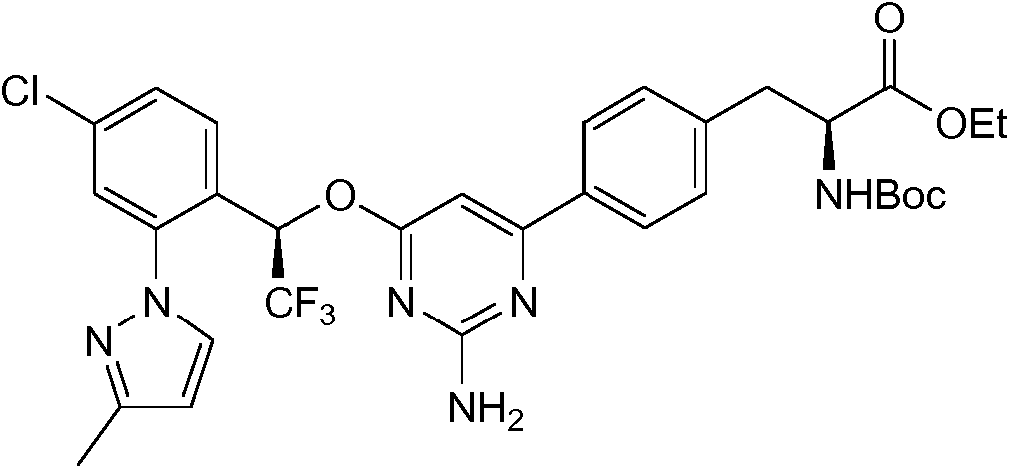
Otro compuesto de fórmula I(b) es 2-amino-3-(4-(2-amino-6-((R)-1-(4-cloro-2-(3-metil-1H-pirazol-1-il)fenil)-2,2,2-trifluoroetoxi)pirimidin-4-il)fenil)propanoato de (S)-etilo: Another compound of formula I (b) is 2-amino-3- (4- (2-amino-6 - ((R) -1- (4-chloro-2- (3-methyl-1H-pyrazole-1- (S) -ethyl yl) phenyl) -2,2,2-trifluoroethoxy) pyrimidin-4-yl) phenyl) propanoate:
En una realización de la divulgación, el compuesto de fórmula I se prepara de acuerdo con el enfoque general que se muestra a continuación en el Esquema 1:In one embodiment of the disclosure, the compound of formula I is prepared according to the general approach shown below in Scheme 1:

en donde Y1 es halógeno o pseudohalógeno. En este caso, un compuesto de fórmula II se pone en contacto con uno de fórmula III en condiciones de reacción adecuadas. Tales condiciones incluyen el uso de una base (por ejemplo, alquil-litio, alquilmagnesio, alcóxidos, hidróxidos de metales alcalinos, fosfatos de metales alcalinos y carbonatos de metales alcalinos), una temperatura de aproximadamente 50 a aproximadamente 150 °C, un tiempo de reacción de aproximadamente 10 a aproximadamente 40 horas, y disolventes apróticos polares. Una base particular es carbonato de cesio.where Y1 is halogen or pseudohalogen. In this case, a compound of formula II is contacted with one of formula III under suitable reaction conditions. Such conditions include the use of a base (e.g. alkyl lithium, alkyl magnesium, alkoxides, alkali metal hydroxides, alkali metal phosphates and alkali metal carbonates), a temperature of about 50 to about 150 ° C, a time of reaction time from about 10 to about 40 hours, and polar aprotic solvents. One particular base is cesium carbonate.
En determinadas realizaciones de la divulgación, el compuesto de fórmula II es de fórmula II(a):In certain embodiments of the disclosure, the compound of formula II is of formula II (a):

En algunos de tales compuestos, R1 es cloro y m es 1. Un compuesto particular es (R)-1-(4-cloro-2-(3-metil-1H-pirazol-1-il)fenil)-2,2,2-trifluoroetanol: In some such compounds, R1 is chlorine and m is 1. A particular compound is (R) -1- (4-chloro-2- (3-methyl-1H-pyrazol-1-yl) phenyl) -2,2, 2-trifluoroethanol:

Una forma cristalina particular de este compuesto tiene un punto de fusión de aproximadamente 120 °C medido por calorimetría de barrido diferencial (DSC) (temperatura de inicio). En este contexto, el término "aproximadamente" significa ± 5,0 °C. La forma proporciona un patrón de difracción de rayos X en polvo (XRPD) con picos en uno o más de aproximadamente 9,9, 11,0, 19,2, 19,9, 24,4, 30,0, 31,0 y/o 4o,4 grados 20. En este contexto, el término "aproximadamente" significa ± 0,3 grados. Como conocen los expertos en la materia, las intensidades relativas de los picos en un patrón de difracción de rayos X de una forma cristalina pueden variar según cómo se prepare la muestra y cómo se recopilen los datos. Con esto en mente, en la Figura 1 se proporciona un ejemplo de un patrón XRPD de esta forma cristalina.One particular crystalline form of this compound has a melting point of approximately 120 ° C as measured by differential scanning calorimetry (DSC) (starting temperature). In this context, the term "about" means ± 5.0 ° C. The shape provides an X-ray powder diffraction (XRPD) pattern with peaks at one or more of about 9.9, 11.0, 19.2, 19.9, 24.4, 30.0, 31.0 and / or 4th, 4 degrees 20. In this context, the term "approximately" means ± 0.3 degrees. As is known to those of skill in the art, the relative intensities of the peaks in an X-ray diffraction pattern of a crystalline form can vary depending on how the sample is prepared and how the data is collected. With this in mind, an example of an XRPD pattern of this crystalline form is provided in Figure 1.
Los compuestos de fórmula II se pueden preparar reduciendo compuestos de fórmula IV:Compounds of formula II can be prepared by reducing compounds of formula IV:
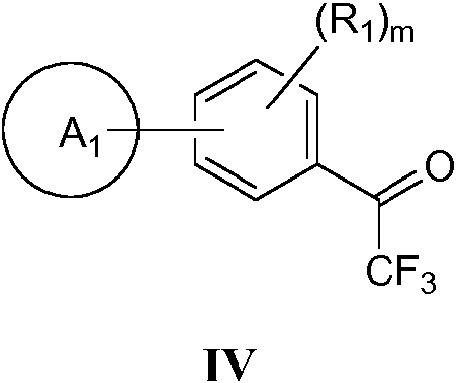
usando métodos generalmente conocidos como hidrogenación Noyori e hidrogenación por transferencia Noyori. En un método particular, la reducción se logra usando un catalizador de metal del grupo del platino (por ejemplo, iridio, rutenio, rodio) con un ligando quiral de tipo Noyori, tal como (1R,2R)-(-)-W-(4-toluenosulfonil)-1,2-difeniletilendiamina. Un compuesto particular de fórmula IV es 1-(4-cloro-2-(3-metil-1H-pirazol-1-il)fenil)-2,2,2-trifluoroetanona:using methods generally known as Noyori hydrogenation and Noyori transfer hydrogenation. In a particular method, the reduction is achieved using a platinum group metal catalyst (eg iridium, ruthenium, rhodium) with a chiral Noyori-type ligand, such as (1R, 2R) - (-) - W- (4-toluenesulfonyl) -1,2-diphenylethylenediamine. A particular compound of formula IV is 1- (4-chloro-2- (3-methyl-1H-pyrazol-1-yl) phenyl) -2,2,2-trifluoroethanone:

Una forma cristalina particular de este compuesto tiene un punto de fusión de aproximadamente 83 °C medido por DSC (temperatura de inicio). En este contexto, el término "aproximadamente" significa ± 5,0 °C. La forma proporciona un patrón XRPD con picos en uno o más de aproximadamente 8,1, 11,3, 16,3, 22,7 y/o 27,3 grados 20. En este contexto, el término "aproximadamente" significa ± 0,3 grados. En la Figura 2 se proporciona un ejemplo de un patrón XRPD de esta forma cristalina.One particular crystalline form of this compound has a melting point of approximately 83 ° C as measured by DSC (starting temperature). In this context, the term "about" means ± 5.0 ° C. The shape provides an XRPD pattern with peaks at one or more of about 8.1, 11.3, 16.3, 22.7, and / or 27.3 degrees 20. In this context, the term "about" means ± 0. , 3 degrees. An example of an XRPD pattern of this crystalline form is provided in Figure 2.
Los compuestos de fórmula IV se pueden preparar a partir de compuestos de fórmula V: Compounds of formula IV can be prepared from compounds of formula V:

en donde X es bromo o yodo. Por ejemplo, se puede hacer reaccionar un compuesto de fórmula V con un reactivo de alquillitio o alquilmagnesio para formar el correspondiente compuesto de litio o magnesio, el cual después se puede hacer reaccionar con 2,2,2-trifluoroacetato de etilo. Los reactivos de alquil litio particulares incluyen n-butillitio, secbutiNitio y t-butillitio. Los reactivos de magnesio particulares incluyen cloruro de isopropil magnesio y cloruro de tributilmagnesio. Las condiciones de reacción adecuadas incluyen temperaturas de aproximadamente -80 a aproximadamente 40 °C, los tiempos de reacción de aproximadamente 10 minutos a aproximadamente 10 horas y disolventes apróticos. Por tanto, el compuesto 1-(4-cloro-2-(3-metil-1H-pirazol-1-il)fenil)-2,2,2-trifluoroetanona se puede preparar a partir de 1-(2-bromo-5-clorofenil)-3-metil-1H-pirazol:where X is bromine or iodine. For example, a compound of formula V can be reacted with an alkyl lithium or alkyl magnesium reagent to form the corresponding lithium or magnesium compound, which can then be react with ethyl 2,2,2-trifluoroacetate. Particular alkyl lithium reagents include n-butyllithium, sec-butyllithium, and t-butyllithium. Particular magnesium reagents include isopropyl magnesium chloride and tributyl magnesium chloride. Suitable reaction conditions include temperatures from about -80 to about 40 ° C, reaction times from about 10 minutes to about 10 hours, and aprotic solvents. Therefore, the compound 1- (4-chloro-2- (3-methyl-1H-pyrazol-1-yl) phenyl) -2,2,2-trifluoroethanone can be prepared from 1- (2-bromo- 5-chlorophenyl) -3-methyl-1H-pyrazole:

Una forma cristalina particular de este compuesto tiene un punto de fusión de aproximadamente 76 °C medido por DSC (temperatura de inicio). En este contexto, el término "aproximadamente" significa ± 5,0 °C. La forma proporciona un patrón de difracción de rayos X en polvo (XRPD) con picos de aproximadamente 8,2, 16,4, 17,3, 19,0, 22,7, 25,8, 28,4, 31,0 y/o 33,6 grados 20. En este contexto, el término "aproximadamente" significa ± 0,3 grados. En la Figura 3 se proporciona un ejemplo de un patrón XRPD de esta forma cristalina.One particular crystalline form of this compound has a melting point of approximately 76 ° C as measured by DSC (starting temperature). In this context, the term "about" means ± 5.0 ° C. The shape provides an X-ray powder diffraction (XRPD) pattern with peaks of approximately 8.2, 16.4, 17.3, 19.0, 22.7, 25.8, 28.4, 31.0 and / or 33.6 degrees 20. In this context, the term "approximately" means ± 0.3 degrees. An example of an XRPD pattern of this crystalline form is provided in Figure 3.
Los compuestos de fórmula III se pueden preparar acoplando un compuesto de fórmula IN(a):Compounds of formula III can be prepared by coupling a compound of formula IN (a):

con 2-amino-4,6-dicloropirimidina, en donde cada R' es independientemente hidrógeno o alquilo opcionalmente sustituido, alquilarilo, alquil-heterociclo, arilo o heterociclo, o se toman junto con los átomos de oxígeno a los que están unidos para proporcionar un dioxaborolano cíclico. Las condiciones de acoplamiento de Suzuki adecuadas son bien conocidas en la técnica e incluyen el uso de un catalizador de paladio. Ejemplos de catalizadores de paladio incluyen cloruro de bis(trifenilfosfina)-paladio (II), mezcla de una sal de paladio, tal como cloruro de paladio o acetato de paladio, y un ligando, tal como trifenilfosfina, diclorobis(di-ferc-butilfosfinito-^P)paladato de dihidrógeno (2-) (POPd), d i-jclorotetraquis(di-ferc-butilfosfinito-^P)dipaladato de dihidrógeno (2-) (POpd1), di-j-clorodiclorobis(di-ferc-butilfosfinito-^P)dipaladato de dihidrógeno (2-) (pOPd2), diclorobis(ferc-butilciclohexilfosfinito-^P)paladato de dihidrógeno (2-) (POPd3), di-j-clorodiclorobis(terc-butilciclohexilfosfinito-^P)dipaladato de dihidrógeno (2-) (POPd4), d i-jclorotetraquis(ferc-ciclohexilfosfinito-^P)dipaladato de dihidrógeno (2-) (POPd5), d i-jclorodiclorobis(diciclohexilfosfinito-^P)dipaladato de dihidrógeno (2-) (POPd6), di-j-clorotetraquis(diciclohexilfosfinito-^P)dipaladato de dihidrógeno (2-) (POPd7), diclorobis(clorodi-ferc-butilfosfina)paladio (Il) (PXPd), dímero dicloro(clorodi-ferc-butilfosfina)paladio (II) (PXPd2), dímero dibromo(clorod¡-ferc-but¡lfosfina)palad¡o (II) (PXPd2-Br), diclorobis(cloro-ferc-butilciclohexilfosfina)paladio (II) (PXPd3), dímero dicloro(cloro-ferc-but¡lc¡clohexilfosf¡na)palad¡o (II) (PXPd4), dímero dicloro(clorodiciclohexilfosfina)paladio (II) (PXPd6) y diclorobis(clorodiciclohexilfosfina)paladio (II) (PXPd7). En una realización, el catalizador no es cloruro de bis(trifenilfosfina)-paladio (II).with 2-amino-4,6-dichloropyrimidine, where each R 'is independently hydrogen or optionally substituted alkyl, alkylaryl, alkyl-heterocycle, aryl, or heterocycle, or taken together with the oxygen atoms to which they are attached to provide a cyclic dioxaborolane. Suitable Suzuki coupling conditions are well known in the art and include the use of a palladium catalyst. Examples of palladium catalysts include bis (triphenylphosphine) -palladium (II) chloride, mixture of a palladium salt, such as palladium chloride or palladium acetate, and a ligand, such as triphenylphosphine, dichlorobis (di-ferc-butylphosphinite - ^ P) dihydrogen (2-) palladate (POPd), di-j-chlorotetrakis (di-ferc-butylphosphinite- ^ P) dihydrogen (2-) dipalate (POpd1), di-j-chlorodichlorobis (di-ferc- butylphosphinite- ^ P) dihydrogen (2-) dipalate (pOPd2), dichlorobis (tert-butylcyclohexylphosphinite- ^ P) dihydrogen (2-) palladate (POPd3), di-j-chlorodichlorobis (tert-butylcyclohexylphosphinite- ^ P) dipalate dihydrogen (2-) (POPd4), d i-jchlorotetrakis (ferc-cyclohexylphosphinite- ^ P) dihydrogen (2-) dipalate (POPd5), d i-jchlorodichlorobis (dicyclohexylphosphinite- ^ P) dihydrogen (2-) dipalate (POPd6), di-j-chlorotetrakis (dicyclohexylphosphinite- ^ P) dihydrogen (2-) dipaladate (POPd7), dichlorobis (chlorodi-tert-butylphosphine) palladium (Il) (PXPd), dichloro dimer (chlorodi-ferc-butylphosphine )palladium (II) (PXPd2), dibromo dimer (chlorod¡-tert-butyphosphine) palladium (II) (PXPd2-Br), dichlorobis (chloro-tert-butylcyclohexylphosphine) palladium (II) (PXPd3), dichloro dimer ( chloro-tert-butyclohexylphosphine) palladium (II) (PXPd4), dichloro (chlorodicyclohexylphosphine) palladium (II) dimer (PXPd6) and dichlorobis (chlorodicyclohexylphosphine) palladium (II) (PXPd7). In one embodiment, the catalyst is not bis (triphenylphosphine) -palladium (II) chloride.
En una realización de la divulgación, el compuesto de fórmula IN(a) es de la fórmula:In one embodiment of the disclosure, the compound of formula IN (a) is of the formula:

Los compuestos desvelados en el presente documento se pueden cristalizar solos o con otros compuestos (por ejemplo, aminoácidos) para proporcionar cocristales. Por tanto, una realización de la divulgación abarca un método para formar un cocristal de un compuesto de fórmula I, que comprende poner en contacto un compuesto de fórmula I con un aminoácido farmacéuticamente aceptable en condiciones suficientes para proporcionar un cocristal del compuesto de fórmula I y el aminoácido.The compounds disclosed herein can be crystallized alone or with other compounds (eg, amino acids) to provide cocrystals. Thus, one embodiment of the disclosure encompasses a method to form a cocrystal of a compound of formula I, which comprises contacting a compound of formula I with a pharmaceutically acceptable amino acid under conditions sufficient to provide a cocrystal of the compound of formula I and the amino acid.
6. Ejemplos6. Examples
6.1. Preparación de 1-(4-Cloro-2-(3-met¡l-1H-p¡razol-1-¡l)fen¡l)-2.2.2-tr¡fluoroetanona6.1. Preparation of 1- (4-Chloro-2- (3-methyl-1H-p¡razol-1-¡l) phen¡l) -2.2.2-tr¡fluoroethanone

Un matraz de fondo redondo de 3 bocas de 3 l equipado con un agitador mecánico, un controlador de temperatura, y una entrada de nitrógeno se cargó con ferc-butóxido de potasio (Aldrich 95 %, 84,6 g, 0,716 mol) y DMSO (400 ml, 4X) a temperatura ambiente y se agitó durante 15 minutos. A esta solución se le añadió pirazol 2 (59 g, 0,719 mol) seguido de un aclarado con DMSO (50 ml, 0,5X). La solución turbia de color naranja resultante se agitó durante 15 minutos y se añadió fluoruro 1 (100 g, 0,477 mol) seguido de un aclarado con DMSo (50 ml, 0,5X). Después, esta mezcla se calentó a 50 °C y se mantuvo durante 5 horas a esta temperatura. Después del enfriamiento hasta la temperatura ambiente, la mezcla de reacción se diluyó con MTBE (750 ml) y se añadió agua (500 ml) para dar una mezcla turbia de color pardo. Después de 15 minutos de agitación, la capa orgánica se separó y se lavó secuencialmente con HCl 1 N (250 ml) y salmuera (250 ml) y agua (250 ml). El ensayo de solución de la capa orgánica se llevó a cabo usando CC (conversión> 99 %, rendimientos de solución de 3 y su regioisómero 4 fueron 83 % y 17 %, respectivamente). Después, la solución de MTBE se concentró al vacío hasta un volumen total de aproximadamente 200 ml (KF mostró agua al 0,737 %). Se añadió THF (500 ml) y se concentró hasta una solución 2X (KF = 0,158 %). Se repitió la secuencia de adición-concentración de THF para dar una solución 2X (KF = 0,023 %), que se usó directamente en la siguiente etapa.A 3 L 3 necked round bottom flask equipped with a mechanical stirrer, a temperature controller, and a nitrogen inlet was charged with potassium ferc-butoxide (Aldrich 95%, 84.6 g, 0.716 mol) and DMSO (400 ml, 4X) at room temperature and stirred for 15 minutes. Pyrazole 2 (59 g, 0.719 mol) was added to this solution followed by a rinse with DMSO (50 ml, 0.5X). The resulting cloudy orange solution was stirred for 15 minutes and fluoride 1 (100 g, 0.477 mol) was added followed by a rinse with DMSo (50 ml, 0.5X). Afterwards, this mixture was heated to 50 ° C and kept for 5 hours at this temperature. After cooling to room temperature, the reaction mixture was diluted with MTBE (750 ml) and water (500 ml) was added to give a cloudy brown mixture. After 15 minutes of stirring, the organic layer was separated and washed sequentially with 1N HCl (250 ml) and brine (250 ml) and water (250 ml). The organic layer solution test was carried out using CC (conversion> 99%, solution yields of 3 and its regioisomer 4 were 83% and 17%, respectively). The MTBE solution was then concentrated in vacuo to a total volume of approximately 200 ml (KF showed 0.737% water). THF (500 ml) was added and concentrated to a 2X solution (KF = 0.158%). The THF addition-concentration sequence was repeated to give a 2X solution (KF = 0.023%), which was used directly in the next step.
Las muestras analíticas de los compuestos 3 y 4 se purificaron mediante cromatografía en columna y se caracterizaron: Compuesto 3: cristales de color blanco; P.f.: 76 °C (temperatura de inicio de DSC). RMN 1H (400 Mh z , CDCh) 87,80 (1H, d, J = 2,3 Hz), 7,61 (1H, d, J= 8,6 Hz), 7,58 (1H, d, J = 2,5 Hz), 7,22 (1H, dd, J = 8,6, 2,6 Hz), 6,27 (1H, d, J = 2,5 Hz), 2,38 (3H, s); RMN 13C (100 MHz, CDCh) 8150,8, 140,6, 134,6, 134,1, 132,0, 129,0, 128,2, 115,4, 107,0, 13,6. Compuesto 4: cristales de color blanco; RMN 1H (400 MHz, CDCla) 87,65 (1H, d, J = 8,6 Hz), 7,62 (1H, d, J = 1,5 Hz), 7,43 (1H, d, J = 2,5 Hz), 7,35 (1H, dd, J = 8,6, 2,2 Hz), 6,21 (1H, s), 2,19 (3H, s); RMN 13C (100 MHz, CDCh) 8140,6, 140,2, 140,0, 134,1, 133,9, 130,8, 130,2, 120,7, 105,9, 11,4.Analytical samples of compounds 3 and 4 were purified by column chromatography and characterized: Compound 3: white crystals; Mp: 76 ° C (DSC start temperature). 1H NMR (400Mh z, CDCh) 87.80 (1H, d, J = 2.3 Hz), 7.61 (1H, d, J = 8.6 Hz), 7.58 (1H, d, J = 2.5 Hz), 7.22 (1H, dd, J = 8.6, 2.6 Hz), 6.27 (1H, d, J = 2.5 Hz), 2.38 (3H, s ); 13 C NMR (100 MHz, CDCh) 8150.8, 140.6, 134.6, 134.1, 132.0, 129.0, 128.2, 115.4, 107.0, 13.6. Compound 4: white crystals; 1H NMR (400 MHz, CDCla) 87.65 (1H, d, J = 8.6 Hz), 7.62 (1H, d, J = 1.5 Hz), 7.43 (1H, d, J = 2.5 Hz), 7.35 (1H, dd, J = 8.6, 2.2 Hz), 6.21 (1H, s), 2.19 (3H, s); 13 C NMR (100 MHz, CDCh) 8140.6, 140.2, 140.0, 134.1, 133.9, 130.8, 130.2, 120.7, 105.9, 11.4.

La solución de THF anterior se transfirió a un matraz de fondo redondo de 3 bocas y 3 l con camisa equipado con un agitador mecánico, un controlador de temperatura y una entrada de nitrógeno. Después de diluir con THF (800 ml), el contenido de agua en la solución se comprobó mediante KF (0,053 %). A la solución anterior se le añadió una solución de /-PrMgCl en THF (Aldrich 2 M, 286 ml, 0,572 mol) a 0-10 °C durante 1 hora. La solución resultante se agitó durante 30 minutos a 10 °C (la CG mostró que se había completado la reacción de intercambio de magnesio-bromo). Después, se añadió trifluoroacetato de etilo (74 ml, 0,620 mol) a la solución de Grignard entre -20 y -10 °C durante 45 minutos, se calentó lentamente a 0 °C y se agitó durante 30 minutos a la misma temperatura. La mezcla de reacción se vertió en HCl 2 N (300 ml) a 0 °C y se agitó durante 30 minutos a temperatura ambiente. La capa orgánica se diluyó con MTBE (500 ml) y se lavó con salmuera (250 ml) seguido de agua (250 ml). El ensayo en solución de la capa orgánica se llevó a cabo usando CG (Compuesto 5: rendimiento en solución del 67 %, el regioisómero 6 correspondiente estaba presente en aproximadamente un 20 % con respecto a 5). Después, la solución se concentró al vacío hasta una solución 2X. Para retirar el agua, se añadió THF (500 ml) y se evaporó hasta una solución 2X. Se repitió la concentración de adición de THF para dar una solución 2X. Se añadió heptano (500 ml), se concentró hasta una solución 2X para intercambiar el disolvente para la recristalización. Se añadió de nuevo heptano (500 ml) y se concentró hasta una solución 3,5X.The THF solution from above was transferred to a 3-necked, 3L jacketed round bottom flask equipped with a mechanical stirrer, temperature controller, and nitrogen inlet. After diluting with THF (800 ml), the water content in the solution was checked by KF (0.053%). A solution of / -PrMgCl in THF (Aldrich 2M, 286 mL, 0.572 mol) was added to the above solution at 0-10 ° C for 1 hour. The resulting solution was stirred for 30 minutes at 10 ° C (GC showed the magnesium-bromine exchange reaction was complete). Then, ethyl trifluoroacetate (74 ml, 0.620 mol) was added to the Grignard solution at -20 to -10 ° C over 45 minutes, slowly heated to 0 ° C and stirred for 30 minutes at the same temperature. The reaction mixture was poured into 2N HCl (300 ml) at 0 ° C and stirred for 30 minutes at room temperature. The organic layer was diluted with MTBE (500 ml) and washed with brine (250 ml) followed by water (250 ml). The organic layer solution test was carried out using GC (Compound 5: 67% solution yield, the corresponding regioisomer 6 was present in approximately 20% with respect to 5). The solution was then concentrated in vacuo to a 2X solution. To remove the water, THF (500 ml) was added and evaporated to a 2X solution. The THF addition concentration was repeated to give a 2X solution. Heptane (500 ml) was added, concentrated to a 2X solution to exchange the solvent for recrystallization. Heptane (500 ml) was added again and concentrated to a 3.5X solution.
La solución de heptano 3,5X se transfirió después a un matraz de fondo redondo con camisa de 3 bocas de 1 l equipado con un agitador mecánico, un controlador de temperatura y una entrada de nitrógeno. La solución se calentó a 60 °C y la solución homogénea resultante se enfrió lentamente (1-2 h) a temperatura ambiente con agitación, se enfrió adicionalmente a 0 °C y se agitó durante 30 minutos a la misma temperatura. Los cristales se recogieron y se lavaron con heptano enfriado con hielo (200 ml), se secaron al vacío a 50 °C para proporcionar un sólido de color amarillo pálido (Compuesto 5 , 85,7 g, 99% puro por CG, rendimiento del 62% a partir de fluoruro 1). P.f.: 83 °C (temperatura de inicio de DSC) RMN 1H (400 MHz, CDCh ) 87,85 (1H, d, J = 2,5 Hz), 7,48 (1H, d, J = 1,7 Hz), 7,38 (1H, d, J = 8,3 Hz), 7,31 (1H, dd, J = 8,1, 1,8 Hz), 6,33 (1H, d, J = 2,5 Hz), 2,30 (3H, s); RMN 13C (100 MHz, CDCla) 8 184,2 (c, J c-f = 36,6 Hz), 151,7, 138,7, 138,5, 130,7, 126,4, 125,7, 124,5, 116,8, 116,1 (c, J c-f = 289,8 Hz), 109,7, 13,0; RMN 19F (376 MHz, CDCla) 8 = -76,8 (s).The 3.5X heptane solution was then transferred to a 1L 3-necked jacketed round bottom flask equipped with a mechanical stirrer, temperature controller, and nitrogen inlet. The solution was heated to 60 ° C and the resulting homogeneous solution was slowly cooled (1-2 h) to room temperature with stirring, further cooled to 0 ° C and stirred for 30 minutes at the same temperature. The crystals were collected and washed with ice cold heptane (200 ml), dried in vacuo at 50 ° C to provide a pale yellow solid (Compound 5, 85.7 g, 99% pure by GC, yield of the 62% from fluoride 1). Mp: 83 ° C (DSC start temperature) 1 H NMR (400 MHz, CDCh) 87.85 (1H, d, J = 2.5 Hz), 7.48 (1H, d, J = 1.7 Hz), 7.38 (1H, d, J = 8.3 Hz), 7.31 (1H, dd, J = 8.1, 1.8 Hz), 6.33 (1H, d, J = 2 , 5 Hz), 2.30 (3H, s); 13 C NMR (100 MHz, CDCla) 8 184.2 (c, J c - f = 36.6 Hz), 151.7, 138.7, 138.5, 130.7, 126.4, 125.7 , 124.5, 116.8, 116.1 (c, J c - f = 289.8 Hz), 109.7, 13.0; 19 F NMR (376 MHz, CDCla) 8 = -76.8 (s).
6.2. Preparación de (R)-1-(4-cloro-2-(3-met¡l-1H-p¡razol-1-¡nfenil)-2.2.2-tr¡fluoroetanol6.2. Preparation of (R) -1- (4-chloro-2- (3-methyl-1H-pyrazol-1-phenyl) -2.2.2-trifluoroethanol
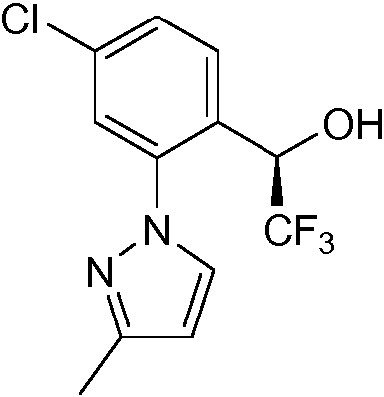
Un matraz de fondo redondo con camisa y 3 bocas de 3 l equipado con un agitador mecánico, un controlador de temperatura y una entrada de nitrógeno se cargó secuencialmente con dímero dicloro(pentametilciclopentadienil)iridio (III) ([Cp*IrCl2]2, STREM, n.° de CAS: 12354-85-7, 34 mg, 0,043 mmol), (1R,2R)-(-)-N-(4-toluenosulfonil)-1,2-difeniletilendiamina (STREM, n.° de CAS: 144222-34-4, 32 mg, 0,087 mmol) y agua (400 ml, 4X) a temperatura ambiente. La mezcla resultante se agitó durante 3 horas a 40 °C para dar una solución homogénea de color naranja. A esta solución de catalizador activo se le añadió formiato potásico (145,5 g, 1,73 mol) y una solución de la cetona 1-(4-cloro-2-(3-metil-1H-pirazol-1-il)fenil)-2,2,2-trifluoroetanona (100 g, >99% pureza por CG, 0,346 mol) en C ^C N (500 ml, 5X) a 40 °C. Después, la mezcla de reacción se agitó a 40 °C durante 2 horas, momento en el cual se determinó que la reacción estaba completa por CG. Después de enfriar a 30 °C, se retiró la capa acuosa (aprox.A 3L 3-necked jacketed round bottom flask equipped with a mechanical stirrer, temperature controller, and nitrogen inlet was charged sequentially with dichloro (pentamethylcyclopentadienyl) iridium (III) dimer ([Cp * IrCl2] 2, STREM , CAS #: 12354-85-7, 34mg, 0.043mmol), (1R, 2R) - (-) - N- (4-toluenesulfonyl) -1,2-diphenylethylenediamine (STREM, # CAS: 144222-34-4, 32mg, 0.087mmol) and water (400ml, 4X) at room temperature. The resulting mixture was stirred for 3 hours at 40 ° C to give a homogeneous orange solution. To this active catalyst solution were added potassium formate (145.5 g, 1.73 mol) and a solution of the ketone 1- (4-chloro-2- (3-methyl-1H-pyrazol-1-yl) phenyl) -2,2,2-trifluoroethanone (100 g,> 99% purity by GC, 0.346 mol) in C ^ CN (500 ml, 5X) at 40 ° C. The reaction mixture was then stirred at 40 ° C for 2 hours, at which time the reaction was determined to be complete by GC. After cooling to 30 ° C, the aqueous layer was removed (approx.
480 ml). La capa orgánica (aprox. 600 ml, 6X) se trató sobre carbono activado (Darco G-60, 20 g, 0,2X) a 45 °C durante 2 horas y se filtró a través de un lecho de 0,64 cm (1/4 pulgada) de Celpure P65 (USP-NF, grado farmacéutico, Sigma) y se lavó con C ^C N (200 ml, 2X). El filtrado se concentró hasta 250 ml (2,5X) y se transfirió a un matraz de fondo redondo con camisa de 3 bocas de 2 l equipado con un agitador mecánico y un controlador de temperatura. Se añadió más CH3CN (50 ml, 0,5X) para incrementar el volumen de solución hasta 300 ml (3 x). Esta solución se calentó a 60 °C y se añadió agua (500 ml, 5X) a esta solución a la misma temperatura. Después de agitar durante 15 minutos a 60 °C, la mezcla lechosa similar a una emulsión resultante se enfrió lentamente a temperatura ambiente. Después, los cristales se filtraron a temperatura ambiente y se lavaron con C^CN/agua (1:2, 150 ml, 1,5X). La torta húmeda (108 g, KF: 8,83 %) se secó al vacío a 45 °C durante 4 horas para proporcionar el alcohol deseado (sólido de color blanco, 95 g, 94 % de rendimiento, >99 % de pureza química, >99 % de ee, KF: 0,014 %). P.f.: 120 °C (temperatura de inicio de DSC); RMN 1H (metanol-d4, 400 MHz) 82,19 (s a, 3H), 5,23 (dd, 6,8 Hz, 7,2 Hz, 1H), 6,19 (d, 2,4 Hz, 1H), 7,29 (d, 2 Hz, 1H), 7,42 (dd, 2,0 Hz, 6,4 Hz, 1H), 7,59 (d, 2,4 Hz, 1H), 7,68 (d, 8,4 Hz, 1H). RMN 13C (metanol-d4) 813,4, 67,2, 108.3, 121,7, 124,5, 127,4, 130,1, 131,9, 134,1, 136,4, 141,6, 152,3. CL/EM: MH+= 291.480 ml). The organic layer (approx. 600 ml, 6X) was treated over activated carbon (Darco G-60, 20 g, 0.2X) at 45 ° C for 2 hours and filtered through a 0.64 cm ( 1/4 inch) of Celpure P65 (USP-NF, pharmaceutical grade, Sigma) and washed with C ^ CN (200 ml, 2X). The filtrate was concentrated to 250 mL (2.5X) and transferred to a 2L 3-necked jacketed round bottom flask equipped with a mechanical stirrer and temperature controller. More CH3CN (50 ml, 0.5X) was added to increase the volume of solution to 300 ml (3x). This solution was heated to 60 ° C and water (500 ml, 5X) was added to this solution at the same temperature. After stirring for 15 minutes at 60 ° C, the resulting milky emulsion-like mixture was slowly cooled to room temperature. The crystals were then filtered at room temperature and washed with C ^ CN / water (1: 2, 150 ml, 1.5X). The wet cake (108 g, KF: 8.83%) was dried under vacuum at 45 ° C for 4 hours to provide the desired alcohol (white solid, 95 g, 94% yield,> 99% chemical purity ,> 99% ee, KF: 0.014%). Mp: 120 ° C (DSC start temperature); 1H NMR (methanol-d4, 400 MHz) 82.19 (bs, 3H), 5.23 (dd, 6.8 Hz, 7.2 Hz, 1H), 6.19 (d, 2.4 Hz, 1H ), 7.29 (d, 2 Hz, 1H), 7.42 (dd, 2.0 Hz, 6.4 Hz, 1H), 7.59 (d, 2.4 Hz, 1H), 7.68 (d, 8.4 Hz, 1H). 13 C NMR (methanol-d4) 813.4, 67.2, 108.3, 121.7, 124.5, 127.4, 130.1, 131.9, 134.1, 136.4, 141.6, 152 ,3. LC / MS: MH + = 291.
6.3. Preparación de 2-(terc-butox¡carbon¡lam¡no)-3-(4-(tr¡fluorom et¡lsulfon¡lox¡)fen¡l)propanoato de (S)-metilo6.3. Preparation of (S) -methyl 2- (tert-butoxycarbonylamine) -3- (4- (trifluorom ethylsulfonylox) phenyl) propanoate

Este compuesto se preparó basándose en un procedimiento bibliográfico (Shieh, et al., J. Org. Chem. 57:379-381 (1992)). A una solución de Boc-Tyr-OMe (Bachem, California, 100 g, 0,34 mol) y N-metilmorfolina (51 g, 1,5 equiv.) en diclorometano (1000 ml) se le añadió anhídrido tríflico (100 g, 1,05 equiv.) durante 2 horas de -5 a -15 °C. La solución de color rojo resultante se agitó a -10 °C durante 10 minutos. El análisis HPLC mostró la desaparición completa del material de partida. La reacción se interrumpió con ácido cítrico al 10 % (500 ml). La capa orgánica se lavó con ácido cítrico al 10 % (500 ml) seguido de agua (500 ml). La solución de color rosa claro resultante se concentró a presión reducida hasta 200 ml. Esta se diluyó con acetonitrilo (600 ml) y se concentró adicionalmente hasta una solución de 200 g. Esta solución se usó en la siguiente etapa sin purificación adicional. El rendimiento estimado fue del 98 % extrayendo una muestra hasta sequedad para dar un sólido de color amarillo pálido de bajo punto de fusión. CL-EM (IEN): MH+ = 428,0, MNH4+ = 445,0. RMN 1H (CDCh) 87,16 (m, 4H), 4,95 (d, J= 7,1 Hz, 1H), 4,53 (m, 1H), 3,64 (s, 3H), 3,10 (dd, J i = 5,7 Hz, J2 = 13,8 Hz, 1H), 2,97 (dd, J1 = 6,3 Hz, J2 = 13,6 Hz, 1H), 1,34 (s, 9H). RMN 13C (CDCla) 8 172,3, 155,4, 149,0, 137,4, 131,5, 121,7, 119,1 (c, J = 321 Hz), 80,54, 54,62, 52,7, 38,3, 28,6. RMN 19F (CDCh) 8 -73.4.This compound was prepared based on a literature procedure (Shieh, et al., J. Org. Chem. 57: 379-381 (1992)). To a solution of Boc-Tyr-OMe (Bachem, California, 100 g, 0.34 mol) and N-methylmorpholine (51 g, 1.5 equiv.) In dichloromethane (1000 ml) was added triflic anhydride (100 g , 1.05 equiv.) For 2 hours at -5 to -15 ° C. The resulting red solution was stirred at -10 ° C for 10 minutes. HPLC analysis showed complete disappearance of the starting material. The reaction was quenched with 10% citric acid (500 ml). The organic layer was washed with acid 10 % citrus (500 ml) followed by water (500 ml). The resulting light pink solution was concentrated under reduced pressure to 200 ml. This was diluted with acetonitrile (600 ml) and further concentrated to a 200 g solution. This solution was used in the next step without further purification. The estimated yield was 98% by drawing a sample to dryness to give a low melting pale yellow solid. LCMS (ESI): MH + = 428.0, MNH4 + = 445.0. 1 H NMR (CDCh) 87.16 (m, 4H), 4.95 (d, J = 7.1 Hz, 1H), 4.53 (m, 1H), 3.64 (s, 3H), 3 , 10 (dd, J i = 5.7 Hz, J2 = 13.8 Hz, 1H), 2.97 (dd, J1 = 6.3 Hz, J2 = 13.6 Hz, 1H), 1.34 ( s, 9H). 13 C NMR (CDCla) 8 172.3, 155.4, 149.0, 137.4, 131.5, 121.7, 119.1 (q, J = 321 Hz), 80.54, 54.62 , 52.7, 38.3, 28.6. 19 F NMR (CDCh) 8-73.4.
6.4. Preparación_____ de_____ 2-(te/'c-butoxicarbonilamino)-3-(4-(4.4.5.5-tetrametil-1.3.2-dioxaborolan-2-¡nfenihpropanoato de (S)-metilo6.4. Preparation _____ of_____ 2- (te / 'c-butoxycarbonylamino) -3- (4- (4.4.5.5-tetramethyl-1,3.2-dioxaborolan-2-inphenyhpropanoate of (S) -methyl)

Este compuesto se preparó basándose en un procedimiento bibliográfico (Firooznia, et al., Tetrahedron Lett. 40:213-216 (1999)). Se mezclaron bis(pinacolato)diboro (90 g, 1,1 equiv.), acetato potásico (63 g, 2 equiv.), triciclohexilfosfina (2,3 g, 2,5 mol%) y acetato de paladio (0,72 g, 1 mol%) en acetonitrilo (950 ml) y la mezcla resultante se agitó a temperatura ambiente (t.a.) durante 5 minutos. Se añadió una solución de 2-(terc-butoxicarbonilamino)-3-(4-(trifluorometilsulfoniloxi)-fenil)propanoato de (S)-metilo (190 g, 0,32 mol) y la mezcla resultante se calentó a 80 °C durante 1 horas y se enfrió. El análisis por HPLC mostró el consumo completo del material de partida. La mezcla de reacción se inactivó con una solución acuosa de bicarbonato potásico (57 g en 475 ml de agua) y la mezcla resultante se agitó a t.a. durante 30 minutos. La mezcla se filtró a través de una capa de 20 micrómetros de celulosa para retirar negro de paladio. Se concentró una muestra de la capa orgánica y se purificó por cromatografía en columna (gradiente: 1:10 a 1:4 de acetato de etilo/hexanos) para dar el compuesto éster en forma de un aceite transparente. CL-EM (IEN): MH+ = 406,2, MNH4+ = 423,2, M2H+ = 811,5, M2NH4+ = 428,5. RMN 1H (CDCls) 87,76 (d, J = 8,1 Hz, 2H), 7,15 (d, J = 7,6 Hz, 2H), 4,96 (d, J = 7,3 Hz, 1H), 4,60 (m, 1H), 3,72 (s, 3H), 3,13 (m, 2H), 1,44 (s, 9H), 1,36 (s, 12H).This compound was prepared based on a literature procedure (Firooznia, et al., Tetrahedron Lett. 40: 213-216 (1999)). Bis (pinacolato) diboro (90 g, 1.1 equiv.), Potassium acetate (63 g, 2 equiv.), Tricyclohexylphosphine (2.3 g, 2.5 mol%) and palladium acetate (0.72 g, 1 mol%) in acetonitrile (950 ml) and the resulting mixture was stirred at room temperature (rt) for 5 minutes. A solution of (S) -methyl 2- (tert-butoxycarbonylamino) -3- (4- (trifluoromethylsulfonyloxy) -phenyl) propanoate (190 g, 0.32 mol) was added and the resulting mixture was heated to 80 ° C for 1 hour and cooled. HPLC analysis showed complete consumption of the starting material. The reaction mixture was quenched with an aqueous potassium bicarbonate solution (57 g in 475 ml of water) and the resulting mixture was stirred at rt for 30 minutes. The mixture was filtered through a 20 micron cellulose pad to remove palladium black. A sample of the organic layer was concentrated and purified by column chromatography (gradient: 1:10 to 1: 4 ethyl acetate / hexanes) to give the ester compound as a clear oil. LC-MS (ESI): MH + = 406.2, MNH4 + = 423.2, M2H + = 811.5, M2NH4 + = 428.5. 1 H NMR (CDCls) 87.76 (d, J = 8.1 Hz, 2H), 7.15 (d, J = 7.6 Hz, 2H), 4.96 (d, J = 7.3 Hz , 1H), 4.60 (m, 1H), 3.72 (s, 3H), 3.13 (m, 2H), 1.44 (s, 9H), 1.36 (s, 12H).

La capa orgánica anterior del éster se agitó con una solución acuosa de hidróxido de litio (23 g en 500 ml de agua) a t.a. por 30 minutos. El pH de la suspensión resultante se ajustó a aproximadamente 10 con ácido clorhídrico 6 N y se filtró. La torta se lavó con agua (200 ml). Se retiró el acetonitrilo del filtrado a presión reducida para dar una suspensión acuosa (950 ml, se añadió agua adicional durante la destilación). La suspensión se filtró a través de una capa de 20 micrómetros de celulosa y se lavó con agua (200 ml). El filtrado se lavó con MTBE (500 ml) y se volvió a diluir con 700 ml de MTBE. La mezcla se acidificó a pH de aproximadamente 4,5 con ácido clorhídrico 6 N. La capa orgánica se lavó con agua (500 ml) y se concentró a presión reducida hasta el compuesto ácido en forma de un aceite marrón (206 g, rendimiento del 95 % basado en la pureza estimada por RMN). El producto en bruto puede usarse directamente en la siguiente etapa. Como alternativa, el compuesto se puede purificar por cristalización en MTBE/heptano para dar un sólido de color blanco, que contiene una pequeña cantidad del correspondiente ácido borónico, ácido (S)-3-(4-boronofenil)-2-(terc-butoxicarbonilamino)propanoico. EM (IEN): MH+ = 392,2, MNH4+ = 409,2, M2H+ = 783,4, M2NH4+ = 800,4. RMN 1H (CDCls) 87,95 (s a, 1H), 7,76 (d, J = 7,8 Hz, 2H), 7,21 (d, J = 7,6 Hz, 2H), 5,03 (d, J = 7,8 Hz, 1H), 4,62 (m, 1H), 3,18 (m, 2H), 1,43 (s, 9H), 1,35 (s, 12H). RMN 13C (CDCls) 8 175,8, 155,7, 139,7, 135,4, 129,2, 84,2, 80.5, 54,5, 38,3, 28,7, 25,2.The above organic ester layer was stirred with an aqueous lithium hydroxide solution (23 g in 500 ml of water) at rt for 30 minutes. The pH of the resulting suspension was adjusted to about 10 with 6N hydrochloric acid and filtered. The cake was washed with water (200 ml). Acetonitrile was removed from the filtrate under reduced pressure to give an aqueous suspension (950 ml, additional water was added during distillation). The suspension was filtered through a 20 micron cellulose pad and washed with water (200 ml). The filtrate was washed with MTBE (500 ml) and re-diluted with 700 ml of MTBE. The mixture was acidified to pH about 4.5 with 6N hydrochloric acid. The organic layer was washed with water (500 ml) and concentrated under reduced pressure to the acidic compound as a brown oil (206 g, yield of the 95% based on NMR estimated purity). The raw product can be used directly in the next stage. Alternatively, the compound can be purified by crystallization from MTBE / heptane to give a white solid, containing a small amount of the corresponding boronic acid, (S) -3- (4-boronophenyl) -2- (tertiary acid). butoxycarbonylamino) propanoic. MS (ESI): MH + = 392.2, MNH4 + = 409.2, M2H + = 783.4, M2NH4 + = 800.4. 1 H NMR (CDCls) 87.95 (bs, 1H), 7.76 (d, J = 7.8 Hz, 2H), 7.21 (d, J = 7.6 Hz, 2H), 5.03 (d, J = 7.8 Hz, 1H), 4.62 (m, 1H), 3.18 (m, 2H), 1.43 (s, 9H), 1.35 (s, 12H). 13 C NMR (CDCls) 8 175.8, 155.7, 139.7, 135.4, 129.2, 84.2, 80.5, 54.5, 38.3, 28.7, 25.2.
6.5. Preparación de ácido (S)-3-(4-(2-amino-6-cloropirimidin-4-il)fenin-2-(terc-butoxicarbonilamino)propanoico 6.5. Preparation of (S) -3- (4- (2-amino-6-chloropyrimidin-4-yl) phenin-2- (tert-butoxycarbonylamino) propanoic acid

A un matraz de fondo redondo de 3 bocas de 2 l equipado con un agitador mecánico y un controlador de temperatura, se le añadió ácido (S) 2-(terc-butoxicarbonilamino)-3-(4-(4,4,5,5-tetrametil-1,3,2-dioxaborolan-2-il)fenil)propanoico (30,3 g, 0,078 mol), 2-amino-4,6-dicloropirimidina (38,03 g, 3,0 equiv.), catalizador POPd6 (0,605 g, 1,0% mol, CombiPhos Catalysts, Inc., New Jersey) y etanol (728 ml). A la suspensión en agitación anterior se le añadió después una solución acuosa de bicarbonato potásico (27,85 g, 3,5 equiv., en 173 ml de H2O) lentamente de modo que el desprendimiento de gas de CO2 no fuera vigoroso. Esta mezcla se calentó a 75 °C durante 6 horas, mostró el análisis HPLc el análisis de HPLC mostró una conversión del material de partida superior al 99 %. Se retiró etanol de la mezcla a presión reducida para dar una suspensión acuosa (~200 ml), se añadió H2O adicional (90 ml) y la solución se concentró hasta ~250 ml. Se añadió agua (90 ml) a la suspensión, la cual después se filtró y se lavó con agua (60 ml x2). El filtrado se extrajo con acetato de etilo (150 ml). La solución acuosa se trató con Darco-G60 (6,0 g) a 60 °C durante 2 horas, se filtró a través de celite (Celpure 300, 10 g) y se diluyó con THF (240 ml) y tolueno (180 ml). Se añadió HCl 6 N lentamente a la mezcla a temperatura ambiente hasta que el pH alcanzó 4,0. La capa orgánica se separó y se lavó con agua (180 ml) y se añadió Darco-G60 (6,0 g): la mezcla resultante se calentó a 60 °C durante 2 horas. La solución se enfrió a temperatura ambiente y se filtró a través de celite (Celpure 300, 10 g). La torta se lavó con THF (30 ml x2). La solución resultante se concentró al vacío hasta ~180 ml de volumen total, momento en el cual, el producto se retiró por precipitación de la solución. Después, la suspensión se enfrió a temperatura ambiente, se filtró y la torta se lavó por tolueno (30 ml x2). El sólido se secó en un horno al vacío a 50 °C durante la noche para dar 24,0 g de producto como un sólido amarillo claro que por RMN 1H contenía ~8,0% en peso de tolueno con un rendimiento del 75 % (corregido). La HPLC mostró una pureza del 91 % con un 9,0 % de impureza diácida.To a 2 L 3 necked round bottom flask equipped with a mechanical stirrer and temperature controller, (S) 2- (tert-butoxycarbonylamino) -3- (4- (4,4,5, 5-tetramethyl-1,3,2-dioxaborolan-2-yl) phenyl) propanoic (30.3 g, 0.078 mol), 2-amino-4,6-dichloropyrimidine (38.03 g, 3.0 equiv.) , POPd6 catalyst (0.605 g, 1.0 mol%, CombiPhos Catalysts, Inc., New Jersey) and ethanol (728 ml). To the above stirring suspension, an aqueous solution of potassium bicarbonate (27.85 g, 3.5 equiv. In 173 mL of H2O) was added slowly so that the evolution of CO2 gas was not vigorous. This mixture was heated at 75 ° C for 6 hours, HPLc analysis showed HPLC analysis showed a starting material conversion greater than 99%. Ethanol was removed from the mixture under reduced pressure to give an aqueous suspension (~ 200 ml), additional H2O (90 ml) was added, and the solution was concentrated to ~ 250 ml. Water (90 ml) was added to the suspension, which was then filtered and washed with water (60 ml x2). The filtrate was extracted with ethyl acetate (150 ml). The aqueous solution was treated with Darco-G60 (6.0 g) at 60 ° C for 2 hours, filtered through celite (Celpure 300, 10 g) and diluted with THF (240 ml) and toluene (180 ml ). 6N HCl was added slowly to the mixture at room temperature until the pH reached 4.0. The organic layer was separated and washed with water (180 ml) and Darco-G60 (6.0 g) was added: the resulting mixture was heated at 60 ° C for 2 hours. The solution was cooled to room temperature and filtered through celite (Celpure 300, 10 g). The cake was washed with THF (30 ml x2). The resulting solution was concentrated in vacuo to ~ 180 mL total volume, at which time, the product was precipitated out of solution. The suspension was then cooled to room temperature, filtered and the cake was washed with toluene (30 ml x2). The solid was dried in a vacuum oven at 50 ° C overnight to give 24.0 g of product as a light yellow solid which by 1 H NMR contained ~ 8.0 wt% toluene in 75% yield ( corrected). HPLC showed 91% purity with 9.0% diacid impurity.
6.6. Procedimiento alternativo para la preparación de ácido (S)-3-(4-(2-amino-6-cloropirimidin-4-il)fenil)-2-(terc-
)propanoico a partir de ácido (S)-2-amino-3-(4-boronofenil)propanoico usando carbonato) propanoic acid from (S) -2-amino-3- (4-boronophenyl) propanoic acid using carbonate
potásico como basepotassium as a base
Se mezclaron ácido (S)-2-amino-3-(4-boronofenil)propanoico (Ryscor Science, Inc., North Carolina, 1,0 g, 4,8 mmol) y carbonato potásico (1,32 g, 2 equiv.) en etanol acuoso (15 ml de etanol y 8 ml de agua). Se añadió di-terc-butildicarbonato (1,25 g, 1,2 equiv.) en una porción. Después de 30 minutos de agitación a t.a., el análisis HPLC mostró el consumo completo del compuesto de partida y la formación de (S)-3-(4-boronofenil)-2-(terc-butoxicarbonilamino)propanoico. Se añadieron la 2-amino-4,6-dicloropirimidina (1,18 g, 1,5 equiv.) y el catalizador dicloruro de bis(trifenilfosfina)paladio (II) (34 mg, 1 mol%) y la mezcla resultante se calentó a 65-70 °C durante 3 horas. El análisis HPLC mostró el consumo completo del intermedio, ácido (S)-3-(4-boronofenil)-2-(tercbutoxicarbonilamino)propanoico. Después de la concentración y la filtración, El análisis por HPLC de la solución acuosa resultante frente a una solución estándar del compuesto del título mostró 1,26 g (rendimiento del 67 %). (S) -2-amino-3- (4-boronophenyl) propanoic acid (Ryscor Science, Inc., North Carolina, 1.0 g, 4.8 mmol) and potassium carbonate (1.32 g, 2 equiv .) in aqueous ethanol (15 ml of ethanol and 8 ml of water). Di-tert- butyldicarbonate (1.25 g, 1.2 equiv.) Was added in one portion. After 30 minutes of stirring at rt, HPLC analysis showed complete consumption of the starting compound and the formation of (S) -3- (4-boronophenyl) -2- ( tert- butoxycarbonylamino) propanoic. The 2-amino-4,6-dichloropyrimidine (1.18 g, 1.5 equiv.) And the catalyst bis (triphenylphosphine) palladium (II) dichloride (34 mg, 1 mol%) were added and the resulting mixture was heated to 65-70 ° C for 3 hours. HPLC analysis showed complete consumption of the intermediate, (S) -3- (4-boronophenyl) -2- (tert-butoxycarbonylamino) propanoic acid. After concentration and filtration, HPLC analysis of the resulting aqueous solution against a standard solution of the title compound showed 1.26 g (67% yield).
6.7. Procedimiento alternativo para la preparación de ácido (S)-3-(4-(2-amino-6-cloropirimidin-4-il)fenil)-2-(tercbutoxicarbonilamino)propanoico a partir de ácido (S)-2-amino-3-(4-boronofenil)propanoico usando carbonato potásico/bicarbonato potásico como base6.7. Alternative procedure for the preparation of (S) -3- (4- (2-amino-6-chloropyrimidin-4-yl) phenyl) -2- (tert-butoxycarbonylamino) propanoic acid from (S) -2-amino- 3- (4-boronophenyl) propanoic using potassium carbonate / potassium bicarbonate as base
Se mezclaron ácido (S)-2-amino-3-(4-boronofenil)propanoico (10 g, 48 mmol) y bicarbonato potásico (14,4 g, 3 equiv.) en etanol acuoso (250 ml de etanol y 50 ml de agua). Se añadió di-terc-butildicarbonato (12,5 g, 1,2 equiv.) en una porción. El análisis HPLC indicó que la reacción no se completó después de una noche de agitación a t.a. Se añadieron carbonato potásico (6,6 g, 1,0 equiv.) y di-terc-butildicarbonato adicional (3,1 g, 0,3 equiv.). Después de 2,5 horas de agitación a t.a., el análisis HPLC mostró el consumo completo del compuesto de partida y la formación de (S)-3-(4-boronofenil)-2-(terc-butoxicarbonilamino)propanoico. Se añadieron la 2-amino-4,6-dicloropirimidina (11,8 g, 1,5 equiv.) y el catalizador dicloruro de bis(trifenilfosfina)paladio (II) (0,34 g, 1 mol%) y la mezcla resultante se calentó a 75-80 °C durante 2 horas. El análisis HPLC mostró el consumo completo del intermedio, ácido (S)-3-(4-boronofenil)-2-(tercbutoxicarbonilamino)propanoico. La mezcla se concentró a presión reducida y se filtró. El filtrado se lavó con acetato de etilo (200 ml) y se diluyó con 3:1 de THF/MTBE (120 ml). Esta mezcla se acidificó a un pH de aproximadamente 2,4 por ácido clorhídrico 6 N. La capa orgánica se lavó con salmuera y se concentró a presión reducida. El residuo se precipitó en isopropanol, se filtró y se secó a 50 °C al vacío para dar el compuesto del título en forma de un sólido de color blanquecino (9,0 g, rendimiento del 48 %). Pureza: 92,9 % mediante análisis HPLC. La concentración de las aguas madres proporcionó 2,2 g adicionales de polvo de color blanquecino (rendimiento del 12 %). Pureza: 93,6 % mediante análisis HPLC.(S) -2-Amino-3- (4-boronophenyl) propanoic acid (10 g, 48 mmol) and potassium bicarbonate (14.4 g, 3 equiv.) Were mixed in aqueous ethanol (250 ml of ethanol and 50 ml of water). Di-tert-butyldicarbonate (12.5 g, 1.2 equiv.) Was added in one portion. HPLC analysis indicated that the reaction was not complete after one night of stirring at rt. Potassium carbonate (6.6 g, 1.0 equiv.) And additional di-tert-butyldicarbonate (3.1 g, 0.3 equiv.) Were added. After 2.5 hours of stirring at rt, HPLC analysis showed complete consumption of the starting compound and the formation of (S) -3- (4-boronophenyl) -2- (tert-butoxycarbonylamino) propanoic. The 2-amino-4,6-dichloropyrimidine (11.8 g, 1.5 equiv.) And the catalyst bis (triphenylphosphine) palladium (II) dichloride (0.34 g, 1 mol%) were added and the mixture resulting was heated at 75-80 ° C for 2 hours. HPLC analysis showed complete consumption of the intermediate, (S) -3- (4-boronophenyl) -2- (tert-butoxycarbonylamino) propanoic acid. The mixture was concentrated under reduced pressure and filtered. The filtrate was washed with ethyl acetate (200 ml) and diluted with 3: 1 THF / MTBE (120 ml). This mixture was acidified to a pH of about 2.4 by 6N hydrochloric acid. The organic layer was washed with brine and concentrated under reduced pressure. The residue was precipitated from isopropanol, filtered and dried at 50 ° C under vacuum to give the title compound as an off-white solid (9.0 g, 48% yield). Purity: 92.9% by HPLC analysis. Concentration of the mother liquor provided an additional 2.2 g of off-white powder (12% yield). Purity: 93.6% by HPLC analysis.
6.8. Procedimiento alternativo para la preparación de ácido (S)-3-(4-(2-amino-6-cloropirimidin-4-il)fenil)-2-( terc- butoxicarbonilamino)propanoico a partir de ácido (S)-2-amino-3-(4-boronofenil)propanoico usando una mezcla de acetato de paladio y trifenilfosfina como catalizador6.8. Alternative procedure for acid preparation (S) -3- (4- (2-amino-6-chloropyrimidin-4-yl) phenyl) -2- ( tert- butoxycarbonylamino) propanoic acid from (S) -2-amino-3- (4- boronophenyl) propanoic using a mixture of palladium acetate and triphenylphosphine as a catalyst
A un reactor se le cargó etanol (330 kg), ácido (S) 2-(ferc-butoxicarbonilamino)-3-(4-(4,4,5,5-tetrametil-1,3,2-dioxaborolan-2-il)fenil)propanoico (55 kg), 2-amino-4,6-didoropirimidina (70 kg), trifenilfosfina (0,55 kg), acetato de paladio (0,24 kg) y THF (720 kg). A esta mezcla se la cargó lentamente una solución acuosa de hidrogenocarbonato potásico (50,1 kg en 320 kg agua). La mezcla resultante se calentó a 68~72 °C durante 20-23 horas y se enfrió. El etanol se reemplazó por agua mediante repetidas destilaciones al vacío y diluciones con agua. Los insolubles se filtraron a temperatura ambiente y la torta húmeda se lavó con agua. El filtrado se lavó con acetato de etilo dos veces. La capa acuosa se mezcló con THF (664 kg) y tolueno (512 kg) y el pH se ajustó a aproximadamente 2,5-3,5 mediante HCl 6 N. La capa acuosa se extrajo con acetato de etilo dos veces. Las capas orgánicas combinadas se trataron sobre carbón vegetal a 40-50 °C y se filtró a través de una capa de celulosa y sulfato sódico. La torta se lavó con 1:1 de THF/tolueno. El filtrado se concentró y el producto se cristalizó en tolueno/THF. Después de secar a 40-45 °C al vacío, se obtuvo solvato de tolueno de ácido (S)-3-(4-(2-amino-6-cloropirimidin-4-il)fenil)-2-(fercbutoxicarbonilamino)propanoico en forma de un sólido de color blanquecino (rendimiento del 65 %).Ethanol (330 kg), (S) 2- (tert-butoxycarbonylamino) -3- (4- (4,4,5,5-tetramethyl-1,3,2-dioxaborolan-2- yl) phenyl) propanoic (55 kg), 2-amino-4,6-dydoropyrimidine (70 kg), triphenylphosphine (0.55 kg), palladium acetate (0.24 kg) and THF (720 kg). An aqueous potassium hydrogen carbonate solution (50.1 kg in 320 kg water) was slowly charged to this mixture. The resulting mixture was heated at 68 ~ 72 ° C for 20-23 hours and cooled. The ethanol was replaced by water by repeated vacuum distillations and dilutions with water. Insolubles were filtered at room temperature and the wet cake was washed with water. The filtrate was washed with ethyl acetate twice. The aqueous layer was mixed with THF (664 kg) and toluene (512 kg) and the pH was adjusted to approximately 2.5-3.5 by 6N HCl. The aqueous layer was extracted with ethyl acetate twice. The combined organic layers were treated on charcoal at 40-50 ° C and filtered through a pad of cellulose and sodium sulfate. The cake was washed with 1: 1 THF / toluene. The filtrate was concentrated and the product was crystallized from toluene / THF. After drying at 40-45 ° C under vacuum, (S) -3- (4- (2-amino-6-chloropyrimidin-4-yl) phenyl) -2- (fercbutoxycarbonylamino) propanoic acid toluene solvate was obtained as an off-white solid (65% yield).
6.9. Preparación_____de 2-amino-3-(4-(2-amino-6-((R)-1-(4-cloro-2-(3-metiMH-pirazol-1-il)fenil)-2.2.2-trifluoroetoxi)pirim idin-4-ihfeninpropanoato de (S)-etilo6.9. Preparation _____ of 2-amino-3- (4- (2-amino-6 - ((R) -1- (4-chloro-2- (3-methiMH-pyrazol-1-yl) phenyl) -2.2.2-trifluoroethoxy (S) -ethyl) pyrim idin-4-ihphenylpropanoate

Un matraz de fondo redondo de 3 bocas de 500 ml equipado con un agitador mecánico, un controlador de temperatura y un condensador, se cargó con el monocloruro de ácido (S)-3-(4-(2-amino-6-cloropirimidin-4-il)fenil)-2-(fercbutoxicarbonilamino)propanoico (20,0 g, 51 mmol), (R)-1-(4-cloro-2-(3-metil-1H-pirazol-1-il)fenil)-2,2,2-trifluoroetanol (>99 % de ee, 16,3 g, 56 mmol, 1,1 equiv.), Cs2CO3 (24,9 g, 76 mmol, 1,5 equiv.) y 1,4-dioxano anhidro (150 ml, 7,5X, KF = 0,003 %). La mezcla se agitó en nitrógeno y la temperatura se incrementó a 100 °C con buena agitación. La mezcla de reacción se agitó a 100 °C durante 1 hora y se añadió Cs2CO3 adicional (33,2 g, 102 mmol, 2,0 equiv.). Después, la mezcla de reacción se agitó durante 18 horas a 100 °C. La mezcla de reacción heterogénea se enfrió a 90 °C y se añadió agua (150 ml, 7,5X) con buena agitación. Se enfrió la mezcla hasta la temperatura ambiente. A 500 ml 3-neck round bottom flask equipped with a mechanical stirrer, a temperature controller and a condenser, was charged with the acid monochloride (S) -3- (4- (2-amino-6-chloropyrimidine- 4-yl) phenyl) -2- (fercbutoxycarbonylamino) propanoic (20.0 g, 51 mmol), (R) -1- (4-chloro-2- (3-methyl-1H-pyrazol-1-yl) phenyl ) -2,2,2-trifluoroethanol (> 99% ee, 16.3 g, 56 mmol, 1.1 equiv.), Cs2CO3 (24.9 g, 76 mmol, 1.5 equiv.) And 1, Anhydrous 4-dioxane (150 ml, 7.5X, KF = 0.003%). The mixture was stirred under nitrogen and the temperature was increased to 100 ° C with good stirring. The reaction mixture was stirred at 100 ° C for 1 hour and additional Cs2CO3 (33.2 g, 102 mmol, 2.0 equiv.) Was added. Then the reaction mixture was stirred for 18 hours at 100 ° C. The heterogeneous reaction mixture was cooled to 90 ° C and water (150 ml, 7.5X) was added with good stirring. The mixture was cooled to room temperature.
A la solución bifásica se le añadió dicarbonato de Di-ferc-butilo (1,11 g, 5,1 mmol, 0,1 equiv.) a temperatura ambiente y se agitó durante 2 horas a la misma temperatura. Se añadió tolueno (100 ml, 5X), la mezcla resultante se agitó durante 15 minutos a temperatura ambiente y las fases se dividieron. Se añadió agua (100 ml, 5X) a la capa orgánica y la mezcla resultante se agitó durante 15 minutos a temperatura ambiente y las fases se dividieron. Después, la capa acuosa (pH = 10,5) se acidificó a pH 7-6 usando HCl 6 N a temperatura ambiente. Se añadió EtOAc (100 ml, 5X) a esta mezcla y la acidificación adicional a pH 4 se llevó a cabo usando HCl 6 N a temperatura ambiente con buena agitación. Después de dividir la capa orgánica, la capa acuosa se extrajo con EtOAc (100 ml, 5X). Las capas orgánicas combinadas se lavaron con salmuera (100 ml, 5X). Después, la capa de EtOAc se concentró al vacío hasta un volumen total de aproximadamente 40 ml (2X). Se añadió EtOH (100 ml, 5X) y se concentró hasta una solución 2X. Se repitió la secuencia de adición-concentración de EtOH (150 ml, 7,5X) para dar una solución a 2X de ácido (S)-3-(4-(2-amino-6-((R)-1-(4-cloro-2-(3-metil-1H-pirazol-1 -il)fenil)-2,2,2-trifluoroetoxi)pirimidin-4-il)fenil)-2-(fercbutoxicarbonilamino)propanoico, el cual se usó directamente en la siguiente etapa química. El ensayo de solución mostró que el rendimiento fue de aproximadamente el 75% de ácido (S)-3-(4-(2-amino-6-cloropirimidin-4-il)fenil)-2-(ferc-butoxicarbonilamino)propanoico asumiendo que la pureza del compuesto era del 100 %. Se obtuvo ácido Boc analíticamente puro mediante cromatografía en columna y se caracterizó: RMN 1H (DMSO-d6, 400 MHz) 8 1,30 (s, 9H), 2,34 (s, 3H), 2,86 (dd, 1H), 3,07 (dd, 1H), 4,14 (m, 1H), 6,45 (d, 1H), 6,83 (s, 1H), 7,29 (dd, 1H), 7,33 (d, 2H), 7,61 (dd, 1H), 7,75 (d, 1H), 7,99 (d, 2H), 8,21 (d, 1H), 12,5-12,8 (s a, 1H). RMN 13C (DMSO-d6) 813,99, 13,89, 22,05, 27,78, 28,08, 28,32, 31,21, 36,22, 54,83, 67,41,67,73, 78,03, 91,15, 107,69, 124,99, 125,18, 126,59, 128,12, 129,30, 130,23, 132,69, 134,65, 135,08, 140,73, 140,89, 150,41, 155,39, 162,76, 166,17, 168,22, 173,40. Anal. Calc. para C30H30C F 3N6O5: C, 55,69; H, 4,67; N, 12.99. Encontrado: C, 55,65; H, 4,56; N, 12.74.Di-tert-butyl dicarbonate (1.11 g, 5.1 mmol, 0.1 equiv.) Was added to the biphasic solution at room temperature and stirred for 2 hours at the same temperature. Toluene (100 ml, 5X) was added, the resulting mixture was stirred for 15 minutes at room temperature, and the phases were divided. Water (100 ml, 5X) was added to the organic layer and the resulting mixture was stirred for 15 minutes at room temperature and the phases were divided. The aqueous layer (pH = 10.5) was then acidified to pH 7-6 using 6N HCl at room temperature. EtOAc (100 mL, 5X) was added to this mixture and further acidification to pH 4 was carried out using 6N HCl at room temperature with good stirring. After splitting the organic layer, the aqueous layer was extracted with EtOAc (100 mL, 5X). The combined organic layers were washed with brine (100 ml, 5X). The EtOAc layer was then concentrated in vacuo to a total volume of approximately 40 ml (2X). EtOH (100 mL, 5X) was added and concentrated to a 2X solution. The EtOH (150 mL, 7.5X) addition-concentration sequence was repeated to give a 2X solution of (S) -3- (4- (2-amino-6 - ((R) -1- ( 4-chloro-2- (3-methyl-1H-pyrazol-1-yl) phenyl) -2,2,2-trifluoroethoxy) pyrimidin-4-yl) phenyl) -2- (fercbutoxycarbonylamino) propanoic, which was used directly into the next chemical stage. The solution test showed that the yield was approximately 75% of (S) -3- (4- (2-amino-6-chloropyrimidin-4-yl) phenyl) -2- (tert-butoxycarbonylamino) propanoic acid assuming that the purity of the compound was 100%. Boc analytically pure acid was obtained by column chromatography and characterized: 1H NMR (DMSO-d 6, 400 MHz) 8 1.30 (s, 9H), 2.34 (s, 3H), 2.86 (dd , 1H), 3.07 (dd, 1H), 4.14 (m, 1H), 6.45 (d, 1H), 6.83 (s, 1H), 7.29 (dd, 1H), 7 , 33 (d, 2H), 7.61 (dd, 1H), 7.75 (d, 1H), 7.99 (d, 2H), 8.21 (d, 1H), 12.5-12, 8 (brs, 1H). 13 C NMR (DMSO-d 6 ) 813.99, 13.89, 22.05, 27.78, 28.08, 28.32, 31.21, 36.22, 54.83, 67.41.67 , 73, 78.03, 91.15, 107.69, 124.99, 125.18, 126.59, 128.12, 129.30, 130.23, 132.69, 134.65, 135.08 , 140.73, 140.89, 150.41, 155.39, 162.76, 166.17, 168.22, 173.40. Anal. Calcd for C30H30C F 3N6O5: C, 55.69; H, 4.67; N, 12.99. Found: C, 55.65; H, 4.56; N, 12.74.
La solución 2X anterior se diluyó con EtOH (60 ml, 3X) y CH3CN (100 ml, 5X) a temperatura ambiente. Se añadieron TBTU (97 % puro, Fluka, 19,7 g, 61 mmol, 1,2 equiv.) y Ñ-metilmorfolina (6,17 ml, 56 mmol, 1,1 equiv.) a esta solución (KF = 0,034 %) en una atmósfera de nitrógeno. La solución resultante se agitó a temperatura ambiente durante 4 horas. La HPLC indicó que el ácido Boc se convirtió en el éster Boc 3-(4-(2-amino-6-((R)-1-(4-cloro-2-(3-metil-1H-pirazol-1-il)fenil)-2,2,2-trifluoroetoxi)pirimidin-4-il)fenil)-2-(ferc-butoxicarbonilamino)propanoato de (S)-etilo cuantitativamente. La mezcla de reacción se concentró a aproximadamente 2X a presión reducida (40 °C de temperatura de baño, 0,01 MPa (100 mbar)) y se diluyó con EtoAc (100 ml, 5X) y agua (100 ml, 5X). La capa orgánica se lavó con KHCO3 ac. saturado (pH~8,5) (2x100 ml, 5X) y salmuera (50 ml, 2,5X). Después, esta capa orgánica de color rojo se trató sobre carbono activado (Darco G-60, 8 g, 0,4X) a 50 °C durante 1,5 horas y se filtró a través de un lecho de 0,64 cm (1/4 pulgada) de Celpure P65 (USP-NF, grado farmacéutico, Sigma), y la torta se lavó con CH3CN (100 ml, 5X). El filtrado resultante de color amarillo se concentró hasta una solución 2X. Se añadió CH3CN (100 ml, 5X) y la solución se concentró hasta una solución 2X. Se repitió la secuencia de adición-concentración de CH3CN para dar una solución 2X de CH3CN del éster de Boc, el cual se usó directamente en la siguiente etapa. Se obtuvo éster Boc analíticamente puro mediante cromatografía en columna y se caracterizó: RMN 1H (DMSO-d6, 300 MHz) 8 1,11 (t, J = 7,06 Hz, 3H), 1,31 (s, 9H), 2,34 (s, 3H), 2,85-3,08 (m, 2H), 4,1-4,2 (m, 1H), 6,45 (d, J = 2,29 Hz, 1 H), 6,84 (s, 1H), 7,25-7,41 (m, 3 H), 7,66 (dd, J = 8,58,2,10 Hz, 1 H) 7,71 (d, J = 2,1 Hz, 1H) 7,80 (d, J = 8,58 Hz, 1H) 8,0 (d, J = 8,39 Hz, 2 H) 8,21 (d, J = 2,29 Hz, 1H). RMN 13C (DMSO-d6) 813,2, 14,0, 22,1,24,7, 27,7, 28,0, 28,3, 28,4, 31,2, 33,9, 34,1,36,2, 36,6, 55,0, 56,3, 60,4, 67,1,67,4, 67,7, 68,0, 78,2, 78,5, 91,1, 107,7, 122,1, 125,0, 125,2, 126,6, 127,7, 128,1, 129,3, 130,2, 132,7, 134,7, 135,1, 140,4, 140,7, 150,4, 154,2, 155,3, 162,8, 166,1, 168,2, 171,9. Anal. Calc. para C32H34CF3N6O5: C, 56,93; H, 5,08; N, 12.45. Encontrado: C, 57,20; H, 4,86; N, 12,21The 2X solution from above was diluted with EtOH (60 mL, 3X) and CH3CN (100 mL, 5X) at room temperature. TBTU (97% pure, Fluka, 19.7 g, 61 mmol, 1.2 equiv.) And Ñ-methylmorpholine (6.17 ml, 56 mmol, 1.1 equiv.) Were added to this solution (KF = 0.034 %) in a nitrogen atmosphere. The resulting solution was stirred at room temperature for 4 hours. HPLC indicated that the Boc acid was converted to the Boc ester 3- (4- (2-amino-6 - ((R) -1- (4-chloro-2- (3-methyl-1H-pyrazole-1- (S) -ethyl yl) phenyl) -2,2,2-trifluoroethoxy) pyrimidin-4-yl) phenyl) -2- (tert-butoxycarbonylamino) propanoate quantitatively. The reaction mixture was concentrated at approximately 2X under reduced pressure (40 ° C bath temperature, 0.01 MPa (100 mbar)) and diluted with EtoAc (100 ml, 5X) and water (100 ml, 5X). The organic layer was washed with aq KHCO3. saturated (pH ~ 8.5) (2x100 ml, 5X) and brine (50 ml, 2.5X). This red organic layer was then treated over activated carbon (Darco G-60, 8 g, 0.4X) at 50 ° C for 1.5 hours and filtered through a 0.64 cm (1 / 4 inch) of Celpure P65 (USP-NF, pharmaceutical grade, Sigma), and the cake was washed with CH3CN (100 ml, 5X). The resulting yellow filtrate was concentrated to a 2X solution. CH3CN (100 mL, 5X) was added and the solution was concentrated to a 2X solution. The CH3CN addition-concentration sequence was repeated to give a 2X CH3CN solution of the Boc ester, which was used directly in the next step. Ester was obtained analytically pure Boc by column chromatography and characterized: 1H NMR (DMSO-d 6, 300 MHz) 8 1.11 (t, J = 7.06 Hz, 3H), 1.31 (s, 9H ), 2.34 (s, 3H), 2.85-3.08 (m, 2H), 4.1-4.2 (m, 1H), 6.45 (d, J = 2.29 Hz, 1H), 6.84 (s, 1H), 7.25-7.41 (m, 3H), 7.66 (dd, J = 8.58.2.10 Hz, 1H) 7.71 (d, J = 2.1 Hz, 1H) 7.80 (d, J = 8.58 Hz, 1H) 8.0 (d, J = 8.39 Hz, 2H) 8.21 (d, J = 2.29 Hz, 1H). 13 C NMR (DMSO-d 6 ) 813.2, 14.0, 22.1,24.7, 27.7, 28.0, 28.3, 28.4, 31.2, 33.9, 34 , 1.36.2, 36.6, 55.0, 56.3, 60.4, 67.1, 67.4, 67.7, 68.0, 78.2, 78.5, 91.1 , 107.7, 122.1, 125.0, 125.2, 126.6, 127.7, 128.1, 129.3, 130.2, 132.7, 134.7, 135.1, 140 , 4, 140.7, 150.4, 154.2, 155.3, 162.8, 166.1, 168.2, 171.9. Anal. Calcd for C32H34CF3N6O5: C, 56.93; H, 5.08; N, 12.45. Found: C, 57.20; H, 4.86; N, 12.21
La solución 2X anterior se diluyó con CH3CN adicional (160 ml, 8X) a temperatura ambiente. Se añadió ácido metanosulfónico (18,4 ml, 255 mmol) a esta solución (KF = 0,005 %) a temperatura ambiente, y se agitó a 45 °C durante 1 hora, momento en el cual la HPLC indicó que la reacción de Boc se había completado. La mezcla de reacción se concentró hasta 2X, se enfrió a 0-5 °C y se diluyó con agua enfriada con hielo (100 ml, 5X) y esta solución acuosa se lavó con acetato de isopropilo frío dos veces (IPAc, 100 ml, 5X y 50 ml, 2,5X). Después, la capa acuosa se basificó a pH = 6 con Na2CO3 ac. al 20 % a 5 °C con agitación. Se añadió IPAc (100 ml, 5X) a esta mezcla y la basificación adicional a pH 8,5 se llevó a cabo usando Na2CO3 ac. al 20 % a temperatura ambiente con buena agitación. Después de dividir la capa orgánica, la capa acuosa se extrajo con IPAc (50 ml, 2,5X). Las capas orgánicas turbias combinadas se concentraron hasta una solución 2X. Se añadió IPAc (100 ml, 5X) y la mezcla se concentró hasta una solución 2X que contenía sales inorgánicas. La mezcla se filtró y los sólidos se lavaron con IPAc (100 ml, 5X) y el filtrado se concentró hasta una solución 2X. El ensayo de HPLC de esta solución clara de IPAc mostró 20,8 g del compuesto del título (36 mmol,> 99 % son por HPLC, rendimiento en solución del 71 %).The 2X solution from above was diluted with additional CH3CN (160 mL, 8X) at room temperature. Methanesulfonic acid (18.4 ml, 255 mmol) was added to this solution (KF = 0.005%) at room temperature, and it was stirred at 45 ° C for 1 hour, at which time HPLC indicated that the Boc reaction was had completed. The reaction mixture was concentrated to 2X, cooled to 0-5 ° C and diluted with ice-cold water (100 ml, 5X) and this aqueous solution was washed with cold isopropyl acetate twice (IPAc, 100 ml, 5X and 50 ml, 2.5X). The aqueous layer was then basified to pH = 6 with aq Na2CO3. 20% at 5 ° C with stirring. IPAc (100 ml, 5X) was added to this mixture and further basification to pH 8.5 was carried out using aq Na2CO3. 20% at room temperature with good agitation. After dividing the organic layer, the aqueous layer was extracted with IPAc (50 ml, 2.5X). The combined cloudy organic layers were concentrated to a 2X solution. IPAc (100 ml, 5X) was added and the mixture was concentrated to a 2X solution containing inorganic salts. The mixture was filtered and the solids were washed with IPAc (100 mL, 5X) and the filtrate was concentrated to a 2X solution. HPLC assay of this clear IPAc solution showed 20.8 g of the title compound (36 mmol,> 99% are by HPLC, 71% solution yield).
El compuesto del título analíticamente puro se obtuvo mediante cromatografía en columna y se caracterizó: RMN 1H (DMSO-d6, 400 MHz) 81,15 (t, J = 7,07Hz, 3H), 2,39 (s, 3H), 2,50 (m, 2H), 3,63 (t, J = 6,82Hz, 1H), 4,07(c, J = 7,07,14,5 Hz, 2H), 6,50(d, J = 2,27 Hz,2H), 6,87 (s, 1H), 7,33 (m, 3H), 7. 65 (dd, J = 8,59, 2,27Hz, 1H), 7,71 (d, J = 2,27 Hz, 1H),7,81(d, J = 8,59 Hz,1H) 8,01 (d, J = 8,08 Hz, 2H), 8,26 (d, J = 2,27 Hz,1H). RMN 13C (DMSO-d6) 813,4, 13,9, 18,5, 21,0, 21,5, 25,4, 55,6, 56,0, 59,9, 66,9, 67,1,67,4, 67,7, 68,0, 91,1, 107,7, 122,1, 124,9, 125,0, 125,2, 126,5, 127,7, 128,1, 129,4, 130,2, 132,7, 134,6, 135,1, 140,7, 140,9, 150,4, 162,8, 166,2, 168,2, 174,8. Anal. Calc. para C27H26ClF3N6O3: C, 56,40; H, 4,56; N, 14.62. Encontrado: C, 56,51; H, 4,52; N, 14.51.The compound of the title was obtained analytically pure by column chromatography and characterized: 1H NMR (DMSO-d 6, 400 MHz) 81.15 (t, J = 7,07Hz, 3H), 2.39 (s, 3H ), 2.50 (m, 2H), 3.63 (t, J = 6.82Hz, 1H), 4.07 (c, J = 7.07, 14.5Hz, 2H), 6.50 ( d, J = 2.27Hz, 2H), 6.87 (s, 1H), 7.33 (m, 3H), 7. 65 (dd, J = 8.59, 2.27Hz, 1H), 7 , 71 (d, J = 2.27 Hz, 1H), 7.81 (d, J = 8.59 Hz, 1H) 8.01 (d, J = 8.08 Hz, 2H), 8.26 ( d, J = 2.27 Hz, 1H). 13 C NMR (DMSO-d 6 ) 813.4, 13.9, 18.5, 21.0, 21.5, 25.4, 55.6, 56.0, 59.9, 66.9, 67 , 1.67.4, 67.7, 68.0, 91.1, 107.7, 122.1, 124.9, 125.0, 125.2, 126.5, 127.7, 128.1 , 129.4, 130.2, 132.7, 134.6, 135.1, 140.7, 140.9, 150.4, 162.8, 166.2, 168.2, 174.8. Anal. Calcd for C27H26ClF3N6O3: C, 56.40; H, 4.56; N, 14.62. Found: C, 56.51; H, 4.52; N, 14.51.
6.10. Procedimiento alternativo para la preparación de 2-amino-3-(4-(2-amino-6-((R)-1 -(4-cloro-2-(3-metil-1H-pirazol-1-infenih-2.2.2-trifluoroetoxi)pirim idin-4-¡nfenihpropanoato de (S)-etilo6.10. Alternative procedure for the preparation of 2-amino-3- (4- (2-amino-6 - ((R) -1 - (4-chloro-2- (3-methyl-1H-pyrazole-1-infenih-2.2 (S) -ethyl .2-trifluoroethoxy) pyrim idin-4-inphenylpropanoate
A una solución de ácido (S)-3-(4-(2-amino-6-((R)-1-(4-cloro-2-(3-metil-1H-pirazol-1-il)fenil)-2,2,2-trifluoroetoxi)pirimidin-4-il)fenil)-2-(terc-butoxicarbonilamino)propanoico (2,0 mmol) en etanol se le añadió cloruro de tionilo (6 equiv.) a 0 °C, y la mezcla resultante se agitó durante 30 minutos a esta temperatura y después a temperatura ambiente durante 24 horas. El análisis HPLC indicó >98 % conversión a 2-amino-3-(4-(2-amino-6-((R)-1-(4-cloro-2-(3-metil-1H-pirazol-1-il)fenil)-2,2,2-trifluoroetoxi)pirimidin-4-il)fenil)propanoato de (S)-etilo.To a solution of (S) -3- (4- (2-amino-6 - ((R) -1- (4-chloro-2- (3-methyl-1H-pyrazol-1-yl) phenyl) acid) -2,2,2-trifluoroethoxy) pyrimidin-4-yl) phenyl) -2- (tert-butoxycarbonylamino) propanoic acid (2.0 mmol) in ethanol was added thionyl chloride (6 equiv.) At 0 ° C, and the resulting mixture was stirred for 30 minutes at this temperature and then at room temperature for 24 hours. HPLC analysis indicated> 98% conversion to 2-amino-3- (4- (2-amino-6 - ((R) -1- (4-chloro-2- (3-methyl-1H-pyrazole-1- (S) -ethyl yl) phenyl) -2,2,2-trifluoroethoxy) pyrimidin-4-yl) phenyl) propanoate.
6.11. Procedimiento alternativo para la preparación de 2-amino-3-(4-(2-amino-6-((R)-1 -(4-cloro-2-(3-metil-1H-pirazol-1-infenih-2.2.2-trifluoroetoxi)pirim idin-4-infenihpropanoato de (S)-etilo6.11. Alternative procedure for the preparation of 2-amino-3- (4- (2-amino-6 - ((R) -1 - (4-chloro-2- (3-methyl-1H-pyrazole-1-infenih-2.2 (S) -ethyl .2-trifluoroethoxy) pyrim idin-4-infenihpropanoate
A una temperatura de camisa de 20 °C, el reactor se cargó con (R)-1-(4-cloro-2-(3-metil-1H-pirazol-1-il)fenil)-2,2,2-trifluoroetanol (4,23 kg; 1,1 equiv.) y dioxano (52 l; 10 volúmenes). A 80 °C de temperatura de camisa y presión reducida (16-15 kPa (160-150 mbar); temperatura interna correspondiente: 52-53 °C), se retiraron por destilación 2,5 volúmenes de dioxano (13 l) para retirar la humedad. La solución se enfrió a 20 °C. Se añadió carbonato de cesio (6,52 kg; 1,5 equiv.) y la mezcla se calentó a 95 °C. Se añadió, cuidadosamente en porciones, ácido (S)-3-(4-(2-Amino-6-cloropirimidin-4-il)fenil)-2-(terc-butoxicarbonilamino)propanoico (6,95 kg; 1,0 equiv.). La mezcla se calentó a 101 °C durante 2 horas. Después de enfriar a 95 °C, se añadió carbonato de cesio adicional (8,65 kg; 2,0 equiv.). La mezcla de reacción se calentó a 101 °C durante 24 horas. Se añadió agua (39 l; 7,5 volúmenes) y la mezcla se enfrió rápidamente a 22 °C. Se añadió dicarbonato de di-t-butilo (289 g; 0,1 equiv.) y la mezcla se agitó durante 2 horas a 22 °C. Se añadió tolueno (26 l; 5 volúmenes) y la mezcla se agitó durante 15 minutos. Las capas se separaron (producto en capa orgánica). Se añadió agua (26 l; 5 volúmenes) a la capa orgánica y la mezcla se agitó durante 15 minutos. Las capas se separaron (producto en capa acuosa). El pH de la capa acuosa se ajustó a aproximadamente 7,0 mediante la adición de HCl 5 N (2 l). Se añadió acetato de etilo (26 l; 5 volúmenes) y el pH se ajustó a 4,0 mediante la adición de HCl 5 N (2 l). Las capas se separaron. La capa acuosa se extrajo con acetato de etilo (26 l; 5 volúmenes). Las capas orgánicas combinadas se lavaron con salmuera (26 l; 5 volúmenes). La capa orgánica se concentró a 65 °C de temperatura de camisa y se redujo la presión (23-9,5 kPa (230-95 mbar); manteniendo la temperatura interna por debajo de 40 °C) hasta 3 vol. Se añadió etanol (31,5 l; 6 volúmenes) se añadió y se continuó la destilación a 65 °C de temperatura de camisa y se redujo la presión (11-10 kPa (110-100 mbar); manteniendo la temperatura interna por debajo de 40 °C). Se retiraron 5,5 volúmenes de disolvente por destilación. Se añadió etanol (44 l; 8,5 volúmenes) y se continuó la destilación a 65 °C de temperatura de camisa y reduciendo la presión (11-10 kPa (110-100 mbar); manteniendo la temperatura interna por debajo de 40 °C) para retirar 6,5 volúmenes de disolvente. Se obtuvo ácido (S)-3-(4-(2-amino-6-((R)-1-(4-cloro-2-(3-metil-1H-pirazol-1-il)fenil)-2,2,2-trifluoroetoxi)pirimidin-4-il)fenil)-2-(fercbutoxicarbonilamino)propanoico como una solución de etanol.At a jacket temperature of 20 ° C, the reactor was charged with (R) -1- (4-chloro-2- (3-methyl-1H-pyrazol-1-yl) phenyl) -2,2,2- trifluoroethanol (4.23 kg, 1.1 equiv.) and dioxane (52 L, 10 volumes). At 80 ° C jacket temperature and reduced pressure (16-15 kPa (160-150 mbar); corresponding internal temperature: 52-53 ° C), 2.5 volumes of dioxane (13 L) were distilled off to remove humidity. The solution was cooled to 20 ° C. Cesium carbonate (6.52 kg, 1.5 equiv.) Was added and the mixture was heated to 95 ° C. (S) -3- (4- (2-Amino-6-chloropyrimidin-4-yl) phenyl) -2- (tert-butoxycarbonylamino) propanoic acid (6.95 kg, 1.0 equiv.). The mixture was heated at 101 ° C for 2 hours. After cooling to 95 ° C, additional cesium carbonate (8.65 kg, 2.0 equiv.) Was added. The reaction mixture was heated to 101 ° C for 24 hours. Water (39 L, 7.5 volumes) was added and the mixture was rapidly cooled to 22 ° C. Di-t-butyl dicarbonate (289 g, 0.1 equiv.) Was added and the mixture was stirred for 2 hours at 22 ° C. Toluene (26 L, 5 volumes) was added and the mixture was stirred for 15 minutes. The layers were separated (product in organic layer). Water (26 L, 5 volumes) was added to the organic layer and the mixture was stirred for 15 minutes. The layers were separated (product in aqueous layer). The pH of the aqueous layer was adjusted to approximately 7.0 by the addition of 5N HCl (2 L). Ethyl acetate (26 L; 5 volumes) was added and the pH was adjusted to 4.0 by the addition of 5N HCl (2 L). The layers separated. The aqueous layer was extracted with ethyl acetate (26 L, 5 volumes). The combined organic layers were washed with brine (26 L, 5 volumes). The organic layer was concentrated at 65 ° C jacket temperature and the pressure was reduced (23-9.5 kPa (230-95 mbar); keeping the internal temperature below 40 ° C) to 3 vol. Ethanol (31.5 L; 6 volumes) was added and the distillation was continued at 65 ° C of jacket temperature and the pressure was reduced (11-10 kPa (110-100 mbar); keeping the internal temperature below 40 ° C). 5.5 volumes of solvent were removed by distillation. Ethanol (44 l; 8.5 volumes) was added and the distillation was continued at 65 ° C jacket temperature and reducing the pressure (11-10 kPa (110-100 mbar); keeping the internal temperature below 40 ° C). C) to remove 6.5 volumes of solvent. (S) -3- (4- (2-amino-6 - ((R) -1- (4-chloro-2- (3-methyl-1H-pyrazol-1-yl) phenyl) -2 acid was obtained , 2,2-trifluoroethoxy) pyrimidin-4-yl) phenyl) -2- (fercbutoxycarbonylamino) propanoic as an ethanol solution.
Se añadió acetonitrilo (21 l; 4 volúmenes) a lo anterior, y la solución se enfrió a 0 °C. Se añadió W-metil morfolina (1,614 kg; 1,2 equiv.). Se añadió TBTU (5,32 kg; 1,25 equiv.) en porciones mientras que se mantenía la temperatura entre 0-5 °C. La mezcla de reacción se agitó a 0 °C durante 5 horas, se calentó a 40 °C en 6 horas y se agitó durante 8 horas adicionales a 40 °C. A una temperatura de la camisa de 60 °C y presión reducida (17-16 kPa (170-60 mbar); manteniendo la temperatura interna por debajo de 40 °C), la mezcla de reacción se concentró hasta 3 volúmenes restantes. Se acetato de etilo (26 l; 5 volúmenes) y la mezcla se enfrió a 22 °C. Se añadió agua (26 l; 5 volúmenes) y la mezcla se agitó durante 5 minutos. Las capas se separaron y la capa orgánica se lavó dos veces con una solución saturada de bicarbonato sódico (por porción: 26 l; 5 vol; concentración 7,4 %). La capa orgánica se lavó con salmuera (13 l; 2,5 volúmenes). Para eliminar el color, la capa orgánica se filtró a través de un cartucho de filtro en línea Cuno ZetaCar-bon R55SP. El reactor y el cartucho se enjuagaron con acetonitrilo (11 l; 2 volúmenes). A una temperatura de camisa de 60 °C y presión reducida (13-10 kPa (130-100 mbar); manteniendo la temperatura interna por debajo de 40 °C), el filtrado se concentró hasta 2 volúmenes restantes. Se añadió acetonitrilo (32 l; 6 volúmenes) y se continuó la destilación. Se retiraron seis volúmenes de disolvente por destilación a una temperatura de camisa de 60 °C y presión reducida (14,5-12,8 kPa (145-128 mbar); manteniendo la temperatura interna por debajo de 40 °C). Se añadió una porción adicional de acetonitrilo (32 l; 6 volúmenes) y se continuó la destilación. Se retiraron seis volúmenes de disolvente por destilación a una temperatura de camisa de 60 °C y presión reducida (12,8-11,6 kPa (128-116 mbar); manteniendo la temperatura interna por debajo de 40 °C). La mezcla se enfrió a 22 °C y se añadió acetonitrilo (34 l; 6,5 volúmenes). Se obtuvo 3-(4-(2-amino-6-((R)-1-(4-cloro-2-(3-metil-1H-pirazol-1-il)fenil)-2,2,2-trifluoroetoxi)pirimidin-4-il)fenil)-2-(ferc-butoxicarbonilamino)propanoato de (S)-etilo como una solución de acetonitrilo.Acetonitrile (21 L; 4 volumes) was added thereto, and the solution was cooled to 0 ° C. W-methyl morpholine (1.614 kg, 1.2 equiv.) Was added. TBTU (5.32 kg, 1.25 equiv.) Was added portionwise while maintaining the temperature between 0-5 ° C. The reaction mixture was stirred at 0 ° C for 5 hours, heated to 40 ° C in 6 hours, and stirred for an additional 8 hours at 40 ° C. At a jacket temperature of 60 ° C and reduced pressure (17-16 kPa (170-60 mbar); keeping the internal temperature below 40 ° C), the reaction mixture was concentrated to 3 remaining volumes. Ethyl acetate (26 L, 5 volumes) was used and the mixture was cooled to 22 ° C. Water (26 L, 5 volumes) was added and the mixture was stirred for 5 minutes. The layers were separated and the organic layer was washed twice with a saturated sodium bicarbonate solution (per portion: 26 L; 5 vol; concentration 7.4%). The organic layer was washed with brine (13 L, 2.5 volumes). To remove color, the organic layer was filtered through a Cuno ZetaCar-bon R55SP in-line filter cartridge. The reactor and cartridge were rinsed with acetonitrile (11 L; 2 volumes). At a jacket temperature of 60 ° C and reduced pressure (13-10 kPa (130-100 mbar); keeping the internal temperature below 40 ° C), the filtrate was concentrated to 2 remaining volumes. Acetonitrile (32 L, 6 volumes) was added and distillation continued. Six volumes of solvent were removed by distillation at a jacket temperature of 60 ° C and reduced pressure (14.5-12.8 kPa (145-128 mbar); keeping the internal temperature below 40 ° C). An additional portion of acetonitrile (32 L; 6 volumes) was added and distillation continued. Six volumes of solvent were removed by distillation at a jacket temperature of 60 ° C and reduced pressure (12.8-11.6 kPa (128-116 mbar); keeping the internal temperature below 40 ° C). The mixture was cooled to 22 ° C and acetonitrile (34 L, 6.5 volumes) was added. 3- (4- (2-amino-6 - ((R) -1- (4-chloro-2- (3-methyl-1H-pyrazol-1-yl) phenyl) -2,2,2- (S) -ethyl trifluoroethoxy) pyrimidin-4-yl) phenyl) -2- (tert-butoxycarbonylamino) propanoate as an acetonitrile solution.
Se añadió ácido metanosulfónico (4,14 kg; 3,25 equiv.) a la solución anterior a una temperatura interna de 22 - 32 °C a lo largo de 6 minutos. El tanque de adición se aclaró con acetonitrilo (2,5 l; 0,5 volúmenes). La mezcla de reacción se calentó a 45 °C a lo largo de 40 minutos y se agitó durante 2,5 horas a esta temperatura. A una temperatura de camisa de 60 °C y presión reducida (17-14 kPa (170-140 mbar); manteniendo la temperatura interna por debajo de 35 °C), Se retiraron 6,9 volúmenes de disolvente por destilación. Se añadió cuidadosamente agua (26 l; 5 volúmenes) a 0-5 °C (65 minutos). La solución acuosa se lavó cuatro veces con MTBE (por porción: 16 l; 3 volúmenes). La capa acuosa se añadió a una solución de carbonato potásico (8,89 kg; 4,85 equiv.) en agua (36 L; 6,8 volúmenes) y el producto se extrajo con MTBE (26 l; 5 volúmenes). La capa acuosa se extrajo con una segunda porción de MTBE (16 l; 3 volúmenes). Las capas orgánicas combinadas se lavaron con una mezcla de agua (10,5 l; 2 volúmenes) y etanol (1,5 l; 0,3 volúmenes). A una temperatura de camisa de 60 °C y presión reducida (17-14 kPa (272-262 mbar); manteniendo la temperatura interna por debajo de 35 °C), el filtrado se concentró hasta 3 volúmenes restantes. Se añadió etanol (16 l; 3 volúmenes) y se continuó la destilación a 60 °C de temperatura de camisa y se redujo la presión (20,6 - 10,4 kPa (206 - 104 mbar); manteniendo la temperatura interna por debajo de 35 °C). Se retiraron tres volúmenes de disolvente. Se añadió una porción adicional de etanol (16 l; 3 volúmenes) y se continuó la destilación a 60 °C de temperatura de camisa y se redujo la presión (13,1 - 8,9 kPa (131 - 89 mbar); manteniendo la temperatura interna a 35 °C). Se retiraron tres volúmenes de disolvente. La solución final se enfrió a 20 °C y se añadió etanol (10 l; 2 volúmenes). El ensayo HPLC indicó que el rendimiento de 2-amino-3-(4-(2-amino-6-((R)-1-(4-cloro-2-(3-metil-1H-pirazol-1-il)fenil)-2,2,2-trifluoroetoxi)pirimidin-4-il)fenil)propanoato de (S)-etilo fue del 82,6 % a partir de ácido (S)-3-(4-(2-amino-6-cloropirimidin-4-il)fenil)-2-(ferc-butoxicarbonilamino)propanoico. Methanesulfonic acid (4.14 kg, 3.25 equiv.) Was added to the above solution at an internal temperature of 22-32 ° C over 6 minutes. The addition tank was rinsed with acetonitrile (2.5 L, 0.5 volume). The reaction mixture was heated to 45 ° C over 40 minutes and stirred for 2.5 hours at this temperature. At a jacket temperature of 60 ° C and reduced pressure (17-14 kPa (170-140 mbar); keeping the internal temperature below 35 ° C), 6.9 volumes of solvent were removed by distillation. Water (26 L; 5 volumes) was carefully added at 0-5 ° C (65 minutes). The aqueous solution was washed four times with MTBE (per serving: 16 L; 3 volumes). The aqueous layer was added to a solution of potassium carbonate (8.89 kg, 4.85 equiv.) In water (36 L, 6.8 volumes) and the product was extracted with MTBE (26 L, 5 volumes). The aqueous layer was extracted with a second portion of MTBE (16 L; 3 volumes). The combined organic layers were washed with a mixture of water (10.5 L, 2 volumes) and ethanol (1.5 L, 0.3 volumes). At a jacket temperature of 60 ° C and reduced pressure (17-14 kPa (272-262 mbar); keeping the internal temperature below 35 ° C), the filtrate was concentrated to 3 remaining volumes. Ethanol (16 l; 3 volumes) was added and the distillation was continued at 60 ° C jacket temperature and the pressure was reduced (20.6 - 10.4 kPa (206 - 104 mbar); keeping the internal temperature below 35 ° C). Three volumes of solvent were removed. An additional portion of ethanol (16 L; 3 volumes) was added and the distillation was continued at 60 ° C jacket temperature and the pressure was reduced (13.1 - 8.9 kPa (131 - 89 mbar); maintaining the internal temperature at 35 ° C). Three volumes of solvent were removed. The final solution was cooled to 20 ° C and ethanol (10 L, 2 volumes) was added. The HPLC assay indicated that the yield of 2-amino-3- (4- (2-amino-6 - ((R) -1- (4-chloro-2- (3-methyl-1H-pyrazol-1-yl (S) -ethyl) phenyl) -2,2,2-trifluoroethoxy) pyrimidin-4-yl) phenyl) propanoate was 82.6% from (S) -3- (4- (2-amino -6-chloropyrimidin-4-yl) phenyl) -2- (tert-butoxycarbonylamino) propanoic.
Claims (9)


Applications Claiming Priority (1)
| Application Number | Priority Date | Filing Date | Title |
|---|---|---|---|
| US95774407P | 2007-08-24 | 2007-08-24 |
Publications (1)
| Publication Number | Publication Date |
|---|---|
| ES2848152T3 true ES2848152T3 (en) | 2021-08-05 |
Family
ID=40040082
Family Applications (2)
| Application Number | Title | Priority Date | Filing Date |
|---|---|---|---|
| ES17201452T Active ES2848152T3 (en) | 2007-08-24 | 2008-08-22 | Methods for preparing compounds based on 4-phenyl-6- (2,2,2-trifluoro-1-phenylethoxy) pyrimidine |
| ES08828111.8T Active ES2656798T3 (en) | 2007-08-24 | 2008-08-22 | Methods of preparing compounds based on 4-phenyl-6- (2,2,2-trifluoro-1-phenylethoxy) pyrimidine |
Family Applications After (1)
| Application Number | Title | Priority Date | Filing Date |
|---|---|---|---|
| ES08828111.8T Active ES2656798T3 (en) | 2007-08-24 | 2008-08-22 | Methods of preparing compounds based on 4-phenyl-6- (2,2,2-trifluoro-1-phenylethoxy) pyrimidine |
Country Status (15)
| Country | Link |
|---|---|
| US (3) | US20090062540A1 (en) |
| EP (3) | EP3318260B1 (en) |
| JP (1) | JP5553752B2 (en) |
| KR (1) | KR101582697B1 (en) |
| CN (1) | CN101801384B (en) |
| AU (1) | AU2008293679B2 (en) |
| BR (1) | BRPI0815754B1 (en) |
| CA (1) | CA2697368C (en) |
| ES (2) | ES2848152T3 (en) |
| IL (2) | IL203669A (en) |
| MX (1) | MX2010001938A (en) |
| NZ (1) | NZ583017A (en) |
| RU (1) | RU2493156C2 (en) |
| WO (1) | WO2009029499A1 (en) |
| ZA (1) | ZA201000785B (en) |
Families Citing this family (9)
| Publication number | Priority date | Publication date | Assignee | Title |
|---|---|---|---|---|
| UA99270C2 (en) * | 2006-12-12 | 2012-08-10 | Лексикон Фармасьютикалз, Инк. | 4-phenyl-6-(2,2,2-trifluoro-1-phenylethoxy)pyrimidine-based compounds and methods of their use |
| TWI439457B (en) * | 2007-09-28 | 2014-06-01 | Lexicon Pharmaceuticals Inc | Solid forms of (s)-ethyl 2-amino-3-(4-(2-amino-6-((r)-1-(4-chloro-2-(3-methyl-1h-pyrazol-1-yl)phenyl)-2,2,2-trifluoroethoxy)-pyrimidin-4-yl)phenyl)propanoate and methods of their use |
| AU2009231892A1 (en) * | 2008-03-31 | 2009-10-08 | The Trustees Of Columbia University In The City Of New York | Methods of diagnosing, preventing and treating bone mass diseases |
| WO2011053977A1 (en) | 2009-11-02 | 2011-05-05 | The Trustees Of Columbia University In The City Of New York | Compounds and methods for inhibiting serotonin synthesis |
| TW201245183A (en) | 2010-11-05 | 2012-11-16 | Lexicon Pharmaceuticals Inc | Solid forms of (S)-2-amino-3-(4-(2-amino-6-((R)-1-(4-chloro-2-(3-methyl-1H-pyrazol-1-yl)phenyl)-2,2,2-trifluoroethoxy)pyrimidin-4-yl)phenyl)propanoic acid |
| WO2013119751A1 (en) * | 2012-02-09 | 2013-08-15 | Boehringer Ingelheim International Gmbh | Process for preparing carboxamidine compounds |
| TW201818964A (en) | 2016-09-30 | 2018-06-01 | 瑞士商諾伊曼特醫療公司 | Methods of using tryptophan hydroxylase inhibitors |
| CN116496496B (en) * | 2023-04-27 | 2024-11-05 | 中国石油大学(华东) | A method for preparing single-site catalyst based on triazine covalent framework materials (CTFs) |
| IT202300021255A1 (en) * | 2023-10-12 | 2025-04-12 | Univ Degli Studi Di Perugia | TELOTRISTAT ETHYL COMPOUND FOR USE IN THE TREATMENT OF MALARIA, COMBINATION AND KIT |
Family Cites Families (18)
| Publication number | Priority date | Publication date | Assignee | Title |
|---|---|---|---|---|
| US4866181A (en) * | 1986-08-29 | 1989-09-12 | Aldrich-Boranes, Inc. | Process for producing optically active alcohols |
| US4916074A (en) * | 1986-10-30 | 1990-04-10 | Chisso Corporation | Process for producing optically active compounds |
| EP0504541B1 (en) * | 1991-03-21 | 1998-07-22 | Solutia Europe N.V./S.A. | Improved catalytic process for selective alkylation of aromatic hydrocarbons |
| DE4131924A1 (en) * | 1991-09-25 | 1993-07-08 | Hoechst Ag | SUBSTITUTED 4-ALKOXYPYRIMIDINE, METHOD FOR THE PRODUCTION THEREOF AND THEIR USE AS A PEST CONTROL |
| ES2203790T3 (en) * | 1996-10-02 | 2004-04-16 | Bristol-Myers Squibb Pharma Company | 1,4-DIHIDRO-2H-3,1-BENZOXACIN-2-ONAS 4,4-USEFUL DISPOSED AS INHIBITORS OF HIV REVERSE TRANSCRIPTASE AND INTERMEDIATES AND PROCEDURES FOR PREPARATION. |
| US6388084B1 (en) * | 1999-12-06 | 2002-05-14 | Hoffmann-La Roche Inc. | 4-pyridinyl-n-acyl-l-phenylalanines |
| FR2804427B1 (en) * | 2000-01-27 | 2002-09-06 | Rhodia Chimie Sa | PROCESS FOR THE PREPARATION OF ALPHA-HALOGENATED KETONES |
| MY129000A (en) * | 2000-08-31 | 2007-03-30 | Tanabe Seiyaku Co | INHIBITORS OF a4 MEDIATED CELL ADHESION |
| GB0213122D0 (en) | 2002-06-07 | 2002-07-17 | Glaxo Group Ltd | Compounds |
| WO2003104200A1 (en) | 2002-06-07 | 2003-12-18 | Glaxo Group Limited | N-mercaptoacyl phenyalanine derivatives, process for their preparation, and pharmaceutical compositions containing them |
| US20060128956A1 (en) * | 2003-04-21 | 2006-06-15 | Ustav Organicke Chemie A Biochemie Akademie Ved Ceske Republiky | (Purin-6-yl) amino acid and production method thereof |
| JP4638423B2 (en) * | 2003-06-20 | 2011-02-23 | ガルデルマ・リサーチ・アンド・デヴェロップメント | Novel compounds that modulate PPARγ type receptors and their use in cosmetic or pharmaceutical compositions |
| AU2004291259A1 (en) * | 2003-11-05 | 2005-06-02 | F. Hoffmann-La Roche Ag | Heteroaryl derivatives as PPAR activators |
| US7855291B2 (en) * | 2005-12-29 | 2010-12-21 | Lexicon Pharmaceuticals, Inc. | Process for the preparation of substituted phenylalanines |
| CA2635531C (en) * | 2005-12-29 | 2014-06-17 | Lexicon Pharmaceutical Inc. | Multicyclic amino acid derivatives and methods of their use |
| UA99270C2 (en) * | 2006-12-12 | 2012-08-10 | Лексикон Фармасьютикалз, Инк. | 4-phenyl-6-(2,2,2-trifluoro-1-phenylethoxy)pyrimidine-based compounds and methods of their use |
| CN101801385A (en) * | 2007-07-26 | 2010-08-11 | 莱西肯医药有限公司 | Methods of affecting gastrointestinal transit and gastric emptying, and compounds useful therein |
| TWI439457B (en) * | 2007-09-28 | 2014-06-01 | Lexicon Pharmaceuticals Inc | Solid forms of (s)-ethyl 2-amino-3-(4-(2-amino-6-((r)-1-(4-chloro-2-(3-methyl-1h-pyrazol-1-yl)phenyl)-2,2,2-trifluoroethoxy)-pyrimidin-4-yl)phenyl)propanoate and methods of their use |
-
2008
- 2008-08-22 CA CA2697368A patent/CA2697368C/en not_active Expired - Fee Related
- 2008-08-22 CN CN200880104288XA patent/CN101801384B/en active Active
- 2008-08-22 JP JP2010522057A patent/JP5553752B2/en active Active
- 2008-08-22 BR BRPI0815754-5A patent/BRPI0815754B1/en active IP Right Grant
- 2008-08-22 AU AU2008293679A patent/AU2008293679B2/en active Active
- 2008-08-22 RU RU2010111125/04A patent/RU2493156C2/en active
- 2008-08-22 WO PCT/US2008/073950 patent/WO2009029499A1/en not_active Ceased
- 2008-08-22 ES ES17201452T patent/ES2848152T3/en active Active
- 2008-08-22 MX MX2010001938A patent/MX2010001938A/en active IP Right Grant
- 2008-08-22 US US12/196,341 patent/US20090062540A1/en not_active Abandoned
- 2008-08-22 ES ES08828111.8T patent/ES2656798T3/en active Active
- 2008-08-22 EP EP17201452.4A patent/EP3318260B1/en active Active
- 2008-08-22 NZ NZ583017A patent/NZ583017A/en unknown
- 2008-08-22 KR KR1020107003916A patent/KR101582697B1/en active Active
- 2008-08-22 EP EP12180934A patent/EP2529740A1/en not_active Withdrawn
- 2008-08-22 EP EP08828111.8A patent/EP2187887B1/en active Active
-
2010
- 2010-02-02 ZA ZA2010/00785A patent/ZA201000785B/en unknown
- 2010-02-02 IL IL203669A patent/IL203669A/en active IP Right Grant
- 2010-03-26 US US12/732,311 patent/US7968729B2/en active Active
-
2011
- 2011-06-15 US US13/160,678 patent/US8575362B2/en active Active
-
2013
- 2013-05-20 IL IL226441A patent/IL226441A/en active IP Right Grant
Also Published As
| Publication number | Publication date |
|---|---|
| BRPI0815754A2 (en) | 2017-05-30 |
| RU2493156C2 (en) | 2013-09-20 |
| MX2010001938A (en) | 2010-03-11 |
| US8575362B2 (en) | 2013-11-05 |
| EP2529740A1 (en) | 2012-12-05 |
| CN101801384A (en) | 2010-08-11 |
| JP5553752B2 (en) | 2014-07-16 |
| EP3318260B1 (en) | 2020-09-23 |
| AU2008293679B2 (en) | 2013-09-12 |
| ES2656798T3 (en) | 2018-02-28 |
| CA2697368C (en) | 2016-06-21 |
| US7968729B2 (en) | 2011-06-28 |
| IL226441A0 (en) | 2013-06-27 |
| RU2010111125A (en) | 2011-09-27 |
| HK1143749A1 (en) | 2011-01-14 |
| CA2697368A1 (en) | 2009-03-05 |
| AU2008293679A1 (en) | 2009-03-05 |
| JP2010536879A (en) | 2010-12-02 |
| KR101582697B1 (en) | 2016-01-05 |
| EP2187887A1 (en) | 2010-05-26 |
| KR20100046026A (en) | 2010-05-04 |
| NZ583017A (en) | 2012-02-24 |
| US20110301349A1 (en) | 2011-12-08 |
| WO2009029499A1 (en) | 2009-03-05 |
| BRPI0815754B1 (en) | 2022-03-22 |
| US20100240906A1 (en) | 2010-09-23 |
| US20090062540A1 (en) | 2009-03-05 |
| IL203669A (en) | 2015-07-30 |
| EP2187887B1 (en) | 2017-11-15 |
| ZA201000785B (en) | 2011-04-28 |
| IL226441A (en) | 2014-06-30 |
| EP3318260A1 (en) | 2018-05-09 |
| CN101801384B (en) | 2012-03-21 |
Similar Documents
| Publication | Publication Date | Title |
|---|---|---|
| ES2848152T3 (en) | Methods for preparing compounds based on 4-phenyl-6- (2,2,2-trifluoro-1-phenylethoxy) pyrimidine | |
| AU2008285722B2 (en) | 6-amino-pyrimidine-4-carboxamide derivatives and related compounds which bind to the sphingosine 1-phosphate (S1P) receptor for the treatment of multiple sclerosis | |
| ES2774510T3 (en) | 1,3,4-Oxadiazole sulfamide derivatives as histone deacetylase 6 inhibitors and pharmaceutical composition comprising the same | |
| EP1812439B2 (en) | Kinase inhibitors | |
| DK3019482T3 (en) | TRISUBSTITUTED BENZOETRIAZOLD DERIVATIVES AS DIHYDROORO-TATOXYGENASE INHIBITORS | |
| ES2431928T3 (en) | Solid forms of (S) -2-amino-3- (4- (2-amino-6 - ((R) -1- (4-chloro-2-3-methyl-1H-pyrazol-1-yl) phenyl ) -2,2,2-Trifluoroethoxy) -pyrimidin-4-yl) phenyl) ethyl propanoate | |
| WO2010109468A1 (en) | Process for the preparation of alogliptin | |
| CA3222626A1 (en) | Compound having anti-tumor activity and use thereof | |
| ES2837361T3 (en) | Process for preparing indole-carboxamide compounds | |
| US8450532B2 (en) | Compounds useful in the preparation of tryptophan hydroxylase inhibitors | |
| US20250263367A1 (en) | A facile and odor-free approach to convert sulfonyl urea derivatives to chalcogenide sulfonyl urea derivatives | |
| KR20110074875A (en) | Process for preparing substituted phenylalanine | |
| WO2007025776A2 (en) | Cysteine protease inhibitors | |
| EP4499647A1 (en) | Diazabicyclooctane derivatives useful as matrix metalloproteinase inhibitors | |
| HK1143749B (en) | Methods of preparing 4-phenyl-6-(2,2,2-trifluoro-1-phenylethoxy)pyrimidine-based compounds |