ES2848201T3 - Methods for locking and / or unlocking an electric vehicle and associated appliance - Google Patents
Methods for locking and / or unlocking an electric vehicle and associated appliance Download PDFInfo
- Publication number
- ES2848201T3 ES2848201T3 ES19197675T ES19197675T ES2848201T3 ES 2848201 T3 ES2848201 T3 ES 2848201T3 ES 19197675 T ES19197675 T ES 19197675T ES 19197675 T ES19197675 T ES 19197675T ES 2848201 T3 ES2848201 T3 ES 2848201T3
- Authority
- ES
- Spain
- Prior art keywords
- vehicle
- mobile device
- signal
- user
- response
- Prior art date
- Legal status (The legal status is an assumption and is not a legal conclusion. Google has not performed a legal analysis and makes no representation as to the accuracy of the status listed.)
- Active
Links
Classifications
-
- B—PERFORMING OPERATIONS; TRANSPORTING
- B60—VEHICLES IN GENERAL
- B60R—VEHICLES, VEHICLE FITTINGS, OR VEHICLE PARTS, NOT OTHERWISE PROVIDED FOR
- B60R25/00—Fittings or systems for preventing or indicating unauthorised use or theft of vehicles
- B60R25/30—Detection related to theft or to other events relevant to anti-theft systems
- B60R25/34—Detection related to theft or to other events relevant to anti-theft systems of conditions of vehicle components, e.g. of windows, door locks or gear selectors
-
- E—FIXED CONSTRUCTIONS
- E05—LOCKS; KEYS; WINDOW OR DOOR FITTINGS; SAFES
- E05B—LOCKS; ACCESSORIES THEREFOR; HANDCUFFS
- E05B85/00—Details of vehicle locks not provided for in groups E05B77/00 - E05B83/00
-
- B—PERFORMING OPERATIONS; TRANSPORTING
- B60—VEHICLES IN GENERAL
- B60R—VEHICLES, VEHICLE FITTINGS, OR VEHICLE PARTS, NOT OTHERWISE PROVIDED FOR
- B60R25/00—Fittings or systems for preventing or indicating unauthorised use or theft of vehicles
- B60R25/20—Means to switch the anti-theft system on or off
- B60R25/24—Means to switch the anti-theft system on or off using electronic identifiers containing a code not memorised by the user
- B60R25/245—Means to switch the anti-theft system on or off using electronic identifiers containing a code not memorised by the user where the antenna reception area plays a role
-
- B—PERFORMING OPERATIONS; TRANSPORTING
- B60—VEHICLES IN GENERAL
- B60K—ARRANGEMENT OR MOUNTING OF PROPULSION UNITS OR OF TRANSMISSIONS IN VEHICLES; ARRANGEMENT OR MOUNTING OF PLURAL DIVERSE PRIME-MOVERS IN VEHICLES; AUXILIARY DRIVES FOR VEHICLES; INSTRUMENTATION OR DASHBOARDS FOR VEHICLES; ARRANGEMENTS IN CONNECTION WITH COOLING, AIR INTAKE, GAS EXHAUST OR FUEL SUPPLY OF PROPULSION UNITS IN VEHICLES
- B60K35/00—Instruments specially adapted for vehicles; Arrangement of instruments in or on vehicles
- B60K35/20—Output arrangements, i.e. from vehicle to user, associated with vehicle functions or specially adapted therefor
- B60K35/21—Output arrangements, i.e. from vehicle to user, associated with vehicle functions or specially adapted therefor using visual output, e.g. blinking lights or matrix displays
- B60K35/22—Display screens
-
- B—PERFORMING OPERATIONS; TRANSPORTING
- B60—VEHICLES IN GENERAL
- B60R—VEHICLES, VEHICLE FITTINGS, OR VEHICLE PARTS, NOT OTHERWISE PROVIDED FOR
- B60R25/00—Fittings or systems for preventing or indicating unauthorised use or theft of vehicles
- B60R25/01—Fittings or systems for preventing or indicating unauthorised use or theft of vehicles operating on vehicle systems or fittings, e.g. on doors, seats or windscreens
- B60R25/04—Fittings or systems for preventing or indicating unauthorised use or theft of vehicles operating on vehicle systems or fittings, e.g. on doors, seats or windscreens operating on the propulsion system, e.g. engine or drive motor
-
- B—PERFORMING OPERATIONS; TRANSPORTING
- B60—VEHICLES IN GENERAL
- B60R—VEHICLES, VEHICLE FITTINGS, OR VEHICLE PARTS, NOT OTHERWISE PROVIDED FOR
- B60R25/00—Fittings or systems for preventing or indicating unauthorised use or theft of vehicles
- B60R25/01—Fittings or systems for preventing or indicating unauthorised use or theft of vehicles operating on vehicle systems or fittings, e.g. on doors, seats or windscreens
- B60R25/04—Fittings or systems for preventing or indicating unauthorised use or theft of vehicles operating on vehicle systems or fittings, e.g. on doors, seats or windscreens operating on the propulsion system, e.g. engine or drive motor
- B60R25/045—Fittings or systems for preventing or indicating unauthorised use or theft of vehicles operating on vehicle systems or fittings, e.g. on doors, seats or windscreens operating on the propulsion system, e.g. engine or drive motor by limiting or cutting the electrical supply to the propulsion unit
-
- B—PERFORMING OPERATIONS; TRANSPORTING
- B60—VEHICLES IN GENERAL
- B60R—VEHICLES, VEHICLE FITTINGS, OR VEHICLE PARTS, NOT OTHERWISE PROVIDED FOR
- B60R25/00—Fittings or systems for preventing or indicating unauthorised use or theft of vehicles
- B60R25/10—Fittings or systems for preventing or indicating unauthorised use or theft of vehicles actuating a signalling device
- B60R25/104—Fittings or systems for preventing or indicating unauthorised use or theft of vehicles actuating a signalling device characterised by the type of theft warning signal, e.g. visual or audible signals with special characteristics
-
- B—PERFORMING OPERATIONS; TRANSPORTING
- B60—VEHICLES IN GENERAL
- B60R—VEHICLES, VEHICLE FITTINGS, OR VEHICLE PARTS, NOT OTHERWISE PROVIDED FOR
- B60R25/00—Fittings or systems for preventing or indicating unauthorised use or theft of vehicles
- B60R25/20—Means to switch the anti-theft system on or off
- B60R25/209—Remote starting of engine
-
- B—PERFORMING OPERATIONS; TRANSPORTING
- B60—VEHICLES IN GENERAL
- B60R—VEHICLES, VEHICLE FITTINGS, OR VEHICLE PARTS, NOT OTHERWISE PROVIDED FOR
- B60R25/00—Fittings or systems for preventing or indicating unauthorised use or theft of vehicles
- B60R25/20—Means to switch the anti-theft system on or off
- B60R25/22—Means to switch the anti-theft system on or off using mechanical identifiers
-
- B—PERFORMING OPERATIONS; TRANSPORTING
- B60—VEHICLES IN GENERAL
- B60R—VEHICLES, VEHICLE FITTINGS, OR VEHICLE PARTS, NOT OTHERWISE PROVIDED FOR
- B60R25/00—Fittings or systems for preventing or indicating unauthorised use or theft of vehicles
- B60R25/20—Means to switch the anti-theft system on or off
- B60R25/24—Means to switch the anti-theft system on or off using electronic identifiers containing a code not memorised by the user
-
- E—FIXED CONSTRUCTIONS
- E05—LOCKS; KEYS; WINDOW OR DOOR FITTINGS; SAFES
- E05B—LOCKS; ACCESSORIES THEREFOR; HANDCUFFS
- E05B77/00—Vehicle locks characterised by special functions or purposes
-
- E—FIXED CONSTRUCTIONS
- E05—LOCKS; KEYS; WINDOW OR DOOR FITTINGS; SAFES
- E05B—LOCKS; ACCESSORIES THEREFOR; HANDCUFFS
- E05B81/00—Power-actuated vehicle locks
- E05B81/02—Power-actuated vehicle locks characterised by the type of actuators used
- E05B81/04—Electrical
- E05B81/06—Electrical using rotary motors
-
- G—PHYSICS
- G07—CHECKING-DEVICES
- G07C—TIME OR ATTENDANCE REGISTERS; REGISTERING OR INDICATING THE WORKING OF MACHINES; GENERATING RANDOM NUMBERS; VOTING OR LOTTERY APPARATUS; ARRANGEMENTS, SYSTEMS OR APPARATUS FOR CHECKING NOT PROVIDED FOR ELSEWHERE
- G07C9/00—Individual registration on entry or exit
- G07C9/00174—Electronically operated locks; Circuits therefor; Nonmechanical keys therefor, e.g. passive or active electrical keys or other data carriers without mechanical keys
- G07C9/00309—Electronically operated locks; Circuits therefor; Nonmechanical keys therefor, e.g. passive or active electrical keys or other data carriers without mechanical keys operated with bidirectional data transmission between data carrier and locks
-
- H—ELECTRICITY
- H04—ELECTRIC COMMUNICATION TECHNIQUE
- H04W—WIRELESS COMMUNICATION NETWORKS
- H04W4/00—Services specially adapted for wireless communication networks; Facilities therefor
- H04W4/02—Services making use of location information
- H04W4/021—Services related to particular areas, e.g. point of interest [POI] services, venue services or geofences
-
- H—ELECTRICITY
- H04—ELECTRIC COMMUNICATION TECHNIQUE
- H04W—WIRELESS COMMUNICATION NETWORKS
- H04W4/00—Services specially adapted for wireless communication networks; Facilities therefor
- H04W4/02—Services making use of location information
- H04W4/023—Services making use of location information using mutual or relative location information between multiple location based services [LBS] targets or of distance thresholds
-
- H—ELECTRICITY
- H04—ELECTRIC COMMUNICATION TECHNIQUE
- H04W—WIRELESS COMMUNICATION NETWORKS
- H04W4/00—Services specially adapted for wireless communication networks; Facilities therefor
- H04W4/02—Services making use of location information
- H04W4/029—Location-based management or tracking services
-
- H—ELECTRICITY
- H04—ELECTRIC COMMUNICATION TECHNIQUE
- H04W—WIRELESS COMMUNICATION NETWORKS
- H04W4/00—Services specially adapted for wireless communication networks; Facilities therefor
- H04W4/30—Services specially adapted for particular environments, situations or purposes
- H04W4/40—Services specially adapted for particular environments, situations or purposes for vehicles, e.g. vehicle-to-pedestrians [V2P]
-
- H—ELECTRICITY
- H04—ELECTRIC COMMUNICATION TECHNIQUE
- H04W—WIRELESS COMMUNICATION NETWORKS
- H04W4/00—Services specially adapted for wireless communication networks; Facilities therefor
- H04W4/80—Services using short range communication, e.g. near-field communication [NFC], radio-frequency identification [RFID] or low energy communication
-
- B—PERFORMING OPERATIONS; TRANSPORTING
- B60—VEHICLES IN GENERAL
- B60R—VEHICLES, VEHICLE FITTINGS, OR VEHICLE PARTS, NOT OTHERWISE PROVIDED FOR
- B60R25/00—Fittings or systems for preventing or indicating unauthorised use or theft of vehicles
- B60R25/10—Fittings or systems for preventing or indicating unauthorised use or theft of vehicles actuating a signalling device
- B60R2025/1013—Alarm systems characterised by the type of warning signal, e.g. visual, audible
-
- B—PERFORMING OPERATIONS; TRANSPORTING
- B60—VEHICLES IN GENERAL
- B60R—VEHICLES, VEHICLE FITTINGS, OR VEHICLE PARTS, NOT OTHERWISE PROVIDED FOR
- B60R2325/00—Indexing scheme relating to vehicle anti-theft devices
- B60R2325/10—Communication protocols, communication systems of vehicle anti-theft devices
- B60R2325/101—Bluetooth®
-
- B—PERFORMING OPERATIONS; TRANSPORTING
- B60—VEHICLES IN GENERAL
- B60R—VEHICLES, VEHICLE FITTINGS, OR VEHICLE PARTS, NOT OTHERWISE PROVIDED FOR
- B60R2325/00—Indexing scheme relating to vehicle anti-theft devices
- B60R2325/10—Communication protocols, communication systems of vehicle anti-theft devices
- B60R2325/108—Encryption
-
- B—PERFORMING OPERATIONS; TRANSPORTING
- B60—VEHICLES IN GENERAL
- B60R—VEHICLES, VEHICLE FITTINGS, OR VEHICLE PARTS, NOT OTHERWISE PROVIDED FOR
- B60R2325/00—Indexing scheme relating to vehicle anti-theft devices
- B60R2325/20—Communication devices for vehicle anti-theft devices
- B60R2325/205—Mobile phones
-
- B—PERFORMING OPERATIONS; TRANSPORTING
- B60—VEHICLES IN GENERAL
- B60R—VEHICLES, VEHICLE FITTINGS, OR VEHICLE PARTS, NOT OTHERWISE PROVIDED FOR
- B60R2325/00—Indexing scheme relating to vehicle anti-theft devices
- B60R2325/30—Vehicles applying the vehicle anti-theft devices
- B60R2325/306—Motorcycles
-
- G—PHYSICS
- G07—CHECKING-DEVICES
- G07C—TIME OR ATTENDANCE REGISTERS; REGISTERING OR INDICATING THE WORKING OF MACHINES; GENERATING RANDOM NUMBERS; VOTING OR LOTTERY APPARATUS; ARRANGEMENTS, SYSTEMS OR APPARATUS FOR CHECKING NOT PROVIDED FOR ELSEWHERE
- G07C9/00—Individual registration on entry or exit
- G07C9/00174—Electronically operated locks; Circuits therefor; Nonmechanical keys therefor, e.g. passive or active electrical keys or other data carriers without mechanical keys
- G07C9/00309—Electronically operated locks; Circuits therefor; Nonmechanical keys therefor, e.g. passive or active electrical keys or other data carriers without mechanical keys operated with bidirectional data transmission between data carrier and locks
- G07C2009/00317—Electronically operated locks; Circuits therefor; Nonmechanical keys therefor, e.g. passive or active electrical keys or other data carriers without mechanical keys operated with bidirectional data transmission between data carrier and locks keyless data carrier having only one limited data transmission range
- G07C2009/00333—Electronically operated locks; Circuits therefor; Nonmechanical keys therefor, e.g. passive or active electrical keys or other data carriers without mechanical keys operated with bidirectional data transmission between data carrier and locks keyless data carrier having only one limited data transmission range and the lock having more than one limited data transmission ranges
-
- G—PHYSICS
- G07—CHECKING-DEVICES
- G07C—TIME OR ATTENDANCE REGISTERS; REGISTERING OR INDICATING THE WORKING OF MACHINES; GENERATING RANDOM NUMBERS; VOTING OR LOTTERY APPARATUS; ARRANGEMENTS, SYSTEMS OR APPARATUS FOR CHECKING NOT PROVIDED FOR ELSEWHERE
- G07C2209/00—Indexing scheme relating to groups G07C9/00 - G07C9/38
- G07C2209/60—Indexing scheme relating to groups G07C9/00174 - G07C9/00944
- G07C2209/63—Comprising locating means for detecting the position of the data carrier, i.e. within the vehicle or within a certain distance from the vehicle
Landscapes
- Engineering & Computer Science (AREA)
- Mechanical Engineering (AREA)
- Computer Networks & Wireless Communication (AREA)
- Signal Processing (AREA)
- Transportation (AREA)
- Chemical & Material Sciences (AREA)
- Combustion & Propulsion (AREA)
- Physics & Mathematics (AREA)
- General Physics & Mathematics (AREA)
- Lock And Its Accessories (AREA)
- Automobile Manufacture Line, Endless Track Vehicle, Trailer (AREA)
Abstract
Un método (500) para controlar un vehículo (101), que comprende: recibir (501) una señal inalámbrica desde un dispositivo móvil (103, 105); analizar (503) al menos una característica de la señal inalámbrica para determinar una ubicación actual del dispositivo móvil (103, 105); desbloquear (505) el vehículo (101) en respuesta a una determinación, basada en la ubicación actual, de que el dispositivo móvil (103, 105) está dentro de un límite interno adyacente al vehículo (101), y que se recibe una primera señal desde un primer componente de entrada / salida (I / O) del vehículo (101); y bloquear (507) el vehículo (101) en respuesta a una determinación, basada en la ubicación actual, de que el dispositivo móvil (103, 105) es externo a un límite externo (109) externo al límite interno (111), en que el método comprende además: en respuesta a la determinación de que el dispositivo móvil (103, 105) se mueve a través del límite interno (111) hacia el vehículo (101), encender una pantalla del vehículo (101) alimentada por una batería del vehículo (101).A method (500) of controlling a vehicle (101), comprising: receiving (501) a wireless signal from a mobile device (103, 105); analyzing (503) at least one characteristic of the wireless signal to determine a current location of the mobile device (103, 105); unlock (505) the vehicle (101) in response to a determination, based on current location, that the mobile device (103, 105) is within an internal boundary adjacent to the vehicle (101), and that a first signal from a first input/output (I/O) component of the vehicle (101); and locking (507) the vehicle (101) in response to a determination, based on current location, that the mobile device (103, 105) is external to an outer boundary (109) external to the inner boundary (111), in that the method further comprises: in response to determining that the mobile device (103, 105) moves across the internal boundary (111) toward the vehicle (101), turning on a vehicle display (101) powered by a battery of the vehicle (101).
Description
DESCRIPCIÓNDESCRIPTION
Métodos para bloquear y / o desbloquear un vehículo eléctrico y aparato asociadoMethods for locking and / or unlocking an electric vehicle and associated appliance
La presente tecnología está dirigida a sistemas y métodos para bloquear y / o desbloquear un vehículo. Más en particular, la presente tecnología está dirigida a sistemas y métodos para bloquear y / o desbloquear un vehículo eléctrico basándose en la ubicación de un objeto móvil o un dispositivo móvil que lleva un usuario.The present technology is directed to systems and methods for locking and / or unlocking a vehicle. More particularly, the present technology is directed to systems and methods for locking and / or unlocking an electric vehicle based on the location of a mobile object or a mobile device worn by a user.
Los sistemas de bloqueo de vehículos se utilizan para evitar que usuarios no autorizados accedan, operen o roben vehículos. Tradicionalmente, los usuarios pueden bloquear o desbloquear vehículos con llaves físicas. Sin embargo, bajo ciertas circunstancias, no es conveniente para los usuarios bloquear / desbloquear su vehículo con llaves tradicionales. Por ejemplo, las manos de un usuario pueden estar ocupadas y, por lo tanto, no pueden sostener / manejar / operar una llave tradicional. Por lo tanto, resulta ventajoso disponer de un sistema mejorado para abordar este problema.Vehicle locking systems are used to prevent unauthorized users from accessing, operating, or stealing vehicles. Traditionally, users can lock or unlock vehicles with physical keys. However, under certain circumstances, it is not convenient for users to lock / unlock their vehicle with traditional keys. For example, a user's hands may be busy and therefore cannot hold / handle / operate a traditional key. Therefore, it is advantageous to have an improved system to address this problem.
Por ejemplo; el documento WO 2017/182556 A1 da a conocer un sistema y un método para la inmovilización de vehículos, en particular vehículos de dos ruedas como por ejemplo motocicletas, a través de una conexión Bluetooth de un teléfono celular con una unidad de control del motor. Además, el documento US 2010/075656 A1 describe un sistema y un método para desbloquear un vehículo con un teléfono celular. Las señales inalámbricas se monitorean desde un teléfono celular. Se recibe una señal del teléfono celular. Se determina una distancia entre el teléfono celular y el vehículo. Las puertas del vehículo se desbloquean en respuesta a que el teléfono celular se acerca al vehículo. Las puertas del vehículo se bloquean en respuesta a que el teléfono celular se separa aún más del vehículo. A través del documento EP 1669264 A1 se conocen otros sistemas y métodos para bloquear y / o desbloquear un vehículo.For instance; document WO 2017/182556 A1 discloses a system and a method for immobilizing vehicles, in particular two-wheeled vehicles such as motorcycles, through a Bluetooth connection of a cell phone with an engine control unit. Furthermore, document US 2010/075656 A1 describes a system and a method for unlocking a vehicle with a cell phone. Wireless signals are monitored from a cell phone. A signal is received from the cell phone. A distance between the cell phone and the vehicle is determined. The vehicle doors are unlocked in response to the cell phone approaching the vehicle. The vehicle doors lock in response to the cell phone being further separated from the vehicle. Other systems and methods for locking and / or unlocking a vehicle are known from EP 1669264 A1.
A la vista de lo anterior, la presente invención proporciona un método para controlar un vehículo de acuerdo con la reivindicación 1 y un vehículo de acuerdo con la reivindicación 12. En las reivindicaciones dependientes se describen otras formas de realización ventajosas.In view of the above, the present invention provides a method for controlling a vehicle according to claim 1 and a vehicle according to claim 12. Other advantageous embodiments are described in the dependent claims.
Las formas de realización de la tecnología descrita se describirán y explicarán mediante el uso de los dibujos adjuntos.The embodiments of the disclosed technology will be described and explained using the accompanying drawings.
La Figura 1A es un diagrama esquemático que ilustra un sistema de acuerdo con formas de realización de la tecnología descrita.Figure 1A is a schematic diagram illustrating a system in accordance with embodiments of the disclosed technology.
La Figura 1B es un diagrama esquemático que ilustra un proceso de desbloqueo de un vehículo de acuerdo con formas de realización de la tecnología descrita.Figure 1B is a schematic diagram illustrating a vehicle unlocking process in accordance with embodiments of the disclosed technology.
La Figura 1C es un diagrama esquemático que ilustra un proceso de bloqueo de un vehículo de acuerdo con formas de realización de la tecnología descrita.Figure 1C is a schematic diagram illustrating a vehicle locking process in accordance with embodiments of the disclosed technology.
La Figura 2A es un diagrama esquemático (vista superior) que ilustra múltiples trayectorias de un objeto móvil asociado con un vehículo de acuerdo con formas de realización de la tecnología descrita.Figure 2A is a schematic diagram (top view) illustrating multiple trajectories of a moving object associated with a vehicle in accordance with embodiments of the disclosed technology.
La Figura 2B es un diagrama esquemático (vista superior) que ilustra múltiples zonas no concéntricas asociadas con un vehículo de acuerdo con formas de realización de la tecnología descrita.Figure 2B is a schematic diagram (top view) illustrating multiple non-concentric zones associated with a vehicle in accordance with embodiments of the disclosed technology.
La Figura 2C es un diagrama esquemático (vista superior) que ilustra múltiples zonas con diversas formas asociadas con un vehículo de acuerdo con formas de realización de la tecnología descrita.Figure 2C is a schematic diagram (top view) illustrating multiple areas with various shapes associated with a vehicle in accordance with embodiments of the disclosed technology.
La Figura 3A es un diagrama esquemático que ilustra diversos estados de un vehículo durante un proceso de desbloqueo automático de acuerdo con formas de realización de la tecnología descrita.Figure 3A is a schematic diagram illustrating various states of a vehicle during an automatic unlock process in accordance with embodiments of the disclosed technology.
La Figura 3B es un diagrama esquemático que ilustra diversos estados de un vehículo durante un proceso de desbloqueo automático de acuerdo con formas de realización de la tecnología descrita.Figure 3B is a schematic diagram illustrating various states of a vehicle during an automatic unlock process in accordance with embodiments of the disclosed technology.
La Figura 4 es un diagrama esquemático que ilustra un sistema de acuerdo con formas de realización de la tecnología descrita.Figure 4 is a schematic diagram illustrating a system in accordance with embodiments of the disclosed technology.
La Figura 5 es un diagrama de flujo que ilustra un método de acuerdo con formas de realización de la tecnología descrita. Figure 5 is a flow chart illustrating a method in accordance with embodiments of the disclosed technology.
La Figura 6 es un diagrama de flujo que ilustra un método de acuerdo con formas de realización de la tecnología descrita.Figure 6 is a flow chart illustrating a method in accordance with embodiments of the disclosed technology.
La Figura 7 es un diagrama de flujo que ilustra un método de acuerdo con formas de realización de la tecnología descrita.Figure 7 is a flow chart illustrating a method in accordance with embodiments of the disclosed technology.
Los dibujos no están necesariamente dibujados a escala. Por ejemplo, las dimensiones de algunos de los elementos de las Figuras pueden ampliarse o reducirse para ayudar a mejorar la comprensión de diversas formas de realización. De manera similar, algunos componentes y / u operaciones pueden separarse en diferentes bloques o combinarse en un solo bloque con el propósito de describir algunas de las formas de realización. Además, aunque se han mostrado formas de realización específicas a modo de ejemplo en los dibujos y se han descrito en detalle a continuación, un experto en la técnica reconocerá que las modificaciones, equivalentes y alternativas entrarán dentro del alcance de las reivindicaciones adjuntas.Drawings are not necessarily drawn to scale. For example, the dimensions of some of the elements in the Figures may be enlarged or reduced to help improve understanding of various embodiments. Similarly, some components and / or operations can be separated into different blocks or combined into a single block for the purpose of describing some of the embodiments. Furthermore, although specific exemplary embodiments have been shown in the drawings and described in detail below, one skilled in the art will recognize that modifications, equivalents and alternatives will fall within the scope of the appended claims.
En esta descripción, las referencias a "algunas formas de realización", "una forma de realización" o similares, significan que la característica, función, estructura o característica particular que se describe está incluida en al menos una forma de realización de la tecnología descrita. Las apariciones de tales frases en esta memoria descriptiva no necesariamente se refieren todas ellas a la misma forma de realización. Por otra parte, las formas de realización mencionadas no son necesariamente mutuamente excluyentes.In this description, references to "some embodiments", "an embodiment" or the like, mean that the particular characteristic, function, structure or characteristic being described is included in at least one embodiment of the technology described. . The occurrences of such phrases in this specification do not necessarily all refer to the same embodiment. On the other hand, the mentioned embodiments are not necessarily mutually exclusive.
La presente descripción se refiere a vehículos y métodos para permitir a un usuario desbloquear o bloquear un vehículo (por ejemplo, de dos ruedas, de tres ruedas, de cuatro ruedas, etc.) sin utilizar una llave tradicional. Cuando el usuario se acerca al vehículo, el sistema descrito se comunica con (o detecta señales de) un dispositivo móvil que lleva el usuario y a continuación determina si desbloquear el vehículo. En algunas formas de realización, el sistema descrito recibe información con respecto a las ubicaciones y / o a las trayectorias en movimiento del usuario (por ejemplo, al comunicarse con el dispositivo móvil), y a continuación determina si desbloquea o bloquea el vehículo. Por ejemplo, el sistema puede desbloquear el vehículo para el usuario si determina que el usuario se acerca al vehículo y tiene la intención de comenzar a operar el vehículo. Por ejemplo, desde las ubicaciones (por ejemplo, dentro de una distancia predeterminada del vehículo) y / o las trayectorias en movimiento del usuario, el sistema puede aprender que el usuario se acerca al vehículo o incluso se sienta en (o se para al lado) del vehículo durante un período de tiempo predeterminado (por ejemplo, 2-10 segundos), lo que sugiere que el usuario puede querer comenzar a operar el vehículo. Como otro ejemplo, si el sistema determina que el usuario está abandonando el vehículo (por ejemplo, está alejándose del vehículo, está cruzando una línea de límite, etc.), el sistema puede entonces bloquear el vehículo.The present description relates to vehicles and methods for allowing a user to unlock or lock a vehicle (eg, two-wheeler, three-wheeler, four-wheeler, etc.) without using a traditional key. As the user approaches the vehicle, the described system communicates with (or detects signals from) a mobile device worn by the user and then determines whether to unlock the vehicle. In some embodiments, the described system receives information regarding the user's moving locations and / or trajectories (eg, when communicating with the mobile device), and then determines whether to unlock or lock the vehicle. For example, the system may unlock the vehicle for the user if it determines that the user is approaching the vehicle and intends to begin operating the vehicle. For example, from the locations (for example, within a predetermined distance from the vehicle) and / or the user's moving trajectories, the system can learn that the user is approaching the vehicle or even sitting on (or standing next to it). ) of the vehicle for a predetermined period of time (eg, 2-10 seconds), suggesting that the user may want to start operating the vehicle. As another example, if the system determines that the user is leaving the vehicle (eg, is moving away from the vehicle, crossing a boundary line, etc.), the system can then lock the vehicle.
El sistema descrito desbloquea el vehículo encendiendo la alimentación del vehículo (por ejemplo, proporcionada por una batería), lo que permite al usuario arrancar un motor del vehículo. En algunas formas de realización, cuando se desbloquea un vehículo, un usuario puede presionar un botón físico o virtual (por ejemplo, un botón "GO" o "INICIO" colocado / dispuesto adyacente o formado / dispuesto integralmente con un tablero del vehículo; o un Botón "GO" que se muestra en un tablero del vehículo o en una pantalla del dispositivo móvil del usuario) para arrancar el motor del vehículo. En algunas formas de realización, para arrancar el motor, el sistema puede además pedirle al usuario que realice una acción específica (por ejemplo, sujetar una palanca de freno, colocar un manillar en un cierto ángulo, etc.) junto con presionar el botón.The described system unlocks the vehicle by turning on the vehicle's power (for example, provided by a battery), which allows the user to start a vehicle engine. In some embodiments, when a vehicle is unlocked, a user may press a physical or virtual button (eg, a "GO" or "HOME" button positioned / arranged adjacent or formed / arranged integrally with a dash of the vehicle; or a "GO" Button displayed on a vehicle dashboard or a user's mobile device screen) to start the vehicle's engine. In some embodiments, to start the engine, the system may further ask the user to perform a specific action (eg, hold a brake lever, position a handlebar at a certain angle, etc.) in conjunction with pressing the button.
Un aspecto de la tecnología actual incluye proporcionar un sistema de seguridad para vehículos que bloquea automáticamente un vehículo en función de la ubicación o de las trayectorias en movimiento de un usuario. Por ejemplo, cuando el usuario se aleja del vehículo, el sistema descrito puede comunicarse con (o detectar señales de) un dispositivo móvil que lleva el usuario y a continuación determina si bloquea el vehículo. A partir de las ubicaciones y / o trayectorias de movimiento del usuario, el sistema puede saber que el usuario ha abandonado el vehículo, lo que sugiere que el usuario puede querer bloquear el vehículo. En dichas formas de realización, el sistema puede bloquear el vehículo para el usuario si determina que el usuario ha abandonado el vehículo. En otras formas de realización, el sistema puede bloquear el vehículo si el sistema determina que el usuario tiene la intención de dejar el vehículo durante un período de tiempo prolongado (por ejemplo, más de 5 minutos).One aspect of current technology includes providing a vehicle security system that automatically locks a vehicle based on the location or moving paths of a user. For example, when the user moves away from the vehicle, the described system can communicate with (or detect signals from) a mobile device worn by the user and then determine whether to lock the vehicle. From the user's locations and / or trajectories of movement, the system may know that the user has left the vehicle, suggesting that the user may want to lock the vehicle. In such embodiments, the system may lock the vehicle for the user if it determines that the user has left the vehicle. In other embodiments, the system may lock the vehicle if the system determines that the user intends to leave the vehicle for an extended period of time (eg, more than 5 minutes).
El sistema descrito puede bloquear el vehículo apagando la alimentación del vehículo (por ejemplo, alimentación proporcionada por una batería al motor y / u otros sistemas principales, como por ejemplo los sistemas de dirección / frenado / iluminación, del vehículo), lo que evita que el usuario arranque un motor del vehículo (a través de un componente alimentado por la batería, como por ejemplo una interfaz de usuario que se muestra en una pantalla) o que de otra forma haga funcionar el motor del vehículo. Una vez que un vehículo está bloqueado, si un usuario desea operar (por ejemplo, conducir o montar) el vehículo, el usuario necesita ser autenticado (por ejemplo, una autenticación realizada entre el sistema descrito y el dispositivo móvil de forma inalámbrica, o una señal autenticada recibida por el sistema a través de un módulo inalámbrico como por ejemplo un módulo Bluetooth, un lector de comunicación de campo cercano (NFC) o similar) para encender la alimentación del vehículo (por ejemplo, proporcionar energía eléctrica a un sistema principal / básico del vehículo) y el motor del vehículo. En algunas formas de realización, el sistema descrito puede bloquear automáticamente el vehículo cuando determina que el usuario está lejos del vehículo (por ejemplo, la distancia entre un dispositivo móvil que lleva el usuario y el vehículo es mayor que un umbral de distancia de "bloqueo automático"). Por ejemplo, cuando el sistema determina que el usuario está ausente (por ejemplo, fuera de una determinada zona o área) durante un tiempo específico (por ejemplo, 3-10 segundos), el sistema puede bloquear automáticamente el vehículo. En algunas formas de realización, el sistema puede determinar que el usuario está ausente basándose en el análisis de la intensidad de la señal, la calidad de la comunicación y / u otras características adecuadas, como por ejemplo las coordenadas GPS enviadas desde el dispositivo móvil.The described system can lock the vehicle by turning off the vehicle's power (for example, power provided by a battery to the engine and / or other main systems, such as the steering / braking / lighting systems, of the vehicle), which prevents the user starts a vehicle engine (via a battery-powered component, such as a user interface displayed on a screen) or otherwise operates the vehicle's engine. Once a vehicle is locked, if a user wishes to operate (for example, drive or ride) the vehicle, the user needs to be authenticated (for example, an authentication performed between the described system and the mobile device wirelessly, or a authenticated signal received by the system through a wireless module such as a Bluetooth module, a near field communication (NFC) reader, or the like) to turn on the vehicle power (for example, provide electrical power to a main system / basic vehicle) and the vehicle's engine. In some embodiments, the described system can automatically lock the vehicle when it determines that the user is away from the vehicle (for example, the distance between a mobile device worn by the user and the vehicle is greater than a "lock distance threshold automatic"). For example when the system determines that the user is absent (eg outside a certain zone or area) for a specific time (eg 3-10 seconds), the system can automatically lock the vehicle. In some embodiments, the system may determine that the user is absent based on analysis of signal strength, communication quality, and / or other suitable characteristics, such as GPS coordinates sent from the mobile device.
En algunas formas de realización, la tecnología descrita permite a un usuario configurar múltiples zonas y, en consecuencia, el sistema puede realizar el bloqueo automático y el desbloqueo automático basándose en estas zonas. En algunas formas de realización, las zonas se pueden determinar / configurar en función de las distancias desde un vehículo, la intensidad de la señal / las características de un dispositivo móvil que lleva un usuario, factores ambientales (por ejemplo, el vehículo está estacionado en un estacionamiento al aire libre o en un edificio), preferencias del usuario, etc.In some embodiments, the technology described allows a user to configure multiple zones, and consequently, the system can perform automatic locking and automatic unlocking based on these zones. In some embodiments, zones can be determined / configured based on distances from a vehicle, signal strength / characteristics of a mobile device worn by a user, environmental factors (for example, the vehicle is parked in an outdoor parking lot or in a building), user preferences, etc.
Otro aspecto de la tecnología actual incluye proporcionar un sistema que pueda gestionar de forma eficaz varios estados de un vehículo. Estos estados incluyen un estado "bloqueado" (por ejemplo, la alimentación de la batería del vehículo está apagada), un estado "Encendido Automático de Proximidad" o "Apagado Automático de Proximidad" (por ejemplo, un módulo / componente / proceso de proximidad está activado para habilitar el desbloqueo automático o el bloqueo automático de acuerdo con la ubicación o las trayectorias en movimiento de los usuarios), un estado "desbloqueado" (por ejemplo, la alimentación de la batería del vehículo está encendida pero un motor del vehículo permanece apagado), y un estado "listo para operar" (por ejemplo, tanto la alimentación de la batería como el motor del vehículo están encendidos). El sistema descrito permite a los usuarios personalizar las formas en que pueden interactuar con el vehículo y los niveles de seguridad deseados en estos diferentes estados. Las formas de realización de estos estados se comentan en detalle a continuación con referencia a las Figuras 3A y 3B.Another aspect of current technology includes providing a system that can effectively manage various states of a vehicle. These states include a "locked" state (eg, vehicle battery power is off), an "Auto Proximity Power On" or "Auto Proximity Power Off" state (eg a proximity module / component / process is on to enable automatic unlocking or automatic locking according to the location or moving trajectories of users), an "unlocked" state (for example, the vehicle battery power is on but a vehicle engine remains off), and a "ready to run" state (for example, both battery power and vehicle engine are on). The described system allows users to customize the ways in which they can interact with the vehicle and the desired levels of security in these different states. The embodiments of these states are discussed in detail below with reference to Figures 3A and 3B.
Cuando un vehículo se encuentra en el estado "bloqueado", la alimentación de la batería del vehículo está apagada (por ejemplo, un tablero del vehículo está apagado) y el motor del vehículo también está apagado. En algunas formas de realización, se utilizan uno o más bloqueos (como por ejemplo un bloqueo de manillar, bloqueo de rueda o bloqueo del sistema de transmisión) para restringir los movimientos del vehículo. En esta fase, un dispositivo de medición de distancia del vehículo (por ejemplo, un dispositivo / módulo de comunicación Bluetooth, un módulo GPS, un módulo de telecomunicaciones o componentes con funciones similares) aún puede estar activo para monitorear / buscar señales desde el dispositivo móvil de un usuario o similar. Por ejemplo, los vehículos en el estado bloqueado a menudo están estacionados y no están en funcionamiento. When a vehicle is in the "locked" state, the vehicle's battery power is off (for example, a vehicle dashboard is off) and the vehicle's engine is also off. In some embodiments, one or more locks (such as a handlebar lock, wheel lock, or drive system lock) are used to restrict vehicle movements. In this phase, a vehicle distance measuring device (for example, a Bluetooth communication device / module, a GPS module, a telecommunications module or components with similar functions) may still be active to monitor / search for signals from the device. mobile of a user or similar. For example, vehicles in the locked state are often parked and not in operation.
Cuando el dispositivo de medición de distancia de un vehículo detecta que una señal que indica que un dispositivo móvil autorizado (por ejemplo, un dispositivo móvil que está asociado con el vehículo a través de una cuenta de usuario) está dentro del alcance (por ejemplo, cerca del vehículo), el dispositivo de medición de distancia notifica al sistema que active una función "Encendido Automático de Proximidad", y a continuación el vehículo entra en el estado de "Encendido Automático de Proximidad". Para indicar la entrada de este estado, el sistema puede encender una luz indicadora. Por ejemplo, una luz "iQ" en el tablero del vehículo y una notificación en el dispositivo móvil pueden mostrar que se ha establecido una conexión Bluetooth. En algunas formas de realización, la luz indicativa puede ser una luz existente del vehículo, como por ejemplo una luz de dirección, una luz delantera, una luz intermitente, etc. En tales formas de realización, la luz indicativa puede parpadear una o más veces (por ejemplo, dos veces) para indicar la entrada en el estado de "Encendido Automático de Proximidad". La luz indicadora puede ser alimentada por una batería separada (en comparación con una batería principal del vehículo, que se utiliza para alimentar la mayoría de las partes del vehículo). En algunas formas de realización, los sonidos del vehículo también se pueden utilizar para indicar la entrada en el estado de "Encendido Automático de Proximidad" junto con la luz indicativa. En algunas formas de realización, los sonidos del vehículo solo se pueden usar para indicar la entrada en el estado de "Encendido Automático de Proximidad".When a vehicle's distance measuring device detects that a signal indicating that an authorized mobile device (for example, a mobile device that is associated with the vehicle through a user account) is in range (for example, near the vehicle), the distance measuring device notifies the system to activate an "Auto Proximity Power On" function, and then the vehicle enters the "Auto Proximity Power On" state. To indicate the entry of this state, the system may turn on an indicator light. For example, an "iQ" light on the vehicle's dash and a notification on the mobile device may show that a Bluetooth connection has been established. In some embodiments, the indicator light can be an existing vehicle light, such as a direction light, a front light, a blinker light, and so on. In such embodiments, the indicator light may flash one or more times (eg, twice) to indicate entry into the "Proximity Auto-On" state. The indicator light can be powered by a separate battery (compared to a main vehicle battery, which is used to power most parts of the vehicle). In some embodiments, vehicle sounds may also be used to indicate entry into the "Proximity Auto Power On" state in conjunction with the indicator light. In some embodiments, vehicle sounds can only be used to indicate entry into the "Proximity Auto On" state.
Cuando un vehículo se encuentra en el estado de "Encendido Automático de Proximidad", la alimentación de la batería del vehículo (por ejemplo, la batería principal mencionada anteriormente) y el motor permanecen apagados. En esta etapa, el sistema sigue monitoreando las ubicaciones del dispositivo móvil del usuario detectado. Una vez que se cumple(n) cierto(s) criterio(s) (por ejemplo, el dispositivo móvil está lo suficientemente cerca), el sistema puede desbloquear (o bloquear) el vehículo encendiendo (o apagando) la alimentación del vehículo (por ejemplo, proporcionada por la batería principal mencionada anteriormente). En algunas formas de realización, en esta etapa, el sistema aún permite que un usuario opere el vehículo de formas predeterminadas, como por ejemplo abrir la tapa del maletero del vehículo (por ejemplo, presionando un botón de un vehículo). En algunas formas de realización, el sistema puede realizar ciertas acciones (por ejemplo, abrir automáticamente la tapa del maletero del vehículo) en este estado. En algunas formas de realización, la tapa del maletero es una tapa o cubierta configurada para cubrir o asegurar un maletero o un compartimento de almacenamiento del vehículo. En algunas formas de realización, la tapa del maletero se puede acoplar de manera operativa (por ejemplo, giratoria) al maletero de modo que la tapa del maletero se pueda operar para abrir o cerrar el maletero. En algunas formas de realización, el maletero puede utilizarse para almacenar cascos, guantes u otros engranajes para operar el vehículo. Por lo tanto, esta disposición de apertura automática de la tapa del maletero proporciona una manera más fácil (por ejemplo, sin operaciones adicionales como por ejemplo girar una llave o presionar un botón) para que los usuarios accedan a los cascos (u otros elementos almacenados en el maletero) antes de conducir el vehículo.When a vehicle is in the "Auto Proximity Start" state, the vehicle's battery power (for example, the main battery mentioned above) and the engine remain off. At this stage, the system continues to monitor the mobile device locations of the detected user. Once certain criteria (s) are met (for example, the mobile device is close enough), the system can unlock (or lock) the vehicle by turning on (or off) the vehicle's power (for example, provided by the main battery mentioned above). In some embodiments, at this stage, the system still allows a user to operate the vehicle in predetermined ways, such as opening the trunk lid of the vehicle (eg, by pressing a button on a vehicle). In some embodiments, the system can perform certain actions (eg, automatically open the trunk lid of the vehicle) in this state. In some embodiments, the trunk lid is a lid or cover configured to cover or secure a trunk or storage compartment of the vehicle. In some embodiments, the boot lid can be operatively coupled (eg rotatably) to the boot so that the boot lid can be operated to open or close the boot. In some embodiments, the trunk can be used to store helmets, gloves, or other gear to operate the vehicle. Therefore, this automatic trunk lid opening arrangement provides an easier way (for example, without additional operations such as turning a key or pressing a button) for users to access helmets (or other items stored in the trunk) before driving the vehicle.
En algunas formas de realización, cuando el vehículo se cambia al estado "Encendido Automático de Proximidad", se enciende la fuente de alimentación de la batería principal del vehículo (por ejemplo, enviando, desde un procesador del vehículo, una señal de activación a la batería o a una unidad de administración de energía acoplada a la batería). En algunas formas de realización, la fuente de alimentación de la batería principal puede limitarse a ciertos componentes únicamente, como por ejemplo luces indicadoras (por ejemplo, para parpadear). En este caso, el usuario del vehículo no tiene acceso a todas las funciones del vehículo.In some embodiments, when the vehicle is switched to the "Proximity Auto Start" state, the vehicle's main battery power source is turned on (for example, by sending, from a vehicle's processor, an activation signal to the battery or a power management unit attached to the battery). In some embodiments, the main battery power source may be limited to certain components only, such as indicator lights (eg, to blink). In this case, the vehicle user does not have access to all vehicle functions.
Una vez que se enciende la alimentación del vehículo, el vehículo pasa al estado "desbloqueado" (por ejemplo, alimentación de la batería encendida). En esta fase, el sistema enciende un tablero del vehículo con el que el usuario puede controlar el vehículo a través de una interfaz de usuario en el mismo. Una vez que se cumple(n) cierto(s) criterio(s) (por ejemplo, pasar una autenticación de usuario, una acción del usuario de operar un componente del vehículo de una manera predeterminada, como por ejemplo sostener una palanca de freno y presionar un botón de inicio, etc.), el sistema permite que el usuario pueda encender el motor del vehículo y el vehículo entra en el estado "listo para operar", en el que el usuario puede conducir o montar el vehículo.Once the vehicle's power is turned on, the vehicle goes into the "unlocked" state (for example, battery power on). In this phase, the system turns on a vehicle dashboard with which the user can control the vehicle through a user interface in the vehicle. Once certain criteria (s) are met (for example, passing a user authentication, an action by the user of operating a vehicle component in a predetermined way, such as holding a brake lever and pressing a start button, etc.), the system allows the user to start the vehicle's engine and the vehicle enters the "ready to operate" state, in which the user can drive or ride the vehicle.
Cuando un usuario detiene un vehículo y a continuación apaga el motor, se activa un proceso de bloqueo automático. A continuación, el vehículo pasa del estado "listo para funcionar" al estado "desbloqueado". En algunas formas de realización, el sistema puede pasar el vehículo al estado "desbloqueado" después de que se apague el motor. En algunas formas de realización, cuando el sistema detecta que los dispositivos móviles del usuario se alejan del vehículo, el sistema puede mover el vehículo al estado "bloqueado". Más en particular, en la etapa "desbloqueada", el sistema sigue monitoreando las ubicaciones del dispositivo móvil del usuario detectado. Una vez que el sistema determina que el dispositivo móvil del usuario está fuera de alcance, el sistema puede bloquear el vehículo (por ejemplo, pasarlo al estado "bloqueado").When a user stops a vehicle and then turns off the engine, an automatic locking process is activated. The vehicle then goes from the "ready to run" state to the "unlocked" state. In some embodiments, the system can place the vehicle in the "unlocked" state after the engine is turned off. In some embodiments, when the system detects that the user's mobile devices are moving away from the vehicle, the system can move the vehicle to the "locked" state. More particularly, in the "unlocked" stage, the system continues to monitor the mobile device locations of the detected user. Once the system determines that the user's mobile device is out of range, the system can lock the vehicle (eg, put it in the "locked" state).
En algunas formas de realización, el sistema puede utilizar umbrales o zonas de distancia para determinar el estado de un vehículo. Por ejemplo, el sistema puede tener un umbral de "distancia lejana" (por ejemplo, un límite externo) y un umbral de "distancia cercana" (por ejemplo, un límite interno). Cuando el sistema determina que el dispositivo móvil de un usuario está en una zona dentro del umbral de "distancia cercana", el sistema puede configurar el vehículo en el estado de "Encendido Automático de Proximidad". Cuando el sistema determina que el dispositivo móvil del usuario está dentro del umbral de "distancia cercana" desde el vehículo, el sistema puede configurar el vehículo en el estado "desbloqueado". De manera similar, cuando el sistema determina que el dispositivo móvil del usuario está lejos del vehículo más allá del umbral de "distancia lejana", el sistema puede establecer el vehículo en el estado "bloqueado". En algunas formas de realización, el sistema puede utilizar umbrales basados en otras características, como por ejemplo la intensidad de la señal, etc.In some embodiments, the system may use thresholds or distance zones to determine the status of a vehicle. For example, the system may have a "far distance" threshold (for example, an outer limit) and a "near distance" threshold (for example, an internal limit). When the system determines that a user's mobile device is in a zone within the "close range" threshold, the system can set the vehicle to the "Proximity Auto Power On" state. When the system determines that the user's mobile device is within the "close distance" threshold from the vehicle, the system can set the vehicle to the "unlocked" state. Similarly, when the system determines that the user's mobile device is away from the vehicle beyond the "far distance" threshold, the system can set the vehicle to the "locked" state. In some embodiments, the system may use thresholds based on other characteristics, such as signal strength, etc.
En algunas formas de realización, los umbrales de "distancia lejana" y "distancia cercana" son umbrales de distancia diferentes. Las ventajas de tener dos umbrales diferentes incluyen que puede determinar eficazmente las intenciones del usuario con respecto a si bloquear o desbloquear el vehículo. Por ejemplo, cuando el usuario se mueve fuera del umbral de distancia lejana (por ejemplo, "lo suficientemente lejos" del vehículo), el sistema puede determinar con mayor precisión que el usuario tiene la intención de abandonar el vehículo para que el sistema pueda bloquear el vehículo. De manera similar, cuando el usuario se mueve dentro del umbral de distancia cercana (por ejemplo, lo suficientemente "cerca" del vehículo), el sistema puede determinar con mayor precisión que el usuario tiene la intención de operar el vehículo para que el sistema pueda desbloquear el vehículo. En algunas formas de realización, para mejorar aún más la precisión de la determinación, el presente sistema puede utilizar las trayectorias móviles del usuario para apoyar la determinación. En algunas formas de realización, según el uso práctico o la preferencia del usuario, los umbrales de "distancia lejana" y "distancia cercana" se pueden establecer cerca (o incluso superponerse) entre sí. Sin embargo, dichas formas de realización no contradicen la idea de tener dos umbrales diferentes para bloquear y desbloquear el vehículo en la presente tecnología.In some embodiments, the "far distance" and "near distance" thresholds are different distance thresholds. The advantages of having two different thresholds include that you can effectively determine the user's intentions regarding whether to lock or unlock the vehicle. For example, when the user moves outside the far distance threshold (eg "far enough" from the vehicle), the system can more accurately determine that the user intends to leave the vehicle so that the system can lock the vehicle. Similarly, when the user moves within the close distance threshold (eg, sufficiently "close" to the vehicle), the system can more accurately determine that the user intends to operate the vehicle so that the system can unlock the vehicle. In some embodiments, to further improve the accuracy of the determination, the present system may utilize the user's moving trajectories to support the determination. In some embodiments, depending on practical use or user preference, the "far distance" and "near distance" thresholds can be set close to (or even overlap) one another. However, such embodiments do not contradict the idea of having two different thresholds for locking and unlocking the vehicle in the present technology.
En algunas formas de realización, cuando un vehículo se encuentra en el estado de "Encendido Automático de Proximidad", el sistema puede proporcionar un cierto período de tiempo para que un usuario realice una acción para mover el vehículo al estado "desbloqueado". Por ejemplo, después de que el vehículo entre en el estado de “Encendido Automático de Proximidad", el sistema puede proporcionar un período de tiempo (por ejemplo, una ventana de 5 minutos) para que un usuario presione un botón" GO "que se muestra en el dispositivo móvil del usuario con el fin de confirmar que se configura el vehículo en el estado "desbloqueado" (por ejemplo, encender la batería principal). En algunas formas de realización, si el usuario no confirma o no responde dentro del período de tiempo, el sistema puede devolver el vehículo al estado "bloqueado". Si el sistema más tarde (por ejemplo, 1 minuto después de que el vehículo está bloqueado) detecta que el dispositivo móvil se mueve nuevamente hacia el vehículo, puede configurar nuevamente el vehículo en el estado de "Encendido Automático de Proximidad". En algunas formas de realización, el vehículo puede enviar una notificación al usuario (por ejemplo, enviando señales inalámbricas al dispositivo móvil y la notificación puede mostrarse mediante una aplicación o un mecanismo de notificación (por ejemplo, una luz, un altavoz, etc.) en el dispositivo móvil) con respecto al cambio de estado (por ejemplo, el vehículo ha pasado del estadode "Encendido Automático de Proximidad" al estado "bloqueado"). En algunas formas de realización, después de cambiar el estado del vehículo del estado de "Encendido Automático de Proximidad" al estado "bloqueado", el sistema puede verificar nuevamente la ubicación del dispositivo móvil (por ejemplo, después de 35 segundos). Si el dispositivo móvil parece permanecer cerca del vehículo, el sistema permitirá al usuario abrir un maletero del vehículo presionando una tecla de función del vehículo (por ejemplo, una llave o botón colocado / dispuesto junto a la barra del manillar del vehículo) en caso de que el usuario haya dejado accidentalmente el dispositivo móvil en el maletero.In some embodiments, when a vehicle is in the "Proximity Auto On" state, the system may provide a certain period of time for a user to perform an action to move the vehicle to the "unlocked" state. For example, after the vehicle enters the "Proximity Auto Start" state, the system may provide a period of time (eg, a 5 minute window) for a user to press a "GO" button that is displayed on the user's mobile device in order to confirm that the vehicle is set to the "unlocked" state (for example, turn on the main battery). In some embodiments, if the user does not confirm or does not respond within the period time, the system can return the vehicle to the "locked" state. If the system later (for example, 1 minute after the vehicle is locked) detects that the mobile device is moving towards the vehicle again, you can set the vehicle in the state of "Proximity Auto Power On." In some embodiments, the vehicle may send a notification to the user (for example, by sending wireless signals to the mobile device and notification on may be displayed by an app or a notification mechanism (for example, a light, speaker, etc.) on the mobile device) regarding the change status (for example, the vehicle has gone from the "Proximity Auto Start" state to the "locked" state). In some embodiments, after changing the state of the vehicle from the "Proximity Auto On" state to the "locked" state, the system may again verify the location of the mobile device (eg, after 35 seconds). If the mobile device appears to remain close to the vehicle, the system will allow the user to open a vehicle trunk by pressing a vehicle function key (for example, a key or button placed / arranged next to the vehicle's handlebar bar) in the event of a the user has accidentally left the mobile device in the trunk.
Sin embargo, en algunas formas de realización, cuando un vehículo está en el estado "desbloqueado", por motivos de seguridad, el sistema no proporciona dicha ventana de tiempo antes de que el sistema pase el vehículo al estado "bloqueado". En algunas formas de realización, cuando un vehículo está en el estado "desbloqueado", el sistema solo proporciona una ventana de tiempo corta (por ejemplo, 1-5 segundos) antes de que el sistema pase el vehículo al estado "bloqueado". En algunas formas de realización, el estado "desbloqueado" se puede denominar como un estado de "Apagado Automático de Proximidad", lo que significa que cuando el vehículo está en el estado "desbloqueado" y el sistema determina que el dispositivo móvil está lejos del "umbral de distancia alejada", el sistema puede mover el vehículo al estado" bloqueado".However, in some embodiments, when a vehicle is in the "unlocked" state, for security reasons, the system does not provide such a window of time before the system transitions the vehicle into the "locked" state. In some embodiments, when a vehicle is in the "unlocked" state, the system only provides a short time window (eg, 1-5 seconds) before the system transitions the vehicle into the "locked" state. In some embodiments, the "unlocked" state may be referred to as an "Proximity Auto Power Off" state, which means that when the vehicle is in the "unlocked" state and the system determines that the mobile device is away from the "remote distance threshold", the system can move the vehicle to the "locked" state.
En algunas formas de realización, las señales recibidas de los dispositivos móviles del usuario pueden incluir señales de Bluetooth y / u otras señales de comunicación inalámbrica adecuadas. En algunas formas de realización, el sistema analiza la fuerza o las características de las señales recibidas (o información relacionada con la intensidad o las características de la conexión entre el dispositivo móvil del usuario y el sistema, como por ejemplo la información del indicador de potencia de la señal recibida (RSSI) en una señal Bluetooth, o el tiempo de ida y vuelta estimado / calculado de las señales), o información codificada (por ejemplo, información de ubicación GPS) en las señales y a continuación determina las ubicaciones y / o trayectorias en movimiento de los dispositivos móviles del usuario. En algunas formas de realización, el dispositivo móvil del usuario incluye un teléfono inteligente, un dispositivo portátil, un controlador sin llave u otros dispositivos adecuados.In some embodiments, the signals received from the user's mobile devices may include Bluetooth signals and / or other suitable wireless communication signals. In some embodiments, the system analyzes the strength or characteristics of the received signals (or information related to the intensity or characteristics of the connection between the user's mobile device and the system, such as information from the power indicator of the received signal (RSSI) into a Bluetooth signal, or the estimated / calculated round-trip time of the signals), or encoded information (for example, GPS location information) into the signals and then determine the locations and / or moving trajectories of the user's mobile devices. In some embodiments, the user's mobile device includes a smartphone, a portable device, a keyless controller, or other suitable devices.
En algunas formas de realización, el sistema puede utilizar uno o más filtros para procesar las señales o la información recibida del dispositivo móvil del usuario. Por ejemplo, el sistema puede utilizar un filtro de paso bajo, un filtro de paso alto, un filtro de media, un filtro de estimación cuadrática lineal o de Kalman (lQe ) y una combinación de los anteriores para filtrar señales no fiables (por ejemplo, ruido). En algunas formas de realización, la información correspondiente a la distancia podría derivarse directamente (por ejemplo, a partir de la información de distancia proporcionada por el protocolo de comunicación Bluetooth 5.0). En algunas formas de realización, la información de RSSI en una conexión Bluetooth entre el dispositivo móvil del usuario y el sistema puede utilizarse para determinar la intensidad de la señal. El sistema / vehículo puede recibir de forma continuada información RSSI cuando el vehículo está en el estado de "Encendido Automático de Proximidad" o en el estado de "Apagado Automático de Proximidad". Dado que la información de RSSI se ve fuertemente afectada por las condiciones ambientales (por ejemplo, el clima, las condiciones de movimiento, los obstáculos intermedios), los filtros mencionados anteriormente se pueden utilizar para suavizar las curvas de variación RSSI, a fin de reducir la interferencia / efecto de los entornos. Por ejemplo, un módulo BLE (Bluetooth de Baja Energía) del vehículo puede realizar un filtrado (por ejemplo, un filtrado de paso bajo). Una vez que el módulo BLE recopila (o establece) 10 o 20 valores RSSI, el módulo BLE puede empaquetar los valores de RSSI filtrados en un paquete y enviarlo a un procesador (principal) del vehículo (es decir, un procesador que maneja las tareas para el sistema mencionado anteriormente). Cuando el procesador principal del vehículo recibe el paquete de los valores de RSSI filtrados, el procesador principal puede (1) descomprimir el paquete, (2) ordenar los valores RSSI de acuerdo con una secuencia de tiempo, (3) hacer otro filtrado (por ejemplo, filtrado de Kalman) a la magnitud de los valores de RSSI, y (4) realizar la determinación basada en los valores de RSSI con doble filtrado.In some embodiments, the system may use one or more filters to process the signals or information received from the user's mobile device. For example, the system can use a low-pass filter, a high-pass filter, a median filter, a Kalman or linear quadratic estimation filter ( l Q e ), and a combination of the above to filter out unreliable signals ( for example, noise). In some embodiments, the distance information could be derived directly (eg, from the distance information provided by the Bluetooth 5.0 communication protocol). In some embodiments, RSSI information on a Bluetooth connection between the user's mobile device and the system can be used to determine signal strength. The system / vehicle can continuously receive RSSI information when the vehicle is in the "Proximity Auto Power On" state or in the "Proximity Auto Power Off" state. Since RSSI information is strongly affected by environmental conditions (e.g. weather, moving conditions, intermediate obstacles), the filters mentioned above can be used to smooth the RSSI variation curves, in order to reduce interference / effect of environments. For example, a vehicle BLE (Bluetooth Low Energy) module can perform filtering (eg low pass filtering). Once the BLE module collects (or sets) 10 or 20 RSSI values, the BLE module can pack the filtered RSSI values into a package and send it to a vehicle (main) processor (i.e. a processor that handles the tasks for the above mentioned system). When the vehicle's main processor receives the packet of the filtered RSSI values, the main processor can (1) decompress the packet, (2) sort the RSSI values according to a time sequence, (3) do another filtering (by example, Kalman filtering) to the magnitude of the RSSI values, and (4) performing the determination based on the RSSI values with double filtering.
En algunas formas de realización, el vehículo / sistema puede utilizar información medida por un sensor (por ejemplo, un sensor giroscópico, un acelerómetro, un sensor GPS, etc.) del dispositivo móvil para estimar la posición / ubicación / movimiento del dispositivo del usuario. Por ejemplo, la información medida por un sensor giroscópico y / o un acelerómetro puede utilizarse para determinar una dirección de movimiento del dispositivo móvil. Además, la información de los sensores mencionados anteriormente del dispositivo móvil también puede ayudar al sistema a verificar si el dispositivo móvil se está moviendo o no. Dado que la intensidad de la señal de la conexión entre el dispositivo móvil y el sistema / vehículo puede verse fuertemente afectada por las condiciones ambientales, si el sistema detecta una variación en la intensidad de la señal mientras la información de los sensores del dispositivo móvil indica que el dispositivo móvil ( y también el usuario) está quieto, entonces el sistema puede determinar que el usuario no se está moviendo hacia / lejos del vehículo y la variación en la intensidad de la señal puede considerarse como ruido. En algunas formas de realización, la información medida por un sensor GPS se puede utilizar para determinar la ubicación del dispositivo móvil y el vehículo (por ejemplo, se puede rastrear y almacenar cuándo se hizo funcionar la ubicación del vehículo). Por ejemplo, la ubicación de un vehículo puede almacenarse en un servidor, un componente de memoria / almacenamiento del vehículo y / o un dispositivo móvil. In some embodiments, the vehicle / system may use information measured by a sensor (eg, gyro sensor, accelerometer, GPS sensor, etc.) of the mobile device to estimate the position / location / movement of the user device. . For example, information measured by a gyro sensor and / or an accelerometer can be used to determine a direction of movement of the mobile device. In addition, the information from the aforementioned sensors of the mobile device can also help the system to check whether the mobile device is moving or not. Since the signal strength of the connection between the mobile device and the system / vehicle can be strongly affected by environmental conditions, if the system detects a variation in signal strength while the information from the mobile device sensors indicates that the mobile device (and also the user) is stationary, then the system can determine that the user is not moving towards / away from the vehicle and the variation in signal strength can be considered as noise. In some embodiments, information measured by a GPS sensor can be used to determine the location of the mobile device and the vehicle (for example, when the location of the vehicle was operated can be tracked and stored). For example, the location of a vehicle can be stored on a server, a memory / storage component of the vehicle and / or a mobile device.
Además de la información del sensor o sensores del dispositivo móvil, en algunas formas de realización, el vehículo / sistema también puede utilizar otra información para respaldar su detección / determinación de la intensidad de la señal y / o distancia (por ejemplo, para mejorar la precisión). Por ejemplo, el vehículo puede incluir radar (es), Lidar (s) o una cámara panorámica (o una pluralidad de cámaras que se pueden combinar para tener un efecto panorámico) que puede recopilar información adicional (por ejemplo, información de distancia del radar / Lidars, o detección / seguimiento de objetos basado en imágenes fijas / en movimiento generadas por la cámara) como información complementaria para respaldar la detección / determinación del sistema sobre la variación de la intensidad de la señal.In addition to information from the mobile device sensor (s), in some embodiments, the vehicle / system may also use other information to support its detection / determination of signal strength and / or distance (for example, to improve the precision). For example, the vehicle may include radar (s), Lidar (s), or a panoramic camera (or a plurality of cameras that can be combined to have a panoramic effect) that can collect additional information (for example, radar distance information / Lidars, or camera generated still / moving image based object detection / tracking) as supplemental information to support system detection / determination of signal intensity variation.
En algunas otras formas de realización, el vehículo puede incluir más de un transceptor inalámbricos, por ejemplo, dos transceptores Bluetooth o Bluetooth de baja energía (BLE) dispuestos en la parte delantera del vehículo y en la parte trasera del vehículo, respectivamente. Cada uno de estos transceptores se puede conectar de forma inalámbrica al dispositivo móvil del usuario respectivamente, por lo que el sistema puede recibir información / señales con respecto a la intensidad / distancia de la señal simultáneamente desde los transceptores. Como resultado, las características analizadas de los transceptores se pueden comparar y analizar más, la precisión de la determinación de la intensidad de la señal y / o la distancia se puede mejorar y las trayectorias reales del dispositivo móvil del usuario se pueden identificar más claramente.In some other embodiments, the vehicle may include more than one wireless transceiver, for example, two Bluetooth or Bluetooth Low Energy (BLE) transceivers arranged at the front of the vehicle and at the rear of the vehicle, respectively. Each of these transceivers can be connected wirelessly to the user's mobile device respectively, whereby the system can receive information / signals regarding the signal strength / distance simultaneously from the transceivers. As a result, the analyzed characteristics of the transceivers can be further compared and analyzed, the accuracy of signal strength and / or distance determination can be improved, and the actual trajectories of the user's mobile device can be more clearly identified.
En algunas formas de realización, la presente tecnología se puede implementar como un mecanismo de seguridad complementario además de un sistema de autenticación tradicional (por ejemplo, utilizando llaves físicas o llaveros inalámbricos) en el vehículo. En algunas formas de realización, la presente tecnología se puede implementar como un sistema autónomo que se puede instalar en un vehículo. En algunas formas de realización, la presente tecnología se puede implementar como parte de un sistema de control de vehículo.In some embodiments, the present technology can be implemented as a supplemental security mechanism in addition to a traditional authentication system (eg, using physical keys or wireless key fobs) in the vehicle. In some embodiments, the present technology can be implemented as a standalone system that can be installed in a vehicle. In some embodiments, the present technology can be implemented as part of a vehicle control system.
La Figura 1A es un diagrama esquemático que ilustra un sistema 100 de acuerdo con formas de realización de la tecnología descrita. Tal como se muestra, el sistema 100 incluye un vehículo 101 y un dispositivo móvil 103 que lleva el usuario 10 o un dispositivo móvil 105 que lleva el usuario 12. En algunas formas de realización, el vehículo 101 puede incluir un vehículo eléctrico, un scooter eléctrico, un vehículo híbrido u otros vehículos adecuados (por ejemplo, vehículos que tienen múltiples estados de suministro de energía tal como se muestra en la Figura 3A o 3B, o vehículos que pueden ser alimentados por una o más baterías u otros dispositivos de almacenamiento de energía, como por ejemplo condensadores, células, etc.). En algunas formas de realización, el dispositivo móvil 103 o 105 puede incluir un teléfono inteligente, una tableta, una computadora portátil, un dispositivo portátil, un controlador portátil y / u otros dispositivos adecuados. El vehículo 101 incluye un procesador 1013 y un dispositivo de medición de distancia 1011 (por ejemplo, un módulo inalámbrico como por ejemplo un dispositivo / módulo de comunicación Bluetooth o componentes con funciones similares) configurado para monitorear / buscar constantemente señales asociadas con las ubicaciones del dispositivo móvil 103 o 105 (por ejemplo, desde el dispositivo móvil 103 o 105). En algunas formas de realización, el vehículo 101 puede incluir uno o más componentes de entrada / salida (I / O) configurados para recibir o presentar información asociada con el vehículo 101. En algunas formas de realización, el componente de I / O puede incluir una pantalla táctil, un botón físico, un botón virtual en una pantalla, un teclado, una palanca (por ejemplo, una palanca de freno) u otros componentes adecuados equipados en el vehículo.Figure 1A is a schematic diagram illustrating a system 100 in accordance with embodiments of the disclosed technology. As shown, the system 100 includes a vehicle 101 and a mobile device 103 worn by the user 10 or a mobile device 105 worn by the user 12. In some embodiments, the vehicle 101 may include an electric vehicle, a scooter electric, hybrid vehicle, or other suitable vehicles (for example, vehicles that have multiple power supply states as shown in Figure 3A or 3B, or vehicles that can be powered by one or more batteries or other energy storage devices). energy, such as capacitors, cells, etc.). In some embodiments, mobile device 103 or 105 may include a smartphone, tablet, laptop, portable device, portable controller, and / or other suitable devices. Vehicle 101 includes a processor 1013 and a distance measuring device 1011 (e.g., a wireless module such as a Bluetooth communication device / module or components with similar functions) configured to constantly monitor / search for signals associated with the locations of the vehicle. mobile device 103 or 105 (for example, from mobile device 103 or 105). In some embodiments, the vehicle 101 may include one or more input / output (I / O) components configured to receive or display information associated with the vehicle 101. In some embodiments, the I / O component may include a touch screen, a physical button, a virtual button on a screen, a keyboard, a lever (for example, a brake lever) or other suitable components equipped on the vehicle.
En algunas formas de realización, un método para controlar el vehículo 101 de acuerdo con la presente tecnología puede incluir, por ejemplo, (1) recibir una señal inalámbrica desde el dispositivo móvil 103 o 105; y (2) analizar al menos una característica de la señal inalámbrica para determinar una ubicación actual del dispositivo móvil 103 o 105. El método puede incluir además desbloquear el vehículo 101 en respuesta a una determinación, basada en la ubicación actual, de que el dispositivo móvil 103 o 105 está dentro de un límite interno 111 adyacente al vehículo 101, y que se recibe una primera señal de un primera componente de entrada / salida (I / O) (por ejemplo, un botón "GO", un botón "Inicio" y / o una palanca de freno) del vehículo 101. En algunas formas de realización, el método puede incluir además bloquear el vehículo 101 en respuesta a una determinación, basada en la ubicación actual, de que el dispositivo móvil 103 o 105 es externo a un límite externo 109 que es externo al límite interno.In some embodiments, a method of controlling vehicle 101 in accordance with the present technology may include, for example, (1) receiving a wireless signal from mobile device 103 or 105; and (2) analyzing at least one characteristic of the wireless signal to determine a current location of the mobile device 103 or 105. The method may further include unlocking the vehicle 101 in response to a determination, based on the current location, that the device mobile 103 or 105 is within an internal boundary 111 adjacent to vehicle 101, and that a first signal is received from a first input / output (I / O) component (eg, a "GO" button, a "Start "and / or a brake lever) of vehicle 101. In some embodiments, the method may further include locking vehicle 101 in response to a determination, based on current location, that mobile device 103 or 105 is external. to an outer boundary 109 that is outer to the inner boundary.
Tal como se muestra en la Figura 1A, el sistema puede definir cuatro zonas (Z0, Z1 , Z2 y Z3 ) por un límite de señal 107, el límite externo (o umbral lejano) 109 y el límite interno (o umbral cercano) 111. En las formas de realización ilustradas, el límite de señal 107, el límite externo 109 y el límite interno 111 son círculos concéntricos, y el centro de estos círculos concéntricos es el vehículo 101. En otras formas de realización, sin embargo, el límite de señal 107, el límite externo 109 y el límite interno 111 pueden tener diferentes formas (por ejemplo, formas de realización que se describirán con referencia a las Figuras 2B y 2C). En algunas formas de realización, el límite interno 111 y el límite externo 109 pueden determinarse o personalizarse en función de varios factores como, por ejemplo, los tipos de vehículos, los tipos de componentes de comunicación utilizados por el vehículo 101 y el dispositivo móvil 103 o 105, una configuración de usuario (por ejemplo, un usuario puede determinar estos límites basándose en los hábitos del usuario o las formas de operar el vehículo 101 a través del tablero de instrumentos del vehículo 101 o el dispositivo móvil 103 o 105), etc.As shown in Figure 1A, the system can define four zones (Z 0 , Z 1 , Z 2 and Z 3 ) by a signal limit 107, the outer limit (or far threshold) 109 and the inner limit (or near threshold) 111. In the illustrated embodiments, signal boundary 107, outer boundary 109, and inner boundary 111 are concentric circles, and the center of these concentric circles is vehicle 101. In other embodiments, without However, the signal limit 107, the outer limit 109 and the inner limit 111 may have different forms (eg, embodiments to be described with reference to Figures 2B and 2C). In some embodiments, the inner limit 111 and the outer limit 109 can be determined or customized based on various factors such as the types of vehicles, the types of communication components used by the vehicle 101 and the mobile device 103. or 105, a user configuration (for example, a user can determine these limits based on the user's habits or the ways of operating the vehicle 101 through the instrument panel of the vehicle 101 or the mobile device 103 or 105), etc. .
Tal como se muestra en la Figura 1A, la Zona Z0 se define como un área fuera del límite de la señal 107. El límite de la señal 107 se determina basándose en si el vehículo 101 puede recibir adecuadamente una señal del dispositivo móvil 103 o 105 y establecer una conexión inalámbrica de ese modo. Cuando el dispositivo móvil 103 o 105 está dentro del límite de la señal 107, el vehículo 101 puede recibir señales del mismo. Cuando el dispositivo móvil 103 o 105 no está dentro del límite de la señal 107, el vehículo 101 no puede recibir correctamente una señal inalámbrica desde el dispositivo móvil 103 o 105. En otras palabras, en algunas formas de realización, el límite de señal 107 puede ser un límite externo del límite externo 109. En algunas formas de realización, además del requisito de distancia (por ejemplo, dentro del límite de la señal 107), la conexión inalámbrica puede requerir un proceso de autenticación entre el vehículo 101 y el dispositivo móvil 103 o 105 al establecer la conexión inalámbrica. La zona Z1 se define como un área entre el límite de señal 107 y el límite externo 109. La zona Z2 se define como un área entre el límite externo 109 y el límite interno 111. La zona Z3 se define como un área dentro del límite interno 101. En algunas formas de realización, el dispositivo móvil 103 o 105 puede incluir un componente de comunicación inalámbrica activa (por ejemplo, un componente de Bluetooth) configurado para emitir señales de modo que el vehículo 101 pueda determinar la ubicación del dispositivo móvil 103 o 105 recibiendo las señales o analizando las señales. En algunas formas de realización, el componente de comunicación inalámbrica activo puede controlarse mediante una aplicación (por ejemplo, una aplicación para controlar, operar y / o comunicarse con el vehículo 101) instalada en el dispositivo móvil 103 o 105. Por ejemplo, cuando se inicia la aplicación, la aplicación puede dar instrucciones al componente de comunicación inalámbrica activo para que mida la ubicación del dispositivo móvil 103 o 105. En algunas formas de realización, el componente de comunicación inalámbrica activa del dispositivo móvil 103 o 105 puede ser un emisor que envía señales de ubicación (por ejemplo, señales de GPS) al vehículo 101.As shown in Figure 1A, Zone Z0 is defined as an area outside the boundary of the signal 107. The boundary of the signal 107 is determined based on whether the vehicle 101 can properly receive a signal from the mobile device 103 or 105 and establish a wireless connection thereby. When the mobile device 103 or 105 is within the boundary of the signal 107, the vehicle 101 can receive signals from it. When mobile device 103 or 105 is not within signal limit 107, vehicle 101 cannot correctly receive a wireless signal from mobile device 103 or 105. In other words, in some embodiments, signal limit 107 may be an outer boundary of outer boundary 109. In some embodiments, in addition to the distance requirement (eg, within the boundary of signal 107), the wireless connection may require an authentication process between the vehicle 101 and the device Mobile 103 or 105 when establishing the wireless connection. Zone Z 1 is defined as an area between signal boundary 107 and outer boundary 109. Zone Z 2 is defined as an area between outer boundary 109 and inner boundary 111. Zone Z 3 is defined as an area within internal boundary 101. In some embodiments, mobile device 103 or 105 may include an active wireless communication component (eg, a Bluetooth component) configured to broadcast signals so that vehicle 101 can determine the location of the device. mobile device 103 or 105 receiving the signals or analyzing the signals. In some embodiments, the active wireless communication component may be controlled by an application (eg, an application to control, operate, and / or communicate with vehicle 101) installed on mobile device 103 or 105. For example, when starts the application, the application may instruct the active wireless communication component to measure the location of the mobile device 103 or 105. In some embodiments, the active wireless communication component of the mobile device 103 or 105 may be a emitter that sends location signals (for example, GPS signals) to vehicle 101.
El sistema 100 puede bloquear o desbloquear el vehículo 101 durante un proceso de desbloqueo UP (Figura 1B) o un proceso de bloqueo Lp (Figura 1C). Durante el proceso de desbloqueo, tal como se muestra en las Figuras 1A y 1B, el dispositivo móvil 103 que lleva el usuario 10 se mueve hacia el vehículo 101 desde la Zona Z0 a la Zona Z3. En la Zona Z0, el dispositivo móvil 103 no está conectado al vehículo 101.System 100 can lock or unlock vehicle 101 during an UP unlock process (Figure 1B) or an Lp lock process (Figure 1C). During the unlocking process, as shown in Figures 1A and 1B, the mobile device 103 worn by the user 10 moves towards the vehicle 101 from Zone Z 0 to Zone Z 3 . In Zone Z 0 , mobile device 103 is not connected to vehicle 101.
En algunas formas de realización, cuando el dispositivo móvil 103 entra en la Zona Z1 desde la Zona Z0 , el sistema 100 puede comenzar a establecer una comunicación entre el dispositivo móvil 103 y el vehículo 101 (por ejemplo, el vehículo 101 recibe periódicamente señales inalámbricas del dispositivo móvil 103 y realiza comprobaciones con el dispositivo móvil 103 para ver si todavía está en la Zona Z1 ). Cuando el dispositivo móvil 103 entra en la Zona Z2 desde la Zona Z1 , el dispositivo de medición de distancia 1011 comienza / sigue monitoreando las ubicaciones del dispositivo móvil 103 cuando está en la Zona Z2 (por ejemplo, el sistema 100 realiza comprobaciones con el dispositivo móvil 103 frecuentemente para ver si todavía está en la Zona Z2 ). Cuando el procesador 1013 del vehículo 101 detecta que el dispositivo móvil 103 entra en la Zona Z3 desde la Zona Z2 a través de la monitorización desde el dispositivo de medición de distancia 1011, el procesador 1013 puede activar una función de “Encendido Automático de Proximidad” del vehículo 101. En algunas formas de realización, en respuesta a la entrada de la Zona Z3 , el sistema 101 puede generar una indicación de esa entrada (por ejemplo, un parpadeo de luz, un sonido, etc.).In some embodiments, when mobile device 103 enters Zone Z 1 from Zone Z 0 , system 100 may begin to establish communication between mobile device 103 and vehicle 101 (for example, vehicle 101 periodically receives wireless signals from mobile device 103 and performs checks with mobile device 103 to see if it is still in Zone Z 1 ). When mobile device 103 enters Zone Z 2 from Zone Z 1 , distance measuring device 1011 begins / continues to monitor the locations of mobile device 103 when in Zone Z 2 (for example, system 100 performs checks with the mobile device 103 frequently to see if it is still in Zone Z 2 ). When the processor 1013 of the vehicle 101 detects that the mobile device 103 enters Zone Z 3 from Zone Z 2 through monitoring from the distance measuring device 1011, the processor 1013 can activate a function of "Auto Power On. "Proximity" of the vehicle 101. In some embodiments, in response to input from Zone Z 3 , the system 101 may generate an indication of that input (eg, a flash of light, a sound, etc.).
En algunas formas de realización, la función de “Encendido Automático de Proximidad” puede ser realizada por el procesador 1013 (por ejemplo, un motor o unidad de control eléctrico, ECU) del vehículo 101. En algunas formas de realización, la función "Encendido Automático de Proximidad" se puede realizar mediante un dispositivo separado (o un circuito, lógica de control, etc.) acoplado al procesador 1013. La función de "Encendido Automático de Proximidad" está diseñada para desbloquear automáticamente el vehículo 101 (por ejemplo, encender su alimentación proporcionada por una batería) basándose en las ubicaciones / trayectorias del dispositivo móvil 103. Una vez que se activa la función de "Encendido Automático de Proximidad", el dispositivo de medición de distancia 1011 sigue monitoreando la ubicación del dispositivo móvil 103.In some embodiments, the "Proximity Auto Power On" function can be performed by processor 1013 (eg, an engine or electrical control unit, ECU) of vehicle 101. In some embodiments, the "Power On Automatic Proximity "can be performed by a separate device (or a circuit, control logic, etc.) coupled to the 1013 processor. The" Automatic Proximity Start "function is designed to automatically unlock the vehicle 101 (for example, turn on its power provided by a battery) based on the locations / trajectories of the mobile device 103. Once the "Automatic Proximity Power On" function is activated, the distance measuring device 1011 continues to monitor the location of the mobile device 103.
Cuando la función de "Encendido Automático de Proximidad" está activada, la alimentación de la batería del vehículo (por ejemplo, la batería principal mencionada anteriormente) y el motor permanecen apagados. En esta etapa, el dispositivo de medición de distancia 1011 sigue monitoreando las ubicaciones del dispositivo móvil 103. En algunas formas de realización, el dispositivo de medición de distancia 1011 puede transmitir la información de ubicación del dispositivo móvil 103 y a continuación el procesador 1013 puede detectar que el dispositivo móvil 103 entra en la Zona Z3. En algunas formas de realización, el dispositivo de medición de distancia 1011 puede detectar que el dispositivo móvil 103 entra en la Zona Z3 y lo notifica al procesador 1013 del vehículo 101. A continuación, el procesador 1013 del vehículo 101 "desbloquea" el vehículo encendiendo la alimentación del vehículo (por ejemplo, proporcionada por una batería). Una vez que se enciende la alimentación del vehículo, se enciende un tablero del vehículo 101 de manera que el usuario 10 puede controlar el vehículo 101 a través de una interfaz de usuario mostrada en el tablero. El usuario 10 puede entonces encender un motor del vehículo 101 para hacer funcionar el mismo. En algunas formas de realización, cuando el procesador 1013 determina que el dispositivo móvil 103 ha entrado en la Zona Z3 , el procesador 1013 puede desbloquear el vehículo 101 si el procesador 1013 recibe una o más señales de los componentes de entrada / salida (I / O) del vehículo. En algunas formas de realización, las señales se generan en respuesta a operaciones del usuario como por ejemplo presionar un botón "GO" o un botón “inicio”, sujetar una palanca de freno, una combinación de los mismos y / u otras operaciones adecuadas. When the "Proximity Auto Start" function is activated, the vehicle's battery power (for example, the main battery mentioned above) and the engine remain off. At this stage, the distance measuring device 1011 continues to monitor the locations of the mobile device 103. In some embodiments, the distance measuring device 1011 can transmit the location information of the mobile device 103 and then the processor 1013 can detect mobile device 103 enters Zone Z 3 . In some embodiments, the distance measurement device 1011 can detect that the mobile device 103 enters Zone Z 3 and notifies the processor 1013 of the vehicle 101. The processor 1013 of the vehicle 101 then "unlocks" the vehicle. by turning on the vehicle's power (for example, provided by a battery). Once the vehicle power is turned on, a vehicle dashboard 101 is turned on so that the user 10 can control the vehicle 101 through a user interface displayed on the dashboard. The user 10 can then start an engine of the vehicle 101 to operate the same. In some embodiments, when processor 1013 determines that mobile device 103 has entered Zone Z 3 , processor 1013 can unlock vehicle 101 if processor 1013 receives one or more signals from input / output components (I / O) of the vehicle. In some embodiments, the signals are generated in response to user operations such as pressing a "GO" button or a "start" button, holding a brake lever, a combination thereof, and / or other suitable operations.
En las formas de realización en las que se van a recibir dos o más señales, el usuario 10 puede establecer un orden para recibir estas señales. Por ejemplo, el usuario 10 puede decidir utilizar dos señales (primera y segunda señal) como "confirmación" para arrancar el motor. La primera señal puede ser en respuesta a presionar un botón (por ejemplo, un botón "GO" o un botón de “Inicio”), y la segunda señal puede responder al tirar de o sostener una palanca de freno. En algunas formas de realización, la primera y la segunda señal pueden ser ambas en respuesta a presionar el botón o al tirar o sostener la palanca del freno.In embodiments where two or more signals are to be received, the user 10 can establish an order to receive these signals. For example, user 10 may decide to use two signals (first and second signal) as "confirmation" to start the engine. The first signal may be in response to pressing a button (for example, a "GO" button or a "Start" button), and the second signal may respond to pulling or holding a brake lever. In some embodiments, the first and second signals can both be in response to pressing the button or pulling or holding the brake lever.
En algunas formas de realización, cuando el dispositivo móvil 103 entra en la Zona Z1 desde la Zona Z0 , el dispositivo de medición de distancia 1011 puede proporcionar información (por ejemplo, la intensidad de la señal o información de ubicación) del dispositivo móvil 103 de modo que el procesador 1013 puede detectar la entrada y generar en consecuencia una confirmación audible o visual de la entrada (por ejemplo, un parpadeo de luz, un sonido, etc.). En dichas formas de realización, el dispositivo de medición de distancia 1011 sigue monitoreando las ubicaciones del dispositivo móvil cuando está en la Zona Z1. Cuando el procesador 1013 detecta que el dispositivo móvil 103 entra en la Zona Z2 , puede notificar al sistema 100 que active una función de "Encendido automático de proximidad". Una vez que se activa la función de "Encendido Automático de Proximidad", el dispositivo de medición de distancia 1011 sigue monitoreando la ubicación del dispositivo móvil 103 (tanto en la Zona Z2 como en la Zona Z3 ). Cuando se activa la función de "Encendido Automático de Proximidad", la alimentación de la batería del vehículo (por ejemplo, la batería principal mencionada anteriormente) y el motor permanecen apagados. En esta etapa, el dispositivo de medición de distancia 1011 sigue monitoreando las ubicaciones del dispositivo móvil 103. Cuando el procesador 1013 detecta que el dispositivo móvil 103 entra en la Zona Z3 , notifica el proceso del vehículo 101. El procesador 1013 del vehículo 101 puede entonces "desbloquear" el vehículo encendiendo la alimentación del vehículo (por ejemplo, proporcionada por una batería u otra (s) fuente (s) de alimentación en el vehículo). Una vez que se activa la alimentación del vehículo, se enciende un tablero del vehículo 101 de manera que el usuario 10 puede controlar el vehículo 101 a través de una interfaz de usuario mostrada en el tablero. El usuario 10 puede entonces encender un motor del vehículo 101 para hacer funcionar el mismo.In some embodiments, when mobile device 103 enters Zone Z 1 from Zone Z 0 , distance measurement device 1011 can provide information (eg, signal strength or location information) from the mobile device. 103 so that the processor 1013 can detect the input and consequently generate an audible or visual confirmation of the input (eg, a flicker of light, a sound, etc.). In such embodiments, the distance measuring device 1011 continues to monitor the locations of the mobile device when it is in Zone Z 1 . When processor 1013 detects mobile device 103 entering Zone Z 2 , it can notify system 100 to activate a "Proximity Auto-On" function. Once the "Proximity Auto Power On" function is activated, the distance measuring device 1011 continues to monitor the location of the mobile device 103 (in both Z Zone 2 and Z Zone 3 ). When the "Proximity Auto Start" function is activated, the vehicle's battery power (for example, the main battery mentioned above) and the engine remain off. At this stage, the distance measurement device 1011 continues to monitor the locations of the mobile device 103. When the processor 1013 detects that the mobile device 103 enters Zone Z 3 , it notifies the process of the vehicle 101. The processor 1013 of the vehicle 101 You can then "unlock" the vehicle by turning on the vehicle's power (eg, provided by a battery or other power source (s) in the vehicle). Once the vehicle power is turned on, a vehicle dashboard 101 is turned on so that the user 10 can control the vehicle 101 through a user interface displayed on the dashboard. The user 10 can then start an engine of the vehicle 101 to operate the same.
La Figura 1B ilustra un proceso de desbloqueo (UP) de acuerdo con formas de realización de la tecnología descrita. En la Figura 1B, las Zonas Z0 - Z2 de la Figura 1A se pueden combinar y nombrar conjuntamente como Zona Z4. Tal como se muestra en la Figura 1B, en algunas formas de realización, cuando el dispositivo móvil 103 se mueve a través del límite interno 111 hacia el vehículo 101 (es decir, se mueve de la Zona Z4 a la Zona Z3 ), se activa la función de "Encendido Automático de Proximidad". Cuando se activa la función de "Encendido Automático de Proximidad", la energía de la batería del vehículo (por ejemplo, la batería principal mencionada anteriormente) y el motor permanecen apagados. En algunas formas de realización, un botón (por ejemplo, un botón físico, un botón visual, un botón "GO", etc.) del vehículo puede ser activado o alimentado por una batería del vehículo. En algunas formas de realización, el usuario 10 puede a continuación presionar el botón para "encender" el vehículo (por ejemplo, proporcionar alimentación eléctrica a múltiples componentes del vehículo, como por ejemplo monitor, pantalla, radio, etc.). En este estado de "encendido" (o estado de "desbloqueo"), el motor permanece apagado. En algunas formas de realización, el usuario 10 puede entonces volver a presionar el botón para arrancar el motor. En algunas formas de realización, el usuario 10 puede sujetar primero una palanca de freno del vehículo (o presionar otro botón, en otras formas de realización) y a continuación presionar el botón para arrancar el motor. En algunas formas de realización, el usuario 10 puede sostener una palanca de freno del vehículo 101 y presionar el botón al mismo tiempo para arrancar el motor. En algunas formas de realización, el usuario 10 puede personalizar la forma de arrancar el motor (por ejemplo, tirar de la palanca del freno tres veces y a continuación presionar el botón) para mejorar la seguridad del vehículo y / o la flexibilidad para controlar el vehículo 101.Figure 1B illustrates an unlocking process (UP) in accordance with embodiments of the technology described. In Figure 1B, Zones Z 0 - Z 2 of Figure 1A can be combined and named together as Zone Z 4 . As shown in Figure 1B, in some embodiments, when mobile device 103 moves through internal boundary 111 toward vehicle 101 (i.e., moves from Zone Z 4 to Zone Z 3 ), the "Proximity Auto Power On" function is activated. When the "Proximity Auto Start" function is activated, the vehicle's battery power (for example, the main battery mentioned above) and the engine remain off. In some embodiments, a button (eg, a physical button, a visual button, a "GO" button, etc.) on the vehicle can be activated or powered by a vehicle battery. In some embodiments, the user 10 can then press the button to "start" the vehicle (eg, provide power to multiple components of the vehicle, such as monitor, display, radio, etc.). In this "on" state (or "unlocked" state), the engine remains off. In some embodiments, the user 10 can then press the button again to start the engine. In some embodiments, the user 10 may first hold a vehicle brake lever (or press another button, in other embodiments) and then press the button to start the engine. In some embodiments, the user 10 can hold a vehicle brake lever 101 and press the button at the same time to start the engine. In some embodiments, the user 10 can customize the way the engine is started (eg, pulling the brake lever three times and then pressing the button) to enhance vehicle safety and / or flexibility to control the vehicle. 101.
En algunas formas de realización, cuando el dispositivo móvil 103 está dentro de un límite interno 111 (es decir, en la Zona Z3 ), se activa un temporizador. El temporizador está configurado para proporcionar al usuario 10 un período de tiempo (por ejemplo, 5 minutos) para arrancar el motor del vehículo 101. Si el usuario no arranca el motor durante el período de tiempo, el sistema 100 puede entonces bloquear el vehículo 101 (por ejemplo, apagar la alimentación de la batería). Por ejemplo, en algunas formas de realización, el botón se puede inhabilitar (por ejemplo, apagar) de modo que el usuario 10 ya no pueda presionar el botón para arrancar el motor. Esto puede ahorrar energía de la batería del vehículo y mejorar la seguridad del vehículo.In some embodiments, when mobile device 103 is within an internal boundary 111 (ie, in Zone Z 3 ), a timer is activated. The timer is configured to provide the user 10 with a period of time (eg, 5 minutes) to start the engine of the vehicle 101. If the user does not start the engine during the period of time, the system 100 may then lock the vehicle 101 (for example, turn off battery power). For example, in some embodiments, the button can be disabled (eg, turned off) so that the user 10 can no longer press the button to start the engine. This can save vehicle battery power and improve vehicle safety.
En algunas formas de realización, si el sistema 100 determina que el dispositivo móvil 103 permanece en la Zona Z3 , puede verificar periódicamente (por ejemplo, cada 35 segundos) con el usuario 10 enviando una notificación para ver si el usuario 10 todavía quiere mantener la función de "Encendido Automático de Proximidad" activada. Si es así, el sistema 100 puede desbloquear el vehículo 101 tal como se ha descrito anteriormente. Si no es así (por ejemplo, si no hay más operaciones del usuario 10 a través de una aplicación instalada en el dispositivo móvil 103 o componentes de I / O en el vehículo), el sistema 100 puede desactivar la función de "Encendido Automático de Proximidad". En algunas formas de realización, el presente sistema 100 permite al usuario 10 configurar el tiempo y la ubicación con respecto a cuándo activar la función de “Encendido Automático de Proximidad”. La Tabla 1 a continuación resume los estados y acciones en diferentes zonas descritas en las Figuras 1A y 1B durante el proceso de desbloqueo de acuerdo con formas de realización de la presente descripción. In some embodiments, if system 100 determines that mobile device 103 remains in Zone Z 3 , it can periodically (eg, every 35 seconds) check with user 10 by sending a notification to see if user 10 still wants to keep the "Automatic Proximity Power On" function activated. If so, system 100 can unlock vehicle 101 as previously described. If this is not the case (for example, if there are no further user operations 10 via an application installed on the mobile device 103 or I / O components in the vehicle), the system 100 may disable the "Auto Power On" function. Proximity". In some embodiments, the present system 100 allows the user 10 to set the time and location with respect to when to activate the "Proximity Auto On" function. Table 1 below summarizes the states and actions in different areas described in Figures 1A and 1B during the unlocking process according to embodiments of the present description.
Tabla 1: Proceso de desbloqueoTable 1: Unlocking process

La Figura 1C ilustra un proceso de bloqueo de acuerdo con formas de realización de la presente tecnología. En la Figura 1C, las Zonas Z2 y Z3 en la Figura 1A se pueden combinar y nombrar conjuntamente como Zona Z5 , y las zonas Z0 y Z1 en la Figura 1A se pueden combinar y nombrar conjuntamente como Zona Z6. Tal como se muestra en la Figura 1C, cuando un usuario 12 detiene un vehículo y apaga el motor del vehículo, se activa el proceso de bloqueo automático. El procesador 1013 activa entonces una función de apagado automático de proximidad e indica al dispositivo 1011 de medición de distancia que controle la ubicación del dispositivo móvil 105. En algunas formas de realización, cuando el procesador 1013 detecta que el dispositivo móvil 105 que lleva el usuario 12 se aleja de la Zona Z5 a la Zona Z6 (es decir, a través del límite externo 109 y se aleja del vehículo 101), el procesador 1013 puede realizar la función de "Apagado Automático de Proximidad" para apagar la alimentación del vehículo 101.Figure 1C illustrates a locking process in accordance with embodiments of the present technology. In Figure 1C, Zones Z 2 and Z 3 in Figure 1A can be combined and named together as Zone Z 5 , and Zones 0 and Z 1 in Figure 1A can be combined and named together as Zone Z 6 . As shown in Figure 1C, when a user 12 stops a vehicle and turns off the vehicle's engine, the automatic locking process is activated. Processor 1013 then activates an automatic proximity shutdown function and instructs distance measuring device 1011 to monitor the location of mobile device 105. In some embodiments, when processor 1013 detects that mobile device 105 worn by the user 12 moves away from Z Zone 5 to Z Zone 6 (that is, through the outer boundary 109 and away from the vehicle 101), the processor 1013 can perform the "Proximity Auto Power Off" function to turn off the power of the vehicle 101.
En algunas formas de realización, si el usuario 12 desea encender la alimentación de la batería del vehículo 101, el usuario 12 aún puede hacerlo enviando instrucciones al vehículo 101 mediante el dispositivo móvil 105 (por ejemplo, presionando un botón de "bloqueo" mostrado en una interfaz de usuario de la aplicación instalada en el dispositivo móvil 105). En las formas de realización ilustradas, el vehículo 101 permanece desbloqueado. Cuando el vehículo 101 está bloqueado, el usuario 12 no puede controlar completamente el vehículo 101, por ejemplo, encendiendo directamente el motor, mediante el dispositivo móvil 105 o los componentes de I / O del vehículo 101. Cuando el vehículo 101 está desbloqueado, el usuario 12 puede controlar completamente el vehículo 101 mediante el dispositivo móvil 105, incluido el encendido del motor (por ejemplo, presionando un botón "GO", tal como se ha descrito anteriormente con referencia a la Figura 1B). En algunas formas de realización, sin embargo, el vehículo 101 se puede bloquear mediante la función de "Apagado Automático de Proximidad" cuando el dispositivo de medición de distancia 1011 o el procesador 1013 detecta que el dispositivo móvil 105 que lleva el usuario 12 se aleja de la Zona Z5 a la Zona Z6 (es decir, a través del límite externo 109). En algunas formas de realización, cuando el procesador 1013 detecta que el dispositivo móvil 105 que lleva el usuario 12 se aleja de la Zona Z5 a la Zona Z6 , el procesador 1013 puede realizar la función de "Apagado automático de proximidad" para apagar la alimentación de la batería del vehículo 101 y bloquear el vehículo 101. En algunas formas de realización, haciendo referencia de nuevo a la Figura 1A, cuando el procesador 1013 detecta que el dispositivo móvil 105 se mueve de la Zona Z2 a la Zona Z1 , si la alimentación de la batería todavía está encendida, el procesador 1013 del vehículo 101 apagará la alimentación de la batería y bloqueará el vehículo 101. El sistema 100 también desactivará la función de "Apagado Automático de Proximidad".In some embodiments, if user 12 wishes to turn on vehicle battery power 101, user 12 can still do so by sending instructions to vehicle 101 via mobile device 105 (for example, by pressing a "lock" button shown in an application user interface installed on the mobile device 105). In the illustrated embodiments, the vehicle 101 remains unlocked. When vehicle 101 is locked, user 12 cannot fully control vehicle 101, for example by directly starting the engine, via mobile device 105 or vehicle I / O components 101. When vehicle 101 is unlocked, the User 12 can fully control vehicle 101 via mobile device 105, including starting the engine (eg, by pressing a "GO" button, as described above with reference to Figure 1B). In some embodiments, however, the vehicle 101 can be locked out by the "Proximity Auto Power Off" feature when the distance measuring device 1011 or processor 1013 detects that the mobile device 105 worn by the user 12 is moving away. from Zone Z 5 to Zone Z 6 (that is, across the outer boundary 109). In some embodiments, when the processor 1013 detects that the mobile device 105 worn by the user 12 is moving away from Zone Z 5 to Zone Z 6 , the processor 1013 may perform the "Proximity Auto Power Off" function to shut down powering the vehicle battery 101 and locking the vehicle 101. In some embodiments, referring back to Figure 1A, when the processor 1013 detects that the mobile device 105 moves from Zone Z 2 to Zone Z 1 , if the battery power is still on, the vehicle 101 processor 1013 will turn off the battery power and lock the vehicle 101. The system 100 will also disable the "Proximity Auto Power Off" function.
En algunas formas de realización, el sistema 100 puede proporcionar un margen de tiempo (por ejemplo, 1-5 segundos; contado por un temporizador del procesador 1013 o del vehículo 101) antes de que apague la alimentación de la batería del vehículo 101. El margen de tiempo puede ser configurado por un usuario (por ejemplo, usuario 10 o 12). En algunas formas de realización, el temporizador puede utilizarse para rastrear cuánto tiempo ha estado el dispositivo móvil 105 en la Zona Z2 o Zona Z3 para determinar si el usuario se aleja del vehículo 101 (en ese caso, el vehículo 101 puede bloquearse por motivos de seguridad) o el usuario simplemente se mueve en la Zona Z2 o la Zona Z3 sin intención de abandonar el vehículo 101 (en ese caso, el vehículo 101 permanece desbloqueado). La Tabla 2 a continuación resume los estados y acciones en diferentes zonas descritas en las Figuras 1A y 1C durante el proceso de bloqueo de acuerdo con formas de realización de la presente descripción. In some embodiments, system 100 may provide a window of time (eg, 1-5 seconds; counted by a timer from processor 1013 or vehicle 101) before the vehicle 101 battery power is turned off. time frame can be configured by a user (eg user 10 or 12). In some embodiments, the timer can be used to track how long mobile device 105 has been in Zone Z 2 or Zone Z 3 to determine if the user is moving away from vehicle 101 (in that case, vehicle 101 can be locked by security reasons) or the user simply moves in Zone Z 2 or Zone Z 3 without intention to leave vehicle 101 (in that case, vehicle 101 remains unlocked). Table 2 below summarizes the states and actions in different areas described in Figures 1A and 1C during the locking process according to embodiments of the present description.
Tabla 2: Proceso de BloqueoTable 2: Blocking Process
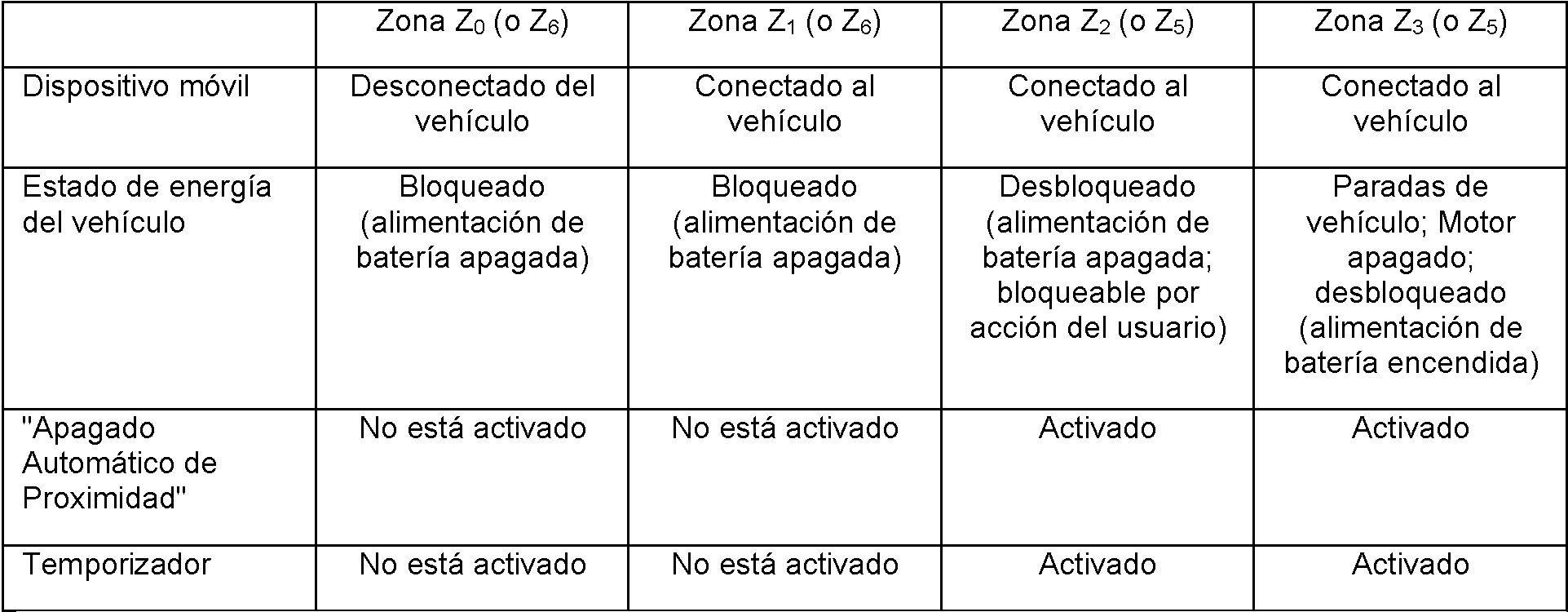
En algunas formas de realización, el sistema 100 permite a un usuario configurar varias "respuestas" del vehículo 101 en varias zonas. Por ejemplo, puede haber más zonas (por ejemplo, más de 4 zonas) que las descritas en las formas de realización anteriores. Por ejemplo, en algunas formas de realización, un usuario puede tener cinco zonas (por ejemplo, Zona A0-A4 , en la dirección hacia el vehículo 101). Por ejemplo, en la Zona A0 , el sistema 100 puede comenzar a establecer una conexión con un dispositivo móvil. En la Zona A1 , el sistema 100 puede monitorear periódicamente la ubicación del dispositivo móvil. En la Zona A2 , el sistema 100 puede seguir monitoreando la ubicación del dispositivo móvil (por ejemplo, con más frecuencia que en la Zona A1 ). Cuando el sistema 100 detecta que el dispositivo móvil entra en la Zona A3 desde la Zona A2 , el sistema 100 puede indicar al vehículo 101 que envíe una notificación sonora (por ejemplo, reproducir un sonido, una canción o una melodía) hacia el dispositivo móvil. Cuando el sistema 100 detecta que el dispositivo móvil entra en la Zona A4 desde la Zona A3 , el sistema 100 puede activar la función de "Encendido Automático de Proximidad" y encender la alimentación del vehículo 101 tal como se ha descrito anteriormente.In some embodiments, system 100 allows a user to configure multiple "responses" from vehicle 101 in various zones. For example, there may be more zones (eg, more than 4 zones) than described in the previous embodiments. For example, in some embodiments, a user may have five zones (eg Zone A 0 -A 4 , in the direction towards the vehicle 101). For example, in Zone A 0 , the system 100 may begin to establish a connection with a mobile device. In Zone A 1 , the system 100 may periodically monitor the location of the mobile device. In Zone A 2 , the system 100 can continue to monitor the location of the mobile device (for example, more frequently than in Zone A 1 ). When the system 100 detects that the mobile device is entering Zone A 3 from Zone A 2 , the system 100 can instruct the vehicle 101 to send an audible notification (for example, play a sound, a song or a melody) to the mobile device. When the system 100 detects that the mobile device is entering Zone A 4 from Zone A 3 , the system 100 can activate the "Proximity Auto Power" function and turn on the vehicle power 101 as described above.
En algunas formas de realización, la notificación de sonido puede variar según las fechas. Por ejemplo, la notificación de sonido puede ser una canción de cumpleaños en el cumpleaños del usuario. Como otro ejemplo, la notificación de sonido puede ser una canción de felicitación en un día festivo (por ejemplo, Año Nuevo, Navidad, etc.). En algunas formas de realización, cuando el sistema 100 activa la función de "Encendido Automático de Proximidad", también puede reproducir un conjunto de sonidos o una canción desde un altavoz del vehículo 101. En algunas formas de realización, el sistema 100 puede seguir reproduciendo una canción cuando se activa la función de “Encendido Automático de Proximidad” (por ejemplo, una canción de 5 minutos de duración). En dichas formas de realización, se puede notificar al usuario 10 o 12 y, en consecuencia, tomar una acción (por ejemplo, presionar un botón "GO" para encender la alimentación del vehículo 101, o presionar un botón "GO" y sostener una palanca de freno al mismo tiempo para arrancar un motor del vehículo 101).In some embodiments, the sound notification may vary depending on the dates. For example, the sound notification can be a birthday song on the user's birthday. As another example, the sound notification can be a congratulatory song on a holiday (eg, New Years, Christmas, etc.). In some embodiments, when the system 100 activates the "Proximity Auto Power" feature, it can also play a set of sounds or a song from a vehicle speaker 101. In some embodiments, the system 100 can continue to play. a song when the “Proximity Auto Power” function is activated (for example, a 5-minute long song). In such embodiments, the user 10 or 12 may be notified and, accordingly, take an action (for example, press a "GO" button to turn on the vehicle power 101, or press a "GO" button and hold a brake lever at the same time to start a vehicle engine 101).
En algunas formas de realización, esta "respuesta" del vehículo 101 puede incluir un movimiento del vehículo 101. Por ejemplo, el vehículo 101 (por ejemplo, un vehículo de cuatro ruedas autoequilibrado, o un vehículo de tres ruedas con un mecanismo de inclinación bloqueado durante la etapa de apagado) se puede estacionar en un espacio de estacionamiento estrecho en la Zona A4. Cuando el dispositivo móvil (por ejemplo, el dispositivo móvil 103 o 105) entra en la Zona A4 (por ejemplo, donde se encuentra el vehículo 101) desde la Zona A3 , el vehículo 101 puede moverse un poco hacia el dispositivo móvil desde el espacio de estacionamiento estrecho, de modo que el usuario 10 o 12 puede acceder fácilmente al vehículo 101. En algunas formas de realización, el número de zonas se puede ajustar en base a las preferencias del usuario, las necesidades reales y / o el número de casos / respuestas durante los procesos de bloqueo / desbloqueo. En algunas formas de realización, las respuestas pueden incluir (i) proporcionar alimentación a una luz indicativa del vehículo 101, (ii) reproducir un sonido desde un altavoz del vehículo 101 y / o (iii) proporcionar alimentación a un motor del vehículo para provocar un movimiento del vehículo 101.In some embodiments, this "response" from vehicle 101 may include a movement of vehicle 101. For example, vehicle 101 (eg, a self-balancing four-wheel vehicle, or a three-wheel vehicle with a locked tilt mechanism during the shutdown stage) you can park in a narrow parking space in Zone A 4 . When the mobile device (for example, mobile device 103 or 105) enters Zone A 4 (for example, where vehicle 101 is located) from Zone A 3 , vehicle 101 may move slightly towards the mobile device from narrow parking space, so that user 10 or 12 can easily access vehicle 101. In some embodiments, the number of zones can be adjusted based on user preferences, actual needs, and / or number of cases / responses during locking / unlocking processes. In some embodiments, responses may include (i) providing power to a vehicle indicator light 101, (ii) playing a sound from a vehicle speaker 101, and / or (iii) providing power to a vehicle engine to cause a movement of the vehicle 101.
La Figura 2A es un diagrama esquemático (vista superior) que ilustra múltiples trayectorias T1 , T2 de un objeto móvil (por ejemplo, el dispositivo móvil 103 o 105 descrito anteriormente) asociado con un vehículo 201 de acuerdo con formas de realización de la tecnología descrita. El presente sistema puede bloquear (por ejemplo, apagar la alimentación de la batería) o desbloquear (por ejemplo, encender la alimentación de la batería) el vehículo 201 en base a trayectorias predeterminadas del objeto móvil. Por ejemplo, la trayectoria T1 indica que el objeto en movimiento se movió hacia el vehículo 201 desde la Zona Z0 a la Zona Z2 , sin entrar además en la Zona Z3. Por defecto, el sistema activará la función de "Encendido Automático de Proximidad" cuando el objeto móvil entre en la Zona Z2 o monitoreará de forma continua si el objeto móvil entra en la Zona Z3 o no para activar la función de "Encendido Automático de Proximidad" (basada en un ajuste sobre en qué zona activar la función de "Encendido Automático de Proximidad"). Sin embargo, si el sistema determina que hubo muchas ocasiones en que el objeto móvil viajó a lo largo de la trayectoria T1 pero un usuario finalmente no encendió un motor del vehículo 201, el sistema puede ajustar en consecuencia su Zona Z2 moviendo el límite externo 109 hacia el vehículo 201 (de modo que un movimiento a lo largo de la trayectoria T1 no activará la función de “Encendido Automático de Proximidad”).Figure 2A is a schematic diagram (top view) illustrating multiple trajectories T 1 , T 2 of a mobile object (eg, mobile device 103 or 105 described above) associated with a vehicle 201 in accordance with embodiments of the technology described. The present system can lock (eg, turn off battery power) or unlock (eg, turn on battery power) vehicle 201 based on predetermined trajectories of the moving object. For example, trajectory T 1 indicates that the moving object moved towards vehicle 201 from Zone Z 0 to Zone Z 2 , without further entering Zone Z 3 . By default, the system will activate the "Automatic Proximity Power On" function when the moving object enters Zone Z 2 or it will continuously monitor whether the moving object enters Zone Z 3 or not to activate the "Proximity Auto Power On" function (based on a setting on in which zone to activate the "Proximity Auto Power On" function). However, if the system determines that there were many occasions when the moving object traveled along the path T 1 but a user ultimately did not start a vehicle engine 201, the system can adjust its Z Zone 2 accordingly by moving the limit external 109 towards the vehicle 201 (so that a movement along the path T 1 will not activate the "Automatic Proximity Start" function).
Como otro ejemplo, la trayectoria T2 indica que el objeto en movimiento se movió hacia el vehículo 201 desde la Zona Z0 a la Zona Z3 , regresó a la Zona Z2 y volvió a entrar en la Zona Z3 varias veces. De forma predeterminada, el sistema activará la función de "Encendido Automático de Proximidad" cuando el objeto móvil entre en la Zona Z2 , y a continuación encenderá la alimentación de la batería del vehículo 201 una vez que los objetos móviles entren en la Zona Z3. Sin embargo, si el sistema determina que hubo muchas ocasiones en que los objetos móviles viajaron a lo largo de las trayectorias T1 pero el usuario finalmente no encendió el motor del vehículo 201, el sistema puede ajustar en consecuencia su Zona Z3 moviendo el límite interno 111 más hacia el vehículo 201 (de manera que el sistema sólo encenderá la alimentación de la batería del vehículo 201 cuando el objeto móvil esté muy cerca del vehículo 201. Por ejemplo, en algunas formas de realización, el tamaño / forma del límite interno 111 se puede ajustar de forma dinámica.As another example, trajectory T 2 indicates that the moving object moved toward vehicle 201 from Zone Z 0 to Zone Z 3 , returned to Zone Z 2, and re-entered Zone Z 3 several times. By default, the system will activate the "Proximity Auto Power On" function when the moving object enters Zone Z 2 , and then turn on vehicle battery power 201 once the moving objects enter Zone Z 3 . However, if the system determines that there were many occasions when moving objects traveled along the T 1 trajectories but the user ultimately did not start the vehicle engine 201, the system can adjust its Z Zone 3 accordingly by moving the limit 111 more towards the vehicle 201 (so the system will only turn on the vehicle 201 battery power when the moving object is very close to the vehicle 201. For example, in some embodiments, the size / shape of the internal boundary 111 can be dynamically adjusted.
La Figura 2B es un diagrama esquemático (vista superior) que ilustra múltiples zonas no concéntricas (Zonas Z0-3 ) asociadas con el vehículo 201 de acuerdo con formas de realización de la tecnología descrita. En las formas de realización ilustradas, las zonas pueden ser determinadas por un usuario y no es necesario que sean concéntricas. En las formas de realización ilustradas, estas zonas no concéntricas pueden configurarse para adaptarse a varios factores, como por ejemplo la diferencia de calidad de las señales desde varias direcciones (por ejemplo, el vehículo 201 puede recibir señales con mejor calidad en la dirección A que en la dirección B). En algunas formas de realización, las zonas se pueden determinar basándose en el comportamiento del usuario. Por ejemplo, un usuario a menudo se acerca al vehículo 201 en la dirección C.Figure 2B is a schematic diagram (top view) illustrating multiple non - concentric zones (Z Zones 0-3) associated with the vehicle 201 according to embodiments of the technology described. In the illustrated embodiments, the zones can be determined by a user and need not be concentric. In the illustrated embodiments, these non-concentric areas can be configured to accommodate various factors, such as the difference in quality of signals from various directions (for example, vehicle 201 can receive signals with better quality in direction A than in direction B). In some embodiments, the zones can be determined based on user behavior. For example, a user often approaches vehicle 201 in direction C.
La Figura 2C es un diagrama esquemático (vista superior) que ilustra múltiples zonas (Zonas Z0 -3) con varias formas asociadas con el vehículo 201 de acuerdo con formas de realización de la tecnología descrita. En las formas de realización ilustradas, por ejemplo, la Zona Z3 puede ser rectangular (por ejemplo, la forma de un espacio de estacionamiento), la Zona Z2 puede ser un cuadrado (por ejemplo, la forma de un edificio) y la Zona Z1 puede ser una elipse (por ejemplo, una forma de campus de una empresa o una zona residencial). En algunas formas de realización, las formas y tamaños de estas zonas se pueden ajustar en función de las preferencias del usuario, el comportamiento del usuario, factores ambientales, etc. En algunas formas de realización, un usuario puede ajustar el tamaño del límite interno y el límite externo a través de una aplicación instalada en el dispositivo móvil, por ejemplo, basándose en las preferencias personales del usuario. En algunas formas de realización, las formas de las zonas se pueden determinar mediante una geovalla o similar.Figure 2C is a schematic diagram (top view) illustrating multiple zones (Z Zones 0-3 ) with various shapes associated with vehicle 201 in accordance with embodiments of the disclosed technology. In the illustrated embodiments, for example, Zone Z 3 can be rectangular (for example, the shape of a parking space), Zone Z 2 can be a square (for example, the shape of a building) and the Zone Z 1 can be an ellipse (for example, a corporate campus shape or a residential area). In some embodiments, the shapes and sizes of these zones can be adjusted based on user preferences, user behavior, environmental factors, etc. In some embodiments, a user can adjust the size of the internal limit and the external limit through an application installed on the mobile device, for example, based on the user's personal preferences. In some embodiments, the shapes of the zones can be determined by a geofence or the like.
La Figura 3A es un diagrama esquemático que ilustra varios estados de un vehículo durante un proceso de desbloqueo automático de acuerdo con formas de realización de la tecnología descrita. En el bloque 301, el vehículo está en un estado "bloqueado", en que tanto la alimentación de la batería como el motor están apagados. Cuando el vehículo pasa a un estado de "Encendido Automático de Proximidad", en el bloque 303, la alimentación de la batería del vehículo y el motor permanecen apagados, pero se activa una función de "Encendido Automático de Proximidad" para monitorear la ubicación de un dispositivo móvil asociado con el vehículo, de modo que el sistema pueda determinar si se enciende la alimentación de la batería del vehículo (por ejemplo, "desbloquear" el vehículo). En algunas formas de realización, en el estado de "Encendido automático de Proximidad" (bloque 303), solo hay una función limitada accesible para un usuario del vehículo. Por ejemplo, solo algunos de los componentes de I / O están habilitados / encendidos, de modo que el usuario solo puede (1) desbloquear el vehículo presionando un botón de inicio (por ejemplo, un botón "GO") o (2) abrir un maletero del vehículo pulsando otra tecla o botón de función. En el bloque 305, el vehículo se mueve a un estado "desbloqueado", en que la alimentación de la batería está encendida pero su motor todavía está apagado. El vehículo se puede "desbloquear" (por ejemplo, del bloque 303 al bloque 305) mediante la función de "Encendido Automático de Proximidad", en respuesta a la detección de un movimiento o cambio de ubicación del dispositivo móvil asociado con el vehículo y / o al recibir una señal de desbloqueo enviada desde un dispositivo móvil autenticado o un llavero. Cuando el usuario arranca el motor, el estado del vehículo pasa de "desbloqueado" en el bloque 305 a "listo para funcionar" en el bloque 307.Figure 3A is a schematic diagram illustrating various states of a vehicle during an automatic unlock process in accordance with embodiments of the disclosed technology. At block 301, the vehicle is in a "locked" state, where both the battery power and the engine are off. When the vehicle enters an "Proximity Auto Start" state, at block 303, the vehicle's battery power and engine remain off, but an "Proximity Auto Start" function is activated to monitor the location of the vehicle. a mobile device associated with the vehicle, so that the system can determine if the vehicle's battery power is turned on (eg, "unlock" the vehicle). In some embodiments, in the "Proximity Auto On" state (block 303), there is only a limited function accessible to a user of the vehicle. For example, only some of the I / O components are enabled / turned on, so the user can only (1) unlock the vehicle by pressing a start button (for example, a "GO" button) or (2) open a trunk of the vehicle by pressing another key or function button. At block 305, the vehicle is moved to an "unlocked" state, where the battery power is on but its engine is still off. The vehicle can be "unlocked" (for example, from block 303 to block 305) by means of the "Automatic Proximity Power On" function, in response to the detection of a movement or change of location of the mobile device associated with the vehicle and / or upon receiving an unlock signal sent from an authenticated mobile device or key fob. When the user starts the engine, the vehicle status changes from "unlocked" at block 305 to "ready to run" at block 307.
La Figura 3B es un diagrama esquemático que ilustra varios estados de un vehículo durante un proceso de bloqueo automático de acuerdo con formas de realización de la tecnología descrita. En el bloque 309, un usuario detiene el vehículo, pero su motor permanece encendido. Después de que el usuario apaga el motor, el estado del vehículo pasa a "desbloqueado" en el bloque 305. Cuando el estado del vehículo pasa a "desbloqueado" desde el bloque 309, el sistema activa una función de "Apagado Automático de Proximidad" para monitorear la ubicación de un dispositivo móvil asociado con el vehículo, a fin de determinar cuándo apagar la alimentación de la batería del vehículo (por ejemplo, bloquear el vehículo). El vehículo se puede "bloquear" (por ejemplo, del bloque 305 al bloque 301) mediante la función de "Apagado Automático de Proximidad", en respuesta a una detección de un movimiento o cambio de ubicación del dispositivo móvil asociado con el vehículo, mostrando que el usuario se aleja del vehículo. Cuando el vehículo está "bloqueado" en el bloque 301, la alimentación de la batería y el motor se apagan. En algunas formas de realización, cuando el usuario apaga el motor, el sistema puede omitir el estado desbloqueado (bloque 305) y establecer directamente el estado del vehículo desde el estado "motor encendido" (correspondiente al bloque 309) al estado "bloqueado" (bloque 301).Figure 3B is a schematic diagram illustrating various states of a vehicle during an automatic locking process in accordance with embodiments of the disclosed technology. At block 309, a user stops the vehicle, but its engine remains on. After the user turns off the engine, the vehicle status changes to "unlocked" at block 305. When the vehicle status changes to "unlocked" from block 309, the system activates an "Automatic Proximity Shutdown" function. to monitor the location of a mobile device associated with the vehicle, in order to determine when to turn off the vehicle's battery power (for example, lock the vehicle). The vehicle can be "locked" (for example, from block 305 to block 301) using the "Automatic Proximity Shutdown" function, in response to a detection of a movement or change of location of the mobile device associated with the vehicle, showing that the user moves away from the vehicle. When the vehicle is "locked out" at block 301, the battery power and the engine are turned off. In some embodiments, when the user turns off the engine, the system can bypass the unlocked state (block 305) and directly set the vehicle state from the "engine on" state (corresponding to block 309) to the "locked" state ( block 301).
La Figura 4 es un diagrama esquemático que ilustra un sistema 400 de acuerdo con formas de realización de la tecnología descrita que puede referirse al sistema 100 en la Figura 1A. Tal como se muestra, el sistema 400 incluye un vehículo eléctrico 41 y un dispositivo móvil 43. En algunas formas de realización, el dispositivo móvil 43 puede incluir un teléfono inteligente, una tableta, un reloj inteligente, un ordenador portátil, otro tipo de dispositivo informático, etc. En algunas formas de realización, el dispositivo móvil 43 también puede ser un llavero inalámbrico con capacidad de transmisión de señal inalámbrica activa o similar. En algunas formas de realización, el vehículo eléctrico 41 puede ser un scooter eléctrico u otros vehículos con mecanismos de seguridad. En algunas formas de realización, el vehículo eléctrico 41 puede comunicarse con el dispositivo móvil 43 a través de una conexión inalámbrica directa o una red inalámbrica (por ejemplo, Bluetooth, infrarrojos, Wi-Fi, 3G / 4G / 5G, etc.). El dispositivo móvil 43 y / o el vehículo eléctrico 41 pueden comunicarse además con un servidor 45 (por ejemplo, actualizar su ubicación). En algunas formas de realización, la red de comunicación inalámbrica entre el dispositivo móvil 43 y el servidor 45 puede ser diferente de la red de comunicación inalámbrica o la conexión inalámbrica directa entre el vehículo eléctrico 41 y el servidor 45.Figure 4 is a schematic diagram illustrating a system 400 in accordance with embodiments of the disclosed technology that may refer to system 100 in Figure 1A. As shown, the system 400 includes an electric vehicle 41 and a mobile device 43. In some embodiments, the mobile device 43 may include a smartphone, tablet, smart watch, laptop, other type of device. IT, etc. In some embodiments, mobile device 43 may also be a wireless key fob with active wireless signal transmission capability or the like. In some embodiments, the electric vehicle 41 can be an electric scooter or other vehicles with safety mechanisms. In some embodiments, the electric vehicle 41 can communicate with the mobile device 43 through a direct wireless connection or a wireless network (eg, Bluetooth, infrared, Wi-Fi, 3G / 4G / 5G, etc.). Mobile device 43 and / or electric vehicle 41 may further communicate with a server 45 (eg, update its location). In some embodiments, the wireless communication network between the mobile device 43 and the server 45 may be different from the wireless communication network or the direct wireless connection between the electric vehicle 41 and the server 45.
En algunas formas de realización, el dispositivo móvil 43 está configurado con una aplicación (por ejemplo, una app) que indica al procesador del dispositivo móvil que se comunique con un procesador 409 del vehículo eléctrico 41 a través de un enlace de comunicación inalámbrica. En algunas formas de realización, la aplicación utiliza un protocolo de comunicación inalámbrica Bluetooth para comunicarse con un receptor emparejado en el vehículo eléctrico 41. El protocolo Bluetooth establece un enlace de comunicación siempre que los dispositivos emparejados están dentro del alcance. Por lo tanto, el receptor del vehículo eléctrico 41 puede utilizar una intensidad de señal recibida de la señal de Bluetooth como indicador de lo cerca que se encuentra el dispositivo móvil del vehículo (por ejemplo, el RSSI). Una vez que el dispositivo móvil está dentro de un radio deseado, un usuario puede activar el vehículo eléctrico 41 (presionando un comando "GO" en un tablero) sin requerir ninguna entrada de clave adicional del usuario.In some embodiments, the mobile device 43 is configured with an application (eg, an app) that instructs the processor of the mobile device to communicate with a processor 409 of the electric vehicle 41 via a wireless communication link. In some embodiments, the application uses a Bluetooth wireless communication protocol to communicate with a paired receiver in the electric vehicle 41. The Bluetooth protocol establishes a communication link whenever the paired devices are within range. Therefore, the electric vehicle receiver 41 can use a received signal strength of the Bluetooth signal as an indicator of how close the mobile device is to the vehicle (eg, the RSSI). Once the mobile device is within a desired radius, a user can activate the electric vehicle 41 (by pressing a "GO" command on a dash) without requiring any additional key input from the user.
De manera similar, para bloquear el vehículo eléctrico 41, la intensidad de la señal recibida de las señales de comunicación Bluetooth indica cuando el usuario se ha alejado del vehículo eléctrico 41 y puede apagar el vehículo si la intensidad de la señal cae por debajo de una intensidad mínima predeterminada.Similarly, to lock the electric vehicle 41, the received signal strength of the Bluetooth communication signals indicates when the user has moved away from the electric vehicle 41 and can turn off the vehicle if the signal strength falls below a default minimum intensity.
En algunas formas de realización, el procesador 409 en el vehículo eléctrico 41 puede enviar balizas periódicas que están codificadas para coincidir con un código del dispositivo móvil 43. Al recibir la baliza, un procesador 401 del dispositivo móvil 43 envía una señal de regreso al vehículo eléctrico 41 con una indicación de su posición (por ejemplo, coordenadas GPS). En algunas formas de realización, las señales entre el vehículo eléctrico 41 y el dispositivo móvil 43 están encriptadas o codificadas de modo que solo el dispositivo móvil 43 emparejado correcto puede activar o apagar el vehículo eléctrico 41. En algunos casos, el procesador 401 del dispositivo móvil 43 utiliza un mecanismo de desbloqueo del dispositivo móvil 43 (por ejemplo, código, huella digital, reconocimiento facial, etc.) para generar una señal al vehículo eléctrico 41 que permite que el vehículo eléctrico 41 sea desbloqueado). Por ejemplo, el procesador 401 del dispositivo móvil 43 puede solicitar al usuario su huella digital y, tras la presentación satisfactoria de la huella digital, enviar un mensaje al vehículo eléctrico 41 confirmando que el vehículo eléctrico 41 puede arrancar.In some embodiments, the processor 409 in the electric vehicle 41 can send periodic beacons that are encoded to match a code from the mobile device 43. Upon receiving the beacon, a processor 401 on the mobile device 43 sends a signal back to the vehicle. electrical 41 with an indication of your position (eg GPS coordinates). In some embodiments, the signals between the electric vehicle 41 and the mobile device 43 are encrypted or scrambled so that only the correct paired mobile device 43 can turn the electric vehicle 41 on or off. In some cases, the device's processor 401 Mobile 43 uses a mobile device 43 unlock mechanism (eg, code, fingerprint, facial recognition, etc.) to generate a signal to electric vehicle 41 that allows electric vehicle 41 to be unlocked). For example, the processor 401 of the mobile device 43 may request the user for his fingerprint and, upon successful presentation of the fingerprint, send a message to the electric vehicle 41 confirming that the electric vehicle 41 can start.
En otra forma de realización, el dispositivo móvil 43 está programado por la aplicación para enviar señales de baliza periódicas que están codificadas para el vehículo eléctrico 41. Al recibir la señal de la baliza, el dispositivo móvil 43 y el vehículo comienzan a transmitir señales a través de un enlace inalámbrico que indica la posición del dispositivo móvil 43 para que el procesador 409 en el vehículo eléctrico 41 pueda implementar los procedimientos de bloqueo / desbloqueo descritos.In another embodiment, the mobile device 43 is programmed by the application to send periodic beacon signals that are encoded for the electric vehicle 41. Upon receiving the beacon signal, the mobile device 43 and the vehicle begin to transmit signals to via a wireless link indicating the position of the mobile device 43 so that the processor 409 in the electric vehicle 41 can implement the described lock / unlock procedures.
Tal como se muestra en la Figura 4, el vehículo eléctrico 41 incluye el procesador 409, una memoria 411, una batería 413, un motor 415, un dispositivo de entrada 417, una pantalla de tablero de instrumentos 419 y un componente de comunicación 421. El procesador 409 está configurado para interactuar con la memoria 411 y otros componentes (por ejemplo, componentes 413-421) en el vehículo eléctrico 41. La memoria 411 está acoplada al procesador 409 y está configurada para almacenar instrucciones para controlar otros componentes u otra información en el vehículo eléctrico 41. La batería 413 puede ser la batería principal mencionada anteriormente y está configurada para alimentar el motor 415 de manera que el motor 415 pueda mover el vehículo eléctrico 41. La pantalla del tablero de instrumentos 419 está configurada para presentar información visualmente a un usuario. El componente de comunicación 421 está configurado para comunicarse con otros sistemas (por ejemplo, el dispositivo móvil 43 o el servidor 45).As shown in Figure 4, the electric vehicle 41 includes the processor 409, a memory 411, a battery 413, a motor 415, an input device 417, a dashboard display 419, and a communication component 421. Processor 409 is configured to interact with memory 411 and other components (eg, components 413-421) in electric vehicle 41. Memory 411 is coupled to processor 409 and is configured to store instructions to control other components or other information. in the electric vehicle 41. The battery 413 may be the main battery mentioned above and is configured to power the motor 415 so that the motor 415 can move the electric vehicle 41. The dashboard display 419 is configured to display information visually to a user. Communication component 421 is configured to communicate with other systems (eg, mobile device 43 or server 45).
Tal como se muestra en la Figura 4, el dispositivo móvil 43 incluye el procesador 401, un componente de gestión de la ubicación 403, un componente de almacenamiento 405 y un componente de comunicación 407. El procesador 401 está configurado para controlar otros componentes del dispositivo móvil 43 y ejecutar instrucciones para realizar las operaciones deseadas. As shown in Figure 4, mobile device 43 includes processor 401, location management component 403, storage component 405, and communication component 407. Processor 401 is configured to control other components of the device. mobile 43 and execute instructions to carry out the desired operations.
El componente de gestión de la ubicación 403 está configurado para rastrear ubicaciones del dispositivo móvil 43 (por ejemplo, incluyendo trayectorias que muestran ubicaciones en el pasado). En algunas formas de realización, las ubicaciones del dispositivo móvil 43 pueden medirse mediante un sensor GPS (que no se muestra). En algunas formas de realización, la información de ubicación puede incluir datos medidos por un sensor giroscópico o un acelerómetro. La información de ubicación puede almacenarse en el componente de almacenamiento 405 o cargarse en el servidor 45. El componente de gestión de ubicación 403 está configurado para proporcionar la información de ubicación rastreada del dispositivo móvil 43.The location management component 403 is configured to track locations of the mobile device 43 (eg, including tracks showing locations in the past). In some embodiments, the locations of the mobile device 43 can be measured by a GPS sensor (not shown). In some embodiments, the location information can include data measured by a gyro sensor or an accelerometer. The location information can be stored in the storage component 405 or uploaded to the server 45. The location management component 403 is configured to provide the tracked location information of the mobile device 43.
En las formas de realización ilustradas, el componente de medición de la ubicación 417 está configurado para medir la ubicación del dispositivo móvil 43 basándose en la intensidad de la señal inalámbrica (por ejemplo, la intensidad de la señal de Bluetooth) u otras características de la señal. Las ubicaciones medidas del dispositivo móvil 43 se pueden analizar para determinar la ubicación actual del dispositivo móvil 43, de modo que se determine si se debe activar una función de “Encendido Automático de Proximidad” descrita anteriormente. Las ubicaciones medidas también se utilizan para determinar si bloquear o desbloquear el vehículo eléctrico 41 apagando o encendiendo la alimentación suministrada por la batería 413. En algunas formas de realización, el dispositivo móvil 43 puede implementarse como un controlador o un sistema de sistema en chip (SOC) que puede realizar las funciones descritas anteriormente. En algunas formas de realización, el componente de medición de la ubicación 417 puede usar dos o más fuentes de información para verificar la ubicación del dispositivo móvil 43. Por ejemplo, el componente de medición de la ubicación 417 puede utilizar la intensidad de la señal de Bluetooth así como señales o información con respecto a los movimientos del dispositivo móvil (por ejemplo, señales o información generada por un acelerador o un giroscopio en el dispositivo móvil 43).In the illustrated embodiments, the location measurement component 417 is configured to measure the location of the mobile device 43 based on the strength of the wireless signal (eg, the strength of the Bluetooth signal) or other characteristics of the device. sign. The measured locations of the mobile device 43 can be analyzed to determine the current location of the mobile device 43, so as to determine whether to activate an "Auto Proximity Power On" function described above. The measured locations are also used to determine whether to lock or unlock the electric vehicle 41 by turning off or on the power supplied by the battery 413. In some embodiments, the mobile device 43 may be implemented as a controller or a system-on-chip system ( SOC) that can perform the functions described above. In some embodiments, the location measurement component 417 may use two or more sources of information to verify the location of the mobile device 43. For example, the location measurement component 417 may use the signal strength of Bluetooth as well as signals or information regarding the movements of the mobile device (for example, signals or information generated by an accelerator or a gyroscope in the mobile device 43).
En algunas formas de realización, el vehículo eléctrico 41 puede incluir (i) un módulo inalámbrico (por ejemplo, el componente de comunicación 421) configurado para establecer una conexión inalámbrica con el dispositivo móvil 43 para recibir señales inalámbricas desde el dispositivo móvil 43; (ii) un procesador (por ejemplo, el procesador 401) configurado para analizar al menos una característica de la conexión inalámbrica para determinar una ubicación actual del dispositivo móvil 43; y (iii) un primer componente de entrada / salida (I / O) (por ejemplo, el dispositivo de entrada 417 o la pantalla de tablero 419) configurado para generar una primera señal en respuesta a una acción del usuario. El procesador puede configurarse además para desbloquear el vehículo eléctrico 41 en respuesta a una determinación, basada en la ubicación actual, de que el dispositivo móvil 43 se encuentra dentro de un límite interno (por ejemplo, el límite interno 111) adyacente al vehículo eléctrico 41, y que se recibe la primera señal. El procesador 401 puede estar configurado además para bloquear el vehículo eléctrico 41 en respuesta a una determinación, basada en la ubicación actual, de que el dispositivo móvil 43 es externo a un límite externo (por ejemplo, el límite externo 109) externo al límite interno.In some embodiments, electric vehicle 41 may include (i) a wireless module (eg, communication component 421) configured to establish a wireless connection with mobile device 43 to receive wireless signals from mobile device 43; (ii) a processor (eg, processor 401) configured to analyze at least one characteristic of the wireless connection to determine a current location of mobile device 43; and (iii) a first input / output (I / O) component (eg, input device 417 or dash display 419) configured to generate a first signal in response to user action. The processor may further be configured to unlock the electric vehicle 41 in response to a determination, based on current location, that the mobile device 43 is within an internal boundary (eg, the inner boundary 111) adjacent to the electric vehicle 41. , and that the first signal is received. Processor 401 may further be configured to lock electric vehicle 41 in response to a determination, based on current location, that mobile device 43 is external to an external limit (eg, external limit 109) external to internal limit. .
Las Figuras 5-7 son diagramas de flujo que ilustran los métodos 500, 600 y 700 de acuerdo con formas de realización de la tecnología descrita. El método 500 puede utilizarse para controlar (por ejemplo, desbloquear o bloquear) un vehículo encendiendo o apagando la alimentación de la batería del vehículo. El método 500 puede implementarse mediante un vehículo y un dispositivo móvil. En algunas formas de realización, el dispositivo móvil se puede implementar como un controlador, un conjunto de chips o circuitos independientes, u otros tipos de dispositivos adecuados. El método 500 comienza en el bloque 501 recibiendo una señal inalámbrica (por ejemplo, una señal de Bluetooth) desde un dispositivo móvil. En el bloque 503, el método 500 continúa analizando al menos una característica (por ejemplo, la intensidad de la señal) de la señal inalámbrica para determinar una ubicación actual del dispositivo móvil (por ejemplo, una distancia entre el vehículo y el dispositivo móvil).Figures 5-7 are flow charts illustrating methods 500, 600, and 700 in accordance with embodiments of the technology described. Method 500 can be used to control (eg, unlock or lock) a vehicle by turning the vehicle battery power on or off. Method 500 can be implemented by a vehicle and a mobile device. In some embodiments, the mobile device can be implemented as a controller, a set of separate chips or circuits, or other types of suitable devices. Method 500 begins at block 501 by receiving a wireless signal (eg, a Bluetooth signal) from a mobile device. At block 503, method 500 continues to analyze at least one characteristic (eg, signal strength) of the wireless signal to determine a current location of the mobile device (eg, a distance between the vehicle and the mobile device). .
En el bloque 505, el método 500 procede a continuación a desbloquear el vehículo en respuesta a una determinación, basada en la ubicación actual, de que el dispositivo móvil está dentro de un límite interno adyacente al vehículo (o una determinación de que el dispositivo móvil se mueve a través del límite interno), y que se recibe una primera señal de un primer componente de entrada / salida (I / O) del vehículo. En algunas formas de realización, alternativamente, el método 500 puede, en respuesta a una determinación de que la ubicación actual está en una primera zona predeterminada (por ejemplo, la Zona Z3 descrita anteriormente con referencia a las Figuras 1A-2C) adyacente al vehículo, habilitar un motor del vehículo que se encenderá al recibir instrucciones a través de un componente (por ejemplo, una pantalla o un botón) del vehículo alimentado por una batería del vehículo.At block 505, method 500 then proceeds to unlock the vehicle in response to a determination, based on current location, that the mobile device is within an internal boundary adjacent to the vehicle (or a determination that the mobile device moves through the internal boundary), and that a first signal is received from a first vehicle input / output (I / O) component. In some embodiments, alternatively, method 500 may, in response to a determination that the current location is in a first predetermined zone (eg, Zone Z3 described above with reference to Figures 1A-2C) adjacent to the vehicle , enable a vehicle engine to start upon receipt of instructions through a component (eg, a display or button) of the vehicle powered by a vehicle battery.
En el bloque 507, el método 500 continúa bloqueando el vehículo en respuesta a una determinación, basada en la ubicación actual, de que el dispositivo móvil es externo a un límite externo, que es externo al límite interno (o una determinación de que el dispositivo móvil se mueve a través del límite externo). En algunas formas de realización, alternativamente, el método 500 puede incluir, en respuesta a una determinación de que la ubicación actual está en una segunda zona predeterminada (por ejemplo, la Zona Z2 descrita anteriormente con referencia a las Figuras 1A-2C) junto a la primera zona predeterminada, habilitar el motor del vehículo que se va a apagar. En algunas formas de realización, el motor del vehículo se puede apagar automáticamente en respuesta a la determinación de que la ubicación actual está en la segunda zona predeterminada (si el motor no ha sido apagado por un usuario). En algunas formas de realización, cuando se determina que la ubicación actual del dispositivo móvil está en la segunda zona predeterminada, después de que el motor se haya apagado, el método puede permitir que el motor se encienda además al recibir instrucciones a través del componente (por ejemplo, una pantalla o un botón) del vehículo alimentado por la batería. Se observa que el proceso de desbloqueo en el bloque 505 y el proceso de bloqueo en el bloque 507 se pueden implementar por separado en base al uso real (por ejemplo, solo se implementa el proceso de desbloqueo en el bloque 505 sin la implementación del bloque 507, o viceversa).At block 507, the method 500 continues to lock the vehicle in response to a determination, based on current location, that the mobile device is external to an external boundary, which is external to the internal boundary (or a determination that the device moving through the outer boundary). In some embodiments, alternatively, method 500 may include, in response to a determination that the current location is in a second predetermined zone (eg, Zone Z2 described above with reference to Figures 1A-2C) alongside the first predetermined zone, enable the engine of the vehicle to be shut down. In some embodiments, the vehicle's engine may be turned off automatically in response to determining that the current location is in the second predetermined zone (if the engine has not been turned off by a user). In some embodiments, when the current location of the mobile device is determined to be in the second predetermined zone, after the engine has been turned off, the method You can also allow the engine to start by receiving instructions through the component (for example, a display or a button) of the battery-powered vehicle. It is noted that the unlocking process in block 505 and the locking process in block 507 can be implemented separately based on actual usage (for example, only the unlocking process is implemented in block 505 without the implementation of the block 507, or vice versa).
El método 600 está dirigido a bloquear un vehículo (por ejemplo, apagar la alimentación de la batería u otra fuente de alimentación) en base a una ubicación o trayectoria de movimiento de un dispositivo móvil asociado con el vehículo. El método 600 incluye, en el bloque 601, (1) recibir una señal inalámbrica desde un dispositivo móvil; (2) analizar al menos una característica de la señal inalámbrica con el fin de determinar una ubicación actual del dispositivo móvil (bloque 603); y (3) si la ubicación actual es externa a un límite externo, bloquear el vehículo, por ejemplo, apagando la fuente de alimentación de la batería y / o apagando un botón del vehículo alimentado por una batería del vehículo (bloque 605). En algunas formas de realización, apagar el botón del vehículo desactiva un motor del vehículo para que se encienda al recibir instrucciones a través del botón.Method 600 is directed at locking down a vehicle (eg, turning off battery power or other power source) based on a location or path of movement of a mobile device associated with the vehicle. Method 600 includes, at block 601, (1) receiving a wireless signal from a mobile device; (2) analyzing at least one characteristic of the wireless signal in order to determine a current location of the mobile device (block 603); and (3) if the current location is external to an external boundary, locking the vehicle, for example, by turning off the battery power source and / or turning off a vehicle button powered by a vehicle battery (block 605). In some embodiments, turning off the vehicle button disables a vehicle engine so that it will turn on upon receiving instructions through the button.
El método 700 está dirigido a desbloquear un vehículo (por ejemplo, encender su batería) basándose en una ubicación o trayectoria en movimiento de un dispositivo móvil asociado con el vehículo. El método 700 incluye, en el bloque 701, (1) recibir una señal inalámbrica desde un dispositivo móvil; (2) analizar al menos una característica de la señal inalámbrica con el fin de determinar una ubicación actual del dispositivo móvil (bloque 703); y (3) basándose al menos parcialmente en la ubicación actual, determinar si desbloquear el vehículo, por ejemplo, encendiendo un botón del vehículo alimentado por una batería del vehículo (bloque 705). En algunas formas de realización, encender el botón del vehículo permite encender un motor del vehículo al recibir instrucciones a través del botón. Method 700 is directed at unlocking a vehicle (eg, turning on its battery) based on a moving location or path of a mobile device associated with the vehicle. Method 700 includes, at block 701, (1) receiving a wireless signal from a mobile device; (2) analyzing at least one characteristic of the wireless signal in order to determine a current location of the mobile device (block 703); and (3) based at least partially on the current location, determining whether to unlock the vehicle, for example, by lighting a vehicle button powered by a vehicle battery (block 705). In some embodiments, turning on the vehicle button allows a vehicle engine to be started by receiving instructions through the button.
Claims (14)
Applications Claiming Priority (1)
| Application Number | Priority Date | Filing Date | Title |
|---|---|---|---|
| US201862732984P | 2018-09-18 | 2018-09-18 |
Publications (1)
| Publication Number | Publication Date |
|---|---|
| ES2848201T3 true ES2848201T3 (en) | 2021-08-05 |
Family
ID=67988894
Family Applications (1)
| Application Number | Title | Priority Date | Filing Date |
|---|---|---|---|
| ES19197675T Active ES2848201T3 (en) | 2018-09-18 | 2019-09-17 | Methods for locking and / or unlocking an electric vehicle and associated appliance |
Country Status (8)
| Country | Link |
|---|---|
| US (1) | US11377071B2 (en) |
| EP (1) | EP3626548B1 (en) |
| JP (1) | JP7061098B2 (en) |
| KR (1) | KR102433475B1 (en) |
| CN (1) | CN110905312B (en) |
| ES (1) | ES2848201T3 (en) |
| PH (1) | PH12019000348B1 (en) |
| TW (2) | TWI777769B (en) |
Families Citing this family (37)
| Publication number | Priority date | Publication date | Assignee | Title |
|---|---|---|---|---|
| US20210170989A1 (en) * | 2019-12-09 | 2021-06-10 | James Andrew Cameron | Anti Theft Device for Open Air Compartment Vehicles |
| DE102020109360A1 (en) | 2020-04-03 | 2021-10-07 | Ford Global Technologies, Llc | System and method for automating vehicle functions |
| DE102020109379A1 (en) * | 2020-04-03 | 2021-10-07 | Ford Global Technologies, Llc | Method and system for the automated execution of vehicle functions |
| CN111629325A (en) * | 2020-04-30 | 2020-09-04 | 福建鸿兴福食品有限公司 | Battery control method, control device, and computer-readable storage medium |
| GB2597498A (en) * | 2020-07-24 | 2022-02-02 | Continental Automotive Gmbh | System and method for controlling vehicle |
| CN111824289A (en) * | 2020-07-29 | 2020-10-27 | 雅迪科技集团有限公司 | A Bluetooth-based electric vehicle starting method and system |
| US11325563B2 (en) * | 2020-08-06 | 2022-05-10 | GM Global Technology Operations LLC | Approach-based vehicle system actuation |
| CN112158163A (en) * | 2020-08-20 | 2021-01-01 | 赛格威科技有限公司 | Vehicle power-on and power-off control method, device and system and all-terrain vehicle |
| KR102219891B1 (en) * | 2020-09-29 | 2021-02-24 | 주식회사 튠잇 | Method and device for controlling key |
| CN114368356A (en) * | 2020-10-15 | 2022-04-19 | 华为技术有限公司 | Vehicle control method, vehicle-mounted device and mobile terminal |
| KR102493306B1 (en) * | 2020-12-16 | 2023-01-31 | 여태환 | Apparatus and method for performing driver-specific start control and driving information generation for a motorcycle based on biometrics |
| EP4016002B1 (en) | 2020-12-17 | 2024-07-10 | Nxp B.V. | An infrastructure controller for an infrastructure |
| CN113060094B (en) * | 2021-04-29 | 2022-07-26 | 北京车和家信息技术有限公司 | Vehicle control method and device and vehicle-mounted equipment |
| JP7655096B2 (en) * | 2021-06-03 | 2025-04-02 | 株式会社デンソー | Vehicle security device and vehicle security system |
| CN115695623A (en) * | 2021-07-28 | 2023-02-03 | 华为技术有限公司 | Electronic device control method and related device |
| DE102021120220A1 (en) | 2021-08-04 | 2023-02-09 | Bayerische Motoren Werke Aktiengesellschaft | Method for controlling vehicle access, computer-readable medium, system, and vehicle |
| DE102022003321A1 (en) | 2021-09-15 | 2023-03-16 | Mercedes-Benz Group AG | System and method for remote parking of a vehicle |
| US12296744B2 (en) | 2021-10-11 | 2025-05-13 | Ford Global Technologies, Llc | Baseplate mounting system with locking mechanism |
| CN114005203A (en) * | 2021-11-19 | 2022-02-01 | 中山市澳多电子科技有限公司 | A smart home lock and its control method |
| US12409809B2 (en) | 2022-02-25 | 2025-09-09 | Honda Motor Co., Ltd. | Remote control of vehicle features based on tactile gestures on electronic device |
| CN116767134B (en) * | 2022-03-10 | 2025-12-23 | 上海博泰悦臻网络技术服务有限公司 | Car locking safety reminding method, system and readable storage medium |
| US12351129B2 (en) * | 2022-04-25 | 2025-07-08 | Toyota Research Institute, Inc. | Systems and methods to utilize user trajectory analysis for automatic vehicle controls |
| US20230403536A1 (en) * | 2022-06-10 | 2023-12-14 | Centurylink Intellectual Property Llc | Wi-Fi-Disruption Based Motion Detection and Automation System and Methods |
| DE102022118777B4 (en) * | 2022-07-27 | 2025-05-08 | Dr. Ing. H.C. F. Porsche Aktiengesellschaft | Vehicle, device and method for sensor-based configuration of a proximity detection for the vehicle |
| DE102022118778A1 (en) | 2022-07-27 | 2024-02-01 | Dr. Ing. H.C. F. Porsche Aktiengesellschaft | Vehicle, device and method for proximity detection for the vehicle |
| CN115393983A (en) * | 2022-08-10 | 2022-11-25 | 上海派智能源股份有限公司 | Control method, control system, equipment and medium of intelligent lock |
| US20240049830A1 (en) * | 2022-08-12 | 2024-02-15 | Reby Inc. | Helmet detection in truck with RFID |
| US12012070B2 (en) * | 2022-09-21 | 2024-06-18 | Ford Global Technologies, Llc | Consignment delivery methods and systems |
| US12059956B2 (en) * | 2022-10-28 | 2024-08-13 | Rivian Ip Holdings, Llc | Systems and methods for providing transient vehicle features |
| JP2024073202A (en) * | 2022-11-17 | 2024-05-29 | 株式会社Subaru | Vehicle power management system |
| TWI865995B (en) * | 2022-12-16 | 2024-12-11 | 英屬開曼群島商鴻騰精密科技股份有限公司 | Electric bicycle control method and system, and related device |
| CN118212712A (en) | 2022-12-16 | 2024-06-18 | 富士康(昆山)电脑接插件有限公司 | State control method, control system and electronic equipment for electric bicycle |
| TWI874920B (en) * | 2023-02-24 | 2025-03-01 | 光陽工業股份有限公司 | Vehicle control methods and systems |
| FR3148560A1 (en) * | 2023-05-11 | 2024-11-15 | Psa Automobiles Sa | SYSTEM COMPRISING AN ANTI-THEFT CAP INTENDED FOR AN ELECTRIC OR HYBRID VEHICLE AND METHOD IMPLEMENTING SAID SYSTEM |
| KR102895061B1 (en) * | 2023-06-14 | 2025-12-02 | 충북대학교 산학협력단 | System and method for mutual recognition and authentication between users of taxi calling and ride sharing service |
| WO2025022460A1 (en) * | 2023-07-26 | 2025-01-30 | Ola Electric Mobility Private Limited | A method and a system for controlling a vehicle based on user's intent |
| DE102024103450A1 (en) * | 2024-02-08 | 2025-08-14 | Bayerische Motoren Werke Aktiengesellschaft | Method for controlling a locking system, control system and motorcycle |
Family Cites Families (48)
| Publication number | Priority date | Publication date | Assignee | Title |
|---|---|---|---|---|
| JPS6278379A (en) * | 1985-09-30 | 1987-04-10 | 日産自動車株式会社 | Locking and unlocking control apparatus for vehicle |
| JP3192715B2 (en) | 1991-12-04 | 2001-07-30 | 富士通テン株式会社 | Wireless door lock control device for vehicles |
| DE19826904C2 (en) | 1998-06-17 | 2003-07-31 | Siemens Ag | radio key |
| DE19912319C1 (en) * | 1999-03-19 | 2000-10-12 | Daimler Chrysler Ag | Electronic locking system, in particular vehicle locking system |
| US6359348B1 (en) * | 1999-11-15 | 2002-03-19 | Lear Corporation | Semi-passive keyless entry method and device |
| DE10064141C2 (en) * | 2000-12-21 | 2003-06-18 | Siemens Ag | Method of proving authorization to lock or unlock or use an object, and security device |
| JP4022859B2 (en) | 2002-03-19 | 2007-12-19 | オムロン株式会社 | Door lock control device |
| JP3930386B2 (en) | 2002-06-21 | 2007-06-13 | 株式会社東海理化電機製作所 | Electronic key system |
| JP4100568B2 (en) | 2003-09-29 | 2008-06-11 | 本田技研工業株式会社 | Vehicle remote key |
| US7466219B2 (en) | 2004-10-19 | 2008-12-16 | Sanyo Electric Co., Ltd. | Communication device and distance calculation system |
| US8325026B2 (en) * | 2005-04-29 | 2012-12-04 | Heistproof, Llc | Remote ignition, theft deterrence, and records keeping system for a vehicle |
| US8427276B2 (en) * | 2006-02-24 | 2013-04-23 | Denso International America, Inc. | Apparatus for automatically initiating sequence of vehicle functions |
| JP4929760B2 (en) | 2006-03-02 | 2012-05-09 | 日本電気株式会社 | Mobile phone terminal device and electronic key device |
| US20070241862A1 (en) * | 2006-04-12 | 2007-10-18 | Dimig Steven J | Transponder authorization system and method |
| JP2008189104A (en) | 2007-02-05 | 2008-08-21 | Calsonic Kansei Corp | Head-up display authentication device |
| US8126450B2 (en) | 2008-09-24 | 2012-02-28 | Embarq Holdings Company Llc | System and method for key free access to a vehicle |
| JP5451168B2 (en) * | 2009-04-28 | 2014-03-26 | アルプス電気株式会社 | Keyless entry device for vehicles |
| JP5273110B2 (en) * | 2010-09-08 | 2013-08-28 | 株式会社デンソー | Start control device |
| JP5794047B2 (en) | 2011-09-05 | 2015-10-14 | スズキ株式会社 | Control device for motorcycle |
| FR2986202A1 (en) | 2012-01-26 | 2013-08-02 | Johnson Contr Automotive Elect | PORTABLE AUTHENTICATION MEDIUM AND VEHICLE SAFETY SYSTEM FOR A MOTOR VEHICLE |
| US8868254B2 (en) | 2012-06-08 | 2014-10-21 | Apple Inc. | Accessory control with geo-fencing |
| JP6211288B2 (en) | 2013-04-05 | 2017-10-11 | アイシン精機株式会社 | Vehicle automatic door operation device and decorative parts provided in vehicle |
| GB2517128B (en) | 2013-05-31 | 2015-12-09 | Jaguar Land Rover Ltd | Vehicle communication system |
| US20160063786A1 (en) | 2014-08-26 | 2016-03-03 | Hyundai America Technical Center, Inc. | Smartphone enabled passive entry go system |
| JP6331959B2 (en) * | 2014-10-21 | 2018-05-30 | 株式会社デンソー | In-vehicle device |
| US9862353B2 (en) * | 2014-12-17 | 2018-01-09 | Denso International America, Inc. | Vehicle system and method for keyless authentication and control of an ignition system |
| US9799220B2 (en) * | 2015-02-04 | 2017-10-24 | Trw Automotive U.S. Llc | Keyless entry system linked to vehicle-to-vehicle communications system |
| JP6104311B2 (en) * | 2015-05-13 | 2017-03-29 | 三菱電機株式会社 | Vehicle information display device |
| CN108351993B (en) * | 2015-08-04 | 2022-09-27 | 睿能创意公司 | Apparatus, method and article for electric vehicle sharing |
| TW201709713A (en) * | 2015-08-31 | 2017-03-01 | Chunghwa Telecom Co Ltd | System and method for automatically locking/unlocking vehicle door using smart phone further providing the purpose of unmanned vehicle rent or vehicle management by matching with a remote management and authentication device |
| KR101768134B1 (en) | 2015-09-21 | 2017-08-14 | 현대자동차주식회사 | Apparatus and method for controlling system power in vehicle |
| TWI561718B (en) | 2015-12-03 | 2016-12-11 | Brainchild Electronic Co Ltd | Door-lock system and door-lock control method |
| JP2017128884A (en) | 2016-01-19 | 2017-07-27 | 株式会社東海理化電機製作所 | Door lock device for vehicle |
| JP6614999B2 (en) | 2016-02-23 | 2019-12-04 | 株式会社東海理化電機製作所 | Electronic key system |
| JP2017160761A (en) | 2016-03-11 | 2017-09-14 | オムロンオートモーティブエレクトロニクス株式会社 | Vehicle control device |
| KR101718072B1 (en) | 2016-03-30 | 2017-03-20 | 현대자동차주식회사 | Vehicle and controlling method for the same |
| TWI759295B (en) * | 2016-04-12 | 2022-04-01 | 德商羅伯特博斯奇股份有限公司 | A locking device for a two wheeler and an operation method thereof |
| WO2017182556A1 (en) | 2016-04-21 | 2017-10-26 | Hella Kgaa Hueck & Co. | A system and a method for immobilization of vehicles |
| DE102017121765A1 (en) * | 2016-09-20 | 2018-03-22 | Huf Hülsbeck & Fürst Gmbh & Co. Kg | Method for activating at least one function of a vehicle |
| US10031523B2 (en) | 2016-11-07 | 2018-07-24 | Nio Usa, Inc. | Method and system for behavioral sharing in autonomous vehicles |
| DE102016221924A1 (en) * | 2016-11-09 | 2018-05-09 | Audi Ag | Method for operating a central locking device, central locking device and motor vehicle |
| CN114022981A (en) | 2016-12-14 | 2022-02-08 | 余仁植 | Vehicle unlocking method, locking and unlocking device, vehicle and vehicle system |
| GB2558590A (en) * | 2017-01-09 | 2018-07-18 | Jaguar Land Rover Ltd | Vehicle entry system |
| JP2018115463A (en) | 2017-01-18 | 2018-07-26 | 株式会社東海理化電機製作所 | Electronic key system, electronic control device and receiver |
| WO2018191894A1 (en) * | 2017-04-19 | 2018-10-25 | 深圳市汇顶科技股份有限公司 | Vehicle unlocking method and vehicle unlocking system |
| TWM561877U (en) | 2017-12-08 | 2018-06-11 | Cycling & Health Tech Ind R&D Center | Management system of shared bicycle |
| TWM562879U (en) * | 2018-03-29 | 2018-07-01 | 陳澤興 | Wireless door lock device and biometric door lock controlling system having the wireless door lock device |
| US11055936B2 (en) * | 2019-05-02 | 2021-07-06 | Voxx International Corporation | Multi-sensor passive keyless functionality |
-
2019
- 2019-08-15 US US16/542,250 patent/US11377071B2/en active Active
- 2019-08-23 TW TW110134207A patent/TWI777769B/en active
- 2019-08-23 TW TW108130315A patent/TWI757629B/en active
- 2019-08-26 JP JP2019153941A patent/JP7061098B2/en active Active
- 2019-08-27 KR KR1020190105094A patent/KR102433475B1/en active Active
- 2019-09-12 PH PH1/2019/000348A patent/PH12019000348B1/en unknown
- 2019-09-17 ES ES19197675T patent/ES2848201T3/en active Active
- 2019-09-17 EP EP19197675.2A patent/EP3626548B1/en active Active
- 2019-09-18 CN CN201910882621.XA patent/CN110905312B/en active Active
Also Published As
| Publication number | Publication date |
|---|---|
| JP7061098B2 (en) | 2022-04-27 |
| EP3626548B1 (en) | 2020-12-02 |
| TWI777769B (en) | 2022-09-11 |
| EP3626548A1 (en) | 2020-03-25 |
| JP2020079542A (en) | 2020-05-28 |
| CN110905312A (en) | 2020-03-24 |
| US20200086829A1 (en) | 2020-03-19 |
| CN110905312B (en) | 2021-04-13 |
| US11377071B2 (en) | 2022-07-05 |
| TWI757629B (en) | 2022-03-11 |
| TW202200890A (en) | 2022-01-01 |
| TW202035846A (en) | 2020-10-01 |
| KR20200033170A (en) | 2020-03-27 |
| PH12019000348A1 (en) | 2020-03-23 |
| PH12019000348B1 (en) | 2023-09-06 |
| KR102433475B1 (en) | 2022-08-18 |
Similar Documents
| Publication | Publication Date | Title |
|---|---|---|
| ES2848201T3 (en) | Methods for locking and / or unlocking an electric vehicle and associated appliance | |
| ES2718601T3 (en) | Bicycle system | |
| US8521419B2 (en) | Method for locating a vehicle | |
| CN106293032B (en) | Portable terminal equipment and its control method and device | |
| KR101509596B1 (en) | Mobile device system for remote starting and management of vehicle | |
| ES2688184T3 (en) | Driver identification and data collection systems for use with mobile communication devices in vehicles | |
| CN105539357B (en) | Vehicle security system, control method for vehicle and device | |
| KR20200088215A (en) | Control method of electric scooter and electric scooter | |
| WO2018096970A1 (en) | Electronic device, vehicle, control device, control program, and operation method of electronic device | |
| JP2007295033A (en) | Remote operation control device and operation terminal thereof | |
| KR102220597B1 (en) | scooter | |
| JP6184119B2 (en) | Keyless system for vehicles | |
| JP2008213514A (en) | Electronic key system and portable device | |
| JP5618887B2 (en) | Vehicle control device | |
| JP2014152458A (en) | Keyless system for vehicle | |
| KR20160100085A (en) | Bicycle with control module using wireless communication and controlling method thereof | |
| KR20200050610A (en) | Apparatus for controlling starting of vehicular engine and method thereof | |
| JP2020149485A (en) | Vehicle control device | |
| KR20180078655A (en) | IoT security apparatus for retrieving vehicle in smart car, method thereof and computer recordable medium storing program to perform the method | |
| JP6703936B2 (en) | Electronic device, vehicle, control device, control program, and operating method of electronic device | |
| JP7422419B2 (en) | Mobile devices, remote control devices, systems and programs | |
| CN117173927A (en) | Intelligent car finding method, device, equipment and storage medium | |
| CN121757084A (en) | Intelligent automobile key with personalized configuration function | |
| HK1254226A1 (en) | Navigation method and apparatus, equipment and operation system | |
| JP2009272993A (en) | Communication system |