ES2873368T3 - A composition for the treatment of deficits in learning and memory - Google Patents
A composition for the treatment of deficits in learning and memory Download PDFInfo
- Publication number
- ES2873368T3 ES2873368T3 ES13832854T ES13832854T ES2873368T3 ES 2873368 T3 ES2873368 T3 ES 2873368T3 ES 13832854 T ES13832854 T ES 13832854T ES 13832854 T ES13832854 T ES 13832854T ES 2873368 T3 ES2873368 T3 ES 2873368T3
- Authority
- ES
- Spain
- Prior art keywords
- extract
- scopolamine
- polygonum minus
- minus
- polygonum
- Prior art date
- Legal status (The legal status is an assumption and is not a legal conclusion. Google has not performed a legal analysis and makes no representation as to the accuracy of the status listed.)
- Active
Links
Classifications
-
- A—HUMAN NECESSITIES
- A61—MEDICAL OR VETERINARY SCIENCE; HYGIENE
- A61K—PREPARATIONS FOR MEDICAL, DENTAL OR TOILETRY PURPOSES
- A61K36/00—Medicinal preparations of undetermined constitution containing material from algae, lichens, fungi or plants, or derivatives thereof, e.g. traditional herbal medicines
- A61K36/18—Magnoliophyta (angiosperms)
- A61K36/185—Magnoliopsida (dicotyledons)
- A61K36/70—Polygonaceae (Buckwheat family), e.g. spineflower or dock
- A61K36/704—Polygonum, e.g. knotweed
-
- A—HUMAN NECESSITIES
- A61—MEDICAL OR VETERINARY SCIENCE; HYGIENE
- A61K—PREPARATIONS FOR MEDICAL, DENTAL OR TOILETRY PURPOSES
- A61K31/00—Medicinal preparations containing organic active ingredients
- A61K31/70—Carbohydrates; Sugars; Derivatives thereof
- A61K31/7042—Compounds having saccharide radicals and heterocyclic rings
- A61K31/7048—Compounds having saccharide radicals and heterocyclic rings having oxygen as a ring hetero atom, e.g. leucoglucosan, hesperidin, erythromycin, nystatin, digitoxin or digoxin
-
- A—HUMAN NECESSITIES
- A61—MEDICAL OR VETERINARY SCIENCE; HYGIENE
- A61K—PREPARATIONS FOR MEDICAL, DENTAL OR TOILETRY PURPOSES
- A61K8/00—Cosmetics or similar toiletry preparations
- A61K8/18—Cosmetics or similar toiletry preparations characterised by the composition
- A61K8/30—Cosmetics or similar toiletry preparations characterised by the composition containing organic compounds
- A61K8/49—Cosmetics or similar toiletry preparations characterised by the composition containing organic compounds containing heterocyclic compounds
- A61K8/4973—Cosmetics or similar toiletry preparations characterised by the composition containing organic compounds containing heterocyclic compounds with oxygen as the only hetero atom
- A61K8/498—Cosmetics or similar toiletry preparations characterised by the composition containing organic compounds containing heterocyclic compounds with oxygen as the only hetero atom having 6-membered rings or their condensed derivatives, e.g. coumarin
-
- A—HUMAN NECESSITIES
- A61—MEDICAL OR VETERINARY SCIENCE; HYGIENE
- A61K—PREPARATIONS FOR MEDICAL, DENTAL OR TOILETRY PURPOSES
- A61K8/00—Cosmetics or similar toiletry preparations
- A61K8/18—Cosmetics or similar toiletry preparations characterised by the composition
- A61K8/30—Cosmetics or similar toiletry preparations characterised by the composition containing organic compounds
- A61K8/60—Sugars; Derivatives thereof
- A61K8/602—Glycosides, e.g. rutin
-
- A—HUMAN NECESSITIES
- A61—MEDICAL OR VETERINARY SCIENCE; HYGIENE
- A61K—PREPARATIONS FOR MEDICAL, DENTAL OR TOILETRY PURPOSES
- A61K8/00—Cosmetics or similar toiletry preparations
- A61K8/18—Cosmetics or similar toiletry preparations characterised by the composition
- A61K8/96—Cosmetics or similar toiletry preparations characterised by the composition containing materials, or derivatives thereof of undetermined constitution
- A61K8/97—Cosmetics or similar toiletry preparations characterised by the composition containing materials, or derivatives thereof of undetermined constitution from algae, fungi, lichens or plants; from derivatives thereof
- A61K8/9783—Angiosperms [Magnoliophyta]
- A61K8/9789—Magnoliopsida [dicotyledons]
-
- A—HUMAN NECESSITIES
- A61—MEDICAL OR VETERINARY SCIENCE; HYGIENE
- A61P—SPECIFIC THERAPEUTIC ACTIVITY OF CHEMICAL COMPOUNDS OR MEDICINAL PREPARATIONS
- A61P17/00—Drugs for dermatological disorders
- A61P17/16—Emollients or protectives, e.g. against radiation
-
- A—HUMAN NECESSITIES
- A61—MEDICAL OR VETERINARY SCIENCE; HYGIENE
- A61P—SPECIFIC THERAPEUTIC ACTIVITY OF CHEMICAL COMPOUNDS OR MEDICINAL PREPARATIONS
- A61P17/00—Drugs for dermatological disorders
- A61P17/18—Antioxidants, e.g. antiradicals
-
- A—HUMAN NECESSITIES
- A61—MEDICAL OR VETERINARY SCIENCE; HYGIENE
- A61P—SPECIFIC THERAPEUTIC ACTIVITY OF CHEMICAL COMPOUNDS OR MEDICINAL PREPARATIONS
- A61P25/00—Drugs for disorders of the nervous system
-
- A—HUMAN NECESSITIES
- A61—MEDICAL OR VETERINARY SCIENCE; HYGIENE
- A61P—SPECIFIC THERAPEUTIC ACTIVITY OF CHEMICAL COMPOUNDS OR MEDICINAL PREPARATIONS
- A61P25/00—Drugs for disorders of the nervous system
- A61P25/28—Drugs for disorders of the nervous system for treating neurodegenerative disorders of the central nervous system, e.g. nootropic agents, cognition enhancers, drugs for treating Alzheimer's disease or other forms of dementia
-
- A—HUMAN NECESSITIES
- A61—MEDICAL OR VETERINARY SCIENCE; HYGIENE
- A61P—SPECIFIC THERAPEUTIC ACTIVITY OF CHEMICAL COMPOUNDS OR MEDICINAL PREPARATIONS
- A61P39/00—General protective or antinoxious agents
- A61P39/06—Free radical scavengers or antioxidants
-
- A—HUMAN NECESSITIES
- A61—MEDICAL OR VETERINARY SCIENCE; HYGIENE
- A61Q—SPECIFIC USE OF COSMETICS OR SIMILAR TOILETRY PREPARATIONS
- A61Q19/00—Preparations for care of the skin
-
- A—HUMAN NECESSITIES
- A61—MEDICAL OR VETERINARY SCIENCE; HYGIENE
- A61Q—SPECIFIC USE OF COSMETICS OR SIMILAR TOILETRY PREPARATIONS
- A61Q19/00—Preparations for care of the skin
- A61Q19/08—Anti-ageing preparations
-
- A—HUMAN NECESSITIES
- A61—MEDICAL OR VETERINARY SCIENCE; HYGIENE
- A61K—PREPARATIONS FOR MEDICAL, DENTAL OR TOILETRY PURPOSES
- A61K2800/00—Properties of cosmetic compositions or active ingredients thereof or formulation aids used therein and process related aspects
- A61K2800/40—Chemical, physico-chemical or functional or structural properties of particular ingredients
- A61K2800/52—Stabilizers
- A61K2800/522—Antioxidants; Radical scavengers
-
- A—HUMAN NECESSITIES
- A61—MEDICAL OR VETERINARY SCIENCE; HYGIENE
- A61K—PREPARATIONS FOR MEDICAL, DENTAL OR TOILETRY PURPOSES
- A61K2800/00—Properties of cosmetic compositions or active ingredients thereof or formulation aids used therein and process related aspects
- A61K2800/80—Process related aspects concerning the preparation of the cosmetic composition or the storage or application thereof
- A61K2800/84—Products or compounds obtained by lyophilisation, freeze-drying
Landscapes
- Health & Medical Sciences (AREA)
- Life Sciences & Earth Sciences (AREA)
- Animal Behavior & Ethology (AREA)
- Veterinary Medicine (AREA)
- Public Health (AREA)
- General Health & Medical Sciences (AREA)
- Chemical & Material Sciences (AREA)
- Medicinal Chemistry (AREA)
- Pharmacology & Pharmacy (AREA)
- Engineering & Computer Science (AREA)
- Epidemiology (AREA)
- Natural Medicines & Medicinal Plants (AREA)
- Dermatology (AREA)
- Organic Chemistry (AREA)
- Nuclear Medicine, Radiotherapy & Molecular Imaging (AREA)
- General Chemical & Material Sciences (AREA)
- Chemical Kinetics & Catalysis (AREA)
- Bioinformatics & Cheminformatics (AREA)
- Birds (AREA)
- Biotechnology (AREA)
- Botany (AREA)
- Mycology (AREA)
- Microbiology (AREA)
- Biomedical Technology (AREA)
- Neurology (AREA)
- Neurosurgery (AREA)
- Gerontology & Geriatric Medicine (AREA)
- Medical Informatics (AREA)
- Alternative & Traditional Medicine (AREA)
- Molecular Biology (AREA)
- Biochemistry (AREA)
- Toxicology (AREA)
- Hospice & Palliative Care (AREA)
- Psychiatry (AREA)
- Pharmaceuticals Containing Other Organic And Inorganic Compounds (AREA)
- Medicines Containing Plant Substances (AREA)
- Cosmetics (AREA)
Abstract
Una composición que comprende un extracto de Polygonum minus en cantidades eficaces combinado con o sin otro agente, en donde el otro agente es un agente farmacéutico y en donde el extracto comprende quercetin-3- glucurónido y quercitrina, en donde el quercetin-3-glucurónido está en cantidades de 0,5% en peso del extracto de Polygonum minus y la quercitrina está en cantidades de 0,2% en peso del extracto de Polygonum minus para su uso en el tratamiento de déficits en el aprendizaje y la memoria.A composition comprising an extract of Polygonum minus in effective amounts combined with or without another agent, wherein the other agent is a pharmaceutical agent and wherein the extract comprises quercetin-3-glucuronide and quercetin, wherein quercetin-3-glucuronide is in amounts of 0.5% by weight of Polygonum minus extract and quercitrin is in amounts of 0.2% by weight of Polygonum minus extract for use in treating deficits in learning and memory.
Description
DESCRIPCIÓNDESCRIPTION
Una composición para el tratamiento de los déficits en el aprendizaje y la memoriaA composition for the treatment of deficits in learning and memory
Campo de la invenciónField of the invention
La presente invención se refiere a una composición que comprende un extracto de Polygonum minus, The present invention relates to a composition comprising an extract of Polygonum minus,
Antecedentes de la invenciónBackground of the invention
El Polygonum minus de la familia Polygonaceae se conoce localmente en Malasia como hoja de kesum o laksa. Es una planta medicinal local que se consume comúnmente como ulam para el cuidado preventivo de la salud. Las hojas de la planta son aromáticas y se utilizan popularmente como ingrediente en delicias de Malasia tales como laksa (plato de fideos picantes), kerabu (arroz herbal frito), tom yam (sopa agria condimentada) y asam pedas (curry de tamarindo picante). Las hojas a menudo se cortan en rodajas y se espolvorean por su fuerte aroma y sabor. En el Sistema de Medicina Tradicional de Malasia, la decocción de las hojas frescas de kesum se consume para la indigestión, el estreñimiento y como remedio para los trastornos y el dolor de estómago (Vimala S., IIham, M.A., Rashih A.A. y Rohana S. (2003). Nature's Choice to Wellness: Antioxidant Vegetables/Ulam. Siri Alam y Rimba 7. Forest Research Institute Malaysia (FRIM), pág. 131) Fengling Pu et al ("Neuroprotective effects of quercetin and rutin on spatial memory impairment in an 8-arm radial maze task and neuronal death induced by repeated cerebral ischemia in rats", Journal of pharmacological sciences, vol. 104, núm. 4, 01-01-2007, páginas 329-334) describen los efectos diferenciales de los flavonoides sobre la isquemia cerebral mediante la investigación de los efectos del galato de epigalocatequina (EGCG), la catequina, la rutina y la quercetina sobre el deterioro de la memoria espacial y la muerte neuronal inducida por isquemia cerebral repetida en ratas. Polygonum minus from the Polygonaceae family is known locally in Malaysia as kesum leaf or laksa. It is a local medicinal plant that is commonly consumed as ulam for preventive health care. The leaves of the plant are aromatic and are popularly used as an ingredient in Malaysian delicacies such as laksa (spicy noodle dish), kerabu (fried herbal rice), tom yam (spicy sour soup), and asam pedas (spicy tamarind curry) . The leaves are often sliced and dusted for their strong aroma and flavor. In the Malaysian Traditional Medicine System, the decoction of fresh kesum leaves is consumed for indigestion, constipation and as a remedy for stomach pain and disorders (Vimala S., IIham, MA, Rashih AA and Rohana S . (2003). Nature's Choice to Wellness: Antioxidant Vegetables / Ulam. Siri Alam and Rimba 7. Forest Research Institute Malaysia (FRIM), p. 131) Fengling Pu et al ("Neuroprotective effects of quercetin and rutin on spatial memory impairment in an 8-arm radial maze task and neuronal death induced by repeated cerebral ischemia in rats ", Journal of pharmacological sciences, vol. 104, no. 4, 01-01-2007, pages 329-334) describe the differential effects of flavonoids on cerebral ischemia by investigating the effects of epigallocatechin gallate (EGCG), catechin, rutin and quercetin on impaired spatial memory and neuronal death induced by repeated cerebral ischemia in rats.
Sun et al ("Quercetin attenuates spontaneous behavior and spatial memory impairment in d-galactose-treated mice by increasing brain antioxidant capacity", Nutrition Research, Elsevier Inc, vol. 27, núm. 3, 23-03-2007, páginas 169-175) describen los efectos antienvejecimiento de la quercetina en el cerebro del ratón al investigar si la ingesta a largo plazo de quercetina podría mejorar el comportamiento espontáneo y la memoria espacial en un modelo de envejecimiento de ratón.Sun et al ("Quercetin attenuates spontaneous behavior and spatial memory impairment in d-galactose-treated mice by increasing brain antioxidant capacity", Nutrition Research, Elsevier Inc, vol. 27, no. 3, 23-03-2007, pages 169- 175) describe the anti-aging effects of quercetin in the mouse brain by investigating whether long-term ingestion of quercetin could improve spontaneous behavior and spatial memory in a mouse aging model.
La piel está sujeta a agresiones por muchos factores extrínsecos (ambientales) así como por factores intrínsecos. A medida que la piel envejece, hay un aumento del estrés oxidativo, un aumento de la inflamación, una disminución de los niveles de colágeno, una expresión anormalmente alta de la enzima MMP (Peptidasa, Metaloproteinasa de Matriz tipo 1), un aumento de la glicación de proteínas y un aumento de la descomposición mitocondrial y por tanto del daño oxidativo.The skin is subject to aggression by many extrinsic (environmental) factors as well as intrinsic factors. As the skin ages, there is an increase in oxidative stress, an increase in inflammation, a decrease in collagen levels, an abnormally high expression of the enzyme MMP (Peptidase, Matrix Metalloproteinase type 1), an increase in protein glycation and increased mitochondrial breakdown and therefore oxidative damage.
Actualmente existen numerosas composiciones en el mercado para tal prevención y/o tratamiento. Existen muchas combinaciones de diferentes ingredientes en cosmética, tales como antioxidantes, enzimas, fitoestrógenos, emolientes, humectantes y similares. Su capacidad para proteger la piel varía con la composición y sus ingredientes y, por lo tanto, sigue existiendo la necesidad de una formulación eficaz para uso tópico y/o sistémico a partir de materiales botánicos naturales renovables que se puedan usar, sin receta médica, para tratar el efecto de la oxidación y otros daños cutáneos.There are currently numerous compositions on the market for such prevention and / or treatment. There are many combinations of different ingredients in cosmetics, such as antioxidants, enzymes, phytoestrogens, emollients, humectants, and the like. Its ability to protect the skin varies with the composition and its ingredients and, therefore, there remains a need for an effective formulation for topical and / or systemic use from renewable natural botanical materials that can be used, without a prescription, to treat the effect of oxidation and other skin damage.
Adicionalmente, también es deseable en la técnica explorar otros atributos característicos del material renovable natural aislado, ya que se pueden usar fácilmente con efectos secundarios mínimos o nulos en la humanidad en comparación con las moléculas sintéticas ensayadas y probadas clínicamente, lo que impone graves preocupaciones para la humana y el medio ambiente.Additionally, it is also desirable in the art to explore other characteristic attributes of isolated natural renewable material, as they can be easily used with minimal or no side effects on mankind compared to clinically tested and proven synthetic molecules, raising serious concerns for the human and the environment.
Es importante mencionar que generalmente es extremadamente difícil proporcionar un agente eficaz para el cuidado de la piel que posea ambas actividades antioxidantes a través de la propiedad de captación de oxígeno reactivo (ROS) combinada con la actividad anti-colagenasa que inhibe las enzimas responsables de la descomposición del colágeno. En el contexto del desafío existente anterior en la técnica relacionada, se ha descubierto sorprendentemente por medio de la presente invención que el extracto de Polygonum minus también conocido como Persicaria minor cumple los criterios tan deseados para su uso en el tratamiento de los déficits de memoria y aprendizaje.It is important to mention that it is generally extremely difficult to provide an effective skin care agent that possesses both antioxidant activities through reactive oxygen scavenging (ROS) property combined with anti-collagenase activity that inhibits the enzymes responsible for the breakdown of collagen. In the context of the above existing challenge in the related art, it has been surprisingly discovered by means of the present invention that the extract of Polygonum minus also known as Persicaria minor meets the much desired criteria for its use in the treatment of memory deficits and learning.
Compendio de la invenciónCompendium of the invention
La presente invención se refiere a una composición que comprende un extracto de Polygonum minus en cantidades eficaces combinado con o sin otro agente en donde el otro agente es un agente farmacéutico y en donde el extracto comprende quercetin-3-glucurónido y quercitrina en donde el quercetin-3-glucurónido se encuentra en cantidades de 0,5% en peso del extracto de Polygonum minus y la quercitrina está en cantidades de 0,2% en peso del extracto de Polygonum minus para su uso en el tratamiento de déficits en el aprendizaje y la memoria.The present invention relates to a composition comprising an extract of Polygonum minus in effective amounts combined with or without another agent wherein the other agent is a pharmaceutical agent and wherein the extract comprises quercetin-3-glucuronide and quercitrin wherein quercetin -3-glucuronide is found in amounts of 0.5% by weight of Polygonum minus extract and quercitrin is in amounts of 0.2% by weight of Polygonum minus extract for use in treating deficits in learning and the memory.
En otra realización de la composición tal como se define anteriormente para su uso en el tratamiento de déficits en el aprendizaje y la memoria, el extracto de Polygonum minus tiene valores de capacidad de absorción de radicales de oxígeno (ORAC) de entre 11.000 micromoles de TE/gramo y 36.000 micromoles de TE/gramo. In another embodiment of the composition as defined above for use in treating learning and memory deficits, the Polygonum minus extract has Oxygen Radical Absorbance Capacity (ORAC) values of between 11,000 micromoles TE / gram and 36,000 micromoles TE / gram.
En otra realización preferida de la composición tal como se define anteriormente para su uso en el tratamiento de déficits en el aprendizaje y la memoria, el extracto de Polygonum minus tiene un valor de capacidad de absorción de radicales de oxígeno (ORAC) de al menos 16000 micromoles de TE/gramo.In another preferred embodiment of the composition as defined above for use in treating learning and memory deficits, the Polygonum minus extract has an oxygen radical absorbing capacity (ORAC) value of at least 16000 micromoles TE / gram.
También se describe un procedimiento para el aislamiento de un extracto activo de Polygonum minus que comprende las etapas de a) someter dicho Polygonum minus incluyendo partes aéreas de la planta incluyendo tallo y/u hojas a extracción con disolvente preferiblemente con una razón de disolvente a material de 1:10-20 por percolación en un intervalo de temperatura de 70-105°C preferiblemente 80°C para obtener el extracto; y b) filtrar el extracto obtenido de la etapa (a) anterior seguido de concentración y secado que implican liofilización, secado por aspersión o secado con cinta de vacío para obtener del mismo el polvo de extracto seco.Also described is a process for the isolation of an active extract of Polygonum minus comprising the steps of a) subjecting said Polygonum minus including aerial parts of the plant including stem and / or leaves to solvent extraction preferably with a ratio of solvent to material 1: 10-20 by percolation in a temperature range of 70-105 ° C preferably 80 ° C to obtain the extract; and b) filtering the extract obtained from step (a) above followed by concentration and drying involving lyophilization, spray drying or vacuum belt drying to obtain the dry extract powder therefrom.
Breve descripción de las figurasBrief description of the figures
Las figuras 4 y 5 no forman parte de la invención.Figures 4 and 5 do not form part of the invention.
La FIG. 1 ilustra el diagrama de flujo que proporciona el extracto de Polygonum minus. FIG. 1 illustrates the flow chart provided by the Polygonum minus extract.
La FIG. 2(a) ilustra los resultados en el histograma de HPLC y la FIG. 2(b) ilustra la comparación de espectros UV de quercetin-3-glucurónido y quercitrina y los picos correspondientes en el extracto.FIG. 2 (a) illustrates the results on the HPLC histogram and FIG. 2 (b) illustrates the comparison of UV spectra of quercetin-3-glucuronide and quercitrin and the corresponding peaks in the extract.
La FIG. 3 ilustra la comparación de la dosis CI50 del extracto con la del conocido antioxidante ácido gálico.FIG. 3 illustrates the comparison of the IC 50 dose of the extract with that of the known antioxidant gallic acid.
La FIG. 4 ilustra el % de inhibición de colagenasa por el monohidrato de 1,10- fenantrolina patrón (control). La FIG. 5 ilustra el % de inhibición de colagenasa por el extracto de Polygonum minus. FIG. 4 illustrates the% inhibition of collagenase by the standard 1,10-phenanthroline monohydrate (control). FIG. 5 illustrates% collagenase inhibition by Polygonum minus extract.
La FIG. 6 ilustra una vista esquemática de segmentos durante la ensayo de sonda de la prueba del Laberinto de Barnes.FIG. 6 illustrates a schematic view of segments during the probe assay of the Barnes Maze test.
La FIG. 7(a) ilustra la velocidad en ratones tratados con escopolamina que también recibieron tratamiento con ginkgo y Polygonum minus y la FIG. 7(b) ilustra la velocidad en ratones tratados con escopolamina, escopolamina y donepezilo y con vehículo.FIG. 7 (a) illustrates the rate in scopolamine-treated mice that also received ginkgo and Polygonum minus treatment and FIG. 7 (b) illustrates the rate in mice treated with scopolamine, scopolamine and donepezil and with vehicle.
La FIG. 8(a) ilustra el estudio de longitud de la trayectoria primaria con escopolamina y ginkgo, escopolamina y Polygonum minus (100 mg/kg), escopolamina y P. minus (50 mg/kg), escopolamina y vehículo; la FIG. 8(b) ilustra el estudio de la longitud de la trayectoria primaria con control de referencia; la FIG. 8(c) ilustra el estudio de longitud total de la trayectoria con escopolamina y ginkgo, escopolamina y P. minus (100 mg/kg), escopolamina y Polygonum minus (50 mg/kg), escopolamina y vehículo y la FIG. 8(d) ilustra el estudio de la longitud total de la trayectoria con control de referencia.FIG. 8 (a) illustrates the primary pathway length study with scopolamine and ginkgo, scopolamine and Polygonum minus (100 mg / kg), scopolamine and P. minus (50 mg / kg), scopolamine and vehicle; FIG. 8 (b) illustrates the study of the length of the primary path with reference control; FIG. 8 (c) illustrates the full path length study with scopolamine and ginkgo, scopolamine and P. minus (100 mg / kg), scopolamine and Polygonum minus (50 mg / kg), scopolamine and vehicle and FIG. 8 (d) illustrates the study of the total length of the path with reference control.
La FIG. 9 (a) ilustra el estudio de error primario con escopolamina y ginkgo, escopolamina y Polygonum minus (100 mg/kg), escopolamina y Polygonum minus (50 mg/kg), escopolamina y vehículo; la FIG. 9(b) ilustra el estudio de error primario con control de referencia; la FIG. 9(c) ilustra un estudio de errortotal con escopolamina y ginkgo, escopolamina y Polygonum minus (100 mg/kg), escopolamina y Polygonum minus (50 mg/kg), escopolamina y vehículo y la FIG.FIG. 9 (a) illustrates the primary error study with scopolamine and ginkgo, scopolamine and Polygonum minus (100 mg / kg), scopolamine and Polygonum minus (50 mg / kg), scopolamine and vehicle; FIG. 9 (b) illustrates the primary error study with reference control; FIG. 9 (c) illustrates an errortotal study with scopolamine and ginkgo, scopolamine and Polygonum minus (100 mg / kg), scopolamine and Polygonum minus (50 mg / kg), scopolamine and vehicle and FIG.
9(d) ilustra el estudio de error total con control de referencia.9 (d) illustrates the total error study with reference control.
La FIG. 10(a) ilustra el estudio de latencia primaria con escopolamina y ginkgo, escopolamina y Polygonum minus (100 mg/kg), escopolamina y Polygonum minus (50 mg/kg), escopolamina y vehículo; la FIG. 10(b) ilustra el estudio de latencia primaria con control de referencia; la FIG. 10(c) ilustra un estudio de latencia total con escopolamina y ginkgo, escopolamina y Polygonum minus (100 mg/kg), escopolamina y Polygonum minus (50 mg/kg), escopolamina y vehículo y la FIG. 10(d) ilustra el estudio de latencia total con control de referencia.FIG. 10 (a) illustrates the primary latency study with scopolamine and ginkgo, scopolamine and Polygonum minus (100 mg / kg), scopolamine and Polygonum minus (50 mg / kg), scopolamine and vehicle; FIG. 10 (b) illustrates the baseline control primary latency study; FIG. 10 (c) illustrates a total latency study with scopolamine and ginkgo, scopolamine and Polygonum minus (100 mg / kg), scopolamine and Polygonum minus (50 mg / kg), scopolamine and vehicle and FIG. 10 (d) illustrates the baseline control total latency study.
La FIG. 11 ilustra el tiempo empleado en segmentos en el grupo tratado con escopolamina y el grupo tratado con Polygonum minus a 50 mg/kg y 100 mg/kg.FIG. 11 illustrates the time spent in segments in the group treated with scopolamine and the group treated with Polygonum minus at 50 mg / kg and 100 mg / kg.
Descripción detallada de la invenciónDetailed description of the invention
La presente invención se refiere a una composición que contiene un extracto de Polygonum minus con fines cognitivos. También se divulga el método de obtención de dicho extracto de Polygonum minus. Los detalles de la invención y sus ventajas se explican a continuación con mayor detalle con relación a los siguientes ejemplos no limitantes y figuras adjuntas. En lo sucesivo, esta memoria descriptiva describirá la presente invención de acuerdo con las realizaciones preferidas de la presente invención. Sin embargo, se debe entender que el siguiente ejemplo que limita la descripción a las realizaciones preferidas de la invención es simplemente para facilitar la discusión de la presente invención y se prevé que los expertos en la técnica puedan idear diversas modificaciones y equivalentes sin apartarse del alcance de las reivindicaciones adjuntas.The present invention relates to a composition containing an extract of Polygonum minus for cognitive purposes. The method of obtaining said Polygonum minus extract is also disclosed. The details of the invention and its advantages are explained in greater detail below with reference to the following non-limiting examples and accompanying figures. Hereinafter, this specification will describe the present invention in accordance with preferred embodiments of the present invention. However, it is to be understood that the following example limiting the description to preferred embodiments of the invention is merely to facilitate discussion of the present invention and it is envisioned that those skilled in the art may devise various modifications and equivalents without departing from the scope of the invention. of the appended claims.
Las partes aéreas de las plantas, incluidos el tallo y las hojas, se extraen con agua y se secan en horno con una tasa de extracción de aproximadamente 1:10. La materia prima utilizada son hojas secas con propiedades de 2 a 5 cm de tamaño, no más de 10% de pérdida por secado, no más de 10% de contenido de cenizas, no más de 2% de materia foránea, recuento microbiano aeróbico total de no más de 107, recuento de levadura y moho total de no más de 105. Las hojas secas se sometieron a continuación a las etapas de percolación utilizando agua purificada y se extrajeron a una temperatura en el intervalo de 70-105°C, preferiblemente a 80°C para obtener el extracto que se filtra, se concentra y se seca adicionalmente usando métodos tales como liofilización, secado por aspersión o secado con cinta de vacío para obtener un polvo de extracto seco que se envasa y almacena. Después de la etapa de secado, el polvo de extracto seco se empaqueta y se almacena a temperatura ambiente según el diagrama de flujo de la FIG. 1.The aerial parts of the plants, including the stem and leaves, are extracted with water and dried in an oven with an extraction rate of approximately 1:10. The raw material used is dry leaves with properties of 2 to 5 cm in size, no more than 10% loss on drying, no more than 10% ash content, no more than 2% material foreign, total aerobic microbial count of not more than 107, total yeast and mold count of not more than 105. The dried leaves were then subjected to percolation steps using purified water and extracted at a temperature in the range of 70 -105 ° C, preferably 80 ° C to obtain the extract which is filtered, concentrated and further dried using methods such as lyophilization, spray drying or vacuum belt drying to obtain a dry extract powder which is packaged and stores. After the drying step, the dry extract powder is packed and stored at room temperature according to the flow chart of FIG. 1.
La identificación y cuantificación de sustancias activas en el extracto y análisis del contenido de humedad de Polygonum minus fue estudiado y los resultados se proporcionan a continuación: Se encuentra que el extracto obtenido incluye las sustancias activas quercetin-3-glucurónido y quercitrina según el siguiente ensayo:The identification and quantification of active substances in the extract and analysis of the moisture content of Polygonum minus was studied and the results are provided below: It is found that the obtained extract includes the active substances quercetin-3-glucuronide and quercitrin according to the following test :
Ensayo de HPLC: Preparación de la solución de muestra para el análisis de HPLCHPLC Assay: Preparation of Sample Solution for HPLC Analysis
1. Se pesan con precisión 100,0 mg de extracto de muestra en un matraz aforado de 5,0 mL y se añade DMSO al volumen.1. 100.0 mg of sample extract is accurately weighed into a 5.0 mL volumetric flask and DMSO is added to volume.
2. A continuación, la solución se somete a sonicación durante 10 minutos a aproximadamente 60°C, se filtra con un filtro de membrana RC de 0,20 m y se usa como solución de prueba para el análisis por HPLC.2. The solution is then sonicated for 10 minutes at approximately 60 ° C, filtered with a 0.20 µm RC membrane filter and used as a test solution for HPLC analysis.
Preparación de la fase móvilPreparation of the mobile phase
1. Canal A - Se añaden 1,0 mL de FA a 1000 mL de agua desionizada. La solución se filtra y se desgasifica.1. Channel A - 1.0 mL of FA is added to 1000 mL of deionized water. The solution is filtered and degassed.
2. Canal B - Se añaden 1,0 mL de FA a 1000 mL de acetonitrilo.2. Channel B - 1.0 mL of FA is added to 1000 mL of acetonitrile.
Sistema cromatográfico (Agilent 1290 Infinity)Chromatographic System (Agilent 1290 Infinity)
Columna: PhenomenexKinetex (2,1 x 150 mm, 1,7 micras) Column: PhenomenexKinetex (2.1 x 150mm, 1.7 micron)
Temperatura: 60,0°C Temperature: 60.0 ° C
Fase móvil: Disolvente A - FA al 0,1% en agua Mobile phase: Solvent A - 0.1% FA in water
Disolvente B - FA al 0,1% en CANSolvent B - 0.1% FA in CAN
Velocidad de flujo: 0,400 mL/min (gradiente) Flow rate: 0.400 mL / min (gradient)
Sistema de gradienteGradient system
Tiempo (min) Disolvente A (%) Disolvente B (%)Time (min) Solvent A (%) Solvent B (%)
0,00 89,0 11,0 0.00 89.0 11.0
18,00 89,0 11,0 18.00 89.0 11.0
20,00 5,0 95,0 20.00 5.0 95.0
23,00 5,0 95,0 23.00 5.0 95.0
25,00 89,0 95,0 25.00 89.0 95.0
Longitud de onda: UV a 360 nm, referencia a 450 nm Wavelength: UV at 360 nm, reference at 450 nm
Tiempo de ejecución 25 minutos (con 5,0 min post ejecución) Run time 25 minutes (with 5.0 min post run)
Volumen de inyección: 2,0 |uL Injection volume: 2.0 | uL
Adquisición de datos 25 minutos Data acquisition 25 minutes
Con referencia a la FIG. 2(a), la región resaltada de la izquierda representa la presencia de quercetin-3-glucurónido y quercitrina, respectivamente, en el histograma de HPLC. Adicionalmente, el quercetin-3-glucurónido y la quercitina se cuantifican mediante un ensayo de % en dicho extracto final obtenido de Polygonum minus en la Tabla 1 a continuación.With reference to FIG. 2 (a), the highlighted region on the left represents the presence of quercetin-3-glucuronide and quercitrin, respectively, on the HPLC histogram. Additionally, quercetin-3-glucuronide and quercetin are quantified by a% test in said final extract obtained from Polygonum minus in Table 1 below.
Análisis del contenido de humedadMoisture content analysis
El contenido de humedad del extracto de muestra se determina utilizando un analizador de humedad, en el que se transfieren aproximadamente de 0,5 a 0,6 g de muestra en polvo a una bandeja de aluminio y se calienta a 105°C hasta que se obtiene un peso constante. La pérdida por secado (LOD) está determinada por el porcentaje de pérdida de peso durante el calentamiento frente al peso inicial.The moisture content of the sample extract is determined using a moisture analyzer, in which approximately 0.5 to 0.6 g of powdered sample is transferred to an aluminum tray and heated to 105 ° C until get a constant weight. Loss on drying (LOD) is determined by the percentage of weight loss during heating versus the initial weight.
Tabla 1: Cuantificación por HPLC por ensayo de % de Quercetin-3-glucurónido y Quercitina y análisis del contenido de humedad del extracto.Table 1: Quantification by HPLC by assay of% Quercetin-3-glucuronide and Quercithin and analysis of the moisture content of the extract.

Con referencia a la FIG. 2(b), la comparación del tiempo de retención y los espectros UV de quercetin-3-glucurónido y quercitrina con el del extracto de muestra de Polygonum minus mostró la presencia de ambos compuestos en dicha muestra. Por lo tanto, tanto el quercetin-3-glucurónido como la quercitrina se identifican positivamente en el extracto de muestra de Polygonum minus según los estudios de HPLC anteriores. El extracto de Polygonum minus se estudió para revelar actividad antioxidante.With reference to FIG. 2 (b), comparison of the retention time and UV spectra of quercetin-3-glucuronide and quercitrin with that of the Polygonum minus sample extract showed the presence of both compounds in said sample. Therefore, both quercetin-3-glucuronide and quercitrin are positively identified in the Polygonum minus sample extract based on previous HPLC studies. Polygonum minus extract was studied to reveal antioxidant activity.
Actividad antioxidante de extracto de Polvaonum minus Antioxidant activity of Polvaonum minus extract
El extracto de Polygonum minus se probó para determinar su actividad antioxidante utilizando la Capacidad de Absorbancia de Radicales de Oxígeno (métodos ORAC), que se demostró que era muy alta con los valores de ORAC (véanse las tablas a continuación). Basándose en las pruebas realizadas, el extracto de Polygonum minus tiene valores preferidos de capacidad de absorción de radicales de oxígeno (ORAC) de entre 11.000 micromoles de TE/gramo y 36.000 micromoles de TE/gramo con un valor de ORAC preferido de al menos 16.000 micromoles de TE/gramo. Los altos valores de ORAC producidos en Polygonum minus se sometieron a prueba adicionalmente para determinar la capacidad de proteger las células vivas contra el daño oxidativo, mediante el ensayo e-CAP.The Polygonum minus extract was tested for its antioxidant activity using the Oxygen Radical Absorbance Capacity (ORAC methods), which was shown to be very high with the ORAC values (see tables below). Based on tests performed, Polygonum minus extract has preferred Oxygen Radical Absorption Capacity (ORAC) values of between 11,000 micromoles TE / gram and 36,000 micromoles TE / gram with a preferred ORAC value of at least 16,000 micromoles TE / gram. The high ORAC values produced in Polygonum minus were further tested for the ability to protect living cells against oxidative damage, by the e-CAP assay.
Tabla 2: Capacidad de absorción de radicales de oxígeno (ORAC) obtenida de un Polygonum minus liofilizado piloto.Table 2: Oxygen Radical Absorption Capacity (ORAC) obtained from a pilot lyophilized Polygonum minus.

Tabla 3: Capacidad de absorción de radicales de oxígeno (ORAC) obtenida de Polygonum minus liofilizado comercial.Table 3: Oxygen Radical Absorption Capacity (ORAC) obtained from commercial lyophilized Polygonum minus.

Tabla 4: Capacidad de absorción de radicales de oxígeno (ORAC) obtenida de Polygonum minus secado por aspersión piloto.Table 4: Oxygen Radical Absorption Capacity (ORAC) obtained from Polygonum minus dried by pilot spray.

Tabla 5: Capacidad de absorción de radicales de oxígeno (ORAC) obtenida de Polygonum minus liofilizado piloto.Table 5: Oxygen Radical Absorption Capacity (ORAC) obtained from pilot lyophilized Polygonum minus.

Tabla 6: Capacidad de absorción de radicales de oxígeno (ORAC) obtenida de Polygonum minus secado con cinta de vacío piloto con maltodextrina como portador.Table 6: Oxygen Radical Absorption Capacity (ORAC) obtained from Polygonum minus dried with pilot vacuum tape with maltodextrin as carrier.

Protección antioxidante basada en células en un modelo de eritrocitos (ensayo CAP-e)Cell-based antioxidant protection in an erythrocyte model (CAP-e assay)
El ensayo CAP-e (21) como un ensayo de protección antioxidante basado en células que utiliza eritrocitos se desarrolló para abordar la cuestión de si los antioxidantes en productos naturales complejos ingresan al citosol y contribuyen a la reducción del daño oxidativo dentro de la célula. El ensayo mide los efectos solo en el citosol, ya que el tinte indicador que utilizan los autores de la presente invención en la prueba solo es funcional después de penetrar en el espacio intracelular (es decir, el citosol) donde sufre una modificación química, lo que da como resultado su retención dentro de la célula. El ensayo permite la semicuantificación específicamente de aquellos antioxidantes que son capaces de penetrar en células vivas (Honzel et al., 2008. Comparison of Chemical and Cell-Based Antioxidant Methods for Evaluation of Foods and Natural Products: Generating Multifaceted Data by Parallel Testing Using Erythrocytes and Polymorphonuclear Cells. Journal of Agricultural and Food Chemistry).The CAP-e assay (21) as a cell-based antioxidant protection assay using erythrocytes was developed to address the question of whether antioxidants in complex natural products enter the cytosol and contribute to the reduction of oxidative damage within the cell. The assay measures effects only on the cytosol, as the reporter dye used by the present inventors in the test is only functional after penetrating the intracellular space (i.e., the cytosol) where it undergoes chemical modification, resulting in which results in its retention within the cell. The assay allows the semiquantification of specifically those antioxidants that are capable of penetrating living cells (Honzel et al., 2008. Comparison of Chemical and Cell-Based Antioxidant Methods for Evaluation of Foods and Natural Products: Generating Multifaceted Data by Parallel Testing Using Erythrocytes and Polymorphonuclear Cells. Journal of Agricultural and Food Chemistry).
Para el producto de prueba, se mezclan 0,5 g con 5 mL de solución salina al 0,9% a pH fisiológico. El producto de prueba se mezcla por inversión y a continuación, se agita con vórtex. Los sólidos se eliminan mediante centrifugación a 2400 rpm durante 10 minutos. El sobrenadante de los productos se elimina y a continuación se filtra para su uso en el ensayo CAP-e. Se preparan diluciones seriadas a partir de cada sobrenadante filtrado en solución salina al 0,9% a pH fisiológico.For the test product, 0.5 g is mixed with 5 mL of 0.9% saline at physiological pH. The test product is mixed by inversion and then vortexed. Solids are removed by centrifugation at 2400 rpm for 10 minutes. The supernatant of the products is removed and then filtered for use in the CAP-e assay. Serial dilutions are prepared from each filtered supernatant in 0.9% saline at physiological pH.
Los glóbulos rojos se tratan por duplicado con diluciones seriadas de un producto de prueba. Se preparan por hexaplicado muestras de glóbulos rojos sin tratar (controles negativos) y muestras de glóbulos rojos tratados con agente oxidante pero no con un producto de prueba que contenga antioxidantes (controles positivos). Los antioxidantes que no pueden entrar en las células se eliminan mediante centrifugación y aspiración del sobrenadante por encima del sedimento celular.Red blood cells are treated in duplicate with serial dilutions of a test product. Untreated red blood cell samples (negative controls) and red blood cell samples treated with oxidizing agent but not with a test product containing antioxidants (positive controls) are prepared by hexapplication. Antioxidants that cannot enter cells are removed by centrifugation and aspiration of the supernatant over the cell pellet.
Las células están expuestas al daño oxidativo mediante la adición del generador de radicales libres de peroxilo AAPH. Usando el tinte indicador DCF-DA, que se vuelve fluorescente como resultado del daño oxidativo, se registra el grado de daño antioxidante midiendo la intensidad de fluorescencia de cada muestra de prueba. La inhibición del daño oxidativo se calcula como la intensidad de fluorescencia reducida de las células tratadas con el producto, en comparación con las células tratadas solo con el agente oxidante. El valor de CAP-e refleja la dosis CI50 de los productos de prueba, es decir, la dosis que proporcionó 50% de inhibición del daño oxidativo. Esto a continuación se compara con la dosis CI50 del antioxidante conocido ácido gálico.Cells are exposed to oxidative damage by the addition of the peroxyl free radical generator AAPH. Using the reporter dye DCF-DA, which becomes fluorescent as a result of oxidative damage, the degree of antioxidant damage is recorded by measuring the fluorescence intensity of each test sample. Inhibition of oxidative damage is calculated as the reduced fluorescence intensity of cells treated with the product, compared to cells treated with the oxidizing agent alone. The CAP-e value reflects the IC 50 dose of the test products, that is, the dose that provided 50% inhibition of oxidative damage. This is then compared to the IC 50 dose of the known antioxidant gallic acid.
Con referencia a la FIG. 3 en donde el punto en el gráfico en el que la línea de CI50 de color rojo se cruza con la curva refleja la dosis CI50 del producto de prueba, es decir, la dosis que proporciona 50% de inhibición del daño oxidativo. Esta dosis CI50 se compara con la dosis CI50 del antioxidante conocido ácido gálico (que se utiliza como control en el ensayo), lo que da como resultado un valor de CAP-e expresado en unidades equivalentes de ácido gálico. Se probó el efecto antioxidante del extracto para la protección contra los radicales libres en los glóbulos rojos. El extracto de Polygonum minus demostró efectos protectores celulares equivalentes a 55 veces (o posiblemente más de 55 veces) los ácido gálico, por lo que su comparador demostró tener actividades de eliminación de oxígeno reactivo (ROS). With reference to FIG. 3 wherein the point on the graph where the red IC 50 line intersects the curve reflects the IC 50 dose of the test product, that is, the dose that provides 50% inhibition of oxidative damage. This IC 50 dose is compared to the IC 50 dose of the known antioxidant gallic acid (which is used as a control in the assay), resulting in a CAP-e value expressed in gallic acid equivalent units. The antioxidant effect of the extract was tested for protection against free radicals in red blood cells. Polygonum minus extract demonstrated cellular protective effects equivalent to 55 times (or possibly more than 55 times) gallic acid, thus its comparator was shown to have reactive oxygen scavenging (ROS) activities.
Efecto antiarrugas de extracto de Polvaonum minus (que no forma parte de la invención) Anti- wrinkle effect of Polvaonum minus extract (not part of the invention)
Se probó el efecto antiarrugas del extracto utilizando la prueba anti-colagenasa y MMP-1 y MMP-13 in vitro. The extract's anti-wrinkle effect was tested using the anti-collagenase test and MMP-1 and MMP-13 in vitro.
Bioensayo de inhibición de colagenasa in vitro (que no forma parte de la invención)In vitro collagenase inhibition bioassay (not part of the invention)
El colágeno es la proteína más abundante en los vertebrados y se encuentra prácticamente en todos los tejidos. Las fibrillas de colágeno son los componentes principales del tejido de soporte de los tejidos conectivos, los cartílagos de los huesos, los dientes y las matrices extracelulares de la piel y los vasos sanguíneos. Existe una relación entre el grosor de la piel y el contenido de colágeno en hombres de todas las edades. Existe una relación similar entre las mujeres mayores de 60 años, pero es menos evidente en las mujeres más jóvenes. En la piel adulta, las características del envejecimiento están estrechamente relacionadas con el contenido total de colágeno, que en ambos sexos disminuye con la edad. El colágeno es degradado por la colagenasa y, por lo tanto, provoca un bajo contenido de colágeno en la piel. Por tanto, una alta actividad colagenasa de la piel puede provocar arrugas en la piel. Los inhibidores del colágeno deberían ayudar a controlar la formación de arrugas en la piel. De particular interés es la relación entre la colagenasa activa y la patología de la artritis reumatoide. Se ha sugerido que la colagenasa normalmente inhibida en las estructuras articulares puede activarse provocando la destrucción de tejido característica en las articulaciones.Collagen is the most abundant protein in vertebrates and is found in practically all tissues. Collagen fibrils are the main components of the supporting tissue of connective tissues, the cartilage of bones, teeth, and the extracellular matrices of the skin and blood vessels. There is a relationship between skin thickness and collagen content in men of all ages. There is a similar relationship among women over 60, but it is less evident in younger women. In adult skin, the characteristics of aging are closely related to the total content of collagen, which in both sexes decreases with age. Collagen is degraded by collagenase and thus causes a low collagen content in the skin. Therefore, a high collagenase activity of the skin can cause wrinkles in the skin. Collagen inhibitors should help control the formation of wrinkles on the skin. Of particular interest is the relationship between active collagenase and rheumatoid arthritis pathology. It has been suggested that collagenase normally inhibited in joint structures may be activated causing the destruction of characteristic tissue in the joints.
Disolventes y reactivos: kit de ensayo de gelatinasa/colagenasa EnzChek™ (E12055, Molecular probes, Invitrogen, EE.UU., Almacenado a -20°C) que contiene: gelatina DQ de piel de cerdo, producto conjugado de flouresceína, tampón de reacción 10X, monohidrato de 1,10-fenantrolina, colagenasa de ülostridium histolyticum. Solvents and Reagents: EnzChek ™ Gelatinase / Collagenase Assay Kit (E12055, Molecular probes, Invitrogen, USA, Stored at -20 ° C) containing: Pigskin DQ Gelatin, Flourescein Conjugate, Buffer 10X reaction, 1,10-phenanthroline monohydrate, ülostridium histolyticum collagenase.
Se prepararon 2.5 mg de muestra disolviéndola en 200 pl de DMSO y se completó hasta 10 mL con tampón de reacción 1X. Se prepararon diluciones adicionales según fue necesario. La escisión enzimática de la gelatina DQ, producto conjugado de flouresceína libera péptido fluorescente. El aumento de la fluorescencia es proporcional a la actividad proteolítica. El producto digerido de gelatina DQ, producto conjugado de flouresceína se excita con luz a 490 nm y la luz emitida a 520 nm se detecta en un lector de placas fluorométrico.2.5 mg of sample was prepared by dissolving it in 200 µl of DMSO and made up to 10 mL with 1X reaction buffer. Additional dilutions were prepared as necessary. Enzymatic cleavage of DQ gelatin, flourescein conjugate releases fluorescent peptide. The increase in fluorescence is proportional to the proteolytic activity. The DQ gelatin digest, flourescein conjugate is excited with light at 490 nm and light emitted at 520 nm is detected in a fluorometric plate reader.
El ensayo de inhibición de colagenasa se llevó a cabo según el prospecto del kit del kit de ensayo de gelatinasa/colagenasa EnzChek™ (E12055, Molecular probes, Invitrogen, EE.UU.). En resumen, se añadieron 80 pl de tampón de reacción 1X/tampón vehículo/solución de prueba/control positivo de varias concentraciones, 100 pl de solución enzimática (0,1 unidades/ml), 20 pl de solución de sustrato (1 mg/ml) y se mezclaron durante 15 s, se incubaron a 25°C durante 2 horas y se leyeron en un lector de microplacas de fluorescencia [Fluostar Optima, BMG Labtech, Alemania] con los siguientes parámetros en donde se excitó a 490 nm, y la emisión a 520 nm fue registrada por el lector de placas fluorométrico Costar 96.The collagenase inhibition assay was performed according to the EnzChek ™ Gelatinase / Collagenase Assay Kit Package Insert (E12055, Molecular probes, Invitrogen, USA). Briefly, 80 µl of 1X reaction buffer / vehicle buffer / test solution / positive control of various concentrations, 100 µl of enzyme solution (0.1 units / ml), 20 µl of substrate solution (1 mg / ml) were added. ml) and mixed for 15 s, incubated at 25 ° C for 2 hours and read in a fluorescence microplate reader [Fluostar Optima, BMG Labtech, Germany] with the following parameters where it was excited at 490 nm, and the emission at 520 nm was recorded by the Costar 96 fluorometric plate reader.
Se llevó a cabo una reacción de control sin que se realizaran el blanco de la muestra, el blanco de control y el blanco del vehículo de las respectivas muestras de prueba (que contenía todos los reactivos excepto las enzimas). El porcentaje de inhibición se calculó como sigue:A control reaction was run without running the sample blank, control blank, and vehicle blank from the respective test samples (containing all reagents except enzymes). The percentage of inhibition was calculated as follows:
% de inhibición = AFU (control) - AFU (prueba) x 100% inhibition = AFU (control) - AFU (test) x 100
AFU (control) x 100AFU (control) x 100
donde AFU = unidades de fluorescencia arbitrarias y la CI50 se calculó mediante análisis log-probit.where AFU = arbitrary fluorescence units and IC 50 was calculated by log-probit analysis.


La Tabla 7 anterior revela que la concentración del extracto de P. minus a 21,13 qg/ml es la concentración inhibidora del 50% de inhibición de la actividad de colagenasa. Adicionalmente, la FIG. 4 y FIG. 5 indican el % de inhibición por el monohidrato de 1,10-fenantrolina patrón y el extracto de Polygonum minus. Table 7 above reveals that the concentration of the P. minus extract at 21.13 qg / ml is the inhibitory concentration of 50% inhibition of collagenase activity. Additionally, FIG. 4 and FIG. 5 indicate the% inhibition by the standard 1,10-phenanthroline monohydrate and the Polygonum minus extract.
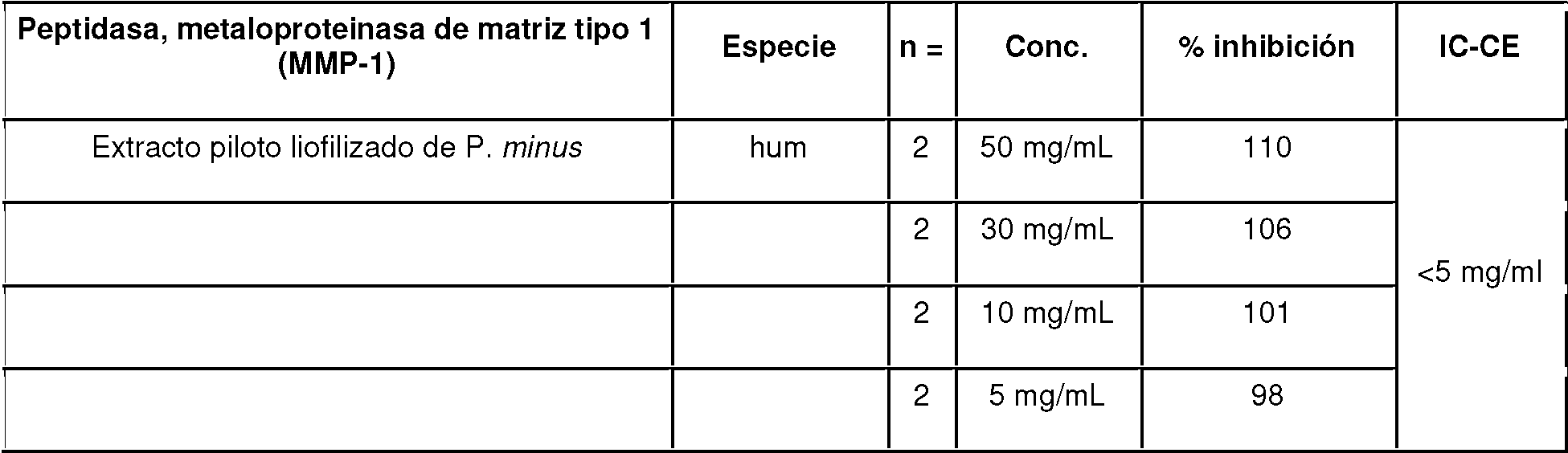
La Tabla 8 anterior revela claramente que el extracto de Polygonum minus es eficaz a niveles de 5 mg/ml cuya concentración cuando se aumenta hasta los niveles de 50 mg/ml no cambia mucho el % de inhibición y, por lo tanto, los niveles de 5 mg/ml se consideraron el nivel óptimo para la inhibición máxima.Table 8 above clearly reveals that the Polygonum minus extract is effective at levels of 5 mg / ml whose concentration when increased to the levels of 50 mg / ml does not change much the% inhibition and, therefore, the levels of 5 mg / ml was considered the optimal level for maximum inhibition.

La Tabla 9 anterior revela claramente que el extracto de Polygonum minus es eficaz a niveles de 5 mg/ml cuya concentración cuando se aumenta hasta los niveles de 30 mg/ml no cambia mucho el % de inhibición y, por lo tanto, los niveles de 5 mg/ml se consideraron el nivel óptimo para la inhibición máxima en 100% de MMP-13. Es importante tener en cuenta que, dado que las proteínas MMP de la familia de las metaloproteinasas de matriz (MMP) están implicadas en la descomposición del colágeno en los procedimientos fisiológicos normales y, por lo tanto, evitan la descomposición del colágeno por el extracto de Polygonum minus, ralentizan el efecto del envejecimiento ya que las arrugas son causadas por la descomposición del colágeno.Table 9 above clearly reveals that the Polygonum minus extract is effective at levels of 5 mg / ml whose concentration when increased to the levels of 30 mg / ml does not change much the% inhibition and therefore the levels of 5 mg / ml was considered the optimal level for maximum inhibition in 100% of MMP-13. It is important to note that since the MMP proteins of the matrix metalloproteinase (MMP) family are involved in the breakdown of collagen in normal physiological procedures and therefore prevent breakdown of collagen by the extract of Polygonum minus, slow down the effect of aging since wrinkles are caused by the breakdown of collagen.
Además de eso, se estudió el extracto de Polygonum minus para revelar las características de mejora de la cognición. In addition to that, Polygonum minus extract was studied to reveal the cognition-enhancing characteristics.
Acción inhibidora in vitro del extracto de Polvaonum minus sobre la acetilcolinesterasa y la monoamino oxidasa-A In vitro inhibitory action of Polvaonum minus extract on acetylcholinesterase and monoamine oxidase-A
La acetilcolinesterasa (AChE) es una enzima clave en el sistema nervioso de los animales y se considera el neurotransmisor más importante implicado en la regulación de las funciones cognitivas. Los inhibidores de AChE se encuentran entre los medicamentos clave aprobados por la FDA para el tratamiento de la enfermedad de Alzheimer (EA). Existen varios estudios que relacionan la disminución de la actividad de la colinesterasa cerebral y la mejora de la memoria. El extracto se probó para determinar la inhibición de la enzima acetilcolinesterasa in vitro.Acetylcholinesterase (AChE) is a key enzyme in the nervous system of animals and is considered the most important neurotransmitter involved in the regulation of cognitive functions. AChE inhibitors are among the key drugs approved by the FDA for the treatment of Alzheimer's disease (AD). There are several studies that link decreased brain cholinesterase activity and memory improvement. The extract was tested for inhibition of the enzyme acetylcholinesterase in vitro.
La monoamino oxidasa (MAO) también interviene en la inactivación de neurotransmisores, la disfunción de la MAO (demasiada o muy poca actividad de la MAO) es responsable de una serie de trastornos psiquiátricos y neurológicos. Por ejemplo, niveles inusualmente altos o bajos de MAO en el organismo se han asociado con depresión, esquizofrenia, abuso de sustancias, trastorno por déficit de atención, migrañas y maduración sexual irregular. Los inhibidores de la monoaminooxidasa son una de las principales clases de fármacos recetados para el tratamiento de la depresión, aunque a menudo se utilizan como tratamiento de última línea debido al riesgo de interacción del fármaco con la dieta u otros fármacos y, de hecho, los inhibidores de la MAO-A actúan como agentes antidepresivos y ansiolíticos.Monoamine oxidase (MAO) is also involved in the inactivation of neurotransmitters, MAO dysfunction (too much or too little MAO activity) is responsible for a number of psychiatric and neurological disorders. For example, unusually high or low levels of MAO in the body have been associated with depression, schizophrenia, substance abuse, attention deficit disorder, migraines, and irregular sexual maturation. Monoamine oxidase inhibitors are one of the main classes of drugs prescribed for the treatment of depression, although they are often used as last-line treatment due to the risk of drug interaction with diet or other drugs and, in fact, drugs. MAO-A inhibitors act as antidepressant and anxiolytic agents.
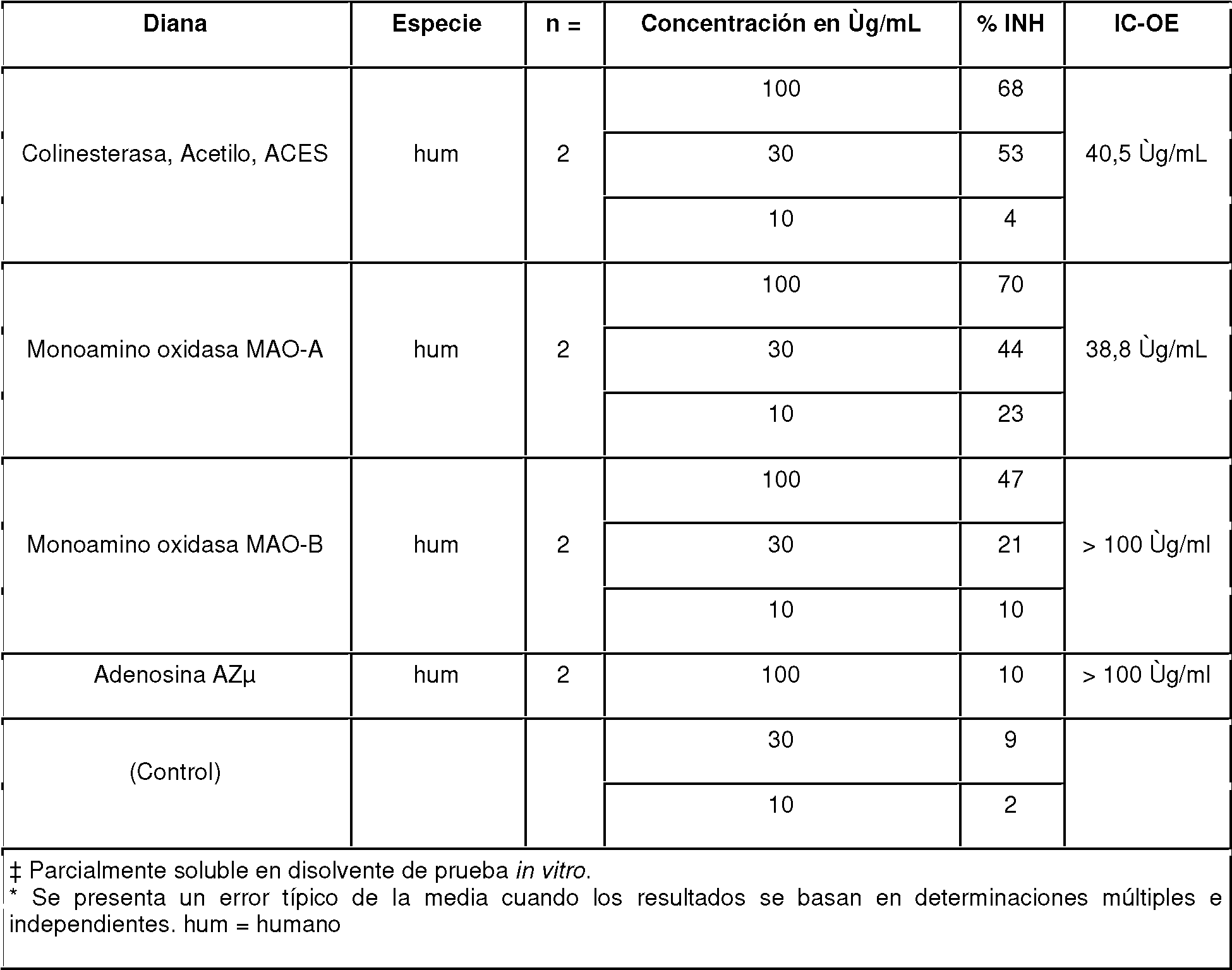
La Tabla 10 anterior revela claramente por lo tanto el efecto del extracto de Polygonum minus hacia la inhibición de acetilcolinesterasa y MAO-A en donde se encontró que los efectos inhibidores sobre ambas enzimas mencionadas eran comparables mientras que no se encontró que dicho extracto no desempeñara un papel prominente en la inhibición de la monoamino oxidasa MAO-B y la adenosina AZg.Therefore, Table 10 above clearly reveals the effect of the Polygonum minus extract towards the inhibition of acetylcholinesterase and MAO-A, where it was found that the inhibitory effects on both enzymes mentioned were comparable while it was not found that said extract did not play a role. prominent role in the inhibition of MAO-B monoamine oxidase and AZg adenosine.
Tratamiento con extracto de Polvaonum minus (Persicaria minor) sobre los déficits en el aprendizaje y la memoria inducidos por escopolaminaTreatment with extract of Polvaonum minus ( Persicaria minor) on learning and memory deficits induced by scopolamine
Los animales se colocan en una plataforma circular elevada y abierta. El animal está expuesto a una luz intensa o a un ruido fuerte. En respuesta a esta intensa estimulación, el animal busca refugio y entra en uno de los orificios alrededor de la plataforma. Aunque el dispositivo fue diseñado originalmente para usarse con ratas, pronto experimentó modificaciones para poder usarse también con ratones. De hecho, el dispositivo se ha considerado apropiado para esta especie debido a su capacidad para encontrar y escapar a través de pequeños orificios.The animals are placed on a raised and open circular platform. The animal is exposed to strong light or loud noise. In response to this intense stimulation, the animal seeks shelter and enters one of the holes around the platform. Although the device was originally designed for use with rats, it soon underwent modifications so that it could also be used with mice. In fact, the device has been deemed appropriate for this species due to its ability to find and escape through small holes.
Se sabe que la escopolamina, un antagonista colinérgico muscarínico, causa alteraciones en las pruebas del laberinto de Barnes. Estas alteraciones pueden revertirse aumentando el tono colinérgico mediante la administración de inhibidores de la colinesterasa tales como donepezilo. En el presente estudio, el tratamiento con escopolamina indujo déficits durante la primera parte de la fase de adquisición (aprendizaje) del laberinto de Barnes y se llevó a cabo la prueba de la sonda.Scopolamine, a muscarinic cholinergic antagonist, is known to cause disturbances in Barnes maze tests. These alterations can be reversed by increasing cholinergic tone by administering cholinesterase inhibitors such as donepezil. In the present study, scopolamine treatment induced deficits during the first part of the acquisition (learning) phase of the Barnes maze and the probe test was carried out.
Los déficits en el aprendizaje inducidos por la escopolamina se evidenciaron por el aumento de los errores tanto totales como primarios, la latencia total y primaria y la longitud de la ruta total y primaria. Las pruebas de laberintos de Barnes involucran los parámetros que se establecen a continuación. Scopolamine-induced learning deficits were evidenced by increases in both total and primary errors, total and primary latency, and length of the total and primary pathway. Barnes maze tests involve the parameters set out below.
Longitud de la Trayectoria Primaria (cm): La distancia recorrida por el sujeto antes del primer contacto con el orificio de escape. El primer contacto se define como el punto de la nariz que toca el orificio de escape.Primary Path Length (cm): The distance traveled by the subject before the first contact with the escape port. First contact is defined as the point on the nose that touches the exhaust port.
Longitud de la Trayectoria Total (cm): La distancia recorrida por el sujeto antes de completar la tarea. La finalización de la tarea se define como la entrada del sujeto en el cuadro de escape. Esto pone fin al ensayo.Total Path Length (cm): The distance traveled by the subject before completing the task. Task completion is defined as the subject's entry into the escape box. This ends the trial.
Errores Primarios: El recuento del número de errores cometidos por el sujeto antes del primer contacto con el orificio de escape. Cualquier contacto de la punta de la nariz con un orificio que no sea de escape se considera un error. Múltiples contactos en el mismo orificio de no escape se cuentan como múltiples errores en este contexto. Primary Errors: The count of the number of errors made by the subject prior to first contact with the escape port. Any contact of the tip of the nose with a non-exhaust port is considered an error. Multiple contacts in the same non-escape port are counted as multiple errors in this context.
Errores Totales: El recuento del número de errores cometidos por el sujeto a lo largo de la prueba. Cualquier contacto de la punta de la nariz con un orificio que no sea de escape se considera un error. Múltiples contactos en el mismo orificio que no sea de escape se cuentan como múltiples errores en este contexto.Total Errors: The count of the number of errors made by the subject throughout the test. Any contact of the tip of the nose with a non-exhaust port is considered an error. Multiple contacts in the same non-exhaust hole are counted as multiple errors in this context.
Latencia Primaria (s): La latencia hasta el primer contacto con el orificio de escape por la punta de la nariz del sujeto.Primary Latency (s): The latency to first contact with the escape port through the tip of the subject's nose.
Latencia Total (s): La latencia para que el sujeto complete la tarea. La finalización de la tarea se define como la entrada del sujeto en la caja de escape, lo que pone fin al ensayo.Total Latency (s): The latency for the subject to complete the task. Completion of the task is defined as the subject's entry into the escape box, which ends the trial.
(i) Artículo de Prueba(i) Test Item
En este estudio se utilizaron los artículos de ensayo, extracto de Polygonum minus propio y extracto de Ginkgo biloba comercialmente disponible (extracto comparador). Estos extractos se prepararon y almacenaron para el proyecto según las especificaciones del proveedor. Las dosis del extracto elegido para el estudio fueron identificadas por el proveedor. Se preparó una suspensión de partida 30X cada semana para cada artículo. Esto se dividió en alícuotas en lotes que a continuación se almacenaron a 4°C durante toda la semana. La suspensión de partida se diluyó con agua ultrapura hasta la concentración de trabajo todos los días antes de la dosificación y se desechó después de la dosificación. Se cargaron agujas para sonda oral con las cantidades necesarias de suspensión. Se tuvo cuidado de asegurar la distribución uniforme de las partículas mezclando en vórtice las suspensiones antes de la preparación en jeringas individuales, y también mezclando con jeringa el artículo de prueba diluido. Se ha demostrado previamente que la dosis y el tiempo de administración de escopolamina producen déficits en las tareas de navegación espacial en roedores. La dosis se incrementó de 0,3 mg/kg referidos inicialmente a 0,5 mg/kg, ya que la dosis más alta produciría un déficit más fiable. The test articles, Polygonum minus proprio extract and commercially available Ginkgo biloba extract (comparator extract) were used in this study. These extracts were prepared and stored for the project according to the supplier's specifications. The doses of the extract chosen for the study were identified by the supplier. A 30X stock suspension was prepared each week for each article. This was aliquoted into batches which were then stored at 4 ° C throughout the week. The starting suspension was diluted with ultrapure water to working concentration every day before dosing and discarded after dosing. Oral probe needles were loaded with the necessary amounts of suspension. Care was taken to ensure uniform distribution of the particles by vortexing the suspensions prior to preparation in individual syringes, and also syringing the diluted test article. Scopolamine dose and time of administration have previously been shown to cause deficits in space navigation tasks in rodents. The dose was increased from 0.3 mg / kg initially referred to 0.5 mg / kg, since the higher dose would produce a more reliable deficit.
(ii) Artículo de Control(ii) Control Article
El control de vehículo se utilizó según el protocolo de las Tablas 11 y 12 a continuación.Vehicle control was used according to the protocol in Tables 11 and 12 below.

ARTÍCULOS DE CONTROL Y PRUEBA UTILIZADOSCONTROL AND TEST ITEMS USED

a. Producto de dosis b. Escopolamina i.p. to. Dose product b. Scopolamine ip
osis de prueba 1 P. min 50 mg/kg/Esco,test osis 1 P. min 50 mg / kg / Esco,

ARTÍCULOS DE CONTROL Y PRUEBA UTILIZADOSCONTROL AND TEST ITEMS USED

(iii) Animales(iii) Animals
Ratones macho C57BL/6 de 2-6 meses de edad (20-25 g), (n = 12 a 14) fueron suministrados por BioLASCO (Taiwán). Se alojaron en un sistema IVC (Allentown, EE. UU.) En un ciclo de luz/oscuridad de 12/12 h (200-300 Lux) (luces en 07:00h) con acceso libre a alimentos (Labdiet, comida de laboratorio formulada) y agua y la humedad se mantiene entre 50% y 70%. Los animales totales usados para cada tratamiento se muestran en la Tabla 13 a continuación (sujetos usados para cada brazo en el experimento).Male C57BL / 6 mice 2-6 months of age (20-25 g), (n = 12 to 14) were supplied by BioLASCO (Taiwan). They were housed in an IVC system (Allentown, USA) in a 12/12 h light / dark cycle (200-300 Lux) (lights at 07:00 h) with free access to food (Labdiet, laboratory food formulated) and water and humidity is maintained between 50% and 70%. The total animals used for each treatment are shown in Table 13 below (subjects used for each arm in the experiment).

El tratamiento crónico vía p.o. se realizó con los COMPUESTOS DE PRUEBA (dosis de prueba 1 y 2) según la Tabla 12 y la Tabla 12 anteriores y los ARTÍCULOS DE CONTROL (vehículo y ginkgo) de forma continua durante 19 días. La dosificación se administró diariamente a las 1800 h. Los compuestos se adminjstran por vía oral usando una sonda nasogástrica (20G). El tratamiento crónico vía i.p. se realizó con los ARTÍCULOS DE CONTROL (vehículo, escopolamina y donepezilo) de forma continua durante 5 días durante la prueba del laberinto de Barnes. El tratamiento se administró diariamente a cada sujeto 30 minutos antes de la prueba. Los compuestos se administraron i.p. usando una aguja 27G.Chronic treatment via p.o. was performed with TEST COMPOUNDS (test doses 1 and 2) according to Table 12 and Table 12 above and CONTROL ITEMS (vehicle and ginkgo) continuously for 19 days. Dosage was administered daily at 1800 h. Compounds are administered orally using a nasogastric tube (20G). Chronic treatment via i.p. was performed with CONTROL ITEMS (vehicle, scopolamine and donepezil) continuously for 5 days during the Barnes maze test. Treatment was administered daily to each subject 30 minutes prior to testing. Compounds were administered i.p. using a 27G needle.
(iv) Procedimiento(iv) Procedure
La evaluación del laberinto de Barnes tomó 5 días para cada sujeto, durante 4 ensayos/día durante 4 días (período de adquisición) y el ensayo de la sonda se llevó a cabo 24 horas después del último ensayo de adquisición. Se realizó un ensayo previo (período de adaptación) antes del inicio del ensayo el día 1 y el día 2. A los sujetos sometidos a prueba se les administraron compuestos de prueba por vía i.p. con agujas 27G, y se les devolvió a sus jaulas de origen durante 30 minutos. La prueba del laberinto de Barnes consistió en tres fases, un período de adaptación, un período de adquisición y un ensayo de sonda. El procedimiento detallado se describe en la siguiente sección.The Barnes maze assessment took 5 days for each subject, for 4 trials / day for 4 days (acquisition period), and the probe trial was carried out 24 hours after the last acquisition trial. A pre-test (adaptation period) was performed before the start of the test on day 1 and day 2. Test compounds were administered i.p. with 27G needles, and they were returned to their cages of origin for 30 minutes. The Barnes maze test consisted of three phases, an adaptation period, an acquisition period, and a probe trial. The detailed procedure is described in the next section.
Cronología del experimentoChronology of the experiment
Período de adaptación: Se retiró la cámara y se permitió al sujeto explorar el laberinto durante 30 segundos y a continuación se le guió suavemente hasta el orificio de escape. Si el sujeto no entraba por el orificio de escape, se colocaba dentro. A continuación, se cubrió el orificio y el sujeto permaneció allí durante 3 minutos. A continuación, se devolvió al sujeto a su jaula de origen y se limpió la plataforma con etanol del 70%.Adaptation period: The camera was removed and the subject was allowed to explore the maze for 30 seconds and was then gently guided to the escape port. If the subject did not enter through the escape port, they were placed inside. The hole was then covered and the subject remained there for 3 minutes. The subject was then returned to their home cage and the platform was cleaned with 70% ethanol.
Período de adquisición (día 1-4): En este período, se retiró la cámara y se permitió al sujeto explorar el laberinto durante 5 minutos y a continuación se le guió suavemente hasta el orificio de escape. Si el sujeto no entraba por el orificio de escape, se colocaba dentro. A continuación, se cubrió el orificio y el sujeto permaneció allí durante 1 minuto. Acquisition period (day 1-4): In this period, the camera was removed and the subject was allowed to explore the maze for 5 minutes and was then gently guided to the escape port. If the subject did not enter through the escape port, they were placed inside. The hole was then covered and the subject remained there for 1 minute.
Después, se devolvió al sujeto a su jaula de origen y se limpió la plataforma con etanol del 70%. El siguiente ensayo se realizó después de un intervalo entre ensayos de dos minutos.The subject was then returned to their home cage and the platform was cleaned with 70% ethanol. The next test was performed after a two minute inter-test interval.
Durante este período, el comportamiento de los sujetos experimentales fue capturado con una cámara de video y grabado en el disco duro de un PC de sobremesa. Se realizó un análisis de estas grabaciones utilizando el sistema de seguimiento EthoVision® XT para el seguimiento y análisis automático del movimiento de los animales. Los parámetros comentados anteriormente se midieron durante la prueba y se procesaron.During this period, the behavior of the experimental subjects was captured with a video camera and recorded on the hard disk of a desktop PC. An analysis of these recordings was performed using the EthoVision® XT tracking system for automatic tracking and analysis of animal movement. The parameters discussed above were measured during the test and processed.
Para cada parámetro, se promediaron las pruebas de cada día (4 pruebas para cada sujeto de este estudio) y se obtuvo un valor de rendimiento medio de cada sujeto para el día en particular. La media de los cuatro ensayos realizados en cualquier día por un sujeto se toma como una medida, por lo que la n para los puntos de datos se basa únicamente en el número del sujeto. Los datos se analizaron adicionalmente utilizando ANOVA de medidas repetidas bidireccionales después de que los datos se sometieran a una prueba de distribución normal, con Día como factor de medida repetida dentro de los sujetos y Grupo entre el factor del sujeto. También se examinó la interacción de factores. Se llevaron a cabo comparaciones post-hoc por pares entre grupos utilizando la prueba de Tukey HSD si se encontró un efecto significativo. Todos los gráficos se representaron como media ± ET, el nivel a se fijó en 0,05 a menos que se indique lo contrario. El análisis de los datos se realizó utilizando el soporte lógico estadístico Sigma Plot.For each parameter, the tests of each day were averaged (4 tests for each subject of this study) and a mean performance value of each subject was obtained for the particular day. The mean of the four trials performed on any day by a subject is taken as a measure, so the n for the data points is based solely on the subject number. The data was further analyzed using two-way repeated measures ANOVA after the data was tested for normal distribution, with Day as the within-subject repeated measure factor and Group between the subject factor. The interaction of factors was also examined. Post-hoc pairwise comparisons between groups were carried out using the Tukey HSD test if a significant effect was found. All graphs were represented as mean ± SE, level a was set at 0.05 unless otherwise indicated. Data analysis was performed using Sigma Plot statistical software.
Ensayo de sonda (día 5): El ensayo de sonda se realizó en las mismas condiciones ambientales que los ensayos de adquisición.Probe assay (day 5): The probe assay was performed under the same environmental conditions as the acquisition assays.
Duración en segmentos (s): Los orificios se cierran colocando un disco de color blanco idéntico en el laberinto durante la prueba de la sonda. Los sujetos tienen 90 segundos para explorar el laberinto. La arena se dividió en 8 segmentos exactamente iguales (como se muestra en la Figura 6) y se midió la duración en cada segmento por parte del sujeto usando el soporte lógico de seguimiento de video Ethovision durante la prueba de la sonda. En la prueba de Barnes se anotaron los parámetros y se comentan a continuación.Duration in Segments (s): Holes are closed by placing an identical white disc in the maze during probe testing. Subjects have 90 seconds to explore the maze. The sand was divided into 8 exactly equal segments (as shown in Figure 6) and the duration in each segment was measured by the subject using Ethovision video tracking software during probe testing. In the Barnes test the parameters were noted and discussed below.
Período de adquisición (día 1 - día 4)Acquisition period (day 1 - day 4)
Velocidad: Con referencia a la FIG. 7(a) y FIG. 7(b), el análisis ANOVA de medidas repetidas bidireccionales no reveló ningún efecto significativo del tratamiento sobre la velocidad y, por tanto, la interpretación de las medidas de aprendizaje y memoria no se confunden con los efectos estimulantes o sedantes de los compuestos de prueba. Speed: With reference to FIG. 7 (a) and FIG. 7 (b), the ANOVA analysis of two-way repeated measures did not reveal any significant effect of treatment on speed, and therefore the interpretation of the learning and memory measures is not confused with the stimulant or sedative effects of the test compounds. .
Longitud de la ruta primaria y longitud de la ruta total: Con referencia a la FIG. 8(a), FIG. 8(b), FIG. 8(c) y FIG. 8(d), las figuras muestran que el tratamiento con escopolamina disminuyó el rendimiento sólo el día dos (para la longitud de la ruta primaria) y los días uno, dos y tres (para la longitud total de la ruta) en comparación con el grupo tratado con el control de vehículo. Esta disminución en el rendimiento para la longitud de la trayectoria total demuestra un déficit inducido por escopolamina en el aprendizaje en el laberinto de Barnes. El déficit inducido por escopolamina se observó en los ratones tratados con 50 mg/kg de Polygonum minus; mostraron una disminución significativa en el rendimiento en comparación con los ratones tratados con vehículo vehículo los días dos y tres. Esto sugiere que a esta dosis la dosis de tratamiento con Polygonum minus no revierte los déficits inducidos por escopolamina en el laberinto de Barnes. Sin embargo, los ratones tratados con donepezilo, el ginkgo y 100 mg/kg Polygonum minus no mostraron un déficit inducido por escopolamina. Su rendimiento no fue significativamente diferente al de los ratones tratados con vehículo vehículo.Primary path length and total path length: With reference to FIG. 8 (a), FIG. 8 (b), FIG. 8 (c) and FIG. 8 (d), the figures show that scopolamine treatment decreased performance only on day two (for the length of the primary pathway) and on days one, two, and three (for the total length of the pathway) compared to group treated with vehicle control. This decrease in performance for full path length demonstrates a scopolamine-induced deficit in learning in the Barnes maze. Scopolamine-induced deficit was observed in mice treated with 50 mg / kg of Polygonum minus; showed a significant decrease in performance compared to vehicle-vehicle treated mice on days two and three. This suggests that at this dose the treatment dose with Polygonum minus does not reverse the deficits induced by scopolamine in the Barnes maze. However, mice treated with donepezil, ginkgo, and 100 mg / kg Polygonum minus did not show a scopolamine-induced deficit. Their performance was not significantly different from vehicle-vehicle treated mice.
Errores primarios y errores totales: Los resultados muestran que la escopolamina indujo un déficit en el aprendizaje el día dos (para errores primarios) y los días uno y dos para errores totales, en comparación con los ratones de control tratados con vehículo. Los déficits de errores totales no se observaron después del tratamiento con Polygonum minus a 100 mg/kg, ginkgo o donepezilo durante los días uno y dos, donde había un déficit inducido por escopolamina. Estos datos sugieren que la alta dosis de Polygonum minus puede revertir los déficits en el aprendizaje inducidos por escopolamina, evaluados por los errores totales. La dosis más baja de Polygonum minus pareció revertir el déficit por escopolamina el día dos, según lo evaluado por los errores primarios en la FIG. 9(a), FIG. 9(b), FIG. 9(c) y FIG. 9(d). Primary errors and total errors: The results show that scopolamine induced a deficit in learning on day two (for primary errors) and on days one and two for total errors, compared to vehicle-treated control mice. Total error deficits were not observed after treatment with Polygonum minus at 100 mg / kg, ginkgo, or donepezil during days one and two, where there was a scopolamine-induced deficit. These data suggest that the high dose of Polygonum minus can reverse scopolamine-induced learning deficits, as assessed by total errors. The lowest dose of Polygonum minus appeared to reverse the scopolamine deficit on day two, as assessed by the primary errors in FIG. 9 (a), FIG. 9 (b), FIG. 9 (c) and FIG. 9 (d).
Latencia primaria y latencia total: Estos datos muestran que cuando se compara con el control de vehículo, la escopolamina induce un déficit en el aprendizaje. Es decir, los ratones tratados con escopolamina tardan más en encontrar el orificio y escapar del laberinto. Los ratones tratados con la dosis alta de Polygonum minus se comportan igual que los ratones tratados con vehículo y no muestran un déficit en el aprendizaje por escopolamina. Se obtiene un resultado similar con el tratamiento con donepezilo y con el tratamiento con ginkgo como se muestra en la FIG.Primary latency and total latency: These data show that when compared to the vehicle control, scopolamine induces a learning deficit. That is, mice treated with scopolamine take longer to find the hole and escape the maze. Mice treated with the high dose of Polygonum minus behaved the same as vehicle treated mice and did not show a deficit in scopolamine learning. A similar result is obtained with donepezil treatment and with ginkgo treatment as shown in FIG.
10(a), FIG. 10(b), FIG. 10(c) y FIG. 10(d).10 (a), FIG. 10 (b), FIG. 10 (c) and FIG. 10 (d).
En la prueba de la sonda (Día 5), no se encontraron diferencias significativas en el tiempo empleado en los segmentos en el grupo tratado con escopolamina y el grupo tratado con Polygonum minus a 50 mg/kg. La FIG. 10 (Fig. 11) muestra que durante la prueba de la sonda los ratones realizan la tarea pero no hay ningún orificio de escape. A los ratones se les permite explorar el laberinto y se registra el tiempo que los ratones permanecen en varias zonas del laberinto. Esta prueba de "sonda" se utiliza para evaluar la memoria. Los ratones tratados con escopolamina no mostraron preferencia por el segmento 'objetivo' del laberinto, donde, en las pruebas anteriores, estaba ubicado el orificio de escape. Esto sugiere que la escopolamina ha inducido un déficit en la memoria. Este déficit de memoria no se revirtió con la dosis baja de Polygonum minus, ya que estos ratones tampoco mostraron preferencia por el segmento objetivo. Tanto el tratamiento con ginkgo como con donepezilo revirtieron el déficit por escopolamina, efectos que han sido referidos por varios laboratorios. La dosis alta de Polygonum minus también revirtió los déficits de memoria inducidos por escopolamina ya que los ratones tratados con extracto de Polygonum minus a 100 mg/kg pasaron una cantidad significativa de tiempo en el segmento objetivo.In the probe test (Day 5), no significant differences were found in the time spent in the segments in the group treated with scopolamine and the group treated with Polygonum minus at 50 mg / kg. FIG. 10 (Fig. 11) shows that during the probe test the mice perform the task but there is no escape hole. The mice are allowed to explore the maze and the time the mice spend in various areas of the maze are recorded. This "probe" test is used to assess memory. Scopolamine-treated mice showed no preference for the 'target' segment of the maze, where, in previous tests, the escape hole was located. This suggests that scopolamine has induced a memory deficit. This memory deficit was not reversed with the low dose of Polygonum minus, as these mice also did not show a preference for the segment objective. Both ginkgo and donepezil treatment reversed the scopolamine deficit, effects that have been reported by several laboratories. The high dose of Polygonum minus also reversed scopolamine-induced memory deficits as mice treated with Polygonum minus extract at 100 mg / kg spent a significant amount of time in the target segment.
En el presente estudio, el tratamiento con escopolamina indujo déficits durante la primera parte de la fase de adquisición (aprendizaje) del laberinto de Barnes. Los déficits en el aprendizaje inducidos por la escopolamina se evidenciaron por el aumento de los errores tanto totales como primarios, la latencia total y primaria y la longitud de la trayectoria total y primaria. Teniendo en cuenta la curva de aprendizaje, el deterioro de los animales tratados con escopolamina parecía más pronunciado al principio del entrenamiento, después de lo cual se alcanzó cierta constancia entre los grupos de tratamiento, esto se ilustra mejor por el aumento de la longitud total de la ruta en los ratones tratados con escopolamina los días uno, dos y tres, pero no el día cuatro. Estos déficits fueron atenuados por los controles positivos: donepezilo y extracto de ginkgo. Además, Polygonum minus a 100 mg/kg atenuó los déficits inducidos por escopolamina en la fase de adquisición del laberinto de Barnes. Los compuestos de prueba invirtieron los déficits inducidos por escopolamina en el aspecto de retención (ensayo de sonda) de la tarea. En el ensayo de sonda todos los tratamientos excepto la dosis baja de 50 mg/kg de Polygonum minus atenuaron los déficits inducidos por escopolamina. Estos déficits se describieron por no haber pasado un tiempo significativo en el segmento objetivo de los ratones. La falta de efecto de la dosis baja y el efecto significativo de la dosis alta sugerirían que hubo una acción dependiente de la dosis del extracto.In the present study, scopolamine treatment induced deficits during the first part of the acquisition (learning) phase of the Barnes maze. Scopolamine-induced learning deficits were evidenced by increases in both total and primary errors, total and primary latency, and total and primary path length. Taking into account the learning curve, the deterioration of the scopolamine-treated animals seemed more pronounced at the beginning of the training, after which some consistency was achieved between the treatment groups, this is best illustrated by the increase in the total length of the route in scopolamine-treated mice on days one, two, and three, but not on day four. These deficits were attenuated by the positive controls: donepezil and ginkgo extract. Furthermore, Polygonum minus at 100 mg / kg attenuated scopolamine-induced deficits in the Barnes maze acquisition phase. Test compounds reversed scopolamine-induced deficits in the retention (probe assay) aspect of the task. In the probe trial all treatments except the low dose of 50 mg / kg of Polygonum minus attenuated scopolamine-induced deficits. These deficits were described by not having spent a significant time in the target segment of the mice. The lack of effect of the low dose and the significant effect of the high dose would suggest that there was a dose-dependent action of the extract.
Los déficits de aprendizaje por escopolamina estuvieron presentes al principio del experimento y los resultados sugieren que un extracto de Polygonum minus puede atenuar estos déficits de memoria y aprendizaje inducidos por escopolamina en ratones. El presente estudio utilizó el laberinto de Barnes que proporciona una evaluación de la memoria espacial.Scopolamine learning deficits were present early in the experiment and the results suggest that a Polygonum minus extract can attenuate these scopolamine-induced learning and memory deficits in mice. The present study used the Barnes maze which provides an assessment of spatial memory.
Por tanto, gracias al avance técnico de la presente invención, es posible proporcionar un extracto de Polygonum minus también conocido como Persicaria minor, con un potencial de prevención del daño oxidativo de las células al tener altos valores de ORAC de al menos 16000 micromoles de TE/gramo de dicho extracto, que exhibe un efecto protector contra las arrugas y el envejecimiento al poseer un fuerte efecto inhibidor hacia la MMP-1 (Peptidasa, Metaloproteinasa de matriz tipo 1) y MMP-13 (Peptidasa, metaloproteinasa de matriz tipo 13) para prevenir así la descomposición del colágeno; y un beneficio para la cognición a través de la mejora de la memoria y el aprendizaje potencialmente a través del efecto anticolinesterasa del extracto.Therefore, thanks to the technical advance of the present invention, it is possible to provide an extract of Polygonum minus also known as Persicaria minor, with a potential for preventing oxidative damage of cells by having high ORAC values of at least 16000 micromoles of TE / gram of said extract, which exhibits a protective effect against wrinkles and aging by having a strong inhibitory effect towards MMP-1 (Peptidase, matrix metalloproteinase type 1) and MMP-13 (Peptidase, matrix metalloproteinase type 13) to thus prevent the breakdown of collagen; and a benefit to cognition through memory enhancement and learning potentially through the anticholinesterase effect of the extract.
Así, el extracto de agua de Polygonum minus caracterizado por la presencia de marcadores quercetin-3-glucurónido y quercitrina es notablemente eficaz como potenciador cognitivo y es potencialmente activo para el tratamiento de la depresión y la ansiedad al ser un potencial inhibidor de la enzima acetilcolinesterasa y monoaminooxidasa-A, respectivamente. Thus, the water extract of Polygonum minus characterized by the presence of markers quercetin-3-glucuronide and quercitrin is remarkably effective as a cognitive enhancer and is potentially active for the treatment of depression and anxiety as it is a potential inhibitor of the enzyme acetylcholinesterase and monoamine oxidase-A, respectively.
Claims (3)
Applications Claiming Priority (2)
| Application Number | Priority Date | Filing Date | Title |
|---|---|---|---|
| MYPI2012003882A MY172154A (en) | 2012-08-29 | 2012-08-29 | Composition for cognition and cosmetic purposes and use of said composition for preparing an agent |
| PCT/MY2013/000033 WO2014035233A1 (en) | 2012-08-29 | 2013-02-26 | A composition for cognition and cosmestic purposes |
Publications (1)
| Publication Number | Publication Date |
|---|---|
| ES2873368T3 true ES2873368T3 (en) | 2021-11-03 |
Family
ID=50183949
Family Applications (1)
| Application Number | Title | Priority Date | Filing Date |
|---|---|---|---|
| ES13832854T Active ES2873368T3 (en) | 2012-08-29 | 2013-02-26 | A composition for the treatment of deficits in learning and memory |
Country Status (7)
| Country | Link |
|---|---|
| US (1) | US9877993B2 (en) |
| EP (1) | EP2895143B1 (en) |
| JP (1) | JP6228211B2 (en) |
| CN (1) | CN104955441B (en) |
| ES (1) | ES2873368T3 (en) |
| MY (1) | MY172154A (en) |
| WO (1) | WO2014035233A1 (en) |
Families Citing this family (2)
| Publication number | Priority date | Publication date | Assignee | Title |
|---|---|---|---|---|
| MY202136A (en) * | 2019-07-31 | 2024-04-05 | Biotropics Malaysia Berhad | Extract of persicaria minor and use for treating or alleviating symptoms and/or conditions associated with hyperuricemia |
| FR3099701B1 (en) | 2019-08-08 | 2022-03-25 | BASF Beauty Care Solutions FR | New cosmetic use of a combination of oenotheine-B and quercetin-3-O-glucuronide |
Family Cites Families (8)
| Publication number | Priority date | Publication date | Assignee | Title |
|---|---|---|---|---|
| DE4339486A1 (en) * | 1993-11-19 | 1995-05-24 | Erwin Backhaus | Use of bioflavonoids such as rutin or quercetin |
| JP3584489B2 (en) * | 1994-03-23 | 2004-11-04 | 株式会社コーセー | External preparation for skin |
| EP1005333B1 (en) * | 1997-02-25 | 2005-01-12 | The Regents Of The University Of Michigan | Methods and compositions for preventing and treating chronological aging in human skin |
| JP2007504099A (en) * | 2003-08-28 | 2007-03-01 | 天津天士力制薬股▲ふん▼有限公司 | Treatment of aspirin resistance using Tansan, its extract and composition |
| US20080025930A1 (en) * | 2006-07-31 | 2008-01-31 | Hugo Corstjens | Anti-aging Compositions Comprising Menyanthes Trifoliata Leaf Extracts and Methods of Use Thereof |
| EP2259768B1 (en) * | 2008-04-08 | 2019-05-22 | Merck Patent GmbH | Compositions containing cyclic peptides and methods of use |
| GR1006881B (en) * | 2009-04-27 | 2010-07-13 | Κορρες Α.Ε. Φυσικα Προϊοντα, | Anti-ageing propeties of quercetin, 18α-glycyrrhetinic acid, hederagenin and their derivatives |
| US8273387B2 (en) * | 2009-08-26 | 2012-09-25 | Mary Kay Inc. | Topical skin formulations comprising plant extracts |
-
2012
- 2012-08-29 MY MYPI2012003882A patent/MY172154A/en unknown
-
2013
- 2013-02-26 EP EP13832854.7A patent/EP2895143B1/en active Active
- 2013-02-26 WO PCT/MY2013/000033 patent/WO2014035233A1/en not_active Ceased
- 2013-02-26 CN CN201380056212.5A patent/CN104955441B/en active Active
- 2013-02-26 JP JP2015529715A patent/JP6228211B2/en active Active
- 2013-02-26 US US14/424,180 patent/US9877993B2/en active Active
- 2013-02-26 ES ES13832854T patent/ES2873368T3/en active Active
Also Published As
| Publication number | Publication date |
|---|---|
| CN104955441A (en) | 2015-09-30 |
| US9877993B2 (en) | 2018-01-30 |
| EP2895143A1 (en) | 2015-07-22 |
| WO2014035233A1 (en) | 2014-03-06 |
| JP2015526511A (en) | 2015-09-10 |
| CN104955441B (en) | 2017-11-10 |
| JP6228211B2 (en) | 2017-11-08 |
| MY172154A (en) | 2019-11-14 |
| EP2895143B1 (en) | 2021-04-07 |
| US20150320821A1 (en) | 2015-11-12 |
| EP2895143A4 (en) | 2016-07-20 |
Similar Documents
| Publication | Publication Date | Title |
|---|---|---|
| Baisch et al. | Endothelium-dependent vasorelaxing activity of aqueous extracts of Ilex paraguariensis on mesenteric arterial bed of rats | |
| EP4280897A1 (en) | Nanovesicules deriving from biological plants as natural carriers of phyto-complexes for nutraceutical, cosmetic and regenerative use | |
| Xu et al. | A-type cinnamon procyanidin oligomers protect against 1-methyl-4-phenyl-1, 2, 3, 6-tetrahydropyridine-induced neurotoxicity in mice through inhibiting the p38 mitogen-activated protein kinase/p53/bcl-2 associated x protein signaling pathway | |
| Daniel et al. | In vivo antidiabetic and antioxidant activities of chloroform fraction of Nelsonia canescens Leaf in Alloxan-induced Diabetic Rats | |
| Chittasupho et al. | Stability, permeation, and cytotoxicity reduction of capsicum extract nanoparticles loaded hydrogel containing wax gourd extract | |
| Michalak et al. | Phenolic content, antioxidant activity and pharmaceutical availability of hydrogels with extracts of Rosmarinus officinalis L. and Sambucus nigra L | |
| ES2873368T3 (en) | A composition for the treatment of deficits in learning and memory | |
| SG185867A1 (en) | Treatment and/or prevention of inflammation and cutaneous photodamage and photoprotection of the skin with a water-soluble extract from plant of solanum genus | |
| Adrianta et al. | Jackfruit (Artocarpus heterophyllus Lamk) Leaf as a Natural Sun Stick Protector Through the Inhibition of the MMP-1 Receptor. | |
| da Silva et al. | Emulsion incorporating Eugenia dysenterica aqueous extract entrapped in chitosan microparticles as a novel topical treatment of cutaneous infections | |
| Febrinasari et al. | Green tea as a cosmetic agent for skin aging: A scoping review | |
| CN121128806A (en) | A protein powder to help improve Alzheimer's disease and its preparation method | |
| Abaidullah et al. | Molecular Mechanisms Behind Organ-Related Aging and Regulatory Effects of Natural Therapeutics | |
| Portugal-Cohen et al. | Protective effects of a novel preparation consists of concentrated Dead Sea water and natural plants extracts against skin photo-damage | |
| Gyawali et al. | Anti-inflammatory, Anxiolytic and Antioxidant Property of Lactuca sativa L and Formulation of Microspheres Loaded Sustained Release Anti-inflammatory Gel | |
| CN101489396A (en) | Method and composition for administering bioactive compounds derived from morinda citrifolia | |
| EP3968947A1 (en) | Composition for the prevention and treatment of signs of skin aging | |
| Sibanda | Evaluation of the therapeutic potential of Green rooibos (Aspalathus linearis) extract in neurological disease | |
| WO2025202869A1 (en) | Extracellular vesicles from green tea and their use | |
| Ginting et al. | ANTIOXIDANT ACTIVITY AND EFFECTIVENESS TEST OF METHANOL EXTRACT SAMBILOTO LEAVES (Andrographis paniculata) ON WISTAR RATS (Rattus novergicus) EXPOSED TO ULTRA VIOLET RAYS | |
| Ripa et al. | Evaluation of Analgesic, and CNS Depressant Activities of Ethanolic Extract of Roots of Heritiera fomes Buch | |
| US20210030654A1 (en) | Antioxidant complex and composition for forming same | |
| Abela | Review of oral joint supplementation for horses sold on the internet: analysis of provided information and scientific evidence | |
| Serio | Diospyros digyna Jacq. Fruit: Exploring Bioactive Compounds, Functional Properties, and Involved Mechanisms | |
| Luo¹ et al. | Oxidative stress products and managements in atopic |