ES2873842T3 - Plant growth promoting bacteria and methods of use - Google Patents
Plant growth promoting bacteria and methods of use Download PDFInfo
- Publication number
- ES2873842T3 ES2873842T3 ES14765307T ES14765307T ES2873842T3 ES 2873842 T3 ES2873842 T3 ES 2873842T3 ES 14765307 T ES14765307 T ES 14765307T ES 14765307 T ES14765307 T ES 14765307T ES 2873842 T3 ES2873842 T3 ES 2873842T3
- Authority
- ES
- Spain
- Prior art keywords
- strain
- bacillus
- nrrl
- inoculant
- bacterial
- Prior art date
- Legal status (The legal status is an assumption and is not a legal conclusion. Google has not performed a legal analysis and makes no representation as to the accuracy of the status listed.)
- Active
Links
Classifications
-
- A—HUMAN NECESSITIES
- A01—AGRICULTURE; FORESTRY; ANIMAL HUSBANDRY; HUNTING; TRAPPING; FISHING
- A01H—NEW PLANTS OR NON-TRANSGENIC PROCESSES FOR OBTAINING THEM; PLANT REPRODUCTION BY TISSUE CULTURE TECHNIQUES
- A01H3/00—Processes for modifying phenotypes, e.g. symbiosis with bacteria
-
- A—HUMAN NECESSITIES
- A01—AGRICULTURE; FORESTRY; ANIMAL HUSBANDRY; HUNTING; TRAPPING; FISHING
- A01N—PRESERVATION OF BODIES OF HUMANS OR ANIMALS OR PLANTS OR PARTS THEREOF; BIOCIDES, e.g. AS DISINFECTANTS, AS PESTICIDES OR AS HERBICIDES; PEST REPELLANTS OR ATTRACTANTS; PLANT GROWTH REGULATORS
- A01N63/00—Biocides, pest repellants or attractants, or plant growth regulators containing microorganisms, viruses, microbial fungi, animals or substances produced by, or obtained from, microorganisms, viruses, microbial fungi or animals, e.g. enzymes or fermentates
- A01N63/20—Bacteria; Substances produced thereby or obtained therefrom
-
- A—HUMAN NECESSITIES
- A01—AGRICULTURE; FORESTRY; ANIMAL HUSBANDRY; HUNTING; TRAPPING; FISHING
- A01N—PRESERVATION OF BODIES OF HUMANS OR ANIMALS OR PLANTS OR PARTS THEREOF; BIOCIDES, e.g. AS DISINFECTANTS, AS PESTICIDES OR AS HERBICIDES; PEST REPELLANTS OR ATTRACTANTS; PLANT GROWTH REGULATORS
- A01N63/00—Biocides, pest repellants or attractants, or plant growth regulators containing microorganisms, viruses, microbial fungi, animals or substances produced by, or obtained from, microorganisms, viruses, microbial fungi or animals, e.g. enzymes or fermentates
- A01N63/20—Bacteria; Substances produced thereby or obtained therefrom
- A01N63/22—Bacillus
-
- A—HUMAN NECESSITIES
- A01—AGRICULTURE; FORESTRY; ANIMAL HUSBANDRY; HUNTING; TRAPPING; FISHING
- A01N—PRESERVATION OF BODIES OF HUMANS OR ANIMALS OR PLANTS OR PARTS THEREOF; BIOCIDES, e.g. AS DISINFECTANTS, AS PESTICIDES OR AS HERBICIDES; PEST REPELLANTS OR ATTRACTANTS; PLANT GROWTH REGULATORS
- A01N63/00—Biocides, pest repellants or attractants, or plant growth regulators containing microorganisms, viruses, microbial fungi, animals or substances produced by, or obtained from, microorganisms, viruses, microbial fungi or animals, e.g. enzymes or fermentates
- A01N63/20—Bacteria; Substances produced thereby or obtained therefrom
- A01N63/25—Paenibacillus
-
- A—HUMAN NECESSITIES
- A01—AGRICULTURE; FORESTRY; ANIMAL HUSBANDRY; HUNTING; TRAPPING; FISHING
- A01N—PRESERVATION OF BODIES OF HUMANS OR ANIMALS OR PLANTS OR PARTS THEREOF; BIOCIDES, e.g. AS DISINFECTANTS, AS PESTICIDES OR AS HERBICIDES; PEST REPELLANTS OR ATTRACTANTS; PLANT GROWTH REGULATORS
- A01N63/00—Biocides, pest repellants or attractants, or plant growth regulators containing microorganisms, viruses, microbial fungi, animals or substances produced by, or obtained from, microorganisms, viruses, microbial fungi or animals, e.g. enzymes or fermentates
- A01N63/20—Bacteria; Substances produced thereby or obtained therefrom
- A01N63/27—Pseudomonas
-
- A—HUMAN NECESSITIES
- A01—AGRICULTURE; FORESTRY; ANIMAL HUSBANDRY; HUNTING; TRAPPING; FISHING
- A01N—PRESERVATION OF BODIES OF HUMANS OR ANIMALS OR PLANTS OR PARTS THEREOF; BIOCIDES, e.g. AS DISINFECTANTS, AS PESTICIDES OR AS HERBICIDES; PEST REPELLANTS OR ATTRACTANTS; PLANT GROWTH REGULATORS
- A01N63/00—Biocides, pest repellants or attractants, or plant growth regulators containing microorganisms, viruses, microbial fungi, animals or substances produced by, or obtained from, microorganisms, viruses, microbial fungi or animals, e.g. enzymes or fermentates
- A01N63/20—Bacteria; Substances produced thereby or obtained therefrom
- A01N63/28—Streptomyces
-
- A—HUMAN NECESSITIES
- A01—AGRICULTURE; FORESTRY; ANIMAL HUSBANDRY; HUNTING; TRAPPING; FISHING
- A01N—PRESERVATION OF BODIES OF HUMANS OR ANIMALS OR PLANTS OR PARTS THEREOF; BIOCIDES, e.g. AS DISINFECTANTS, AS PESTICIDES OR AS HERBICIDES; PEST REPELLANTS OR ATTRACTANTS; PLANT GROWTH REGULATORS
- A01N63/00—Biocides, pest repellants or attractants, or plant growth regulators containing microorganisms, viruses, microbial fungi, animals or substances produced by, or obtained from, microorganisms, viruses, microbial fungi or animals, e.g. enzymes or fermentates
- A01N63/30—Microbial fungi; Substances produced thereby or obtained therefrom
- A01N63/38—Trichoderma
-
- C—CHEMISTRY; METALLURGY
- C12—BIOCHEMISTRY; BEER; SPIRITS; WINE; VINEGAR; MICROBIOLOGY; ENZYMOLOGY; MUTATION OR GENETIC ENGINEERING
- C12N—MICROORGANISMS OR ENZYMES; COMPOSITIONS THEREOF; PROPAGATING, PRESERVING, OR MAINTAINING MICROORGANISMS; MUTATION OR GENETIC ENGINEERING; CULTURE MEDIA
- C12N1/00—Microorganisms; Compositions thereof; Processes of propagating, maintaining or preserving microorganisms or compositions thereof; Processes of preparing or isolating a composition containing a microorganism; Culture media therefor
- C12N1/20—Bacteria; Culture media therefor
- C12N1/205—Bacterial isolates
-
- C—CHEMISTRY; METALLURGY
- C12—BIOCHEMISTRY; BEER; SPIRITS; WINE; VINEGAR; MICROBIOLOGY; ENZYMOLOGY; MUTATION OR GENETIC ENGINEERING
- C12R—INDEXING SCHEME ASSOCIATED WITH SUBCLASSES C12C - C12Q, RELATING TO MICROORGANISMS
- C12R2001/00—Microorganisms ; Processes using microorganisms
- C12R2001/01—Bacteria or Actinomycetales ; using bacteria or Actinomycetales
-
- C—CHEMISTRY; METALLURGY
- C12—BIOCHEMISTRY; BEER; SPIRITS; WINE; VINEGAR; MICROBIOLOGY; ENZYMOLOGY; MUTATION OR GENETIC ENGINEERING
- C12R—INDEXING SCHEME ASSOCIATED WITH SUBCLASSES C12C - C12Q, RELATING TO MICROORGANISMS
- C12R2001/00—Microorganisms ; Processes using microorganisms
- C12R2001/01—Bacteria or Actinomycetales ; using bacteria or Actinomycetales
- C12R2001/05—Alcaligenes
-
- C—CHEMISTRY; METALLURGY
- C12—BIOCHEMISTRY; BEER; SPIRITS; WINE; VINEGAR; MICROBIOLOGY; ENZYMOLOGY; MUTATION OR GENETIC ENGINEERING
- C12R—INDEXING SCHEME ASSOCIATED WITH SUBCLASSES C12C - C12Q, RELATING TO MICROORGANISMS
- C12R2001/00—Microorganisms ; Processes using microorganisms
- C12R2001/01—Bacteria or Actinomycetales ; using bacteria or Actinomycetales
- C12R2001/07—Bacillus
-
- C—CHEMISTRY; METALLURGY
- C12—BIOCHEMISTRY; BEER; SPIRITS; WINE; VINEGAR; MICROBIOLOGY; ENZYMOLOGY; MUTATION OR GENETIC ENGINEERING
- C12R—INDEXING SCHEME ASSOCIATED WITH SUBCLASSES C12C - C12Q, RELATING TO MICROORGANISMS
- C12R2001/00—Microorganisms ; Processes using microorganisms
- C12R2001/01—Bacteria or Actinomycetales ; using bacteria or Actinomycetales
- C12R2001/07—Bacillus
- C12R2001/075—Bacillus thuringiensis
-
- C—CHEMISTRY; METALLURGY
- C12—BIOCHEMISTRY; BEER; SPIRITS; WINE; VINEGAR; MICROBIOLOGY; ENZYMOLOGY; MUTATION OR GENETIC ENGINEERING
- C12R—INDEXING SCHEME ASSOCIATED WITH SUBCLASSES C12C - C12Q, RELATING TO MICROORGANISMS
- C12R2001/00—Microorganisms ; Processes using microorganisms
- C12R2001/01—Bacteria or Actinomycetales ; using bacteria or Actinomycetales
- C12R2001/07—Bacillus
- C12R2001/085—Bacillus cereus
-
- C—CHEMISTRY; METALLURGY
- C12—BIOCHEMISTRY; BEER; SPIRITS; WINE; VINEGAR; MICROBIOLOGY; ENZYMOLOGY; MUTATION OR GENETIC ENGINEERING
- C12R—INDEXING SCHEME ASSOCIATED WITH SUBCLASSES C12C - C12Q, RELATING TO MICROORGANISMS
- C12R2001/00—Microorganisms ; Processes using microorganisms
- C12R2001/01—Bacteria or Actinomycetales ; using bacteria or Actinomycetales
- C12R2001/07—Bacillus
- C12R2001/125—Bacillus subtilis ; Hay bacillus; Grass bacillus
Landscapes
- Life Sciences & Earth Sciences (AREA)
- Health & Medical Sciences (AREA)
- Engineering & Computer Science (AREA)
- Zoology (AREA)
- General Health & Medical Sciences (AREA)
- Microbiology (AREA)
- Environmental Sciences (AREA)
- Wood Science & Technology (AREA)
- Biotechnology (AREA)
- Virology (AREA)
- Plant Pathology (AREA)
- Dentistry (AREA)
- Agronomy & Crop Science (AREA)
- Pest Control & Pesticides (AREA)
- Chemical & Material Sciences (AREA)
- Developmental Biology & Embryology (AREA)
- Botany (AREA)
- Genetics & Genomics (AREA)
- Bioinformatics & Cheminformatics (AREA)
- Organic Chemistry (AREA)
- Mycology (AREA)
- Medicinal Chemistry (AREA)
- Tropical Medicine & Parasitology (AREA)
- General Engineering & Computer Science (AREA)
- Biochemistry (AREA)
- Biomedical Technology (AREA)
- Micro-Organisms Or Cultivation Processes Thereof (AREA)
- Agricultural Chemicals And Associated Chemicals (AREA)
- Pretreatment Of Seeds And Plants (AREA)
- Toxicology (AREA)
- Peptides Or Proteins (AREA)
Abstract
Un inóculo para la aplicación a plantas, semillas de plantas o un medio de crecimiento vegetal, en donde el inóculo comprende un portador agrícolamente aceptable y una cantidad efectiva de un cultivo bacteriano biológicamente puro, en donde la bacteria en el cultivo bacteriano es la cepa BT013A de Bacillus thuringiensis (NRRL No. B-50924).An inoculum for application to plants, plant seeds or a plant growth medium, wherein the inoculum comprises an agriculturally acceptable carrier and an effective amount of a biologically pure bacterial culture, wherein the bacteria in the bacterial culture is strain BT013A from Bacillus thuringiensis (NRRL No. B-50924).
Description
DESCRIPCIÓNDESCRIPTION
Bacterias promotoras del crecimiento vegetal y métodos de usoPlant growth promoting bacteria and methods of use
Campo de la invenciónField of the invention
La presente invención se refiere generalmente a cultivos bacteriológicos bacteriológicamente puros de nuevas cepas de bacterias promotoras del crecimiento vegetal, e inóculos que comprenden las mismas. La invención también está dirigida a semillas de plantas recubiertas con los inóculos, kits que comprenden los inóculos y métodos para estimular el crecimiento vegetal mediante el uso de los cultivos y/o inóculos bacterianos reivindicados.The present invention relates generally to bacteriologically pure bacteriological cultures of new strains of plant growth promoting bacteria, and inocula comprising the same. The invention is also directed to plant seeds coated with the inoculums, kits comprising the inoculums and methods for stimulating plant growth using the claimed bacterial cultures and / or inocula.
Antecedentes de la invenciónBackground of the invention
Las bacterias promotoras del crecimiento vegetal (PGPB) están asociadas con muchas, si no todas, las especies de plantas y comúnmente están presentes en muchos ambientes. El grupo de PGPB más ampliamente estudiado son las rizobacterias promotoras del crecimiento vegetal (PGPR), que colonizan las superficies de las raíces y la interfaz del suelo muy adherida, la rizosfera. Dentro de la rizosfera hay una zona donde las bacterias, hongos y otros organismos compiten por los nutrientes y por unirse a las estructuras de las raíces de la planta. Tanto las bacterias perjudiciales como las beneficiosas pueden ocupar las raíces de la planta. La presencia de bacterias promotoras del crecimiento vegetal (PGPB) dentro o cerca de las raíces o semillas puede conducir a un ambiente de rizosfera más saludable y plantas más saludables. Estas bacterias de vida libre promueven el crecimiento vegetal en cultivos agrícolas y conducen a un mayor crecimiento y rendimiento en la cosecha. Las bacterias que colonizan las raíces y mantienen sus beneficios durante todo el ciclo de crecimiento vegetal son especialmente deseables para su aplicación durante el crecimiento temprano o como agente de recubrimiento de semillas en cultivos agrícolas.Plant growth promoting bacteria (PGPB) are associated with many, if not all, plant species and are commonly present in many environments. The most widely studied group of PGPBs are the plant growth promoting rhizobacteria (PGPR), which colonize root surfaces and the highly adherent soil interface, the rhizosphere. Within the rhizosphere there is an area where bacteria, fungi, and other organisms compete for nutrients and to bind to the root structures of the plant. Both harmful and beneficial bacteria can occupy the roots of the plant. The presence of plant growth promoting bacteria (PGPB) in or near roots or seeds can lead to a healthier rhizosphere environment and healthier plants. These free-living bacteria promote plant growth in agricultural crops and lead to increased growth and yield at harvest. Bacteria that colonize the roots and maintain their benefits throughout the plant growth cycle are especially desirable for application during early growth or as a seed coating agent in agricultural crops.
Los mecanismos que usan las PGPB para promover el crecimiento vegetal son diversos y, a menudo, específicos de la planta o el cultivo. Se conocen varios mecanismos promotores del crecimiento de PGPB, que pueden influir en la planta de forma directa o indirecta. El mecanismo directo implica aumentar el crecimiento vegetal al suministrarle nutrientes y hormonas, por ejemplo, al fijar el nitrógeno que está disponible para las plantas, sintetizar fitohormonas y proporcionar nutrientes como el fosfato a la planta. El mecanismo de acción indirecto de PGPB se produce a través de la capacidad de controlar los patógenos fúngicos y bacterianos perjudiciales para que no se establezcan o sobrevivan dentro de la rizosfera. Esto generalmente se logra a través de la secreción beneficiosa de antifúngicos y otros antibióticos por parte de la PGPB. Como ventaja adicional, las PGPB también pueden conducir a una remodelación extensa de los sistemas de raíces de las plantas.The mechanisms that PGPBs use to promote plant growth are diverse and often plant or crop specific. Several PGPB growth promoting mechanisms are known, which can influence the plant directly or indirectly. The direct mechanism involves increasing plant growth by supplying it with nutrients and hormones, for example by fixing nitrogen that is available to plants, synthesizing phytohormones, and providing nutrients such as phosphate to the plant. The indirect mechanism of action of PGPB occurs through the ability to control harmful fungal and bacterial pathogens from establishing or surviving within the rhizosphere. This is generally accomplished through the beneficial secretion of antifungals and other antibiotics by PGPB. As an added bonus, PGPBs can also lead to extensive remodeling of plant root systems.
En los últimos años, se ha expandido un esfuerzo significativo para identificar nuevas cepas de bacterias promotoras del crecimiento vegetal y usarlas para promover el crecimiento vegetal, aumentando así el rendimiento de productos vegetales, reduciendo el uso y las cantidades de fertilizantes y herbicidas, y proporcionando otros beneficios para las comunidades agrícolas y hortícolas.In recent years, a significant effort has expanded to identify new strains of plant growth promoting bacteria and use them to promote plant growth, thereby increasing the yield of plant products, reducing the use and amounts of fertilizers and herbicides, and providing other benefits for agricultural and horticultural communities.
López-Bucio y otros, 2007 Mol Plant Microbe Interact describe que las rizobacterias de Bacillus megaterium promueven el crecimiento y alteran la arquitectura del sistema de raíces a través de un mecanismo de señalización independiente de auxina y etileno en Arabidopsis thaliana. López-Bucio et al., 2007 Mol Plant Microbe Interact describes that Bacillus megaterium rhizobacteria promote growth and alter the architecture of the root system through an auxin and ethylene-independent signaling mechanism in Arabidopsis thaliana.
Raddadi y otros, 2008 Annals of Microbiology analiza el cribado de los rasgos promotores del crecimiento vegetal de Bacillus thuringiensis. Raddadi et al., 2008 Annals of Microbiology discusses screening for plant growth promoting traits of Bacillus thuringiensis.
Freitas y otros, 1997 Biology and Fertility of Soils describe que las rizobacterias solubilizantes de fosfato mejoran el crecimiento y el rendimiento, pero no la absorción de fósforo de la canola (Brassica napus L.).Freitas et al., 1997 Biology and Fertility of Soils describe that phosphate solubilizing rhizobacteria improve growth and yield, but not phosphorus uptake from canola ( Brassica napus L.).
Selvakumar y otros, 2008 Curr Microbiol analiza el aislamiento y caracterización de bacterias promotoras del crecimiento vegetal no rizobianas de los nódulos de Kudzu (Pueraria thunbergiana) y su efecto sobre el crecimiento de las plántulas de trigo.Selvakumar et al., 2008 Curr Microbiol analyzes the isolation and characterization of non-rhizobian plant growth promoting bacteria from Kudzu nodules ( Pueraria thunbergiana) and their effect on the growth of wheat seedlings.
Resumen de la invenciónSummary of the invention
La invención está definida por las reivindicaciones y proporciona:The invention is defined by the claims and provides:
un inóculo para su aplicación a plantas, semillas de plantas o un medio de crecimiento vegetal, en donde el inóculo comprende un portador agrícolamente aceptable y una cantidad efectiva de un cultivo bacteriano biológicamente puro, en donde la bacteria en el cultivo bacteriano es la cepa BT013A de Bacillus thuringiensis (NRRL No. B-50924); un método para estimular el crecimiento vegetal que comprende aplicar el inóculo de la invención a una planta, semilla de planta o medio de crecimiento vegetal;an inoculum for application to plants, plant seeds or a plant growth medium, wherein the inoculum comprises an agriculturally acceptable carrier and an effective amount of a biologically pure bacterial culture, wherein the bacteria in the bacterial culture is strain BT013A from Bacillus thuringiensis ( NRRL No. B-50924); a method of stimulating plant growth which comprises applying the inoculum of the invention to a plant, plant seed or plant growth medium;
una semilla de planta recubierta con el inóculo de la invención; y a plant seed coated with the inoculum of the invention; and
un kit para estimular el crecimiento vegetal que comprende un inoculo de la invención e instrucciones para aplicar el inoculo a plantas, semillas de plantas o un medio de crecimiento vegetal.a kit for stimulating plant growth comprising an inoculum of the invention and instructions for applying the inoculum to plants, plant seeds or a plant growth medium.
También se describe un cultivo bacteriano biológicamente puro en donde las bacterias del cultivo bacteriano son: (a) cepa CAP53 de Bacillus aryabhattai (NRRL No. B-50819); (b) cepa CAP56 de Bacillus aryabhattai (NRRL No. B-50817); (c) cepa BT054 de Bacillus flexus (NRRL No. B-50816); (d) cepa NC35 de Paracoccus kondralievae (NRRL No. B-50820); (e) cepa BT155 de Bacillus mycoides (NRRL No. B-50921); (f) cepa CAP12 de Enterobacter cloacae (NRRL No. B-50822); (g) cepa BOBA57 de Bacillus nealsonii (NRRL No. B-50821); (h) cepa EE118 de Bacillus mycoides (NRRL No. B-50918); (i) cepa EE148 de Bacillus subtilis (NRRL No. B-50927); (j) cepa EE107 de Alcaligenes faecalis (NRRL No. B-50920); (k) cepa EE141 de Bacillus mycoides (NRRL No. B-50916); (1) cepa BT46-3 de Bacillus mycoides (NRRL No. B-50922); (m) cepa EE128 de miembro de la familia de Bacillus cereus (NRRL No. B-50917); (n) cepa BT013A de Bacillus thuringiensis (NRRL No. B-50924); (o) cepa BT23 de Paenibacillus massiliensis (NRRl No. B-50923); (p) cepa EE349 de miembro de la familia de Bacillus cereus (NRRL No. B-50928); (q) cepa e E218 de Bacillus subtilis (NRRL No. B-50926); (r) cepa EE281 de Bacillus megaterium (NRRL No. B-50925); (s) NC35 de Paracoccus sp. tolerante a la sal y resistente al tiram; (t) cepa BT155 de Bacillus mycoides tolerante a la sal y resistente al tiram; (u) Bacillus aryabhattai CAP53 resistente al tiram; (v) Bacillus thuringiensis BT013A resistente al tiram; o (w) Bacillus aryabhattai CAP53 tolerante al glifosato.A biologically pure bacterial culture is also described wherein the bacteria of the bacterial culture are: (a) Bacillus aryabhattai strain CAP53 (NRRL No. B-50819); (b) Bacillus aryabhattai strain CAP56 (NRRL No. B-50817); (c) Bacillus flexus strain BT054 (NRRL No. B-50816); (d) Paracoccus kondralievae strain NC35 (NRRL No. B-50820); (e) Bacillus mycoides strain BT155 (NRRL No. B-50921); (f) Enterobacter cloacae strain CAP12 (NRRL No. B-50822); (g) Bacillus nealsonii strain BOBA57 (NRRL No. B-50821); (h) Bacillus mycoides strain EE118 (NRRL No. B-50918); (i) Bacillus subtilis strain EE148 (NRRL No. B-50927); (j) Alcaligenes faecalis strain EE107 (NRRL No. B-50920); (k) Bacillus mycoides strain EE141 (NRRL No. B-50916); (1) Bacillus mycoides strain BT46-3 (NRRL No. B-50922); (m) Bacillus cereus family member strain EE128 ( NRRL No. B-50917); (n) Bacillus thuringiensis strain BT013A (NRRL No. B-50924); (o) Paenibacillus massiliensis strain BT23 (NRRl No. B-50923); (p) Bacillus cereus family member strain EE349 ( NRRL No. B-50928); (q) Bacillus subtilis strain e E218 (NRRL No. B-50926); (r) Bacillus megaterium strain EE281 (NRRL No. B-50925); (s) NC35 from Paracoccus sp. tolerant to salt and resistant to thiram; (t) Thiram resistant, salt tolerant Bacillus mycoides strain BT155; (u) Bacillus aryabhattai CAP53 resistant to thiram; (v) Bacillus thuringiensis BT013A resistant to thiram; or (w) glyphosate-tolerant Bacillus aryabhattai CAP53.
También se describen cultivos bacterianos biológicamente puros en donde las bacterias de los cultivos bacterianos son mutantes de cualquiera de las cepas anteriores que comprenden una o más mutaciones que conservan la capacidad de promover el crecimiento vegetal.Biologically pure bacterial cultures are also disclosed wherein the bacteria in the bacterial cultures are mutants of any of the above strains comprising one or more mutations that retain the ability to promote plant growth.
La presente descripción también se dirige a un inóculo para su aplicación a plantas, semillas de plantas o un medio de crecimiento vegetal, en donde el inóculo comprende una cantidad efectiva de un cultivo bacteriano biológicamente puro descrito en la presente descripción y un portador agrícolamente aceptable. En la invención, el cultivo bacteriano biológicamente puro es un cultivo de la cepa BT013A de Bacillus thuringiensis (NRRL No. B-50924).The present disclosure is also directed to an inoculum for application to plants, plant seeds or a plant growth medium, wherein the inoculum comprises an effective amount of a biologically pure bacterial culture described in the present disclosure and an agriculturally acceptable carrier. In the invention, the biologically pure bacterial culture is a culture of Bacillus thuringiensis strain BT013A (NRRL No. B-50924).
También se describe un método para estimular el crecimiento vegetal aplicando el cultivo bacteriano biológicamente puro o el inóculo como se describe en la presente descripción a una planta, semilla de planta o medio de crecimiento vegetal.Also described is a method of stimulating plant growth by applying the biologically pure bacterial culture or inoculum as described herein to a plant, plant seed or plant growth medium.
También se describe un método para estimular el crecimiento vegetal mediante la aplicación de glicerol, piruvato, extracto de levadura, un poliol (por ejemplo, manitol, sorbitol, galactitol, fucitol, iditol, inositol, arabitol, xilitol, ribitol), polietilenglicol o una combinación de los mismos para un medio de crecimiento vegetal, y la aplicación de al menos un cultivo bacteriano o al menos un inóculo a una planta o semilla de planta en el medio de crecimiento vegetal, o al medio de crecimiento vegetal, en donde al menos un cultivo bacteriano o al menos un inóculo es capaz de estimular el crecimiento vegetal.Also described is a method of stimulating plant growth by applying glycerol, pyruvate, yeast extract, a polyol (for example, mannitol, sorbitol, galactitol, fucitol, iditol, inositol, arabitol, xylitol, ribitol), polyethylene glycol, or a combination thereof for a plant growth medium, and the application of at least one bacterial culture or at least one inoculum to a plant or plant seed in the plant growth medium, or to the plant growth medium, wherein at least a bacterial culture or at least one inoculum is capable of stimulating plant growth.
También se describe una semilla de planta recubierta con el inóculo o con el cultivo bacteriano descrito en la presente descripción.A plant seed coated with the inoculum or with the bacterial culture described in the present description is also described.
Otro aspecto más de la presente invención es un kit para estimular el crecimiento vegetal que comprende un inóculo descrito en la presente descripción e instrucciones para aplicar el inóculo a plantas, semillas de plantas o un medio de crecimiento vegetal.Yet another aspect of the present invention is a kit for stimulating plant growth comprising an inoculum described in the present description and instructions for applying the inoculum to plants, plant seeds or a plant growth medium.
Otros objetos y características serán en parte evidentes y en parte se señalarán a continuación.Other objects and features will be partly obvious and partly will be pointed out below.
DefinicionesDefinitions
Un "cultivo bacteriano biológicamente puro" se refiere a un cultivo de bacterias que no contiene ninguna otra especie bacteriana en cantidades suficientes para interferir con la replicación del cultivo o ser detectado por técnicas bacteriológicas normales. Dicho de otra manera, es un cultivo en donde prácticamente todas las células bacterianas presentes son de la cepa seleccionada.A "biologically pure bacterial culture" refers to a bacterial culture that does not contain any other bacterial species in sufficient quantities to interfere with the replication of the culture or to be detected by normal bacteriological techniques. In other words, it is a culture where practically all the bacterial cells present are of the selected strain.
El término "rizosfera" se usa indistintamente con "zona de raíces" para denotar ese segmento del suelo que rodea las raíces de una planta y está influenciado por ellas.The term "rhizosphere" is used interchangeably with "root zone" to denote that segment of the soil that surrounds the roots of a plant and is influenced by them.
El término "inoculante" como se describe en esta invención se define en varias regulaciones federales o estatales como (1) "los inoculantes de suelo o plantas incluirán cualquier portador o cultivo de un microorganismo específico o mezcla de microorganismos representados para mejorar el suelo o el crecimiento, la calidad o el rendimiento de las plantas, y también incluirá cualquier semilla o fertilizante que se represente para ser inoculado con dicho cultivo "(Ley Consolidada 10-A del Estado de Nueva York); (2) "sustancias distintas de los fertilizantes, fabricadas, vendidas o representadas para su uso en la mejora de la condición física del suelo o para ayudar al crecimiento vegetal o al rendimiento de los cultivos" (Ley de Fertilizantes de Canadá); (3) "una formulación que contiene mezclas puras o predeterminadas de bacterias vivas, hongos o partículas de virus para el tratamiento de semillas, plántulas u otro material de propagación de plantas con el fin de mejorar la capacidad de crecimiento o la resistencia a enfermedades o alterar de otro modo las propiedades de la eventual plantas o cultivos "(Grupo de trabajo europeo ad hoc, 1997) o (4)" significa cualquier sustancia química o biológica o mezcla de sustancias o dispositivo distribuido en este estado para ser aplicado al suelo, plantas o semillas con fines correctivos del suelo; o que está destinado a mejorar la germinación, el crecimiento, la calidad, el rendimiento, la calidad del producto, la reproducción, el sabor u otras características deseables de las plantas o que está destinado a producir cualquier cambio químico, bioquímico, biológico o físico en el suelo "(Sección 14513 de la Ley de Alimentos de California y Código de Agricultura).The term "inoculant" as described in this invention is defined in various federal or state regulations as (1) "Soil or plant inoculants shall include any carrier or culture of a specific microorganism or mixture of microorganisms represented to improve the soil or the plant growth, quality or yield, and will also include any seed or fertilizer that is represented to be inoculated with such crop "(New York State Consolidated Law 10-A); (2) "substances other than fertilizers, manufactured, sold or represented for use in improving the physical condition of the soil or to aid plant growth or crop yield" (Fertilizer Act of Canada); (3) "a formulation containing pure or predetermined mixtures of live bacteria, fungi or virus particles for the treatment of seeds, seedlings or other plant propagation material for the purpose of enhancing growth ability or disease resistance or otherwise altering the properties of eventual plants or crops "(European ad hoc Working Group, 1997) or (4)" means any chemical or biological substance or mixture of substances or device distributed in this state to be applied to soil, plants or seeds for soil remedial purposes; or which is intended to improve germination, growth, quality, yield, product quality, reproduction, taste or other desirable characteristics of plants or which is intended to produce any chemical, biochemical, biological or physical changes in the ground "(Section 14513 of the California Food Act and Agriculture Code).
El término "cantidad efectiva" se refiere a una cantidad que es suficiente para dar como resultado un aumento estadísticamente significativo del crecimiento y/o del rendimiento de proteínas y/o del rendimiento de grano de una planta en comparación con el crecimiento, el rendimiento de proteínas y el rendimiento de grano de la planta tratada de control.The term "effective amount" refers to an amount that is sufficient to result in a statistically significant increase in growth and / or protein yield and / or grain yield of a plant compared to growth, yield of protein and grain yield of the control treated plant.
Los términos "portador agrícolamente aceptable" y "portador" se usan indistintamente en la presente descripción. The terms "agriculturally acceptable carrier" and "carrier" are used interchangeably in the present description.
Los términos "promover el crecimiento vegetal" y "estimular el crecimiento vegetal" se usan indistintamente en la presente descripción y se refieren a la capacidad de mejorar o aumentar al menos una entre: la altura, el peso, el tamaño de la hoja, el tamaño de la raíz o el tamaño del tallo de la planta para aumentar el rendimiento de proteína de la planta o para aumentar el rendimiento de grano de la planta.The terms "promote plant growth" and "stimulate plant growth" are used interchangeably in the present description and refer to the ability to improve or increase at least one of: height, weight, leaf size, root size or stem size of the plant to increase the protein yield of the plant or to increase the grain yield of the plant.
Descripción detalladaDetailed description
En la presente descripción se describen cultivos bacterianos biológicamente puros de bacterias promotoras del crecimiento vegetal (PGPB) en donde las bacterias, es decir, la cepa bacteriana en cada uno de los cultivos bacterianos, se seleccionan del grupo que consiste en (a) cepa CAP53 de Bacillus aryabhattai (NRRL No. B -50819), (b) cepa CAP56 de Bacillus aryabhattai (NRRL No. B-50817), (c) cepa BT054 de Bacillus flexus (NRRL No. B-50816), (d) cepa NC35 de Paracoccus kondratievae (NRRL No. B-50820), (e) cepa BT155 de Bacillus mycoides (NRRL No. B-50921), (f) cepa CAP12 de Enterobacter cloacae (NRRL No. B-50822), (g) cepa BOBA57 de Bacillus nealsonii (NRRL No. B-50821), (h) cepa EE118 de Bacillus mycoides (NRRL No. B-50918), (i) cepa EE148 de Bacillus subtilis (NRRL No. B-50927), (j) cepa EE107 de Alcaligenes faecalis (NRRL No. B-50920), (k) cepa EE141 de Bacillus mycoides (NRRL No. B-50916), (1) cepa BT46-3 de Bacillus mycoides (NRRL No. B-50922), (m) cepa EE128 de miembro de la familia de Bacillus cereus (NRRL No. B-50917), (n) cepa BT013A de Bacillus thuringiensis (NRRL No. B-50924), (o) cepa BT23 de Paenibacillus massiliensis (NRRL No. B-50923), (p) cepa EE349 de miembro de la familia de Bacillus cereus (NRRL No. B-50928), (q) cepa EE218 de Bacillus subtilis (NRRL No. B-50926), (r) cepa EE281 de Bacillus megaterium (NRRL No. B-50925), (s) NC35 de Paracoccus sp. tolerante a la sal y resistente al tiram (NRRL No. B-50948), (t) cepa BT155 de Bacillus mycoides resistente a la sal y resistente al tiram (NRRL No. B-50949), (u) Bacillus aryabhattai CAP53 resistente a la sal (NRRL No. B-50946), (v) Bacillus thuringiensis BT013A resistente al tiram (NRRL No. B-50947), o (w) Bacillus aryabhattai CAP53 tolerante al glifosato (NRRL No. B-50945).In the present description, biologically pure bacterial cultures of plant growth promoting bacteria (PGPB) are described where the bacteria, that is, the bacterial strain in each of the bacterial cultures, are selected from the group consisting of (a) strain CAP53 Bacillus aryabhattai (NRRL No. B -50819), (b) Bacillus aryabhattai strain CAP56 (NRRL No. B-50817), (c) Bacillus flexus strain BT054 (NRRL No. B-50816), (d) strain Paracoccus kondratievae NC35 (NRRL No. B-50820), (e) Bacillus mycoides strain BT155 (NRRL No. B-50921), (f) Enterobacter cloacae strain CAP12 (NRRL No. B-50822), (g) Bacillus nealsonii strain BOBA57 (NRRL No. B-50821), (h) Bacillus mycoides strain EE118 (NRRL No. B-50918), (i) Bacillus subtilis strain EE148 (NRRL No. B-50927), (j ) Alcaligenes faecalis strain EE107 (NRRL No. B-50920), (k) Bacillus mycoides strain EE141 (NRRL No. B-50916), (1) Bacillus mycoides strain BT46-3 (NRRL No. B-50922) , (m) strain EE128 of a member of the famil Bacillus cereus ia (NRRL No. B-50917), (n) Bacillus thuringiensis strain BT013A (NRRL No. B-50924), (or) Paenibacillus massiliensis strain BT23 (NRRL No. B-50923), (p) Bacillus cereus family member strain EE349 (NRRL No. B-50928), (q) Bacillus subtilis strain EE218 (NRRL No. B-50926), (r) Bacillus megaterium strain EE281 (NRRL No. B- 50925), (s) NC35 from Paracoccus sp. salt tolerant and thiram resistant (NRRL No. B-50948), (t) Thiram resistant and salt resistant Bacillus mycoides strain BT155 (NRRL No. B-50949), (u) Bacillus aryabhattai CAP53 resistant to the salt (NRRL No. B-50946), (v) Bacillus thuringiensis BT013A resistant to thiram (NRRL No. B-50947), or (w) Bacillus aryabhattai CAP53 tolerant to glyphosate (NRRL No. B-50945).
Las cepas anteriores (a) -(d) y (f) -(g) se depositaron en el Servicio de Investigación Agrícola (ARS) del Departamento de Agricultura de los Estados Unidos (USDA), con la dirección 1815 North University Street, Peoria, Illinois 61604 EE. UU., el 11 de marzo de 2013, y se identifican con los números NRRL entre paréntesis. Las cepas (e) y (h) -(r) se depositaron en el Servicio de Investigación Agrícola (ARS) del Departamento de Agricultura de los Estados Unidos (USDA) el 10 de marzo de 2014 y también se identifican mediante los números NRRL entre paréntesis. Las cepas (s) -(w) se depositaron en el Servicio de Investigación Agrícola (ARS) del Departamento de Agricultura de los Estados Unidos (USDA) el 17 de marzo de 2014 y también se identifican mediante los números NRRL entre paréntesis.The above strains (a) - (d) and (f) - (g) were deposited with the Agricultural Research Service (ARS) of the United States Department of Agriculture (USDA), with the address 1815 North University Street, Peoria , Illinois 61604 USA, on March 11, 2013, and are identified by the NRRL numbers in parentheses. Strains (e) and (h) - (r) were deposited with the Agricultural Research Service (ARS) of the United States Department of Agriculture (USDA) on March 10, 2014 and are also identified by the NRRL numbers between parenthesis. Strains (s) - (w) were deposited with the United States Department of Agriculture (USDA) Agricultural Research Service (ARS) on March 17, 2014 and are also identified by the NRRL numbers in parentheses.
Como se muestra en los Ejemplos y Ejemplos Comparativos, las presentes cepas se aislaron de las rizosferas de varias plantas vigorosas y se demostró que eran las más prometedoras entre un gran número de aislamientos mediante cultivo in vitro y aplicación a plantas. Las nuevas cepas descritas en la presente descripción se identificaron mediante secuenciación de ARN 16S y ensayos bioquímicos. Por lo tanto, la cepa CAP53 de Bacillus aryabhattai tiene una secuencia de ARN ribosómico 16S que tiene al menos aproximadamente 98 %, al menos aproximadamente 99 % o 100 % de identidad de secuencia con la secuencia de SEQ ID NO: 1, la cepa CAP56 de Bacillus aryabhattai tiene una secuencia de ARN ribosómico 16S que tiene al menos aproximadamente 98 %, al menos aproximadamente 99 % o 100 % de identidad de secuencia con la secuencia de SEQ ID NO: 2; la cepa BT054 de Bacillus flexus tiene una secuencia de ARN ribosómico 16S que tiene al menos aproximadamente 98 %, al menos aproximadamente 99 % o 100 % de identidad de secuencia con la secuencia de SEQ ID NO: 3; la cepa NC35 de Paracoccus kondratievae tiene una secuencia de ARN ribosómico 16S que tiene al menos aproximadamente 98 %, al menos aproximadamente 99 % o 100 % de identidad de secuencia con la secuencia de SEQ ID NO: 4; la cepa BT155 de Bacillus mycoides (NRRL No. B-50921) tiene una secuencia de ARN ribosómico 16S que tiene al menos aproximadamente 98 %, al menos aproximadamente 99 % o 100 % de identidad de secuencia con la secuencia de SEQ ID NO: 21; La cepa CAP12 de Enterobacter cloacae tiene una secuencia de ARN ribosómico 16S que tiene al menos aproximadamente 98 %, al menos aproximadamente 99 % o 100 % de identidad de secuencia con la secuencia de SEQ ID NO: 5; la cepa BOBA57 de Bacillus nealsonii tiene una secuencia de ARN ribosómico 16S que tiene al menos aproximadamente 98 %, al menos aproximadamente 99 % o 100 % de identidad de secuencia con la secuencia de s Eq ID NO: 6; la cepa EE118 de Bacillus mycoides tiene una secuencia de ARN ribosómico 16S que tiene al menos aproximadamente 98 %, al menos aproximadamente 99 % o 100 % de identidad de secuencia con la secuencia de SEQ ID NO: 10; la cepa EE148 de Bacillus subtilis tiene una secuencia de ARN ribosómico 16S que tiene al menos aproximadamente 98 %, al menos aproximadamente 99 % o 100 % de identidad de secuencia con la secuencia de SEQ ID NO: 11; la cepa EE107 de Alcaligenes faecalis tiene una secuencia de ARN ribosómico 16S que tiene al menos aproximadamente 98 %, al menos aproximadamente 99 % o 100 % de identidad de secuencia con la secuencia de SEQ ID NO: 12; La cepa EE141 de Bacillus mycoides tiene una secuencia de ARN ribosómico 16S que tiene al menos aproximadamente 98 %, al menos aproximadamente 99 % o 100 % de identidad de secuencia con la secuencia de SEQ ID NO: 13; la cepa BT46-3 de Bacillus mycoides tiene una secuencia de ARN ribosómico 16S que tiene al menos aproximadamente 98 %, al menos aproximadamente 99 % o 100 % de identidad de secuencia con la secuencia de SEQ ID NO: 14; la cepa EE128 de miembro de la familia de Bacillus cereus, tiene una secuencia de ARN ribosómico 16S que tiene al menos aproximadamente 98 %, al menos aproximadamente 99 % o 100 % de identidad de secuencia con la secuencia de SEQ ID NO: 15; la cepa BT013A de Bacillus thuringeiensis tiene una secuencia de ARN ribosómico 16S que tiene al menos aproximadamente 98 %, al menos aproximadamente 99 % o 100 % de identidad de secuencia con la secuencia de SEQ ID NO: 16; la cepa BT23 de Paenibacillus massiliensis tiene una secuencia de ARN ribosómico 16S que tiene al menos aproximadamente 98 %, al menos aproximadamente 99 % o 100 % de identidad de secuencia con la secuencia de SEQ ID NO: 17; la cepa EE349 de miembro de la familia de Bacillus cereus tiene una secuencia de ARN ribosómico 16S que tiene al menos aproximadamente 98 %, al menos aproximadamente 99 % o 100 % de identidad de secuencia con la secuencia de SEQ ID NO: 18; la cepa EE218 de Bacillus subtilis tiene una secuencia de ARN ribosómico 16S que tiene al menos aproximadamente 98 %, al menos aproximadamente 99 % o 100 % de identidad de secuencia con la secuencia de SEQ ID NO: 19; y la cepa EE281 de Bacillus megaterium tiene una secuencia de ARN ribosómico 16S que tiene al menos aproximadamente 98 %, al menos aproximadamente 99 % o 100% de identidad de secuencia con la secuencia de SEQ ID NO: 20. Estas secuencias se muestran en la Tabla 1 más abajo.As shown in the Examples and Comparative Examples, the present strains were isolated from the rhizospheres of various vigorous plants and were shown to be the most promising among a large number of isolates by in vitro culture and application to plants. The new strains described in the present description were identified by 16S RNA sequencing and biochemical assays. Therefore, the Bacillus aryabhattai strain CAP53 has a 16S ribosomal RNA sequence that has at least about 98%, at least about 99% or 100% sequence identity with the sequence of SEQ ID NO: 1, the CAP56 strain from Bacillus aryabhattai has a 16S ribosomal RNA sequence that has at least about 98%, at least about 99%, or 100% sequence identity to the sequence of SEQ ID NO: 2; Bacillus flexus strain BT054 has a 16S ribosomal RNA sequence that has at least about 98%, at least about 99% or 100% sequence identity to the sequence of SEQ ID NO: 3; Paracoccus kondratievae strain NC35 has a 16S ribosomal RNA sequence that has at least about 98%, at least about 99% or 100% sequence identity to the sequence of SEQ ID NO: 4; Bacillus mycoides strain BT155 (NRRL No. B-50921) has a 16S ribosomal RNA sequence that has at least about 98%, at least about 99% or 100% sequence identity with the sequence of SEQ ID NO: 21 ; Enterobacter cloacae strain CAP12 has a 16S ribosomal RNA sequence that has at least about 98%, at least about 99%, or 100% sequence identity to the sequence of SEQ ID NO: 5; Bacillus nealsonii strain BOBA57 has a 16S ribosomal RNA sequence having at least about 98%, at least about 99%, or 100% sequence identity to the sequence of s Eq ID NO: 6; Bacillus mycoides strain EE118 has a 16S ribosomal RNA sequence that has at least about 98%, at least about 99%, or 100% sequence identity to the sequence of SEQ ID NO: 10; Bacillus subtilis strain EE148 has a 16S ribosomal RNA sequence that has at least about 98%, at least about 99%, or 100% sequence identity to the sequence of SEQ ID NO: 11; Alcaligenes faecalis strain EE107 has a 16S ribosomal RNA sequence that has at least about 98%, at least about 99% or 100% sequence identity to the sequence of SEQ ID NO: 12; Bacillus mycoides strain EE141 has a 16S ribosomal RNA sequence that has at least about 98%, at least about 99%, or 100% sequence identity to the sequence of SEQ ID NO: 13; Bacillus mycoides strain BT46-3 has a 16S ribosomal RNA sequence that has at least about 98%, at least about 99% or 100% sequence identity to the sequence of SEQ ID NO: 14; Bacillus cereus family member strain EE128 has a 16S ribosomal RNA sequence that has at least about 98%, at least about 99% or 100% sequence identity to the sequence of SEQ ID NO: 15; Bacillus thuringeiensis strain BT013A has a 16S ribosomal RNA sequence that has at least about 98%, at least about 99% or 100% sequence identity to the sequence of SEQ ID NO: 16; Paenibacillus massiliensis strain BT23 has a 16S ribosomal RNA sequence that has at least about 98%, at least about 99% or 100% sequence identity to the sequence of SEQ ID NO: 17; Bacillus cereus family member strain EE349 has a 16S ribosomal RNA sequence that has at least about 98%, at least about 99%, or 100% sequence identity to the sequence of SEQ ID NO: 18; Bacillus subtilis strain EE218 has a 16S ribosomal RNA sequence that has at least about 98%, at least about 99%, or 100% sequence identity to the sequence of SEQ ID NO: 19; and Bacillus megaterium strain EE281 has a 16S ribosomal RNA sequence that has at least about 98%, at least about 99%, or 100% sequence identity to the sequence of SEQ ID NO: 20. These sequences are shown in Table 1 below.
TABLA 1TABLE 1

(Continuación)(Continuation)

(Continuación)(Continuation)

(Continuación)(Continuation)
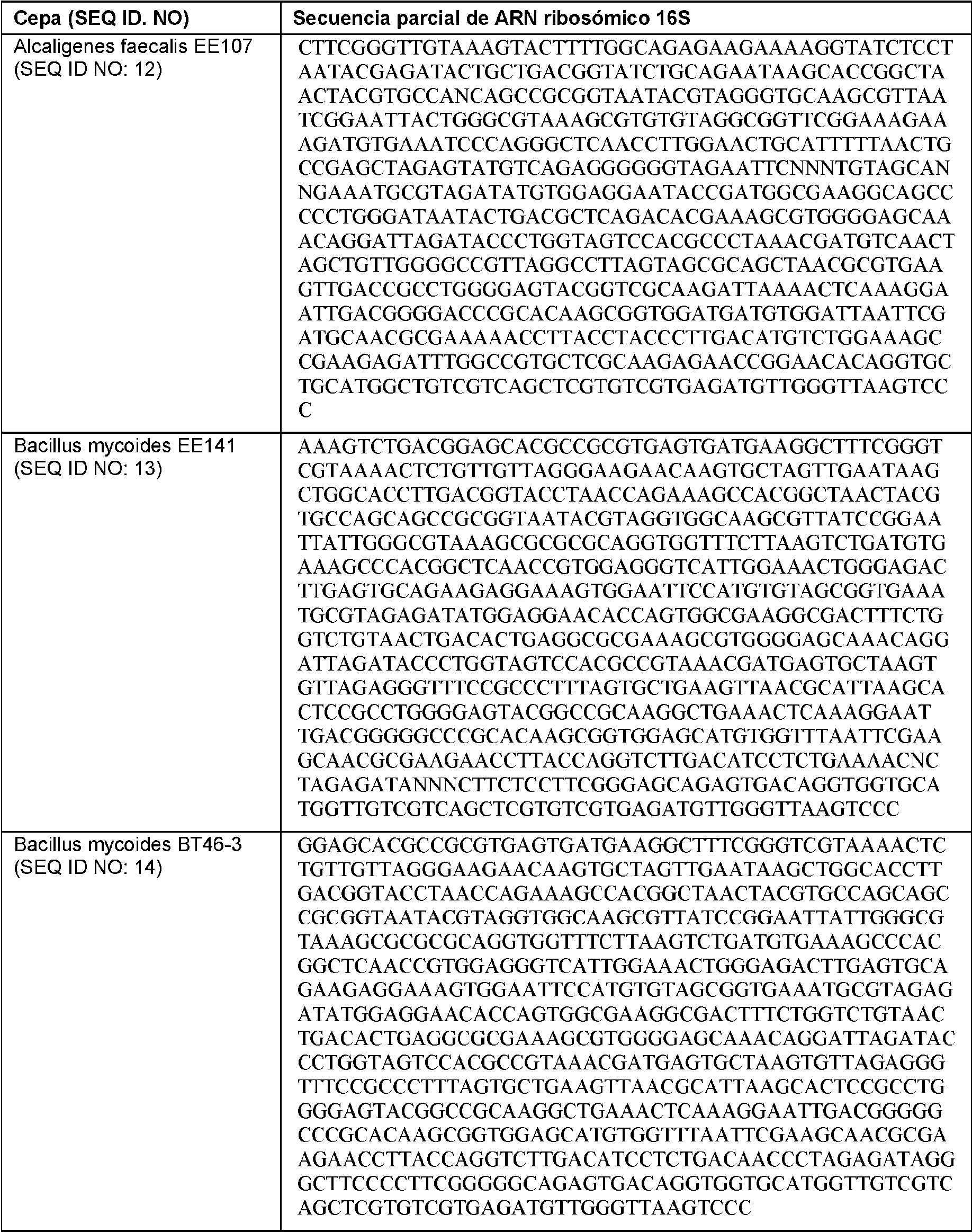
(Continuación)(Continuation)

(Continuación)(Continuation)

(Continuación)(Continuation)

Los métodos para determinar la identidad de secuencia son bien conocidos por los expertos en la técnica. A modo de ejemplo y no de limitación, el algoritmo BLASTn disponible a través del Centro Nacional de Información Biotecnológica (NCBI) puede usarse para alinear secuencias y determinar su identidad.Methods for determining sequence identity are well known to those of skill in the art. By way of example and not limitation, the BLASTn algorithm available through the National Center for Biotechnology Information (NCBI) can be used to align sequences and determine their identity.
Las cepas bacterianas anteriores se identificaron al menos hasta la designación de su género mediante indicadores bioquímicos y morfológicos convencionales. Además, los ensayos bioquímicos para cepas gramnegativas confirmadas como Paracoccus kondratievae, Alcaligenes faecalis y Enterobacter cloacae incluyeron crecimiento en medio MacConkey y agar nutritivo, examen microscópico, crecimiento en medio NaCl al 5 % y 7,5 %, crecimiento a pH 5 y pH 9, crecimiento a 42 °C y 50 °C, la capacidad de producir ácido tras la fermentación con celobiosa, lactosa, glicerol, glucosa, sacarosa, d-manitol y almidón; producción de pigmentos fluorescentes; hidrólisis de gelatina; reducción de nitratos; hidrólisis de almidón; reacción oxidasa, producción de catalasa, producción de ureasa y motilidad. De manera similar, los ensayos bioquímicos para cepas Gram positivas confirmadas como Bacillus y Paenibacillus incluyeron crecimiento en medio de alcohol feniletílico (PEA) y agar nutritivo, examen microscópico, crecimiento en medio de NaCl al 5 % y 7,5 %, crecimiento a pH 5 y pH 9, crecimiento a 42 °C y 50 °C, la capacidad de producir ácido tras la fermentación con celobiosa, lactosa, glicerol, glucosa, sacarosa, d-manitol y almidón; producción de pigmentos fluorescentes; hidrólisis de gelatina; reducción de nitratos; producción de catalasa, hidrólisis de almidón; reacción oxidasa, producción de ureasa y motilidad.The above bacterial strains were identified at least up to genus designation by conventional biochemical and morphological indicators. In addition, biochemical assays for confirmed gram-negative strains such as Paracoccus kondratievae, Alcaligenes faecalis, and Enterobacter cloacae included growth in MacConkey medium and nutrient agar, microscopic examination, growth in 5% and 7.5% NaCl medium, growth at pH 5 and pH 9. , growth at 42 ° C and 50 ° C, the ability to produce acid after fermentation with cellobiose, lactose, glycerol, glucose, sucrose, d-mannitol and starch; production of fluorescent pigments; gelatin hydrolysis; nitrate reduction; starch hydrolysis; oxidase reaction, catalase production, urease production and motility. Similarly, biochemical assays for confirmed Gram positive strains such as Bacillus and Paenibacillus included growth in phenylethyl alcohol (PEA) medium and nutrient agar, microscopic examination, growth in 5% and 7.5% NaCl medium, growth at pH 5 and pH 9, growth at 42 ° C and 50 ° C, the ability to produce acid after fermentation with cellobiose, lactose, glycerol, glucose, sucrose, d-mannitol and starch; production of fluorescent pigments; gelatin hydrolysis; nitrate reduction; catalase production, starch hydrolysis; oxidase reaction, urease production and motility.
También se describe un cultivo bacteriano biológicamente puro en donde las bacterias, es decir, la cepa bacteriana en el cultivo bacteriano, son mutantes de cualquiera de las cepas bacterianas anteriores, que comprende una o más mutaciones que conservan la capacidad de promover el crecimiento vegetal. Por tanto, el mutante de cualquiera de las cepas anteriores será capaz de promover el crecimiento vegetal en comparación con las plantas a las que no se aplicó el mutante. Por ejemplo, el mutante puede comprender un mutante tolerante a la sal (por ejemplo, un mutante tolerante a la sal de la cepa NC35 de Paracoccus kondratievae o un mutante tolerante a la sal de la cepa BT155 de Bacillus mycoides), un mutante resistente al tiram (por ejemplo, un mutante resistente al tiram de la cepa NC35 de Paracoccus kondratievae, un mutante resistente al tiram de la cepa CAP53 de Bacillus aryabhatti, un mutante resistente al tiram de la cepa BT155 de Bacillus mycoides o un mutante resistente al tiram de Bacillus thuringiensis BT013A), o un mutante tolerante al glifosato (por ejemplo, mutante tolerante al glifosato de la cepa CAP53 de Bacillus aryabhatti).A biologically pure bacterial culture is also described wherein the bacteria, that is, the bacterial strain in the bacterial culture, are mutants of any of the above bacterial strains, comprising one or more mutations that retain the ability to promote plant growth. Thus, the mutant of any of the above strains will be able to promote plant growth compared to plants to which the mutant was not applied. For example, the mutant may comprise a salt-tolerant mutant (e.g., a salt-tolerant mutant from Paracoccus kondratievae strain NC35 or a salt-tolerant mutant from Bacillus mycoides strain BT155), a mutant resistant to thiram (for example, a thiram resistant mutant of Paracoccus kondratievae strain NC35, a thiram resistant mutant of Bacillus aryabhatti strain CAP53, a thiram resistant mutant of Bacillus mycoides strain BT155, or a thiram resistant mutant of Bacillus thuringiensis BT013A), or a glyphosate-tolerant mutant (eg, glyphosate-tolerant mutant of Bacillus aryabhatti strain CAP53).
Los siguientes ensayos se pueden usar, ya sea individualmente o en conjunto, para identificar cepas mutantes, que son capaces en condiciones gnotobióticas de aumentar el área foliar en plantas enteras de 3 a 4 semanas de edad (ensayo de vaso de precipitado), para aumentar la longitud de los brotes o peso seco de los brotes (ensayo de placa de suelo), o para aumentar la longitud de la raíz, el peso seco de la raíz, el peso seco de los brotes y la longitud de los brotes (ensayo de bolsa de crecimiento), que se correlacionan positivamente con la capacidad de promover el crecimiento directamente en plantas enteras cultivadas en suelo crudo (no esterilizado). En un ensayo de vaso de precipitado, se esteriliza una mezcla de suelo de campo y perlita, por ejemplo, mediante irradiación gamma (aproximadamente 1 mRad ha resultado adecuado). Las muestras de la mezcla se transfieren asépticamente a vasos de precipitado cubiertos estériles, a los que se agrega suficiente agua o solución nutritiva para lograr un contenido de humedad de aproximadamente el 25 %. La semilla con superficie esterilizada de una planta de prueba, como colza (Brassica napus y Brassica campestris), rábano, trigo, soja, maíz o algodón, se siembra (1 semilla por vaso de precipitado) después de incubar brevemente en una suspensión acuosa de células bacterianas de la cepa en estudio. (Una concentración bacteriana en el intervalo de 109 unidades formadoras de colonias (UFC) por ml de suspensión ha demostrado ser adecuado para este propósito). Después de que las plántulas se han desarrollado, en condiciones controladas adecuadas para la planta de ensayo, a un punto en donde las hojas maduras han crecido, las plantas sometidas a tratamientos bacterianos se comparan con controles no inoculados para determinar las diferencias en el área foliar entre los grupos de prueba y de control.The following assays can be used, either individually or in conjunction, to identify mutant strains, which are capable under gnotobiotic conditions of increasing leaf area in whole 3- to 4-week-old plants (beaker assay), to increase shoot length or shoot dry weight (soil plate test), or to increase root length, root dry weight, shoot dry weight and shoot length (soil plate test). growth bag), which are positively correlated with the ability to promote growth directly in whole plants grown in raw (non-sterilized) soil. In a beaker test, a mixture of field soil and perlite is sterilized, for example, by gamma irradiation (approximately 1 mRad has been found adequate). Mix samples are aseptically transferred to sterile covered beakers, to which enough water or nutrient solution is added to achieve a moisture content of approximately 25%. Surface-sterilized seed from a test plant, such as rape ( Brassica napus and Brassica campestris), radish, wheat, soybean, corn, or cotton, is sown (1 seed per beaker) after brief incubation in an aqueous suspension of bacterial cells of the strain under study. (A bacterial concentration in the range of 109 colony forming units (CFU) per ml of suspension has been shown to be adequate for this purpose). After the seedlings have developed, in Controlled conditions suitable for the test plant, to a point where mature leaves have grown, plants subjected to bacterial treatments are compared with non-inoculated controls to determine differences in leaf area between test and control groups.
En un "Ensayo de placa de suelo", las placas de Petri se llenan con suelo molido secado al aire que ha sido esterilizado mediante autoclave, irradiación gamma, etc. El suelo de cada placa se humedece y se deja cubierto durante la noche para asegurar una distribución uniforme de humedad a través del suelo. Las semillas inoculadas (de prueba) y de control, como se describió anteriormente, se siembran luego en cada placa, unas seis a ocho semillas por placa a aproximadamente 1 cm de profundidad, y se cultivan en la oscuridad bajo condiciones apropiadas de temperatura y humedad hasta que se desarrollan los brotes. Al final de la incubación, se determinan las longitudes de los brotes. En un "ensayo de bolsa de crecimiento", los recipientes de celofán del tipo usado hasta ahora como bolsas de crecimiento de paquetes de semillas se llenan con un pequeño volumen de agua desionizada o solución mineral y se esterilizan en autoclave para asegurar la esterilidad. Las semillas de prueba incubadas en una suspensión bacteriana, como se describió previamente, y las semillas de control no expuestas a las bacterias se siembran asépticamente, aproximadamente seis semillas en una bolsa, respectivamente, y se germinan en la oscuridad en condiciones adecuadas y controladas. Una vez que se han desarrollado los brotes, se abren las bolsas y se determinan la longitud de la raíz de la plántula, el peso seco de la raíz, la longitud de los brotes y el peso seco de los brotes para las pruebas y los controles. Alternativamente, las cepas mutantes se pueden probar como se muestra en los Ejemplos para cualquiera de las cepas bacterianas anteriores con respecto a la capacidad de promover el crecimiento vegetal.In a "Soil Plate Assay", Petri dishes are filled with air-dried ground soil that has been sterilized by autoclaving, gamma irradiation, and the like. The soil of each plate is moistened and covered overnight to ensure even distribution of moisture throughout the soil. Inoculated (test) and control seeds, as described above, are then sown on each plate, about six to eight seeds per plate at approximately 1 cm depth, and grown in the dark under appropriate temperature and humidity conditions. until sprouts develop. At the end of the incubation, the shoot lengths are determined. In a "growth bag test", cellophane containers of the type heretofore used as seed packet growth bags are filled with a small volume of deionized water or mineral solution and autoclaved to ensure sterility. Test seeds incubated in a bacterial suspension, as previously described, and control seeds not exposed to bacteria are seeded aseptically, approximately six seeds in a bag, respectively, and germinated in the dark under suitable and controlled conditions. Once the shoots have developed, the bags are opened and the length of the seedling root, the dry weight of the root, the length of the shoots and the dry weight of the shoots are determined for tests and controls. . Alternatively, mutant strains can be tested as shown in the Examples for any of the above bacterial strains for the ability to promote plant growth.
También se describe un inóculo para aplicación a plantas, semillas de plantas o un medio de crecimiento vegetal, en donde el inóculo comprende una cantidad efectiva de un cultivo bacteriano biológicamente puro de cepa CAP53 de Bacillus aryabhattai (NrRL No. B-50819), cepa CAP56 de Bacillus aryabhattai (NRRL No. B-50817), cepa BT054 de Bacillus flexus (NRRL No. B-50816), cepa NC35 de Paracoccus kondratievae (NRRL No. B-50820), cepa BT155 de Bacillus mycoides (NRRL No. B-50921), cepa CAP12 de Enterobacter cloacae (NRRL No. B-50822), cepa BOBA57 de Bacillus nealsonii (NRRL No. B-50821), cepa EE118 de Bacillus mycoides (NrRL No. B-50918), cepa EE148 de Bacillus subtilis (NRRL No. B-50927), cepa Ee107 de Alcaligenes faecalis (NrRL No. B-50920), cepa EE141 de Bacillus mycoides (NRRL No. B-50916), cepa BT46-3 de Bacillus mycoides (NRRL No. B-50922), cepa EE128 de miembro de la familia Bacillus cereus (NrRl No. B-50917), cepa bT013A de Bacillus thuringiensis (NRRL No. B-50924), cepa BT23 de Paenibacillus massiliensis (NRRL No. B-50923), cepa EE349 de miembro de la familia de Bacillus cereus (NRRL No. B-50928), cepa EE218 de Bacillus subtilis (NrrL No. B-50926), cepa EE281 de Bacillus megaterium (NRRL No. B-50925) o un mutante de cualquiera de las cepas anteriores, y un portador agrícolamente aceptable. Alternativamente, el inóculo puede incluir una cantidad efectiva de una mezcla que comprende al menos dos cultivos bacterianos biológicamente puros descritos en la presente descripción. Por lo tanto, la mezcla de dos cultivos de bacterias biológicamente puras puede incluir cepa CAP53 de Bacillus aryabhattai y la cepa CAP56 de aryabhattai Bacillus; cepa CAP53 de Bacillus aryabhattai y cepa BT054 de Bacillus flexus; cepa CAP53 de Bacillus aryabhattai y cepa NC35 de Paracoccus kondratievae; cepa CAP53 de Bacillus aryabhattai y cepa BT155 de Bacillus mycoides; cepa CAP53 de Bacillus aryabhattai y cepa CAP12 de Enterobacter cloacae; cepa CAP53 de Bacillus aryabhattai y cepa BOBA57 de Bacillus nealsonii; cepa CAP53 de Bacillus aryabhattai y cepa EE118 de Bacillus mycoides; cepa CAP53 de Bacillus aryabhattai y cepa EE148 de Bacillus subtilis; cepa CAP53 de Bacillus aryabhattai y cepa eE107 de Alcaligenes faecalis; cepa CAP53 de Bacillus aryabhattai y cepa EE141 de Bacillus mycoides; cepa CAP53 de Bacillus aryabhattai y cepa BT46-3 de Bacillus mycoides; cepa CAP53 de Bacillus aryabhattai y cepa EE128 de miembro de la familia de Bacillus cereus; cepa CAP53 de Bacillus aryabhattai y cepa BT013A de Bacillus thuringiensis; cepa CAP53 de Bacillus aryabhattai y cepa BT23 de Paenibacillus massiliensis; cepa CAP53 de Bacillus aryabhattai y cepa EE349 de miembro de la familia de Bacillus cereus; cepa CAP53 de Bacillus aryabhattai y cepa EE218 de Bacillus subtilis; cepa CAP53 de Bacillus aryabhattai y cepa EE281 de Bacillus megaterium; cepa CAP53 de Bacillus aryabhattai y Paracoccus sp. NC35 tolerante a la sal y resistente al tiram; cepa CAP53 de Bacillus aryabhattai y cepa BT155 de Bacillus mycoides tolerante a la sal y resistente al tiram; cepa CAP53 de Bacillus aryabhattai y CAP53 de Bacillus aryabhattai resistente al tiram; cepa BT013A de Bacillus thuringiensis; cepa CAP53 de Bacillus aryabhattai y CAP53 de Bacillus aryabhattai tolerante al glifosato; cepa CAP56 de Bacillus aryabhattai y cepa BT054 de Bacillus flexus; cepa CAP56 de Bacillus aryabhattai y cepa NC35 de Paracoccus kondratievae; cepa CAP56 de Bacillus aryabhattai y cepa BT155 de Bacillus mycoides; cepa CAP56 de Bacillus aryabhattai y cepa CAP12 de Enterobacter cloacae; cepa CAP56 de Bacillus aryabhattai y cepa BOBA57 de Bacillus nealsonii; cepa CAP56 de Bacillus aryabhattai y cepa EE118 de Bacillus mycoides; cepa CAP56 de Bacillus aryabhattai y cepa EE148 de Bacillus subtilis; cepa CAP56 de Bacillus aryabhattai y cepa EE107 de Alcaligenes faecalis; Bacillus aryabhattai cepa CAP56 y cepa EE141 de Bacillus mycoides; cepa CAP56 de Bacillus aryabhattai y cepa BT46-3 de Bacillus mycoides; cepa CAP56 de Bacillus aryabhattai y cepa EE128 de miembro de la familia de Bacillus cereus; cepa CAP56 de Bacillus aryabhattai y cepa BT013A de Bacillus thuringiensis; cepa CAP56 de Bacillus aryabhattai y cepa BT23 de Paenibacillus massiliensis; cepa CAP56 de Bacillus aryabhattai y cepa EE349 de miembro de la familia de Bacillus cereus; Bacillus aryabhattai cepa CAP56 y Bacillus subtilis EE218 cepa; cepa CAP56 de Bacillus aryabhattai y cepa EE281 de Bacillus megaterium; cepa CAP56 de Bacillus aryabhattai y NC35 de Paracoccus sp. tolerante a la sal y resistente al tiram; cepa CAP56 de Bacillus aryabhattai y cepa BT155 de Bacillus mycoides tolerante a la sal y resistente al tiram; cepa CAP56 de Bacillus aryabhattai y CAP53 de Bacillus aryabhattai resistente al tiram; cepa CAP56 de Bacillus aryabhattai y Bacillus thuringiensis BT013A resistente al tiram; cepa CAP56 de Bacillus aryabhattai y Bacillus aryabhattai CAP53 tolerante al glifosato; cepa BT054 de Bacillus flexus y cepa NC35 de Paracoccus kondratievae; cepa BT054 de Bacillus flexus y cepa BT155 de Bacillus mycoides; cepa BT054 de Bacillus flexus y cepa CAP12 de Enterobacter cloacae; cepa BT054 de Bacillus flexus y cepa BOBA57 de Bacillus nealsonii; cepa BT054 de Bacillus flexus y cepa EE118 de Bacillus mycoides; cepa BT054 de Bacillus flexus y cepa EE148 de Bacillus subtilis; cepa BT054 de Bacillus flexus y cepa EE107 de Alcaligenes faecalis; cepa BT054 de Bacillus flexus y cepa EE141 de Bacillus mycoides; cepa BT054 de Bacillus flexus y cepa BT46-3 de Bacillus mycoides; cepa BT054 de Bacillus flexus y cepa EE128 de miembro de la familia de Bacillus cereus; cepa BT054 de Bacillus flexus y cepa BT013A de Bacillus thuringiensis; cepa BT054 de Bacillus flexus y cepa BT23 de Paenibacillus massiliensis; cepa BT054 de Bacillus flexus y cepa EE349 de miembro de la familia de Bacillus cereus; cepa BT054 de Bacillus flexus y cepa EE218 de Bacillus subtilis; cepa BT054 de Bacillus flexus y cepa EE281 de Bacillus megaterium; cepa BT054 de Bacillus flexus y NC35 de Paracoccus sp. tolerante a la sal y resistente al tiram; cepa BT054 de Bacillus flexus y cepa BT155 de Bacillus mycoides tolerante a la sal y resistente al tiram; cepa BT054 de Bacillus flexus y Bacillus aryabhattai CAP53 resistente al tiram; cepa BT054 de Bacillus flexus y Bacillus thuringiensis BT013A resistente al tiram; cepa BT054 de Bacillus flexus y Bacillus aryabhattai CAP53 tolerante al glifosato; cepa NC35 de Paracoccus kondratievae y cepa BT155 de Bacillus mycoides; cepa NC35 de Paracoccus kondratievae y cepa CAP12 de Enterobacter cloacae; cepa NC35 de Paracoccus kondratievae y cepa BOBA57 de Bacillus nealsonii; cepa NC35 de Paracoccus kondratievae y cepa EE118 de Bacillus mycoides; cepa NC35 de Paracoccus kondratievae y cepa EE148 de Bacillus subtilis; cepa NC35 de Paracoccus kondratievae y cepa EE107 de Alcaligenes faecalis; cepa NC35 de Paracoccus kondratievae y cepa EE141 de Bacillus mycoides; cepa NC35 de Paracoccus kondratievae y cepa BT46-3 de Bacillus mycoides; cepa NC35 de Paracoccus kondratievae y cepa EE128 de miembro de la familia Bacillus cereus; cepa NC35 de Paracoccus kondratievae y cepa BT013A de Bacillus thuringiensis; cepa NC35 de Paracoccus kondratievae y cepa BT23 de Paenibacillus massiliensis; cepa NC35 de Paracoccus kondratievae y cepa EE349 de miembro de la familia de Bacillus cereus; cepa NC35 de Paracoccus kondratievae y cepa EE218 de Bacillus subtilis; cepa NC35 de Paracoccus kondratievae y cepa EE281 de Bacillus megaterium; cepa NC35 de Paracoccus kondratievae y NC35 de Paracoccus sp. tolerante a la sal y resistente al tiram; cepa NC35 de Paracoccus kondratievae y cepa BT155 de Bacillus mycoides resistente a la sal y resistente al tiram; cepa NC35 de Paracoccus kondratievae y Bacillus aryabhattai CAP53 resistente al tiram; cepa NC35 de Paracoccus kondratievae y Bacillus thuringiensis BT013A resistente al tiram; cepa NC35 de Paracoccus kondratievae y Bacillus aryabhattai CAP53 tolerante al glifosato; cepa BT155 de Bacillus mycoides y cepa CAP12 de Enterobacter cloacae; cepa BT155 de Bacillus mycoides y cepa BOBA57 de Bacillus nealsonii; cepa BT155 de Bacillus mycoides y cepa EE118 de Bacillus mycoides; cepa BT155 de Bacillus mycoides y cepa EE148 de Bacillus subtilis; cepa BT155 de Bacillus mycoides y cepa EE107 de Alcaligenes faecalis; cepa BT155 de Bacillus mycoides y cepa EE141 de Bacillus mycoides; cepa BT155 de Bacillus mycoides y cepa BT46-3 de Bacillus mycoides; cepa BT155 de Bacillus mycoides y cepa EE128 de miembro de la familia de Bacillus cereus; cepa BT155 de Bacillus mycoides y cepa BT013A de Bacillus thuringiensis; cepa BT155 de Bacillus mycoides y cepa BT23 de Paenibacillus massiliensis; cepa BT155 de Bacillus mycoides y cepa EE349 de miembro de la familia de Bacillus cereus; cepa BT155 de Bacillus mycoides y cepa EE218 de Bacillus subtilis; cepa BT155 de Bacillus mycoides y cepa EE281 de Bacillus megaterium; cepa BT155 de Bacillus mycoides y Paracoccus sp. NC35 tolerante a la sal y resistente al tiram; cepa BT155 de Bacillus mycoides y cepa BT155 de Bacillus mycoides tolerante a la sal y resistente al tiram; cepa BT155 de Bacillus mycoides y Bacillus aryabhattai CAP53 resistente al tiram; cepa BT155 de Bacillus mycoides y Bacillus thuringiensis BT013A resistente al tiram; cepa BT155 de Bacillus mycoides y Bacillus aryabhattai CAP53 tolerante al glifosato; cepa CAP12 de Enterobacter cloacae y cepa BOBA57 de Bacillus nealsonii; cepa CAP12 de Enterobacter cloacae y cepa EE118 de Bacillus mycoides; cepa CAP12 de Enterobacter cloacae y cepa EE148 de Bacillus subtilis; cepa CAP12 de Enterobacter cloacae y cepa EE107 de Alcaligenes faecalis; cepa CAP12 de Enterobacter cloacae y cepa EE141 de Bacillus mycoides; cepa CAP12 de Enterobacter cloacae y cepa BT46-3 de Bacillus mycoides; cepa CAP12 de Enterobacter cloacaey cepa EE128 de miembro de la familia de Bacillus cereus; cepa CAP12 de Enterobacter cloacae y cepa BT013A de Bacillus thuringiensis; cepa CAP12 de Enterobacter cloacae y cepa BT23 de Paenibacillus massiliensis; cepa CAP12 de Enterobacter cloacae y cepa EE349 de miembro de la familia de Bacillus cereus; cepa CAP12 de Enterobacter cloacae y cepa EE218 de Bacillus subtilis; cepa CAP12 de Enterobacter cloacae y cepa EE281 de Bacillus megaterium; cepa CAP12 de Enterobacter cloacae y Paracoccus sp. NC35 tolerante a la sal y resistente al tiram; cepa CAP12 de Enterobacter cloacae y cepa BT155 de Bacillus mycoides tolerante a la sal y resistente al tiram; cepa CAP12 de Enterobacter cloacae y Bacillus aryabhattai CAP53 resistente al tiram; cepa CAP12 de Enterobacter cloacae y Bacillus thuringiensis BT013A resistente al tiram; cepa CAP12 de Enterobacter cloacae y Bacillus aryabhattai CAP53 tolerante al glifosato; cepa BOBA57 de Bacillus nealsonii y cepa EE118 de Bacillus mycoides; cepa BOBA57 de Bacillus nealsonii y cepa EE148 de Bacillus subtilis; cepa BOBA57 de Bacillus nealsonii y cepa EE107 de Alcaligenes faecalis; cepa BOBA57 de Bacillus nealsonii y cepa EE141 de Bacillus mycoides; cepa BOBA57 de Bacillus nealsonii y cepa BT46-3 de Bacillus mycoides; cepa BOBA57 de Bacillus nealsonii y cepa EE128 de miembro de la familia de Bacillus cereus; cepa BOBA57 de Bacillus nealsonii y cepa BT013A de Bacillus thuringiensis; cepa BOBA57 de Bacillus nealsonii y cepa BT23 de Paenibacillus massiliensis; cepa BOBA57 de Bacillus nealsonii y cepa EE349 de miembro de la familia de Bacillus cereus; cepa BOBA57 de Bacillus nealsonii y cepa EE218 de Bacillus subtilis; cepa BOBA57 de Bacillus nealsonii y cepa EE281 de Bacillus megaterium; cepa BOBA57 de Bacillus nealsonii y Paracoccus sp. NC35 tolerante a la sal y resistente al tiram; cepa BOBA57 de Bacillus nealsonii y cepa BT155 de Bacillus mycoides tolerante a la sal y resistente al tiram; cepa BOBA57 de Bacillus nealsonii y Bacillus aryabhattai CAP53 resistente al tiram; cepa BOBA57 de Bacillus nealsonii y Bacillus thuringiensis BT013A resistente al tiram; cepa BOBA57 de Bacillus nealsonii y Bacillus aryabhattai CAP53 tolerante al glifosato; cepa EE118 de Bacillus mycoides y cepa EE148 de Bacillus subtilis; cepa EE118 de Bacillus mycoides y cepa EE107 de Alcaligenes faecalis; cepa EE118 de Bacillus mycoides y cepa EE141 de Bacillus mycoides; cepa EE118 de Bacillus mycoides y cepa BT46-3 de Bacillus mycoides; cepa EE118 de Bacillus mycoides y cepa EE128 de miembro de la familia Bacillus cereus; cepa EE118 de Bacillus mycoides y cepa BT013A de Bacillus thuringiensis; cepa EE118 de Bacillus mycoides y cepa BT23 de Paenibacillus massiliensis; cepa EE118 de Bacillus mycoides y cepa EE349 de miembro de la familia de Bacillus cereus; cepa EE118 de Bacillus mycoides y cepa EE218 de Bacillus subtilis; cepa EE118 de Bacillus mycoides y cepa EE281 de Bacillus megaterium; cepa EE118 de Bacillus mycoides y Paracoccus sp. NC35 tolerante a la sal y resistente al tiram; cepa EE118 de Bacillus mycoides y cepa BT155 de Bacillus mycoides tolerante a la sal y resistente al tiram; cepa EE118 de Bacillus mycoides y Bacillus aryabhattai CAP53 resistente al tiram; cepa EE118 de Bacillus mycoides y Bacillus thuringiensis BT013A resistente al tiram; cepa EE118 de Bacillus mycoides y Bacillus aryabhattai CAP53 tolerante al glifosato; cepa EE148 de Bacillus subtilis y cepa EE107 de Alcaligenes faecalis; cepa eE148 de Bacillus subtilis y cepa EE141 de Bacillus mycoides; cepa EE148 de Bacillus subtilis y cepa BT46-3 de Bacillus mycoides; cepa EE148 de Bacillus subtilis y cepa EE128 de miembro de la familia Bacillus cereus; cepa EE148 de Bacillus subtilis y cepa BT013A de Bacillus thuringiensis; cepa EE148 de Bacillus subtilis y cepa BT23 de Paenibacillus massiliensis; cepa EE148 de Bacillus subtilis y cepa EE349 de miembro de la familia de Bacillus cereus; cepa EE148 de Bacillus subtilis y cepa EE218 de Bacillus subtilis; cepa EE148 de Bacillus subtilis y cepa EE281 de Bacillus megaterium; cepa EE148 de Bacillus subtilis y Paracoccus sp. NC35 tolerante a la sal y resistente al tiram; cepa EE148 de Bacillus subtilis y cepa BT155 de Bacillus mycoides tolerante a la sal y resistente al tiram; cepa EE148 de Bacillus subtilis y Bacillus aryabhattai CAP53 resistente al tiram; cepa EE148 de Bacillus subtilis y Bacillus thuringiensis BT013A resistente al tiram; cepa EE148 de Bacillus subtilis y Bacillus aryabhattai CAP53 tolerante al glifosato; cepa EE107 de Alcaligenes faecalis y cepa EE141 de Bacillus mycoides; cepa EE107 de Alcaligenes faecalis y cepa BT46-3 de Bacillus mycoides; cepa EE107 de Alcaligenes faecalis y cepa EE128 de miembro de la familia Bacillus cereus; cepa EE107 de Alcaligenes faecalis y cepa BT013A de Bacillus thuringiensis; cepa EE107 de Alcaligenes faecalis y cepa BT23 de Paenibacillus massiliensis; cepa EE107 de Alcaligenes faecalis y cepa EE349 de miembro de la familia Bacillus cereus; cepa EE107 de Alcaligenes faecalis y cepa EE218 de Bacillus subtilis; cepa EE107 de Alcaligenes faecalis y cepa EE281 de Bacillus megaterium; cepa EE107 de Alcaligenes faecalis y Paracoccus sp. NC35 tolerante a la sal y resistente al tiram; cepa EE107 de Alcaligenes faecalis y cepa BT155 de Bacillus mycoides tolerante a la sal y resistente al tiram; cepa EE107 de Alcaligenes faecalis y Bacillus aryabhattai CAP53 resistente al tiram; cepa EE107 de Alcaligenes faecalis y Bacillus thuringiensis BT013A resistente al tiram; cepa EE107 de Alcaligenes faecalis y Bacillus aryabhattai CAP53 tolerante al glifosato; cepa EE141 de Bacillus mycoides y cepa BT46-3 de Bacillus mycoides; cepa EE141 de Bacillus mycoides y cepa EE128 de miembro de la familia Bacillus cereus; cepa EE141 de Bacillus mycoides y cepa BT013A de Bacillus thuringiensis; cepa EE141 de Bacillus mycoides y cepa BT23 de Paenibacillus massiliensis; cepa EE141 de Bacillus mycoides y cepa EE349 de miembro de la familia de Bacillus cereus; cepa EE141 de Bacillus mycoides y cepa eE218 de Bacillus subtilis; cepa EE141 de Bacillus mycoides y cepa EE281 de Bacillus megaterium; cepa EE141 de Bacillus mycoides y Paracoccus sp. NC35 tolerante a la sal y resistente al tiram; cepa EE141 de Bacillus mycoides y cepa BT155 de Bacillus mycoides tolerante a la sal y resistente al tiram; cepa EE141 de Bacillus mycoides y CAP53 de Bacillus aryabhattai resistente al tiram; cepa EE141 de Bacillus mycoides y Bacillus thuringiensis BT013A resistente al tiram; cepa EE141 de Bacillus mycoides y Bacillus aryabhattai CAP53 tolerante al glifosato; cepa BT46-3 de Bacillus mycoides y cepa EE128 de miembro de la familia de Bacillus cereus; cepa BT46-3 de Bacillus mycoides y cepa BT013A de Bacillus thuringiensis; cepa BT46-3 de Bacillus mycoides y cepa BT23 de Paenibacillus massiliensis; cepa BT46-3 de Bacillus mycoides y cepa EE349 de miembro de la familia de Bacillus cereus; cepa BT46-3 de Bacillus mycoides y cepa EE218 de Bacillus subtilis; cepa BT46-3 de Bacillus mycoides y cepa EE281 de Bacillus megaterium; cepa BT46-3 de Bacillus mycoides y Paracoccus sp. NC35 tolerante a la sal y resistente al tiram; cepa BT46-3 de Bacillus mycoides y cepa BT155 de Bacillus mycoides tolerante a la sal y resistente al tiram; cepa BT46-3 de Bacillus mycoides y Bacillus aryabhattai CAP53 resistente al tiram; cepa BT46-3 de Bacillus mycoides y Bacillus thuringiensis BT013A resistente al tiram; cepa BT46-3 de Bacillus mycoides y Bacillus aryabhattai CAP53 tolerante al glifosato; cepa EE128 de miembro de la familia de Bacillus cereus y cepa BT013A de Bacillus thuringiensis; cepa EE128 de miembro de la familia de Bacillus cereus y cepa BT23 de Paenibacillus massiliensis; cepa EE128 de miembro de la familia de Bacillus cereus y cepa EE349 de miembro de la familia de Bacillus cereus; cepa EE128 de miembro de la familia de Bacillus cereus y cepa EE218 de Bacillus subtilis; cepa EE128 de miembro de la familia de Bacillus cereus y cepa EE281 de Bacillus megaterium; cepa EE128 de miembro de la familia de Bacillus cereus y Paracoccus sp. NC35 tolerante a la sal y resistente al tiram; cepa EE128 de miembro de la familia de Bacillus cereus y cepa BT155 de Bacillus mycoides tolerante a la sal y resistente al tiram; cepa EE128 de miembro de la familia de Bacillus cereus y Bacillus aryabhattai CAP53 resistente al tiram; cepa EE128 de miembro de la familia de Bacillus cereus y Bacillus thuringiensis BT013A resistente al tiram; cepa EE128 de miembro de la familia de Bacillus cereus y Bacillus aryabhattai CAP53 tolerante al glifosato; cepa BT013A de Bacillus thuringiensis y cepa BT23 de Paenibacillus massiliensis; cepa BT013A de Bacillus thuringiensis y cepa EE349 de miembro de la familia de Bacillus cereus; cepa BT013A de Bacillus thuringiensis y cepa EE218 de Bacillus subtilis; cepa BT013A de Bacillus thuringiensis y cepa EE281 de Bacillus megaterium; cepa BT013A de Bacillus thuringiensis y Paracoccus sp. NC35 tolerante a la sal y resistente al tiram; cepa BT013A de Bacillus thuringiensis y cepa BT155 de Bacillus mycoides tolerante a la sal y resistente al tiram; cepa BT013A de Bacillus thuringiensis y Bacillus aryabhattai CAP53 resistente al tiram; cepa BT013A de Bacillus thuringiensis y Bacillus thuringiensis BT013A resistente al tiram; cepa BT013A de Bacillus thuringiensis y Bacillus aryabhattai CAP53 tolerante al glifosato; cepa BT23 de Paenibacillus massiliensis y cepa EE349 de miembro de la familia Bacillus cereus; cepa BT23 de Paenibacillus massiliensis y cepa EE218 de Bacillus subtilis; cepa BT23 de Paenibacillus massiliensis y cepa EE281 de Bacillus megaterium; cepa BT23 de Paenibacillus massiliensis y Paracoccus sp. NC35 tolerante a la sal y resistente al tiram; cepa BT23 de Paenibacillus massiliensis y cepa BT155 de Bacillus mycoides resistente a la sal y resistente al tiram; cepa BT23 de Paenibacillus massiliensis y Bacillus aryabhattai CAP53 resistente al tiram; cepa BT23 de Paenibacillus massiliensis y Bacillus thuringiensis BT013A resistente al tiram; cepa BT23 de Paenibacillus massiliensis y Bacillus aryabhattai CAP53 tolerante al glifosato; cepa EE349 de miembro de la familia de Bacillus cereus y cepa EE218 de Bacillus subtilis; cepa EE349 de miembro de la familia de Bacillus cereus y cepa EE281 de Bacillus megaterium; cepa EE349 de miembro de la familia de Bacillus cereus y Paracoccus sp. NC35 tolerante a la sal y resistente al tiram; cepa EE349 de miembro de la familia de Bacillus cereus y cepa BT155 de Bacillus mycoides tolerante a la sal y resistente al tiram; cepa EE349 de miembro de la familia de Bacillus cereus y Bacillus aryabhattai CAP53 resistente al tiram; cepa EE349 de miembro de la familia de Bacillus cereus y Bacillus thuringiensis BT013A resistente al tiram; cepa EE349 de miembro de la familia de Bacillus cereus y Bacillus aryabhattai CAP53 tolerante al glifosato; cepa EE218 de Bacillus subtilis y cepa EE281 de Bacillus megaterium; cepa EE218 de Bacillus subtilis y Paracoccus sp. NC35 tolerante a la sal y resistente al tiram; cepa EE218 de Bacillus subtilis y cepa BT155 de Bacillus mycoides tolerante a la sal y resistente al tiram; cepa EE218 de Bacillus subtilis y Bacillus aryabhallai CAP53 resistente al tiram; cepa EE218 de Bacillus subtilis y Bacillus thuringiensis BT013A resistente al tiram; cepa EE218 de Bacillus subtilis y Bacillus aryabhattai CAP53 tolerante al glifosato; cepa EE281 de Bacillus megaterium y Paracoccus sp. NC35 tolerante a la sal y resistente al tiram; cepa EE281 de Bacillus megaterium y cepa BT155 de Bacillus mycoides tolerante a la sal y resistente al tiram; cepa EE281 de Bacillus megaterium y Bacillus aryabhattai CAP53 resistente al tiram; cepa EE281 de Bacillus megaterium y Bacillus thuringiensis BT013A resistente al tiram; o la cepa EE281 de Bacillus megaterium y Bacillus aryabhattai CAP53 tolerante al glifosato.Also described is an inoculum for application to plants, plant seeds or a plant growth medium, wherein the inoculum comprises an effective amount of a biologically pure bacterial culture of Bacillus aryabhattai strain CAP53 (NrRL No. B-50819), strain Bacillus aryabhattai CAP56 (NRRL No. B-50817), Bacillus flexus strain BT054 (NRRL No. B-50816), Paracoccus kondratievae strain NC35 (NRRL No. B-50820), Bacillus mycoides strain BT155 (NRRL No. B-50921), Enterobacter cloacae strain CAP12 (NRRL No. B-50822), Bacillus nealsonii strain BOBA57 (NRRL No. B-50821), Bacillus mycoides strain EE118 (NrRL No. B-50918), Bacillus subtilis (NRRL No. B-50927), Alcaligenes faecalis strain Ee107 (NrRL No. B-50920), Bacillus mycoides strain EE141 (NRRL No. B-50916), Bacillus mycoides strain BT46-3 (NRRL No. B-50922), Bacillus cereus family member strain EE128 (N r R l No. B-50917), Bacillus thuringiensis strain b T013A (NRRL No. B-50924), BT23 d strain e Paenibacillus massiliensis (NRRL No. B-50923), Bacillus cereus family member strain EE349 (NRRL No. B-50928), Bacillus subtilis strain EE218 (NrrL No. B-50926), Bacillus megaterium strain EE281 (NRRL No. B-50925) or a mutant of any of the above strains, and an agriculturally acceptable carrier. Alternatively, the inoculum may include an effective amount of a mixture comprising at least two biologically pure bacterial cultures described in the present disclosure. Therefore, the mixture of two biologically pure bacterial cultures can include Bacillus aryabhattai strain CAP53 and aryabhattai Bacillus strain CAP56; Bacillus aryabhattai strain CAP53 and Bacillus flexus strain BT054; Bacillus aryabhattai strain CAP53 and Paracoccus kondratievae strain NC35; Bacillus aryabhattai strain CAP53 and Bacillus mycoides strain BT155; Bacillus aryabhattai strain CAP53 and Enterobacter cloacae strain CAP12; Bacillus aryabhattai strain CAP53 and Bacillus nealsonii strain BOBA57; Bacillus aryabhattai strain CAP53 and Bacillus mycoides strain EE118; Bacillus aryabhattai strain CAP53 and Bacillus subtilis strain EE148; Bacillus aryabhattai strain CAP53 and Alcaligenes faecalis strain eE107; Bacillus aryabhattai strain CAP53 and Bacillus mycoides strain EE141; Bacillus aryabhattai strain CAP53 and Bacillus mycoides strain BT46-3; Bacillus aryabhattai strain CAP53 and strain EE128 of a member of the Bacillus cereus family; Bacillus aryabhattai strain CAP53 and Bacillus thuringiensis strain BT013A; Bacillus aryabhattai strain CAP53 and Paenibacillus massiliensis strain BT23; Bacillus aryabhattai strain CAP53 and strain EE349 of a member of the Bacillus cereus family; Bacillus aryabhattai strain CAP53 and Bacillus subtilis strain EE218; Bacillus aryabhattai strain CAP53 and Bacillus megaterium strain EE281; Bacillus aryabhattai and Paracoccus sp. strain CAP53. NC35 salt tolerant and thiram resistant; Bacillus aryabhattai strain CAP53 and Bacillus mycoides strain BT155 salt tolerant and resistant to thiram; Bacillus aryabhattai strain CAP53 and Bacillus aryabhattai strain resistant to thiram; Bacillus thuringiensis strain BT013A; Bacillus aryabhattai strain CAP53 and Bacillus aryabhattai CAP53 tolerant to glyphosate; Bacillus aryabhattai strain CAP56 and Bacillus flexus strain BT054; Bacillus aryabhattai strain CAP56 and Paracoccus kondratievae strain NC35; Bacillus aryabhattai strain CAP56 and Bacillus mycoides strain BT155; Bacillus aryabhattai strain CAP56 and Enterobacter cloacae strain CAP12; Bacillus aryabhattai strain CAP56 and Bacillus nealsonii strain BOBA57; Bacillus aryabhattai strain CAP56 and Bacillus mycoides strain EE118; Bacillus aryabhattai strain CAP56 and Bacillus subtilis strain EE148; Bacillus aryabhattai strain CAP56 and Alcaligenes faecalis strain EE107; Bacillus aryabhattai strain CAP56 and Bacillus mycoides strain EE141; Bacillus aryabhattai strain CAP56 and Bacillus mycoides strain BT46-3; Bacillus aryabhattai strain CAP56 and strain EE128 of a member of the Bacillus cereus family; Bacillus aryabhattai strain CAP56 and Bacillus thuringiensis strain BT013A; Bacillus aryabhattai strain CAP56 and Paenibacillus massiliensis strain BT23; Bacillus aryabhattai strain CAP56 and strain EE349 of a member of the Bacillus cereus family; Bacillus aryabhattai strain CAP56 and Bacillus subtilis strain EE218; Bacillus aryabhattai strain CAP56 and Bacillus megaterium strain EE281; Bacillus aryabhattai strain CAP56 and Paracoccus sp. NC35. tolerant to salt and resistant to thiram; Bacillus aryabhattai strain CAP56 and Bacillus mycoides strain BT155 salt tolerant and resistant to thiram; Bacillus aryabhattai strain CAP56 and Bacillus aryabhattai CAP53 resistant to thiram; Bacillus aryabhattai and Bacillus thuringiensis BT013A strain resistant to thiram; Bacillus aryabhattai and Bacillus aryabhattai CAP53 strain tolerant to glyphosate; BT054 strain of Bacillus flexus and Paracoccus kondratievae strain NC35; Bacillus flexus strain BT054 and Bacillus mycoides strain BT155; Bacillus flexus strain BT054 and Enterobacter cloacae strain CAP12; Bacillus flexus strain BT054 and Bacillus nealsonii strain BOBA57; Bacillus flexus strain BT054 and Bacillus mycoides strain EE118; Bacillus flexus strain BT054 and Bacillus subtilis strain EE148; Bacillus flexus strain BT054 and Alcaligenes faecalis strain EE107; Bacillus flexus strain BT054 and Bacillus mycoides strain EE141; Bacillus flexus strain BT054 and Bacillus mycoides strain BT46-3; Bacillus flexus strain BT054 and strain EE128 from a member of the Bacillus cereus family; Bacillus flexus strain BT054 and Bacillus thuringiensis strain BT013A; Bacillus flexus strain BT054 and Paenibacillus massiliensis strain BT23; Bacillus flexus strain BT054 and strain EE349 from a member of the Bacillus cereus family; Bacillus flexus strain BT054 and Bacillus subtilis strain EE218; Bacillus flexus strain BT054 and Bacillus megaterium strain EE281; Bacillus flexus strain BT054 and Paracoccus sp. NC35. tolerant to salt and resistant to thiram; Bacillus flexus strain BT054 and Bacillus mycoides strain BT155 tolerant to salt and resistant to thiram; Bacillus flexus and Bacillus aryabhattai CAP53 strain resistant to thiram; Bacillus flexus and Bacillus thuringiensis BT013A strain resistant to thiram; Bacillus flexus and Bacillus aryabhattai CAP53 strain BT054 tolerant to glyphosate; Paracoccus kondratievae strain NC35 and Bacillus mycoides strain BT155; Paracoccus kondratievae strain NC35 and Enterobacter cloacae strain CAP12; Paracoccus kondratievae strain NC35 and Bacillus nealsonii strain BOBA57; Paracoccus kondratievae strain NC35 and Bacillus mycoides strain EE118; Paracoccus kondratievae strain NC35 and Bacillus subtilis strain EE148; Paracoccus kondratievae strain NC35 and Alcaligenes faecalis strain EE107; Paracoccus kondratievae strain NC35 and Bacillus mycoides strain EE141; Paracoccus kondratievae strain NC35 and Bacillus mycoides strain BT46-3; Paracoccus kondratievae strain NC35 and strain EE128 of a member of the Bacillus cereus family; Paracoccus kondratievae strain NC35 and Bacillus thuringiensis strain BT013A; Paracoccus kondratievae strain NC35 and Paenibacillus massiliensis strain BT23; Paracoccus kondratievae strain NC35 and Bacillus cereus family member strain EE349; Paracoccus kondratievae strain NC35 and Bacillus subtilis strain EE218; Paracoccus kondratievae strain NC35 and Bacillus megaterium strain EE281; strain NC35 of Paracoccus kondratievae and NC35 of Paracoccus sp. tolerant to salt and resistant to thiram; Paracoccus kondratievae strain NC35 and Bacillus mycoides strain BT155 salt resistant and resistant to thiram; Thiram resistant Paracoccus kondratievae and Bacillus aryabhattai CAP53 strain NC35; Thiram resistant Paracoccus kondratievae and Bacillus thuringiensis BT013A strain; glyphosate-tolerant strain NC35 of Paracoccus kondratievae and Bacillus aryabhattai CAP53; Bacillus mycoides strain BT155 and Enterobacter cloacae strain CAP12; Bacillus mycoides strain BT155 and Bacillus nealsonii strain BOBA57; Bacillus mycoides strain BT155 and Bacillus mycoides strain EE118; Bacillus mycoides strain BT155 and Bacillus subtilis strain EE148; Bacillus mycoides strain BT155 and Alcaligenes faecalis strain EE107; Bacillus mycoides strain BT155 and Bacillus mycoides strain EE141; Bacillus mycoides strain BT155 and Bacillus mycoides strain BT46-3; Bacillus mycoides strain BT155 and strain EE128 from a member of the Bacillus cereus family; Bacillus mycoides strain BT155 and Bacillus thuringiensis strain BT013A; Bacillus mycoides strain BT155 and Paenibacillus massiliensis strain BT23; Bacillus mycoides strain BT155 and strain EE349 from a member of the Bacillus cereus family; Bacillus mycoides strain BT155 and Bacillus subtilis strain EE218; Bacillus mycoides strain BT155 and Bacillus megaterium strain EE281; Bacillus mycoides and Paracoccus sp. BT155 strain. NC35 salt tolerant and thiram resistant; Bacillus mycoides BT155 strain and strain of BT155 Bacillus mycoides salt tolerant and resistant thiram; Bacillus mycoides and Bacillus aryabhattai CAP53 strain BT155 resistant to tyram; Bacillus mycoides and Bacillus thuringiensis BT013A strain resistant to thiram; Bacillus mycoides and Bacillus aryabhattai CAP53 strain BT155 tolerant to glyphosate; Enterobacter cloacae strain CAP12 and Bacillus nealsonii strain BOBA57; Enterobacter cloacae strain CAP12 and Bacillus mycoides strain EE118; Enterobacter cloacae strain CAP12 and Bacillus subtilis strain EE148; Enterobacter cloacae strain CAP12 and Alcaligenes faecalis strain EE107; Enterobacter cloacae strain CAP12 and Bacillus mycoides strain EE141; Enterobacter cloacae strain CAP12 and Bacillus mycoides strain BT46-3; Enterobacter cloacae strain CAP12 and strain EE128 from a member of the Bacillus cereus family; Enterobacter cloacae strain CAP12 and Bacillus thuringiensis strain BT013A; Enterobacter cloacae strain CAP12 and Paenibacillus massiliensis strain BT23; Enterobacter cloacae strain CAP12 and strain EE349 of a member of the Bacillus cereus family; Enterobacter cloacae strain CAP12 and Bacillus subtilis strain EE218; Enterobacter cloacae strain CAP12 and Bacillus megaterium strain EE281; CAP12 strain of Enterobacter cloacae and Paracoccus sp. NC35 salt tolerant and thiram resistant; Enterobacter cloacae strain CAP12 and Bacillus mycoides strain BT155 salt tolerant and resistant to thiram; Enterobacter cloacae and Bacillus aryabhattai CAP53 strain resistant to thiram; Enterobacter cloacae and Bacillus thuringiensis BT013A strain resistant to thiram; CAP12 strain of Enterobacter cloacae and Bacillus aryabhattai CAP53 tolerant to glyphosate; Bacillus nealsonii strain BOBA57 and Bacillus mycoides strain EE118; Bacillus nealsonii strain BOBA57 and Bacillus subtilis strain EE148; Bacillus nealsonii strain BOBA57 and Alcaligenes faecalis strain EE107; Bacillus nealsonii strain BOBA57 and Bacillus mycoides strain EE141; Bacillus nealsonii strain BOBA57 and Bacillus mycoides strain BT46-3; Bacillus nealsonii strain BOBA57 and strain EE128 of a member of the Bacillus cereus family; Bacillus nealsonii strain BOBA57 and Bacillus thuringiensis strain BT013A; Bacillus nealsonii strain BOBA57 and Paenibacillus massiliensis strain BT23; Bacillus nealsonii strain BOBA57 and strain EE349 of a member of the Bacillus cereus family; Bacillus nealsonii strain BOBA57 and Bacillus subtilis strain EE218; BOBA57 strain Bacillus strain EE281 nealsonii and Bacillus megaterium; Bacillus nealsonii and Paracoccus sp. BOBA57 strain. NC35 salt tolerant and thiram resistant; Bacillus nealsonii strain BOBA57 and Bacillus mycoides strain BT155 salt tolerant and resistant to thiram; Bacillus nealsonii and Bacillus aryabhattai CAP53 strain resistant to thiram; Bacillus nealsonii and Bacillus thuringiensis BT013A strain resistant to thiram; Glyphosate-tolerant Bacillus nealsonii and Bacillus aryabhattai CAP53 strain BOBA57; Bacillus mycoides strain EE118 and Bacillus subtilis strain EE148; Bacillus mycoides strain EE118 and Alcaligenes faecalis strain EE107; strain EE118 of Bacillus mycoides and Bacillus mycoides strain EE141 of; Bacillus mycoides strain EE118 of strain and Bacillus mycoides BT46-3 of; Bacillus mycoides strain EE118 and Bacillus cereus family member strain EE128; Bacillus mycoides strain EE118 and Bacillus thuringiensis strain BT013A; Bacillus mycoides strain EE118 and Paenibacillus massiliensis strain BT23; Bacillus mycoides strain EE118 and strain EE349 from a member of the Bacillus cereus family; Bacillus mycoides strain EE118 and Bacillus subtilis strain EE218; Bacillus mycoides strain EE118 and Bacillus megaterium strain EE281; Bacillus mycoides and Paracoccus sp. strain EE118. NC35 salt tolerant and thiram resistant; Bacillus mycoides strain EE118 of strain and Bacillus mycoides BT155 salt tolerant and resistant thiram; Bacillus mycoides and Bacillus aryabhattai CAP53 strain resistant to thiram; Bacillus mycoides and Bacillus thuringiensis BT013A strain resistant to thiram; Bacillus mycoides and Bacillus aryabhattai CAP53 strain EE118 tolerant to glyphosate; Bacillus subtilis strain EE148 and Alcaligenes faecalis strain EE107; Bacillus subtilis strain eE148 and Bacillus mycoides strain EE141; Bacillus subtilis strain EE148 and Bacillus mycoides strain BT46-3; Bacillus subtilis strain EE148 and strain EE128 from a member of the Bacillus cereus family; Bacillus subtilis strain EE148 and Bacillus thuringiensis strain BT013A; Bacillus subtilis strain EE148 and Paenibacillus massiliensis strain BT23; Bacillus subtilis strain EE148 and strain EE349 of a member of the Bacillus cereus family; Bacillus subtilis strain EE148 and Bacillus subtilis strain EE218; Bacillus subtilis strain EE148 and Bacillus megaterium strain EE281; Bacillus subtilis and Paracoccus sp. strain EE148. NC35 salt tolerant and thiram resistant; Bacillus subtilis strain EE148 and Bacillus mycoides strain BT155 salt tolerant and resistant to thiram; Bacillus subtilis and Bacillus aryabhattai CAP53 strain resistant to thiram; Bacillus subtilis and Bacillus thuringiensis BT013A strain resistant to thiram; Bacillus subtilis and Bacillus aryabhattai CAP53 strain EE148 tolerant to glyphosate; Alcaligenes faecalis strain EE107 and Bacillus mycoides strain EE141; Alcaligenes faecalis strain EE107 and Bacillus mycoides strain BT46-3; Alcaligenes faecalis strain EE107 and strain EE128 of a member of the Bacillus cereus family; Alcaligenes faecalis strain EE107 and Bacillus thuringiensis strain BT013A; Alcaligenes faecalis strain EE107 and Paenibacillus massiliensis strain BT23; Alcaligenes faecalis strain EE107 and strain EE349 of a member of the Bacillus cereus family; Alcaligenes faecalis strain EE107 and Bacillus subtilis strain EE218; Alcaligenes faecalis strain EE107 and Bacillus megaterium strain EE281; Strain EE107 of Alcaligenes faecalis and Paracoccus sp. NC35 salt tolerant and thiram resistant; Alcaligenes faecalis strain EE107 and Bacillus mycoides strain BT155 salt tolerant and resistant to thiram; Alcaligenes faecalis and Bacillus aryabhattai CAP53 strain resistant to thiram; Alcaligenes faecalis and Bacillus thuringiensis BT013A strain resistant to thiram; Alcaligenes faecalis and Bacillus aryabhattai CAP53 strain EE107 tolerant to glyphosate; Bacillus mycoides strain EE141 and Bacillus mycoides strain BT46-3; Bacillus mycoides strain EE141 and strain EE128 of a member of the Bacillus cereus family; Bacillus mycoides strain EE141 and Bacillus thuringiensis strain BT013A; Bacillus mycoides strain EE141 and Paenibacillus massiliensis strain BT23; Bacillus mycoides strain EE141 and strain EE349 of a member of the Bacillus cereus family; Bacillus mycoides strain EE141 and Bacillus subtilis strain eE218; Bacillus mycoides strain EE141 and Bacillus megaterium strain EE281; Bacillus mycoides and Paracoccus sp. strain EE141. NC35 salt tolerant and thiram resistant; Bacillus mycoides strain EE141 of strain and Bacillus mycoides BT155 salt tolerant and resistant thiram; Bacillus mycoides strain EE141 and Bacillus aryabhattai strain resistant to thiram; Bacillus mycoides and Bacillus thuringiensis BT013A strain resistant to thiram; Glyphosate tolerant Bacillus mycoides and Bacillus aryabhattai CAP53 strain EE141; Bacillus mycoides strain BT46-3 and strain EE128 from a member of the Bacillus cereus family; Bacillus mycoides strain BT46-3 and Bacillus thuringiensis strain BT013A; Bacillus mycoides strain BT46-3 and Paenibacillus massiliensis strain BT23; Bacillus mycoides strain BT46-3 and strain EE349 from a member of the Bacillus cereus family; Bacillus mycoides strain BT46-3 and Bacillus subtilis strain EE218; Bacillus mycoides strain BT46-3 and Bacillus megaterium strain EE281; Bacillus mycoides and Paracoccus sp. BT46-3 strain. NC35 salt tolerant and thiram resistant; Bacillus mycoides BT46-3 strain of strain and Bacillus mycoides BT155 salt tolerant and resistant thiram; Bacillus mycoides and Bacillus aryabhattai CAP53 strain resistant to thiram; Bacillus mycoides and Bacillus thuringiensis BT013A strain resistant to thiram; Glyphosate-tolerant Bacillus mycoides and Bacillus aryabhattai CAP53 strain BT46-3; Bacillus cereus family member strain EE128 and Bacillus thuringiensis strain BT013A; Bacillus cereus family member strain EE128 and Paenibacillus massiliensis strain BT23; strain EE128 from a member of the Bacillus cereus family and strain EE349 from a member of the Bacillus cereus family; Bacillus cereus family member strain EE128 and Bacillus subtilis strain EE218; Bacillus cereus family member strain EE128 and Bacillus megaterium strain EE281; strain EE128 of a member of the Bacillus cereus and Paracoccus sp. NC35 salt tolerant and thiram resistant; Bacillus cereus family member strain EE128 and thyram resistant, salt tolerant Bacillus mycoides strain BT155; strain EE128 of family member of Bacillus cereus and Bacillus aryabhattai CAP53 resistant to thiram; strain EE128 of family member of Bacillus cereus and Bacillus thuringiensis BT013A resistant to thiram; Glyphosate-tolerant strain EE128 of Bacillus cereus and Bacillus aryabhattai family member CAP53; Bacillus thuringiensis strain BT013A and Paenibacillus massiliensis strain BT23; Bacillus thuringiensis strain BT013A and strain EE349 of a member of the Bacillus cereus family; Bacillus thuringiensis strain BT013A and Bacillus subtilis strain EE218; Bacillus thuringiensis strain BT013A and Bacillus megaterium strain EE281; Bacillus thuringiensis and Paracoccus sp. BT013A strain. NC35 salt tolerant and thiram resistant; Bacillus thuringiensis strain BT013A and Bacillus mycoides strain BT155 tolerant to salt and resistant to thiram; Bacillus thuringiensis and Bacillus aryabhattai CAP53 strain resistant to thiram; Bacillus thuringiensis and Bacillus thuringiensis BT013A strain resistant to thiram; Glyphosate tolerant Bacillus thuringiensis and Bacillus aryabhattai CAP53 strain BT013A; Paenibacillus massiliensis strain BT23 and strain EE349 of a member of the Bacillus cereus family; Paenibacillus massiliensis strain BT23 and Bacillus subtilis strain EE218; Paenibacillus massiliensis strain BT23 and Bacillus megaterium strain EE281; BT23 strain of Paenibacillus massiliensis and Paracoccus sp. NC35 tolerant to salt and resistant to tiram; Paenibacillus massiliensis strain BT23 and Bacillus mycoides strain BT155 resistant to salt and resistant to thiram; Thiram resistant Paenibacillus massiliensis and Bacillus aryabhattai CAP53 strain BT23; Paenibacillus massiliensis and Bacillus thuringiensis BT013A strain resistant to thiram; Glyphosate-tolerant Paenibacillus massiliensis and Bacillus aryabhattai CAP53 strain BT23; Bacillus cereus family member strain EE349 and Bacillus subtilis strain EE218; Bacillus cereus family member strain EE349 and Bacillus megaterium strain EE281; strain EE349 of a member of the Bacillus cereus and Paracoccus sp. NC35 salt tolerant and thiram resistant; strain EE349 of a member of the Bacillus cereus family and strain BT155 of Bacillus mycoides tolerant to salt and resistant to thiram; strain EE349 of family member of Bacillus cereus and Bacillus aryabhattai CAP53 resistant to thiram; strain EE349 of a member of the Bacillus cereus and Bacillus thuringiensis BT013A family resistant to thiram; strain EE349 of glyphosate-tolerant Bacillus cereus and Bacillus aryabhattai family member CAP53; Bacillus subtilis strain EE218 and Bacillus megaterium strain EE281; Bacillus subtilis and Paracoccus sp. strain EE218. NC35 salt tolerant and thiram resistant; Bacillus subtilis strain EE218 and Bacillus mycoides strain BT155 salt tolerant and resistant to thiram; Bacillus subtilis and Bacillus aryabhallai CAP53 strain resistant to thiram; Bacillus subtilis and Bacillus thuringiensis BT013A strain resistant to thiram; Bacillus subtilis and Bacillus aryabhattai CAP53 strain EE218 tolerant to glyphosate; Bacillus megaterium and Paracoccus sp. strain EE281. NC35 salt tolerant and thiram resistant; Bacillus megaterium strain EE281 and Bacillus mycoides strain BT155 salt tolerant and resistant to thiram; Bacillus megaterium and Bacillus aryabhattai CAP53 strain resistant to thiram; Bacillus megaterium and Bacillus thuringiensis BT013A strain resistant to thiram; or glyphosate-tolerant Bacillus megaterium and Bacillus aryabhattai CAP53 strain EE281.
Un inóculo que incluye una cantidad efectiva de una mezcla de tres cultivos bacterianos bacteriológicamente pura puede incluir cepa CAP53 de Bacillus aryabhattai, cepa CAP56 de Bacillus aryabhattai, y la cepa BT054 de Bacillus flexus; cepa CAP53 de Bacillus aryabhattai, cepa CAP56 de Bacillus aryabhattai y cepa NC35 de Paracoccus kondratievae; cepa CAP53 de Bacillus aryabhattai, cepa CAP56 de Bacillus aryabhattai y cepa BT155 de Bacillus mycoides; cepa CAP53 de Bacillus aryabhattai, cepa CAP56 de Bacillus aryabhattai y cepa CAP12 de Enterobacter cloacae; cepa CAP53 de Bacillus aryabhattai, cepa CAP56 de Bacillus aryabhattai, y cepa BOBA57 de Bacillus nealsonii; cepa CAP53 de Bacillus aryabhattai, cepa BT054 de Bacillus flexus y cepa NC35 de Paracoccus kondratievae; cepa CAP53 de Bacillus aryabhattai, cepa BT054 de Bacillus flexus y cepa BT155 de Bacillus mycoides; cepa CAP53 de Bacillus aryabhattai, cepa BT054 de Bacillus flexus y cepa CAP12 de Enterobacter cloacae; cepa CAP53 de Bacillus aryabhattai, cepa BT054 de Bacillus flexus, y cepa BOBA57 de Bacillus nealsonii; cepa CAP53 de Bacillus aryabhattai, cepa NC35 de Paracoccus kondratievae y cepa BT155 de Bacillus mycoides; cepa CAP53 de Bacillus aryabhattai, cepa NC35 de Paracoccus kondratievae y cepa CAP12 de Enterobacter cloacae; cepa CAP53 de Bacillus aryabhattai, cepa NC35 de Paracoccus kondratievae y cepa BOBA57 de Bacillus nealsonii; cepa CAP53 de Bacillus aryabhattai, cepa BT155 de Bacillus mycoides y cepa CAP12 de Enterobacter cloacae; cepa CAP53 de Bacillus aryabhattai, cepa BT155 de Bacillus mycoides y cepa BOBA57 de Bacillus nealsonii; cepa CAP56 de Bacillus aryabhattai, cepa BT054 de Bacillus flexus y cepa NC35 de Paracoccus kondratievae; cepa CAP56 de Bacillus aryabhattai, cepa BT054 de Bacillus flexus y cepa BT155 de Bacillus mycoides; cepa CAP56 de Bacillus aryabhattai, cepa BT054 de Bacillus flexus y cepa CAP12 de Enterobacter cloacae; cepa CAP56 de Bacillus aryabhattai, cepa BT054 de Bacillus flexus y cepa BOBA57 de Bacillus nealsonii; cepa CAP56 de Bacillus aryabhattai, cepa NC35 de Paracoccus kondratievae y cepa BT155 de Bacillus mycoides; cepa CAP56 de Bacillus aryabhattai, cepa NC35 de Paracoccus kondratievae y cepa CAP12 de Enterobacter cloacae; cepa CAP56 de Bacillus aryabhattai, cepa NC35 de Paracoccus kondratievae y cepa BOBA57 de Bacillus nealsonii; cepa CAP56 de Bacillus aryabhattai, cepa BT155 de Bacillus mycoides y cepa CAP12 de Enterobacter cloacae; cepa CAP56 de Bacillus aryabhattai, cepa BT155 de Bacillus mycoides y cepa BOBA57 de Bacillus nealsonii; cepa CAP56 de Bacillus aryabhattai, cepa CAP12 de Enterobacter cloacae y cepa BOBA57 de Bacillus nealsonii; cepa BT054 de Bacillus flexus, cepa NC35 de Paracoccus kondratievae y cepa BT155 de Bacillus mycoides; cepa BT054 de Bacillus flexus, cepa NC35 de Paracoccus kondratievae y cepa CAP12 de Enterobacter cloacae; cepa BT054 de Bacillus flexus, cepa NC35 de Paracoccus kondratievae y cepa BOBA57 de Bacillus nealsonii; cepa BT054 de Bacillus flexus, cepa BT155 de Bacillus mycoides y cepa CAP12 de Enterobacter cloacae; cepa BT054 de Bacillus flexus, cepa BT155 de Bacillus mycoides y cepa BOBA57 de Bacillus nealsonii; cepa BT054 de Bacillus flexus, cepa CAP12 de Enterobacter cloacae y cepa BOBA57 de Bacillus nealsonii; cepa NC35 de Paracoccus kondratievae, cepa BT155 de Bacillus mycoides y cepa CAP12 de Enterobacter cloacae; cepa NC35 de Paracoccus kondratievae, cepa BT155 de Bacillus mycoides y cepa BOBA57 de Bacillus nealsonii; cepa NC35 de Paracoccus kondratievae, cepa CAP12 de Enterobacter cloacae y cepa BOBA57 de Bacillus nealsonii; o cepa BT155 de Bacillus mycoides, cepa CAP12 de Enterobacter cloacae y cepa BOBA57 de Bacillus nealsonii.An inoculum that includes an effective amount of a mixture of three bacteriologically pure bacterial cultures may include Bacillus aryabhattai strain CAP53, Bacillus aryabhattai strain CAP56 , and Bacillus flexus strain BT054; Bacillus aryabhattai strain CAP53, Bacillus aryabhattai strain CAP56 and Paracoccus kondratievae strain NC35; Bacillus aryabhattai strain CAP53, Bacillus aryabhattai strain CAP56 and Bacillus mycoides strain BT155; Bacillus aryabhattai strain CAP53, Bacillus aryabhattai strain CAP56, and Enterobacter cloacae strain CAP12; Bacillus aryabhattai strain CAP53, Bacillus aryabhattai strain CAP56 , and Bacillus nealsonii strain BOBA57; Bacillus aryabhattai strain CAP53, Bacillus flexus strain BT054 and Paracoccus kondratievae strain NC35; Bacillus aryabhattai strain CAP53, Bacillus flexus strain BT054, and Bacillus mycoides strain BT155; Bacillus aryabhattai strain CAP53, Bacillus flexus strain BT054, and Enterobacter cloacae strain CAP12; Bacillus aryabhattai strain CAP53, Bacillus flexus strain BT054 , and Bacillus nealsonii strain BOBA57; Bacillus aryabhattai strain CAP53, Paracoccus kondratievae strain NC35 and Bacillus mycoides strain BT155; Bacillus aryabhattai strain CAP53, Paracoccus kondratievae strain NC35 and Enterobacter cloacae strain CAP12; Bacillus aryabhattai strain CAP53, Paracoccus kondratievae strain NC35 and Bacillus nealsonii strain BOBA57; Bacillus aryabhattai strain CAP53, Bacillus mycoides strain BT155 and Enterobacter cloacae strain CAP12; Bacillus aryabhattai strain CAP53, Bacillus mycoides strain BT155 and Bacillus nealsonii strain BOBA57; Bacillus aryabhattai strain CAP56, Bacillus flexus strain BT054 and Paracoccus kondratievae strain NC35; Bacillus aryabhattai strain CAP56, Bacillus flexus strain BT054 and Bacillus mycoides strain BT155; Bacillus aryabhattai strain CAP56, Bacillus flexus strain BT054 and Enterobacter cloacae strain CAP12; Bacillus aryabhattai strain CAP56, Bacillus flexus strain BT054 and Bacillus nealsonii strain BOBA57; Bacillus aryabhattai strain CAP56, Paracoccus kondratievae strain NC35 and Bacillus mycoides strain BT155; Bacillus aryabhattai strain CAP56, Paracoccus kondratievae strain NC35, and Enterobacter cloacae strain CAP12; Bacillus aryabhattai strain CAP56, Paracoccus kondratievae strain NC35 and Bacillus nealsonii strain BOBA57; Bacillus aryabhattai strain CAP56, Bacillus mycoides strain BT155 and Enterobacter cloacae strain CAP12; Bacillus aryabhattai strain CAP56, Bacillus mycoides strain BT155 and Bacillus nealsonii strain BOBA57; Bacillus aryabhattai strain CAP56, Enterobacter cloacae strain CAP12 and Bacillus nealsonii strain BOBA57; Bacillus flexus strain BT054, Paracoccus kondratievae strain NC35 and Bacillus mycoides strain BT155; Bacillus flexus strain BT054, Paracoccus kondratievae strain NC35, and Enterobacter cloacae strain CAP12; Bacillus flexus strain BT054, Paracoccus kondratievae strain NC35 and Bacillus nealsonii strain BOBA57; Bacillus flexus strain BT054, Bacillus mycoides strain BT155 and Enterobacter cloacae strain CAP12; Bacillus flexus strain BT054, Bacillus mycoides strain BT155 and Bacillus nealsonii strain BOBA57; Bacillus flexus strain BT054, Enterobacter cloacae strain CAP12, and Bacillus nealsonii strain BOBA57; Paracoccus kondratievae strain NC35, Bacillus mycoides strain BT155 and Enterobacter cloacae strain CAP12; Paracoccus kondratievae strain NC35, Bacillus mycoides strain BT155 and Bacillus nealsonii strain BOBA57; Paracoccus kondratievae strain NC35, Enterobacter cloacae strain CAP12, and Bacillus nealsonii strain BOBA57; or Bacillus mycoides strain BT155, Enterobacter cloacae strain CAP12 and Bacillus nealsonii strain BOBA57.
Las siguientes mezclas de cultivos bacteriológicos bacteriológicamente puros son favorables para su uso en la estimulación del crecimiento vegetal. Incluyen, sin limitación, mezclas de: (1) Enterobacter cloacae CAP12 y Bacillus aryabhattai CAP53; (2) Enterobacter cloacae CAP12 y Bacillus aryabhattai CAP56; (3) Enterobacter cloacae CAP12 y Bacillus flexus BT054; (4) Enterobacter cloacae CAP12 y Bacillus nealsonii BOBA57; (5) Bacillus aryabhattai CAP53 y Bacillus aryabhattai CAP56; (6) Bacillus flexus Bt 054 y Bacillus aryabhattai CAP56, (7) Paracoccus kondratievae NC35 y Bacillus mycoides BT155, (8) Bacillus subtilis EE218 y Paracoccus kondratievae NC35, y (9) Bacillus subtilis EE218 y Bacillus mycoides BT155.The following bacteriologically pure bacteriological culture mixtures are favorable for use in stimulating plant growth. They include, without limitation, mixtures of: (1) Enterobacter cloacae CAP12 and Bacillus aryabhattai CAP53; (2) Enterobacter cloacae CAP12 and Bacillus aryabhattai CAP56; (3) Enterobacter cloacae CAP12 and Bacillus flexus BT054; (4) Enterobacter cloacae CAP12 and Bacillus nealsonii BOBA57; (5) Bacillus aryabhattai CAP53 and Bacillus aryabhattai CAP56; (6) Bacillus flexus Bt 054 and Bacillus aryabhattai CAP56, (7) Paracoccus kondratievae NC35 and Bacillus mycoides BT155, (8) Bacillus subtilis EE218 and Paracoccus kondratievae NC35, and (9) Bacillus subtilis BT5 .218 and Bacillus subtilis BT5 .218 and Bacillus mycoides BT155 .218
Las rizobacterias son bacterias colonizadoras de raíces que forman relaciones simbióticas con muchas plantas y, como tales, son útiles para promover el crecimiento vegetal. Por consiguiente, cualquiera de los inóculos descritos en la presente descripción, independientemente de si contiene una única cepa bacteriana descrita en la presenta descripción o una mezcla de dos o más de tales cepas bacterianas, también puede incluir una cantidad efectiva de rizobacterias.Rhizobacteria are root-colonizing bacteria that form symbiotic relationships with many plants and, as such, are useful in promoting plant growth. Therefore, any of the inocula described In the present disclosure, regardless of whether it contains a single bacterial strain described in the present disclosure or a mixture of two or more such bacterial strains, it may also include an effective amount of rhizobacteria.
Dichas rizobacterias pueden estar presentes como un cultivo bacteriano biológicamente puro. Alternativamente, las rizobacterias que se usan en los inóculos descritos en la presente descripción pueden incluir dos o más cepas de rizobacterias. A modo de ejemplo y no de limitación, las rizobacterias pueden incluir bacterias del género Bradyrhizobium, bacterias del género Rhizobium o una combinación de las mismas. Además, las bacterias del género Bradirhizobium pueden comprender Bradyrhizobium japonicum, y las bacterias del género Rhizobium pueden comprender Rhizobium phaseoli, Rhizobium leguminosarum o una combinación de los mismos. La inclusión de rizobacterias en las presentes composiciones y métodos es especialmente ventajosa en los denominados "suelos vírgenes" que no contienen una población autóctona de PGPB como los rizobios fijadoras de nitrógeno. Esto puede ocurrir, por ejemplo, cuando los cultivos de leguminosas fijadoras de nitrógeno no se hayan cultivado anteriormente o recientemente.Said rhizobacteria can be present as a biologically pure bacterial culture. Alternatively, the rhizobacteria used in the inoculums described in the present description may include two or more strains of rhizobacteria. By way of example and not limitation, rhizobacteria can include bacteria of the genus Bradyrhizobium, bacteria of the genus Rhizobium, or a combination thereof. Furthermore, bacteria of the genus Bradirhizobium can comprise Bradyrhizobium japonicum, and bacteria of the genus Rhizobium can comprise Rhizobium phaseoli, Rhizobium leguminosarum, or a combination thereof. The inclusion of rhizobacteria in the present compositions and methods is especially advantageous in so-called "virgin soils" that do not contain an indigenous population of PGPB such as nitrogen-fixing rhizobia. This can occur, for example, when nitrogen-fixing legume crops have not been cultivated previously or recently.
Además de uno o más cultivos bacterianos biológicamente puros como se describe en las secciones anteriores, un inóculo descrito en la presente descripción también comprende un portador agrícolamente aceptable. El portador puede incluir un dispersante, un tensioactivo, un aditivo, agua, un espesante, un agente antiaglomerante, descomponedor de residuos, una formulación de compostaje, una aplicación granular, tierra de diatomeas, un aceite, un agente colorante, un estabilizador, un conservante, un polímero, un recubrimiento o una combinación de los mismos. Un experto en la técnica puede determinar fácilmente el portador apropiado que se usará teniendo en cuenta factores como una cepa bacteriana particular, la planta a la que se aplicará el inóculo, el tipo de suelo, las condiciones climáticas y si el inóculo está en forma líquida, sólida o en polvo.In addition to one or more biologically pure bacterial cultures as described in the previous sections, an inoculum described in the present description also comprises an agriculturally acceptable carrier. The carrier may include a dispersant, a surfactant, an additive, water, a thickener, an anti-caking agent, a waste decomposer, a composting formulation, a granular application, diatomaceous earth, an oil, a coloring agent, a stabilizer, a preservative, a polymer, a coating, or a combination thereof. One skilled in the art can easily determine the appropriate carrier to be used by taking into account factors such as a particular bacterial strain, the plant to which the inoculum will be applied, the type of soil, the climatic conditions, and whether the inoculum is in liquid form. , solid or powder.
El aditivo puede comprender un aceite, una goma, una resina, una arcilla, un polioxietilenglicol, un terpeno, un compuesto orgánico viscoso, un éster de ácido graso, un alcohol sulfatado, un alquilsulfonato, un sulfonato de petróleo, un alcohol sulfato, un diamato de alquilbutano de sodio, un poliéster de dioato de dioato de sodio, un acetonitrilo de benceno, un material proteico o una combinación de los mismos.The additive may comprise an oil, a gum, a resin, a clay, a polyoxyethylene glycol, a terpene, a viscous organic compound, a fatty acid ester, a sulfated alcohol, an alkylsulfonate, a petroleum sulfonate, an alcohol sulfate, a sodium alkylbutane diamate, a sodium dioate dioate polyester, a benzene acetonitrile, a protein material, or a combination thereof.
El material proteínico puede incluir un producto lácteo, harina de trigo, harina de soja, harina de alfalfa, extracto de levadura, sangre, albúmina, gelatina o una combinación de los mismos.The protein material can include a dairy product, wheat flour, soy flour, alfalfa flour, yeast extract, blood, albumin, gelatin, or a combination thereof.
El espesante puede comprender un alquilsulfonato de cadena larga de polietilenglicol, oleato de polioxietileno o una combinación de los mismos.The thickener may comprise a polyethylene glycol long chain alkylsulfonate, polyoxyethylene oleate, or a combination thereof.
El tensioactivo puede contener un aceite de petróleo pesado, un destilado de petróleo pesado, un éster de ácido graso de poliol, un éster de ácido graso polietoxilado, un aril alquil polioxietilenglicol, un acetato de alquil amina, un alquil aril sulfonato, un alcohol polihídrico, un alquil fosfato, o una combinación de los mismos.The surfactant may contain a heavy petroleum oil, a heavy petroleum distillate, a polyol fatty acid ester, a polyethoxylated fatty acid ester, an aryl alkyl polyoxyethylene glycol, an alkyl amine acetate, an alkyl aryl sulfonate, a polyhydric alcohol , an alkyl phosphate, or a combination thereof.
El agente antiaglomerante puede incluir una sal de sodio tal como un sulfito de sodio, un sulfato de sodio, una sal de sodio de monometil naftalensulfonato, una sal de sodio de dimetilnaftalensulfonato o una combinación de los mismos; o una sal de calcio tal como carbonato de calcio, tierra de diatomeas o una combinación de los mismos.The anti-caking agent may include a sodium salt such as a sodium sulfite, a sodium sulfate, a sodium salt of monomethyl naphthalene sulfonate, a sodium salt of dimethylnaphthalene sulfonate, or a combination thereof; or a calcium salt such as calcium carbonate, diatomaceous earth, or a combination thereof.
Puede usarse cualquier portador agrícolamente aceptable. Dichos portadores incluyen, entre otros, vermiculita, carbón vegetal, lodo prensado de carbonatación de fábrica de azúcar, cáscara de arroz, carboximetilcelulosa, turba, perlita, arena fina, carbonato de calcio, harina, alumbre, almidón, talco, polivinilpirrolidona o combinación de los mismos.Any agriculturally acceptable carrier can be used. Such carriers include, but are not limited to, vermiculite, charcoal, sugar mill carbonation pressed sludge, rice husk, carboxymethylcellulose, peat, perlite, fine sand, calcium carbonate, flour, alum, starch, talc, polyvinylpyrrolidone, or combination of the same.
Los inoculantes se pueden preparar como formulaciones sólidas, líquidas o en polvo como se conoce en la técnica. El inóculo de la presente invención se puede formular como una formulación de recubrimiento de semillas, una formulación líquida para su aplicación a plantas o a un medio de crecimiento vegetal, o una formulación sólida para su aplicación a plantas o a un medio de crecimiento vegetal.Inoculants can be prepared as solid, liquid, or powder formulations as is known in the art. The inoculum of the present invention can be formulated as a seed coating formulation, a liquid formulation for application to plants or a plant growth medium, or a solid formulation for application to plants or a plant growth medium.
Cuando el inóculo se prepara como una formulación líquida para su aplicación en plantas o en un medio de crecimiento vegetal, se puede preparar en una formulación concentrada o en una formulación lista para usar. En algunos casos, la formulación de recubrimiento de semillas de la presente invención es una solución acuosa o basada en aceite para aplicación a semillas.When the inoculum is prepared as a liquid formulation for application in plants or in a plant growth medium, it can be prepared in a concentrated formulation or in a ready-to-use formulation. In some cases, the seed coating formulation of the present invention is an oil-based or aqueous solution for application to seeds.
Cuando el inóculo de la presente invención se prepara como una formulación sólida para su aplicación a plantas o a un medio de crecimiento vegetal, se puede preparar como una formulación granular o un agente en polvo. La formulación de recubrimiento de semillas puede ser una formulación en polvo o granular para su aplicación a las semillas.When the inoculum of the present invention is prepared as a solid formulation for application to plants or a plant growth medium, it can be prepared as a granular formulation or a powdered agent. The seed coating formulation can be a powder or granular formulation for application to the seeds.
El inóculo puede incluir además un agroquímico como un fertilizante, un material fertilizante de micronutrientes, un insecticida, un herbicida, una enmienda para el crecimiento vegetal, un fungicida, un molusquicida, un algicida, un inoculante bacteriano, un inoculante fúngico o una combinación de los mismos. En algunos casos, el fertilizante es un fertilizante líquido. El agroquímico se puede aplicar a un medio de crecimiento vegetal o a plantas y/o semillas. El fertilizante líquido puede incluir, sin limitación, sulfato de amonio, nitrato de amonio, nitrato de sulfato de amonio, cloruro de amonio, bisulfato de amonio, polisulfuro de amonio, tiosulfato de amonio, amoníaco acuoso, amoníaco anhidro, polifosfato de amonio, sulfato de aluminio, nitrato de calcio, nitrato de calcio y amonio, sulfato de calcio, magnesita calcinada, piedra caliza calcítica, óxido de calcio, nitrato de calcio, piedra caliza dolomítica, cal hidratada, carbonato de calcio, fosfato de diamonio, fosfato de monoamonio, nitrato de magnesio, sulfato de magnesio, nitrato de potasio, cloruro de potasio, sulfato de magnesio y potasio, sulfato de potasio, nitratos de sodio, caliza magnésica, magnesia, urea, formaldehídos de urea, nitrato de amonio de urea, urea recubierta de azufre, urea recubierta de polímero, isobutilidendiurea, K2SO4-2MgSO4, kainita, silvinita, kieserita, sales de Epsom, azufre elemental, marga, conchas de ostra molidas, harina de pescado, tortas de aceite, estiércol de pescado, harina de sangre, fosfato de roca, superfosfatos, escoria, harina de huesos, ceniza de madera, estiércol, guano de murciélago, turba, abono, arena verde, harina de semilla de algodón, harina de plumas, harina de cangrejo, emulsión de pescado o una combinación de los mismos.The inoculum may further include an agrochemical such as a fertilizer, a micronutrient fertilizer material, an insecticide, a herbicide, a plant growth amendment, a fungicide, a molluscicide, an algaecide, a bacterial inoculant, a fungal inoculant, or a combination of the same. In some cases, the fertilizer is a liquid fertilizer. The agrochemical can be applied to a plant growth medium or to plants and / or seeds. Liquid fertilizer may include, without limitation, ammonium sulfate, ammonium nitrate, ammonium sulfate nitrate, ammonium chloride, ammonium bisulfate, ammonium polysulfide, ammonium thiosulfate, aqueous ammonia, anhydrous ammonia, ammonium polyphosphate, sulfate aluminum, calcium nitrate, calcium ammonium nitrate, calcium sulfate, calcined magnesite, calcitic limestone, calcium oxide, calcium nitrate, dolomitic limestone, hydrated lime, calcium carbonate, diammonium phosphate, monoammonium phosphate , magnesium nitrate, magnesium sulfate, potassium nitrate, potassium chloride, magnesium potassium sulfate, potassium sulfate, sodium nitrates, magnesium limestone, magnesia, urea, urea formaldehydes, urea ammonium nitrate, coated urea sulfur, polymer-coated urea, isobutylidenediurea, K2SO4-2MgSO4, kainite, sylvinite, kieserite, Epsom salts, elemental sulfur, marl, ground oyster shells, fish meal, oil cakes , fish manure, blood meal, rock phosphate, superphosphates, slag, bone meal, wood ash, manure, bat guano, peat, compost, green sand, cottonseed meal, feather meal, feather meal crab, fish emulsion, or a combination thereof.
El material fertilizante de micronutrientes puede comprender ácido bórico, un borato, una frita de boro, un sulfato de cobre, una frita de cobre, un quelato de cobre, un tetraborato de sodio decahidratado, un sulfato de hierro, un óxido de hierro, sulfato de hierro y amonio, una frita de hierro, un quelato de frita de hierro, sulfato de manganeso, óxido de manganeso, quelato de manganeso, cloruro de manganeso, frita de manganeso, molibdato de sodio, ácido molídico, sulfato de zinc, óxido de zinc, carbonato de zinc, frita de zinc, fosfato de zinc, zinc quelato, o una combinación de los mismos.The micronutrient fertilizer material may comprise boric acid, a borate, a boron frit, a copper sulfate, a copper frit, a copper chelate, a decahydrated sodium tetraborate, an iron sulfate, an iron oxide, sulfate iron and ammonium, an iron frit, an iron frit chelate, manganese sulfate, manganese oxide, manganese chelate, manganese chloride, manganese frit, sodium molybdate, molidic acid, zinc sulfate, zinc, zinc carbonate, zinc frit, zinc phosphate, zinc chelate, or a combination thereof.
El insecticida puede incluir un organofosfato, un carbamato, un piretroide, un acaricida, un ftalato de alquilo, ácido bórico, un borato, un fluoruro, azufre, una urea haloaromática sustituida, un éster de hidrocarburo, un insecticida de base biológica o una combinación de los mismos.The insecticide may include an organophosphate, a carbamate, a pyrethroid, an acaricide, an alkyl phthalate, boric acid, a borate, a fluoride, sulfur, a haloaromatic substituted urea, a hydrocarbon ester, a biobased insecticide, or a combination. thereof.
El herbicida puede comprender un compuesto clorofenoxi, un compuesto nitrofenólico, un compuesto nitrocresólico, un compuesto dipiridilo, una acetamida, un ácido alifático, una anilida, una benzamida, un ácido benzoico, un derivado del ácido benzoico, ácido anísico, un derivado del ácido anísico, un benzonitrilo, dióxido de benzotiadiazinona, un tiocarbamato, un carbamato, un carbanilato, cloropiridinilo, un derivado de ciclohexenona, un derivado de dinitroaminobenceno, un compuesto de fluorodinitrotoluidina, isoxazolidinona, ácido nicotínico, isopropilamina, un derivado de oxipropilamina, un derivado de oxipropilamina, a compuesto ácido, una triazina, un triazol, un uracilo, un derivado de urea, endotal, clorato de sodio o una combinación de los mismos.The herbicide may comprise a chlorophenoxy compound, a nitrophenolic compound, a nitrocresolic compound, a dipyridyl compound, an acetamide, an aliphatic acid, an anilide, a benzamide, a benzoic acid, a benzoic acid derivative, anisic acid, an acid derivative. anisic, a benzonitrile, benzothiadiazinone dioxide, a thiocarbamate, a carbamate, a carbanilate, chloropyridinyl, a cyclohexenone derivative, a dinitroaminobenzene derivative, a fluorodinitrotoluidine compound, an isoxazolidinone derivative, a nicotipinic acid derivative, an isopropylamine derivative, an isopropylamine derivative, an isopropylamine derivative oxypropylamine, an acid compound, a triazine, a triazole, a uracil, a urea derivative, endothal, sodium chlorate, or a combination thereof.
El fungicida puede comprender un benceno sustituido, un tiocarbamato, un bis ditiocarbamato de etileno, una tioftalidamida, un compuesto de cobre, un compuesto de organomercurio, un compuesto de organoestaño, un compuesto de cadmio, anilazina, benomilo, ciclohexamida, dodina, etridiazol, iprodiona, metlaxil, tiamimefon, triforina o una combinación de los mismos.The fungicide may comprise a substituted benzene, a thiocarbamate, an ethylene bis dithiocarbamate, a thiophthalidamide, a copper compound, an organomercury compound, an organotin compound, a cadmium compound, anilazine, benomyl, cyclohexamide, dodine, etridiazole, iprodione, methlaxyl, thiamimefon, triforine, or a combination thereof.
El inoculante fúngico puede comprender un inoculante fúngico de la familia Glomeraceae, un inoculante fúngico de la familia Claroidoglomeraceae, un inoculante fúngico de la familia Gigasporaceae, un inoculante fúngico de la familia Acaulosporaceae, un inoculante fúngico de la familia Sacculosporaceae, un inoculante fúngico familia Entrophosporaceae, un inoculante fúngico de la familia Pacidsporaceae, un inoculante fúngico de la familia Diversisporaceae, un inoculante fúngico de la familia Paraglomeraceae, un inoculante fúngico de la familia Archaeosporaceae, un inoculante fúngico de la familia Geosiphonaceae, un hongo inoculante de la familia Ambisporaceae, un inoculante fúngico de la familia Scutellosporaceae, un inoculante fúngico de la familia Dentiscultataceae, un inoculante fúngico de la familia Racocetraceae, un inoculante fúngico del filo Basidiomycota, un inoculante fúngico del filo Ascomycota, un inoculante fúngico del filo Zygomycota o una combinación de los mismos.The fungal inoculant may comprise a fungal inoculant from the family Glomeraceae, a fungal inoculant from the family Claroidoglomeraceae, a fungal inoculant from the family Gigasporaceae, a fungal inoculant from the family Acaulosporaceae, a fungal inoculant from the family Sacculosporaceae family, a fungal inoculant from the family Sacculosporaceae , a fungal inoculant from the family Pacidsporaceae, a fungal inoculant from the family Diversisporaceae, a fungal inoculant from the family Paraglomeraceae, a fungal inoculant from the family Archaeosporaceae, a fungal inoculant from the family Geosiphonaceae, a fungus inoculant from the family Ambulant fungal inoculant of the family Scutellosporaceae, a fungal inoculant of the family Dentiscultataceae, a fungal inoculant of the family Racocetraceae, a fungal inoculant of the phylum Basidiomycota, a fungal inoculant of the phylum Ascomycota, a fungal inoculant of the same phylum Zycota or a combination of the same phylum Zycota.
El inoculante bacteriano puede incluir un inoculante bacteriano del género Rhizobium, un inoculante bacteriano del género Bradyrhizobium, un inoculante bacteriano del género Mesorhizobium, un inoculante bacteriano del género Azorhizobium, un inoculante bacteriano del género Allorhizobium, un inoculante bacteriano del género Sinorhizobium, un inoculante bacteriano del género Kluyvera, un inoculante bacteriano del género Azotobacter, un inoculante bacteriano del género Pseudomonas, un inoculante bacteriano del género Azospirillium, un inoculante bacteriano del género Bacillus, un inoculante bacteriano del género Streptomyces, un inoculante bacteriano del género Paenibacillus, un inoculante bacteriano del género Paracoccus, un inoculante bacteriano del género Enterobacter, un inoculante bacteriano del género Alcaligenes, un inoculante bacteriano del género Mycobacterium, un inoculante bacteriano del género Trichoderma, un inoculante bacteriano del género Gliocladium, un inoculante bacteriano del género Glomus, un inoculante bacteriano del género Klebsiella o una combinación de los mismos.Bacterial inoculant may include a bacterial inoculant of the genus Rhizobium, a bacterial inoculant of the genus Bradyrhizobium, a bacterial inoculant gender Mesorhizobium, a bacterial inoculant gender Azorhizobium, a bacterial inoculant gender Allorhizobium, a bacterial inoculant of the genus Sinorhizobium, a bacterial inoculant of the genus Kluyvera, a bacterial inoculant of the genus Azotobacter, a bacterial inoculant of the genus Pseudomonas, a bacterial inoculant of the genus Azospirillium, a bacterial inoculant of the genus Bacillus, a bacterial inoculant of the genus Streptomyces, a bacterial inoculant of the genus Paenibacillus, a bacterial inoculant of the genus Paenibacillus genus Paracoccus, a bacterial inoculant of the genus Enterobacter, a bacterial inoculant of the genus Alcaligenes, a bacterial inoculant of the genus Mycobacterium, a bacterial inoculant of the genus Trichoderma, a bacterial inoculant of the genus Gliocladium, a bacterial inoculant anus of the genus Glomus, a bacterial inoculant of the genus Klebsiella, or a combination thereof.
Todos los inóculos y cultivos bacterianos biológicamente puros descritos en la presente descripción pueden usarse en métodos para estimular el crecimiento vegetal. Dichos métodos incluyen aplicar los cultivos e inóculos anteriores a una planta, semilla de planta o medio de crecimiento vegetal para estimular el crecimiento vegetal. Se conocen en la técnica técnicas para aplicar inoculantes a plantas, que incluyen modos de administración, frecuencia de administración y dosis apropiadas. El inoculante se puede aplicar al suelo antes, al mismo tiempo o después de sembrar semillas, después de plantar o después de que las plantas hayan emergido del suelo. El inoculante también se puede aplicar a las semillas mismas antes o en el momento de la siembra (por ejemplo, las semillas empaquetadas se pueden vender con el inoculante ya aplicado). El inoculante también se puede aplicar a la planta después de que haya emergido del suelo, o a las hojas, tallos, raíces u otras partes de la planta.All of the biologically pure bacterial cultures and inoculums described in the present disclosure can be used in methods to stimulate plant growth. Such methods include applying the above cultures and inoculums to a plant, plant seed, or plant growth medium to stimulate plant growth. Techniques for applying inoculants to plants are known in the art, including modes of administration, frequency of administration, and appropriate doses. The inoculant can be applied to the soil before, at the same time or after sowing seeds, after planting or after the plants have emerged from the soil. The inoculant also it can be applied to the seeds themselves before or at the time of sowing (for example, packaged seeds can be sold with the inoculant already applied). The inoculant can also be applied to the plant after it has emerged from the soil, or to the leaves, stems, roots, or other parts of the plant.
El método para estimular el crecimiento vegetal puede incluir la aplicación de una sustancia como glicerol, piruvato, extracto de levadura, un poliol (por ejemplo, manitol, sorbitol, galactitol, fucitol, iditol, inositol, arabitol, xilitol, ribitol), polietilenglicol o una combinación de los mismos para el medio de crecimiento vegetal. Puede usarse cualquiera de los polioles, siendo los preferidos manitol y sorbitol. Para la preparación de extracto de levadura, Saccharomyces cerevisiae es un material de partida de levadura preferido, aunque varias otras cepas de levadura pueden ser útiles para producir materiales de fermentación de levadura usados en las composiciones y métodos descritos en este documento. Las cepas de levadura adicionales que se pueden usar en lugar o además de Saccharomyces cerevisiae incluyen Kluyveromyces marxianus, Kluyveromyces lactis, Candida utilis (levadura Torula), Zygosaccharomyces, Pichiapastoris y Hansanula polymorpha, y otras conocidas por los expertos en la técnica. The method of stimulating plant growth may include the application of a substance such as glycerol, pyruvate, yeast extract, a polyol (for example, mannitol, sorbitol, galactitol, fucitol, iditol, inositol, arabitol, xylitol, ribitol), polyethylene glycol or a combination thereof for the plant growth medium. Any of the polyols can be used, with mannitol and sorbitol being preferred. For the preparation of yeast extract, Saccharomyces cerevisiae is a preferred yeast starting material, although various other yeast strains may be useful in producing yeast fermentation materials used in the compositions and methods described herein. Additional yeast strains that can be used in place of or in addition to Saccharomyces cerevisiae include Kluyveromyces marxianus, Kluyveromyces lactis, Candida utilis (Torula yeast), Zygosaccharomyces, Pichiapastoris, and Hansanula polymorpha, and others known to those of skill in the art.
En los casos en los que la sustancia se aplica a un medio de crecimiento vegetal, se puede aplicar al menos un cultivo bacteriano o al menos un inóculo de la presente invención a una planta o semilla de planta en el medio de crecimiento vegetal o al medio de crecimiento vegetal. Preferentemente, el inóculo se aplica al medio de crecimiento vegetal como una formulación sólida o líquida. El cultivo o inóculo bacteriano y el producto químico se pueden aplicar al mismo tiempo o en momentos separados. El orden exacto no es de gran relevancia y la combinación óptima puede ser determinada empíricamente por un experto en la técnica sin la debida experimentación. Por ejemplo, un experto en la materia puede establecer condiciones experimentales en las que: (1) el inóculo o cultivo bacteriano y la sustancia se administran al mismo tiempo, (2) el inóculo o cultivo bacteriano se administra en una ocasión separada después de que la sustancia se agrega al medio de crecimiento de una planta, (3) el inóculo o cultivo bacteriano se administra en una ocasión separada antes de añadir la sustancia a un medio de crecimiento vegetal. Los resultados de tales diseños experimentales y otros similares pueden demostrar fácilmente los métodos más adecuados para la aplicación de la cepa bacteriana o inóculo y la sustancia. Por tanto, el cultivo o inóculo bacteriano descrito en la presente descripción se puede aplicar a un medio de crecimiento vegetal antes, simultáneamente con o después de plantar semillas, plántulas, esquejes, bulbos o plantas en el medio de crecimiento vegetal.In cases where the substance is applied to a plant growth medium, at least one bacterial culture or at least one inoculum of the present invention can be applied to a plant or plant seed in the plant growth medium or to the medium. plant growth. Preferably, the inoculum is applied to the plant growth medium as a solid or liquid formulation. The bacterial culture or inoculum and the chemical can be applied at the same time or at separate times. The exact order is not of great relevance and the optimal combination can be determined empirically by one of ordinary skill in the art without due experimentation. For example, one skilled in the art can establish experimental conditions in which: (1) the bacterial inoculum or culture and the substance are administered at the same time, (2) the bacterial inoculum or culture is administered on a separate occasion after the substance is added to the growth medium of a plant, (3) the inoculum or bacterial culture is administered on a separate occasion before adding the substance to a plant growth medium. The results of such experimental and similar designs can easily demonstrate the most suitable methods for the application of the bacterial strain or inoculum and the substance. Thus, the bacterial culture or inoculum described in the present description can be applied to a plant growth medium before, simultaneously with or after planting seeds, seedlings, cuttings, bulbs or plants in the plant growth medium.
El medio de crecimiento vegetal incluye suelo, agua, una solución acuosa, arena, grava, un polisacárido, mantillo, abono, turba, paja, troncos, arcilla o una combinación de los mismos. Preferentemente, el medio de crecimiento vegetal es tierra o abono. Como se conoce en la técnica, el medio de cultivo de plantas se puede almacenar para plantar en el futuro.The plant growth medium includes soil, water, an aqueous solution, sand, gravel, a polysaccharide, mulch, compost, peat, straw, logs, clay, or a combination thereof. Preferably, the plant growth medium is soil or compost. As is known in the art, the plant growing medium can be stored for future planting.
Para los propósitos de las composiciones y métodos de la presente invención, la planta puede ser una dicotiledónea, una monocotiledónea o una gimnosperma.For the purposes of the compositions and methods of the present invention, the plant can be a dicot, a monocot, or a gymnosperm.
La dicotiledónea se puede seleccionar del grupo que consiste en frijol, guisante, tomate, pimiento, calabaza, alfalfa, almendra, anís, manzana, albaricoque, arracha, alcachofa, aguacate, cacahuete bambara, remolacha, bergamota, pimienta negra, acacia negra, mora, arándano, naranja amarga, bok-choi, nuez de Brasil, fruta del pan, brócoli, haba, coles de Bruselas, trigo sarraceno, col, camelina, col china, cacao, melón, semillas de alcaravea, cardo, algarroba, zanahoria, anacardos, mandioca, ricino, coliflor, apio nabo, apio, cereza, castaña, garbanzo, achicoria, ají, crisantemo, canela, cidra, clementina, clavo, trébol, café, nuez de cola, colza, maíz, algodón, semilla de algodón, caupí, crambe, arándano, berro, pepino, grosella, chirimoya, palillo de tambor, guisante de tierra, berenjena, escarola, hinojo, fenogreco, higo, avellana, lino, geranio, grosella, calabaza, uva, pomelo, guayaba, cáñamo, semillas de cáñamo, henna, lúpulo, haba de caballo, rábano picante, índigo, jazmín, alcachofa de Jerusalén, yute, col rizada, kapok, kenaf, colinabo, kumquat, lavanda, limón, lentejas, lespedeza, lechuga, lima, regaliz, litchi, níspero, lupino, nuez de macadamia, macis, mandarina, mangel, mango, níspero, melón, menta, mora, mostaza, nectarina, semilla de níger, nuez moscada, quimbombó, aceituna, opio, naranja, papaya, chirivía, guisante, melocotón, maní, pera, nuez de pacana, caqui, gandul, pistacho, plátano, ciruela, granada, pomelo, semilla de amapola, patata, batata, ciruela pasa, calabaza, quebracho, membrillo, árboles del género Cinchona, quinua, rábano, ramio, colza, frambuesa, ñandú, ruibarbo, rosa, caucho, rutabaga, cártamo, esparceta, salsifí, zapote, Satsuma, scorzonera, sésamo, karité, soja, espinaca, calabaza, fresa, remolacha azucarera, caña de azúcar, girasol, sueco, pimiento dulce, mandarina, té, teff, tabaco, tomate, trébol, árbol de tung, nabo, urena, arveja, nuez, sandía, yerba mate, berro de invierno, bolso de pastor, berro de jardín, berro de pimienta, berro, berro, anís estrellado, laurel, laurel de laurel, casia, jamun, eneldo, tamarindo, menta, orégano, romero, salvia, guanábana, centella asiática, calambuco, pera bálsamo, nuez kukui, castaña de Tahití, albahaca, arándano, hibisco, maracuyá, caimito, sasafrás, cactus, hierba de San Juan, salicaria, espino, cilantro, planta de curry, kiwi, tomillo, calabacín, olluco, jícama, hoja de agua, naranja de mono, hobo, carambola, amaranto, wasabi, pimienta japonesa, ciruela amarilla, añu, caoba china, espinaca de Nueva Zelanda, espinaca bower, ugu, tanaceto, pamplina, jocote, manzana malaya, paracress, cerraja, papa china, perejil de caballo, mostaza de cobertura, clavel lanudo, ágata, árbol cassia, cardo, pimpinella, grosella estrellada, salsola soda, salicornia, pteris, helecho de encaje plateado, berza, prímula, prímula, verdolaga, centinodia, cornicabra, lechuga de árbol, betel silvestre, pimienta de África occidental, yerba santa, estragón, perejil, perifollo, berro de tierra, saxífraga de burnet, hierba de miel, petasita, shiso, pimienta de agua, perilla, frijol amargo, oca, kampong, chino apio, albahaca limón, albahaca tailandesa, mimosa de agua, cicely, dracena, moringa, mauka, helecho de avestruz, hierba de arroz, lechuga sawah amarilla, apio, hierba de pimienta, maca, calabaza de botella, frijol jacinto, espinaca de agua, hypochaeris, planta camaleón, espinaca de Okinawa, malva enana, soldado galante, culantro, rúcula, cardo, caigua, mitsuba, chipilin, hinojo marino, mampat, ebolo, calabaza de hiedra, cardo de col, col rizada, chaya, huazontle, mostaza etíope, magenta spreen, espárrago de pobres, epazote, quinhuilla, centella cresta de gallo emplumada, alcaparra, rapini, repollo napa, mizuna, col rizada china, kai-lan, hojas de mostaza, espinaca malabar, acelga, malvavisco, acacia trepadora, yute de China, pimentón, semillas de achiote, menta verde, ajedrea, mejorana, comino, manzanilla, bálsamo de limón, pimienta de Jamaica, arándano, chirimoya, zarzamora, ciruela damascena, pitaya, durian, baya de saúco, feijoa, yaca, jambul, azufaifo, physalis, mangostán morado, rambután, grosella, grosella negra, baya salal, satsuma, fruta ugli, frijol azuki, frijol negro, ojos negros guisante, frijol borlotti, frijol común, frijol verde, judías, frijol mungo, frijol azul marino, frijol pinto, frijol corredor, tirabeques, guisante, Brócoli, coliflor, ortiga, pimiento, raddichio, daikon, rábano blanco, escaravía, tatsoi, broccolini, rábano negro, raíz de bardana, habas frijol, brócoli raab, zarandaja, lupino, sterculia, frijoles de terciopelo, frijoles alados, frijoles de ñame, mulga, vernonia, arbusto paraguas, tjuntjula, wakalpulka, arbusto de brujo, acacia nervuda, chía, nuez de haya, nuez de la india, coloquíntida, mamoncillo, nuez maya, mongongo, nuez ogbono, nuez del paraíso y jaca de la India.The dicot can be selected from the group consisting of beans, pea, tomato, pepper, pumpkin, alfalfa, almond, anise, apple, apricot, arracha, artichoke, avocado, bambara peanut, beet, bergamot, black pepper, black acacia, blackberry , blueberry, bitter orange, bok-choi, Brazil nut, breadfruit, broccoli, broad bean, Brussels sprouts, buckwheat, cabbage, camelina, Chinese cabbage, cocoa, melon, caraway seeds, thistle, carob, carrot, Cashew, cassava, castor, cauliflower, celeriac, celery, cherry, chestnut, chickpea, chicory, chili pepper, chrysanthemum, cinnamon, citron, clementine, clove, clover, coffee, kola nut, rapeseed, corn, cotton, cottonseed , cowpea, crambe, blueberry, watercress, cucumber, currant, custard apple, drumstick, ground pea, eggplant, endive, fennel, fenugreek, fig, hazelnut, flax, geranium, currant, pumpkin, grape, grapefruit, guava, hemp , hemp seeds, henna, hops, horse bean, horseradish, indigo, jasmine, artichoke Jerusalem ofa, jute, kale, kapok, kenaf, kohlrabi, kumquat, lavender, lemon, lentils, lespedeza, lettuce, lime, licorice, lychee, medlar, lupine, macadamia nut, mace, tangerine, mangel, mango, medlar , melon, mint, blackberry, mustard, nectarine, niger seed, nutmeg, okra, olive, opium, orange, papaya, parsnip, pea, peach, peanut, pear, pecan, persimmon, pigeon pea, pistachio, banana, plum, pomegranate, grapefruit, poppy seed, potato, sweet potato, prune, pumpkin, quebracho, quince, trees of the genus Cinchona, quinoa, radish, ramie, rapeseed, raspberry, rhea, rhubarb, rose, rubber, rutabaga, safflower, sainfoin, salsify, sapote, satsuma, scorzonera, sesame, shea, soy, spinach, pumpkin, strawberry, sugar beet, sugar cane, sunflower, Swedish, sweet pepper, tangerine, tea, teff, tobacco, tomato, clover, tree tung, turnip, urena, pea, walnut, watermelon, yerba mate, winter cress, shepherd's purse, garden cress, peppercress, b erro, watercress, star anise, laurel, bay laurel, cassia, jamun, dill, tamarind, mint, oregano, rosemary, sage, soursop, gotu kola, calambuco, balsam pear, kukui nut, tahitian chestnut, basil, blueberry, hibiscus, passion fruit, star apple, sassafras, cactus, St. John's wort, loosestrife, hawthorn, coriander, curry plant, kiwi, thyme, zucchini, olluco, jicama, water leaf, monkey orange, hobo, carambola, amaranth, wasabi , Japanese pepper, yellow plum, anu, Chinese mahogany, New Zealand spinach, bower spinach, ugu, tansy, chickweed, jocote, Malay apple, paracress, locksmith, Chinese potato, horse parsley, hedge mustard, woolly carnation, agate , cassia tree, thistle, pimpinella, star currant, salsola soda, salicornia, pteris, silver lace fern, collard greens, primrose, primula, purslane, centinodia, cornicabra, tree lettuce, wild betel, West African pepper, yerba santa, tarragon, parsley, chervil, ground cress, saxifrag a de burnet, honey herb, butterbur, shiso, water pepper, perilla, bitter bean, goose, kampong, chinese celery, lemon basil, thai basil, water mimosa, cicely, dracena, moringa, mauka, ostrich fern, Herb rice, yellow sawah lettuce, celery, pepper grass, maca, bottle gourd, hyacinth bean, water spinach, hypochaeris, chameleon plant, Okinawan spinach, dwarf mallow, gallant soldier, coriander, arugula, thistle, caigua, mitsuba , chipilin, sea fennel, mampat, ebolo, ivy gourd, cabbage thistle, kale, chaya, huazontle, ethiopian mustard, magenta spreen, poor man's asparagus, epazote, quinhuilla, feathered cockscomb centella, caper, rapini, cabbage Napa, mizuna, Chinese kale, kai-lan, mustard greens, Malabar spinach, Swiss chard, marshmallow, climbing acacia, Chinese jute, paprika, achiote seeds, spearmint, savory, marjoram, cumin, chamomile, lemon balm , allspice, blueberry, custard apple, blackberry, damson, pitaya, durian, elderberry, feijoa, jackfruit, jambul, jujube, physalis, purple mangosteen, rambutan, currant, black currant, salal berry, satsuma, ugli fruit, azuki bean, black bean, black eyes pea, fr ijol borlotti, common bean, green bean, kidney bean, mung bean, navy blue bean, pinto bean, runner bean, snow peas, pea, broccoli, cauliflower, nettle, pepper, raddichio, daikon, white radish, scarab, tatsoi, broccolini, radish black, burdock root, lima beans, broccoli raab, zarandaja, lupine, sterculia, velvet beans, winged beans, yam beans, mulga, vernonia, umbrella bush, tjuntjula, wakalpulka, witch's bush, acacia nervuda, chia, walnut made of beech, cashew, colocynthid, mamoncillo, mayan nut, mongongo, ogbono nut, paradise nut and jackfruit.
La dicotiledónea puede ser de una familia seleccionada del grupo que consiste en Acanthaceae (acanto), Aceraceae (arce), Achariaceae, Achatocarpaceae (achatocarpus), Actinidiaceae (grosella china), Adoxaceae (moscatel), Aextoxicaceae, Aizoaceae (caléndula de higo), Akaniaceae, Alangiaceae, Alseuosmiaceae, Alzateaceae, Amaranthaceae (amaranto), Amborellaceae, Anacardiaceae (zumaque), Ancistrocladaceae, Anisophylleaceae, Annonaceae (chirimoya), Apiaceae (zanahoria), Apocynaceae (dogbane), Aquifoliaceae (Arboleda), Aquileaceae (agrimonia), Asclepiadaceae (algodoncillo), Asteraceae (aster), Austrobaileyaceae, Balanopaceae, Balanophoraceae (balanophora), Balsaminaceae (mimosa), Barbeyaceae, Barclayaceae, Basellaceae (basella), Bataceae (saltwort), Begoniaceae (begoniaceae), Berberidaceae (agracejo), Betulaceae (abedul), Bignoniaceae (enredadera de trompeta), Bixaceae (árbol de pintalabios), Bombacaceae (árbol de ceiba), Boraginaceae (borraja), Brassicaceae (mostaza, también Cruciferae), Bretschn eideraceae, Brunelliaceae (brunellia), Bruniaceae, Brunoniaceae, Buddlejaceae (arbusto de mariposas), Burseraceae (incienso), Buxaceae (boj), Byblidaceae, Cabombaceae (escudo de agua), Cactaceae (cactus), Caesalpiniaceae, Callitrichaceae (Calycanthaceae) arbusto de fresa), Calyceraceae (calycera), Campanulaceae (campanilla), Canellaceae (canela), Cannabaceae (cáñamo), Capparaceae (alcaparras), Caprifoliaceae (madreselva), Cardiopteridaceae, Caricaceae (papaya), Caryocaraceae (souari), Caryophyllaceae (rosa), Casuarinaceae (casuarina), Cecropiaceae (cecropia), Celastraceae (dulcamara), Cephalotaceae, Ceratophyllaceae (hornwort), Cercidiphyllaceae (árbol de katsura), Chenopodiaceae (pie de ganso), Chloranthaceae (chloranthus), Circaeasteraceae (jara), Clethraceae (clethra), Clusiaceae (mangostán, también Guttiferae), Cneoraceae, Columelliaceae, Combretaceae (almendra india), Compositae (aster), Connaraceae (cannarus), Convolvulaceae (ipomoea), Coriariaceae, Cornaceae (cornejo), Corynocarpaceae (karaka), Crassulaceae (sedum), Crossosomataceae (crossosoma), Crypteroniaceae, Cucurbitaceae (pepino), Cunoniaceae (cunonia), Cuscutaceae (cuscuta), Cyrillaphn, Cyrillaiphyl Datiscaceae (datisca), Davidsoniaceae, Degeneriaceae, Dialypetalanthaceae, Diapensiaceae (diapensia), Dichapetalaceae, Didiereaceae, Didymelaceae, Dilleniaceae (dillenia), Dioncophyllaceae, Dipentodontaceae, Dipsacaceae (Merantiaceas, Dipentodontaceae, Dipsacaceae (merenciáceas) Ebenaceae (ébano), Elaeagnaceae (acebuche), Elaeocarpaceae (elaeocarpus), Elatinaceae (elatine), Empetraceae (arándano rojo), Epacridaceae (epacris), Eremolepidaceae (muérdago blanco), Ericaceae (brezo), Erythroxylaceaemiaceae (coca), Euphorbiaceae (euphorbia), Eupomatiaceae, Eupteleaceae, Fabaceae (guisante o leguminosa), Fagaceae (haya), Flacourtiaceae (kerkup), Fouquieriaceae (ocotillo), Frankeniaceae (brezo de mar), Fumariaceae (palomilla), Garryaceae (borla de seda), Geissolomataceae, Gentianaceae (genciana), Geraniaceae (geranio), Gesneriaceae (gesneriaceae), Globulariaceae, Gomortegaceae, Goodeniaceae (goodenia), Greyiaceae, Grossulariaceae (currantiaceae), Gunneraceae (gunnera), Gyrostemonaceae, Haloragaceae (milenrama de agua), Hamamelidaceae (hamamelis), Hernandiaceae (hernandia), Himantandraceae, Hippocastanaceae (castaño de indias), Hippocrateaceae (hippocratea), Hippuridaceae (cola de caballo), Hoplestiriaceae, Humáceas Hydnoraceae, Hydrangeaceae (hortensia), Hydrophyllaceae (hoja de agua), Hydrostachyaceae, Icacinaceae (icacina), Idiospermaceae, Illiciaceae (anís estrellado), Ixonanthaceae, Juglandaceae (nuez), Julianiaceae, Krameriaceae (krameria), Lacistemaetaceae, también Lamiaceae (menta), Lardizabalaceae (lardizabala), Lauraceae (laurel), Lecythidaceae (nuez de Brasil), Leeaceae, Leitneriaceae (corcho), Lennoaceae (lennoa), Lentibulariaceae (bladderwort), Limnan thaceae (espuma de pradera), Linaceae (lino), Lissocarpaceae, Loasaceae (loasa), Loganiaceae (logania), Loranthaceae (muérdago llamativo), Lythraceae (salicaria), Magnoliaceae (magnolia), Malesherbiaceae, Malpighiaceae (cereza de Barbados), Malvaceae (malvaceae), Marcgraviaceae (planta de guijarros), Medusagynaceae, Medusandraceae, Melastomataceae (melastoma), Meliaceae (caoba), Melianthaceae, Mendonciaceae, Menispermaceae (semilla de luna), Menyanthaceae (menyanthes), Mimosaceae, Monotropaceae (pipa india), Moraceae (morera), Moringaceae (árbol de rábano picante), Myoporaceae (myoporum), Myricaceae (myrica), Myristicaceae (nuez moscada), Myrothamnaceae, Myrsinaceae (myrsine), Myrtaceae (mirto), Nelumbonaceae (lotus lily), Nepenthaceae (planta de jarra de las Indias Orientales), Neuradaceae, Nolanaceae, Nothofagaceae, Nyctaginaceae (cuatro en punto), Nymphaeaceae (lirio de agua), Nyssaceae (goma agria), Ochnaceae (ochna), Olacaceae (olax), Oleaceae (oliva), Oliniaceae, Onagraceae (onagra), Oncothecaceae, Opiliaceae, Orobanchaceae (colza), Oxalidaceae (acedera de madera), Paeoniaceae (peonía), Pandaceae, Papaveraceae (amapola), Papilionaceae, Paracryphiaceae, Passifloraceae (pasiflora), Pedaliaceae (sesamelaceae) Pellicieraceae, Penaeaceae, Pentaphragmataceae, Pentaphylacaceae, Peridiscaceae, Physenaceae, Phytolaccaceae (hierba carmín), Piperaceae (pimienta), Pittosporaceae (pittosporum), Plantaginaceae (plátano), Platanaceae (plátano), Plumbaginaceae, podaceae de río (leadwmaceae) (phlox), Polygalaceae (milkwort), Polygonaceae (trigo sarraceno), Portulacaceae (verdolaga), Primulaceae (prímula), Proteaceae (protea), Punicaceae (granada), Pyrolaceae (espinilla), Quiinaceae, Rafflesiaceae (raffunlesia Ranunculaceae), Resedaceae (mignonette), Retziaceae, Rhabdodendraceae, Rhamnaceae (espino amarillo), Rhizophoraceae (mangle rojo), Rhoipteleaceae, Rhynchocalycaceae, Rosaceae (rosa), Rubiaceae (más loca), Rutaceae (ruda), Sabiaceae (salvia), Saccifoliaceae, Salicaceae (sauce), Salvadoraceae, Santalaceae (sándalo), Sapindaceae (jaboncillo), Sapotaceae (zapote), Sarcolaenaceae, Sargentodoxaceae, Sarraceniaceae (planta de jarra), Saururaceae (lagarto de cola), Saxifragaceae (saxifrage), Schisandraceae (schisandra), Scrophulariaceae (figwort), Scyphostegiaceae, Scytopetalaceae, Simaroubaceae (quassia), Simmondsiaceae (jojoba), Solanaceae (papa), Sonneratiaceae (sonneratia), Stachyuraceae, Staphyleaceae (bladdernut), Sterculiaceae (cacao), Stylidiaceae, Styracaceae (storax), Surianaceae (suriana), Symplocaceae (hoja dulce), Tamaricaceae (tamarix), Tepuianthaceae, Tetracentraceae, Tetrameristaceae, Theaceae (té) theophrasta), Thymelaeaceae (mezereum), Ticodendraceae, Tiliaceae (tilo), Tovariaceae, Trapaceae (castaño de agua), Tremandraceae, Trigoniaceae, Trimeniaceae, Trochodendr aceae, Tropaeolaceae (capuchina), Turneraceae (turnera), Ulmaceae (olmo), Urticaceae (ortiga), Valerianaceae (valeriana), Verbenaceae (verbena), Violaceae (violeta), Viscaceae (muérdago de Navidad), Vitaceae (uva), Vochysiaceae, Winteraceae (wintera), Xanthophyllaceae y Zygophyllaceae (arbusto de creosota).The dicot may be from a family selected from the group consisting of Acanthaceae (acanthus), Aceraceae (maple), Achariaceae, Achatocarpaceae (achatocarpus), Actinidiaceae (Chinese gooseberry), Adoxaceae (muscat), Aextoxicaceae, Aizoaceae (fig marigold), Akaniaceae, Alangiaceae, Alseuosmiaceae, Alzateaceae, Amaranthaceae (amaranth), Amborellaceae, Anacardiaceae (sumac), Ancistrocladaceae, Anisophylleaceae, Annonaceae (custard apple), Apiaceae (carrot), Apocynaceae (dogbane), Aquilaboaceedaceae (Aquileimonia) agrileoniaboaceedaceae) (milkweed), Asteraceae (aster), Austrobaileyaceae, Balanopaceae, Balanophoraceae (balanophora), Balsaminaceae (mimosa), Barbeyaceae, Barclayaceae, Basellaceae (basella), Bataceae (saltwort), Begoniaceae (begoniaceae), Berberidaceae (barberry), Bethaceae (barberry) ), Bignoniaceae (trumpet vine), Bixaceae (lipstick tree), Bombacaceae (ceiba tree), Boraginaceae (borage), Brassicaceae (mustard, also Cruciferae), Bre tschn eideraceae, Brunelliaceae (brunellia), Bruniaceae, Brunoniaceae, Buddlejaceae (butterfly bush), Burseraceae (frankincense), Buxaceae (boxwood), Byblidaceae, Cabombaceae (water shield), Cactaceae (cactus), Caesalpiniaceae, Callitrichaceae (Calycanthaceae) shrub Strawberry), Calyceraceae (calycera), Campanulaceae (bluebell), Canellaceae (cinnamon), Cannabaceae (hemp), Capparaceae (capers), Caprifoliaceae (honeysuckle), Cardiopteridaceae, Caricaceae (papaya), Caryocaraceae (souari), Caryophyllaceae (rose) , Casuarinaceae (casuarina), Cecropiaceae (cecropia), Celastraceae (dulcamara), Cephalotaceae, Ceratophyllaceae (hornwort), Cercidiphyllaceae (katsura tree), Chenopodiaceae (goose foot), Chloranthaceae (chloranthus, Clerathraceae) (Circaeasteraceae) ), Clusiaceae (mangosteen, also Guttiferae), Cneoraceae, Columelliaceae, Combretaceae (Indian almond), Compositae (aster), Connaraceae (cannarus), Convolvulaceae (ipomoea), Coriariaceae, Cornaceae (dogwood), Cor ynocarpaceae (karaka), Crassulaceae (sedum), Crossosomataceae (crossosoma), Crypteroniaceae, Cucurbitaceae (cucumber), Cunoniaceae (cunonia), Cuscutaceae (cuscuta), Cyrillaphn, Cyrillaiphyl Datiscaceae (datisca), Davidpetalantiaceae, Dialygepensiapensiaceae), Davidpetalantiaceae, Dialygepensiapensiaceae) , Dichapetalaceae, Didiereaceae, Didymelaceae, Dilleniaceae (dillenia), Dioncophyllaceae, Dipentodontaceae, Dipsacaceae (Merantiaceae, Dipentodontaceae, Dipsacaceae (merenciáceas) Ebenaceae (ebony), Elaeageoenaceae (Acebucheaceae), Elaeocheenaceae (acebueo-elaeanpace) ), Epacridaceae (epacris), Eremolepidaceae (white mistletoe), Ericaceae (heather), Erythroxylaceaemiaceae (coca), Euphorbiaceae (euphorbia), Eupomatiaceae, Eupteleaceae, Fabaceae (pea or legume), Fakupiaceae (Fouquier or legume), Fakupiaceae (Fouquierceae), Fakupiaceae (ocotillo), Frankeniaceae (sea heather), Fumariaceae (moth), Garryaceae (silk tassel), Geissolomataceae, Gentianaceae (gentian), Geraniaceae (geranium), Gesneriaceae (gesneriaceae), Globulariaceae, Gomortegaceae, Goodeniaceae (goodenia), Greyiaceae, Grossulariaceae (currantiaceae), Gunneraceae (gunnera), Gyrostemonaceae, Haloragaceae (water yarrow), Hamamelidaceae (hamamelis), Herimantandiaceae (herimantandiaceae) , Hippocastanaceae (horse chestnut), Hippocrateaceae (hippocratea), Hippuridaceae (horsetail), Hoplestiriaceae, Humáceas Hydnoraceae, Hydrangeaceae (hydrangea), Hydrophyllaceae (water leaf), Hydrostachyaceae, Icacinaceae (icamaísladaceae) ), Ixonanthaceae, Juglandaceae (walnut), Julianiaceae, Krameriaceae (krameria), Lacistemaetaceae, also Lamiaceae (mint), Lardizabalaceae (lardizabala), Lauraceae (laurel), Lecythidaceae (Brazil nut), Leeaceae, Leitneriaceae (cork), Lennoaceae ( lennoa), Lentibulariaceae (bladderwort), Limnan thaceae (grassland foam), Linaceae (flax), Lissocarpaceae, Loasaceae (loasa), Loganiaceae (logania), Loranthaceae (mistletoe l lamative), Lythraceae (loosestrife), Magnoliaceae (magnolia), Malesherbiaceae, Malpighiaceae (Barbados cherry), Malvaceae (malvaceae), Marcgraviaceae (pebble plant), Medusagynaceae, Medusandraceae, Melastomataceae (melastoma), Meliaceae (mahogany), Meliaceae (mahogany), Mendonciaceae, Menispermaceae (moon seed), Menyanthaceae (menyanthes), Mimosaceae, Monotropaceae (Indian pipe), Moraceae (mulberry), Moringaceae (horseradish tree), Myoporaceae (myoporum), Myricaceae (myrica), Myristicaceae (nutmeg) , Myrothamnaceae, Myrsinaceae (myrsine), Myrtaceae (myrtle), Nelumbonaceae (lotus lily), Nepenthaceae (East India pitcher plant), Neuradaceae, Nolanaceae, Nothofagaceae, Nyctaginaceae (four o'clock), Nymphaeaceae (water lily), Nyssaceae (sour gum), Ochnaceae (ochna), Olacaceae (olax), Oleaceae (olive), Oliniaceae, Onagraceae (evening primrose), Oncothecaceae, Opiliaceae, Orobanchaceae (rape), Oxalidaceae (wood sorrel), Paeoniaceae (peony), Pandaceae , Papaver aceae (poppy), Papilionaceae, Paracryphiaceae, Passifloraceae (passionflower), Pedaliaceae (sesamelaceae) Pellicieraceae, Penaeaceae, Pentaphragmataceae, Pentaphylacaceae, Peridiscaceae, Physenaceae, Phytolaccaceae (pitporaceae), Piperatosporceae (pitporaceae), Plant , Platanaceae (banana), Plumbaginaceae, river podaceae (leadwmaceae) (phlox), Polygalaceae (milkwort), Polygonaceae (buckwheat), Portulacaceae (purslane), Primulaceae (primula), Proteaceae (protea), Punicaceae (pomegranate), Pyrolaceae (blackhead), Quiinaceae, Rafflesiaceae (raffunlesia Ranunculaceae), Resedaceae (mignonette), Retziandraceae, Rhabdohamnaceae (Rhabdohamnaceae, Rhabdohamnaceae) sea buckthorn), Rhizophoraceae (red mangrove), Rhoipteleaceae, Rhynchocalycaceae, Rosaceae (rose), Rubiaceae (crazier), Rutaceae (ruda), Sabiaceae (sage), Saccifoliaceae, Salicaceae (willow), Salvadoraceae, Santalaceae (sandalwood), Sapindaceae (soapberry), Sapotaceae (sapodilla), Sarcolaenaceae, Sargentodoxaceae, Sarraceniaceae (pitcher plant), Saururaceae (tailed lizard), Saxifragaceae (saxifrage), Schisandraceae (schisandra), Scrophulariaceae (figwortia), Scyphostolaceaceae (figwortiataceae) , Simmondsiaceae (jojoba), Solanaceae (potato), Sonneratiaceae (sonneratia), Stachyuraceae, Staphyleaceae (bladdernut), Sterculiaceae (cacao), Stylidiaceae, Styracaceae (storax), Surianaceae (suriana), Symploca ceae (sweet leaf), Tamaricaceae (tamarix), Tepuianthaceae, Tetracentraceae, Tetrameristaceae, Theaceae (tea) theophrasta), Thymelaeaceae (mezereum), Ticodendraceae, Tiliaceae (linden), Tovariaceae, Trapaceae (water chestnut, Trimeniaceae), Trimeniaceae , Trochodendr aceae, Tropaeolaceae (nasturtium), Turneraceae (turnera), Ulmaceae (elm), Urticaceae (nettle), Valerianaceae (valerian), Verbenaceae (verbena), Violaceae (violet), Viscaceae (Christmas mistletoe), Vitaceae (grape) , Vochysiaceae, Winteraceae (wintera), Xanthophyllaceae and Zygophyllaceae (creosote bush).
La monocotiledónea se puede seleccionar del grupo que consiste en maíz, trigo, avena, arroz, cebada, mijo, plátano, cebolla, ajo, espárragos, raigrás, mijo, fonio, raishan, hierba nipa, cúrcuma, azafrán, galanga, cebollino, cardamomo, palmera datilera, piña, chalote, puerro, cebollín, castaña de agua, rampa, lágrimas de Job, bambú, ragi, harina de agua impecable, oreja de elefante de hoja de flecha, espinaca de Tahití, abacá, areca, bajra, nuez de betel, mijo de escoba, sorgo de escoba, citronela, coco, cocoyam, maíz, malanga, sorgo, trigo duro, edo, fique, formio, jengibre, hierba de huerto, hierba de esparto, hierba de Sudán, maíz de Guinea, cáñamo de Manila, henequén, maíz híbrido, jowar, hierba de limón, maguey, mijo junco, mijo dedo, mijo cola de zorra, mijo japonés, mijo común, lino de Nueva Zelanda, avena, palma de aceite, palmira de palma, palma de sagú, redtop, sisal, sorgo, trigo espelta, maíz dulce, sorgo dulce, taro, teff, pheleum pratense, triticale, vainilla, trigo y ñame.Monocot can be selected from the group consisting of corn, wheat, oats, rice, barley, millet, banana, onion, garlic, asparagus, ryegrass, millet, fonio, raishan, nipa grass, turmeric, saffron, galangal, chives, cardamom , Date Palm, Pineapple, Shallot, Leek, Chives, Water Chestnut, Ramp, Job's Tears, Bamboo, Ragi, Flawless Water Meal, Arrowleaf Elephant Ear, Tahitian Spinach, Abaca, Areca, Bajra, Walnut Betel, broom millet, broom sorghum, citronella, coconut, cocoyam, maize, taro, sorghum, durum wheat, edo, fique, formium, ginger, garden grass, esparto grass, Sudan grass, Guinea corn, Manila hemp, henequen, hybrid corn, jowar, lemongrass, maguey, bulrush millet, finger millet, foxtail millet, Japanese millet, common millet, New Zealand flax, oats, oil palm, palmyra palm, palm sago, redtop, sisal, sorghum, spelled wheat, sweet corn, sweet sorghum, taro, teff, pheleum pratense, triticale, vanilla, wheat and yam .
Alternativamente, la monocotiledónea se puede seleccionar de una familia seleccionada del grupo que consiste en Acoraceae (calamus), Agavaceae (planta del siglo), Alismataceae (plátano de agua), Aloeaceae (aloe), Aponogetonaceae (azucena acuática), Araceae (arum), Arecaceae (palma), Bromeliaceae (bromelia), Burmanniaceae (burmannia), Butomaceae (brote de floración), Cannaceae (canna), Centrolepidaceae, Commelinaceae (Tradescantia), Corsiaceae, Costaceae (costus), Cyanastraceae, Cyclanthaceae (sombrero de Panamá), Cymodoceaceae (manatí hierba), Cyperaceae (juncia), Dioscoreaceae (ñame), Eriocaulaceae (Eriocaulon), Flagellariaceae, Geosiridaceae, Haemodoraceae (sanguinaria), Hanguanaceae (hanguana), Heliconiaceae (heliconia), Hydatellaceae, Hydrocharitaceae (valisneria recta), Iridaceae (iris), Joinvilleaceae (joinvillea), Juncaceae (junco), Juncaginaceae (hierba de flecha), Lemnaceae (lenteja de agua), Liliaceae (lirio), Limnocharitaceae (amapola de agua), Lowiaceae, Marantaceae (planta de oración), Mayacaceae (mayaca), Musaceae (plátano), Najadaceae (ninfa de agua), Orchidaceae (orquídea), Pandanaceae (pino de tornillo), Petrosaviaceae, Philydraceae (philydraceae), Poaceae (hierba), Pontederiaceae (jacinto de agua), Posidoniaceae (posidonia), Potamogetonaceae (charca), Rapateaceae, Restionaceae (dársena, Ruppiaceae hierba), Scheuchzeriaceae (scheuchzeria), Smilacaceae (smilax), Sparganiaceae (sparganium), Stemonaceae (stemona), Strelitziaceae, Taccaceae (tacca), Thurniaceae, Triuridaceae, Typhaceae (totora), Velloziaceae, Xanthorrhoeaceae, Xyridaceae (hierba amarilla), Zannichelliaceae (hierba de estanque con cuernos), Zingiberaceae (jengibre) y Zosteraceae (zostera).Alternatively, the monocot can be selected from a family selected from the group consisting of Acoraceae (calamus), Agavaceae (century plant), Alismataceae (water plantain), Aloeaceae (aloe), Aponogetonaceae (water lily), Araceae (arum) , Arecaceae (palm), Bromeliaceae (bromeliad), Burmanniaceae (burmannia), Butomaceae (flowering bud), Cannaceae (canna), Centrolepidaceae, Commelinaceae (Tradescantia), Corsiaceae, Costaceae (costus), Cyanastraceae, Cyclanthaceae (Panama hat) , Cymodoceaceae (manatee grass), Cyperaceae (sedge), Dioscoreaceae (yam), Eriocaulaceae (Eriocaulon), Flagellariaceae, Geosiridaceae, Haemodoraceae (bloodroot), Hanguanaceae (hanguana), Heliconiaceae (heliconia), Hydatellaceae, Irisidachariaceae (Irisidachariaceae) (iris), Joinvilleaceae (joinvillea), Juncaceae (rush), Juncaginaceae (arrow grass), Lemnaceae (duckweed), Liliaceae (lily), Limnocharitaceae (water poppy), Lowiaceae, Marantaceae (plant prayer), Mayacaceae (mayaca), Musaceae (banana), Najadaceae (water nymph), Orchidaceae (orchid), Pandanaceae (screw pine), Petrosaviaceae, Philydraceae (philydraceae), Poaceae (herb), Pontederiaceae (water hyacinth ), Posidoniaceae (posidonia), Potamogetonaceae (pond), Rapateaceae, Restionaceae (dock, Ruppiaceae grass), Scheuchzeriaceae (scheuchzeria), Smilacaceae (smilax), Sparganiaceae (sparganium), Stemonaceae (stemona), Strelitziaccaceae, Taccaceae (taccaceae) , Triuridaceae, Typhaceae (cattail), Velloziaceae, Xanthorrhoeaceae, Xyridaceae (yellow grass), Zannichelliaceae (horned pond grass), Zingiberaceae (ginger) and Zosteraceae (zostera).
La gimnosperma se puede seleccionar de una familia seleccionada del grupo que consiste en Araucariaceae, Boweniaceae, Cephalotaxaceae, Cupressaceae, Cycadaceae, Ephedraceae, Ginkgoaceae, Gnetaceae, Pinaceae, Podocarpaceae, Taxaceae, Taxodiaceae, Welwitschiaceae y Zamiaceae.Gymnosperm can be selected from a family selected from the group consisting of Araucariaceae, Boweniaceae, Cephalotaxaceae, Cupressaceae, Cycadaceae, Ephedraceae, Ginkgoaceae, Gnetaceae, Pinaceae, Podocarpaceae, Taxaceae, Taxodiaceae, Welwitschiaceae, and Zamiaceae.
La estimulación del crecimiento vegetal lograda por los métodos presentes puede medirse y demostrarse de varias formas. La estimulación del crecimiento vegetal se puede mostrar en casos en los que la altura promedio de la planta aumenta en al menos aproximadamente un 5 %, al menos aproximadamente un 10 %, al menos aproximadamente un 15 % o al menos aproximadamente un 20 % en comparación con el promedio de altura de plantas cultivadas en las mismas condiciones pero que no han sido tratadas con el cultivo bacteriano o inoculante. Además, la estimulación del crecimiento vegetal se puede mostrar en casos en los que el diámetro medio de las hojas de las hojas de la planta aumenta en al menos aproximadamente un 5 %, al menos aproximadamente un 10 %, al menos aproximadamente un 15 % o al menos aproximadamente un 20 % en comparación con el diámetro medio de las hojas de plantas cultivadas en las mismas condiciones pero que no han sido tratadas con el cultivo bacteriano o inoculante. De manera similar, la estimulación del crecimiento vegetal se puede mostrar en casos en los que la longitud promedio de la raíz de la planta aumenta en al menos aproximadamente un 5 %, al menos aproximadamente un 10 %, al menos aproximadamente un 15 % o al menos aproximadamente un 20 % en comparación a la longitud media de la raíz de las plantas cultivadas en las mismas condiciones pero que no han sido tratadas con el cultivo bacteriano o inoculante.The plant growth stimulation achieved by the present methods can be measured and demonstrated in a number of ways. Stimulation of plant growth can be shown in cases where the average plant height increases by at least about 5%, at least about 10%, at least about 15%, or at least about 20% compared with the average height of plants grown under the same conditions but that have not been treated with the bacterial culture or inoculant. In addition, stimulation of plant growth can be shown in cases where the average diameter of the leaves of the plant leaves increases by at least about 5%, at least about 10%, at least about 15% or at least about 20% compared to the mean diameter of the leaves of plants grown under the same conditions but which have not been treated with the bacterial culture or inoculant. Similarly, stimulation of plant growth can be shown in cases where the average root length of the plant increases by at least about 5%, at least about 10%, at least about 15%, or at least about 15%. less about 20% compared to the mean root length of plants grown under the same conditions but which have not been treated with the bacterial culture or inoculant.
La presente descripción también se dirige a semillas de plantas, que se recubren con cualquiera de los inóculos o cultivos bacterianos bacteriológicamente puros descritos en la presente descripción. La semilla puede ser de cualquiera de las plantas discutidas en las secciones anteriores pertenecientes a monocotiledóneas, dicotiledóneas o gimnospermas. El inoculante o cultivo bacteriano se puede aplicar a las semillas mediante el uso de un mecanismo de recubrimiento adecuado antes de que las semillas se vendan al comercio para plantar. El proceso de recubrimiento de semillas con tal inóculo es generalmente bien conocido por los expertos en la técnica. Por ejemplo, las bacterias se pueden mezclar con un vehículo granular poroso químicamente inerte como se describe en Patente de los Estados Unidos Núm. 4.875.921 Como alternativa, el inoculante bacteriano se puede preparar con o sin un portador y se vende como un inoculante separado para insertarse directamente en los surcos en los que se planta la semilla. El proceso para insertar dichos inoculantes directamente en los surcos durante la siembra de semillas también es generalmente bien conocido en la técnica. La densidad de inoculación de estos cultivos bacterianos en semillas o en los surcos debería ser suficiente para poblar la región del subsuelo adyacente a las raíces de la planta con crecimiento bacteriano viable.The present description is also directed to plant seeds, which are coated with any of the inocula or bacteriologically pure bacterial cultures described in the present description. The seed can be from any of the plants discussed in the previous sections pertaining to monocots, dicots or gymnosperms. The inoculant or bacterial culture can be applied to the seeds by using a proper coating mechanism before the seeds are sold for planting. The process of coating seeds with such an inoculum is generally well known to those of skill in the art. For example, the bacteria can be mixed with a chemically inert porous granular vehicle as described in U.S. Patent No. 4,875,921. Alternatively, the bacterial inoculant can be prepared with or without a carrier and sold as a separate inoculant. to be inserted directly into the furrows in which the seed is planted. The process for inserting such inoculants directly into the furrows during seed sowing is also generally well known in the art. The inoculation density of these bacterial seed or row cultures should be sufficient to populate the subsoil region adjacent to the roots of the plant with viable bacterial growth.
La presente invención también se refiere a kits para estimular el crecimiento vegetal, que incluyen un inóculo de la invención, e instrucciones para aplicar el inóculo a plantas, semillas de plantas o un medio de crecimiento vegetal. Los kits que contienen inoculantes de la invención típicamente incluirán uno o más recipientes del inoculante e instrucciones impresas para usar el inoculante para promover el crecimiento vegetal. El kit también puede incluir herramientas o instrumentos para reconstituir, medir, mezclar o aplicar el inoculante, y variará de acuerdo con la formulación particular y el uso previsto del inoculante.The present invention also relates to kits for stimulating plant growth, which include an inoculum of the invention, and instructions for applying the inoculum to plants, plant seeds or a plant growth medium. Kits containing inoculants of the invention will typically include one or more containers of the inoculant and printed instructions for using the inoculant to promote plant growth. The kit may also include tools or instruments to reconstitute, measure, mix, or apply the inoculant, and will vary according to the particular formulation and intended use of the inoculant.
Como se muestra en el Ejemplo 10 y otras tablas, las bacterias proporcionan un buen sistema para seleccionar mutaciones para las características deseadas. Es posible forzar tales mutaciones a través de la selección adecuada de rasgos deseables, mientras se retienen las capacidades de promoción del crecimiento vegetal deseadas en las bacterias. En consecuencia, los rasgos que pueden ser deseables para inducir en cepas bacterianas descritas en la presente descripción forzando mutaciones sin afectar la promoción del crecimiento vegetal incluyen, entre otros, resistencia a antibióticos, resistencia a metales pesados, tolerancia al calor y al frío, tolerancia alta y baja a la sal, deficiencias del metabolismo (como los requisitos de ciertos aminoácidos), ganancia de función metabólica (como la capacidad de metabolizar polisacáridos o compuestos plásticos), capacidad para resistir la desecación, resistencia a la radiación UV, tolerancia a sustancias químicas artificiales, capacidad para unirse más estrechamente con las raíces de las plantas, mayor afinidad por las plantas, mayor capacidad para colonizar plantas, motilidad, capacidad para aceptar ADN recombinante y capacidad para expresar proteínas exógenas. Estos atributos pueden obtenerse mediante el uso de presión selectiva o mediante la manipulación artificial de la genética de las bacterias promotoras del crecimiento vegetal.As shown in Example 10 and other tables, bacteria provide a good system for selecting mutations for desired characteristics. Such mutations can be forced through proper selection for desirable traits, while retaining the desired plant growth promoting abilities in the bacteria. Consequently, traits that may be desirable to induce in bacterial strains described in the present disclosure by forcing mutations without affecting the promotion of plant growth include, but are not limited to, antibiotic resistance, resistance to heavy metals, tolerance to heat and cold, tolerance high and low salt, metabolism deficiencies (such as the requirements of certain amino acids), metabolic function gain (such as the ability to metabolize polysaccharides or plastic compounds), ability to resist desiccation, resistance to UV radiation, tolerance to substances artificial chemistry, ability to bind more closely with plant roots, increased affinity for plants, increased ability to colonize plants, motility, ability to accept recombinant DNA, and ability to express exogenous proteins. These attributes can be obtained by using selective pressure or by artificially manipulating the genetics of plant growth promoting bacteria.
Más detalles sobre la preparación de inoculantes bacterianos y métodos para inocular plantas con inoculantes bacterianos se encuentran en, por ejemplo, Patente de los Estados Unidos Núm. 5,586,411; 5,697,186; 5,484,464; 5,906,929; 5,288,296; 4,875,921; 4,828,600; 5,951,978; 5,183,759; 5,041,383; 6,077,505; 5,916,029; 5,360,606; 5,292,507; 5,229,114; 4,421,544; y 4,367,609.More details on the preparation of bacterial inoculants and methods for inoculating plants with bacterial inoculants are found in, for example, US Patent No. 5,586,411; 5,697,186; 5,484,464; 5,906,929; 5,288,296; 4,875,921; 4,828,600; 5,951,978; 5,183,759; 5,041,383; 6,077,505; 5,916,029; 5,360,606; 5,292,507; 5,229,114; 4,421,544; and 4,367,609.
EjemplosExamples
Los siguientes ejemplos no limitantes se proporcionan para ilustrar más la presente invención.The following non-limiting examples are provided to further illustrate the present invention.
Ejemplo comparativo 1: Aislamiento e identificación de cepas bacterianas. Comparative example 1: Isolation and identification of bacterial strains.
Se recolectaron muestras de suelo de las rizosferas de las plantas más saludables y resistentes de papa (Solanum tuberosum), zapallo amarillo (Cucúrbita pepo), tomate (Solanum lycopersicum) y frijol polar (Phaseolus coccineus), se diluyeron en agua estéril y se esparcieron sobre placas de agar con nutrientes. Los aislamientos bacterianos que demostraron altas tasas de crecimiento y pudieron pasar y propagarse se seleccionaron para un estudio adicional. Las cepas seleccionadas se cultivaron en medios mínimos (KH2PO4 3 g, Na2HPO46 g, NH4Cl 1 g, NaCl 0,50 g, MgSO47H2O 0,15 g, CaCl22H2O 0,013 g, y glucosa 1 g, por L de peso seco). Se centrifugaron cultivos durante la noche (30 °C) de cepas seleccionadas, se decantó el medio y se resuspendieron en una cantidad igual de agua destilada. Se plantaron diez semillas de lechuga por tratamiento a una profundidad de 1 cm en un suelo franco superior (Columbia, MO) que se tamizó para eliminar los desechos grandes. Las semillas se inocularon a plantar en macetas de 4 cm con 0,5 pl de bacterias se resuspendieron en agua mezclada en 10 ml de H2O. Diez ml de H2O fueron suficientes para llevar las bacterias a 3 pulgadas3 (7,62 cm3) de suelo, así como para saturar el suelo para la germinación adecuada de las semillas. Las plantas se cultivaron a temperaturas entre 65-75 °F (18-24 °C) con 11 horas de luz/día y 5 ml de riego cada 3 días. Después de una semana, se recogieron las alturas de las plantas y los diámetros de las hojas, así como la salud general de las plantas. La selección inicial de los aislados de la rizosfera dio como resultado la obtención de más de 200 especies distintas de bacterias y hongos de la rizosfera de las cuatro plantas. Algunas de las especies bacterianas se describen en la Tabla 2. Las cepas identificadas están indicadas por sus identificaciones bacterianas adecuadas. Otras cepas están indicadas por su número de identificación desconocido. Los inoculantes que dieron resultados cercanos al control (+/- 2 %) se dejaron fuera de la tabla. Soil samples were collected from the rhizospheres of the healthiest and most resistant plants of potato ( Solanum tuberosum), yellow squash ( Cucurbita pepo), tomato ( Solanum lycopersicum) and polar bean ( Phaseolus coccineus), diluted in sterile water and spread on nutrient agar plates. Bacterial isolates that demonstrated high growth rates and were able to pass and spread were selected for further study. The selected strains were cultured in minimal media (KH2PO4 3 g, Na2HPO46 g, NH4Cl 1 g, NaCl 0.50 g, MgSO47H2O 0.15 g, CaCl22H2O 0.013 g, and glucose 1 g, per L dry weight). Cultures were centrifuged overnight (30 ° C) of selected strains, the medium was decanted and resuspended in an equal amount of distilled water. Ten lettuce seeds were planted per treatment at a depth of 1 cm in upper loam soil (Columbia, MO) that was screened to remove large debris. The seeds were inoculated to be planted in 4 cm pots with 0.5 µl of bacteria and resuspended in water mixed in 10 ml of H2O. Ten ml of H2O was enough to bring the bacteria into 3 inches3 (7.62 cm3) of soil, as well as to saturate the soil for proper seed germination. The plants were grown at temperatures between 65-75 ° F (18-24 ° C) with 11 hours of light / day and 5 ml of irrigation every 3 days. After one week, the plant heights and diameters of the leaves were collected, as well as the general health of the plants. The initial selection of the rhizosphere isolates resulted in obtaining more than 200 different species of bacteria and fungi from the rhizosphere of the four plants. Some of the bacterial species are described in Table 2. The identified strains are indicated by their appropriate bacterial identifications. Other strains are indicated by their unknown identification number. The inoculants that gave results close to the control (+/- 2%) were left out of the table.
TABLA 2TABLE 2

Las cepas bacterianas que produjeron el mayor efecto sobre la salud general de la planta y la altura de la planta en la prueba inicial de lechuga fueron sometidas a una identificación adicional. Las cepas bacterianas se cultivaron durante la noche en caldo Luria Bertani a 37 °C y los cultivos durante la noche se centrifugaron en una centrífuga. Se decantó el medio y el sedimento bacteriano restante se sometió a aislamiento de ADN cromosómico mediante el uso del kit de aislamiento de ADN cromosómico bacteriano de Qiagen. El ADN cromosómico se sometió a amplificación por PCR de las regiones codificantes del ARNr 16S mediante el uso de los cebadores E338F 5'-ACT CCT ACG GGA GGC AGC AGT-3 '(SEQ ID NO: 7), E1099R A 5'-GGG TTG CGC TCG TTG C- 3 '(SEQ ID NO: 8) y E1099R B 5'-GGG TTG CGC TCG TtA C-3' (SEQ ID NO: 9). Los amplicones de PCR se purificaron mediante el uso de un kit de purificación de PCR Promega, y los amplicones resultantes se diluyeron y enviaron al University of Missouri DNA Core para la secuenciación del ADN. Las secuencias de ADN se compararon con la base de datos NCBI BLAST de aislamientos bacterianos, y el género y la especie se identificaron mediante comparación directa con cepas conocidas. Las especies más identificadas se indican en la Tabla 2. En muchos casos, las secuencias de ADN de ARNr 16S solo pudieron delinear el género de la cepa bacteriana seleccionada. En los casos en los que no se obtuvo una identificación directa, se realizaron análisis bioquímicos adicionales, mediante el uso de métodos estándar en el campo, para diferenciar cepas en los niveles de especie y cepa, y se enumeran en la Tabla 3. The bacterial strains that produced the greatest effect on overall plant health and plant height in the initial lettuce trial were subjected to further identification. Bacterial strains were grown overnight in Luria Bertani broth at 37 ° C and overnight cultures were centrifuged in a centrifuge. The medium was decanted and the remaining bacterial pellet was subjected to chromosomal DNA isolation using the Qiagen Bacterial Chromosomal DNA Isolation Kit. The chromosomal DNA was subjected to PCR amplification of the coding regions of the 16S rRNA using the primers E338F 5'-ACT CCT ACG GGA GGC AGC AGT-3 '(SEQ ID NO: 7), E1099R A 5'-GGG TTG CGC TCG TTG C-3 '(SEQ ID NO: 8) and E1099R B 5'-GGG TTG CGC TCG T t A C-3' (SEQ ID NO: 9). The PCR amplicons were purified using a Promega PCR purification kit, and the resulting amplicons were diluted and sent to the University of Missouri DNA Core for DNA sequencing. The DNA sequences were compared to the NCBI BLAST database of bacterial isolates, and the genus and species were identified by direct comparison with known strains. The most identified species are listed in Table 2. In many cases, the 16S rRNA DNA sequences were only able to delineate the genus of the selected bacterial strain. In cases where direct identification was not obtained, additional biochemical analyzes were performed, using standard methods in the field, to differentiate strains at the species and strain levels, and are listed in Table 3.
TABLA 3TABLE 3

Ejemplo 1: Aislamiento e identificación de cepas bacterianas adicionales. Example 1: Isolation and identification of additional bacterial strains.
Se recolectaron muestras de suelo de campos agrícolas cerca de Gas, Kansas, se diluyeron en agua estéril y se esparcieron en placas de agar nutritivo. Los aislamientos bacterianos que demostraron altas tasas de crecimiento y pudieron pasar y propagarse se seleccionaron para un estudio adicional. Las cepas seleccionadas se cultivaron en medios mínimos (KH2PO43 g, Na2HPO46 g, NH4Cl 1 g, NaCl 0,50 g, MgSO47H2O 0,15 g, CaCb 2H2O 0,013 g, y glucosa 1 g, por L de peso seco). Se centrifugaron cultivos durante la noche (30 °C) de cepas seleccionadas, se decantó el medio y se resuspendieron en una cantidad igual de agua destilada. Se recubrieron semillas de maíz con polímero de semilla comercial mezclado con agua sola (1,6 pl por semilla total) o polímero de semilla comercial que contenía cepas bacterianas seleccionadas (1,6 pl por semilla total). Las semillas recubiertas se plantaron en macetas de 7,62 cm de diámetro (3 pulgadas) a una profundidad de 2,54 cm (1 pulgada) en un suelo franco superior (Columbia, MO) que se tamizó para eliminar los desechos grandes. Las plantas se cultivaron a temperaturas entre 18-24 °C (65-75 °F) con 11 horas de luz/día y 50 ml de riego al momento de la siembra y cada 3 días. Después de dos semanas, se recogieron las alturas de las plantas y los diámetros de las hojas, así como la salud general de las plantas. Para los ensayos de germinación y la determinación de la longitud de la raíz de 3 días, las semillas se recubrieron como se indicó anteriormente y se dispersaron uniformemente a razón de 10 semillas por toalla de papel. Las toallas de papel se humedecieron con 10 ml de agua, se enrollaron, se colocaron en una pequeña bolsa de plástico y se incubaron a 30 °C o se colocaron sobre una estera térmica de germinación a 27-30 °C (80-85 °F). Las mediciones de la raíz se registraron después de 3 días. La selección inicial de los aislados de la rizosfera dio como resultado la obtención de más de 100 especies distintas de bacterias y hongos de la rizosfera. Algunas de las especies bacterianas se describen en la Tabla 4. Las cepas identificadas están indicadas por sus identificaciones bacterianas adecuadas. Soil samples were collected from agricultural fields near Gas, Kansas, diluted in sterile water, and spread on nutrient agar plates. Bacterial isolates that demonstrated high growth rates and were able to pass and spread were selected for further study. The selected strains were cultured in minimal media (KH2PO43 g, Na2HPO46 g, NH4Cl 1 g, NaCl 0.50 g, MgSO47H2O 0.15 g, CaCb 2H2O 0.013 g, and glucose 1 g, per L dry weight). Cultures were centrifuged overnight (30 ° C) of selected strains, the medium was decanted and resuspended in an equal amount of distilled water. Corn seeds were coated with commercial seed polymer mixed with water alone (1.6 µl per total seed) or commercial seed polymer containing selected bacterial strains (1.6 µl per total seed). The coated seeds were planted in 7.62 cm diameter (3 inch) pots to a depth of 2.54 cm (1 inch) in top loam soil (Columbia, MO) that was screened to remove large debris. The plants were grown at temperatures between 18-24 ° C (65-75 ° F) with 11 hours of light / day and 50 ml of irrigation at the time of sowing and every 3 days. After two weeks, the plant heights and diameters of the leaves were collected, as well as the general health of the plants. For the germination tests and the determination of the 3-day root length, the seeds were coated as indicated above and evenly dispersed at the rate of 10 seeds per paper towel. The paper towels were moistened with 10 ml of water, rolled up, placed in a small plastic bag and incubated at 30 ° C or placed on a germination heating mat at 27-30 ° C (80-85 ° F). Root measurements were recorded after 3 days. Initial screening of rhizosphere isolates resulted in over 100 different species of rhizosphere bacteria and fungi. Some of the bacterial species are described in Table 4. The identified strains are indicated by their appropriate bacterial identifications.
TABLA 4TABLE 4

Las cepas bacterianas que produjeron el mayor efecto sobre la salud de las plantas se describen en la Tabla 4. Las cepas bacterianas se cultivaron durante la noche en caldo Luria Bertani a 37 °C y los cultivos durante la noche se centrifugaron en una centrífuga. Se decantó el medio y el sedimento bacteriano restante se sometió a aislamiento de ADN cromosómico mediante el uso del kit de aislamiento de ADN cromosómico bacteriano de Qiagen. El ADN cromosómico se sometió a amplificación por PCR de las regiones codificantes del ARNr 16S mediante el uso de los cebadores E338F 5'-ACT CCT ACG GGA GGC AGC AGT-3 ', E1099R A 5'-GGG TTG CGC TCG TTG C-3' y E1099R B 5 ' -GGG TTG CGC TCG TTA C-3'. Los amplicones de PCR se purificaron mediante el uso de un kit de purificación de PCR Promega, y los amplicones resultantes se diluyeron y enviaron al University of Missouri DNA Core para la secuenciación del ADN. Las secuencias de ADN se compararon con la base de datos NCBI BLAST de aislamientos bacterianos, y el género y la especie se identificaron mediante comparación directa con cepas conocidas. Las especies más identificadas se indican en la Tabla 4. En muchos casos, las secuencias de ADN de ARNr 16S solo pudieron delinear el género de la cepa bacteriana seleccionada. En los casos en que no se pudo obtener una identificación directa, se realizaron análisis bioquímicos adicionales, mediante el uso de métodos estándar en el campo, para diferenciar las cepas en los niveles de especie y cepa, y las cepas diferenciadas se enumeran en la Tabla 5. The bacterial strains that produced the greatest effect on plant health are described in Table 4. Bacterial strains were grown overnight in Luria Bertani broth at 37 ° C and overnight cultures were centrifuged in a centrifuge. The medium was decanted and the remaining bacterial pellet was subjected to chromosomal DNA isolation using the Qiagen Bacterial Chromosomal DNA Isolation Kit. The chromosomal DNA was subjected to PCR amplification of the coding regions of the 16S rRNA using the primers E338F 5'-ACT CCT ACG GGA GGC AGC AGT-3 ', E1099R A 5'-GGG TTG CGC TCG TTG C-3 'and E1099R B 5' -GGG TTG CGC TCG TTA C-3 '. The PCR amplicons were purified using a Promega PCR purification kit, and the resulting amplicons were diluted and sent to the University of Missouri DNA Core for DNA sequencing. The DNA sequences were compared to the NCBI BLAST database of bacterial isolates, and the genus and species were identified by direct comparison with known strains. The most identified species are listed in Table 4. In many cases, the 16S rRNA DNA sequences were only able to delineate the genus of the selected bacterial strain. In cases where direct identification could not be obtained, additional biochemical analyzes were performed, using standard methods in the field, to differentiate the strains at the species and strain levels, and the differentiated strains are listed in Table 5.
TABLA 5TABLE 5

Ejemplo comparativo 2: Ensayo de bacterias descritas en la presente descripción en alfalfa. Comparative Example 2: Test of bacteria described in the present description in alfalfa.
Las cepas seleccionadas se cultivaron en medios mínimos (KH2PO4 3 g, Na2HPO46 g, NH4Cl 1 g, NaCl 0,50 g, MgSO47H2O 0,15 g, CaCl22H2O 0,013 g, y glucosa 1 g, por L de peso seco). Se centrifugaron cultivos durante la noche (30 °C) de cepas seleccionadas, se decantó el medio y se resuspendieron las bacterias en una cantidad igual de agua destilada. Se sembraron diez semillas de alfalfa recubiertas con Zeba para cada tratamiento a una profundidad de 0,6 cm en un suelo franco superior (Columbia, MO) que se tamizó para eliminar los desechos grandes. Las semillas se inocularon durante la siembra con 0,5 pl de bacterias se resuspendieron en agua mezclada en 10 ml de H2O. Diez ml de H2O fueron suficientes para llevar las bacterias a 3 pulgadas3 (7,62 cm3) de suelo, así como para saturar el suelo para la germinación adecuada de las semillas. Las plantas se cultivaron a temperaturas entre 65-75 °F (18-24 °C) con 11 horas de luz/día y 5 ml de riego cada 3 días. Se dejó que la alfalfa creciera durante 1 semana para analizar la emergencia y el crecimiento inicial de las plantas en las condiciones descritas. Las cepas identificadas indicadas por sus identificaciones bacterianas adecuadas y los datos de altura final se enumeran en la Tabla 6.The selected strains were cultured in minimal media (KH2PO4 3 g, Na2HPO46 g, NH4Cl 1 g, NaCl 0.50 g, MgSO47H2O 0.15 g, CaCl22H2O 0.013 g, and glucose 1 g, per L dry weight). Cultures were centrifuged overnight (30 ° C) of selected strains, the medium was decanted, and the bacteria were resuspended in an equal amount of distilled water. Ten Zeba-coated alfalfa seeds were sown for each treatment at a depth of 0.6 cm in top loam (Columbia, MO) that was screened to remove large debris. The seeds were inoculated during sowing with 0.5 µl of bacteria and resuspended in water mixed in 10 ml of H2O. Ten ml of H2O was enough to bring the bacteria into 3 inches3 (7.62 cm3) of soil, as well as to saturate the soil for proper seed germination. The plants were grown at temperatures between 65-75 ° F (18-24 ° C) with 11 hours of light / day and 5 ml of irrigation every 3 days. The alfalfa was allowed to grow for 1 week to analyze the emergence and initial growth of the plants under the described conditions. The identified strains indicated by their proper bacterial identifications and final height data are listed in Table 6.
TABLA 6TABLE 6

Ejemplo comparativo 3: Ensayo de bacterias descritas en la presente descripción en pepinos. Comparative Example 3: Test of bacteria described in the present description on cucumbers.
Las cepas seleccionadas se cultivaron en medios mínimos (KH2PO4 3 g, Na2HPO46 g, NH4Cl 1 g, NaCl 0,50 g, MgSO47H2O 0,15 g, CaCl22H2O 0,013 g, y glucosa 1 g, por L de peso seco). Se centrifugaron cultivos durante la noche (30 °C) de cepas seleccionadas, se decantó el medio y se resuspendieron en la misma cantidad de agua destilada. Se sembraron diez semillas de pepino para cada tratamiento a una profundidad de 1 cm en un suelo franco superior (Columbia, MO) que se tamizó para eliminar los desechos grandes. Las semillas se inocularon durante la siembra con 0,5 pl de bacterias se resuspendieron en agua mezclada en 10 ml de H2O. Diez ml de H2O fueron suficientes para llevar las bacterias a 3 pulgadas3 (7,62 cm3) de suelo, así como para saturar el suelo para la germinación adecuada de las semillas. Las plantas se cultivaron a temperaturas entre 65-75 °F (18-24 °C) con 11 horas de luz/día y 5 ml de riego cada 3 días. Los pepinos se dejaron crecer durante 2 semanas para analizar la emergencia y el crecimiento inicial de las plantas en las condiciones descritas. Las cepas identificadas indicadas por sus identificaciones bacterianas adecuadas y los datos de altura final se enumeran en la Tabla 7.The selected strains were cultured in minimal media (KH2PO4 3 g, Na2HPO46 g, NH4Cl 1 g, NaCl 0.50 g, MgSO47H2O 0.15 g, CaCl22H2O 0.013 g, and glucose 1 g, per L dry weight). Cultures were centrifuged overnight (30 ° C) of selected strains, the medium was decanted and resuspended in the same amount of water. distilled. Ten cucumber seeds were sown for each treatment at a depth of 1 cm in an upper loam soil (Columbia, MO) that was screened to remove large debris. The seeds were inoculated during sowing with 0.5 µl of bacteria and resuspended in water mixed in 10 ml of H2O. Ten ml of H2O was enough to bring the bacteria into 3 inches3 (7.62 cm3) of soil, as well as to saturate the soil for proper seed germination. The plants were grown at temperatures between 65-75 ° F (18-24 ° C) with 11 hours of light / day and 5 ml of irrigation every 3 days. The cucumbers were grown for 2 weeks to analyze the emergence and initial growth of the plants under the described conditions. The identified strains indicated by their proper bacterial identifications and final height data are listed in Table 7.
TABLA 7TABLE 7

Ejemplo comparativo 4: Ensayo de bacterias descritas en la presente descripción en calabaza amarilla. Comparative Example 4: Assay of bacteria described in the present description on yellow squash.
Las cepas seleccionadas se cultivaron en medios mínimos (KH2PO4 3 g, Na2HPO46 g, NH4Cl 1 g, NaCl 0,50 g, MgSO47H2O 0,15 g, CaCl22H2O 0,013 g, y glucosa 1 g, por L de peso seco). Se centrifugaron cultivos durante la noche (30 °C) de cepas seleccionadas, se decantó el medio y se resuspendieron en una cantidad igual de agua destilada. Se plantaron diez semillas de calabaza amarilla para cada tratamiento a una profundidad de 1 cm en suelo franco superior (Columbia, MO) que se tamizó para eliminar los desechos grandes. Las semillas se inocularon durante la siembra con 0,5 pl de bacterias se resuspendieron en agua mezclada en 10 ml de H2O. Diez ml de H2O fueron suficientes para llevar las bacterias a 3 pulgadas3 (7,62 cm3) de suelo, así como para saturar el suelo para la germinación adecuada de las semillas. Las plantas se cultivaron a temperaturas entre 65-75 °F (18-24 °C) con 11 horas de luz/día y 5 ml de riego cada 3 días. Se dejó que la calabaza creciera durante 2 semanas para analizar la emergencia y el crecimiento inicial de las plantas en las condiciones descritas. Las cepas identificadas indicadas por sus identificaciones bacterianas adecuadas, datos de altura final y datos del diámetro final de la hoja (por extensión de las dos hojas) se enumeran en la Tabla 8.The selected strains were cultured in minimal media (KH2PO4 3 g, Na2HPO46 g, NH4Cl 1 g, NaCl 0.50 g, MgSO47H2O 0.15 g, CaCl22H2O 0.013 g, and glucose 1 g, per L dry weight). Cultures were centrifuged overnight (30 ° C) of selected strains, the medium was decanted and resuspended in an equal amount of distilled water. Ten yellow squash seeds were planted for each treatment at a depth of 1 cm in top loam (Columbia, MO) that was screened to remove large debris. The seeds were inoculated during sowing with 0.5 µl of bacteria and resuspended in water mixed in 10 ml of H2O. Ten ml of H2O was enough to bring the bacteria into 3 inches3 (7.62 cm3) of soil, as well as to saturate the soil for proper seed germination. The plants were grown at temperatures between 65-75 ° F (18-24 ° C) with 11 hours of light / day and 5 ml of irrigation every 3 days. The pumpkin was allowed to grow for 2 weeks to analyze the emergence and initial growth of the plants under the described conditions. The identified strains indicated by their proper bacterial identifications, final height data, and final leaf diameter data (by spread of the two leaves) are listed in Table 8.
TABLA 8TABLE 8

Ejemplo comparativo 5: Ensayo de bacterias descritas en la presente descripción en pasto raigrás. Comparative Example 5: Test of bacteria described in the present description on ryegrass.
Las cepas seleccionadas se cultivaron en medios mínimos (KH2PO4 3 g, Na2HPO46 g, NH4Cl 1 g, NaCl 0,50 g, MgSO47H2O 0,15 g, CaCl22H2O 0,013 g, y glucosa 1 g, por L de peso seco). Se centrifugaron cultivos durante la noche (30 °C) de cepas seleccionadas, se decantó el medio y se resuspendieron en una cantidad igual de agua destilada. Se plantaron treinta semillas de pasto raigrás para cada tratamiento a una profundidad de 0,3 cm en suelo franco superior (Columbia, MO) que se tamizó para eliminar los desechos grandes. Las semillas se inocularon durante la siembra con 0,5 pl de bacterias se resuspendieron en agua mezclada en 10 ml de H2O. Diez ml de H2O fueron suficientes para llevar las bacterias a 3 pulgadas3 (7,62 cm3) de suelo, así como para saturar el suelo para la germinación adecuada de las semillas. Las plantas se cultivaron a temperaturas entre 65-75 °F (18-24 °C) con 11 horas de luz/día y 5 ml de riego cada 3 días. Se dejó que el pasto raigrás creciera durante 1,5 semanas para analizar la emergencia y el crecimiento inicial de las plantas en las condiciones descritas. Las cepas identificadas indicadas por sus identificaciones bacterianas adecuadas y datos de altura se enumeran en la Tabla 9. The selected strains were cultured in minimal media (KH2PO4 3 g, Na2HPO46 g, NH4Cl 1 g, NaCl 0.50 g, MgSO47H2O 0.15 g, CaCl22H2O 0.013 g, and glucose 1 g, per L dry weight). Cultures were centrifuged overnight (30 ° C) of selected strains, the medium was decanted and resuspended in an equal amount of distilled water. Thirty ryegrass seeds were planted for each treatment at a depth of 0.3 cm in top loam (Columbia, MO) that was screened to remove large debris. The seeds were inoculated during sowing with 0.5 µl of bacteria and resuspended in water mixed in 10 ml of H2O. Ten ml of H2O was enough to bring the bacteria into 3 inches3 (7.62 cm3) of soil, as well as to saturate the soil for proper seed germination. The plants were grown at temperatures between 65-75 ° F (18-24 ° C) with 11 hours of light / day and 5 ml of irrigation every 3 days. The ryegrass grass was allowed to grow for 1.5 weeks to analyze the emergence and initial growth of the plants under the described conditions. The identified strains indicated by their proper bacterial identifications and height data are listed in Table 9.
TABLA 9TABLE 9

Ejemplo comparativo 6: Prueba de bacterias descritas en la presente descripción en maíz. Comparative Example 6: Test of bacteria described in the present description in corn.
Las cepas seleccionadas se cultivaron en medios mínimos (KH2PO4 3 g, Na2HPO46 g, NH4Cl 1 g, NaCl 0,50 g, MgSO47H2O 0,15 g, CaCl22H2O 0,013 g, y glucosa 1 g, por L de peso seco). Se centrifugaron cultivos durante la noche (30 °C) de cepas seleccionadas, se decantó el medio y se resuspendieron en una cantidad igual de agua destilada. Se plantaron diez semillas de maíz para cada tratamiento a una profundidad de 2,5 cm en suelo franco superior (Columbia, MO) que se tamizó para eliminar los desechos grandes. Las semillas se inocularon durante la siembra con 0,5 pl de bacterias se resuspendieron en agua mezclada en 10 ml de H2O. Diez ml de H2O fueron suficientes para llevar las bacterias a 3 pulgadas3 (7,62 cm3) de suelo, así como para saturar el suelo para la germinación adecuada de las semillas. Las plantas se cultivaron a temperaturas entre 65-75 °F (18-24 °C) con 11 horas de luz/día y 5 ml de riego cada 3 días. Se dejó que el maíz creciera durante 2 semanas para analizar la emergencia y el crecimiento inicial de las plantas en las condiciones descritas. Las cepas identificadas indicadas por sus identificaciones bacterianas adecuadas y los datos de altura final se enumeran en la Tabla 10.The selected strains were cultured in minimal media (KH2PO4 3 g, Na2HPO46 g, NH4Cl 1 g, NaCl 0.50 g, MgSO47H2O 0.15 g, CaCl22H2O 0.013 g, and glucose 1 g, per L dry weight). Cultures were centrifuged overnight (30 ° C) of selected strains, the medium was decanted and resuspended in an equal amount of distilled water. Ten corn seeds were planted for each treatment at a depth of 2.5 cm in upper loam soil (Columbia, MO) that was screened to remove large debris. The seeds were inoculated during sowing with 0.5 µl of bacteria and resuspended in water mixed in 10 ml of H2O. Ten ml of H2O was enough to bring the bacteria into 3 inches3 (7.62 cm3) of soil, as well as to saturate the soil for proper seed germination. The plants were grown at temperatures between 65-75 ° F (18-24 ° C) with 11 hours of light / day and 5 ml of irrigation every 3 days. The corn was allowed to grow for 2 weeks to analyze the emergence and initial growth of the plants under the conditions described. The identified strains indicated by their proper bacterial identifications and final height data are listed in Table 10.
TABLA 10TABLE 10

Ejemplo comparativo 7: Prueba de bacterias en semillas de soja Comparative Example 7: Bacteria Test on Soybeans
Las cepas seleccionadas se cultivaron en medios mínimos (KH2PO4 3 g, Na2HPO46 g, NH4Cl 1 g, NaCl 0,50 g, MgSO47H2O 0,15 g, CaCl22H2O 0,013 g, y glucosa 1 g, por L de peso seco, o para Bradyrhizobium o Rhizobium en medio de levadura y manitol). Se centrifugaron cultivos durante la noche (30 °C) de cepas seleccionadas, se decantó el medio y se resuspendieron en la misma cantidad de agua destilada. Se plantaron diez semillas de soja para cada tratamiento a una profundidad de 2,5 cm en suelo franco superior (Columbia, MO) que se tamizó para eliminar los desechos grandes. Las semillas se inocularon durante la siembra con 0,5 pl de bacterias se resuspendieron en agua mezclada en 10 ml de H2O. Al probar dos cepas bacterianas, 0,5 pl de cada bacteria resuspendida se mezcló en 10 ml de H2O. Diez ml de H2O fueron suficientes para llevar las bacterias a 3 pulgadas3 (7,62 cm3) de suelo, así como para saturar el suelo para la germinación adecuada de las semillas. Las plantas se cultivaron a temperaturas entre 65-75 °F (18-24 °C) con 11 horas de luz/día y 5 ml de riego cada 3 días. Se permitió que la soja creciera durante 2 semanas para analizar la emergencia y el crecimiento inicial de las plantas en las condiciones descritas. Las cepas identificadas indicadas por sus identificaciones bacterianas adecuadas y los datos de altura final se enumeran en la Tabla 11. La coinoculación de cepas de bacterias en la presente invención con miembros de Bradyrhizobium sp. o Rhizobium sp. conducen a un aumento en el crecimiento vegetal en comparación con cualquier inoculante solo. The selected strains were cultured in minimal media (KH2PO4 3 g, Na2HPO46 g, NH4Cl 1 g, NaCl 0.50 g, MgSO47H2O 0.15 g, CaCl22H2O 0.013 g, and glucose 1 g, per L dry weight, or for Bradyrhizobium or Rhizobium in yeast and mannitol medium). Cultures were centrifuged overnight (30 ° C) of selected strains, the medium was decanted and resuspended in the same amount of distilled water. Ten soybeans were planted for each treatment at a depth of 2.5 cm in top loam (Columbia, MO) that was screened to remove large debris. The seeds were inoculated during sowing with 0.5 µl of bacteria and resuspended in water mixed in 10 ml of H2O. When testing two bacterial strains, 0.5 µl of each resuspended bacterium was mixed in 10 ml of H2O. Ten ml of H2O was enough to bring the bacteria into 3 inches3 (7.62 cm3) of soil, as well as to saturate the soil for proper seed germination. The plants were grown at temperatures between 65-75 ° F (18-24 ° C) with 11 hours of light / day and 5 ml of irrigation every 3 days. The soybeans were allowed to grow for 2 weeks to analyze the emergence and initial growth of the plants under the described conditions. The identified strains indicated by their proper bacterial identifications and final height data are listed in Table 11. The co-inoculation of strains of bacteria in the present invention with members of Bradyrhizobium sp. or Rhizobium sp. lead to an increase in plant growth compared to any inoculant alone.
TABLA 11TABLE 11

Ejemplo comparativo 8: Ensayo de bacterias descritas en la presente descripción en semillas de soja con el efecto aditivo de productos químicos que promueven el crecimiento vegetal. Comparative Example 8: Test of bacteria described in the present description on soybeans with the additive effect of chemicals that promote plant growth.
Las cepas seleccionadas se cultivaron en medios mínimos (KH2PO4 3 g, Na2HPO46 g, NH4Cl 1 g, NaCl 0,50 g, MgSO47H2O 0,15 g, CaCl22H2O 0,013 g, y glucosa 1 g, por L de peso seco). Se centrifugaron cultivos durante la noche (30 °C) de cepas seleccionadas, se decantó el medio y se resuspendieron en la misma cantidad de agua destilada. Se plantaron diez semillas de soja para cada tratamiento a una profundidad de 2,5 cm en suelo franco superior (Columbia, MO) que se tamizó para eliminar los desechos grandes. Las semillas se inoculan durante la siembra con 0,5 pl de bacterias resuspendidas en agua se mezclan en 10 ml de H2O sola, en 10 ml de H2O con 0,5 pl de glicerol, en 10 ml de H2O con 0,5 pl de 2,3-butanodiol, o en 10 ml de H2O con 0,5 mg de extracto de levadura. Diez ml de H2O fueron suficientes para llevar las bacterias a 3 pulgadas3 (7,62 cm3) de suelo, así como para saturar el suelo para la germinación adecuada de las semillas. Las plantas se cultivaron a temperaturas entre 65-75 °F (18 24 °C) con 11 horas de luz/día y 5 ml de riego cada 3 días. Se permitió que la soja creciera durante 2 semanas para analizar la emergencia y el crecimiento inicial de las plantas en las condiciones descritas. Las cepas identificadas indicadas por sus identificaciones bacterianas adecuadas y datos de altura final se enumeran en la Tabla 12.The selected strains were cultured in minimal media (KH2PO4 3 g, Na2HPO46 g, NH4Cl 1 g, NaCl 0.50 g, MgSO47H2O 0.15 g, CaCl22H2O 0.013 g, and glucose 1 g, per L dry weight). Cultures were centrifuged overnight (30 ° C) of selected strains, the medium was decanted and resuspended in the same amount of distilled water. Ten soybeans were planted for each treatment at a depth of 2.5 cm in top loam (Columbia, MO) that was screened to remove large debris. The seeds are inoculated during sowing with 0.5 µl of bacteria resuspended in water and mixed in 10 ml of H2O alone, in 10 ml of H2O with 0.5 µl of glycerol, in 10 ml of H2O with 0.5 µl of 2,3-butanediol, or in 10 ml of H2O with 0.5 mg of yeast extract. Ten ml of H2O was enough to bring the bacteria into 3 inches3 (7.62 cm3) of soil, as well as to saturate the soil for proper seed germination. The plants were grown at temperatures between 65-75 ° F (18-24 ° C) with 11 hours of light / day and 5 ml of irrigation every 3 days. The soybeans were allowed to grow for 2 weeks to analyze the emergence and initial growth of the plants under the described conditions. The identified strains indicated by their proper bacterial identifications and final height data are listed in Table 12.
TABLA 12TABLE 12

Ejemplo comparativo 9: Ensayo de bacterias descritas en la presente descripción en maíz con el efecto aditivo de productos químicos que promueven el crecimiento vegetal. Comparative Example 9: Test of bacteria described in the present description in corn with the additive effect of chemicals that promote plant growth.
Las cepas seleccionadas se cultivaron en medios mínimos (KH2PO4 3 g, Na2HPO46 g, NH4Cl 1 g, NaCl 0,50 g, MgSO47H2O 0,15 g, CaCl22H2O 0,013 g, y glucosa 1 g, por L de peso seco). Se centrifugaron cultivos durante la noche (30 °C) de cepas seleccionadas, se decantó el medio y se resuspendieron en una cantidad igual de agua destilada. Se plantaron diez semillas de maíz para cada tratamiento a una profundidad de 2,5 cm en suelo franco superior (Columbia, MO) que se tamizó para eliminar los desechos grandes. Las semillas se inoculan durante la siembra con 0,5 |jl de bacterias resuspendidas en agua se mezclaron en 10 ml de H2O sola, en 10 ml de H2O con 0,5 j l de 2,3-butanodiol, o en 10 ml de H2O con 0,5 mg extracto de levadura. Diez ml de H2O fueron suficientes para llevar las bacterias a 3 pulgadas3 (7,62 cm3) de suelo, así como para saturar el suelo para la germinación adecuada de las semillas. Las plantas se cultivaron a temperaturas entre 65-75 °F (18-24 °C) con 11 horas de luz/día y 5 ml de riego cada 3 días. Se dejó que el maíz creciera durante 2 semanas para analizar la emergencia y el crecimiento inicial de las plantas en las condiciones descritas. Las cepas identificadas indicadas por sus identificaciones bacterianas adecuadas y los datos de altura final se enumeran en la Tabla 13.The selected strains were cultured in minimal media (KH2PO4 3 g, Na2HPO46 g, NH4Cl 1 g, NaCl 0.50 g, MgSO47H2O 0.15 g, CaCl22H2O 0.013 g, and glucose 1 g, per L dry weight). Cultures were centrifuged overnight (30 ° C) of selected strains, the medium was decanted and resuspended in an equal amount of distilled water. Ten corn seeds were planted for each treatment at a depth of 2.5 cm in upper loam soil (Columbia, MO) that was screened to remove large debris. The seeds are inoculated during Seed with 0.5 µl of bacteria resuspended in water were mixed in 10 ml of H2O alone, in 10 ml of H2O with 0.5 jl of 2,3-butanediol, or in 10 ml of H2O with 0.5 mg extract yeast. Ten ml of H2O was enough to bring the bacteria into 3 inches3 (7.62 cm3) of soil, as well as to saturate the soil for proper seed germination. The plants were grown at temperatures between 65-75 ° F (18-24 ° C) with 11 hours of light / day and 5 ml of irrigation every 3 days. The corn was allowed to grow for 2 weeks to analyze the emergence and initial growth of the plants under the conditions described. The identified strains indicated by their proper bacterial identifications and final height data are listed in Table 13.
TABLA 13TABLE 13
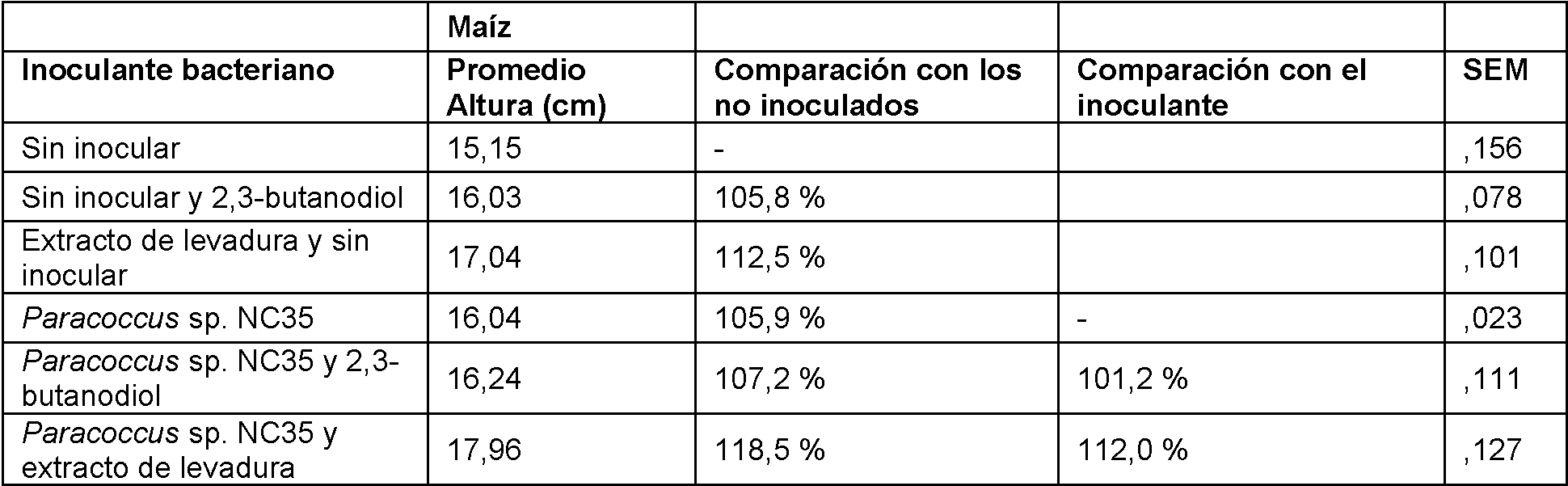
Ejemplo comparativo 10: Generación de mutantes capaces de crecer en condiciones de alta salinidad que retienen la capacidad de promover el crecimiento vegetal mediante el uso de presión selectiva. Comparative Example 10: Generation of mutants capable of growing in high salinity conditions that retain the ability to promote plant growth through the use of selective pressure.
Se encontró que Paracoccus kondratiavae NC35 y Bacillus mycoides BT155 son sensibles a la sal y no muy activos en tipos de suelos con alto contenido de sal (Tabla 3). Para inducir la tolerancia a la sal en estas bacterias promotoras del crecimiento vegetal, se usó una presión selectiva mediante el uso de concentraciones sucesivamente más altas de NaCl para encontrar mutantes que pudieran tolerar estos tipos de suelos con alto contenido de sal. Las cepas seleccionadas se cultivaron en medio líquido Luria Bertani a 37 °C durante la noche y se sembraron en medio de agar con sal de NaCl al 1 % y se dejaron crecer durante 48 horas a 30 °C. Se cultivaron colonias individuales de cepas que sobrevivieron en las placas de agar LB con sal de 1 % en Luria Bertani con medio líquido de NaCl al 1 % a 37 °C durante la noche y se sembraron en medio de agar LB con sal de NaCl al 3 % durante 48 horas a 30 °C. Las colonias de cepas que sobrevivieron en el agar LB con sal de NaCl al 3 % se cultivaron en Luria Bertani con medio líquido con NaCl al 3 % a 37 °C durante la noche y se sembraron en medio de agar LB con sal de NaCl al 5 % y se dejaron crecer durante 48 horas a 30 °C. Las colonias bacterianas seleccionadas de las placas de agar LB con sal al 5 % se cultivaron en Luria Bertani durante la noche más medio NaCl al 5 % a 37 °C. Se cultivaron durante la noche cultivos de cepas originales en medio mínimo y mutantes tolerantes a la sal durante la noche y se centrifugaron, se decantaron los medios y se resuspendieron en la misma cantidad de agua destilada. Se plantaron nueve semillas de soja para cada tratamiento a una profundidad de 2,5 cm en suelo franco superior (Columbia, MO) o franco suplementado con una solución salina al 5 % (p/p), en donde ambos suelos se tamizaron para eliminar los desechos grandes. Las semillas se inocularon durante la siembra con 0,5 j l de bacterias se resuspendieron en agua mezclada en 10 ml de H2O. Diez ml de H2O fueron suficientes para llevar las bacterias a 3 pulgadas3 (7,62 cm3) de suelo, así como para saturar el suelo para la germinación adecuada de las semillas. Las plantas se cultivaron a temperaturas entre 65-75 °F (18-24 °C) con 11 horas de luz/día y 5 ml de riego cada 3 días. Se permitió que la soja creciera durante 2 semanas para analizar la emergencia y el crecimiento inicial de las plantas en las condiciones descritas. Las cepas identificadas indicadas por sus identificaciones bacterianas adecuadas y los datos de altura final se enumeran en la Tabla 14. Se forzaron mutaciones en una cepa sensible a la sal que conservaba la capacidad de promover el crecimiento vegetal. Paracoccus kondratiavae NC35 and Bacillus mycoides BT155 were found to be sensitive to salt and not very active in soil types with high salt content (Table 3). To induce salt tolerance in these plant growth promoting bacteria, selective pressure was used using successively higher concentrations of NaCl to find mutants that could tolerate these types of high salt soils. The selected strains were grown in Luria Bertani liquid medium at 37 ° C overnight and seeded in agar medium with 1% NaCl salt and grown for 48 hours at 30 ° C. Individual colonies of surviving strains were grown on Luria Bertani 1% salt LB agar plates with 1% NaCl liquid medium at 37 ° C overnight and seeded on LB agar medium with NaCl salt at night. 3% for 48 hours at 30 ° C. Colonies of strains that survived on LB agar with 3% NaCl salt were grown in Luria Bertani with liquid medium with 3% NaCl at 37 ° C overnight and seeded on LB agar medium with NaCl salt at 5% and grown for 48 hours at 30 ° C. Bacterial colonies selected from the 5% salt LB agar plates were grown on Luria Bertani overnight plus 5% NaCl medium at 37 ° C. Cultures of parent strains were grown overnight in minimal medium and salt tolerant mutants overnight and the media were centrifuged, decanted, and resuspended in the same amount of distilled water. Nine soybean seeds were planted for each treatment at a depth of 2.5 cm in upper loam soil (Columbia, MO) or loam supplemented with a 5% (w / w) saline solution, where both soils were sieved to eliminate large debris. The seeds were inoculated during sowing with 0.5 µl of bacteria and resuspended in water mixed in 10 ml of H2O. Ten ml of H2O was enough to bring the bacteria into 3 inches3 (7.62 cm3) of soil, as well as to saturate the soil for proper seed germination. The plants were grown at temperatures between 65-75 ° F (18-24 ° C) with 11 hours of light / day and 5 ml of irrigation every 3 days. The soybeans were allowed to grow for 2 weeks to analyze the emergence and initial growth of the plants under the described conditions. Identified strains indicated by their proper bacterial identifications and final height data are listed in Table 14. Mutations were forced into a salt-sensitive strain that retained the ability to promote plant growth.
TABLA 14TABLE 14
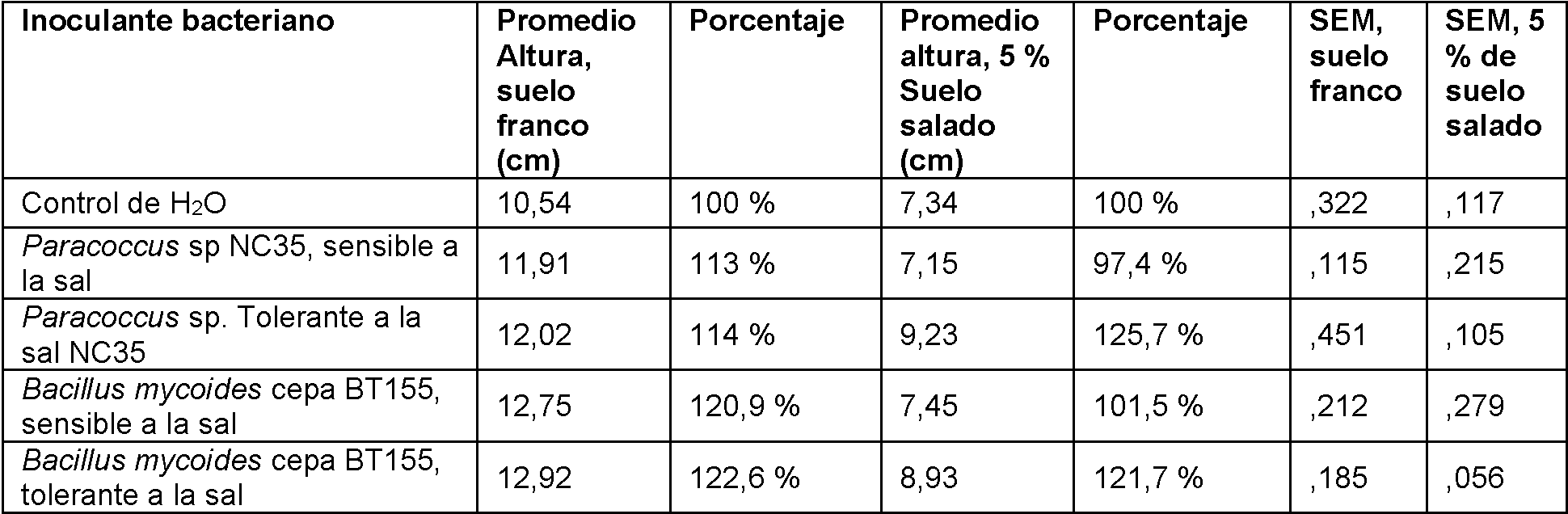
Ejemplo comparativo 11: Generación de imitantes capaces de crecer en presencia de tiram que retuvieron la capacidad de promover el crecimiento vegetal mediante el uso de presión selectiva. Comparative Example 11: Generation of imitants capable of growing in the presence of thiram that retained the ability to promote plant growth through the use of selective pressure.
El tiram es un insecticida y fungicida común y bien establecido que se utiliza en una amplia gama de cultivos agrícolas. El tiram también es bastante antibacteriano y puede tener efectos perjudiciales sobre la mayoría de las bacterias promotoras del crecimiento vegetal, incluidas las descritas en la presente descripción. Se encontró que todas las cepas probadas tenían un alto grado de sensibilidad al tiram. Varias de las cepas, incluyendo Paracoccus kondratiavae NC35 resistente a la sal del Ejemplo 11, Bacillus arybhattai CAP53, Bacillus mycoides BT155 resistente a la sal del Ejemplo 11 y Bacillus thuringiensis BT0013A se cultivaron en medio LB con cantidades diminutas de tiram (0,05 mg/L). El crecimiento en estas condiciones tomó cuatro días, en lugar de las típicas 12 horas en ausencia de tiram. Las bacterias mutadas que comenzaron a crecer en presencia de tiram fueron sometidas secuencialmente a concentraciones cada vez más altas de tiram (0,25 mg/L, 0,50 mg/L, 1 mg/L, 5 mg/L). Al lograr un cultivo mutado que pudiera soportar la mayor cantidad de tiram en la semilla (0,05 mg/semilla), Paracoccus kondratiave NC35, el mutante resistente a la sal/tiram (ThR) NC35, Bacillus arybhattai CAP53, el mutante CAP53 ThR, Bacillus mycoides BT155, el mutante BT155 sal/TtiR, Bacillus thuringiensis BT013A y el mutante BT013A ThR se aplicaron sobre semillas en presencia de tiram a 0,05 mg/semilla. Se cultivaron durante la noche cultivos de cepas originales en medio mínimo y mutantes resistentes al tiram durante la noche y se centrifugaron, se decantaron los medios y se resuspendieron en la misma cantidad de agua destilada. Se sembraron diez semillas de soja para cada tratamiento a una profundidad de 2,5 cm en suelo franco superior (Columbia, MO) en un tratamiento de semilla estándar con 0,5 mg/semilla de tiram. Las plantas se cultivaron a temperaturas entre 18-24 °C (65-75 °F) con 11 horas de luz/día y 5 ml de riego cada 3 días. Se permitió que la soja creciera durante 2 semanas para analizar la emergencia y el crecimiento inicial de las plantas en las condiciones descritas. Se forzaron mutaciones en todas las cepas que conservaban la capacidad de promover el crecimiento vegetal. Los resultados se muestran en la Tabla 15 a continuación.Tiram is a common and well established insecticide and fungicide used on a wide range of agricultural crops. Thiram is also quite antibacterial and can have deleterious effects on most plant growth promoting bacteria, including those described in the present disclosure. All strains tested were found to have a high degree of sensitivity to thiram. Several of the strains, including the salt-resistant Paracoccus kondratiavae NC35 from Example 11, Bacillus arybhattai CAP53, the salt-resistant Bacillus mycoides BT155 from Example 11, and Bacillus thuringiensis BT0013A were grown in LB medium with minute amounts of thiram (0.05 mg / L). Growth under these conditions took four days, instead of the typical 12 hours in the absence of thiram. Mutated bacteria that began to grow in the presence of thiram were sequentially subjected to higher and higher concentrations of thiram (0.25 mg / L, 0.50 mg / L, 1 mg / L, 5 mg / L). By achieving a mutated culture that could support the highest amount of thiram in the seed (0.05 mg / seed), Paracoccus kondratiave NC35, the salt resistant mutant / thiram (ThR) NC35, Bacillus arybhattai CAP53, the mutant CAP53 ThR , Bacillus mycoides BT155, the BT155 salt / TtiR mutant, Bacillus thuringiensis BT013A and the BT013A ThR mutant were applied on seeds in the presence of thiram at 0.05 mg / seed. Cultures of parent strains were grown overnight in minimal medium and thram resistant mutants overnight and centrifuged, the media decanted, and resuspended in the same amount of distilled water. Ten soybean seeds were sown for each treatment at a depth of 2.5 cm in upper loam soil (Columbia, MO) in a standard seed treatment with 0.5 mg / seed of thiram. The plants were grown at temperatures between 18-24 ° C (65-75 ° F) with 11 hours of light / day and 5 ml of irrigation every 3 days. The soybeans were allowed to grow for 2 weeks to analyze the emergence and initial growth of the plants under the described conditions. Mutations were forced into all strains that retained the ability to promote plant growth. The results are shown in Table 15 below.
TABLA 15TABLE 15

Ejemplo comparativo 12: Generación de mutantes capaces de crecer en presencia de glifosato que retuvieron la capacidad de promover el crecimiento vegetal mediante el uso de presión selectiva. Comparative Example 12: Generation of mutants capable of growing in the presence of glyphosate that retained the ability to promote plant growth through the use of selective pressure.
El glifosato es un herbicida común y bien establecido que se utiliza en una amplia gama de cultivos agrícolas. El glifosato también es bastante inhibidor de diversas bacterias y puede tener efectos perjudiciales sobre algunas bacterias promotoras del crecimiento vegetal, incluidas las descritas en la presente descripción. Dos de las cepas descritas en la presente descripción tenían un grado de inhibición en presencia de glifosato. Se cultivaron Bacillus arybhattai CAP53 en medio LB con cantidades diminutas de glifosato (0,05 mg/L). El crecimiento en estas condiciones tomó dos días, en lugar de las típicas 12 horas en ausencia de glifosato. Las bacterias mutadas que comenzaron a crecer en presencia de glifosato fueron sometidas secuencialmente a concentraciones cada vez más altas de glifosato (0,25 mg/L, 0,50 mg/L, 1 mg/L, 5 mg/L). Al lograr un cultivo mutado que pudiera soportar una mayor cantidad de glifosato en el suelo (100 ppm), se aplicaron cepas de tipo salvaje y tolerantes al glifosato de Bacillus aryhbhattai CAP53 a las semillas a una tasa de 1x 10⁵ UFC/semilla con un tratamiento estándar de semillas. Se plantaron diez semillas de soja para cada tratamiento a una profundidad de 2,5 cm en suelo franco (Columbia, MO) en un tratamiento de semilla estándar con 100 ppm de glifosato. Las plantas se cultivaron a temperaturas entre 18-24 °C (65-75 °F) con 11 horas de luz/día y 5 ml de riego cada 3 días. Se permitió que la soja creciera durante 2 semanas para analizar la emergencia y el crecimiento inicial de las plantas en las condiciones descritas. Se forzaron mutaciones en todas las cepas que conservaban la capacidad de promover el crecimiento vegetal.Glyphosate is a common and well-established herbicide used on a wide range of agricultural crops. Glyphosate is also quite inhibitory to various bacteria and may have deleterious effects on some plant growth promoting bacteria, including those described in the present disclosure. Two of the strains described in the present description had a degree of inhibition in the presence of glyphosate. Bacillus arybhattai CAP53 were grown in LB medium with minute amounts of glyphosate (0.05 mg / L). Growth under these conditions took two days, instead of the typical 12 hours in the absence of glyphosate. The mutated bacteria that began to grow in the presence of glyphosate were sequentially subjected to increasingly higher concentrations of glyphosate (0.25 mg / L, 0.50 mg / L, 1 mg / L, 5 mg / L). By achieving a mutated crop that could support a higher amount of glyphosate in the soil (100 ppm), wild-type and glyphosate-tolerant strains of Bacillus aryhbhattai CAP53 were applied to the seeds at a rate of 1x 10⁵ CFU / seed with a treatment standard seed. Ten soybeans were planted for each treatment at a depth of 2.5 cm in loamy soil (Columbia, MO) in a standard seed treatment with 100 ppm glyphosate. The plants were grown at temperatures between 18-24 ° C (65-75 ° F) with 11 hours of light / day and 5 ml of irrigation every 3 days. The soybeans were allowed to grow for 2 weeks to analyze the emergence and initial growth of the plants under the described conditions. Mutations were forced into all strains that retained the ability to promote plant growth.
TABLA 16TABLE 16

Ejemplo 2: miembros de la familia de Bacillus cereus con atributos que promueven el crecimiento vegetal Example 2: members of the Bacillus cereus family with attributes that promote plant growth
La cepa BT155 de Bacillus mycoides, la cepa EE118 de Bacillus mycoides, la cepa EE141 de Bacillus mycoides, la cepa BT46-3 de Bacillus mycoides, la cepa EE349 de miembro de la familia Bacillus cereus, la cepa BT013A de Bacillus thuringiensis y la cepa EE281 de Bacillus megaterium a 37 °C y en caldo de Luria Bertani, se centrifugaron los cultivos durante la noche, se decantaron los medios y se resuspendieron en una cantidad igual de agua destilada. Se sembraron 20 semillas de maíz para cada tratamiento a una profundidad de 2,5 cm en un suelo franco superior (Columbia, MO) que se tamizó para eliminar los desechos grandes. Las semillas se inocularon durante la siembra con 0,5 pl de bacterias se resuspendieron en agua mezclada en 10 ml de H2O. Cincuenta ml de H2O fueron suficientes para llevar las bacterias a las 29 pulgadas3 (442,5 cm3) de suelo, así como para saturar el suelo para la germinación adecuada de las semillas. Las plantas se cultivaron a temperaturas entre 65-72 °F con 13 horas de luz/día y 5 ml de riego cada 3 días. Las plántulas se dejaron crecer durante 2 semanas para analizar la emergencia y el crecimiento inicial de las plantas en las condiciones descritas. Las cepas identificadas indicadas por sus identificaciones bacterianas adecuadas y los datos de altura final se enumeran en la Tabla 17. Bacillus mycoides strain BT155, Bacillus mycoides strain EE118, Bacillus mycoides strain EE141, Bacillus mycoides strain BT46-3, Bacillus cereus strain EE349, Bacillus thuringiensis strain BT013A, and Bacillus thuringiensis strain Bacillus megaterium EE281 at 37 ° C and in Luria Bertani broth, the cultures were centrifuged overnight, the media were decanted and resuspended in an equal amount of distilled water. Twenty corn seeds were sown for each treatment at a depth of 2.5 cm in upper loam soil (Columbia, MO) that was screened to remove large debris. The seeds were inoculated during sowing with 0.5 µl of bacteria and resuspended in water mixed in 10 ml of H2O. Fifty ml of H2O was enough to bring the bacteria into the 29 inches3 (442.5 cm3) of soil, as well as to saturate the soil for proper seed germination. The plants were grown at temperatures between 65-72 ° F with 13 hours of light / day and 5 ml of irrigation every 3 days. The seedlings were grown for 2 weeks to analyze the emergence and initial growth of the plants under the described conditions. The identified strains indicated by their proper bacterial identifications and final height data are listed in Table 17.
TABLA 17TABLE 17

Todas las bacterias promotoras del crecimiento vegetal probadas tuvieron un efecto beneficioso sobre la altura del maíz a las dos semanas en las condiciones descritas. La cepa EE128, miembro de la familia Bacillus cereus, tuvo el mayor efecto en este ensayo, dando un aumento mayor al 14 % en la altura del maíz. Cuando se introducen elementos de la presente invención, los artículos "un", "una", "el" y "dicho" pretenden significar que hay uno o más de los elementos. Los términos "que comprende", "que incluye" y "que tiene" pretenden ser inclusivos y significan que puede haber elementos adicionales distintos de los elementos enumerados.All plant growth promoting bacteria tested had a beneficial effect on corn height at two weeks under the described conditions. Strain EE128, a member of the Bacillus cereus family, had the greatest effect in this trial, giving a greater than 14% increase in corn height. When introducing elements of the present invention, the articles "a", "an", "the" and "said" are intended to mean that there is one or more of the elements. The terms "comprising", "including" and "having" are intended to be inclusive and mean that there may be additional items other than the items listed.
En vista de lo anterior, se verá que se logran los diversos objetos de la invención y se obtienen otros resultados ventajosos. In view of the foregoing, it will be seen that the various objects of the invention are achieved and other advantageous results are obtained.
Claims (14)
Applications Claiming Priority (2)
| Application Number | Priority Date | Filing Date | Title |
|---|---|---|---|
| US201361790476P | 2013-03-15 | 2013-03-15 | |
| PCT/US2014/030726 WO2014145883A1 (en) | 2013-03-15 | 2014-03-17 | Plant growth-promoting bacteria and methods of use |
Publications (1)
| Publication Number | Publication Date |
|---|---|
| ES2873842T3 true ES2873842T3 (en) | 2021-11-04 |
Family
ID=51529775
Family Applications (1)
| Application Number | Title | Priority Date | Filing Date |
|---|---|---|---|
| ES14765307T Active ES2873842T3 (en) | 2013-03-15 | 2014-03-17 | Plant growth promoting bacteria and methods of use |
Country Status (14)
| Country | Link |
|---|---|
| US (3) | US9392796B2 (en) |
| EP (1) | EP2970867B1 (en) |
| JP (1) | JP6454680B2 (en) |
| CN (1) | CN105408468A (en) |
| AU (1) | AU2014232392B2 (en) |
| BR (1) | BR112015023330B8 (en) |
| CA (2) | CA2907438C (en) |
| DK (1) | DK2970867T3 (en) |
| ES (1) | ES2873842T3 (en) |
| MX (1) | MX2015013050A (en) |
| NZ (2) | NZ713023A (en) |
| RU (1) | RU2015144239A (en) |
| WO (1) | WO2014145883A1 (en) |
| ZA (1) | ZA201507472B (en) |
Families Citing this family (94)
| Publication number | Priority date | Publication date | Assignee | Title |
|---|---|---|---|---|
| US8822190B2 (en) * | 2008-01-15 | 2014-09-02 | Board Of Trustees Of Michigan State University | Polymicrobial formulations for enhancing plant productivity |
| CA2885356C (en) | 2012-09-19 | 2024-03-19 | Biodiscovery New Zealand Limited | Methods of screening for microorganisms that impart beneficial properties to plants |
| US9392796B2 (en) | 2013-03-15 | 2016-07-19 | Spogen Biotech Inc. | Plant growth-promoting bacteria and methods of use |
| US9573980B2 (en) | 2013-03-15 | 2017-02-21 | Spogen Biotech Inc. | Fusion proteins and methods for stimulating plant growth, protecting plants from pathogens, and immobilizing Bacillus spores on plant roots |
| US9877486B2 (en) | 2014-01-31 | 2018-01-30 | AgBiome, Inc. | Methods of growing plants using modified biological control agents |
| PT3099172T (en) * | 2014-01-31 | 2021-11-08 | Agbiome Inc | Modified biological control agents and their uses |
| IL315468A (en) | 2014-09-17 | 2024-11-01 | Spogen Biotech Inc | Fusion proteins, recombinant bacteria, and methods for using recombinant bacteria |
| US10306891B2 (en) * | 2014-09-19 | 2019-06-04 | Taxon Biosciences In (Pioneer Pat) | Plant growth-promoting microbes, compositions, and uses |
| CN104402598A (en) * | 2014-11-06 | 2015-03-11 | 韦俊 | Preparation method of dedicated medical fertilizer for preventing and treating Chinese wampee fruit anthrax |
| CN104446892A (en) * | 2014-11-06 | 2015-03-25 | 韦俊 | Special insecticide-fertilizer for preventing and treating anthracnose of Chinese wampee fruit |
| PT3240403T (en) | 2014-12-29 | 2019-12-11 | Fmc Corp | Microbial compositions and methods of use for benefiting plant growth and treating plant disease |
| EP4147575A1 (en) | 2015-02-09 | 2023-03-15 | BioConsortia, Inc. | Agriculturally beneficial microbes, microbial compositions, and consortia |
| CN104824041A (en) * | 2015-04-07 | 2015-08-12 | 广西南宁桂知科技有限公司 | Sugarcane special-purpose deinsectization bacteriostatic agent and preparation method thereof |
| BR112018001522A2 (en) * | 2015-07-25 | 2018-10-09 | Bioconsortia Inc | agriculturally beneficial microbes, microbial compositions and consortia |
| CN105255755A (en) * | 2015-09-28 | 2016-01-20 | 沈阳化工研究院有限公司 | Microbial strain for easing tebuconazole seed coating agent phytotoxicity, bacterial preparation substance and application thereof |
| CZ306628B6 (en) * | 2015-12-02 | 2017-04-05 | Vysoká škola chemicko-technologická v Praze | Biodegradable foil for agricultural production and the method of its production and use |
| CN105684701A (en) * | 2016-02-01 | 2016-06-22 | 天津师范大学 | Method for improving ryegrass growth by adding crab shell powder in matrix |
| CN105851067B (en) * | 2016-03-30 | 2018-12-18 | 中国科学院测量与地球物理研究所 | A kind of fennel extracting solution and preparation method and the growth for being used for control duckweed |
| US10801079B2 (en) * | 2016-05-09 | 2020-10-13 | University Of Houston System | Gnotobiotic rhizobacterial isolation plant systems and methods of use thereof |
| CN105820986B (en) * | 2016-05-27 | 2017-10-17 | 山东省林业科学研究院 | The special rhizosphere growth-promoting A Shi bacillus of one plant of blueberry and its application |
| CN105779369B (en) * | 2016-05-27 | 2017-09-29 | 山东省林业科学研究院 | One plant of blueberry rhizosphere growth-promoting enterobacter cloacae and its application |
| CN106282067B (en) * | 2016-08-24 | 2019-10-11 | 李丽丽 | Multifunctional agricultural complex micro organism fungicide and probiotics and application |
| CN106386244A (en) * | 2016-08-31 | 2017-02-15 | 简立华 | Watermelon seedling culturing substrate and preparation method thereof |
| CN106386342A (en) * | 2016-08-31 | 2017-02-15 | 简立华 | Method for growing sugar orange seedlings with container seedling growing substrate |
| CN106244496B (en) * | 2016-09-06 | 2019-02-19 | 山东农业大学 | A kind of special inorganic phosphorus decomposing bacteria WP2 for tea tree and preparation method thereof |
| CN106479916B (en) * | 2016-09-29 | 2020-01-03 | 普洱学院 | Enterobacter cloacae strain and application thereof |
| CN106676033B (en) * | 2016-11-17 | 2019-05-14 | 河北农业大学 | Paenibacillus and application thereof |
| CN107034153B (en) * | 2016-12-05 | 2020-06-09 | 中国科学院兰州化学物理研究所 | Compound microbial agent for Lanzhou lily and preparation method thereof |
| CN106754498B (en) * | 2016-12-12 | 2020-03-20 | 云南省烟草农业科学研究院 | Bacillus aryabhattai, microbial inoculum thereof, preparation method and application |
| CN107018883A (en) * | 2017-01-06 | 2017-08-08 | 广西壮族自治区农业科学院微生物研究所 | A kind of method for producing banana mycorhiza tissue culture of sprout |
| US10927339B2 (en) | 2017-03-17 | 2021-02-23 | Industrial Technology Research Institute | Mutant of Bacillus thuringiensis and application thereof |
| CN107295929A (en) * | 2017-07-01 | 2017-10-27 | 兰溪市顺光园艺技术有限公司 | Method for planting apples in large scale |
| PH12017000215A1 (en) * | 2017-07-24 | 2019-02-04 | Univ Of The Philippines Los Banos | Microbial stimulant for plants |
| CN109528755A (en) | 2017-08-10 | 2019-03-29 | 苏州魁星新材料科技有限公司 | One kind composition containing nano-sulfur and its application |
| WO2019035067A1 (en) * | 2017-08-17 | 2019-02-21 | Miklens Bio Private Limited | Organic fungicide derived through microbial fermentation |
| CN107493876B (en) * | 2017-08-24 | 2019-11-19 | 暨南大学 | Method and application of reducing PAEs pollution in plants by utilizing plant endophytes |
| AU2018337974B2 (en) | 2017-09-20 | 2024-06-27 | Spogen Biotech Inc. | Fusion proteins, recombinant bacteria, and exosporium fragments for plant health |
| CO2017012690A1 (en) * | 2017-12-11 | 2019-06-11 | Corporacion Colombiana De Investig Agropecuaria Agrosavia | Solid compositions comprising microorganisms with biocidal activity, fertilizer and / or plant growth promoter |
| CN107812009A (en) * | 2017-12-14 | 2018-03-20 | 瑞阳制药有限公司 | The application of triterpene saponin componds and preparation method |
| CN108353741A (en) * | 2018-01-18 | 2018-08-03 | 东兰县旺达板栗茶油种植专业合作社 | Oil tea grafting seedlings-growing method |
| CA3090004A1 (en) | 2018-02-12 | 2019-08-15 | Boost Biomes, Inc. | Microbial compositions for the prevention or reduction of growth of fungal pathogens on plants |
| MX2020009007A (en) * | 2018-03-01 | 2020-10-05 | Ralco Nutrition Inc | Seed, soil, and plant treatment compositions including yeast extract. |
| CN108504582B (en) * | 2018-04-16 | 2020-09-29 | 中国热带农业科学院热带生物技术研究所 | Strain and screening method thereof and application of strain in delaying leaf senescence |
| CN108812006A (en) * | 2018-05-21 | 2018-11-16 | 贵州曌梅果蔬种植有限公司 | A kind of walnut interplanting method |
| BR112021000050A2 (en) | 2018-07-06 | 2021-04-06 | Orfan Biotech Inc. | TRIAZOL GLYCOLATE OXIDASE INHIBITORS |
| CN109169129B (en) * | 2018-09-12 | 2021-06-08 | 吉林冠州生物科技有限公司 | Method for cultivating peony for paeonia ostii oil in Yanbian area |
| CN109266575B (en) * | 2018-09-17 | 2021-06-11 | 广西师范大学 | Cadmium-resistant intestinal strain and method for adsorbing cadmium |
| CN109169131A (en) * | 2018-09-18 | 2019-01-11 | 连云港秀景园林绿化工程有限公司 | A kind of garden landscape High-quality Cultivation method of water lily |
| CN109197464B (en) * | 2018-10-31 | 2020-08-11 | 云南农业大学 | A kind of cultivation method that can improve the quality and yield of Maca |
| BR102018076265A2 (en) * | 2018-12-17 | 2020-07-07 | Agrivalle Brasil Industria E Comércio De Produtos Agrícolas Ltda | composition containing growth-promoting microorganisms and reduction of water stress in cultivated plants and use thereof |
| CN110616164A (en) * | 2019-01-22 | 2019-12-27 | 暨南大学 | Enterobacter cloacae Y16 capable of activating insoluble phosphorus and cadmium and application thereof |
| CN109706102B (en) * | 2019-03-04 | 2020-11-20 | 河北萌帮水溶肥料股份有限公司 | Bacillus aristolochia with the function of dissolving silicon and its application |
| CA3049530A1 (en) * | 2019-07-12 | 2021-01-12 | Agroworld Natural Solutions Inc. | Bacterial-based modulation of plant growth |
| BR112022002506A2 (en) * | 2019-08-09 | 2022-04-26 | Boost Biomes Inc | Microbial compositions for use with plants for the prevention or reduction of pathogenic fungi |
| CN111004736B (en) * | 2019-09-05 | 2021-08-24 | 华南农业大学 | A kind of Bacillus megaterium and its application of degrading pyrethroid insecticides |
| CN111100806B (en) * | 2019-10-11 | 2022-12-02 | 海南大学 | A fungicide for betel nut root rot prepared from a boron-resistant Bacillus lysinus as a chassis cell |
| CN110622652A (en) * | 2019-10-25 | 2019-12-31 | 广西南亚热带农业科学研究所 | A method for inhibiting the germination of Pingpo seeds |
| CN110862929B (en) * | 2019-12-09 | 2020-11-06 | 江西农业大学 | Gloeostereum incarnatum, microbial inoculum comprising same and application thereof |
| CN110982743B (en) * | 2019-12-16 | 2022-03-15 | 沈阳农业大学 | Bacillus aryabhattai for promoting corn root development and application thereof |
| CN111018133B (en) * | 2019-12-20 | 2022-03-29 | 深圳清谷环境科技有限公司 | Environment-friendly microbial sewage treatment agent and preparation method and application thereof |
| CN111117920B (en) * | 2020-01-07 | 2021-04-02 | 山东农业大学 | Bacillus mycoides producing protease and siderophore and application thereof |
| CN111117919B (en) * | 2020-01-07 | 2021-06-04 | 山东农业大学 | A strain of Bacillus thuringiensis producing protease and siderophore and its application |
| CN111004760B (en) * | 2020-01-07 | 2021-05-25 | 山东农业大学 | Bacillus thuringiensis and application thereof |
| CN111333454A (en) * | 2020-04-01 | 2020-06-26 | 黑龙江八一农垦大学 | A kind of anti-disease and growth-promoting type adzuki bean biological seed coating agent and preparation method and using method thereof |
| CN111534472B (en) * | 2020-06-11 | 2022-04-19 | 浙江工业大学 | Bacillus aryabhattai WZZ10 and application thereof in chiral resolution of 2-tetrahydrofurfuryl acid |
| CN111718877B (en) * | 2020-06-30 | 2022-02-11 | 江苏丘陵地区南京农业科学研究所 | A rhizobia strain ZT-vig2 and its application |
| JP7670304B2 (en) * | 2020-07-23 | 2025-04-30 | 株式会社アクトリー | NOVEL STRAIN AND PLANT GROWTH PROMOTER COMPRISING THE SAME |
| CN111876336B (en) * | 2020-08-11 | 2022-03-08 | 云南大学 | Mucuna fungus and application thereof in promoting germination of paphiopedilum brandisil seeds to form seedlings |
| US12010993B2 (en) * | 2020-08-28 | 2024-06-18 | Oms Investments, Inc. | Granular agricultural compositions |
| CN112501084B (en) * | 2020-12-22 | 2022-04-08 | 山东农业大学 | Rhizosphere probiotic Klebsiella ZH07 and application thereof |
| CN112694996A (en) * | 2021-01-13 | 2021-04-23 | 南昌大学 | Method for artificially constructing plant growth-promoting complex functional flora |
| US20220256782A1 (en) * | 2021-02-18 | 2022-08-18 | Jiangxi Academy Of Eco-Environmental Sciences And Planning | Restoration Material, Restoration Method for Abandoned Ion-absorbed Rare Earth Tailings Area and Use Thereof |
| CN113584073A (en) * | 2021-09-14 | 2021-11-02 | 西南大学 | Method for establishing high-efficiency genetic transformation system of Arabidopsis thaliana |
| CN114015624B (en) * | 2021-12-15 | 2023-07-07 | 郑州轻工业大学 | A kind of bacillus and its application in chickpea seed cultivation |
| CN114504029B (en) * | 2022-01-13 | 2024-03-01 | 河北养元智汇饮品股份有限公司 | Wolfberry, ginseng and maca walnut milk and preparation method thereof |
| US11564967B1 (en) * | 2022-01-24 | 2023-01-31 | Tran Ky Huynh | Oral compositions containing extracts of a betel leaf and related methods |
| CN115261249B (en) * | 2022-02-24 | 2023-08-04 | 中交路桥建设有限公司 | Rhizobium pisum and application thereof |
| WO2023187453A1 (en) | 2022-04-01 | 2023-10-05 | Lithuanian Research Centre For Agriculture And Forestry | Method and microbial strains for improving the growth of plant in vitro shoot culture |
| CN114621899B (en) * | 2022-04-19 | 2023-08-22 | 浙江工业大学 | Paracoccus condella and its application |
| JP2025083600A (en) * | 2022-04-22 | 2025-06-02 | クミアイ化学工業株式会社 | Plant growth regulator containing live or cultured bacteria of Bacillus sp. strain as an active ingredient and method of using same |
| CN116179399A (en) * | 2022-07-22 | 2023-05-30 | 深圳华大生命科学研究院 | Rhizosphere Growth Promoting Bacteria and Its Application |
| PL245315B1 (en) * | 2022-08-19 | 2024-06-24 | Univ Jagiellonski | A composition of bacteria, containing a vaccine for the biotization of brassica species and the bacterial strains contained in it |
| CN115927095A (en) * | 2022-11-21 | 2023-04-07 | 上海中医药大学 | Streptomyces yangpu and its application |
| CN115737706B (en) * | 2022-11-23 | 2023-08-29 | 海南皇隆制药股份有限公司 | Benzalkonium chloride solution and preparation method thereof |
| CN116179423B (en) * | 2022-12-16 | 2025-09-30 | 浙江工业大学 | Artificial microbial multicellular high-ammonia nitrogen wastewater treatment flora, promoter, and construction method and application thereof |
| CN116925982B (en) * | 2023-09-13 | 2023-11-17 | 中国科学院烟台海岸带研究所 | An acid-producing Rhizobium strain JY1-1 and its application |
| CN117050922B (en) * | 2023-10-11 | 2023-12-08 | 江苏聚庚科技股份有限公司 | Fluorine-containing benzonitrile compound degrading bacterium and application thereof in environmental treatment |
| KR102675436B1 (en) * | 2023-11-30 | 2024-06-20 | 재단법인 사천시미생물발효재단 | Bacillus siamensis CMJ46 strain with plant growth promotion, resistance to salt stress and low temperature stress and Use Thereof |
| CN117384807B (en) * | 2023-12-13 | 2024-03-12 | 中国农业大学 | Bacillus mycoides HDCM2 and its application |
| PL449216A1 (en) * | 2024-07-12 | 2026-01-19 | Instytut Uprawy Nawożenia I Gleboznawstwa - Państwowy Instytut Badawczy | New strains of bacteria supporting resistance to water shortages in vegetable plants, especially peppers and celery vegetables, a microbiological preparation containing such strains, use of the preparation and method of supporting plant resistance using the preparation containing the new strains |
| KR102844893B1 (en) * | 2024-07-22 | 2025-08-11 | 주식회사 코드오브네이처 | A composition comprising Bacillus cereus strains for increasing available phosphate in soil, and a method for increasing available phosphate in soil using the same |
| CN119385024A (en) * | 2024-11-09 | 2025-02-07 | 广西壮族自治区林业科学研究院 | A multi-element and efficient cultivation method for forest medicine |
| CN119422748A (en) * | 2024-12-12 | 2025-02-14 | 杭州华耕设计集团有限公司 | A land consolidation method for shaping village features |
| CN119685222B (en) * | 2025-01-03 | 2025-08-05 | 山东省科学院生态研究所(山东省科学院中日友好生物技术研究中心) | Nelsonia bacteria with plant rhizosphere growth-promoting effect and its application |
Family Cites Families (26)
| Publication number | Priority date | Publication date | Assignee | Title |
|---|---|---|---|---|
| CA1335364C (en) | 1986-12-17 | 1995-04-25 | Joseph Wayne Kloepper | Beneficial, direct-acting soil bacteria |
| JPH01305004A (en) * | 1988-06-01 | 1989-12-08 | Meiji Seika Kaisha Ltd | Culture of plant |
| US6309440B1 (en) | 1998-08-25 | 2001-10-30 | Thomas T. Yamashita | Method and composition for promoting and controlling growth of plants |
| DE4412834A1 (en) | 1994-04-14 | 1995-10-19 | Bayer Ag | Insecticidal mixtures |
| JPH10203917A (en) * | 1997-01-28 | 1998-08-04 | Idemitsu Kosan Co Ltd | Microbial seed dressing composition |
| WO2002045513A2 (en) | 2000-12-04 | 2002-06-13 | Wisconsin Alumni Research Foundation | Bacterial inoculants for enhancing plant growth |
| JP3606819B2 (en) * | 2001-05-30 | 2005-01-05 | ヤマキ株式会社 | Mycorrhizal infection promoter and mycorrhizal infection / growth promoter |
| WO2003057861A2 (en) | 2002-01-07 | 2003-07-17 | Manas Ranjan Banerjee | Sulfur-oxidizing bacteria for promoting plant growth |
| US20030228679A1 (en) | 2002-03-27 | 2003-12-11 | Smith Donald L. | Compositions and methods for increasing plant growth by inoculation with bacillus strains |
| JP2005298409A (en) * | 2004-04-12 | 2005-10-27 | Yukijirushi Shubyo Kk | Plant rooting-promoting agent |
| US7437591B1 (en) * | 2005-01-18 | 2008-10-14 | Altera Corporation | Method and apparatus for hardware timing optimizer |
| RU2313941C2 (en) | 2005-10-05 | 2008-01-10 | ООО "БИО Агат Групп" | Preparation for protecting plants against pathogens of agricultural crops and grape diseases with growth-stimulating effect, method for preparing this preparation and strains for its realization |
| EP1948799A4 (en) * | 2005-11-17 | 2009-09-30 | Univ Mcgill | USE OF BACTERIOCINES TO PROMOTE PLANT GROWTH AND DISEASE RESISTANCE |
| BRPI0708325A2 (en) * | 2006-02-27 | 2011-05-24 | Univ Northwest | plant support formulation, vehicle for the distribution and displacement of phytologically beneficial substances, and compositions containing the same |
| BRPI0704008A2 (en) | 2007-10-30 | 2009-06-23 | Basf Ag | use of glycerin, crop treatment method, tank mix composition and a method for preparing a tank mix composition |
| KR101086367B1 (en) * | 2010-03-11 | 2011-11-23 | 강원대학교산학협력단 | New strain Bacillus ariabatai L9 having plant growth promoting activity and use thereof |
| ES2378040B1 (en) | 2010-03-31 | 2013-02-18 | Probelte, S.A | A BIONEMATICIDE BIOLOGICAL PREPARATION AND STIMULATOR OF THE VEGETABLE GROWTH AND PURE CROPS OF THE NAMES N11, SR11 AND ALO1, CONTAINED IN THE SAME. |
| CN102031231B (en) | 2010-11-03 | 2013-04-03 | 甘肃农业大学 | Growth-promoting rhizobacteria and fungicide thereof, preparation method and application of fungicide |
| CA2860848C (en) | 2011-12-13 | 2021-02-23 | Monsanto Technology Llc | Plant growth-promoting microbes and uses therefor |
| KR101539167B1 (en) | 2012-05-23 | 2015-07-23 | 가부시키가이샤 고마쓰 세이사쿠쇼 | Hybrid working machine and method of controlling hybrid working machine |
| NZ742943A (en) | 2012-05-30 | 2019-04-26 | Bayer Cropscience Ag | Compositions comprising a biological control agent and a fungicide from the group consisting of inhibitors of the respiratory chain at complex i or ii |
| US20160100585A1 (en) | 2012-11-22 | 2016-04-14 | Basf Corporation | Pesticidal Mixtures |
| US9392796B2 (en) | 2013-03-15 | 2016-07-19 | Spogen Biotech Inc. | Plant growth-promoting bacteria and methods of use |
| US9573980B2 (en) | 2013-03-15 | 2017-02-21 | Spogen Biotech Inc. | Fusion proteins and methods for stimulating plant growth, protecting plants from pathogens, and immobilizing Bacillus spores on plant roots |
| IL315468A (en) | 2014-09-17 | 2024-11-01 | Spogen Biotech Inc | Fusion proteins, recombinant bacteria, and methods for using recombinant bacteria |
| WO2016044529A1 (en) | 2014-09-17 | 2016-03-24 | Bayer Cropscience Lp | Compositions comprising recombinant bacillus cells and another biological control agent |
-
2014
- 2014-03-14 US US14/213,238 patent/US9392796B2/en active Active
- 2014-03-17 CA CA2907438A patent/CA2907438C/en active Active
- 2014-03-17 CN CN201480016005.1A patent/CN105408468A/en active Pending
- 2014-03-17 JP JP2016503452A patent/JP6454680B2/en not_active Expired - Fee Related
- 2014-03-17 NZ NZ713023A patent/NZ713023A/en unknown
- 2014-03-17 NZ NZ751716A patent/NZ751716A/en unknown
- 2014-03-17 US US14/775,858 patent/US10555532B2/en active Active
- 2014-03-17 WO PCT/US2014/030726 patent/WO2014145883A1/en not_active Ceased
- 2014-03-17 RU RU2015144239A patent/RU2015144239A/en not_active Application Discontinuation
- 2014-03-17 AU AU2014232392A patent/AU2014232392B2/en active Active
- 2014-03-17 CA CA3207907A patent/CA3207907A1/en active Pending
- 2014-03-17 DK DK14765307.5T patent/DK2970867T3/en active
- 2014-03-17 EP EP14765307.5A patent/EP2970867B1/en active Active
- 2014-03-17 MX MX2015013050A patent/MX2015013050A/en unknown
- 2014-03-17 BR BR112015023330A patent/BR112015023330B8/en active IP Right Grant
- 2014-03-17 ES ES14765307T patent/ES2873842T3/en active Active
-
2015
- 2015-10-08 ZA ZA2015/07472A patent/ZA201507472B/en unknown
-
2016
- 2016-07-15 US US15/211,044 patent/US20160316761A1/en not_active Abandoned
Also Published As
| Publication number | Publication date |
|---|---|
| JP2016519572A (en) | 2016-07-07 |
| WO2014145883A1 (en) | 2014-09-18 |
| BR112015023330A2 (en) | 2017-11-21 |
| NZ713023A (en) | 2021-07-30 |
| BR112015023330B1 (en) | 2023-04-25 |
| CA2907438C (en) | 2023-09-26 |
| US20160262402A1 (en) | 2016-09-15 |
| CA3207907A1 (en) | 2014-09-18 |
| EP2970867A4 (en) | 2016-12-21 |
| AU2014232392A1 (en) | 2015-10-29 |
| EP2970867B1 (en) | 2021-05-05 |
| CN105408468A (en) | 2016-03-16 |
| US9392796B2 (en) | 2016-07-19 |
| CA2907438A1 (en) | 2014-09-18 |
| ZA201507472B (en) | 2019-05-29 |
| NZ751716A (en) | 2021-07-30 |
| JP6454680B2 (en) | 2019-01-16 |
| US10555532B2 (en) | 2020-02-11 |
| RU2015144239A (en) | 2017-04-21 |
| EP2970867A1 (en) | 2016-01-20 |
| US20140274691A1 (en) | 2014-09-18 |
| MX2015013050A (en) | 2016-09-29 |
| US20160316761A1 (en) | 2016-11-03 |
| BR112015023330B8 (en) | 2023-05-16 |
| AU2014232392B2 (en) | 2020-01-16 |
| DK2970867T3 (en) | 2021-06-07 |
Similar Documents
| Publication | Publication Date | Title |
|---|---|---|
| ES2873842T3 (en) | Plant growth promoting bacteria and methods of use | |
| Ma et al. | Biological control tobacco bacterial wilt and black shank and root colonization by bio-organic fertilizer containing bacterium Pseudomonas aeruginosa NXHG29 | |
| ES2773957T3 (en) | Bioactive compositions and metabolites of Bacillus megaterium | |
| Youssef et al. | Biofertilizers and their role in management of plant parasitic nematodes. A review | |
| JP2022105585A (en) | Soil infectious disease control method for plants | |
| JP7607338B2 (en) | Plant disease control agent and plant disease control method | |
| US20240373859A1 (en) | Composition comprising bacillus siamensis strain for promoting plant growth | |
| Mazhabi et al. | The effect of Trichoderma on polianthes qualitative and quantitative properties | |
| CA2828012A1 (en) | Polymicrobial formulations for enhancing plant productivity | |
| EP4618765A1 (en) | Novel pseudomonas strain | |
| Habazar et al. | Formulation of indigenous rhizobacterial isolates from healthy soybean’s root, which ability to promote growth and yield of soybean | |
| US20240389585A1 (en) | Method for promoting plant growth | |
| EP4650436A1 (en) | Novel pseudomonas strain | |
| WO2025186404A1 (en) | Novel rahnella strain | |
| ES2534626B1 (en) | Microorganism with the capacity to produce compounds that induce systemic response in plants and their applications as a plant growth promoter | |
| JPH10218715A (en) | Microbial seed dressing composition | |
| Galitskaya et al. | Suppressive properties of composts are determined by their raw materials | |
| JPH10203917A (en) | Microbial seed dressing composition | |
| ES2794127B2 (en) | LIQUID FORMULATES BASED ON NANOPARTICLES OF METAL OXIDES AS PRODUCTIVITY IMPROVERS AND FOR THE OBTAINING OF HEALTHIER CROPS, AND THE USE OF THE SAME | |
| Dey et al. | Biofertilizers for enhancing groundnut productivity | |
| Sen | INFLUENCE OF BIO-INOCULANTS ON GROWTH, FLOWERING AND CORM PRODUCTION IN GLADIOLUS (Gladiolus grandiflorus L.) | |
| WO2026027770A1 (en) | Method and composition for increasing plant nutrition | |
| EP4557950A1 (en) | Biological control agent | |
| ES2490395A1 (en) | Microbial composition that can be used to combat plant crop nematodes | |
| WO2022058632A1 (en) | Strain of the genus strepomyces and uses in agriculture |