ES2874884T3 - Glucose Targeting Therapeutic Compounds - Google Patents
Glucose Targeting Therapeutic Compounds Download PDFInfo
- Publication number
- ES2874884T3 ES2874884T3 ES15744656T ES15744656T ES2874884T3 ES 2874884 T3 ES2874884 T3 ES 2874884T3 ES 15744656 T ES15744656 T ES 15744656T ES 15744656 T ES15744656 T ES 15744656T ES 2874884 T3 ES2874884 T3 ES 2874884T3
- Authority
- ES
- Spain
- Prior art keywords
- formula
- seq
- ova
- cmp
- antigen
- Prior art date
- Legal status (The legal status is an assumption and is not a legal conclusion. Google has not performed a legal analysis and makes no representation as to the accuracy of the status listed.)
- Active
Links
- 0 C*C(CCCSSCCOCCC(*)(*)CC(C=C)=**)=[N+] Chemical compound C*C(CCCSSCCOCCC(*)(*)CC(C=C)=**)=[N+] 0.000 description 4
- ZGRWZUDBZZBJQB-UHFFFAOYSA-N SC(c1ccccc1)=S Chemical compound SC(c1ccccc1)=S ZGRWZUDBZZBJQB-UHFFFAOYSA-N 0.000 description 1
Classifications
-
- A—HUMAN NECESSITIES
- A61—MEDICAL OR VETERINARY SCIENCE; HYGIENE
- A61K—PREPARATIONS FOR MEDICAL, DENTAL OR TOILETRY PURPOSES
- A61K38/00—Medicinal preparations containing peptides
- A61K38/16—Peptides having more than 20 amino acids; Gastrins; Somatostatins; Melanotropins; Derivatives thereof
- A61K38/17—Peptides having more than 20 amino acids; Gastrins; Somatostatins; Melanotropins; Derivatives thereof from animals; from humans
- A61K38/38—Albumins
-
- A—HUMAN NECESSITIES
- A61—MEDICAL OR VETERINARY SCIENCE; HYGIENE
- A61K—PREPARATIONS FOR MEDICAL, DENTAL OR TOILETRY PURPOSES
- A61K38/00—Medicinal preparations containing peptides
- A61K38/16—Peptides having more than 20 amino acids; Gastrins; Somatostatins; Melanotropins; Derivatives thereof
- A61K38/17—Peptides having more than 20 amino acids; Gastrins; Somatostatins; Melanotropins; Derivatives thereof from animals; from humans
- A61K38/22—Hormones
- A61K38/28—Insulins
-
- A—HUMAN NECESSITIES
- A61—MEDICAL OR VETERINARY SCIENCE; HYGIENE
- A61K—PREPARATIONS FOR MEDICAL, DENTAL OR TOILETRY PURPOSES
- A61K39/00—Medicinal preparations containing antigens or antibodies
- A61K39/0005—Vertebrate antigens
- A61K39/0008—Antigens related to auto-immune diseases; Preparations to induce self-tolerance
-
- A—HUMAN NECESSITIES
- A61—MEDICAL OR VETERINARY SCIENCE; HYGIENE
- A61K—PREPARATIONS FOR MEDICAL, DENTAL OR TOILETRY PURPOSES
- A61K39/00—Medicinal preparations containing antigens or antibodies
- A61K39/0005—Vertebrate antigens
- A61K39/001—Preparations to induce tolerance to non-self, e.g. prior to transplantation
-
- A—HUMAN NECESSITIES
- A61—MEDICAL OR VETERINARY SCIENCE; HYGIENE
- A61K—PREPARATIONS FOR MEDICAL, DENTAL OR TOILETRY PURPOSES
- A61K39/00—Medicinal preparations containing antigens or antibodies
- A61K39/35—Allergens
-
- A—HUMAN NECESSITIES
- A61—MEDICAL OR VETERINARY SCIENCE; HYGIENE
- A61K—PREPARATIONS FOR MEDICAL, DENTAL OR TOILETRY PURPOSES
- A61K39/00—Medicinal preparations containing antigens or antibodies
- A61K39/385—Haptens or antigens, bound to carriers
-
- A—HUMAN NECESSITIES
- A61—MEDICAL OR VETERINARY SCIENCE; HYGIENE
- A61K—PREPARATIONS FOR MEDICAL, DENTAL OR TOILETRY PURPOSES
- A61K47/00—Medicinal preparations characterised by the non-active ingredients used, e.g. carriers or inert additives; Targeting or modifying agents chemically bound to the active ingredient
- A61K47/50—Medicinal preparations characterised by the non-active ingredients used, e.g. carriers or inert additives; Targeting or modifying agents chemically bound to the active ingredient the non-active ingredient being chemically bound to the active ingredient, e.g. polymer-drug conjugates
- A61K47/51—Medicinal preparations characterised by the non-active ingredients used, e.g. carriers or inert additives; Targeting or modifying agents chemically bound to the active ingredient the non-active ingredient being chemically bound to the active ingredient, e.g. polymer-drug conjugates the non-active ingredient being a modifying agent
- A61K47/54—Medicinal preparations characterised by the non-active ingredients used, e.g. carriers or inert additives; Targeting or modifying agents chemically bound to the active ingredient the non-active ingredient being chemically bound to the active ingredient, e.g. polymer-drug conjugates the non-active ingredient being a modifying agent the modifying agent being an organic compound
- A61K47/549—Sugars, nucleosides, nucleotides or nucleic acids
-
- A—HUMAN NECESSITIES
- A61—MEDICAL OR VETERINARY SCIENCE; HYGIENE
- A61K—PREPARATIONS FOR MEDICAL, DENTAL OR TOILETRY PURPOSES
- A61K47/00—Medicinal preparations characterised by the non-active ingredients used, e.g. carriers or inert additives; Targeting or modifying agents chemically bound to the active ingredient
- A61K47/50—Medicinal preparations characterised by the non-active ingredients used, e.g. carriers or inert additives; Targeting or modifying agents chemically bound to the active ingredient the non-active ingredient being chemically bound to the active ingredient, e.g. polymer-drug conjugates
- A61K47/51—Medicinal preparations characterised by the non-active ingredients used, e.g. carriers or inert additives; Targeting or modifying agents chemically bound to the active ingredient the non-active ingredient being chemically bound to the active ingredient, e.g. polymer-drug conjugates the non-active ingredient being a modifying agent
- A61K47/54—Medicinal preparations characterised by the non-active ingredients used, e.g. carriers or inert additives; Targeting or modifying agents chemically bound to the active ingredient the non-active ingredient being chemically bound to the active ingredient, e.g. polymer-drug conjugates the non-active ingredient being a modifying agent the modifying agent being an organic compound
- A61K47/555—Medicinal preparations characterised by the non-active ingredients used, e.g. carriers or inert additives; Targeting or modifying agents chemically bound to the active ingredient the non-active ingredient being chemically bound to the active ingredient, e.g. polymer-drug conjugates the non-active ingredient being a modifying agent the modifying agent being an organic compound pre-targeting systems involving an organic compound, other than a peptide, protein or antibody, for targeting specific cells
-
- A—HUMAN NECESSITIES
- A61—MEDICAL OR VETERINARY SCIENCE; HYGIENE
- A61P—SPECIFIC THERAPEUTIC ACTIVITY OF CHEMICAL COMPOUNDS OR MEDICINAL PREPARATIONS
- A61P3/00—Drugs for disorders of the metabolism
- A61P3/08—Drugs for disorders of the metabolism for glucose homeostasis
- A61P3/10—Drugs for disorders of the metabolism for glucose homeostasis for hyperglycaemia, e.g. antidiabetics
-
- A—HUMAN NECESSITIES
- A61—MEDICAL OR VETERINARY SCIENCE; HYGIENE
- A61P—SPECIFIC THERAPEUTIC ACTIVITY OF CHEMICAL COMPOUNDS OR MEDICINAL PREPARATIONS
- A61P37/00—Drugs for immunological or allergic disorders
- A61P37/02—Immunomodulators
-
- A—HUMAN NECESSITIES
- A61—MEDICAL OR VETERINARY SCIENCE; HYGIENE
- A61P—SPECIFIC THERAPEUTIC ACTIVITY OF CHEMICAL COMPOUNDS OR MEDICINAL PREPARATIONS
- A61P37/00—Drugs for immunological or allergic disorders
- A61P37/02—Immunomodulators
- A61P37/06—Immunosuppressants, e.g. drugs for graft rejection
-
- A—HUMAN NECESSITIES
- A61—MEDICAL OR VETERINARY SCIENCE; HYGIENE
- A61P—SPECIFIC THERAPEUTIC ACTIVITY OF CHEMICAL COMPOUNDS OR MEDICINAL PREPARATIONS
- A61P37/00—Drugs for immunological or allergic disorders
- A61P37/08—Antiallergic agents
-
- A—HUMAN NECESSITIES
- A61—MEDICAL OR VETERINARY SCIENCE; HYGIENE
- A61K—PREPARATIONS FOR MEDICAL, DENTAL OR TOILETRY PURPOSES
- A61K39/00—Medicinal preparations containing antigens or antibodies
- A61K2039/555—Medicinal preparations containing antigens or antibodies characterised by a specific combination antigen/adjuvant
-
- A—HUMAN NECESSITIES
- A61—MEDICAL OR VETERINARY SCIENCE; HYGIENE
- A61K—PREPARATIONS FOR MEDICAL, DENTAL OR TOILETRY PURPOSES
- A61K39/00—Medicinal preparations containing antigens or antibodies
- A61K2039/57—Medicinal preparations containing antigens or antibodies characterised by the type of response, e.g. Th1, Th2
- A61K2039/577—Medicinal preparations containing antigens or antibodies characterised by the type of response, e.g. Th1, Th2 tolerising response
-
- A—HUMAN NECESSITIES
- A61—MEDICAL OR VETERINARY SCIENCE; HYGIENE
- A61K—PREPARATIONS FOR MEDICAL, DENTAL OR TOILETRY PURPOSES
- A61K39/00—Medicinal preparations containing antigens or antibodies
- A61K2039/60—Medicinal preparations containing antigens or antibodies characteristics by the carrier linked to the antigen
- A61K2039/6093—Synthetic polymers, e.g. polyethyleneglycol [PEG], Polymers or copolymers of (D) glutamate and (D) lysine
-
- A—HUMAN NECESSITIES
- A61—MEDICAL OR VETERINARY SCIENCE; HYGIENE
- A61K—PREPARATIONS FOR MEDICAL, DENTAL OR TOILETRY PURPOSES
- A61K39/00—Medicinal preparations containing antigens or antibodies
- A61K2039/62—Medicinal preparations containing antigens or antibodies characterised by the link between antigen and carrier
- A61K2039/627—Medicinal preparations containing antigens or antibodies characterised by the link between antigen and carrier characterised by the linker
-
- C—CHEMISTRY; METALLURGY
- C07—ORGANIC CHEMISTRY
- C07K—PEPTIDES
- C07K2319/00—Fusion polypeptide
- C07K2319/01—Fusion polypeptide containing a localisation/targetting motif
Landscapes
- Health & Medical Sciences (AREA)
- Life Sciences & Earth Sciences (AREA)
- Chemical & Material Sciences (AREA)
- Immunology (AREA)
- Pharmacology & Pharmacy (AREA)
- Animal Behavior & Ethology (AREA)
- Veterinary Medicine (AREA)
- Public Health (AREA)
- Medicinal Chemistry (AREA)
- General Health & Medical Sciences (AREA)
- Epidemiology (AREA)
- Bioinformatics & Cheminformatics (AREA)
- Engineering & Computer Science (AREA)
- Mycology (AREA)
- Microbiology (AREA)
- Molecular Biology (AREA)
- Transplantation (AREA)
- Nuclear Medicine, Radiotherapy & Molecular Imaging (AREA)
- General Chemical & Material Sciences (AREA)
- Chemical Kinetics & Catalysis (AREA)
- Organic Chemistry (AREA)
- Zoology (AREA)
- Proteomics, Peptides & Aminoacids (AREA)
- Gastroenterology & Hepatology (AREA)
- Diabetes (AREA)
- Endocrinology (AREA)
- Biochemistry (AREA)
- Pulmonology (AREA)
- Rheumatology (AREA)
- Emergency Medicine (AREA)
- Hematology (AREA)
- Obesity (AREA)
- Medicines Containing Antibodies Or Antigens For Use As Internal Diagnostic Agents (AREA)
- Peptides Or Proteins (AREA)
- Medicines That Contain Protein Lipid Enzymes And Other Medicines (AREA)
- Pharmaceuticals Containing Other Organic And Inorganic Compounds (AREA)
- Coloring Foods And Improving Nutritive Qualities (AREA)
- Medicinal Preparation (AREA)
- Preparation Of Compounds By Using Micro-Organisms (AREA)
- Micro-Organisms Or Cultivation Processes Thereof (AREA)
Abstract
Una composición que comprende un compuesto de Fórmula 1: **(Ver fórmula)** en la que: m es un número entero de 1 a 100; X comprende un antígeno alimentario seleccionado de la SEQ ID NO: 24, SEQ ID NO: 25, SEQ ID NO: 26 y SEQ ID NO: 27, al que los pacientes desarrollan una respuesta alérgica o de hipersensibilidad, o un antígeno seleccionado de la SEQ ID NO: 11, SEQ ID NO: 12, SEQ ID NO: 13, SEQ ID NO: 14, SEQ ID NO: 15, SEQ ID NO: 16 y SEQ ID NO: 17, contra el cual un paciente desarrolla una respuesta autoinmune; Y comprende una fracción enlazadora; y Z comprende una fracción dirigida al hígado; en la que la fracción dirigida al hígado comprende galactosa, galactosamina o N-acetilgalactosamina.A composition comprising a compound of Formula 1: **(See formula)** wherein: m is an integer from 1 to 100; X comprises a food antigen selected from SEQ ID NO: 24, SEQ ID NO: 25, SEQ ID NO: 26 and SEQ ID NO: 27, to which patients develop an allergic or hypersensitive response, or an antigen selected from SEQ ID NO: 11, SEQ ID NO: 12, SEQ ID NO: 13, SEQ ID NO: 14, SEQ ID NO: 15, SEQ ID NO: 16 and SEQ ID NO: 17, against which a patient develops a response autoimmune; Y comprises a linker moiety; and Z comprises a liver targeting moiety; wherein the liver targeting moiety comprises galactose, galactosamine or N-acetylgalactosamine.
Description
DESCRIPCIÓNDESCRIPTION
Compuestos terapéuticosdirigidos a la glucosaGlucose Targeted Therapeutic Compounds
Campo de la invenciónField of the invention
El campo de la invención se refiere a composiciones farmacéuticamente aceptables que son útiles en el tratamiento de enfermedades autoinmunes y alergias alimentarias.The field of the invention relates to pharmaceutically acceptable compositions that are useful in the treatment of autoimmune diseases and food allergies.
Antecedentes de la divulgaciónDisclosure Background
Las solicitudes US 2012/0039989, US 2012/0178139 y WO 2013/121296 describen el direccionamiento de antígenos a eritrocitos para aprovechar el papel de los eritrocitos en la presentación de antígenos para su tolerancia. A pesar de los resultados positivos generados hasta la fecha con este enfoque, la posibilidad de enfoques alternativos sigue siendo de interés.Applications US 2012/0039989, US 2012/0178139 and WO 2013/121296 describe the targeting of antigens to erythrocytes to take advantage of the role of erythrocytes in the presentation of antigens for their tolerance. Despite the positive results generated to date with this approach, the possibility of alternative approaches remains of interest.
El documento WO 2014/023709 A1 describe anticuerpos anti-ASGPR usados para administrar compuestos al hígado. Coulstock et al., PLOS ONE, 2013 y el documento WO 2011/086143 A2 describen anticuerpos anti-ASGPR fusionados con IFN-a. Meager et al. El documento WO 2012/083185 A2 se refiere a un sistema de suministro de ARNi que comprende un ligando ASGP.WO 2014/023709 A1 describes anti-ASGPR antibodies used to deliver compounds to the liver. Coulstock et al., PLOS ONE, 2013 and WO 2011/086143 A2 describe anti-ASGPR antibodies fused with IFN- a . Meager et al. WO 2012/083185 A2 refers to an RNAi delivery system comprising an ASGP ligand.
Sumario de la invenciónSummary of the invention
En un primer aspecto, la invención proporciona una composición que comprende un compuesto de Fórmula 1:In a first aspect, the invention provides a composition comprising a compound of Formula 1:

Fórmula 1Formula 1
en la que:in which:
m es un número entero de 1 a 100;m is an integer from 1 to 100;
X comprende un antígeno alimentario seleccionado de la SEQ ID NO: 24, SEQ ID NO: 25, SEQ ID NO: 26 y SEQ ID NO: 27, al que los pacientes desarrollan una respuesta alérgica o de hipersensibilidad, o un antígeno seleccionado de la SEQ ID NO : 11, SEQ ID NO: 12, SEQ ID NO: 13, SEQ ID NO: 14, SEQ ID NO: 15, SEQ ID NO: 16 y SEQ ID NO: 17, contra el cual un paciente desarrolla una respuesta autoinmune;X comprises a food antigen selected from SEQ ID NO: 24, SEQ ID NO: 25, SEQ ID NO: 26 and SEQ ID NO: 27, to which patients develop an allergic or hypersensitivity response, or an antigen selected from SEQ ID NO: 11, SEQ ID NO: 12, SEQ ID NO: 13, SEQ ID NO: 14, SEQ ID NO: 15, SEQ ID NO: 16 and SEQ ID NO: 17, against which a patient develops a response autoimmune;
Y comprende una fracción enlazadora; yY comprises a linker moiety; and
Z comprende una fracción dirigida al hígado; en la que la fracción dirigida al hígado comprende galactosa, galactosamina o N-acetilgalactosamina.Z comprises a fraction directed to the liver; wherein the fraction directed to the liver comprises galactose, galactosamine or N-acetylgalactosamine.
La galactosa, galactosamina o N-acetilgalactosamina comprendida en X puede conjugarse en su C1, C2 o C6 a Y. Y puede seleccionarse de enlazadores de N-hidroxisuccinamidilo, enlazadores de maleimida, enlazadores de vinilsulfona, enlazadores de piridil-di-tiol-poli(etilenglicol), enlazadores de piridil-di-tiol, enlazadores de carbonato de n-nitrofenilo, enlazadores de éster de NHS y enlazadores de éster de nitrofenoxi-poli(etilenglicol).Galactose, galactosamine or N-acetylgalactosamine comprised in X can be conjugated at its C1, C2 or C6 to Y. Y can be selected from N-hydroxysuccinamidyl linkers, maleimide linkers, vinyl sulfone linkers, pyridyl-di-thiol-poly linkers (ethylene glycol), pyridyl-di-thiol linkers, n-nitrophenyl carbonate linkers, NHS ester linkers, and nitrophenoxy-poly (ethylene glycol) ester linkers.
Y también puede comprender: una estructura representada por una de las fórmulas Ya a Yp:And you can also understand: a structure represented by one of the formulas Ya to Yp:

Ċ Ċ

y and

o tiene una porción representada por la Fórmula Y'-CMP:or has a portion represented by the Formula Y'-CMP:

en las que: el corchete izquierdo "("indica el enlace entre X e Y; el paréntesis derecho o inferior y")" indica el enlace entre Y y Z; n es un número entero de aproximadamente 1 a 100; p es un número entero de aproximadamente 2 a 150; q es un número entero de aproximadamente 1 a 44; R8 es -CH2- o -CH2-CH2-C(CH3)(CN)-; R9 es un enlace directo o -CH2-CH2-NH-C(O)-; y Y'representa la porción restante de Y.where: the left bracket "(" indicates the link between X and Y; the right or bottom parenthesis and ")" indicates the link between Y and Z; n is an integer from about 1 to 100; p is an integer from about 2 to 150; q is an integer from about 1 to 44; R8 is -CH2- or -CH2-CH2-C (CH3) (CN) -; R9 is a direct bond or -CH2-CH2-NH-C (O) -; and Yrepresents the remaining portion of Y.
En otro aspecto de lo anterior, n es aproximadamente 40 a 80, p es aproximadamente 10 a 100, q es aproximadamente 3 a 20, R8 es -CH2-CH2-C(CH3)(CN)-; y cuando R9 es -CH2-CH2-NH-C(O)-, Z es galactosa o N-acetilgalactosamina conjugada en su C1.In another aspect of the above, n is about 40 to 80, p is about 10 to 100, q is about 3 to 20, R8 is -CH2-CH2-C (CH3) (CN) -; and when R9 is -CH2-CH2-NH-C (O) -, Z is galactose or N-acetylgalactosamine conjugated at its C1.
En otro aspecto más de lo anterior, Y comprende la Fórmula Ya, la Fórmula Yb, la Fórmula Yh, la Fórmula Yi, la Fórmula Yk, la Fórmula Ym o la Fórmula Yn, particularmente la Fórmula Ya, la Fórmula Yb, la Fórmula Ym o la Fórmula Yn.In yet another aspect of the above, Y comprises Formula Ya, Formula Yb, Formula Yh, Formula Yi, Formula Yk, Formula Ym or Formula Yn, particularly Formula Ya, Formula Yb, Formula Ym or the Formula Yn.
En un segundo aspecto, la invención proporciona una composición como se menciona en el primer aspecto de la invención o una composición que comprende un compuesto de Fórmula 1:In a second aspect, the invention provides a composition as mentioned in the first aspect of the invention or a composition comprising a compound of Formula 1:

Fórmula 1Formula 1
en la que:in which:
m es un número entero de 1 a 100;m is an integer from 1 to 100;
X comprende un antígeno contra el cual un paciente desarrolla una respuesta inmune;X comprises an antigen against which a patient develops an immune response;
Y comprende una fracción enlazadora; yY comprises a linker moiety; and
Z comprende una fracción dirigido al hígado; en la quela fracción dirigido al hígado comprende galactosa, galactosamina o N-acetilgalactosamina, para uso en la tolerancia de dicho paciente con respecto alafraccióndel antígeno X. X puede comprender además: un antígeno de trasplante extraño contra el cual los receptores de trasplante desarrollan una respuesta inmune no deseada; un antígeno alimentario, animal, vegetal o ambiental extraño contra el cual los pacientes desarrollan una respuesta inmune no deseada; un agente terapéutico extraño contra el cual los pacientes desarrollan una respuesta inmune no deseada; o un antígeno propio sintético contra la versión endógena dela cual los pacientes desarrollan una respuesta inmune no deseada, o una porción tolerogénica de la misma.Z comprises a fraction directed to the liver; in which the fraction directed to the liver comprises galactose, galactosamine or N-acetylgalactosamine, for use in the tolerance of said patient with respect to the fraction of the X antigen. X may further comprise: a foreign transplant antigen against which the transplant recipients develop a response unwanted immune; a foreign food, animal, plant, or environmental antigen against which patients develop an unwanted immune response; a foreign therapeutic agent against which patients develop an unwanted immune response; or a synthetic self antigen against the endogenous version of which patients develop an unwanted immune response, or a tolerogenic portion of it.
La divulgación también se refiere a un método de tratamiento para una respuesta inmune no deseada contra un antígeno administrando a un mamífero que necesita dicho tratamiento una cantidad eficaz de una composición que comprende un compuesto de Fórmula 1 como se discutió anteriormente. En dicho método, la composición se puede administrar para la eliminación de una proteína o péptido o anticuerpo circulante que se une específicamente a la fracción del antígeno X, proteína o péptido o anticuerpo circulante que está involucrado de manera causal en el rechazo del trasplante, la respuesta inmune contra un agente terapéutico, la enfermedad autoinmune, hipersensibilidad y/o alergia. La composición se puede administrar en una cantidad eficaz para reducir la concentración de los anticuerpos que están causalmente implicados en el rechazo del trasplante, la respuesta inmune contra un agente terapéutico, la enfermedad autoinmune, la hipersensibilidad y/o la alergia en la sangre del paciente en al menos un 50% p/p, medido en un tiempo entre aproximadamente 12 y aproximadamente 48 horas después de la administración. La composición se puede administrar para la tolerancia de un paciente con respecto alafracción del antígeno X. The disclosure also relates to a method of treating an unwanted immune response against an antigen by administering to a mammal in need of such treatment an effective amount of a composition comprising a compound of Formula 1 as discussed above. In such a method, the composition can be administered for the removal of a circulating protein or peptide or antibody that specifically binds to the fraction of the circulating X antigen, protein or peptide or antibody that is causally involved in transplant rejection, the immune response against a therapeutic agent, autoimmune disease, hypersensitivity and / or allergy. The composition can be administered in an amount effective to reduce the concentration of antibodies that are causally involved in transplant rejection, immune response against a therapeutic agent, autoimmune disease, hypersensitivity, and / or allergy in the patient's blood. by at least 50% w / w, measured at between about 12 and about 48 hours after administration. The composition can be administered for the tolerance of a patient to X antigen fraction.
Se divulga además una composición que comprende un compuesto de Fórmula 2:A composition comprising a compound of Formula 2 is further disclosed:

Fórmula 2Formula 2
en la que: m'es cero o un número entero de aproximadamente 1 a 10, m"es cero o un número entero de aproximadamente 1 a 10, y la suma de m' m" es un número entero de aproximadamente 1 a 10 pero es al menos 1; cada X es un antígeno extraño o antígeno propio contra el cual un paciente desarrolla una respuesta inmune no deseada, o una porción tolerogénica del mismo; cada Y es una fracción enlazadora o un enlace directo, o un anticuerpo, fragmento de anticuerpo, péptido u otro ligando que se une específicamente a X; y Z es una fracción dirigida al hígado, siempre que X no sea interferón, Ribavirina, Nexavar/Sorafenib, Erbitus/Cetuximab, Avastatina/bevacizumab o Herceptina/trastuzumab cuando m'+ m"es igual a 1 y Z es DOM 26h-196-61.where: m 'is zero or an integer from approximately 1 to 10, m "is zero or an integer from approximately 1 to 10, and the sum of m' m" is an integer from approximately 1 to 10 but is at least 1; each X is a foreign antigen or self antigen against which a patient develops an unwanted immune response, or a tolerogenic portion thereof; each Y is a linker moiety or a direct link, or an antibody, antibody fragment, peptide, or other ligand that specifically binds to X; and Z is a fraction directed to the liver, provided that X is not interferon, Ribavirin, Nexavar / Sorafenib, Erbitus / Cetuximab, Avastatin / bevacizumab or Herceptin / trastuzumab when m '+ m "is equal to 1 and Z is DOM 26h-196 -61.
En el aspecto anterior de la divulgación que involucra la Fórmula 2, se describe que Z puede comprender un anticuerpo dirigido a ASGPR, un fragmento de anticuerpo dirigido a ASGPR, un péptido dirigido a ASGPR, un scFv dirigido a ASGPR u otro ligando de ASGPR. Se describe que Y puede ser un enlazador que tiene un sitio de escisión de inmunoproteasoma. Se describe que X puede comprender un grupo de antígenos relacionados contra los cuales un paciente desarrolla una respuesta inmune no deseada o un grupo de fragmentos tolerogénicos del misma. Por ejemplo, X se puede seleccionar de los grupos que comprenden:In the above aspect of the disclosure involving Formula 2, it is disclosed that Z may comprise an ASGPR-targeted antibody, an ASGPR-targeted antibody fragment, an ASGPR-targeted peptide, an ASGPR-targeted scFv, or another ASGPR ligand. It is disclosed that Y may be a linker having an immunoproteasome cleavage site. It is disclosed that X may comprise a group of related antigens against which a patient develops an unwanted immune response or a group of tolerogenic fragments thereof. For example, X can be selected from the groups comprising:
• dos o más de insulina, proinsulina, preproinsulina, ácido glutámico descarboxilasa-65 GAD-67, glucosa-6 fosfatasa 2, proteína 2 asociada a insulinoma, proteína (2 asociada a insulinoma, ICA69, ICA12, carboxipeptidasa H, Imogen 38, GLIMA 38, Cromogranina A, HSP-60, carboxipeptidasa E, periferina, transportador 2 de glucosa, proteína asociada al hepatocarcinoma-intestino-páncreas/pancreática, S100(, protena ácida fibrilar glial, gen de regeneración II, homeobox 1 pancreático duodenal, distrofia miotónica quinasa, proteína relacionada con la subunidad catalítica de glucosa-6-fosfatasa específica de islotes y receptores 1-5 acoplados a proteína G de SST;• two or more insulin, proinsulin, preproinsulin, glutamic acid decarboxylase-65 GAD-67, glucose-6 phosphatase 2, insulinoma-associated protein 2, insulinoma-associated protein (2, ICA69, ICA12, carboxypeptidase H, Imogen 38, GLIMA 38, Chromogranin A, HSP-60, carboxypeptidase E, peripherin, glucose transporter 2, hepatocarcinoma-intestine-pancreas / pancreatic associated protein, S100 (, glial fibrillar acid protein, regeneration gene II, duodenal pancreatic homeobox 1, myotonic dystrophy kinase, islet-specific glucose-6-phosphatase catalytic subunit related protein and SST G-protein-coupled receptors 1-5;
• dos o más de proteína básica de mielina, glicoproteína de oligodendrocitos de mielina, proteína proteolipídica de mielina, la SEQ ID NO: 11, SEQ ID NO: 12, SEQ ID NO: 13, SEQ ID NO: 14, SEQ ID NO: 15, SEQ ID NO: 16 y SEQ ID NO: 17; y• two or more of myelin basic protein, myelin oligodendrocyte glycoprotein, myelin proteolipid protein, SEQ ID NO: 11, SEQ ID NO: 12, SEQ ID NO: 13, SEQ ID NO: 14, SEQ ID NO: 15, SEQ ID NO: 16 and SEQ ID NO: 17; and
• dos o más de la SEQ ID NO: 24, SEQ ID NO: 25, SEQ ID NO: 26 y SEQ ID NO: 27.• two or more of SEQ ID NO: 24, SEQ ID NO: 25, SEQ ID NO: 26 and SEQ ID NO: 27.
La divulgación también se refiere a un método de tratamiento para una respuesta inmune no deseada contra un antígeno administrando a un mamífero que necesite tal tratamiento una cantidad eficaz de una composición que comprende un compuesto de Fórmula 2 como se discutió anteriormente. En dicho método, la composición se puede administrar para la eliminación de una proteína o péptido o anticuerpo circulante que se une específicamente a la fracción del antígeno X, proteína o péptido o anticuerpo circulante que está involucrado de manera causal en el rechazo del trasplante, la respuesta inmune contra un agente terapéutico, la enfermedad autoinmune, hipersensibilidad y/o alergia. La composición se puede administrar en una cantidad eficaz para reducir la concentración de los anticuerpos que están causalmente implicados en el rechazo del trasplante, la respuesta inmune contra un agente terapéutico, la enfermedad autoinmune, la hipersensibilidad y/o la alergia en la sangre del paciente en al menos un 50% p/p, medida en un tiempo entre aproximadamente 12 y aproximadamente 48 horas después de la administración. La composición se puede administrar para la tolerancia de un paciente con respecto alafracción del antígeno X.The disclosure also relates to a method of treating an unwanted immune response against an antigen by administering to a mammal in need of such treatment an effective amount of a composition comprising a compound of Formula 2 as discussed above. In such a method, the composition can be administered for the removal of a circulating protein or peptide or antibody that specifically binds to the fraction of the circulating X antigen, protein or peptide or antibody that is causally involved in transplant rejection, the immune response against a therapeutic agent, autoimmune disease, hypersensitivity and / or allergy. The composition can be administered in an amount effective to reduce the concentration of antibodies that are causally involved in transplant rejection, immune response against a therapeutic agent, autoimmune disease, hypersensitivity, and / or allergy in the patient's blood. by at least 50% w / w, measured at a time between about 12 and about 48 hours after administration. The composition can be administered for the tolerance of a patient to X antigen fraction.
Breve descripción de los dibujosBrief description of the drawings
La Figura 1 es una serie de gráficos que muestran la conjugación de galactosa [F1aA-PE-m4-ns0 (Gal-PE)] preferiblemente se dirige OVA a las células del hígado, incluidas las siguientes: (A.) células endoteliales sinusoidales (LSEC), (B.) Células de Kupffer (KC), (C.) hepatocitos y (D.) otras células presentadoras de antígeno (APC).Figure 1 is a series of graphs showing galactose conjugation [F1aA-PE-m4-ns0 (Gal-PE)] preferably targeting OVA to liver cells, including the following: (A.) sinusoidal endothelial cells ( LSEC), (B.) Kupffer cells (KC), (C.) hepatocytes and (D.) other antigen presenting cells (APC).
La Figura 2 es un gráfico que muestra la proliferación de células T CD8+ OTI en ratones tratados con F1aA-OVA-m4-n80 (Gal-OVA), OVA o solución salina (es decir, sin tratamiento previo).Figure 2 is a graph showing CD8 + OTI T cell proliferation in mice treated with F1aA-OVA-m4-n80 (Gal-OVA), OVA, or saline (ie, no pretreatment).
La Figura 3 es una serie de gráficos que muestran el porcentaje de células T CD8+ OT-I que presentan marcadores de superficie (A.) PD-1+ y (B.) Anexina-V+ en generaciones de células T proliferantes tratadas con solución salina, OVA o F1aA-OVA-m4-ns0 (GAL-OVA).Figure 3 is a series of graphs showing the percentage of CD8 + OT-I T cells exhibiting surface markers (A.) PD-1 + and (B.) Annexin-V + in generations of proliferating T cells treated with saline. , OVA or F1aA-OVA-m4-ns0 (GAL-OVA).
La Figura 4 es un gráfico que muestra que la conjugación de galactosa [F1aA-OVA-m4-n80 (Gal-OVA)] disminuye la inmunogenicidad de OVA según se determina mediante títulos de anticuerpos específicos de OVA (mostrados en títulos de Ab log-1).Figure 4 is a graph showing that galactose [F1aA-OVA-m4-n80 (Gal-OVA)] conjugation decreases the immunogenicity of OVA as determined by OVA-specific antibody titers (shown in log-Ab titers). 1).
La Figura 5 muestra que F1aA-OVA-m4-n80 (Gal-OVA) es capaz de reducir los anticuerpos específicos de OVA del suero.Figure 5 shows that F1aA-OVA-m4-n80 (Gal-OVA) is capable of reducing serum OVA-specific antibodies.
La Figura 6 muestra que F1aA-OVA-m4-n80 (mGal-OVA), F1b-OVA-m1-n44-p34 (pGal-OVA) y N'-DOM-Gly3Ser-OVA-Gly3Ser-6xHis-C'(Dom-OVA) son capaces de mitigar la respuesta inmune específica de OVA en el drenaje de los ganglios linfáticos después de la exposición intradérmica con OVA y el LPS adyuvante.Figure 6 shows that F1aA-OVA-m4-n80 (mGal-OVA), F1b-OVA-m1-n44-p34 (pGal-OVA) and N'-DOM-Gly3Ser-OVA-Gly3Ser-6xHis-C '(Dom -OVA) are able to mitigate the OVA-specific immune response in lymph node drainage after intradermal exposure with OVA and the adjuvant LPS.
La Figura 7 muestra la caracterización de F1aA-OVA-m4-n80 y F1b-OVA-m1-n44-p34. (A.) Trazaspor HPCL de exclusión por tamaño de F1aA-OVA-m4-n80 (magenta), F1b-OVA-m1-n44-p34 (azul) y OVA no conjugado (negro). El desplazamiento hacia la izquierda representa un aumento en el peso molecular. (B.) Gel de poliacrilamida que demuestra un peso molecular aumentado después de la conjugación de OVA: (1.) OVA no conjugado, (2.) F1aA-OVA-m4-n80 y (3.) F1b-OVA-m1-n44-p34.Figure 7 shows the characterization of F1aA-OVA-m4-n80 and F1b-OVA-m1-n44-p34. (A.) Size exclusion HPCL traces of F1aA-OVA-m4-n80 (magenta), F1b-OVA-m1-n44-p34 (blue) and unconjugated OVA (black). The Shift to the left represents an increase in molecular weight. (B.) Polyacrylamide gel demonstrating increased molecular weight after OVA conjugation: (1.) unconjugated OVA, (2.) F1aA-OVA-m4-n80 and (3.) F1b-OVA-m1- n44-p34.
La Figura 8 es un gráfico que muestra la cantidad normalizada de N-OVA-Gly3Ser-6xHis-C (OVA), N-DOM-Gly3Ser-OVA-Gly3Ser-6xHis-C (DOM-OVA) o N-OVA-Gly3Ser-DOM-Gly3Ser-6xHis-C (OVA-DOM) en la circulación de ratones después de la inyección como un bolo iv.Figure 8 is a graph showing the normalized amount of N-OVA-Gly3Ser-6xHis-C (OVA), N-DOM-Gly3Ser-OVA-Gly3Ser-6xHis-C (DOM-OVA) or N-OVA-Gly3Ser- DOM-Gly3Ser-6xHis-C (OVA-DOM) in circulating mice after injection as an iv bolus.
La Figura 9 es una serie de gráficos que muestran el título de anticuerpos IgG anti-OVA en la circulación de ratones individuales después del tratamiento con solución salina, DOM y OVA, DOM-OVA u OVA-DOM. La producción de IgG anti-OVA fue inducida por inyecciones iv de OVA solamente (a) u OVA y CpG-B (b). Los tiempos de tratamiento se indican mediante líneas discontinuas verticales. El título se calcula como log10 de la dilución máxima de plasma con IgG anti-OVA detectable.Figure 9 is a series of graphs showing the circulating anti-OVA IgG antibody titer of individual mice after treatment with saline, DOM and OVA, DOM-OVA or OVA-DOM. The production of anti-OVA IgG was induced by iv injections of OVA alone (a) or OVA and CpG-B (b). Treatment times are indicated by vertical dashed lines. The titer is calculated as log10 of the maximum dilution of plasma with detectable anti-OVA IgG.
Descripción detalladaDetailed description
Los dos receptores de asialoglicoproteína conocidos ("ASGPR") se expresan en hepatocitos y células endoteliales sinusoidales hepáticas (o "LSEC"). Se pueden encontrar otros receptores de galactosa/galactosamina/N-acetilgalactosamina en diversas formas en múltiples tipos de células [por ejemplo, células dendríticas, hepatocitos, LSEC y células de Kupffer]. Las células dendríticas se consideran "células presentadoras de antígenos profesionales" porque su función principal es presentar antígenos al sistema inmunológico para generar respuestas inmunitarias. Se sabe que algunas células del hígado pueden presentar antígenos, pero es más conocido que el hígado participa en la tolerogénesis. Se entiende que el hígado es un órgano tolerogénico. Por ejemplo, se informan incidencias más bajas de rechazo en los casos de trasplantes de órganos múltiples cuando el hígado es uno de los órganos trasplantados. Los LSEC son mucho más nuevos en la literatura; en consecuencia, su papel en la tolerogénesis y/o la moderación de las respuestas inmunitarias inflamatorias aún no se reconoce ni se comprende bien. Sin embargo, cada vez está más claro que también pueden desempeñar un papel importante en la inducción de tolerancia específica de antígeno.The two known asialoglycoprotein receptors ("ASGPR") are expressed on hepatocytes and hepatic sinusoidal endothelial cells (or "LSEC"). Other galactose / galactosamine / N-acetylgalactosamine receptors can be found in various forms in multiple cell types [eg, dendritic cells, hepatocytes, LSECs, and Kupffer cells]. Dendritic cells are considered "professional antigen presenting cells" because their main function is to present antigens to the immune system to generate immune responses. It is known that some liver cells can present antigens, but it is better known that the liver participates in tolerogenesis. The liver is understood to be a tolerogenic organ. For example, lower rejection rates are reported in multiple organ transplant cases when the liver is one of the transplanted organs. LSECs are much newer to the literature; consequently, its role in tolerogenesis and / or moderation of inflammatory immune responses is not yet well recognized or understood. However, it is becoming increasingly clear that they may also play an important role in inducing antigen-specific tolerance.
Una de las características distintivas de la superficie de los eritrocitos es su glicosilación, es decir, la presencia de un número significativo de proteínas glicosiladas. De hecho, las glicoforinas (por ejemplo, glicoforina A) se han empleado como dianas para la unión de eritrocitos. Las glicoforinas son proteínas con muchas cadenas de azúcar unidas covalentemente, cuyo extremo terminal es el ácido siálico. A medida que un eritrocito envejece y madura para su eliminación, el ácido siálico terminal de sus glicoforinas tiende a perderse, dejando la N-acetilgalactosamina en el extremo libre. La N-acetilgalactosamina es un ligando recibido selectivamente por el ASGPR asociado con las células hepáticas, que conduce a la unión de sustancias que contienen N-acetilgalactosamina por las células hepáticas y su posterior absorción y procesamiento en el hígado.One of the distinguishing characteristics of the surface of erythrocytes is their glycosylation, that is, the presence of a significant number of glycosylated proteins. In fact, glycophorins (eg, glycophorin A) have been used as targets for erythrocyte binding. Glycophorins are proteins with many covalently linked sugar chains, the terminal end of which is sialic acid. As an erythrocyte ages and matures for elimination, the terminal sialic acid of its glycophorins tends to be lost, leaving the N-acetylgalactosamine at the free end. N-acetylgalactosamine is a ligand selectively received by ASGPR associated with liver cells, which leads to the binding of substances containing N-acetylgalactosamine by liver cells and their subsequent absorption and processing in the liver.
Hasta ahora, los expertos en la técnica han entendido que debe evitarse la glicosilación de un agente terapéutico de una manera que dé como resultado el direccionamiento hepático debido alaeliminaciónen una primerapasada por elhígado dando como resultado una semivida de circulación deficiente del agente terapéutico. Del mismo modo, algunos anticuerpos monoclonales necesitan ser glicosilados específicamente en ASN297 para una unión óptima a sus receptores Fc. Sorprendentemente, se ha descubierto ahora que la galactosilación se puede usar de una manera que induzca la tolerogénesis.Heretofore, it has been understood by those skilled in the art that glycosylation of a therapeutic agent must be avoided in a manner that results in hepatic targeting due to removal in a first pass through the liver resulting in a poor circulating half-life of the therapeutic agent. Similarly, some monoclonal antibodies need to be specifically glycosylated at ASN297 for optimal binding to their Fc receptors. Surprisingly, it has now been discovered that galactosylation can be used in a way that induces tolerogenesis.
Se divulgan ciertas composiciones terapéuticas que están dirigidas para la administración (y para la captación) del hígado, particularmente hepatocitos, LSEC, células de Kupffer y/o células estrelladas, más particularmente hepatocitos y/o LSEC, e incluso más particularmente para unirse específicamente a ASGPR. El direccionamientoal hígado facilita dos mecanismos de tratamiento: tolerancia y eliminación. La tolerancia aprovecha el papel del hígado en la eliminación de células apoptóticas y el procesamiento de sus proteínas para que el sistema inmunológico las reconozca como "propias", así como el papel del hígado en el muestreo de proteínas periféricas para la tolerancia inmunitaria. Laeliminación aprovecha el papel del hígado en la purificación de la sangre al eliminar y descomponer rápidamente toxinas, polipéptidos y similares. El direccionamiento de estas composiciones al hígado se logra mediante una fracción galactosilante (por ejemplo, galactosa, galactosamina y N-acetilgalactosamina, particularmente conjugada en C1, C2 o C6), mediante otra fracción dirigida al hígado (por ejemplo, un anticuerpo monoclonal o un fragmento o un scFv del mismo), o por desialilación de un polipéptido para el que se desea dicho direccionamiento al hígado. La galactosilación u otra fracción dirigida al hígado puede conjugarse químicamente o fusionarse de manera recombinante con un antígeno, mientras que la desialilación expone una fracción similar a galactosa en un polipéptido antigénico. El antígeno puede ser endógeno (un antígeno propio) o exógeno (un antígeno extraño), que incluye, entre otros: un antígeno de trasplante extraño contra el cual los receptores de trasplante desarrollan una respuesta inmune no deseada (por ejemplo, rechazo de trasplante), un antígeno extraño de alimento, animal,planta o ambiental al que los pacientes desarrollan una respuesta inmune no deseada (por ejemplo, alérgica o hipersensibilidad), un agente terapéutico al que los pacientes desarrollan una respuesta inmune no deseada (por ejemplo, hipersensibilidad y/o actividad terapéutica reducida), un antígeno propio al que los pacientes desarrollan una respuesta inmune no deseada (por ejemplo, enfermedad autoinmune), o una porción tolerogénica (por ejemplo, un fragmento o un epítopo) del mismo; estas composiciones son útiles para inducir la tolerancia al antígeno. Alternativamente, la galactosilación u otra fracción dirigida al hígado se puede conjugar con un anticuerpo, fragmento de anticuerpo o ligando que se une específicamente a una proteína o péptido o anticuerpo circulante, cuya proteína o péptido o anticuerpo circulante está involucrado causalmente en el rechazo del trasplante, la respuesta inmune contra un agente terapéutico, enfermedad autoinmune y/o alergia (como se discutió anteriormente); estas composiciones son útiles para eliminar la proteína, péptido o anticuerpo circulantes. Por consiguiente, las composiciones de la presente divulgación pueden usarse para tratar una respuesta inmune no deseada, por ejemplo, rechazo de trasplante, una respuesta inmune contra un agente terapéutico, una enfermedad autoinmune y/o una alergia. También se divulgan composiciones farmacéuticas que contienen una cantidad terapéuticamente eficaz de una composición de la divulgación mezclada con al menos un excipiente farmacéuticamente aceptable. Se describen además métodos para el tratamiento de una respuesta inmune no deseada, tal como el rechazo de un trasplante, la respuesta contra un agente terapéutico, una enfermedad autoinmune o una alergia.Certain therapeutic compositions are disclosed that are targeted for delivery (and uptake) to the liver, particularly hepatocytes, LSEC, Kupffer cells and / or stellate cells, more particularly hepatocytes and / or LSEC, and even more particularly to specifically bind to ASGPR. Targeting to the liver facilitates two treatment mechanisms: tolerance and elimination. Tolerance takes advantage of the liver's role in killing apoptotic cells and processing their proteins so that the immune system recognizes them as "self", as well as the liver's role in sampling peripheral proteins for immune tolerance. Elimination takes advantage of the liver's role in purifying the blood by rapidly removing and breaking down toxins, polypeptides, and the like. The targeting of these compositions to the liver is achieved by a galactosylating moiety (for example, galactose, galactosamine and N-acetylgalactosamine, particularly conjugated at C1, C2 or C6), by another fraction targeting the liver (for example, a monoclonal antibody or a fragment or a scFv thereof), or by desialylation of a polypeptide for which said targeting to the liver is desired. Galactosylation or other liver-directed moiety can be chemically conjugated or recombinantly fused to an antigen, while desialylation exposes a galactose-like moiety to an antigenic polypeptide. The antigen can be endogenous (a self antigen) or exogenous (a foreign antigen), including but not limited to: a foreign transplant antigen against which transplant recipients develop an unwanted immune response (eg, transplant rejection) , a foreign food, animal, plant, or environmental antigen to which patients develop an unwanted immune response (eg, allergic or hypersensitivity), a therapeutic agent to which patients develop an unwanted immune response (eg, hypersensitivity and / or reduced therapeutic activity), a self antigen to which patients develop an unwanted immune response (eg, autoimmune disease), or a tolerogenic portion (eg, a fragment or epitope) thereof; these compositions are useful for inducing tolerance to the antigen. Alternatively, the galactosylation or other liver-directed moiety can be conjugated to an antibody, antibody fragment, or ligand that specifically binds to a protein or peptide or antibody. circulating, whose circulating protein or peptide or antibody is causally involved in transplant rejection, immune response against a therapeutic agent, autoimmune disease, and / or allergy (as discussed above); these compositions are useful for removing circulating protein, peptide, or antibody. Accordingly, the compositions of the present disclosure can be used to treat an unwanted immune response, eg, transplant rejection, an immune response against a therapeutic agent, an autoimmune disease, and / or an allergy. Also disclosed are pharmaceutical compositions containing a therapeutically effective amount of a composition of the disclosure in admixture with at least one pharmaceutically acceptable excipient. Also described are methods for treating an unwanted immune response, such as transplant rejection, response against a therapeutic agent, an autoimmune disease, or an allergy.
DefinicionesDefinitions
Tal como se utiliza en la presente memoria descriptiva, se pretende que las siguientes palabras y frases tengan los significados que se exponen a continuación, excepto en la medida en que el contexto en el que se utilizan indique lo contrario.As used herein, the following words and phrases are intended to have the meanings set forth below, except to the extent that the context in which they are used indicates otherwise.
Las formas singulares "un", "uno, una" y "el, la" incluyen referentes en plural, a menos que el contexto indique claramente lo contrario.The singular forms "a", "an, an" and "the, the" include plural referents, unless the context clearly indicates otherwise.
El término "aproximadamente" cuando se usa en relación con un valor numérico pretende abarcar valores numéricos dentro de un intervalo que típicamente tiene un límite inferior, es decir, es, por ejemplo, un 5-10% más pequeño que el valor numérico indicado y tiene un límite superior que es, por ejemplo, un 5-10% más grande que el valor numérico indicado.The term "approximately" when used in relation to a numerical value is intended to encompass numerical values within a range that typically has a lower limit, that is, it is, for example, 5-10% smaller than the indicated numerical value and has an upper limit that is, for example, 5-10% larger than the specified numeric value.
Un "antígeno" es cualquier sustancia que sirve como diana para los receptores de una respuesta inmune adaptativa, tal como el receptor de células T, el receptor de células B o un anticuerpo. Un antígeno puede originarse dentro del cuerpo ("propio", "auto" o "endógeno"). Un antígeno puede originarse desde fuera del cuerpo ("no propio", "extraño" o "exógeno"), habiendo entrado, por ejemplo, por inhalación, ingestión, inyección o trasplante. Los antígenos extraños incluyen, pero no se limitan a, antígenos alimentarios, antígenos animales, antígenos vegetales, antígenos ambientales, agentes terapéuticos, así como antígenos presentes en un trasplante de aloinjerto.An "antigen" is any substance that serves as a target for receptors for an adaptive immune response, such as the T-cell receptor, the B-cell receptor, or an antibody. An antigen can originate within the body ("self", "self" or "endogenous"). An antigen can originate from outside the body ("non-self", "foreign" or "exogenous"), having entered, for example, by inhalation, ingestion, injection or transplantation. Foreign antigens include, but are not limited to, food antigens, animal antigens, plant antigens, environmental antigens, therapeutic agents, as well as antigens present in an allograft transplant.
Una "molécula de unión a antígeno" como se usa en este documento se refiere a moléculas, en particular a proteínas tales como moléculas de inmunoglobulina, que contienen regiones variables de anticuerpos que proporcionan una unión específica a un epítopo. La región variable del anticuerpo puede estar presente, por ejemplo, en un anticuerpo completo, un fragmento de anticuerpo y un derivado recombinante de un anticuerpo o fragmento de anticuerpo. El término "fragmento de unión a antígeno" de un anticuerpo (o "porción de unión"), como se usa en este documento, se refiere a uno o más fragmentos de un anticuerpo que retienen la capacidad de unirse específicamente a una secuencia diana. Los fragmentos de unión a antígeno que contienen regiones variables de anticuerpos incluyen (sin limitación) regiones "Fv", "Fab" y "F(ab')2", "anticuerpos de dominio único (sdAb)", "nanocuerpos", fragmentos "Fv de cadena sencilla (scFv)", "scFv en tándem" (VhA-VlA-VhB-VlB), "diacuerpos", "triacuerpos" o "tricuerpos", "diacuerpos de cadena sencilla (scDb)" y "enlazadores de células T biespecíficos (BiTE)".An "antigen-binding molecule" as used herein refers to molecules, in particular proteins such as immunoglobulin molecules, that contain antibody variable regions that provide specific binding to an epitope. The variable region of the antibody can be present, for example, in a complete antibody, an antibody fragment, and a recombinant derivative of an antibody or antibody fragment. The term "antigen-binding fragment" of an antibody (or "binding portion"), as used herein, refers to one or more fragments of an antibody that retain the ability to specifically bind to a target sequence. Antigen-binding fragments containing antibody variable regions include (without limitation) "Fv", "Fab" and "F (ab ') 2" regions, "single domain antibodies (sdAb)", "nanobodies", fragments "Single chain Fv (scFv)", "tandem scFv" (V h AV l AV h BV l B), "diabodies", "tribodies" or "tribodies", "single chain diabodies (scDb)" and " Bispecific T cell linkers (BiTE) ".
Una "modificación química" se refiere a un cambio en la estructura química natural de uno o más aminoácidos de un polipéptido. Dichas modificaciones se pueden realizar en una cadena lateral o un terminal, por ejemplo, cambiando el terminal amino o el terminal carboxilo. En algunas realizaciones, las modificaciones son útiles para crear grupos químicos que pueden usarse convenientemente para unir los polipéptidos a otros materiales o para unir un agente terapéutico.A "chemical modification" refers to a change in the natural chemical structure of one or more amino acids of a polypeptide. Such modifications can be made to a side chain or a terminal, for example by changing the amino terminal or the carboxyl terminal. In some embodiments, the modifications are useful to create chemical groups that can be conveniently used to attach polypeptides to other materials or to attach a therapeutic agent.
El término "que comprende", que es sinónimo de "que incluye", "que contiene" o "caracterizado por", es inclusivo o ilimitado y no excluye elementos o etapas de métodos adicionales no citados. La frase "consistente en" excluye cualquier elemento, etapa o ingrediente no especificado. La frase "que consiste esencialmente en" limita el alcance del tema descrito a los materiales o etapas especificadas y aquellos que no afectan materialmente sus características básicas y novedosas.The term "comprising", which is synonymous with "including", "containing" or "characterized by", is inclusive or unlimited and does not exclude elements or additional method steps not mentioned. The phrase "consisting of" excludes any unspecified element, step, or ingredient. The phrase "consisting essentially of" limits the scope of the subject described to specified materials or stages and those that do not materially affect its basic and novel characteristics.
Generalmente, se pueden realizar "cambios conservadores" en una secuencia de aminoácidos sin alterar la actividad. Estos cambios se denominan "sustituciones conservadoras" o mutaciones; es decir, un aminoácido que pertenece a un grupo de aminoácidos que tiene un tamaño o característica particular puede sustituirse por otro aminoácido. Los sustitutos de una secuencia de aminoácidos se pueden seleccionar de otros miembros de la clase a la que pertenece el aminoácido. Por ejemplo, los aminoácidos no polares (hidrófobos) incluyen alanina, leucina, isoleucina, valina, prolina, fenilalanina, triptófano, metionina y tirosina. Los aminoácidos polares neutros incluyen glicina, serina, treonina, cisteína, tirosina, asparagina y glutamina. Los aminoácidos cargados positivamente (básicos) incluyen arginina, lisina e histidina. Los aminoácidos cargados negativamente (ácidos) incluyen ácido aspártico y ácido glutámico. No se espera que tales sustituciones afecten sustancialmente al peso molecular aparente determinado por electroforesis en gel de poliacrilamida o punto isoeléctrico. Las sustituciones conservadoras también incluyen la sustitución de isómeros ópticos de las secuencias por otros isómeros ópticos, específicamente D aminoácidos por L aminoácidos para uno o más residuos de una secuencia. Además, todos los aminoácidos de una secuencia pueden sufrir una sustitución de isómero D por L. Los ejemplos de sustituciones conservadoras incluyen, pero no se limitan a, Lys por Arg y viceversa para mantener una carga positiva; Glu por Asp y viceversa para mantener una carga negativa; Ser por Thr de modo que se mantenga un -OH libre; y Gln por Asn para mantener un -NH2 libre. Otro tipo más de sustitución conservadora constituye el caso en el que se introducen aminoácidos con reactividades químicas deseadas para impartir sitios reactivos para reacciones de conjugación química, si surge la necesidad de derivatización química. Dichos aminoácidos incluyen, entre otros, Cys (para insertar un grupo sulfhidrilo), Lys (para insertar una amina primaria), Asp y Glu (para insertar un grupo de ácido carboxílico) o aminoácidos no canónicos especializados que contienen cetona, azida, cadenas laterales de alquino, alqueno y tetrazina. Las sustituciones o adiciones conservadoras de aminoácidos que portan -NH2 o -SH libres pueden ser particularmente ventajosas para la conjugación química con los enlazadores y fracciones de galactosilación de Fórmula 1. Además, en algunos casos se pueden realizar mutaciones, eliminaciones e inserciones puntuales de las secuencias polipeptídicas o secuencias de ácido nucleico correspondientes sin pérdida de función del polipéptido o fragmento de ácido nucleico. Las sustituciones pueden incluir, por ejemplo, 1, 2, 3, 4, 5, 6, 7, 8, 9, 10, 15, 20, 25, 30, 35, 40, 45, 50 o más residuos. Una variante utilizable en la presente invención puede exhibir un número total de hasta 200 (hasta 1, 2, 3, 4, 5, 6, 7, 8, 9, 10, 15, 20, 25, 30, 35, 40, 45, 50, 55, 60, 65, 70, 75, 80, 85, 90, 95, 100, 110, 120, 130, 140, 150, 160, 170, 180, 190 o 200) cambios en la secuencia de aminoácidos (es decir, intercambios, inserciones, eliminaciones, truncamientos del terminal N y/o truncamientos del terminal C). Los residuos de aminoácidos descritos en el presente documento emplean ya sea el designador de aminoácidos de una sola letra o la abreviatura de tres letras de acuerdo con la nomenclatura de polipéptidos estándar, J. Biol. Chem., (1969), 243, 3552-3559. Todas las secuencias de residuos de aminoácidos se representan en este documento mediante fórmulas con orientación izquierda y derecha en la dirección convencional del terminal amino al terminal carboxilo.Generally, "conservative changes" can be made to an amino acid sequence without altering activity. These changes are called "conservative substitutions" or mutations; that is, an amino acid that belongs to a group of amino acids that has a particular size or characteristic can be substituted for another amino acid. Substitutes for an amino acid sequence can be selected from other members of the class to which the amino acid belongs. For example, nonpolar (hydrophobic) amino acids include alanine, leucine, isoleucine, valine, proline, phenylalanine, tryptophan, methionine, and tyrosine. The neutral polar amino acids include glycine, serine, threonine, cysteine, tyrosine, asparagine, and glutamine. Positively charged (basic) amino acids include arginine, lysine, and histidine. Negatively charged amino acids (acids) include aspartic acid and glutamic acid. Such substitutions are not expected to substantially affect the apparent molecular weight determined by polyacrylamide gel electrophoresis or isoelectric point. The substitutions Conservative also include the substitution of optical isomers of the sequences for other optical isomers, specifically D amino acids by L amino acids for one or more residues of a sequence. Furthermore, all amino acids in a sequence can undergo a D-to-L isomer substitution. Examples of conservative substitutions include, but are not limited to, Lys for Arg and vice versa to maintain a positive charge; Glu for Asp and vice versa to maintain a negative charge; Ser for Thr so that a free -OH is maintained; and Gln for Asn to maintain a free -NH2. Yet another type of conservative substitution is the case where amino acids with desired chemical reactivities are introduced to impart reactive sites for chemical conjugation reactions, should the need for chemical derivatization arise. Such amino acids include, but are not limited to, Cys (to insert a sulfhydryl group), Lys (to insert a primary amine), Asp and Glu (to insert a carboxylic acid group) or specialized non-canonical amino acids containing ketone, azide, side chains of alkyne, alkene and tetrazine. Conservative amino acid substitutions or additions bearing free -NH2 or -SH can be particularly advantageous for chemical conjugation with the linkers and galactosylation moieties of Formula 1. In addition, point mutations, deletions and insertions of the corresponding polypeptide sequences or nucleic acid sequences without loss of function of the polypeptide or nucleic acid fragment. Substitutions can include, for example, 1, 2, 3, 4, 5, 6, 7, 8, 9, 10, 15, 20, 25, 30, 35, 40, 45, 50, or more residues. A variant usable in the present invention can exhibit a total number of up to 200 (up to 1, 2, 3, 4, 5, 6, 7, 8, 9, 10, 15, 20, 25, 30, 35, 40, 45 , 50, 55, 60, 65, 70, 75, 80, 85, 90, 95, 100, 110, 120, 130, 140, 150, 160, 170, 180, 190 or 200) changes in amino acid sequence ( that is, exchanges, insertions, deletions, N-terminal truncations and / or C-terminal truncations). The amino acid residues described herein employ either the single letter amino acid designator or the three letter abbreviation according to standard polypeptide nomenclature, J. Biol. Chem., (1969), 243, 3552- 3559. All amino acid residue sequences are represented herein by formulas with left and right orientation in the conventional direction from the amino terminal to the carboxyl terminal.
Los términos "cantidad eficaz" o "cantidad terapéuticamente eficaz" se refieren a la cantidad de una composición de la divulgación que es suficiente para efectuar el tratamiento, como se define a continuación, cuando se administra a un mamífero que necesita dicho tratamiento. Esta cantidad variará dependiendo del sujeto y la condición de la enfermedad que se esté tratando, el peso y la edad del sujeto, la gravedad de la condición de la enfermedad, la composición particular de la divulgación elegida, el régimen de dosificación a seguir, el momento de la administración, la forma de administración y similares, todo lo cual puede ser determinado fácilmente por un experto en la técnica.The terms "effective amount" or "therapeutically effective amount" refer to the amount of a composition of the disclosure that is sufficient to effect treatment, as defined below, when administered to a mammal in need of such treatment. This amount will vary depending on the subject and the disease condition being treated, the weight and age of the subject, the severity of the disease condition, the particular composition of the chosen disclosure, the dosage regimen to be followed, the timing of administration, mode of administration, and the like, all of which can be readily determined by one of ordinary skill in the art.
Un "epítopo", también conocido como determinante antigénico, es el segmento de una macromolécula, por ejemplo una proteína, que es reconocida por el sistema inmunológico adaptativo, tal como los anticuerpos, las células B o las células T. Un epítopo es la parte o segmento de una macromolécula capaz de unirse a un anticuerpo o fragmento de unión a antígeno del mismo. En este contexto, el término "unión" se refiere en particular a unaunión específica. En el contexto de la presente invención se prefiere que el término "epítopo" se refiera al segmento de proteína o poliproteína que es reconocido por el sistema inmunológico.An "epitope", also known as an antigenic determinant, is the segment of a macromolecule, for example a protein, that is recognized by the adaptive immune system, such as antibodies, B cells or T cells. An epitope is the part or segment of a macromolecule capable of binding an antibody or antigen-binding fragment thereof. In this context, the term "binding" refers in particular to a specific binding. In the context of the present invention it is preferred that the term "epitope" refers to the protein or polyprotein segment that is recognized by the immune system.
El término galactosa es bien conocido en la técnica y se refiere a un azúcar monosacárido que existe tanto en forma de cadena abierta como en forma cíclica, que tiene isómeros D y L. En la forma cíclica hay dos anómeros, a saber, alfa y beta. En la forma alfa, el grupo alcohol C1 está en la posición axial, mientras que en la forma beta, el grupo alcohol C1 está en la posición ecuatorial. En particular, "galactosa" se refiere a la piranosa cíclica de seis miembros, más en particular al isómero D e incluso más particularmente a la forma alfa-D (a-D-galactopiranosa). La estructura y numeración de la galactosa se ilustra a continuación.The term galactose is well known in the art and refers to a monosaccharide sugar that exists in both open chain and cyclic forms, having D and L isomers. In the cyclic form there are two anomers, namely alpha and beta. . In the alpha form, the C1 alcohol group is in the axial position, while in the beta form, the C1 alcohol group is in the equatorial position. In particular, "galactose" refers to the six-membered cyclic pyranose, more particularly the D-isomer and even more particularly the alpha-D (α-D-galactopyranose) form. The structure and numbering of galactose is illustrated below.

El término "fracción galactosilante" se refiere a un tipo particular de fracción dirigida al hígado. Las fracciones de galactosilación incluyen, pero no se limitan a, un residuo de galactosa, galactosamina y/o N-acetilgalactosamina. The term "galactosylating fraction" refers to a particular type of fraction targeting the liver. Galactosylation moieties include, but are not limited to, a galactose, galactosamine and / or N-acetylgalactosamine residue.
El término "fracción dirigida al hígado" se refiere a fracciones que tienen la capacidad de dirigir, por ejemplo, un polipéptido, al hígado. El hígado comprende diferentes tipos de células, que incluyen pero no se limitan a hepatocitos, células epiteliales sinusoidales, células de Kupffer, células estrelladas y/o células dendríticas. Normalmente, una fracción dirigida al hígado dirige un polipéptido a una o más de estas células. En la superficie de las respectivas células hepáticas, están presentes receptores que reconocen y se unen específicamente a la fracción que se dirige al hígado. El direccionamiento al hígado se puede lograr mediante la conjugación química de un antígeno o ligando a una fracción de galactosilación, desialilación de un antígeno o ligando para exponer fracciones de galactosilo subyacentes, fusión recombinante o conjugación química de un antígeno o ligando a una fracción de unión a ASGPR, o unión específica de un anticuerpo endógeno a un antígeno o ligando, en la que el antígeno o ligando está: desialilado para exponer fracciones galactosilo subyacentes, conjugadas a una fracción galactosilante, o fusionado recombinantemente o conjugado químicamente a una fracción de unión a ASGPR. Las proteínas desialiladas de origen natural no están incluidas dentro del alcance de la presente divulgación.The term "liver-targeting fraction" refers to fractions that have the ability to target, for example, a polypeptide, to the liver. The liver comprises different cell types, including but not limited to hepatocytes, sinusoidal epithelial cells, Kupffer cells, stellate cells, and / or dendritic cells. Typically, a liver-directed fraction directs a polypeptide to one or more of these cells. On the surface of the respective liver cells, receptors are present that specifically recognize and bind to the fraction that targets the liver. Targeting to the liver can be achieved by chemical conjugation of an antigen or ligand to a galactosylation moiety, desialylation of an antigen, or ligand to expose underlying galactosyl moieties, recombinant fusion or chemical conjugation of an antigen or ligand to an ASGPR-binding moiety, or specific binding of an endogenous antibody to an antigen or ligand, wherein the antigen or ligand is: desialylated to expose galactosyl moieties underlying, conjugated to a galactosylating moiety, or recombinantly fused or chemically conjugated to an ASGPR-binding moiety. Naturally occurring desialylated proteins are not included within the scope of the present disclosure.
Se pretende que los "valores numéricos" y los "intervalos" proporcionados para los diversos sustituyentes abarquen todos los números enteros dentro del intervalo mencionado. Por ejemplo, cuando se define n como un número entero que representa una mezcla que incluye de aproximadamente 1 a 100, particularmente de aproximadamente 8 a 90 y más particularmente de aproximadamente 40 a 80 grupos de etilenglicol, en la que la mezcla típicamente abarca el número entero especificado como n ± aproximadamente 10% (o para números enteros más pequeños de 1 a aproximadamente 25, ± 3), debe entenderse que n puede ser un número entero de aproximadamente 1 a 100 (por ejemplo, 1, 2, 3, 4, 5, 6, 7, 8, 9, 10, 11, 12, 13, 14, 15, 16, 17, 18, 19, 20, 22, 25, 30, 34, 35, 37, 40, 41, 45, 50, 54, 55, 59, 60, 65, 70, 75, 80, 82, 83, 85, 88, 90, 95, 99, 100, 105 o 110) y que la mezcla divulgada abarca intervalos tales como 1-4, 2-4, 2-6, 3-8, 7-13, 6-14, 18-23, 26-30, 42-50, 46-57, 60-78, 85-90, 90-110 y 107-113 grupos etilenglicol. Se debe entender que los términos combinados "aproximadamente" y "± 10%" o "± 3" divulgan y proporcionansoporte específico para intervalos equivalentes dondequiera que se utilicen.The "numerical values" and "ranges" provided for the various substituents are intended to encompass all integers within the stated range. For example, when n is defined as an integer representing a mixture that includes from about 1 to 100, particularly from about 8 to 90, and more particularly from about 40 to 80 ethylene glycol groups, where the mixture typically encompasses the number integer specified as n ± about 10% (or for smaller integers from 1 to about 25, ± 3), it should be understood that n can be an integer from about 1 to 100 (for example, 1, 2, 3, 4 , 5, 6, 7, 8, 9, 10, 11, 12, 13, 14, 15, 16, 17, 18, 19, 20, 22, 25, 30, 34, 35, 37, 40, 41, 45 , 50, 54, 55, 59, 60, 65, 70, 75, 80, 82, 83, 85, 88, 90, 95, 99, 100, 105 or 110) and that the disclosed mixture encompasses ranges such as 1- 4, 2-4, 2-6, 3-8, 7-13, 6-14, 18-23, 26-30, 42-50, 46-57, 60-78, 85-90, 90-110 and 107-113 ethylene glycol groups. It should be understood that the combined terms "approximately" and "± 10%" or "± 3" disclose and provide specific support for equivalent ranges wherever they are used.
El término "opcional" u "opcionalmente" significa que el evento o circunstancia descrito posteriormente puede ocurrir o no, y que la descripción incluye casos en los que ocurre dicho evento o circunstancia y casos en los que no ocurre. The term "optional" or "optionally" means that the event or circumstance described below may or may not occur, and that the description includes instances in which such event or circumstance occurs and instances in which it does not occur.
Un péptido que se une específicamente a una diana particular se denomina "ligando" para esa diana.A peptide that specifically binds to a particular target is called a "ligand" for that target.
Un "polipéptido" es un término que se refiere a una cadena de residuos de aminoácidos, independientemente de la modificación postraduccional (por ejemplo, fosforilación o glicosilación) y/o complejación con polipéptidos adicionales, y/o síntesis en complejos de múltiples subunidades con ácidos nucleicos y/o carbohidratos u otras moléculas. Por lo tanto, los proteoglicanos también se denominan en el presente documento polipéptidos. Un polipéptido largo (que tiene más de 50 aminoácidos) se denomina "proteína". Un polipéptido corto (que tiene menos de aproximadamente 50 aminoácidos) se denomina "péptido". Dependiendo del tamaño, la composición de aminoácidos y la estructura tridimensional, ciertos polipéptidos pueden nombrarse "molécula de unión a antígeno", "anticuerpo", "fragmento de anticuerpo" o "ligando". Los polipéptidos se pueden producir mediante varios métodos, muchos de los cuales son bien conocidos en la técnica. Por ejemplo, los polipéptidos se pueden obtener mediante extracción (por ejemplo, de células aisladas), mediante la expresión de un ácido nucleico recombinante que codifica el polipéptido o mediante síntesis química. Los polipéptidos se pueden producir, por ejemplo, mediante tecnología recombinante y vectores de expresión que codifican el polipéptido introducido en las células huésped (por ejemplo, mediante transformación o transfección) para la expresión del polipéptido codificado.A "polypeptide" is a term that refers to a chain of amino acid residues, regardless of post-translational modification (eg, phosphorylation or glycosylation) and / or complexation with additional polypeptides, and / or synthesis in multi-subunit complexes with acids. nucleic and / or carbohydrates or other molecules. Therefore, proteoglycans are also referred to herein as polypeptides. A long polypeptide (having more than 50 amino acids) is called a "protein." A short polypeptide (that is less than about 50 amino acids) is called a "peptide." Depending on the size, amino acid composition, and three-dimensional structure, certain polypeptides can be named "antigen-binding molecule", "antibody", "antibody fragment" or "ligand". Polypeptides can be produced by various methods, many of which are well known in the art. For example, polypeptides can be obtained by extraction (eg, from isolated cells), by expression of a recombinant nucleic acid encoding the polypeptide, or by chemical synthesis. Polypeptides can be produced, for example, by recombinant technology and expression vectors that encode the polypeptide introduced into host cells (eg, by transformation or transfection) for expression of the encoded polypeptide.
Como se usa en este documento, "vehículo farmacéuticamente aceptable" o "excipiente farmacéuticamente aceptable" incluye todos y cada uno de los disolventes, medios de dispersión, recubrimientos, agentes antibacterianos y antifúngicos, agentes isotónicos y retardadores de la absorción y similares. El uso de tales medios y agentes para sustancias farmacéuticamente activas es bien conocido en la técnica. Excepto en la medida en que cualquier medio o agente convencional sea incompatible con el ingrediente activo, se contempla su uso en las composiciones terapéuticas. También se pueden incorporar a las composiciones ingredientes activos complementarios.As used herein, "pharmaceutically acceptable carrier" or "pharmaceutically acceptable excipient" includes any and all solvents, dispersion media, coatings, antibacterial and antifungal agents, isotonic and absorption retarding agents, and the like. The use of such media and agents for pharmaceutically active substances is well known in the art. Except insofar as any conventional media or agent is incompatible with the active ingredient, its use in therapeutic compositions is contemplated. Supplementary active ingredients can also be incorporated into the compositions.
El término "purificado" como se usa en este documento con referencia a un polipéptido se refiere a un polipéptido que ha sido sintetizado químicamente y por lo tanto no está sustancialmente contaminado por otros polipéptidos, o ha sido separado o aislado de la mayoría de los otros componentes celulares por los que está naturalmente acompañado (por ejemplo, otras proteínas celulares, polinucleótidos o componentes celulares). Un ejemplo de un polipéptido purificado es uno que está al menos en un 70%, en peso seco, libre de proteínas y moléculas orgánicas de origen natural con las que se asocia naturalmente. Por lo tanto, una preparación de un polipéptido purificado puede ser, por ejemplo, al menos 80%, al menos 90% o al menos 99%, en peso seco, del polipéptido. Los polipéptidos también se pueden diseñar para contener una secuencia de etiqueta (por ejemplo, una etiqueta de polihistidina, una etiqueta myc, una etiqueta FLAG® u otra etiqueta de afinidad) que facilite la purificación o el marcado (por ejemplo, captura en una matriz de afinidad, visualización bajo un microscopio). Por lo tanto, una composición purificada que comprende un polipéptido se refiere a un polipéptido purificado a menos que se indique lo contrario. El término "aislado" indica que los polipéptidos o ácidos nucleicos de la divulgación no se encuentran en su entorno natural. Por lo tanto, los productos aislados de la divulgación pueden estar contenidos en un sobrenadante de cultivo, parcialmente enriquecidos, producidos a partir de fuentes heterólogas, clonados en un vector o formulados con unvehículo, etc.The term "purified" as used herein with reference to a polypeptide refers to a polypeptide that has been chemically synthesized and therefore is not substantially contaminated by other polypeptides, or has been separated or isolated from most others. cellular components with which it is naturally accompanied (eg, other cellular proteins, polynucleotides, or cellular components). An example of a purified polypeptide is one that is at least 70%, by dry weight, free of naturally occurring proteins and organic molecules with which it is naturally associated. Thus, a preparation of a purified polypeptide can be, for example, at least 80%, at least 90% or at least 99%, by dry weight, of the polypeptide. Polypeptides can also be designed to contain a tag sequence (eg, a polyhistidine tag, a myc tag, a FLAG® tag, or other affinity tag) that facilitates purification or labeling (eg, capture on a matrix affinity, visualization under a microscope). Therefore, a purified composition comprising a polypeptide refers to a purified polypeptide unless otherwise indicated. The term "isolated" indicates that the polypeptides or nucleic acids of the disclosure are not found in their natural environment. Therefore, the isolated products of the disclosure may be contained in a culture supernatant, partially enriched, produced from heterologous sources, cloned into a vector or formulated with a vehicle, etc.
El término "identidad de secuencia" se usa con respecto a las comparaciones de secuencias de polipéptidos. Esta expresión en particular se refiere a un porcentaje de identidad de secuencia, por ejemplo al menos 80%, al menos 81%, al menos 82%, al menos 83%, al menos 84%, al menos 85%, al menos 86%, al menos 87%, al menos 88%, al menos 89%, al menos 90%, al menos 91%, al menos 92%, al menos 93%, al menos 94%, al menos 95%, al menos 96%, al menos 97%, al menos 98% o al menos 99% del polipéptido de referencia respectivo o del polinucleótido de referencia respectivo. Particularmente, el polipéptido en cuestión y el polipéptido de referencia exhiben la identidad de secuencia indicada en un tramo continuo de 20, 30, 40, 45, 50, 60, 70, 80, 90, 100 o más aminoácidos o en toda la longitud del polipéptido de referencia.The term "sequence identity" is used with respect to polypeptide sequence comparisons. This particular expression refers to a percentage of sequence identity, for example at least 80%, at least 81%, at least 82%, at least 83%, at least 84%, at least 85%, at least 86% , at least 87%, at least 88%, at least 89%, at least 90%, at least 91%, at least 92%, at least 93%, at least 94%, at least 95%, at least 96% , at least 97%, at least 98% or at least 99% of the respective reference polypeptide or of the polynucleotide of respective reference. In particular, the polypeptide in question and the reference polypeptide exhibit the indicated sequence identity in a continuous stretch of 20, 30, 40, 45, 50, 60, 70, 80, 90, 100 or more amino acids or over the entire length of the reference polypeptide.
"Unión específica", como se usa comúnmente ese término en las técnicas biológicas, se refiere a una molécula que se une a una diana con una afinidad relativamente alta en comparación con los tejidos no diana, y generalmente involucra una pluralidad de interacciones no covalentes, tales como interacciones electrostáticas, interacciones de van der Waals, enlaces de hidrógeno y similares. Las interacciones de unión específicas caracterizan la unión anticuerpo-antígeno, la unión enzima-sustrato y ciertas interacciones proteína-receptor; mientras que dichas moléculas pueden unirse a tejidos además de sus dianas específicas de vez en cuando, en la medida en que dicha unión no diana sea intrascendente, el par de unión de alta afinidad todavía puede caer dentro de la definición de unión específica."Specific binding", as that term is commonly used in biological techniques, refers to a molecule that binds to a target with relatively high affinity compared to non-target tissues, and generally involves a plurality of non-covalent interactions, such as electrostatic interactions, van der Waals interactions, hydrogen bonds, and the like. Specific binding interactions characterize antibody-antigen binding, enzyme-substrate binding, and certain protein-receptor interactions; While such molecules may bind to tissues in addition to their specific targets from time to time, as long as such non-target binding is inconsequential, the high affinity binding pair may still fall within the definition of specific binding.
El término "tratamiento" o "tratar" significa cualquier tratamiento de una enfermedad o trastorno en un mamífero, que incluye:The term "treatment" or "treat" means any treatment of a disease or disorder in a mammal, including:
prevenir o proteger contra la enfermedad o trastorno, es decir, hacer que no se desarrollen los síntomas clínicos; inhibir la enfermedad o trastorno, es decir, detener o suprimir el desarrollo de síntomas clínicos; y/oprevent or protect against disease or disorder, that is, prevent clinical symptoms from developing; inhibiting the disease or disorder, ie, arresting or suppressing the development of clinical symptoms; me
aliviar la enfermedad o trastorno, es decir, provocar la regresión de los síntomas clínicos.alleviate the disease or disorder, that is, cause regression of clinical symptoms.
El término "respuesta inmune no deseada" se refiere a una reacción del sistema inmune de un sujeto, que en la situación dada no es deseable. La reacción del sistema inmunológico no es deseada si dicha reacción no conduce a la prevención, reducción o curación de una enfermedad o trastorno, sino que causa, intensifica o empeora un trastorno o enfermedad. Normalmente, una reacción del sistema inmunológico provoca, potencia o empeora una enfermedad si se dirige contra un objetivo inadecuado. A modo de ejemplo, una respuesta inmune no deseada incluye, pero no se limita a, rechazo de trasplante, respuesta inmune contra un agente terapéutico, enfermedad autoinmune y alergia o hipersensibilidad.The term "unwanted immune response" refers to a reaction of the immune system of a subject, which in the given situation is undesirable. The immune system reaction is unwanted if said reaction does not lead to the prevention, reduction or cure of a disease or disorder, but causes, intensifies or worsens a disorder or disease. Normally, an immune system reaction causes, potentiates, or worsens a disease if it is directed against an inappropriate target. By way of example, an unwanted immune response includes, but is not limited to, transplant rejection, immune response against a therapeutic agent, autoimmune disease, and allergy or hypersensitivity.
El término "variante" debe entenderse como una proteína que difiere en comparación con la proteína de la que se deriva por uno o más cambios en su longitud, secuencia o estructura. El polipéptido del que se deriva una variante de proteína también se conoce como polipéptido o polinucleótido original. El término "variante" comprende "fragmentos" o "derivados" de la molécula original. Normalmente, los "fragmentos" son más pequeños en longitud o tamaño que la molécula original, mientras que los "derivados" exhiben una o más diferencias en su secuencia o estructura en comparación con la molécula original. También abarcan moléculas modificadas tales como, pero sin limitarse a, proteínas modificadas postraduccionalmente (por ejemplo, proteínas glicosiladas, fosforiladas, ubiquitinadas, palmitoiladas o escindidas proteolíticamente) y ácidos nucleicos modificados tales como ADN metilado. También las mezclas de diferentes moléculas tales como, pero sin limitarse a, híbridos de ARN-ADN, están englobadas por el término "variante". Las variantes de origen natural y construidas artificialmente deben entenderse que están abarcadas por el término "variante" como se usa en este documento. Además, las variantes utilizables en la presente invención también pueden derivarse de homólogos, ortólogos o parálogos de la molécula original o de una variante construida artificialmente, siempre que la variante exhiba al menos una actividad biológica de la molécula original, es decir, sea funcionalmente activa. Una variante puede caracterizarse por un cierto grado de identidad de secuencia con el polipéptido original del que se deriva. Más precisamente, una variante de proteína en el contexto de la presente divulgación puede exhibir al menos un 80% de identidad de secuencia con su polipéptido original. Preferiblemente, la identidad de secuencia de las variantes de proteínas se encuentra en un tramo continuo de 20, 30, 40, 45, 50, 60, 70, 80, 90, 100 o más aminoácidos.The term "variant" is to be understood as a protein that differs compared to the protein from which it is derived by one or more changes in its length, sequence, or structure. The polypeptide from which a protein variant is derived is also known as a parent polypeptide or polynucleotide. The term "variant" comprises "fragments" or "derivatives" of the original molecule. Typically, "fragments" are smaller in length or size than the original molecule, while "derivatives" exhibit one or more differences in their sequence or structure compared to the original molecule. They also encompass modified molecules such as, but not limited to, post-translationally modified proteins (eg, glycosylated, phosphorylated, ubiquitinated, palmitoylated, or proteolytically cleaved proteins) and modified nucleic acids such as methylated DNA. Also mixtures of different molecules such as, but not limited to, RNA-DNA hybrids, are encompassed by the term "variant". The naturally occurring and artificially constructed variants are to be understood to be encompassed by the term "variant" as used herein. Furthermore, the variants usable in the present invention can also be derived from homologues, orthologs or paralogs of the original molecule or from an artificially constructed variant, provided that the variant exhibits at least one biological activity of the original molecule, that is, it is functionally active. . A variant can be characterized by a certain degree of sequence identity to the original polypeptide from which it is derived. More precisely, a protein variant in the context of the present disclosure can exhibit at least 80% sequence identity to its parent polypeptide. Preferably, the sequence identity of the protein variants lies in a continuous stretch of 20, 30, 40, 45, 50, 60, 70, 80, 90, 100 or more amino acids.
Composiciones y formulaciones farmacéuticas para su uso.Compositions and pharmaceutical formulations for use.
Un aspecto del segundo aspecto de la invención son las composiciones y formulaciones farmacéuticas para uso en la tolerancia de pacientes, representadas por la Fórmula 1:One aspect of the second aspect of the invention are pharmaceutical compositions and formulations for use in patient tolerance, represented by Formula 1:

Fórmula 1Formula 1
en la que:in which:
m es un número entero de aproximadamente 1 a 100, particularmente de aproximadamente 1 a 20, y más particularmente de 1 a aproximadamente 10;m is an integer from about 1 to 100, particularly from about 1 to 20, and more particularly from 1 to about 10;
X es una fracción de antígeno contra el cual un paciente desarrolla una respuesta inmune;X is a fraction of antigen against which a patient develops an immune response;
Y es una fracción enlazadora; yY is a linking fraction; and
Z es una fracción dirigida al hígado, en la que la fracción dirigida al hígado comprende galactosa, galactosamina o N-acetilgalactosamina. Z is a liver-directed fraction, wherein the liver-directed fraction comprises galactose, galactosamine, or N-acetylgalactosamine.
El valor de m en la Fórmula 1 dependerá de la naturaleza de X, ya que cada antígeno, anticuerpo, fragmento de anticuerpo o ligando tienen un número y una densidad individuales de sitios (predominantemente la amina del terminal N, los residuos de lisina y los residuos de cisteína) a los que se puede unir un enlazador o una fracción galactosilante. Los antígenos que tienen un número limitado de dichos sitios pueden derivatizarse, por ejemplo, en el terminal N o C, añadiendo residuos de lisina o cisteína (opcionalmente mediante un enlazador escindible, particularmente un enlazador que tiene un sitio de escisión del inmunoproteasoma). Generalmente, se prefiere proporcionar un grado adecuado de galactosilación en las composiciones de Fórmula 1 para facilitar la captación por las células hepáticas. Las formulaciones farmacéuticas y los métodos de la divulgación pueden emplear un cóctel de composiciones de Fórmula 1, que portan respectivamente diferentes fracciones X (por ejemplo, varios epítopos asociados con una respuesta inmune no deseada particular).The value of m in Formula 1 will depend on the nature of X, as each antigen, antibody, antibody fragment, or ligand has an individual number and density of sites (predominantly the N-terminal amine, lysine residues, and cysteine residues) to which a linker or galactosylating moiety can be attached. Antigens having a limited number of such sites can be derivatized, for example at the N or C terminus, by adding lysine or cysteine residues (optionally via a cleavable linker, particularly a linker having an immunoproteasome cleavage site). Generally, it is preferred to provide a suitable degree of galactosylation in the Formula 1 compositions to facilitate uptake by liver cells. The pharmaceutical formulations and methods of the disclosure may employ a cocktail of compositions of Formula 1, which respectively carry different X fractions (eg, various epitopes associated with a particular unwanted immune response).
Las composiciones para uso de la Fórmula 1 incluyen los subgéneros en los que X es un antígeno de trasplante extraño contra el cual los receptores de trasplante desarrollan una respuesta inmune no deseada (por ejemplo, rechazo de trasplante), un antígeno de alimento, animal, vegetal o ambiental extraño contra el cual los pacientes desarrollan una respuesta inmune no deseada (por ejemplo, alérgica o hipersensibilidad), un agente terapéutico extraño contra el cual los pacientes desarrollan una respuesta inmune no deseada (por ejemplo, hipersensibilidad y/o actividad terapéutica reducida), o un antígeno propio contra el cual los pacientes desarrollan una respuesta inmune no deseada (por ejemplo, enfermedad autoinmune); en la que Y es un enlazador de fórmulas Ya a Yp; y/o en la que Z es galactosa, galactosamina o N-acetilgalactosamina, como se ilustra mediante las Fórmulas 1a a 1p como se describe a continuación con referencia a los Esquemas de reacción.Compositions for use of Formula 1 include subgenera where X is a foreign transplant antigen against which transplant recipients develop an unwanted immune response (eg, transplant rejection), a food antigen, animal, foreign plant or environmental response against which patients develop an unwanted immune response (eg, allergic or hypersensitivity), a foreign therapeutic agent against which patients develop an unwanted immune response (eg, hypersensitivity and / or reduced therapeutic activity ), or a self antigen against which patients develop an unwanted immune response (eg, autoimmune disease); where Y is a formula linker Ya to Yp; and / or where Z is galactose, galactosamine or N-acetylgalactosamine, as illustrated by Formulas 1a to 1p as described below with reference to the Reaction Schemes.
Se divulga además una composición farmacéuticamente aceptable representada por la Fórmula 2:A pharmaceutically acceptable composition represented by Formula 2 is further disclosed:

Fórmula 2Formula 2
en la que:in which:
m'es cero o un número entero de aproximadamente 1 a 10, m"es cero o un número entero de aproximadamente 1 a 10, y la suma de m' m" es un número entero de aproximadamente 1 a 10 pero es al menos 1 ;m 'is zero or an integer from approximately 1 to 10, m "is zero or an integer from approximately 1 to 10, and the sum of m' m" is an integer from approximately 1 to 10 but is at least 1 ;
X es una fracción de antígeno, particularmente un antígeno extraño o antígeno propio contra el cual un paciente desarrolla una respuesta inmune no deseada, o una porción tolerogénica (por ejemplo, un fragmento o un epítopo) de dichafracción de antígeno;X is an antigen fraction, particularly a foreign antigen or self antigen against which a patient develops an unwanted immune response, or a tolerogenic portion (eg, a fragment or an epitope) of said antigen fraction;
Y es una fracción enlazadora o un enlace directo, o un anticuerpo, fragmento de anticuerpo, péptido u otro ligando que se une específicamente a X; yY is a linker moiety or a direct link, or an antibody, antibody fragment, peptide, or other ligand that specifically binds to X; and
Z es una fracción dirigida al hígado, en particular un anticuerpo dirigido a ASGPR, un fragmento de anticuerpo dirigido a ASGPR, un péptido dirigido a ASGPR, un scFv dirigido a ASGPR u otro ligando de ASGPR,Z is a fraction targeting the liver, in particular an ASGPR targeting antibody, an ASGPR targeting antibody fragment, an ASGPR targeting peptide, an ASGPR targeting scFv or another ASGPR ligand,
que incluye opcionalmente dicha composición secuencias de aminoácidos para facilitar el aislamiento y purificación [por ejemplo, una "etiqueta His" o "6xHis" que tiene la secuencia: HHHHHH (SEQ ID NO: 1) y enlazadores adicionales [por ejemplo, "Gly3Ser" que tiene la secuencia: GGGS (SEQ ID NO: 2)]. En las composiciones de Fórmula 2 en las que m'+ m"es mayor que uno, las fracciones X pueden ser iguales o diferentes, y las fracciones Y pueden ser iguales o diferentes. El valor de m' m" será menor (por ejemplo, 3 o menos) cuando X es una proteína completa, o más grande (hasta aproximadamente 10) cuando X es un péptido. El enlazador o enlazadores "Y" pueden comprender ventajosamente un sitio de escisión, particularmente un sitio de escisión delinmunoproteasoma. which optionally includes said composition amino acid sequences to facilitate isolation and purification [eg, a "His tag" or "6xHis" having the sequence: HHHHHH (SEQ ID NO: 1) and additional linkers [eg "Gly3Ser" having the sequence: GGGS (SEQ ID NO: 2)]. In Formula 2 compositions where m '+ m "is greater than one, the X fractions may be the same or different, and the Y fractions may be the same or different. The value of m' m" will be less (for example , 3 or less) when X is a complete protein, or larger (up to about 10) when X is a peptide. The "Y" linker (s) may advantageously comprise a cleavage site, particularly a delimonoproteasome cleavage site.
Se divulgan composiciones de Fórmula 2 que incluyen los subgéneros en los que X es un antígeno de trasplante extraño contra el cual los receptores de trasplante desarrollan una respuesta inmune no deseada (por ejemplo, rechazo de trasplante), un antígeno de alimento, animal, vegetal o ambiental extraño contra el cual los pacientes desarrollan una respuesta inmune no deseada (por ejemplo, alérgica o hipersensibilidad), un agente terapéutico extraño contra el cual los pacientes desarrollan una respuesta inmune no deseada (por ejemplo, hipersensibilidad y/o actividad terapéutica reducida), o un antígeno propio contra el cual los pacientes desarrollan una respuesta inmune no deseada (por ejemplo, enfermedad autoinmune).Compositions of Formula 2 are disclosed that include subgenera in which X is a foreign transplant antigen against which transplant recipients develop an unwanted immune response (eg, transplant rejection), a food, animal, plant antigen. or foreign environment against which patients develop an unwanted immune response (eg, allergic or hypersensitivity), a foreign therapeutic agent against which patients develop an unwanted immune response (eg, hypersensitivity and / or reduced therapeutic activity) , or a self antigen against which patients develop an unwanted immune response (eg, autoimmune disease).
Alternativamente, en las composiciones de Fórmula 1 y/o Fórmula 2, X puede ser un anticuerpo, fragmento de anticuerpo o ligando que se une específicamente a una proteína o péptido o anticuerpo circulante, cuya proteína o péptido o anticuerpo circulante está implicado causalmente en el rechazo del trasplante, respuesta inmune frente a un agente terapéutico, enfermedad autoinmune, hipersensibilidad y/o alergia.Alternatively, in the compositions of Formula 1 and / or Formula 2, X may be an antibody, antibody fragment or ligand that specifically binds to a circulating protein or peptide or antibody, the circulating protein or peptide or antibody of which is causally involved in the transplant rejection, immune response to a therapeutic agent, autoimmune disease, hypersensitivity and / or allergy.
Las composiciones de Fórmula 2 se pueden preparar como proteínas de fusión y pueden incluir varios componentes útiles en su preparación y purificación, tal como una secuencia señal o guía que dirige el polipéptido expresado a una vía de transporte específica y posteriormente se escinde del polipéptido; por lo tanto, la secuencia señal puede ser parte de la proteína expresada y el ADN que la codifica, pero no parte de la composición final. Un ejemplo de una secuencia señal de mamífero utilizada en sistemas de expresión es la secuencia de la cadede Ig, que dirige la secreción de proteínas: METDTLLLWVLLLWVPGSTG (SEQ ID NO: 3). De manera similar, un ejemplo de una secuencia señal bacteriana común usada en sistemas de expresión es la secuencia señal pelB, que dirige la proteína expresada al periplasma bacteriano: MKYLLPTAAAGLLLLAAQPAMA (SEQ ID NO: 4).Compositions of Formula 2 can be prepared as fusion proteins and can include various components useful in their preparation and purification, such as a signal or guide sequence that directs the expressed polypeptide to a specific transport pathway and is subsequently cleaved from the polypeptide; therefore, the signal sequence may be part of the expressed protein and the DNA that encodes it, but not part of the final composition. An example of a mammalian signal sequence used in expression systems is the sequence of the Ig chain, which directs protein secretion: METDTLLLWVLLLWVPGSTG (SEQ ID NO: 3). Similarly, an example of A common bacterial signal sequence used in expression systems is the pelB signal sequence, which directs the expressed protein to the bacterial periplasm: MKYLLPTAAAGLLLLAAQPAMA (SEQ ID NO: 4).
AntígenosAntigens
El antígeno empleado como X en la composición para uso de la Fórmula 1 puede ser una proteína o un péptido, por ejemplo, el antígeno puede ser un agente terapéutico completo o parcial, una proteína de trasplante de longitud completa o un péptido de la misma, un antígeno propio o péptido de longitud completa del mismo, un alérgeno o péptido de longitud completa del mismo y/o un ácido nucleico, o un mimético de un antígeno mencionado anteriormente.The antigen used as X in the composition for use of Formula 1 can be a protein or a peptide, for example, the antigen can be a full or partial therapeutic agent, a full-length transplant protein or a peptide thereof, a self antigen or full-length peptide thereof, an allergen or full-length peptide thereof and / or a nucleic acid, or a mimetic of an antigen mentioned above.
Los antígenos empleados en la práctica del segundo aspecto de la presente invención pueden ser uno o más de los siguientes:The antigens used in the practice of the second aspect of the present invention can be one or more of the following:
• Agentes terapéuticos que son proteínas, péptidos, anticuerpos y moléculas similares a anticuerpos, incluidos fragmentos de anticuerpos y proteínas de fusión con anticuerpos y fragmentos de anticuerpos. Estos incluyen proteínas, anticuerpos, anticuerpos quiméricos, anticuerpos humanizados y estructuras de unión que no son anticuerpos, tales como fibronectinas, DARPins, knotinas y similares humanos, no humanos (tal como de ratón) y no naturales (es decir modificados).• Therapeutic agents that are proteins, peptides, antibodies, and antibody-like molecules, including antibody fragments and antibody fusion proteins and antibody fragments. These include human, non-human (such as mouse), and non-natural (ie modified) fibronectins, DARPins, knotins, and the like, humanized antibodies, humanized antibodies, and binding structures that are not antibodies.
• Antígenos de trasplante de aloinjertos humanos contra los cuales los receptores de trasplantes desarrollan una respuesta inmunitaria no deseada.• Human allograft transplant antigens against which transplant recipients develop an unwanted immune response.
• Antígenos propios que provocan una respuesta autoinmune no deseada. Los expertos en la técnica apreciarán que aunque los antígenos propios son de origen endógeno en un paciente con enfermedad autoinmune, los polipéptidos empleados en las composiciones divulgadas se sintetizan típicamente de forma exógena (en lugar de purificarse y concentrarse a partir de una fuente de origen).• Self antigens that provoke an unwanted autoimmune response. Those skilled in the art will appreciate that although self antigens are of endogenous origin in a patient with autoimmune disease, the polypeptides employed in the disclosed compositions are typically synthesized exogenously (rather than being purified and concentrated from a source of origin). .
• Antígenos extraños, tales como antígenos alimentarios, de animales, vegetales y ambientales, contra los cuales un paciente experimenta una respuesta inmune no deseada. Los expertos en la técnica apreciarán que, si bien una proteína terapéutica también puede considerarse un antígeno extraño debido a su origen exógeno, por motivos de claridad en la descripción de la presente divulgación, tales agentes terapéuticos se describen como un grupo separado. De manera similar, un antígeno vegetal o animal puede ingerirse y considerarse un antígeno alimentario, y un antígeno ambiental puede originarse a partir de una planta. Sin embargo, todos son antígenos extraños. En aras de la simplicidad, no se intentará describir la distinción y definir todos esos grupos potencialmente superpuestos, ya que los expertos en la técnica pueden apreciar los antígenos que pueden emplearse en las composiciones de la divulgación, particularmente a la luz de la descripción detallada y los ejemplos.• Foreign antigens, such as food, animal, plant and environmental antigens, against which a patient experiences an unwanted immune response. Those skilled in the art will appreciate that, while a therapeutic protein may also be considered a foreign antigen due to its exogenous origin, for the sake of clarity in the description of the present disclosure, such therapeutic agents are described as a separate group. Similarly, a plant or animal antigen can be ingested and considered a food antigen, and an environmental antigen can originate from a plant. However, they are all foreign antigens. For the sake of simplicity, no attempt will be made to describe the distinction and define all such potentially overlapping groups, as antigens that may be employed in the compositions of the disclosure can be appreciated by those skilled in the art, particularly in light of the detailed description and the examples.
El antígeno puede ser una proteína completa, una porción de una proteína completa, un péptido o similar, y puede derivatizarse (como se discutió anteriormente) para unirse a un enlazador y/o fracción galactosilante, puede ser una variante y/o puede contener sustituciones conservadoras, particularmente manteniendo la identidad de secuencia, y/o puede desialilarse.The antigen can be a complete protein, a portion of a complete protein, a peptide or the like, and it can be derivatized (as discussed above) to bind to a linker and / or galactosylating moiety, it can be a variant and / or it can contain substitutions. conservative, particularly maintaining sequence identity, and / or may be desialylated.
En las realizaciones del segundo aspecto de la invención en las queel antígeno es una proteína terapéutica, péptido, anticuerpo o molécula similar a un anticuerpo, los antígenos específicos pueden seleccionarse de: Abatacept, Abciximab, Adalimumab, Adenosina desaminasa, Ado-trastuzumab emtansina, Agalsidasa alfa, Agalsidasa beta, Aldeslukina, Alglucerasa, Alglucosidasa alfa, inhibidor de a-1-proteinasa, Anakinra, Anistreplasa (complejo activador del plasminógeno estreptoquinasa anisoilado), Antitrombina III, Antitimocitos globulina, Ateplasa, Bevacizumab Bivalirudina, toxina botulínica tipo A, toxina botulínica tipo B, inhibidor de C1-esterasa, Canakinumab, Carboxipeptidasa G2 (Glucarpidasa y Voraxaza), Certolizumab pegol, Cetuximab, Colagenasa, Fab inmune a Crotalidae, Darbepoyetina a, Denosumab, Fab inmune a digoxina, Dornasa alfa, Eculizumab, Etanercept, Factor VIIa Factor VIII, Factor IX, Factor XI, Factor XIII, Fibrinógeno, Filgrastim, Galsulfasa, Golimumab, Acetato de histrelina, Hialuronidasa, Idursulfasa, Imiglucerasa, Infliximab, insulina [incluida la insulina humana recombinante ("insulina rHu") y la insulina bovina], interferóa2a, interferóna2b, interferónpla, interferónplb, interferón y1b, ipilimumab, L-arginasa, L-asparaginasa, L-metionasa, lactasa, laronidasa, lepirudina/hirudina, mecasermina, rinfabato de mecasermina, metoxi natalizumab, octreótido, ofatumumab, oprelvekina, amilasa pancreática, lipasa pancreática, papaína, peg-asparaginasa, peg-doxorrubicina HCl,Peg-epoetina p, Peg-filgrastim, Peg-Interferóna2a, Peg-Interferóna2b, Pegloticasa, Pegvisomant, Fenilalanina amoniaco-liasa (PAL), Proteína C, Rasburicasa (uricasa), Sacrosidasa, Calcitonina de salmón, Sargramostim, Estreptoquinasa, Tenecteplasa, Teriparatida, Tocilizumab (atlizumab), Trastuzumab, Interferón alfa tipo 1, Ustekinumab, factor vW. La proteína terapéutica se puede obtener de fuentes naturales (por ejemplo, concentrada y purificada) o sintetizada, por ejemplo, de forma recombinante, e incluye agentes terapéuticos de anticuerpos que son típicamente IgG monoclonales o fragmentos o fusiones.In embodiments of the second aspect of the invention where the antigen is a therapeutic protein, peptide, antibody, or antibody-like molecule, the specific antigens can be selected from: Abatacept, Abciximab, Adalimumab, Adenosine deaminase, Ado-trastuzumab emtansine, Agalsidase alpha, Agalsidase beta, Aldeslukine, Alglucerase, Alglucosidase alfa, α-1-proteinase inhibitor, Anakinra, Anistreplase (anisoylated streptokinase plasminogen activator complex), Antithrombin III, Antithymocyte globulin, Ateplase, Bevacizumab toxin type, Bottom toxin Bivalirulin toxin Type B, C1-esterase inhibitor, Canakinumab, Carboxypeptidase G2 (Glucarpidase and Voraxaza), Certolizumab pegol, Cetuximab, Collagenase, Fab immune to Crotalidae, Darbepoietin a, Denosumab, Fab immune to digoxin, Dornbase, Factor VII, Etaculizuma Factor VIII, Factor IX, Factor XI, Factor XIII, Fibrinogen, Filgrastim, Galsulfase, Golimumab, Histrelin Acetate, Hyaluronidase, Idursulfase, Imiglucerase, Infliximab, Insulin [including recombinant human insulin ("rHu insulin") and bovine insulin], interferon2a, interferon2b, interferonpla, interferonplb, interferon y1b, ipilimumab, L-arginase, L-asparaginase, L-asparaginase methionase, lactase, laronidase, lepirudin / hirudin, mecasermin, mecasermin rhinfabate, methoxy natalizumab, octreotide, ofatumumab, oprelvekin, pancreatic amylase, pancreatic lipase, papain, peg-asparaginase, peg-doxor-pyrimubicin, peg-doxorubicin H , Peg-Interferona2a, Peg-Interferona2b, Pegloticase, Pegvisomant, Phenylalanine ammonia-lyase (PAL), Protein C, Rasburicase (uricase), Sacrosidase, Calcitonin from salmon, Sargramostim, Streptokinase, Tenecteplasse, Toizumabizumabratide, Trazumabizumabratide, Type 1 interferon alpha, Ustekinumab, factor vW. The therapeutic protein can be obtained from natural sources (eg, concentrated and purified) or synthesized, eg, recombinantly, and includes antibody therapeutics that are typically monoclonal IgGs or fragments or fusions.
Las moléculas terapéuticas de proteínas, péptidos, anticuerpos o similares a anticuerpos particulares incluyen Abciximab, Adalimumab, Agalsidasa alfa, Agalsidasa beta, Aldeslukina, Alglucosidasa alfa, Factor VIII, Factor IX, Infliximab, Insulina (incluida la insulina rHu), L-asparaginasa, Laronidasa, Natalizumab, Octreotida, Fenilalanina amoniacal-liasa (PAL) o Rasburicasa (uricasa) y en general anticuerpos monoclonales IgG en sus diferentes formatos. Therapeutic molecules of proteins, peptides, antibodies or similar to particular antibodies include Abciximab, Adalimumab, Agalsidase alfa, Agalsidase beta, Aldeslukina, Alglucosidasa alfa, Factor VIII, Factor IX, Infliximab, Insulin (including insulin rHu), L-asparaginase, Laronidase, Natalizumab, Octreotide, Phenylalanine ammonia-lyase (PAL) or Rasburicase (uricase) and in general IgG monoclonal antibodies in their different formats.
Otro grupo particular incluye los agentes hemostáticos (Factor VIII y IX), Insulina (incluida la Insulina rHu) y los compuestos terapéuticos no humanos uricasa, PAL y asparaginasa.Another particular group includes the hemostatic agents (Factor VIII and IX), Insulin (including Insulin rHu) and the non-human therapeutics uricase, PAL and asparaginase.
La respuesta inmune no deseada en hematología y trasplante incluye anemia aplásica autoinmune, rechazo de trasplante (generalmente) y enfermedad de injerto contra huésped (rechazo de trasplante de médula ósea). En las realizaciones en las que el antígeno es un antígeno de trasplante de aloinjerto humano, se pueden seleccionar secuencias específicas de: subunidades de las diversas proteínas de haplotipo del MHC de clase I y del MHC de clase II (por ejemplo, diferencias de donante/receptor identificadas en la compatibilidad cruzada de tejidos), y polimorfismos de un solo aminoácido en antígenos de grupos sanguíneos menores, incluidos RhCE, Kell, Kidd, Dufiy y Ss. Dichas composiciones se pueden preparar individualmente para un par de donante/receptor dado.Unwanted immune responses in hematology and transplantation include autoimmune aplastic anemia, transplant rejection (usually), and graft versus host disease (bone marrow transplant rejection). In embodiments where the antigen is a human allograft transplantation antigen, specific sequences can be selected from: subunits of the various MHC class I and MHC class II haplotype proteins (e.g., donor / receptor identified in tissue cross-matching), and single amino acid polymorphisms in minor blood group antigens, including RhCE, Kell, Kidd, Dufiy, and Ss. Such compositions can be prepared individually for a given donor / recipient pair.
En las realizaciones del segundo aspecto de la invención, en las que el antígeno es un antígeno propio, los antígenos específicos (y la enfermedad autoinmune con la que están asociados) se pueden seleccionar de:In embodiments of the second aspect of the invention, where the antigen is a self antigen, the specific antigens (and the autoimmune disease with which they are associated) can be selected from:
• En la diabetes mellitus tipo 1, se han identificado varios antígenos principales: insulina, proinsulina, preproinsulina, ácido glutámico descarboxilasa-65 (GAD-65 o glutamato descarboxilasa 2), GAD-67, glucosa 6 fosfatasa 2 (IGRP o proteína relacionada con la subunidad catalítica glucosa-6- fosfatasa específica de islotes) proteína 2 asociada a insulinoma (IA-2) y proteína 2|3 asociada a insulinoma (IA-20); otros antígenos incluyen ICA69, ICA12 (SOX-13), carboxipeptidasa H, Imogen 38, GLIMA 38, Cromogranina-A, HSP-60, carboxipeptidasa E, periferina, transportador 2 de glucosa, proteína asociada a hepatocarcinoma-intestino-páncreas/pancreática, S100p, proteína ácida fibrilar glial, gen II de regeneración, homeobox 1 duodenal pancreático, distrofia miotónica quinasa, proteína relacionada con la subunidad catalítica de glucosa-6-fosfatasa específica de islote y receptores 1-5 acoplados a la proteína G de SST. Cabe señalar que la insulina es un ejemplo de un antígeno que se puede caracterizar tanto como un antígeno propio como un antígeno proteico terapéutico. Por ejemplo, la insulina rHu y la insulina bovina son antígenos proteicos terapéuticos (que son objeto de un ataque inmunológico no deseado), mientras que la insulina humana endógena es un antígeno propio (que es objeto de un ataque inmunitario no deseado). Debido a que la insulina humana endógena no está disponible para ser empleada en una composición farmacéutica, se emplea una forma recombinante en las composiciones de la divulgación.• In type 1 diabetes mellitus, several major antigens have been identified: insulin, proinsulin, preproinsulin, glutamic acid decarboxylase-65 (GAD-65 or glutamate decarboxylase 2), GAD-67, glucose 6 phosphatase 2 (IGRP or related protein the islet-specific glucose-6-phosphatase catalytic subunit) insulinoma-associated protein 2 (IA-2) and insulinoma-associated protein 2 | 3 (IA-20); other antigens include ICA69, ICA12 (SOX-13), carboxypeptidase H, Imogen 38, GLIMA 38, Chromogranin-A, HSP-60, carboxypeptidase E, peripherin, glucose transporter 2, hepatocarcinoma-intestine-pancreas / pancreatic associated protein, S100p, glial fibrillar acidic protein, regeneration gene II, pancreatic duodenal homeobox 1, myotonic dystrophy kinase, islet-specific glucose-6-phosphatase catalytic subunit-related protein, and SST G protein-coupled receptors 1-5. It should be noted that insulin is an example of an antigen that can be characterized as both a self antigen and a therapeutic protein antigen. For example, rHu insulin and bovine insulin are therapeutic protein antigens (subject to unwanted immune attack), while endogenous human insulin is self antigen (subject to unwanted immune attack). Because endogenous human insulin is not available for use in a pharmaceutical composition, a recombinant form is used in the compositions of the disclosure.
o La insulina humana, incluida una forma obtenida exógenamente útil en las composiciones de la divulgación, tiene la siguiente secuencia (UNIPROT P01308):o Human insulin, including an exogenously obtained form useful in the compositions of the disclosure, has the following sequence (UNIPROT P01308):
MALWMRLLPL LALLALWGPD PAAAFVNQHL CGSHLVEALY LVCGERGFFYMALWMRLLPL LALLALWGPD PAAAFVNQHL CGSHLVEALY LVCGERGFFY
TPKTRREAED LQVGQVELGG GPGAGSLQPL ALEGSLQKRG IVEQCCTSICTPKTRREAED LQVGQVELGG GPGAGSLQPL ALEGSLQKRG IVEQCCTSIC
SLYQLENYCN (SEQ ID NO:5).SLYQLENYCN (SEQ ID NO: 5).
o GAD-65, incluida una forma obtenida exógenamente útil en las composiciones de la divulgación, tiene la siguiente secuencia (UNIPROT Q05329):o GAD-65, including an exogenously obtained form useful in the compositions of the disclosure, has the following sequence (UNIPROT Q05329):
MASPGSGFWS FGSEDGSGDS ENPGTARAWC QVAQKFTGGI GNKLCALLYGMASPGSGFWS FGSEDGSGDS ENPGTARAWC QVAQKFTGGI GNKLCALLYG
DAEKPAESGG SQPPRAAARK AACACDQKPC SCSKVDVNYA FLHATDLLPADAEKPAESGG SQPPRAAARK AACACDQKPC SCSKVDVNYA FLHATDLLPA
CDGERPTLAF LQDVMNILLQ YWKSFDRST KVIDFHYPNE LLQEYNWELACDGERPTLAF LQDVMNILLQ YWKSFDRST KVIDFHYPNE LLQEYNWELA
DQPQNLEEIL MHCQTTLKYA IKTGHPRYFN QLSTGLDMVG LAADWLTSTADQPQNLEEIL MHCQTTLKYA IKTGHPRYFN QLSTGLDMVG LAADWLTSTA
NTNMFTYEIA PVFVLLEYVT LKKMREIIGW PGGSGDGIFS PGGAISNMYANTNMFTYEIA PVFVLLEYVT LKKMREIIGW PGGSGDGIFS PGGAISNMYA
MMIARFKMFP EVKEKGMAAL PRLIAFTSEH SHFSLKKGAA ALGIGTDSVIMMIARFKMFP EVKEKGMAAL PRLIAFTSEH SHFSLKKGAA ALGIGTDSVI
LIKCDERGKM IPSDLERRIL EAKQKGFVPF LVSATAGTTV YGAFDPLLAVLIKCDERGKM IPSDLERRIL EAKQKGFVPF LVSATAGTTV YGAFDPLLAV
ADICKKYKIW MHVDAAWGGG LLMSRKHKWK LSGVERANSV TWNPHKMMGVADICKKYKIW MHVDAAWGGG LLMSRKHKWK LSGVERANSV TWNPHKMMGV
PLQCSALLVR EEGLMQNCNQ MHASYLFQQD KHYDLSYDTG DKALQCGRHVPLQCSALLVR EEGLMQNCNQ MHASYLFQQD KHYDLSYDTG DKALQCGRHV
DVFKLWLMWR AKGTTGFEAH VDKCLELAEY LYNIIKNREG YEMVFDGKPQDVFKLWLMWR AKGTTGFEAH VDKCLELAEY LYNIIKNREG YEMVFDGKPQ
HTNVCFWYIP PSLRTLEDNE ERMSRLSKVA PVIKARMMEY GTTMVSYQPLHTNVCFWYIP PSLRTLEDNE ERMSRLSKVA PVIKARMMEY GTTMVSYQPL
GDKVNFFRMV ISNPAATHQD IDFLIEEIER LGQDL (SEQ ID NO:6).GDKVNFFRMV ISNPAATHQD IDFLIEEIER LGQDL (SEQ ID NO: 6).
o IGRP, incluida una forma obtenida exógenamente útil en las composiciones de la divulgación, tiene la siguiente secuencia (UNIPROT QN9QR9): or IGRP, including an exogenously obtained form useful in the compositions of the disclosure, has the following sequence (UNIPROT QN9QR9):
MDFLHRNGVLIIQHLQKDYRAYYTFLNFMSNVGDPRNIFFIYFPLCFQFNQTVGTKMIMDFLHRNGVLIIQHLQKDYRAYYTFLNFMSNVGDPRNIFFIYFPLCFQFNQTVGTKMI
WVAVIGDWLNLIFKWILFGHRPYWWVQETQIYPNHSSPCLEQFPTTCETGPGSPSGWVAVIGDWLNLIFKWILFGHRPYWWVQETQIYPNHSSPCLEQFPTTCETGPGSPSG
HAMGASCVWYVMVTAALSHTVCGMDKFSITLHRLTWSFLWSVFWLIQISVCISRVFIHAMGASCVWYVMVTAALSHTVCGMDKFSITLHRLTWSFLWSVFWLIQISVCISRVFI
ATHFPHQVILGVIGGMLVAEAFEHTPGIQTASLGTYLKTNLFLFLFAVGFYLLLRVLNIATHFPHQVILGVIGGMLVAEAFEHTPGIQTASLGTYLKTNLFLFLFAVGFYLLLRVLNI
DLLWSVPIAKKWCANPDWIHIDTTPFAGLVRNLGVLFGLGFAINSEMFLLSCRGGNNDLLWSVPIAKKWCANPDWIHIDTTPFAGLVRNLGVLFGLGFAINSEMFLLSCRGGNN
YTLSFRLLCALTSLTILQLYHFLQIPTHEEHLFYVLSFCKSASIPLTWAFIPYSVHMLMYTLSFRLLCALTSLTILQLYHFLQIPTHEEHLFYVLSFCKSASIPLTWAFIPYSVHMLM
KQSGKKSQ (SEQ ID NO:7).KQSGKKSQ (SEQ ID NO: 7).
• En las enfermedades autoinmunes de la tiroides, incluidas la tiroiditis de Hashimoto y la enfermedad de Graves, los principales antígenos incluyen tiroglobulina (TG), peroxidasa tiroidea (TPO) y receptor de tirotropina (TSHR); otros antígenos incluyen el simportador de yodo de sodio (NIS) y la megalina. En la oftalmopatía y dermopatía asociadas a la tiroides, además de los antígeno propios tiroideos, incluido el TSHR, un antígeno es el receptor del factor 1 de crecimiento similar a la insulina. En el hipoparatiroidismo, un antígeno principal es el receptor sensible al calcio.• In autoimmune thyroid diseases, including Hashimoto's thyroiditis and Graves' disease, the main antigens include thyroglobulin (TG), thyroid peroxidase (TPO), and thyrotropin receptor (TSHR); other antigens include sodium iodine symporter (NIS) and megalin. In thyroid-associated ophthalmopathy and dermopathy, in addition to thyroid self antigens, including TSHR, an antigen is the insulin-like growth factor 1 receptor. In hypoparathyroidism, a major antigen is the calcium-sensitive receptor.
• En la enfermedad de Addison, los antígenos principales incluyen 21-hidroxilasa, 17D-hidroxilasa y enzima de escisión de la cadena lateral P450 (P450scc); otros antígenos incluyen el receptor de ACTH, P450c21 y P450c17.• In Addison's disease, the main antigens include 21-hydroxylase, 17D-hydroxylase, and side chain cleavage enzyme P450 (P450scc); other antigens include the ACTH receptor, P450c21 and P450c17.
• En la insuficiencia ovárica prematura, los principales antígenos incluyen el receptor de FSH y la □ -enolasa. • En la hipofisitis autoinmune, o enfermedad autoinmune hipofisaria, los antígenos principales incluyen el factor proteico específico de la glándula pituitaria (PGSF) 1a y 2; otro antígeno es la yodotironina desyodasa tipo 2.• In premature ovarian failure, the main antigens include the FSH receptor and □ -enolase. • In autoimmune hypophysitis, or pituitary autoimmune disease, the main antigens include pituitary gland specific protein factor (PGSF) 1a and 2; another antigen is iodothyronine deiodase type 2.
• En la esclerosis múltiple, los antígenos principales incluyen proteína básica de mielina ("MBP"), glicoproteína de oligodendrocitos de mielina ("MOG") y proteína proteolipídica de mielina ("PLP").• In multiple sclerosis, the major antigens include myelin basic protein ("MBP"), myelin oligodendrocyte glycoprotein ("MOG"), and myelin proteolipid protein ("PLP").
o MBP, incluida una forma obtenida exógenamente útil en las composiciones de la divulgación, tiene la siguiente secuencia (UNIPROT P02686):or MBP, including an exogenously obtained form useful in the compositions of the disclosure, has the following sequence (UNIPROT P02686):
MGNHAGKRELNAEKASTNSETNRGESEKKRNLGELSRTTSEDNEVFGEADANQNNMGNHAGKRELNAEKASTNSETNRGESEKKRNLGELSRTTSEDNEVFGEADANQNN
GTSSQDTAVTDSKRTADPKNAWQDAHPADPGSRPHLIRLFSRDAPGREDNTFKDRGTSSQDTAVTDSKRTADPKNAWQDAHPADPGSRPHLIRLFSRDAPGREDNTFKDR
PSESDELQTIQEDSAATSESLDVMASQKRPSQRHGSKYLATASTMDHARHGFLPRHPSESDELQTIQEDSAATSESLDVMASQKRPSQRHGSKYLATASTMDHARHGFLPRH
RDTGILDSIGRFFGGDRGAPKRGSGKDSHHPARTAHYGSLPQKSHGRTQDENPVVRDTGILDSIGRFFGGDRGAPKRGSGKDSHHPARTAHYGSLPQKSHGRTQDENPVV
HFFKNIVTPRTPPPSQGKGRGLSLSRFSWGAEGQRPGFGYGGRASDYKSAHKGFKHFFKNIVTPRTPPPSQGKGRGLSLSRFSWGAEGQRPGFGYGGRASDYKSAHKGFK
GVDAQGTLSKIFKLGGRDSRSGSPMARR (SEQ ID NO:8).GVDAQGTLSKIFKLGGRDSRSGSPMARR (SEQ ID NO: 8).
o MOG, incluida una forma obtenida exógenamente útil en las composiciones de la divulgación, tiene la siguiente secuencia (UNIPROT Q16653):or MOG, including an exogenously obtained form useful in the compositions of the disclosure, has the following sequence (UNIPROT Q16653):
MASLSRPSLPSCLCSFLLLLLLQVSSSYAGQFRVIGPRHPIRALVGDEVELPCRISPGMASLSRPSLPSCLCSFLLLLLLQVSSSYAGQFRVIGPRHPIRALVGDEVELPCRISPG
KNATGMEVGWYRPPFSRVVHLYRNGKDQDGDQAPEYRGRTELLKDAIGEGKVTLRKNATGMEVGWYRPPFSRVVHLYRNGKDQDGDQAPEYRGRTELLKDAIGEGKVTLR
IRNVRFSDEGGFTCFFRDHSYQEEAAMELKVEDPFYWVSPGVLVLLAVLPVLLLQITIRNVRFSDEGGFTCFFRDHSYQEEAAMELKVEDPFYWVSPGVLVLLAVLPVLLLQIT
VGLIFLCLQYRLRGKLRAEIENLHRTFDPHFLRVPCWKITLFVIVPVLGPLVALIICYNWVGLIFLCLQYRLRGKLRAEIENLHRTFDPHFLRVPCWKITLFVIVPVLGPLVALIICYNW
LHRRLAGQFLEELRNPF (SEQ ID NO:9).LHRRLAGQFLEELRNPF (SEQ ID NO: 9).
o PLP, incluida una forma obtenida exógenamente útil en las composiciones de la divulgación, tiene la siguiente secuencia (UNIPROT P60201):or PLP, including an exogenously obtained form useful in the compositions of the disclosure, has the following sequence (UNIPROT P60201):
MGLLECCARCLVGAPFASLVATGLCFFGVALFCGCGHEALTGTEKLIETYFSKNYQDMGLLECCARCLVGAPFASLVATGLCFFGVALFCGCGHEALTGTEKLIETYFSKNYQD
YEYLINVIHAFQYVIYGTASFFFLYGALLLAEGFYTTGAVRQIFGDYKTTICGKGLSATYEYLINVIHAFQYVIYGTASFFFLYGALLLAEGFYTTGAVRQIFGDYKTTICGKGLSAT
VTGGQKGRGSRGQHQAHSLERVCHCLGKWLGHPDKFVGITYALTVVWLLVFACSAVTGGQKGRGSRGQHQAHSLERVCHCLGKWLGHPDKFVGITYALTVVWLLVFACSA
VPVYIYFNTWTTCQSIAFPSKTSASIGSLCADARMYGVLPWNAFPGKVCGSNLLSICVPVYIYFNTWTTCQSIAFPSKTSASIGSLCADARMYGVLPWNAFPGKVCGSNLLSIC
KTAEFQMTFHLFIAAFVGAAATLVSLLTFMIAATYNFAVLKLMGRGTKF (SEQ IDKTAEFQMTFHLFIAAFVGAAATLVSLLTFMIAATYNFAVLKLMGRGTKF (SEQ ID
NO:10).NO: 10).
o Los péptidos/epítopos útiles en las composiciones de la divulgación para tratar la esclerosis múltiple incluyen algunas o todas las siguientes secuencias, individualmente en una composición de Fórmula 1, juntas en un cóctel de composiciones de Fórmula 1, o fusionadas en una o más composiciones de Fórmula 2:o Peptides / epitopes useful in the compositions of the disclosure for treating multiple sclerosis include some or all of the following sequences, individually in a Formula 1 composition, together in a cocktail of Formula 1 compositions, or fused in one or more compositions Formula 2:
■ MBP13-32: KYLATASTMDHARHGFLPRH (SEQ ID NO: 11);■ MBP13-32: KYLATASTMDHARHGFLPRH (SEQ ID NO: 11);
■ MBP83-99: ENPWHFFKNIVTPRTP (SEQ ID NO: 12); ■ MBP83-99: ENPWHFFKNIVTPRTP (SEQ ID NO: 12);
■ MBP111-129: LSRFSWGAEGQRPGFGYGG (SEQ ID NO: 13);■ MBP111-129: LSRFSWGAEGQRPGFGYGG (SEQ ID NO: 13);
■ MBP146-170: AQGTLSKIFKLGGRDSRSGSPMARR (SEQ ID NO: 14);■ MBP146-170: AQGTLSKIFKLGGRDSRSGSPMARR (SEQ ID NO: 14);
■ MOG1-20: GQFRVIGPRHPIRALVGDEV (SEQ ID NO: 15);■ MOG1-20: GQFRVIGPRHPIRALVGDEV (SEQ ID NO: 15);
■ MOG35-55: MEVGWYRPPFSRWHLYRNGK (SEQ ID NO: 16); y■ MOG35-55: MEVGWYRPPFSRWHLYRNGK (SEQ ID NO: 16); and
■ PLP139-154: HCLGKWLGHPDKFVGI (SEQ ID NO: 17).■ PLP139-154: HCLGKWLGHPDKFVGI (SEQ ID NO: 17).
• En la artritis reumatoide, los principales antígenos incluyen colágeno II, proteína de unión a inmunoglobulina, la región cristalizable en fragmentos de inmunoglobulina G, a Dn de doble cadena y las formas naturales y cirtulinadas de proteínas implicadas en la patología de la artritis reumatoide, que incluyen fibrina/fibrinógeno, vimentina, colágeno I y II, y alfa-enolasa.• In rheumatoid arthritis, the main antigens include collagen II binding protein immunoglobulin, the crystallizable region immunoglobulin fragments G, D n double stranded natural forms and cirtulinadas of proteins involved in the pathology of rheumatoid arthritis , which include fibrin / fibrinogen, vimentin, collagen I and II, and alpha-enolase.
• En la gastritis autoinmune, un antígeno principal es H+,K+-ATPasa.• In autoimmune gastritis, a major antigen is H +, K + -ATPase.
• En la anemia perniciosa, un antígeno principal es el factor intrínseco.• In pernicious anemia, a major antigen is intrinsic factor.
• En la enfermedad celíaca, los principales antígenos son la transglutaminasa tisular y las formas naturales y desamidadas del gluten o proteínas similares al gluten, tales como la alfa, gamma y omega-gliadina, glutenina, hordeína, secalina y avenina. Los expertos en la técnica apreciarán, por ejemplo, que mientras que el antígeno principal de la enfermedad celíaca es la alfa gliadina, la alfa gliadina se vuelve más inmunogénica en el cuerpo mediante la desamidación por la glutaminasa tisular que convierte las glutaminas de la alfa gliadina en ácido glutámico. Por lo tanto, mientras que la alfa gliadina es originalmente un antígeno alimentario extraño, una vez que se ha modificado en el cuerpo para volverse más inmunogénico, se puede caracterizar como un antígeno propio. • En el vitiligo, un antígeno principal es la tirosinasa y las proteínas 1 y 2 relacionadas con la tirosinasa.• In celiac disease, the main antigens are tissue transglutaminase and the natural and deamidated forms of gluten or gluten-like proteins, such as alpha, gamma and omega-gliadin, glutenin, hordein, secalin and avenin. Those skilled in the art will appreciate, for example, that while the primary antigen in celiac disease is alpha gliadin, alpha gliadin is rendered more immunogenic in the body by deamidation by tissue glutaminase which converts glutamines from alpha gliadin. in glutamic acid. Therefore, while alpha gliadin is originally a foreign food antigen, once it has been modified in the body to become more immunogenic, it can be characterized as a self antigen. • In vitiligo, a major antigen is tyrosinase and proteins 1 and 2 related to tyrosinase.
o MART1, antígeno de melanoma reconocido por las células T1, Melan-A, incluida una forma obtenida exógenamente útil en las composiciones de la divulgación, tiene la siguiente secuencia (UNIPROT Q16655):or MART1, T1 cell recognized melanoma antigen, Melan-A, including an exogenously obtained form useful in the compositions of the disclosure, has the following sequence (UNIPROT Q16655):
MPREDAHFIYGYPKKGHGHSYTTAEEAAGIGILTVILGVLLLIGCWYCRRRNGYRALMPREDAHFIYGYPKKGHGHSYTTAEEAAGIGILTVILGVLLLIGCWYCRRRNGYRAL
MDKSLHVGTQCALTRRCPQEGFDHRDSKVSLQEKNCEPVVPNAPPAYEKLSAEQSMDKSLHVGTQCALTRRCPQEGFDHRDSKVSLQEKNCEPVVPNAPPAYEKLSAEQS
PPPYSP (SEQ ID NO:18).PPPYSP (SEQ ID NO: 18).
o La tirosinasa, incluida una forma obtenida exógenamente útil en las composiciones de la divulgación, tiene la siguiente secuencia (UNIPROT P14679):o Tyrosinase, including an exogenously obtained form useful in the compositions of the disclosure, has the following sequence (UNIPROT P14679):
MLLAVLYCLLWSFQTSAGHFPRACVSSKNLMEKECCPPWSGDRSPCGQLSGRGSMLLAVLYCLLWSFQTSAGHFPRACVSSKNLMEKECCPPWSGDRSPCGQLSGRGS
CQNILLSNAPLGPQFPFTGVDDRESWPSVFYNRTCQCSGNFMGFNCGNCKFGFWCQNILLSNAPLGPQFPFTGVDDRESWPSVFYNRTCQCSGNFMGFNCGNCKFGFW
GPNCTERRLLVRRNIFDLSAPEKDKFFAYLTLAKHTISSDYVIPIGTYGQMKNGSTPMGPNCTERRLLVRRNIFDLSAPEKDKFFAYLTLAKHTISSDYVIPIGTYGQMKNGSTPM
FNDINIYDLFVWMHYYVSMDALLGGSEIWRDIDFAHEAPAFLPWHRLFLLRWEQEIQFNDINIYDLFVWMHYYVSMDALLGGSEIWRDIDFAHEAPAFLPWHRLFLLRWEQEIQ
KLTGDENFTIPYWDWRDAEKCDICTDEYMGGQHPTNPNLLSPASFFSSWQIVCSRLKLTGDENFTIPYWDWRDAEKCDICTDEYMGGQHPTNPNLLSPASFFSSWQIVCSRL
EEYNSHQSLCNGTPEGPLRRNPGNHDKSRTPRLPSSADVEFCLSLTQYESGSMDKEEYNSHQSLCNGTPEGPLRRNPGNHDKSRTPRLPSSADVEFCLSLTQYESGSMDK
AANFSFRNTLEGFASPLTGIADASQSSMHNALHIYMNGTMSQVQGSANDPIFLLHHAAANFSFRNTLEGFASPLTGIADASQSSMHNALHIYMNGTMSQVQGSANDPIFLLHHA
FVDSIFEQWLRRHRPLQEVYPEANAPIGHNRESYMVPFIPLYRNGDFFISSKDLGYDFVDSIFEQWLRRHRPLQEVYPEANAPIGHNRESYMVPFIPLYRNGDFFISSKDLGYD
YSYLQDSDPDSFQDYIKSYLEQASRIWSWLLGAAMVGAVLTALLAGLVSLLCRHKRKYSYLQDSDPDSFQDYIKSYLEQASRIWSWLLGAAMVGAVLTALLAGLVSLLCRHKRK
QLPEEKQPLLMEKEDYHSLYQSHL (SEQ ID NO:19).QLPEEKQPLLMEKEDYHSLYQSHL (SEQ ID NO: 19).
o La proteína de melanocitos PMEL, gp100, incluida una forma obtenida exógenamente útil en las composiciones de la divulgación, tiene la siguiente secuencia (UNIPROT P40967):o The melanocyte protein PMEL, gp100, including an exogenously derived form useful in the compositions of the disclosure, has the following sequence (UNIPROT P40967):
MDLVLKRCLLHLAVIGALLAVGATKVPRNQDWLGVSRQLRTKAWNRQLYPEWTEAMDLVLKRCLLHLAVIGALLAVGATKVPRNQDWLGVSRQLRTKAWNRQLYPEWTEA
QRLDCWRGGQVSLKVSNDGPTLIGANASFSIALNFPGSQKVLPDGQVIWVNNTIINGQRLDCWRGGQVSLKVSNDGPTLIGANASFSIALNFPGSQKVLPDGQVIWVNNTIING
SQVWGGQPVYPQETDDACIFPDGGPCPSGSWSQKRSFVYVWKTWGQYWQVLGGSQVWGGQPVYPQETDDACIFPDGGPCPSGSWSQKRSFVYVWKTWGQYWQVLGG
PVSGLSIGTGRAMLGTHTMEVTVYHRRGSRSYVPLAHSSSAFTITDQVPFSVSVSQLPVSGLSIGTGRAMLGTHTMEVTVYHRRGSRSYVPLAHSSSAFTITDQVPFSVSVSQL
RALDGGNKHFLRNQPLTFALQLHDPSGYLAEADLSYTWDFGDSSGTLISRALWTHRALDGGNKHFLRNQPLTFALQLHDPSGYLAEADLSYTWDFGDSSGTLISRALWTH
TYLEPGPVTAQWLQAAIPLTSCGSSPVPGTTDGHRPTAEAPNTTAGQVPTTEVVGTYLEPGPVTAQWLQAAIPLTSCGSSPVPGTTDGHRPTAEAPNTTAGQVPTTEVVG
TTPGQAPTAEPSGTTSVQVPTTEVISTAPVQMPTAESTGMTPEKVPVSEVMGTTLA TTPGQAPTAEPSGTTSVQVPTTEVISTAPVQMPTAESTGMTPEKVPVSEVMGTTLA
EMSTPEATGMTPAEVSIWLSGTTAAQVTTTEWVETTARELPIPEPEGPDASSIMSTEMSTPEATGMTPAEVSIWLSGTTAAQVTTTEWVETTARELPIPEPEGPDASSIMST
ESITGSLGPLLDGTATLRLVKRQVPLDCVLYRYGSFSVTLDIVQGIESAEILQAVPSGEESITGSLGPLLDGTATLRLVKRQVPLDCVLYRYGSFSVTLDIVQGIESAEILQAVPSGE
GDAFELTVSCQGGLPKEACMEISSPGCQPPAQRLCQPVLPSPACQLVLHQILKGGSGDAFELTVSCQGGLPKEACMEISSPGCQPPAQRLCQPVLPSPACQLVLHQILKGGS
GTYCLNVSLADTNSLAVVSTQLIMPGQEAGLGQVPLIVGILLVLMAVVLASLIYRRRLGTYCLNVSLADTNSLAVVSTQLIMPGQEAGLGQVPLIVGILLVLMAVVLASLIYRRRL
MKQDFSVPQLPHSSSHWLRLPRIFCSCPIGENSPLLSGQQV (SEQ ID NO:20).MKQDFSVPQLPHSSSHWLRLPRIFCSCPIGENSPLLSGQQV (SEQ ID NO: 20).
• En la miastenia grave, un antígeno principal es el receptor de acetilcolina.• In myasthenia gravis, a major antigen is the acetylcholine receptor.
• En el pénfigo vulgar y variantes, los principales antígenos son desmogleina 3, 1 y 4; otros antígenos incluyen pemfaxina, desmocolinas, plakoglobina, perplaquina, desmoplaquina y receptor de acetilcolina.• In pemphigus vulgaris and variants, the main antigens are desmoglein 3, 1 and 4; other antigens include pemfaxine, desmocholine, plakoglobin, perplaquine, desmoplakin, and acetylcholine receptor.
• En el penfigoide ampolloso, los principales antígenos incluyen BP180 y BP230; otros antígenos incluyen plectina y laminina 5.• In bullous pemphigoid, the main antigens include BP180 and BP230; other antigens include plectin and laminin 5.
• En la dermatitis herpetiforme de Duhring, los principales antígenos incluyen endomisio y transglutaminasa tisular.• In Duhring's dermatitis herpetiformis, the main antigens include endomysium and tissue transglutaminase.
• En la epidermólisis ampollosa adquirida, un antígeno principal es el colágeno VII.• In acquired epidermolysis bullosa, a major antigen is collagen VII.
• En la esclerosis sistémica, los antígenos principales incluyen la metaloproteinasa de matriz 1 y 3, la proteína 47 de choque térmico de chaperona molecular específica del colágeno, la fibrilina-1 y el receptor de PDGF; otros antígenos incluyen Scl-70, U1 RNP, Th/To, Ku, Jo1, NAG-2, proteínas centrómeras, topoisomerasa I, proteínas nucleolares, ARN polimerasa I, II y III, PM-SIc, fibrilarina y B23.• In systemic sclerosis, major antigens include matrix metalloproteinase 1 and 3, collagen-specific molecular chaperone heat shock protein 47, fibrillin-1, and the PDGF receptor; other antigens include Scl-70, U1 RNP, Th / To, Ku, Jo1, NAG-2, centromere proteins, topoisomerase I, nucleolar proteins, RNA polymerase I, II and III, PM-SIc, fibrillaryin and B23.
• En la enfermedad mixta del tejido conectivo, un antígeno principal es U1snRNP.• In mixed connective tissue disease, a major antigen is U1snRNP.
• En el síndrome de Sjogren, los principales antígenos son los antígenos nucleares SS-A y SS-B; otros antígenos incluyen fodrina, poli(ADP-ribosa)polimerasa y topoisomerasa, receptores muscarínicos y el receptor IIIb de Fcgamma.• In Sjogren's syndrome, the main antigens are the nuclear antigens SS-A and SS-B; other antigens include fodrine, poly (ADP-ribose) polymerase and topoisomerase, muscarinic receptors, and the Fcgamma receptor IIIb.
• En el lupus eritematoso sistémico, los principales antígenos incluyen proteínas nucleares que incluyen el "antígeno de Smith", SS-A, la caja 1 del grupo de alta movilidad (HMGB1), nucleosomas, proteínas histona y ADN de doble cadena (contra el cual se producen autoanticuerpos elaborados en el proceso de la enfermedad).• In systemic lupus erythematosus, the main antigens include nuclear proteins including "Smith's antigen", SS-A, high mobility group box 1 (HMGB1), nucleosomes, histone proteins, and double-stranded DNA (against which are produced autoantibodies made in the disease process).
• En el síndrome de Goodpasture, los antígenos principales incluyen proteínas de la membrana basal glomerular, incluido el colágeno IV.• In Goodpasture syndrome, the main antigens include glomerular basement membrane proteins, including collagen IV.
• En la cardiopatía reumática, un antígeno principal es la miosina cardíaca.• In rheumatic heart disease, a major antigen is cardiac myosin.
• En el síndrome poliendocrino autoinmune tipo 1, los antígenos incluyen L-aminoácido descarboxilasa aromática, histidina descarboxilasa, cisteína ácido sulfínico descarboxilasa, triptófano hidroxilasa, tirosina hidroxilasa, fenilalanina hidroxilasa, citocromos hepáticos P4501A2 y 2A6, SOX-9 y SOX-10, proteína receptora sensible al calcio, y los interferones tipo 1, interferón alfa, beta y omega.• In autoimmune poliendocrine syndrome type 1, antigens include aromatic L-amino acid decarboxylase, histidine decarboxylase, cysteine sulfinic acid decarboxylase, tryptophan hydroxylase, tyrosine hydroxylase, phenylalanine hydroxylase, liver cytochromes P4501A2 and 2A6, SOX-9-protein, SOX-9 receptor sensitive to calcium, and type 1 interferons, interferon alpha, beta and omega.
• En la neuromielitis óptica, un antígeno principal es AQP4.• In neuromyelitis optica, a major antigen is AQP4.
o La acuaporina-4, incluida una forma obtenida exógenamente útil en las composiciones de la divulgación, tiene la siguiente secuencia (UNIPROT P55087):o Aquaporin-4, including an exogenously obtained form useful in the compositions of the disclosure, has the following sequence (UNIPROT P55087):
MSDRPTARRWGKCGPLCTRENIMVAFKGVWTQAFWKAVTAEFLAMLIFVLLSLGSTMSDRPTARRWGKCGPLCTRENIMVAFKGVWTQAFWKAVTAEFLAMLIFVLLSLGST
INWGGTEKPLPVDMVLISLCFGLSIATMVQCFGHISGGHINPAVTVAMVCTRKISIAKSINWGGTEKPLPVDMVLISLCFGLSIATMVQCFGHISGGHINPAVTVAMVCTRKISIAKS
VFYIAAQCLGAIIGAGILYLVTPPSVVGGLGVTMVHGNLTAGHGLLVELIITFQLVFTIFVFYIAAQCLGAIIGAGILYLVTPPSVVGGLGVTMVHGNLTAGHGLLVELIITFQLVFTIF
A S r.n S K R T D \/T G S IA I A IGFSV/AIGHI F A IN Y T G A S M N P A R S FG P A X /IM G N W F N H W IA S r.n S K R T D \ / T G S IA I A IGFSV / AIGHI F A IN Y T G A S M N P A R S FG P A X / IM G N W F N H W I
YWVGPIIGAVLAGGLYEYVFCPDVEFKRRFKEAFSKAAQQTKGSYMEVEDNRSQVE YWVGPIIGAVLAGGLYEYVFCPDVEFKRRFKEAFSKAAQQTKGSYMEVEDNRSQVE
TDDLILKPGWHVIDVDRGEEKKGKDQSGEVLSSV (SEQ ID NO:21).TDDLILKPGWHVIDVDRGEEKKGKDQSGEVLSSV (SEQ ID NO: 21).
• En la uveítis, los antígenos principales incluyen el antígeno S de la retina o "arrestina S" y la proteína de unión a retinoide interfotorreceptora (IRBP) o la proteína 3 de unión a retinol.• In uveitis, major antigens include retinal S antigen or "arrestin S" and interphotoreceptor retinoid-binding protein (IRBP) or retinol-binding protein 3.
o S-arrestina, incluida una forma obtenida exógenamente útil en las composiciones de la divulgación, tiene la siguiente secuencia (UNIPROT P10523): or S-arrestin, including an exogenously obtained form useful in the compositions of the disclosure, has the following sequence (UNIPROT P10523):
MAASGKTSKS EPNHVIFKKI SRDKSVTIYL GNRDYIDHVS QVQPVDGWLMAASGKTSKS EPNHVIFKKI SRDKSVTIYL GNRDYIDHVS QVQPVDGWL
VDPDLVKGKK VYVTLTCAFR YGQEDIDVIG LTFRRDLYFS RVQWPPVGAVDPDLVKGKK VYVTLTCAFR YGQEDIDVIG LTFRRDLYFS RVQWPPVGA
ASTPTKLQES LLKKLGSNTY PFLLTFPDYL PCSVMLQPAP QDSGKSCGVDASTPTKLQES LLKKLGSNTY PFLLTFPDYL PCSVMLQPAP QDSGKSCGVD
FEVKAFATDS TDAEEDKIPK KSSVRLLIRK VQHAPLEMGP QPRAEAAWQFFEVKAFATDS TDAEEDKIPK KSSVRLLIRK VQHAPLEMGP QPRAEAAWQF
FMSDKPLHLA VSLNKEIYFH GEPIPVTVTV TNNTEKTVKK IKAFVEQVANFMSDKPLHLA VSLNKEIYFH GEPIPVTVTV TNNTEKTVKK IKAFVEQVAN
VVLYSSDYYV KPVAMEEAQE KVPPNSTLTK TLTLLPLLAN NRERRGIALDVVLYSSDYYV KPVAMEEAQE KVPPNSTLTK TLTLLPLLAN NRERRGIALD
GKIKHEDTNL ASSTIIKEGI DRTVLGILVS YQIKVKLTVS GFLGELTSSEGKIKHEDTNL ASSTIIKEGI DRTVLGILVS YQIKVKLTVS GFLGELTSSE
VATEVPFRLM HPQPEDPAKE SYQDANLVFE EFARHNLKDA GEAEEGKRDKVATEVPFRLM HPQPEDPAKE SYQDANLVFE EFARHNLKDA GEAEEGKRDK
NDVDE (SEQ ID NO:22).NDVDE (SEQ ID NO: 22).
o IRBP, incluida una forma obtenida exógenamente útil en las composiciones de la divulgación, tiene la siguiente secuencia (UNIPROT P10745):or IRBP, including an exogenously obtained form useful in the compositions of the disclosure, has the following sequence (UNIPROT P10745):
MMREWVLLMSVLLCGLAGPTHLFQPSLVLDMAKVLLDNYCFPENLLGMQEAIQQAIMMREWVLLMSVLLCGLAGPTHLFQPSLVLDMAKVLLDNYCFPENLLGMQEAIQQAI
KSHEILSISDPQTLASVLTAGVQSSLNDPRLVISYEPSTPEPPPQVPALTSLSEEELLAKSHEILSISDPQTLASVLTAGVQSSLNDPRLVISYEPSTPEPPPQVPALTSLSEEELLA
WLQRGLRHEVLEGNVGYLRVDSVPGQEVLSMMGEFLVAHVWGNLMGTSALVLDLWLQRGLRHEVLEGNVGYLRVDSVPGQEVLSMMGEFLVAHVWGNLMGTSALVLDL
RHCTGGQVSGIPYIISYLHPGNTILHVDTIYNRPSNTTTEIWTLPQVLGERYGADKDVRHCTGGQVSGIPYIISYLHPGNTILHVDTIYNRPSNTTTEIWTLPQVLGERYGADKDV
VVLTSSQTRGVAEDIAHILKQMRRAIVVGERTGGGALDLRKLRIGESDFFFTVPVSRSVVLTSSQTRGVAEDIAHILKQMRRAIVVGERTGGGALDLRKLRIGESDFFFTVPVSRS
LGPLGGGSQTWEGSGVLPCVGTPAEQALEKALAILTLRSALPGVVHCLQEVLKDYYLGPLGGGSQTWEGSGVLPCVGTPAEQALEKALAILTLRSALPGVVHCLQEVLKDYY
TLVDRVPTLLQHLASMDFSTWSEEDLVTKLNAGLQAASEDPRLLVRAIGPTETPSWTLVDRVPTLLQHLASMDFSTWSEEDLVTKLNAGLQAASEDPRLLVRAIGPTETPSW
PAPDAAAEDSPGVAPELPEDEAIRQALVDSVFQVSVLPGNVGYLRFDSFADASVLGPAPDAAAEDSPGVAPELPEDEAIRQALVDSVFQVSVLPGNVGYLRFDSFADASVLG
VLAPYVLRQVWEPLQDTEHLIMDLRHNPGGPSSAVPLLLSYFQGPEAGPVHLFTTYVLAPYVLRQVWEPLQDTEHLIMDLRHNPGGPSSAVPLLLSYFQGPEAGPVHLFTTY
DRRTNITQEHFSHMELPGPRYSTQRGVYLLTSHRTATAAEEFAFLMQSLGWATLVGDRRTNITQEHFSHMELPGPRYSTQRGVYLLTSHRTATAAEEFAFLMQSLGWATLVG
EITAGNLLHTRTVPLLDTPEGSLALTVPVLTFIDNHGEAWLGGGVVPDAIVLAEEALDEITAGNLLHTRTVPLLDTPEGSLALTVPVLTFIDNHGEAWLGGGVVPDAIVLAEEALD
KAQEVLEFHQSLGALVEGTGHLLEAHYARPEVVGQTSALLRAKLAQGAYRTAVDLEKAQEVLEFHQSLGALVEGTGHLLEAHYARPEVVGQTSALLRAKLAQGAYRTAVDLE
SLASQLTADLQEVSGDHRLLVFHSPGELWEEAPPPPPAVPSPEELTYLIEALFKTEVSLASQLTADLQEVSGDHRLLVFHSPGELWEEAPPPPPAVPSPEELTYLIEALFKTEV
LPGQLGYLRFDAMAELETVKAVGPQLVRLVWQQLVDTAALVIDLRYNPGSYSTAIPLLPGQLGYLRFDAMAELETVKAVGPQLVRLVWQQLVDTAALVIDLRYNPGSYSTAIPL
LCSYFFEAEPRQHLYSVFDRATSKVTEVWTLPQVAGQRYGSHKDLYILMSHTSGSALCSYFFEAEPRQHLYSVFDRATSKVTEVWTLPQVAGQRYGSHKDLYILMSHTSGSA
AEAFAHTMQDLQRATVIGEPTAGGALSVGIYQVGSSPLYASMPTQMAMSATTGKAAEAFAHTMQDLQRATVIGEPTAGGALSVGIYQVGSSPLYASMPTQMAMSATTGKA
WDLAGVEPDITVPMSEALSIAQDIVALRAKVPTVLQTAGKLVADNYASAELGAKMATWDLAGVEPDITVPMSEALSIAQDIVALRAKVPTVLQTAGKLVADNYASAELGAKMAT
KLSGLQSRYSRVTSEVALAEILGADLQMLSGDPHLKAAHIPENAKDRIPGIVPMQIPSKLSGLQSRYSRVTSEVALAEILGADLQMLSGDPHLKAAHIPENAKDRIPGIVPMQIPS
PEVFEELIKFSFHTNVLEDNIGYLRFDMFGDGELLTQVSRLLVEHIWKKIMHTDAMIIDPEVFEELIKFSFHTNVLEDNIGYLRFDMFGDGELLTQVSRLLVEHIWKKIMHTDAMIID
MRFNIGGPTSSIPILCSYFFDEGPPVLLDKIYSRPDDSVSELWTHAQWGERYGSKKMRFNIGGPTSSIPILCSYFFDEGPPVLLDKIYSRPDDSVSELWTHAQWGERYGSKK
SMVILTSSVTAGTAEEFTYIMKRLGRALVIGEVTSGGCQPPQTYHVDDTNLYLTIPTASMVILTSSVTAGTAEEFTYIMKRLGRALVIGEVTSGGCQPPQTYHVDDTNLYLTIPTA
RSVGASDGSSWEGVGVTPHWVPAEEALARAKEMLQHNQLRVKRSPGLQDHLRSVGASDGSSWEGVGVTPHWVPAEEALARAKEMLQHNQLRVKRSPGLQDHL
(SEQ ID NO:23).(SEQ ID NO: 23).
En las realizaciones del segundo aspecto de la invención en las que el antígeno es un antígeno extraño contra el cual se puede desarrollar una respuesta inmune, tal como antígenos alimentarios, los antígenos específicos pueden ser:In embodiments of the second aspect of the invention where the antigen is a foreign antigen against which an immune response can develop, such as food antigens, the specific antigens can be:
• de cacahuete: conaraquina (Ara h 1), alérgeno II (Ara h 2), aglutinina de arachis, conglutina (Ara h 6);• peanut: conaraquina (Ara h 1), allergen II (Ara h 2), arachis agglutinin, conglutin (Ara h 6);
o conaraquina, por ejemplo, tiene la secuencia identificada como UNIPROT Q6PSU6or with araquina, for example, has the sequence identified as UNIPROT Q6PSU6
• de manzana: homólogo de proteína de resistencia a alergenos principales/enfermedades (Mal d 2) de 31 kDa, precursor de proteína de transferencia de lípidos (Mal d 3), alergeno principal Mal d 1.03D (Mal d 1);• apple: 31 kDa major allergen / disease resistance protein homolog (Mal d 2), lipid transfer protein precursor (Mal d 3), Mal d 1.03D main allergen (Mal d 1);
• de leche: a-lactoalbúmina (ALA), lactotransferrina; de kiwi: actinidina (Act c 1, Act d 1), fitocistatina, proteína similar a la taumatina (Act d 2), kiwelina (Act d 5);• from milk: a-lactalbumin (ALA), lactotransferrin; from kiwi: actinidin (Act c 1, Act d 1), phytocystatin, thaumatin-like protein (Act d 2), kiwelin (Act d 5);
• de claras de huevo: ovomucoide, ovoalbúmina, ovotransferrina y lisozima;• from egg whites: ovomucoid, ovalbumin, ovotransferrin and lysozyme;
• de yemas de huevo: livetina, apovitilina y vosvetina;• from egg yolks: livetin, apovitilin and vosvetin;
• de mostaza: albúmina 2S (Sin a 1), globulina 11S (Sin a 2), proteína de transferencia de lípidos (Sin a 3), profilina (Sin a 4);• from mustard: 2S albumin (Sin a 1), 11S globulin (Sin a 2), lipid transfer protein (Sin a 3), profilin (Sin a 4);
• de apio: profilina (Api g 4), glicoproteína de alto peso molecular (Api g 5); • from celery: profilin (Api g 4), high molecular weight glycoprotein (Api g 5);
• de camarones: alérgeno Pen a 1 (Pen a 1), alérgeno Pen m 2 (Pen m 2), isoforma rápida de tropomiosina;• from shrimp: Pen a 1 allergen (Pen a 1), Pen m 2 allergen (Pen m 2), fast tropomyosin isoform;
• de trigo y/u otros cereales: glutenina de alto peso molecular, glutenina de bajo peso molecular, alfa, gamma y omega-gliadina, hordeína, secalina y/o avenina;• from wheat and / or other cereals: high molecular weight glutenin, low molecular weight glutenin, alpha, gamma and omega-gliadin, hordein, secalin and / or avenin;
° Los péptidos/epítopos útiles en las composiciones de la divulgación para el tratamiento de la enfermedad celíaca incluyen algunas o todas las siguientes secuencias, individualmente en una composición de Fórmula 1, juntos en un cóctel de composiciones de Fórmula 1, o fusionadas en una o más composiciones de Fórmula 2:The peptides / epitopes useful in the compositions of the disclosure for the treatment of celiac disease include some or all of the following sequences, individually in a composition of Formula 1, together in a cocktail of compositions of Formula 1, or fused in one or more Formula 2 compositions:
■ Alfa-gliadina nativa de "33 mer" relevante para DQ-2:■ Native "33 mer" alpha-gliadin relevant to DQ-2:
LQLQPFPQPQLPYPQPQLPYPQPQLPYPQPQPF (SEQ ID NO: 24)LQLQPFPQPQLPYPQPQLPYPQPQLPYPQPQPF (SEQ ID NO: 24)
■ Alfa-gliadina desamidada de "33 mer" relevante para DQ-2:■ Deamidated "33 mer" alpha-gliadin relevant to DQ-2:
LQLQPFPQPELPYPQPELPYPQPELPYPQPQPF (SEQ ID NO: 25)LQLQPFPQPELPYPQPELPYPQPELPYPQPQPF (SEQ ID NO: 25)
■ alfa-gliadina relevante para DQ-8:■ DQ-8 relevant alpha-gliadin:
QQYPSGQGSFQPSQQNPQ (SEQ ID NO: 26)QQYPSGQGSFQPSQQNPQ (SEQ ID NO: 26)
■ Omega-gliadina,relevante para DQ-8 (trigo, U5UA46):■ Omega-gliadin, relevant for DQ-8 (wheat, U5UA46):
QPFPQPEQPFPW (SEQ ID NO: 27)QPFPQPEQPFPW (SEQ ID NO: 27)
• de fresa: alergia principal a la fresa Fra a 1-E (Fra a 1); y• strawberry: main allergy to strawberry Fra a 1-E (Fra a 1); and
• de banano: profilina (Mus xp 1).• from banana: profilin (Mus xp 1).
En las realizaciones del segundo aspecto de la invención, en las que el antígeno es un antígeno extraño contra el que se desarrolla una respuesta inmune, tal como los antígenos de animales, vegetales y ambientales, los antígenos específicos pueden ser, por ejemplo: de gato, ratón, perro, caballo, abeja, polvo, árbol y vara de oro, incluidas las siguientes proteínas o péptidos derivados de:In embodiments of the second aspect of the invention, where the antigen is a foreign antigen against which an immune response develops, such as animal, plant and environmental antigens, the specific antigens can be, for example: cat , mouse, dog, horse, bee, dust, tree and goldenrod, including the following proteins or peptides derived from:
• malezas (incluidos los alérgenos de Amb a 1, 2, 3, 5 y 6, y Amb t 5; forraje de cerdos Che a 2 y 5; y otros alérgenos de malezas Par j 1, 2 y 3, y Par o 1);• weeds (including allergens Amb a 1, 2, 3, 5 and 6, and Amb t 5; pig forage Che a 2 and 5; and other weed allergens Par j 1, 2 and 3, and Par o 1 );
• pasto (incluidos los principales alérgenos Cyn d 1, 7 y 12; Dac g 1, 2 y 5; Hol I 1.01203; Lol p 1, 2, 3, 5 y 11; Mer a 1; Pha a 1; Poa p 1 y 5);• grass (including the main allergens Cyn d 1, 7 and 12; Dac g 1, 2 and 5; Hol I 1.01203; Lol p 1, 2, 3, 5 and 11; Mer a 1; Pha a 1; Poa p 1 and 5);
• polen de ambrosía y otras malezas (incluido el muelle rizado, cuartos de cordero, forraje de cerdos, llantén, acedera de oveja y artemisa), pasto (incluidos pastos Bermuda, Johnson, Kentucky, Orchard, Sweet vernal y Timothy) y árboles (incluidos catalpa, olmo, nogal, aceituna, pacana, sicomoro y nuez);• Pollen from ragweed and other weeds (including curly dock, lamb's quarters, pig forage, plantain, sheep's sorrel, and mugwort), grass (including Bermuda, Johnson, Kentucky, Orchard, Sweet vernal, and Timothy grasses), and trees ( including catalpa, elm, walnut, olive, pecan, sycamore, and walnut);
• polvo (incluidos los principales alérgenos de las especies Dermatophagoides pteronyssinus, tales como Der p 1, 2, 3, 4, 5, 6, 7, 8, 9, 10, 11, 14, 15, 18, 20, 21 y 23; de las especies Dermatophagoides fariña, como Der f 1, 2, 3, 6, 7, 10, 11, 13, 14, 15, 16, 18, 22 y 24; de las especies Blomia tropicalis como Blo t 1, 2, 3, 4, 5, 6, 10, 11, 12, 13, 19 y 21; también alérgenos Eur m 2 de Euroglyphus maynei, Tyr p 13 de Tyrophagus putrescentiae y alérgenos Bla g 1, 2 y 4; Per a 1, 3 y 7 de cucaracha);• dust (including the main allergens of the Dermatophagoides pteronyssinus species, such as Der p 1, 2, 3, 4, 5, 6, 7, 8, 9, 10, 11, 14, 15, 18, 20, 21 and 23 ; from the Dermatophagoides fariña species, as Der f 1, 2, 3, 6, 7, 10, 11, 13, 14, 15, 16, 18, 22 and 24; from the Blomia tropicalis species as Blo t 1, 2, 3, 4, 5, 6, 10, 11, 12, 13, 19 and 21; also allergens Eur m 2 from Euroglyphus maynei, Tyr p 13 from Tyrophagus putrescentiae and allergens Bla g 1, 2 and 4; Per a 1, 3 and 7 cockroach);
• mascotas (incluidos gatos, perros, roedores y animales de granja; los principales alérgenos de gatos incluyen Fel d 1 a 8, IgA de gato, BLa g 2 y albúmina de gato; los principales alérgenos de perro incluyen Can f 1 a 6 y albúmina de perro);• pets (including cats, dogs, rodents, and farm animals; major cat allergens include Fel d 1 to 8, cat IgA, BLa g 2, and cat albumin; major dog allergens include Can f 1 to 6 and dog albumin);
• picaduras de abeja, incluidos los principales alérgenos Api m 1 a 12; y• bee stings, including the main allergens Api m 1 to 12; and
• hongos, incluidos alérgenos derivados de especies de Aspergillus y Penicillium, así como las especies Alternaria alternata, Davidiella tassiana y Trichophyton rubrum.• fungi, including allergens derived from Aspergillus and Penicillium species, as well as Alternaria alternata, Davidiella tassiana, and Trichophyton rubrum .
Como apreciarán los expertos en la técnica, un paciente puede probarse para identificar un antígeno contra el cual se ha desarrollado una respuesta inmune no deseada, y puede desarrollarse una proteína, péptido o similar basándose en ese antígeno e incorporarse como X en una composición de la presente divulgación.As will be appreciated by those skilled in the art, a patient can be tested to identify an antigen against which an unwanted immune response has developed, and a protein, peptide, or the like can be developed based on that antigen and incorporated as X in a composition of the present disclosure.
Antígenos sialados, anticuerpos, fragmentos de anticuerposSialated antigens, antibodies, antibody fragments
Los siguientes son ejemplos de antígenos, anticuerpos, fragmentos de anticuerpos que tienen sialilación que pueden eliminarse para dejar la glicosilación dirigida específicamente a ASGPR: hormona estimulante del folículo (FSH), gonadotropina coriónica humana (HCG), hormona luteinizante (LH), osteopontina, hormona estimulante de la tiroides (TSH), agalsidasa alfa, agalsidasa beta (FABRAZYME®; Genzyme), epoetina alfa y epoetina beta, folitropina alfa (GONAL-F®; Merck/Serono) y folitropina beta (FOLLISTIM®; Schering-Plough), proteína 6 de unión al factor de crecimiento de insulina (IGFBP-6), lutropina alfa (LUVERIS®; Merck/Serono), factor p1 de crecimiento transformante, antitrombina (ATryn®/TROMBATE-III®; Genzyme/Talecris Biotherapeutics), tirotropina alfa (THYROGEN®; Genzyme), lenograstim, sargramostim (LEUKINE®; Genzyme), interleucina3, prouroquinasa, linfotoxina, inhibidor de esterasa C1 (Berinert®; CSL), anticuerpos similares a IgG, interferón beta, factor de coagulación VIIa (NOVOSEVEN®; Novo Nordisk), factor VIII de coagulación (moroctocog alfa), factor IX de coagulación (nonacog alfa) (BENEFIX®; Wyeth) y la proteína de fusión del receptor de necrosis tumoral p55 (véase: Byrne et al., Drug Discovery Today, Vol 12, No. 7/8, páginas 319-326, abril de 2007 y Sola et al., BioDrugs2010; 24 (1): 9-21). Las proteínas farmacéuticamente relevantes que han sido previamente hiperglicosiladas y que pueden desialilarse para direccionamiento hepatocitos-ASGPR incluyen: interferón alfa y gamma, hormona luteinizante, fragmentos de anticuerpos Fv, asparaginasa, colinesterasa, darbepoetina alfa (AraNESP®; Amgen), trombopoyetina, leptina, FSH, IFN-a2, albúmina de suero y corifolitropina alfa. The following are examples of antigens, antibodies, antibody fragments that have sialylation that can be removed to leave glycosylation specifically directed at ASGPR: follicle stimulating hormone (FSH), human chorionic gonadotropin (HCG), luteinizing hormone (LH), osteopontin, thyroid stimulating hormone (TSH), agalsidase alfa, agalsidase beta (FABRAZYME®; Genzyme), epoetin alfa and epoetin beta, follitropin alfa (GONAL-F®; Merck / Serono) and follitropin beta (FOLLISTIM®; Schering-Plow) , insulin growth factor binding protein 6 (IGFBP-6), lutropin alfa (LUVERIS®; Merck / Serono), transforming growth factor p1, antithrombin (ATryn® / TROMBATE-III®; Genzyme / Talecris Biotherapeutics), thyrotropin alfa (THYROGEN®; Genzyme), lenograstim, sargramostim (LEUKINE®; Genzyme), interleukin3, prourokinase, lymphotoxin, C1 esterase inhibitor (Berinert®; CSL), IgG-like antibodies, interferon beta, clotting factor VIIa (NOVOSE VEN®; Novo Nordisk), coagulation factor VIII (moroctocog alfa), coagulation factor IX (nonacog alfa) (BENEFIX®; Wyeth), and tumor necrosis receptor fusion protein p55 (see: Byrne et al., Drug Discovery Today, Vol 12, No. 7/8, pages 319-326, April 2007 and Sola et al., BioDrugs2010; 24 (1): 9-21). Pharmaceutically relevant proteins that have previously been hyperglycosylated and that can be desialylated for hepatocyte-ASGPR targeting include: interferon alpha and gamma, luteinizing hormone, Fv antibody fragments, asparaginase, cholinesterase, darbepoetin alfa (AraNESP®; Amgen), thrombopoietin, leptin, FSH, IFN-a2, serum albumin and corifollitropin alfa.
Las proteínas con glicanos que normalmente no terminan en ácidos siálicos, incluidas las proteínas producidas en bacterias o levaduras (tales como arginasa, algunas insulinas y uricasa) no serían susceptibles a desialilación. Glycan proteins that do not normally end in sialic acids, including proteins produced in bacteria or yeast (such as arginase, some insulins, and uricase) would not be susceptible to desialylation.
Los expertos en la técnica apreciarán que las referencias disponibles públicamente, tales como UNIPROT, divulgan la presencia y ubicación de sitios para la desialilación en la mayoría, si no en todos, de los antígenos, anticuerpos, fragmentos de anticuerpos y ligandos de interés.Those skilled in the art will appreciate that publicly available references, such as UNIPROT, disclose the presence and location of sites for desialylation in most, if not all, of the antigens, antibodies, antibody fragments, and ligands of interest.
Anticuerpos y ligandos peptídicosAntibodies and Peptide Ligands
Se divulga que si se emplea un anticuerpo, fragmento de anticuerpo o ligando en las composiciones descritas, dichas fracciones se eligen para unirse específicamente a una proteína, péptido o anticuerpo circulante dirigido, y dar como resultado la captación hepática de la fraccióndirigida circulante, posiblemente como un aducto con la fracciónde direccionamiento, lo que finalmente da como resultado la eliminación y la inactivación de la fraccióndirigida circulante. Por ejemplo, el factor VIII dirigido al hígado se unirá y eliminará los anticuerpos del factor VIII circulantes. Los procedimientos para la identificación de tales fracciones serán familiares para los expertos en la técnica.It is disclosed that if an antibody, antibody fragment or ligand is employed in the disclosed compositions, said fractions are chosen to specifically bind to a circulating targeted protein, peptide or antibody, and result in hepatic uptake of the circulating targeted fraction, possibly as an adduct with the targeting moiety, ultimately resulting in the removal and inactivation of the circulating targeted moiety. For example, factor VIII directed to the liver will bind to and eliminate circulating factor VIII antibodies. Procedures for the identification of such fractions will be familiar to those of skill in the art.
EnlazadoresLinkers
Los enlazadores empleados en las composiciones del primer y segundo aspecto de la presente invención ("Y" en la Fórmula 1) pueden incluir enlazadores de N-hidroxisuccinamidilo, enlazadores de maleimida, enlazadores de vinilsulfona, enlazadores de piridil-di-tiol-poli(etilenglicol). Enlazadores de piridil-di-tiol, enlazadores de carbonato de n-nitrofenilo, enlazadores de éster de NHS, enlazadores de éster de nitrofenoxi poli(etilenglicol) y similares.The linkers employed in the compositions of the first and second aspects of the present invention ("Y" in Formula 1) may include N-hydroxysuccinamidyl linkers, maleimide linkers, vinyl sulfone linkers, pyridyl-di-thiol-poly ( ethylene glycol). Pyridyl-di-thiol linkers, n-nitrophenyl carbonate linkers, NHS ester linkers, nitrophenoxy poly (ethylene glycol) ester linkers, and the like.
Un grupo particular de enlazadores de Fórmula Y'-CMP a continuación (en los que Y'indica la porción restante del enlazador y R9 y Z son como se definen). Más particularmente, en el grupo de enlazadores que incluyen la Fórmula Y'-CMP, el sustituyente R9 es un grupo etilacetamido, e incluso más particularmente el etilacetamido está conjugado con C1 de N-acetilgalactosamina.A particular group of linkers of Formula Y'-CMP below (where Y'indicates the remaining portion of the linker and R9 and Z are as defined). More particularly, in the group of linkers including Formula Y'-CMP, the R9 substituent is an ethylacetamido group, and even more particularly ethylacetamido is conjugated to C1 of N-acetylgalactosamine.

Los enlazadores que contienen di-tiol, particularmente los enlazadores que contienen carbamato de disulfaniletilo (denominados que incluyen una amina libre de X, también denominada "éster disulfanil etílico" sin incluir la amina libre de X) son particularmente ventajosos en las presentes composiciones por tener la capacidad de escindir y liberar un antígeno en su forma original una vez dentro de una célula, por ejemplo, como se ilustra a continuación (en la que Y'indica la porción restante del enlazador y X' y Z son como se definen).Di-thiol containing linkers, particularly disulfanylethyl carbamate containing linkers (referred to as including a free amine of X, also referred to as a "disulfanyl ethyl ester" not including the free amine of X) are particularly advantageous in the present compositions by having the ability to cleave and release an antigen in its original form once within a cell, for example, as illustrated below (where Y 'denotes the remaining portion of the linker and X' and Z are as defined).

Particularmente con respecto a los enlazadores ilustrados a continuación en la Fórmula Ya a la Fórmula Yp: el corchete izquierdo "(" indica la unión entre X y Y;Particularly with respect to the linkers illustrated below in Formula Ya to Formula Yp: the left bracket "(" indicates the junction between X and Y;
el corchete derecho o inferior ")" indica la unión entre Y y Z;the right or bottom bracket ")" indicates the junction between Y and Z;
n es un número entero que representa una mezcla que incluye de aproximadamente 1 a 100, particularmente de aproximadamente 8 a 90 (por ejemplo, 7, 8, 9, 10, 11, 12, 13, 14, 15, 16, 17, 18, 19, 20, 25, 30, 35, 40, 45, 50, 55, 60, 6570, 75, 80, 85, 90 o 95), más particularmente aproximadamente 40 a 80 (por ejemplo, 39, 40, 43, 45, 46, 48, 50, 52, 53, 55, 57, 60, 62, 65, 66, 68, 70, 73, 75, 78, 80 u 81) grupos etilenglicol, en los que la mezcla típicamente abarca el número entero especificado como n ± 10%;n is an integer representing a mixture that includes from about 1 to 100, particularly from about 8 to 90 (for example, 7, 8, 9, 10, 11, 12, 13, 14, 15, 16, 17, 18 , 19, 20, 25, 30, 35, 40, 45, 50, 55, 60, 6570, 75, 80, 85, 90 or 95), more particularly about 40 to 80 (for example, 39, 40, 43, 45, 46, 48, 50, 52, 53, 55, 57, 60, 62, 65, 66, 68, 70, 73, 75, 78, 80 or 81) ethylene glycol groups, where the mixture typically encompasses the number integer specified as n ± 10%;
p es un número entero que representa una mezcla que incluye de aproximadamente 2 a 150, particularmente de aproximadamente 20 a 100 (por ejemplo, 18, 19, 20, 25, 30, 35, 40, 45, 50, 55, 60, 6570, 75, 80, 85, 90, 95, 100 o 105) y más particularmente aproximadamente 30 a 40 (por ejemplo, 28, 29, 30, 31,32, 33, 34, 35, 36, 37, 38, 39, 40, 41,42, 43 o 44), en la que la mezcla típicamente incluye el número entero especificado como p ± 10%;p is an integer representing a mixture that includes from about 2 to 150, particularly from about 20 to 100 (e.g., 18, 19, 20, 25, 30, 35, 40, 45, 50, 55, 60, 6570 , 75, 80, 85, 90, 95, 100 or 105) and more particularly about 30 to 40 (for example, 28, 29, 30, 31,32, 33, 34, 35, 36, 37, 38, 39, 40, 41, 42, 43, or 44), where the mixture typically includes the integer specified as p ± 10%;
q es un número entero que representa una mezcla que incluye de aproximadamente 1 a 44, particularmente de aproximadamente 3 a 20 (por ejemplo, 3, 4, 5, 6, 7, 8, 9, 10, 11, 12, 13, 14, 15, 16, 17, 18, 19, 20, 21 o 22) y más particularmente aproximadamente 4 a 12 (por ejemplo, 4, 5, 6, 7, 8, 9, 10, 11, 12 o 13), en la quela mezcla típicamente abarca el número entero especificado como q ± 10%; yq is an integer representing a mixture that includes from about 1 to 44, particularly from about 3 to 20 (e.g., 3, 4, 5, 6, 7, 8, 9, 10, 11, 12, 13, 14 , 15, 16, 17, 18, 19, 20, 21 or 22) and more particularly about 4 to 12 (for example, 4, 5, 6, 7, 8, 9, 10, 11, 12 or 13), in the chela mix typically spans the integer specified as q ± 10%; and
R8 es -CH2-("metilo") o -CH2-CH2-C(CH3)(CN)-("1-ciano-1-metil-propilo" o "CMP").R8 is -CH2 - ("methyl") or -CH2-CH2-C (CH3) (CN) - ("1-cyano-1-methyl-propyl" or "CMP").
R9 es un enlace directo o -CH2-CH2-NH-C(O)-(un grupo etilacetamido o "EtAcN"), como se ilustra en las siguientes estructuras de la Fórmula 1 (en las que se muestra el grupo EtAcN y el resto del enlazador se denomina Y'):R9 is a direct bond or -CH2-CH2-NH-C (O) - (an ethylacetamido group or "EtAcN"), as illustrated in the following structures of Formula 1 (showing the EtAcN group and the rest of the linker is called Y '):

y Z es galactosa, galactosamina o N-acetilgalactosamina conjugada en C1. and Z is C1-conjugated galactose, galactosamine or N-acetylgalactosamine.


Fórmula YnFormula Yn
(Los enlazadores de Fórmula Yn se pueden sintetizar a través de ciertos precursores que hacen que Yn sea particularmente adecuado para la conjugación con antígenos hidrófobos).(Linkers of Formula Yn can be synthesized through certain precursors which make Yn particularly suitable for conjugation with hydrophobic antigens).

Los enlazadores mostrados anteriormente como Fórmulas Yh a Yn se sintetizan como isómeros que se emplean sin separación. Por ejemplo, los enlazadores de Fórmulas Yh, Yi, Yj e Yn serán una mezcla de las estructuras 8,9 dihidro-1H-dibenzo[b,f][1,2,3]triazolo[4,5-d]azocin-8-ilo y 8,9-dihidro-3H-dibenzo[b,f][1,2,3]triazolo[4,5-d]azocin-8-ilo ilustradas a continuación:The linkers shown above as Formulas Yh to Yn are synthesized as isomers that are used without separation. For example, the linkers of Formulas Yh, Yi, Yj and Yn will be a mixture of the structures 8,9 dihydro-1H-dibenzo [b, f] [1,2,3] triazolo [4,5-d] azocin-8-yl and 8,9-dihydro-3H-dibenzo [b, f] [1 , 2,3] triazolo [4,5-d] azocin-8-yl illustrated below:

Los enlazadores de Fórmulas Yk, YL e Ym serán una mezcla de las estructuras 8,9-dihidro-1H-dibenzo[3,4:7,8] cicloocta[1,2-d][1,2,3]triazol-8-ilo y 8,9-dihidro-1H-dibenzo[3,4:7,8]cicloocta[1,2-d][1,2,3]triazol-9-ilo ilustradas a continuación:The linkers of Formulas Yk, YL and Ym will be a mixture of the structures 8,9-dihydro-1H-dibenzo [3,4: 7,8] cycloocta [1,2-d] [1,2,3] triazole- 8-yl and 8,9-dihydro-1H-dibenzo [3,4: 7.8] cycloocta [1,2-d] [1,2,3] triazol-9-yl illustrated below:
-8-ilo 
La presencia de tales mezclas isoméricas no altera la funcionalidad de las composiciones que emplean tales enlazadores.The presence of such isomeric mixtures does not alter the functionality of compositions employing such linkers.
Fracciones de galactosilaciónGalactosylation fractions
Las fracciones de galactosilación empleadas en las composiciones del primer y segundo aspecto de la presente invención sirven para dirigir las composiciones a células hepáticas (por ejemplo, que se unen específicamente a hepatocitos) y pueden seleccionarse entre: galactosa, galactosamina o N-acetilgalactosamina. Se ha informado que la afinidad de ASGPR se puede retener mientras se modifica cualquier lado del ancla de diol C3/C4 de la galactosa (Mamidyala, Sreeman K., et al., J. Am. Chem. Soc. 2012, 134, 1978-1981), por lo tanto, los puntos de conjugación están particularmente en C1, C2 y C6.The galactosylation moieties employed in the compositions of the first and second aspects of the present invention serve to target the compositions to liver cells (eg, that specifically bind to hepatocytes) and can be selected from: galactose, galactosamine, or N-acetylgalactosamine. It has been reported that ASGPR affinity can be retained while modifying either side of the galactose C3 / C4 diol anchor (Mamidyala, Sreeman K., et al., J. Am. Chem. Soc. 2012, 134, 1978 -1981), therefore, the conjugation points are particularly at C1, C2 and C6.
Las fracciones de galactosilación particulares incluyen galactosa conjugada en C1 o C6, galactosamina conjugada en C2 y N-acetilgalactosamina conjugada en C6. Otras fracciones de galactosilación particulares incluyen N-acetilgalactosamina conjugada en C2, más particularmente conjugada con un enlazador que porta un sustituyente R9 que es CH2. Aún otras fracciones de galactosilación particulares incluyen galactosa, galactosamina o N-acetilgalactosamina conjugada en C1, más particularmente conjugada con un enlazador que porta un sustituyente R9 que es un grupo etilacetamido.Particular galactosylation moieties include C1 or C6-conjugated galactose, C2-conjugated galactosamine, and C6-conjugated N-acetylgalactosamine. Other particular galactosylation moieties include C2-conjugated N-acetylgalactosamine, more particularly conjugated to a linker bearing an R9 substituent which is CH2. Still other particular galactosylation moieties include C1-conjugated galactose, galactosamine or N-acetylgalactosamine, more particularly conjugated to a linker bearing a R9 substituent which is an ethylacetamido group.
Anticuerpos dirigidos a ASGPRAntibodies directed to ASGPR
Se divulga que si se emplean anticuerpos específicos de ASGPR en las composiciones de la presente divulgación, también sirven para dirigir las composiciones de la divulgación a las células hepáticas y se pueden seleccionar de productos disponibles comercialmente, tales como: anticuerpo del receptor 1 anti-asialoglicoproteína (ab42488) de Abcam plc, Cambridge, Reino Unido y ASGPR1/2 (FL-291) (sc28977) de Santa Cruz Biotechnology, Inc., Dallas, TX. Alternativamente, dichos anticuerpos se pueden expresar usando cualquiera de una serie de secuencias publicadas, tales como el anticuerpo anti-ASGPR de dominio único Dom26h-196-61:It is disclosed that if ASGPR-specific antibodies are employed in the compositions of the present disclosure, they also serve to target the compositions of the disclosure to liver cells and can be selected from commercially available products, such as: anti-asialoglycoprotein receptor 1 antibody (ab42488) from Abcam plc, Cambridge, UK and ASGPR1 / 2 (FL-291) (sc28977) from Santa Cruz Biotechnology, Inc., Dallas, TX. Alternatively, such antibodies can be expressed using any of a number of published sequences, such as the anti-ASGPR single domain antibody Dom26h-196-61:
EVQLLESGGGLVQPGGSLRLSCAASGFTFEKYAMAWVRQAPGKGLEWVSRISARGVTTYYEVQLLESGGGLVQPGGSLRLSCAASGFTFEKYAMAWVRQAPGKGLEWVSRISARGVTTYY
ADSVKGRFTISRDNSKNTLYLQMNSLRAEDTAVYYCASHKRHEHTRFDSWGQGTLVTVSSADSVKGRFTISRDNSKNTLYLQMNSLRAEDTAVYYCASHKRHEHTRFDSWGQGTLVTVSS
ÍSEQ.ID.No:6)ÍSEQ.ID.No: 6)
[Coulstock E, et al., (2013) "Liver-targeting of interferon-alpha with tissue-specific domain antibodies". PloS One. 8 (2): e57263 y el documento US 2013/0078216], o como una secuencia que tiene sustituciones conservadoras. La solicitud de patente de los estados Unidos mencionada anteriormente divulga moléculas dirigidas al hígado tales como DOM26h-196-61 para administrar ciertos compuestos terapéuticos [que incluyen interferón (interferón alfa 2, interferón alfa 5, interferón alfa 6 o interferón de consenso), ribavirina, Nexavar/sorafenib, Erbitus/Cetuximab, Avastatina/bevacizumab y Herceptin/trastuzumab] para el tratamiento de enfermedades hepáticas. Las composiciones de materia correspondientes a la Fórmula 2 que emplean DOM26h-196-61 u otra molécula dirigida al hígado descritas en el documento US 2013/0078216 no incluyen interferón (interferón alfa 2, interferón alfa 5, interferón alfa 6 o interferón de consenso), ribavirina, Nexavar/Sorafenib, Erbitus/Cetuximab, Avastatina/bevacizumab y Herceptin/trastuzumab dentro de su alcance.[Coulstock E, et al., (2013) "Liver-targeting of interferon-alpha with tissue-specific domain antibodies". PloS One. 8 (2): e57263 and US 2013/0078216], or as a sequence having conservative substitutions. The aforementioned US patent application discloses liver targeting molecules such as DOM26h-196-61 to deliver certain therapeutic compounds [including interferon (interferon alpha 2, interferon alpha 5, interferon alpha 6, or consensus interferon), ribavirin , Nexavar / sorafenib, Erbitus / Cetuximab, Avastatin / bevacizumab and Herceptin / trastuzumab] for the treatment of liver diseases. Compositions of matter corresponding to Formula 2 employing DOM26h-196-61 or another liver targeting molecule described in US 2013/0078216 do not include interferon (interferon alpha 2, interferon alpha 5, interferon alpha 6, or consensus interferon) , ribavirin, Nexavar / Sorafenib, Erbitus / Cetuximab, Avastatin / bevacizumab and Herceptin / trastuzumab within reach.
Se pueden descubrir nuevas secuencias para un anticuerpo, fragmento de anticuerpo o péptido que dirige específicamente a ASGPR usando varios métodos conocidos por los expertos en la técnica. Estos métodos pueden incluir, entre otros, tecnología de vacunación, tecnología de hibridomas, tecnologías de visualización de bibliotecas (incluidas plataformas bacterianas y de fagos), tecnologías de cribado de repertorio endógeno, evolución dirigida y diseño racional.New sequences for an antibody, antibody fragment, or peptide that specifically targets ASGPR can be discovered using various methods known to those of skill in the art. These methods may include, but are not limited to, vaccination technology, hybridoma technology, library display technologies (including bacterial and phage platforms), endogenous repertoire screening technologies, directed evolution, and rational design.
NomenclaturaNomenclature
Las composiciones de Fórmula 1 se pueden nombrar usando una combinación de IUPAC y nombres triviales. Por ejemplo, un compuesto correspondiente a la Fórmula 1 en la que X es una fracción ciclobutilo (mostrada en lugar de un antígeno con fines ilustrativos), Y es la Fórmula Ya, m es 1, n es 4 y Z es N-acetilgalactosamin-2-ilo:Formula 1 compositions can be named using a combination of IUPAC and trivial names. For example, a compound corresponding to Formula 1 in which X is a cyclobutyl moiety (shown in place of an antigen for illustrative purposes), Y is Formula Ya, m is 1, n is 4, and Z is N-acetylgalactosamin- 2-ilo:

puede nombrarsecloruro de (Z)-(21-ciclobutil-1-oxo-1-((2,4,5-trihidroxi-6-(hidroximetil)tetrahidro-2H-piran-3-il)amino)-4,7,10,13-tetraoxa-16,17-ditiahenicosan-21-iliden)triaz-1-in-2-io, por lo que la composición correspondiente de la divulgación en la que X es transglutaminasa tisular puede nombrarsecloruro de (Z)-(21-(transglutaminasa tisular)-1-oxo-1-((2,4,5-trihidroxi-6-(hidroximetil)tetrahidro-2H-piran-3-il)amino)-4,7,10,13-tetraoxa-16,17-ditiahenico- san-21-iliden)triaz-1-in-2-io. La composición correspondiente de la divulgación en la que X'es transglutaminasa tisular, m es 2, n es 4 y Z' es N-acetilgalactosamin-2-ilo puede nombrarsecloruro de (3Z)-((transglutaminasa tisular)-1,3-diilbis(1-oxo-1-((2,4,5-trihidroxi-6-(hidroximetil)tetrahidro-2H-piran-3-il)amino)-4,7,10,13-tetraoxa-16,17-ditiahenico- san-21-il-21-iliden))bis(triaz-1-in-2-io.can be named (Z) - (21-cyclobutyl-1-oxo-1 - ((2,4,5-trihydroxy-6- (hydroxymethyl) tetrahydro-2H-pyran-3-yl) amino) -4,7 chloride, 10,13-tetraoxa-16,17-dithiahenicosan-21-ylidene) triaz-1-in-2-io, so the corresponding composition of the disclosure where X is tissue transglutaminase can be named (Z) chloride - ( 21- (tissue transglutaminase) -1-oxo-1 - ((2,4,5-trihydroxy-6- (hydroxymethyl) tetrahydro-2H-pyran-3-yl) amino) -4,7,10,13-tetraoxa -16,17-dithiahenico-san-21-ylidene) triaz-1-in-2-io. The corresponding composition of the disclosure where X'is tissue transglutaminase, m is 2, n is 4, and Z 'is N-acetylgalactosamin-2-yl can be named (3Z) chloride - ((tissue transglutaminase) -1,3- diylbis (1-oxo-1 - ((2,4,5-trihydroxy-6- (hydroxymethyl) tetrahydro-2H-pyran-3-yl) amino) -4,7,10,13-tetraoxa-16,17- dithiahenico-san-21-yl-21-ylidene)) bis (triaz-1-yn-2-io.
En aras de la simplificación, las composiciones de Fórmula 1 se pueden nombrar usando un sistema de nomenclatura alternativo por referencia a X y correspondencia con una de las Fórmulas 1a a 1p (como se ilustra en los esquemas de reacción) seguido por la mención de los números enteros para variables m, n, py/oq, R8, R9 e identificación de la fracciónde galactosilación y la posición en la que está conjugada. Bajo este sistema, la composición de Fórmula 1a en la que X es ovoalbúmina, m es 2, n es 4 y Z es N-acetilgalactosamin-2-ilo puede nombrarse "F1 a-OVA-m2-n4-2NAcGAL".For the sake of simplicity, the Formula 1 compositions can be named using an alternative nomenclature system by reference to X and correspondence with one of Formulas 1a to 1p (as illustrated in the reaction schemes) followed by mention of the integers for variables m, n, p and / oq, R8, R9 and identification of the galactosylation fraction and the position in which it is conjugated. Under this system, the composition of Formula 1a in which X is ovalbumin, m is 2, n is 4 and Z is N-acetylgalactosamin-2-yl can be named "F1 a-OVA-m2-n4-2NAcGAL".
De manera similar, la siguiente composición de Fórmula 1Similarly, the following Formula 1 composition

se puede denominar "carboxilato de 2-((2-(((3-(3-(22-((3-acetamido-4,5-dihidroxi-6-(hidroximetil)tetrahidro-2H-piran-2-il)oxi)-16-ciano-16,18-dimetil-13,19-dioxo-18-((fenilcarbonotioil)tio)-3,6,9,12-tetraoxa-20-azadocosil)-3,9-dihidro-8H-dibenzo[b,f] [1,2,3]triazolo[4,5-d]azocin-8-il)-3-oxopropil)carbamoil)oxi)etil)disulfanil)etilinsulina". El isómero: can be referred to as "2 - ((2 - (((3- (3- (22 - ((3-acetamido-4,5-dihydroxy-6- (hydroxymethyl) tetrahydro-2H-pyran-2-yl) oxy) -16-cyano-16,18-dimethyl-13,19-dioxo-18 - ((phenylcarbonothioyl) thio) -3,6,9,12-tetraoxa-20-azadocosyl) -3,9 -dihydro -8H -dibenzo [b, f] [1,2,3] triazolo [4,5-d] azocin-8-yl) -3-oxopropyl) carbamoyl) oxy) ethyl) disulfanyl) ethylinsulin ". The isomer:

puede nombrarse "carboxilato de 2-((2-(((3-(1-(22-((3-acetamido-4,5-dihidroxi-6-(hidroximetil)tetrahidro-2H-piran-2-il)oxi)-16-ciano-16,18-dimetil-13,19-dioxo-18-((fenilcarbonotioil)tio)-3,6,9,12-tetraoxa-20-azadocosil)-1,9-dihidro-8H-dibenzo[b,fl[1,2,3]triazolo[4,5-d]azocin-8-il)-3-oxopropil)carbamoil)-oxi)etil)disulfanil)etil insulina"(se agregaron resaltados en negrita para facilitar la identificación de la diferencia entre los nombres formales). Empleando el sistema de denominación utilizado para la presente divulgación, ambos isómeros pueden nombrarse "F1n-insulinam1-n1-p1-q4-CMP-EtAcN-1NAcGAL" en la que CMP indica que R8 es 1-ciano-1-metil-propilo, EtAcN indica que R9 es etilacetamido y 1NAcGAL indica que Z" es N-acetilgalactosamina conjugada en C1. La ausencia de la abreviatura EtAcN antes de la designación de Z indicaría que R9 es un enlace directo.can be named "2 - ((2 - ((3- (1- (22 - ((3-acetamido-4,5-dihydroxy-6- (hydroxymethyl) tetrahydro-2H-pyran-2-yl) oxy ) -16-cyano-16,18-dimethyl-13,19-dioxo-18 - ((phenylcarbonothioyl) thio) -3,6,9,12-tetraoxa-20-azadocosyl ) -1,9-dihydro -8H- dibenzo [b, fl [1,2,3] triazolo [4,5-d] azocin-8-yl) -3-oxopropyl) carbamoyl) -oxy) ethyl) disulfanyl) ethyl insulin "(bold highlights added to facilitate the identification of the difference between formal names). Employing the naming system used for the present disclosure, both isomers can be named "F1n-insulinam1-n1-p1-q4-CMP-EtAcN-1NAcGAL" where CMP indicates that R8 is 1-cyano-1-methyl-propyl, EtAcN indicates that R9 is ethylacetamido and 1NAcGAL indicates that Z "is C1-conjugated N-acetylgalactosamine. The absence of the abbreviation EtAcN before the Z designation would indicate that R9 is a direct bond.
En las composiciones de Fórmula 2, la orientación de izquierda a derecha no debe tomarse como una especificación de orden de N a C en ausencia de una indicación específica de lo contrario. Por ejemplo, el compuesto de Fórmula 2 en la que m'es 1, m"es 0, X es Ovoalbúmina, Y es Gly3Ser y Z es Anti-ASGPR Dom26h-196-61, puede nombrarse OVA-Gly3Ser-DOM y leerse como cubriendo ambas de las siguientes:In Formula 2 compositions, the left-to-right orientation should not be taken as a N to C order specification in the absence of a specific indication to the contrary. For example, the compound of Formula 2 where m'is 1, m "is 0, X is Ovalbumin, Y is Gly3Ser and Z is Anti-ASGPR Dom26h-196-61, it can be named OVA-Gly3Ser-DOM and read as covering both of the following:
N- OVA- Gly3Ser-DOM-CN- OVA- Gly3Ser-DOM-C
yand
N- DOM- Gly3Ser-OVA- CN- DOM- Gly3Ser-OVA- C
Las composiciones de Fórmula 2, por ejemplo, en la que m'es 1, m"es 0, X es Ovoalbúmina, Y es Gly3Ser y Z es Anti-ASGPR Dom26h-196-61 (que tiene una etiqueta de purificación unida a través de un enlazador adicional) se pueden nombrar de la siguiente manera:Compositions of Formula 2, for example, where m'es 1, m "is 0, X is Ovalbumin, Y is Gly3Ser, and Z is Anti-ASGPR Dom26h-196-61 (which has a purification tag attached through of an additional linker) can be named as follows:
N- OVA-Gly3Ser-DOM-Gly3Ser-6xHis -CN- OVA-Gly3Ser-DOM-Gly3Ser-6xHis -C
oor
N- DOM-Gly3Ser-OVA-Gly3Ser-6xHis -CN- DOM-Gly3Ser-OVA-Gly3Ser-6xHis -C
en la que el grupo Gly3Ser-6xHis del terminal C representa una secuencia de aminoácidos que facilita el aislamiento y la purificación.wherein the C-terminal Gly3Ser-6xHis group represents an amino acid sequence that facilitates isolation and purification.
La composición de la Fórmula 2 en la que m'es 1, m"es 1, cada X es Factor VIII, cada Y es Gly3Ser y Z es anti-ASGPR Dom26h-196-61 (que tiene una etiqueta de purificación unida a través de un enlazador adicional) se puede denominar FVNI-Gly3Ser-DOM-Gly3Ser-FVNI-Gly3Ser-6xHis y cubre las dos siguientes:The composition of Formula 2 where m'is 1, m "is 1, each X is Factor VIII, each Y is Gly3Ser, and Z is anti-ASGPR Dom26h-196-61 (which has a purification tag attached through of an additional linker) can be named FVNI-Gly3Ser-DOM-Gly3Ser-FVNI-Gly3Ser-6xHis and covers the following two:
N-FVIN-Gly3Ser-DOM-Gly3Ser-FVm-Gly3Ser-6xHis-CN-FVIN-Gly3Ser-DOM-Gly3Ser-FVm-Gly3Ser-6xHis-C
yand
N-6xHis-Gly3Ser-FVIN-Gly3Ser-DOM-Gly3Ser-FVm-C.N-6xHis-Gly3Ser-FVIN-Gly3Ser-DOM-Gly3Ser-FVm-C.
La composición de Fórmula 2 en la que m'es 3, m"es 0, uno, los tres antígenos X, respectivamente, son alfagliadinadesaminadade "33 mer" (SEQ Id NO: 25), Alfa-gliadina ( SEQ ID NO: 26) y Omega-gliadina (SEQ ID NO: 27), cada Y es un enlazador que tiene un sitio de escisión de inmunoproteasoma ("IPC"), y Z es Anti-ASGPR Dom26h-196-61 se puede denominar:The composition of Formula 2 in which m'es 3, m "is 0, one, the three X antigens, respectively, are" 33 mer "deaminated alphagliadin (SEQ Id NO: 25), Alpha-gliadin (SEQ ID NO: 26 ) and Omega-gliadin (SEQ ID NO: 27), each Y is a linker that has an immunoproteasome cleavage site ("IPC"), and Z is Anti-ASGPR Dom26h-196-61 can be referred to as:
Alfa-gliadina desamidada de "33 mer"-IPC-Alfa-gliadina-IPC-Omega-gliadina-IPC-DOM.Deamidated "33 mer" alpha-gliadin -IPC-Alpha-gliadin-IPC-Omega-gliadin-IPC-DOM.
Preparación de las composiciones de la divulgaciónPreparation of the compositions of the disclosure
Las composiciones de Fórmula 1 se pueden preparar, por ejemplo, ajustando los procedimientos descritos en Zhu, L., et al., Bioconjugate Chem. 2010, 21, 2119-2127. Las síntesis de ciertas composiciones de Fórmula 1 también se describen a continuación con referencia a los Esquemas de Reacción 1 a 14. Otros enfoques de síntesis resultarán evidentes para los expertos en la técnica.Compositions of Formula 1 can be prepared, for example, by adjusting the procedures described in Zhu, L., et al., Bioconjugate Chem. 2010, 21, 2119-2127. The syntheses of certain compositions of Formula 1 are also described below with reference to Reaction Schemes 1 to 14. Other synthetic approaches will be apparent to those skilled in the art.
La Fórmula 101 (a continuación) es una representación alternativa de X Formula 101 (below) is an alternate representation of X
x = X 1 f l-R 11 Jm x = X 1 f l -R 11 Jm
101101
en la que R1 es una fracción amino de superficie libre (-NH2) o tiol (-SH) posicionado en la estructura tridimensional de X' para que sea accesible para la conjugación a un enlazador, y X'representa el resto de X excluyendo el o los grupos amino libres [(X"se usa en los esquemas de reacción para representar el resto de X excluyendo el o los grupos tiol libres]. Dependiendo de la identidad de X, habrá al menos una (la amina terminal N) y pueden ser múltiples grupos R1 (predominantemente de residuos de lisina o residuos de cisteína que no están implicados en el enlace disulfuro), como se representa por m, que es un número entero de aproximadamente 1 a 100, más típicamente 1 o de aproximadamente 4 a 20, y más típicamente de 1 a aproximadamente 10.wherein R1 is a free surface amino moiety (-NH2) or thiol (-SH) positioned in the three-dimensional structure of X 'to be accessible for conjugation to a linker, and X' represents the remainder of X excluding the or free amino groups [(X "is used in reaction schemes to represent the residue of X excluding the free thiol group (s)]. Depending on the identity of X, there will be at least one (the N-terminal amine) and they may be multiple R1 groups (predominantly from lysine residues or cysteine residues that are not involved in the disulfide bond), as represented by m, which is an integer from about 1 to 100, more typically 1 or from about 4 to 20 , and more typically 1 to about 10.
Las variables empleadas en los esquemas de reacción son como se definieron anteriormente, y además incluyen lo siguiente, que debe entenderse que tiene estos significados sin ninguna indicación específica de lo contrario con respecto a un esquema o etapa de reacción particular.The variables employed in the reaction schemes are as defined above, and further include the following, which should be understood to have these meanings without any specific indication to the contrary with respect to a particular reaction scheme or step.
R2 es OH o un grupo protector;R2 is OH or a protecting group;
R3 es OH, NH2, NHAc, un grupo protector o un grupo protector de NH;R3 is OH, NH2, NHAc, a protecting group or a NH protecting group;
R4 es OH o un grupo protector;R4 is OH or a protecting group;
R5 es OH o un grupo protector;R5 is OH or a protecting group;
R6 es OH o un grupo protector;R6 is OH or a protecting group;
Z'es galactosa conjugada en C1 o C6, galactosamina conjugada en C2 o N-acetilgalactosamina conjugada en C6;Z'is C1 or C6-conjugated galactose, C2-conjugated galactosamine, or C6-conjugated N-acetylgalactosamine;
R8 es -CH2- o -CH2-CH2-C(CH3)(CN)-; yR8 is -CH2- or -CH2-CH2-C (CH3) (CN) -; and
R9 es un enlace directo y Z" es N-acetilgalactosamina conjugada en C2;R9 is a direct bond and Z "is C2-conjugated N-acetylgalactosamine;
R9 es un grupo etilacetamido y Z"es galactosa, galactosamina o N-acetilgalactosamina conjugada en C1.R9 is an ethylacetamido group and Z "is galactose, galactosamine or C1-conjugated N-acetylgalactosamine.
Parámetros de la reacción de síntesisSynthesis reaction parameters
Los términos "disolvente", "disolvente orgánico inerte" o "disolvente inerte" significan un disolvente inerte en las condiciones de la reacción que se describen junto con el mismo [que incluye, por ejemplo, benceno, tolueno, acetonitrilo, tetrahidrofurano ("THF"), dimetilformamida ("DMF"), cloroformo, cloruro de metileno (o diclorometano), éter dietílico, metanol, piridina y similares]. A menos que se especifique lo contrario, los disolventes usados en las reacciones de la presente divulgación son disolventes orgánicos inertes.The terms "solvent", "inert organic solvent" or "inert solvent" mean an inert solvent under the reaction conditions described in conjunction therewith [including, for example, benzene, toluene, acetonitrile, tetrahydrofuran ("THF "), dimethylformamide (" DMF "), chloroform, methylene chloride (or dichloromethane), diethyl ether, methanol, pyridine, and the like]. Unless otherwise specified, the solvents used in the reactions of the present disclosure are inert organic solvents.
El término "qs" significa agregar una cantidad suficiente para lograr una función establecida, por ejemplo, para llevar una solución al volumen deseado (es decir, 100%).The term "qs" means adding an amount sufficient to achieve a stated function, for example, to bring a solution to the desired volume (ie, 100%).
El aislamiento y purificación de los compuestos e intermedios descritos en el presente documento puede realizarse, si se desea, mediante cualquier procedimiento de separación o purificación adecuado tal como, por ejemplo, filtración, extracción, cristalización, cromatografía en columna, cromatografía de capa delgada o cromatografía de capa gruesa, cromatografía centrífuga de exclusión por tamaño, cromatografía líquida de alta resolución, recristalización, sublimación, cromatografía líquida rápida de proteínas, electroforesis en gel, diálisis o una combinación de estos procedimientos. Pueden obtenerse ilustraciones específicas de procedimientos de separación y aislamiento adecuados haciendo referencia a los ejemplos que se muestran a continuación. Sin embargo, también se pueden utilizar, por supuesto, otros procedimientos equivalentes de separación o aislamiento.The isolation and purification of the compounds and intermediates described herein can be accomplished, if desired, by any suitable separation or purification procedure such as, for example, filtration, extraction, crystallization, column chromatography, thin-layer chromatography, or Thick Layer Chromatography, Centrifugal Size Exclusion Chromatography, High Performance Liquid Chromatography, Recrystallization, Sublimation, Rapid Protein Liquid Chromatography, Gel Electrophoresis, Dialysis, or a combination of these procedures. Specific illustrations of suitable separation and isolation procedures can be obtained by referring to the examples shown below. However, other equivalent separation or isolation procedures can of course also be used.
A menos que se especifique lo contrario (incluido en los ejemplos), todas las reacciones se realizan a presión atmosférica estándar (aproximadamente 1 atmósfera) y temperatura ambiente (o de laboratorio) (aproximadamente 20°C), a aproximadamente pH 7,0-8,0.Unless otherwise specified (included in the examples), all reactions are carried out at standard atmospheric pressure (approximately 1 atmosphere) and room (or laboratory) temperature (approximately 20 ° C), at approximately pH 7.0- 8.0.
La caracterización de los productos de reacción se puede realizar por medios habituales, por ejemplo, RMN de protón y carbono, espectrometría de masas, cromatografía de exclusión por tamaño, espectroscopia infrarroja, electroforesis en gel.Characterization of the reaction products can be performed by standard means, eg, proton and carbon NMR, mass spectrometry, size exclusion chromatography, infrared spectroscopy, gel electrophoresis.
El Esquema de Reacción 1 ilustra la preparación de composiciones de Fórmula 1 en las que Z puede ser galactosa, galactosamina o N-acetilgalactosamina. En ese sentido y como se definió anteriormente, Z'como se emplea en el Esquema de Reacción 1 abarca galactosa conjugada en C1 y C6 y que corresponde a las siguientes estructuras de acuerdo con la Fórmula 1: Reaction Scheme 1 illustrates the preparation of compositions of Formula 1 wherein Z can be galactose, galactosamine, or N-acetylgalactosamine. In this sense and as defined above, Z'as used in Reaction Scheme 1 encompasses galactose conjugated at C1 and C6 and which corresponds to the following structures according to Formula 1:

galactosamina conjugada en C2 y correspondiente a la siguiente estructura de acuerdo con Fórmula 1:galactosamine conjugated at C2 and corresponding to the following structure according to Formula 1:

y N-acetilgalactosamina conjugada en C6 y correspondiente a la siguiente estructura de acuerdo con la Fórmula 1: and N-acetylgalactosamine conjugated at C6 and corresponding to the following structure according to Formula 1:

Como se ilustró anteriormente en el Esquema de Reacción 1, Etapa 1, se pueden generar un grupo o grupos tiol de superficie en un antígeno, anticuerpo, fragmento de anticuerpo o ligando que tiene grupo o grupos amino libre de superficie (Fórmula 101') por contacto con un reactivo de Traut (Fórmula 102) a un pH de aproximadamente 8,0 durante aproximadamente 1 hora para producir la Fórmula 103', de la cual se elimina el reactivo de Traut sin reaccionar, por ejemplo, mediante cromatografía centrífuga de exclusión por tamaño. Las dos estructuras que se muestran a continuación, ilustran el producto del Esquema de Reacción 1, Etapa 1, mostrando respectivamente el grupo o grupos amino libres de superficieencontrados originalmente en X (es decir, la Fórmula 103' en la que X' representa el resto de X excluyendo los grupos amino libre identificados de la superficie) y omitiendo el grupo o grupos amino libres de superficie (es decir, Fórmula 103). Esto es paralelo a la distinción ilustrada entre X y la Fórmula 101. Se ha seguido la convención en los esquemas de reacción posteriores.As illustrated above in Reaction Scheme 1, Step 1, a surface thiol group or groups can be generated on an antigen, antibody, antibody fragment or ligand having free surface amino group or groups (Formula 101 ') by Contact with a Traut reagent (Formula 102) at a pH of about 8.0 for about 1 hour to produce Formula 103 ', from which unreacted Traut reagent is removed, for example, by centrifugal exclusion chromatography. size. The two structures shown below illustrate the product of Reaction Scheme 1, Step 1, respectively showing the surface free amino group (s) originally found in X (i.e. Formula 103 'in which X' represents the remainder of X excluding the identified surface free amino groups) and omitting the surface free amino group (s) (ie Formula 103). This parallels the illustrated distinction between X and Formula 101. The convention has been followed in subsequent reaction schemes.

En el Esquema de Reacción 1, Etapa 2, se pone en contacto un éster de piridil-di-tiol-poli(etilenglicol)-NHS (Fórmula 104) con galactosamina (Fórmula 105 en la que R3 es NH2 y R2, R4, R5 y R6 son OH) con agitación a aproximadamente pH 8 durante aproximadamente 1 hora para obtener el correspondiente piridil-di-tiolpoli(etilenglicol)-azúcar de Fórmula 106A, que se puede usar sin purificación adicional. In Reaction Scheme 1, Step 2, a pyridyl-di-thiol-poly (ethylene glycol) -NHS ester (Formula 104) is contacted with galactosamine (Formula 105 where R3 is NH2 and R2, R4, R5 and R6 are OH) with stirring at about pH 8 for about 1 hour to obtain the corresponding pyridyl-di-thiolpoly (ethylene glycol) -sugar of Formula 106A, which can be used without further purification.
En el Esquema de Reacción 1, Etapa 3, se pone en contacto 4,4'-ditiodipiridina (Fórmula 107) con un ácido tiol-poli (etilenglicol)propanoico (Fórmula 108) para obtener el correspondiente ácido piridil-di-tiol-poli(etilenglicol)propanoico (Fórmula 109).In Reaction Scheme 1, Step 3, 4,4'-dithiodipyridine (Formula 107) is contacted with a thiol-poly (ethylene glycol) propanoic acid (Formula 108) to obtain the corresponding pyridyl-di-thiol-poly propanoic (ethylene glycol) (Formula 109).
En el Esquema de Reacción 1, Etapa 4, el ácido de Fórmula 109 se pone en contacto con una galactosa protegida o N-acetilgalactosamina de Fórmula 105 en la que R2 es OH y R3, R4, R5 y R6 son grupos protectores ("PG"), en la que R6 es OH y R2, R3, R4 y R5 son PG, o en la que R6 es N-acetilo y R2, R3, R4 y R5 son PG para obtener los correspondientes piridil-di-tiol-poli(etilenglicol)-azúcares de Fórmulas 106B, 106C y 106D, que se pueden utilizar después de la desprotección.In Reaction Scheme 1, Step 4, the acid of Formula 109 is contacted with a protected galactose or N-acetylgalactosamine of Formula 105 where R2 is OH and R3, R4, R5 and R6 are protecting groups ("PG "), in which R6 is OH and R2, R3, R4 and R5 are PG, or in which R6 is N-acetyl and R2, R3, R4 and R5 are PG to obtain the corresponding pyridyl-di-thiol-poly (ethylene glycol) -sugars of Formulas 106B, 106C and 106D, which can be used after deprotection.
En el Esquema de Reacción 1, Etapa 5, a una solución agitada del producto delaEtapa 1 (Fórmula 103') se agrega un exceso (correspondiente al valor de m) del producto delaEtapa 2 o Etapa 4 (Fórmula 106, es decir, 106A, 106B, 106C o 106D) durante aproximadamente 1 hora, seguido por cromatografía centrífuga de exclusión por tamaño para eliminar cualquier reactivo restante libre para producir el producto correspondiente de acuerdo con la Fórmula 1a, respectivamente, Fórmula 1aA, Fórmula 1aB, Fórmula 1aC y Fórmula 1aD.In Reaction Scheme 1, Step 5, to a stirred solution of the product from Step 1 (Formula 103 ') is added an excess (corresponding to the value of m) of the product from Step 2 or Step 4 (Formula 106, i.e. 106A, 106B, 106C or 106D) for approximately 1 hour, followed by centrifugal size exclusion chromatography to remove any remaining free reagent to produce the corresponding product according to Formula 1a, respectively, Formula 1aA, Formula 1aB, Formula 1aC and Formula 1aD .
Las composiciones correspondientes a la Fórmula 1a se pueden nombrar, respectivamente, por ejemplo, como sigue:The compositions corresponding to Formula 1a can be named, respectively, for example, as follows:
"F1aA-X'-mm-nn" o "F1a-X'-mm-nn-2NGAL""F1aA-X'-mm-nn" or "F1a-X'-mm-nn-2NGAL"
"F1aB-X'-mm-nn" o "F1a-X'-mm-nn-1GAL""F1aB-X'-mm-nn" or "F1a-X'-mm-nn-1GAL"
"F1aC-X'-mm-nn" o "F1a-X'-mm-nn-6GAL""F1aC-X'-mm-nn" or "F1a-X'-mm-nn-6GAL"
"F1aD-X'-mm-nn" o "F1a-X'-mm-nn-6NAcGAL""F1aD-X'-mm-nn" or "F1a-X'-mm-nn-6NAcGAL"
respectivamente, para productos elaborados empleando un compuesto intermedio de acuerdo con las Fórmulas 106A-D.respectively, for products made using an intermediate compound according to Formulas 106A-D.
Volviendo a los esquemas de reacción 2-14 y para los propósitos de la nomenclatura empleada con ellos, excepto que se indique expresamente lo contrario, Z"se refiere a N-acetilgalactosamina conjugada en C2:Returning to Reaction Schemes 2-14 and for the purposes of the nomenclature used therein, except where expressly stated otherwise, Z "refers to C2-conjugated N-acetylgalactosamine:

oa galactosa, galactosamina o N-acetilgalactosamina conjugada en C1. Cabe señalar que las composiciones conjugadas en C1 necesitan protegerse durante la síntesis, por ejemplo, ciclando la amina con el hidroxilo C3 y desprotegiendo después de la incorporación de la galactosamina protegida en la porción adyacente del enlazador. Los reactivos de poli(metacrilato de galactosa) de Fórmulas 201, 401, 501, 601, 701, 803 y 1401 se pueden preparar metacrilando galactosa, por ejemplo, poniendo en contacto galactosamina y anhídrido de metacrilato, seguido por polimerización de transferencia de cadena de adición-fragmentación reversible (RAFT) con un agente RAFT correspondiente en presencia de azobisisobutironitrilo (AIBN) en un disolvente adecuado, comenzando con ciclos de congelación-descongelación seguidos de calentamiento a aproximadamente 60-80 °C, preferiblemente 70 °C durante aproximadamente 5-8, preferiblemente aproximadamente 6 horas. El polímero se puede precipitar en un alcanol inferior, preferiblemente metanol. or to C1-conjugated galactose, galactosamine or N-acetylgalactosamine. It should be noted that C1-conjugated compositions need to be protected during synthesis, for example, by cycling the amine with the C3 hydroxyl and deprotecting after incorporation of the protected galactosamine into the adjacent portion of the linker. The poly (galactose methacrylate) reagents of Formulas 201, 401, 501, 601, 701, 803, and 1401 can be prepared by methacrylating galactose, for example, by contacting galactosamine and methacrylate anhydride, followed by chain transfer polymerization of reversible addition-fragmentation (RAFT) with a corresponding RAFT agent in the presence of azobisisobutyronitrile (AIBN) in a suitable solvent, beginning with freeze-thaw cycles followed by heating to about 60-80 ° C, preferably 70 ° C for about 5- 8, preferably about 6 hours. The polymer can be precipitated in a lower alkanol, preferably methanol.
Esquema de Reacción 2Reaction Scheme 2

Fórmula 1bFormula 1b
Como se ilustra en el Esquema de Reacción 2, un antígeno, anticuerpo, fragmento de anticuerpo o ligando que tiene grupo o grupos tiol libres de superficie preparados, por ejemplo, como se describe con referencia al Esquema de Reacción 1, Etapa 1 (Fórmula 103') se pone en contacto con un exceso (correspondiente al valor de m) de un piridildi-tiol-poli(etilenglicol) de Fórmula 201 durante aproximadamente 1 hora para producir el producto correspondiente de acuerdo con la Fórmula 1b.As illustrated in Reaction Scheme 2, an antigen, antibody, antibody fragment or ligand having surface free thiol group or groups prepared, for example, as described with reference to Reaction Scheme 1, Step 1 (Formula 103 ') is contacted with an excess (corresponding to the value of m) of a pyridyldi-thiol-poly (ethylene glycol) of Formula 201 for about 1 hour to produce the corresponding product according to Formula 1b.
Las composiciones de Fórmula 1b se pueden nombrar como sigue:Formula 1b compositions can be named as follows:
"F1b-X'-mm-nn-pp-2NAcGAL" o "F1b-X'-mm-nn-pp-EtAcN-Z"."F1b-X'-mm-nn-pp-2NAcGAL" or "F1b-X'-mm-nn-pp-EtAcN-Z".
Por ejemplo, la composición de Fórmula 1b en la que X'es uricasa, m es 1, n es 4, p es 4 y Z"es N-acetilgalactosamina conjugada en C2 puede nombrarse"F1b-uricasa-m1-n4-p4-2NAcGAL"o"30-(uricasa)-3,5,7,9-tetrametil-12-oxo-1-fenil-1-tioxo-3,5,7,9-tetrakis((2,4,5-trihidroxi-6-(hidroximetil)tetrahidro-2H-piran-3-il)carbamoil)-13,16,19,22-tetraoxa-2, 25,26-tritiatriacontan-30-iminio".For example, the composition of Formula 1b in which X'is uricase, m is 1, n is 4, p is 4, and Z "is C2-conjugated N-acetylgalactosamine can be named" F1b-uricase-m1-n4-p4- 2NAcGAL "or" 30- (uricase) -3,5,7,9-tetramethyl-12-oxo-1-phenyl-1-thioxo-3,5,7,9-tetrakis ((2,4,5-trihydroxy -6- (hydroxymethyl) tetrahydro-2H-pyran-3-yl) carbamoyl) -13,16,19,22-tetraoxa-2,25,26-trithiatriacontan-30-iminium ".
Esquema de Reacción 3Reaction Scheme 3

Fórmula 1cFormula 1c
Como se ilustra en el Esquema de Reacción 3, un antígeno, anticuerpo, fragmento de anticuerpo o ligando que tiene grupo o grupos tiol nativos libres de superficie (cisteínas) [Fórmula 101"correspondiente a la Fórmula 101 y que se ilustran en la que X", como será el término empleado posteriormente, representa X excluyendo el grupo o grupos tiol libres de superficie identificados] se pone en contacto con un exceso (correspondiente al valor de m) de un piridil-ditiol-poli(etilenglicol) de Fórmula 201 para producir el producto correspondiente de acuerdo con a la Fórmula 1c. Las composiciones correspondientes a la Fórmula 1c se pueden nombrar como sigue:As illustrated in Reaction Scheme 3, an antigen, antibody, antibody fragment or ligand having surface free native thiol group (s) (cysteines) [Formula 101 "corresponding to Formula 101 and illustrated in which X ", as the term will be used later, represents X excluding the identified surface free thiol group or groups] is contacted with an excess (corresponding to the value of m) of a pyridyl-dithiol-poly (ethylene glycol) of Formula 201 to produce the corresponding product according to Formula 1c. Compositions corresponding to Formula 1c can be named as follows:
"F1c-X'-mm-nn-pp-2NAcGAL" o "F1c-X'-mm-nn-pp-EtAcN-Z". "F1c-X'-mm-nn-pp-2NAcGAL" or "F1c-X'-mm-nn-pp-EtAcN-Z".
Esquema de Reacción 4Reaction Scheme 4

Fórmula 1dFormula 1d
Como se ilustra en el Esquema de Reacción 4, un antígeno, anticuerpo, fragmento de anticuerpo o ligando que tiene grupo o grupos tiol nativos libres de superficie de Fórmula 101"se pone en contacto con un exceso (correspondiente al valor de m) de un piridil-di- tiol de Fórmula 401 para producir el producto correspondiente de acuerdo con la Fórmula 1d.As illustrated in Reaction Scheme 4, an antigen, antibody, antibody fragment or ligand having surface free native thiol group (s) of Formula 101 "is contacted with an excess (corresponding to the value of m) of a pyridyl di-thiol of Formula 401 to produce the corresponding product according to Formula 1d.
Las composiciones correspondientes a la Fórmula 1d se pueden nombrar de la siguiente manera:The compositions corresponding to Formula 1d can be named as follows:
"F1d-X'-mm-pp-2NAcGAL" o "F1d-X'-mm-pp-EtAcN-Z"."F1d-X'-mm-pp-2NAcGAL" or "F1d-X'-mm-pp-EtAcN-Z".
Es uema de Reacción 5It is Reaction 5

Como se ilustra en el Esquema de Reacción 5, un antígeno, anticuerpo, fragmento de anticuerpo o ligando que tiene grupo o grupos amino nativos libres de superficie de Fórmula 101'se pone en contacto con un exceso (correspondiente al valor de m) de un carbonato de n-nitrofenilo de Fórmula 501 para producir el producto correspondiente de acuerdo con la Fórmula 1e.As illustrated in Reaction Scheme 5, an antigen, antibody, antibody fragment or ligand having surface free native amino group (s) of Formula 101 'is contacted with an excess (corresponding to the value of m) of a n-nitrophenyl carbonate of Formula 501 to produce the corresponding product according to Formula 1e.
Las composiciones correspondientes a la Fórmula 1e se pueden nombrar como sigue:The compositions corresponding to Formula 1e can be named as follows:
"F1e-X'-mm-pp-2NAcGAL" o "F1e-X'-mm-pp-EtAcN-Z". "F1e-X'-mm-pp-2NAcGAL" or "F1e-X'-mm-pp-EtAcN-Z".
Esquema de Reacción 6Reaction Scheme 6

Fórmula 1fFormula 1f
Como se ilustra en el Esquema de Reacción 6, un antígeno, anticuerpo, fragmento de anticuerpo o ligando que tiene grupo o grupos amino nativos libres de superficie de Fórmula 101'se pone en contacto con un exceso (correspondiente al valor de m) de un éster de poli(etilenglicol) de carbonato de n-nitrofenilo de Fórmula 601 para producir el producto correspondiente de acuerdo con la Fórmula 1f.As illustrated in Reaction Scheme 6, an antigen, antibody, antibody fragment or ligand having surface free native amino group (s) of Formula 101 'is contacted with an excess (corresponding to the value of m) of a n-nitrophenyl carbonate poly (ethylene glycol) ester of Formula 601 to produce the corresponding product according to Formula 1f.
Las composiciones correspondientes a la Fórmula 1f se pueden nombrar como sigue:The compositions corresponding to Formula 1f can be named as follows:
"F1f-X'-mm-nn-pp-2NAcGAL" o "F1f-X'-mm-nn-pp-EtAcN-Z"."F1f-X'-mm-nn-pp-2NAcGAL" or "F1f-X'-mm-nn-pp-EtAcN-Z".
Esquema de Reacción 7Reaction Scheme 7
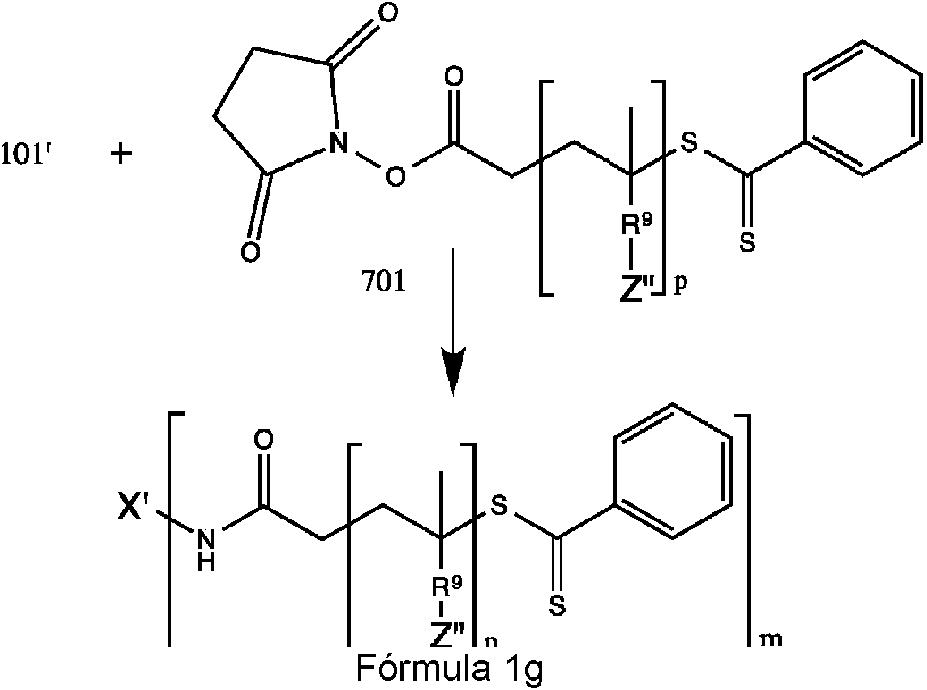
Como se ilustra en el Esquema de Reacción 7, un antígeno, anticuerpo, fragmento de anticuerpo o ligando que tiene grupo o grupos amino nativos libres de superficie de Fórmula 101'se pone en contacto con un exceso (correspondiente al valor de m) de un éster de poli(etilenglicol) del éster de NHS de Fórmula 701 para producir el producto correspondiente de acuerdo con la Fórmula 1g.As illustrated in Reaction Scheme 7, an antigen, antibody, antibody fragment or ligand having surface free native amino group (s) of Formula 101 'is contacted with an excess (corresponding to the value of m) of a poly (ethylene glycol) ester of the NHS ester of Formula 701 to produce the corresponding product according to Formula 1g.
Las composiciones correspondientes a la Fórmula 1g se pueden nombrar como sigue:Compositions corresponding to Formula 1g can be named as follows:
"Fig-X'-mm-pp-2NAcGAL" o "Fig-X'-mm-pp-EtAcN-Z" "Fig-X'-mm-pp-2NAcGAL" or "Fig-X'-mm-pp-EtAcN-Z"
Esquema de Reacción 8Reaction Scheme 8

Como se ilustra en el Esquema de Reacción 8, Etapa 1, un antígeno, anticuerpo, fragmento de anticuerpo o ligando que tiene grupo o grupos amino nativos libres de superficie de Fórmula 101'se pone en contacto con un exceso (correspondiente al valor de m) de un enlazador reactivo con amina para la química Click de Fórmula 801 para producir el producto correspondiente de acuerdo con la Fórmula 802.As illustrated in Reaction Scheme 8, Step 1, an antigen, antibody, antibody fragment or ligand having surface free native amino group (s) of Formula 101 'is contacted with an excess (corresponding to the value of m ) of an amine reactive linker for Click chemistry of Formula 801 to produce the corresponding product according to Formula 802.
En el Esquema de Reacción 8, Etapa 2, el producto de Fórmula 802 se pone en contacto con una cantidad equivalente (de nuevo correspondiente al valor de m) de un polímero de galactos(amina) de Fórmula 803 para producir el producto isomérico correspondiente de acuerdo con la Fórmula 1h. Los dos isómeros, ilustrados anteriormente, resultan de la ciclación inespecífica de la azida de Fórmula 803 con el triple enlace de Fórmula 802. Dicha ciclación inespecífica ocurre en la síntesis de otras composiciones en las que Y se selecciona de las Fórmulas Yh a Yn, pero no se ilustrará en cada caso.In Reaction Scheme 8, Step 2, the product of Formula 802 is contacted with an equivalent amount (again corresponding to the value of m) of a galactos polymer (amine) of Formula 803 to produce the corresponding isomeric product of according to Formula 1h. The two isomers, illustrated above, result from the nonspecific cyclization of the azide of Formula 803 with the triple bond of Formula 802. Said nonspecific cyclization occurs in the synthesis of other compositions in which Y is selected from Formulas Yh to Yn, but it will not be illustrated in every case.
Las composiciones correspondientes a la Fórmula 1h se pueden nombrar como sigue:The compositions corresponding to Formula 1h can be named as follows:
"F1h-X'-mm-nn-pp-qq-2NAcGAL" o "F1h-X'-mm-nn-pp-qq-EtAcN-Z". "F1h-X'-mm-nn-pp-qq-2NAcGAL" or "F1h-X'-mm-nn-pp-qq-EtAcN-Z".
Esquema de Reacción 9Reaction Scheme 9

Como se ilustra en el Esquema de Reacción 9, Etapa 1, un antígeno, anticuerpo, fragmento de anticuerpo o ligando que tiene grupo o grupos tiol nativos libres de superficie de Fórmula 101 "se pone en contacto con un exceso (correspondiente al valor de m) de un enlazador reactivo con tiol para la química Click de Fórmula 901 para producir el producto correspondiente de acuerdo con la Fórmula 902".As illustrated in Reaction Scheme 9, Step 1, an antigen, antibody, antibody fragment or ligand having surface free native thiol group (s) of Formula 101 "is contacted with an excess (corresponding to the value of m ) of a thiol-reactive linker for Click chemistry of Formula 901 to produce the corresponding product according to Formula 902 ".
En el Esquema de Reacción 9, Etapa 2, el producto de Fórmula 902"se pone en contacto con una cantidad equivalente (de nuevo correspondiente al valor de m) de un polímero de galactos(amina) de Fórmula 803 para producir el producto isomérico correspondiente de acuerdo con a la Fórmula 1i.In Reaction Scheme 9, Step 2, the product of Formula 902 "is contacted with an equivalent amount (again corresponding to the value of m) of a galactos polymer (amine) of Formula 803 to produce the corresponding isomeric product. in accordance with Formula 1i.
Las composiciones correspondientes a la Fórmula 1i se pueden nombrar como sigue:The compositions corresponding to Formula 1i can be named as follows:
"F1i-X'-mm-nn-pp-qq-2NAcGAL" o ,,F1i-X'-mm-nn-pp-qq-EtAcN-Z"."F1i-X'-mm-nn-pp-qq-2NAcGAL" or ,, F1i-X'-mm-nn-pp-qq-EtAcN-Z ".
Siguiendo los procedimientos descritos con respecto al Esquema de Reacción 9, pero sustituyendo el material de partida 101"con un compuesto de Fórmula 103'(derivatizado con el reactivo de Traut) se obtiene el correspondiente producto isomérico de Fórmula 1j como se muestra a continuación. Following the procedures described with respect to Reaction Scheme 9, but substituting the starting material 101 "with a compound of Formula 103 '(derivatized with Traut's reagent) the corresponding isomeric product of Formula 1j is obtained as shown below.

Las composiciones correspondientes a la Fórmula 1j se pueden nombrar de la siguiente manera:The compositions corresponding to Formula 1j can be named as follows:
"F1j-X'-mm-nn-Pp-qq-2NAcGAL" o "F1j-X'-mm-nn-pp-qq-EtAcN-Z"."F1j-X'-mm-nn-Pp-qq-2NAcGAL" or "F1j-X'-mm-nn-pp-qq-EtAcN-Z".
Esquema de Reacción 10Reaction Scheme 10

Fórmula 1kFormula 1k
Como se ilustra en el Esquema de Reacción 10, Etapa 1, un antígeno, anticuerpo, fragmento de anticuerpo o ligando que tiene grupo o grupos tiol nativos libres de superficie de Fórmula 101 "se pone en contacto con un exceso (correspondiente al valor de m) de un enlazador reactivo con tiol para la química Click de Fórmula 1001 para producir el producto correspondiente de acuerdo con la Fórmula 1002.As illustrated in Reaction Scheme 10, Step 1, an antigen, antibody, antibody fragment or ligand having surface free native thiol group or groups of Formula 101 "is contacted with an excess (corresponding to the value of m ) of a thiol-reactive linker for Click chemistry of Formula 1001 to produce the corresponding product according to Formula 1002.
En el Esquema de Reacción 10, Etapa 2, el producto de Fórmula 1002 se pone en contacto con una cantidad equivalente (de nuevo correspondiente al valor de m) de un polímero de galactos(amina) de Fórmula 803 para producir el producto isomérico correspondiente de acuerdo con la Fórmula 1k.In Reaction Scheme 10, Step 2, the product of Formula 1002 is contacted with an equivalent amount (again corresponding to the value of m) of a galactos polymer (amine) of Formula 803 to produce the corresponding isomeric product of according to Formula 1k.
Las composiciones correspondientes a la Fórmula 1k se pueden nombrar como sigue:Compositions corresponding to Formula 1k can be named as follows:
"F1k-X'-mm-nn-pp-qq-2NAcGAL" o "F1k-X'-mm-nn-pp-qq-EtAcN-Z". "F1k-X'-mm-nn-pp-qq-2NAcGAL" or "F1k-X'-mm-nn-pp-qq-EtAcN-Z".
Siguiendo los procedimientos descritos con respecto al Esquema de Reacción 10, pero sustituyendo el material de partida 101"con un compuesto de Fórmula 103'(derivatizado con el reactivo de Traut) se obtiene el correspondiente producto isomérico de Fórmula 1L como se muestra a continuación.Following the procedures described with respect to Reaction Scheme 10, but substituting the starting material 101 "with a compound of Formula 103 '(derivatized with Traut's reagent) the corresponding isomeric product of Formula 1L is obtained as shown below.
Fórmula
Las composiciones correspondientes a la Fórmula 1L se pueden nombrar de la siguiente manera:Compositions corresponding to Formula 1L can be named as follows:
"F1L-X-mm-nn-pp-qq-2NAcGAL" o "F1L-X'-mm-nn-pp-qq-EtAcN-Z"."F1L-X-mm-nn-pp-qq-2NAcGAL" or "F1L-X'-mm-nn-pp-qq-EtAcN-Z".
Esquema de Reacción 11 Reaction Scheme 11


Como se ilustra en el Esquema de Reacción 11, Etapa 1, galactosa, galactosamina protegida o N-acetil-D-galactosamina (Fórmula 1101 en la que R3 y R4 son OH, R3 es un grupo protector de NH (por ejemplo, ciclado con R4) o R3 es NHAc y R4 es OH, respectivamente) se pone en contacto con 2-cloroetan-1-ol seguido de enfriamiento y la adición gota a gota de cloruro de acetilo. La solución se calienta a temperatura ambiente y luego se calienta a 70 °C durante varias horas. Se añade etanol al producto crudo y la solución resultante se agita en presencia de carbono y luego se filtra seguido de la eliminación del disolvente para producir el producto correspondiente de Fórmula 1102. Como se ilustra en el Esquema de Reacción 11, Etapa 2, el producto de Fórmula 1102 se agrega a un exceso de azida de sodio y se calienta a 90 °C durante varias horas, luego se filtra seguido de la eliminación del solvente para producir el producto correspondiente de Fórmula 1103.As illustrated in Reaction Scheme 11, Step 1, galactose, protected galactosamine, or N-acetyl-D-galactosamine (Formula 1101 where R3 and R4 are OH, R3 is an NH protecting group (e.g. cyclized with R4) or R3 is NHAc and R4 is OH, respectively) is contacted with 2-chloroethane-1-ol followed by cooling and the dropwise addition of acetyl chloride. The solution is warmed to room temperature and then heated to 70 ° C for several hours. Ethanol is added to the crude product and the resulting solution is stirred in the presence of carbon and then filtered followed by removal of the solvent to yield the corresponding product of Formula 1102. As illustrated in Reaction Scheme 11, Step 2, the product Formula 1102 is added to excess sodium azide and heated at 90 ° C for several hours, then filtered followed by removal of the solvent to produce the corresponding product of Formula 1103.
Como se ilustra en el Esquema de Reacción 11, Etapa 3, el producto de Fórmula 1103 se agrega a una solución de paladio sobre carbono y etanol, y se agita bajo gas hidrógeno (3 atm) durante varias horas, luego se filtra seguido de eliminación del solvente para producir el producto correspondiente de Fórmula 1104.As illustrated in Reaction Scheme 11, Step 3, the product of Formula 1103 is added to a solution of palladium on carbon and ethanol, and stirred under hydrogen gas (3 atm) for several hours, then filtered followed by removal. of the solvent to produce the corresponding product of Formula 1104.
Como se ilustra en el Esquema de Reacción 11, Etapa 4, el producto de Fórmula 1104 se agrega a una solución de anhídrido de metacrilato. Se añade trietilamina y la reacción se agita durante 2 horas seguido de la eliminación del disolvente y el aislamiento para producir el producto correspondiente de Fórmula 1105.As illustrated in Reaction Scheme 11, Step 4, the product of Formula 1104 is added to a solution of methacrylate anhydride. Triethylamine is added and the reaction is stirred for 2 hours followed by removal of the solvent and isolation to yield the corresponding product of Formula 1105.
Como se ilustra en el Esquema de Reacción 11, Etapa 5, se agrega un agente uRAFT modificado con azida (Fórmula 1106) a una solución del producto de Fórmula 1105 con azobisisobutironitrilo, se somete a 4 ciclos de descongelación de bomba libre y luego se agita a 70 °C. Después de varias horas, se precipita el correspondiente producto polimérico de Fórmula 1107 mediante la adición de un alcanol inferior seguido de la eliminación del disolvente. Cuando R3 es un grupo protector de NH (por ejemplo, ciclado con R4), el grupo o grupos protectores se eliminan en este punto.As illustrated in Reaction Scheme 11, Step 5, an azide modified uRAFT agent (Formula 1106) is added to a solution of the product of Formula 1105 with azobisisobutyronitrile, subjected to 4 free pump thaw cycles and then stirred at 70 ° C. After several hours, the corresponding polymeric product of Formula 1107 is precipitated by the addition of a lower alkanol followed by removal of the solvent. When R3 is an NH protecting group (eg, cyclized with R4), the protecting group (s) are removed at this point.
Como se ilustra en el Esquema de Reacción 11, Etapa 6, se añade un antígeno, anticuerpo, fragmento de anticuerpo o ligando que tiene grupo o grupos amino nativos libres de superficie de Fórmula 101'a un tampón de pH 8,0 y se pone en contacto con un exceso (correspondiente al valor de m) de una dioxopirrolidina de Fórmula 1108 con agitación. Después de 1 hora, se elimina la Fórmula 1108 sin reaccionar y el producto resultante de Fórmula 1109 se usa sin purificación adicional.As illustrated in Reaction Scheme 11, Step 6, an antigen, antibody, antibody fragment or ligand having free surface native amino group (s) of Formula 101 'is added to a pH buffer. 8.0 and contacted with an excess (corresponding to the value of m) of a dioxopyrrolidine of Formula 1108 with stirring. After 1 hour, unreacted Formula 1108 is removed and the resulting Formula 1109 product is used without further purification.
Como se ilustra en el Esquema de Reacción 11, Etapa 7, el producto de Fórmula 1107 se agrega a un tampón de pH 8.0, al cual se agrega el producto de Fórmula 1109. Después de agitar durante 2 horas, el exceso de Fórmula 1107 se elimina para producir el correspondiente producto isomérico de Fórmula 1m.As illustrated in Reaction Scheme 11, Step 7, the product of Formula 1107 is added to a buffer of pH 8.0, to which is added the product of Formula 1109. After stirring for 2 hours, the excess of Formula 1107 is removes to produce the corresponding isomeric product of Formula 1m.
Sustituyendo N-(2,4,5-trihidroxi-6-(hidroximetil)tetrahidro-2H-piran-3-il)metacrilamida por el producto de Fórmula 1105 en la Etapa 5 y continuando con las Etapas 6 y 7, se obtiene el correspondiente producto isomérico de Fórmula 1m en la que Z"es N-acetilgalactosamina conjugada en C2.Substituting N- (2,4,5-trihydroxy-6- (hydroxymethyl) tetrahydro-2H-pyran-3-yl) methacrylamide for the product of Formula 1105 in Step 5 and continuing with Steps 6 and 7, the corresponding isomeric product of Formula 1m wherein Z "is C2-conjugated N-acetylgalactosamine.
Las composiciones correspondientes a la Fórmula 1m pueden nombrarse de la siguiente manera:Compositions corresponding to Formula 1m can be named as follows:
"F1m-X'-mm-nn-pp-qq-EtAcN-Z" en la que Z"es 1GAL, 1NGAL o 1NAcGAL, o"F1m-X'-mm-nn-pp-qq-EtAcN-Z" where Z "is 1GAL, 1NGAL or 1NAcGAL, or
"F1m-X'-mm-nn-pp-qq-2NAcGAL"."F1m-X'-mm-nn-pp-qq-2NAcGAL".
Esquema de Reacción 12Reaction Scheme 12

El enfoque se síntesis del Esquema de Reacción 12 es particularmente adecuado para antígenos, anticuerpos, fragmentos de anticuerpos y ligandos hidrófobos (por ejemplo, insulina) debido al uso de disolventes orgánicos. Como se ilustra en el Esquema de Reacción 12, Etapa 1, un antígeno, anticuerpo, fragmento de anticuerpo o ligando que tiene grupo o grupos amino nativos libres de superficie de Fórmula 101'se disuelve en un disolvente orgánico (por ejemplo, DMF) que contiene trietilamina. A esto se le añade una cantidad (correspondiente al valor de m) de un compuesto de Fórmula 1201 seguido de agitación y la adición de t-butilmetil éter. El producto correspondiente de Fórmula 1202 se recupera como un precipitado. The synthesis approach of Reaction Scheme 12 is particularly suitable for antigens, antibodies, antibody fragments, and hydrophobic ligands (eg, insulin) due to the use of organic solvents. As illustrated in Reaction Scheme 12, Step 1, an antigen, antibody, antibody fragment, or ligand having surface free native amino group (s) of Formula 101 'is dissolved in an organic solvent (e.g., DMF) that contains triethylamine. To this is added an amount (corresponding to the value of m) of a compound of Formula 1201 followed by stirring and the addition of t-butylmethyl ether. The corresponding product of Formula 1202 is recovered as a precipitate.
El producto de Fórmula 1202 se resuspende en el disolvente orgánico y se añade una cantidad (correspondiente al valor de m) de Fórmula 1107 (obtenida, por ejemplo, como se describe con referencia al Esquema de Reacción 11) seguido de agitación. El producto de reacción se precipita mediante la adición de diclorometano, seguido de filtración y eliminación del disolvente. La purificación (por ejemplo, resuspensión en PBS seguida de cromatografía centrífuga de exclusión por tamaño produce el producto isomérico correspondiente de Fórmula 1n.The product of Formula 1202 is resuspended in the organic solvent and an amount (corresponding to the value of m) of Formula 1107 (obtained, for example, as described with reference to Reaction Scheme 11) is added followed by stirring. The reaction product is precipitated by adding dichloromethane, followed by filtration and removal of the solvent. Purification (eg, resuspension in PBS followed by centrifugal size exclusion chromatography produces the corresponding isomeric product of Formula 1n.
Las composiciones correspondientes a la Fórmula 1n se pueden nombrar como sigue:The compositions corresponding to Formula 1n can be named as follows:
"F1n-X'-mm-nn-pp-qq-EtAcN-Z" en la que Z"es 1GAL, 1NGAL o 1NAcGAL, o"F1n-X'-mm-nn-pp-qq-EtAcN-Z" where Z "is 1GAL, 1NGAL or 1NAcGAL, or
"F1m-X'-nm-nn-pp-qq-2NAcGAL"."F1m-X'-nm-nn-pp-qq-2NAcGAL".
Esquema de Reacción 13Reaction Scheme 13

En el Esquema de Reacción 13, Etapa 1, se pone en contacto un éster de nitrofenoxicarbonil-oxialquil-di-tiol-poli (etilenglicol)-NHS (Fórmula 1301) con galactosa, galactosamina o N-acetilgalactosamina (Fórmula 105) para obtener el producto correspondiente de Fórmula 1302, junto con los otros dos productos ilustrados, a partir de los cuales se aísla el nitrofenoxicarbonil-di-tiol-poli(etilenglicol)-carboxietil galactosa, galactosamina o N-acetilgalactosamina deseada de Fórmula 1302 antes de pasar ala siguiente etapa.In Reaction Scheme 13, Step 1, a nitrophenoxycarbonyl-oxyalkyl-di-thiol-poly (ethylene glycol) -NHS ester (Formula 1301) is contacted with galactose, galactosamine or N-acetylgalactosamine (Formula 105) to obtain the Corresponding product of Formula 1302, together with the other two illustrated products, from which the desired nitrophenoxycarbonyl-di-thiol-poly (ethylene glycol) -carboxyethyl galactose, galactosamine or N-acetylgalactosamine of Formula 1302 is isolated before moving on to the next stage.
Como se ilustra en el Esquema de Reacción 13, Etapa 2, un antígeno, anticuerpo, fragmento de anticuerpo o ligando que tiene grupo o grupos amino nativos libres de superficie de Fórmula 101'se pone en contacto con un exceso (correspondiente al valor de m) del producto de Fórmula 1302 para producir el producto correspondiente de acuerdo con la Fórmula 1o.As illustrated in Reaction Scheme 13, Step 2, an antigen, antibody, antibody fragment or ligand having surface free native amino group (s) of Formula 101 'is contacted with an excess (corresponding to the value of m ) of the product of Formula 1302 to produce the corresponding product according to Formula 1o.
Las composiciones correspondientes a la Fórmula 1o pueden nombrarse de la siguiente manera:The compositions corresponding to Formula 1o can be named as follows:
"F1o-X'-mm-nn-Z'" "F1o-X'-mm-nn-Z '"
Esquema de Reacción 14Reaction Scheme 14
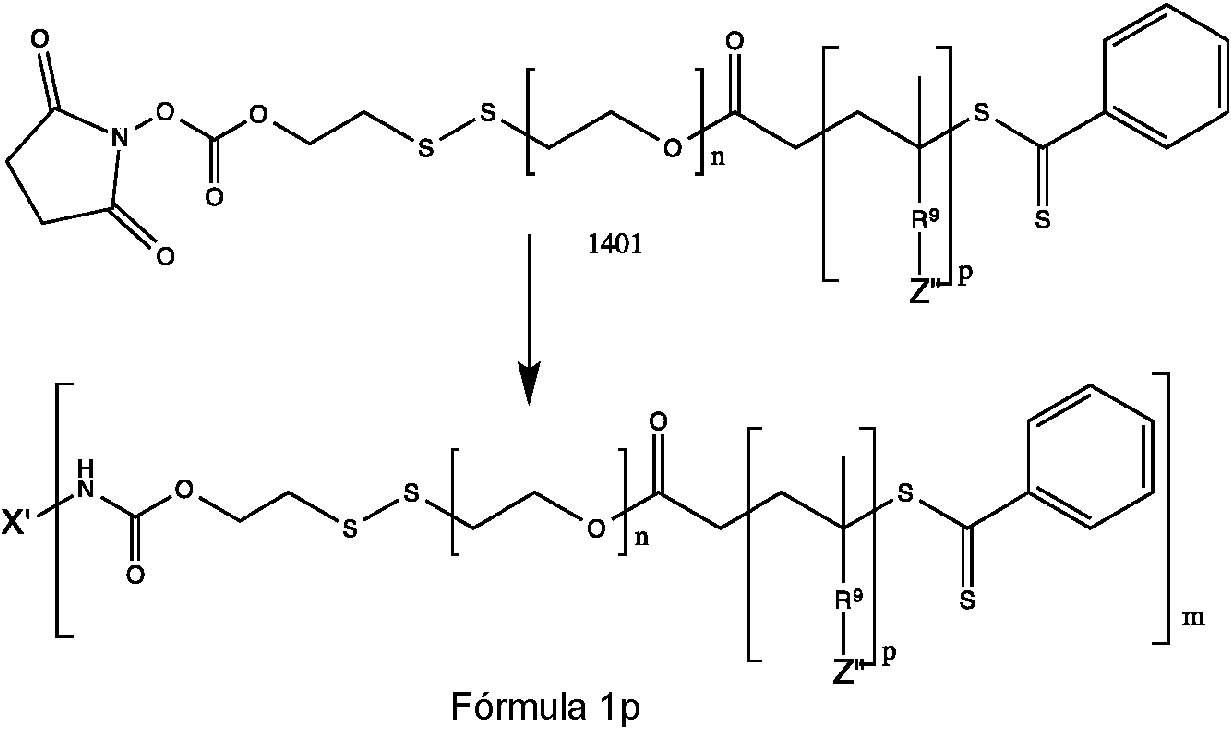
Como se ilustra en el Esquema de Reacción 14, un antígeno, anticuerpo, fragmento de anticuerpo o ligando que tiene grupo o grupos amino nativos libres de superficie (Fórmula 101') se pone en contacto con un exceso (correspondiente al valor de m) de un éster de piridil-di-tiol-poli(etilenglicol)-NHS de Fórmula 1401 para producir el producto correspondiente de acuerdo con la Fórmula 1p.As illustrated in Reaction Scheme 14, an antigen, antibody, antibody fragment or ligand having surface free native amino group (s) (Formula 101 ') is contacted with an excess (corresponding to the value of m) of a pyridyl-di-thiol-poly (ethylene glycol) -NHS ester of Formula 1401 to produce the corresponding product according to Formula 1p.
Las composiciones correspondientes a la Fórmula 1p se pueden nombrar como sigue:Compositions corresponding to Formula 1p can be named as follows:
"F1p-X'-mm-nn-pp-2NAcGAL" o "F1p-X'-mm-nn-pp-EtAcN-Z"."F1p-X'-mm-nn-pp-2NAcGAL" or "F1p-X'-mm-nn-pp-EtAcN-Z".
Preparación de proteínas de fusiónFusion protein preparation
Las composiciones de proteína de fusión de Fórmula 2 se pueden expresar mediante metodología aceptada en la técnica usando vectores de expresión de células de insectos, levaduras, bacterias o mamíferos disponibles comercialmente, y secuencias de genes publicadas, descubiertas o modificadas por ingeniería genética. Las secuencias que codifican X, Y y Z junto con secuencias de etiqueta pueden clonarse en un vector de expresión, por ejemplo, en el vector de expresión de mamífero pSecTag A, en el que la proteína de fusión se inserta en el terminal C a la secuencia guía de secreción de la cadena k de Ig. Se pueden emplear varias otras técnicas de clonación, que incluyen mutagénesis dirigida al sitio y variaciones del protocolo QuikChange (Geiser, et al.), y son conocidas por los expertos en la técnica. Las proteínas de fusión se pueden expresar transitoriamente en células de mamíferos [por ejemplo, en células de riñón embrionario humano (HEK293) o células de ovario de hámster chino (CHO)] mediante transfección transitoria con los vectores descritos anteriormente usando polietilenimina. Las células transfectadas se cultivan en un medio adecuado (por ejemplo, medio FreeStyle 293, Life Technologies) suplementado, por ejemplo, con ácido valproico o DMSO durante aproximadamente 7 días, después de lo cual las células se eliminan por centrifugación y los sobrenadantes del cultivo se recogen y esterilizan mediante filtración.The fusion protein compositions of Formula 2 can be expressed by art-accepted methodology using commercially available insect, yeast, bacterial, or mammalian cell expression vectors, and published, discovered, or engineered gene sequences. Sequences encoding X, Y and Z together with tag sequences can be cloned into an expression vector, for example, into the mammalian expression vector pSecTag A, in which the fusion protein is inserted at the C terminal to the Ig k chain secretion guide sequence. Various other cloning techniques can be employed, including site-directed mutagenesis and variations of the QuikChange protocol (Geiser, et al.), And are known to those of skill in the art. Fusion proteins can be transiently expressed in mammalian cells [eg, human embryonic kidney cells (HEK293) or Chinese hamster ovary (CHO) cells] by transient transfection with the vectors described above using polyethyleneimine. The transfected cells are cultured in a suitable medium (eg, FreeStyle 293 medium, Life Technologies) supplemented, eg, with valproic acid or DMSO for approximately 7 days, after which the cells are removed by centrifugation and the culture supernatants they are collected and sterilized by filtration.
Alternativamente, las proteínas de fusión se pueden expresar de forma estable creando líneas de células de mamífero transfectadas de forma estable. Además, los vectores de expresión se pueden utilizar para producir proteínas de fusión en bacterias, tales como Escherichia coli, Corynebacterium o Pseudomonas fluorescens mediante el uso de medios compatibles (por ejemplo, LB, 2XYT, SOB, SOC, TB y otros caldos), suplementos con (por ejemplo, glicerol, glucosa, y otros suplementos), y condiciones adecuadas de crecimiento y expresión. Los sistemas de expresión en levadura pueden utilizar comúnmente Saccharomyces cerevisiae y Pichia pastoris, u otros organismos de los géneros Saccharomyces, Pichia, Kluyveromyces y Yarrowia, y organismos menos utilizados como los hongos filamentosos Aspergillus, Trichoderma o Myceliophthora thermophila C1. Los sistemas de expresión de insectos pueden utilizar células de insectos infectadas con baculovirus o expresión de células de insectos no líticas para lograr niveles de expresión de proteínas en cantidades elevadas; las células de insectos más comunes incluyen, pero no se limitan a, Sf9 y Sf21 (de Spodoptera frugiperda), Hi-5 (de Trichoplusia ni) y Schneider 2 y 3 (de Drosophila melanogaster). Alternatively, fusion proteins can be stably expressed by creating stably transfected mammalian cell lines. Additionally, expression vectors can be used to produce fusion proteins in bacteria, such as Escherichia coli, Corynebacterium, or Pseudomonas fluorescens by using compatible media (eg, LB, 2XYT, SOB, SOC, TB, and other broths), supplements with (eg, glycerol, glucose, and other supplements), and suitable conditions for growth and expression. Yeast expression systems can commonly use Saccharomyces cerevisiae and Pichia pastoris , or other organisms of the genera Saccharomyces, Pichia, Kluyveromyces, and Yarrowia, and less commonly used organisms such as the filamentous fungi Aspergillus, Trichoderma, or Myceliophthora thermophila C1. Insect expression systems can utilize baculovirus-infected insect cells or non-lytic insect cell expression to achieve high levels of protein expression; the most common insect cells include, but are not limited to, Sf9 and Sf21 (from Spodoptera frugiperda), Hi-5 (from Trichoplusia ni), and Schneider 2 and 3 (from Drosophila melanogaster).
Los productos de proteína de fusión expresados se pueden purificar a partir de los sobrenadantes del cultivo mediante cromatografía de afinidad (por ejemplo, usando una columna de sefarosa HisTrap Ni2+, GE Healthcare, para una proteína de fusión marcada con His), seguida de otras etapas de pulido cromatográfico tales como cromatografía de exclusión por tamaño (por ejemplo, usando una columna Superdex 75, GE Healthcare) o cromatografía de intercambio iónico. La pureza de la proteína puede verificarse, por ejemplo, mediante tinción con azul brillante de Coomassie de geles SDS-PAGE y transferencia Western (por ejemplo, transferencia Western anti etiqueta 6xHis para una proteína de fusión etiquetada con His). La concentración de proteína se puede determinar usando la Ley de Beer-Lambert, para la cual se puede medir la absorbancia a 280 nm, por ejemplo, usando un NanoDrop 2000 (Thermo Scientific). El peso molecular y el coeficiente de extinción se pueden estimar a partir de la secuencia de aminoácidos de la proteína, por ejemplo, utilizando la herramienta ExPASy ProtParam. Los niveles de endotoxinas se pueden medir, por ejemplo, utilizando la línea celular indicadora HEK-Blue TLR4 (Invivogen) de acuerdo con las instrucciones del fabricante.Expressed fusion protein products can be purified from culture supernatants by affinity chromatography (e.g., using a HisTrap Ni2 + sepharose column, GE Healthcare, for a His-tagged fusion protein), followed by other steps chromatographic polishing such as size exclusion chromatography (eg, using a Superdex 75 column, GE Healthcare) or ion exchange chromatography. Protein purity can be verified, for example, by Coomassie brilliant blue staining of SDS-PAGE gels and Western blotting (eg, anti-6xHis tag Western blot for a His-tagged fusion protein). Protein concentration can be determined using Beer-Lambert's Law, for which absorbance at 280 nm can be measured, for example, using a NanoDrop 2000 (Thermo Scientific). The molecular weight and the extinction coefficient can be estimated from the amino acid sequence of the protein, for example, using the ExPASy ProtParam tool. Endotoxin levels can be measured, for example, using the HEK-Blue TLR4 reporter cell line (Invivogen) according to the manufacturer's instructions.
Preparación de antígenos, anticuerpos, fragmentos de anticuerpos y ligandos desialiladosPreparation of antigens, antibodies, antibody fragments and desialylated ligands
Las proteínas desialiladas se pueden producir mediante una metodología aceptada en la técnica usando enzima neuraminidasa (también conocida como acetil-neuraminil hidrolasa o sialidasa) o ácido sulfúrico disponibles comercialmente. Para la desialilación enzimática de una proteína de interés, la proteína se puede incubar junto con neuraminidasa a 37 °C durante 1 hora, o más si es necesario. Para la desialilación química mediante hidrólisis ácida, una proteína de interés se puede tratar con ácido sulfúrico 0,025 N a 80 °C durante 1 hora, o más si es necesario. La proteína desialilada puede luego purificarse a partir de la mezcla de reacción mediante cromatografía de afinidad de iones metálicos inmovilizados (por ejemplo, usando una columna de sefarosa HisTrap Ni2+, GE Healthcare), seguida de cromatografía de exclusión por tamaño (por ejemplo, usando una columna Superdex 75, GE Healthcare). La pureza de la proteína puede verificarse, por ejemplo, mediante tinción con azul brillante de Coomassie de geles SDS-PAGE y transferencia Western anti-etiqueta 6xHis. La desialilación se puede verificar, por ejemplo, mediante la detección con base en lectina del contenido de ácido siálico proteico en transferencias Western o la cuantificación colorimétrica del contenido de ácido siálico utilizando kits disponibles comercialmente (por ejemplo, Abcam, ProZyme o Sigma). La concentración de proteína desialilada se puede determinar usando la Ley de Beer-Lambert, para la cual se puede medir la absorbancia a 280 nm, por ejemplo, usando un NanoDrop 2000 (Thermo Scientific). El peso molecular y el coeficiente de extinción se pueden estimar a partir de la secuencia de aminoácidos de la proteína, por ejemplo, utilizando la herramienta ExPASy ProtParam. Los niveles de endotoxinas se pueden medir, por ejemplo, utilizando la línea celular indicadora HEK-Blue TLR4 (Invivogen) de acuerdo con las instrucciones del fabricante.Desialylated proteins can be produced by art accepted methodology using commercially available neuraminidase enzyme (also known as acetyl neuraminyl hydrolase or sialidase) or sulfuric acid. For enzymatic desialylation of a protein of interest, the protein can be incubated together with neuraminidase at 37 ° C for 1 hour, or longer if necessary. For chemical desialylation by acid hydrolysis, a protein of interest can be treated with 0.025 N sulfuric acid at 80 ° C for 1 hour, or longer if necessary. The desialylated protein can then be purified from the reaction mixture by immobilized metal ion affinity chromatography (for example, using a HisTrap Ni2 + sepharose column, GE Healthcare), followed by size exclusion chromatography (for example, using a Superdex column 75, GE Healthcare). Protein purity can be verified, for example, by Coomassie brilliant blue staining of SDS-PAGE gels and 6xHis anti-tag Western blotting. Desialylation can be verified, for example, by lectin-based detection of protein sialic acid content on Western blots or colorimetric quantification of sialic acid content using commercially available kits (eg, Abcam, ProZyme, or Sigma). The concentration of desialylated protein can be determined using Beer-Lambert's Law, for which absorbance at 280 nm can be measured, for example, using a NanoDrop 2000 (Thermo Scientific). The molecular weight and extinction coefficient can be estimated from the amino acid sequence of the protein, for example, using the ExPASy ProtParam tool. Endotoxin levels can be measured, for example, using the HEK-Blue TLR4 reporter cell line (Invivogen) according to the manufacturer's instructions.
Procesos particulares y últimas etapasParticular processes and last stages
Se pone en contacto un compuesto de Fórmula 103'con un exceso (correspondiente al valor de m) de un compuesto de Fórmula 106 para obtener el producto correspondiente de Fórmula 1a.A compound of Formula 103 'is contacted with an excess (corresponding to the value of m) of a compound of Formula 106 to obtain the corresponding product of Formula 1a.
Se pone en contacto un compuesto de Fórmula 103'con un exceso (correspondiente al valor de m) de un compuesto de Fórmula 201 para obtener el producto correspondiente de Fórmula 1 b.A compound of Formula 103 'is contacted with an excess (corresponding to the value of m) of a compound of Formula 201 to obtain the corresponding product of Formula 1 b.
Se pone en contacto un compuesto de Fórmula 802, 902 o 1002 con un exceso (correspondiente al valor de m) de un compuesto de Fórmula 803 para obtener el producto correspondiente de Fórmula 1h, Fórmula 1i o Fórmula 1k, respectivamente.A compound of Formula 802, 902 or 1002 is contacted with an excess (corresponding to the value of m) of a compound of Formula 803 to obtain the corresponding product of Formula 1h, Formula 1i or Formula 1k, respectively.
Se pone en contacto un compuesto de Fórmula 1109 con un exceso (correspondiente al valor de m) de un compuesto de Fórmula 1107 para obtener el correspondiente producto de Fórmula 1m, particularmente cuando n es aproximadamente 80, p es aproximadamente 30, q es aproximadamente 4, y m que es una función del antígeno es aproximadamente 2 a 10.A compound of Formula 1109 is contacted with an excess (corresponding to the value of m) of a compound of Formula 1107 to obtain the corresponding product of Formula 1m, particularly when n is about 80, p is about 30, q is about 4 , and m which is a function of the antigen is approximately 2 to 10.
Se pone en contacto un compuesto de Fórmula 1202 con un exceso (correspondiente al valor de m) de un compuesto de Fórmula 1107 para obtener el producto correspondiente de Fórmula 1n, particularmente cuando n es aproximadamente 1, p es aproximadamente 30, q es aproximadamente 4, y m que es una función del antígeno es aproximadamente 2 a 10.A compound of Formula 1202 is contacted with an excess (corresponding to the value of m) of a compound of Formula 1107 to obtain the corresponding product of Formula 1n, particularly when n is about 1, p is about 30, q is about 4 , and m which is a function of the antigen is approximately 2 to 10.
Composiciones particulares para usoParticular compositions for use
A modo de ejemplo no limitativo, un grupo particular preferido para las composiciones y formulaciones farmacéuticas para uso en la tolerancia de un paciente de la presente invención son las siguientes combinaciones y permutaciones de grupos sustituyentes de Fórmula 1 (subagrupados, respectivamente, en orden creciente de preferencia):By way of non-limiting example, a particular preferred group for pharmaceutical compositions and formulations for use in the tolerance of a patient of the present invention are the following combinations and permutations of substituent groups of Formula 1 (sub-grouped, respectively, in increasing order of preference):
• X es un antígeno de trasplante extraño contra el cual los receptores de trasplante desarrollan una respuesta inmune, un antígeno extraño al que los pacientes desarrollan una respuesta inmune, una proteína terapéutica a la que los pacientes desarrollan una respuesta inmune, un antígeno propio al que los pacientes desarrollan una respuesta inmune.• X is a foreign transplant antigen against which transplant recipients develop an immune response, a foreign antigen to which patients develop an immune response, a therapeutic protein to which patients develop an immune response, a self antigen to which patients develop an immune response.
• X es una proteína terapéutica a la que los pacientes desarrollan una respuesta inmune seleccionada entre: Abatacept, Abciximab, Adalimumab, Adenosina desaminasa, Ado-trastuzumab emtansina, Agalsidasa alfa, Agalsidasa beta, Aldeslukina, Alglucerasa, Alglucosidasa alfa, inhibidor de a-1-proteinasa, Anakinra, Anistreplasa (complejo activador de estreptoquinasa plasminógeno anisoilado), Antitrombina III, Globulina antitimocitos, Ateplasa, Bevacizumab, Bivalirudina, Toxina botulínica tipo A, Toxina botulínica tipo B, Inhibidor de la esterasa C1, Canakinumab, Carboxipeptidasa G2 (Glucarpidasa y Voraxaza) Certolizumab pegol, Cetuximab colagenasa, Crotalidae Inmune Fab, Darbepoetina-a, Denosumab, Digoxina Inmune Fab, Dornasa alfa, Eculizumab, Etanercept, Factor VIIa, Factor VIII, Factor IX, Factor XI, Factor XIII, Fibrinógeno, Filgrastim, Galsulfasa, Golimumab, acetato de Histrelina, Hialuronidasa, Idursulfasa, Imiglucerasa, Infliximab, Insulina (incluida la insulina rHu y la insulina bovina), Interferón-a2a, Interferón-a2b, Interferón-p1a, Interferón-p1b, interferón-y1b, ipilimumab, L-arginasa, L-asparaginasa, L-metionasa, lactasa, laronidasa, lepirudina/hirudina, mecasermina, Rinfabato de mecasermina, Metoxi ofatumumab, Natalizumab, Octreótido, Oprelvekina,Amilasa pancreática, Lipasa pancreática, Papaína, Peg-asparaginasa, Pegdoxorrubicina HCI, PEG-epoetina-p, Pegfilgrastim, Peg-Interferón-a2a, Peg-Interferón-a2b, Pegloticasa, Pegvisomant, Fenilalanina amoniaco-liasa (PAL), Proteína C, Rasburicasa (uricasa), Sacrosidasa, Calcitonina de salmón, Sargramostim, Estreptoquinasa, Tenecteplasa, Teriparatida, Tocilizumab (atlizumab), trastuzumab, Interferón alfa tipo 1, Ustekinumab y factor vW.• X is a therapeutic protein to which patients develop an immune response selected from: Abatacept, Abciximab, Adalimumab, Adenosine deaminase, Ado-trastuzumab emtansine, Agalsidase alfa, Agalsidase beta, Aldeslukina, Alglucerase, Alglucosidase alfa, a-1 inhibitor -proteinase, Anakinra, Anistreplase (anisoylated plasminogen streptokinase activator complex), Antithrombin III, Antithymocyte globulin, Ateplase, Bevacizumab, Bivalirudin, Botulinum toxin type A, Botulinum toxin type B, Canakinipeptidase C12 Inhibitor and Carboxumabidase C12 Inhibitor Voraxaza) Certolizumab pegol, Cetuximab collagenase, Crotalidae Immune Fab, Darbepoetin-a, Denosumab, Digoxin Immune Fab, Dornase alfa, Eculizumab, Etanercept, Factor VIIa, Factor VIII, Factor IX, Factor XI, Factor XIII, Fibrinogen, Filgrafasa, Galsulgrastim, Golimumab, Histrelin Acetate, Hyaluronidase, Idursulfase, Imiglucerase, Infliximab, Insulin (including rHu insulin and bovine insulin ), Interferon-a2a, Interferon-a2b, Interferon-p1a, Interferon-p1b, interferon-y1b, ipilimumab, L-arginase, L-asparaginase, L-methionase, lactase, laronidase, lepirudin / hirudin, mecasermine, rhinfabato mecasermine ofatmine , Natalizumab, Octreotide, Oprelvekina, Pancreatic Amylase, Pancreatic Lipase, Papain, Peg-asparaginase, Pegdoxorubicin HCI, PEG-epoetin-p, Pegfilgrastim, Peg-Interferon-a2a, Peg-Interferon-a2b, Peg-asparagine, Pegdoxorubicin HCI (PAL), Protein C, Rasburicase (uricase), Sacrosidase, Salmon Calcitonin, Sargramostim, Streptokinase, Tenecteplase, Teriparatide, Tocilizumab (atlizumab), trastuzumab, Interferon alfa type 1, Ustekinumab and factor vW.
° Especialmente cuando X es Abciximab, Adalimumab, Agalsidasa alfa, Agalsidasa beta, Aldeslukina, Alglucosidasa alfa, Factor VIII, Factor IX, Infliximab, L-asparaginasa, Laronidasa, Natalizumab, Octreotida, Fenilalanina amoniacoliasa (PAL), o Rasburicasa (uricasa).° Especially when X is Abciximab, Adalimumab, Agalsidase alpha, Agalsidase beta, Aldeslukina, Alglucosidase alfa, Factor VIII, Factor IX, Infliximab, L-asparaginase, Laronidase, Natalizumab, Octreotide, Phenylalanine ammoniacoliase (PAL), or Rasaburicase (uricase).
■ Particularmente cuando X es Factor VIII, Factor IX, uricasa, PAL o asparaginasa.■ Particularly when X is Factor VIII, Factor IX, uricase, PAL, or asparaginase.
• X es un polipéptido de antígeno propio seleccionado para el tratamiento de diabetes mellitus tipo 1, esclerosis múltiple pediátrica, artritis reumatoide juvenil, enfermedad celíaca o alopecia universalis.• X is a self antigen polypeptide selected for the treatment of type 1 diabetes mellitus, pediatric multiple sclerosis, juvenile rheumatoid arthritis, celiac disease, or alopecia universalis.
° Especialmente cuando X es un polipéptido de antígeno propio seleccionado para el tratamiento de diabetes mellitus tipo 1 de nueva aparición, esclerosis múltiple pediátrica o enfermedad celíaca.° Especially when X is a self antigen polypeptide selected for the treatment of new onset type 1 diabetes mellitus, pediatric multiple sclerosis or celiac disease.
• X es un antígeno extraño al que los pacientes desarrollan una respuesta inmune.• X is a foreign antigen to which patients develop an immune response.
° De cacahuete, que incluye conaraquina (Ara h1)Peanut, which includes conaraquina (Ara h1)
° De trigo, que incluye alfa-gliadina nativa de "33mer" (SEQ ID NO: 24), alfa-gliadina desamidada de "33mer" (SEQ ID NO: 25), alfa-gliadina (SEQ ID NO: 26) y Omega-gliadina (SEQ ID NO: 27).° From wheat, including native alpha-gliadin from "33mer" (SEQ ID NO: 24), deamidated alpha-gliadin from "33mer" (SEQ ID NO: 25), alpha-gliadin (SEQ ID NO: 26) and Omega -gliadin (SEQ ID NO: 27).
° De gato, que incluye Fel d 1A (UNIPROT P30438) y Albúmina de gato (UNIPROT P49064).Cat #, which includes Fel d 1A (UNIPROT P30438) and Cat Albumin (UNIPROT P49064).
° De perro, que incluye Can f 1 (UNIPROT 018873) y Albúmina de perro (UNIPROT P49822).From dog, which includes Can f 1 (UNIPROT 018873) and Dog albumin (UNIPROT P49822).
• X es un antígeno de trasplante extraño contra el cual los receptores de trasplantes desarrollan una respuesta inmune, por ejemplo una proteína de antígeno leucocitario humano.• X is a foreign transplant antigen against which transplant recipients develop an immune response, for example a human leukocyte antigen protein.
• Y es un enlazador seleccionado de: Fórmula Ya, Fórmula Yb, Fórmula Yh, Fórmula Yi, Fórmula Yk, Fórmula Ym, Fórmula Yn, Fórmula Yo y Fórmula Yp.• Y is a linker selected from: Formula Ya, Formula Yb, Formula Yh, Formula Yi, Formula Yk, Formula Ym, Formula Yn, Formula Yo, and Formula Yp.
° Especialmente cuando n es 8 a 90 ± 10%, p es 20 a 100 ± 10% y q es 3 a 20 ± 3.° Especially when n is 8 to 90 ± 10%, p is 20 to 100 ± 10% and q is 3 to 20 ± 3.
■ Particularmente cuando n es 40 a 80 ± 10%, p es 30 a 40 ± 10% y q es 4 a 12 ± 3.■ Particularly when n is 40 to 80 ± 10%, p is 30 to 40 ± 10%, and q is 4 to 12 ± 3.
° Especialmente cuando Y es de Fórmula Ya, Fórmula Yb, Fórmula Ym o Fórmula Yn.° Especially when Y is of Formula Ya, Formula Yb, Formula Ym or Formula Yn.
■ Particularmente cuando n es 8 a 90 ± 10%, p es 20 a 100 ± 10% yq es 3 a 20 ± 3.■ Particularly when n is 8 to 90 ± 10%, p is 20 to 100 ± 10%, and q is 3 to 20 ± 3.
• Más particularmente, cuando n es 40 a 80 ± 10%, p es 30 a 40 ± 10% y q es 4 a 12 ± 3.• More particularly, when n is 40 to 80 ± 10%, p is 30 to 40 ± 10% and q is 4 to 12 ± 3.
■ Particularmente cuando Z está conjugado con Y a través de un grupo etilacetamido.■ Particularly when Z is conjugated to Y through an ethylacetamido group.
• Más particularmente cuando Z está conjugado con Y en su C1.• More particularly when Z is conjugated with Y in its C1.
° Más particularmente cuandoR8es CMP.° More particularly when R8 is CMP.
• Más particularmente donde R8 es CMP.• More particularly where R8 is CMP.
■ Particularmente cuandoR8 es CMP.■ Particularly when R8 is CMP.
• Z es galactosa, galactosamina o N-acetilgalactosamina.• Z is galactose, galactosamine, or N-acetylgalactosamine.
° Especialmente cuando Z es galactosa o N-acetilgalactosamina conjugada en C1, C2 o C6.° Especially when Z is galactose or N-acetylgalactosamine conjugated to C1, C2 or C6.
■ Particularmente cuando Z es galactosa o N-acetilgalactosamina conjugada en C1 o C2.■ Particularly when Z is galactose or C1- or C2-conjugated N-acetylgalactosamine.
• Más particularmente cuando Z es N-acetilgalactosamina conjugada en C1.• More particularly when Z is C1-conjugated N-acetylgalactosamine.
Cada uno de los grupos y subgrupos descritos anteriormente se prefieren individualmente y se pueden combinar para describir aspectos preferidos adicionales de la divulgación, por ejemplo, pero no a modo de limitación, como sigue:Each of the groups and subgroups described above are individually preferred and can be combined to describe additional preferred aspects of the disclosure, for example, but not by way of limitation, as follows:
• X es un polipéptido de antígeno propio seleccionado para el tratamiento de diabetes mellitus tipo 1, esclerosis múltiple pediátrica, artritis reumatoide juvenil, enfermedad celíaca o alopecia universalis.• X is a self antigen polypeptide selected for the treatment of type 1 diabetes mellitus, pediatric multiple sclerosis, juvenile rheumatoid arthritis, celiac disease, or alopecia universalis.
° Especialmente cuando X es un polipéptido de antígeno propio seleccionado para el tratamiento de diabetes mellitus tipo 1 de nueva aparición, esclerosis múltiple pediátrica o enfermedad celíaca.° Especially when X is a self antigen polypeptide selected for the treatment of new onset type 1 diabetes mellitus, pediatric multiple sclerosis or celiac disease.
■ Particularmente cuando Y es un enlazador seleccionado de: Fórmula Ya, Fórmula Yb, Fórmula Yh, Fórmula Yi, Fórmula Yk, Fórmula Ym, Fórmula Yn, Fórmula Yo y Fórmula Yp.■ Particularly when Y is a linker selected from: Formula Ya, Formula Yb, Formula Yh, Formula Yi, Formula Yk, Formula Ym, Formula Yn, Formula Yo and Formula Yp.
• Especialmente cuando n es 8 a 90 ± 10%, p es 20 a 100 ± 10% y q es 3 a 20 ± 3.• Especially when n is 8 to 90 ± 10%, p is 20 to 100 ± 10% and q is 3 to 20 ± 3.
° Particularmente cuando n es 40 a 80 ± 10%, p es 30 a 40 ± 10% y q es 4 a 12 ± 3.° Particularly when n is 40 to 80 ± 10%, p is 30 to 40 ± 10% and q is 4 to 12 ± 3.
• Especialmente cuando Y es de Fórmula Ya, Fórmula Yb, Fórmula Ym o Fórmula Yn. • Especially when Y is of Formula Ya, Formula Yb, Formula Ym or Formula Yn.
° Particularmente cuando n es 8 a 90 ± 10%, p es 20 a 100 ± 10% yq es 3 a 20 ± 3.° Particularly when n is 8 to 90 ± 10%, p is 20 to 100 ± 10% and q is 3 to 20 ± 3.
■ Más particularmente cuando n es de 40 a 80 ± 10%, p es de 30 a 40 ± 10% y q es de 4 a 12 ± 3.■ More particularly when n is 40 to 80 ± 10%, p is 30 to 40 ± 10% and q is 4 to 12 ± 3.
• Incluso más particularmente cuando Z está conjugado con Y a través de un grupo etilacetamido.• Even more particularly when Z is conjugated to Y through an ethylacetamido group.
■ Más particularmente cuando Z está conjugado con Y a través de un grupo etilacetamido.■ More particularly when Z is conjugated to Y through an ethylacetamido group.
° Particularmente cuando Z está conjugado con Y a través de un grupo etilacetamido.° Particularly when Z is conjugated to Y through an ethylacetamido group.
• Especialmente cuando Z es galactosa, galactosamina o N-acetilgalactosamina.• Especially when Z is galactose, galactosamine or N-acetylgalactosamine.
° Particularmente cuando Z es galactosa o N-acetilgalactosamina conjugada en C1, C2 o C6.° Particularly when Z is galactose or N-acetylgalactosamine conjugated at C1, C2 or C6.
■ Más particularmente cuando Z es galactosa o N-acetilgalactosamina conjugada en C1 o C2.■ More particularly when Z is galactose or C1- or C2-conjugated N-acetylgalactosamine.
• Incluso más particularmente cuando Z es N-acetilgalactosamina conjugada en C1.• Even more particularly when Z is C1-conjugated N-acetylgalactosamine.
■ Particularmente cuando Z es galactosa, galactosamina o N-acetilgalactosamina.■ Particularly when Z is galactose, galactosamine or N-acetylgalactosamine.
• Especialmente cuando Z es galactosa o N-acetilgalactosamina conjugada en C1, C2 o C6.• Especially when Z is galactose or N-acetylgalactosamine conjugated at C1, C2 or C6.
° Particularmente cuando Z es galactosa o N-acetilgalactosamina conjugada en C1 o C2.° Particularly when Z is galactose or N-acetylgalactosamine conjugated at C1 or C2.
■ Más particularmente cuando Z es N-acetilgalactosamina conjugada en C1.■ More particularly when Z is C1-conjugated N-acetylgalactosamine.
° Especialmente cuando Y es un enlazador seleccionado de: Fórmula Ya, Fórmula Yb, Fórmula Yh, Fórmula Yi, Fórmula Yk, Fórmula Ym, Fórmula Yn, Fórmula Yo y Fórmula Yp.° Especially when Y is a linker selected from: Formula Ya, Formula Yb, Formula Yh, Formula Yi, Formula Yk, Formula Ym, Formula Yn, Formula Yo and Formula Yp.
■ Particularmente cuando n es 8 a 90 ± 10%, p es 20 a 100 ± 10% y q es 3 a 20 ± 3.■ Particularly when n is 8 to 90 ± 10%, p is 20 to 100 ± 10%, and q is 3 to 20 ± 3.
• Más particularmente, cuando n es 40 a 80 ± 10%, p es 30 a 40 ± 10% y q es 4 a 12 ± 3.• More particularly, when n is 40 to 80 ± 10%, p is 30 to 40 ± 10% and q is 4 to 12 ± 3.
■ Particularmente cuando Y es de Fórmula Ya, Fórmula Yb, Fórmula Ym o Fórmula Yn.■ Particularly when Y is of Formula Ya, Formula Yb, Formula Ym or Formula Yn.
• Más particularmente cuando n es 8 a 90 ± 10%, p es 20 a 100 ± 10% yq es 3 a 20 ± 3.• More particularly when n is 8 to 90 ± 10%, p is 20 to 100 ± 10% and q is 3 to 20 ± 3.
° Más preferiblemente, cuando n es 40 a 80 ± 10%, p es 30 a 40 ± 10% yq es 4 a 12 ± 3.° More preferably, when n is 40 to 80 ± 10%, p is 30 to 40 ± 10% and q is 4 to 12 ± 3.
• Más particularmente cuando Z está conjugado con Y a través de un grupo etilacetamido.• More particularly when Z is conjugated to Y through an ethylacetamido group.
° Especialmente cuando Z es galactosa, galactosamina o N-acetilgalactosamina.° Especially when Z is galactose, galactosamine or N-acetylgalactosamine.
■ Particularmente cuando Z es galactosa o N-acetilgalactosamina conjugada en C1, C2 o C6.■ Particularly when Z is galactose or N-acetylgalactosamine conjugated at C1, C2 or C6.
• Más particularmente cuando Z es galactosa o N-acetilgalactosamina conjugada en C1 o C2.• More particularly when Z is galactose or N-acetylgalactosamine conjugated at C1 or C2.
° Más preferiblemente cuando Z es N-acetilgalactosamina conjugada en C1.° More preferably when Z is C1-conjugated N-acetylgalactosamine.
• m es un número entero de aproximadamente 1 a 100.• m is an integer from about 1 to 100.
o m es 1, 2, 3, 4, 5, 6, 7, 8, 9, 10, 11, 12, 13, 14, 15, 16, 17, 18, 19, 20, 25, 30, 35, 40, 45, 50, 55, 60, 6570, 75, 80, 85, 90, 95, 100 o 110.om is 1, 2, 3, 4, 5, 6, 7, 8, 9, 10, 11, 12, 13, 14, 15, 16, 17, 18, 19, 20, 25, 30, 35, 40, 45, 50, 55, 60, 6570, 75, 80, 85, 90, 95, 100, or 110.
o Particularmente m es de aproximadamente 1 a 20.o Particularly m is about 1 to 20.
■ m es 1, 2, 3, 4, 5, 6, 7, 8, 9, 10, 11, 12, 13, 14, 15, 16, 17, 18, 19, 20, 21 o 22.■ m is 1, 2, 3, 4, 5, 6, 7, 8, 9, 10, 11, 12, 13, 14, 15, 16, 17, 18, 19, 20, 21, or 22.
■ Más particularmente, m es aproximadamente 10.■ More particularly, m is about 10.
• m es 9, 10 u 11.• m is 9, 10, or 11.
• n es un número entero que representa una mezcla que incluye de aproximadamente 1 a 100• n is an integer that represents a mixture that includes from approximately 1 to 100
o n es 1, 2, 3, 4, 5, 6, 7, 8, 9, 10, 11, 12, 13, 14, 15, 16, 17, 18, 19, 20, 22, 25, 30, 34, 35, 37, 40, 41, 45, 50, 54, 55, 59, 60, 65, 70, 75, 80, 82, 83, 85, 88, 90, 95, 99, 100, 105 o 110.on is 1, 2, 3, 4, 5, 6, 7, 8, 9, 10, 11, 12, 13, 14, 15, 16, 17, 18, 19, 20, 22, 25, 30, 34, 35, 37, 40, 41, 45, 50, 54, 55, 59, 60, 65, 70, 75, 80, 82, 83, 85, 88, 90, 95, 99, 100, 105 or 110.
■ Particularmente n es aproximadamente 8 a 90.■ Particularly n is approximately 8 to 90.
■ Particularmente n es 8, 9, 10, 11, 12, 13, 14, 15, 16, 17, 18, 19, 20, 22, 25, 30, 34, 35, 37, 40, 41, 45, 50, 54, 55, 59, 60, 65, 70, 75, 80, 82, 83, 85, 88, 90, 95 o 99.■ Particularly n is 8, 9, 10, 11, 12, 13, 14, 15, 16, 17, 18, 19, 20, 22, 25, 30, 34, 35, 37, 40, 41, 45, 50, 54, 55, 59, 60, 65, 70, 75, 80, 82, 83, 85, 88, 90, 95 or 99.
• Más particularmente, n es aproximadamente 40 a 80.• More particularly, n is approximately 40 to 80.
• Más particularmente, n es 37, 40, 41, 45, 50, 54, 55, 59, 60, 65, 70, 75, 80, 82, 83 u 88. • More particularly, n is 37, 40, 41, 45, 50, 54, 55, 59, 60, 65, 70, 75, 80, 82, 83, or 88.
° n representa una mezcla que abarca los intervalos 1-4, 2-4, 2-6, 3-8, 7-13, 6-14, 15-25, 26-30, 42-50, 46-57, 60 82, 85-90, 90-110 y 107-113.N represents a mixture spanning the ranges 1-4, 2-4, 2-6, 3-8, 7-13, 6-14, 15-25, 26-30, 42-50, 46-57, 60 82, 85-90, 90-110 and 107-113.
■ Particularmente n representa una mezcla que abarca los intervalos 7-13, 6-14, 15-25, 26-30, 42-50, 46-57, 60-82, 85-90 y 82-99.■ Particularly n represents a mixture spanning the ranges 7-13, 6-14, 15-25, 26-30, 42-50, 46-57, 60-82, 85-90, and 82-99.
• Más particularmente, n representa una mezcla que abarca los intervalos 36-44, 42-50, 46-57, 60-82 y 75-85.• More particularly, n represents a mixture spanning the ranges 36-44, 42-50, 46-57, 60-82 and 75-85.
° p es un número entero que representa una mezcla que incluye de aproximadamente 2 a 150.° p is an integer representing a mixture that includes from about 2 to 150.
■ p es 2, 3, 4, 5, 6, 7, 8, 9, 10, 11, 12, 13, 14, 15, 16, 17, 18, 19, 20, 25, 30, 35, 40, 45, 50, 55, 60, 6570, 75, 80, 85, 90, 95, 100, 110, 120, 130, 140, 150, 160 o 165.■ p is 2, 3, 4, 5, 6, 7, 8, 9, 10, 11, 12, 13, 14, 15, 16, 17, 18, 19, 20, 25, 30, 35, 40, 45 , 50, 55, 60, 6570, 75, 80, 85, 90, 95, 100, 110, 120, 130, 140, 150, 160 or 165.
■ Particularmente cuando n es un número entero que representa una mezcla que incluye de aproximadamente 1 a 100.■ Particularly when n is an integer that represents a mixture that includes from about 1 to 100.
• Particularmente n es 1, 2, 3, 4, 5, 6, 7, 8, 9, 10, 11, 12, 13, 14, 15, 16, 17, 18, 19, 20, 22, 25, 30, 34, 35, 37, 40, 41, 45, 50, 54, 55, 59, 60, 65, 70, 75, 80, 82, 83, 85, 88, 90, 95, 99, 100, 105 o 110.• Particularly n is 1, 2, 3, 4, 5, 6, 7, 8, 9, 10, 11, 12, 13, 14, 15, 16, 17, 18, 19, 20, 22, 25, 30, 34, 35, 37, 40, 41, 45, 50, 54, 55, 59, 60, 65, 70, 75, 80, 82, 83, 85, 88, 90, 95, 99, 100, 105 or 110.
° Más particularmente cuando n es aproximadamente 8 a 90.° More particularly when n is about 8 to 90.
o Más particularmente n es 8, 9, 10, 11, 12, 13, 14, 15, 16, 17, 18, 19, 20, 22, 25, 30, 34, 35, 37, 40, 41, 45, 50, 54, 55, 59, 60, 65, 70, 75, 80, 82, 83, 85, 88, 90, 95 o 99.o More particularly n is 8, 9, 10, 11, 12, 13, 14, 15, 16, 17, 18, 19, 20, 22, 25, 30, 34, 35, 37, 40, 41, 45, 50 , 54, 55, 59, 60, 65, 70, 75, 80, 82, 83, 85, 88, 90, 95 or 99.
■ Incluso más particularmente cuando n es aproximadamente de 40 a 80.■ Even more particularly when n is approximately 40 to 80.
■ Aún más particularmente n es 37, 40, 41, 45, 50, 54, 55, 59, 60, 65, 70, 75, 80, 82, 83 u 88.■ Even more particularly n is 37, 40, 41, 45, 50, 54, 55, 59, 60, 65, 70, 75, 80, 82, 83 or 88.
• Más particularmente, p es 18, 19, 20, 25, 30, 35, 40, 45, 50, 55, 60, 6570, 75, 80, 85, 90, 95, 100 o 110.• More particularly, p is 18, 19, 20, 25, 30, 35, 40, 45, 50, 55, 60, 6570, 75, 80, 85, 90, 95, 100 or 110.
o Particularmente cuando n es un número entero que representa una mezcla que incluye de aproximadamente 1 a 100.o Particularly when n is an integer representing a mixture that includes from about 1 to 100.
■ Particularmente n es 1, 2, 3, 4, 5, 6, 7, 8, 9, 10, 11, 12, 13, 14, 15, 16, 17, 18, 19, 20, 22, 25, 30, 34, 35, 37, 40, 41, 45, 50, 54, 55, 59, 60, 65, 70, 75, 80, 82, 83, 85, 88, 90, 95, 99, 100, 105 o 110.■ Particularly n is 1, 2, 3, 4, 5, 6, 7, 8, 9, 10, 11, 12, 13, 14, 15, 16, 17, 18, 19, 20, 22, 25, 30, 34, 35, 37, 40, 41, 45, 50, 54, 55, 59, 60, 65, 70, 75, 80, 82, 83, 85, 88, 90, 95, 99, 100, 105 or 110.
• Más particularmente cuando n es de aproximadamente 8 a 90.• More particularly when n is about 8 to 90.
• Más particularmente, n es 8, 9, 10, 11, 12, 13, 14, 15, 16, 17, 18, 19, 20, 22, 25, 30, 34, 35, 37, 40, 41, 45, 50, 54, 55, 59, 60, 65, 70, 75, 80, 82, 83, 85, 88, 90, 95 o 99.• More particularly, n is 8, 9, 10, 11, 12, 13, 14, 15, 16, 17, 18, 19, 20, 22, 25, 30, 34, 35, 37, 40, 41, 45, 50, 54, 55, 59, 60, 65, 70, 75, 80, 82, 83, 85, 88, 90, 95, or 99.
o Incluso más particularmente cuando n es aproximadamente de 40 a 80.o Even more particularly when n is approximately 40 to 80.
o Incluso más particularmente, n es 37, 40, 41, 45, 50, 54, 55, 59, 60, 65, 70, 75, 80, 82, 83 u 88.o Even more particularly, n is 37, 40, 41, 45, 50, 54, 55, 59, 60, 65, 70, 75, 80, 82, 83 or 88.
o Más particularmente, p es 27, 28, 29, 30, 31, 32, 33, 34, 35, 36, 37, 38, 39, 40, 41, 42, 43 o 44.o More particularly, p is 27, 28, 29, 30, 31, 32, 33, 34, 35, 36, 37, 38, 39, 40, 41, 42, 43 or 44.
■ Particularmente cuando n es 1, 2, 3, 4, 5, 6, 7, 8, 9, 10, 11, 12, 13, 14, 15, 16, 17, 18, 19, 20, 22, 25, 30, 34, 35, 37, 40, 41, 45, 50, 54, 55, 59, 60, 65, 70, 75, 80, 82, 83, 85, 88, 90, 95, 99, 100, 105 o 110.■ Particularly when n is 1, 2, 3, 4, 5, 6, 7, 8, 9, 10, 11, 12, 13, 14, 15, 16, 17, 18, 19, 20, 22, 25, 30 , 34, 35, 37, 40, 41, 45, 50, 54, 55, 59, 60, 65, 70, 75, 80, 82, 83, 85, 88, 90, 95, 99, 100, 105 or 110 .
• Más particularmente cuando n es aproximadamente 8 a 90.• More particularly when n is approximately 8 to 90.
• Más particularmente, n es 8, 9, 10, 11, 12, 13, 14, 15, 16, 17, 18, 19, 20, 22, 25, 30, 34, 35, 37, 40, 41, 45, 50, 54, 55, 59, 60, 65, 70, 75, 80, 82, 83, 85, 88, 90, 95 o 99.• More particularly, n is 8, 9, 10, 11, 12, 13, 14, 15, 16, 17, 18, 19, 20, 22, 25, 30, 34, 35, 37, 40, 41, 45, 50, 54, 55, 59, 60, 65, 70, 75, 80, 82, 83, 85, 88, 90, 95, or 99.
o Incluso más particularmente cuando n es aproximadamente de 40 a 80.o Even more particularly when n is approximately 40 to 80.
o Incluso más particularmente, n es 37, 40, 41, 45, 50, 54, 55, 59, 60, 65, 70, 75, 80, 82, 83 u 88.o Even more particularly, n is 37, 40, 41, 45, 50, 54, 55, 59, 60, 65, 70, 75, 80, 82, 83 or 88.
o q es un número entero que representa una mezcla que incluye desde aproximadamente 1 hasta 44.or q is an integer representing a mixture that includes from about 1 to 44.
■ q es 1, 2, 3, 4, 5, 6, 7, 8, 9, 10, 11, 12, 13, 14, 15, 16, 17, 18, 19, 20, 25, 30, 35, 40, 44 o 48.■ q is 1, 2, 3, 4, 5, 6, 7, 8, 9, 10, 11, 12, 13, 14, 15, 16, 17, 18, 19, 20, 25, 30, 35, 40 , 44 or 48.
A modo de ejemplo no limitativo, un grupo particular preferido para las composiciones divulgadas, formulaciones farmacéuticas, métodos de fabricación y uso son las siguientes combinaciones y permutaciones de grupos sustituyentes de Fórmula 2 (subagrupados, respectivamente, en orden creciente de preferencia):By way of non-limiting example, a particular preferred group for the disclosed compositions, pharmaceutical formulations, methods of manufacture and use are the following combinations and permutations of substituent groups of Formula 2 (sub-grouped, respectively, in increasing order of preference):
• X es una proteína terapéutica a la que los pacientes desarrollan una respuesta inmune no deseada seleccionada entre: Abatacept, Abciximab, Adalimumab, Adenosina desaminasa, Ado-trastuzumab emtansina, Agalsidasa alfa, Agalsidasa beta, Aldeslukina, Alglucerasa, Alglucosidasa alfa, inhibidor de a-1-proteinasa, Anakinra, Anistreplasa (complejo activador de estreptoquinasa plasminógeno anisoilado), Antitrombina III, Globulina antitimocitos, Ateplasa, Bevacizumab, Bivalirudina, Toxina botulínica tipo A, Toxina botulínica tipo B, Inhibidor de la esterasa C1, Canakinumab, Carboxipeptidasa G2 (Glucarpidasa y Voraxaza) Certolizumab pegol, Cetuximab colagenasa, Crotalidae Inmune Fab, Darbepoetina-a, Denosumab, Digoxina Inmune Fab, Dornasa alfa, Eculizumab, Etanercept, Factor VIIa, Factor VIII, Factor IX, Factor XI, Factor XIII, Fibrinógeno, Filgrastim, Galsulfasa, Golimumab, Acetato de Histrelina, Hialuronidasa, Idursulfasa, Imiglucerasa, Infliximab, Insulina, Interferón-a2a, Interfeón -a2b, Interfeón pía, Interfeón-píb, Interfeón-y1b, Ipilimumab, L-arginasa, L-asparaginasa, L-metionasa, Lactasa, Laronidasa, Lepirudina/hirudina, Mecasermina, Rinfabato de mecasermina, Metoxi ofatumumab, Natalizumab, Octreótido, Oprelvekina, Amilasa pancreática, Lipasa pancreática, Papaína, Peg-asparaginasa, Peg-doxorrubicina HCI, PEG-epoetina-p, Pegfilgrastim, Peg-Interferón-a2a, Peg-Interferón-a2b, Pegloticasa, Pegvisomant, Fenilalanina amoniaco-liasa (PAL), Proteína C, Rasburicasa (uricasa), Sacrosidasa, Calcitonina de salmón, Sargramostim, Estreptoquinasa, Tenecteplasa, Teriparatida, Tocilizumab (atlizumab), Trastuzumab, Interferón alfa tipo 1, Ustekinumab y Factor vW; siempre que el Interferón (interferón alfa 2, interferón alfa 5, interferón alfa 6 o interferón de consenso), Ribavirina, Nexavar/Sorafenib, Erbitus/Cetuximab, Avastatina/Bevacizumab y Herceptina/ Trastuzumab estén excluidos del alcance de la Fórmula 2 cuando m' m" sea igual a 1 y Z sea DOM 26h-196-61 u otra de las moléculas dirigidas al hígado descritas en el documento US 2013/0078216.• X is a therapeutic protein to which patients develop an unwanted immune response selected from: Abatacept, Abciximab, Adalimumab, Adenosine deaminase, Ado-trastuzumab emtansine, Agalsidase alfa, Agalsidase beta, Aldeslukina, Alglucerase, Alglucosidase alfa, inhibitor of a -1-proteinase, Anakinra, Anistreplase (anisoylated plasminogen streptokinase activating complex), Antithrombin III, Antithymocyte globulin, Ateplase, Bevacizumab, Bivalirudin, Botulinum toxin type A, Botulinum toxin type B, Inhibitor of Canaipeptumarase C1 Glucarpidase and Voraxaza) Certolizumab pegol, Cetuximab collagenase, Crotalidae Immune Fab, Darbepoetin-a, Denosumab, Digoxin Immune Fab, Dornase alfa, Eculizumab, Etanercept, Factor VIIa, Factor VIII, Factor IX, Factor XI, Factor XIII, Fibrinogen, Fibrinogen Galsulfase, Golimumab, Histrelin Acetate, Hyaluronidase, Idursulfase, Imiglucerase, Infliximab, Insulin, Interferon-a2a, Interpheon -a2b, Interpheon pia, Interpheon-píb, Interpheon-y1b, Ipilimumab, L-arginase, L-asparaginase, L-methionase, Lactase, Laronidase, Lepirudin / hirudin, Mecasermin, Mecasermin rhinfabate, Methoxy ofatumumab, Natalizumab, Ammonia, Octcreavere-pankotidine , Pancreatic lipase, Papain, Peg-asparaginase, Peg-doxorubicin HCI, PEG-epoetin-p, Pegfilgrastim, Peg-Interferon-a2a, Peg-Interferon-a2b, Pegloticase, Pegvisomant, Phenylalanine ammonia-lyase (PAL), Protein C Rasburicase (uricase), Sacrosidase, Salmon calcitonin, Sargramostim, Streptokinase, Tenecteplase, Teriparatide, Tocilizumab (atlizumab), Trastuzumab, Interferon alfa type 1, Ustekinumab and Factor vW; provided that Interferon (interferon alpha 2, interferon alpha 5, interferon alpha 6 or consensus interferon), Ribavirin, Nexavar / Sorafenib, Erbitus / Cetuximab, Avastatin / Bevacizumab and Herceptin / Trastuzumab are excluded from the scope of Formula 2 when m ' m "is equal to 1 and Z is DOM 26h-196-61 or another of the molecules targeting the liver described in document US 2013/0078216.
° Especialmente cuando X es Abciximab, Adalimumab, Agalsidasa alfa, Agalsidasa beta, Aldeslukina, Alglucosidasa alfa, Factor VIII, Factor IX, Infliximab, L-asparaginasa, Laronidasa, Natalizumab, Octreotida, Fenilalanina amoniacalliasa (PAL), o Rasburicasa (uricasa).° Especially when X is Abciximab, Adalimumab, Agalsidase alpha, Agalsidase beta, Aldeslukina, Alglucosidase alfa, Factor VIII, Factor IX, Infliximab, L-asparaginase, Laronidase, Natalizumab, Octreotide, Phenylalanine amoniacalliase (PAL), or Rasburicase (uricase Rasburicase).
■ Particularmente cuando X es Factor VIII, Factor IX, uricasa, PAL o asparaginasa.■ Particularly when X is Factor VIII, Factor IX, uricase, PAL, or asparaginase.
• X es un polipéptido de antígeno propio seleccionado para el tratamiento de diabetes mellitus tipo 1, esclerosis múltiple pediátrica, artritis reumatoide juvenil, enfermedad celíaca o alopecia universalis.• X is a self antigen polypeptide selected for the treatment of type 1 diabetes mellitus, pediatric multiple sclerosis, juvenile rheumatoid arthritis, celiac disease, or alopecia universalis.
° Especialmente cuando X es un polipéptido de antígeno propio seleccionado para el tratamiento de diabetes mellitus tipo 1 de nueva aparición, esclerosis múltiple pediátrica o enfermedad celíaca.° Especially when X is a self antigen polypeptide selected for the treatment of new onset type 1 diabetes mellitus, pediatric multiple sclerosis or celiac disease.
• X es un antígeno extraño al que los pacientes desarrollan una respuesta inmune no deseada.• X is a foreign antigen to which patients develop an unwanted immune response.
° De cacahuete, que incluye conaraquina (Ara h1)Peanut, which includes conaraquina (Ara h1)
° De trigo, que incluye alfa-gliadina nativa de "33 mer" (SEQ ID NO: 24), alfa-gliadina desamidada de "33 mer" (SEQ ID NO: 25), alfa-gliadina (SEQ ID NO: 26) y Omega-gliadina (SEQ ID NO: 27).° From wheat, including native "33 mer" alpha-gliadin (SEQ ID NO: 24), "33 mer" deamidated alpha-gliadin (SEQ ID NO: 25), alpha-gliadin (SEQ ID NO: 26) and Omega-gliadin (SEQ ID NO: 27).
° De gato, que incluye Fel d 1A (UNIPROT P30438) y Albúmina de gato (UNIPROT P49064).Cat #, which includes Fel d 1A (UNIPROT P30438) and Cat Albumin (UNIPROT P49064).
° De perro, que incluye Can f 1 (UNIPROT 018873) y Albúmina de perro (UNIPROT P49822).From dog, which includes Can f 1 (UNIPROT 018873) and Dog albumin (UNIPROT P49822).
• X es un antígeno de trasplante extraño contra el cual los receptores de trasplantes desarrollan una respuesta inmune no deseada, por ejemplo, una proteína de antígeno leucocitario humano.• X is a foreign transplant antigen against which transplant recipients develop an unwanted immune response, for example, a human leukocyte antigen protein.
• X es un anticuerpo, fragmento de anticuerpo o ligando que se une específicamente a una proteína, péptido o anticuerpo circulante, cuya proteína o péptido o anticuerpo circulante da lugar al rechazo del trasplante, la respuesta inmune contra un agente terapéutico, una enfermedad autoinmune y/o alergia.• X is an antibody, antibody fragment or ligand that specifically binds to a circulating protein, peptide or antibody, whose circulating protein or peptide or antibody results in transplant rejection, immune response against a therapeutic agent, autoimmune disease and / or allergy.
° Especialmente cuando X se une a una proteína, péptido o anticuerpo circulante endógeno.° Especially when X binds to an endogenous circulating protein, peptide or antibody.
• Y es GlyaSer.• And it is GlyaSer.
• Z es Anti-ASGPR Dom26h-196-61 o una sustitución conservadora.• Z is Anti-ASGPR Dom26h-196-61 or a conservative substitution.
• m'+ m"es igual a 1 o 2 y X es una proteína de longitud completa, incluidos los compuestos terapéuticos de proteínas.• m '+ m "equals 1 or 2 and X is a full-length protein, including protein therapeutics.
• m'+ m"es igual a 1 o 2 cuando m' es 1 y m" es 0 o 1.• m '+ m "is equal to 1 or 2 when m' is 1 and m" is 0 or 1.
• m'+ m”es igual a 2 a aproximadamente 10 cuando X es un grupo de péptidos de antígeno propio (epítopos) que se sabe que están asociados con una enfermedad autoinmune particular o para el tratamiento de poblaciones diana genéticamente diversas.• m '+ m "is equal to 2 to about 10 when X is a group of self antigen peptides (epitopes) known to be associated with a particular autoimmune disease or for the treatment of genetically diverse target populations.
° m'+ m"es igual a aproximadamente 4 a 7 cuando la enfermedad autoinmune es esclerosis múltiple y X se selecciona independientemente de: MBP13-32 (SEQ ID NO: 11), MBP83-99 (SEQ ID NO: 12), MBP111-129 (SEQ ID NO: 13), MBP146-170 (SEQ ID NO: 14), MOG1-20 (SEQ ID NO: 15), MOG35-55 (SEQ ID NO: 16) y PLP139-154 (SEQ ID NO: 17 ).° m '+ m "is equal to about 4 to 7 when the autoimmune disease is multiple sclerosis and X is independently selected from: MBP13-32 (SEQ ID NO: 11), MBP83-99 (SEQ ID NO: 12), MBP111 -129 (SEQ ID NO: 13), MBP146-170 (SEQ ID NO: 14), MOG1-20 (SEQ ID NO: 15), MOG35-55 (SEQ ID NO: 16) and PLP139-154 (SEQ ID NO : 17).
■ m'+ m"es igual a 7 y X es, respectivamente, MBP13-32 (SEQ ID NO: 11), MBP83-99 (SEQ ID NO: 12), MBP111-129 (SEQ ID NO: 13), MBP146-170 (SEQ ID NO: 14), MOG1-20 (SEQ ID NO: 15), MOG35-55 (SEQ ID NO: 16) y PLP139-154 (SEQ ID NO: 17).■ m '+ m "is equal to 7 and X is, respectively, MBP13-32 (SEQ ID NO: 11), MBP83-99 (SEQ ID NO: 12), MBP111-129 (SEQ ID NO: 13), MBP146 -170 (SEQ ID NO: 14), MOG1-20 (SEQ ID NO: 15), MOG35-55 (SEQ ID NO: 16) and PLP139-154 (SEQ ID NO: 17).
Al igual que con la discusión anterior con respecto a la Fórmula 1, cada uno de los grupos y subgrupos descritos anteriormente para la Fórmula 2 se prefieren individualmente y se pueden combinar para describir aspectos preferidos adicionales de la divulgación.As with the previous discussion regarding Formula 1, each of the groups and subgroups described above for Formula 2 are individually preferred and can be combined to describe additional preferred aspects of the disclosure.
Utilidad, pruebas y administraciónUtility, testing and administration
Utilidad generalGeneral utility
Las composiciones para uso de la invención encuentran uso en una variedad de aplicaciones que incluyen, como apreciarán los expertos en la técnica, el tratamiento del rechazo de trasplantes, la respuesta inmune contra un agente terapéutico, la enfermedad autoinmune y la alergia alimentaria.Compositions for use of the invention find use in a variety of applications including, as those skilled in the art will appreciate, treatment of transplant rejection, immune response against a therapeutic agent, autoimmune disease, and food allergy.
En una realización preferida, las composiciones para uso de la invención se usan para modular, particularmente subregular, la respuesta inmune indeseable específica de antígeno.In a preferred embodiment, the compositions for use of the invention are used to modulate, particularly down-regulate, the undesirable antigen-specific immune response.
Las composiciones de la divulgación son útiles para unirse y eliminar de la circulación proteínas no deseadas específicas, incluidos anticuerpos generados endógenamente en un paciente (es decir, no anticuerpos exógenos administrados a un paciente), péptidos y similares, que causan autoinmunidad y patologías asociadas, alergias, respuestas inmunitarias inflamatorias y anafilaxia.The compositions of the disclosure are useful for binding and removing specific unwanted proteins from the circulation, including antibodies generated endogenously in a patient (i.e., not exogenous antibodies. administered to a patient), peptides and the like, which cause autoimmunity and associated pathologies, allergies, inflammatory immune responses, and anaphylaxis.
En la presente divulgación, los antígenos se dirigen al hígado para su presentación a través de células presentadoras de antígenos para subregular específicamente el sistema inmunológico o para la eliminación de proteínas circulantes no deseadas. Esto es distinto de los usos previos del direccionamiento al hígado, por ejemplo, como se describe en el documento US 2013/0078216, en el queel propósito de moléculas dirigidas al hígado tales como DOM26h-196-61 era la administración de agentes terapéuticos para tratar enfermedades hepáticas tales como fibrosis, hepatitis,cirrosis y cáncer de hígado.In the present disclosure, antigens are targeted to the liver for presentation through antigen-presenting cells to specifically down-regulate the immune system or for the elimination of unwanted circulating proteins. This is distinct from previous uses of liver targeting, for example, as described in US 2013/0078216, where the purpose of liver-targeting molecules such as DOM26h-196-61 was the delivery of therapeutic agents to treat liver diseases such as fibrosis, hepatitis, cirrhosis, and liver cancer.
La presente divulgación proporciona composiciones y composiciones para uso para tratar la respuesta inmune no deseada a antígeno propios y antígenos extraños, que incluyen, entre otros: un antígeno de trasplante extraño contra el cual los receptores de trasplante desarrollan una respuesta inmune no deseada (por ejemplo, rechazo de trasplante), un antígeno extraño al que los pacientes desarrollan una respuesta inmune no deseada (por ejemplo, alérgica o hipersensibilidad), un agente terapéutico al que los pacientes desarrollan una respuesta inmune no deseada (por ejemplo, hipersensibilidad y/o actividad terapéutica reducida), un antígeno propio al que los pacientes desarrollan una respuesta inmune no deseada (por ejemplo, enfermedad autoinmune).The present disclosure provides compositions and compositions for use to treat unwanted immune responses to self antigens and foreign antigens, including, but not limited to: a foreign transplant antigen against which transplant recipients develop an unwanted immune response (e.g. , transplant rejection), a foreign antigen to which patients develop an unwanted immune response (for example, allergic or hypersensitivity), a therapeutic agent to which patients develop an unwanted immune response (for example, hypersensitivity and / or activity reduced therapy), a self antigen to which patients develop an unwanted immune response (eg, autoimmune disease).
Los estados de enfermedad autoinmunitaria que se pueden tratar usando los métodos y composiciones descritos en este documento incluyen, pero no se limitan a: encefalomielitis diseminada aguda (ADEM); Nefritis alérgica intersticial aguda (alergias a medicamentos); Leucoencefalitis hemorrágica necrosante aguda; Enfermedad de Addison; Alopecia areata; Alopecia universalis; Espondilitis anquilosante; Artritis, juvenil; Artritis, psoriásica; Artritis, reumatoide; Dermatitis atópica; Anemia aplásica autoinmune; Gastritis autoinmune; Hepatitis autoinmune; Hipofisitis autoinmune; Ooforitis autoinmune; Orquitis autoinmune; Síndrome poliendocrino autoinmune tipo 1; Síndrome poliendocrino autoinmune tipo 2; Tiroiditis autoinmune; Enfermedad de Behcet; Bronquiolitis obliterante; Penfigoide ampolloso; Enfermedad celíaca; Síndrome de Churg-Strauss; Polineuropatía desmielinizante inflamatoria crónica; Penfigoide cicatricial; Enfermedad de Crohn; Miocarditis de Coxsackie; Dermatitis herpetiforme de Duhring; Diabetes mellitus (tipo 1); Eritema nudoso; Epidermólisis ampollosa adquirida, Arteritis de células gigantes (Arteritis temporal); Miocarditis de células gigantes; Síndrome de Goodpasture; Enfermedad de Graves; Síndrome de Guillain-Barré; Encefalitis de Hashimoto; Tiroiditis de Hashimoto; Enfermedad esclerosante relacionada con IgG4; Síndrome de Lambert-Eaton; Enfermedad mixta del tejido conectivo; Enfermedad de Mucha-Habermann; Esclerosis múltiple; Miastenia grave; Neuritis óptica; Neuromielitis óptica; Pénfigo vulgar y variantes; Angemis perniciosa; Enfermedad autoinmune hipofisaria; Polimiositis; Síndrome pospericardiotomía; Insuficiencia ovárica prematura; Cirrosis biliar primaria; Colangitis esclerosante primaria; Soriasis; Enfermedad cardíaca reumática; Síndrome de Sjogren; Lupus eritematoso sistémico; Esclerosis sistémica; Colitis ulcerosa; Enfermedad indiferenciada del tejido conectivo (UCTD); Uveítis; Vitiligo; y Granulomatosis de Wegener.Autoimmune disease states that can be treated using the methods and compositions described herein include, but are not limited to: acute disseminated encephalomyelitis (ADEM); Acute interstitial allergic nephritis (drug allergies); Acute necrotizing hemorrhagic leukoencephalitis; Addison's disease; Alopecia areata; Alopecia universalis; Ankylosing spondylitis; Arthritis, juvenile; Psoriasic arthritis; Rheumatoid arthritis; Atopic dermatitis; Autoimmune aplastic anemia; Autoimmune gastritis; Autoimmune hepatitis; Autoimmune hypophysitis; Autoimmune oophoritis; Autoimmune orchitis; Autoimmune poliendocrine syndrome type 1; Autoimmune poliendocrine syndrome type 2; Autoimmune thyroiditis; Behcet's disease; Obliterative bronchiolitis; Bullous pemphigoid; Celiac Disease; Churg-Strauss syndrome; Chronic inflammatory demyelinating polyneuropathy; Scar pemphigoid; Crohn's disease; Coxsackie myocarditis; Duhring herpetiformis dermatitis; Diabetes mellitus (type 1); Knotty erythema; Acquired Epidermolysis Bullosa, Giant Cell Arteritis (Temporal Arteritis); Giant cell myocarditis; Goodpasture syndrome; Graves disease; Guillain Barre syndrome; Hashimoto's encephalitis; Hashimoto's thyroiditis; IgG4-related sclerosing disease; Lambert-Eaton syndrome; Mixed connective tissue disease; Mucha-Habermann disease; Multiple sclerosis; Myasthenia gravis; Optic neuritis; Optic neuromyelitis; Pemphigus vulgaris and variants; Pernicious Angemis; Pituitary autoimmune disease; Polymyositis; Postpericardiotomy syndrome; Premature ovarian failure; Primary biliary cirrhosis; Primary sclerosing cholangitis; Psoriasis; Rheumatic heart disease; Sjogren's syndrome; Systemic lupus erythematosus; Systemic sclerosis; Ulcerative colitis; Undifferentiated connective tissue disease (UCTD); Uveitis; Vitiligo; and Wegener's granulomatosis.
Un grupo particular de estados de enfermedad autoinmunitaria que se pueden tratar usando las composiciones para uso proporcionadas en este documento incluyen, pero no se limitan a: Leucoencefalitis hemorrágica necrotizante aguda; Enfermedad de Addison; Artritis psoriásica; Artritis reumatoide; Anemia aplásica autoinmune; Hipofisitis autoinmune; Gastritis autoinmune; Síndrome poliendocrino autoinmune tipo 1; Penfigoide ampolloso; Enfermedad celíaca; Miocarditis de Coxsackie; Dermatitis herpetiforme de Duhring; Diabetes mellitus (tipo 1); Epidermólisis ampollosa adquirida; Miocarditis de células gigantes; Síndrome de Goodpasture; Enfermedad de Graves; Tiroiditis de Hashimoto; Enfermedad mixta del tejido conectivo; Esclerosis múltiple; Miastenia grave; Neuromielitis óptica; Angemis perniciosa; Pénfigo vulgar y variantes; Enfermedad autoinmune hipofisaria; Insuficiencia ovárica prematura; Enfermedad cardíaca reumática; Esclerosis sistémica; Síndrome de Sjogren; Lupus eritematoso sistémico; y vitiligo. A particular group of autoimmune disease states that can be treated using the compositions for use provided herein include, but are not limited to: Acute necrotizing hemorrhagic leukoencephalitis; Addison's disease; Psoriasic arthritis; Rheumatoid arthritis; Autoimmune aplastic anemia; Autoimmune hypophysitis; Autoimmune gastritis; Autoimmune poliendocrine syndrome type 1; Bullous pemphigoid; Celiac Disease; Coxsackie myocarditis; Duhring herpetiformis dermatitis; Diabetes mellitus (type 1); Acquired epidermolysis bullosa; Giant cell myocarditis; Goodpasture syndrome; Graves disease; Hashimoto's thyroiditis; Mixed connective tissue disease; Multiple sclerosis; Myasthenia gravis; Optic neuromyelitis; Pernicious Angemis; Pemphigus vulgaris and variants; Pituitary autoimmune disease; Premature ovarian failure; Rheumatic heart disease; Systemic sclerosis; Sjogren's syndrome; Systemic lupus erythematosus; and vitiligo.
En las realizaciones del segundo aspecto de la invención que emplean un antígeno contra el cual se desarrolla una respuesta inmune, tal como antígenos alimentarios, se puede proporcionar tratamiento para reacciones contra, por ejemplo: cacahuete, manzana, leche, claras de huevo, yemas de huevo, mostaza, apio, camarones, trigo (y otros cereales), fresa y plátano.In embodiments of the second aspect of the invention employing an antigen against which an immune response develops, such as food antigens, treatment can be provided for reactions against, for example: peanut, apple, milk, egg whites, yolks. egg, mustard, celery, shrimp, wheat (and other grains), strawberry and banana.
Como apreciarán los expertos en la técnica, se puede analizar un paciente para identificar un antígeno extraño contra el que se ha desarrollado una respuesta inmune no deseada, y se puede desarrollar una composición de la divulgación basada en ese antígeno.As those skilled in the art will appreciate, a patient can be tested to identify a foreign antigen against which an unwanted immune response has developed, and a composition of the disclosure based on that antigen can be developed.
PruebasTests
Al establecer la utilidad de las composiciones y composiciones para uso de la invención, debe determinarse inicialmente la especificidad en la unión a células presentadoras de antígeno en el hígado (particularmente unión a hepatocitos y específicamente ASGPR). Esto se puede lograr, por ejemplo, empleando un marcador (tal como el marcador fluorescente ficoeritrina ("PE")) en una composición de la divulgación. La composición se administra a sujetos experimentales adecuados. Los controles, por ejemplo, PE no conjugado o vehículo (solución salina) se administran a otro grupo o grupos de sujetos. La composición y los controles se dejan circular durante un período de 1 a 5 horas, después de lo cual se recogen los bazos y los hígados de los sujetos y se mide la fluorescencia. Las células específicas en las que se encuentra la fluorescencia pueden identificarse posteriormente. Las composiciones de la divulgación, cuando se prueban de esta manera, muestran niveles más altos de concentración en las células presentadoras de antígeno del hígado en comparación con la PE no conjugada o el vehículo.In establishing the utility of the compositions and compositions for use of the invention, the specificity in binding to antigen presenting cells in the liver (particularly binding to hepatocytes and specifically ASGPR) must be initially determined. This can be accomplished, for example, by employing a marker (such as the fluorescent marker phycoerythrin ("PE")) in a composition of the disclosure. The composition is administered to suitable experimental subjects. Controls, eg, unconjugated PE or vehicle (saline) are administered to another group or groups of subjects. The composition and controls are allowed to circulate for a period of 1 to 5 hours, after which the spleens and livers of the subjects are harvested and fluorescence is measured. The specific cells in which the fluorescence is found can be identified later. The compositions of the disclosure, when tested in this way, show higher concentration levels in liver antigen presenting cells compared to unconjugated PE or vehicle.
La eficacia en la modulación inmunitaria se puede probar midiendo la proliferación de células CD8+OT-I (trasplantadas a ratones huésped) en respuesta a la administración de una composición de la divulgación que incorpora un antígeno conocido, tal como la ovoalbúmina ("OVA"), en comparación con la administración de antígeno o vehículo únicamente. Las composiciones de la divulgación, cuando se prueban de esta manera, muestran un aumento de la proliferación de células OT1 en comparación con el antígeno solo o el vehículo, lo que demuestra un mayor cebado cruzado de células T CD8+. Para distinguir las células T que se expanden en un fenotipo efector funcional de las que se expanden y eliminan, las células T CD8+OT-I en proliferación se pueden analizar fenotípicamente para detectar signos moleculares de agotamiento [tales como la muerte programada-1 (PD-1), FasL y otros], así como la anexina-V como un sello distintivo de la apoptosis y, por lo tanto, de la eliminación. Las células T CD8+ OT-I también pueden evaluarse en cuanto a su capacidad de respuesta a un desafío de antígeno con adyuvante con el fin de demostrar la falta de respuesta funcional y, por lo tanto, la tolerancia inmune hacia el antígeno. Para hacerlo, las células se analizan en busca de firmas inflamatorias después de la administración de las composiciones de la divulgación a ratones huésped seguido de una exposición al antígeno. Las composiciones de la divulgación cuando se prueban de esta manera demuestran niveles muy bajos (por ejemplo, de fondo) de respuestas inflamatorias de células T CD8+ OT-I hacia OVA, demostrando así tolerancia inmune.Efficacy in immune modulation can be tested by measuring the proliferation of CD8 + OT-I cells (transplanted into host mice) in response to administration of a composition of the disclosure incorporating a known antigen, such as ovalbumin ("OVA" ), compared to administration of antigen or vehicle alone. The compositions of the disclosure, when tested in this manner, show increased proliferation of OT1 cells compared to antigen alone or vehicle, demonstrating increased CD8 + T cell cross-priming. To distinguish T cells that expand into a functional effector phenotype from those that expand and kill, proliferating CD8 + OT-I T cells can be phenotypically analyzed for molecular signs of depletion [such as programmed death-1 ( PD-1), FasL and others], as well as annexin-V as a hallmark of apoptosis and thus elimination. CD8 + OT-I T cells can also be assessed for their responsiveness to an antigen challenge with adjuvant in order to demonstrate the lack of functional response and thus immune tolerance towards the antigen. To do so, cells are tested for inflammatory signatures after administration of the disclosure compositions to host mice followed by challenge to antigen. The compositions of the disclosure when tested in this manner demonstrate very low levels (eg, background) of inflammatory responses of CD8 + OT-I T cells towards OVA, thus demonstrating immune tolerance.
La respuesta inmune humoral puede ensayarse administrando una composición de la divulgación que incorpora un antígeno conocido, tal como OVA, en comparación con la administración del antígeno o vehículo solamente, y midiendo los niveles de anticuerpos resultantes. Las composiciones de la divulgación cuando se prueban de esta manera muestran niveles muy bajos (por ejemplo, de fondo) de formación de anticuerpos en respuesta a su administración y la administración del vehículo, con niveles significativamente más altos de formación de anticuerpos en respuesta a la administración del antígeno.The humoral immune response can be tested by administering a composition of the disclosure incorporating a known antigen, such as OVA, as compared to administering the antigen or vehicle alone, and measuring the resulting antibody levels. Compositions of the disclosure when tested in this manner show very low (eg, background) levels of antibody formation in response to administration and vehicle administration, with significantly higher levels of antibody formation in response to antigen administration.
La eficacia en la tolerancia contra un antígeno se puede probar como anteriormente con referencia a la respuesta inmune humoral, cuando varias semanas después del tratamiento o tratamientos con una composición de la divulgación, un grupo de sujetos es desafiado por la administración del antígeno solo, seguido de la medición de los niveles de anticuerpos contra el antígeno. Las composiciones de la divulgación cuando se prueban de esta manera muestran bajos niveles de formación de anticuerpos que responden a la exposición al antígeno en grupos tratados previamente con tales composiciones en comparación con grupos que no se trataron previamente.Efficacy in tolerance against an antigen can be tested as above with reference to the humoral immune response, when several weeks after treatment or treatments with a composition of the disclosure, a group of subjects is challenged by the administration of the antigen alone, followed of the measurement of the levels of antibodies against the antigen. Compositions of the disclosure when tested in this manner show low levels of antibody formation responsive to antigen challenge in groups previously treated with such compositions compared to groups that were not previously treated.
Los modelos experimentales centrados en la enfermedad son bien conocidos por los expertos en la técnica e incluyen el modelo de ratón NOD (o diabético no obeso) de autoinmunidad y tolerancia y el modelo EAE (encefalomielitis autoinmune experimental) para la enfermedad desmielinizante inflamatoria humana, esclerosis múltiple. En particular, el ratón NOD desarrolla diabetes autoinmune espontánea (similar a la diabetes tipo 1a en humanos). Se tratan grupos de ratones NOD con compuesto de prueba o un control negativo, seguido de la medición de GLUCOSA EN SANGRE. El tratamiento exitoso corresponde a la probabilidad de tratar la diabetes en humanos o la prueba del mecanismo para enfoques para el tratamiento de otras enfermedades autoinmunes (véase, por ejemplo, Anderson y Bluestone, Annu. Rev. Immunol.2005; 23: 447-85).Disease-focused experimental models are well known to those of skill in the art and include the NOD (or non-obese diabetic) mouse model of autoimmunity and tolerance and the EAE (experimental autoimmune encephalomyelitis) model for human inflammatory demyelinating disease, sclerosis. multiple. In particular, the NOD mouse develops spontaneous autoimmune diabetes (similar to type 1a diabetes in humans). Groups of NOD mice are treated with test compound or a negative control, followed by measurement of GLUCOSE IN BLOOD. Successful treatment corresponds to the likelihood of treating diabetes in humans or proof of mechanism for approaches to the treatment of other autoimmune diseases (see, for example, Anderson and Bluestone, Annu. Rev. Immunol. 2005; 23: 447-85 ).
AdministraciónAdministration
Las composiciones y composiciones para uso de la divulgación se administran en una dosis terapéuticamente eficaz, por ejemplo, una dosis suficiente para proporcionar tratamiento para los estados patológicos descritos anteriormente. La administración de los compuestos de la divulgación o las sales farmacéuticamente aceptables de los mismos puede ser a través de cualquiera de los modos de administración aceptados para agentes que tienen utilidades similares.Compositions and compositions for use of the disclosure are administered in a therapeutically effective dose, eg, a dose sufficient to provide treatment for the disease states described above. Administration of the compounds of the disclosure or pharmaceutically acceptable salts thereof can be via any of the accepted modes of administration for agents having similar utilities.
Aunque los niveles de dosificación en humanos aún no se han optimizado para los compuestos de la divulgación, estos pueden extrapolarse inicialmente de las dosis de aproximadamente 10 pg a 100 pg administradas a ratones. Generalmente, una dosis humana individual es de aproximadamente 0,01 a 2,0 mg/kg de peso corporal, preferiblemente de aproximadamente 0,1 a 1,5 mg/kg de peso corporal y lo más preferiblemente de aproximadamente 0,3 a 1,0 mg/kg de peso corporal. El tratamiento se puede administrar durante un solo día o un período de días, y se puede repetir a intervalos de varios días, una o varias semanas, o uno o varios meses. La administración puede ser como una dosis única (por ejemplo, como un bolo) o como un bolo inicial seguido de una infusión continua de la porción restante de una dosis completa a lo largo del tiempo, por ejemplo, de 1 a 7 días. La cantidad de compuesto activo administrado dependerá, por supuesto, de cualquiera o de todos los siguientes factores: el sujeto y el estado de enfermedad que se está tratando, la gravedad de la aflicción, la forma y programa de administración y el criterio del médico que prescribe. También se apreciará que las cantidades administradas dependerán del peso molecular del antígeno, anticuerpo, fragmento de anticuerpo o ligando, así como del tamaño del enlazador.Although dosage levels in humans have not yet been optimized for the compounds of the disclosure, these can be initially extrapolated from doses of about 10 pg to 100 pg administered to mice. Generally, an individual human dose is about 0.01 to 2.0 mg / kg of body weight, preferably about 0.1 to 1.5 mg / kg of body weight, and most preferably about 0.3 to 1 0 mg / kg of body weight. Treatment can be administered over a single day or a period of days, and can be repeated at intervals of several days, one or several weeks, or one or more months. Administration can be as a single dose (eg, as a bolus) or as an initial bolus followed by a continuous infusion of the remaining portion of a full dose over time, eg, 1 to 7 days. The amount of active compound administered will, of course, depend on any or all of the following factors: the subject and the disease state being treated, the severity of the affliction, the manner and schedule of administration, and the judgment of the attending physician. prescribes. It will also be appreciated that the amounts administered will depend on the molecular weight of the antigen, antibody, antibody fragment, or ligand, as well as the size of the linker.
Las composiciones y composiciones para uso de la divulgación se pueden administrar solas o en combinación con otros excipientes farmacéuticamente aceptables. Aunque se contemplan todas las vías de administración típicas, actualmente se prefiere proporcionar formas de dosificación líquidas adecuadas para inyección. Las formulaciones incluirán típicamente un vehículo o excipiente farmacéutico convencional y una composición de la divulgación o una sal farmacéuticamente aceptable del mismo. Además, estas composiciones pueden incluir otros agentes medicinales, agentes farmacéuticos, vehículos y similares, que incluyen, entre otros, la proteína terapéutica, péptido, anticuerpo o molécula similar al anticuerpo correspondiente al antígeno (X) empleado en la composición de la divulgación y otros agentes activos que pueden actuar como agentes inmunomoduladores y más específicamente pueden tener efectos inhibidores sobre las células B, que incluye antifolatos, inmunosupresores, citostáticos, inhibidores mitóticos y anti-metabolitos, o combinaciones de los mismos.Compositions and compositions for use of the disclosure can be administered alone or in combination with other pharmaceutically acceptable excipients. Although all typical routes of administration are contemplated, It is presently preferred to provide liquid dosage forms suitable for injection. The formulations will typically include a conventional pharmaceutical carrier or excipient and a composition of the disclosure or a pharmaceutically acceptable salt thereof. Furthermore, these compositions may include other medicinal agents, pharmaceutical agents, carriers, and the like, including, but not limited to, the therapeutic protein, peptide, antibody, or antibody-like molecule corresponding to the antigen (X) employed in the composition of the disclosure and others. Active agents that can act as immunomodulatory agents and more specifically can have inhibitory effects on B cells, including antifolates, immunosuppressants, cytostatics, mitotic inhibitors, and anti-metabolites, or combinations thereof.
Generalmente, dependiendo del modo de administración pretendido, la composición farmacéuticamente aceptable contendrá aproximadamente 0,1% a 95%, preferiblemente aproximadamente 0,5% a 50%, en peso de una composición de la divulgación, siendo el resto excipientes, vehículos farmacéuticos adecuados, etc. Se pueden preparar formas de dosificación o composiciones que contengan el ingrediente activo en el intervalo de 0,005% a 95% pudiéndose preparar el resto a partir del vehículo no tóxico.Generally, depending on the intended mode of administration, the pharmaceutically acceptable composition will contain about 0.1% to 95%, preferably about 0.5% to 50%, by weight of a composition of the disclosure, the remainder being excipients, suitable pharmaceutical carriers. , etc. Dosage forms or compositions containing the active ingredient in the range of 0.005% to 95% can be prepared with the remainder being prepared from the non-toxic carrier.
Las composiciones líquidas administrables farmacéuticamente se pueden preparar, por ejemplo, disolviendo, dispersando, etc., una composición activa de la divulgación (por ejemplo, un polvo liofilizado) y adyuvantes farmacéuticos opcionales en un vehículo, tal como, por ejemplo, agua (agua para inyección), solución salina, dextrosa acuosa, glicerol, glicoles, etanol o similares (excluidas las galactosas), para formar así una solución o suspensión. Si se desea, la composición farmacéutica a administrar también puede contener cantidades menores de sustancias auxiliares no tóxicas tales como agentes humectantes, agentes emulsionantes, agentes estabilizantes, agentes solubilizantes, agentes tamponantes del pH y similares, por ejemplo, acetato de sodio, citrato de sodio, derivados de ciclodextrina, monolaurato de sorbitán, acetato de trietanolamina y oleato de trietanolamina, etc., osmolitos, aminoácidos, azúcares y carbohidratos, proteínas y polímeros, sales, tensioactivos, quelantes y antioxidantes, conservantes y ligandos específicos. Los métodos reales de preparación de tales formas de dosificación son conocidos, o serán evidentes, para los expertos en esta técnica; por ejemplo, véase Remington: The Science and Practice of Pharmacy, Pharmaceutical Press, 22a edición, 2012. La composición o formulación a administrar contendrá, en cualquier caso, una cantidad del compuesto activo en una cantidad eficaz para tratar los síntomas del sujeto que está siendo tratado.Pharmaceutically administrable liquid compositions can be prepared, for example, by dissolving, dispersing, etc., an active composition of the disclosure (for example, a lyophilized powder) and optional pharmaceutical adjuvants in a vehicle, such as, for example, water (water for injection), saline, aqueous dextrose, glycerol, glycols, ethanol or the like (excluding galactoses), to form a solution or suspension. If desired, the pharmaceutical composition to be administered may also contain minor amounts of non-toxic auxiliary substances such as wetting agents, emulsifying agents, stabilizing agents, solubilizing agents, pH buffering agents and the like, for example sodium acetate, sodium citrate. , derivatives of cyclodextrin, sorbitan monolaurate, triethanolamine acetate and triethanolamine oleate, etc., osmolytes, amino acids, sugars and carbohydrates, proteins and polymers, salts, surfactants, chelators and antioxidants, preservatives and specific ligands. Actual methods of preparing such dosage forms are known, or will be apparent, to those skilled in this art; for example, see Remington: The Science and Practice of Pharmacy, Pharmaceutical Press, 22nd edition, 2012. The composition or formulation to be administered will, in any event, contain an amount of the active compound in an amount effective to treat the symptoms of the subject who is being treated.
EjemplosExamples
Los siguientes ejemplos sirven para describir más completamente la manera de usar la divulgación descrita anteriormente, así como para establecer los mejores modos contemplados para llevar a cabo el primer o segundo aspecto de la invención. Se entiende que estos ejemplos de ninguna manera sirven para limitar el verdadero alcance de esta divulgación, sino que se presentan con fines ilustrativos.The following examples serve to more fully describe the manner of using the disclosure described above, as well as to establish the best modes contemplated for carrying out the first or second aspect of the invention. It is understood that these examples in no way serve to limit the true scope of this disclosure, but are presented for illustrative purposes.
Ejemplo 1Example 1
F1aA-OVA-m4-n80 (o F1a-OVA-m4-n80-2NGAL)F1aA-OVA-m4-n80 (or F1a-OVA-m4-n80-2NGAL)
IA. Fórmula 103'en la que X' es OVA ym es 4AI. Formula 103 'where X' is OVA and m is 4
En un tubo sin endotoxina, se añadió OVA (5,0 mg, 0,00012 mmol) a 100 pl de PBS pH 8,0 que contenía EDTA 5 mM y se agitó. Por separado, se disolvió 1 mg de reactivo de Traut en 100 pl de PBS pH 7,0 y se añadieron 16 pl (0,00119 mmol) de la solución de reactivo de Traut así obtenida a la solución agitada de OVA con agitación continua. Después de 1 hora, se eliminó el reactivo de Traut en exceso usando una columna centrífuga de exclusión por tamaño para proporcionar el producto correspondiente de Fórmula 103'.In a tube without endotoxin, OVA (5.0 mg, 0.00012 mmol) was added to 100 µl of PBS pH 8.0 containing 5 mM EDTA and shaken. Separately, 1 mg of Traut's reagent was dissolved in 100 µl of PBS pH 7.0 and 16 µl (0.00119 mmol) of the Traut's reagent solution thus obtained was added to the stirred OVA solution with continuous stirring. After 1 hour, excess Traut reagent was removed using a size exclusion centrifugal column to provide the corresponding product of Formula 103 '.
IB. Fórmula 106A en la que n es 80IB. Formula 106A where n is 80
En un tubo sin endotoxina, se disolvió galactosamina (10,0 mg, 0,04638 mmol) con agitación en 100 pl de PBS pH 8,0 que contenía EDTA 5 mM. Se añadió éster de piridil-ditiol-poli etilenglicol)-NHS (Fórmula 104 en la que n es 80) (16,23 mg, 0,00464 mmol) disuelto en 100 pl de PBS de pH 7,0 a la solución en agitación de galactosamina. Después de 1 hora, la piridil-ditiol-poli(etilenglicol)-N-acetilgalactosamina resultante (Fórmula 106A) estaba lista para usarse sin purificación adicional.In a tube without endotoxin, galactosamine (10.0 mg, 0.04638 mmol) was dissolved with shaking in 100 µl of PBS pH 8.0 containing 5 mM EDTA. Pyridyl-dithiol-polyethylene glycol ester) -NHS (Formula 104 where n is 80) (16.23 mg, 0.00464 mmol) dissolved in 100 µl of PBS pH 7.0 was added to the stirring solution of galactosamine. After 1 hour, the resulting pyridyl-dithiol-poly (ethylene glycol) -N-acetylgalactosamine (Formula 106A) was ready to use without further purification.
IC. Fórmula 1aA en la que X'es OVA, m es 4, n es 80 (y Z' es galactosamina C2)IC. Formula 1aA where X'is OVA, m is 4, n is 80 (and Z 'is galactosamine C2)
El conjugado de OVA-Traut purificado de Fórmula 103'preparado en el Ejemplo 1A se añadió directamente al producto de agitación de Fórmula 106A preparado en el Ejemplo 1B. Después de 1 hora, el producto resultante de Fórmula 1a se purificó haciendo pasar la mezcla de reacción a través de una columna centrífuga de exclusión por tamaño. La caracterización (UHPLC SEC, electroforesis en gel) confirmó la identidad del producto (véasela Figura 5). The purified OVA-Traut conjugate of Formula 103 'prepared in Example 1A was added directly to the stirred product of Formula 106A prepared in Example 1B. After 1 hour, the resulting product of Formula 1a was purified by passing the reaction mixture through a size exclusion centrifugal column. Characterization (UHPLC SEC, gel electrophoresis) confirmed the identity of the product (see Figure 5).
1D. Otros compuestos de fórmula 103'1D. Other compounds of formula 103 '
Siguiendo el procedimiento descrito en el Ejemplo 1A y sustituyendo OVA con lo siguiente: Following the procedure described in Example 1A and substituting OVA with the following:
Abciximab,Abciximab,
Adalimumab,Adalimumab,
Agalsidasa alfa,Agalsidase alfa,
Agalsidasa beta,Agalsidase beta,
Aldeslukina,Aldeslukina,
Alglucosidasa alfa,Alglucosidase alfa,
Factor VIII,Factor VIII,
Factor IX,Factor IX,
L-asparaginasa,L-asparaginase,
Laronidasa,Laronidase,
Octreótido,Octreotid,
Fenilalanina amoniaco liasa,Phenylalanine ammonia lyase,
Rasburicasa,Rasburicasa,
Insulina (SEQ ID NO: 5),Insulin (SEQ ID NO: 5),
GAD-65 (SEQ ID NO: 6),GAD-65 (SEQ ID NO: 6),
IGRP (SEQ ID NO: 7)IGRP (SEQ ID NO: 7)
MBP (SEQ ID NO: 8),MBP (SEQ ID NO: 8),
MOG (SEQ ID NO: 9),MOG (SEQ ID NO: 9),
PLP (SEQ ID NO: 10),PLP (SEQ ID NO: 10),
MBP13-32 (SEQ ID NO: 11),MBP13-32 (SEQ ID NO: 11),
MBP83-99 (SEQ ID NO: 12),MBP83-99 (SEQ ID NO: 12),
MBP111-129 (SEQ ID NO: 13),MBP111-129 (SEQ ID NO: 13),
MBP146-170 (SEQ ID NO: 14),MBP146-170 (SEQ ID NO: 14),
MOG1-20 (SEQ ID NO: 15),MOG1-20 (SEQ ID NO: 15),
MOG35-55 (SEQ ID NO: 16),MOG35-55 (SEQ ID NO: 16),
PLP139-154 (SEQ ID NO: 17),PLP139-154 (SEQ ID NO: 17),
MART1 (SEQ ID NO: 18),MART1 (SEQ ID NO: 18),
Tirosinasa (SEQ ID NO: 19),Tyrosinase (SEQ ID NO: 19),
PMEL (SEQ ID NO: 20),PMEL (SEQ ID NO: 20),
Acuaporina-4 (SEQ ID NO: 21),Aquaporin-4 (SEQ ID NO: 21),
S-arrestina (SEQ ID NO: 22),S-arrestin (SEQ ID NO: 22),
IRBP (SEQ ID NO: 23),IRBP (SEQ ID NO: 23),
Conaraquina (UNIPROT Q6PSU6),Conaraquina (UNIPROT Q6PSU6),
Alfa-gliadina nativa de "33 mer" (SEQ ID NO: 24),"33 mer" native alpha-gliadin (SEQ ID NO: 24),
Alfa-gliadina desamidada de "33mer" (SEQ ID NO: 25),"33mer" deamidated alpha-gliadin (SEQ ID NO: 25),
Alfa-gliadina (SEQ ID NO: 26),Alpha-gliadin (SEQ ID NO: 26),
Omega-gliadina (SEQ ID NO: 27),Omega-gliadin (SEQ ID NO: 27),
Fel d 1A (UNIPROT P30438),Fel d 1A (UNIPROT P30438),
Albúmina de gato (UNIPROT P49064),Cat Albumin (UNIPROT P49064),
Can f 1 (UNIPROT 018873),Can f 1 (UNIPROT 018873),
Albúmina de perro (UNIPROT P49822) yDog Albumin (UNIPROT P49822) and
Ejemplo de RhCE (UNIPROT P18577).RhCE example (UNIPROT P18577).
se obtienen los siguientes compuestos correspondientes de Fórmula 103'en la que:the following corresponding compounds of Formula 103 'are obtained in which:
X es Abciximab y m es 10,X is Abciximab and m is 10,
X es Adalimumab ym es 11,X is Adalimumab and m is 11,
X es agalsidasa alfa ym es 14,X is agalsidase alfa and m is 14,
X es agalsidasa beta y m es 14,X is agalsidase beta and m is 14,
X es Aldeslukina y m es 6,X is Aldeslukina and m is 6,
X es Alglucosidasa alfa y m es 13,X is Alglucosidase alfa and m is 13,
X es Factor VIII y m es 100,X is Factor VIII and m is 100,
X es Factor IX y m es 18,X is Factor IX and m is 18,
X es L-asparaginasa ym es 5,X is L-asparaginase and m is 5,
X es Laronidasa ym es 7,X is Laronidase and m is 7,
X es Octreótido ym es 1,X is Octreotide and m is 1,
X es Fenilalanina amoniaco liasa y m es 12,X is Phenylalanine ammonia lyase and m is 12,
X es Rasburicasa y m es 12,X is Rasburicasa and m is 12,
X es Insulina (SEQ ID NO: 5) ym es 2,X is Insulin (SEQ ID NO: 5) and m is 2,
X es GAD-65 (SEQ ID NO: 6) ym es 8, X is GAD-65 (SEQ ID NO: 6) and m is 8,
X es IGRP (SEQ ID NO: 7) ym es 7,X is IGRP (SEQ ID NO: 7) and m is 7,
X es MBP (SEQ ID NO: 8) ym es 6,X is MBP (SEQ ID NO: 8) and m is 6,
X es MOG (SEQ ID NO: 9) ym es 5,X is MOG (SEQ ID NO: 9) and m is 5,
X es PLP (SEQ ID NO: 10) ym es 8,X is PLP (SEQ ID NO: 10) and m is 8,
X es MBP13-32 (SEQ ID NO: 11) ym es 1,X is MBP13-32 (SEQ ID NO: 11) and m is 1,
X es MBP83-99 (SEQ ID NO: 12) ym es 1,X is MBP83-99 (SEQ ID NO: 12) and m is 1,
X es MBP111-129 (SEQ ID NO: 13) ym es 1,X is MBP111-129 (SEQ ID NO: 13) and m is 1,
X es MBP146-170 (SEQ ID NO: 14) ym es 2,X is MBP146-170 (SEQ ID NO: 14) and m is 2,
X es MOG1-20 (SEQ ID NO: 15) ym es 1,X is MOG1-20 (SEQ ID NO: 15) and m is 1,
X es MOG35-55 (SEQ ID NO: 16) ym es 2,X is MOG35-55 (SEQ ID NO: 16) and m is 2,
X es PLP139-154 (SEQ ID NO: 17) ym es 3,X is PLP139-154 (SEQ ID NO: 17) and m is 3,
X es MART1 (SEQ ID NO: 18) ym es 4,X is MART1 (SEQ ID NO: 18) and m is 4,
X es Tirosinasa (SEQ ID NO: 19) ym es 8,X is Tyrosinase (SEQ ID NO: 19) and m is 8,
X es PMEL (SEQ ID NO: 20) ym es 5,X is PMEL (SEQ ID NO: 20) and m is 5,
X es Acuaporina-4 (SEQ ID NO: 21) ym es 4,X is Aquaporin-4 (SEQ ID NO: 21) and m is 4,
X es S-arrestina (SEQ ID NO: 22) ym es 12,X is S-arrestin (SEQ ID NO: 22) and m is 12,
X es IRBP (SEQ ID NO: 23) ym es 21,X is IRBP (SEQ ID NO: 23) and m is 21,
X es Conaraquina y m es 21,X is Conaraquina and m is 21,
X es Alfa-gliadina nativa de "33mer" (SEQ ID NO: 24) ym es 1,X is native alpha-gliadin of "33mer" (SEQ ID NO: 24) and m is 1,
X es Alfa-gliadina desamidada de "33mer" (SEQ ID NO: 25) ym es 1,X is deamidated alpha-gliadin of "33mer" (SEQ ID NO: 25) and m is 1,
X es Alfa-gliadina (SEQ ID NO: 26) ym es 1,X is Alpha-gliadin (SEQ ID NO: 26) and m is 1,
X es Omega-gliadina (SEQ ID NO: 27) ym es 1,X is Omega-gliadin (SEQ ID NO: 27) and m is 1,
X es Fel d 1 y m es 4,X is Fel d 1 and m is 4,
X es Albúmina de gato y m es 16,X is Cat Albumin and m is 16,
X es Can f1 y m es 6,X is Can f1 and m is 6,
X es Albúmina de perro y m es 23, yX is Dog Albumin and m is 23, and
X es un ejemplo de RhCE y m es 10.X is an example of RhCE and m is 10.
1E. Otros compuestos de Fórmula 1aA1E. Other compounds of Formula 1aA
Siguiendo el procedimiento descrito en el Ejemplo 1C y sustituyendo los compuestos de Fórmula 103', por ejemplo como se obtuvo en el Ejemplo 1D, se obtienen los siguientes compuestos correspondientes de Fórmula 1aA:Following the procedure described in Example 1C and substituting the compounds of Formula 103 ', for example as obtained in Example 1D, the following corresponding compounds of Formula 1aA are obtained:
F1aA-Abciximab-m10-ns0,F1aA-Abciximab-m10-ns0,
F1aA-Adalimumab-mn-n80,F1aA-Adalimumab-mn-n80,
F1aA-Agalsidasa alfa-m14-n80,F1aA-Agalsidase alpha-m14-n80,
F1aA-Agalsidasa beta-m14-n80,F1aA-Agalsidase beta-m14-n80,
F1aA-Aldeslukin-m6-n8o,F1aA-Aldeslukin-m6-n8o,
F1aA-Alglucosidasa alfa-m13-n80,F1aA-Alglucosidase alpha-m13-n80,
F1aA-Factor VIII-m100-n80,F1aA-Factor VIII-m100-n80,
F1aA-Factor IX-m18-n80,F1aA-Factor IX-m18-n80,
F1aA-L-asparaginasa-m5-n80,F1aA-L-asparaginase-m5-n80,
F 1aA-Aa ronidasa-m7-n80,F 1aA-Aa ronidase-m7-n80,
F 1aA-Octreótido-m1-n80,F 1aA-Octreotide-m1-n80,
F1aA-Fenilalanina amoniaco-liasa-m12-n80,F1aA-Phenylalanine ammonia-lyase-m12-n80,
F1aA-Rasburicasa-m12-n80,F1aA-Rasburicasa-m12-n80,
F1aA-Insulina-m2-n80,F1aA-Insulin-m2-n80,
F 1aA-GAD-65-m8-n80,F 1aA-GAD-65-m8-n80,
F1aA-IGRP-m7-n80,F1aA-IGRP-m7-n80,
F1aA-MBP-m6-n80,F1aA-MBP-m6-n80,
F1aA-MOG-m5-n80,F1aA-MOG-m5-n80,
F1aA-PLP-m8-n66,F1aA-PLP-m8-n66,
F 1aA-MBP13-32-m1 -n80,F 1aA-MBP13-32-m1 -n80,
F 1aA-MBP83-99-m1 -n80,F 1aA-MBP83-99-m1 -n80,
F1aA-MBP111-129-m1-n80,F1aA-MBP111-129-m1-n80,
F1aA-MBP146-170-m2-n80,F1aA-MBP146-170-m2-n80,
F 1aA-MOG1 -20-m1-n80,F 1aA-MOG1 -20-m1-n80,
F 1aA-MOG35-55-m2-n80,F 1aA-MOG35-55-m2-n80,
F1aA-PLP1 39-154-m3-n80,F1aA-PLP1 39-154-m3-n80,
F 1aA-MART 1 -m4-n80,F 1aA-MART 1 -m4-n80,
F1aA-Tirosinasa-m8-n80,F1aA-Tyrosinase-m8-n80,
F1aA-PMEL-m5-n80, F1aA-PMEL-m5-n80,
F 1aA-Ac uapor¡na-4-m4-ri80,F 1aA-Ac uapor¡na-4-m4-ri80,
F1aA-S-arrestin-mi2-n80,F1aA-S-arrestin-mi2-n80,
F1aA-IRBP-m21-n80,F1aA-IRBP-m21-n80,
F1aA-Conaraquina-iri21-n80,F1aA-Conaraquina-iri21-n80,
F1aA-Alfa-gliadina nativo de "33mer"-m1-n80,F1aA-Alpha-gliadin native to "33mer" -m1-n80,
F1aA-Alfa-gliadina desamidada de "33mer"-m1-n80,F1aA-Alpha-gliadin deamidated from "33mer" -m1-n80,
F1aA-Alfa-gliadina-m1-n80,F1aA-Alpha-gliadin-m1-n80,
F1aA-Omega-gliadina-m1-n80,F1aA-Omega-gliadin-m1-n80,
F1aA-Fel d 1-m4-n80,F1aA-Fel d 1-m4-n80,
F1aA-Albúmina de gato-m16-n80,F1aA-Cat Albumin-m16-n80,
F1aA-Can f 1-m6-n80,F1aA-Can f 1-m6-n80,
F1aA-Albúmina de perro-m23-n80, yF1aA-Dog Albumin-m23-n80, and
F1aA-RhCE-m10-n80.F1aA-RhCE-m10-n80.
IF. Otros compuestos de fórmula 106AIF. Other compounds of formula 106A
Siguiendo el procedimiento descrito en el Ejemplo 1B y sustituyendo el éster de pindil-ditiol-pol^etilenglicô -NHS (Fórmula 104 en la que n es 80) con lo siguiente:Following the procedure described in Example 1B and substituting the pindyl-dithiol-pol-ethylene glycol ester -NHS (Formula 104 where n is 80) with the following:
Fórmula 104 en la que n es 12,Formula 104 where n is 12,
Fórmula 104 en la que n es 33,Formula 104 where n is 33,
Fórmula 104 en la que n es 40,Formula 104 where n is 40,
Fórmula 104 en la que n es 43,Formula 104 where n is 43,
Fórmula 104 en la que n es 50,Formula 104 where n is 50,
Fórmula 104 en la que n es 60,Formula 104 where n is 60,
Fórmula 104 en la que n es 75 yFormula 104 where n is 75 and
Fórmula 104 en la que n es 80.Formula 104 where n is 80.
se obtienen los siguientes compuestos correspondientes de Fórmula 106A en la que:the following corresponding compounds of Formula 106A are obtained in which:
n es 12,n is 12,
n es 33,n is 33,
n es 40,n is 40,
n es 43,n is 43,
n es 50,n is 50,
n es 60,n is 60,
n es 75 yn is 75 and
n es 84.n is 84.
IG. Otros compuestos de Fórmula 1aAIG. Other compounds of Formula 1aA
Siguiendo el procedimiento descrito en el Ejemplo 1E y sustituyendo el compuesto de Fórmula 106A con los compuestos obtenidos en el Ejemplo 1F, se obtienen los correspondientes compuestos de Fórmula 1aA en la que n es 12, 33, 40, 43, 50, 60, 75 y 84, tal como:Following the procedure described in Example 1E and substituting the compound of Formula 106A with the compounds obtained in Example 1F, the corresponding compounds of Formula 1aA are obtained in which n is 12, 33, 40, 43, 50, 60, 75 and 84, such as:
F1aA-insulina-m2-n12,F1aA-insulin-m2-n12,
F1aA-insulina-m2-n33,F1aA-insulin-m2-n33,
F1aA-insulina-m2-n40,F1aA-insulin-m2-n40,
F1aA-insulina-m2-n43,F1aA-insulin-m2-n43,
F1aA-insulina-m2-n50,F1aA-insulin-m2-n50,
F1aA-insulina-m2-n60,F1aA-insulin-m2-n60,
F1aA-Insulin-m2-n75, yF1aA-Insulin-m2-n75, and
F1aA-Insulina-m2-n84.F1aA-Insulin-m2-n84.
Ejemplo 2Example 2
F1b-OVA-m1-n4-p34-2NAcGALF1b-OVA-m1-n4-p34-2NAcGAL
2A. Fórmula 103 en la que X' es ovoalbúmina ym es 12A. Formula 103 where X 'is ovalbumin and m is 1
En un tubo sin endotoxinas, se añadió OVA (6,5 mg, 0,000155 mmol) a 200 pl de PBS pH 8,0 que contenía EDTA 5 mM y se agitó. Por separado, se disolvió 1 mg de reactivo de Traut en 100 pl de PBS pH 7,0 y se añadieron 43 pl (0,00310 mmol) de la solución de reactivo de Traut así obtenida a la solución agitada de OVA con agitación continua. Después de 1 hora, se eliminó el reactivo de Traut sin reaccionar usando una columna centrífuga de exclusión por tamaño para producir el producto de Fórmula 103'.In an endotoxin-free tube, OVA (6.5 mg, 0.000155 mmol) was added to 200 µl of PBS pH 8.0 containing 5 mM EDTA and shaken. Separately, 1 mg of Traut's reagent was dissolved in 100 µl of PBS pH 7.0 and 43 µl (0.00310 mmol) of the Traut's reagent solution thus obtained was added to the stirred solution of OVA with stirring. keep going. After 1 hour, unreacted Traut's reagent was removed using a size exclusion centrifugal column to yield the product of Formula 103 '.
2B. Fórmula 1b en la que X'es ovoalbúmina, m es 1, n es 4, p es 34, R9 es un enlace directo y Z"es 2NAcGAL 2B. Formula 1b where X'is ovalbumin, m is 1, n is 4, p is 34, R9 is a direct bond, and Z "is 2NAcGAL
En un tubo de microcentrífuga, se solubilizó poli(metacrilato de galactosamina)-(disulfuro de piridilo) (Fórmula 201) (20,0 mg, 0,0020 mmol) en 50 pl de PBS pH 8,0 que contenía EDTA 5 mM. A esto se le añadió el producto OVA-Traut purificado del Ejemplo 2A seguido de agitación durante 1 hora. El producto resultante de Fórmula 1b se purificó pasando la mezcla de reacción a través de una columna centrífuga de exclusión por tamaño. La caracterización (UHPLC SEC, electroforesis en gel) confirmó la identidad del producto (véasela Figura 5).In a microfuge tube, poly (galactosamine methacrylate) - (pyridyl disulfide) (Formula 201) (20.0 mg, 0.0020 mmol) was solubilized in 50 µl of PBS pH 8.0 containing 5 mM EDTA. To this was added the purified OVA-Traut product from Example 2A followed by stirring for 1 hour. The resulting product of Formula 1b was purified by passing the reaction mixture through a size exclusion centrifugal column. Characterization (UHPLC SEC, gel electrophoresis) confirmed the identity of the product (see Figure 5).
2C. Otros compuestos de Fórmula 1b2 C. Other compounds of Formula 1b
Siguiendo el procedimiento descrito en el Ejemplo 2B y sustituyendo los compuestos de Fórmula 103', por ejemplo como se obtuvo en el Ejemplo 1D, se obtienen los siguientes compuestos correspondientes de Fórmula 1b:Following the procedure described in Example 2B and substituting the compounds of Formula 103 ', for example as obtained in Example 1D, the following corresponding compounds of Formula 1b are obtained:
F1b-Abciximab-m10-n4-p34-2NAcGAL,F1b-Abciximab-m10-n4-p34-2NAcGAL,
F1b-Adalimumab-mn-n4-p34-2NAcGAL,F1b-Adalimumab-mn-n4-p34-2NAcGAL,
F1b-agalsidasa alfa-m14-n4-p34-2NAcGAL,F1b-agalsidase alpha-m14-n4-p34-2NAcGAL,
F1b-agalsidasa beta-m14-n4-p34-2NAcGAL,F1b-agalsidase beta-m14-n4-p34-2NAcGAL,
F1b-Aldeslukina-m6-n4-p34-2NAcGAL,F1b-Aldeslukina-m6-n4-p34-2NAcGAL,
F1b-alglucosidasa alfa-m13-n4-p34-2NAcGAL,F1b-alglucosidase alpha-m13-n4-p34-2NAcGAL,
F1 b-Factor VIII-m100-n4-p34-2NAcGAL,F1 b-Factor VIII-m100-n4-p34-2NAcGAL,
F 1b-Factor IX-m18-n4-p34-2NAcGAL,F 1b-Factor IX-m18-n4-p34-2NAcGAL,
F1b-L-asparaginasa-m5-n4-p34-2NAcGAL,F1b-L-asparaginase-m5-n4-p34-2NAcGAL,
F1b-Laronidasa-my-n4-p34-2NAcGAL,F1b-Laronidase-my-n4-p34-2NAcGAL,
F1b-Octreótido-m1-n4-p34-2NAcGAL,F1b-Octreotide-m1-n4-p34-2NAcGAL,
F1b-Fenilalanina amoniaco-liasa-m12-n4-p34-2NAcGAL,F1b-Phenylalanine ammonia-lyase-m12-n4-p34-2NAcGAL,
F1b-Rasburicasa-m12-n4-p34-2NAcGAL,F1b-Rasburicase-m12-n4-p34-2NAcGAL,
F1b-Insulina-m2-n4-p34-2NAcGAL,F1b-Insulin-m2-n4-p34-2NAcGAL,
F 1b-GAD-65-m8-n4-p34-2NAcGAL,F 1b-GAD-65-m8-n4-p34-2NAcGAL,
F1b-IGRP-m7-n4-p34-2NAcGAL,F1b-IGRP-m7-n4-p34-2NAcGAL,
F 1b-MBP-m6-n4-p34-2NAcGAL,F 1b-MBP-m6-n4-p34-2NAcGAL,
F 1b-MOG-m5-n4-p34-2NAcGAL,F 1b-MOG-m5-n4-p34-2NAcGAL,
F1b-PLP-m3-n4-p34-2NAcGAL,F1b-PLP-m3-n4-p34-2NAcGAL,
F1b-MBP13-32-m1-n4-p34-2NAcGAL,F1b-MBP13-32-m1-n4-p34-2NAcGAL,
F1b-MBP83-99-m1-n4-p34-2NAcGAL,F1b-MBP83-99-m1-n4-p34-2NAcGAL,
F1b-MBP111-129-m1-n4-p34-2NAcGAL,F1b-MBP111-129-m1-n4-p34-2NAcGAL,
F1b-MBP146-170-m2-n4-p34-2NAcGAL,F1b-MBP146-170-m2-n4-p34-2NAcGAL,
F1 b-MOG1-20-m1-n4-p34-2NAcGAL,F1 b-MOG1-20-m1-n4-p34-2NAcGAL,
F 1b-MOG35-55-m2-n4-p34-2NAcGAL,F 1b-MOG35-55-m2-n4-p34-2NAcGAL,
F1b-PLP139-154-m3-n4-p34-2NAcGAL,F1b-PLP139-154-m3-n4-p34-2NAcGAL,
F1 b-MART1-m4-n4-p34-2NAcGAL,F1 b-MART1-m4-n4-p34-2NAcGAL,
F1b-Tirosinasa-m3-n4-p34-2NAcGAL,F1b-Tyrosinase-m3-n4-p34-2NAcGAL,
F1b-PMEL-m5-n4-p34-2NAcGAL,F1b-PMEL-m5-n4-p34-2NAcGAL,
F 1b-Acuaporin a-4-m4-n4-p34-2 NAcGAL,F 1b-Aquaporin a-4-m4-n4-p34-2 NAcGAL,
F1b-S-arrestina-m12-n4-p34-2NAcGAL,F1b-S-arrestin-m12-n4-p34-2NAcGAL,
F1b-IRBP-m21 -n4-p34-2 NAcGAL,F1b-IRBP-m21 -n4-p34-2 NAcGAL,
F1b-Conaraquina-m21-n4-p34-2NAcGAL,F1b-Conaraquina-m21-n4-p34-2NAcGAL,
F1b-Alfa-gliadina nativa de "33mer"-m1-n4-p34-2NAcGAL,"33mer" native F1b-Alpha-gliadin -m1-n4-p34-2NAcGAL,
F1b-Aalfa-gliadina desaminada de "33mer"-m1-n4-p34-2NAcGAL,F1b-Aalpha-gliadin deaminated from "33mer" -m1-n4-p34-2NAcGAL,
F1b-Alfa-gliadina-m1-n4-p34-2NAcGAL,F1b-Alpha-gliadin-m1-n4-p34-2NAcGAL,
F1b-Omega-gliadina-m1-n4-p34-2NAcGAL,F1b-Omega-gliadin-m1-n4-p34-2NAcGAL,
F1b-Fel d 1-m4-n4-p34-2NAcGAL,F1b-Fel d 1-m4-n4-p34-2NAcGAL,
F1b-Albúmina de gato-m16-n4-p34-2NAcGAL,F1b-Cat Albumin-m16-n4-p34-2NAcGAL,
F1b-Can f 1-m6-n4-p34-2NAcGAL,F1b-Can f 1-m6-n4-p34-2NAcGAL,
F1b-Albúmina de perro-m23-n4-p34-2NAcGAL, yF1b-Dog Albumin-m23-n4-p34-2NAcGAL, and
F1b-RhCE-m10-n4-p34-2NAcGAL.F1b-RhCE-m10-n4-p34-2NAcGAL.
Ejemplo 3Example 3
F 1f-OVA-m1-n4-p33-2NAcGAL F 1f-OVA-m1-n4-p33-2NAcGAL
3A. Fórmula 1f en la que X'es ovoalbúmina ym es 1, n es 4, p es 33, R9 es un enlace directo y Z"es 2NAcGAL En un tubo sin endotoxina, se añadió OVA (4,0 mg, 0,0000952381 mmol) a 0,1 ml de PBS de pH 7,4 y se agitó. Por separado, se añadió carbonato de poli(n-acetilgalactosamina)-p-nitrofenilo de Fórmula 601 en la que n es 4 yp es 33 (33,0 mg, 0,002380952 mmol) a 100 pl de PBS de pH 7,5 y se agitó con agitación tipo vórtice hasta que se disolvió. Las dos soluciones se combinaron y la mezcla se agitó vigorosamente durante 1 hora. Después, la mezcla se recogió y se dializó durante 3 días frente a PBS de pH 7,4 (corte de peso molecular 30 kDa) para proporcionar el producto de Fórmula 1f.3A. Formula 1f where X'is ovalbumin and m is 1, n is 4, p is 33, R9 is a direct bond and Z "is 2NAcGAL. In an endotoxin-free tube, OVA (4.0 mg, 0.0000952381 mmol) was added. ) to 0.1 ml of PBS pH 7.4 and stirred Separately, poly (n-acetylgalactosamine) -p-nitrophenyl carbonate of Formula 601 where n is 4 and p is 33 (33.0 mg, 0.002380952 mmol) to 100 µl PBS pH 7.5 and vortexed until dissolved The two solutions were combined and the mixture was vigorously stirred for 1 hour, then the mixture was collected. and dialyzed for 3 days against PBS pH 7.4 (30 kDa molecular weight cutoff) to provide the product of Formula 1f.
Ejemplo 4Example 4
Fig-PVA-m1-p90-2NAcGALFig-PVA-m1-p90-2NAcGAL
4A. Fórmula 1q en la que X'es ovoalbúmina ym es 1, p es 90, R9 es un enlace directo y Z"es 2NAcGAL4A. Formula 1q in which X'is ovalbumin and m is 1, p is 90, R9 is a direct bond and Z "is 2NAcGAL
En un tubo sin endotoxina, se añadió OVA (5,0 mg, 0,000119048 mmol) a 0,2 ml de PBS de pH 7,4 y se agitó. A la solución en agitación se le añadieron 75 mg (0,00297619 mmol) de poli(metacrilato de galactosamina)-NHS (Fórmula 701) disuelto en 0,4 ml de PBS de pH 7,4. Se dejó agitar la mezcla durante 2 horas. Después, la mezcla se recogió y se dializó durante 3 días frente a PBS de pH 7,4 (corte de peso molecular de 30 kDa) para proporcionar el producto de Fórmula 1g.In a tube without endotoxin, OVA (5.0 mg, 0.000119048 mmol) was added to 0.2 ml of PBS pH 7.4 and shaken. To the stirring solution, 75 mg (0.00297619 mmol) of poly (galactosamine methacrylate) -NHS (Formula 701) dissolved in 0.4 ml of PBS pH 7.4 was added. The mixture was allowed to stir for 2 hours. The mixture was then collected and dialyzed for 3 days against PBS pH 7.4 (30 kDa molecular weight cutoff) to provide the product of Formula 1g.
Ejemplo 5Example 5
F 1h-OVA-m2-n45-p55-q4-2NAcGALF 1h-OVA-m2-n45-p55-q4-2NAcGAL
5A. Fórmula 802' en la que X' es ovoalbúmina, m es 2 y n es 455A. Formula 802 'where X' is ovalbumin, m is 2, and n is 45
En un tubo sin endotoxina, se añadió OVA (3,0 mg, 0,0000714286 mmol) a 150 pl de PBS de pH 8,0 que contenía EDTA 5 mM y se agitó. Se añadió dibenzociclooctina-PEG- carbonato de p-nitrofenilo) (Fórmula 801) (5,265 mg, 0,002142857 mmol) disuelto en DMF a la solución de OVA y se agitó durante 1 hora. El exceso de dibenzociclooctina-PEG-(carbonato de p-nitrofenilo) se eliminó usando una columna centrífuga de exclusión por tamaño para producir el producto de Fórmula 802'.In a tube without endotoxin, OVA (3.0 mg, 0.0000714286 mmol) was added to 150 µl of PBS pH 8.0 containing 5 mM EDTA and shaken. Dibenzocyclooctin-PEG-p-nitrophenyl carbonate) (Formula 801) (5.265 mg, 0.002142857 mmol) dissolved in DMF was added to the OVA solution and stirred for 1 hour. Excess dibenzocyclooctin-PEG- (p-nitrophenyl carbonate) was removed using a size exclusion centrifugal column to produce the product of Formula 802 '.
5B. Fórmula 1h en la que X'es ovoalbúmina, m es 2, n es 45, p es 55, q es 4, R8 es CH2, R9 es un enlace directo y Z"es 2NAcGAL5B. Formula 1h in which X'is ovalbumin, m is 2, n is 45, p is 55, q is 4, R8 is CH2, R9 is a direct bond and Z "is 2NAcGAL
Se disolvió poli(metacrilato de galactosamina)-N3 (Fórmula 803 en la que p es 55, q es 4 y Z"es N-acetilgalactosamina) (33 mg, 0,002142857 mmol) en 100 pl de PBS de pH 7,4 y se añadió al producto del Ejemplo 5A con agitación. Después de 1 hora, el producto resultante de Fórmula 1h se purificó mediante cromatografía centrífuga de exclusión por tamaño.Poly (galactosamine methacrylate) -N3 (Formula 803 where p is 55, q is 4 and Z "is N-acetylgalactosamine) (33 mg, 0.002142857 mmol) was dissolved in 100 µl of PBS pH 7.4 and was added to the product of Example 5A with stirring After 1 hour, the resulting product of Formula 1h was purified by centrifugal size exclusion chromatography.
Ejemplo 6Example 6
F1j-OVA-m10-n45-p55-q4-2NAcGALF1j-OVA-m10-n45-p55-q4-2NAcGAL
6A. Fórmula 103'en la que X' es ovoalbúmina ym es 106A. Formula 103 'where X' is ovalbumin and m is 10
En un tubo sin endotoxina, se añadió OVA (5,0 mg, 0,00019 mmol) a 150 pl de PBS de pH 8,0 que contenía EDTA 5 mM y se agitó. Por separado, se disolvió 1 mg de reactivo de Traut en 100 pl de PBS de pH 7,0 y se añadieron 16 pl (0,0019 mmol) de la solución de reactivo de Traut así obtenida a la solución agitada de OVA con agitación continua. Después de 1 hora, se eliminó el reactivo de Traut sin reaccionar usando una columna centrífuga de exclusión por tamaño para producir el producto de Fórmula 103'.In a tube without endotoxin, OVA (5.0 mg, 0.00019 mmol) was added to 150 µl of PBS pH 8.0 containing 5 mM EDTA and shaken. Separately, 1 mg of Traut's reagent was dissolved in 100 µl of PBS pH 7.0 and 16 µl (0.0019 mmol) of the Traut's reagent solution thus obtained was added to the stirred solution of OVA with continuous stirring. . After 1 hour, unreacted Traut's reagent was removed using a size exclusion centrifugal column to yield the product of Formula 103 '.
6B. Fórmula 902"en la que X'es ovoalbúmina, m es 10 y n es 456B. Formula 902 "in which X'is ovalbumin, m is 10 and n is 45
Se disolvió dibenzociclooctina-PEG-(disulfuro de piridilo) (Fórmula 901 en la que n es 45) (6,0 mg, 0,00238 mmol) en DMF y la solución resultante se añadió a la solución de OVA obtenida en el Ejemplo 6A y se agitó durante 1 hora. El exceso de dibenzociclooctina-PEG-(disulfuro de piridilo) se eliminó usando cromatografía centrífuga de exclusión por tamaño para proporcionar el producto de Fórmula 902".Dibenzocyclooctin-PEG- (pyridyl disulfide) (Formula 901 where n is 45) (6.0 mg, 0.00238 mmol) was dissolved in DMF and the resulting solution was added to the OVA solution obtained in Example 6A and stirred for 1 hour. Excess dibenzocyclooctin-PEG- (pyridyl disulfide) was removed using centrifugal size exclusion chromatography to provide the product of Formula 902 ".
6C. Fórmula 1j en la que X'es ovoalbúmina, m es 10, n es 45, p es 55, q es 4, R8 es CH2, R9 es un enlace directo y Z"es 2NAcGAL6C. Formula 1j where X'is ovalbumin, m is 10, n is 45, p is 55, q is 4, R8 is CH2, R9 is a direct bond, and Z "is 2NAcGAL
Se disolvió poli(metacrilato de galactosamina)-N3 (Fórmula 803 en la que p es 55, q es 4 y Z"es N-acetilgalactosamina) (36 mg, 0,00238 mmol) en 150 pl de PBS de pH 7,4 y se añadió al producto del Ejemplo 6B con agitación.Después de 1 hora, el producto resultante de Fórmula 1j se purificó (se eliminó el exceso de p(GMA) N3) mediante cromatografía centrífuga de exclusión por tamaño. La caracterización (UHPLC SEC, electroforesis en gel) confirmó la identidad del producto.Poly (galactosamine methacrylate) -N3 (Formula 803 where p is 55, q is 4 and Z "is N-acetylgalactosamine) (36 mg, 0.00238 mmol) was dissolved in 150 µl of PBS pH 7.4 and was added to the product of Example 6B with stirring. After 1 hour, the resulting product of Formula 1j was purified (excess of p (GMA) N3) by size exclusion centrifugal chromatography. Characterization (UHPLC SEC, gel electrophoresis) confirmed the identity of the product.
Ejemplo 7Example 7
F1L-OVA-m2-n80-p55-q4-2NAcGALF1L-OVA-m2-n80-p55-q4-2NAcGAL
7A. Fórmula 1002 en la que X'es ovoalbúmina, m es 2 y n es 807A. Formula 1002 in which X'is ovalbumin, m is 2 and n is 80
Se disolvió dibenzociclooctina-PEG-(disulfuro de piridilo) (Fórmula 1001 en la que n es 80) (9,0 mg, 0,00238 mmol) en DMF y la solución resultante se añadió a una solución de OVA purificada de Fórmula 103'(en la que X' es ovoalbúmina ym es 2), por ejemplo preparada como se describe en el Ejemplo 6A y agitado durante 1 hora. El exceso de dibenzociclooctina-PEG-(disulfuro de piridilo) se eliminó usando cromatografía centrífuga de exclusión por tamaño para proporcionar el producto de Fórmula 1002.Dibenzocyclooctin-PEG- (pyridyl disulfide) (Formula 1001 where n is 80) (9.0 mg, 0.00238 mmol) was dissolved in DMF and the resulting solution was added to a purified OVA solution of Formula 103 ' (where X 'is ovalbumin and m is 2), for example prepared as described in Example 6A and stirred for 1 hour. Excess dibenzocyclooctin-PEG- (pyridyl disulfide) was removed using centrifugal size exclusion chromatography to provide the product of Formula 1002.
7B. Fórmula 1L en la que X'es ovoalbúmina, m es 2, n es 80, p es 55, q es 4, R8 es Ch2, R9 es un enlace directo y Z"es 2NAcGAL7B. Formula 1L in which X'is ovalbumin, m is 2, n is 80, p is 55, q is 4, R8 is C h 2, R9 is a direct bond and Z "is 2NAcGAL
Se disolvió poli(metacrilato de galactosamina)-N3 (Fórmula 803 en la que p es 55, q es 4 y Z"es N-acetilgalactosamina) (36 mg, 0,00238 mmol) en 150 pl de PBS de pH 7,4 y se añadió al producto. del Ejemplo 7A con agitación. Después de 1 hora, el producto resultante de Fórmula 1L se purificó (se eliminó el exceso de poli(metacrilato de galactosamina) -N3) mediante cromatografía centrífuga de exclusión por tamaño. La caracterización (UHPLC SEC, electroforesis en gel) confirmó la identidad del producto.Poly (galactosamine methacrylate) -N3 (Formula 803 where p is 55, q is 4 and Z "is N-acetylgalactosamine) (36 mg, 0.00238 mmol) was dissolved in 150 µl of PBS pH 7.4 and was added to the product of Example 7A with stirring.After 1 hour, the resulting product of Formula 1L was purified (excess poly (galactosamine methacrylate) -N3 was removed) by centrifugal size exclusion chromatography. Characterization (UHPLC SEC, gel electrophoresis) confirmed the identity of the product.
Ejemplo 8Example 8
Preparación de polímeros de poli(metacrilato de galactosamina)Preparation of poly (galactosamine methacrylate) polymers
8A. Metacrilato de galactosamina8A. Galactosamine methacrylate
A hidrocloruro de galactosamina agitado (2,15 g, 10,0 mmol) se le añadió metóxido de sodio 0,5 M (22 ml, 11,0 mmol). Después de 30 minutos, se añadió anhídrido de metacrilato (14,694 g, 11,0 mmol) y se continuó agitando durante 4 horas. El metacrilato de galactosamina resultante se cargó en gel de sílice mediante un evaporador rotatorio y se purificó mediante cromatografía en columna usando DCM:MeOH (85:15).To stirred galactosamine hydrochloride (2.15 g, 10.0 mmol) was added 0.5 M sodium methoxide (22 ml, 11.0 mmol). After 30 minutes, methacrylate anhydride (14.694 g, 11.0 mmol) was added and stirring continued for 4 hours. The resulting galactosamine methacrylate was loaded onto silica gel by rotary evaporator and purified by column chromatography using DCM: MeOH (85:15).
8B. Fórmula 201 en la que n es 4 y p es 308B. Formula 201 where n is 4 and p is 30
Se añadieron metacrilato de galactosa (600 mg, 2,43 mmol), 2-((fenilcarbonotioil)tio)acetato de 2-(2-(2-(2-(piridin-2-ildisulfanil)etoxi)etoxi)etoxi)etilo (44,8 mg, 0,081 mmol) y AIBN (3,174089069 mg, 0,016 mmol) a 1,5 ml de DMF en un matraz Schlenk. La mezcla de reacción se sometió a 4 ciclos de congelación-descongelación y luego se agitó a 70°C durante 6 horas. El producto polimérico deseado de Fórmula 201 se precipitó en 12 ml de metanol y el exceso de disolvente se eliminó a presión reducida.Galactose methacrylate (600 mg, 2.43 mmol), 2- (2- (2- (2- (pyridin-2-yldisulfanyl) ethoxy) ethoxy) ethoxy) ethyl 2 - ((phenylcarbonothioyl) thio) acetate were added (44.8 mg, 0.081 mmol) and AIBN (3.174089069 mg, 0.016 mmol) to 1.5 ml of DMF in a Schlenk flask. The reaction mixture was subjected to 4 freeze-thaw cycles and then stirred at 70 ° C for 6 hours. The desired polymeric product of Formula 201 was precipitated from 12 ml of methanol and the excess solvent was removed under reduced pressure.
Ejemplo 9Example 9
Preparación de F1aA-PE-m3-ns0Preparation of F1aA-PE-m3-ns0
9A. Fórmula 103'en la que X' es ficoeritrina9A. Formula 103 'in which X' is phycoerythrin
En un tubo sin endotoxina, se añadió ficoeritrina ("PE") (adquirida a través de Pierce) (200 pl, 0,000004 mmol) a 50 pl de PBS de pH 8,0 que contenía EDTA 5 mM y se agitó. Por separado, se disolvió 1 mg de reactivo de Traut en 100 pl de PBS de pH 7,0 y se añadieron 21 pl (0,00013 mmol) de la solución de reactivo de Traut así obtenida a la solución agitada de PE con agitación continua. Después de 1 hora, se eliminó el reactivo de Traut en exceso usando una columna centrífuga de exclusión por tamaño para producir el producto de Fórmula 103'.In a tube without endotoxin, phycoerythrin ("PE") (purchased from Pierce) (200 µl, 0.000004 mmol) was added to 50 µl of PBS pH 8.0 containing 5 mM EDTA and stirred. Separately, 1 mg of Traut's reagent was dissolved in 100 µl of PBS pH 7.0 and 21 µl (0.00013 mmol) of the Traut's reagent solution thus obtained was added to the stirred PE solution with continuous stirring. . After 1 hour, excess Traut reagent was removed using a size exclusion centrifugal column to yield the product of Formula 103 '.
9B. Fórmula 106A en la que n es 809B. Formula 106A where n is 80
En un tubo sin endotoxina, se disolvió galactosamina (7,0 mg, 0,03246 mmol) con agitación en 100 pl de PBS de pH 8,0 que contenía EDTA 5 mM. Se añadió éster de piridil-ditiol-poli (etilenglicol)-NHS (fórmula 104 en la que n es 80) (16,23 mg, 0,00464 mmol) disuelto en 50 pl de PBS de pH 7,0 a la solución en agitación de galactosamina. Después de 1 hora, el producto resultante de Fórmula 106A estaba listo para usarse sin purificación adicional.In a tube without endotoxin, galactosamine (7.0 mg, 0.03246 mmol) was dissolved with shaking in 100 µl of PBS pH 8.0 containing 5 mM EDTA. Pyridyl-dithiol-poly (ethylene glycol) -NHS ester (formula 104 where n is 80) (16.23 mg, 0.00464 mmol) dissolved in 50 µl of PBS pH 7.0 was added to the solution in agitation of galactosamine. After 1 hour, the resulting product of Formula 106A was ready to use without further purification.
9C. Fórmula 1a en la que X'es ficoeritrina, m es 3, n es 80 y Z' es galactosamina9C. Formula 1a where X 'is phycoerythrin, m is 3, n is 80, and Z' is galactosamine
Los conjugados de PE-Traut purificados preparados en el Ejemplo 9A se añadieron directamente al producto en agitación de Fórmula 106A preparado en el Ejemplo 9B. Después de 1 hora, el producto resultante de Fórmula 1a se purificó haciendo pasar la mezcla de reacción a través de una columna centrífuga de exclusión por tamaño. La caracterización (UHPLC SEC, electroforesis en gel) confirmó la identidad del producto.The purified PE-Traut conjugates prepared in Example 9A were added directly to the stirred product of Formula 106A prepared in Example 9B. After 1 hour, the resulting product of Formula 1a is purified by passing the reaction mixture through a size exclusion centrifuge column. Characterization (UHPLC SEC, gel electrophoresis) confirmed the identity of the product.
Ejemplo 10Example 10
OVA-DOMOVA-DOM
10 A. Preparación del vector de expresión10 A. Preparation of the expression vector
El vector de expresión de células de mamífero pSecTag A se adquirió a través de Life Technologies. El gen que codifica el anticuerpo anti-dominio ASGPR, Dom26h-196-61, denominado en el presente documento como "DOM", se adquirió como una secuencia de codones optimizados para la expresión de proteínas en células humanas, a través del proveedor Genscript. Las secuencias que codifican OVA, dOm , el enlazador flexible Gly3Ser y la etiqueta 6xHis se clonaron en el vector de expresión de mamíferos pSecTag A, en el terminal C a la secuencia guía de secreción de la cadena de Ig, mediante mutégesis dirigida al sitio, siguiendo una variación del protocolo QuikChange (Geiser et al.)The mammalian cell expression vector pSecTag A was purchased from Life Technologies. The gene encoding the anti-ASGPR domain antibody, Dom26h-196-61, referred to herein as "DOM", was purchased as a codon sequence optimized for protein expression in human cells, through the provider Genscript. Sequences encoding OVA, d O m, the flexible linker Gly3Ser and label 6xHis cloned into the expression vector mammalian pSecTag A, C - terminally to the leader sequence secretion of Ig chain by mutégesis directed to the site, following a variation of the QuikChange protocol (Geiser et al.)
IOB. Expresión y purificación de la Fórmula 2 en la que m'es 1, m"es 0, X es ovoalbúmina, Y es Gly3Ser, Z es Anti-ASGPR Dom26h-196-61IOB. Expression and purification of Formula 2 in which m'es 1, m "is 0, X is ovalbumin, Y is Gly3Ser, Z is Anti-ASGPR Dom26h-196-61
Se transfectaron transitoriamente células HEK293 con vectores pSecTag A modificados, preparados, por ejemplo, como se describe en el Ejemplo 10A, usando polietilenimina. Las células transfectadas se cultivaron en medio FreeStyle 293 (Life Technologies) suplementado con ácido valproico durante 7 días, después de lo cual las células se retiraron por centrifugación y los sobrenadantes del cultivo se recogieron y esterilizaron por filtración. Las proteínas de fusión OVA/DOM de Fórmula 2 se purificaron a partir de los sobrenadantes del cultivo mediante cromatografía de afinidad de iones metálicos inmovilizados utilizando una columna de sefarosa HisTrap Ni2+ (GE Healthcare), seguida de cromatografía de exclusión por tamaño utilizando una columna Superdex 75 (GE Healthcare), que tiene la siguiente estructura generalizada:HEK293 cells were transiently transfected with modified pSecTag A vectors, prepared, for example, as described in Example 10A, using polyethyleneimine. The transfected cells were cultured in FreeStyle 293 medium (Life Technologies) supplemented with valproic acid for 7 days, after which the cells were removed by centrifugation and the culture supernatants were collected and sterilized by filtration. Formula 2 OVA / DOM fusion proteins were purified from culture supernatants by immobilized metal ion affinity chromatography using a HisTrap Ni2 + sepharose column (GE Healthcare), followed by size exclusion chromatography using a Superdex column. 75 (GE Healthcare), which has the following generalized structure:
N- OVA- Gly3Ser- DOM- Gly3Ser-6xHis -CN- OVA- Gly3Ser- DOM- Gly3Ser-6xHis -C
y la siguiente secuencia de aminoácidos:and the following amino acid sequence:
GSIGAASMEFCFDVFKELKVHHANENIFYCPIAIMSALAMVYLGAKDSTRTQINKWRFDKLPGFGDSIGSIGAASMEFCFDVFKELKVHHANENIFYCPIAIMSALAMVYLGAKDSTRTQINKWRFDKLPGFGDSI
EAQCGTSVNVHSSLRDILNQITKPNDVYSFSLASRLYAEERYPILPEYLQCVKELYRGGLEPINFQTAAEAQCGTSVNVHSSLRDILNQITKPNDVYSFSLASRLYAEERYPILPEYLQCVKELYRGGLEPINFQTAA
DQARELINSVWESQTNGIIRNVLQPSSVDSQTAMVLVNAIVFKGLWEKAFKDEDTQAMPFRVTEQESDQARELINSVWESQTNGIIRNVLQPSSVDSQTAMVLVNAIVFKGLWEKAFKDEDTQAMPFRVTEQES
KPVQMMYQIGLFRVASMASEKMKILELPFASGTMSMLVLLPDEVSGLEQLESIINFEKLTEWTSSNVMKPVQMMYQIGLFRVASMASEKMKILELPFASGTMSMLVLLPDEVSGLEQLESIINFEKLTEWTSSNVM
EERKIKVYLPRMKMEEKYNLTSVLMAMGITDVFSSSANLSGISSAESLKISQAVHAAHAEINEAGREWEERKIKVYLPRMKMEEKYNLTSVLMAMGITDVFSSSANLSGISSAESLKISQAVHAAHAEINEAGREW
GSAEAGVDAASVSEEFRADHPFLFCIKHIATNAVLFFGRCVSPGGGSEVQLLESGGGLVQPGGSLRLGSAEAGVDAASVSEEFRADHPFLFCIKHIATNAVLFFGRCVSPGGGSEVQLLESGGGLVQPGGSLRL
SCAASGFTFEKYAMAWVRQAPGKGLEWVSRISARGVTTYYADSVKGRFTISRDNSKNTLYLQMNSLSCAASGFTFEKYAMAWVRQAPGKGLEWVSRISARGVTTYYADSVKGRFTISRDNSKNTLYLQMNSL
RAEDTAVYYCASHKRHEHTRFDSWGQGTLVTVSSGGGSHHHHHH (SEQ ID NO:28)RAEDTAVYYCASHKRHEHTRFDSWGQGTLVTVSSGGGSHHHHHH (SEQ ID NO: 28)
La pureza de la proteína se verificó mediante tinción con azul brillante de Coomassie de geles SDS-PAGE y transferencia Western anti-etiqueta 6xHis. La concentración de proteínas se determinó mediante la Ley de Beer-Lambert, para lo cual se midió la absorbancia a 280 nm con un NanoDrop 2000 (Thermo Scientific), y el peso molecular (57,3 kDa) y el coeficiente de extinción (57.090 M-1 cm-1) se estimaron a partir de la secuencia de aminoácidos de la proteína, utilizando la herramienta ExPASy ProtParam. Los niveles de endotoxinas se midieron utilizando la línea celular indicadora HEK-BLUE TLR (Invivogen) de acuerdo con las instrucciones del fabricante. IOC. Otras composiciones de Fórmula 2Protein purity was verified by Coomassie brilliant blue staining of SDS-PAGE gels and 6xHis anti-tag Western blot. The protein concentration was determined using the Beer-Lambert Law, for which the absorbance at 280 nm was measured with a NanoDrop 2000 (Thermo Scientific), and the molecular weight (57.3 kDa) and the extinction coefficient (57.090 M-1 cm-1) were estimated from the amino acid sequence of the protein, using the ExPASy ProtParam tool. Endotoxin levels were measured using the HEK-BLUE TLR reporter cell line (Invivogen) according to the manufacturer's instructions. IOC. Other Formula 2 compositions
Siguiendo los procedimientos descritos en los Ejemplos 10A y 10B y sustituyendo los vectores pSecTag A en consecuencia, se obtuvieron las siguientes proteínas de fusión de Fórmula 2:Following the procedures described in Examples 10A and 10B and substituting the pSecTag A vectors accordingly, the following Formula 2 fusion proteins were obtained:
N-DOM-Gly3Ser-OVA-Gly3Ser-6xHis-CN-DOM-Gly3Ser-OVA-Gly3Ser-6xHis-C
que tiene la siguiente secuencia de aminoácidos: which has the following amino acid sequence:
EVQLLESGGGLVQPGGSLRLSCAASGFTFEKYAMAWVRQAPGKGLEWVSRISARGVTTYYADSVKEVQLLESGGGLVQPGGSLRLSCAASGFTFEKYAMAWVRQAPGKGLEWVSRISARGVTTYYADSVK
GRFTISRDNSKNTLYLQMNSLRAEDTAVYYCASHKRHEHTRFDSWGQGTLVTVSSGGGSGSIGAASGRFTISRDNSKNTLYLQMNSLRAEDTAVYYCASHKRHEHTRFDSWGQGTLVTVSSGGGSGSIGAAS
MEFCFDVFKELKVHHANENIFYCPIAIMSALAMVYLGAKDSTRTQINKWRFDKLPGFGDSIEAQCGTSMEFCFDVFKELKVHHANENIFYCPIAIMSALAMVYLGAKDSTRTQINKWRFDKLPGFGDSIEAQCGTS
VNVHSSLRDILNQITKPNDVYSFSLASRLYAEERYPILPEYLQCVKELYRGGLEPINFQTAADQARELINVNVHSSLRDILNQITKPNDVYSFSLASRLYAEERYPILPEYLQCVKELYRGGLEPINFQTAADQARELIN
SWVESQTNGIIRNVLQPSSVDSQTAMVLVNAIVFKGLWEKAFKDEDTQAMPFRVTEQESKPVQMMYSWVESQTNGIIRNVLQPSSVDSQTAMVLVNAIVFKGLWEKAFKDEDTQAMPFRVTEQESKPVQMMY
QIGLFRVASMASEKMKILELPFASGTMSMLVLLPDEVSGLEQLESIINFEKLTEWTSSNVMEERKIKVYQIGLFRVASMASEKMKILELPFASGTMSMLVLLPDEVSGLEQLESIINFEKLTEWTSSNVMEERKIKVY
LPRMKMEEKYNLTSVLMAMGITDVFSSSANLSGISSAESLKISQAVHAAHAEINEAGREWGSAEAGVLPRMKMEEKYNLTSVLMAMGITDVFSSSANLSGISSAESLKISQAVHAAHAEINEAGREWGSAEAGV
DAASVSEEFRADHPFLFCIKHIATNAVLFFGRCVSPGGGSHHHHHH (SEQ ID NO:29);DAASVSEEFRADHPFLFCIKHIATNAVLFFGRCVSPGGGSHHHHHH (SEQ ID NO: 29);
yand
N-OVA-Gly3Ser-DOM-Gly3Ser-OVA-Gly3Ser-6xHis-C que tiene la siguiente secuencia de aminoácidos:N-OVA-Gly3Ser-DOM-Gly3Ser-OVA-Gly3Ser-6xHis-C which has the following amino acid sequence:
GSIGAASMEFCFDVFKELKVHHANENIFYCPIAIMSALAMVYLGAKDSTRTQINKWRFDKLPGFGDSIGSIGAASMEFCFDVFKELKVHHANENIFYCPIAIMSALAMVYLGAKDSTRTQINKWRFDKLPGFGDSI
EAQCGTSVNVHSSLRDILNQITKPNDVYSFSLASRLYAEERYPILPEYLQCVKELYRGGLEPINFQTAAEAQCGTSVNVHSSLRDILNQITKPNDVYSFSLASRLYAEERYPILPEYLQCVKELYRGGLEPINFQTAA
DQARELINSWVESQTNGIIRNVLQPSSVDSQTAMVLVNAIVFKGLWEKAFKDEDTQAMPFRVTEQESDQARELINSWVESQTNGIIRNVLQPSSVDSQTAMVLVNAIVFKGLWEKAFKDEDTQAMPFRVTEQES
KPVQMMYQIGLFRVASMASEKMKILELPFASGTMSMLVLLPDEVSGLEQLESIINFEKLTEWTSSNVMKPVQMMYQIGLFRVASMASEKMKILELPFASGTMSMLVLLPDEVSGLEQLESIINFEKLTEWTSSNVM
EERKIKVYLPRMKMEEKYNLTSVLMAMGITDVFSSSANLSGISSAESLKISQAVHAAHAEINEAGREWEERKIKVYLPRMKMEEKYNLTSVLMAMGITDVFSSSANLSGISSAESLKISQAVHAAHAEINEAGREW
GSAEAGVDAASVSEEFRADHPFLFCIKHIATNAVLFFGRCVSPGGGSEVQLLESGGGLVQPGGSLRLGSAEAGVDAASVSEEFRADHPFLFCIKHIATNAVLFFGRCVSPGGGSEVQLLESGGGLVQPGGSLRL
SCAASGFTFEKYAMAWVRQAPGKGLEWVSRISARGVTTYYADSVKGRFTISRDNSKNTLYLQMNSLSCAASGFTFEKYAMAWVRQAPGKGLEWVSRISARGVTTYYADSVKGRFTISRDNSKNTLYLQMNSL
RAEDTAVYYCASHKRHEHTRFDSWGQGTLVTVSSGGGSGSIGAASMEFCFDVFKELKVHHANENIFRAEDTAVYYCASHKRHEHTRFDSWGQGTLVTVSSGGGSGSIGAASMEFCFDVFKELKVHHANENIF
YCPIAIMSALAMVYLGAKDSTRTQINKWRFDKLPGFGDSIEAQCGTSVNVHSSLRDILNQITKPNDVYYCPIAIMSALAMVYLGAKDSTRTQINKWRFDKLPGFGDSIEAQCGTSVNVHSSLRDILNQITKPNDVY
SFSLASRLYAEERYPILPEYLQCVKELYRGGLEPINFQTAADQARELINSWVESQTNGIIRNVLQPSSVSFSLASRLYAEERYPILPEYLQCVKELYRGGLEPINFQTAADQARELINSWVESQTNGIIRNVLQPSSV
DSQTAMVLVNAIVFKGLWEKAFKDEDTQAMPFRVTEQESKPVQMMYQIGLFRVASMASEKMKILELPDSQTAMVLVNAIVFKGLWEKAFKDEDTQAMPFRVTEQESKPVQMMYQIGLFRVASMASEKMKILELP
FASGTMSMLVLLPDEVSGLEQLESIINFEKLTEWTSSNVMEERKIKVYLPRMKMEEKYNLTSVLMAMGFASGTMSMLVLLPDEVSGLEQLESIINFEKLTEWTSSNVMEERKIKVYLPRMKMEEKYNLTSVLMAMG
ITDVFSSSANLSGISSAESLKISQAVHAAHAEINEAGREWGSAEAGVDAASVSEEFRADHPFLFCIKHIITDVFSSSANLSGISSAESLKISQAVHAAHAEINEAGREWGSAEAGVDAASVSEEFRADHPFLFCIKHI
ATNAVLFFGRCVSPGGGSHHHHHH (SEQ ID NO:30).ATNAVLFFGRCVSPGGGSHHHHHH (SEQ ID NO: 30).
10D. Otras composiciones de Fórmula 210D. Other Formula 2 compositions
Siguiendo los procedimientos descritos en los Ejemplos 10A y 10B y sustituyendo por Gly3Ser los vectores para un enlazador que tiene un sitio de escisión de inmunoproteasoma ("IPC"), y por OVA los vectores para:Following the procedures described in Examples 10A and 10B and substituting Gly3Ser for the vectors for a linker having an immunoproteasome cleavage site ("IPC"), and for OVA the vectors for:
MBP13-32 (SEQ ID NO: 11),MBP13-32 (SEQ ID NO: 11),
MBP83-99 (SEQ ID NO: 12),MBP83-99 (SEQ ID NO: 12),
MBP111-129 (SEQ ID NO: 13),MBP111-129 (SEQ ID NO: 13),
MBP146-170 (SEQ ID NO: 14),MBP146-170 (SEQ ID NO: 14),
MOG1-20 (SEQ ID NO: 15),MOG1-20 (SEQ ID NO: 15),
MOG35-55 (SEQ ID NO: 16) yMOG35-55 (SEQ ID NO: 16) and
PLP139-154 (SEQ ID NO: 17),PLP139-154 (SEQ ID NO: 17),
o los vectores para:or the vectors for:
Alfa-gliadina desamidada de "33mer" (SEQ ID NO: 25)Deamidated alpha-gliadin of "33mer" (SEQ ID NO: 25)
Alfa-gliadina (SEQ ID NO: 26) yAlpha-gliadin (SEQ ID NO: 26) and
Omega-gliadina (SEQ ID NO: 27),Omega-gliadin (SEQ ID NO: 27),
se obtienen las siguientes proteínas de fusión de Fórmula 2:the following fusion proteins of Formula 2 are obtained:
• MBP13-32-IPC-MBP83-99-IPC-MBP111-129-IPC-MBP146-170-IPC-MOG1-20-IPC-MOG35-55-IPC-PLP139-154-IPC-DOM, y• MBP13-32-IPC-MBP83-99-IPC-MBP111-129-IPC-MBP146-170-IPC-MOG1-20-IPC-MOG35-55-IPC-PLP139-154-IPC-DOM, and
• Alfa-gliadina desamidada de "33mer"-IPC-Alfa-gliadina-IPC-Omega-gliadina-IPC-DOM.• "33mer" deamidated alpha-gliadin -IPC-Alpha-gliadin-IPC-Omega-gliadin-IPC-DOM.
Ejemplo 11Example 11
OVA desialiladaDesialylated OVA
11A. Preparación del vector de expresión11A. Preparation of the expression vector
El vector de expresión de células de mamífero pSecTag A se adquirió a través de Life Technologies. Las secuencias que codifican OVA, el enlazador flexible Gly3Ser y la etiqueta 6xHis se clonaron en pSecTag A, terminal C a la secuencia guía de secreción de la cadena k de Ig, mediante mutagénesis dirigida al sitio, siguiendo una variación del protocolo de QuikChange (Geiser, et al.) The mammalian cell expression vector pSecTag A was purchased from Life Technologies. The sequences encoding OVA, the flexible linker Gly3Ser, and the 6xHis tag were cloned into pSecTag A, terminal C to the Ig k- chain secretion leader sequence, by site-directed mutagenesis, following a variation of the QuikChange protocol (Geiser , et al.)
IIB . Expresión y purificación de OVAIIB. Expression and purification of OVA
Las células HEK293 se transfectaron transitoriamente con el vector pSecTag A modificado, preparado por ejemplo como se describe en el Ejemplo 10A, usando polietilenimina. Las células transfectadas se cultivaron en medio FreeStyle 293 (Life Technologies) suplementado con ácido valproico durante 7 días, después de lo cual las células se retiraron por centrifugación y los sobrenadantes del cultivo se recogieron y esterilizaron por filtración. La proteína OVA se purificó del sobrenadante del cultivo mediante cromatografía de afinidad de iones metálicos inmovilizados utilizando una columna de sefarosa HisTrap Ni2+ (GE Healthcare), seguida de cromatografía de exclusión por tamaño utilizando una columna Superdex 75 (GE Healthcare), que tiene la siguiente estructura:HEK293 cells were transiently transfected with the modified pSecTag A vector, prepared for example as described in Example 10A, using polyethyleneimine. The transfected cells were cultured in FreeStyle 293 medium (Life Technologies) supplemented with valproic acid for 7 days, after which the cells were removed by centrifugation and the culture supernatants were collected and sterilized by filtration. The OVA protein was purified from the culture supernatant by immobilized metal ion affinity chromatography using a HisTrap Ni2 + sepharose column (GE Healthcare), followed by size exclusion chromatography using a Superdex 75 column (GE Healthcare), having the following structure:
N'-OVA-Gly3Ser-6xHis-C'N'-OVA-Gly3Ser-6xHis-C '
y la siguiente secuencia de aminoácidos:and the following amino acid sequence:
GSIGAASMEFCFDVFKELKVHHANENIFYCPIAIMSALAMVYLGAKDSTRTQINKWRFDKLPGFGDSIGSIGAASMEFCFDVFKELKVHHANENIFYCPIAIMSALAMVYLGAKDSTRTQINKWRFDKLPGFGDSI
EAQCGTSVNVHSSLRDILNQITKPNDVYSFSLASRLYAEERYPILPEYLQCVKELYRGGLEPINFQTAAEAQCGTSVNVHSSLRDILNQITKPNDVYSFSLASRLYAEERYPILPEYLQCVKELYRGGLEPINFQTAA
DQARELINSWVESQTNGIIRNVLQPSSVDSQTAMVLVNAIVFKGLWEKAFKDEDTQAMPFRVTEQESDQARELINSWVESQTNGIIRNVLQPSSVDSQTAMVLVNAIVFKGLWEKAFKDEDTQAMPFRVTEQES
KPVQMMYQIGLFRVASMASEKMKILELPFASGTMSMLVLLPDEVSGLEQLESIINFEKLTEWTSSNVMKPVQMMYQIGLFRVASMASEKMKILELPFASGTMSMLVLLPDEVSGLEQLESIINFEKLTEWTSSNVM
EERKIKVYLPRMKMEEKYNLTSVLMAMGITDVFSSSANLSGISSAESLKISQAVHAAHAEINEAGREWEERKIKVYLPRMKMEEKYNLTSVLMAMGITDVFSSSANLSGISSAESLKISQAVHAAHAEINEAGREW
GSAEAGVDAASVSEEFRADHPFLFCIKHIATNAVLFFGRCVSPGGGSHHHHHH (SEQ ID NO:31)GSAEAGVDAASVSEEFRADHPFLFCIKHIATNAVLFFGRCVSPGGGSHHHHHH (SEQ ID NO: 31)
La pureza de la proteína se verificó mediante tinción con azul brillante de Coomassie de geles SDS-PAGE y transferencia Western anti-etiqueta 6xHis. La concentración de proteínas se determinó mediante la Ley de Beer-Lambert, para lo cual se midió la absorbancia a 280 nm con un NanoDrop 2000 (Thermo Scientific), y se midió el peso molecular (43,8 kDa) y el coeficiente de extinción (31.525 M-1 cm-1). estimado a partir de la secuencia de aminoácidos de la proteína, utilizando la herramienta ExPASy ProtParam.Protein purity was verified by Coomassie brilliant blue staining of SDS-PAGE gels and 6xHis anti-tag Western blot. The protein concentration was determined by the Beer-Lambert Law, for which the absorbance at 280 nm was measured with a NanoDrop 2000 (Thermo Scientific), and the molecular weight (43.8 kDa) and the extinction coefficient were measured. (31.525 M-1 cm-1). Estimated from the amino acid sequence of the protein, using the ExPASy ProtParam tool.
IIC . DesialilaciónIIC. Desialylation
Se desialiló OVA mediante incubación con neuraminidasa durante 1 hora a 37°C (New England Biolabs). OVA desialilada se purifica a partir de la mezcla de reacción mediante cromatografía de afinidad de iones metálicos inmovilizados (por ejemplo, usando una columna de sefarosa HisTrap Ni2+, GE Healthcare), seguida de cromatografía de exclusión por tamaño (por ejemplo, usando una columna Superdex 75, GE Healthcare).OVA was desialylated by incubation with neuraminidase for 1 hour at 37 ° C (New England Biolabs). Deialylated OVA is purified from the reaction mixture by immobilized metal ion affinity chromatography (for example, using a HisTrap Ni2 + sepharose column, GE Healthcare), followed by size exclusion chromatography (for example, using a Superdex column 75, GE Healthcare).
La pureza de la proteína se verifica mediante tinción con azul brillante de Coomassie de geles SDS-PAGE y transferencia Western anti-etiqueta 6xHis. La desialilación se verifica mediante la detección con base en lectina de Sambucus nigra del contenido de ácido siálico de proteína en transferencias Western (Vector Biolabs) y mediante un ensayo de fluorescencia mediado por ácido siálico (ProZyme). La concentración de proteína desialilada se determina usando la Ley de Beer-Lambert, como se describió anteriormente para la proteína antes de la desialilación. Los niveles de endotoxinas se miden utilizando la línea celular indicadora HEK-Blue TLR4 (Invivogen) de acuerdo con las instrucciones del fabricante.Protein purity is verified by Coomassie brilliant blue staining of SDS-PAGE gels and 6xHis anti-tag Western blot. Desialylation is verified by Sambucus nigra lectin-based detection of protein sialic acid content on Western blots (Vector Biolabs) and by a sialic acid-mediated fluorescence assay (ProZyme). The concentration of desialylated protein is determined using Beer-Lambert's Law, as described above for the protein prior to desialylation. Endotoxin levels are measured using the HEK-Blue TLR4 reporter cell line (Invivogen) according to the manufacturer's instructions.
Ejemplo 12Example 12
Distribución hepáticaHepatic distribution
12A. Se preparó F1aA-PE-m3-n80, por ejemplo, como se describe en el Ejemplo 9. Se preparó una solución de 30 pg/100 pl en solución salina estéril para inyección.12A. F1aA-PE-m3-n80 was prepared, for example, as described in Example 9. A solution of 30 pg / 100 µl was prepared in sterile saline for injection.
La solución de F1aA-PE-m3-n80 (30 pg) se administró a uno de los tres grupos de 6 ratones negros C57 (3 por grupo) mediante inyección en la vena de la cola. Los otros dos grupos de ratones recibieron un volumen equivalente de ficoeritrina en 100 pl de solución salina o vehículo salino. Tres horas después de la administración, se recolectaron los hígados y bazos de estos animales y se determinó el nivel de fluorescentes celulares en estos órganos mediante citometría de flujo como una indicación del contenido de PE celular.The F1aA-PE-m3-n80 solution (30 pg) was administered to one of three groups of 6 C57 black mice (3 per group) by tail vein injection. The other two groups of mice received an equivalent volume of phycoerythrin in 100 µl of saline or saline vehicle. Three hours after administration, the livers and spleens of these animals were harvested and the level of cellular fluorescents in these organs was determined by flow cytometry as an indication of the cellular PE content.
Como se muestra en la Figura 1, las células endoteliales sinusoidales (LSEC), hepatocitos, células de Kupffer (KC) y otras células presentadoras de antígeno (APC) de los hígados de ratones tratados con F1aA-PE-m3-n80 exhibieron al menos un aumento de tres veces en la fluorescencia en comparación con los animales que recibieron solución de PE. No se encontró ninguna diferencia detectable en la fluorescencia en las células del bazo recolectadas de los tres grupos. Estos resultados confirman que F1aA-PE-m3-n80 tiene suficiente especificidad para unirse a las células presentadoras de antígenos en el hígado.As shown in Figure 1, sinusoidal endothelial cells (LSEC), hepatocytes, Kupffer cells (KC) and other antigen presenting cells (APC) from the livers of mice treated with F1aA-PE-m3-n80 exhibited at least a three-fold increase in fluorescence compared to animals that received PE solution. No detectable difference in fluorescence was found in spleen cells collected from the three groups. These results confirm that F1aA-PE-m3-n80 has sufficient specificity to bind to antigen-presenting cells in the liver.
12B. Siguiendo el procedimiento descrito en el Ejemplo 12A y sustituyendo F1aA-PE-m3-n80 con los compuestos F 1b-PE-m3-n4-p34-2NAcGAL, F1f-PE-m3-n4-p33-2NAcGAL, F1 g-PE-m3-p90-2NAcGAL, F1 h-PE-m3-n45-p55-q4-2NAcGAL, F1 j-PE-m3-n45-p55-q4-2NAcGAL, F1 L-PE-m3-n80-p55-q4-2NAcGAL, F1 m-PE-m3-n80-p30-q4-CMP-2NHAc, F1m-PE-m3-n62-p30-q8-CMP-2OH, F1n-PE-m3-nr p30-q4-CMP-2NHAc y F1n-PE-m3-n33-p30-q8-CMP-20H, preparados, por ejemplo, como se describe con referencia al Ejemplo 9 por sustitución de X en los Ejemplos 2B, 3, 4, 5B, 6B, 7B, 19G, 19L, 20B y 20F, respectivamente se confirma que los compuestos F1aA-PE-m3-n90 con los compuestos F1b-PE-m3-n4-p34-2NAcGAL, F1 f-PE-m3-n4-p33-2NAcGAL, F1 g-PE-m3-p90-2NAcGAL, F1 h-PE-m3-n45-p55-q4-2NAcGAL, F1j-PE-m3-n45-p55-q4-2NAcGAL, F1 L-PE-M3-n80-p55-q4-2NAcGAL, F1 m-PE-m3-n80-p30-q4-CMP-2NHAc, F1 m-PE-m3-n62-p30-q8-CMP-2OH, F1 n-PE-m3-n1-p30-q4-CMP-2NHAc y F1 n-PE-m3-n33-p30-q8 -CMP-2OH tienen suficiente especificidad para unirse a las células presentadoras de antígenos en el hígado.12B. Following the procedure described in Example 12A and substituting F1aA-PE-m3-n80 with the compounds F 1b-PE-m3-n4-p34-2NAcGAL, F1f-PE-m3-n4-p33-2NAcGAL, F1 g-PE- m3-p90-2NAcGAL, F1 h-PE-m3-n45-p55-q4-2NAcGAL, F1 j-PE-m3-n45-p55-q4-2NAcGAL, F1 L-PE-m3-n80-p55-q4-2NAcGAL , F1 m-PE-m3-n80-p30-q4-CMP-2NHAc, F1m-PE-m3-n62-p30-q8-CMP-2OH, F1n-PE-m3-nr p30-q4-CMP-2NHAc and F1n -PE-m3-n33-p30-q8-CMP-20H, preparations, for example, as described with reference to Example 9 by substitution of X in Examples 2B, 3, 4, 5B, 6B, 7B, 19G, 19L, 20B and 20F, respectively it is confirmed that the compounds F1aA-PE-m3- n90 with the compounds F1 b-PE-m3-n4-p34-2NAcGAL, F1 f-PE-m3-n4-p33-2NAcGAL, F1 g-PE-m3-p90-2NAcGAL, F1 h-PE-m3-n45- p55-q4-2NAcGAL, F1j-PE-m3-n45-p55-q4-2NAcGAL, F1 L-PE-M3-n80-p55-q4-2NAcGAL, F1 m-PE-m3-n80-p30-q4-CMP- 2NHAc, F1 m-PE-m3-n62-p30-q8-CMP-2OH, F1 n-PE-m3-n1-p30-q4-CMP-2NHAc and F1 n-PE-m3-n33-p30-q8 -CMP -2OH have sufficient specificity to bind to antigen-presenting cells in the liver.
Ejemplo 13Example 13
Proliferación de células T CD8+ OT1 específicas de antígenoProliferation of antigen-specific CD8 + OT1 T cells
13A. Se preparó F1aA-OVA-m4-n80 sintetizado, por ejemplo, como se describe en el Ejemplo 1, como una solución salina para inyección de 10 pg/100 pl. El día 0, se marcaron con fluorescencia 106 células T OT-1 y se transfirieron adoptivamente a 3 grupos de ratones CD 45.2 (5 por grupo) mediante inyección en la vena de la cola. Al día siguiente (es decir, día 1), a cada uno de los 3 grupos de ratones se les administraron, respectivamente, 10 pg de F1aA-OVA-m4-n80, OVA o solución salina mediante inyección en la vena de la cola. El día 6, se sacrificaron los animales y se determinó el% de células OT-1 proliferantes esplénicas mediante clasificación de células activadas por fluorescencia.13A. Synthesized F1aA-OVA-m4-n80 was prepared, for example, as described in Example 1, as a 10 pg / 100 µl injection saline solution. On day 0, 106 OT-1 T cells were fluorescently labeled and adoptively transferred to 3 groups of CD 45.2 mice (5 per group) by tail vein injection. The following day (ie, day 1), each of the 3 groups of mice were administered, respectively, 10 pg of F1aA-OVA-m4-n80, OVA, or saline by tail vein injection. On day 6, animals were sacrificed and% proliferating splenic OT-1 cells determined by fluorescence activated cell sorting.
Los resultados de este estudio (véasela Figura 2) muestran que el porcentaje de células T OTI proliferantes en ratones tratados con F1aA-OVA-m4-n80 ("Gal-OVA" en la Figura 2) fue significativamente mayor que el porcentaje de células OTI en proliferación en los bazos de ratones tratados con OVA o solución salina ("sin tratamiento" en la Figura 2). El aumento en la proliferación de células OTI demuestra el aumento de cebado cruzado de células T CD8+ en animales tratados con F1aA-OVA-m4-n80 frente a las otras terapias. De acuerdo con los resultados del Ejemplo 12, estos resultados indican que la capacidad de F1aA-OVA-m4-n80 para dirigir antígenos al hígado aumenta la presentación de OVA por las células presentadoras de antígeno en el hígado a células T OTI específicas de OVA.The results of this study (see Figure 2) show that the percentage of proliferating OTI T cells in mice treated with F1aA-OVA-m4-n80 ("Gal-OVA" in Figure 2) was significantly higher than the percentage of OTI cells. proliferating in the spleens of mice treated with OVA or saline ("no treatment" in Figure 2). The increase in OTI cell proliferation demonstrates the increase in CD8 + T cell cross-priming in animals treated with F1aA-OVA-m4-n80 versus the other therapies. Consistent with the results of Example 12, these results indicate that the ability of F1aA-OVA-m4-n80 to target antigens to the liver increases the presentation of OVA by antigen-presenting cells in the liver to OVA-specific OTI T cells.
13B. Para distinguir las células T que se expandieron a un fenotipo efector funcional de las que se expandieron y eliminaron, se analizaron las células T CD8+OTI en proliferación para determinar la anexina-V, como un sello distintivo de la apoptosis y, por lo tanto, la eliminación, así como el marcador de agotamiento programado muerte-1 (PD-1). Como se muestra en la Figura 3, F1aA-OVA-m4-n80 ("Gal-OVA" en la Figura 3) indujo un número mucho mayor de células T CD8+OTI proliferante con anexina-V+ y PD-1 que OVA soluble.13B. To distinguish T cells that expanded to a functional effector phenotype from those that expanded and eliminated, proliferating CD8 + OTI T cells were analyzed for annexin-V, as a hallmark of apoptosis and thus , elimination, as well as programmed death-1 (PD-1) depletion marker. As shown in Figure 3, F1aA-OVA-m4-n80 ("Gal-OVA" in Figure 3) induced a much higher number of proliferating CD8 + OTI T cells with annexin-V + and PD-1 than soluble OVA.
13C. Siguiendo el procedimiento descrito en los Ejemplos 13A y 13B, y sustituyendo F1aA-OVA-m4-n8 con los compuestos de Fórmula 1 obtenidos, por ejemplo, como se describe en los Ejemplos 3A, 4A, 5B, 6C, 7B y 19G, se muestra que los compuestos de los Ejemplos 3A, 4A, 5B, 6C, 7B y 19G inducen un número mucho mayor de células T CD8+OTI que proliferan con anexina-V+ y PD-1 que OVA soluble.13C. Following the procedure described in Examples 13A and 13B, and substituting F1aA-OVA-m4-n8 with the compounds of Formula 1 obtained, for example, as described in Examples 3A, 4A, 5B, 6C, 7B and 19G, shows that the compounds of Examples 3A, 4A, 5B, 6C, 7B and 19G induce a much greater number of annexin-V + and PD-1 proliferating CD8 + OTI T cells than soluble OVA.
13D. Siguiendo el procedimiento descrito en los Ejemplos 13A y 13B y sustituyendo F1aA-OVA-m4-n8 con los compuestos de Fórmulas 1 y 2 obtenidos, por ejemplo, como se describe en los Ejemplos 1E, 1G, 2C, 10D, 191, 19L, 20B, 20D y 20F, y sustituyendo OVA con los antígenos correspondientes a X (o X'o X"), respectivamente, se muestra que los compuestos de los Ejemplos 1E, 1G, 2C, 10D, 191, 19L, 20B, 20D y 20F inducen un número mucho mayor de células T CD8+OTI que proliferan con anexina-V+ y PD-1+ que el antígeno soluble X.13D. Following the procedure described in Examples 13A and 13B and substituting F1aA-OVA-m4-n8 with the compounds of Formulas 1 and 2 obtained, for example, as described in Examples 1E, 1G, 2C, 10D, 191, 19L, 20B, 20D and 20F, and substituting OVA with the antigens corresponding to X (or X'or X "), respectively, it is shown that the compounds of Examples 1E, 1G, 2C, 10D, 191, 19L, 20B, 20D and 20F induce much greater numbers of annexin-V + and PD-1 + proliferating CD8 + OTI T cells than soluble antigen X.
Ejemplo 14Example 14
F1aA-OVA-m4-n8 no induce una respuesta de anticuerpos específica de OVAF1aA-OVA-m4-n8 does not induce an OVA-specific antibody response
14A. Con el fin de evaluar la respuesta inmune humoral a F1aA-OVA-m4-n8, se trataron los ratones con una inyección iv semanalmente de F1aA-OVA-m4-n8 u OVA, luego se midieron los niveles de anticuerpos específicos de OVA en la sangre. En los días 0, 7 y 14 del experimento, se administró a los ratones una inyección iv de 100 pl de solución salina continuando con una de las siguientes opciones: 1.) 6 pg de OVA; 2.) 6 pg de F1aA-OVA-m4-n8; 3.) 30 pg de OVA; 4.) 30 pg de F1aA-OVA-m4-n8, o 5.) solución salina solamente. Cada grupo contenía 5 ratones. El día 19, se extrajo sangre de los ratones mediante punción en el pómulo y se determinó el título de anticuerpos específicos de OVA en la sangre de cada ratón mediante ELISA. Los resultados de este estudio muestran que aunque los ratones tratados con 6 y 30 pg de OVA tenían títulos de anticuerpos específicos de OVA aumentados, los ratones tratados con 6 y 30 pg de F1aA-OVA-m4-n8 ("Gal-OVA" en la Figura 4) tenían títulos en sangre similares a los de los ratones tratados con solución salina (es decir, animales tratados con vehículo) (Figura 4). Por ejemplo, los ratones tratados con 6 y 30 pg de OVA tenían un título promedio de anticuerpos de 3,5 y 2,5, respectivamente; mientras que los ratones tratados con 6 y 30 pg de OVA tenían un título promedio de anticuerpos de 0,75 y 0,25, respectivamente.14 TO. In order to evaluate the humoral immune response to F1aA-OVA-m4-n8, mice were treated with a weekly iv injection of F1aA-OVA-m4-n8 or OVA, then the levels of OVA-specific antibodies were measured in the blood. On days 0, 7, and 14 of the experiment, mice were given an iv injection of 100 µl of saline, continuing with one of the following options: 1.) 6 µg of OVA; 2.) 6 pg of F1aA-OVA-m4-n8; 3.) 30 pg OVA; 4.) 30 pg of F1aA-OVA-m4-n8, or 5.) saline only. Each group contained 5 mice. On day 19, mice were bled by cheek puncture and the OVA-specific antibody titer in the blood of each mouse was determined by ELISA. The results of this study show that although mice treated with 6 and 30 pg of OVA had increased OVA-specific antibody titers, mice treated with 6 and 30 pg of F1aA-OVA-m4-n8 ("Gal-OVA" in Figure 4) had blood titers similar to saline-treated mice (ie, vehicle-treated animals) (Figure 4). For example, mice treated with 6 and 30 pg of OVA had an average antibody titer of 3.5 and 2.5, respectively; whereas mice treated with 6 and 30 pg of OVA had an average antibody titer of 0.75 and 0.25, respectively.
14B. Siguiendo el procedimiento descrito en el Ejemplo 14A y sustituyendo F1aA-OVA-m4-n8 con los compuestos de Fórmula 1 obtenidos, por ejemplo, como se describe en los Ejemplos 3A, 4A, 5B, 6C, 7B y 19G, se muestra que los ratones tratados con los compuestos de los Ejemplos 3A, 4A, 5B, 6C, 7B y 19G tienen títulos de anticuerpos específicos de OVA similares a los de los ratones tratados con solución salina.14B. Following the procedure described in Example 14A and substituting F1aA-OVA-m4-n8 with the compounds of Formula 1 obtained, for example, as described in Examples 3A, 4A, 5B, 6C, 7B and 19G, it is shown that the Mice treated with the compounds of Examples 3A, 4A, 5B, 6C, 7B, and 19G have OVA-specific antibody titers similar to those of saline-treated mice.
14C. Siguiendo el procedimiento descrito en el Ejemplo 14A y sustituyendo F1aA-OVA-m4-ns con los compuestos de Fórmulas 1 y 2 obtenidos, por ejemplo, como se describe en los Ejemplos 1E, 1G, 2C, 10D, 191, 19L, 20B, 20D y 20F, y sustituyendo OVA con los antígenos correspondientes a X (o X'o X"), respectivamente, se muestra que los ratones tratados con los compuestos de los Ejemplos 1E, 1G, 2C, 10D, 191, 19L, 20B, 20D y 20F tienen títulos de anticuerpos específicos del antígeno X similares a los de los ratones tratados con solución salina.14C. Following the procedure described in Example 14A and substituting F1aA-OVA-m 4 -n s with the compounds of Formulas 1 and 2 obtained, for example, as described in Examples 1E, 1G, 2C, 10D, 191, 19L, 20B, 20D and 20F, and substituting OVA with the antigens corresponding to X (or X'or X "), respectively, it is shown that the mice treated with the compounds of Examples 1E, 1G, 2C, 10D, 191, 19L, 20B, 20D, and 20F have X antigen-specific antibody titers similar to saline-treated mice.
Ejemplo 15Example 15
F1aA-OVA-m4-ns agota los anticuerpos específicos de OVAF1aA-OVA-m4-ns depletes OVA-specific antibodies
15A. Se trataron ratones que tenían diferentes títulos en sangre de anticuerpos OVA (cada ratón tenía un título de 0 a 4,5) con una inyección iv de 20 pg de F1aA-OVA-m4-ns solubilizado en 100 pl de solución salina. A los ratones se les administró inyecciones iv de F1aA-OVA-m4-ns en los días 0, 5, 7, 12 y 14 (las inyecciones de F1aA-OVA-m4-ns están etiquetadas como "Gal-OVA" y se muestran como flechas verdes en el eje x de la Figura 5). Con el fin de determinar la capacidad de F1aA-OVA-m4-n8 para agotar los anticuerpos en suero específicos de OVA, se extrajo sangre de los ratones el día -1 para establecer un título de anticuerpo inicial y luego se realizaron hemorragias posteriores después de cada inyección de F1aA-OVA-m4-ns los días 2, 6, 9, 13 y 16. El título de anticuerpos para cada ratón se determinó mediante ELISA. Los resultados de este estudio muestran que F1aA-OVA-m4-ns puede reducir los niveles de anticuerpos en suero en ratones. Por ejemplo, un día después de la primera inyección de F1aA-OVA-m4-ns (es decir, el día 2), los ratones con títulos positivos de anticuerpos OVA experimentan una disminución de 5 a 100 veces en los niveles de anticuerpos en suero (Figura 5). Estos resultados muestran que aunque en el transcurso del experimento de 19 días, los títulos de anticuerpos aumentaron para ciertos ratones, los niveles de títulos nunca alcanzaron el título de anticuerpos inicial medido el día -1 y las dosis posteriores de F1aA-OVA-m4-ns fueron efectivas reduciendo estos aumentos transitorios en los títulos de anticuerpos. Estos resultados demuestran que F1aA-OVA-m4-ns tiene la especificidad para unirse a anticuerpos en suero específicos de OVA y la cinética requerida para reducir los anticuerpos en suero específicos de OVA.15A. Mice having different blood titers of OVA antibodies (each mouse had a titer of 0 to 4.5) were treated with an iv injection of 20 pg of F1aA-OVA-m4-ns solubilized in 100 µl of saline. Mice were given iv injections of F1aA-OVA-m4-ns on days 0, 5, 7, 12, and 14 (F1aA-OVA-m4-ns injections are labeled "Gal-OVA" and shown as green arrows on the x-axis of Figure 5). In order to determine the ability of F1aA-OVA-m4-n8 to deplete OVA-specific serum antibodies, mice were bled on day -1 to establish an initial antibody titer and then subsequent bleeds were performed after each injection of F1aA-OVA-m4-ns on days 2, 6, 9, 13 and 16. The antibody titer for each mouse was determined by ELISA. The results of this study show that F1aA-OVA-m4-ns can reduce serum antibody levels in mice. For example, one day after the first injection of F1aA-OVA-m4-ns (i.e., day 2), mice with positive OVA antibody titers experience a 5 to 100-fold decrease in serum antibody levels. (Figure 5). These results show that although over the course of the 19-day experiment, antibody titers increased for certain mice, titer levels never reached the initial antibody titer measured on day -1 and subsequent doses of F1aA-OVA-m4- ns were effective in reducing these transient increases in antibody titers. These results demonstrate that F1aA-OVA-m4-ns has the specificity to bind to OVA-specific serum antibodies and the kinetics required to reduce OVA-specific serum antibodies.
15B. Siguiendo el procedimiento descrito en el Ejemplo 15A y sustituyendo F1aA-OVA-m4-ns con los compuestos de Fórmula 1 obtenidos, por ejemplo, como se describe en los Ejemplos 3A, 4A, 5B, 6C, 7B y 19G, se muestra que los compuestos de los Ejemplos 3A, 4A, 5B, 6C, 7B y 19G tienen la especificidad para unirse a anticuerpos en suero específicos de OVA y la cinética requerida para reducir los anticuerpos en suero específicos de OVA.15B. Following the procedure described in Example 15A and substituting F1aA-OVA-m4-ns with the compounds of Formula 1 obtained, for example, as described in Examples 3A, 4A, 5B, 6C, 7B and 19G, it is shown that the Compounds of Examples 3A, 4A, 5B, 6C, 7B and 19G have the specificity to bind to OVA-specific serum antibodies and the kinetics required to reduce OVA-specific serum antibodies.
15C. Siguiendo el procedimiento descrito en el Ejemplo 15A y sustituyendo F1aA-OVA-m4-ns con los compuestos de Fórmulas 1 y 2 obtenidos, por ejemplo, como se describe en los Ejemplos 1E, 1G, 2C, 10D, 191, 19L, 20B, 20D y 20F, y sustituyendo OVA con los antígenos correspondientes a X (o X'o X"), respectivamente, se muestra que los compuestos de los Ejemplos 1E, 1G, 2C, 10D, 191, 19L, 20B, 20D y 20F tienen la especificidad para unir anticuerpos en suero específicos del antígeno X y la cinética necesaria para reducir los anticuerpos en suero específicos del antígeno X.15C. Following the procedure described in Example 15A and substituting F1aA-OVA-m4-ns with the compounds of Formulas 1 and 2 obtained, for example, as described in Examples 1E, 1G, 2C, 10D, 191, 19L, 20B, 20D and 20F, and substituting OVA with the antigens corresponding to X (or X'or X "), respectively, the compounds of Examples 1E, 1G, 2C, 10D, 191, 19L, 20B, 20D, and 20F are shown to have the specificity for binding antigen X-specific serum antibodies and the kinetics required to reduce antigen X-specific serum antibodies.
Ejemplo 16Example 16
Modelo de desafío a la tolerancia de OT-1OT-1 tolerance challenge model
16A. Usando un modelo establecido de desafío a la tolerancia de OTI (Liu, lyoda, et al., 2002), se demostró la capacidad de F1aA-OVA-m4-ns (mGal-OVA), F1b-OVA-m1-n4-p34 (pGal- OVA) y N-DOM-GlyaSer-OVA-GlyaSer-6xHis-C (Dom-OVA) para prevenir las respuestas inmunes posteriores a la exposición al antígeno mediada por la vacuna, incluso con una exposición que implicaba un adyuvante muy potente derivado de bacterias (es decir, lipopolisacárido). Para tolerar, se administraron por vía intravenosa 233 nmol de F1aA-OVA-m4-n8, F1b-OVA-m1-n4-p84, N-DOM-Gly8Ser-OVA-Gly8Ser-6xHis-C u oVa soluble en 100 pl de solución salina a 1 y 6 días después de la transferencia adoptiva de células T CD8+ (CD45.2+) OTI a ratones CD45.1 (n = 5 ratones por grupo). Después de 9 días adicionales para permitir la posible eliminación de las células T transferidas, los ratones receptores se expusieron a OVA (10 pg) adyuvado con lipopolisacárido (LPS) (50 ng) mediante inyección intradérmica. La caracterización de los ganglios linfáticos que drenan 4 días después de la exposición permitió determinar si realmente tuvo lugar o no la eliminación.16A. Using an established OTI tolerance challenge model (Liu, lyoda, et al., 2002), the ability of F1aA-OVA-m4-ns (mGal-OVA), F1b-OVA-m1-n4-p34 was demonstrated (pGal-OVA) and N-DOM-GlyaSer-OVA-GlyaSer-6xHis-C (Dom-OVA) to prevent immune responses after vaccine-mediated antigen challenge, even with a challenge involving a very potent adjuvant derived from bacteria (i.e. lipopolysaccharide). To tolerate, 233 nmol of F1aA-OVA-m4-n8, F1b-OVA-m1-n4-p84, N-DOM-Gly8Ser-OVA-Gly8Ser-6xHis-C or V a soluble in 100 pl were administered intravenously. of saline at 1 and 6 days after adoptive transfer of CD8 + (CD45.2 +) OTI T cells to CD45.1 mice (n = 5 mice per group). After an additional 9 days to allow possible removal of transferred T cells, recipient mice were challenged with OVA (10 pg) adjuvated with lipopolysaccharide (LPS) (50 ng) by intradermal injection. Characterization of the draining lymph nodes 4 days after exposure made it possible to determine whether or not elimination actually took place.
16B. La administración intravenosa de FlaA-OVA-m4-n8, F1b-OVA-m1-n4-p34 y N-DOM-Gly3Ser-OVA-Gly3Ser-6xHis-C dio como resultado reducciones profundas en las poblaciones de células T CD8+ OTI en los ganglios linfáticos de drenaje en comparación con los ratones tratados con OVA sin modificar antes de la exposición al antígeno con LPS, lo que demuestra tolerancia a la eliminación. Por ejemplo, la Fig.6 muestra que los ganglios linfáticos de drenaje de ratones tratados con F1aA-OVA-m4-n8 (mGal-OVA), F1b-OVA-m1-n4-p34 (pGal-OVA) y N-DOM-Gly3Ser-OVA-Gly3Ser-6xHis-C (Dom-OVA) contenía más de 9 veces menos células T CD8+ OTI en comparación con los ratones tratados con OVA, y más de 43 veces menos que los ratones de control expuestos que no recibieron inyecciones intravenosas de antígeno; las respuestas en las células del bazo fueron similares. Estos resultados demuestran que F1aA-OVA-m4-n8, F1b-OVA-m1-n4-p34 y N-DOM-Gly3Ser-OVA-Gly3Ser-6xHis-C mitigaron una respuesta inmune específica de OVA después de la exposición adyuvada con OVA.16B. Intravenous administration of FlaA-OVA-m4-n8, F1b-OVA-m1-n4-p34, and N-DOM-Gly3Ser-OVA-Gly3Ser-6xHis-C resulted in profound reductions in CD8 + OTI T cell populations in the Draining lymph nodes compared to mice treated with unmodified OVA prior to antigen challenge with LPS, demonstrating clearance tolerance. For example, Fig. 6 shows that the draining lymph nodes of mice treated with F1aA-OVA-m4-n8 (mGal-OVA), F1b-OVA-m1-n4-p34 (pGal-OVA) and N-DOM- Gly3Ser-OVA-Gly3Ser-6xHis-C (Dom-OVA) contained more than 9 times fewer CD8 + OTI T cells compared to OVA-treated mice, and more than 43 times less than challenged control mice that did not receive intravenous injections. antigen; responses in spleen cells were similar. These results show that F1aA-OVA-m4-n8, F1b-OVA-m1-n4-p34, and N-DOM-Gly3Ser-OVA-Gly3Ser-6xHis-C mitigated an OVA-specific immune response after OVA-adjuvanted challenge.
16C. Siguiendo el procedimiento descrito en los Ejemplos 16A y B, y sustituyendo F1aA-OVA-m4-ns, F1 b-OVA-m1-n4-p34 y N-DOM-Gly3Ser-OVA-Gly3Ser-exHis-C con los compuestos de Fórmula 1 obtenidos, por ejemplo, como se describe en los Ejemplos 3A, 4A, 5B, 6C, 7B y 19G, se muestra que los compuestos de los Ejemplos 3A, 4A, 5B, 6C, 7B y 19G mitigan una respuesta inmune específica de OVA después de la exposición adyuvada con OVA.16C. Following the procedure described in Examples 16A and B, and substituting F1aA-OVA-m4-ns, F1 b-OVA-m1-n4-p34 and N-DOM-Gly3Ser-OVA-Gly3Ser-exHis-C with the compounds of Formula 1 obtained, for example, as described in Examples 3A, 4A, 5B, 6C, 7B and 19G, it is shown that the compounds of Examples 3A, 4A, 5B, 6C, 7B and 19G mitigate an OVA-specific immune response after OVA adjuvanted challenge.
16D. Siguiendo el procedimiento descrito en los Ejemplos 16A y B, y sustituyendo F1aA-OVA-m4-n8, F1b-OVA-m1-n4-p34 y N-DOM-Gly3Ser-OVA-Gly3Ser-6xHis-C con los compuestos de Fórmulas 1 y 2 obtenidos, por ejemplo, como se describe en los Ejemplos 1E, 1G, 2C, 10D, 191, 19L, 20B, 20D y 20F, y sustituyendo OVA con los antígenos correspondientes a X (o X'o X "), respectivamente, se muestra que los compuestos de los Ejemplos 1 E, 1G, 2C, 10D, 191, 19L, 20B, 20D y 20F mitigan una respuesta inmune específica del antígeno X después de la exposición adyuvada con antígeno X.16D. Following the procedure described in Examples 16A and B, and substituting F1aA-OVA-m4-n8, F1b-OVA-m1-n4-p34 and N-DOM-Gly3Ser-OVA-Gly3Ser-6xHis-C with the compounds of Formulas 1 and 2 obtained, for example, as described in Examples 1E, 1G, 2C, 10D, 191, 19L, 20B, 20D and 20F, and substituting OVA with the antigens corresponding to X (or X'or X "), respectively , the compounds of Examples 1 E, 1G, 2C, 10D, 191, 19L, 20B, 20D, and 20F are shown to mitigate an X-antigen-specific immune response after X-antigen-adjuvanted challenge.
Ejemplo 17Example 17
FarmacocinéticaPharmacokinetics
17A. Las proteínas OVA y de fusión N-DOM-Gly3Ser-OVA-Gly3Ser-6xHis-C y N-OVA-Gly3Ser-DOM-Gly3Ser-6xHis-C (preparadas, por ejemplo, como se describe en el Ejemplo 10) se marcan con IRDye 800CW (LI-COR Biosciences) de acuerdo con las instrucciones del fabricante. El tinte que no ha reaccionado se elimina utilizando columnas de desalación Zeba (Thermo Scientific). Las proteínas marcadas, 50 pg en 100 pl de PBS por dosis, se administran iv o sc en ratones C57BL/6 (5 ratones por grupo). En el tiempo = 0, 0,25, 0,5, 1, 2, 4, 8, 24, 48 y 96 horas después de la inyección, se recogen muestras de sangre de la punta de la cola en tubos capilares recubiertos de heparina. Las muestras se almacenan a 4 °C, protegidas de la luz, hasta su análisis.17A. The OVA and fusion proteins N-DOM-Gly3Ser-OVA-Gly3Ser-6xHis-C and N-OVA-Gly3Ser-DOM-Gly3Ser-6xHis-C (prepared, for example, as described in Example 10) are labeled with IRDye 800CW (LI-COR Biosciences) according to the manufacturer's instructions. Unreacted dye is removed using Zeba desalination columns (Thermo Scientific). The labeled proteins, 50 µg in 100 µl PBS per dose, are administered iv or sc in C57BL / 6 mice (5 mice per group). At time = 0, 0.25, 0.5, 1, 2, 4, 8, 24, 48, and 96 hours after injection, blood samples are collected from the tip of the tail into heparin-coated capillary tubes. . Samples are stored at 4 ° C, protected from light, until analysis.
El día del análisis, las muestras de sangre se centrifugan para eliminar los componentes celulares. El plasma se transfiere a tubos capilares nuevos y se escanea utilizando un sistema de imágenes infrarrojas Odyssey (LI-COR Biosciences). La señal se adquiere en el canal de 800 nm. Usando el programa de procesamiento de imágenes ImageJ (Institutos Nacionales de Salud de los Estados Unidos), cada muestra se aproxima como una línea de ancho 2 y la intensidad media a lo largo de la línea se determina como una medida relativa de la cantidad de proteína circulante en ese momento.On the day of testing, blood samples are centrifuged to remove cellular components. Plasma is transferred to fresh capillary tubes and scanned using an Odyssey infrared imaging system (LI-COR Biosciences). The signal is acquired in the 800 nm channel. Using the ImageJ (United States National Institutes of Health) image processing program, each sample is approximated as a line of width 2 and the mean intensity along the line is determined as a relative measure of the amount of protein. circulating at that time.
Las señales de fluorescencia (normalizadas a la fluorescencia en el tiempo = 0) frente al tiempo para las proteínas OVA y de fusión DOM-OVA y OVA-DOM, junto con los ajustes de curva en forma de desintegraciones biexponenciales, en la Figura 8, muestran que el Las proteínas de fusión OVA dirigidas a ASGPR se eliminan de la circulación más rápidamente que OVA sin modificar.Fluorescence signals (normalized to fluorescence at time = 0) versus time for OVA and DOM-OVA and OVA-DOM fusion proteins, along with curve fits in the form of biexponential decays, in Figure 8, show that the ASGPR-targeted OVA fusion proteins are cleared from the circulation more rapidly than unmodified OVA.
17B. Siguiendo el procedimiento descrito en el Ejemplo 17A y sustituyendo la proteína de fusión N-DOM-Gly3Ser-OVA-Gly3Ser-6xHis-C y OVA con asialo-Factor VIII y Factor VIII, respectivamente, se muestra que asialo-Factor VIII se elimina de la circulación mucho más rápidamente que el Factor VIII sin modificar.17B. Following the procedure described in Example 17A and substituting the fusion protein N-DOM-Gly3Ser-OVA-Gly3Ser-6xHis-C and OVA with asialo-Factor VIII and Factor VIII, respectively, it is shown that asialo-Factor VIII is eliminated from circulation much faster than unmodified Factor VIII.
Ejemplo 18Example 18
BiodistribuciónBiodistribution
18A. La proteína de fusión OVA y N-DOM-Gly3Ser-OVA-Gly3Ser-6xHis-C (preparada, por ejemplo, como se describe en el Ejemplo 10) se marcan con Alexa Fluor 647 (Life Technologies) de acuerdo con las instrucciones del fabricante. El tinte que no ha reaccionado se elimina utilizando columnas de desalación Zeba (Thermo Scientific). Las proteínas marcadas, 50 pg en 100 pl de PBS por dosis, se administran iv o sc en ratones C57BL/6 (5 ratones por grupo). Dos horas después de la inyección, los ratones se sacrifican mediante asfixia con CO2. Se obtienen imágenes de la sangre, el corazón, los intestinos, los riñones, el hígado, los pulmones, el estómago, el bazo y la carcasa restante utilizando un sistema de imágenes IVIS Spectrum (Caliper Life Sciences). Los datos se adquieren y analizan utilizando el software Living Image (Caliper Life Sciences). Se preparan suspensiones de células individuales de hígado y bazo y se tiñen con anticuerpos conjugados con fluorescencia contra MHC clase II, CD1d, CD3, CD4, CD8a, CD11b, CD11c, CD14, CD19, CD45, CD123 y/o Lin en PBS con BSA al 0,1% (p/v). Las muestras se analizan utilizando un citómetro de flujo LSR II y el software FACS Diva (BD Biosciences).18. The OVA and N-DOM-Gly3Ser-OVA-Gly3Ser-6xHis-C fusion protein (prepared, for example, as described in Example 10) are labeled with Alexa Fluor 647 (Life Technologies) according to the manufacturer's instructions. . Unreacted dye is removed using Zeba desalination columns (Thermo Scientific). The labeled proteins, 50 µg in 100 µl PBS per dose, are administered iv or sc in C57BL / 6 mice (5 mice per group). Two hours after injection, the mice are sacrificed by CO2 asphyxiation. The blood, heart, intestines, kidneys, liver, lungs, stomach, spleen, and the remaining carcass are imaged using an IVIS Spectrum imaging system (Caliper Life Sciences). Data is acquired and analyzed using Living Image software (Caliper Life Sciences). Single cell suspensions of liver and spleen are prepared and stained with fluorescently conjugated antibodies against MHC class II, CD1d, CD3, CD4, CD8a, CD11b, CD11c, CD14, CD19, CD45, CD123 and / or Lin in PBS with BSA 0.1% (w / v). Samples are analyzed using an LSR II flow cytometer and FACS Diva software (BD Biosciences).
Un histograma que muestra las densidades de señal de fluorescencia (fotones/peso) para cada órgano y cada proteína muestra que en los animales inyectados con la proteína de fusión N-DOM-Gly3Ser-OVA-Gly3Ser-6xHis-C, la señal de fluorescencia más alta se encuentra en el hígado, en comparación con los tratados con OVA sin modificar. A histogram showing the fluorescence signal densities (photons / weight) for each organ and each protein shows that in animals injected with the N-DOM-Gly3Ser-OVA-Gly3Ser-6xHis-C fusion protein, the fluorescence signal highest is found in the liver, compared to those treated with unmodified OVA.
Un histograma que muestra los porcentajes de células positivas para N-DOM-Gly3Ser-OVA-Gly3Ser-6xHis-C y OVAmuestra que los animales inyectados con proteínas de fusión N-DOM-Gly3Ser-OVA-Gly3Ser-6xHis-C tienen un porcentaje significativamente mayor de hepatocitos positivos en comparación con los tratados con OVA sin modificar.A histogram showing the percentages of cells positive for N-DOM-Gly3Ser-OVA-Gly3Ser-6xHis-C and OVA shows that animals injected with N-DOM-Gly3Ser-OVA-Gly3Ser-6xHis-C fusion proteins have a significantly higher number of positive hepatocytes compared to those treated with unmodified OVA.
18B. Siguiendo el procedimiento descrito en el Ejemplo 18A y sustituyendo la proteína de fusión N-DOM-Gly8Ser-OVA-Gly3Ser-6xHis-C y OVA con asialo-Factor VIII y Factor VIII, respectivamente, se muestra que los animales inyectados con asialo-Factor VIII tienen un porcentaje significativamente mayor de hepatocitos positivos en comparación con los tratados con Factor VIII sin modificar.18B. Following the procedure described in Example 18A and substituting the fusion protein N-DOM-Gly8Ser-OVA-Gly3Ser-6xHis-C and OVA with asialo-Factor VIII and Factor VIII, respectively, it is shown that animals injected with asialo-Factor VIII have a significantly higher percentage of positive hepatocytes compared to those treated with unmodified Factor VIII.
18C. Siguiendo el procedimiento descrito en el Ejemplo 18A y sustituyendo la proteína de fusión N-DOM-Gly3Ser-OVA-Gly3Ser-6xHis-C con los compuestos de Fórmula 1 obtenidos, por ejemplo, como se describe en los Ejemplos 3A, 4A, 5B, 6C, 7B y 19G, se muestra que los animales inyectados con los compuestos de los Ejemplos 3A, 4A, 5B, 6C, 7B y 19G tienen un porcentaje significativamente mayor de hepatocitos positivos en comparación con los tratados con OVA.18C. Following the procedure described in Example 18A and substituting the fusion protein N-DOM-Gly3Ser-OVA-Gly3Ser-6xHis-C with the compounds of Formula 1 obtained, for example, as described in Examples 3A, 4A, 5B, 6C, 7B and 19G, it is shown that animals injected with the compounds of Examples 3A, 4A, 5B, 6C, 7B and 19G have a significantly higher percentage of positive hepatocytes compared to those treated with OVA.
18D. Siguiendo el procedimiento descrito en los Ejemplos 18A y B, y sustituyendo F1aA-OVA-m4-n8, F1b-OVA-m1-n4-p34 y N-DOM-Gly3Ser-OVA-Gly3Ser-6xHis-C con los compuestos de Fórmulas 1 y 2 obtenidos, por ejemplo, como se describe en los Ejemplos 1E, 1G, 2C, 10D, 191, 19L, 20B, 20D y 20F, y sustituyendo OVA con los antígenos correspondientes a X (o X'o X"), respectivamente, se muestra que se demuestra que los animales inyectados con los compuestos de los Ejemplos 1E, 1G, 2C, 10D, 191, 19L, 20B, 20D y 20F tienen un porcentaje significativamente mayor de hepatocitos positivos en comparación con los tratados con el antígeno X.18D. Following the procedure described in Examples 18A and B, and substituting F1aA-OVA-m4-n8, F1b-OVA-m1-n4-p34 and N-DOM-Gly3Ser-OVA-Gly3Ser-6xHis-C with the compounds of Formulas 1 and 2 obtained, for example, as described in Examples 1E, 1G, 2C, 10D, 191, 19L, 20B, 20D and 20F, and substituting OVA with the antigens corresponding to X (or X'or X "), respectively , it is shown that it is shown that the animals injected with the compounds of Examples 1E, 1G, 2C, 10D, 191, 19L, 20B, 20D and 20F have a significantly higher percentage of positive hepatocytes compared to those treated with the X antigen .
Ejemplo 19Example 19
F1m-OVA-m2-n8o-p3o-q4-CMP-2NHAcF1m-OVA-m2-n8o-p3o-q4-CMP-2NHAc
19A. Fórmula 1102 en la que R3 es NHAc y R4 es OH19A. Formula 1102 where R3 is NHAc and R4 is OH
Se añadió N-acetil-D-galactosamina (Fórmula 1101 en la que R3 es NHAc y R4 es OH) (5 g, 22,6 mmol) a una solución agitada de cloroetanol (200 ml) a temperatura ambiente. La solución se enfrió a 4°C y se añadió gota a gota cloruro de acetilo a la solución. La solución se llevó a temperatura ambiente y luego se calentó a 70°C. Después de 4 horas, se eliminó el cloroetanol sin reaccionar a presión reducida. Se añadieron 100 ml de etanol al producto crudo y la solución resultante se agitó en presencia de carbono durante 2 horas. La solución se filtró y el disolvente se eliminó a presión reducida. El producto correspondiente de Fórmula 1102, N-(2-(2-cloroetoxi)-4,5-dihidroxi-6-(hidroximetil) tetrahidro-2H-piran-3-il)acetamida, se usó sin purificación adicional.N-Acetyl-D-galactosamine (Formula 1101 where R3 is NHAc and R4 is OH) (5 g, 22.6 mmol) was added to a stirred solution of chloroethanol (200 ml) at room temperature. The solution was cooled to 4 ° C and acetyl chloride was added dropwise to the solution. The solution was brought to room temperature and then heated to 70 ° C. After 4 hours, the unreacted chloroethanol was removed under reduced pressure. 100 ml of ethanol was added to the crude product and the resulting solution was stirred in the presence of carbon for 2 hours. The solution was filtered and the solvent was removed under reduced pressure. The corresponding product of Formula 1102, N- (2- (2-chloroethoxy) -4,5-dihydroxy-6- (hydroxymethyl) tetrahydro-2H-pyran-3-yl) acetamide, was used without further purification.
19B. Fórmula 1103 en la que R3 es NHAc y R4 es OH19B. Formula 1103 where R3 is NHAc and R4 is OH
Se añadió la N-(2-(2-cloroetoxi)-4,5-dihidroxi-6-(hidroximetil)tetrahidro-2H-piran-3-il)acetamida preparada en el Ejemplo 19A (2 g, 7,4 mmol) a una solución agitada de DMF (100 ml) y azida de sodio (4 g, 61,5 mmol). La solución se calentó a 90 °C durante 12 horas y luego se filtró. El disolvente residual se eliminó a presión reducida y el producto crudo se purificó mediante cromatografía ultrarrápida (MeOH al 10% en diclorometano) para obtener el producto correspondiente de Fórmula 1103, N-(2-(2-azidoetoxi)-4,5-dihidroxi-6-(hidroximetil)tetrahidro-2H-piran-3-il) acetamida.The N- (2- (2-chloroethoxy) -4,5-dihydroxy-6- (hydroxymethyl) tetrahydro-2H-pyran-3-yl) acetamide prepared in Example 19A (2 g, 7.4 mmol) was added to a stirred solution of DMF (100 ml) and sodium azide (4 g, 61.5 mmol). The solution was heated at 90 ° C for 12 hours and then filtered. The residual solvent was removed under reduced pressure and the crude product was purified by flash chromatography (10% MeOH in dichloromethane) to obtain the corresponding product of Formula 1103, N- (2- (2-azidoethoxy) -4,5-dihydroxy -6- (hydroxymethyl) tetrahydro-2H-pyran-3-yl) acetamide.
19C. Fórmula 1104 en la que R3 es NHAc y R4 es OH19C. Formula 1104 where R3 is NHAc and R4 is OH
Se añadió la N-(2-(2-azidoetoxi)-4,5-dihidroxi-6-(hidroximetil)tetrahidro-2H-piran-3-il)acetamida preparada en el Ejemplo 19B (2 g, 6,9 mmol) a una solución de paladio sobre carbono y etanol (50 ml). La solución se agitó bajo hidrógeno gaseoso (3 atm) durante 4 horas. La solución resultante se filtró y el disolvente residual se eliminó a presión reducida para proporcionar el producto correspondiente de Fórmula 1104, N-(2-(2-aminoetoxi)-4,5-dihidroxi-6-(hidroximetil)tetrahidro-2H-pirano-3-il)acetamida, que se utilizó sin purificación adicional.The N- (2- (2-azidoethoxy) -4,5-dihydroxy-6- (hydroxymethyl) tetrahydro-2H-pyran-3-yl) acetamide prepared in Example 19B (2 g, 6.9 mmol) was added to a solution of palladium on carbon and ethanol (50 ml). The solution was stirred under hydrogen gas (3 atm) for 4 hours. The resulting solution was filtered and the residual solvent was removed under reduced pressure to provide the corresponding product of Formula 1104, N- (2- (2-aminoethoxy) -4,5-dihydroxy-6- (hydroxymethyl) tetrahydro-2H-pyran -3-yl) acetamide, which was used without further purification.
19D. Fórmula 1105 en la que R3 es NHAc y R4 es OH19D. Formula 1105 where R3 is NHAc and R4 is OH
Se añadió la N-(2-(2-aminoetoxi)-4,5-dihidroxi-6-(hidroximetil)tetrahidro-2H-piran-3-il)acetamida preparada en el Ejemplo 19C (1,0 g, 3,78 mmol) a una solución de anhídrido de metacrilato (0,583 g, 3,78 mmol) en DMF (50 ml). Luego se añadió trietilamina a la solución y la reacción se agitó durante 2 horas a temperatura ambiente. Después de 2 horas, el exceso de disolvente se eliminó a presión reducida y se aisló el producto correspondiente de Fórmula 1105, N-(2-((3-acetamido-4,5-dihidroxi-6-(hidroximetil)tetrahidro-2H-piran-2-il)oxi)etil)metacrilamida, a través de cromato-grafía ultrarrápida.The N- (2- (2-aminoethoxy) -4,5-dihydroxy-6- (hydroxymethyl) tetrahydro-2H-pyran-3-yl) acetamide prepared in Example 19C (1.0 g, 3.78 mmol) to a solution of methacrylate anhydride (0.583 g, 3.78 mmol) in DMF (50 ml). Then triethylamine was added to the solution and the reaction was stirred for 2 hours at room temperature. After 2 hours, the excess solvent was removed under reduced pressure and the corresponding product of Formula 1105, N- (2 - ((3-acetamido-4,5-dihydroxy-6- (hydroxymethyl) tetrahydro-2H- pyran-2-yl) oxy) ethyl) methacrylamide, via flash chromatography.
19E. Fórmula 1107 en la que p es 30, q es 4, R3 es NHAc, R4 es OH y R8 es CMP 19E. Formula 1107 where p is 30, q is 4, R3 is NHAc, R4 is OH, and R8 is CMP
Se añadió un agente uRAFT modificado con azida de Fórmula 1106 en la que q es 4 (28 mg) a una solución de N-(2 -((3-acetamido-4,5-dihidroxi-6 (hidroximetil)tetrahidro-2H-piran-2-il oxi etil metacrilamida preparada en el Ejemplo 19D (579 mg, 1,74 mmol) y azobisisobutironitrilo (2,2 mg, 0,0116 mmol) en DMF. La mezcla de reacción se sometió a 4 ciclos de descongelación de bomba libre y luego se agitó a 70°C. Después de 12 horas, el producto polimérico de Fórmula 1107, en la que p es 30 yq es 4, se precipitó de la mezcla de reacción mediante la adición de metanol. El disolvente se decantó del sólido y el sólido se recogió y el disolvente residual se eliminó mediante presión reducida.An azide modified uRAFT agent of Formula 1106 where q is 4 (28 mg) was added to a solution of N- (2 - ((3-acetamido-4,5-dihydroxy-6 (hydroxymethyl) tetrahydro-2H- Pyran-2-yl oxy ethyl methacrylamide prepared in Example 19D (579 mg, 1.74 mmol) and azobisisobutyronitrile (2.2 mg, 0.0116 mmol) in DMF. The reaction mixture was subjected to 4 thawing cycles of free pump and then stirred at 70 ° C. After 12 hours, the polymeric product of Formula 1107, in which p is 30 and q is 4, was precipitated from the reaction mixture by the addition of methanol. The solvent was decanted of the solid and the solid was collected and the residual solvent was removed under reduced pressure.
19F. Fórmula 1109 en la que X'es OVA, m es 2 y n es 8019F. Formula 1109 in which X'is OVA, m is 2 and n is 80
Se añadió ovoalbúmina (5 mg, 0,00012 mmol) a 100 pl de tampón de fosfato de sodio (pH 8,0) y se agitó. A esta solución se le añadió 5 mg del compuesto de Fórmula 1108 en la que n es 80. Después de 1 hora, el compuesto de Fórmula 1108 sin reaccionar se eliminó de la solución mediante cromatografía centrífuga de exclusión por tamaño. La solución tamponada resultante que contenía el producto correspondiente de Fórmula 1109 se usó en la siguiente reacción sin purificación adicional.Ovalbumin (5 mg, 0.00012 mmol) was added to 100 µl of sodium phosphate buffer (pH 8.0) and stirred. To this solution was added 5 mg of the compound of Formula 1108 where n is 80. After 1 hour, the unreacted compound of Formula 1108 was removed from the solution by centrifugal size exclusion chromatography. The resulting buffered solution containing the corresponding product of Formula 1109 was used in the next reaction without further purification.
19G. Fórmula 1m en la que X'es OVA, m es 2, n es 80, p es 30, q es 4, R3 es NHAc y R8 es CMP19G. Formula 1m in which X'is OVA, m is 2, n is 80, p is 30, q is 4, R3 is NHAc and R8 is CMP
La solución preparada en el Ejemplo 19F se añadió a 100 pl de tampón de fosfato de sodio (pH 8,0) que contenía 10 mg del producto de Fórmula 1107 preparado en el Ejemplo 19E. Se dejó agitar la reacción durante 2 horas y luego se eliminó el exceso de Fórmula 1107 mediante cromatografía centrífuga de exclusión por tamaños para proporcionar el correspondiente producto isomérico de Fórmula 1m en solución, que se usó en estudios biológicos sin purificación adicional. El sustituyente R3 se muestra en el nombre del compuesto del título como 2NHAc.The solution prepared in Example 19F was added to 100 µl of sodium phosphate buffer (pH 8.0) containing 10 mg of the product of Formula 1107 prepared in Example 19E. The reaction was allowed to stir for 2 hours and then excess Formula 1107 was removed by centrifugal size exclusion chromatography to provide the corresponding isomeric product of Formula 1m in solution, which was used in biological studies without further purification. The substituent R3 is shown in the name of the title compound as 2NHAc.
19H. Otros compuestos de Fórmula 110919H. Other compounds of Formula 1109
Siguiendo el procedimiento descrito en el Ejemplo 19F y sustituyendo OVA con lo siguiente:Following the procedure described in Example 19F and substituting OVA with the following:
Abciximab,Abciximab,
Adalimumab,Adalimumab,
Agalsidasa alfa,Agalsidase alfa,
Agalsidasa beta,Agalsidase beta,
Aldeslukina,Aldeslukina,
Alglucosidasa alfa,Alglucosidase alfa,
Factor VIII,Factor VIII,
Factor IX,Factor IX,
L-asparaginasa,L-asparaginase,
Laronidasa,Laronidase,
Octreótido,Octreotid,
Fenilalanina amoniaco liasa,Phenylalanine ammonia lyase,
Rasburicasa,Rasburicasa,
Insulina (SEQ ID NO: 5),Insulin (SEQ ID NO: 5),
GAD-65 (SEQ ID NO: 6),GAD-65 (SEQ ID NO: 6),
IGRP (SEQ ID NO: 7)IGRP (SEQ ID NO: 7)
MBP (SEQ ID NO: 8),MBP (SEQ ID NO: 8),
MOG (SEQ ID NO: 9),MOG (SEQ ID NO: 9),
PLP (SEQ ID NO: 10),PLP (SEQ ID NO: 10),
MBP13-32 (SEQ ID NO: 11),MBP13-32 (SEQ ID NO: 11),
MBP83-99 (SEQ ID NO: 12),MBP83-99 (SEQ ID NO: 12),
MBP111-129 (SEQ ID NO: 13),MBP111-129 (SEQ ID NO: 13),
MBP146-170 (SEQ ID NO: 14),MBP146-170 (SEQ ID NO: 14),
MOG1-20 (SEQ ID NO: 15),MOG1-20 (SEQ ID NO: 15),
MOG35-55 (SEQ ID NO: 16),MOG35-55 (SEQ ID NO: 16),
PLP139-154 (SEQ ID NO: 17),PLP139-154 (SEQ ID NO: 17),
MART1 (SEQ ID NO: 18),MART1 (SEQ ID NO: 18),
Tirosinasa (SEQ ID NO: 19),Tyrosinase (SEQ ID NO: 19),
PMEL (SEQ ID NO: 20),PMEL (SEQ ID NO: 20),
Acuaporina-4 (SEQ ID NO: 21),Aquaporin-4 (SEQ ID NO: 21),
S-arrestina (SEQ ID NO: 22),S-arrestin (SEQ ID NO: 22),
IRBP (SEQ ID NO: 23),IRBP (SEQ ID NO: 23),
Conaraquina (UNIPROT Q6PSU6),Conaraquina (UNIPROT Q6PSU6),
Alfa-gliadina nativa de "33 mer" (SEQ ID NO: 24),"33 mer" native alpha-gliadin (SEQ ID NO: 24),
Alfa-gliadina desamidada de "33 mer" (SEQ ID NO: 25),"33 mer" deamidated alpha-gliadin (SEQ ID NO: 25),
Alfa-gliadina (SEQ ID NO: 26),Alpha-gliadin (SEQ ID NO: 26),
Omega-gliadina (SEQ ID NO: 27), Omega-gliadin (SEQ ID NO: 27),
• Fel d 1A (UNIPROT P30438),• Fel d 1A (UNIPROT P30438),
• Albúmina de gato (UNIPROT P49064),• Cat albumin (UNIPROT P49064),
• Can f 1 (UNIPROT 018873),• Can f 1 (UNIPROT 018873),
• Albúmina de perro (UNIPROT P49822) y• Dog albumin (UNIPROT P49822) and
• Ejemplo de RhCE (UNIPROT P18577).• RhCE example (UNIPROT P18577).
se obtienen los siguientes compuestos correspondientes de Fórmula 1109 en la que n es 80:the following corresponding compounds of Formula 1109 are obtained in which n is 80:
X es Abciximab y m es 10,X is Abciximab and m is 10,
• X es Adalimumab y m es 11,• X is Adalimumab and m is 11,
X es agalsidasa alfa y m es 14,X is agalsidase alpha and m is 14,
X es agalsidasa beta y m es 14,X is agalsidase beta and m is 14,
X es Aldeslukina y m es 6,X is Aldeslukina and m is 6,
X es Alglucosidasa alfa y m es 13,X is Alglucosidase alfa and m is 13,
X es Factor VIII y m es 100,X is Factor VIII and m is 100,
X es Factor IX y m es 18,X is Factor IX and m is 18,
X es L-asparaginasa y m es 5,X is L-asparaginase and m is 5,
X es Laronidasa y m es 7,X is Laronidase and m is 7,
X es Octreótido y m es 1,X is Octreotide and m is 1,
X es Fenilalanina amoniaco liasa y m es 12,X is Phenylalanine ammonia lyase and m is 12,
X es Rasburicasa y m es 12,X is Rasburicasa and m is 12,
X es Insulina (SEQ ID NO: 5) y m es 2,X is Insulin (SEQ ID NO: 5) and m is 2,
X es GAD-65 (SEQ ID NO: 6) y m es 8,X is GAD-65 (SEQ ID NO: 6) and m is 8,
X es IGRP (SEQ ID NO: 7) y m es 7,X is IGRP (SEQ ID NO: 7) and m is 7,
X es MBP (SEQ ID NO: 8) y m es 6,X is MBP (SEQ ID NO: 8) and m is 6,
X es MOG (SEQ ID NO: 9) y m es 5,X is MOG (SEQ ID NO: 9) and m is 5,
X es PLP (SEQ ID NO: 10) y m es 8,X is PLP (SEQ ID NO: 10) and m is 8,
X es MBP13-32 (SEQ ID NO: 11) y m es 1,X is MBP13-32 (SEQ ID NO: 11) and m is 1,
X es MBP83-99 (SEQ ID NO: 12) y m es 1,X is MBP83-99 (SEQ ID NO: 12) and m is 1,
X es MBP111-129 (SEQ ID NO: 13) y m es 1,X is MBP111-129 (SEQ ID NO: 13) and m is 1,
X es MBP146-170 (SEQ ID NO: 14) y m es 2,X is MBP146-170 (SEQ ID NO: 14) and m is 2,
X es MOG1-20 (SEQ ID NO: 15) y m es 1,X is MOG1-20 (SEQ ID NO: 15) and m is 1,
X es MOG35-55 (SEQ ID NO: 16) y m es 2,X is MOG35-55 (SEQ ID NO: 16) and m is 2,
X es PLP139-154 (SEQ ID NO: 17) y m es 3,X is PLP139-154 (SEQ ID NO: 17) and m is 3,
X es MART1 (SEQ ID NO: 18) y m es 4,X is MART1 (SEQ ID NO: 18) and m is 4,
X es Tirosinasa (SEQ ID NO: 19) y m es 8,X is Tyrosinase (SEQ ID NO: 19) and m is 8,
X es PMEL (SEQ ID NO: 20) y m es 5,X is PMEL (SEQ ID NO: 20) and m is 5,
X es Acuaporina-4 (SEQ ID NO: 21) y m es 4,X is Aquaporin-4 (SEQ ID NO: 21) and m is 4,
X es S-arrestina (SEQ ID NO: 22) y m es 12,X is S-arrestin (SEQ ID NO: 22) and m is 12,
X es IRBP (SEQ ID NO: 23) y m es 21,X is IRBP (SEQ ID NO: 23) and m is 21,
X es Conaraquina y m es 21,X is Conaraquina and m is 21,
X es Alfa-gliadina nativa de "33 mer" (SEQ ID NO: 24) y m es 1,X is native alpha-gliadin of "33 mer" (SEQ ID NO: 24) and m is 1,
X es Alfa-gliadina desamidada de "33 mer" (SEQ ID NO: 25) y m es 1,X is "33 mer" deamidated Alpha-gliadin (SEQ ID NO: 25) and m is 1,
X es Alfa-gliadina (SEQ ID NO: 26) y m es 1,X is Alpha-gliadin (SEQ ID NO: 26) and m is 1,
X es Omega-gliadina (SEQ ID NO: 27) y m es 1,X is Omega-gliadin (SEQ ID NO: 27) and m is 1,
X es Fel d 1 y m es 4,X is Fel d 1 and m is 4,
X es Albúmina de gato y m es 16,X is Cat Albumin and m is 16,
• X es Can f1 y m es 6,• X is Can f1 and m is 6,
X es Albúmina de perro y m es 23, yX is Dog Albumin and m is 23, and
X es un ejemplo de RhCE y m es 10.X is an example of RhCE and m is 10.
19I. Otros compuestos de Fórmula 1m19I. Other compounds of Formula 1m
Siguiendo el procedimiento descrito en el Ejemplo 19G y sustituyendo los compuestos de Fórmula 1109, por ejemplo como se obtuvo en el Ejemplo 19H, se obtienen los siguientes compuestos correspondientes de Fórmula 1m:Following the procedure described in Example 19G and substituting the compounds of Formula 1109, for example as obtained in Example 19H, the following corresponding compounds of Formula 1m are obtained:
F1m-Abciximab-m10-ns0-p30-q4-CMP-2NHAc,F1m-Abciximab-m10-ns0-p30-q4-CMP-2NHAc,
F 1m-Adalimumab-m11 -ns0-p30-q4-CMP-2NHAc,F 1m-Adalimumab-m11 -ns0-p30-q4-CMP-2NHAc,
F1m-Agalsidasa alfa-m14-ns0-p30-q4-CMP-2NHAc,F1m-Agalsidase alpha-m14-ns0-p30-q4-CMP-2NHAc,
F1m-Agalsidasa beta-m14-n8o-p3o-q4-CMP-2NHAc,F1m-Agalsidase beta-m14-n8o-p3o-q4-CMP-2NHAc,
F 1m-Aldeslukina-m6-n80-p30-q4-CMP-2NHAc,F 1m-Aldeslukine-m6-n80-p30-q4-CMP-2NHAc,
F1m-alglucosidasa alfa-m13-n80-p30-q4-CMP-2NHAc,F1m-alglucosidase alpha-m13-n80-p30-q4-CMP-2NHAc,
F1m-Factor VIII-m100-n80-p30-q4-CMP-2NHAc, F1m-Factor VIII-m100-n80-p30-q4-CMP-2NHAc,
F1m-Factor IX-m18-n80-p30-q4-CMP-2NFIAc,F1m-Factor IX-m18-n80-p30-q4-CMP-2NFIAc,
F1m-L-asparaginasa-m5-n80-p30-q4-CMP-2NHAc,F1m-L-asparaginase-m5-n80-p30-q4-CMP-2NHAc,
F1m-Laronidasa-m7-n80-p30-q4-CMP-2NHAc,F1m-Laronidase-m7-n80-p30-q4-CMP-2NHAc,
F1m-Octreótido-m1-n80-p30-q4-CMP-2NHAc,F1m-Octreotide-m1-n80-p30-q4-CMP-2NHAc,
F1m-Fenilalanina amoniaco-liasa-m12-n80-p30-q4-CMP-2NHAc,F1m-Phenylalanine ammonia-lyase-m12-n80-p30-q4-CMP-2NHAc,
F1m-Rasburicasa-m12-n80-p30-q4-CMP-2NHAc,F1m-Rasburicasa-m12-n80-p30-q4-CMP-2NHAc,
F1m-Insulina-m2-n80-p30-q4-CMP-2NHAc,F1m-Insulin-m2-n80-p30-q4-CMP-2NHAc,
F 1m-GAD-65-m8-n80-p30.q4-CMP-2NHAc,F 1m-GAD-65-m8-n80-p30.q4-CMP-2NHAc,
F1m-IGR P-m7-n80-p30.q4-CMP-2NHAc,F1m-IGR P-m7-n80-p30.q4-CMP-2NHAc,
F1m-MBP-m6-n80-p30-q4-CMP-2NHAc,F1m-MBP-m6-n80-p30-q4-CMP-2NHAc,
F1m-MOG-m5-n80-p30-q4-CMP-2NHAc,F1m-MOG-m5-n80-p30-q4-CMP-2NHAc,
F1m-PLP-m8-n80-p30-q4-CMP-2NHAc,F1m-PLP-m8-n80-p30-q4-CMP-2NHAc,
F 1m-MBP13-32-m1 -n80-p30-q4-CMP-2NHAc,F 1m-MBP13-32-m1 -n80-p30-q4-CMP-2NHAc,
F 1m-MBP83-99-m1 -n80-p30-q4-CMP-2NHAc,F 1m-MBP83-99-m1 -n80-p30-q4-CMP-2NHAc,
F1m-MBP111-129-m1-n80-p30-q4-CMP-2NHAc,F1m-MBP111-129-m1-n80-p30-q4-CMP-2NHAc,
F 1m-MBP146-170-m2-n80-p30-q4-CMP-2NHAc,F 1m-MBP146-170-m2-n80-p30-q4-CMP-2NHAc,
F 1m-MOG1 -20-m1-n80-p3o-q4-CMP-2NHAc,F 1m-MOG1 -20-m1-n80-p3o-q4-CMP-2NHAc,
F1m-MOG35-55-m2-n80-p3o-q4-CMP-2NHAc,F1m-MOG35-55-m2-n80-p3o-q4-CMP-2NHAc,
F1m-PLP139-154-m3-n80-p30-q4-CMP-2NHAc,F1m-PLP139-154-m3-n80-p30-q4-CMP-2NHAc,
F1m-MART1-M4-n80-p30-q4-CMP-2NHAc,F1m-MART1-M4-n80-p30-q4-CMP-2NHAc,
F 1m-Tirosinasa-m8-n80-p30-q4-CMP-2NHAc,F 1m-Tyrosinase-m8-n80-p30-q4-CMP-2NHAc,
F1m-PMEL-m5-n80-p30-q4-CMP-2NHAc,F1m-PMEL-m5-n80-p30-q4-CMP-2NHAc,
F1m-Acuaporina-4-m4-n80-p30-q4-CMP-2NHAc,F1m-Aquaporin-4-m4-n80-p30-q4-CMP-2NHAc,
F1m-S-arrestina-m12-n80-p30-q4-CMP-2NHAc,F1m-S-arrestin-m12-n80-p30-q4-CMP-2NHAc,
F 1m-IRBP-m21 -n80-p30.q4-CMP-2NHAc,F 1m-IRBP-m21 -n80-p30.q4-CMP-2NHAc,
F1m-Conaraquina-m21-n80-p30.q4-CMP-2NHAc,F1m-Conaraquina-m21-n80-p30.q4-CMP-2NHAc,
F1m-Alfa-gliadina nativa de "33 mer '^-m1-n80-p30.q4-CMP-2NHAc,Native F1m-Alpha-gliadin from "33 mer '^ -m1-n80-p30.q4-CMP-2NHAc,
F1m-Alfa-gliadinadesamidada de "33 mer"-m1-n80-p30-q4-CMP-2NHAc,F1m-Alpha-gliadin deamidada de "33 mer" -m1-n80-p30-q4-CMP-2NHAc,
F 1m-Alfa-gliadina-m1 -n80-p30-q4-CMP-2NHAc,F 1m-Alpha-gliadin-m1 -n80-p30-q4-CMP-2NHAc,
F1m-Omega-gliadina-m1-n80-p30-q4-CMP-2NHAc,F1m-Omega-gliadin-m1-n80-p30-q4-CMP-2NHAc,
F1m-Fel d 1-m4-n80-p30-q4-CMP-2NHAc,F1m-Fel d 1-m4-n80-p30-q4-CMP-2NHAc,
F1m-Albúmina de gato-m16-n80-p30-q4-CMP-2NHAc,F1m-Cat Albumin-m16-n80-p30-q4-CMP-2NHAc,
F1m-Can flm 6-n80-p30.q4-CMP-2NHAc,F1m-Can flm 6-n80-p30.q4-CMP-2NHAc,
F1m-Albúmina de perro-m23-n80-p30.q4-CMP-2NHAc, yF1m-Dog Albumin-m23-n80-p30.q4-CMP-2NHAc, and
F1m-RhCE-m10-n80-p30-q4-CMP-2NHAc.F1m-RhCE-m10-n80-p30-q4-CMP-2NHAc.
19J. Fórmula 1107 en la que p es 30, q es 8, R3 es OH, R4 es OH y R8 es CMP19J. Formula 1107 where p is 30, q is 8, R3 is OH, R4 is OH, and R8 is CMP
Siguiendo el procedimiento descrito en el Ejemplo 19A y sustituyendo la N-acetil-D-galactosamina con galactosa, y siguiendo el procedimiento descrito en el Ejemplo 19E, excepto que se usa un agente uRAFT modificado con azida de Fórmula 1106 en la que q es 8, se obtiene el compuesto de Fórmula 1107 en la que p es 30, q es 8, R3 es OH, R4 es OH y R8 es CMP.Following the procedure described in Example 19A and substituting galactose for N-acetyl-D-galactosamine, and following the procedure described in Example 19E, except that an azide modified uRAFT agent of Formula 1106 is used where q is 8 , the compound of Formula 1107 is obtained in which p is 30, q is 8, R3 is OH, R4 is OH and R8 is CMP.
19K. Fórmula 1109 en la que n es 62 y en la que X'ym son como en el Ejemplo 19H19K. Formula 1109 where n is 62 and where X'and m are as in Example 19H
Siguiendo el procedimiento descrito en el Ejemplo 19F, sustituyendo la OVA con los compuestos descritos en el Ejemplo 19H y empleando el compuesto de Fórmula 1108 en la que n es 62, se obtienen los correspondientes compuestos de Fórmula 1109 en la que n es 62.Following the procedure described in Example 19F, substituting the compounds described in Example 19H for the OVA and using the compound of Formula 1108 in which n is 62, the corresponding compounds of Formula 1109 in which n is 62 are obtained.
19L. Otros compuestos de Fórmula 1m19L. Other compounds of Formula 1m
Siguiendo el procedimiento descrito en el Ejemplo 19G y sustituyendo el compuesto de Fórmula 1107 con los compuestos obtenidos en el Ejemplo 19J, y sustituyendo el compuesto de Fórmula 1109 con los compuestos obtenidos en el Ejemplo 19K, se obtienen los siguientes compuestos correspondientes de Fórmula 1m:Following the procedure described in Example 19G and substituting the compound of Formula 1107 with the compounds obtained in Example 19J, and substituting the compound of Formula 1109 with the compounds obtained in Example 19K, the following corresponding compounds of Formula 1m are obtained:
F1m-Abciximab-m10-n62-p30-q8-CMP-2OH,F1m-Abciximab-m10-n62-p30-q8-CMP-2OH,
F1m-Adalimumab-mn-n62-p30-q8-CMP-2OH,F1m-Adalimumab-mn-n62-p30-q8-CMP-2OH,
F1m-Agalsidasa alfa-m14-n62.p30.q8-CMP-2OH,F1m-Agalsidase alpha-m14-n62.p30.q8-CMP-2OH,
F1m-Agalsidasa beta-m14-n62.p30.q8-CMP-2OH,F1m-Agalsidase beta-m14-n62.p30.q8-CMP-2OH,
F 1m-Aldeslukin-m6-n62-p30-q8-CMP-2OH,F 1m-Aldeslukin-m6-n62-p30-q8-CMP-2OH,
F1m-Alglucosidasa alfa-m13-n62-p30-q8-CMP-2OH,F1m-Alglucosidase alpha-m13-n62-p30-q8-CMP-2OH,
F1m-Factor VIII-m100-n62-p30-q8-CMP-2OH,F1m-Factor VIII-m100-n62-p30-q8-CMP-2OH,
F1m-Factor IX-m18-n62-p30-q8-CMP-2OH,F1m-Factor IX-m18-n62-p30-q8-CMP-2OH,
F1m-L-asparaginasa-m5-n62-p30-q8-CMP-2OH,F1m-L-asparaginase-m5-n62-p30-q8-CMP-2OH,
F1m-Laronidasa-m7-n62-p30-q8-CMP-2OH,F1m-Laronidase-m7-n62-p30-q8-CMP-2OH,
F 1m-Octreótido-m1-n62.p30.q8-CMP-2OH, F 1m-Octreotide-m1-n62.p30.q8-CMP-2OH,
F1m-Fenilalanina amoniaco-liasa-m12-n62.p30.q8-CMP-2OH,F1m-Phenylalanine ammonia-lyase-m12-n62.p30.q8-CMP-2OH,
F1m-Rasburicasa-mi2-n62-P30-q8-CMP-2OH,F1m-Rasburicase-mi2-n62-P30-q8-CMP-2OH,
F1m-Insulina-m2-n62-p30-q8-CMP-2OH,F1m-Insulin-m2-n62-p30-q8-CMP-2OH,
F1m-GAD-65-m8-n62-p30-q8-CMP-2OH,F1m-GAD-65-m8-n62-p30-q8-CMP-2OH,
F1m-IGRP-m7-n62-p30-q8-CMP-2OH,F1m-IGRP-m7-n62-p30-q8-CMP-2OH,
F1m-MBP-m6-n62-p30-q8-CMP-2OH,F1m-MBP-m6-n62-p30-q8-CMP-2OH,
F1m-MOG-m5-n62-p30-q8-CMP-2OH,F1m-MOG-m5-n62-p30-q8-CMP-2OH,
F1m-PLP-m8-n62.p30.q8-CMP-2OH,F1m-PLP-m8-n62.p30.q8-CMP-2OH,
F 1m-MBP13-32-m1 -n62.p30.q8-CMP-2OH,F 1m-MBP13-32-m1 -n62.p30.q8-CMP-2OH,
F1m-MBP83-99-m1-n62-p30-q8-CMP-2OH,F1m-MBP83-99-m1-n62-p30-q8-CMP-2OH,
F1m-MBP111-129-m1-n62-p30-q8-CMP-2OH,F1m-MBP111-129-m1-n62-p30-q8-CMP-2OH,
F1m-MBP146-170-m2-n62-p30-q8-CMP-2OH,F1m-MBP146-170-m2-n62-p30-q8-CMP-2OH,
F 1m-MOG1 -20-m1-n62-p30-q8-CMP-2OH,F 1m-MOG1 -20-m1-n62-p30-q8-CMP-2OH,
F1m-MOG35-55-m2-n62-p30-q8-CMP-2OH,F1m-MOG35-55-m2-n62-p30-q8-CMP-2OH,
F1m-PLP139-154-m3-n62-p30-q8-CMP-2OH,F1m-PLP139-154-m3-n62-p30-q8-CMP-2OH,
F1m-MART1-m4-n62-p30-q8-CMP-2OH,F1m-MART1-m4-n62-p30-q8-CMP-2OH,
F1m-Tirosinasa-m8-n62.p30.q8-CMP-2OH,F1m-Tyrosinase-m8-n62.p30.q8-CMP-2OH,
F1m-PMEL-m5-n62-P30-q8-CMP-2OH,F1m-PMEL-m5-n62-P30-q8-CMP-2OH,
F1m-Acuaporina-4-m4-n62.p30.q8-CMP-2OH,F1m-Aquaporin-4-m4-n62.p30.q8-CMP-2OH,
F1m-S-arrestina-m12-n62-p30-q8-CMP-2OH,F1m-S-arrestin-m12-n62-p30-q8-CMP-2OH,
F1m-IRBP-m21-n62-p30-q8-CMP-2OH,F1m-IRBP-m21-n62-p30-q8-CMP-2OH,
F1m-Conaraquina-m21-n62-p30-q8-CMP-2OH,F1m-Conaraquina-m21-n62-p30-q8-CMP-2OH,
F1m-Alfa-gliadinanativa de "33 mer"-m1-n62-p30-q8-CMP-2OH,F1m-Alpha-gliadinative of "33 mer" -m1-n62-p30-q8-CMP-2OH,
F1m-Alfa-gliadinadesamidada de "33 mer"-m1-n62-p30-q8-CMP-2OH,F1m-Alpha-gliadin deamidada de "33 mer" -m1-n62-p30-q8-CMP-2OH,
F 1m-Alfa-gliadina-m1 -n62.p30-q8-CMP-2OH,F 1m-Alpha-gliadin-m1 -n62.p30-q8-CMP-2OH,
F1m-Omega-gliadina-m1-n62.p30-q8-CMP-2OH,F1m-Omega-gliadin-m1-n62.p30-q8-CMP-2OH,
F1m-Fel d1-m4-n62-p30-q8-CMP-2OH,F1m-Fel d1-m4-n62-p30-q8-CMP-2OH,
F1m-Albúmina de gato-m16-n62-p30-q8-CMP-2OH,F1m-Cat Albumin-m16-n62-p30-q8-CMP-2OH,
F1m-Can f1-m6-n62-p30-q8-CMP-2OH,F1m-Can f1-m6-n62-p30-q8-CMP-2OH,
F1m-Albúmina de perro-m23-n62-p30-q8-CMP-2OH, yF1m-Dog Albumin-m23-n62-p30-q8-CMP-2OH, and
F1m-RhCE-m10-n62-p30-q8-CMP-2OH.F1m-RhCE-m10-n62-p30-q8-CMP-2OH.
Ejemplo 20Example 20
F1n-insulina-iri2-n1-p30-q4-CMP-2NHAcF1n-insulin-iri2-n1-p30-q4-CMP-2NHAc
20A. Fórmula 1202 en la que X'es insulina, m es 2 y n es 120 A. Formula 1202 in which X'is insulin, m is 2 and n is 1
Se añadió insulina humana recombinante (5 mg) a 100 pl de DMF que contenía 10 pl de trietilamina y se agitó hasta que la insulina se volvió soluble. A esta solución se le añadieron 10 mg (0,0161 mmol) de un precursor de enlazador de Fórmula 1201 en la que n es 1 (obtenido a partir de ???) y se dejó agitar la reacción. Después de 1 hora, se añadieron 1,3 ml de terc-butilmetil éter para aislar el producto correspondiente de Fórmula 1202, que se recuperó como precipitado. La DMF residual y el terc-butilmetil éter se eliminaron a presión reducida. La caracterización mediante cromatografía líquida, espectroscopia de masas y electroforesis en gel de poliacrilamida confirmó la identidad del producto. El producto de insulina modificado de Fórmula 1202 se utilizó sin purificación adicional. 20B. Fórmula 1n en la que X'es insulina, m es 2, n es 1, p es 30, q es 4 y R8 es CMPRecombinant human insulin (5 mg) was added to 100 µl of DMF containing 10 µl of triethylamine and stirred until the insulin became soluble. To this solution, 10 mg (0.0161 mmol) of a linker precursor of Formula 1201 where n is 1 (obtained from ???) was added and the reaction was allowed to stir. After 1 hour, 1.3 ml of tert-butylmethyl ether was added to isolate the corresponding product of Formula 1202, which was recovered as a precipitate. Residual DMF and tert-butylmethyl ether were removed under reduced pressure. Characterization by liquid chromatography, mass spectroscopy, and polyacrylamide gel electrophoresis confirmed the identity of the product. The modified insulin product of Formula 1202 was used without further purification. 20B. Formula 1n in which X'is insulin, m is 2, n is 1, p is 30, q is 4 and R8 is CMP
El producto de Fórmula 1202 obtenido en el Ejemplo 20A se resuspendió en 100 pl de DMF. Se añadió el producto polimérico de Fórmula 1107 obtenido en el Ejemplo 19E (10 mg) y se dejó agitar la reacción durante 1 hora. Después de 1 hora, los productos de reacción se precipitaron mediante la adición de diclorometano (1,3 ml). El producto se filtró y el disolvente residual se eliminó a presión reducida. A continuación, el producto crudo se resuspendió en 500 pl de PBS y los componentes de bajo peso molecular se eliminaron mediante cromatografía centrífuga de exclusión por tamaño para producir el producto isomérico correspondiente de Fórmula 1n. La caracterización mediante cromatografía líquida, espectroscopia de masas y electroforesis en gel de poliacrilamida confirmó la identidad del producto. El producto de insulina modificado de Fórmula 1202 se utilizó sin purificación adicional.The product of Formula 1202 obtained in Example 20A was resuspended in 100 µl of DMF. The polymeric product of Formula 1107 obtained in Example 19E (10 mg) was added and the reaction was allowed to stir for 1 hour. After 1 hour, the reaction products were precipitated by the addition of dichloromethane (1.3 ml). The product was filtered and the residual solvent was removed under reduced pressure. The crude product was then resuspended in 500 µl of PBS and the low molecular weight components were removed by centrifugal size exclusion chromatography to yield the corresponding isomeric product of Formula 1n. Characterization by liquid chromatography, mass spectroscopy, and polyacrylamide gel electrophoresis confirmed the identity of the product. The modified insulin product of Formula 1202 was used without further purification.
20C. Otros compuestos de Fórmula 120220C. Other compounds of Formula 1202
Siguiendo el procedimiento descrito en el Ejemplo 19F y sustituyendo la insulina OVA con lo siguiente:Following the procedure described in Example 19F and substituting the OVA insulin with the following:
• Abciximab,• Abciximab,
• Adalimumab,• Adalimumab,
• Agalsidasa alfa, • Agalsidase alfa,
Agalsidasa beta,Agalsidase beta,
Aldeslukina,Aldeslukina,
Alglucosidasa alfa,Alglucosidase alfa,
Factor VIII,Factor VIII,
Factor IX,Factor IX,
L-asparaginasa,L-asparaginase,
Laronidasa,Laronidase,
Octreótido,Octreotid,
Fenilalanina amoniaco liasa,Phenylalanine ammonia lyase,
Rasburicasa,Rasburicasa,
GAD-65 (SEQ ID NO: 6),GAD-65 (SEQ ID NO: 6),
IGRP (SEQ ID NO: 7)IGRP (SEQ ID NO: 7)
MBP (SEQ ID NO: 8),MBP (SEQ ID NO: 8),
MOG (SEQ ID NO: 9),MOG (SEQ ID NO: 9),
PLP (SEQ ID NO: 10),PLP (SEQ ID NO: 10),
MBP13-32 (SEQ ID NO: 11),MBP13-32 (SEQ ID NO: 11),
MBP83-99 (SEQ ID NO: 12),MBP83-99 (SEQ ID NO: 12),
MBP111-129 (SEQ ID NO: 13),MBP111-129 (SEQ ID NO: 13),
MBP146-170 (SEQ ID NO: 14),MBP146-170 (SEQ ID NO: 14),
MOG1-20 (SEQ ID NO: 15),MOG1-20 (SEQ ID NO: 15),
MOG35-55 (SEQ ID NO: 16),MOG35-55 (SEQ ID NO: 16),
PLP139-154 (SEQ ID NO: 17),PLP139-154 (SEQ ID NO: 17),
MART1 (SEQ ID NO: 18),MART1 (SEQ ID NO: 18),
Tirosinasa (SEQ ID NO: 19),Tyrosinase (SEQ ID NO: 19),
PMEL (SEQ ID NO: 20),PMEL (SEQ ID NO: 20),
Acuaporina-4 (SEQ ID NO: 21),Aquaporin-4 (SEQ ID NO: 21),
S-arrestina (SEQ ID NO: 22),S-arrestin (SEQ ID NO: 22),
IRBP (SEQ ID NO: 23),IRBP (SEQ ID NO: 23),
Conaraquina (UNIPROT Q6PSU6),Conaraquina (UNIPROT Q6PSU6),
Alfa-gliadina nativa de "33 mer" (SEQ ID NO: 24),"33 mer" native alpha-gliadin (SEQ ID NO: 24),
Alfa-gliadina desamidada de "33 mer" (SEQ ID NO: 25),"33 mer" deamidated alpha-gliadin (SEQ ID NO: 25),
Alfa-gliadina (SEQ ID NO: 26),Alpha-gliadin (SEQ ID NO: 26),
Omega-gliadina (SEQ ID NO: 27),Omega-gliadin (SEQ ID NO: 27),
Fel d 1A (UNIPROT P30438),Fel d 1A (UNIPROT P30438),
Albúmina de gato (UNIPROT P49064),Cat Albumin (UNIPROT P49064),
Can f 1 (UNIPROT 018873),Can f 1 (UNIPROT 018873),
Albúmina de perro (UNIPROT P49822) yDog Albumin (UNIPROT P49822) and
Ejemplo de RhCE (UNIPROT P18577).RhCE example (UNIPROT P18577).
se obtienen los siguientes compuestos correspondientes de Fórmula 1202 en la que n es 1: the following corresponding compounds of Formula 1202 are obtained in which n is 1:
X es Abciximab y m es 10,X is Abciximab and m is 10,
X es Adalimumab y m es 11,X is Adalimumab and m is 11,
X es agalsidasa alfa y m es 14,X is agalsidase alpha and m is 14,
X es agalsidasa beta y m es 14,X is agalsidase beta and m is 14,
X es Aldeslukina y m es 6,X is Aldeslukina and m is 6,
X es Alglucosidasa alfa y m es 13,X is Alglucosidase alfa and m is 13,
X es Factor VIII y m es 100,X is Factor VIII and m is 100,
X es Factor IX y m es 18,X is Factor IX and m is 18,
X es L-asparaginasa y m es 5,X is L-asparaginase and m is 5,
X es Laronidasa y m es 7,X is Laronidase and m is 7,
X es Octreótido y m es 1,X is Octreotide and m is 1,
X es Fenilalanina amoniaco liasa y m es 12,X is Phenylalanine ammonia lyase and m is 12,
X es Rasburicasa y m es 12,X is Rasburicasa and m is 12,
X es GAD-65 (SEQ ID NO: 6) y m es 8,X is GAD-65 (SEQ ID NO: 6) and m is 8,
X es IGRP (SEQ ID NO: 7) y m es 7,X is IGRP (SEQ ID NO: 7) and m is 7,
X es MBP (SEQ ID NO: 8) y m es 6,X is MBP (SEQ ID NO: 8) and m is 6,
X es MOG (SEQ ID NO: 9) y m es 5,X is MOG (SEQ ID NO: 9) and m is 5,
X es PLP (SEQ ID NO: 10) y m es 8,X is PLP (SEQ ID NO: 10) and m is 8,
X es MBP13-32 (SEQ ID NO: 11) y m es 1,X is MBP13-32 (SEQ ID NO: 11) and m is 1,
X es MBP83-99 (SEQ ID NO: 12) y m es 1,X is MBP83-99 (SEQ ID NO: 12) and m is 1,
X es MBP111-129 (SEQ ID NO: 13) y m es 1, X is MBP111-129 (SEQ ID NO: 13) and m is 1,
X es MBP146-170 (SEQ ID NO: 14) y m es 2,X is MBP146-170 (SEQ ID NO: 14) and m is 2,
X es MOG1-20 (SEQ ID NO: 15) y m es 1,X is MOG1-20 (SEQ ID NO: 15) and m is 1,
X es MOG35-55 (SEQ ID NO: 16) y m es 2,X is MOG35-55 (SEQ ID NO: 16) and m is 2,
X es PLP139-154 (SEQ ID NO: 17) y m es 3,X is PLP139-154 (SEQ ID NO: 17) and m is 3,
X es MART1 (SEQ ID NO: 18) y m es 4,X is MART1 (SEQ ID NO: 18) and m is 4,
X es Tirosinasa (SEQ ID NO: 19) y m es 8,X is Tyrosinase (SEQ ID NO: 19) and m is 8,
X es PMEL (SEQ ID NO: 20) y m es 5,X is PMEL (SEQ ID NO: 20) and m is 5,
X es Acuaporina-4 (SEQ ID NO: 21) y m es 4,X is Aquaporin-4 (SEQ ID NO: 21) and m is 4,
X es S-arrestina (SEQ ID NO: 22) y m es 12,X is S-arrestin (SEQ ID NO: 22) and m is 12,
X es IRBP (SEQ ID NO: 23) y m es 21,X is IRBP (SEQ ID NO: 23) and m is 21,
X es Conaraquina y m es 21,X is Conaraquina and m is 21,
X es Alfa-gliadina nativa de "33 mer" (SEQ ID NO: 24) y m es 1,X is native alpha-gliadin of "33 mer" (SEQ ID NO: 24) and m is 1,
X es Alfa-gliadina desamidada de "33 mer" (SEQ ID NO: 25) y m es 1,X is "33 mer" deamidated Alpha-gliadin (SEQ ID NO: 25) and m is 1,
X es Alfa-gliadina (SEQ ID NO: 26) y m es 1,X is Alpha-gliadin (SEQ ID NO: 26) and m is 1,
X es Omega-gliadina (SEQ ID NO: 27) y m es 1,X is Omega-gliadin (SEQ ID NO: 27) and m is 1,
X es Fel d 1 y m es 4,X is Fel d 1 and m is 4,
X es Albúmina de gato y m es 16,X is Cat Albumin and m is 16,
X es Can f1 y m es 6,X is Can f1 and m is 6,
X es Albúmina de perro y m es 23, yX is Dog Albumin and m is 23, and
X es un ejemplo de RhCE y m es 10.X is an example of RhCE and m is 10.
20D. Otros compuestos de Fórmula 1n20D. Other compounds of Formula 1n
Siguiendo el procedimiento descrito en el Ejemplo B y sustituyendo los compuestos de Fórmula 1202, por ejemplo como se obtuvo en el Ejemplo 20C, se obtienen los siguientes compuestos correspondientes de Fórmula 1m:Following the procedure described in Example B and substituting the compounds of Formula 1202, for example as obtained in Example 20C, the following corresponding compounds of Formula 1m are obtained:
F1n-Abciximab-m10-n1-p30-q4-CMP-2NHAc,F1n-Abciximab-m10-n1-p30-q4-CMP-2NHAc,
F1n-Adalimumab-m11-n1-p30.q4-CMP-2NHAc,F1n-Adalimumab-m11-n1-p30.q4-CMP-2NHAc,
F1n-Agalsidasa alfa-m14-n1-p30.q4-CMP-2NHAc,F1n-Agalsidase alpha-m14-n1-p30.q4-CMP-2NHAc,
F1n-Agalsidasa beta-m14-n1-p30.q4-CMP-NHAc,F1n-Agalsidase beta-m14-n1-p30.q4-CMP-NHAc,
F1n-Aldeslukina-m6-n1-p30-q4-CMP-2NHAc,F1n-Aldeslukina-m6-n1-p30-q4-CMP-2NHAc,
F1n-Alglucosidasa alfa-m13-n1-p30.q4-CMP-2NHAc,F1n-Alglucosidase alpha-m13-n1-p30.q4-CMP-2NHAc,
F1n-Factor VIII-m10o-n1-p3o-q4-CMP-2NHAc,F1n-Factor VIII-m10o-n1-p3o-q4-CMP-2NHAc,
F1n-Factor IX-m18-n1-p30-q4-CMP-2NHAc,F1n-Factor IX-m18-n1-p30-q4-CMP-2NHAc,
F1n-L-asparaginasa-m5-n1-p30-q4-CMP-2NHAc,F1n-L-asparaginase-m5-n1-p30-q4-CMP-2NHAc,
F1n-Laronidasa-m7-n1-p30.q4-CMP-2NHAc,F1n-Laronidase-m7-n1-p30.q4-CMP-2NHAc,
F1n-Ooctreótido-m1-n1-p30-q4-CMP-2NHAc,F1n-Ooctreotide-m1-n1-p30-q4-CMP-2NHAc,
F1n-Fenilalanina amoniaco-liasa-m12-n1-p30.q4-CMP-2NHAc,F1n-Phenylalanine ammonia-lyase-m12-n1-p30.q4-CMP-2NHAc,
F1n-Rasburicasa-m12-n1-p30.q4-CMP-2NHAc,F1n-Rasburicase-m12-n1-p30.q4-CMP-2NHAc,
F 1n-GAD-65-m8-n1-p30-q4-CMP-2NHAc,F 1n-GAD-65-m8-n1-p30-q4-CMP-2NHAc,
F1n-IGRP-m7-n1-p30-q4-CMP-2NHAc,F1n-IGRP-m7-n1-p30-q4-CMP-2NHAc,
F1n-MBP-m6-n1-p30.q4-CMP-2NHAc,F1n-MBP-m6-n1-p30.q4-CMP-2NHAc,
F 1n-MOG-m5-n1-p30-q4-CMP-2NHAc,F 1n-MOG-m5-n1-p30-q4-CMP-2NHAc,
F1n-PLP-m8-n1-p30-q4-CMP-2NHAc,F1n-PLP-m8-n1-p30-q4-CMP-2NHAc,
F1n-MBP13-32-m1-n1-p30.q4-CMP-2NHAc,F1n-MBP13-32-m1-n1-p30.q4-CMP-2NHAc,
F1n-MBP83-99-m1-n1-p30-q4-CMP-2NHAc,F1n-MBP83-99-m1-n1-p30-q4-CMP-2NHAc,
F1n-MBP111-129-m1-n1-p30-q4-CMP-2NHAc,F1n-MBP111-129-m1-n1-p30-q4-CMP-2NHAc,
F1n-MBP146-170-m2-n1-p30-q4-CMP-2NHAc,F1n-MBP146-170-m2-n1-p30-q4-CMP-2NHAc,
F1n-MOG1-20-m1-n1-p30-q4-CMP-2NHAc,F1n-MOG1-20-m1-n1-p30-q4-CMP-2NHAc,
F1n-MOG35-55-m2-n1-p30-q4-CMP-2NHAc,F1n-MOG35-55-m2-n1-p30-q4-CMP-2NHAc,
F1n-PLP139-154-m3-n1-p30-q4-CMP-2NHAc,F1n-PLP139-154-m3-n1-p30-q4-CMP-2NHAc,
F1n-MART1-m4-n1-p30-q4-CMP-2NHAc,F1n-MART1-m4-n1-p30-q4-CMP-2NHAc,
F1n-Tirosinasa-m8-n1-p30.q4-CMP-2NHAc,F1n-Tyrosinase-m8-n1-p30.q4-CMP-2NHAc,
F1n-PMEL-m5-n1-p30-q4-CMP-2NHAc,F1n-PMEL-m5-n1-p30-q4-CMP-2NHAc,
F1n-Acuaporina-4-m4-n1-p30-q4-CMP-2NHAc,F1n-Aquaporin-4-m4-n1-p30-q4-CMP-2NHAc,
F1n-S-arrestina-m12-n1-p30.q4-CMP-2NHAc,F1n-S-arrestin-m12-n1-p30.q4-CMP-2NHAc,
F1n-IRBP-m21-n1-p30-q4-CMP-2NHAc,F1n-IRBP-m21-n1-p30-q4-CMP-2NHAc,
F1n-Conaraquina-m21-n1-p30-q4-CMP-2NHAc,F1n-Conaraquina-m21-n1-p30-q4-CMP-2NHAc,
F1n-Alfa-gliadinanativa de "33 mer"-m1-n1-p30.q4-CMP-2NHAc,F1n-Alpha-gliadinative of "33 mer" -m1-n1-p30.q4-CMP-2NHAc,
F1n-Alfa-gliadinadesamidada de "33 mer"-m1-n1-p30-q4-CMP-2NHAc,F1n-Alpha-gliadin deamidada of "33 mer" -m1-n1-p30-q4-CMP-2NHAc,
F1n-Alfa-gliadina-m1-n1-p30-q4-CMP-2NHAc,F1n-Alpha-gliadin-m1-n1-p30-q4-CMP-2NHAc,
F1n-Omega-gliadina-m1-n1-p30.q4-CMP-2NHAc, F1n-Omega-gliadin-m1-n1-p30.q4-CMP-2NHAc,
F1n-Fel d1-m4-ni-p30-q4-CMP-2NHAc,F1n-Fel d1-m4-ni-p30-q4-CMP-2NHAc,
Fin-Albumina de gato-m16-n1-p30-q4-CMP-2NHAc,Fin-Cat Albumin-m16-n1-p30-q4-CMP-2NHAc,
F1n-Can f1-m6-n1-p30-q4-CMP-2NHAc,F1n-Can f1-m6-n1-p30-q4-CMP-2NHAc,
F1n-Albúmina de perro-m23-n1-p30-q4-CMP-2NHAc, yF1n-Dog Albumin-m23-n1-p30-q4-CMP-2NHAc, and
F1n-RhCE-m10-n1-p30-q4-CMP-2NHAc.F1n-RhCE-m10-n1-p30-q4-CMP-2NHAc.
20E. Fórmula 1202 en la que n es 33 y en la que X'ym son como en el Ejemplo 20C20E. Formula 1202 where n is 33 and where X'ym are as in Example 20C
Siguiendo el procedimiento descrito en el Ejemplo 19F, sustituyendo la insulina con los compuestos descritos en el Ejemplo 20C y empleando el compuesto de Fórmula 1201 en la que n es 33, se obtienen los correspondientes compuestos de Fórmula 1202 en la que n es 33.Following the procedure described in Example 19F, substituting the compounds described in Example 20C for insulin and using the compound of Formula 1201 in which n is 33, the corresponding compounds of Formula 1202 in which n is 33 are obtained.
20F. Otros compuestos de Fórmula 1n20F. Other compounds of Formula 1n
Siguiendo el procedimiento descrito en el Ejemplo 20B y sustituyendo el compuesto de Fórmula 1107 con los compuestos obtenidos en el Ejemplo 19J, y sustituyendo el compuesto de Fórmula 1202 con los compuestos obtenidos en el Ejemplo 20E, se obtienen los siguientes compuestos correspondientes de Fórmula 1n:Following the procedure described in Example 20B and substituting the compound of Formula 1107 with the compounds obtained in Example 19J, and substituting the compound of Formula 1202 with the compounds obtained in Example 20E, the following corresponding compounds of Formula 1n are obtained:
F1n-Abciximab-m10-n33-p30-q8-CMP-2OH,F1n-Abciximab-m10-n33-p30-q8-CMP-2OH,
F1n-Adalimumab-m11-n33.p3o-q8-CMP-2OH,F1n-Adalimumab-m11-n33.p3o-q8-CMP-2OH,
F1n-Agalsidasa alfa-m14-n33-p30-q8-CMP-2OH,F1n-Agalsidase alpha-m14-n33-p30-q8-CMP-2OH,
F1n-Agalsidasa beta-m14-n33-p30-q8-CMP-2OH,F1n-Agalsidase beta-m14-n33-p30-q8-CMP-2OH,
F1n-Aldeslukina-m6-n33.p30.q8-CMP-2OH,F1n-Aldeslukine-m6-n33.p30.q8-CMP-2OH,
F1n-Alglucosidasa alfa-m13-n33-p30-q8-CMP-2OH,F1n-Alglucosidase alpha-m13-n33-p30-q8-CMP-2OH,
F1n-Factor VIII-m100-n33-p30-q8-CMP-2OH,F1n-Factor VIII-m100-n33-p30-q8-CMP-2OH,
F1n-Factor IX-m18-n33.p30.q8-CMP-2OH,F1n-Factor IX-m18-n33.p30.q8-CMP-2OH,
F1n-L-asparaginasa-m6-n33-p30-q8-CMP-2OH,F1n-L-asparaginase-m6-n33-p30-q8-CMP-2OH,
F1n-Laronidasa-m7-n33-p30-q8-CMP-2OH,F1n-Laronidase-m7-n33-p30-q8-CMP-2OH,
F1n-Octreótido-m1-n33-p30-q8-CMP-2OH,F1n-Octreotide-m1-n33-p30-q8-CMP-2OH,
F1n-Fenilalanina amoniaco-liasa-m12-n33-p30-q8-CMP-2OH,F1n-Phenylalanine ammonia-lyase-m12-n33-p30-q8-CMP-2OH,
F1n-Rasburicasa-m12-n33-p30-q8-CMP-2OH,F1n-Rasburicase-m12-n33-p30-q8-CMP-2OH,
F 1n-GAD-65-m8-n33-p30-q8-CMP-2OH,F 1n-GAD-65-m8-n33-p30-q8-CMP-2OH,
F1n-IGRP-m7-n33_p30.q8-CMP-2OH,F1n-IGRP-m7-n33_p30.q8-CMP-2OH,
F 1n-MBP-m6-n33.p30.q8-CMP-2OH,F 1n-MBP-m6-n33.p30.q8-CMP-2OH,
F1n-MOG-m5-n33-p30-q8-CMP-2OH,F1n-MOG-m5-n33-p30-q8-CMP-2OH,
F1n-PLP-m8-n33-p30-q8-CMP-2OH,F1n-PLP-m8-n33-p30-q8-CMP-2OH,
F1n-MBP13-32-m1-n33.p30.q8-CMP-2OH,F1n-MBP13-32-m1-n33.p30.q8-CMP-2OH,
F1n-MBP83-99-m1-n33-p30-q8-CMP-2OH,F1n-MBP83-99-m1-n33-p30-q8-CMP-2OH,
F1n-MBP111-129-m1-n33-p30-q8-CMP-2OH,F1n-MBP111-129-m1-n33-p30-q8-CMP-2OH,
F1n-MBP146-170-m2-n33.p30.q8-CMP-2OH,F1n-MBP146-170-m2-n33.p30.q8-CMP-2OH,
F1n-MOG1-20-m1-n33-p30-q8-CMP-2OH,F1n-MOG1-20-m1-n33-p30-q8-CMP-2OH,
F1n-MOG35-55-m2-n33-p30-q8-CMP-2OH,F1n-MOG35-55-m2-n33-p30-q8-CMP-2OH,
F1n-PLP139-154-m3-n33-p30-q8-CMP-2OH,F1n-PLP139-154-m3-n33-p30-q8-CMP-2OH,
F 1n-MART 1 -m4-n33-p30-q8-CMP-2OH,F 1n-MART 1 -m4-n33-p30-q8-CMP-2OH,
F1n-Tirosinasa-m8-n33_p30-q8-CMP-2OH,F1n-Tyrosinase-m8-n33_p30-q8-CMP-2OH,
F1n-PMEL-m5-n33-p30-q8-CMP-2OH,F1n-PMEL-m5-n33-p30-q8-CMP-2OH,
F1n-Acuaporina-4-m4-n33-p30-q8-CMP-2OH,F1n-Aquaporin-4-m4-n33-p30-q8-CMP-2OH,
F1n-S-arrestina-m12-n33-p30-q8-CMP-2OH,F1n-S-arrestin-m12-n33-p30-q8-CMP-2OH,
F1n-IRBP-m21-n33-p30-q8-CMP-2OH,F1n-IRBP-m21-n33-p30-q8-CMP-2OH,
F1n-Conaraquina-m21-n33-p30-q8-CMP-2OH,F1n-Conaraquina-m21-n33-p30-q8-CMP-2OH,
F1n-Alfa-gliadinanativa de "33 mer"-m1-n33.p30.q8-CMP-2OH,F1n-Alpha-gliadinative of "33 mer" -m1-n33.p30.q8-CMP-2OH,
F1n-Alfa-gliadinadesamidada de "33 mer"-m1-n33-p30-q8-CMP-2OH,F1n-Alpha-gliadin deamidated from "33 mer" -m1-n33-p30-q8-CMP-2OH,
F1n-Alfa-gliadina-m1-n33-p30-q8-CMP-2OH,F1n-Alpha-gliadin-m1-n33-p30-q8-CMP-2OH,
F1n-Omega-gliadina-m1-n33.p30.q8-CMP-2OH,F1n-Omega-gliadin-m1-n33.p30.q8-CMP-2OH,
F1n-Fel d 1-m4-n33-p30-q8-CMP-2OH,F1n-Fel d 1-m4-n33-p30-q8-CMP-2OH,
F1n-Albúmina de gato-m16-n33-p30-q8-CMP-2OH,F1n-Cat Albumin-m16-n33-p30-q8-CMP-2OH,
F1n-Can fl-m 6-n33.p30.q8-CMP-2OH,F1n-Can fl-m 6-n33.p30.q8-CMP-2OH,
F1n-Albúmina de perro-m23-n33-p30-q8-CMP-2OH, yF1n-Dog Albumin-m23-n33-p30-q8-CMP-2OH, and
F1n-RhCE-m10-n33-p30-q8-CMP-2OH. F1n-RhCE-m10-n33-p30-q8-CMP-2OH.
Claims (7)


Applications Claiming Priority (2)
| Application Number | Priority Date | Filing Date | Title |
|---|---|---|---|
| US201461942942P | 2014-02-21 | 2014-02-21 | |
| PCT/IB2015/001145 WO2015140648A2 (en) | 2014-02-21 | 2015-02-20 | Glycotargeting therapeutics |
Publications (1)
| Publication Number | Publication Date |
|---|---|
| ES2874884T3 true ES2874884T3 (en) | 2021-11-05 |
Family
ID=53762221
Family Applications (1)
| Application Number | Title | Priority Date | Filing Date |
|---|---|---|---|
| ES15744656T Active ES2874884T3 (en) | 2014-02-21 | 2015-02-20 | Glucose Targeting Therapeutic Compounds |
Country Status (16)
| Country | Link |
|---|---|
| US (4) | US10821157B2 (en) |
| EP (2) | EP3909603A1 (en) |
| JP (4) | JP6744227B2 (en) |
| KR (3) | KR102717969B1 (en) |
| CN (1) | CN106456743A (en) |
| AU (3) | AU2015233084B2 (en) |
| CA (1) | CA2946064C (en) |
| DK (1) | DK3107563T3 (en) |
| EA (1) | EA201691686A1 (en) |
| ES (1) | ES2874884T3 (en) |
| IL (2) | IL247283B (en) |
| LT (1) | LT3107563T (en) |
| MX (2) | MX388754B (en) |
| NZ (1) | NZ723879A (en) |
| SG (2) | SG10202010936RA (en) |
| WO (1) | WO2015140648A2 (en) |
Families Citing this family (24)
| Publication number | Priority date | Publication date | Assignee | Title |
|---|---|---|---|---|
| US9850296B2 (en) | 2010-08-10 | 2017-12-26 | Ecole Polytechnique Federale De Lausanne (Epfl) | Erythrocyte-binding therapeutics |
| US9517257B2 (en) | 2010-08-10 | 2016-12-13 | Ecole Polytechnique Federale De Lausanne (Epfl) | Erythrocyte-binding therapeutics |
| AU2011289579B2 (en) | 2010-08-10 | 2016-11-17 | Ecole Polytechnique Federale De Lausanne | Erythrocyte-binding therapeutics |
| US10046056B2 (en) | 2014-02-21 | 2018-08-14 | École Polytechnique Fédérale De Lausanne (Epfl) | Glycotargeting therapeutics |
| US10953101B2 (en) * | 2014-02-21 | 2021-03-23 | École Polytechnique Fédérale De Lausanne (Epfl) | Glycotargeting therapeutics |
| CA2946064C (en) | 2014-02-21 | 2023-09-26 | Ecole Polytechnique Federale De Lausanne (Epfl) | Glycotargeting therapeutics |
| US10946079B2 (en) * | 2014-02-21 | 2021-03-16 | Ecole Polytechnique Federale De Lausanne | Glycotargeting therapeutics |
| AU2016315889A1 (en) | 2015-09-04 | 2018-03-22 | The California Institute For Biomedical Research | Insulin immunoglobulin fusion proteins |
| IL317262A (en) * | 2015-09-19 | 2025-01-01 | Ecole Polytechnique Fed Lausanne Epfl | Glycotargeting therapeutics |
| BR112019000071A2 (en) | 2016-07-07 | 2019-07-02 | Bolt Biotherapeutics Inc | adjuvant antibody conjugates |
| EP3638296A1 (en) | 2017-06-16 | 2020-04-22 | The University Of Chicago | Compositions and methods for inducing immune tolerance |
| EP3790577A4 (en) | 2018-05-09 | 2022-04-27 | The University of Chicago | COMPOSITIONS AND METHODS FOR INDUCING IMMUNE TOLERANCE |
| EP3937984A1 (en) | 2019-03-15 | 2022-01-19 | Bolt Biotherapeutics, Inc. | Immunoconjugates targeting her2 |
| EP4031173A1 (en) * | 2019-09-20 | 2022-07-27 | Anokion SA | Compounds for the induction of antigen-specific immune tolerance |
| MX2022009419A (en) | 2020-01-31 | 2022-08-25 | Avilar Therapeutics Inc | Asgpr-binding compounds for the degradation of extracellular proteins. |
| CN111214461B (en) | 2020-03-24 | 2021-04-16 | 河南大学 | Preparation and application of sugar-targeted modified siRNA nanoparticles |
| KR20230047361A (en) * | 2020-07-01 | 2023-04-07 | 아르스 파마슈티컬스 인크. | Anti-ASGR1 antibody conjugates and uses thereof |
| WO2022035997A1 (en) * | 2020-08-11 | 2022-02-17 | Avilar Therapeutics, Inc. | In vivo assembly of asgpr binding therapeutics |
| AU2022207278A1 (en) * | 2021-01-18 | 2023-08-03 | Ajinomoto Co., Inc. | Compound or salt thereof, and antibody obtained therefrom |
| EP4281115A1 (en) * | 2021-01-19 | 2023-11-29 | Novartis AG | Degradation of extracellular targets |
| WO2022192478A1 (en) * | 2021-03-10 | 2022-09-15 | Biohaven Therapeutics Ltd. | Bifunctional degraders of galactose-deficient immunoglobulins |
| AU2022268925A1 (en) | 2021-05-03 | 2023-11-16 | Avilar Therapeutics, Inc. | Potent asgpr-binding compounds for the degradation of immunoglobulins and other proteins |
| JP2024524614A (en) * | 2021-07-14 | 2024-07-05 | ライシア セラピューティクス, インコーポレイテッド | ASGPR cell surface receptor binding compounds and conjugates |
| WO2025210538A1 (en) * | 2024-04-02 | 2025-10-09 | Biohaven Therapeutics Ltd. | Bifunctional degraders |
Family Cites Families (256)
| Publication number | Priority date | Publication date | Assignee | Title |
|---|---|---|---|---|
| JPS5742852A (en) | 1980-08-27 | 1982-03-10 | Seikagaku Kogyo Co Ltd | Erythrocyte sensitized with antibody of polysaccharide of hemolytic streptococcus |
| CA1203164A (en) | 1982-03-09 | 1986-04-15 | Thomas J. Mckearn | Antibody conjugates |
| US5156840A (en) | 1982-03-09 | 1992-10-20 | Cytogen Corporation | Amine-containing porphyrin derivatives |
| US5140104A (en) | 1982-03-09 | 1992-08-18 | Cytogen Corporation | Amine derivatives of folic acid analogs |
| US5162512A (en) | 1982-03-09 | 1992-11-10 | Cytogen Corporation | Amine derivatives of anthracycline antibodies |
| US4671958A (en) | 1982-03-09 | 1987-06-09 | Cytogen Corporation | Antibody conjugates for the delivery of compounds to target sites |
| US4950738A (en) | 1984-09-13 | 1990-08-21 | Cytogen Corporation | Amine derivatives of anthracycline antibiotics |
| US4867973A (en) | 1984-08-31 | 1989-09-19 | Cytogen Corporation | Antibody-therapeutic agent conjugates |
| US4741900A (en) | 1982-11-16 | 1988-05-03 | Cytogen Corporation | Antibody-metal ion complexes |
| EP0119650A3 (en) | 1983-03-21 | 1987-09-30 | THE PROCTER & GAMBLE COMPANY | Galactosyl-insulin conjugates useful in treating diabetics |
| JPS59173762A (en) | 1983-03-22 | 1984-10-01 | Green Cross Corp:The | Reagent for clotting reaction of red blood cell by reverse passive antibody |
| CA1260827A (en) | 1984-08-31 | 1989-09-26 | Richard C. Siegel | Antibody-metal ion complexes |
| AU583854B2 (en) | 1984-09-13 | 1989-05-11 | Cytogen Corporation | Antibody therapeutic agent conjugates |
| CA1330378C (en) | 1986-05-08 | 1994-06-21 | Daniel J. Coughlin | Amine derivatives of folic acid analogs |
| US5086002A (en) | 1987-09-07 | 1992-02-04 | Agen Biomedical, Ltd. | Erythrocyte agglutination assay |
| US20030022826A1 (en) | 1987-09-08 | 2003-01-30 | Duke University | Use of synthetic peptides to induce tolerance to pathogenic T and B cell epitopes of autoantigens or infectious agents |
| US4859449A (en) | 1987-09-14 | 1989-08-22 | Center For Molecular Medicine And Immunology | Modified antibodies for enhanced hepatocyte clearance |
| US5358857A (en) | 1989-08-29 | 1994-10-25 | The General Hospital Corp. | Method of preparing fusion proteins |
| US5227293A (en) | 1989-08-29 | 1993-07-13 | The General Hospital Corporation | Fusion proteins, their preparation and use |
| US5227165A (en) | 1989-11-13 | 1993-07-13 | Nova Pharmaceutical Corporation | Liposphere delivery systems for local anesthetics |
| EP0505357B1 (en) | 1989-12-11 | 1999-03-10 | Immunomedics, Inc. | Method for antibody targeting of diagnostic or therapeutic agents |
| JPH0436185A (en) | 1990-03-28 | 1992-02-06 | Kyowa Hakko Kogyo Co Ltd | Fused antigen polypeptide |
| WO1992005801A1 (en) | 1990-10-04 | 1992-04-16 | University Of Virginia Alumni Patents Foundation | Primate erythrocyte bound monoclonal antibody heteropolymers |
| KR950014915B1 (en) | 1991-06-19 | 1995-12-18 | 주식회사녹십자 | Asialoglycoprotein-conjugated compounds |
| DE69329145D1 (en) | 1992-03-11 | 2000-09-07 | Kenneth Francis Prendergast | Anti-viral fusion peptides |
| GB9219562D0 (en) | 1992-03-11 | 1992-10-28 | Prendergast Kennet F | Anti-viral peptides |
| US6217869B1 (en) | 1992-06-09 | 2001-04-17 | Neorx Corporation | Pretargeting methods and compounds |
| GB9223084D0 (en) | 1992-11-04 | 1992-12-16 | Imp Cancer Res Tech | Compounds to target cells |
| EP0602290B1 (en) | 1992-12-04 | 1999-08-25 | ConjuChem, Inc. | Antibody-conjugated Hepatitis B surface antigen and use thereof |
| US6090925A (en) | 1993-03-09 | 2000-07-18 | Epic Therapeutics, Inc. | Macromolecular microparticles and methods of production and use |
| EP0716703A1 (en) | 1993-09-03 | 1996-06-19 | PRENDERGAST, Kenneth, Francis | Glycophorin binding protein (gbp130) fusion compositions |
| US5681571A (en) | 1993-10-08 | 1997-10-28 | Duotol Ab | Immunological tolerance-inducing agent |
| US6153203A (en) | 1993-10-08 | 2000-11-28 | Duotol Ab | Immunological tolerance-inducing agent |
| ATE245030T1 (en) | 1994-02-28 | 2003-08-15 | Univ Virginia | ANTIGEN-PASSING HETEROPOLYMERS FOR THE TREATMENT OF AUTOIMMUNE DISEASES USING THEM |
| US5698679A (en) | 1994-09-19 | 1997-12-16 | National Jewish Center For Immunology And Respiratory Medicine | Product and process for targeting an immune response |
| US5997861A (en) | 1994-10-31 | 1999-12-07 | Burstein Laboratories, Inc. | Antiviral supramolecules containing target-binding molecules and therapeutic molecules bound to spectrin |
| US5718915A (en) | 1994-10-31 | 1998-02-17 | Burstein Laboratories, Inc. | Antiviral liposome having coupled target-binding moiety and hydrolytic enzyme |
| US5886143A (en) | 1994-12-07 | 1999-03-23 | Neorx Corporation | Hepatic-directed compounds and reagents for preparation thereof |
| US20020187131A1 (en) | 1995-01-31 | 2002-12-12 | Daniel Hawiger | Enhanced antigen delivery and modulation of the immune response therefrom |
| WO1996023882A1 (en) | 1995-01-31 | 1996-08-08 | The Rockefeller University | IDENTIFICATION OF DEC, (DENTRITIC AND EPITHELIAL CELLS, 205 kDa), A RECEPTOR WITH C-TYPE LECTIN DOMAINS, NUCLEIC ACIDS ENCODING DEC, AND USES THEREOF |
| US20040258688A1 (en) | 1995-01-31 | 2004-12-23 | Daniel Hawiger | Enhanced antigen delivery and modulation of the immune response therefrom |
| JPH11507046A (en) | 1995-06-07 | 1999-06-22 | イムノメディクス,インコーポレイテッド | Improved delivery of diagnostic and therapeutic agents to target sites |
| US6512103B1 (en) | 1995-12-08 | 2003-01-28 | Schering Corporation | Mammalian chemokine reagents |
| US6060054A (en) | 1996-04-10 | 2000-05-09 | National Jewish Medical And Research Center | Product for T lymphocyte immunosuppression |
| US6124128A (en) | 1996-08-16 | 2000-09-26 | The Regents Of The University Of California | Long wavelength engineered fluorescent proteins |
| CA2267930A1 (en) | 1996-10-09 | 1998-04-16 | Nobuyuki Takechi | A method for producing a microparticle |
| US5994104A (en) | 1996-11-08 | 1999-11-30 | Royal Free Hospital School Of Medicine | Interleukin-12 fusion protein |
| US6737057B1 (en) | 1997-01-07 | 2004-05-18 | The University Of Tennessee Research Corporation | Compounds, compositions and methods for the endocytic presentation of immunosuppressive factors |
| US20070218053A1 (en) | 1997-01-07 | 2007-09-20 | Habib Zaghouani | Coupling of peripheral tolerance to endogenous il-10 promotes effective modulation of t cells and ameliorates autoimmune disease |
| US20030103967A1 (en) | 1997-01-07 | 2003-06-05 | Habib Zaghouani | Compounds, compositions and methods for the endocytic presentation of immunosuppressive factors |
| US20020081298A1 (en) | 1997-01-07 | 2002-06-27 | Habib Zaghouani | Compounds, compositions and methods for the endocytic presentation of immunosuppressive factors |
| US20090280132A1 (en) | 1997-01-07 | 2009-11-12 | Habib Zaghouani | Coupling of peripheral tolerance to endogenous il-10 promotes effective modulation of t cells and ameliorates autoimmune disease |
| US5948639A (en) | 1997-04-10 | 1999-09-07 | Millennium Pharmaceuticals, Inc. | TGF-β pathway genes |
| CN1257545A (en) | 1997-04-18 | 2000-06-21 | 拜奥根有限公司 | Type II TGF-beta receptor/immunoglobulin constant region fusion proteins |
| CU22737A1 (en) | 1997-04-28 | 2002-02-28 | Ct Ingenieria Genetica Biotech | RECOMBINANT FUSION PROTEINS BASED ON BACTERIAL ADHESINS FOR THE DEVELOPMENT OF DIAGNOSTIC TESTS |
| US6120770A (en) | 1997-09-12 | 2000-09-19 | University Of Notre Dame Du Lac | Plasmodium proteins useful for preparing vaccine compositions |
| US6953675B2 (en) | 1997-11-06 | 2005-10-11 | Immunomedics, Inc. | Landscaped antibodies and antibody fragments for clinical use |
| US6703488B1 (en) | 1998-01-15 | 2004-03-09 | Center For Molecular Medicine And Immunology | Antibody/receptor targeting moiety for enhanced delivery of armed ligand |
| ES2322975T3 (en) | 1998-01-15 | 2009-07-02 | Center For Molecular Medicine And Immunology | BISPECIFIC DIRECTOR COMPONENT UNDERSTANDING AN ANTIBODY AGAINST THE CARCINOEMBRIONARY ANTIGEN (CEA) AND THE UNION REGION UNDER THE ALFA SUBUNITY OF THE IL-13 RECEIVER. |
| AU2329199A (en) | 1998-01-29 | 1999-08-16 | Poly-Med, Inc. | Absorbable microparticles |
| AU2903999A (en) | 1998-03-12 | 1999-09-27 | Government Of The United States Of America, As Represented By The Secretary Of The Department Of Health And Human Services, The | Methods and compositions of chemokine-tumor antigen fusion proteins as cancer vaccines |
| US6224794B1 (en) | 1998-05-06 | 2001-05-01 | Angiotech Pharmaceuticals, Inc. | Methods for microsphere production |
| US7041287B2 (en) | 1998-05-21 | 2006-05-09 | Trustees Of The University Of Pennsylvania | Compositions and methods for selective dissolution of nascent intravascular blood clots |
| JP2002515447A (en) | 1998-05-21 | 2002-05-28 | ザ トラスティーズ オブ ザ ユニバーシティー オブ ペンシルヴァニア | Compositions and methods for prevention and treatment of uncontrolled intravascular fibrin clot formation |
| WO1999065948A1 (en) | 1998-06-16 | 1999-12-23 | Biogen, Inc. | Variant type ii tgf-beta receptor fusion proteins and methods |
| AU5090899A (en) | 1998-07-06 | 2000-01-24 | University Of Tennessee Research Corporation, The | Compounds, compositions and methods for the endocytic presentation of immunosuppressive factors |
| JP3762222B2 (en) | 1998-10-07 | 2006-04-05 | ストライカー・コーポレーション | Modified TGF-β superfamily protein |
| EP1046651A1 (en) | 1999-04-19 | 2000-10-25 | Koninklijke Universiteit Nijmegen | Composition and method for modulating dendritic cell-T interaction |
| FR2794461B1 (en) | 1999-06-07 | 2004-01-23 | Lab Francais Du Fractionnement | PROCESS FOR THE PREPARATION OF NEW HUMAN IG FRACTIONS HAVING IMMUNOMODULATORY ACTIVITY |
| WO2001022995A1 (en) | 1999-09-30 | 2001-04-05 | Novo Nordisk A/S | A method for preparing conjugates between an antigen and mucosal binding component |
| GB9923306D0 (en) | 1999-10-01 | 1999-12-08 | Isis Innovation | Diagnostic and therapeutic epitope, and transgenic plant |
| US6926898B2 (en) | 2000-04-12 | 2005-08-09 | Human Genome Sciences, Inc. | Albumin fusion proteins |
| DE60123238T2 (en) | 2000-06-05 | 2007-05-03 | University of Tennessee Corp., Knoxville | COMPOSITIONS FOR THE TREATMENT OF AUTOIMMUNE DISEASES |
| WO2002004522A2 (en) | 2000-07-10 | 2002-01-17 | Novartis Ag | Bifunctional molecules and vectors complexed therewith for targeted gene delivery |
| US20020127241A1 (en) | 2000-08-07 | 2002-09-12 | Narum David L. | Anti-plasmodium compositions and methods of use |
| GB0019302D0 (en) | 2000-08-08 | 2000-09-27 | Univ Nottingham Trent | Biological materials and the use thereof for the treatment of disease |
| SE0003538D0 (en) | 2000-09-29 | 2000-09-29 | Isconova Ab | New immunogenic complex |
| CA2426692C (en) | 2000-10-19 | 2011-01-25 | Eidgenossische Technische Hochschule Zurich | Block copolymers for multifunctional self-assembled systems |
| US7470420B2 (en) | 2000-12-05 | 2008-12-30 | The Regents Of The University Of California | Optical determination of glucose utilizing boronic acid adducts |
| US7175988B2 (en) | 2001-02-09 | 2007-02-13 | Human Genome Sciences, Inc. | Human G-protein Chemokine Receptor (CCR5) HDGNR10 |
| AU2002240338C1 (en) | 2001-02-12 | 2007-05-17 | Medarex, Inc. | Human monoclonal antibodies to FC alpha receptor (CD89) |
| EP1241249A1 (en) | 2001-03-12 | 2002-09-18 | Gerold Schuler | CD4+CD25+regulatory T cells from human blood |
| EP1377353A4 (en) | 2001-04-10 | 2005-08-31 | Bioergonomics Inc | COMPOSITIONS AND METHODS FOR CELL SEPARATION |
| EP1395890A2 (en) | 2001-05-09 | 2004-03-10 | ECD Systems, Inc. | Systems and methods for the prevention of unauthorized use and manipulation of digital content |
| GB0113798D0 (en) | 2001-06-06 | 2001-07-25 | Chiron Spa | Antigens and vectors for vaccination |
| NZ530635A (en) | 2001-06-15 | 2007-03-30 | Nordic Vaccine Technology As | Therapeutical vaccination comprising an immunogen and a targeting vehicle comprising a carrier and a antigen silmilar to the first |
| EP1417229B1 (en) | 2001-08-17 | 2011-06-15 | Exothera L.L.C. | Methods and compounds for the targeting of protein to exosomes |
| FR2829500B1 (en) | 2001-09-13 | 2003-12-12 | Hemosystem | PROCESS FOR THE CONCENTRATION AND DETECTION OF PATHOGENIC SPROUTS FROM BLOOD PRODUCTS AND / OR DERIVATIVES THEREOF AND DEVICE FOR CARRYING OUT SAID METHOD |
| KR20040058229A (en) | 2001-10-22 | 2004-07-03 | 더 스크립스 리서치 인스티튜트 | Antibody targeting compounds |
| US20050053579A1 (en) | 2001-10-23 | 2005-03-10 | Jacques Galipeau | Novel synthetic chimeric fusion transgene with immuno-therapeutic uses |
| US20030211078A1 (en) | 2001-12-07 | 2003-11-13 | Heavner George A. | Pseudo-antibody constructs |
| GB0202399D0 (en) | 2002-02-01 | 2002-03-20 | Univ Bristol | Peptide |
| WO2003066820A2 (en) | 2002-02-05 | 2003-08-14 | The Regents Of The University Of California | Nucleic acid molecules encoding cd1-derived endosomal targeting proteins and uses thereof |
| GB0212885D0 (en) | 2002-06-05 | 2002-07-17 | Isis Innovation | Therapeutic epitopes and uses thereof |
| EP1626083B1 (en) | 2002-08-06 | 2006-11-02 | Loma Linda University | Substances for preventing and treating autoimmune diseases |
| US20040146948A1 (en) | 2002-10-18 | 2004-07-29 | Centenary Institute Of Cancer Medicine And Cell Biology | Compositions and methods for targeting antigen-presenting cells with antibody single-chain variable region fragments |
| CN100594037C (en) | 2002-11-15 | 2010-03-17 | Musc研究发展基金会 | Complement modulator directed through complement receptor 2 |
| AU2003300932A1 (en) | 2002-12-16 | 2004-07-29 | Wayne State University | Bioactive peptides and unique ires elements from myelin proteolipid protein plp/dm20 |
| KR101230724B1 (en) | 2003-03-04 | 2013-02-07 | 알렉시온 파마슈티칼스, 인코포레이티드 | Method of Treating Autoimmune Disease By Inducing Antigen Presentation By Tolerance Inducing Antigen Presenting Cells |
| US20050281828A1 (en) | 2003-03-04 | 2005-12-22 | Bowdish Katherine S | Method of treating autoimmune disease by inducing antigen presentation by tolerance inducing antigen presenting cells |
| AU2004234282B2 (en) | 2003-04-28 | 2008-02-07 | Sekisui Chemical Co., Ltd. | Chaperonine-target protein complex, method of producing the same, method of stabilizing target protein, method of immobilizing target protein, method of analyzing the structure of target protein, sustained-release preparation and method of producing antibody against target protein |
| WO2004098645A1 (en) | 2003-05-12 | 2004-11-18 | Tolerogen, Ltd. | Immunoglobulin conjugates of autoantigens and their use in the prevention of disease |
| US8007805B2 (en) | 2003-08-08 | 2011-08-30 | Paladin Labs, Inc. | Chimeric antigens for breaking host tolerance to foreign antigens |
| US8198020B2 (en) | 2003-08-22 | 2012-06-12 | Potentia Pharmaceuticals, Inc. | Compositions and methods for enhancing phagocytosis or phagocyte activity |
| US20050100964A1 (en) | 2003-11-11 | 2005-05-12 | George Jackowski | Diagnostic methods for congestive heart failure |
| WO2005051174A2 (en) | 2003-11-21 | 2005-06-09 | The Trustees Of Columbia University In The City Of New York | Nucleic acid aptamer-based compositions and methods |
| US20110064754A1 (en) | 2005-03-03 | 2011-03-17 | Center For Molecular Medicine And Immunology | Immunoconjugates Comprising Poxvirus-Derived Peptides and Antibodies Against Antigen-Presenting Cells for Subunit-Based Poxvirus Vaccines |
| FR2869323B1 (en) | 2004-04-22 | 2006-07-21 | Univ Reims Champagne Ardenne | USE OF THE GENE ENCODING THE BETA CHAIN OF THE PROTEIN C4BP IN THE PRODUCTION OF RECOMBINANT DIMERIC PROTEINS |
| WO2005105129A2 (en) | 2004-04-28 | 2005-11-10 | Btg International Limited | Epitopes related to coeliac disease |
| JP2008504531A (en) | 2004-06-24 | 2008-02-14 | ザ スクリップス リサーチ インスティテュート | Array with cleavable linker |
| US8273357B2 (en) | 2004-07-16 | 2012-09-25 | Massachusetts Institute Of Technology | Antigen-carbohydrate conjugates |
| FR2873925B1 (en) | 2004-08-05 | 2006-10-13 | Erytech Pharma Soc Par Actions | METHOD AND DEVICE FOR LYSE-RESCALING FOR THE INCORPORATION OF ACTIVE PRINCIPLE, IN PARTICULAR ASPARAGINASE OR INOSITOL HEXAPHOSPHATE, IN ERYTHROCYTES |
| TW200616604A (en) * | 2004-08-26 | 2006-06-01 | Nicholas Piramal India Ltd | Nitric oxide releasing prodrugs containing bio-cleavable linker |
| WO2006034081A2 (en) | 2004-09-17 | 2006-03-30 | Massachusetts Institute Of Technology | Polymers for analyte detection |
| EP1850832B1 (en) | 2005-02-07 | 2014-12-31 | Lipotek PTY Ltd | Adjuvanting material |
| CN101171034B (en) | 2005-03-03 | 2014-06-18 | 免疫医疗公司 | Humanized L243 antibodies |
| FR2884717B1 (en) | 2005-04-25 | 2009-07-03 | Erytech Pharma Soc Par Actions | ERYTHROCYTES CONTAINING ARGININE DEIMINASE |
| WO2007008300A2 (en) | 2005-05-31 | 2007-01-18 | ECOLE POLYTECHNIQUE FéDéRALE DE LAUSANNE | Triblock copolymers for cytoplasmic delivery of gene-based drugs |
| US7811809B2 (en) | 2005-06-15 | 2010-10-12 | Saint Louis University | Molecular biosensors for use in competition assays |
| SI1904104T1 (en) | 2005-07-08 | 2013-12-31 | Biogen Idec Ma Inc. | Sp35 antibodies and uses thereof |
| FI20050814A0 (en) | 2005-08-11 | 2005-08-11 | Procollagen Oy | Procedure for observing autoantibodies formed in rheumatoid arthritis |
| WO2008039206A2 (en) | 2005-10-05 | 2008-04-03 | The Trustees Of The University Of Pennsylvania | Fusion proteins for inhibition and dissolution of coagulation |
| US8440191B2 (en) | 2005-11-18 | 2013-05-14 | Tufts Medical Center | Clearance of abnormal IGA1 in IGA1 deposition diseases |
| DK2119450T3 (en) * | 2005-11-29 | 2013-05-06 | Actogenix Nv | Induction of mucosal tolerance to pancreatic islet beta cell autoantigens |
| WO2007097934A2 (en) | 2006-02-17 | 2007-08-30 | Elusys Therapeutics, Inc. | Methods and compositions for using erythrocytes as carriers for delivery of drugs |
| US8021689B2 (en) | 2006-02-21 | 2011-09-20 | Ecole Polytechnique Federale de Lausanne (“EPFL”) | Nanoparticles for immunotherapy |
| US20080213267A1 (en) | 2006-02-24 | 2008-09-04 | Arius Research, Inc. | Cytotoxicity mediation of cells evidencing surface expression of TROP-2 |
| US20080305104A1 (en) | 2006-02-24 | 2008-12-11 | Young David S F | Cytotoxicity mediation of cells evidencing surface expression of TROP-2 |
| US20080131428A1 (en) | 2006-02-24 | 2008-06-05 | Arius Research, Inc. | Cytotoxicity mediation of cells evidencing surface expression of TROP-2 |
| US7420040B2 (en) | 2006-02-24 | 2008-09-02 | Arius Research Inc. | Cytotoxicity mediation of cells evidencing surface expression of TROP-2 |
| WO2007099387A1 (en) | 2006-03-03 | 2007-09-07 | Mymetics Corporation | Virosome-like vesicles comprising gp41-derived antigens |
| WO2007101698A2 (en) | 2006-03-09 | 2007-09-13 | Aplagen Gmbh | Modified molecules which promote hematopoiesis |
| CN101443351A (en) | 2006-03-09 | 2009-05-27 | 阿普拉根有限公司 | Modified hematopoiesis-promoting molecules |
| US20090238883A1 (en) | 2006-04-28 | 2009-09-24 | Kren Betsy T | Liver-specific nanocapsules and methods of using |
| WO2007150020A1 (en) | 2006-06-23 | 2007-12-27 | Simon Paul M | Targeted immune conjugates |
| CA2702340C (en) | 2006-10-12 | 2014-12-16 | The University Of Queensland | Compositions and methods for modulating immune responses |
| WO2008130382A2 (en) | 2006-10-31 | 2008-10-30 | East Carolina University | Fusion proteins comprising an anti -inflammatory cytokine and an antigen for treatment of immune disorders |
| JP2010509235A (en) | 2006-11-03 | 2010-03-25 | ノースウェスタン ユニバーシティ | Treatment of multiple sclerosis |
| WO2008057501A2 (en) | 2006-11-06 | 2008-05-15 | Whitehead Institute | Immunomodulating compositions and methods of use thereof |
| US9457047B2 (en) | 2006-11-06 | 2016-10-04 | Whitehead Institute | Immunomodulating compositions and methods of use thereof |
| EP1938836A1 (en) | 2006-12-28 | 2008-07-02 | Universite Rene Descartes (Paris V) | Compositions comprising a B subunit of shiga toxin and a means stimulating NKT cells |
| EP2684889A3 (en) | 2007-02-02 | 2014-03-05 | Baylor Research Institute | Multivariable antigens complexed with targeting humanized monoclonal antibody |
| US8057798B2 (en) | 2007-02-02 | 2011-11-15 | Baylor Research Institute | Vaccines based on targeting antigen to DCIR expressed on antigen-presenting cells |
| TWI422594B (en) | 2007-02-02 | 2014-01-11 | Baylor Res Inst | Agent for presenting cells via a dendritic cell asialoglycoprotein receptor (DC-ASGPR) |
| TW200846363A (en) | 2007-03-22 | 2008-12-01 | Urrma R & B | Novel human anti-R7V antibodies and uses thereof |
| EP2388266B1 (en) | 2007-05-11 | 2014-04-23 | Altor BioScience Corporation | Fusion molecules and IL-15 variants |
| US8889140B2 (en) | 2007-05-31 | 2014-11-18 | Transtarget, Inc. | Compositions and methods for tissue repair |
| US7507539B2 (en) | 2007-07-30 | 2009-03-24 | Quest Diagnostics Investments Incorporated | Substractive single label comparative hybridization |
| EP2178896A1 (en) | 2007-07-31 | 2010-04-28 | The Johns Hopkins University | Polypeptide-nucleic acid conjugate for immunoprophylaxis or immunotherapy for neoplastic or infectious disorders |
| FR2919804B1 (en) | 2007-08-08 | 2010-08-27 | Erytech Pharma | COMPOSITION AND ANTI-TUMOR THERAPEUTIC VACCINE |
| US8742079B2 (en) | 2007-08-20 | 2014-06-03 | Protalix Ltd. | Saccharide-containing protein conjugates and uses thereof |
| MX2010003642A (en) | 2007-10-12 | 2010-08-09 | Massachusetts Inst Technology | Vaccine nanotechnology. |
| EP2057998A1 (en) | 2007-10-31 | 2009-05-13 | Universitätsklinikum Hamburg-Eppendorf | Use of modified cells for the treatment of multiple sclerosis |
| US9260692B2 (en) | 2007-10-31 | 2016-02-16 | Universitat Zurich | Use of modified cells for the treatment of multiple sclerosis |
| CN101945666A (en) | 2007-12-19 | 2011-01-12 | Mivac发展股份公司 | Compositions and methods for treating autoimmune and allergic diseases |
| FR2925339B1 (en) | 2007-12-24 | 2010-03-05 | Erytech Pharma | DRUG FOR THE TREATMENT OF PANCREATIC CANCER |
| US8333973B2 (en) | 2008-01-02 | 2012-12-18 | The Trustees Of The University Of Pennsylvania | Targeting recombinant therapeutics to circulating red blood cells |
| ES2405258T3 (en) | 2008-02-13 | 2013-05-30 | Erytech Pharma | Formulation and procedure for the prevention and treatment of skeletal manifestation of Gaucher disease |
| FR2928270B1 (en) | 2008-03-10 | 2011-01-21 | Erytech Pharma | FORMULATION METHOD FOR THE PREVENTION OR TREATMENT OF BONE METASTASES AND OTHER BONE DISEASES |
| NZ588658A (en) | 2008-03-28 | 2012-10-26 | Mitomics Inc | Aberrant mitochondrial dna, associated fusion transcripts and hybridization probes therefor |
| JP2011517451A (en) | 2008-03-28 | 2011-06-09 | ザ リージェンツ オブ ザ ユニバーシティ オブ カリフォルニア | Polypeptide-polymer conjugates and methods of use thereof |
| EP2283358B1 (en) | 2008-04-29 | 2015-04-22 | Immunexcite, Inc. | Immunomodulating compositions and methods of use thereof |
| US8852640B2 (en) | 2008-07-03 | 2014-10-07 | Ecole Polytechnique Federale De Lausanne (Epfl) | Micelles for delivery of nitric oxide |
| EP2315779A2 (en) | 2008-07-09 | 2011-05-04 | Biogen Idec MA Inc. | Compositions comprising antibodies to lingo or fragments thereof |
| US8323696B2 (en) | 2008-08-29 | 2012-12-04 | Ecole Polytechnique Federale De Lausanne | Nanoparticles for immunotherapy |
| US8591905B2 (en) | 2008-10-12 | 2013-11-26 | The Brigham And Women's Hospital, Inc. | Nicotine immunonanotherapeutics |
| US8277812B2 (en) | 2008-10-12 | 2012-10-02 | Massachusetts Institute Of Technology | Immunonanotherapeutics that provide IgG humoral response without T-cell antigen |
| US8343498B2 (en) | 2008-10-12 | 2013-01-01 | Massachusetts Institute Of Technology | Adjuvant incorporation in immunonanotherapeutics |
| US8343497B2 (en) | 2008-10-12 | 2013-01-01 | The Brigham And Women's Hospital, Inc. | Targeting of antigen presenting cells with immunonanotherapeutics |
| CN101750244B (en) | 2008-10-13 | 2014-03-12 | 艾博生物医药(杭州)有限公司 | A method for separating red blood cells in a blood sample and its application |
| US20110262466A1 (en) | 2008-10-16 | 2011-10-27 | The Trustees Of The University Of Pennsylvania | Compositions containing thrombomodulin domains and uses thereof |
| FR2938332B1 (en) | 2008-11-07 | 2011-11-25 | Erytech Pharma | PREDICTIVE TEST FOR NEUTRALIZATION OF ASPARAGINASE ACTIVITY |
| US8268977B2 (en) | 2008-11-20 | 2012-09-18 | The Board Of Trustees Of The Leland Stanford Junior University | Strongly quenching oligomeric excimer/quencher pairs for detection schemes |
| EP3269379A1 (en) | 2008-11-30 | 2018-01-17 | Immusant, Inc. | Compositions and methods for treatment of celiac disease |
| FR2940087B1 (en) | 2008-12-18 | 2011-05-06 | Lab Francais Du Fractionnement | ERYTHROCYTES CONTAINING FACTOR VIII, PREPARATION AND USES. |
| MX2011007559A (en) | 2009-01-20 | 2011-12-06 | Myelin Repair Foundation Inc | Compositions and methods for induction of antigen-specific tolerance. |
| BRPI1009455A2 (en) | 2009-03-10 | 2016-03-01 | Baylor Res Inst | anti-c40 antibodies and uses thereof |
| BRPI1009454A2 (en) | 2009-03-10 | 2019-09-24 | Baylor Res Institute | cancer vaccines targeted at antigen presenting cells |
| CN108373509A (en) | 2009-03-10 | 2018-08-07 | 贝勒研究院 | The antiviral vaccine of target antigen presenting cells |
| WO2010107658A2 (en) | 2009-03-16 | 2010-09-23 | Vallera Daniel A | Methods and compositions for bi-specific targeting of cd19/cd22 |
| FR2944106B1 (en) | 2009-04-03 | 2012-09-28 | Erytech Pharma | METHOD OF DETERMINING INOSITOL HEXAPHOSPHATE (IHP). |
| LT2459220T (en) | 2009-07-31 | 2020-12-28 | Ascendis Pharma A/S | Biodegradable polyethylene glycol based water-insoluble hydrogels |
| EP2473523A2 (en) | 2009-08-31 | 2012-07-11 | Amplimmune, Inc. | Methods and compositions for the inhibition of transplant rejection |
| US8734786B2 (en) | 2009-09-16 | 2014-05-27 | Northwestern University | Use of ECDI-fixed cell tolerance as a method for preventing allograft rejection |
| GB0916749D0 (en) | 2009-09-23 | 2009-11-04 | Mologic Ltd | Peptide cleaning agents |
| US20110091493A1 (en) | 2009-10-16 | 2011-04-21 | Northwestern University | Vaccine compositions and uses thereof |
| ES2600932T3 (en) | 2009-10-27 | 2017-02-13 | Erytech Pharma | Composition to induce a specific immune tolerance |
| WO2011072290A2 (en) | 2009-12-11 | 2011-06-16 | The Regents Of The University Of Michigan | Targeted dendrimer-drug conjugates |
| EP2523686A2 (en) | 2010-01-14 | 2012-11-21 | Glaxo Group Limited | Liver targeting domain antibodies |
| WO2011092715A2 (en) | 2010-01-27 | 2011-08-04 | Tata Memorial Centre | Method for in-vivo binding of chromatin fragments |
| EP2547328B1 (en) | 2010-02-11 | 2017-06-07 | Ecole Polytechnique Fédérale de Lausanne (EPFL) | Ccr7 ligand delivery and co-delivery in immunotherapy |
| EP2544701B1 (en) * | 2010-03-08 | 2019-08-14 | University of Utah Research Foundation | Polymeric drug delivery conjugates and methods of making and using thereof |
| IT1399590B1 (en) | 2010-04-26 | 2013-04-26 | Erydel Spa | APPARATUS AND KIT FOR ENCAPSING AT LEAST A COMPOUND FOR THERAPEUTIC AND / OR DIAGNOSTIC USE WITHIN ERYTHROCYTES |
| US8859629B2 (en) | 2010-04-27 | 2014-10-14 | Synaffix B.V. | Fused cyclooctyne compounds and their use in metal-free click reactions |
| US20130115230A1 (en) | 2010-04-30 | 2013-05-09 | Augmenta Biologicals, Llc | Delivery proteins |
| WO2011154887A1 (en) * | 2010-06-07 | 2011-12-15 | Assistance Publique - Hopitaux De Paris | Mellitin for the use thereof in the treatment of parkinson's disease |
| EP2598120B1 (en) | 2010-07-31 | 2018-09-05 | The Scripps Research Institute | Compositions and methods for inducing immune tolerance |
| CA2807139A1 (en) | 2010-07-31 | 2012-02-09 | The Scripps Research Institute | Liposome targeting compounds and related uses |
| AU2011289579B2 (en) | 2010-08-10 | 2016-11-17 | Ecole Polytechnique Federale De Lausanne | Erythrocyte-binding therapeutics |
| US9517257B2 (en) | 2010-08-10 | 2016-12-13 | Ecole Polytechnique Federale De Lausanne (Epfl) | Erythrocyte-binding therapeutics |
| US9850296B2 (en) | 2010-08-10 | 2017-12-26 | Ecole Polytechnique Federale De Lausanne (Epfl) | Erythrocyte-binding therapeutics |
| EP2627665B1 (en) | 2010-10-12 | 2015-12-16 | The Children's Hospital Of Philadelphia | Methods and compositions for treating hemophilia B |
| US20120121592A1 (en) | 2010-10-13 | 2012-05-17 | Baylor Research Institute | Targeting Antigens to Human Dendritic Cells Via DC-Asialoglycoprotein Receptor to Produce IL-10 Regulatory T-Cells |
| SE535625C2 (en) | 2010-10-28 | 2012-10-16 | Toleranzia Ab | New compositions and procedures for the treatment of autoimmune and allergic diseases |
| US8501930B2 (en) * | 2010-12-17 | 2013-08-06 | Arrowhead Madison Inc. | Peptide-based in vivo siRNA delivery system |
| WO2012112690A2 (en) | 2011-02-16 | 2012-08-23 | Fabius Biotechnology | Targeting of therapeutic drugs and diagnostic agents employing collagen binding domains |
| BR112013031028A2 (en) | 2011-06-03 | 2016-11-29 | 3M Innovative Properties Co | heterobifunctional connectors with polyethylene glycol segments and conjugates of immune response modifiers made from them |
| WO2013119857A1 (en) | 2012-02-07 | 2013-08-15 | The Regents Of The University Of California | Glycosphingolipids for use in modulating immune responses |
| CA2864432A1 (en) * | 2012-02-15 | 2013-08-22 | Ecole Polytechnique Federale De Lausanne | Erythrocyte-binding therapeutics |
| CA2870485A1 (en) | 2012-04-13 | 2013-10-17 | Whitehead Institute For Biomedical Research | Sortase-modified vhh domains and uses thereof |
| WO2013160865A1 (en) | 2012-04-26 | 2013-10-31 | Toleranzia Ab | Immunotolerizing fusion proteins for treatment of multiple sclerosis |
| WO2014011465A2 (en) | 2012-07-13 | 2014-01-16 | Albert Einstein College Of Medicine Of Yeshiva University | Aptamer-targeted antigen delivery |
| WO2014023709A1 (en) * | 2012-08-09 | 2014-02-13 | Roche Glycart Ag | Asgpr antibodies and uses thereof |
| US10548957B2 (en) | 2012-09-28 | 2020-02-04 | Dana-Farber Cancer Institute, Inc. | Targeted expansion of Qa-1-peptide-specific regulatory CD8 T cells to ameliorate arthritis |
| US9371352B2 (en) | 2013-02-08 | 2016-06-21 | Vaccinex, Inc. | Modified glycolipids and methods of making and using the same |
| US9879090B2 (en) | 2013-03-04 | 2018-01-30 | INSERM (Institut National De La SantéEt De La Recherche Médicale | Fusion proteins and immunoconjugates and uses thereof which are specific for glycophorin A |
| BR112015026019A2 (en) | 2013-04-11 | 2017-07-25 | Brigham & Womens Hospital Inc | methods and compositions for treating autoimmune diseases |
| EP2989123A4 (en) | 2013-04-22 | 2016-10-12 | Scripps Research Inst | Methods and compositions for treating bleeding disorders |
| CA2946064C (en) | 2014-02-21 | 2023-09-26 | Ecole Polytechnique Federale De Lausanne (Epfl) | Glycotargeting therapeutics |
| US10046056B2 (en) * | 2014-02-21 | 2018-08-14 | École Polytechnique Fédérale De Lausanne (Epfl) | Glycotargeting therapeutics |
| US10946079B2 (en) * | 2014-02-21 | 2021-03-16 | Ecole Polytechnique Federale De Lausanne | Glycotargeting therapeutics |
| US10953101B2 (en) | 2014-02-21 | 2021-03-23 | École Polytechnique Fédérale De Lausanne (Epfl) | Glycotargeting therapeutics |
| CN106456744A (en) | 2014-04-01 | 2017-02-22 | 鲁比厄斯治疗法股份有限公司 | Methods and compositions for immunomodulation |
| ES2719584T3 (en) | 2014-04-11 | 2019-07-11 | Medimmune Llc | Conjugated compounds comprising genetically engineered antibodies modified with cysteine |
| AU2015255979B2 (en) | 2014-05-08 | 2019-11-21 | The Henry M. Jackson Foundation For The Advancement Of Military Medicine, Inc. | Using B-cell-targeting antigen IgG fusion as tolerogenic protein therapy for treating adverse immune responses |
| IL300029A (en) | 2014-05-16 | 2023-03-01 | Baylor Res Institute | Methods and compositions for treating autoimmune and inflammatory conditions |
| EP3188758B1 (en) | 2014-08-08 | 2023-10-04 | The Board of Trustees of the Leland Stanford Junior University | Sirp alpha-antibody fusion proteins |
| US20160060358A1 (en) | 2014-08-28 | 2016-03-03 | California Institute Of Technology | Induction of antigen-specific tolerance |
| IL315468A (en) | 2014-09-17 | 2024-11-01 | Spogen Biotech Inc | Fusion proteins, recombinant bacteria, and methods for using recombinant bacteria |
| MA40861A (en) | 2014-10-31 | 2017-09-05 | Biogen Ma Inc | ANTI-GLYCOPROTEIN IIB / IIIA ANTIBODIES |
| WO2016161372A1 (en) | 2015-04-01 | 2016-10-06 | President And Fellows Of Harvard College | Immunoconjugates for programming or reprogramming of cells |
| US20180104284A1 (en) | 2015-05-13 | 2018-04-19 | Advaxis, Inc. | Immunogenic Listeria-Based Compositions Comprising Truncated Acta-Antigen Fusions And Methods Of Use Thereof |
| CN107709356A (en) | 2015-06-26 | 2018-02-16 | 南加利福尼亚大学 | Masking Chimeric antigen receptor T cell for tumour-specific activation |
| WO2017015141A1 (en) | 2015-07-17 | 2017-01-26 | President And Fellows Of Harvard College | Humanized anti-glycophorin a antibodies and uses thereof |
| AU2016303497A1 (en) | 2015-07-31 | 2018-03-01 | Tarveda Therapeutics, Inc. | Compositions and methods for immuno-oncology therapies |
| WO2017025889A1 (en) | 2015-08-13 | 2017-02-16 | Pfizer Inc. | Polymeric nanoparticles with dec-205 ligand and co-encapsulating an antigen subject to an autoimmune response and a glucocorticoid receptor agonist |
| CN108351687B (en) | 2015-09-04 | 2022-01-07 | 耶鲁大学 | Polymerized bile acid nanocompositions targeting pancreas and colon |
| WO2017044308A1 (en) | 2015-09-10 | 2017-03-16 | Albert Einstein College Of Medicine, Inc. | Synthetic antibodies to bax and uses thereof |
| IL317262A (en) | 2015-09-19 | 2025-01-01 | Ecole Polytechnique Fed Lausanne Epfl | Glycotargeting therapeutics |
| EP3356371A4 (en) | 2015-09-29 | 2020-06-24 | The University of Chicago | POLYMER CONJUGATE VACCINES |
| WO2017066484A2 (en) | 2015-10-13 | 2017-04-20 | Carter Daniel C | Nsp10 self-assembling fusion proteins for vaccines, therapeutics, diagnostics and other nanomaterial applications |
| WO2017109134A1 (en) | 2015-12-22 | 2017-06-29 | Curevac Ag | Method for producing rna molecule compositions |
| JP7194593B2 (en) | 2015-12-23 | 2022-12-22 | クール ファーマシューティカルズ ディベロップメント カンパニー インコーポレイテッド | Covalent polymer antigen-conjugated particles |
| WO2017139498A1 (en) | 2016-02-09 | 2017-08-17 | Cour Pharmaceuticals Development Company Inc. | Timps encapsulating japanese cedar pollen epitopes |
| US20190046620A1 (en) | 2016-02-12 | 2019-02-14 | Bloodworks | Therapeutic induction of tolerance using recombinant cell surface antigens |
| WO2017155981A1 (en) | 2016-03-07 | 2017-09-14 | Massachusetts Institute Of Technology | Protein-chaperoned t-cell vaccines |
| JP2019518009A (en) | 2016-05-03 | 2019-06-27 | スクイーズ バイオテクノロジーズ カンパニー | Intracellular delivery of biomolecules to induce tolerance |
| CN109415741A (en) | 2016-05-03 | 2019-03-01 | Sqz生物技术公司 | Intracellular delivery biomolecule is with inducing tolerance |
| US20170326213A1 (en) | 2016-05-16 | 2017-11-16 | Augusta University Research Institute, Inc. | Protein-Coupled Red Blood Cell Compositions and Methods of Their Use |
| JP6687498B2 (en) | 2016-10-25 | 2020-04-22 | 住友ナコ フォ−クリフト株式会社 | Mounting bracket for camera |
| EP3638296A1 (en) | 2017-06-16 | 2020-04-22 | The University Of Chicago | Compositions and methods for inducing immune tolerance |
| KR102774451B1 (en) | 2017-11-14 | 2025-02-28 | 앱클론(주) | Anti-HER2 Antibody or Antigen Binding Fragment Thereof, and Chimeric Antigen Receptor Comprising The Same |
| JP2021519305A (en) | 2018-03-26 | 2021-08-10 | ザ・ユニバーシティ・オブ・シカゴThe University Of Chicago | Methods and compositions for targeting sinusoidal endothelial cell type C lectin (LSECTin) in the liver and lymph nodes |
| JP2021522812A (en) | 2018-05-07 | 2021-09-02 | アノキオン・ソシエテ・アノニムAnokion Sa | Glycophorin A antigen-binding protein |
| EP3790577A4 (en) * | 2018-05-09 | 2022-04-27 | The University of Chicago | COMPOSITIONS AND METHODS FOR INDUCING IMMUNE TOLERANCE |
| EP4031173A1 (en) | 2019-09-20 | 2022-07-27 | Anokion SA | Compounds for the induction of antigen-specific immune tolerance |
-
2015
- 2015-02-20 CA CA2946064A patent/CA2946064C/en active Active
- 2015-02-20 AU AU2015233084A patent/AU2015233084B2/en active Active
- 2015-02-20 KR KR1020227042927A patent/KR102717969B1/en active Active
- 2015-02-20 US US14/627,297 patent/US10821157B2/en active Active
- 2015-02-20 EP EP21167047.6A patent/EP3909603A1/en active Pending
- 2015-02-20 EP EP15744656.8A patent/EP3107563B1/en active Active
- 2015-02-20 WO PCT/IB2015/001145 patent/WO2015140648A2/en not_active Ceased
- 2015-02-20 KR KR1020247033681A patent/KR20240154672A/en active Pending
- 2015-02-20 NZ NZ723879A patent/NZ723879A/en unknown
- 2015-02-20 CN CN201580020044.3A patent/CN106456743A/en active Pending
- 2015-02-20 SG SG10202010936RA patent/SG10202010936RA/en unknown
- 2015-02-20 KR KR1020167025912A patent/KR20160135214A/en not_active Ceased
- 2015-02-20 EA EA201691686A patent/EA201691686A1/en unknown
- 2015-02-20 SG SG11201606761RA patent/SG11201606761RA/en unknown
- 2015-02-20 ES ES15744656T patent/ES2874884T3/en active Active
- 2015-02-20 DK DK15744656.8T patent/DK3107563T3/en active
- 2015-02-20 LT LTEP15744656.8T patent/LT3107563T/en unknown
- 2015-02-20 MX MX2016010835A patent/MX388754B/en unknown
- 2015-02-20 JP JP2016570196A patent/JP6744227B2/en active Active
-
2016
- 2016-08-15 IL IL247283A patent/IL247283B/en active IP Right Grant
- 2016-08-19 MX MX2021012636A patent/MX2021012636A/en unknown
-
2019
- 2019-12-20 US US16/723,774 patent/US11666638B2/en active Active
-
2020
- 2020-04-02 JP JP2020066391A patent/JP7562279B2/en active Active
-
2021
- 2021-03-10 AU AU2021201504A patent/AU2021201504B2/en active Active
- 2021-05-11 IL IL283100A patent/IL283100B2/en unknown
-
2022
- 2022-02-04 JP JP2022016440A patent/JP2022070910A/en active Pending
- 2022-07-01 US US17/810,574 patent/US20230108299A1/en not_active Abandoned
-
2023
- 2023-12-15 JP JP2023212112A patent/JP2024037920A/en active Pending
-
2024
- 2024-11-22 AU AU2024266808A patent/AU2024266808A1/en active Pending
-
2025
- 2025-02-18 US US19/056,135 patent/US20260007723A1/en active Pending
Also Published As
Similar Documents
| Publication | Publication Date | Title |
|---|---|---|
| AU2021201504B2 (en) | Glycotargeting therapeutics | |
| US20230093483A1 (en) | Glycotargeting therapeutics | |
| CN108430497B (en) | Sugar Targeted Therapeutics | |
| HK1232151B (en) | Glycotargeting therapeutics | |
| BR112016019274B1 (en) | COMPOSITIONS COMPRISING A COMPOUND OF FORMULA 1 AND USE OF SAID COMPOUND | |
| EA044172B1 (en) | THERAPEUTICS WITH CARBOHYDRATE-MEDIATED TARGETED DELIVERY | |
| BR122024020758A2 (en) | COMPOSITIONS COMPRISING A COMPOUND OF FORMULA 1 AND USE OF SAID COMPOUND | |
| BR112018005409B1 (en) | COMPOUND FOR INDUCING IMMUNE TOLERANCE, COMPOSITION COMPRISING SAID COMPOUND, USE OF THE COMPOUND OR COMPOSITION AND COMPOSITION IN THE TREATMENT OF AN UNDESIRABLE IMMUNE RESPONSE |