ES2877562T3 - Compositions related to vitamin D - Google Patents
Compositions related to vitamin D Download PDFInfo
- Publication number
- ES2877562T3 ES2877562T3 ES15812129T ES15812129T ES2877562T3 ES 2877562 T3 ES2877562 T3 ES 2877562T3 ES 15812129 T ES15812129 T ES 15812129T ES 15812129 T ES15812129 T ES 15812129T ES 2877562 T3 ES2877562 T3 ES 2877562T3
- Authority
- ES
- Spain
- Prior art keywords
- vitamin
- compound
- formula
- antibody
- analyte
- Prior art date
- Legal status (The legal status is an assumption and is not a legal conclusion. Google has not performed a legal analysis and makes no representation as to the accuracy of the status listed.)
- Active
Links
- 0 C*ON=C(CC1)[C@@](C)(CCC2)C1C2=CC=C(C[C@](CC1)O)C1=C Chemical compound C*ON=C(CC1)[C@@](C)(CCC2)C1C2=CC=C(C[C@](CC1)O)C1=C 0.000 description 2
Classifications
-
- C—CHEMISTRY; METALLURGY
- C07—ORGANIC CHEMISTRY
- C07C—ACYCLIC OR CARBOCYCLIC COMPOUNDS
- C07C401/00—Irradiation products of cholesterol or its derivatives; Vitamin D derivatives, 9,10-seco cyclopenta[a]phenanthrene or analogues obtained by chemical preparation without irradiation
-
- A—HUMAN NECESSITIES
- A61—MEDICAL OR VETERINARY SCIENCE; HYGIENE
- A61K—PREPARATIONS FOR MEDICAL, DENTAL OR TOILETRY PURPOSES
- A61K31/00—Medicinal preparations containing organic active ingredients
- A61K31/59—Compounds containing 9, 10- seco- cyclopenta[a]hydrophenanthrene ring systems
-
- A—HUMAN NECESSITIES
- A61—MEDICAL OR VETERINARY SCIENCE; HYGIENE
- A61P—SPECIFIC THERAPEUTIC ACTIVITY OF CHEMICAL COMPOUNDS OR MEDICINAL PREPARATIONS
- A61P3/00—Drugs for disorders of the metabolism
- A61P3/02—Nutrients, e.g. vitamins, minerals
-
- G—PHYSICS
- G01—MEASURING; TESTING
- G01N—INVESTIGATING OR ANALYSING MATERIALS BY DETERMINING THEIR CHEMICAL OR PHYSICAL PROPERTIES
- G01N33/00—Investigating or analysing materials by specific methods not covered by groups G01N1/00 - G01N31/00
- G01N33/48—Biological material, e.g. blood, urine; Haemocytometers
- G01N33/50—Chemical analysis of biological material, e.g. blood, urine; Testing involving biospecific ligand binding methods; Immunological testing
- G01N33/82—Chemical analysis of biological material, e.g. blood, urine; Testing involving biospecific ligand binding methods; Immunological testing involving vitamins or their receptors
-
- C—CHEMISTRY; METALLURGY
- C07—ORGANIC CHEMISTRY
- C07C—ACYCLIC OR CARBOCYCLIC COMPOUNDS
- C07C2601/00—Systems containing only non-condensed rings
- C07C2601/12—Systems containing only non-condensed rings with a six-membered ring
- C07C2601/14—The ring being saturated
-
- C—CHEMISTRY; METALLURGY
- C07—ORGANIC CHEMISTRY
- C07C—ACYCLIC OR CARBOCYCLIC COMPOUNDS
- C07C2602/00—Systems containing two condensed rings
- C07C2602/02—Systems containing two condensed rings the rings having only two atoms in common
- C07C2602/14—All rings being cycloaliphatic
- C07C2602/24—All rings being cycloaliphatic the ring system containing nine carbon atoms, e.g. perhydroindane
Landscapes
- Health & Medical Sciences (AREA)
- Chemical & Material Sciences (AREA)
- Life Sciences & Earth Sciences (AREA)
- Organic Chemistry (AREA)
- Engineering & Computer Science (AREA)
- Hematology (AREA)
- Immunology (AREA)
- Biomedical Technology (AREA)
- Urology & Nephrology (AREA)
- Molecular Biology (AREA)
- Medicinal Chemistry (AREA)
- General Health & Medical Sciences (AREA)
- Biotechnology (AREA)
- Biochemistry (AREA)
- Cell Biology (AREA)
- Pathology (AREA)
- General Physics & Mathematics (AREA)
- Microbiology (AREA)
- Physics & Mathematics (AREA)
- Analytical Chemistry (AREA)
- Food Science & Technology (AREA)
- Veterinary Medicine (AREA)
- Public Health (AREA)
- Animal Behavior & Ethology (AREA)
- Pharmacology & Pharmacy (AREA)
- Epidemiology (AREA)
- Chemical Kinetics & Catalysis (AREA)
- Bioinformatics & Cheminformatics (AREA)
- Diabetes (AREA)
- Obesity (AREA)
- Nutrition Science (AREA)
- General Chemical & Material Sciences (AREA)
- Nuclear Medicine, Radiotherapy & Molecular Imaging (AREA)
- Organic Low-Molecular-Weight Compounds And Preparation Thereof (AREA)
- Investigating Or Analysing Biological Materials (AREA)
- Pharmaceuticals Containing Other Organic And Inorganic Compounds (AREA)
- Peptides Or Proteins (AREA)
- Medicines That Contain Protein Lipid Enzymes And Other Medicines (AREA)
Abstract
Un compuesto de fórmula: (R1)p- (L)q-Z en la que **(Ver fórmula)** o H, en la que al menos un R1 no sea H, Y es O, S o NR4, X es -O-(CH2)n-C(O)-, -(CH2)w-C(O)-, -(CH2)w-C(O)-(CH2)x-C(O)-, -(CH2)w-C(O)-NH(CH2)y-C(O)-, o -NR3-C(O)-, R2 es independientemente H o alquilo, R3, R4, R5 y R6 son independientemente H o alquilo, o R4 y R5 se pueden tomar juntos para formar un enlace, o R5 y R6 se pueden tomar juntos para formar un enlace, o R y R5 se pueden tomar juntos para formar un enlace, R11 es H, alquilo o acilo, n es un número entero desde 0 a 10, w es un número entero desde 1 a 10, x es un número entero desde 1 a 10, y es un número entero desde 1 a 10, p es un número entero desde 1 a 10, L es un grupo de unión, q es 0 o 1, y Z es OR8 en el que R8 es H, alquilo o NR9R10 en el que R9 y R10 son independientemente H o alquilo.A compound of the formula: (R1)p- (L)q-Z in which **(See formula)** or H, in which at least one R1 is not H, Y is O, S or NR4, X is - O-(CH2)n-C(O)-, -(CH2)w-C(O)-, -(CH2)w-C(O)-(CH2)x-C(O)-, -(CH2)w-C(O)-NH( CH2)y-C(O)-, or -NR3-C(O)-, R2 is independently H or alkyl, R3, R4, R5, and R6 are independently H or alkyl, or R4 and R5 can be taken together to form a bond , or R5 and R6 can be taken together to form a bond, or R and R5 can be taken together to form a bond, R11 is H, alkyl or acyl, n is an integer from 0 to 10, w is an integer from 1 to 10, x is an integer from 1 to 10, y is an integer from 1 to 10, p is an integer from 1 to 10, L is a union group, q is 0 or 1, and Z is OR8 where R8 is H, alkyl or NR9R10 where R9 and R10 are independently H or alkyl.
Description
DESCRIPCIÓNDESCRIPTION
Composiciones relacionadas con la vitamina DCompositions related to vitamin D
AntecedentesBackground
Esta invención se refiere a composiciones, métodos y kits para determinar la presencia y/o cantidad de analitos de vitamina D, incluidos los isómeros de vitamina D, y metabolitos de los mismos en una muestra que se sospecha que los contiene.This invention relates to compositions, methods, and kits for determining the presence and / or amount of vitamin D analytes, including vitamin D isomers, and metabolites thereof, in a sample suspected of containing them.
El artículo de D. Bailey et al.,"Analytical measurement and clinical relevance of vitamin D3 C3-epimer", in: CLINICAL BIOCHEMISTRY 46 [2013] p. 190-196 enseña la detección de la forma epimérica en poblaciones infantiles, pediátricas y adultas. El artículo de J. van den Ouweland et al.: "C3-epimer cross-reactivity of automated 25-hydroxyvitamin D immunoassay", in: NED. TIJDSCHR. KLIN. CHEM. LABGENEESK 38 [2013] p. 136-138 proporciona un método de determinación de los compuestos de dihidroxi vitamina D. Más específicamente, se investigó la reactividad cruzada de 3-epi-25-hidroxi-vitamina D3 en inmunoensayos que es causada por la adición exógena de 3-epi-25-hidroxi-vitamina D3 pero también por el uso de muestras de recién nacidos humanos con concentraciones significativas de epímero C3 endógeno. Se usaron muestras neonatales para la medición mediante un ensayo de CPB y un método LC-MS/MS que separa la 25-hidroxi-vitamina D3 y la 3-epi-25-hidroxi-vitamina D3 en el artículo de J. van den Ouweland et.al "Evaluation of 3-epi-25-hydroxyvitamin D3 cross-reactivity in the Roche Elecsys Vitamin D Total protein binding assay", en: Clinical chemistry and Laboratory medicine 52 [2014] p. 373 - 380.The article by D. Bailey et al., "Analytical measurement and clinical relevance of vitamin D3 C3-epimer", in: CLINICAL BIOCHEMISTRY 46 [2013] p. 190-196 teaches the detection of the epimeric form in infant, pediatric, and adult populations. The article by J. van den Ouweland et al .: "C3-epimer cross-reactivity of automated 25-hydroxyvitamin D immunoassay", in: NED. TIJDSCHR. KLIN. CHEM. LABGENEESK 38 [2013] p. 136-138 provides a method of determination of dihydroxy vitamin D compounds. More specifically, the cross-reactivity of 3-epi-25-hydroxy-vitamin D3 in immunoassays that is caused by the exogenous addition of 3-epi-25 was investigated. -hydroxy-vitamin D3 but also by the use of human newborn samples with significant concentrations of endogenous C3 epimer. Neonatal samples were used for measurement by a CPB assay and an LC-MS / MS method separating 25-hydroxy-vitamin D3 and 3-epi-25-hydroxy-vitamin D3 in the article by J. van den Ouweland et.al "Evaluation of 3-epi-25-hydroxyvitamin D3 cross-reactivity in the Roche Elecsys Vitamin D Total protein binding assay", in: Clinical chemistry and Laboratory medicine 52 [2014] p. 373-380.
El artículo JINGE ZHU et.al "Screening of the selective inhibitors of 1 alfa, 25-dihydroxyvitamin D324 hydrolase using recombinant human enzyme expressed in escherichia coli", en: BIOCHEMISTRY 49 [2010] p. 10403-10411, analiza variantes de proteínas CYP24A1 humanas que se sobreexpresaron en E. coli y se purificaron hasta una aparente homogeneidad. La actividad hidroxilasa se reconstituyó in vitro y se aplicó el sistema de ensayo sin células en el cribado de análogos de vitamina D para la inhibición de CYP24A1.The article JINGE ZHU et.al "Screening of the selective inhibitors of 1 alpha, 25-dihydroxyvitamin D324 hydrolase using recombinant human enzyme expressed in Escherichia coli", in: BIOCHEMISTRY 49 [2010] p. 10403-10411, analyzes variants of human CYP24A1 proteins that were overexpressed in E. coli and purified to apparent homogeneity. Hydroxylase activity was reconstituted in vitro and the cell-free assay system was applied in the screening of vitamin D analogs for CYP24A1 inhibition.
El término "vitamina D" se refiere a un grupo de secosteroides solubles en grasa. En los seres humanos, la vitamina D es única porque se puede ingerir como colecalciferol (vitamina D3) o ergocalciferol (vitamina D2) y porque el cuerpo también puede sintetizarla (a partir del colesterol) cuando la exposición al sol es adecuada. Debido a esta última propiedad, algunos consideran que la vitamina D es una vitamina dietética no esencial, aunque la mayoría la considera un nutriente esencial. La vitamina D tiene un papel fisiológico importante en la regulación positiva de la homeostasis del ion calcio. La vitamina D3 es la forma de vitamina sintetizada por los animales. También es un suplemento común que se agrega a los productos lácteos y ciertos productos alimenticios como es la vitamina D2.The term "vitamin D" refers to a group of fat-soluble dry steroids. In humans, vitamin D is unique because it can be ingested as cholecalciferol (vitamin D3) or ergocalciferol (vitamin D2) and because the body can also synthesize it (from cholesterol) when sun exposure is adequate. Due to this last property, vitamin D is considered by some to be a nonessential dietary vitamin, although it is considered by most to be an essential nutrient. Vitamin D has an important physiological role in the positive regulation of calcium ion homeostasis. Vitamin D3 is the form of vitamin synthesized by animals. It is also a common supplement added to dairy products and certain food products such as vitamin D2.
Tanto la vitamina D3 dietética como la sintetizada intrínsecamente deben experimentar una activación metabólica para generar metabolitos bioactivos. En los seres humanos, la etapa inicial de la activación de la vitamina D3 ocurre principalmente en el hígado e implica la hidroxilación para formar el metabolito intermedio 25-hidroxicolecalciferol. El calcidiol es la forma principal de vitamina D3 en el sistema circulatorio. La vitamina D2 también experimenta una activación metabólica similar a la 25-hidroxivitamina D2. En conjunto, estos compuestos se denominan 25-hidroxivitamina D (abreviado 25(OH)D) y son los principales metabolitos que se miden en el suero para determinar el estado de la vitamina D; la 25(OH)D y sus epímeros son prehormonas que deben convertirse en 1,25(OH)D para ejercer funciones biológicas. La comparación de la bioactividad de 1,25(OH)D frente a la de 3-epi-1,25(OH)D es compleja.Both dietary and intrinsically synthesized vitamin D3 must undergo metabolic activation to generate bioactive metabolites. In humans, the initial stage of vitamin D3 activation occurs primarily in the liver and involves hydroxylation to form the intermediate metabolite 25-hydroxycholecalciferol. Calcidiol is the main form of vitamin D3 in the circulatory system. Vitamin D2 also undergoes metabolic activation similar to 25-hydroxyvitamin D2. Together, these compounds are called 25-hydroxyvitamin D (abbreviated 25 (OH) D) and are the main metabolites that are measured in serum to determine vitamin D status; 25 (OH) D and its epimers are prehormones that must be converted to 1,25 (OH) D to exert biological functions. Comparison of the bioactivity of 1,25 (OH) D versus that of 3-epi-1,25 (OH) D is complex.
Los compuestos de vitamina D 25-hidroxivitamina D3 y 25-hidroxivitamina D2 son epiméricos en la posición 3 con los epímeros designados como 25-hidroxivitamina D3 y 3-epi-25-hidroxivitamina D3 y 25-hidroxivitamina D2 y 3-epi-25-hidroxivitamina D2, respectivamente. Sólo uno de los epímeros de cada uno de estos compuestos epiméricos, a saber, 25-hidroxivitamina D3 y 25-hidroxivitamina D2, respectivamente, son activos. Las estructuras de los epímeros de 25-hidroxivitamina D3 y 25-hidroxivitamina D2 se muestran en la figura 1.The vitamin D compounds 25-hydroxyvitamin D3 and 25-hydroxyvitamin D2 are epimeric at position 3 with the epimers designated as 25-hydroxyvitamin D3 and 3-epi-25-hydroxyvitamin D3 and 25-hydroxyvitamin D2 and 3-epi-25- hydroxyvitamin D2, respectively. Only one of the epimers of each of these epimeric compounds, namely 25-hydroxyvitamin D3 and 25-hydroxyvitamin D2, respectively, are active. The structures of the epimers of 25-hydroxyvitamin D3 and 25-hydroxyvitamin D2 are shown in Figure 1.
Muchos compuestos de moléculas pequeñas o haptenos tales como, por ejemplo, fármacos y vitaminas, existen en formas isoméricas, de las cuales sólo una forma es activa. Para obtener una medición precisa de la forma activa de un analito, se debe abordar la presencia del isómero no activo del analito. Las mediciones de ambas formas isoméricas de un analito, es decir, formas activas y no activas, pueden conducir a inexactitudes que pueden ser perjudiciales para un individuo dependiendo de la función de la forma activa del analito. Es importante evaluar con precisión el nivel de cada uno de un par de analitos isoméricos en muestras biológicas, especialmente cuando solo uno de los isómeros está activo y las mediciones que incluyen la cantidad del isómero no activo distorsionan el nivel del analito en una muestra. Por ejemplo, medir los niveles de vitamina D en muestras biológicas es importante ya que la deficiencia de vitamina D está relacionada con un número de trastornos en los mamíferos. En los bebés, por ejemplo, las mediciones de vitamina D que incluyen cantidades de isómeros 3-epi pueden conducir a una evaluación inexacta de los niveles de vitamina D en el bebé, lo que a su vez puede conducir a una falta de suplementación adecuada. Es importante medir la forma activa de vitamina D para que un bebé pueda recibir la terapia adecuada de vitamina D, si es necesario. Many small molecule compounds or haptens such as, for example, drugs and vitamins, exist in isomeric forms, of which only one form is active. To obtain an accurate measurement of the active form of an analyte, the presence of the non-active isomer of the analyte must be addressed. Measurements of both isomeric forms of an analyte, ie, active and non-active forms, can lead to inaccuracies that can be harmful to an individual depending on the function of the active form of the analyte. It is important to accurately assess the level of each of a pair of isomeric analytes in biological samples, especially when only one of the isomers is active and measurements that include the amount of the non-active isomer distort the level of the analyte in a sample. For example, measuring vitamin D levels in biological samples is important since vitamin D deficiency is linked to a number of disorders in mammals. In infants, for example, vitamin D measurements that include amounts of the 3-epi isomers can lead to an inaccurate assessment of the infant's vitamin D levels, which in turn can lead to a lack of adequate supplementation. It is important to measure the active form of vitamin D so that a baby can receive adequate vitamin D therapy, if necessary.
La evaluación de los niveles de vitamina D en muestras biológicas es importante ya que la deficiencia de vitamina D está relacionada con un número de trastornos en mamíferos. Existe una necesidad de reactivos y métodos para determinaciones precisas y sensibles de concentraciones de vitamina D, formas epiméricas de vitamina D y análogos de vitamina D y metabolitos de los mismos en muestras.Assessment of vitamin D levels in biological samples is important since vitamin D deficiency is associated with a number of disorders in mammals. There is a need for reagents and methods to Accurate and sensitive determinations of concentrations of vitamin D, epimeric forms of vitamin D and vitamin D analogues and their metabolites in samples.
SumarioSummary
Algunos ejemplos de acuerdo con los principios descritos en este documento se refieren a un compuesto de fórmula I:Some examples according to the principles described in this document refer to a compound of formula I:
(R V (L )q-Z,(R V (L) q-Z,
en la quein which

oor
H, en la que al menos un R1 no sea H,H, in which at least one R1 is not H,
Y es O, S o NR4,Y is O, S or NR4,
X es -O-(CH2)n-C(O)-, -(CH2)w-C(O)-, -(CH2)w-C(O)-(CH2)x-C(O)-, -(CH2)w-C(O)-NH(CH2)y-C(O)-, -NR3-C(O)-, R es independientemente H o alquilo,X is -O- (CH2) nC (O) -, - (CH2) wC (O) -, - (CH2) wC (O) - (CH2) xC (O) -, - (CH2) wC (O) -NH (CH2) and C (O) -, -NR3-C (O) -, R is independently H or alkyl,
R2 es independientemente H o alquilo,R2 is independently H or alkyl,
R3, R4, R5 y R6 son independientemente H o alquilo, o R4 y R5 se pueden tomar juntos para formar un enlace, o R5 y R6 se pueden tomar juntos para formar un enlace,R3, R4, R5 and R6 are independently H or alkyl, or R4 and R5 can be taken together to form a bond, or R5 and R6 can be taken together to form a bond,
R11 es H, alquilo o acilo,R11 is H, alkyl or acyl,
n es un número entero desde 1 a 10,n is an integer from 1 to 10,
w es un número entero desde 0 a 10,w is an integer from 0 to 10,
x es un número entero desde 1 a 10,x is an integer from 1 to 10,
y es un número entero desde 1 a 10,y is an integer from 1 to 10,
p es un número entero desde 1 a 10,p is an integer from 1 to 10,
L es un grupo de unión,L is a linking group,
q es 0 o 1, yq is 0 or 1, and
Z es OR8 en el que R8 es H, alquilo o NR9R10 en el que R9 y R10 son independientemente H o alquiloZ is OR8 where R8 is H, alkyl or NR9R10 where R9 and R10 are independently H or alkyl
Algunos ejemplos de acuerdo con los principios descritos en este documento están dirigidos a un compuesto en el queSome examples in accordance with the principles described in this document are directed to a compound in which
(RV(L)qes (RV (L) qes
NHR1-(CH2)r-NR1)s-NR7-en la que R1 es independientementeNHR1- (CH2) r-NR1) s-NR7- wherein R1 is independently

y H, en la que al menos uno de R1 no sea H, r es independientemente un número entero de 1 a 10, s es un número entero de 1 a 10, y R7 es H o alquiloand H, where at least one of R1 is not H, r is independently an integer from 1 to 10, s is an integer from 1 to 10, and R7 is H or alkyl
Algunos ejemplos de acuerdo con los principios descritos en este documento están dirigidos a un compuesto de fórmula III:Some examples according to the principles described in this document are directed to a compound of formula III:
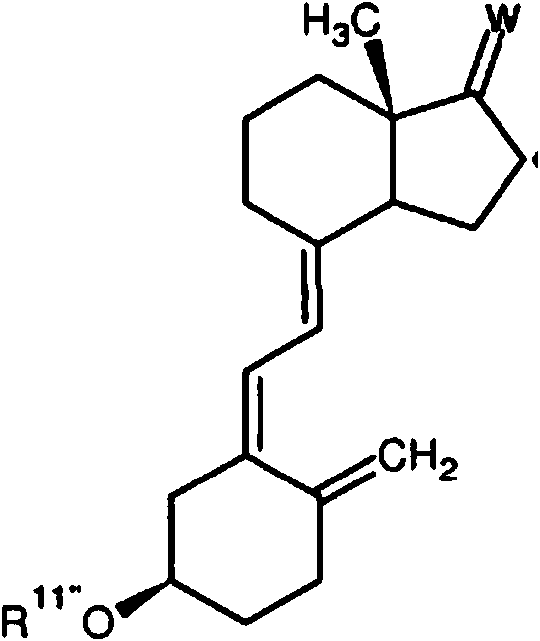
en la quein which
W es N-O-(CH2)nC(O)-Z",W is N-O- (CH2) nC (O) -Z ",
n" es un número entero desde 1 a 10,n "is an integer from 1 to 10,
R11" es H, alquilo o acilo, yR11 "is H, alkyl or acyl, and
Z" es OR8 en la que R8 es H, alquilo o NR9R10 en la que R9 y R10 son independientemente H o alquilo; e incluyendo mezclas de dos o más de los compuestos anteriores.Z "is OR8 where R8 is H, alkyl or NR9R10 where R9 and R10 are independently H or alkyl, and including mixtures of two or more of the above compounds.
Algunos ejemplos de acuerdo con los principios descritos en este documento están dirigidos a métodos de determinación de una o ambas de la presencia y la cantidad de vitamina D en una muestra que se sospecha que contiene vitamina D. Some examples in accordance with the principles described in this document are directed to methods of determining one or both of the presence and the amount of vitamin D in a sample suspected of containing vitamin D.
Breve descripción de los dibujosBrief description of the drawings
Los dibujos proporcionados en este documento no están a escala y se proporcionan con el propósito de facilitar la comprensión de ciertos ejemplos de acuerdo con los principios descritos en este documento y se proporcionan a modo de ilustración y no como limitación del alcance de las reivindicaciones adjuntas.The drawings provided herein are not to scale and are provided for the purpose of facilitating understanding of certain examples in accordance with the principles described herein and are provided by way of illustration and not by way of limitation of the scope of the appended claims.
La figura 1 es una descripción de las fórmulas químicas para las formas epiméricas de 25-hidroxivitamina D3 y 25-hidroxivitamina D2.Figure 1 is a description of the chemical formulas for the epimeric forms of 25-hydroxyvitamin D3 and 25-hydroxyvitamin D2.
La figura 2 es un diagrama esquemático de una síntesis de compuestos de acuerdo con ejemplos de acuerdo con los principios descritos en este documento.Figure 2 is a schematic diagram of a synthesis of compounds according to examples in accordance with the principles described herein.
La figura 3 es un diagrama esquemático de una síntesis de compuestos de acuerdo con ejemplos de acuerdo con los principios descritos en este documento.Figure 3 is a schematic diagram of a synthesis of compounds according to examples in accordance with the principles described herein.
La figura 4 es un diagrama esquemático de una síntesis de compuestos de acuerdo con ejemplos de acuerdo con los principios descritos en este documento.Figure 4 is a schematic diagram of a synthesis of compounds according to examples in accordance with the principles described herein.
La figura 5 es un diagrama esquemático de una síntesis de compuestos de acuerdo con ejemplos de acuerdo con los principios descritos en este documento.Figure 5 is a schematic diagram of a synthesis of compounds according to examples in accordance with the principles described herein.
La figura 6 es un diagrama esquemático de una síntesis de compuestos de acuerdo con ejemplos de acuerdo con los principios descritos en este documento.Figure 6 is a schematic diagram of a synthesis of compounds according to examples in accordance with the principles described herein.
La figura 7 es un diagrama esquemático de una síntesis de compuestos de acuerdo con ejemplos de acuerdo con los principios descritos en este documento.Figure 7 is a schematic diagram of a synthesis of compounds according to examples in accordance with the principles described herein.
La figura 8 es un diagrama esquemático de una síntesis de compuestos de acuerdo con ejemplos de acuerdo con los principios descritos en este documento.Figure 8 is a schematic diagram of a synthesis of compounds according to examples in accordance with the principles described herein.
La figura 9 ilustra una comparación de curvas estándar generadas usando reactivos con y sin anticuerpo anti-3-epímero-VD agregado.Figure 9 illustrates a comparison of standard curves generated using reagents with and without added anti-3-epimer-RV antibody.
La figura 10 es una curva estándar para un inmunoensayo para la determinación de 3-epi-25(OH)D en muestras usando un anticuerpo anti-3-epímero-VD.Figure 10 is a standard curve for an immunoassay for the determination of 3-epi-25 (OH) D in samples using an anti-3-epimer-VD antibody.
Descripción detallada de realizaciones específicasDetailed description of specific realizations
CompuestosCompounds
Como se mencionó anteriormente, algunos ejemplos de acuerdo con los principios descritos en este documento están dirigidos a compuestos de fórmula I:As mentioned above, some examples according to the principles described in this document are directed to compounds of formula I:
(R1)p-(L)q-Z(R1) p- (L) q-Z
en la quein which

oor
H, en la que al menos un R1 no sea H, H, in which at least one R1 is not H,
Y es O, S o NR4,Y is O, S or NR4,
X es -O-(CH2)n-C(O)-, -(CH2)w-C(O)-, o -NR3-C(O)-; en algunos ejemplos, X es -O-(CH2)n-C(O)- cuando Y es NR4, por ejemplo, -(CH2)w-C(O)-, -(CH2)w-C(O)-(CH2)x-C(O)-, o -(CH2)w-C(O)-NH(CH2)y-C(O)- cuando Y es O o S, por ejemplo, o -NR3-C(O)- cuando Y es CR, por ejemplo,X is -O- (CH2) n-C (O) -, - (CH2) w-C (O) -, or -NR3-C (O) -; In some examples, X is -O- (CH2) nC (O) - when Y is NR4, for example, - (CH2) wC (O) -, - (CH2) wC (O) - (CH2) xC (O ) -, or - (CH2) wC (O) -NH (CH2) and C (O) - when Y is O or S, for example, or -NR3-C (O) - when Y is CR, for example,
R2 es independientemente H o alquilo,R2 is independently H or alkyl,
R3, R4, R5 y R6 son independientemente H o alquilo, o R4 y R5 se pueden tomar juntos para formar un enlace, o R5 yR3, R4, R5 and R6 are independently H or alkyl, or R4 and R5 can be taken together to form a bond, or R5 and
R6 se pueden tomar juntos para formar un enlace,R6 can be taken together to form a bond,
R11 es H, alquilo o acilo,R11 is H, alkyl or acyl,
n es un número entero desde 1 a 10, o 1 a 9, o 1 a 8, o 1 a 7, o 1 a 6, o 1 a 5, o 1 a 4, o 1 a 3, o 1 a 2, o 2 a 10, o 2 an is an integer from 1 to 10, or 1 to 9, or 1 to 8, or 1 to 7, or 1 to 6, or 1 to 5, or 1 to 4, or 1 to 3, or 1 to 2, or 2 to 10, or 2 to
9, o 2 a 8, o 2 a 7, o 2 a 6, o 2 a 5, o 2 a 4, o 2 a 3, o 3 a 10, o 3 a 9, o 3 a 8, o 3 a 7, o 3 a 6, o 3 a 5, o 3 a 4, o 4 a9, or 2 to 8, or 2 to 7, or 2 to 6, or 2 to 5, or 2 to 4, or 2 to 3, or 3 to 10, or 3 to 9, or 3 to 8, or 3 to 7, or 3 to 6, or 3 to 5, or 3 to 4, or 4 to
10, o 4 a 9, o 4 a 8, o 4 a 7, o 4 a 6, o 4 a 5, o 5 a 10, o 5 a 9, o 5 a 8, o 5 a 7, o 5 a 6, o 6 a 10, o 6 a 9, o 6 a 8, o 6 a10, or 4 to 9, or 4 to 8, or 4 to 7, or 4 to 6, or 4 to 5, or 5 to 10, or 5 to 9, or 5 to 8, or 5 to 7, or 5 to 6, or 6 to 10, or 6 to 9, or 6 to 8, or 6 to
7, o 7 a 10, o 7 a 9, o 7 a 8, o 8 a 10, o 8 a 9, o 9 a 10, por ejemplo,7, or 7 to 10, or 7 to 9, or 7 to 8, or 8 to 10, or 8 to 9, or 9 to 10, for example,
w es un número entero desde 0 a 10, 1 a 10, o 1 a 9, o 1 a 8, o 1 a 7, o 1 a 6, o 
8, o 6 a 7, o 7 a 10, o 7 a 9, o 7 a 8, o 8 a 10, o 8 a 9, o 9 a 10, por ejemplo,8, or 6 to 7, or 7 to 10, or 7 to 9, or 7 to 8, or 8 to 10, or 8 to 9, or 9 to 10, for example,
x es un número entero desde 1 a 10, o 1 a 9, o 1 a 8, o 1 a 7, o 1 a 6, o 1 a 5, o 1 a 4, o 1 a 3, o 1 a 2, o 2 a 10, o 2 ax is an integer from 1 to 10, or 1 to 9, or 1 to 8, or 1 to 7, or 1 to 6, or 1 to 5, or 1 to 4, or 1 to 3, or 1 to 2, or 2 to 10, or 2 to
9, o 2 a 8, o 2 a 7, o 2 a 6, o 2 a 5, o 2 a 4, o 2 a 3, o 3 a 10, o 3 a 9, o 3 a 8, o 3 a 7, o 3 a 6, o 3 a 5, o 3 a 4, o 4 a9, or 2 to 8, or 2 to 7, or 2 to 6, or 2 to 5, or 2 to 4, or 2 to 3, or 3 to 10, or 3 to 9, or 3 to 8, or 3 to 7, or 3 to 6, or 3 to 5, or 3 to 4, or 4 to
10, o 4 a 9, o 4 a 8, o 4 a 7, o 4 a 6, o 4 a 5, o 5 a 10, o 5 a 9, o 5 a 8, o 5 a 7, o 5 a 6, o 6 a 10, o 6 a 9, o 6 a 8, o 6 a10, or 4 to 9, or 4 to 8, or 4 to 7, or 4 to 6, or 4 to 5, or 5 to 10, or 5 to 9, or 5 to 8, or 5 to 7, or 5 to 6, or 6 to 10, or 6 to 9, or 6 to 8, or 6 to
7, o 7 a 10, o 7 a 9, o 7 a 8, o 8 a 10, o 8 a 9, o 9 a 10, por ejemplo,7, or 7 to 10, or 7 to 9, or 7 to 8, or 8 to 10, or 8 to 9, or 9 to 10, for example,
y es un número entero desde 1 a 10, o 1 a 9, o 1 a 8, o 1 a 7, o 1 a 6, o 1 a 5, o 1 a 4, o 1 a 3, o 1 a 2, o 2 a 10, o 2 ay is an integer from 1 to 10, or 1 to 9, or 1 to 8, or 1 to 7, or 1 to 6, or 1 to 5, or 1 to 4, or 1 to 3, or 1 to 2, or 2 to 10, or 2 to
9, o 2 a 8, o 2 a 7, o 2 a 6, o 2 a 5, o 2 a 4, o 2 a 3, o 3 a 10, o 3 a 9, o 3 a 8, o 3 a 7, o 3 a 6, o 3 a 5, o 3 a 4, o 4 a9, or 2 to 8, or 2 to 7, or 2 to 6, or 2 to 5, or 2 to 4, or 2 to 3, or 3 to 10, or 3 to 9, or 3 to 8, or 3 to 7, or 3 to 6, or 3 to 5, or 3 to 4, or 4 to
10, o 4 a 9, o 4 a 8, o 4 a 7, o 4 a 6, o 4 a 5, o 5 a 10, o 5 a 9, o 5 a 8, o 5 a 7, o 5 a 6, o 6 a 10, o 6 a 9, o 6 a 8, o 6 a10, or 4 to 9, or 4 to 8, or 4 to 7, or 4 to 6, or 4 to 5, or 5 to 10, or 5 to 9, or 5 to 8, or 5 to 7, or 5 to 6, or 6 to 10, or 6 to 9, or 6 to 8, or 6 to
7, o 7 a 10, o 7 a 9, o 7 a 8, o 8 a 10, o 8 a 9, o 9 a 10, por ejemplo,7, or 7 to 10, or 7 to 9, or 7 to 8, or 8 to 10, or 8 to 9, or 9 to 10, for example,
p es un número entero desde 1 a 10, o 1 a 9, o 1 a 8, o 1 a 7, o 1 a 6, o 1 a 5, o 1 a 4, o 1 a 3, o 1 a 2, o 2 a 10, o 2 ap is an integer from 1 to 10, or 1 to 9, or 1 to 8, or 1 to 7, or 1 to 6, or 1 to 5, or 1 to 4, or 1 to 3, or 1 to 2, or 2 to 10, or 2 to
9, o 2 a 8, o 2 a 7, o 2 a 6, o 2 a 5, o 2 a 4, o 2 a 3, o 3 a 10, o 3 a 9, o 3 a 8, o 3 a 7, o 3 a 6, o 3 a 5, o 3 a 4, o 4 a9, or 2 to 8, or 2 to 7, or 2 to 6, or 2 to 5, or 2 to 4, or 2 to 3, or 3 to 10, or 3 to 9, or 3 to 8, or 3 to 7, or 3 to 6, or 3 to 5, or 3 to 4, or 4 to
10, o 4 a 9, o 4 a 8, o 4 a 7, o 4 a 6, o 4 a 5, o 5 a 10, o 5 a 9, o 5 a 8, o 5 a 7, o 5 a 6, o 6 a 10, o 6 a 9, o 6 a 8, o 6 a10, or 4 to 9, or 4 to 8, or 4 to 7, or 4 to 6, or 4 to 5, or 5 to 10, or 5 to 9, or 5 to 8, or 5 to 7, or 5 to 6, or 6 to 10, or 6 to 9, or 6 to 8, or 6 to
7, o 7 a 10, o 7 a 9, o 7 a 8, o 8 a 10, o 8 a 9, o 9 a 10, por ejemplo,7, or 7 to 10, or 7 to 9, or 7 to 8, or 8 to 10, or 8 to 9, or 9 to 10, for example,
L es un grupo de unión,L is a linking group,
q es 0 o 1, yq is 0 or 1, and
Z es OR8 en el que R8 es H, alquilo o NR9R10 en el que R9 y R10 son independientemente H o alquiloZ is OR8 where R8 is H, alkyl or NR9R10 where R9 and R10 are independently H or alkyl
Como se usa en este documento, el término "alquilo" incluye aquellos grupos alquilo de un número designado de átomos de carbono de configuración lineal, ramificada o cíclica. Los ejemplos de "alquilo" incluyen, pero no se limitan a, metilo, etilo, propilo, isopropilo, butilo, sec- y tert-butilo, pentilo, hexilo, heptilo, ciclopropilo, ciclobutilo, ciclopentilo, ciclohexilo, cicloheptilo, norbornilo, por ejemplo. En algunos ejemplos, el alquilo contiene 1 a 10, o 1 a 9, o 1 a 8, o 1 a 7, o 1 a 6, o 1 a 5, o 1 a 4, o 1 a 3, o 1 a 2, o 2 a 10, o 2 a 9, o 2 a 8, o 2 a 7, o 2 a 6, o 2 a 5, o 2 a 4, o 2 a 3, o 3 aAs used herein, the term "alkyl" includes those alkyl groups of designated number of carbon atoms of linear, branched, or cyclic configuration. Examples of "alkyl" include, but are not limited to, methyl, ethyl, propyl, isopropyl, butyl, sec- and tert-butyl, pentyl, hexyl, heptyl, cyclopropyl, cyclobutyl, cyclopentyl, cyclohexyl, cycloheptyl, norbornyl, for example example. In some examples, alkyl contains 1 to 10, or 1 to 9, or 1 to 8, or 1 to 7, or 1 to 6, or 1 to 5, or 1 to 4, or 1 to 3, or 1 to 2. , or 2 to 10, or 2 to 9, or 2 to 8, or 2 to 7, or 2 to 6, or 2 to 5, or 2 to 4, or 2 to 3, or 3 to
10, o 3 a 9, o 3 a 8, o 3 a 7, o 3 a 6, o 3 a 5, o 3 a 4, o 4 a 10, o 4 a 9, o 4 a 8, o 4 a 7, o 4 a 6, o 4 a 5, o 5 a 10, o 5 a10, or 3 to 9, or 3 to 8, or 3 to 7, or 3 to 6, or 3 to 5, or 3 to 4, or 4 to 10, or 4 to 9, or 4 to 8, or 4 to 7, or 4 to 6, or 4 to 5, or 5 to 10, or 5 to
9, o 5 a 8, o 5 a 7, o 5 a 6, o 6 a 10, o 6 a 9, o 6 a 8, o 6 a 7, o 7 a 10, o 7 a 9, o 7 a 8, o 8 a 10, o 8 a 9, o 9 a 10, átomos de carbono, que pueden ser no sustituidos o uno o más de los cuales puede estar sustituido por uno o más de hidroxi, alcoxi de 1 a 5, o 1 a 4, of 1 a 3, o 1 a 2, o 2 a 5, o 2 a 4, o 2 a 3, o 3 a 5, o 3 a 4, o 4 a 5 átomos de carbono.9, or 5 to 8, or 5 to 7, or 5 to 6, or 6 to 10, or 6 to 9, or 6 to 8, or 6 to 7, or 7 to 10, or 7 to 9, or 7 to 8, or 8 to 10, or 8 to 9, or 9 to 10, carbon atoms, which may be unsubstituted or one or more of which may be substituted by one or more of hydroxy, 1 to 5 alkoxy, or 1 to 4, of 1 to 3, or 1 to 2, or 2 to 5, or 2 to 4, or 2 to 3, or 3 to 5, or 3 to 4, or 4 to 5 carbon atoms.
Como se usa en este documento, el término "acilo" significa R12C(O)- donde R12 es alquilo o arilo.As used herein, the term "acyl" means R12C (O) - where R12 is alkyl or aryl.
Como se usa en este documento, el término "arilo" significa un radical orgánico derivado de un hidrocarburo aromático mediante la eliminación de un átomo y que contiene uno o más anillos aromáticos, normalmente de uno a cuatro anillos aromáticos, tales como, por ejemplo, fenilo (de benceno), naftilo (de naftaleno), etc., por ejemplo, fenilo, naftilo, fenantrilo.As used herein, the term "aryl" means an organic radical derived from an aromatic hydrocarbon by removal of one atom and containing one or more aromatic rings, usually one to four aromatic rings, such as, for example, phenyl (from benzene), naphthyl (from naphthalene), etc., for example, phenyl, naphthyl, phenanthryl.
Como se usa en este documento, la expresión "grupo de unión" se refiere a una unidad estructural química que puede comprender aproximadamente 2 a aproximadamente 50 átomos, o 4 a aproximadamente 30 átomos, sin contar el hidrógeno y puede comprender una cadena de 2 a aproximadamente 30 átomos, o de 3 a aproximadamente 20 átomos, cada uno seleccionado independientemente del grupo que normalmente consiste en carbono, oxígeno, azufre, nitrógeno y fósforo. En algunos ejemplos, parte o todo el grupo de unión puede ser una parte de la molécula que se está enlazando tal como, pero sin limitarse a, un residuo de aminoácido en un poli(aminoácido), por ejemplo. El número de heteroátomos en el grupo de unión puede estar en el intervalo desde 0 a aproximadamente 20, o 1 a aproximadamente 15, o aproximadamente 2 a aproximadamente 10. El grupo de unión puede ser alifático o aromático. Cuando están presentes heteroátomos, el oxígeno está normalmente presente como oxo u oxi, unido a carbono, azufre, nitrógeno o fósforo, el nitrógeno está normalmente presente como nitro, nitroso o amino, normalmente unido a carbono, oxígeno, azufre o fósforo; el azufre es análogo al oxígeno; mientras que el fósforo está unido al carbono, azufre, oxígeno o nitrógeno, normalmente como fosfonato y fosfato mono o diéster. Las funcionalidades comunes en la formación de un enlace covalente entre el grupo de unión y la molécula a conjugar son alquilamina, amidina, tioamida, éter, urea, tiourea, guanidina, azo, tioéter y carboxilato, sulfonato y ésteres de fosfato, amidas y tioésteres. As used herein, the term "linking group" refers to a chemical structural unit that can comprise from about 2 to about 50 atoms, or 4 to about 30 atoms, not counting hydrogen, and can comprise a chain from 2 to about 30 atoms, or 3 to about 20 atoms, each independently selected from the group normally consisting of carbon, oxygen, sulfur, nitrogen, and phosphorous. In some examples, part or all of the linking group may be a part of the molecule being linked such as, but not limited to, an amino acid residue in a poly (amino acid), for example. The number of heteroatoms in the linking group can range from 0 to about 20, or 1 to about 15, or about 2 to about 10. The linking group can be aliphatic or aromatic. When heteroatoms are present, oxygen is normally present as oxo or oxy, attached to carbon, sulfur, nitrogen, or phosphorus; nitrogen is normally present as nitro, nitroso, or amino, usually attached to carbon, oxygen, sulfur, or phosphorus; sulfur is analogous to oxygen; while phosphorus is attached to carbon, sulfur, oxygen or nitrogen, usually as phosphonate and phosphate mono or diester. Common functionalities in the formation of a covalent bond between the linking group and the molecule to be conjugated are alkylamine, amidine, thioamide, ether, urea, thiourea, guanidine, azo, thioether and carboxylate, sulfonate and phosphate esters, amides and thioesters. .
En su mayor parte, cuando un grupo de unión tiene una funcionalidad de enlace (funcionalidad para la reacción con una unidad estructural) tal como, por ejemplo, un grupo no oxocarbonilo que incluye análogos de nitrógeno y azufre, un grupo fosfato, un grupo amino, agente alquilante tal como halo o tosilalquilo, oxi (hidroxilo o el análogo de azufre, mercapto) oxocarbonilo (por ejemplo, aldehído o cetona), u olefina activa tal como una vinilsulfona o éster a-, pinsaturado, estas funcionalidades están unidas a grupos amina, grupos carboxilo, olefinas activas, agentes alquilantes, por ejemplo, bromoacetilo. Cuando se unen una amina y un ácido carboxílico o su derivado de nitrógeno o ácido fosfórico, se forman amidas, amidinas y fosforamidas. Cuando se enlazan mercaptano y olefina activada, se forman tioéteres. Cuando se unen un mercaptano y un agente alquilante, se forman tioéteres. Cuando se unen aldehído y una amina en condiciones reductoras, se forma una alquilamina. Cuando se unen una cetona o aldehído y una hidroxilamina (incluidos los derivados de los mismos en los que un sustituyente está en lugar del hidrógeno del grupo hidroxilo), se forma una funcionalidad oxima (= N-O-). Cuando se unen un ácido carboxílico o ácido fosfato y un alcohol, se forman ésteres.For the most part, when a linking group has a linking functionality (functionality for reaction with a structural unit) such as, for example, a non-oxocarbonyl group including nitrogen and sulfur analogs, a phosphate group, an amino group , alkylating agent such as halo or tosylalkyl, oxy (hydroxyl or the sulfur analog, mercapto) oxocarbonyl (for example, aldehyde or ketone), or active olefin such as a vinyl sulfone or a-, pinsaturated ester, these functionalities are attached to groups amine, carboxyl groups, active olefins, alkylating agents, eg bromoacetyl. When an amine and a carboxylic acid or its nitrogen derivative or phosphoric acid are joined, amides, amidines and phosphoramides are formed. When mercaptan and activated olefin are linked, thioethers are formed. When a mercaptan and an alkylating agent are joined, thioethers are formed. When aldehyde and an amine are joined under reducing conditions, an alkylamine is formed. When a ketone or aldehyde and a hydroxylamine (including derivatives thereof in which a substituent is in place of the hydrogen of the hydroxyl group) are attached, an oxime functionality (= N-O-) is formed. When a carboxylic acid or phosphate acid and an alcohol are joined, esters are formed.
Como se usa en este documento, el término "portador inmunogénico" significa un grupo o una unidad estructural que está conjugada con un hapteno. El conjugado del portador inmunogénico y el hapteno se puede inyectar en un organismo capaz de provocar una respuesta inmune tal como, pero sin limitarse a, un mamífero, un ave (por ejemplo, pollo o paloma), un anfibio o un reptil; o el conjugado se puede usar para inocular una muestra in vitro (de mamífero, incluyendo humano, ave, anfibio o reptil) o se puede emplear de otro modo en una técnica para producir un socio de unión para el hapteno.As used herein, the term "immunogenic carrier" means a group or structural unit that is conjugated to a hapten. The conjugate of the immunogenic carrier and the hapten can be injected into an organism capable of eliciting an immune response such as, but not limited to, a mammal, a bird (eg, chicken or pigeon), an amphibian or a reptile; or the conjugate can be used to inoculate an in vitro sample (mammalian, including human, bird, amphibian, or reptile) or it can be otherwise employed in a technique to produce a binding partner for the hapten.
La expresión "socio de unión" se refiere a una molécula que es miembro de un par de unión específico, que es una de dos moléculas diferentes que se une específicamente y por lo tanto se define como complementaria con la otra molécula. Por ejemplo, un miembro del par de unión específico puede tener un área en la superficie o en una cavidad que se une específicamente a una organización espacial y polar particular del otro miembro del par de unión específico. El socio de unión puede ser, a modo de ilustración y no de limitación, un anticuerpo o un aptámero (por ejemplo, aptámero de ácido nucleico o aptámero de péptido), por ejemplo. En un ejemplo, se puede emplear un portador inmunogénico como inmunógeno para inducir una respuesta inmune y provocar la producción de un socio de unión para un hapteno. Otras técnicas incluyen la expresión en fago y la selección in vitro. Los portadores inmunogénicos también se denominan a veces portadores antigénicos. En algunos ejemplos de acuerdo con los principios descritos en este documento, los inmunógenos que comprenden portadores inmunogénicos, incluidos los portadores inmunogénicos poli(aminoácidos) y no poli(aminoácidos), se sintetizan y usan para preparar anticuerpos. Los haptenos son compuestos capaces de unirse específicamente a los anticuerpos correspondientes, pero no actúan por sí mismos como inmunógenos (o antígenos) para la preparación de los anticuerpos. En consecuencia, un hapteno se une a un portador inmunogénico, que se puede emplear, por ejemplo, para generar anticuerpos.The term "binding partner" refers to a molecule that is a member of a specific binding pair, which is one of two different molecules that specifically binds and is therefore defined as complementary to the other molecule. For example, a specific binding pair member may have a cavity or surface area that specifically binds to a particular spatial and polar organization of the other specific binding pair member. The binding partner can be, by way of illustration and not limitation, an antibody or an aptamer (eg, nucleic acid aptamer or peptide aptamer), for example. In one example, an immunogenic carrier can be used as an immunogen to induce an immune response and elicit the production of a binding partner for a hapten. Other techniques include phage display and in vitro selection. Immunogenic carriers are also sometimes called antigenic carriers. In some examples in accordance with the principles described herein, immunogens comprising immunogenic carriers, including poly (amino acid) and non-poly (amino acid) immunogenic carriers, are synthesized and used to prepare antibodies. Haptens are compounds capable of specifically binding to corresponding antibodies, but do not themselves act as immunogens (or antigens) for the preparation of antibodies. Consequently, a hapten binds to an immunogenic carrier, which can be used, for example, to generate antibodies.
El intervalo de peso molecular (en Dalton) para poli(aminoácidos) que son portadores inmunogénicos es de aproximadamente 5,000 a aproximadamente 10,000,000, o aproximadamente 20,000 a aproximadamente 600,000, o aproximadamente 25,000 a aproximadamente 250,000, por ejemplo. Las "unidades estructurales de portadores inmunogénicos de poli(aminoácidos)" incluyen proteínas tales como, por ejemplo, albúminas, proteínas séricas, por ejemplo, globulinas, proteínas del cristalino ocular y lipoproteínas. Las proteínas ilustrativas incluyen, pero no se limitan a, albúmina de suero bovino (BSA), hemocianina de lapa californiana (KLH), ovoalbúmina de huevo y gammaglobulina bovina (BGG), por ejemplo. Las "unidades estructurales de portadores inmunogénicos no poli(aminoácidos)" incluyen polisacáridos, ácidos nucleicos y partículas (materiales biológicos y sintéticos). Una amplia variedad de portadores inmunogénicos se describe en Davalian, et al., Patente de los Estados Unidos No. 5,089,390, columna 4, línea 57 to columna 5, línea 5.The molecular weight range (in Daltons) for poly (amino acids) that are immunogenic carriers is from about 5,000 to about 10,000,000, or about 20,000 to about 600,000, or about 25,000 to about 250,000, for example. The "building blocks of immunogenic poly (amino acid) carriers" include proteins such as, for example, albumins, serum proteins, for example globulins, ocular lens proteins and lipoproteins. Illustrative proteins include, but are not limited to, bovine serum albumin (BSA), keyhole limpet hemocyanin (KLH), egg ovalbumin, and bovine gamma globulin (BGG), for example. "Non-poly (amino acid) immunogenic carrier building blocks" include polysaccharides, nucleic acids, and particles (biological and synthetic materials). A wide variety of immunogenic carriers are described in Davalian, et al., US Patent No. 5,089,390, column 4, line 57 to column 5, line 5.
Como se mencionó anteriormente, la unidad estructural de portador inmunogénico puede ser un polisacárido, que es un polímero de monosacáridos de alto peso molecular que se puede preparar de forma natural o sintética y normalmente implica condensaciones repetidas de monosacáridos. Ejemplos de polisacáridos son almidones, glucógeno, celulosa, gomas de carbohidratos, tales como goma arábiga, agar, etc. El polisacárido también puede contener residuos de poli(aminoácidos) y/o residuos de lípidos.As mentioned above, the immunogenic carrier structural unit can be a polysaccharide, which is a high molecular weight polymer of monosaccharides that can be prepared naturally or synthetically and usually involves repeated condensations of monosaccharides. Examples of polysaccharides are starches, glycogen, cellulose, carbohydrate gums, such as acacia, agar, etc. The polysaccharide can also contain poly (amino acid) residues and / or lipid residues.
Como se usa en este documento, el término "marcador" incluye marcadores de poli(aminoácidos) y marcadores de no poli(aminoácidos). El término " unidades estructurales de marcadores de poli(aminoácidos)" incluye marcadores que son proteínas tales como, pero sin limitarse a, enzimas, anticuerpos, péptidos e inmunógenos, por ejemplo. Con proteínas marcadoras tales como, por ejemplo, enzimas, el intervalo de peso molecular promedio en peso será desde aproximadamente 10,000 a aproximadamente 600,000 o desde aproximadamente 10,000 a aproximadamente 300,000. Normalmente, hay al menos un compuesto de acuerdo con los principios descritos en este documento (grupo análogo) por aproximadamente 200,000 de peso molecular, o al menos aproximadamente 1 por aproximadamente 150,000 de peso molecular, o al menos aproximadamente 1 por aproximadamente 100,000 de peso molecular, o al menos aproximadamente 1 por aproximadamente 50,000 de peso molecular, o al menos aproximadamente 1 por 40,000, de peso molecular, o al menos aproximadamente 1 por 30,000 de peso molecular, o al menos 1 por 20,000 de peso molecular, o al menos uno por 10,000 molecular, o al menos uno por 5,000 de peso molecular, por ejemplo, de la proteína. En el caso de enzimas, el número de grupos análogos es normalmente desde 1 a aproximadamente 20, aproximadamente 2 a aproximadamente 15, aproximadamente 3 a aproximadamente 12, o aproximadamente 6 a aproximadamente 10.As used herein, the term "marker" includes poly (amino acid) markers and non-poly (amino acid) markers. The term "poly (amino acid) marker building blocks" includes markers that are proteins such as, but not limited to, enzymes, antibodies, peptides, and immunogens, for example. With marker proteins such as, for example, enzymes, the weight average molecular weight range will be from about 10,000 to about 600,000 or from about 10,000 to about 300,000. Typically, there is at least one compound according to the principles described in this document (group analog) per about 200,000 molecular weight, or at least about 1 per about 150,000 molecular weight, or at least about 1 per about 100,000 molecular weight, or at least about 1 per about 50,000 molecular weight, or at least about 1 per 40,000 molecular weight, or at least about 1 per 30,000 molecular weight, or at least 1 per 20,000 molecular weight, or at least one per 10,000 molecular weight, or at least one per 5,000 molecular weight, for example, of the protein. In the case of enzymes, the number of analogous groups is usually from 1 to about 20, about 2 to about 15, about 3 to about 12, or about 6 to about 10.
Las enzimas incluyen, a modo de ilustración y no de limitación, enzimas redox tales como, por ejemplo, deshidrogenasas, por ejemplo, glucosa-6-fosfato deshidrogenasa (G6PDH) y lactato deshidrogenasa; enzimas que implican la producción de peróxido de hidrógeno y el uso del peróxido de hidrógeno para oxidar un colorante precursor a un colorante tal como, por ejemplo, peroxidasa de rábano picante, lactoperoxidasa y microperoxidasa; hidrolasas tales como, por ejemplo, fosfatasa alcalina y p-galactosidasa; luciferasas tales como, por ejemplo, luciferasa de luciérnaga y luciferasa bacteriana; transferasas; combinaciones de enzimas tales como, pero sin limitarse a, sacáridos oxidasas, por ejemplo, glucosa y galactosa oxidasa, u oxidasas heterocíclicas, tales como uricasa y xantina oxidasa, junto con una enzima que emplea peróxido de hidrógeno para oxidar un precursor de colorante, es decir, un peroxidasa tal como peroxidasa de rábano picante, lactoperoxidasa o microperoxidasa, por ejemplo.Enzymes include, by way of illustration and not limitation, redox enzymes such as, for example, dehydrogenases, for example glucose-6-phosphate dehydrogenase (G6PDH) and lactate dehydrogenase; enzymes involving the production of hydrogen peroxide and the use of hydrogen peroxide to oxidize a precursor dye to a dye such as, for example, horseradish peroxidase, lactoperoxidase and microperoxidase; hydrolases such as, for example, alkaline phosphatase and p-galactosidase; luciferases such as, for example, firefly luciferase and bacterial luciferase; transferases; combinations of enzymes such as, but not limited to, saccharide oxidases, for example, glucose and galactose oxidase, or heterocyclic oxidases, such as uricase and xanthine oxidase, together with an enzyme that uses hydrogen peroxide to oxidize a dye precursor, is that is, a peroxidase such as horseradish peroxidase, lactoperoxidase or microperoxidase, for example.
Como se usa en este documento, el término "marcadores no poli(aminoácidos)" incluye aquellos marcadores que no son proteínas. El marcador no poli(aminoácido) se puede detectar directamente o se puede detectar a través de una reacción que produce una señal detectable. El marcador no poli(aminoácido) puede ser isotópico o no isotópico y puede ser, a modo de ilustración y no de limitación, un radioisótopo, un compuesto luminiscente (que incluye, pero no se limita a, compuestos fluorescentes y compuestos quimioluminiscentes, por ejemplo), un polinucleótido que codifica un catalizador, un promotor, un colorante, una coenzima, un sustrato enzimático, un grupo radiactivo, una molécula orgánica pequeña (peso molecular de 200 a 2,000), una partícula y una secuencia polinucleotídica amplificable, por ejemplo.As used herein, the term "non-poly (amino acid) markers" includes those markers that are not proteins. The non-poly (amino acid) marker can be detected directly or it can be detected through a reaction that produces a detectable signal. The non-poly (amino acid) label can be isotopic or non-isotopic and can be, by way of illustration and not limitation, a radioisotope, a luminescent compound (including, but not limited to, fluorescent compounds and chemiluminescent compounds, for example ), a polynucleotide that encodes a catalyst, a promoter, a dye, a coenzyme, an enzyme substrate, a radioactive group, a small organic molecule (molecular weight 200 to 2,000), a particle, and an amplifiable polynucleotide sequence, for example.
Como se mencionó anteriormente, una "molécula orgánica pequeña" tiene un peso molecular de aproximadamente 200 a aproximadamente 2,000, o aproximadamente 200 a aproximadamente 1,500, o aproximadamente 200 a aproximadamente 1,000, o aproximadamente 200 a aproximadamente 500. Tales "moléculas orgánicas pequeñas" incluyen, pero no se limitan a, biotina, moléculas fluorescentes (tales como fluoresceína y rodamina, por ejemplo), moléculas quimioluminiscentes y dinitrofenol, por ejemplo. Un socio de unión para una molécula orgánica pequeña es una molécula que reconoce y se une específicamente a la molécula pequeña. Los socios de unión para una molécula pequeña se definen por la naturaleza de la molécula pequeña e incluyen, pero no se limitan a, avidina, estreptavidina, anticuerpo para la molécula orgánica pequeña (que incluye, pero no se limita a, anticuerpo para una molécula fluorescente (tal como anticuerpo para fluoresceína y anticuerpo para rodamina, por ejemplo), anticuerpo para una molécula quimioluminiscente y anticuerpo para dinitrofenol, por ejemplo.As mentioned above, a "small organic molecule" has a molecular weight of about 200 to about 2,000, or about 200 to about 1,500, or about 200 to about 1,000, or about 200 to about 500. Such "small organic molecules" include , but are not limited to, biotin, fluorescent molecules (such as fluorescein and rhodamine, for example), chemiluminescent molecules, and dinitrophenol, for example. A binding partner for a small organic molecule is a molecule that specifically recognizes and binds to the small molecule. Binding partners for a small molecule are defined by the nature of the small molecule and include, but are not limited to, avidin, streptavidin, antibody to the small organic molecule (including, but not limited to, antibody to a small molecule fluorescent (such as antibody to fluorescein and antibody to rhodamine, for example), antibody to a chemiluminescent molecule, and antibody to dinitrophenol, for example.
Como se usa en este documento, los términos "unidad estructural de poli(aminoácido) no marcada" y "unidad estructural de poli(aminoácido) portador no inmunogénico" se refieren a poli(aminoácidos) que normalmente no se consideran marcadores o portadores inmunogénicos aunque tales unidades estructurales pueden ser marcadores o portadores inmunogénicos en determinadas circunstancias. Por ejemplo, un anticuerpo no se puede considerar un marcador, pero puede ser un marcador si el anticuerpo se modifica para incluir una unidad estructural productora de señales o parte de un sistema productor de señales. Adicionalmente, un anticuerpo no se puede considerar un portador inmunogénico, pero no obstante es capaz de ser un portador inmunogénico en determinadas circunstancias debido a su mayor peso molecular.As used herein, the terms "unlabeled poly (amino acid) structural unit" and "non-immunogenic carrier poly (amino acid) structural unit" refer to poly (amino acids) that are not normally considered immunogenic markers or carriers although such structural units can be immunogenic markers or carriers under certain circumstances. For example, an antibody cannot be considered a marker, but can be a marker if the antibody is modified to include a signal-producing structural unit or part of a signal-producing system. Additionally, an antibody cannot be considered an immunogenic carrier, but is nevertheless capable of being an immunogenic carrier under certain circumstances due to its higher molecular weight.
En algunos ejemplos, el marcador no poli(aminoácido) se puede seleccionar del grupo que consiste en soportes, partículas magnéticas, ésteres de acridinio, una combinación de partículas magnéticas y ésteres de acridinio (tales como, por ejemplo, partículas paramagnéticas marcadas con o éster de acridinio), partículas quimioluminiscentes y partículas sensibilizantes.In some examples, the non-poly (amino acid) label can be selected from the group consisting of supports, magnetic particles, acridinium esters, a combination of magnetic particles and acridinium esters (such as, for example, paramagnetic or ester-labeled particles acridinium), chemiluminescent particles and sensitizing particles.
El término "covalente" se refiere a la unión de moléculas, por ejemplo, mediante una conexión directa, por ejemplo, un enlace químico entre las moléculas. El término "no covalente" se refiere a la unión de moléculas que implican unión específica entre miembros de pares de unión específicos complementarios (sbp) que están unidos a las moléculas. The term "covalent" refers to the joining of molecules, for example, through a direct connection, for example, a chemical bond between the molecules. The term "non-covalent" refers to the binding of molecules that involve specific binding between members of complementary specific binding pairs (sbp) that are bound to the molecules.
En algunos ejemplos, los compuestos de acuerdo con los principios descritos en este documento se pueden asociar con un soporte, por ejemplo, mediante unión covalente o no covalente. Como se mencionó anteriormente, en algunos ejemplos de acuerdo con los principios descritos en este documento, Z puede ser un soporte, que puede estar compuesto por un material orgánico o inorgánico, sólido o fluido, insoluble en agua y que puede ser transparente o parcialmente transparente. El soporte puede tener cualquiera de un número de formas, tales como, pero no se limitan a, una partícula (soporte de partículas) que incluye una microesfera, una película, una membrana, un tubo, un pozo, una tira, una varilla, una fibra o una superficie plana tal como, por ejemplo, una placa o un papel, por ejemplo. El soporte puede o no ser suspendido en el medio en el que se emplea. Ejemplos de soportes suspendibles son materiales poliméricos tales como látex, bicapas lipídicas o liposomas, gotitas de aceite, células e hidrogeles y partículas magnéticas, por ejemplo. Otras composiciones de soporte incluyen polímeros, tales como, a modo de ilustración y no de limitación, nitrocelulosa, acetato de celulosa, poli(cloruro de vinilo), poliacrilamida, poliacrilato, polietileno, polipropileno, poli(4 metilbuteno), poliestireno, polimetacrilato, poli(tereftalato de etileno), nailon, poli(butirato de vinilo), por ejemplo, usados solos o junto con otros materiales. El soporte puede estar marcado adicionalmente o no con un colorante, catalizador u otro grupo detectable, por ejemplo.In some examples, compounds in accordance with the principles described herein can be associated with a support, for example, by covalent or non-covalent attachment. As mentioned above, in some examples according to the principles described in this document, Z can be a support, which can be composed of an organic or inorganic material, solid or fluid, insoluble in water and which can be transparent or partially transparent. . The support can have any of a number of shapes, such as, but not limited to, a particle (particle support) including a microsphere, a film, a membrane, a tube, a well, a strip, a rod, a fiber or a flat surface such as, for example, a plate or a paper, for example. The support may or may not be suspended in the medium in which it is used. Examples of suspended supports are polymeric materials such as latex, lipid bilayers or liposomes, oil droplets, cells and hydrogels, and magnetic particles, for example. Other carrier compositions include polymers, such as, by way of illustration and not of limitation, nitrocellulose, cellulose acetate, poly (vinyl chloride), polyacrylamide, polyacrylate, polyethylene, polypropylene, poly (4-methylbutene), polystyrene, polymethacrylate, poly (ethylene terephthalate), nylon, poly (butyrate of vinyl), for example, used alone or in conjunction with other materials. The support may or may not be additionally labeled with a dye, catalyst, or other detectable group, for example.
En algunos ejemplos de acuerdo con los principios descritos en este documento, el soporte puede ser una partícula. Las partículas tienen un diámetro promedio de al menos aproximadamente 0.02 micrómetros y no más de aproximadamente 100 micrómetros. En algunos ejemplos, las partículas tienen un diámetro promedio desde aproximadamente 0.05 micrómetros a aproximadamente 20 micrómetros, o desde aproximadamente 0.3 micrómetros a aproximadamente 10 micrómetros. La partícula puede ser orgánica o inorgánica, hinchable o no hinchable, porosa o no porosa, preferiblemente de una densidad aproximada al agua, generalmente desde aproximadamente 0.7 g/mL a aproximadamente 1.5 g/mL, y compuesta de material que puede ser transparente, parcialmente transparente u opaco. Las partículas pueden ser materiales biológicos tales como células y microorganismos, por ejemplo, eritrocitos, leucocitos, linfocitos, hibridomas, estreptococos, Staphylococcus aureus y E. coli, virus, por ejemplo. Las partículas también pueden ser partículas compuestas de polímeros orgánicos e inorgánicos, liposomas, partículas de látex, partículas magnéticas o no magnéticas, vesículas de fosfolípidos, quilomicrones, lipoproteínas y similares. En algunos ejemplos, las partículas son partículas de dióxido de cromo (cromo) o partículas de látex.In some examples according to the principles described in this document, the support can be a particle. The particles have an average diameter of at least about 0.02 microns and no more than about 100 microns. In some examples, the particles have an average diameter of from about 0.05 microns to about 20 microns, or from about 0.3 microns to about 10 microns. The particle can be organic or inorganic, swellable or non-swellable, porous or non-porous, preferably of a density approximate to water, generally from about 0.7 g / mL to about 1.5 g / mL, and composed of material that can be transparent, partially transparent or opaque. The particles can be biological materials such as cells and microorganisms, for example erythrocytes, leukocytes, lymphocytes, hybridomas, streptococci, Staphylococcus aureus and E. coli, viruses, for example. The particles can also be particles composed of organic and inorganic polymers, liposomes, latex particles, magnetic or non-magnetic particles, phospholipid vesicles, chylomicrons, lipoproteins, and the like. In some examples, the particles are chromium dioxide (chromium) particles or latex particles.
Las partículas magnéticas incluyen partículas paramagnéticas, partículas ferromagnéticas y partículas diamagnéticas. Tales partículas incluyen, pero no se limitan a, metales de transición de los periodos 4-7 de la Tabla Periódica que incluyen cromo, cobre, cobalto, aluminio, manganeso, hierro y níquel, por ejemplo.Magnetic particles include paramagnetic particles, ferromagnetic particles, and diamagnetic particles. Such particles include, but are not limited to, transition metals from Periods 4-7 of the Periodic Table including chromium, copper, cobalt, aluminum, manganese, iron, and nickel, for example.
Las partículas quimioluminiscentes son partículas que tienen asociado un compuesto quimioluminiscente. La expresión "asociado con el mismo" como se usa en este documento significa que un compuesto tal como, por ejemplo, un compuesto quimioluminiscente y una partícula se pueden asociarse por enlace directo o indirecto, adsorción, absorción, incorporación o solución, por ejemplo. Ejemplos de compuestos quimioluminiscentes que se pueden usar son los expuestos en las Patentes de los Estados Unidos No. 5,340,716 y 6,251,581. En algunos ejemplos de acuerdo con los principios descritos en este documento, el compuesto quimioluminiscente es una sustancia fotoactivable que sufre una reacción química por excitación directa o sensibilizada por luz o por reacción con oxígeno singlete para formar un producto de reacción metaestable que es capaz de descomponerse con la emisión simultánea o posterior de luz, normalmente dentro del intervalo de longitud de onda de 250 a 1200 nm. El término "fotoactivable" incluye "fotoquímicamente activable". En algunos ejemplos, los compuestos quimioluminiscentes son aquellos que reaccionan con el oxígeno singlete para formar dioxetanos o dioxetanonas. Estas últimas suelen ser olefinas ricas en electrones. Ejemplos de tales olefinas ricas en electrones son enol éteres, enaminas, 9-alquiliden-N-alquilacridanos, arilviniléteres, dioxenos, arilimidazoles, 9-alquiliden-xantanos y lucigenina. Otros compuestos incluyen luminol y otras ftalhidrazidas y compuestos quimioluminiscentes que están protegidos de sufrir una reacción quimioluminiscente en virtud de que están protegidos por un grupo protector fotoquímicamente lábil, tales compuestos incluyen, por ejemplo, luciferina de luciérnaga, acuaforina y luminol. Ejemplos de tales compuestos quimioluminiscentes que se pueden usar son los expuestos en la Patente de los Estados Unidos No. 5,709,994.Chemiluminescent particles are particles that have a chemiluminescent compound associated with them. The term "associated therewith" as used herein means that a compound such as, for example, a chemiluminescent compound and a particle can be associated by direct or indirect bonding, adsorption, absorption, incorporation, or solution, for example. Examples of chemiluminescent compounds that can be used are those set forth in US Patent Nos. 5,340,716 and 6,251,581. In some examples according to the principles described in this document, the chemiluminescent compound is a photoactivatable substance that undergoes a chemical reaction by direct excitation or sensitization by light or by reaction with singlet oxygen to form a metastable reaction product that is capable of decomposing with the simultaneous or subsequent emission of light, usually within the wavelength range of 250 to 1200 nm. The term "photoactivatable" includes "photochemically activatable". In some examples, chemiluminescent compounds are those that react with singlet oxygen to form dioxetanes or dioxetanones. The latter are usually electron-rich olefins. Examples of such electron-rich olefins are enol ethers, enamines, 9-alkylidene-N-alkylacridanes, aryl vinyl ethers, dioxenes, arylimidazoles, 9-alkylidene xanthanes, and lucigenin. Other compounds include luminol and other phthalhydrazides and chemiluminescent compounds that are protected from undergoing a chemiluminescent reaction by virtue of being protected by a photochemically labile protecting group, such compounds include, for example, firefly luciferin, aquaphorin, and luminol. Examples of such chemiluminescent compounds that can be used are those set forth in US Patent No. 5,709,994.
Las partículas sensibilizantes son partículas que tienen asociado un compuesto sensibilizante, que incluye, pero no se limita a, un compuesto fotosensibilizante. Ejemplos de compuestos sensibilizantes que se pueden usar son los expuestos en las Patentes de los Estados Unidos No. 5,340,716 y 6,251,581.Sensitizing particles are particles that are associated with a sensitizing compound, including, but not limited to, a photosensitizing compound. Examples of sensitizing compounds that can be used are those set forth in US Patent Nos. 5,340,716 and 6,251,581.
Un fotosensibilizante es un sensibilizante para la generación de oxígeno singlete normalmente por excitación con luz. En algunos ejemplos, el fotosensibilizante absorbe a una longitud de onda más larga que el compuesto quimioluminiscente y tiene un triplete de energía menor que el compuesto quimioluminiscente. El fotosensibilizante puede ser fotoactivable (por ejemplo, tintes y compuestos aromáticos). El fotosensibilizante suele ser un compuesto formado por átomos unidos covalentemente, normalmente con múltiples enlaces dobles o triples conjugados. El compuesto debería absorber luz en el intervalo de longitud de onda de 200-1100 nm, normalmente 300-1000 nm, preferiblemente 450-950 nm. Los fotosensibilizantes típicos incluyen, pero no se limitan a, acetona, benzofenona, 9-tioxantona, eosina, 9,10-dibromoantraceno, azul de metileno, metaloporfirinas (por ejemplo, hematoporfirina), ftalocianinas, clorofilas, rosa de bengala, buckminsterfullereno, por ejemplo, derivados de estos compuestos. Se enumeran ejemplos de otros fotosensibilizantes en N.J. Turro, "Molecular Photochemistry", page 132, W. A. Benjamin Inc., N.Y. 1965. El fotosensibilizante ayuda a la fotoactivación cuando la activación es por oxígeno singlete. Normalmente, el fotosensibilizante absorbe luz y el fotosensibilizante excitado formado de este modo activa el oxígeno para producir oxígeno singlete, que reacciona con el compuesto quimioluminiscente para dar un intermedio luminiscente metaestable.A photosensitizer is a sensitizer for the generation of singlet oxygen usually by excitation with light. In some examples, the photosensitizer absorbs at a longer wavelength than the chemiluminescent compound and has a lower energy triplet than the chemiluminescent compound. The photosensitizer can be photoactivatable (eg, dyes and aromatics). The photosensitizer is usually a compound made up of covalently bonded atoms, usually with multiple conjugated double or triple bonds. The compound should absorb light in the wavelength range of 200-1100 nm, usually 300-1000 nm, preferably 450-950 nm. Typical photosensitizers include, but are not limited to, acetone, benzophenone, 9-thioxanthone, eosin, 9,10-dibromoanthracene, methylene blue, metalloporphyrins (eg, hematoporphyrin), phthalocyanines, chlorophylls, rose bengal, buckminsterfullerene, for for example, derivatives of these compounds. Examples of other photosensitizers are listed in N.J. Turro, "Molecular Photochemistry", page 132, W. A. Benjamin Inc., N.Y. 1965. The photosensitizer aids photoactivation when the activation is by singlet oxygen. Normally, the photosensitizer absorbs light and the thus formed excited photosensitizer activates oxygen to produce singlet oxygen, which reacts with the chemiluminescent compound to give a metastable luminescent intermediate.
En las fórmulas expuestas en este documento, una línea ondulada a través de un enlace indica el punto de unión de una unidad estructural en la fórmula.In the formulas set forth herein, a wavy line through a bond indicates the point of attachment of a structural unit in the formula.
Algunos ejemplos de acuerdo con los principios descritos en este documento se refieren a compuestos de fórmula IV, que son compuestos de fórmula I en los que: Some examples in accordance with the principles described in this document refer to compounds of formula IV, which are compounds of formula I in which:

o H, en el que al menos un R1 no sea H; e incluyendo mezclas de dos o más de los compuestos anteriores.or H, where at least one R1 is not H; and including mixtures of two or more of the above compounds.
Algunos ejemplos de acuerdo con los principios descritos en este documento están dirigidos a derivados de (7aS,E)-4-((Z)-2-((R)-5-hidroxi-2-metileno-cidohexilideno)etilideno)-7a-metiloctahidro-1H-inden-1-ona (derivados de HMCHEMOIO), o compuestos de fórmula V, que son compuestos de fórmula I en los que:Some examples according to the principles described in this document are directed to derivatives of (7aS, E) -4 - ((Z) -2 - ((R) -5-hydroxy-2-methylene-cidohexylidene) ethylidene) -7a -methyloctahydro-1H-inden-1-one (derivatives of HMCHEMOIO), or compounds of formula V, which are compounds of formula I in which:

o H, en el que al menos un R1 no sea H; e incluyendo mezclas de dos o más de los compuestos anteriores.or H, where at least one R1 is not H; and including mixtures of two or more of the above compounds.
Algunos ejemplos están dirigidos a compuestos de fórmula VI, que son compuestos de fórmula I en los que (R1)p-(L)qes NHR1-(CH2)r-NR1-((CH2)r-NR1)s-(CH2)r-NR7- en la que R1 es independientemente Some examples are directed to compounds of formula VI, which are compounds of formula I in which (R1) p- (L) q is NHR1- (CH2) r-NR1 - ((CH2) r-NR1) s- (CH2) r-NR7- in which R1 is independently

en la que al menos un R1 no sea H,in which at least one R1 is not H,
p, q y n son como se definieron anteriormente,p, q and n are as defined above,
r es independientemente un número entero desde 1 a 10, o 1 a 9, o 1 a 8, o 1 a 7, o 1 a 6, o 1 a 5, o 1 a 4, o 1 a 3, o 1 a 2, o 2 a 10, o 2 a 9, o 2 a 8, o 2 a 7, o 2 a 6, o 2 a 5, o 2 a 4, o 2 a 3, o 3 a 10, o 3 a 9, o 3 a 8, o 3 a 7, o 3 a 6, o 3 a 5, o 3 a 4, o 4 a 10, o 4 a 9, o 4 a 8, o 4 a 7, o 4 a 6, o 4 a 5, o 5 a 10, o 5 a 9, o 5 a 8, o 5 a 7, o 5 a 6, o 6 a 10, o 6 a 9, o 6 a 8, o 6 a 7, o 7 a 10, o 7 a 9, o 7 a 8, o 8 a 10, o 8 a 9, o 9 a 10, por ejemplo,r is independently an integer from 1 to 10, or 1 to 9, or 1 to 8, or 1 to 7, or 1 to 6, or 1 to 5, or 1 to 4, or 1 to 3, or 1 to 2 , or 2 to 10, or 2 to 9, or 2 to 8, or 2 to 7, or 2 to 6, or 2 to 5, or 2 to 4, or 2 to 3, or 3 to 10, or 3 to 9 , or 3 to 8, or 3 to 7, or 3 to 6, or 3 to 5, or 3 to 4, or 4 to 10, or 4 to 9, or 4 to 8, or 4 to 7, or 4 to 6 , or 4 to 5, or 5 to 10, or 5 to 9, or 5 to 8, or 5 to 7, or 5 to 6, or 6 to 10, or 6 to 9, or 6 to 8, or 6 to 7 , or 7 to 10, or 7 to 9, or 7 to 8, or 8 to 10, or 8 to 9, or 9 to 10, for example,
s es un número entero desde 1 a 10, o 1 a 9, o 1 a 8, o 1 a 7, o 1 a 6, o 1 a 5, o 1 a 4, o 1 a 3, o 1 a 2, o 2 a 10, o 2 a 9, o 2 a 8, o 2 a 7, o 2 a 6, o 2 a 5, o 2 a 4, o 2 a 3, o 3 a 10, o 3 a 9, o 3 a 8, o 3 a 7, o 3 a 6, o 3 a 5, o 3 a 4, o 4 a 10, o 4 a 9, o 4 a 8, o 4 a 7, o 4 a 6, o 4 a 5, o 5 a 10, o 5 a 9, o 5 a 8, o 5 a 7, o 5 a 6, o 6 a 10, o 6 a 9, o 6 a 8, o 6 a 7, o 7 a 10, o 7 a 9, o 7 a 8, o 8 a 10, o 8 a 9, o 9 a 10, por ejemplo, ys is an integer from 1 to 10, or 1 to 9, or 1 to 8, or 1 to 7, or 1 to 6, or 1 to 5, or 1 to 4, or 1 to 3, or 1 to 2, or 2 to 10, or 2 to 9, or 2 to 8, or 2 to 7, or 2 to 6, or 2 to 5, or 2 to 4, or 2 to 3, or 3 to 10, or 3 to 9, or 3 to 8, or 3 to 7, or 3 to 6, or 3 to 5, or 3 to 4, or 4 to 10, or 4 to 9, or 4 to 8, or 4 to 7, or 4 to 6, or 4 to 5, or 5 to 10, or 5 to 9, or 5 to 8, or 5 to 7, or 5 to 6, or 6 to 10, or 6 to 9, or 6 to 8, or 6 to 7, or 7 to 10, or 7 to 9, or 7 to 8, or 8 to 10, or 8 to 9, or 9 to 10, for example, and
R7 es H o alquilo; e incluyendo mezclas de dos o más de los compuestos anteriores.R7 is H or alkyl; and including mixtures of two or more of the above compounds.
Algunos ejemplos de acuerdo con los principios descritos en este documento están dirigidos a compuestos de fórmula II:Some examples in accordance with the principles described in this document are directed to compounds of formula II:
NHRr -(CH2)r-NR1"-((CH2)r'-NR1"')s'-(CH2)r'-NR7'-Z'NHRr - (CH2) r-NR1 "- ((CH2) r'-NR1" ') s' - (CH2) r'-NR7'-Z'
en la que R1', R1" o R1"' se seleccionan cada uno independientemente del grupo que consiste enwherein R1 ', R1 "or R1"' are each independently selected from the group consisting of

(no según la invención), (not according to the invention),

y h ,and h,
en la que al menos uno de R1’, R1" o R1"’ no sea H,wherein at least one of R1 ', R1 "or R1"' is not H,
n y w son como se definieron anteriormente,n and w are as defined above,
r’ es independientemente un número entero desde 1 a 10, o 1 a 9, o 1 a 8, o 1 a 7, o 1 a 6, o 1 a 5, o 1 a 4, o 1 a 3, o 1 a 2, o 2 a 10, o 2 a 9, o 2 a 8, o 2 a 7, o 2 a 6, o 2 a 5, o 2 a 4, o 2 a 3, o 3 a 10, o 3 a 9, o 3 a 8, o 3 a 7, o 3 a 6, o 3 a 5, o 3 a 4, o 4 a 10, o 4 a 9, o 4 a 8, o 4 a 7, o 4 a 6, o 4 a 5, o 5 a 10, o 5 a 9, o 5 a 8, o 5 a 7, o 5 a 6, o 6 a 10, o 6 a 9, o 6 a 8, o 6 a 7, o 7 a 10, o 7 a 9, o 7 a 8, o 8 a 10, o 8 a 9, o 9 a 10, por ejemplo,r 'is independently an integer from 1 to 10, or 1 to 9, or 1 to 8, or 1 to 7, or 1 to 6, or 1 to 5, or 1 to 4, or 1 to 3, or 1 to 2, or 2 to 10, or 2 to 9, or 2 to 8, or 2 to 7, or 2 to 6, or 2 to 5, or 2 to 4, or 2 to 3, or 3 to 10, or 3 to 9, or 3 to 8, or 3 to 7, or 3 to 6, or 3 to 5, or 3 to 4, or 4 to 10, or 4 to 9, or 4 to 8, or 4 to 7, or 4 to 6, or 4 to 5, or 5 to 10, or 5 to 9, or 5 to 8, or 5 to 7, or 5 to 6, or 6 to 10, or 6 to 9, or 6 to 8, or 6 to 7, or 7 to 10, or 7 to 9, or 7 to 8, or 8 to 10, or 8 to 9, or 9 to 10, for example,
s’ es un número entero desde 1 a 10, o 1 a 9, o 1 a 8, o 1 a 7, o 1 a 6, o 1 a 5, o 1 a 4, o 1 a 3, o 1 a 2, o 2 a 10, o 2 a 9, o 2 a 8, o 2 a 7, o 2 a 6, o 2 a 5, o 2 a 4, o 2 a 3, o 3 a 10, o 3 a 9, o 3 a 8, o 3 a 7, o 3 a 6, o 3 a 5, o 3 a 4, o 4 a 10, o 4 a 9, o 4 a 8, o 4 a 7, o 4 a 6, o 4 a 5, o 5 a 10, o 5 a 9, o 5 a 8, o 5 a 7, o 5 a 6, o 6 a 10, o 6 a 9, o 6 a 8, o 6 a 7, o 7 a 10, o 7 a 9, o 7 a 8, o 8 a 10, o 8 a 9, o 9 a 10, por ejemplo,s' is an integer from 1 to 10, or 1 to 9, or 1 to 8, or 1 to 7, or 1 to 6, or 1 to 5, or 1 to 4, or 1 to 3, or 1 to 2 , or 2 to 10, or 2 to 9, or 2 to 8, or 2 to 7, or 2 to 6, or 2 to 5, or 2 to 4, or 2 to 3, or 3 to 10, or 3 to 9 , or 3 to 8, or 3 to 7, or 3 to 6, or 3 to 5, or 3 to 4, or 4 to 10, or 4 to 9, or 4 to 8, or 4 to 7, or 4 to 6 , or 4 to 5, or 5 to 10, or 5 to 9, or 5 to 8, or 5 to 7, or 5 to 6, or 6 to 10, or 6 to 9, or 6 to 8, or 6 to 7 , or 7 to 10, or 7 to 9, or 7 to 8, or 8 to 10, or 8 to 9, or 9 to 10, for example,
R7’ es H o alquilo,R7 'is H or alkyl,
R11’ es H, alquilo, o acilo, yR11 'is H, alkyl, or acyl, and
Z’ es OR8 en el que R8 es H, alquilo, o NR9R10 en la que R9 y R10 son independientemente H o alquilo.Z 'is OR8 where R8 is H, alkyl, or NR9R10 where R9 and R10 are independently H or alkyl.
En algunos ejemplos, s’ es 1. En algunos ejemplos, R7’ es H. En algunos ejemplos, r’ es 2. En algunos ejemplos, R1" y R1"’ son H; en algunos ejemplos, R1' y R1"' son H; y en algunos ejemplos, R1' y R1" son H. En algunos ejemplos, ninguno de R1', R1" y R1"' es H, es decir, R1', R1" y R1"' son todosIn some examples, s 'is 1. In some examples, R7' is H. In some examples, r 'is 2. In some examples, R1 "and R1"' are H; In some examples, R1 'and R1 "' are H; and in some examples, R1 'and R1" are H. In some examples, none of R1', R1 "and R1" 'is H, that is, R1', R1 "and R1" 'are all

o (no según la invención) or (not according to the invention)

Algunos ejemplos de acuerdo con los principios descritos en este documento están dirigidos a compuestos de fórmula III:Some examples according to the principles described in this document are directed to compounds of formula III:

en la quein which
W es N-O-(CH2)nC(O)-Z",W is N-O- (CH2) nC (O) -Z ",
n es un número entero den is an integer of
n es un número entero desde 1 a 10, o 1 a 9, o 1 a 8, o 1 a 7, o 1 a 6, o 1 a 5, o 1 a 4, o 1 a 3, o 1 a 2, o 2 a 10,o 2 a 9, o 2 a 8, o 2 a 7, o 2 a 6, o 2 a 5, o 2 a 4, o 2 a 3, o 3 a 10, o 3 a 9, o 3 a 8, o 3 a 7, o 3 a 6, o 3 a 5, o 3 a 4, o 4 a 10, o 4 a 9, o 4 a 8, o 4 a 7, o 4 a 6, o 4 a 5, o 5 a 10, o 5 a 9, o 5 a 8, o 5 a 7, o 5 a 6, o 6 a 10, o 6 a 9, o 6 a 8, o 6 a 7, o 7 a 10, o 7 a 9, o 7 a 8, o 8 a 10, o 8 a 9, o 9 a 10, por ejemplo,n is an integer from 1 to 10, or 1 to 9, or 1 to 8, or 1 to 7, or 1 to 6, or 1 to 5, or 1 to 4, or 1 to 3, or 1 to 2, or 2 to 10, or 2 to 9, or 2 to 8, or 2 to 7, or 2 to 6, or 2 to 5, or 2 to 4, or 2 to 3, or 3 to 10, or 3 to 9, or 3 to 8, or 3 to 7, or 3 to 6, or 3 to 5, or 3 to 4, or 4 to 10, or 4 to 9, or 4 to 8, or 4 to 7, or 4 to 6, or 4 to 5, or 5 to 10, or 5 to 9, or 5 to 8, or 5 to 7, or 5 to 6, or 6 to 10, or 6 to 9, or 6 to 8, or 6 to 7, or 7 to 10, or 7 to 9, or 7 to 8, or 8 to 10, or 8 to 9, or 9 to 10, for example,
R11" es H, alquilo o acilo, yR11 "is H, alkyl or acyl, and
Z” es OR8 en el que R8 es H, alquilo o NR9R10 en la que R9 y R10 son independientemente H o alquilo; e incluyen mezclas de dos o más de los compuestos anteriores.Z "is OR8 where R8 is H, alkyl or NR9R10 where R9 and R10 are independently H or alkyl; and include mixtures of two or more of the above compounds.
Algunos ejemplos de acuerdo con los principios descritos en este documento están dirigidos a compuestos de fórmula VII:Some examples in accordance with the principles described in this document are directed to compounds of formula VII:

Algunos ejemplos de acuerdo con los principios descritos en este documento están dirigidos a composiciones farmacéuticas que comprenden una cantidad eficaz de uno o más de los compuestos identificados anteriormente tales como, por ejemplo, compuestos de fórmula III y compuestos de fórmula VII, e incluyendo mezclas de dos o más de los compuestos anteriores.Some examples in accordance with the principles described herein are directed to pharmaceutical compositions comprising an effective amount of one or more of the compounds identified above such as, for example, compounds of formula III and compounds of formula VII, and including mixtures of two or more of the above compounds.
Preparación de los compuestosPreparation of compounds
Los ejemplos de métodos de preparación de compuestos que son derivados de HMCHEMOIO de acuerdo con los principios descritos en este documento se analizan a continuación, a modo de ilustración y no de limitación. Se pueden emplear otros enfoques para formar los compuestos anteriores y otros compuestos consistentes con los principios descritos en este documento.Examples of methods of preparing compounds that are derived from HMCHEMOIO in accordance with the principles described herein are discussed below, by way of illustration and not limitation. Other approaches can be employed to form the above compounds and other compounds consistent with the principles described herein.
Un ejemplo de una preparación de un compuesto de fórmula VII ((7aS,£)-4-((Z)-2-((R)-5-hidroxi-2-metilenociclohexilideno) etilideno)-7a-metiloctahidro-1H-inden-1-ona) se expone en la figura 2. Con referencia a la figura 2, el compuesto de fórmula VIII, en el que R11O es acetilo, se trata para formar cetal de fórmula IX. En un ejemplo, el compuesto de fórmula VIII se trata con etilenglicol en un disolvente aromático como benceno en presencia de un ácido orgánico fuerte tal como, por ejemplo, ácido p-toluenosulfónico, en condiciones (temperatura y tiempo) para formar un cetal. En algunos ejemplos, la reacción se lleva a cabo a reflujo durante un período de aproximadamente 10 horas a aproximadamente 24 horas, o aproximadamente 12 a aproximadamente 20 horas. An example of a preparation of a compound of formula VII ((7aS, £) -4 - ((Z) -2 - ((R) -5-hydroxy-2-methylenecyclohexylidene) ethylidene) -7a-methyloctahydro-1H-inden -1-one) is set forth in Figure 2. Referring to Figure 2, the compound of formula VIII, wherein R11O is acetyl, is treated to form ketal of formula IX. In one example, the compound of formula VIII is treated with ethylene glycol in an aromatic solvent such as benzene in the presence of a strong organic acid such as, for example, p-toluenesulfonic acid, under conditions (temperature and time) to form a ketal. In some examples, the reaction is carried out under reflux for a period of from about 10 hours to about 24 hours, or about 12 to about 20 hours.
El compuesto de fórmula IX se trata para introducir un grupo haluro tal como, por ejemplo, un grupo cloruro o un grupo bromuro. En un ejemplo, el compuesto de fórmula IX se trata con N-bromosuccinimida y un iniciador de radicales libres como, por ejemplo, azobisisobutironitrilo en un disolvente orgánico como, por ejemplo, un alcano (por ejemplo, hexano), por ejemplo, en condiciones para introducir un grupo bromuro en el compuesto de fórmula IX para dar un compuesto de fórmula X. En algunos ejemplos, la reacción se lleva a cabo a reflujo durante aproximadamente 30 minutos.The compound of formula IX is treated to introduce a halide group such as, for example, a chloride group or a bromide group. In one example, the compound of formula IX is treated with N-bromosuccinimide and a free radical initiator such as azobisisobutyronitrile in an organic solvent such as an alkane (for example hexane), for example under conditions to introduce a bromide group into the compound of formula IX to give a compound of formula X. In some examples, the reaction is carried out under reflux for about 30 minutes.
El haluro del compuesto de fórmula X se elimina para dar un compuesto de fórmula XI que tiene dos dobles enlaces que están conjugados. En un ejemplo, el compuesto de fórmula X se trata con una base suave tal como, por ejemplo, fluoruro de tetra-n-butilamonio, en un disolvente orgánico polar tal como, por ejemplo, un éter (por ejemplo, tetrahidrofurano), por ejemplo, bajo condiciones para eliminar un haluro de hidrógeno para formar un doble enlace (compuesto de fórmula XI). En algunos ejemplos, la temperatura durante la reacción es de aproximadamente 15 °C a aproximadamente 25 °C. El período de tiempo de la reacción es de aproximadamente 2 horas.The halide of the compound of formula X is removed to give a compound of formula XI that has two double bonds that are conjugated. In one example, the compound of formula X is treated with a mild base such as, for example, tetra-n-butylammonium fluoride, in a polar organic solvent such as, for example, an ether (for example, tetrahydrofuran), by example, under conditions to remove a hydrogen halide to form a double bond (compound of formula XI). In some examples, the temperature during the reaction is from about 15 ° C to about 25 ° C. The time period of the reaction is about 2 hours.
El grupo acetilo (R11) del compuesto de fórmula XI se elimina mediante tratamiento con una base inorgánica tal como, por ejemplo, hidróxido de sodio o hidróxido de potasio, en un disolvente orgánico polar tal como, por ejemplo, un alcanol (por ejemplo, metanol o etanol). Los componentes de reacción se someten a condiciones para eliminar el grupo acetilo para dar el compuesto de fórmula XII. En algunos ejemplos, la temperatura durante la reacción es de aproximadamente 15 °C a aproximadamente 25 °C, o a temperatura ambiente. El período de tiempo de la reacción es de aproximadamente 4 horas a aproximadamente 8 horas.The acetyl group (R11) of the compound of formula XI is removed by treatment with an inorganic base such as, for example, sodium hydroxide or potassium hydroxide, in a polar organic solvent such as, for example, an alkanol (for example, methanol or ethanol). The reaction components are subjected to conditions to remove the acetyl group to give the compound of formula XII. In some examples, the temperature during the reaction is about 15 ° C to about 25 ° C, or at room temperature. The reaction time period is from about 4 hours to about 8 hours.
El grupo cetal del compuesto de fórmula XII se elimina, por ejemplo, usando un ácido orgánico fuerte tal como, por ejemplo, ácido p-toluenosulfónico, en una mezcla de agua y un disolvente orgánico polar tal como, por ejemplo, acetona, en condiciones para eliminar un cetal para producir el compuesto de fórmula XIII. En algunos ejemplos, la temperatura durante la reacción es de aproximadamente 15 °C a aproximadamente 25 °C. El período de tiempo de la reacción es de aproximadamente 12 horas a aproximadamente 48 horas.The ketal group of the compound of formula XII is removed, for example, using a strong organic acid such as, for example, p-toluenesulfonic acid, in a mixture of water and a polar organic solvent such as, for example, acetone, under conditions to remove a ketal to produce the compound of formula XIII. In some examples, the temperature during the reaction is from about 15 ° C to about 25 ° C. The time period of the reaction is from about 12 hours to about 48 hours.
El compuesto de fórmula VII se forma tratando el compuesto de fórmula XIII con reactivos para abrir un anillo tal como, por ejemplo, tratamiento con luz UV (foto reacción) en un disolvente orgánico polar como, por ejemplo, un alcanol. (por ejemplo, metanol o etanol), un éter (por ejemplo, éter etílico), una cetona (por ejemplo, acetona) o una combinación de dos o más de los anteriores, en condiciones para abrir un anillo de fórmula XIII. En algunos ejemplos, la temperatura durante la foto reacción es de aproximadamente -20 °C a aproximadamente 0 °C. El período de tiempo de la foto reacción es de aproximadamente 1 a aproximadamente 10 minutos, o de aproximadamente 3 a aproximadamente 5 minutos. La foto reacción va seguida de reflujo del intermedio en etanol durante aproximadamente 3 horas.The compound of formula VII is formed by treating the compound of formula XIII with reagents to open a ring such as, for example, UV light treatment (photoreaction) in a polar organic solvent such as, for example, an alkanol. (eg, methanol or ethanol), an ether (eg, ethyl ether), a ketone (eg, acetone), or a combination of two or more of the foregoing, under conditions to open a ring of formula XIII. In some examples, the temperature during the photo reaction is from about -20 ° C to about 0 ° C. The photo reaction time period is about 1 to about 10 minutes, or about 3 to about 5 minutes. The photo reaction is followed by refluxing the intermediate in ethanol for approximately 3 hours.
La figura 3 representa, a modo de ilustración y no de limitación, un ejemplo de un método de preparación de un compuesto de fórmula IIa (donde Z es BSA, a modo de ejemplo y no de limitación). Con referencia a la figura 3, el compuesto de fórmula VII se hace reaccionar con ácido aminooxiacético (XIX) para formar la oxima de fórmula XX ácido (2-((7aS,£)-4-((Z)-2-((R)-5-hidroxi-2-metilenociclohexilideno) etilideno)-7a-metiloctahidro-1H-inden-1-ilidenoaminooxi)acético). La reacción se lleva a cabo en un disolvente orgánico tal como, por ejemplo, un alcohol (por ejemplo, metanol o etanol), en condiciones para formar una oxima. En algunos ejemplos, la temperatura durante la reacción es de aproximadamente 10 °C a aproximadamente 30 °C, o de aproximadamente 15 °C a aproximadamente 25 °C. El período de tiempo de la reacción es de aproximadamente 1 hora a aproximadamente 30 horas, o aproximadamente 2 horas a aproximadamente 24 horas.Figure 3 represents, by way of illustration and not limitation, an example of a method of preparing a compound of formula IIa (where Z is BSA, by way of example and not limitation). Referring to Figure 3, the compound of formula VII is reacted with aminooxyacetic acid (XIX) to form the oxime of formula XX acid (2 - ((7aS, £) -4 - ((Z) -2 - (( R) -5-hydroxy-2-methylenecyclohexylidene) ethylidene) -7a-methyloctahydro-1H-inden-1-ylideneaminooxy) acetic). The reaction is carried out in an organic solvent such as, for example, an alcohol (for example, methanol or ethanol), under conditions to form an oxime. In some examples, the temperature during the reaction is from about 10 ° C to about 30 ° C, or from about 15 ° C to about 25 ° C. The time period for the reaction is from about 1 hour to about 30 hours, or about 2 hours to about 24 hours.
En una reacción separada, un portador inmunogénico de poli(aminoácido) (en este ejemplo, BSA (Z' de fórmula II es BSA), a modo de ilustración y no de limitación) se combina con un compuesto de fórmula XXI para formar un compuesto de fórmula XXIa. La reacción se lleva a cabo en un medio regulado acuoso a un pH de aproximadamente 5.0 a aproximadamente 7.0, o aproximadamente 5.5 a aproximadamente 6.5, o aproximadamente 6. Un agente de activación para facilitar la reacción de la funcionalidad ácido carboxílico de BSA con uno o más del (los) grupo (s) amina de XXI se incluyen en el medio de reacción. Tales agentes de acoplamiento incluyen, pero no se limitan a, 1-etil-3-(3-dimetilaminopropil)-carbodiimida (EDAC), N-hidroxisuccinimida (NHS), o tetrafluoroborato de N,N,N',N'-tetrametil-O-(N-succinimidil)uronio, o combinaciones de dos o más de los anteriores. La reacción se lleva a cabo en condiciones para formar una amida. En algunos ejemplos, la temperatura durante la reacción es de aproximadamente 15 °C a aproximadamente 25 °C. El periodo de tiempo de la reacción es aproximadamente 3 horas a aproximadamente 24 horas, o aproximadamente 4 horas a aproximadamente 20 horas, o aproximadamente 4 horas a aproximadamente 10 horas, por ejemplo.In a separate reaction, a poly (amino acid) immunogenic carrier (in this example, BSA (Z 'of formula II is BSA), by way of illustration and not limitation) is combined with a compound of formula XXI to form a compound of formula XXIa. The reaction is carried out in a regulated aqueous medium at a pH of from about 5.0 to about 7.0, or about 5.5 to about 6.5, or about 6. An activating agent to facilitate the reaction of the carboxylic acid functionality of BSA with one or more of the amine group (s) of XXI are included in the reaction medium. Such coupling agents include, but are not limited to, 1-ethyl-3- (3-dimethylaminopropyl) -carbodiimide (EDAC), N-hydroxysuccinimide (NHS), or N, N, N ', N'-tetramethyl tetrafluoroborate. -O- (N-succinimidyl) uronium, or combinations of two or more of the above. The reaction is carried out under conditions to form an amide. In some examples, the temperature during the reaction is from about 15 ° C to about 25 ° C. The time period of the reaction is about 3 hours to about 24 hours, or about 4 hours to about 20 hours, or about 4 hours to about 10 hours, for example.
El compuesto de fórmula XX se trata con un agente de activación tal como, pero sin limitación, pero no se limitan a, 1-etil-3-(3-dimetilaminopropil)carbodiimida (EDAC), N-hidroxisuccinimida (NHS), o tetrafluoroborato de N,N,N',N'-tetrametil-O-(N-succinimidil)uronio, o combinaciones de dos o más de los anteriores, por ejemplo, para formar XX activado. La reacción se lleva a cabo en un disolvente orgánico polar tal como, por ejemplo, un alcanol (por ejemplo, metanol o etanol), un éter (por ejemplo, éter etílico o tetrahidrofurano), una cetona (por ejemplo, acetona), dimetilsulfóxido, acetonitrilo, diclorometano, o dimetilformamida (DMF), o una combinación de dos o más de los anteriores, que también pueden contener agua. En algunos ejemplos la temperatura durante la reacción es aproximadamente 15 °C a aproximadamente 30 °C, o aproximadamente 20 °C a aproximadamente 25 °C, o aproximadamente temperatura ambiente. El periodo de tiempo de la reacción es aproximadamente 12 horas a aproximadamente 36 horas, o aproximadamente 20 a aproximadamente 30 horas. El XX activado se hace reaccionar con el compuesto de fórmula XXIa para dar un compuesto de fórmula IIa. Como se muestra, R1' es la unidad estructural del compuesto de fórmula IIa y R1" y R1"' son cada uno H. Sin embargo, de acuerdo con los principios descritos en este documento, el producto resultante puede ser una mezcla de compuestos en los que en un compuesto de la mezcla R1' es la unidad estructural del compuesto de fórmula IIa, y en otro compuesto de la mezcla R1' y R1" son ambos la unidad estructural del compuesto de fórmula IIa, y en otro compuesto de la mezcla R1' y R1"' son tanto la unidad estructural del compuesto de fórmula IIa, como en otro compuesto de la mezcla, los tres de R1' y R1" y R1"' son la unidad estructural del compuesto de fórmula IIa. La reacción se lleva a cabo en un disolvente orgánico tal como, por ejemplo, DMF o DMSO, por ejemplo, en condiciones para formar una amida. En algunos ejemplos la temperatura durante la reacción es aproximadamente 15 °C a aproximadamente 30 °C, o aproximadamente 20 °C a aproximadamente 25 °C, o aproximadamente temperatura ambiente. El periodo de tiempo de la reacción es aproximadamente 12 horas a aproximadamente 36 horas, o aproximadamente 20 a aproximadamente 30 horas. The compound of formula XX is treated with an activating agent such as, but not limited to, but not limited to, 1-ethyl-3- (3-dimethylaminopropyl) carbodiimide (EDAC), N-hydroxysuccinimide (NHS), or tetrafluoroborate of N, N, N ', N'-tetramethyl-O- (N-succinimidyl) uronium, or combinations of two or more of the above, for example, to form activated XX. The reaction is carried out in a polar organic solvent such as, for example, an alkanol (for example, methanol or ethanol), an ether (for example, ethyl ether or tetrahydrofuran), a ketone (for example, acetone), dimethylsulfoxide , acetonitrile, dichloromethane, or dimethylformamide (DMF), or a combination of two or more of the above, which can also contain water. In some examples the temperature during the reaction is about 15 ° C to about 30 ° C, or about 20 ° C to about 25 ° C, or about room temperature. The time period for the reaction is about 12 hours to about 36 hours, or about 20 to about 30 hours. The activated XX is reacted with the compound of formula XXIa to give a compound of formula IIa. As shown, R1 'is the structural unit of the compound of formula IIa and R1 "and R1"' are each H. However, in accordance with the principles described herein, the resulting product can be a mixture of compounds in those which in one compound of the mixture R1 'is the structural unit of the compound of formula IIa, and in another compound of the mixture R1' and R1 "are both the structural unit of the compound of formula IIa, and in another compound of the mixture R1 'and R1 "' are both the structural unit of the compound of formula IIa, and in another compound of the mixture, all three of R1 'and R1" and R1 "' are the structural unit of the compound of formula IIa. The reaction is carried out in an organic solvent such as, for example, DMF or DMSO, for example, under conditions to form an amide. In some examples the temperature during the reaction is about 15 ° C to about 30 ° C, or about 20 ° C to about 25 ° C, or about room temperature. The time period for the reaction is about 12 hours to about 36 hours, or about 20 to about 30 hours.
La figura 4 representa, a modo de ilustración y no de limitación, un ejemplo alternativo de un método de preparación de un compuesto de fórmula VIa y conversión del compuesto de fórmula VIa en un compuesto de fórmula IIa (donde Z es BSA, a modo de ejemplo y no de limitación). Con referencia a la figura 4, el compuesto de fórmula VII se hace reaccionar con ácido aminooxiacético (XIX) para formar la oxima de fórmula XX. La reacción se lleva a cabo en un disolvente orgánico tal como, por ejemplo, un alcohol (por ejemplo, metanol o etanol), en condiciones para formar una oxima. En algunos ejemplos la temperatura durante la reacción es aproximadamente 10 °C a aproximadamente 30 °C, o aproximadamente 15 °C a aproximadamente 25 °C. El periodo de tiempo de la reacción es aproximadamente 1 hora a aproximadamente 30 horas, o aproximadamente 2 horas a aproximadamente 24 horas.Figure 4 represents, by way of illustration and not limitation, an alternative example of a method of preparing a compound of formula VIa and converting the compound of formula VIa to a compound of formula IIa (where Z is BSA, by way of example and not limitation). Referring to Figure 4, the compound of formula VII is reacted with aminooxyacetic acid (XIX) to form the oxime of formula XX. The reaction is carried out in a organic solvent such as, for example, an alcohol (for example, methanol or ethanol), under conditions to form an oxime. In some examples the temperature during the reaction is about 10 ° C to about 30 ° C, or about 15 ° C to about 25 ° C. The reaction time period is about 1 hour to about 30 hours, or about 2 hours to about 24 hours.
La oxima de fórmula XX se combina con un compuesto de fórmula XXI para formar el compuesto de fórmula Vía. La reacción se lleva a cabo en un disolvente orgánico tal como, por ejemplo, un alcano (por ejemplo, hexano o pentano, en condiciones para formar una amida. En algunos ejemplos la temperatura durante la reacción es aproximadamente 15 °C a aproximadamente 25 °C. El periodo de tiempo de la reacción es aproximadamente 10 horas a aproximadamente 48 horas.The oxime of formula XX is combined with a compound of formula XXI to form the compound of formula Via. The reaction is carried out in an organic solvent such as, for example, an alkane (for example, hexane or pentane, under conditions for form an amide In some examples the temperature during the reaction is about 15 ° C to about 25 ° C The reaction time period is about 10 hours to about 48 hours.
El compuesto de fórmula Vía se hace reaccionar con un portador inmunogénico de poli(aminoácido) (Z' de fórmula II es BSA, a modo de ilustración y no de limitación) para dar un compuesto de fórmula lía. Como se muestra, R1' es la unidad estructural del compuesto de fórmula lía y R1" y R1"' son cada uno H. Sin embargo, de acuerdo con los principios descritos en este documento, el producto resultante puede ser una mezcla de compuestos en los que en un compuesto de la mezcla R1' es la unidad estructural del compuesto de fórmula lía, y en otro compuesto de la mezcla R1' y R1" son ambos la unidad estructural del compuesto de fórmula íía, y en otro compuesto de la mezcla R1' y R1"' son tanto la unidad estructural del compuesto de fórmula íía, como en otro compuesto de la mezcla, los tres de R1' y R1" y R1"' son la unidad estructural del compuesto de fórmula íía. La reacción se lleva a cabo en un disolvente orgánico tal como, por ejemplo, un alcano (por ejemplo, hexano o pentano), en condiciones para formar una amida. En algunos ejemplos la temperatura durante la reacción es aproximadamente 15 °C a aproximadamente 25 °C. El periodo de tiempo de la reacción es aproximadamente 10 horas a aproximadamente 48 horas.The compound of formula Via is reacted with a poly (amino acid) immunogenic carrier (Z 'of formula II is BSA, by way of illustration and not limitation) to give a compound of formula lia. As shown, R1 'is the structural unit of the compound of formula lia and R1 "and R1"' are each H. However, in accordance with the principles described herein, the resulting product can be a mixture of compounds in those which in one compound of the mixture R1 'is the structural unit of the compound of formula I, and in another compound of the mixture R1' and R1 "are both the structural unit of the compound of formula I, and in another compound of the mixture R1 'and R1 "' are both the structural unit of the compound of formula Iia, and in another compound of the mixture, all three of R1 'and R1" and R1 "' are the structural unit of the compound of formula Iia. The reaction is carried out in an organic solvent such as, for example, an alkane (for example, hexane or pentane), under conditions to form an amide. In some examples the temperature during the reaction is about 15 ° C to about 25 ° C. The reaction time period is about 10 hours to about 48 hours.
Otro ejemplo de un método de preparación de ejemplos de compuestos de acuerdo con los principios descritos en este documento se describe, a modo de ilustración y no de limitación, con referencia a la figura 5. Se pueden emplear otros enfoques para formar los compuestos consistentes con los principios descritos en este documento. La preparación de un compuesto de fórmula XVííí (Y es C en la fórmula í) se expone en la figura 5. Con referencia a la figura 5, el compuesto de fórmula Víí (preparado, por ejemplo, como se analiza en la figura 3) se trata para proteger el grupo hidroxilo libre (R13 es un grupo protector) para formar un compuesto de fórmula XíV. Las condiciones de la reacción dependen de la naturaleza del grupo protector, por ejemplo.Another example of a method of preparing exemplary compounds in accordance with the principles described herein is described, by way of illustration and not limitation, with reference to Figure 5. Other approaches may be employed to form the compounds consistent with the principles described in this document. The preparation of a compound of formula XVííí (Y is C in formula í) is set forth in Figure 5. With reference to Figure 5, the compound of formula Víí (prepared, for example, as discussed in Figure 3) it is treated to protect the free hydroxyl group (R13 is a protecting group) to form a compound of formula XIV. The reaction conditions depend on the nature of the protecting group, for example.
En un ejemplo, el compuesto de fórmula Víí se trata con cloruro de tert-butildimetilsililo en condiciones para formar un éter de sililo. La reacción se lleva a cabo en un disolvente orgánico polar tal como, por ejemplo, piridina, dimetilsulfóxido, un éter (por ejemplo, tetrahidrofurano, éter etílico o 1,4-dioxano), acetonitrilo, diclorometano o dimetilformamida (DMF). En algunos ejemplos la temperatura durante la reacción es aproximadamente 10 °C a aproximadamente 30 °C, o aproximadamente 15 °C a aproximadamente 25 °C. El periodo de tiempo de la reacción es aproximadamente 1 hora a aproximadamente 30 horas, o aproximadamente 2 horas a aproximadamente 24 horas. In one example, the compound of formula Vi is treated with tert-butyldimethylsilyl chloride under conditions to form a silyl ether. The reaction is carried out in a polar organic solvent such as, for example, pyridine, dimethylsulfoxide, an ether (for example, tetrahydrofuran, ethyl ether or 1,4-dioxane), acetonitrile, dichloromethane or dimethylformamide (DMF). In some examples the temperature during the reaction is about 10 ° C to about 30 ° C, or about 15 ° C to about 25 ° C. The reaction time period is about 1 hour to about 30 hours, or about 2 hours to about 24 hours.
Ejemplos de grupos protectores, a modo de ejemplo y no de limitación, son grupos sililo (tales como, pero sin limitarse a, trimetilsililo, trimetilsililo, tert-butildimetilsililo, triisopropilsililo, tert-butildifenilsililo, por ejemplo), t-butoxicarbonilo (t-Boc), fluorenilmetiloxicarbonilo (Fmoc), acetaminometilo (Acm), trifenilmetilo (Trt), benciloxicarbonilo, bifenilisopropiloxicarbonilo, 1-amiloxicarbonilo, isoborniloxicarbonilo, alfa-dimetil-3,5-dimetoxibenxiloxicarbonilo, onitrofenilsulfenil, 2-ciano-1,1-dimentil-etoxicarbonilo, bromobenciloxi, carbamilo, y formilo, por ejemplo.Examples of protecting groups, by way of example and not of limitation, are silyl groups (such as, but not limited to, trimethylsilyl, trimethylsilyl, tert-butyldimethylsilyl, triisopropylsilyl, tert-butyldiphenylsilyl, for example), t-butoxycarbonyl (t- Boc), fluorenylmethyloxycarbonyl (Fmoc), acetaminomethyl (mAb), triphenylmethyl (Trt), benzyloxycarbonyl, biphenylisopropyloxycarbonyl, 1-amyloxycarbonyl, isobornyloxycarbonyl, alpha-dimethyl-3,5-dimethoxybenxyloxycarbonyl-1,1-dimethoxybenxyloxycarbonyl-2-dimethoxybenxyloxycarbonyl-2 ethoxycarbonyl, bromobenzyloxy, carbamyl, and formyl, for example.
Un compuesto de fórmula XV se forma a partir del compuesto de fórmula XíV mediante, por ejemplo, reacción con un alfa-haloéster en presencia de zinc (reacción de Reformatsky). En este ejemplo, el compuesto de fórmula XíV se trata con un reactivo de Reformatsky tal como, por ejemplo, BrZnCH2COOR14 (Zn y alfa-bromoacetato de etilo en el ejemplo mostrado, w = 1) para dar el compuesto de fórmula XV. La reacción se lleva a cabo en un disolvente orgánico tal como, por ejemplo, un éter (por ejemplo, tetrahidrofurano o éter etílico) o un disolvente aromático (por ejemplo, benceno o tolueno). En algunos ejemplos la temperatura durante la reacción es aproximadamente 4 °C a aproximadamente 100 °C, o aproximadamente 10 °C a aproximadamente 90 °C. El periodo de tiempo de la reacción es aproximadamente 4 horas a aproximadamente 24 horas.A compound of formula XV is formed from the compound of formula Xiv by, for example, reaction with an alpha-haloester in the presence of zinc (Reformatsky reaction). In this example, the compound of formula Xiv is treated with a Reformatsky reagent such as, for example, BrZnCH2COOR14 (Zn and ethyl alpha-bromoacetate in the example shown, w = 1) to give the compound of formula XV. The reaction is carried out in an organic solvent such as, for example, an ether (for example, tetrahydrofuran or ethyl ether) or an aromatic solvent (for example, benzene or toluene). In some examples the temperature during the reaction is about 4 ° C to about 100 ° C, or about 10 ° C to about 90 ° C. The reaction time period is about 4 hours to about 24 hours.
El grupo hidroxilo libre del compuesto de fórmula XV se reduce para formar un compuesto de fórmula XVí. El compuesto de fórmula XV se puede tratar para reducir el grupo hidroxi mediante métodos que incluyen, pero no se limitan a, formación de éster de tosilato seguida de tratamiento con un hidruro metálico tal como, por ejemplo, LiAl H4 o NaBH4; eliminación del hidroxilo para formar un alqueno (tal como, por ejemplo, por tratamiento con un ácido orgánico concentrado, por ejemplo, ácido sulfúrico concentrado o ácido clorhídrico concentrado) seguido de hidrogenación en presencia de un catalizador tal como, por ejemplo, platino o paladio; por ejemplo. Las condiciones para la reacción dependen de una o ambas de la naturaleza de los reactivos empleados y la naturaleza del disolvente, por ejemplo.The free hydroxyl group of the compound of formula XV is reduced to form a compound of formula XVi. The compound of formula XV can be treated to reduce the hydroxy group by methods including, but not limited to, tosylate ester formation followed by treatment with a metal hydride such as, for example, LiAl H4 or NaBH4; removal of the hydroxyl to form an alkene (such as, for example, by treatment with a concentrated organic acid, for example concentrated sulfuric acid or concentrated hydrochloric acid) followed by hydrogenation in the presence of a catalyst such as, for example, platinum or palladium ; for example. The conditions for the reaction depend on one or both of the nature of the reagents employed and the nature of the solvent, for example.
El compuesto resultante de fórmula XVí se trata para hidrolizar el grupo éster a un grupo de ácido carboxílico (reacción de desesterificación) para dar el compuesto de fórmula XVíí. Están disponibles numerosos enfoques para la desesterificación e incluyen, pero no se limitan a, saponificación o tratamiento con una base acuosa tal como, por ejemplo, NaOH o KOH con calor; o hidrólisis ácida o tratamiento con un ácido acuoso tal como, por ejemplo, un ácido mineral acuoso (tal como, por ejemplo, ácido clorhídrico o ácido sulfúrico), por ejemplo. Las condiciones para la reacción dependen de una o más de la naturaleza de los reactivos y la naturaleza del éster, por ejemplo.The resulting compound of formula XVí is treated to hydrolyze the ester group to a carboxylic acid group (deesterification reaction) to give the compound of formula XVíí. Numerous approaches to deesterification are available and include, but are not limited to, saponification or treatment with an aqueous base such as, for example, NaOH or KOH with heat; or acid hydrolysis or treatment with an aqueous acid such as, for example, an acid aqueous mineral (such as, for example, hydrochloric acid or sulfuric acid), for example. The conditions for the reaction depend on one or more of the nature of the reagents and the nature of the ester, for example.
Se forma un compuesto de fórmula XVIII mediante la eliminación del grupo protector R13 del compuesto de fórmula XVII. Se pueden emplear diversos enfoques para la eliminación de grupos protectores e incluyen, pero no se limitan a, tratamiento con ácido mineral diluido (tal como, por ejemplo, ácido clorhídrico o ácido sulfúrico; tratamiento con un ácido orgánico (tal como, por ejemplo, ácido acético), en un disolvente orgánico polar (tal como, por ejemplo, un alcanol (por ejemplo, metanol o etanol), un éter (por ejemplo, éter etílico o tetrahidrofurano), una cetona (por ejemplo, acetona), dimetilsulfóxido, acetonitrilo, diclorometano o dimetilformamida (DMF), o una combinación de dos o más de los anteriores, que también pueden contener agua, en las condiciones para eliminar el grupo protector para producir el compuesto de fórmula x V iII. Las condiciones para la reacción dependen de uno o más de la naturaleza de los reactivos y la naturaleza del grupo protector, por ejemplo.A compound of formula XVIII is formed by removing the protecting group R13 from the compound of formula XVII. Various approaches can be employed for the removal of protecting groups and include, but are not limited to, treatment with dilute mineral acid (such as, for example, hydrochloric acid or sulfuric acid; treatment with an organic acid (such as, for example, acetic acid), in a polar organic solvent (such as, for example, an alkanol (for example, methanol or ethanol), an ether (for example, ethyl ether or tetrahydrofuran), a ketone (for example, acetone), dimethyl sulfoxide, acetonitrile, dichloromethane or dimethylformamide (DMF), or a combination of two or more of the above, which may also contain water, under the conditions to remove the protecting group to produce the compound of formula x V iII. The conditions for the reaction depend of one or more of the nature of the reagents and the nature of the protecting group, for example.
La figura 6 representa, a modo de ilustración y no de limitación, un ejemplo de un método de preparación de un compuesto de fórmula VIb y conversión del compuesto de fórmula VIb en un compuesto de fórmula IIb (donde Z' es KLH, a modo de ejemplo y no de limitación). Con referencia a la figura 6, el compuesto de fórmula XVIII se trata para activar el grupo ácido carboxílico tal como, pero sin limitarse a, la reacción para formar un éster de N-hidroxisuccinimida (NHS) (compuesto de fórmula XXII). La reacción se lleva a cabo en un disolvente orgánico polar tal como, por ejemplo, dimetilsulfóxido, un éter (por ejemplo, tetrahidrofurano o éter etílico), acetonitrilo, diclorometano o dimetilformamida (DMF), por ejemplo, en condiciones para formar un éster de NHS. En algunos ejemplos la temperatura durante la reacción es aproximadamente 15 °C a aproximadamente 25 °C. El periodo de tiempo de la reacción es aproximadamente 4 horas a aproximadamente 48 horas.Figure 6 represents, by way of illustration and not limitation, an example of a method of preparing a compound of formula VIb and converting the compound of formula VIb into a compound of formula IIb (where Z 'is KLH, by way of example and not limitation). Referring to Figure 6, the compound of formula XVIII is treated to activate the carboxylic acid group such as, but not limited to, the reaction to form an N-hydroxysuccinimide (NHS) ester (compound of formula XXII). The reaction is carried out in a polar organic solvent such as, for example, dimethylsulfoxide, an ether (for example, tetrahydrofuran or ethyl ether), acetonitrile, dichloromethane or dimethylformamide (DMF), for example, under conditions to form an ester of NHS. In some examples the temperature during the reaction is about 15 ° C to about 25 ° C. The reaction time period is about 4 hours to about 48 hours.
El éster de NHS de fórmula XXII se combina con un compuesto de fórmula XXI para formar un compuesto de fórmula VIb. La reacción se lleva a cabo en un disolvente orgánico tal como, por ejemplo, un alcano (por ejemplo, hexano o pentano), por ejemplo, en condiciones para formar una amida. En algunos ejemplos la temperatura durante la reacción es aproximadamente 15 °C a aproximadamente 25 °C. El periodo de tiempo de la reacción es aproximadamente 4 horas a aproximadamente 48 horas.The NHS ester of formula XXII combines with a compound of formula XXI to form a compound of formula VIb. The reaction is carried out in an organic solvent such as, for example, an alkane (for example, hexane or pentane), for example, under conditions to form an amide. In some examples the temperature during the reaction is about 15 ° C to about 25 ° C. The reaction time period is about 4 hours to about 48 hours.
El compuesto de fórmula VIb se hace reaccionar con un portador inmunogénico de poli(aminoácido) (Z' de fórmula II es KLH, por ejemplo) para dar un compuesto de fórmula IIb. Como se muestra, R1' es la unidad estructural del compuesto de fórmula IIb y R1" y R1"' son cada uno H. Sin embargo, de acuerdo con los principios descritos en este documento, el producto resultante puede ser una mezcla de compuestos en los que un compuesto de la mezcla R1' es la unidad estructural del compuesto de fórmula IIa, y en otro compuesto de la mezcla R1' y R1" son ambos la unidad estructural del compuesto de fórmula IIa, y en otro compuesto de la mezcla R1' y R1"' son tanto la unidad estructural del compuesto de fórmula IIa, como en otro compuesto de la mezcla, los tres de R1' y R1" y R1"' son la unidad estructural del compuesto de fórmula IIb. La reacción se lleva a cabo en un disolvente orgánico tal como, por ejemplo, un alcano (por ejemplo, hexano o pentano), en condiciones para formar una amida. En algunos ejemplos la temperatura durante la reacción es aproximadamente 15 °C a aproximadamente 25 °C. El periodo de tiempo de la reacción es aproximadamente 4 horas a aproximadamente 48 horas.The compound of formula VIb is reacted with a poly (amino acid) immunogenic carrier (Z 'of formula II is KLH, for example) to give a compound of formula IIb. As shown, R1 'is the structural unit of the compound of formula IIb and R1 "and R1"' are each H. However, in accordance with the principles described herein, the resulting product can be a mixture of compounds in those in which one compound of the mixture R1 'is the structural unit of the compound of formula IIa, and in another compound of the mixture R1' and R1 "are both the structural unit of the compound of formula IIa, and in another compound of the mixture R1 'and R1 "' are both the structural unit of the compound of formula IIa, and in another compound of the mixture, all three of R1 'and R1" and R1 "' are the structural unit of the compound of formula IIb. The reaction is carried out in an organic solvent such as, for example, an alkane (for example, hexane or pentane), under conditions to form an amide. In some examples the temperature during the reaction is about 15 ° C to about 25 ° C. The reaction time period is about 4 hours to about 48 hours.
En una ruta alternativa, se puede preparar un compuesto de fórmula IIb a partir de un compuesto de fórmula XVIII de una manera similar a la descrita anteriormente para la figura 3 para la preparación del compuesto de fórmula IIa. In an alternative route, a compound of formula IIb can be prepared from a compound of formula XVIII in a manner similar to that described above for Figure 3 for the preparation of the compound of formula IIa.
Otro ejemplo de un método de preparación de ejemplos de compuestos de acuerdo con los principios descritos en este documento se describe, a modo de ilustración y no de limitación, con referencia a la figura 7. Se pueden emplear otros enfoques para formar los compuestos consistentes con los principios descritos en este documento. La preparación de un compuesto de fórmula XXVII (Y es O en la fórmula I y w es de 0 a 10 o de 1 a 10) se expone en la figura 7. Con referencia a la figura 7, el compuesto de fórmula VII (preparado, por ejemplo, como se analiza en la figura 2) se trata para proteger el grupo hidroxilo libre (R15 es un grupo protector) para formar un compuesto de fórmula XXIII. Las condiciones de la reacción dependen de la naturaleza del grupo protector, por ejemplo.Another example of a method of preparing exemplary compounds in accordance with the principles described herein is described, by way of illustration and not limitation, with reference to Figure 7. Other approaches may be employed to form the compounds consistent with the principles described in this document. The preparation of a compound of formula XXVII (Y is O in formula I and w is 0 to 10 or 1 to 10) is set forth in Figure 7. With reference to Figure 7, the compound of formula VII (prepared, for example, as discussed in Figure 2) is treated to protect the free hydroxyl group (R15 is a protecting group) to form a compound of formula XXIII. The reaction conditions depend on the nature of the protecting group, for example.
En un ejemplo, el compuesto de fórmula VII se trata con cloruro de tert-butildimetilsililo (a modo de ejemplo y no de limitación) en condiciones para formar un silil éter. La reacción se lleva a cabo en un disolvente orgánico polar tal como, por ejemplo, piridina, dimetilsulfóxido, un éter (por ejemplo, tetrahidrofurano, éter etílico o 1,4-dioxano), acetonitrilo, diclorometano o dimetilformamida (DMF). En algunos ejemplos la temperatura durante la reacción es aproximadamente 15 °C a aproximadamente 25 °C. El periodo de tiempo de la reacción es aproximadamente 4 horas a aproximadamente 48 horas.In one example, the compound of formula VII is treated with tert-butyldimethylsilyl chloride (by way of example and not limitation) under conditions to form a silyl ether. The reaction is carried out in a polar organic solvent such as, for example, pyridine, dimethylsulfoxide, an ether (for example, tetrahydrofuran, ethyl ether or 1,4-dioxane), acetonitrile, dichloromethane or dimethylformamide (DMF). In some examples the temperature during the reaction is about 15 ° C to about 25 ° C. The reaction time period is about 4 hours to about 48 hours.
Un compuesto de fórmula XXIV se forma a partir del compuesto de fórmula XXIII por reducción del grupo cetona a un grupo hidroxi, por ejemplo. El compuesto de fórmula XXIII se puede tratar para reducir el grupo hidroxi mediante métodos que incluyen, pero no se limitan a, tratamiento con un hidruro metálico tal como, por ejemplo, LiAlH4 o NaBH4, para dar el compuesto de fórmula XXIV. La reacción se lleva a cabo en un disolvente orgánico tal como, por ejemplo, un alcanol (por ejemplo, etanol). En algunos ejemplos, la temperatura durante la reacción es de aproximadamente 0 °C a aproximadamente 25 °C. El periodo de tiempo de la reacción es aproximadamente 0.5 horas a aproximadamente 4 horas. A compound of formula XXIV is formed from the compound of formula XXIII by reducing the ketone group to a hydroxy group, for example. The compound of formula XXIII can be treated to reduce the hydroxy group by methods including, but not limited to, treatment with a metal hydride such as, for example, LiAlH4 or NaBH4, to give the compound of formula XXIV. The reaction is carried out in an organic solvent such as, for example, an alkanol (for example, ethanol). In some examples, the temperature during the reaction is from about 0 ° C to about 25 ° C. The reaction time period is about 0.5 hours to about 4 hours.
Un compuesto de fórmula XXV se forma a partir del compuesto de fórmula XXIV mediante, por ejemplo, reacción con un haloéster (tal como, a modo de ejemplo y no de limitación) un alfa-haloéster en presencia de una base. En este ejemplo, el compuesto de fórmula XXV se trata con, por ejemplo, BrCH2COOR16 (alfa-bromoacetato de etilo en el ejemplo mostrado, w es 1 y R16 es etilo) para dar el compuesto de fórmula XXV. La reacción se lleva a cabo formando un ion alcóxido a partir del grupo hidroxi del compuesto de fórmula XXIV en presencia de una base tal como, por ejemplo, KOH, NaOH, Na2CO3 o K2CO3, y reacción del alcóxido con el haloéster. El disolvente para la reacción es un disolvente acuoso, que puede contener del 1 % al 40 % de un disolvente orgánico polar tal como el descrito anteriormente. En algunos ejemplos la temperatura durante la reacción es aproximadamente 50 °C a aproximadamente 100 °C, o aproximadamente 50 °C a aproximadamente 90 °C, por ejemplo. El periodo de tiempo de la reacción es aproximadamente 0.5 horas a aproximadamente 24 horas, o aproximadamente 1 hora a aproximadamente 8 horas, por ejemplo.A compound of formula XXV is formed from the compound of formula XXIV by, for example, reaction with a haloester (such as, by way of example and not limitation) an alpha-haloester in the presence of a base. In this example, the compound of formula XXV is treated with, for example, BrCH2COOR16 (ethyl alpha-bromoacetate in the example shown, w is 1 and R16 is ethyl) to give the compound of formula XXV. The reaction is carried out by forming an alkoxide ion from the hydroxy group of the compound of formula XXIV in the presence of a base such as, for example, KOH, NaOH, Na2CO3 or K2CO3, and reaction of the alkoxide with the haloester. The solvent for the reaction is an aqueous solvent, which may contain 1% to 40% of a polar organic solvent such as that described above. In some examples the temperature during the reaction is about 50 ° C to about 100 ° C, or about 50 ° C to about 90 ° C, for example. The time period of the reaction is about 0.5 hours to about 24 hours, or about 1 hour to about 8 hours, for example.
El compuesto resultante de fórmula XXV se trata para hidrolizar el grupo éster a un grupo de ácido carboxílico (reacción de desesterificación) para dar el compuesto de fórmula XXVI. Están disponibles numerosos enfoques para la desesterificación e incluyen, pero no se limitan a, saponificación o tratamiento con una base acuosa tal como, por ejemplo, NaOH o KOH, con calor; hidrólisis ácida o tratamiento con un ácido acuoso tal como, por ejemplo, un ácido mineral acuoso (tal como, por ejemplo, ácido clorhídrico o ácido sulfúrico, por ejemplo. Las condiciones para la reacción dependen de una o más de la naturaleza de los reactivos y la naturaleza del éster, por ejemplo.The resulting compound of formula XXV is treated to hydrolyze the ester group to a carboxylic acid group (deesterification reaction) to give the compound of formula XXVI. Numerous approaches to deesterification are available and include, but are not limited to, saponification or treatment with an aqueous base such as, for example, NaOH or KOH, with heat; acid hydrolysis or treatment with an aqueous acid such as, for example, an aqueous mineral acid (such as, for example, hydrochloric acid or sulfuric acid, for example. The conditions for the reaction depend on one or more of the nature of the reagents and the nature of the ester, for example.
Se forma un compuesto de fórmula XXVII mediante la eliminación del grupo protector R15 del compuesto de fórmula XXVI. Se pueden emplear diversos enfoques para la eliminación de grupos protectores e incluyen, pero no se limitan a, tratamiento con ácido mineral diluido (tal como, por ejemplo, ácido clorhídrico o ácido sulfúrico); tratamiento con un ácido orgánico (tal como, por ejemplo, ácido acético), en un disolvente orgánico polar (tal como, por ejemplo, un alcanol (por ejemplo, metanol o etanol), un éter (por ejemplo, éter etílico, tetrahidrofurano o 1, 4-dioxano), una cetona (por ejemplo, acetona), dimetilsulfóxido, acetonitrilo, diclorometano, dimetilformamida (DMF), o una combinación de dos o más de los anteriores, que también pueden contener agua, en condiciones para eliminar el grupo protector para producir el compuesto de fórmula XXVII. Las condiciones para la reacción dependen de una o más de la naturaleza de los reactivos y la naturaleza del grupo protector, por ejemplo.A compound of formula XXVII is formed by removing the protecting group R15 from the compound of formula XXVI. Various approaches can be employed for the removal of protecting groups and include, but are not limited to, treatment with dilute mineral acid (such as, for example, hydrochloric acid or sulfuric acid); treatment with an organic acid (such as, for example, acetic acid), in a polar organic solvent (such as, for example, an alkanol (for example, methanol or ethanol), an ether (for example, ethyl ether, tetrahydrofuran or 1,4-dioxane), a ketone (for example, acetone), dimethylsulfoxide, acetonitrile, dichloromethane, dimethylformamide (DMF), or a combination of two or more of the above, which may also contain water, under conditions to remove the group protective to produce the compound of formula XXVII The conditions for the reaction depend on one or more of the nature of the reagents and the nature of the protective group, for example.
La figura 8 representa, a modo de ilustración y no de limitación, un ejemplo de un método de preparación de un compuesto de fórmula VIc y conversión del compuesto de fórmula VIc en un compuesto de fórmula IIc (donde Z' es la enzima G6PDH, a modo de ejemplo y no de limitación). Con referencia a la figura 8, el compuesto de fórmula XXVII se trata para activar el grupo ácido carboxílico tal como, pero sin limitarse a, la reacción para formar un éster de N-hidroxisuccinimida (NHS) (compuesto de fórmula XXVIII). La reacción se lleva a cabo en un disolvente orgánico polar tal como, por ejemplo, dimetilsulfóxido, un éter (por ejemplo, tetrahidrofurano, éter etílico o 1,4-dioxano), acetonitrilo, diclorometano o dimetilformamida (DMF), por ejemplo, bajo condiciones para formar un éster de NHS. En algunos ejemplos la temperatura durante la reacción es aproximadamente 15 °C a aproximadamente 25 °C. El periodo de tiempo de la reacción es aproximadamente 1 hora a aproximadamente 24 horas.Figure 8 represents, by way of illustration and not limitation, an example of a method of preparing a compound of formula VIc and converting the compound of formula VIc into a compound of formula IIc (where Z 'is the enzyme G6PDH, a as an example and not a limitation). Referring to Figure 8, the compound of formula XXVII is treated to activate the carboxylic acid group such as, but not limited to, the reaction to form an N-hydroxysuccinimide (NHS) ester (compound of formula XXVIII). The reaction is carried out in a polar organic solvent such as, for example, dimethylsulfoxide, an ether (for example, tetrahydrofuran, ethyl ether or 1,4-dioxane), acetonitrile, dichloromethane or dimethylformamide (DMF), for example, under conditions to form an NHS ester. In some examples the temperature during the reaction is about 15 ° C to about 25 ° C. The reaction time period is about 1 hour to about 24 hours.
El éster de NHS de fórmula XXVIII se combina con un compuesto de fórmula XXI para formar un compuesto de fórmula VIc. La reacción se lleva a cabo en un disolvente orgánico tal como, por ejemplo, un alcano (por ejemplo, hexano o pentano), por ejemplo, en condiciones para formar una amida. En algunos ejemplos la temperatura durante la reacción es aproximadamente 15 °C a aproximadamente 25 °C. El periodo de tiempo de la reacción es aproximadamente 1 hora a aproximadamente 24 horas.The NHS ester of formula XXVIII combines with a compound of formula XXI to form a compound of formula VIc. The reaction is carried out in an organic solvent such as, for example, an alkane (for example, hexane or pentane), for example, under conditions to form an amide. In some examples the temperature during the reaction is about 15 ° C to about 25 ° C. The reaction time period is about 1 hour to about 24 hours.
El compuesto de fórmula VIc se hace reaccionar con la enzima, G6PDH (Z' de fórmula II es G6PDH, por ejemplo), para dar un compuesto de fórmula IIc. Como se muestra, R1' es la unidad estructural del compuesto de fórmula IIc y R1" y R1"' son cada uno H. Sin embargo, de acuerdo con los principios descritos en este documento, el producto resultante puede ser una mezcla de compuestos en los que un compuesto de la mezcla R1' es la unidad estructural del compuesto de fórmula IIa, y en otro compuesto de la mezcla R1' y R1" son ambos la unidad estructural del compuesto de fórmula IIa, y en otro compuesto de la mezcla R1' y R1"' son tanto la unidad estructural del compuesto de fórmula IIa, como en otro compuesto de la mezcla, los tres de R1' y R1" y R1"' son la unidad estructural del compuesto de fórmula IIc. La reacción se lleva a cabo en un disolvente orgánico tal como, por ejemplo, un alcano (por ejemplo, hexano o pentano), en condiciones para formar una amida. En algunos ejemplos la temperatura durante la reacción es aproximadamente 15 °C a aproximadamente 25 °C. El periodo de tiempo de la reacción es aproximadamente 1 hora a aproximadamente 24 horas.The compound of formula VIc is reacted with the enzyme, G6PDH (Z 'of formula II is G6PDH, for example), to give a compound of formula IIc. As shown, R1 'is the structural unit of the compound of formula IIc and R1 "and R1"' are each H. However, in accordance with the principles described herein, the resulting product can be a mixture of compounds in those in which one compound of the mixture R1 'is the structural unit of the compound of formula IIa, and in another compound of the mixture R1' and R1 "are both the structural unit of the compound of formula IIa, and in another compound of the mixture R1 'and R1 "' are both the structural unit of the compound of formula IIa, and in another compound of the mixture, all three of R1 'and R1" and R1 "' are the structural unit of the compound of formula IIc. The reaction is carried out in an organic solvent such as, for example, an alkane (for example, hexane or pentane), under conditions to form an amide. In some examples the temperature during the reaction is about 15 ° C to about 25 ° C. The reaction time period is about 1 hour to about 24 hours.
En una ruta alternativa, se puede preparar un compuesto de fórmula IIc a partir de un compuesto de fórmula XXVII de una manera similar a la descrita anteriormente para la figura 3 para la preparación del compuesto de fórmula IIa. In an alternative route, a compound of formula IIc can be prepared from a compound of formula XXVII in a manner similar to that described above for Figure 3 for the preparation of the compound of formula IIa.
Se pueden preparar otros compuestos de acuerdo con los principios descritos en este documento de una manera similar a la descrita anteriormente.Other compounds can be prepared in accordance with the principles described herein in a manner similar to that described above.
Preparación de socios de uniónPreparation of union partners
Se pueden emplear ejemplos de compuestos de acuerdo con los principios descritos en este documento donde Z es un portador inmunogénico poli(aminoácido) o un portador inmunogénico no poli(aminoácido) para preparar socios de unión para vitamina D tales como, por ejemplo, aptámeros para vitamina D o anticuerpos para vitamina D, que incluyen, pero no se limitan a, anticuerpos específicos para vitamina D3, anticuerpos específicos para vitamina D2, anticuerpos específicos para 25-hidroxivitamina D3, anticuerpos específicos para 25-hidroxivitamina D2, anticuerpos específicos para 3-epi-25-hidroxivitamina D3, y anticuerpos específicos para 3-epi-25-hidroxivitamina D2, por ejemplo. De particular interés son los anticuerpos específicos para la 3-epi-25-hidroxivitamina D3, los anticuerpos específicos para la 3-epi-25-hidroxivitamina D2 y los anticuerpos específicos para los epímeros de otros compuestos de vitamina D ("anticuerpos para la vitamina D epimérica"), que se pueden emplear en ensayos de 3-epi-25-hidroxivitamina D3 y de 3-epi-25-hidroxivitamina D2, o que se puede emplear en ensayos de vitamina D no epimérica para reducir o eliminar la interferencia de formas epiméricas de vitamina D tales como, por ejemplo, 3-epi-25-hidroxivitamina D3 y de 3-epi-25-hidroxivitamina D2, que pueden estar presentes en una muestra para analizar la presencia de vitamina D.Examples of compounds in accordance with the principles described herein where Z is a poly (amino acid) immunogenic carrier or a non-poly (amino acid) immunogenic carrier can be employed to prepare partners for binding to vitamin D such as, for example, aptamers for vitamin D or antibodies to vitamin D, including, but not limited to, antibodies specific for vitamin D3, antibodies specific for vitamin D2, antibodies specific for 25-hydroxyvitamin D3, antibodies specific for 25-hydroxyvitamin D2, antibodies specific for 3-epi-25-hydroxyvitamin D3, and antibodies specific for 3-epi-25-hydroxyvitamin D2, for example. Of particular interest are antibodies specific for 3-epi-25-hydroxyvitamin D3, antibodies specific for 3-epi-25-hydroxyvitamin D2, and antibodies specific for the epimers of other vitamin D compounds ("antibodies to vitamin D D epimeric "), which can be used in 3-epi-25-hydroxyvitamin D3 and 3-epi-25-hydroxyvitamin D2 assays, or can be used in non-epimeric vitamin D assays to reduce or eliminate interference from epimeric forms of vitamin D such as, for example, 3-epi-25-hydroxyvitamin D3 and 3-epi-25-hydroxyvitamin D2, which may be present in a sample to test for the presence of vitamin D.
Los anticuerpos pueden ser anticuerpos monoclonales o anticuerpos policlonales y pueden incluir una inmunoglobulina completa o un fragmento de la misma, inmunoglobulinas que incluyen, pero no se limitan a, diversas clases e isotipos, tales como IgA, IgD, IgE, IgG e IgM, por ejemplo. Los fragmentos de los mismos pueden incluir Fab, Fv y F(ab')2, Fab', y similares. Además, los agregados, polímeros y conjugados de inmunoglobulinas o sus fragmentos se pueden usar cuando sea apropiado siempre que se mantenga la afinidad de unión por una molécula particular.The antibodies can be monoclonal antibodies or polyclonal antibodies and can include a whole immunoglobulin or a fragment thereof, immunoglobulins including, but not limited to, various classes and isotypes, such as IgA, IgD, IgE, IgG and IgM, for example. Fragments thereof can include Fab, Fv, and F (ab ') 2, Fab', and the like. In addition, aggregates, polymers, and conjugates of immunoglobulins or their fragments can be used where appropriate as long as the binding affinity for a particular molecule is maintained.
Los anticuerpos de acuerdo con los principios descritos en este documento se pueden preparar mediante técnicas que incluyen, pero no se limitan a, la inmunización de un huésped y la recolección de sueros (policlonal), la preparación de líneas celulares híbridas continuas y la recolección de la proteína secretada (monoclonal) o la clonación y expresar secuencias de nucleótidos o versiones mutagenizadas de las mismas que codifican al menos las secuencias de aminoácidos necesarias para la unión específica de anticuerpos naturales, por ejemplo.Antibodies in accordance with the principles described herein can be prepared by techniques including, but not limited to, immunization of a host and collection of sera (polyclonal), preparation of continuous hybrid cell lines, and collection of secreted (monoclonal) protein or cloning and expressing nucleotide sequences or mutagenized versions thereof that encode at least the amino acid sequences necessary for the specific binding of natural antibodies, for example.
Los anticuerpos monoclonales se pueden preparar mediante técnicas tales como preparar líneas celulares híbridas continuas y recolectar la proteína secretada (técnicas de hibridación de células somáticas). Los anticuerpos monoclonales se pueden producir según las técnicas estándar de Kohler and Milstein, Nature 265:495-497, 1975. Se encuentran reseñas de técnicas de anticuerpos monoclonales en Lymphocyte Hybridomas, ed. Melchers, et al. Springer-Verlag (New York 1978), Nature 266: 495 (1977), Science 208: 692 (1980), y Methods of Enzymology 73 (Part B): 3-46 (1981).Monoclonal antibodies can be prepared by techniques such as preparing continuous hybrid cell lines and harvesting the secreted protein (somatic cell hybridization techniques). Monoclonal antibodies can be produced according to the standard techniques of Kohler and Milstein, Nature 265: 495-497, 1975. Reviews of monoclonal antibody techniques are found in Lymphocyte Hybridomas, ed. Melchers, et al. Springer-Verlag (New York 1978), Nature 266: 495 (1977), Science 208: 692 (1980), and Methods of Enzymology 73 (Part B): 3-46 (1981).
En otro enfoque para la preparación de anticuerpos, la secuencia que codifica los sitios de unión del anticuerpo puede escindirse del ADN del cromosoma e insertarse en un vector de clonación, que se puede expresar en bacterias para producir proteínas recombinantes que tienen los correspondientes sitios de unión al anticuerpo. Este enfoque implica la clonación y expresión de secuencias de nucleótidos o versiones mutagenizadas de las mismas que codifican al menos las secuencias de aminoácidos necesarias para la unión específica de anticuerpos naturales.In another approach to antibody preparation, the sequence encoding the antibody binding sites can be excised from the chromosome DNA and inserted into a cloning vector, which can be expressed in bacteria to produce recombinant proteins that have the corresponding binding sites. to the antibody. This approach involves the cloning and expression of nucleotide sequences or mutagenized versions thereof that encode at least the amino acid sequences necessary for the specific binding of natural antibodies.
En un enfoque para la producción de anticuerpos monoclonales, una primera etapa incluye la inmunización de un animal productor de anticuerpos tal como un ratón, una rata, una cabra, una oveja o una vaca con un inmunógeno que comprende un compuesto de fórmula I en el que Z es un portador inmunogénico, por ejemplo. La inmunización se puede realizar con o sin un adyuvante tal como adyuvante completo de Freund u otros adyuvantes tales como monofosforil lípido A y adyuvante dicorinomicolato de trehalosa sintético. Una siguiente etapa incluye aislar las células del bazo del animal productor de anticuerpos y fusionar las células del bazo que producen anticuerpos con un socio de fusión apropiado, por lo general una célula de mieloma, tal como mediante el uso de polietilenglicol u otras técnicas. Por lo general, las células de mieloma usadas son aquellas que crecen normalmente en medio de hipoxantina-timidina (HT) pero no pueden crecer en medio de hipoxantina-aminopterina-timidina (HAT), que se usa para la selección de las células fusionadas. Una siguiente etapa incluye la selección de las células fusionadas, por lo general mediante selección en medio HAT. Una siguiente etapa incluye el cribado de los híbridos clonados para la producción apropiada de anticuerpos usando inmunoensayos tales como, por ejemplo, un ensayo inmunoabsorbente ligado a enzimas (ELISA) u otros inmunoensayos apropiados para el cribado.In one approach to the production of monoclonal antibodies, a first step includes immunizing an antibody-producing animal such as a mouse, rat, goat, sheep, or cow with an immunogen comprising a compound of formula I in the that Z is an immunogenic carrier, for example. Immunization can be performed with or without an adjuvant such as Freund's complete adjuvant or other adjuvants such as monophosphoryl lipid A and synthetic trehalose dicorinomycolate adjuvant. A next step includes isolating the spleen cells from the antibody-producing animal and fusing the antibody-producing spleen cells with an appropriate fusion partner, typically a myeloma cell, such as by using polyethylene glycol or other techniques. Generally, the myeloma cells used are those that grow normally in hypoxanthine-thymidine (HT) medium but cannot grow in hypoxanthine-aminopterin-thymidine (HAT) medium, which is used for selection of fused cells. A next step includes selection of the fused cells, usually by selection in HAT medium. A next step includes screening the cloned hybrids for appropriate antibody production using immunoassays such as, for example, an enzyme-linked immunosorbent assay (ELISA) or other appropriate screening immunoassays.
Se puede seleccionar un anticuerpo (preparado a partir de un inmunógeno de acuerdo con los principios descritos en este documento) con la especificidad requerida mediante metodologías de cribado, que incluyen, a modo de ilustración y no de limitación, ELISA, dot blots, análisis Western y resonancia de plasmón de superficie, por ejemplo. De esta manera se obtiene un anticuerpo que se une a un analito de vitamina D de interés y no se une en ningún grado detectable a una molécula de vitamina D que no sea de interés en un ensayo particular. En algunos ejemplos de acuerdo con los principios descritos en este documento, un anticuerpo que se une a un analito de vitamina D de interés tiene una afinidad de unión por el analito de vitamina D de interés de aproximadamente 107 a aproximadamente 1014 litros/mol, o aproximadamente 107 a aproximadamente 1011 litros/mol, o aproximadamente 107 a aproximadamente 1012 litros/mol, o aproximadamente 108 a aproximadamente 1014 litros/mol, o aproximadamente 108 a aproximadamente 1011 litros/mol, o aproximadamente 108 a aproximadamente 1012 litros/mol, por ejemplo. La expresión "cualquier grado detectable" significa que el anticuerpo que se une específicamente a un analito de vitamina D de interés (por ejemplo, 3-3pi-25-hidroxivitamina D) tiene una afinidad de unión por una molécula de vitamina D que no sea de interés (por ejemplo, un compuesto que no sea epi-vitamina D) de menos de aproximadamente 104 litros/mol, o menos de aproximadamente 103 litros/mol, o menos de aproximadamente 102 litros/mol, o menos de aproximadamente 10 litros/mol, por ejemplo. An antibody (prepared from an immunogen according to the principles described herein) with the required specificity can be selected by screening methodologies, including, by way of illustration and not limitation, ELISA, dot blots, Western analysis. and surface plasmon resonance, for example. In this way an antibody is obtained that binds to a vitamin D analyte of interest and does not bind to any detectable degree to a vitamin D molecule that is not of interest in a particular assay. In some examples in accordance with the principles described herein, an antibody that binds to a vitamin D analyte of interest has a binding affinity for the vitamin D analyte of interest of about 107 to about 1014 liters / mole, or about 107 to about 1011 liters / mole, or about 107 to about 1012 liters / mole, or about 108 to about 1014 liters / mole, or about 108 to about 1011 liters / mole, or about 108 to about 1012 liters / mole, for example. The term "any detectable degree" means that the antibody that specifically binds to a vitamin D analyte of interest (eg, 3-3pi-25-hydroxyvitamin D) has a binding affinity for a vitamin D molecule other than of interest (for example, a compound other than epi-vitamin D) of less than about 104 liters / mole, or less than about 103 liters / mole, or less than about 102 liters / mole, or less than about 10 liters / mole mole, for example.
En un ejemplo de acuerdo con los principios descritos en este documento, se emplea un inmunógeno, preparado a partir de un compuesto de fórmula I anterior en el que Z es un portador inmunogénico, para preparar anticuerpos que son específicos para 3-epi-25-hidroxivitamina D3 donde los anticuerpos no se unen en ningún grado detectable con 25-hidroxivitamina D3 ni con otras variantes de vitamina D que incluyen compuestos que no son epi-vitamina D tales como, por ejemplo, 25-hidroxivitamina D; calcidiol; 1,25-dihidroxivitamina D3; 1,25-dihidroxivitamina D4; 1,25-dihidroxivitamina D5; y 1,25-dihidroxivitamina Da, por ejemplo.In an example in accordance with the principles described herein, an immunogen, prepared from a compound of formula I above in which Z is an immunogenic carrier, is employed to prepare antibodies that are specific for 3-epi-25- hydroxyvitamin D3 where the antibodies do not bind to any detectable degree with 25-hydroxyvitamin D3 or other vitamin D variants that include non-epi-vitamin D compounds such as, for example, 25-hydroxyvitamin D; calcidiol; 1,25-dihydroxyvitamin D3; 1,25-dihydroxyvitamin D4; 1,25-dihydroxyvitamin D5; and 1,25-dihydroxyvitamin Da, for example.
En otro ejemplo de acuerdo con los principios descritos en este documento, se emplea un inmunógeno, preparado a partir de un compuesto de fórmula I anterior en el que Z es un portador inmunogénico, para preparar anticuerpos que son específicos para 3-epi-25-hidroxivitamina D2 donde los anticuerpos no se unen en ningún grado detectable con 25-hidroxivitamina D2 ni con otras variantes de vitamina D que incluyen compuestos que no son epi-vitamina D tales como, por ejemplo, 25-hidroxivitamina D; calcidiol; 1,25-dihidroxivitamina D3; 1,25-dihidroxivitamina D4; 1,25-dihidroxivitamina D5; y 1,25-dihidroxivitamina Da, por ejemplo.In another example in accordance with the principles described herein, an immunogen, prepared from a compound of formula I above in which Z is an immunogenic carrier, is employed to prepare antibodies that are specific for 3-epi-25- hydroxyvitamin D2 where the antibodies do not bind to any detectable degree with 25-hydroxyvitamin D2 or with other vitamin D variants that include non-epi-vitamin D compounds such as, for example, 25-hydroxyvitamin D; calcidiol; 1,25-dihydroxyvitamin D3; 1,25-dihydroxyvitamin D4; 1,25-dihydroxyvitamin D5; and 1,25-dihydroxyvitamin Da, for example.
En un ejemplo, a modo de ilustración y no de limitación, se emplea un inmunógeno en el que Z en el compuesto de fórmula I es BSA. Este inmunógeno se usa para inmunizar ratones (por ejemplo, ratones BALB/c, ratones Swiss Webster o una cepa de ratones AJ) por vía intraperitoneal. Las muestras de suero de estos ratones se prueban para determinar anticuerpos anti-3-epi-25-hidroxivitamina D3 usando un conjugado de 3-epi-25-hidroxivitamina D3 y ovoalbúmina (conjugado de ovoalbúmina). Se emplea una placa de microtitulación ELISA y se examinan los anticuerpos para determinar su unión al conjugado de ovoalbúmina y posteriormente a la 3-epi-25-hidroxivitamina D3. Los ratones con títulos más altos se refuerzan tres días antes de la fusión. El día de la fusión, se recolectan células de bazo de estos ratones y se fusionan con la línea celular de mieloma P3X63Ag8.653 usando protocolos de fusión asistida por PEG. Después de aproximadamente diez días, los sobrenadantes de hibridomas se criban en busca de anticuerpos anti-3-epi-25-hidroxivitamina D3 usando una placa ELISA. Los clones positivos se expanden adicionalmente, se subclonan y los sobrenadantes se purifican usando una columna de proteína A Sepharose. Las muestras de anticuerpos purificados se analizan mediante ELISA para determinar la unión al conjugado de ovoalbúmina y a la 3-epi-25-hidroxivitamina D3 libre.In one example, by way of illustration and not limitation, an immunogen is employed wherein Z in the compound of formula I is BSA. This immunogen is used to immunize mice (eg, BALB / c mice, Swiss Webster mice, or a strain of AJ mice) intraperitoneally. Serum samples from these mice are tested for anti-3-epi-25-hydroxyvitamin D3 antibodies using a conjugate of 3-epi-25-hydroxyvitamin D3 and ovalbumin (ovalbumin conjugate). An ELISA microtiter plate is used and the antibodies are examined for their binding to the ovalbumin conjugate and subsequently to 3-epi-25-hydroxyvitamin D3. Mice with higher titers are boosted three days before fusion. On the day of fusion, spleen cells are harvested from these mice and fused with the myeloma cell line P3X63Ag8.653 using PEG-assisted fusion protocols. After approximately ten days, the hybridoma supernatants are screened for anti-3-epi-25-hydroxyvitamin D3 antibodies using an ELISA plate. Positive clones are further expanded, subcloned, and supernatants purified using a Protein A Sepharose column. Purified antibody samples are analyzed by ELISA for binding to ovalbumin conjugate and free 3-epi-25-hydroxyvitamin D3.
Los ejemplos particulares, a modo de ilustración y no de limitación, de anticuerpos preparados como se describió anteriormente que son específicos para 3-epi-25-hidroxivitamina D3 o específicos para 3-epi-25-hidroxivitamina D2, incluyen el anticuerpo 4G8 y el anticuerpo 8F10, por ejemplo.Particular examples, by way of illustration and not limitation, of antibodies prepared as described above that are specific for 3-epi-25-hydroxyvitamin D3 or specific for 3-epi-25-hydroxyvitamin D2, include the 4G8 antibody and the 8F10 antibody, for example.
En algunos ejemplos, se pueden emplear socios de unión tales como, por ejemplo, anticuerpos de acuerdo con los principios descritos en este documento para purificar compuestos de vitamina D. Por ejemplo, anticuerpos tales como los descritos anteriormente se pueden unir a un soporte y el soporte empleado para purificar compuestos de vitamina D. En un ejemplo, los anticuerpos para la 3-epi-25-hidroxivitamina D3 se pueden unir a un sustrato de cromatografía de purificación por afinidad tal como, por ejemplo, una columna, y las preparaciones de vitamina D pueden ponerse en contacto con el sustrato de cromatografía donde el anticuerpo sobre el sustrato se une 3-epi-25-hidroxivitamina D3 de la preparación de vitamina D mientras que otros compuestos de vitamina D se eluyen del sustrato.In some examples, binding partners such as, for example, antibodies in accordance with the principles described herein can be employed to purify vitamin D compounds. For example, antibodies such as those described above can be bound to a support and the support used to purify vitamin D compounds. In one example, antibodies to 3-epi-25-hydroxyvitamin D3 can be bound to an affinity purification chromatography substrate such as, for example, a column, and preparations of Vitamin D can be contacted with the chromatography substrate where the antibody on the substrate binds 3-epi-25-hydroxyvitamin D3 from the vitamin D preparation while other vitamin D compounds elute from the substrate.
Descripción general de los ensayos de vitamina DOverview of vitamin D trials
Algunos ejemplos de acuerdo con los principios descritos en este documento están dirigidos a métodos de determinación de uno o ambos de la presencia y la cantidad de un analito de vitamina D en una muestra que se sospecha que contiene el analito de vitamina D y se puede denominar en este documento como "ensayos de vitamina D".Some examples in accordance with the principles outlined in this document are directed to methods of determining one or both of the presence and amount of a vitamin D analyte in a sample suspected of containing the vitamin D analyte and may be referred to as in this document as "vitamin D assays".
La expresión "vitamina D" se refiere a uno o más de 25-hidroxivitamina D; calcidiol; 1,25-dihidroxivitamina D2; 1,25-dihidroxivitamina D3; 1,25-dihidroxivitamina D4; 1,25-dihidroxivitamina D5; y 1,25-dihidroxivitamina Da; incluyendo formas epiméricas y metabolitos de todos los anteriores. De este modo, el analito de vitamina D incluye vitamina D y epímeros de vitamina D como se definió anteriormente. Algunos ejemplos de acuerdo con los principios descritos en este documento están dirigidos a métodos de determinación de una o ambas de la presencia y la cantidad de formas epiméricas de vitamina D en una muestra que se sospecha que contiene formas epiméricas de vitamina D (tal como, por ejemplo, 3-epi-25-hidroxivitamina D3 o 3-epi-25-hidroxivitamina D2) y se pueden denominar en este documento "ensayos de epímeros de vitamina D".The term "vitamin D" refers to one or more of 25-hydroxyvitamin D; calcidiol; 1,25-dihydroxyvitamin D2; 1,25-dihydroxyvitamin D3; 1,25-dihydroxyvitamin D4; 1,25-dihydroxyvitamin D5; and 1,25-dihydroxyvitamin Da; including epimeric forms and metabolites of all of the above. Thus, the vitamin D analyte includes vitamin D and vitamin D epimers as defined above. Some examples in accordance with the principles described in this document are directed to methods of determining one or both of the presence and the amount of epimeric forms of vitamin D in a sample suspected of containing epimeric forms of vitamin D (such as, for example, 3-epi-25-hydroxyvitamin D3 or 3-epi-25-hydroxyvitamin D2) and may be referred to herein as "vitamin D epimer assays".
En un ejemplo, a modo de ilustración y no de limitación, del método de determinación de un analito de vitamina D, se proporciona una combinación que comprende la muestra, un socio de unión tal como, por ejemplo, un anticuerpo para un epímero de vitamina D producido de acuerdo con los principios descritos en este documento, un socio de unión tal como, por ejemplo, un anticuerpo para el analito de vitamina D y un conjugado que comprende un análogo de vitamina D y un miembro de un sistema productor de señal.In one example, by way of illustration and not limitation, of the method of determining a vitamin D analyte, a combination comprising the sample, a binding partner such as, for example, an antibody to a vitamin epimer, is provided. D produced according to the principles described herein, a binding partner such as, for example, an antibody to the vitamin D analyte and a conjugate comprising a vitamin D analog and a member of a signal producing system.
Como se mencionó anteriormente, la muestra y los reactivos se proporcionan "en combinación en el medio". Si bien el orden de adición al medio se puede variar para formar la combinación, habrá ciertas preferencias para algunas realizaciones de los formatos de ensayo descritos en este documento. En un ejemplo, a modo de ilustración y no de limitación, el orden de adición es agregar todos los materiales simultáneamente y determinar el efecto que tiene el medio de ensayo sobre la señal como en un ensayo homogéneo. En otro ejemplo, a modo de ilustración y no de limitación, cada uno de los reactivos, o grupos de reactivos, puede combinarse secuencialmente. En algunas realizaciones, puede estar implicada una etapa de incubación después de cada adición como se discutió anteriormente. En ensayos heterogéneos, las etapas de separación y lavado también se pueden emplear después de una o más etapas de incubación.As mentioned above, the sample and reagents are provided "in combination in the middle". While the order of addition to the medium can be varied to form the combination, there will be certain preferences for some embodiments of the assay formats described herein. In one example, by way of illustration and not limitation, the order of addition is to add all materials simultaneously and determine the effect that the assay medium has on the signal as in a homogeneous assay. In another example, by way of illustration and not Limitation, each of the reagents, or groups of reagents, can be combined sequentially. In some embodiments, an incubation step may be involved after each addition as discussed above. In heterogeneous assays, the separation and washing steps can also be employed after one or more incubation steps.
La expresión "análogo de vitamina D" se refiere a un compuesto que compite con un analito de vitamina D por un receptor, como un anticuerpo para la vitamina D o un anticuerpo para un epímero de la vitamina D. El análogo de la vitamina D puede ser una vitamina D modificada, donde la modificación proporciona un medio para unir la vitamina D a otra molécula tal como, pero no se limita a, un soporte, un marcador, una molécula pequeña o un socio de unión para una molécula pequeña, por ejemplo. El análogo de vitamina D se puede unir a otra molécula directa o indirectamente por medio de un grupo de unión. El análogo de la vitamina D puede ser, por ejemplo, una molécula relacionada estructuralmente con la vitamina D o la vitamina D conjugada con otra molécula a través de un grupo de unión. En algunos ejemplos de acuerdo con los principios descritos en este documento, un análogo de vitamina D puede ser un compuesto de fórmula I en la que Z es una unidad estructural marcadora de poli(aminoácido) o una unidad estructural marcadora de no poli(aminoácido) o en la que Z es un portador inmunogénico, donde dicho compuesto de fórmula I compite con un analito de vitamina D por unirse a un anticuerpo de vitamina D.The term "vitamin D analog" refers to a compound that competes with a vitamin D analyte for a receptor, such as an antibody to vitamin D or an antibody to a vitamin D epimer. The vitamin D analog can be a modified vitamin D, where the modification provides a means of attaching the vitamin D to another molecule such as, but not limited to, a support, a marker, a small molecule, or a binding partner for a small molecule, for example . The vitamin D analog can be attached to another molecule directly or indirectly through a linking group. The vitamin D analog may be, for example, a molecule structurally related to vitamin D or vitamin D conjugated to another molecule through a linking group. In some examples in accordance with the principles described herein, a vitamin D analog may be a compound of formula I wherein Z is a poly (amino acid) marker moiety or a non-poly (amino acid) marker moiety. or wherein Z is an immunogenic carrier, wherein said compound of formula I competes with a vitamin D analyte for binding to a vitamin D antibody.
La muestra que se va a analizar es una que se sospecha que contiene un analito de vitamina D. Las muestras pueden ser muestras biológicas o muestras no biológicas. Las muestras biológicas pueden ser de un sujeto mamífero o de un sujeto no mamífero. Los sujetos mamíferos pueden ser, por ejemplo, seres humanos u otras especies animales. Las muestras biológicas incluyen fluidos biológicos tales como sangre total, suero, plasma, esputo, fluido linfático, semen, moco vaginal, heces, orina, líquido cefalorraquídeo, saliva, heces, líquido cerebroespinal, lágrimas, moco y similares; tejido biológico tal como pelo, piel, cortes o tejidos extirpados de órganos u otras partes del cuerpo; y así sucesivamente. En muchos casos, la muestra es sangre total, plasma o suero. Las muestras no biológicas que incluyen, pero no se limitan a, corrientes residuales, por ejemplo, también se pueden analizar usando compuestos de acuerdo con los principios descritos en este documento.The sample to be tested is one that is suspected of containing a vitamin D analyte. Samples can be biological samples or non-biological samples. Biological samples can be from a mammalian subject or from a non-mammalian subject. Mammalian subjects can be, for example, humans or other animal species. Biological samples include biological fluids such as whole blood, serum, plasma, sputum, lymphatic fluid, semen, vaginal mucus, feces, urine, cerebrospinal fluid, saliva, feces, cerebrospinal fluid, tears, mucus, and the like; biological tissue such as hair, skin, cuts or tissues removed from organs or other parts of the body; and so on. In many cases, the sample is whole blood, plasma, or serum. Non-biological samples including, but not limited to, waste streams, for example, can also be analyzed using compounds in accordance with the principles described herein.
La muestra se puede preparar en cualquier medio conveniente, que puede ser, por ejemplo, un medio de ensayo, que se describe con más detalle a continuación. En algunos casos, se puede aplicar un tratamiento previo a la muestra como, por ejemplo, para lisar células sanguíneas. En algunos ejemplos, tal tratamiento previo se realiza en un medio que no interfiere posteriormente con un ensayo.The sample can be prepared in any convenient medium, which may be, for example, an assay medium, which is described in more detail below. In some cases, a pretreatment may be applied to the sample, such as to lyse blood cells. In some examples, such pretreatment is performed in a medium that does not subsequently interfere with an assay.
La combinación en el medio se somete a condiciones para la unión del analito de vitamina D y el análogo de vitamina D al anticuerpo del analito de vitamina D para formar un complejo. La cantidad de complejo se mide cuando la cantidad de complejo está relacionada con una o ambas de la presencia y la cantidad del analito de vitamina D en la muestra. The combination in the medium is subjected to conditions for binding of the vitamin D analyte and the vitamin D analog to the vitamin D analyte antibody to form a complex. The amount of complex is measured when the amount of complex is related to one or both of the presence and the amount of the vitamin D analyte in the sample.
Se puede realizar un ensayo para un analito de vitamina D ya sea sin separación (homogénea) o con separación (heterogénea) de cualquiera de los componentes o productos del ensayo. Los ensayos heterogéneos normalmente implican una o más etapas de separación y pueden ser competitivos o no competitivos. Los inmunoensayos pueden implicar reactivos marcados o no marcados. Los inmunoensayos que implican reactivos no marcados normalmente comprenden la formación de complejos relativamente grandes que implican uno o más anticuerpos preparados a partir de conjugados inmunogénicos de acuerdo con los principios descritos en este documento. Tales ensayos incluyen, por ejemplo, inmunoprecipitina y métodos de aglutinación y las correspondientes técnicas de dispersión de luz tales como, por ejemplo, nefelometría y turbidimetría, para la detección de complejos de anticuerpos. Los inmunoensayos marcados incluyen, pero no se limitan a, inmunoensayos de quimioluminiscencia, inmunoensayos enzimáticos, inmunoensayos de polarización de fluorescencia, radioinmunoensayos, ensayos de inhibición, ensayos de luminiscencia inducida y ensayos de canalización de oxígeno fluorescente, por ejemplo.An assay for a vitamin D analyte can be performed either without separation (homogeneous) or with separation (heterogeneous) of any of the components or products of the assay. Heterogeneous assays typically involve one or more separation steps and can be competitive or non-competitive. Immunoassays can involve labeled or unlabeled reagents. Immunoassays involving unlabeled reagents typically comprise the formation of relatively large complexes involving one or more antibodies prepared from immunogenic conjugates in accordance with the principles described herein. Such assays include, for example, immunoprecipitin and agglutination methods and corresponding light scattering techniques such as, for example, nephelometry and turbidimetry, for the detection of antibody complexes. Labeled immunoassays include, but are not limited to, chemiluminescence immunoassays, enzyme immunoassays, fluorescence polarization immunoassays, radioimmunoassays, inhibition assays, induced luminescence assays, and fluorescent oxygen channeling assays, for example.
Un grupo general de inmunoensayos incluye inmunoensayos que usan una concentración limitada de un compuesto de acuerdo con los principios descritos en este documento. Otro grupo de inmunoensayos implica el uso de un exceso de uno o más de los reactivos principales tal como, por ejemplo, un exceso de un compuesto de acuerdo con los principios descritos en este documento. Otro grupo de inmunoensayos incluye ensayos homogéneos sin separación en los que la señal de un análogo de vitamina D marcado se modula tras la unión del análogo de vitamina D marcado a un anticuerpo producido de acuerdo con los principios descritos en este documento, compitiendo de este modo con un analito de vitamina D que puede estar presente en la muestra.A general group of immunoassays includes immunoassays that use a limited concentration of a compound in accordance with the principles described herein. Another group of immunoassays involves the use of an excess of one or more of the main reagents such as, for example, an excess of a compound in accordance with the principles described herein. Another group of immunoassays includes non-separation homogeneous assays in which the signal of a labeled vitamin D analog is modulated upon binding of the labeled vitamin D analog to an antibody produced according to the principles described herein, thereby competing with a vitamin D analyte that may be present in the sample.
Como se mencionó anteriormente, los ensayos se pueden realizar sin separación (homogénea) o con separación (heterogénea) de cualquiera de los componentes o productos del ensayo. Los inmunoensayos homogéneos se ejemplifican mediante el ensayo EMIT® (Siemens Healthcare Diagnostics Inc., Deerfield, IL) descrito en Rubenstein, et al., Patente de los Estados Unidos No. 3,817,837, columna 3, línea 6 a columna 6, línea 64; métodos de inmunofluorescencia tales como los descritos en Ullman, et al., Patente de los Estados Unidos No. 3,996,345, columna 17, línea 59, a columna 23, línea 25; inmunoensayos de canalización de enzimas ("ECIA") tales como los descritos en Maggio, et al., Patente de los Estados Unidos No. 4,233,402, columna 6, línea 25 a columna 9, línea 63; el inmunoensayo de polarización de fluorescencia ("FPIA") como se describe, por ejemplo, entre otras, la Patente de los Estados Unidos No. 5,354,693; e inmunoensayos enzimáticos tales como el ensayo inmunoabsorbente ligado a enzimas ("ELISA"). Son ejemplos de ensayos heterogéneos el radioinmunoensayo, los descritos en Yalow, et al., J. Clin. Invest. 39:1157 (1960). Otros inmunoensayos enzimáticos son el inmunoensayo mediado por modulación enzimática ("EMMIA") analizado por Ngo and Lenhoff, FEBS Lett. (1980) 116:285-288; el inmunoensayo de fluorescencia marcado con sustrato ("SLFIA") descrito por Oellerich, J. Clin. Chem. Clin. Biochem. (1984) 22:895-904; los inmunoensayos combinados de donantes de enzimas ("CEDIA") descritos por Khanna, et al., Clin. Chem. Acta (1989) 185:231-240; inmunoensayos marcados con partículas homogéneas tales como inmunoensayos de inhibición turbidimétrica potenciada con partículas ("PETINIA"), inmunoensayo turbidimétrico potenciado con partículas ("PETIA"); el formato de ensayo de ensayo inmunológico mediado por dióxido de cromo de afinidad ("ACMiA"), que se describe en las Patentes de los Estados Unidos Nos. 7,186,518, 5,147,529, 5,128,103, 5,158,871, 4,661,408, 5,151,348, 5,302,532, 5,422,284, 5,447,870, y 5,434,051.As mentioned above, the tests can be performed without separation (homogeneous) or with separation (heterogeneous) of any of the components or products of the test. Homogeneous immunoassays are exemplified by the EMIT® assay (Siemens Healthcare Diagnostics Inc., Deerfield, IL) described in Rubenstein, et al., US Patent No. 3,817,837, column 3, line 6 to column 6, line 64; immunofluorescence methods such as those described in Ullman, et al., US Patent No. 3,996,345, column 17, line 59, to column 23, line 25; Enzyme Channeling Immunoassays ("ECIA") such as those described in Maggio, et al., US Patent No. 4,233,402, column 6, line 25 to column 9, line 63; the fluorescence polarization immunoassay ("FPIA") as described, for example, among others, in US Patent No. 5,354,693; and enzyme immunoassays such as the enzyme-linked immunosorbent assay ("ELISA"). Examples of heterogeneous assays are the radioimmunoassay, those described in Yalow, et al., J. Clin. Invest. 39: 1157 (1960). Other enzyme immunoassays are the modulation-mediated immunoassay. Enzyme ("EMMIA") reviewed by Ngo and Lenhoff, FEBS Lett. (1980) 116: 285-288; the substrate-labeled fluorescence immunoassay ("SLFIA") described by Oellerich, J. Clin. Chem. Clin. Biochem. (1984) 22: 895-904; the combined enzyme donor immunoassays ("CEDIA") described by Khanna, et al., Clin. Chem. Acta (1989) 185: 231-240; homogeneous particle-labeled immunoassays such as particle-enhanced turbidimetric inhibition immunoassays ("PETINIA"), particle-enhanced turbidimetric immunoassay ("PETIA"); the chromium dioxide-mediated affinity immunological assay ("ACMiA") assay format, which is described in US Patent Nos. 7,186,518, 5,147,529, 5,128,103, 5,158,871, 4,661,408, 5,151,348, 5,302,532, 5,422,284, 5,447,870, and 5,434,051.
Otros ensayos incluyen ensayos de marcaje de éster de acridinio tales como los analizados en las Patentes de los Estados Unidos Nos. 6,355,803; 6,673,560; 7,097,995 y 7,319,041. Un ejemplo particular de un ensayo de marcaje de éster de acridinio es un inmunoensayo de marcaje de éster de acridinio que usa partículas paramagnéticas como fase sólida (inmunoensayo "ADVIA"). Otros ensayos incluyen el inmunoensayo de partículas de sol ("SPIA"), el inmunoensayo de colorante disperso ("DIA"); el metaloinmunoensayo ("MIA"); los inmunoensayos de membrana enzimática ("EMIA"); y luminoinmunoensayos ("LIA"). Otros tipos de ensayos incluyen ensayos de inmunosensores que implican el seguimiento de los cambios en las propiedades ópticas, acústicas y eléctricas del presente conjugado tras la unión del analito de vitamina D. Tales ensayos incluyen, por ejemplo, ensayos de inmunosensores ópticos, ensayos de inmunosensores acústicos, ensayos de inmunosensores de semiconductores, ensayos de inmunosensores de transductores electroquímicos, ensayos de inmunosensores potenciométricos, ensayos de electrodos amperométricos.Other tests include acridinium ester labeling assays such as those discussed in US Patent Nos. 6,355,803; 6,673,560; 7,097,995 and 7,319,041. A particular example of an acridinium ester labeling assay is an acridinium ester labeling immunoassay using paramagnetic particles as the solid phase ("ADVIA" immunoassay). Other assays include the sun particle immunoassay ("SPIA"), the disperse dye immunoassay ("DIA"); the metalloimmunoassay ("MIA"); enzyme membrane immunoassays ("EMIA"); and luminoimmunoassays ("LIA"). Other types of assays include immunosensor assays that involve monitoring changes in the optical, acoustic, and electrical properties of the present conjugate upon binding of the vitamin D analyte. Such assays include, for example, optical immunosensor assays, immunosensor assays. acoustic, semiconductor immunosensor tests, electrochemical transducer immunosensor tests, potentiometric immunosensor tests, amperometric electrode tests.
Los ensayos heterogéneos normalmente implican una o más etapas de separación y pueden ser competitivos o no competitivos. Una variedad de formatos de ensayo heterogéneos competitivos y no competitivos se describen en Davalian, et al., Patente de los Estados Unidos No. 5,089,390, columna 14, línea 25 to columna 15, línea 9. En un ejemplo de un ensayo heterogéneo competitivo, un soporte que tiene un anticuerpo para un analito de vitamina D unido al mismo se pone en contacto con un medio que contiene la muestra que se sospecha que contiene el analito de vitamina D y un compuesto marcado de acuerdo con los principios descritos en este documento. El analito de vitamina D en la muestra compite, por unirse al anticuerpo por el analito de vitamina D, con un análogo de vitamina D que lleva un marcado detectable. Después de separar el soporte y el medio, la actividad marcadora del soporte o del medio se determina mediante técnicas convencionales y se relaciona con la cantidad de analito de vitamina D en la muestra. En una variación del ensayo heterogéneo competitivo anterior, el soporte comprende un análogo de vitamina D como reactivo marcado y el anticuerpo de vitamina D comprende un marcador.Heterogeneous assays typically involve one or more separation steps and can be competitive or non-competitive. A variety of competitive and non-competitive heterogeneous assay formats are described in Davalian, et al., US Patent No. 5,089,390, column 14, line 25 to column 15, line 9. In an example of a competitive heterogeneous assay, A support having an antibody to a vitamin D analyte bound thereto is contacted with a medium containing the sample suspected of containing the vitamin D analyte and a compound labeled according to the principles described herein. The vitamin D analyte in the sample competes, for binding to the antibody for the vitamin D analyte, with a vitamin D analog that carries a detectable label. After separation of the support and the medium, the marker activity of the support or the medium is determined by conventional techniques and is related to the amount of vitamin D analyte in the sample. In a variation of the heterogeneous competitive assay above, the support comprises a vitamin D analog as a labeled reagent and the vitamin D antibody comprises a label.
En algunos ejemplos, una muestra que se va a analizar se combina en un medio de ensayo con un anticuerpo para el analito de vitamina D y un análogo de vitamina D marcado. El medio se examina en busca de una o ambas de la presencia y cantidad de un complejo que comprende el análogo de vitamina D marcado y el anticuerpo para el analito de vitamina D cuando la presencia y/o la cantidad de dicho complejo indica la presencia y/o cantidad del analito de vitamina D en la muestra.In some examples, a sample to be tested is combined in an assay medium with an antibody to the vitamin D analyte and a labeled vitamin D analog. The medium is examined for one or both of the presence and amount of a complex comprising the labeled vitamin D analog and the antibody to the vitamin D analyte when the presence and / or amount of said complex indicates the presence and / or amount of the vitamin D analyte in the sample.
En algunos ejemplos de acuerdo con los principios descritos en este documento, la muestra que se va a analizar se somete a un tratamiento previo para liberar el analito de vitamina D de sustancias de unión endógenas tales como, por ejemplo, proteínas plasmáticas o séricas que se unen a la vitamina D. La liberación del analito de vitamina D a partir de sustancias de unión endógenas se puede llevar a cabo, por ejemplo, mediante la adición de un agente de digestión o un agente de liberación o una combinación de un agente de digestión y un agente de liberación usados secuencialmente. El agente de digestión es aquel que descompone las sustancias aglutinantes endógenas para que ya no puedan unirse a la vitamina D. Tales agentes incluyen, pero no se limitan a, proteinasa K y proteinasa K y agentes desnaturalizantes de proteínas tales como, por ejemplo, detergentes (dodecil sulfato de sodio, por ejemplo). Los agentes de liberación para liberar vitamina D de sustancias aglutinantes endógenas incluyen, a modo de ilustración y no de limitación, agentes desnaturalizantes ácidos tales como, por ejemplo, ácido salicílico, warfarina, ácidos sulfónicos, ácidos toluenosulfónicos, ácido naftalensulfónico, ácidos anilinonaftalenosulfónicos (ANS) (incluyendo, por ejemplo, ácido 1-anilinonaftalen-8-sulfónico (1,8-ANS) y ácido 8-anilinonaftalen-1-sulfónico (8-ANS)), ácidos salicílicos y derivados y sales de los anteriores.In some examples according to the principles described in this document, the sample to be analyzed is subjected to a pre-treatment to release the vitamin D analyte from endogenous binding substances such as, for example, plasma or serum proteins that are bind vitamin D. Release of the vitamin D analyte from endogenous binding substances can be carried out, for example, by the addition of a digesting agent or a releasing agent or a combination of a digesting agent and a release agent used sequentially. The digesting agent is one that breaks down endogenous binding substances so that they can no longer bind to vitamin D. Such agents include, but are not limited to, proteinase K and proteinase K and protein denaturing agents such as, for example, detergents. (sodium dodecyl sulfate, for example). Release agents for releasing vitamin D from endogenous binding substances include, by way of illustration and not limitation, acid denaturing agents such as, for example, salicylic acid, warfarin, sulfonic acids, toluenesulfonic acids, naphthalenesulfonic acid, anilinonaphthalenesulfonic acids (ANS ) (including, for example, 1-anilinonaphthalene-8-sulfonic acid (1,8-ANS) and 8-anilinonaphthalene-1-sulfonic acid (8-ANS)), salicylic acids and derivatives and salts thereof.
Las condiciones tales como, por ejemplo, duración, temperatura, pH y concentración del agente de liberación en el medio para llevar a cabo las acciones de digestión o liberación dependen de la naturaleza de las sustancias de unión endógenas, la naturaleza de la muestra, y la naturaleza del agente de liberación, por ejemplo. En general, las condiciones son suficientes para lograr el efecto o función deseados. En algunos ejemplos de acuerdo con los principios descritos en este documento, una concentración eficaz de agente de liberación es de aproximadamente 0.01 a aproximadamente 20 mg/mL, o aproximadamente 0.01 a aproximadamente 10 mg/mL, o aproximadamente 0.01 a aproximadamente 5 mg/mL, o aproximadamente 0.1 a aproximadamente 20 mg/mL, o aproximadamente 0.1 a aproximadamente 10 mg/mL, o aproximadamente 0.1 a aproximadamente 5 mg/mL, o aproximadamente 0.1 a aproximadamente 1 mg/mL. El tratamiento previo de la muestra para liberar el analito de vitamina D de las sustancias de unión endógenas se puede llevar a cabo como una etapa separada antes de realizar un ensayo o como una primera etapa en un ensayo. En cualquier caso, se pueden requerir uno o más reactivos para detener la acción del agente de digestión y/o del agente de liberación. Conditions such as, for example, duration, temperature, pH and concentration of the release agent in the medium to carry out the digestion or release actions depend on the nature of the endogenous binding substances, the nature of the sample, and the nature of the release agent, for example. In general, the conditions are sufficient to achieve the desired effect or function. In some examples according to the principles described in this document, an effective release agent concentration is from about 0.01 to about 20 mg / mL, or about 0.01 to about 10 mg / mL, or about 0.01 to about 5 mg / mL. , or about 0.1 to about 20 mg / mL, or about 0.1 to about 10 mg / mL, or about 0.1 to about 5 mg / mL, or about 0.1 to about 1 mg / mL. Pretreatment of the sample to release the vitamin D analyte from endogenous binding substances can be carried out as a separate step before conducting an assay or as a first step in an assay. In either case, one or more reagents may be required to stop the action of the digesting agent and / or the release agent.
Las condiciones para realizar los ensayos incluyen llevar a cabo el ensayo en un medio regulado acuoso a un pH moderado, generalmente el que proporciona una sensibilidad de ensayo óptima. El medio acuoso puede ser únicamente agua o puede incluir desde 0.1 a aproximadamente 40 por ciento en volumen de un codisolvente. El pH del medio estará en el intervalo de aproximadamente 4 a aproximadamente 11, o en el intervalo de aproximadamente 5 a aproximadamente 10, o en el intervalo de aproximadamente 6.5 a aproximadamente 9.5, por ejemplo. El pH normalmente será un compromiso entre la unión óptima de los miembros de unión de cualquier par de unión específico, el pH óptimo para otros reactivos del ensayo, tales como los miembros del sistema de producción de señales, y así sucesivamente. Se pueden usar diversas soluciones reguladoras para lograr el pH deseado y mantener el pH durante el ensayo. Las soluciones reguladoras ilustrativas incluyen, a modo de ilustración y no de limitación, borato, fosfato, carbonato, TRIS, barbital, PIPES, HEPES, MES, Ac Es , MOPS y BICINE, por ejemplo. La solución reguladora particular empleada no es crítica, pero en un ensayo individual se puede preferir una u otra solución reguladora. Conditions for conducting the assays include conducting the assay in an aqueous regulated medium at a moderate pH, generally that which provides optimum assay sensitivity. The aqueous medium may be solely water or may include from 0.1 to about 40 volume percent of a cosolvent. The pH of the medium will be in the range of about 4 to about 11, or in the range of about 5 to about 10, or in the range of about 6.5 to about 9.5, for example. The pH will normally be a compromise between the optimal binding of the binding members of any specific binding pair, the optimal pH for other assay reagents, such as the members of the signal producing system, and so on. Various buffers can be used to achieve the desired pH and maintain the pH during the assay. Illustrative buffer solutions include, by way of illustration and not limitation, borate, phosphate, carbonate, TRIS, barbital, PIPES, HEPES, MES, Ac Es, MOPS, and BICINE, for example. The particular buffer employed is not critical, but one or the other buffer may be preferred in a single assay.
Se pueden emplear diversos materiales auxiliares en los métodos de ensayo. Por ejemplo, además de soluciones reguladoras, el medio puede comprender estabilizantes para el medio y para los reactivos empleados. En algunas realizaciones, además de estos aditivos, se pueden incluir proteínas, tales como, por ejemplo, albúminas; disolventes orgánicos tales como, por ejemplo, formamida; sales de amonio cuaternario; polianiones tales como, por ejemplo, sulfato de dextrano; potenciadores de la unión, por ejemplo, polialquilenglicoles; polisacáridos tales como, por ejemplo, dextrano o trehalosa. El medio también puede comprender agentes para prevenir la formación de coágulos sanguíneos. Tales agentes son bien conocidos en la técnica e incluyen, pero no se limitan a, EDTA, EGTA, citrato, heparina, por ejemplo. El medio también puede comprender uno o más conservantes tales como, pero no se limitan a, azida sódica, sulfato de neomicina, PROCLIN® 300, estreptomicina, por ejemplo. El medio puede comprender adicionalmente uno o más surfactantes. Cualquiera de los materiales anteriores, si se emplea, está presente en una concentración o cantidad suficiente para lograr el efecto o función deseados.Various auxiliary materials can be used in test methods. For example, in addition to buffer solutions, the medium may comprise stabilizers for the medium and for the reagents used. In some embodiments, in addition to these additives, proteins may be included, such as, for example, albumins; organic solvents such as, for example, formamide; quaternary ammonium salts; polyanions such as, for example, dextran sulfate; binding enhancers, eg, polyalkylene glycols; polysaccharides such as, for example, dextran or trehalose. The medium may also comprise agents to prevent the formation of blood clots. Such agents are well known in the art and include, but are not limited to, EDTA, EGTA, citrate, heparin, for example. The medium may also comprise one or more preservatives such as, but not limited to, sodium azide, neomycin sulfate, PROCLIN® 300, streptomycin, for example. The medium may additionally comprise one or more surfactants. Any of the above materials, if employed, is present in a concentration or amount sufficient to achieve the desired effect or function.
Se pueden aplicar uno o más períodos de incubación al medio a uno o más intervalos que incluyen cualquier intervalo entre adiciones de diversos reactivos empleados en un ensayo, incluidos los mencionados anteriormente. El medio normalmente se incuba a una temperatura y durante un tiempo suficientes para que se produzca la unión de diversos componentes de los reactivos y la unión de vitamina D en la muestra. Normalmente se emplean temperaturas moderadas para llevar a cabo el método y normalmente temperatura constante, preferiblemente temperatura ambiente, durante el período de la medición. En algunos ejemplos, las temperaturas de incubación oscilan entre aproximadamente 5 °C y aproximadamente 99 °C, o entre aproximadamente 15 °C y aproximadamente 70 °C, o entre aproximadamente 20 °C y aproximadamente 45 °C, por ejemplo. El período de tiempo de incubación, en algunos ejemplos, es de aproximadamente 0.2 segundos a aproximadamente 24 horas, o de aproximadamente 1 segundo a aproximadamente 6 horas, o de aproximadamente 2 segundos a aproximadamente 1 hora, o de aproximadamente 1 minuto a aproximadamente 15 minutos, por ejemplo. El período de tiempo depende de la temperatura del medio y la tasa de unión de los diversos reactivos, que está determinada por la constante de tasa de asociación, la concentración, la constante de unión y la constante de tasa de disociación.One or more incubation periods may be applied to the medium at one or more intervals including any interval between additions of various reagents used in an assay, including those mentioned above. The medium is normally incubated at a temperature and for a time sufficient for the binding of various components of the reagents and the binding of vitamin D in the sample to occur. Moderate temperatures are normally used to carry out the method and usually constant temperature, preferably room temperature, during the period of measurement. In some examples, incubation temperatures range from about 5 ° C to about 99 ° C, or from about 15 ° C to about 70 ° C, or from about 20 ° C to about 45 ° C, for example. The incubation time period, in some examples, is from about 0.2 seconds to about 24 hours, or from about 1 second to about 6 hours, or from about 2 seconds to about 1 hour, or from about 1 minute to about 15 minutes. , for example. The time period depends on the temperature of the medium and the binding rate of the various reagents, which is determined by the association rate constant, the concentration, the binding constant, and the dissociation rate constant.
En un ejemplo de un método de determinación de un analito de vitamina D en una muestra que se sospecha que contiene el analito de vitamina D, se proporciona una combinación en un medio donde la combinación incluye la muestra, un agente de liberación (si la muestra no ha sido tratada previamente para liberar el analito de vitamina D de las sustancias de unión endógenas), un anticuerpo para la vitamina D y un análogo de vitamina D marcado donde el marcador es un marcador de poli(aminoácido) o un marcador de no poli(aminoácido). El medio se examina en busca de una o ambas de la presencia y cantidad de uno o ambos de un complejo que comprende vitamina D y el anticuerpo para la vitamina D o un complejo que comprende el compuesto marcado y el anticuerpo para la vitamina D. La presencia y/o la cantidad de uno o ambos complejos indica la presencia y/o la cantidad del analito de vitamina D en la muestra.In an example of a method of determining a vitamin D analyte in a sample suspected of containing the vitamin D analyte, a combination is provided on a medium where the combination includes the sample, a release agent (if the sample has not been previously treated to release the vitamin D analyte from endogenous binding substances), an antibody to vitamin D, and a labeled vitamin D analog where the label is a poly (amino acid) label or a non-poly label. (amino acid). The medium is examined for one or both of the presence and amount of one or both of a complex comprising vitamin D and the antibody to vitamin D or a complex comprising the labeled compound and the antibody to vitamin D. Presence and / or amount of one or both complexes indicates the presence and / or amount of the vitamin D analyte in the sample.
Algunos ensayos conocidos usan un sistema de producción de señales (sps) que emplea un primer y segundo miembros sps. La designación "primero" y "segundo" es completamente arbitraria y no pretende sugerir ningún orden o clasificación entre los miembros sps o ningún orden de adición de los miembros sps en los métodos presentes. Los miembros de sps pueden estar relacionados porque la activación de un miembro de sps produce un producto tal como, por ejemplo, luz o un producto activado, que da como resultado la activación de otro miembro de sps.Some known assays use a signal production system (sps) employing first and second sps members. The designation "first" and "second" is completely arbitrary and is not intended to suggest any order or ranking among the sps members or any order of addition of the sps members in the present methods. The sps members may be related in that activation of one sps member produces a product such as, for example, light or an activated product, which results in the activation of another sps member.
En algunas realizaciones de ensayos, los miembros sps comprenden un sensibilizante tal como, por ejemplo, un fotosensibilizante y una composición quimioluminiscente donde la activación del sensibilizante da como resultado un producto que activa la composición quimioluminiscente. El segundo miembro sps normalmente genera una señal detectable que se relaciona con la cantidad de miembro sps unido y/o no unido, esto es, la cantidad de miembro sps unido o no unido al analito de vitamina D que se detecta o a un compuesto de acuerdo con los principios descritos en este documento. En algunos ejemplos de acuerdo con los principios descritos en este documento, uno del reactivo sensibilizante o el reactivo quimioluminiscente comprende el presente reactivo compuesto.In some test embodiments, the sps members comprise a sensitizer such as, for example, a photosensitizer and a chemiluminescent composition where activation of the sensitizer results in a product that activates the chemiluminescent composition. The second sps member normally generates a detectable signal that is related to the amount of bound and / or unbound sps member, that is, the amount of bound or unbound sps member to the vitamin D analyte that is detected or to a compound according to with the principles described in this document. In some examples in accordance with the principles described herein, one of the sensitizing reagent or the chemiluminescent reagent comprises the present compound reagent.
En un ejemplo particular, se puede emplear un inmunoensayo de luminiscencia inducida. El inmunoensayo de luminiscencia inducida se menciona en la Patente de los Estados Unidos No. 5,340,716 (Ullman). En un enfoque, el ensayo usa una partícula que tiene asociado un fotosensibilizante donde un análogo de vitamina D se une a la partícula (reactivo partícula-compuesto). El reactivo quimioluminiscente comprende un anticuerpo para el analito de vitamina D. El analito de vitamina D compite con el reactivo partícula-compuesto por unirse al anticuerpo de la vitamina D. Si el analito de vitamina D está presente, menor es el número de moléculas de reactivo partícula-compuesto que se acercan al reactivo quimioluminiscente. Por lo tanto, habrá una disminución en la señal del ensayo. El fotosensibilizante genera oxígeno singlete y activa el reactivo quimioluminiscente cuando los dos marcadores están muy próximos. Posteriormente, el reactivo quimioluminiscente activado produce luz. La cantidad de luz producida está relacionada con la cantidad de complejo formado, que a su vez está relacionada con la cantidad de analito de vitamina D presente en la muestra.In a particular example, an induced luminescence immunoassay can be employed. The induced luminescence immunoassay is mentioned in US Patent No. 5,340,716 (Ullman). In one approach, the assay uses a particle having associated a photosensitizer where a vitamin D analog binds to the particle (particle-compound reagent). The chemiluminescent reagent comprises an antibody to the vitamin D analyte. The vitamin D analyte competes with the particle-compound reagent for binding to the vitamin D antibody. The vitamin D analyte is present, the lower the number of particle-compound reagent molecules that approach the chemiluminescent reagent. Therefore, there will be a decrease in the assay signal. The photosensitizer generates singlet oxygen and activates the chemiluminescent reagent when the two labels are in close proximity. Subsequently, the activated chemiluminescent reagent produces light. The amount of light produced is related to the amount of complex formed, which in turn is related to the amount of vitamin D analyte present in the sample.
En otro ejemplo particular de un inmunoensayo de luminiscencia inducida, el ensayo usa una partícula que tiene asociado un compuesto quimioluminiscente donde un análogo de vitamina D se une a la partícula (reactivo partículacompuesto). El reactivo fotosensibilizante comprende un anticuerpo para la vitamina D. El analito de vitamina D compite con el reactivo partícula-compuesto por unirse al anticuerpo de la vitamina D. Si el analito de vitamina D está presente, menor es el número de moléculas de reactivo partícula-compuesto que entran en estrecha proximidad con el reactivo fotosensibilizante. Por lo tanto, habrá una disminución en la señal del ensayo. El fotosensibilizante genera oxígeno singlete y activa el compuesto quimioluminiscente del reactivo partícula-compuesto cuando los dos marcadores están muy próximos. El compuesto quimioluminiscente activado posteriormente produce luz. La cantidad de luz producida está relacionada con la cantidad de complejo formado, que a su vez está relacionada con la cantidad de analito de vitamina D presente en la muestra.In another particular example of an induced luminescence immunoassay, the assay uses a particle having associated a chemiluminescent compound where a vitamin D analog binds to the particle (particle compound reagent). The photosensitizing reagent comprises an antibody to vitamin D. The vitamin D analyte competes with the particle-compound reagent for binding to the vitamin D antibody. If the vitamin D analyte is present, the fewer the number of particle reagent molecules. -compounds that come into close proximity with the photosensitizing reagent. Therefore, there will be a decrease in the assay signal. The photosensitizer generates singlet oxygen and activates the chemiluminescent compound of the particle-compound reagent when the two labels are in close proximity. The subsequently activated chemiluminescent compound produces light. The amount of light produced is related to the amount of complex formed, which in turn is related to the amount of vitamin D analyte present in the sample.
En otro ejemplo particular de un ensayo de luminiscencia inducida, se emplea una partícula fotosensibilizante que se conjuga con un socio de unión para una molécula pequeña como, por ejemplo, avidina o estreptavidina (que son socios de unión para biotina). También se emplea un análogo de vitamina D que comprende biotina (reactivo compuestobiotina). Se emplea un reactivo quimioluminiscente que comprende un anticuerpo para el analito de vitamina D como parte del sistema de detección. El medio de reacción se incuba para permitir que la avidina o estreptavidina de las partículas del fotosensibilizante se una al reactivo compuesto-biotina en virtud de la unión entre avidina y biotina y también para permitir el anticuerpo para el analito de vitamina D que es parte del reactivo quimioluminiscente se una al analito de vitamina D o al análogo de vitamina D que ahora está unido a las partículas fotosensibilizantes. Luego, el medio se irradia con luz para excitar el fotosensibilizante, que es capaz en su estado excitado de activar oxígeno a un estado singlete. Debido a que ahora hay menos reactivo quimioluminiscente en las proximidades del fotosensibilizante debido a la presencia del analito de vitamina D, hay menos activación del reactivo quimioluminiscente por el oxígeno singlete y menos luminiscencia. A continuación, se examina el medio para determinar la presencia y/o la cantidad de luminiscencia o luz emitida, estando relacionada su presencia con la presencia y/o la cantidad del analito de vitamina D donde se observa una disminución de la señal en presencia del analito de vitamina D.In another particular example of an induced luminescence assay, a photosensitizing particle is used that is conjugated to a binding partner for a small molecule, such as avidin or streptavidin (which are binding partners for biotin). A vitamin D analog comprising biotin (biotin compound reagent) is also used. A chemiluminescent reagent comprising an antibody to the vitamin D analyte is used as part of the detection system. The reaction medium is incubated to allow the avidin or streptavidin of the photosensitizer particles to bind to the compound-biotin reagent by virtue of the binding between avidin and biotin and also to allow the antibody to the vitamin D analyte that is part of the chemiluminescent reagent binds to the vitamin D analyte or vitamin D analog that is now bound to the photosensitizing particles. The medium is then irradiated with light to excite the photosensitizer, which is capable in its excited state of activating oxygen to a singlet state. Because there is now less chemiluminescent reagent in the vicinity of the photosensitizer due to the presence of the vitamin D analyte, there is less activation of the chemiluminescent reagent by singlet oxygen and less luminescence. The medium is then examined to determine the presence and / or amount of luminescence or emitted light, its presence being related to the presence and / or amount of the vitamin D analyte where a decrease in signal is observed in the presence of the vitamin D analyte.
En otro ejemplo particular de un ensayo de luminiscencia inducida, se emplea una partícula fotosensibilizante que se conjuga con un socio de unión para una molécula pequeña tal como, por ejemplo, avidina o estreptavidina (que son socios de unión para biotina). Un reactivo conjugado comprende un anticuerpo para el analito de vitamina D conjugado con biotina. Se emplea un análogo de vitamina D cuando también se emplea el compuesto se une a una partícula quimioluminiscente (reactivo quimioluminiscente-compuesto). El medio de reacción se incuba para permitir que la avidina o estreptavidina de las partículas fotosensibilizantes se una al reactivo anticuerpo-biotina en virtud de la unión entre avidina y biotina y también para permitir que el anticuerpo del analito de vitamina D se una al analito de vitamina D si está presente en la muestra y al análogo de vitamina D que forma parte del reactivo quimioluminiscentecompuesto. Luego, el medio se irradia con luz para excitar el fotosensibilizante, que es capaz en su estado excitado de activar oxígeno a un estado singlete. Debido a que ahora hay menos reactivo quimioluminiscente-compuesto en las proximidades del fotosensibilizante debido a la presencia del analito de vitamina D, hay menos activación del reactivo quimioluminiscente por el oxígeno singlete y menos luminiscencia. A continuación, se examina el medio para determinar la presencia y/o la cantidad de luminiscencia o luz emitida, estando relacionada su presencia con la presencia y/o la cantidad del analito de vitamina D donde se observa una disminución de la señal en presencia del analito de vitamina D.In another particular example of an induced luminescence assay, a photosensitizing particle is employed which is conjugated to a binding partner for a small molecule such as, for example, avidin or streptavidin (which are binding partners for biotin). A conjugated reagent comprises an antibody to the vitamin D analyte conjugated to biotin. A vitamin D analog is used when the compound is also used to bind to a chemiluminescent particle (chemiluminescent reagent-compound). The reaction medium is incubated to allow the avidin or streptavidin from the photosensitizing particles to bind to the antibody-biotin reagent by virtue of the binding between avidin and biotin and also to allow the vitamin D analyte antibody to bind to the analyte of vitamin D if present in the sample and to the vitamin D analog that is part of the chemiluminescent reagent compound. The medium is then irradiated with light to excite the photosensitizer, which is capable in its excited state of activating oxygen to a singlet state. Because there is now less chemiluminescent reagent-compound in the vicinity of the photosensitizer due to the presence of the vitamin D analyte, there is less activation of the chemiluminescent reagent by singlet oxygen and less luminescence. The medium is then examined to determine the presence and / or amount of luminescence or emitted light, its presence being related to the presence and / or amount of the vitamin D analyte where a decrease in signal is observed in the presence of the vitamin D analyte.
Otro ejemplo, a modo de ilustración y no de limitación, de un formato de ensayo para la detección de un analito de vitamina D es el formato de ensayo ACMIA. Para el formato de ensayo ACMIA, las partículas de cromo, que se recubren con un análogo de vitamina D (reactivo de partículas de cromo), se emplean como primer componente. Un segundo componente es un anticuerpo para el analito de vitamina D. Este anticuerpo, reticulado a una enzima informadora (por ejemplo, p-galactosidasa) para formar un conjugado anticuerpo-enzima, se agrega a un recipiente de reacción en una cantidad en exceso, esto es, una cantidad mayor que la requerida para unir todo el analito de vitamina D que pueda estar presente en una muestra. Una muestra, que previamente se somete a tratamiento con un agente de liberación, se trata con un anticuerpo para el analito de vitamina D, que se une al analito de vitamina D en la muestra. El conjugado anticuerpo-enzima se mezcla con la muestra en el medio para permitir que el analito de vitamina D se una al anticuerpo. A continuación, se agrega el reactivo de partículas de cromo para unir cualquier exceso de conjugado anticuerpo-enzima. Luego, se aplica un imán, que extrae todas las partículas de cromo y el exceso de anticuerpo-enzima de la suspensión, y el sobrenadante se transfiere a un recipiente de reacción final. El sustrato de la enzima informadora se agrega al recipiente de reacción final y la actividad de la enzima se mide espectrofotométricamente como un cambio en la absorbancia a lo largo del tiempo. La cantidad de esta señal está relacionada con la cantidad de analito de vitamina D en la muestra. Another example, by way of illustration and not limitation, of an assay format for the detection of a vitamin D analyte is the ACMIA assay format. For the ACMIA assay format, chromium particles, which are coated with a vitamin D analog (chromium particle reagent), are used as the first component. A second component is an antibody to the vitamin D analyte. This antibody, cross-linked to a reporter enzyme (eg, p-galactosidase) to form an antibody-enzyme conjugate, is added to a reaction vessel in an excess amount, that is, an amount greater than that required to bind all the vitamin D analyte that may be present in a sample. A sample, which is previously treated with a release agent, is treated with an antibody to the vitamin D analyte, which binds to the vitamin D analyte in the sample. The antibody-enzyme conjugate is mixed with the sample in the medium to allow the vitamin D analyte to bind to the antibody. The Chromium Particle Reagent is then added to bind any excess antibody-enzyme conjugate. A magnet is then applied, which removes all chromium particles and excess antibody-enzyme from the suspension, and the supernatant is transferred to a final reaction vessel. Reporter enzyme substrate is added to the final reaction vessel and enzyme activity is measured spectrophotometrically as a change in absorbance over time. The amount of this signal is related to the amount of vitamin D analyte in the sample.
Otro ejemplo de un ensayo de vitamina D de acuerdo con los principios descritos en este documento es un inmunoensayo marcado con éster de acridinio que usa partículas paramagnéticas como fase sólida (inmunoensayo ADVIA). El sistema de detección empleado para este ejemplo de un ensayo de vitamina D incluye un análogo de vitamina D marcado como molécula pequeña (unidad estructural de captura) como conjugado de molécula pequeña o conjugado de captura, socio de unión para las partículas de látex paramagnético recubiertas de molécula pequeña como fase sólida (SP) y un anticuerpo marcado con éster de acridinio para el analito de vitamina D (anticuerpo de detección). La molécula pequeña puede ser, por ejemplo, biotina o fluoresceína y el respectivo socio de unión puede ser estreptavidina o anticuerpo para fluoresceína. El análogo de vitamina D se puede unir a la molécula pequeña directamente o a través de un grupo de unión tal como, por ejemplo, una proteína, por ejemplo, albúmina de suero bovino (BSA). El analito de vitamina D en una muestra de paciente compite con el análogo de vitamina D de la unidad estructural de captura por unirse al anticuerpo anti-vitamina D de detección marcado con éster de acridinio. La muestra sospechosa de contener vitamina D se somete a un tratamiento previo con 1,8-ANS. El ensayo se puede llevar a cabo en un aparato Centaur®, Centaur® XP o Centaur® CP (Siemens Healthcare Diagnostics Inc., Newark DE) de acuerdo con las instrucciones del fabricante suministradas con el mismo.Another example of a vitamin D assay in accordance with the principles described herein is an acridinium ester labeled immunoassay using paramagnetic particles as the solid phase (ADVIA immunoassay). The detection system employed for this example of a vitamin D assay includes a vitamin D analog labeled as a small molecule (capture structural unit) as a small molecule conjugate or capture conjugate, binding partner for coated paramagnetic latex particles. small molecule solid phase (SP) and an acridinium ester-labeled antibody to the vitamin D analyte (detection antibody). The small molecule can be, for example, biotin or fluorescein and the respective binding partner can be streptavidin or antibody to fluorescein. The vitamin D analog can be attached to the small molecule directly or through a linking group such as, for example, a protein, for example, bovine serum albumin (BSA). The vitamin D analyte in a patient sample competes with the vitamin D analog of the capture building block for binding to the acridinium ester-labeled detection anti-vitamin D antibody. The sample suspected of containing vitamin D is pretreated with 1,8-ANS. The assay can be carried out on a Centaur®, Centaur® XP, or Centaur® CP apparatus (Siemens Healthcare Diagnostics Inc., Newark DE) according to the manufacturer's instructions supplied with it.
Otro ejemplo de un ensayo para un analito de vitamina D de acuerdo con los principios descritos en este documento es un inmunoensayo marcado con éster de acridinio que usa partículas paramagnéticas como fase sólida (inmunoensayo ADVIA). El sistema de detección empleado para este ejemplo de un ensayo de vitamina D incluye un anticuerpo marcado como molécula pequeña para el analito de vitamina D (anticuerpo de captura) como conjugado de biotina o conjugado de captura, partículas de látex paramagnético recubiertas de estreptavidina como fase sólida (SP), y un análogo de vitamina D marcado con éster de acridinio (hapteno de detección). El marcador de éster de acridinio se puede unir directamente al análogo de vitamina D para formar el hapteno de detección o se puede emplear un grupo de unión que incluya, por ejemplo, una proteína tal como, por ejemplo, BSA. El analito de vitamina D en una muestra de paciente compite con el hapteno de detección marcado con éster de acridinio por la unión con el anticuerpo anti-vitamina D. La muestra sospechosa de contener vitamina D se somete a un tratamiento previo con 1,8-ANS. El ensayo se puede llevar a cabo en un aparato Centaur®, Centaur® XP o Centaur® CP (Siemens Healthcare Diagnostics Inc., Newark DE) de acuerdo con las instrucciones del fabricante suministradas con el mismo. En variaciones de los ensayos de éster de acridinio anteriores, la molécula pequeña puede ser, por ejemplo, biotina o fluoresceína.Another example of an assay for a vitamin D analyte in accordance with the principles described herein is an acridinium ester-labeled immunoassay using paramagnetic particles as the solid phase (ADVIA immunoassay). The detection system employed for this example of a vitamin D assay includes a small molecule labeled antibody to the vitamin D analyte (capture antibody) as biotin conjugate or capture conjugate, streptavidin coated paramagnetic latex particles as phase solid (SP), and an acridinium ester labeled vitamin D analog (detection hapten). The acridinium ester tag can be linked directly to the vitamin D analog to form the detection hapten or a linking group can be employed that includes, for example, a protein such as, for example, BSA. The vitamin D analyte in a patient sample competes with the acridinium ester-labeled detection hapten for binding with the anti-vitamin D antibody. The sample suspected of containing vitamin D is pretreated with 1,8- ANS. The assay can be carried out on a Centaur®, Centaur® XP, or Centaur® CP apparatus (Siemens Healthcare Diagnostics Inc., Newark DE) according to the manufacturer's instructions supplied with it. In variations of the above acridinium ester assays, the small molecule can be, for example, biotin or fluorescein.
La concentración del analito de vitamina D en una muestra que puede ensayarse varía generalmente desde aproximadamente 10-5 a aproximadamente 10-17 M, o desde aproximadamente 10-6 a aproximadamente 10-14 M, por ejemplo. Consideraciones tales como si el ensayo es cualitativo, semicuantitativo o cuantitativo (en relación con la cantidad del analito de vitamina D presente en la muestra), la técnica de detección particular y la concentración esperada del analito de vitamina D normalmente determinan las concentraciones de los diversos reactivos.The concentration of the vitamin D analyte in a sample that can be tested generally ranges from about 10-5 to about 10-17 M, or from about 10-6 to about 10-14 M, for example. Considerations such as whether the assay is qualitative, semi-quantitative, or quantitative (in relation to the amount of the vitamin D analyte present in the sample), the particular detection technique, and the expected concentration of the vitamin D analyte typically determine the concentrations of the various reagents.
Las concentraciones de los diversos reactivos en el medio de ensayo se determinarán generalmente por el intervalo de concentración de interés del analito de vitamina D, la naturaleza del ensayo y similares. Sin embargo, la concentración final de cada uno de los reactivos normalmente se determina empíricamente para optimizar la sensibilidad del ensayo en el rango de interés. Es decir, una variación en la concentración de analito de vitamina D que sea importante debería proporcionar una diferencia de señal medible con precisión. Consideraciones tales como la naturaleza del sistema productor de señales y la naturaleza de los analitos determinan normalmente las concentraciones de los diversos reactivos.The concentrations of the various reagents in the assay medium will generally be determined by the concentration range of interest of the vitamin D analyte, the nature of the assay, and the like. However, the final concentration of each of the reagents is usually determined empirically to optimize the sensitivity of the assay in the range of interest. That is, a significant variation in vitamin D analyte concentration should provide a precisely measurable signal difference. Considerations such as the nature of the signal producing system and the nature of the analytes normally determine the concentrations of the various reagents.
Ejemplos de ensayos para epímeros de vitamina D que emplean reactivos de acuerdo con los principios descritos en este documentoExamples of Assays for Vitamin D Epimers Using Reagents in Accordance with the Principles Outlined in this Document
Como se mencionó anteriormente, un ejemplo particular de acuerdo con los principios descritos en este documento se dirige a métodos de determinación de uno o ambos de la presencia y la cantidad de epímeros de vitamina D en una muestra sospechosa de contener epímeros de vitamina D. Cualquiera de los formatos de ensayo anteriores se pueden emplear usando un anticuerpo generado contra un inmunógeno que es un compuesto de fórmula I en la que Z es un portador inmunogénico. En algunos ejemplos, el inmunógeno es un compuesto de fórmula IIa (véase, la figura 3). En algunos ejemplos, el inmunógeno es un compuesto de fórmula 11b (véase, la figura 5). En algunos ejemplos, el anticuerpo empleado es el anticuerpo 4G8 o el anticuerpo 8F10. Los anticuerpos producidos a partir de otros inmunógenos consistentes con los principios descritos en este documento se pueden emplear en cualquiera de los formatos de ensayo anteriores.As mentioned above, a particular example in accordance with the principles described in this document is directed to methods of determining one or both of the presence and amount of vitamin D epimers in a sample suspected of containing vitamin D epimers. Any of the above assay formats can be employed using an antibody raised against an immunogen which is a compound of formula I wherein Z is an immunogenic carrier. In some examples, the immunogen is a compound of formula IIa (see, Figure 3). In some examples, the immunogen is a compound of formula 11b (see, Figure 5). In some examples, the antibody used is the 4G8 antibody or the 8F10 antibody. Antibodies produced from other immunogens consistent with the principles described herein can be employed in any of the above assay formats.
Un ejemplo de un ensayo para un epímero de vitamina D es un ensayo de luminiscencia inducida para la detección de 3-epi-25-hidroxivitamina D3 en una muestra sospechosa de contener 3-epi-25-hidroxivitamina D3. La muestra se trata con un agente de liberación para liberar 3-epi-25-hidroxivitamina D3 de las unidades estructurales de unión endógenos. Luego, la muestra se combina con un reactivo que comprende el anticuerpo 4G8.2, que es un anticuerpo para 3-epi-25-hidroxivitamina D3, conjugado con biotina (reactivo anticuerpo-biotina) en un medio de reacción, que se incuba para permitir la unión entre el reactivo de biotina del anticuerpo y el analito 3-epi-25-hidroxivitamina D3. Luego, se agrega un reactivo quimioluminiscente donde el reactivo comprende un compuesto de fórmula IIa como un análogo de vitamina D unido a una partícula quimioluminiscente. El reactivo quimioluminiscente se une al exceso de reactivo anticuerpo-biotina, es decir, reactivo anticuerpo-biotina que no se une al analito 3-epi-25-hidroxivitamina D3 en la muestra. Luego, se agrega un reactivo de partículas fotosensibilizantes que se conjuga con una estreptavidina. El medio de reacción se incuba para permitir que la estreptavidina de las partículas fotosensibilizantes se una al reactivo anticuerpo-biotina en virtud de la unión entre estreptavidina y biotina. Luego, el medio se irradia con luz para excitar el fotosensibilizante, que es capaz en su estado excitado de activar oxígeno a un estado singlete. Debido a que ahora hay menos reactivo quimioluminiscente en las proximidades del fotosensibilizante debido a la presencia del analito 3-epi-25-hidroxivitamina D3, hay menos activación del reactivo quimioluminiscente por el oxígeno singlete y menos luminiscencia. Luego se examina el medio para determinar la presencia y/o la cantidad de luminiscencia o luz emitida, estando relacionada su presencia con la presencia y/o cantidad del analito 3-epi-25-hidroxivitamina D3 donde se observa una disminución en la señal en la presencia del analito 3-epi-25-hidroxivitamina D3.An example of an assay for a vitamin D epimer is an induced luminescence assay for the detection of 3-epi-25-hydroxyvitamin D3 in a sample suspected of containing 3-epi-25-hydroxyvitamin D3. The sample is treated with a release agent to release 3-epi-25-hydroxyvitamin D3 from endogenous binding structural units. The sample is then combined with a reagent comprising the 4G8.2 antibody, which is an antibody to 3-epi-25-hydroxyvitamin D3, conjugated to biotin (antibody-biotin reagent) in a reaction medium, which is incubated to allow binding between the biotin reagent of the antibody and the analyte 3-epi-25-hydroxyvitamin D3. Then, a chemiluminescent reagent is added where the reagent comprises a compound of formula IIa as a vitamin D analog attached to a chemiluminescent particle. The chemiluminescent reagent binds excess antibody-biotin reagent, that is, antibody-biotin reagent that does not bind to the 3-epi-25-hydroxyvitamin D3 analyte in the sample. Then, a photosensitizing particle reagent is added that is conjugated to a streptavidin. The Reaction medium is incubated to allow streptavidin from the photosensitizing particles to bind to the antibody-biotin reagent by virtue of the binding between streptavidin and biotin. The medium is then irradiated with light to excite the photosensitizer, which is capable in its excited state of activating oxygen to a singlet state. Because there is now less chemiluminescent reagent in the vicinity of the photosensitizer due to the presence of the analyte 3-epi-25-hydroxyvitamin D3, there is less activation of the chemiluminescent reagent by singlet oxygen and less luminescence. The medium is then examined to determine the presence and / or amount of luminescence or emitted light, its presence being related to the presence and / or amount of the analyte 3-epi-25-hydroxyvitamin D3 where a decrease in the signal is observed in the presence of the analyte 3-epi-25-hydroxyvitamin D3.
Ejemplos de ensayos para analitos de vitamina D que emplean anticuerpos de acuerdo con los principios descritos en este documento como anticuerpos bloqueadoresExamples of Assays for Vitamin D Analytes Employing Antibodies According to the Principles Described Herein as Blocking Antibodies
Se pueden emplear anticuerpos de acuerdo con los principios descritos en este documento para minimizar o eliminar la reactividad cruzada de 3 epímeros en ensayos para formas no epiméricas de analitos de vitamina D. La sobreestimación del analito de vitamina D no epimérico total causada por la reactividad cruzada de la vitamina D de 3 epímeros con un anticuerpo para el analito de vitamina D puede evitarse sustancialmente empleando, como agentes bloqueantes, anticuerpos preparados contra inmunógenos que son un compuesto de fórmula I en la que Z es un portador inmunogénico.Antibodies according to the principles described herein can be employed to minimize or eliminate 3-epimeric cross-reactivity in assays for non-epimeric forms of vitamin D analytes. Overestimation of total non-epimeric vitamin D analyte caused by cross-reactivity of 3 epimeric vitamin D with an antibody to the vitamin D analyte can be substantially avoided by employing, as blocking agents, antibodies prepared against immunogens which are a compound of formula I in which Z is an immunogenic carrier.
En un ejemplo de un ensayo para analito de vitamina D no epimérico, el ensayo usa, como reactivo quimioluminiscente, un reactivo de quimioterapia que comprende un colorante olefínico y 25-hidroxivitamina D3 como análogo de vitamina D. Una muestra sospechosa de contener un analito de vitamina D no epimérico se combina en un medio de ensayo con un anticuerpo biotinilado para el analito de vitamina D no epimérico y un segundo anticuerpo que es el anticuerpo 8F10 y luego con el reactivo Chemibead. Las Chemibeads se unen a la fracción de los sitios de unión del anticuerpo monoclonal que no está ocupada por el analito de vitamina D no epimérico de la muestra. El anticuerpo 8F10 se une a la 3-epi-25-hidroxivitamina D3 que está presente en la muestra y que interfiere en la determinación por reacción cruzada con el anticuerpo biotinilado. Posteriormente, se agregan a la mezcla de reacción microesferas sensibilizantes acopladas a estreptavidina que comprenden un fotosensibilizante (Sensibeads). Esto conduce a la formación de pares de aditivos químicos/aditivos cuya concentración está inversamente relacionada con una concentración de analito de vitamina D no epimérico en la muestra. Tras la iluminación a 680 nm, las microesferas sensibilizantes generan oxígeno singlete que se difunde en las Chemibeads, que se emparejan con Sensibeads, reacciona con el colorante olefínico en el quimioluminiscente y desencadena una señal quimioluminiscente a aproximadamente 612 nm que está inversamente relacionada con la concentración del analito de vitamina D no epimérico.In an example of a non-epimeric vitamin D analyte assay, the assay uses, as a chemiluminescent reagent, a chemotherapy reagent comprising an olefin dye and 25-hydroxyvitamin D3 as a vitamin D analog. A sample suspected of containing an analyte of Non-epimeric vitamin D is combined in an assay medium with a biotinylated antibody to the non-epimeric vitamin D analyte and a second antibody which is the 8F10 antibody and then with the Chemibead reagent. Chemibeads bind to the fraction of the monoclonal antibody binding sites that is not occupied by the non-epimeric vitamin D analyte in the sample. The 8F10 antibody binds to 3-epi-25-hydroxyvitamin D3 which is present in the sample and which interferes with the determination by cross-reaction with the biotinylated antibody. Subsequently, streptavidin-coupled sensitizing microspheres comprising a photosensitizer (Sensibeads) are added to the reaction mixture. This leads to the formation of chemical additive / additive pairs whose concentration is inversely related to a concentration of non-epimeric vitamin D analyte in the sample. Upon illumination at 680 nm, the sensitizing microspheres generate singlet oxygen that diffuses into the Chemibeads, which pair with Sensibeads, react with the olefinic dye in the chemiluminescent, and trigger a chemiluminescent signal at approximately 612 nm that is inversely related to concentration. of the non-epimeric vitamin D analyte.
Ejemplos de ensayos para analitos de vitamina D que emplean un compuesto marcado de acuerdo con los principios descritos en este documentoAssay Examples for Vitamin D Analytes Employing a Labeled Compound in Accordance with the Principles Outlined in this Document
Los ensayos para analitos de vitamina D se pueden llevar a cabo usando un compuesto de fórmula I en la que Z es un marcador de poli(aminoácido), o un marcador no poli(aminoácido) o un soporte.Assays for vitamin D analytes can be carried out using a compound of formula I wherein Z is a poly (amino acid) marker, or a non-poly (amino acid) marker or a support.
En un ejemplo, a modo de ilustración y no de limitación, de un ensayo para la detección de analito de vitamina D, se emplea un formato de ensayo ACMIA. Las partículas de cromo, que están recubiertas con un análogo de vitamina D que es un compuesto de fórmula I en la que Z es un marcador no poli(aminoácido) que es la partícula de cromo (reactivo de partículas de cromo), se emplean como primer componente. Un segundo componente es un anticuerpo para el analito de vitamina D. Este anticuerpo, reticulado a una enzima informadora (por ejemplo, p-galactosidasa) para formar un conjugado anticuerpo-enzima, se agrega a un recipiente de reacción en una cantidad en exceso, esto es, una cantidad mayor que la requerida para unir todo el analito de vitamina D que pueda estar presente en una muestra. Una muestra, que previamente se somete a tratamiento con un agente de liberación, se trata con un anticuerpo para la vitamina D, que se une al analito de vitamina D en la muestra. El conjugado anticuerpo-enzima se mezcla con la muestra en el medio para permitir que el analito de vitamina D se una al anticuerpo. A continuación, se agrega el reactivo de partículas de cromo para unir cualquier exceso de conjugado anticuerpo-enzima. Luego, se aplica un imán, que extrae todas las partículas de cromo y el exceso de anticuerpo-enzima de la suspensión, y el sobrenadante se transfiere a un recipiente de reacción final. El sustrato de la enzima informadora se agrega al recipiente de reacción final y la actividad de la enzima se mide espectrofotométricamente como un cambio en la absorbancia a lo largo del tiempo. La cantidad de esta señal está relacionada con la cantidad de analito de vitamina D en la muestra.In one example, by way of illustration and not limitation, of an assay for the detection of vitamin D analyte, an ACMIA assay format is employed. Chromium particles, which are coated with a vitamin D analog which is a compound of formula I in which Z is a non-poly (amino acid) marker which is the chromium particle (chromium particle reagent), are used as first component. A second component is an antibody to the vitamin D analyte. This antibody, cross-linked to a reporter enzyme (eg, p-galactosidase) to form an antibody-enzyme conjugate, is added to a reaction vessel in an excess amount, that is, an amount greater than that required to bind all the vitamin D analyte that may be present in a sample. A sample, which is previously treated with a release agent, is treated with an antibody to vitamin D, which binds to the vitamin D analyte in the sample. The antibody-enzyme conjugate is mixed with the sample in the medium to allow the vitamin D analyte to bind to the antibody. The Chromium Particle Reagent is then added to bind any excess antibody-enzyme conjugate. A magnet is then applied, which removes all chromium particles and excess antibody-enzyme from the suspension, and the supernatant is transferred to a final reaction vessel. Reporter enzyme substrate is added to the final reaction vessel and enzyme activity is measured spectrophotometrically as a change in absorbance over time. The amount of this signal is related to the amount of vitamin D analyte in the sample.
En el ejemplo anterior, se puede emplear un anticuerpo de acuerdo con los principios descritos en este documento para bloquear la unión de 3-epi-25-hidroxivitamina D3, que puede estar presente en la muestra, al anticuerpo para el analito de vitamina D. El anticuerpo anti-3-epi-25-hidroxivitamina D3 puede ser un anticuerpo producido contra un inmunógeno que es un compuesto de fórmula I en la que Z es un portador inmunogénico.In the example above, an antibody can be employed in accordance with the principles described herein to block the binding of 3-epi-25-hydroxyvitamin D3, which may be present in the sample, to the antibody for the vitamin D analyte. The anti-3-epi-25-hydroxyvitamin D3 antibody can be an antibody raised against an immunogen which is a compound of formula I in which Z is an immunogenic carrier.
Etapa de examenExam stage
En una siguiente etapa de un método de ensayo, se examina el medio para detectar la presencia de un complejo que comprende el analito de vitamina D y el anticuerpo para el analito de vitamina D y/o un complejo que comprende un análogo de vitamina D y un anticuerpo para la vitamina D. La presencia y/o cantidad de uno o ambos complejos indica la presencia y/o cantidad del analito de vitamina D en la muestra.In a next step of an assay method, the medium is examined for the presence of a complex comprising the vitamin D analyte and the antibody to the vitamin D analyte and / or a complex comprising a vitamin D analog and an antibody to vitamin D. The presence and / or amount of one or both complexes indicates the presence and / or amount of the vitamin D analyte in the sample.
La expresión "medir la cantidad de un analito de vitamina D" se refiere a la determinación cuantitativa, semicuantitativa y cualitativa de vitamina D. Métodos que son cuantitativos, semicuantitativos y cualitativos, así como todos los demás métodos de determinación del analito de vitamina D, se consideran métodos de medición de la cantidad de analito de vitamina D. Por ejemplo, un método, que simplemente detecta la presencia o ausencia del analito de vitamina D en una muestra sospechosa de contener el analito de vitamina D, se considera incluido dentro del alcance de la presente invención. Los términos "detectar" y "determinar", así como otros sinónimos comunes para medir, se contemplan dentro del alcance de la presente invención.The term "measuring the amount of a vitamin D analyte" refers to the quantitative, semi-quantitative and qualitative determination of vitamin D. Methods that are quantitative, semi-quantitative and qualitative, as well as all other methods of determination of the vitamin D analyte, are considered methods of measuring the amount of vitamin D analyte. For example, a method, which simply detects the presence or absence of the vitamin D analyte in a sample suspected of containing the vitamin D analyte, is considered to be within the scope of the present invention. The terms "detect" and "determine", as well as other common synonyms for measurement, are contemplated within the scope of the present invention.
En muchas realizaciones, el examen del medio implica la detección de una señal del medio. La presencia y/o cantidad de señal está relacionada con la presencia y/o cantidad del analito de vitamina D en la muestra. El modo particular de detección depende de la naturaleza del sistema de producción de señales. Como se discutió anteriormente, existen numerosos métodos mediante los cuales un marcador de una señal que produce una señal puede producir una señal detectable por medios externos. La activación de un sistema de producción de señales depende de la naturaleza de los miembros del sistema de producción de señales.In many embodiments, the examination of the medium involves the detection of a signal from the medium. The presence and / or amount of signal is related to the presence and / or amount of the vitamin D analyte in the sample. The particular mode of detection depends on the nature of the signal production system. As discussed above, there are numerous methods by which a marker of a signal that produces a signal can produce a detectable signal by external means. The activation of a signal production system depends on the nature of the members of the signal production system.
Las temperaturas durante las mediciones oscilan generalmente desde aproximadamente 10 °C a aproximadamente 70 °C o desde aproximadamente 20 °C a aproximadamente 45 °C, o aproximadamente 20 °C a aproximadamente 25 °C, por ejemplo. En un enfoque, las curvas estándar se forman usando concentraciones conocidas de analito de vitamina D. También se pueden usar calibradores y otros controles.Temperatures during measurements generally range from about 10 ° C to about 70 ° C or from about 20 ° C to about 45 ° C, or about 20 ° C to about 25 ° C, for example. In one approach, standard curves are formed using known concentrations of the vitamin D analyte. Calibrators and other controls can also be used.
La luminiscencia o luz producida a partir de cualquier marcador se puede medir visual, fotográfica, actinométrica, espectrofotométrica, tal como usando un fotomultiplicador o un fotodiodo, o por cualquier otro medio conveniente para determinar la cantidad de la misma, que está relacionada con la cantidad analito de vitamina D en el medio. El examen de la presencia y/o cantidad de la señal también incluye la detección de la señal, que generalmente es simplemente una etapa en la que se lee la señal. La señal normalmente se lee usando un instrumento, cuya naturaleza depende de la naturaleza de la señal. El instrumento puede ser, pero no se limita a, un espectrofotómetro, fluorómetro, espectrómetro de absorción, luminómetro y quimioluminómetro, por ejemplo.The luminescence or light produced from any marker can be measured visually, photographic, actinometric, spectrophotometric, such as using a photomultiplier or photodiode, or by any other convenient means to determine the amount of the same, which is related to the amount. vitamin D analyte in the middle. Examining the presence and / or quantity of the signal also includes detecting the signal, which is generally simply a stage where the signal is read. The signal is normally read using an instrument, the nature of which depends on the nature of the signal. The instrument can be, but is not limited to, a spectrophotometer, fluorometer, absorption spectrometer, luminometer, and chemiluminometer, for example.
Kits que comprenden reactivos para la realización de ensayosKits containing reagents for testing
Los kits que comprenden reactivos para realizar ensayos se pueden formular en base a la naturaleza de un ensayo particular. En algunos ejemplos de acuerdo con los principios descritos en este documento, un kit puede comprender un socio de unión tal como, por ejemplo, un anticuerpo generado contra un inmunógeno que es un compuesto de fórmula I en la que Z es un portador inmunogénico. En algunos ejemplos de acuerdo con los principios descritos en este documento, un kit puede comprender un reactivo que es un compuesto de fórmula I en la que Z es una unidad estructural marcadora de poli(aminoácido) o una unidad estructural marcadora de no poli(aminoácido) que incluye un soporte. Un kit también puede incluir otros reactivos para realizar un ensayo particular para un analito de vitamina D. En algunas realizaciones, un kit comprende en combinación empaquetada un socio de unión a la biotina tal como, por ejemplo, avidina o estreptavidina, asociado con una partícula, compuesto biotinilado de fórmula I y un anticuerpo marcado para el analito de vitamina D. El kit puede incluir además otros reactivos para realizar el ensayo, cuya naturaleza depende del formato de ensayo particular.Kits comprising reagents for performing assays can be formulated based on the nature of a particular assay. In some examples in accordance with the principles described herein, a kit may comprise a binding partner such as, for example, an antibody raised against an immunogen which is a compound of formula I in which Z is an immunogenic carrier. In some examples in accordance with the principles described herein, a kit may comprise a reagent which is a compound of formula I wherein Z is a poly (amino acid) marker moiety or a non-poly (amino acid) marker moiety. ) that includes a bracket. A kit may also include other reagents to perform a particular assay for a vitamin D analyte. In some embodiments, a kit comprises in packaged combination a biotin binding partner such as, for example, avidin or streptavidin, associated with a particle. , biotinylated compound of formula I and a labeled antibody to the vitamin D analyte. The kit may further include other reagents to perform the assay, the nature of which depends on the particular assay format.
Los reactivos pueden estar cada uno en recipientes separados o se pueden combinar diversos reactivos en uno o más recipientes dependiendo de la reactividad cruzada y la estabilidad de los reactivos. El kit puede incluir además otros reactivos empaquetados por separado para realizar un ensayo, tales como miembros de pares de unión específicos adicionales, miembros del sistema de producción de señales y reactivos auxiliares, por ejemplo.The reagents can each be in separate containers or various reagents can be combined in one or more containers depending on the cross-reactivity and stability of the reagents. The kit may further include other separately packaged reagents to perform an assay, such as additional specific binding pair members, signal producing system members, and ancillary reagents, for example.
Las cantidades relativas de los diversos reactivos en los kits se pueden variar ampliamente para proporcionar concentraciones de los reactivos que optimicen sustancialmente las reacciones que deben producirse durante los presentes métodos y optimicen además sustancialmente la sensibilidad de un ensayo. En circunstancias apropiadas, uno o más de los reactivos en el kit se pueden proporcionar como un polvo seco, normalmente liofilizado, incluidos los excipientes, que al disolverse proporcionarán una solución de reactivo que tenga las concentraciones adecuadas para realizar un método o ensayo usando un reactivo compuesto de acuerdo con los principios descritos en este documento. El kit puede incluir además una descripción escrita de un método que usa los reactivos que incluyen un reactivo compuesto de acuerdo con los principios descritos en este documento.The relative amounts of the various reagents in the kits can be varied widely to provide concentrations of the reagents that substantially optimize the reactions that must occur during the present methods and further substantially optimize the sensitivity of an assay. In appropriate circumstances, one or more of the reagents in the kit may be provided as a dry, normally lyophilized powder, including excipients, which when dissolved will provide a reagent solution having the appropriate concentrations to perform a method or assay using a reagent. composed in accordance with the principles described in this document. The kit may further include a written description of a method using reagents that include a reagent compounded in accordance with the principles described herein.
Composiciones farmacéuticas que contienen compuestos de acuerdo con los principios descritos en este documento Pharmaceutical compositions containing compounds in accordance with the principles described in this document
Los ejemplos de compuestos y anticuerpos de acuerdo con los principios descritos en este documento pueden tener actividad terapéutica. Estos compuestos se pueden administrar en una cantidad terapéuticamente eficaz, que es una cantidad para proporcionar el tratamiento de un estado de enfermedad particular asociado con la vitamina D. La administración de los ejemplos de compuestos de acuerdo con los principios descritos en este documento puede realizarse mediante cualquiera de los modos aceptados de administración para agentes que tienen utilidades similares. Los compuestos se pueden usar tanto de forma profiláctica como terapéutica. Examples of compounds and antibodies in accordance with the principles described herein may have therapeutic activity. These compounds can be administered in a therapeutically effective amount, which is an amount to provide for the treatment of a particular disease state associated with vitamin D. Administration of the compound examples in accordance with the principles described herein can be accomplished by any of the accepted modes of administration for agents that have similar utilities. The compounds can be used both prophylactically and therapeutically.
La cantidad de compuesto administrado depende de uno o más del sujeto y del estado de enfermedad que se esté tratando, la gravedad de la aflicción, la manera y el programa de administración (por ejemplo, administración oral) y el criterio del médico que prescribe.The amount of compound administered depends on one or more of the subject and the disease state being treated, the severity of the affliction, the manner and schedule of administration (eg, oral administration), and the judgment of the prescribing physician.
Al emplear los compuestos de esta invención para el tratamiento de las afecciones anteriores, se puede usar cualquier modo de administración farmacéuticamente aceptable. Los compuestos de acuerdo con los principios descritos en este documento se pueden administrar solos o en combinación con otros excipientes farmacéuticamente aceptables, que incluyen, pero no se limitan a, formas farmacéuticas sólidas, semisólidas, líquidas o en aerosol, tales como, por ejemplo, comprimidos, cápsulas, polvos, líquidos, inyectables, suspensiones, supositorios y aerosoles, por ejemplo. Los compuestos también se pueden administrar en formas de dosificación de liberación sostenida o controlada, que incluyen inyecciones de depósito, bombas osmóticas, píldoras y parches transdérmicos (incluido el electrotransporte), por ejemplo, para la administración prolongada del compuesto a una velocidad predeterminada, preferiblemente en formas de dosificación unitarias apropiadas para la administración única de dosis precisas. Las composiciones farmacéuticas incluyen uno o más portadores o excipientes farmacéuticos convencionales y un compuesto de acuerdo con los principios descritos en este documento. Además, estas composiciones pueden incluir otros agentes medicinales, agentes farmacéuticos, portadores y adyuvantes, por ejemplo.In employing the compounds of this invention for the treatment of the above conditions, any pharmaceutically acceptable mode of administration can be used. Compounds in accordance with the principles described herein can be administered alone or in combination with other pharmaceutically acceptable excipients, including, but not limited to, solid, semi-solid, liquid, or aerosol dosage forms, such as, for example, tablets, capsules, powders, liquids, injectables, suspensions, suppositories, and sprays, for example. The compounds can also be administered in sustained or controlled release dosage forms, including depot injections, osmotic pumps, pills, and transdermal patches (including electrotransport), for example, for prolonged administration of the compound at a predetermined rate, preferably in unit dosage forms appropriate for the single administration of precise doses. Pharmaceutical compositions include one or more conventional pharmaceutical carriers or excipients and a compound in accordance with the principles described herein. In addition, these compositions can include other medicinal agents, pharmaceutical agents, carriers, and adjuvants, for example.
Dependiendo del modo de administración pretendido, una composición farmacéuticamente aceptable contendrá aproximadamente 0.1 % a aproximadamente un 90 % en peso de un compuesto de acuerdo con los principios descritos en este documento, siendo el resto excipientes y portadores farmacéuticos apropiados, por ejemplo.Depending on the intended mode of administration, a pharmaceutically acceptable composition will contain about 0.1% to about 90% by weight of a compound in accordance with the principles described herein, the remainder being appropriate pharmaceutical carriers and excipients, for example.
Un modo de administración para las afecciones detalladas anteriormente es oral, usando un régimen de dosificación diario conveniente, que se puede ajustar según el grado de aflicción. Para tal administración oral, se forma una composición farmacéuticamente aceptable mediante la incorporación de cualquiera de los excipientes normalmente empleados, tales como, por ejemplo, manitol, lactosa, almidón, povidona, estearato de magnesio, sacarina sódica, talco, celulosa, croscarmelosa sódica, glucosa, gelatina, sacarosa y carbonato de magnesio, por ejemplo, y combinaciones de dos o más de los mismos. Tales composiciones pueden ser soluciones, suspensiones, comprimidos, comprimidos dispersables, píldoras, cápsulas, polvos o formulaciones de liberación sostenida, por ejemplo.One mode of administration for the conditions detailed above is oral, using a convenient daily dosage regimen, which can be adjusted according to the degree of affliction. For such oral administration, a pharmaceutically acceptable composition is formed by incorporating any of the normally employed excipients, such as, for example, mannitol, lactose, starch, povidone, magnesium stearate, saccharin sodium, talc, cellulose, croscarmellose sodium, glucose, gelatin, sucrose, and magnesium carbonate, for example, and combinations of two or more thereof. Such compositions can be solutions, suspensions, tablets, dispersible tablets, pills, capsules, powders, or sustained release formulations, for example.
En un enfoque a modo de ilustración y no de limitación, una composición puede estar en forma de píldora o comprimido y puede contener, junto con un compuesto de acuerdo con los principios descritos en este documento, un diluyente tal como lactosa, sacarosa, o fosfato dicálcico, por ejemplo, o una combinación de dos o más de los mismos; un lubricante tal como estearato de magnesio, por ejemplo; un desintegrante tal como croscarmelosa sódica, por ejemplo; y un aglutinante tal como almidón, goma arábiga, polivinilpirrolidina, gelatina, celulosa y derivados de los mismos, por ejemplo.In an illustrative and not limiting approach, a composition may be in pill or tablet form and may contain, together with a compound in accordance with the principles described herein, a diluent such as lactose, sucrose, or phosphate. dicalcium, for example, or a combination of two or more thereof; a lubricant such as magnesium stearate, for example; a disintegrant such as croscarmellose sodium, for example; and a binder such as starch, acacia, polyvinylpyrrolidine, gelatin, cellulose, and derivatives thereof, for example.
La administración parenteral se caracteriza generalmente por inyección, ya sea por vía subcutánea, intramuscular o intravenosa. Los inyectables se pueden preparar en formas convencionales, ya sea como soluciones o suspensiones líquidas, formas sólidas apropiadas para solución o suspensión en líquido antes de la inyección, o como emulsiones. Los excipientes apropiados incluyen, pero no se limitan a, agua, solución salina, dextrosa, glicerol y etanol, por ejemplo. Además, las composiciones farmacéuticas que se van a administrar también pueden contener cantidades menores de sustancias auxiliares no tóxicas tales como agentes humectantes o emulsionantes, agentes reguladores del pH y potenciadores de la solubilidad, por ejemplo, tales como, por ejemplo, acetato de sodio, polioxietileno, monolaurato de sorbitán, oleato de trietanolamina y ciclodextrinas.Parenteral administration is generally characterized by injection, either subcutaneously, intramuscularly, or intravenously. Injectables can be prepared in conventional forms, either as liquid solutions or suspensions, solid forms suitable for solution or suspension in liquid prior to injection, or as emulsions. Appropriate excipients include, but are not limited to, water, saline, dextrose, glycerol, and ethanol, for example. Furthermore, the pharmaceutical compositions to be administered may also contain minor amounts of non-toxic auxiliary substances such as wetting or emulsifying agents, pH regulating agents and solubility enhancers, for example, such as, for example, sodium acetate, polyoxyethylene, sorbitan monolaurate, triethanolamine oleate and cyclodextrins.
En un ejemplo de acuerdo con los principios descritos en este documento, una composición farmacéutica comprende un compuesto de fórmula: In an example in accordance with the principles described herein, a pharmaceutical composition comprises a compound of the formula:
en la quein which
W es N-O-(CH2)n"C(O)-Z",W is N-O- (CH2) n "C (O) -Z",
n" es un número entero desde 1 a 10,n "is an integer from 1 to 10,
R11"es H, alquilo o acilo, yR11 "is H, alkyl or acyl, and
Z" es OR8 en el que R8 es H, alquilo o NR9R10 en el que R9 y R10 son independientemente H o alquilo.Z "is OR8 where R8 is H, alkyl or NR9R10 where R9 and R10 are independently H or alkyl.
La expresión "al menos" como se usa en este documento significa que el número de elementos especificados puede ser igual o mayor que el número mencionado. La expresión "aproximadamente" como se usa en este documento significa que el número citado puede diferir en más o menos un 10 %; por ejemplo, "aproximadamente 5" significa un intervalo de 4.5 a 5.5.The expression "at least" as used in this document means that the number of specified elements can be equal to or greater than the mentioned number. The term "about" as used herein means that the quoted number may differ by plus or minus 10%; for example, "about 5" means a range from 4.5 to 5.5.
La siguiente discusión está dirigida a ejemplos específicos de acuerdo con los principios descritos en este documento a modo de ilustración y no de limitación; los ejemplos específicos no pretenden limitar el alcance de la presente divulgación y las reivindicaciones adjuntas. Pueden idearse numerosas modificaciones y composiciones, métodos y sistemas alternativos sin apartarse del espíritu y alcance de la presente divulgación.The following discussion is directed to specific examples in accordance with the principles described herein by way of illustration and not limitation; the specific examples are not intended to limit the scope of the present disclosure and the appended claims. Numerous modifications and alternative compositions, methods and systems can be devised without departing from the spirit and scope of the present disclosure.
EjemplosExamples
A menos que se indique lo contrario, los materiales de los experimentos siguientes pueden adquirirse de Sigma-Aldrich Chemical Corporation (St. Louis MO), Fluka Chemical Corporation (Milwaukee WI), o Steraloids Inc. (Wilton NH). Las partes y porcentajes descritos en este documento son en peso a volumen a menos que se indique lo contrario Definiciones:Unless otherwise noted, the materials for the following experiments can be purchased from Sigma-Aldrich Chemical Corporation (St. Louis MO), Fluka Chemical Corporation (Milwaukee WI), or Steraloids Inc. (Wilton NH). Parts and percentages described in this document are by weight to volume unless otherwise indicated Definitions:
mg = miligramomg = milligram
g = gramo (s)g = gram (s)
ng = nanogramo (s)ng = nanogram (s)
mL = mililitro (s)mL = milliliter (s)
|iL = microlitro (s)| iL = microliter (s)
mmol = micromolarmmol = micromolar
°C = grados centígrados° C = degrees centigrade
min = minuto (s)min = minute (s)
sec = segundo (s)sec = second (s)
h = hora (s)h = hour (s)
p/v = peso a volumenp / v = weight to volume
TLC = cromatografía en capa finaTLC = thin layer chromatography
HPLC = cromatografía líquida de alta resoluciónHPLC = high performance liquid chromatography
EDA = etilendiaminaEDA = ethylenediamine
EtOAc = acetato de etiloEtOAc = ethyl acetate
DMF = dimetilformamidaDMF = dimethylformamide
DMSO = dimetilsulfóxidoDMSO = dimethylsulfoxide
MeOP = 1-metoxi-2-propanolMeOP = 1-methoxy-2-propanol
MES = ácido 2-(N-morfolino) etanosulfónicoMES = 2- (N-morpholino) ethanesulfonic acid
CMO = carboximetoxioximaCMO = carboxymethoxy oxime
TMB = tetrametilbencidinaTMB = tetramethylbenzidine
SNHS = sulfo-N-hidroxisuccinimida SNHS = sulfo-N-hydroxysuccinimide
Solución reguladora de lavado de pH alto = Na3PO45.5 mM Na2CO34.4 mM, pH 11High pH Wash Buffer = Na3PO45.5 mM Na2CO34.4 mM, pH 11
Solución reguladora de lavado Hapten = HEPES 50 mM, NaCl 300 mM, EDTA 1 mM, TRITON® X405 al 0.1 %, conservante PROCLIN® al 0.15 % y 1 mg/ml de neomicina DI = desionizadaHapten wash buffer = 50 mM HEPES, 300 mM NaCl, 1 mM EDTA, 0.1% TRITON® X405, 0.15% PROCLIN® preservative and 1 mg / ml DI = deionized neomycin
ELISA = ensayo inmunoabsorbente ligado a enzimasELISA = enzyme-linked immunosorbent assay
UPA = Ultra analizador de partículasUPA = Ultra Particulate Analyzer
LOCI = inmunoensayo de canalización de oxígeno luminiscenteLOCI = luminescent oxygen channeling immunoassay
BSA = albúmina de suero bovinoBSA = bovine serum albumin
BGG = gammaglobulina bovinaBGG = bovine gamma globulin
mIgG = inmunoglobulina de ratónmIgG = mouse immunoglobulin
MS = espectrometría de masasMS = mass spectrometry
Ejemplo 1Example 1
Preparación de los compuestos de la figura2 donde R11 es acetiloPreparation of the compounds of figure 2 where R11 is acetyl
Se hizo reaccionar acetato de 5-androsten-3a-ol-17-ona (VIII) (100 mg) con etilenglicol (0.245 ml) y ácido ptoluenosulfónico monohidrato (4 mg) en benceno a reflujo durante la noche para dar 5-androsten-3a-ol-17-ona acetato etilen cetal (IX) (112 mg). El etilen cetal IX (112 mg) se sometió a bromación con N-bromosuccinimida (69 mg)/azoisobutironitrilo (3.3 mg) en hexano (13 ml) a reflujo durante 30 minutos para dar el compuesto X, seguido de deshidrobromación con fluoruro de tetrabutilamonio (1 M en THF), 1.6 ml) en THF (7.3 ml) a temperatura ambiente durante 2 horas para dar androsta-5,7-dien-3a-ol-17-ona acetato etilen cetal (XI) (55 mg). Se hizo reaccionar androsta-5,7-dien-3a-ol-17-ona acetato etilen cetal (XI) (55 mg) con hidróxido de sodio 1 N (2 mL) en metanol (10 ml) a temperatura ambiente durante aproximadamente 5 horas para dar androsta-5,7-dien-3a-ol-17-ona etilen cetal (XII) (48 mg). Se hizo reaccionar androsta-5,7-dien-3a-ol-17-ona etilen cetal (XII) (48 mg) con ácido p-toluenosulfónico monohidrato (35 mg) en una mezcla de acetona (5 mL) y agua (0.2 mL) a temperatura ambiente durante la noche para dar androsta-5,7-dien-3a-ol-17-ona (XIII) (43.4 mg). Se irradió androsta-5,7-dien-3a-ol-17-ona (XIII) (43.4 mg) con una lámpara de mercurio de 450 W con un filtro VYCOR® (Ace Glass Incorporated, Vineland, NJ) en éter (1100 ml) de -20 a 0 °C, durante 5 minutos para dar pre-HMCHEMOIO, que se calentó a reflujo en etanol (15 ml) durante 3 horas para producir HMCHEMOIO (VII) (13.5 mg).5-Androsten-3a-ol-17-one (VIII) acetate (100 mg) was reacted with ethylene glycol (0.245 ml) and ptoluenesulfonic acid monohydrate (4 mg) in refluxing benzene overnight to give 5-androsten- 3a-ol-17-one ethylene ketal acetate (IX) (112 mg). Ethylene ketal IX (112 mg) was brominated with N-bromosuccinimide (69 mg) / azoisobutyronitrile (3.3 mg) in hexane (13 ml) at reflux for 30 minutes to give compound X, followed by dehydrobromination with tetrabutylammonium fluoride. (1 M in THF), 1.6 ml) in THF (7.3 ml) at room temperature for 2 hours to give androsta-5,7-dien-3a-ol-17-one ethylene ketal acetate (XI) (55 mg). Androsta-5,7-dien-3a-ol-17-one ethylene ketal acetate (XI) (55 mg) was reacted with 1 N sodium hydroxide (2 mL) in methanol (10 mL) at room temperature for approximately 5 hours to give androsta-5,7-dien-3a-ol-17-one ethylene ketal (XII) (48 mg). Androsta-5,7-dien-3a-ol-17-one ethylene ketal (XII) (48 mg) was reacted with p-toluenesulfonic acid monohydrate (35 mg) in a mixture of acetone (5 mL) and water (0.2 mL) at room temperature overnight to give androsta-5,7-dien-3a-ol-17-one (XIII) (43.4 mg). Androsta-5,7-dien-3a-ol-17-one (XIII) (43.4 mg) was irradiated with a 450 W mercury lamp with a VYCOR® filter (Ace Glass Incorporated, Vineland, NJ) in ether (1100 ml) at -20 to 0 ° C, for 5 minutes to give pre-HMCHEMOIO, which was refluxed in ethanol (15 ml) for 3 hours to yield HMCHEMOIO (VII) (13.5 mg).
El HMCHEMOIO (VII) (13.5 mg) anterior se hizo reaccionar con hemihidrocloruro de O-(carboximetil) hidroxilamina (12 mg) y acetato de sodio (24 mg) en 1 ml de metanol durante la noche a temperatura ambiente para dar HMCHEMOIOCMO (13.2 mg).) (compuesto de fórmula XX en la figura 3 donde n = 1).The HMCHEMOIO (VII) (13.5 mg) from above was reacted with O- (carboxymethyl) hydroxylamine hemihydrochloride (12 mg) and sodium acetate (24 mg) in 1 ml of methanol overnight at room temperature to give HMCHEMOIOCMO (13.2 mg).) (compound of formula XX in Figure 3 where n = 1).
Se preparó BSA cationizada de la siguiente manera: se agregó trietilentetraamina (0.5 mL) (compuesto de fórmula XXI en la figura 3 donde cada r = 1 y s = 1) a 4.5 ml de solución reguladora MES 50 mM pH 6, y el pH fue ajustado a 6 seguido de la adición de 20 mg de BSA. La combinación se mezcló para disolver completamente los componentes. Se agregó EDAC (5 mg) a la solución anterior cada hora durante 5 horas. La solución se lavó en una celda AMICON® de 10 mL (Amicon Inc., Beverly MA) con 10 x 10 mL de solución reguladora de lavado (fosfato 10 mM NaCl 300 nM) a pH 7. Luego, se agregaron 100 mg de TWEEN®20 a un matraz de fondo redondo de 50 mL. Se agregó solución reguladora de lavado (50 mL) y la mezcla se agitó durante 10 min para dispersar Tween 20. El BSA cationizado (compuesto de fórmula XXIa en la figura 3, donde cada r = 1 y s = 2) se almacenó en solución reguladora de lavado con TWEEN® 20 de 0.2 % a aproximadamente 5 mg/mL.Cationized BSA was prepared as follows: triethylenetetraamine (0.5 mL) (compound of formula XXI in Figure 3 where each r = 1 and s = 1) was added to 4.5 ml of 50 mM pH 6 MES buffer, and the pH was adjusted to 6 followed by the addition of 20 mg of BSA. The combination was mixed to completely dissolve the components. EDAC (5 mg) was added to the above solution every hour for 5 hours. The solution was washed in a 10 mL AMICON® cell (Amicon Inc., Beverly MA) with 10 x 10 mL of wash buffer (phosphate 10 mM NaCl 300 nM) at pH 7. Then, 100 mg of TWEEN was added ®20 to a 50 mL round bottom flask. Wash buffer (50 mL) was added and the mixture was stirred for 10 min to disperse Tween 20. The cationized BSA (compound of formula XXIa in Figure 3, where each r = 1 and s = 2) was stored in buffer. wash with TWEEN® 20 from 0.2% to approximately 5 mg / mL.
Para la preparación de HMCHEMOIO-CMO BSA (compuesto de fórmula IIa en la figura 3), se colocaron EDAC (25 mg) y 10 mg de NHS en un matraz de 10 ml con 13.2 mg de HMCHEMOIO-CMO (XX) preparado como se describe anteriormente. Se agregó DMF (0.5 ml) al matraz. La mezcla se agitó durante 24 horas a temperatura ambiente para dar HMCHEMOIOCMO activado. La solución fue clara. La TLC (acetato de etilo:metanol 1:1) indicó que no quedaba material de partida.For the preparation of HMCHEMOIO-CMO BSA (compound of formula IIa in figure 3), EDAC (25 mg) and 10 mg of NHS were placed in a 10 ml flask with 13.2 mg of HMCHEMOIO-CMO (XX) prepared as follows. described above. DMF (0.5 ml) was added to the flask. The mixture was stirred for 24 hours at room temperature to give activated HMCHEMOIOCMO. The solution was clear. TLC (1: 1 ethyl acetate: methanol) indicated that no starting material remained.
Se agregó gota a gota el HMCHEMOIO-CMO activado del anterior a la solución de BSA cationizada del anterior y la mezcla se agitó durante la noche a temperatura ambiente. La mezcla se transfirió a una celda AMICON® (Amicon Inc., Beverly MA) y luego se lavó con 5 x 10 ml de solución reguladora de lavado y se concentró (corte de 30,000) hasta aproximadamente 4 mL. La mezcla se separó adicionalmente en una columna SD-25 (GE Healthcare Bio-Sciences, Pittsburg PA) usando solución reguladora de lavado pH 7.0 como eluyente para dar una mezcla de compuestos HMCHEMOIO-CMO BSA (mezcla como se discutió anteriormente con respecto a compuestos de la fórmula IIa en la figura 3). The activated HMCHEMOIO-CMO from the above was added dropwise to the cationized BSA solution from the above and the mixture was stirred overnight at room temperature. The mixture was transferred to an AMICON® cell (Amicon Inc., Beverly MA) and then washed with 5x10 mL of wash buffer and concentrated (30,000 cutoff) to approximately 4 mL. The mixture was further separated on an SD-25 column (GE Healthcare Bio-Sciences, Pittsburg PA) using pH 7.0 wash buffer as eluent to give a mixture of HMCHEMOIO-CMO BSA compounds (mixture as discussed above regarding compounds of formula IIa in figure 3).
Ejemplo 2Example 2
Preparación de anticuerposAntibody preparation
Se inmunizó la cepa AJ de ratones (hembras, al menos ocho semanas de edad) para generar anticuerpos monoclonales. La primera inmunización fue 100 |ig de inmunógeno (HMCHEMOIO-CMO BSA) de arriba en un volumen de 100 |iL con adyuvante de Freund completo (de Sigma-Aldrich, Cat # F5881). Tres semanas después, se administró una inmunización de refuerzo con el mismo inmunógeno con 100 |ig en un volumen de 100 |iL con adyuvante de Freund incompleto (de Sigma-Aldrich Cat # F5506). Posteriormente, después de otras 3 semanas, se administró una segunda inmunización de refuerzo con el mismo inmunógeno con 100 |ig en un volumen de 100 |iL con adyuvante de Freud incompleto. Una semana después de la última inmunización de refuerzo, se extrajo sangre de los ratones y se ensayaron antisueros en ELISA para detectar anticuerpos anti-3-epímero. Posteriormente, se administró un refuerzo de prefusión durante tres días consecutivos antes de la fusión con el mismo inmunógeno (20 |ig en un volumen de 50 |iL en PBS sin ningún adyuvante. Al cuarto día, se sacrificaron los ratones y se realizó la esplenectomía. Se extrajeron las células del bazo y la fusión se realizó mediante métodos estándar usando una línea celular de mieloma murino no secretora denominada P3-X63Ag8.653 (ATCC CRL-1580™). La clonación se realizó mediante métodos estándar.The AJ strain of mice (female, at least eight weeks old) was immunized to generate monoclonal antibodies. The first immunization was 100 µg of immunogen (HMCHEMOIO-CMO BSA) from above in a volume of 100 µL with complete Freund's adjuvant (from Sigma-Aldrich, Cat # F5881). Three weeks later, a booster immunization with the same immunogen was administered with 100 µg in a volume of 100 µL with incomplete Freund's adjuvant (from Sigma-Aldrich Cat # F5506). Subsequently, after another 3 weeks, a second booster immunization with the same immunogen was administered with 100 µg in a volume of 100 µl with incomplete Freud's adjuvant. One week after the last booster immunization, mice were bled and antisera tested in ELISA for anti-3-epimeric antibodies. Subsequently, a prefusion boost was administered for three consecutive days before fusion with the same immunogen (20 µg in a volume of 50 µL in PBS without any adjuvant. On the fourth day, the mice were sacrificed and splenectomy performed Spleen cells were removed and fusion was performed by standard methods using a non-secreting murine myeloma cell line named P3-X63Ag8.653 (ATCC CRL-1580 ™) Cloning was performed by standard methods.
Los clones se cribaron mediante ELISA de unión e inhibición. El siguiente procedimiento de inmunoensayo ELISA de unión según el siguiente protocolo. Las placas se recubrieron con 3-epímero conjugado con ovoalbúmina preparada de una manera similar a la descrita anteriormente para el conjugado de BSA a 1 |ig/mL en PBS a 50 |iL por pocillo. El recubrimiento de la placa se realizó durante 1 hora o más a temperatura ambiente. Después, las placas se secaron y bloquearon con 200 |iL por pocillo de diluyente de solución reguladora de bloqueo (solución de caseína al 0.5 % en PBS que contenía Tween® 20 al 0.05 %). El bloqueo de la placa se realizó durante 1 hora o durante la noche a 2 °C-8 °C. A continuación, las placas se lavaron tres veces y se secaron. A continuación, se agregó el anticuerpo monoclonal que se va a cribar a cada pocillo de la siguiente manera: 25 |iL de PBS mezclado con 25 |iL de sobrenadante de cultivo transferidos desde el pocillo correspondiente en la placa de crecimiento de fusión. La incubación fue durante aproximadamente 1 hora a temperatura ambiente con agitación de la placa. La placa se lavó usando un lavador de placas (BioTek, Winooski VT) con un apilador de placas, siendo la solución reguladora de lavado agua MILLI-Q® (Millipore Corporation, Billerica, MA) que contenía Tween® 20 al 0.05 %. Se agregó un conjugado enzimático (IgG anti-ratón de cabra acoplado a HRP diluido en diluyente de solución reguladora de bloqueo a 1:3000 a 50 |iL por pocillo. La incubación se realizó durante aproximadamente 1 hora a temperatura ambiente con agitación. La placa se lavó y una solución cromogénica Se añadió TMB de Moss Substrates, Pasadena MD) a un volumen de 100 ml por pocillo durante diez minutos a temperatura ambiente. Las placas se leyeron a 650 nm usando un lector de placas ELISA. La incubación se realizó durante aproximadamente 1 hora a temperatura ambiente con agitación. A continuación, la placa se lavó y una solución cromogénica (TMB de Moss Substrates, Pasadena MD) se agregó a un volumen de 100 |iL por pocillo durante diez minutos a temperatura ambiente. Las placas se leyeron a 650 nm usando un lector de placas ELISA.Clones were screened by ELISA for binding and inhibition. The following binding ELISA immunoassay procedure according to the following protocol. Plates were coated with ovalbumin-conjugated 3-epimer prepared in a manner similar to that described above for BSA conjugate at 1 µg / mL in PBS at 50 µL per well. Plate coating was done for 1 hour or more at room temperature. The plates were then dried and blocked with 200 µl per well of blocking buffer diluent (0.5% casein solution in PBS containing 0.05% Tween® 20). Plaque blocking was performed for 1 hour or overnight at 2 ° C-8 ° C. The plates were then washed three times and dried. The monoclonal antibody to be screened was then added to each well as follows: 25 µl of PBS mixed with 25 µl of culture supernatant transferred from the corresponding well in the fusion growth plate. Incubation was for approximately 1 hour at room temperature with plate shaking. The plate was washed using a plate washer (BioTek, Winooski VT) with a plate stacker, the wash buffer being MILLI-Q® water (Millipore Corporation, Billerica, MA) containing 0.05% Tween® 20. An enzyme conjugate (HRP-coupled goat anti-mouse IgG diluted in blocking buffer diluent at 1: 3000 at 50 µL per well was added. Incubation was performed for approximately 1 hour at room temperature with shaking. The plate washed and a chromogenic solution TMB from Moss Substrates, Pasadena MD) was added at a volume of 100 ml per well over ten minutes at room temperature. Plates were read at 650 nm using an ELISA plate reader. The incubation was carried out for approximately 1 hour at room temperature with shaking. The plate was then washed and a chromogenic solution (TMB from Moss Substrates, Pasadena MD) was added at a volume of 100 µl per well for ten minutes at room temperature. Plates were read at 650 nm using an ELISA plate reader.
En base a la técnica de cribado anterior, se seleccionaron hibridomas que producían anticuerpos monoclonales apropiados. Uno de tales anticuerpos monoclonales se denominó anticuerpo 8F10 y es un anticuerpo IgG2a kappa. Otro anticuerpo monoclonal de este tipo se denominó anticuerpo 4G8 y es un anticuerpo kappa IgG2a.Based on the above screening technique, hybridomas producing appropriate monoclonal antibodies were selected. One such monoclonal antibody was named the 8F10 antibody and it is an IgG2a kappa antibody. Another such monoclonal antibody was called the 4G8 antibody and is a kappa IgG2a antibody.
Adicionalmente, los clones también se cribaron usando un procedimiento de ELISA de inhibición de acuerdo con el siguiente protocolo. Las placas se recubrieron con 3-epímeros conjugados con ovoalbúmina a 1 |ig/mL en solución salina regulada con fosfato a 50 |iL por pocillo. El recubrimiento de la placa se realizó durante 1 hora o más a temperatura ambiente o durante la noche a aproximadamente 2 °C a 8 °C. A continuación, las placas se secaron y bloquearon con 200 |iL por pocillo de diluyente de solución reguladora de bloqueo (solución de caseína al 0.5 % en PBS que contenía TWEEn® 20 al 0.05 %). El bloqueo de la placa se realizó mediante incubación durante 30 minutos o más a temperatura ambiente con agitación de la placa. Se lavaron las placas. A continuación, se agregó el anticuerpo monoclonal que se va a cribar a cada pocillo junto con 3-epímeros libres de la siguiente manera: se transfirieron 25 |iL por pocillo de sobrenadante de cultivo desde el pocillo correspondiente en la placa de crecimiento de fusión y se agregaron 25 |iL de 2 |ig/mL de 3-epímeros - 25OH Vitamina D3. La incubación fue durante aproximadamente 1 hora a temperatura ambiente con agitación de la placa. La placa se lavó usando un lavador de placas (BioTek, Winooski VT) con apilador de placas, siendo la solución reguladora de lavado agua MILLI-Q® (Millipore Corporation, Billerica, MA) que contenía TWEEN® 20 al 0.05 %. Se agregó un conjugado enzimático (IgG anti-ratón de cabra acoplado a HRP diluido en diluyente de solución reguladora de bloqueo a 1:3000 a 50 |iL por pocillo. La incubación se realizó durante aproximadamente 1 hora a temperatura ambiente con agitación. A continuación, la placa se lavó y se agregó una solución cromogénica (TMB de Moss Substrates, Pasadena MD) en un volumen de 100 |iL por pocillo. Si un anticuerpo deseado estaba presente en el sobrenadante del hibridoma, luego se observó una disminución en la densidad óptica en comparación con el pocillo que no contenía 3-epímeros libres. Se usó 25OH vitamina D3 en lugar de 25OH Vitamina D3 libre de 3-epímero como control para controlar la especificidad de los anticuerpos. Se seleccionaron los anticuerpos que se unen al 3-epímero y no se unen a 25OH vitamina D3.Additionally, clones were also screened using an inhibition ELISA procedure according to the following protocol. The plates were coated with 3-epimers conjugated with ovalbumin at 1 µg / mL in phosphate buffered saline at 50 µL per well. Plate coating was done for 1 hour or more at room temperature or overnight at about 2 ° C to 8 ° C. The plates were then dried and blocked with 200 µl per well of blocking buffer diluent (0.5% casein solution in PBS containing 0.05% TWEEn® 20). Plate blocking was accomplished by incubation for 30 minutes or more at room temperature with plate shaking. The plates were washed. The monoclonal antibody to be screened was then added to each well along with free 3-epimers as follows: 25 µl per well of culture supernatant was transferred from the corresponding well in the fusion growth plate and 25 µl of 2 µg / mL of 3-epimers - 25OH Vitamin D3 were added. Incubation was for approximately 1 hour at room temperature with plate shaking. The plate was washed using a plate washer (BioTek, Winooski VT) with plate stacker, the wash buffer being MILLI-Q® water (Millipore Corporation, Billerica, MA) containing 0.05% TWEEN® 20. An enzyme conjugate (HRP-coupled goat anti-mouse IgG diluted in blocking buffer diluent at 1: 3000 to 50 µL per well was added. Incubation was performed for approximately 1 hour at room temperature with shaking. , the plate was washed and a chromogenic solution (TMB from Moss Substrates, Pasadena MD) was added in a volume of 100 µL per well. If a desired antibody was present in the hybridoma supernatant, then a decrease in density was observed compared to the well that did not contain free 3-epimers. 25OH vitamin D3 was used instead of 25OH 3-epimer free vitamin D3 as a control to control the specificity of the antibodies. Antibodies that bind to the 3- epimeric and do not bind to 25OH vitamin D3.
Generación de anticuerpos policlonales: Se inmunizaron conejos con 500 ^g/dosis de HMCHEMOIO-CMO BSA preparado como se describió anteriormente. Se realizaron una inmunización primaria y cinco de refuerzo con dos semanas de diferencia y se recogieron dos sangrados de prueba y un sangrado de producción y se probaron antisueros en ELISA como se describió anteriormente.Generation of polyclonal antibodies: Rabbits were immunized with 500 µg / dose of HMCHEMOIO-CMO BSA prepared as described above. One primary immunization and five booster immunizations were performed with two weeks apart and two test bleeds and one production bleed were collected and antisera tested in ELISA as described above.
Ejemplo 3Example 3
Inmunoensayo para la 25OH vitamina DImmunoassay for 25OH vitamin D
Procedimiento de inmunoensayoImmunoassay procedure
El formato de inmunoensayo de 25OH Vitamina D (25(OH)D) empleado fue un inmunoensayo quimioluminiscente competitivo homogéneo en base a la tecnología de ensayo LOCI@. El ensayo se realizó en el sistema químico clínico integrado automatizado Siemens Dimension® EXL (Siemens Healthcare Diagnostics Inc., Deerfield, IL). El ensayo midió la concentración total de 25(OH)D2 y/o 25(OH)D3 en muestras de suero y plasma. Los reactivos del ensayo LOCI@ incluían un reactivo de liberación, dos reactivos de microesferas sintéticas y un reactivo de anticuerpo de anti-25OH vitamina D monoclonal biotinilado. El primer reactivo de microesferas (denominado "Sensibeads") se recubrió con estreptavidina y contenía un colorante fotosensible. El segundo reactivo de microesferas (denominado "Chemibeads") se recubrió con un análogo de 25(OH)D3 y contenía colorante quimioluminiscente. La muestra se incubó con el reactivo de liberación para liberar moléculas de 25(OH)D que incluyen compuestos 3-epiméricos de proteínas de unión a vitamina D. Después, la mezcla de reacción se incubó con anticuerpo biotinilado para formar un complejo de 25(OH)D-anticuerpo biotinilado. Debido a que el anticuerpo biotinilado (un anticuerpo monoclonal de oveja) reaccionó de forma cruzada con 3-epi-25(OH)D, se agregaron 100 |ig/mL de anticuerpo anti-3-epímero-VD 8F10.1 para minimizar la señal de ensayo proveniente de los compuestos de 3-epímero vitamina D. Se agregaron Chemibeads para unir el exceso de anticuerpo biotinilado libre. A continuación, se agregaron Sensibeads para unirse a la porción de biotina del anticuerpo biotinilado. Como resultado se formaron agregados de Chemibeadanálogo/anticuerpo-biotina/estreptavidina-Sensibeads. La iluminación de la mezcla de reacción con luz a 680 nm genera oxígeno singlete de Sensibeads, que se difundió en los Chemibeads y desencadenó una reacción quimioluminiscente. La señal quimioluminiscente resultante se midió a 612 nm y es inversamente proporcional a la concentración de 25(OH)D total en la muestra.The 25OH Vitamin D (25 (OH) D) immunoassay format used was a homogeneous competitive chemiluminescent immunoassay based on the LOCI @ assay technology. The assay was performed on the Siemens Dimension® EXL automated integrated clinical chemistry system (Siemens Healthcare Diagnostics Inc., Deerfield, IL). The assay measured the total concentration of 25 (OH) D2 and / or 25 (OH) D3 in serum and plasma samples. The LOCI @ assay reagents included a release reagent, two synthetic microsphere reagents, and a biotinylated monoclonal anti-25OH vitamin D antibody reagent. The first microsphere reagent (designated "Sensibeads") was coated with streptavidin and contained a photosensitive dye. The second microsphere reagent (designated "Chemibeads") was coated with a 25 (OH) D3 analog and contained chemiluminescent dye. The sample was incubated with the release reagent to release 25 (OH) D molecules including 3-epimeric compounds of vitamin D-binding proteins. The reaction mixture was then incubated with biotinylated antibody to form a complex of 25 ( OH) biotinylated D-antibody. Because the biotinylated antibody (a sheep monoclonal antibody) cross-reacted with 3-epi-25 (OH) D, 100 µg / mL of anti-3-epimer-RV 8F10.1 antibody was added to minimize the Assay signal from vitamin D 3-epimer compounds. Chemibeads were added to bind excess free biotinylated antibody. Sensibeads were then added to bind to the biotin portion of the biotinylated antibody. As a result, Chemibeadanalog / antibody-biotin / streptavidin-Sensibeads aggregates were formed. Illumination of the reaction mixture with light at 680 nm generates singlet oxygen from Sensibeads, which diffused into the Chemibeads and triggered a chemiluminescent reaction. The resulting chemiluminescent signal was measured at 612 nm and is inversely proportional to the concentration of total 25 (OH) D in the sample.
Preparación de reactivos para inmunoensayoPreparation of reagents for immunoassay
Síntesis de 25(OH)D3 Chemibeads - Las 25(OH)D3 Chemibeads se sintetizaron acoplando EPRM-EDA con 25(OH)D3 carbamato. Los materiales empleados fueron microesferas de EPRM-EDA, 1-etil-3-(3-dimetil-aminopropil) carbodiimida (EDAC) Fluka Sulfo-N-hidroxisuccinimida (SNHS), 25(OH)D3-3-Carbamato, solución del surfactante GAFAC® al 16 %, DMSO anhidro, solución reguladora Me s pH 6 50 mM que contiene 10 % de MeOP y 1 % de surfactante GAFAC®.Synthesis of 25 (OH) D3 Chemibeads - The 25 (OH) D3 Chemibeads were synthesized by coupling EPRM-EDA with 25 (OH) D3 carbamate. The materials used were EPRM-EDA microspheres, 1-ethyl-3- (3-dimethyl-aminopropyl) carbodiimide (EDAC) Fluka Sulfo-N-hydroxysuccinimide (SNHS), 25 (OH) D3-3-Carbamate, surfactant solution 16% GAFAC®, anhydrous DMSO, 50 mM pH 6 buffer solution containing 10% MeOP and 1% GAFAC® surfactant.
Preparación de microesferas de EPRM-EDA: se agregan microesferas de EPRM (2000 mg, 20.0 mL) a un vial de 40 mL. Las microesferas de EPRM se preparan mediante un procedimiento similar al descrito en la Patente de los Estados Unidos No. 7,179,660 y el compuesto quimioluminiscente es 2-(4-(N, N, di-tetradecil)-anilino-3-feniltioxeno con quelato de europio. EDA (800 mg, 890 |iL) se combina con 10 mL de solución reguladora MES pH 6 (la "Solución reguladora") y aproximadamente 4.2 mL de HCl 6 N. El pH de la mezcla es, o se ajusta para que sea, aproximadamente 6.9. La solución de EDA se agrega a las microesferas de EPRM con agitación en vórtex y la mezcla se agita a temperatura ambiente durante 15 minutos. Se combina cianoborohidruro de sodio (400 mg) en un vial de 15 m con 10 m de agua DI y la combinación se agrega a la mezcla de microesferas de arriba. La mezcla se agita a 37 °C, durante 18-20 horas. Las microesferas se transfieren a seis tubos de centrífuga de 40 mL. Se agrega solución reguladora MES para llevar el volumen a 35 mL y la mezcla se centrifuga a 19,000 rpm durante 30 min. El sobrenadante se decanta y las microesferas se vuelven a suspender en 2 mL de solución reguladora con una varilla de agitación y se agrega solución reguladora adicional a 35 mL. La mezcla se somete a ultrasonidos a una potencia de 18 vatios durante 30 segundos, usando hielo para mantener la mezcla fría. La etapa de lavado/sonicación se realiza 4 veces para eliminar todo el reactivo químico de activación. Después de la última centrifugación de solución reguladora MES, se agregan 2 mL de solución reguladora que contiene MeOP al 5 % y Tween® 20 al 0.1 % (la "Segundo solución reguladora") a los tubos para la etapa de volver a suspender. Se agrega una segunda solución reguladora adicional a 35 mL antes de la sonicación. La suspensión de microesferas se centrifuga a 19,000 rpm durante 30 min. Se descarta el sobrenadante. La sonicación final usó 12 ml de la segunda solución reguladora en cada tubo para dar una dilución de 25 mg/mL. El tamaño de partícula es 277 nm según se determina en un instrumento de UPA.EPRM-EDA Microsphere Preparation: EPRM microspheres (2000 mg, 20.0 mL) are added to a 40 mL vial. EPRM microspheres are prepared by a procedure similar to that described in US Patent No. 7,179,660 and the chemiluminescent compound is 2- (4- (N, N, di-tetradecyl) -anilino-3-phenylthioxene with chelate of europium. EDA (800 mg, 890 | iL) is combined with 10 mL of MES pH 6 buffer (the "Buffer") and approximately 4.2 mL of 6N HCl. The pH of the mixture is, or is adjusted to, That is, approximately 6.9. The EDA solution is added to the EPRM microspheres with vortexing and the mixture is stirred at room temperature for 15 minutes. Sodium cyanoborohydride (400 mg) is combined in a 15 µm vial with 10 µm of DI water and the combination is added to the microsphere mixture above. The mixture is stirred at 37 ° C, for 18-20 hours. The microspheres are transferred to six 40 mL centrifuge tubes. MES buffer is added to bring the volume to 35 mL and the mixture is centrifuged at 19,000 rpm for 30 min. Decant and resuspend the microspheres in 2 mL of buffer with a stir bar and add additional buffer to 35 mL. The mixture is sonicated at 18 watts for 30 seconds, using ice to keep the mixture cool. The wash / sonication step is performed 4 times to remove all of the activating chemical reagent. After the last MES buffer centrifugation, 2 mL of buffer containing 5% MeOP and 0.1% Tween® 20 (the "Second buffer") is added to the tubes for the resuspension step. A second additional buffer is added to 35 mL prior to sonication. The microsphere suspension is centrifuged at 19,000 rpm for 30 min. The supernatant is discarded. Final sonication used 12 ml of the second buffer in each tube to give a dilution of 25 mg / ml. The particle size is 277 nm as determined on a UPA instrument.
La Chemibead de EPRM se prepara de una manera similar al método descrito en la Patente de los Estados Unidos No. 6,153,442 y la Publicación de Solicitud de Patente No. 20050118727A. La Chemibead de EPRM comprende una capa interna de aminodextrano y una capa externa de aldehído dextrano que tiene funcionalidades de aldehído libre. Véanse, por ejemplo, las Patentes de los Estados Unidos Nos. 5,929,049, 7,179,660 y 7,172,906.The EPRM Chemibead is prepared in a similar manner to the method described in US Patent No. 6,153,442 and Patent Application Publication No. 20050118727A. The EPRM Chemibead comprises an aminodextran inner layer and an aldehyde dextran outer layer having free aldehyde functionalities. See, for example, US Patent Nos. 5,929,049, 7,179,660 and 7,172,906.
La reacción se lleva a cabo a una temperatura de aproximadamente 0 a aproximadamente 40 °C, durante un período de aproximadamente 16 a aproximadamente 64 horas a un pH de aproximadamente 5.5 a aproximadamente 7.0, o aproximadamente 6, en un medio acuoso regulado empleando una solución reguladora apropiada tal como, por ejemplo, MES. La reacción se apaga mediante la adición de un agente de extinción apropiado tal como, por ejemplo, hemihidrocloruro de carboximetoxiamina (CMO) y el posterior lavado de las partículas. The reaction is carried out at a temperature of about 0 to about 40 ° C, for a period of about 16 to about 64 hours at a pH of about 5.5 to about 7.0, or about 6, in a regulated aqueous medium using a solution appropriate regulatory such as, for example, MES. The reaction is quenched by the addition of an appropriate quenching agent such as, for example, carboxymethoxyamine hemihydrochloride (CMO) and subsequent washing of the particles.
Los grupos aldehido de la capa exterior de dextrano aldehido se hacen reaccionar con etilendiamina en condiciones de aminación reductora para formar el reactivo EPRM-EDA que tiene unidades estructurales colgantes que comprenden una cadena de etileno y un grupo amina terminal. Las condiciones de aminación reductora incluyen el uso de un agente reductor tal como, por ejemplo, un hidruro metálico. La reacción se lleva a cabo en un medio acuoso a una temperatura durante la reacción de aproximadamente 20 °C a aproximadamente 100 °C, durante un período de aproximadamente 1 hora a aproximadamente 48 horas.The aldehyde groups of the outer dextran aldehyde layer are reacted with ethylenediamine under reductive amination conditions to form the EPRM-EDA reagent having pendant structural units comprising an ethylene chain and a terminal amine group. Reductive amination conditions include the use of a reducing agent such as, for example, a metal hydride. The reaction is carried out in an aqueous medium at a reaction temperature of from about 20 ° C to about 100 ° C, for a period of from about 1 hour to about 48 hours.
Síntesis de 25(OH)D3-3-carbamato (25(OH)D3-3-carbamato) - una mezcla de 22 mg (55 |imol) de 25(OH)D3 comprada en ChemReagents.com, Sugarland TX, 100 mg (420 |imol) de carbonato de disuccinimidilo (DSC), 100 |iL de trietilamina en 1 mL de acetonitrilo anhidro, se agitó en un matraz de 5 mL (cubierto con papel de aluminio) a temperatura ambiente durante 18 h bajo nitrógeno para preparar 25(OH)D3 activado. La TLC (EtOAc:Hexano = 2:1) mostró que no quedaba material de partida. Se preparó una suspensión agregando 150 mg de hemihidrocloruro de carboximetoxilamina (CMO), 0.3 ml de trietilamina y 1 ml de DMF a un matraz de 10 ml. Se agregó gota a gota una solución que contenía 25(OH)D3 activado a la suspensión de CMO con agitación, que se continuó durante otras 18 horas. Se aplicó vacío para eliminar los disolventes tanto como fuera posible (manteniendo la temperatura del baño de calentamiento por debajo de 50 °C). Se agregó EtOAc (25 ml) al residuo, que se lavó tres veces con 2 ml de salmuera. La fase orgánica se secó con Na2SO4 anhidro y se filtró; El disolvente se eliminó usando un rotavapor. Se obtuvo producto en bruto (42 mg) después de secar y se purificó por HPLC. Se obtuvo producto puro (24 mg) después de secar a alto vacío. El producto se disolvió en 1.2 ml de DMSO anhidro. Las alícuotas se transfirieron a viales, que se mantuvieron a -70 °C.Synthesis of 25 (OH) D3-3-carbamate (25 (OH) D3-3-carbamate) - a 22 mg (55 | imol) mixture of 25 (OH) D3 purchased from ChemReagents.com, Sugarland TX, 100 mg (420 | imol) of disuccinimidyl carbonate (DSC), 100 | iL of triethylamine in 1 mL of anhydrous acetonitrile, stirred in a 5 mL flask (covered with aluminum foil) at room temperature for 18 h under nitrogen to prepare 25 (OH) D3 activated. TLC (EtOAc: Hexane = 2: 1) showed no starting material remaining. A suspension was prepared by adding 150 mg of carboxymethoxylamine hemihydrochloride (CMO), 0.3 ml of triethylamine and 1 ml of DMF to a 10 ml flask. A solution containing activated 25 (OH) D3 was added dropwise to the CMO suspension with stirring, which was continued for another 18 hours. Vacuum was applied to remove solvents as much as possible (keeping the temperature of the heating bath below 50 ° C). EtOAc (25 ml) was added to the residue, which was washed three times with 2 ml of brine. The organic phase was dried over anhydrous Na2SO4 and filtered; The solvent was removed using a rotary evaporator. Crude product (42 mg) was obtained after drying and purified by HPLC. Pure product (24 mg) was obtained after drying under high vacuum. The product was dissolved in 1.2 ml of anhydrous DMSO. Aliquots were transferred to vials, which were kept at -70 ° C.
Acoplamiento de EPRM-EDA con el hapteno 25(OH)D3-Carbamato: se agregaron 1.2 mg de hapteno a un vial de 2 mL. Se agregaron 11.2 mg de EDAC y 15.5 mg de SNHS más 3.73 ml de DMSO seco a un vial de 5 ml. La solución de EDAC/SNHS se giró para disolver el contenido. Se agregaron 1.14 mL de solución de EDAC/SNHS al vial que contenía el hapteno. La mezcla se hizo girar durante 22 horas. EPRM-EDA (200 mg) se lavó una vez con solución reguladora de lavado de pH alto y luego con solución reguladora MES pH 6. A un vial de 5 ml se le agregaron 1.08 mL (100 mg) de solución reguladora de lavado seguido de 143 mL de surfactante GAFAC® al 1.6 %. A un pequeño tubo de prueba se le agregó 256 DMSO seco seguido de 49 |iL de EDAC/SNHS/hapteno. La solución de DMSO/hapteno se agregó gota a gota a la mezcla de microesferas (sometida a agitación durante la adición). La mezcla de microesferas/hapteno se hizo girar durante la noche a temperatura ambiente.Coupling of EPRM-EDA with hapten 25 (OH) D3-Carbamate: 1.2 mg of hapten was added to a 2 mL vial. 11.2 mg of EDAC and 15.5 mg of SNHS plus 3.73 ml of dry DMSO were added to a 5 ml vial. The EDAC / SNHS solution was spun to dissolve the contents. 1.14 mL of EDAC / SNHS solution was added to the vial containing the hapten. The mixture was spun for 22 hours. EPRM-EDA (200 mg) was washed once with high pH wash buffer and then with MES pH 6 buffer. To a 5 ml vial, 1.08 mL (100 mg) of wash buffer was added followed by 143 mL of 1.6% GAFAC® surfactant. 256 dry DMSO was added to a small test tube followed by 49 µl EDAC / SNHS / hapten. The DMSO / hapten solution was added dropwise to the microsphere mixture (stirred during addition). The microsphere / hapten mixture was spun overnight at room temperature.
La mezcla de microesferas/hapteno se transfirió a un tubo de centrífuga de 50 mL y se diluyó a 35 mL con 1-metoxi-2- propanol al 10 %/surfactante GAFAC® al 1 %/solución reguladora MES pH 6. El tubo se centrifugó a 18,500 rpm a 10 °C, durante 30 min. El sobrenadante se descartó y se reemplazó por 1 mL de la misma solución reguladora. Las pellas se volvieron a suspender con una varilla agitadora. El vial se llenó hasta 35 mL con la misma solución reguladora. El tubo se sonicó a 18-21 vatios durante 1 minuto usando hielo para mantener el tubo frío. La centrifugación/lavado se repitió seis veces. Después del sexto lavado, la solución reguladora se cambió a solución reguladora de lavado Hapten pH 7.2 y se realizaron dos lavados más. Después del último lavado y la de volver a suspender con 1 ml de solución reguladora de lavado Hapten, se agregaron 4 mL de solución reguladora de lavado Hapten. La mezcla de microesferas se sonicó al 50 % de potencia en un sonicador de copa. El tamaño de partícula se midió mediante UPA como 298 nm. Se realizó un ensayo de porcentaje de sólidos y la mezcla de microesferas se diluyó a 10 mg/mL. Este reactivo Chemibead se formuló en solución reguladora MES 50 mM.The microsphere / hapten mixture was transferred to a 50 mL centrifuge tube and diluted to 35 mL with 10% 1-methoxy-2-propanol / 1% GAFAC® surfactant / MES pH 6 buffer. centrifuged at 18,500 rpm at 10 ° C, for 30 min. The supernatant was discarded and replaced with 1 mL of the same buffer. The pellets were resuspended with a stir bar. The vial was filled to 35 mL with the same buffer. The tube was sonicated at 18-21 watts for 1 minute using ice to keep the tube cool. Centrifugation / washing was repeated six times. After the sixth wash, the buffer was changed to Hapten pH 7.2 wash buffer and two more washes were performed. After the last wash and resuspension with 1 ml of Hapten wash buffer, 4 mL of Hapten wash buffer was added. The microsphere mixture was sonicated at 50% power in a cup sonicator. The particle size was measured by UPA as 298 nm. A percent solids test was performed and the microsphere mixture was diluted to 10 mg / mL. This Chemibead reagent was formulated in 50 mM MES buffer.
Se acopló la biotinilación del anticuerpo anti-25(OH)D - NHS-PEO4-biotina (Pierce Chemical Company, Rockford IL) con el anticuerpo anti-25(OH)D (un anticuerpo monoclonal de oveja de Bioventix, Farnham, Surrey Reino Unido). Se intercambiaron en solución reguladora 3 mg del anticuerpo anti-25(OH)D dos veces cada una con 10 ml de solución reguladora de diálisis de anticuerpo (NaH2PO410 mM pH 7.0/NaCl 300 mM) en 10 mL de Amicon y luego se concentró a 3.0 mg/mL. Se disolvió 1 mg de NHS-PEO4-biotina en 100 |iL de solución reguladora de diálisis de anticuerpo para preparar 10 mg/mL de la solución de reactivo de biotina, que se agregó (35 |iL) a la solución de anticuerpo anti-25(OH)D. La mezcla de reacción se agitó a temperatura ambiente durante la noche. La mezcla se lavó tres veces con 10 mL de solución reguladora de diálisis de anticuerpo en 10 mL de Amicon y luego se concentró hasta aproximadamente 1 mL. La concentración se midió en UV A280. El reactivo de anticuerpo anti-25(OH)D biotinilado se formuló en una solución reguladora acuosa que contenía solución reguladora de ácido cítrico 25 mM, NaCl 300 mM, EDTA 1 mM, proteínas de bloqueo y conservantes, pH 5.0.Biotinylation of anti-25 (OH) D antibody - NHS-PEO4-biotin (Pierce Chemical Company, Rockford IL) was coupled with anti-25 (OH) D antibody (a sheep monoclonal antibody from Bioventix, Farnham, Surrey UK United). 3 mg of anti-25 (OH) D antibody was exchanged twice each in buffer with 10 ml of antibody dialysis buffer (NaH2PO410 mM pH 7.0 / NaCl 300 mM) in 10 mL of Amicon and then concentrated to 3.0 mg / mL. 1 mg of NHS-PEO4-biotin was dissolved in 100 | iL of antibody dialysis buffer to prepare 10 mg / mL of the biotin reagent solution, which was added (35 | iL) to the anti-antibody solution. 25 (OH) D. The reaction mixture was stirred at room temperature overnight. The mixture was washed three times with 10 mL of antibody dialysis buffer in 10 mL of Amicon and then concentrated to approximately 1 mL. The concentration was measured in UV A280. The biotinylated anti-25 (OH) D antibody reagent was formulated in an aqueous buffer containing 25 mM citric acid buffer, 300 mM NaCl, 1 mM EDTA, blocking proteins and preservatives, pH 5.0.
Sensibeads - La microesfera sensibilizante de estreptavidina se preparó usando un método análogo al descrito en las Patentes de los Estados Unidos No. 6,153,442, 7.022,529, 7,229,842 y la Publicación de Solicitud de Patente No.Sensibeads - Streptavidin sensitizing microsphere was prepared using a method analogous to that described in U.S. Patent Nos. 6,153,442, 7,022,529, 7,229,842 and Patent Application Publication No.
20050118727A. El fotosensibilizante fue bis-(trihexil)-silicio-t-butil-ftalocianina. La concentración de reactivo Sensibead fue de 200 |ig/mL en solución reguladora HEPES, pH 8.0 que contenía NaCl 150 mM.20050118727A. The photosensitizer was bis- (trihexyl) -silicon-t-butyl-phthalocyanine. Sensibead reagent concentration was 200 µg / mL in HEPES buffer, pH 8.0 containing 150 mM NaCl.
Reactivo de liberación: salicilato de sodio en solución reguladora HEPES 5 mM.Release reagent: sodium salicylate in 5 mM HEPES buffer.
Resultados del inmunoensayoImmunoassay results
El efecto de agregar el anticuerpo anti-3-epímero-VD 8F10.1 (anti-3-epímero VD Ab) sobre la reactividad cruzada de 3- epímeros para el ensayo se muestra en la tabla 1. Diez sueros de pacientes que contienen los compuestos 25(OH)D2 o 25(OH)D3 se enriquecieron con 100 ng/mL del compuesto 3 epímero-vitamina D3 adquiridos de Sigma (No. de stock 751324). La reactividad cruzada de 3 epímeros se calculó mediante la diferencia entre los valores de 25(OH)D2 o 25(OH)D3 con y sin el compuesto enriquecido con 3 epímeros dividido por la cantidad de compuesto de 3 epímeros agregado. Con la adición de 100 pg/mL del anticuerpo anti-3-epímero-VD 8F10.1, la reactividad cruzada promedio de 3-epímeros se redujo del 13.7 % a menos del 2 %.The effect of adding the anti-3-epimer-VD antibody 8F10.1 (anti-3-epimer VD Ab) on the cross-reactivity of 3-epimers for the assay is shown in Table 1. Ten patient sera containing the compounds 25 (OH) D2 or 25 (OH) D3 were enriched with 100 ng / mL epimeric compound 3-vitamin D3 purchased from Sigma (Stock No. 751324). The 3-epimeric cross-reactivity was calculated by the difference between the 25 (OH) D2 or 25 (OH) D3 values with and without the 3-epimer-enriched compound divided by the amount of the 3-epimeric compound added. With the addition of 100 pg / mL of anti-VD-3-epimer antibody 8F10.1, the average cross-reactivity of 3-epimers was reduced from 13.7% to less than 2%.
Tabla 1Table 1

La figura 9 ilustra una comparación de curvas estándar generadas usando reactivos con y sin anticuerpo anti-3-epímero-VD 8F10.1 agregado (3-epímero Ab). La superposición completa de las dos curvas muestra que el anticuerpo anti-3-epímero-VD 8F10.1 no afecta la medición de 25(OH)D3 (25OH Vit D3 en la figura 9), lo que indica que el anticuerpo es específico para el compuesto 3-epímero y no tiene reactividad cruzada observable con el 25(OH)D3. Figure 9 illustrates a comparison of standard curves generated using reagents with and without added anti-3-epimer-VD 8F10.1 antibody (3-epimer Ab). The complete overlap of the two curves shows that the anti-VD-3-epimer antibody 8F10.1 does not affect the measurement of 25 (OH) D3 (25OH Vit D3 in Figure 9), indicating that the antibody is specific for the 3-epimeric compound and has no observable cross-reactivity with 25 (OH) D3.
Ejemplo 4Example 4
Inmunoensayo para 3-epi-25OH vitamina DImmunoassay for 3-epi-25OH vitamin D
Procedimiento de inmunoensayoImmunoassay procedure
La medición de 3-epi-25OH Vitamina D (3-epi-25(OH)D) empleó un inmunoensayo quimioluminiscente competitivo homogéneo basado en tecnología de ensayo LOCI@ similar a la descrita anteriormente en el ejemplo 3. El ensayo se realizó en el sistema de química clínica integrado automatizado Siemens Dimension® EXL (Siemens Healthcare Diagnostics Inc. Los reactivos de ensayo LOCI@ usados para la medición de 3-epi-25(OH)D incluían un reactivo de liberación, dos reactivos de microesferas sintéticas y un reactivo de anticuerpo monoclonal biotinilado anti-3 epímero. El primer reactivo de microesferas (Sensibeads) se recubrió con estreptavidina y contenía colorante fotosensible. El segundo reactivo de microesferas (Chemibeads) se recubrió con un análogo de 3 epímeros (compuesto de la Fórmula IIa anterior en la que Z' es un marcador no-poli(aminoácido), es decir, EPRM-EDA Chemibead) preparado de una manera similar a la descrita anteriormente para el ejemplo 1. La muestra se incubó con el reactivo de liberación para liberar moléculas de 25(OH)D que incluyen compuestos 3-epiméricos de proteínas de unión de la vitamina D. Después, la mezcla de reacción se incubó con anticuerpo biotinilado para formar un complejo 3-epi-25(OH)D/anticuerpo biotinilado. Se agregaron Chemibeads para eliminar el exceso de anticuerpo biotinilado libre. A continuación, se agregan Sensibeads y se unen a la porción de biotina del anticuerpo biotinilado. Como resultado se formaron agregados de Chemibead-análogo/anticuerpo-biotina/estreptavidina-Sensibeads. La iluminación de la mezcla de reacción con luz a 680 nm generó oxígeno singlete de los Sensibeads, que se difundió en los Chemibeads y desencadenó una reacción quimioluminiscente. La señal quimioluminiscente resultante se mide a 612 nm y es inversamente proporcional a la concentración de 3-epi-25(OH)D total en la muestra.The measurement of 3-epi-25OH Vitamin D (3-epi-25 (OH) D) employed a homogeneous competitive chemiluminescent immunoassay based on LOCI @ assay technology similar to that described above in Example 3. The assay was performed in the Siemens Dimension® EXL automated integrated clinical chemistry system (Siemens Healthcare Diagnostics Inc. The LOCI @ assay reagents used for the measurement of 3-epi-25 (OH) D included a release reagent, two synthetic microsphere reagents, and a reagent of biotinylated monoclonal anti-3 epimeric antibody. The first microsphere reagent (Sensibeads) was coated with streptavidin and contained photosensitive dye. The second microsphere reagent (Chemibeads) was coated with a 3-epimer analog (compound of Formula IIa above in where Z 'is a non-poly (amino acid) marker, i.e. EPRM-EDA Chemibead) prepared in a similar manner to that described above for Example 1. The sample was incubated with the L reagent. Liberation to release 25 (OH) D molecules including 3-epimeric vitamin D binding protein compounds. The reaction mixture was then incubated with biotinylated antibody to form a 3-epi-25 (OH) D / complex. biotinylated antibody. Chemibeads were added to remove excess free biotinylated antibody. Sensibeads are then added and bound to the biotin portion of the biotinylated antibody. As a result, Chemibead-analog / antibody-biotin / streptavidin-Sensibeads aggregates were formed. Illumination of the reaction mixture with light at 680 nm generated singlet oxygen from the Sensibeads, which diffused into the Chemibeads and triggered a chemiluminescent reaction. The resulting chemiluminescent signal is measured at 612 nm and is inversely proportional to the concentration of total 3-epi-25 (OH) D in the sample.
Preparación de reactivos para inmunoensayoPreparation of reagents for immunoassay
Síntesis de Chemibeads análogos de 3-epímeros: se prepararon Chemibeads para usar en este ensayo para la detección de 3-epi-25(OH)D de una manera similar a la descrita anteriormente en el ejemplo 3 para la síntesis de 25(OH)D3 Chemibeads siendo el hapteno un compuesto de fórmula IIa donde Z' es el Chemibead.Synthesis of 3-Epimer Analog Chemibeads: Chemibeads were prepared for use in this assay for the detection of 3-epi-25 (OH) D in a manner similar to that described above in Example 3 for the synthesis of 25 (OH) D3 Chemibeads where the hapten is a compound of formula IIa where Z 'is the Chemibead.
Reactivo Chemibead - Chemibeads análogos de 3 epímeros en solución reguladora MES 50 nM.Chemibead Reagent - 3-epimer analog Chemibeads in 50 nM MES buffer.
Biotinilación del anticuerpo anti-3-epímero-VD 8F10.1 - La biotinilación del anticuerpo anti-3-epímero-VD 8F10.1 se llevó a cabo de una manera similar a la descrita anteriormente en el ejemplo 3 para la biotinilación de anticuerpo anti-25(OH)D.Biotinylation of anti-VD-3-epimeric antibody 8F10.1 - Biotinylation of anti-VD-3-epimeric antibody was carried out in a manner similar to that described above in Example 3 for biotinylation of anti-VD antibody. -25 (OH) D.
Reactivo de anticuerpo biotinilado - Anticuerpo anti-3-epímero-VD biotinilado 8F10.1 indicado anteriormente en solución reguladora cítrica 25 mM.Biotinylated Antibody Reagent - Biotinylated anti-3-epimer-RV antibody 8F10.1 listed above in 25 mM citrus buffer.
Reactivo Sensibead - El reactivo Sensibead fue el mismo que en el ejemplo 3.Sensibead Reagent - The Sensibead reagent was the same as in Example 3.
Resultados del inmunoensayoImmunoassay results
La figura 10 ilustra una curva estándar para el inmunoensayo para la determinación de 3-epi-25(OH)D en muestras usando el anticuerpo anti-3-epímero-VD 8F10.1. Kilocuentas quimioluminiscentes representa la señal quimioluminiscente medida como se describió anteriormente. Figure 10 illustrates a standard curve for the immunoassay for the determination of 3-epi-25 (OH) D in samples using the anti-3-epimer-VD antibody 8F10.1. Chemiluminescent Kilocills represents the chemiluminescent signal measured as described above.
Claims (8)


Applications Claiming Priority (2)
| Application Number | Priority Date | Filing Date | Title |
|---|---|---|---|
| US201462018008P | 2014-06-27 | 2014-06-27 | |
| PCT/US2015/036904 WO2015200180A1 (en) | 2014-06-27 | 2015-06-22 | Compositions relating to vitamin d |
Publications (1)
| Publication Number | Publication Date |
|---|---|
| ES2877562T3 true ES2877562T3 (en) | 2021-11-17 |
Family
ID=54938699
Family Applications (1)
| Application Number | Title | Priority Date | Filing Date |
|---|---|---|---|
| ES15812129T Active ES2877562T3 (en) | 2014-06-27 | 2015-06-22 | Compositions related to vitamin D |
Country Status (9)
| Country | Link |
|---|---|
| US (2) | US10106498B2 (en) |
| EP (1) | EP3177297B1 (en) |
| JP (1) | JP6494670B2 (en) |
| KR (1) | KR102528381B1 (en) |
| CN (1) | CN106470684B (en) |
| AU (1) | AU2015280290B2 (en) |
| BR (2) | BR112016030507B1 (en) |
| ES (1) | ES2877562T3 (en) |
| WO (1) | WO2015200180A1 (en) |
Families Citing this family (6)
| Publication number | Priority date | Publication date | Assignee | Title |
|---|---|---|---|---|
| WO2015200182A1 (en) * | 2014-06-27 | 2015-12-30 | Siemens Healthcare Diagnostics Inc. | Binding partners specific for vitamin d epimers |
| EP3234104B1 (en) | 2014-12-17 | 2018-08-22 | Siemens Healthcare Diagnostics Inc. | Accurate assay measurement of hydrophobic haptenic analytes |
| CN107652302B (en) * | 2016-07-25 | 2020-09-15 | 深圳迈瑞生物医疗电子股份有限公司 | Compounds, conjugates, kits and uses thereof |
| EP3590498A4 (en) | 2017-03-03 | 2020-12-16 | CTC Bio, Inc. | PREPARATION WITH INCLUDING COMPLEX OF VARENICLINE OR PHARMACEUTICAL SAFE SALT THEREOF FOR ORAL ADMINISTRATION |
| CN116143692B (en) * | 2019-02-01 | 2025-09-16 | 科美博阳诊断技术(上海)有限公司 | Compounds, products and methods for determining the content or presence of vitamin D |
| CN111474341B (en) * | 2020-04-28 | 2023-09-29 | 上海泰辉生物科技有限公司 | Homogeneous combined detection reagents and detection methods based on immunoturbidimetry and afterglow luminescence |
Family Cites Families (16)
| Publication number | Priority date | Publication date | Assignee | Title |
|---|---|---|---|---|
| JPH09143154A (en) | 1995-11-20 | 1997-06-03 | Kureha Chem Ind Co Ltd | Production of vitamin d3 derivative |
| EP0873126A4 (en) | 1995-12-29 | 2000-04-19 | A And D Assay Inc | Labeled vitamin d compounds and the use thereof |
| US8133694B2 (en) | 1998-06-25 | 2012-03-13 | Immundiagnostik Ag | Functional vitamin D derivatives and method of determining 25-hydroxy- and 1α, 25-dihydroxy vitamin D |
| AU763458B2 (en) * | 1998-06-25 | 2003-07-24 | Biomedica Gmbh | Functional vitamin D derivatives and a method for determining 25-hydroxy-vitamin D and 1alpha,25-dihydroxy-vitamin D |
| US7253293B2 (en) | 2004-01-06 | 2007-08-07 | Andrzej Slominski | Enzymatic method to produce 7-dehydropregnenolone, vitamin D3-like compounds and derivatives thereof |
| WO2006096555A1 (en) | 2005-03-04 | 2006-09-14 | Women And Infants Hospital Of Ri, Inc. | Compositions and methods for cancer treatment |
| CN100431374C (en) * | 2005-06-28 | 2008-11-05 | 上海原动力通信科技有限公司 | Working method of high-speed downlink packet access service user terminal in multi-carrier cell |
| US8785603B2 (en) * | 2011-05-20 | 2014-07-22 | Siemens Healthcare Diagnostics Inc. | Antibodies to 25-hydroxyvitamin D2 and D3 and uses thereof |
| AU2013263349B2 (en) * | 2012-05-17 | 2016-09-08 | Extend Biosciences, Inc | Carriers for improved drug delivery |
| US9244083B2 (en) | 2012-11-30 | 2016-01-26 | Siemens Healthcare Diagnostics Inc. | Compositions and methods for detecting vitamin D |
| WO2014085486A2 (en) | 2012-11-30 | 2014-06-05 | Waters Technologies Corporation | Methods and apparatus for the analysis of vitamin d metabolites |
| US9618523B2 (en) | 2013-02-28 | 2017-04-11 | Siemens Healthcare Diagnostics Inc. | Methods and reagents for determining isomeric analytes |
| US20140308751A1 (en) | 2013-04-12 | 2014-10-16 | Siemens Healthcare Diagnostics Inc. | Assays for Analyte Homologs |
| CN106661114B (en) * | 2014-06-27 | 2019-01-29 | 西门子医疗保健诊断公司 | Binding partners specific for vitamin D epimers in vitamin D assays |
| KR20180023047A (en) | 2014-06-27 | 2018-03-06 | 지멘스 헬쓰케어 다이아그노스틱스 인크. | Assays for vitamin d epimers |
| WO2015200182A1 (en) * | 2014-06-27 | 2015-12-30 | Siemens Healthcare Diagnostics Inc. | Binding partners specific for vitamin d epimers |
-
2015
- 2015-06-22 ES ES15812129T patent/ES2877562T3/en active Active
- 2015-06-22 AU AU2015280290A patent/AU2015280290B2/en active Active
- 2015-06-22 BR BR112016030507-8A patent/BR112016030507B1/en active IP Right Grant
- 2015-06-22 BR BR122022025940-5A patent/BR122022025940B1/en active IP Right Grant
- 2015-06-22 US US15/319,206 patent/US10106498B2/en active Active
- 2015-06-22 KR KR1020177002239A patent/KR102528381B1/en active Active
- 2015-06-22 JP JP2016575397A patent/JP6494670B2/en active Active
- 2015-06-22 EP EP15812129.3A patent/EP3177297B1/en active Active
- 2015-06-22 CN CN201580034583.2A patent/CN106470684B/en active Active
- 2015-06-22 WO PCT/US2015/036904 patent/WO2015200180A1/en not_active Ceased
-
2018
- 2018-09-19 US US16/135,365 patent/US10399938B2/en active Active
Also Published As
| Publication number | Publication date |
|---|---|
| EP3177297A4 (en) | 2017-11-29 |
| US20190016677A1 (en) | 2019-01-17 |
| JP6494670B2 (en) | 2019-04-03 |
| JP2017522298A (en) | 2017-08-10 |
| EP3177297B1 (en) | 2021-04-07 |
| BR112016030507B1 (en) | 2023-03-28 |
| AU2015280290B2 (en) | 2019-09-19 |
| BR112016030507A8 (en) | 2021-07-20 |
| CN106470684B (en) | 2021-03-23 |
| CN106470684A (en) | 2017-03-01 |
| BR112016030507A2 (en) | 2017-08-22 |
| BR122022025940B1 (en) | 2023-11-28 |
| US10399938B2 (en) | 2019-09-03 |
| AU2015280290A1 (en) | 2016-12-01 |
| EP3177297A1 (en) | 2017-06-14 |
| US10106498B2 (en) | 2018-10-23 |
| KR20170027791A (en) | 2017-03-10 |
| US20170114012A1 (en) | 2017-04-27 |
| KR102528381B1 (en) | 2023-05-02 |
| WO2015200180A1 (en) | 2015-12-30 |
Similar Documents
| Publication | Publication Date | Title |
|---|---|---|
| US10399938B2 (en) | Compositions relating to vitamin D | |
| ES2731254T3 (en) | Essays for vitamin D epimers | |
| ES2853525T3 (en) | Specific binding pairs for vitamin D epimers in vitamin D assays | |
| US9815907B2 (en) | Binding partners specific for vitamin D epimers | |
| BR112016030512B1 (en) | METHODS FOR DETERMINING AN AMOUNT OF EPIMERICAL VITAMIN D ANALYTE IN A SAMPLE SUSPECTED OF CONTAINING THE SAME | |
| BR112016030237B1 (en) | METHOD FOR DETERMINING AN AMOUNT OF VITAMIN D ANALYTE IN A SAMPLE SUSPECTED OF CONTAINING THE 25OH VITAMIN D ANALYTE | |
| BR122024007436A2 (en) | SPECIFIC BINDING PARTNERS FOR VITAMIN D EPIMERS |