ES2878171T3 - Contrast Agents for Myocardial Perfusion Imaging - Google Patents
Contrast Agents for Myocardial Perfusion Imaging Download PDFInfo
- Publication number
- ES2878171T3 ES2878171T3 ES18150652T ES18150652T ES2878171T3 ES 2878171 T3 ES2878171 T3 ES 2878171T3 ES 18150652 T ES18150652 T ES 18150652T ES 18150652 T ES18150652 T ES 18150652T ES 2878171 T3 ES2878171 T3 ES 2878171T3
- Authority
- ES
- Spain
- Prior art keywords
- following structure
- mmol
- compound
- added
- tert
- Prior art date
- Legal status (The legal status is an assumption and is not a legal conclusion. Google has not performed a legal analysis and makes no representation as to the accuracy of the status listed.)
- Expired - Lifetime
Links
- 0 CCC(C*)Oc1ccc(COC(C=NN(C(C)(C)C)C2=O)=C2Cl)cc1 Chemical compound CCC(C*)Oc1ccc(COC(C=NN(C(C)(C)C)C2=O)=C2Cl)cc1 0.000 description 21
- XOZZUUNMQNQGEN-CNFNMQBTSA-N C/C(/C=O)=C(\C=C(/C([N+]([O-])=O)=C)\O)/O Chemical compound C/C(/C=O)=C(\C=C(/C([N+]([O-])=O)=C)\O)/O XOZZUUNMQNQGEN-CNFNMQBTSA-N 0.000 description 1
- HVGMHVCGIWQOFY-UHFFFAOYSA-N CC(C)(C)N(C1=O)N=CC(OCc(cc2)ccc2OCCCO)=C1Cl Chemical compound CC(C)(C)N(C1=O)N=CC(OCc(cc2)ccc2OCCCO)=C1Cl HVGMHVCGIWQOFY-UHFFFAOYSA-N 0.000 description 1
- XTNLABPPRDUGLZ-UHFFFAOYSA-N CC(C)(C)N(C1=O)N=CC(OCc2ccc(COCCO)cc2)=C1Cl Chemical compound CC(C)(C)N(C1=O)N=CC(OCc2ccc(COCCO)cc2)=C1Cl XTNLABPPRDUGLZ-UHFFFAOYSA-N 0.000 description 1
- NNPXCFIPWDBGNX-UHFFFAOYSA-N CC(C)(C)c1ccc(C(CO)O)cc1 Chemical compound CC(C)(C)c1ccc(C(CO)O)cc1 NNPXCFIPWDBGNX-UHFFFAOYSA-N 0.000 description 1
- UCQWBECFGQDBLL-UHFFFAOYSA-N CC(C)(C)c1ccc(CCOc2ncnc(cc3)c2cc3F)cc1 Chemical compound CC(C)(C)c1ccc(CCOc2ncnc(cc3)c2cc3F)cc1 UCQWBECFGQDBLL-UHFFFAOYSA-N 0.000 description 1
- BAEYKJLCKKVJPQ-UHFFFAOYSA-N CC(C)(C)c1ccc(CCOc2ncnc(cc3)c2cc3[N+]([O-])=O)cc1 Chemical compound CC(C)(C)c1ccc(CCOc2ncnc(cc3)c2cc3[N+]([O-])=O)cc1 BAEYKJLCKKVJPQ-UHFFFAOYSA-N 0.000 description 1
- LOVLVSOTTZREMH-UHFFFAOYSA-N CCC(CF)Oc1ccc(COC(C=NN(C(C)(C)C)C2=O)=C2Cl)cc1 Chemical compound CCC(CF)Oc1ccc(COC(C=NN(C(C)(C)C)C2=O)=C2Cl)cc1 LOVLVSOTTZREMH-UHFFFAOYSA-N 0.000 description 1
- DXNZDCCIUUKZHM-UHFFFAOYSA-N CCC(CO)OC1=CC=C(COC(C=NN(C(C)(C)C)C2=O)=C2Cl)CC1C Chemical compound CCC(CO)OC1=CC=C(COC(C=NN(C(C)(C)C)C2=O)=C2Cl)CC1C DXNZDCCIUUKZHM-UHFFFAOYSA-N 0.000 description 1
- IXWOVMRDYFFXGI-UHFFFAOYSA-N Cc1ccc(CCCC(O)=O)cc1 Chemical compound Cc1ccc(CCCC(O)=O)cc1 IXWOVMRDYFFXGI-UHFFFAOYSA-N 0.000 description 1
Classifications
-
- A—HUMAN NECESSITIES
- A61—MEDICAL OR VETERINARY SCIENCE; HYGIENE
- A61K—PREPARATIONS FOR MEDICAL, DENTAL OR TOILETRY PURPOSES
- A61K49/00—Preparations for testing in vivo
- A61K49/06—Nuclear magnetic resonance [NMR] contrast preparations; Magnetic resonance imaging [MRI] contrast preparations
- A61K49/08—Nuclear magnetic resonance [NMR] contrast preparations; Magnetic resonance imaging [MRI] contrast preparations characterised by the carrier
- A61K49/10—Organic compounds
-
- C—CHEMISTRY; METALLURGY
- C07—ORGANIC CHEMISTRY
- C07D—HETEROCYCLIC COMPOUNDS
- C07D237/00—Heterocyclic compounds containing 1,2-diazine or hydrogenated 1,2-diazine rings
- C07D237/02—Heterocyclic compounds containing 1,2-diazine or hydrogenated 1,2-diazine rings not condensed with other rings
- C07D237/06—Heterocyclic compounds containing 1,2-diazine or hydrogenated 1,2-diazine rings not condensed with other rings having three double bonds between ring members or between ring members and non-ring members
- C07D237/10—Heterocyclic compounds containing 1,2-diazine or hydrogenated 1,2-diazine rings not condensed with other rings having three double bonds between ring members or between ring members and non-ring members with hetero atoms or with carbon atoms having three bonds to hetero atoms with at the most one bond to halogen, e.g. ester or nitrile radicals, directly attached to ring carbon atoms
- C07D237/14—Oxygen atoms
- C07D237/16—Two oxygen atoms
-
- A—HUMAN NECESSITIES
- A61—MEDICAL OR VETERINARY SCIENCE; HYGIENE
- A61K—PREPARATIONS FOR MEDICAL, DENTAL OR TOILETRY PURPOSES
- A61K49/00—Preparations for testing in vivo
- A61K49/06—Nuclear magnetic resonance [NMR] contrast preparations; Magnetic resonance imaging [MRI] contrast preparations
-
- A—HUMAN NECESSITIES
- A61—MEDICAL OR VETERINARY SCIENCE; HYGIENE
- A61K—PREPARATIONS FOR MEDICAL, DENTAL OR TOILETRY PURPOSES
- A61K49/00—Preparations for testing in vivo
-
- A—HUMAN NECESSITIES
- A61—MEDICAL OR VETERINARY SCIENCE; HYGIENE
- A61K—PREPARATIONS FOR MEDICAL, DENTAL OR TOILETRY PURPOSES
- A61K49/00—Preparations for testing in vivo
- A61K49/0002—General or multifunctional contrast agents, e.g. chelated agents
-
- A—HUMAN NECESSITIES
- A61—MEDICAL OR VETERINARY SCIENCE; HYGIENE
- A61K—PREPARATIONS FOR MEDICAL, DENTAL OR TOILETRY PURPOSES
- A61K49/00—Preparations for testing in vivo
- A61K49/001—Preparation for luminescence or biological staining
- A61K49/0013—Luminescence
- A61K49/0017—Fluorescence in vivo
- A61K49/005—Fluorescence in vivo characterised by the carrier molecule carrying the fluorescent agent
- A61K49/0052—Small organic molecules
-
- A—HUMAN NECESSITIES
- A61—MEDICAL OR VETERINARY SCIENCE; HYGIENE
- A61K—PREPARATIONS FOR MEDICAL, DENTAL OR TOILETRY PURPOSES
- A61K49/00—Preparations for testing in vivo
- A61K49/04—X-ray contrast preparations
-
- A—HUMAN NECESSITIES
- A61—MEDICAL OR VETERINARY SCIENCE; HYGIENE
- A61K—PREPARATIONS FOR MEDICAL, DENTAL OR TOILETRY PURPOSES
- A61K49/00—Preparations for testing in vivo
- A61K49/22—Echographic preparations; Ultrasonic imaging preparations
-
- A—HUMAN NECESSITIES
- A61—MEDICAL OR VETERINARY SCIENCE; HYGIENE
- A61K—PREPARATIONS FOR MEDICAL, DENTAL OR TOILETRY PURPOSES
- A61K51/00—Preparations containing radioactive substances for use in therapy or testing in vivo
- A61K51/02—Preparations containing radioactive substances for use in therapy or testing in vivo characterised by the carrier, i.e. characterised by the agent or material covalently linked or complexing the radioactive nucleus
- A61K51/04—Organic compounds
-
- A—HUMAN NECESSITIES
- A61—MEDICAL OR VETERINARY SCIENCE; HYGIENE
- A61K—PREPARATIONS FOR MEDICAL, DENTAL OR TOILETRY PURPOSES
- A61K51/00—Preparations containing radioactive substances for use in therapy or testing in vivo
- A61K51/02—Preparations containing radioactive substances for use in therapy or testing in vivo characterised by the carrier, i.e. characterised by the agent or material covalently linked or complexing the radioactive nucleus
- A61K51/04—Organic compounds
- A61K51/041—Heterocyclic compounds
- A61K51/0412—Heterocyclic compounds having oxygen as the only ring hetero atom, e.g. fungichromin
- A61K51/0421—Heterocyclic compounds having oxygen as the only ring hetero atom, e.g. fungichromin having six-membered rings with one oxygen as the only ring hetero atom
-
- A—HUMAN NECESSITIES
- A61—MEDICAL OR VETERINARY SCIENCE; HYGIENE
- A61K—PREPARATIONS FOR MEDICAL, DENTAL OR TOILETRY PURPOSES
- A61K51/00—Preparations containing radioactive substances for use in therapy or testing in vivo
- A61K51/02—Preparations containing radioactive substances for use in therapy or testing in vivo characterised by the carrier, i.e. characterised by the agent or material covalently linked or complexing the radioactive nucleus
- A61K51/04—Organic compounds
- A61K51/041—Heterocyclic compounds
- A61K51/044—Heterocyclic compounds having nitrogen as a ring hetero atom, e.g. guanethidine, rifamycins
- A61K51/0453—Heterocyclic compounds having nitrogen as a ring hetero atom, e.g. guanethidine, rifamycins having five-membered rings with two or more ring hetero atoms, at least one of which being nitrogen, e.g. tetrazole
-
- A—HUMAN NECESSITIES
- A61—MEDICAL OR VETERINARY SCIENCE; HYGIENE
- A61K—PREPARATIONS FOR MEDICAL, DENTAL OR TOILETRY PURPOSES
- A61K51/00—Preparations containing radioactive substances for use in therapy or testing in vivo
- A61K51/02—Preparations containing radioactive substances for use in therapy or testing in vivo characterised by the carrier, i.e. characterised by the agent or material covalently linked or complexing the radioactive nucleus
- A61K51/04—Organic compounds
- A61K51/041—Heterocyclic compounds
- A61K51/044—Heterocyclic compounds having nitrogen as a ring hetero atom, e.g. guanethidine, rifamycins
- A61K51/0459—Heterocyclic compounds having nitrogen as a ring hetero atom, e.g. guanethidine, rifamycins having six-membered rings with two nitrogen atoms as the only ring hetero atoms, e.g. piperazine
-
- A—HUMAN NECESSITIES
- A61—MEDICAL OR VETERINARY SCIENCE; HYGIENE
- A61P—SPECIFIC THERAPEUTIC ACTIVITY OF CHEMICAL COMPOUNDS OR MEDICINAL PREPARATIONS
- A61P9/00—Drugs for disorders of the cardiovascular system
- A61P9/10—Drugs for disorders of the cardiovascular system for treating ischaemic or atherosclerotic diseases, e.g. antianginal drugs, coronary vasodilators, drugs for myocardial infarction, retinopathy, cerebrovascula insufficiency, renal arteriosclerosis
-
- C—CHEMISTRY; METALLURGY
- C07—ORGANIC CHEMISTRY
- C07B—GENERAL METHODS OF ORGANIC CHEMISTRY; APPARATUS THEREFOR
- C07B59/00—Introduction of isotopes of elements into organic compounds ; Labelled organic compounds per se
- C07B59/002—Heterocyclic compounds
-
- C—CHEMISTRY; METALLURGY
- C07—ORGANIC CHEMISTRY
- C07D—HETEROCYCLIC COMPOUNDS
- C07D239/00—Heterocyclic compounds containing 1,3-diazine or hydrogenated 1,3-diazine rings
- C07D239/70—Heterocyclic compounds containing 1,3-diazine or hydrogenated 1,3-diazine rings condensed with carbocyclic rings or ring systems
- C07D239/72—Quinazolines; Hydrogenated quinazolines
- C07D239/86—Quinazolines; Hydrogenated quinazolines with hetero atoms directly attached in position 4
- C07D239/88—Oxygen atoms
-
- A—HUMAN NECESSITIES
- A61—MEDICAL OR VETERINARY SCIENCE; HYGIENE
- A61K—PREPARATIONS FOR MEDICAL, DENTAL OR TOILETRY PURPOSES
- A61K2123/00—Preparations for testing in vivo
Landscapes
- Health & Medical Sciences (AREA)
- Life Sciences & Earth Sciences (AREA)
- Chemical & Material Sciences (AREA)
- Animal Behavior & Ethology (AREA)
- General Health & Medical Sciences (AREA)
- Public Health (AREA)
- Veterinary Medicine (AREA)
- Epidemiology (AREA)
- Organic Chemistry (AREA)
- Medicinal Chemistry (AREA)
- Physics & Mathematics (AREA)
- Pharmacology & Pharmacy (AREA)
- Optics & Photonics (AREA)
- Proteomics, Peptides & Aminoacids (AREA)
- Nuclear Medicine, Radiotherapy & Molecular Imaging (AREA)
- Radiology & Medical Imaging (AREA)
- Engineering & Computer Science (AREA)
- Biomedical Technology (AREA)
- Acoustics & Sound (AREA)
- Bioinformatics & Cheminformatics (AREA)
- Heart & Thoracic Surgery (AREA)
- Vascular Medicine (AREA)
- Cardiology (AREA)
- Urology & Nephrology (AREA)
- Chemical Kinetics & Catalysis (AREA)
- General Chemical & Material Sciences (AREA)
- Medicines Containing Antibodies Or Antigens For Use As Internal Diagnostic Agents (AREA)
- Magnetic Resonance Imaging Apparatus (AREA)
- Nuclear Medicine (AREA)
- Pharmaceuticals Containing Other Organic And Inorganic Compounds (AREA)
- Heterocyclic Carbon Compounds Containing A Hetero Ring Having Oxygen Or Sulfur (AREA)
- Ultra Sonic Daignosis Equipment (AREA)
- Agricultural Chemicals And Associated Chemicals (AREA)
Abstract
Un método para sintetizar un agente de contraste, que comprende: hacer reaccionar un compuesto en presencia de una especie que contiene 18F para producir un agente de contraste que comprende 18F, en donde (a) el compuesto tiene la siguiente estructura: **(Ver fórmula)** y el agente de contraste tiene la siguiente estructura: **(Ver fórmula)** o (b) el compuesto tiene la siguiente estructura: **(Ver fórmula)** y el agente de contraste tiene la siguiente estructura: **(Ver fórmula)** o (c) el compuesto tiene la siguiente estructura: **(Ver fórmula)** y el agente de contraste tiene la siguiente estructura: **(Ver fórmula)** o (d) el compuesto tiene la siguiente estructura: **(Ver fórmula)** y el agente de contraste tiene la siguiente estructura: **(Ver fórmula)** o (e) el compuesto tiene la siguiente estructura: **(Ver fórmula)** y el agente de contraste tiene la siguiente estructura: **(Ver fórmula)** (f) el compuesto tiene la siguiente estructura: **(Ver fórmula)** y el agente de contraste tiene la siguiente estructura: **(Ver fórmula)** o (g) el compuesto tiene la siguiente estructura: **(Ver fórmula)** y el agente de contraste tiene la siguiente estructura: **(Ver fórmula)**A method of synthesizing a contrast agent, comprising: reacting a compound in the presence of an 18F-containing species to produce a contrast agent comprising 18F, wherein (a) the compound has the following structure: **(See formula)** and the contrast agent has the following structure: **(See formula)** or (b) the compound has the following structure: **(See formula)** and the contrast agent has the following structure : **(See formula)** or (c) the compound has the following structure: **(See formula)** and the contrast agent has the following structure: **(See formula)** or (d) the compound has the following structure: **(See formula)** and the contrast agent has the following structure: **(See formula)** or (e) the compound has the following structure: **(See formula) ** and the contrast agent has the following structure: **(See formula)** (f) the compound has the following structure: **(See formula)** and the contrast agent This has the following structure: **(See formula)** or (g) the compound has the following structure: **(See formula)** and the contrast agent has the following structure: **(See formula)* *
Description
DESCRIPCIÓNDESCRIPTION
Agentes de contraste para imagenología de perfusión miocárdicaContrast Agents for Myocardial Perfusion Imaging
La presente descripción se refiere a nuevos compuestos que comprenden restos de formación de imágenes, y su uso para el diagnóstico de ciertos trastornos en un paciente.The present description relates to new compounds comprising imaging moieties, and their use for the diagnosis of certain disorders in a patient.
Las mitocondrias son orgánulos encerrados en la membrana distribuidos a través del citosol de la mayoría de las células eucarióticas. Las mitocondrias están especialmente concentradas en el tejido del miocardio.Mitochondria are membrane-enclosed organelles distributed throughout the cytosol of most eukaryotic cells. Mitochondria are especially concentrated in myocardial tissue.
El complejo 1 ("MC-1") es un complejo proteico unido a membrana de 46 subunidades diferentes. Este complejo enzimático es uno de los tres complejos transductores de energía que constituyen la cadena respiratoria en las mitocondrias de los mamíferos. Esta NADH-ubiquinona oxidorreductasa es el punto de entrada para la mayoría de los electrones que atraviesan la cadena respiratoria, dando como resultado la reducción de oxígeno a agua (Q. Rev. Biophys, 1992, 25, 253-324).Complex 1 ("MC-1") is a membrane bound protein complex of 46 different subunits. This enzyme complex is one of the three energy transducer complexes that make up the respiratory chain in mammalian mitochondria. This NADH-ubiquinone oxidoreductase is the entry point for most electrons that traverse the respiratory chain, resulting in the reduction of oxygen to water (Q. Rev. Biophys, 1992, 25, 253-324).
Los inhibidores conocidos de MC-1 incluyen deguelina, piericidina A, ubicidina-3, rolliniastatina-1, rolliniastatina-2 (bulatacina), la capsaicina, piridabeno, fenpiroximato, amital, MPP+, quinolinas y quinolonas (BBA 1998, 1364, 222-235).Known MC-1 inhibitors include dehuelin, piericidin A, ubicidin-3, rolliniastatin-1, rolliniastatin-2 (bulatacin), capsaicin, pyridaben, fenpyroximate, amital, MPP +, quinolines, and quinolones (BBA 1998, 1364, 222- 235).
La US 6241964 B1 describe "antagonistas del receptor de neuroquinina-1 radiomarcados que son útiles para el marcado y la imagenología de diagnóstico de los receptores de neuroquinina-1 en mamíferos".US 6241964 B1 describes "radiolabeled neurokinin-1 receptor antagonists that are useful for the labeling and diagnostic imaging of neurokinin-1 receptors in mammals."
La WO 03/082350 describe "quinolina y derivados de quinolinona radiomarcados ... que muestran actividad antagonista del receptor de glutamato metabotrópico, en particular actividad del receptor de mGlu1, y su preparación".WO 03/082350 describes "radiolabeled quinoline and quinolinone derivatives ... showing metabotropic glutamate receptor antagonist activity, in particular mGlu1 receptor activity, and their preparation".
La presente descripción se basa, en parte, en el reconocimiento de que la interrupción de la función normal de las mitocondrias podría concentrarse ventajosamente ciertos compuestos en la mitocondria, y por lo tanto en el tejido de miocardio rico en mitocondrias. Si estos compuestos se marcaran con un resto de formación de imágenes, tal acumulación podría detectarse, proporcionando así valiosos marcadores de diagnóstico para la formación de imágenes de perfusión miocárdica. Para los fines de esta memoria descriptiva, se hace referencia a un compuesto como "marcado" cuando un resto de formación de imágenes se une al compuesto.The present disclosure is based, in part, on the recognition that disruption of the normal function of the mitochondria could advantageously concentrate certain compounds in the mitochondria, and thus in the mitochondrial-rich myocardial tissue. If these compounds were labeled with an imaging moiety, such accumulation could be detected, thus providing valuable diagnostic markers for myocardial perfusion imaging. For the purposes of this specification, a compound is referred to as "tagged" when an imaging moiety is attached to the compound.
Las realizaciones de la presente invención se exponen en las reivindicaciones adjuntas.Embodiments of the present invention are set forth in the appended claims.
En una realización, la presente invención proporciona un método para sintetizar un agente de contraste, que comprende:In one embodiment, the present invention provides a method of synthesizing a contrast agent, comprising:
hacer reaccionar un compuesto en presencia de una especie que contiene 18F para producir un agente de contraste que comprende 18F, en el quereacting a compound in the presence of an 18F-containing species to produce a contrast agent comprising 18F, wherein
(a) el compuesto tiene la siguiente estructura:(a) the compound has the following structure:

y el agente de contraste tiene la siguiente estructura:and the contrast agent has the following structure:

o or
(b) el compuesto tiene la siguiente estructura:(b) the compound has the following structure:

y el agente de contraste tiene la siguiente estructura:and the contrast agent has the following structure:

oor
(c) el compuesto tiene la siguiente estructura:(c) the compound has the following structure:

y el agente de contraste tiene la siguiente estructura:and the contrast agent has the following structure:

oor
(d) el compuesto tiene la siguiente estructura:(d) the compound has the following structure:

y el agente de contraste tiene la siguiente estructura:and the contrast agent has the following structure:

oor
(e) el compuesto tiene la siguiente estructura:(e) the compound has the following structure:

y el agente de contraste tiene la siguiente estructura:and the contrast agent has the following structure:

(f) el compuesto tiene la siguiente estructura:(f) the compound has the following structure:

y el agente de contraste tiene la siguiente estructura:and the contrast agent has the following structure:

oor
(g) el compuesto tiene la siguiente estructura:(g) the compound has the following structure:

y el agente de contraste tiene la siguiente estructura:and the contrast agent has the following structure:

En otra realización, la presente invención proporciona un método para sintetizar un compuesto, que comprende:In another embodiment, the present invention provides a method of synthesizing a compound, comprising:
hacer reaccionar una especie precursora en presencia de cloruro de p-toluenosulfonilo, para producir un compuesto, en dondereacting a parent species in the presence of p-toluenesulfonyl chloride, to produce a compound, where
(a) la especie precursora tiene la siguiente estructura:(a) the parent species has the following structure:

y el compuesto tiene la siguiente estructura:and the compound has the following structure:

oor
(b) la especie precursora tiene la siguiente estructura:(b) the parent species has the following structure:

y el compuesto tiene la siguiente estructura:and the compound has the following structure:
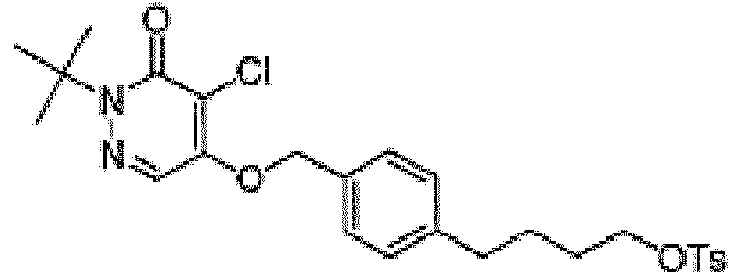
o or
(c) la especie precursora tiene la siguiente estructura:(c) the parent species has the following structure:

y el compuesto tiene la siguiente estructura:and the compound has the following structure:

oor
(d) la especie precursora tiene la siguiente estructura:(d) the parent species has the following structure:
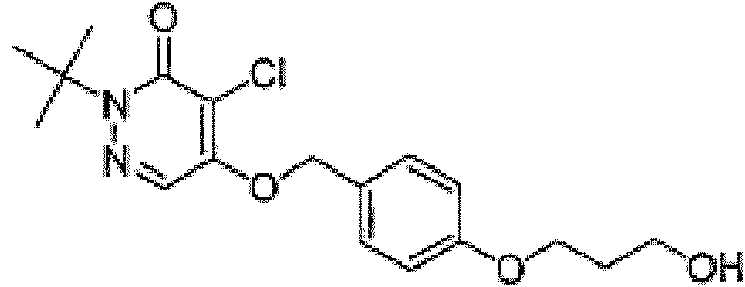
y el compuesto tiene la siguiente estructura:and the compound has the following structure:

oor
(e) la especie precursora tiene la siguiente estructura:(e) the parent species has the following structure:

y el compuesto tiene la siguiente estructura:and the compound has the following structure:

(f) la especie precursora tiene la siguiente estructura:(f) the parent species has the following structure:

y el compuesto tiene la siguiente estructura:and the compound has the following structure:

oor
(g) la especie precursora tiene la siguiente estructura:(g) the parent species has the following structure:

el compuesto tiene la siguiente estructura: the compound has the following structure:

En otra realización, la presente invención proporciona un agente de contraste de fórmula (III),In another embodiment, the present invention provides a contrast agent of formula (III),

en donde:where:
J se selecciona de N(R27), S y O;J is selected from N (R27), S and O;
cuando está presente, K se selecciona de hidrógeno, alcoxialquilo, alquiloxi, arilo, alquilo C1-C6 opcionalmente sustituido con un resto de imagenología, heteroarilo y un resto de imagenología;when present, K is selected from hydrogen, alkoxyalkyl, alkyloxy, aryl, C 1 -C 6 alkyl optionally substituted with an imaging moiety, heteroaryl, and an imaging moiety;
cuando está presente, L se selecciona de hidrógeno, alcoxialquilo, alquiloxi, arilo, alquilo C1-C6 opcionalmente sustituido con un resto de imagenología, heteroarilo y un resto de imagenología;when present, L is selected from hydrogen, alkoxyalkyl, alkyloxy, aryl, C 1 -C 6 alkyl optionally substituted with an imaging moiety, heteroaryl, and an imaging moiety;
M se selecciona de hidrógeno, alcoxialquilo, alquiloxi, arilo, alquilo C1-C6 opcionalmente sustituido con un resto de imagenología, heteroarilo, y un resto de f imagenología;M is selected from hydrogen, alkoxyalkyl, alkyloxy, aryl, C 1 -C 6 alkyl optionally substituted with an imaging moiety, heteroaryl, and an imaging moiety;
oor
L y M, junto con el átomo al que están unidos, forman un anillo carbocíclico de tres o cuatro miembros;L and M, together with the atom to which they are attached, form a three- or four-membered carbocyclic ring;
Q es halo o haloalquilo;Q is halo or haloalkyl;
n es 0, 1, 2 o 3;n is 0, 1, 2 or 3;
R21, R22, R23, R24, R25, R26 y R27 se seleccionan independientemente de hidrógeno, alquilo C1-C6 opcionalmente sustituido con un resto de imagenología y un resto de imagenología;R21, R22, R23, R24, R25, R26, and R27 are independently selected from hydrogen, C 1 -C 6 alkyl optionally substituted with an imaging moiety and an imaging moiety;
R29 es alquilo C1-C6 opcionalmente sustituido con un resto de imagenología; yR29 is C 1 -C 6 alkyl optionally substituted with an imaging moiety; Y
Y se selecciona de un enlace, carbono y oxígeno; con la condición de que cuando Y es un enlace, K y L están ausentes y M se selecciona de arilo y heteroarilo; y con la condición de que cuando Y es oxígeno, K y L están ausentes y M se selecciona de hidrógeno, alcoxialquilo, arilo, alquilo C1-C6 opcionalmente sustituido con un resto de imagenología y heteroarilo; y siempre que por lo menos un resto de imagenología esté presente en la fórmula (III); yY is selected from a bond, carbon and oxygen; provided that when Y is a bond, K and L are absent and M is selected from aryl and heteroaryl; and provided that when Y is oxygen, K and L are absent and M is selected from hydrogen, alkoxyalkyl, aryl, C 1 -C 6 alkyl optionally substituted with an imaging moiety and heteroaryl; and provided that at least one imaging residue is present in formula (III); Y
en donde el término arilo se refiere a un grupo fenilo o un sistema de anillos bicíclico fusionado en donde uno o más de los anillos es un grupo fenilo.wherein the term "aryl" refers to a phenyl group or a fused bicyclic ring system wherein one or more of the rings is a phenyl group.
En otra realización, la presente invención proporciona un agente de contraste de la presente invención para su uso en imagenología de perfusión miocárdica.In another embodiment, the present invention provides a contrast agent of the present invention for use in myocardial perfusion imaging.
En otra realización, la presente invención proporciona un kit de diagnóstico adecuado para la preparación de un agente de contraste de la presente invención adecuado para detectar, obtener imágenes y/o monitorizar la perfusión miocárdica, en donde el agente está marcado con 18F y en donde el kit comprende uno o más viales que contienen una formulación estéril, no pirogénica, que comprende una cantidad predeterminada de un reactivo que incluye un grupo saliente que puede reemplazarse en una reacción de desplazamiento de Sn2 para producir un agente marcado con 18F y opcionalmente otros componentes.In another embodiment, the present invention provides a suitable diagnostic kit for the preparation of a contrast agent of the present invention suitable for detecting, imaging and / or monitoring myocardial perfusion, wherein the agent is labeled with 18F and wherein The kit comprises one or more vials containing a sterile, non-pyrogenic formulation comprising a predetermined amount of a reagent that includes a leaving group that can be replaced in a Sn2 displacement reaction to produce an 18F-labeled agent and optionally other components. .
En otra realización, la presente invención proporciona una composición de un compuesto, en donde dicho compuesto incluye un grupo saliente que puede reemplazarse en una reacción de desplazamiento de Sn2 para producir un agente de contraste marcado con 18F de la siguiente fórmula: In another embodiment, the present invention provides a composition of a compound, wherein said compound includes a leaving group that can be replaced in a Sn2 displacement reaction to produce an 18F-labeled contrast agent of the following formula:

y en donde la composición esand where the composition is
(i) una solución; o(i) a solution; or
(ii) una preparación sólida, opcionalmente en donde la preparación sólida es una preparación sólida liofilizada.(ii) a solid preparation, optionally wherein the solid preparation is a lyophilized solid preparation.
En un aspecto, la presente divulgación proporciona un método de imagenología de perfusión miocárdica que comprende administrar a un paciente un agente de contraste que comprende un resto de imagenología y un compuesto seleccionado de deguelina, piridabén, pirimidifeno, tebufenpirad, fenazaquina, un análogo de deguelina, un análogo de piridabén, un análogo de pirimidifeno, un análogo de tebufenpirad y un análogo de fenazaquina; y escanear al paciente usando imagenología de diagnóstico. En otro aspecto, el resto de imagenología es un radioisótopo para imagenología de medicina nuclear, una especie paramagnética para usar en imagenología de MRI, una entidad ecogénica para usar en imagenología por ultrasonidos, una entidad fluorescente para usar en imagenología por fluorescencia o una entidad activa a la luz para usar en imagenología óptica.In one aspect, the present disclosure provides a myocardial perfusion imaging method comprising administering to a patient a contrast agent comprising an imaging moiety and a compound selected from dehuelin, pyridaben, pyrimidifene, tebufenpyrad, fenazaquine, a deguelin analog. , a pyridaben analog, a pyrimidiphen analog, a tebufenpyrad analog, and a phenazaquine analog; and scanning the patient using diagnostic imaging. In another aspect, the imaging remainder is a radioisotope for nuclear medicine imaging, a paramagnetic species for use in MRI imaging, an echogenic entity for use in ultrasound imaging, a fluorescent entity for use in fluorescence imaging, or an active entity. to light for use in optical imaging.
En otro aspecto, la presente divulgación proporciona un agente de contraste que comprende un resto de imagenología y un compuesto seleccionado de deguelina, piridabén, pirimidifeno, tebufenpirad, fenazaquina, un análogo de deguelina, un análogo de piridabén, un análogo de pirimidifeno, un análogo de tebufenpirad y un análogo de fenazaquin. En otro aspecto, el resto de imagenología es un radioisótopo para imagenología de medicina nuclear, una especie paramagnética para usar en imagenología por resonancia magnética, una entidad ecogénica para usar en imagenología por ultrasonidos, una entidad fluorescente para usar en imagenología por fluorescencia o una entidad fotoactiva para usar en imagenología óptica.In another aspect, the present disclosure provides a contrast agent comprising an imaging moiety and a compound selected from deguelin, pyridaben, pyrimidifene, tebufenpyrad, phenazakine, a deguelin analog, a pyridaben analog, a pyrimidiphen analog, an analog of tebufenpyrad and a fenazaquin analog. In another aspect, the imaging remainder is a radioisotope for nuclear medicine imaging, a paramagnetic species for use in magnetic resonance imaging, an echogenic entity for use in ultrasound imaging, a fluorescent entity for use in fluorescence imaging, or an entity photoactive for use in optical imaging.
En otro aspecto, la especie paramagnética para uso en imagenología por MRI es Gd3+, Fe3+, In3+ o Mn2+. In another aspect, the paramagnetic species for use in MRI imaging is Gd3 +, Fe3 +, In3 +, or Mn2 +.
En otro aspecto, la entidad ecogénica para uso en imagenología por ultrasonidos es una microesfera de surfactante encapsulado en fluorocarbono.In another aspect, the echogenic entity for use in ultrasound imaging is a fluorocarbon encapsulated surfactant microsphere.
En otra realización, el radioisótopo para imagenología de medicina nuclear es 18F.In another embodiment, the radioisotope for nuclear medicine imaging is 18F.
En otro aspecto, el radioisótopo para imagenología de medicina nuclear es 11C, 13N, 123I, 125I, 99mTc, 95Tc, 111ln, 62Cu, 64Cu, 67Ga o 68Ga.In another aspect, the radioisotope for nuclear medicine imaging is 11C, 13N, 123I, 125I, 99mTc, 95Tc, 111ln, 62Cu, 64Cu, 67Ga, or 68Ga.
En otra realización, el resto de imagenología es 18F.In another embodiment, the imaging remainder is 18F.
En otro aspecto, el resto de imagenología es 99mTc.In another aspect, the rest of the imaging is 99mTc.
En otro aspecto, la presente divulgación proporciona un agente de contraste que comprende un resto de imagenología y un compuesto seleccionado de deguelina, piridabén, piridimifeno, tebufenpirad, fenazaquina, un análogo de deguelina, un análogo de piridabén, un análogo de piridimifeno, un análogo de tebufenpirad y un análogo de fenazaquina en donde el agente de contraste es de fórmula (III)In another aspect, the present disclosure provides a contrast agent comprising an imaging moiety and a compound selected from deguelin, pyridaben, pyridimiphene, tebufenpyrad, phenazaquine, a deguelin analog, a pyridaben analog, a pyridimiphene analog, an analog of tebufenpyrad and a phenazaquine analog where the contrast agent is of formula (III)

en donde:where:
J se selecciona de N(R27), S, O, C(=O), C(=O)O, NHCH2CH2O, un enlace, o C(=O)N(R27), con cada grupo siendo dibujado con su extremo izquierdo unido a G y su extremo derecho unido al carbono sustituido con R21 y R22; cuando está presente, K se selecciona de hidrógeno, alcoxialquilo, alquiloxi, arilo, alquilo C1-C6 opcionalmente sustituido con un resto de imagenología, heteroarilo y un resto de imagenología;J is selected from N (R27), S, O, C (= O), C (= O) O, NHCH 2 CH 2 O, a bond, or C (= O) N (R27), with each group being drawn with its left end attached to G and its right end attached to the carbon substituted with R21 and R22; when present, K is selected from hydrogen, alkoxyalkyl, alkyloxy, aryl, C 1 -C 6 alkyl optionally substituted with an imaging moiety, heteroaryl, and an imaging moiety;
cuando está presente, L se selecciona de hidrógeno, alcoxialquilo, alquiloxi, arilo, alquilo C1-C6 opcionalmente sustituido con un resto de imagenología, heteroarilo y un resto de imagenología;when present, L is selected from hydrogen, alkoxyalkyl, alkyloxy, aryl, C 1 -C 6 alkyl optionally substituted with an imaging moiety, heteroaryl, and an imaging moiety;
M se selecciona de hidrógeno, alcoxialquilo, alquiloxi, arilo, alquilo C1-C6 opcionalmente sustituido con un resto de imagenología, heteroarilo, y un resto de imagenología; oM is selected from hydrogen, alkoxyalkyl, alkyloxy, aryl, C 1 -C 6 alkyl optionally substituted with an imaging moiety, heteroaryl, and an imaging moiety; or
L y M, junto con el átomo al que están unidos, forman un anillo carbocíclico de tres o cuatro miembros;L and M, together with the atom to which they are attached, form a three- or four-membered carbocyclic ring;
Q es halo o haloalquilo;Q is halo or haloalkyl;
n es 0, 1, 2 o 3;n is 0, 1, 2 or 3;
R21, R22, R23, R24, R25, R26 y R27 se seleccionan independientemente de hidrógeno, alquilo C1-C6 opcionalmente sustituido con un resto de imagenología y un resto de imagenología;R21, R22, R23, R24, R25, R26, and R27 are independently selected from hydrogen, C 1 -C 6 alkyl optionally substituted with an imaging moiety and an imaging moiety;
R29 es alquilo C1-C6 opcionalmente sustituido con un resto de imagenología; yR29 is C 1 -C 6 alkyl optionally substituted with an imaging moiety; Y
Y se selecciona de un enlace, carbono y oxígeno; siempre que cuando Y es un enlace, K y L están ausentes y M se selecciona de arilo y heteroarilo; y siempre que cuando Y es oxígeno, K y L están ausentes y M se selecciona de hidrógeno, alcoxialquilo, arilo, alquilo C1-C6 opcionalmente sustituido con un resto de imagenología y heteroarilo;Y is selected from a bond, carbon and oxygen; provided that when Y is a bond, K and L are absent and M is selected from aryl and heteroaryl; and provided that when Y is oxygen, K and L are absent and M is selected from hydrogen, alkoxyalkyl, aryl, C 1 -C 6 alkyl optionally substituted with an imaging moiety and heteroaryl;
siempre que por lo menos un resto de imagenología esté presente en la fórmula (NI).provided that at least one imaging residue is present in the formula (NI).
En otra realización J es O y R29 es alquilo C1-C6 en donde el alquilo C1-C6 es terc-butilo.In another embodiment J is O and R29 is C 1 -C 6 alkyl where C 1 -C 6 alkyl is tert-butyl.
En otra realización, el agente de contraste se selecciona deIn another embodiment, the contrast agent is selected from

Restos de imágenesRemnants of images
Los agentes de medicina nuclear de contraste de la presente descripción incluyen 11C, 13N, 18F, 123I, 125I, 99mTc, 95Tc, 111In, 62Cu, 64Cu, 67Ga, y 68Ga. 11C se ha usado palmitato para estudiar la oxidación de ácidos grasos y se ha usado 11C-acetato para evaluar el metabolismo oxidativo en el miocardio (Circulation 1987, 76, 687-696). 13N-amoníaco se ha utilizado ampliamente para obtener imágenes de la perfusión miocárdica (Circulation 1989, 80, 1328-37). Los agentes basados en 18F se han usado como agentes de imagen para hipoxia y cáncer (Drugs of the Future 2002, 27, 655-667). El ácido 15-(p-(123I)-yodofenilo)-pentadecanoico y el ácido 15-(p-(123I) -yodofenilo)-3(R,S)-metilpentadecanoico son dos agentes yodados que se han usado para obtener imágenes del metabolismo del miocardio. En una realización, el resto de formación de imágenes empleado en los presentes agentes de contraste es 18F. Los restos de formación de imágenes adicionales de la presente divulgación pueden comprender uno o más átomos absorbentes de rayos X o átomos "pesados" de número atómico 20 o superior, que comprende además un resto de enlace opcional, L, entre el resto molecular precursor y los átomos que absorben rayos X. Un átomo pesado frecuentemente usado en agentes de contraste de rayos X es yodo. Recientemente, se han descrito agentes de contraste de rayos X compuestos de quelatos de metales (Patente de los Estados Unidos N° 5.417.959) y poliquelatos compuestos por una pluralidad de iones metálicos (Patente de los Estados Unidos N° 5.679.810). Más recientemente, se han descrito complejos de agrupamientos multinucleares como agentes de contraste de rayos X (Patente de los Estados Unidos N° 5.804.161, WO 91/14460, y WO 92/17215). En ciertos casos de la presente divulgación, los metales específicos utilizados en los agentes de contraste de rayos X incluyen Re, Sm, Ho, Lu, Pm, Y, Bi, Pd, Gd, La, Au, Au, Yb, Dy, Cu, Rh , Ag e Ir.Nuclear medicine contrast agents of the present disclosure include 11C, 13N, 18F, 123I, 125I, 99mTc, 95Tc, 111In, 62Cu, 64Cu, 67Ga, and 68Ga. 11C palmitate has been used to study fatty acid oxidation and 11C-acetate has been used to evaluate oxidative metabolism in the myocardium (Circulation 1987, 76, 687-696). 13N-ammonia has been used extensively for imaging myocardial perfusion (Circulation 1989, 80, 1328-37). Agents based on 18F have been used as imaging agents for hypoxia and cancer (Drugs of the Future 2002, 27, 655-667). 15- (p- (123I) -iodophenyl) -pentadecanoic acid and 15- (p- (123I) -iodophenyl) -3 (R, S) -methylpentadecanoic acid are two iodinated agents that have been used to image the myocardial metabolism. In one embodiment, the imaging moiety employed in the present contrast agents is 18F. Additional imaging moieties of the present disclosure may comprise one or more X-ray absorbing atoms or "heavy" atoms of atomic number 20 or higher, further comprising an optional linking moiety, L, between the parent molecular moiety and the atoms that absorb X-rays. A heavy atom frequently used in X-ray contrast agents is iodine. Recently, X-ray contrast agents composed of metal chelates (US Patent No. 5,417,959) and polychelates composed of a plurality of metal ions have been described (US Patent No. 5,679,810). More recently, multinuclear cluster complexes have been described as X-ray contrast agents (US Patent No. 5,804,161, WO 91/14460, and WO 92/17215). In certain instances of the present disclosure, specific metals used in X-ray contrast agents include Re, Sm, Ho, Lu, Pm, Y, Bi, Pd, Gd, La, Au, Au, Yb, Dy, Cu , Rh, Ag and Ir.
Los agentes de contraste de IRM de la presente divulgación pueden estar compuestos por uno o más restos análogos unidos a uno o más iones metálicos paramagnéticos, que comprenden además un resto de enlace opcional, L, entre los restos análogos y los iones metálicos paramagnéticos. Los iones metálicos paramagnéticos pueden estar presentes en forma de quelatos o complejos metálicos o partículas de óxido metálico. Las patentes de los Estados Unidos Nos 5.412.148 y 5.760.191 describen ejemplos de quelantes para iones metálicos paramagnéticos para su uso en agentes de contraste de IRM. La patente de los Estados Unidos N° 5.801.228, patente de EE.u U. N° 5.567.411, y patente de EE.UU. N° 5.281.704, describen ejemplos de poliquelantes útiles para formar complejos de más de un ion paramagnético metálico para uso en agentes de contraste de IRM. La patente de los Estados Unidos N° 5.520.904, describe composiciones particuladas que comprenden iones metálicos paramagnéticos para uso como agentes de contraste de IRM. Los ejemplos de metales específicos incluyen Gd3+, Fe3+ , In3+ y Mn2+.The MRI contrast agents of the present disclosure may be composed of one or more analogous moieties attached to one or more paramagnetic metal ions, further comprising an optional linking moiety, L, between the analogous moieties and the paramagnetic metal ions. Paramagnetic metal ions can be present in the form of chelates or metal complexes or metal oxide particles. US Patent Nos. 5,412,148 and 5,760,191 describe examples of chelators for paramagnetic metal ions for use in MRI contrast agents. Patent US No. 5,801,228, US Pat. No. 5,567,411 or U., and U.S. Patent No. 5,281,704, describe examples of polychelants useful for complexing more than one Metal paramagnetic ion for use in MRI contrast agents. US Patent No. 5,520,904 describes particulate compositions comprising paramagnetic metal ions for use as MRI contrast agents. Examples of specific metals include Gd3 +, Fe3 +, In3 + and Mn2 +.
Los agentes de contraste de ultrasonidos de la presente descripción pueden comprender una pluralidad de restos análogos unidos o incorporados en una microburbuja de un gas biocompatible, un vehículo líquido y una microesfera de tensioactivo, que comprende además un resto de enlace opcional, L, entre los restos análogos y la microburbuja. En este contexto, el término "vehículo líquido" significa solución acuosa y el término "agente tensioactivo" significa cualquier material anfifílico que puede producir una reducción en la tensión interfacial en una solución. Se da a conocer una lista de tensioactivos adecuados para formar microesferas tensioactivas, por ejemplo, en el documento EP0727225A2. El término "microesfera tensioactiva" incluye microesferas, nanoesferas, liposomas, vesículas y similares. El gas biocompatible puede ser cualquier gas fisiológicamente aceptado, incluido, por ejemplo, aire o un fluorocarbono, tal como un perfluoroalcano C3-C5, que proporciona la diferencia en ecogenicidad y, por lo tanto, el contraste en la formación de imágenes por ultrasonidos. El gas puede estar encapsulado, contenido o restringido de otro modo en o por la microesfera a la que está unido el resto análogo, opcionalmente a través de un grupo de enlace. El archivo adjunto puede ser covalente, iónico o por las fuerzas de van der Waals. Los ejemplos específicos de tales agentes de contraste incluyen, por ejemplo, perfluorocarbonos encapsulados en lípidos con una pluralidad de péptidos, polipéptidos o peptidomiméticos de unión al receptor de neovasculatura tumoral. Los ejemplos de restos de formación de imágenes rellenos de gas incluyen los encontrados en la Solicitud de Patente de Estados Unidos N° de serie 09/931.317, presentada el 16 de agosto de 2001, y las Patentes de Estados Unidos N° 5.088.499, 5.547.656, 5.228.446, 5.585.112 y 5.846.517.The ultrasound contrast agents of the present disclosure may comprise a plurality of analogous moieties bound or incorporated in a microbubble of a biocompatible gas, a liquid carrier, and a surfactant microsphere, further comprising an optional binding moiety, L, between the analogous moieties and the microbubble. In this context, the term "liquid carrier" means aqueous solution and the term "surfactant" means any amphiphilic material that can cause a reduction in interfacial tension in a solution. A list of suitable surfactants for forming surfactant microspheres is disclosed, for example, in EP0727225A2. The term "surfactant microsphere" includes microspheres, nanospheres, liposomes, vesicles, and the like. The biocompatible gas can be any physiologically accepted gas, including, for example, air or a fluorocarbon, such as a C 3 -C 5 perfluoroalkane, which provides the difference in echogenicity and thus the contrast in imaging by ultrasounds. The gas may be encapsulated, contained, or otherwise restricted in or by the microsphere to which the analogous moiety is attached, optionally through a linking group. The attachment can be covalent, ionic, or by van der Waals forces. Specific examples of such contrast agents include, for example, lipid encapsulated perfluorocarbons with a plurality of tumor neovasculature receptor binding peptides, polypeptides or peptidomimetics. Examples of gas-filled imaging moieties include those found in US Patent Application Serial No. 09 / 931,317, filed August 16, 2001, and US Patent No. 5,088,499, 5,547,656, 5,228,446, 5,585,112 and 5,846,517.
QuelantesChelating
Se conocen muchos enfoques para compuestos de marcaje con 99mTc, incluyendo el marcaje directo del compuesto o la inclusión de un resto quelante ("quelante"). En una realización, el quelante es DADT, MAG3, MAMA, PAMA o DOTA.Many approaches are known to 99mTc-labeling compounds, including direct labeling of the compound or the inclusion of a chelating moiety ("chelating"). In one embodiment, the chelator is DADT, MAG3, MAMA, PAMA, or DOTA.
Los compuestos de la descripción pueden contener opcionalmente un quelante ("C"). En ciertas realizaciones de los compuestos de la divulgación, el quelante es un tensioactivo capaz de formar una esfera o microburbuja lipídica cargada de sustancia ecogénica. En ciertas otras realizaciones, el quelante es una unidad de unión que tiene una fórmula seleccionada de The compounds of the description may optionally contain a chelator ("C"). In certain embodiments of the compounds of the disclosure, the chelator is a surfactant capable of forming an echogenic substance charged lipid sphere or microbubble. In certain other embodiments, the chelator is a binding unit having a formula selected from

en dondewhere
cada A1 se selecciona independientemente de -NR46R47, -NHR53, -SH, -S(Pg), -OH, -PR46R47, -P(O)R48R49, y un enlace al compuesto que se une a MC-1;each A1 is independently selected from -NR46R47, -NHR53, -SH, -S (Pg), -OH, -PR46R47, -P (O) R48R49, and a bond to the compound that binds MC-1;
cada A2 se selecciona independientemente de N(R53), N(R46), S, O, P (R46) y -OP (O) (R48) O-;each A2 is independently selected from N (R53), N (R46), S, O, P (R46) and -OP (O) (R48) O-;
A3 es N;A3 is N;
A4 se selecciona de OH y OC(=O)C1-C20 alquilo;A4 is selected from OH and OC (= O) C 1 -C 20 alkyl;
A5 es OC(=O)C1-C20 alquilo;A5 is OC (= O) C 1 -C 20 alkyl;
cada E se selecciona independientemente de C1-C16 alquileno sustituido con 0-3 R50, C6-C10 arileno sustituido con 0-3 R50, C3-C10 cicloalquileno sustituido con 0-3 R50, heterociclilo-C1-C10 alquileno sustituido con 0-3 R50, C6-C10 arilo-C1-C10 alquileno sustituido con 0-3 R50, y heterociclileno sustituido con 0-3 R50; E1 se selecciona de un enlace y E;each E is independently selected from C 1 -C 16 alkylene substituted with 0-3 R50, C 6 -C 10 arylene substituted with 0-3 R50, C 3 -C 10 cycloalkylene substituted with 0-3 R50, heterocyclyl-C 1 - C 10 alkylene substituted with 0-3 R50, C 6 -C 10 aryl-C 1 -C 10 alkylene substituted with 0-3 R50, and heterocyclylene substituted with 0-3 R50; E1 is selected from a bond and E;
cada E2 se selecciona independientemente de C1-C16 alquilo sustituido con 0-3 R50, C6-C10 arilo sustituido con 0-3 R50, C3-C10 cicloalquilo sustituido con 0-3 R50, heterociclilo-C1-10 alquilo sustituido con 0-3 R50, C6-C10 arilo-C1-C10 alquilo sustituido con 0-3 R50, C1-C10 alquilo-C6-C10 arilo sustituido con 0-3 R50, y heterociclilo sustituido con 0-3 R50;each E2 is independently selected from C 1 -C 16 alkyl substituted with 0-3 R50, C 6 -C 10 aryl substituted with 0-3 R50, C 3 -C 10 cycloalkyl substituted with 0-3 R50, heterocyclyl-C 1 - 10 alkyl substituted with 0-3 R50, C6-C 10 aryl-C 1 -C 10 alkyl substituted with 0-3 R50, C 1 -C 10 alkyl-C 6 -C 10 aryl substituted with 0-3 R50, and heterocyclyl substituted with 0-3 R50;
E3 es C1-C10 alquileno sustituido con 1-3 R59;E 3 is C 1 -C 10 alkylene substituted with 1-3 R59;
Pg es un grupo protector de tiol;Pg is a thiol protecting group;
R46 y R47 se seleccionan cada uno independientemente de un enlace en el compuesto que se une MC-1, hidrógeno, C1-C10 alquilo sustituido con 0-3 R50, arilo sustituido con 0-3 R50, C3-C10 cicloalquilo sustituido con 0-3 R50, heterociclilo C1-C10 alquilo sustituido con 0-3 R50, C6-C10 arilo-C1-C10 alquilo sustituido con 0-3 R50, y heterociclilo sustituido con 0-3 R50;R46 and R47 are each independently selected from a bond in the compound that binds MC-1, hydrogen, C 1 -C 10 alkyl substituted with 0-3 R50, aryl substituted with 0-3 R50, C 3 -C 10 cycloalkyl substituted with 0-3 R50, heterocyclyl C 1 -C 10 alkyl substituted with 0-3 R50, C 6 -C 10 aryl-C 1 -C 10 alkyl substituted with 0-3 R50, and heterocyclyl substituted with 0-3 R50;
R48y R49 se seleccionan cada uno independientemente de un enlace en el compuesto que se une MC-1, -OH, C1-C10 alquilo sustituido con 0-3 R50, arilo sustituido con 0-3 R50, C3-C10 cicloalquilo sustituido con 0-3 R50, heterociclilo-C1-C10 alquilo sustituido con 0-3 R50, C6-C10 aril-C1-C10 alquilo sustituido con 0-3 R50 y heterociclilo sustituido con 0-3 R50;R48 and R49 are each independently selected from a bond in the compound that binds MC-1, -OH, C 1 -C 10 alkyl substituted with 0-3 R50, aryl substituted with 0-3 R50, C 3 -C 10 cycloalkyl substituted with 0-3 R50, heterocyclyl-C 1 -C 10 alkyl substituted with 0-3 R50, C 6 -C 10 aryl-C 1 -C 10 alkyl substituted with 0-3 R50 and heterocyclyl substituted with 0-3 R50;
cada R50 se selecciona independientemente de un enlace en el compuesto que se une MC-1, = O, halo, trifluorometilo, ciano, -CO2 R51, -C(=O) R51, -C(=O)N(R51)2 , -CHO, -CH2OR51,Each R50 is independently selected from a bond in the compound that binds MC-1, = O, halo, trifluoromethyl, cyano, -CO 2 R 51 , -C (= O) R51, -C (= O) N (R51 ) 2 , -CHO, -CH 2 OR 51 ,
-OC(=O) R51, -OC(=O)OR51, -OR51, -OC(=O)N(R51)2, -NR51C(=O) R51, -NR51 C(=O)OR51,-OC (= O) R51, -OC (= O) OR51, -OR51, -OC (= O) N (R51) 2, -NR51C (= O) R51, -NR51 C (= O) OR51,
-NR51C(=O)N(R51)2 , -NR51 SO2N(R51)2 , -NR51SO2 R51, -SO3H, -SO2 R51,-NR51C (= O) N (R51) 2 , -NR51 SO 2 N (R51) 2 , -NR51SO 2 R51, -SO 3 H, -SO 2 R 51 ,
-SR51, -S(=O)R51, -SO2N(R51)2, -N(R51)2 , -NHC(=S)NHR51, =NOR51, NO2 , -C(=O)NHOR51, -C(=O)NHN(R51)2 , -OCH2CO2H, 2-(1-morfolino)etoxi, C1-C5 alquilo, C2-C4 alquenilo, C3-C6 cicloalquilo, C3-C6 cicloalquilo, C2-C6 alcoxialquilo, arilo sustituido con 0-2 R51, y heterociclilo;-SR51, -S (= O) R51, -SO 2 N (R51) 2 , -N (R51) 2 , -NHC (= S) NHR51, = NOR51, NO 2 , -C (= O) NHOR51, - C (= O) NHN (R51) 2 , -OCH 2 CO 2 H, 2- (1-morpholino) ethoxy, C 1 -C 5 alkyl, C 2 -C 4 alkenyl, C 3 -C 6 cycloalkyl, C 3 -C 6 cycloalkyl, C 2 -C 6 alkoxyalkyl, aryl substituted with 0-2 R51, and heterocyclyl;
cada R51 se selecciona independientemente de un enlace en el compuesto que se une MC-1, hidrógeno, C1-C6 alquilo, fenilo, bencilo, y C1-C6 alcoxi;each R51 is independently selected from a bond in the compound that binds MC-1, hydrogen, C 1 -C 6 alkyl, phenyl, benzyl, and C 1 -C 6 alkoxy;
R53 es un enlace coordinado a un metal;R53 is a coordinate bond to a metal;
cada R59 seleccionado de R61, =O, -CO2 R60, -C(=O) R60, -C(=O)N(R60)2 -CH2OR60,each R59 selected from R61, = O, -CO 2 R 60 , -C (= O) R60, -C (= O) N (R60) 2 -CH 2 OR 60 ,
-OR61, -N(R60)2 , y C2-C4 alquenilo;-OR61, -N (R60) 2 , and C 2 -C 4 alkenyl;
cada R60 se selecciona independientemente de R61, hidrógeno, C1-C6 alquilo, fenilo, bencilo y trifluorometilo; yeach R60 is independently selected from R61, hydrogen, C 1 -C 6 alkyl, phenyl, benzyl, and trifluoromethyl; Y
R61 es un enlace con el compuesto que se une MC-1;R61 is a bond with the compound that MC-1 binds;
en donde al menos uno de A1, R46, R47, R48, R49, R50, R51 y R61 es un enlace al compuesto que se une a MC-1.wherein at least one of A1, R46, R47, R48, R49, R50, R51, and R61 is a bond to the compound that binds MC-1.
Métodos de fabricaciónManufacturing methods
Típicamente 18F Los compuestos marcados son sintetizados por desplazamiento de Sn2 de un grupo saliente apropiado. Estos grupos salientes son preferiblemente ésteres de ácido sulfónico tales como toluensulfonato (tosilato, TsO), metanosulfonato (mesilato, MsO) o trifluorometanosulfonato (triflato, TfO). El grupo saliente también puede ser un haluro, un fosfinoxido (a través de la reacción Mit-sunobu) o un grupo saliente interno (tal como un epóxido o sulfato cíclico). Estos compuestos están hechos de K18F seco altamente activado, que se hace "más caliente" mediante la adición de criptandos tales como krytofix[2.2.2]. La purificación generalmente se realiza por eliminación de sales mediante cromatografía de fase inversa (Sep-Pak).Typically 18F Labeled compounds are synthesized by Sn2 displacement of an appropriate leaving group. These leaving groups are preferably sulfonic acid esters such as toluenesulfonate (tosylate, TsO), methanesulfonate (mesylate, MsO) or trifluoromethanesulfonate (triflate, TfO). The leaving group can also be a halide, a phosphinoxide (via the Mit-sunobu reaction), or an internal leaving group (such as a cyclic epoxide or sulfate). These compounds are made from highly activated dry K18F, which is made "hotter" by adding cryptands such as krytofix [2.2.2]. Purification is generally carried out by removal of salts by reversed phase chromatography (Sep-Pak).
Se describen métodos representativos para preparar los agentes de contraste en los siguientes ejemplos. Las transformaciones químicas anteriores se pueden llevar a cabo usando técnicas que serían fácilmente evidentes para los expertos en la técnica, una vez provistas de las enseñanzas en las presentes solicitudes. Los disolventes de reacción representativos incluyen, por ejemplo, DMF, NMP, DMSO, THF, acetato de etilo, diclorometano y cloroformo. La solución de reacción puede mantenerse neutra o básica mediante la adición de una amina tal como trietilamina o DIEA. Las reacciones pueden llevarse a cabo a temperatura ambiente y protegerse del oxígeno y el agua con una atmósfera de nitrógeno.Representative methods for preparing contrast agents are described in the following examples. The above chemical transformations can be carried out using techniques that would be readily apparent to those skilled in the art, once provided with the teachings in the present applications. Representative reaction solvents include, for example, DMF, NMP, DMSO, THF, ethyl acetate, dichloromethane, and chloroform. The reaction solution can be kept neutral or basic by adding an amine such as triethylamine or DIEA. Reactions can be carried out at room temperature and protected from oxygen and water with a nitrogen atmosphere.
Los grupos protectores temporales pueden ser usados para prevenir otra funcionalidad reactiva, tal como aminas, tioles, alcoholes, fenoles y ácidos carboxílicos, de participar en la reacción. Los grupos protectores de amina representativos incluyen, por ejemplo, terc-butoxicarbonilo y tritilo (eliminado en condiciones ácidas suaves), Fmoc (eliminado mediante el uso de aminas secundarias tales como piperidina) y benciloxicarbonilo (eliminado por ácido fuerte o por hidrogenólisis catalítica). El grupo tritilo también puede usarse para la protección de tioles, fenoles y alcoholes. En ciertas realizaciones, los grupos protectores de ácido carboxílico incluyen, por ejemplo, éster tercbutílico (eliminado por ácido suave), éster bencílico (habitualmente eliminado por hidrogenólisis catalítica) y ésteres alquílicos tales como metilo o etilo (habitualmente eliminados por una base suave). Todos los grupos protectores pueden eliminarse al final de la síntesis usando las condiciones descritas anteriormente para los grupos protectores individuales, y el producto final puede purificarse mediante técnicas que serían fácilmente evidentes para un experto habitual en la técnica, una vez armado con el presente divulgación.Temporary protecting groups can be used to prevent other reactive functionality, such as amines, thiols, alcohols, phenols, and carboxylic acids, from participating in the reaction. Representative amine protecting groups include, for example, tert-butoxycarbonyl and trityl (removed under mild acidic conditions), Fmoc (removed by using secondary amines such as piperidine) and benzyloxycarbonyl (removed by strong acid or by catalytic hydrogenolysis). The trityl group can also be used for the protection of thiols, phenols and alcohols. In certain embodiments, carboxylic acid protecting groups include, for example, tert-butyl ester (removed by mild acid), benzyl ester (usually removed by catalytic hydrogenolysis), and alkyl esters such as methyl or ethyl (usually removed by mild base). All protecting groups can be removed at the end of the synthesis using the conditions described above for individual protecting groups, and the final product can be purified by techniques that would be readily apparent to one of ordinary skill in the art, once armed with the present disclosure.
UtilizaciónUtilization
Los agentes de contraste de la presente descripción se pueden utilizar en un método de formación de imágenes, incluyendo los métodos de formación de imágenes en un paciente que comprende administrar el agente de contraste al paciente mediante inyección, infusión, o cualquier otro método conocido, y la formación de imágenes del área del paciente en el que se encuentra el evento de interés.The contrast agents of the present disclosure can be used in an imaging method, including methods of imaging a patient comprising administering the contrast agent to the patient by injection, infusion, or any other known method, and imaging the area of the patient in which the event of interest is located.
La dosis útil a administrar y el modo particular de administración variará dependiendo de factores tales como la edad, el peso, y la región particular a tratar, así como el agente de contraste particular usado, el uso diagnóstico contemplado, y la forma de la formulación, por ejemplo, suspensión, emulsión, microesfera, liposoma o similar, como será fácilmente evidente para los expertos en la técnica.The useful dose to be administered and the particular mode of administration will vary depending on factors such as age, weight, and the particular region to be treated, as well as the particular contrast agent used, the diagnostic use contemplated, and the form of the formulation. , for example, suspension, emulsion, microsphere, liposome or the like, as will be readily apparent to those skilled in the art.
Típicamente, la dosis se administra a niveles inferiores y se incrementa hasta que se consigue el efecto de diagnóstico deseable. En un caso, los agentes de contraste descritos anteriormente pueden administrarse por inyección intravenosa, habitualmente en solución salina, a una dosis de aproximadamente 0,1 a aproximadamente 100 mCi por 70 kg de peso corporal (y todas las combinaciones y subcombinaciones de intervalos de dosificación y dosificaciones específicas en los mismos), o preferiblemente a una dosis de aproximadamente 0,5 a aproximadamente 50 mCi. Las imágenes se realizan usando técnicas bien conocidas por los expertos en la materia.Typically the dose is administered at lower levels and increased until the desirable diagnostic effect is achieved. In one case, the contrast agents described above can be administered by intravenous injection, usually in saline, at a dose of about 0.1 to about 100 mCi per 70 kg of body weight (and all combinations and sub-combinations of dosage ranges and specific dosages therein), or preferably at a dose of from about 0.5 to about 50 mCi. Images are made using techniques well known to those of skill in the art.
Para su uso como agentes de contraste de medicina nuclear, las composiciones de la presente descripción, las dosis, administradas por inyección intravenosa, normalmente variarán de aproximadamente 0,5 pmolkg a aproximadamente 1,5 mmol/kg (y todas las combinaciones y subcombinaciones de intervalos de dosificación y dosificaciones específicas en las mismas), preferiblemente de aproximadamente 0,8 pmolkg a aproximadamente 1,2 mmol/kg.For use as nuclear medicine contrast agents, the compositions of the present disclosure, the doses, administered by intravenous injection, will typically range from about 0.5 pmolkg to about 1.5mmol / kg (and all combinations and subcombinations of dosage ranges and specific dosages therein), preferably from about 0.8 pmolkg to about 1.2mmol / kg.
Para su uso como agentes de contraste de IRM, las composiciones de la presente divulgación se pueden usar de una manera similar como otros agentes de IRM como se describe en la Patente de Estados Unidos N° 5.155.215; Patente de los Estados Unidos N° 5.087.440; Magn. Reson. Medicina. 1986, 3, 808; Radiology 1988, 166, 835; y Radiology 1988, 166, 693. Generalmente, las soluciones acuosas estériles de los agentes de contraste se pueden administrar a un paciente por vía intravenosa en dosis que varían de aproximadamente 0,01 a aproximadamente 1,0 mmoles por kg de peso corporal (y todas las combinaciones y subcombinaciones de intervalos de dosificación y dosis específicas en las mismas).For use as MRI contrast agents, the compositions of the present disclosure can be used in a similar manner as other MRI agents as described in US Patent No. 5,155,215; US Patent No. 5,087,440; Magn. Reson. Medicine. 1986, 3, 808; Radiology 1988, 166, 835; and Radiology 1988, 166, 693. Generally, sterile aqueous solutions of contrast agents can be administered to a patient intravenously in doses ranging from about 0.01 to about 1.0 mmol per kg of body weight (and all combinations and sub-combinations of dosage ranges and specific doses therein).
Los agentes de contraste de ultrasonidos de la presente divulgación se pueden administrar por inyección intravenosa en una cantidad de aproximadamente 10 a aproximadamente 30 pL (y todas las combinaciones y subcombinaciones de intervalos de dosificación y las dosis específicas en las mismas) de gas ecogénico por kg de peso corporal o por infusión a una velocidad de aproximadamente 3 pL/kg/min.The ultrasound contrast agents of the present disclosure can be administered by intravenous injection in an amount of about 10 to about 30 pL (and all combinations and sub-combinations of dosage ranges and the specific doses therein) of echogenic gas per kg. of body weight or by infusion at a rate of approximately 3 pL / kg / min.
Otro aspecto de la presente descripción es kits de diagnóstico para la preparación de agentes de diagnóstico para la detección, formación de imágenes, y/o el seguimiento de la perfusión miocárdica. Los kits de diagnóstico de la presente divulgación comprenden uno o más viales que contienen la formulación estéril, no pirógena, que comprende una cantidad predeterminada de un reactivo de la presente divulgación, y opcionalmente otros componentes tales como uno o dos ligandos auxiliares tales como tricina y ácido 3-[bis(3-sulfofenilo)fosfina]bencenosulfónico (TPPTS), agentes reductores, ligandos de transferencia, tampones, adyuvantes de liofilización, coadyuvantes de estabilización, coadyuvantes de solubilización y bacteriostáticos. Los kits también pueden comprender un agente reductor, tal como, por ejemplo, estaño (II).Another aspect of the present disclosure is diagnostic kits for the preparation of diagnostic agents for the detection, imaging, and / or monitoring of myocardial perfusion. The diagnostic kits of the present disclosure comprise one or more vials containing the sterile, non-pyrogenic formulation, comprising a predetermined amount of a reagent of the present disclosure, and optionally other components such as one or two ancillary ligands such as tricine and 3- [bis (3-sulfophenyl) phosphine] benzenesulfonic acid (TPPTS), reducing agents, transfer ligands, buffers, lyophilization aids, stabilization aids, solubilization aids and bacteriostats. Kits can also comprise a reducing agent, such as, for example, tin (II).
Los tampones útiles en la preparación de agentes de contraste y kits incluyen, por ejemplo, fosfato, citrato, sulfosalicilato, y tampones de acetato. Se puede encontrar una lista más completa en la Farmacopea de los Estados Unidos.Buffers useful in the preparation of contrast agents and kits include, for example, phosphate, citrate, sulfosalicylate, and acetate buffers. A more complete list can be found in the United States Pharmacopeia.
Los auxiliares de liofilización útiles en la preparación de agentes de contraste y kits incluyen, por ejemplo, manitol, lactosa, sorbitol, dextrano, polímero FICOLL® y polivinilpirrolidina (PVP).Useful lyophilization aids in the preparation of contrast agents and kits include, for example, mannitol, lactose, sorbitol, dextran, FICOLL® polymer, and polyvinylpyrrolidine (PVP).
Los adyuvantes de estabilización útiles en la preparación de agentes de contraste y kits incluyen, por ejemplo, ácido ascórbico, cisteína, monotioglicerol, bisulfito sódico, metabisulfito sódico, ácido gentísico e inositol. Stabilization aids useful in the preparation of contrast agents and kits include, for example, ascorbic acid, cysteine, monothioglycerol, sodium bisulfite, sodium metabisulfite, gentisic acid, and inositol.
Los adyuvantes de solubilización útiles en la preparación de agentes de contraste y kits incluyen, por ejemplo, etanol, glicerina, polietilenglicol, propilenglicol, monooleato de polioxietilensorbitán, sorbitán monologado, polisorbatos, copolímeros de bloque de poli(oxietileno)-poli(oxipropileno)-poli(oxietileno) ("Pluronics") y lecitina. En ciertas realizaciones, los coadyuvantes de solubilización son polietilenglicol y Pluronics.Solubilizing aids useful in the preparation of contrast agents and kits include, for example, ethanol, glycerin, polyethylene glycol, propylene glycol, polyoxyethylene sorbitan monooleate, monologated sorbitan, polysorbates, poly (oxyethylene) -poly (oxypropylene) block copolymers - poly (oxyethylene) ("Pluronics") and lecithin. In certain embodiments, the solubilization aids are polyethylene glycol and Pluronics.
Los bacteriostatos útiles en la preparación de agentes de contraste y kits incluyen, por ejemplo, alcohol bencílico, cloruro de benzalconio, clorbutanol y metilo, propilo o butilparabeno.Useful bacteriostats in the preparation of contrast agents and kits include, for example, benzyl alcohol, benzalkonium chloride, chlorbutanol, and methyl, propyl, or butyl paraben.
Un componente en un kit de diagnóstico también puede servir más de una función. Por ejemplo, un agente reductor para un radionucleido también puede servir como un coadyuvante de estabilización, o un tampón también puede servir como un ligando de transferencia, o un coadyuvante de liofilización también puede servir como un ligando de transferencia, auxiliar o co-ligando.A component in a diagnostic kit can also serve more than one function. For example, a reducing agent for a radionuclide can also serve as a stabilization aid, or a buffer can also serve as a transfer ligand, or a lyophilization aid can also serve as a transfer ligand, auxiliary, or co-ligand.
Los compuestos descritos en este documento pueden tener centros asimétricos. A menos que se indique lo contrario, todas las formas quirales, diastereoméricas y racémicas se incluyen en la presente divulgación. Muchos isómeros geométricos de olefinas, dobles enlaces C = N y similares también pueden estar presentes en los compuestos descritos en este documento, y todos estos isómeros estables se contemplan en la presente descripción. Se apreciará que los compuestos de la presente descripción pueden contener átomos de carbono sustituidos asimétricamente y pueden aislarse en formas ópticamente activas o racémicas. Es bien conocido en la técnica cómo preparar formas ópticamente activas, tales como por resolución de formas racémicas o por síntesis a partir de materiales de partida ópticamente activos. Se conocen dos isómeros distintos (cis y trans) del enlace peptídico; ambos también pueden estar presentes en los compuestos descritos en este documento, y todos estos isómeros estables se contemplan en la presente descripción. Los isómeros D y L de un aminoácido particular se designan aquí usando la abreviatura convencional de 3 letras del aminoácido, como se indica mediante los siguientes ejemplos: D-Leu, o L-Leu.The compounds described in this document can have asymmetric centers. Unless otherwise indicated, all chiral, diastereomeric, and racemic forms are included in the present disclosure. Many geometric isomers of olefins, C = N double bonds, and the like may also be present in the compounds described herein, and all of these stable isomers are contemplated in the present disclosure. It will be appreciated that the compounds of the present disclosure may contain asymmetrically substituted carbon atoms and may be isolated in racemic or optically active forms. It is well known in the art how to prepare optically active forms, such as by resolution of racemic forms or by synthesis from optically active starting materials. Two different isomers (cis and trans) of the peptide bond are known; both may also be present in the compounds described herein, and all of these stable isomers are contemplated in the present disclosure. The D and L isomers of a particular amino acid are designated herein using the conventional 3 letter abbreviation of the amino acid, as indicated by the following examples: D-Leu, or L-Leu.
En aras de la simplicidad, los puntos de conexión (''-'') no están representados. Cuando se describe un átomo o compuesto para definir una variable, se entiende que está destinado a reemplazar la variable de manera que satisfaga la valencia del áto mo o compuesto. Por ejemplo, si una variable A" fue identificada como C(R80) = C (R80), los dos átomos de carbono formarían una parte de la cadena con el fin de satisfacer sus respectivas valencias.For the sake of simplicity, connection points ('' - '') are not represented. When an atom or compound is described to define a variable, it is understood that it is intended to replace the variable in a way that satisfies the valence of the atom or compound. For example, if a variable A "was identified as C (R80) = C (R80), the two carbon atoms would form a part of the chain in order to satisfy their respective valences.
Cuando cualquier variable se produce más de una vez en cualquier sustituyente o en cualquier fórmula, su definición en cada aparición es independiente de su definición en cualquier otra aparición. Así, por ejemplo, si se muestra que un grupo, o una pluralidad de grupos, está sustituido con 0-2 R80, dicho grupo o grupos pueden opcionalmente ser sustituidos con hasta dos R80, y R80 en cada aparición en cada grupo se selecciona independientemente de la lista definida de R80 posible. Además, a modo d e ejemplo, para el grupo -N(R81)2 , cada uno de los dos sustituyentes R81 en N se selecciona independientemente de la lista definida de R81 posible. Las combinaciones de sustituyentes y/o variables son permisibles solo si tales combinaciones dan como resultado compuestos estables. Cuando se muestra que un enlace a un sustituyente cruza el enlace que conecta dos átomos en un anillo, entonces dicho sustituyente puede estar unido a cualquier átomo en el anillo.When any variable occurs more than once in any substituent or in any formula, its definition at each occurrence is independent of its definition at any other occurrence. Thus, for example, if one group, or a plurality of groups, is shown to be substituted with 0-2 R80, said group or groups may optionally be substituted with up to two R80, and R80 at each occurrence in each group is independently selected from the defined list of R80 possible. Furthermore, by way of example, for the group -N (R81) 2 , each of the two R81 substituents on N is independently selected from the defined list of possible R81. Combinations of substituents and / or variables are permissible only if such combinations result in stable compounds. When a bond to a substituent is shown to cross the bond connecting two atoms in a ring, then said substituent can be bonded to any atom in the ring.
DefinicionesDefinitions
El número de átomos de carbono en cualquier grupo particular se denota antes de la recitación del grupo. Por ejemplo, el término "C6-C10 arilo" indica un grupo arilo que contiene de seis a diez átomos de carbono, y el término "C6-C10 arilo-C1-C10 alquilo" se refiere a un grupo arilo de seis a diez átomos de carbono unidos al resto molecular precursor a través de un grupo alquilo de uno a diez átomos de carbono.The number of carbon atoms in any particular group is denoted before reciting the group. For example, the term "C 6 -C 10 aryl" indicates an aryl group containing six to ten carbon atoms, and the term "C 6 -C 10 aryl-C 1 -C 10 alkyl" refers to a group aryl of six to ten carbon atoms attached to the parent molecular moiety through an alkyl group of one to ten carbon atoms.
El término "alquenilo", como se usa aquí, se refiere a un hidrocarburo de cadena lineal o ramificada que contiene al menos un enlace doble carbono-carbono.The term "alkenyl", as used herein, refers to a straight or branched chain hydrocarbon containing at least one carbon-carbon double bond.
El término ''alcoxi'', como se usa aquí, se refiere a un grupo C1-C6 alquilo unido al resto molecular parental a través de un átomo de oxígeno.The term "alkoxy", as used herein, refers to a C 1 -C 6 alkyl group attached to the parent molecular moiety through an oxygen atom.
El término "alcoxialquilo", como se usa aquí, se refiere a un grupo C1-C6 alquilo sustituido con uno, dos, o tres grupos alcoxi.The term "alkoxyalkyl", as used herein, refers to a C 1 -C 6 alkyl group substituted with one, two, or three alkoxy groups.
El término "alquilo", como se usa aquí, se refiere a un grupo derivado de un hidrocarburo saturado de cadena lineal o ramificada.The term "alkyl", as used herein, refers to a group derived from a straight or branched chain saturated hydrocarbon.
El término ''alquiladlo", como se usa aquí, se refiere a un grupo alquilo unido al resto molecular parental a través de un grupo arilo.The term "alkylated", as used herein, refers to an alkyl group attached to the parent molecular moiety through an aryl group.
El término "alquileno", como se usa aquí, se refiere a un grupo divalente derivado de un hidrocarburo saturado de cadena lineal o ramificada. The term "alkylene", as used herein, refers to a divalent group derived from a straight or branched chain saturated hydrocarbon.
El término "alquiloxi" como se usa en el presente documento, se refiere a un grupo C1-C6 alquilo unido al resto molecular parental a través de un átomo de oxígeno.The term "alkyloxy" as used herein refers to a C 1 -C 6 alkyl group attached to the parent molecular moiety through an oxygen atom.
El término "resto análogo", como se usa aquí, se refiere a los compuestos de la presente divulgación excluyendo el resto formador de imágenes o restos.The term "analogous moiety", as used herein, refers to the compounds of the present disclosure excluding imaging moiety or moieties.
El término "arilo", como se usa aquí, se refiere a un grupo fenilo, o un sistema de anillo bicíclico condensado en el que uno o más de los anillos es un grupo fenilo. Los sistemas de anillos condensados bicíclicos consisten en un grupo fenilo fusionado a un grupo cicloalquenilo monocíclico, un grupo cicloalquilo monocíclico u otro grupo fenilo. Los grupos arilo de la presente invención se pueden unir al resto molecular precursor a través de cualquier átomo de carbono sustituible en el grupo. Los ejemplos representativos de grupos arilo incluyen, pero sin limitación, antracenilo, azulenilo, fluorenilo, indanilo, indenilo, naftilo, fenilo y tetrahidronaftilo.The term "aryl", as used herein, refers to a phenyl group, or a fused bicyclic ring system in which one or more of the rings is a phenyl group. Bicyclic fused ring systems consist of a phenyl group fused to a monocyclic cycloalkenyl group, a monocyclic cycloalkyl group, or another phenyl group. The aryl groups of the present invention can be attached to the parent molecular moiety through any substitutable carbon atom in the group. Representative examples of aryl groups include, but are not limited to, anthracenyl, azulenyl, fluorenyl, indanyl, indenyl, naphthyl, phenyl, and tetrahydronaphthyl.
El término "arilalquilo", como se usa aquí, se refiere a un grupo alquilo sustituido con uno, dos, o tres grupos arilo. El término "arilalquileno," tal como se utiliza aquí, se refiere a un grupo divalente arilalquilo, donde un punto de unión al resto molecular parental está en la porción arilo y el otro está en la porción alquilo.The term "arylalkyl", as used herein, refers to an alkyl group substituted with one, two, or three aryl groups. The term "arylalkylene," as used herein, refers to a divalent arylalkyl group, where one point of attachment to the parent molecular moiety is on the aryl portion and the other is on the alkyl portion.
El término "arileno", como se usa aquí, se refiere a un grupo arilo divalente.The term "arylene", as used herein, refers to a divalent aryl group.
Como se usa en el presente documento, los términos "complementario" o "co-ligandos" se refieren a ligandos que sirven para completar la esfera de coordinación del radionúclido junto con el quelante o la unidad de unión del radionúclido del reactivo. Para los radiofármacos que comprenden un sistema de ligando binario, la esfera de coordinación del radionúclido comprende uno o más quelantes o unidades de unión de uno o más reactivos y uno o más auxiliares o co-ligandos, siempre que haya un total de dos tipos de ligandos, quelantes o unidades de unión. Por ejemplo, un radiofármaco se compone de una unidad quelante o de unión de un reactivo y dos de los mismos auxiliares o co-ligandos y un radiofármaco que comprende dos quelantes o unidades de unión de uno o dos reactivos y se considera que un auxiliar o co-ligando comprenden sistemas de ligandos binarios. Para radiofármacos que comprenden un sistema de ligando ternario, la esfera de coordinación de radionúclidos comprende uno o más quelantes o unidades de unión de uno o más reactivos y uno o más de dos tipos diferentes de colangilantes auxiliares, siempre que haya un total de tres tipos de ligandos, quelantes o unidades de unión. Por ejemplo, se considera que un radiofármaco compuesto de un quelante o unidad de unión de un reactivo y dos ligandos auxiliares o co-ligandos diferentes comprende un sistema de ligando ternario.As used herein, the terms "complementary" or "co-ligands" refer to ligands that serve to complete the coordination sphere of the radionuclide together with the chelator or radionuclide binding unit of the reagent. For radiopharmaceuticals that comprise a binary ligand system, the coordination sphere of the radionuclide comprises one or more chelators or binding units of one or more reagents and one or more auxiliaries or co-ligands, provided there are a total of two types of ligands, chelators or binding units. For example, a radiopharmaceutical is composed of a chelating or binding unit of a reagent and two of the same auxiliaries or co-ligands and a radiopharmaceutical comprising two chelators or binding units of one or two reagents and an auxiliary or co-ligand comprise binary ligand systems. For radiopharmaceuticals comprising a ternary ligand system, the radionuclide coordination sphere comprises one or more chelators or binding units of one or more reagents and one or more than two different types of auxiliary cholangilants, provided there are a total of three types. of ligands, chelators or binding units. For example, a radiopharmaceutical composed of a chelator or binding unit of a reagent and two different ancillary ligands or co-ligands is considered to comprise a ternary ligand system.
Ligandos auxiliares o co-ligandos útiles en la preparación de radiofármacos y en kits de diagnóstico útiles para la preparación de dichos radiofármacos comprenden uno o más átomos donantes de oxígeno, nitrógeno, carbono, azufre, fósforo, arsénico, selenio, y teluro. Un ligando puede ser un ligando de transferencia en la síntesis de un radiofármaco y también sirve como un co-ligando auxiliar en otro radiofármaco. Si un ligando se denomina una transferencia o auxiliar o co-ligando depende de si el ligando permanece en la esfera de coordinación del radionúclido en el producto radiofarmacéutico, que se determina por la química de coordinación del radionúclido y el quelante o unidad de unión del reactivo o reactivos.Auxiliary ligands or co-ligands useful in the preparation of radiopharmaceuticals and in diagnostic kits useful for the preparation of said radiopharmaceuticals comprise one or more donor atoms of oxygen, nitrogen, carbon, sulfur, phosphorus, arsenic, selenium, and tellurium. A ligand can be a transfer ligand in the synthesis of a radiopharmaceutical and also serves as an auxiliary co-ligand in another radiopharmaceutical. Whether a ligand is called a transfer or auxiliary or co-ligand depends on whether the ligand remains in the coordination sphere of the radionuclide in the radiopharmaceutical, which is determined by the coordination chemistry of the radionuclide and the chelator or binding unit of the reagent. or reagents.
Un "bacteriostático" es un componente que inhibe el crecimiento de bacterias en una formulación, ya sea durante su almacenamiento antes de su uso o después de utilizarse un kit de diagnóstico para sintetizar un radiofármaco.A "bacteriostatic" is a component that inhibits the growth of bacteria in a formulation, either during storage before use or after a diagnostic kit is used to synthesize a radiopharmaceutical.
El término "burbujas" o "microburbujas," como se usa en el presente documento, se refiere a vesículas que generalmente se caracterizan por la presencia de una o más membranas o paredes que rodean un hueco interno que está lleno de un gas o precursor del mismo. Las burbujas o microburbujas ejemplares incluyen, por ejemplo, liposomas, micelas y similares.The term "bubbles" or "microbubbles," as used herein, refers to vesicles that are generally characterized by the presence of one or more membranes or walls that surround an internal void that is filled with a gas or precursor of the same. Exemplary bubbles or microbubbles include, for example, liposomes, micelles, and the like.
Los términos "agente quelante" y "unidad de unión", como se usa en el presente documento, se refieren al resto o grupo de un reactivo que se une a un ion metálico a través de uno o más átomos donantes.The terms "chelating agent" and "binding unit", as used herein, refer to the moiety or group of a reagent that binds to a metal ion through one or more donor atoms.
El término "agente de contraste", como se usa aquí, se refiere a un agente utilizado para resaltar áreas específicas a fin de que los órganos, los vasos sanguíneos y/o tejidos sean más visibles. Al aumentar la visibilidad de las superficies que se estudian, se puede determinar la presencia y el alcance de la enfermedad y/o lesión. El término "cicloalquenilo", como se usa aquí, se refiere a un sistema de anillos bicíclico, o tricíclico no aromático, monocíclico parcialmente insaturado que tiene de tres a catorce átomos de carbono y cero heteroátomos. Los ejemplos representativos de grupos cicloalquenilo incluyen, pero no se limitan a, ciclohexenilo, octahidronaftalenilo y norbornilenilo.The term "contrast agent", as used herein, refers to an agent used to highlight specific areas so that organs, blood vessels and / or tissues are more visible. By increasing the visibility of the surfaces being studied, the presence and extent of disease and / or injury can be determined. The term "cycloalkenyl", as used herein, refers to a partially unsaturated monocyclic, non-aromatic tricyclic or bicyclic ring system having three to fourteen carbon atoms and zero heteroatoms. Representative examples of cycloalkenyl groups include, but are not limited to, cyclohexenyl, octahydronaphthalenyl, and norbornylenyl.
El término "cicloalquilo", como se usa aquí, se refiere a un sistema de anillo de hidrocarburo bicíclico, o saturado monocíclico tricíclico que tiene de tres a catorce átomos de carbono y cero heteroátomos. Los ejemplos representativos de grupos cicloalquilo incluyen, pero no se limitan a, ciclopropilo, ciclopentilo, biciclo[3.1.1 ]heptilo y adamantilo.The term "cycloalkyl", as used herein, refers to a tricyclic monocyclic, or saturated monocyclic hydrocarbon ring system having three to fourteen carbon atoms and zero heteroatoms. The examples Representative of cycloalkyl groups include, but are not limited to, cyclopropyl, cyclopentyl, bicyclo [3.1.1] heptyl, and adamantyl.
El término "C3-C10 cicloalquileno", como se usa aquí, se refiere a un grupo divalente cicloalquilo que contiene de tres a diez átomos de carbono.The term "C 3 -C 10 cycloalkylene", as used herein, refers to a divalent cycloalkyl group containing from three to ten carbon atoms.
El término "diagnóstico por imagen," como se usa en el presente documento, se refiere a un procedimiento utilizado para detectar un agente de contraste.The term "diagnostic imaging," as used herein, refers to a procedure used to detect a contrast agent.
Un "kit de diagnóstico" o "kit" comprende una colección de componentes, denominados la formulación, en uno o más viales que son utilizados por el usuario final practicante en un entorno c línico o de farmacia para sintetizar radiofármacos de diagnóstico. El kit proporciona preferiblemente todos los componentes necesarios para sintetizar y utilizar el producto farmacéutico de diagnóstico, excepto los que están comúnmente disponibles para el usuario final practicante, como agua o solución salina inyectable, una solución del radionúclido, equipo para calentar el equipo durante la síntesis del radiofármaco, si se requiere, el equipo necesario para administrar el radiofármaco al paciente tal como jeringas, blindaje, equipo de formación de imágenes y similares. Los agentes de contraste se proporcionan al usuario final en su forma final en una formulación contenida típicamente en un vial, como un sólido liofilizado o una solución acuosa. El usuario final típicamente reconstituye el material liofilizado con agua o solución salina y retira la dosis del paciente o simplemente retira la dosis de la formulación de la solución acuosa como se proporciona.A "diagnostic kit" or "kit" comprises a collection of components, called the formulation, in one or more vials that are used by the practicing end user in a clinical or pharmacy setting to synthesize diagnostic radiopharmaceuticals. The kit preferably provides all the components necessary to synthesize and use the diagnostic pharmaceutical product, except those that are commonly available to the practicing end user, such as injectable water or saline, a solution of the radionuclide, equipment to heat the equipment during synthesis. of the radiopharmaceutical, if required, the equipment necessary to administer the radiopharmaceutical to the patient such as syringes, shielding, imaging equipment and the like. Contrast agents are provided to the end user in their final form in a formulation typically contained in a vial, such as a lyophilized solid or an aqueous solution. The end user typically reconstitutes the lyophilized material with water or saline and withdraws the dose from the patient or simply withdraws the dose of the formulation from the aqueous solution as provided.
El término "átomo donante", como se usa aquí, se refiere al átomo directamente unido a un metal por un enlace químico.The term "donor atom", as used herein, refers to the atom directly attached to a metal by a chemical bond.
Los términos "halo" y "halógeno", como se usa en el presente documento, se refieren a F, Cl, Br, o I.The terms "halo" and "halogen", as used herein, refer to F, Cl, Br, or I.
El término "haloalquilo", como se usa aquí, se refiere a un grupo C1-C6 alquilo sustituido por uno, dos, tres, o cuatro átomos de halógeno.The term "haloalkyl", as used herein, refers to a C 1 -C 6 alkyl group substituted by one, two, three, or four halogen atoms.
El término "heteroarilo", como se usa aquí, se refiere a un anillo aromático de cinco o seis miembros, donde al menos un átomo se selecciona de entre N, O, y S, y los átomos restantes son carbono. El término "heteroarilo" también incluye sistemas bicíclicos donde un anillo heteroarilo se fusiona con un anillo aromático o no aromático de cuatro a seis miembros que contiene cero, uno o dos heteroátomos adicionales seleccionados de N, O y S. Los grupos heteroarilo están unidos al resto molecular parental a través de cualquier átomo de carbono o nitrógeno sustituible en el grupo. Los ejemplos representativos de grupos heteroarilo incluyen, pero no están limitados a, benzoxadiazolilo, benzoxazolilo, benzofuranilo, benzotienilo, furanilo, imidazolilo, indazolilo, indolilo, isoxazolilo, isoquinolinilo, isotiazolilo, naftiridinilo, oxadiazolilo, oxazolilo, piridinilo, piridazinilo, pirimidinilo, pirazinilo, pirazolilo, pirrolilo, quinolinilo, tiazolilo, tienopiridinilo, tienilo, triazolilo, tiadiazolilo y triazinilo.The term "heteroaryl", as used herein, refers to a five or six membered aromatic ring, where at least one atom is selected from N, O, and S, and the remaining atoms are carbon. The term "heteroaryl" also includes bicyclic systems where a heteroaryl ring is fused to a four to six membered aromatic or non-aromatic ring containing zero, one or two additional heteroatoms selected from N, O and S. Heteroaryl groups are attached to the parent molecular moiety through any substitutable carbon or nitrogen atom in the group. Representative examples of heteroaryl groups include, but are not limited to, benzoxadiazolyl, benzoxazolyl, benzofuranyl, benzothienyl, furanyl, imidazolyl, indazolyl, indolyl, isoxazolyl, isoquinolinyl, isothiazolyl, naphthyridinyl, oxadiazolyl, oxazolyl, pyridinyl, pyridinyl, pyridinyl, pyridinyl, pyridinyl, pyrazolyl, pyrrolyl, quinolinyl, thiazolyl, thienopyridinyl, thienyl, triazolyl, thiadiazolyl, and triazinyl.
El término "heterociclilo", como se usa aquí, se refiere a un anillo de cinco, seis o siete miembros que contiene uno, dos, o tres heteroátomos seleccionados independientemente del grupo que consiste en nitrógeno, oxígeno y azufre. El anillo de cinco miembros tiene de cero a dos dobles enlaces y los anillos de seis y siete miembros tienen de cero a tres dobles enlaces. El término "heterociclilo" también incluye grupos bicíclicos en los que el anillo de heterociclilo está condensado con un grupo fenilo, un grupo cicloalquenilo monocíclico, un grupo cicloalquilo monocíclico u otro grupo heterociclilo monocíclico. Los grupos heterociclilo de la presente invención se pueden unir al resto molecular parental a través de un átomo de carbono o un átomo de nitrógeno en el grupo. Los ejemplos de grupos heterociclilo incluyen, pero sin limitación, benzotienilo, furilo, imidazolilo, indolinilo, indolilo, isotiazolilo, isoxazolilo, morfolinilo, oxazolilo, piperazinilo, piperidinilo, pirazolilo, piridinilo, pirrolidinilo, pirrolopiridinilo, pirrolilo, tiazolilo, tienilo y tiomorfolinilo. .The term "heterocyclyl", as used herein, refers to a five-, six-, or seven-membered ring containing one, two, or three heteroatoms independently selected from the group consisting of nitrogen, oxygen, and sulfur. The five-membered ring has zero to two double bonds and the six- and seven-membered rings have zero to three double bonds. The term "heterocyclyl" also includes bicyclic groups in which the heterocyclyl ring is fused with a phenyl group, a monocyclic cycloalkenyl group, a monocyclic cycloalkyl group, or another monocyclic heterocyclyl group. The heterocyclyl groups of the present invention can be attached to the parent molecular moiety through a carbon atom or a nitrogen atom in the group. Examples of heterocyclyl groups include, but are not limited to, benzothienyl, furyl, imidazolyl, indolinyl, indolyl, isothiazolyl, isoxazolyl, morpholinyl, oxazolyl, piperazinyl, piperidinyl, pyrazolyl, pyridinyl, pyrrolidinyl, pyrrolopyridinyl, pyrrolyl, thiazolyl, thienomorolinyl, and thiazolyl, thienomorolinyl, thiazolyl. .
El término "heterociclilalquilo", como se usa aquí, se refiere a un grupo alquilo sustituido con uno, dos, o tres grupos heterociclilo.The term "heterocyclylalkyl", as used herein, refers to an alkyl group substituted with one, two, or three heterocyclyl groups.
El término "heterociclilalquileno", como se usa aquí, se refiere a un grupo divalente heterociclilalquilo, donde un punto de unión al radical molecular de origen está en la porción de heterociclilo y el otro está en la parte de alquilo.The term "heterocyclylalkylene", as used herein, refers to a divalent heterocyclylalkyl group, where one point of attachment to the parent molecular moiety is on the heterocyclyl portion and the other is on the alkyl portion.
El término "heterociclileno", como se usa aquí, se refiere a un grupo divalente heterociclilo.The term "heterocyclylene", as used herein, refers to a divalent heterocyclyl group.
El término "hidroxi", como se usa aquí, se refiere a -OH.The term "hydroxy", as used herein, refers to -OH.
El término "resto formador de imágenes", como se usa aquí, se refiere a una porción o porciones de una molécula que permite la detección, imágenes, y/o monitoreo de la presencia y/o progresión de una condición, trastorno patológico y/o enfermedad. The term "imaging moiety", as used herein, refers to a portion or portions of a molecule that allow detection, imaging, and / or monitoring of the presence and / or progression of a condition, pathological disorder, and / or or illness.
El término "grupo de unión", como se usa aquí, se refiere a una porción de una molécula que sirve como un espaciador entre dos otras porciones de la molécula. Los grupos de enlace también pueden servir para otras funciones como se describe aquí. Los ejemplos de grupos de enlace incluyen alquilo lineal, ramificado o cíclico, arilo, éter, polihidroxi, poliéter, poliamina, heterocíclico, aromático, hidrazida, péptido, peptoide u otros enlaces covalentes fisiológicamente compatibles o combinaciones de los mismos.The term "linking group", as used herein, refers to a portion of a molecule that serves as a spacer between two other portions of the molecule. Link groups can also serve other functions as described here. Examples of linking groups include linear, branched, or cyclic alkyl, aryl, ether, polyhydroxy, polyether, polyamine, heterocyclic, aromatic, hydrazide, peptide, peptoid, or other physiologically compatible covalent bonds or combinations thereof.
Tal como se utiliza aquí, el término "lípido" se refiere a un compuesto anfipático sintético o natural que compende un componente hidrófilo y un componente hidrófobo. Los lípidos incluyen, por ejemplo, ácidos grasos, grasas neutras, fosfátidos, glicolípidos, alcoholes alifáticos y ceras, terpenos y esteroides. Las composiciones ejemplares que comprenden un compuesto lipídico incluyen suspensiones, emulsiones y composiciones vesiculares.As used herein, the term "lipid" refers to a natural or synthetic amphipathic compound that comprises a hydrophilic component and a hydrophobic component. Lipids include, for example, fatty acids, neutral fats, phosphatides, glycolipids, aliphatic alcohols, and waxes, terpenes, and steroids. Exemplary compositions comprising a lipid compound include suspensions, emulsions, and vesicular compositions.
"Liposoma" se refiere a un clúster o agregado generalmente esférico de compuestos anfipáticos, incluyendo compuestos lipídicos, típicamente en forma de una o más capas concéntricas, por ejemplo, bicapas. También pueden denominarse aquí vesículas de lípidos."Liposome" refers to a generally spherical cluster or aggregate of amphipathic compounds, including lipid compounds, typically in the form of one or more concentric layers, eg, bilayers. They may also be referred to herein as lipid vesicles.
Un "auxiliar de liofilización" es un componente que tiene propiedades físicas favorables para la liofilización, tales como la temperatura de transición vítrea, y en general se añade a la formulación para mejorar las propiedades físicas de la combinación de todos los componentes de la formulación para liofilización.A "lyophilization aid" is a component that has favorable physical properties for lyophilization, such as the glass transition temperature, and is generally added to the formulation to improve the physical properties of the combination of all the components of the formulation to lyophilization.
El término "oxo", como se usa aquí, se refiere a =O.The term "oxo", as used herein, refers to = O.
Tal como se utiliza aquí, la frase "farmacéuticamente aceptable" se refiere a aquellos compuestos, materiales, composiciones, y/o formas de dosificación que, dentro del alcance del buen juicio médico, sean adecuadas para el uso en contacto con los tejidos de seres humanos y animales sin excesiva toxicidad, irritación, respuesta alérgica u otro problema o complicación, acorde con una relación beneficio/riesgo razonable.As used herein, the phrase "pharmaceutically acceptable" refers to those compounds, materials, compositions, and / or dosage forms that, within the scope of good medical judgment, are suitable for use in contact with the tissues of human beings. humans and animals without excessive toxicity, irritation, allergic response or other problem or complication, consistent with a reasonable benefit / risk ratio.
El término "sal farmacéuticamente aceptable", como se usa en este documento, representa sales o formas zwitteriónicas de los compuestos de la presente invención que son agua o solubles en aceite o dispersables, que son, dentro del alcance del juicio médico, adecuados para uso en contacto con los tejidos de pacientes sin toxicidad excesiva, irritación, respuesta alérgica u otro problema o complicación acorde con una relación beneficio/riesgo razonable, y son efectivos para su uso previsto. Las sales pueden prepararse durante el aislamiento y purificación final de los compuestos o separadamente haciendo reaccionar un átomo de nitrógeno adecuado con un ácido adecuado. Las sales de adición de ácido representativas incluyen acetato, adipato, alginato, citrato, aspartato, benzoato, bencenosulfonato, bisulfato, butirato, canforato, canforsulfonato; digluconato, glicerofosfato, hemisulfato, heptanoato, hexanoato, formiato, fumarato, hidrocloruro, hidrobromuro, hidroyoduro, 2-hidroxietanosulfonato, lactato, maleato, mesitilensulfonato, metanosulfonato, naftilensulfonato, nicotinato, 2-naftalenosulfonato, oxalato, palmoato, pectinato, persulfato, 3-fenilproprionato, picrato, pivalato, propionato, succinato, tartrato, tricloroacetato, trifluoroacetato, fosfato, glutamato, bicarbonato, para-toluenosulfonato y undecanoato. Los ejemplos de ácidos que se pueden emplear para formar sales de adición farmacéuticamente aceptables incluyen ácidos inorgánicos tales como ácidos clorhídricos, bromhídricos, sulfúricos y fosfóricos, y orgánicos tales como oxálicos, maleicos, succínicos y cítricos.The term "pharmaceutically acceptable salt", as used herein, represents salts or zwitterionic forms of the compounds of the present invention that are water or oil soluble or dispersible, which are, within the scope of medical judgment, suitable for use. in contact with patient tissues without excessive toxicity, irritation, allergic response or other problem or complication commensurate with a reasonable benefit / risk ratio, and are effective for their intended use. The salts can be prepared during the final isolation and purification of the compounds or separately by reacting a suitable nitrogen atom with a suitable acid. Representative acid addition salts include acetate, adipate, alginate, citrate, aspartate, benzoate, benzenesulfonate, bisulfate, butyrate, camphorate, camphorsulfonate; digluconate, glycerophosphate, hemisulfate, heptanoate, hexanoate, formate, fumarate, hydrochloride, hydrobromide, hydroiodide, 2-hydroxyethanesulfonate, lactate, maleate, mesitylenesulfonate, methanesulfonate, naphthylene sulfonate, nicotinate, 2-naphthalenesulfonate, 3-naphthalene sulfonate, 3-naphthalene sulfonate, pentalene sulfonate phenylproprionate, picrate, pivalate, propionate, succinate, tartrate, trichloroacetate, trifluoroacetate, phosphate, glutamate, bicarbonate, para-toluenesulfonate and undecanoate. Examples of acids that can be used to form pharmaceutically acceptable addition salts include inorganic acids such as hydrochloric, hydrobromic, sulfuric, and phosphoric acids, and organic acids such as oxalic, maleic, succinic, and citric.
Por "reactivo" se entiende un compuesto de esta descripción capaz de transformación directa en un metalofarmacéutico de esta descripción. Los reactivos se pueden utilizar directamente para la preparación de los compuestos metalo-farmacéuticos de esta descripción o pueden ser un componente en un kit de esta descripción.By "reagent" is meant a compound of this disclosure capable of direct transformation into a metalopharmaceutical of this disclosure. The reagents can be used directly for the preparation of the metallo-pharmaceutical compounds of this description or they can be a component in a kit of this description.
Un "agente reductor" es un compuesto que reacciona con un radionúclido, que típicamente se obtiene como un compuesto relativamente no reactivo, de alto estado de oxidación, para rebajar su estado de oxidación mediante la transferencia de electrón(es) al radionúclido, lo que lo hace más reactivo. Los agentes reductores útiles en la preparación de radiofármacos y en kits de diagnóstico útiles para la preparación de dichos radiofármacos incluyen, por ejemplo, cloruro estannoso, fluoruro estannoso, ácido formamidin sulfínico, ácido ascórbico, cisteína, fosfinas y sales cuprosas o ferrosas. Se describen otros agentes reductores, por ejemplo, en Brodack et. al., Solicitud PCT 94/22496.A "reducing agent" is a compound that reacts with a radionuclide, typically obtained as a relatively non-reactive, high oxidation state compound, to lower its oxidation state by transferring electron (s) to the radionuclide, which makes it more reactive. Reducing agents useful in the preparation of radiopharmaceuticals and in diagnostic kits useful for the preparation of such radiopharmaceuticals include, for example, stannous chloride, stannous fluoride, formamidine sulfinic acid, ascorbic acid, cysteine, phosphines, and cuprous or ferrous salts. Other reducing agents are described, for example, in Brodack et. al., PCT Application 94/22496.
Un "adyuvante de estabilización" es un componente que se añade típicamente al producto farmacéutico de metal o al kit de diagnóstico para estabilizar el producto farmacéutico de metal o para prolongar la vida de almacenamiento del kit antes de que deba usarse. Los adyuvantes de estabilización pueden ser antioxidantes, agentes reductores o eliminadores de radicales y pueden proporcionar estabilidad mejorada al reaccionar preferentemente con especies que degradan otros componentes o los productos metalo-farmacéuticos.A "stabilization adjuvant" is a component that is typically added to the metal drug product or diagnostic kit to stabilize the metal drug product or to extend the shelf life of the kit before it must be used. Stabilization adjuvants can be antioxidants, reducing agents or radical scavengers and can provide improved stability by preferentially reacting with species that degrade other components or metallo-pharmaceuticals.
Por "compuesto estable" o "estructura estable" se entiende en este documento un compuesto que es suficientemente robusto para sobrevivir al aislamiento en un grado útil de pureza de una mezcla de reacción, y formulación en un agente farmacéutico eficaz.By "stable compound" or "stable structure" is meant herein a compound that is sufficiently robust to survive isolation to a useful degree of purity from a reaction mixture, and formulation into an effective pharmaceutical agent.
Un "adyuvante de solubilización" es un componente que mejora la solubilidad de uno o más de otros componentes en el medio requerido para la formulación.A "solubilization aid" is a component that improves the solubility of one or more of the others. components in the medium required for the formulation.
El término "grupo protector de tiol," como se usa en el presente documento, se refiere a un grupo destinado a proteger un grupo tiol frente a reacciones indeseables durante los procedimientos sintéticos. Se puede usar cualquier grupo protector de tiol conocido en la técnica. Los ejemplos de grupos protectores de tiol incluyen, pero no se limitan a, los siguientes: acetamidometilo, benzamidometilo, 1-etoxietilo, benzoilo y trifenilmetilo.The term "thiol protecting group," as used herein, refers to a group intended to protect a thiol group against undesirable reactions during synthetic procedures. Any thiol protecting group known in the art can be used. Examples of thiol protecting groups include, but are not limited to, the following: acetamidomethyl, benzamidomethyl, 1-ethoxyethyl, benzoyl, and triphenylmethyl.
Un "ligando de transferencia" es un ligando que forma un complejo intermedio con un ion metálico que es lo suficientemente estable como para evitar reacciones secundarias no deseadas, pero lo suficientemente lábil como para convertirse en un agente de contraste. La formación del complejo intermedio se favorece cinéticamente, mientras que la formación del metalofarmacéutico se favorece termodinámicamente. Los ligandos de transferencia útiles en la preparación de agentes de contraste y en kits de diagnóstico útiles para la preparación de productos radiofarmacéuticos de diagnóstico incluyen, por ejemplo, gluconato, glucoheptonato, manitol, glucarato, ácido N,N,N’,N'-etilendiaminotetraacético, pirofosfato y metilendifosfonato. En general, los ligandos de transferencia están compuestos por átomos donadores de oxígeno o nitrógeno.A "transfer ligand" is a ligand that forms an intermediate complex with a metal ion that is stable enough to avoid unwanted side reactions, but labile enough to become a contrast agent. The formation of the intermediate complex is kinetically favored, while the formation of the metalopharmaceutical is thermodynamically favored. Transfer ligands useful in the preparation of contrast agents and in diagnostic kits useful for the preparation of diagnostic radiopharmaceuticals include, for example, gluconate, glucoheptonate, mannitol, glucarate, acid N, N, N ', N'- ethylenediaminetetraacetic, pyrophosphate and methylenediphosphonate. In general, transfer ligands are composed of oxygen or nitrogen donor atoms.
Como se usa en la presente memoria, el término "vesícula" se refiere a una entidad esférica que se caracteriza por la presencia de un vacío interno. En una realización, las vesículas se formulan a partir de lípidos, que incluyen los diversos lípidos descritos en este documento. En cualquier vesícula dada, los lípidos pueden estar en forma de una monocapa o bicapa, y los lípidos monocapa o bicapa pueden usarse para formar una o más monocapas o bicapas. En el caso de más de una monocapa o bicapa, las monocapas o bicapas son generalmente concéntricas. Las vesículas de lípidos descritas en este documento incluyen tales entidades comúnmente denominadas liposomas, micelas, burbujas, microburbujas, microesferas y similares. Por lo tanto, los lípidos pueden usarse para formar una vesícula unilaminar (compuesta de una monocapa o bicapa), una vesícula oligolamelar (compuesta de aproximadamente dos o aproximadamente tres monocapas o bicapas) o una vesícula multilamelar (compuesta de más de aproximadamente tres monocapas o bicapas). El vacío interno de las vesículas se puede llenar con un líquido, que incluye, por ejemplo, un líquido acuoso, un gas, un precursor gaseoso y/o un material sólido o soluto, que incluye, por ejemplo, un agente bioactivo, según se desee.As used herein, the term "vesicle" refers to a spherical entity that is characterized by the presence of an internal vacuum. In one embodiment, the vesicles are formulated from lipids, which include the various lipids described herein. In any given vesicle, the lipids can be in the form of a monolayer or bilayer, and the monolayer or bilayer lipids can be used to form one or more monolayers or bilayers. In the case of more than one monolayer or bilayer, the monolayers or bilayers are generally concentric. The lipid vesicles described herein include such entities commonly referred to as liposomes, micelles, bubbles, microbubbles, microspheres, and the like. Therefore, lipids can be used to form a unilamellar vesicle (composed of a monolayer or bilayer), an oligolamellar vesicle (composed of approximately two or approximately three monolayers or bilayers), or a multilamellar vesicle (composed of more than approximately three monolayers or bilayers). The internal void of the vesicles can be filled with a liquid, including, for example, an aqueous liquid, a gas, a gaseous precursor, and / or a solid or solute material, including, for example, a bioactive agent, as described. want.
Tal como se usa en la presente memoria, el término "composición vesicular" se refiere a una composición que se formula a partir de lípidos y que comprende vesículas.As used herein, the term "vesicle composition" refers to a composition that is formulated from lipids and comprises vesicles.
La presente descripción se describirá ahora en conexión con ciertas realizaciones que no están destinadas a limitar su alcance. Por el contrario, la presente descripción cubre todas las alternativas, modificaciones y equivalentes que se pueden incluir dentro del alcance de las reivindicaciones. Por lo tanto, los siguientes ejemplos ilustrarán una práctica de la presente invención, entendiéndose que los ejemplos son para los propósitos de ilustración de ciertas realizaciones y se presentan para proporcionar la que se cree que es la descripción más útil y comprensible de sus procedimientos y aspectos conceptuales. También se describen ejemplos comparativos marcados con un *.The present description will now be described in connection with certain embodiments which are not intended to limit its scope. On the contrary, the present description covers all alternatives, modifications and equivalents that can be included within the scope of the claims. Therefore, the following examples will illustrate a practice of the present invention, it being understood that the examples are for the purposes of illustration of certain embodiments and are presented to provide what is believed to be the most useful and understandable description of its procedures and aspects. conceptual. Comparative examples marked with an * are also described.
Síntesis del análogo de fenazaquina:Synthesis of the phenazaquine analog:
Ejemplo 1AExample 1A
Síntesis del éster metílico del ácido 4-[4-(2-hidroxietilo)fenilo]-4-oxo-butíricoSynthesis of 4- [4- (2-hydroxyethyl) phenyl] -4-oxo-butyric acid methyl ester
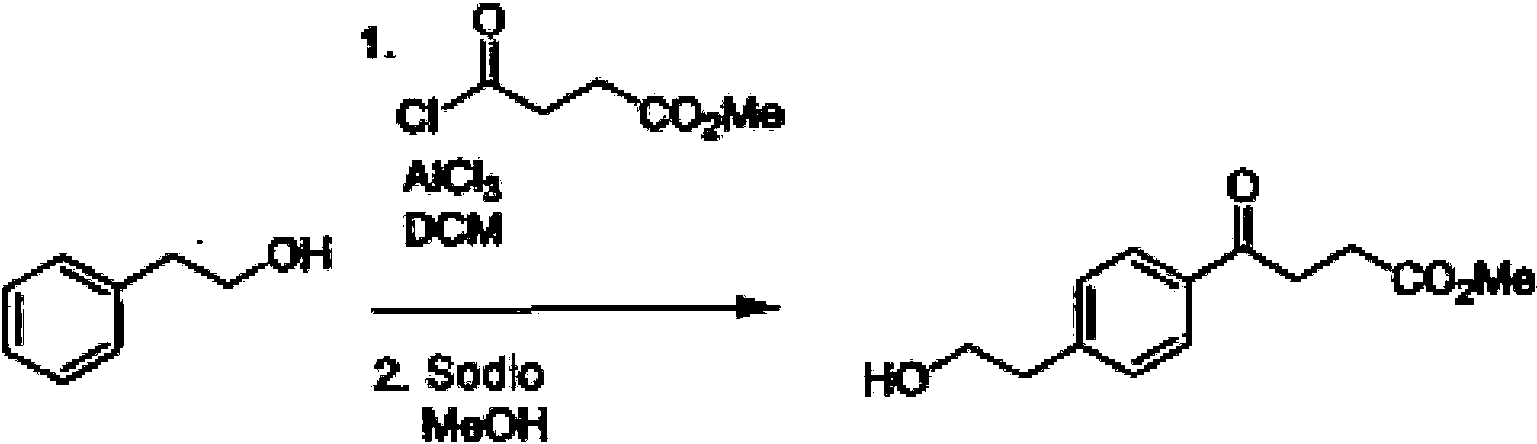
A un matraz seca de 250 mL bajo una atmósfera de nitrógeno se le añadió alcohol de fenetilo (2,50 g, 0,02 mol), diclorometano anhidro (150 ml) y metilo-4-cloro-4-oxobutirato (6,02 g, 0,04 mol). El contenido del matraz se enfrió a 0°C con un baño de hielo. A la solución se añadió cloruro de aluminio (25 g, 0,2 mol) en porciones, teniendo cuidado de evitar una exotermia violenta. La mezcla amarillenta resultante se agitó durante 3 horas. En este punto, la reacción se detuvo con agua helada. La mezcla se diluyó con diclorometano y se transfirió a un embudo de decantación. La capa orgánica se lavó con una solución saturada de bicarbonato de sodio, salmuera y luego se secó sobre sulfato de magnesio. La filtración y la concentración del filtrado a presión reducida proporcionaron un aceite amarillo crudo. El aceite se suspendió en metanol anhidro (100 ml) y se añadió sodio metálico a la mezcla hasta que se obtuvo un pH de 9. La mezcla se agitó durante 3 horas. El volumen se redujo y luego se diluyó con acetato de etilo. La solución se transfirió a un embudo de decantación y se lavó con ácido clorhídrico acuoso 0,05 N, salmuera y se secó sobre sulfato de magnesio. La solución se concentró a presión reducida para dar un aceite amarillo crudo con una masa de 5,88 g. Cromatografía en columna [gel de sílice; acetato de hexanos-etilo eluyente (3:2)] proporcionó el producto deseado (2,69 g, 57%). 1H (CDCb) 5 (ppm): 2,65 (t, 2H); 2,81 (t, 2 H); 3,19 (t, 2H); 3,6 (s, 3H); 3,75 (t, 2H); 7,22 (d, 2H); 7,81 (d, 2H). 13C (CDCls) 8 (ppm): 27,76, 33,03, 38,66, 51,52, 62,68, 127,97, 128,99, 134,47, 144,78, 173,21, 197,64.Phenethyl alcohol (2.50 g, 0.02 mol), anhydrous dichloromethane (150 ml), and methyl-4-chloro-4-oxobutyrate (6.02 g, 0.04 mol). The contents of the flask were cooled to 0 ° C with an ice bath. Aluminum chloride (25 g, 0.2 mol) was added portionwise to the solution, taking care to avoid a violent exotherm. The resulting yellowish mixture was stirred for 3 hours. At this point, the reaction was stopped with ice water. The mixture was diluted with dichloromethane and transferred to a separatory funnel. The organic layer was washed with a saturated sodium bicarbonate solution, brine, and then dried on magnesium sulfate. Filtration and concentration of the filtrate under reduced pressure gave a crude yellow oil. The oil was suspended in anhydrous methanol (100 ml) and metallic sodium was added to the mixture until a pH of 9. The mixture was stirred for 3 hours. The volume was reduced and then diluted with ethyl acetate. The solution was transferred to a separatory funnel and washed with 0.05N aqueous hydrochloric acid, brine, and dried over magnesium sulfate. The solution was concentrated under reduced pressure to give a crude yellow oil with a mass of 5.88 g. Column chromatography [silica gel; eluent hexanes-ethyl acetate (3: 2)] provided the desired product (2.69 g, 57%). 1H (CDCb) 5 (ppm): 2.65 (t, 2H); 2.81 (t, 2H); 3.19 (t, 2H); 3.6 (s, 3H); 3.75 (t, 2H); 7.22 (d, 2H); 7.81 (d, 2H). 13C (CDCls) 8 (ppm): 27.76, 33.03, 38.66, 51.52, 62.68, 127.97, 128.99, 134.47, 144.78, 173.21, 197 , 64.
Ejemplo 1BExample 1B
Síntesis de éster metílico del ácido 4-[4-(2-hidroxietilo)fenilo]butíricoSynthesis of 4- [4- (2-hydroxyethyl) phenyl] butyric acid methyl ester

Una mezcla del Ejemplo 1A (2,50 g, 11 mmol), 10% Pd/C (0,25 g, 0,23 mmol de Pd metal) en metanol anhidro (25 ml) se desgasificó primero para eliminar el aire (dos ciclos de vacío/H2) después de lo cual se tapó y un globo lleno de H2 se aplicó durante 12 horas. Después de este tiempo, la mezcla de reacción se filtró a través de tierra de diatomeas (Celite®) y el filtrado se concentró a presión reducida para dar 2,32 g de material bruto. Cromatografía en columna [gel de sílice; acetato de hexanos-etilo eluyente (2:1)] proporcionó el producto deseado (0,92 g, 39%). 1H (CDCla) 5 (ppm): 1,91-1,96 (m, 2H); 2,32 (t, 2H); 2,62 (t, 2H); 2,83 (t, 2H); 3,66 (s, 3H); 3,85 (t, 2H); 7,11-7,15 (m, 4H).A mixture of Example 1A (2.50 g, 11 mmol), 10% Pd / C (0.25 g, 0.23 mmol Pd metal) in anhydrous methanol (25 ml) was first degassed to remove air (two cycles of vacuum / H 2 ) after which it was capped and a balloon filled with H 2 was applied for 12 hours. After this time, the reaction mixture was filtered through diatomaceous earth (Celite®) and the filtrate was concentrated under reduced pressure to give 2.32 g of crude material. Column chromatography [silica gel; eluent hexanes-ethyl acetate (2: 1)] provided the desired product (0.92 g, 39%). 1H (CDCla) 5 (ppm): 1.91-1.96 (m, 2H); 2.32 (t, 2H); 2.62 (t, 2H); 2.83 (t, 2H); 3.66 (s, 3H); 3.85 (t, 2H); 7.11-7.15 (m, 4H).
Ejemplo 1CExample 1C
Síntesis de éster metílico del ácido 4- {4-[2-(quinazolina-4-iloxi) etil]fenilo}butíricoSynthesis of 4- {4- [2- (quinazoline-4-yloxy) ethyl] phenyl} butyric acid methyl ester

Un matraz seco de 50 mL se equipó con un embudo de adición. Al matraz se añadieron 4-cloroquinazolina (592 mg, 3,6 mmol), tetrahidrofurano anhidro (10 ml) y 60% en peso de hidruro sódico (187 mg, 4,7 mmol). Se añadió gota a gota una solución del Ejemplo 1B (800 mg, 3,6 mmol) en tetrahidrofurano anhidro (10 ml) usando el embudo de adición. La reacción se agitó durante 3,5 horas. La reacción se diluyó con acetato de etilo y se inactivó mediante la adición de ácido clorhídrico acuoso 0,1 N. La mezcla se transfirió a un embudo de decantación y se lavó con salmuera. La capa orgánica se secó sobre sulfato de magnesio, se filtró y se concentró. Cromatografía en columna [gel de sílice; acetato de hexanos-etilo eluyente (4: 1)] proporcionó el producto deseado (538 mg, 43%). 1H (CDCls) 5 (ppm): 1,92-1,98 (m, 2H); 2,33 (t, 2H); 2,64 (t, 2H); 3,19 (t, 2H); 3,66 (s, 3H); 4,79 (t, 2H); 7,15 (d, 2H); 7,27 (d, 2H); 7,57 (t, 1H); 7,83 (t, 1H); 7,94 (d, 1H); 8,15 (d, 1H); 8,80 (s, 1H). 26,68, 33,59, 34,93, 35,03, 51,67, 67,89, 116,48, 123,72, 127 ,23, 127,82, 128,87, 129,24, 133,74, 135,76, 139,90, 151,08, 154,56, 166,89, 174,10.A 50 mL dry flask was fitted with an addition funnel. 4-Chloroquinazoline (592 mg, 3.6 mmol), anhydrous tetrahydrofuran (10 ml) and 60% by weight sodium hydride (187 mg, 4.7 mmol) were added to the flask. A solution of Example 1B (800mg, 3.6mmol) in anhydrous tetrahydrofuran (10ml) was added dropwise using the addition funnel. The reaction was stirred for 3.5 hours. The reaction was diluted with ethyl acetate and quenched by the addition of 0.1N aqueous hydrochloric acid. The mixture was transferred to a separatory funnel and washed with brine. The organic layer was dried over magnesium sulfate, filtered, and concentrated. Column chromatography [silica gel; eluent hexanes-ethyl acetate (4: 1)] provided the desired product (538 mg, 43%). 1H (CDCls) 5 (ppm): 1.92-1.98 (m, 2H); 2.33 (t, 2H); 2.64 (t, 2H); 3.19 (t, 2H); 3.66 (s, 3H); 4.79 (t, 2H); 7.15 (d, 2H); 7.27 (d, 2H); 7.57 (t, 1H); 7.83 (t, 1H); 7.94 (d, 1H); 8.15 (d, 1H); 8.80 (s, 1H). 26.68, 33.59, 34.93, 35.03, 51.67, 67.89, 116.48, 123.72, 127, 23, 127.82, 128.87, 129.24, 133, 74, 135.76, 139.90, 151.08, 154.56, 166.89, 174.10.
Ejemplo 1DExample 1D
Síntesis de 4-{4-[2-(quinazolina-4-iloxi)etilo]fenilo}butan-1-ol Synthesis of 4- {4- [2- (quinazoline-4-yloxy) ethyl] phenyl} butan-1-ol

Se añadieron a un matraz seco de 15 mL de hidruro de litio y aluminio (233 mg, 6,0 mmol) y éter dietílico anhidro (3 mL). La mezcla se enfrió con un baño de hielo. Se añadió lentamente una solución del Ejemplo 1C (538 mg, 1,54 mmol) en éter dietílico anhidro (3 mL) con agitación vigorosa. El baño se retiró y la suspensión se agitó durante 15 minutos. La reacción se inactivó con agua (0,233 mL), hidróxido de sodio acuoso al 15% (0,233 mL) y agua (0,699 mL). El sólido blanco se filtró y el filtrado se secó sobre sulfato de magnesio, se filtró y se concentró a presión reducida para dar un aceite transparente. El aceite se disolvió entonces en diclorometano anhidro (10 mL) y se añadió óxido de manganeso (IV) (500 mg, 5,8 mmol) a la solución. La mezcla se agitó durante 12 horas. La filtración a través de tierra de diatomeas (Celite®) seguido de la concentración del filtrado a presión reducida produjo 395 mg de producto bruto. Cromatografía en columna [gel de sílice; acetato de pentano-etilo eluyente (2:3)] proporcionó el producto deseado (225 mg, 49%). 1H (CDCh) 5 (ppm): 1,55-1,61 (m, 2 H); 1,65-1,68 (m, 2h ); 2 ,6 1 (t, 2H); 3,17 (t, 2H); 3,64 (t, 2H); 4,79 (t, 2H); 7,12 (d, 2H); 7,23 (d, 2H); 7,56 (t, 1H); 7,82 (t, 1H); 7,93 (d, 1H); 8,14 (d, 1H); 8,77 (s, 1H). 13C (CDCla) 5 (ppm): 27,52, 32,31, 34,89, 35,21, 62,81, 67,74, 116,67, 123,54, 127,08, 127,49, 128,63, 128,98, 133,61, 135,23, 140,64, 150,68, 154,29, 166,79.Lithium aluminum hydride (233 mg, 6.0 mmol) and anhydrous diethyl ether (3 mL) were added to a 15 mL dry flask. The mixture was cooled with an ice bath. A solution of Example 1C (538 mg, 1.54 mmol) in anhydrous diethyl ether (3 mL) was added slowly with vigorous stirring. The bath was removed and the suspension was stirred for 15 minutes. The reaction was quenched with water (0.233 mL), 15% aqueous sodium hydroxide (0.233 mL), and water (0.699 mL). The white solid was filtered and the filtrate was dried over magnesium sulfate, filtered, and concentrated under reduced pressure to give a clear oil. The oil was then dissolved in anhydrous dichloromethane (10 mL) and manganese (IV) oxide (500 mg, 5.8 mmol) was added to the solution. The mixture was stirred for 12 hours. Filtration through diatomaceous earth (Celite®) followed by concentration of the filtrate under reduced pressure produced 395 mg of crude product. Column chromatography [silica gel; Pentane-ethyl acetate eluent (2: 3)] provided the desired product (225 mg, 49%). 1H (CDCH) 5 (ppm): 1.55-1.61 (m, 2H); 1.65-1.68 (m, 2h ); 2.6 1 (t, 2H); 3.17 (t, 2H); 3.64 (t, 2H); 4.79 (t, 2H); 7.12 (d, 2H); 7.23 (d, 2H); 7.56 (t, 1H); 7.82 (t, 1H); 7.93 (d, 1H); 8.14 (d, 1H); 8.77 (s, 1H). 13C (CDCla) 5 (ppm): 27.52, 32.31, 34.89, 35.21, 62.81, 67.74, 116.67, 123.54, 127.08, 127.49, 128 , 63, 128.98, 133.61, 135.23, 140.64, 150.68, 154.29, 166.79.
Ejemplo 1EExample 1E
Síntesis de 4-{4-[2-(quinazolina-4-iloxietilo]fenilo}butilo éster del ácido tolueno-4-sulfónicoSynthesis of 4- {4- [2- (quinazoline-4-yloxyethyl] phenyl} butyl ester of toluene-4-sulfonic acid

A un matraz de 10 mL se añadió cloruro de p-toluenosulfonilo seco (32,5 mg, 0,17 mmol), 4-(dimetilamino)piridina (20,7 mg, 0,17 mmol), Ejemplo 1D (50,0 mg, 0,16 mmol), diclorometano anhidro (1 mL) y trietilamina (17,2 mg, 0,17 mmol). La solución resultante se agitó durante 2 horas, se concentró a presión reducida y se purificó por cromatografía en columna [gel de sílice; acetato de pentano-etilo eluyente (1 ,8 6 :1 )] para proporcionar el producto deseado (52 mg, 70%). 1H (CDCl3) 5 (ppm): 1,64-1,68 (m, 4H); 2,44 (s, 3H); 2,56 (t, 2H); 3,19 (t, 2H); 4,04 (t, 2H); 4,78 (t, 2H); 7,08 (d, 2H); 7,26 (d, 2H); 7,57 (t, 1H); 7,78 (d, 2H); 7,84 (t, 1H), 8,14 (d, 1H); 8,80 (s, 1H). Ejemplo 1FTo a 10 mL flask was added dry p-toluenesulfonyl chloride (32.5 mg, 0.17 mmol), 4- (dimethylamino) pyridine (20.7 mg, 0.17 mmol), Example 1D (50.0 mg, 0.16 mmol), anhydrous dichloromethane (1 mL) and triethylamine (17.2 mg, 0.17 mmol). The resulting solution was stirred for 2 hours, concentrated under reduced pressure, and purified by column chromatography [silica gel; pentane-ethyl acetate eluent (1 : 8 6: 1)] to afford the desired product (52 mg, 70%). 1H (CDCl 3 ) 5 (ppm): 1.64-1.68 (m, 4H); 2.44 (s, 3H); 2.56 (t, 2H); 3.19 (t, 2H); 4.04 (t, 2H); 4.78 (t, 2H); 7.08 (d, 2H); 7.26 (d, 2H); 7.57 (t, 1H); 7.78 (d, 2H); 7.84 (t, 1H), 8.14 (d, 1H); 8.80 (s, 1H). Example 1F
Síntesis de 4-{2-[4-(4-fluorobutilo)fenilo]etoxi}quinazolinaSynthesis of 4- {2- [4- (4-fluorobutyl) phenyl] ethoxy} quinazoline

Un matraz seco de 5 mL se equipó con un condensador de reflujo. Al matraz se añadió fluoruro de potasio (6,1 mg, 0,1 mmol), kryptofix (40 mg, 0,1 mmol) y acetonitrilo anhidro (0,5 mL). A la solución resultante se añadió una solución del Ejemplo 1E (25 mg, 0,05 mmol) en acetonitrilo anhidro (1 mL). El matraz se colocó en un baño de aceite a 90°C. La solución se agitó durante 1 hora. Después de enfriarse, la mezcla de reacción se diluyó con éter de dietilo, se transfirió a un embudo de decantación, y se lavó con ácido clorhídrico acuoso 0,1 N, solución acuosa saturada de bicarbonato de sodio y luego salmuera. La capa orgánica se secó con sulfato de magnesio, se filtró y se concentró a presión reducida. Cromatografía de columna [gel de sílice; acetato de hexanos-etilo eluyente (3:1)] proporcionó el producto deseado (10,7 mg, 63%).A 5 mL dry flask was fitted with a reflux condenser. Potassium fluoride (6.1 mg, 0.1 mmol), kryptofix (40 mg, 0.1 mmol) and anhydrous acetonitrile (0.5 mL) were added to the flask. To the resulting solution was added a solution of Example 1E (25 mg, 0.05 mmol) in anhydrous acetonitrile (1 mL). The flask was placed in a 90 ° C oil bath. The solution was stirred for 1 hour. After cooling, the reaction mixture was diluted with diethyl ether, transferred to a separatory funnel, and washed with 0.1N aqueous hydrochloric acid, saturated aqueous sodium bicarbonate solution, and then brine. The organic layer was dried over magnesium sulfate, filtered, and concentrated under reduced pressure. Column chromatography [silica gel; eluent hexanes-ethyl acetate (3: 1)] provided the desired product (10.7 mg, 63%).
1H (CDCl3) 5 (ppm): 1,65-1,73 (m, 4H); 2,63 (t, 2H); 3,17 (t, 2H); 4,40 (t, 1H); 4,48 (t, 1H); 4,77 (t, 2H); 7,13 (d, 2H); 7,24 (d, 2H); 7,55 (1H); 7,82 (t, 1H); 7,92 (d, 1H); 8,13 (d, 1H); 8,78 (s, 1H). 13C (CDCla) 5 (ppm): 27,19 (d, 4Jcf = 4,5), 30,20 (d, 3Jcf = 19,5), 35,15 (d, 2Jcf = 27,0), 67,94, 84,17 (d, 1Jcf = 163,3), 116,93, 123,75, 127,26, 127,84, 128,82, 129,23, 129,42, 133,77, 135,62, 138,21, 140,54, 151,08, 154,59. 19F(CDCla, CFCla estándar interno) 5(ppm): -218,59 (t de t, J = -27,6, -50,4).1H (CDCl3) 5 (ppm): 1.65-1.73 (m, 4H); 2.63 (t, 2H); 3.17 (t, 2H); 4.40 (t, 1H); 4.48 (t, 1H); 4.77 (t, 2H); 7.13 (d, 2H); 7.24 (d, 2H); 7.55 (1H); 7.82 (t, 1H); 7.92 (d, 1H); 8.13 (d, 1H); 8.78 (s, 1H). 13C (CDCla) 5 (ppm): 27.19 (d, 4J cf = 4.5), 30.20 (d, 3J cf = 19.5), 35.15 (d, 2J cf = 27.0) , 67.94, 84.17 (d, 1J cf = 163.3), 116.93, 123.75, 127.26, 127.84, 128.82, 129.23, 129.42, 133.77 , 135.62, 138.21, 140.54, 151.08, 154.59. 19F (CDCla, CFCla internal standard) 5 (ppm): -218.59 (t of t, J = -27.6, -50.4).
Síntesis de análogos de piridabeno:Synthesis of Pyridaben analogs:
Ejemplo 2AExample 2A
Síntesis de éster 4-fenilbutílico de ácido butíricoSynthesis of 4-phenylbutyl ester of butyric acid

A 4-fenilo-1 -butanol (7,0 g, 0,047 mol) se añadió diclorometano anhidro (20 mL). Se añadió gota a gota una solución de cloruro de butirilo (4,79 g, 0,045 mol) en diclorometano anhidro (20 mL). La solución se agitó durante 36 horas. En este punto, la reacción se concentró a presión reducida para dar un aceite crudo. Cromatografía en columna [gel de sílice; acetato de hexanos-etilo eluyente (3:1)] proporcionó el producto deseado (9,8 g, 94%) en forma de un líquido viscoso transparente. 1H (CDCla) 5(ppm): 0,94 (t, 3H); 1,61 - 1,71 (m, 6H); 2,27 (t, 2 H); 2,64 (t, 2H); 4,08 (t, 2H); 7,16-7,19 (m, 3H); 7,25-7,29 (m, 2H).Anhydrous dichloromethane (20 mL) was added to 4-phenyl-1-butanol (7.0 g, 0.047 mol). A solution of butyryl chloride (4.79 g, 0.045 mol) in anhydrous dichloromethane (20 mL) was added dropwise. The solution was stirred for 36 hours. At this point, the reaction was concentrated under reduced pressure to give a crude oil. Column chromatography [silica gel; eluent hexanes-ethyl acetate (3: 1)] provided the desired product (9.8 g, 94%) as a clear viscous liquid. 1H (CDCla) 5 (ppm): 0.94 (t, 3H); 1.61-1.71 (m, 6H); 2.27 (t, 2H); 2.64 (t, 2H); 4.08 (t, 2H); 7.16-7.19 (m, 3H); 7.25-7.29 (m, 2H).
Ejemplo 2 BExample 2 B
Síntesis de éster metílico del ácido 4-(4-hidroxibutilo)benzoicoSynthesis of 4- (4-hydroxybutyl) benzoic acid methyl ester

A cloruro de aluminio (6,7 g, 0,05 mol) en un matraz de fondo redondo seco de 250 mL se le añadió diclorometano anhidro (100 mL). El matraz se enfrió en un baño de hielo a 0°C. Se añadió cloruro de oxalilo (6,4 g, 0,05 mol) gota a gota al matraz. La mezcla se dejó en agitación durante 5 minutos. A continuación, se añadió gota a gota una solución del Ejemplo 2A (9,8 g, 0,044 mol) en diclorometano anhidro (50 mL). La mezcla se dejó en agitación durante 4 horas a 0°C. La mezcla de reacción se vertió en un embudo de decantación que contenía hielo y salmuera. La capa orgánica se lavó con salmuera y se secó sobre sulfato de magnesio. La filtración y la concentración a presión reducida proporcionaron 9,1 g de aceite amarillo. Se suspendieron 9,0 g de este aceite en metanol y se ajustó el pH a 2 y se agitó durante 48 horas. La reacción de la mezcla fue concentrada a baja presión. Cromatografía en columna [gel de sílice; acetato de hexanos-etilo eluyente (2,57:1)] proporcionó el producto deseado (2,80 g, 31%) en forma de un líquido viscoso transparente. 1H (CDCta) 5(ppm): 1,56-1,61 (m, 2H); 1,63-1,73 (m, 2H); 2,67 (t, 2H); 3,64 (t, 2H); 3,88 (s, 3H); 7,23 (d, 2H); 7,93 (d, 2H). Anhydrous dichloromethane (100 mL) was added to aluminum chloride (6.7 g, 0.05 mol) in a dry 250 mL round bottom flask. The flask was cooled in an ice bath to 0 ° C. Oxalyl chloride (6.4 g, 0.05 mol) was added dropwise to the flask. The mixture was allowed to stir for 5 minutes. Then, a solution of Example 2A (9.8 g, 0.044 mol) in anhydrous dichloromethane (50 mL) was added dropwise. The mixture was left stirring for 4 hours at 0 ° C. The reaction mixture was poured into a separatory funnel containing ice and brine. The organic layer was washed with brine and dried over magnesium sulfate. Filtration and concentration under reduced pressure provided 9.1 g of yellow oil. 9.0 g of this oil were suspended in methanol and the pH was adjusted to 2 and stirred for 48 hours. The reaction of the mixture was concentrated under low pressure. Column chromatography [silica gel; eluent hexanes-ethyl acetate (2.57: 1)] provided the desired product (2.80 g, 31%) as a clear viscous liquid. 1H (CDCta) 5 (ppm): 1.56-1.61 (m, 2H); 1.63-1.73 (m, 2H); 2.67 (t, 2H); 3.64 (t, 2H); 3.88 (s, 3H); 7.23 (d, 2H); 7.93 (d, 2H).
Ejemplo 2CExample 2C
Síntesis de éster metílico del ácido 4-[4-(terc-butildimetilsilaniloxi)butilo]benzoicoSynthesis of 4- [4- (tert-butyldimethylsilanyloxy) butyl] benzoic acid methyl ester

Al Ejemplo 2B (1,0 g, 4,8 mmol) se añadió dimetilformamida anhidra (10 mL), imidazol (0,5 g, 7,2 mmol) y cloruro de terc-butildimetilsililo (1,08 g, 7,3 mmol). La solución se agitó en un baño de agua durante 2 horas. La mezcla de reacción se diluyó con acetato de etilo, se vertió en un embudo de decantación, se lavó con agua (20 mL, 5x) y luego se lavó con una solución saturada de bicarbonato de sodio (20 mL, 2x). La capa orgánica se secó con sulfato de magnesio, se filtró y se concentró a presión reducida para dar el producto deseado (1,17 g, 75%) que se usó sin purificación adicional en la siguiente etapa.Anhydrous dimethylformamide (10 mL), imidazole (0.5 g, 7.2 mmol), and tert-butyldimethylsilyl chloride (1.08 g, 7.3 mmol). The solution was stirred in a water bath for 2 hours. The reaction mixture was diluted with ethyl acetate, poured into a separatory funnel, washed with water (20 mL, 5x), and then washed with a saturated sodium bicarbonate solution (20 mL, 2x). The organic layer was dried over magnesium sulfate, filtered and concentrated under reduced pressure to give the desired product (1.17 g, 75%) which was used without further purification in the next step.
Ejemplo 2D2D example
Síntesis de {4-[4-(terc-butildimetilsilaniloxi)butilo]fenilo}-metanolSynthesis of {4- [4- (tert-butyldimethylsilanyloxy) butyl] phenyl} -methanol

Al Ejemplo 2C (1,17 g, 3,6 mmol) se añadió éter de dietilo anhidro (14 mL). La solución se enfrió a 0°C con un baño de hielo. Se añadió hidruro de litio y aluminio (0,28 g, 7,2 mmol) a la solución en porciones. La mezcla se agitó durante 1 hora. A la mezcla de reacción se añadió agua destilada (0,28 mL) y la mezcla se agitó durante 5 minutos. A continuación se añadió una solución acuosa de hidróxido de sodio al 15% y la mezcla se agitó durante 5 minutos. Finalmente, se añadió agua destilada (0,84 mL) y la mezcla se agitó durante 5 minutos. El sólido blanco se eliminó por filtración. El filtrado se secó con sulfato de magnesio, se filtró y se concentró para dar 1,23 g de producto bruto. Cromatografía de columna [gel de sílice; acetato de hexanos-etilo eluyente (4:1)] proporcionó el producto deseado (1,02 g, 96%) en forma de un líquido viscoso transparente.Anhydrous diethyl ether (14 mL) was added to Example 2C (1.17 g, 3.6 mmol). The solution was cooled to 0 ° C with an ice bath. Lithium aluminum hydride (0.28 g, 7.2 mmol) was added to the solution portionwise. The mixture was stirred for 1 hour. Distilled water (0.28 mL) was added to the reaction mixture and the mixture was stirred for 5 minutes. A 15% aqueous sodium hydroxide solution was then added and the mixture was stirred for 5 minutes. Finally, distilled water (0.84 mL) was added and the mixture was stirred for 5 minutes. The white solid was removed by filtration. The filtrate was dried over magnesium sulfate, filtered, and concentrated to give 1.23 g of crude product. Column chromatography [silica gel; eluent hexanes-ethyl acetate (4: 1)] provided the desired product (1.02 g, 96%) as a clear viscous liquid.
Ejemplo 2EExample 2E
Síntesis de 2-terc-butilo-5-{4-[4-(terc-butildimetilsilaniloxi)butilo]benciloxi}-4-cloro-2H-piridazina-3-onaSynthesis of 2-tert-butyl-5- {4- [4- (tert-butyldimethylsilanyloxy) butyl] benzyloxy} -4-chloro-2H-pyridazine-3-one

A un matraz de fondo redondo seco de 25 mL, equipado con un condensador de reflujo, se añadió el producto del Ejemplo 2D (0,41 g, 1,4 mmol), 2-terc-butilo-4,5-dicloro-2H-piridazina-3-ona (0,93 g, 4,2 mmol), carbonato de cesio (1,37 g, 4,2 mmol) y dimetilformamida anhidra (11 mL). El matraz de reacción se colocó en un baño de aceite a 68°C y la reacción se agitó durante 12 horas. El matraz de reacción se retiró del baño de aceite y se dejó enfriar. La mezcla se diluyó con acetato de etilo, se transfirió a un embudo de decantación y se lavó con agua (25 mL, 5x). La capa orgánica se secó con sulfato de magnesio, se filtró y se concentró a presión reducida para dar 1,3 g de producto bruto. Cromatografía en columna [gel de sílice; acetato de hexanos-etilo eluyente (9:1)] proporcionó el producto deseado (594 mg, 89%). 1H (CDCh) 5(ppm): 0,05 (s, 6H); 0,90 (s, 9 H); 1,64 (s, 9 H); 2,65 (t, 2H); 3,64 (t, 2H); 5,23 (s, 2H); 7,23 (d, 2H); 7,33 (d, 2H); 7,74 (s, 1H). 13C (CDCla) 5(ppm): 18,57, 26,19, 27,75, 28,09, 32,58, 35,61,63,14, 66,57, 72,14, 118,46, 125,41, 127,44, 129,23, 132,38, 143,72, 154,02, 159,30. To a dry 25 mL round bottom flask, equipped with a reflux condenser, the product from Example 2D (0.41 g, 1.4 mmol), 2-tert-butyl-4,5-dichloro-2H was added -pyridazine-3-one (0.93 g, 4.2 mmol), cesium carbonate (1.37 g, 4.2 mmol) and anhydrous dimethylformamide (11 mL). The reaction flask was placed in a 68 ° C oil bath and the reaction was stirred for 12 hours. The reaction flask was removed from the oil bath and allowed to cool. The mixture was diluted with ethyl acetate, transferred to a separatory funnel, and washed with water (25 mL, 5x). The organic layer was dried over magnesium sulfate, filtered, and concentrated under reduced pressure to give 1.3 g of crude product. Column chromatography [silica gel; eluent hexanes-ethyl acetate (9: 1)] provided the desired product (594 mg, 89%). 1H (CDCh) 5 (ppm): 0.05 (s, 6H); 0.90 (s, 9H); 1.64 (s, 9H); 2.65 (t, 2H); 3.64 (t, 2H); 5.23 (s, 2H); 7.23 (d, 2H); 7.33 (d, 2H); 7.74 (s, 1H). 13C (CDCla) 5 (ppm): 18.57, 26.19, 27.75, 28.09, 32.58, 35.61.63.14, 66.57, 72.14, 118.46, 125 , 41, 127.44, 129.23, 132.38, 143.72, 154.02, 159.30.
Ejemplo 2FExample 2F
Síntesis de 2-terc-but¡lo-4-cloro-5-[4-(4-h¡drox¡-but¡lo)-benc¡lox¡]-2H-p¡ridaz¡na-3-onaSynthesis of 2-tert-butylo-4-chloro-5- [4- (4-hydroxy-butylo) -benzyloxi] -2H-pyridazine-3-one

Al producto del Ejemplo 2E (594 mg, 1,45 mmol) se añadió tetrahidrofurano anhidro (3 mL) y una solución 1,0 M de fluoruro de terc-butilamonio en tetrahidrofurano (2,9 mL, 2,9 mmol). La solución se agitó durante 1 hora y luego se concentró a presión reducida. Cromatografía en columna [gel de sílice; eluyente penta ne-acetato de etilo (1,8:1)] proporcionó el producto deseado (410 mg, 77%). 1H (CDCh) 5(ppm): 1,61-1,64 (m, 11H); 1,67-1,74 (m, 2H); 2,68 (t, 2H); 3,68 (t, 2H); 5,23 (s, 2H); 7,23 (d, 2H); 7,33 (d, 2H); 7,74 (s, 1H). 13C (CDCla) 5(ppm): 27,43, 27,86, 32,56, 35. 35, 62,74, 66,36, 71,88, 118,27, 125,18, 127,27, 128,99, 132,28, 143,17,153,78, 159,07.Anhydrous tetrahydrofuran (3 mL) and a 1.0 M solution of tert-butylammonium fluoride in tetrahydrofuran (2.9 mL, 2.9 mmol) were added to the product from Example 2E (594 mg, 1.45 mmol). The solution was stirred for 1 hour and then concentrated under reduced pressure. Column chromatography [silica gel; eluent pentane-ethyl acetate (1.8: 1)] provided the desired product (410 mg, 77%). 1H (CDCh) 5 (ppm): 1.61-1.64 (m, 11H); 1.67-1.74 (m, 2H); 2.68 (t, 2H); 3.68 (t, 2H); 5.23 (s, 2H); 7.23 (d, 2H); 7.33 (d, 2H); 7.74 (s, 1H). 13C (CDCla) 5 (ppm): 27.43, 27.86, 32.56, 35. 35, 62.74, 66.36, 71.88, 118.27, 125.18, 127.27, 128 , 99, 132.28, 143.17, 153.78, 159.07.
Ejemplo 2GExample 2G
Síntes¡s del éster 4-[4-(1-tert-but¡lo-5-cloro-6-oxo-1,6-d¡h¡dro-p¡r¡daz¡na-4-¡lox¡met¡lo)-fen¡lo]-butíl¡co del ác¡do tolueno-4-sulfón¡coSynthesis of the ester 4- [4- (1-tert-butyl-5-chloro-6-oxo-1,6-d¡h¡dro-p¡r¡daz¡na-4-¡lox¡ methyl) -phenyl] -butyl acid from toluene-4-sulfon acid

A un matraz de fondo redondo de 5 mL se añadió el producto del Ejemplo 2F (200 mg, 0,55 mmol), cloruro de p-toluenosulfonilo (125 mg, 0,66 mmol), 4-(dimetilamino)piridina (80 mg, 0,66 mmol), diisopropiletilamina (85 mg, 0,66 mmol) y diclorometano anhidro (2 mL). La solución resultante se agitó durante 2 horas. La mezcla de reacción se diluyó con acetato de etilo, se transfirió a un embudo de decantación y se lavó con una solución de ácido clorhídrico acuoso 0,1 N y luego se lavó con salmuera. La capa orgánica se secó con sulfato de magnesio, se filtró y se concentró a presión reducida para dar 299 mg de producto bruto. Cromatografía en columna [gel de sílice; acetato de pentano-etilo eluyente (3:1)] proporcionó el producto deseado (197 mg, 69%). 1H (CDCh) 5(ppm): 1,62 1,70 (m, 13H); 2,43 (s, 3H); 2,58 (t, 2H); 4,03 (t, 2H); 7,15 (d, 2H); 7,29-7,33 (m, 4H); 7,72 (s, 1H); 7,77 (d, 2H). 13C (CDCla) 5(ppm): 21,63, 26,98, 27,86, 28,34, 34,80, 66,37, 70,23, 71,81, 118,25, 125,12, 127,32, 127,87, 128,93, 129,82, 132,48, 133,15, 142,40, 144,72, 153,75, 159,05.To a 5 mL round bottom flask was added the product from Example 2F (200 mg, 0.55 mmol), p-toluenesulfonyl chloride (125 mg, 0.66 mmol), 4- (dimethylamino) pyridine (80 mg , 0.66 mmol), diisopropylethylamine (85 mg, 0.66 mmol) and anhydrous dichloromethane (2 mL). The resulting solution was stirred for 2 hours. The reaction mixture was diluted with ethyl acetate, transferred to a separatory funnel, and washed with 0.1N aqueous hydrochloric acid solution and then washed with brine. The organic layer was dried over magnesium sulfate, filtered, and concentrated under reduced pressure to give 299 mg of crude product. Column chromatography [silica gel; Pentane-ethyl acetate eluent (3: 1)] provided the desired product (197 mg, 69%). 1H (CDCh) 5 (ppm): 1.62 1.70 (m, 13H); 2.43 (s, 3H); 2.58 (t, 2H); 4.03 (t, 2H); 7.15 (d, 2H); 7.29-7.33 (m, 4H); 7.72 (s, 1H); 7.77 (d, 2H). 13C (CDCla) 5 (ppm): 21.63, 26.98, 27.86, 28.34, 34.80, 66.37, 70.23, 71.81, 118.25, 125.12, 127 , 32, 127.87, 128.93, 129.82, 132.48, 133.15, 142.40, 144.72, 153.75, 159.05.
Ejemplo 2HExample 2H
Síntes¡s de 2-terc-but¡lo-4-cloro-5-(4-(4-fluorobut¡lo)benc¡lo)ox¡ 3(2H) p¡r¡daz¡nonaSynthesis of 2-tert-butylo-4-chloro-5- (4- (4-fluorobutylo) benzyl) oxy-3 (2H) pydazine

El producto del Ejemplo 2G (57 mg, 0,10 mmol) se disolvió en 1 ml de acetonitrilo y a esto se añadió una mezcla de KF-K222 (1:1; 0,164 mmol) disuelto en 1 mL de acetonitrilo. La mezcla completa se sumergió a continuación en un baño de aceite a 90°C y se calentó a reflujo durante 15 minutos, momento en el que se demostró que la reacción se había completado por TLC. Los componentes volátiles se eliminaron a vacío y el aceite bruto se purificó por cromatografía flash en gel de sílice (hexanos-acetato de etilo (4:1)) para proporcionar 28 mg del producto deseado en forma de un aceite que se solidificó al reposar. 1H (CDCl3) 5(ppm): 1,6 (s, 9H), 1,7 (m, 4H), 2,6 (t, 2H), 4,44 (d de t, 2H, J = 47,4 y 6 Hz), 5,2 (s, 2H), 7,2 (d, 2H, J = 8,4 Hz), 7,3 (d, 2H, J = 8,4 Hz), 7,71 (s, 1H). 13C (CDCI3) 5(ppm): 26,8 (3Jcf = 4,65 Hz), 27,8, 29,8 (2Jcf = 19,8 Hz), 35,1, 66,3, 71.8, 83,8 (1Jcf = 163,8 Hz), 118,2, 125,1, 127,2, 128,9, 132,3, 142,8, 153, 159. 19F (CDCla, CFCla como estándar interno) 5(ppm): - 218,6 (t de t, J = -27,6, -50,4)The product of Example 2G (57 mg, 0.10 mmol) was dissolved in 1 ml of acetonitrile and to this was added a mixture of KF-K222 (1: 1; 0.164 mmol) dissolved in 1 ml of acetonitrile. The entire mixture was then immersed in a 90 ° C oil bath and refluxed for 15 minutes, at which time the reaction was shown to be complete by TLC. Volatile components were removed in vacuo and the crude oil was purified by silica gel flash chromatography (hexanes-ethyl acetate (4: 1)) to provide 28 mg of the desired product as an oil that solidified on standing. 1H (CDCl3) 5 (ppm): 1.6 (s, 9H), 1.7 (m, 4H), 2.6 (t, 2H), 4.44 (d of t, 2H, J = 47.4 and 6 Hz), 5.2 (s, 2H), 7.2 (d, 2H, J = 8.4 Hz), 7.3 (d , 2H, J = 8.4Hz), 7.71 (s, 1H). 13C (CDCI 3 ) 5 (ppm): 26.8 (3J cf = 4.65 Hz), 27.8, 29.8 (2J cf = 19.8 Hz), 35.1, 66.3, 71.8, 83.8 (1J cf = 163.8 Hz), 118.2, 125.1, 127.2, 128.9, 132.3, 142.8, 153, 159. 19F (CDCla, CFCla as internal standard) 5 (ppm): - 218.6 (t of t, J = -27.6, -50.4)
Ejemplo 3AExample 3A
Síntesis de (+)-1-terc-butildimetilsililoxi-2-hidroxibutanoSynthesis of (+) - 1-tert-butyldimethylsilyloxy-2-hydroxybutane

Se cargó un matraz de fondo redondo de 50 mL con (+)-1,2-butanodiol (1 g, 11,09 mmol) y se le añadió dimetilformamida (8 mL) seguido de cloruro de terc-butildimetilsililo (2,5 g, 16,66 mmol) e imidazol (1,88 g, 27,7 mmol). La mezcla de reacción se agitó durante 10 horas, después de lo cual se diluyó con diclorometano y se vertió en un embudo de decantación y se lavó con agua (80 mL) y salmuera y se secó sobre sulfato de magnesio. Después de la filtración y concentración, el aceite bruto se purificó por cromatografía flash sobre gel de sílice (hexanos: acetato de etilo) para obtener 1 gm de producto deseado puro con 45% de rendimiento. 1H (CDCla) 5(ppm): 3,6 (m, 1H). 3,5 (m, 1H), 3,4 (m, 1H), 2,4 (s, 1H), 1,44 (m, 2H), 0,99 (t, 3H), 0,9 (s, 9H), 0,06 (s, 6H).A 50 mL round bottom flask was charged with (+) - 1,2-butanediol (1 g, 11.09 mmol) and dimethylformamide (8 mL) was added followed by tert-butyldimethylsilyl chloride (2.5 g , 16.66 mmol) and imidazole (1.88 g, 27.7 mmol). The reaction mixture was stirred for 10 hours, after which it was diluted with dichloromethane and poured into a separatory funnel and washed with water (80 mL) and brine and dried over magnesium sulfate. After filtration and concentration, the crude oil was purified by silica gel flash chromatography (hexanes: ethyl acetate) to obtain 1 gm of pure desired product in 45% yield. 1H (CDCla) 5 (ppm): 3.6 (m, 1H). 3.5 (m, 1H), 3.4 (m, 1H), 2.4 (s, 1H), 1.44 (m, 2H), 0.99 (t, 3H), 0.9 (s , 9H), 0.06 (s, 6H).
Ejemplo 3BExample 3B
Síntesis de (+)-4-(1-terc-butildimetilsililoxi but-2-oxi) metilbenzoatoSynthesis of (+) - 4- (1-tert-butyldimethylsilyloxy but-2-oxy) methylbenzoate

Se añadieron 4-hidroximetilbenzoato (1,1 g, 7,34 mmol), el producto del Ejemplo 3A (0,75 g, 3,67 mmol) y trifenilfosfina (1,972 g, 7,34 mmol) a un matraz de fondo redondo y se añadieron 8 mL de tetrahidrofurano. El matraz se enfrió en un baño de hielo a 0°C, después de lo cual se añadió diisopropilazodicarboxilato (1,485 g, 7,34 mmol) mediante una jeringa. La mezcla de reacción se agitó durante 2 horas, después de lo cual la reacción se consideró completa mediante cromatografía en capa fina. Se eliminó todo el disolvente a presión reducida y el petróleo crudo se sometió directamente a purificación por cromatografía flash en gel de sílice (hexanos: éter dietílico) para obtener 1,0 g (83%) del compuesto deseado como un aceite espeso. 1H (CDCta) 5(ppm): 7,9 (d, 2H), 6,9 (d, 2H), 4,3 (p, 1H, J = 5,4 Hz), 3,9 (s, 3H), 3,7 (2H), 1,78 (m, 1H), 1,7 (m, 1H), 0,9 (t, 3H, J = 7,8 Hz), 0,89 (s, 9H), 0,05 (s, 3H), 0,01 (s, 3H). 13C (CDCta) 5(ppm): 166,8, 162,8, 131,5, 122,3, 115,2, 80, 64,5, 51,7, 25,8, 24,1, 18,2, 9,5, -5,3.4-Hydroxymethylbenzoate (1.1 g, 7.34 mmol), the product of Example 3A (0.75 g, 3.67 mmol) and triphenylphosphine (1.972 g, 7.34 mmol) were added to a round bottom flask and 8 mL of tetrahydrofuran was added. The flask was cooled in an ice bath to 0 ° C, after which diisopropylazodicarboxylate (1.485 g, 7.34 mmol) was added via syringe. The reaction mixture was stirred for 2 hours, after which the reaction was judged complete by thin layer chromatography. All solvent was removed under reduced pressure and crude oil was directly subjected to purification by silica gel flash chromatography (hexanes: diethyl ether) to obtain 1.0 g (83%) of the desired compound as a thick oil. 1H (CDCta) 5 (ppm): 7.9 (d, 2H), 6.9 (d, 2H), 4.3 (p, 1H, J = 5.4 Hz), 3.9 (s, 3H ), 3.7 (2H), 1.78 (m, 1H), 1.7 (m, 1H), 0.9 (t, 3H, J = 7.8 Hz), 0.89 (s, 9H ), 0.05 (s, 3H), 0.01 (s, 3H). 13C (CDCta) 5 (ppm): 166.8, 162.8, 131.5, 122.3, 115.2, 80, 64.5, 51.7, 25.8, 24.1, 18.2 , 9.5, -5.3.
Ejemplo 3CExample 3C
Síntesis de (+)-4-(1-terc-butildimetilsililoxi but-2-oxi) bencilalcoholSynthesis of (+) - 4- (1-tert-butyldimethylsilyloxy but-2-oxy) benzylalcohol

A una solución del producto del Ejemplo 3B (1 g, 2,95 mmol) en éter (15 mL) se añadió hidruro de litio y aluminio (0,336 g, 8,8 mmol) y la mezcla se agitó en nitrógeno durante 1,5 horas. La reacción se completó como se muestra mediante TLC en este momento y se inactivó mediante la adición de 0,336 mL de agua, 0,336 mL de solución de NaOH al 15% y 1,00 mL de agua en sucesión. La mezcla resultante se agitó durante 20 minutos adicionales, después de lo cual el precipitado blanco formado se filtró y se lavó con éter. El filtrado se secó luego sobre sulfato de magnesio. La filtración y eliminación del disolvente dio 0,50 g (54%) del producto deseado como un sólido blanco.To a solution of the product from Example 3B (1 g, 2.95 mmol) in ether (15 mL) was added lithium hydride and aluminum (0.336 g, 8.8 mmol) and the mixture was stirred under nitrogen for 1.5 hours. The reaction was completed as shown by TLC at this time and was quenched by adding 0.336 mL of water, 0.336 mL of 15% NaOH solution, and 1.00 mL of water in succession. The resulting mixture was stirred for an additional 20 minutes, after which the formed white precipitate was filtered and washed with ether. The filtrate was then dried over magnesium sulfate. Filtration and removal of the solvent gave 0.50 g (54%) of the desired product as a white solid.
1H (CDCla) 5 (ppm): 7,2 (d, 2H), 6,9 (d, 2H), 4,3 (p, 1H), 3,77 (d de d, 1H), 3,66 (d de d, 1H), 1,77-1,72 (m, 1H), 1,68 1,61 (m, 1H), 1,5 (t, 1 H, J = 5,4 Hz), 0,9 (t, 3H, J = 7,8 Hz), 0,89 (s, 9H), 0,04 (s, 3H), 0,01 (s, 3H). 13C (CDCla) 5(ppm): 158,5, 133, 128,4, 116,1,80,1,65, 64,5, 25,8, 24,1, 18,2, 9,5, -5,31H (CDCla) 5 (ppm): 7.2 (d, 2H), 6.9 (d, 2H), 4.3 (p, 1H), 3.77 (d of d, 1H), 3.66 (d of d, 1H), 1.77-1.72 (m, 1H), 1.68 1.61 (m, 1H), 1.5 (t, 1H, J = 5.4 Hz), 0.9 (t, 3H, J = 7.8Hz), 0.89 (s, 9H), 0.04 (s, 3H), 0.01 (s, 3H). 13C (CDCla) 5 (ppm): 158.5, 133, 128.4, 116.1, 80,1.65, 64.5, 25.8, 24.1, 18.2, 9.5, - 5.3
Ejemplo 3D3D example
Síntesis de (+)-2-terc-butilo4-cloro5-(4-(1-terc-butildimetilsililoxi but-2-oxi)bencilo)oxi 3(2H)-piridaz¡nonaSynthesis of (+) - 2-tert-butyl4-chloro5- (4- (1-tert-butyldimethylsilyloxy but-2-oxy) benzyl) oxy 3 (2H) -pyridazinone

Se cargó (+)-2-terc-butilo-4-cloro-5-hidroxi-3(2H)-piridazinona (0,48 g, 2,417 mmol) en un matraz de fondo redondo de 100 mL y se añadió tetrahidrofurano (40 mL). Después de que la solución se volvió transparente, se añadieron el Ejemplo 3C (0,5 g, 1,611 mmol) y trifenilfosfina (0,633 g, 2,417 mmol) al matraz y el matraz se enfrió a 0°C. Después se añadió azodicarboxilato de diisopropilo (0,488 g, 2,417 mmol, 0,468 mL) a través de una jeringa y la reacción se agitó durante dos horas, después de lo cual se demostró que se había completado mediante TLC. El contenido del matraz se concentró entonces al vacío y el aceite bruto obtenido se purificó por cromatografía flash usando gel de sílice (hexanos: acetato de etilo) para obtener 0,33 g del compuesto deseado en forma de un aceite.(+) - 2-tert-Butyl-4-chloro-5-hydroxy-3 (2H) -pyridazinone (0.48 g, 2.417 mmol) was charged into a 100 mL round bottom flask and tetrahydrofuran (40 mL). After the solution turned clear, Example 3C (0.5 g, 1.611 mmol) and triphenylphosphine (0.633 g, 2.417 mmol) were added to the flask and the flask was cooled to 0 ° C. Diisopropyl azodicarboxylate (0.488 g, 2.417 mmol, 0.468 mL) was then added via syringe and the reaction was stirred for two hours, after which it was shown to be complete by TLC. The contents of the flask were then concentrated in vacuo and the obtained crude oil was purified by flash chromatography using silica gel (hexanes: ethyl acetate) to obtain 0.33 g of the desired compound as an oil.
1H (CDCh) 5 (ppm): 7,72 (s, 1H), 7,2 (d, 2H), 6,9 (d, 2H), 5,2 (s, 2H), 4,2 (p, 1H), 3,75 (d de d, 1H), 3,68 (d de d, 1H), 1,75 (m, 2H), 1,65 (m, 1H), 1,6 (s, 9H), 0,99 (t, 3H), 0,85 (s, 9H), 0,04 (s, 3H), 0,02 (s, 3H). 13C (CDCh) 5 (ppm): 159,6, 159,3, 154, 129, 126,9, 125, 118,5, 116,5, 80,3, 72,1,66,5, 64,8, 28,1,26, 24,4, 18,4, 9,6, -5,31H (CDCh) 5 (ppm): 7.72 (s, 1H), 7.2 (d, 2H), 6.9 (d, 2H), 5.2 (s, 2H), 4.2 (p , 1H), 3.75 (d of d, 1H), 3.68 (d of d, 1H), 1.75 (m, 2H), 1.65 (m, 1H), 1.6 (s, 9H), 0.99 (t, 3H), 0.85 (s, 9H), 0.04 (s, 3H), 0.02 (s, 3H). 13C (CDCh) 5 (ppm): 159.6, 159.3, 154, 129, 126.9, 125, 118.5, 116.5, 80.3, 72.1.66.5, 64.8 , 28.1,26, 24.4, 18.4, 9.6, -5.3
Ejemplo 3EExample 3E
Síntesis de (+)-2-terc-butilo-4-cloro-5-(4-(1-hidroxi-but-2-oxi)bencilo)oxi-3(2H)-piridazinonaSynthesis of (+) - 2-tert-butyl-4-chloro-5- (4- (1-hydroxy-but-2-oxy) benzyl) oxy-3 (2H) -pyridazinone

Al producto del Ejemplo 3D (0,3 g, 0,6 mmol) en un matraz de fondo redondo de 10 mL se añadió tetrahidrofurano (2 mL). Después de la solución, se añadió fluoruro de tetrabutilamonio (1,8 mmol, 1,8 mL, solución 1M en THF) y la mezcla de reacción se agitó durante 90 minutos. Los contenidos se concentraron después a presión reducida y la mezcla en bruto se purificó por cromatografía flash usando gel de sílice (hexanos: acetato de etilo) para obtener 185 mg (80%) del producto deseado puro. 1H (CDCb) 5 (ppm): 7,74 (s, 1H), 7,3 (d, 2H), 6,9 (d, 2H), 5,2 (s, 2H), 4,3 (m, 1H), 3,81 -3,77 (dos br s, 2H), 1,84 (br t, 1H), 1,77-1,69 (m, 2H), 1,64 (s, 9H), 0,98 (t, 3H); 13C (CDCh) 5 (ppm): 159,2, 158,9, 153,9, 129,2, 127,5, 125,4, 116,6, 80,4, 71,9, 66,5, 64,2, 28, 23,5, 9,7.Tetrahydrofuran (2 mL) was added to the product from Example 3D (0.3 g, 0.6 mmol) in a 10 mL round bottom flask. After the solution, tetrabutylammonium fluoride (1.8 mmol, 1.8 mL, 1M solution in THF) was added and the reaction mixture was stirred for 90 minutes. The contents were then concentrated under reduced pressure and the crude mixture was purified by flash chromatography using silica gel (hexanes: ethyl acetate) to obtain 185 mg (80%) of the pure desired product. 1H (CDCb) 5 (ppm): 7.74 (s, 1H), 7.3 (d, 2H), 6.9 (d, 2H), 5.2 (s, 2H), 4.3 (m , 1H), 3.81 -3.77 (two br s, 2H), 1.84 (br t, 1H), 1.77-1.69 (m, 2H), 1.64 (s, 9H) 0.98 (t, 3H); 13C (CDCh) 5 (ppm): 159.2, 158.9, 153.9, 129.2, 127.5, 125.4, 116.6, 80.4, 71.9, 66.5, 64 , 2, 28, 23.5, 9.7.
Ejemplo 3FExample 3F
Síntesis de (+)-2-terc-butilo 4-cloro 5-(4-(1-tosiloxi-but-2-oxi)bencilo)oxi 3(2H)-piridazinona Synthesis of (+) - 2-tert-butyl 4-chloro 5- (4- (1-tosyloxy-but-2-oxy) benzyl) oxy 3 (2H) -pyridazinone

En un matraz de fondo redondo de 10 mL se añadió el producto del Ejemplo 3E (0,05 g, 0,13 mmol) seguido de diclorometano (2 mL). Después se añadieron cloruro de toluenosulfonilo (0,075 g, 0,39 mmol), 4-N, N-dimetilaminopiridina (0,048 g, 0,39 mmol) y diisopropiletilamina (0,05 g, 0,39 mmol, 68,7 mL) en sucesión a la mezcla de reacción y esto se agitó por 35 minutos. Luego se añadió agua a la mezcla y la solución se vertió en un embudo de decantación y las capas se separaron. La capa orgánica se lavó con agua y salmuera y se secó sobre sulfato de magnesio. El aceite bruto obtenido después de la filtración y la concentración se purificó por cromatografía flash en gel de sílice (hexanos: acetato de etilo) para obtener 54 mg (77%) del compuesto deseado como un aceite incoloro grueso. 1H (CDCh) 5 (ppm): 7,74 (3H, dos singletes), 7,3 (m, 4H), 6,8 (d, 2 H), 5,2 (s, 2H), 4,38 (p, 1H), 4,15 (m, 2H), 2,44 (s, 3H), 1,72 (m, 2H), 1,6 (s, 9H), 0,95 (t, 3H); 13C (CDCla) 5 (ppm): 159,2, 158,5, 153,9, 145,1, 133, 130, 129, 128,1, 127,2, 125,4, 118,5, 116,5, 71,9, 70,2, 66,6, 28,1,24,2, 21,8, 9,4.In a 10 mL round bottom flask the product from Example 3E (0.05 g, 0.13 mmol) was added followed by dichloromethane (2 mL). Toluenesulfonyl chloride (0.075 g, 0.39 mmol), 4-N, N-dimethylaminopyridine (0.048 g, 0.39 mmol) and diisopropylethylamine (0.05 g, 0.39 mmol, 68.7 mL) were then added. in succession to the reaction mixture and this was stirred for 35 minutes. Water was then added to the mixture and the solution was poured into a separatory funnel and the layers were separated. The organic layer was washed with water and brine and dried over magnesium sulfate. The crude oil obtained after filtration and concentration was purified by silica gel flash chromatography (hexanes: ethyl acetate) to obtain 54 mg (77%) of the desired compound as a thick colorless oil. 1H (CDCH) 5 (ppm): 7.74 (3H, two singlets), 7.3 (m, 4H), 6.8 (d, 2H), 5.2 (s, 2H), 4.38 (p, 1H), 4.15 (m, 2H), 2.44 (s, 3H), 1.72 (m, 2H), 1.6 (s, 9H), 0.95 (t, 3H) ; 13C (CDCla) 5 (ppm): 159.2, 158.5, 153.9, 145.1, 133, 130, 129, 128.1, 127.2, 125.4, 118.5, 116.5 , 71.9, 70.2, 66.6, 28.1, 24.2, 21.8, 9.4.
Ejemplo 3GExample 3G
Síntesis de (+)-2-terc-butilo-4-cloro 5-(4-(1-fluoro-but-2-ox¡)bencilo)ox¡-3(2H)-p¡r¡daz¡nonaSynthesis of (+) - 2-tert-butyl-4-chloro 5- (4- (1-fluoro-but-2-ox¡) benzyl) ox¡-3 (2H) -pyr¡daz¡none

El producto del Ejemplo 3F (28 mg, 52,4 pmol) se disolvió en 0,5 mL de acetonitrilo en un matraz de 5 y a esto se añadió una solución de fluoruro de potasio (4,5 mg, 78,6 pmol) y Kryptofix 222 (29,6 mg, 78,6 pmol) en 0,5 mL de acetonitrilo. La solución anterior se sumergió luego en un baño de aceite precalentado a 90°C. La reacción se dejó en agitación durante 90 minutos, después de lo cual se eliminaron todos los volátiles a presión reducida y la mezcla en bruto se purificó mediante cromatografía en capa fina preparativa para obtener 13 mg (65%) del compuesto deseado puro. 1H (CDCla) 5 (ppm): 7,72 (s, 1H), 7,3 (d, 2H), 6,9 (d, 2H), 5,23 (s, 2H), 4,57-4,59 (m, 2H), 4,4 (m, 4H), 1,74 (m, 2H), 1,6 (s, 9H), 1,0 (t, 3H). 13C (CDCh) 5 (ppm): 159, 158,7, 153,7, 129, 127,5, 125,2, 118,3, 116,4, 83,85 (d, 1Jcf = 172,2), 78, 71,1, 66,3, 27,8, 23,2, 9,48. 19F (CDCh, CFCh como estándar interno) 5 (ppm): -228 (d oft, J =-19, -60 Hz)The product of Example 3F (28 mg, 52.4 pmol) was dissolved in 0.5 mL of acetonitrile in a flask of 5 and to this was added a solution of potassium fluoride (4.5 mg, 78.6 pmol) and Kryptofix 222 (29.6 mg, 78.6 pmol) in 0.5 mL of acetonitrile. The above solution was then immersed in an oil bath preheated to 90 ° C. The reaction was allowed to stir for 90 minutes, after which all volatiles were removed under reduced pressure and the crude mixture was purified by preparative thin layer chromatography to obtain 13 mg (65%) of the pure desired compound. 1H (CDCla) 5 (ppm): 7.72 (s, 1H), 7.3 (d, 2H), 6.9 (d, 2H), 5.23 (s, 2H), 4.57-4 , 59 (m, 2H), 4.4 (m, 4H), 1.74 (m, 2H), 1.6 (s, 9H), 1.0 (t, 3H). 13C (CDCh) 5 (ppm): 159, 158.7, 153.7, 129, 127.5, 125.2, 118.3, 116.4, 83.85 (d, 1J cf = 172.2) , 78, 71.1, 66.3, 27.8, 23.2, 9.48. 19F (CDCh, CFCh as internal standard) 5 (ppm): -228 (d oft, J = -19, -60 Hz)
Ejemplo 4AExample 4A
Síntes¡s de éster metíMco del ác¡do 4-(3-hidroxipropoxi)-benzoicoSynthesis of 4- (3-hydroxypropoxy) -benzoic acid methyl ester

A un matraz de 250 mL se añadió 3-bromo-1-propanol (4,17 g, 0,03 mol), dimetilformamida anhidra (40 mL), 4-hidroxibenzoato de metilo (3,0 g, 0,02 mol) y carbonato de potasio (4,15 g), 0,03 mol). El matraz se colocó en un baño de aceite a 50°C y se agitó durante 12 horas. Después de enfriarse, la reacción se diluyó con acetato de etilo, se transfirió a un embudo de decantación, se lavó con ácido clorhídrico acuoso 0,1 N, agua y salmuera. La capa orgánica se secó con sulfato de magnesio, se filtró y se concentró a presión reducida para dar 5,14 g de aceite crudo. Cromatografía en columna [gel de sílice; acetato de hexanos-etilo eluyente (1,68:1)] proporcionó el producto deseado (1,25 g, 30%) como un polvo blanco. 1H (CDCI3) 5 (ppm): 2,04-2,08 (m, 2H); 3,86-3,88 (m, 5H); 4,17 (t, 2H); 6,91 (d, 2H); 7,98 (d, 2H); 13C (CDCls) 5(ppm): 31,89, 51,81,59,88, 65,50, 114,06, 122,67, 131,57, 162,60, 166,84. Ejemplo 4BTo a 250 mL flask was added 3-bromo-1-propanol (4.17 g, 0.03 mol), anhydrous dimethylformamide (40 mL), methyl 4-hydroxybenzoate (3.0 g, 0.02 mol) and potassium carbonate (4.15 g), 0.03 mol). The flask was placed in a 50 ° C oil bath and stirred for 12 hours. After cooling, the reaction was diluted with ethyl acetate, transferred to a separatory funnel, washed with 0.1N aqueous hydrochloric acid, water, and brine. The organic layer was dried over magnesium sulfate, filtered, and concentrated under reduced pressure to give 5.14 g of crude oil. Column chromatography [silica gel; eluent hexanes-ethyl acetate (1.68: 1)] provided the product desired (1.25 g, 30%) as a white powder. 1H (CDCI 3 ) 5 (ppm): 2.04-2.08 (m, 2H); 3.86-3.88 (m, 5H); 4.17 (t, 2H); 6.91 (d, 2H); 7.98 (d, 2H); 13C (CDCls) 5 (ppm): 31.89, 51.81.59.88, 65.50, 114.06, 122.67, 131.57, 162.60, 166.84. Example 4B
Síntesis de éster metílico del ácido 4-[3-(terc-butildimetilsilaniloxi)propoxi]benzoicoSynthesis of 4- [3- (tert-butyldimethylsilanyloxy) propoxy] benzoic acid methyl ester

A un matraz de 50 mL se añadió Ejemplo 4A (300 mg, 1,4 mmol), dimetilformamida anhidra (4 mL), cloruro de terc-butildimetilsililo (317 mg, 2,1 mmol), e imidazol (146 mg, 2,1 mmol). La solución resultante se agitó durante 2 horas. En este punto, la reacción se diluyó con acetato de etilo y se transfirió a un embudo de decantación. La fase orgánica se lavó con ácido clorhídrico acuoso 0,1 N (2x), agua (2x), luego salmuera. La capa orgánica se secó a continuación sobre sulfato de magnesio, se filtró y se concentró. Cromatografía en columna [gel de sílice; acetato de hexanos-etilo eluyente (9,5:1)] proporcionó el producto deseado (413 mg, 91%). 1H (CDCh) 5 (ppm): 0,03 (s, 6H); 0,87 (s, 9H); 1,97 - 2,01 (m, 2H); 3,79 (t, 2H); 3,87 (s, 3H); 4,11 (t, 2H); 6,90 (d, 2H); 7,97 (d, 2H); 13C (CDCls) 5 (ppm): 18,30, 25,89, 32,3, 51,78, 59,27, 64,67, 114,08, 122,43, 131,56, 162,90, 166,90To a 50 mL flask was added Example 4A (300 mg, 1.4 mmol), anhydrous dimethylformamide (4 mL), tert-butyldimethylsilyl chloride (317 mg, 2.1 mmol), and imidazole (146 mg, 2, 1 mmol). The resulting solution was stirred for 2 hours. At this point, the reaction was diluted with ethyl acetate and transferred to a separatory funnel. The organic phase was washed with 0.1N aqueous hydrochloric acid (2x), water (2x), then brine. The organic layer was then dried over magnesium sulfate, filtered, and concentrated. Column chromatography [silica gel; eluent hexanes-ethyl acetate (9.5: 1)] provided the desired product (413 mg, 91%). 1H (CDCh) 5 (ppm): 0.03 (s, 6H); 0.87 (s, 9H); 1.97-2.01 (m, 2H); 3.79 (t, 2H); 3.87 (s, 3H); 4.11 (t, 2H); 6.90 (d, 2H); 7.97 (d, 2H); 13C (CDCls) 5 (ppm): 18.30, 25.89, 32.3, 51.78, 59.27, 64.67, 114.08, 122.43, 131.56, 162.90, 166 , 90
Ejemplo 4CExample 4C
Síntesis de {4-[3-(terc-butildimetilsuaniloxi)propoxi]fenilo}metanolSynthesis of {4- [3- (tert-butyldimethylsuanyloxy) propoxy] phenyl} methanol

Ejemplo 4B (396 mg, 1,22 mmol) se añadió a un matraz seco de 50 mL junto con éter dietílico anhidro (10 mL). El matraz se bajó a un baño de hielo. Se añadió hidruro de litio y aluminio (93 mg, 2,44 mmol) en porciones al matraz de reacción. La mezcla se dejó agitar en el baño durante 2 horas. La reacción se inactivó con agua (0,093 mL), hidróxido de sodio acuoso al 15% (0,093 mL) y luego con agua (0,279 mL). El sólido blanco se separó por filtración y el filtrado se secó sobre sulfato de magnesio, se filtró y se concentró para dar el producto deseado (291 mg, 80%). 1H (CDCla) 5 (ppm): 0,04 (s, 6H); 0,88 (s, 9H); 1,95-1,99 (m, 2H); 3,79 (t, 2H); 4,05 (t, 2H); 4,60 (s, 2H); 6,88 - 6,89 (m, 2H); 7,25-7,27 (m, 2H); (CDCls) 5(ppm): 18,30, 25,91, 32,41,59,50, 64,57, 65,10, 114,59, 128,60, 13 2,97, 158,75.Example 4B (396 mg, 1.22 mmol) was added to a 50 mL dry flask along with anhydrous diethyl ether (10 mL). The flask was lowered into an ice bath. Lithium aluminum hydride (93 mg, 2.44 mmol) was added portionwise to the reaction flask. The mixture was allowed to stir in the bath for 2 hours. The reaction was quenched with water (0.093 mL), 15% aqueous sodium hydroxide (0.093 mL), and then with water (0.279 mL). The white solid was filtered off and the filtrate was dried over magnesium sulfate, filtered, and concentrated to give the desired product (291 mg, 80%). 1H (CDCla) 5 (ppm): 0.04 (s, 6H); 0.88 (s, 9H); 1.95-1.99 (m, 2H); 3.79 (t, 2H); 4.05 (t, 2H); 4.60 (s, 2H); 6.88 - 6.89 (m, 2H); 7.25-7.27 (m, 2H); (CDCls) 5 (ppm): 18.30, 25.91, 32.41.59.50, 64.57, 65.10, 114.59, 128.60, 13 2.97, 158.75.
Ejemplo 4DExample 4D
Síntesis de 2-terc-butilo-4-cloro-5-{4-[3-(terc-butildimetilsilaniloxi)propoxi]benciloxi}-2H-piridazina-3-onaSynthesis of 2-tert-butyl-4-chloro-5- {4- [3- (tert-butyldimethylsilanyloxy) propoxy] benzyloxy} -2H-pyridazine-3-one

A un matraz de 25 mL seco se añadió el Ejemplo 4C (211 mg, 0,71 mmol) y tetrahidrofurano anhidro (3 mL). El matraz se enfrió en un baño de hielo. Al matraz se añadieron trifenilfosfina (187 mg, 0,71 mmol) y 2-tercbutilo-4-cloro-5-hidroxi-2H-piridazina-3-ona (142 mg, 0,71 mmol). Por último, se añadió azodicarboxilato de diisopropilo (144 mg, 0,71 mmol). La mezcla de reacción se dejó agitar en el baño de hielo durante 1 hora. En este punto, la mezcla se diluyó con éter dietílico y se transfirió a un embudo de decantación. La solución orgánica se lavó con agua y luego con salmuera, se secó sobre sulfato de magnesio, se filtró y se concentró a presión reducida. Cromatografía en columna [gel de sílice; acetato de hexanos-etilo eluyente (9:1)] proporcionó el producto deseado (106 mg, 31%). 1H (CDCls) 5 (ppm): 0,03 (s, 6H); 0,87 (s, 9H); 1,62 (s, 9H); 1.95-1.99 (m, 2H); 3,79 (t, 2H); 4,06 (t, 2H); 5,23 (s, 2H); 6,91 - 6,92 (m, 2H); 7,30 - 7,31 (m, 2H); 7,72 (s, 1H); 13C (CDCls) 5 (ppm): 18,29, 25,90, 27,87, 32,34, 59,41,64,63, 66,30, 71,89, 114,90, 118,34, 125,34, 126,68, 128,92, 153,79, 159,07, 159,55To a dry 25 mL flask, Example 4C (211 mg, 0.71 mmol) and anhydrous tetrahydrofuran (3 mL) were added. The flask was cooled in an ice bath. Triphenylphosphine (187 mg, 0.71 mmol) and 2-tert-butyl-4-chloro-5-hydroxy-2H-pyridazine-3-one (142 mg, 0.71 mmol) were added to the flask. Lastly, diisopropyl azodicarboxylate (144 mg, 0.71 mmol) was added. The reaction mixture was allowed to stir in the ice bath for 1 hour. At this point, the mixture was diluted with diethyl ether and transferred to a separatory funnel. The organic solution was washed with water and then brine, dried over magnesium sulfate, filtered, and concentrated under reduced pressure. Column chromatography [silica gel; eluent hexanes-ethyl acetate (9: 1)] provided the desired product (106 mg, 31%). 1H (CDCls) 5 (ppm): 0.03 (s, 6H); 0.87 (s, 9H); 1.62 (s, 9H); 1.95-1.99 (m, 2H); 3.79 (t, 2H); 4.06 (t, 2H); 5.23 (s, 2H); 6.91 - 6.92 (m, 2H); 7.30 - 7.31 (m, 2H); 7.72 (s, 1H); 13C (CDCls) 5 (ppm): 18.29, 25.90, 27.87, 32.34, 59.41.64.63, 66.30, 71.89, 114.90, 118.34, 125 , 34, 126.68, 128.92, 153.79, 159.07, 159.55
Ejemplo 4EExample 4E
Síntesis de 2-terc-but¡lo-4-cloro-5-[4-(3-h¡drox¡propox¡)-benc¡lox¡]-2H-p¡ridaz¡na-3-onaSynthesis of 2-tert-butylo-4-chloro-5- [4- (3-hydroxypropoxy) -benzyloxy] -2H-pyridazin-3-one

A un matraz de 10 mL seco se añadió el Ejemplo 4D (100 mg, 0.21 mmol) junto con tetrahidrofurano anhidro (2 mL). Al matraz se añadió una solución de fluoruro de tetrabutilamonio 1,0 M en tetrahidrofurano (0,42 mL, 0,42 mmol). La solución se agitó durante 2 horas. En este punto, la reacción se concentró a presión reducida. Tomografía de capa fina preparatoria [gel de sílice; acetato de hexanos-etilo eluyente (1:1)] proporcionó el producto deseado (57,8 mg, 76%). 1H (CDCla) 5 (ppm): 1,62 (s, 9H); 2,02 - 2,06 (m, 2H); 3,86 (t, 2H); 4,13 (t, 2H); 5,30 (s, 2H); 6,92 - 6,93 (m, 2H); 7,31 - 7,32 (m, 2H); 7,71 (s, 1H); 13C (CDCla) 5 (ppm): 27,87, 31,97, 60,24, 65,67, 66,34, 71,81, 114,91, 118,37, 125,31, 127,06, 128,98, 153,76, 159,07, 159,27.To a dry 10 mL flask, Example 4D (100 mg, 0.21 mmol) was added along with anhydrous tetrahydrofuran (2 mL). A solution of 1.0 M tetrabutylammonium fluoride in tetrahydrofuran (0.42 mL, 0.42 mmol) was added to the flask. The solution was stirred for 2 hours. At this point, the reaction was concentrated under reduced pressure. Preparatory thin-layer tomography [silica gel; eluent hexanes-ethyl acetate (1: 1)] provided the desired product (57.8 mg, 76%). 1H (CDCla) 5 (ppm): 1.62 (s, 9H); 2.02-2.06 (m, 2H); 3.86 (t, 2H); 4.13 (t, 2H); 5.30 (s, 2H); 6.92 - 6.93 (m, 2H); 7.31 - 7.32 (m, 2H); 7.71 (s, 1H); 13C (CDCla) 5 (ppm): 27.87, 31.97, 60.24, 65.67, 66.34, 71.81, 114.91, 118.37, 125.31, 127.06, 128 , 98, 153.76, 159.07, 159.27.
Ejemplo 4FExample 4F
Síntes¡s del ác¡do tolueno-4-sulfón¡co éster de 3-[4-(1-terc-but¡lo-5-cloro-6-oxo-1,6-d¡h¡dro-p¡r¡daz¡na-4-iloximetilo)fenoxi]propiloSynthesis of toluene-4-sulfonic acid ester of 3- [4- (1-tert-butyl-5-chloro-6-oxo-1,6-dihydro-p¡ r¡dazine-4-yloxymethyl) phenoxy] propyl

A un matraz seco de 5 ml se le añadió Ejemplo 4E (40 mg, 0,11 mmol), cloruro de 4-metilobencenosulfonilo (31 mg, 0,16 mmol), 4-(dimetilamino)piridina (20 mg, 0,16 mmol), diisopropiletilamina (16,6 mg, 0,16 mmol) y diclorometano anhidro (0,6 mL). La solución resultante se agitó durante 1 hora. La reacción de la mezcla fue concentrada a baja presión. Cromatografía de capa fina preparativa [gel de sílice; acetato de pentanoetilo eluyente (3:2)] proporcionó el producto deseado (18,6 mg, 33%). 1H (CDCta) 5 (ppm): 1,62 (s, 9H); 2,09 - 2,13 (m, 2H); 2,37 (s, 3H); 3,95 (t, 2H); 4,23 (t, 2H); 5,22 (s, 2H); 6,78 (d, 2H); 7,23 (d, 2H); 7,29 (d, 2H); 7,73 - 7,75 (m, 3H). 13C (CDCta) 5 (ppm): 21,60, 27,85, 28,81, 63,15, 66,35, 66,87, 71,75, 114,76, 118,27, 125,18, 127,11, 127,83, 128,94, 129,80, 132,79, 144,80, 163,72, 158,90, 159,03.To a 5 ml dry flask was added Example 4E (40 mg, 0.11 mmol), 4-methylbenzenesulfonyl chloride (31 mg, 0.16 mmol), 4- (dimethylamino) pyridine (20 mg, 0.16 mmol), diisopropylethylamine (16.6 mg, 0.16 mmol) and anhydrous dichloromethane (0.6 mL). The resulting solution was stirred for 1 hour. The reaction of the mixture was concentrated under low pressure. Preparative thin layer chromatography [silica gel; eluent pentanoethyl acetate (3: 2)] provided the desired product (18.6 mg, 33%). 1H (CDCta) 5 (ppm): 1.62 (s, 9H); 2.09-2.13 (m, 2H); 2.37 (s, 3H); 3.95 (t, 2H); 4.23 (t, 2H); 5.22 (s, 2H); 6.78 (d, 2H); 7.23 (d, 2H); 7.29 (d, 2H); 7.73 - 7.75 (m, 3H). 13C (CDCta) 5 (ppm): 21.60, 27.85, 28.81, 63.15, 66.35, 66.87, 71.75, 114.76, 118.27, 125.18, 127 , 11, 127.83, 128.94, 129.80, 132.79, 144.80, 163.72, 158.90, 159.03.
Ejemplo 4G4G example
Síntes¡s de 2-terc-but¡lo-4-cloro-5-[4-(3-fluoropropox¡)benc¡lox¡]-2H-p¡r¡daz¡na-3-ona Synthesis of 2-tert-butylo-4-chloro-5- [4- (3-fluoropropoxy) benzylox] -2H-pyrazine-3-one

A un vial de centelleo que contiene una suspensión del Ejemplo 4F (4,5 mg, 8,64 x 10⁻³ mmol) en acetonitrilo anhidro (0,25 mL) se añadió una solución de fluoruro de potasio (1,6 mg, 4,07 x 10⁻² mmol) y kryptofix (15,0 mg, 4,07 x 10⁻² mmol) en acetonitrilo anhidro (0,25 mL). El vial se tapó y bajó a un baño de aceite a 90°C. La reacción se dejó en agitación durante 40 minutos. La reacción se enfrió y se concentró a presión reducida. Cromatografía de capa fina preparatoria [gel de sílice; acetato de pentano-etilo eluyente (3:2)] proporcionó el producto deseado (0,8 mg, 25%). 1H (CDCls) 5 (ppm): 1,62 (s, 9H); 2,14-2,20 (m, 2H); 4,09-4,11 (m, 2H); 4,60 (t, 1H); 4,68 (t, 1H); 5,24 (s, 2H); 6,92 (d, 2H); 7,32 (d, 2H); 7,72 (s, 1H); 19F (CDCl3, CFCl3 como estándar interno) 5 (ppm): -222,66 (t de t, J = 28,2, -50,4)To a scintillation vial containing a suspension of Example 4F (4.5 mg, 8.64 x 10⁻³ mmol) in anhydrous acetonitrile (0.25 mL) was added a solution of potassium fluoride (1.6 mg, 4.07 x 10⁻² mmol) and kryptofix (15.0 mg, 4.07 x 10⁻² mmol) in anhydrous acetonitrile (0.25 mL). The vial was capped and lowered into a 90 ° C oil bath. The reaction was allowed to stir for 40 minutes. The reaction was cooled and concentrated under reduced pressure. Preparatory thin layer chromatography [silica gel; Pentane-ethyl acetate eluent (3: 2)] provided the desired product (0.8 mg, 25%). 1H (CDCls) 5 (ppm): 1.62 (s, 9H); 2.14-2.20 (m, 2H); 4.09-4.11 (m, 2H); 4.60 (t, 1H); 4.68 (t, 1H); 5.24 (s, 2H); 6.92 (d, 2H); 7.32 (d, 2H); 7.72 (s, 1H); 19F (CDCl3, CFCl3 as internal standard) 5 (ppm): -222.66 (t of t, J = 28.2, -50.4)
Ejemplo 5AExample 5A
Síntesis de éster metílico del ácido 4-(2-hidroxietoximetilo)benzoicoSynthesis of 4- (2-hydroxyethoxymethyl) benzoic acid methyl ester

A un matraz de fondo redondo de dos bocas, que estaba equipado con un condensador Dewar, se enfrió una solución de éster metílico del ácido 4-hidroximetilbenzoico (2,50 g, 0,015 mol) en diclorometano anhidro (30 mL) a 10°C en un baño de sal/hielo. Se añadió óxido de etileno (1,10 mL) a la solución de agitación enfriada gota a gota, seguido de la adición de eterato de trifluoruro de boro (0,51 ml). La mezcla de reacción se agitó durante 45 minutos y luego se calentó a temperatura ambiente durante 30 minutos para eliminar por ebullición cualquier exceso de óxido de etileno en la mezcla de reacción. La mezcla de reacción se diluyó a continuación con salmuera. La capa acuosa se extrajo con diclorometano (3 veces). Todas las capas orgánicas se combinaron, se secaron sobre Na2SO4, se filtró y se concentró para proporcionar un aceite. El material bruto se purificó usando cromatografía sobre gel de sílice (4:1 de pentano: acetato de etilo) para proporcionar el producto deseado (537 mg, 2,56 mmol) con un rendimiento del 17%. 1H (CDCla 8,36, 600 MHz): 5 (2H, d, J = 8,4 Hz), 7,41 (2H, d, J = 8,5 Hz), 4,62 (3H, s), 3,92 (2H, s), 3,78 (m, 2H), 3,63 (2H, m); 13C (CDCla 167,1, 143,5, 130,0, 129,8, 127,5, 72,9, 72,0, 150 MHz): 562,1,52,3. Ejemplo 5BTo a two necked round bottom flask, which was equipped with a Dewar condenser, a solution of 4-hydroxymethylbenzoic acid methyl ester (2.50 g, 0.015 mol) in anhydrous dichloromethane (30 mL) was cooled to 10 ° C. in a salt / ice bath. Ethylene oxide (1.10 mL) was added to the cooled stirring solution dropwise, followed by the addition of boron trifluoride etherate (0.51 mL). The reaction mixture was stirred for 45 minutes and then warmed to room temperature for 30 minutes to boil off any excess ethylene oxide in the reaction mixture. The reaction mixture was then diluted with brine. The aqueous layer was extracted with dichloromethane (3 times). All organic layers were combined, dried over Na2SO4, filtered, and concentrated to provide an oil. The crude material was purified using silica gel chromatography (pentane 4: 1: ethyl acetate) to provide the desired product (537 mg, 2.56 mmol) in 17% yield. 1H (CDCla 8.36, 600 MHz): 5 (2H, d, J = 8.4 Hz), 7.41 (2H, d, J = 8.5 Hz), 4.62 (3H, s), 3.92 (2H, s), 3.78 (m, 2H), 3.63 (2H, m); 13C (CDCla 167.1, 143.5, 130.0, 129.8, 127.5, 72.9, 72.0, 150 MHz): 562.1.52.3. Example 5B
Síntesis de éster metílico del ácido 4-[2-(ferc-butildimetilsilaniloxi)etoximetil]benzoicoSynthesis of 4- [2- (tert-butyldimethylsilanyloxy) ethoxymethyl] benzoic acid methyl ester

A una solución del producto del Ejemplo 5A (544,5 mg, 2,59 mmol) en DMF anhidro (26 mL) se añadió imidazol (264 mg, 3,89 mmol) y TBDMS-Cl (586 mg, 3,89 mmol). La mezcla de reacción se agitó a temperatura ambiente durante la noche y se inactivó con agua. La capa acuosa se extrajo con acetato de etilo (3x). Todas las capas orgánicas combinadas se secaron sobre Na2SO4, se filtraron, y se concentraron. El material bruto se purificó usando cromatografía sobre gel de sílice (4:1 de pentano: acetato de etilo) para proporcionar el producto deseado (677,5 mg, 2,19 mmol) con un rendimiento del 84%. 1H (CDCh 8,01,600 m Hz): 5 (2H, d, J = 8,3 Hz), 7,42 (2H, d, J = 8,4 Hz), 4,63 (2H, s), 3,91 (2H, s), 3,82 (2H, t, J = 5,0), 3,58 (2H, t, J = 5,1 Hz), 0,91 (9H, s), 0,07 (6H, s); 13C (CDCla 166,5, 143,5, 129,2, 128,8, 126,5, 72,1,71,6, 150 MHz): 562,3, 51,5, 25,4, 17,9, -5,8.To a solution of the product of Example 5A (544.5 mg, 2.59 mmol) in anhydrous DMF (26 mL) was added imidazole (264 mg, 3.89 mmol) and TBDMS-Cl (586 mg, 3.89 mmol). The reaction mixture was stirred at room temperature overnight and quenched with water. The aqueous layer was extracted with ethyl acetate (3x). All of the combined organic layers were dried over Na2SO4, filtered, and concentrated. The crude material was purified using silica gel chromatography (4: 1 pentane: ethyl acetate) to provide the desired product (677.5 mg, 2.19 mmol) in 84% yield. 1H (CDCH 8,01,600 H m z): 5 (2H, d, J = 8.3Hz), 7.42 (2H, d, J = 8.4Hz), 4.63 (2H, s), 3.91 (2H, s), 3.82 (2H, t, J = 5.0), 3.58 (2H, t, J = 5.1 Hz), 0.91 (9H, s), 0 , 07 (6H, s); 13C (CDCla 166.5, 143.5, 129.2, 128.8, 126.5, 72.1.71.6, 150 MHz): 562.3, 51.5, 25.4, 17.9 , -5.8.
Ejemplo 5CExample 5C
Síntesis de {4-(2-(ferc-butildimetilsilaniloxi)etoximetil]fenilo}metanolSynthesis of {4- (2- (tert-butyldimethylsilanyloxy) ethoxymethyl] phenyl} methanol

A una solución del producto del Ejemplo 5B (670 mg, 2,18 mmol) disuelta en THF anhidro (22 mL) se añadió una solución de LAH (solución 1,0 M en THF, 2,18 mL, 2,18 mmol) gota a gota. Una vez completada la adición, la mezcla de reacción se agitó a temperatura ambiente durante 3 horas. La mezcla de reacción se diluyó con agua. La capa acuosa se extrajo con acetato de etilo (3x). Todas las capas orgánicas combinadas se secaron sobre Na2SO4, se filtraron y se concentraron para proporcionar un aceite (587 mg, 1,98 mmol), que se usó en la siguiente etapa sin ninguna purificación adicional (91% rendimiento). 1H (CDCl37,34 (4H, s), 4,68 (2H, s), 4,57 (2H, s), 3,80, 600 MHz): 5 (2H, t, J = 5,2 Hz), 3,56 (2H, t, J = 5,3 Hz), 1,69 (1H, br s), 0,90 (9H, s), 0,07 (6 H, s); 13C (CDCla 140,4, 138,3, 128,0, 127,2, 73,2, 71,9, 65,4, 150 MHz): 563,0, 26,2, 18,6, -5,0.To a solution of the product of Example 5B (670 mg, 2.18 mmol) dissolved in anhydrous THF (22 mL) was added a solution of LAH (1.0 M solution in THF, 2.18 mL, 2.18 mmol) drop by drop. After the addition was complete, the reaction mixture was stirred at room temperature for 3 hours. The reaction mixture was diluted with water. The aqueous layer was extracted with ethyl acetate (3x). All the combined organic layers were dried over Na2SO4, filtered and concentrated to provide an oil (587 mg, 1.98 mmol), which was used in the next step without any further purification (91% yield). 1H (CDCl37.34 (4H, s), 4.68 (2H, s), 4.57 (2H, s), 3.80, 600 MHz): 5 (2H, t, J = 5.2 Hz) , 3.56 (2H, t, J = 5.3Hz), 1.69 (1H, br s), 0.90 (9H, s), 0.07 (6H, s); 13C (CDCla 140.4, 138.3, 128.0, 127.2, 73.2, 71.9, 65.4, 150 MHz): 563.0, 26.2, 18.6, -5, 0.
Ejemplo 5DExample 5D
Síntesis de 2-ferc-butilo-5-{4-[2-(ferc-butildimetilsilaniloxi)etoximetil]benciloxi}-4-cloro-2H-piridazina-3-onaSynthesis of 2-tert-butyl-5- {4- [2- (tert-butyldimethylsilanyloxy) ethoxymethyl] benzyloxy} -4-chloro-2H-pyridazine-3-one

A una solución del producto del Ejemplo 5C (437 mg, 1.48 mmol) y 2-ferc-butilo-4-cloro-5-hidroxi-2H-piridazina-3-ona (250 mg, 1.23 mmol) disueltos en anhidro se añadió THF (12 mL) sólido PPh3 (485 mg, 1,85 mmol) y azodicarboxilato de diisopropilo (DIAD, 0,358 mL, 1,85 mmol). Una vez completada la adición, la mezcla de reacción continuó agitando a temperatura ambiente. Después de 20 horas, la mezcla de reacción se diluyó con agua. La capa acuosa se separó y se extrajo con acetato de etilo (3x). Todas las capas orgánicas combinadas se secaron sobre Na2SO4, se filtraron, y se concentraron para proporcionar un aceite. El material bruto se purificó usando cromatografía en gel de sílice (pentano 4:1: acetato de etilo) para proporcionar el producto deseado 528 mg, 1,10 mmol) con un rendimiento del 89%. 1H (CDCh 7,70 (1H, s), 7,38 (4H, m), 5,30 (2H, s), 4,58, 600 MHz): 5 (2H, s), 3,80 (2H, t, J = 5,4 Hz), 3,57 (2H, t, J = 5,4 Hz), 1,63 (9H, br s), 0,90 (9H, s), 0,07 (6H, s); 13C (CDCl3 159,0, 153,7, 138,8, 134,4, 128,3, 127,3, 150 MHz): 8 125,1, 118,5, 72,8, 71,7, 71,6, 66,4, 61,9, 29,7, 27,9, 25,6, -5,1; HRMS calculada para C24H37ClN2O4Si: 481,228389, encontrado 481,2282.To a solution of the product of Example 5C (437 mg, 1.48 mmol) and 2-tert-butyl-4-chloro-5-hydroxy-2H-pyridazine-3-one (250 mg, 1.23 mmol) dissolved in anhydrous THF was added (12 mL) solid PPh3 (485 mg, 1.85 mmol) and diisopropyl azodicarboxylate (DIAD, 0.358 mL, 1.85 mmol). After the addition was complete, the reaction mixture continued to stir at room temperature. After 20 hours, the reaction mixture was diluted with water. The aqueous layer was separated and extracted with ethyl acetate (3x). All organic layers combined were dried over Na2SO4, filtered, and concentrated to provide an oil. The crude material was purified using silica gel chromatography (4: 1 pentane: ethyl acetate) to provide the desired product 528 mg, 1.10 mmol) in 89% yield. 1H (CDCh 7.70 (1H, s), 7.38 (4H, m), 5.30 (2H, s), 4.58, 600 MHz): 5 (2H, s), 3.80 (2H , t, J = 5.4 Hz), 3.57 (2H, t, J = 5.4 Hz), 1.63 (9H, br s), 0.90 (9H, s), 0.07 ( 6H, s); 13C (CDCl3 159.0, 153.7, 138.8, 134.4, 128.3, 127.3, 150 MHz): 8 125.1, 118.5, 72.8, 71.7, 71, 6, 66.4, 61.9, 29.7, 27.9, 25.6, -5.1; HRMS calculated for C24H37ClN2O4Si: 481.228389, found 481.2282.
Ejemplo 5EExample 5E
Síntesis de 2-ferc-butilo-4-cloro-5-[4-(2-hidroxietoximetilo)benciloxi]-2H-piridazina-3-ona Synthesis of 2-tert-butyl-4-chloro-5- [4- (2-hydroxyethoxymethyl) benzyloxy] -2H-pyridazine-3-one

A una solución del producto del Ejemplo 5D (528 mg, 1,09 mmol) disuelto en THF anhidro (11 mL) se añadió una solución de TBAF (solución 1,0 M en THF, 1,65 mL, 1,65 mmol) gota a gota. Una vez completada la adición, la reacción se agitó a temperatura ambiente durante 1 hora y luego se inactivó con agua. La capa acuosa se separó y se extrajo con acetato de etilo (3x). Todas las capas orgánicas combinadas se secaron sobre Na2SO4, se filtraron, y se concentraron para proporcionar un aceite. El material bruto se purificó usando cromatografía sobre gel de sílice (hexanos: acetato de etilo 4:1) para proporcionar el producto deseado (311 mg, 0,850 mmol) con un rendimiento del 78%. 1H (CDCh, 600 MHz): 57,70 (1H, s), 7,38 (4H, m), 5,30 (2H, s), 4,56 (2H, s), 3,76 (2H, t, J = 4,9 Hz), 3,60 (2H, t, J = 4,8 Hz), 2,00 (1H, br s), 1,61 (9H, br); 13C (CDCls 159,0, 153,6, 150 MHz): 5 138,8, 134,4, 128,2, 127,2, 125,1, 118,3, 72,8, 71,6, 71,6, 66,4, 61,9, 27,8; HRMS calculado para C1sH23ClN2O4: 367,141911, encontrado 367,1419.To a solution of the product of Example 5D (528 mg, 1.09 mmol) dissolved in anhydrous THF (11 mL) was added a TBAF solution (1.0 M solution in THF, 1.65 mL, 1.65 mmol) drop by drop. After the addition was complete, the reaction was stirred at room temperature for 1 hour and then quenched with water. The aqueous layer was separated and extracted with ethyl acetate (3x). All organic layers combined were dried over Na2SO4, filtered, and concentrated to provide an oil. The crude material was purified using silica gel chromatography (4: 1 hexanes: ethyl acetate) to provide the desired product (311 mg, 0.850 mmol) in 78% yield. 1H (CDCh, 600 MHz): 57.70 (1H, s), 7.38 (4H, m), 5.30 (2H, s), 4.56 (2H, s), 3.76 (2H, t, J = 4.9 Hz), 3.60 (2H, t, J = 4.8 Hz), 2.00 (1H, br s), 1.61 (9H, br); 13C (CDCls 159.0, 153.6, 150 MHz): 5 138.8, 134.4, 128.2, 127.2, 125.1, 118.3, 72.8, 71.6, 71, 6, 66.4, 61.9, 27.8; HRMS calcd for C1sH23ClN2O4: 367.141911, found 367.1419.
Ejemplo 5FExample 5F
Síntesis del ácido tolueno-4-sulfónico éster de 2-[4-(1-ferc-butilo-5-cloro-6-oxo-1,6-dihidro-piridazina-4-iloximetilo)-benciloxi]-etiloSynthesis of toluene-4-sulfonic acid 2- [4- (1-tert-butyl-5-chloro-6-oxo-1,6-dihydro-pyridazine-4-yloxymethyl) -benzyloxy] -ethyl ester

A una solución del producto del Ejemplo 5E (200 mg, 0,546 mmol) disuelto en diclorometano anhidro (5,50 mL) se le añadieron TsCl (125 mg, 0.656 mmol), DMAP (100 mg, 0,819 mmol) y trietilamina (0,091 mL, 0,665 mmol). La mezcla de reacción continuó agitándose a temperatura ambiente. Después de 22 horas, la mezcla de reacción se diluyó con agua. La capa acuosa se separó y se extrajo con acetato de etilo (3x). Todas las capas orgánicas combinadas se secaron sobre Na2SO4, se filtraron, y se concentraron para proporcionar un aceite. El material bruto se purificó usando cromatografía sobre gel de sílice (3:2 de pentano: acetato de etilo) para proporcionar el producto deseado (232 mg, 0,447 mmol) con un rendimiento del 82%. 1H (CDCl37,79, 600 MHz): 5 (2H, d, J = 8,3 Hz), 7,71 (1H, s), 7,38 (2H, d, J = 8,2 Hz), 7,32 (4H, m), 5,30 (2H, s), 4,50 (2H, s), 4,21 (2H, m), 3,69 (2H, m), 2,43 (3H, s), 1,63 (9H, br s); 13C (CDCla 159,0, 153,7, 144,8, 138,8, 150 MHz): 5 134,4, 133,1, 129,8, 128,1, 128,0, 127,2, 125,1, 118,4, 72,8, 71,7, 69,2, 67,8, 66,4, 27,9, 21,6; HRMS calculada para CaaHagClNaOs: 521,150762, encontrado 521,1503.To a solution of the product of Example 5E (200 mg, 0.546 mmol) dissolved in anhydrous dichloromethane (5.50 mL) was added TsCl (125 mg, 0.656 mmol), DMAP (100 mg, 0.819 mmol) and triethylamine (0.091 mL , 0.665 mmol). The reaction mixture continued to stir at room temperature. After 22 hours, the reaction mixture was diluted with water. The aqueous layer was separated and extracted with ethyl acetate (3x). All organic layers combined were dried over Na2SO4, filtered, and concentrated to provide an oil. The crude material was purified using silica gel chromatography (pentane 3: 2: ethyl acetate) to provide the desired product (232 mg, 0.447 mmol) in 82% yield. 1H (CDCl 3 7.79, 600 MHz): 5 (2H, d, J = 8.3 Hz), 7.71 (1H, s), 7.38 (2H, d, J = 8.2 Hz) , 7.32 (4H, m), 5.30 (2H, s), 4.50 (2H, s), 4.21 (2H, m), 3.69 (2H, m), 2.43 ( 3H, s), 1.63 (9H, br s); 13C (CDCla 159.0, 153.7, 144.8, 138.8, 150 MHz): 5 134.4, 133.1, 129.8, 128.1, 128.0, 127.2, 125, 1, 118.4, 72.8, 71.7, 69.2, 67.8, 66.4, 27.9, 21.6; HRMS calculated for CaaHagClNaOs: 521.150762, found 521.1503.
Ejemplo 5G5G example
Síntesis de 2-ferc-butilo-4-cloro-5-14-(2-fluoro-etoximetilo)-benciloil-2H-piridazina-3-onaSynthesis of 2-tert-butyl-4-chloro-5-14- (2-fluoro-ethoxymethyl) -benzyloyl-2H-pyridazine-3-one

A una solución del producto del Ejemplo 5F (50 mg, 0.096 mmol) en acetonitrilo anhidro (1,0 mL) se le añadieron KF (11,2 mg, 0,192 mmol) y Kryptofix (72,4 mg, 0,192 mmol). Una vez completada la adición, la mezcla de reacción se calentó a 90°C. Después de 10 minutos, la mezcla de reacción se enfrió a temperatura ambiente y se diluyó con agua. La capa acuosa se separó y se extrajo con acetato de etilo (3x). Todas las capas orgánicas combinadas se secaron sobre Na2SÜ4, se filtraron, y se concentraron para proporcionar un aceite. El material bruto se purificó usando cromatografía sobre gel de sílice (pentano: acetato de etilo 4:1) para proporcionar el producto deseado (28 mg, 0,076 mmol) con un rendimiento del 79%. 1H (DMSO-d6, 600 MHz): 58,22 (1H, s), 7,45 (2H, d, J = 8,20 Hz), 7,39 (2H, d, J = 8,24 Hz), 5,42 (2H, s), 4,60 (1H, m), 4,54 (2H, s), 4,52 (1H, m), 3,71 (1H, m), 3,66 (1H, m), 1,57 (9H, s); 13157,8, 153,8, 138,6,C (DMSO-d6, 150 MHz): 8134,6, 127,8, 127,7, 126,2, 115,6, 83,5 (82,4), 71,6, 71,2, 69,1 (69,0), 65,3, 27,4; 19F (DMSO-ds-221,74 (1F, m), 564 MHz.): 5 HRMS calculado para C18H22CFN2O3 : 369,137575, encontrado 369,1377.To a solution of the product of Example 5F (50 mg, 0.096 mmol) in anhydrous acetonitrile (1.0 mL) was added KF (11.2 mg, 0.192 mmol) and Kryptofix (72.4 mg, 0.192 mmol). After the addition was complete, the reaction mixture was heated to 90 ° C. After 10 minutes, the reaction mixture was cooled to room temperature and diluted with water. The aqueous layer was separated and extracted with ethyl acetate (3x). All organic layers Combined, dried over Na2SO4, filtered, and concentrated to provide an oil. The crude material was purified using silica gel chromatography (pentane: ethyl acetate 4: 1) to provide the desired product (28 mg, 0.076 mmol) in 79% yield. 1H (DMSO-d6, 600 MHz): 58.22 (1H, s), 7.45 (2H, d, J = 8.20 Hz), 7.39 (2H, d, J = 8.24 Hz) , 5.42 (2H, s), 4.60 (1H, m), 4.54 (2H, s), 4.52 (1H, m), 3.71 (1H, m), 3.66 ( 1H, m), 1.57 (9H, s); 13157.8, 153.8, 138.6, C (DMSO-d6, 150 MHz): 8134.6, 127.8, 127.7, 126.2, 115.6, 83.5 (82.4) , 71.6, 71.2, 69.1 (69.0), 65.3, 27.4; 19F (DMSO-ds-221.74 (1F, m), 564 MHz.): HRMS calculated for C 18 H 22 CFN 2 O 3 : 369.137575, found 369.1377.
Ejemplo 6AExample 6A
Síntesis de 1-(4-hidroximet¡lfenox¡)propan-2-onaSynthesis of 1- (4-hydroxymethylphenoxy) propan-2-one

A una solución agitada de alcohol 4-hidroxibencilo (1,0 g, 8,06 mmol) en acetona (80 mL) se añadió carbonato de potasio (1,34 g, 9,68 mmol) y cloroacetona (0,771 mL, 9,68 mmol). Una vez completada la adición, la mezcla de reacción se calentó a reflujo. Después de 20 horas, la mezcla de reacción se enfrió a temperatura ambiente y el disolvente se eliminó. Se añadieron agua y acetato de etilo al material bruto. La capa acuosa se separó y se extrajo con acetato de etilo (3x, 100 mL). Todas las capas orgánicas combinadas se secaron sobre Na2SO4, se filtraron, y se concentraron para proporcionar un aceite. El material bruto se purificó usando cromatografía sobre gel de sílice (gradiente de 4:1 a 1:1 de acetato de pentano:etilo) para proporcionar el producto deseado (0,981 g, 5,45 mmol) con 98% de rendimiento. 1H (CDCh, 600 MHz): 57,30 (2H, d, J = 8,7 Hz), 6,87 (2H, d, J = 8,7 Hz), 4,63 (2H, d, J = 5,7 Hz), 4,54 (2H, s), 2,27 (3H, s), 1,66 (1H, t, J = 5,8 Hz); 13C (CDCla, 150 MHz): 5 205,7, 157,3, 134,3, 128,8, 114,6, 73,1,64,8, 26,6.To a stirred solution of 4-hydroxybenzyl alcohol (1.0 g, 8.06 mmol) in acetone (80 mL) was added potassium carbonate (1.34 g, 9.68 mmol) and chloroacetone (0.771 mL, 9, 68 mmol). After the addition was complete, the reaction mixture was heated under reflux. After 20 hours, the reaction mixture was cooled to room temperature and the solvent was removed. Water and ethyl acetate were added to the crude material. The aqueous layer was separated and extracted with ethyl acetate (3x, 100 mL). All organic layers combined were dried over Na 2 SO 4 , filtered, and concentrated to provide an oil. The crude material was purified using silica gel chromatography (4: 1 to 1: 1 gradient pentane acetate: ethyl) to provide the desired product (0.981 g, 5.45 mmol) in 98% yield. 1H (CDCh, 600 MHz): 57.30 (2H, d, J = 8.7 Hz), 6.87 (2H, d, J = 8.7 Hz), 4.63 (2H, d, J = 5.7 Hz), 4.54 (2H, s), 2.27 (3H, s), 1.66 (1H, t, J = 5.8 Hz); 13C (CDCla, 150 MHz): 205.7, 157.3, 134.3, 128.8, 114.6, 73.1.64.8, 26.6.
Ejemplo 6BExample 6B
Síntesis de 1-(4-hidroximetilo-fenoxi)-propan-2-ol:Synthesis of 1- (4-hydroxymethyl-phenoxy) -propan-2-ol:

A una solución de 1-(4-hidroximetilfenoxi)-propan-2-ona (1,26 g, 6,99 mmol) disuelta en metanol (60 mL) se le añadió NaBH4 sólido (0,32 g, 8,39 mmol). Una vez completada la adición, la mezcla de reacción se agitó a temperatura ambiente durante la noche. La mezcla de reacción se diluyó con agua, y la capa acuosa se extrajo con acetato de etilo (3x). Todas las capas orgánicas combinadas se secaron sobre Na2SO4 , se filtraron y se concentraron para proporcionar un aceite (1,24 g, 6,81 mmol), que se usó en la siguiente etapa sin ninguna purificación adicional (98% de rendimiento). 1H (CDCl37.29, 600 MHz): 5 (2H, d, J = 8,4 Hz), 6,90 (2H, d, J = 8,5 Hz), 4,62 (2H, s), 4,21 (1H, m), 3,94 (1H, dd, J = 9,2, 3,1 Hz), 3,82 (1H, m), 1,29 (3H, d, J = 6,4 Hz). To a solution of 1- (4-hydroxymethylphenoxy) -propan-2-one (1.26 g, 6.99 mmol) dissolved in methanol (60 mL) was added solid NaBH4 (0.32 g, 8.39 mmol ). After the addition was complete, the reaction mixture was stirred at room temperature overnight. The reaction mixture was diluted with water, and the aqueous layer was extracted with ethyl acetate (3x). All the combined organic layers were dried over Na 2 SO 4 , filtered and concentrated to provide an oil (1.24 g, 6.81 mmol), which was used in the next step without any further purification (98% yield ). 1H (CDCl37.29, 600 MHz): 5 (2H, d, J = 8.4 Hz), 6.90 (2H, d, J = 8.5 Hz), 4.62 (2H, s), 4 , 21 (1H, m), 3.94 (1H, dd, J = 9.2, 3.1 Hz), 3.82 (1H, m), 1.29 (3H, d, J = 6.4 Hz).
Ejemplo 6CExample 6C
Síntesis de 2-ferc-but¡lo-4-cloro-5-[4-(2-h¡drox¡propox¡)bencilox¡]-2H-p¡r¡daz¡na-3-onaSynthesis of 2-tert-butyl-4-chloro-5- [4- (2-hydroxypropoxy) benzyloxy] -2H-pyrazine-3-one

A una solución del producto del Ejemplo 6B (269 mg, 1.48 mmol) y 2-ferc-butilo-4-cloro-5-hidroxi-2H-piridazina-3-ona (250 mg, 1,23 mmol) disueltos en THF anhidro (18,5 mL) se añadió PPh3 sólido (485 mg, 1,85 mmol) y DIAD (0,358 mL, 1,85 mmol). Una vez completada la adición, la mezcla de reacción continuó agitando a temperatura ambiente. Después de 20 horas, la mezcla de reacción se diluyó con agua. La capa acuosa se separó y se extrajo con acetato de etilo (3x). Todas las capas orgánicas combinadas se secaron sobre Na2SÜ4, se filtraron, y se concentraron para proporcionar un aceite. El material bruto se purificó usando cromatografía sobre gel de sílice (1:1 de acetato de pentano:etilo) para proporcionar el producto deseado (234 mg, 0,634 mmol) con un rendimiento del 51%. 1H (CDCla 7,71 (1H, s), 7,33 (2H, d, 600 MHz): 5 J = 8,7 Hz), 6,94 (2H, d, J = 8,7 Hz), 5,24 (2H, s), 4,19 (1H, m), 3,95 (1H, dd, J = 9,2, 3,1 Hz), 3,81 (1H, dd, J = 9,2, 7,7 Hz), 1,62 (9H, s) 1,29 (3H, d, J = 6,4 Hz) Ejemplo 6DTo a solution of the product of Example 6B (269 mg, 1.48 mmol) and 2-tert-butyl-4-chloro-5-hydroxy-2H-pyridazine-3-one (250 mg, 1.48 mmol) dissolved in anhydrous THF (18.5 mL) solid PPh3 (485 mg, 1.85 mmol) and DIAD (0.358 mL, 1.85 mmol) were added. After the addition was complete, the reaction mixture continued to stir at room temperature. After 20 hours, the reaction mixture was diluted with water. The aqueous layer was separated and extracted with ethyl acetate (3x). All of the combined organic layers were dried over Na2SO4, filtered, and concentrated to provide an oil. The crude material was purified using silica gel chromatography (pentane acetate: ethyl 1: 1) to provide the desired product (234 mg, 0.634 mmol) in 51% yield. 1H (CDCla 7.71 (1H, s), 7.33 (2H, d, 600 MHz): 5 J = 8.7 Hz), 6.94 (2H, d, J = 8.7 Hz), 5 , 24 (2H, s), 4.19 (1H, m), 3.95 (1H, dd, J = 9.2, 3.1 Hz), 3.81 (1H, dd, J = 9.2 , 7.7 Hz), 1.62 (9H, s) 1.29 (3H, d, J = 6.4 Hz) Example 6D
Síntes¡s de ác¡do tolueno-4-sulfón¡co éster de 2-[4-(1-ferc-but¡lo-5-cloro-6-oxo-1,6-d¡h¡dro-p¡r¡daz¡na-4-¡lox¡met¡lo)-fenox¡]-1-met¡lo-et¡loSynthesis of toluene-4-sulfonic acid ester of 2- [4- (1-tert-butylo-5-chloro-6-oxo-1,6-dihydro-p r¡daz¡na-4-¡lox¡met¡lo) -phenox¡] -1-met¡lo-et¡lo

A una solución del producto del Ejemplo 6C (200 mg, 0,546 mmol) disuelto en diclorometano anhidro (6,0 mL) se añadió TsCl (125 mg, 0,656 mmol), DmAp (100 mg, 0,819 mmol) y trietilamina (0,0914) mL, 0,665 mmol). La mezcla de reacción continuó agitándose a temperatura ambiente. Después de 22 horas, la mezcla de reacción se diluyó con agua. La capa acuosa se separó y se extrajo con acetato de etilo (3x). Todas las capas orgánicas combinadas se secaron sobre Na2SÜ4, se filtraron, y se concentraron para proporcionar un aceite. El material bruto se purificó usando cromatografía en gel de sílice (70:30 acetato de pentano:etilo) para proporcionar el producto deseado (166 mg, 0,319 mmol) con un rendimiento del 58%. 1H (CDCl37,80 (2H, d, 600 MHz): 5 J = 8,3 Hz), 7,72 (1H, s), 7.32 (2H, d, J = 7,9 Hz), 7,29 (2H, d, J = 8,7 Hz), 6,74 (2H, d, J = 8,7 Hz), 5,22 (2H, s), 4,19 (1H, m), 4,02 (1H, dd, J = 10,4, 6,0 Hz), 3,93 (1H, dd, J = 10,4, 4,5 Hz), 2,44 (3H, s), 1,63 (9H, s) 1,42 (3H, d, J = 6,5 Hz); 13C (CDCla 158,9, 150 MHz): 5 158,3, 153,6, 144,6, 133,8, 129,6, 128,8, 127,8, 127,4, 125,1, 118,0, 114,7, 76,8, 71,5, 69,7, 66,2, 27,7, 21,5, 17,6; HRMS calculada para CaaHagClNaOsS: 521,150762, encontrado 521,1505.To a solution of the product of Example 6C (200 mg, 0.546 mmol) dissolved in anhydrous dichloromethane (6.0 mL) was added TsCl (125 mg, 0.656 mmol), DmAp (100 mg, 0.819 mmol) and triethylamine (0.0914 ) mL, 0.665 mmol). The reaction mixture continued to stir at room temperature. After 22 hours, the reaction mixture was diluted with water. The aqueous layer was separated and extracted with ethyl acetate (3x). All of the combined organic layers were dried over Na2SO4, filtered, and concentrated to provide an oil. The crude material was purified using silica gel chromatography (70:30 pentane acetate: ethyl) to provide the desired product (166 mg, 0.319 mmol) in 58% yield. 1H (CDCl37.80 (2H, d, 600 MHz): 5 J = 8.3 Hz), 7.72 (1H, s), 7.32 (2H, d, J = 7.9 Hz), 7.29 ( 2H, d, J = 8.7Hz), 6.74 (2H, d, J = 8.7Hz), 5.22 (2H, s), 4.19 (1H, m), 4.02 ( 1H, dd, J = 10.4, 6.0 Hz), 3.93 (1H, dd, J = 10.4, 4.5 Hz), 2.44 (3H, s), 1.63 (9H , s) 1.42 (3H, d, J = 6.5 Hz); 13C (CDCla 158.9, 150 MHz): 5 158.3, 153.6, 144.6, 133.8, 129.6, 128.8, 127.8, 127.4, 125.1, 118, 0.14.7, 76.8, 71.5, 69.7, 66.2, 27.7, 21.5, 17.6; HRMS calculated for CaaHagClNaOsS: 521.150762, found 521.1505.
Ejemplo 6EExample 6E
Síntes¡s de 2-ferc-but¡lo-4-cloro-5-[4-(2-fluoropropox¡)benc¡lo]-2H-p¡r¡daz¡na-3-ona Synthesis of 2-tert-butyl-4-chloro-5- [4- (2-fluoropropoxy) benzyl] -2H-pyrazine-3-one

A una solución del producto del Ejemplo 6E (50 mg, 0,096 mmol) en acetonitrilo anhidro (1,0 mL) se le añadió KF (11,2 mg, 0,192 mmol) y Kryptofix (72,4 mg, 0,192 mmol). Una vez completada la adición, la mezcla de reacción se calentó a 90°C. Después de 40 minutos, la mezcla de reacción se enfrió a temperatura ambiente y se diluyó con agua. La capa acuosa se separó y se extrajo con acetato de etilo (3x). Todas las capas orgánicas combinadas se secaron sobre Na2SO4, se filtraron, y se concentraron para proporcionar un aceite. El material bruto se purificó usando una placa de cromatografía de capa fina de gel de sílice preparativa (pentano 4:1: acetato de etilo) para aislar el producto deseado (12,5 mg, 0,034 mmol) con un rendimiento del 41% (basado en el material de partida recuperado), además de material de partida sin reaccionar (5,8 mg, 0,011 mmol). 1H (CDCl3, 600 MHz): 5 7,73 (1H, s) 7,34 (2H, d, J = 8,6 Hz), 6,95 (2H, d, J = 8,6 Hz), 5,25 (2H, s), 5,06-4,96 (1H, m), 4,06 (2H, m), 1,63 (9H, s) 1,47 (3H, dd, J = 6,4, 23,6 Hz); 13C (DMSO-ds, 158,4, 157,8, 153,9, 129,8, 127,6, 126,2, 115,5, 114,6, 89,0150MHz): 5 (88.0), 71.2, 70. 4 (70.3), 65.3, 27.4, 16.9 (16.8) ; 19F (DMSO-ds, -178,20 (1 F, m); 564 MHz): 5 HRMS calculado para C18H22CFN2O3 : 369,137575, encontrado 369,1370.To a solution of the product of Example 6E (50 mg, 0.096 mmol) in anhydrous acetonitrile (1.0 mL) was added KF (11.2 mg, 0.192 mmol) and Kryptofix (72.4 mg, 0.192 mmol). After the addition was complete, the reaction mixture was heated to 90 ° C. After 40 minutes, the reaction mixture was cooled to room temperature and diluted with water. The aqueous layer was separated and extracted with ethyl acetate (3x). All organic layers combined were dried over Na2SO4, filtered, and concentrated to provide an oil. The crude material was purified using a preparative silica gel thin-layer chromatography plate (4: 1 pentane: ethyl acetate) to isolate the desired product (12.5 mg, 0.034 mmol) in 41% yield (based in recovered starting material), plus unreacted starting material (5.8 mg, 0.011 mmol). 1H (CDCl3, 600 MHz): 5.73 (1H, s) 7.34 (2H, d, J = 8.6 Hz), 6.95 (2H, d, J = 8.6 Hz), 5 , 25 (2H, s), 5.06-4.96 (1H, m), 4.06 (2H, m), 1.63 (9H, s) 1.47 (3H, dd, J = 6, 4, 23.6 Hz); 13C (DMSO-ds, 158.4, 157.8, 153.9, 129.8, 127.6, 126.2, 115.5, 114.6, 89.0150MHz): 5 (88.0), 71.2, 70. 4 (70.3), 65.3, 27.4, 16.9 (16.8); 19F (DMSO-ds, -178.20 (1 F, m); 564 MHz): 5 HRMS calculated for C 18 H 22 CFN 2 O 3 : 369.137575, found 369.1370.
Ejemplo 7AExample 7A
Síntesis de éster metílico del ácido 4-(3-oxobutilo)benzoicoSynthesis of 4- (3-oxobutyl) benzoic acid methyl ester

A una solución de 4-bromobenzoato de metilo (1, 0 g, 4, 65 mmol) en trietilamina (13 mL) se añadió 3-buten-2-ol (1 mL, 11, 63 mmol), acetato de paladio (II) (0,104 g, 0,465 mmol), y luego trifenilfosfina (0,244 g, 0,93 mmol). La reacción se agitó en un baño de aceite a 75°C durante la noche bajo atmósfera de nitrógeno. El control por TLC (acetato de hexano:etilo 3:1) mostró el producto y el bromuro de arilo. La reacción se enfrió a temperatura ambiente y luego se concentró. Luego se añadió agua seguido de extracción con acetato de etilo. La capa orgánica se lavó con agua y salmuera, se secó sobre Na2SO4, se filtró y se concentró. El producto bruto se purificó por cromatografía en columna ultrarrápida (acetato de hexano:etilo 5:1 a 3:1) para obtener el producto (250 mg, 26% de rendimiento).To a solution of methyl 4-bromobenzoate (1.0 g, 4.65 mmol) in triethylamine (13 mL) was added 3-buten-2-ol (1 mL, 11.63 mmol), palladium (II ) (0.104 g, 0.465 mmol), then triphenylphosphine (0.244 g, 0.93 mmol). The reaction was stirred in a 75 ° C oil bath overnight under a nitrogen atmosphere. Control by TLC (3: 1 hexane acetate: ethyl) showed the product and aryl bromide. The reaction was cooled to room temperature and then concentrated. Then water was added followed by extraction with ethyl acetate. The organic layer was washed with water and brine, dried over Na2SO4, filtered, and concentrated. The crude product was purified by flash column chromatography (hexane acetate: ethyl 5: 1 to 3: 1) to obtain the product (250 mg, 26% yield).
1H RMN (600 MHz, CDCla): 57,95 (d, 2H, J = 8,4 Hz), 7,25 (d, 2H, J = 8,4 Hz), 3,90 (s, 3H), 2,95 (t, 2H, J = 7,45 Hz), 2,77 (t, 2H, J = 7,68 Hz), 2,14 (s, 3H).1H NMR (600 MHz, CDCla): 57.95 (d, 2H, J = 8.4 Hz), 7.25 (d, 2H, J = 8.4 Hz), 3.90 (s, 3H), 2.95 (t, 2H, J = 7.45Hz), 2.77 (t, 2H, J = 7.68Hz), 2.14 (s, 3H).
Ejemplo 7BExample 7B
Síntesis de 2-ferc-butilo-4-cloro-5-[4-(3-hidroxibutilo)benciloxil-2H-piridazina-3-onaSynthesis of 2-tert-butyl-4-chloro-5- [4- (3-hydroxybutyl) benzyloxy-2H-pyridazine-3-one

A una solución del producto del Ejemplo 7A (505 mg, 2,447 mmol) en THF (19 mL) a 0°C se añadió una solución 1 M (en THF) de hidruro de litio y aluminio (12,2 mL, 12,237 mmol) gota a gota. Una vez completada la adición, se retiró el baño de hielo y la reacción se agitó a temperatura ambiente durante 1 hora bajo atmósfera de nitrógeno. A continuación, en sucesión, se agregó agua (183 pL), solución de NaOH al 15% (183 pL) y agua (548 pL). La reacción se agitó durante 15 minutos adicionales antes de filtrarse y lavarse con THF. El filtrado se concentró después a presión reducida para obtener 4-(4-hidroximetilo-fenilo)butan-2-ol como un aceite marrón (314 mg, 71% de rendimiento). Luego, a una solución de 2-ferc-butilo-4-cloro-5-hidroxi-2H-piridazina-3-ona (234 mg, 1.155 mmol) en THF (45 mL) se añadió 4-(4-hidroximetilfenilo)butan-2-ol (312 mg, 1,732 mmol), trifenilfosfina (454 mg, 1,732 mmol), y luego azodicarboxilato de diisopropilo (DIAD, 335 pL, 1.732 mmol). La reacción se agitó a temperatura ambiente durante la noche bajo atmósfera de nitrógeno. La cromatografía en capa fina (acetato de etilo al 100%) indicó el consumo del material de partida de piridazinona y la reacción se concentró. El material bruto se purificó mediante cromatografía en columna ultrarrápida (acetato de hexano:etilo 4:1 a acetato de etilo al 100%) para obtener un aceite transparente (200 mg, 48% de rendimiento). 1H RMN (600 MHz, CDCh): 5 7,73 (s, 1H), 7,32 (d, 2H, J = 8,0), 7,24 (d, 2H, J = 8,0), 5,30 (s, 1H), 5,27 (s, 2H), 3,83 (m, 1H), 2,80-2,76 (m, 1H), 2,71-2,66 (m, 1H), 1,63 (s, 9H), 1,23 (d, 3H, J = 6,2); 13C (CDCla 159,3, 153,9, 143,2, 132,5, 129,2, 127,6, 125,4, 118,5, 73,4, 67,6, 66,6, 40,9, 32,0, 28,1,23,9 150 MHz): 5 HRMS calculado para C^HaaClNaOa: 365,162647, encontrado 365,1624.To a solution of the product of Example 7A (505 mg, 2.447 mmol) in THF (19 mL) at 0 ° C was added a 1 M solution (in THF) of lithium aluminum hydride (12.2 mL, 12.237 mmol) drop by drop. After the addition was complete, the ice bath was removed and the reaction was stirred at room temperature for 1 hour under a nitrogen atmosphere. Then, in succession, water (183 pL), 15% NaOH solution (183 pL) and water (548 pL) were added. The reaction was stirred for an additional 15 minutes before being filtered and washed with THF. The filtrate was then concentrated under reduced pressure to obtain 4- (4-hydroxymethyl-phenyl) butan-2-ol as a brown oil (314 mg, 71% yield). Then, to a solution of 2-tert-butyl-4-chloro-5-hydroxy-2H-pyridazine-3-one (234 mg, 1,155 mmol) in THF (45 mL) was added 4- (4-hydroxymethylphenyl) butane -2-ol (312 mg, 1.732 mmol), triphenylphosphine (454 mg, 1.732 mmol), then diisopropyl azodicarboxylate (DIAD, 335 pL, 1732 mmol). The reaction was stirred at room temperature overnight under a nitrogen atmosphere. Thin layer chromatography (100% ethyl acetate) indicated the consumption of the pyridazinone starting material and the reaction was concentrated. The crude material was purified by flash column chromatography (4: 1 hexane: ethyl acetate to 100% ethyl acetate) to obtain a clear oil (200 mg, 48% yield). 1H NMR (600 MHz, CDCh): 7.73 (s, 1H), 7.32 (d, 2H, J = 8.0), 7.24 (d, 2H, J = 8.0), 5 , 30 (s, 1H), 5.27 (s, 2H), 3.83 (m, 1H), 2.80-2.76 (m, 1H), 2.71-2.66 (m, 1H ), 1.63 (s, 9H), 1.23 (d, 3H, J = 6.2); 13C (CDCla 159.3, 153.9, 143.2, 132.5, 129.2, 127.6, 125.4, 118.5, 73.4, 67.6, 66.6, 40.9 , 32.0, 28.1,23.9 150 MHz): 5 HRMS calculated for C ^ HaaClNaOa: 365.162647, found 365.1624.
Ejemplo 7CExample 7C
Síntesis de ácido tolueno-4-sulfónico ester de 3-[4-(1-ferc-butilo-5-cloro-6-oxo-1,6-dihidro-piridazina-4-iloximetilo)-fenilo]-1-metilpropiloSynthesis of toluene-4-sulfonic acid 3- [4- (1-tert-butyl-5-chloro-6-oxo-1,6-dihydro-pyridazine-4-yloxymethyl) -phenyl] -1-methylpropyl ester

A una solución del producto del Ejemplo 7B (200 mg, 0,548 mmol) en piridina (10 mL) se añadió cloruro de p-toluenosulfonilo (209 mg, 1,096 mmol). La reacción se agitó a temperatura ambiente durante la noche en atmósfera de nitrógeno. El monitoreo por LC-MS mostró una mezcla 1:1 de material de partida y producto. La reacción se diluyó con acetato de etilo y se lavó con 5% de CuSO4 hasta que se mantuvo una solución acuosa de color azul claro. Después, la capa orgánica se secó sobre Na2SO4, se filtró, y se concentró. El material bruto se purificó por cromatografía flash en columna (acetato de hexano:etilo 3:1 a acetato de etilo al 100%) para recuperar el material de partida (90 mg) y el producto como un aceite transparente (74 mg, rendimiento del 47% basado en el inicio recuperado material). 1H RMN (600 MHz, CDCla): 7,80 (d, 2H, J = 8,3 Hz), 7,72 (s, 1H), 7,33 (d, 2H, J = 8,0 Hz), 7,30 (d, 2H, J = 8,1 Hz), 7,13 (d, 2H, J = 8,1 Hz), 5,27 (s, 2H), 4,66 (m, 1H), 2,65 (m, 1H), 2,54 (m, 1H), 2,45 (s, 3H), 1,94 (m, 1H), 1,81 (m, 1H), 1,63 (s, 9H), 1,26 (s, 3H).To a solution of the product from Example 7B (200 mg, 0.548 mmol) in pyridine (10 mL) was added p-toluenesulfonyl chloride (209 mg, 1.096 mmol). The reaction was stirred at room temperature overnight under a nitrogen atmosphere. LC-MS monitoring showed a 1: 1 mixture of starting material and product. The reaction was diluted with ethyl acetate and washed with 5% CuSO4 until a light blue aqueous solution remained. The organic layer was then dried over Na2SO4, filtered, and concentrated. The crude material was purified by flash column chromatography (3: 1 hexane: ethyl acetate to 100% ethyl acetate) to recover the starting material (90 mg) and the product as a clear oil (74 mg, yield of the 47% based on starting material recovered). 1H NMR (600 MHz, CDCla): 7.80 (d, 2H, J = 8.3 Hz), 7.72 (s, 1H), 7.33 (d, 2H, J = 8.0 Hz), 7.30 (d, 2H, J = 8.1 Hz), 7.13 (d, 2H, J = 8.1 Hz), 5.27 (s, 2H), 4.66 (m, 1H), 2.65 (m, 1H), 2.54 (m, 1H), 2.45 (s, 3H), 1.94 (m, 1H), 1.81 (m, 1H), 1.63 (s , 9H), 1.26 (s, 3H).
Ejemplo 7DExample 7D
Síntesis de 2-ferc-butilo-4-cloro-5-[4-(3-fluorobutilo)benciloxi-2H-piridazina-3-onaSynthesis of 2-tert-butyl-4-chloro-5- [4- (3-fluorobutyl) benzyloxy-2H-pyridazine-3-one

A una solución del producto del Ejemplo 7C (18,2 mg, 0,035 mmol) en acetonitrilo (400 pL) se le añadió fluoruro de potasio (4,1 mg, 0,070 mmol) y K222 (26,4 mg, 0,070 mmol). La reacción se agitó a 90°C durante 20 minutos bajo atmósfera de nitrógeno, controlando mediante LC-MS. La reacción se llevó luego a temperatura ambiente y se concentró a presión reducida. El material bruto se purificó por cromatografía en capa fina preparativa (acetato de hexano:etilo 4:1 como eluyente) para obtener el producto como un aceite (5 mg, 39% de rendimiento). 1H RMN (600 MHz, CDCls): 57,70 (s, 1H), 7,34 (d, 2H, J = 7,9 Hz), 7,24 (d, 2H, J = 8,0 Hz), 5,28 (s, 2H), 4,71-4,60 (m, 2H), 2,84-2,80 (m, 1H), 2,73-2,69 (m, 1H), 2,02-1,93 (m, 1H), 1,87-1,77 (m, 1H), 1,63 (s), 9H), 1,35 (dd, 3H, J = 6,2 y 23,9 Hz); 13C (CDCla 159,1, 153,8, 150MHz): 5142,4, 132,5, 129,0, 127,4, 125,2, 118,3, 90,4 (89,3), 71,9, 66,3, 38,5 (38,4), 31,1 (31,0), 27,9, 21,1 (21,0); 19F (CDCls-174,7, 564 MHz): 5 (1 F, m); HRMS calculada para C19H23CFN2O2 : 367,158310, encontrado 367,1582.To a solution of the product of Example 7C (18.2 mg, 0.035 mmol) in acetonitrile (400 pL) was added potassium fluoride (4.1 mg, 0.070 mmol) and K222 (26.4 mg, 0.070 mmol). The reaction was stirred at 90 ° C for 20 minutes under a nitrogen atmosphere, monitoring by LC-MS. The reaction was then brought to room temperature and concentrated under reduced pressure. The crude material was purified by preparative thin layer chromatography (hexane acetate: ethyl 4: 1 as eluent) to obtain the product as an oil (5 mg, 39% yield). 1H NMR (600 MHz, CDCls): 57.70 (s, 1H), 7.34 (d, 2H, J = 7.9 Hz), 7.24 (d, 2H, J = 8.0 Hz), 5.28 (s, 2H), 4.71-4.60 (m, 2H), 2.84-2.80 (m, 1H), 2.73-2.69 (m, 1H), 2, 02-1.93 (m, 1H), 1.87-1.77 (m, 1H), 1.63 (s), 9H), 1.35 (dd, 3H, J = 6.2 and 23, 9 Hz); 13C (CDCla 159.1, 153.8, 150MHz): 5142.4, 132.5, 129.0, 127.4, 125.2, 118.3, 90.4 (89.3), 71.9 , 66.3, 38.5 (38.4), 31.1 (31.0), 27.9, 21.1 (21.0); 19F (CDCls-174.7, 564 MHz): 5 (1 F, m); HRMS calcd for C 19 H 23 CFN 2 O 2 : 367.158310, found 367.1582.
Ejemplo 8AExample 8A
Síntesis del tetradeterato de éster metílico del ácido 4-[2-hidroxietoximetilo]benzoicoSynthesis of 4- [2-hydroxyethoxymethyl] benzoic acid methyl ester tetradeherate

A un matraz de 2 bocas secado a llama se añadió una solución de metilo-4-(hidroximetilo)benzoato (2,5 g, 15 mmol) en diclorometano (30 mL). La reacción se purgó con nitrógeno y se llevó a -5°C. Se fijó al matraz un condensador dewar (también secado a la llama) que contenía un baño de hielo seco/acetona (-78°C) y se añadió óxido de etileno-tetradeuterato (~55 gotas). Entonces BF3-Et2O (510 pL, 0,0041 mmol) se añadió gota a gota y la reacción se agitó a -5°C durante 35 minutos bajo atmósfera de nitrógeno. El control por TLC (acetato de etilo al 100%) mostró el consumo completo del material de partida. La reacción se calentó a temperatura ambiente y se ventiló para eliminar cualquier exceso de gas de óxido de etileno. La reacción se diluyó luego con salmuera y se extrajo con diclorometano (2 veces). Los orgánicos combinados se secaron sobre Na2SO4, se filtraron y se concentraron a presión reducida para obtener un aceite bruto. La purificación por cromatografía en columna flash (4:1 acetato de pentano:etilo) proporcionó el producto en forma de un aceite transparente (520 mg, 16% de rendimiento). 1H RMN (600 MHz, CDCla) 88,02 (d, 2H, J = 8,2 Hz), 7,41 (d, 2H, J = 8,1 Hz), 4,62 (s, 2H), 3,92 (s, 3H); 13C RMN (150 MHz, CDCls 167,1, 143,5, 130,8) 5129,9, 127,5, 72,8, 52,4.To a flame-dried 2-neck flask was added a solution of methyl-4- (hydroxymethyl) benzoate (2.5 g, 15 mmol) in dichloromethane (30 mL). The reaction was purged with nitrogen and brought to -5 ° C. A dewar condenser (also flame dried) containing a dry ice / acetone bath (-78 ° C) was attached to the flask and ethylene oxide tetradeutherate (~ 55 drops) was added. Then BF3-Et2O (510 pL, 0.0041 mmol) was added dropwise and the reaction was stirred at -5 ° C for 35 minutes under nitrogen atmosphere. Control by TLC (100% ethyl acetate) showed complete consumption of starting material. The reaction was warmed to room temperature and vented to remove any excess ethylene oxide gas. The reaction was then diluted with brine and extracted with dichloromethane (2 times). The combined organics were dried over Na2SO4, filtered, and concentrated under reduced pressure to obtain a crude oil. Purification by flash column chromatography (4: 1 pentane acetate: ethyl) provided the product as a clear oil (520 mg, 16% yield). 1H NMR (600 MHz, CDCla) 88.02 (d, 2H, J = 8.2 Hz), 7.41 (d, 2H, J = 8.1 Hz), 4.62 (s, 2H), 3 , 92 (s, 3H); 13C NMR (150 MHz, CDCls 167.1, 143.5, 130.8) 5129.9, 127.5, 72.8, 52.4.
Ejemplo 8BExample 8B
Síntesis del tetradeuterato de éster metílico del ácido 4-[2-(ferc-butildimetilsilaniloxi)etoximetil]benzoicoSynthesis of 4- [2- (tert-butyldimethylsilanyloxy) ethoxymethyl] benzoic acid methyl ester tetradeutherate

A una solución del producto del Ejemplo 8A (500 mg, 2,334 mmol) en DMF (23 mL) se añadió cloruro de terc-butildimetilsililo (528 mg, 3.501 mmol) e imidazol (238 mg, 3,501). La reacción se agitó a temperatura ambiente durante 5 horas bajo atmósfera de nitrógeno, controlando mediante TLC (3:1 de acetato de pentano:etilo). Otra porción de 0,5 eq. de cloruro de ferc-butildimetilsililo (176 mg) e imidazol (79 mg) se añadieron y la mezcla resultante se agitó a temperatura ambiente durante la noche. La mayoría del material de partida se consumió en 16 horas, como se indica mediante cromatografía en capa fina. La reacción se diluyó con agua y se extrajo con acetato de etilo (2 veces). Las capas orgánicas combinadas se secaron sobre Na2SO4, se filtraron y se concentraron a presión reducida para obtener un aceite bruto que se purificó por paso a través de espesor de la almohadilla de gel de sílice (3:1 de acetato de pentano:etilo) para obtener el producto como un aceite claro (602 mg). 1H RMN (600 MHz, CDCl3): 8,00 (d, 2H, J = 8,3 Hz), 7,40 (d, 2H, J = 8,5 Hz), 4,62 (s, 2H), 3,90 (s, 3H), 0,90 (s, 9H), 0,06 (s, 6H).To a solution of the product of Example 8A (500 mg, 2.334 mmol) in DMF (23 mL) was added tert-butyldimethylsilyl chloride (528 mg, 3.501 mmol) and imidazole (238 mg, 3.501). The reaction was stirred at room temperature for 5 hours under a nitrogen atmosphere, monitoring by TLC (3: 1 pentane acetate: ethyl). Another portion of 0.5 eq. of tert-butyldimethylsilyl chloride (176 mg) and imidazole (79 mg) were added and the resulting mixture was stirred at room temperature overnight. Most of the starting material was consumed within 16 hours, as indicated by thin layer chromatography. The reaction was diluted with water and extracted with ethyl acetate (2 times). The combined organic layers were dried over Na2SO4, filtered and concentrated under reduced pressure to obtain a crude oil which was purified by passage through the thickness of the silica gel pad (3: 1 pentane acetate: ethyl) to obtain the product as a clear oil (602 mg). 1H NMR (600 MHz, CDCl3): 8.00 (d, 2H, J = 8.3 Hz), 7.40 (d, 2H, J = 8.5 Hz), 4.62 (s, 2H), 3.90 (s, 3H), 0.90 (s, 9H), 0.06 (s, 6H).
Ejemplo 8CExample 8C
Síntesis de hexadeuterato de {4-[2-(ferc-butildimetilsilaniloxi)etoximetil]fenilo}metanol Synthesis of {4- [2- (tert-butyldimethylsilanyloxy) ethoxymethyl] phenyl} methanol hexadeutherate

A una solución del producto del Ejemplo 8B (610 mg, 1,857 mmol) en THF (19 mL) a 0°C se añadió una solución 1M (en THF) de deuteruro de litio y aluminio (1,9 mL, 1,857 mmol) gota a gota. Una vez completada la adición, se retiró el baño de hielo y la reacción se agitó a temperatura ambiente durante 3,5 horas bajo atmósfera de nitrógeno, controlando mediante TLC (3:1 de acetato de pentano:etilo). La reacción se diluyó luego con agua y se extrajo con acetato de etilo (2 veces). Los orgánicos combinados se secaron sobre Na2SO4 , se filtraron y se concentraron a presión reducida para obtener un aceite transparente (482 mg, 86% de rendimiento). El material fue llevado al siguiente paso sin más purificación. 1H RMN (600 MHz, CDCl3): 7,33 (s, 4H), 4,56 (s, 2H), 0,89 (s, 9H), 0,06 (s, 6H).To a solution of the product of Example 8B (610 mg, 1.857 mmol) in THF (19 mL) at 0 ° C was added a 1M solution (in THF) of lithium aluminum deuteride (1.9 mL, 1.857 mmol) drop by drop. After the addition was complete, the ice bath was removed and the reaction was stirred at room temperature for 3.5 hours under a nitrogen atmosphere, monitoring by TLC (3: 1 pentane acetate: ethyl). The reaction was then diluted with water and extracted with ethyl acetate (2 times). The combined organics were dried over Na 2 SO 4 , filtered, and concentrated under reduced pressure to obtain a clear oil (482 mg, 86% yield). The material was carried to the next step without further purification. 1H NMR (600MHz, CDCl 3 ): 7.33 (s, 4H), 4.56 (s, 2H), 0.89 (s, 9H), 0.06 (s, 6H).
Ejemplo 8DExample 8D
Síntesis de 2-ferc-but¡lo-4-cloro-5-{4-[2-(ferc-but¡ld¡met¡ls¡lan¡lox¡)etox¡met¡l]benc¡lox¡}-2H-p¡r¡daz¡na-3-ona hexadeuteratoSynthesis of 2-tert-butylo-4-chloro-5- {4- [2- (tert-butyld, methylls, lanlox) ethoxymethyl] benzylox,} - 2H-p¡r¡daz¡na-3-one hexadeutherate

A una solución de 2-ferc-butilo-4-cloro-5-hidroxi-2H-piridazina-3-ona (212 mg, 1,047 mmol) en THF (15 mL) se añadió el producto del Ejemplo 8C (475 mg, 1,570 mmol), trifenilfosfina (412 mg, 1,570 mmol), y luego azodicarboxilato de diisopropilo (DIAD, 304 pL, 1,570 mmol). La reacción se agitó a temperatura ambiente durante 2 horas bajo atmósfera de nitrógeno. La cromatografía en capa fina (1:1 acetato de hexano:etilo) indicó el consumo del material de partida de piridazinona y la reacción se concentró al vacío. El material bruto se purificó mediante cromatografía en columna flash (90:10 acetato de pentano:etilo) para obtener un aceite transparente (336 mg, 66% de rendimiento). 1H RMN (600 MHz, CDCla): 7,70 (s, 1H), 7,39 (m, 4H), 4,58 (s, 2H), 1,63 (s, 9H), 0,90 (s, 9H), 0,07 (s, 6H); HRMS calculada para C24H31 D6ClN2Ü4Si: 509,24738, encontrado 509,2480.To a solution of 2-tert-butyl-4-chloro-5-hydroxy-2H-pyridazine-3-one (212 mg, 1.047 mmol) in THF (15 mL) was added the product of Example 8C (475 mg, 1.570 mmol), triphenylphosphine (412 mg, 1,570 mmol), and then diisopropyl azodicarboxylate (DIAD, 304 pL, 1,570 mmol). The reaction was stirred at room temperature for 2 hours under a nitrogen atmosphere. Thin layer chromatography (1: 1 hexane acetate: ethyl) indicated consumption of the pyridazinone starting material and the reaction was concentrated in vacuo. The crude material was purified by flash column chromatography (90:10 pentane acetate: ethyl) to obtain a clear oil (336 mg, 66% yield). 1H NMR (600 MHz, CDCla): 7.70 (s, 1H), 7.39 (m, 4H), 4.58 (s, 2H), 1.63 (s, 9H), 0.90 (s , 9H), 0.07 (s, 6H); HRMS calcd for C 24 H 31 D6ClN2Ü4Si: 509.24738, found 509.2480.
Ejemplo 8EExample 8E
Síntes¡s de hexadeuterato de 2-ferc-but¡lo-4-cloro-5-[4-(2-h¡drox¡etox¡met¡lo)benc¡lox¡]-2H-p¡r¡daz¡na-3-onaSynthesis of hexadeutherate of 2-ferc-butylo-4-chloro-5- [4- (2-hydroxyethoxymethlo) bencílox!] -2H-p¡r¡daz¡ na-3-one

A una solución del producto del Ejemplo 8D (330 mg, 0,677 mmol) en THF (7 mL) se añadió una solución 1 M (en THF) de fluoruro de tetrabutilamonio (1 mL, 1,016 mmol) gota a gota. La reacción se agitó a temperatura ambiente durante 2 horas bajo atmósfera de nitrógeno, controlando mediante TLC (1:1 de acetato de hexano:etilo). La reacción se concentró después a presión reducida y se pasó a través de una almohadilla gruesa de sílice (acetato de etilo al 100%) para obtener el producto como un aceite que contiene un porcentaje menor del silanol correspondiente. El material fue llevado al siguiente paso sin más purificación. 1H RMN (600 MHz, CDCl3): 7,72 (s, 1H), 7,41 (s, 4H), 4,59 (s, 2H), 1,64 (s, 9H); 13C RMN (150 MHz, ta, CDCla): 159,2, 153,9, 139,5, 134,5, 128,5, 127,5, 125,3, 118,6, 73,0, 66,6, 28,1; HRMS calculada para C25H23D6 ClNaOs S: 549,169754, encontrado 549,1705. To a solution of the product from Example 8D (330 mg, 0.677 mmol) in THF (7 mL) was added a 1 M solution (in THF) of tetrabutylammonium fluoride (1 mL, 1.016 mmol) dropwise. The reaction was stirred at room temperature for 2 hours under a nitrogen atmosphere, monitoring by TLC (1: 1 hexane acetate: ethyl). The reaction was then concentrated under reduced pressure and passed through a thick pad of silica (100% ethyl acetate) to obtain the product as an oil containing a minor percentage of the corresponding silanol. The material was carried to the next step without further purification. 1H NMR (600MHz, CDCl3): 7.72 (s, 1H), 7.41 (s, 4H), 4.59 (s, 2H), 1.64 (s, 9H); 13C NMR (150 MHz, rt, CDCla): 159.2, 153.9, 139.5, 134.5, 128.5, 127.5, 125.3, 118.6, 73.0, 66.6 , 28.1; HRMS calculated for C 25 H 23 D 6 ClNaOs S: 549.169754, found 549.1705.
Ejemplo 8FExample 8F
Síntesis del ácido tolueno-4-sulfónico hexadeuterato de éster etílico 2-[4-(1 -ferc-butilo-5-cloro-6-oxo-1,6-dihidro-piridazina-4-iloximetilo)-benciloxi]Synthesis of toluene-4-sulfonic acid ethyl ester hexadeutherate 2- [4- (1-ferc-butyl-5-chloro-6-oxo-1,6-dihydro-pyridazine-4-yloxymethyl) -benzyloxy]

A una solución del producto del Ejemplo 8E (250 mg, 0,670 mmol) en diclorometano (7 mL) se añadió cloruro de p-toluenosulfonilo (153 mg, 0,805 mmol), N, N-dimetilaminopiridina (DMAP, 98 mg, 0,805 mmol) y trietilamina (140 mL, 1,005 mmol). La reacción se agitó a temperatura ambiente durante la noche en atmósfera de nitrógeno. La cromatografía en capa fina (acetato de hexano:etilo 1:1) indicó un consumo casi completo del alcohol. La reacción se concentró a presión reducida y el material bruto se purificó por cromatografía flash (acetato de hexano:etilo 2:1 a acetato de hexano:etilo 1:1 a acetato de etilo al 100%) para recuperar el material de partida (9 mg) y el producto (261 mg, 77% de rendimiento basado en el material de partida recuperado) como un aceite transparente. 1H RMN (600 MHz, CDCh): 7,76 (d, 2H, J = 8,3 Hz), 7,73 (s, 1H), 7,36 (d, 2H, J = 8,1 Hz), 7,29 (m, 4H), 4,47 (s, 2H), 2,40 (s, 3H), 1,61 (s, 9H); 13C RMN (150 MHz, ta, CDCla): 159,0, 153,8, 145,0, 138,5, 134,4, 133,1, 129,9, 128,1, 128,0, 127,3, 125,2, 118,1, 72,7, 71,0, 37,0, 63,4, 28,0, 21,7.To a solution of the product from Example 8E (250 mg, 0.670 mmol) in dichloromethane (7 mL) was added p-toluenesulfonyl chloride (153 mg, 0.805 mmol), N, N-dimethylaminopyridine (DMAP, 98 mg, 0.805 mmol) and triethylamine (140 mL, 1.005 mmol). The reaction was stirred at room temperature overnight under a nitrogen atmosphere. Thin layer chromatography (1: 1 hexane acetate: ethyl) indicated almost complete alcohol consumption. The reaction was concentrated under reduced pressure and the crude material was purified by flash chromatography (hexane acetate: ethyl 2: 1 to hexane acetate: ethyl 1: 1 to 100% ethyl acetate) to recover the starting material (9 mg) and the product (261 mg, 77% yield based on recovered starting material) as a clear oil. 1H NMR (600 MHz, CDCh): 7.76 (d, 2H, J = 8.3 Hz), 7.73 (s, 1H), 7.36 (d, 2H, J = 8.1 Hz), 7.29 (m, 4H), 4.47 (s, 2H), 2.40 (s, 3H), 1.61 (s, 9H); 13C NMR (150 MHz, rt, CDCla): 159.0, 153.8, 145.0, 138.5, 134.4, 133.1, 129.9, 128.1, 128.0, 127.3 , 125.2, 118.1, 72.7, 71.0, 37.0, 63.4, 28.0, 21.7.
Ejemplo 8GExample 8G

A una solución del producto del Ejemplo 8F (14 mg, 0,027 mmol) en acetonitrilo (300 mL) se añadió fluoruro de potasio (3,1 mg, 0,053 mmol) y K222 (20 mg, 0,053 mmol). La reacción se agitó a 90°C durante 10 minutos bajo atmósfera de nitrógeno, controlando por TLC (acetato de hexano:etilo 1:1). La reacción se enfrió luego a temperatura ambiente y se concentró a presión reducida. El material bruto se purificó por TLC preparativa (acetato de hexano:etilo 2:1) para obtener el producto como un aceite (6,2 mg, 62% de rendimiento). 1H RMN (600 MHz, CDCla): 7,70 (s, 1H), 7,40 (s, 4H), 4,61 (s, 2H), 1,63 (s, 9H); 13C RMN (150 MHz, ta, CDCla): 158,5, 153,1, 138,2, 133,8, 127,7, 126,8, 124,6, 117,8, 72,4, 65,9, 27,3; 19F RMN (564 MHz, CDCta): -225,2 (m, 1F).To a solution of the product of Example 8F (14 mg, 0.027 mmol) in acetonitrile (300 mL) was added potassium fluoride (3.1 mg, 0.053 mmol) and K222 (20 mg, 0.053 mmol). The reaction was stirred at 90 ° C for 10 minutes under a nitrogen atmosphere, monitoring by TLC (hexane acetate: ethyl 1: 1). The reaction was then cooled to room temperature and concentrated under reduced pressure. The crude material was purified by preparative TLC (hexane acetate: ethyl 2: 1) to obtain the product as an oil (6.2 mg, 62% yield). 1H NMR (600MHz, CDCla): 7.70 (s, 1H), 7.40 (s, 4H), 4.61 (s, 2H), 1.63 (s, 9H); 13C NMR (150 MHz, rt, CDCla): 158.5, 153.1, 138.2, 133.8, 127.7, 126.8, 124.6, 117.8, 72.4, 65.9 , 27.3; 19F NMR (564 MHz, CDCta): -225.2 (m, 1F).
Procedimientos radiosintéticos y de purificación para la preparación de complejos de Fenazaquina y Piridaben radiomarcados con el radionucleido Fluorine-18.Radiosynthetic and purification procedures for the preparation of Fenazaquine and Piridaben complexes radiolabelled with the radionuclide Fluorine-18.
El Fluor-18 (18F) utilizado en la investigación se produce a través del bombardeo de protones de oxígeno enriquecido-18 (18O) como H2 18O con el uso de protones de aproximadamente 10 MeV por PETnet (Woburn, MA). La expresión para esta reacción nuclear es: O18 (p, y) 18F.Fluor-18 (18F) used in the research is produced through proton bombardment of oxygen-enriched 18 (18O) as H 2 18O with the use of protons of approximately 10 MeV by PETnet (Woburn, MA). The expression for this nuclear reaction is: O18 (p, y) 18F.
Para todas las reacciones radiosintéticas se usó un procedimiento similar. Todo el material de vidrio se silanizó para evitar la adhesión del material a las paredes del recipiente y optimizar las transferencias. Se usó una unidad de HPLC específica dedicada para la purificación de todos los compuestos. Se utilizó una unidad de HPLC específica dedicada para análisis radioanalíticos del producto final.A similar procedure was used for all radiosynthetic reactions. All glassware was silanized to prevent adhesion of the material to the container walls and to optimize transfers. A dedicated specific HPLC unit was used for purification of all compounds. A dedicated specific HPLC unit was used for radioanalytical analysis of the final product.
El 18F típicamente se recibió del proveedor depositado en una columna procesada (columna de 18F) envuelta en blindaje de plomo. La columna 18F contenía la sal de sodio coordinada a cualquiera de alúmina o una sal de amonio cuaternario alojada en una columna de vidrio. Los extremos de la columna están conectados a tubos Tygon™ con accesorios de bloqueo LuerTM macho y hembra. El 18F se elimina de la columna usando el siguiente método. The 18F was typically received from the supplier deposited on a processed column (18F column) wrapped in lead shielding. Column 18F contained the sodium salt coordinated to either alumina or a quaternary ammonium salt housed in a glass column. The ends of the column are connected to Tygon ™ tubing with male and female Luer ™ locking fittings. The 18F is removed from the column using the following method.
1. Una solución de 15 mg de carbonato de potasio (K2CO3) en 1 ml de agua destilada/desionizada (H2O) y una solución de 90 mg de 4,7,13,16,21,24-hexaoxa-1,10-diazabiciclo[8.8.8]hexacosano (Kryptofix™; K222) disuelto en 4 mL de acetonitrilo anhidro (CH3CN) y se agitó suavemente, asegurando que no se separaran las capas, formando la solución en columna eluyendo (CES).1. A solution of 15 mg of potassium carbonate (K 2 CO 3 ) in 1 ml of distilled / deionized water (H 2 O) and a solution of 90 mg of 4,7,13,16,21,24-hexaoxa -1,10-diazabicyclo [8.8.8] hexacosane (Kryptofix ™; K222) dissolved in 4 mL of anhydrous acetonitrile (CH 3 CN) and gently stirred, ensuring that the layers did not separate, forming the solution in a column eluting ( CES).
2. Se extrajo una alícuota de un mL del CES del vial descrito en el paso tres usando una jeringa de 3 mL y se conectó la jeringa al cierre macho LuerTM del tubo Tygon™ conectado a la columna de 18F.2. A one mL aliquot of the CES was removed from the vial described in step three using a 3 mL syringe and the syringe was attached to the male Luer ™ closure of the Tygon ™ tube connected to the 18F column.
3. Se conectó una aguja de calibre estrecho al cierre hembra LuerTM del otro tubo Tygon™ conectado a la columna de 18F, y la aguja se insertó a través del septo de goma montado en un matraz de vidrio en forma de pera PyrexTM 24/40 de 15 ml.3. A narrow gauge needle was attached to the female LuerTM closure of the other Tygon ™ tube attached to the 18F column, and the needle was inserted through the mounted rubber septum into a PyrexTM 24/40 pear-shaped glass flask. of 15 ml.
4. El matraz en forma de pera de 15 ml se ventiló con una aguja y el matraz se purgó con nitrógeno seco. La aguja de enjuague se conectó a una línea de vacío y se ajustó el flujo de manera que CES se extrajera lentamente a través de la columna de 18F en el matraz en forma de pera de 15 mL.4. The 15 ml pear-shaped flask was vented with a needle and the flask was purged with dry nitrogen. The rinse needle was connected to a vacuum line and the flow was adjusted so that CES was slowly drawn through the 18F column into the 15 mL pear-shaped flask.
5. El vacío y N2 de flujo de gas se ajustaron de tal manera que el contenido del matraz se redujeron a sequedad. CH3CN anhidro se añadió (1 mL) mediante una jeringa al matraz, usando vacío para conducir la transferencia. El vacío y N2 de flujo de gas se equilibraron para eliminar el acetonitrilo. Este procedimiento se repitió dos veces, después de lo cual se eliminó el vacío.5. The vacuum and N 2 gas flow were adjusted such that the contents of the flask were reduced to dryness. Anhydrous CH 3 CN (1 mL) was added via syringe to the flask, using vacuum to drive the transfer. The vacuum and N 2 gas flow were equilibrated to remove acetonitrile. This procedure was repeated twice, after which the vacuum was removed.
6. El contenido del matraz se eliminó mediante una jeringa y se cuantificó la radiactividad. La solución de 18F se usó directamente en las síntesis radiomarcadas.6. The contents of the flask were removed by syringe and radioactivity was quantified. The 18F solution was used directly in radiolabeled syntheses.
Los próximos pasos describen el radiomarcaje de fenazaquina y análogos de piridabeno con 18F. Como se indicó anteriormente, estos pasos fueron los mismos para cada uno de los compuestos. El siguiente esquema de reacción representa un escenario representativo para todos los análogos de 18F-fenazaquina y piridabeno:The next steps describe radiolabeling of phenazaquine and 18F pyridaben analogs. As indicated above, these steps were the same for each of the compounds. The following reaction scheme represents a representative scenario for all 18F-phenazaquine and pyridaben analogs:

7. El precursor de éster de toluenosulfonato a la fenazaquina deseada o análogo de piridabeno (2,5 mg) se disolvió en CH3CN (0,5 mL) en un vial de vidrio Wheaton™ de 5 ml cónico silanizado con una barra de agitación magnética. El vial se sumergió en un baño de aceite calentado a 90°C. La solución de 18F descrita anteriormente se añadió al vial de reacción, la mezcla resultante se calentó a 90°C durante 30 minutos.7. The toluenesulfonate ester precursor to the desired phenazaquine or pyridaben analog (2.5 mg) was dissolved in CH 3 CN (0.5 mL) in a silanized conical 5 mL Wheaton ™ glass vial with a stick of magnetic stirring. The vial was immersed in an oil bath heated to 90 ° C. The 18F solution described above was added to the reaction vial, the resulting mixture was heated at 90 ° C for 30 minutes.
8. Los contenidos se transfirieron a un matraz de fondo redondo silanizado de 50 mL que contenía agua destilada/desionizada (25 mL) y los contenidos del matraz se retiraron mediante una jeringa y se depositaron en una columna WatersTM Oasis HLB (equilibrio hidrófilo-lipófilo), permitiendo que el fluoruro que no ha reaccionado y las sales no deseadas pasen a través del eluato.8. The contents were transferred to a 50 mL silanized round bottom flask containing distilled / deionized water (25 mL) and the contents of the flask were withdrawn via syringe and deposited on a WatersTM Oasis HLB column (hydrophilic-lipophilic equilibrium ), allowing unreacted fluoride and unwanted salts to pass through the eluate.
9. Los componentes orgánicos se eluyeron de la columna en un vial de 5 mL cónico usando diclorometano, (3 mL, CH2Cl2). El eluyente se purificó por HPLC preparativa (columna Phenomenex LUNA C-18 250 x 10 mm, partícula 5u, poro de 100 A. La elución en gradiente de 90/10 H2O/CH3CN - CH3CN). Las fracciones apropiadas se concentraron y analizaron para determinar el rendimiento radioquímico y la pureza radioquímica (HPLC analítica). La solución se concentró a sequedad al vacío, y se disolvió en el volumen apropiado de solución salina etanólica al 10% para inyección y/o estudios biológicos.9. Organics were eluted from the column in a 5 mL conical vial using dichloromethane, (3 mL, CH 2 Cl 2 ). The eluent was purified by preparative HPLC (Phenomenex LUNA C-18 250 x 10 mm column, 5u particle, 100 A pore. Gradient elution of 90/10 H 2 O / CH 3 CN-CH 3 CN). The appropriate fractions were concentrated and analyzed for radiochemical yield and radiochemical purity (analytical HPLC). The solution was concentrated to dryness in vacuo, and dissolved in the appropriate volume of 10% ethanolic saline for injection and / or biological studies.
Adicionalmente, los siguientes compuestos se pueden preparar siguiendo los procedimientos descritos: Additionally, the following compounds can be prepared following the procedures described:
*Ejemplo 1- Análogos de deguelina (ejemplos comparativos)* Example 1- Deguelin analogs (comparative examples)

*Síntesis del ácido 4'-bromo-rot-2'-enoico (ejemplo comparativo):* Synthesis of 4'-bromo-rot-2'-enoic acid (comparative example):
La rotenona (5,0 g, 12,7 mmol) disuelta en diclorometano (30 mL) se añade rápidamente a una solución enfriada (-10°C) de tribromuro de boro (3,15 g, 12,7 mmol) en diclorometano (32,7 mL). La mezcla de reacción se agita durante exactamente dos minutos y luego se evapora a sequedad. El material bruto marrón resultante se disuelve en la cantidad mínima de metanol y se enfría a 0°C para iniciar la cristalización. Los cristales marrones se recogen y se secan para proporcionar ácido 4'-bromo-rot-2'-enónico (3,24 g).Rotenone (5.0 g, 12.7 mmol) dissolved in dichloromethane (30 mL) is added rapidly to a cooled (-10 ° C) solution of boron tribromide (3.15 g, 12.7 mmol) in dichloromethane (32.7 mL). The reaction mixture is stirred for exactly two minutes and then evaporated to dryness. The resulting brown crude material is dissolved in the minimum amount of methanol and cooled to 0 ° C to initiate crystallization. The brown crystals are collected and dried to provide 4'-bromo-rot-2'-enonic acid (3.24 g).

*Síntesis del ácido 4'-hidroxi-rot-2'enoico (ejemplo comparativo):* Synthesis of 4'-hydroxy-rot-2'enoic acid (comparative example):
Se añadió óxido de plata (1,0 g, 4,24 mmol) a una solución de ácido 4'-bromo-rot-2'enónico (2,0 g, 4,24 mmol) disuelto en acetona (80 mL). Una vez completada la adición, la mezcla de reacción continúa revolviendo en la oscuridad. Después de 24 h, la mezcla de reacción se filtra a través de celita y el filtrado se concentra para producir un aceite amarillo. El material bruto se disuelve en la cantidad mínima de diclorometano y se enfría a 0°C para iniciar la cristalización. Se puede recoger ácido 4'-hidroxi-rot-2'enónico (1,0 g) en forma de cristales amarillos.Silver oxide (1.0 g, 4.24 mmol) was added to a solution of 4'-bromo-rot-2'enonic acid (2.0 g, 4.24 mmol) dissolved in acetone (80 mL). After the addition is complete, the reaction mixture continues to stir in the dark. After 24 h, the reaction mixture is filtered through celite and the filtrate is concentrated to give a yellow oil. The crude material is dissolved in the minimum amount of dichloromethane and cooled to 0 ° C to initiate crystallization. 4'-Hydroxy-rot-2'enonic acid (1.0 g) can be collected as yellow crystals.

*Síntesis de (6aS, 12aS)-7'-hidroxideguelina (ejemplo comparativo):* Synthesis of (6aS, 12aS) -7'-hydroxydeguelin (comparative example):
Se agrega PhSe-Cl sólido (370,87 mg, 1,94 mmol) a una solución enfriada (-30°C) de ácido 4-hidroxi-rot-2'enónico (725.5 mg, 1,71 mmol) en diclorometano (20 mL). Una vez completada la adición, la mezcla de reacción se deja calentar a temperatura ambiente durante 2 horas y continúa agitándose a temperatura ambiente durante una hora adicional. Después de tres horas de tiempo de reacción total, la mezcla de reacción se concentra para producir un aceite amarillo. El material bruto se disuelve en THF (20 mL) y se enfría a 0°C. Se agrega peróxido de hidrógeno (30% en agua, 0,354 mL). Después de completarse la adición, la mezcla de reacción se agita a 0°C durante una hora y luego se agita a temperatura ambiente durante la noche. Al día siguiente, la mezcla de reacción se diluye con éter dietílico. La capa orgánica se separó y se lavó con 5% NaHCO3 (2x), se secó sobre Na2SO4 y se concentró para producir (6aS, 12aS)-7'-hidroxideguelina como un sólido amorfo amarillo.Solid PhSe-Cl (370.87 mg, 1.94 mmol) is added to a cooled (-30 ° C) solution of 4-hydroxy-rot-2'enonic acid (725.5 mg, 1.71 mmol) in dichloromethane ( 20 mL). After the addition is complete, the reaction mixture is allowed to warm to room temperature over 2 hours and continue to stir at room temperature for an additional hour. After three hours of total reaction time, the reaction mixture is concentrated to produce a yellow oil. The crude material is dissolved in THF (20 mL) and cooled to 0 ° C. Hydrogen peroxide (30% in water, 0.354 mL) is added. After the addition is complete, the reaction mixture is stirred at 0 ° C for one hour and then stirred at room temperature overnight. The next day, the reaction mixture is diluted with diethyl ether. The organic layer was separated and washed with 5% NaHCO3 (2x), dried over Na2SO4 and concentrated to yield (6aS, 12aS) -7'-hydroxydeguelin as a yellow amorphous solid.

*Síntesis de (6aS, 12aS)-7'-toluenosulfonildeguelina (ejemplo comparativo):* Synthesis of (6aS, 12aS) -7'-toluenesulfonyldeguelin (comparative example):
A una solución en agitación de (6aS, 12aS)-7'hidroxiguelina (30 mg, 0,073 mmol) en diclorometano (1,5 mL) se agrega TsCl (15,3 mg, 0,080 mmol) y piridina (6,47 gL, 0,080 mmol) Una vez completada la adición, la mezcla de reacción continúa agitándose a temperatura ambiente. Después de 48 h, la reacción es ~ 50% completa de acuerdo con LCMS y está concentrada. El material bruto se purifica usando cromatografía sobre gel de sílice (gradiente de 100% de diclorometano a 25% de acetona en diclorometano) para producir (6aS, 12aS)-7'-toluenosulfonildeguelina como un aceite amarillo.TsCl (15.3 mg, 0.080 mmol) and pyridine (6.47 gL, 0.080 mmol) After the addition is complete, the reaction mixture continues to stir at room temperature. After 48 h, the reaction is ~ 50% complete according to LCMS and is concentrated. The crude material is purified using silica gel chromatography (gradient 100% dichloromethane to 25% acetone in dichloromethane) to yield (6aS, 12aS) -7'-toluenesulfonyldegelin as a yellow oil.

*Síntesis de (6aS, 12aS)-7'-metanosulfonildeguelina (ejemplo comparativo):* Synthesis of (6aS, 12aS) -7'-methanesulfonyldeguelin (comparative example):
A una solución en agitación de (6aS, 12aS)-7'-hidroxideguelina (50 mg, 0,122 mmol) en diclorometano (0,5 mL) se agrega MsCl (9,48 gL, 0,122 mmol) y trietilamina (17,0 gL, 0,122 mmol). Una vez completada la adición, la mezcla de reacción continúa agitándose a temperatura ambiente. Después de 3 h, se agregan equivalentes adicionales de MsCl y trietilamina porque la reacción está solo ~ 80% completa. Después de 24 horas, la reacción se completa y se diluye con agua. La capa acuosa se extrae con diclorometano. Todas las capas orgánicas combinadas se secan sobre Na2SÜ4, se filtran y se concentran para producir un aceite amarillo. La cromatografía en gel de sílice (gradiente de 100% de diclorometano a 5% de acetona en diclorometano) proporciona (6aS, 12aS)-7'-metanosulfonildeguelina (48 mg) como un aceite amarillo.To a stirring solution of (6aS, 12aS) -7'-hydroxydeguelin (50 mg, 0.122 mmol) in dichloromethane (0.5 mL) is added MsCl (9.48 gL, 0.122 mmol) and triethylamine (17.0 gL , 0.122 mmol). After the addition is complete, the reaction mixture continues to stir at room temperature. After 3 h, additional equivalents of MsCl and triethylamine are added because the reaction is only ~ 80% complete. After 24 hours, the reaction is complete and diluted with water. The aqueous layer is extracted with dichloromethane. All of the combined organic layers are dried over Na2SO4, filtered, and concentrated to give a yellow oil. Silica gel chromatography (gradient 100% dichloromethane to 5% acetone in dichloromethane) provides (6aS, 12aS) -7'-methanesulfonyldeguelin (48 mg) as a yellow oil.

*Síntesis de (6aS, 12aS)-7'-[18F]fluorodeguelina (ejemplo comparativo):* Synthesis of (6aS, 12aS) -7 '- [18F] fluorodeguelin (comparative example):
Un vacutainer silanizado de 10 mL de pared fina con un tapón silanizado se carga con hidróxido de tetrabutilamonio (5 uL, solución al 40% p/v en agua) y una solución de 18F- en agua (10 mCi, 200 uL). La mezcla resultante se evapora a sequedad bajo un flujo de nitrógeno a 100°C. El residuo se seca adicionalmente por adición y evaporación repetidas de CH3CN (3 x 200 uL). Una alícuota adicional de CH3CN se añade y se concentra a vacío sin calentamiento. Antes de completar la eliminación del disolvente, se agrega THF (150 uL), el vial no se pliega y se agrega (6aS, 12aS)-7'-metanosulfonildeguelina (2 mg) en una porción. El vial se vuelve a tapar y se calienta a 65°C durante 30 minutos. Después de enfriarse, el vial se diluye con agua (4 mL) y se pasa a través de un cartucho de gel de sílice (Waters Light C-18 Sep-Pak precargado) para cargar la muestra. El cartucho se enjuaga con agua y se eluye con CH3CN (2 mL). El acetonitrilo se evapora y el residuo se purifica por HPLC para proporcionar fluorodeguelina (6aS, 12aS)-7 '-[18F] puro libre de soporte. A thin-walled 10 mL silanized vacutainer with a silanized stopper is charged with tetrabutylammonium hydroxide (5 uL, 40% w / v solution in water) and a solution of 18F- in water (10 mCi, 200 uL). The resulting mixture is evaporated to dryness under a nitrogen flow at 100 ° C. The residue is further dried by repeated addition and evaporation of CH 3 CN (3 x 200 uL). An additional aliquot of CH 3 CN is added and concentrated in vacuo without heating. Before completing solvent removal, THF (150 uL) is added, the vial is not folded, and (6aS, 12aS) -7'-methanesulfonyldegelin (2mg) is added in one portion. The vial is recapped and heated at 65 ° C for 30 minutes. After cooling, the vial is diluted with water (4 mL) and passed through a silica gel cartridge (Waters Light C-18 Sep-Pak prefilled) to load the sample. The cartridge is rinsed with water and eluted with CH 3 CN (2 mL). The acetonitrile is evaporated and the residue is purified by HPLC to provide support-free pure fluorodeguelin (6aS, 12aS) -7 '- [18F].

*Síntesis de (6aS, 12aS)-7'-[18F]fluorodeguelina (ejemplo comparativo):* Synthesis of (6aS, 12aS) -7 '- [18F] fluorodeguelin (comparative example):
[0218] Un vacutainer silanizado de 10 mL de pared delgada con un tapón silanizado se carga con hidróxido de tetrabutilamonio (5 uL, solución al 40% p/v en agua) y una solución de 18F- en agua (10 mCi, 200 uL) La mezcla resultante se evapora a sequedad bajo un flujo de nitrógeno a 100°C. El residuo se seca adicionalmente por adición y evaporación repetidas de CH3CN (3 x 200 uL). Una alícuota adicional de CH3CN se añade y se concentra a vacío sin calentamiento. Antes de completar la eliminación del disolvente, se agrega THF (150 uL), el vial no se pliega y se agrega (6aS, 12aS)-7'-toluenosulfonildeguelina (2 mg) en una porción. El vial se vuelve a tapar y se calienta a 65°C durante 30 minutos. Después de enfriarse, el vial se diluye con agua (4 mL) y se pasa a través de un cartucho de gel de sílice (Waters Light C-18 Sep-Pak precargado) para cargar la muestra. El cartucho se enjuagó con agua y se eluyó con CH3CN (2 mL). El acetonitrilo se evapora y el residuo se purifica por HPLC para proporcionar el portador puro (6aS, 12aS)-7 '-[18F]fluorodeguelina.[0218] A thin-walled 10 mL silanized vacutainer with a silanized stopper is charged with tetrabutylammonium hydroxide (5 uL, 40% w / v solution in water) and a solution of 18F- in water (10 mCi, 200 uL ) The resulting mixture is evaporated to dryness under a nitrogen flow at 100 ° C. The residue is further dried by repeated addition and evaporation of CH 3 CN (3 x 200 uL). An additional aliquot of CH 3 CN is added and concentrated in vacuo without heating. Before completing solvent removal, THF (150 uL) is added, the vial is not folded, and (6aS, 12aS) -7'-toluenesulfonyldegelin (2mg) is added in one portion. The vial is recapped and heated at 65 ° C for 30 minutes. After cooling, the vial is diluted with water (4 mL) and passed through a silica gel cartridge (Waters Light C-18 Sep-Pak prefilled) to load the sample. The cartridge was rinsed with water and eluted with CH 3 CN (2 mL). The acetonitrile is evaporated and the residue is purified by HPLC to provide the pure carrier (6aS, 12aS) -7 '- [18F] fluorodeguelin.
Síntesis de ácido (-)-rot-2'enónico (ejemplo comparativo):Synthesis of (-) - rot-2'enonic acid (comparative example):

Cianoborohidruro de sodio sólido (264 mg, 4,20 mmol) se añade a una solución de ácido 4'-bromo-rot-2’enónico (500 mg, 1,05 mmol) disuelto en HMPA. Una vez completada la adición, la mezcla de reacción se calienta a 70°C. Después de 2,5 h laSolid sodium cyanoborohydride (264 mg, 4.20 mmol) is added to a solution of 4'-bromo-rot-2'enonic acid (500 mg, 1.05 mmol) dissolved in HMPA. After the addition is complete, the reaction mixture is heated to 70 ° C. After 2.5 h the
reacción se enfría a temperatura ambiente y se diluye con agua. La capa acuosa se extrae con una mezcla de éter dietílico/hexano (3/1). La capa orgánica se seca sobre Na2SO4, se filtra y se concentra para producir un aceite claro. La cromatografía en gel de sílice (gradiente de 20% de hexano en diclorometano a 5% de acetona en diclorometano) proporciona ácido (-)-rotenarónico (162,2 mg) en forma de un aceite transparente.The reaction is cooled to room temperature and diluted with water. The aqueous layer is extracted with a mixture of diethyl ether / hexane (3/1). The organic layer is dried over Na2SO4, filtered, and concentrated to give a clear oil. Silica gel chromatography (gradient 20% hexane in dichloromethane to 5% acetone in dichloromethane) provides (-) - rotenaronic acid (162.2 mg) as a clear oil.
*Síntesis de (6aS, 12aS)-deguelina (ejemplo comparativo):* Synthesis of (6aS, 12aS) -degelin (comparative example):
Se agrega PhSe-Cl sólido (185 mg, 0,972 mmol) a una solución enfriada (-30°C) de ácido (-)-rot-2'enónico (350 mg, 0,884 mmol) en diclorometano (10,5 mL). Después de completarse la adición, la mezcla de reacción se calienta a temperatura ambiente durante 2 horas y continúa agitándose a temperatura ambiente durante una hora adicional. Después de tres horas de tiempo de reacción total, la mezcla de reacción se concentra para producir un aceite amarillo. El material bruto se disuelve en THF (10,5 mL) y se enfría a 0°C. Se agrega peróxido de hidrógeno (30% en agua, 0,177 mL). Una vez completada la adición, la mezcla de reacción continúa agitándose a 0°C durante una hora y luego se agita a temperatura ambiente durante la noche. Al día siguiente, la mezcla de reacción se diluye con éter dietílico. La capa orgánica se separó y se lavó con 5% NaHCO3 (2x), se secó sobre Na2SO4 y se concentró para producir (6aS, 12aS)-deguelina como un sólido amorfo amarillo.Solid PhSe-Cl (185 mg, 0.972 mmol) is added to a cooled (-30 ° C) solution of (-) - rot-2'enonic acid (350 mg, 0.884 mmol) in dichloromethane (10.5 mL). After the addition is complete, the reaction mixture is warmed to room temperature for 2 hours and continues to stir at room temperature for an additional hour. After three hours of total reaction time, the reaction mixture is concentrated to produce a yellow oil. The crude material is dissolved in THF (10.5 mL) and cooled to 0 ° C. Hydrogen peroxide (30% in water, 0.177 mL) is added. After the addition is complete, the reaction mixture continues to stir at 0 ° C for one hour and then stir at room temperature overnight. The next day, the reaction mixture is diluted with diethyl ether. The organic layer was separated and washed with 5% NaHCO3 (2x), dried over Na2SO4 and concentrated to yield (6aS, 12aS) -degelin as a yellow amorphous solid.
*Síntesis de (6aS)-deguelina enol éter (ejemplo comparativo):* Synthesis of (6aS) -degelin enol ether (comparative example):

A una solución de deguelina (245 mg, 0,622 mmol) en metanol (20 mL) se agrega monohidrato de p-TsOH (118,3 mg, 0,622 mmol) y ortoformiato de trimetilo (68,14 mL, 0,622 mmol). Una vez completada la adición, la mezcla de reacción se calienta a reflujo durante 8 h y luego continúa agitándose a temperatura ambiente durante la noche. Al día siguiente, la mezcla de reacción se diluye con agua. La capa acuosa se extrae con acetato de etilo. Las capas orgánicas combinadas se lavan con NaHCO3 sat., se secó sobre Na2SO4 y se concentró para producir (6aS)-deguelina enol éter como un sólido amorfo amarillo.To a solution of deguelin (245 mg, 0.622 mmol) in methanol (20 mL) is added p-TsOH monohydrate (118.3 mg, 0.622 mmol) and trimethyl orthoformate (68.14 mL, 0.622 mmol). After the addition is complete, the reaction mixture is heated under reflux for 8 h and then continues to stir at room temperature overnight. The next day, the reaction mixture is diluted with water. The aqueous layer is extracted with ethyl acetate. The combined organic layers are washed with sat. NaHCO3, dried over Na2SO4, and concentrated to yield (6aS) -degelin enol ether as a yellow amorphous solid.

*Síntesis de (6aS)-4',5'-dihidro-4', 5'epoxideguelina enol éter (ejemplo comparativo):* Synthesis of (6aS) -4 ', 5'-dihydro-4', 5'epoxideguelin enol ether (comparative example):
A una solución enfriada (0°C) de (6aS)-deguelina enol éter (50 mg, 0,123 mmol) en diclorometano (0,5 mL) se agrega m-CPBA (45 mg, 0,184 mmol). Una vez completada la adición, la mezcla de reacción continúa agitándose a temperatura ambiente. Después de 6,5 h, la reacción se diluye con agua. La capa acuosa se extrae con diclorometano. Todas las capas orgánicas combinadas se secan sobre Na2SO4, se concentran y se purifican usando cromatografía en gel de sílice (gradiente 100 diclorometano a 30%To a cooled (0 ° C) solution of (6aS) -deguelin enol ether (50 mg, 0.123 mmol) in dichloromethane (0.5 mL) is added m-CPBA (45 mg, 0.184 mmol). After the addition is complete, the reaction mixture continues to stir at room temperature. After 6.5 h, the reaction is diluted with water. The aqueous layer is extracted with dichloromethane. All the combined organic layers are dried over Na2SO4, concentrated and purified using silica gel chromatography (gradient 100 dichloromethane to 30%
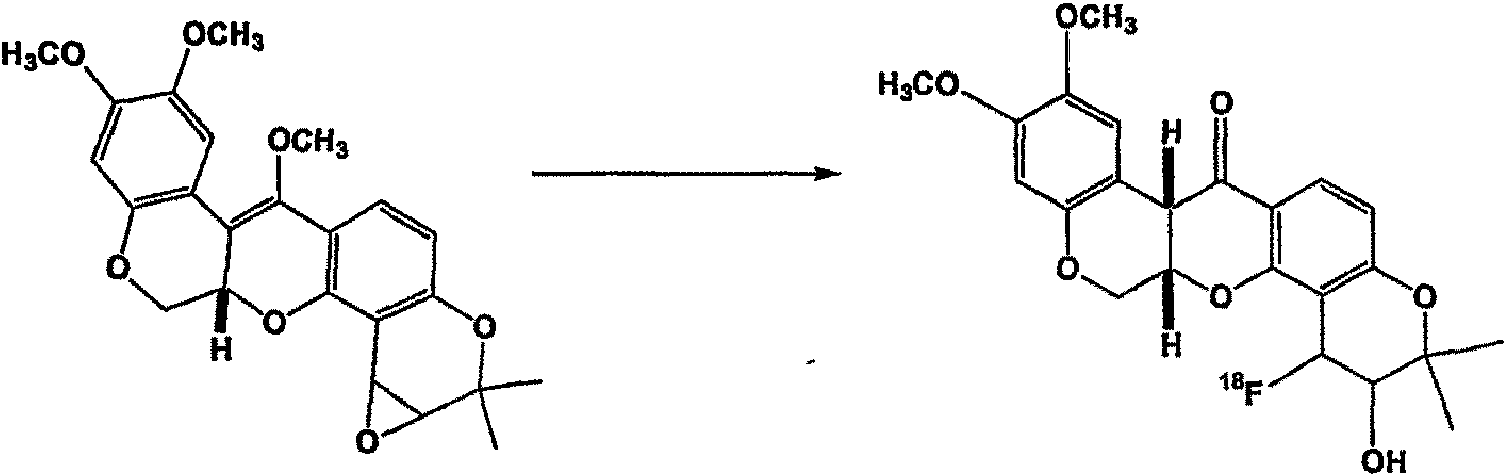
en diclorometano) para producir (6aS)-4’,5'-dihidro-4', 5'epoxideguelina enol éter. in dichloromethane) to yield (6aS) -4 ', 5'-dihydro-4', 5'epoxideguelin enol ether.
*Síntesis de (6aS, 12aS)-4’,5',-d¡h¡dro-4'[18F]flouro,5'hidrox¡deguel¡na (ejemplo comparativo):* Synthesis of (6aS, 12aS) -4 ', 5', - d¡hydro-4 '[18F] fluorine, 5'hydroxydegueline (comparative example):
Un vacutainer silanizado de 10 mL de pared fina con un tapón silanizado se carga con hidróxido de tetrabutilamonio (5 uL, solución al 40% p/v en agua), y una solución de 18F- en agua (10 mCi, 200 uL). La mezcla resultante se evapora a sequedad bajo un flujo de nitrógeno a 100°C. El residuo se seca adicionalmente por adición y evaporación repetidas de CH3CN (3 x 200 uL). Una alícuota adicional de CH3CN se añade y se concentra a vacío sin calentamiento. Antes de completarse la eliminación del disolvente, se agrega THF (150 uL), el vial no se pliega y se agrega (6aS)-4'5'-dihidro-4’,5'epoxydeguelina enol éter (2 mg) en una porción. El vial se vuelve a tapar y se calienta a 65°C durante 30 minutos. Después de enfriarse a temperatura ambiente, se agrega lentamente una solución de ácido trifluoroacético (500 mL) y agua (300 mL). El recipiente de reacción se cierra y se deja reposar a 60°C durante 2 min. Después de enfriarse a temperatura ambiente, el vial se diluye con agua (4 mL) y se pasa a través de un cartucho de gel de sílice (Waters Light C-18 Sep-Pak precargado) para cargar la muestra. El cartucho se enjuagó con agua y se eluyó con CH3CN (2 mL). El acetonitrilo se evapora y el residuo se purifica por HPLC para proporcionar (6aS, 12aS)-4’,5',-dihidro-4'[18F]flouro, 5'hidroxideguelina libre de portador puro.A thin-walled 10 mL silanized vacutainer with a silanized stopper is charged with tetrabutylammonium hydroxide (5 uL, 40% w / v solution in water), and a solution of 18F- in water (10 mCi, 200 uL). The resulting mixture is evaporated to dryness under a nitrogen flow at 100 ° C. The residue is further dried by repeated addition and evaporation of CH 3 CN (3 x 200 uL). An additional aliquot of CH 3 CN is added and concentrated in vacuo without heating. Before solvent removal is complete, THF (150 uL) is added, the vial is not folded, and (6aS) -4'5'-dihydro-4 ', 5'epoxydeguelin enol ether (2 mg) is added in one portion . The vial is recapped and heated at 65 ° C for 30 minutes. After cooling to room temperature, a solution of trifluoroacetic acid (500 mL) and water (300 mL) are slowly added. The reaction vessel is closed and allowed to stand at 60 ° C for 2 min. After cooling to room temperature, the vial is diluted with water (4 mL) and passed through a silica gel cartridge (Waters Light C-18 Sep-Pak prefilled) to load the sample. The cartridge was rinsed with water and eluted with CH 3 CN (2 mL). The acetonitrile is evaporated and the residue is purified by HPLC to provide (6aS, 12aS) -4 ', 5', - dihydro-4 '[18F] fluorine, 5'hydroxydeguelin free of pure carrier.
Síntesis de (6aS, 12aS)-2-0-desmetildeguelina (ejemplo comparativo):Synthesis of (6aS, 12aS) -2-0-demethyldeguelin (comparative example):

(6aS, 12aS)-Deguelina (251 mg, 0,638 mmol) y metanolato de sodio (125 mg, 1,78 mmol) se disuelven en 4 ml de N,N-dimetilacetamida y se calientan a 80°C durante 26 h. La mezcla de reacción se diluye a 50 mL con agua y se extrae con diclorometano. La capa acuosa se acidifica luego con HCl al 5% y se extrae de nuevo con diclorometano. Todas las capas orgánicas se secan sobre Na2SÜ4, se concentran, y se purifican usando cromatografía en gel de sílice (100% de diclorometano a 30% de acetona en diclorometano) para producir (6aS, 12aS)-2-0-desmetildeguelina.(6aS, 12aS) -Deguelin (251 mg, 0.638 mmol) and sodium methanolate (125 mg, 1.78 mmol) are dissolved in 4 ml of N, N-dimethylacetamide and heated at 80 ° C for 26 h. The reaction mixture is diluted to 50 mL with water and extracted with dichloromethane. The aqueous layer is then acidified with 5% HCl and extracted again with dichloromethane. All organic layers are dried over Na2SO4, concentrated, and purified using silica gel chromatography (100% dichloromethane to 30% acetone in dichloromethane) to yield (6aS, 12aS) -2-0-desmethyldeguelin.
*Síntesis de (6aS, 12aS)-2[18F]fluorometoxideguelina (ejemplo comparativo):* Synthesis of (6aS, 12aS) -2 [18F] fluoromethoxydeguelin (comparative example):
[18F]F se prepara irradiando [18O]agua (>94% en peso; 400 pL) en cámaras diana de plata con protones de 17 meV de un ciclotrón AVF de 103 cm. Las irradiaciones típicas son de duración de 45 min. con una corriente de haz de 10 mA produciendo aproximadamente 18 GBq [18F] fluoruro. Después de la irradiación, el agua diana se transporta a través de un tubo de silicona al aparato de síntesis. Este aparato consiste en un recipiente de borosilicato (5 mL), que[18F] F is prepared by irradiating [18O] water (> 94 wt%; 400 pL) into silver target chambers with 17 meV protons from a 103 cm AVF cyclotron. Typical irradiations last 45 min. with a beam current of 10 mA producing approximately 18 GBq [18F] fluoride. After irradiation, the target water is transported through a silicone tube to the synthesis apparatus. This apparatus consists of a borosilicate container (5 mL), which

contiene carbonato de potasio (5 mg, 36 pmol) y K2.2.2 (18 mg, 48 pmol) en acetonitrilo (1 mL). El agua diana se evapora a presión reducida y He-flow. Se añaden tres porciones de acetonitrilo a 110°C. La cámara de reacción se deja enfriar a temperatura ambiente y se agrega dibromometano (50 mL) en acetonitrilo (1 mL) a la mezcla seca de 18F/K2.2.2. La mezcla de reacción se calienta de nuevo a 110°C y los productos volátiles se transfieren a un GC preparativo con He como vehículo. La columna se calienta a 100°C y [18F]CH2BrF se separa de los solventes y otros reactivos.Contains potassium carbonate (5 mg, 36 pmol) and K2.2.2 (18 mg, 48 pmol) in acetonitrile (1 mL). The target water is evaporated under reduced pressure and He-flow. Three portions of acetonitrile are added at 110 ° C. The reaction chamber is allowed to cool to room temperature and dibromomethane (50 mL) in acetonitrile (1 mL) is added to the 18F / K2.2.2 dry mixture. The reaction mixture is heated again to 110 ° C and the volatiles are transferred to a preparative GC with He as the vehicle. The column is heated to 100 ° C and [18F] CH 2 BrF is separated from solvents and other reagents.
[18F]CH2BrF recién obtenido se añade a un vial que contiene (6aS, 12aS)-2-0-desmetildeguelina (2 mg) en ACN (150 uL). El vial se vuelve a tapar y se calienta a 65°C durante 30 minutos. Después de enfriarse, el vial se diluye con agua (4 mL) y se pasa a través de un cartucho de gel de sílice (Waters Light C-18 Sep-Pak precargado) para cargar la muestra. El cartucho se enjuagó con agua y se eluyó con CH3CN (2 mL). El acetonitrilo se evapora y el residuo se purifica por HPLC para proporcionar el vehículo puro (6aS, 12aS)-2[18F]fluorometoxideguelina.Freshly obtained [18F] CH 2 BrF is added to a vial containing (6aS, 12aS) -2-0-demethyldeguelin (2 mg) in ACN (150 uL). The vial is recapped and heated at 65 ° C for 30 minutes. After cooling, the vial is diluted with water (4 mL) and passed through a silica gel cartridge (Waters Light C-18 Sep-Pak prefilled) to load the sample. The cartridge was rinsed with water and eluted with CH 3 CN (2 mL). The acetonitrile is evaporated and the residue is purified by HPLC to provide the pure vehicle (6aS, 12aS) -2 [18F] fluoromethoxydeguelin.
*Síntesis de (6aS, 12aS)-2[18F]nuoroetoxideguelina (ejemplo comparativo):* Synthesis of (6aS, 12aS) -2 [18F] nuoroethoxideguelin (comparative example):

Se añaden toluenosulfonilcloruro (38,3 g, 0,201 mol) y piridina (15,9 g, 0,201 mol) a una solución de etano-1,2-diol (5 g, 0,081 mol) en diclorometano (100 mL) a 0°C. Una vez completada la adición, la reacción se agita a temperatura ambiente durante la noche. Por la mañana, la mezcla de reacción se diluye con agua. La capa acuosa se extrae con diclorometano, se seca sobre Na2SÜ4 y se concentra. El material bruto se purifica usando cromatografía sobre gel de sílice (acetato de etilo de hexanos 4:1 a acetato de etilo al 100%) para obtener etano de ditosilo con buen rendimiento.Toluenesulfonylchloride (38.3 g, 0.201 mol) and pyridine (15.9 g, 0.201 mol) are added to a solution of ethane-1,2-diol (5 g, 0.081 mol) in dichloromethane (100 mL) at 0 ° C. After the addition is complete, the reaction is stirred at room temperature overnight. In the morning, the reaction mixture is diluted with water. The aqueous layer is extracted with dichloromethane, dried over Na2SO4, and concentrated. The crude material is purified using silica gel chromatography (hexanes 4: 1 ethyl acetate to 100% ethyl acetate) to obtain ditosyl ethane in good yield.
Un vacutainer silanizado de pared delgada de 10 mL con un tapón silanizado se carga con hidróxido de tetrabutilamonio (8,5 uL, solución al 40% p/v en agua) y una solución de 18F- en agua (10 mCi, 340 uL). La mezcla resultante se evapora a sequedad bajo un flujo de nitrógeno a 100°C. El residuo se seca adicionalmente por adición y evaporación repetidas de CH3CN (3 x 200 uL). Una alícuota adicional de CH3CN se añade y se concentra a vacío sin calentamiento. Antes de completarse la eliminación del disolvente, se agrega THF (150 uL), el vial no se pliega y se agrega etano de 1,2-ditoluenosulfonato (3,4 mg) en una porción. El vial se vuelve a tapar y se calienta a 85°C durante 30 minutos. Después de enfriarse a temperatura ambiente, el disolvente se elimina a presión reducida para dar el precursor de tosilato de [18F]fluoroetilo (2,0 mg, 0,010 mmol). (6aS, 12aS)-2-0-desmetildeguelina (3,8 mg, 0,010 mmol) e hidróxido de tetrabutilamonio (2,6 mg, 0,010 mmol) se agregan en DMF (0,25 mL) y la mezcla de reacción se calienta de nuevo a 60°C. Después de 15 min. la mezcla de reacción se enfría a temperatura ambiente, el vial se diluye con agua (4 mL) y se pasa a través de un cartucho de gel de sílice (Waters Light C-18 Sep-Pak precargado) para cargar la muestra. El cartucho se enjuagó con agua y se eluyó con CH3CN (2 mL). El acetonitrilo se evapora y el residuo se purifica por HPLc para proporcionar el vehículo puro (6aS, 12aS)-2[18F]fluoroetoxideguelina.A 10 mL thin-walled silanized vacutainer with a silanized stopper is charged with tetrabutylammonium hydroxide (8.5 uL, 40% w / v solution in water) and a solution of 18F- in water (10 mCi, 340 uL) . The resulting mixture is evaporated to dryness under a nitrogen flow at 100 ° C. The residue is further dried by repeated addition and evaporation of CH 3 CN (3 x 200 uL). An additional aliquot of CH 3 CN is added and concentrated in vacuo without heating. Before solvent removal is complete, THF (150 uL) is added, the vial is not folded, and 1,2-ditoluenesulfonate ethane (3.4 mg) is added in one portion. The vial is recapped and heated at 85 ° C for 30 minutes. After cooling to room temperature, the solvent is removed under reduced pressure to give the [18F] fluoroethyl tosylate precursor (2.0 mg, 0.010 mmol). (6aS, 12aS) -2-0-demethyldegelin (3.8 mg, 0.010 mmol) and tetrabutylammonium hydroxide (2.6 mg, 0.010 mmol) are added in DMF (0.25 mL) and the reaction mixture is heated back to 60 ° C. After 15 min. The reaction mixture is cooled to room temperature, the vial is diluted with water (4 mL) and passed through a silica gel cartridge (Waters Light C-18 Sep-Pak preloaded) to load the sample. The cartridge was rinsed with water and eluted with CH 3 CN (2 mL). The acetonitrile is evaporated and the residue is purified by HPL c to provide the pure vehicle (6aS, 12aS) -2 [18F] fluoroethoxydeguelin.
*Síntesis de (6aS)-4’,5'-dihidro-5'-hidroxideguelina enol éter (ejemplo comparativo):* Synthesis of (6aS) -4 ', 5'-dihydro-5'-hydroxydeguelin enol ether (comparative example):

Se disuelve (6aS)-4’,5'-dihidro-4’,5'-epoxideguelina enol éter (1,0 g, 2,35 mmol) en THF (20 mL) y se enfría a 0°C. Se agrega hidruro de litio y aluminio (2,35 mL de solución 1 M de THF) gota a gota a la solución de agitación. Una vez completada la adición, la mezcla de reacción se agita a temperatura ambiente durante la noche. Por la mañana, la reacción se calma con agua. La capa acuosa se extrae con acetato de etilo. Todas las capas orgánicas se secan sobre Na2SÜ4, se concentran y se purifican usando cromatografía en gel de sílice (100% de diclorometano a 30% de acetona en diclorometano) para producir (6aS)-4’,5'-dihidro-5'-hidroxideguelina enol éter. Dissolve (6aS) -4 ', 5'-dihydro-4', 5'-epoxydeguelin enol ether (1.0 g, 2.35 mmol) in THF (20 mL) and cool to 0 ° C. Lithium aluminum hydride (2.35 mL of 1 M THF solution) is added dropwise to the stirring solution. After the addition is complete, the reaction mixture is stirred at room temperature overnight. In the morning, the reaction is quenched with water. The aqueous layer is extracted with ethyl acetate. All organic layers are dried over Na2SO4, concentrated, and purified using silica gel chromatography (100% dichloromethane to 30% acetone in dichloromethane) to yield (6aS) -4 ', 5'-dihydro-5'- hydroxydeguelin enol ether.

*Síntesis de (6aS)-4’,5'-dih¡dro-5'toluenesulfon¡ldeguel¡na enol éter (ejemplo comparativo):* Synthesis of (6aS) -4 ', 5'-dihydro-5'-toluenesulfonildeguene enol ether (comparative example):
A una solución en agitación de (6aS)-4’,5'-dihidro-5'-hidroxideguelina enol éter (31 mg, 0,073 mmol) en diclorometano (1,5 mL) se agrega TsCl (15,3 mg, 0,080 mmol) y piridina (6,47 gL, 0,080 mmol). Una vez completada la adición, la mezcla de reacción continúa agitándose a temperatura ambiente. Después de 28 h, la reacción se completa de acuerdo con LCMS y se concentra. El material bruto se purifica usando cromatografía sobre gel de sílice (gradiente de 100% de diclorometano a 25% de acetona en diclorometano) para producir (6aS)-4’,5'-dihidro-5'toluenosulfonildeguelinenoléter.To a stirring solution of (6aS) -4 ', 5'-dihydro-5'-hydroxydeguelin enol ether (31 mg, 0.073 mmol) in dichloromethane (1.5 mL) is added TsCl (15.3 mg, 0.080 mmol ) and pyridine (6.47 gL, 0.080 mmol). After the addition is complete, the reaction mixture continues to stir at room temperature. After 28 h, the reaction is complete according to LCMS and concentrated. The crude material is purified using silica gel chromatography (gradient 100% dichloromethane to 25% acetone in dichloromethane) to yield (6aS) -4 ', 5'-dihydro-5-toluenesulfonyldeguellineether.
*Síntesis de (6aS, 12aS)-4’,5'-dihidro-5'[18F]flourodeguel¡na (ejemplo comparativo):* Synthesis of (6aS, 12aS) -4 ', 5'-dihydro-5' [18F] fluorodeguene (comparative example):

Un vacutainer silanizado de 10 mL de pared fina con un tapón silanizado se carga con hidróxido de tetrabutilamonio (5 uL, solución al 40% p/v en agua) y una solución de 18F- en agua (10 mCi, 200 uL). La mezcla resultante se evaporó a sequedad bajo un flujo de nitrógeno a 100 grados C. El residuo se seca adicionalmente mediante la adición repetida y la evaporación de CH3CN (3 x 200 uL). Una alícuota adicional de CH3CN se añade y se concentra a vacío sin calentamiento. Antes de completarse la eliminación del disolvente, se agrega THF (150 uL), el vial no se pliega y se agrega (6aS)-4’,5'-dihidro-5'toluenosulfonilo-deguelina enol éter (2 mg) en una porción. El vial se vuelve a tapar y se calienta a 65 grados C durante 30 minutos. Después de enfriarse a temperatura ambiente, se agrega lentamente una solución de ácido trifluoroacético (500 mL) y agua (300 mL). El recipiente de reacción se cierra y se deja reposar a 60°C durante 2 min. Después de enfriarse a temperatura ambiente, el vial se diluye con agua (4 mL) y se pasa a través de un cartucho de gel de sílice (Waters Light C-18 Sep-Pak precargado) para cargar la muestra. El cartucho se enjuagó con agua y se eluyó con CH3CN (2 mL). El acetonitrilo se evapora y el residuo se purifica por HPLC para proporcionar (6aS, 12aS)-4’,5'-dihidro-5'[18F]flourodeguelina libre de vehículo libre. A thin-walled 10 mL silanized vacutainer with a silanized stopper is charged with tetrabutylammonium hydroxide (5 uL, 40% w / v solution in water) and a solution of 18F- in water (10 mCi, 200 uL). The resulting mixture was evaporated to dryness under a nitrogen flow at 100 degrees C. The residue is further dried by repeated addition and evaporation of CH 3 CN (3 x 200 uL). An additional aliquot of CH 3 CN is added and concentrated in vacuo without heating. Before solvent removal is complete, THF (150 uL) is added, the vial is not folded, and (6aS) -4 ', 5'-dihydro-5-toluenesulfonyl-dehuelin enol ether (2 mg) is added in one portion. . The vial is recapped and heated at 65 degrees C for 30 minutes. After cooling to room temperature, a solution of trifluoroacetic acid (500 mL) and water (300 mL) are slowly added. The reaction vessel is closed and allowed to stand at 60 ° C for 2 min. After cooling to room temperature, the vial is diluted with water (4 mL) and passed through a silica gel cartridge (Waters Light C-18 Sep-Pak prefilled) to load the sample. The cartridge was rinsed with water and eluted with CH 3 CN (2 mL). The acetonitrile is evaporated and the residue is purified by HPLC to provide (6aS, 12aS) -4 ', 5'-dihydro-5' [18F] flourodeguelin free of free vehicle.
*Síntesis de (6aS)-4’,5'-d¡h¡dro-5'-carbonildeguel¡na enol éter (ejemplo comparativo):* Synthesis of (6aS) -4 ', 5'-dihydro-5'-carbonyldeguelene enol ether (comparative example):

Se agrega (6aS)-4’,5'-dihidro-5'-hidroxideguelina enol éter (1,0 g, 2,3 mmol) disuelto en diclorometano (20 mL) a una solución de PCC (0,51 g, 2,3 mmol) en diclorometano (20 mL). Después de agitarse a temperatura ambiente durante 2 h, la reacción se filtra a través de una almohadilla de celite y se concentra. El material bruto se purifica por cromatografía sobre gel de sílice (100% de diclorometano a 30% de acetona en diclorometano) para producir (6aS)-4’,5'-dihidro-5'-carbonildeguelina enol éter.(6aS) -4 ', 5'-dihydro-5'-hydroxydeguelin enol ether (1.0 g, 2.3 mmol) dissolved in dichloromethane (20 mL) is added to a solution of PCC (0.51 g, 2 , 3 mmol) in dichloromethane (20 mL). After being stirred at room temperature for 2 h, the reaction is filtered through a pad of celite and concentrated. The crude material is purified by silica gel chromatography (100% dichloromethane to 30% acetone in dichloromethane) to yield (6aS) -4 ', 5'-dihydro-5'-carbonyldegelin enol ether.
*Síntesis de (6aS)-5'-trimetilestannildeguelina enol éter (ejemplo comparativo):* Synthesis of (6aS) -5'-trimethylstannyldeguelin enol ether (comparative example):

A una solución de 2,4,6-triisopropilbencenosulfonilhidrazida (33,0 g, 0,10 mol) en ACN (100 mL) se le agrega (6aS)-4’,5'-dihidro-5'-carbonildeguelina enol éter (42,4 g, 0,10 mol) de 5'-carbonilo deguelina enol éter y 10 mL de ácido clorhídrico concentrado. La solución se agita a temperatura ambiente y luego se enfría a 0°C durante 4 h. El derivado de trisilhidrazona se recoge como un sólido.To a solution of 2,4,6-triisopropylbenzenesulfonylhydrazide (33.0 g, 0.10 mol) in ACN (100 mL) is added (6aS) -4 ', 5'-dihydro-5'-carbonyldeguelin enol ether ( 42.4 g, 0.10 mol) of 5'-carbonyl dehuelin enol ether and 10 mL of concentrated hydrochloric acid. The solution is stirred at room temperature and then cooled to 0 ° C for 4 h. The trisylhydrazone derivative is collected as a solid.
Una solución del derivado de hidrazona de trisilo (38,3 mmol, 22,67 g) en 200 mL de TMEDA-hexanos (1:1) es metalado con exactamente 2,0 equivalentes de sec-buitllitio/ciclohexano (76,6 mmoles s-BuLi, - 80°C) y se dejó calentar a -10°C hasta N2 que cesó la evolución (40 min.) Una solución de cloruro de trimetilestaño recién sublimado (50 mmoles, 9,97g, 1,3 equiv.) en 30 ml de hexano se añade todo de una vez. El tratamiento acuoso se sigue por destilación a través de un aparato de paso corto a presión reducida para dar (6aS)-5'-trimetilestannildeguelina enol éter. A solution of the trisyl hydrazone derivative (38.3 mmol, 22.67 g) in 200 mL of TMEDA-hexanes (1: 1) is metalated with exactly 2.0 equivalents of sec-buitllithium / cyclohexane (76.6 mmol s-BuLi, -80 ° C) and allowed to warm to -10 ° C until N 2 that evolution ceased (40 min.) A freshly sublimated trimethyltin chloride solution (50 mmol, 9.97g, 1.3 equiv .) in 30 ml of hexane is added all at once. The aqueous work-up is followed by distillation through a short-pass apparatus under reduced pressure to give (6aS) -5'-trimethylstannyldeguelin enol ether.
*Síntesis de (6aS, 12aS)-5 '[18F]flourodeguelina (ejemplo comparativo):* Synthesis of (6aS, 12aS) -5 '[18F] fluorodegelin (comparative example):

Un vacutainer silanizado de 10 mL de pared fina con un tapón silanizado se carga con hidróxido de tetrabutilamonio (5 uL, solución al 40% p/v en agua), y una solución de 18F- en agua (10 mCi, 200 uL). La mezcla resultante se evaporó a sequedad bajo un flujo de nitrógeno a 100 grados C. El residuo se seca adicionalmente mediante la adición repetida y la evaporación de CH3CN (3 x 200 uL). Una alícuota adicional de CH3CN se añade y se concentra a vacío sin calentamiento. Antes de completarse la eliminación del disolvente, se agrega THF (150 uL), el vial no se pliega y se agrega (6aS)-5'-trimetilestannildeguelina enol éter (2 mg) en una porción. El vial se vuelve a tapar y se calienta a 65 grados C durante 30 minutos. Después de enfriarse a temperatura ambiente, se agrega lentamente una solución de ácido trifluoroacético (500 mL) y agua (300 mL). El recipiente de reacción se cierra y se deja reposar a 60°C durante 2 min. Después de enfriarse a temperatura ambiente, el vial se diluye con agua (4 mL) y se pasa a través de un cartucho de gel de sílice (Waters Light C-18 Sep-Pak precargado) para cargar la muestra. El cartucho se enjuagó con agua y se eluyó con CH3CN (2 mL). El acetonitrilo se evapora y el residuo se purifica por HPLC para proporcionar flourodeguelina libre de portador (6aS, 12aS)-5 '[18F].A thin-walled 10 mL silanized vacutainer with a silanized stopper is charged with tetrabutylammonium hydroxide (5 uL, 40% w / v solution in water), and a solution of 18F- in water (10 mCi, 200 uL). The resulting mixture was evaporated to dryness under a nitrogen flow at 100 degrees C. The residue is further dried by repeated addition and evaporation of CH 3 CN (3 x 200 uL). An additional aliquot of CH 3 CN is added and concentrated in vacuo without heating. Before solvent removal is complete, THF (150 uL) is added, the vial is not folded, and (6aS) -5'-trimethylstannyldegelin enol ether (2 mg) is added in one portion. The vial is recapped and heated at 65 degrees C for 30 minutes. After cooling to room temperature, a solution of trifluoroacetic acid (500 mL) and water (300 mL) are slowly added. The reaction vessel is closed and allowed to stand at 60 ° C for 2 min. After cooling to room temperature, the vial is diluted with water (4 mL) and passed through a silica gel cartridge (Waters Light C-18 Sep-Pak prefilled) to load the sample. The cartridge was rinsed with water and eluted with CH 3 CN (2 mL). The acetonitrile is evaporated and the residue is purified by HPLC to provide carrier-free fluorodeguelin (6aS, 12aS) -5 '[18F].
*Síntesis de (6aS)-4’,5'-dihidro-4' hidroxideguelina enol éter (ejemplo comparativo):* Synthesis of (6aS) -4 ', 5'-dihydro-4' hydroxydeguelin enol ether (comparative example):

Se añaden (6aS)-deguelina enol éter (155,0 mg, 0,38 mmol) y catecolborano (0,40 mL de solución 1,0M de THF, 0,40 mmol) a una solución de catalizador A (0,003 g, 1% mol) en THF (0,5 mL). El catalizador A se prepara según los procedimientos que se encuentran en WO 95/13284. La mezcla se agita en nitrógeno durante 2 h, luego se inactiva con EtOH (0,5 mL), NaOH (2,0 M en agua, 0,5 mL) y peróxido de hidrógeno (30% en agua, 0,5 mL), con agitación durante dos horas adicionales. La mezcla de reacción se extrae con dietilo éter. La capa orgánica se lava con NaOH 1,0 M, se seca sobre Na2SO4, y se purifica usando cromatografía en gel de sílice (100% de diclorometano a 30% de acetona en diclorometano para producir (6aS)-4’,5'-dihidro-4' hidroxideguelina éter enol. (6aS) -deguelin enol ether (155.0 mg, 0.38 mmol) and catecholborane (0.40 mL of 1.0M THF solution, 0.40 mmol) are added to a solution of catalyst A (0.003 g, 1% mol) in THF (0.5 mL). Catalyst A is prepared according to the procedures found in WO 95/13284. The mixture is stirred under nitrogen for 2 h, then quenched with EtOH (0.5 mL), NaOH (2.0 M in water, 0.5 mL), and hydrogen peroxide (30% in water, 0.5 mL). ), with stirring for an additional two hours. The reaction mixture is extracted with diethyl ether. The organic layer is washed with 1.0 M NaOH, dried over Na2SO4, and purified using silica gel chromatography (100% dichloromethane to 30% acetone in dichloromethane to yield (6aS) -4 ', 5'- dihydro-4'hydroxydeguelin ether enol.
*Síntesis de (6aS)-4’,5'-d¡h¡dro-4'-carbonildeguel¡na enol éter (ejemplo comparativo):* Synthesis of (6aS) -4 ', 5'-dihydro-4'-carbonyldeguelene enol ether (comparative example):

(6aS)-4’,5'-dihidro-5'-hidroxideguelina enol éter (1,0 g, 2,3 mmol) disuelto en diclorometano (20 mL) se agrega a una solución de PCC (0,51 g, 2,3 mmol) en diclorometano (20 mL). Después de agitarse a temperatura ambiente durante 2 h, la reacción se filtra a través de una almohadilla de celite y se concentra. El material bruto se purifica por cromatografía sobre gel de sílice (100% de diclorometano a 30% de acetona en diclorometano) para producir (6aS)-4’,5'-dihidro-4'-carbonildeguelina enol éter.(6aS) -4 ', 5'-dihydro-5'-hydroxydeguelin enol ether (1.0 g, 2.3 mmol) dissolved in dichloromethane (20 mL) is added to a solution of PCC (0.51 g, 2 , 3 mmol) in dichloromethane (20 mL). After being stirred at room temperature for 2 h, the reaction is filtered through a pad of celite and concentrated. The crude material is purified by silica gel chromatography (100% dichloromethane to 30% acetone in dichloromethane) to yield (6aS) -4 ', 5'-dihydro-4'-carbonyldegelin enol ether.
*Síntesis de (6aS)-4'-trimetilestann¡ldeguel¡na enol éter (ejemplo comparativo):* Synthesis of (6aS) -4'-trimethylstannyldegelina enol ether (comparative example):

Se agrega a una solución de 2,4,6-triisopropilbencenosulfonilhidrazida (33,0 g, 0,10 mol) en ACN (100 mL) (6aS)-4’,5'-dihidro-4'-carbonildeguelina enol éter (42,4 g), 0,10 mol) y 10 mL de ácido clorhídrico concentrado. La solución se agita a temperatura ambiente y luego se enfría a 0°C durante 4 h. El derivado de trisilhidrazona se recoge como un sólido.To a solution of 2,4,6-triisopropylbenzenesulfonylhydrazide (33.0 g, 0.10 mol) in ACN (100 mL) (6aS) -4 ', 5'-dihydro-4'-carbonyldegel ether (42 , 4 g), 0.10 mol) and 10 mL of concentrated hydrochloric acid. The solution is stirred at room temperature and then cooled to 0 ° C for 4 h. The trisylhydrazone derivative is collected as a solid.
Una solución del derivado de trisilo hidrazona (38,3 mmol, 22,67 g) en 200 mL de TMEDA-hexanos (1:1) es metalada con exactamente 2,0 equivalentes de sec-buitllitio/ciclohexano (76,6 mmoles s-BuLi, - 80°C) y se dejó calentar a -10°C hasta que cesó la evolución N2 (40 min.). Una solución de cloruro de trimetilestaño recién sublimado (50 mmoles, 9,97g, 1,3 equiv.) en 30 ml de hexano se añade todo de una vez. El tratamiento acuoso se sigue por destilación a través de un aparato de paso corto a presión reducida para dar (6aS)-4'-trimetilestannildeguelina enol éter.A solution of the trisyl derivative hydrazone (38.3 mmol, 22.67 g) in 200 mL of TMEDA-hexanes (1: 1) is metalated with exactly 2.0 equivalents of sec-buitllithium / cyclohexane (76.6 mmol s -BuLi, -80 ° C) and allowed to warm to -10 ° C until N 2 evolution ceased (40 min.). A solution of freshly sublimated trimethyltin chloride (50 mmol, 9.97g, 1.3 equiv.) In 30 ml of hexane is added all at once. Aqueous work-up is followed by distillation through a short-pass apparatus under reduced pressure to give (6aS) -4'-trimethylstannyldeguelin enol ether.
*Síntesis de (6aS, 12aS)-4' [18F]fluorodeguelina (ejemplo comparativo):* Synthesis of (6aS, 12aS) -4 '[18F] fluorodeguelin (comparative example):

Un vacutainer silanizado de 10 mL de pared fina con un tapón silanizado se carga con hidróxido de tetrabutilamonio (5 uL, solución al 40% p/v en agua) y una solución de 18F- en agua (10 mCi, 200 uL) La mezcla resultante se evaporó a sequedad bajo un flujo de nitrógeno a 100 grados C. El residuo se seca adicionalmente mediante la adición repetida y la evaporación de CH3CN (3 x 200 uL). Una alícuota adicional de CH3CN se añade y se concentra a vacío sin calentamiento. Antes de completarse la eliminación del disolvente, se agrega THF (150 uL), el vial no se pliega y se agrega (6aS)-5'-trimetilestannildeguelina enol éter (2 mg) en una porción. El vial se vuelve a tapar y se calienta a 65 grados C durante 30 minutos. Después de enfriarse a temperatura ambiente, se agrega lentamente una solución de ácido trifluoroacético (500 mL) y agua (300 mL). El recipiente de reacción se cierra y se deja reposar a 60°C durante 2 min. Después de enfriarse a temperatura ambiente, el vial se diluye con agua (4 mL) y se pasa a través de un cartucho de gel de sílice (Waters Light C-18 Sep-Pak precargado) para cargar la muestra. El cartucho se enjuagó con agua y se eluyó con CH3CN (2 mL). El acetonitrilo se evapora y el residuo se purifica por HPLC para proporcionar flourodeguelina libre de portador (6aS, 12aS)-4’[18F].A thin-walled 10 mL silanized vacutainer with a silanized stopper is charged with tetrabutylammonium (5 uL, 40% w / v solution in water) and a solution of 18F- in water (10 mCi, 200 uL) The resulting mixture was evaporated to dryness under a flow of nitrogen at 100 degrees C. The residue was further dried by repeated addition and evaporation of CH 3 CN (3 x 200 uL). An additional aliquot of CH 3 CN is added and concentrated in vacuo without heating. Before solvent removal is complete, THF (150 uL) is added, the vial is not folded, and (6aS) -5'-trimethylstannyldegelin enol ether (2 mg) is added in one portion. The vial is recapped and heated at 65 degrees C for 30 minutes. After cooling to room temperature, a solution of trifluoroacetic acid (500 mL) and water (300 mL) are slowly added. The reaction vessel is closed and allowed to stand at 60 ° C for 2 min. After cooling to room temperature, the vial is diluted with water (4 mL) and passed through a silica gel cartridge (Waters Light C-18 Sep-Pak prefilled) to load the sample. The cartridge was rinsed with water and eluted with CH 3 CN (2 mL). The acetonitrile is evaporated and the residue is purified by HPLC to provide carrier-free fluorodeguelin (6aS, 12aS) -4 '[18F].
*Síntesis de 2,4-dihidroxi-6-nitro-benzaldehído (ejemplo comparativo):* Synthesis of 2,4-dihydroxy-6-nitro-benzaldehyde (comparative example):

Se disuelven 2,4-dimetoxi-6-nitro-benzaldehído (135 mg, 0,638 mmol) y metano-tiolato sódico (125 mg, 1,78 mmol) en 4 ml de N,N-dimetilacetamida y se calientan a 80°C durante 26 h. La mezcla de reacción se diluye a 50 ml con agua y se extrae con diclorometano. La capa acuosa se acidifica con HCl al 5% y se extrae de nuevo con diclorometano. Todas las capas orgánicas se secan sobre Na2SO4, se concentran, y se purifican usando cromatografía de gel de sílice (100% de diclorometano a 30% de acetona en diclorometano) para producir 2,4-dihidroxi-6-nitro-benzaldehído.2,4-Dimethoxy-6-nitro-benzaldehyde (135 mg, 0.638 mmol) and sodium methane thiolate (125 mg, 1.78 mmol) are dissolved in 4 ml of N, N-dimethylacetamide and heated to 80 ° C for 26 h. The reaction mixture is diluted to 50 ml with water and extracted with dichloromethane. The aqueous layer is acidified with 5% HCl and extracted again with dichloromethane. All organic layers are dried over Na2SO4, concentrated, and purified using silica gel chromatography (100% dichloromethane to 30% acetone in dichloromethane) to yield 2,4-dihydroxy-6-nitro-benzaldehyde.
Síntesis de 2,4-dihidroxi-5-nitro-benzaldehído (ejemplo comparativo):Synthesis of 2,4-dihydroxy-5-nitro-benzaldehyde (comparative example):

Se disuelven 2,4-dimetoxi-5-nitro-benzaldehído (135 mg, 0,638 mmol) y metano-tiolato sódico (125 mg, 1,78 mmol) en 4 ml de N,N-dimetilacetamida y se calientan a 80°C durante 26 h. La mezcla de reacción se diluye a 50 mL con agua y se extrae con diclorometano. La capa acuosa se acidifica a continuación con HCl al 5% y se extrae de nuevo con diclorometano. Todas las capas orgánicas se secan sobre Na2SO4, se concentran, y se purifican usando cromatografía de gel de sílice (100% de diclorometano a 30% de acetona en diclorometano) para producir 2,4-dihidroxi-5-nitro-benzaldehído.2,4-Dimethoxy-5-nitro-benzaldehyde (135 mg, 0.638 mmol) and sodium methane thiolate (125 mg, 1.78 mmol) are dissolved in 4 ml of N, N-dimethylacetamide and heated to 80 ° C for 26 h. The reaction mixture is diluted to 50 mL with water and extracted with dichloromethane. The aqueous layer is then acidified with 5% HCl and extracted again with dichloromethane. All organic layers are dried over Na2SO4, concentrated, and purified using silica gel chromatography (100% dichloromethane to 30% acetone in dichloromethane) to yield 2,4-dihydroxy-5-nitro-benzaldehyde.

*Sintesis de 5-hidroxi-2,2-dimetilo-8-nitro-2H-cromeno-6-carbaldehido (ejemplo comparativo):* Synthesis of 5-hydroxy-2,2-dimethyl-8-nitro-2H-chromene-6-carbaldehyde (comparative example):
Una solución de 2,4-dihidroxi-5-nitro-benzaldehído (10,61 g, 58 mmol) en ME2CO (6 mL) se añade durante un período de 5,5 h a una solución en agitación de 3-metilo-but-2-enal (4,00 g, 29 mmol) en piridina (2,29 g, 2,34 mL, 29 mmol) a 120°C. Después de la finalización de la adición, el calentamiento continúa durante 18 horas adicionales. El ME2CO se evapora y la piridina se elimina por destilación azeotrópica con tolueno para dar un producto crudo. El producto bruto se purifica utilizando cromatografía sobre gel de sílice con acetato de etilo al 1% en hexanos para proporcionar 5-hidroxi-2,2-dimetilo-8-nitro-2H-cromeno-6-carbaldehído.A solution of 2,4-dihydroxy-5-nitro-benzaldehyde (10.61 g, 58 mmol) in ME2CO (6 mL) is added over a period of 5.5 h to a stirring solution of 3-methyl-but- 2-enal (4.00 g, 29 mmol) in pyridine (2.29 g, 2.34 mL, 29 mmol) at 120 ° C. After completion of the addition, heating continues for an additional 18 hours. The ME2CO is evaporated and the pyridine is removed by azeotropic distillation with toluene to give a crude product. The crude product is purified using silica gel chromatography with 1% ethyl acetate in hexanes to provide 5-hydroxy-2,2-dimethyl-8-nitro-2H-chromene-6-carbaldehyde.
*Síntesis de 5-hidroxi-2,2-dimetilo-7-nitro-2H-cromeno-6-carbaldehído (ejemplo comparativo):* Synthesis of 5-hydroxy-2,2-dimethyl-7-nitro-2H-chromene-6-carbaldehyde (comparative example):
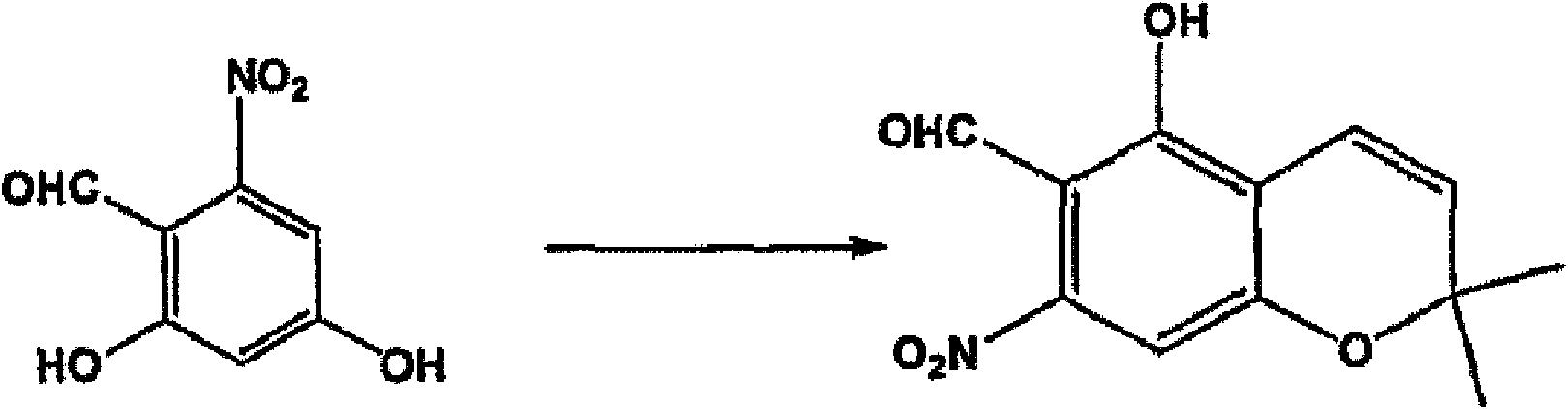
Una solución de 2,4-dihidroxi-6-nitro-benzaldehído (10,61 g, 58 mmol) en ME2CO (6 mL) se añade durante un período de 5,5 h a una solución en agitación de 3-metilo-but-2-enal (4,00 g, 29 mmol) en piridina (2,29 g, 2,34 mL, 29 mmol) a 120°C. Después de la finalización de la adición, el calentamiento continúa durante 18 horas adicionales. El ME2CO se evapora y la piridina se elimina por destilación azeotrópica con tolueno para dar un producto crudo. El producto bruto se purifica usando cromatografía en gel de sílice con acetato de etilo al 1% en hexanos para proporcionar 5-hidroxi-2,2-dimetilo-7-nitro-2H-cromeno-6-carbaldehído.A solution of 2,4-dihydroxy-6-nitro-benzaldehyde (10.61 g, 58 mmol) in ME2CO (6 mL) is added over a period of 5.5 h to a stirring solution of 3-methyl-but- 2-enal (4.00 g, 29 mmol) in pyridine (2.29 g, 2.34 mL, 29 mmol) at 120 ° C. After completion of the addition, heating continues for an additional 18 hours. The ME 2 CO is evaporated and the pyridine is removed by azeotropic distillation with toluene to give a crude product. The crude product is purified using silica gel chromatography with 1% ethyl acetate in hexanes to provide 5-hydroxy-2,2-dimethyl-7-nitro-2H-chromene-6-carbaldehyde.
*Síntesis de 5-metoxi-2,2-dimetilo-7-nitro-2H-cromeno-6-carbaldehído (ejemplo comparativo):* Synthesis of 5-methoxy-2,2-dimethyl-7-nitro-2H-chromene-6-carbaldehyde (comparative example):

Una mezcla de 5-hidroxi-2,2-dimetilo-7-nitro-2H-cromeno-6-carbaldehído (2,34 g, 10 mmol), K2CO3 (4,12 g, 29,8 mmol) y MeI (2,13 g, 0,94 mL, 15 mmol en ME2CO (40 mL) se calienta a reflujo durante 4 h y se agita a temperatura ambiente durante la noche. La mezcla se concentra, se trata con agua (15 mL) y se extrae con diclorometano. Las capas orgánicas combinadas se lavan con agua, se secan sobre Na2SO4, y el disolvente se elimina a vacío para proporcionar un aceite, que se cromatografía con Me2CO al 3% en hexano para dar 5-metoxi-2,2-dimetilo-7-nitro-2H--cromeno-6-carbaldehído.A mixture of 5-hydroxy-2,2-dimethyl-7-nitro-2H-chromene-6-carbaldehyde (2.34 g, 10 mmol), K 2 CO 3 (4.12 g, 29.8 mmol) and MeI (2.13 g, 0.94 mL, 15 mmol in ME 2 CO (40 mL) is refluxed for 4 h and stirred at room temperature overnight. The mixture is concentrated, treated with water (15 mL ) and extracted with dichloromethane The combined organic layers are washed with water, dried over Na2SO4, and the solvent is removed in vacuo to provide an oil, which is chromatographed with 3% Me 2 CO in hexane to give 5-methoxy -2,2-dimethyl-7-nitro-2H-chromene-6-carbaldehyde.
*Síntesis de 5-metoxi-2,2-dimetilo-8-nitro-2H-cromeno-6-carbaldehído (ejemplo comparativo):* Synthesis of 5-methoxy-2,2-dimethyl-8-nitro-2H-chromene-6-carbaldehyde (comparative example):

Una mezcla de 5-hidroxi-2,2-dimetilo-8-nitro-2H-cromeno-6-carbaldehído (2,34 g, 10 mmol), K2CO3 (4,12 g, 29,8 mmol) y MeI (2,13 g, 0,94 mL, 15 mmol en ME2CO (40 mL) se calienta a reflujo durante 4 h y se agita a temperatura ambiente durante la noche. La mezcla se concentra, se trata con agua (15 mL) y se extrae con diclorometano. Las capas orgánicas combinadas se lavan con agua, se secan sobre Na2SO4, y el disolvente se elimina a vacío para proporcionar un aceite, que se cromatografía con Me2CO al 3% en hexano para dar 5-metoxi-2,2-dimetilo-8-nitro-2H-cromeno-6-carbaldehído.A mixture of 5-hydroxy-2,2-dimethyl-8-nitro-2H-chromene-6-carbaldehyde (2.34 g, 10 mmol), K 2 CO 3 (4.12 g, 29.8 mmol) and MeI (2.13 g, 0.94 mL, 15 mmol in ME 2 CO (40 mL) is refluxed for 4 h and stirred at room temperature overnight. The mixture is concentrated, treated with water (15 mL), and extracted with dichloromethane. The combined organic layers are washed with water, dried over Na2SO4, and the solvent is removed in vacuo to provide an oil, which is chromatographed with 3% Me 2 CO in hexane to give 5-methoxy-2,2-dimethyl- 8-nitro-2H-chromene-6-carbaldehyde.
*Síntesis de 4-but-2-in¡lox¡-1,2-d¡metoxibenceno (ejemplo comparativo):* Synthesis of 4-but-2-ylox¡-1,2-dimethoxybenzene (comparative example):
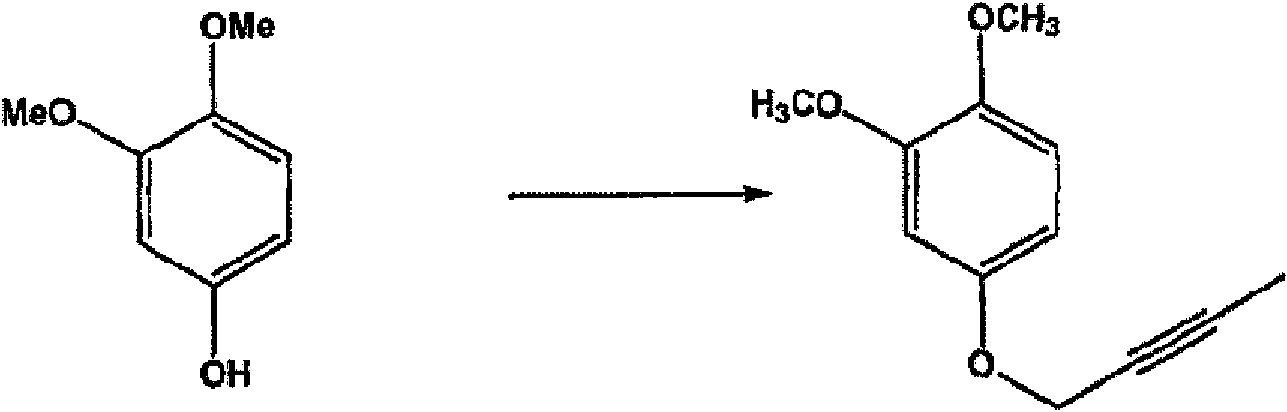
A 3,4-dimetoxifenol (15,4 g, 0,1 mol) en DMF (100 mL) se le añade bromuro de propargilo (14,15 g, 0,12 mol) y carbonato de potasio (11,88 g, 0,12 mol). La reacción se agita a temperatura ambiente durante 12 h, NH4Cl sat. y éter dietílico se añaden. Las capas orgánicas se lavan con agua, salmuera y se secan sobre Na2SO4. El material bruto se filtra a través de una almohadilla de sílice (1:1 de hexanos:diclorometano) para proporcionar 4-but-2-iniloxi-1,2-dimetoxibenceno como un aceite amarillo.Propargyl bromide (14.15 g, 0.12 mol) and potassium carbonate (11.88 g, 0.12 mol). The reaction is stirred at room temperature for 12 h, sat. NH4Cl. and diethyl ether are added. The organic layers are washed with water, brine, and dried over Na2SO4. The crude material is filtered through a pad of silica (1: 1 hexanes: dichloromethane) to provide 4-but-2-ynyloxy-1,2-dimethoxybenzene as a yellow oil.
*Síntesis de 4-(3,4-d¡metox¡-fen¡lox¡)-1-(5-metox¡-2,2-d¡met¡lo-8-n¡tro-2H-cromen-6-¡l)-but-2-¡n-1-ona (ejemplo comparativo):* Synthesis of 4- (3,4-dimethox¡-phenylox¡) -1- (5-methox¡-2,2-d¡melo-8-nitro-2H-chromen-6 -¡L) -but-2-¡n-1-one (comparative example):

A una solución de 4-but-2-iniloxi-1,2-dimetoxibenceno (1,66 g, 8,66 mmol) en THF (75 mL) se agrega nbutilo litio (5,54 ml de solución 1,6 M en THF, 8,86 mmol) a -78°C. Después de 30 minutos, se agrega 5-metoxi-2,2-dimetilo-8-nitro-2H-cromeno-6-carbaldehído (2,17 g, 8,25 mmol) en THF (50 mL). La reacción se agita durante 1 hora y luego se inactiva con solución NH4Cl sat. y se extrae con acetato de etilo. Las capas orgánicas combinadas se lavan con salmuera y se secan sobre Na2SO4. El material en bruto resultante se disolvió en diclorometano (20 mL) y se añade MnO2 (5,3 g, 61 mmol). Después de agitarse la reacción durante la noche a temperatura ambiente, se agrega éter y la suspensión se filtra a través de una almohadilla de celite y gel de sílice para proporcionar 4-(3,4-dimetoxi-fenoxi)-1-(5-metoxi-2,2)-dimetilo-8-nitro-2H-cromen-6-il)-but-2-in-1-ona.To a solution of 4-but-2-ynyloxy-1,2-dimethoxybenzene (1.66 g, 8.66 mmol) in THF (75 mL) is added nbutyl lithium (5.54 mL of 1.6 M solution in THF, 8.86 mmol) at -78 ° C. After 30 minutes, 5-methoxy-2,2-dimethyl-8-nitro-2H-chromene-6-carbaldehyde (2.17 g, 8.25 mmol) in THF (50 mL) is added. The reaction is stirred for 1 hour and then quenched with sat. NH4Cl solution. and extracted with ethyl acetate. The combined organic layers are washed with brine and dried over Na2SO4. The resulting crude material was dissolved in dichloromethane (20 mL) and MnO 2 (5.3 g, 61 mmol) was added. After the reaction is stirred overnight at room temperature, ether is added and the suspension is filtered through a pad of celite and silica gel to provide 4- (3,4-dimethoxy-phenoxy) -1- (5- methoxy-2,2) -dimethyl-8-nitro-2H-chromen-6-yl) -but-2-yn-1-one.
*Síntesis de 4-(3,4-d¡metox¡-fenox¡)-1-(5-metox¡-2,2-d¡met¡lo-7-n¡tro-2H-cromen-6-¡l)-but-2-¡n-1-ona (ejemplo comparativo): * Synthesis of 4- (3,4-dimethox¡-phenox¡) -1- (5-methox¡-2,2-dimelo-7-nitro-2H-chromen-6-¡ l) -but-2-¡n-1-one (comparative example):

A una solución de 4-but-2-iniloxi-1,2-dimetoxibenceno (1,66 g, 8,66 mmol) en THF (75 mL) se agrega nbutilo litio (5,54 ml de solución 1,6 M en THF, 8,86 mmol) a -78°C. Después de 30 minutos, se agrega 5-metoxi-2,2-dimetilo-7-nitro-2H-cromeno-6-carbaldehído (2,17 g, 8,25 mmol) en THF (50 mL). La reacción se agita durante 1 hora y luego se inactiva con solución NH4Cl sat. y se extrae con acetato de etilo. Las capas orgánicas combinadas se lavan con salmuera y se secaron sobre Na2SO4. El material en bruto resultante se disolvió en diclorometano (20 mL) y se añade MnO2 (5,3 g, 61 mmol). Después de agitarse la reacción durante la noche a temperatura ambiente, se agrega éter y la suspensión se filtra a través de una almohadilla de celite y gel de sílice para proporcionar 4-(3,4-dimetoxi-fenoxi)-1-(5-metoxi-2,2)-dimetilo-7-nitro-2H-cromen-6-il)-but-2-in-1-ona.To a solution of 4-but-2-ynyloxy-1,2-dimethoxybenzene (1.66 g, 8.66 mmol) in THF (75 mL) is added nbutyl lithium (5.54 mL of 1.6 M solution in THF, 8.86 mmol) at -78 ° C. After 30 minutes, 5-methoxy-2,2-dimethyl-7-nitro-2H-chromene-6-carbaldehyde (2.17 g, 8.25 mmol) in THF (50 mL) is added. The reaction is stirred for 1 hour and then quenched with sat. NH4Cl solution. and extracted with ethyl acetate. The combined organic layers are washed with brine and dried over Na2SO4. The resulting crude material was dissolved in dichloromethane (20 mL) and MnO 2 (5.3 g, 61 mmol) was added. After the reaction is stirred overnight at room temperature, ether is added and the suspension is filtered through a pad of celite and silica gel to provide 4- (3,4-dimethoxy-phenoxy) -1- (5- methoxy-2,2) -dimethyl-7-nitro-2H-chromen-6-yl) -but-2-yn-1-one.
*Síntesis de (6,7-d¡metox¡-2H-croman-3-¡l)-(5-metoxi-2,2-d¡met¡lo-7-n¡tro-2H-cromen-6-¡l)-metanona (ejemplo comparativo):* Synthesis of (6,7-dimethox¡-2H-chroman-3-¡l) - (5-methoxy-2,2-dimelo-7-nitro-2H-chromen-6- ¡L) -methanone (comparative example):

En un matraz de fondo redondo de 10 mL secado a llama se agrega 4-(3,4-dimetoxi-fenoxi)-1-(5-metoxi-2,2-dimetilo-7-nitro-2H-cromen-6-ilo)-but-2-in-1-ona (61,6 mg, 0,135 mmol) y PtCl2 (1,8 mg, 5% mol). El matraz se evacúa y se lava con argón tres veces, seguido de la adición de tolueno (1,8 mL, 0,1 m). La reacción se agita a 55°C durante 10 h y luego se concentra. El material bruto se purifica usando cromatografía en gel de sílice (7:3 de acetato de hexanos:etilo) paraAdd 4- (3,4-dimethoxy-phenoxy) -1- (5-methoxy-2,2-dimethyl-7-nitro-2H-chromen-6-yl to a flame-dried 10 mL round bottom flask). ) -but-2-in-1-one (61.6 mg, 0.135 mmol) and PtCl 2 (1.8 mg, 5 mol%). The flask is evacuated and washed with argon three times, followed by the addition of toluene (1.8 mL, 0.1 m). The reaction is stirred at 55 ° C for 10 h and then concentrated. The crude material is purified using silica gel chromatography (hexanes acetate: ethyl 7: 3) to

proporcionar (6,7-dimetoxi-2H-croman-3-ilo)-(5-metoxi-2,2-dimetilo-7-nitro-2H-cromen-6-il)-metanona. provide (6,7-dimethoxy-2H-chroman-3-yl) - (5-methoxy-2,2-dimethyl-7-nitro-2H-chromen-6-yl) -methanone.
*Síntesis de (6,7-d¡metox¡-2H-croman-3-¡lo)-(5-metox¡-2,2-d¡metilo-8-n¡tro-2H-cromen-6-¡lo)-metanona (ejemplo comparat¡vo):* Synthesis of (6,7-d¡methox¡-2H-chroman-3-¡lo) - (5-methox¡-2,2-d¡methyl-8-nitro-2H-chromen-6-¡ lo) -methanone (comparative example):
En un matraz de fondo redondo de 10 mL secado a llama se agrega 4-(3,4-dimetoxi-fenox¡)-1-(5-metox¡-2,2-dimet¡lo-8-nitro-2H-cromen-6-¡lo))-but-2--1-ona yn (61,6 mg, 0,135 mmol) y PtCl2 (1 , 8 mg, 5% mol). El matraz se evacúa y se lava con argón tres veces, seguido de la adición de tolueno (1,8 mL, 0,1 m). La reacción se agita a 55°C durante 10 h y luego se concentra. El material bruto se purifica usando cromatografía sobre gel de sílice (7:3 de acetato de hexanos:etilo) para proporcionar ^J-dimetoxi^H-crom an^-ilo^^-m etoxi^^-dim etilo^-nitro^H-cromen-6 -ilo)-metanona.In a flame-dried 10 mL round bottom flask, add 4- (3,4-dimethoxy-phenoxy) -1- (5-methoxy-2,2-dimethyl-8-nitro-2H-chrome). -6-¡lo)) - but-2--1-one n (61.6 mg, 0.135 mmol) and PtCl 2 (1, 8 mg, 5 mol%). The flask is evacuated and flushed with argon three times, followed by addition of toluene (1, 8 mL, 0.1 m). The reaction is stirred at 55 ° C for 10 h and then concentrated. The crude material is purified using silica gel chromatography (7: 3 hexanes acetate: ethyl) to provide ^ J-dimethoxy ^ H-chrom an ^ -yl ^^ - m ethoxy ^^ - dim ethyl ^ -nitro ^ H-chromen- 6 -yl) -methanone.
*Síntes¡s de (+/-)-10-n¡trodeguel¡na (ejemplo comparat¡vo):* Synthesis of (+/-) - 10-n¡trodeguel¡na (comparative example):
Se agrega a un matraz de fondo redondo de 10 mL secado a llama (6,7-dimetoxi-2H-croman-3-ilo)-(5-metoxi^^-dimetilo^-nitro^H-cromen^-ilo^metanona (50,2 mg, 0,111 mmol) y diclorometano (2,0 mL). La solución se enfría a -78°C y se agrega tricloruro de boro (0,133 mL, solución 1 M en diclorometano, 0,133 mmol). Después de agitarse durante 1 h, la reacción se inactivó con NH4Cl sat., extraído conAdd to a flame-dried 10 mL round bottom flask (6,7-dimethoxy-2H-chroman-3-yl) - (5-methoxy ^^ - dimethyl ^ -nitro ^ H-chromen ^ -yl ^ methanone (50.2 mg, 0.111 mmol) and dichloromethane (2.0 mL). The solution is cooled to -78 ° C and boron trichloride (0.133 mL, 1 M solution in dichloromethane, 0.133 mmol) is added. After stirring for 1 h, the reaction was quenched with sat. NH 4 Cl, extracted with

acetato de etilo, secado sobre Na2SÜ4 y concentrado. El material bruto se disuelve en EtOH, se satura con acetato de potasio y se calienta a reflujo durante 1 h. Después de enfriarse a temperatura ambiente, se añaden acetato de etilo y agua a la mezcla de reacción. La capa acuosa se extrae con acetato de etilo. Se lavan capas orgánicas combinadasEthyl acetate, dried over Na2SO4 and concentrated. The crude material is dissolved in EtOH, saturated with potassium acetate, and refluxed for 1 hr. After cooling to room temperature, ethyl acetate and water are added to the reaction mixture. The aqueous layer is extracted with ethyl acetate. Combined organic layers are washed
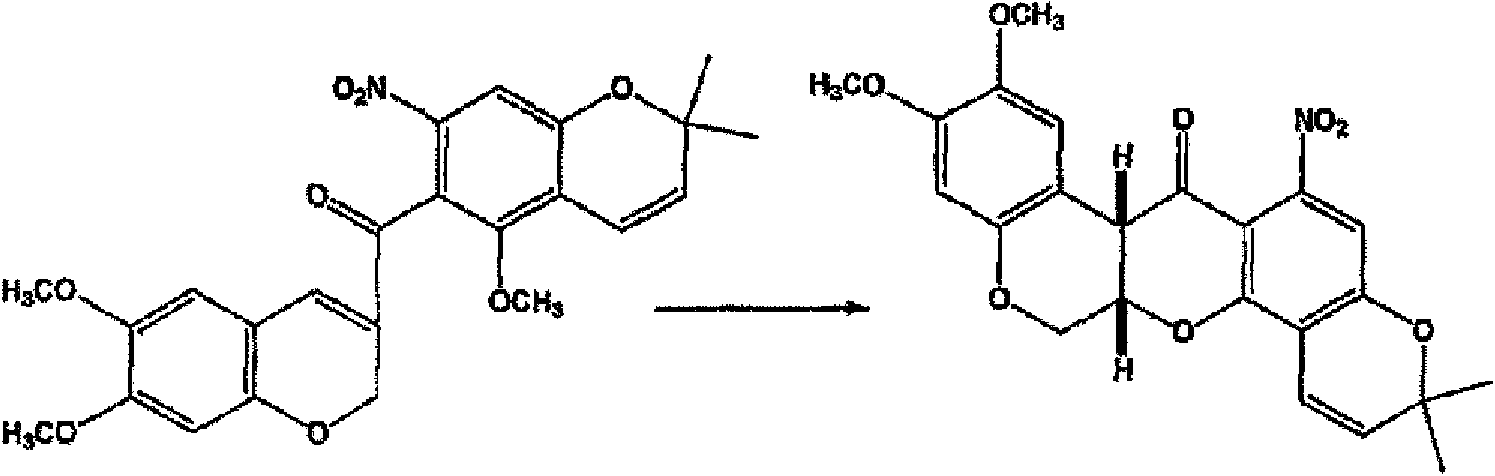
con salmuera, se secan sobre Na2SO4 y se concentran. El material bruto se filtra a través de una almohadilla de sílice (3:1 de hexanos, acetato de etilo) para producir (+/-)-10-nitrodeguelina.with brine, dried over Na2SO4 and concentrated. The crude material is filtered through a pad of silica (3: 1 hexanes, ethyl acetate) to yield (+/-) - 10-nitrodeguelin.
*Síntes¡s de (+/-) 11-n¡trodeguel¡na (ejemplo comparat¡vo):* Synthesis of (+/-) 11-n¡trodeguel¡na (comparative example):
Para un secado a llama redondo de 10 mL se añade matraz de fondo (6,7-dimetoxi-2H-croman-3-ilo)-(5-metoxi^^-dimetilo^-nitro^H-cromen^-ilo^metanona (50,2 mg, 0,111 mmol) y diclorometano (2,0 mL). La solución se enfría a -78°C y se agrega tricloruro de boro (0,133 mL, solución 1 M en diclorometano, 0,133 mmol). Después de agitarse durante 1 h, la reacción se inactivó con NH4Cl sat., se extrajo con acetato de etilo, se secó sobre Na2SO4 y se concentró. El material bruto se disuelve en EtOH, se satura con acetato de potasio y se calienta a reflujo durante 1 h. Después de enfriarse a temperatura ambiente, se añaden acetato de etilo y agua a la mezcla de reacción. La capa acuosa se extrae con acetato de etilo. Las capas orgánicas combinadas se lavan con salmuera, se secaron sobre Na2SO4, y se concentraron. El material bruto se filtra a través de una almohadilla de sílice (3:1 de hexanos, acetato de etilo) para producir (+/-)-11-nitrodeguelina. For a 10 mL round flame drying add a bottom flask (6,7-dimethoxy-2H-chroman-3-yl) - (5-methoxy ^^ - dimethyl ^ -nitro ^ H-chromen ^ -yl ^ methanone (50.2 mg, 0.111 mmol) and dichloromethane (2.0 mL). The solution is cooled to -78 ° C and boron trichloride (0.133 mL, 1 M solution in dichloromethane, 0.133 mmol) is added. After stirring for 1 hr, the reaction was quenched with sat. NH4Cl, extracted with ethyl acetate, dried over Na2SO4, and concentrated The crude material was dissolved in EtOH, saturated with potassium acetate, and refluxed for 1 hr. After cooling to room temperature, ethyl acetate and water are added to the reaction mixture.The aqueous layer is extracted with ethyl acetate.The combined organic layers are washed with brine, dried over Na2SO4, and concentrated. Crude material is filtered through a pad of silica (3: 1 hexanes, ethyl acetate) to yield (+/-) - 11-nitrodeguelin.
*Síntesis de (+/-)-11-[18F]fluorodeguelina (ejemplo comparativo):* Synthesis of (+/-) - 11- [18F] fluorodeguelin (comparative example):
Una pared delgada de 10 mL, vacutainer silanizado con un tapón silanizado se carga con hidróxido de tetrabutilamonio (5 uL, solución al 40% p/v en agua), y una solución de 18F- en agua (10 mCi, 200 uL). La mezcla resultante se evapora aA 10 mL thin-walled, silanized vacutainer with a silanized stopper is charged with tetrabutylammonium hydroxide (5 uL, 40% w / v solution in water), and a solution of 18F- in water (10 mCi, 200 uL). The resulting mixture is evaporated at

sequedad bajo un flujo de nitrógeno a 100°C. El residuo se seca adicionalmente por adición y evaporación repetidas de CH3CN (3 x 200 ul). Una alícuota adicional de CH3CN se añade y se concentra a vacío sin calentamiento. Antes de completarse la eliminación del disolvente, se agrega THF (150 uL), el vial no se pliega y se agrega (+/-)-11-nitrodeguelina (2 mg) en una porción. El vial se vuelve a tapar y se calienta a 65°C durante 30 minutos. Después de enfriarse a temperatura ambiente, el vial se diluye con agua (4 mL) y se pasa a través de un cartucho de gel de sílice (Waters Light C-18 Sep-Pak precargado) para cargar la muestra. El cartucho se enjuaga con agua y se eluye con CH3CN (2 mL). El acetonitrilo se evapora y el residuo se purifica por HPLC para proporcionar (+/-)-11-[18F]fluorodeguelina pura sin portador.dryness under a nitrogen flow at 100 ° C. The residue is further dried by repeated addition and evaporation of CH 3 CN (3 x 200 ul). An additional aliquot of CH 3 CN is added and concentrated in vacuo without heating. Before solvent removal is complete, THF (150 uL) is added, the vial is not folded, and (+/-) - 11-nitrodeguelin (2 mg) is added in one portion. The vial is recapped and heated at 65 ° C for 30 minutes. After cooling to room temperature, the vial is diluted with water (4 mL) and passed through a silica gel cartridge (Waters Light C-18 Sep-Pak prefilled) to load the sample. The cartridge is rinsed with water and eluted with CH 3 CN (2 mL). The acetonitrile is evaporated and the residue is purified by HPLC to provide pure (+/-) - 11- [18F] fluorodeguelin without carrier.
*Síntesis de (+/-)-10-[18F]fluorodeguelina (ejemplo comparativo):* Synthesis of (+/-) - 10- [18F] fluorodeguelin (comparative example):

Un vacutainer silanizado de pared delgada de 10 mL, con un tapón silanizado se carga con hidróxido de tetrabutilamonio (5 uL, 40% p/v de solución en agua), y una solución de 18F- en agua (10 mCi, 200 pL). La mezcla resultante se evapora a sequedad bajo un flujo de nitrógeno a 100°C. El residuo se seca adicionalmente por adición y evaporación repetidas de CH3CN (3 x 200 ul). Una alícuota adicional de CH3CN se añade y se concentra a vacío sin calentamiento. Antes de completarse la eliminación del disolvente, se agrega THF (150 uL), el vial no se pliega y se agrega (+/-)-10-nitrodeguelina (2 mg) en una porción. El vial se vuelve a tapar y se calienta a 65°C durante 30 minutos. Después de enfriarse a temperatura ambiente, el vial se diluye con agua (4 mL) y se pasa a través de un cartucho de gel de sílice (Waters Light C-18 Sep-Pak precargado) para cargar la muestra. El cartucho se enjuaga con agua y se eluye con CH3CN (2 mL). El acetonitrilo se evapora y el residuo se purifica por HPLC para proporcionar (+/-)-10-[18F]fluorodeguelina libre de portador. A 10 mL thin-walled silanized vacutainer, with a silanized stopper, is charged with tetrabutylammonium hydroxide (5 uL, 40% w / v solution in water), and a solution of 18F- in water (10 mCi, 200 pL) . The resulting mixture is evaporated to dryness under a nitrogen flow at 100 ° C. The residue is further dried by repeated addition and evaporation of CH 3 CN (3 x 200 ul). An additional aliquot of CH 3 CN is added and concentrated in vacuo without heating. Before solvent removal is complete, THF (150 uL) is added, the vial is not folded, and (+/-) - 10-nitrodeguelin (2 mg) is added in one portion. The vial is recapped and heated at 65 ° C for 30 minutes. After cooling to room temperature, the vial is diluted with water (4 mL) and passed through a silica gel cartridge (Waters Light C-18 Sep-Pak prefilled) to load the sample. The cartridge is rinsed with water and eluted with CH 3 CN (2 mL). The acetonitrile is evaporated and the residue is purified by HPLC to provide carrier-free (+/-) - 10- [18F] fluorodeguelin.
-Síntesis de 5-N-(4-tere-butilbencilo)carboxamido-3-(metoxicarbonilo)-1-metilpirazol:-Synthesis of 5-N- (4-tere-butylbenzyl) carboxamido-3- (methoxycarbonyl) -1-methylpyrazole:

Una mezcla de ácido 3-(metoxicarbonilo)-1-metilo-5-carboxílico (20 mmol) y cloruro de tionilo (30 mmol) se calienta a reflujo durante 30 minutos. El exceso de cloruro de tionilo se elimina al vacío, y el residuo se seca mediante azeótropo con benceno seco. El cloruro de acilo en bruto resultante se disuelve en THF (10 mL) y se agita mientras se enfría a 0 grados C mientras que se agrega gota a gota una solución de 4-ferc-butilbencilamina (22 mmol) y diisopropiletilamina (25 mmol) en THF (5 mL). La mezcla de reacción se agita a temperatura ambiente durante 1 hora y se calienta a reflujo brevemente para completar la reacción. La mezcla se enfría y se vierte en agua helada (100 mL) y se extrae con éter (3 x 100 mL). Los orgánicos combinados se secan (NaCl sat. ac., Na2SO4), se filtran y se concentran. La purificación del residuo mediante cromatografía en columna flash (gel de sílice, gradiente de elución con 0-20% de acetato de etilo/hexanos) proporciona 5-N-(4-ferc-butilbencilo)carboxamido-3-(metoxicarbonilo)-1-metilpirazol.A mixture of 3- (methoxycarbonyl) -1-methyl-5-carboxylic acid (20 mmol) and thionyl chloride (30 mmol) is heated under reflux for 30 minutes. The excess thionyl chloride is removed in vacuo, and the residue is azeotroped with dry benzene. The resulting crude acyl chloride is dissolved in THF (10 mL) and stirred while cooling to 0 degrees C while a solution of 4-tert-butylbenzylamine (22 mmol) and diisopropylethylamine (25 mmol) is added dropwise in THF (5 mL). The reaction mixture is stirred at room temperature for 1 hour and briefly refluxed to complete the reaction. The mixture is cooled and poured into ice water (100 mL) and extracted with ether (3 x 100 mL). The combined organics are dried (sat. Aq. NaCl, Na2SO4), filtered, and concentrated. Purification of the residue by flash column chromatography (silica gel, gradient elution with 0-20% ethyl acetate / hexanes) provides 5-N- (4-tert-butylbenzyl) carboxamido-3- (methoxycarbonyl) -1 -methylpyrazole.
Síntesis de 5-N-(4- te re - butilo) bencilcarboxamido-4-cloro-1-metilo-3-pirazolilcarboxilato de metilo:Synthesis of 5-N- (4- will re - butyl) bencilcarboxamido-4-chloro-1-methyl-3-methyl pirazolilcarboxilato:

Una solución de 5-N-(4-ferc-butilbencilo)carboxinadio-3-(metoxicarbonilo)-1-metilpirazol (0,1 mol) y cloruro de tionilo (0,13 mol) en 1,2-dicloroetano (15 mL)) se calienta a reflujo durante dos horas. La mezcla de reacción se enfría y se concentra al vacío. El residuo se reparte entre diclorometano (100 mL) y solución acuosa saturada NaHCOa (100 mL), asegurando que el pH de la fase acuosa es >7. La capa acuosa se separa y se extrae con diclorometano (2 x 100 mL), y los orgánicos combinados se secan (NaCl ac. saturado., Na2SO4), se filtran y se concentran. La recristalización del residuo (EtOH-agua) proporciona 5-N-(4-ferc-butilo)bencilcarboxamido-4-cloro-1-metilo-3-pirazolilcarboxilato de metilo puro.A solution of 5-N- (4-tert-butylbenzyl) carboxinadio-3- (methoxycarbonyl) -1-methylpyrazole (0.1 mol) and thionyl chloride (0.13 mol) in 1,2-dichloroethane (15 mL )) is heated under reflux for two hours. The reaction mixture is cooled and concentrated in vacuo. The residue is partitioned between dichloromethane (100 mL) and saturated aqueous NaHCOa solution (100 mL), ensuring that the pH of the aqueous phase is> 7. The aqueous layer is separated and extracted with dichloromethane (2 x 100 mL), and the combined organics are dried (aq. Saturated NaCl, Na2SO4), filtered, and concentrated. Recrystallization of the residue (EtOH-water) provides pure methyl 5-N- (4-tert-butyl) benzylcarboxamido-4-chloro-1-methyl-3-pyrazolylcarboxylate.
Síntesis de ácido 5-N-(4-tere-butilo)bencilcarboxamido-4-cloro-1-metilo-3-pirazolilcarboxílico:Synthesis of 5-N- (4-tere-butyl) benzylcarboxamido-4-chloro-1-methyl-3-pyrazolylcarboxylic acid:

Una solución de 5-N-(4-ferc-butilo)bencilcarboxamido-4-cloro-1-metilo-3-pirazolilcarboxilato de metilo (50 mmol) en dioxano (33 mL) y agua (75 mL) se trata con una solución de H2SO4 (conc., 1 mL) en agua (1,5 mL). La mezcla resultante se calienta a reflujo hasta el agotamiento del material de partida. La mezcla resultante se concentra a vacío hasta el punto de saturación (eliminación del dioxano) y se enfría a 0°C durante la noche. El precipitado resultante se recoge por filtración y se seca. El filtrado se extrajo con diclorometano (3 x 100 mL) y los orgánicos combinados se secan (NaCl ac. saturado, Na2SO4), se filtran y se concentran. La recristalización del residuo (acetato de etilo-metanol) proporciona ácido 5-N-(4-ferc-butilo)bencilcarboxamido-4-cloro-1-metilo-3-pirazolilcarboxílico puro.A solution of methyl 5-N- (4-tert-butyl) benzylcarboxamido-4-chloro-1-methyl-3-pyrazolylcarboxylate (50 mmol) in dioxane (33 mL) and water (75 mL) is treated with a solution of H 2 SO 4 (conc., 1 mL) in water (1.5 mL). The resulting mixture is heated under reflux until exhaustion of the starting material. The resulting mixture is concentrated in vacuo to saturation (removal of dioxane) and cooled to 0 ° C overnight. The resulting precipitate is collected by filtration and dried. The filtrate was extracted with dichloromethane (3 x 100 mL) and the combined organics dried (saturated aq NaCl, Na2SO4), filtered and concentrated. Recrystallization of the residue (ethyl acetate-methanol) provides pure 5-N- (4-tert-butyl) benzylcarboxamido-4-chloro-1-methyl-3-pyrazolylcarboxylic acid.
Síntesis de 1-(5-N-(4-ferc-butilo)bencilcarboxamido-4-cloro-1-metilo-3-pirazolilo)-1-etanona:Synthesis of 1- (5-N- (4-tert-butyl) benzylcarboxamido-4-chloro-1-methyl-3-pyrazolyl) -1-ethanone:

Una solución de ácido 5-N-(4-ferc-butilo)bencilcarboxamido-4-cloro-1-metilo-3-pirazolilcarboxílico (20 mmol) en cloruro de tionilo (30 mmol) se calienta a reflujo durante 15 minutos. La mezcla se enfría y se concentra al vacío. Se agrega benceno (10 mL) y se elimina primero a presión atmosférica, luego a vacío. El cloruro de ácido resultante se usa directamente en el siguiente paso.A solution of 5-N- (4-tert-butyl) benzylcarboxamido-4-chloro-1-methyl-3-pyrazolylcarboxylic acid (20 mmol) in thionyl chloride (30 mmol) is heated under reflux for 15 minutes. The mixture is cooled and concentrated in vacuo. Benzene (10 mL) is added and it is removed first at atmospheric pressure, then under vacuum. The resulting acid chloride is used directly in the next step.
Se carga un matraz con bromuro cuproso anhidro sólido (25 mmol), y se purga con argón. Se agrega tetrahidrofurano (125 mL). La suspensión resultante se enfría a -78°C mientras que se agrega gota a gota una solución de bromuro de metilmagnesio (17,8 mL, 2,9M en dietilo éter). La mezcla se agita mientras que se enfría a -78°C durante 20 minutos. El cloruro de ácido preparado anteriormente se disuelve en THF (10 mL) y se enfría a -78°C. El cloruro de ácido se agrega lentamente al cuprato mediante una cánula, permitiendo que la solución de adición corra por el lateral del matraz de reacción para volver a enfriarse. El matraz de cloruro de ácido se enjuaga con THF (5 mL), que se enfría de nuevo y se añade mediante una cánula. El baño se retira y la mezcla se agita a temperatura ambiente durante 30 minutos. Se añade metanol (4 mL) para extinguir la reacción, y la mezcla se vierte en solución acuosa saturada de NH4Cl (200 mL). La mezcla se agita durante una hora para disolver las sales de cobre y la capa orgánica se separa. La fase acuosa se lavó con diclorometano (2 x 200 mL) y los orgánicos combinados se secaron (NaCl sat. ac., Na2SO4), se filtraron y se concentraron. El residuo se purifica por cromatografía (gel de sílice, gradiente de elución, 10-30% de acetato de etilo-hexanos) para proporcionar 1-(5-N-(4-ferc-butilo)bencilcarboxamido-4-cloro-1 -metilo-3-pirazolilo)-1 -etanona pura.A flask is charged with solid anhydrous cuprous bromide (25 mmol), and purged with argon. Tetrahydrofuran (125 mL) is added. The resulting suspension is cooled to -78 ° C while a solution of methylmagnesium bromide (17.8 mL, 2.9M in diethyl ether) is added dropwise. The mixture is stirred while cooling to -78 ° C for 20 minutes. The acid chloride prepared above is dissolved in THF (10 mL) and cooled to -78 ° C. The acid chloride is slowly added to the cuprate through a cannula, allowing the addition solution to run down the side of the reaction flask to cool again. The acid chloride flask is rinsed with THF (5 mL), which is cooled again and added via cannula. The bath is removed and the mixture is stirred at room temperature for 30 minutes. Methanol (4 mL) is added to quench the reaction, and the mixture is poured into saturated aqueous NH4Cl solution (200 mL). The mixture is stirred for one hour to dissolve the copper salts and the organic layer is separated. The aqueous phase was washed with dichloromethane (2 x 200 mL) and the combined organics were dried (sat. Aq. NaCl, Na2SO4), filtered, and concentrated. The residue is purified by chromatography (silica gel, gradient elution, 10-30% ethyl acetate-hexanes) to provide 1- (5-N- (4-tert-butyl) benzylcarboxamido-4-chloro-1 - pure methyl-3-pyrazolyl) -1 -ethanone.
Síntesis de 5-N-(4-ferc-butilo)bencilcarboxamido-4-cloro-3-(1-hidroxietilo)-1-metilpirazolina:Synthesis of 5-N- (4-tert-butyl) benzylcarboxamido-4-chloro-3- (1-hydroxyethyl) -1-methylpyrazoline:

Se añade borohidruro sódico (20 mmol) como un sólido en una porción a una solución agitada de 1-(5-N-(4-ferc-butilo)bencilcarboxamido-4-cloro-1-metilo-3-pirazolilo)-1-etanona (10 mmoles) en etanol (15 mL) a temperatura ambiente. La mezcla se agita hasta el agotamiento de la cetona de partida. Se agrega más borohidruro sódico si es necesario. Se agrega agua (2 mL), la mezcla se concentra y la mezcla se reparte entre agua (100 mL) y diclorometano (2 x 100 mL). Los orgánicos combinados se secaron (NaCl sat. ac., Na2SO4), se filtraron y se concentraron. El residuo se purifica por cromatografía (gel de sílice, gradiente de elución al 10-30% de acetato de etilo-hexanos) para proporcionar 5-N-(4-ferc-butilo)bencilo-carboxamido-4-cloro-3-(1-hidroxietilo) puro.)-1-metilpirazolina. Sodium borohydride (20 mmol) is added as a solid in one portion to a stirred solution of 1- (5-N- (4-tert-butyl) benzylcarboxamido-4-chloro-1-methyl-3-pyrazolyl) -1- ethanone (10 mmol) in ethanol (15 mL) at room temperature. The mixture is stirred until the starting ketone is exhausted. More sodium borohydride is added if necessary. Water (2 mL) is added, the mixture is concentrated, and the mixture is partitioned between water (100 mL) and dichloromethane (2 x 100 mL). The combined organics were dried (sat. Aq. NaCl, Na2SO4), filtered, and concentrated. The residue is purified by chromatography (silica gel, 10-30% gradient elution of ethyl acetate-hexanes) to provide 5-N- (4-tert-butyl) benzyl-carboxamido-4-chloro-3- ( 1-hydroxyethyl) neat.) - 1-methylpyrazoline.
Síntesis de 5-N-(4-ferc-but¡lo)benc¡lcarboxam¡do-4-cloro-1-met¡lo-3-(1-p-toluenosulfonatoet¡lo) pirazolina:Synthesis of 5-N- (4-tert-butyl) benzylcarboxamide-4-chloro-1-methyl-3- (1-p-toluenesulfonate-ethyl) pyrazoline:

Una solución de 5-N-(4-ferc-butilo)bencilcarboxamido-4-cloro-3-(1-hidroxietilo)-1-metilpirazolina (5 mmol) y cloruro de p-toluenosulfonilo (5,5 mmol) en piridina (12 mL) se agita a temperatura ambiente durante cuatro horas. La solución se concentra y se reparte entre agua (100 mL) y diclorometano (2 x 100 mL). Los orgánicos combinados se secaron (NaCl sat. ac., Na2SO4), se filtraron y se concentraron. El residuo se purifica por cromatografía (gel de sílice, gradiente de elución 2-20% de acetato de etilo-hexanos) para proporcionar 5-N-(4-fercbutilo)bencilcarboxamido-4-cloro-1 -metilo-3-(1 -p-toluenosulfonatoetilo)pirazolina pura.A solution of 5-N- (4-tert-butyl) benzylcarboxamido-4-chloro-3- (1-hydroxyethyl) -1-methylpyrazoline (5 mmol) and p-toluenesulfonyl chloride (5.5 mmol) in pyridine ( 12 mL) is stirred at room temperature for four hours. The solution is concentrated and partitioned between water (100 mL) and dichloromethane (2 x 100 mL). The combined organics were dried (sat. Aq. NaCl, Na2SO4), filtered, and concentrated. The residue is purified by chromatography (silica gel, 2-20% gradient elution ethyl acetate-hexanes) to provide 5-N- (4-fercbutyl) benzylcarboxamido-4-chloro-1-methyl-3- (1 -p-toluenesulfonate ethyl) pure pyrazoline.
Síntes¡s de 5-N-(4-ferc-but¡lo)benc¡lcarboxam¡do-4-cloro-1-met¡lo-3-(1-[18F]fluoroet¡lo)p¡razol¡na (a través de tos¡lato):Synthesis of 5-N- (4-tert-butyl) benzylcarboxamide-4-chloro-1-methyl-3- (1- [18F] fluoroethyl) pyrazoline (via tos¡lato):

Un vacutainer silanizado de 10 mL de pared fina con un tapón silanizado se carga con hidróxido de tetrabutilamonio (5 uL, solución al 40% p/v en agua) y una solución de 18F- en agua (10 mCi, 200 uL). La mezcla resultante se evapora a sequedad bajo un flujo de nitrógeno a 100°C. El residuo se seca adicionalmente por adición y evaporación repetidas de CH3CN (3 x 200 uL). Una alícuota adicional de CH3CN se añade y se concentra a vacío sin calentamiento. Antes de completarse la eliminación del disolvente, se agrega THF (150 uL), el vial no se disgrega y 5-N-(4-ferc-butilo)bencilcarboxamido-4-cloro-1-metilo-3-(1-p-toluenosulfonatoetilo)pirazolina pura (2 mg) se agrega en una porción como un sólido. El vial se vuelve a tapar y se calienta a 65°C durante 30 minutos. Después de enfriarse, el vial se diluye con agua (4 mL) y se pasa a través de un cartucho de gel de sílice (Waters Light C-18 Sep-Pak precargado) para cargar la muestra. El cartucho se enjuagó con agua y se eluyó con CH3CN (2 mL). El acetonitrilo se evapora y el residuo se purifica por HPLC para proporcionar 5-N-(4-ferc-butilo)benciloxicarboxamido-4-cloro-1 -metilo-3-(1 -[18F]fluoroetilo)pirazolina libre de portador puro.A thin-walled 10 mL silanized vacutainer with a silanized stopper is charged with tetrabutylammonium hydroxide (5 uL, 40% w / v solution in water) and a solution of 18F- in water (10 mCi, 200 uL). The resulting mixture is evaporated to dryness under a nitrogen flow at 100 ° C. The residue is further dried by repeated addition and evaporation of CH 3 CN (3 x 200 uL). An additional aliquot of CH 3 CN is added and concentrated in vacuo without heating. Before complete removal of the solvent, THF (150 uL) is added, the vial does not disintegrate and 5-N- (4-tert-butyl) benzylcarboxamido-4-chloro-1-methyl-3- (1-p- Pure toluenesulfonate ethyl) pyrazoline (2 mg) is added in one portion as a solid. The vial is recapped and heated at 65 ° C for 30 minutes. After cooling, the vial is diluted with water (4 mL) and passed through a silica gel cartridge (Waters Light C-18 Sep-Pak prefilled) to load the sample. The cartridge was rinsed with water and eluted with CH 3 CN (2 mL). The acetonitrile is evaporated and the residue is purified by HPLC to provide 5-N- (4-tert-butyl) benzyloxycarboxamido-4-chloro-1-methyl-3- (1- [18F] fluoroethyl) pyrazoline free of pure carrier.
Síntes¡s de 5-N-(4-ferc-but¡lo)benc¡lcarboxam¡do-4-cloro-1-met¡lo-3-(1-metanosulfonatoet¡lo)p¡razol¡na:Synthesis of 5-N- (4-tert-butyl) benzylcarboxamide-4-chloro-1-methyl-3- (1-methanesulfonate-ethyl) pyrazoline:

Una solución de 5-N-(4-ferc-butilo)bencilo carboxamido-4-cloro-3-(1-hidroxietilo)-1-metilpirazolina (5 mmol) y cloruro de metanosulfonilo (5,5 mmol) en piridina (12 mL) se agita a temperatura ambiente durante cuatro horas. La solución se concentra y se reparte entre agua (100 mL) y diclorometano (2 x 100 mL). Los orgánicos combinados se secaron (NaCl sat. ac., Na2SO4), se filtraron y se concentraron. El residuo se purifica por cromatografía (gel de sílice, gradiente de elución 2-20% de acetato de etilo-hexanos) para proporcionar 5-N-(4-tercbutilo)bencilcarboxamido-4-cloro-1 -metilo-3-(1 -metanosulfonatoetilo)pirazolina pura.A solution of 5-N- (4-tert-butyl) benzyl carboxamido-4-chloro-3- (1-hydroxyethyl) -1-methylpyrazoline (5 mmol) and methanesulfonyl chloride (5.5 mmol) in pyridine (12 mL) is stirred at room temperature for four hours. The solution is concentrated and partitioned between water (100 mL) and dichloromethane (2 x 100 mL). The combined organics were dried (sat. Aq. NaCl, Na2SO4), filtered, and concentrated. The residue is purified by chromatography (silica gel, 2-20% ethyl acetate-hexanes gradient elution) to provide 5-N- (4-tert-butyl) benzylcarboxamido-4-chloro-1-methyl-3- (1 -methanesulfonate ethyl) pure pyrazoline.
Síntesis de 5-N-(4-ferc-butilo)bencilcarboxamido-4-cloro-1-metilo-3-(1-[18F]fluoroetilo)pirazolina (a través de mesilato):Synthesis of 5-N- (4-tert-butyl) benzylcarboxamido-4-chloro-1-methyl-3- (1- [18F] fluoroethyl) pyrazoline (via mesylate):

Un vacutainer silanizado de 10 mL de pared delgada con un tapón silanizado se carga con hidróxido de tetrabutilamonio (5 uL, solución al 40% p/v en agua), y una solución de 18F- en agua (10 mCi, 200 uL) La mezcla resultante se evapora a sequedad bajo un flujo de nitrógeno a 100°C. El residuo se seca adicionalmente por adición y evaporación repetidas de CH3CN (3 x 200 ul). Una alícuota adicional de CH3CN se añade y se concentra a vacío sin calentamiento. Antes de completarse la eliminación del disolvente, se agrega THF (150 uL), el vial no se disgrega y 5-W-f4-ferc-butilo)bencilcarboxamido-4-cloro-1-metilo-3-(1-metanosulfonatoetilo)pirazolina pura (2 mg) se agrega en una porción como un sólido. El vial se vuelve a tapar y se calienta a 65 grados C durante 30 minutos. Después de enfriarse, el vial se diluye con agua (4 mL) y se pasa a través de un cartucho de gel de sílice (Waters Light C-18 Sep-Pak precargado) para cargar la muestra. El cartucho se enjuaga con agua y se eluye con CH3CN (2 mL). El acetonitrilo se evapora y el residuo se purifica por HPLC para proporcionar 5-N-(4-ferc-butilo)bencilcarboxamido-4-cloro-1-metilo-3-(1-[18F]fluoroetilo)pirazolina libre de portador puro.A thin-walled 10 mL silanized vacutainer with a silanized stopper is charged with tetrabutylammonium hydroxide (5 uL, 40% w / v solution in water), and a solution of 18F- in water (10 mCi, 200 uL). resulting mixture is evaporated to dryness under a nitrogen flow at 100 ° C. The residue is further dried by repeated addition and evaporation of CH 3 CN (3 x 200 ul). An additional aliquot of CH 3 CN is added and concentrated in vacuo without heating. Before the solvent removal is complete, THF (150 uL) is added, the vial does not disintegrate and 5-W-f4-tert-butyl) benzylcarboxamido-4-chloro-1-methyl-3- (1-methanesulfonate ethyl) pyrazoline pure (2 mg) is added in one portion as a solid. The vial is recapped and heated at 65 degrees C for 30 minutes. After cooling, the vial is diluted with water (4 mL) and passed through a silica gel cartridge (Waters Light C-18 Sep-Pak prefilled) to load the sample. The cartridge is rinsed with water and eluted with CH 3 CN (2 mL). The acetonitrile is evaporated and the residue is purified by HPLC to provide 5-N- (4-tert-butyl) benzylcarboxamido-4-chloro-1-methyl-3- (1- [18F] fluoroethyl) pyrazoline free of pure carrier.

Síntesis de 4-ferc-butilo-3-nitrobenzamida:Synthesis of 4-tert-butyl-3-nitrobenzamide:
Una mezcla de ácido 4-ferc-butilo-3-nitrobenzoico (0,1 mol), hidroxibenzotriazol (HOBt, 0,12 moles) y diciclohexilcarbodiimida (DCC, 0,11 moles) en diclorometano (100 mL) se agita a temperatura ambiente mientras que una solución de amoniaco en 2-propanol (2,0 M, 75 mL, 0,12 mol) se agrega rápidamente. La mezcla se agitó durante dos horas a temperatura ambiente, y se vertió en NaHCO3 acuoso (5%, 200 mL). Las capas se separan y la fase acuosa se extrae con diclorometano (2 x 200 mL). Los orgánicos combinados se lavaron (2 x 200 mL 5% ac. NaHCOa), se secaron (NaCl sat. ac., Na2SO4), se filtraron y se concentraron. El producto se recristaliza en EtOH-agua para proporcionar 4-ferc-butilo-3-nitrobenzamida pura. A mixture of 4-tert-butyl-3-nitrobenzoic acid (0.1 mol), hydroxybenzotriazole (HOBt, 0.12 mol) and dicyclohexylcarbodiimide (DCC, 0.11 mol) in dichloromethane (100 mL) is stirred at room temperature while a solution of ammonia in 2-propanol (2.0 M, 75 mL, 0.12 mol) is added rapidly. The mixture was stirred for two hours at room temperature, and poured into aqueous NaHCO3 (5%, 200 mL). The layers are separated and the aqueous phase is extracted with dichloromethane (2 x 200 mL). The combined organics were washed (2 x 200 mL 5% aq. NaHCOa), dried (sat. Aq. NaCl, Na2SO4), filtered, and concentrated. The product is recrystallized from EtOH-water to provide pure 4-tert-butyl-3-nitrobenzamide.
Síntesis de 4-ferc-butilo-3-[18Fluorobencilamina F]:Synthesis of 4-tert-butyl-3- [18Fluorobenzylamine F]:

Un vacutainer silanizado de pared delgada de 10 mL con un tapón silanizado se carga con hidróxido de tetrabutilamonio (5 uL, solución al 40% p/v en agua), y una solución de 18F- en agua (10 mCi, 200 uL) La mezcla resultante se evapora a sequedad bajo un flujo de nitrógeno a 100°C. El residuo se seca adicionalmente por adición y evaporación repetidas de CH3CN (3 x 200 ul). Una alícuota adicional de CH3CN se añade y se concentra a vacío sin calentamiento. Antes de la eliminación completa del disolvente, se agrega dioxano (150 uL), el vial no se pliega y se agrega 4-ferc-butilo-3-nitrobenzamida (1 mg, aproximadamente 4,5 umoles) en una porción como un sólido. El vial se vuelve a tapar y se calienta a 100°C durante 25 minutos. Después de enfriarse, se agrega una solución de hidruro de litio y aluminio bis(tetrahidrofurano) en tolueno (1,0 M, 50 uL, 50 umoles), y la mezcla se calienta a 50 grados C durante cinco minutos. El vial se enfría y el contenido se diluye con agua (4 mL) y se pasa a través de un cartucho de gel de sílice (Waters Light C-18 Sep-Pak precargado) para cargar la muestra. El cartucho se enjuagó con agua y se eluyó con CH3CN (2 mL). El acetonitrilo se evaporó y el residuo se purificó a través de HPLC para proporcionar 4-ferc-butilo-3-[18F]fluorobencilamina libre de portador puro. El solvente se evapora y el material se usa directamente en el siguiente procedimiento.A 10 mL thin-walled silanized vacutainer with a silanized stopper is charged with tetrabutylammonium hydroxide (5 uL, 40% w / v solution in water), and a solution of 18F- in water (10 mCi, 200 uL). resulting mixture is evaporated to dryness under a nitrogen flow at 100 ° C. The residue is further dried by repeated addition and evaporation of CH 3 CN (3 x 200 ul). An additional aliquot of CH 3 CN is added and concentrated in vacuo without heating. Before complete removal of the solvent, dioxane (150 uL) is added, the vial is not folded, and 4-tert-butyl-3-nitrobenzamide (1 mg, about 4.5 umoles) is added in one portion as a solid. The vial is recapped and heated at 100 ° C for 25 minutes. After cooling, a solution of lithium aluminum hydride bis (tetrahydrofuran) in toluene (1.0 M, 50 uL, 50 umoles) is added, and the mixture is heated at 50 degrees C for five minutes. The vial is cooled and the contents are diluted with water (4 mL) and passed through a silica gel cartridge (Waters Light C-18 Sep-Pak prefilled) to load the sample. The cartridge was rinsed with water and eluted with CH 3 CN (2 mL). The acetonitrile was evaporated and the residue was purified via HPLC to provide pure carrier free 4-tert-butyl-3- [18F] fluorobenzylamine. The solvent evaporates and the material is used directly in the following procedure.
Síntesis de 5-N-(4-ferc-butilo-3-[18F]fluoro)bencilcarboxamido-4-cloro-3-etilo-1-metilpirazolina:Synthesis of 5-N- (4-tert-butyl-3- [18F] fluoro) benzylcarboxamido-4-chloro-3-ethyl-1-methylpyrazoline:

A una mezcla agitada de ácido 3-etilo-1-metilpirazol-5-carboxílico (50 umoles), diciclohexilcarbodiimida (DCC, 50 umoles, suministrado como una alícuota a partir de una solución madre en diclorometano), hidroxibenzotriazol (HOBt, 60 umoles) en cloruro de metileno (200 uL), se agrega una solución de 4-ferc-butilo-3-[18F]fluorobencilamina (preparada anteriormente) en diclorometano (100 uL). La mezcla se agita a temperatura ambiente durante diez minutos a temperatura ambiente, se concentra y se disuelve en acetonitrilo-agua (1:4, 3 mL). La mezcla se pasa a través de un cartucho de gel de sílice (Waters Light C-18 Sep-Pak precargado) para cargar la muestra. El cartucho se enjuagó con agua y se eluyó con CH3CN (2 mL). El acetonitrilo se evapora y el residuo se purifica por HPLC para proporcionar 5-N-(4-ferc-butilo-3-[18F]fluoro)bencilcarboxamido-4-cloro-3-etilo-1-metilpirazolina libro de portador puro.To a stirred mixture of 3-ethyl-1-methylpyrazole-5-carboxylic acid (50 umoles), dicyclohexylcarbodiimide (DCC, 50 umoles, supplied as an aliquot from a stock solution in dichloromethane), hydroxybenzotriazole (HOBt, 60 umoles) in methylene chloride (200 uL), add a solution of 4-tert-butyl-3- [18F] fluorobenzylamine (prepared above) in dichloromethane (100 uL). The mixture is stirred at room temperature for ten minutes at room temperature, concentrated and dissolved in acetonitrile-water (1: 4, 3 mL). The mixture is passed through a silica gel cartridge (Waters Light C-18 Sep-Pak preloaded) to load the sample. The cartridge was rinsed with water and eluted with CH 3 CN (2 mL). The acetonitrile is evaporated and the residue is purified by HPLC to provide 5-N- (4-tert-butyl-3- [18F] fluoro) benzylcarboxamido-4-chloro-3-ethyl-1-methylpyrazoline pure carrier book.
Ejemplo 3 - Análogos de piridabenoExample 3 - Pyridaben analogs
Síntesis de 2-ferc-butilo-4, 5-dicloro-3(2H)-piridazinona:Synthesis of 2-tert-butyl-4,5-dichloro-3 (2H) -pyridazinone:
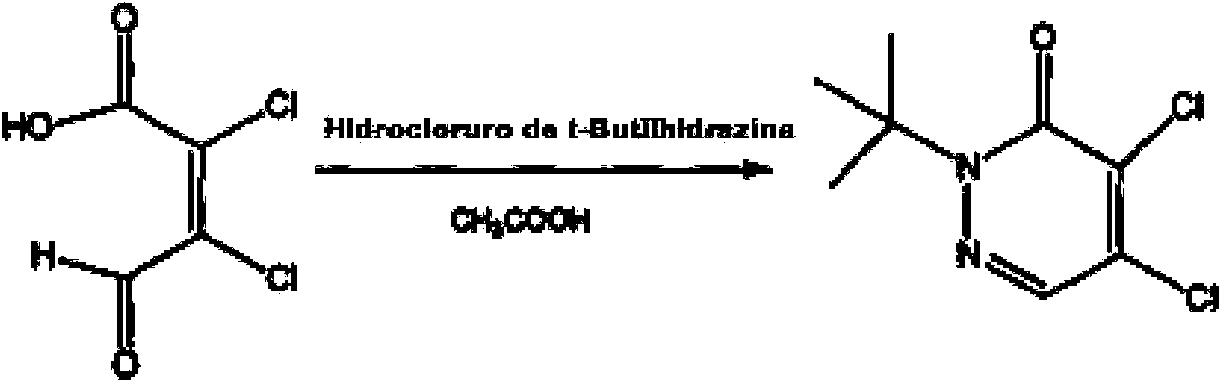
A ácido mucoclórico (4,0 g, 23,6 mmol) en agua (35 mL) a 0°C se añadió anhidro Na2CO3 (1,21 g, 11,5 mmol). Esto se agitó hasta que se obtuvo una solución clara y a ésta se añadió hidrocloruro de terc-butilhidrazina (2,94 g, 23,6 mmol). Un precipitado comenzó a formarse después de unos minutos. La reacción se agitó durante otras 2,5 horas, después de lo cual se filtró. El precipitado amarillo se lavó con agua fría y se secó para dar 4,81 g de hidrazona bruta.Anhydrous Na2CO3 (1.21 g, 11.5 mmol) was added to mucochloric acid (4.0 g, 23.6 mmol) in water (35 mL) at 0 ° C. This was stirred until a clear solution was obtained and to this was added tert-butylhydrazine hydrochloride (2.94 g, 23.6 mmol). A precipitate started to form after a few minutes. The reaction was stirred for another 2.5 hours, after which it was filtered. The yellow precipitate was washed with cold water and dried to give 4.81 g of crude hydrazone.
A 4,32 g de la hidrazona bruta se añadieron 40 ml de ácido acético y la solución se calentó a reflujo durante 25 minutos. La solución se enfrió y se concentró. Se recogió luego en diclorometano y se lavó con carbonato sódico 1M y agua. La capa orgánica se secó luego y se concentró para dar un sólido amarillo que se purificó por cromatografía en columna usando hexanos:cloroformo (1:1 a 0:100) como disolvente de elución. Esto proporcionó 2,4 g de lo anterior como un sólido blanco.To 4.32 g of the crude hydrazone was added 40 ml of acetic acid and the solution was heated under reflux for 25 minutes. The solution was cooled and concentrated. It was then taken up in dichloromethane and washed with 1M sodium carbonate and water. The organic layer was then dried and concentrated to give a yellow solid which was purified by column chromatography using hexanes: chloroform (1: 1 to 0: 100) as an elution solvent. This provided 2.4 g of the above as a white solid.
Síntesis de 2-ferc-butilo-4-cloro-5-tio-3(2H)-piridazinona:Synthesis of 2-tert-butyl-4-chloro-5-thio-3 (2H) -pyridazinone:

A 0,5 g de 2-ferc-Butilo-4,5-dicloro-3(2H)-piridazinona se añadieron 7 ml de agua y sulfuro de sodio (0,53 g, 6,81 mmol) y la mezcla se calentó a 80°C hasta que todo el sólido se disolvió. La solución se enfrió luego a temperatura ambiente y se añadió cuidadosamente HCl concentrado para dar un precipitado amarillo, que se filtróTo 0.5 g of 2-ferc-Butyl-4,5-dichloro-3 (2H) -pyridazinone was added 7 ml of water and sodium sulfide (0.53 g, 6.81 mmol) and the mixture was heated at 80 ° C until all the solid dissolved. The solution was then cooled to room temperature and concentrated HCl was carefully added to give a yellow precipitate, which was filtered

y se lavó con agua fría. La cristalización en hexanos proporcionó el producto como un sólido blanco (270 mg).and washed with cold water. Crystallization from hexanes provided the product as a white solid (270mg).
Síntesis de 2-ferc-butilo-4-cloro-5-(4-ferc-butilbencilo) tio 3(2H)-piridazinona:Synthesis of 2-tert-butyl-4-chloro-5- (4-tert-butylbenzyl) thio 3 (2H) -pyridazinone:
A 220 mg de 2-ferc-butilo-4-cloro-5-tio-3 (2H) piridazinona en 4 ml de DMF se le añadió 4-terc-bromuro de butilbencilo (226 mg, 1 mmol) y Na2CO3. La mezcla de reacción se agitó durante 16 horas a temperatura ambiente, después de lo cual se extrajo en acetato de etilo, se lavó con agua y se purificó por cromatografía en columna (gel de sílice, acetato de etilo/hexanos) como eluyente. Esto proporcionó el compuesto mencionado anteriormente. Síntesis de 2-ferc-butilo-4-fluoro-5-(4-ferc-butilbencilo) tio 3(2H)-piridazinona:To 220 mg of 2-tert-butyl-4-chloro-5-thio-3 (2H) pyridazinone in 4 ml of DMF was added butylbenzyl 4-tert-bromide (226 mg, 1 mmol) and Na2CO3. The reaction mixture was stirred for 16 hours at room temperature, after which it was extracted into ethyl acetate, washed with water, and purified by column chromatography (silica gel, ethyl acetate / hexanes) as eluent. This provided the compound mentioned above. Synthesis of 2-tert-butyl-4-fluoro-5- (4-tert-butylbenzyl) thio 3 (2H) -pyridazinone:
Un matraz de fondo redondo se cargó con 2-ferc-butilo-4-cloro-5-(4-ferc-butilbencilo) tio 3(2H) piridazinona (100 mg, 0,27 mmol) y se añadió fluoruro de potasio (23,4 mg, 0,40 mmol) y 2 ml de dimetilsulfóxido. Esto se calienta a 120°C durante 6 horas. La mezcla de reacción se vierte luego en agua y se extrae con acetato de etilo. Esto se lava con agua y se seca. Purificación por cromatografía flash A round bottom flask was charged with 2-tert-butyl-4-chloro-5- (4-tert-butylbenzyl) thio 3 (2H) pyridazinone (100 mg, 0.27 mmol) and potassium fluoride (23 , 4 mg, 0.40 mmol) and 2 ml of dimethylsulfoxide. This is heated at 120 ° C for 6 hours. The reaction mixture is then poured into water and extracted with ethyl acetate. This is washed with water and dried. Purification by flash chromatography

(gel de sílice, acetato de etilo/hexanos) proporcionó el compuesto mencionado anteriormente.(silica gel, ethyl acetate / hexanes) provided the aforementioned compound.
Síntesis de 2-ferc-butilo-4-[18F]-fluoro-5-(4-ferc-butilbencilo) tio 3(2H)-piridazinona:Synthesis of 2-tert-butyl-4- [18F] -fluoro-5- (4-tert-butylbenzyl) thio 3 (2H) -pyridazinone:
A un vial de reacción de 5 ml que contiene 500 mCi de 18F en 350 mg de 18O agua se añade una solución de 1 ml que consiste en 10 mg de Kryptofix, 1 mg de carbonato de potasio, 0,005 ml de agua y 0,95 ml de acetonitrilo. El vial se calienta para eliminar todos los disolventes y se agrega acetonitrilo seco (1 mL) al vial. Esto también se elimina por evaporación. Luego se le agrega 2-ferc-butilo-4-cloro-5-(4-ferc-butilbencilo) tio 3(2H)-piridazinona (5 mg) en acetonitrilo. El vial se sella y se calienta durante 30 minutos a 100°C. La mezcla se diluye con diclorometano y se pasa a través de Sep-Pak y se eluye con tetrahidrofurano. El disolvente se evapora para obtener el compuesto mencionado anteriormente.To a 5 ml reaction vial containing 500 mCi of 18F in 350 mg of 18O water is added a 1 ml solution consisting of 10 mg of Kryptofix, 1 mg of potassium carbonate, 0.005 ml of water and 0.95 ml of acetonitrile. The vial is heated to remove all solvents and dry acetonitrile (1 mL) is added to the vial. This is also removed by evaporation. Then 2-tert-butyl-4-chloro-5- (4-tert-butylbenzyl) thio 3 (2H) -pyridazinone (5 mg) in acetonitrile is added. The vial is sealed and heated for 30 minutes at 100 ° C. The mixture is diluted with dichloromethane and passed through Sep-Pak and eluted with tetrahydrofuran. The solvent is evaporated to obtain the above-mentioned compound.
Síntesis de 4-(4-metilfenilo)butanol:Synthesis of 4- (4-methylphenyl) butanol:

A hidruro de aluminio de litio (427 mg, 11,2 mmol) suspendido en éter seco (5 mL) a 0°C se agrega 1 g de ácido 4-(4-metilfenilo)butanoico (5,614 mmol) disuelto en éter seco (10 mL) durante un período de 30 minutos. La mezcla de reacción se calienta luego a temperatura ambiente y se agita durante 4 horas. Luego se añaden agua (0,43 mL), NaOH (solución al 15%, 0,43 g) y agua (1,29 mL) sucesivamente y la solución resultante se agita durante 30 minutos. El precipitado se filtra y se lava con éter y se seca. Se concentra luego y se purifica mediante cromatografía flash (gel de sílice, acetato de etilo/hexanos) como medio de elución.To lithium aluminum hydride (427 mg, 11.2 mmol) suspended in dry ether (5 mL) at 0 ° C is added 1 g of 4- (4-methylphenyl) butanoic acid (5.614 mmol) dissolved in dry ether ( 10 mL) over a 30 minute period. The reaction mixture is then warmed to room temperature and stirred for 4 hours. Then water (0.43 mL), NaOH (15% solution, 0.43 g) and water (1.29 mL) are added successively and the resulting solution is stirred for 30 minutes. The precipitate is filtered and washed with ether and dried. It is then concentrated and purified by flash chromatography (silica gel, ethyl acetate / hexanes) as an elution medium.
Síntesis de 4-(4-metilfenilo)-butilo terc-butildimetilsililo éter:Synthesis of 4- (4-methylphenyl) -butyl tert-butyldimethylsilyl ether:

Se disuelve 4-(4-metilfenilo)butanol (0,5 g, 3,04 mmol) en 5 ml de DMF y se le añade imidazol (310 mg, 4,56 mmol) y cloruro de terc-butildimetilsililo (685 mg, 4,56 mmol). La reacción se agita durante 4 horas, después de lo cual se extrae en acetato de etilo y se lava con agua para eliminar todo el DMF. La capa orgánica se seca y se concentra. La mezcla cruda se purifica después por cromatografía flash usando una mezcla de acetato de etilohexanos como medio de elución para proporcionar el producto mencionado anteriormente.4- (4-methylphenyl) butanol (0.5 g, 3.04 mmol) is dissolved in 5 ml of DMF and imidazole (310 mg, 4.56 mmol) and tert-butyldimethylsilyl chloride (685 mg, 4.56 mmol). The reaction is stirred for 4 hours, after which is extracted into ethyl acetate and washed with water to remove all the DMF. The organic layer is dried and concentrated. The crude mixture is then purified by flash chromatography using a mixture of ethyl acetate hexanes as an elution medium to provide the aforementioned product.
Síntesis de 4-(4-bromometilfenilo)butilo terc-butildimetilsililo éter:Synthesis of 4- (4-bromomethylphenyl) butyl tert-butyldimethylsilyl ether:

A un matraz de fondo redondo de 50 mL se añade 4-(4-metilfenilo)butilo terc-butildimetylsililo éter (0,25 g, 0,89 mmol), N-bromosuccinimida (0,158 g, 0,89 mmol), peróxido de benzoílo (2,17 mg, 0,0089 mmol) y 10 mL de tetracloruro de carbono. Esta mezcla se somete a reflujo durante la noche, después de lo cual se enfría y se filtra. El filtrado se concentra y el residuo bruto resultante se purifica por cromatografía flash en acetato de etilo-hexanos para proporcionar el producto.To a 50 mL round bottom flask, add 4- (4-methylphenyl) butyl tert-butyldimetylsilyl ether (0.25 g, 0.89 mmol), N-bromosuccinimide (0.158 g, 0.89 mmol), peroxide of benzoyl (2.17 mg, 0.0089 mmol) and 10 mL of carbon tetrachloride. This mixture is refluxed overnight, after which it is cooled and filtered. The filtrate is concentrated and the resulting crude residue is purified by flash chromatography in ethyl acetate-hexanes to provide the product.
Síntesis de 2-ferc-butilo-4-cloro-5-(4-(4-ferc-butildimetilsililoxi butilo)bencilo)tio-3(2H)-piridazinona:Synthesis of 2-tert-butyl-4-chloro-5- (4- (4-tert-butyldimethylsilyloxy butyl) benzyl) thio-3 (2H) -pyridazinone:

A un matraz que contiene 2-ferc-butilo-4-cloro-5-tio-3(2H)-piridazinona (0,2 g, 0,917 mmol) se añade 5 ml de DMF seguido de carbonato de cesio (0,358 g, 1,1 mmol) y 4-(4-bromometilfenilo)-butilo terc-butildimetilsililo éter (0,391 g, 1,1 mmol). La mezcla se calienta a 60°C durante 2 horas, después de lo cual se enfría, se extrae en acetato de etilo, se lava, se seca y se concentra. La mezcla bruta se purifica después por cromatografía usando gel de sílice y una mezcla de acetato de etilo-hexanos como eluyente. Esto permite el producto mencionado anteriormente.To a flask containing 2-tert-butyl-4-chloro-5-thio-3 (2H) -pyridazinone (0.2 g, 0.917 mmol) is added 5 ml of DMF followed by cesium carbonate (0.358 g, 1 , 1 mmol) and 4- (4-bromomethylphenyl) -butyl tert-butyldimethylsilyl ether (0.391 g, 1.1 mmol). The mixture is heated at 60 ° C for 2 hours, after which it is cooled, extracted into ethyl acetate, washed, dried, and concentrated. The crude mixture is then purified by chromatography using silica gel and a mixture of ethyl acetate-hexanes as eluent. This enables the product mentioned above.
Síntesis de 2 - terc - butilo-4-cloro-5-(4-(4-hidroxibutilo)bencilo)tio-3(2H) piridazinona:Synthesis of 2 - tert - butyl-4-chloro-5- (4- (4-hydroxybutyl) benzyl) thio-3 (2H) pyridazinone:

Se añaden a 0,2 g de 2-terc-butilo-4-cloro-5-(4-(4-ferc-butildimetilsililoxi butilo)bencilo)tio-3(2H)-piridazinona (0,404 mmol) 5 ml de 1% conc. HClTo 0.2 g of 2-tert-butyl-4-chloro-5- (4- (4-tert-butyldimethylsilyloxy butyl) benzyl) thio-3 (2H) -pyridazinone (0.404 mmol) are added 5 ml of 1% conc. HCl

en etanol La mezcla de reacción se agita durante 30 minutos, después de lo cual se extrae en acetato de etilo, se lava con agua y se seca. La purificación (gel de sílice, EtOAc/hexanos) de la mezcla en bruto obtenida después de la concentración produce el producto deseadoin ethanol The reaction mixture is stirred for 30 minutes, after which it is extracted into ethyl acetate, washed with water and dried. Purification (silica gel, EtOAc / hexanes) of the crude mixture obtained after concentration produces the desired product
Síntesis de 2-ferc-butilo-4-cloro-5-(4-(4-toluenosulfoniloxibutilo)bencilo)tio-3(2H)-piridazinona:Synthesis of 2-tert-butyl-4-chloro-5- (4- (4-toluenesulfonyloxybutyl) benzyl) thio-3 (2H) -pyridazinone:
A un matraz de fondo redondo de 15 ml cargado con 2-ferc-butilo-4-cloro-5-(4-(4-hidroxibutilo)bencilo)tio-3(2H)-piridazinona (0,15 g, 0,39 mmol) se agrega piridina. Luego se agrega cloruro de toluenosulfonilo (88,9 mg, 0,42 mmol) y la mezcla se agita durante 2 horas. La mezcla de reacción se diluye con acetato de etilo, se lava con solución de sulfato de cobre al 5% y luego con agua y se seca. Después de eliminarse el disolvente en el evaporador rotatorio, el producto bruto se purifica por cromatografía flash usando acetato de etilo - hexanos como mezcla eluyente.To a 15 ml round bottom flask charged with 2-tert-butyl-4-chloro-5- (4- (4-hydroxybutyl) benzyl) thio-3 (2H) -pyridazinone (0.15 g, 0.39 mmol) pyridine is added. Toluenesulfonyl chloride (88.9 mg, 0.42 mmol) is then added and the mixture is stirred for 2 hours. The reaction mixture is diluted with ethyl acetate, washed with 5% copper sulfate solution, then with water, and dried. After removal of the solvent on a rotary evaporator, the crude product is purified by flash chromatography using ethyl acetate-hexanes as the eluent mixture.
Síntesis de 2-ferc-butilo-4-cloro-5-(4-(4-fluorobutilo)bencilo)tio-3(2H)-piridazinona:Synthesis of 2-tert-butyl-4-chloro-5- (4- (4-fluorobutyl) benzyl) thio-3 (2H) -pyridazinone:

A un matraz de fondo redondo se agrega 2-ferc-butilo-4-cloro-5-(4-(4-toluenosulfoniloxibutilo)bencilo)tio-3(2H)-piridazinona (0.05 g, 0.093 mmol) y se le añade fluoruro de tetrabutilamonio (solución 1,0 M en THF, 0,93 mL, 0,93 mmol) seguido de 0,2 ml de THF. La reacción se calienta a 60°C y se agita a esa temperatura durante 30 minutos. La mezcla se enfría luego y se concentra y el producto bruto se somete a cromatografía flash para obtener el compuesto mencionado anteriormente. To a round bottom flask 2-tert-butyl-4-chloro-5- (4- (4-toluenesulfonyloxybutyl) benzyl) thio-3 (2H) -pyridazinone (0.05 g, 0.093 mmol) is added and fluoride is added. of tetrabutylammonium (1.0 M solution in THF, 0.93 mL, 0.93 mmol) followed by 0.2 mL of THF. The reaction is heated to 60 ° C and stirred at that temperature for 30 minutes. The mixture is then cooled and concentrated and the crude product is flash chromatographed to obtain the above-mentioned compound.
Síntesis de 2-terc-butilo-4-cloro-5-(4-(4-[18F]-fluorobutilo)bencilo)tio-3(2H)-piridazinona:Synthesis of 2-tert-butyl-4-chloro-5- (4- (4- [18F] -fluorobutyl) benzyl) thio-3 (2H) -pyridazinone:

18F acuoso (16 mCi, 0,1 mL) se añade a un vacutainer que contenía 5 pL de hidróxido de tetrabutilamonio (40% en peso sol. en agua). La mezcla se concentra bajo nitrógeno en un baño de aceite y se añaden 250 mL de acetonitrilo y esto también se concentra en nitrógeno. Luego se le añaden 100 mL de THF seguido de 5 mg de 2-terc-butilo-4-cloro-5-(4-(4-toluenosulfoniloxibutilo)bencilo)tio-3(2H)-piridazinona. La mezcla luego se calienta en un baño de aceite a 70°C durante 30 minutos. Esto se diluye luego con agua, se aplica a un C18 Sep-Pak y se eluye con acetonitrilo para obtener el compuesto mencionado anteriormente.Aqueous 18F (16 mCi, 0.1 mL) is added to a vacutainer containing 5 pL of tetrabutylammonium hydroxide (40% by weight sol. In water). The mixture is concentrated under nitrogen in an oil bath and 250 mL of acetonitrile is added and this is also concentrated under nitrogen. Then 100 mL of THF is added followed by 5 mg of 2-tert-butyl-4-chloro-5- (4- (4-toluenesulfonyloxybutyl) benzyl) thio-3 (2H) -pyridazinone. The mixture is then heated in a 70 ° C oil bath for 30 minutes. This is then diluted with water, applied to a C18 Sep-Pak and eluted with acetonitrile to obtain the aforementioned compound.
Síntesis de (4-ferc-butilfenilo) etano 1,2 diol:Synthesis of (4-tert-butylphenyl) ethane 1,2 diol:

A un matraz de fondo redondo de 100 mL se añaden 20 ml de terc butanol, 20 ml de agua y 5,6 g de AD-mix-p. La solución se agita y se enfría a 0°C. Se añade terc-butilo-estireno (0,64 g, 4 mmol) a la mezcla y la solución resultante se agita por la noche a 0C. Se agrega sulfito de sodio sólido (6 g) y la mezcla se agita durante 30 minutos adicionales. La solución luego se extrae en acetato de etilo, se lava con agua y se seca. El producto bruto se purifica después por cromatografía flash (gel de sílice, acetato de etilo/hexanos) para proporcionar el producto.20 ml of tert-butanol, 20 ml of water and 5.6 g of AD-mix-p are added to a 100 mL round bottom flask. The solution is stirred and cooled to 0 ° C. Tert-Butyl-styrene (0.64 g, 4 mmol) is added to the mixture and the resulting solution is stirred overnight at 0C. Solid sodium sulfite (6 g) is added and the mixture is stirred for an additional 30 minutes. The solution is then extracted into ethyl acetate, washed with water, and dried. The crude product is then purified by flash chromatography (silica gel, ethyl acetate / hexanes) to provide the product.
Síntesis de 1-ferc-butildimetilsililoxi-2-hidroxi-2-(4-tercbutilfenilo) etanoSynthesis of 1-tert-butyldimethylsilyloxy-2-hydroxy-2- (4-tert-butylphenyl) ethane

Se disuelve (4-terc-butilfenilo) etano 1,2-diol (0,5 g, 2,57 mmol) en DMF en un matraz de fondo redondo de 25 ml y a esto se añadieron imidazol (0,210 g, 3,09 mmol) y cloruro de terc-butildimetilsililo (0,46 g, 3,09 mmol). La mezcla se agita durante 6 horas, después de lo cual se extrae en diclorometano y la capa orgánica se lava con agua y se seca. La purificación por cromatografía flash (gel de sílice, acetato de etilo/hexanos) proporciona el producto mencionado anteriormente.Dissolve (4-tert-butylphenyl) ethane 1,2-diol (0.5 g, 2.57 mmol) in DMF in a round bottom flask of 25 ml and to this were added imidazole (0.210 g, 3.09 mmol) and tert-butyldimethylsilyl chloride (0.46 g, 3.09 mmol). The mixture is stirred for 6 hours, after which it is extracted into dichloromethane and the organic layer is washed with water and dried. Purification by flash chromatography (silica gel, ethyl acetate / hexanes) provides the aforementioned product.
Síntesis de 2-terc-butilo-4-cloro-5-(2-terc-butildimetilsililoxi-1-(4-terc-butilfenilo)-1-etilo)oxi-3(2H)-piridazinonaSynthesis of 2-tert-butyl-4-chloro-5- (2-tert-butyldimethylsilyloxy-1- (4-tert-butylphenyl) -1-ethyl) oxy-3 (2H) -pyridazinone

A una solución de 2-terc-butilo-4,5-dicloro-3(2H)-piridazinona (0,5 g, 2,27 mmol) en DMF (10 mL) se añadieron carbonato de cesio anhidro (0,74 g, 2,27 mmol) y 1-terc-butildimetilsililoxi 2-hidroxi 2-(4-tercbutilfenilo) etano (0,7 g, 2,27 mmol). La mezcla se agita durante 2 horas a 70°C y luego se enfría a temperatura ambiente y se le agrega acetato de etilo. La solución se lava después con agua, se seca y se concentra y el residuo se somete a purificación por cromatografía flash (gel de sílice, acetato de etilo/hexanos) para dar el compuesto anterior.Anhydrous cesium carbonate (0.74 g , 2.27 mmol) and 1-tert-butyldimethylsilyloxy 2-hydroxy 2- (4-tert-butylphenyl) ethane (0.7 g, 2.27 mmol). The mixture is stirred for 2 hours at 70 ° C and then cooled to room temperature and ethyl acetate is added. The solution is then washed with water, dried and concentrated, and the residue is purified by flash chromatography (silica gel, ethyl acetate / hexanes) to give the above compound.
Síntesis de 2-terc-butilo-4-cloro-5-(2-hidroxi-1-(4-terc-butilfenilo)-1-etilo)oxi-3(2H)-piridazinona:Synthesis of 2-tert-butyl-4-chloro-5- (2-hydroxy-1- (4-tert-butylphenyl) -1-ethyl) oxy-3 (2H) -pyridazinone:

Se carga un matraz de fondo redondo de 25 ml de 2-terc-butilo-4-cloro-5-(2-terc-butildimetilsililoxi-1-(4-tercbutilfenilo)-1-etilo)oxi-3(2H)-piridazinona (0,5 g, 1,01 mmol) y se le añaden 5 ml de 1% de HCl conc. en etanol. La solución se agita durante una hora, después de lo cual se vierte en agua y se extrae con acetato de etilo. El acetato de etilo se elimina usando el evaporador rotatorio y se somete a cromatografía flash usando una mezcla de gel de sílice y acetato de etilo/hexanos como medio de elución. A 25 ml round bottom flask of 2-tert-butyl-4-chloro-5- (2-tert-butyldimethylsilyloxy-1- (4-tert-butylphenyl) -1-ethyl) oxy-3 (2H) -pyridazinone is charged (0.5 g, 1.01 mmol) and 5 ml of 1% conc. HCl are added. in ethanol. The solution is stirred for one hour, after which it is poured into water and extracted with ethyl acetate. The ethyl acetate is removed using the rotary evaporator and flash chromatographed using a mixture of silica gel and ethyl acetate / hexanes as elution medium.
Síntesis de 2-terc-butilo-4-cloro-5-(2-p-toluenosulfoniloxi-1-(4-terc-butilfenilo)-1-etilo)oxi-3(2H)-piridazinona:Synthesis of 2-tert-butyl-4-chloro-5- (2-p-toluenesulfonyloxy-1- (4-tert-butylphenyl) -1-ethyl) oxy-3 (2H) -pyridazinone:

A un matraz de fondo redondo de 15 ml cargado con 2-terc-butilo-4-cloro-5-(2-hidroxi-1-(4-terc-butilfenilo)-1-etilo)oxi-3(2H)-piridazinona (0,25 g, 0,66 mmol) se agrega piridina. Luego se agrega cloruro de toluenosulfonilo (0,15 g, 0,79 mmol) y la mezcla se agita durante 4 horas. La mezcla de reacción se diluye con acetato de etilo, se lava con solución de sulfato de cobre al 5% y luego con agua y se seca. Después de eliminar el disolvente en el evaporador rotatorio, el producto bruto se purifica por cromatografía flash usando acetato de etilo-hexanos como mezcla eluyente.To a 15 ml round bottom flask charged with 2-tert-butyl-4-chloro-5- (2-hydroxy-1- (4-tert-butylphenyl) -1-ethyl) oxy-3 (2H) -pyridazinone (0.25 g, 0.66 mmol) add pyridine. Toluenesulfonyl chloride (0.15 g, 0.79 mmol) is then added and the mixture is stirred for 4 hours. The reaction mixture is diluted with ethyl acetate, washed with 5% copper sulfate solution, then with water, and dried. After removing the solvent on a rotary evaporator, the crude product is purified by flash chromatography using ethyl acetate-hexanes as the eluent mixture.
Síntesis de 2-terc-butilo-4-cloro-5-(2-fluoro-1-(4-terc-butilfenilo)-1-etilo)oxi-3(2H)-piridazinona:Synthesis of 2-tert-butyl-4-chloro-5- (2-fluoro-1- (4-tert-butylphenyl) -1-ethyl) oxy-3 (2H) -pyridazinone:
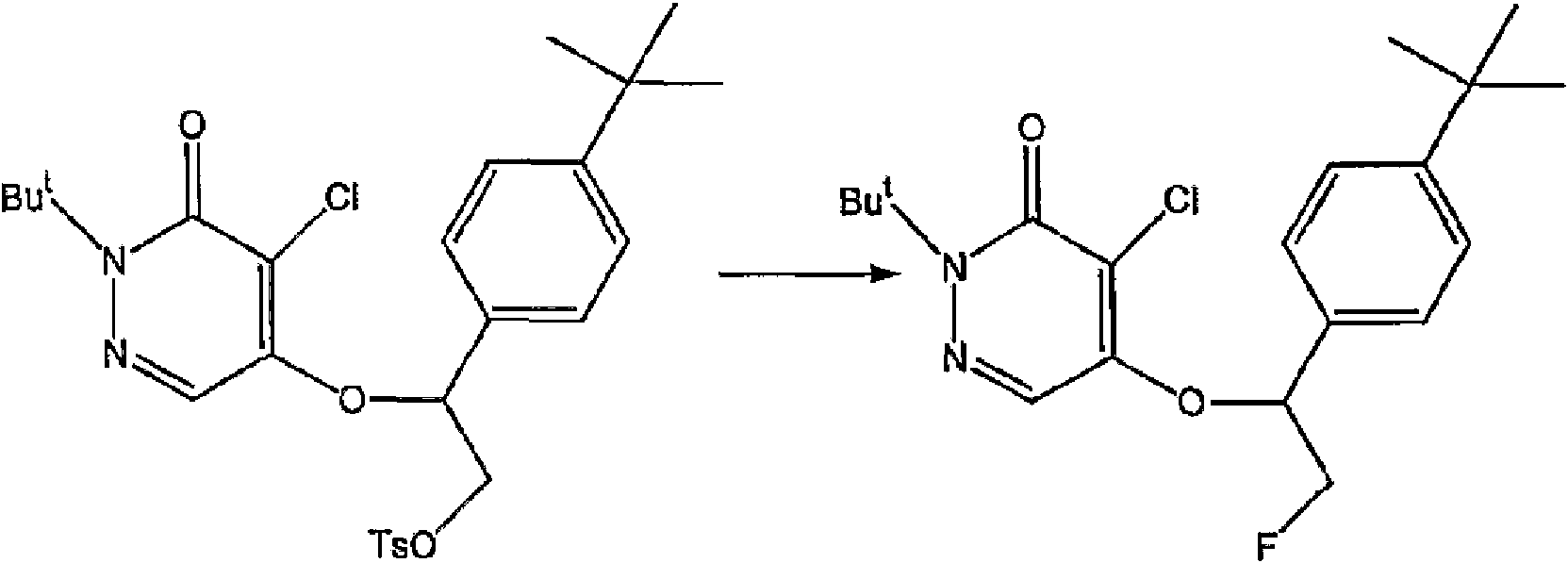
A un matraz de fondo redondo de 15 ml cargado con 2-terc-butilo-4-cloro-5-(2-p-toluenosulfoniloxi-1-(4-terc-butilfenilo)-1-etilo)oxi-3 (2H)-piridazinona (0,2 g, 0,375 mmol) se añadió 3,75 ml de solución de fluoruro de tetrabutilamonio (1M en THF, 3,75 mmol). La mezcla se agita primero a temperatura ambiente durante 15 minutos, después de lo cual se calienta durante 15 minutos a 100°C. La solución luego se enfría a temperatura ambiente y se le agrega diclorometano seguido de agua. Las capas se separaron y la capa orgánica se lavó con agua y luego se secó. La capa orgánica se concentra luego y se somete a purificación usando cromatografía flash en gel de sílice (acetato de etilo/hexanos) para obtener el compuesto anterior.To a 15 ml round bottom flask charged with 2-tert-butyl-4-chloro-5- (2-p-toluenesulfonyloxy-1- (4-tert-butylphenyl) -1-ethyl) oxy-3 (2H) -pyridazinone (0.2 g, 0.375 mmol) was added 3.75 ml of tetrabutylammonium fluoride solution (1M in THF, 3.75 mmol). The mixture is first stirred at room temperature for 15 minutes, after which it is heated for 15 minutes at 100 ° C. The solution is then cooled to room temperature and dichloromethane is added followed by water. The layers were separated and the organic layer was washed with water and then dried. The organic layer is then concentrated and purified using silica gel flash chromatography (ethyl acetate / hexanes) to obtain the above compound.
Síntesis de 2-terc-butilo-4-cloro-5-(2-[18F]fluoro-1-(4-terc-butilfenilo)-1-etilo)oxi-3(2H)-piridazinona:Synthesis of 2-tert-butyl-4-chloro-5- (2- [18F] fluoro-1- (4-tert-butylphenyl) -1-ethyl) oxy-3 (2H) -pyridazinone:

18F acuoso (16 mCi, 0,1 mL) se añade a un vacutainer que contenía 5 |uL de hidróxido de tetrabutilamonio (40% en peso sol. en agua). La mezcla se concentra bajo nitrógeno en un baño de aceite y se añaden 250 mL de acetonitrilo y esto también se concentra en nitrógeno. Luego se le añaden 100 mL de THF, seguido de 5 mg de 2-terc-butilo-4-cloro-5-(2-p-toluenosulfoniloxi-1-(4-terc-butilfenilo)-1-etilo)oxi-3(2H)-piridazinona. La mezcla luego se calienta en un baño de aceite a 70°C durante 30 minutos. Esto se diluye luego con agua, se aplica a un C18 Sep-Pak y se eluye con acetonitrilo para obtener el compuesto mencionado anteriormente.Aqueous 18F (16 mCi, 0.1 mL) is added to a vacutainer containing 5 µL of tetrabutylammonium hydroxide (40% by weight sol. In water). The mixture is concentrated under nitrogen in an oil bath and 250 mL of acetonitrile is added and this is also concentrated under nitrogen. Then 100 mL of THF is added, followed by 5 mg of 2-tert-butyl-4-chloro-5- (2-p-toluenesulfonyloxy-1- (4-tert-butylphenyl) -1-ethyl) oxy-3 (2H) -pyridazinone. The mixture is then heated in a 70 ° C oil bath for 30 minutes. This is then diluted with water, applied to a C18 Sep-Pak and eluted with acetonitrile to obtain the aforementioned compound.
Síntesis de 2-terc-butilo-4-met¡lo-5-cloro 3(2H)-piridaz¡nona:Synthesis of 2-tert-butyl-4-methyl-5-chloro 3 (2H) -pyridazine:

2-terc-butilo-4,5-dicloro-3(2H)-piridazinona (5 g, 22,72 mmol) disuelto en 12 ml de éter se añadieron gota a gota a 15 ml de una solución en éter de bromuro de metilmagnesio (3M en éter) a 5°C se añadió. Una vez completada la adición, la solución se agitó a 5°C durante 2 horas. Luego se le añaden lentamente 10 mL de solución de 6N HCl y la solución se agita durante 10 minutos. La mezcla se extrae luego con éter de dietilo. La capa de éter se lava luego con agua y se seca. El producto bruto obtenido después de concentrar el éter se somete a cromatografía flash (gel de sílice, acetato de etilo/hexanos: 9:1) para dar el producto.2-tert-butyl-4,5-dichloro-3 (2H) -pyridazinone (5 g, 22.72 mmol) dissolved in 12 ml of ether were added dropwise to 15 ml of an ether solution of methyl magnesium bromide (3M in ether) at 5 ° C was added. After the addition was complete, the solution was stirred at 5 ° C for 2 hours. Then 10 mL of 6N HCl solution is slowly added and the solution is stirred for 10 minutes. The mixture is then extracted with diethyl ether. The ether layer is then washed with water and dried. The crude product obtained after concentrating the ether is flash chromatographed (silica gel, ethyl acetate / hexanes: 9: 1) to give the product.
Síntesis de 2-terc-butilo-4-bromometilo-5-cloro 3(2H)-piridazinona:Synthesis of 2-tert-butyl-4-bromomethyl-5-chloro 3 (2H) -pyridazinone:

Se disuelve 2-terc-butilo-4-metilo-5-cloro 3(2H)-piridazinona (3g, 15 mmol) en 25 ml de tetracloruro de carbono y se le añade N-bromosuccinimida (2,6 g, 15 mmol) y peróxido de benzoilo (14 mg). La mezcla se calienta a reflujo durante 6 horas, después de lo cual se enfría y se filtra. El filtrado se lava con agua y se seca. Después de eliminar el disolvente orgánico, el residuo bruto obtenido se purifica por cromatografía flash (gel de sílice, acetato de etilo/hexanos: 9:1) para obtener el producto.2-tert-Butyl-4-methyl-5-chloro 3 (2H) -pyridazinone (3g, 15 mmol) is dissolved in 25 ml of carbon tetrachloride and N-bromosuccinimide (2.6 g, 15 mmol) is added. and benzoyl peroxide (14 mg). The mixture is refluxed for 6 hours, after which it is cooled and filtered. The filtrate is washed with water and dried. After removing the organic solvent, the obtained crude residue is purified by flash chromatography (silica gel, ethyl acetate / hexanes: 9: 1) to obtain the product.
Síntesis de 2-terc-butilo-4-hidroximetilo-5-cloro 3(2H)-piridazinona:Synthesis of 2-tert-butyl-4-hydroxymethyl-5-chloro 3 (2H) -pyridazinone:

Se añaden 2-terc-butilo-4-bromometilo-5-cloro 3(2H)-piridazinona (2 g, 7,19 mmol) y carbonato de calcio (3,5 g) a una mezcla 1:1 de dioxano-agua (40 mL). La mezcla se somete a reflujo durante 6 horas, después de lo cual se le añaden 30 ml de solución de HChN. La solución se agita durante 10 minutos, después de lo cual el dioxano se elimina a presión reducida. La solución resultante se extrae luego con diclorometano y la capa de diclorometano se lava y se seca. El crudo obtenido después de la concentración se purifica por cromatografía flash (acetato de etilo/hexanos: 1:2).2-tert-Butyl-4-bromomethyl-5-chloro 3 (2H) -pyridazinone (2 g, 7.19 mmol) and calcium carbonate (3.5 g) are added to a 1: 1 mixture of dioxane-water (40 mL). The mixture is refluxed for 6 hours, after which 30 ml of HChN solution is added. The solution is stirred for 10 minutes, after which the dioxane is removed under reduced pressure. The resulting solution is then extracted with dichloromethane and the dichloromethane layer is washed and dried. The crude obtained after concentration is purified by flash chromatography (ethyl acetate / hexanes: 1: 2).
Síntesis de 2-terc-butilo-4-terc-butildimetilsililoximetilo-5-cloro 3(2H)-piridazinona:Synthesis of 2-tert-butyl-4-tert-butyldimethylsilyloxymethyl-5-chloro 3 (2H) -pyridazinone:

Se disuelve 2-terc-butilo-4-hidroximetilo-5-cloro 3(2H)-piridazinona (1 g, 4,62 mmol) en DMF en un matraz de fondo redondo de 25 ml y a esto se añadieron imidazol (0,377 g, 5,0 mmol) y cloruro de terc-butildimetilsililo (0,762 g, 3,09 mmol). La mezcla se agita durante 10 horas, después de lo cual se extrae en diclorometano y la capa orgánica se lava con agua y se seca. La purificación por cromatografía flash (gel de sílice, acetato de etilo/hexanos) proporciona el producto mencionado anteriormente.2-tert-Butyl-4-hydroxymethyl-5-chloro 3 (2H) -pyridazinone (1 g, 4.62 mmol) is dissolved in DMF in a 25 ml round bottom flask and imidazole (0.377 g, 5.0 mmol) and tert-butyldimethylsilyl chloride (0.762 g, 3.09 mmol). The mixture is stirred for 10 hours, after which it is extracted into dichloromethane and the organic layer is washed with water and dried. Purification by flash chromatography (silica gel, ethyl acetate / hexanes) provides the aforementioned product.
Síntesis de 2-terc-butilo-4-terc-butildimetilsililoximetilo-5-(4-terc-butilo-bencilo)tio-3(2H)-piridazinona:Synthesis of 2-tert-butyl-4-tert-butyldimethylsilyloxymethyl-5- (4-tert-butyl-benzyl) thio-3 (2H) -pyridazinone:

A una solución de 2-terc-butilo-4-terc-butildimetilsililoximetilo-5-cloro 3(2H)-piridazinona (1,5 g, 4,54 mmol) en DMF (10 mL) se agrega carbonato de cesio anhidro (2,9 g, 9,09 mmol) y 4-terc-butilbencilmercaptano (1,02 g, 4,54 mmol). La mezcla se agita durante 2 horas a 70°C y luego se enfría a temperatura ambiente y se le agrega acetato de etilo. La solución se lava después con agua, se seca y se concentra y el residuo se somete a purificación por cromatografía flash (gel de sílice, acetato de etilo/hexanos) para dar el compuesto anterior.Anhydrous cesium carbonate (2 , 9 g, 9.09 mmol) and 4-tert-butylbenzyl mercaptan (1.02 g, 4.54 mmol). The mixture is stirred for 2 hours at 70 ° C and then cooled to room temperature and ethyl acetate is added. The solution is then washed with water, dried and concentrated, and the residue is purified by flash chromatography (silica gel, ethyl acetate / hexanes) to give the above compound.
Síntesis de 2-terc-butilo-4-hidroxi-metilo-5-(4-terc-butilbencilo)tio-3(2H)-piridazinona:Synthesis of 2-tert-butyl-4-hydroxy-methyl-5- (4-tert-butylbenzyl) thio-3 (2H) -pyridazinone:

A un matraz de fondo redondo de 15 ml cargado con 2-terc-butilo-4-terc-butildimetilsililoximetilo-5-(4-tercbutilbencilo)tio-3(2H)-piridazinona (2 g, 4,2 mmol) es solución de fluoruro de tetrabutilamonio añadida (1M en THF, 21 mL, 21 mmol). La mezcla se agita primero a temperatura ambiente durante 5 horas y se le agrega diclorometano seguido de agua. Las capas se separan y la capa orgánica se lava con agua y se seca. La capa orgánica se concentra luego y se somete a purificación usando cromatografía flash en gel de sílice (acetato de etilo/hexanos) para obtener el compuesto anterior.To a 15 ml round bottom flask charged with 2-tert-butyl-4-tert-butyldimethylsilyloxymethyl-5- (4-tert-butylbenzyl) thio-3 (2H) -pyridazinone (2 g, 4.2 mmol) is solution of Tetrabutylammonium fluoride added (1M in THF, 21 mL, 21 mmol). The mixture is stirred first at room temperature for 5 hours and dichloromethane is added followed by water. The layers are separated and the organic layer is washed with water and dried. The organic layer is then concentrated and purified using silica gel flash chromatography (ethyl acetate / hexanes) to obtain the above compound.
Síntesis de 2-terc-butilo-4-p-toluenosulfoniloximetilo-5-(4-terc-butilbencilo)tio-3(2H)-piridazinona:Synthesis of 2-tert-butyl-4-p-toluenesulfonyloxymethyl-5- (4-tert-butylbenzyl) thio-3 (2H) -pyridazinone:

A un matraz de fondo redondo de 15 ml cargado con 2-terc-butilo-4-hidroxi-etilo-5-(4-terc-butilbencilo)tio-3(2H)-piridazinona (1,0 g, 2,77 mmol) se agrega piridina. Luego se agrega cloruro de p-toluenosulfonilo (0,79 g, 4,15 mmol) y la mezcla se agita durante 4 horas. La mezcla de reacción se diluye con acetato de etilo, se lava con solución de sulfato de cobre al 5% y luego con agua y se seca. Después de eliminar el disolvente en el evaporador rotatorio, el producto bruto se purifica por cromatografía flash usando (gel de sílice, acetato de etilo/hexanos) como la mezcla eluyente para dar el producto.To a 15 mL round bottom flask charged with 2-tert-butyl-4-hydroxy-ethyl-5- (4-tert-butylbenzyl) thio-3 (2H) -pyridazinone (1.0 g, 2.77 mmol ) pyridine is added. Then p-toluenesulfonyl chloride (0.79 g, 4.15 mmol) is added and the mixture is stirred for 4 hours. The reaction mixture is diluted with ethyl acetate, washed with 5% copper sulfate solution, then with water, and dried. After removing the solvent on a rotary evaporator, the crude product is purified by flash chromatography using (silica gel, ethyl acetate / hexanes) as the eluent mixture to give the product.
Síntesis de 2-terc-butilo-4-fluorometilo-5-(4-terc-butilbencilo)tio-3(2H)-piridazinona:Synthesis of 2-tert-butyl-4-fluoromethyl-5- (4-tert-butylbenzyl) thio-3 (2H) -pyridazinone:

Se añade un matraz de fondo redondo de 15 ml cargado con 2-terc-butilo-4-p-toluenosulfoniloximetilo-5-(4-terc-butilbencilo)tio-3(2H)-piridazinona (0,5 g, 0,972 mmol) 4,86 ml de solución de fluoruro de tetrabutilamonio (1M en THF, 4,86 mmol). La mezcla se agita primero a temperatura ambiente durante 15 minutos, después de lo cual se calienta durante 15 minutos a 100°C. La solución luego se enfría a temperatura ambiente y se le agrega diclorometano seguido de agua. Las capas se separaron y la capa orgánica se lavó con agua y luego se secó. La capa orgánica se concentra luego y se somete a purificación usando cromatografía flash en gel de sílice (acetato de etilo/hexanos) para obtener el compuesto anterior.Add a 15 ml round bottom flask charged with 2-tert-butyl-4-p-toluenesulfonyloxymethyl-5- (4-tert-butylbenzyl) thio-3 (2H) -pyridazinone (0.5 g, 0.972 mmol) 4.86 ml of tetrabutylammonium fluoride solution (1M in THF, 4.86 mmol). The mixture is first stirred at room temperature for 15 minutes, after which it is heated for 15 minutes at 100 ° C. The solution is then cooled to room temperature and dichloromethane is added followed by water. The layers were separated and the organic layer was washed with water and then dried. The organic layer is then concentrated and purified using silica gel flash chromatography (ethyl acetate / hexanes) to obtain the above compound.
Síntesis de 2-terc-butilo-4-[18F]fluorometilo-5-(4-terc-butilbencilo)tio-3(2H)-piridazinona:Synthesis of 2-tert-butyl-4- [18F] fluoromethyl-5- (4-tert-butylbenzyl) thio-3 (2H) -pyridazinone:
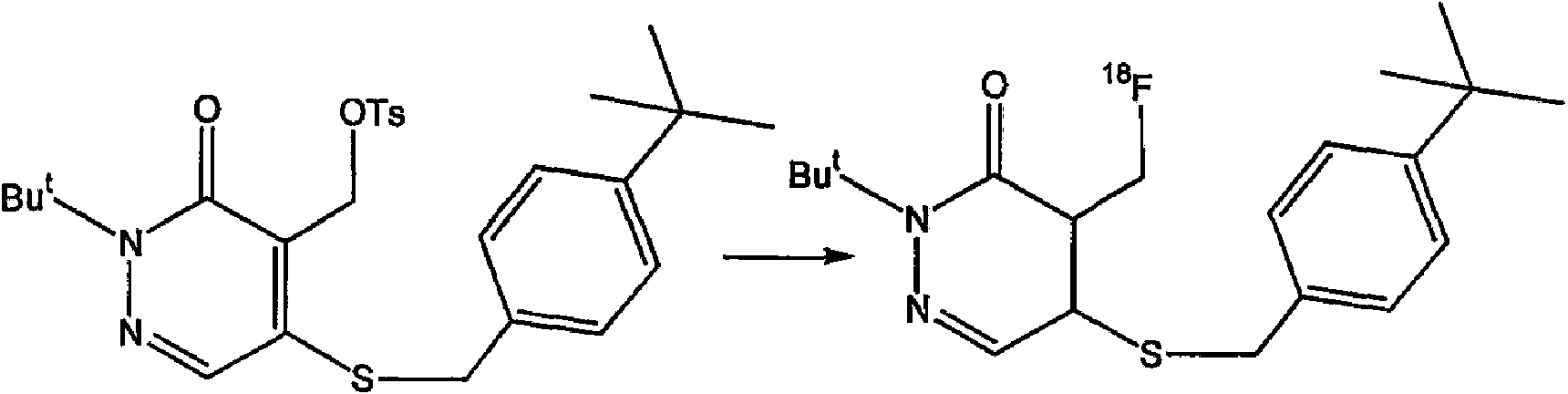
18F acuoso (50 mCi, 0,1 mL) se añade a un vacutainer que contenía 5 |uL de hidróxido de tetrabutilamonio (40% en peso sol. en agua). La mezcla se concentra bajo nitrógeno en un baño de aceite y se añaden 250 mL de acetonitrilo y esto también se concentra en nitrógeno. Después se le añaden 100 mL de THF seguido de 5 mg de 2-terc-butilo-4-p-toluenosulfoiniloximetilo-5-(4-terc-butilbencilo)tio-3(2H)-piridazinona. La mezcla luego se calienta en un baño de aceite a 70°C durante 30 minutos. Esto se diluye luego con agua, se aplica a un C18 Sep-Pak y se eluye con acetonitrilo para obtener el compuesto mencionado anteriormente.Aqueous 18F (50 mCi, 0.1 mL) is added to a vacutainer containing 5 µL of tetrabutylammonium hydroxide (40% by weight sol. In water). The mixture is concentrated under nitrogen in an oil bath and 250 mL of acetonitrile is added and this is also concentrated under nitrogen. Then 100 mL of THF is added followed by 5 mg of 2-tert-butyl-4-p-toluenesulfoinyloxymethyl-5- (4-tert-butylbenzyl) thio-3 (2H) -pyridazinone. The mixture is then heated in a 70 ° C oil bath for 30 minutes. This is then diluted with water, applied to a C18 Sep-Pak and eluted with acetonitrile to obtain the aforementioned compound.
Ejemplo 4 - Análogos de FenazaquinaExample 4 - Fenazaquine analogs
Síntesis de quinazolina de 4-cloro:4-Chloro Quinazoline Synthesis:

Se sometieron a reflujo 4-quinazolona (5 g, 34,2 mmol), pentacloruro de fósforo (10,26 g, 47,9 mmol) y oxicloruro de fósforo (40 mL) durante dos horas a 115-118C. El oxicloruro de fósforo se eliminó a vacío y el residuo se extrajo en éter. La mezcla completa se vertió luego en un recipiente que contenía hielo triturado y se extrajo de nuevo con éter. La capa de éter se lavó a continuación con bicarbonato sódico y se secó. El éter se eliminó después a presión reducida y el material en bruto se recristalizó en hexanos para proporcionar el producto.4-quinazolone (5 g, 34.2 mmol), phosphorous pentachloride (10.26 g, 47.9 mmol) and phosphorous oxychloride (40 mL) were refluxed for two hours at 115-118C. Phosphorous oxychloride was removed in vacuo and the residue was extracted into ether. The entire mixture was then poured into a container containing crushed ice and back extracted with ether. The ether layer was then washed with sodium bicarbonate and dried. The ether was then removed under reduced pressure and the crude material was recrystallized from hexanes to provide the product.
Síntesis de 4-(4-metilfenilo)butanol:Synthesis of 4- (4-methylphenyl) butanol:

A hidruro de litio y aluminio (427 mg, 11,2 mmol) suspendido en éter seco (5 mL) a 0°C se agrega 1 g de ácido 4-(4-metilfenilo)butanoico (5,614 mmol) disuelto en éter seco (10 mL) durante un período de 30 minutos. La mezcla de reacción luego se deja calentar a temperatura ambiente y se agita durante 4 horas. Entonces se añadieron sucesivamente agua (0,43 mL), NaOH (solución al 15%, 0,43 g) y agua (1,29 mL) y la solución resultante se agitó durante 30 minutos. El precipitado resultante se filtra y se lava con éter y se seca. El filtrado se concentra luego y se purifica por cromatografía flash usando acetato de etilo - hexanos como medio de elución.To lithium aluminum hydride (427 mg, 11.2 mmol) suspended in dry ether (5 mL) at 0 ° C is added 1 g of 4- (4-methylphenyl) butanoic acid (5.614 mmol) dissolved in dry ether ( 10 mL) over a 30 minute period. The reaction mixture is then allowed to warm to room temperature and stir for 4 hours. Then water (0.43 mL), NaOH (15% solution, 0.43 g) and water (1.29 mL) were added successively and the resulting solution was stirred for 30 minutes. The resulting precipitate is filtered and washed with ether and dried. The filtrate is then concentrated and purified by flash chromatography using ethyl acetate-hexanes as the elution medium.
Síntesis de 4-(4-metilfenilo)butilo terc-butildimetilsililo éter:Synthesis of 4- (4-methylphenyl) butyl tert-butyldimethylsilyl ether:

4-(4-metilfenilo)butanol (0,5 g, 3,04 mmol) se disuelve en 5 ml de DMF y se añadió imidazol (310 mg, 4,56 mmol) y cloruro de terc-butildimetilsililo (685 mg, 4,56 mmol). La reacción se agita durante 4 horas, después de lo cual se extrae en acetato de etilo y se lava con agua para eliminar todo el DMF. La capa orgánica se seca y se concentra. La mezcla cruda se purifica después por cromatografía flash usando una mezcla de acetato de etilo hexanos como medio de elución para proporcionar el producto mencionado anteriormente.4- (4-methylphenyl) butanol (0.5 g, 3.04 mmol) is dissolved in 5 ml of DMF and imidazole (310 mg, 4.56 mmol) and tert-butyldimethylsilyl chloride (685 mg, 4 , 56 mmol). The reaction is stirred for 4 hours, after which it is extracted into ethyl acetate and washed with water to remove all of the DMF. The organic layer is dried and concentrated. The crude mixture is then purified by flash chromatography using a mixture of acetate ethyl hexanes as an elution medium to provide the aforementioned product.
Síntesis de 4-(4-bromometilfenilo) butilo terc-butildimetilsililo éter:Synthesis of 4- (4-bromomethylphenyl) butyl tert-butyldimethylsilyl ether:

A un matraz de fondo redondo de 50 mL se le agrega 4-(4-metilfenilo)butilo terc-butildimetilsililo éter (0,25 g, 0,89 mmol), N-bromosuccinimida (0,158g, 0,89 mmol), peróxido de benzoilo (2,17 mg, 0,0089 mmol) y 10 ml de tetracloruro de carbono. Esta mezcla se somete a reflujo durante la noche, después de lo cual se enfría y se filtra. El filtrado se concentra y el residuo bruto resultante se purifica por cromatografía flash en acetato de etilo-hexanos para proporcionar el producto.To a 50 mL round bottom flask, add 4- (4-methylphenyl) butyl tert-butyldimethylsilyl ether (0.25 g, 0.89 mmol), N-bromosuccinimide (0.158g, 0.89 mmol), peroxide of benzoyl (2.17 mg, 0.0089 mmol) and 10 ml of carbon tetrachloride. This mixture is refluxed overnight, after which it is cooled and filtered. The filtrate is concentrated and the resulting crude residue is purified by flash chromatography in ethyl acetate-hexanes to provide the product.
Síntesis de ácido 4-(4-terc-butildimetilsililoxibutilo)fenilacético:Synthesis of 4- (4-tert-butyldimethylsilyloxybutyl) phenylacetic acid:

Se añadió 4-(4-bromometilfenilo)butilo terc-butildimetilsililo éter (0,2 g, 0,561 mmol) en éter seco gota a gota a virutas de Mg (13,77 mg, 0,561 mmol). A continuación, se añaden unos pocos cristales de yodo para iniciar la reacción y la mezcla se somete a reflujo durante la noche bajo atmósfera de nitrógeno. La solución se enfría entonces y gas CO2 se burbujea en ella durante 10 minutos. La agitación se continúa durante otras 2 horas, después de lo cual se agrega agua a la mezcla de reacción. La mezcla luego se extrae con acetato de etilo, se lava y se seca. Después de eliminar el disolvente orgánico a presión reducida, el producto bruto se purifica por cromatografía flash (gel de sílice, acetato de etilo/hexanos) para producir el producto deseado.4- (4-Bromomethylphenyl) butyl tert-butyldimethylsilyl ether (0.2 g, 0.561 mmol) in dry ether was added dropwise to Mg chips (13.77 mg, 0.561 mmol). A few iodine crystals are then added to start the reaction and the mixture is refluxed overnight under nitrogen atmosphere. The solution is then cooled and CO 2 gas is bubbled into it for 10 minutes. Stirring is continued for another 2 hours, after which water is added to the reaction mixture. The mixture is then extracted with ethyl acetate, washed and dried. After removing the organic solvent under reduced pressure, the crude product is purified by flash chromatography (silica gel, ethyl acetate / hexanes) to yield the desired product.
Síntesis de 2-hidroxietilo-4-(4-terc-butildimetilsililoxibutilo) benceno:Synthesis of 2-hydroxyethyl-4- (4-tert-butyldimethylsilyloxybutyl) benzene:

El ácido 4-(4-terc-butildimetilsililoxibutilo)fenilacético (0,25 g, 0,775 mmol) disuelto en éter seco se agrega gota a gota a una suspensión de hidruro de litio y aluminio en éter (44,2 mg, 1,16 mmol). La mezcla de reacción se agita durante 5 horas, después de lo cual se añaden sucesivamente agua (45 mL), NaOH (solución al 15%, 45 mL) y agua (135 mL) y la mezcla de reacción se agita durante otros 30 minutos. El precipitado resultante se filtra y se lava con éter. El filtrado de éter se lava a continuación con agua y se seca. Después de concentrar el éter, el producto obtenido se purifica por cromatografía flash (gel de sílice, acetato de etilo/hexanos)4- (4-tert-Butyldimethylsilyloxybutyl) phenylacetic acid (0.25 g, 0.775 mmol) dissolved in dry ether is added dropwise to a suspension of lithium aluminum hydride in ether (44.2 mg, 1.16 mmol). The reaction mixture is stirred for 5 hours, after which water (45 mL), NaOH (15% solution, 45 mL) and water (135 mL) are added successively and the reaction mixture is stirred for another 30 minutes. . The resulting precipitate is filtered and washed with ether. The ether filtrate is then washed with water and dried. After concentrating the ether, the product obtained is purified by flash chromatography (silica gel, ethyl acetate / hexanes)
Síntesis de 4-(2-(4-(4-terc-butildimetilsililoxibutilo)fenilo)etoxi) quinazolina:Synthesis of 4- (2- (4- (4-tert-butyldimethylsilyloxybutyl) phenyl) ethoxy) quinazoline:

Se disuelve 2-hidroxietilo-4-(4-terc-butildimetilsililoxibutilo)benceno (0,3 g, 0,97 mmol) en tetrahidrofurano seco y se le agrega hidruro de sodio (24 mg, 1 mmol). La solución resultante se agita a temperatura ambiente durante 30 minutos, después de lo cual se agrega 4-cloroquinazolina (0,164 g, 1 mmol) a la solución anterior. La solución se agita luego durante 6 horas, después de lo cual se agrega agua a la mezcla. La solución luego se extrae en diclorometano. La capa orgánica se lava, se seca y luego se concentra para dar el producto bruto que se purifica por cromatografía flash (gel de sílice, acetato de etilo/hexanos) para dar el producto.2-Hydroxyethyl-4- (4-tert-butyldimethylsilyloxybutyl) benzene (0.3 g, 0.97 mmol) is dissolved in dry tetrahydrofuran and sodium hydride (24 mg, 1 mmol) is added. The resulting solution is stirred at room temperature for 30 minutes, after which 4-chloroquinazoline (0.164 g, 1 mmol) is added to the above solution. The solution is then stirred for 6 hours, after which water is added to the mixture. The solution is then extracted into dichloromethane. The organic layer is washed, dried and then concentrated to give the crude product which is purified by flash chromatography (silica gel, ethyl acetate / hexanes) to give the product.
Síntesis de 4-(2-(4-(4-hidroxibutilo)fenilo)etoxi) quinazolina:Synthesis of 4- (2- (4- (4-hydroxybutyl) phenyl) ethoxy) quinazoline:

A 4-(2-(4-(4-terc-butildimetilsililoxibutilo)fenilo)etoxi) quinazolina (0,4 g, 0,916 mmol) se le añade una solución de fluoruro de tetrabutilamonio (1M TBAF en THF, 4,58 mL, 4,58 mmol). La solución se agita durante 2 horas, después de lo cual se agrega agua a la reacción y esta se extrae en acetato de etilo. La capa orgánica se lava luego con agua, se seca y se concentra. El residuo obtenido se purifica por cromatografía flash (gel de sílice, acetato de etilo/hexanos) To 4- (2- (4- (4-tert-butyldimethylsilyloxybutyl) phenyl) ethoxy) quinazoline (0.4 g, 0.916 mmol) is added a solution of tetrabutylammonium fluoride (1M TBAF in THF, 4.58 mL, 4.58 mmol). The solution is stirred for 2 hours, after which water is added to the reaction and this is extracted into ethyl acetate. The organic layer is then washed with water, dried, and concentrated. The residue obtained is purified by flash chromatography (silica gel, ethyl acetate / hexanes)
Síntesis de 4-(2-(4-(4-p-toluenosulfoniloxibutilo)fenilo)etoxi) quinazolina:Synthesis of 4- (2- (4- (4-p-toluenesulfonyloxybutyl) phenyl) ethoxy) quinazoline:

Se disuelve un matraz de fondo redondo de 15 ml con 4-(2-(4-(4-hidroxibutilo)fenilo)etoxi) quinazolina (0,25 g, 0,77 mmol) en piridina (5 mL). Luego se agrega cloruro de p-toluenosulfonilo (0,15 g, 0,79 mmol) y la mezcla se agita durante 4 horas. La mezcla de reacción se diluye con acetato de etilo, se lava con solución de sulfato de cobre al 5% y luego con agua y secado. Después de eliminar el disolvente en el evaporador rotatorio, el producto bruto se purifica por cromatografía flash usando gel de sílice (acetato de etilo/hexanos) para dar el producto.A 15 mL round bottom flask is dissolved with 4- (2- (4- (4-hydroxybutyl) phenyl) ethoxy) quinazoline (0.25 g, 0.77 mmol) in pyridine (5 mL). Then p-toluenesulfonyl chloride (0.15 g, 0.79 mmol) is added and the mixture is stirred for 4 hours. The reaction mixture is diluted with ethyl acetate, washed with 5% copper sulfate solution and then with water, and dried. After removing the solvent on a rotary evaporator, the crude product is purified by flash chromatography using silica gel (ethyl acetate / hexanes) to give the product.
Síntesis de 4-(2-(4-(4-fluorobutilo)fenilo)etoxi) quinazolina:Synthesis of 4- (2- (4- (4-fluorobutyl) phenyl) ethoxy) quinazoline:

Se agrega 4-(2-(4-(4-p-toluenosulfoniloxibutilo)fenilo)etoxi) quinazolina (0,3 g, 0,63 mmol) a una solución de fluoruro de potasio/kryptofix 222 en 5 ml de THF (relación 1:1, 3,15 mmol cada uno). Después de agitarse a temperatura ambiente durante 15 minutos, la solución se calienta a reflujo durante 20 minutos. Luego se enfría y se le agrega agua. La solución luego se extrae en diclorometano y se lava con agua y se seca. El producto bruto se purifica por cromatografía flash sobre gel de sílice (acetato de etilo/hexanos) para proporcionar el producto.4- (2- (4- (4-p-toluenesulfonyloxybutyl) phenyl) ethoxy) quinazoline (0.3 g, 0.63 mmol) is added to a solution of potassium fluoride / kryptofix 222 in 5 ml of THF (ratio 1: 1, 3.15 mmol each). After being stirred at room temperature for 15 minutes, the solution is refluxed for 20 minutes. Then it is cooled and water is added to it. The solution is then extracted into dichloromethane and washed with water and dried. The crude product is purified by flash chromatography on silica gel (ethyl acetate / hexanes) to provide the product.
Síntesis de 4-(2-(4-(4-[18F]-fluorobutilo)fenilo)etoxi) quinazolina:Synthesis of 4- (2- (4- (4- [18F] -fluorobutyl) phenyl) ethoxy) quinazoline:

A un vial de reacción de 5 ml que contiene 100 mCi de 18F en 300 mg de 18O agua se añade una solución de 1 ml que consiste en 10 mg de Kryptofix, 1 mg de carbonato de potasio, 0,005 ml de agua y 0,95 ml de acetonitrilo. El vial se calienta para eliminar todos los disolventes y se agrega acetonitrilo seco (1 ml) al vial. Esto también se elimina por evaporación. Luego se le agrega 4-(2-(4-(4-p-toluenosulfoniloxibutilo)fenilo)etoxi) quinazolina (5 mg) en acetonitrilo. El vial se sella y se calienta durante 30 minutos a 100°C. La mezcla se diluye con diclorometano y se pasa a través de Sep-Pak y se eluye con tetrahidrofurano. El disolvente se evapora para obtener el compuesto mencionado anteriormente.To a 5 ml reaction vial containing 100 mCi of 18F in 300 mg of 18O water is added a 1 ml solution consisting of 10 mg of Kryptofix, 1 mg of potassium carbonate, 0.005 ml of water and 0.95 ml of acetonitrile. The vial is heated to remove all solvents and dry acetonitrile (1 ml) is added to the vial. This is also removed by evaporation. Then 4- (2- (4- (4-p-toluenesulfonyloxybutyl) phenyl) ethoxy) quinazoline (5 mg) in acetonitrile is added. The vial is sealed and heated for 30 minutes at 100 ° C. The mixture is diluted with dichloromethane and passed through Sep-Pak and eluted with tetrahydrofuran. The solvent is evaporated to obtain the above-mentioned compound.
Síntesis de 4-cloro-2-quinazolona:Synthesis of 4-chloro-2-quinazolone:

Se suspende isocianato de 2-cianofenilo (5 g, 34,7 mmol) en di-n-butilo éter. A continuación se pasa HCl gaseoso a la suspensión a 80°C durante 7 horas. El precipitado resultante se filtra, se seca y se recristaliza en clorobenceno para proporcionar el producto anterior.2-Cyanophenyl isocyanate (5 g, 34.7 mmol) is suspended in di-n-butyl ether. HCl gas is then passed into the suspension at 80 ° C for 7 hours. The resulting precipitate is filtered, dried, and recrystallized from chlorobenzene to provide the above product.
Síntesis de 4-(2-(4-terc-butilfenilo)-etoxi)-2-quinazolona:Synthesis of 4- (2- (4-tert-butylphenyl) -ethoxy) -2-quinazolone:

2-(4-terc-butilfenilo) etanol (0,3 g, 1,68 mmol) se disuelve en tetrahidrofurano seco (7 ml) y a ello se añadió hidruro de sodio (48,5 mg, 2,02 mmol). La solución resultante se agita a temperatura ambiente durante 30 minutos, después de lo cual se agrega 4-cloro-2-quinazolona (0,302 g, 1,68 mmol) a la solución anterior. La solución se agita luego durante 6 horas, después de lo cual se agrega agua a la mezcla. La solución luego se extrae en diclorometano. La capa orgánica se lava, se seca y luego se concentra para dar el producto bruto que se purifica por cromatografía flash (gel de sílice, acetato de etilo/hexanos) para dar el producto.2- (4-tert-butylphenyl) ethanol (0.3 g, 1.68 mmol) is dissolved in dry tetrahydrofuran (7 ml) and sodium hydride (48.5 mg, 2.02 mmol) was added thereto. The resulting solution is stirred at room temperature for 30 minutes, after which 4-chloro-2-quinazolone (0.302 g, 1.68 mmol) is added to the above solution. The solution is then stirred for 6 hours, after which water is added to the mixture. The solution is then extracted into dichloromethane. The organic layer is washed, dried and then concentrated to give the crude product which is purified by flash chromatography (silica gel, ethyl acetate / hexanes) to give the product.
Síntesis de 4-(2-(4-terc-butilfenilo)-etoxi)-2-(trifluorometanosulfoniloxi)-quinazolina:Synthesis of 4- (2- (4-tert-butylphenyl) -ethoxy) -2- (trifluoromethanesulfonyloxy) -quinazoline:

Se disuelve 4-(2-(4-terc-butilfenilo)-etoxi)-2-quinazolona (0,25 g, 0,775 mmol) en diclorometano (5 ml) y anhídrido trifluorometanosulfónico (0,328 g, 1,16 mmol) y diisopropiletilamina (0,3 g, 2,32 mmol) se le agrega. La reacción se agita durante la noche, después de lo cual se diluye adicionalmente con diclorometano y se lava con agua. La capa orgánica se seca y se concentra. El producto bruto obtenido se aisla por cromatografía flash (gel de sílice, acetato de etilo/hexanos).4- (2- (4-tert-Butylphenyl) -ethoxy) -2-quinazolone (0.25 g, 0.775 mmol) is dissolved in dichloromethane (5 ml) and trifluoromethanesulfonic anhydride (0.328 g, 1.16 mmol) and diisopropylethylamine (0.3 g, 2.32 mmol) is added. The reaction is stirred overnight, after which it is further diluted with dichloromethane and washed with water. The organic layer is dried and concentrated. The crude product obtained is isolated by flash chromatography (silica gel, ethyl acetate / hexanes).
Síntesis de 4-(2-(4-terc-butilfenilo)-etoxi)-2-fluoro-quinazolina:Synthesis of 4- (2- (4-tert-butylphenyl) -ethoxy) -2-fluoro-quinazoline:

Un matraz de fondo redondo de 15 ml se carga con 4-(2-(4-terc-butilfenilo)-etoxi)-2-(trifluorometanosulfoniloxi)-quinazolina (0,3 g, 0,66 mmol). Luego se agrega solución de fluoruro de tetrabutilamonio (1M en THF, 3,3 mL, 3,3 mmol) y la solución se somete a reflujo durante 60 minutos. La mezcla se enfría y se le agrega agua. Luego se extrae con diclorometano, se lava con agua y se seca. El crudo obtenido después de la concentración se purifica por cromatografía flash en gel de sílice (acetato de etilo/hexanos) para obtener el compuesto deseado.A 15 ml round bottom flask is charged with 4- (2- (4-tert-butylphenyl) -ethoxy) -2- (trifluoromethanesulfonyloxy) -quinazoline (0.3 g, 0.66 mmol). Then tetrabutylammonium fluoride solution (1M in THF, 3.3 mL, 3.3 mmol) is added and the solution is refluxed for 60 minutes. The mixture is cooled and water is added. It is then extracted with dichloromethane, washed with water and dried. The crude obtained after concentration is purified by silica gel flash chromatography (ethyl acetate / hexanes) to obtain the desired compound.
Síntesis de 4-(2-(4-terc-butilfenilo)etoxi)-2-[18F]fluoro-quinazolina:Synthesis of 4- (2- (4-tert-butylphenyl) ethoxy) -2- [18F] fluoro-quinazoline:

18F acuoso (16 mCi, 0,1 mL) se añade a un vacutainer que contenía 5 gL de hidróxido de tetrabutilamonio (40% en peso sol. en agua). La mezcla se concentra bajo nitrógeno en un baño de aceite a 100°C y se añaden 250 mL de acetonitrilo y esto también se concentra en nitrógeno. El procedimiento se repite dos veces y luego se le añaden 100 mL de acetonitrilo y los contenidos se someten al vacío. Sin dejarlo secaR,Se le agrega THF seguido de 5 mg de 4-(2-(4-terc-butilfenilo)-etoxi)-2-(trifluorometanosulfoniloxi)-quinazolina. La mezcla luego se calienta en un baño de aceite a 70°C durante 30 minutos. Luego se diluye con agua, se aplica a un C18 Sep-Pak, se enjuaga con agua y se eluye con acetonitrilo para obtener el compuesto mencionado anteriormente.Aqueous 18F (16 mCi, 0.1 mL) is added to a vacutainer containing 5 gL of tetrabutylammonium hydroxide (40% by weight sol. In water). The mixture is concentrated under nitrogen in a 100 ° C oil bath and 250 mL of acetonitrile is added and this is also concentrated under nitrogen. The procedure is repeated twice and then 100 mL of acetonitrile is added and the contents are subjected to vacuum. Without letting it dry, THF is added followed by 5 mg of 4- (2- (4-tert-butylphenyl) -ethoxy) -2- (trifluoromethanesulfonyloxy) -quinazoline. The mixture is then heated in a 70 ° C oil bath for 30 minutes. Then it is diluted with water, applied to a C18 Sep-Pak, rinsed with water and eluted with acetonitrile to obtain the above-mentioned compound.
Síntesis de 6-nitro-4 (3H)-quinazolona:Synthesis of 6-nitro-4 (3H) -quinazolone:

Una mezcla de ácido 5-nitroantranílico (2 g, 14,6 mmol) y formamida (2,9 mL, 72 mmol) se irradia a 150°C en un microondas (potencia: 60W) hasta que la TLC muestra la finalización de la reacción (20 minutos). Después de enfriarse, la mezcla de reacción se enjuaga co n acetato de etilo y se evapora a presión reducida. El producto bruto se purifica por cromatografía flash (gel de sílice, acetato de etilo/hexanos) para dar el producto anterior.A mixture of 5-nitroanthranilic acid (2 g, 14.6 mmol) and formamide (2.9 mL, 72 mmol) is irradiated at 150 ° C in a microwave (power: 60W) until TLC shows completion of the reaction (20 minutes). After cooling, the reaction mixture is rinsed with ethyl acetate and evaporated under reduced pressure. The crude product is purified by flash chromatography (silica gel, ethyl acetate / hexanes) to give the above product.
Síntesis de 6-nitro-4-cloroquinolina:Synthesis of 6-nitro-4-chloroquinoline:
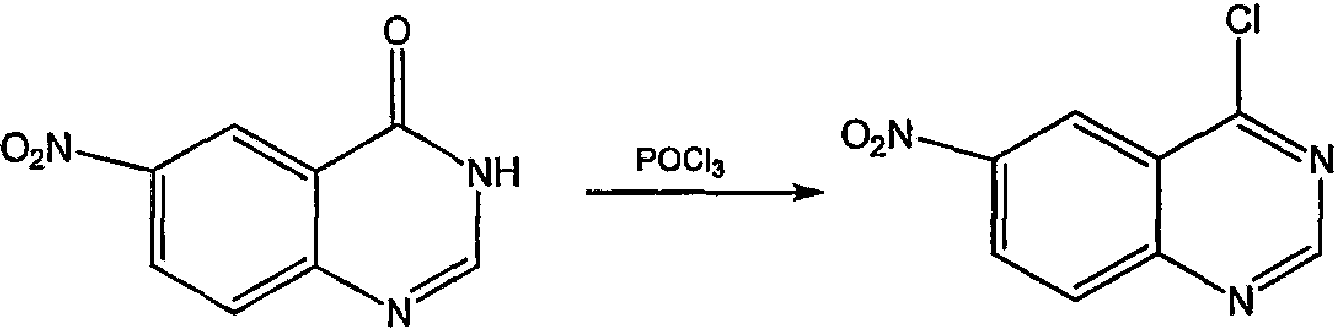
6-nitro-4(3H)-quinazolona (1 g, 5,23 mmol) y POCh (7,1 ml) se mezclan entre sí y se irradian a 100°C (potencia: 70W) durante 10 minutos. El POCl3 se evapora a vacío y el residuo se disuelve en acetato de etilo y se lava con solución saturada de NaHCO3, se seca y se concentra. Se purifica por cromatografía flash (gel de sílice, acetato de etilo/hexanos) para dar el producto anterior.6-nitro-4 (3H) -quinazolone (1 g, 5.23 mmol) and POCh (7.1 ml) are mixed together and irradiated at 100 ° C (power: 70W) for 10 minutes. The POCl3 is evaporated in vacuo and the residue is dissolved in ethyl acetate and washed with saturated NaHCO3 solution, dried and concentrated. Purify by flash chromatography (silica gel, ethyl acetate / hexanes) to give the above product.
Síntesis de 6-nitro-4-(2-(4-terc-butilfenilo)etoxi) quinazolina:Synthesis of 6-nitro-4- (2- (4-tert-butylphenyl) ethoxy) quinazoline:

2-(4-terc-butilfenilo) etanol (1,0 g, 5,59 mmol) se disuelve en tetrahidrofurano seco (7 mL) y a ello se añadió hidruro de sodio (48,5 mg, 2,02 mmol). La solución resultante se agita a temperatura ambiente durante 30 minutos, después de lo cual se agrega 6-nitro-4-cloroquinazolina (1,17 g, 5,6 mmol) a la solución anterior. La solución se agita luego durante 6 horas, después de lo cual se agrega agua a la mezcla. La solución luego se extrae en diclorometano. La capa orgánica se lava, se seca y luego se concentra para dar el producto bruto que se purifica por cromatografía flash (gel de sílice, acetato de etilo/hexanos) para dar el producto.2- (4-tert-butylphenyl) ethanol (1.0 g, 5.59 mmol) is dissolved in dry tetrahydrofuran (7 mL) and sodium hydride (48.5 mg, 2.02 mmol) was added thereto. The resulting solution is stirred at room temperature for 30 minutes, after which 6-nitro-4-chloroquinazoline (1.17 g, 5.6 mmol) is added to the above solution. The solution is then stirred for 6 hours, after which water is added to the mixture. The solution is then extracted into dichloromethane. The organic layer is washed, dried and then concentrated to give the crude product which is purified by flash chromatography (silica gel, ethyl acetate / hexanes) to give the product.
Síntesis de 6-fluoro-4-(2-(4-terc-butilfenilo)etoxi) quinazolina:Synthesis of 6-fluoro-4- (2- (4-tert-butylphenyl) ethoxy) quinazoline:

A un matraz de fondo redondo de 25 ml se añade fluoruro de potasio (82,6 mg, 1,42 mmol) y Kryptofix 222 (0,53 g, 1,42 mmol). La mezcla anterior se agita en THF durante 20 minutos, después de lo cual se le añade 6-nitro-4-(2-(4-terc-butilfenilo)etoxi) quinazolina (0,1 g, 0,284 mmol). La solución se calienta a reflujo durante 30 minutos, después de lo cual se enfría y se le agrega agua. A continuación se extrae en diclorometano, se lava con agua y se seca. La purificación por cromatografía flash (gel de sílice, acetato de etilo/hexanos) proporciona el compuesto anterior.Potassium fluoride (82.6 mg, 1.42 mmol) and Kryptofix 222 (0.53 g, 1.42 mmol) are added to a 25 ml round bottom flask. The above mixture is stirred in THF for 20 minutes, after which 6-nitro-4- (2- (4-tert-butylphenyl) ethoxy) quinazoline (0.1 g, 0.284 mmol) is added. The solution is refluxed for 30 minutes, after which it is cooled and water is added. It is then extracted into dichloromethane, washed with water and dried. Purification by flash chromatography (silica gel, ethyl acetate / hexanes) provides the compound previous.
Síntesis de 6-[18F]-Fluoro-4-(2-(4-terc-butilfenilo)etoxi) quinazolina:Synthesis of 6- [18F] -Fluoro-4- (2- (4-tert-butylphenyl) ethoxy) quinazoline:

A un vial de reacción de 5 ml que contiene 50 mCi de 18F en 300 mg de 18O agua se añade una solución de 1 ml que consiste en 10 mg de Kryptofix, 1 mg de carbonato de potasio, 0,005 ml de agua y 0,95 ml de acetonitrilo. El vial se calienta para eliminar todos los disolventes y se agrega acetonitrilo seco (1 mL) al vial. Esto también se elimina por evaporación. A continuación se le agrega 6-nitro-4-(2-(4-terc-butilfenilo)etoxi) quinazolina (5 mg) en acetonitrilo. El vial se sella y se calienta durante 30 minutos a 100°C. La mezcla se diluye con diclorometano y se pasa a través de Sep-Pak y se eluye con tetrahidrofurano. El solvente se evapora para obtener el compuesto mencionado anteriormenteTo a 5 ml reaction vial containing 50 mCi of 18F in 300 mg of 18O water is added a 1 ml solution consisting of 10 mg of Kryptofix, 1 mg of potassium carbonate, 0.005 ml of water and 0.95 ml of acetonitrile. The vial is heated to remove all solvents and dry acetonitrile (1 mL) is added to the vial. This is also removed by evaporation. Then 6-nitro-4- (2- (4-tert-butylphenyl) ethoxy) quinazoline (5 mg) in acetonitrile is added. The vial is sealed and heated for 30 minutes at 100 ° C. The mixture is diluted with dichloromethane and passed through Sep-Pak and eluted with tetrahydrofuran. The solvent is evaporated to obtain the compound mentioned above
Síntesis de (4-terc-butilfenilo) etano 1,2 diol:Synthesis of (4-tert-butylphenyl) ethane 1,2 diol:

A un matraz de fondo redondo de 100 ml se añaden 20 ml de terc butanol, 20 ml de agua y 5,6 g de AD-mix-p. La solución se agita y se enfría a 0°C. Se agrega terc-butilo estireno (0,64 g, 4 mmol) a la mezcla y la solución resultante se agita durante la noche a 0°C. Se agrega sulfito de sodio sólido (6 g) y la mezcla se agita durante 30 minutos adicionales. A continuación la solución se extrae en acetato de etilo, se lava con agua y se seca. El producto bruto se purifica después por cromatografía flash (gel de sílice, acetato de etilo/hexanos) para proporcionar el producto.To a 100 ml round bottom flask add 20 ml of tert-butanol, 20 ml of water and 5.6 g of AD-mix-p. The solution is stirred and cooled to 0 ° C. Tert-Butyl styrene (0.64 g, 4 mmol) is added to the mixture and the resulting solution is stirred overnight at 0 ° C. Solid sodium sulfite (6 g) is added and the mixture is stirred for an additional 30 minutes. The solution is then extracted into ethyl acetate, washed with water and dried. The crude product is then purified by flash chromatography (silica gel, ethyl acetate / hexanes) to provide the product.
Síntesis de 1-terc-butildimetilsililoxi-2-hidroxi-2-(4-tercbutilfenilo) etano:Synthesis of 1-tert-butyldimethylsilyloxy-2-hydroxy-2- (4-tert-butylphenyl) ethane:

(4-terc-butilfenilo) etano 1,2 diol (0,5 g, 2,57 mmol) se disuelve en DMF en un matraz de 25 ml de fondo redondo y a esta se le añadieron imidazol (0,210 g, 3,09 mmol) y terc-butildimetilsililo cloruro (0,46 g, 3,09 mmol). La mezcla se agita durante 6 horas, después de lo cual se extrae en diclorometano y la capa orgánica se lava con agua y se seca. La purificación por cromatografía flash (gel de sílice, acetato de etilo/hexanos) proporciona el producto mencionado anteriormente.(4-tert-butylphenyl) ethane 1,2 diol (0.5 g, 2.57 mmol) is dissolved in DMF in a 25 ml round bottom flask and imidazole (0.210 g, 3.09 mmol) ) and tert-butyldimethylsilyl chloride (0.46 g, 3.09 mmol). The mixture is stirred for 6 hours, after which it is extracted into dichloromethane and the organic layer is washed with water and dried. Purification by flash chromatography (silica gel, ethyl acetate / hexanes) provides the aforementioned product.
Síntesis de 1-terc-butildimetilsililoxi-2-tetrahidropiraniloxi-2-(4-tercbutilfenilo) etano:Synthesis of 1-tert-butyldimethylsilyloxy-2-tetrahydropyranyloxy-2- (4-tert-butylphenyl) ethane:

1-Terc-butildimetilsililoxi-2-hidroxi-2-(4-terc-butilfenilo) etano (0,5 g, 1,622 mmol) se disuelve en diclorometano y se añade dihidropirano (0,163 g, 1,94 mmoles) y ácido toluenosulfónico (33 mg, 0,194 mmol). La reacción se agita durante 2 horas, después de lo cual la mezcla se lava con agua y se seca. El residuo bruto obtenido después de la concentración se purifica por cromatografía flash (gel de sílice, acetato de etilo/hexanos) para obtener el producto.1-Tert-butyldimethylsilyloxy-2-hydroxy-2- (4-tert-butylphenyl) ethane (0.5 g, 1.622 mmol) is dissolved in dichloromethane and dihydropyran (0.163 g, 1.94 mmol) and toluenesulfonic acid ( 33 mg, 0.194 mmol). The reaction is stirred for 2 hours, after which the mixture is washed with water and dried. The crude residue obtained after concentration is purified by flash chromatography (silica gel, ethyl acetate / hexanes) to obtain the product.
Síntesis de 1-hidroxi-2-tetrahidropiraniloxi-2-(4-terc-butilfenilo)etano:Synthesis of 1-hydroxy-2-tetrahydropyranyloxy-2- (4-tert-butylphenyl) ethane:

A 1-terc-butildimetilsililoxi-2-tetrahidropiraniloxi-2-(4-tercbutilfenilo) etano (0,4 g, 1,01 mmol) se le añade una solución de fluoruro de tetrabutilamonio (TBAF 1M en THF, 5 ml, 5,0 mmol). La solución se agita durante 2 horas, después de lo cual se agrega agua a la reacción y esta se extrae en acetato de etilo. La capa orgánica se lava luego con agua, se seca y se concentra. El residuo obtenido se purifica por cromatografía flash (gel de sílice, acetato de etilo/hexanos). To 1-tert-butyldimethylsilyloxy-2-tetrahydropyranyloxy-2- (4-tert-butylphenyl) ethane (0.4 g, 1.01 mmol) is added a solution of tetrabutylammonium fluoride (1M TBAF in THF, 5 ml, 5, 0 mmol). The solution is stirred for 2 hours, after which water is added to the reaction and this is extracted into ethyl acetate. The organic layer is then washed with water, dried, and concentrated. The residue obtained is purified by flash chromatography (silica gel, ethyl acetate / hexanes).
Síntesis de 4-(2-tetrahidropiraniloxi-2-(4-terc-butilfenilo)etoxi) quinazolina:Synthesis of 4- (2-tetrahydropyranyloxy-2- (4-tert-butylphenyl) ethoxy) quinazoline:

Se disuelve 1-hidroxi-2-tetrahidropiraniloxi-2-(4-terc-butilfenilo) etano (0,3 g, 1,07 mmol) en tetrahidrofurano seco (7 mL) y se le agrega hidruro de sodio (30,96 mg, 1,29 mmol). La solución resultante se agita a temperatura ambiente durante 30 minutos, después de lo cual se agrega 4-cloroquinazolina (0,175 g, 1,07 mmol) a la solución anterior. La solución se agita luego durante 6 horas, después de lo cual se agrega agua a la mezcla. La solución luego se extrae en diclorometano. La capa orgánica se lava, se seca y luego se concentra para dar el producto bruto que se purifica por cromatografía flash (gel de sílice, acetato de etilo/hexanos) para dar el producto.1-Hydroxy-2-tetrahydropyranyloxy-2- (4-tert-butylphenyl) ethane (0.3 g, 1.07 mmol) is dissolved in dry tetrahydrofuran (7 mL) and sodium hydride (30.96 mg , 1.29 mmol). The resulting solution is stirred at room temperature for 30 minutes, after which 4-chloroquinazoline (0.175 g, 1.07 mmol) is added to the above solution. The solution is then stirred for 6 hours, after which water is added to the mixture. The solution is then extracted into dichloromethane. The organic layer is washed, dried and then concentrated to give the crude product which is purified by flash chromatography (silica gel, ethyl acetate / hexanes) to give the product.
Síntesis de 4-(2-hidroxi-2-(4-terc-butilfenilo)etoxi) quinazolina:Synthesis of 4- (2-hydroxy-2- (4-tert-butylphenyl) ethoxy) quinazoline:

Se disuelve 4-(2-tetrahidropiraniloxi-2-(4-terc-butilfenilo)etoxi) quinazolina (0,25 g, 0,615 mmol) en 5 ml de etanol y se le agrega p-toluenosulfonato de piridinio (15,4 mg, 0,061 mmol). La solución se calienta a 55°C y se agita a esa temperatura durante 4 horas. El etanol se elimina y el producto bruto se purifica por cromatografía flash (gel de sílice, acetato de etilo/hexanos).4- (2-Tetrahydropyranyloxy-2- (4-tert-butylphenyl) ethoxy) quinazoline (0.25 g, 0.615 mmol) is dissolved in 5 ml of ethanol and pyridinium p-toluenesulfonate (15.4 mg, 0.061 mmol). The solution is heated to 55 ° C and stirred at that temperature for 4 hours. The ethanol is removed and the crude product is purified by flash chromatography (silica gel, ethyl acetate / hexanes).
Síntesis de 4-(2-p-toluenosulfoniloxi-2-(4-terc-butilfenilo)etoxi) quinazolina:Synthesis of 4- (2-p-toluenesulfonyloxy-2- (4-tert-butylphenyl) ethoxy) quinazoline:

Un matraz de fondo redondo de 15 ml se carga con 4-quinazolina (2-hidroxi-2-(4-terc-butilfenilo)etoxi) (0,25 g, 0,77 mmol) se disuelve en piridina (5 mL). A continuación se le agrega cloruro de p-toluenosulfonilo (0,15 g, 0,79 mmol) y la mezcla se agita durante 4 horas. La mezcla de reacción se diluye con acetato de etilo, se lava con solución de sulfato de cobre al 5% y luego con agua y se seca. Después de eliminar el disolvente en el evaporador rotatorio, el producto bruto se purifica por cromatografía flash usando gel de sílice (acetato de etilo/hexanos) para dar el producto.A 15 mL round bottom flask is charged with 4-quinazoline (2-hydroxy-2- (4-tert-butylphenyl) ethoxy) (0.25 g, 0.77 mmol) dissolved in pyridine (5 mL). Then p-toluenesulfonyl chloride (0.15 g, 0.79 mmol) is added and the mixture is stirred for 4 hours. The reaction mixture is diluted with ethyl acetate, washed with 5% copper sulfate solution, then with water, and dried. After removing the solvent in the evaporator Rotary, the crude product is purified by flash chromatography using silica gel (ethyl acetate / hexanes) to give the product.
Síntesis de 4-(2-fluoro-2-(4-terc-butilfenilo)etoxi) quinazolina:Synthesis of 4- (2-fluoro-2- (4-tert-butylphenyl) ethoxy) quinazoline:

Un matraz de fondo redondo de 15 ml se carga con 4-(2-p-toluenosulfoniloxi-2-(4-terc-butilfenilo)etoxi) quinazolina (0,3 g, 0,84 mmol). A continuación se le agrega una solución de fluoruro de tetrabutilamonio (1M en THF, 4,2 mL, 4,2 mmol) y la solución se calienta a reflujo durante 60 minutos. La mezcla se enfría y se le agrega agua. A continuación se extrae con diclorometano, se lava con agua y se seca. El crudo obtenido después de la concentración se purifica por cromatografía flash en gel de sílice (acetato de etilo/hexanos) para obtener el compuesto deseado.A 15 ml round bottom flask is charged with 4- (2-p-toluenesulfonyloxy-2- (4-tert-butylphenyl) ethoxy) quinazoline (0.3 g, 0.84 mmol). Then a tetrabutylammonium fluoride solution (1M in THF, 4.2 mL, 4.2 mmol) is added and the solution is heated under reflux for 60 minutes. The mixture is cooled and water is added. It is then extracted with dichloromethane, washed with water and dried. The crude obtained after concentration is purified by silica gel flash chromatography (ethyl acetate / hexanes) to obtain the desired compound.
Síntesis de 4-(2-[18F]fluoro-2-(-butilfenil 4-terc)etoxi) quinazolina:Synthesis of 4- (2- [18F] fluoro-2 - (- butylphenyl 4-tert) ethoxy) quinazoline:

18F acuoso (16 mCi, 0,1 mL) se añade a un vacutainer que contenía 5 pL de hidróxido de tetrabutilamonio (40% en peso sol. en agua). La mezcla se concentra bajo nitrógeno en un baño de aceite a 100°C y se añaden 250 mL de acetonitrilo y esto también se concentra bajo nitrógeno. El procedimiento se repite dos veces y luego se le añaden 100 mL de acetonitrilo y los contenidos se someten al vacío. Sin dejar que se seque, se agrega THF seguido de 5 mg de 4-(2-p-toluenosulfoniloxi-2-(4-terc-butilfenilo)etoxi) quinazolina. La mezcla luego se calienta en un baño de aceite a 70°C durante 30 minutos. A continuación se diluye con agua, se aplica a un C18 Sep-Pak, se enjuaga con agua y se eluye con acetonitrilo para obtener el compuesto mencionado anteriormente.Aqueous 18F (16 mCi, 0.1 mL) is added to a vacutainer containing 5 pL of tetrabutylammonium hydroxide (40% by weight sol. In water). The mixture is concentrated under nitrogen in a 100 ° C oil bath and 250 mL of acetonitrile is added and this is also concentrated under nitrogen. The procedure is repeated twice and then 100 mL of acetonitrile is added and the contents are subjected to vacuum. Without allowing it to dry, THF is added followed by 5 mg of 4- (2-p-toluenesulfonyloxy-2- (4-tert-butylphenyl) ethoxy) quinazoline. The mixture is then heated in a 70 ° C oil bath for 30 minutes. It is then diluted with water, applied to a C18 Sep-Pak, rinsed with water and eluted with acetonitrile to obtain the aforementioned compound.
Será evidente para un experto en la técnica que la presente descripción no se limita a los ejemplos ilustrativos anteriores, y que puede incorporarse en otras formas específicas sin apartarse de los atributos esenciales de la misma. Por lo tanto, se desea que los ejemplos se consideren en todos los aspectos como ilustrativos y no restrictivos, haciendo referencia a las reivindicaciones adjuntas, en lugar de a los ejemplos anteriores, y todos los cambios que entran dentro del significado y rango de equivalencia de las reivindicaciones por lo tanto deben entenderse incluidos. It will be apparent to one skilled in the art that the present disclosure is not limited to the above illustrative examples, and that it may be incorporated in other specific forms without departing from the essential attributes thereof. Therefore, it is intended that the examples be considered in all respects as illustrative and not restrictive, with reference to the appended claims, rather than the preceding examples, and all changes that fall within the meaning and range of equivalence of the claims are therefore to be understood as inclusive.
Claims (16)

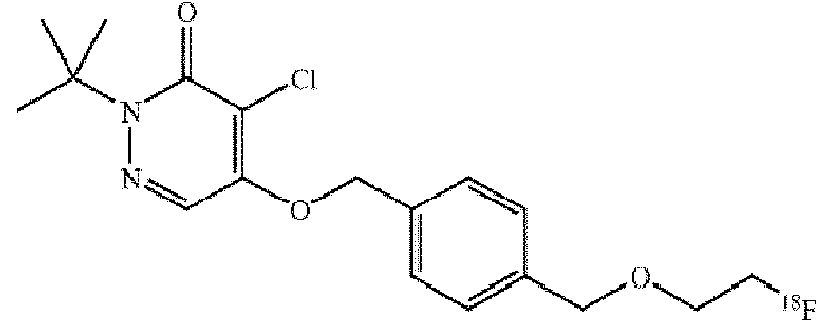


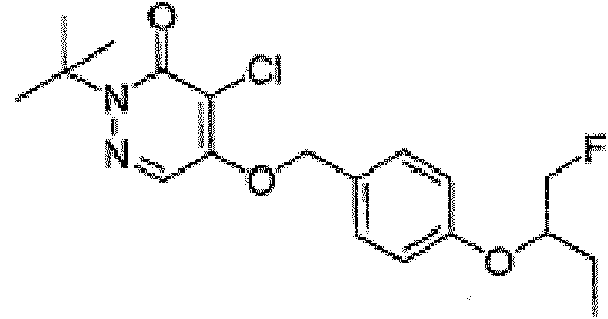


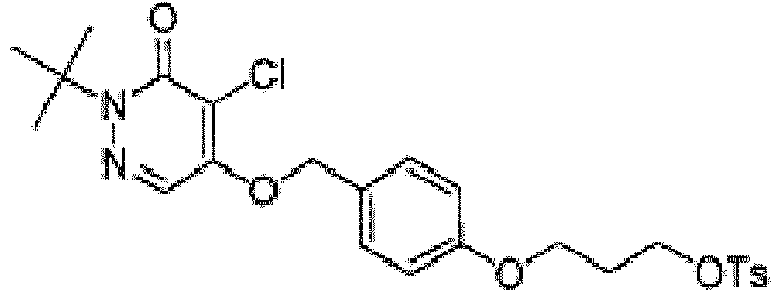


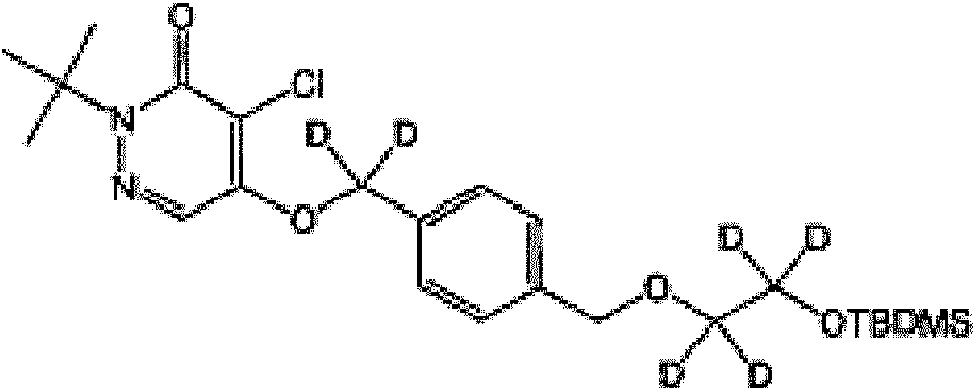


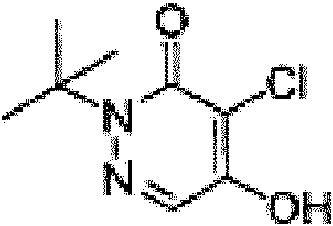


Applications Claiming Priority (2)
| Application Number | Priority Date | Filing Date | Title |
|---|---|---|---|
| US54486104P | 2004-02-13 | 2004-02-13 | |
| US11/055,498 US7344702B2 (en) | 2004-02-13 | 2005-02-10 | Contrast agents for myocardial perfusion imaging |
Publications (1)
| Publication Number | Publication Date |
|---|---|
| ES2878171T3 true ES2878171T3 (en) | 2021-11-18 |
Family
ID=34889838
Family Applications (2)
| Application Number | Title | Priority Date | Filing Date |
|---|---|---|---|
| ES18150652T Expired - Lifetime ES2878171T3 (en) | 2004-02-13 | 2005-02-11 | Contrast Agents for Myocardial Perfusion Imaging |
| ES05723066.6T Expired - Lifetime ES2665687T3 (en) | 2004-02-13 | 2005-02-11 | Contrast agents for myocardial perfusion imaging |
Family Applications After (1)
| Application Number | Title | Priority Date | Filing Date |
|---|---|---|---|
| ES05723066.6T Expired - Lifetime ES2665687T3 (en) | 2004-02-13 | 2005-02-11 | Contrast agents for myocardial perfusion imaging |
Country Status (18)
| Country | Link |
|---|---|
| US (7) | US7344702B2 (en) |
| EP (2) | EP1713512B1 (en) |
| JP (3) | JP5417578B2 (en) |
| KR (2) | KR101386851B1 (en) |
| CN (2) | CN102274527B (en) |
| AU (1) | AU2005214898C1 (en) |
| BR (1) | BRPI0507684B8 (en) |
| CA (3) | CA2944947A1 (en) |
| DK (2) | DK3385253T3 (en) |
| ES (2) | ES2878171T3 (en) |
| IL (4) | IL177275A0 (en) |
| IN (1) | IN2012DN02610A (en) |
| MX (1) | MX348859B (en) |
| NO (2) | NO344857B1 (en) |
| PT (1) | PT1713512T (en) |
| RU (2) | RU2457865C2 (en) |
| SG (1) | SG149895A1 (en) |
| WO (1) | WO2005079391A2 (en) |
Families Citing this family (39)
| Publication number | Priority date | Publication date | Assignee | Title |
|---|---|---|---|---|
| US7344702B2 (en) | 2004-02-13 | 2008-03-18 | Bristol-Myers Squibb Pharma Company | Contrast agents for myocardial perfusion imaging |
| US7485283B2 (en) * | 2004-04-28 | 2009-02-03 | Lantheus Medical Imaging | Contrast agents for myocardial perfusion imaging |
| US7824659B2 (en) * | 2005-08-10 | 2010-11-02 | Lantheus Medical Imaging, Inc. | Methods of making radiolabeled tracers and precursors thereof |
| US8986650B2 (en) | 2005-10-07 | 2015-03-24 | Guerbet | Complex folate-NOTA-Ga68 |
| EP1940841B9 (en) * | 2005-10-07 | 2017-04-19 | Guerbet | Compounds comprising a biological target recognizing part, coupled to a signal part capable of complexing gallium |
| US9259426B2 (en) * | 2006-07-20 | 2016-02-16 | Gilead Sciences, Inc. | 4,6-di- and 2,4,6-trisubstituted quinazoline derivatives useful for treating viral infections |
| WO2008009077A2 (en) * | 2006-07-20 | 2008-01-24 | Gilead Sciences, Inc. | 4,6-dl- and 2,4,6-trisubstituted quinazoline derivatives and pharmaceutical compositions useful for treating viral infections |
| TWI618544B (en) | 2006-12-26 | 2018-03-21 | 藍瑟斯醫學影像公司 | a ligand that visualizes the distribution of cardiac nerves |
| WO2008128058A1 (en) * | 2007-04-13 | 2008-10-23 | The Trustees Of The University Of Pennsylvania | New gallium bisaminothiolate complexes for myocardial imaging |
| AU2015200027B2 (en) * | 2008-02-29 | 2017-01-19 | Lantheus Medical Imaging, Inc. | Contrast agents for applications including perfusion imaging |
| AU2009220244B2 (en) | 2008-02-29 | 2014-10-09 | Lantheus Medical Imaging, Inc. | Contrast agents for applications including perfusion imaging |
| EP2300840B1 (en) * | 2008-07-09 | 2020-09-23 | Koninklijke Philips N.V. | Physiological pharmacokinetic analysis for combined molecular mri and dynamic pet imaging |
| KR101602992B1 (en) * | 2009-04-15 | 2016-03-11 | 랜티우스 메디컬 이메징, 인크. | Stabilization of radiopharmaceutical compositions using ascorbic acid |
| CN102471176A (en) * | 2009-07-11 | 2012-05-23 | 拜耳医药股份有限公司 | Non-polar and polar leaving groups |
| EP2289889A1 (en) * | 2009-08-18 | 2011-03-02 | Endura S.p.a. | Substituted alkynyl phenoxy compounds and their uses |
| CN101993383A (en) * | 2009-08-26 | 2011-03-30 | 成都伊诺达博医药科技有限公司 | New method for synthesizing dronedarone key intermediate 4-(3-(dibutylamino) propoxy] methyl benzoates |
| CN102858752B (en) | 2010-02-08 | 2018-10-16 | 兰休斯医疗成像公司 | Method and apparatus for synthesizing imaging agents and intermediates thereof |
| AU2011253052B2 (en) | 2010-05-11 | 2015-05-14 | Lantheus Medical Imaging, Inc. | Compositions, methods and systems for the synthesis and use of imaging agents |
| CN102038964B (en) * | 2010-12-30 | 2012-01-25 | 上海师范大学 | Amorphous Fe-Co-B nano magnetic resonance contrast agent material and preparation method thereof |
| EP2753605B1 (en) | 2011-09-09 | 2019-03-27 | Lantheus Medical Imaging, Inc. | Compositions, methods, and systems for the synthesis and use of imaging agents |
| WO2013058774A1 (en) * | 2011-10-21 | 2013-04-25 | Lantheus Medical Imaging, Inc. | Compositions comprising ascorbic acid and an imaging agent and related methods |
| ES2687234T3 (en) * | 2011-12-22 | 2018-10-24 | Respiratorius Ab | Contrast agent to obtain myocardial perfusion images |
| WO2013173004A2 (en) | 2012-04-10 | 2013-11-21 | Lantheus Medical Imaging, Inc. | Radiopharmaceutical synthesis methods |
| AU2013203000B9 (en) * | 2012-08-10 | 2017-02-02 | Lantheus Medical Imaging, Inc. | Compositions, methods, and systems for the synthesis and use of imaging agents |
| CN104583192B (en) | 2012-08-24 | 2016-10-12 | 浜松光子学株式会社 | Compounds Suitable for Mitochondrial Complex-1 Detection |
| WO2015098716A1 (en) * | 2013-12-26 | 2015-07-02 | 住友化学株式会社 | Method for producing halogen-substituted phthalide |
| US9745308B2 (en) | 2014-09-12 | 2017-08-29 | Chiesi Farmaceutici S.P.A. | Pyridazinone derivatives as phoshoinositide 3-kinases inhibitors |
| WO2016141092A1 (en) | 2015-03-04 | 2016-09-09 | Gilead Sciences, Inc. | Toll-like receptor modulating 4,6-diamino-pyrido[3,2-d]pyrimidine compounds |
| CN109923106B (en) | 2016-09-02 | 2022-09-13 | 吉利德科学公司 | toll-like receptor modulator compounds |
| EP3507288B1 (en) | 2016-09-02 | 2020-08-26 | Gilead Sciences, Inc. | 4,6-diamino-pyrido[3,2-d]pyrimidine derivaties as toll like receptor modulators |
| WO2018164043A1 (en) | 2017-03-07 | 2018-09-13 | 日本メジフィジックス株式会社 | Radioactive fluorine-labeled precursor compound, and method for producing radioactive fluorine-labeled compound using same |
| TW202212339A (en) | 2019-04-17 | 2022-04-01 | 美商基利科學股份有限公司 | Solid forms of a toll-like receptor modulator |
| TW202210480A (en) | 2019-04-17 | 2022-03-16 | 美商基利科學股份有限公司 | Solid forms of a toll-like receptor modulator |
| TWI879779B (en) | 2019-06-28 | 2025-04-11 | 美商基利科學股份有限公司 | Processes for preparing toll-like receptor modulator compounds |
| GB201915206D0 (en) | 2019-10-21 | 2019-12-04 | Ge Healthcare Ltd | Use of cyclodextrins as a radiostabilizer |
| CN111320620A (en) * | 2020-03-17 | 2020-06-23 | 四川大学华西医院 | A kind of isoquinoline pyridazinone compound and its synthetic method and application |
| CN114832118B (en) * | 2022-07-04 | 2022-09-27 | 北京先通国际医药科技股份有限公司 | Compound I liquid composition, preparation method and use thereof |
| CN116082670B (en) * | 2023-04-11 | 2023-06-27 | 中国人民解放军军事科学院军事医学研究院 | Preparation method of acoustic response pseudo conjugated polymer nano particles containing quaternary phosphonium salt and application of nano particles in antibacterial field |
| WO2025212569A1 (en) | 2024-04-05 | 2025-10-09 | Park City Bio, LLC | Selective serotonin receptor modultors and methods of making and using the same |
Family Cites Families (122)
| Publication number | Priority date | Publication date | Assignee | Title |
|---|---|---|---|---|
| GB1073999A (en) * | 1965-01-29 | 1967-06-28 | Ncr Co | Process for forming stable images in photochromic material |
| JPS5888334A (en) * | 1981-11-20 | 1983-05-26 | Takasago Corp | 3-l-menthoxypropane-1,2-diol |
| US4510125A (en) | 1982-12-08 | 1985-04-09 | Mallinckrodt, Inc. | Process for making lyophilized radiographic imaging kit |
| JPS604173A (en) | 1983-06-23 | 1985-01-10 | Nissan Chem Ind Ltd | Pyridazinone derivative, its preparation and insecticidal, miticidal and fungicidal agent |
| DE3574870D1 (en) | 1984-06-23 | 1990-01-25 | Nissan Chemical Ind Ltd | METHOD FOR PRODUCING 2-TERT.-BUTYL-4,5-DICHLORO-3 (2H) -PYRIDAZINONE. |
| JPH07116161B2 (en) | 1984-07-04 | 1995-12-13 | 日産化学工業株式会社 | Pyridazinone derivative |
| JPS61130275A (en) | 1984-11-29 | 1986-06-18 | Nissan Chem Ind Ltd | Pyridazinone derivative, preparation thereof, and insecticidal, miticidal and fungicidal agent |
| EP0183212B1 (en) | 1984-11-29 | 1990-06-20 | Nissan Chemical Industries Ltd. | Pyridazinone derivatives, preparation thereof, and insecticidal, acaricidal, nematicidal, fungicidal compositions |
| CA1265798A (en) | 1984-12-10 | 1990-02-13 | Motoo Mutsukado | 3(2h)pyridazinone, process for its preparation and anti-allergic agent containing it |
| US5393512A (en) * | 1985-01-14 | 1995-02-28 | Vanderheyden; Jean-Luc | Stable therapeutic radionuclide compositions and methods for preparation thereof |
| JPH0641454B2 (en) | 1985-02-27 | 1994-06-01 | 日産化学工業株式会社 | Pyridazinone derivative |
| JPS61260018A (en) | 1985-05-14 | 1986-11-18 | Nissan Chem Ind Ltd | Anti-allergic agent |
| JPH0739397B2 (en) | 1985-07-30 | 1995-05-01 | 日産化学工業株式会社 | Pyridazinone derivatives and pest control agents |
| YU134686A (en) | 1985-07-30 | 1988-02-29 | Nissan Chemical Ind Ltd | Process for preparing new derivatives 3-(2h)-pyridazinone |
| EP0247156B1 (en) | 1985-11-18 | 1993-06-23 | Access Pharmaceuticals Inc. | Polychelating agents for image and spectral enhancement (and spectral shift) |
| JPS6315974A (en) | 1986-07-09 | 1988-01-23 | 小泉コンピユ−タ−株式会社 | Balling game score table display apparatus |
| US5252317A (en) | 1986-11-10 | 1993-10-12 | The State Of Oregon Acting By And Through The State Board Of Higher Education On Behalf Of The University Of Oregon | Amplifier molecules for diagnosis and therapy derived from 3,5-bis[1-(3-amino-2,2-bis (aminomethyl)-propyl) oxymethyl] benzoic acid |
| US5567411A (en) | 1986-11-10 | 1996-10-22 | State Of Oregon Acting By And Through The State Board Of Higher Education On Behalf Of The University Of Oregon | Dendritic amplifier molecules having multiple terminal active groups stemming from a benzyl core group |
| JPS63159373A (en) | 1986-12-24 | 1988-07-02 | Nissan Chem Ind Ltd | Pyridazinones and insecticide, acaricide and nematocide |
| JPS63159372A (en) | 1986-12-24 | 1988-07-02 | Nissan Chem Ind Ltd | Pyridazinone compound and insecticide, acaricide and nematocide |
| JPS63159374A (en) | 1986-12-24 | 1988-07-02 | Nissan Chem Ind Ltd | Pyridazinone derivative and insecticide, acaricide and nematocide |
| DE3824210A1 (en) | 1988-07-16 | 1990-01-18 | Basf Ag | 3 (2H) -PYRIDAZINONE DERIVATIVES FOR CONTROLLING SNAILS |
| IT1229684B (en) * | 1989-04-05 | 1991-09-06 | Mini Ricerca Scient Tecnolog | PYRIDAZINONE WITH INSECTICIDE AND ACARICIDE ACTIVITY |
| JPH02279676A (en) | 1989-04-19 | 1990-11-15 | Otsuka Chem Co Ltd | Pyridazinone derivative |
| US5087440A (en) | 1989-07-31 | 1992-02-11 | Salutar, Inc. | Heterocyclic derivatives of DTPA used for magnetic resonance imaging |
| GB8923843D0 (en) | 1989-10-23 | 1989-12-13 | Salutar Inc | Compounds |
| US5377681A (en) | 1989-11-13 | 1995-01-03 | University Of Florida | Method of diagnosing impaired blood flow |
| US5228446A (en) | 1989-12-22 | 1993-07-20 | Unger Evan C | Gas filled liposomes and their use as ultrasonic contrast agents |
| US5088499A (en) | 1989-12-22 | 1992-02-18 | Unger Evan C | Liposomes as contrast agents for ultrasonic imaging and methods for preparing the same |
| US5585112A (en) | 1989-12-22 | 1996-12-17 | Imarx Pharmaceutical Corp. | Method of preparing gas and gaseous precursor-filled microspheres |
| US5679810A (en) | 1990-01-19 | 1997-10-21 | Salutar, Inc. | Linear oligomeric polychelant compounds |
| JPH03220177A (en) | 1990-01-25 | 1991-09-27 | Nissan Chem Ind Ltd | Insecticidal/miticidal agent composition |
| WO1992017215A1 (en) | 1990-03-28 | 1992-10-15 | Nycomed Salutar, Inc. | Contrast media |
| US5250283A (en) * | 1990-03-28 | 1993-10-05 | Molecular Biosystems, Inc. | Organic contrast agent analog and method of making same |
| GB9006977D0 (en) | 1990-03-28 | 1990-05-23 | Nycomed As | Compositions |
| JPH04235975A (en) | 1991-01-21 | 1992-08-25 | Nissan Chem Ind Ltd | Pyridazinone drivative and insect pest control agent |
| US5205290A (en) | 1991-04-05 | 1993-04-27 | Unger Evan C | Low density microspheres and their use as contrast agents for computed tomography |
| US5093105A (en) * | 1991-04-09 | 1992-03-03 | Merck Frosst Canada, Inc. | Radiopharmaceutical bacteriostats |
| US5306482A (en) * | 1991-04-09 | 1994-04-26 | Merck Frosst Canada, Inc. | Radiopharmaceutical bacteriostats |
| DK0600992T3 (en) * | 1991-08-29 | 2000-10-09 | Mallinckrodt Medical Inc | Use of gentisic acid or gentisyl alcohol to stabilize radiolabelled peptides and proteins |
| US5169942A (en) * | 1991-11-21 | 1992-12-08 | General Electric Company | Method for making 2-(18F)fluoro-2-deoxy-D-glucose |
| AU4530493A (en) * | 1992-06-17 | 1994-01-04 | Procter & Gamble Company, The | Coolant compositions with reduced stinging |
| WO1994012479A1 (en) | 1992-12-03 | 1994-06-09 | Otsuka Kagaku Kabushiki Kaisha | Pyridazinone derivative and insecticidal and miticidal agent |
| US5760191A (en) | 1993-02-05 | 1998-06-02 | Nycomed Imaging As | Macrocyclic complexing agents and targeting immunoreagents useful in therapeutic and diagnostic compositions and methods |
| JPH07507813A (en) * | 1993-03-22 | 1995-08-31 | ゼネラル・エレクトリック・カンパニイ | Method for producing 2-fluoro-2-deoxyglucose |
| EP0692978A4 (en) | 1993-03-31 | 1998-05-06 | Mallinckrodt Medical Inc | RADIOPHARMACEUTICAL FORMULATIONS HAVING NON-STANNEOUS REDUCING AGENTS |
| US5417959A (en) | 1993-10-04 | 1995-05-23 | Mallinckrodt Medical, Inc. | Functionalized aza-crytand ligands for diagnostic imaging applications |
| US5493026A (en) | 1993-10-25 | 1996-02-20 | Organix, Inc. | Substituted 2-carboxyalkyl-3-(fluorophenyl)-8-(3-halopropen-2-yl) nortropanes and their use as imaging for agents for neurodegenerative disorders |
| GB9323028D0 (en) | 1993-11-09 | 1994-01-05 | Isis Innovation | Asymmetric hydroboration |
| EP0665223A1 (en) | 1994-01-28 | 1995-08-02 | Takeda Chemical Industries, Ltd. | Antitumor agent, novel 3(2H)-pyridazinone derivatives and their preparation |
| JPH07252236A (en) | 1994-01-28 | 1995-10-03 | Takeda Chem Ind Ltd | Anticancer agent |
| AU7312694A (en) | 1994-06-03 | 1996-01-04 | Mallinckrodt Medical, Inc. | Rapidly clearing technetium-99m phosphonate skeletal imaging agents |
| US5520904A (en) | 1995-01-27 | 1996-05-28 | Mallinckrodt Medical, Inc. | Calcium/oxyanion-containing particles with a polymerical alkoxy coating for use in medical diagnostic imaging |
| EP0727225A3 (en) | 1995-02-14 | 1997-01-15 | Sonus Pharma Inc | Compositions and methods for directed ultrasound imaging |
| US5587491A (en) * | 1995-03-15 | 1996-12-24 | Regents Of The University Of Minnesota | Method for the synthesis of bis-tetrahydrofuranyl Annonaceous acetogenins |
| US5801228A (en) | 1995-06-07 | 1998-09-01 | Nycomed Imaging As | Polymeric contrast agents for medical imaging |
| US5811073A (en) | 1995-06-19 | 1998-09-22 | President And Fellows Of Harvard College | Method for radioisotopic detection and localization of inflammation in a host |
| US5827073A (en) * | 1995-07-05 | 1998-10-27 | Ludwig Institute For Cancer Research | Photoreactive peptide derivatives |
| US6066309A (en) * | 1996-02-02 | 2000-05-23 | Rhomed Incorporated | Post-labeling stabilization of radiolabeled proteins and peptides |
| US5804161A (en) | 1996-05-14 | 1998-09-08 | Nycomed Salutar Inc. | Contrast agents |
| US5846517A (en) | 1996-09-11 | 1998-12-08 | Imarx Pharmaceutical Corp. | Methods for diagnostic imaging using a renal contrast agent and a vasodilator |
| WO1998018497A2 (en) * | 1996-10-28 | 1998-05-07 | Nycomed Imaging As | Contrast agents |
| US6565889B2 (en) * | 1996-12-02 | 2003-05-20 | The Regents Of The University Of California | Bilayer structure which encapsulates multiple containment units and uses thereof |
| US5961955A (en) * | 1997-06-03 | 1999-10-05 | Coulter Pharmaceutical, Inc. | Radioprotectant for peptides labeled with radioisotope |
| JP4017758B2 (en) * | 1998-08-04 | 2007-12-05 | 高砂香料工業株式会社 | Cooling agent composition |
| US6056939A (en) * | 1998-08-28 | 2000-05-02 | Desreux; Jean F. | Self-assembling heteropolymetallic chelates as imaging agents and radiopharmaceuticals |
| DE69941298D1 (en) * | 1998-09-29 | 2009-10-01 | Merck & Co Inc | Radiolabeled Neukoquin-1 receptor antagonists |
| US6645508B1 (en) | 1999-06-18 | 2003-11-11 | Jivn-Ren Chen | Stable L-ascorbic acid composition |
| US6878363B2 (en) * | 2000-05-17 | 2005-04-12 | Bristol-Myers Squibb Pharma Company | Use of small molecule radioligands to discover inhibitors of amyloid-beta peptide production and for diagnostic imaging |
| GB0019357D0 (en) | 2000-08-07 | 2000-09-27 | Melacure Therapeutics Ab | Novel phenyl guanidines |
| AU2001288899A1 (en) | 2000-09-06 | 2002-03-22 | The Scripps Research Institute | Inhibitors of nadh:ubiquinone oxidoreductase |
| TWI247609B (en) * | 2001-01-23 | 2006-01-21 | Nihon Mediphysics Co Ltd | Agent for diagnosis of tissue proliferation activity or the treatment of proliferative disease |
| GB0115927D0 (en) | 2001-06-29 | 2001-08-22 | Nycomed Amersham Plc | Solid-phase nucleophilic fluorination |
| US7344702B2 (en) | 2004-02-13 | 2008-03-18 | Bristol-Myers Squibb Pharma Company | Contrast agents for myocardial perfusion imaging |
| US20030044354A1 (en) | 2001-08-16 | 2003-03-06 | Carpenter Alan P. | Gas microsphere liposome composites for ultrasound imaging and ultrasound stimulated drug release |
| US20030082191A1 (en) | 2001-08-29 | 2003-05-01 | Poduslo Joseph F. | Treatment for central nervous system disorders |
| AU2002347906A2 (en) | 2001-10-16 | 2003-04-28 | Hypnion, Inc. | Treatment of CNS disorders using CNS target modulators |
| EP1474177A4 (en) | 2002-02-06 | 2010-07-21 | Univ Johns Hopkins | NON-INVASIVE DIAGNOSTIC IMAGING TECHNOLOGY FOR MITOCHONDRIA DYSFUNCTIONS USING RADIOMARTIC LIPOPHILIC SALTS |
| CN1642580B (en) * | 2002-03-29 | 2010-05-26 | 詹森药业有限公司 | Radiolabeled quinoline and quinolinone derivatives and their use as metabolic glutamate receptor ligands for the manufacture |
| AU2003224747A1 (en) | 2002-04-08 | 2003-10-27 | Biostream, Inc. | Technetium-labeled rotenone derivatives, and methods of use thereof |
| GB0229683D0 (en) | 2002-12-20 | 2003-01-29 | Imaging Res Solutions Ltd | Preparation of radiopharmaceuticals |
| NZ544472A (en) * | 2003-07-03 | 2009-04-30 | Myriad Genetics Inc | Compounds and therapeutical use thereof |
| WO2005007632A1 (en) | 2003-07-18 | 2005-01-27 | Pharmacia Corporation | Substituted pyridazinones as inhibitors of p38 |
| CA2526556C (en) | 2003-07-24 | 2012-09-25 | Bracco Imaging S.P.A. | Stable radiopharmaceutical compositions and methods for their preparation |
| GB0317920D0 (en) | 2003-07-31 | 2003-09-03 | Amersham Plc | Solid-phase synthesis |
| US7927616B2 (en) * | 2004-01-16 | 2011-04-19 | Thomas T. Yamashita | Pesticide compositions and methods for their use |
| AU2005216949B2 (en) | 2004-02-24 | 2011-09-22 | The General Hospital Corporation | Catalytic radiofluorination |
| WO2005085200A1 (en) | 2004-03-05 | 2005-09-15 | Banyu Pharmaceutical Co., Ltd. | Pyridone derivative |
| AT500838B1 (en) | 2004-04-20 | 2007-11-15 | Veterinaermedizinische Uni Wie | MULTIPLE HSE |
| US7485283B2 (en) | 2004-04-28 | 2009-02-03 | Lantheus Medical Imaging | Contrast agents for myocardial perfusion imaging |
| US20060083681A1 (en) * | 2004-10-18 | 2006-04-20 | Ajay Purohit | Compounds for myocardial perfusion imaging |
| US7534418B2 (en) * | 2004-12-10 | 2009-05-19 | The Regents Of The University Of Michigan | Imaging agents |
| KR100789847B1 (en) * | 2004-12-15 | 2007-12-28 | (주)퓨쳐켐 | Process for preparing organofluoro compound in alcohol solvent |
| US7837982B2 (en) * | 2005-06-23 | 2010-11-23 | Emory University | Imaging agents |
| US7824659B2 (en) | 2005-08-10 | 2010-11-02 | Lantheus Medical Imaging, Inc. | Methods of making radiolabeled tracers and precursors thereof |
| JP2007112725A (en) | 2005-10-18 | 2007-05-10 | Inst Nuclear Energy Research Rocaec | A method for producing an unsupported 18F-labeled amino acid O- (2- [18F] fluoroethyl) -L-tyrosine. |
| US7871623B2 (en) | 2005-12-21 | 2011-01-18 | The Board Of Trustees Of The Leland Stanford Junior University | Compositions and methods for imaging pain and stress in vivo |
| US7700616B2 (en) | 2006-05-08 | 2010-04-20 | Molecular Neuroimaging, Llc. | Compounds and amyloid probes thereof for therapeutic and imaging uses |
| PL2029178T3 (en) * | 2006-06-21 | 2012-08-31 | Ge Healthcare Ltd | Radiopharmaceutical products |
| KR20090047542A (en) | 2006-08-25 | 2009-05-12 | 베링거 인겔하임 인터내셔날 게엠베하 | Novel pyridone derivatives having MHC antagonistic activity and pharmaceuticals containing the compound |
| GB0625523D0 (en) | 2006-12-21 | 2007-01-31 | Ge Healthcare Ltd | In vivo imaging agents |
| TWI618544B (en) | 2006-12-26 | 2018-03-21 | 藍瑟斯醫學影像公司 | a ligand that visualizes the distribution of cardiac nerves |
| JP5504563B2 (en) | 2006-12-27 | 2014-05-28 | 住友化学株式会社 | Composition and light-emitting device using the composition |
| GB0718386D0 (en) * | 2007-09-21 | 2007-10-31 | Ge Healthcare As | Improved radiopharmaceutical formulation |
| KR101068835B1 (en) | 2007-10-26 | 2011-09-30 | 한국과학기술연구원 | Isoindoleone compounds having excellent binding affinity to beta-amyloid aggregates and fibrils and methods for their preparation |
| CL2008003785A1 (en) | 2007-12-21 | 2009-10-09 | Du Pont | Pyridazine derived compounds; herbicidal compositions comprising said compounds; and method of controlling the growth of unwanted vegetation. |
| WO2009103478A1 (en) | 2008-02-19 | 2009-08-27 | Boehringer Ingelheim International Gmbh | Pyridone and pyridazinone derivatives as mch antagonists |
| WO2010011367A2 (en) | 2008-02-22 | 2010-01-28 | Illinois Institute Of Technology | Bimodal ligands with macrocyclic and acyclic binding moieties, complexes and compositions thereof, and methods of using |
| AU2009220244B2 (en) | 2008-02-29 | 2014-10-09 | Lantheus Medical Imaging, Inc. | Contrast agents for applications including perfusion imaging |
| US8258134B2 (en) | 2008-04-16 | 2012-09-04 | Hoffmann-La Roche Inc. | Pyridazinone glucokinase activators |
| WO2010104818A1 (en) | 2009-03-09 | 2010-09-16 | Bristol-Myers Squibb Company | Aza pyridone analogs useful as melanin concentrating hormone receptor-1 antagonists |
| KR101602992B1 (en) | 2009-04-15 | 2016-03-11 | 랜티우스 메디컬 이메징, 인크. | Stabilization of radiopharmaceutical compositions using ascorbic acid |
| CN101555232B (en) | 2009-05-21 | 2011-01-05 | 北京师范大学 | Pyridazinone compound marked by fluorine-18, preparation method and applications |
| CN102471176A (en) | 2009-07-11 | 2012-05-23 | 拜耳医药股份有限公司 | Non-polar and polar leaving groups |
| CN102858752B (en) | 2010-02-08 | 2018-10-16 | 兰休斯医疗成像公司 | Method and apparatus for synthesizing imaging agents and intermediates thereof |
| DE102010036356A1 (en) | 2010-07-12 | 2012-01-12 | Abx Advanced Biochemical Compounds Gmbh | Apparatus for the synthesis of radioactively labeled compounds |
| JP5842594B2 (en) | 2010-12-27 | 2016-01-13 | 住友化学株式会社 | Pyridazinone compounds, herbicides containing them, and harmful arthropod control agents |
| CN102336741B (en) | 2011-07-06 | 2013-04-10 | 北京师范大学 | Fluorine-18-marked myocardial perfusion developing agent and preparation method and application thereof |
| EP2753605B1 (en) | 2011-09-09 | 2019-03-27 | Lantheus Medical Imaging, Inc. | Compositions, methods, and systems for the synthesis and use of imaging agents |
| WO2013058774A1 (en) | 2011-10-21 | 2013-04-25 | Lantheus Medical Imaging, Inc. | Compositions comprising ascorbic acid and an imaging agent and related methods |
| AU2013203000B9 (en) | 2012-08-10 | 2017-02-02 | Lantheus Medical Imaging, Inc. | Compositions, methods, and systems for the synthesis and use of imaging agents |
| EP2882863B1 (en) | 2012-08-13 | 2021-07-14 | The General Hospital Corporation | System and method for quantitative mapping of mitocondrial complex 1 |
-
2005
- 2005-02-10 US US11/055,498 patent/US7344702B2/en active Active
- 2005-02-11 WO PCT/US2005/004687 patent/WO2005079391A2/en not_active Ceased
- 2005-02-11 CA CA2944947A patent/CA2944947A1/en not_active Abandoned
- 2005-02-11 ES ES18150652T patent/ES2878171T3/en not_active Expired - Lifetime
- 2005-02-11 PT PT57230666T patent/PT1713512T/en unknown
- 2005-02-11 DK DK18150652.8T patent/DK3385253T3/en active
- 2005-02-11 AU AU2005214898A patent/AU2005214898C1/en not_active Expired
- 2005-02-11 DK DK05723066.6T patent/DK1713512T3/en active
- 2005-02-11 CA CA2556213A patent/CA2556213C/en not_active Expired - Lifetime
- 2005-02-11 CN CN201110230866.8A patent/CN102274527B/en not_active Expired - Lifetime
- 2005-02-11 IN IN2610DEN2012 patent/IN2012DN02610A/en unknown
- 2005-02-11 ES ES05723066.6T patent/ES2665687T3/en not_active Expired - Lifetime
- 2005-02-11 JP JP2006553329A patent/JP5417578B2/en not_active Expired - Lifetime
- 2005-02-11 KR KR1020127004760A patent/KR101386851B1/en not_active Expired - Fee Related
- 2005-02-11 CN CN2005800064799A patent/CN1925878B/en not_active Expired - Lifetime
- 2005-02-11 SG SG200900799-8A patent/SG149895A1/en unknown
- 2005-02-11 RU RU2006132814/15A patent/RU2457865C2/en active
- 2005-02-11 EP EP05723066.6A patent/EP1713512B1/en not_active Expired - Lifetime
- 2005-02-11 MX MX2013002282A patent/MX348859B/en unknown
- 2005-02-11 EP EP18150652.8A patent/EP3385253B1/en not_active Expired - Lifetime
- 2005-02-11 KR KR1020067016221A patent/KR101186449B1/en not_active Expired - Lifetime
- 2005-02-11 CA CA2828128A patent/CA2828128C/en not_active Expired - Lifetime
- 2005-02-11 BR BRPI0507684A patent/BRPI0507684B8/en active IP Right Grant
-
2006
- 2006-08-03 IL IL177275A patent/IL177275A0/en unknown
- 2006-09-06 NO NO20064011A patent/NO344857B1/en unknown
-
2008
- 2008-01-15 US US12/014,161 patent/US8226929B2/en active Active
-
2012
- 2012-04-09 RU RU2012113613A patent/RU2648358C2/en active
- 2012-06-21 US US13/529,756 patent/US9161997B2/en not_active Expired - Lifetime
- 2012-11-30 JP JP2012263291A patent/JP5847065B2/en not_active Expired - Lifetime
-
2013
- 2013-08-22 IL IL228097A patent/IL228097A/en active IP Right Grant
- 2013-08-22 IL IL177275A patent/IL177275A/en active IP Right Grant
-
2014
- 2014-08-25 JP JP2014170803A patent/JP6124848B2/en not_active Expired - Fee Related
-
2015
- 2015-09-04 US US14/845,320 patent/US9718786B2/en not_active Expired - Lifetime
-
2016
- 2016-01-28 IL IL243840A patent/IL243840A0/en unknown
-
2017
- 2017-04-19 NO NO20170638A patent/NO20170638A1/en not_active Application Discontinuation
- 2017-06-21 US US15/629,068 patent/US10125106B2/en not_active Expired - Lifetime
-
2018
- 2018-09-27 US US16/143,748 patent/US10889550B2/en not_active Expired - Fee Related
-
2020
- 2020-12-04 US US17/111,953 patent/US20210300878A1/en not_active Abandoned
Also Published As
Similar Documents
| Publication | Publication Date | Title |
|---|---|---|
| ES2878171T3 (en) | Contrast Agents for Myocardial Perfusion Imaging | |
| ES2744544T3 (en) | Contrast agents for myocardial perfusion imaging | |
| HK1262171A1 (en) | Contrast agents for myocardial perfusion imaging | |
| HK1262171B (en) | Contrast agents for myocardial perfusion imaging | |
| MXPA06008993A (en) | Contrast agents for myocardial perfusion imaging | |
| HK1164731B (en) | Contrast agents for myocardial perfusion imaging |