ES2879802T3 - 5'-end (cap) analogs of 5'-phosphorothiolate mRNA, mRNA comprising the same, method of obtaining and uses thereof - Google Patents
5'-end (cap) analogs of 5'-phosphorothiolate mRNA, mRNA comprising the same, method of obtaining and uses thereof Download PDFInfo
- Publication number
- ES2879802T3 ES2879802T3 ES17712541T ES17712541T ES2879802T3 ES 2879802 T3 ES2879802 T3 ES 2879802T3 ES 17712541 T ES17712541 T ES 17712541T ES 17712541 T ES17712541 T ES 17712541T ES 2879802 T3 ES2879802 T3 ES 2879802T3
- Authority
- ES
- Spain
- Prior art keywords
- mrna
- group
- cap
- mmol
- independently selected
- Prior art date
- Legal status (The legal status is an assumption and is not a legal conclusion. Google has not performed a legal analysis and makes no representation as to the accuracy of the status listed.)
- Active
Links
- 0 Nc1ncnc2c1N=C*2 Chemical compound Nc1ncnc2c1N=C*2 0.000 description 2
- WDOYBEPLTCFIRQ-UHFFFAOYSA-N CC[n]1c(N=C(N)NC2=O)c2nc1 Chemical compound CC[n]1c(N=C(N)NC2=O)c2nc1 WDOYBEPLTCFIRQ-UHFFFAOYSA-N 0.000 description 1
Classifications
-
- A—HUMAN NECESSITIES
- A61—MEDICAL OR VETERINARY SCIENCE; HYGIENE
- A61P—SPECIFIC THERAPEUTIC ACTIVITY OF CHEMICAL COMPOUNDS OR MEDICINAL PREPARATIONS
- A61P21/00—Drugs for disorders of the muscular or neuromuscular system
-
- A—HUMAN NECESSITIES
- A61—MEDICAL OR VETERINARY SCIENCE; HYGIENE
- A61P—SPECIFIC THERAPEUTIC ACTIVITY OF CHEMICAL COMPOUNDS OR MEDICINAL PREPARATIONS
- A61P21/00—Drugs for disorders of the muscular or neuromuscular system
- A61P21/02—Muscle relaxants, e.g. for tetanus or cramps
-
- A—HUMAN NECESSITIES
- A61—MEDICAL OR VETERINARY SCIENCE; HYGIENE
- A61P—SPECIFIC THERAPEUTIC ACTIVITY OF CHEMICAL COMPOUNDS OR MEDICINAL PREPARATIONS
- A61P25/00—Drugs for disorders of the nervous system
-
- A—HUMAN NECESSITIES
- A61—MEDICAL OR VETERINARY SCIENCE; HYGIENE
- A61P—SPECIFIC THERAPEUTIC ACTIVITY OF CHEMICAL COMPOUNDS OR MEDICINAL PREPARATIONS
- A61P35/00—Antineoplastic agents
-
- A—HUMAN NECESSITIES
- A61—MEDICAL OR VETERINARY SCIENCE; HYGIENE
- A61P—SPECIFIC THERAPEUTIC ACTIVITY OF CHEMICAL COMPOUNDS OR MEDICINAL PREPARATIONS
- A61P43/00—Drugs for specific purposes, not provided for in groups A61P1/00-A61P41/00
-
- C—CHEMISTRY; METALLURGY
- C07—ORGANIC CHEMISTRY
- C07H—SUGARS; DERIVATIVES THEREOF; NUCLEOSIDES; NUCLEOTIDES; NUCLEIC ACIDS
- C07H1/00—Processes for the preparation of sugar derivatives
- C07H1/02—Phosphorylation
- C07H1/04—Introducing polyphosphoric acid radicals
-
- C—CHEMISTRY; METALLURGY
- C07—ORGANIC CHEMISTRY
- C07H—SUGARS; DERIVATIVES THEREOF; NUCLEOSIDES; NUCLEOTIDES; NUCLEIC ACIDS
- C07H21/00—Compounds containing two or more mononucleotide units having separate phosphate or polyphosphate groups linked by saccharide radicals of nucleoside groups, e.g. nucleic acids
-
- C—CHEMISTRY; METALLURGY
- C07—ORGANIC CHEMISTRY
- C07H—SUGARS; DERIVATIVES THEREOF; NUCLEOSIDES; NUCLEOTIDES; NUCLEIC ACIDS
- C07H21/00—Compounds containing two or more mononucleotide units having separate phosphate or polyphosphate groups linked by saccharide radicals of nucleoside groups, e.g. nucleic acids
- C07H21/02—Compounds containing two or more mononucleotide units having separate phosphate or polyphosphate groups linked by saccharide radicals of nucleoside groups, e.g. nucleic acids with ribosyl as saccharide radical
Landscapes
- Chemical & Material Sciences (AREA)
- Health & Medical Sciences (AREA)
- Organic Chemistry (AREA)
- Life Sciences & Earth Sciences (AREA)
- General Health & Medical Sciences (AREA)
- Molecular Biology (AREA)
- Biochemistry (AREA)
- Engineering & Computer Science (AREA)
- Pharmacology & Pharmacy (AREA)
- General Chemical & Material Sciences (AREA)
- Nuclear Medicine, Radiotherapy & Molecular Imaging (AREA)
- Public Health (AREA)
- Veterinary Medicine (AREA)
- Medicinal Chemistry (AREA)
- Animal Behavior & Ethology (AREA)
- Chemical Kinetics & Catalysis (AREA)
- Genetics & Genomics (AREA)
- Biotechnology (AREA)
- Bioinformatics & Cheminformatics (AREA)
- Neurology (AREA)
- Physical Education & Sports Medicine (AREA)
- Orthopedic Medicine & Surgery (AREA)
- Biomedical Technology (AREA)
- Neurosurgery (AREA)
- Pain & Pain Management (AREA)
- Pharmaceuticals Containing Other Organic And Inorganic Compounds (AREA)
- Medicines That Contain Protein Lipid Enzymes And Other Medicines (AREA)
- Saccharide Compounds (AREA)
- Enzymes And Modification Thereof (AREA)
- Preparation Of Compounds By Using Micro-Organisms (AREA)
Abstract
Un análogo de caperuza 5'fosforotiolato según la fórmula 1 **(Ver fórmula)** en donde L1 y L2 se seleccionan independientemente del grupo que comprende O y S, en donde al menos uno de L1 y L2 no es O; n = 0, 1 o 2; X1, X2, X3 se seleccionan independientemente del grupo que comprende O, S; R1 se selecciona del grupo que comprende CH3, C2H5, CH2Ph, alquilo o alquilo sustituido; R2 y R3 se seleccionan independientemente del grupo que comprende H, OH, OCH3, OC2H5, -COOH, N3, alquilo, alquenilo, o alquinilo; R4 y R5 se seleccionan independientemente del grupo que comprende H, OH, OCH3, OC2H5, -COOH, CH2COOH, N3, CH2N3, alquilo, alquenilo, o alquinilo; Y1, Y2 se seleccionan independientemente del grupo que comprende CH2, CHCl, CCl2, CF2, CHF, NH, O; y B es un grupo según la fórmula 3, 4, 5, 6, o 7 **(Ver fórmula)**A 5'phosphorothiolate cap analog according to Formula 1 **(See Formula)** wherein L1 and L2 are independently selected from the group consisting of O and S, wherein at least one of L1 and L2 is not O; n = 0, 1 or 2; X1, X2, X3 are independently selected from the group consisting of O, S; R1 is selected from the group consisting of CH3, C2H5, CH2Ph, alkyl or substituted alkyl; R2 and R3 are independently selected from the group consisting of H, OH, OCH3, OC2H5, -COOH, N3, alkyl, alkenyl, or alkynyl; R4 and R5 are independently selected from the group consisting of H, OH, OCH3, OC2H5, -COOH, CH2COOH, N3, CH2N3, alkyl, alkenyl, or alkynyl; Y1, Y2 are independently selected from the group consisting of CH2, CHCl, CCl2, CF2, CHF, NH, O; and B is a group according to formula 3, 4, 5, 6, or 7 **(See formula)**
Description
DESCRIPCIÓNDESCRIPTION
Análogos de extremo 5' (caperuza) de ARNm 5'-fosforotiolato, ARNm que comprende los mismos, método de obtención y usos de los mismosAnalogs of the 5 'end (cap) of 5'-phosphorothiolate mRNA, mRNA comprising the same, method of obtaining and uses thereof
Campo técnicoTechnical field
La presente invención se refiere a análogos del extremo 5' (caperuza) de ARNm que contienen una fracción 5'-fosforotiolato y usos de los mismos.The present invention relates to 5'-end (cap) analogs of mRNA containing a 5'-phosphorothiolate moiety and uses thereof.
Los análogos de caperuza 5'-fosforotiolato se usan como inhibidores de la enzima de DcpS lo que permite su aplicación como una medicina, en especial para el tratamiento de atrofia muscular espinal (AME). La presente invención también se refiere a ARNm modificado en el extremo 5' con análogos del extremo 5' (caperuza) del ARNm que contienen una fracción 5'-fosforotiolato según la invención, en donde la modificación se dirige a obtener transcritos de ARNm con una estabilidad y actividad de traducción aumentadas en condiciones celulares. Los transcritos con tales propiedades son aplicables en terapias génicas novedosas basadas en ARNm.The 5'-phosphorothiolate cap analogs are used as inhibitors of the DcpS enzyme allowing their application as a medicine, especially for the treatment of spinal muscular atrophy (SMA). The present invention also relates to mRNA modified at the 5 'end with analogs of the 5' end (cap) of mRNA containing a 5'-phosphorothiolate moiety according to the invention, wherein the modification is aimed at obtaining mRNA transcripts with a increased translation stability and activity under cellular conditions. Transcripts with such properties are applicable in novel mRNA-based gene therapies.
Antecedentes técnicosTechnical background
Los análogos del extremo 5' del ARNm químicamente derivados tienen una variedad de usos, y las modificaciones implementadas en esta estructura pueden modificar significativamente las propiedades biológicas de estos compuestos (Ziemniak, Strenkowska et al., 2013). Entre las varias aplicaciones de análogos de caperuza, las más frecuentes implican su uso como inhibidores de bajo peso molecular de procesos dependientes de la caperuza para fines terapéuticos (por ejemplo, inhibición de la enzima DpcS -terapia de atrofia muscular espinal). Por otra parte, los análogos de caperuza dinucleotídicos adecuadamente modificados se usan para modificar ARNm mensajero por cotranscripción in vitro, con el fin de obtener transcritos con estabilidad y actividad de traducción mejoradas en condiciones celulares. Los transcritos con tales propiedades se estudian cada vez más en el contexto de terapias génicas novedosas basadas en ARNm. En el último caso, la resistencia de las estructuras de la caperuza a otra enzima anticaperuza, Dcp2, es un asunto clave.Chemically derived 5'-end analogs of mRNA have a variety of uses, and modifications implemented in this structure can significantly modify the biological properties of these compounds (Ziemniak, Strenkowska et al., 2013). Among the various applications of cap analogs, the most frequent involve their use as low molecular weight inhibitors of cap-dependent processes for therapeutic purposes (eg, inhibition of the enzyme DpcS - spinal muscular atrophy therapy). On the other hand, suitably modified dinucleotide cap analogs are used to modify messenger mRNA by cotranscription in vitro, in order to obtain transcripts with improved translation stability and activity under cellular conditions. Transcripts with such properties are increasingly being studied in the context of novel mRNA-based gene therapies. In the latter case, the resistance of the cap structures to another anti-cap enzyme, Dcp2, is a key issue.
La enzima DcpS (secuestrante anticaperuza) es una enzima implicada en el proceso de degradación de ARNm en eucariotas. Hay dos rutas principales de degradación de ARNm en células eucariotas, la degradación 5 '^ 3 ' y la degradación 3 '^ 5 ' (Rydzik, Lukaszewicz et al., 2009). Ambas rutas de degradación se inician por desadenilación. La degradación en dirección 5 '^ 3 ' está seguida por eliminación de la caperuza del ARNm como resultado del corte del enlace entre los fosfatos a y p, y degradación por 5'-exonucleasa. La degradación 3 '^ 5 ' implica degradación de ARNm por exosoma empezando desde el extremo 3'. Tal degradación produce una liberación de residuos de la caperuza dinucleotídicos u oligonucleótidos cortos de finalización de la caperuza, que después son degradados por la enzima DcpS. DCpS pertenece a las pirofosfatasas de la familia HIT e hidroliza la caperuza entre los fosfatos y y P liberando 7-metilguanosina 5-monofosfato (m7GMP) y un segundo producto, que es en consecuencia un nucleósido 5'-difosfato o un oligonucleótido corto. Los ARNm terminados con caperuzas más largas no son sustratos para DcpS. Tampoco 7-metilguanosina 5'-difosfato (m7GDP), que es un producto de la degradación de ARNm 5 '^3 ', es un sustrato para DcpS. Una actividad de la enzima DcpS se considera vital para la homeostasis celular, ya que residuos de la caperuza innecesarios liberados del ARNm durante la degradación 3’^ -5 ’ podrían afectar adversamente otros procesos celulares dependientes de la caperuza. DcpS está localizada tanto en el citoplasma como en el núcleo, donde puede estar implicada en regulación del ayuste (Shen, Liu et al., 2008). Por tanto, se sugirió que el papel de DcpS en la célula va más allá de sus funciones bien caracterizadas en la degradación del ARNm 3 '^ 5 ' (Bail y Kiledjian 2008).The enzyme DcpS (anti-cap sequestrant) is an enzyme involved in the mRNA degradation process in eukaryotes. There are two main routes of mRNA degradation in eukaryotic cells, the 5 '^ 3' degradation and the 3 '^ 5' degradation (Rydzik, Lukaszewicz et al., 2009). Both degradation pathways are initiated by dedenylation. Degradation in the 5 '^ 3' direction is followed by removal of the mRNA cap as a result of cleavage of the bond between phosphates a and p, and degradation by 5'-exonuclease. 3 '^ 5' degradation involves mRNA degradation per exosome starting from the 3 'end. Such degradation results in a release of dinucleotide cap residues or short cap termination oligonucleotides, which are then degraded by the DcpS enzyme. DCpS belongs to the pyrophosphatases of the HIT family and hydrolyzes the cap between the phosphates and and P releasing 7-methylguanosine 5-monophosphate (m7GMP) and a second product, which is consequently a nucleoside 5'-diphosphate or a short oligonucleotide. Longer capped mRNAs are not substrates for DcpS. Also, 7-methylguanosine 5'-diphosphate (m7GDP), which is a degradation product of 5 '^ 3' mRNA, is not a substrate for DcpS. An activity of the DcpS enzyme is considered vital for cellular homeostasis, since unnecessary cap residues released from mRNA during 3 '^ -5' degradation could adversely affect other cap-dependent cellular processes. DcpS is located in both the cytoplasm and the nucleus, where it may be involved in splicing regulation (Shen, Liu et al., 2008). Therefore, it was suggested that the role of DcpS in the cell goes beyond its well-characterized roles in the degradation of 3 '^ 5' mRNA (Bail and Kiledjian 2008).
Se describió en 2008 que la inhibición de DcpS puede proporcionar un efecto terapéutico en atrofia muscular espinal. La AME es una enfermedad neurodegenerativa común que se produce de media una vez cada 6000 nacimientos (Akagi y Campbell 1962). Está producida por bajos niveles de proteína SMN (supervivencia de motoneurona), que está codificada por los genes SMN. Dos genes s Mn , es decir, SMN1 y SMN2, están presentes en seres humanos. La principal diferencia entre ellos es un cambio de secuencia en el exón 7, que afecta el ayuste del pre-ARNm. Como resultado, una expresión del gen SMN1 produce una proteína estable y funcional, mientras que la proteína expresada de SMN2 está acortada. Mutaciones en ambas copias del gen SMN1, incluyendo deleciones, conversiones a gen de tipo SMN2 y mutaciones puntuales, producen enfermedad AME. Las personas que tienen solo una copia de SMN1 defectuosa son portadores de AME, pero no muestran ningún síntoma de la enfermedad.It was described in 2008 that inhibition of DcpS can provide a therapeutic effect in spinal muscular atrophy. SMA is a common neurodegenerative disease that occurs on average once every 6,000 births (Akagi and Campbell 1962). It is produced by low levels of the SMN (motor neuron survival) protein, which is encoded by the SMN genes. Two s Mn genes, that is, SMN1 and SMN2, are present in humans. The main difference between them is a sequence change in exon 7, which affects the splicing of the pre-mRNA. As a result, an expression of the SMN1 gene produces a stable and functional protein, while the expressed SMN2 protein is shortened. Mutations in both copies of the SMN1 gene, including deletions, conversions to the SMN2- like gene, and point mutations, produce SMA disease. People who have only one faulty copy of SMN1 are carriers of SMA, but do not show any symptoms of the disease.
El gen SMN2 homólogo no puede proporcionar suficientes cantidades de proteína SMN funcional, pero se observó que mayor número de copias del gen SMN2 está acompañado por un curso más benigno de la enfermedad. Por tanto, se cree que compuestos que aumentan la cantidad de proteína codificada por el gen SMN2 en una célula pueden ser terapéuticos contra AME. Se encontró que algunas quinazolinas 5-sustituidas pueden aumentar la expresión del gen SMN2 incluso dos veces (Akagi y Campbell, 1962). Intentando desentrañar el mecanismo molecular que subyace a esta activación, en otro estudio usando marcaje radioactivo, los autores identificaron DcpS como la proteína que se une a quinazolina 5-sustituida.The homologous SMN2 gene cannot provide sufficient amounts of functional SMN protein, but it was observed that higher copy number of the SMN2 gene is accompanied by a more benign course of the disease. Thus, it is believed that compounds that increase the amount of protein encoded by the SMN2 gene in a cell may be therapeutic against SMA. It was found that some 5-substituted quinazolines can increase the expression of the SMN2 gene even twice (Akagi and Campbell, 1962). Trying to unravel the molecular mechanism underlying this activation, in another study using radioactive labeling, the authors identified DcpS as the 5-substituted quinazoline-binding protein.
Estos experimentos permitieron identificar DcpS como una diana terapéutica en el tratamiento de AME. These experiments made it possible to identify DcpS as a therapeutic target in the treatment of SMA.
Estudios adicionales indicaron que varias quinazolinas C5-sustituidas son potentes inhibidores de la enzima DcpS (ya a concentraciones nanomolares), y que el potencial inhibidor está correlacionado con el nivel de activación del promotor del gen SMN2. El potencial terapéutico de estos compuestos se demostró después in vivo en un modelo de ratón (Butchbach, Singh et al., 2010). Se describió recientemente que uno de los inhibidores de DcpS, compuesto RG3039, mejora la función motora en ratones con AME (Van Meerbeke, Gibbs et al.).Additional studies indicated that several C5-substituted quinazolines are potent inhibitors of the DcpS enzyme (already at nanomolar concentrations), and that the inhibitory potential is correlated with the level of activation of the SMN2 gene promoter. The therapeutic potential of these compounds was then demonstrated in vivo in a mouse model (Butchbach, Singh et al., 2010). One of the DcpS inhibitors, compound RG3039, was recently reported to improve motor function in SMA mice (Van Meerbeke, Gibbs et al.).
A pesar de ensayos preclínicos y clínicos en marcha, todavía no hay tratamiento eficaz de AME, por tanto, hay una necesidad continua para nuevos compuestos con potencial terapéutico.Despite ongoing preclinical and clinical trials, there is still no effective treatment for SMA, therefore there is a continuing need for new compounds with therapeutic potential.
Los análogos de caperuza dinucleotídicos con modificaciones en el puente trifosfato y 7-metilguanosina ribosa se pueden usar para la síntesis de moléculas de ARN con caperuza in vitro. El método es útil puesto que permite obtener moléculas de ARN con propiedades biológicas mejoradas, en particular, una actividad de traducción aumentada y semivida prolongada en células (Grudzien, Kalek et al., 2006). Estas dos características producen, que se obtenga una cantidad significativamente mayor de proteína mientras que se utiliza la misma cantidad de ARNm. Esto puede encontrar una amplia gama de aplicaciones tanto en investigación, como para la producción comercial de péptidos y proteínas, incluyendo aplicaciones terapéuticas, por ejemplo, en inmunoterapia contra el cáncer (Sahin, Kariko et al., 2014).Dinucleotide cap analogs with triphosphate bridge modifications and 7-methylguanosine ribose can be used for the synthesis of capped RNA molecules in vitro. The method is useful since it allows to obtain RNA molecules with improved biological properties, in particular, an increased translation activity and a prolonged half-life in cells (Grudzien, Kalek et al., 2006). These two characteristics result in a significantly higher amount of protein being obtained while using the same amount of mRNA. This can find a wide range of applications both in research and for the commercial production of peptides and proteins, including therapeutic applications, for example, in immunotherapy against cancer (Sahin, Kariko et al., 2014).
El método más común usado para obtener ARNm con caperuza in vitro, es la síntesis de ARNm en moldes de ADN usando ARN polimerasa bacteriana o de bacteriófago en presencia de los cuatro ribonucleósidos trifosfatos y un dinucleótido de caperuza tal como (m7GpppG). La polimerasa inicia la transcripción por ataque nucleofílico de 3'-OH de la fracción Guo en m7GpppG sobre el fosfato alfa del siguiente nucleósido trifosfato transcrito, produciendo m7GpppGpN como un producto inicial (Contreras y Fiers 1981, Konarska, Padgett et al., 1984).The most common method used to obtain capped mRNA in vitro is the synthesis of mRNA in DNA templates using bacterial or bacteriophage RNA polymerase in the presence of the four ribonucleoside triphosphates and a capped dinucleotide such as (m7GpppG). The polymerase initiates the transcription by nucleophilic attack of 3'-OH of the Guo fraction in m7GpppG on the alpha phosphate of the next transcribed nucleoside triphosphate, producing m7GpppGpN as an initial product (Contreras and Fiers 1981, Konarska, Padgett et al., 1984) .
La cantidad de proteína producida por un ARNm sintético introducido a un cultivo de células de mamífero está limitada por la degradación del ARNm en condiciones celulares. La degradación de ARNm in vivo se inicia principalmente por la eliminación de caperuza del extremo 5' del ARNm por una pirofosfatasa específica Dcp1/Dcp2 que corta el enlace entre los fosfatos alfa y beta (Mildvan, Xia et al., 2005). La enzima Dcp2, que forma un complejo con una proteína reguladora Dcp1, es responsable de cortar la estructura de la caperuza de los transcritos de longitud completa o de fragmentos de al menos 20 nucleótidos de los mismos (Lykke-Andersen 2002). El complejo Dcp1/Dcp2 desempeña un papel clave en la regulación de la expresión génica. Hacer los transcritos de ARN en la caperuza resistente a esta actividad enzimática produce una expresión aumentada de la proteína codificada por tal ARNm modificado (Ziemniak, Strenkowska et al., 2013). Cuando la modificación no altera simultáneamente las interacciones con un factor de iniciación de la traducción, entonces esto produce una actividad de traducción del ARNm aumentada. Los ARNm que tienen tales propiedades son deseables para aplicaciones terapéuticas incluyendo inmunoterapia contra el cáncer (Kuhn, Diken et al., 2010), reprogramación de células madre (Warren, Manos et al., 2010) o suplementación de proteínas formadas en las células en una forma defectuosa o en cantidades insuficientes. Las modificaciones en un puente trifosfato de una estructura de caperuza se conocen en la bibliografía, aumentando la resistencia a la enzima Dcp2. Estas incluyen, entre otras, análogos donde átomos de oxígeno en la posición del puente alfa-beta se sustituyeron con un grupo metileno, análogos donde el oxígeno no en el puente en la posición beta se sustituyó por un átomo de azufre o un grupo boranofosfato. En el caso del análogo con metileno, una estabilidad aumentada del ARNm no produjo un aumento en la eficacia de síntesis de proteína en las células, que probablemente se debía a afinidad disminuida a la proteína eIF4E (Grudzien, Kalek et al., 2006). En el caso de modificaciones no en el puente en posición beta, una resistencia aumentada a Dcp2 y afinidad aumentada a eIF4E produjo una actividad de traducción aumentada de tal ARNm modificado en el las células (Grudzien-Nogalska, Jemielity et al., 2007) (Kowalska, Wypijewska del Nogal et al., 2014). Una característica común de todos los análogos de caperuza que tras la incorporación a ARNm demostraron susceptibilidad reducida a degradación por Dcp2 era la localización de la modificación cerca del sitio de corte de la caperuza por la enzima, es decir, la posición alfa-beta en el puente trifosfato. The amount of protein produced by a synthetic mRNA introduced into a mammalian cell culture is limited by the degradation of the mRNA under cellular conditions. In vivo mRNA degradation is initiated primarily by capping the 5 'end of the mRNA by a specific Dcp1 / Dcp2 pyrophosphatase that cuts the bond between alpha and beta phosphates (Mildvan, Xia et al., 2005). The enzyme Dcp2, which forms a complex with a regulatory protein Dcp1, is responsible for cutting the cap structure of full-length transcripts or fragments of at least 20 nucleotides thereof (Lykke-Andersen 2002). The Dcp1 / Dcp2 complex plays a key role in the regulation of gene expression. Making the RNA transcripts in the cap resistant to this enzymatic activity produces increased expression of the protein encoded by such modified mRNA (Ziemniak, Strenkowska et al., 2013). When the modification does not simultaneously alter interactions with a translation initiation factor, then this results in increased mRNA translation activity. MRNAs that have such properties are desirable for therapeutic applications including cancer immunotherapy (Kuhn, Diken et al., 2010), stem cell reprogramming (Warren, Manos et al., 2010) or supplementation of proteins formed in cells in a defective shape or insufficient quantities. Modifications in a triphosphate bridge of a cap structure are known in the literature, increasing the resistance to the enzyme Dcp2. These include, but are not limited to, analogs where oxygen atoms at the alpha-beta bridge position were replaced with a methylene group, analogs where non-bridged oxygen at the beta position was replaced by a sulfur atom or a boranophosphate group. In the case of the methylene analog, increased mRNA stability did not lead to an increase in protein synthesis efficiency in cells, which was likely due to decreased affinity for the eIF4E protein (Grudzien, Kalek et al., 2006). In the case of non-bridge modifications in beta position, increased resistance to Dcp2 and increased affinity to eIF4E produced increased translation activity of such modified mRNA in cells (Grudzien-Nogalska, Jemielity et al., 2007) ( Kowalska, Wypijewska del Nogal et al., 2014). A common feature of all cap analogs that after incorporation into mRNA demonstrated reduced susceptibility to degradation by Dcp2 was the location of the modification near the site of cap cleavage by the enzyme, that is, the alpha-beta position in the triphosphate bridge.
Algunos resultados de trabajos anteriores de los inventores también se han divulgado en solicitudes de patente anteriores.Some results of earlier work by the inventors have also been disclosed in earlier patent applications.
El documento WO 2008/157688 divulga análogos de caperuza de ARNm. Sin embargo, los compuestos divulgados en dicho documento poseen todos átomos de oxígeno 5'.WO 2008/157688 discloses mRNA cap analogs. However, the compounds disclosed therein all possess 5 'oxygen atoms.
El documento EP 2281 579 A1 se refiere a la modificación de ARN con otros análogos de 5'-caperuza, con el fin de mejorar la estabilidad y aumentar la expresión de dicho ARN, en particular en células presentadoras de antígenos inmaduras. Sin embargo, los compuestos divulgados en dicho documento no poseen ningún átomo de azufre.Document EP 2281 579 A1 refers to the modification of RNA with other 5'-cap analogs, in order to improve the stability and increase the expression of said RNA, in particular in immature antigen presenting cells. However, the compounds disclosed in said document do not possess any sulfur atom.
El documento WO 2009/149253 divulga análogos de caperuza dinucleotídicos, que se han modificado en diferentes posiciones de fosfato con un grupo boranofosfato o un grupo fosforoselenoato. Los análogos son útiles como reactivos en la preparación de ARNm con caperuza y tienen estabilidad aumentada tanto in vitro como in vivo. Se pueden usar como inhibidores de traducción dependiente de la caperuza. WO 2009/149253 discloses dinucleotide cap analogs, which have been modified at different phosphate positions with a boranophosphate group or a phosphoroselenoate group. Analogs are useful as reagents in the preparation of capped mRNA and have increased stability both in vitro and in vivo. They can be used as cap-dependent translation inhibitors.
Divulgación de la invenciónDisclosure of the invention
Considerando el estado de la técnica descrito, el fin de la presente invención es superar las desventajas indicadas y proporcionar una nueva clase de análogos de extremo 5' de ARNm nucleotídicos que afectan la actividad DcpS, sus usos, incluyendo en tratamiento de AME, así como métodos para su síntesis.Considering the state of the art described, the aim of the present invention is to overcome the indicated disadvantages and provide a new class of nucleotide mRNA 5 'end analogs that affect DcpS activity, their uses, including in the treatment of SMA, as well as methods for their synthesis.
Otro fin de la invención es proporcionar ARNm modificado en el extremo 5' con análogos de extremo 5' (caperuza) de ARNm que contienen una fracción 5'-fosforotiolato, aumentando de esta manera la estabilidad del ARNm y la eficacia de biosíntesis de la proteína codificada por ese ARNm en las células. Otro fin de la invención es proporcionar ARNm modificado en el extremo 5' con análogos de extremo 5' (caperuza) de ARNm que contienen una fracción 5'-fosforotiolato, transcritos que se pretenden para uso como una medicina, incluyendo para uso en terapias génicas novedosas basadas en ARNm.Another aim of the invention is to provide modified mRNA at the 5 'end with 5' end analogs (cap) of mRNA containing a 5'-phosphorothiolate moiety, thereby increasing the stability of the mRNA and the efficiency of protein biosynthesis. encoded by that mRNA in cells. Another aim of the invention is to provide 5 'end modified mRNA with 5' end (cap) analogs of mRNA containing a 5'-phosphorothiolate moiety, transcripts that are intended for use as a medicine, including for use in gene therapies. novel mRNA-based
La presente invención se refiere a una clase novedosa de análogos de extremo 5' de ARNm nucleotídicos. Los nuevos análogos contienen un átomo de azufre en la posición de 5'-nucleósido, es decir, al menos uno de los átomos de oxígeno en posición 5' se sustituyó por un átomo de azufre. Sorprendentemente, los inventores descubrieron que los nuevos análogos que contienen la modificación con el átomo de azufre en la posición 5' desde el lado de 7-metilguanosina son resistentes a la actividad hidrolítica de la enzima DcpS, y son inhibidores de la enzima DcpS, afectando de esta manera la expresión de proteínas SMN, que es de relevancia terapéutica en el tratamiento de AME. Tales compuestos que son estables frente a la actividad de DcpS y/o afectan la actividad de DcpS también se usarán en la regulación de la degradación de ARNm, así como modulación y regulación de ayuste. Se encontró que los siguientes análogos eran particularmente preferidos desde el punto de vista de propiedades inhibidoras: m7GSpppG (no. 24), m7GSpppSG (no. 32), m7GSppspG D1 (no. 30), m7GSppspG D2 (no. 31), m7GSppspSG D1 (no. 33), m7GSppspSG d 2 (no. 34), y el más preferido era m7Gs ppspSG D2 (no. 34). Los análogos m7GSpp (no. 12), m7GSppG (no. 23), m7GSppCH2pG (no. 25), m7’2OGSpppG (no. 26), m7GSpCH2ppSG (no. 37) eran igualmente beneficiosos. The present invention relates to a novel class of nucleotide mRNA 5 'end analogs. The new analogs contain a sulfur atom at the 5'-nucleoside position, that is, at least one of the oxygen atoms at the 5 'position was replaced by a sulfur atom. Surprisingly, the inventors discovered that the new analogs containing the modification with the sulfur atom at the 5 'position from the 7-methylguanosine side are resistant to the hydrolytic activity of the DcpS enzyme, and are inhibitors of the DcpS enzyme, affecting thus the expression of SMN proteins, which is of therapeutic relevance in the treatment of SMA. Such compounds that are stable against DcpS activity and / or affect DcpS activity will also be used in regulation of mRNA degradation, as well as modulation and splice regulation. The following analogs were found to be particularly preferred from the viewpoint of inhibitory properties: m7G S pppG (no. 24), m7G S ppp S G (no. 32), m7G S ppspG D1 (no. 30), m7G S ppspG D2 (no. 31), m7G S ppsp S G D1 (no. 33), m7G S ppsp S G d 2 (no. 34), and the most preferred was m7G s ppsp S G D2 (no. 34). The analogs m7G S pp (no. 12), m7G S ppG (no. 23), m7G S ppCH 2 pG (no. 25), m7'2OG S pppG (no. 26), m7G S pCH 2 pp S G ( No. 37) were equally beneficial.
La presente invención también se refiere a ARNm modificado en el extremo 5' con análogos de extremo 5' (caperuza) de ARNm que contienen fracción 5'-fosforotiolato, aumentando de esta manera la estabilidad del ARNm y la eficacia de biosíntesis de la proteína codificada por ese ARNm en las células. La presente invención también se refiere a ARNm modificado en el extremo 5' con análogos de extremo 5' (caperuza) de ARNm que contienen fracción 5'-fosforotiolato, ARNm modificados que se pretenden para uso como una medicina, incluyendo para uso en terapias génicas novedosas basadas en ARNm.The present invention also relates to mRNA modified at the 5 'end with 5' end analogs (cap) of mRNA containing 5'-phosphorothiolate moiety, thereby increasing the stability of the mRNA and the efficiency of biosynthesis of the encoded protein. by that mRNA in cells. The present invention also relates to modified mRNA at the 5 'end with 5' end (cap) analogs of mRNA containing 5'-phosphorothiolate moiety, modified mRNAs that are intended for use as a medicine, including for use in gene therapies. novel mRNA-based
Sorprendentemente, los inventores encontraron que los nuevos análogos según la presente invención que contienen las modificaciones con átomo de azufre en posición 5' desde el lado de 7-metilguanosina después de la incorporación en ARNm por un método de transcripción in vitro se vuelven resistentes a la actividad hidrolítica de la enzima Dcp1/2, y por tanto afectan la estabilidad del ARNm y la eficacia de biosíntesis de la proteína codificada por este ARNm en una célula, incluyendo la línea celular HeLa. Esta es la primera vez cuando una modificación localizada lejos del sitio del corte del puente trifosfato en la caperuza por Dcp1/2 hace la estructura de la caperuza resistente al proceso de su eliminación, lo que produce una semivida aumentada del ARNm. Este inesperado hallazgo es de importancia terapéutica significativa en terapias génicas que implican una expresión de la proteína deseada en la base del ARNm sintético suministrado, como es el caso de activación específica del sistema inmunitario en inmunoterapia contra el cáncer. Por tanto, se pueden usar transcritos de ARNm modificado, por ejemplo, que codifican una proteína característica para un tipo de cáncer determinado, para activar el sistema inmunitario contra células cancerosas que contienen este antígeno específico. Se encontró que los siguientes análogos eran particularmente preferidos desde el punto de vista de las propiedades de traducción del ARNm modificado: m7GSpppG (no. 24), m72OGSpppG (no. 26), m7GSpppSG (no. 32), m7GSppspG D1 (no. 30), m7GSppspG D2 (no. 31), m7GSppspSG D1 (no. 33), m7GSppspSG D2 (no. 34), y el más preferido era m72OGSpppG (no. 26).Surprisingly, the inventors found that the new analogs according to the present invention containing the modifications with the sulfur atom in position 5 'from the 7-methylguanosine side after incorporation into mRNA by an in vitro transcription method become resistant to the hydrolytic activity of the Dcp1 / 2 enzyme, and therefore affect the stability of mRNA and the efficiency of biosynthesis of the protein encoded by this mRNA in a cell, including the HeLa cell line. This is the first time when a modification located far from the site of the triphosphate bridge cleavage in the cap by Dcp1 / 2 renders the cap structure resistant to the removal process, resulting in an increased half-life of the mRNA. This unexpected finding is of significant therapeutic importance in gene therapies involving an expression of the desired protein at the base of supplied synthetic mRNA, as is the case for specific activation of the immune system in cancer immunotherapy. Thus, modified mRNA transcripts, for example, encoding a characteristic protein for a given cancer type, can be used to activate the immune system against cancer cells that contain this specific antigen. The following analogs were found to be particularly preferred from the viewpoint of the translational properties of the modified mRNA: m7G S pppG (no. 24), m72OG S pppG (no. 26), m7G S ppp S G (no. 32 ), m7G S ppspG D1 (no. 30), m7G S ppspG D2 (no. 31), m7G S ppsp S G D1 (no. 33), m7G S ppsp S G D2 (no. 34), and the most preferred it was m72OG S pppG (no. 26).
La presente invención se refiere a un análogo de caperuza 5'-fosforotiolato según la fórmula 1The present invention relates to a 5'-phosphorothiolate cap analog according to formula 1

Fórmula 1Formula 1
en dondewhere
L1 y L2 se seleccionan independientemente del grupo que comprende O y S, en donde al menos uno de L1 y L2 no es O; L1 and L2 are independently selected from the group comprising O and S, wherein at least one of L 1 and L 2 is not O;
n = 0, 1 o 2;n = 0, 1 or 2;
Xi, X2, X3 se seleccionan independientemente del grupo que comprende O, S;Xi, X 2 , X 3 are independently selected from the group comprising O, S;
R1 se selecciona del grupo que comprende CH3 , C2H5, CH2Ph, alquilo o alquilo sustituido;R1 is selected from the group comprising CH 3 , C 2 H 5 , CH 2 Ph, alkyl or substituted alkyl;
R2 y R3 se seleccionan independientemente del grupo que comprende H, OH, OCH3, OC2H5, -COOH, CH2COOH, N3, CH2N3 , alquilo, alquenilo, o alquinilo;R2 and R3 are independently selected from the group comprising H, OH, OCH 3 , OC 2 H 5 , -COOH, CH 2 COOH, N 3 , CH 2 N 3 , alkyl, alkenyl, or alkynyl;
R4 y R5 se seleccionan independientemente del grupo que comprende H, OH, OCH3, OC2H5, -COOH, CH2COOH, N3, CH2N3 , alquilo, alquenilo, o alquinilo;R4 and R5 are independently selected from the group comprising H, OH, OCH 3 , OC 2 H 5 , -COOH, CH 2 COOH, N 3 , CH 2 N 3 , alkyl, alkenyl, or alkynyl;
Y1, Y2 se seleccionan independientemente del grupo que comprende CH2 , CHCl, CCl2, CF2, CHF, NH, O;Y 1 , Y 2 are independently selected from the group comprising CH 2 , CHCl, CCl 2 , CF 2 , CHF, NH, O;
y B es un grupo según la fórmula 3, 4, 5, 6, o 7and B is a group according to formula 3, 4, 5, 6, or 7

Se selecciona un análogo de caperuza 5'-fosforotiolato preferido del grupo que consiste en:A preferred 5'-phosphorothiolate cap analog is selected from the group consisting of:


Se selecciona un análogo de caperuza 5'-fosforotiolato incluso más preferido del grupo que consiste en:An even more preferred 5'-phosphorothiolate cap analog is selected from the group consisting of:


La invención también se refiere a un análogo 5-fosforotiolato según la fórmula 2 The invention also relates to a 5-phosphorothiolate analog according to formula 2

en dondewhere
m = 0, 1m = 0, 1
n = 0, 1, o 2;n = 0, 1, or 2;
L1 es SL1 is S
Xi, X2, X3 se seleccionan independientemente del grupo que comprende O, S;Xi, X 2 , X 3 are independently selected from the group comprising O, S;
R1 se selecciona del grupo que comprende CH3 , C2H5, C ^P h , alquilo o alquilo sustituido;R1 is selected from the group comprising CH 3 , C 2 H 5 , C ^ P h, alkyl or substituted alkyl;
R2 y R3 se seleccionan independientemente del grupo que comprende H, OH, OCH3, OC2H5 , -COOH, N3, alquilo, o alquilo sustituido;R2 and R3 are independently selected from the group comprising H, OH, OCH 3 , OC 2 H 5 , -COOH, N 3 , alkyl, or substituted alkyl;
Y1, Y2 se seleccionan independientemente del grupo que comprende CH2 , CHCl, CCl2, CHF, CF2, NH y O;Y 1 , Y 2 are independently selected from the group comprising CH 2 , CHCl, CCl 2 , CHF, CF 2 , NH and O;
Un análogo 5'-fosforotiolato preferido es 7-metilguanosina 5'-desoxi-5'-tioguanosina 5'-difosforotiolato de la fórmula 13 a continuaciónA preferred 5'-phosphorothiolate analog is 7-methylguanosine 5'-deoxy-5'-thioguanosine 5'-diphosphorothiolate of formula 13 below

La invención también se refiere al compuesto según la invención para uso como un medicamento.The invention also relates to the compound according to the invention for use as a medicine.
La invención también se refiere al compuesto según la invención para uso como un medicamento para el tratamiento de atrofia muscular espinal (AME) y/o alivio de síntomas de AME.The invention also relates to the compound according to the invention for use as a medicament for the treatment of spinal muscular atrophy (SMA) and / or relief of SMA symptoms.
La invención también se refiere al compuesto según la invención para uso en la preparación de un medicamento para el tratamiento de atrofia muscular espinal (AME) y/o alivio de síntomas de AME.The invention also relates to the compound according to the invention for use in the preparation of a medicament for the treatment of spinal muscular atrophy (SMA) and / or relief of SMA symptoms.
La presente invención también se refiere al compuesto según la invención para uso como un regulador de la actividad DcpS, preferiblemente como un inhibidor de la actividad de la enzima DcpS, más preferiblemente hDcpS.The present invention also relates to the compound according to the invention for use as a regulator of DcpS activity, preferably as an inhibitor of DcpS enzyme activity, more preferably hDcpS.
La invención también se refiere al compuesto según la invención para uso en la regulación de la degradación de ARNm y/o en la regulación del ayuste de ARNm.The invention also relates to the compound according to the invention for use in regulating mRNA degradation and / or in regulating mRNA splicing.
La invención también se refiere a un ARNm que comprende en el extremo 5' el análogo de caperuza 5'-fosforotiolato novedoso según la invención.The invention also relates to an mRNA comprising at the 5 'end the novel 5'-phosphorothiolate cap analog according to the invention.
El ARNm preferido se caracteriza por el análogo de caperuza 5'-fosforotiolato que se selecciona del grupo que comprende m7GSpppG (no. 24), m72OGSpppG (no. 26), m7GSpppSG (no. 32), m7GSppspG D1 (no. 30), m7GSppspG D2 (no. 31), m7GSppspSG D1 (no. 33), m7GSppspSG D2 (no. 34), más preferiblemente es m72OGSpppG (no. 26). The preferred mRNA is characterized by the 5'-phosphorothiolate cap analog which is selected from the group comprising m7G S pppG (no. 24), m72OG S pppG (no. 26), m7G S ppp S G (no. 32), m7G S ppspG D1 (no. 30), m7G S ppspG D2 (no. 31), m7G S ppsp S G D1 (no. 33), m7G S ppsp S G D2 (no. 34), more preferably it is m72OG S pppG (no. 26).
La presente invención también se refiere a un método de preparación de ARNm que comprende en el extremo 5' de la molécula de ARNm un análogo de caperuza 5'-fosortiolato, caracterizado en que el análogo de caperuza 5'-fosforotiolato según la invención se incorpora durante la síntesis de la molécula de ARNm.The present invention also relates to a mRNA preparation method that comprises at the 5 'end of the mRNA molecule a 5'-phosortiolate cap analog, characterized in that the 5'-phosphorothiolate cap analog according to the invention is incorporated during the synthesis of the mRNA molecule.
En un método de preparación preferido de ARNm el análogo de caperuza 5'-fosforotiolato se selecciona de un grupo que comprende m7GSpppG (no. 24), m72OGSpppG (no. 26), m7GSpppSG (no. 32), m7GSppspG D1 (no. 30), m7GSppspG D2 (no. 31), m7GSppspSG D1 (no. 33), m7GSppspSG D2 (no. 34), más preferiblemente es m72OGSpppG (no. 26).In a preferred method of mRNA preparation the 5'-phosphorothiolate cap analog is selected from a group comprising m7GSpppG (# 24), m72OGSpppG (# 26), m7GSpppSG (# 32), m7GSppspG D1 (# 30 ), m7GSppspG D2 (no. 31), m7GSppspSG D1 (no. 33), m7GSppspSG D2 (no. 34), more preferably it is m72OGSpppG (no. 26).
En un método preferido de preparación de ARNm, la síntesis de ARNm transcurre mediante transcripción in vitro. In a preferred method of mRNA preparation, mRNA synthesis occurs by in vitro transcription.
La invención también se refiere al ARNm que comprende el análogo de caperuza 5'-fosforotiolato según la invención en el extremo 5' de la molécula para uso en la producción de proteínas;The invention also relates to mRNA comprising the 5'-phosphorothiolate cap analog according to the invention at the 5 'end of the molecule for use in the production of proteins;
en donde preferiblemente la producción de proteínas se lleva a cabo en un sistema celular o no celular.wherein preferably protein production takes place in a cellular or non-cellular system.
La invención también se refiere al ARNm según la invención para uso como un medicamento.The invention also relates to the mRNA according to the invention for use as a medicine.
La invención también se refiere al ARNm según la invención para uso como un medicamento para el tratamiento de atrofia muscular espinal (AME) y/o para alivio de síntomas de AME y/o para uso como un medicamento anticáncer, preferiblemente como un medicamento en inmunoterapia anticáncer.The invention also relates to the mRNA according to the invention for use as a drug for the treatment of spinal muscular atrophy (SMA) and / or for the relief of SMA symptoms and / or for use as an anticancer drug, preferably as a drug in immunotherapy. anticancer.
La invención también se refiere a una formulación farmacéutica que comprende elThe invention also relates to a pharmaceutical formulation comprising the
a) compuesto según las reivindicaciones 1-4, oa) compound according to claims 1-4, or
b) ARNm según la reivindicación 9; yb) mRNA according to claim 9; Y
un soporte farmacéuticamente aceptable.a pharmaceutically acceptable carrier.
Se sintetizaron compuestos sin metilar (GppSG y GpppSG) como controles para estudios biológicos.Unmethylated compounds (GppSG and GpppSG) were synthesized as controls for biological studies.
La tabla 1 enumera los agentes alquilantes usados para la síntesis de nucleótidos apropiadamente modificados que se obtuvieron por primera vez por los inventores. Las tablas 2 y 3 enumeran análogos de caperuza 5'-fosorotiolato obtenidos y posteriormente caracterizados por métodos biofísicos y bioquímicos.Table 1 lists the alkylating agents used for the synthesis of appropriately modified nucleotides that were first obtained by the inventors. Tables 2 and 3 list 5'-phosorothiolate cap analogs obtained and subsequently characterized by biophysical and biochemical methods.
Entre los compuestos enumerados en la tabla 2 y la tabla 3, particularmente preferidos respecto al tratamiento de AME son los análogos 5'-fosforotiolato que comprenden azufre en la posición 5' desde el lado de 7-metilguanosina (compuestos no. 12, 23, 24, 25, 26, 30, 31, 32, 33, 34 y 37), que se caracterizan por estabilidad en presencia de enzima DcpS.Among the compounds listed in Table 2 and Table 3, particularly preferred with respect to AME treatment are the 5'-phosphorothiolate analogs comprising sulfur at the 5 'position from the 7-methylguanosine side (compounds no. 12, 23, 24, 25, 26, 30, 31, 32, 33, 34 and 37), which are characterized by stability in the presence of DcpS enzyme.


Los documentos citados en la descripción y los documentos referenciados en los mismos también se incorporan al presente documento mediante referencia.Documents cited in the description and documents referenced therein are also incorporated herein by reference.
Breve descripción de los dibujosBrief description of the drawings
Para un mejor entendimiento de la invención se ilustró con ejemplos y en las figuras adjuntas en donde:For a better understanding of the invention, it was illustrated with examples and in the attached figures where:
La figura 1 ilustra la síntesis de análogos 5'-desoxi-5'-yodo-guanosina. Figure 1 illustrates the synthesis of 5'-deoxy-5'-iodo-guanosine analogs.
La figura 2 ilustra la síntesis de 5'-desoxi-5'-tioguanosina-5'-tiofosfatos. A - síntesis de derivados de guanosina; B -síntesis de derivados de 7-metilguanosina. Figure 2 illustrates the synthesis of 5'-deoxy-5'-thioguanosine-5'-thiophosphates. A - synthesis of guanosine derivatives; B -synthesis of 7-methylguanosine derivatives.
La figura 3 ilustra la síntesis de análogos de caperuza 5'-tiofosfato a través de S-alquilación. A - tiofosfatos terminales usados en la reacción de alquilación; B - esquemas de la reacción de alquilación usando 5'-desoxi-5'-yodo-guanosina (z Fig. 1) y los tiofosfatos terminales mostrados en A. Figure 3 illustrates the synthesis of 5'-thiophosphate cap analogs via S-alkylation. Terminal A-thiophosphates used in the alkylation reaction; B - schemes of the alkylation reaction using 5'-deoxy-5'-iodo-guanosine (z Fig. 1) and the terminal thiophosphates shown in A.
La figura 4 ilustra la síntesis de análogos de caperuza 5'-tiofosfato a través de imidazolidas. A - compuestos usados en el método; B - síntesis de los compuestos finales usando dos derivados activados diferentes no. 9 y 29. Figure 4 illustrates the synthesis of 5'-thiophosphate cap analogs via imidazolides. A - compounds used in the method; B - synthesis of the final compounds using two different activated derivatives no. 9 and 29.
La figura 5 ilustra la hidrólisis de sustrato dinucleótido natural por DcpS y estudios de estabilidad de análogos modificados con 5'-S: panel A - estudios de estabilidad del análogo de caperuza natural m7GpppG frente a DcpS; panel B - estudios de estabilidad del análogo de caperuza no. 20 frente a la enzima DcpS (Tabla 3); panel C - estudios de estabilidad del análogo de caperuza no. 21 frente a la enzima DcpS (Tabla 3). Figure 5 illustrates the hydrolysis of natural dinucleotide substrate by DcpS and stability studies of 5'-S modified analogs: Panel A - stability studies of the natural cap analog m7GpppG against DcpS; panel B - stability studies of cap analog no. 20 against the enzyme DcpS (Table 3); panel C - stability studies of cap analog no. 21 against the enzyme DcpS (Table 3).
La figura 7 ilustra una estructura cristalina del sitio activo de la enzima AN37hDcpS en complejo con m7GSppspSG D2. Figure 7 illustrates a crystal structure of the active site of the enzyme AN37hDcpS in complex with m7GSppspSG D2.
La figura 8 ilustra la susceptibilidad a la enzima Dcp1/2 de ARN cortos de 26 nt con caperuza con varios análogos de caperuza (los transcritos sin caperuza en sus extremos 5' tienen 25 nt de longitud) que se incuban con la enzima anticaperuza SpDcp1/2. Las reacciones se llevaron a cabo durante 0, 5, 15, 30 min, después de la terminación de las mismas la mezcla de reacción se resolvió en gel de poliacrilamida al 15 % desnaturalizante, después de completar la separación electroforética el gel se tiñó con SYBR-Gold (Invitrogen). En cada panel el carril más a la izquierda se refiere al control, que es ARN sin caperuza. Figure 8 illustrates the susceptibility to Dcp1 / 2 of short capped 26 nt RNAs with various capped analogs (transcripts uncapped at their 5 'ends are 25 nt in length) that are incubated with the anti-cap enzyme SpDcp1 / two. The reactions were carried out for 0, 5, 15, 30 min, after the completion of the same the reaction mixture was resolved in denaturing 15% polyacrylamide gel, after completing the electrophoretic separation the gel was stained with SYBR -Gold (Invitrogen). In each panel the leftmost lane refers to the control, which is RNA without a cap.
La figura 9 ilustra la susceptibilidad relativa a la enzima Dcp1/2 determinada a partir de los datos en la figura 8. La susceptibilidad relativa a la actividad Dcp1/2 se calculó como la razón de la intensidad de la banda correspondiente al ARN con caperuza en el extremo 5' respecto a la suma de intensidades de las bandas correspondientes a ARN con caperuza y sin caperuza. Todos los valores se normalizaron en relación al tiempo 0 min para los ARN individuales. Figure 9 illustrates the relative susceptibility to the Dcp1 / 2 enzyme determined from the data in Figure 8. The relative susceptibility to the Dcp1 / 2 activity was calculated as the ratio of the intensity of the band corresponding to the capped RNA in the 5 'end with respect to the sum of intensities of the bands corresponding to capped and uncapped RNA. All values were normalized relative to time 0 min for individual RNAs.
La figura 10 ilustra la eficacia de traducción relativa obtenida de medidas de eficacias de traducción de ARNm que codifica la luciferasa de Renilla con caperuza con varios análogos de caperuza en el extremo 5' en extracto de reticulocitos de conejo. Figure 10 illustrates the relative translation efficiency obtained from measurements of translation efficiencies of mRNA encoding Renilla luciferase capped with various 5 'end cap analogs in rabbit reticulocyte extract.
La figura 11 ilustra la eficacia de traducción relativa obtenida en células HeLa determinada en base de la actividad luciferasa en puntos de tiempo seleccionados. Los resultados se presentan como una proporción de la actividad luciferasa medida para lisado de células transfectadas con ARNm con caperuza con m272'°GSpppG o m272' OGSpppSG en el extremo 5' respecto a la actividad luciferasa medida para lisado de células transfectadas con ARNm con caperuza con m7GpppG. Los histogramas representan el valor medio de tres repeticiones biológicas. Figure 11 illustrates the relative translation efficiency obtained in HeLa cells determined on the basis of luciferase activity at selected time points. Results are presented as a ratio of luciferase activity measured for lysate of cells transfected with mRNA capped with m 2 72 '° GSpppG or 2 72' OGSpppSG at the 5 'end to luciferase activity measured for lysate of cells transfected with M7GpppG capped mRNA. Histograms represent the mean value of three biological repeats.
La síntesis química de análogos de caperuza 5'-tiofosfato es una combinación creativa de tres métodos de síntesis de nucleótidos basados en química de:Chemical synthesis of 5'-thiophosphate cap analogs is a creative combination of three chemistry-based nucleotide synthesis methods of:
1) Derivados de nucleótidos de imidazolida (véase (Abrams y Schiff 1973); (Barnes, Waldrop et al. 1983); (Kalek, Jemielity et al. 2006) y (Kalek, Jemielity et al. 2005))1) Imidazolide nucleotide derivatives (see (Abrams and Schiff 1973); (Barnes, Waldrop et al. 1983); (Kalek, Jemielity et al. 2006) and (Kalek, Jemielity et al. 2005))
2) S-alquilación por derivados de nucleósidos que contienen halógeno (véase (Arakawa, Shiokawa et al. 2003)) 3) Síntesis de nucleósido terminal p-tio-di y Y-tio-trifosfatos (véase (Zuberek, Jemielity et al. 2003))2) S-alkylation by halogen-containing nucleoside derivatives (see (Arakawa, Shiokawa et al. 2003)) 3) Synthesis of terminal nucleoside p-thio-di and Y-thio-triphosphates (see (Zuberek, Jemielity et al. 2003))
Con el fin de sintetizar análogos de caperuza que contienen azufre en la posición 5' se desarrollaron dos enfoques complementarios que en conjunto permiten la síntesis de una variedad completa de análogos 5'-fosforotiolato de mono- di- y trifosfatos de nucleósidos y análogos de caperuza dinucleotídicos (Fig. 2-4). El enfoque 1 (Fig. 2 y la primera etapa en Fig. 3) implica la reacción de S-alquilación usando una reacción de sustitución nucleófila de 5'-desoxi-5'-yodonucleósidos por p- o Y-tiofosfatos. El segundo enfoque (Fig. 4) que da compuestos dinucleotídicos que tienen un átomo de azufre en la posición 5', usa una reacción de acoplamiento entre la forma antes activada de un nucleótido de imidazolida apropiado y difosfato (en ambos casos, en una fase elegida se usó la reacción de S-alquilación) en presencia de ZnCl2 como catalizador.In order to synthesize cap analogs containing sulfur at the 5 'position, two complementary approaches were developed which together allow the synthesis of a full range of nucleoside mono- di- and triphosphate 5'-phosphorothiolate analogs and cap analogs. dinucleotides (Fig. 2-4). Approach 1 (Fig. 2 and the first step in Fig. 3) involves the S-alkylation reaction using a nucleophilic substitution reaction of 5'-deoxy-5'-iodonucleosides by p- or Y-thiophosphates. The second approach (Fig. 4) which gives dinucleotide compounds having a sulfur atom at the 5 'position, uses a coupling reaction between the previously activated form of an appropriate imidazolide nucleotide and diphosphate (in both cases, in a phase chosen, the S-alkylation reaction) was used in the presence of ZnCl 2 as a catalyst.
El primer enfoque usa los correspondientes fosforotioatos (mono-, di-, tri-) que portan en una posición terminal una fracción fosforotioato. Las condiciones óptimas para esta reacción es el uso de cantidades equimolares de fosforotioato, 5'-yodonucleósido y DBU (1,8-diazabiciclo (5.4.0) undec-7-eno) como una base. Hasta la fecha, usando este método, se obtuvieron 9 análogos de caperuza dinucleotídicos diferentes incluyendo dos unidades que contenían modificaciones de metileno en las posiciones a-p y p-Y del puente trifosfato (Figura 3).The first approach uses the corresponding phosphorothioates (mono-, di-, tri-) that carry a phosphorothioate moiety in a terminal position. Optimal conditions for this reaction is the use of equimolar amounts of phosphorothioate, 5'-iodonucleoside, and DBU (1,8-diazabicyclo (5.4.0) undec-7-ene) as a base. To date, using this method, 9 different dinucleotide cap analogs have been obtained including two units containing methylene modifications at the a-p and p-Y positions of the triphosphate bridge (Figure 3).
El segundo método para el rendimiento eficaz requirió la presencia de cloruros metálicos divalentes tal como ZnCl2, que también mejora la solubilidad en un medio orgánico, protege contra la hidrólisis del derivado de imidazolida y acelera la velocidad de reacción acercando el derivado de imidazol y el fosfato de la otra molécula. Las condiciones óptimas para esta reacción fue el uso de 1,5 equivalentes del derivado de imidazol relativo al difosfato en presencia de un exceso de 8 veces de ZnCl2 en DMF. Usando el segundo método se obtuvieron nueve análogos de caperuza 5'-fosforotioato más que contienen dos azufres en la posición 5' y un azufre en la posición p no enlazadora en la cadena trifosfato (Fig. 4). Hasta la fecha no se ha descrito el uso de análogos 5'-fosforotioato de nucleótidos en este tipo de reacción. Debido a la presencia de un centro estereogénico localizado en el átomo de fósforo, cada análogo que contiene un átomo p-S-azufre se obtuvo como una mezcla de diastereómeros (llamados D1 y D2 según el orden de su elución de la columna de RP-HPLC). Los diastereómeros individuales se separaron por RP-HPLC.The second method for efficient yield required the presence of divalent metal chlorides such as ZnCl 2 , which also improves solubility in an organic medium, protects against hydrolysis of the imidazolide derivative, and accelerates the reaction rate by bringing the imidazole derivative and the phosphate of the other molecule. The optimal conditions for this reaction was the use of 1.5 equivalents of the imidazole derivative relative to diphosphate in the presence of an 8-fold excess of ZnCl 2 in DMF. Using the second method, nine more 5'-phosphorothioate cap analogs were obtained containing two sulfur at the 5 'position and one sulfur at the non-linker p-position in the triphosphate chain (Fig. 4). To date, the use of nucleotide 5'-phosphorothioate analogs in this type of reaction has not been described. Due to the presence of a stereogenic center located in the phosphorous atom, each analog containing a pS-sulfur atom was obtained as a mixture of diastereomers (called D1 and D2 according to the order of their elution from the RP-HPLC column) . Individual diastereomers were separated by RP-HPLC.
Los análogos de caperuza obtenidos se purificaron por cromatografía de intercambio iónico, DEAE Sephadex A-25, y si la pureza no era suficiente, por HPLC preparativa. Después, los compuestos purificados se ensayaron para sus propiedades bioquímicas y biológicas.The cap analogs obtained were purified by ion exchange chromatography, DEAE Sephadex A-25, and if the purity was not sufficient, by preparative HPLC. The purified compounds were then tested for their biochemical and biological properties.
Las rutas de síntesis que producen análogos de caperuza que contienen un átomo de azufre en la posición 5' se muestran en las figuras 1-4.Synthetic routes that produce cap analogs containing a sulfur atom at the 5 'position are shown in Figures 1-4.
Los análogos de caperuza obtenidos se ensayaron después como sustratos de la enzima DcpS humana (hDcpS). Como se determinó usando HPLC de fase inversa (RP HPLC), solo cuatro de los análogos: m7GppSG (no. 21), m7GpppSG (no. 22), m72'°GpppSG (no. 38) y m7GppspSG D1/d 2 (no. 35-36) fueron hidrolizados por DcpS. Los otros análogos que contienen un átomo de azufre en la posición 5' desde el lado de la guanosina 7-metilada son resistentes a la hidrólisis por hDcpS (comparación de estabilidad de dos análogos diferentes (no. 22) y (no. 24) - Fig. 5, Tabla 4). En contraste a los compuestos no. 21, 22, 38 y 35-36, el análogo 37 (m7GpCH2ppSG) se modificó adicionalmente con una fracción metilenbisfosfonato, y también era resistente a la hidrólisis por la enzima hDcpS (Tabla 5). Después, se usaron el método de fluorescencia y sonda fluorogénica para determinar la capacidad de estos compuestos para inhibir la enzima hDcpS al tiempo que se determina para los compuestos que son resistentes a la actividad enzimática el parámetro CI50 (véase la solicitud de patente PL406893). Después de los estudios, se descubrió que los compuestos resultantes son muy buenos inhibidores de la enzima DcpS humana.The obtained cap analogs were then tested as substrates of the human DcpS enzyme (hDcpS). As determined using reverse phase HPLC (RP HPLC), only four of the analogs: m7GppSG (no. 21), m7GpppSG (no. 22), m72 '° GpppSG (no. 38), and m7GppspSG D1 / d 2 (no. 35-36) were hydrolyzed by DcpS. The other analogs that contain a sulfur atom at the 5 'position from the 7-methylated guanosine side are resistant to hydrolysis by hDcpS (stability comparison of two different analogs (# 22) and (# 24) - Fig. 5, Table 4). In contrast to compounds no. 21, 22, 38 and 35-36, analog 37 (m7GpCH 2 ppSG) was further modified with a methylene bisphosphonate moiety, and was also resistant to hydrolysis by the enzyme hDcpS (Table 5). Then, the fluorescence and fluorogenic probe method were used to determine the ability of these compounds to inhibit the hDcpS enzyme while determining the IC 50 parameter for compounds that are resistant to enzymatic activity (see patent application PL406893) . After studies, the resulting compounds were found to be very good inhibitors of the human DcpS enzyme.
El análogo no. 34, que muestra las mejores propiedades inhibidoras frente a la enzima hDcpS de todos los análogos de caperuza ensayados, se cocristalizó con una versión acortada de la enzima (AN37hDcpS; la enzima de longitud completa no formó cristales), y la estructura a resolución de 2,05 A del complejo se determinó por cristalografía de rayos X (Fig. 7). La conformación del análogo No. 34 observada en la estructura del complejo se diferencia significativamente de la conformación de un análogo de caperuza no modificado m7GpppG (compuesto no. 0) en complejo con un mutante catalíticamente inactivo de hDcpS H277N (Gu, Fabrega et al. 2004). Se observaron diferencias particularmente sustanciales entre esos dos ligandos en el alineamiento del puente trifosfato, que produce la exclusión del fosfato y del análogo no. 34 del centro catalítico. Además, además de las interacciones típicas del complejo caperuza/enzima DcpS con el dominio C-terminal, el análogo no. 34 interacciona a través de puentes de hidrógeno con los residuos de lisina 142 y tirosina 143. Esos aminoácidos están localizados en la denominada región bisagra, que conecta los dominios C- y N-terminales, que se mueven uno relativo al otro durante el ciclo catalítico. The analog no. 34, which shows the best inhibitory properties against the enzyme hDcpS of all the cap analogs tested, was co-crystallized with a shortened version of the enzyme (AN37hDcpS; the full-length enzyme did not form crystals), and the structure at resolution of 2 .05 A of the complex was determined by X-ray crystallography (Fig. 7). The conformation of analog No. 34 observed in the complex structure differs significantly from the conformation of an unmodified cap analog m7GpppG (compound no. 0) in complex with a catalytically inactive mutant of hDcpS H277N (Gu, Fabrega et al. 2004). Particularly substantial differences were observed between these two ligands in the alignment of the triphosphate bridge, resulting in the exclusion of phosphate and analog no. 34 from the catalytic center. Furthermore, in addition to the typical interactions of the DcpS cap / enzyme complex with the C-terminal domain, the analog no. 34 interacts through hydrogen bonds with lysine 142 and tyrosine 143 residues. These amino acids are located in the so-called hinge region, which connects the C- and N-terminal domains, which move relative to each other during the catalytic cycle .
La estructura y pureza de los compuestos obtenidos se confirmaron por espectrometría de masas y 1H y 31P RMN. The structure and purity of the obtained compounds were confirmed by mass spectrometry and 1H and 31P NMR.
La observación de que m7GSpppG (compuesto no. 24) y sus análogos son resistentes a hDcpS es inesperada porque la hidrólisis de compuestos obtenidos transcurre a través de un ataque nucleófilo sobre el grupo fosfato adyacente a 7-metilguanosina, que es consistente con el mecanismo catalítico establecido para los sustratos naturales.The observation that m7GSpppG (compound no. 24) and its analogues are resistant to hDcpS is unexpected because the hydrolysis of compounds obtained occurs through a nucleophilic attack on the phosphate group adjacent to 7-methylguanosine, which is consistent with the catalytic mechanism. established for natural substrates.
En resumen, la invención describe estructuras y métodos para la síntesis de varios análogos del extremo 5' del ARNm (caperuza) que contiene una fracción 5'-fosforotiolato. Ninguno de los análogos de caperuza descritos, sus propiedades frente a la enzima DcpS, ni sus métodos de su uso, en particular para el tratamiento de atrofia muscular espinal (AME) y/o aliviar los síntomas de AME se ha descrito previamente en la bibliografía.In summary, the invention describes structures and methods for the synthesis of various analogs of the 5 'end of mRNA (cap) containing a 5'-phosphorothiolate moiety. None of the described cap analogs, their properties against the DcpS enzyme, nor their methods of use, in particular for the treatment of spinal muscular atrophy (SMA) and / or alleviating the symptoms of SMA have been previously described in the literature. .
Los análogos seleccionados se usaron para síntesis de ARNm usando un método de transcripción in vitro con ARN SP6 polimerasa (New England BioLabs). Se examinó qué porcentaje del conjunto de transcritos con una longitud de 35 nucleótidos tenía una estructura caperuza, y después se examinó la susceptibilidad de estos transcritos a degradación por una enzima recombinante Dcp1/2 de Schizosaccharomyces pombe (ejemplo 2, ensayo 4, Fig. 8, Fig. 9, Tab. 6). Los transcritos de longitud completa que codifican luciferasa (como un gen indicador) se sometieron a traducción en lisado de reticulocitos de conejo (Fig. 10, ejemplo 2, ensayo 5) y en células HeLa transfectadas con ARNm modificado (Fig. 11, ejemplo 2, ensayo 6). En ambos casos, se determinó la eficacia de la traducción del ARNm en ambos sistemas de traducción examinando la actividad de la proteína sintetizada (luciferasa) (Tab. 6).Selected analogs were used for mRNA synthesis using an in vitro transcription method with RNA SP6 polymerase (New England BioLabs). It was examined what percentage of the set of transcripts with a length of 35 nucleotides had a cap structure, and then the susceptibility of these transcripts to degradation by a recombinant enzyme Dcp1 / 2 from Schizosaccharomyces pombe was examined (example 2, test 4, Fig. 8 , Fig. 9, Tab. 6). Full-length transcripts encoding luciferase (as a reporter gene) were translated into rabbit reticulocyte lysate (Fig. 10, example 2, assay 5) and HeLa cells transfected with modified mRNA (Fig. 11, example 2 , essay 6). In both cases, the efficiency of mRNA translation in both translation systems was determined by examining the activity of the synthesized protein (luciferase) (Tab. 6).
Los términos usados en la descripción tienen los siguientes significados. Los términos no definidos en el presente documento tienen el significado que se presenta y entiende un experto en la materia a la luz de esta divulgación y el contexto de la descripción de la solicitud de patente. Las siguientes convenciones, a menos que se indique de otra manera, se usaron en la presente descripción, los términos que tienen los significados indicados como en las definiciones a continuación.The terms used in the description have the following meanings. Terms not defined herein have the meanings presented and understood by one of ordinary skill in the art in light of this disclosure and the context of the description of the patent application. The following conventions, unless otherwise indicated, are used in the present description, the terms having the meanings indicated as in the definitions below.
El término “alquilo" se refiere a un sustituyente hidrocarbonilo saturado, lineal o ramificado que tiene el número indicado de átomos de carbono. Los ejemplos de un sustituyente alquilo son -metilo, -etilo, -n-propilo, -n-butilo, -n-pentilo, -nhexilo, -n-heptilo, -n-octilo, -n-nonilo y -n-decilo. Los alquilos de -(C1-C10) ramificados representativos incluyen -isopropilo, -sec-butilo, -isobutilo, -tert-butilo, -isopentilo, - neopentilo, -1 --metilbutilo, -2-metilbutilo, -3-metilbutilo, -1,1 dimetilpropilo, -1,2-dimetilpropilo, -1-metilpentilo, -2-metilpentilo, -3-metilpentilo, -4-metilpentilo, -1-etilbutilo, -2-etilbutilo, -3-etilbutilo, -1,1-dimetilbutilo, -1,2-dimetilbutilo, 1,3-dimetilbutilo, -2,2-dimetiIbutilo, -2,3-dimetilbutilo, -3,3-dimetil-butilo, -1-metilhexilo, 2-metilhexilo, -3-metilhexilo, -4-metilhexilo, -5-metilhexilo, -1,2-dimetilpentilo, -1,3-dimetilpentilo, -1,2-dimetilhexilo, -1,3-dimetilhexilo, -3,3-dimetilhexilo, 1,2-di-metilheptilo, -1,3-dimetilheptilo y -3,3-dimetilheptilo y otros.The term "alkyl" refers to a saturated, linear or branched hydrocarbonyl substituent having the indicated number of carbon atoms. Examples of an alkyl substituent are -methyl, -ethyl, -n-propyl, -n-butyl, - n-pentyl, -nhexyl, -n-heptyl, -n-octyl, -n-nonyl, and -n-decyl Representative branched - (C1-C10) alkyls include -isopropyl, -sec-butyl, -isobutyl, -tert-butyl, -isopentyl, - neopentyl, -1 -methylbutyl, -2-methylbutyl, -3-methylbutyl, -1,1 dimethylpropyl, -1,2-dimethylpropyl, -1-methylpentyl, -2-methylpentyl, -3-methylpentyl, -4-methylpentyl, -1-ethylbutyl, -2-ethylbutyl, -3-ethylbutyl, -1,1-dimethylbutyl , -1,2-dimethylbutyl, 1,3-dimethylbutyl, -2,2-dimethylbutyl, -2,3-dimethylbutyl, -3,3-dimethyl-butyl, -1-methylhexyl, 2-methylhexyl, -3-methylhexyl , -4-methylhexyl, -5-methylhexyl, -1,2-dimethylpentyl, -1,3-dimethylpentyl, -1,2-dimethylhexyl, -1,3-dimethylhexyl, -3,3-dimethylhexyl, 1,2- di-methylheptyl, -1,3-dimethylheptyl and -3,3-dimethylheptyl and others.
El término “alquenilo" se refiere a un sustituyente hidrocarbilo acíclico saturado, lineal o ramificado que tiene el número indicado de átomos de carbono y que contiene al menos un doble enlace carbono-carbono. Los ejemplos de un sustituyente alquenilo son -vinilo, -alilo, -1 -butenilo, -2-butenilo, -isobutilenilo, -1-pentenilo, -2-pentenilo, -3-metil-1-butenilo, -2-metil-2-butenilo, -2,3-dimetil-2-butenilo, -1-hexenilo, -2-hexenilo, -3-hexenilo, -1-heptenilo, -2-heptenilo, -3-heptenilo, -1-octenilo, -2-octenilo, -3-octenilo, -1-nonenilo, -2-nonenilo, -3-nonenilo, -1-decenilo, -2-decenilo, -3-decenilo y otros.The term "alkenyl" refers to a saturated, linear or branched acyclic hydrocarbyl substituent having the indicated number of carbon atoms and containing at least one carbon-carbon double bond. Examples of an alkenyl substituent are -vinyl, -alyl , -1-butenyl, -2-butenyl, -isobutylenyl, -1-pentenyl, -2-pentenyl, -3-methyl-1-butenyl, -2-methyl-2-butenyl, -2,3-dimethyl-2 -butenyl, -1-hexenyl, -2-hexenyl, -3-hexenyl, -1-heptenyl, -2-heptenyl, -3-heptenyl, -1-octenyl, -2-octenyl, -3-octenyl, -1 -nonenyl, -2-nonenyl, -3-nonenyl, -1-decenyl, -2-decenyl, -3-decenyl and others.
El término “alquinilo" se refiere a un sustituyente hidrocarbilo acíclico saturado, lineal o ramificado que tiene el número indicado de átomos de carbono y que contiene al menos un triple enlace carbono-carbono. Los ejemplos de un sustituyente alquinilo son acetilenilo, propinilo, -1 -butinilo, -2-butinilo, 1 -pentinilo, -2-pentinilo, -3-metil-1-butinilo, -4-pentinilo, -1-hexinilo, -2-hexinilo, -5-hexinilo y otros.The term "alkynyl" refers to a saturated, linear or branched acyclic hydrocarbyl substituent having the indicated number of carbon atoms and containing at least one carbon-carbon triple bond. Examples of an alkynyl substituent are acetylenyl, propynyl, - 1-butynyl, -2-butynyl, 1-pentynyl, -2-pentynyl, -3-methyl-1-butynyl, -4-pentynyl, -1-hexynyl, -2-hexynyl, -5-hexynyl and others.
El término “heteroátomo’’ se refiere a un átomo seleccionado del grupo de oxígeno, azufre, nitrógeno, fósforo y otros. The term "heteroatom" refers to an atom selected from the group of oxygen, sulfur, nitrogen, phosphorus, and others.
El término “HPLC” se refiere a cromatografía líquida de alta resolución, y los solventes designados como solventes para “HPLC” significan solventes de pureza adecuada para el análisis por HPLC (cromatografía líquida de alta resolución).The term "HPLC" refers to high performance liquid chromatography, and the solvents designated as solvents for "HPLC" mean solvents of suitable purity for analysis by HPLC (high performance liquid chromatography).
El término “RMN" significa resonancia magnética nuclear.The term "NMR" means nuclear magnetic resonance.
El término “sistema celular’ se refiere a células capaces de llevar a cabo un proceso de biosíntesis de proteínas en un molde de ARN.The term "cellular system" refers to cells capable of carrying out a process of protein biosynthesis in an RNA template.
El término “sistema no celular’ significa un a mezcla biológica que contiene todos los ingredientes necesarios para la biosíntesis de proteínas en base de un molde de ARN, habitualmente un lisado de células animales o vegetales. The term "non-cellular system" means a biological mixture containing all the ingredients necessary for protein biosynthesis based on an RNA template, usually a lysate of animal or plant cells.
Modos para llevar a cabo la invenciónModes for carrying out the invention
Los siguientes ejemplos se proporcionan solamente para ilustrar la invención y para explicar sus varios aspectos, y no para su limitación, y no se debe igualar con todo su ámbito, que se define en las reivindicaciones adjuntas. Los siguientes ejemplos, a menos que se indique de otra manera, implicaron el uso de materiales estándar y métodos usados en el campo o los procedimientos recomendados por el fabricante para los materiales y métodos particulares.The following examples are provided solely to illustrate the invention and to explain its various aspects, and not to limit it, and should not be equated with their entire scope, which is defined in the appended claims. The following examples, unless otherwise indicated, involved the use of standard materials and methods used in the field or the manufacturer's recommended procedures for the particular materials and methods.
EjemplosExamples
Información general relacionada con la síntesis, aislamiento y caracterización de nuevos análogos de caperuza General information related to the synthesis, isolation and characterization of new cap analogs
Los nucleótidos que eran intermediarios se purificaron por cromatografía de intercambio iónico en DEAE Sephadex A-25 (forma HCO3') usando un gradiente lineal de bicarbonato de trietilamonio (TEAB) en agua desionizada. Después de la evaporación a presión reducida, durante la que se añadió etanol al 96 % varias veces para descomponer el tampón TEAB, los intermedios se aislaron como sales de trietilamonio. Los productos finales (análogos de caperuza) se purificaron de la misma manera y después se purificaron por HPLC semipreparativa, y se sometieron a liofilización varias veces y se aislaron como sales de amonio. Se realizó HPLC de fase inversa (RP HPLC) analítica en un aparato Agilent Technologies Series 1200, con columna Supelcosil LC-18 RP-T (4,6 x 250 mm, flujo 1,3 ml/min) con un gradiente lineal de metanol del 0 %-25 % (programa A) en acetato de amonio 0,05 M (pH 5,9) o metanol del 0 %-50 % (programa B) en acetato de amonio 0,05 M (pH 5,9). Los compuestos eluidos se detectaron usando detector de UV-VIS (a 260 nm) y detector de fluorescencia (excitación 260 nm, emisión 370 nm). Se llevó a cabo RP HPLC preparativa en el mismo aparato usando una columna Discovery RP Amida C16 (21,2 x 250 mm, flujo 5,0 ml/min) usando un gradiente lineal de acetonitrilo en acetato de amonio 0,05 M (pH 5,9) como la fase móvil. Se registraron los espectros de 1H RMN y 31P RMN a 25 °C en un Varian UNlTY-plus a una frecuencia de 399,94 MHz y 161,90 MHz respectivamente. Los desplazamientos químicos de 1H RMN se describieron respecto a TSP (propionato de 3-trimetilsisil [2,2,3,3-D4] sodio) en D2O (estándar interno). Los desplazamientos químicos de 31P RMN se describieron respecto a ácido fosfórico al 20 % en D2O (estándar externo). Los espectros de masa de alta resolución en modo de ion negativo [MS ESI (-)] o positivo [MS ESI (+)] se registraron en un Micromass QToF 1 MS. Leer el lector de placas de fluorescencia se realizó en un Tecan Infinit200® PRO con excitación a 480 nm y emisión a 535 nm. Las muestras se colocaron en una placa de 96 pocillos negra (Greiner). Las cristalizaciones se realizaron en placas de 96 pocillos con pocillos de 3 lentes (Swissci), utilizando un robot de pipetear Mosquito Crystal (TTp Labtech). Los solventes y otros reactivos se compraron de Sigma-Aldrich y se usaron sin purificación adicional, a menos que se indique de otra manera posteriormente. Las sales de sodio de GMP y GDP comercialmente disponibles se convirtieron a sales de trietilamonio usando cromatografía de intercambio iónico en Dowex 50 WX8. Las sales de trietilamonio y sales sódicas de m7GMP y m7GDP, m7GMP-Im y m7GDP-Im se obtuvieron como se describe en la bibliografía (Kalek, Jemielity et al. 2005), (Jemielity, Fowler et al. 2003). Se obtuvieron 5'-desoxi-5'-yodo-guanosina, 5'-desoxi-5'-tioguanosin-5'-monotiofosfato y fosforotioato de trietilamina como se describe en la bibliografía ((Arakawa, Shiokawa et al. 2003), (Zuberek, Jemielity et al. 2003)). Se preparó la sal de trietilamonio de m7GpCH2p como se describe en la bibliografía (Kalek, Jemielity et al. 2006). Se preparó GpCH2ppS como se describe (Kowalska, Ziemniak et al. 2008)Nucleotides that were intermediates were purified by ion exchange chromatography on DEAE Sephadex A-25 ( 3 'HCO form) using a linear gradient of triethylammonium bicarbonate (TEAB) in deionized water. After evaporation under reduced pressure, during which 96% ethanol was added several times to decompose the TEAB buffer, the intermediates were isolated as triethylammonium salts. The final products (cap analogs) were purified in the same way and then purified by semi-preparative HPLC, and lyophilized several times and isolated as ammonium salts. Analytical reverse phase HPLC (RP HPLC) was performed on an Agilent Technologies Series 1200 apparatus, with a Supelcosil LC-18 RP-T column (4.6 x 250 mm, flow 1.3 ml / min) with a linear gradient of methanol. 0% -25% (program A) in 0.05 M ammonium acetate (pH 5.9) or 0% -50% methanol (program B) in 0.05 M ammonium acetate (pH 5.9) . Eluted compounds were detected using UV-VIS detector (at 260 nm) and fluorescence detector (excitation 260 nm, emission 370 nm). Preparative RP HPLC was carried out on the same apparatus using a Discovery RP Amida C16 column (21.2 x 250 mm, flow 5.0 ml / min) using a linear gradient of acetonitrile in 0.05 M ammonium acetate (pH 5.9) as the mobile phase. The 1H NMR and 31P NMR spectra were recorded at 25 ° C on a Varian UNITY-plus at a frequency of 399.94 MHz and 161.90 MHz respectively. The 1H NMR chemical shifts were reported relative to TSP (3-trimethylsyl [2,2,3,3-D4] sodium propionate) in D 2 O (internal standard). The 31P NMR chemical shifts were reported relative to 20% phosphoric acid in D 2 O (external standard). High resolution mass spectra in negative [MS ESI (-)] or positive [MS ESI (+)] ion mode were recorded on a Micromass QToF 1 MS. Reading the fluorescence plate reader was performed on a Tecan Infinit200® PRO with excitation at 480 nm and emission at 535 nm. The samples were placed in a black 96-well plate (Greiner). Crystallizations were performed in 96-well plates with 3 lens wells (Swissci), using a Mosquito Crystal pipetting robot (TTp Labtech). Solvents and other reagents were purchased from Sigma-Aldrich and used without further purification, unless otherwise noted below. The commercially available sodium salts of GMP and GDP were converted to triethylammonium salts using ion exchange chromatography on Dowex 50 WX8. Triethylammonium salts and sodium salts m7GMP and m 7 GDP, m 7 GMP-Im and m 7 GDP-Im were obtained as described in the literature (Kalek, Jemielity et al. 2005), (Jemielity, Fowler et al. 2003). 5'-deoxy-5'-iodo-guanosine, 5'-deoxy-5'-thioguanosine-5'-monothiophosphate and triethylamine phosphorothioate were obtained as described in the literature ((Arakawa, Shiokawa et al. 2003), ( Zuberek, Jemielity et al. 2003)). The m 7 GpCH 2 p triethylammonium salt was prepared as described in the literature (Kalek, Jemielity et al. 2006). GpCH 2 ppS was prepared as described (Kowalska, Ziemniak et al. 2008)
En los ejemplos a continuación, en los paréntesis para compuestos específicos se da la referencia a la figura y el número que indica los sustituyentes especificados, que corresponde a un número particular para el análogo de caperuza particular.In the examples below, reference to the figure and the number indicating the specified substituents are given in the parentheses for specific compounds, which corresponds to a particular number for the particular cap analog.
Ejemplo 1. Síntesis y aislamiento de nuevos análogos de caperuzaExample 1. Synthesis and isolation of new cap analogs
Método general de síntesis de derivados 5'-yodo nucleósidos (Fig. 1, no. 3, 4)General method of synthesis of 5'-iodo nucleoside derivatives (Fig. 1, no. 3, 4)
Se añadió yodo (3 mmol, M = 253,81 g/mol durante 5 min a una suspensión magnéticamente agitada del correspondiente nucleósido (1 mmol), trifenilfosfina (3 mmol, M = 262,29 g/mol) e imidazol ( 6 mmol, M = 68,08 g/mol) en N-metil-2-pirrolidinona (a una concentración de nucleósido 0,25 mol/l) a temperatura ambiente. La reacción se realizó durante 3 h, y el progreso de la reacción se siguió usando RP HPLC. Después, la mezcla de reacción se echó en una solución de C ^ C h ^ O (3:1, v/v), diluyendo la mezcla de reacción 12 veces. Se formó un precipitado cristalino blanco durante 24 h a 4 °C, en la interfase de las dos capas. El precipitado se filtró a presión reducida, se lavó con cloruro de metileno y se secó al vacío sobre P2O5.Iodine (3 mmol, M = 253.81 g / mol over 5 min was added to a magnetically stirred suspension of the corresponding nucleoside (1 mmol), triphenylphosphine (3 mmol, M = 262.29 g / mol) and imidazole (6 mmol , M = 68.08 g / mol) in N-methyl-2-pyrrolidinone (at a nucleoside concentration of 0.25 mol / l) at room temperature. The reaction was carried out for 3 h, and the progress of the reaction was continued using RP HPLC. The reaction mixture was then poured into a solution of C ^ C h ^ O (3: 1, v / v), diluting the reaction mixture 12 times. A white crystalline precipitate formed for 24 h 4 ° C, at the interface of the two layers The precipitate was filtered under reduced pressure, washed with methylene chloride and dried under vacuum over P 2 O 5 .
5'-desoxi-5'-yodo-guanosina (Fig. 1, no. 3)5'-deoxy-5'-iodo-guanosine (Fig. 1, no. 3)
Se obtuvo 5'-desoxi-5'-yodo-guanosina (Fig. 1, no. 3), (10,4 g, 26,5 mmol, 75 %) empezando de guanosina (Fig.1, no.5'-deoxy-5'-iodo-guanosine (Fig. 1, no. 3), (10.4 g, 26.5 mmol, 75%) was obtained starting from guanosine (Fig. 1, no.
1), (10 g, 35,3 mmol) según el procedimiento general tR (B) = 12,36 min.1), (10 g, 35.3 mmol) according to the general procedure tR (B) = 12.36 min.
1H RMN (400 MHz, DMSO-dR) 5 ppm 10,65 (s, 1H, H-1), 7,89 (s, 1H, H-8 ), 6,47 (bs, 2H, NH2), 5,68 (d, 1H, J = 6,26 Hz, H-1'), 5,51 (d, 1H, J = 6,26 Hz, 2'-OH), 5,35 (d, 1H, J = 4,70 Hz, 3'-OH), 4,59 (q, 1H, J = 5,48 Hz, H-2'), 4,03 (q, 1H, J = 5,09, 3,13 Hz, H-3'), 3,90 (dt, 1H, J = 6,26, 3,13 Hz, H-4'), 3,53 (dd, 1H, J = 6,26, 5,87 Hz, H-5'), 3,39 (dd, 1H, J = 10,17, 6,65 Hz, H-5'): HRMS ESI (-) m/z calculada para C10H11IN5O4-, (M-H)v 391,9861, determinada 391,98610.1H NMR (400 MHz, DMSO-dR) 5 ppm 10.65 (s, 1H, H-1), 7.89 (s, 1H, H- 8 ), 6.47 (bs, 2H, NH2), 5 , 68 (d, 1H, J = 6.26 Hz, H-1 '), 5.51 (d, 1H, J = 6.26 Hz, 2'-OH), 5.35 (d, 1H, J = 4.70 Hz, 3'-OH), 4.59 (q, 1H, J = 5.48 Hz, H-2 '), 4.03 (q, 1H, J = 5.09, 3.13 Hz, H-3 '), 3.90 (dt, 1H, J = 6.26, 3.13 Hz, H-4'), 3.53 (dd, 1H, J = 6.26, 5.87 Hz, H-5 '), 3.39 (dd, 1H, J = 10.17, 6.65 Hz, H-5'): HRMS ESI (-) m / z calculated for C 10 H 11 IN 5 O 4- , (MH) v 391.9861, found 391.98610.
5'-desoxi-5'-yodo-2'-O-metil-guanosina (Fig. 1, no. 4)5'-deoxy-5'-iodo-2'-O-methyl-guanosine (Fig. 1, no. 4)
Se obtuvo 2'-O-metil-5'-desoxi-5'-yodo-guanosina (Fig. 1, no. 4), (328,8 mg, 0,81 mmol, 80 %) empezando de 2'-O-metilguanosina (Fig. 1, no. 2) (300 mg), 1,0 mmol) según el procedimiento general. tR (B) = 14,44 min;2'-O-methyl-5'-deoxy-5'-iodo-guanosine (Fig. 1, no. 4), (328.8 mg, 0.81 mmol, 80%) was obtained starting from 2'-O -methylguanosine (Fig. 1, no. 2) (300 mg), 1.0 mmol) according to the general procedure. tR (B) = 14.44 min;
1H RMN (400 MHz, DMSO-ds) 5 ppm 7,95 (s, 1H, H-8 ), 6,50 (bs, 2H, NH2), 5,81 (d, 1H, J = 6,41 Hz, H-1'), 5,50 (d, 1H, J = 5,34 Hz, 3'-OH), 4,41, 4,40 (2d, 1H, J = 6,26, 6,41 Hz, H-2'), 4,28-4,25 (m, 1H, H-3'), 3,97, 3,96 (2t, 1H, J = 6,56, 3,05 Hz, H-4'), 3,56 (dd, 1H, J = 6,41, 10,38 Hz, H-5'), 3,43 (dd, 1H, J = 10,53, 6,87, 6,71 Hz, H-5'), 3,30 (s, 3H, CH3);1H NMR (400 MHz, DMSO-ds) 5 ppm 7.95 (s, 1H, H- 8 ), 6.50 (bs, 2H, NH2), 5.81 (d, 1H, J = 6.41 Hz , H-1 '), 5.50 (d, 1H, J = 5.34 Hz, 3'-OH), 4.41, 4.40 (2d, 1H, J = 6.26, 6.41 Hz , H-2 '), 4.28-4.25 (m, 1H, H-3'), 3.97, 3.96 (2t, 1H, J = 6.56, 3.05 Hz, H- 4 '), 3.56 (dd, 1H, J = 6.41, 10.38 Hz, H-5'), 3.43 (dd, 1H, J = 10.53, 6.87, 6.71 Hz, H-5 '), 3.30 (s, 3H, CH 3 );
HRMS ESI (-) m/z calculada para C11H13IN5O4-, [M-H]-: 406,0090, determinada 406,0021.HRMS ESI (-) m / z calculated for C 11 H 13 IN 5 O 4 -, [MH] -: 406.0090, found 406.0021.
5'-desoxi-5'-yodo-7-metilguanosina (Fig. 1, no. 5)5'-deoxy-5'-iodo-7-methylguanosine (Fig. 1, no. 5)
Se disolvió 5'-desoxi-5'-yodo-guanosina (Fig. 1, no. 3) (2 g, 5,09 mmol) en DMF anhidro (20 ml) y se añadió MeI (2,5 ml, 40,7 mmol). La mezcla de reacción se agitó en un agitador magnético a temperatura ambiente. El progreso de la reacción se siguió por RP HPLC. Cuando no se observó material de partida, la reacción se paró añadiendo agua (10 ml), y el exceso de yoduro de metilo se evaporó al vacío y la mezcla de reacción se concentró a presión reducida. Después, al producto crudo restante se le añadió CH2O 2 (100 ml) y se formó un precipitado amarillo. El precipitado se filtró, a presión reducida, se lavó con CH2O 2 (3 x 20 ml) y se secó durante 24 h al vacío sobre P4O10. Rendimiento 1,6 g (77,0%). tR (B) = 11,94 min; 15'-Deoxy-5'-iodo-guanosine (Fig. 1, no. 3) (2 g, 5.09 mmol) was dissolved in anhydrous DMF (20 ml) and MeI (2.5 ml, 40, 7 mmol). The reaction mixture was stirred on a magnetic stirrer at room temperature. The progress of the reaction was followed by RP HPLC. When no starting material was observed, the reaction was stopped by adding water (10 ml), and the excess methyl iodide was evaporated in vacuo and the reaction mixture was concentrated under reduced pressure. Then, to the remaining crude product, CH 2 O 2 (100 mL) was added and a yellow precipitate formed. The precipitate was filtered, under reduced pressure, washed with CH 2 O 2 (3 x 20 ml) and dried for 24 h under vacuum over P 4 O 10 . Yield 1.6g (77.0%). tR (B) = 11.94 min; one
1H RMN (400 MHz, D2O) 5 ppm 5,98 (d, 1H, J = 3,91 Hz, H-1'), 4,81 (dd, 1H, J = 4,70 Hz, H-2'), 4,31 (t, 1H, J = 5,09, H-3'), 4,15 (q, 1H, J = 5,48, H-4'), 4,07 (s, 3H, CH3), 3,50-3,62 (m, 2H, J = 4,70, 5,87 Hz, H-5');1H NMR (400 MHz, D 2 O) 5 ppm 5.98 (d, 1H, J = 3.91 Hz, H-1 '), 4.81 (dd, 1H, J = 4.70 Hz, H- 2 '), 4.31 (t, 1H, J = 5.09, H-3'), 4.15 (q, 1H, J = 5.48, H-4 '), 4.07 (s, 3H, CH 3 ), 3.50-3.62 (m, 2H, J = 4.70, 5.87 Hz, H-5 ');
HRMS ESI (+) m/z calculada para C11H15IN5O4+, [M+H]+: 408,01687, determinada 408,01163.HRMS ESI (+) m / z calculated for C 11 H 15 IN 5 O 4 +, [M + H] +: 408.01687, found 408.01163.
5'-desoxi-5'-yodo-2'-O-metil-7-metilguanosina (Fig. 1, no. 6)5'-deoxy-5'-iodo-2'-O-methyl-7-methylguanosine (Fig. 1, no. 6)
Se disolvió 5'-desoxi-5'-yodo-2'-O-metil-guanosina (Fig. 1, no. 4) (200,8 mg, 0,49 mmol) en DMSO anhidro (3,3 ml) y se añadió MeI (0,25 ml, 3,9 mmol). La mezcla de reacción se agitó en un agitador magnético a temperatura ambiente. El progreso de la reacción se siguió por RP HPLC. Cuando no se observó material de partida, la reacción se extinguió con agua (10 ml) y el pH se ajustó a neutro usando NaHCO3, el exceso de yoduro de metilo se extrajo con éter dietílico y las fases acuosas se juntaron, seguido por concentrar la mezcla y purificación por HPLC preparativa obteniendo 45,8 mg el compuesto (77 %). tR (B) = 11,94 min; 5'-Deoxy-5'-iodo-2'-O-methyl-guanosine (Fig. 1, no. 4) (200.8 mg, 0.49 mmol) was dissolved in anhydrous DMSO (3.3 ml) and MeI (0.25 ml, 3.9 mmol) was added. The reaction mixture was stirred on a magnetic stirrer at room temperature. The progress of the reaction was followed by RP HPLC. When no starting material was observed, the reaction was quenched with water (10 ml) and the pH was adjusted to neutral using NaHCO 3 , the excess methyl iodide was extracted with diethyl ether and the aqueous phases were pooled, followed by concentrating mixing and purification by preparative HPLC obtaining 45.8 mg of the compound (77%). tR (B) = 11.94 min;
1H RMN (400 MHz, DMSO-dR) 5 ppm 9,03 (s, 1H, H-8 ), 6,39 (bs, 2H, NH2), 5,95 (d, 1H, J = 4,27 Hz, H-1'), 4,40 (t, 1H, J = 4,58 Hz, H-2'), 4,24 (t, 1H, J = 4,88 Hz, H-3'), 4,08-4,06 (m, 1H, H-4'), 4,02 (s, 3H, CH3), 3,59 (dd, 1H, J = 5,19, 4,88, 10,68 Hz, H-5'), 3,50 (dd, 1H, J = 7,93, 7,63, 10,68 Hz, H-5'), 3,41 (s, 3H, CH3); 1H NMR (400 MHz, DMSO-dR) 5 ppm 9.03 (s, 1H, H- 8), 6.39 (bs, 2H, NH 2), 5.95 (d, 1H, J = 4, 27 Hz, H-1 '), 4.40 (t, 1H, J = 4.58 Hz, H-2'), 4.24 (t, 1H, J = 4.88 Hz, H-3 ') , 4.08-4.06 (m, 1H, H-4 '), 4.02 (s, 3H, CH 3 ), 3.59 (dd, 1H, J = 5.19, 4.88, 10 , 68 Hz, H-5 '), 3.50 (dd, 1H, J = 7.93, 7.63, 10.68 Hz, H-5'), 3.41 (s, 3H, CH 3 ) ;
HRMS ESI (-) m/z calculada para C12H15IN5O4-, [M-H]-: 420,01741, determinada: 420,01758.HRMS ESI (-) m / z calculated for C 12 H 15 IN 5 O 4 -, [MH] -: 420.01741, found: 420.01758.
guanosina 5'-desoxi-5'-tioguanosina-5'-monofosforotiolato (Fig. 2, no. 7)guanosine 5'-deoxy-5'-thioguanosine-5'-monophosphorothiolate (Fig. 2, no. 7)
A una suspensión de 5'-desoxi-5'-yodoguanosina (Fig. 2, nr 3) (2 g, 5,1 mmol) en 100 ml de mezcla DMF:H2O (1:1, v/v) se añadió tiofosfato trisódico (4,6 g, 25,5 mmol). La mezcla de reacción se agitó durante 24 h a temperatura ambiente. El precipitado se eliminó por filtración, el filtrado se evaporó a presión reducida. El residuo se disolvió en 50 ml de agua y el exceso de tiofosfato trisódico se precipitó por adición de 100 ml de metanol. Después de la separación, el producto crudo se purificó por cromatografía de intercambio iónico en Sephadex. El producto se liofilizó. Rendimiento 1,9 g (64%). tR (B) = 4,24 min;A suspension of 5'-deoxy-5'-iodoguanosine (Fig. 2, nr 3) (2 g, 5.1 mmol) in 100 ml of a DMF: H 2 O mixture (1: 1, v / v) was added trisodium thiophosphate (4.6 g, 25.5 mmol). The reaction mixture was stirred for 24 h at room temperature. The precipitate was removed by filtration, the filtrate was evaporated under reduced pressure. The residue was dissolved in 50 ml of water and the excess trisodium thiophosphate was precipitated by adding 100 ml of methanol. After separation, the crude product was purified by ion exchange chromatography on Sephadex. The product was lyophilized. Yield 1.9g (64%). tR (B) = 4.24 min;
1H RMN (400 MHz, D2O) 5 ppm 8,05 (s, 1H, H-8 ), 5,89 (d, 1H, J = 5,73 Hz, H-1'), 4,85 (dd, 1H, J = 5,48 Hz, H-2'), 4,51 (2d, 1H, J = 4,98, 4,23 Hz, H-3'), 4,33-4,39 (m, 1H, H-4'), 3,16-3,08 (m, 2H, Hz, H-5'); 31P RMN (162 MHz, D2O) 5 ppm 15,42 (s, 1P); 1 H NMR (400 MHz, D 2 O) 5 ppm 8.05 (s, 1H, H- 8 ), 5.89 (d, 1H, J = 5.73 Hz, H-1 '), 4.85 (dd, 1H, J = 5.48 Hz, H-2 '), 4.51 (2d, 1H, J = 4.98, 4.23 Hz, H-3'), 4.33-4.39 (m, 1H, H-4 '), 3.16-3.08 (m, 2H, Hz, H-5'); 31 P NMR (162 MHz, D 2 O) 5 ppm 15.42 (s, 1P);
HRMS ESI (-) m/z calculada para C10H13N5O7PS-, [M-H]': 378,02788, determinada: 378,02828.HRMS ESI (-) m / z calculated for C 10 H 13 N 5 O 7 PS-, [MH] ': 378.02788, found: 378.02828.
guanosina 5'-desoxi-5'-tio-7-metilguanosina-5'-monofosforotiolato (Fig. 2, no. 8)guanosine 5'-deoxy-5'-thio-7-methylguanosine-5'-monophosphorothiolate (Fig. 2, no. 8)
A una suspensión de 5'-desoxi-5'-yodo-7-metilguanosina (Fig. 2, no. 6 ) (2,0 g, 4,92 mmol) en 100 ml de DMF se añadió tiofosfato trisódico (4,43 g, 24,6 mmol). La mezcla de reacción se agitó durante 48 h a temperatura ambiente. El precipitado se eliminó y el filtrado se evaporó a presión reducida. El residuo se disolvió en 50 ml de agua y el exceso de tiofosfato trisódico se precipitó por adición de metanol (100 ml). Después de la separación, el producto crudo se purificó por cromatografía de intercambio iónico en Sephadex. El producto se liofilizó. Rendimiento 1,55 g (53 %). tR (B) = 4,64 min;To a suspension of 5'-deoxy-5'-iodo-7-methylguanosine (Fig. 2, no. 6 ) (2.0 g, 4.92 mmol) in 100 ml of DMF was added trisodium thiophosphate (4.43 g, 24.6 mmol). The reaction mixture was stirred for 48 h at room temperature. The precipitate was removed and the filtrate was evaporated under reduced pressure. The residue was dissolved in 50 ml of water and the excess trisodium thiophosphate was precipitated by the addition of methanol (100 ml). After separation, the crude product was purified by ion exchange chromatography on Sephadex. The product was lyophilized. Yield 1.55g (53%). tR (B) = 4.64 min;
1H RMN (400 MHz, D2O) 5 ppm 7,85 (s, 1H, H-8 ), 5,89 (d, 1H, J = 3,74 Hz, H-1'), 4,78-4,75 (m, 1H, H-2'), 4,43-4,39 (m, 2H, H-3', H-4'), 4,09 (s, 3H, CH3), 3,08-2,94 (m, 2H, Hz, H-5'); 31P RMN (162 MHz, D2O) 5 ppm 14,45 (s, 1P); HRMS ESI (-) m/z calculada para C11H15N5O7PS-, [M-H]-: 392,04353, determinada: 392,04378. 1 H NMR (400 MHz, D 2 O) 5 ppm 7.85 (s, 1H, H- 8 ), 5.89 (d, 1H, J = 3.74 Hz, H-1 '), 4.78 -4.75 (m, 1H, H-2 '), 4.43-4.39 (m, 2H, H-3', H-4 '), 4.09 (s, 3H, CH 3 ), 3.08-2.94 (m, 2H, Hz, H-5 '); 31 P NMR (162 MHz, D 2 O) 5 ppm 14.45 (s, 1P); HRMS ESI (-) m / z calculated for C 11 H 15 N 5 O 7 PS-, [MH] -: 392.04353, found: 392.04378.
Procedimiento general de síntesis de guanosina 5'-desoxi-5'-tioguanosina-5'-monofosforotiolato imidazolidas (Fig. 2, no.9, 10)General procedure for the synthesis of guanosine 5'-deoxy-5'-thioguanosine-5'-monophosphorothiolate imidazolides (Fig. 2, no.9, 10)
Un compuesto de partida apropiado (sal TEA de nucleótido) (1 mmol) se mezcló con imidazol (10 mmol) y 2,2'-ditiopiridina (3 mmol) en DMF (a la concentración de nucleótido de 0,15 M). A continuación, se añadieron trietilamina (3 mmol) y trifenilfosfina (3 mmol), y la mezcla se agitó durante 24 h a temperatura ambiente. La adición de una solución anhidra de NaClO4 (4 mmol por cada fracción fosfato) en acetona anhidra (volumen 10 x mayor que el DMF añadido) produjo precipitación del producto de la mezcla de reacción. Después de enfriar a 4 °C el precipitado se filtró, se lavó con acetona fría anhidra y se secó al vacío sobre P4O10.An appropriate starting compound (nucleotide TEA salt) (1 mmol) was mixed with imidazole (10 mmol) and 2,2'-dithiopyridine (3 mmol) in DMF (at the nucleotide concentration of 0.15 M). Then, triethylamine (3 mmol) and triphenylphosphine (3 mmol) were added, and the mixture was stirred for 24 h at room temperature. The addition of an anhydrous solution of NaClO 4 (4 mmol for each phosphate fraction) in anhydrous acetone (volume 10 x greater than the added DMF) produced precipitation of the product from the reaction mixture. After cooling to 4 ° C the precipitate was filtered, washed with cold anhydrous acetone and dried under vacuum over P 4 O 10 .
guanosina 5'-desoxi-5'-tioguanosina-5'monofosforotiolato imidazolida (Fig. 2, no.9)guanosine 5'-deoxy-5'-thioguanosine-5'monophosphorothiolate imidazolid (Fig. 2, no.9)
Se obtuvo guanosina 5'-desoxi-5'-tioguanosina-5'monofosforotioato imidazolida (Fig. 2, no. 9) (352 mg, 0,75 mmol, 89 %) empezando de 5'-desoxi-5'-tioguanosina-5'-monofosforotioato (Fig. 2, No. 7) (500 mg, 0,86 mmol) según el procedimiento general. tR (B) = 8,27 min;Guanosine 5'-deoxy-5'-thioguanosine-5'monophosphorothioate imidazolide (Fig. 2, no. 9) (352 mg, 0.75 mmol, 89%) was obtained starting from 5'-deoxy-5'-thioguanosine- 5'-monophosphorothioate (Fig. 2, No. 7) (500 mg, 0.86 mmol) according to the general procedure. tR (B) = 8.27 min;
31P RMN (162 MHz, D2O) 5 ppm 11,69 (s, 1P); 31 P NMR (162 MHz, D 2 O) 5 ppm 11.69 (s, 1P);
HRMS ESI (-) m/z calculada para C13H15N7O6PS-, [M-H]-: 428,05476, determinada: 428,05452.HRMS ESI (-) m / z calculated for C 13 H 15 N 7 O 6 PS-, [MH] -: 428.05476, found: 428.05452.
5'-desoxi-5'-tioguanosina-7-metilguanosina-5'monofosforotiolato imidazolida (Fig. 2, no. 10)5'-deoxy-5'-thioguanosine-7-methylguanosine-5'-monophosphorothiolate imidazolide (Fig. 2, no. 10)
Se obtuvo 5'-desoxi-5'-tioguanosina-7-metilguanosina-5'monofosforotioato imidazolida (Fig. 2, no. 10) (321 mg, 0,69 mmol, 82 %) empezando de 5'-desoxi-5'-tio-7-metilguanosina-5'-monofosforotioato (Fig. 2, No. 8 ) (500 mg, 0,84 mmol) según el procedimiento general. tR (B) = 8,39 min;5'-deoxy-5'-thioguanosine-7-methylguanosine-5'-monophosphorothioate imidazolide (Fig. 2, no. 10) (321 mg, 0.69 mmol, 82%) was obtained starting from 5'-deoxy-5 '-thio-7-methylguanosine-5'-monophosphorothioate (Fig. 2, No. 8 ) (500 mg, 0.84 mmol) according to the general procedure. tR (B) = 8.39 min;
HRMS ESI (-) m/z calculada para C14H17N7O6PS-, [M-H]-: 442,07041, determinada: 442,07070.HRMS ESI (-) m / z calculated for C 14 H 17 N 7 O 6 PS-, [MH] -: 442.07041, found: 442.07070.
Guanosina 5'-desoxi-5'-tioguanosina-5'-difosforotiolato (Fig. 2, no. 11)Guanosine 5'-deoxy-5'-thioguanosine-5'-diphosphorothiolate (Fig. 2, no. 11)
Se disolvió guanosina 5'-desoxi-5'-tioguanosina-5'monofosforotioato imidazolida (Fig. 2, no. 9) (100 mg, 0,22 mmol) en DMF anhidro (2 ml), y se añadió fosfato de tris(trietilamonio) (100 mg, 0,26 mmol), seguido por la adición de ZnCl2 (235,84 mg, 1,76 mmol). El progreso de la reacción se controló con RP-HPLC. La mezcla de reacción se agitó a temperatura ambiente hasta la desaparición del material de partida. Después, la reacción se paró por la adición de una solución acuosa de EDTA (513,92 mg, 1,76 mmol, 50 ml) y se neutralizó con NaHCO31 M. El producto crudo se purificó por cromatografía de intercambio iónico en DEAE-Sephadex y se aisló como sales de TEA. Rendimiento: 108,5 mg (0,14 mmol, 65 %);Guanosine 5'-deoxy-5'-thioguanosine-5'monophosphorothioate imidazolid (Fig. 2, no. 9) (100 mg, 0.22 mmol) was dissolved in anhydrous DMF (2 ml), and tris phosphate ( triethylammonium) (100 mg, 0.26 mmol), followed by the addition of ZnCl 2 (235.84 mg, 1.76 mmol). The progress of the reaction was monitored with RP-HPLC. The reaction mixture was stirred at room temperature until disappearance of the starting material. Then the reaction was stopped by the addition of an aqueous EDTA solution (513.92mg, 1.76mmol, 50ml) and neutralized with 1M NaHCO 3. The crude product was purified by ion exchange chromatography on DEAE-Sephadex and isolated as TEA salts. Yield: 108.5 mg (0.14 mmol, 65%);
HRMS ESI (-) m/z calculada para C10H14N5O10P2S -, [M-H]-: 457,99421, determinada: 457,99481.HRMS ESI (-) m / z calculated for C 10 H 14 N 5 O 10 P 2 S -, [MH] -: 457.99421, found: 457.99481.
5'-desoxi-5'-tioguanosina-7-metilguanosina-difosfato (Fig. 2, no. 12)5'-deoxy-5'-thioguanosine-7-methylguanosine-diphosphate (Fig. 2, no. 12)
Se disolvió 5'-desoxi-5'-tioguanosina-7-metilguanosina-5'monofosforotioato imidazolida (Fig. 2, no. 10) (100 mg, 0,21 mmol) en DMF anhidro (2 ml), y se añadió fosfato de tris(trietilamonio) (100 mg, 0,26 mmol), seguido por la adición de ZnCl2 (224,54 mg, 1,68 mmol). El progreso de la reacción se controló con RP-HPLC. La mezcla de reacción se agitó a temperatura ambiente hasta la desaparición del material de partida. Después, la reacción se paró por la adición de una solución acuosa de EDTA (490,56 mg, 1,68 mmol, 50 ml) y se neutralizó con NaHCO31 M. El producto crudo se purificó por cromatografía de intercambio iónico en DEAE-Sephadex y se aisló como sales de TEA. Rendimiento: 91 mg (0,12 mmol, 54 %); tR (B) = 5,07 min;5'-Deoxy-5'-thioguanosine-7-methylguanosine-5'monophosphorothioate imidazolide (Fig. 2, no. 10) (100 mg, 0.21 mmol) was dissolved in anhydrous DMF (2 ml), and phosphate was added of tris (triethylammonium) (100 mg, 0.26 mmol), followed by the addition of ZnCl 2 (224.54 mg, 1.68 mmol). The progress of the reaction was monitored with RP-HPLC. The reaction mixture was stirred at room temperature until disappearance of the starting material. The reaction was then stopped by the addition of an aqueous solution of EDTA (490.56 mg, 1.68 mmol, 50 ml) and was neutralized with NaHCO 3 1M. The crude product was purified by ion exchange chromatography in DEAE -Sephadex and isolated as TEA salts. Yield: 91 mg (0.12 mmol, 54%); tR (B) = 5.07 min;
1H RMN (400 MHz, D2O) 5 ppm 8,11 (s, 1H, H-8 lentamente intercambiable), 5,97 (d, 1H, J = 3,91 Hz, H-1'), 4,50, 4,49 (2d, 1H, J = 5,09 Hz, H-2'), 4,41 (q, 1H, J = 5,48, 5,09 Hz, H-3'), 4,07 (s, 3H, CH3), 3,34-3,13 (m, 3H, H-4', H-5'); 31P RMN (162 MHz, D2O) 5 ppm 6,71 (d, 1P, J = 30,81 Hz), 8,21 (d, 1P, J = 30,81 Hz);1H NMR (400 MHz, D 2 O) 5 ppm 8.11 (s, 1H, H-8 slowly exchangeable), 5.97 (d, 1H, J = 3.91 Hz, H-1 '), 4, 50, 4.49 (2d, 1H, J = 5.09 Hz, H-2 '), 4.41 (q, 1H, J = 5.48, 5.09 Hz, H-3'), 4, 07 (s, 3H, CH 3 ), 3.34-3.13 (m, 3H, H-4 ', H-5'); 31P NMR (162 MHz, D 2 O) 5 ppm 6.71 (d, 1P, J = 30.81 Hz), 8.21 (d, 1P, J = 30.81 Hz);
HRMS ESI (-) m/z calculada para C11H16N5O10P2S-, [M-H]v 472,00986, determinada: 472,00967.HRMS ESI (-) m / z calculated for C 11 H 16 N 5 O 10 P 2 S-, [MH] v 472.00986, found: 472.00967.
guanosina 5'-desoxi-5'-tio-7-metilguanosina-2'-difosforotiolato (Fig. 2, no. 13)guanosine 5'-deoxy-5'-thio-7-methylguanosine-2'-diphosphorothiolate (Fig. 2, no. 13)
Se disolvió 5'-desoxi-5'-tioguanosina-7-metilguanosina-5'monofosforotioato imidazolida (Fig. 2, no. 10) (100 mg, 0,21 mmol) en DMF anhidro (2 ml), y se añadió tiofosfato de sodio (47 mg, 0,26 mmol), seguido por la adición de ZnCl2 (224,54 mg, 1,68 mmol). El progreso de la reacción se controló con RP-HPLC. La mezcla de reacción se agitó a temperatura ambiente hasta la desaparición del material de partida. Después, la reacción se paró por la adición de una solución acuosa de EDTA (490,56 mg, 1,68 mmol, 50 ml) y se neutralizó con NaHCO31 M. El producto crudo se purificó por cromatografía de intercambio iónico en DEAE-Sephadex y la sal de TEA aislada se usó en la reacción de acoplamiento. Rendimiento: 110 mg (0,13 mmol, 64%);5'-Deoxy-5'-thioguanosine-7-methylguanosine-5'monophosphorothioate imidazolide (Fig. 2, no. 10) (100 mg, 0.21 mmol) was dissolved in anhydrous DMF (2 ml), and thiophosphate was added sodium (47 mg, 0.26 mmol), followed by the addition of ZnCl 2 (224.54 mg, 1.68 mmol). The progress of the reaction was monitored with RP-HPLC. The reaction mixture was stirred at room temperature until disappearance of the starting material. The reaction was then stopped by the addition of an aqueous solution of EDTA (490.56 mg, 1.68 mmol, 50 ml) and was neutralized with NaHCO 3 1M. The crude product was purified by ion exchange chromatography in DEAE -Sephadex and the isolated TEA salt was used in the coupling reaction. Yield: 110 mg (0.13 mmol, 64%);
HRMS ESI (-) m/z calculada para C11H16N5O9P2S2 -, [M-H]v 487,98702, determinada: 487,98724.HRMS ESI (-) m / z calculated for C 11 H 16 N 5 O 9 P 2 S 2 -, [MH] v 487.98702, found: 487.98724.
Síntesis de análogos de 5'-S-caperuza a través de S-alquilaciónSynthesis of 5'-S-cap analogs via S-alkylation
Procedimiento generalGeneral procedure
Se suspendió sal TEA de nucleósido terminal tiofosfato (1 equiv.) en DMSO (a concentración aprox. 0,1-0,2 M). Después se añadieron DBU (1,8-diazabiciclo(5.4.0)undec-7-eno) (1 equiv.) y un derivado de 5'-yodoguanosina (1 equiv.). El progreso de la reacción se siguió por RP-HPLC. La reacción se paró después de que no hubiera señal del tiofosfato terminal por adición de ácido acético al 1 % a pH = 7, la mezcla de reacción se diluyó con agua y se lavó con acetato de etilo. El producto se purificó por cromatografía de intercambio iónico en DEAE-Sephadex y se aisló como sal de trietilamonio. El producto se purificó por RP-HPLC semipreparativa.Terminal nucleoside thiophosphate salt TEA (1 equiv.) Was suspended in DMSO (at ca 0.1-0.2 M). Then DBU (1,8-diazabicyclo (5.4.0) undec-7-ene) (1 equiv.) And a 5'-iodoguanosine derivative (1 equiv.) Were added. The progress of the reaction was followed by RP-HPLC. The reaction was stopped after there was no signal of terminal thiophosphate by adding 1% acetic acid to pH = 7, the reaction mixture was diluted with water and washed with ethyl acetate. The product was purified by ion exchange chromatography on DEAE-Sephadex and isolated as the triethylammonium salt. The product was purified by semi-preparative RP-HPLC.
P1-(guanosin-5'-il)-P2-(5'-desoxi-5'-tioguanosin-5'-il) difosfato - GppSG (Fig. 3, no. 19)P1- (guanosin-5'-yl) -P2- (5'-deoxy-5'-thioguanosin-5'-yl) diphosphate - GppSG (Fig. 3, no. 19)
Se obtuvo GppSG (207 mOD, 0,009 mmol, 24 %) empezando de GDPpS (Fig. 3, nr 14) (506 mOD, 0,042 mmol) según el procedimiento general. RP-HPLC: tR (A) = 6,9 min;GppSG (207 mOD, 0.009 mmol, 24%) was obtained starting from GDPpS (Fig. 3, nr 14) (506 mOD, 0.042 mmol) according to the general procedure. RP-HPLC: tR (A) = 6.9 min;
1H RMN (400 MHz, D2O) 5 ppm 7,96 (s, 1 H), 7,81 (s, 1 H), 5,77 (d, 1 H, J = 5,48 Hz), 5,70 (d, 1 H, J = 5,87 Hz), 4,80 4,70 (m, 2H, solapada con la señal de agua), 4,64 (t, 1 H, J = 5,48 Hz), 4,43 (t, 1 H, t, J = 3,91 Hz), 4,37 (t, 1 H, J = 3,91 Hz), 4,30-4,15 (m, 4H), 3,30-3,13 (m, 2 H);1H NMR (400 MHz, D 2 O) 5 ppm 7.96 (s, 1H), 7.81 (s, 1H), 5.77 (d, 1H, J = 5.48 Hz), 5 , 70 (d, 1H, J = 5.87 Hz), 4.80 4.70 (m, 2H, overlapping with water signal), 4.64 (t, 1H, J = 5.48 Hz ), 4.43 (t, 1H, t, J = 3.91Hz), 4.37 (t, 1H, J = 3.91Hz), 4.30-4.15 (m, 4H) , 3.30-3.13 (m, 2H);
31P RMN (162 MHz, D2O) 5 ppm 7,63 (d, 1P, J = 32,28, 12,5 Hz), -12,02 (d, 1P, J = 30,81 Hz);31P NMR (162 MHz, D 2 O) 5 ppm 7.63 (d, 1P, J = 32.28, 12.5 Hz), -12.02 (d, 1P, J = 30.81 Hz);
HRMS ESI (-) m/z calculada para C20H25N10O14P2S-, [M-H]v 723,07531, determinada: 723,07546.HRMS ESI (-) m / z calculated for C 20 H 25 N 10 O 14 P 2 S-, [MH] v 723.07531, found: 723.07546.
P1-(7-metilguanosin-5'-il)-P2-(5'-desoxi-5'-tioguanosin-5'-il) difosfato - m7GppSG (Fig. 3, no. 21)P1- (7-methylguanosin-5'-yl) -P2- (5'-deoxy-5'-thioguanosin-5'-yl) diphosphate - m7GppSG (Fig. 3, no. 21)
Se obtuvo m7GppSG (1028 mOD, 0,045 mmol, 9 %) empezando de m7GDPpS (Fig. 3, no. 17, 5830 mOD, 0,51 mmol) según el procedimiento general. RP-HPLC: tR (A) = 5,9 min;M7GppSG (1028 mOD, 0.045 mmol, 9%) was obtained starting from m7GDPpS (Fig. 3, no. 17, 5830 mOD, 0.51 mmol) according to the general procedure. RP-HPLC: tR (A) = 5.9 min;
1H RMN (400 MHz, D2O) 5 ppm 8,98 (s, 1 H, H-8 m7G), 7,87 (s, 1 H, H-8 G), 5,88 (d, 1 H, J = 2,0 Hz, H-1' m7G), 5,73 (d, 1 H, J = 5,7 Hz, H-1' G), 4,69 (t, 1 H, J = 5,5 Hz, H-2' G), 4,51 (bs., 1 H, H-2' m7G), 4,32-4,44 (m, 5 H, H-3' G, H-3' m7G, H-4' G, H-4' m7G, H-5' m7G), 4,24 (dd, 1 H, J=11,3, 5,4 Hz, H5" m7G), 4,04 (s, 3 H, CH3), 3,24-3,41 (m, 2 H, H5', 5" G);1H NMR (400 MHz, D 2 O) 5 ppm 8.98 (s, 1H, H-8 m7G), 7.87 (s, 1H, H-8 G), 5.88 (d, 1H , J = 2.0 Hz, H-1 'm7G), 5.73 (d, 1H, J = 5.7 Hz, H-1' G), 4.69 (t, 1H, J = 5 , 5 Hz, H-2 'G), 4.51 (bs., 1H, H-2' m7G), 4.32-4.44 (m, 5H, H-3 'G, H-3 'm7G, H-4' G, H-4 'm7G, H-5' m7G), 4.24 (dd, 1H, J = 11.3, 5.4 Hz, H5 "m7G), 4.04 (s, 3H, CH 3), 3.24 to 3.41 (m, 2H, H5 ', 5 "G);
31P RMN (162 MHz, D2O) 5 ppm 7,38 (dt, 1P, J = 29,0, 11,5 Hz), -12,00 (d, 1P, J = 32,23 Hz);31P NMR (162 MHz, D 2 O) 5 ppm 7.38 (dt, 1P, J = 29.0, 11.5 Hz), -12.00 (d, 1P, J = 32.23 Hz);
HRMS ESI (-) m/z calculada para C21H27N10O-MP2S', [M-H]-: 737,09096, determinada: 737,09052.HRMS ESI (-) m / z calculated for C 21 H 27 N 10 O-MP 2 S ', [MH] -: 737.09096, found: 737.09052.
P1-(7-metil-5'-desoxi-5'-tioguanosin-5'-il)-P2-guanosin-5'-il difosfato - m7GSppG (Fig. 3, no.23)P1- (7-methyl-5'-deoxy-5'-thioguanosin-5'-yl) -P2-guanosin-5'-yl diphosphate - m7GSppG (Fig. 3, no.23)
Se obtuvo m7GSppG (1660 mOD, 0,073 mmol, 35 %) empezando de GDPpS (Fig. 3, no. 14) (2532 mOD, 0,21 mmol) según el procedimiento general. RP-HPLC: tR (A) = 7,75 min; M7GSppG (1660 mOD, 0.073 mmol, 35%) was obtained starting from GDPpS (Fig. 3, no. 14) (2532 mOD, 0.21 mmol) according to the general procedure. RP-HPLC: tR (A) = 7.75 min;
1H RMN (400 MHz, D2O) 5 ppm 7,99 (s, 1 H, H-8 G), 5,83 (d, 1 H, J = 4,2 Hz, H-1' m7G), 5,80 (d, 1 H, J = 6,0 Hz, H-1' G), 4,65-4,70 (2 H, m, H-2' G, H-2' m7G), 4,45 (t, 1 H, J = 4,1 Hz, H-3' G), 4,19-4,41 (5 H, m, H-3' m7G, H-4' G, H-4' m7G, H5', 5" G), 4,05 (s, 3 H, CH3), 3,35-3,43 (m, 2 H, H5', 5" m7G); 1 H NMR (400 MHz, D 2 O) 5 ppm 7.99 (s, 1 H, H-8 G), 5.83 (d, 1 H, J = 4.2 Hz, H-1 'm 7 G), 5.80 (d, 1H, J = 6.0 Hz, H-1 'G), 4.65-4.70 (2H, m, H-2' G, H-2 'm 7 G), 4.45 (t, 1H, J = 4.1 Hz, H-3 'G), 4.19-4.41 (5 H, m, H-3' m 7 G, H- 4 'G, H-4' m 7 G, H5 ', 5 "G), 4.05 (s, 3H, CH 3 ), 3.35-3.43 (m, 2H, H5', 5 "m 7 G);
31P RMN (162 MHz, D2O) 5 ppm 7,32 (dt, 1P, J = 29,0, 11,0 Hz), -11,84 (d, 1P, J = 29,00 Hz); 31 P NMR (162 MHz, D 2 O) 5 ppm 7.32 (dt, 1P, J = 29.0, 11.0 Hz), -11.84 (d, 1P, J = 29.00 Hz);
HRMS ESI (-) m/z calculada para C21H27N10O-MP2S', [M-H]-: 737,09096, determinada: 737,09146.HRMS ESI (-) m / z calculated for C 21 H 27 N 10 O-MP 2 S ', [MH] -: 737.09096, found: 737.09146.
P1-(guanosin-5'-il)-P3-(5'-desoxi-5'-tioguanosin-5'-il) trifosfato - GpppSG (Fig. 3, no. 20)P1- (guanosin-5'-yl) -P3- (5'-deoxy-5'-thioguanosin-5'-yl) triphosphate - GpppSG (Fig. 3, no. 20)
Se obtuvo GpppSG (1149 mOD, 0,051 mmol, 51 %) empezando de GTPyS (Fig. 3, no. 15; 1233 mOD, 0,10 mmol) según el procedimiento general. RP-HPLC: tR (A) = 5,50 min;GpppSG (1149 mOD, 0.051 mmol, 51%) was obtained starting from GTPyS (Fig. 3, no. 15; 1233 mOD, 0.10 mmol) according to the general procedure. RP-HPLC: tR (A) = 5.50 min;
1H RMN (400 MHz, D2O) 5 ppm 8,02 (s, 1 H, H-8 G), 7,90 (s, 1 H, H-8 G), 5,82 (d, 1 H, J = 6,0 Hz, H-1' G), 5,78 (d, 1 H, J = 6,2 Hz, H-1' G), 4,84 (t, 1 H, J = 5,7 Hz, H-2' G), 4,74 (t, 1 H, J = 5,7 Hz, H-2' G), 4,52 (t, 1 H, J = 4,2 Hz, H-3' G), 4,47 (t, 1 H, J = 4,3 Hz, H-3' G), 4,30-4,38 (m, 2 H, H-4', 5' G), 4,27 (m, 2 H, H-4', 5" G), 3,25-3,35 (m, 2 H, H5', 5" G); 1 H NMR (400 MHz, D 2 O) 5 ppm 8.02 (s, 1H, H-8 G), 7.90 (s, 1H, H-8 G), 5.82 (d, 1 H, J = 6.0 Hz, H-1 'G), 5.78 (d, 1H, J = 6.2 Hz, H-1' G), 4.84 (t, 1H, J = 5.7 Hz, H-2 'G), 4.74 (t, 1H, J = 5.7 Hz, H-2' G), 4.52 (t, 1H, J = 4.2 Hz , H-3 'G), 4.47 (t, 1H, J = 4.3 Hz, H-3' G), 4.30-4.38 (m, 2H, H-4 ', 5 'G), 4.27 (m, 2H, H-4', 5 "G), 3.25-3.35 (m, 2H, H5 ', 5"G);
31P RMN (162 MHz, D2O) 5 ppm 8,21 (dt, 1P, J = 27,00, 13,3 Hz), -11,34 (d, 1P, J = 19,30 Hz), --23,78 (dd, 1P, J = 27,00, 19,30 Hz); 31 P NMR (162 MHz, D 2 O) 5 ppm 8.21 (dt, 1P, J = 27.00, 13.3 Hz), -11.34 (d, 1P, J = 19.30 Hz), --23.78 (dd, 1P, J = 27.00, 19.30 Hz);
HRMS ESI (-) m/z calculada para C20H26N10O-I7P3S', [M-H]-: 803,04164, determinada: 803,04135.HRMS ESI (-) m / z calculated for C 20 H 26 N 10 OI 7 P 3 S ', [MH] -: 803.04164, found: 803.04135.
P1-(7-metil-5'-desoxi-5'-tioguanosin-5'-il)-P3-guanosin-5'-il trifosfato - mP1- (7-methyl-5'-deoxy-5'-thioguanosin-5'-yl) -P3-guanosin-5'-yl triphosphate - m 77 GSpppG (Fig. 3, no. 24)GSpppG (Fig. 3, no. 24)
Se obtuvo m7GSpppG (729 mOD, 0,032 mmol, 13 %) empezando de GTPyS (Fig. 3, no. 15; 3000 mOD, 0,25 mmol) según el procedimiento general. RP-HPLC: tR (A) = 5,36 min; M 7 GSpppG (729 mOD, 0.032 mmol, 13%) was obtained starting from GTPyS (Fig. 3, no. 15; 3000 mOD, 0.25 mmol) according to the general procedure. RP-HPLC: tR (A) = 5.36 min;
1H RMN (400 MHz, D2O) 5 ppm 8,92 (s, 1 H, H-8 m7G), 7,96 (s, 1 H, H-8 G), 5,78 (d, 1 H, J = 4,30 Hz, H-1' m7G), 5,74 (d, 1 H, J = 5,87 Hz, H-1' G), 4,63 (m, 2 H, H-2' G, H2' m7G), 4,48 (dd, 1 H, J = 4,43, 3,52 Hz, H-3' m7G), 4,36-4,26 (m, 4 H, H-3' G, H-4' G, H-4' m7G, H-5' G), 4,24-4,19 (m, 1H, H-5" G), 4,00 (s, 3 H, CH3), 3,33-3,24 (2 H, m, H-5', 5" m7G); 31P RMN (162 MHz, D2O) 5 ppm 7,57 (d, 1P, J = 27,88 Hz), -11,68 (d, 1P, J = 20,54 Hz), -24,00 (dd, 1P, J = 29,35, 22.01 Hz); 1H NMR (400 MHz, D 2 O) 5 ppm 8.92 (s, 1H, H-8 m 7 G), 7.96 (s, 1H, H-8 G), 5.78 (d , 1H, J = 4.30 Hz, H-1 'm 7 G), 5.74 (d, 1H, J = 5.87 Hz, H-1' G), 4.63 (m, 2 H, H-2 'G, H2' m 7 G), 4.48 (dd, 1 H, J = 4.43, 3.52 Hz, H-3 'm 7 G), 4.36-4, 26 (m, 4H, H-3 'G, H-4' G, H-4 'm 7 G, H-5' G), 4.24-4.19 (m, 1H, H-5 " G), 4.00 (s, 3H, CH 3 ), 3.33-3.24 (2H, m, H-5 ', 5 "m 7 G); 31 P NMR (162 MHz, D 2 O) 5 ppm 7.57 (d, 1P, J = 27.88 Hz), -11.68 (d, 1P, J = 20.54 Hz), -24.00 (dd, 1P, J = 29.35, 22.01 Hz);
HRMS ESI (-) m/z calculada para C21H28N10O17P3S-, [M-H]v 817,05729, determinada: 817,05494.HRMS ESI (-) m / z calculated for C 21 H 28 N 10 O 17 P 3 S-, [MH] v 817.05729, found: 817.05494.
P1-(7-metil-guanosin-5'-il)-P3-(5'-desoxi-5'-tioguanosin-5'-il) trifosfato - mP1- (7-methyl-guanosin-5'-yl) -P3- (5'-deoxy-5'-thioguanosin-5'-yl) triphosphate - m 77 GpppSG (Fig. 3, no. 22)GpppSG (Fig. 3, no. 22)
Se obtuvo m7GpppSG (1582 mOD, 0,07 mmol, 32 %) empezando de m7GTPYS (Fig. 3, no. 18; 2616 mOD, 0,23 mmol) según el procedimiento general. RP-HPLC: tR (A) = 6,06 min; M 7 GpppSG (1582 mOD, 0.07 mmol, 32%) was obtained starting from m 7 GTPYS (Fig. 3, no. 18; 2616 mOD, 0.23 mmol) according to the general procedure. RP-HPLC: tR (A) = 6.06 min;
1H RMN (400 MHz, D2O) 5 ppm 9,02 (s, 1 H, H-8 m7G), 7,87 (s, 1 H, H-8 G), 5,84 (d, 1 H, J = 3,52 Hz, H1' m7G), 5,70 (d, 1 H, J = 6,65 Hz, H-1' G), 4,80-4,67 (m, 1 H, H-2' G), 4,52 (t, 1 H, J = 4,30 Hz, H-2' m7G), 4,41 (dd, 2 H, J=4,70, 4,30 Hz, H3' G, H3' m7G), 4,38-4,30 (m, 2 H, H-4' G, H-4' m7G), 4,36-4,31 m, 2H, H5' m7G), 4,02 (s, 3 H, CH3), 3,30 3,20 (m, 2 H, J = 12,6, 6,3 Hz, H5', 5" G); 1H NMR (400 MHz, D 2 O) 5 ppm 9.02 (s, 1H, H-8 m 7 G), 7.87 (s, 1H, H-8 G), 5.84 (d , 1H, J = 3.52 Hz, H1 'm 7 G), 5.70 (d, 1H, J = 6.65 Hz, H-1' G), 4.80-4.67 (m , 1H, H-2 'G), 4.52 (t, 1H, J = 4.30 Hz, H-2' m 7 G), 4.41 (dd, 2H, J = 4.70 , 4.30 Hz, H3 'G, H3' m 7 G), 4.38-4.30 (m, 2H, H-4 'G, H-4' m 7 G), 4.36-4 , 31 m, 2H, H5 'm 7 G), 4.02 (s, 3H, CH 3 ), 3.30 3.20 (m, 2H, J = 12.6, 6.3 Hz, H5 ', 5 "G);
31P RMN (162 MHz, D2O) 5 ppm 7,66 (d, 1P, J = 29,35 Hz), -11,73 (d, 1P, J = 22,01 Hz), -23,95 (dd, 1P, J = 22,01, 27,88 Hz); 31 P NMR (162 MHz, D 2 O) 5 ppm 7.66 (d, 1P, J = 29.35 Hz), -11.73 (d, 1P, J = 22.01 Hz), -23.95 (dd, 1P, J = 22.01, 27.88 Hz);
HRMS ESI (-) m/z calculada para C21H28N10O17P3S-, [M-H]v 817,05729, determinada: 817,05748.HRMS ESI (-) m / z calculated for C 21 H 28 N 10 O 17 P 3 S-, [MH] v 817.05729, found: 817.05748.
P1-(2'-O-metil-7-metil-5'-desoxi-5'-tioguanosin-5'-il)-P3-guanosin-5'-il trifosfato - m27,2’"OGSpppG (Fig. 3, no.P1- (2'-O-methyl-7-methyl-5'-deoxy-5'-thioguanosin-5'-yl) -P3-guanosin-5'-yl triphosphate - m 27.2 '"O GSpppG (Fig . 3) No.
26)26)
Se obtuvo m272'OGSpppG (140 mOD, 0,006 mmol, 5 %) empezando de GTPyS (Fig. 3, no. 15; 1500 mOD, 0,12 mmol) según el procedimiento general. RP-HPLC: tR (A) = 7,89 min; M 27 2'OGSpppG (140 mOD, 0.006 mmol, 5%) was obtained starting from GTPyS (Fig. 3, no. 15; 1500 mOD, 0.12 mmol) according to the general procedure. RP-HPLC: tR (A) = 7.89 min;
1H RMN (400 MHz, D2O) 5 ppm 7,93 (s, 1H, G), 5,81 (d, 1H, J = 3,91 Hz, H-1' m7G), 5,72 (d, 1H, J = 6,26 Hz, H-1' G), 4,65 (t, 1H, J = 5,48 Hz, H-2' m7G), 4,43-4,40 (m, 1H, H-2', G, H-3' m7G), 4,32-4,18 (m, 6H, H-3' G, H-4', H-5', G, m7G), 4.01 (s, 3H, CH3), 3,52 (s, 3H, OCH3); 1 H NMR (400 MHz, D 2 O) 5 ppm 7.93 (s, 1H, G), 5.81 (d, 1H, J = 3.91 Hz, H-1 'm 7 G), 5, 72 (d, 1H, J = 6.26 Hz, H-1 'G), 4.65 (t, 1H, J = 5.48 Hz, H-2' m 7 G), 4.43-4, 40 (m, 1H, H-2 ', G, H-3' m 7 G), 4.32-4.18 (m, 6H, H-3 'G, H-4', H-5 ', G, m 7 G), 4.01 (s, 3H, CH 3 ), 3.52 (s, 3H, OCH 3 );
31P RMN (162 MHz, D2O) 5 ppm 7,35 (d, 1P, J = 26,41 Hz), -11,68 (d, 1P, J = 19,07 Hz), -24,02, -24,18 (2d, 1P, J = 26,41, 19,07 Hz);31P NMR (162 MHz, D 2 O) 5 ppm 7.35 (d, 1P, J = 26.41 Hz), -11.68 (d, 1P, J = 19.07 Hz), -24.02, -24.18 (2d, 1P, J = 26.41, 19.07 Hz);
HRMS ESI (-) m/z calculada para C22H30N10O17P3S-, [M-H]v 831,07294, determinada: 831,07477.HRMS ESI (-) m / z calculated for C 22 H 30 N 10 O 17 P 3 S-, [MH] v 831.07294, found: 831.07477.
P1-(7-metil-5’-desoxi-5’-tioguanosin-5’-il)-P3-guanosin-5’-il-2,3-metilenotrifosfato - mP1- (7-methyl-5'-deoxy-5'-thioguanosin-5'-yl) -P3-guanosin-5'-yl-2,3-methylene triphosphate - m 77 GSppCH2pG (Fig. 3, no.GSppCH 2 pG (Fig. 3, no.
25)25)
Se obtuvo m7GSppCH2pG (353 mOD, 0,016 mmol, 27 %) empezando de m7GpCH2ppYS (Fig. 3, no. 16; 717 mOD, 0,06 mmol) según el procedimiento general. RP-HPLC: tR (A) = 6,36 min;M7GSppCH 2 pG (353 mOD, 0.016 mmol, 27%) was obtained starting from m7GpCH 2 ppYS (Fig. 3, no. 16; 717 mOD, 0.06 mmol) according to the general procedure. RP-HPLC: tR (A) = 6.36 min;
1H RMN (400 MHz, D2O) 5 ppm 9,03 (s, 1H, H-8, m7G), 8,17 (s, 1H, G), 5,83 (d, 1H, J = 4,30 Hz, H-1' m7G), 5,78 (d, 1H, J = 4,48 Hz, H-1' G), 4,70-4,66 (m, 2H, H-2' m7G, H-2', G), 4,46 (d, 1H, J = 3,91, 5,09 Hz, H-3', G), 4,38-4,33 (m, 2H, H-3', m7G, H-4', G), 4,32-4,28 (m, 1H, H-4', m7G), 4,26-4,20 (m, 1H, H-5', G), 4,19-4,13 (m, 1H, H-5" G), 4,02 (s, 3H, CH3), 3,34-3,22 (m, 4H, H-5', G, m7G); 31P RMN (162 MHz, D2O) 5 ppm1H NMR (400 MHz, D 2 O) 5 ppm 9.03 (s, 1H, H-8, m7G), 8.17 (s, 1H, G), 5.83 (d, 1H, J = 4, 30 Hz, H-1 'm7G), 5.78 (d, 1H, J = 4.48 Hz, H-1' G), 4.70-4.66 (m, 2H, H-2 'm7G, H-2 ', G), 4.46 (d, 1H, J = 3.91, 5.09 Hz, H-3', G), 4.38-4.33 (m, 2H, H-3 ', m7G, H-4', G), 4.32-4.28 (m, 1H, H-4 ', m7G), 4.26-4.20 (m, 1H, H-5', G ), 4.19-4.13 (m, 1H, H-5 "G), 4.02 (s, 3H, CH 3 ), 3.34-3.22 (m, 4H, H-5 ', G, m7G); 31P NMR (162 MHz, D 2 O) 5 ppm
31P RMN (162 MHz, D2O) 5 ppm 17,03 (d, 1P, J = 10,27 Hz), 7,47-6,97 (m, 2P);31P NMR (162 MHz, D 2 O) 5 ppm 17.03 (d, 1P, J = 10.27 Hz), 7.47-6.97 (m, 2P);
HRMS ESI (-) m/z calculada para C22H30N10O-I6P3S', [M-H]-: 815,07803, determinada: 815,07923.HRMS ESI (-) m / z calculated for C 22 H 30 N 10 OI 6 P 3 S ', [MH] -: 815.07803, found: 815.07923.
Síntesis de análogos de 5’-S-caperuza a través de imidazolidas Synthesis of 5'-S-cap analogs via imidazolides
Procedimiento generalGeneral procedure
Se suspendieron 5'S-GMP-Im (Fig. 2, no. 9) (sal de Na, 50 mg, 0,11 mmol) y un difosfato apropiado (1 mmol): m272'" OGDP (Fig. 4, no. 28), m7GpCH2p (Fig. 4, no. 27), m7-5'S GDP (Fig. 2, no. 12), m7GSpppS (Fig. 2, no. 13) o m7GDPpS (Fig. 3, no. 17) en DMF anhidro (1,0 ml) seguido por adición de ZnCl2 anhidro (95 mg, 10 eq, 0,7 mmol). La mezcla de reacción se agitó vigorosamente hasta que los reactivos se disolvieron. El progreso de la reacción se siguió por RP-HPLC. Después de la terminación (24 h), se añadió una cantidad apropiada de solución de EDTA (Na2EDTA, 237 mg, 0,7 mmol), se ajustó el pH a 6 con NaHCO3 sólido, seguido por purificación del producto crudo por cromatografía de intercambio iónico por DEAE-Sephadex y se aisló como sales de TEA (o se purificó directamente por HPLC preparativa). Los productos se purificaron adicionalmente por RP-HPLC.5'S-GMP-Im (Fig. 2, no. 9) (Na salt, 50 mg, 0.11 mmol) and an appropriate diphosphate (1 mmol) were suspended: m 2 72 '"OGDP (Fig. 4, no 28), m 7 GpCH 2 p (Fig. 4, no. 27), m 7 -5'S GDP (Fig. 2, no. 12), m 7 GSpppS (Fig. 2, no. 13) or m 7 GDPpS ( Fig. 3, no. 17) in anhydrous DMF (1.0 ml) followed by addition of anhydrous ZnCl 2 (95 mg, 10 eq, 0.7 mmol) The reaction mixture was vigorously stirred until the reagents dissolved The progress of the reaction was followed by RP-HPLC After completion (24 h), an appropriate amount of EDTA solution (Na 2 EDTA, 237 mg, 0.7 mmol) was added, the pH was adjusted to 6 with solid NaHCO 3 , followed by purification of the crude product by DEAE-Sephadex ion exchange chromatography and isolated as TEA salts (or directly purified by preparative HPLC) The products were further purified by RP-HPLC.
P1-(2'-O-metil-7-metil-guanosin-5'-il)-P3-(5'-desoxi-5'-tioguanosin-5'-il) trifosfato - m27,2’-OGpppSG (Fig. 4, no.P1- (2'-O-methyl-7-methyl-guanosin-5'-yl) -P3- (5'-deoxy-5'-thioguanosin-5'-yl) triphosphate - m 27,2'-O GpppSG (Fig. 4, no.
38)38)
Se obtuvo m272"OGpppSG (122 mOD, 0,005 mmol, 6 %) empezando de m272'OGDP (Fig. 4, no. 28; 912 mOD, 0,08 mmol) según el procedimiento general. RP-HPLC: tR (A) = 6,29 min; M 2 72 "OGpppSG (122 mOD, 0.005 mmol, 6%) was obtained starting from m 27 2'OGDP (Fig. 4, no. 28; 912 mOD, 0.08 mmol) according to the general procedure. RP-HPLC: tR (A) = 6.29 min;
1H RMN (400 MHz, D?O) 5 ppm 9,00 (s, 1H, H-8 m7G), 7,88 (s, 1H, G), 5,87 (d, 1H, J = 2,74 Hz, H-1' m7G), 5,69 (d, 1H, J = 6,65 Hz, H-1' G), 4,64 (t, 1H, J = 5,48 Hz, H-2' m7G), 4,48 (dd, 1H, J = 4,48 Hz, H-2', G), 4,43-4,38 (m, 2H, H-3',G, H-3', m7G), 4,36-4,32 (m, 1 H, H-4', G), 4,30-4,26 (m, 1H, H-4', m7G), 4,25-4,16 (m, 2H, H-5', G), 4,03 (s, 3H, CH3), 3,53 (s, 3H, OCH3), 3,30-3,22 (m, 2H, H-5', m7G); 1H NMR (400 MHz, D? O) ppm 5 9.00 (s, 1H, H-8 m 7 G), 7.88 (s, 1H, G), 5.87 (d, 1H, J = 2.74 Hz, H-1 'm 7 G), 5.69 (d, 1H, J = 6.65 Hz, H-1' G), 4.64 (t, 1H, J = 5.48 Hz , H-2 'm 7 G), 4.48 (dd, 1H, J = 4.48 Hz, H-2', G), 4.43-4.38 (m, 2H, H-3 ', G, H-3 ', m7G), 4.36-4.32 (m, 1H, H-4', G), 4.30-4.26 (m, 1H, H-4 ', m 7 G), 4.25-4.16 (m, 2H, H-5 ', G), 4.03 (s, 3H, CH3), 3.53 (s, 3H, OCH 3 ), 3.30- 3.22 (m, 2H, H-5 ', m7G);
31P RMN (162 MHz, D2O) 5 ppm 7,68(d, 1P, J = 27,88 Hz), -11,68 (d, 1P, J = 20,54 Hz), -23,78, -23,94 (2d, 1P, J = 27,88, 19,07Hz); 31 P NMR (162 MHz, D 2 O) 5 ppm 7.68 (d, 1P, J = 27.88 Hz), -11.68 (d, 1P, J = 20.54 Hz), -23.78 , -23.94 (2d, 1P, J = 27.88, 19.07Hz);
HRMS ESI (-) m/z calculada para C22H30N10O-I7P3S', [M-H]-: 831,07294, determinada: 831,07350.HRMS ESI (-) m / z calculated for C 22 H 30 N 10 OI 7 P 3 S ', [MH] -: 831.07294, found: 831.07350.
P1-(7-metil-5’-desoxi-5’-tioguanosin-5’-il)-P3-guanosin-5’-il 1,2-metilenotrifosfato - mP1- (7-methyl-5'-deoxy-5'-thioguanosin-5'-yl) -P3-guanosin-5'-yl 1,2-methylene triphosphate - m 77 GpCH2ppSG (Fig. 4, no.GpCH 2 ppSG (Fig. 4, no.
37)37)
Se obtuvo m7GpCH2ppSG (1002 mOD, 0,044 mmol, 25 %) empezando de m7GpCH2p (Fig. 4, no. 27; 2052 mOD, 0,18 mmol) y 5'-S-GMP-Im (122 mg, 0,27 mmol) según el procedimiento general. r P-Hp Lc : tR (A) = 6,26 min;M 7 GpCH 2 ppSG (1002 mOD, 0.044 mmol, 25%) was obtained starting from m 7 GpCH 2 p (Fig. 4, no. 27; 2052 mOD, 0.18 mmol) and 5'-S-GMP-Im (122 mg, 0.27 mmol) according to the general procedure. r P-Hp Lc: tR (A) = 6.26 min;
1H RMN (400 MHz, D2O) 5 ppm 9,31 (s, 1H, H-8, m7G), 8,02 (s, 1H, G), 5,90 (d, 1H, J = 3,13 Hz, H-1' m7G), 5,75 (d, 1H, J = 5,87 Hz, H-1' G), 4,80-4,70 (m, 2H, solapada con la señal del solvente, H2' m7G, H-2', G), 4,58 (dd, 1H, J = 3,91, 3,48 Hz, H-3', G),4,48 (t, 1H, H-3', m7G), 4,40 (dd, 1H, J = 3,91,4,06, H-4', G), 4,37-4,29 (m, 3H, H-4', m7G, H-5', G), 4,19-4,13 (m, 2H, H-5', G), 4,03 (s, 3H, CH3), 3,30-3,19 (m, 2H, H-5', G, m7G), 2,40 (t, 2H, J = 20,35 Hz, CH2); 31P RMN (162 MHz, D2O) 5 ppm 17,11 (d, 1P, J = 8,80 Hz), 7,64-6,76 (m, 2P);1H NMR (400 MHz, D 2 O) 5 ppm 9.31 (s, 1H, H-8, m7G), 8.02 (s, 1H, G), 5.90 (d, 1H, J = 3, 13 Hz, H-1 'm7G), 5.75 (d, 1H, J = 5.87 Hz, H-1' G), 4.80-4.70 (m, 2H, overlapped with solvent signal , H2 'm7G, H-2', G), 4.58 (dd, 1H, J = 3.91, 3.48 Hz, H-3 ', G), 4.48 (t, 1H, H- 3 ', m7G), 4.40 (dd, 1H, J = 3.91,4.06, H-4', G), 4.37-4.29 (m, 3H, H-4 ', m7G , H-5 ', G), 4.19-4.13 (m, 2H, H-5', G), 4.03 (s, 3H, CH 3 ), 3.30-3.19 (m , 2H, H-5 ', G, m7G), 2.40 (t, 2H, J = 20.35 Hz, CH 2 ); 31P NMR (162 MHz, D 2 O) 5 ppm 17.11 (d, 1P, J = 8.80 Hz), 7.64-6.76 (m, 2P);
HRMS ESI (-) m/z calculada para C22H30N10O-I6P3S', [M-h ]-: 815,07803, determinada: 815,07906.HRMS ESI (-) m / z calculated for C 22 H 30 N 10 OI 6 P 3 S ', [Mh] -: 815.07803, found: 815.07906.
P1-(7-metil-5’-desoxi-5’-tioguanosin-5’-il)-P3-(5’-desoxi-5’-tioguanosin-5’-il) trifosfato - mP1- (7-methyl-5'-deoxy-5'-thioguanosin-5'-yl) -P3- (5'-deoxy-5'-thioguanosin-5'-yl) triphosphate - m 77 GSpppSG (Fig. 4, no. 32)GSpppSG (Fig. 4, no. 32)
Se obtuvo m7GSpppSG (768 mOD, 32 mg, 0,028 mmol, 40 %) empezando de m7-5'S GDP (57 mg, 0,07 mmol) y 5'S-GMP-Im (50 mg, 0,11 mmol) según el procedimiento general. RP-HPLC: tR (A) = 6,80 min;M7GSpppSG (768 mOD, 32 mg, 0.028 mmol, 40%) was obtained starting from m7-5'S GDP (57 mg, 0.07 mmol) and 5'S-GMP-Im (50 mg, 0.11 mmol) according to the general procedure . RP-HPLC: tR (A) = 6.80 min;
1H RMN (400 MHz, D2O) 5 ppm 8,38 (s, 1 H, H-8 m7G lentamente intercambiable), 7,84 (s, 1H, G), 5,78 (d, 1H, J = 4,70 Hz, H-1' m7G), 5,69 (d, 1H, J = 6,65 Hz, H-1' G), 4,64 (t, 1H, J = 4,70 Hz, H-2' m7G), 4,40, 4,39 (2d, 1H, J = 2,74, 3,52, 4,40 Hz, H-3', G), 4,36-4,29 (m, 3H, H-4' G, H-5', G), 3,99 (s, 3H, CH3), 4,37-4,28 (m, 3H, H-4', H-5', m7G); 31P RMN (162 MHz, D2O) 5 ppm 7,74 (t, 2P, J = 27,88), -24,61 (t, 1P, J = 29,35 Hz);1H NMR (400 MHz, D 2 O) 5 ppm 8.38 (s, 1H, H-8 m7G slowly exchangeable), 7.84 (s, 1H, G), 5.78 (d, 1H, J = 4.70 Hz, H-1 'm7G), 5.69 (d, 1H, J = 6.65 Hz, H-1' G), 4.64 (t, 1H, J = 4.70 Hz, H -2 'm7G), 4.40, 4.39 (2d, 1H, J = 2.74, 3.52, 4.40 Hz, H-3', G), 4.36-4.29 (m , 3H, H-4 'G, H-5', G), 3.99 (s, 3H, CH 3 ), 4.37-4.28 (m, 3H, H-4 ', H-5' , m7G); 31P NMR (162 MHz, D 2 O) 5 ppm 7.74 (t, 2P, J = 27.88), -24.61 (t, 1P, J = 29.35 Hz);
HRMS ESI (-) m/z calculada para C21H28N10O16P3S2 ', [m -H]-: 833,03445, determinada: 833,03550.HRMS ESI (-) m / z calculated for C 21 H 28 N 10 O 16 P 3 S 2 ', [m -H] -: 833.03445, found: 833.03550.
P1-(7-metil-5’-desoxi-5’-tioguanosin-5’-il)-P3-guanosin-5’-il 2-tiotrifosfato - mP1- (7-methyl-5'-deoxy-5'-thioguanosin-5'-yl) -P3-guanosin-5'-yl 2-thiotriphosphate - m 77 GSppspG D1/D2 (Fig. 4, no. 30, 31, respectivamente)GSpp s pG D1 / D2 (Fig. 4, no. 30, 31, respectively)
Se obtuvo m7GSppspG (1080 mOD, 45 mg, 0,039 mmol, 56 %) como una mezcla de diastereoisómeros D1/D2 empezando de m7GSpppS (56 mg, 0,07 mmol) y 5'S-GMP-Im (50 mg, 0,11 mmol) según el procedimiento general. Los diastereoisómeros se separaron usando RP-HPLC y se aislaron como sales de amonio. D1 (Fig. 4, no. 30): (438 mOD, 18 mg, 0,016 mmol, 23 %) RP-HPLC: tR (A) = 6,56 min;M7GSppspG (1080 mOD, 45 mg, 0.039 mmol, 56%) was obtained as a mixture of diastereoisomers D1 / D2 starting from m7GSpppS (56 mg, 0.07 mmol) and 5'S-GMP-Im (50 mg, 0.11 mmol ) according to the general procedure. Diastereoisomers were separated using RP-HPLC and isolated as ammonium salts. D1 (Fig. 4, no. 30): (438 mOD, 18 mg, 0.016 mmol, 23%) RP-HPLC: tR (A) = 6.56 min;
1H RMN (400 MHz, D2O) 5 ppm 8,98 (s, 1H, H-8, m7G), 8,08 (s, 1H, G), 5,82 (d, 1H, J = 4,27 Hz, H-1' m7G), 5,77 (d, 1H, J = 5,80 Hz, H-1' G), 4,67-4,65 (m, 2H, H-2' m7G, H-2', G), 4,49-4,47 (m, 1H, H-3', G), 4,39-4,35 (m, 1H, H-3', m7G, H-4', G), 4,33-4,23 (m, 3H, H-4', m7G, H-5', G), 4,02 (s, 3H, CH3), 3,38-3,25 (m, 2H, H-5', m7G);1H NMR (400 MHz, D 2 O) 5 ppm 8.98 (s, 1H, H-8, m7G), 8.08 (s, 1H, G), 5.82 (d, 1H, J = 4, 27 Hz, H-1 'm7G), 5.77 (d, 1H, J = 5.80 Hz, H-1' G), 4.67-4.65 (m, 2H, H-2 'm7G, H-2 ', G), 4.49-4.47 (m, 1H, H-3', G), 4.39-4.35 (m, 1H, H-3 ', m7G, H-4 ', G), 4.33-4.23 (m, 3H, H-4', m7G, H-5 ', G), 4.02 (s, 3H, CH 3 ), 3.38-3, 25 (m, 2H, H-5 ', m7G);
31P RMN (162 MHz, D2O) 5 ppm 29,18 (dd, 1P, J = 34,83, 27,37 Hz), 6,96 (dt, 1P, J = 34,83, 12,44 Hz), -12,37 (d, 1P, J = 27,37 Hz);31P NMR (162 MHz, D 2 O) 5 ppm 29.18 (dd, 1P, J = 34.83, 27.37 Hz), 6.96 (dt, 1P, J = 34.83, 12.44 Hz ), -12.37 (d, 1P, J = 27.37 Hz);
HRMS ESI (-) m/z calculada para C21H28N10O16P3S2 ', [M-H]-: 833,03445, determinada: 833,03549;HRMS ESI (-) m / z calculated for C 21 H 28 N 10 O 16 P 3 S 2 ', [MH] -: 833.03445, found: 833.03549;
D2 (Fig. 4, no. 31): m7GSppspG D2 (380 mOD, 16 mg, 0,014 mmol, 20 %) RP-HPLC: tR (A) = 6,71 min;D2 (Fig. 4, no. 31): m7GSppspG D2 (380 mOD, 16 mg, 0.014 mmol, 20%) RP-HPLC: tR (A) = 6.71 min;
1H RMN (400 MHz, D2O) 5 ppm 8,98 (s, 1H, H-8, m7G), 8,14 (s, 1H, G), 5,82 (d, 1H, J = 4,27 Hz, H-1' m7G), 5,77 (d, 1H, J = 5,49 Hz, H-1' G), 4,69-4,65 (m, 2H, H-2' m7G, H-2', G), 4,49-4,45 (m, 1H, H-3', G), 4,40-4,35 (m, 1H, H-3', m7G, H-4', G), 4,34-4,21 (m, 3H, H-4', m7G, H-5', G), 4,03 (s, 3H, CH3), 3,39-3,24 (m, 2H, H-5', m7G); 1H NMR (400 MHz, D 2 O) 5 ppm 8.98 (s, 1H, H-8, m7G), 8.14 (s, 1H, G), 5.82 (d, 1H, J = 4, 27 Hz, H-1 'm7G), 5.77 (d, 1H, J = 5.49 Hz, H-1' G), 4.69-4.65 (m, 2H, H-2 'm7G, H-2 ', G), 4.49-4.45 (m, 1H, H-3', G), 4.40-4.35 (m, 1H, H-3 ', m7G, H-4 ', G), 4.34-4.21 (m, 3H, H-4', m7G, H-5 ', G), 4.03 (s, 3H, CH 3 ), 3.39-3, 24 (m, 2H, H-5 ', m7G);
31P RMN (162 MHz, D2O) 5 ppm 29,44-28,67 (m, 1P), 7,17-6,54 (m, 1P), -12,09-(-12,72) (m, 1P); 31 P NMR (162 MHz, D 2 O) 5 ppm 29.44-28.67 (m, 1P), 7.17-6.54 (m, 1P), -12.09 - (- 12.72) (m, 1P);
HRMS ESI (-) m/z calculada para C21H28N10O16P3S2 ", [M-H]-: 833,03445, determinada: 833,03606.HRMS ESI (-) m / z calculated for C 21 H 28 N 10 O 16 P 3 S 2 ", [MH] -: 833.03445, found: 833.03606.
P1-(7-metil-5'-desoxi-5'-tioguanosin-5'-il)-P3-(5'-desoxi-5'-tioguanosin-5'-il) 2-tiotrifosfato - mP1- (7-methyl-5'-deoxy-5'-thioguanosin-5'-yl) -P3- (5'-deoxy-5'-thioguanosin-5'-yl) 2-thiotriphosphate - m 77 GSppspSG D1/D2 (Fig. 4, no. 33, 34, respectivamente)GSpp s pSG D1 / D2 (Fig. 4, no. 33, 34, respectively)
Se obtuvo m7GSppspSG (942 mOD, 39 mg, 0,003 mmol, 48 %) como una mezcla de diastereoisómeros D1/D2 empezando de m7GSpppS (56 mg, 0,07 mmol) y 5'S-GMP-Im (50 mg, 0,11 mmol) según el procedimiento general. Los diastereoisómeros se separaron usando RP-HPLC y se aislaron como sales de amonio. D1 (Fig. 4, no. 33): (510 mOD, 21 mg, 0,018 mmol, 26 %) RP-HPLC: tR (A) = 7,53 min; M 7 GSppspSG (942 mOD, 39 mg, 0.003 mmol, 48%) was obtained as a mixture of diastereoisomers D1 / D2 starting from m 7 GSpppS (56 mg, 0.07 mmol) and 5'S-GMP-Im (50 mg, 0.11 mmol) according to the general procedure. Diastereoisomers were separated using RP-HPLC and isolated as ammonium salts. D1 (Fig. 4, no. 33): (510 mOD, 21 mg, 0.018 mmol, 26%) RP-HPLC: tR (A) = 7.53 min;
1H RMN (400 MHz, D2O) 5 ppm 9,00 (s, 1H, H-8, m7G), 7,99 (s, 1H, G), 5,83 (d, 1H, J = 4,27 Hz, H-1' m7G), 5,75 (d, 1H, J = 6,10 Hz, H-1' G), 4,79-4,68 (m, 2H, solapada con la señal del solvente, H-2' m7G, H-2', G), 4,44 (dd, 1H, J = 4,58 Hz, H-3', G), 4,41-4,33 (m, 3H, H-3', m7G, H-4', G, m7G), 4,03 (s, 3H, CH3), 3,39-3,26 (m, 4H, H-5', G, m7G); 31P RMN (162 MHz, D2O) 5 ppm 28,25 (t, 1P, J = 34,83 Hz), 7,31-6,74 (m, 2P); 1 H NMR (400 MHz, D 2 O) 5 ppm 9.00 (s, 1H, H-8, m 7 G), 7.99 (s, 1H, G), 5.83 (d, 1H, J = 4.27 Hz, H-1 'm 7 G), 5.75 (d, 1H, J = 6.10 Hz, H-1' G), 4.79-4.68 (m, 2H, overlapping with solvent signal, H-2 'm 7 G, H-2', G), 4.44 (dd, 1H, J = 4.58 Hz, H-3 ', G), 4.41-4 , 33 (m, 3H, H-3 ', m 7 G, H-4', G, m 7 G), 4.03 (s, 3H, CH 3 ), 3.39-3.26 (m, 4H, H-5 ', G, m 7 G); 31 P NMR (162 MHz, D 2 O) 5 ppm 28.25 (t, 1P, J = 34.83 Hz), 7.31-6.74 (m, 2P);
HRMS ESI (-) m/z calculada para C21H28N10O15P3S3 -, [M-H]v 849,01161, determinada: 849,01213;HRMS ESI (-) m / z calculated for C 21 H 28 N 10 O 15 P 3 S 3 -, [MH] v 849.01161, found: 849.01213;
D2 (Fig. 4, no. 34): (274 mOD, 11 mg, 0,0098 mmol, 14 %) RP-HPLC: tR (A) = 7,62 min;D2 (Fig. 4, no. 34): (274 mOD, 11 mg, 0.0098 mmol, 14%) RP-HPLC: tR (A) = 7.62 min;
1H RMN (400 MHz, D2O) 5 ppm 8,99 (s, 1H, H-8, m7G), 8,04 (s, 1H, G), 5,83 (d, 1H, J = 4,58 Hz, H-1' m7G), 5,75 (d, 1H, J = 6,10 Hz, H-1' G), 4,78-4,66 (m, 2H, solapada con la señal del solvente, H-2' m7G, H-2', G), 4,46-4,42 (m, 1H, H-3', G), 4,41-4,34 (m, 3H, H-3', m7G, H-4', G, m7G), 4,04 (s, 3H, CH3), 3,39-3,24 (m, 4H, H-5', G, m7G);1H NMR (400 MHz, D 2 O) 5 ppm 8.99 (s, 1H, H-8, m7G), 8.04 (s, 1H, G), 5.83 (d, 1H, J = 4, 58 Hz, H-1 'm7G), 5.75 (d, 1H, J = 6.10 Hz, H-1' G), 4.78-4.66 (m, 2H, overlapped with solvent signal , H-2 'm7G, H-2', G), 4.46-4.42 (m, 1H, H-3 ', G), 4.41-4.34 (m, 3H, H-3 ', m7G, H-4', G, m7G), 4.04 (s, 3H, CH 3 ), 3.39-3.24 (m, 4H, H-5 ', G, m7G);
31P RMN (162 MHz, D2O) 5 ppm 28,29 (t, 1P, J = 34,83 Hz), 7,32-6,68 (m, 2P);31P NMR (162 MHz, D 2 O) 5 ppm 28.29 (t, 1P, J = 34.83 Hz), 7.32-6.68 (m, 2P);
HRMS ESI (-) m/z calculada para C21H28N10O15P3S3 -, [M-H]v 849,01161, determinada: 849,01217.HRMS ESI (-) m / z calculated for C 21 H 28 N 10 O 15 P 3 S 3 -, [MH] v 849.01161, found: 849.01217.
P1-(7-metil-guanosin-5'-il)-P3-(5'-desoxi-5'-tioguanosin-5'-il) 2-tiotrifosfato - mP1- (7-methyl-guanosin-5'-yl) -P3- (5'-deoxy-5'-thioguanosin-5'-yl) 2-thiotriphosphate - m 77 GppspSG D1/D2 (Fig. 4, no.35, 36, respectivamente)Gpp s pSG D1 / D2 (Fig. 4, no.35, 36, respectively)
Se obtuvo m7GppspSG (1941 mOD, 0,086 mmol, 28 %) como una mezcla de diastereoisómeros D1/D2 empezando de m7GDPpS (3492 mOD, 0,31 mmol) y 5'S-GMP-Im (5550 mOD, 0,46 mmol) según el procedimiento general. Los diastereoisómeros se separaron usando RP-HPLC y se aislaron como sales de amonio. D1 (Fig. 4, no. 35): (888 mOD, 0,039 mmol, 13 %) RP-HPLC: tR (A) = 7,12 min;M7GppspSG (1941 mOD, 0.086 mmol, 28%) was obtained as a mixture of diastereoisomers D1 / D2 starting from m7GDPpS (3492 mOD, 0.31 mmol) and 5'S-GMP-Im (5550 mOD, 0.46 mmol) according to the general procedure. Diastereoisomers were separated using RP-HPLC and isolated as ammonium salts. D1 (Fig. 4, no. 35): (888 mOD, 0.039 mmol, 13%) RP-HPLC: tR (A) = 7.12 min;
1H RMN (400 MHz, D2O) 5 ppm 9,07 (s, 1H, H-8, m7G), 7,95 (s, 1H, G), 5,88 (d, 1H, J = 3,52 Hz, H-1' m7G), 5,74 (d, 1H, J = 6,26 Hz, H-1' G), 4,80-4,70 (m, 2H, H-2' m7G, H-2', G solapada con la señal de D2O), 4,56 (dd, 1 H, J = 4,70, 3,52 Hz, H-3', G), 4,47-4,40 (m, 2H, H-3', m7G, H-4', G), 4,39-4,33 (m, 3H, H-4', m7G, H-5', G), 4,03 (s, 3H, CH3), 3,35 3,20 (m, 2H, H-5', m7G);1H NMR (400 MHz, D 2 O) 5 ppm 9.07 (s, 1H, H-8, m7G), 7.95 (s, 1H, G), 5.88 (d, 1H, J = 3, 52 Hz, H-1 'm7G), 5.74 (d, 1H, J = 6.26 Hz, H-1' G), 4.80-4.70 (m, 2H, H-2 'm7G, H-2 ', G overlapped with the D 2 O signal), 4.56 (dd, 1 H, J = 4.70, 3.52 Hz, H-3', G), 4.47-4, 40 (m, 2H, H-3 ', m7G, H-4', G), 4.39-4.33 (m, 3H, H-4 ', m7G, H-5', G), 4, 03 (s, 3H, CH 3 ), 3.35 3.20 (m, 2H, H-5 ', m7G);
31P RMN (162 MHz, D2O) 5 ppm 29,00 (dd, 1P, J = 33,75, 26,41Hz), 6,98 (d, 1P, J = 33,75, Hz), -12,56 (d, 1P, J = 24,94 Hz);31P NMR (162 MHz, D 2 O) 5 ppm 29.00 (dd, 1P, J = 33.75, 26.41Hz), 6.98 (d, 1P, J = 33.75, Hz), -12 , 56 (d, 1P, J = 24.94 Hz);
HRMS e S i (-) m/z calculada para C21H28N10O16P3S2 ', [M-H]-: 833,03445, determinada: 833,03514;HRMS and Si (-) m / z calculated for C 21 H 28 N 10 O 16 P 3 S 2 ', [MH] -: 833.03445, found: 833.03514;
D2 (Fig. 4, no. 36): m7GppspG D2 (1053 mOD, 0,046 mmol, 15 %) RP-HPLC: tR (A) = 7,42 min;D2 (Fig. 4, no. 36): m7GppspG D2 (1053 mOD, 0.046 mmol, 15%) RP-HPLC: tR (A) = 7.42 min;
1H RMN (400 MHz, D2O) 5 ppm 9,04 (s, 1H, H-8, m7G), 7,95 (s, 1H, G), 5,85 (d, 1H, J = 3,52 Hz, H-1' m7G), 5,73 (d, 1H, J = 6,26 Hz, H-1' G), 4,80-4,70 (m, 2H, H-2' m7G, H-2', G solapada con la señal de D2O), 4,54 (dd, 1H, J = 4,30, 3,91 Hz, H-3', G), 4,45 (t, 1H, J = 5,09 Hz, H-3', m7G), 4,43-4,40 (m, 1 H, H-4', G), 4,39-4,32 (m, 3H, H-4', m7G, H-5', G), 4,03 (s, 3H, CH3), 3,37-3,21 (m, 2H, H-5', m7G);1H NMR (400 MHz, D 2 O) 5 ppm 9.04 (s, 1H, H-8, m7G), 7.95 (s, 1H, G), 5.85 (d, 1H, J = 3, 52 Hz, H-1 'm7G), 5.73 (d, 1H, J = 6.26 Hz, H-1' G), 4.80-4.70 (m, 2H, H-2 'm7G, H-2 ', G overlapped with the D 2 O signal), 4.54 (dd, 1H, J = 4.30, 3.91 Hz, H-3', G), 4.45 (t, 1H , J = 5.09 Hz, H-3 ', m7G), 4.43-4.40 (m, 1H, H-4', G), 4.39-4.32 (m, 3H, H -4 ', m7G, H-5', G), 4.03 (s, 3H, CH 3 ), 3.37-3.21 (m, 2H, H-5 ', m7G);
31P RMN (162 MHz, D2O) 5 ppm 28,99 (dd, 1P, J = 33,75, 26, 41, 24,94Hz), 6,94 (d, 1P, J = 35,21, Hz), -12,48 (d, 1P, J = 24,94 Hz);31P NMR (162 MHz, D 2 O) 5 ppm 28.99 (dd, 1P, J = 33.75, 26, 41, 24.94Hz), 6.94 (d, 1P, J = 35.21, Hz ), -12.48 (d, 1P, J = 24.94 Hz);
HRMS ESI (-) m/z calculada para C21H28N10O16P3S2 ', [M-H]-: 833,03445, determinada: 833,03494. HRMS ESI (-) m / z calculated for C 21 H 28 N 10 O 16 P 3 S 2 ', [MH] -: 833.03445, found: 833.03494.
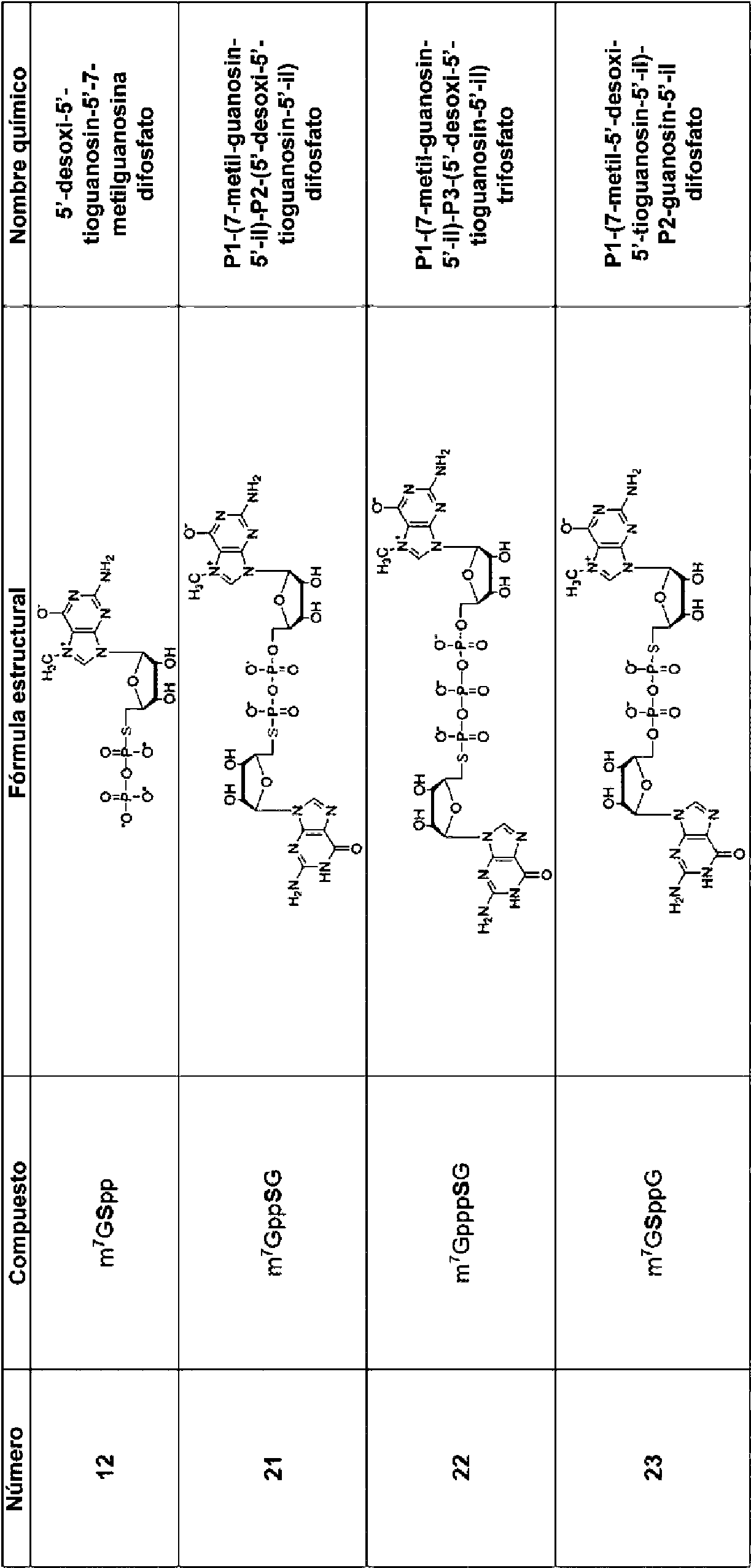


Ejemplo 2. Características de los nuevos análogos de caperuzaExample 2. Characteristics of the new cap analogs
Ensayo 1. El estudio de susceptibilidad de los análogos a degradación por la enzima DcpS.Test 1. The study of the susceptibility of analogs to degradation by the enzyme DcpS.
El fin del ensayo era comprobar si los nuevos análogos de caperuza 5'-tiofosfato son hidrolizados por la enzima DcpS humana (hDcpS). Se expresó proteína humana recombinante que codifica la enzima DcpS como se ha descrito previamente (Kowalska, Lewdorowicz et al. 2008). La susceptibilidad de los nuevos análogos a hidrólisis con hDcpS se ensaya en tampón Tris-HCl 50 mM que contiene KCl 200 mM y EDTA 0,5 mM. La mezcla de reacción incluye el análogo de caperuza ensayado (20 j M) y enzima DcpS (100 nM) en 400 j l de tampón. En los intervalos apropiados se recoge una muestra de 100 j l de la mezcla de reacción. La muestra se incuba a 98 °C durante 2,5 min, y después se enfrió a 0 °C y se analizó en RP-HPLC en las condiciones descritas en informaciones generales. En los ensayos también se ensayó inhibidor de DcpS, comercialmente disponible el compuesto RG3039 (no. 000) (https://www.mda.org/quest/fda-approves-phase-1-clinical-trial-rg3039-sma), GppSG (no. 19), GpppSG (no. 20), así como m7GpppG (no. 0) y m7Gpp (no. 00) como controles. Los resultados ejemplares obtenidos se muestran en la figura 5 y la tabla 5.The purpose of the test was to check whether the new 5'-thiophosphate cap analogs are hydrolyzed by the human DcpS enzyme (hDcpS). Recombinant human protein encoding the DcpS enzyme was expressed as previously described (Kowalska, Lewdorowicz et al. 2008). The susceptibility of the new analogs to hydrolysis with hDcpS is tested in 50 mM Tris-HCl buffer containing 200 mM KCl and 0.5 mM EDTA. The reaction mixture includes the tested cap analog (20 µM) and DcpS enzyme (100 nM) in 400 µl of buffer. At appropriate intervals, collect a 100 µl sample of the reaction mixture. The sample is incubated at 98 ° C for 2.5 min, and then cooled to 0 ° C and analyzed on RP-HPLC under the conditions described in the general information. DcpS inhibitor, commercially available compound RG3039 (no. 000) (https://www.mda.org/quest/fda-approves-phase-1-clinical-trial-rg3039-sma), was also tested in the assays. GppSG (no. 19), GpppSG (no. 20), as well as m7GpppG (no. 0) and m7Gpp (no. 00) as controls. The exemplary results obtained are shown in Figure 5 and Table 5.
Ensayo 2. Determinación de la CI50 para inhibidores seleccionadosTest 2. Determination of IC 50 for selected inhibitors
El fin del ensayo era determinar la concentración en donde el inhibidor determinado inhibe la actividad DcpS al 50 % del valor máximo en las condiciones particulares. El tampón en este ensayo y en el ensayo 1 es el mismo. Se prepararon diez mezclas de reacción al mismo tiempo y cada una de ellas contenía un m7GMPF (60 j M), enzima hDCpS (50 nM) y el compuesto ensayado en un intervalo de concentración entre 0-50 jM en 200 j l de tampón. Después del tiempo apropiado, cuando el 30 % del sustrato se convirtió en producto sin inhibidor, la reacción se paró mezclando con 100 j l de ACN. Se tomaron muestras de 25 j l para análisis, seguido por mezclar con 90 j l de solución TBDS-fluoresceína de concentración 2,5 jM en DMSO e incubar durante 60 min. A continuación, se añadieron 100 j l de tampón HEPES 200 mM pH = 7,0 a las muestras y se midió la fluorescencia como se describe en la información general. Basado en los resultados, se representó la dependencia de la concentración de inhibidor frente a la fluorescencia y se determinaron los valores CI50 ajustando una curva teórica a los datos. Los resultados obtenidos se muestran en la figura 5 y la tabla 5.The purpose of the test was to determine the concentration where the determined inhibitor inhibits the DcpS activity to 50% of the maximum value under the particular conditions. The buffer in this assay and in assay 1 is the same. Ten reaction mixtures were prepared at the same time and each of them contained a m7GMPF (60 µM), hDCpS enzyme (50 nM) and the test compound in a concentration range between 0-50 µM in 200 µl of buffer. After the appropriate time, when 30% of the substrate was converted to product without inhibitor, the reaction was stopped by mixing with 100 µl of ACN. 25 µl samples were taken for analysis, followed by mixing with 90 µl of 2.5 jM TBDS-fluorescein solution in DMSO and incubating for 60 min. Then, 100 µl of 200 mM HEPES buffer pH = 7.0 was added to the samples and fluorescence was measured as described in the general information. Based on the results, the dependence of inhibitor concentration was plotted against fluorescence and IC 50 values were determined by fitting a theoretical curve to the data. The results obtained are shown in figure 5 and table 5.
Tabla 5. Valores CI50 y susceptibilidad para la degradación por enzima DcpS para compuestos seleccionados. Table 5 . IC 50 values and susceptibility for degradation by DcpS enzyme for selected compounds.

Ensayo 3. Determinación de la estructura de la enzima DcpS humana (AN37hDcpS) en complejo con el análogo no. 34 (mAssay 3. Determination of the structure of the human DcpS enzyme (AN37hDcpS) in complex with analog no. 34 (m 77 GSppspSG D2)GSpp s pSG D2)
El fin de este ensayo era estudiar el mecanismo de interacciones del análogo no. 34 con la enzima DcpS humana. Se obtuvo enzima DcpS humana recombinante truncada en el extremo N (AN37 - residuos Ala38 a Ser337) como se ha descrito anteriormente (Singh et al. 2008). Se realizó cristalización por difusión de vapor por gota sedente usando 0,2 ul de muestra que contenía análogo 340,1 M y enzima DcpS 7,3 mg/ml (incubada en hielo durante 15 min antes del montaje de la cristalización) y 0,2 ul de solución de depósito. Aparecieron cristales del complejo en una mezcla que contenía PEG 4000 al 29 % y TrisHCl 0,1 M pH 7,6 después de aproximadamente una semana. A la gota que contenía el cristal se añadió una mezcla de solución de depósito y glicerol (1:1, v/v) y después los cristales se recogieron y congelaron rápidamente en nitrógeno líquido. Los datos de difracción se recogieron a 100K en la fuente del sincrotrón (Beamline 14.1, Bessy II; Helmholtz-Zentrum, Berlín, Alemania) usando un detector Dectris PILATUS 6M y después los datos se procesaron usando software XDS (Kabsch 2010). La estructura se resolvió por reemplazo molecular usando software Phaser (McCoy, Grosse-Kunstleve et al. 2007) con una estructura de DcpS unida al inhibidor DG157493 (pdb: 3BL9) (Singh, Salcius et al. 2008) como un modelo de búsqueda. Se generaron el modelo de ligando y diccionario usando ProDRG (Schuttelkopf y van Aalten 2004). La construcción del modelo y el ajuste del ligando se realizó en software Coot (Emsley & Cowtan 2004). La estructura se refinó usando phenix.refine (Adams, Afonine et al.The purpose of this trial was to study the mechanism of interactions of analog no. 34 with the human DcpS enzyme. N-terminally truncated recombinant human DcpS enzyme (AN37-residues Ala38 to Ser337) was obtained as previously described (Singh et al. 2008). Seated drop vapor diffusion crystallization was performed using 0.2 ul of sample containing 340.1 M analog and 7.3 mg / ml DcpS enzyme (incubated on ice for 15 min before crystallization setup) and 0.2 ul of reservoir solution. Crystals of the complex appeared in a mixture containing 29% PEG 4000 and 0.1 M TrisHCl pH 7.6 after about one week. A mixture of depot solution and glycerol (1: 1, v / v) was added to the drop containing the crystal, and then the crystals were collected and snap frozen in liquid nitrogen. Diffraction data was collected at 100K at the synchrotron source (Beamline 14.1, Bessy II; Helmholtz-Zentrum, Berlin, Germany) using a Dectris PILATUS 6M detector and then the data was processed using XDS software (Kabsch 2010). The structure was resolved by molecular replacement using Phaser software (McCoy, Grosse-Kunstleve et al. 2007) with a DcpS structure bound to the inhibitor DG157493 (pdb: 3BL9) (Singh, Salcius et al. 2008) as a search model. The ligand pattern and dictionary were generated using ProDRG (Schuttelkopf and van Aalten 2004). The construction of the model and the fitting of the ligand was carried out in Coot software (Emsley & Cowtan 2004). The structure was refined using phenix.refine (Adams, Afonine et al.
2010).2010).
Ensayo 4. Estudio de la susceptibilidad de moléculas cortas de ARN que comprenden análogos de caperuza en el extremo 5' a degradación con la enzima Dcp1/2.Test 4. Study of the susceptibility of short RNA molecules comprising cap analogs at the 5 'end to degradation with the enzyme Dcp1 / 2.
El fin de este estudio era comprobar si la incorporación de análogos de caperuza 5'-fosfotioato seleccionados al extremo 5' de ARN podría influir la susceptibilidad de los transcritos así preparados hacia la actividad de la enzima anticaperuza Dcp1/2. Se obtuvo proteína recombinante de Schizosaccharomyces pombe en forma de un heterodímero Dcp1/2 como se ha descrito previamente (Floor, Jones et al. 2010). Los transcritos utilizados en este ensayo se obtuvieron por transcripción in vitro usando ARN polimerasa SP6 (New England BioLabs). Los oligonucleótidos hibridados: ATACGATTTAGGTGACACTATAGAAGAAGCGGGCATGCGGCCAGCCATAGCCGATCA (SEQ ID NO.: 1), y TGATCGGCTATGGCTGGCCGCATGCCCGCTTCTTCTATAGTGTCACCTAAATCGTAT (SEQ ID NO: 2) se usaron como molde en la transcripción in vitro, los oligonucleótidos que comprenden la secuencia promotora para la polimerasa SP6 (ATTTAGGTGACACTATAGA (SEQ ID NO: 3)) permitieron obtener ARN de 35 nt de longitud que tienen una secuencia de GAAGAAGCGGGCAUGCGGCCAGCCAUAGCCGAUCA (SEQ ID NO: 4), sin embargo, los ARN con caperuza en el extremo 5' tienen 36 nt de longitud. La reacción de transcripción in vitro típica se realizó en un volumen de 20 pl y se incubó a 40 °C durante 2 horas y contenía lo siguiente: polimerasa SP6 1 U, inhibidor de RNasa RiboLock (ThermoFisher Scientific) 1 U, ATP/CTP/UTP 0,5 mM, GTP 0,125 mM, análogo de caperuza dinucleotídico 1,25 mM y molde 0,1 pM. Después de 2 horas de incubación, se añadió DNasa I (Ambion) 1 U a la mezcla de reacción y se siguió la incubación durante 30 min a 37 °C, después de lo cual se añadió EDTA a una concentración final de 25 mM. Los ARN obtenidos se purificaron usando RNA Clean & Concentrator-25 (Zymo Research). Después se determinó la calidad del ARN sintetizado en un gel de poliacrilamida al 15 % desnaturalizante. La concentración del ARN se evaluó a su vez espectrofotométricamente. El ARN así obtenido se caracteriza por heterogeneidad sustancial del extremo 3', de ahí que para eliminar el problema, los ARN obtenidos se incubaron con DNAzima 10-23 (TGATCGGCTAGGCTAGCTACAACGAGGCTGGCCGC (SEQ ID NO: 5)) que llevó a obtener ARN de 25 nt de longitud. El ARN que tiene una caperuza en el extremo 5' tenía 26 nt de longitud. La reacción de cortar los extremos 3' fue como sigue: se incubó 1 pM de ARN con 1 pM de DNAzima 10-23 en una mezcla que contenía MgCh 50 mM y Tris-HCl 50 mM pH 8,0 durante 1 hora a 37 °C (Coleman et al., 2004).The purpose of this study was to verify whether the incorporation of selected 5'-phosphothioate cap analogs to the 5 'end of RNA could influence the susceptibility of the transcripts thus prepared towards the activity of the anti-cap enzyme Dcp1 / 2. Recombinant protein from Schizosaccharomyces pombe was obtained as a Dcp1 / 2 heterodimer as previously described (Floor, Jones et al. 2010). The transcripts used in this assay were obtained by in vitro transcription using SP6 RNA polymerase (New England BioLabs). The annealed oligonucleotides: ATACGATTTAGGTGACACTATAGAAGAAGCGGGCATGCGGCCAGCCATAGCCGATCA (SEQ ID NO .: 1), and TGATCGGCTATGGCTGGCCGCATGCCCGCTTCTTCTATAGTGTCACCTAAATCGTAT (SEQ ID NO: 2) was used as template in vitro transcription, oligonucleotides comprising the promoter sequence for SP6 polymerase (ATTTAGGTGACACTATAGA (SEQ ID NO : 3)) allowed to obtain RNAs of 35 nt in length having a sequence of GAAGAAGCGGGCAUGCGGCCAGCCAUAGCCGAUCA (SEQ ID NO: 4), however, the RNAs capped at the 5 'end are 36 nt in length. The typical in vitro transcription reaction was performed in a volume of 20 µl and incubated at 40 ° C for 2 hours and contained the following: SP6 polymerase 1 U, RNase inhibitor RiboLock (ThermoFisher Scientific) 1 U, ATP / CTP / 0.5 mM UTP, 0.125 mM GTP, 1.25 mM dinucleotide cap analog and 0.1 pM template. After 2 hours incubation, 1 U DNase I (Ambion) was added to the reaction mixture and incubation was continued for 30 min at 37 ° C, after which EDTA was added to a final concentration of 25 mM. The RNAs obtained were purified using RNA Clean & Concentrator-25 (Zymo Research). The quality of the synthesized RNA was then determined on a denaturing 15% polyacrylamide gel. The RNA concentration was in turn evaluated spectrophotometrically. The RNA thus obtained is characterized by substantial heterogeneity of the 3 'end, hence, to eliminate the problem, the RNAs obtained were incubated with DNAzyme 10-23 (TGATCGGCTAGGCTAGCTACAACGAGGCTGGCCGC (SEQ ID NO: 5)) which led to obtain RNA of 25 nt of length. The RNA having a cap at the 5 'end was 26 nt in length. The reaction of cutting the 3 'ends was as follows: 1 pM of RNA was incubated with 1 pM of DNAzyme 10-23 in a mixture containing 50 mM MgCh and 50 mM Tris-HCl pH 8.0 for 1 hour at 37 ° C (Coleman et al., 2004).
Para los ensayos enzimáticos se usaron 20 ng de cada ARN, que se incubaron con enzimas Dcp1/23,5 nM en tampón que contenía Tris-HCl 50 mM pH 8,0 NH4Cl 50 mM, NP-40 al 0,01 %, DTT 1 mM, y MgCh 5 mM. Las reacciones se realizaron a 37 °C en el volumen final de 25 pl. La reacción se paró después de 0, 5, 15 y 30 min añadiendo una cantidad igual de una mezcla de urea 5 M, formamida al 44 %, EDTA 20 mM, azul de bromofenol al 0,03 %, xileno cianol al 0,03 %. Los productos de reacción se resolvieron en geles de poliacrilamida al 15 % desnaturalizantes, después de completar la separación electroforética, el gel se tiñó con SYBR Gold (Invitrogen) y se visualizó usando un Storm 860 PhosphorImager (GE Healthcare). La cuantificación de los resultados obtenidos se realizó con software ImageQuant (Molecular Dynamics). Se presentaron resultados representativos de este ensayo en la figura 8, figura 9 y también en la tabla 6.For the enzymatic assays, 20 ng of each RNA were used, which were incubated with Dcp1 / 23.5 nM enzymes in buffer containing 50 mM Tris-HCl pH 8.0 50 mM NH 4 Cl, 0.01% NP-40 , 1 mM DTT, and 5 mM MgCh. Reactions were carried out at 37 ° C in the final volume of 25 µl. The reaction was stopped after 0, 5, 15 and 30 min by adding an equal amount of a mixture of 5 M urea, 44% formamide, 20 mM EDTA, 0.03% bromophenol blue, 0.03 xylene cyanol %. The reaction products were resolved on denaturing 15% polyacrylamide gels, after completion of the electrophoretic separation, the gel was stained with SYBR Gold (Invitrogen) and visualized using a Storm 860 PhosphorImager (GE Healthcare). The quantification of the obtained results was carried out with ImageQuant software (Molecular Dynamics). Representative results of this trial are presented in Figure 8, Figure 9, and also in Table 6.
Tabla 6. Propiedades biológicas de los ARNm que comprenden análogos de caperuza seleccionados en el extremo 5' Table 6 . Biological Properties of mRNAs Comprising Selected Cap Analogs at the 5 'End

a Los datos de la figura 8 (punto de tiempo 0') se usaron para calcular la eficacia de añadir caperuza a The data from Figure 8 (time point 0 ') were used to calculate the effectiveness of adding cap
b Los datos de la figura 8 se usaron para calcular la susceptibilidad a la actividad Dcp1/2, dada como la razón de los ARN con caperuza respecto a una suma de ARN sin caperuza y con caperuza en un punto de tiempo 15 min y después de normalización respecto al tiempo 0' para los ARN individuales.b The data in Figure 8 were used to calculate the susceptibility to Dcp1 / 2 activity, given as the ratio of capped RNAs to a sum of uncapped and capped RNA at a time point 15 min and after normalization to time 0 'for individual RNAs.
c La eficacia de traducción relativa muestra la eficacia de traducción media de los ARNm de luciferasa de Renilla en triplicados biológicos después de la normalización respecto a los valores obtenidos para ARNm con caperuza con m7GpppG en el extremo 5'.c Relative translation efficiency shows the mean translation efficiency of Renilla luciferase mRNAs in biological triplicates after normalization to values obtained for m7GpppG capped mRNA at the 5 'end.
Ensayo 5. Estudio sobre el efecto de la presencia de los análogos de caperuza novedosos sobre la eficacia de traducción de los ARNm en lisado de reticulocitos de conejo.Test 5. Study on the effect of the presence of the novel cap analogs on the translation efficiency of mRNAs in rabbit reticulocyte lysate.
El fin de este estudio era comprobar el efecto de introducir análogos de caperuza novedosos en el extremo 5' de los ARNm sobre la eficacia de la traducción. Para este fin se prepararon series de ARNm que codifican la luciferasa de Renilla y que se diferencian en la estructura de la caperuza en el extremo 5'. Los transcritos usados para este ensayo se obtuvieron por reacción de transcripción in vitro usando ARN polimerasa SP6. Como molde para la transcripción in vitro se usó un producto de PCR, preparado usando los cebadores ATTTAGGTGACACTATAGAACAGATCTCGAGCTCAAGCTT (SEQ ID NO: 6) y GTTTAAACATTTAAATGCAATGA (SEQ ID NO: 7) y el plásmido hRLuc-pRNA2(A)128 (Williams et al. 2010). La reacción de PCR así realizada permitió introducir la secuencia promotora para la polimerasa SP6 antes de la secuencia que codifica la luciferasa de Renilla. La reacción de transcripción misma era similar a la síntesis de ARN corto descrita anteriormente (Ensayo 4). La reacción se realizó durante 2 horas en 20 pl a 40 °C y contenía lo siguiente: polimerasa SP6 1 U, inhibidor de RNasa RiboLock (ThermoFisher Scientific) 1 U, ATP/CTP/u Tp 0,5 mM, GTP 0,125 mM, análogo de caperuza dinucleotídico 1,25 mM y 100 pg de un molde. Después de 2 horas de incubación, se añadió DNasa I (Ambion) 1 U y la incubación se siguió durante 30 min a 37 °C, después de lo cual se añadió EDTA a una concentración final de 25 mM. Los ARNm obtenidos se purificaron usando NucleoSpin RNA Clean-up XS (Macherey-Nagel). La calidad del ARN sintetizado se comprobó en un gel de poliacrilamida al 15 % desnaturalizante. Las concentraciones de ARN se determinaron espectrofotométricamente.The purpose of this study was to test the effect of introducing novel cap analogs at the 5 'end of mRNAs on the efficiency of translation. For this purpose, mRNA series were prepared that encode Renilla luciferase and that differ in the structure of the cap at the 5 'end. The transcripts used for this assay were obtained by in vitro transcription reaction using SP6 RNA polymerase. As a template for in vitro transcription, a PCR product was used, prepared using the primers ATTTAGGTGACACTATAGAACAGATCTCGAGCTCAAGCTT (SEQ ID NO: 6) and GTTTAAACATTTAAATGCAATGA (SEQ ID NO: 7) and the plasmid hRLuc-pRNA2 (A) 128 (Williams et al. 2010). The PCR reaction carried out in this way made it possible to introduce the promoter sequence for SP6 polymerase before the sequence encoding Renilla luciferase. The transcription reaction itself was similar to the short RNA synthesis described above (Test 4). The reaction was carried out for 2 hours in 20 µl at 40 ° C and contained the following: SP6 polymerase 1 U, RNase inhibitor RiboLock (ThermoFisher Scientific) 1 U, ATP / CTP / u Tp 0.5 mM, GTP 0.125 mM, 1.25 mM dinucleotide cap analog and 100 pg of a template. After 2 hours of incubation, 1 U DNase I (Ambion) was added and the incubation was continued for 30 min at 37 ° C, after which EDTA was added to a final concentration of 25 mM. The mRNAs obtained were purified using NucleoSpin RNA Clean-up XS (Macherey-Nagel). The quality of the synthesized RNA was checked on a denaturing 15% polyacrylamide gel. RNA concentrations were determined spectrophotometrically.
Se realizó una reacción de traducción in vitro en lisado de reticulocitos de conejo (RRL; Promega) en condiciones determinadas para la traducción dependiente de caperuza (Rydzik et al., 2009). Una mezcla de reacción típica (10 pl) contenía: lisado RRL al 40 %, mezcla de aminoácidos (Promega) 0,01 mM, MgCh 1,2 mM, acetato de potasio 170 mM y un ARNm que codifica luciferasa de Renilla con un análogo de caperuza apropiado en el extremo 5', la mezcla se incuba a 37 °C durante 1 hora. Se usaron cuatro concentraciones diferentes de los ARNm: 0,1 ng/pl, 0,25 ng/pl, 0,5 ng/pl, 0,75 ng/pl en el experimento. La actividad de la luciferasa sintetizada se midió usando el sistema ensayo de indicador de luciferasa dual (Promega) en un lector de microplacas Synergy H1 (BioTek). Los resultados obtenidos se analizaron en el software Origin (Gambit), y la curva teórica se ajustó a los datos experimentales, en donde la pendiente de la curva obtenida representa la eficacia de traducción. Se presentaron datos representativos en la figura 10, mientras que la eficacia de traducción media obtenida para triplicados biológicos se presenta en la tabla 6. An in vitro translation reaction was performed in rabbit reticulocyte lysate (RRL; Promega) under conditions determined for cap-dependent translation (Rydzik et al., 2009). A typical reaction mixture (10 µl) contained: 40% RRL lysate, 0.01 mM amino acid mixture (Promega), 1.2 mM MgCh, 170 mM potassium acetate, and an mRNA encoding Renilla luciferase with an analog cap on the 5 'end, the mixture is incubated at 37 ° C for 1 hour. Four different concentrations of the mRNAs were used: 0.1 ng / µl, 0.25 ng / µl, 0.5 ng / µl, 0.75 ng / µl in the experiment. The activity of the synthesized luciferase was measured using the dual luciferase reporter assay system (Promega) on a Synergy H1 microplate reader (BioTek). The results obtained were analyzed in the Origin software (Gambit), and the theoretical curve was adjusted to the experimental data, where the slope of the curve obtained represents the translation efficiency. Representative data are presented in Figure 10, while the mean translation efficiency obtained for biological triplicates is presented in Table 6.
Ensayo 6. Estudio sobre el efecto de la presencia de los análogos de caperuza novedosos sobre la eficacia de traducción de los ARNm en células HeLa.Test 6. Study on the effect of the presence of the novel cap analogs on the translation efficiency of mRNAs in HeLa cells.
Se hicieron crecer células de carcinoma cervical humano HeLa en DMEM (Gibco) suplementado con SBF (Sigma-Aldrich) al 10 %, penicilina/estreptomicina (Gibco) al 1 % y L-glutamina con una concentración final de 2 mM en CO2 al 5 % y 37 °C. Un día antes del experimento planeado, 104 células suspendidas en 100 pl de medio sin antibióticos se sembraron por cada pocillo de una placa de 96 pocillos. La transfección de células fue como sigue: se añadieron a cada pocillo 0,3 pl de reactivo de transfección Lipofectamine MessengerMAX (Invitrogen), 0,1 pg de ARNm y 10 pl de Opti-MEM (Gibco). Las transfecciones se realizaron durante 1 hora en un incubador. Después de la transfección, las células se lavaron tres veces con PBS y se suplementaron con medio fresco sin antibióticos. Después de 2, 3, 4,5, 6,5, 10,5 y 24 horas desde el inicio de la transfección, las células se lavaron tres veces con PBS, se lisaron y se midió la actividad luciferasa usando el sistema ensayo de indicador de luciferasa dual (Promega) empleando un lector de microplacas Synergy H1. (Los datos ejemplares se muestran en la figura 11.Cervical human HeLa in DMEM (Gibco) supplemented with FBS (Sigma-Aldrich) to 10% penicillin / streptomycin (Gibco) at 1% L-glutamine at a final concentration of 2 mM in CO 2 were grown carcinoma cells the 5% and 37 ° C. One day before the planned experiment, 104 cells suspended in 100 µl of medium without antibiotics were seeded for each well of a 96-well plate. Cell transfection was as follows: 0.3 µl of Lipofectamine MessengerMAX transfection reagent (Invitrogen), 0.1 µg of mRNA and 10 µl of Opti-MEM (Gibco) were added to each well. Transfections were carried out for 1 hour in an incubator. After transfection, cells were washed three times with PBS and supplemented with fresh medium without antibiotics. After 2, 3, 4.5, 6.5, 10.5, and 24 hours from the start of transfection, cells were washed three times with PBS, lysed, and luciferase activity was measured using the reporter assay system. dual luciferase (Promega) using a Synergy H1 microplate reader. (Exemplary data is shown in Figure 11.
Se usó ARNm que codifica luciferasa de luciérnaga y que tiene dos repeticiones de la 3'UTR de p-globina y cola de poli(A) de 128 adeninas en el extremo 3' para transfección. Este ARNm, que comprende diferentes análogos de caperuza en el extremo 5' se obtuvo por transcripción in vitro. Se usó el plásmido pJET_luc_128A digerido con AarI (ThermoFisher Scientifics) como un molde para la síntesis. La reacción de transcripción in vitro típica se realizó durante 2 horas en un volumen de 20 pl a 40 °C y contenía lo siguiente: polimerasa SP6 1 U, inhibidor de RNasa RiboLock (ThermoFisher Scientific) 1 U, ATP/CTP/UTP 0,5 mM, GTP 0,125 mM, análogo de caperuza dinucleotídico 1,25 mM y 0,1 pg del molde. Las siguientes etapas de preparación del ARNm como se describen anteriormente en el caso de ARNm que codifica la luciferasa de Renilla (Ensayo 5). Además, después de la purificación del ARNm usando columna de NucleoSpin RNA Clean-up XS los transcritos se precipitaron en etanol en presencia de 2 pg de glucógeno y acetato de sodio, después se disolvieron en agua desionizada. MRNA encoding firefly luciferase and having two repeats of the p-globin 3'UTR and 128 adenine poly (A) tail at the 3 'end was used for transfection. This mRNA, which comprises different cap analogs at the 5 'end, was obtained by in vitro transcription. AarI-digested plasmid pJET_luc_128A (ThermoFisher Scientifics) was used as a template for synthesis. The typical in vitro transcription reaction was performed for 2 hours in a volume of 20 µl at 40 ° C and contained the following: SP6 polymerase 1 U, RNase inhibitor RiboLock (ThermoFisher Scientific) 1 U, ATP / CTP / UTP 0, 5 mM, 0.125 mM GTP, 1.25 mM dinucleotide cap analog, and 0.1 pg template. The following steps of mRNA preparation as described above in the case of mRNA encoding Renilla luciferase (Assay 5). Furthermore, after purification of the mRNA using NucleoSpin RNA Clean-up XS column, the transcripts were precipitated in ethanol in the presence of 2 pg of glycogen and sodium acetate, then dissolved in deionized water.
BibliografíaBibliography
Abrams, W. R. y J. A. Schiff (1973). "Studies of sulfate utilization by algae. II. An enzyme-bound intermedíate in the reduction of adenosine-5'-phosphosulfate (APS) by cell-free extracts of wild-type Chlorella and mutants blocked for sulfate reduction." Arch Mikrobiol 94(1): 1-10.Abrams, WR and JA Schiff (1973). "Studies of sulfate utilization by algae. II. An enzyme-bound intermediate in the reduction of adenosine-5'-phosphosulfate (APS) by cell-free extracts of wild-type Chlorella and mutants blocked for sulfate reduction." Arch Mikrobiol 94 (1): 1-10.
Adams, P., P. Afonine, G. Bunkoczi, V. Chen, I. Davis, N. Echols, J. Headd, L. Hung, G. Kapral, R. Grosse-Kunstleve, A. McCoy, N. Moriarty, R. Oeffner, R. Read, D. Richardson, J. Richardson, T. Terwilliger y P. Zwart (2010). "PHENIX: a comprehensive Python-based system for macromolecular structure solution." Acta Crystallographica Section D-Biological Crvstallographv 66: 213-221.Adams, P., P. Afonine, G. Bunkoczi, V. Chen, I. Davis, N. Echols, J. Headd, L. Hung, G. Kapral, R. Grosse-Kunstleve, A. McCoy, N. Moriarty , R. Oeffner, R. Read, D. Richardson, J. Richardson, T. Terwilliger, and P. Zwart (2010). "PHENIX: a comprehensive Python-based system for macromolecular structure solution." Acta Crystallographica Section D-Biological Crvstallographv 66 : 213-221.
Akagi, J. M. y L. L. Campbell (1962). "STUDIES ON THERMOPHILIC SULFATE-REDUCING BACTERIA III.: Adenosine Triphosphate-sulfurylase of Clostridium nigrificans and Desulfovibrio desulfuricans." J Bacteriol 84(6): 1194 1201.Akagi, JM and LL Campbell (1962). "STUDIES ON THERMOPHILIC SULFATE-REDUCING BACTERIA III .: Adenosine Triphosphate-sulfurylase of Clostridium nigrificans and Desulfovibrio desulfuricans." J Bacteriol 84 (6): 1194-1201.
Arakawa, H., M. Shiokawa, O. Imamura y M. Maeda (2003). "Novel bioluminescent assay of alkaline phosphatase using adenosine-3'-phosphate-5'-phosphosulfate as substrate and the luciferin-luciferase reaction and its application." Anal Biochem 314(2): 206-211.Arakawa, H., M. Shiokawa, O. Imamura, and M. Maeda (2003). "Novel bioluminescent assay of alkaline phosphatase using adenosine-3'-phosphate-5'-phosphosulfate as substrate and the luciferin-luciferase reaction and its application." Anal Biochem 314 (2): 206-211.
Bail, S. y M. Kiledjian (2008). "DcpS, a general modulator of cap-binding protein-dependent processes?" Rna Biology 5(4): 216-219.Bail, S. and M. Kiledjian (2008). "DcpS, a general modulator of cap-binding protein-dependent processes?" Rna Biology 5 (4): 216-219.
Barnes, S., R. Waldrop y A. S. Neighbors (1983). "Alkaline butanol extraction of bile salt and steroid sulfate esters: application to the assay of sulfotransferases." Anal Biochem 133(2): 470-475.Barnes, S., R. Waldrop, and AS Neighbors (1983). "Alkaline butanol extraction of bile salt and steroid sulfate esters: application to the assay of sulfotransferases." Anal Biochem 133 (2): 470-475.
Butchbach, M. E. R., J. Singh, M. Porsteinsdóttir, L. Saieva, E. Slominski, J. Thurmond, T. Andrésson, J. Zhang, J. D. Edwards, L. R. Simard, L. Pellizzoni, J. Jarecki, A. H. M. Burghes y M. E. Gurney (2010). "Effects of 2,4-diaminoquinazoline derivatives on SMN expression and phenotype in a mouse model for spinal muscular atrophy." Human Molecular Genetics 19(3): 454-467.Butchbach, MER, J. Singh, M. Porsteinsdóttir, L. Saieva, E. Slominski, J. Thurmond, T. Andrésson, J. Zhang, JD Edwards, LR Simard, L. Pellizzoni, J. Jarecki, AHM Burghes and ME Gurney (2010). "Effects of 2,4-diaminoquinazoline derivatives on SMN expression and phenotype in a mouse model for spinal muscular atrophy." Human Molecular Genetics 19 (3): 454-467.
Contreras, R. y W. Fiers (1981). "Initiation of transcription by rna polymerase-II in permeable, SV40-infected or noninfected, c V1 cells - evidence for multiple promoters of SV40 late transcription." Nucleic Acids Research 9(2): 215 236.Contreras, R. and W. Fiers (1981). "Initiation of transcription by rna polymerase-II in permeable, SV40-infected or noninfected, c V1 cells - evidence for multiple promoters of SV40 late transcription." Nucleic Acids Research 9 (2): 215-236.
Emsley, P. y K. Cowtan (2004). "Coot: model-building tools for molecular graphics." Acta Crystallographica Section D-Biological Crystallography 60: 2126-2132.Emsley, P. and K. Cowtan (2004). "Coot: model-building tools for molecular graphics." Acta Crystallographica Section D-Biological Crystallography 60: 2126-2132.
Floor, S., B. Jones, G. Hernandez y J. Gross (2010). "A split active site couples cap recognition by Dcp2 to activation." Nature Structural & Molecular Biology 17(9): 1096-U1099.Floor, S., B. Jones, G. Hernandez and J. Gross (2010). "A split active site couples cap recognition by Dcp2 to activation." Nature Structural & Molecular Biology 17 (9): 1096-U1099.
Grudzien, E., M. Kalek, J. Jemielity, E. Darzynkiewicz y R. E. Rhoads (2006). "Differential inhibition of mRNA degradation pathways by novel cap analogs." Journal of Biological Chemistry 281(4): 1857-1867.Grudzien, E., M. Kalek, J. Jemielity, E. Darzynkiewicz, and RE Rhoads (2006). "Differential inhibition of mRNA degradation pathways by novel cap analogs." Journal of Biological Chemistry 281 (4): 1857-1867.
Grudzien-Nogalska, E., J. Jemielity, J. Kowalska, E. Darzynkiewicz y R. E. Rhoads (2007). "Phosphorothioate cap analogs stabilize mRNA and increase translational efficiency in mammalian cells." Rna-a Publication of the Rna Society 13(10): 1745-1755.Grudzien-Nogalska, E., J. Jemielity, J. Kowalska, E. Darzynkiewicz, and RE Rhoads (2007). "Phosphorothioate cap analogs stabilize mRNA and increase translational efficiency in mammalian cells." Rna-a Publication of the Rna Society 13 (10): 1745-1755.
Gu, M. G., C. Fabrega, S. W. Liu, H. D. Liu, M. Kiledjian y C. D. Lima (2004). "Insights into the structure, mechanism, and regulation of scavenger mRNA decapping activity." Molecular Cell 14(1): 67-80.Gu, MG, C. Fabrega, SW Liu, HD Liu, M. Kiledjian and CD Lima (2004). "Insights into the structure, mechanism, and regulation of scavenger mRNA decapping activity." Molecular Cell 14 (1): 67-80.
Jemielity, J., T. Fowler, J. Zuberek, J. Stepinski, M. Lewdorowicz, A. Niedzwiecka, R. Stolarski, E. Darzynkiewicz y R. E. Rhoads (2003). "Novel "anti-reverse" cap analogs with superior translational properties." Rna-a Publication of the Rna Society 9(9): 1108-1122.Jemielity, J., T. Fowler, J. Zuberek, J. Stepinski, M. Lewdorowicz, A. Niedzwiecka, R. Stolarski, E. Darzynkiewicz, and RE Rhoads (2003). "Novel" anti-reverse "cap analogs with superior translational properties." Rna-a Publication of the Rna Society 9 (9): 1108-1122.
Kabsch, W. (2010). "XDS." Acta Crystallographica Section D-Biological Crystallography 66: 125-132.Kabsch, W. (2010). "XDS." Acta Crystallographica Section D-Biological Crystallography 66 : 125-132.
Kalek, M., J. Jemielity, Z. M. Darzynkiewicz, E. Bojarska, J. Stepinski, R. Stolarski, R. E. Davis y E. Darzynkiewicz (2006). "Enzymatically stable 5 ' mRNA cap analogs: Synthesis and binding studies with human DcpS decapping enzyme." Bioorganic & Medicinal Chemistry 14(9): 3223-3230.Kalek, M., J. Jemielity, ZM Darzynkiewicz, E. Bojarska, J. Stepinski, R. Stolarski, RE Davis, and E. Darzynkiewicz (2006). "Enzymatically stable 5 'mRNA cap analogs: Synthesis and binding studies with human DcpS decapping enzyme." Bioorganic & Medicinal Chemistry 14 (9): 3223-3230.
Kalek, M., J. Jemielity, E. Grudzien, J. Zuberek, E. Bojarska, L. S. Cohen, J. Stepinski, R. Stolarski, R. E. Davis, R. E. Rhoads y E. Darzynkiewicz (2005). "Synthesis and biochemical properties of novel mRNA 5 ' cap analogs resistant to enzymatic hydrolysis." Nucleosides Nucleotides & Nucleic Acids 24(5-7): 615-621.Kalek, M., J. Jemielity, E. Grudzien, J. Zuberek, E. Bojarska, LS Cohen, J. Stepinski, R. Stolarski, RE Davis, RE Rhoads, and E. Darzynkiewicz (2005). "Synthesis and biochemical properties of novel mRNA 5 'cap analogs resistant to enzymatic hydrolysis." Nucleosides Nucleotides & Nucleic Acids 24 (5-7): 615-621.
Konarska, M. M., R. A. Padgett y P. A. Sharp (1984). "Recognition of Cap Structure in Splicing Invitro of Messenger-Rna Precursors." Cell 38(3): 731-736. Konarska, MM, RA Padgett, and PA Sharp (1984). "Recognition of Cap Structure in Splicing Invitro of Messenger-Rna Precursors." Cell 38 (3): 731-736.
Claims (1)


Applications Claiming Priority (2)
| Application Number | Priority Date | Filing Date | Title |
|---|---|---|---|
| PL415967A PL415967A1 (en) | 2016-01-29 | 2016-01-29 | 5'-thiophosphate analogs of 5' mRNA (capu) end, method for obtaining them and applications |
| PCT/IB2017/050447 WO2017130151A1 (en) | 2016-01-29 | 2017-01-27 | 5'-phosphorothiolate mrna 5'-end (cap) analogs, mrna comprising the same, method of obtaining and uses thereof |
Publications (1)
| Publication Number | Publication Date |
|---|---|
| ES2879802T3 true ES2879802T3 (en) | 2021-11-23 |
Family
ID=58387852
Family Applications (1)
| Application Number | Title | Priority Date | Filing Date |
|---|---|---|---|
| ES17712541T Active ES2879802T3 (en) | 2016-01-29 | 2017-01-27 | 5'-end (cap) analogs of 5'-phosphorothiolate mRNA, mRNA comprising the same, method of obtaining and uses thereof |
Country Status (11)
| Country | Link |
|---|---|
| US (1) | US11066436B2 (en) |
| EP (1) | EP3408276B1 (en) |
| JP (1) | JP7144050B2 (en) |
| KR (1) | KR102742219B1 (en) |
| CN (1) | CN109071589A (en) |
| AU (1) | AU2017211693B2 (en) |
| CA (1) | CA3011663C (en) |
| EA (1) | EA038834B1 (en) |
| ES (1) | ES2879802T3 (en) |
| PL (2) | PL415967A1 (en) |
| WO (1) | WO2017130151A1 (en) |
Families Citing this family (9)
| Publication number | Priority date | Publication date | Assignee | Title |
|---|---|---|---|---|
| GB2597423B (en) * | 2019-05-10 | 2024-08-14 | New England Biolabs Inc | Chemical capping for template switching |
| CN110907358B (en) * | 2019-12-09 | 2022-08-30 | 福建师范大学 | Device and method for realizing light microflow microbubble cavity lead ion sensor |
| PL432884A1 (en) * | 2020-02-12 | 2021-08-16 | Uniwersytet Warszawski | New analogs of the 5 'end cap of mRNA, the RNA molecule containing them, their applications and the method of synthesizing RNA and peptide molecules |
| CN113122596B (en) * | 2020-08-20 | 2023-01-24 | 深圳市瑞吉生物科技有限公司 | Cap analog with Cap2 structure 5', preparation method and application thereof |
| EP4208549A4 (en) | 2020-09-04 | 2025-04-16 | Verve Therapeutics, Inc. | Compositions and methods for capping rnas |
| JP2025507894A (en) * | 2022-03-01 | 2025-03-21 | ヴァーヴ・セラピューティクス,インコーポレーテッド | Compositions and methods for capping RNA |
| CN114685588B (en) * | 2022-05-05 | 2024-03-29 | 江苏申基生物科技有限公司 | Initial capping oligonucleotide primer containing open-loop nucleoside structure |
| CN116143855B (en) * | 2022-11-08 | 2023-11-28 | 江苏申基生物科技有限公司 | Vinyl phosphonic acid modified mRNA cap analogue and preparation method and application thereof |
| EP4464713A1 (en) | 2023-05-18 | 2024-11-20 | Siec Badawcza Lukasiewicz - PORT Polski Osrodek Rozwoju Technologii | Circular rna analogs, preparation and application thereof |
Family Cites Families (6)
| Publication number | Priority date | Publication date | Assignee | Title |
|---|---|---|---|---|
| EP1907584A2 (en) | 2005-06-28 | 2008-04-09 | Agencourt Personal Genomics Corporation | Methods of producing and sequencing modified polynucleotides |
| CN104072561B (en) * | 2007-06-19 | 2017-12-22 | 路易斯安那州州立大学及农业机械学院管理委员会 | The synthesis of the anti-reverse phosphorothioate analogs of mRNA cap and purposes |
| PL215513B1 (en) * | 2008-06-06 | 2013-12-31 | Univ Warszawski | New borane phosphate analogs of dinucleotides, their application, RNA particle, method of obtaining RNA and method of obtaining peptides or protein |
| EP2281579A1 (en) | 2009-08-05 | 2011-02-09 | BioNTech AG | Vaccine composition comprising 5'-Cap modified RNA |
| EP3750903A1 (en) * | 2013-03-14 | 2020-12-16 | Translate Bio, Inc. | Ribonucleic acids with 4'-thio-modified nucleotides and related methods |
| HRP20200250T1 (en) * | 2013-08-08 | 2020-05-29 | The Scripps Research Institute | SITE-SPECIFIC ENZYME MARKING OF NUCLEIC ACIDS AND IN VITRO IMPLEMENTATION OF NON-NATURAL NUCLEOTIDS |
-
2016
- 2016-01-29 PL PL415967A patent/PL415967A1/en unknown
-
2017
- 2017-01-27 CN CN201780013350.3A patent/CN109071589A/en active Pending
- 2017-01-27 PL PL17712541T patent/PL3408276T3/en unknown
- 2017-01-27 CA CA3011663A patent/CA3011663C/en active Active
- 2017-01-27 AU AU2017211693A patent/AU2017211693B2/en active Active
- 2017-01-27 US US16/073,499 patent/US11066436B2/en active Active
- 2017-01-27 EA EA201891429A patent/EA038834B1/en unknown
- 2017-01-27 EP EP17712541.6A patent/EP3408276B1/en active Active
- 2017-01-27 ES ES17712541T patent/ES2879802T3/en active Active
- 2017-01-27 KR KR1020187021714A patent/KR102742219B1/en active Active
- 2017-01-27 WO PCT/IB2017/050447 patent/WO2017130151A1/en not_active Ceased
- 2017-01-27 JP JP2018537845A patent/JP7144050B2/en active Active
Also Published As
| Publication number | Publication date |
|---|---|
| AU2017211693B2 (en) | 2021-09-09 |
| WO2017130151A1 (en) | 2017-08-03 |
| EA201891429A1 (en) | 2019-02-28 |
| JP7144050B2 (en) | 2022-09-29 |
| PL3408276T3 (en) | 2021-10-25 |
| PL415967A1 (en) | 2017-07-31 |
| KR20180100595A (en) | 2018-09-11 |
| EP3408276A1 (en) | 2018-12-05 |
| US20190300563A1 (en) | 2019-10-03 |
| AU2017211693A1 (en) | 2018-08-09 |
| EA038834B1 (en) | 2021-10-26 |
| JP2019504837A (en) | 2019-02-21 |
| CN109071589A (en) | 2018-12-21 |
| CA3011663A1 (en) | 2017-08-03 |
| EP3408276B1 (en) | 2021-04-07 |
| US11066436B2 (en) | 2021-07-20 |
| KR102742219B1 (en) | 2024-12-13 |
| CA3011663C (en) | 2023-10-31 |
Similar Documents
| Publication | Publication Date | Title |
|---|---|---|
| ES2879802T3 (en) | 5'-end (cap) analogs of 5'-phosphorothiolate mRNA, mRNA comprising the same, method of obtaining and uses thereof | |
| ES2425781T3 (en) | MRNA CAP analogues | |
| CN113603739B (en) | Capping analogue and application thereof | |
| CA3167563A1 (en) | Novel mrna 5'-end cap analogs modified within phosphate residues, rna molecule incorporating the same, uses thereof and method of synthesizing rna molecule or peptide | |
| Rydzik et al. | mRNA cap analogues substituted in the tetraphosphate chain with CX2: identification of O-to-CCl2 as the first bridging modification that confers resistance to decapping without impairing translation | |
| ES2820242T3 (en) | Novel Phosphotriazole 5 'End Cap Analogs, Composition Comprising The Same, RNA Molecule Incorporating The Same, Uses Of The Same, And RNA, Protein Or Peptide Molecule Synthesis Procedure | |
| Strenkowska et al. | Towards mRNA with superior translational activity: synthesis and properties of ARCA tetraphosphates with single phosphorothioate modifications | |
| HK1257846A1 (en) | Process for preparing phosphate compound bearing isotope | |
| HK1260250A1 (en) | 5′-phosphorothiolate mrna 5′-end (cap) analogs, mrna comprising the same, method of obtaining and uses thereof | |
| US8618279B2 (en) | Synthesis of 2′,3′— and 3′,5′—cyclic phosphate mono-and oligonucleotides | |
| EP4397669A1 (en) | Photocaged cap analogs for the 5'-end of rnas | |
| WO2026078020A2 (en) | Efficient in vitro transcription of artificial mrna with highly modified 5' ends | |
| HK1195315A (en) | Process for preparing phosphate compound bearing isotope |