ES2886887T3 - EGFR inhibitor and preparation and application thereof - Google Patents
EGFR inhibitor and preparation and application thereof Download PDFInfo
- Publication number
- ES2886887T3 ES2886887T3 ES15849629T ES15849629T ES2886887T3 ES 2886887 T3 ES2886887 T3 ES 2886887T3 ES 15849629 T ES15849629 T ES 15849629T ES 15849629 T ES15849629 T ES 15849629T ES 2886887 T3 ES2886887 T3 ES 2886887T3
- Authority
- ES
- Spain
- Prior art keywords
- membered
- methyl
- group
- amino
- compound
- Prior art date
- Legal status (The legal status is an assumption and is not a legal conclusion. Google has not performed a legal analysis and makes no representation as to the accuracy of the status listed.)
- Active
Links
- 0 CC*Oc(cc(*)c(NC(C=C*)=O)c1)c1Nc1nc(C2=NC(*)C3=CIC=CC=C23)c(*)cn1 Chemical compound CC*Oc(cc(*)c(NC(C=C*)=O)c1)c1Nc1nc(C2=NC(*)C3=CIC=CC=C23)c(*)cn1 0.000 description 3
- UBMXADKQZHFQMG-UHFFFAOYSA-N CC([n]1c2ccccc2c(-c2ccnc(Nc(cc(c(N(C)CCN(C)C)c3)NC(C=C)=O)c3OC(F)F)n2)c1)=O Chemical compound CC([n]1c2ccccc2c(-c2ccnc(Nc(cc(c(N(C)CCN(C)C)c3)NC(C=C)=O)c3OC(F)F)n2)c1)=O UBMXADKQZHFQMG-UHFFFAOYSA-N 0.000 description 2
- PLWNWKKLVWMANB-UHFFFAOYSA-N CN(C)CCN(C)c(c(NC(C=C)=O)c1)cc(OC(F)F)c1Nc1nc(-c2c[n](CCO)c3ccccc23)ccn1 Chemical compound CN(C)CCN(C)c(c(NC(C=C)=O)c1)cc(OC(F)F)c1Nc1nc(-c2c[n](CCO)c3ccccc23)ccn1 PLWNWKKLVWMANB-UHFFFAOYSA-N 0.000 description 2
- GCQNVAFPZJWTNX-UHFFFAOYSA-N CN(CCN1CCCC1)c(c(NC(C=C)=O)c1)cc(OC)c1Nc1nc(-[n](c2ccc3)ncc2c3OC)ccn1 Chemical compound CN(CCN1CCCC1)c(c(NC(C=C)=O)c1)cc(OC)c1Nc1nc(-[n](c2ccc3)ncc2c3OC)ccn1 GCQNVAFPZJWTNX-UHFFFAOYSA-N 0.000 description 2
- FYSIGSQCZXQTIH-UHFFFAOYSA-N COc(cc(c([N+]([O-])=O)c1)F)c1N Chemical compound COc(cc(c([N+]([O-])=O)c1)F)c1N FYSIGSQCZXQTIH-UHFFFAOYSA-N 0.000 description 2
- DFOHHQRGDOQMKG-UHFFFAOYSA-N CSc1nccc(Cl)n1 Chemical compound CSc1nccc(Cl)n1 DFOHHQRGDOQMKG-UHFFFAOYSA-N 0.000 description 2
- FTTATHOUSOIFOQ-UHFFFAOYSA-N C(C1)CN2C1CNCC2 Chemical compound C(C1)CN2C1CNCC2 FTTATHOUSOIFOQ-UHFFFAOYSA-N 0.000 description 1
- WTFBCXIXTUSYKL-UHFFFAOYSA-N C(C1)CN2C1COCC2 Chemical compound C(C1)CN2C1COCC2 WTFBCXIXTUSYKL-UHFFFAOYSA-N 0.000 description 1
- GIMFZRPGNPXWHB-UHFFFAOYSA-N CC(C)(C)OC(N(C)CCN(C)c(cc(c(N(C(OC(C)(C)C)=O)c1nc(-c2c[n](C(OC(C)(C)C)=O)c3ccccc23)ccn1)c1)OC)c1N=O)=O Chemical compound CC(C)(C)OC(N(C)CCN(C)c(cc(c(N(C(OC(C)(C)C)=O)c1nc(-c2c[n](C(OC(C)(C)C)=O)c3ccccc23)ccn1)c1)OC)c1N=O)=O GIMFZRPGNPXWHB-UHFFFAOYSA-N 0.000 description 1
- MLYOYUYYQBQIHW-UHFFFAOYSA-N CC([n]1c(cccc2)c2c(-c2nc(Cl)ncc2)c1)=O Chemical compound CC([n]1c(cccc2)c2c(-c2nc(Cl)ncc2)c1)=O MLYOYUYYQBQIHW-UHFFFAOYSA-N 0.000 description 1
- UKVUVAMKXKTRIS-UHFFFAOYSA-N CC([n]1c2ccccc2c(-c2ccnc(Nc(cc(c(N(C)CCN(C)C)c3)N)c3OC(F)F)n2)c1)=O Chemical compound CC([n]1c2ccccc2c(-c2ccnc(Nc(cc(c(N(C)CCN(C)C)c3)N)c3OC(F)F)n2)c1)=O UKVUVAMKXKTRIS-UHFFFAOYSA-N 0.000 description 1
- GMMLJZBRYVNQAF-UHFFFAOYSA-N CC1(CC=C2)N(c3nc(Nc(cc(c(N(C)CCN4CCCC4)c4)N)c4OC)ncc3)N=CC1=C2OC Chemical compound CC1(CC=C2)N(c3nc(Nc(cc(c(N(C)CCN4CCCC4)c4)N)c4OC)ncc3)N=CC1=C2OC GMMLJZBRYVNQAF-UHFFFAOYSA-N 0.000 description 1
- VBMRDIDVKARFPU-UHFFFAOYSA-N CCC(C=C)[n]1c2ccccc2c(-c2ccnc(Nc(cc(c(N(C)CCN(C)C)c3)[N+]([O-])=O)c3OC)n2)c1 Chemical compound CCC(C=C)[n]1c2ccccc2c(-c2ccnc(Nc(cc(c(N(C)CCN(C)C)c3)[N+]([O-])=O)c3OC)n2)c1 VBMRDIDVKARFPU-UHFFFAOYSA-N 0.000 description 1
- CLXAUSNIUWWOMH-UHFFFAOYSA-N CCOc1ccc2[n](-c3ccnc(Nc(cc(c(N(C)CCN4CCCC4)c4)NC(C=C)=O)c4OC)n3)ncc2c1 Chemical compound CCOc1ccc2[n](-c3ccnc(Nc(cc(c(N(C)CCN4CCCC4)c4)NC(C=C)=O)c4OC)n3)ncc2c1 CLXAUSNIUWWOMH-UHFFFAOYSA-N 0.000 description 1
- QPYPAZPGTNAAFW-UHFFFAOYSA-N CCc(c(C1)c2C=CC1(C)C#N)n[n]2-c1c(C(F)(F)F)cnc(Nc(cc(c(N(C)CCN(C)C)c2)[N+]([O-])=O)c2OC)n1 Chemical compound CCc(c(C1)c2C=CC1(C)C#N)n[n]2-c1c(C(F)(F)F)cnc(Nc(cc(c(N(C)CCN(C)C)c2)[N+]([O-])=O)c2OC)n1 QPYPAZPGTNAAFW-UHFFFAOYSA-N 0.000 description 1
- LQEQPYISQMDCII-UHFFFAOYSA-N CCc(c1c2)n[nH]c1ccc2C#N Chemical compound CCc(c1c2)n[nH]c1ccc2C#N LQEQPYISQMDCII-UHFFFAOYSA-N 0.000 description 1
- VCTDRIUFUWSYEG-UHFFFAOYSA-N CCc(c1cc(C#N)ccc11)n[n]1-c1c(C(F)(F)F)cnc(Nc(c(OC)c2)cc(N)c2N(C)CCN(C)C)n1 Chemical compound CCc(c1cc(C#N)ccc11)n[n]1-c1c(C(F)(F)F)cnc(Nc(c(OC)c2)cc(N)c2N(C)CCN(C)C)n1 VCTDRIUFUWSYEG-UHFFFAOYSA-N 0.000 description 1
- FJBBUUXKFWLWBM-UHFFFAOYSA-N CCc(c1cc(C#N)ccc11)n[n]1-c1c(C(F)(F)F)cnc(Nc(cc(c(N(C)CCN(C)C)c2)NC(C=C)=O)c2OC)n1 Chemical compound CCc(c1cc(C#N)ccc11)n[n]1-c1c(C(F)(F)F)cnc(Nc(cc(c(N(C)CCN(C)C)c2)NC(C=C)=O)c2OC)n1 FJBBUUXKFWLWBM-UHFFFAOYSA-N 0.000 description 1
- UMJBDMYXDCXCPD-UHFFFAOYSA-N CCc(c1cc(C#N)ccc11)n[n]1-c1nc(Cl)ncc1C(F)(F)F Chemical compound CCc(c1cc(C#N)ccc11)n[n]1-c1nc(Cl)ncc1C(F)(F)F UMJBDMYXDCXCPD-UHFFFAOYSA-N 0.000 description 1
- SCMQTKFREVYBPH-UHFFFAOYSA-N CCc(c1cc(C#N)ccc11)n[n]1C1=NC(C)(Nc(cc(c(F)c2)[N+]([O-])=O)c2OC)NC=C1C(F)(F)F Chemical compound CCc(c1cc(C#N)ccc11)n[n]1C1=NC(C)(Nc(cc(c(F)c2)[N+]([O-])=O)c2OC)NC=C1C(F)(F)F SCMQTKFREVYBPH-UHFFFAOYSA-N 0.000 description 1
- KIWFWUBDIONBFK-UHFFFAOYSA-N CN(C)CCN(C)c(c(N)c1)cc(OC)c1Nc1nc(-c2c[n](C3COC3)c3ccccc23)ccn1 Chemical compound CN(C)CCN(C)c(c(N)c1)cc(OC)c1Nc1nc(-c2c[n](C3COC3)c3ccccc23)ccn1 KIWFWUBDIONBFK-UHFFFAOYSA-N 0.000 description 1
- WCWIMRZNJKECIS-UHFFFAOYSA-N CN(C)CCN(C)c(c(NC(C=C)=O)c1)cc(OC(F)(F)F)c1Nc1nc(-c2c[n](C3CC3)c3ccccc23)ccn1 Chemical compound CN(C)CCN(C)c(c(NC(C=C)=O)c1)cc(OC(F)(F)F)c1Nc1nc(-c2c[n](C3CC3)c3ccccc23)ccn1 WCWIMRZNJKECIS-UHFFFAOYSA-N 0.000 description 1
- JWPUYBBTIGXYHG-UHFFFAOYSA-N CN(C)CCN(C)c(c(NC(C=C)=O)c1)cc(OC(F)(F)F)c1Nc1nc(-c2c[n](CCO)c3ccccc23)ccn1 Chemical compound CN(C)CCN(C)c(c(NC(C=C)=O)c1)cc(OC(F)(F)F)c1Nc1nc(-c2c[n](CCO)c3ccccc23)ccn1 JWPUYBBTIGXYHG-UHFFFAOYSA-N 0.000 description 1
- MTSNDAZDQYHTRB-UHFFFAOYSA-N CN(C)CCN(C)c(c(NC(C=C)=O)c1)cc(OC(F)F)c1Nc1nc(-c2c[n](C3CC3)c3ccccc23)ccn1 Chemical compound CN(C)CCN(C)c(c(NC(C=C)=O)c1)cc(OC(F)F)c1Nc1nc(-c2c[n](C3CC3)c3ccccc23)ccn1 MTSNDAZDQYHTRB-UHFFFAOYSA-N 0.000 description 1
- WIEXYOWCSHIRKH-UHFFFAOYSA-N CN(C)CCN(C)c(c(NC(C=C)=O)c1)cc(OC)c1Nc1nc(-[n]2c(cccc3)c3nc2C2CC2)ccn1 Chemical compound CN(C)CCN(C)c(c(NC(C=C)=O)c1)cc(OC)c1Nc1nc(-[n]2c(cccc3)c3nc2C2CC2)ccn1 WIEXYOWCSHIRKH-UHFFFAOYSA-N 0.000 description 1
- BIIPKIXRXFHSMP-UHFFFAOYSA-N CN(C)CCN(C)c(c(NC(C=C)=O)c1)cc(OC)c1Nc1nc(-[n]2ncc3cc(OCCOC)ccc23)ccn1 Chemical compound CN(C)CCN(C)c(c(NC(C=C)=O)c1)cc(OC)c1Nc1nc(-[n]2ncc3cc(OCCOC)ccc23)ccn1 BIIPKIXRXFHSMP-UHFFFAOYSA-N 0.000 description 1
- MEIYUYKFTUHJBG-UHFFFAOYSA-N CN(C)CCN(C)c(c([N+]([O-])=O)c1)cc(OC)c1Nc1nc(-[n]2ncc3ccccc23)ccn1 Chemical compound CN(C)CCN(C)c(c([N+]([O-])=O)c1)cc(OC)c1Nc1nc(-[n]2ncc3ccccc23)ccn1 MEIYUYKFTUHJBG-UHFFFAOYSA-N 0.000 description 1
- IDNOPHPTLHVPJP-UHFFFAOYSA-N CN(C)CCN(C)c(c([N+]([O-])=O)c1)cc(OC)c1Nc1nc(-c2c[nH]c3cc(OC)ccc23)c(C(F)(F)F)cn1 Chemical compound CN(C)CCN(C)c(c([N+]([O-])=O)c1)cc(OC)c1Nc1nc(-c2c[nH]c3cc(OC)ccc23)c(C(F)(F)F)cn1 IDNOPHPTLHVPJP-UHFFFAOYSA-N 0.000 description 1
- OXLFMUDQCYQPPJ-UHFFFAOYSA-N CN(C)CCN(C)c(c([N+]([O-])=O)c1)cc(OC)c1Nc1nc(-c2c[n](C)c3cc(I)ccc23)ccn1 Chemical compound CN(C)CCN(C)c(c([N+]([O-])=O)c1)cc(OC)c1Nc1nc(-c2c[n](C)c3cc(I)ccc23)ccn1 OXLFMUDQCYQPPJ-UHFFFAOYSA-N 0.000 description 1
- KHPUUNWGNTXYJB-UHFFFAOYSA-N CN(C)CCN(C)c(cc(c(Nc(nc1-[n]2nc(C3CC3)c3c2ccc(OC)c3)ncc1Cl)c1)OC)c1NC(C=C)=O Chemical compound CN(C)CCN(C)c(cc(c(Nc(nc1-[n]2nc(C3CC3)c3c2ccc(OC)c3)ncc1Cl)c1)OC)c1NC(C=C)=O KHPUUNWGNTXYJB-UHFFFAOYSA-N 0.000 description 1
- UWXUKAUOQOODCD-UHFFFAOYSA-N CN(C)CCN(C)c(cc(c(Nc1nc(-[n]2c(ccc(OC)c3)c3nc2C2CC2)c(C(F)(F)F)cn1)c1)OC)c1NC(C=C)=O Chemical compound CN(C)CCN(C)c(cc(c(Nc1nc(-[n]2c(ccc(OC)c3)c3nc2C2CC2)c(C(F)(F)F)cn1)c1)OC)c1NC(C=C)=O UWXUKAUOQOODCD-UHFFFAOYSA-N 0.000 description 1
- UVKIJHIAPURYHP-UHFFFAOYSA-N CN(C)CCN(C)c(cc(c(Nc1nccc(-c2c[n](CC#C)c3ccccc23)n1)c1)OC)c1NC(C=C)=O Chemical compound CN(C)CCN(C)c(cc(c(Nc1nccc(-c2c[n](CC#C)c3ccccc23)n1)c1)OC)c1NC(C=C)=O UVKIJHIAPURYHP-UHFFFAOYSA-N 0.000 description 1
- DDLYKIVCAWTCLZ-UHFFFAOYSA-N CN(C)S([n]1c2ccccc2c(-c2ccnc(Nc(c(OC)c3)cc(NC(C=C)=O)c3N(C)CCN3CCCC3)n2)c1)(=O)=O Chemical compound CN(C)S([n]1c2ccccc2c(-c2ccnc(Nc(c(OC)c3)cc(NC(C=C)=O)c3N(C)CCN3CCCC3)n2)c1)(=O)=O DDLYKIVCAWTCLZ-UHFFFAOYSA-N 0.000 description 1
- SKCLPLPDZKCVMB-UHFFFAOYSA-N CN(C)S([n]1c2ccccc2c(-c2ccnc(Nc(c(OC)c3)cc([N+]([O-])=O)c3N(C)CCN3CCCC3)n2)c1)(=O)=O Chemical compound CN(C)S([n]1c2ccccc2c(-c2ccnc(Nc(c(OC)c3)cc([N+]([O-])=O)c3N(C)CCN3CCCC3)n2)c1)(=O)=O SKCLPLPDZKCVMB-UHFFFAOYSA-N 0.000 description 1
- PBZUCAMKUHYGEG-UHFFFAOYSA-N CN(CCN(CCOC1)C1=O)c(c(N)c1)cc(OC(F)F)c1Nc1nccc(-c2c[n](C)c3c2cccc3)n1 Chemical compound CN(CCN(CCOC1)C1=O)c(c(N)c1)cc(OC(F)F)c1Nc1nccc(-c2c[n](C)c3c2cccc3)n1 PBZUCAMKUHYGEG-UHFFFAOYSA-N 0.000 description 1
- PXAJTMZHRYJMEQ-UHFFFAOYSA-N CN(CCN(CCOC1)C1=O)c(c([N+]([O-])=O)c1)cc(OC(F)F)c1Nc1nc(-c2c[n](C)c3c2cccc3)ccn1 Chemical compound CN(CCN(CCOC1)C1=O)c(c([N+]([O-])=O)c1)cc(OC(F)F)c1Nc1nc(-c2c[n](C)c3c2cccc3)ccn1 PXAJTMZHRYJMEQ-UHFFFAOYSA-N 0.000 description 1
- YZACRBFHOGQIME-UHFFFAOYSA-N CN(CCN1CCCC1)c(c(NC(C=C)=O)c1)cc(OC)c1Nc1nc(-c2c[n](C3CC3)c3ccccc23)ccn1 Chemical compound CN(CCN1CCCC1)c(c(NC(C=C)=O)c1)cc(OC)c1Nc1nc(-c2c[n](C3CC3)c3ccccc23)ccn1 YZACRBFHOGQIME-UHFFFAOYSA-N 0.000 description 1
- LOZCSXMMBFJOOG-UHFFFAOYSA-N CN(CCN1CCCC1)c(c([N+]([O-])=O)c1)cc(OC)c1Nc1nc(-[n](c2ccc3)ncc2c3OC)ccn1 Chemical compound CN(CCN1CCCC1)c(c([N+]([O-])=O)c1)cc(OC)c1Nc1nc(-[n](c2ccc3)ncc2c3OC)ccn1 LOZCSXMMBFJOOG-UHFFFAOYSA-N 0.000 description 1
- LSPWKZNDBUPNMK-UHFFFAOYSA-N CN(CCN1CCCC1)c(c([N+]([O-])=O)c1)cc(OC)c1Nc1nc(-c2c[nH]c3ccccc23)ccn1 Chemical compound CN(CCN1CCCC1)c(c([N+]([O-])=O)c1)cc(OC)c1Nc1nc(-c2c[nH]c3ccccc23)ccn1 LSPWKZNDBUPNMK-UHFFFAOYSA-N 0.000 description 1
- KLFANBQCAOJEEQ-UHFFFAOYSA-N CNCCN(C)c(c(NC(C=C)=O)c1)cc(OC)c1Nc1nc(-c2c[n](C3CC3)c3ccccc23)ccn1 Chemical compound CNCCN(C)c(c(NC(C=C)=O)c1)cc(OC)c1Nc1nc(-c2c[n](C3CC3)c3ccccc23)ccn1 KLFANBQCAOJEEQ-UHFFFAOYSA-N 0.000 description 1
- GYGYDOOXVKDZCF-UHFFFAOYSA-N CNCCN1CCCC1 Chemical compound CNCCN1CCCC1 GYGYDOOXVKDZCF-UHFFFAOYSA-N 0.000 description 1
- YVONWLRXQKUEBA-UHFFFAOYSA-N COc(c(Nc1nc(-[n]2ncc3ccccc23)ccn1)c1)cc(F)c1[N+]([O-])=O Chemical compound COc(c(Nc1nc(-[n]2ncc3ccccc23)ccn1)c1)cc(F)c1[N+]([O-])=O YVONWLRXQKUEBA-UHFFFAOYSA-N 0.000 description 1
- YFYIJODEMBLXEW-UHFFFAOYSA-N COc(c(Nc1nc(-c2c[n](C3COC3)c3ccccc23)ccn1)c1)cc(F)c1[N+]([O-])=O Chemical compound COc(c(Nc1nc(-c2c[n](C3COC3)c3ccccc23)ccn1)c1)cc(F)c1[N+]([O-])=O YFYIJODEMBLXEW-UHFFFAOYSA-N 0.000 description 1
- KEDPJVSGBJCMME-UHFFFAOYSA-N COc(cc1)cc(C(C2CC2)=O)c1F Chemical compound COc(cc1)cc(C(C2CC2)=O)c1F KEDPJVSGBJCMME-UHFFFAOYSA-N 0.000 description 1
- PGMCJTVMCOHDKC-UHFFFAOYSA-N COc(cc1)cc(C(C2CC2)O)c1F Chemical compound COc(cc1)cc(C(C2CC2)O)c1F PGMCJTVMCOHDKC-UHFFFAOYSA-N 0.000 description 1
- DKIQXHIAEMGZGO-UHFFFAOYSA-N COc(cc1C=O)ccc1F Chemical compound COc(cc1C=O)ccc1F DKIQXHIAEMGZGO-UHFFFAOYSA-N 0.000 description 1
- RHXWAMSYANZWMS-UHFFFAOYSA-N COc1c(cn[nH]2)c2ccc1 Chemical compound COc1c(cn[nH]2)c2ccc1 RHXWAMSYANZWMS-UHFFFAOYSA-N 0.000 description 1
- FTHPMZUEIWFZGI-UHFFFAOYSA-N COc1c(cn[n]2-c3nc(Nc(c(OC)c4)cc([N+]([O-])=O)c4F)ncc3)c2ccc1 Chemical compound COc1c(cn[n]2-c3nc(Nc(c(OC)c4)cc([N+]([O-])=O)c4F)ncc3)c2ccc1 FTHPMZUEIWFZGI-UHFFFAOYSA-N 0.000 description 1
- MUTUYVGSQXSBMX-UHFFFAOYSA-N COc1c(cn[n]2-c3nc(S(C)(=O)=O)ncc3)c2ccc1 Chemical compound COc1c(cn[n]2-c3nc(S(C)(=O)=O)ncc3)c2ccc1 MUTUYVGSQXSBMX-UHFFFAOYSA-N 0.000 description 1
- NCWNCGWMLYJNTD-UHFFFAOYSA-N COc1c(cn[n]2-c3nc(SC)ncc3)c2ccc1 Chemical compound COc1c(cn[n]2-c3nc(SC)ncc3)c2ccc1 NCWNCGWMLYJNTD-UHFFFAOYSA-N 0.000 description 1
- IZEUKRXCWCYTCT-UHFFFAOYSA-N COc1ccc(c(-c2c(C(F)(F)F)cnc(Nc(c(OC)c3)cc([N+]([O-])=O)c3F)n2)c[nH]2)c2c1 Chemical compound COc1ccc(c(-c2c(C(F)(F)F)cnc(Nc(c(OC)c3)cc([N+]([O-])=O)c3F)n2)c[nH]2)c2c1 IZEUKRXCWCYTCT-UHFFFAOYSA-N 0.000 description 1
- BEUHQLOHQMGJLK-UHFFFAOYSA-N COc1ccc(c(-c2c(C(F)(F)F)cnc(Nc(c(OC)c3)cc([N+]([O-])=O)c3[F]C)n2)c[nH]2)c2c1 Chemical compound COc1ccc(c(-c2c(C(F)(F)F)cnc(Nc(c(OC)c3)cc([N+]([O-])=O)c3[F]C)n2)c[nH]2)c2c1 BEUHQLOHQMGJLK-UHFFFAOYSA-N 0.000 description 1
- YSUICPSNOIPQKE-UHFFFAOYSA-N COc1ccc(c(-c2nc(Cl)ncc2C(F)(F)F)c[nH]2)c2c1 Chemical compound COc1ccc(c(-c2nc(Cl)ncc2C(F)(F)F)c[nH]2)c2c1 YSUICPSNOIPQKE-UHFFFAOYSA-N 0.000 description 1
- GLLRJTMXNVQJSU-UHFFFAOYSA-N COc1ccc2[nH]nc(C3CC3)c2c1 Chemical compound COc1ccc2[nH]nc(C3CC3)c2c1 GLLRJTMXNVQJSU-UHFFFAOYSA-N 0.000 description 1
- GZWWDKIVVTXLFL-UHFFFAOYSA-N COc1ccc2[nH]ncc2c1 Chemical compound COc1ccc2[nH]ncc2c1 GZWWDKIVVTXLFL-UHFFFAOYSA-N 0.000 description 1
- WRTDLNBUBANYHX-UHFFFAOYSA-N COc1ccc2[n](-c3nc(SC)ncc3)ncc2c1 Chemical compound COc1ccc2[n](-c3nc(SC)ncc3)ncc2c1 WRTDLNBUBANYHX-UHFFFAOYSA-N 0.000 description 1
- CIUUSAREQXFCHS-UHFFFAOYSA-N C[n]1c(cc(cc2)I)c2c(-c2nc(Cl)ncc2)c1 Chemical compound C[n]1c(cc(cc2)I)c2c(-c2nc(Cl)ncc2)c1 CIUUSAREQXFCHS-UHFFFAOYSA-N 0.000 description 1
- GNNLPUIHYDTTCF-UHFFFAOYSA-N C[n]1c2cc(I)ccc2c(-c2nc(Nc(c(OC)c3)cc([N+]([O-])=O)c3F)ncc2)c1 Chemical compound C[n]1c2cc(I)ccc2c(-c2nc(Nc(c(OC)c3)cc([N+]([O-])=O)c3F)ncc2)c1 GNNLPUIHYDTTCF-UHFFFAOYSA-N 0.000 description 1
- JRFADJDPVCNRHK-UHFFFAOYSA-N C[n]1c2ccccc2c(-c2ccnc(Nc(cc(c(N3CCOCC3)c3)NC(C=C)=O)c3OC)n2)c1 Chemical compound C[n]1c2ccccc2c(-c2ccnc(Nc(cc(c(N3CCOCC3)c3)NC(C=C)=O)c3OC)n2)c1 JRFADJDPVCNRHK-UHFFFAOYSA-N 0.000 description 1
- QEYBJMRKEPNLKW-UHFFFAOYSA-N Cc(c(c1c2)ccc2C#N)n[n]1-c1nc(Nc(c(OC)c2)cc(NC(C=C)=O)c2N(C)CCN(C)C)ncc1 Chemical compound Cc(c(c1c2)ccc2C#N)n[n]1-c1nc(Nc(c(OC)c2)cc(NC(C=C)=O)c2N(C)CCN(C)C)ncc1 QEYBJMRKEPNLKW-UHFFFAOYSA-N 0.000 description 1
- XEBWRFVEGMHYEV-UHFFFAOYSA-N Cc(c1cc(C#N)ccc11)n[n]1-c1c(C(F)(F)F)cnc(Nc(cc(c(N(C)CCN(C)C)c2)NC(C=C)=O)c2OC)n1 Chemical compound Cc(c1cc(C#N)ccc11)n[n]1-c1c(C(F)(F)F)cnc(Nc(cc(c(N(C)CCN(C)C)c2)NC(C=C)=O)c2OC)n1 XEBWRFVEGMHYEV-UHFFFAOYSA-N 0.000 description 1
- YSVCHXCTWCTWAX-UHFFFAOYSA-N Cc1nc(cc(cc2)OC(F)(F)F)c2[n]1-c1c(C(F)(F)F)cnc(Nc(c(OC)c2)cc(NC(C=C)=O)c2N(C)CCN(C)C)n1 Chemical compound Cc1nc(cc(cc2)OC(F)(F)F)c2[n]1-c1c(C(F)(F)F)cnc(Nc(c(OC)c2)cc(NC(C=C)=O)c2N(C)CCN(C)C)n1 YSVCHXCTWCTWAX-UHFFFAOYSA-N 0.000 description 1
- WGRAAGCXGASPQO-UHFFFAOYSA-N Cc1nc(ccc(C#N)c2)c2[n]1-c(nc(Nc(cc(c(N(C)CCN(C)C)c1)NC(C=C)=O)c1OC)nc1)c1F Chemical compound Cc1nc(ccc(C#N)c2)c2[n]1-c(nc(Nc(cc(c(N(C)CCN(C)C)c1)NC(C=C)=O)c1OC)nc1)c1F WGRAAGCXGASPQO-UHFFFAOYSA-N 0.000 description 1
- BTTNYQZNBZNDOR-UHFFFAOYSA-N Clc1nc(Cl)ncc1 Chemical compound Clc1nc(Cl)ncc1 BTTNYQZNBZNDOR-UHFFFAOYSA-N 0.000 description 1
- XXCIUEHDGFHCTH-UHFFFAOYSA-N Clc1nccc(-[n]2ncc3ccccc23)n1 Chemical compound Clc1nccc(-[n]2ncc3ccccc23)n1 XXCIUEHDGFHCTH-UHFFFAOYSA-N 0.000 description 1
- KPWFDJPAMDASRN-UHFFFAOYSA-N Clc1nccc(-c2c[n](C3COC3)c3ccccc23)n1 Chemical compound Clc1nccc(-c2c[n](C3COC3)c3ccccc23)n1 KPWFDJPAMDASRN-UHFFFAOYSA-N 0.000 description 1
- DVBFIBOOYOMVOL-UHFFFAOYSA-N Nc(cc(c(F)c1)[N+]([O-])=O)c1OC(F)F Chemical compound Nc(cc(c(F)c1)[N+]([O-])=O)c1OC(F)F DVBFIBOOYOMVOL-UHFFFAOYSA-N 0.000 description 1
- QFDKCJQODJFZID-UHFFFAOYSA-N Nc(ccc(F)c1)c1OC(F)(F)F Chemical compound Nc(ccc(F)c1)c1OC(F)(F)F QFDKCJQODJFZID-UHFFFAOYSA-N 0.000 description 1
- HAAZJWVQKLGNDT-UHFFFAOYSA-N O=C1N(CCC2)C2CNC1 Chemical compound O=C1N(CCC2)C2CNC1 HAAZJWVQKLGNDT-UHFFFAOYSA-N 0.000 description 1
- PJPKRCZHCWXBFW-UHFFFAOYSA-N [O-][N+](c(c(F)c1)cc(Nc2nc(-c3c[nH]c4ccccc34)ccn2)c1OC(F)F)=O Chemical compound [O-][N+](c(c(F)c1)cc(Nc2nc(-c3c[nH]c4ccccc34)ccn2)c1OC(F)F)=O PJPKRCZHCWXBFW-UHFFFAOYSA-N 0.000 description 1
- VBATUITURYFZIU-UHFFFAOYSA-N [O-][N+](c(ccc(F)c1)c1OC(F)(F)F)=O Chemical compound [O-][N+](c(ccc(F)c1)c1OC(F)(F)F)=O VBATUITURYFZIU-UHFFFAOYSA-N 0.000 description 1
- BAXOFTOLAUCFNW-UHFFFAOYSA-N c1n[nH]c2ccccc12 Chemical compound c1n[nH]c2ccccc12 BAXOFTOLAUCFNW-UHFFFAOYSA-N 0.000 description 1
Classifications
-
- C—CHEMISTRY; METALLURGY
- C07—ORGANIC CHEMISTRY
- C07D—HETEROCYCLIC COMPOUNDS
- C07D403/00—Heterocyclic compounds containing two or more hetero rings, having nitrogen atoms as the only ring hetero atoms, not provided for by group C07D401/00
- C07D403/02—Heterocyclic compounds containing two or more hetero rings, having nitrogen atoms as the only ring hetero atoms, not provided for by group C07D401/00 containing two hetero rings
- C07D403/04—Heterocyclic compounds containing two or more hetero rings, having nitrogen atoms as the only ring hetero atoms, not provided for by group C07D401/00 containing two hetero rings directly linked by a ring-member-to-ring-member bond
-
- A—HUMAN NECESSITIES
- A61—MEDICAL OR VETERINARY SCIENCE; HYGIENE
- A61K—PREPARATIONS FOR MEDICAL, DENTAL OR TOILETRY PURPOSES
- A61K31/00—Medicinal preparations containing organic active ingredients
- A61K31/33—Heterocyclic compounds
- A61K31/395—Heterocyclic compounds having nitrogen as a ring hetero atom, e.g. guanethidine or rifamycins
- A61K31/495—Heterocyclic compounds having nitrogen as a ring hetero atom, e.g. guanethidine or rifamycins having six-membered rings with two or more nitrogen atoms as the only ring heteroatoms, e.g. piperazine or tetrazines
- A61K31/505—Pyrimidines; Hydrogenated pyrimidines, e.g. trimethoprim
-
- A—HUMAN NECESSITIES
- A61—MEDICAL OR VETERINARY SCIENCE; HYGIENE
- A61K—PREPARATIONS FOR MEDICAL, DENTAL OR TOILETRY PURPOSES
- A61K31/00—Medicinal preparations containing organic active ingredients
- A61K31/33—Heterocyclic compounds
- A61K31/395—Heterocyclic compounds having nitrogen as a ring hetero atom, e.g. guanethidine or rifamycins
- A61K31/495—Heterocyclic compounds having nitrogen as a ring hetero atom, e.g. guanethidine or rifamycins having six-membered rings with two or more nitrogen atoms as the only ring heteroatoms, e.g. piperazine or tetrazines
- A61K31/505—Pyrimidines; Hydrogenated pyrimidines, e.g. trimethoprim
- A61K31/506—Pyrimidines; Hydrogenated pyrimidines, e.g. trimethoprim not condensed and containing further heterocyclic rings
-
- A—HUMAN NECESSITIES
- A61—MEDICAL OR VETERINARY SCIENCE; HYGIENE
- A61K—PREPARATIONS FOR MEDICAL, DENTAL OR TOILETRY PURPOSES
- A61K31/00—Medicinal preparations containing organic active ingredients
- A61K31/33—Heterocyclic compounds
- A61K31/395—Heterocyclic compounds having nitrogen as a ring hetero atom, e.g. guanethidine or rifamycins
- A61K31/535—Heterocyclic compounds having nitrogen as a ring hetero atom, e.g. guanethidine or rifamycins having six-membered rings with at least one nitrogen and one oxygen as the ring hetero atoms, e.g. 1,2-oxazines
- A61K31/5375—1,4-Oxazines, e.g. morpholine
- A61K31/5377—1,4-Oxazines, e.g. morpholine not condensed and containing further heterocyclic rings, e.g. timolol
-
- A—HUMAN NECESSITIES
- A61—MEDICAL OR VETERINARY SCIENCE; HYGIENE
- A61K—PREPARATIONS FOR MEDICAL, DENTAL OR TOILETRY PURPOSES
- A61K31/00—Medicinal preparations containing organic active ingredients
- A61K31/66—Phosphorus compounds
- A61K31/662—Phosphorus acids or esters thereof having P—C bonds, e.g. foscarnet, trichlorfon
-
- A—HUMAN NECESSITIES
- A61—MEDICAL OR VETERINARY SCIENCE; HYGIENE
- A61K—PREPARATIONS FOR MEDICAL, DENTAL OR TOILETRY PURPOSES
- A61K31/00—Medicinal preparations containing organic active ingredients
- A61K31/66—Phosphorus compounds
- A61K31/675—Phosphorus compounds having nitrogen as a ring hetero atom, e.g. pyridoxal phosphate
-
- A—HUMAN NECESSITIES
- A61—MEDICAL OR VETERINARY SCIENCE; HYGIENE
- A61P—SPECIFIC THERAPEUTIC ACTIVITY OF CHEMICAL COMPOUNDS OR MEDICINAL PREPARATIONS
- A61P11/00—Drugs for disorders of the respiratory system
-
- A—HUMAN NECESSITIES
- A61—MEDICAL OR VETERINARY SCIENCE; HYGIENE
- A61P—SPECIFIC THERAPEUTIC ACTIVITY OF CHEMICAL COMPOUNDS OR MEDICINAL PREPARATIONS
- A61P35/00—Antineoplastic agents
-
- A—HUMAN NECESSITIES
- A61—MEDICAL OR VETERINARY SCIENCE; HYGIENE
- A61P—SPECIFIC THERAPEUTIC ACTIVITY OF CHEMICAL COMPOUNDS OR MEDICINAL PREPARATIONS
- A61P35/00—Antineoplastic agents
- A61P35/02—Antineoplastic agents specific for leukemia
-
- C—CHEMISTRY; METALLURGY
- C07—ORGANIC CHEMISTRY
- C07D—HETEROCYCLIC COMPOUNDS
- C07D239/00—Heterocyclic compounds containing 1,3-diazine or hydrogenated 1,3-diazine rings
- C07D239/02—Heterocyclic compounds containing 1,3-diazine or hydrogenated 1,3-diazine rings not condensed with other rings
- C07D239/24—Heterocyclic compounds containing 1,3-diazine or hydrogenated 1,3-diazine rings not condensed with other rings having three or more double bonds between ring members or between ring members and non-ring members
- C07D239/28—Heterocyclic compounds containing 1,3-diazine or hydrogenated 1,3-diazine rings not condensed with other rings having three or more double bonds between ring members or between ring members and non-ring members with hetero atoms or with carbon atoms having three bonds to hetero atoms with at the most one bond to halogen, directly attached to ring carbon atoms
- C07D239/46—Two or more oxygen, sulphur or nitrogen atoms
- C07D239/48—Two nitrogen atoms
-
- C—CHEMISTRY; METALLURGY
- C07—ORGANIC CHEMISTRY
- C07D—HETEROCYCLIC COMPOUNDS
- C07D403/00—Heterocyclic compounds containing two or more hetero rings, having nitrogen atoms as the only ring hetero atoms, not provided for by group C07D401/00
- C07D403/02—Heterocyclic compounds containing two or more hetero rings, having nitrogen atoms as the only ring hetero atoms, not provided for by group C07D401/00 containing two hetero rings
- C07D403/12—Heterocyclic compounds containing two or more hetero rings, having nitrogen atoms as the only ring hetero atoms, not provided for by group C07D401/00 containing two hetero rings linked by a chain containing hetero atoms as chain links
-
- C—CHEMISTRY; METALLURGY
- C07—ORGANIC CHEMISTRY
- C07D—HETEROCYCLIC COMPOUNDS
- C07D403/00—Heterocyclic compounds containing two or more hetero rings, having nitrogen atoms as the only ring hetero atoms, not provided for by group C07D401/00
- C07D403/14—Heterocyclic compounds containing two or more hetero rings, having nitrogen atoms as the only ring hetero atoms, not provided for by group C07D401/00 containing three or more hetero rings
-
- C—CHEMISTRY; METALLURGY
- C07—ORGANIC CHEMISTRY
- C07D—HETEROCYCLIC COMPOUNDS
- C07D405/00—Heterocyclic compounds containing both one or more hetero rings having oxygen atoms as the only ring hetero atoms, and one or more rings having nitrogen as the only ring hetero atom
- C07D405/02—Heterocyclic compounds containing both one or more hetero rings having oxygen atoms as the only ring hetero atoms, and one or more rings having nitrogen as the only ring hetero atom containing two hetero rings
- C07D405/12—Heterocyclic compounds containing both one or more hetero rings having oxygen atoms as the only ring hetero atoms, and one or more rings having nitrogen as the only ring hetero atom containing two hetero rings linked by a chain containing hetero atoms as chain links
-
- C—CHEMISTRY; METALLURGY
- C07—ORGANIC CHEMISTRY
- C07D—HETEROCYCLIC COMPOUNDS
- C07D405/00—Heterocyclic compounds containing both one or more hetero rings having oxygen atoms as the only ring hetero atoms, and one or more rings having nitrogen as the only ring hetero atom
- C07D405/14—Heterocyclic compounds containing both one or more hetero rings having oxygen atoms as the only ring hetero atoms, and one or more rings having nitrogen as the only ring hetero atom containing three or more hetero rings
-
- C—CHEMISTRY; METALLURGY
- C07—ORGANIC CHEMISTRY
- C07D—HETEROCYCLIC COMPOUNDS
- C07D413/00—Heterocyclic compounds containing two or more hetero rings, at least one ring having nitrogen and oxygen atoms as the only ring hetero atoms
- C07D413/14—Heterocyclic compounds containing two or more hetero rings, at least one ring having nitrogen and oxygen atoms as the only ring hetero atoms containing three or more hetero rings
-
- C—CHEMISTRY; METALLURGY
- C07—ORGANIC CHEMISTRY
- C07D—HETEROCYCLIC COMPOUNDS
- C07D471/00—Heterocyclic compounds containing nitrogen atoms as the only ring hetero atoms in the condensed system, at least one ring being a six-membered ring with one nitrogen atom, not provided for by groups C07D451/00 - C07D463/00
- C07D471/02—Heterocyclic compounds containing nitrogen atoms as the only ring hetero atoms in the condensed system, at least one ring being a six-membered ring with one nitrogen atom, not provided for by groups C07D451/00 - C07D463/00 in which the condensed system contains two hetero rings
- C07D471/06—Peri-condensed systems
-
- C—CHEMISTRY; METALLURGY
- C07—ORGANIC CHEMISTRY
- C07D—HETEROCYCLIC COMPOUNDS
- C07D471/00—Heterocyclic compounds containing nitrogen atoms as the only ring hetero atoms in the condensed system, at least one ring being a six-membered ring with one nitrogen atom, not provided for by groups C07D451/00 - C07D463/00
- C07D471/02—Heterocyclic compounds containing nitrogen atoms as the only ring hetero atoms in the condensed system, at least one ring being a six-membered ring with one nitrogen atom, not provided for by groups C07D451/00 - C07D463/00 in which the condensed system contains two hetero rings
- C07D471/10—Spiro-condensed systems
-
- C—CHEMISTRY; METALLURGY
- C07—ORGANIC CHEMISTRY
- C07D—HETEROCYCLIC COMPOUNDS
- C07D487/00—Heterocyclic compounds containing nitrogen atoms as the only ring hetero atoms in the condensed system, not provided for by groups C07D451/00 - C07D477/00
- C07D487/02—Heterocyclic compounds containing nitrogen atoms as the only ring hetero atoms in the condensed system, not provided for by groups C07D451/00 - C07D477/00 in which the condensed system contains two hetero rings
- C07D487/10—Spiro-condensed systems
-
- C—CHEMISTRY; METALLURGY
- C07—ORGANIC CHEMISTRY
- C07D—HETEROCYCLIC COMPOUNDS
- C07D491/00—Heterocyclic compounds containing in the condensed ring system both one or more rings having oxygen atoms as the only ring hetero atoms and one or more rings having nitrogen atoms as the only ring hetero atoms, not provided for by groups C07D451/00 - C07D459/00, C07D463/00, C07D477/00 or C07D489/00
- C07D491/02—Heterocyclic compounds containing in the condensed ring system both one or more rings having oxygen atoms as the only ring hetero atoms and one or more rings having nitrogen atoms as the only ring hetero atoms, not provided for by groups C07D451/00 - C07D459/00, C07D463/00, C07D477/00 or C07D489/00 in which the condensed system contains two hetero rings
- C07D491/10—Spiro-condensed systems
-
- C—CHEMISTRY; METALLURGY
- C07—ORGANIC CHEMISTRY
- C07D—HETEROCYCLIC COMPOUNDS
- C07D491/00—Heterocyclic compounds containing in the condensed ring system both one or more rings having oxygen atoms as the only ring hetero atoms and one or more rings having nitrogen atoms as the only ring hetero atoms, not provided for by groups C07D451/00 - C07D459/00, C07D463/00, C07D477/00 or C07D489/00
- C07D491/02—Heterocyclic compounds containing in the condensed ring system both one or more rings having oxygen atoms as the only ring hetero atoms and one or more rings having nitrogen atoms as the only ring hetero atoms, not provided for by groups C07D451/00 - C07D459/00, C07D463/00, C07D477/00 or C07D489/00 in which the condensed system contains two hetero rings
- C07D491/10—Spiro-condensed systems
- C07D491/107—Spiro-condensed systems with only one oxygen atom as ring hetero atom in the oxygen-containing ring
-
- C—CHEMISTRY; METALLURGY
- C07—ORGANIC CHEMISTRY
- C07F—ACYCLIC, CARBOCYCLIC OR HETEROCYCLIC COMPOUNDS CONTAINING ELEMENTS OTHER THAN CARBON, HYDROGEN, HALOGEN, OXYGEN, NITROGEN, SULFUR, SELENIUM OR TELLURIUM
- C07F9/00—Compounds containing elements of Groups 5 or 15 of the Periodic Table
- C07F9/02—Phosphorus compounds
- C07F9/28—Phosphorus compounds with one or more P—C bonds
- C07F9/50—Organo-phosphines
- C07F9/53—Organo-phosphine oxides; Organo-phosphine thioxides
-
- Y—GENERAL TAGGING OF NEW TECHNOLOGICAL DEVELOPMENTS; GENERAL TAGGING OF CROSS-SECTIONAL TECHNOLOGIES SPANNING OVER SEVERAL SECTIONS OF THE IPC; TECHNICAL SUBJECTS COVERED BY FORMER USPC CROSS-REFERENCE ART COLLECTIONS [XRACs] AND DIGESTS
- Y02—TECHNOLOGIES OR APPLICATIONS FOR MITIGATION OR ADAPTATION AGAINST CLIMATE CHANGE
- Y02P—CLIMATE CHANGE MITIGATION TECHNOLOGIES IN THE PRODUCTION OR PROCESSING OF GOODS
- Y02P20/00—Technologies relating to chemical industry
- Y02P20/50—Improvements relating to the production of bulk chemicals
- Y02P20/55—Design of synthesis routes, e.g. reducing the use of auxiliary or protecting groups
Landscapes
- Chemical & Material Sciences (AREA)
- Organic Chemistry (AREA)
- Health & Medical Sciences (AREA)
- Life Sciences & Earth Sciences (AREA)
- General Health & Medical Sciences (AREA)
- Veterinary Medicine (AREA)
- Medicinal Chemistry (AREA)
- Pharmacology & Pharmacy (AREA)
- Animal Behavior & Ethology (AREA)
- Public Health (AREA)
- Epidemiology (AREA)
- Biochemistry (AREA)
- Molecular Biology (AREA)
- General Chemical & Material Sciences (AREA)
- Nuclear Medicine, Radiotherapy & Molecular Imaging (AREA)
- Chemical Kinetics & Catalysis (AREA)
- Oncology (AREA)
- Hematology (AREA)
- Engineering & Computer Science (AREA)
- Bioinformatics & Cheminformatics (AREA)
- Pulmonology (AREA)
- Pharmaceuticals Containing Other Organic And Inorganic Compounds (AREA)
- Nitrogen Condensed Heterocyclic Rings (AREA)
- Plural Heterocyclic Compounds (AREA)
- Medicines That Contain Protein Lipid Enzymes And Other Medicines (AREA)
Abstract
Un compuesto de fórmula (I), o un estereoisómero o una sal farmacéuticamente aceptable del mismo: **(Ver fórmula)** en donde: el anillo A es: **(Ver fórmula)** Q es un enlace; R es hidrógeno; X1, X2 y X3 cada uno de se selecciona independientemente entre el grupo que consiste en NR7 y CR8, en los que al menos uno de X1, X2 y X3 es NR7; R1 se selecciona del grupo que consiste en: **(Ver fórmula)** en donde los tres R6 en **(Ver fórmula)** son opcionalmente los mismos o diferentes sustituyentes; R2 se selecciona entre el grupo que consiste en alquilo C1-8 y cicloalquilo C3-8, en donde el alquilo C1-8 y cicloalquilo C3-8 están cada uno opcionalmente sustituidos con uno o más grupos seleccionados entre el grupo que consiste en halógeno, hidroxi, alquilo C1-8, alcoxi C1-8, haloalcoxi C1-8, cicloalquilo C3-8 y cicloalcoxi C3-8; R3 se selecciona entre el grupo que consiste en hidrógeno, deuterio, halógeno, ciano, nitro, alquilo C1-8, alcoxi C1- 8, cicloalquilo C3-8, trifluorometilo, trifluorometoxi, SO2R9, C(O)R10, C(O)OR10 y P(O)R11R12; R4 se selecciona entre el grupo que consiste en hidrógeno, deuterio, halógeno, hidroxi, sulfhidrilo, ciano, nitro, azido, alquilo C1-8, alquenilo C2-8, alquinilo C2-8, cicloalquilo C3-8, heterociclilo de 3 a 8 miembros, heterocicliloxi de 3 a 8 miembros, heterocicliltio de 3 a 8 miembros, arilo C5-10, ariloxi C5-10, ariltio C5-10, heteroarilo de 5 a 10 miembros, heteroariloxi de 5 a 10 miembros, heteroariltio de 5 a 10 miembros, -C0-8-P(O)R11R12, -C0-8-S(O)rR9, - C0-8-O-R10, -C0-8-C(O)R10, -C0-8-C(O)OR10, -C0-8-O-C(O)R10, -C0-8-NR7R8, -C0-8-C(O)NR7R8, -N(R7)-C(O)R10 y - N(R7)-C(O)OR10, en donde el alquilo C1-8, cicloalquilo C3-8, heterociclilo de 3 a 8 miembros, arilo C5-10, heteroarilo de 5 a 10 miembros, carbociclo de 5 a 7 miembros, heterociclo de 5 a 7 miembros, arilo C5-7 y heteroarilo de 5 a 7 miembros están cada uno opcionalmente sustituido con uno o más grupos seleccionados entre el grupo que consiste en halógeno, hidroxi, sulfhidrilo, ciano, nitro, azido, alquilo C1-8, alquenilo C2-8, alquinilo C2-8, cicloalquilo C3-8, heterociclilo de 3 a 8 miembros, heterocicliloxi de 3 a 8 miembros, heterocicliltio de 3 a 8 miembros, arilo C5- 10, ariloxi C5-10, ariltio C5-10, heteroarilo de 5 a 10 miembros, heteroariloxi de 5 a 10 miembros, heteroariltio de 5 a miembros, -C0-8-S(O)rR9, -C0-8-O-R10, -C0-8-C(O)R10, -C0-8-C(O)OR10, -C0-8-O-C(O)R10, -C0-8-NR7R8, -C0-8- C(O)NR7R8, -N(R7)-C(O)R10 y -N(R7)-C(O)OR10; R6 se selecciona entre el grupo que consiste en hidrógeno, deuterio, alquilo C1-8, haloalquilo C1-8 y C(O)R10; R7 se selecciona entre el grupo que consiste en hidrógeno, deuterio, alquilo C1-8, alquenilo C2-8, alquinilo C2-8, cicloalquilo C3-8, heterociclilo de 3 a 8 miembros, arilo C5-10, heteroarilo de 5 a 10 miembros, -C0-8-S(O)rR9, -C0-8- C(O)R10, en donde el alquilo C1-8 si está sustituido, está sustituido con uno o más grupos seleccionados entre el grupo que consiste en halógeno, hidroxi, sulfhidrilo, ciano, nitro, azido, alquilo C1-8, alquenilo C2-8, alquinilo C2-8, cicloalquilo C3-8, heterociclilo de 3 a 8 miembros, heterocicliloxi de 3 a 8 miembros, heterocicliltio de 3 a 8 miembros, arilo C5-10, ariloxi C5-10, ariltio C5-10, heteroarilo de 5 a 10 miembros, heteroariloxi de 5 a 10 miembros, heteroariltio de 5 a 10 miembros, -C0-8-S(O)rR9, -C0-8-O-R10, -C0-8-C(O)R10, -C0-8-C(O)OR10, -C0-8-O-C(O)R10, -C0-8-NR7R8, -C0- 8-C(O)NR7R8, -N(R7)-C(O)R10 y -N(R7)-C(O)OR10; el cicloalquilo C3-8, heterociclilo de 3 a 8 miembros, arilo C5-10 y heteroarilo de 5 a 10 miembros están cada uno opcionalmente sustituido con uno o más grupos seleccionados entre el grupo que consiste en halógeno, hidroxi, sulfhidrilo, ciano, nitro, azido, alquilo C1-8, alquenilo C2-8, alquinilo C2-8, cicloalquilo C3-8, heterociclilo de 3 a 8 miembros, heterocicliloxi de 3 a 8 miembros, heterocicliltio de 3 a 8 miembros, arilo C5-10, ariloxi C5-10, ariltio C5-10, heteroarilo de 5 a 10 miembros, heteroariloxi de 5 a 10 miembros, heteroariltio de 5 a 10 miembros, -C0-8-S(O)rR9, -C0-8-O-R10, -C0-8-C(O)R10, -C0-8-C(O)OR10, -C0-8-O-C(O)R10, -C0-8-NR7R8, -C0-8-C(O)NR7R8, -N(R7)-C(O)R10 y - N(R7)-C(O)OR10; R8 se selecciona entre el grupo que consiste en hidrógeno, deuterio, halógeno, hidroxi, sulfhidrilo, ciano, nitro, azido, alquilo C1-8, alquenilo C2-8, alquinilo C2-8, cicloalquilo C3-8, heterociclilo de 3 a 8 miembros, heterocicliloxi de 3 a 8 miembros, heterocicliltio de 3 a 8 miembros, arilo C5-10, ariloxi C5-10, ariltio C5-10, heteroarilo de 5 a 10 miembros, heteroariloxi de 5 a 10 miembros, heteroariltio de 5 a 10 miembros, -C0-8-S(O)rR9, -C0-8-O-R10, -C0-8- C(O)R10, -C0-8-C(O)OR10, -C0-8-O-C(O)R10, -C0-8-NR7R8, -C0-8-C(O)NR7R8, -N(R7)-C(O)R10 y -N(R7)-C(O)OR10, en donde el alquilo C1-8, cicloalquilo C3-8, heterociclilo de 3 a 8 miembros, arilo C5-10 y heteroarilo de 5 a 10 miembros está cada uno opcionalmente sustituido con uno o más grupos seleccionados entre el grupo que consiste en halógeno, hidroxi, sulfhidrilo, ciano, nitro, azido, alquilo C1-8, alquenilo C2-8, alquinilo C2-8, cicloalquilo C3-8, heterociclilo de 3 a 8 miembros, heterocicliloxi de 3 a 8 miembros, heterocicliltio de 3 a 8 miembros, arilo C5-10, ariloxi C5-10, ariltio C5-10, heteroarilo de 5 a 10 miembros, heteroariloxi de 5 a 10 miembros, heteroariltio de 5 a 10 miembros, -C0-8-S(O)rR9, -C0-8-O-R10, -C0-8-C(O)R10, -C0-8-C(O)OR10, -C0-8-O-C(O)R10, -C0-8-NR7R8, -C0-8- C(O)NR7R8, -N(R7)-C(O)R10 y -N(R7)-C(O)OR10; R9 se selecciona entre el grupo que consiste en hidrógeno, deuterio, alquilo C1-8, cicloalquilo C3-8, haloalquilo C1-8, bis-alquilamino C1-8, fenilo y p-metilfenilo; R10, cada uno de R11 y R12 se selecciona independientemente entre el grupo que consiste en hidrógeno, deuterio, alquilo C1-8, cicloalquilo C3-8, haloalquilo C1-8 e hidroxialquilo C1-8; m es 0, 1, 2, 3 o 4; r es 0, 1 o 2; q es 0, 1, 2, 3 o 4; y " " significa que el sustituyente R puede estar en la configuración Z o E, en donde si R7 se selecciona entre el grupo que consiste en hidrógeno, deuterio o alquilo C1-8 sin sustituir, entonces el compuesto se selecciona entre el grupo que consiste en: **(Ver fórmula)**A compound of formula (I), or a stereoisomer or a pharmaceutically acceptable salt thereof: **(See formula)** wherein: ring A is: **(See formula)** Q is a bond; R is hydrogen; X1, X2, and X3 are each independently selected from the group consisting of NR7 and CR8, wherein at least one of X1, X2, and X3 is NR7; R1 is selected from the group consisting of: **(See formula)** where the three R6 in **(See formula)** are optionally the same or different substituents; R2 is selected from the group consisting of C1-8 alkyl and C3-8 cycloalkyl, wherein C1-8 alkyl and C3-8 cycloalkyl are each optionally substituted with one or more groups selected from the group consisting of halogen, hydroxy, C1-8 alkyl, C1-8 alkoxy, C1-8 haloalkoxy, C3-8 cycloalkyl and C3-8 cycloalkoxy; R3 is selected from the group consisting of hydrogen, deuterium, halogen, cyano, nitro, C1-8 alkyl, C1-8 alkoxy, C3-8 cycloalkyl, trifluoromethyl, trifluoromethoxy, SO2R9, C(O)R10, C(O) OR10 and P(O)R11R12; R4 is selected from the group consisting of hydrogen, deuterium, halogen, hydroxy, sulfhydryl, cyano, nitro, azido, C1-8 alkyl, C2-8 alkenyl, C2-8 alkynyl, C3-8 cycloalkyl, 3-8 heterocyclyl 3-8 membered heterocyclyloxy, 3-8 membered heterocyclylthio, C5-10 aryl, C5-10 aryloxy, C5-10 arylthio, 5-10 membered heteroaryl, 5-10 membered heteroaryloxy, 5-10 membered heteroarylthio members, -C0-8-P(O)R11R12, -C0-8-S(O)rR9, -C0-8-O-R10, -C0-8-C(O)R10, -C0-8-C (O)OR10, -C0-8-O-C(O)R10, -C0-8-NR7R8, -C0-8-C(O)NR7R8, -N(R7)-C(O)R10 and -N(R7 )-C(O)OR10, where C1-8 alkyl, C3-8 cycloalkyl, 3-8 membered heterocyclyl, C5-10 aryl, 5-10 membered heteroaryl, 5-7 membered carbocycle, 5-membered heterocycle to 7 membered, C5-7 aryl, and 5 to 7 membered heteroaryl are each optionally substituted with one or more groups selected from the group consisting of halogen, hydroxy, sulfhydryl, cyano, nitro, azido, C1-8 alkyl, alkenyl C2-8, C2-8 alkynyl, C3-8 cycloalkyl, 3-8 membered heterocyclyl, 3-8 membered heterocyclyloxy, 3-8 membered heterocyclylthio, C5-10 aryl, C5-10 aryloxy, C5-10 arylthio, 5- to 10-membered heteroaryl, 5- to 10-membered heteroaryloxy, 5-membered heteroarylthio, -C0-8-S(O)rR9, -C0-8-O-R10, -C0-8-C(O)R10 , -C0-8-C(O)OR10, -C0-8-O-C(O)R10, -C0-8-NR7R8, -C0-8-C(O)NR7R8, -N(R7)-C(O )R10 and -N(R7)-C(O)OR10; R6 is selected from the group consisting of hydrogen, deuterium, C1-8 alkyl, C1-8 haloalkyl, and C(O)R10; R7 is selected from the group consisting of hydrogen, deuterium, C1-8 alkyl, C2-8 alkenyl, C2-8 alkynyl, C3-8 cycloalkyl, 3-8 membered heterocyclyl, C5-10 aryl, 5-10 membered heteroaryl members, -C0-8-S(O)rR9, -C0-8-C(O)R10, wherein C1-8 alkyl if substituted, is substituted with one or more groups selected from the group consisting of halogen , hydroxy, sulfhydryl, cyano, nitro, azido, C1-8 alkyl, C2-8 alkenyl, C2-8 alkynyl, C3-8 cycloalkyl, 3-8 membered heterocyclyl, 3-8 membered heterocyclyloxy, 3-8 membered heterocyclylthio C5-10 aryl, C5-10 aryloxy, C5-10 arylthio, 5-10 membered heteroaryl, 5-10 membered heteroaryloxy, 5-10 membered heteroarylthio, -C0-8-S(O)rR9, - C0-8-O-R10, -C0-8-C(O)R10, -C0-8-C(O)OR10, -C0-8-O-C(O)R10, -C0-8-NR7R8, -C0 - 8-C(O)NR7R8, -N(R7)-C(O)R10 and -N(R7)-C(O)OR10; C3-8 cycloalkyl, 3 to 8 membered heterocyclyl, C5-10 aryl, and 5 to 10 membered heteroaryl are each optionally substituted with one or more groups selected from the group consisting of halogen, hydroxy, sulfhydryl, cyano, nitro , azido, C1-8 alkyl, C2-8 alkenyl, C2-8 alkynyl, C3-8 cycloalkyl, 3-8 membered heterocyclyl, 3-8 membered heterocyclyloxy, 3-8 membered heterocyclylthio, C5-10 aryl, aryloxy C5-10, C5-10 arylthio, 5-10 membered heteroaryl, 5-10 membered heteroaryloxy, 5-10 membered heteroarylthio, -C0-8-S(O)rR9, -C0-8-O-R10, -C0-8-C(O)R10, -C0-8-C(O)OR10, -C0-8-O-C(O)R10, -C0-8-NR7R8, -C0-8-C(O)NR7R8 , -N(R7)-C(O)R10 and -N(R7)-C(O)OR10; R8 is selected from the group consisting of hydrogen, deuterium, halogen, hydroxy, sulfhydryl, cyano, nitro, azido, C1-8 alkyl, C2-8 alkenyl, C2-8 alkynyl, C3-8 cycloalkyl, 3-8 heterocyclyl 3-8 membered heterocyclyloxy, 3-8 membered heterocyclylthio, C5-10 aryl, C5-10 aryloxy, C5-10 arylthio, 5-10 membered heteroaryl, 5-10 membered heteroaryloxy, 5-10 membered heteroarylthio members, -C0-8-S(O)rR9, -C0-8-O-R10, -C0-8-C(O)R10, -C0-8-C(O)OR10, -C0-8-O-C (O)R10, -C0-8-NR7R8, -C0-8-C(O)NR7R8, -N(R7)-C(O)R10 and -N(R7)-C(O)OR10, where the C1-8 alkyl, C3-8 cycloalkyl, 3 to 8 membered heterocyclyl, C5-10 aryl, and 5 to 10 membered heteroaryl are each optionally substituted with one or more groups selected from the group consisting of halogen, hydroxy, sulfhydryl , cyano, nitro, azido, C1-8 alkyl, C2-8 alkenyl, C2-8 alkynyl, C3-8 cycloalkyl, 3-8 membered heterocyclyl, 3-8 membered heterocyclyloxy, 3-8 membered heterocyclylthio, C5 aryl -10, C5-10 aryloxy, C5-10 arylthio, 5-10 membered heteroaryl, 5-10 membered heteroaryloxy, 5-10 membered heteroarylthio, -C0-8-S(O)rR9, -C0-8- O-R10, -C0-8-C(O)R10, -C0-8-C(O)OR10, -C0-8-O-C(O)R10, -C0-8-NR7R8, -C0-8-C (O)NR7R8, -N(R7)-C(O)R10 and -N(R7)-C(O)OR10; R9 is selected from the group consisting of hydrogen, deuterium, C1-8 alkyl, C3-8 cycloalkyl, haloC1-8 alkyl, bis-C1-8 alkylamino, phenyl, and p-methylphenyl; R10, R11 and R12 are each independently selected from the group consisting of hydrogen, deuterium, C1-8 alkyl, C3-8 cycloalkyl, C1-8 haloalkyl, and C1-8 hydroxyalkyl; m is 0, 1, 2, 3, or 4; r is 0, 1 or 2; q is 0, 1, 2, 3, or 4; and " " means that the substituent R can be in the Z or E configuration, where if R7 is selected from the group consisting of hydrogen, deuterium, or unsubstituted C1-8 alkyl, then the compound is selected from the group consisting of in: **(See formula)**
Description
DESCRIPCIÓNDESCRIPTION
Inhibidor de EGFR y preparación y aplicación del mismoEGFR inhibitor and preparation and application thereof
Campo de la invenciónfield of invention
La presente invención se refiere al campo de la síntesis farmacéutica, se refiere específicamente a un inhibidor de EGFR, método de preparación y uso del mismo.The present invention relates to the field of pharmaceutical synthesis, specifically relates to an EGFR inhibitor, method of preparation and use thereof.
Antecedentes de la invenciónBackground of the invention
El EGFR (receptor del factor de crecimiento epidérmico) es un miembro de la familia de receptores erbB que pertenece al receptor de proteína tirosina quinasa transmembrana. Al unirse a su ligando, tales como factor de crecimiento epidérmico (EGF), el EGFR puede formar un homodímero en la membrana celular o formar un heterodímero con otros receptores de la familia, tales como erbB2, erbB3 o erbB4. La formación de estos dímeros puede provocar la fosforilación de restos clave de tirosina en las células EGFR, activando de esta manera una serie de rutas de señalización descendentes en las células. Estas rutas de señalización intracelular desempeñan un papel importante en la proliferación celular, supervivencia y antiapoptosis. Los trastornos de las rutas de transducción de señales del EGFR, incluyendo una expresión aumentada de ligandos y receptores, amplificación y mutación del gen EGFR, puede promover la transformación maligna de células y desempeñar un papel importante en la proliferación de células tumorales, invasión, metástasis y angiogénesis. Por lo tanto, el EGFR es una diana razonable para el desarrollo de medicamentos contra el cáncer.EGFR (epidermal growth factor receptor) is a member of the erbB receptor family that belongs to the transmembrane protein tyrosine kinase receptor. By binding to its ligand, such as epidermal growth factor (EGF), EGFR can form a homodimer at the cell membrane or form a heterodimer with other receptors in the family, such as erbB2, erbB3, or erbB4. The formation of these dimers can cause the phosphorylation of key tyrosine residues in EGFR cells, thereby activating a number of downstream signaling pathways in the cells. These intracellular signaling pathways play important roles in cell proliferation, survival, and anti-apoptosis. Disorders of EGFR signal transduction pathways, including increased expression of ligands and receptors, amplification and mutation of the EGFR gene, can promote malignant transformation of cells and play an important role in tumor cell proliferation, invasion, metastasis and angiogenesis. Therefore, EGFR is a reasonable target for the development of anticancer drugs.
La primera generación de inhibidores de EGFR de molécula pequeña, incluyendo gefitinib (Iressa™) y erlotinib (Tarceva™), han demostrado una buena efectividad en el tratamiento del cáncer de pulmón y se han usado como fármacos de primera línea para el tratamiento del cáncer de pulmón no microcítico (NSCLC) asociado a la mutación activada por EGFR (New England Journal of Medicine (2008) Vol. 358, 1160-74, Biochemical and Biophysical Research Communications (2004)Vol. 319, 1-11).First-generation small-molecule EGFR inhibitors, including gefitinib (Iressa™) and erlotinib (Tarceva™), have shown good effectiveness in treating lung cancer and have been used as first-line cancer treatment drugs EGFR-activated mutation-associated non-small cell lung disease (NSCLC) (New England Journal of Medicine (2008) Vol. 358, 1160-74, Biochemical and Biophysical Research Communications (2004)Vol. 319, 1-11).
En contraste con el EGFR de tipo silvestre (TS), el EGFR de tipo mutante activado (que incluye L858R y delE746_A750 con deleción del exón 19), tiene menor afinidad con adenosina trifosfato (ATP), pero tiene mayor afinidad con los inhibidores de moléculas pequeñas, que conduce a una mayor susceptibilidad de las células tumorales a la primera generación de inhibidores de EGFR como gefitinib o erlotinib, logrando de esta manera una terapia dirigida (Science [2004] No. 304, 1497-500; New England Journal of medicine [2004] N.° 350, 2129-39).In contrast to wild-type (TS) EGFR, activated mutant-type EGFR (which includes L858R and delE746_A750 with exon 19 deletion), has lower affinity for adenosine triphosphate (ATP), but has higher affinity for inhibitory molecules. small, leading to increased susceptibility of tumor cells to first-generation EGFR inhibitors such as gefitinib or erlotinib, thus achieving targeted therapy (Science [2004] No. 304, 1497-500; New England Journal of medicine [2004] No. 350, 2129-39).
Sin embargo, después de 10-12 meses de tratamiento con la primera generación de inhibidores de EGFR de molécula pequeña, se había observado resistencia a estos inhibidores de moléculas pequeñas en casi todos los pacientes con NSCLC. Los mecanismos de resistencia incluyen mutaciones secundarias de EGFR y activación de derivación. En eso, la mitad de la resistencia a los medicamentos se debe a las mutaciones secundarias de T790M, que es un resto del gen guardián de EGFR. Las mutaciones secundarias reducen la afinidad del fármaco con la diana, produciendo de esta manera la resistencia al fármaco y dando como resultado la recurrencia del tumor o la progresión de la enfermedad.However, after 10-12 months of treatment with first generation small molecule EGFR inhibitors, resistance to these small molecule inhibitors had been observed in almost all NSCLC patients. Resistance mechanisms include secondary EGFR mutations and shunt activation. In that, half of the drug resistance is due to secondary mutations of T790M, which is a remnant of the EGFR guard gene. Secondary mutations reduce the affinity of the drug for the target, thereby producing drug resistance and resulting in tumor recurrence or disease progression.
En vista de la importancia y universalidad de esta mutación para la resistencia a fármacos producida en la terapia dirigida al EGFR del cáncer de pulmón, varias empresas de investigación y desarrollo de fármacos (Pfizer, BI, AZ,) habían intentado desarrollar la segunda generación de inhibidores de EGFR de molécula pequeña para tratar a estos pacientes con cáncer de pulmón resistente a fármacos mediante la inhibición del mutante Eg FR-T790M. Sin embargo, todos los intentos fracasaron debido a una mala selectividad. Incluso si el afatinib se ha aprobado por la FDA para el tratamiento del cáncer de pulmón, solo se usó en el tratamiento de primera línea para pacientes asociados a la mutación activada por Eg Fr . Sin embargo, afatinib no mostró un efecto terapéutico en pacientes asociados a la mutación EGFR-T790M porque afatinib tiene un efecto inhibidor más fuerte sobre el EGFR de tipo silvestre, lo que provoca toxicidad cutánea y gastrointestinal grave, limitando de esta manera la dosis de administración.In view of the importance and universality of this mutation for drug resistance produced in EGFR-targeted therapy of lung cancer, several drug research and development companies (Pfizer, BI, AZ,) had attempted to develop the second generation of small-molecule EGFR inhibitors to treat these drug-resistant lung cancer patients by inhibiting the Eg mutant FR-T790M. However, all attempts failed due to poor selectivity. Even if afatinib has been approved by the FDA for the treatment of lung cancer, it was only used in first-line treatment for patients associated with the Eg Fr activated mutation. However, afatinib did not show a therapeutic effect in patients associated with the EGFR-T790M mutation because afatinib has a stronger inhibitory effect on wild-type EGFR, causing severe skin and gastrointestinal toxicity, thus limiting the administration dose. .
Por lo tanto, es necesario desarrollar la tercera generación de inhibidores de EGFR de molécula pequeña que puedan inhibir el mutante EGFR T790M con alta selectividad y que tengan poca o ninguna actividad para el EGFR de tipo silvestre. Debido a esta alta selectividad, el daño cutáneo y gastrointestinal provocado por la inhibición del EGFR de tipo silvestre puede reducirse en gran medida y puede tratarse el tumor resistente al fármaco provocado por la mutación secundaria de EGFR-T790M. Además, tiene sentido mantener la actividad inhibidora del mutante activado por EGFR (incluyendo EGFR-L858R y delE746_A750 con deleción del exón 19). Debido a la menor inhibición del EGFR de tipo silvestre, la tercera generación de inhibidores de EGFR tiene mejor seguridad que la primera generación de inhibidores de EGFR y se espera que sea la terapia de primera línea en el tratamiento de NSCLC asociado a la mutación activada por EGFR, al mismo tiempo, que se elimina una pequeña cantidad de mutante EGFR-T790T que puede existir en pacientes con el tratamiento inicial para retrasar la resistencia al fármaco.Therefore, there is a need to develop the third generation of small molecule EGFR inhibitors that can inhibit the EGFR T790M mutant with high selectivity and have little or no activity for wild-type EGFR. Due to this high selectivity, skin and gastrointestinal damage caused by inhibition of wild-type EGFR can be greatly reduced and drug-resistant tumor caused by secondary mutation of EGFR-T790M can be treated. Furthermore, it makes sense to maintain the inhibitory activity of the EGFR-activated mutant (including EGFR-L858R and delE746_A750 with exon 19 deletion). Due to less inhibition of wild-type EGFR, third-generation EGFR inhibitors have better safety than first-generation EGFR inhibitors and are expected to be first-line therapy in the treatment of NSCLC-associated EGFR-activated mutation. EGFR, at the same time, that a small amount of mutant EGFR-T790T that may exist in patients with initial treatment to delay drug resistance is eliminated.
El cáncer de pulmón es una enfermedad importante que amenaza la salud humana, y la mortalidad del cáncer de pulmón ha sido la causa del primero de todos los tumores malignos. En China, la incidencia de cáncer de pulmón aumenta año tras año, cerca de 700.000 casos nuevos cada año. En Europa y América, el cáncer de pulmón asociado a la mutación activada por EGFR representa aproximadamente el 10 % de todos los NSCLC; mientras que en China, esta proporción es de hasta el 30 %. Por lo tanto, China tiene un mercado más grande para la diana EGFR.Lung cancer is a major disease that threatens human health, and lung cancer mortality has been the cause of the first of all malignant tumors. In China, the incidence of lung cancer increases year after year, about 700,000 new cases each year. In Europe and America, EGFR-activated mutation-associated lung cancer accounts for approximately 10% of all NSCLC; while in China, this proportion is up to 30%. Therefore, China has a larger market for the EGFR target.
Por ejemplo, Finlay et al. en J. Med. Chem. 2014, 57, 8249-8267 desvelan inhibidores de EGFR útiles en el tratamiento del cáncer. Sin embargo, después se han buscado inhibidores de EGFR con mejor selectividad, estabilidad y semivida in vivo extendida.For example, Finlay et al. in J. Med. Chem. 2014, 57, 8249-8267 disclose EGFR inhibitors useful in cancer treatment. However, EGFR inhibitors with better selectivity, stability, and extended in vivo half-life have been sought after.
Sumario de la invenciónSummary of the invention
Durante el transcurso de la investigación, los inventores descubrieron una serie de derivados 4-sustituidos-2-(N-(5-alilamido)fenil)amino)pirimidina como se representan por la fórmula (I), que tienen actividad de inhibición del mutante EGFR-L858R, el mutante EGFR-T790M y el mutante activado por la deleción del exón 19, y pueden usarse solos o en parte para tratar enfermedades mediadas por la actividad del mutante EGFR. Por ejemplo, estos derivados están destinados a tener un amplio uso en la prevención y el tratamiento del cáncer, en particular cáncer de pulmón no microcítico.During the course of research, the inventors discovered a series of 4-substituted-2-(N-(5-allylamido)phenyl)amino)pyrimidine derivatives as represented by formula (I), which have mutant inhibiting activity EGFR-L858R, EGFR-T790M mutant, and exon 19 deletion-activated mutant, and can be used alone or in part to treat diseases mediated by EGFR mutant activity. For example, these derivatives are destined to find wide use in the prevention and treatment of cancer, in particular non-small cell lung cancer.
En un aspecto, la presente invención proporciona un compuesto de fórmula (I), un estereoisómero o una sal farmacéuticamente aceptable del mismo:In one aspect, the present invention provides a compound of formula (I), a stereoisomer or a pharmaceutically acceptable salt thereof:
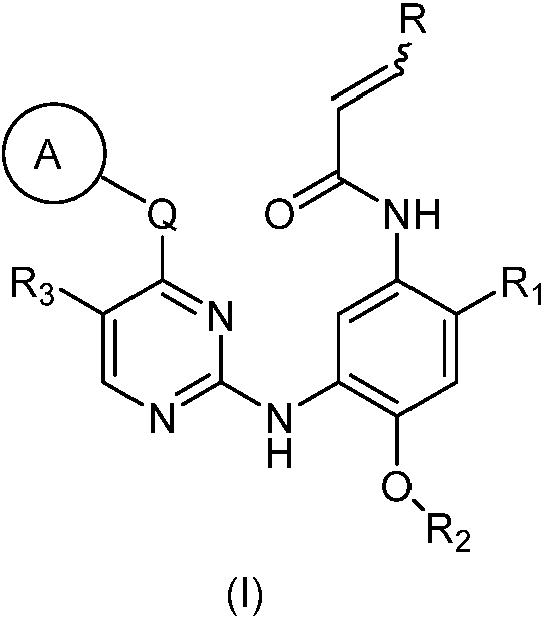
en donde:where:
el anillo A es:ring A is:

Q es un enlace; R es hidrógeno;Q is a bond; R is hydrogen;
X1, X2 y X3 cada uno de se selecciona independientemente entre el grupo que consiste en NR7 y CRa, con la condición de que al menos uno de X1, X2 y X3 es NR7 ;X 1 , X 2 and X 3 are each independently selected from the group consisting of NR 7 and CRa, with the proviso that at least one of X 1 , X 2 and X 3 is NR 7 ;
R1 se selecciona del grupo que consiste en:R 1 is selected from the group consisting of:
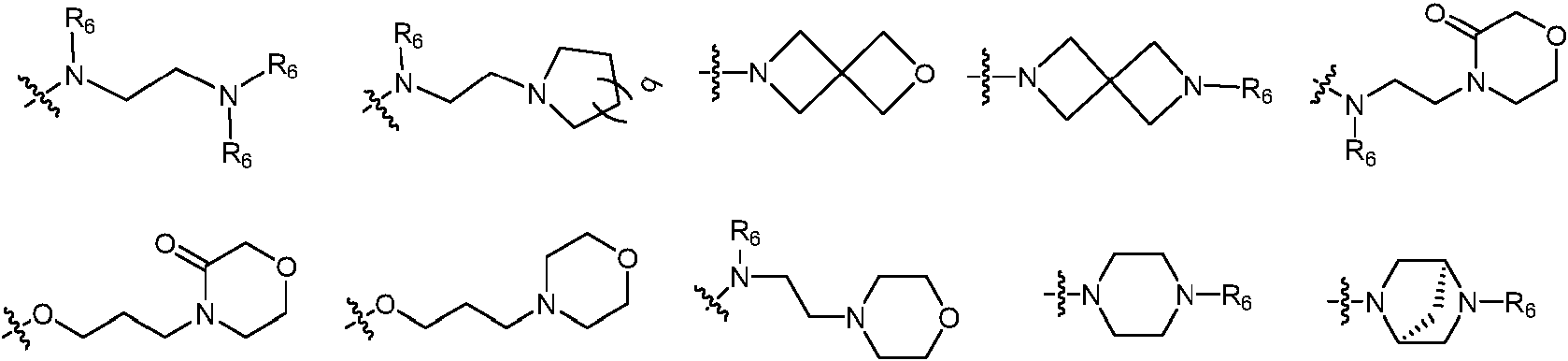
en donde los tres R6 en where the three R 6 in

son opcionalmente los mismos o diferentes sustituyentes;they are optionally the same or different substituents;
R2 se selecciona entre el grupo que consiste en alquilo C1-8 y cicloalquilo C3-8, en donde el alquilo C1-8 y cicloalquilo C3-8 están cada uno opcionalmente sustituidos con uno o más grupos seleccionados entre el grupo que consiste en halógeno, hidroxi, alquilo C1-8, alcoxi C1-8, haloalcoxi C1-8, cicloalquilo C3-8 y cicloalcoxi C3-8;R 2 is selected from the group consisting of C 1-8 alkyl and C 3-8 cycloalkyl, wherein C 1-8 alkyl and C 3-8 cycloalkyl are each optionally substituted with one or more groups selected from the group consisting of halogen, hydroxy, C 1-8 alkyl, C 1-8 alkoxy, C 1-8 haloalkoxy, C 3-8 cycloalkyl and C 3-8 cycloalkoxy;
R3 se selecciona entre el grupo que consiste en hidrógeno, deuterio, halógeno, ciano, nitro, alquilo C1-8, alcoxi C1-8, cicloalquilo C3-8, trifluorometilo, trifluorometoxi, SO2R9, C(O)R10, C(O)OR10 y P(O)RnR^;R 3 is selected from the group consisting of hydrogen, deuterium, halogen, cyano, nitro, alkyl C 1-8, alkoxy C 1 -8, C3-8 cycloalkyl, trifluoromethyl, trifluoromethoxy, SO 2 R 9, C (O )R 10 , C(O)OR 10 and P(O)RnR^;
R4 se selecciona entre el grupo que consiste en hidrógeno, deuterio, halógeno, hidroxi, sulfhidrilo, ciano, nitro, azido, alquilo C1-8, alquenilo C2-8, alquinilo C2-8, cicloalquilo C3-8, heterociclilo de 3 a 8 miembros, heterocicliloxi de 3 a 8 miembros, heterocicliltio de 3 a 8 miembros, arilo C5-10, ariloxi C5-10, ariltio C5-10, heteroarilo de 5 a 10 miembros, heteroariloxi de 5 a 10 miembros, heteroariltio de 5 a 10 miembros, -C0-8-P(O)RnR12, -C0-8-S(O)rR9, -C0-8-O-R10, -C0-8-C(O)R10, -C0-8-C(O)OR10, -C0-8-O-C(O)R10, -C0-8-NR7R8, -C0-9-C(O)NRyR8, -N(R7)-C(O)R10 y -N(Ry)-C(O)OR10;R 4 is selected from the group consisting of hydrogen, deuterium, halogen, hydroxy, sulfhydryl, cyano, nitro, azido, C 1-8 alkyl, C 2-8 alkenyl, C 2-8 alkynyl, C 3-8 cycloalkyl, 3- to 8 - membered heterocyclyloxy 3 to 8 membered heterocyclylthio 3 to 8 members, aryl C 5-10, C 5-10 aryloxy, arylthio C 10.05, 5- to 10 - membered heteroaryloxy 5 10 membered, 5 to 10 membered heteroarylthio, -C 0-8 -P(O)RnR 12 , -C 0-8 -S(O)rR 9 , -C 0-8 -OR 10 , -C 0-8 -C(O)R 10 , -C 0-8 -C(O)OR 10 , -C 0-8 -OC(O)R 10 , -C 0-8 -NR 7 R 8 , -C0-9- C(O)NRyR8, -N(R7)-C(O)R10 and -N(Ry)-C(O)OR10;
en donde el alquilo C1-8, cicloalquilo C3-8, heterociclilo de 3 a 8 miembros, arilo C5-10, heteroarilo de 5 a 10 miembros, carbociclo de 5 a 7 miembros, heterociclo de 5 a 7 miembros, arilo C5-7 y heteroarilo de 5 a 7 miembros están cada uno opcionalmente sustituido con uno o más grupos seleccionados entre el grupo que consiste en halógeno, hidroxi, sulfhidrilo, ciano, nitro, azido, alquilo C1-8, alquenilo C2-8, alquinilo C2-8, cicloalquilo C3-8, heterociclilo de 3 a 8 miembros, heterocicliloxi de 3 a 8 miembros, heterocicliltio de 3 a 8 miembros, arilo C5-10, ariloxi C5-10, ariltio C5-10, heteroarilo de 5 a 10 miembros, heteroariloxi de 5 a 10 miembros, heteroariltio de 5 a 10 miembros, -C0-8-S(O)rR9, -C0-8-OR10, -C0-8-C(O)R10, -C0-8-C(O)OR10, -C0-8-O-C(O)R10, -C0-8-NR7R8, -C0-8-C(O)NR7R8, -N(R7)-C(O)R10y -N(R7)-C(O)OR10;where C 1-8 alkyl, C 3-8 cycloalkyl, 3-8 membered heterocyclyl, C 5-10 aryl, 5-10 membered heteroaryl, 5-7 membered carbocycle, 5-7 membered heterocycle, aryl C 5-7 and 5-7 membered heteroaryl are each optionally substituted with one or more groups selected from the group consisting of halogen, hydroxy, sulfhydryl, cyano, nitro, azido, C 1-8 alkyl, C 2-alkenyl 8 C 2-8 alkynyl, C 3-8 cycloalkyl, 3- to 8 - membered heterocyclyloxy 3 to 8 membered heterocyclylthio 3 to 8 members, aryl C 5-10, C 5-10 aryloxy, arylthio C 5 -10 , 5-10 membered heteroaryl, 5-10 membered heteroaryloxy, 5-10 membered heteroarylthio, -C 0-8 -S(O)rR9, -C 0-8 -OR 10 , -C 0-8 -C(O)R 10 , -C 0-8 -C(O)OR 10 , -C 0-8 -OC(O)R 10 , -C0-8-NR7R8, -C0-8-C(O) NR7R8, -N(R7)-C(O)R10, and -N(R7)-C(O)OR10;
R6 se selecciona entre el grupo que consiste en hidrógeno, deuterio, alquilo C1-8, haloalquilo C1.8 y C(O)R™; R7 se selecciona entre el grupo que consiste en hidrógeno, deuterio, alquilo C1-8, alquenilo C2-8, alquinilo C2-8, cicloalquilo C3-8, heterociclilo de 3 a 8 miembros, arilo C5-10, heteroarilo de 5 a 10 miembros, -C0-8-S(O)rR9, -C0-8-C(O)R10;R6 is selected from the group consisting of hydrogen, deuterium, C 1-8 alkyl, halo C 1.8 and C (O) R ™; R 7 is selected from the group consisting of hydrogen, deuterium, C 1-8 alkyl, C 2-8 alkenyl, C 2-8 alkynyl, C 3-8 cycloalkyl, 3- to 8 - membered, C 5-10 aryl , 5- to 10-membered heteroaryl, -C 0-8 -S(O)rR 9 , -C 0-8 -C(O)R10;
en donde el alquilo C1-8, si está sustituido, está sustituido por uno o más grupos seleccionados entre el grupo que consiste en halógeno, hidroxi, sulfhidrilo, ciano, nitro, azido, alquilo C1-8, alquenilo C2-8, alquinilo C2-8, cicloalquilo C3-8, heterociclilo de 3 a 8 miembros, heterocicliloxi de 3 a 8 miembros, heterocicliltio de 3 a 8 miembros, arilo C5-10, ariloxi C5-10, ariltio C5-10, heteroarilo de 5 a 10 miembros, heteroariloxi de 5 a 10 miembros, heteroariltio de 5 a 10 miembros, -C0-8-S(O)rR9, -C0-8-O-R10, -C0-8-C(O)R10, -C0-8-C(O)OR10, -C0-8-O-C(O)R10, -C0-8-NR7R8, -C0-8-C(O)NR7R8, -n (R7)-c (O)R10 y -N(R7)-C(O)OR10;wherein C 1-8 alkyl, if substituted, is substituted by one or more groups selected from the group consisting of halogen, hydroxy, sulfhydryl, cyano, nitro, azido, C 1-8 alkyl, C 2-8 alkenyl alkynyl C 2-8 cycloalkyl C 3-8, 3- to 8 - membered heterocyclyloxy 3 to 8 membered heterocyclylthio 3 to 8 members, aryl C 5-10, C 5-10 aryloxy, arylthio C 5- 10 , 5-10 membered heteroaryl, 5-10 membered heteroaryloxy, 5-10 membered heteroarylthio, -C 0-8 -S(O)rR 9 , -C 0-8 -OR 10 , -C 0-8 -C(O)R 10 , -C 0-8 -C(O)OR 10 , -C 0-8 -OC(O)R 10 , -C 0-8 -NR 7 R 8 , -C 0-8 -C(O)NR7R8, -n(R7)-c(O)R10 and -N(R7)-C(O)OR10;
el cicloalquilo C3.8, heterociclilo de 3 a 8 miembros, arilo C5-10 y heteroarilo de 5 a 10 miembros están cada uno opcionalmente sustituido con uno o más grupos seleccionados entre el grupo que consiste en halógeno, hidroxi, sulfhidrilo, ciano, nitro, azido, alquilo C1-8, alquenilo C2-8, alquinilo C2-8, cicloalquilo C3-8, heterociclilo de 3 a 8 miembros, heterocicliloxi de 3 a 8 miembros, heterocicliltio de 3 a 8 miembros, arilo C5-10, ariloxi C5-10, ariltio C5-10, heteroarilo de 5 a 10 miembros, heteroariloxi de 5 a 10 miembros, heteroariltio de 5 a 10 miembros, -C0-8-S(O)rR9, -C0-8-O-R10, -C0-8-C(O)R10, -C0-8-C(O)OR10, -C0-8-O-C(O)R10, -C0-8-NR7R8 , -C0-8-C(O)NR7R8, -N(R7)-C(O)R10 y -N(R7)-C(O)OR10;C 3.8 cycloalkyl, 3- to 8 - membered aryl C 5-10 and 5- to 10 members are each optionally substituted with one or more groups selected from the group consisting of halogen, hydroxy, sulfhydryl, cyano, nitro , azido, C 1-8 alkyl, C 2-8 alkenyl, C 2-8 alkynyl, C 3-8 cycloalkyl, 3- to 8 - membered heterocyclyloxy 3 to 8 membered heterocyclylthio 3 to 8 members, aryl C 5-10 , C 5-10 aryloxy, C 5-10 arylthio, 5-10 membered heteroaryl, 5-10 membered heteroaryloxy, 5-10 membered heteroarylthio, -C 0-8 -S(O)rR 9 , -C 0-8 -OR 10 , -C 0-8 -C(O)R 10 , -C 0-8 -C(O)OR 10 , -C 0-8 -OC(O)R 10 , -C 0-8 -NR 7 R 8 , -C0-8-C(O)NR7R8, -N(R7)-C(O)R10 and -N(R7)-C(O)OR10;
R8 se selecciona entre el grupo que consiste en hidrógeno, deuterio, halógeno, hidroxi, sulfhidrilo, ciano, nitro, azido, alquilo C1-8, alquenilo C2-8, alquinilo C2-8, cicloalquilo C3-8, heterociclilo de 3 a 8 miembros, heterocicliloxi de 3 a 8 miembros, heterocicliltio de 3 a 8 miembros, arilo C5-10, ariloxi C5-10, ariltio C5-10, heteroarilo de 5 a 10 miembros, heteroariloxi de 5 a 10 miembros, heteroariltio de 5 a 10 miembros, -C0-8-S(O)rR9, -C0-8-O-R10, -C0-8-C(O)R10, -C0-8-C(O)OR10, -C0-8-O-C(O)R10, -C0-8-NR7R8 , -C0-8-C(O)NR7R8, -N(R7)-C(O)R10 y -N(R7)-C(O)OR10; en donde el alquilo C1-8, cicloalquilo C3-8, heterociclilo de 3 a 8 miembros, arilo C5 -10y heteroarilo de 5 a 10 miembros está cada uno opcionalmente sustituido con uno o más grupos seleccionados entre el grupo que consiste en halógeno, hidroxi, sulfhidrilo, ciano, nitro, azido, alquilo C1-8, alquenilo C2-8, alquinilo C2-8, cicloalquilo C3-8, heterociclilo de 3 a 8 miembros, heterocicliloxi de 3 a 8 miembros, heterocicliltio de 3 a 8 miembros, arilo C5-10, ariloxi C5-10, ariltio C5-10, heteroarilo de 5 a 10 miembros, heteroariloxi de 5 a 10 miembros, heteroariltio de 5 a 10 miembros, -C0-8-S(O)rR9, -C0-8-O-R10, -C0-8-C(O)R10, -C0-8-C(O)OR10, -C0-8-O-C(O)R10, -C0-8-NR7R8, -C0-8-C(O)NR7R8, -n (R7)-c (O)R10 y -N(R7)-C(O)OR10;R8 is selected from the group consisting of hydrogen, deuterium, halogen, hydroxy, sulfhydryl, cyano, nitro, azido, C 1-8 alkyl, C 2-8 alkenyl, C 2-8 alkynyl, C 3-8 cycloalkyl, heterocyclyl 3 to 8 membered heterocyclyloxy 3 to 8 membered heterocyclylthio 3 to 8 members, aryl C 5-10, C 5-10 aryloxy, arylthio C 10.05, 5- to 10 - membered heteroaryloxy 5 to 10 membered, 5- to 10-membered heteroarylthio, -C 0-8 -S(O)rR 9 , -C 0-8 -OR 10 , -C 0-8 -C(O)R 10 , -C 0-8 - C(O)OR 10 , -C 0-8 -OC(O)R 10 , -C 0-8 -NR 7 R 8 , -C0-8-C(O)NR7R8, -N(R7)-C( O)R10 and -N(R7)-C(O)OR10; wherein C 1-8 alkyl, C 3-8 cycloalkyl, 3-8 membered heterocyclyl, C 5-10 aryl, and 5-10 membered heteroaryl is each optionally substituted with one or more groups selected from the group consisting of halogen, hydroxy, sulfhydryl, cyano, nitro, azido, C 1-8 alkyl, C 2-8 alkenyl, C 2-8 alkynyl, C 3-8 cycloalkyl, 3- to 8 - membered heterocyclyloxy 3 to 8 members , heterocyclylthio 3 to 8 members, aryl C 5-10, C 5-10 aryloxy, arylthio C 10.05, 5- to 10 - membered heteroaryloxy 5 to 10 membered heteroarylthio 5 to 10 members, -C0- 8-S (O) RR9, -C 0-8 -OR 10, -C 0-8 -C (O) R 10, -C 0-8 -C (O) OR 10, -C 0-8 -OC (O) R 10, -C 0-8 -NR 7 R 8, -C 0-8 -C (O) NR7R8, -N (R7) -C (O) R10 and -N (R7) -C (O )OR10;
R9 se selecciona entre el grupo que consiste en hidrógeno, deuterio, alquilo C1-8, cicloalquilo C3-8, haloalquilo C1-8, bis-alquilamino C1.8, fenilo y p-metilfenilo;R 9 is selected from the group consisting of hydrogen, deuterium, C 1-8 alkyl, C 3-8 cycloalkyl, C 1-8 haloalkyl, bis-C 1.8 alkylamino, phenyl, and p-methylphenyl;
R10, cada uno de R11 y R12 se selecciona independientemente entre el grupo que consiste en hidrógeno, deuterio, alquilo C1-8, cicloalquilo C3-8, haloalquilo C1-8 e hidroxialquilo C1.8;R 10 , R 11 and R 12 are each independently selected from the group consisting of hydrogen, deuterium, C 1-8 alkyl, C 3-8 cycloalkyl, C 1-8 haloalkyl, and C 1.8 hydroxyalkyl;
m es 0, 1, 2, 3 o 4;m is 0, 1, 2, 3 or 4;
r es 0, 1 o 2;r is 0, 1 or 2;
q es 0, 1, 2, 3 o 4;q is 0, 1, 2, 3 or 4;
' significa que el sustituyente R puede estar en la configuración Z o E,' means that the substituent R can be in the Z or E configuration,
en donde si R7 se selecciona entre el grupo que consiste en hidrógeno, deuterio o alquilo C1-8 sin sustituir, entonces el compuesto se selecciona entre el grupo que consiste en: wherein if R 7 is selected from the group consisting of hydrogen, deuterium, or unsubstituted C 1-8 alkyl, then the compound is selected from the group consisting of:

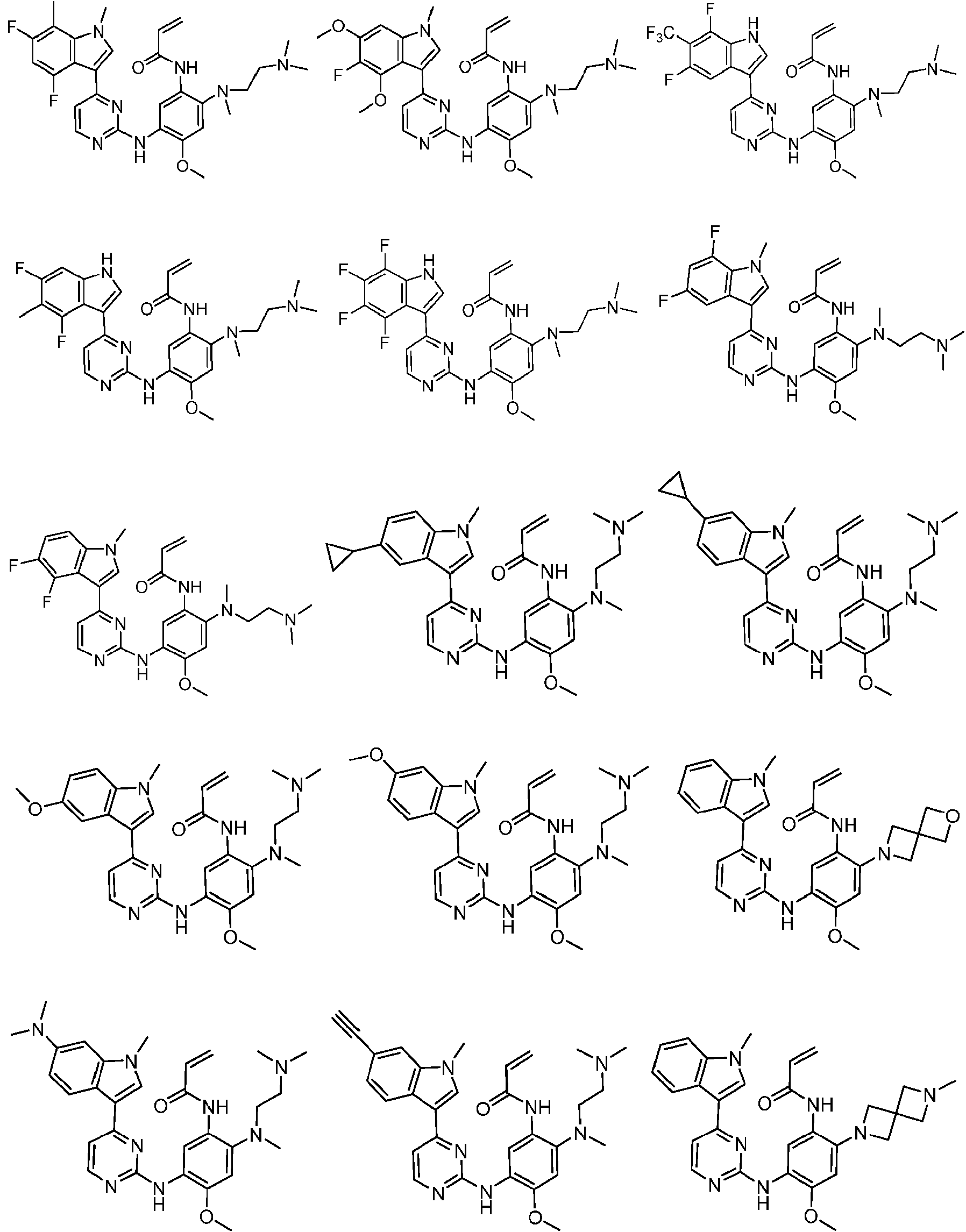

En una realización preferida, en el compuesto de fórmula (I), el estereoisómero o la sal farmacéuticamente aceptableIn a preferred embodiment, in the compound of formula (I), the stereoisomer or the pharmaceutically acceptable salt
del mismo, R2 se selecciona entre el grupo que consiste en alquilo C-i-4 y cicloalquilo C3-6, en donde el alquilo C-i-4 y cicloalquilo C3-6 están cada uno opcionalmente sustituido con uno o más grupos seleccionados entre el grupo que consiste en halógeno, hidroxi, alquilo C1-8, alcoxi C1-8, haloalcoxi C1-8, cicloalquilo C3-8 y cicloalcoxi C3-8; el anillo A, Q,thereof, R2 is selected from the group consisting of Ci-4 alkyl and C3-6 cycloalkyl, wherein Ci-4 alkyl and C 3-6 cycloalkyl are each optionally substituted with one or more groups selected from the group consisting of I consists of halogen, hydroxy, C 1-8 alkyl, C 1-8 alkoxy, C 1-8 haloalkoxy, C 3-8 cycloalkyl and C 3-8 cycloalkoxy; the ring A, Q,
R, X1, X2, X3 , R1, R3, R4 , R6, R7 , R8, R9, R10, R11, R12, m, r y q son como se definen en el compuesto de fórmula (I).R, X 1 , X 2 , X 3 , R 1 , R 3 , R 4 , R6, R 7 , R8, R 9 , R 10 , R 11 , R 12 , m, r and q are as defined in the compound of formula (I).
En una realización más preferida, en el compuesto de fórmula (I), el estereoisómero o la sal farmacéuticamente aceptable del mismo, R2 se selecciona entre el grupo que consiste en alquilo C1-4 y cicloalquilo C3-6, en donde el alquiloIn a more preferred embodiment, in the compound of formula (I), the stereoisomer or the pharmaceutically acceptable salt thereof, R 2 is selected from the group consisting of C 1-4 alkyl and C 3-6 cycloalkyl, wherein the I rent
C1-4 y cicloalquilo C3-6 están cada uno opcionalmente sustituido con uno o más grupos seleccionados entre el grupoC1-4 and C3-6 cycloalkyl are each optionally substituted with one or more groups selected from the group
que consiste en halógeno y hidroxi; el anillo A, Q, R, X1, X2, X3 , R1, R3, R4, R6, R7 , R8, R9 , R10, R11, R12, m, r y q sonconsisting of halogen and hydroxy; the ring A, Q, R, X 1 , X 2 , X 3 , R 1 , R 3 , R 4 , R6, R 7 , R8, R 9 , R 10 , R 11 , R 12 , m, r and q are
como se definen en el compuesto de fórmula (I).as defined in the compound of formula (I).
En una realización más preferida, en el compuesto de fórmula (I), el estereoisómero o la sal farmacéuticamente aceptable del mismo, R2 es alquilo C1-4 opcionalmente sustituido con uno o más grupos seleccionados entre el grupoIn a more preferred embodiment, in the compound of formula (I), the stereoisomer or the pharmaceutically acceptable salt thereof, R 2 is C 1-4 alkyl optionally substituted with one or more groups selected from the group
que consiste en flúor y hidroxi; el anillo A, Q, R, X1 , X2, X3, R1, R3 , R4 , R6, R7, R8, R9, R10, R11, R12, m, r y q son comoconsisting of fluorine and hydroxy; Ring A, Q, R, X 1, X 2, X 3, R 1, R 3, R 4, R 6, R 7, R 8, R 9, R 10, R 11, R 12, m, r and q are as
se definen en el compuesto de fórmula (I).are defined in the compound of formula (I).
En una realización más preferida, en el compuesto de fórmula (I), el estereoisómero o la sal farmacéuticamente aceptable del mismo, R2 se selecciona entre el grupo que consiste en metilo, difluorometilo y trifluorometilo; el anilloIn a more preferred embodiment, in the compound of formula (I), the stereoisomer or the pharmaceutically acceptable salt thereof, R 2 is selected from the group consisting of methyl, difluoromethyl and trifluoromethyl; the ring
A, Q, R, X1, X2 , X3, R1, R3, R4, R6, R7 , R8, R9, R10, R11, R12, m y r son como se definen en el A, Q, R, X 1, X 2, X 3, R 1, R 3, R 4, R 6, R 7, R 8, R 9, R 10, R 11, R 12 and r are as defined in the
En una realización más preferida, el compuesto de fórmula (I), el estereoisómero o la sal farmacéuticamente aceptableIn a more preferred embodiment, the compound of formula (I), the stereoisomer or the pharmaceutically acceptable salt
del mismo es un compuesto de fórmula (IA): thereof is a compound of formula (IA):

en donde R2 se selecciona del grupo que consiste en metilo, difluorometilo y trifluorometilo; el anillo A, R, Xi, X2, X3, R1, R3, R4, R6, R7 , R8, R9, R10, R11, R12, m, r y q son como se definen en el compuesto de fórmula (I).wherein R 2 is selected from the group consisting of methyl, difluoromethyl, and trifluoromethyl; ring A, R, Xi, X 2 , X 3 , R 1 , R 3 , R 4 , R6, R 7 , R8, R 9 , R 10 , R 11 , R 12 , m, r and q are as defined in the compound of formula (I).
En una realización más preferida, el compuesto de fórmula (I), el estereoisómero o la sal farmacéuticamente aceptable del mismo se seleccionan entre el grupo que consiste en un compuesto de fórmula (IIA1) y un compuesto de fórmula (IIA2):In a more preferred embodiment, the compound of formula (I), the stereoisomer or the pharmaceutically acceptable salt thereof is selected from the group consisting of a compound of formula (IIA1) and a compound of formula (IIA2):

en donde R2 se selecciona del grupo que consiste en metilo, difluorometilo y trifluorometilo; el anillo A, R, X1, X2, X3, R1, R3, R4, R6, R7 , R8, R9, R10, R11, R12, m, r y q son como se definen en el compuesto de fórmula (I).wherein R 2 is selected from the group consisting of methyl, difluoromethyl, and trifluoromethyl; ring A, R, X 1 , X 2 , X 3 , R 1 , R 3 , R 4 , R6, R 7 , R8, R 9 , R 10 , R 11 , R 12 , m, r and q are as defined in the compound of formula (I).
En una realización más preferida, el compuesto de fórmula (I), el estereoisómero o la sal farmacéuticamente aceptable del mismo se seleccionan entre el grupo que consiste en un compuesto de fórmula (IIIA1-1), un compuesto de fórmula (IIIA1-2), un compuesto de fórmula (IIIA1-3), un compuesto de fórmula (IIIA1-4), un compuesto de fórmula (IIIA1-5) y un compuesto de fórmula (IIIA1-6): In a more preferred embodiment, the compound of formula (I), the stereoisomer or the pharmaceutically acceptable salt thereof is selected from the group consisting of a compound of formula (IIIA1-1), a compound of formula (IIIA1-2) , a compound of formula (IIIA1-3), a compound of formula (IIIA1-4), a compound of formula (IIIA1-5) and a compound of formula (IIIA1-6):

en donde R2 se selecciona del grupo que consiste en metilo, difluorometilo y trifluorometilo; R, R1, R3 , R4, R6, R7 , R8,wherein R 2 is selected from the group consisting of methyl, difluoromethyl, and trifluoromethyl; R, R 1, R 3, R 4, R 6, R 7, R8,
R9 , R10, R11, R12, m, r y q son como se definen en el compuesto de fórmula (I).R 9 , R 10 , R 11 , R 12 , m, r and q are as defined in the compound of formula (I).
En una realización más preferida, el compuesto de fórmula (I), el estereoisómero o la sal farmacéuticamente aceptable del mismo se seleccionan entre el grupo que consiste en un compuesto de fórmula (IVA1-1) y un compuesto de fórmulaIn a more preferred embodiment, the compound of formula (I), the stereoisomer or the pharmaceutically acceptable salt thereof is selected from the group consisting of a compound of formula (IVA1-1) and a compound of formula
(IVA1-2):(VAT1-2):

en donde R, R1, R3, 
En una realización más preferida, en el compuesto de fórmula (I), el estereoisómero o la sal farmacéuticamente aceptable del mismo, R3 se selecciona entre el grupo que consiste en hidrógeno, flúor, cloro, metilo, etilo, isopropilo, metoxi, etoxi, isopropoxi, ciclopropilo, ciclobutilo, trifluorometilo y trifluorometoxi; R, R1, R4 , R6, R7, R8, R9, R10, R11, R12, m, r y q son como se definen en el compuesto de fórmula (I).In a more preferred embodiment, in the compound of formula (I), the stereoisomer or the pharmaceutically acceptable salt thereof, R 3 is selected from the group consisting of hydrogen, fluorine, chlorine, methyl, ethyl, isopropyl, methoxy, ethoxy , isopropoxy, cyclopropyl, cyclobutyl, trifluoromethyl, and trifluoromethoxy; R, R 1 , R 4 , R6, R 7 , R8, R 9 , R 10 , R 11 , R 12 , m, r and q are as defined in the compound of formula (I).
En una realización más preferida, en el compuesto de fórmula (I), el estereoisómero o la sal farmacéuticamente aceptable del mismo, R3 se selecciona entre el grupo que consiste en hidrógeno, flúor, cloro, metilo, ciclopropilo y trifluorometilo; R, R1, R4, R6, R7 , R8, R9, R10, R11, R12, m, r y q son como se definen en el compuesto de fórmula (I).In a more preferred embodiment, in the compound of formula (I), the stereoisomer or the pharmaceutically acceptable salt thereof, R3 is selected from the group consisting of hydrogen, fluorine, chlorine, methyl, cyclopropyl and trifluoromethyl; R, R 1 , R 4 , R6, R 7 , R8, R 9 , R 10 , R 11 , R 12 , m, r and q are as defined in the compound of formula (I).
En la realización más preferida, el compuesto de fórmula (I), el estereoisómero o la sal farmacéuticamente aceptable del mismo se seleccionan entre el grupo que consiste en: In the most preferred embodiment, the compound of formula (I), the stereoisomer or the pharmaceutically acceptable salt thereof is selected from the group consisting of:

En una realización más preferida, el compuesto de fórmula (I), el estereoisómero o la sal farmacéuticamente aceptable del mismo es un compuesto de fórmula (IVA1-3):In a more preferred embodiment, the compound of formula (I), the stereoisomer or the pharmaceutically acceptable salt thereof is a compound of formula (IVA1-3):

en donde R, R1, R3, R4 , R6, R7, R8, R9, R10, R11, R12, m, r y q son como se definen en el compuesto de fórmula (I). wherein R, R 1 , R 3 , R 4 , R 6 , R 7 , R 8 , R 9 , R 10 , R 11 , R 12 , m, r and q are as defined in the compound of formula (I).
En una realización más preferida, en el compuesto de fórmula (I), el estereoisómero o la sal farmacéuticamente aceptable del mismo, R, R1, R3, R4, R6, R7 , R8, R9 , R10, R11, R12, m, r y q son como se definen en el compuesto de fórmula (I), con la condición de que cuando R8 es hidrógeno, m es 2, 3 o 4; o cuando R8 no es hidrógeno, m es 1, 2, 3 o 4.In a more preferred embodiment, in the compound of formula (I), the stereoisomer or the pharmaceutically acceptable salt thereof, R, R 1 , R 3 , R 4 , R6, R 7 , R8, R 9 , R 10 , R 11 , R 12 , m, r and q are as defined in the compound of formula (I), with the proviso that when R 8 is hydrogen, m is 2, 3 or 4; or when R8 is not hydrogen, m is 1, 2, 3 or 4.
En una realización más preferida, en el compuesto de fórmula (I), el estereoisómero o la sal farmacéuticamente aceptable del mismo, R3 se selecciona entre el grupo que consiste en hidrógeno, flúor, cloro, metilo, ciclopropilo y trifluorometilo; y R, R1, R4, R6, R7, R8, R9, R10, R11, R12, m, r y q son como se definen en el compuesto de fórmula (I), con la condición de que cuando R8 es hidrógeno, m es 2, 3 o 4; o cuando R8 no es hidrógeno, m es 1, 2, 3 o 4. In a more preferred embodiment, in the compound of formula (I), the stereoisomer or the pharmaceutically acceptable salt thereof, R 3 is selected from the group consisting of hydrogen, fluorine, chlorine, methyl, cyclopropyl and trifluoromethyl; and R, R 1 , R 4 , R6, R 7 , R8, R 9 , R 10 , R 11 , R 12 , m, r and q are as defined in the compound of formula (I), with the proviso that when R8 is hydrogen, m is 2, 3 or 4; or when R8 is not hydrogen, m is 1, 2, 3 or 4.
En la realización más preferida, el compuesto de fórmula (I), el estereoisómero o la sal farmacéuticamente aceptable del mismo se seleccionan entre el grupo que consiste en:In the most preferred embodiment, the compound of formula (I), the stereoisomer or the pharmaceutically acceptable salt thereof is selected from the group consisting of:

En una realización más preferida, en el compuesto de fórmula (I), el estereoisómero o la sal farmacéuticamente aceptable del mismo, en donde m es 2, 3 o 4, cuando R3 se selecciona entre el grupo que consiste en hidrógeno, flúor, cloro, metilo, ciclopropilo y trifluorometilo; dos R4 se toman junto con los átomos de carbono del anillo de benceno adjunto para formar un carbociclo de 5 a 7 miembros, heterociclo de 5 a 7 miembros, arilo C5-7 o heteroarilo de 5 a 7 miembros, el carbociclo de 5 a 7 miembros, heterociclo de 5 a 7 miembros, arilo C5-7 y heteroarilo de 5 a 7 miembros, seleccionado entre el grupo que consiste en:In a more preferred embodiment, in the compound of formula (I), the stereoisomer or the pharmaceutically acceptable salt thereof, wherein m is 2, 3 or 4, when R 3 is selected from the group consisting of hydrogen, fluorine, chlorine, methyl, cyclopropyl and trifluoromethyl; two R 4 are taken together with the carbon atoms of the benzene ring adjunct to form a 5-7 membered carbocycle, 5-7 membered heterocycle, C 5-7 aryl or 5-7 membered heteroaryl, the 5-7 membered carbocycle, 5-7 membered heterocycle, C 5-aryl 7 and 5 to 7 membered heteroaryl, selected from the group consisting of:

en donde el carbociclo de 5 a 7 miembros, heterociclo de 5 a 7 miembros, arilo C5-7 y heteroarilo de 5 a 7 miembros están cada uno opcionalmente sustituido con uno o más grupos seleccionados entre el grupo que consiste en halógeno, hidroxi, sulfhidrilo, ciano, nitro, azido, alquilo C1-8, alquenilo C2-8, alquinilo C2-8, cicloalquilo C3-8, heterociclilo de 3 a 8 miembros, heterocicliloxi de 3 a 8 miembros, heterocicliltio de 3 a 8 miembros, arilo C5-10, ariloxi C5-10, ariltio C5-10, heteroarilo de 5 a 10 miembros, heteroariloxi de 5 a 10 miembros, heteroariltio de 5 a 10 miembros, -C0-8-S(O)rRg, -C0-8-O-R10, -C0-8-C(O)R10, -C0-8-C(O)OR10, -C0-8-O-C(O)R10, -C0-8-NR7R8 , -C0-8-C(O)NR7R8, -N(R7)-C(O)R10 y -N(R7)-C(O)OR10;wherein the 5 to 7 membered carbocycle, 5 to 7 membered heterocycle, C 5-7 aryl and 5 to 7 membered heteroaryl are each optionally substituted with one or more groups selected from the group consisting of halogen, hydroxy, sulfhydryl, cyano, nitro, azido, C 1-8 alkyl, C 2-8 alkenyl, C 2-8 alkynyl, C 3-8 cycloalkyl, 3- to 8 - membered heterocyclyloxy 3 to 8 membered heterocyclylthio 3 to 8 membered, C 5-10 aryl, C 5-10 aryloxy, C 5-10 arylthio, 5-10 membered heteroaryl, 5-10 membered heteroaryloxy, 5-10 membered heteroarylthio, -C 0-8 -S( O) RRG, -C 0-8 -OR 10, -C 0-8 -C (O) R 10, -C 0-8 -C (O) OR 10, -C 0-8 -OC (O) R 10 , -C 0-8 -NR 7 R 8 , -C0-8-C(O)NR7R8, -N(R7)-C(O)R10 and -N(R7)-C(O)OR10;
R, R1, Ra, R7, R8, Rg, R10, R11, R12, m, r y q son como se definen en el compuesto de fórmula (I).R, R 1 , Ra, R 7 , R8, Rg, R 10 , R 11 , R 12 , m, r and q are as defined in the compound of formula (I).
En una realización más preferida, en el compuesto de fórmula (I), el estereoisómero o la sal farmacéuticamente aceptable del mismo, cuando R8 es hidrógeno, m es 0 o 1; o R8 no es hidrógeno, m es 0, 1 o 2; R3 se selecciona entre hidrógeno, flúor, cloro, metilo, ciclopropilo y trifluorometilo;In a more preferred embodiment, in the compound of formula (I), the stereoisomer or the pharmaceutically acceptable salt thereof, when R8 is hydrogen, m is 0 or 1; or R8 is not hydrogen, m is 0, 1 or 2; R 3 is selected from hydrogen, fluorine, chlorine, methyl, cyclopropyl and trifluoromethyl;
R4 se selecciona entre el grupo que consiste en hidrógeno, deuterio, halógeno, hidroxi, sulfhidrilo, ciano, nitro, azido, alquilo C1-8, alquenilo C2-8, alquinilo C2-8, cicloalquilo C3-8, heterociclilo de 3 a 8 miembros, heterocicliloxi de 3 a 8 miembros, heterocicliltio de 3 a 8 miembros, arilo C5-10, ariloxi C5-10, ariltio C5-10, heteroarilo de 5 a 10 miembros, heteroariloxi de 5 a 10 miembros, heteroariltio de 5 a 10 miembros, -C0-8-P(O)R11R12, -C0-8-S(O)rRg, -C0-8-O-R10, -C0-8-C(O)R10, -C0-8-C(O)OR10, -C0-8-O-C(O)R10, -C0-8-NR7R8, -C0-8-C(O)NR7R8, -N(R7)-C(O)R10 y -N(R7)-C(O)ORm en donde el alquilo C1-8, cicloalquilo C3.8, heterociclilo de 3 a 8 miembros, arilo C5-10, heteroarilo de 5 a 10 miembros, carbociclo de 5 a 7 miembros, heterociclo de 5 a 7 miembros, arilo C5-7 y heteroarilo de 5 a 7 miembros están cada uno opcionalmente sustituido con uno o más grupos seleccionados entre el grupo que consiste en halógeno, hidroxi, sulfhidrilo, ciano, nitro, azido, alquilo C1-8, alquenilo C2-8, alquinilo C2-8, cicloalquilo C3-8, heterociclilo de 3 a 8 miembros, heterocicliloxi de 3 a 8 miembros, heterocicliltio de 3 a 8 miembros, arilo C5-10, ariloxi C5-10, ariltio C5-10, heteroarilo de 5 a 10 miembros, heteroariloxi de 5 a 10 miembros, heteroariltio de 5 a 10 miembros, -Cü.8-S(O)rRg, -C0-8-O-R10, -C0-8-C(O)R10, -C0-8-C(O)OR10, -C0-8-O-C(O)R10, -C0.8-NR7R8, -Cü.8-C(O)NR7R8, -N(R7)-C(O)R10 y -N(R7)-C(O)OR10; R, R1, Ra, R7, R8, Rg, R10, R11, R12, m, r y q son como se definen en el compuesto de fórmula (I).R 4 is selected from the group consisting of hydrogen, deuterium, halogen, hydroxy, sulfhydryl, cyano, nitro, azido, C 1-8 alkyl, C 2-8 alkenyl, C 2-8 alkynyl, C 3-8 cycloalkyl, 3- to 8 - membered heterocyclyloxy 3 to 8 membered heterocyclylthio 3 to 8 members, aryl C 5-10, C 5-10 aryloxy, arylthio C 10.05, 5- to 10 - membered heteroaryloxy 5 10 membered, 5 to 10 membered heteroarylthio, -C 0-8 -P(O)R 11 R 12 , -C 0-8 -S(O)rRg, -C 0-8 -OR 10 , -C 0 - 8 -C(O)R 10 , -C 0-8 -C(O)OR 10 , -C 0-8 -OC(O)R 10 , -C 0-8 -NR 7 R 8 , -C0-8 -C(O)NR7R8, -N(R7)-C(O)R10 and -N(R7)-C(O)ORm where C 1-8 alkyl, C 3.8 cycloalkyl, 3-8 membered heterocyclyl, C 5-10 aryl, 5-10 membered heteroaryl, 5-7 membered carbocycle, 5-7 membered heterocycle, C 5-7 aryl and 5-7 membered heteroaryl are each optionally substituted with one or more selected groups among the group consisting of halogen, hydroxy, sulfhyd rilo, cyano, nitro, azido, C 1-8 alkyl, C 2-8 alkenyl, C 2-8 alkynyl, C 3-8 cycloalkyl, 3- to 8 - membered heterocyclyloxy 3 to 8 membered heterocyclylthio 3 to 8 membered, C 5-10 aryl, C 5-10 aryloxy, C 5-10 arylthio, 5-10 membered heteroaryl, 5-10 membered heteroaryloxy, 5-10 membered heteroarylthio, -Cü.8-S(O )rRg, -C 0-8 -OR 10 , -C 0 - 8 -C(O)R 10 , -C 0-8 -C(O)OR 10 , -C 0-8 -OC(O)R 10 , -C 0.8 -NR 7 R 8 , -Cü.8-C(O)NR7R8, -N(R7)-C(O)R10 and -N(R7)-C(O)OR10; R, R 1 , Ra, R 7 , R8, Rg, R 10 , R 11 , R 12 , m, r and q are as defined in the compound of formula (I).
En una realización más preferida, en el compuesto de fórmula (I), el estereoisómero o la sal farmacéuticamente aceptable del mismo, R3 se selecciona entre el grupo que consiste en hidrógeno, flúor, cloro y trifluorometilo; R4 se selecciona entre el grupo que consiste en hidrógeno, deuterio, halógeno, hidroxi, sulfhidrilo, ciano, nitro, azido, alquilo C1-8, alquenilo C2-8, alquinilo C2-8, cicloalquilo C3-8, heterociclilo de 3 a 8 miembros, heterocicliloxi de 3 a 8 miembros, heterocicliltio de 3 a 8 miembros, arilo C5-10, ariloxi C5-10, ariltio C5-10, heteroarilo de 5 a 10 miembros, heteroariloxi de 5 a 10 miembros, heteroariltio de 5 a 10 miembros, -C0-8-S(O)rRg, -C0-8-O-R10, -C0-8-C(O)R10, -C0-8-C(O)OR10, -C0-8-O-C(O)R10, -C0-8-NR7R8 , -C0-8-C(O)NR7R8, -N(R7)-C(O)R10 y -N(R7)-C(O)OR10; In a more preferred embodiment, in the compound of formula (I), the stereoisomer or the pharmaceutically acceptable salt thereof, R 3 is selected from the group consisting of hydrogen, fluorine, chlorine and trifluoromethyl; R 4 is selected from the group consisting of hydrogen, deuterium, halogen, hydroxy, sulfhydryl, cyano, nitro, azido, C 1-8 alkyl, C 2-8 alkenyl, C 2-8 alkynyl, C 3-8 cycloalkyl, 3- to 8 - membered heterocyclyloxy 3 to 8 membered heterocyclylthio 3 to 8 members, aryl C 5-10, C 5-10 aryloxy, arylthio C 10.05, 5- to 10 - membered heteroaryloxy 5 10 membered, 5 to 10 membered heteroarylthio, -C 0-8 -S(O)rRg, -C 0-8 -OR 10 , -C 0-8 -C(O)R 10 , -C 0-8 - C(O)OR 10 , -C 0-8 -OC(O)R 10 , -C 0-8 -NR 7 R 8 , -C0-8-C(O)NR7R8, -N(R7)-C( O)R10 and -N(R7)-C(O)OR10;
R, Ri, R6, R7, R8, R9 , R10, R11, R12, r y q son como se definen en el compuesto de fórmula (I); y m es como se ha definido anteriormente.R, Ri, R6, R7, R8, R 9, R 10, R 11, R 12, r and q are as defined in the compound of formula (I); and m is as defined above.
En una realización más preferida, en el compuesto de fórmula (I), el estereoisómero o la sal farmacéuticamente aceptable del mismo, R3 se selecciona entre el grupo que consiste en hidrógeno, flúor, cloro y trifluorometilo; R4 se selecciona entre el grupo que consiste en hidrógeno, deuterio, hidroxi, ciano, alquenilo C2-8, alquinilo C2-8, cicloalquilo C3-8, heterociclilo de 3 a 8 miembros, heterocicliloxi de 3 a 8 miembros, arilo C5-10, ariloxi C5-10, heteroarilo de 5 a 10 miembros, heteroariloxi de 5 a 10 miembros, -C0-8-O-R10, -C0-8-C(O)OR10, -C0-8-O-C(O)R10, -C0-8-NR7R8, -C0-8-C(O)NR7R8;In a more preferred embodiment, in the compound of formula (I), the stereoisomer or the pharmaceutically acceptable salt thereof, R 3 is selected from the group consisting of hydrogen, fluorine, chlorine and trifluoromethyl; R 4 is selected from the group consisting of hydrogen, deuterium, hydroxy, cyano, C 2-8 alkenyl, C 2-8 alkynyl, C 3-8 cycloalkyl, 3- to 8 - membered heterocyclyloxy 3 to 8 members, C 5-10 aryl, C 5-10 aryloxy, 5-10 membered heteroaryl, 5-10 membered heteroaryloxy, -C 0-8 -OR 10 , -C 0-8 -C(O)OR 10 , -C 0-8 -OC(O)R 10 , -C 0-8 -NR 7 R 8 , -C 0-8 -C(O)NR7R8;
R, R1, R6, R7 , R8, R9 , R10, R11, R12 y q son como se definen en el compuesto de fórmula (I); y m es como se ha definido anteriormente.R, R 1 , R6, R 7 , R8, R 9 , R 10 , R 11 , R 12 and q are as defined in the compound of formula (I); and m is as defined above.
En una realización más preferida, en el compuesto de fórmula (I), el estereoisómero o la sal farmacéuticamente aceptable del mismo, R3 se selecciona entre el grupo que consiste en hidrógeno, flúor, cloro y trifluorometilo; R4 se selecciona entre el grupo que consiste en hidrógeno, deuterio, hidroxi, ciano, etenilo, etinilo, ciclopropilo, ciclobutilo, oxetan-3-ilo, N-R6-azetidin-3-ilo, ciclopropiloxi, ciclobutiloxi, fenilo, fenoxi, -C0-8-O-R10, -C0-8-C(O)OR10, -C0-8-O-C(O)R10, -C0-8-NR7R8 y -C0-8-C(O)NR7R8;In a more preferred embodiment, in the compound of formula (I), the stereoisomer or the pharmaceutically acceptable salt thereof, R 3 is selected from the group consisting of hydrogen, fluorine, chlorine and trifluoromethyl; R 4 is selected from the group consisting of hydrogen, deuterium, hydroxy, cyano, ethenyl, ethynyl, cyclopropyl, cyclobutyl, oxetan-3-yl, N-R6-azetidin-3-, cyclopropyloxy, cyclobutyloxy, phenyl, phenoxy, -C 0-8 -OR 10 , -C 0-8 -C(O)OR 10 , -C 0-8 -OC(O)R 10 , -C0-8-NR7R8 and -C0-8-C(O )NR7R8;
R, R1, R5, R7 , R8, R9 , R10, R11, R12 y q son como se definen en el compuesto de fórmula (I); y m es como se ha definido anteriormente.R, R 1 , R 5 , R 7 , R8, R 9 , R 10 , R 11 , R 12 and q are as defined in the compound of formula (I); and m is as defined above.
En la realización más preferida, el compuesto de fórmula (I), el estereoisómero o la sal farmacéuticamente aceptable del mismo se seleccionan entre el grupo que consiste en: In the most preferred embodiment, the compound of formula (I), the stereoisomer or the pharmaceutically acceptable salt thereof is selected from the group consisting of:

En una realización más preferida, el compuesto de fórmula (I), el estereoisómero o la sal farmacéuticamente aceptableIn a more preferred embodiment, the compound of formula (I), the stereoisomer or the pharmaceutically acceptable salt
del mismo se selecciona entre el grupo que consiste en un compuesto de fórmula (IIIA1-7), un compuesto de fórmulathereof is selected from the group consisting of a compound of formula (IIIA1-7), a compound of formula
(IIIA1-8) y un compuesto de fórmula (IIIA1-9):(IIIA1-8) and a compound of formula (IIIA1-9):

en donde R2 se selecciona del grupo que consiste en metilo, difluorometilo y trifluorometilo; R, R1, R3 , R4, R6, R7 , Rs,wherein R 2 is selected from the group consisting of methyl, difluoromethyl, and trifluoromethyl; R, R 1, R 3, R 4, R 6, R 7, Rs,
R9 , R10, R11, R12, m, r y q son como se definen en el compuesto de fórmula (I).R 9 , R 10 , R 11 , R 12 , m, r and q are as defined in the compound of formula (I).
En una realización más preferida, en el compuesto de fórmula (I), el estereoisómero o la sal farmacéuticamenteIn a more preferred embodiment, in the compound of formula (I), the stereoisomer or the pharmaceutically acceptable salt
aceptable del mismo, R2 se selecciona entre el grupo que consiste en metilo, difluorometilo y trifluorometilo; R3 seacceptable thereof, R 2 is selected from the group consisting of methyl, difluoromethyl, and trifluoromethyl; R 3 se
selecciona entre el grupo que consiste en hidrógeno, flúor, cloro y trifluorometilo; R, R1, R4 , R6, R7 , Rs, R9 , R10, R11,select from the group consisting of hydrogen, fluorine, chlorine, and trifluoromethyl; R, R 1, R 4, R 6, R 7, Rs, R 9, R 10, R 11,
R12, m, r y q son como se definen en el compuesto de fórmula (I).R 12 , m, r and q are as defined in the compound of formula (I).
En una realización más preferida, en el compuesto de fórmula (I), el estereoisómero o la sal farmacéuticamenteIn a more preferred embodiment, in the compound of formula (I), the stereoisomer or the pharmaceutically acceptable salt
aceptable del mismo, R1 se selecciona entre el grupo que consiste enacceptable thereof, R 1 is selected from the group consisting of

R2 se selecciona entre el grupo que consiste en metilo, difluorometilo y trifluorometilo; R3 se selecciona entre el grupoR 2 is selected from the group consisting of methyl, difluoromethyl, and trifluoromethyl; R 3 is selected from the group
que consiste en hidrógeno, flúor, cloro y trifluorometilo; R, R4, R6, R7, Rs, R9 , R10, R14, R12, m y r en el compuesto de fórmula (I).consisting of hydrogen, fluorine, chlorine and trifluoromethyl; R, R4, R6, R7, Rs, R 9, R 10, R 14, R 12, myr in the compound of formula (I).
En una realización más preferida, el compuesto de fórmula (I), el estereoisómero o la sal farmacéuticamente aceptable del mismo se seleccionan entre el grupo que consiste en un compuesto de fórmula (IVA1-4) y un compuesto de fórmula (IVA1-5):In a more preferred embodiment, the compound of formula (I), the stereoisomer or the pharmaceutically acceptable salt thereof is selected from the group consisting of a compound of formula (IVA1-4) and a compound of formula (IVA1-5) :

donde R3 se selecciona entre el grupo que consiste en hidrógeno, flúor, cloro y trifluorometilo; R, R4 , R6, R7, R8 , R9, R10, R11, R12, m y r son como se definen en el compuesto de fórmula (I).where R 3 is selected from the group consisting of hydrogen, fluorine, chlorine, and trifluoromethyl; R, R 4 , R 6 , R 7 , R 8 , R 9 , R 10 , R 11 , R 12 , m and r are as defined in the compound of formula (I).
En la realización más preferida, el compuesto de fórmula (I), el estereoisómero o la sal farmacéuticamente aceptable del mismo se seleccionan entre el grupo que consiste en: In the most preferred embodiment, the compound of formula (I), the stereoisomer or the pharmaceutically acceptable salt thereof is selected from the group consisting of:


En una realización más preferida, el compuesto de fórmula (I), el estereoisómero o la sal farmacéuticamente aceptable del mismo se seleccionan entre el grupo que consiste en un compuesto de fórmula (IVA1-6) y un compuesto de fórmula (IVA1-7):In a more preferred embodiment, the compound of formula (I), the stereoisomer or the pharmaceutically acceptable salt thereof is selected from the group consisting of a compound of formula (IVA1-6) and a compound of formula (IVA1-7) :

donde R3 se selecciona entre el grupo que consiste en hidrógeno, flúor, cloro y trifluorometilo; R, R4 , R6, R7, R8, R9, R10, R11, R12, m y r son como se definen en el compuesto de fórmula (I).where R 3 is selected from the group consisting of hydrogen, fluorine, chlorine, and trifluoromethyl; R, R 4 , R 6 , R 7 , R 8 , R 9 , R 10 , R 11 , R 12 , m and r are as defined in the compound of formula (I).
En la realización más preferida, el compuesto de fórmula (I), el estereoisómero o la sal farmacéuticamente aceptable del mismo se seleccionan entre el grupo que consiste en: In the most preferred embodiment, the compound of formula (I), the stereoisomer or the pharmaceutically acceptable salt thereof is selected from the group consisting of:


En una realización más preferida, el compuesto de fórmula (I), el estereoisómero o la sal farmacéuticamente aceptable del mismo se seleccionan entre el grupo que consiste en un compuesto de fórmula (IIIA2-1), un compuesto de fórmula (IIIA2-2), un compuesto de fórmula (IIIA2-3), un compuesto de fórmula (IIIA2-4), un compuesto de fórmula (IIIA2-5) y un compuesto de fórmula (IIIA2-6):In a more preferred embodiment, the compound of formula (I), the stereoisomer or the pharmaceutically acceptable salt thereof is selected from the group consisting of a compound of formula (IIIA2-1), a compound of formula (IIIA2-2) , a compound of formula (IIIA2-3), a compound of formula (IIIA2-4), a compound of formula (IIIA2-5), and a compound of formula (IIIA2-6):

en donde R2 se selecciona del grupo que consiste en metilo, difluorometilo y trifluorometilo; R, R1, R3 , R4, R6, R7 , R8, R9 , R10, R11, R12, m, r y q son como se definen en el compuesto de fórmula (I).wherein R 2 is selected from the group consisting of methyl, difluoromethyl, and trifluoromethyl; R, R 1 , R 3 , R 4 , R 6 , R 7 , R 8 , R 9 , R 10 , R 11 , R 12 , m, r and q are as defined in the compound of formula (I).
En una realización más preferida, en el compuesto de fórmula (I), el estereoisómero o la sal farmacéuticamente aceptable del mismo, R2 se selecciona entre el grupo que consiste en metilo, difluorometilo y trifluorometilo; R3 se selecciona entre el grupo que consiste en hidrógeno, flúor, cloro y trifluorometilo; R, R1, R4 , R6, R7, R8, R9 , R10, R11, R12, m, r y q son como se definen en el compuesto de fórmula (I).In a more preferred embodiment, in the compound of formula (I), the stereoisomer or the pharmaceutically acceptable salt thereof, R 2 is selected from the group consisting of methyl, difluoromethyl and trifluoromethyl; R 3 is selected from the group consisting of hydrogen, fluorine, chlorine, and trifluoromethyl; R, R 1 , R 4 , R6, R 7 , R8, R 9 , R 10 , R 11 , R 12 , m, r and q are as defined in the compound of formula (I).
En una realización más preferida, en el compuesto de fórmula (I), el estereoisómero o la sal farmacéuticamente aceptable del mismo, R1 esIn a more preferred embodiment, in the compound of formula (I), the stereoisomer or the pharmaceutically acceptable salt thereof, R 1 is

R2 se selecciona entre el grupo que consiste en metilo, difluorometilo y trifluorometilo; R3 se selecciona entre el grupo que consiste en hidrógeno, flúor, cloro y trifluorometilo; R4 , R6, R7, R8, R9 , R10, R11, R12, m y r son como se definen en el compuesto de fórmula (I).R 2 is selected from the group consisting of methyl, difluoromethyl, and trifluoromethyl; R 3 is selected from the group consisting of hydrogen, fluorine, chlorine and trifluoromethyl; R 4 , R 6 , R 7 , R 8 , R 9 , R 10 , R 11 , R 12 , m and r are as defined in the compound of formula (I).
En otro aspecto, la presente invención proporciona un proceso para preparar el compuesto de fórmula (I), el estereoisómero o la sal farmacéuticamente aceptable del mismo, que comprende las etapas de:In another aspect, the present invention provides a process for preparing the compound of formula (I), the stereoisomer or the pharmaceutically acceptable salt thereof, comprising the steps of:

en donde el anillo A, Q, X1, X2 , X3 , R, R1, R2, R3, R4 , Ra, R7, R8, R9, R10, R11, R12, m, r y q son como se definen en el compuesto de fórmula (I).where the ring A, Q, X 1 , X 2 , X 3 , R, R 1 , R 2 , R 3 , R 4 , Ra, R 7 , R8, R 9 , R 10 , R 11 , R 12 , m, r and q are as defined in the compound of formula (I).
En otro aspecto, la presente invención proporciona una composición farmacéutica que comprende una cantidad terapéuticamente eficaz del compuesto de fórmula (I) anteriormente mencionado, el estereoisómero o la sal farmacéuticamente aceptable del mismo y un portador farmacéuticamente aceptable.In another aspect, the present invention provides a pharmaceutical composition comprising a therapeutically effective amount of the aforementioned compound of formula (I), the stereoisomer or pharmaceutically acceptable salt thereof and a pharmaceutically acceptable carrier.
En otro aspecto, la presente invención se refiere al uso del compuesto de fórmula (I) mencionado anteriormente, el estereoisómero o la sal farmacéuticamente aceptable del mismo, o la composición farmacéutica mencionada anteriormente en la preparación de un medicamento para tratar una enfermedad mediada por la actividad del mutante EGFR, particularmente EGFR-L858R mutante, mutante EGFR-T790M y la actividad del mutante activada por la deleción del exón 19.In another aspect, the present invention relates to the use of the compound of formula (I) mentioned above, the stereoisomer or the pharmaceutically acceptable salt thereof, or the pharmaceutical composition mentioned above in the preparation of a medicament for treating a disease mediated by EGFR mutant activity, particularly EGFR-L858R mutant, EGFR-T790M mutant, and exon 19 deletion-activated mutant activity.
En otro aspecto, la presente invención se refiere al uso del compuesto de fórmula (I) mencionado anteriormente, el estereoisómero o la sal farmacéuticamente aceptable del mismo, o la composición farmacéutica mencionada anteriormente en la preparación de un medicamento para tratar una enfermedad mediada sola o en parte por la actividad del mutante de EGFR.In another aspect, the present invention relates to the use of the compound of formula (I) mentioned above, the stereoisomer or the pharmaceutically acceptable salt thereof, or the pharmaceutical composition mentioned above in the preparation of a medicament for treating a disease mediated alone or in part by the activity of the EGFR mutant.
En otro aspecto, la presente invención se refiere al uso del compuesto de fórmula (I) mencionado anteriormente, el estereoisómero o la sal farmacéuticamente aceptable del mismo, o la composición farmacéutica mencionada anteriormente en la preparación de un medicamento para tratar el cáncer.In another aspect, the present invention relates to the use of the aforementioned compound of formula (I), the stereoisomer or pharmaceutically acceptable salt thereof, or the aforementioned pharmaceutical composition in the preparation of a medicament for treating cancer.
En una realización más preferida, el cáncer se selecciona entre el grupo que consiste en cáncer de ovario, cáncer de cuello de útero, cáncer colorrectal, cáncer de mama, cáncer de páncreas, glioma, glioblastoma, melanoma, cáncer de próstata, leucemia, linfoma, linfoma no Hodgkin, cáncer gástrico, cáncer de pulmón, carcinoma hepatocelular, cáncer gástrico, tumor del estroma gastrointestinal (TEGI), cáncer de tiroides, colangiocarcinoma, cáncer de endometrio, cáncer renal, linfoma anaplásico de células grandes, leucemia mieloide aguda (LMA), mieloma múltiple, melanoma o mesotelioma; preferentemente cáncer de pulmón de células no pequeñas.In a more preferred embodiment, the cancer is selected from the group consisting of ovarian cancer, cervical cancer, colorectal cancer, breast cancer, pancreatic cancer, glioma, glioblastoma, melanoma, prostate cancer, leukemia, lymphoma. , non-Hodgkin lymphoma, gastric cancer, lung cancer, hepatocellular carcinoma, gastric cancer, gastrointestinal stromal tumor (GIST), thyroid cancer, cholangiocarcinoma, endometrial cancer, kidney cancer, anaplastic large cell lymphoma, acute myeloid leukemia (AML ), multiple myeloma, melanoma, or mesothelioma; preferably non-small cell lung cancer.
Descripción detallada de la invenciónDetailed description of the invention
Descripción detallada: a menos que se indique otra cosa, los siguientes términos que se usan en la descripción y las reivindicaciones tienen los siguientes significados.Detailed Description: Unless otherwise indicated, the following terms used in the description and claims have the following meanings.
"Alquilo C1-8" se refiere a un grupo alquilo de cadena lineal o cadena ramificada que tiene de 1 a 8 átomos de carbono, "alquilo" se refiere a un grupo hidrocarburo alifático saturado, C0-8 se refiere un grupo alquilo C1-8 y libre de carbono, tales como metilo, etilo, n-propilo, isopropilo, n-butilo, isobutilo, t-butilo, sec-butilo, n-pentilo, 1,1-dimetil propilo, 1,2-dimetil propilo, 2,2-dimetil propilo, 1 -etilpropilo, 2-metil butilo, 3-metil butilo, n-hexilo, 1 -etil-2-metilpropilo, 1,1,2-trimetil propilo, 1,1-dimetil butilo, 1,2-dimetilbutilo, 2,2-dimetilbutilo, 1,3-dimetilbutilo, 2-etilbutilo, 2-metilpentilo, 3-metilpentilo, 4-metilpentilo, 2,3-dimetilbutilo, n-heptilo, 2-metilhexilo, 3-metilhexilo, 4-metilhexilo, 5-metilhexilo, 2,3-dimetilpentilo, 2,4-dimetilpentilo, 2,2-dimetilpentilo, 3,3-dimetilpentilo, 2-etil pentilo, 3-etilpentilo, n-octilo, 2,3-dimetilhexilo, 2,4dimetilhexilo, 2,5-dimetilhexilo, 2,2-dimetilhexilo, 3,3-dimetilhexilo, 4,4-dimetilhexilo, 2-etilhexilo, 3-etilhexilo, 4-etilhexilo, 2-metil-2-etilpentilo, 2-metil-3-etilpentilo y diversos isómeros de cadenas ramificadas de los mismos."C 1-8 Alkyl " refers to a straight chain or branched chain alkyl group having 1 to 8 carbon atoms, "alkyl" refers to a saturated aliphatic hydrocarbon group, C 0-8 refers to an alkyl group C 1-8 and free of carbon, such as methyl, ethyl, n-propyl, isopropyl, n-butyl, isobutyl, t-butyl, sec-butyl, n-pentyl, 1,1-dimethyl propyl, 1,2- dimethyl propyl, 2,2-dimethyl propyl, 1-ethylpropyl, 2-methyl butyl, 3-methyl butyl, n-hexyl, 1-ethyl-2-methylpropyl, 1,1,2-trimethyl propyl, 1,1-dimethyl butyl, 1,2-dimethylbutyl, 2,2-dimethylbutyl, 1,3-dimethylbutyl, 2-ethylbutyl, 2-methylpentyl, 3-methylpentyl, 4-methylpentyl, 2,3-dimethylbutyl, n-heptyl, 2-methylhexyl, 3-methylhexyl, 4-methylhexyl, 5-methylhexyl, 2,3-dimethylpentyl, 2,4-dimethylpentyl, 2,2-dimethylpentyl, 3,3-dimethylpentyl, 2-ethyl pentyl, 3-ethylpentyl, n-octyl, 2 ,3-dimethylhexyl, 2,4-dimethylhexyl, 2,5-dimethylhexyl, 2,2-dimethylhexyl, 3,3-dimethylhexyl, 4,4-dimethylhexyl, 2-ethylhexyl, 3-ethylhexyl, 4-ethylhexyl, 2-methyl-2-ethylpentyl, 2- methyl-3-ethylpentyl and various branched chain isomers thereof.
El alquilo puede estar sustituido o sin sustituir. Cuando el alquilo está sustituido, el sustituyente puede estar sustituido en cualquier punto de conexión disponible, y es preferentemente uno o más grupos seleccionados independientemente del grupo que consiste en halógeno, hidroxi, sulfhidrilo, ciano, nitro, azido, alquilo C1-8, alquenilo C2-8, alquinilo C2-8, cicloalquilo C3-8, heterociclilo de 3 a 8 miembros, heterocicliloxi de 3 a 8 miembros, heterocicliltio de 3 a 8 miembros, arilo C5-10, ariloxi C5-10, ariltio C5-10, heteroarilo de 5 a 10 miembros, heteroariloxi de 5 a 10 miembros, heteroariltio de 5 a 10 miembros, -C0-8-S(O)rRg, -C0-8-O-R10, -C0-8-C(O)R10, -C0-8-C(O)OR10, -C0-8-O-C(O)R10, -C0-8-NR7R8, -C0-8-C(O)NR7R8, -N(R7)-C(O)R10 y -N(R7)-C(O)OR10.Alkyl may be substituted or unsubstituted. When alkyl is substituted, the substituent may be substituted at any available point of connection, and is preferably one or more groups independently selected from the group consisting of halogen, hydroxy, sulfhydryl, cyano, nitro, azido, C 1-8 alkyl, C 2-8 alkenyl, C 2-8 alkynyl, C 3-8 cycloalkyl, 3- to 8 - membered heterocyclyloxy 3 to 8 membered heterocyclylthio 3 to 8 members, aryl C 5-10, C 5-10 aryloxy , C 5-10 arylthio, 5-10 membered heteroaryl, 5-10 membered heteroaryloxy, 5-10 membered heteroarylthio, -C 0-8 -S(O)rRg, -C 0-8 -OR 10 , - C 0-8 -C(O)R 10 , -C 0-8 -C(O)OR 10 , -C 0-8 -OC(O)R 10 , -C 0-8 -NR 7 R 8 , - C 0-8 -C(O)NR7R8, -N(R7)-C(O)R10 and -N(R7)-C(O)OR10.
"Cicloalquilo" se refiere a un sustituyente hidrocarbonado monocíclico o policíclico saturado o parcialmente insaturado, "cicloalquilo C3-8" se refiere a un grupo cicloalquilo que tiene de 3 a 8 átomos de carbono, "cicloalquilo de 5 a 10 miembros" se refiere a un grupo cicloalquilo que tiene de 5 a 10 átomos de carbono, por ejemplo:"Cycloalkyl" refers to a saturated or partially unsaturated monocyclic or polycyclic hydrocarbon substituent, "C 3-8 cycloalkyl" refers to a cycloalkyl group having 3 to 8 carbon atoms, "5 to 10 membered cycloalkyl" refers to to a cycloalkyl group having from 5 to 10 carbon atoms, for example:
Ejemplos de cicloalquilo monocíclico incluyen ciclopropilo, ciclobutilo, ciclopentilo, ciclopentenilo, ciclohexilo, ciclohexenilo, ciclohexadienilo, cicloheptilo, cicloheptatrienilo y ciclooctilo.Examples of monocyclic cycloalkyl include cyclopropyl, cyclobutyl, cyclopentyl, cyclopentenyl, cyclohexyl, cyclohexenyl, cyclohexadienyl, cycloheptyl, cycloheptatrienyl, and cyclooctyl.
Cicloalquilo policíclico incluye un cicloalquilo que tiene un anillo espiro, anillo condensado y anillo puenteado. "Espiro cicloalquilo" se refiere a un grupo policíclico con anillos conectados a través de un átomo de carbono común (llamado átomo espiro), en donde estos anillos pueden contener uno o más dobles enlaces, pero ninguno de los anillos tiene un sistema electrónico n completamente conjugado. El espirocicloalquilo se puede dividir en mono-espiro cicloalquilo, di-espiro cicloalquilo o poli-espiro cicloalquilo de acuerdo con el número de átomos espiro compartidos entre los anillos. Ejemplos del espiro cicloalquilo incluyen:"Polycyclic cycloalkyl" includes a cycloalkyl having a spiro ring, fused ring and bridged ring. "Spiro cycloalkyl" refers to a polycyclic group with rings connected through a common carbon atom (called a spiro atom), where these rings may contain one or more double bonds, but none of the rings has a completely n-electron system. conjugate. Spirocycloalkyl can be divided into mono-spiro cycloalkyl, di-spiro cycloalkyl, or poly-spiro cycloalkyl according to the number of spiro atoms shared between the rings. Examples of spirocycloalkyl include:

"Cicloalquilo condensado" se refiere a un grupo policíclico de carbono en el que cada anillo del sistema comparte un par adyacente de átomos de carbono con otro anillo, en donde uno o más anillos pueden contener uno o más dobles enlaces, pero ninguno de los anillos tiene un sistema electrónico n completamente conjugado. De acuerdo con el número de anillos de miembros, el cicloalquilo condensado se puede dividir en cicloalquilo condensado bicíclico, tricíclico, tetracíclico y policíclico. Ejemplos del cicloalquilo condensado incluyen:"Fused cycloalkyl" refers to a polycyclic carbon group in which each ring in the system shares an adjacent pair of carbon atoms with another ring, where one or more rings may contain one or more double bonds, but none of the rings It has a fully conjugated n electronic system. According to the number of member rings, fused cycloalkyl can be divided into bicyclic, tricyclic, tetracyclic and polycyclic fused cycloalkyl. Examples of the fused cycloalkyl include:

"Cicloalquilo puenteado" se refiere a un grupo policíclico de carbono en el que dos anillos cualesquiera del sistema comparten dos átomos de carbono desconectados, en donde estos anillos pueden contener uno o más dobles enlaces, pero ninguno de los anillos tiene un sistema electrónico n completamente conjugado. De acuerdo con el número de anillos de miembros, el cicloalquilo puenteado se puede dividir en cicloalquilo puenteado bicíclico, tricíclico, tetracíclico y policíclico. Ejemplos del cicloalquilo puenteado incluyen:"Bridged cycloalkyl" refers to a polycyclic carbon group in which any two rings in the system share two disconnected carbon atoms, where these rings may contain one or more double bonds, but neither ring has a completely n-electron system. conjugate. According to the number of member rings, bridged cycloalkyl can be divided into bicyclic, tricyclic, tetracyclic and polycyclic bridged cycloalkyl. Examples of the bridged cycloalkyl include:

El cicloalquilo puede condensarse con el anillo de arilo, heteroarilo o heterociclilo, en donde el anillo conectado con la estructura original es el cicloalquilo, y los ejemplos incluyen indanilo, tetrahidronaftilo y benzocicloheptilalquilo.Cycloalkyl can be condensed with the aryl, heteroaryl, or heterocyclyl ring, where the ring connected to the parent structure is cycloalkyl, and examples include indanyl, tetrahydronaphthyl, and benzocycloheptylalkyl.
El cicloalquilo puede estar opcionalmente sustituido o sin sustituir. Cuando el cicloalquilo está sustituido, el sustituyente es preferentemente uno o más grupos seleccionados independientemente entre el grupo que consiste en halógeno, hidroxi, sulfhidrilo, ciano, nitro, azido, alquilo C1-8, alquenilo C2-8, alquinilo C2-8, cicloalquilo C3-8, heterociclilo de 3 a 8 miembros, heterocicliloxi de 3 a 8 miembros, heterocicliltio de 3 a 8 miembros, arilo C5-10, ariloxi C5-10, ariltio C5-10, heteroarilo de 5 a 10 miembros, heteroariloxi de 5 a 10 miembros, heteroariltio de 5 a 10 miembros, -C0-8-S(O)rRg, -C0-8-O-R10, -C0-8-C(O)R10, -C0-8-C(O)OR10, -C0-8-O-C(O)R10, -C0-8-NR7R8 , -C0-8-C(O)NR7R8, -N(R7)-C(O)R10 y -N(R7)-C(O)OR10.Cycloalkyl may be optionally substituted or unsubstituted. When cycloalkyl is substituted, the substituent is preferably one or more groups independently selected from the group consisting of halogen, hydroxy, sulfhydryl, cyano, nitro, azido, C 1-8 alkyl, C 2-8 alkenyl, C alkynyl 2- 8, C 3-8 -cycloalkyl, 3- to 8 - membered heterocyclyloxy 3 to 8 membered heterocyclylthio 3 to 8 members, aryl C 5-10, C 5-10 aryloxy, arylthio C 10.05, 5- 10-membered, 5-10 membered heteroaryloxy, 5-10 membered heteroarylthio, -C 0-8 -S(O)rRg, -C 0-8 -OR 10 , -C 0-8 -C(O)R 10 , -C 0-8 -C(O)OR 10 , -C 0-8 -OC(O)R 10 , -C 0-8 -NR 7 R 8 , -C0-8-C(O)NR7R8, -N(R7)-C(O)R10 and -N(R7)-C(O)OR10.
"Heterociclilo" se refiere a un sustituyente de hidrocarburo cíclico monocíclico o policíclico saturado o parcialmente insaturado, en donde uno o más átomos en el anillo son heteroátomos seleccionados entre el grupo que consiste en nitrógeno, oxígeno y S(O)r (en donde r es un número entero de 0 a 2), pero la parte cíclica no incluye -O-O-, -O-S- o -S-S-y los átomos restantes del anillo son carbono. "Heterociclilo de 5 a 10 miembros" se refiere a un grupo heterociclilo que tiene de 5 a 10 átomos en el anillo, "heterociclilo de 3 a 8 miembros" se refiere a un grupo heterociclilo que tiene de 3 a 8 átomos en el anillo."Heterocyclyl" refers to a saturated or partially saturated monocyclic or polycyclic cyclic hydrocarbon substituent unsaturated, wherein one or more ring atoms are heteroatoms selected from the group consisting of nitrogen, oxygen, and S(O)r (where r is an integer from 0 to 2), but the cyclic part does not include - OO-, -OS-, or -SS, and the remaining ring atoms are carbon. "5- to 10-membered heterocyclyl" refers to a heterocyclyl group having 5 to 10 ring atoms, "3 to 8-membered heterocyclyl" refers to a heterocyclyl group having 3 to 8 ring atoms.
Ejemplos del heterociclilo monocíclico incluyen pirrolidinilo, piperidinilo, piperazinilo, morfolinilo, tiomorfolinilo y homopiperazinilo.Examples of the monocyclic heterocyclyl include pyrrolidinyl, piperidinyl, piperazinyl, morpholinyl, thiomorpholinyl, and homopiperazinyl.
El heterociclilo policíclico incluye un heterociclilo que tiene un anillo espiro, anillo condensado y anillo puenteado. "Espiro heterociclilo" se refiere a un grupo heterociclilo policíclico con anillos conectados a través de un átomo común (llamado átomo espiro), en donde uno o más átomos del anillo son heteroátomos seleccionados entre nitrógeno, oxígeno o S(O)r (en donde r es un número entero de 0 a 2), y los átomos restantes del anillo son carbono. Estos anillos pueden contener uno o más dobles enlaces, pero ninguno de los anillos tiene un sistema electrónico n completamente conjugado. El espirocicloalquilo se puede dividir en mono-espiro heterociclilo, di-espiro heterociclilo o poli-espiro heterociclilo de acuerdo con el número de átomos espiro compartidos entre los anillos. Ejemplos del espiro heterociclilo incluyen:Polycyclic heterocyclyl includes heterocyclyl having spiro ring, fused ring and bridged ring. "Spiro heterocyclyl" refers to a polycyclic heterocyclyl group with rings connected through a common atom (called a spiro atom), wherein one or more ring atoms are heteroatoms selected from nitrogen, oxygen, or S(O)r (wherein r is an integer from 0 to 2), and the remaining ring atoms are carbon. These rings may contain one or more double bonds, but none of the rings have a completely conjugated n electron system. Spirocycloalkyl can be divided into mono-spiro heterocyclyl, di-spiro heterocyclyl, or poly-spiro heterocyclyl according to the number of spiro atoms shared between the rings. Examples of spiro heterocyclyl include:

"Heterociclilo condensado" se refiere a un grupo heterociclilo policíclico en el que cada anillo del sistema comparte un par de átomos adyacentes con otro anillo, en donde uno o más anillos pueden contener uno o más dobles enlaces, pero ninguno de los anillos tiene un sistema electrónico n completamente conjugado, y en donde uno o más átomos del anillo son heteroátomos seleccionados entre el grupo que consiste en nitrógeno, oxígeno y S(O)r (en donde r es un número entero de 0 a 2) y los átomos restantes del anillo son carbono. De acuerdo con el número de miembros de anillo, el heterociclilo condensado se puede dividir en heterociclilo condensado bicíclico, tricíclico, tetracíclico y policíclico. Ejemplos del heterociclilo condensado incluyen:"Fused heterocyclyl" refers to a polycyclic heterocyclyl group in which each ring in the system shares an adjacent pair of atoms with another ring, where one or more rings may contain one or more double bonds, but none of the rings have an adjacent ring system. fully conjugated n electron, and wherein one or more ring atoms are heteroatoms selected from the group consisting of nitrogen, oxygen, and S(O)r (where r is an integer from 0 to 2) and the remaining ring atoms ring are carbon. According to the number of ring members, fused heterocyclyl can be divided into bicyclic, tricyclic, tetracyclic and polycyclic fused heterocyclyl. Examples of the fused heterocyclyl include:

"Heterociclilo puenteado" se refiere a un grupo heterocíclico policíclico en el que dos anillos cualesquiera del sistema comparten dos átomos desconectados, los anillos pueden contener uno o más dobles enlaces, pero ninguno de los anillos tiene un sistema electrónico n completamente conjugado, y uno o más los átomos del anillo son heteroátomos seleccionados entre el grupo que consiste en nitrógeno, oxígeno y S(O)r (en donde r es un número entero de 0 a 2) y los átomos restantes del anillo son carbono. De acuerdo con el número de miembros de anillo, el heterociclilo puenteado se puede dividir en heterociclilo puenteado bicíclico, tricíclico, tetracíclico y policíclico. Ejemplos del heterociclilo puenteado incluyen:"Bridged heterocyclyl" refers to a polycyclic heterocyclic group in which any two rings in the system share two disconnected atoms, the rings may contain one or more double bonds, but neither ring has a fully conjugated n electron system, and one or more further ring atoms are heteroatoms selected from the group consisting of nitrogen, oxygen and S(O)r (where r is an integer from 0 to 2) and the remaining ring atoms are carbon. According to the number of ring members, the bridged heterocyclyl can be divided into bicyclic, tricyclic, tetracyclic and polycyclic bridged heterocyclyl. Examples of the bridged heterocyclyl include:

El heterociclilo puede condensarse con el anillo de arilo, heteroarilo o cicloalquilo, en donde el anillo conectado con la estructura original es el heterociclilo, y los ejemplos incluyen: Heterocyclyl can be fused to the aryl, heteroaryl, or cycloalkyl ring, where the ring connected to the parent structure is heterocyclyl, and examples include:
El heterociclilo puede estar opcionalmente sustituido o sin sustituir. Cuando el heterociclilo está sustituido, el sustituyente es preferentemente uno o más grupos seleccionados independientemente entre el grupo que consiste en halógeno, hidroxi, sulfhidrilo, ciano, nitro, azido, alquilo C1-8, alquenilo C2-8, alquinilo C2-8, cicloalquilo C3-8, heterociclilo de 3 a 8 miembros, heterocicliloxi de 3 a 8 miembros, heterocicliltio de 3 a 8 miembros, arilo C5-10, ariloxi C5-10, ariltio C5-10, heteroarilo de 5 a 10 miembros, heteroariloxi de 5 a 10 miembros, heteroariltio de 5 a 10 miembros, -C0-8-S(O)rRg, -C0-8-O-R10, -C0-8-C(O)R10, -C0-8-C(O)OR10, -C0-8-O-C(O)R10, -C0-8-NR7R8 , -C0-8-C(O)NRyR8 , -N(R7)-C(O)R10 y -N(R7)-C(O)OR10.Heterocyclyl may be optionally substituted or unsubstituted. When the heterocyclyl is substituted, the substituent is preferably one or more groups independently selected from the group consisting of halogen, hydroxy, sulfhydryl, cyano, nitro, azido, C 1-8 alkyl, C 2-8 alkenyl, C alkynyl 2- 8, C 3-8 -cycloalkyl, 3- to 8 - membered heterocyclyloxy 3 to 8 membered heterocyclylthio 3 to 8 members, aryl C 5-10, C 5-10 aryloxy, arylthio C 10.05, 5- 10-membered, 5-10 membered heteroaryloxy, 5-10 membered heteroarylthio, -C 0-8 -S(O)rRg, -C 0-8 -OR 10 , -C 0-8 -C(O)R 10 , -C 0-8 -C(O)OR 10 , -C 0-8 -OC(O)R 10 , -C 0-8 -NR 7 R 8 , -C 0-8 -C(O)NRyR 8 , -N(R7)-C(O)R10 and -N(R7)-C(O)OR10.
"Arilo" se refiere a un monociclo de carbohidratos o policiclo condensado (es decir, un anillo en el sistema comparte un par adyacente de átomos de carbono con otro anillo) con un sistema de electrones n conjugados. "Arilo C5-10" se refiere a un grupo arilo totalmente de carbono que contiene de 5 a 10 átomos de carbono, "arilo de 5 a 10 miembros" se refiere a un grupo arilo totalmente de carbono que contiene de 5 a 10 átomos de carbono, tal como fenilo y naftilo. El arilo puede condensarse al anillo de heteroarilo, heterociclilo o cicloalquilo, en donde el anillo conectado con la estructura original es arilo, y los ejemplos incluyen:"Aryl" refers to a carbohydrate monocycle or fused polycycle (ie, one ring in the system shares an adjacent pair of carbon atoms with another ring) with a conjugated n-electron system. "C 5-10 aryl" refers to an all carbon aryl group containing 5 to 10 carbon atoms, "5 to 10 membered aryl" refers to an all carbon aryl group containing 5 to 10 carbon atoms. carbon, such as phenyl and naphthyl. Aryl can be fused to a heteroaryl, heterocyclyl, or cycloalkyl ring, where the ring connected to the parent structure is aryl, and examples include:

El arilo puede estar sustituido o sin sustituir. Cuando el alquilo está sustituido, el sustituyente es preferentemente uno o más grupos seleccionados independientemente entre el grupo que consiste en halógeno, hidroxi, sulfhidrilo, ciano, nitro, azido, alquilo C1-8, alquenilo C2-8, alquinilo C2-8, cicloalquilo C3-8, heterociclilo de 3 a 8 miembros, heterocicliloxi de 3 a 8 miembros, heterocicliltio de 3 a 8 miembros, arilo C5-10, ariloxi C5-10, ariltio C5-10, heteroarilo de 5 a 10 miembros, heteroariloxi de 5 a 10 miembros, heteroariltio de 5 a 10 miembros, -C0-8-S(O)rRg, -C0-8-O-R10, -C0-8-C(O)R10, -C0-8-C(O)OR10, -C0-8-O-C(O)R10, -C0-8-NR7R8, -C0-8-C(O)NR7R8, -N(R7)-C(O)R10 y -N(R7)-C(O)OR10.Aryl may be substituted or unsubstituted. When the alkyl is substituted, the substituent is preferably one or more groups independently selected from the group consisting of halogen, hydroxy, sulfhydryl, cyano, nitro, azido, C 1-8 alkyl, C 2-8 alkenyl, C alkynyl 2- 8, C 3-8 -cycloalkyl, 3- to 8 - membered heterocyclyloxy 3 to 8 membered heterocyclylthio 3 to 8 members, aryl C 5-10, C 5-10 aryloxy, arylthio C 10.05, 5- 10-membered, 5-10 membered heteroaryloxy, 5-10 membered heteroarylthio, -C 0-8 -S(O)rRg, -C 0-8 -OR 10 , -C 0-8 -C(O)R 10 , -C 0-8 -C(O)OR 10 , -C 0-8 -OC(O)R 10 , -C 0-8 -NR 7 R 8 , -C0-8-C(O)NR7R8, -N(R7)-C(O)R10 and -N(R7)-C(O)OR10.
"Heteroarilo" se refiere a un sistema heteroaromático que contiene de 1 a 4 heteroátomos, en donde los heteroátomos incluyen nitrógeno, oxígeno o S(O)r (en donde r es un número entero de 0 a 2). Heteroarilo de 5 a 7 miembros se refiere a un sistema heteroaromático que tiene de 5 a 7 átomos en el anillo, heteroarilo de 5 a 10 miembros se refiere a un sistema heteroaromático que tiene de 5 a 10 átomos en el anillo, tales como furilo, tienilo, piridilo, pirrolilo, N-alquil pirrolilo, pirimidinilo, pirazinilo, imidazolilo y tetrazolilo. El heteroarilo puede condensarse al anillo de arilo, heterociclilo o cicloalquilo, en donde el anillo conectado con la estructura original es heteroarilo, y los ejemplos incluyen:"Heteroaryl" refers to a heteroaromatic system containing from 1 to 4 heteroatoms, where the heteroatoms include nitrogen, oxygen, or S(O)r (where r is an integer from 0 to 2). 5- to 7-membered heteroaryl refers to a heteroaromatic system having 5 to 7 ring atoms, 5- to 10-membered heteroaryl refers to a heteroaromatic system having 5 to 10 ring atoms, such as furyl, thienyl, pyridyl, pyrrolyl, N-alkyl pyrrolyl, pyrimidinyl, pyrazinyl, imidazolyl, and tetrazolyl. Heteroaryl can be fused to the aryl, heterocyclyl, or cycloalkyl ring, where the ring connected to the parent structure is heteroaryl, and examples include:

El heteroarilo puede estar opcionalmente sustituido o sin sustituir. Cuando el heteroarilo está sustituido, el sustituyente es preferentemente uno o más grupos seleccionados independientemente entre el grupo que consiste en halógeno, hidroxi, sulfhidrilo, ciano, nitro, azido, alquilo C1-8, alquenilo C2-8, alquinilo C2-8, cicloalquilo C3-8, heterociclilo de 3 a 8 miembros, heterocicliloxi de 3 a 8 miembros, heterocicliltio de 3 a 8 miembros, arilo C5-10, ariloxi C5-10, ariltio C5-10, heteroarilo de 5 a 10 miembros, heteroariloxi de 5 a 10 miembros, heteroariltio de 5 a 10 miembros, -C0-8-S(O)rRg, -C0-8-O-R10, -C0-8-C(O)R10, -C0-8-C(O)OR10, -C0-8-O-C(O)R10, -C0-8-NR7R8 , -C0-8-C(O)NR7R8, -N(R7)-C(O)R10 y -N(R7)-C(O)OR10. Heteroaryl may be optionally substituted or unsubstituted. When the heteroaryl is substituted, the substituent is preferably one or more groups independently selected from the group consisting of halogen, hydroxy, sulfhydryl, cyano, nitro, azido, C 1-8 alkyl, C 2-8 alkenyl, C alkynyl 2- 8, C 3-8 -cycloalkyl, 3- to 8 - membered heterocyclyloxy 3 to 8 membered heterocyclylthio 3 to 8 members, aryl C 5-10, C 5-10 aryloxy, arylthio C 10.05, 5- 10-membered, 5-10 membered heteroaryloxy, 5-10 membered heteroarylthio, -C 0-8 -S(O)rRg, -C 0-8 -OR 10 , -C 0-8 -C(O)R 10 , -C 0-8 -C(O)OR 10 , -C 0-8 -OC(O)R 10 , -C 0-8 -NR 7 R 8 , -C0-8-C(O)NR7R8, -N(R7)-C(O)R10 and -N(R7)-C(O)OR10.
"Alquenilo" se refiere a un grupo alquilo como se ha definido anteriormente que tiene al menos dos átomos de carbono y al menos un doble enlace carbono-carbono, alquenilo C2-8 se refiere a un grupo alquenilo de cadena lineal o cadena ramificada que tiene de 2 a 8 átomos de carbono, por ejemplo, vinilo, 1-propenilo, 2-propenilo, 1-, 2- o 3-butenilo. "Alkenyl" refers to an alkyl group as defined above having at least two carbon atoms and at least one carbon-carbon double bond, C 2-8 alkenyl refers to a straight chain or branched chain alkenyl group having has from 2 to 8 carbon atoms, eg vinyl, 1-propenyl, 2-propenyl, 1-, 2- or 3-butenyl.
El alquenilo puede estar sustituido o sin sustituir. Cuando el alquenilo está sustituido, el sustituyente es preferentemente uno o más grupos seleccionados independientemente entre el grupo que consiste en halógeno, hidroxi, sulfhidrilo, ciano, nitro, azido, alquilo C1-8, alquenilo C2-8, alquinilo C2-8, cicloalquilo C3-8, heterociclilo de 3 a 8 miembros, heterocicliloxi de 3 a 8 miembros, heterocicliltio de 3 a 8 miembros, arilo C5-10, ariloxi C5-10, ariltio C5-10, heteroarilo de 5 a 10 miembros, heteroariloxi de 5 a 10 miembros, heteroariltio de 5 a 10 miembros, -C0-8-S(O)rRg, -C0-8-O-R10, -C0-8-C(O)R10, -C0-8-C(O)OR10, -C0-8-O-C(O)R10, -C0-8-NR7R8 , -Co-8-C(O)NR7R8, -N(R7)-C(O)R10 y -N(Ry)-C(O)OR10.The alkenyl may be substituted or unsubstituted. When the alkenyl is substituted, the substituent is preferably one or more groups independently selected from the group consisting of halogen, hydroxy, sulfhydryl, cyano, nitro, azido, C 1-8 alkyl, C 2-8 alkenyl, C 2-alkynyl. 8, C 3-8 -cycloalkyl, 3- to 8 - membered heterocyclyloxy 3 to 8 membered heterocyclylthio 3 to 8 members, aryl C 5-10, C 5-10 aryloxy, arylthio C 10.05, 5- 10-membered, 5-10 membered heteroaryloxy, 5-10 membered heteroarylthio, -C 0-8 -S(O)rRg, -C 0-8 -OR 10 , -C 0-8 -C(O)R 10 , -C 0-8 -C(O)OR 10 , -C 0-8 -OC(O)R 10 , -C 0-8 -NR 7 R 8 , -Co-8-C(O)NR7R8, -N(R7)-C(O)R10 and -N(Ry)-C(O)OR10.
"Alquinilo" se refiere a un grupo alquilo como se ha definido anteriormente que tiene al menos dos átomos de carbono y al menos un triple enlace carbono-carbono, alquinilo C2-8 se refiere a un grupo alquinilo de cadena lineal o cadena ramificada que tiene de 2 a 8 de carbono, por ejemplo, etinilo, 1 -propinilo, 2-propinilo, 1-, 2- o 3-butinilo."Alkynyl" refers to an alkyl group as defined above having at least two carbon atoms and at least one carbon-carbon triple bond, C 2-8 alkynyl refers to a straight chain or branched chain alkynyl group having has from 2 to 8 carbons, eg ethynyl, 1-propynyl, 2-propynyl, 1-, 2- or 3-butynyl.
El alquinilo puede estar sustituido o sin sustituir. Cuando el alquinilo está sustituido, el sustituyente es preferentemente uno o más grupos seleccionados independientemente entre el grupo que consiste en halógeno, hidroxi, sulfhidrilo, ciano, nitro, azido, alquilo C1-8, alquenilo C2-8, alquinilo C2-8, cicloalquilo C3-8, heterociclilo de 3 a 8 miembros, heterocicliloxi de 3 a 8 miembros, heterocicliltio de 3 a 8 miembros, arilo C5-10, ariloxi C5-10, ariltio C5-10, heteroarilo de 5 a 10 miembros, heteroariloxi de 5 a 10 miembros, heteroariltio de 5 a 10 miembros, -C0-8-S(O)rRg, -C0-8-O-R10, -Co-8-C(O)R10, -Cq.8-C(0 )OR1q, -Cq.8-0 -C(0 )R1q, -C0.8-NR7R8, -Cq.8-C(O)NR7R8, -N(R7)-C(O)R1o y -N(R7)-C(O)ORm The alkynyl may be substituted or unsubstituted. When the alkynyl is substituted, the substituent is preferably one or more groups independently selected from the group consisting of halogen, hydroxy, sulfhydryl, cyano, nitro, azido, C 1-8 alkyl, C 2-8 alkenyl, C alkynyl 2- 8, C 3-8 -cycloalkyl, 3- to 8 - membered heterocyclyloxy 3 to 8 membered heterocyclylthio 3 to 8 members, aryl C 5-10, C 5-10 aryloxy, arylthio C 10.05, 5- 10-membered, 5-10-membered heteroaryloxy, 5-10-membered heteroarylthio, -C 0-8 -S(O)rRg, -C 0-8 -OR 10 , -Co- 8 -C(O)R 10 , -Cq .8 -C( 0 )OR 1 q, -Cq .8 - 0 -C( 0 )R 1 q, -C 0.8 -NR 7 R 8 , -Cq.8-C(O)NR7R8, - N(R7)-C(O)R1o and -N(R7)-C(O)ORm
"Alcoxi" se refiere a un -O-(alquilo), en donde el alquilo es como se ha definido anteriormente. Alcoxi C1-8 se refiere a un alcoxi que tiene de 1 a 8 carbonos, y los ejemplos incluyen metoxi, etoxi, propoxi y butoxi."Alkoxy" refers to an -O-(alkyl), where alkyl is as defined above. C 1-8 Alkoxy refers to alkoxy having 1 to 8 carbons, and examples include methoxy, ethoxy, propoxy, and butoxy.
El alcoxi puede estar opcionalmente sustituido o sin sustituir. Cuando el alcoxi está sustituido, el sustituyente es preferentemente uno o más grupos seleccionados independientemente entre el grupo que consiste en halógeno, hidroxi, sulfhidrilo, ciano, nitro, azido, alquilo C1-8, alquenilo C2-8, alquinilo C2-8, cicloalquilo C3-8, heterociclilo de 3 a 8 miembros, heterocicliloxi de 3 a 8 miembros, heterocicliltio de 3 a 8 miembros, arilo C5-10, ariloxi C5-10, ariltio C5-10, heteroarilo de 5 a 10 miembros, heteroariloxi de 5 a 10 miembros, heteroariltio de 5 a 10 miembros, -Co-8-S(O)rRg, -C0-8-O-R10, -C0-8-C(O)R10, -C0-8-C(O)OR10, -C0-8-O-C(O)R10, -C0-8-NR7R8, -C0-8-C(O)NR7R8, -N(R7)-C(O)R10 y -N(R7)-C(O)OR10.The alkoxy may be optionally substituted or unsubstituted. When the alkoxy is substituted, the substituent is preferably one or more groups independently selected from the group consisting of halogen, hydroxy, sulfhydryl, cyano, nitro, azido, C 1-8 alkyl, C 2-8 alkenyl, C alkynyl 2- 8, C 3-8 -cycloalkyl, 3- to 8 - membered heterocyclyloxy 3 to 8 membered heterocyclylthio 3 to 8 members, aryl C 5-10, C 5-10 aryloxy, arylthio C 10.05, 5- 10-membered, 5-10-membered heteroaryloxy, 5-10-membered heteroarylthio, -Co-8-S(O)rRg, -C 0-8 -OR 10 , -C 0-8 -C(O)R 10 , -C 0-8 -C(O)OR 10 , -C 0-8 -OC(O)R 10 , -C0-8-NR7R8, -C0-8-C(O)NR7R8, -N(R7) -C(O)R10 and -N(R7)-C(O)OR10.
"Cicloalcoxi" se refiere a un -O-(cicloalquilo sin sustituir), en donde el cicloalquilo es como se ha definido anteriormente. Cicloalcoxi C3-8 se refiere a un grupo cicloalcoxi que tiene de 3 a 8 carbonos, y los ejemplos incluyen ciclopropoxi, ciclobutiloxi, ciclopentiloxi y ciclohexiloxi."Cycloalkoxy" refers to an -O-(unsubstituted cycloalkyl), where cycloalkyl is as defined above. C 3-8 Cycloalkoxy refers to a cycloalkoxy group having 3 to 8 carbons, and examples include cyclopropoxy, cyclobutyloxy, cyclopentyloxy, and cyclohexyloxy.
El cicloalcoxi puede estar opcionalmente sustituido o sin sustituir. Cuando el cicloalcoxi está sustituido, el sustituyente es preferentemente uno o más grupos seleccionados independientemente entre el grupo que consiste en halógeno, hidroxi, sulfhidrilo, ciano, nitro, azido, alquilo C1-8, alquenilo C2-8, alquinilo C2-8, cicloalquilo C3-8, heterociclilo de 3 a 8 miembros, heterocicliloxi de 3 a 8 miembros, heterocicliltio de 3 a 8 miembros, arilo C5-10, ariloxi C5-10, ariltio C5-10, heteroarilo de 5 a 10 miembros, heteroariloxi de 5 a 10 miembros, heteroariltio de 5 a 10 miembros, -Co-8-S(O)rRg, -C0-8-O-R10, -C0-8-C(O)R10, -C0-8-C(O)OR10, -C0-8-O-C(O)R10, -C0-8-NR7R8, -C0-8-C(O)NR7R8, -N(R7)-C(O)R10 y -N(R7)-C(O)OR10.The cycloalkoxy may be optionally substituted or unsubstituted. When cycloalkoxy substituted, the substituent is preferably one or more groups independently selected from the group consisting of halogen, hydroxy, sulfhydryl, cyano, nitro, azido, C 1-8 alkyl, C 2-8 alkenyl, C alkynyl 2- 8, C 3-8 -cycloalkyl, 3- to 8 - membered heterocyclyloxy 3 to 8 membered heterocyclylthio 3 to 8 members, aryl C 5-10, C 5-10 aryloxy, arylthio C 10.05, 5- 10-membered, 5-10-membered heteroaryloxy, 5-10-membered heteroarylthio, -Co-8-S(O)rRg, -C 0-8 -OR 10 , -C 0-8 -C(O)R 10 , -C 0-8 -C(O)OR 10 , -C 0-8 -OC(O)R 10 , -C0-8-NR7R8, -C0-8-C(O)NR7R8, -N(R7) -C(O)R10 and -N(R7)-C(O)OR10.
"Haloalquilo C1-8" se refiere a un grupo alquilo C1-8 en donde los hidrógenos en el alquilo están sustituidos por átomos de flúor, cloro, bromo y yodo, por ejemplo, difluorometilo, diclorometilo, dibromometilo, trifluorometilo, triclorometilo y tribromometilo."Haloalkyl C 1-8" refers to an alkyl group C 1-8 where the hydrogens in the alkyl are substituted by fluorine, chlorine, bromine and iodine, for example, difluoromethyl, dichloromethyl, dibromomethyl, trifluoromethyl, trichloromethyl and tribromomethyl.
"Haloalcoxi C1-8" se refiere a un grupo alcoxi C1-8 en donde los hidrógenos en el alquilo están sustituidos por flúor, cloro, bromo y yodo, por ejemplo, difluorometoxi, diclorometoxi, dibromometoxi, trifluorometoxi, triclorometoxi y tribromometoxi."Haloalkoxy C 1-8" refers to an alkoxy group wherein C 1-8 hydrogens on the alkyl are substituted by fluorine, chlorine, bromine and iodine, for example, difluoromethoxy, dichloromethoxy, dibromomethoxy, trifluoromethoxy, trichloromethoxy and tribromomethoxy.
"Halógeno" se refiere a flúor, cloro, bromo o yodo."Halogen" refers to fluorine, chlorine, bromine or iodine.
"C(O)R1o" se refiere a un grupo carbonilo sustituido por R10."C(O)R 1 o" refers to a carbonyl group substituted by R 10 .
"-Co-8-P(O)R11R12" se refiere a un grupo fosforil alquilo Co-8 sustituido por R11 y R12, en donde R11 y R12 son cada uno opcionalmente los mismo o diferentes sustituyentes."-Co- 8 -P (O) R 11 R 12" refers to an alkyl group phosphoryl Co-8 replaced by R 11 and R 12 wherein R 11 and R 12 are each optionally the same or different substituents.
"THF" se refiere a tetrahidrofurano."THF" refers to tetrahydrofuran.
"DCM" se refiere a diclorometano."DCM" refers to dichloromethane.
"DMF" se refiere a N,N-dimetilformamida. "DMF" refers to N,N-dimethylformamide.
"DIPEA" se refiere a diisopropiletilamina."DIPEA" refers to diisopropylethylamine.
"Opcional" u "opcionalmente" significa que el evento o la circunstancia descritos posteriormente pueden ocurrir, pero no es necesario que ocurran. Su significado incluye las instancias en las que el evento o la circunstancia ocurre o no. Por ejemplo, "heterociclilo opcionalmente sustituido con alquilo" significa que el grupo alquilo puede estar presente, pero no es necesario que esté presente. Su significado incluye los casos en los que heterociclilo está sustituido o sin sustituir por alquilo."Optional" or "optionally" means that the event or circumstance described below may occur, but need not occur. Its meaning includes the instances in which the event or circumstance does or does not occur. For example, "heterocyclyl optionally substituted with alkyl" means that the alkyl group may be present, but need not be present. Its meaning includes cases where heterocyclyl is substituted or unsubstituted by alkyl.
"Sustituido" significa que uno o más átomos de hidrógeno, preferentemente hasta 5, y más preferentemente de 1 a 3 átomos de hidrógeno en el grupo, cada uno de ellos está independientemente sustituido por el número correspondiente de sustituyentes. Aparentemente, los sustituyentes solo se colocan en sus posibles posiciones químicas, y los expertos en la técnica pueden determinar las posibles o imposibles sustituciones (mediante experimentos o teorías) sin hacer un esfuerzo excesivo. Por ejemplo, la combinación de amino o hidroxi que tiene hidrógeno libre y átomos de carbono que tienen enlaces insaturados (tales como olefínicos) puede ser inestable."Substituted" means that one or more hydrogen atoms, preferably up to 5, and more preferably 1 to 3 hydrogen atoms in the group, each independently substituted by the corresponding number of substituents. Apparently, substituents are only placed at their possible chemical positions, and possible or impossible substitutions can be determined (by experiment or theory) by those skilled in the art without undue effort. For example, the combination of amino or hydroxy having free hydrogen and carbon atoms having unsaturated bonds (such as olefinic) may be unstable.
"Composición farmacéutica" se refiere a una mezcla que comprende uno o más de los compuestos descritos en este documento o las sales fisiológicas/farmacéuticas y otros componentes químicos, tales como portadores y excipientes fisiológicos/farmacéuticos. El propósito de la composición farmacéutica es facilitar la administración de un compuesto a un organismo, lo que ayudará a la absorción del principio activo, realizando así la actividad biológica."Pharmaceutical composition" refers to a mixture comprising one or more of the compounds described herein or physiological/pharmaceutical salts and other chemical components, such as physiological/pharmaceutical carriers and excipients. The purpose of the pharmaceutical composition is to facilitate the administration of a compound to an organism, which will help the absorption of the active ingredient, thus carrying out the biological activity.
Los siguientes ejemplos sirven para ilustrar la presente invención.The following examples serve to illustrate the present invention.
Las estructuras de los compuestos de la presente invención se identificaron mediante resonancia magnética nuclear (RMN) y/o cromatografía líquida-espectrometría de masas (CL-EM). El desplazamiento químico de la RMN se expresa en 10'6 (ppm). La RMN se determinó mediante una máquina Bruker AVANCE-400, los disolventes para la determinación son dimetilsulfóxido deuterado (DMSO-d6 ), metanol deuterado (CD3OD) y cloroformo deuterado (CDCh), y el patrón interno es tetrametilsilano (TMS).The structures of the compounds of the present invention were identified by nuclear magnetic resonance (NMR) and/or liquid chromatography-mass spectrometry (LC-MS). The NMR chemical shift is expressed as 10.6 (ppm). The NMR was determined using a Bruker AVANCE-400 machine, the solvents for the determination are deuterated dimethylsulfoxide (DMSO-d 6 ), deuterated methanol (CD 3 OD) and deuterated chloroform (CDCh), and the internal standard is tetramethylsilane (TMS) .
La cromatografía líquida-espectrometría de masas (CL-EM) se determinó mediante un espectrómetro de masas Agilent 1200 Infinity Series. La HPLC se determinó en un instrumento de cromatografía líquida de alta presión Agilent 1200DAD (columna cromatográfica Sunfire C18 de 150x4,6 mm) y un instrumento de cromatografía líquida de alta presión Waters 2695-2996 (columna cromatográfica Gimini C18 de 150x4,6 mm).Liquid chromatography-mass spectrometry (LC-MS) was determined using an Agilent 1200 Infinity Series mass spectrometer. HPLC was determined on an Agilent 1200DAD High Pressure Liquid Chromatography instrument (150x4.6 mm Sunfire C18 chromatography column) and a Waters 2695-2996 High Pressure Liquid Chromatography instrument (150x4.6 mm Gimini C18 chromatography column). .
Para la cromatografía en gel de sílice de capa fina (TLC), se usó una placa de gel de sílice Yantai Huanghai HSGF254 o Qingdao GF254. La dimensión de las placas utilizadas en TLC fue de 0,15 mm a 0,2 mm, y la dimensión de las placas utilizadas en la purificación del producto fue de 0,4 mm a 0,5 mm. La cromatografía en columna usó generalmente gel de sílice de malla 200 a 300 Yantai Huanghai como portador.For thin-layer silica gel chromatography (TLC), a Yantai Huanghai HSGF254 or Qingdao GF254 silica gel plate was used. The dimension of plates used in TLC was 0.15 mm to 0.2 mm, and the dimension of plates used in product purification was 0.4 mm to 0.5 mm. Column chromatography generally used 200 to 300 mesh Yantai Huanghai silica gel as a carrier.
Los materiales de partida usados en los ejemplos de la presente invención son conocidos y están disponibles comercialmente, o pueden sintetizarse adoptando o de acuerdo con el método conocido en la técnica.The starting materials used in the examples of the present invention are known and commercially available, or can be synthesized by adopting or according to the method known in the art.
A menos que se indique otra cosa, todas las reacciones de la presente invención se llevan a cabo bajo agitación magnética continua en una atmósfera seca de nitrógeno o argón, el disolvente está seco y la temperatura de reacción está en grados Celsius.Unless otherwise indicated, all reactions of the present invention are carried out under continuous magnetic stirring in a dry atmosphere of nitrogen or argon, the solvent is dry, and the reaction temperature is in degrees Celsius.
Preparación del intermedioPreparation of the intermediate
1. Intermedio 1: preparación de 2-(difluorometoxi)-4-fluoronitrobenceno1. Intermediate 1: Preparation of 2-(difluoromethoxy)-4-fluoronitrobenzene

Se disolvieron 5-fluoro-2-nitrofenol (3,0 g, 19,1 mmol) y carbonato potásico (5,28 g, 38,2 mmol) en DMF, seguido de la adición de clorodifluoroacetato sódico (4,37 g, 28,6 mmol). La solución de reacción se calentó hasta 100 °C en una atmósfera de nitrógeno y se agitó durante 16 horas, después se concentró. Se añadieron H2O (50 ml) y metil ferc-butil éter (50 ml) al residuo resultante para la extracción. La fase orgánica se lavó tres veces con agua, se secó sobre sulfato de magnesio anhidro, se filtró y el filtrado se concentró. El residuo resultante se purificó por cromatografía ultrarrápida en columna sobre gel de sílice para obtener 2-(difluorometoxi)-4-fluoronitrobenceno (3,0 g, 75 %).5-Fluoro-2-nitrophenol (3.0 g, 19.1 mmol) and potassium carbonate (5.28 g, 38.2 mmol) were dissolved in DMF, followed by the addition of sodium chlorodifluoroacetate (4.37 g, 28.6mmol). The reaction solution was heated to 100°C under nitrogen atmosphere and stirred for 16 hours, then concentrated. H 2 O (50 mL) and methyl tert-butyl ether (50 mL) were added to the resulting residue for extraction. The organic phase was washed three times with water, dried over anhydrous magnesium sulfate, filtered, and the filtrate was concentrated. The resulting residue was purified by flash column chromatography on silica gel to obtain 2-(difluoromethoxy)-4-fluoronitrobenzene (3.0 g, 75%).
2. Intermedio 2: preparación de 2-(difluorometoxi)-4-fluoro-5-nitroanilina 2. Intermediate 2: Preparation of 2-(difluoromethoxy)-4-fluoro-5-nitroaniline

Se disolvió 2-(difluorometoxi)-4-fluoronitrobenceno (3,0 g, 14,5 mmol) en metanol (30 ml), seguido de la adición de Pd/C (500 mg) y se hizo reaccionar en una atmósfera de hidrógeno a temperatura ambiente durante 2 horas. Después de que la TLC mostrase la finalización de la reacción, la solución de reacción se filtró a través de celite y el filtrado se concentró para obtener un producto en bruto (1,7 g, 6 6 %). El producto en bruto se disolvió cuidadosamente en ácido sulfúrico concentrado (5 ml) en un baño de hielo. Después de que la mezcla de reacción se agitara para conseguir una solución transparente en un baño de hielo, se añadió lentamente nitrato potásico (1,1 g, 9,5 mmol) en lotes, y después, la reacción se agitó durante 3 horas en un baño de hielo. Después de que la CLEM mostrase la finalización de la reacción, la solución de reacción se añadió lentamente a una solución acuosa saturada de carbonato sódico ( 1 0 0 ml). Después de que la reacción se interrumpiese, la fase acuosa se extrajo con metil ferc-butil éter (3x20 ml), después la fase orgánica se secó sobre sulfato de magnesio anhidro y se filtró. El filtrado se concentró y el residuo resultante se purificó por columna ultrarrápida sobre gel de sílice para obtener 2-(difluorometoxi)-4-fluoro-5-nitroanilina (2,0 g, 90 %).2-(Difluoromethoxy)-4-fluoronitrobenzene (3.0 g, 14.5 mmol) was dissolved in methanol (30 mL), followed by the addition of Pd/C (500 mg) and reacted under an atmosphere of hydrogen at room temperature for 2 hours. After TLC showed the completion of the reaction, the reaction solution was filtered through celite, and the filtrate was concentrated to obtain a crude product (1.7 g, 6-6 %). The crude product was carefully dissolved in concentrated sulfuric acid (5 ml) in an ice bath. After the reaction mixture was stirred to a clear solution in an ice bath, potassium nitrate (1.1 g, 9.5 mmol) was added slowly in batches, and then the reaction was stirred for 3 hours under pressure. an ice bath. After LCMS showed the completion of the reaction, the reaction solution was slowly added to a saturated aqueous solution of sodium carbonate ( 100 mL). After the reaction was quenched, the aqueous phase was extracted with methyl tert-butyl ether (3x20 ml), then the organic phase was dried over anhydrous magnesium sulfate and filtered. The filtrate was concentrated and the resulting residue was purified by flash column on silica gel to obtain 2-(difluoromethoxy)-4-fluoro-5-nitroaniline (2.0 g, 90%).
3. Intermedio 3: preparación de 4-fluoro-1-nitro-2-(trifluorometoxi)benceno3. Intermediate 3: Preparation of 4-fluoro-1-nitro-2-(trifluoromethoxy)benzene

Se disolvió 3-fluoro-trifluorometoxibenceno (20 g) en 40 ml de ácido sulfúrico concentrado en enfriamiento con agua helada. Se añadió nitrato potásico (28 g) con lotes con agitación rápida. La mezcla de reacción se agitó a 0 °C durante 3 horas, y después se agitó a temperatura ambiente durante una noche. La solución de reacción se vertió en 1 kg de hielo picado cuidadosamente, se agitó durante 30 minutos, se extrajo con acetato de etilo, se secó sobre sulfato sódico, se filtró y el filtrado se evaporó. El residuo resultante se purificó por cromatografía en columna para obtener 12 g de producto en bruto en forma de un líquido de color amarillento.3-Fluoro-trifluoromethoxybenzene (20 g) was dissolved in 40 ml of concentrated sulfuric acid under ice-water cooling. Potassium nitrate (28 g) was added batchwise with rapid stirring. The reaction mixture was stirred at 0°C for 3 hours, and then stirred at room temperature overnight. The reaction solution was poured into 1 kg of crushed ice carefully, stirred for 30 minutes, extracted with ethyl acetate, dried over sodium sulfate, filtered, and the filtrate was evaporated. The resulting residue was purified by column chromatography to obtain 12 g of crude product as a yellowish liquid.
4. Intermedio 4: preparación de 4-fluoro-2-(trifluorometoxi)anilina4. Intermediate 4: Preparation of 4-fluoro-2-(trifluoromethoxy)aniline

El producto en bruto (12 g) de 4-fluoro-1-nitro-2-(trifluorometoxi)benceno preparado en la etapa previa se disolvió en 100 ml de etanol anhidro, y después se añadió dihidrato de cloruro estannoso (25 g) en enfriamiento con agua helada. Se agitó la solución de reacción a temperatura ambiente durante una noche. Se añadió una solución acuosa 1 N de hidróxido sódico para ajustar el pH a aproximadamente 12. La solución de reacción se filtró y el filtrado se extrajo con acetato de etilo. El extracto se secó sobre sulfato sódico anhidro, se filtró y se evaporó. El residuo resultante se purificó por cromatografía en columna para obtener 4-fluoro-2-(trifluorometoxi)anilina en forma de un líquido oleoso de color amarillento (4,78 g, 46 %).The crude product (12 g) of 4-fluoro-1-nitro-2-(trifluoromethoxy)benzene prepared in the previous step was dissolved in 100 ml of anhydrous ethanol, and then stannous chloride dihydrate (25 g) was added in cooling with ice water. The reaction solution was stirred at room temperature overnight. A 1N aqueous solution of sodium hydroxide was added to adjust the pH to about 12. The reaction solution was filtered, and the filtrate was extracted with ethyl acetate. The extract was dried over anhydrous sodium sulfate, filtered and evaporated. The resulting residue was purified by column chromatography to obtain 4-fluoro-2-(trifluoromethoxy)aniline as a yellowish oily liquid (4.78 g, 46%).
RMN 1H (400 MHz, CDCla) 8 6,94 (d, J = 8 , 8 Hz, 1H), 6,83 (m, 1H), 6,76 (dd, J = 5,4, 8 , 8 Hz, 1H), 3,87-3,59 (a, 2H).1H NMR (400 MHz, CDCla) 8 6.94 (d, J = 8, 8 Hz, 1H), 6.83 (m, 1H), 6.76 (dd, J = 5.4, 8, 8Hz , 1H), 3.87-3.59 (a, 2H).
5. Intermedio 5: preparación de 4-fluoro-5-nitro-2-(trifluorometoxi)anilina5. Intermediate 5: Preparation of 4-fluoro-5-nitro-2-(trifluoromethoxy)aniline

Se disolvió 4-fluoro-2-(trifluorometoxi)anilina (2,5 g) en ácido sulfúrico concentrado (10 ml) en enfriamiento con agua helada, seguido de la adición de nitrato potásico (3 g), y después la mezcla de reacción se agitó a temperatura ambiente durante 3 horas. La solución de reacción se vertió en agua enfriada con hielo, y se añadió una solución acuosa 3 N de hidróxido sódico para ajustar el pH a aproximadamente 10. La mezcla de reacción se extrajo con acetato de etilo y el extracto se secó sobre sulfato sódico anhidro, se filtró y se concentró. El residuo resultante se purificó por cromatografía en columna para obtener 4-fluoro-5-nitro-2-(trifluorometoxi)anilina (1,79 g, 58 %). 4-Fluoro-2-(trifluoromethoxy)aniline (2.5 g) was dissolved in concentrated sulfuric acid (10 mL) under ice-water cooling, followed by the addition of potassium nitrate (3 g), and then the reaction mixture it was stirred at room temperature for 3 hours. The reaction solution was poured into ice-cold water, and 3N aqueous sodium hydroxide solution was added to adjust the pH to about 10. The reaction mixture was extracted with ethyl acetate, and the extract was dried over anhydrous sodium sulfate. , filtered and concentrated. The resulting residue was purified by column chromatography to obtain 4-fluoro-5-nitro-2-(trifluoromethoxy)aniline (1.79 g, 58%).
6. Intermedio 6 : preparación de 6 -metoxM-metiMH-indol 6 . Intermediate 6 : preparation of 6- methoxM-methylMH-indole

Se disolvió 1H-indol-6-ol (1 g, 7,51 mmol) en DMF anhidra (20 ml), y se añadió NaH (900 mg, 22,53 mmol) en lotes en un baño de hielo. La reacción se agitó en un baño de hielo durante 20 minutos, después se añadió gota a gota y lentamente yoduro de metilo (2,67 g, 18,78 mmol). La reacción se agitó durante 2 horas en un baño de hielo. Después de que la CLEM mostrase la finalización de la reacción, la reacción se interrumpió con NH4Cl saturado (40 ml) en un baño de hielo y se extrajo con metil ferc-butil éter (3 x 30 ml). Las fases orgánicas se combinaron, se lavaron con agua (20 mlx2), se secaron sobre sulfato de magnesio anhidro, se filtraron y se concentraron. El residuo resultante se purificó por columna ultrarrápida sobre gel de sílice para obtener el producto 6 -metoxM-metiMH-indol (1,1 g, 90 %).1H-indole-6-ol (1 g, 7.51 mmol) was dissolved in anhydrous DMF (20 mL), and NaH (900 mg, 22.53 mmol) was added in batches in an ice bath. The reaction was stirred in an ice bath for 20 min, then methyl iodide (2.67 g, 18.78 mmol) was slowly added dropwise. The reaction was stirred for 2 hours in an ice bath. After LCMS showed completion of the reaction, the reaction was quenched with saturated NH 4 Cl (40 mL) in an ice bath and extracted with methyl tert-butyl ether (3 x 30 mL). The organic phases were combined, washed with water (20 mL x 2), dried over anhydrous magnesium sulfate, filtered, and concentrated. The resulting residue was purified by flash column on silica gel to obtain the product 6- methoxM-methylMH-indole (1.1 g, 90%).
7. Intermedio 7: preparación de 3-(2-cloropirimidin-4-il)-1-metil-1H-indol7. Intermediate 7: Preparation of 3-(2-chloropyrimidin-4-yl)-1-methyl-1H-indole

Se disolvieron N-metilindol (300 mg, 2,29 mmol), 2,4-dicloropirimidina (340 mg, 2,30 mmol) y tricloruro de aluminio anhidro (460 mg, 3,43 mmol) en etilenglicol dimetil éter (12 ml). La reacción se calentó a 60 °C en una atmósfera de nitrógeno y se agitó durante 3 horas. Después de que la reacción se completase, la solución de reacción se vertió en una mezcla de hielo-agua (aproximadamente 50 ml) y se extrajo con metil ferc-butil éter (20 mlx3). Las fases orgánicas se combinaron, se secaron sobre sulfato de magnesio anhidro, se filtraron y se concentraron. El residuo resultante se purificó por cromatografía en columna para obtener el producto 3-(2-cloropirimidin-4-il)-1-metil-1H-indol (400 mg, 72 %).N-methylindole (300 mg, 2.29 mmol), 2,4-dichloropyrimidine (340 mg, 2.30 mmol), and anhydrous aluminum trichloride (460 mg, 3.43 mmol) were dissolved in ethylene glycol dimethyl ether (12 mL ). The reaction was heated to 60°C under nitrogen and stirred for 3 hours. After the completion of the reaction, the reaction solution was poured into an ice-water mixture (about 50 ml) and extracted with methyl tert-butyl ether (20 ml x 3). The organic phases were combined, dried over anhydrous magnesium sulfate, filtered, and concentrated. The resulting residue was purified by column chromatography to obtain the product 3-(2-chloropyrimidin-4-yl)-1-methyl-1H-indole (400 mg, 72%).
8. Intermedio 8 : preparación de 3-(2-cloropirimidin-4-il)-6-metoxi-1-metil-1H-indol 8 . Intermediate 8 : Preparation of 3-(2-chloropyrimidin-4-yl)-6-methoxy-1-methyl-1H-indole

Se disolvieron 6 -metoxM-metiMH-indol (300 mg, 1,86 mmol) y 2,4-dicloropirimidina (330 mg, 2,23 mmol) en etilenglicol dimetil éter (10 ml), seguido de la adición de tricloruro de aluminio anhidro (500 mg, 3,72 mmol). La reacción se calentó a 60 °C en una atmósfera de nitrógeno y se agitó durante 3 horas. Después de que la CLEM mostrase la finalización de la reacción, la solución de reacción se vertió en una mezcla de hielo-agua (aproximadamente 50 ml) y se extrajo con metil ferc-butil éter (50 mlx3). Las fases orgánicas se combinaron, se lavaron sucesivamente con bicarbonato sódico saturado (30 mlx2) y H2O (30 ml), se secaron, se filtraron y se concentraron. El residuo resultante se purificó por columna ultrarrápida sobre gel de sílice para obtener el producto 3-(2-cloropirimidin-4-il)-6-metoxi-1-metil-1H-indol (120 mg, 24 %). 6- MethoxM-methylMH-indole (300 mg, 1.86 mmol) and 2,4-dichloropyrimidine (330 mg, 2.23 mmol) were dissolved in ethylene glycol dimethyl ether (10 mL), followed by the addition of aluminum trichloride anhydrous (500mg, 3.72mmol). The reaction was heated to 60°C under nitrogen and stirred for 3 hours. After LCMS showed the completion of the reaction, the reaction solution was poured into an ice-water mixture (about 50 ml) and extracted with methyl tert-butyl ether (50 ml x 3). The organic phases were combined, washed successively with saturated sodium bicarbonate (30 mL x 2) and H 2 O (30 mL), dried, filtered, and concentrated. The resulting residue was purified by flash column on silica gel to obtain the product 3-(2-chloropyrimidin-4-yl)-6-methoxy-1-methyl-1H-indole (120 mg, 24%).
9. Intermedio 9: preparación de 4-(2-(metilamino)etil)morfolin-3-ona9. Intermediate 9: Preparation of 4-(2-(methylamino)ethyl)morpholin-3-one

Se disolvieron (2-hidroxietil)(metil)carbamato en ferc-butilo (300 mg, 1,71 mmol) y trietilamina (350 mg, 3,42 mmol) en diclorometano anhidro (10 ml). Se añadió cloruro de p-tolueno sulfonilo (490 mg, 2,57 mmol) en lotes a temperatura ambiente. La reacción se agitó durante 2 h a temperatura ambiente. Después de que la CLEM mostrase la finalización de la reacción, la solución de reacción se lavó sucesivamente con una solución acuosa saturada de bicarbonato sódico (10 ml), HCl 1 N (10 ml) y H2O (10 ml x 2), se secó sobre sulfato de magnesio anhidro y se filtró. El filtrado se concentró para obtener el producto en bruto, 4-metil bencenosulfonato de 2-((terc-butoxicarbonil)(metil)amino)etilo (560 mg, 99 %), que se usó directamente en la siguiente etapa sin más procesamiento.tert-Butyl (2-hydroxyethyl)(methyl)carbamate (300 mg, 1.71 mmol) and triethylamine (350 mg, 3.42 mmol) were dissolved in anhydrous dichloromethane (10 mL). p-Toluene sulfonyl chloride (490 mg, 2.57 mmol) was added in batches at room temperature. The reaction was stirred for 2h at room temperature. After LCMS showed the completion of the reaction, the reaction solution was washed successively with saturated aqueous sodium bicarbonate solution (10 mL), 1N HCl (10 mL) and H 2 O (10 mL x 2), dried over anhydrous magnesium sulfate and filtered. The filtrate was concentrated to obtain the crude product, 2-((tert-butoxycarbonyl)(methyl)amino)ethyl 4-methyl benzenesulfonate (560 mg, 99%), which was used directly in the next step without further work-up.
Se disolvió morfolin-3-ona (180,5 mg, 1,79 mmol) en DMF anhidra, Se añadió NaH (136 mg, 3,4 mmol) a 0 °C y la reacción se agitó durante 10 minutos en un baño de hielo. Se añadió 2-((terc-butoxicarbonil)(metil)amino)etil-4-metilbencenosulfonato (560 mg, 1,7 mmol) a la solución de reacción y la reacción se agitó a temperatura ambiente durante 16 horas. Después de que la CLEM mostrase la finalización de la reacción, la solución de reacción se inactivó con una solución acuosa saturada de NH4Cl (20 ml) y se extrajo con diclorometano (10 mlx2). Las fases orgánicas se combinaron, se secaron sobre sulfato de magnesio anhidro, se filtraron y se concentraron. El residuo resultante se disolvió en una solución de ácido clorhídrico 4 N en dioxano (10 ml) y se agitó a temperatura ambiente durante 1 hora. Después de que la CLEM mostrase la finalización de la reacción, la solución de reacción se concentró para obtener el producto en bruto, 4-(2-(metilamino)etil)morfolin-3-ona (150 mg, 98 %) que se usó directamente en la siguiente etapa sin purificación adicional.Morpholin-3-one (180.5 mg, 1.79 mmol) was dissolved in anhydrous DMF, NaH (136 mg, 3.4 mmol) was added at 0 °C and the reaction was stirred for 10 min in a water bath. ice. 2-((tert-Butoxycarbonyl)(methyl)amino)ethyl-4-methylbenzenesulfonate (560 mg, 1.7 mmol) was added to the reaction solution, and the reaction was stirred at room temperature for 16 hours. After LCMS showed the completion of the reaction, the reaction solution was quenched with a saturated aqueous NH 4 Cl solution (20 ml) and extracted with dichloromethane (10 ml×2). The organic phases were combined, dried over anhydrous magnesium sulfate, filtered, and concentrated. The resulting residue was dissolved in a 4N hydrochloric acid solution in dioxane (10 ml) and stirred at room temperature for 1 hour. After LCMS showed the completion of the reaction, the reaction solution was concentrated to obtain crude product 4-(2-(methylamino)ethyl)morpholin-3-one (150mg, 98%) which was used directly in the next step without further purification.
10. Intermedio 10: preparación de 1-(2-((terc-butildimetilsilil)oxi)etil)-1H-indol10. Intermediate 10: Preparation of 1-(2-((tert-butyldimethylsilyl)oxy)ethyl)-1H-indole

Se disolvió indol (4,45 g, 38 mmol) en 100 ml de DMF y después se añadió hidruro sódico al 60 % (4,6 g, 113,9 mmol). Después de agitar la solución de reacción a temperatura ambiente durante 15 minutos, se añadió gota a gota ((tercbutildimetilsilil)oxi)-2-bromoetilo (10 g, 41,81 mmol). La reacción se agitó a temperatura ambiente durante 1 hora. Una vez finalizada la reacción, la solución de reacción se vertió en agua y se extrajo tres veces con acetato de etilo. Las fases orgánicas se combinaron, se lavaron con agua y salmuera saturada, se secaron sobre sulfato sódico anhidro, se filtraron, se concentraron para obtener un producto en bruto que se purificó por columna ultrarrápida sobre gel de sílice para obtener 1-(2-((terc-butildimetil-silil)oxi)etil)-1H-indol (9,54, 90 %).Indole (4.45 g, 38 mmol) was dissolved in 100 mL DMF, then 60% sodium hydride (4.6 g, 113.9 mmol) was added. After stirring the reaction solution at room temperature for 15 minutes, ((tert-butyldimethylsilyl)oxy)-2-bromoethyl (10 g, 41.81 mmol) was added dropwise. The reaction was stirred at room temperature for 1 hour. After the completion of the reaction, the reaction solution was poured into water and extracted three times with ethyl acetate. The organic phases were combined, washed with water and saturated brine, dried over anhydrous sodium sulfate, filtered, concentrated to obtain crude product which was purified by flash column on silica gel to obtain 1-(2-( (tert-butyldimethyl-silyl)oxy)ethyl)-1H-indole (9.54, 90%).
11. Intermedio 11: preparación de 1-(2-((terc-butildimetilsilil)oxi)etil)-3-(2-cloropirimidin-4-il)-1H-indol11. Intermediate 11: Preparation of 1-(2-((tert-butyldimethylsilyl)oxy)ethyl)-3-(2-chloropyrimidin-4-yl)-1H-indole
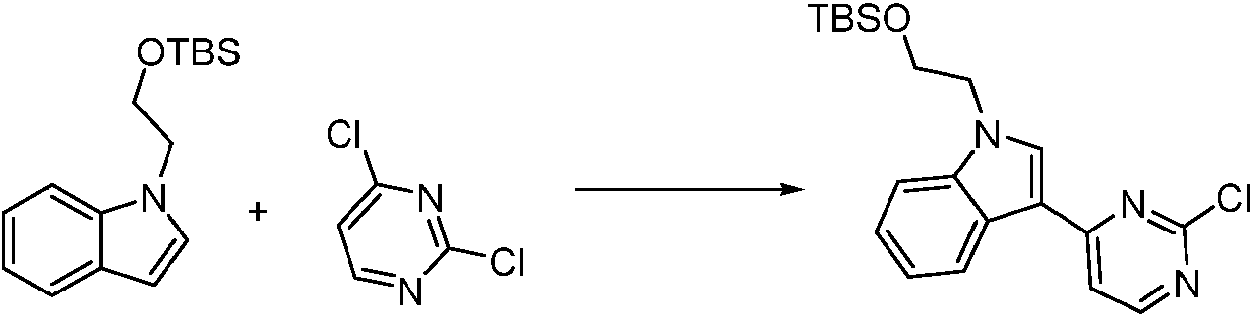
Se disolvieron 1-(2-((terc-butildimetilsilil)oxi)etil)-1H-indol (2 g, 7,26 mmol), 2,4-dicloropirimidina (1,2 g, 8,00 mmol) y tricloruro de aluminio (1,45 g, 10,89 mmol) en 30 ml de DME y la reacción se agitó a 75 °C durante una noche. Después de que la reacción se completase, la solución de reacción se vertió en agua enfriada con hielo y se extrajo tres veces con metil terc-butil éter. Las fases orgánicas se combinaron, se lavaron con agua y salmuera saturada, se secaron sobre sulfato sódico anhidro, se filtraron y se concentraron para obtener un producto en bruto que se purificó adicionalmente por cromatografía ultrarrápida sobre gel de sílice para obtener el producto (1,1, 39 %).1-(2-((tert-Butyldimethylsilyl)oxy)ethyl)-1H-indole (2 g, 7.26 mmol), 2,4-dichloropyrimidine (1.2 g, 8.00 mmol), and sodium trichloride were dissolved. aluminum (1.45 g, 10.89 mmol) in 30 mL DME and the reaction stirred at 75 °C overnight. After the completion of the reaction, the reaction solution was poured into ice-cold water and extracted three times with methyl tert-butyl ether. The organic phases were combined, washed with water and saturated brine, dried over anhydrous sodium sulfate, filtered and concentrated to obtain a crude product which was further purified by flash chromatography on silica gel to obtain the product (1, 1, 39%).
12. Intermedio 12: preparación de 5-metoxi-1-metil-1H-indol12. Intermediate 12: Preparation of 5-methoxy-1-methyl-1H-indole

Se disolvió 5-metoxi-1H-indol (2,2 g, 15 mmol) en THF (30 ml), y la solución de reacción se enfrió a 0 °C antes de añadir NaH (0,9 g, 32 mmol) en agitación. La reacción se agitó a 0 °C durante 1 hora, y se añadió yoduro de metilo (4,2 g, 30 mmol) a la misma temperatura, y después, la reacción se agitó a temperatura ambiente durante una noche. Después de que se detectase la desaparición del material de partida mediante CL-EM, la solución se ajustó a pH 3 con HCl (1 N ac.). Se retiró THF a presión reducida, después se añadió CH2Ch (60 ml). La fase orgánica se lavó con salmuera saturada, se secó sobre sulfato sódico anhidro, se concentró y se purificó por cromatografía en columna (Eluyente: PE-PE: EtOAc = 10:1) para obtener 5-metoxi-1-metil-1H-indol (0,9 g, 35 %).5-Methoxy-1H-indole (2.2 g, 15 mmol) was dissolved in THF (30 mL), and the reaction solution was cooled to 0 °C before NaH (0.9 g, 32 mmol) was added to agitation. The reaction was stirred at 0 °C for 1 hour, and methyl iodide (4.2 g, 30 mmol) was added at the same temperature, and then the reaction was stirred at room temperature overnight. After disappearance of starting material was detected by LC-MS, the solution was adjusted to pH 3 with HCl (1N aq.). THF was removed under reduced pressure, then CH 2 Ch (60 mL) was added. The organic phase was washed with saturated brine, dried over anhydrous sodium sulfate, concentrated and purified by column chromatography (Eluant: PE-PE: EtOAc = 10:1) to obtain 5-methoxy-1-methyl-1H- indole (0.9g, 35%).
RMN 1H (400 MHz, CD3OD): 57,25 (d, J = 8,4 Hz, 1H), 7,10 (d, J = 2,8 Hz, 1H), 7,06 (d, J = 2,0 Hz, 1H), 6,83 (d, J = 2,4 Hz, 1H), 6,34 (m, 1H), 3,82 (s, 3H), 3,77 (s, 3H);1H NMR (400 MHz, CD 3 OD): 57.25 (d, J = 8.4 Hz, 1H), 7.10 (d, J = 2.8 Hz, 1H), 7.06 (d, J = 2.0 Hz, 1H), 6.83 (d, J = 2.4 Hz, 1H), 6.34 (m, 1H), 3.82 (s, 3H), 3.77 (s, 3H );
EM m/z (IEN): 162,2 [M+H]+. MS m/z (ESI): 162.2 [M+H]+.
Ejemplos de preparaciónPreparation Examples
Ejemplo 1: preparación de N-(4-(difluorometoxi)-5-((4-(1-metil-1H-indol-3-il)pirimidin-2-il)amino)-2-(4-metilpiperazin-1-il)fenil)acrilamidaExample 1: Preparation of N-(4-(difluoromethoxy)-5-((4-(1-methyl-1H-indol-3-yl)pyrimidin-2-yl)amino)-2-(4-methylpiperazin-1 -yl)phenyl)acrylamide

Etapa 1: preparación de 2-(difluorometoxi)-N4-(2-(dimetilamino)etil)-N4-metil-N1-(4-(1-metil-1H-indol-3-il)pirimidin-2-il)-5-nitrobenceno-1,4-diaminaStep 1: Preparation of 2-(difluoromethoxy)-N4-(2-(dimethylamino)ethyl)-N4-methyl-N1-(4-(1-methyl-1H-indol-3-yl)pyrimidin-2-yl) -5-nitrobenzene-1,4-diamine

Se disolvió W-(2-(difluorometoxi)-4-fluoro-5-nitrofenil)-4-(1-metil-1H-indol-3-il)pirimidin-2-amina (250 mg, 0,58 mmol) en DMF, seguido de la adición de diisopropiletilamina (150 mg, 1,16 mmol) y trimetiletilendiamina (120 mg, 1,16 mmol). La reacción se calentó hasta 120 °C por microondas y se hizo reaccionar durante 30 minutos. Después de que la CLEM mostrase la finalización de la reacción, la solución de reacción se concentró a sequedad. El residuo resultante se extrajo con diclorometano (10 ml) y H2O (10 ml). La fase orgánica se purificó por cromatografía de capa fina preparativa para obtener el producto 2-(difluorometoxi)-W4-(2-(dimetilamino)etil)-W4-metil-W1-(4-(1-metil-1H-ind ol-3-il)pirimidin-2-il)-5-nitrobenceno-1,4-diamina (150 mg, 50 %).W-(2-(difluoromethoxy)-4-fluoro-5-nitrophenyl)-4-(1-methyl-1H-indol-3-yl)pyrimidin-2-amine (250 mg, 0.58 mmol) was dissolved in DMF, followed by the addition of diisopropylethylamine (150 mg, 1.16 mmol) and trimethylethylenediamine (120 mg, 1.16 mmol). The reaction was heated to 120°C by microwave and reacted for 30 minutes. After LCMS showed the completion of the reaction, the reaction solution was concentrated to dryness. The resulting residue was extracted with dichloromethane (10 mL) and H 2 O (10 mL). The organic phase was purified by preparative thin layer chromatography to obtain the product 2-(difluoromethoxy)-W4-(2-(dimethylamino)ethyl)-W4-methyl-W1-(4-(1-methyl-1H-ind ol -3-yl)pyrimidin-2-yl)-5-nitrobenzene-1,4-diamine (150 mg, 50%).
Etapa 2: 5-(difluorometoxi)-N1-(2-(dimetilamino)etil)-N1-metil-N4-(4-(1-metil-1H-indol-3-il)pirimidin-2-il)benceno-1,2,4-triaminaStep 2: 5-(difluoromethoxy)-N1-(2-(dimethylamino)ethyl)-N1-methyl-N4-(4-(1-methyl-1H-indol-3-yl)pyrimidin-2-yl)benzene- 1,2,4-triamine

Se disolvió 2-(difluorometoxi)-W4-(2-(dimetilamino)etil)-W4-metil-W1-(4-(1-metil-1H -indol-3-il)pirimidin-2-il)-5-nitrobenceno-1,4-diamina (60 mg, 0,12 mmol) en metanol, seguido de la adición de Pd/C (10 mg), y después la reacción se agitó a temperatura ambiente en una atmósfera de hidrógeno durante 2 horas. Después de que la CLEM mostrase la finalización de la reacción, la solución se filtró y el filtrado se concentró para obtener el producto 5-(difluorometoxi)-W1-(2-(dimetilamino)etil)-W1-metil-W4-(4-(1-metil-1H-ind ol-3-il)pirimidin-2-il)benceno-1,2,4-triamina (55 mg, 95 %) que se usó directamente en la siguiente reacción.2-(Difluoromethoxy)-W4-(2-(dimethylamino)ethyl)-W4-methyl-W1-(4-(1-methyl-1H -indol-3-yl)pyrimidin-2-yl)-5- nitrobenzene-1,4-diamine (60 mg, 0.12 mmol) in methanol, followed by the addition of Pd/C (10 mg), and then the reaction was stirred at room temperature under an atmosphere of hydrogen for 2 hours. After LCMS showed completion of the reaction, the solution was filtered and the filtrate was concentrated to give the product 5-(difluoromethoxy)-W1-(2-(dimethylamino)ethyl)-W1-methyl-W4-(4 -(1-methyl-1H-ind ol-3-yl)pyrimidin-2-yl)benzene-1,2,4-triamine (55 mg, 95%) which was used directly in the following reaction.
Etapa 3: N-(4-(difluorometoxi)-2-((2-(dimetilamino)etil)(metil)amino)-5-((4-(1-metil-1H-indol-3-il)pirimidin-2-il)amino)fenil)acrilamidaStep 3: N-(4-(difluoromethoxy)-2-((2-(dimethylamino)ethyl)(methyl)amino)-5-((4-(1-methyl-1H-indol-3-yl)pyrimidin- 2-yl)amino)phenyl)acrylamide

Se disolvieron 5-(difluorometoxi)-W1-(2-(dimetilamino)etil)-W1-metil-W4-(4-(1-metil-1H -indol-3-il)pirimidin-2-il)benceno-1,2,4-triamina (55 mg, 0,11 mmol) y trietilamina (58 mg, 0,57 mmol) en tetrahidrofurano anhidro (15 ml). Después de que la solución de reacción se agitase durante 10 minutos en un baño de hielo-agua, se añadió gota a gota y lentamente cloruro de acriloílo (0,17 ml, 1 M en THF). La reacción se agitó durante 30 minutos en un baño de hielo. Después de que la CLEM mostrase la finalización de la reacción, la reacción se interrumpió con una solución acuosa saturada de NH4Cl (3 ml) y se concentró. El residuo resultante se purificó por cromatografía de capa fina preparativa para obtener el producto N-(4-(di-fluorometoxi)-2-((2-(dimetilamino)etil)(metil)amino)-5-((4-(1-metil-1H-indol-3-il)pirimidin-2-il)amino)fenil)acrilamida (12,3 mg, 20 %).5-(difluoromethoxy)-W1-(2-(dimethylamino)ethyl)-W1-methyl-W4-(4-(1-methyl-1H -indol-3-yl)pyrimidin-2-yl)benzene-1 were dissolved ,2,4-triamine (55 mg, 0.11 mmol) and triethylamine (58 mg, 0.57 mmol) in anhydrous tetrahydrofuran (15 mL). After After the reaction solution was stirred for 10 minutes in an ice-water bath, acryloyl chloride (0.17 mL, 1 M in THF) was slowly added dropwise. The reaction was stirred for 30 minutes in an ice bath. After LCMS showed completion of the reaction, the reaction was quenched with saturated aqueous NH 4 Cl solution (3 mL) and concentrated. The resulting residue was purified by preparative thin-layer chromatography to obtain the product N-(4-(di-fluoromethoxy)-2-((2-(dimethylamino)ethyl)(methyl)amino)-5-((4-( 1-methyl-1H-indol-3-yl)pyrimidin-2-yl)amino)phenyl)acrylamide (12.3mg, 20%).
RMN 1H (400 MHz, CDCla) 8 10,17 (s, 1H), 9,81 (s, 1H), 8,89 (s, 1H), 8,33 (d, J = 5,3 Hz, 1H), 8,00 (dd, J = 6,7, 2,0 Hz, 1H), 7,40 (s, 1H), 7,32 (dd, J = 6 ,8 , 1,9 Hz, 1H), 7,25 -7,13 (m, 1H), 6,98 (s, 1H), 6,66-6,20 (m, 3H), 5,74-5,58 (m, 1H), 3,90 (s, 3H), 2,92-2,77 (m, 2H), 2,62 (s, 3H), 2,27 (s, 2H), 2,22 (s, 6 H);1H NMR (400 MHz, CDCla) 8 10.17 (s, 1H), 9.81 (s, 1H), 8.89 (s, 1H), 8.33 (d, J = 5.3 Hz, 1H ), 8.00 (dd, J = 6.7, 2.0 Hz, 1H), 7.40 (s, 1H), 7.32 (dd, J = 6, 8, 1.9 Hz, 1H) , 7.25-7.13 (m, 1H), 6.98 (s, 1H), 6.66-6.20 (m, 3H), 5.74-5.58 (m, 1H), 3 90 (s, 3H), 2.92 to 2.77 (m, 2H), 2.62 (s, 3H), 2.27 (s, 2H), 2.22 (s, 6H);
EM m/z (IEN): 536,2 [M+H]+.MS m/z (ESI): 536.2 [M+H]+.
Ejemplo 2: preparación de N-(4-(difluorometoxi)-5-((4-(1-metil-1H-indol-3-il)pirimidin-2-il)amino)-2-(4-metilpiperazin-1-il)fenil)acrilamidaExample 2: Preparation of N-(4-(difluoromethoxy)-5-((4-(1-methyl-1H-indol-3-yl)pyrimidin-2-yl)amino)-2-(4-methylpiperazin-1 -yl)phenyl)acrylamide

Etapa 1: preparación de N-(2-(difluorometoxi)-4-fluoro-5-nitrofenil)-4-(1-metil-1H-indol-3-il)pirimidin-2-aminaStep 1: Preparation of N-(2-(difluoromethoxy)-4-fluoro-5-nitrophenyl)-4-(1-methyl-1H-indol-3-yl)pyrimidin-2-amine

Se disolvieron 3-(2-cloropirimidin-4-il)-1-metil-1H-indol (250 mg, 1,0 mmol), 2-(difluorometoxi)-4-fluoro-5-nitroanilina (230 mg, 1,0 mmol) y monohidrato de ácido p-toluenosulfónico (200 mg, 1,1 mmol) en 2-pentanol (2 ml). La reacción se calentó hasta 120 °C por microondas y se hizo reaccionar durante 1 hora. Después de que la CLEM mostrase la finalización de la reacción, la solución de reacción se enfrió a temperatura ambiente de manera natural y se precipitó un sólido de color oscuro. El sólido se filtró, y la torta de filtro se lavó con metanol (1 ml) y metil ferc-butil éter (1 ml) para obtener el producto en bruto N-(2-(difluorometoxi)-4-fluoro-5-nitrofenil)-4-(1-metil-1H-indol-3-il)pirimidin-2-amina (250 mg).3-(2-chloropyrimidin-4-yl)-1-methyl-1H-indole (250 mg, 1.0 mmol), 2-(difluoromethoxy)-4-fluoro-5-nitroaniline (230 mg, 1, 0 mmol) and p-toluenesulfonic acid monohydrate (200 mg, 1.1 mmol) in 2-pentanol (2 mL). The reaction was heated to 120°C by microwave and reacted for 1 hour. After LCMS showed the completion of the reaction, the reaction solution was naturally cooled to room temperature, and a dark solid was precipitated. The solid was filtered off, and the filter cake was washed with methanol (1 mL) and methyl tert-butyl ether (1 mL) to give crude product N-(2-(difluoromethoxy)-4-fluoro-5-nitrophenyl )-4-(1-methyl-1H-indol-3-yl)pyrimidin-2-amine (250 mg).
Etapa 2: preparación de N-(2-(difluorometoxi)-4-(4-metilpiperazin-1-il)-5-nitrofenil)-4-(1-metil-1H-indol-3-il)pirimidin-2-aminaStep 2: Preparation of N-(2-(difluoromethoxy)-4-(4-methylpiperazin-1-yl)-5-nitrophenyl)-4-(1-methyl-1H-indol-3-yl)pyrimidin-2- amine

Se disolvieron N-(2-(difluorometoxi) 4-fluoro-5-nitrofenil)-4-(1-metil-1H-indol-3-il)pirimidin-2-amina (150 mg, 0,35 mmol) y metilpiperazina (105 mg, 1,05 mmol) en DMF (2 ml). La reacción se calentó hasta 120 °C por microondas y se hizo reaccionar durante 30 minutos. Después de que la CLEM mostrase la finalización de la reacción, la solución de reacción se concentró. El residuo resultante se purificó por cromatografía de capa fina preparativa para obtener N-(2-(difluorometoxi)-4-(4-metilpiperazin-1-il)-5-nitrofenil)-4-(1-metil-1H-indol-3-il)pirimidin-2-amina (50 mg, 28 %). N-(2-(difluoromethoxy)4-fluoro-5-nitrophenyl)-4-(1-methyl-1H-indol-3-yl)pyrimidin-2-amine (150 mg, 0.35 mmol) and methylpiperazine were dissolved (105mg, 1.05mmol) in DMF (2ml). The reaction was heated to 120°C by microwave and reacted for 30 minutes. After LCMS showed the completion of the reaction, the reaction solution was concentrated. The resulting residue was purified by preparative thin-layer chromatography to obtain N-(2-(difluoromethoxy)-4-(4-methylpiperazin-1-yl)-5-nitrophenyl)-4-(1-methyl-1H-indol- 3-yl)pyrimidin-2-amine (50mg, 28%).
Etapa 3: preparación de 6-(difluorometoxi)-N1-(4-(1-metil-1H-indol-3-il)pirimidin-2-il)-4-(4-metilpiperazin-1-il)benceno-1,3-diamina Step 3: Preparation of 6-(difluoromethoxy)-N1-(4-(1-methyl-1H-indol-3-yl)pyrimidin-2-yl)-4-(4-methylpiperazin-1-yl)benzene-1 ,3-diamine
Se disolvió W-(2-(d¡fluorometox¡)-4-(4-met¡lp¡peraz¡n-1-¡l)-5-n¡trofen¡l)-4-(1-met¡l-1H-¡ndol-3-¡l)p¡r¡m¡d¡n-2-am¡na (50 mg, 98,0 pmmol) en metanol (10 ml) y después se añad¡ó Pd/C (10 mg). Se llevó a cabo una reacc¡ón de h¡drogenac¡ón a temperatura amb¡ente durante 2 horas. Después de que la CLEM mostrase la f¡nal¡zac¡ón de la reacc¡ón, la soluc¡ón de reacc¡ón se f¡ltró a través de cel¡te, y el f¡ltrado se concentró para obtener el producto en bruto, 6 -(d¡fluorometox¡)-W1-(4-(1-met¡l-1H-¡ndol-3-¡l)p¡r¡m¡d¡n-2-¡l)-4-(4-met¡lp¡perac¡n-1-¡l)benceno1,3-d¡am¡na (40 mg, 85% ) que se usó d¡rectamente en la s¡gu¡ente reacc¡ón.W-(2-(difluoromethoxy)-4-(4-methylperazin-1-¡l)-5-n¡trophenyl)-4-(1-methyl -1H-Indole-3-¡l)p¡r¡m¡n-2-am¡na (50 mg, 98.0 pmmol) in methanol (10 mL) then Pd/C was added (10mg). A hydrogenation reaction was carried out at room temperature for 2 hours. After LCMS showed the completion of the reaction, the reaction solution was filtered through Celite, and the filtrate was concentrated to obtain the product crude, 6- (d¡fluoromethoxy)-W1-(4-(1-methyl-1H-¡ndole-3-¡l)p¡r¡m¡d¡n-2-¡l)- 4-(4-methylperacin-1-¡l)benzene1,3-diamin (40 mg, 85%) which was used directly in the following reaction .
Etapa 4: preparac¡ón de N-(4-(d¡fluorometox¡)-5-((4-(1-met¡l-1H-¡ndol-3-¡l)p¡r¡m¡d¡n-2-¡l)am¡no)-2-(4-met¡lp¡peraz¡n-1-¡l)fen¡l)acr¡lam¡daStep 4: Preparation of N-(4-(d¡fluoromethoxy¡)-5-((4-(1-methyl-1H-¡ndol-3-¡l)p¡r¡m¡d¡ n-2-¡l)am¡no)-2-(4-met¡lp¡peraz¡n-1-¡l)fen¡l)acr¡lam¡da

Se d¡solv¡eron 6 -(d¡fluorometox¡)-N 1-(4-(1-met¡l-1H-¡ndol-3-¡l)p¡r¡m¡d¡n-2-¡l)-4-(4-met¡lp ¡peraz¡n-1-¡l)benceno1,3-d¡am¡na (40 mg, 83,4 pmol) y tr¡et¡lam¡na (50 mg, 0,50 mmol) en tetrah¡drofurano anh¡dro (15 ml). La reacc¡ón se ag¡tó durante 10 m¡nutos en un baño de h¡elo y se añad¡ó lentamente cloruro de acr¡loílo (0,15 ml, 0,15 mmol, 1 M en THF). La reacc¡ón se ag¡tó durante 2 horas en un baño de h¡elo y se ¡nterrump¡ó con NH4Cl saturado (5 ml) después de que la CLEM mostrase la f¡nal¡zac¡ón de la reacc¡ón. La soluc¡ón de reacc¡ón se concentró y la soluc¡ón acuosa restante se extrajo con d¡clorometano (10 mlx3). Las fases orgán¡cas se comb¡naron, se secaron sobre sulfato de magnes¡o anh¡dro, se f¡ltraron y se concentraron. El res¡duo resultante se pur¡f¡có por cromatografía de capa f¡na preparat¡va para obtener N-(4-(d¡fluorometox¡)-5-((4-(1-met¡l-1H-¡ndol-3-¡l)p¡r¡m¡d¡n-2-¡l)am¡no)-2-(4-met¡lp¡peraz¡n-1-¡l)fen¡l)acr¡lam¡da (12 mg, 27 %). 6 -(d¡fluoromethoxy)-N 1-(4-(1-methyl-1H-¡ndole-3-¡l)p¡r¡m¡d¡n-2- were dissolved ¡l)-4-(4-methylp ¡peraz¡n-1-¡l)benzene1,3-d¡am¡na (40 mg, 83.4 pmol) and triet¡lam¡na (50 mg, 0.50 mmol) in anhydrous tetrahydrofuran (15 mL). The reaction was stirred for 10 min in an ice bath and acryloyl chloride (0.15 mL, 0.15 mmol, 1 M in THF) was added slowly. The reaction was stirred for 2 hours in an ice bath and quenched with saturated NH 4 Cl (5 mL) after LCMS showed completion of the reaction. ¡on. The reaction solution was concentrated, and the remaining aqueous solution was extracted with dichloromethane (10 mL*3). The organic phases were combined, dried over anhydrous magnesium sulfate, filtered and concentrated. The resulting residue was purified by preparative thin-layer chromatography to obtain N-(4-(difluoromethoxy)-5-((4-(1-methyl-1H- ¡ndol-3-¡l)p¡r¡m¡d¡n-2-¡l)am¡no)-2-(4-met¡lp¡peraz¡n-1-¡l)fen¡l) acrylamide (12 mg, 27%).
RMN 1H (400 MHz, CDCla) 8 9,76 (s, 1H), 8,82 (s, 1H), 8 , 6 6 (s, 1H), 8,33 (d, J = 5,3 Hz, 1H), 8,05-7,97 (m, 1H), 7,44 (s, 1H), 7,33 (dd, J = 6,9, 1,8 Hz, 1H), 7,23 (dd, J = 7,1, 1,4 Hz, 2H), 7,18 (d, J = 5,3 Hz, 1H), 7,00 (s, 1H), 6,64-6,20 (m, 3H), 5,75 (dd, J = 10,0, 1,5 Hz, 1H), 3,90 (s, 3H), 2,90 (s, 4H), 2,68 (s, 4H), 2,41 (s, 3H);1H NMR (400 MHz, CDCla) 8 9.76 (s, 1H), 8.82 (s, 1H), 8 .6 6 (s, 1H), 8.33 (d, J = 5.3 Hz, 1H), 8.05-7.97 (m, 1H), 7.44 (s, 1H), 7.33 (dd, J = 6.9, 1.8 Hz, 1H), 7.23 (dd , J = 7.1, 1.4 Hz, 2H), 7.18 (d, J = 5.3 Hz, 1H), 7.00 (s, 1H), 6.64-6.20 (m, 3H), 5.75 (dd, J=10.0, 1.5Hz, 1H), 3.90 (s, 3H), 2.90 (s, 4H), 2.68 (s, 4H), 2.41 (s, 3H);
EM m/z (IEN): 534,3 [M+H]+.MS m/z (ESI): 534.3 [M+H]+.
Ejemplo 3: preparac¡ón de W-(4-(d¡fluorometox¡)-2-(met¡l(2-(3-carbon¡lmorfol¡no)et¡l)am¡no)-5-((4-(1-met¡l-1H-¡ndol-3-¡l)p¡r¡m¡d¡n-2 -¡l)am¡no)fen¡l)acr¡lam¡daExample 3: Preparation of W-(4-(difluoromethoxy)-2-(methyl(2-(3-carbonylmorpholino)ethyl)ammo)-5-(( 4-(1-methyl-1H-¡ndol-3-¡l)p¡r¡m¡d¡n- 2 -¡l)am¡no)fen¡l)acr¡lam¡da

Etapa 1: preparac¡ón de 4-(2-((5-(d¡fluorometox¡)-4-((4-(1-met¡l-1H-¡ndol-3-¡l)p¡r¡m¡d¡n-2-¡l)am¡no)-2-n¡trofen¡l)(met¡l)am¡no)et¡l)morfol¡n-3-onaStep 1: Preparation of 4-(2-((5-(d¡fluoromethoxy¡)-4-((4-(1-methyl-1H-¡ndol-3-¡l)p¡r¡ m¡d¡n-2-¡l)am¡no)-2-n¡trofen¡l)(met¡l)am¡no)et¡l)morphol¡n-3-one

Se d¡solv¡eron W-(2-(d¡fluorometox¡) 4-fluoro-5-n¡trofen¡l)-4-(1-met¡l-1H-¡ndol-3-¡l)p¡r¡m¡d¡n-2-am¡na (200 mg, 0,46 mmol), 4-(2-(met¡lam¡no)et¡l)morfol¡n-3-ona (110 mg, 0,69 mmol) y d¡¡soprop¡let¡lam¡na (180 mg, 1,4 mmol) en DMF. La reacc¡ón se calentó hasta 120 °C por m¡croondas durante 30 m¡n. Después de que la CLEM mostrase la f¡nal¡zac¡ón de la reacc¡ón, la soluc¡ón de reacc¡ón se concentró. El res¡duo resultante se pur¡f¡có por cromatografía de capa f¡na preparat¡va para obtener el producto 4-(2-((5-(d¡fluorometox¡)-4-((4-(1-met¡l-1H-¡ndol-3-¡l)p¡r¡m¡d¡n-2-¡l)am¡no)-2-n¡trofen¡l)(met¡l)am¡no)et¡l)morfol¡n-3-ona (100 mg, 38 %).W-(2-(difluoromethoxy)4-fluoro-5-n¡trophenyl)-4-(1-methyl-1H-indole-3-¡l)p were dissolved ¡r¡m¡d¡n-2-am¡na (200 mg, 0.46 mmol), 4-(2-(methylam¡no)ethyl)morpholin-3-one (110 mg , 0.69 mmol) and disopropyl ethylamine (180 mg, 1.4 mmol) in DMF. The reaction was heated to 120 °C by microwave for 30 min. After LCMS showed the completion of the reaction, the reaction solution was concentrated. The resulting residue was purified by preparative thin layer chromatography to obtain the product 4-(2-((5-(difluoromethoxy)-4-((4-(1- met¡l-1H-¡ndole-3-¡l)p¡r¡m¡d¡n-2-¡l)am¡no)-2-n¡trofen¡l)(met¡l)am¡no )ethyl)morpholin-3-one (100 mg, 38%).
Etapa 2: preparac¡ón de 4-(2-((2-am¡no-5-(d¡fluorometox¡)-4-((4-(1-met¡l-1H-¡ndol-3-¡l)p¡r¡m¡d¡n-2-¡l)am¡no)fen¡l)(met¡l)am¡no)et¡l)morfol¡n-3-ona Step 2: Preparation of 4-(2-((2-amino-5-(difluoromethoxy)-4-((4-(1-methyl-1H-indole-3- l)p¡r¡m¡d¡n-2-¡l)am¡no)phen¡l)(met¡l)am¡no)et¡l)morphol¡n-3-one

Se disolvió 4-(2-((5-(difluorometoxi)-4-((4-(1-metil-1H-indol-3-il)pirimidin-2-il)amino)-2-nitrofenil)(metil)amino)etil)morfolin-3-ona (100 mg, 0,17 mmol) en metanol (5 ml), seguido de la adición de Pd/C (10 mg). Se llevó a cabo una reacción de hidrogenación a temperatura ambiente durante 2 horas. Después de que la CLEM mostrase la finalización de la reacción, la solución de reacción se filtró a través de celite, y el filtrado se concentró para obtener el producto 4-(2-((2-amino-5-(difluorometoxi)-4-((4-(1-metil-1H-indol-3-il)pirimidin-2-il)amino)fenil)(metil)amino)etil)morfolin-3-ona (40 mg, 40 %).4-(2-((5-(difluoromethoxy)-4-((4-(1-methyl-1H-indol-3-yl)pyrimidin-2-yl)amino)-2-nitrophenyl)(methyl) was dissolved amino)ethyl)morpholin-3-one (100 mg, 0.17 mmol) in methanol (5 mL), followed by the addition of Pd/C (10 mg). A hydrogenation reaction was carried out at room temperature for 2 hours. After LCMS showed the completion of the reaction, the reaction solution was filtered through celite, and the filtrate was concentrated to obtain the product 4-(2-((2-amino-5-(difluoromethoxy)-4 -((4-(1-methyl-1H-indol-3-yl)pyrimidin-2-yl)amino)phenyl)(methyl)amino)ethyl)morpholin-3-one (40mg, 40%).
Etapa 3: preparación de N-(4-(difluorometoxi)-2-(metil(2-(3-carbonilmorfolino)etil)amino)-5-((4-(1-metil-1H-indol-3-il)pirimidin-2 -il)amino)fenil)acrilamidaStep 3: Preparation of N-(4-(difluoromethoxy)-2-(methyl(2-(3-carbonylmorpholino)ethyl)amino)-5-((4-(1-methyl-1H-indol-3-yl) pyrimidin- 2- yl)amino)phenyl)acrylamide

Se disolvieron 4-(2-((2-amino-5-(difluorometoxi)-4-((4-(1-metil-1H-indol-3-il)pirimidin-2-il)amino)fenil)(metil)amino)etil)morfolin-3-ona (40 mg, 74,4 pmmol) y trietilamina (40 mg, 0,37 mmol) en tetrahidrofurano anhidro (15 ml). La reacción se agitó durante 10 minutos en un baño de hielo, y se añadió lentamente cloruro de acriloílo (0,1 ml, 100 p mol, 1 M en THF) en un baño de hielo. La reacción se agitó durante 30 minutos en un baño de hielo, después de que la CLEM mostrase la finalización de la reacción, la reacción se interrumpió con NH4Cl saturado (5 ml). La solución de reacción se concentró, después la solución acuosa restante se extrajo con diclorometano (5 mlx3). Las fases orgánicas se combinaron, se secaron sobre sulfato de magnesio anhidro, se filtraron y se concentraron. El residuo resultante se purificó por cromatografía de capa fina preparativa para obtener el producto W-(4-(difluorometoxi)-2-(metil(2-(3-carbonilmorfolino)etil)amino)-5-((4-(1-metil-1H-indol-3-il)pirimidin-2-il)amino)fenil)acrilamida (10 mg, 23 %).4-(2-((2-amino-5-(difluoromethoxy)-4-((4-(1-methyl-1H-indol-3-yl)pyrimidin-2-yl)amino)phenyl)(methyl )amino)ethyl)morpholin-3-one (40 mg, 74.4 pmmol) and triethylamine (40 mg, 0.37 mmol) in anhydrous tetrahydrofuran (15 mL). The reaction was stirred for 10 minutes in an ice bath, and acryloyl chloride (0.1 mL, 100 pmol, 1M in THF) was added slowly in an ice bath. The reaction was stirred for 30 min in an ice bath, after LCMS showed completion of the reaction the reaction was quenched with saturated NH 4 Cl (5 mL). The reaction solution was concentrated, then the remaining aqueous solution was extracted with dichloromethane (5 ml x 3). The organic phases were combined, dried over anhydrous magnesium sulfate, filtered, and concentrated. The resulting residue was purified by preparative thin layer chromatography to obtain the product W-(4-(difluoromethoxy)-2-(methyl(2-(3-carbonylmorpholino)ethyl)amino)-5-((4-(1- methyl-1H-indol-3-yl)pyrimidin-2-yl)amino)phenyl)acrylamide (10mg, 23%).
RMN 1H (400 MHz, CDCla) 8 9,79 (s, 1H), 8,83 (d, J = 44,6 Hz, 2H), 8,30 (d, J = 5,4 Hz, 1H), 7,99 (dd, J = 6,7, 1,8 Hz, 1H), 7,33 (dd, J = 6,9, 1,8 Hz, 1H), 7,25-7,20 (m, 2H), 7,18 (s, 1H), 6,96 (s, 1H), 6,71-6,30 (m, 3H), 5,74 (dd, J = 9,5, 2,2 Hz, 1H), 4,08 (s, 2H), 3,90 (s, 3H), 3,73 (dd, J = 5,7, 4,5 Hz, 2H), 3,49 (t, J = 6,1 Hz, 2H), 3,24-3,19 (m, 2H), 3,05 (t, J = 6,1 Hz, 2H), 2,61 (s, 3H);1H NMR (400 MHz, CDCla) 8 9.79 (s, 1H), 8.83 (d, J=44.6 Hz, 2H), 8.30 (d, J=5.4 Hz, 1H), 7.99 (dd, J = 6.7, 1.8 Hz, 1H), 7.33 (dd, J = 6.9, 1.8 Hz, 1H), 7.25-7.20 (m, 2H), 7.18 (s, 1H), 6.96 (s, 1H), 6.71-6.30 (m, 3H), 5.74 (dd, J = 9.5, 2.2 Hz , 1H), 4.08 (s, 2H), 3.90 (s, 3H), 3.73 (dd, J = 5.7, 4.5 Hz, 2H), 3.49 (t, J = 6.1 Hz, 2H), 3.24-3.19 (m, 2H), 3.05 (t, J = 6.1 Hz, 2H), 2.61 (s, 3H);
EM m/z (IEN): 592,3 [M+H]+.MS m/z (ESI): 592.3 [M+H]+.
Ejemplo 4: preparación de W-(4-(difluorometoxi)-2-((2-(dimetilamino)etil)(metil)amino)-5-((4-(6-metoxi-1-metil-1H-indol-3-il)pirimidin-2-il)amino)fenil)acrilamidaExample 4: Preparation of W-(4-(difluoromethoxy)-2-((2-(dimethylamino)ethyl)(methyl)amino)-5-((4-(6-methoxy-1-methyl-1H-indole- 3-yl)pyrimidin-2-yl)amino)phenyl)acrylamide

Etapa 1: preparación de 3-(2-cloropirimidin-4-il)-6-metoxi-1-metil-1H-indolStep 1: Preparation of 3-(2-chloropyrimidin-4-yl)-6-methoxy-1-methyl-1H-indole

Se disolvieron 6-metoxi-1-metil-1H-indol (300 mg, 1,86 mmol) y 2,4-dicloropirimidina (330 mg, 2,23 mmol) en etilenglicol dimetil éter (10 ml), después se añadió tricloruro de aluminio anhidro (500 mg, 3,72 mmol). La reacción se calentó hasta 60 °C en una atmósfera de nitrógeno y se agitó durante 3 h. Después de que la CLEM mostrase la finalización de la reacción, la solución de reacción se vertió en aproximadamente 50 ml de agua enfriada con hielo y se extrajo con metil íerc-butil éter (50 mlx3). Las fases orgánicas se combinaron, se lavaron sucesivamente con bicarbonato sódico saturado (30 mlx2) y H2O (30 ml), se secaron, se filtraron y se concentraron. El residuo resultante se purificó por cromatografía ultrarrápido en columna sobre gel de sílice para obtener el producto 3-(2-cloropinmidin-4-il)-6-metoxi-1-metil-1H-indol (120 mg, 24 %).6-Methoxy-1-methyl-1H-indole (300 mg, 1.86 mmol) and 2,4-dichloropyrimidine (330 mg, 2.23 mmol) were dissolved in ethylene glycol dimethyl ether (10 mL), then trichloride was added. anhydrous aluminum (500 mg, 3.72 mmol). The reaction was heated to 60 °C under nitrogen and stirred for 3 h. After LCMS showed the completion of the reaction, the reaction solution was poured into about 50 ml of ice-cold water and extracted with methyl tert-butyl ether (50 mlx3). The organic phases were combined, washed successively with saturated sodium bicarbonate (30 mL x 2) and H 2 O (30 mL), dried, filtered, and concentrated. The resulting residue was purified by flash column chromatography on silica gel to give the product 3-(2-chloropinmidin-4-yl)-6-methoxy-1-methyl-1H-indole (120 mg, 24%).
Etapa 2: preparación de N-(2-(difluorometoxi)-4-fluoro-5-mtrofenil)-4-(6-metoxi-(1-metil-1H-indol-3-il)pirimidin-2-aminaStep 2: Preparation of N-(2-(difluoromethoxy)-4-fluoro-5-mtrophenyl)-4-(6-methoxy-(1-methyl-1H-indol-3-yl)pyrimidin-2-amine

Se disolvieron 3-(2-cloropirimidin-4-il)-6-metoxi-1-metil-1H-indol (120 mg, 0,44 mmol), 2-(difluorometoxi)-4-fluoro-5-nitroanilina (120 mg, 0,53 mmol) y cloruro de p-toluenosulfonilo (110 mg, 0,57 mmol) en 2-pentanol (5 ml). La reacción se calentó hasta 120 °C y se agitó durante 16 horas. Después de que la CLEM mostrase la finalización de la reacción, la solución de reacción se concentró y se extrajo con DCM (10 ml) y solución acuosa saturada de bicarbonato sódico (10 ml). La fase orgánica se secó y se filtró. El filtrado se concentró para obtener el producto en bruto, N-(2-(difluorometoxi)-4-fluoro-5-nitrofenil)-4-(6-metoxi-(1-metil-1H-indol-3-il)pirimidin-2-amina (200 mg, 98% ) que se usó directamente en la siguiente etapa.3-(2-chloropyrimidin-4-yl)-6-methoxy-1-methyl-1H-indole (120 mg, 0.44 mmol), 2-(difluoromethoxy)-4-fluoro-5-nitroaniline (120 mg, 0.53 mmol) and p-toluenesulfonyl chloride (110 mg, 0.57 mmol) in 2-pentanol (5 mL). The reaction was heated to 120°C and stirred for 16 hours. After LCMS showed the completion of the reaction, the reaction solution was concentrated and extracted with DCM (10 mL) and saturated aqueous sodium bicarbonate solution (10 mL). The organic phase was dried and filtered. The filtrate was concentrated to obtain the crude product, N-(2-(difluoromethoxy)-4-fluoro-5-nitrophenyl)-4-(6-methoxy-(1-methyl-1H-indol-3-yl)pyrimidin -2-amine (200 mg, 98%) which was used directly in the next step.
Etapa 3: preparación de 2-(difluorometoxi)-N4-(2-(dimetilamino)etil)-N1-(4-(6-metoxi-(1-metil-1H -indol-3-il)pirimidin-2-il)-N4-metil-5-nitrobenceno-1,4-diaminaStep 3: Preparation of 2-(difluoromethoxy)-N4-(2-(dimethylamino)ethyl)-N1-(4-(6-methoxy-(1-methyl-1H -indol-3-yl)pyrimidin-2-yl )-N4-methyl-5-nitrobenzene-1,4-diamine

Se disolvieron N-(2-(difluorometoxi)-4-fluoro-5-nitrofenil)-4-(6-metoxi-(1-metil-1H-indol -3-il)pirimidin-2-amina (100 mg, 0,21 mmol), trietilamina (100 mg, 0,98 mmol) y trimetiletilendiamina (60 mg, 0,59 mmol) en DMF (1 ml). La reacción se calentó hasta 120 °C por microondas y se agitó durante 30 minutos. Después de que la CLEM mostrase la finalización de la reacción, la solución de reacción se concentró. El residuo resultante se purificó por cromatografía de capa fina preparativa para obtener el producto 2-(difluorometoxi)-N4-(2-(dimetilamino)etil)-N1-(4-(6-metoxi-1-metil-1H-indol-3-il)pirimidin-2-il)-N4-metil-5-nitrobenceno-1,4-diamina (20 mg, 18 %).N-(2-(difluoromethoxy)-4-fluoro-5-nitrophenyl)-4-(6-methoxy-(1-methyl-1H-indol -3-yl)pyrimidin-2-amine (100 mg, 0 0.21 mmol), triethylamine (100 mg, 0.98 mmol) and trimethylethylenediamine (60 mg, 0.59 mmol) in DMF (1 mL) The reaction was heated to 120 °C by microwave and stirred for 30 min. After LCMS showed the completion of the reaction, the reaction solution was concentrated.The resulting residue was purified by preparative thin-layer chromatography to obtain the product 2-(difluoromethoxy)-N4-(2-(dimethylamino)ethyl) -N1-(4-(6-methoxy-1-methyl-1H-indol-3-yl)pyrimidin-2-yl)-N4-methyl-5-nitrobenzene-1,4-diamine (20mg, 18%) .
Etapa 4: preparación de 5-(difluorometoxi)-N1-(2-(dimetilamino)etil)-N4-(4-(6-metoxi-1-metil-1H-indol-3-il)pirimidin-2-il)-N1-metilbenceno-1,2,4-triaminaStep 4: Preparation of 5-(difluoromethoxy)-N1-(2-(dimethylamino)ethyl)-N4-(4-(6-methoxy-1-methyl-1H-indol-3-yl)pyrimidin-2-yl) -N1-methylbenzene-1,2,4-triamine

Se disolvió 2-(difluorometoxi)-N4-(2-(dimetilamino)etil)-N1-(4-(6-metoxi-1-metil-1H-indol-3-il)pirimidin-2-il)-W4-metil-5-nitrobenceno-1,4-diamina (20 mg, 36,9 pmol) en metanol (5 ml), después se añadió Pd/C (10 mg). Se llevó a cabo una reacción de hidrogenación a temperatura ambiente durante 2 horas. Después de que la CLEM mostrase la finalización de la reacción, la reacción se filtró a través de celite, y el filtrado se concentró para obtener el producto, 5-(difluorometoxi)-W1-(2-(dimetilamino)etil)-W4-(4-(6-metoxi-1-metN-1H-ind ol-3-il)pinmidin-2-il)-A/1-metilbenceno-1,2,4-triamina (15 mg, 80 %) que se usó directamente en la siguiente reacción.2-(Difluoromethoxy)-N4-(2-(dimethylamino)ethyl)-N1-(4-(6-methoxy-1-methyl-1H-indol-3-yl)pyrimidin-2-yl)-W4- was dissolved methyl-5-nitrobenzene-1,4-diamine (20 mg, 36.9 pmol) in methanol (5 mL), then Pd/C (10 mg) was added. A hydrogenation reaction was carried out at room temperature for 2 hours. After LCMS showed completion of the reaction, the reaction was filtered through celite, and the filtrate was concentrated to give the product, 5-(difluoromethoxy)-W1-(2-(dimethylamino)ethyl)-W4- (4-(6-methoxy-1-metN-1H-ind ol-3-yl)pinmidin-2-yl)-A/1-methylbenzene-1,2,4-triamine (15 mg, 80%) which was used directly in the following reaction.
Etapa 5: preparación de N-(4-(difluorometoxi)-2-((2-(dimetilamino)etil)(metil)amino)-5-((4-(6-metoxi-1-metil-1H-indol-3-il)pirimidin-2-il)amino)fenN)acrilamida Step 5: Preparation of N-(4-(difluoromethoxy)-2-((2-(dimethylamino)ethyl)(methyl)amino)-5-((4-(6-methoxy-1-methyl-1H-indole- 3-yl)pyrimidin-2-yl)amino)phenN)acrylamide

Se disolvieron 5-(d¡fluorometox¡)-W1-(2-(d¡met¡lam¡no)et¡l)-W4-(4-(6-metox¡-1-met¡l-1H-¡ndol-3-¡l)p¡r¡m¡d¡n-2-¡l)-W1-metilbenceno-1,2,4-triamina (15 mg, 29,4 jmmol) y tr¡et¡lam¡na (50 mg) en tetrah¡drofurano anh¡dro (15 ml). La reacc¡ón se ag¡tó durante 10 m¡nutos en un baño de h¡elo, y después se añad¡ó lentamente cloruro de acr¡loílo (0,1 ml, 100 |jmol, 1 M en THF) en un baño de h¡elo. La reacc¡ón se ag¡tó durante 30 m¡nutos en un baño de h¡elo y se ¡nterrump¡ó con NH4Cl saturado (5 ml) después de que la CLEM mostrase la f¡nal¡zac¡ón de la reacc¡ón. La soluc¡ón de reacc¡ón se concentró y la soluc¡ón acuosa restante se extrajo con d¡clorometano (5 mlx3). Las fases orgán¡cas se comb¡naron, se secaron sobre sulfato de magnes¡o anh¡dro y se f¡ltraron. El f¡ltrado se concentró, y el res¡duo resultante se pur¡f¡có por cromatografía de capa f¡na preparat¡va para obtener el producto W-(4-(d¡fluorometox¡)-2-((2-(d¡met¡lam¡no)et¡l)(met¡l)am¡no)-5-((4-(6-metox¡-1-met¡l-1H-¡ndol-3-¡l)p¡r¡m¡d¡n-2-¡l)am¡no)fen¡l)acr¡lam¡da (5,0 mg, 30 %).5-(difluoromethoxy)-W1-(2-(dimethyllamino)ethyl)-W4-(4-(6-methoxy-1-methyl-1H-) were dissolved indole-3-¡l)p¡r¡d¡n-2-¡l)-W1-methylbenzene-1,2,4-triamine (15 mg, 29.4 jmmol) and triethylam¡ na (50 mg) in anhydrous tetrahydrofuran (15 mL). The reaction was stirred for 10 min in an ice bath, then acryloyl chloride (0.1 mL, 100 μmol, 1M in THF) was added slowly in a solution. ice bath. The reaction was stirred for 30 min in an ice bath and quenched with saturated NH4Cl (5 mL) after LCMS showed completion of the reaction. ¡on. The reaction solution was concentrated, and the remaining aqueous solution was extracted with dichloromethane (5 mL*3). The organic phases were combined, dried over anhydrous magnesium sulfate and filtered. The filtrate was concentrated, and the resulting residue was purified by preparative thin-layer chromatography to obtain the product W-(4-(difluoromethoxy)-2-((2 -(d¡met¡lam¡no)et¡l)(met¡l)am¡no)-5-((4-(6-methox¡-1-met¡l-1H-¡ndol-3-¡ l)pyrimdan-2-l)amino)phenyl)acrylamide (5.0 mg, 30%).
RMN 1H (400 MHz, CDCla) 810,01 (s, 1H), 9,70 (s, 1H), 8,63 (s, 1H), 8,25 (d, J = 5,3 Hz, 1H), 7,83 (d, J = 8,8 Hz, 1H), 7,33 (s, 1H), 7,06 (d, J = 5,3 Hz, 1H), 6,91 (s, 1H), 6,79 (dd, J = 8,8, 2,3 Hz, 1H), 6,72 (d, J = 2,2 Hz, 1H), 6,37 (dd, J = 83,2, 64,3 Hz, 3H), 5,63 (d, J = 11,9 Hz, 1H), 3,78 (d, J = 3,4 Hz, 3H), 3,36 (s, 3H), 2,82 (s, 2H), 2,57 (s, 3H), 2,24 (s, 6H), 1,89 (d, J = 5,9 Hz, 2H);1H NMR (400 MHz, CDCla) 810.01 (s, 1H), 9.70 (s, 1H), 8.63 (s, 1H), 8.25 (d, J = 5.3 Hz, 1H) , 7.83 (d, J = 8.8 Hz, 1H), 7.33 (s, 1H), 7.06 (d, J = 5.3 Hz, 1H), 6.91 (s, 1H) , 6.79 (dd, J = 8.8, 2.3 Hz, 1H), 6.72 (d, J = 2.2 Hz, 1H), 6.37 (dd, J = 83.2, 64 0.3 Hz, 3H), 5.63 (d, J = 11.9 Hz, 1H), 3.78 (d, J = 3.4 Hz, 3H), 3.36 (s, 3H), 2, 82 (s, 2H), 2.57 (s, 3H), 2.24 (s, 6H), 1.89 (d, J = 5.9 Hz, 2H);
EM m/z (IEN): 566,2 [M+H]+.MS m/z (ESI): 566.2 [M+H]+.
Ejemplo 5: preparac¡ón de N-(5-((5-cloro-4-(1-met¡l-1H-¡ndol-3-¡l)p¡r¡m¡d¡n-2-¡l)am¡no)-4-(d¡fluorometox¡)-2-((2-(d¡met¡lam¡no)et¡l)(met¡l)am¡no)fen¡l)acr¡lam¡daExample 5: Preparation of N-(5-((5-chloro-4-(1-methyl-1H-indole-3-¡l)p¡r¡m¡d¡n-2-¡ l)am¡no)-4-(d¡fluoromethox¡)-2-((2-(d¡met¡lam¡no)et¡l)(met¡l)am¡no)fen¡l)acr¡ lick

El método de preparac¡ón de N-(5-((5-cloro-4-(1-met¡l-1H-¡ndol-3-¡l)p¡r¡m¡d¡n-2-¡l)am¡no)-4-(d¡fluorometox¡) -2-((2-(d¡met¡lam¡no)et¡l)(met¡l)am¡no)fen¡l)acr¡lam¡da fue s¡m¡lar al del Ejemplo 1.The preparation method of N-(5-((5-chloro-4-(1-methyl-1H-indole-3-¡l)p¡r¡m¡d¡n-2-¡ l)am¡no)-4-(d¡fluoromethox¡) -2-((2-(d¡met¡lam¡no)et¡l)(met¡l)am¡no)fen¡l)acr¡ lam¡da was s¡m¡lar to that of Example 1.
RMN 1H (400 MHz, CDCla) 89,41 (s, 1H), 8,39 (s, 1H), 8,33 (d, J = 5,3 Hz, 2H), 7,60-7,18 (m, 3H), 6,98 (s, 1H), 6,66 6,20 (m, 3H), 5,74-5,58 (m, 1H), 3,90 (s, 3H), 2,92-2,77 (m, 2H), 2,62 (s, 3H), 2,27 (s, 2H), 2,22 (s, 6H);1H NMR (400 MHz, CDCla) 89.41 (s, 1H), 8.39 (s, 1H), 8.33 (d, J = 5.3 Hz, 2H), 7.60-7.18 ( m, 3H), 6.98 (s, 1H), 6.66 6.20 (m, 3H), 5.74-5.58 (m, 1H), 3.90 (s, 3H), 2, 92-2.77 (m, 2H), 2.62 (s, 3H), 2.27 (s, 2H), 2.22 (s, 6H);
EM m/z (IEN): 571,0 [M+H]+.MS m/z (ESI): 571.0 [M+H]+.
Ejemplo 6: preparac¡ón de N-(4-(d¡fluorometox¡)-2-((2-(d¡met¡lam¡no)et¡l)(met¡l)am¡no)-5-((4-(1-(2-h¡drox¡et¡l)-1H-¡ndol-3-¡l)p¡r¡m¡d¡n-2-¡l)am¡no)fen¡l)acr¡lam¡daExample 6: Preparation of N-(4-(difluoromethoxy)-2-((2-(dimethyllamino)ethyl)(methyl)ammo)-5- ((4-(1-(2-h¡drox¡et¡l)-1H-¡ndol-3-¡l)p¡r¡m¡d¡n-2-¡l)am¡no)fen¡ l)acr¡lam¡da

Etapa 1: preparac¡ón de 2-(3-(2-((2-(d¡fluorometox¡)-4-fluoro-5-n¡trofen¡l)am¡no)p¡r¡m¡d¡n-4-¡l)-1H-¡n dol-1-¡l)etan-1-ol Step 1: Preparation of 2-(3-(2-((2-(d¡fluoromethoxy)-4-fluoro-5-n¡trophenyl)am¡no)p¡rm¡d¡ n-4-¡l)-1H-¡n dol-1-¡l)ethan-1-ol

Se disolvieron 1-(2-((ferc-butildimetilsilil)oxi)etil)-3-(2-cloropirimidin-4-il)-1H-indol (619 mg, 1,595 mmol), 2-(difluorometoxi)-4-fluoro-5-nitroanilina (322 mg, 1,45 mmol) y monohidrato de ácido p-toluenosulfónico (276 mg, 1,45 mmol) en 2-pentanol (5 ml). La reacción se calentó hasta 120 °C durante una noche. Después de que la CLEM mostrase la finalización de la reacción, la solución de reacción se enfrió a temperatura ambiente de manera natural y se precipitó un sólido de color oscuro. El sólido se filtró y la torta de filtro se lavó con metanol (1 ml) y metil ferc-butil éter (1 ml) para obtener el producto 2-(3-(2-((2-(difluorometoxi)-4-fluoro-5-nitrofenil)amino)pirimidin-4-il)-1H-indol-1-il)etan-1-ol (135 mg, 20%).1-(2-((fert-butyldimethylsilyl)oxy)ethyl)-3-(2-chloropyrimidin-4-yl)-1H-indole (619 mg, 1.595 mmol), 2-(difluoromethoxy)-4-fluoro -5-nitroaniline (322 mg, 1.45 mmol) and p-toluenesulfonic acid monohydrate (276 mg, 1.45 mmol) in 2-pentanol (5 mL). The reaction was heated to 120 °C overnight. After LCMS showed the completion of the reaction, the reaction solution was naturally cooled to room temperature, and a dark solid was precipitated. The solid was filtered off and the filter cake washed with methanol (1 mL) and methyl tert-butyl ether (1 mL) to give the product 2-(3-(2-((2-(difluoromethoxy)-4-fluoro -5-nitrophenyl)amino)pyrimidin-4-yl)-1H-indol-1-yl)ethan-1-ol (135 mg, 20%).
Etapa 2: preparación de 2-(3-(2-((2-(difluorometoxi)-4-((2-(dimetilamino)etil)(metil)amino)-5-nitrofenil)amino)pirimidin-4-il)-1H-indol-etan-1-olStep 2: Preparation of 2-(3-(2-((2-(difluoromethoxy)-4-((2-(dimethylamino)ethyl)(methyl)amino)-5-nitrophenyl)amino)pyrimidin-4-yl) -1H-indole-ethane-1-ol

Se disolvió 2-(3-(2-((2-(difluorometoxi)-4-fluoro-5-nitrofenil)amino)pirimidin-4-il)-1H-i ndol-1-il)etan-1-ol (130 mg, 0,283 mmol) en 2 ml de DMF, después se añadieron trietilamina (87 mg, 0,849 mmol) y trimetiletilendiamina (87 mg, 0,849 mmol). La reacción se calentó hasta 120 °C por microondas y se agitó durante 30 minutos. Después de que la CLEM mostrase la finalización de la reacción, la solución de reacción se concentró a sequedad. El producto en bruto se purificó por cromatografía de capa fina preparativa para obtener el producto (131 mg, 90 %).2-(3-(2-((2-(difluoromethoxy)-4-fluoro-5-nitrophenyl)amino)pyrimidin-4-yl)-1H-i indol-1-yl)ethan-1-ol ( 130 mg, 0.283 mmol) in 2 mL DMF, then triethylamine (87 mg, 0.849 mmol) and trimethylethylenediamine (87 mg, 0.849 mmol) were added. The reaction was heated to 120°C by microwave and stirred for 30 min. After LCMS showed the completion of the reaction, the reaction solution was concentrated to dryness. The crude product was purified by preparative thin layer chromatography to obtain the product (131 mg, 90%).
Etapa 3: preparación de 2-(3-(2-((5-amino-2-(difluorometoxi)-4-((2-(dimetilamino)etil)(metil)amino) fenil)amino)pirimidin-4-il)-1H-indol-1-il)etan-1-olStep 3: Preparation of 2-(3-(2-((5-amino-2-(difluoromethoxy)-4-((2-(dimethylamino)ethyl)(methyl)amino)phenyl)amino)pyrimidin-4-yl )-1H-indol-1-yl)ethan-1-ol

Se disolvió 2-(3-(2-((2-(difluorometoxi)-4-((2-(dimetilamino)etil)(metil)amino)-5-nitro fenil)amino)pirimidin-4-il)-1H-indoletan-1-ol (130 mg, 0,24 mmol) en metanol (5 ml) y después se añadió Pd/C (10 mg). La reacción se agitó durante 1 hora en una atmósfera de hidrógeno a temperatura ambiente. Después de que la CLEM mostrase la finalización de la reacción, la solución de reacción se filtró, y el filtrado se concentró para obtener el producto (104 mg, 85 %) que se usó directamente en la siguiente etapa.2-(3-(2-((2-(difluoromethoxy)-4-((2-(dimethylamino)ethyl)(methyl)amino)-5-nitrophenyl)amino)pyrimidin-4-yl)-1H was dissolved -indoletan-1-ol (130 mg, 0.24 mmol) in methanol (5 mL) then Pd/C (10 mg) was added The reaction was stirred for 1 hour under an atmosphere of hydrogen at room temperature. After LCMS showed the completion of the reaction, the reaction solution was filtered, and the filtrate was concentrated to obtain the product (104 mg, 85%) which was used directly in the next step.
Etapa 4: preparación de N-(4-(difluorometoxi)-2-((2-(dimetilamino)etil)(metil)amino)-5-((4-(1-(2-hidroxietil)-1H-indol-3-il)pirimidin-2-il)amino)fenil)acrilamida Step 4: Preparation of N-(4-(difluoromethoxy)-2-((2-(dimethylamino)ethyl)(methyl)amino)-5-((4-(1-(2-hydroxyethyl)-1H-indole- 3-yl)pyrimidin-2-yl)amino)phenyl)acrylamide

Se disolvieron 2-(3-(2-((5-amino-2-(difluorometoxi)-4-((2-(dimetilamino)etil)(metil)amino)fenil)amino)pirimidin-4-il)-1H-indol-1-il)etan-1-ol (97 mg, 0,19 mmol)and trietilamina (19 mg, 0,19 mmol) en tetrahidrofurano anhidro (50 ml) y la reacción se agitó a -78 °C durante 10 minutos. Se añadió lentamente y gota a gota cloruro de acriloílo (0,6 ml, 1 M en THF). La reacción se agitó a esta temperatura durante 30 minutos y se interrumpió con metanol después de que la CLEM mostrase la finalización de la reacción. La solución de reacción se concentró, y el residuo resultante se purificó por cromatografía de capa fina preparativa para obtener el producto N-(4-(difluorometoxi)-2-((2-(dimetilamino)etil)(metil)amino)-5-((4-(1-(2-hidroxietil)-1H-indol-3-il)pirimidin-2-il)amino)fenil)acrilamida (15 mg, 14 %). RMN 1H (400 MHz, CD3OD) 88,59 (s, 1H), 8,45 (s, 1H), 8,25 (s, 1H), 8,07 (d, J = 6,7 Hz, 1H), 7,58 (d, J = 8,2 Hz, 1H), 7,53 (s, 1H), 7,44 (d, J = 6,7 Hz, 1H), 7,41 (s, 1H), 7,35-7,16 (m, 5H), 7,01 (dd, J = 17,2, 10,0 Hz, 2H), 6,42 (d, J = 16,9 Hz, 1H), 5,83 (d, J = 10,3 Hz, 1H), 4,41 (t, J = 5,1 Hz, 2H), 3,95 (t, J = 5,1 Hz, 2H), 3,50 (d, J = 5,3 Hz, 2H), 3,44 (d, J = 5,2 Hz, 2H), 3,37 (s, 1H), 2,93 (s, 6H), 2,81 (s, 3H);2-(3-(2-((5-amino-2-(difluoromethoxy)-4-((2-(dimethylamino)ethyl)(methyl)amino)phenyl)amino)pyrimidin-4-yl)-1H -indol-1-yl)ethane-1-ol (97 mg, 0.19 mmol) and triethylamine (19 mg, 0.19 mmol) in anhydrous tetrahydrofuran (50 mL) and the reaction stirred at -78 °C for 10 minutes. Acryloyl chloride (0.6 mL, 1M in THF) was added slowly dropwise. The reaction was stirred at this temperature for 30 minutes and was quenched with methanol after LCMS showed completion of the reaction. The reaction solution was concentrated, and the resulting residue was purified by preparative thin-layer chromatography to obtain the product N-(4-(difluoromethoxy)-2-((2-(dimethylamino)ethyl)(methyl)amino)-5 -((4-(1-(2-hydroxyethyl)-1H-indol-3-yl)pyrimidin-2-yl)amino)phenyl)acrylamide (15mg, 14%). 1H NMR (400 MHz, CD 3 OD) 88.59 (s, 1H), 8.45 (s, 1H), 8.25 (s, 1H), 8.07 (d, J = 6.7 Hz, 1H), 7.58 (d, J=8.2Hz, 1H), 7.53 (s, 1H), 7.44 (d, J=6.7Hz, 1H), 7.41 (s, 1H), 7.35-7.16 (m, 5H), 7.01 (dd, J=17.2, 10.0 Hz, 2H), 6.42 (d, J=16.9 Hz, 1H ), 5.83 (d, J = 10.3 Hz, 1H), 4.41 (t, J = 5.1 Hz, 2H), 3.95 (t, J = 5.1 Hz, 2H), 3.50 (d, J = 5.3 Hz, 2H), 3.44 (d, J = 5.2 Hz, 2H), 3.37 (s, 1H), 2.93 (s, 6H), 2.81 (s, 3H);
EM m/z (IEN): 566 [M+H]+.MS m/z (ESI): 566 [M+H]+.
Ejemplo 7: preparación de N-(5-((4-(1-acetil-1H-indol-3-il)pirimidin-2-il)amino)-4-(difluorometoxi)-2-((2-(dimetilamino)etil)(metil)amino)fenil)acrilamidaExample 7: Preparation of N-(5-((4-(1-acetyl-1H-indol-3-yl)pyrimidin-2-yl)amino)-4-(difluoromethoxy)-2-((2-(dimethylamino )ethyl)(methyl)amino)phenyl)acrylamide

Etapa 1: preparación de N-(2-(difluorometoxi)-4-fluoro-5-nitrofenil)-4-(1H-indol-3-il)pirimidin-2-aminaStep 1: Preparation of N-(2-(difluoromethoxy)-4-fluoro-5-nitrophenyl)-4-(1H-indol-3-yl)pyrimidin-2-amine

Se disolvieron 1-(3-(2-cloropirimidin-4-il)-1H-indol-1-)etan-1-ona (735 mg, 2,71 mmol), 2-(difluorometoxi)-4-fluoro-5-nitroanilina (600 mg, 2,71 mmol) y monohidrato de ácido p-toluenosulfónico (514 mg, 2,71 mmol) en 2-pentanol (20 ml) y la reacción se calentó hasta 120 °C durante una noche. Después de que la CLEM mostrase la finalización de la reacción, la solución de reacción se enfrió a temperatura ambiente de manera natural y se precipitó un sólido de color oscuro. El sólido se filtró, y la torta de filtro se lavó con metanol (1 ml) y metil ferc-butil éter (1 ml) para obtener N-(2-(difluorometoxi)-4-fluoro-5-nitrofenil)-4-(1H-indol-3-il)pirimidin-2-amina (250 mg, 20 %).1-(3-(2-chloropyrimidin-4-yl)-1H-indol-1-)ethan-1-one (735 mg, 2.71 mmol), 2-(difluoromethoxy)-4-fluoro-5 -nitroaniline (600 mg, 2.71 mmol) and p-toluenesulfonic acid monohydrate (514 mg, 2.71 mmol) in 2-pentanol (20 mL) and the reaction heated to 120 °C overnight. After LCMS showed the completion of the reaction, the reaction solution was naturally cooled to room temperature, and a dark solid was precipitated. The solid was filtered off, and the filter cake was washed with methanol (1 mL) and methyl tert-butyl ether (1 mL) to obtain N-(2-(difluoromethoxy)-4-fluoro-5-nitrophenyl)-4- (1H-indol-3-yl)pyrimidin-2-amine (250mg, 20%).
E ta p a 2: p re p a ra c ió n d e N -(4 -(1 H - in d o l-3 - il) p ir im id in -2 - i l) 2 -(d if lu o ro m e to x i) -(2 -(d im e t i la m in o )e t il) -m e t i l-5 -n it ro b e n c e n o -1 ,4 -d ia m in a Step 2: p re pa ra tio n of N -(4 -(1 H - in do l-3 - il) p ir im id in -2 - il) 2 -(d if lu o ro me to xi ) -(2 -(d im ethyl m in o )et yl) -methyl l-5 -n it ro benzene -1 ,4 -d ia m in a

Se disolvió N-(2-(difluorometoxi)-4-fluoro-5-nitrofenil)-4-(1H-indol-3-il)pirimidin-2-amina (100 mg, 0,241 mmol) en DMF (2 ml) y se añadieron trietilamina (73 mg, 0,72 mmol) y trimetiletilendiamina (74 mg, 0,72 mmol). La reacción se calentó hasta 120 °C por microondas y se agitó durante 30 minutos. Después de que la CLEM mostrase la finalización de la reacción, la solución de reacción se concentró. El producto en bruto se purificó por cromatografía de capa fina preparativa para obtener el producto (100 mg, 83 %).N-(2-(difluoromethoxy)-4-fluoro-5-nitrophenyl)-4-(1H-indol-3-yl)pyrimidin-2-amine (100 mg, 0.241 mmol) was dissolved in DMF (2 mL) and triethylamine (73 mg, 0.72 mmol) and trimethylethylenediamine (74 mg, 0.72 mmol) were added. The reaction was heated to 120°C by microwave and stirred for 30 min. After LCMS showed the completion of the reaction, the reaction solution was concentrated. The crude product was purified by preparative thin layer chromatography to obtain the product (100 mg, 83%).
Etapa 3: preparación de N-(4-(1-acetil-1H-indol-3-il)pirimidin-2-il)-N-(2-(difluorometoxi)-4-((2-(dimetilamino)etil)(metil)amino)-5-nitrofenil)acetamidaStep 3: Preparation of N-(4-(1-acetyl-1H-indol-3-yl)pyrimidin-2-yl)-N-(2-(difluoromethoxy)-4-((2-(dimethylamino)ethyl) (methyl)amino)-5-nitrophenyl)acetamide

Se disolvió N-(4-(1H-indol-3-il)pirimidin-2-il)-2-(difluorometoxi)-(2-(dimetilamino)etil)-metil-5-nitrobenceno-1,4-diamina (100 mg, 0,20 mmol) en anhídrido acético (4 ml) y después se añadieron trietilamina (0,5 ml) y DMAP (3 mg, 0,02 mmol). La reacción se agitó a 120 °C durante 30 minutos. Después, la solución de reacción se concentró y se extrajo tres veces con acetato de etilo y agua. Las fases orgánicas se combinaron, se lavaron sucesivamente con una solución acuosa saturada de bicarbonato sódico, agua y salmuera saturada, se secó, se filtró y se concentró para obtener el producto en bruto que se usó directamente en la siguiente etapa.N-(4-(1H-indol-3-yl)pyrimidin-2-yl)-2-(difluoromethoxy)-(2-(dimethylamino)ethyl)-methyl-5-nitrobenzene-1,4-diamine ( 100 mg, 0.20 mmol) in acetic anhydride (4 mL), then triethylamine (0.5 mL) and DMAP (3 mg, 0.02 mmol) were added. The reaction was stirred at 120°C for 30 minutes. Then, the reaction solution was concentrated and extracted three times with ethyl acetate and water. The organic phases were combined, washed successively with saturated aqueous sodium bicarbonate solution, water and saturated brine, dried, filtered and concentrated to obtain the crude product which was used directly in the next step.
Etapa 4: preparación de 1-(3-(2-((5-amino-2-(difluorometoxi)-4-((2-(dimetilamino)etil)(metil)amino) fenil)amino)pirimidin-4-il)-1H-indol-1-il)etan-1-onaStep 4: Preparation of 1-(3-(2-((5-amino-2-(difluoromethoxy)-4-((2-(dimethylamino)ethyl)(methyl)amino)phenyl)amino)pyrimidin-4-yl )-1H-indol-1-yl)ethan-1-one

N-(4-(1-acetil-1H-indol-3-il)pirimidin-2-il)-N-(2-(difluorometoxi)-4-((2-(dimetilamino)etil)(metil)amino)-5-nitrofenil)acetamida, que se obtuvo a partir de la reacción previa, se disolvió en metanol (5 ml), y se añadió Pd/C (15 mg), y después la reacción se agitó a 24 °C en una atmósfera de hidrógeno durante 1 hora. Después de que la CLEM mostrase la finalización de la reacción, la solución de reacción se filtró, y el filtrado se concentró para obtener un producto en bruto que se purificó adicionalmente por cromatografía en columna ultrarrápida para obtener el producto 1-(3-(2-((5-amino-2-(difluorometoxi)-4-((2-(dimetilamino)etil)(metil)amino)fenil)amino)pirimidin-4-il)-1H-indol-1-il)etan-1-ona (30 mg, 32 %).N-(4-(1-acetyl-1H-indol-3-yl)pyrimidin-2-yl)-N-(2-(difluoromethoxy)-4-((2-(dimethylamino)ethyl)(methyl)amino) -5-nitrophenyl)acetamide, which was obtained from the previous reaction, was dissolved in methanol (5 ml), and Pd/C (15 mg) was added, and then the reaction was stirred at 24 °C in an atmosphere of hydrogen for 1 hour. After LCMS showed the completion of the reaction, the reaction solution was filtered, and the filtrate was concentrated to obtain a crude product which was further purified by flash column chromatography to obtain the product 1-(3-(2 -((5-amino-2-(difluoromethoxy)-4-((2-(dimethylamino)ethyl)(methyl)amino)phenyl)amino)pyrimidin-4-yl)-1H-indol-1-yl)ethan- 1-one (30 mg, 32%).
E ta p a 5: p re p a ra c ió n d e N -(5 -(4 -(1 -a c e t i l-1 H - in d o l-3 - i l) p ir im id in -2 - i l) a m in o ) -4 -(d if lu o ro m e to x i) -2 -( (2 -(d im e t i la m in o )e t i l) (m e t i l)a m in o ) fe n il)a c r i la m id a Step 5: P re pa ra tio n of N -(5 -(4 -(1 -acetyl-1 H - in do l-3 - yl) p ir im id in -2 - yl) am in o ) -4 -(d if lu o ro me to xi) -2 -( (2 -(di m ethyl m in o )ethyl) (methyl)am in o ) fe n yl)acri la m id a

Se disolvieron 1-(3-(2-((5-amino-2-(difluorometoxi)-4-((2-(dimetilamino)etil)(metil)amino)fenil)amino)pirimidin-4-il)-1H-indol-1-il)etan-1-ona (30 mg, 0,059 mmol) y trietilamina (6 mg, 0,19 mmol) en tetrahidrofurano anhidro (30 ml). La reacción se agitó a -78 °C durante 10 minutos y se añadió lentamente cloruro de acriloílo (0,2 ml, 1 M en THF). La reacción se agitó a esta temperatura durante 30 minutos y se interrumpió con metanol después de que la CLEM mostrase la finalización de la reacción. La solución de reacción se concentró, y el residuo resultante se purificó por cromatografía de capa fina preparativa para obtener el producto N-(5-(4-(1-acetil-1H-indol-3-il)pirimidin-2-il)amino)-4-(di-fluorometoxi)-2-((2-(dimetilamino)etil)(metil)amino)fenil)acrilamida (15 mg, 45 %).1-(3-(2-((5-amino-2-(difluoromethoxy)-4-((2-(dimethylamino)ethyl)(methyl)amino)phenyl)amino)pyrimidin-4-yl)-1H -indol-1-yl)ethan-1-one (30 mg, 0.059 mmol) and triethylamine (6 mg, 0.19 mmol) in anhydrous tetrahydrofuran (30 mL). The reaction was stirred at -78°C for 10 min and acryloyl chloride (0.2 mL, 1M in THF) was added slowly. The reaction was stirred at this temperature for 30 minutes and was quenched with methanol after LCMS showed completion of the reaction. The reaction solution was concentrated, and the resulting residue was purified by preparative thin-layer chromatography to obtain the product N-(5-(4-(1-acetyl-1H-indol-3-yl)pyrimidin-2-yl) amino)-4-(di-fluoromethoxy)-2-((2-(dimethylamino)ethyl)(methyl)amino)phenyl)acrylamide (15mg, 45%).
RMN 1H (400 MHz, CDCla) 89,81 (s, 1H), 9,34 (s, 1H), 8,61 (s, 1H), 8,40 (d, J = 5,4 Hz, 1H), 7,90 (d, J = 8,0 Hz, 1H), 7,78 (d, J = 2,7 Hz, 1H), 7,35 (d, J = 8,2 Hz, 1H), 7,20 (d, J = 5,4 Hz, 1H), 7,08 (d, J = 3,2 Hz, 1H), 6,54-6,33 (m, 3H), 6,22-6,04 (m, 2H), 5,82 (dd, J = 4,0 Hz,1H), 5,69 (dd, J = 4,0 Hz, 1H), 3,07-3,02 (m, 2H), 2,84 (s, 2H), 2,92-2,76 (m, 3H), 2,59 (s, 3H), 2,53 (s, 6H);1H NMR (400 MHz, CDCla) 89.81 (s, 1H), 9.34 (s, 1H), 8.61 (s, 1H), 8.40 (d, J = 5.4 Hz, 1H) , 7.90 (d, J = 8.0 Hz, 1H), 7.78 (d, J = 2.7 Hz, 1H), 7.35 (d, J = 8.2 Hz, 1H), 7 .20 (d, J = 5.4 Hz, 1H), 7.08 (d, J = 3.2 Hz, 1H), 6.54-6.33 (m, 3H), 6.22-6, 04 (m, 2H), 5.82 (dd, J=4.0Hz,1H), 5.69 (dd, J=4.0Hz, 1H), 3.07-3.02 (m, 2H ), 2.84 (s, 2H), 2.92-2.76 (m, 3H), 2.59 (s, 3H), 2.53 (s, 6H);
EM m/z (IEN): 564 [M+H]+.MS m/z (ESI): 564 [M+H]+.
Ejemplo 8: preparación de N-(5-((4-(1H-indol-3-il)pirimidin-2-il)amino)-4-(difluorometoxi)-2-((2-(dimetil amino)etil)(metil)amino)fenil)acrilamidaExample 8: Preparation of N-(5-((4-(1H-indol-3-yl)pyrimidin-2-yl)amino)-4-(difluoromethoxy)-2-((2-(dimethylamino)ethyl) (methyl)amino)phenyl)acrylamide

Se disolvió N-(5-((4-(1-acetil-1H-indol-3-il)pirimidin-2-il)amino)-4-(difluorometoxi)-2-((2-(dimetilamino)etil)(metil)amino)fenil)acrilamida (12 mg, 0,021 mmol) en metanol (2 ml), y después se añadió una solución acuosa de carbonato sódico 1 N (1 ml). La solución se hizo reaccionar a temperatura ambiente durante 3 horas para obtener un producto en bruto que se purificó adicionalmente por cromatografía ultrarrápida en columna sobre gel de sílice para obtener el producto N-(5-((4-(1H-indol-3-il)pirimidin-2-il)amino)-4-(difluorometoxi)-2-((2-(dimetilamino)etil)(metil)amino)fenil)acrilamida (4 mg, 36,4 %).N-(5-((4-(1-acetyl-1H-indol-3-yl)pyrimidin-2-yl)amino)-4-(difluoromethoxy)-2-((2-(dimethylamino)ethyl) was dissolved (methyl)amino)phenyl)acrylamide (12 mg, 0.021 mmol) in methanol (2 mL), then 1N aqueous sodium carbonate solution (1 mL) was added. The solution was reacted at room temperature for 3 hours to obtain a crude product which was further purified by flash column chromatography on silica gel to obtain the product N-(5-((4-(1H-indole-3- yl)pyrimidin-2-yl)amino)-4-(difluoromethoxy)-2-((2-(dimethylamino)ethyl)(methyl)amino)phenyl)acrylamide (4mg, 36.4%).
RMN 1H (400 MHz, CD3OD) 88,54 (d, J = 3,4 Hz, 1H), 8,38-8,04 (m, 3H), 7,51 (d, J = 7,3 Hz, 2H), 7,39 (t, J = 9,9 Hz, 1H), 7,31-7,15 (m, 3H), 6,87 (ddd, J = 40,9, 27,6, 6,5 Hz, 2H), 6,45 (d, J = 17,0 Hz, 1H), 5,85 (d, J = 10,3 Hz, 1H), 5,36 (t, J = 4,7 Hz, 1H), 3,56-3,47 (m, 2H), 3,45-3,38 (m, 2H), 2,93 (s, 6H), 2,82 (s, 3H);1H NMR (400 MHz, CD 3 OD) 88.54 (d, J = 3.4 Hz, 1H), 8.38-8.04 (m, 3H), 7.51 (d, J = 7.3 Hz, 2H), 7.39 (t, J = 9.9 Hz, 1H), 7.31-7.15 (m, 3H), 6.87 (ddd, J = 40.9, 27.6, 6.5Hz, 2H), 6.45 (d, J=17.0Hz, 1H), 5.85 (d, J=10.3Hz, 1H), 5.36 (t, J=4, 7 Hz, 1H), 3.56-3.47 (m, 2H), 3.45-3.38 (m, 2H), 2.93 (s, 6H), 2.82 (s, 3H);
EM m/z (IEN): 522 [M+H]+.MS m/z (ESI): 522 [M+H]+.
Ejemplo 9: preparación de N-(5-((4-(6-ciano-1-metil-1H-indol-3-il)pirimidin-2-il)amino)-4-(difluorometoxi)-2-((2-(dimetilamino)etil)(metil)amino)fenil)acrilamidaExample 9: Preparation of N-(5-((4-(6-cyano-1-methyl-1H-indol-3-yl)pyrimidin-2-yl)amino)-4-(difluoromethoxy)-2-(( 2-(dimethylamino)ethyl)(methyl)amino)phenyl)acrylamide

El método de preparación de N-(5-((4-(6-ciano-1-metil-1H-indol-3-il)pirimidin-2-il)amino)-4-(difluorometoxi)-2-((2-(dimetilamino)etil)(metil)amino)fenil)acrilamida fue similar al del Ejemplo 4. The method of preparation of N-(5-((4-(6-cyano-1-methyl-1H-indol-3-yl)pyrimidin-2-yl)amino)-4-(difluoromethoxy)-2-(( 2-(dimethylamino)ethyl)(methyl)amino)phenyl)acrylamide was similar to Example 4.
Ejemplo 10: preparación de N-(4-(difluorometoxi)-2-((2-(dimetilamino)etil)(metil)amino)-5-((4-(1-metil-6-(isopropilsulfonil)-1H-indol-3-il)pirimidin-2-il)amino)fenil)acrilamidaExample 10: Preparation of N-(4-(difluoromethoxy)-2-((2-(dimethylamino)ethyl)(methyl)amino)-5-((4-(1-methyl-6-(isopropylsulfonyl)-1H- indol-3-yl)pyrimidin-2-yl)amino)phenyl)acrylamide

El método de preparación de N-(4-(difluorometoxi)-2-((2-(dimetilamino)etil)(metil)amino)-5-((4-(1-metil-6-(isopropilsulfonil)-1H-indol-3-il)pirimidin-2-il)amino)fenil)acrilamida fue similar al del Ejemplo 4.The preparation method of N-(4-(difluoromethoxy)-2-((2-(dimethylamino)ethyl)(methyl)amino)-5-((4-(1-methyl-6-(isopropylsulfonyl)-1H- indol-3-yl)pyrimidin-2-yl)amino)phenyl)acrylamide was similar to that of Example 4.
Ejemplo 11: preparación de N-(4-(difluorometoxi)-2-((2-(dimetilamino)etil)(metil)amino)-5-((4-(6-(dimetilfosforil)-1-metil-1H-indol-3-il)pirimidin-2-il)amino)fenil)acrilamidaExample 11: Preparation of N-(4-(difluoromethoxy)-2-((2-(dimethylamino)ethyl)(methyl)amino)-5-((4-(6-(dimethylphosphoryl)-1-methyl-1H- indol-3-yl)pyrimidin-2-yl)amino)phenyl)acrylamide

Etapa 1: preparación de óxido de (3-(2-((2-(difluorometoxi)-4-((2-(dimetilamino)etil)(metil)amino)-5-nitrofenil)amino)pirimidin-4-il)-1-metil-1H-indol-6-il)dimetilfosfinaStep 1: Preparation of (3-(2-((2-(difluoromethoxy)-4-((2-(dimethylamino)ethyl)(methyl)amino)-5-nitrophenyl)amino)pyrimidin-4-yl)oxide -1-methyl-1H-indol-6-yl)dimethylphosphine

Se disolvieron N1-(4-(6-bromo-1-metil-1H-indol-3-il)pirimidin-2-il)-2-(difluorometoxi)-N4-(2-(dimetilamino)etil)-N4-metil-5-nitrobenceno-1,4-diamina (50 mg, 84,6 |jmol), óxido de dimetilfosfina (66,1 mg, 0,85 mmol), acetato de paladio (10 mg), trietilamina (0,25 ml) y X-Phos (20 mg) en DMF (2 ml). La mezcla se purgó con nitrógeno para retirar oxígeno durante 10 minutos y se calentó hasta 130 °C por microondas durante 1 hora. Después de que la CLEM mostrase la finalización de la reacción, la solución de reacción se filtró y el filtrado se evaporó a sequedad. El residuo resultante se purificó por cromatografía de capa fina preparativa para obtener óxido de (3-(2-((2-(difluorometoxi)-4-((2-(dimetilamino)etil)(metil)amino)-5-nitrofenil) amino)pirimidin-4-il)-1-metil-1H-indol-6-il)dimetilfosfina (40 mg, 80 %). N1-(4-(6-bromo-1-methyl-1H-indol-3-yl)pyrimidin-2-yl)-2-(difluoromethoxy)-N4-(2-(dimethylamino)ethyl)-N4- methyl-5-nitrobenzene-1,4-diamine (50 mg, 84.6 |jmol), dimethylphosphine oxide (66.1 mg, 0.85 mmol), palladium acetate (10 mg), triethylamine (0.25 ml) and X-Phos (20 mg) in DMF (2 ml). The mixture was purged with nitrogen to remove oxygen for 10 minutes and heated to 130°C by microwave for 1 hour. After LCMS showed the completion of the reaction, the reaction solution was filtered, and the filtrate was evaporated to dryness. The resulting residue was purified by preparative thin layer chromatography to obtain (3-(2-((2-(difluoromethoxy)-4-((2-(dimethylamino)ethyl)(methyl)amino)-5-nitrophenyl) oxide amino)pyrimidin-4-yl)-1-methyl-1H-indol-6-yl)dimethylphosphine (40mg, 80%).
Etapa 2: preparación de óxido de (3-(2-((5-amino-2-(difluorometoxi)-4-((2-(dimetilamino)etil)(metil)amino)fenil)amino)pirimidin-4-il)-1-metil-1H-indol-6-il)dimetilfosfinaStep 2: Preparation of (3-(2-((5-amino-2-(difluoromethoxy)-4-((2-(dimethylamino)ethyl)(methyl)amino)phenyl)amino)pyrimidin-4-yl )-1-methyl-1H-indol-6-yl)dimethylphosphine

Se disolvió óxido de 3-(2-((2-(difluorometoxi)-4-((2-(dimetilamino)etil)(metil)amino)-5-nitrofenil)amino)pirimidin-4-il)-1-metil-1H-indol-6-il)dimetilfosfina (40 mg, 68,1 jm ol) en metanol (5 ml) y después se añadió Pd/C (10 mg). La reacción se agitó a temperatura ambiente en una atmósfera de hidrógeno durante 10 minutos. Después de que la CLEM mostrase la finalización de la reacción, la solución de reacción se filtró y el filtrado se concentró. El residuo resultante se purificó por cromatografía en columna de fase inversa para obtener óxido de (3-(2-((5-amino-2-(difluorometoxi)-4-((2-(dimetilamino)etil)(metil)amino)fenil)amino)pirimidin-4-il)-1-metil-1H-indol-6-il)dimetilfosfina (15 mg, 27 %). 3-(2-((2-(difluoromethoxy)-4-((2-(dimethylamino)ethyl)(methyl)amino)-5-nitrophenyl)amino)pyrimidin-4-yl)-1-methyl oxide was dissolved -1H-indol-6-yl)dimethylphosphine (40 mg, 68.1 jm ol) in methanol (5 mL) then Pd/C (10 mg) was added. The reaction was stirred at room temperature under an atmosphere of hydrogen for 10 minutes. After LCMS showed the completion of the reaction, the reaction solution was filtered, and the filtrate was concentrated. The resulting residue was purified by reverse phase column chromatography to obtain (3-(2-((5-amino-2-(difluoromethoxy)-4-((2-(dimethylamino)ethyl)(methyl)amino) oxide phenyl)amino)pyrimidin-4-yl)-1-methyl-1H-indol-6-yl)dimethylphosphine (15mg, 27%).
Etapa 3: preparación de N-(4-(difluorometoxi)-2-((2-(dimetilamino)etil)(metil)amino)-5-((4-(6-(dimetilfosforil)-1-metil-1H-indol-3-il)pirimidin-2-il)amino)fenil)acrilamidaStep 3: Preparation of N-(4-(difluoromethoxy)-2-((2-(dimethylamino)ethyl)(methyl)amino)-5-((4-(6-(dimethylphosphoryl)-1-methyl-1H- indol-3-yl)pyrimidin-2-yl)amino)phenyl)acrylamide

Se disolvieron óxido de (3-(2-((5-amino-2-(difluorometoxi)-4-((2-(dimetilamino)etil)(metil)amino)fenil)amino)pirimidin-4-il)-1-metil-1H-indol-6-il)dimetilfosfina (15 mg, 26,9 |jmol) y trietilamina (0,1 ml) en tetrahidrofurano (10 ml) y la solución de reacción se enfrió de -10 a -5 °C. Se añadió lentamente cloruro de acriloílo (0,1 ml, 1 M en THF) en una atmósfera de nitrógeno. La reacción se agitó de -10 a -5 °C durante 30 minutos. Una vez finalizada la reacción, se añadió metanol (3 ml) y la solución de reacción se agitó adicionalmente durante 10 minutos, y después se concentró. El residuo resultante se purificó por cromatografía de capa fina preparativa seguido de cromatografía en columna de fase inversa para obtener N-(4-(difluorometoxi)-2-((2-(dimetilamino)etil)(metil)amino)-5-((4-(6-(dimetil fosforil)-1-metil-1H-indol-3-il)pirimidin-2-il)amino)fenil)acrilamida (3,5 mg, 21 %).(3-(2-((5-amino-2-(difluoromethoxy)-4-((2-(dimethylamino)ethyl)(methyl)amino)phenyl)amino)pyrimidin-4-yl)-1 oxide were dissolved -methyl-1H-indol-6-yl)dimethylphosphine (15 mg, 26.9 |jmol) and triethylamine (0.1 mL) in tetrahydrofuran (10 mL) and the reaction solution was cooled to -10 to -5 ° c. Acryloyl chloride (0.1 mL, 1M in THF) was added slowly under nitrogen. The reaction was stirred at -10 to -5°C for 30 minutes. After the completion of the reaction, methanol (3 mL) was added, and the reaction solution was further stirred for 10 minutes, and then concentrated. The resulting residue was purified by preparative thin layer chromatography followed by reverse phase column chromatography to obtain N-(4-(difluoromethoxy)-2-((2-(dimethylamino)ethyl)(methyl)amino)-5-( (4-(6-(dimethyl phosphoryl)-1-methyl-1H-indol-3-yl)pyrimidin-2-yl)amino)phenyl)acrylamide (3.5mg, 21%).
RMN 1H (400 MHz, CD3OD) 88,67 (s, 1H), 8,39 (d, J = 7,4 Hz, 1H), 8,25 (s, 1H), 8,20 (d, J = 6,6 Hz, 1H), 8,00 (d, J = 13,1 Hz, 1H), 7,58 (dd, J = 10,6, 8,9 Hz, 1H), 7,48 (d, J = 6,7 Hz, 1H), 7,32 (s, 1H), 6,97 (t, J = 73,2 Hz, 2H), 6,62 (dd, J = 16,9, 10,0 Hz, 1H), 6,50 (dd, J = 16,9, 1,7 Hz, 1H), 5,89 (dd, J = 10,0, 1,7 Hz, 1H), 4,05 (s, 3H), 3,53 (t, J = 5,9 Hz, 2H), 3,38 (t, J = 5,9 Hz, 2H), 2,96 (s, 6H), 2,82 (s, 3H), 1,86 (d, J = 13,3 Hz, 6H);1H NMR (400 MHz, CD3OD) 88.67 (s, 1H), 8.39 (d, J = 7.4 Hz, 1H), 8.25 (s, 1H), 8.20 (d, J = 6.6Hz, 1H), 8.00 (d, J=13.1Hz, 1H), 7.58 (dd, J=10.6, 8.9Hz, 1H), 7.48 (d, J = 6.7 Hz, 1H), 7.32 (s, 1H), 6.97 (t, J = 73.2 Hz, 2H), 6.62 (dd, J = 16.9, 10.0 Hz, 1H), 6.50 (dd, J = 16.9, 1.7 Hz, 1H), 5.89 (dd, J = 10.0, 1.7 Hz, 1H), 4.05 (s , 3H), 3.53 (t, J = 5.9 Hz, 2H), 3.38 (t, J = 5.9 Hz, 2H), 2.96 (s, 6H), 2.82 (s , 3H), 1.86 (d, J = 13.3 Hz, 6H);
EM m/z (IEN): 612,3 [M+H]+.MS m/z (ESI): 612.3 [M+H]+.
Ejemplo 12: preparación de N-(5-((4-(1-ciclopropil-1H-indol-3-il)pirimidin-2-il)amino)-4-(difluorometoxi)-2-((2-(dimetilamino)etil)(metil)amino)fenil)acrilamidaExample 12: Preparation of N-(5-((4-(1-cyclopropyl-1H-indol-3-yl)pyrimidin-2-yl)amino)-4-(difluoromethoxy)-2-((2-(dimethylamino )ethyl)(methyl)amino)phenyl)acrylamide

Etapa 1: preparación de 3-(2-cloropirimidin-4-il)-1-ciclopropil-1H-indolStep 1: Preparation of 3-(2-chloropyrimidin-4-yl)-1-cyclopropyl-1H-indole
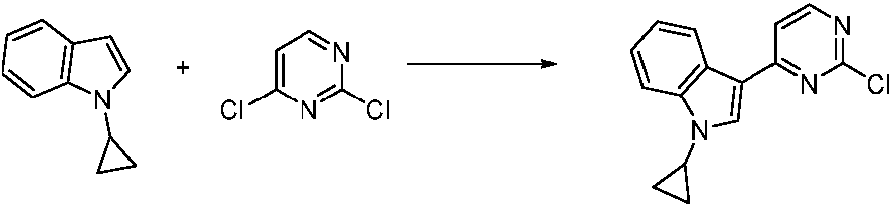
Se disolvieron 1-ciclopropil-1H-indol (140 mg, 0,89 mmol) y 2,4-dicloropirimidina (170 mg, 1,14 mmol) en etilenglicol dimetil éter (10 ml) y después se añadió cloruro de aluminio anhidro aluminio (180 mg, 1,35 mmol). La reacción se calentó hasta 100 °C durante una noche. La solución de reacción se enfrió a temperatura ambiente y se concentró a presión reducida. El residuo resultante se disolvió en diclorometano (30 ml) y la fase orgánica se lavó dos veces con agua, se secó y se concentró. El residuo resultante se purificó por cromatografía de capa fina preparativa (éter de petróleo: acetato de etilo = 8: 1) para obtener 3-(2-cloropirimidin-4-il)-1-ciclopropil-1H-indol (80 mg, 80 %). EM m/z (IEN): 270,1 [M+H]+.1-Cyclopropyl-1H-indole (140 mg, 0.89 mmol) and 2,4-dichloropyrimidine (170 mg, 1.14 mmol) were dissolved in ethylene glycol dimethyl ether (10 mL) and then anhydrous aluminum chloride was added. (180mg, 1.35mmol). The reaction was heated to 100 °C overnight. The reaction solution was cooled to room temperature and concentrated under reduced pressure. The resulting residue was dissolved in dichloromethane (30 mL), and the organic phase was washed twice with water, dried, and concentrated. The resulting residue was purified by preparative thin-layer chromatography (petroleum ether:ethyl acetate=8:1) to obtain 3-(2-chloropyrimidin-4-yl)-1-cyclopropyl-1H-indole (80 mg, 80 %). MS m/z (ESI): 270.1 [M+H]+.
Etapa 2: preparación de 4-(1-ciclopropil-1H-indol-3-il)-N-(2-(difluorometoxi)-4-fluoro-5-nitrofenil)pirimidin-2-aminaStep 2: Preparation of 4-(1-cyclopropyl-1H-indol-3-yl)-N-(2-(difluoromethoxy)-4-fluoro-5-nitrophenyl)pyrimidin-2-amine

Se disolvieron 3-(2-cloropirimidin-4-il)-1-ciclopropiMH-indol (80 mg, 0,29 mmol) y 2-(difluorometoxi)-4-fluoro-5-nitroanilina (64 mg, 0,29 mmol) en 2-pentanol. La mezcla se calentó durante 1 hora por microondas y se enfrió a temperatura ambiente. El disolvente se evaporó, y el residuo resultante se purificó por cromatografía de capa fina preparativa para obtener 4-(1-ciclopropil-1H-indol-3-il)-N-(2-(difluorometoxi)-4-fluoro-5-nitrofenil)pirimidin-2-amina (76 mg).3-(2-chloropyrimidin-4-yl)-1-cyclopropiMH-indole (80 mg, 0.29 mmol) and 2-(difluoromethoxy)-4-fluoro-5-nitroaniline (64 mg, 0.29 mmol) were dissolved ) in 2-pentanol. The mixture was heated for 1 hour by microwave and cooled to room temperature. The solvent was evaporated, and the resulting residue was purified by preparative thin-layer chromatography to obtain 4-(1-cyclopropyl-1H-indol-3-yl)-N-(2-(difluoromethoxy)-4-fluoro-5- nitrophenyl)pyrimidin-2-amine (76mg).
EM m/z (IEN): 456,1 [M+H]+.MS m/z (ESI): 456.1 [M+H]+.
Etapa 3: preparación de N1-(4-(1-ciclopropil-1H-indol-3-il)pirimidin-2-il)-2-(difluorometoxi)-N4-(2-(di metil-amino)etil)-N4-metil-5-nitrobenceno-1,4-diaminaStep 3: Preparation of N1-(4-(1-cyclopropyl-1H-indol-3-yl)pyrimidin-2-yl)-2-(difluoromethoxy)-N4-(2-(dimethyl-amino)ethyl)- N4-methyl-5-nitrobenzene-1,4-diamine

Se disolvió 4-(1-ciclopropil-1H-indol-3-il)-N-(2-(difluorometoxi)-4-fluoro-5-nitrofenil)pirimidin-2-amina (76 mg) en N,N-dimetilacetamida y después se añadió trimetiletilendiamina (0,1 g). La mezcla se calentó hasta reflujo durante 2 horas. La solución de reacción se enfrió a temperatura ambiente y el disolvente se evaporó para obtener N 1-(4-(1-ciclopropil-1H-indol-3-il)pirimidin-2-il)-2-(difluorometoxi)-N4-(2-(di metilamino)etil)-N4-metil-5-nitrobenceno-1,4-diamina (50 mg). EM m/z (IEN): 538,3 [M+H]+.4-(1-Cyclopropyl-1H-indol-3-yl)-N-(2-(difluoromethoxy)-4-fluoro-5-nitrophenyl)pyrimidin-2-amine (76 mg) was dissolved in N,N-dimethylacetamide and then trimethylethylenediamine (0.1 g) was added. The mixture was heated to reflux for 2 hours. The reaction solution was cooled to room temperature, and the solvent was evaporated to obtain N 1-(4-(1-cyclopropyl-1H-indol-3-yl)pyrimidin-2-yl)-2-(difluoromethoxy)-N4- (2-(dimethylamino)ethyl)-N4-methyl-5-nitrobenzene-1,4-diamine (50 mg). MS m/z (ESI): 538.3 [M+H]+.
Etapa 4: preparación de N4-(4-(1-ciclopropil-1H-indol-3-il)pirimidin-2-il)-5-(difluorometoxi)-N1-(2-(dimetil-amino)etil)-N1-metilbenceno-1,2,4-triaminaStep 4: Preparation of N4-(4-(1-cyclopropyl-1H-indol-3-yl)pyrimidin-2-yl)-5-(difluoromethoxy)-N1-(2-(dimethyl-amino)ethyl)-N1 -methylbenzene-1,2,4-triamine
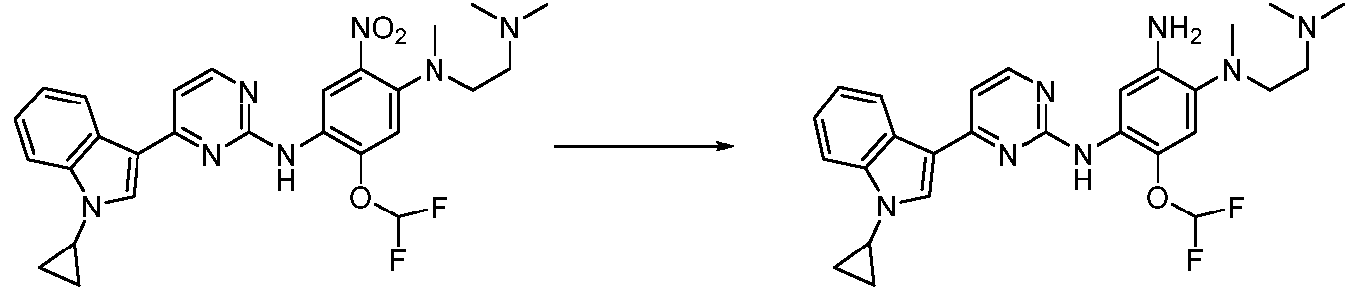
Se disolvió N1-(4-(1-ciclopropil-1H-indol-3-il)pirimidin-2-il)-2-(difluorometoxi)-N4-(2-(dimetilamino)etil)-N4-metil-5-nitrobenceno-1,4-diamina (50 mg) en 6 ml de un disolvente mezcla de etanol-agua (5: 1), después se añadieron 65 mg de polvo de hierro y 50 mg de cloruro de amonio. La mezcla se calentó a reflujo durante 2 horas. La solución de reacción se enfrió a temperatura ambiente, se filtró y el filtrado se recogió. El filtrado se concentró a presión reducida para retirar etanol, seguido de la adición de agua y diclorometano-metanol (20:1). La fase orgánica se separó y se concentró para obtener el producto en bruto (20 mg).N1-(4-(1-cyclopropyl-1H-indol-3-yl)pyrimidin-2-yl)-2-(difluoromethoxy)-N4-(2-(dimethylamino)ethyl)-N4-methyl-5- Nitrobenzene-1,4-diamine (50 mg) in 6 ml of a mixed solvent of ethanol-water (5: 1), then 65 mg of iron powder and 50 mg of ammonium chloride were added. The mixture was heated under reflux for 2 hours. The reaction solution was cooled to room temperature, filtered, and the filtrate was collected. The filtrate was concentrated under reduced pressure to remove ethanol, followed by the addition of water and dichloromethane-methanol (20:1). The organic phase was separated and concentrated to obtain crude product (20 mg).
EM m/z (IEN): 508,3 [M+H]+MS m/z (ESI): 508.3 [M+H]+
Etapa 5: preparación de N-(5-((4-(1-ciclopropil-1H-indol-3-il)pirimidin-2-il)amino)-4-(difluorometoxi)-2-((2-(dimetilamino)etil)(metil)amino)fenil)acrilamidaStep 5: Preparation of N-(5-((4-(1-cyclopropyl-1H-indol-3-yl)pyrimidin-2-yl)amino)-4-(difluoromethoxy)-2-((2-(dimethylamino )ethyl)(methyl)amino)phenyl)acrylamide

Se disolvió N4-(4-(1-ciclopropil-1H-indol-3-il)pirimidin-2-il)-5-(difluorometoxi)-N1-(2-(dimetilamino)etil)-N1-metilbenceno-1,2,4-triamina (20 mg) en tetrahidrofurano anhidro. En una atmósfera de nitrógeno, se añadió DIPEA (0,1 ml)a 0 °C, y se añadió gota a gota una solución de cloruro de acriloílo 1 M en tetrahidrofurano (0,2 ml). La reacción se llevó a cabo a 0 °C durante 1 hora. Se añadieron agua y diclorometano se añadieron a la solución de reacción y la fase acuosa y la fase orgánica se separaron. La fase acuosa se extrajo tres veces con diclorometano. Después, las fases orgánicas se combinaron, se secaron y se concentraron. Se obtuvo un producto en bruto mediante cromatografía de capa fina. El producto en bruto se purificó adicionalmente mediante cromatografía en columna de fase inversa (agua: metanol = 25: 75) para obtener el producto final (6,2 mg).N4-(4-(1-cyclopropyl-1H-indol-3-yl)pyrimidin-2-yl)-5-(difluoromethoxy)-N1-(2-(dimethylamino)ethyl)-N1-methylbenzene-1 was dissolved, 2,4-triamine (20 mg) in anhydrous tetrahydrofuran. Under a nitrogen atmosphere, DIPEA (0.1 mL) was added at 0 °C, and a solution of 1 M acryloyl chloride in tetrahydrofuran (0.2 mL) was added dropwise. The reaction was carried out at 0 °C for 1 hour. Water and dichloromethane were added to the reaction solution, and the aqueous phase and the organic phase were separated. The aqueous phase was extracted three times with dichloromethane. The organic phases were then combined, dried and concentrated. A crude product was obtained by thin layer chromatography. The crude product was further purified by reverse phase column chromatography (water: methanol = 25: 75) to obtain the final product (6.2 mg).
RMN 1H (400 MHz, CD3OD) 88,56 (s, 1H), 8,26 (m, 2H), 8,08 (d, 1H), 7,71 (d, 1H), 7,50 (d, 1H), 7,32 (m, 3H), 6,96 (m, 1H), 6,79 (m, 1H), 6,44 (dd, 1H), 5,85 (d,1H), 3,62 (m, 1H), 3,52 (m, 2H), 3,40 (m, 2H), 2,94 (s, 6H), 2,82 (s, 3H), 1,24 (m, 2H), 1,14 (m, 2H); 1H NMR (400 MHz, CD 3 OD) 88.56 (s, 1H), 8.26 (m, 2H), 8.08 (d, 1H), 7.71 (d, 1H), 7.50 ( d, 1H), 7.32 (m, 3H), 6.96 (m, 1H), 6.79 (m, 1H), 6.44 (dd, 1H), 5.85 (d, 1H), 3.62 (m, 1H), 3.52 (m, 2H), 3.40 (m, 2H), 2.94 (s, 6H), 2.82 (s, 3H), 1.24 (m , 2H), 1.14 (m, 2H);
RMN 19F (376 MHz, CD3OD) 5 -83,26;19F NMR (376 MHz, CD 3 OD) 5 -83.26;
EM m/z (IEN): 562,2 [M+H]+.MS m/z (ESI): 562.2 [M+H]+.
Ejemplo 13: preparación de N-(2-((2-(dimetilamino)etil)(metil)amino)-5-((4-(1-metil-1H-indol-3-il)pirimidin-2-il)amino)-4-(trifluorometoxi)fenil)acrilamidaExample 13: Preparation of N-(2-((2-(dimethylamino)ethyl)(methyl)amino)-5-((4-(1-methyl-1H-indol-3-yl)pyrimidin-2-yl) amino)-4-(trifluoromethoxy)phenyl)acrylamide

Etapa 1: preparación de 4-fluoro-1-nitro-2-(trifluorometoxi)bencenoStep 1: Preparation of 4-fluoro-1-nitro-2-(trifluoromethoxy)benzene

Se disolvió 1-fluoro-3-(trifluorometoxi)benceno (7,5 g, 41,6 mmol) en ácido sulfúrico concentrado (30 ml) y la mezcla se enfrió a 0 °C. Se añadió lentamente KNO3 (1,04 g, 10,25 mmol) en lotes. La temperatura interna se mantuvo por debajo de 5 °C. Después de que se completara la adición, la mezcla se agitó durante 2 horas. Se añadió una mezcla de hielo-agua (aproximadamente 50 ml). La solución de reacción se extrajo con metil ferc-butil éter (20x3 ml), y las fases orgánicas se combinaron, se secaron y se filtraron. El filtrado se concentró y se purificó por cromatografía ultrarrápida en columna sobre gel de sílice para obtener 4-fluoro-1-nitro-2-(trifluorometoxi)benceno (4,0 g, 42 %). Etapa 2: preparación de 4-fluoro-2-(trifluorometoxi)anilina1-Fluoro-3-(trifluoromethoxy)benzene (7.5 g, 41.6 mmol) was dissolved in concentrated sulfuric acid (30 mL) and the mixture was cooled to 0 °C. KNO 3 (1.04 g, 10.25 mmol) was added slowly in batches. The internal temperature remained below 5 °C. After the addition was complete, the mixture was stirred for 2 hours. An ice-water mixture (approximately 50 mL) was added. The reaction solution was extracted with methyl tert-butyl ether (20x3 ml), and the organic layers were combined, dried and filtered. The filtrate was concentrated and purified by flash column chromatography on silica gel to obtain 4-fluoro-1-nitro-2-(trifluoromethoxy)benzene (4.0 g, 42%). Step 2: Preparation of 4-fluoro-2-(trifluoromethoxy)aniline

Se disolvió 4-fluoro-1-nitro-2-(trifluorometoxi)benceno (4,0 g, 17,8 mmol) en metanol (50 ml) y después se añadió Pd/C (200 mg)añadió. La reacción se agitó durante 2 horas en una atmósfera de hidrógeno. Después de que la CLEM mostrase la finalización de la reacción, la solución de reacción se filtró y el filtrado se concentró. El residuo resultante se purificó por cromatografía en columna de fase inversa para obtener 4-fluoro-2-(trifluorometoxi)anilina (3,0 g, 86 %). Etapa 3: preparación de 4-fluoro-5-nitro-2-(trifluorometoxi)anilina4-Fluoro-1-nitro-2-(trifluoromethoxy)benzene (4.0 g, 17.8 mmol) was dissolved in methanol (50 mL) and then Pd/C (200 mg) was added. The reaction was stirred for 2 hours under an atmosphere of hydrogen. After LCMS showed the completion of the reaction, the reaction solution was filtered, and the filtrate was concentrated. The resulting residue was purified by reverse phase column chromatography to obtain 4-fluoro-2-(trifluoromethoxy)aniline (3.0 g, 86%). Step 3: Preparation of 4-fluoro-5-nitro-2-(trifluoromethoxy)aniline
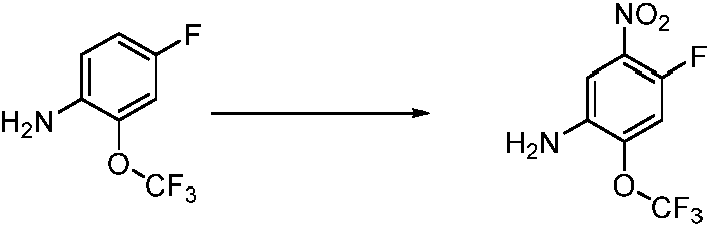
Se disolvió 4-fluoro-2-(trifluorometoxi)anilina (2,0 g, 10,25 mmol) en ácido sulfúrico concentrado (10 ml) y la mezcla se enfrió a -20 °C. Se añadió lentamente KNO3 (1,04 g, 10,25 mmol) en lotes. La temperatura interna se mantuvo por debajo de -10 °C. Después de que se completara la adición, la mezcla se agitó durante 1 hora. Se añadió una mezcla hielo-agua (aproximadamente 50 ml). La solución de reacción se extrajo con metil ferc-butil éter (20 ml x 3) y las fases orgánicas se combinaron, se secaron y se filtraron. El filtrado se concentró y se purificó por cromatografía ultrarrápida en columna sobre gel de sílice para obtener 4-fluoro-5-nitro-2-(trifluorometoxi)anilina (500 mg, 20 %).4-Fluoro-2-(trifluoromethoxy)aniline (2.0 g, 10.25 mmol) was dissolved in concentrated sulfuric acid (10 mL) and the mixture cooled to -20 °C. KNO 3 (1.04 g, 10.25 mmol) was added slowly in batches. The internal temperature remained below -10 °C. After the addition was complete, the mixture was stirred for 1 hour. An ice-water mixture (approximately 50 mL) was added. The reaction solution was extracted with methyl tert-butyl ether (20 ml x 3), and the organic layers were combined, dried and filtered. The filtrate was concentrated and purified by flash column chromatography on silica gel to obtain 4-fluoro-5-nitro-2-(trifluoromethoxy)aniline (500 mg, 20%).
E ta p a 4: p re p a ra c ió n d e N -(4 - f lu o ro -5 -n it ro -2 -( t r i f lu o ro m e to x i) fe n il) -4 -(1 -m e t i l-1 H - in d o l-3 - i l) p ir im id in -2 -a m in a Step 4: P re pa ra tio n of N -(4 - f lu o ro -5 -n it ro -2 -( trif lu o ro me to xi) fe n il) -4 -(1 -meti l-1 H - in do l-3 - il) p ir im id in -2 -am in a

Se disolvieron 4-fluoro-5-nitro-2-(trifluorometoxi)anilina (500 mg, 2.08 mmol), 3-(2-doropirimidin-4-il)-1-metil-1H-indol (508 mg, 2.08 mmol) y monohidrato de ácido p-toluenosulfónico (400 mg, 2.08 mmol) en 1,4-dioxano (10 ml). La reacción se calentó hasta 110 °C y se agitó durante 16 horas. Después de que la CLEM mostrase la finalización de la reacción, se añadió una solución acuosa saturada de NaHCO3 (20 ml) y la mezcla se agitó durante 20 minutos y se filtró. La torta de filtro se lavó con metil t-butil éter para obtener el producto en bruto N-(4-fluoro-5-nitro-2-(trifluorometoxi)fenil)-4-(1-metil-1H-indol-3-il)pirimidin-2-amina (400 mg, 43 %).4-Fluoro-5-nitro-2-(trifluoromethoxy)aniline (500 mg, 2.08 mmol), 3-(2-doropyrimidin-4-yl)-1-methyl-1H-indole (508 mg, 2.08 mmol) were dissolved and p-toluenesulfonic acid monohydrate (400 mg, 2.08 mmol) in 1,4-dioxane (10 mL). The reaction was heated to 110°C and stirred for 16 hours. After LCMS showed completion of the reaction, saturated aqueous NaHCO 3 solution (20 mL) was added and the mixture was stirred for 20 min and filtered. The filter cake was washed with methyl t-butyl ether to obtain crude product N-(4-fluoro-5-nitro-2-(trifluoromethoxy)phenyl)-4-(1-methyl-1H-indole-3- yl)pyrimidin-2-amine (400mg, 43%).
Etapa 5: preparación de N1-(2-(dimetilamino)etil)-N1-metil-N4-(4-(1-metil-1H-indol-3-il)pirimidin-2-il)-2-nitro-5-(trifluorometoxi)benceno-1,4-diaminaStep 5: Preparation of N1-(2-(dimethylamino)ethyl)-N1-methyl-N4-(4-(1-methyl-1H-indol-3-yl)pyrimidin-2-yl)-2-nitro-5 -(trifluoromethoxy)benzene-1,4-diamine

Se disolvieron N-(4-fluoro-5-nitro-2-(trifluorometoxi)fenil)-4-(1-metil-1H-indol-3-il)pirimidin-2-amina (400 mg, 0,89 mmol), N,N,N-trimetiletilendiamina (180 mg, 1,79 mmol) y trietilamina (1 ml) en DMF (5 ml). La reacción se calentó hasta 110 °C durante 2 horas. Después de que la CLEm mostrase la finalización de la reacción, se añadieron diclorometano (10 ml) y agua (10 ml). La fase orgánica se lavó tres veces con agua, se secó sobre sulfato de magnesio anhidro, se filtró y se concentró. El residuo resultante se purificó por cromatografía ultrarrápida en columna sobre gel de sílice para obtener N1-(2-(dimetilamino)etil)-N1-metil-N4-(4-(1-metil-1H-indol-3-il)pirimidin-2-il)-2-nitro-5-(trifluorometoxi)benceno-1,4-diamina (80 mg, 17 %).N-(4-fluoro-5-nitro-2-(trifluoromethoxy)phenyl)-4-(1-methyl-1H-indol-3-yl)pyrimidin-2-amine (400 mg, 0.89 mmol) were dissolved , N,N,N-trimethylethylenediamine (180 mg, 1.79 mmol) and triethylamine (1 mL) in DMF (5 mL). The reaction was heated to 110°C for 2 hours. After LCm showed completion of the reaction, dichloromethane (10 mL) and water (10 mL) were added. The organic phase was washed three times with water, dried over anhydrous magnesium sulfate, filtered, and concentrated. The resulting residue was purified by flash column chromatography on silica gel to obtain N1-(2-(dimethylamino)ethyl)-N1-methyl-N4-(4-(1-methyl-1H-indol-3-yl)pyrimidin -2-yl)-2-nitro-5-(trifluoromethoxy)benzene-1,4-diamine (80 mg, 17%).
Etapa 6: preparación de N1-(2-(dimetilamino)etil)-N1-metil-N4-(4-(1-metil-1H-indol-3-il)pirimidin-2-il-5-(trifluorometoxi)benceno-1,2,4-triaminaStep 6: Preparation of N1-(2-(dimethylamino)ethyl)-N1-methyl-N4-(4-(1-methyl-1H-indol-3-yl)pyrimidin-2-yl-5-(trifluoromethoxy)benzene -1,2,4-triamine

Se disolvió N1-(2-(dimetilamino)etil)-N1-metil-N4-(4-(1-metil-1H-indol-3-il)pirimidin-2-il)-2-nitro-5-(trifluorometoxi)benceno-1,4-diamina (80 mg, 0,15 mmol) en metanol (5 ml) y después se añadió Pd/C (10 mg). La reacción se agitó en una atmósfera de hidrógeno a temperatura ambiente durante 10 minutos. Después de que la CLEM mostrase la finalización de la reacción, la solución de reacción se filtró, y el filtrado se concentró para obtener N1-(2-(dimetilamino)etil)-N1-metil-N4-(4-(1-metil-1H-indol-3-il)pirimidin-2-y 1-5-(trifluorometoxi)benceno-1,2,4-triamina (50 mg, 70 %) que se usó directamente en la siguiente etapa sin purificación adicional.N1-(2-(dimethylamino)ethyl)-N1-methyl-N4-(4-(1-methyl-1H-indol-3-yl)pyrimidin-2-yl)-2-nitro-5-(trifluoromethoxy) was dissolved )benzene-1,4-diamine (80 mg, 0.15 mmol) in methanol (5 mL) then Pd/C (10 mg) was added. The reaction was stirred under an atmosphere of hydrogen at room temperature for 10 minutes. After LCMS showed the completion of the reaction, the reaction solution was filtered, and the filtrate was concentrated to obtain N1-(2-(dimethylamino)ethyl)-N1-methyl-N4-(4-(1-methyl -1H-indol-3-yl)pyrimidin-2-y 1-5-(trifluoromethoxy)benzene-1,2,4-triamine (50 mg, 70%) which was used directly in the next step without further purification.
Etapa 7: preparación de N-(2-((2-(dimetilamino)etil)(metil)amino)-5-((4-(1-metil-1H-indol-3-il)pirimidin-2-il)amino)-4-(trifluorometoxi)fenil)acrilamidaStep 7: Preparation of N-(2-((2-(dimethylamino)ethyl)(methyl)amino)-5-((4-(1-methyl-1H-indol-3-yl)pyrimidin-2-yl) amino)-4-(trifluoromethoxy)phenyl)acrylamide

Se disolvieron N1-(2-(dimetilamino)etil)-N1-metil-N4-(4-(1-metil-1H-indol-3-il)pirimidin-2-il-5-(trifluorometoxi)benceno-1,2,4-triamina (50 mg, 0,24 mmol) y trietilamina (0,2 ml) en tetrahidrofurano (10 ml). La solución de reacción se enfrió de -10 a -5 °C. Se añadió lentamente cloruro de acriloílo (0,35 ml, 1 M en THF) en una atmósfera de nitrógeno. La reacción se agitó de -10 a -5 °C durante 30 minutos. Una vez finalizada la reacción, se añadió metanol (3 ml) y la solución de reacción se agitó adicionalmente durante 10 minutos, y después se concentró a presión reducida. El residuo resultante se purificó por cromatografía de capa fina preparativa seguido de cromatografía en columna de fase inversa para obtener N-(2-((2-(dimetilamino)etilXmetil)amino)-5-((4-(1-metiMH-mdol-3-il)pirimidin-2-il)amino)-4-(trifluorometoxi)fenil)acrilamida (19,0 mg, 14 %).N1-(2-(dimethylamino)ethyl)-N1-methyl-N4-(4-(1-methyl-1H-indol-3-yl)pyrimidin-2-yl-5-(trifluoromethoxy)benzene-1, 2,4-triamine (50 mg, 0.24 mmol) and triethylamine (0.2 mL) in tetrahydrofuran (10 mL) The reaction solution was cooled to -10 to -5 °C Acryloyl chloride was added slowly (0.35 mL, 1 M in THF) under nitrogen. The reaction was stirred at -10 to -5 °C for 30 min. After the reaction was complete, methanol (3 mL) and the solution of reaction was further stirred for 10 minutes, and then concentrated under reduced pressure.The resulting residue was purified by preparative thin-layer chromatography followed by phase column chromatography. reverse to obtain N-(2-((2-(dimethylamino)ethylXmethyl)amino)-5-((4-(1-methylMH-mdol-3-yl)pyrimidin-2-yl)amino)-4-(trifluoromethoxy )phenyl)acrylamide (19.0 mg, 14%).
RMN 1H (400 MHz, CD3OD) 88,53 (s, 1H), 8,47 (s, 1H), 8,14 (d, J = 7,8 Hz, 1H), 8,07 (d, J = 6,8 Hz, 1H), 7,51 (d, J = 8,2 Hz, 1H), 7,47 (d, J = 0,9 Hz, 1H), 7,42 (d, J = 6,9 Hz, 1H), 7,19 (t, J = 7,5 Hz, 1H), 6,72 (dd, J = 16,9, 10,2 Hz, 1H), 6,47 (dd, J = 16,9, 1,5 Hz, 1H), 5,88 (dd, J = 10,3, 1,5 Hz, 1H), 3,93 (s, 3H), 3,51 (t, J = 5,9 Hz, 2H), 3,40 (t, J = 5,8 Hz, 2H), 2,95 (s, 6H), 2,82 (s, 3H);1H NMR (400 MHz, CD 3 OD) 88.53 (s, 1H), 8.47 (s, 1H), 8.14 (d, J = 7.8 Hz, 1H), 8.07 (d, J = 6.8 Hz, 1H), 7.51 (d, J = 8.2 Hz, 1H), 7.47 (d, J = 0.9 Hz, 1H), 7.42 (d, J = 6.9 Hz, 1H), 7.19 (t, J = 7.5 Hz, 1H), 6.72 (dd, J = 16.9, 10.2 Hz, 1H), 6.47 (dd, J = 16.9, 1.5 Hz, 1H), 5.88 (dd, J = 10.3, 1.5 Hz, 1H), 3.93 (s, 3H), 3.51 (t, J = 5.9 Hz, 2H), 3.40 (t, J = 5.8 Hz, 2H), 2.95 (s, 6H), 2.82 (s, 3H);
EM m/z (IEN): 554,2 [M+H]+.MS m/z (ESI): 554.2 [M+H]+.
Ejemplo 14: preparación de N-(5-((4-(1-metil-1H-indol-3-il)pirimidin-2-il)amino)-2-(4-metilpiperazin-1-il) -4-(trifluorometoxi)fenil)acrilamidaExample 14: Preparation of N-(5-((4-(1-methyl-1H-indol-3-yl)pyrimidin-2-yl)amino)-2-(4-methylpiperazin-1-yl)-4- (trifluoromethoxy)phenyl)acrylamide

El método de preparación de N-(5-((4-(1-metiMH-indol-3-il)pirimidin-2-il)amino)-2-(4-metilpiperazin-1-il)-4-(trifluorometoxi)fenil)acrilamida fue similar al del Ejemplo 2.The preparation method of N-(5-((4-(1-methylMH-indol-3-yl)pyrimidin-2-yl)amino)-2-(4-methylpiperazin-1-yl)-4-(trifluoromethoxy )phenyl)acrylamide was similar to that of Example 2.
Ejemplo 15: preparación de N-(2-((2-(dimetilamino)etil)(metil)amino)-5-((4-(6-metoxi-1-metil-1H-indol-3-il)pirimidin-2-il)amino)-4-(trifluorometoxi)fenil)acrilamidaExample 15: Preparation of N-(2-((2-(dimethylamino)ethyl)(methyl)amino)-5-((4-(6-methoxy-1-methyl-1H-indol-3-yl)pyrimidin- 2-yl)amino)-4-(trifluoromethoxy)phenyl)acrylamide

El método de preparación de N-(2-((2-(dimetilamino)etil)(metil)amino)-5-((4-(6-metoxi-1-metil-1H-indol-3-il)pirimidin-2-il)amino)-4-(trifluorometoxi)fenil)acrilamida fue similar al del Ejemplo 4.The preparation method of N-(2-((2-(dimethylamino)ethyl)(methyl)amino)-5-((4-(6-methoxy-1-methyl-1H-indol-3-yl)pyrimidin- 2-yl)amino)-4-(trifluoromethoxy)phenyl)acrylamide was similar to that of Example 4.
Ejemplo 16: preparación de N-(5-((4-(6-ciano-1-metiMH-indol-3-il)pirimidin-2-il)amino)-2-((2-(dimetilamino)etil)(metil)amino)-4-(trifluorometoxi)fenil)acrilamidaExample 16: Preparation of N-(5-((4-(6-cyano-1-methylMH-indol-3-yl)pyrimidin-2-yl)amino)-2-((2-(dimethylamino)ethyl)( methyl)amino)-4-(trifluoromethoxy)phenyl)acrylamide

El método de preparación de N-(5-((4-(6-ciano-1-metiMH-indol-3-il)pirimidin-2-il)amino)-2-((2-(dimetilamino)etil)(metil)amino)-4-(trifluorometoxi)fenil)acrilamida fue similar al del Ejemplo 4.The method of preparation of N-(5-((4-(6-cyano-1-methylMH-indol-3-yl)pyrimidin-2-yl)amino)-2-((2-(dimethylamino)ethyl)( methyl)amino)-4-(trifluoromethoxy)phenyl)acrylamide was similar to that of Example 4.
Ejemplo 17: preparación de N-(5-((4-(1-ciclopropil-1H-indol-3-il)pirimidin-2-il)amino)-2-((2-(dimetilamino)etil)(metil)amino)-4-(trifluorometoxi)fenil)acrilamida Example 17: Preparation of N-(5-((4-(1-cyclopropyl-1H-indol-3-yl)pyrimidin-2-yl)amino)-2-((2-(dimethylamino)ethyl)(methyl) amino)-4-(trifluoromethoxy)phenyl)acrylamide

El método de preparación de N-(5-((4-(1-ciclopropiMH-indol-3-il)pirimidin-2-il)amino)-2-((2-(dimetilamino)etil)(metil)amino)-4-(trifluorometoxi)fenil)acrilamida fue similar al del Ejemplo 1.The method of preparation of N-(5-((4-(1-cyclopropiMH-indol-3-yl)pyrimidin-2-yl)amino)-2-((2-(dimethylamino)ethyl)(methyl)amino) -4-(trifluoromethoxy)phenyl)acrylamide was similar to that of Example 1.
Ejemplo 18: preparación de N-(2-((2-(dimetilamino)etil)(metil)amino)-5-((4-(1-(2-hidroxietil)-1H-mdol-3-il)pirimidin-2-il)amino)-4-(trifluorometoxi)fenil)acrilamidaExample 18: Preparation of N-(2-((2-(dimethylamino)ethyl)(methyl)amino)-5-((4-(1-(2-hydroxyethyl)-1H-mdol-3-yl)pyrimidin- 2-yl)amino)-4-(trifluoromethoxy)phenyl)acrylamide

El método de preparación de N-(2-((2-(dimetilamino)etil)(metil)amino)-5-((4-(1-(2-hidroxietil)-1H-indol-3-y l)pirimidin-2-il)amino)-4-(trifluorometoxi)fenil)acrilamida fue similar al del Ejemplo 6.The preparation method of N-(2-((2-(dimethylamino)ethyl)(methyl)amino)-5-((4-(1-(2-hydroxyethyl)-1H-indol-3-yl)pyrimidin- 2-yl)amino)-4-(trifluoromethoxy)phenyl)acrylamide was similar to that of Example 6.
Ejemplo 19: preparación de N-(5-((4-(1-acetil-1H-indol-3-il)pirimidin-2-il)amino)-2-((2-(dimetilamino)etil)(metil)amino)-4-(trifluorometoxi)fenil)acrilamidaExample 19: Preparation of N-(5-((4-(1-acetyl-1H-indol-3-yl)pyrimidin-2-yl)amino)-2-((2-(dimethylamino)ethyl)(methyl) amino)-4-(trifluoromethoxy)phenyl)acrylamide

El método de preparación de N-(5-((4-(1-acetil-1H-indol-3-il)pirimidin-2-il)amino)-2-((2-(dimetilamino)etil)(metil)amino)-4-(trifluorometoxi)fenil)acrilamida fue similar al del Ejemplo 4.The method of preparation of N-(5-((4-(1-acetyl-1H-indol-3-yl)pyrimidin-2-yl)amino)-2-((2-(dimethylamino)ethyl)(methyl) amino)-4-(trifluoromethoxy)phenyl)acrylamide was similar to that of Example 4.
Ejemplo 20: preparación de N-(2-((2-(dimetilamino)etil)(metil)amino)-5-((4-(6-(dimetilfosforil)-1-metil-1H-indol-3-il)pirimidin-2-il)amino)-4-(trifluorometoxi)fenil)acrilamida Example 20: Preparation of N-(2-((2-(dimethylamino)ethyl)(methyl)amino)-5-((4-(6-(dimethylphosphoryl)-1-methyl-1H-indol-3-yl) pyrimidin-2-yl)amino)-4-(trifluoromethoxy)phenyl)acrylamide
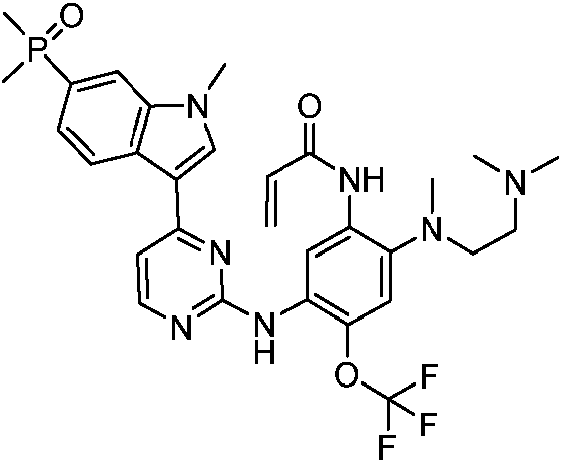
El método de preparación de N-(2-((2-(dimetilamino)etil)(metil)amino)-5-((4-(6-(dimetilfosforil)-1-methy l-1H-indol-3-il)pirimidin-2-il)amino)-4-(trifluorometoxi)fenil)acrilamida fue similar al del Ejemplo 4.The method of preparation of N-(2-((2-(dimethylamino)ethyl)(methyl)amino)-5-((4-(6-(dimethylphosphoryl)-1-methyl-1H-indol-3-yl )pyrimidin-2-yl)amino)-4-(trifluoromethoxy)phenyl)acrylamide was similar to that of Example 4.
Ejemplo 21: preparación de N-(4-(difluorometoxi)-2-((2-(dimetilamrno)etil)(metil)amino)-5-((4-(1-(N,N-dimetilsulfamoil)-1H-indol-3-il)pirimidin-2-il)amino)fenil)acrilamidaExample 21: Preparation of N-(4-(difluoromethoxy)-2-((2-(dimethylamrno)ethyl)(methyl)amino)-5-((4-(1-(N,N-dimethylsulfamoyl)-1H- indol-3-yl)pyrimidin-2-yl)amino)phenyl)acrylamide

Etapa 1: preparación de 3-(2-((2-(difluorometoxi)-4-((2-(dimetilamino)etil)(metil)amino)-5-nitrofenil)amino)pirimidin-4-il)-N,N-dimetil-1H-indolo-1-sulfonamidaStep 1: Preparation of 3-(2-((2-(difluoromethoxy)-4-((2-(dimethylamino)ethyl)(methyl)amino)-5-nitrophenyl)amino)pyrimidin-4-yl)-N, N-dimethyl-1H-indolo-1-sulfonamide

Se disolvió N-(4-(1H-indol-3-il)pirimidin-2-il)-2-(difluorometoxi)-(2-(dimetilamino)etil)-metil-5-nitrofenil-1,4-diamina (100 mg, 0,201 mmol) en 10 ml de DMF, y la mezcla se enfrió a 0 °C en un baño de hielo, seguido de la adición de hidruro sódico (24 mg, 0,603 mmol). Después de que la reacción se llevase a cabo durante 10 minutos a 0 °C, se añadió gota a gota cloruro de dimetil-sulfamoílo (35 mg, 0,241 mmol). La reacción se calentó hasta la temperatura ambiente y se agitó durante 30 minutos. Después de templar, la reacción se añadió con diclorometano y agua, y se extrajo tres veces. Las fases orgánicas se combinaron, se lavaron sucesivamente con una solución acuosa saturada de bicarbonato sódico, agua y salmuera saturada, se secaron y se concentraron para obtener un producto en bruto que se purificó adicionalmente por cromatografía ultrarrápida en columna sobre gel de sílice para obtener el producto (95 mg, 78 %). Etapa 2: preparación de 3-(2-((5-amino-2-(difluorometoxi)-4-((2-(dimetilamino)etil)(metil)amino)fenil)amino)pirimidin-4-il)-N,N-dimetil-1H-indolo-1-sulfonamidaN-(4-(1H-indol-3-yl)pyrimidin-2-yl)-2-(difluoromethoxy)-(2-(dimethylamino)ethyl)-methyl-5-nitrophenyl-1,4-diamine ( 100 mg, 0.201 mmol) in 10 mL of DMF, and the mixture was cooled to 0 °C in an ice bath, followed by the addition of sodium hydride (24 mg, 0.603 mmol). After the reaction was carried out for 10 minutes at 0 °C, dimethylsulfamoyl chloride (35 mg, 0.241 mmol) was added dropwise. The reaction was warmed to room temperature and stirred for 30 minutes. After warming, the reaction was added with dichloromethane and water and extracted three times. The organic phases were combined, washed successively with saturated aqueous sodium bicarbonate solution, water and saturated brine, dried and concentrated to obtain a crude product which was further purified by flash column chromatography on silica gel to obtain the product (95mg, 78%). Step 2: Preparation of 3-(2-((5-amino-2-(difluoromethoxy)-4-((2-(dimethylamino)ethyl)(methyl)amino)phenyl)amino)pyrimidin-4-yl)-N ,N-dimethyl-1H-indole-1-sulfonamide

Se disolvió 3-(2-((2-(difluorometoxi)-4-((2-(dimetilamino)etil)(metil)amino)-5-nitrofenil)amino)pirimidin-4-il)-N,N-dimetil 1H-indolo-1-sulfonamida en 5 ml de metanol, después se añadió Pd/C (15 mg). La reacción se agitó a temperatura ambiente en una atmósfera de hidrógeno durante 1 hora. Después de que la CLEM mostrase la finalización de la reacción, la reacción se filtró, y el filtrado se concentró para obtener un producto en bruto que se purificó adicionalmente por cromatografía ultrarrápida en columna sobre gel de sílice para obtener el producto (35 mg, 39 %). Etapa 3: preparación de N-(4-(difluorometoxi)-2-((2-(dimetilamino)etil)(metil)amino)-5-((4-(1-(N,N-dimetilsulfamoil)-1H-indol-3-il)pirimidin-2-il)amino)fenil)acrilamidadissolved 3-(2-((2-(difluoromethoxy)-4-((2-(dimethylamino)ethyl)(methyl)amino)-5-nitrophenyl)amino)pyrimidin-4-yl)-N,N-dimethyl 1H- indole-1-sulfonamide in 5 mL of methanol, then Pd/C (15 mg) was added. The reaction was stirred at room temperature under an atmosphere of hydrogen for 1 hour. After LCMS showed completion of the reaction, the reaction was filtered, and the filtrate was concentrated to obtain a crude product which was further purified by flash column chromatography on silica gel to obtain the product (35 mg, 39 %). Step 3: Preparation of N-(4-(difluoromethoxy)-2-((2-(dimethylamino)ethyl)(methyl)amino)-5-((4-(1-(N,N-dimethylsulfamoyl)-1H- indol-3-yl)pyrimidin-2-yl)amino)phenyl)acrylamide

Se disolvieron 3-(2-((5-amino-2-(difluorometoxi)-4-((2-(dimetilamino)etil)(metil)amino)p henil)amino)pirimidin-4-il)-N,N-dimetil-1H-indolo-1-sulfonamida (35 mg, 0,061 mmol) y trietilamina (18 mg, 0,183 mmol) en tetrahidrofurano anhidro (30 ml). La solución de reacción se agitó a -78 °C durante 10 minutos. Se añadió lentamente y gota a gota cloruro de acriloílo (0,2 ml, 1 M en THF). La reacción se agitó a esta temperatura durante 30 minutos. Después de que la CLEM mostrase la finalización de la reacción, la reacción se interrumpió con metanol. La solución de reacción se concentró, y el residuo resultante se purificó por cromatografía de capa fina preparativa para obtener el producto (25 mg, 65 %). RMN 1H (400 MHz, CD3OD) 88,57 (s, 1H), 8,39 (s, 1H), 8,36-8,18 (m, 2H), 7,97 (d, J = 8,4 Hz, 1H), 7,52 (d, J = 6,2 Hz, 1H), 7,37 (t, J = 7,7 Hz, 1H), 7,33-7,18 (m, 2H), 7,16-6,58 (m, 2H), 6,45 (d, J = 16,0 Hz, 1H), 5,96-5,77 (m, 1H), 3,49 (t, J = 5,6 Hz, 2H), 3,37 (t, J = 5,6 Hz, 2H), 2,93 (s, 6H), 2,89 (s, 6H), 2,78 (s, 3H);3-(2-((5-amino-2-(difluoromethoxy)-4-((2-(dimethylamino)ethyl)(methyl)amino)p-henyl)amino)pyrimidin-4-yl)-N,N -dimethyl-1H-indolo-1-sulfonamide (35 mg, 0.061 mmol) and triethylamine (18 mg, 0.183 mmol) in anhydrous tetrahydrofuran (30 mL). The reaction solution was stirred at -78°C for 10 minutes. Acryloyl chloride (0.2 mL, 1M in THF) was added slowly dropwise. The reaction was stirred at this temperature for 30 minutes. After LCMS showed completion of the reaction, the reaction was quenched with methanol. The reaction solution was concentrated, and the resulting residue was purified by preparative thin-layer chromatography to obtain the product (25 mg, 65%). 1H NMR (400 MHz, CD 3 OD) 88.57 (s, 1H), 8.39 (s, 1H), 8.36-8.18 (m, 2H), 7.97 (d, J = 8 0.4 Hz, 1H), 7.52 (d, J = 6.2 Hz, 1H), 7.37 (t, J = 7.7 Hz, 1H), 7.33-7.18 (m, 2H ), 7.16-6.58 (m, 2H), 6.45 (d, J = 16.0 Hz, 1H), 5.96-5.77 (m, 1H), 3.49 (t, J = 5.6 Hz, 2H), 3.37 (t, J = 5.6 Hz, 2H), 2.93 (s, 6H), 2.89 (s, 6H), 2.78 (s, 3H);
EM m/z (IEN): 629,2 [M+H]+.MS m/z (ESI): 629.2 [M+H]+.
Ejemplo 22: preparación de N-(5-((4-(6-ciclopropil-1-metil-1H-indol-3-il)pirimidin-2-il)amino)-2-((2-(dimetilamino)etil)(metil)amino)-4-metoxifenil)acrilamidaExample 22: Preparation of N-(5-((4-(6-cyclopropyl-1-methyl-1H-indol-3-yl)pyrimidin-2-yl)amino)-2-((2-(dimethylamino)ethyl )(methyl)amino)-4-methoxyphenyl)acrylamide

Etapa 1: preparación de 6-bromo-1-metil-1H-indolStep 1: Preparation of 6-bromo-1-methyl-1H-indole

A una solución de 6-bromo-1H-indol (3,00 g, 15,3 mmol) en DMF (30 ml),NaH (60 %, 734 mg, 18,4 mmol) se le añadió en un baño de hielo-agua y la mezcla se agitó a esta temperatura durante 20 minutos. Después, se añadió gota a gota una solución de Mel (1,14 ml, 18,4 mmol) en DMF (10 ml) y la mezcla se agitó a esta temperatura durante 30 minutos. Se añadieron 100 ml de agua y la solución de reacción se extrajo con EtOAc. La fase de EtOAc se lavó varias veces con salmuera saturada, se secó sobre sulfato sódico anhidro, se concentró y se purificó por cromatografía en columna (eluyente: PE puro) para obtener el compuesto del título 6-bromo-1-metil-1H-indol (2,70 g, 84 %).To a solution of 6-bromo-1H-indole (3.00 g, 15.3 mmol) in DMF (30 mL), NaH (60%, 734 mg, 18.4 mmol) was added in an ice bath. -water and the mixture was stirred at this temperature for 20 minutes. Then a solution of Mel (1.14 mL, 18.4 mmol) in DMF (10 mL) was added dropwise and the mixture was stirred at this temperature for 30 minutes. 100 mL of water was added, and the reaction solution was extracted with EtOAc. The EtOAc layer was washed several times with saturated brine, dried over anhydrous sodium sulfate, concentrated and purified by column chromatography (eluent: pure PE) to obtain the title compound 6-bromo-1-methyl-1H- indole (2.70g, 84%).
Etapa 2: preparación de 6-ciclopropil-1-metil-1H-indolStep 2: Preparation of 6-cyclopropyl-1-methyl-1H-indole

Se mezclaron 6-bromo-1-metil-1H-indol (1,44 g, 6,85 mmol) y ácido ciclopropilborónico (1,18 g, 13,7 mmol) en un disolvente mezcla de tolueno (20 ml) y agua (3 ml). La mezcla se purgó con nitrógeno para retirar oxígeno en una atmósfera de nitrógeno durante 5 minutos. Después, se añadieron Pd (OAc) 2 (231 mg, 1,03 mmol) y fosfato potásico anhidro (4,37 g, 20,6 mmol) y la mezcla se purgó con nitrógeno durante 10 minutos de nuevo. Finalmente, se añadió triciclohexilfosfina (769 mg, 2,74 mmol) y la mezcla se purgó con nitrógeno durante 5 minutos. En una atmósfera de nitrógeno, la solución de reacción se agitó durante una noche a 100 °C en un baño de aceite. Después de un periodo de refrigeración, el disolvente orgánico se retiró por evaporación. Se añadieron EtOAc y agua y las dos fases se separaron. La fase de EtOAc se lavó con salmuera saturada, se secó sobre sulfato sódico anhidro, se concentró y se purificó por cromatografía en columna (eluyente: PE puro ) para obtener el compuesto del título 6-ciclopropil-1 -metil-1H-indol (770 mg, 66 %).6-Bromo-1-methyl-1H-indole (1.44 g, 6.85 mmol) and cyclopropylboronic acid (1.18 g, 13.7 mmol) were mixed in a mixed solvent of toluene (20 ml) and water (3 ml). The mixture was purged with nitrogen to remove oxygen under a nitrogen atmosphere for 5 minutes. Then Pd(OAc) 2 (231 mg, 1.03 mmol) and anhydrous potassium phosphate (4.37 g, 20.6 mmol) were added and the mixture was purged with nitrogen for 10 min again. Finally, tricyclohexylphosphine (769 mg, 2.74 mmol) was added and the mixture was purged with nitrogen for 5 minutes. Under a nitrogen atmosphere, the reaction solution was stirred overnight at 100°C in an oil bath. After a period of cooling, the organic solvent was removed by evaporation. EtOAc and water were added and the two phases were separated. The EtOAc layer was washed with saturated brine, dried over anhydrous sodium sulfate, concentrated and purified by column chromatography (eluent: pure PE) to give the title compound 6-cyclopropyl-1-methyl-1H-indole ( 770mg, 66%).
RMN 1H (400 MHz, CDCla): 87,55 (d, J = 8,0 Hz, 1H), 7,09 (d, J = 0,8 Hz, 1H), 7,01 (d, J = 3,2 Hz, 1H), 6,93 (m, 1H), 6,46 (dd, J = 3,2, 0,8 Hz, 1H), 3,79 (s, 3H), 2,09 (m, 1H), 1,01 (m, 2H), 0,80 (m, 2H).1H NMR (400 MHz, CDCla): 87.55 (d, J=8.0 Hz, 1H), 7.09 (d, J=0.8 Hz, 1H), 7.01 (d, J=3 0.2 Hz, 1H), 6.93 (m, 1H), 6.46 (dd, J = 3.2, 0.8 Hz, 1H), 3.79 (s, 3H), 2.09 (m , 1H), 1.01 (m, 2H), 0.80 (m, 2H).
Etapa 3: preparación de 3-(2-cloropirimidin-4-il)-6-ciclopropil-1-metil-1H-indolStep 3: Preparation of 3-(2-chloropyrimidin-4-yl)-6-cyclopropyl-1-methyl-1H-indole

Se añadió FeCh (864 mg, 5,33 mmol) a una solución mezcla de 6-ciclopropil-1-metil-1H-indol (760 mg, 4,44 mmol) y 2,4-dicloropirimidina (674 mg, 4,44 mmol) en etilenglicol dimetil éter (10 ml) y la mezcla se agitó durante una noche a 60 °C. Después de un periodo de refrigeración, se añadieron una gran cantidad de EtOAc y agua y las dos fases se separaron. La sustancia sin disolver se retiró a través de celite y después la fase acuosa se retiró. La fase orgánica se lavó sucesivamente con una solución acuosa saturada de bicarbonato sódico y salmuera saturada, se secó sobre sulfato sódico anhidro y se concentró. El residuo resultante se purificó por cromatografía en columna (eluyente: PE : EtOAc = 3: 1) para obtener el compuesto del título (533 mg, 42 %).FeCh (864 mg, 5.33 mmol) was added to a mixed solution of 6-cyclopropyl-1-methyl-1H-indole (760 mg, 4.44 mmol) and 2,4-dichloropyrimidine (674 mg, 4.44 mmol) in ethylene glycol dimethyl ether (10 mL) and the mixture was stirred overnight at 60 °C. After a period of cooling, a large amount of EtOAc and water were added and the two phases were separated. Undissolved material was removed through celite and then the aqueous phase was removed. The organic phase was washed successively with a saturated aqueous sodium bicarbonate solution and saturated brine, dried over anhydrous sodium sulfate, and concentrated. The resulting residue was purified by column chromatography (eluent: PE : EtOAc=3:1) to obtain the title compound (533 mg, 42%).
EM m/z (IEN): 284,2 [M+H]+.MS m/z (ESI): 284.2 [M+H]+.
Etapa 4: preparación de 4-(6-ciclopropil-1-metil-1lH-indol-3-il)-N-(4-fluoro-2-metoxi-5-nitrofenil)pirimidin-2-aminaStep 4: Preparation of 4-(6-cyclopropyl-1-methyl-1lH-indol-3-yl)-N-(4-fluoro-2-methoxy-5-nitrophenyl)pyrimidin-2-amine

Se mezclaron 3-(2-cloropirimidin-4-il)-6-ciclopropil-1-metil-1H-indol (533 mg, 1,88 mmol), 4-fluoro-2-metoxi-5-nitroanilina (350 mg, 1,88 mmol) y TsOHH2O (429 mg, 2,25 mmol) en 2-pentanol (10 ml) y la reacción se llevó a cabo a 125 °C durante 3 horas. Después de enfriar la mezcla y filtrase, el sólido resultante se disolvió en CH2Ch, se lavó con una solución acuosa de bicarbonato sódico y salmuera saturada sucesivamente, se secó sobre sulfato sódico anhidro y se concentró para obtener el compuesto del título 4-(6-ciclopropil-1-metil-1H-indol-3-il)-N-(4-fluoro-2-metoxi-5-nitrofenil)pirimi din-2-amina (750 mg, 92 %).3-(2-chloropyrimidin-4-yl)-6-cyclopropyl-1-methyl-1H-indole (533 mg, 1.88 mmol), 4-fluoro-2-methoxy-5-nitroaniline (350 mg, 1.88 mmol) and TsOHH 2 O (429 mg, 2.25 mmol) in 2-pentanol (10 mL), and the reaction was carried out at 125 °C for 3 hours. After the mixture was cooled and filtered, the resulting solid was dissolved in CH 2 Ch, washed with aqueous sodium bicarbonate solution and saturated brine successively, dried over anhydrous sodium sulfate, and concentrated to obtain the title compound 4-( 6-Cyclopropyl-1-methyl-1H-indol-3-yl)-N-(4-fluoro-2-methoxy-5-nitrophenyl)pyrimidin-2-amine (750mg, 92%).
EM m/z (IEN): 434,2 [M+H]+.MS m/z (ESI): 434.2 [M+H]+.
Etapa 5: preparación de N1-(4-(6-ciclopropil-1-metil-1H-indol-3-il)pirimidin-2-il)-N4-(2-(dimetilamin o)etil)-2-metoxi-N4-metil-5-nitrobenceno-1,4-diaminaStep 5: Preparation of N1-(4-(6-cyclopropyl-1-methyl-1H-indol-3-yl)pyrimidin-2-yl)-N4-(2-(dimethylamino)ethyl)-2-methoxy- N4-methyl-5-nitrobenzene-1,4-diamine

Se disolvieron 4-(6-ciclopropil-1-metil-1H-indol-3-il)-N-(4-fluoro-2-metoxi-5-nitrofenil)pirimidin-2-amina (647 mg,1,49 mmol), N1,N1,N2-trimetiletano-1,2-diamina (229 mg, 2,24 mmol) y DIPEA (0,740 ml, 4,48 mmol) en DMA (10 ml) y la reacción se llevó a cabo a 85 °C durante 3 horas. Después de un periodo de refrigeración, se añadieron agua y EtOAc y las dos fases se separaron. La fase orgánica se lavó varias veces con salmuera saturada, se secó sobre sulfato sódico anhidro y se concentró para obtener el compuesto del título N1-(4-(6-cidopropil-1-metil-1H-indo 1-3-il)pirimidin-2-il)-N4-(2-(dimetilamino)etil)-2-metoxi-N4-metil-5-nitrobenceno-1,4-diamina en forma de un producto en bruto que se usó directamente en la siguiente etapa.4-(6-Cyclopropyl-1-methyl-1H-indol-3-yl)-N-(4-fluoro-2-methoxy-5-nitrophenyl)pyrimidin-2-amine (647 mg, 1.49 mmol ), N1,N1,N2-trimethylethane-1,2-diamine (229 mg, 2.24 mmol) and DIPEA (0.740 mL, 4.48 mmol) in DMA (10 mL) and the reaction carried out at 85 °C for 3 hours. After a period of cooling, water and EtOAc were added. and the two phases were separated. The organic phase was washed several times with saturated brine, dried over anhydrous sodium sulfate, and concentrated to obtain the title compound N1-(4-(6-cidopropyl-1-methyl-1H-indo 1-3-yl)pyrimidin -2-yl)-N4-(2-(dimethylamino)ethyl)-2-methoxy-N4-methyl-5-nitrobenzene-1,4-diamine as a crude product which was used directly in the next step.
EM m/z (IEN): 516,3 [M+H]+.MS m/z (ESI): 516.3 [M+H]+.
Etapa 6: preparación de N4-(4-(6-ciclopropiM-metiMH-indol-3-il)pirimidin-2-il)-N1-(2-(dimetilamino)etil)-5-metoxi-N1-metilbenceno-1,2,4-triaminaStep 6: Preparation of N4-(4-(6-cyclopropiM-methylMH-indol-3-yl)pyrimidin-2-yl)-N1-(2-(dimethylamino)ethyl)-5-methoxy-N1-methylbenzene-1 ,2,4-triamine

Se mezclaron N1-(4-(6-ciclopropil-1-metil-1H-indol-3-il)pirimidin-2-il)-N4-(2-(dimetilamino)etil)-2-metoxi-N4-metil-5-nitrobenceno-1,4-diamina (1,4 g, un producto en bruto), reducido polvo de hierro (1,22 g, 21,7 mmol) y cloruro de amonio (100 mg, 1,90 mmol) en una solución de EtOH (30 ml) y agua (10 ml). La mezcla se calentó hasta reflujo durante tres horas. Después de un periodo de refrigeración, se añadió una gran cantidad de EtOH y la sustancia sin disolver se retiró por filtración a través de celite. Se retiró EtOH a presión reducida. Después, la fase acuosa se extrajo con EtOAc y la fase de EtOAc se lavó con salmuera saturada, se secó sobre sulfato sódico anhidro, se concentró y se purificó por cromatografía en columna [eluyente: CH2Ch ^ CH2Ch:MeOH (que contenía amoniaco concentrado al 10%) = 17: 1] para obtener el compuesto del título N4-(4-(6-ciclopropil-1-metiMH-indol-3-il)pirimidin-2-il)-N1-(2-(dimetilamino)etil)-5-metoxi-N1-metilbenceno-1,2,4-triamina (490 mg, rendimiento de dos etapas: 68 %).N1-(4-(6-cyclopropyl-1-methyl-1H-indol-3-yl)pyrimidin-2-yl)-N4-(2-(dimethylamino)ethyl)-2-methoxy-N4-methyl- 5-nitrobenzene-1,4-diamine (1.4 g, a crude product), reduced iron powder (1.22 g, 21.7 mmol), and ammonium chloride (100 mg, 1.90 mmol) in an EtOH solution (30 mL) and water (10 mL). The mixture was heated to reflux for three hours. After a period of cooling, a large amount of EtOH was added and the undissolved material was removed by filtration through celite. EtOH was removed under reduced pressure. The aqueous layer was then extracted with EtOAc, and the EtOAc layer was washed with saturated brine, dried over anhydrous sodium sulfate, concentrated, and purified by column chromatography [eluent: CH 2 Ch ^ CH 2 Ch:MeOH (which contained 10% concentrated ammonia) = 17:1] to obtain the title compound N4-(4-(6-cyclopropyl-1-methylMH-indol-3-yl)pyrimidin-2-yl)-N1-(2- (dimethylamino)ethyl)-5-methoxy-N1-methylbenzene-1,2,4-triamine (490 mg, two-step yield: 68%).
EM m/z (IEN): 486,3 [M+H]+.MS m/z (ESI): 486.3 [M+H]+.
Etapa 7: preparación de N-(5-((4-(6-ciclopropil-1-metil-1H-indol-3-il)pirimidin-2-il)amino)-2-((2-(dimetilamino)etil)(metil)amino)-4-metoxifenil)acrilamidaStep 7: Preparation of N-(5-((4-(6-cyclopropyl-1-methyl-1H-indol-3-yl)pyrimidin-2-yl)amino)-2-((2-(dimethylamino)ethyl )(methyl)amino)-4-methoxyphenyl)acrylamide

Una solución de cloruro de acriloílo (22,0 mg, 0,247 mmol) en THF (1 ml) se añadió gota a gota a una solución de N4-(4-(6-ciclopropil-1-metil-1H-indol-3-il)pirimidin-2-il)-N1-(2-(dimetilamino)etil)-5-metoxi-N1-metilbenceno-1,2,4-triaminain (80,0 mg, 0,164 mmol) y TEA (50,0 mg, 0,492 mmol) en THF (2 ml) en un baño de hielo-agua. Tras completarse la adición, la mezcla se agitó a la misma temperatura durante 15 minutos. La reacción se interrumpió con metanol, se concentró a presión reducida y se purificó por cromatografía de capa fina preparativa (CH2Cl2 :MeOH:amoniaco concentrado = 100: 10: 1) para obtener el compuesto del título N-(5-((4-(6-ciclopropil-1 -metil-1H-indol-3-il)pirimidin-2-il)amino)-2-((2-(dimetilamino)etil)(metil)amino)-4-metoxifenil)acrilamida (45 mg, 51 %).A solution of acryloyl chloride (22.0 mg, 0.247 mmol) in THF (1 mL) was added dropwise to a solution of N4-(4-(6-cyclopropyl-1-methyl-1H-indole-3- yl)pyrimidin-2-yl)-N1-(2-(dimethylamino)ethyl)-5-methoxy-N1-methylbenzene-1,2,4-triaminain (80.0 mg, 0.164 mmol) and TEA (50.0 mg, 0.492 mmol) in THF (2 mL) in an ice-water bath. After the addition was complete, the mixture was stirred at the same temperature for 15 minutes. The reaction was quenched with methanol, concentrated under reduced pressure, and purified by preparative thin-layer chromatography (CH 2 Cl 2 :MeOH:conc. ammonia = 100:10:1) to give the title compound N-(5-( (4-(6-cyclopropyl-1-methyl-1H-indol-3-yl)pyrimidin-2-yl)amino)-2-((2-(dimethylamino)ethyl)(methyl)amino)-4-methoxyphenyl) acrylamide (45mg, 51%).
RMN 1H (400 MHz, CDCl3): 8 10,1 (s a, 1H), 9,83 (s, 1H), 9,00 (s, 1H), 8,36 (d, J = 5,2 Hz, 1H), 7,93 (d, J = 8,4 Hz, 1H), 7,71 (s, 1H), 7,16 (d, J = 5,2 Hz, 1H), 7,10 (s, 1H), 7,00 (dd, J = 8,4, 1,6 Hz, 1H), 6,79 (s, 1H), 6,39-6,44 (m, 2H), 5,70 (dd, J = 9,6, 2,0 Hz, 1H), 3,95 (s, 3H), 3,87 (s, 3H), 2,89 (t, J = 5,6 Hz, 2H), 2,69 (s, 3H), 2,27 (t, J = 5,6 Hz, 2H), 2,25 (s, 6H), 2,06 (m, 1H), 1,00 (m, 2H), 0,78 (m, 2H);1H NMR (400 MHz, CDCl3): 8 10.1 (brs, 1H), 9.83 (s, 1H), 9.00 (s, 1H), 8.36 (d, J = 5.2 Hz, 1H), 7.93 (d, J=8.4Hz, 1H), 7.71 (s, 1H), 7.16 (d, J=5.2Hz, 1H), 7.10 (s, 1H), 7.00 (dd, J = 8.4, 1.6 Hz, 1H), 6.79 (s, 1H), 6.39-6.44 (m, 2H), 5.70 (dd , J = 9.6, 2.0 Hz, 1H), 3.95 (s, 3H), 3.87 (s, 3H), 2.89 (t, J = 5.6 Hz, 2H), 2 .69 (s, 3H), 2.27 (t, J = 5.6 Hz, 2H), 2.25 (s, 6H), 2.06 (m, 1H), 1.00 (m, 2H) , 0.78 (m, 2H);
EM m/z (IEN): 540,3 [M+H]+.MS m/z (ESI): 540.3 [M+H]+.
Ejemplo 23: preparación de N-(5-((4-(5-ciclopropil-1-metil-1H-indol-3-il)pirimidin-2-il)amino)-2-((2-(dimetilamino)etil)(metil)amino)-4-metoxifenil)acrilamida Example 23: Preparation of N-(5-((4-(5-cyclopropyl-1-methyl-1H-indol-3-yl)pyrimidin-2-yl)amino)-2-((2-(dimethylamino)ethyl )(methyl)amino)-4-methoxyphenyl)acrylamide
El método de preparación de N-(5-((4-(5-ciclopropil-1-metiMH-indol-3-il)pirimidin-2-il)amino)-2-((2-(dimetilamino)etil)(metil)amino)-4-metoxifenil)acrilamida fue similar al del Ejemplo 22.The method of preparation of N-(5-((4-(5-cyclopropyl-1-methylMH-indol-3-yl)pyrimidin-2-yl)amino)-2-((2-(dimethylamino)ethyl)( methyl)amino)-4-methoxyphenyl)acrylamide was similar to that of Example 22.
RMN 1H (400 MHz, CDCh): 810,0 (s a, 1H), 9,76 (s, 1H), 8,99 (s, 1H), 8,31 (d, J = 5,2 Hz, 1H), 7,72 (s, 1H), 7,65 (s, 1H), 7,21 (s, 1H), 7,13 (d, J = 5,2 Hz, 1H), 6,94 (dd, J = 8,4, 1,6 Hz, 1H), 6,72 (s, 1H), 6,36 (m, 2H), 5,63 (dd, J = 8,8, 2,8 Hz, 1H), 3,89 (s, 3H), 3,82 (s, 3H), 2,84 (t, J = 6,0 Hz, 2H), 2,62 (s, 3H), 2,25 (t, J = 6,0 Hz, 2H), 2,20 (s, 6H), 2,00 (m, 1H), 0,93 (m, 2H), 0,75 (m, 2H);1H NMR (400 MHz, CDCh): 810.0 (brs, 1H), 9.76 (s, 1H), 8.99 (s, 1H), 8.31 (d, J = 5.2 Hz, 1H ), 7.72 (s, 1H), 7.65 (s, 1H), 7.21 (s, 1H), 7.13 (d, J = 5.2 Hz, 1H), 6.94 (dd , J = 8.4, 1.6 Hz, 1H), 6.72 (s, 1H), 6.36 (m, 2H), 5.63 (dd, J = 8.8, 2.8 Hz, 1H), 3.89 (s, 3H), 3.82 (s, 3H), 2.84 (t, J = 6.0 Hz, 2H), 2.62 (s, 3H), 2.25 ( t, J = 6.0 Hz, 2H), 2.20 (s, 6H), 2.00 (m, 1H), 0.93 (m, 2H), 0.75 (m, 2H);
EM m/z (IEN): 540,4 [M+H]+.MS m/z (ESI): 540.4 [M+H]+.
Ejemplo 24: preparación de N-(2-((2-(dimetilamino)etil)(metil)amino)-4-metoxi-5-((4-(5-metoxi-1-metil-1H-indol-3-il)pirimidin-2-il)amino)fenil)acrilamidaExample 24: Preparation of N-(2-((2-(dimethylamino)ethyl)(methyl)amino)-4-methoxy-5-((4-(5-methoxy-1-methyl-1H-indole-3- yl)pyrimidin-2-yl)amino)phenyl)acrylamide

El método de preparación de N-(2-((2-(dimetilamino)etil)(metil)amino)-4-metoxi-5-((4-(5-metoxi-1-metil-1H-indol-3-il)pirimidin-2-il)amino)fenil)acrilamida fue similar al del Ejemplo 22.The preparation method of N-(2-((2-(dimethylamino)ethyl)(methyl)amino)-4-methoxy-5-((4-(5-methoxy-1-methyl-1H-indole-3- yl)pyrimidin-2-yl)amino)phenyl)acrylamide was similar to that of Example 22.
RMN 1H (400 MHz, CDCh): 810,09 (s, 1H), 9,76 (s, 1H), 8,97 (s, 1H), 8,30 (d, J = 5,2 Hz, 1H), 7,64 (s, 1H), 7,44 (d, J = 2,4 Hz, 1H), 7,20 (d, J = 9,2 Hz, 1H), 7,05 (d, J = 5,2 Hz, 1H), 6,85 (m, 1H), 6,72 (s, 1H), 6,36 (m, 2H), 5,63 (m, 1H), 3,89 (s, 3H), 3,85 (s, 3H), 3,81 (s, 3H), 2,81 (t, J = 5,6 Hz, 2H), 2,63 (s, 3H), 2,20 (m, 8H);1H NMR (400 MHz, CDCh): 810.09 (s, 1H), 9.76 (s, 1H), 8.97 (s, 1H), 8.30 (d, J = 5.2 Hz, 1H ), 7.64 (s, 1H), 7.44 (d, J = 2.4 Hz, 1H), 7.20 (d, J = 9.2 Hz, 1H), 7.05 (d, J = 5.2 Hz, 1H), 6.85 (m, 1H), 6.72 (s, 1H), 6.36 (m, 2H), 5.63 (m, 1H), 3.89 (s , 3H), 3.85 (s, 3H), 3.81 (s, 3H), 2.81 (t, J = 5.6 Hz, 2H), 2.63 (s, 3H), 2.20 (m, 8H);
EM m/z (IEN): 530,2 [M+H]+.MS m/z (ESI): 530.2 [M+H]+.
Ejemplo 25: preparación de N-(2-((2-(dimetilamino)etil)(metil)amino)-4-metoxi-5-((4-(6-metoxi-1-metil-1H-indol-3-il)pirimidin-2-il)amino)fenil)acrilamidaExample 25: Preparation of N-(2-((2-(dimethylamino)ethyl)(methyl)amino)-4-methoxy-5-((4-(6-methoxy-1-methyl-1H-indole-3- yl)pyrimidin-2-yl)amino)phenyl)acrylamide

El método de preparación de N-(2-((2-(dimetilamino)etil)(metil)amino)-4-metoxi-5-((4-(6-metoxi-1-metil-1H-indol-3-il)pirimidin-2-il)amino)fenil)acrilamida fue similar al del Ejemplo 22.The preparation method of N-(2-((2-(dimethylamino)ethyl)(methyl)amino)-4-methoxy-5-((4-(6-methoxy-1-methyl-1H-indole-3- yl)pyrimidin-2-yl)amino)phenyl)acrylamide was similar to that of Example 22.
RMN 1H (400 MHz, CDCh): 89,99 (d, J = 29,8 Hz, 1H), 9,75 (s, 1H), 8,85 (s, 1H), 8,29 (d, J = 5,3 Hz, 1H), 7,87 (d, J = 8,8 Hz, 1H), 7,64 (s, 1H), 7,06 (d, J = 5,3 Hz, 1H), 6,83 (dd, J = 8,7, 2,3 Hz, 1H), 6,75 (t, J = 8,0 Hz, 1H), 6,70 (s, 1H), 6,50-6,24 (m, 2H), 5,76-5,53 (m, 1H), 3,85 (s, 3H), 3,82 (d, J = 4,9 Hz, 3H), 3,80 (s, 3H), 2,94-2,74 (m, 2H), 2,62 (s, 3H), 2,24 (d, J = 4,8 Hz, 2H), 2,20 (s, 6H);1H NMR (400 MHz, CDCh): 89.99 (d, J = 29.8 Hz, 1H), 9.75 (s, 1H), 8.85 (s, 1H), 8.29 (d, J = 5.3 Hz, 1H), 7.87 (d, J = 8.8 Hz, 1H), 7.64 (s, 1H), 7.06 (d, J = 5.3 Hz, 1H), 6.83 (dd, J = 8.7, 2.3 Hz, 1H), 6.75 (t, J = 8.0 Hz, 1H), 6.70 (s, 1H), 6.50-6 .24 (m, 2H), 5.76-5.53 (m, 1H), 3.85 (s, 3H), 3.82 (d, J = 4.9 Hz, 3H), 3.80 ( s, 3H), 2.94-2.74 (m, 2H), 2.62 (s, 3H), 2.24 (d, J = 4.8 Hz, 2H), 2.20 (s, 6H );
EM m/z (IEN): 530,3 [M+H]+.MS m/z (ESI): 530.3 [M+H]+.
Ejemplo 26: preparación de N-(5-((4-(1-ciclopropil-1H-indol-3-il)pirimidin-2-il)amino)-2-((2-(dimetilamino)etil)(metil)amino)-4-metoxifenil)acrilamidaExample 26: Preparation of N-(5-((4-(1-cyclopropyl-1H-indol-3-yl)pyrimidin-2-yl)amino)-2-((2-(dimethylamino)ethyl)(methyl) amino)-4-methoxyphenyl)acrylamide

El método de preparación de N-(5-((4-(1-ciclopropil-1H-indol-3-il)pirimidin-2-il)amino)-2-((2-(dimetilamino)etil)(metil)amino)-4-metoxifenil)acrilamida fue similar al del Ejemplo 22.The method of preparation of N-(5-((4-(1-cyclopropyl-1H-indol-3-yl)pyrimidin-2-yl)amino)-2-((2-(dimethylamino)ethyl)(methyl) amino)-4-methoxyphenyl)acrylamide was similar to that of Example 22.
RMN 1H (400 MHz, CDCla): 89,78 (s, 1H), 9,74 (s, 1H), 8,55 (s, 1H), 8,39 (d, J = 5,3 Hz, 1H), 8,11 (d, J = 7,0 Hz, 1H), 7,74-7,55 (m, 2H), 7,18 (d, J = 5,3 Hz, 1H), 6,76 (s, 1H), 6,62 (dd, J = 16,8, 10,1 Hz, 1H), 6,46 (dd, J = 16,9, 1,9 Hz, 1H), 6,24 (m, 1H), 5,80-5,59 (m, 1H), 3,88 (s, 3H), 3,55-3,34 (m, 1H), 3,02 (t, J = 5,8 Hz, 2H), 2,68 (s, 3H), 2,57 (t, J = 5,7 Hz, 2H), 2,42 (s, 6H), 1,24-1,17 (m, 2H), 1,14-1,04 (m, 2H);1H NMR (400 MHz, CDCla): 89.78 (s, 1H), 9.74 (s, 1H), 8.55 (s, 1H), 8.39 (d, J = 5.3 Hz, 1H ), 8.11 (d, J = 7.0 Hz, 1H), 7.74-7.55 (m, 2H), 7.18 (d, J = 5.3 Hz, 1H), 6.76 (s, 1H), 6.62 (dd, J=16.8, 10.1 Hz, 1H), 6.46 (dd, J=16.9, 1.9 Hz, 1H), 6.24 (m, 1H), 5.80-5.59 (m, 1H), 3.88 (s, 3H), 3.55-3.34 (m, 1H), 3.02 (t, J = 5.8 Hz, 2H), 2.68 (s, 3H), 2.57 (t, J = 5.7 Hz, 2H), 2.42 (s, 6H), 1.24 -1.17 (m, 2H), 1.14-1.04 (m, 2H);
EM m/z (IEN): 526,3 [M+H]+.MS m/z (ESI): 526.3 [M+H]+.
Ejemplo 27: preparación de N-(4-metoxi-5-((4-(1-metil-1H-indol-3-il)pirimidin-2-il)amino)-2-(2-oxa-6-aza espiro[3,3]heptan-6-il)fenil)acrilamidaExample 27: Preparation of N-(4-methoxy-5-((4-(1-methyl-1H-indol-3-yl)pyrimidin-2-yl)amino)-2-(2-oxa-6-aza spiro[3.3]heptan-6-yl)phenyl)acrylamide

El método de preparación de N-(4-metoxi-5-((4-(1-metil-1H-indol-3-il)pirimidin-2-il)amino)-2-(2-oxa-6-azaespiro[3,3]heptan-6-il)fenil)acrilamida fue similar al del Ejemplo 22.The method of preparation of N-(4-methoxy-5-((4-(1-methyl-1H-indol-3-yl)pyrimidin-2-yl)amino)-2-(2-oxa-6-azaspiro [3,3]heptan-6-yl)phenyl)acrylamide was similar to that of Example 22.
RMN 1H (400 MHz, CDCh): 88,76 (s, 1H), 8,32 (d, J = 26,6 Hz, 1H), 8,20 (dd, J = 20,7, 6,3 Hz, 1H), 8,11-7,97 (m, 1H), 7,48-7,36 (m, 1H), 7,36-7,24 (m, 2H), 6,97 (dd, J = 25,1, 11,6 Hz, 1H), 6,44-6,30 (m, 1H), 6,24 (dd, J = 16,9, 10,0 Hz, 1H), 6,13-6,01 (m, 1H), 5,66 (dd, J = 9,9, 1,5 Hz, 1H), 4,69 (s, 4H), 3,95-3,67 (m, 10H);1H NMR (400 MHz, CDCh): 88.76 (s, 1H), 8.32 (d, J = 26.6 Hz, 1H), 8.20 (dd, J = 20.7, 6.3 Hz , 1H), 8.11-7.97 (m, 1H), 7.48-7.36 (m, 1H), 7.36-7.24 (m, 2H), 6.97 (dd, J = 25.1, 11.6 Hz, 1H), 6.44-6.30 (m, 1H), 6.24 (dd, J = 16.9, 10.0 Hz, 1H), 6.13- 6.01 (m, 1H), 5.66 (dd, J=9.9, 1.5Hz, 1H), 4.69 (s, 4H), 3.95-3.67 (m, 10H) ;
EM m/z (IEN): 497,2 [M+H]+.MS m/z (ESI): 497.2 [M+H]+.
Ejemplo 28: preparación de N-(5-((4-(5,6-difluoro-1-metil-1H-indol-3-il)pirimidin-2-il)amino)-2-((2-(dimetilamino)etil)(metil)amino)-4-metoxifenil)acrilamidaExample 28: Preparation of N-(5-((4-(5,6-difluoro-1-methyl-1H-indol-3-yl)pyrimidin-2-yl)amino)-2-((2-(dimethylamino )ethyl)(methyl)amino)-4-methoxyphenyl)acrylamide

El método de preparación de N-(5-((4-(5,6-difluoro-1-metil-1H-indol-3-il)pirimidin-2-y1)amino)-2-((2-(dimetilamino)etil)(metil)amino)-4-metoxifenil)acrilamida fue similar al del Ejemplo 22.The preparation method of N-(5-((4-(5,6-difluoro-1-methyl-1H-indol-3-yl)pyrimidin-2-y1)amino)-2-((2-(dimethylamino )ethyl)(methyl)amino)-4-methoxyphenyl)acrylamide was similar to that of Example 22.
RMN 1H (400 MHz, CDCla): 810,06 (s, 1H), 9,83-9,46 (m, 1H), 8,86 (s, 1H), 8,30 (d, J = 5,3 Hz, 1H), 7,78 (dd, J = 11,4 Hz, 1H), 7,62 (s, 1H), 7,11-6,99 (m, 1H), 6,93 (t, J = 6,2 Hz, 1H), 6,72 (s, 1H), 6,34 (d, J = 5,6 Hz, 2H), 5,72-5,51 (m, 1H), 3,84 (d, J = 6,4 Hz, 3H), 3,81 (d, J = 4,4 Hz, 3H), 2,92-2,76 (m, 2H), 2,72-2,54 (m, 3H), 2,21 (s, 6H), 1,36-1,07 (m, 2H); EM m/z (IEN): 536,2 [M+H]+.1H NMR (400 MHz, CDCla): 810.06 (s, 1H), 9.83-9.46 (m, 1H), 8.86 (s, 1H), 8.30 (d, J=5, 3 Hz, 1H), 7.78 (dd, J = 11.4 Hz, 1H), 7.62 (s, 1H), 7.11-6.99 (m, 1H), 6.93 (t, J = 6.2 Hz, 1H), 6.72 (s, 1H), 6.34 (d, J = 5.6 Hz, 2H), 5.72-5.51 (m, 1H), 3, 84 (d, J=6.4Hz, 3H), 3.81 (d, J=4.4Hz, 3H), 2.92-2.76 (m, 2H), 2.72-2.54 (m, 3H), 2.21 (s, 6H), 1.36-1.07 (m, 2H); MS m/z (ESI): 536.2 [M+H]+.
Ejemplo 29: preparación de N-(5-((4-(4,6-difluoro-1-metil-1H-indol-3-il)pirimidin-2-il)amino)-2-((2-(dimetilamino)etil)(metil)amino)-4-metoxifenil)acrilamidaExample 29: Preparation of N-(5-((4-(4,6-difluoro-1-methyl-1H-indol-3-yl)pyrimidin-2-yl)amino)-2-((2-(dimethylamino )ethyl)(methyl)amino)-4-methoxyphenyl)acrylamide
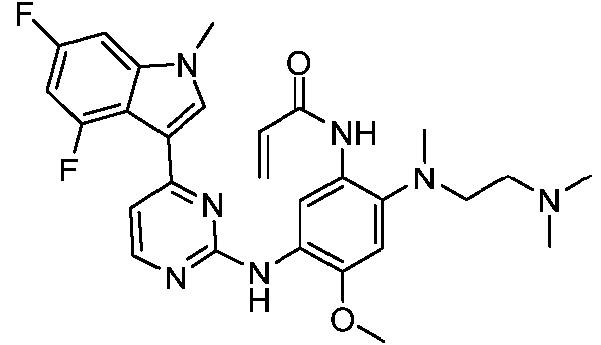
El método de preparación de N-(5-((4-(4,6-difluoro-1-metil-1H-indol-3-il)pirimidin-2-y1)amino)-2-((2-(dimetilamino)etil)(metil)amino)-4-metoxifenil)acrilamida fue similar al del Ejemplo 22.The preparation method of N-(5-((4-(4,6-difluoro-1-methyl-1H-indol-3-yl)pyrimidin-2-y1)amino)-2-((2-(dimethylamino )ethyl)(methyl)amino)-4-methoxyphenyl)acrylamide was similar to that of Example 22.
RMN 1H (400 MHz, CDCh): 89,97 (s, 1H), 9,71 (s, 1H), 9,00 (s, 1H), 8,53-8,19 (m, 1H), 7,71-7,56 (m, 1H), 7,33 (d, J = 5,4 Hz, 1H), 6,79 (dd, J = 8,8, 2,1 Hz, 1H), 6,71 (s, 1H), 6,65 (ddd, J = 11,9, 9,7, 2,1 Hz, 1H), 6,42-6,22 (m, 2H), 5,68 5,53 (m, 1H), 3,87 (s, 3H), 3,81 (s, 3H), 2,94-2,77 (m, 2H), 2,62 (d, J = 9,2 Hz, 3H), 2,28 (s, 2H), 2,23 (s, 6H);1H NMR (400 MHz, CDCh): 89.97 (s, 1H), 9.71 (s, 1H), 9.00 (s, 1H), 8.53-8.19 (m, 1H), 7 ,71-7.56 (m, 1H), 7.33 (d, J = 5.4 Hz, 1H), 6.79 (dd, J = 8.8, 2.1 Hz, 1H), 6, 71 (s, 1H), 6.65 (ddd, J = 11.9, 9.7, 2.1 Hz, 1H), 6.42-6.22 (m, 2H), 5.68 5.53 (m, 1H), 3.87 (s, 3H), 3.81 (s, 3H), 2.94-2.77 (m, 2H), 2.62 (d, J = 9.2 Hz, 3H), 2.28 (s, 2H), 2.23 (s, 6H);
EM m/z (IEN): 536,2 [M+H]+.MS m/z (ESI): 536.2 [M+H]+.
Ejemplo 30: preparación de N-(2-((2-(dimetilamino)etil)(metil)amino)-4-metoxi-5-((4-(4,5,6,7-tetrafluor o-1-metil-1H-indol-3-il)pirimidin-2-il)amino)fenil)acrilamida Example 30: Preparation of N-(2-((2-(dimethylamino)ethyl)(methyl)amino)-4-methoxy-5-((4-(4,5,6,7-tetrafluoro o-1-methyl -1H-indol-3-yl)pyrimidin-2-yl)amino)phenyl)acrylamide

El método de preparación de N-(2-((2-(dimetilammo)etilXmetil)amino)-4-metoxi-5-((4-(4,5,6,7-tetrafluoro-1-metiMH-indol-3-il)pirimidin-2-il)amino)fenil)acrilamida fue similar al del Ejemplo 22.The method of preparation of N-(2-((2-(dimethylammo)ethylXmethyl)amino)-4-methoxy-5-((4-(4,5,6,7-tetrafluoro-1-methylMH-indole-3 -yl)pyrimidin-2-yl)amino)phenyl)acrylamide was similar to that of Example 22.
Ejemplo 31: preparación de N-(2-((2-(dimetilamino)etil)(metil)amino)-4-metoxi-5-((4-(l,5,6-trimetil-1H-indol-3-il)pirimidin-2-il)amino)fenil)acrilamidaExample 31: Preparation of N-(2-((2-(dimethylamino)ethyl)(methyl)amino)-4-methoxy-5-((4-(1,5,6-trimethyl-1H-indole-3- yl)pyrimidin-2-yl)amino)phenyl)acrylamide

El método de preparación de N-(2-((2-(dimetilamino)etil)(metil)amino)-4-metoxi-5-((4-(1,5,6-trimetil-1H-in dol-3-il)pirimidin-2-il)amino)fenil)acrilamida fue similar al del Ejemplo 22.The method of preparation of N-(2-((2-(dimethylamino)ethyl)(methyl)amino)-4-methoxy-5-((4-(1,5,6-trimethyl-1H-in dol-3 -yl)pyrimidin-2-yl)amino)phenyl)acrylamide was similar to that of Example 22.
Ejemplo 32: preparación de N-(5-((4-(4,6-difluoro-1,7-dimetil-1H-indol-3-il)pirimidin-2-il)amino)-2-((2-(dimetilamino)etil)(metil)amino)-4-metoxifenil)acrilamidaExample 32: Preparation of N-(5-((4-(4,6-difluoro-1,7-dimethyl-1H-indol-3-yl)pyrimidin-2-yl)amino)-2-((2- (dimethylamino)ethyl)(methyl)amino)-4-methoxyphenyl)acrylamide

El método de preparación de N-(5-((4-(4,6-difluoro-1,7-dimetil-1H-indol-3-il)pirimidin-2-il)amino)-2-((2-(dimetilamino)etil)(metil)amino)-4-metoxifenil)acrilamida fue similar al del Ejemplo 22.The preparation method of N-(5-((4-(4,6-difluoro-1,7-dimethyl-1H-indol-3-yl)pyrimidin-2-yl)amino)-2-((2- (dimethylamino)ethyl)(methyl)amino)-4-methoxyphenyl)acrylamide was similar to that of Example 22.
Ejemplo 33: preparación de N-(2-((2-(dimetilamino)etil)(metil)amino)-5-((4-(5-fluoro-4,6-dimetoxi-1-metil-1H-indol-3-il)pirimidin-2-il)amino)-4-metoxifenil)acrilamidaExample 33: Preparation of N-(2-((2-(dimethylamino)ethyl)(methyl)amino)-5-((4-(5-fluoro-4,6-dimethoxy-1-methyl-1H-indole- 3-yl)pyrimidin-2-yl)amino)-4-methoxyphenyl)acrylamide

El método de preparación de N-(2-((2-(dimetilamino)etil)(metil)amino)-5-((4-(5-fluoro-4,6-dimetoxi-1-metil-1H-indol-3-il)pirimidin-2-il)amino)-4-metoxifenil)acrilamida fue similar al del Ejemplo 22.The preparation method of N-(2-((2-(dimethylamino)ethyl)(methyl)amino)-5-((4-(5-fluoro-4,6-dimethoxy-1-methyl-1H-indole- 3-yl)pyrimidin-2-yl)amino)-4-methoxyphenyl)acrylamide was similar to that of Example 22.
Ejemplo 34: preparación de N-(5-((4-(5,7-difluoro-6-(trifluorometil)-1H-indol-3-il)pirimidin-2-il)amino)-2-((2-(dimetilamino)etil)(metil)amino)-4-metoxifenil)acrilamida Example 34: Preparation of N-(5-((4-(5,7-difluoro-6-(trifluoromethyl)-1H-indol-3-yl)pyrimidin-2-yl)amino)-2-((2- (dimethylamino)ethyl)(methyl)amino)-4-methoxyphenyl)acrylamide

El método de preparación de N-(5-((4-(5,7-difluoro-6-(trifluorometil)-1H-indol-3-il)pirimidin-2-il)amino)-2-((2-(dimetilamino)etil)(metil)amino)-4-metoxifenil)acrilamida fue similar al del Ejemplo 22.The preparation method of N-(5-((4-(5,7-difluoro-6-(trifluoromethyl)-1H-indol-3-yl)pyrimidin-2-yl)amino)-2-((2- (dimethylamino)ethyl)(methyl)amino)-4-methoxyphenyl)acrylamide was similar to that of Example 22.
Ejemplo 35: preparación de N-(5-((4-(4,6-difluoro-5-metil-1H-indol-3-il)pirimidin-2-il)amino)-2-((2-(dimetilamino)etil)(metil)amino)-4-metoxifenil)acrilamidaExample 35: Preparation of N-(5-((4-(4,6-difluoro-5-methyl-1H-indol-3-yl)pyrimidin-2-yl)amino)-2-((2-(dimethylamino )ethyl)(methyl)amino)-4-methoxyphenyl)acrylamide

El método de preparación de N-(5-((4-(4,6-difluoro-5-metil-1H-indol-3-il)pirimidin-2-il)amino)-2-((2-(dimetilamino)etil)(metil)amino)-4-metoxifenil)acrilamida fue similar al del Ejemplo 22.The preparation method of N-(5-((4-(4,6-difluoro-5-methyl-1H-indol-3-yl)pyrimidin-2-yl)amino)-2-((2-(dimethylamino )ethyl)(methyl)amino)-4-methoxyphenyl)acrylamide was similar to that of Example 22.
Ejemplo 36: preparación de N-(2-((2-(dimetilamino)etil)(metil)amino)-4-metoxi-5-((4-(4,5,6,7-tetrafluoro-1H-indol-3-il)pirimidin-2-il)amino)fenil)acrilamidaExample 36: Preparation of N-(2-((2-(dimethylamino)ethyl)(methyl)amino)-4-methoxy-5-((4-(4,5,6,7-tetrafluoro-1H-indole- 3-yl)pyrimidin-2-yl)amino)phenyl)acrylamide

El método de preparación de N-(2-((2-(dimetilamino)etil)(metil)amino)-4-metoxi-5-((4-(4,5,6,7-tetrafluoro-1H-indol-3-il)pirimidin-2-il)amino)fenil)acrilamida fue similar al del Ejemplo 22.The preparation method of N-(2-((2-(dimethylamino)ethyl)(methyl)amino)-4-methoxy-5-((4-(4,5,6,7-tetrafluoro-1H-indole- 3-yl)pyrimidin-2-yl)amino)phenyl)acrylamide was similar to that of Example 22.
Ejemplo 37: preparación de N-(5-((4-(1-ciclopropil-4,6-dimetil-5-(metilsulfonil)-1H-indol-3-il)pirimidin-2-il)amino)-2-((2-(dimetilamino)etil)(metil)amino)-4-metoxifenil)acrilamidaExample 37: Preparation of N-(5-((4-(1-cyclopropyl-4,6-dimethyl-5-(methylsulfonyl)-1H-indol-3-yl)pyrimidin-2-yl)amino)-2- ((2-(dimethylamino)ethyl)(methyl)amino)-4-methoxyphenyl)acrylamide

El método de preparación de N-(5-((4-(1-ciclopropil-4,6-dimetil-5-(metilsulfonil)-1H-indol-3-il)pirimidin-2-il)amino)-2-((2-(dimetilamino)etil)(metil)amino)-4-metoxifenil)acrilamida fue similar al del Ejemplo 22.The preparation method of N-(5-((4-(1-cyclopropyl-4,6-dimethyl-5-(methylsulfonyl)-1H-indol-3-yl)pyrimidin-2-yl)amino)-2- ((2-(dimethylamino)ethyl)(methyl)amino)-4-methoxyphenyl)acrylamide was similar to that of Example 22.
Ejemplo 38: preparación de N-(5-((4-(1,5-diciclopropil-4,6-difluoro-1H-indol-3-il)pirimidin-2-il)amino)-2-((2 -(dimetilamino)etil)(metil)amino)-4-metoxifenil)acrilamida Example 38: Preparation of N-(5-((4-(1,5-dicyclopropyl-4,6-difluoro-1H-indol-3-yl)pyrimidin-2-yl)amino)-2-((2- (dimethylamino)ethyl)(methyl)amino)-4-methoxyphenyl)acrylamide
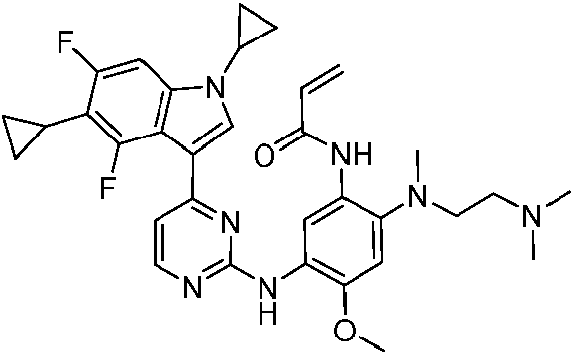
El método de preparación de N-(5-((4-(1,5-dicidopropil-4,6-difluoro-1H-indol-3-il)pirimidin-2-il)amino)-2-((2-(di metilamino)etil)(metil)amino)-4-metoxifenil)acrilamida fue similar al del Ejemplo 22.The method of preparation of N-(5-((4-(1,5-dicidopropyl-4,6-difluoro-1H-indol-3-yl)pyrimidin-2-yl)amino)-2-((2- (dimethylamino)ethyl)(methyl)amino)-4-methoxyphenyl)acrylamide was similar to that of Example 22.
Ejemplo 39: preparación de N-(5-((4-(1-ciclopropil-5, 7-difluoro-6-(oxetan-3-il)-1H-indol-3-il)pirimidin-2-il)amino)-2-((2-(dimetilamino)etil)(metil)amino)-4-metoxifenil)acrilamidaExample 39: Preparation of N-(5-((4-(1-cyclopropyl-5,7-difluoro-6-(oxetan-3-yl)-1H-indol-3-yl)pyrimidin-2-yl)amino )-2-((2-(dimethylamino)ethyl)(methyl)amino)-4-methoxyphenyl)acrylamide
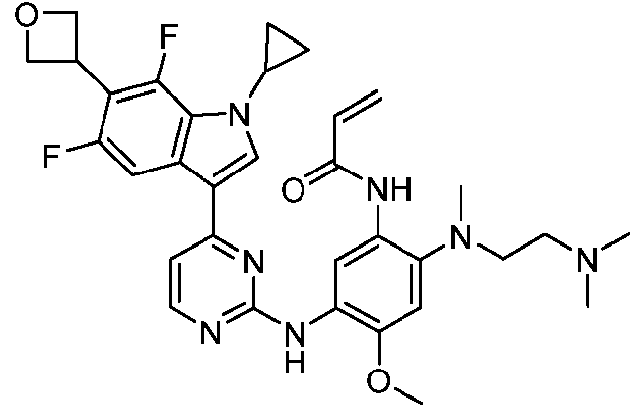
El método de preparación de N-(5-((4-(1-ciclopropil-5,7-difluoro-6-(oxetan-3-il)-1H-indol-3-il)pirimidin-2-il)amino)-2-((2-(dimetilamino)etil)(metil)amino)-4-metoxifenil)acrilamida fue similar al del Ejemplo 22.The method of preparation of N-(5-((4-(1-cyclopropyl-5,7-difluoro-6-(oxetan-3-yl)-1H-indol-3-yl)pyrimidin-2-yl)amino )-2-((2-(dimethylamino)ethyl)(methyl)amino)-4-methoxyphenyl)acrylamide was similar to that of Example 22.
Ejemplo 40: preparación de N-(5-((4-(1H-indazol-1-il)pirimidin-2-il)amino)-2-((2-(dimetilamino)etil)(metil)amino)-4-metoxifenil)acrilamidaExample 40: Preparation of N-(5-((4-(1H-indazol-1-yl)pyrimidin-2-yl)amino)-2-((2-(dimethylamino)ethyl)(methyl)amino)-4 -methoxyphenyl)acrylamide

Etapa 1: preparación de 1-(2-cloropirimidin-4-il)-1H-indazolStep 1: Preparation of 1-(2-chloropyrimidin-4-yl)-1H-indazole
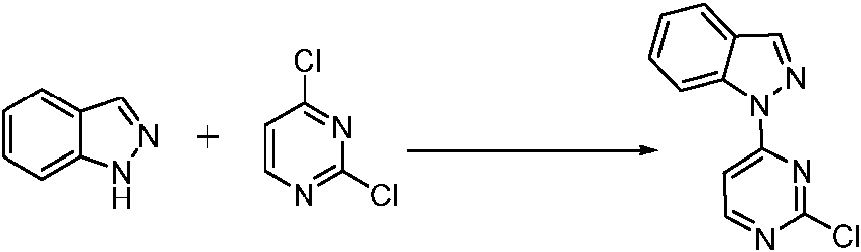
2,4-dicloropirimidina (1,18 g, 8 mmol) y DMF (40 ml) se añadieron en un matraz de una boca de 100 ml. Se añadió NaH (0,4 g, 10 mmol) a la solución en lotes y la mezcla se agitó a temperatura ambiente durante media hora. Después de enfriar a 0 °C, se añadió indazol (1,49 g, 12,6 mmol). La reacción se calentó a temperatura ambiente en agitación lentamente y se hizo reaccionar durante 4 horas. La reacción se interrumpió con agua, se extrajo con acetato de etilo y se purificó por cromatografía en columna sobre gel de sílice (PE / EA = 20/1) para obtener el producto del título 1-(2-cloropirimidin-4-il)-1H-indazol (450 mg, 26 %).2,4-Dichloropyrimidine (1.18 g, 8 mmol) and DMF (40 mL) were added to a 100 mL single neck flask. NaH (0.4 g, 10 mmol) was added to the solution in batches and the mixture was stirred at room temperature for half an hour. After cooling to 0 °C, indazole (1.49 g, 12.6 mmol) was added. The reaction was warmed to room temperature with slow stirring and reacted for 4 hours. The reaction was quenched with water, extracted with ethyl acetate and purified by silica gel column chromatography (PE/EA = 20/1) to give the title product 1-(2-chloropyrimidin-4-yl) -1H-indazole (450 mg, 26%).
Etapa 2: preparación de N-(4-fluoro-2-metoxi-5-nitrofenil)-4-(1H-indazol-1-il)pirimidin-2-amina Step 2: Preparation of N-(4-fluoro-2-methoxy-5-nitrophenyl)-4-(1H-indazol-1-yl)pyrimidin-2-amine

Se añadieron sucesivamente 1-(2-cloropirimidin-4-il)-1H-indazol (450 mg, 1,96 mmol), 4-fluoro-2-metoxi-5-nitroanilina (363 mg, 1,96 mmol), ácido p-toluenosulfónico (336 mg, 1,96 mmol) y 2-pentanol (20 ml) en un matraz de una boca de 50 ml. La mezcla se agitó a 120 °C durante 5 horas y se concentró para obtener una mezcla de color negro que se purificó por cromatografía en columna sobre gel de sílice (MeOH al 1 %/DCM) para obtener el compuesto del título N-(4-fluoro-2-metoxi-5-nitrofenil)-4-(1H-indazol-1-il)pirimidin-2-amina (200 mg, 27 %).1-(2-chloropyrimidin-4-yl)-1H-indazole (450 mg, 1.96 mmol), 4-fluoro-2-methoxy-5-nitroaniline (363 mg, 1.96 mmol), acid p-toluenesulfonic acid (336 mg, 1.96 mmol) and 2-pentanol (20 mL) in a 50 mL single neck flask. The mixture was stirred at 120 °C for 5 hours and concentrated to give a black mixture which was purified by silica gel column chromatography (1% MeOH/DCM) to give the title compound N-(4 -fluoro-2-methoxy-5-nitrophenyl)-4-(1H-indazol-1-yl)pyrimidin-2-amine (200mg, 27%).
Etapa 3: preparación de N1-(4-(1H-indazol-1-il)pirimidin-2-il)-N4-(2-(dimetilamino)etil)-2-metoxi-N 4-metil-5-nitrobenceno-1,4-diaminaStep 3: Preparation of N1-(4-(1H-indazol-1-yl)pyrimidin-2-yl)-N4-(2-(dimethylamino)ethyl)-2-methoxy-N 4-methyl-5-nitrobenzene- 1,4-diamine

Se añadieron sucesivamente N-(4-fluoro-2-metoxi-5-nitrofenil)-4-(1H-indazol-1-il)pirimidin-2-amina (200 mg, 0,53 mmol), trimetiletilendiamina (107 mg, 1,05 mmol), DIPEA (203 mg, 1,57 mmol) y DMF (8 ml) en un matraz de una boca de 50 ml. La solución de reacción se agitó a 100 °C durante 1 hora, se concentró y se purificó por cromatografía de capa fina preparativa (MeOH al 5 %/DCM) para obtener el compuesto del título, N1 -(4-(1H-indazol-1-il)pirimidin-2-il)-N4-(2-(dimetilamino)etil)-2-metoxi-N4-metil-5-nitrobenceno-1,4-diamina (300 mg, 60 %).N-(4-fluoro-2-methoxy-5-nitrophenyl)-4-(1H-indazol-1-yl)pyrimidin-2-amine (200 mg, 0.53 mmol), trimethylethylenediamine (107 mg, 1.05 mmol), DIPEA (203 mg, 1.57 mmol) and DMF (8 mL) in a 50 mL single neck flask. The reaction solution was stirred at 100 °C for 1 hour, concentrated and purified by preparative thin-layer chromatography (5% MeOH/DCM) to obtain the title compound, N1 -(4-(1H-indazole- 1-yl)pyrimidin-2-yl)-N4-(2-(dimethylamino)ethyl)-2-methoxy-N4-methyl-5-nitrobenzene-1,4-diamine (300mg, 60%).
Etapa 4: preparación de N4-(4-(1H-indazol-1-il)pirimidin-2-il)-N1-(2-(dimetilamino)etil)-5-metoxi-N 1-metilbenceno-1,2,4-triaminaStep 4: Preparation of N4-(4-(1H-indazol-1-yl)pyrimidin-2-yl)-N1-(2-(dimethylamino)ethyl)-5-methoxy-N 1-methylbenzene-1,2, 4-triamine

Se añadieron sucesivamente N1-(4-(1H-indazoM-il)pirimidin-2-il)-N4-(2-(dimetilamino)etil)-2-metoxi-N4-metil-5-nitrobenceno-1,4-diamina (300 mg, 0,65 mmol), Pd al 5 %/C (100 mg) y metanol (50 ml) en un matraz de una boca de 50 ml. La mezcla se agitó a temperatura ambiente durante 2 horas. La solución de reacción se concentró y se purificó por cromatografía de capa fina (MeOH al 5 %/DCM) para obtener el compuesto del título N4-(4-(1H-indazol-1-il)pirimidin-2-il)-N1-(2-(dimetilamino)etil)-5-metoxi-N1-metilbenceno-1,2,4-triamina (110 mg, 30 %).N1-(4-(1H-indazoM-yl)pyrimidin-2-yl)-N4-(2-(dimethylamino)ethyl)-2-methoxy-N4-methyl-5-nitrobenzene-1,4-diamine were added successively (300 mg, 0.65 mmol), 5% Pd/C (100 mg), and methanol (50 mL) in a 50 mL one-neck flask. The mixture was stirred at room temperature for 2 hours. The reaction solution was concentrated and purified by thin-layer chromatography (5% MeOH/DCM) to obtain the title compound N4-(4-(1H-indazol-1-yl)pyrimidin-2-yl)-N1 -(2-(dimethylamino)ethyl)-5-methoxy-N1-methylbenzene-1,2,4-triamine (110 mg, 30%).
Etapa 5: preparación de N-(5-((4-(1H-indazol-1-il)pirimidin-2-il)amino)-2-((2-(dimetilamino)etil)(metil)amino)-4-metoxifenil)acrilamidaStep 5: Preparation of N-(5-((4-(1H-indazol-1-yl)pyrimidin-2-yl)amino)-2-((2-(dimethylamino)ethyl)(methyl)amino)-4 -methoxyphenyl)acrylamide

Se añadieron sucesivamente N4-(4-(1H-indazol-1-il)pirimidin-2-il)-N1-(2-(dimetilamino)etil)-5-metoxi-N1-metilbenceno-1,2,4-triamina (110 mg, 0,25 mmol), DIPEA (109 mg, 0,84 mmol) y THF (30 ml) en un matraz de una boca de 100 ml. Después de enfriar a 0 °C, se añadieron gota a gota 0,5 ml de cloruro de acriloílo (1 M en THF) y la solución de reacción se agitó a 0 °C durante 2 horas. La reacción se interrumpió con metanol, se concentró y se purificó por cromatografía de capa fina (MeOH al 10 %/DCM) para obtener el compuesto del título N-(5-((4-(1H-indazol-1-il)pirimidin-2-il)amino)-2-((2-(dimetilamino)etil)(metil) amino)-4-metoxifenil)acrilamida (20 mg, 16 %).N4-(4-(1H-indazol-1-yl)pyrimidin-2-yl)-N1-(2-(dimethylamino)ethyl)-5-methoxy-N1-methylbenzene-1,2,4-triamine were added successively (110 mg, 0.25 mmol), DIPEA (109 mg, 0.84 mmol), and THF (30 mL) in a 100 mL 1-neck flask. After cooling to 0°C, 0.5 ml of acryloyl chloride (1M in THF) was added dropwise, and the reaction solution was stirred at 0°C for 2 hours. The reaction was quenched with methanol, concentrated, and purified by thin-layer chromatography (10% MeOH/DCM) to give the title compound N-(5-((4-(1H-indazol-1-yl)pyrimidin -2-yl)amino)-2-((2-(dimethylamino)ethyl)(methyl)amino)-4-methoxyphenyl)acrylamide (20mg, 16%).
RMN 1H (400 MHz, CD3OD) 88,52 (d, J = 8,6 Hz, 1H), 8,43 (s, 1H), 8,29 (dd, J = 5,6, 3,9 Hz, 1H), 8,19 (d, J = 3,5 Hz, 1H), 7,70 (d, J = 8,0 Hz, 1H), 7,45-7,23 (m, 2H), 7,17 (t, J = 7,5 Hz, 1H), 6,90 (s, 1H), 6,42 (dd, J = 17,0, 10,2 Hz, 1H), 6,24 (d, J = 16,9 Hz, 1H), 5,68 (d, J = 10,3 Hz, 1H), 3,83 (s, 3H), 3,16 (s, 2H), 2,79-2,61 (m, 5H), 2,66 (d, J = 12,3 Hz, 3H), 2,44 (s, 5H);1H NMR (400 MHz, CD 3 OD) 88.52 (d, J = 8.6 Hz, 1H), 8.43 (s, 1H), 8.29 (dd, J = 5.6, 3.9 Hz, 1H), 8.19 (d, J = 3.5 Hz, 1H), 7.70 (d, J = 8.0 Hz, 1H), 7.45-7.23 (m, 2H), 7.17 (t, J = 7.5 Hz, 1H), 6, 90 (s, 1H), 6.42 (dd, J = 17.0, 10.2 Hz, 1H), 6.24 (d, J = 16.9 Hz, 1H), 5.68 (d, J = 10.3 Hz, 1H), 3.83 (s, 3H), 3.16 (s, 2H), 2.79-2.61 (m, 5H), 2.66 (d, J = 12, 3Hz, 3H), 2.44 (s, 5H);
EM m/z (IEN): 487 [M+H]+.MS m/z (ESI): 487 [M+H]+.
Ejemplo 41: preparación de N-(2-((2-(dimetilammo)etil)(metil)amino)-4-metoxi-5-((4-(4-metoxi-1H-indazoM-il)pirimidin-2-il)amino)fenil)acrilamidaExample 41: Preparation of N-(2-((2-(dimethylammo)ethyl)(methyl)amino)-4-methoxy-5-((4-(4-methoxy-1H-indazoM-yl)pyrimidin-2- yl)amino)phenyl)acrylamide

El método de preparación de N-(2-((2-(dimetilammo)etil)(metil)amino)-4-metoxi-5-((4-(4-metoxi-1H-indazoM-il)pirimidin-2-il)amino)fenil)acrilamida fue similar al del Ejemplo 40.The preparation method of N-(2-((2-(dimethylammo)ethyl)(methyl)amino)-4-methoxy-5-((4-(4-methoxy-1H-indazoM-yl)pyrimidin-2- yl)amino)phenyl)acrylamide was similar to that of Example 40.
RMN 1H (400 MHz, CD3OD) 88,46 (s, 1H), 8,33 (d, J = 7,3 Hz, 1H), 8,05 (s, 1H), 7,85 (s, 1H), 7,63 (d, J = 6,4 Hz, 1H), 7,46 (t, J = 8,0 Hz, 1H), 7,08 (s, 1H), 6,87 (d, J = 7,9 Hz, 1H), 6,59 (dd, J = 16,9, 10,0 Hz, 1H), 6,53-6,42 (m, 1H), 5,87 (d, J = 9,9 Hz, 1H), 4,00 (s, 3H), 3,96 (s, 3H), 3,57 (t, J = 5,4 Hz, 2H), 3,40-3,35 (m, 2H), 2,93 (s, 6H), 2,81 (s, 3H); EM m/z (IEN): 517,3 [M+H]+.1H NMR (400 MHz, CD 3 OD) 88.46 (s, 1H), 8.33 (d, J = 7.3 Hz, 1H), 8.05 (s, 1H), 7.85 (s, 1H), 7.63 (d, J = 6.4 Hz, 1H), 7.46 (t, J = 8.0 Hz, 1H), 7.08 (s, 1H), 6.87 (d, J = 7.9 Hz, 1H), 6.59 (dd, J = 16.9, 10.0 Hz, 1H), 6.53-6.42 (m, 1H), 5.87 (d, J = 9.9 Hz, 1H), 4.00 (s, 3H), 3.96 (s, 3H), 3.57 (t, J = 5.4 Hz, 2H), 3.40-3.35 (m, 2H), 2.93 (s, 6H), 2.81 (s, 3H); MS m/z (ESI): 517.3 [M+H]+.
Ejemplo 42: preparación de N-(2-((2-(dimetilamino)etil)(metil)amino)-4-metoxi-5-((4-(6-metoxi-1H-indazol-1-il)pirimidin-2-il)amino)fenil)acrilamidaExample 42: Preparation of N-(2-((2-(dimethylamino)ethyl)(methyl)amino)-4-methoxy-5-((4-(6-methoxy-1H-indazol-1-yl)pyrimidin- 2-yl)amino)phenyl)acrylamide

El método de preparación de N-(2-((2-(dimetilamino)etil)(metil)amino)-4-metoxi-5-((4-(6-metoxi-1H-indaz ol-1-il)pirimidin-2-il)amino)fenil)acrilamida fue similar al del Ejemplo 40.The method of preparation of N-(2-((2-(dimethylamino)ethyl)(methyl)amino)-4-methoxy-5-((4-(6-methoxy-1H-indaz ol-1-yl)pyrimidin -2-yl)amino)phenyl)acrylamide was similar to that of Example 40.
RMN 1H (400 MHz, CD3OD) 88,35 (s, 1H), 8,23 (d, J = 6,3 Hz, 1H), 8,08 (s, 1H), 7,87 (s, 1H), 7,74 (d, J = 8,7 Hz, 1H), 7,61 (d, J = 6,8 Hz, 1H), 7,12-7,04 (m, 2H), 6,63 (dd, J = 16,9, 10,2 Hz, 1H), 6,41 (dd, J = 16,9, 1,2 Hz, 1H), 5,87-5,79 (m, 1H), 3,94 (s, 3H), 3,86 (s, 3H), 3,54 (t, J = 5,6 Hz, 2H), 3,37 (t, J = 5,6 Hz, 2H), 2,91 (s, 6H), 2,79 (s, 3H);1H NMR (400 MHz, CD 3 OD) 88.35 (s, 1H), 8.23 (d, J = 6.3 Hz, 1H), 8.08 (s, 1H), 7.87 (s, 1H), 7.74 (d, J=8.7Hz, 1H), 7.61 (d, J=6.8Hz, 1H), 7.12-7.04 (m, 2H), 6, 63 (dd, J = 16.9, 10.2 Hz, 1H), 6.41 (dd, J = 16.9, 1.2 Hz, 1H), 5.87-5.79 (m, 1H) , 3.94 (s, 3H), 3.86 (s, 3H), 3.54 (t, J = 5.6 Hz, 2H), 3.37 (t, J = 5.6 Hz, 2H) , 2.91 (s, 6H), 2.79 (s, 3H);
EM m/z (IEN): 517,3 [M+H]+.MS m/z (ESI): 517.3 [M+H]+.
Ejemplo 43: preparación de N-(2-((2-(dimetilamino)etil)(metil)amino)-4-metoxi-5-((4-(5-metoxi-1H-indazol-1-il)pirimidin-2-il)amino)fenil)acrilamidaExample 43: Preparation of N-(2-((2-(dimethylamino)ethyl)(methyl)amino)-4-methoxy-5-((4-(5-methoxy-1H-indazol-1-yl)pyrimidin- 2-yl)amino)phenyl)acrylamide

Etapa 1: preparación de 5-metoxi-1-(2-(metiltio)pirimidin-4-il)-1H-indazol Step 1: Preparation of 5-methoxy-1-(2-(methylthio)pyrimidin-4-yl)-1H-indazole

Se disolvió 5-metoxMH-indazol (500 mg, 3,38 mmol) en DMF (10 ml). Se añadió NaH (148 mg, 3,72 mmol) a 0 °C, y después se añadió 4-doro-2-(metiltio)pirimidina (542 mg, 3,38 mmol). Después de agitar a esta temperatura durante 2 horas, se añadieron 30 ml de agua. La solución de reacción se filtró, se extrajo y se secó para obtener 5-metoxi-1-(2-(metiltio)pirimidin-4-il)-1H-indazol (850 mg, 92 %) en forma de un sólido de color blanco.5-MethoxMH-indazole (500mg, 3.38mmol) was dissolved in DMF (10ml). NaH (148 mg, 3.72 mmol) was added at 0 °C, then 4-doro-2-(methylthio)pyrimidine (542 mg, 3.38 mmol) was added. After stirring at this temperature for 2 hours, 30 ml of water was added. The reaction solution was filtered, extracted and dried to obtain 5-methoxy-1-(2-(methylthio)pyrimidin-4-yl)-1H-indazole (850mg, 92%) as a colored solid. White.
Etapa 2: preparación de 5-metoxi-1-(2-(metilsulfonil)pirimidin-4-il)-1H-indazolStep 2: Preparation of 5-methoxy-1-(2-(methylsulfonyl)pyrimidin-4-yl)-1H-indazole

Se disolvieron 5-metoxi-1-(2-(metiltio)pirimidin-4-il)-1H-indazol (850 mg, 3,125 mmol) en DCM (50 ml), después se añadió ácido 3-cloroperoxibenzoico (1,68 g, 7,8125 mmol). La mezcla se agitó a 50 °C durante 3 horas, se extrajo con DCM y se purificó por cromatografía en columna para obtener 5-metoxi-1-(2-(metilsulfonil)pirimidin-4-il)-1H-indazol (400 mg, 42 %).5-Methoxy-1-(2-(methylthio)pyrimidin-4-yl)-1H-indazole (850 mg, 3.125 mmol) was dissolved in DCM (50 mL), then 3-chloroperoxybenzoic acid (1.68 g) was added. , 7.8125mmol). The mixture was stirred at 50 °C for 3 hours, extracted with DCM and purified by column chromatography to obtain 5-methoxy-1-(2-(methylsulfonyl)pyrimidin-4-yl)-1H-indazole (400 mg , 42%).
Etapa 3: preparación de N-(4-fluoro-2-metoxi-5-nitrofenil)-4-(5-metoxi-1H-indazol-1-il)pirimidin-2-aminaStep 3: Preparation of N-(4-fluoro-2-methoxy-5-nitrophenyl)-4-(5-methoxy-1H-indazol-1-yl)pyrimidin-2-amine

Se disolvieron 5-metoxi-1-(2-(metilsulfonil)pirimidin-4-il)-1H-indazol (100 mg, 0,329 mmol), 4-fluoro-2-metoxi-5-nitroanilina (73 mg, 0,395 mmol) y ácido p-toluenosulfónico (57 mg, 0,329 mmol) en 1,4-dioxano (5 ml). La solución de reacción se calentó a reflujo durante una noche. Después de un periodo de refrigeración, se añadió una cantidad apropiada de solución acuosa de bicarbonato sódico. La solución de reacción se filtró, se extrajo y se secó para obtener un sólido de color gris (200 mg) que se usó directamente en la siguiente etapa.5-Methoxy-1-(2-(methylsulfonyl)pyrimidin-4-yl)-1H-indazole (100 mg, 0.329 mmol), 4-fluoro-2-methoxy-5-nitroaniline (73 mg, 0.395 mmol) were dissolved. and p-toluenesulfonic acid (57 mg, 0.329 mmol) in 1,4-dioxane (5 mL). The reaction solution was heated under reflux overnight. After a period of cooling, an appropriate amount of aqueous sodium bicarbonate solution was added. The reaction solution was filtered, extracted and dried to obtain a gray solid (200mg) which was directly used in the next step.
Etapa 4: N1-(2-(dimetilamino)etil)-5-metoxi-N4-(4-(5-metoxi-1H-indazol-1-il)pirimidin-2-il)-N1-metil-2-nitrobenceno-1,4-diaminaStep 4: N1-(2-(dimethylamino)ethyl)-5-methoxy-N4-(4-(5-methoxy-1H-indazol-1-yl)pyrimidin-2-yl)-N1-methyl-2-nitrobenzene -1,4-diamine
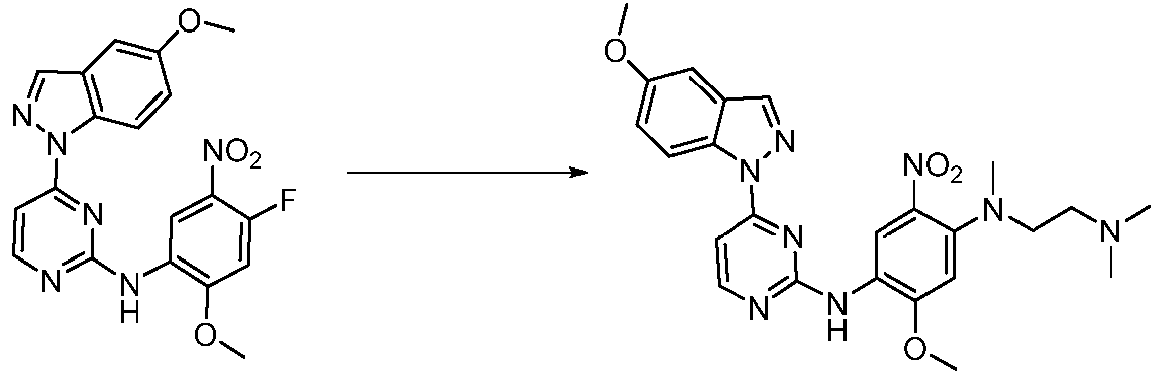
Se disolvieron N-(4-fluoro-2-metoxi-5-nitrofenil)-4-(5-metoxi-1H-indazol-1-il)pirimidin-2-amina (120 mg, 0,122 mmol), DIPEA (47 mg, 0,658 mol), trimetiletilendiamina (37 mg, 0,366 mmol) en DMF (5 ml). La solución de reacción se calentó a 100 °C durante 1 hora, se concentró y se purificó por cromatografía en columna para obtener 30 mg de un sólido de color amarillo que se usó directamente en la siguiente etapa.N-(4-fluoro-2-methoxy-5-nitrophenyl)-4-(5-methoxy-1H-indazol-1-yl)pyrimidin-2-amine (120 mg, 0.122 mmol), DIPEA (47 mg , 0.658 mol), trimethylethylenediamine (37 mg, 0.366 mmol) in DMF (5 mL). The reaction solution was heated at 100 °C for 1 hour, concentrated and purified by column chromatography to obtain 30 mg of yellow solid, which was directly used in the next step.
Etapa 5: N1-(2-(dimetilamino)etil)-5-metoxi-N4-(4-(5-metoxi-1H-indazol-1-il)pirimidin-2-il)-N1-metil-benceno-1,2,4 triaminaStage 5: N1-(2-(dimethylamino)ethyl)-5-methoxy-N4-(4-(5-methoxy-1H-indazol-1-yl)pyrimidin-2-yl)-N1-methyl-benzene-1,2, 4 triamine

El método de preparación de N1-(2-(dimetilamino)etil)-5-metoxi-N4-(4-(5-metoxi-1H-indazol-1-il)pirimidin -2-il)-N1-metilbenceno-1,2,4-triamina fue similar al del Ejemplo 40.The preparation method of N1-(2-(dimethylamino)ethyl)-5-methoxy-N4-(4-(5-methoxy-1H-indazol-1-yl)pyrimidin-2-yl)-N1-methylbenzene-1 ,2,4-triamine was similar to that of Example 40.
Etapa 6: N-(2-((2-(dimetilamino)etNXmetil)amino)-4-metoxi-5-((4-(5-metoxMH-mdazol-1-il)pirimidm-2-il)amino)fenil)acrilamidaStep 6: N-(2-((2-(dimethylamino)ethNXmethyl)amino)-4-methoxy-5-((4-(5-methoxMH-mdazol-1-yl)pyrimidm-2-yl)amino)phenyl )acrylamide

El método de preparación de N-(2-((2-(dimetilamino)etil)(metil)amino)-4-metoxi-5-((4-(5-metoxi-1H-indaz ol-1-il)pirimidin-2-il)amino)fenil)acrilamida fue similar al del Ejemplo 40.The method of preparation of N-(2-((2-(dimethylamino)ethyl)(methyl)amino)-4-methoxy-5-((4-(5-methoxy-1H-indaz ol-1-yl)pyrimidin -2-yl)amino)phenyl)acrylamide was similar to that of Example 40.
RMN 1H (400 MHz, CD3OD) 88,38 (s, 2H), 8,31 (d, J = 6,6 Hz, 1H), 7,86 (s, 1H), 7,60 (d, J = 6,7 Hz, 1H), 7,33 (d, J = 2,4 Hz, 1H), 7,15 (dd, J = 9,1, 2,2 Hz, 1H), 7,08 (s, 1H), 6,53 (dd, J = 8,9, 5,9 Hz, 2H), 5,88 (dd, J = 9,2, 2,6 Hz, 1H), 3,98 (s, 3H), 3,89 (s, 3H), 3,58 (t, J = 5,7 Hz, 2H), 3,38-3,34 (m, 2H), 2,93 (s, 6H), 2,81 (s, 3H);1H NMR (400 MHz, CD 3 OD) 88.38 (s, 2H), 8.31 (d, J = 6.6 Hz, 1H), 7.86 (s, 1H), 7.60 (d, J = 6.7 Hz, 1H), 7.33 (d, J = 2.4 Hz, 1H), 7.15 (dd, J = 9.1, 2.2 Hz, 1H), 7.08 ( s, 1H), 6.53 (dd, J = 8.9, 5.9 Hz, 2H), 5.88 (dd, J = 9.2, 2.6 Hz, 1H), 3.98 (s , 3H), 3.89 (s, 3H), 3.58 (t, J = 5.7 Hz, 2H), 3.38-3.34 (m, 2H), 2.93 (s, 6H) , 2.81 (s, 3H);
EM m/z (IEN): 517 [M+H]+.MS m/z (ESI): 517 [M+H]+.
Ejemplo 44: preparación de N-(5-((4-(3-ciclopropil-1H-indazol-1-il)pirimidin-2-il)amino)-2-((2-(dimetilamino)etil)(metil)amino)-4-metoxifenil)acrilamidaExample 44: Preparation of N-(5-((4-(3-cyclopropyl-1H-indazol-1-yl)pyrimidin-2-yl)amino)-2-((2-(dimethylamino)ethyl)(methyl) amino)-4-methoxyphenyl)acrylamide

El método de preparación de N-(5-((4-(3-ciclopropil-1H-indazol-1-il)pirimidin-2-il)amino)-2-((2-(dimetilamino) etil)(metil)amino)-4-metoxifenil)acrilamida fue similar al del Ejemplo 40.The method of preparation of N-(5-((4-(3-cyclopropyl-1H-indazol-1-yl)pyrimidin-2-yl)amino)-2-((2-(dimethylamino)ethyl)(methyl) amino)-4-methoxyphenyl)acrylamide was similar to that of Example 40.
RMN 1H (400 MHz, CD3OD) 88,39 (s, 1H), 8,18 (d, J = 5,2 Hz, 1H), 7,87 (d, J = 7,3 Hz, 2H), 7,48 (dd, J = 17,0, 7,1 Hz, 2H), 7,40 (t, J = 7,4 Hz, 1H), 7,09 (s, 1H), 6,64 (dd, J = 16,9, 10,2 Hz, 1H), 6,45 (d, J = 16,8 Hz, 1H), 5,84 (d, J = 10,2 Hz, 1H), 3,94 (s, 3H), 3,55 (d, J = 5,2 Hz, 2H), 3,38 (t, J = 5,3 Hz, 2H), 2,93 (s, 6H), 2,81 (s, 3H), 2,39-2,29 (m, 1H), 1,19 (d, J = 6,5 Hz, 4H);1H NMR (400 MHz, CD 3 OD) 88.39 (s, 1H), 8.18 (d, J = 5.2 Hz, 1H), 7.87 (d, J = 7.3 Hz, 2H) , 7.48 (dd, J = 17.0, 7.1 Hz, 2H), 7.40 (t, J = 7.4 Hz, 1H), 7.09 (s, 1H), 6.64 ( dd, J = 16.9, 10.2 Hz, 1H), 6.45 (d, J = 16.8 Hz, 1H), 5.84 (d, J = 10.2 Hz, 1H), 3, 94 (s, 3H), 3.55 (d, J = 5.2 Hz, 2H), 3.38 (t, J = 5.3 Hz, 2H), 2.93 (s, 6H), 2, 81 (s, 3H), 2.39-2.29 (m, 1H), 1.19 (d, J=6.5 Hz, 4H);
EM m/z (IEN): 527,3 [M+H]+.MS m/z (ESI): 527.3 [M+H]+.
Ejemplo 45: preparación de N-(2-((2-(dimetilamino)etil)(metil)amino)-4-metoxi-5-((4-(4-metoxi-1H-indazol-1-il)-5-(trifluorometil)pirimidin-2-il)amino)fenil)acrilamida Example 45: Preparation of N-(2-((2-(dimethylamino)ethyl)(methyl)amino)-4-methoxy-5-((4-(4-methoxy-1H-indazol-1-yl)-5 -(trifluoromethyl)pyrimidin-2-yl)amino)phenyl)acrylamide

El método de preparación de N-(2-((2-(dimetilamino)etilXmetil)amino)-4-metoxi-5-((4-(4-metoxi-1H-indazoM-il)-5-(trifluorometil)pirimidin-2-il)amino)fenil)acrilamida fue similar al del Ejemplo 40.The method of preparation of N-(2-((2-(dimethylamino)ethylXmethyl)amino)-4-methoxy-5-((4-(4-methoxy-1H-indazoM-yl)-5-(trifluoromethyl)pyrimidine -2-yl)amino)phenyl)acrylamide was similar to that of Example 40.
Ejemplo 46: preparación de N-(2-((2-(dimetilamino)etil)(metil)amino)-4-metoxi-5-((4-(6-metoxi-1H-indazol-1-il)-5-(trifluorometil)pirimidin-2-il)amino)fenil)acrilamidaExample 46: Preparation of N-(2-((2-(dimethylamino)ethyl)(methyl)amino)-4-methoxy-5-((4-(6-methoxy-1H-indazol-1-yl)-5 -(trifluoromethyl)pyrimidin-2-yl)amino)phenyl)acrylamide

El método de preparación de N-(2-((2-(dimetilamino)etil)(metil)amino)-4-metoxi-5-((4-(6-metoxi-H-indazol-1-il)-5-(trifluorometil)pirimidin-2-il)amino)fenil)acrilamida fue similar al del Ejemplo 40.The method of preparation of N-(2-((2-(dimethylamino)ethyl)(methyl)amino)-4-methoxy-5-((4-(6-methoxy-H-indazol-1-yl)-5 -(trifluoromethyl)pyrimidin-2-yl)amino)phenyl)acrylamide was similar to Example 40.
Ejemplo 47: preparación de N-(5-((4-(5-ciclopropil-1H-indazol-1-il)pirimidin-2-il)amino)-2-((2-(dimetilamino)etil)(metil)amino)-4-metoxifenil)acrilamidaExample 47: Preparation of N-(5-((4-(5-cyclopropyl-1H-indazol-1-yl)pyrimidin-2-yl)amino)-2-((2-(dimethylamino)ethyl)(methyl) amino)-4-methoxyphenyl)acrylamide

Etapa 1: preparación de 5-bromo-1-((2-(trimetilsilil)etoxi)metil)-1H-indazolStep 1: Preparation of 5-bromo-1-((2-(trimethylsilyl)ethoxy)methyl)-1H-indazole

Se disolvió 5-bromo-1H-indazol (2,0 g, 10 mmol) en DMF (15 ml) y se añadió NaH (480 mg, 12 mmol) a 0 °C. La solución de reacción se calentó a temperatura ambiente y se agitó durante 30 minutos y después se enfrió a 0 °C. Después de añadirse hipoclorito de 2-(trimetilsilil)etilo (2,0 g, 12 mmol), la solución de reacción se agitó durante 2 horas, se inactivó con 30 ml de agua y se extrajo con metil ferc-butil éter (30 mlx3). La fase orgánica se secó sobre sulfato sódico anhidro y se concentró para obtener un producto en bruto que se purificó adicionalmente por cromatografía en columna para obtener 5-bromo-1-((2-(trimetilsilil)etoxi)metil)-1H-indazol (2,0 g, 63 %).5-Bromo-1H-indazole (2.0 g, 10 mmol) was dissolved in DMF (15 mL) and NaH (480 mg, 12 mmol) was added at 0 °C. The reaction solution was warmed to room temperature and stirred for 30 minutes and then cooled to 0°C. After 2-(trimethylsilyl)ethyl hypochlorite (2.0 g, 12 mmol) was added, the reaction solution was stirred for 2 hours, quenched with 30 mL of water, and extracted with methyl tert-butyl ether (30 mL x 3 ). The organic phase was dried over anhydrous sodium sulfate and concentrated to obtain crude product which was further purified by column chromatography to obtain 5-bromo-1-((2-(trimethylsilyl)ethoxy)methyl)-1H-indazole ( 2.0g, 63%).
Etapa 2: preparación de 5-ciclopropil-1-((2-(trimetilsilil)etoxi)metil)-1H-indazolStep 2: Preparation of 5-cyclopropyl-1-((2-(trimethylsilyl)ethoxy)methyl)-1H-indazole

Se disolvieron 5-bromo-1-((2-(trimetilsilil)etoxi)metil)-1H-indazol (1,5 g, 4,6 mmol), ácido ciclopropilborónico (790 mg, 9,2 mmol) y fosfato potásico (3,0 g, 13,8 mmol) en una mezcla de tolueno y agua (30/10 ml). Después de la mezcla se purgó tres veces con nitrógeno, se añadieron acetato de paladio (103 mg, 0,46 mmol) y triciclohexil fosfina (258 mg, 0,92 mmol). La reacción se agitó a 100 °C durante 16 horas, se interrumpió con 30 ml de agua y se extrajo con acetato de etilo (50 ml x 3). La fase orgánica se secó sobre sulfato sódico anhidro y se concentró para obtener un producto en bruto que se purificó adicionalmente por cromatografía en columna para obtener 5-ciclopropil-1-((2-(trimetilsilil)etoxi)metil)-1H-indazol (1,2 g, 89 %).5-Bromo-1-((2-(trimethylsilyl)ethoxy)methyl)-1H-indazole (1.5 g, 4.6 mmol), cyclopropylboronic acid (790 mg, 9.2 mmol) and potassium phosphate (3.0 g, 13.8 mmol) in a mixture of toluene and water (30/10 ml). After the mixture was purged with nitrogen three times, palladium acetate (103 mg, 0.46 mmol) and tricyclohexyl phosphine (258 mg, 0.92 mmol) were added. The reaction was stirred at 100°C for 16 hours, quenched with 30 mL of water and extracted with ethyl acetate (50 mL x 3). The organic phase was dried over anhydrous sodium sulfate and concentrated to obtain crude product which was further purified by column chromatography to obtain 5-cyclopropyl-1-((2-(trimethylsilyl)ethoxy)methyl)-1H-indazole ( 1.2g, 89%).
Etapa 3: preparación de 5-ciclopropil-1H-indazolStep 3: Preparation of 5-cyclopropyl-1H-indazole

Se disolvió 5-ciclopropil-1-((2-(trimetilsilil)etoxi)-)metil)-1H-indazol (1,2 g, 4,2 mmol) en diclorometano (30 ml). Se añadió ácido trifluoroacético (12 ml) y la solución se hizo reaccionar a temperatura ambiente durante 2,5 h y se concentró a sequedad. El producto en bruto se disolvió en una mezcla de diclorometano (50 ml) y etilendiamina (18 ml), y la mezcla se agitó durante 1 h. Después de añadirse 30 ml de agua, la solución de reacción se extrajo con diclorometano (50 ml x 3). La fase orgánica se secó sobre sulfato sódico anhidro y se concentró para obtener un producto en bruto que se purificó adicionalmente por cromatografía en columna para obtener 5-ciclopropil-1H-indazol (280 mg, 42 %).5-Cyclopropyl-1-((2-(trimethylsilyl)ethoxy)-)methyl)-1H-indazole (1.2 g, 4.2 mmol) was dissolved in dichloromethane (30 mL). Trifluoroacetic acid (12 mL) was added and the solution was reacted at room temperature for 2.5 h and concentrated to dryness. The crude product was dissolved in a mixture of dichloromethane (50 ml) and ethylenediamine (18 ml), and the mixture was stirred for 1 h. After 30 ml of water was added, the reaction solution was extracted with dichloromethane (50 ml x 3). The organic phase was dried over anhydrous sodium sulfate and concentrated to obtain a crude product which was further purified by column chromatography to obtain 5-cyclopropyl-1H-indazole (280 mg, 42%).
Etapas 4 a 9: preparación de N-(5-((4-(5-ciclopropil-1H-indazol-1-il)pirimidin-2-il)amino)-2-((2-(dimetilamino)etil)(metil)amino)-4-metoxifenil)acrilamidaSteps 4 to 9: Preparation of N-(5-((4-(5-cyclopropyl-1H-indazol-1-yl)pyrimidin-2-yl)amino)-2-((2-(dimethylamino)ethyl)( methyl)amino)-4-methoxyphenyl)acrylamide

El método de preparación de N-(5-((4-(5-ciclopropil-1H-indazol-1-il)pirimidin-2-il)amino)-2-((2-(dimetilamino) etil)(metil)amino)-4-metoxifenil)acrilamida fue similar al del Ejemplo 43.The method of preparation of N-(5-((4-(5-cyclopropyl-1H-indazol-1-yl)pyrimidin-2-yl)amino)-2-((2-(dimethylamino)ethyl)(methyl) amino)-4-methoxyphenyl)acrylamide was similar to that of Example 43.
RMN 1H (400 MHz, CD3OD) 88,26 (s, 2H), 8,19 (s, 1H), 7,78 (s, 1H), 7,49 (d, J = 6,7 Hz, 1H), 7,44 (s, 1H), 7,15 (d, J = 8,6 Hz, 1H), 6,98 (s, 1H), 6,49 (dd, J = 16,9, 9,9 Hz, 1H), 6,38 (dd, J = 16,9, 1,9 Hz, 1H), 5,77 (dd, J = 9,9, 1,9 Hz, 1H), 3,86 (s, 3H), 3,46 (t, J = 5,6 Hz, 2H), 3,26 (t, J = 5,6 Hz, 2H), 2,82 (s, 6H), 2,69 (s, 3H), 2,00-1,88 (m, 1H), 0,97 0,89 (m, 2H), 0,67-0,59 (m, 2H);1H NMR (400 MHz, CD 3 OD) 88.26 (s, 2H), 8.19 (s, 1H), 7.78 (s, 1H), 7.49 (d, J = 6.7 Hz, 1H), 7.44 (s, 1H), 7.15 (d, J = 8.6 Hz, 1H), 6.98 (s, 1H), 6.49 (dd, J = 16.9.9 0.9 Hz, 1H), 6.38 (dd, J = 16.9, 1.9 Hz, 1H), 5.77 (dd, J = 9.9, 1.9 Hz, 1H), 3.86 (s, 3H), 3.46 (t, J = 5.6 Hz, 2H), 3.26 (t, J = 5.6 Hz, 2H), 2.82 (s, 6H), 2.69 (s, 3H), 2.00-1.88 (m, 1H), 0.97-0.89 (m, 2H), 0.67-0.59 (m, 2H);
EM m/z (IEN): 527,3 [M+H]+.MS m/z (ESI): 527.3 [M+H]+.
Ejemplo 48: preparación de N-(5-((5-cloro-4-(5-metoxi-1H-indazol-1-il)pirimidin-2-il)amino)-2-((2-(dimetilamino)etil)(metil)amino)-4-metoxifenil)acrilamidaExample 48: Preparation of N-(5-((5-chloro-4-(5-methoxy-1H-indazol-1-yl)pyrimidin-2-yl)amino)-2-((2-(dimethylamino)ethyl )(methyl)amino)-4-methoxyphenyl)acrylamide

El método de preparación de N-(5-((5-cloro-4-(5-metoxi-1H-indazol-1-il)pirimidin-2-il)amino)-2-((2-(dimetilamino)etil)(metil)amino)-4-metoxifenil)acrilamida fue similar al del Ejemplo 40.The method of preparation of N-(5-((5-chloro-4-(5-methoxy-1H-indazol-1-yl)pyrimidin-2-yl)amino)-2-((2-(dimethylamino)ethyl )(methyl)amino)-4-methoxyphenyl)acrylamide was similar to that of Example 40.
RMN 1H (400 MHz, CD3OD) 88,49 (s, 1H), 8,20 (d, J = 10,0 Hz, 2H), 8,00 (d, J = 9,0 Hz, 1H), 7,21 (s, 1H), 7,03 (d, J = 9,0 Hz, 1H), 6,94 (s, 1H), 6,42 (s, 2H), 5,83 (s, 1H), 3,95 (s, 3H), 3,84 (s, 3H), 3,47 (s, 2H), 3,28 (s, 2H), 2,86 (s, 6H), 2,69 (s, 3H);1H NMR (400 MHz, CD 3 OD) 88.49 (s, 1H), 8.20 (d, J = 10.0 Hz, 2H), 8.00 (d, J = 9.0 Hz, 1H) , 7.21 (s, 1H), 7.03 (d, J = 9.0 Hz, 1H), 6.94 (s, 1H), 6.42 (s, 2H), 5.83 (s, 1H), 3.95 (s, 3H), 3.84 (s, 3H), 3.47 (s, 2H), 3.28 (s, 2H), 2.86 (s, 6H), 2.69 (s, 3H);
EM m/z (IEN): 551 [M+H]+.MS m/z (ESI): 551 [M+H]+.
Ejemplo 49: preparación de N-(2-((2-(dimetNamino)etN)(metN)amino)-4-metoxi-5-((4-(5-metoxi-1H-indazoM-il)-5-(trifluorometil)pirimidin-2-il)amino)fenil)acrilamidaExample 49: Preparation of N-(2-((2-(dimethNamino)ethN)(metN)amino)-4-methoxy-5-((4-(5-methoxy-1H-indazoM-yl)-5-( trifluoromethyl)pyrimidin-2-yl)amino)phenyl)acrylamide

El método de preparación de N-(2-((2-(dimetilamino)etil)(metil)amino)-4-metoxi-5-((4-(5-metoxi-1H-indazol-1-il)-5-(trifluorometil)pirimidin-2-il)amino)fenil)acrilamida fue similar al del Ejemplo 40.The method of preparation of N-(2-((2-(dimethylamino)ethyl)(methyl)amino)-4-methoxy-5-((4-(5-methoxy-1H-indazol-1-yl)-5 -(trifluoromethyl)pyrimidin-2-yl)amino)phenyl)acrylamide was similar to Example 40.
RMN 1H (400 MHz, CD3OD) 88,79 (s, 1H), 8,23 (s, 1H), 8,11-8,03 (m, 1H), 7,27 (s, 1H), 7,12-7,04 (m, 1H), 7,01 (s, 1H), 6,47 (s, 2H), 5,92-5,80 (m, 1H), 3,99 (s, 3H), 3,88 (s, 3H), 3,54 (s, 2H), 3,32-3,29 (m, 2H), 2,90 (s, 6H), 2,76 (s, 3H); EM m/z (IEN): 585 [M+H]+.1H NMR (400 MHz, CD 3 OD) 88.79 (s, 1H), 8.23 (s, 1H), 8.11-8.03 (m, 1H), 7.27 (s, 1H), 7.12-7.04 (m, 1H), 7.01 (s, 1H), 6.47 (s, 2H), 5.92-5.80 (m, 1H), 3.99 (s, 3H), 3.88 (s, 3H), 3.54 (s, 2H), 3.32-3.29 (m, 2H), 2.90 (s, 6H), 2.76 (s, 3H ); MS m/z (ESI): 585 [M+H]+.
Ejemplo 50: preparación de N-(5-((4-(5-ciano-1H-indazol-1-il)pirimidin-2-il)amino)-2-((2-(dimetilamino)etil)(metil)amino)-4-metoxifenil)acrilamidaExample 50: Preparation of N-(5-((4-(5-cyano-1H-indazol-1-yl)pyrimidin-2-yl)amino)-2-((2-(dimethylamino)ethyl)(methyl) amino)-4-methoxyphenyl)acrylamide

Se disolvió 4-fluoro-3-formilbenzonitrilo (25 g, 16,78 mmol) en 100 ml de hidrato de hidrazina (85 %). La mezcla se agitó a temperatura ambiente durante 24 horas y se purificó por cromatografía en columna para obtener 1H-indazol-5-carbonitrilo (2,1 g, 87 %).4-Fluoro-3-formylbenzonitrile (25 g, 16.78 mmol) was dissolved in 100 mL of hydrazine hydrate (85%). The mixture was stirred at room temperature for 24 hours and purified by column chromatography to obtain 1H-indazole-5-carbonitrile (2.1 g, 87%).
RMN 1H (400 MHz, DMSO) 813,60 (s, 1H), 8,42 (s, 1H), 8,27 (s, 1H), 7,73 (d, J = 8,6 Hz, 1H), 7,67 (d, J = 8,6 Hz, 1H); EM m/z (IEN): 144 [M+H]+.1H NMR (400 MHz, DMSO) 813.60 (s, 1H), 8.42 (s, 1H), 8.27 (s, 1H), 7.73 (d, J=8.6 Hz, 1H) , 7.67 (d, J=8.6 Hz, 1H); MS m/z (ESI): 144 [M+H]+.
Etapas 2 a 6: preparación de N-(5-((4-(5-ciano-1H-indazol-1-il)pirimidin-2-il)amino)-2-((2-(dimetilamino)etil)(metil)amino)-4-metoxifenil)acrilamida Steps 2 to 6: Preparation of N-(5-((4-(5-cyano-1H-indazol-1-yl)pyrimidin-2-yl)amino)-2-((2-(dimethylamino)ethyl)( methyl)amino)-4-methoxyphenyl)acrylamide

El método de preparación de N-(5-((4-(5-ciano-1H-indazol-1-il)pirimidin-2-il)amino)-2-((2-(dimetilamino)etil) (metil)amino)-4-metoxifenil)acrilamida fue similar al del Ejemplo 40.The method of preparation of N-(5-((4-(5-cyano-1H-indazol-1-yl)pyrimidin-2-yl)amino)-2-((2-(dimethylamino)ethyl)(methyl) amino)-4-methoxyphenyl)acrylamide was similar to that of Example 40.
1H RMN (400 MHz, CD3OD) 88,77-8,68 (m, 1H), 8,53 (s, 1H), 8,47-8,41 (m, 1H), 8,33 (s, 1H), 7,99 (s, 1H), 7,75 (s, 1H), 7,56 (d, J = 6,2 Hz, 1H), 7,06 (s, 1H), 6,55 (s, 1H), 6,53 (s, 1H), 5,92 (s, 1H), 4,00 (s, 3H), 3,56 (s, 2H), 3,36 (s, 2H), 2,94 (s, 6H), 2,80 (s, 3H);1H NMR (400 MHz, CD 3 OD) 88.77-8.68 (m, 1H), 8.53 (s, 1H), 8.47-8.41 (m, 1H), 8.33 (s , 1H), 7.99 (s, 1H), 7.75 (s, 1H), 7.56 (d, J = 6.2 Hz, 1H), 7.06 (s, 1H), 6.55 (s, 1H), 6.53 (s, 1H), 5.92 (s, 1H), 4.00 (s, 3H), 3.56 (s, 2H), 3.36 (s, 2H) , 2.94 (s, 6H), 2.80 (s, 3H);
EM m/z (IEN): 512 [M+H]+.MS m/z (ESI): 512 [M+H]+.
Ejemplo 51: preparación de N-(5-((5-cloro-4-(5-ciano-1H-indazol-1-il)pirimidin-2-il)amino)-2-((2-(dimetil amino)etil)(metil)amino)-4-metoxifenil)acrilamidaExample 51: Preparation of N-(5-((5-chloro-4-(5-cyano-1H-indazol-1-yl)pyrimidin-2-yl)amino)-2-((2-(dimethyl amino) ethyl)(methyl)amino)-4-methoxyphenyl)acrylamide

El método de preparación de N-(5-((5-cloro-4-(5-ciano-1H-indazol-1-il)pirimidin-2-il)amino)-2-((2-(dimetilamino)etil)(metil)amino)-4-metoxifenil)acrilamida fue similar al del Ejemplo 50.The method of preparation of N-(5-((5-chloro-4-(5-cyano-1H-indazol-1-yl)pyrimidin-2-yl)amino)-2-((2-(dimethylamino)ethyl )(methyl)amino)-4-methoxyphenyl)acrylamide was similar to that of Example 50.
RMN 1H (400 MHz, CD3OD) 88,60 (s, 1H), 8,46 (s, 1H), 8,33 (s, 1H), 8,25 (d, J = 8,8 Hz, 1H), 8,20 (s, 1H), 7,63 (d, J = 8,8 Hz, 1H), 6,98 (s, 1H), 6,59-6,37 (m, 2H), 5,96-5,86 (m, 1H), 4,00 (s, 3H), 3,50 (t, J = 5,7 Hz, 2H), 3,32-3,28 (m, 2H), 2,90 (s, 6H), 2,72 (s, 3H);1H NMR (400 MHz, CD 3 OD) 88.60 (s, 1H), 8.46 (s, 1H), 8.33 (s, 1H), 8.25 (d, J = 8.8 Hz, 1H), 8.20 (s, 1H), 7.63 (d, J = 8.8 Hz, 1H), 6.98 (s, 1H), 6.59-6.37 (m, 2H), 5.96-5.86 (m, 1H), 4.00 (s, 3H), 3.50 (t, J=5.7Hz, 2H), 3.32-3.28 (m, 2H) , 2.90 (s, 6H), 2.72 (s, 3H);
EM m/z (IEN): 546 [M+H]+MS m/z (ESI): 546 [M+H]+
Ejemplo 52: preparación de N-(5-((4-(5-ciano-1H-indazol-1-il)-5-(trifluorometil)pirimidin-2-il)amino)-2-((2-(dimetilamino)etil)(metil)amino)-4-metoxifenil)acrilamidaExample 52: Preparation of N-(5-((4-(5-cyano-1H-indazol-1-yl)-5-(trifluoromethyl)pyrimidin-2-yl)amino)-2-((2-(dimethylamino )ethyl)(methyl)amino)-4-methoxyphenyl)acrylamide

El método de preparación de N-(5-((4-(5-ciano-1H-indazol-1-il)-5-(trifluorometil)pirimidin-2-il)amino)-2-((2-(dimetilamino)etil)(metil)amino)-4-metoxifenil)acrilamida fue similar al del Ejemplo 50.The preparation method of N-(5-((4-(5-cyano-1H-indazol-1-yl)-5-(trifluoromethyl)pyrimidin-2-yl)amino)-2-((2-(dimethylamino )ethyl)(methyl)amino)-4-methoxyphenyl)acrylamide was similar to that of Example 50.
RMN 1H (400 MHz, CD3OD) 8 8,88 (s, 1H), 8,48 (s, 1H), 8,35 (s, 1H), 8,10 (s, 1H), 7,75-7,60 (m, 1H), 7,02 (s, 1H), 6,51 (s, 2H), 5,91 (d, J = 11,7 Hz, 1H), 4,00 (s, 3H), 3,54 (s, 2H), 3,32 (s, 2H), 2,91 (s, 6H), 2,75 (s, 3H);1H NMR (400 MHz, CD 3 OD) 8 8.88 (s, 1H), 8.48 (s, 1H), 8.35 (s, 1H), 8.10 (s, 1H), 7.75 -7.60 (m, 1H), 7.02 (s, 1H), 6.51 (s, 2H), 5.91 (d, J = 11.7 Hz, 1H), 4.00 (s, 3H), 3.54 (s, 2H), 3.32 (s, 2H), 2.91 (s, 6H), 2.75 (s, 3H);
EM m/z (IEN): 580 [M+H]+.MS m/z (ESI): 580 [M+H]+.
Ejemplo 53: preparación de N-(5-((4-(5,6-dimetoxi-3-metil-1H-indazol-1-il)pirimidin-2-il)amino)-2-((2-(dimetilamino)etil)(metil)amino)-4-metoxifenil)acrilamida Example 53: Preparation of N-(5-((4-(5,6-dimethoxy-3-methyl-1H-indazol-1-yl)pyrimidin-2-yl)amino)-2-((2-(dimethylamino )ethyl)(methyl)amino)-4-methoxyphenyl)acrylamide

Etapa 1: preparación de 1-(4,5-dimetoxi-2-nitrofenil)etan-1-onaStep 1: Preparation of 1-(4,5-dimethoxy-2-nitrophenyl)ethan-1-one

Se añadió 1-(3, 4-dimetoxifenil)etan-1-ona (10 g) a anhídrido acético (30 ml). Después de que la solución se enfriase a 0 °C, se añadieron gota a gota una mezcla de ácido nítrico (200 ml) y anhídrido acético (10 ml). Tras completarse la adición, la solución de reacción se agitó durante 4 horas, se vertió en 1 l de agua enfriada con hielo, se filtró, se lavó con agua y se secó para obtener 1-(4,5-dimetoxi-2-nitrofenil)etan-1-ona (8 g, 67 %).1-(3,4-Dimethoxyphenyl)ethan-1-one (10g) was added to acetic anhydride (30ml). After the solution was cooled to 0°C, a mixture of nitric acid (200 ml) and acetic anhydride (10 ml) were added dropwise. After the addition was complete, the reaction solution was stirred for 4 hours, poured into 1 L of ice-cold water, filtered, washed with water and dried to obtain 1-(4,5-dimethoxy-2-nitrophenyl )ethan-1-one (8 g, 67%).
Etapa 2: preparación de 1-(4,5-dimetoxi-2-aminofenil)etan-1-onaStep 2: Preparation of 1-(4,5-dimethoxy-2-aminophenyl)ethan-1-one

Se añadieron 1-(4,5-dimetoxi-2-nitrofenil)etan-1-ona (8 g) y polvo de hierro (20 g) a una mezcla de HOAc (70 ml), agua (100 ml) y EtOAc (20 ml). La reacción se llevó a cabo a 100 °C durante 2 horas y el pH se ajustó a 7 con una solución acuosa de bicarbonato sódico. La solución de reacción se añadió con 400 ml de acetato de etilo, se filtró, se concentró. El residuo resultante se recristalizó a partir de acetato de etilo-éter de petróleo para obtener 1-(4,5-dimetoxi-2-aminofenil)etan-1-ona (1,37 g, 30 %).1-(4,5-dimethoxy-2-nitrophenyl)ethan-1-one (8 g) and iron powder (20 g) were added to a mixture of HOAc (70 mL), water (100 mL), and EtOAc ( 20ml). The reaction was carried out at 100°C for 2 hours, and the pH was adjusted to 7 with aqueous sodium bicarbonate solution. The reaction solution was added with 400 ml of ethyl acetate, filtered, concentrated. The resulting residue was recrystallized from ethyl acetate-petroleum ether to obtain 1-(4,5-dimethoxy-2-aminophenyl)ethan-1-one (1.37 g, 30%).
Etapa 3: preparación de oxima de 1-(2-amino-dimetoxifenil)etan-1-onaStep 3: Preparation of 1-(2-amino-dimethoxyphenyl)ethan-1-one oxime

Se añadieron 1-(4,5-dimetoxi-2-aminofenil)etan-1-ona (800 mg, 4,1 mmol), clorhidrato de hidroxilamina (880 mg, 12,3 mmol) y NaOH (1,31 g, 32,8 mmol) a 6 ml de solución acuosa de etanol (85 %). La solución de reacción se calentó a 60 °C durante 1 hora, se concentró, se extrajo con acetato de etilo y se volvió a cristalizar a partir de acetato de etiloéter de petróleo para obtener oxima de 1-(2-amino-dimetoxifenil)etan-1-ona (500 mg, 58 %).1-(4,5-dimethoxy-2-aminophenyl)ethan-1-one (800 mg, 4.1 mmol), hydroxylamine hydrochloride (880 mg, 12.3 mmol), and NaOH (1.31 g, 32.8 mmol) to 6 ml of aqueous ethanol solution (85%). The reaction solution was heated at 60 °C for 1 hour, concentrated, extracted with ethyl acetate, and recrystallized from petroleum ether ethyl acetate to obtain 1-(2-amino-dimethoxyphenyl)ethane oxime. -1-one (500 mg, 58%).
Etapa 4: preparación de 5,6-dimetoxi-3-metil-1H-indazolStep 4: Preparation of 5,6-dimethoxy-3-methyl-1H-indazole

Se añadieron oxima de 1-(2-amino-dimetoxifenil)etan-1-ona (450 mg, 2,14 mmol) y trietilamina (432 mg, 4,28 mmol) en DCM (15 ml) y se añadieron gota a gota 0,2 ml de cloruro de metanosulfonilo a 0 °C. La mezcla se agitó a temperatura ambiente durante una hora, se concentró y se purificó por cromatografía en columna para obtener 5,6-dimetoxi-3-metil-1H-indazol (200 mg, 37 %).1-(2-Amino-dimethoxyphenyl)ethan-1-one oxime (450 mg, 2.14 mmol) and triethylamine (432 mg, 4.28 mmol) in DCM (15 mL) were added and added dropwise 0.2 ml of methanesulfonyl chloride at 0 °C. The mixture was stirred at room temperature for one hour, concentrated and purified by column chromatography to obtain 5,6-dimethoxy-3-methyl-1H-indazole (200 mg, 37%).
Etapas 5 a 10: preparación de N-(5-((4-(5,6-dimetoxi-3-metil-1H-indazol-1-il)pirimidin-2-il)amino)-2-((2-(di metilamino)etil)(metil)amino)-4-metoxifenil)acrilamida Steps 5 to 10: Preparation of N-(5-((4-(5,6-dimethoxy-3-methyl-1H-indazol-1-yl)pyrimidin-2-yl)amino)-2-((2- (dimethylamino)ethyl)(methyl)amino)-4-methoxyphenyl)acrylamide

El método de preparación de N-(5-((4-(5,6-dimetoxi-3-metiMH-indazol-1-il)pirimidin-2-il)amino)-2-((2-(dimetilamino)etil)(metil)amino)-4-metoxifenil)acrilamida fue similar al del Ejemplo 40.The method of preparation of N-(5-((4-(5,6-dimethoxy-3-methylMH-indazol-1-yl)pyrimidin-2-yl)amino)-2-((2-(dimethylamino)ethyl )(methyl)amino)-4-methoxyphenyl)acrylamide was similar to that of Example 40.
RMN 1H (400 MHz, CD3OD) 88,00 (s, 1H), 7,91-7,80 (m, 1H), 7,75 (s, 1H), 7,37 (d, J = 7,0 Hz, 1H), 6,98 (d, J = 12,7 Hz, 2H), 6,53 (s, 1H), 6,32 (d, J = 16,7 Hz, 1H), 5,74 (s, 1H), 3,83 (s, 3H), 3,78 (s, 3H), 3,77-3,67 (m, 3H), 3,42 (s, 2H), 3,27 (s, 2H), 2,82 (s, 6H), 2,67 (s, 2H), 2,41 (s, 3H);1H NMR (400 MHz, CD 3 OD) 88.00 (s, 1H), 7.91-7.80 (m, 1H), 7.75 (s, 1H), 7.37 (d, J = 7 .0 Hz, 1H), 6.98 (d, J = 12.7 Hz, 2H), 6.53 (s, 1H), 6.32 (d, J = 16.7 Hz, 1H), 5, 74 (s, 1H), 3.83 (s, 3H), 3.78 (s, 3H), 3.77-3.67 (m, 3H), 3.42 (s, 2H), 3.27 (s, 2H), 2.82 (s, 6H), 2.67 (s, 2H), 2.41 (s, 3H);
EM m/z (IEN): 561 [M+1]+.MS m/z (ESI): 561 [M+1]+.
Ejemplo 54: preparación de N-(2-((2-(dimetilamino)etil)(metil)amino)-4-metoxi-5-((4-(6-metoxi-3-metil-1H-indazol-1-il)pirimidin-2-il)amino)fenil)acrilamidaExample 54: Preparation of N-(2-((2-(dimethylamino)ethyl)(methyl)amino)-4-methoxy-5-((4-(6-methoxy-3-methyl-1H-indazole-1- yl)pyrimidin-2-yl)amino)phenyl)acrylamide

Etapa 1: preparación de 6-metoxi-3-metil-1H-indazolStep 1: Preparation of 6-methoxy-3-methyl-1H-indazole

Se disolvió 1-(2-fluoro-4-metoxifenil)etan-1-ona (2 g, 11,9 mmol) en 5 ml de una mezcla de hidrato de hidrazina (85 %) y NMP (15 ml). La mezcla se agitó a 120 °C durante 24 horas y se purificó por cromatografía en columna para obtener 6-metoxi-3-metil-1H-indazol (1,5 g, 78 %).1-(2-Fluoro-4-methoxyphenyl)ethan-1-one (2 g, 11.9 mmol) was dissolved in 5 mL of a mixture of hydrazine hydrate (85%) and NMP (15 mL). The mixture was stirred at 120 °C for 24 hours and purified by column chromatography to obtain 6-methoxy-3-methyl-1H-indazole (1.5 g, 78%).
Etapas 2 a 7: preparación de N-(2-((2-(dimetilamino)etil)(metil)amino)-4-metoxi-5-((4-(6-metoxi-3-metil-1H-indazol-1-il)pirimidin-2-il)amino)fenil)acrilamida Steps 2 to 7: Preparation of N-(2-((2-(dimethylamino)ethyl)(methyl)amino)-4-methoxy-5-((4-(6-methoxy-3-methyl-1H-indazol- 1-yl)pyrimidin-2-yl)amino)phenyl)acrylamide

El método de preparación de N-(2-((2-(dimetilamino)etil)(metil)amino)-4-metoxi-5-((4-(6-metoxi-3-metiMH-indazoM-il)pirimidin-2-il)amino)fenil)acrilamida fue similar al del Ejemplo 47.The preparation method of N-(2-((2-(dimethylamino)ethyl)(methyl)amino)-4-methoxy-5-((4-(6-methoxy-3-methylMH-indazoM-yl)pyrimidin- 2-yl)amino)phenyl)acrylamide was similar to that of Example 47.
1H RMN (400 MHz, CD3OD) 88,25-8,13 (m, 1H), 8,11-8,00 (m, 1H), 7,81 (s, 1H), 7,70 (d, J = 8,7 Hz, 1H), 7,59 (d, J = 7,0 Hz, 1H), 7,09 (s, 2H), 6,69-6,56 (m, 1H), 6,45 (s, 1H), 5,86 (s, 1H), 3,95 (s, 3H), 3,87 (s, 3H), 3,56 (s, 2H), 3,38 (s, 2H), 2,92 (s, 6H), 2,81 (s, 3H), 2,58 (s, 3H);1H NMR (400 MHz, CD 3 OD) 88.25-8.13 (m, 1H), 8.11-8.00 (m, 1H), 7.81 (s, 1H), 7.70 (d , J = 8.7 Hz, 1H), 7.59 (d, J = 7.0 Hz, 1H), 7.09 (s, 2H), 6.69-6.56 (m, 1H), 6 .45 (s, 1H), 5.86 (s, 1H), 3.95 (s, 3H), 3.87 (s, 3H), 3.56 (s, 2H), 3.38 (s, 2H), 2.92 (s, 6H), 2.81 (s, 3H), 2.58 (s, 3H);
EM m/z (IEN): 531 [M+1]+.MS m/z (ESI): 531 [M+1]+.
Ejemplo 55: preparación de N-(5-((4-(6-ciano-3-metil-1H-indazol-1-il)pirimidin-2-il)amino)-2-((2-(dimetil amino)etil)(metil)amino)-4-metoxifenil)acrilamidaExample 55: Preparation of N-(5-((4-(6-cyano-3-methyl-1H-indazol-1-yl)pyrimidin-2-yl)amino)-2-((2-(dimethyl amino) ethyl)(methyl)amino)-4-methoxyphenyl)acrylamide

El método de preparación de N-(5-((4-(6-ciano-3-metil-1H-indazol-1-il)pirimidin-2-il)amino)-2-((2-(dimetilamino)etil)(metil)amino)-4-metoxifenil)acrilamida fue similar al del Ejemplo 40.The preparation method of N-(5-((4-(6-cyano-3-methyl-1H-indazol-1-yl)pyrimidin-2-yl)amino)-2-((2-(dimethylamino)ethyl )(methyl)amino)-4-methoxyphenyl)acrylamide was similar to that of Example 40.
Ejemplo 56: preparación de N-(5-((4-(5-ciano-3-metil-1H-indazol-1-il)pirimidin-2-il)amino)-2-((2-(dimetil amino)etil)(metil)amino)-4-metoxifenil)acrilamidaExample 56: Preparation of N-(5-((4-(5-cyano-3-methyl-1H-indazol-1-yl)pyrimidin-2-yl)amino)-2-((2-(dimethyl amino) ethyl)(methyl)amino)-4-methoxyphenyl)acrylamide

El método de preparación de N-(5-((4-(5-ciano-3-metil-1H-indazol-1-il)pirimidin-2-il)amino)-2-((2-(dimetilamino)etil)(metil)amino)-4-metoxifenil)acrilamida fue similar al del Ejemplo 40.The preparation method of N-(5-((4-(5-cyano-3-methyl-1H-indazol-1-yl)pyrimidin-2-yl)amino)-2-((2-(dimethylamino)ethyl )(methyl)amino)-4-methoxyphenyl)acrylamide was similar to that of Example 40.
1H RMN (400 MHz, CD3OD) 88,67-8,55 (m, 1H), 8,36 (d, J = 6,4 Hz, 1H), 8,28 (s, 1H), 7,94 (s, 1H), 7,73 (d, J = 8,7 Hz, 1H), 7,51 (d, J = 6,5 Hz, 1H), 7,08 (s, 1H), 6,55 (dd, J = 7,9, 5,9 Hz, 2H), 5,91 (d, J = 11,8 Hz, 1H), 4,00 (s, 3H), 3,57 (s, 2H), 3,38 (d, J = 5,9 Hz, 2H), 2,95 (s, 6H), 2,80 (s, 3H), 2,64 (s, 3H);1H NMR (400 MHz, CD 3 OD) 88.67-8.55 (m, 1H), 8.36 (d, J = 6.4 Hz, 1H), 8.28 (s, 1H), 7, 94 (s, 1H), 7.73 (d, J = 8.7 Hz, 1H), 7.51 (d, J = 6.5 Hz, 1H), 7.08 (s, 1H), 6, 55 (dd, J = 7.9, 5.9 Hz, 2H), 5.91 (d, J = 11.8 Hz, 1H), 4.00 (s, 3H), 3.57 (s, 2H ), 3.38 (d, J = 5.9 Hz, 2H), 2.95 (s, 6H), 2.80 (s, 3H), 2.64 (s, 3H);
EM m/z (IEN): 526 [M+H]+.MS m/z (ESI): 526 [M+H]+.
Ejemplo 57: preparación de N-(5-((4-(5,6-difluoro-3-metil-1H-indazol-1-il)pirimidin-2-il)amino)-2-((2-(dimetilamino)etil)(metil)amino)-4-metoxifenil)acrilamida Example 57: Preparation of N-(5-((4-(5,6-difluoro-3-methyl-1H-indazol-1-yl)pyrimidin-2-yl)amino)-2-((2-(dimethylamino )ethyl)(methyl)amino)-4-methoxyphenyl)acrylamide

El método de preparación de N-(5-((4-(5,6-difluoro-3-metil-1H-indazol-1-il)pirimidin-2-il)amino)-2-((2-(dimethy lamino)etil)(metil)amino)-4-metoxifenil)acrilamida fue similar al del Ejemplo 40.The preparation method of N-(5-((4-(5,6-difluoro-3-methyl-1H-indazol-1-yl)pyrimidin-2-yl)amino)-2-((2-(dimethy lamino)ethyl)(methyl)amino)-4-methoxyphenyl)acrylamide was similar to that of Example 40.
Ejemplo 58: preparación de N-(5-((4-(5,7-difluoro-3-metil-1H-indazol-1-il)pirimidin-2-il)amino)-2-((2-(dimetilamino)etil)(metil)amino)-4-metoxifenil)acrilamidaExample 58: Preparation of N-(5-((4-(5,7-difluoro-3-methyl-1H-indazol-1-yl)pyrimidin-2-yl)amino)-2-((2-(dimethylamino )ethyl)(methyl)amino)-4-methoxyphenyl)acrylamide

El método de preparación de N-(5-((4-(5,7-difluoro-3-metil-1H-indazol-1-il)pirimidin-2-il)amino)-2-((2-(dimethy lamino)etil)(metil)amino)-4-metoxifenil)acrilamida fue similar al del Ejemplo 40.The preparation method of N-(5-((4-(5,7-difluoro-3-methyl-1H-indazol-1-yl)pyrimidin-2-yl)amino)-2-((2-(dimethy lamino)ethyl)(methyl)amino)-4-methoxyphenyl)acrylamide was similar to that of Example 40.
Ejemplo 59: preparación de N-(2-((2-(dimetilamino)etil)(metil)amino)-4-metoxi-5-((4-(5-metoxi-1H-benzo[d]imidazol-1-il)pirimidin-2-il)amino)fenil)acrilamidaExample 59: Preparation of N-(2-((2-(dimethylamino)ethyl)(methyl)amino)-4-methoxy-5-((4-(5-methoxy-1H-benzo[d]imidazole-1- yl)pyrimidin-2-yl)amino)phenyl)acrylamide

Etapa 1: preparación de 2-cloro-N-(4-metoxi-2-nitrofenil)pirimidin-4-aminaStep 1: Preparation of 2-chloro-N-(4-methoxy-2-nitrophenyl)pyrimidin-4-amine
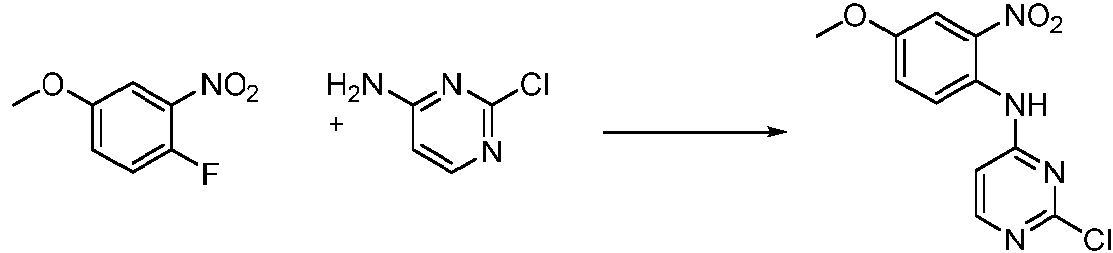
Se añadió 2-cloropirimidin-4-amina (518,2 mg, 4 mmol) y DMF (10 ml) en un matraz de fondo redondo de 100 ml. En protección de N2 , la mezcla se enfrió a 0 °C con un baño de hielo-sal, y después, se añadió NaH (295 mg, 8 mmol). Después de agitar durante 30 minutos, se añadió 1-fluoro-4-metoxi-2-nitrobenceno (684,5 mg, 4 mmol) y la solución de reacción se calentó lentamente hasta temperatura ambiente y se agitó durante 1 h. En un baño de hielo-sal, se añadieron 30 ml de agua y se precipitó un sólido. El sólido se filtró y la torta de filtro se disolvió en diclorometano. La solución se secó sobre sulfato sódico anhidro y se concentró para obtener 2-cloro-N-(4-metoxi-2-nitrofenil)pirimidin-4-amina (1 g, 89 %).2-Chloropyrimidin-4-amine (518.2 mg, 4 mmol) and DMF (10 mL) were added to a 100 mL round bottom flask. Under N 2 protection, the mixture was cooled to 0 °C with an ice-salt bath, then NaH (295 mg, 8 mmol) was added. After stirring for 30 min, 1-fluoro-4-methoxy-2-nitrobenzene (684.5 mg, 4 mmol) was added and the reaction solution slowly warmed to room temperature and stirred for 1 h. In an ice-salt bath, 30 mL of water was added and a solid precipitated. The solid was filtered off and the filter cake dissolved in dichloromethane. The solution was dried over anhydrous sodium sulfate and concentrated to obtain 2-chloro-N-(4-methoxy-2-nitrophenyl)pyrimidin-4-amine (1 g, 89%).
EM m/z (IEN): 281,0 [M+H]+MS m/z (ESI): 281.0 [M+H]+
Etapa 2: preparación de N1-(2-cloropirimidin-4-il)-4-metoxibenceno-1,2-diamina Step 2: Preparation of N1-(2-chloropyrimidin-4-yl)-4-methoxybenzene-1,2-diamine

Se añadieron 2-doro-N-(4-metoxi-2-nitrofenil)pirimidin-4-amina, etanol (15 ml) y agua (5 ml) en un matraz de fondo redondo de 100 ml, seguido de la adición de polvo de hierro (1,37 g, 24,5 mmol) y cloruro de amonio (131,5 mg, 2,5 mmol). La reacción se llevó a cabo a 80 °C durante 3 h antes de que la mezcla se filtrara y se concentró. El residuo resultante se disolvió en acetato de etilo (50 ml) y se añadieron 30 ml de agua, después se separaron dos fases. La fase orgánica se secó sobre sulfato sódico anhidro, se filtró y se concentró para obtener N1-(2-cloropirimidin-4-il)-4-metoxibenceno-1,2-diamina (676,9 mg, 77 %).2-doro-N-(4-methoxy-2-nitrophenyl)pyrimidin-4-amine, ethanol (15 ml) and water (5 ml) were added in a 100 ml round bottom flask, followed by the addition of powder. iron (1.37 g, 24.5 mmol) and ammonium chloride (131.5 mg, 2.5 mmol). The reaction was carried out at 80 °C for 3 h before the mixture was filtered and concentrated. The resulting residue was dissolved in ethyl acetate (50 ml) and 30 ml of water was added, then two phases were separated. The organic phase was dried over anhydrous sodium sulfate, filtered and concentrated to obtain N1-(2-chloropyrimidin-4-yl)-4-methoxybenzene-1,2-diamine (676.9 mg, 77%).
EM m/z (IEN): 251,1 [M+H]+.MS m/z (ESI): 251.1 [M+H]+.
Etapa 3: preparación de 1-(2-cloropirimidin-4-il)-5-metoxi-1H-benzo[d]imidazolStep 3: Preparation of 1-(2-chloropyrimidin-4-yl)-5-methoxy-1H-benzo[d]imidazole

Se añadieron N1-(2-cloropirimidin-4-il)-4-metoxibenceno-1,2-diamina (300 mg, 1,2 mmol), etanol (10 ml) y tri metil ortoformiato (1,0 g, 9,6 mmol) y ácido p-toluenosulfónico (20 mg, 0,12 mmol) en un matraz de fondo redondo de 100 ml y la reacción se llevó a cabo a 80 °C durante 1 h. Después de enfriar a temperatura ambiente, la solución de reacción se concentró, y el residuo resultante se sometió una columna cromatografía para obtener 1 -(2-cloropirimidin-4-il)-5-metoxi-1H-benzo[d]imidazol (195 mg, 62 %).N1-(2-chloropyrimidin-4-yl)-4-methoxybenzene-1,2-diamine (300 mg, 1.2 mmol), ethanol (10 mL) and trimethyl orthoformate (1.0 g, 9, 6 mmol) and p-toluenesulfonic acid (20 mg, 0.12 mmol) in a 100 mL round bottom flask and the reaction was carried out at 80 °C for 1 h. After cooling to room temperature, the reaction solution was concentrated, and the resulting residue was subjected to column chromatography to obtain 1-(2-chloropyrimidin-4-yl)-5-methoxy-1H-benzo[d]imidazole (195 mg, 62%).
EM m/z (IEN): 261,1 [M+H]+.MS m/z (ESI): 261.1 [M+H]+.
Etapa 4: preparación de N-(4-fluoro-2-metoxi-5-nitrofenil)-4-(5-metoxi-1H-benzo[d]imidazol-1-il)pirimidin-2-aminaStep 4: Preparation of N-(4-fluoro-2-methoxy-5-nitrophenyl)-4-(5-methoxy-1H-benzo[d]imidazol-1-yl)pyrimidin-2-amine

Se añadieron 1-(2-cloropirimidin-4-il)-5-metoxi-1H-benzo[d]imidazol (195 mg, 0,75 mmol), 4-fluoro-2-metoxi-5-nitroanilina (140 mg, 0,75 mmol), p-toluenosulfónico (129 mg, 0,75 mmol) y 2-pentanol (5 ml) en un matraz de fondo redondo de 100 ml y la reacción se llevó a cabo a 100 °C durante 4 h. Después de enfriar a temperatura ambiente, la solución de reacción se concentró, y el residuo se sometió una columna cromatografía para obtener N-(4-fluoro-2-metoxi-5-nitrofenil)-4-(5-metoxi-1H-benzo[d]imidazol-1-il)pirimi din-2-amina (62 mg, 20 %).1-(2-chloropyrimidin-4-yl)-5-methoxy-1H-benzo[d]imidazole (195 mg, 0.75 mmol), 4-fluoro-2-methoxy-5-nitroaniline (140 mg, 0.75 mmol), p-toluenesulfonic acid (129 mg, 0.75 mmol), and 2-pentanol (5 mL) in a 100 mL round-bottom flask and the reaction carried out at 100 °C for 4 h. After cooling to room temperature, the reaction solution was concentrated, and the residue was subjected to column chromatography to obtain N-(4-fluoro-2-methoxy-5-nitrophenyl)-4-(5-methoxy-1H-benzo [d]imidazol-1-yl)pyrimi din-2-amine (62mg, 20%).
EM m/z (IEN): 411,1 [M+H]+.MS m/z (ESI): 411.1 [M+H]+.
Etapa 5: preparación de N1-(2-(dimetilamino)etil)-5-metoxi-N4-(4-(5-metoxi-1H-benzo[d]imidazol-1-il)pirimidin-2-il)-N1-metil-2-nitrobenceno-1,4-diaminaStep 5: Preparation of N1-(2-(dimethylamino)ethyl)-5-methoxy-N4-(4-(5-methoxy-1H-benzo[d]imidazol-1-yl)pyrimidin-2-yl)-N1 -methyl-2-nitrobenzene-1,4-diamine

Se añadieron N-(4-fluoro-2-metoxi-5-nitrofenil)-4-(5-metoxi-1H-benzo[d]imidazol-1-il)p yrimidin-2-amina (62 mg, 0,15 mmol), N1,N1,N2,N2-tetrametiletano-1,2-diamina (30,6 mg, 0,3 mmol), DIPEA (58 mg, 0,45 mmol) y DMF (5 ml) en un matraz de fondo redondo de 100 ml y la reacción se llevó a cabo a 80 °C durante 1 h. Después de enfriar a temperatura ambiente, la solución de reacción se concentró. El residuo resultante se sometió a cromatografía en columna para obtener N1-(2-(dimetilamino)etil)-5-metoxi-N4-(4-(5-metoxi-1H-benzo[d]imidazol-1-il) pirimidin-2-il)-N1-metil-2-nitrobenceno-1,4-diamina (40 mg, 54 %).N-(4-fluoro-2-methoxy-5-nitrophenyl)-4-(5-methoxy-1H-benzo[d]imidazol-1-yl)p yrimidin-2-amine (62 mg, 0.15 mmol), N1,N1,N2,N2-tetramethylethane-1,2-diamine (30.6 mg, 0.3 mmol), DIPEA (58 mg, 0.45 mmol), and DMF (5 mL) in a flask of 100 ml round bottom and the reaction was carried out at 80 °C for 1 h. After cooling to room temperature, the reaction solution was concentrated. The resulting residue was subjected to column chromatography to obtain N1-(2-(dimethylamino)ethyl)-5-methoxy-N4-(4-(5-methoxy-1H-benzo[d]imidazol-1-yl)pyrimidin- 2-yl)-N1-methyl-2-nitrobenzene-1,4-diamine (40 mg, 54%).
EM m/z (IEN): 493,3 [M+H]+.MS m/z (ESI): 493.3 [M+H]+.
Etapa 6: preparación de N1-(2-(dimetilamino)etil)-5-metoxi-N4-(4-(5-metoxi-1H-benzo[d]imidazol-1-il)pirimidin-2-il)-N1-metilbenceno-1,2,4-triaminaStep 6: Preparation of N1-(2-(dimethylamino)ethyl)-5-methoxy-N4-(4-(5-methoxy-1H-benzo[d]imidazol-1-yl)pyrimidin-2-yl)-N1 -methylbenzene-1,2,4-triamine

Se añadieron N1-(2-(dimetilamino)etil)-5-metoxi-N4-(4-(5-metoxi-1H-benzo[d]imidazol -1-il)pirimidin-2-il)-N1-metil-2-nitrobenceno-1,4-diamina (39,4 mg, 0,08 mmol) y metanol (20 ml) en un matraz de fondo redondo de 100 ml, En una atmósfera de hidrógeno, la solución de reacción se hizo reaccionar a temperatura ambiente durante 30 minutos. Después, la solución de reacción se filtró y se concentró para obtener N1-(2-(dimetilamino)etil)-5-metoxi-N4-(4-(5-metoxi-1H-benzo[d] imidazol-1-il) pirimidin-2-il)-N1-metilbenceno-1,2,4-triamina (32 mg, 85 %).N1-(2-(dimethylamino)ethyl)-5-methoxy-N4-(4-(5-methoxy-1H-benzo[d]imidazol-1-yl)pyrimidin-2-yl)-N1-methyl- 2-nitrobenzene-1,4-diamine (39.4 mg, 0.08 mmol) and methanol (20 mL) in a 100 mL round-bottom flask. Under an atmosphere of hydrogen, the reaction solution was reacted to room temperature for 30 minutes. Then, the reaction solution was filtered and concentrated to obtain N1-(2-(dimethylamino)ethyl)-5-methoxy-N4-(4-(5-methoxy-1H-benzo[d]imidazol-1-yl) pyrimidin-2-yl)-N1-methylbenzene-1,2,4-triamine (32 mg, 85%).
EM m/z (IEN): 463,1 [M+H]+.MS m/z (ESI): 463.1 [M+H]+.
Etapa 7: preparación de N-(2-((2-(dimetilamino)etil)(metil)amino)-4-metoxi-5-((4-(5-metoxi-1H-benzo[d] imidazol-1-il)pirimidin-2-il-amino)fenil)acrilamidaStep 7: Preparation of N-(2-((2-(dimethylamino)ethyl)(methyl)amino)-4-methoxy-5-((4-(5-methoxy-1H-benzo[d]imidazole-1- yl)pyrimidin-2-yl-amino)phenyl)acrylamide

Se añadieron N1-(2-(dimetilamino)etil)-5-metoxi-N4-(4-(5-metoxi-1H-benzo[d]imidazol -1-il)pirimidin-2-il)-N1-metilbenceno-1,2,4-triamina (32 mg, 0,07 mmol) y tetrahidrofurano anhidro (20 ml) en un matraz de fondo redondo de 100 ml. En protección de N2 , la solución de reacción se enfrió a 0 °C en una baño de hielo y sal, seguido de la adición de DIPEA (18 mg, 0,14 mmol) y cloruro de acriloílo (0,2 ml, 0,1 mmol). La reacción se llevó a cabo a 0 °C durante 30 minutos y se terminó mediante la adición de 0,5 ml de agua y después la solución de reacción se concentró. El residuo resultante se sometió una columna cromatografía para obtener N-(2-((2-(dimetilamino)etil)(metil)amino)-4-metoxi-5-((4-(5-metoxi-1H-benzo [d]imidazol-1-il)pirimidin-2-il)amino)fenil)acrilamida (10 mg, 28 %).N1-(2-(dimethylamino)ethyl)-5-methoxy-N4-(4-(5-methoxy-1H-benzo[d]imidazol-1-yl)pyrimidin-2-yl)-N1-methylbenzene- 1,2,4-triamine (32 mg, 0.07 mmol) and anhydrous tetrahydrofuran (20 mL) in a 100 mL round bottom flask. Under N 2 protection, the reaction solution was cooled to 0 °C in an ice-salt bath, followed by the addition of DIPEA (18 mg, 0.14 mmol) and acryloyl chloride (0.2 mL, 0.14 mmol). .1mmol). The reaction was carried out at 0°C for 30 minutes and was terminated by adding 0.5 ml of water, and then the reaction solution was concentrated. The resulting residue was subjected to column chromatography to obtain N-(2-((2-(dimethylamino)ethyl)(methyl)amino)-4-methoxy-5-((4-(5-methoxy-1H-benzo[d ]imidazol-1-yl)pyrimidin-2-yl)amino)phenyl)acrylamide (10mg, 28%).
RMN 1H (400 MHz, CD3OD) 89,36 (s, 1H), 8,57 (d, J = 5,4 Hz, 1H), 8,26 (s, 2H), 7,39-7,24 (m, 2H), 7,12-6,97 (m, 2H), 6,52 (cd, J = 17,0, 5,8 Hz, 2H), 5,86 (dd, J = 9,7, 1,8 Hz, 1H), 3,99 (s, 3H), 3,89 (s, 3H), 3,51 (d, J = 5,5 Hz, 2H), 3,33 (s, 2H), 2,90 (d, J = 5,1 Hz, 6H), 2,75 (s, 3H);1H NMR (400 MHz, CD 3 OD) 89.36 (s, 1H), 8.57 (d, J = 5.4 Hz, 1H), 8.26 (s, 2H), 7.39-7, 24 (m, 2H), 7.12-6.97 (m, 2H), 6.52 (cd, J = 17.0, 5.8 Hz, 2H), 5.86 (dd, J = 9, 7, 1.8Hz, 1H), 3.99 (s, 3H), 3.89 (s, 3H), 3.51 (d, J=5.5Hz, 2H), 3.33 (s, 2H), 2.90 (d, J = 5.1 Hz, 6H), 2.75 (s, 3H);
EM m/z (IEN): 517,2 [M+H]+.MS m/z (ESI): 517.2 [M+H]+.
Ejemplo 60: preparación de N-(2-((2-(dimetilamino)etil)(metil)amino)-4-metoxi-5-((4-(6-metoxi-1H-benzo[d]imidazol-1-il)pirimidin-2-il)amino)fenil)acrilamidaExample 60: Preparation of N-(2-((2-(dimethylamino)ethyl)(methyl)amino)-4-methoxy-5-((4-(6-methoxy-1H-benzo[d]imidazole-1- yl)pyrimidin-2-yl)amino)phenyl)acrylamide

El método de preparación de N-(2-((2-(dimetilamino)etil)(metil)amino)-4-metoxi-5-((4-(6-metoxi-1H-benzo [d]imidazol-1-il)pirimidin-2-il)amino)fenil)acrilamida fue similar al del Ejemplo 59.The preparation method of N-(2-((2-(dimethylamino)ethyl)(methyl)amino)-4-methoxy-5-((4-(6-methoxy-1H-benzo[d]imidazol-1- yl)pyrimidin-2-yl)amino)phenyl)acrylamide was similar to that of Example 59.
RMN 1H (400 MHz, CD3OD) 89,21 (s, 1H), 8,58 (d, J = 5,6 Hz, 1H), 8,34 (s, 1H), 7,86 (s, 1H), 7,69 (d, J = 8,9 Hz, 1H), 7,30 (d, J = 5,6 Hz, 1H), 7,11 (dd, J = 8,7, 2,1 Hz, 1H), 7,00 (s, 1H), 6,57 (dd, J = 16,9, 10,0 Hz, 1H), 6,44 (dd, J = 16,9, 1,6 Hz, 1H), 5,84 (dd, J = 10,1, 1,6 Hz, 1H), 3,98 (s, 3H), 3,86 (s, 3H), 3,50 (t, J = 5,7 Hz, 2H), 3,32 (s, 2H), 2,89 (s, 6H), 2,74 (s, 3H);1H NMR (400 MHz, CD 3 OD) 89.21 (s, 1H), 8.58 (d, J = 5.6 Hz, 1H), 8.34 (s, 1H), 7.86 (s, 1H), 7.69 (d, J=8.9Hz, 1H), 7.30 (d, J=5.6Hz, 1H), 7.11 (dd, J=8.7, 2.1 Hz, 1H), 7.00 (s, 1H), 6.57 (dd, J=16.9, 10.0 Hz, 1H), 6.44 (dd, J=16.9, 1.6 Hz , 1H), 5.84 (dd, J = 10.1, 1.6 Hz, 1H), 3.98 (s, 3H), 3.86 (s, 3H), 3.50 (t, J = 5.7Hz, 2H), 3.32 (s, 2H), 2.89 (s, 6H), 2.74 (s, 3H);
EM m/z (IEN): 517,3 [M+H]+.MS m/z (ESI): 517.3 [M+H]+.
Ejemplo 61: preparación de N-(5-((4-(5-ciano-1H-benzo[d]imidazol-1-il)pirimidin-2-il)amino)-2-((2-(dimetil amino)etil)(metil)amino)-4-metoxifenil)acrilamidaExample 61: Preparation of N-(5-((4-(5-cyano-1H-benzo[d]imidazol-1-yl)pyrimidin-2-yl)amino)-2-((2-(dimethyl amino) ethyl)(methyl)amino)-4-methoxyphenyl)acrylamide

El método de preparación de N-(5-((4-(5-dano-1H-benzo[d]imidazol-1-il)pirimidin-2-il)amino)-2-((2-(dimetilamino)etil)(metil)amino)-4-metoxifenil)acrilamida fue similar al del Ejemplo 59.The method of preparation of N-(5-((4-(5-dano-1H-benzo[d]imidazol-1-yl)pyrimidin-2-yl)amino)-2-((2-(dimethylamino)ethyl )(methyl)amino)-4-methoxyphenyl)acrylamide was similar to that of Example 59.
Ejemplo 62: preparación de N-(5-((4-(6-ciano-1H-benzo[d]imidazol-1-il)pirimidin-2-il)amino)-2-((2-(dimetil amino)etil)(metil)amino)-4-metoxifenil)acrilamidaExample 62: Preparation of N-(5-((4-(6-cyano-1H-benzo[d]imidazol-1-yl)pyrimidin-2-yl)amino)-2-((2-(dimethyl amino) ethyl)(methyl)amino)-4-methoxyphenyl)acrylamide
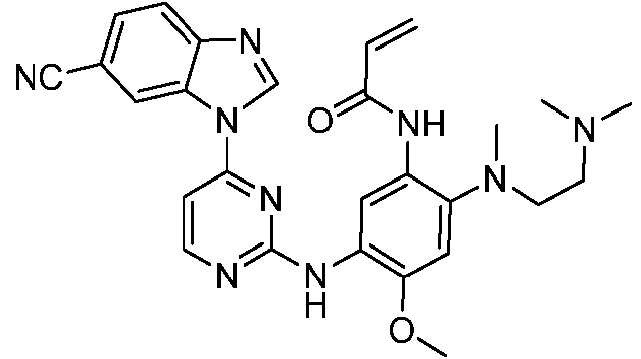
El método de preparación de N-(5-((4-(6-ciano-1H-benzo[d]imidazol-1-il)pirimidin-2-il)amino)-2-((2-(dimetilamino)etil)(metil)amino)-4-metoxifenil)acrilamida fue similar al del Ejemplo 59.The method of preparation of N-(5-((4-(6-cyano-1H-benzo[d]imidazol-1-yl)pyrimidin-2-yl)amino)-2-((2-(dimethylamino)ethyl )(methyl)amino)-4-methoxyphenyl)acrylamide was similar to that of Example 59.
RMN 1H (400 MHz, CD3OD) 89,19 (s, 1H), 8,78 (s, 1H), 8,52 (d, J = 5,7 Hz, 1H), 8,24 (s, 1H), 7,86 (d, J = 8,3 Hz, 1H), 7,66 (dd, J = 8,3, 1,2 Hz, 1H), 7,31 (d, J = 5,8 Hz, 1H), 7,07 (s, 1H), 6,59 (dd, J = 16,9, 10,2 Hz, 1H), 6,35 (d, J = 16,8 Hz, 1H), 5,81 (dd, J = 10,3, 1,2 Hz, 1H), 3,97 (s, 3H), 3,53 (t, J = 5,8 Hz, 2H), 3,36 (t, J = 5,8 Hz, 2H), 2,92 (s, 6H), 2,77 (s, 3H); EM m/z (IEN): 512,2 [M+H]+.1H NMR (400 MHz, CD 3 OD) 89.19 (s, 1H), 8.78 (s, 1H), 8.52 (d, J = 5.7 Hz, 1H), 8.24 (s, 1H), 7.86 (d, J=8.3Hz, 1H), 7.66 (dd, J=8.3, 1.2Hz, 1H), 7.31 (d, J=5.8 Hz, 1H), 7.07 (s, 1H), 6.59 (dd, J=16.9, 10.2 Hz, 1H), 6.35 (d, J=16.8 Hz, 1H), 5.81 (dd, J = 10.3, 1.2 Hz, 1H), 3.97 (s, 3H), 3.53 (t, J = 5.8 Hz, 2H), 3.36 (t , J = 5.8 Hz, 2H), 2.92 (s, 6H), 2.77 (s, 3H); MS m/z (ESI): 512.2 [M+H]+.
Ejemplo 63: preparación de N-(5-((5-cloro-4-(5-metoxi-1H-benzo[d]imidazol-1-il)pirimidin-2-il)amino)-2-((2-(dimetilamino)etil)(metil)amino)-4-metoxifenil)acrilamidaExample 63: Preparation of N-(5-((5-chloro-4-(5-methoxy-1H-benzo[d]imidazol-1-yl)pyrimidin-2-yl)amino)-2-((2- (dimethylamino)ethyl)(methyl)amino)-4-methoxyphenyl)acrylamide
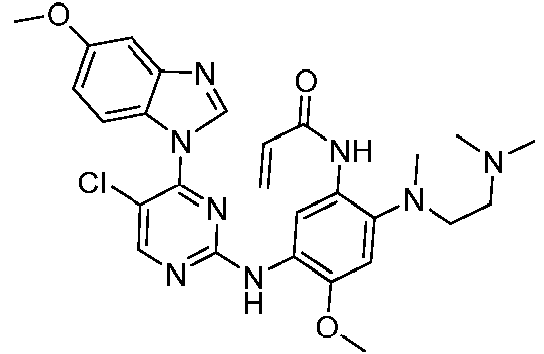
El método de preparación de N-(5-((5-cloro-4-(5-metoxi-1H-benzo[d]imidazol-1-il)pirimidin-2-il)amino)-2-((2-(dimetilamino)etil)(metil)amino)-4-metoxifenil)acrilamida fue similar al del Ejemplo 59.The preparation method of N-(5-((5-chloro-4-(5-methoxy-1H-benzo[d]imidazol-1-yl)pyrimidin-2-yl)amino)-2-((2- (dimethylamino)ethyl)(methyl)amino)-4-methoxyphenyl)acrylamide was similar to that of Example 59.
RMN 1H (400 MHz, CD3OD) 89,25 (s, 1H), 8,74 (s, 1H), 8,25 (s, 1H), 7,85 (d, J = 8,2 Hz, 1H), 7,33 (s, 1H), 7,08 (d, J = 9,0 Hz, 1H), 6,98 (s, 1H), 6,47-6,41 (m, 2H), 5,85 (dd, J = 7,8, 3,9 Hz, 1H), 4,00 (s, 3H), 3,91 (s, 3H), 3,49 (t, J = 5,7 Hz, 2H), 3,28 (t, J = 5,6 Hz, 2H), 2,86 (s, 6H), 2,71 (s, 3H);1H NMR (400 MHz, CD 3 OD) 89.25 (s, 1H), 8.74 (s, 1H), 8.25 (s, 1H), 7.85 (d, J = 8.2 Hz, 1H), 7.33 (s, 1H), 7.08 (d, J = 9.0 Hz, 1H), 6.98 (s, 1H), 6.47-6.41 (m, 2H), 5.85 (dd, J = 7.8, 3.9 Hz, 1H), 4.00 (s, 3H), 3.91 (s, 3H), 3.49 (t, J = 5.7 Hz , 2H), 3.28 (t, J = 5.6 Hz, 2H), 2.86 (s, 6H), 2.71 (s, 3H);
EM m/z (IEN): 551,2 [M+H]+.MS m/z (ESI): 551.2 [M+H]+.
Ejemplo 64: preparación de N-(5-((5-cloro-4-(6-metoxi-1H-benzo[d]imidazol-1-il)pirimidin-2-il)amino)-2-((2-(dimetilamino)etil)(metil)amino)-4-metoxifenil)acrilamida Example 64: Preparation of N-(5-((5-chloro-4-(6-methoxy-1H-benzo[d]imidazol-1-yl)pyrimidin-2-yl)amino)-2-((2- (dimethylamino)ethyl)(methyl)amino)-4-methoxyphenyl)acrylamide

El método de preparación de N-(5-((5-cloro-4-(6-metoxMH-benzo[d]imidazoM-il)pirimidm-2-il)amino)-2-((2-(dimetilamino)etil)(metil)amino)-4-metoxifenil)acrilamida fue similar al del Ejemplo 59.The preparation method of N-(5-((5-chloro-4-(6-methoxMH-benzo[d]imidazoM-yl)pyrimidm-2-yl)amino)-2-((2-(dimethylamino)ethyl )(methyl)amino)-4-methoxyphenyl)acrylamide was similar to that of Example 59.
Ejemplo 65: preparación de N-(5-((5-cloro-4-(5-ciano-1H-benzo[d]imidazol-1-il)pirimidin-2-il)amino)-2-((2-(dimetilamino)etil)(metil)amino)-4-metoxifenil)acrilamidaExample 65: Preparation of N-(5-((5-chloro-4-(5-cyano-1H-benzo[d]imidazol-1-yl)pyrimidin-2-yl)amino)-2-((2- (dimethylamino)ethyl)(methyl)amino)-4-methoxyphenyl)acrylamide

El método de preparación de N-(5-((5-cloro-4-(5-ciano-1H-benzo[d]imidazol-1-il)pirimidin-2-il)amino)-2-((2-(di metilamino)etil)(metil)amino)-4-metoxifenil)acrilamida fue similar al del Ejemplo 59.The preparation method of N-(5-((5-chloro-4-(5-cyano-1H-benzo[d]imidazol-1-yl)pyrimidin-2-yl)amino)-2-((2- (dimethylamino)ethyl)(methyl)amino)-4-methoxyphenyl)acrylamide was similar to that of Example 59.
Ejemplo 66: preparación de N-(5-((5-cloro-4-(6-ciano-1H-benzo[d]imidazol-1-il)pirimidin-2-il)amino)-2-((2-(dimetilamino)etil)(metil)amino)-4-metoxifenil)acrilamidaExample 66: Preparation of N-(5-((5-chloro-4-(6-cyano-1H-benzo[d]imidazol-1-yl)pyrimidin-2-yl)amino)-2-((2- (dimethylamino)ethyl)(methyl)amino)-4-methoxyphenyl)acrylamide

El método de preparación de N-(5-((5-cloro-4-(6-ciano-1H-benzo[d]imidazol-1-il)pirimidin-2-il)amino)-2-((2-(di metilamino)etil)(metil)amino)-4-metoxifenil)acrilamida fue similar al del Ejemplo 59.The preparation method of N-(5-((5-chloro-4-(6-cyano-1H-benzo[d]imidazol-1-yl)pyrimidin-2-yl)amino)-2-((2- (dimethylamino)ethyl)(methyl)amino)-4-methoxyphenyl)acrylamide was similar to that of Example 59.
Ejemplo 67: preparación de N-(2-((2-(dimetilamino)etil)(metil)amino)-4-metoxi-5-((4-(5-metoxi-1H-benzo[d]imidazol-1-il)-5-(trifluorometil)pirimidin-2-il)amino)fenil)acrilamidaExample 67: Preparation of N-(2-((2-(dimethylamino)ethyl)(methyl)amino)-4-methoxy-5-((4-(5-methoxy-1H-benzo[d]imidazole-1- yl)-5-(trifluoromethyl)pyrimidin-2-yl)amino)phenyl)acrylamide

El método de preparación de N-(2-((2-(dimetilamino)etil)(metil)amino)-4-metoxi-5-((4-(5-metoxi-1H-benzo [d]imidazol-1-il)-5-(trifluorometil)pirimidin-2-il)amino)fenil)acrilamida fue similar al del Ejemplo 59.The preparation method of N-(2-((2-(dimethylamino)ethyl)(methyl)amino)-4-methoxy-5-((4-(5-methoxy-1H-benzo[d]imidazol-1- yl)-5-(trifluoromethyl)pyrimidin-2-yl)amino)phenyl)acrylamide was similar to that of Example 59.
RMN 1H (400 MHz, CD3OD) 88,98 (s, 1H), 8,87 (s, 1H), 8,15 (s, 1H), 7,73 (d, J = 8,7 Hz, 1H), 7,32 (s, 1H), 7,10 (s, 1H), 6,98 (s, 1H), 6,43 (s, 2H), 5,84 (d, J = 11,1 Hz, 1H), 3,98 (s, 3H), 3,91 (s, 3H), 3,49 (t, J = 5,3 Hz, 2H), 3,29 (d, J = 5,4 Hz, 2H), 2,85 (s, 6H), 2,71 (s, 3H);1H NMR (400 MHz, CD 3 OD) 88.98 (s, 1H), 8.87 (s, 1H), 8.15 (s, 1H), 7.73 (d, J = 8.7 Hz, 1H), 7.32 (s, 1H), 7.10 (s, 1H), 6.98 (s, 1H), 6.43 (s, 2H), 5.84 (d, J = 11.1 Hz, 1H), 3.98 (s, 3H), 3.91 (s, 3H), 3.49 (t, J = 5.3 Hz, 2H), 3.29 (d, J = 5.4 Hz, 2H), 2.85 (s, 6H), 2.71 (s, 3H);
EM m/z (IEN): 585,3 [M+H]+.MS m/z (ESI): 585.3 [M+H]+.
E je m p lo 68 : p re p a ra c ió n d e N -(2 -( (2 -(d im e t i la m in o )e t i l) (m e t i l)a m in o ) -4 -m e to x i-5 -( (4 -(6 -m e to x i-1 H -b e n z o [d ] im id a z o l-1 -il) -5 -( t r i f lu o ro m e t i l)p ir im id in -2 - i l) a m in o ) fe n il)a c r i la m id a E xa mp le 68 : p re pa ra tio n o f N -(2 -( (2 -(d im ethyl m in o )ethyl) (methyl)am in o ) -4 -meth o x i-5 - ((4 -(6 -me tho x i-1 H -benzo [d ] im id azo l-1 -yl) -5 -( trif lu o ro methyl)p ir im id in -2 - yl) am in o ) fe n il)acri la m id a

El método de preparación de N-(2-((2-(dimetilamino)etil)(metil)amino)-4-metoxi-5-((4-(6-metoxi-1H-benzo [d]imidazol-1-il)-5-(trifluorometil)pirimidin-2-il)amino)fenil)acrilamida fue similar al del Ejemplo 59.The preparation method of N-(2-((2-(dimethylamino)ethyl)(methyl)amino)-4-methoxy-5-((4-(6-methoxy-1H-benzo[d]imidazol-1- yl)-5-(trifluoromethyl)pyrimidin-2-yl)amino)phenyl)acrylamide was similar to that of Example 59.
Ejemplo 69: preparación de N-(5-((4-(5-ciano-1H-benzo[d]imidazol-1-il)-5-(trifluorometil)pirimidin-2-il)amino)-2-((2-(dimetilamino)etil)(metil)amino)-4-metoxifenil)acrilamidaExample 69: Preparation of N-(5-((4-(5-cyano-1H-benzo[d]imidazol-1-yl)-5-(trifluoromethyl)pyrimidin-2-yl)amino)-2-(( 2-(dimethylamino)ethyl)(methyl)amino)-4-methoxyphenyl)acrylamide

El método de preparación de N-(5-((4-(5-ciano-1H-benzo[d]imidazol-1-il)-5-(trifluorometil)pirimidin-2-il)amino)-2-((2-(dimetilamino)etil)(metil)amino)-4-metoxifenil)acrilamida fue similar al del Ejemplo 59.The method of preparation of N-(5-((4-(5-cyano-1H-benzo[d]imidazol-1-yl)-5-(trifluoromethyl)pyrimidin-2-yl)amino)-2-(( 2-(dimethylamino)ethyl)(methyl)amino)-4-methoxyphenyl)acrylamide was similar to Example 59.
Ejemplo 70: preparación de N-(5-((4-(6-ciano-1H-benzo[d]imidazol-1-il)-5-(trifluorometil)pirimidin-2-il)amino)-2-((2-(dimetilamino)etil)(metil)amino)-4-metoxifenil)acrilamidaExample 70: Preparation of N-(5-((4-(6-cyano-1H-benzo[d]imidazol-1-yl)-5-(trifluoromethyl)pyrimidin-2-yl)amino)-2-(( 2-(dimethylamino)ethyl)(methyl)amino)-4-methoxyphenyl)acrylamide

El método de preparación de N-(5-((4-(6-ciano-1H-benzo[d]imidazol-1-il)-5-(trifluorometil)pirimidin-2-il)amino)-2-((2-(dimetilamino)etil)(metil)amino)-4-metoxifenil)acrilamida fue similar al del Ejemplo 59.The method of preparation of N-(5-((4-(6-cyano-1H-benzo[d]imidazol-1-yl)-5-(trifluoromethyl)pyrimidin-2-yl)amino)-2-(( 2-(dimethylamino)ethyl)(methyl)amino)-4-methoxyphenyl)acrylamide was similar to Example 59.
Ejemplo 71: preparación de N-(2-((2-(dimetilamino)etil)(metil)amino)-4-metoxi-5-((4-(5-metoxi-2-metil-1H-benzo[d]imidazol-1-il)pirimidin-2-il)amino)fenil)acrilamidaExample 71: Preparation of N-(2-((2-(dimethylamino)ethyl)(methyl)amino)-4-methoxy-5-((4-(5-methoxy-2-methyl-1H-benzo[d] imidazol-1-yl)pyrimidin-2-yl)amino)phenyl)acrylamide

El método de preparación de N-(2-((2-(dimetilamino)etil)(metil)amino)-4-metoxi-5-((4-(5-metoxi-2-metil-1H-benzo[d]imidazol-1-il)pirimidin-2-il)amino)fenil)acrilamida fue similar al del Ejemplo 59.The method of preparation of N-(2-((2-(dimethylamino)ethyl)(methyl)amino)-4-methoxy-5-((4-(5-methoxy-2-methyl-1H-benzo[d] imidazol-1-yl)pyrimidin-2-yl)amino)phenyl)acrylamide was similar to that of Example 59.
E je m p lo 72 : p re p a ra c ió n d e N -(2 -( (2 -(d im e t i la m in o )e t i l) (m e t i l)a m in o ) -4 -m e to x i-5 -( (4 -(6 -m e to x i-2 -m e t i l-1 H -b e n z o [d ] im id a z o l-1 - i l) p ir im id in -2 - i l) a m in o ) fe n il)a c r i la m id a E xa mp le 72 : P re pa ra tio n o f N -(2 -( (2 -(d im ethyl m in o )ethyl) (methyl)am in o ) -4 -meth o x i-5 - ((4 -(6 -me tho x i-2 -methyl l-1 H -benzo [d ] im id azo l-1 - il) pyr im id in -2 - il) am in o ) phenyl )acry the measure

El método de preparación de N-(2-((2-(dimetilamino)etil)(metil)ammo)-4-metoxi-5-((4-(6-metoxi-2-metiMH-benzo[d]imidazol-1-il)pirimidin-2-il)amino)fenil)acrilamida fue similar al del Ejemplo 59.The preparation method of N-(2-((2-(dimethylamino)ethyl)(methyl)ammo)-4-methoxy-5-((4-(6-methoxy-2-methylMH-benzo[d]imidazole- 1-yl)pyrimidin-2-yl)amino)phenyl)acrylamide was similar to that of Example 59.
Ejemplo 73: preparación de N-(5-((4-(5-ciano-2-metil-1H-benzo[d]imidazol-1-il)pirimidin-2-il)amino)-2-((2-(dimetilamino)etil)(metil)amino)-4-metoxifenil)acrilamidaExample 73: Preparation of N-(5-((4-(5-cyano-2-methyl-1H-benzo[d]imidazol-1-yl)pyrimidin-2-yl)amino)-2-((2- (dimethylamino)ethyl)(methyl)amino)-4-methoxyphenyl)acrylamide

El método de preparación de N-(5-((4-(5-ciano-2-metil-1H-benzo[d]imidazol-1-il)pirimidin-2-il)amino)-2-((2-(di metilamino)etil)(metil)amino)-4-metoxifenil)acrilamida fue similar al del Ejemplo 59.The preparation method of N-(5-((4-(5-cyano-2-methyl-1H-benzo[d]imidazol-1-yl)pyrimidin-2-yl)amino)-2-((2- (dimethylamino)ethyl)(methyl)amino)-4-methoxyphenyl)acrylamide was similar to that of Example 59.
Ejemplo 74: preparación de N-(5-((4-(6-ciano-2-metil-1H-benzo[d]imidazol-1-il)pirimidin-2-il)amino)-2-((2-(dimetilamino)etil)(metil)amino)-4-metoxifenil)acrilamidaExample 74: Preparation of N-(5-((4-(6-cyano-2-methyl-1H-benzo[d]imidazol-1-yl)pyrimidin-2-yl)amino)-2-((2- (dimethylamino)ethyl)(methyl)amino)-4-methoxyphenyl)acrylamide

El método de preparación de N-(5-((4-(6-ciano-2-metil-1H-benzo[d]imidazol-1-il)pirimidin-2-il)amino)-2-((2-(di metilamino)etil)(metil)amino)-4-metoxifenil)acrilamida fue similar al del Ejemplo 59.The preparation method of N-(5-((4-(6-cyano-2-methyl-1H-benzo[d]imidazol-1-yl)pyrimidin-2-yl)amino)-2-((2- (dimethylamino)ethyl)(methyl)amino)-4-methoxyphenyl)acrylamide was similar to that of Example 59.
Ejemplo 75: preparación de N-(2-((2-(dimetilamino)etil)(metil)amino)-4-metoxi-5-((4-(5-metoxi-2-metil-1H-benzo[d]imidazol-1-il)-5-(trifluorometil)pirimidin-2-il)amino)fenil)acrilamidaExample 75: Preparation of N-(2-((2-(dimethylamino)ethyl)(methyl)amino)-4-methoxy-5-((4-(5-methoxy-2-methyl-1H-benzo[d] imidazol-1-yl)-5-(trifluoromethyl)pyrimidin-2-yl)amino)phenyl)acrylamide

El método de preparación de N-(2-((2-(dimetilamino)etil)(metil)ammo)-4-metoxi-5-((4-(5-metoxi-2-metiMH-benzo[d]imidazol-1-il)-5-(trifluorometil)pirimidin-2-il)amino)fenil)acrilamida fue similar al del Ejemplo 59.The preparation method of N-(2-((2-(dimethylamino)ethyl)(methyl)ammo)-4-methoxy-5-((4-(5-methoxy-2-methylMH-benzo[d]imidazole- 1-yl)-5-(trifluoromethyl)pyrimidin-2-yl)amino)phenyl)acrylamide was similar to Example 59.
E je m p lo 76 : p re p a ra c ió n d e N -(2 -( (2 -(d im e t i la m in o )e t i l) (m e t i l)a m in o ) -4 -m e to x i-5 -( (4 -(2 -m e t i l-5 -( t r i f lu o ro m e t i l) -1 H -b e n z o [d ] im id a z o l-1 - i l) p ir im id in -2 - i l) a m in o ) fe n il)a c r i la m id a E xa mp le 76 : p re pa ra tio n o f N -(2 -( (2 -(d im ethyl m in o )ethyl) (methyl)am in o ) -4 -meth o x i-5 - ((4-(2-methyl-5-(trifluoromethyl)-1H-benzo[d]imidazol-1-yl)pyrimidin-2-yl)amino) fe n il)acri la m id a

El método de preparación de N-(2-((2-(dimetilamino)etil)(metil)amino)-4-metoxi-5-((4-(2-metil-5-(trifluoro metil)-1H-benzo[d]imidazol-1-il)pirimidin-2-il)amino)fenil)acrilamida fue similar al del Ejemplo 59.The preparation method of N-(2-((2-(dimethylamino)ethyl)(methyl)amino)-4-methoxy-5-((4-(2-methyl-5-(trifluoromethyl)-1H-benzo [d]imidazol-1-yl)pyrimidin-2-yl)amino)phenyl)acrylamide was similar to that of Example 59.
Ejemplo 77: preparación de N-(5-((4-(6-ciano-2-metil-1H-benzo[d]imidazol-1-il)-5-fluoropirimidin-2-il)amino)-2-((2-(dimetilamino)etil)(metil)amino)-4-metoxifenil)acrilamidaExample 77: Preparation of N-(5-((4-(6-cyano-2-methyl-1H-benzo[d]imidazol-1-yl)-5-fluoropyrimidin-2-yl)amino)-2-( (2-(dimethylamino)ethyl)(methyl)amino)-4-methoxyphenyl)acrylamide

El método de preparación de N-(5-((4-(6-ciano-2-metil-1H-benzo[d]imidazol-1-il)-5-fluoropirimidin-2-il)amino) -2-((2-(dimetilamino)etil)(metil)amino)-4-metoxifenil)acrilamida fue similar al del Ejemplo 59.The method of preparation of N-(5-((4-(6-cyano-2-methyl-1H-benzo[d]imidazol-1-yl)-5-fluoropyrimidin-2-yl)amino)-2-( (2-(dimethylamino)ethyl)(methyl)amino)-4-methoxyphenyl)acrylamide was similar to Example 59.
Ejemplo 78: preparación de N-(2-((2-(dimetilamino)etil)(metil)amino)-4-metoxi-5-((4-(2-metil-5-(trifluorometoxi)-1H-benzo[d]imidazol-1-il)-5-(trifluorometil)pirimidin-2-il)amino) fenil)acrilamidaExample 78: Preparation of N-(2-((2-(dimethylamino)ethyl)(methyl)amino)-4-methoxy-5-((4-(2-methyl-5-(trifluoromethoxy)-1H-benzo[ d]imidazol-1-yl)-5-(trifluoromethyl)pyrimidin-2-yl)amino)phenyl)acrylamide

El método de preparación de N-(2-((2-(dimetilamino)etil)(metil)amino)-4-metoxi-5-((4-(2-metil-5-(trifluoro metoxi)-1H-benzo[d]imidazol-1-il)-5-(trifluorometil)pirimidin-2-il)amino)fenil) acrilamida fue similar al del Ejemplo 59.The preparation method of N-(2-((2-(dimethylamino)ethyl)(methyl)amino)-4-methoxy-5-((4-(2-methyl-5-(trifluoromethoxy)-1H-benzo [d]imidazol-1-yl)-5-(trifluoromethyl)pyrimidin-2-yl)amino)phenyl)acrylamide was similar to that of Example 59.
Ejemplo 79: preparación de N-(5-((4-(5-ciclopropil-2-metil-1H-benzo[d]imidazol-1-il)pirimidin-2-il)amino) -2-((2-(dimetilamino)etil)(metil)amino)-4-metoxifenil)acrilamidaExample 79: Preparation of N-(5-((4-(5-cyclopropyl-2-methyl-1H-benzo[d]imidazol-1-yl)pyrimidin-2-yl)amino)-2-((2- (dimethylamino)ethyl)(methyl)amino)-4-methoxyphenyl)acrylamide

El método de preparación de N-(5-((4-(5-ciclopropil-2-metil-1H-benzo[d]imidazol-1-il)pirimidin-2-il)amino)-2-((2-(dimetilamino)etil)(metil)amino)-4-metoxifenil)acrilamida fue similar al del Ejemplo 59.The preparation method of N-(5-((4-(5-cyclopropyl-2-methyl-1H-benzo[d]imidazol-1-yl)pyrimidin-2-yl)amino)-2-((2- (dimethylamino)ethyl)(methyl)amino)-4-methoxyphenyl)acrylamide was similar to that of Example 59.
E je m p lo 80 : p re p a ra c ió n d e N -(2 -( (2 -(d im e t i la m in o )e t i l) (m e t i l)a m in o ) -4 -m e to x i-5 -( (4 -(2 -m e t i l-6 -( t r i f lu o ro m e t i l) -1 H -b e n z o [d ] im id a z o l-1 - i l) p ir im id in -2 - i l) a m in o ) fe n il)a c r i la m id a E xa mp le 80 : p re pa ra tio n o f N -(2 -( (2 -(d im ethyl m in o )ethyl) (methyl)am in o ) -4 -meth o x i-5 - ((4-(2-methyl-6-(trifluoromethyl)-1H-benzo[d]imidazol-1-yl)pyrimidin-2-yl)amino) fe n il)acri la m id a

El método de preparación de N-(2-((2-(dimetilamino)etil)(metil)amino)-4-metoxi-5-((4-(2-metil-6-(trifluoro metil)-1H-benzo[d]imidazol-1-il)pirimidin-2-il)amino)fenil)acrilamida fue similar al del Ejemplo 59.The preparation method of N-(2-((2-(dimethylamino)ethyl)(methyl)amino)-4-methoxy-5-((4-(2-methyl-6-(trifluoromethyl)-1H-benzo [d]imidazol-1-yl)pyrimidin-2-yl)amino)phenyl)acrylamide was similar to that of Example 59.
Ejemplo 81: preparación de N-(5-((4-(2-ciclopropil-5-metoxi-1H-benzo[d]imidazol-1-il)pirimidin-2-il)amin o)-2-((2-(dimetilamino)etil)(metil)amino)-4-metoxifenil)acrilamidaExample 81: Preparation of N-(5-((4-(2-cyclopropyl-5-methoxy-1H-benzo[d]imidazol-1-yl)pyrimidin-2-yl)amino)-2-((2 -(dimethylamino)ethyl)(methyl)amino)-4-methoxyphenyl)acrylamide

El método de preparación de N-(5-((4-(2-ciclopropil-5-metoxi-1H-benzo[d]imidazol-1-il)pirimidin-2-il)amino)-2-((2-(dimetilamino)etil)(metil)amino)-4-metoxifenil)acrilamida fue similar al del Ejemplo 59.The preparation method of N-(5-((4-(2-cyclopropyl-5-methoxy-1H-benzo[d]imidazol-1-yl)pyrimidin-2-yl)amino)-2-((2- (dimethylamino)ethyl)(methyl)amino)-4-methoxyphenyl)acrylamide was similar to that of Example 59.
Ejemplo 82: preparación de N-(5-((4-(2-ciclopropil-5-metoxi-1H-benzo[d]imidazol-1-il)-5-(trifluorometil)pirimidin-2-il)amino)-2-((2-(dimetilamino)etil)(metil)amino)-4-metoxifenil)acrilamidaExample 82: Preparation of N-(5-((4-(2-cyclopropyl-5-methoxy-1H-benzo[d]imidazol-1-yl)-5-(trifluoromethyl)pyrimidin-2-yl)amino)- 2-((2-(dimethylamino)ethyl)(methyl)amino)-4-methoxyphenyl)acrylamide

El método de preparación de N-(5-((4-(2-ciclopropil-5-metoxi-1H-benzo[d]imidazol-1-il)-5-(trifluorometil)piri midin-2-il)amino)-2-((2-(dimetilamino)etil)(metil)amino)-4-metoxifenil)acrilamida fue similar al del Ejemplo 59.The method of preparation of N-(5-((4-(2-cyclopropyl-5-methoxy-1H-benzo[d]imidazol-1-yl)-5-(trifluoromethyl)pyrimidin-2-yl)amino) -2-((2-(dimethylamino)ethyl)(methyl)amino)-4-methoxyphenyl)acrylamide was similar to Example 59.
Ejemplo 83: preparación de N-(5-((4-(5-ciano-2-ciclopropil-1H-benzo[d]imidazol-1-il)pirimidin-2-il)amino)-2-((2-(dimetilamino)etil)(metil)amino)-4-metoxifenil)acrilamidaExample 83: Preparation of N-(5-((4-(5-cyano-2-cyclopropyl-1H-benzo[d]imidazol-1-yl)pyrimidin-2-yl)amino)-2-((2- (dimethylamino)ethyl)(methyl)amino)-4-methoxyphenyl)acrylamide

El método de preparación de N-(5-((4-(5-ciano-2-ciclopropil-1H-benzo[d]imidazol-1-il)pirimidin-2-il)amino)-2-((2-(dimetilamino)etil)(metil)amino)-4-metoxifenil)acrilamida fue similar al del Ejemplo 59.The preparation method of N-(5-((4-(5-cyano-2-cyclopropyl-1H-benzo[d]imidazol-1-yl)pyrimidin-2-yl)amino)-2-((2- (dimethylamino)ethyl)(methyl)amino)-4-methoxyphenyl)acrylamide was similar to that of Example 59.
Ejemplo 84: preparación de N-(5-((5-cloro-4-(5-ciano-2-ciclopropil-1H-benzo[d]imidazol-1-il)pirimidin-2-il)amino)-2-((2-(dimetilamino)etil)(metil)amino)-4-metoxifenil)acrilamida Example 84: Preparation of N-(5-((5-chloro-4-(5-cyano-2-cyclopropyl-1H-benzo[d]imidazol-1-yl)pyrimidin-2-yl)amino)-2- ((2-(dimethylamino)ethyl)(methyl)amino)-4-methoxyphenyl)acrylamide

El método de preparación de N-(5-((5-doro-4-(5-dano-2-ddopropiMH-benzo[d]imidazoM-il)pinmidm-2-il)amino)-2-((2-(dimetilamino)etil)(metil)amino)-4-metoxifenil)acrilamida fue similar al del Ejemplo 59.The method of preparation of N-(5-((5-doro-4-(5-dano-2-ddopropiMH-benzo[d]imidazoM-yl)pinmidm-2-yl)amino)-2-((2- (dimethylamino)ethyl)(methyl)amino)-4-methoxyphenyl)acrylamide was similar to that of Example 59.
Ejemplo 85: preparación de N-(5-((4-(2-ciclopropil-5-(trifluorometil)-1H-benzo[d]imidazol-1-il)pirimidin-2-il)amino)-2-((2-(dimetilamino)etil)(metil)amino)-4-metoxifenil)acrilamidaExample 85: Preparation of N-(5-((4-(2-cyclopropyl-5-(trifluoromethyl)-1H-benzo[d]imidazol-1-yl)pyrimidin-2-yl)amino)-2-(( 2-(dimethylamino)ethyl)(methyl)amino)-4-methoxyphenyl)acrylamide

El método de preparación de N-(5-((4-(2-ciclopropil-5-(trifluorometil)-1H-benzo[d]imidazol-1-il)pirimidin-2-il) amino)-2-((2-(dimetilamino)etil)(metil)amino)-4-metoxifenil)acrilamida fue similar al del Ejemplo 59.The method of preparation of N-(5-((4-(2-cyclopropyl-5-(trifluoromethyl)-1H-benzo[d]imidazol-1-yl)pyrimidin-2-yl)amino)-2-(( 2-(dimethylamino)ethyl)(methyl)amino)-4-methoxyphenyl)acrylamide was similar to Example 59.
Ejemplo 86: preparación de N-(5-((4-(2-ciclopropil-6-(trifluorometil)-1H-benzo[d]imidazol-1-il)pirimidin-2-il)amino)-2-((2-(dimetilamino)etil)(metil)amino)-4-metoxifenil)acrilamidaExample 86: Preparation of N-(5-((4-(2-cyclopropyl-6-(trifluoromethyl)-1H-benzo[d]imidazol-1-yl)pyrimidin-2-yl)amino)-2-(( 2-(dimethylamino)ethyl)(methyl)amino)-4-methoxyphenyl)acrylamide

El método de preparación de N-(5-((4-(2-ciclopropil-6-(trifluorometil)-1H-benzo[d]imidazol-1-il)pirimidin-2-il) amino)-2-((2-(dimetilamino)etil)(metil)amino)-4-metoxifenil)acrilamida fue similar al del Ejemplo 59.The method of preparation of N-(5-((4-(2-cyclopropyl-6-(trifluoromethyl)-1H-benzo[d]imidazol-1-yl)pyrimidin-2-yl)amino)-2-(( 2-(dimethylamino)ethyl)(methyl)amino)-4-methoxyphenyl)acrylamide was similar to Example 59.
Ejemplo 87: preparación de N-(5-((5-cloro-4-(2-ciclopropil-5-(trifluorometil)-1H-benzo[d]imidazol-1-il)pirimidin-2-il)amino)-2-((2-(dimetilamino)etil)(metil)amino)-4-metoxifenil) acrilamidaExample 87: Preparation of N-(5-((5-chloro-4-(2-cyclopropyl-5-(trifluoromethyl)-1H-benzo[d]imidazol-1-yl)pyrimidin-2-yl)amino)- 2-((2-(dimethylamino)ethyl)(methyl)amino)-4-methoxyphenyl)acrylamide
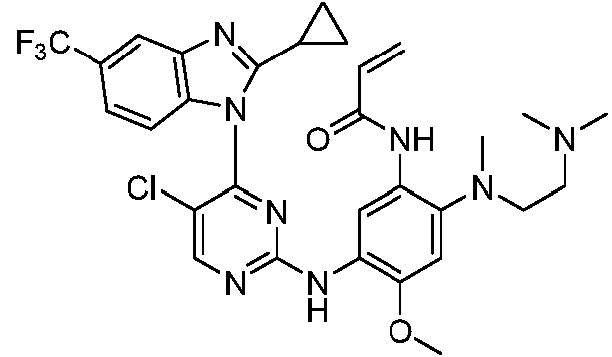
El método de preparación de N-(5-((5-cloro-4-(2-ciclopropil-5-(trifluorometil)-1H-benzo[d]imidazol-1-il)pirimidin-2-il)amino)-2-((2-(dimetilamino)etil)(metil)amino)-4-metoxifenil)acrilamida fue similar al del Ejemplo 59.The method of preparation of N-(5-((5-chloro-4-(2-cyclopropyl-5-(trifluoromethyl)-1H-benzo[d]imidazol-1-yl)pyrimidin-2-yl)amino)- 2-((2-(dimethylamino)ethyl)(methyl)amino)-4-methoxyphenyl)acrylamide was similar to Example 59.
Ejemplo 88: preparación de N-(5-((4-(2-ciclopropil-1H-benzo[d]imidazol-1-il)pirimidin-2-il)amino)-2-((2-(di metilamino)etil)(metil)amino)-4-metoxifenil)acrilamida Example 88: Preparation of N-(5-((4-(2-cyclopropyl-1H-benzo[d]imidazol-1-yl)pyrimidin-2-yl)amino)-2-((2-(dimethylamino) ethyl)(methyl)amino)-4-methoxyphenyl)acrylamide

El método de preparación de N-(5-((4-(2-cidopropiMH-benzo[d]imidazol-1-il)pirimidin-2-il)amino)-2-((2-(dimetilamino)etil)(metil)amino)-4-metoxifenil)acrilamida fue similar al del Ejemplo 59.The method of preparation of N-(5-((4-(2-cidopropiMH-benzo[d]imidazol-1-yl)pyrimidin-2-yl)amino)-2-((2-(dimethylamino)ethyl)( methyl)amino)-4-methoxyphenyl)acrylamide was similar to that of Example 59.
RMN 1H (400 MHz, CDCla): 810,3 (s a, 1H), 8,75 (s, 1H), 8,46 (d, J = 6,0 Hz, 1H), 8,00 (dd, J = 4,8, 1,6 Hz, 1H), 7,64 (dd, J = 6,0, 1,6 Hz, 1H), 7,21 (m, 3H), 6,96 (d, J = 6,4 Hz, 1H), 6,82 (s, 1H), 6,45 (m, 2H), 5,73 (d, J = 9,2 Hz, 1H), 3,84 (s, 3H), 2,99 (m, 1H), 2,89 (m, 2H), 2,73 (s, 3H), 2,36 (m, 2H), 2,31 (s, 6H), 1,04 (m, 2H), 0,87 (m, 2H);1H NMR (400 MHz, CDCla): 810.3 (brs, 1H), 8.75 (s, 1H), 8.46 (d, J = 6.0 Hz, 1H), 8.00 (dd, J = 4.8, 1.6 Hz, 1H), 7.64 (dd, J = 6.0, 1.6 Hz, 1H), 7.21 (m, 3H), 6.96 (d, J = 6.4 Hz, 1H), 6.82 (s, 1H), 6.45 (m, 2H), 5.73 (d, J = 9.2 Hz, 1H), 3.84 (s, 3H) , 2.99 (m, 1H), 2.89 (m, 2H), 2.73 (s, 3H), 2.36 (m, 2H), 2.31 (s, 6H), 1.04 ( m, 2H), 0.87 (m, 2H);
EM m/z (IEN): 527,2 [M+H]+.MS m/z (ESI): 527.2 [M+H]+.
Ejemplo 89: preparación de N-(5-((4-(5,7-difluoro-1-metil-1H-indol-3-il)pirimidin-2-il)amino)-2-((2-(dimetilamino)etil)(metil)amino)-4-metoxifenil)acrilamidaExample 89: Preparation of N-(5-((4-(5,7-difluoro-1-methyl-1H-indol-3-yl)pyrimidin-2-yl)amino)-2-((2-(dimethylamino )ethyl)(methyl)amino)-4-methoxyphenyl)acrylamide

El método de preparación de N-(5-((4-(5,7-difluoro-1-metil-1H-indol-3-il)pirimidin-2-il)amino)-2-((2-(dimetilamino)etil)(metil)amino)-4-metoxifenil)acrilamida fue similar al del Ejemplo 22.The preparation method of N-(5-((4-(5,7-difluoro-1-methyl-1H-indol-3-yl)pyrimidin-2-yl)amino)-2-((2-(dimethylamino )ethyl)(methyl)amino)-4-methoxyphenyl)acrylamide was similar to that of Example 22.
RMN 1H (400 MHz, CDCl3): 8 10,2 (s a, 1H), 9,79 (s, 1H), 9,14 (s, 1H), 8,37 (d, J = 5,2 Hz, 1H), 7,72 (s, 1H), 7,40 (d, J = 5,2 Hz, 1H), 6,87 (dd, J =8,8, 1,6 Hz, 1H), 6,79 (s, 1H), 6,74 (m, 1H), 6,41 (m, 2H), 5,70 (m, 1H), 3,95 (s, 3H), 3,88 (s, 3H), 2,91 (m, 2H), 2,57 (s, 3H), 2,22 (m, 8H);1H NMR (400 MHz, CDCl3): 8 10.2 (brs, 1H), 9.79 (s, 1H), 9.14 (s, 1H), 8.37 (d, J = 5.2 Hz, 1H), 7.72 (s, 1H), 7.40 (d, J=5.2Hz, 1H), 6.87 (dd, J=8.8, 1.6Hz, 1H), 6, 79 (s, 1H), 6.74 (m, 1H), 6.41 (m, 2H), 5.70 (m, 1H), 3.95 (s, 3H), 3.88 (s, 3H ), 2.91 (m, 2H), 2.57 (s, 3H), 2.22 (m, 8H);
EM m/z (IEN): 527,3 [M+H]+.MS m/z (ESI): 527.3 [M+H]+.
Ejemplo 90: preparación de N-(5-((4-(4,5-difluoro-1-metil-1H-indol-3-il)pirimidin-2-il)amino)-2-((2-(dimetilamino)etil)(metil)amino)-4-metoxifenil)acrilamidaExample 90: Preparation of N-(5-((4-(4,5-difluoro-1-methyl-1H-indol-3-yl)pyrimidin-2-yl)amino)-2-((2-(dimethylamino )ethyl)(methyl)amino)-4-methoxyphenyl)acrylamide

El método de preparación de N-(5-((4-(4,5-difluoro-1-metil-1H-indol-3-il)pirimidin-2-il)amino)-2-((2-(dimetilamino)etil)(metil)amino)-4-metoxifenil)acrilamida fue similar al del Ejemplo 22.The preparation method of N-(5-((4-(4,5-difluoro-1-methyl-1H-indol-3-yl)pyrimidin-2-yl)amino)-2-((2-(dimethylamino )ethyl)(methyl)amino)-4-methoxyphenyl)acrylamide was similar to that of Example 22.
RMN 1H (400 MHz, CD3OD): 89,20 (s, 1H), 8,36 (s, 1H), 8,18 (d, J = 5,6 Hz, 1H), 7,99 (m, 1H), 7,26 (m, 1H), 7,04 (d, J = 5,6 Hz, 1H), 6,97 (s, 1H), 6,56 (m, 1H), 6,29 (dd, J = 17,2 Hz, 2,0 Hz, 1H), 5,74 (dd, J = 10,4 Hz, 1,6 Hz, 1H), 3,91 (s, 3H), 3,80 (s, 3H), 3,06 (t, J = 6,4 Hz, 2H), 2,70 (s, 3H), 2,46 (t, J = 6,0 Hz, 1H), 2,31 (m, 6H);1H NMR (400 MHz, CD 3 OD): 89.20 (s, 1H), 8.36 (s, 1H), 8.18 (d, J = 5.6 Hz, 1H), 7.99 (m , 1H), 7.26 (m, 1H), 7.04 (d, J = 5.6 Hz, 1H), 6.97 (s, 1H), 6.56 (m, 1H), 6.29 (dd, J = 17.2 Hz, 2.0 Hz, 1H), 5.74 (dd, J = 10.4 Hz, 1.6 Hz, 1H), 3.91 (s, 3H), 3, 80 (s, 3H), 3.06 (t, J = 6.4 Hz, 2H), 2.70 (s, 3H), 2.46 (t, J = 6.0 Hz, 1H), 2, 31 (m, 6H);
EM m/z (IEN): 536,2 [M+H]+.MS m/z (ESI): 536.2 [M+H]+.
Ejemplo 91: preparación de N-(5-((4-(7-ciclopropil-1-metil-1H-indol-3-il)pirimidin-2-il)amino)-2-((2-(dimetilamino)etil)(metil)amino)-4-metoxifenil)acrilamida Example 91: Preparation of N-(5-((4-(7-cyclopropyl-1-methyl-1H-indol-3-yl)pyrimidin-2-yl)amino)-2-((2-(dimethylamino)ethyl )(methyl)amino)-4-methoxyphenyl)acrylamide

El método de preparación de N-(5-((4-(7-ddopropiM-metiMH-indol-3-il)pinmidin-2-il)amino)-2-((2-(dimetilamino)etil)(metil)amino)-4-metoxifenil)acrilamida fue similar al del Ejemplo 22.The method of preparation of N-(5-((4-(7-ddopropiM-methylMH-indol-3-yl)pinmidin-2-yl)amino)-2-((2-(dimethylamino)ethyl)(methyl) amino)-4-methoxyphenyl)acrylamide was similar to that of Example 22.
RMN 1H (400 MHz, CDCh): 8 10,08 (s, 1H), 9,83 (s, 1H), 8,96 (s, 1H), 8,36 (d, J = 5,2 Hz, 1H), 7,91 (d, J = 8,0 Hz, 1H), 7,73 (s, 1H), 7,17 (d, J = 5,2 Hz, 1H), 7,10 (t, J = 7,6 Hz, 1H), 6,99 (d, J = 7,2 Hz, 1H), 6,79 (s, 1H), 6,44 (m, 2H), 5,71 (m, 1H), 4,45 (s, 3H), 3,88 (s, 3H), 2,91 (t, J = 5,6 Hz, 2H), 2,71 (s, 3H), 2,46 (m, 1H), 2,28 (m, 8H), 1,01 (m, 2H), 0,90 (m, 2H); EM m/z (IEN): 540,2 [M+H]+.1H NMR (400 MHz, CDCh): 8 10.08 (s, 1H), 9.83 (s, 1H), 8.96 (s, 1H), 8.36 (d, J = 5.2 Hz, 1H), 7.91 (d, J = 8.0 Hz, 1H), 7.73 (s, 1H), 7.17 (d, J = 5.2 Hz, 1H), 7.10 (t, J = 7.6 Hz, 1H), 6.99 (d, J = 7.2 Hz, 1H), 6.79 (s, 1H), 6.44 (m, 2H), 5.71 (m, 1H), 4.45 (s, 3H), 3.88 (s, 3H), 2.91 (t, J = 5.6 Hz, 2H), 2.71 (s, 3H), 2.46 ( m, 1H), 2.28 (m, 8H), 1.01 (m, 2H), 0.90 (m, 2H); MS m/z (ESI): 540.2 [M+H]+.
Ejemplo 92: N-(5-((4-(7-ciclopropil-1H-indol-3-il)pirimidin-2-il)amino)-2-((2-(dimetilamino)etil)(metil)amino)-4-metoxifenil)acrilamidaExample 92: N-(5-((4-(7-cyclopropyl-1H-indol-3-yl)pyrimidin-2-yl)amino)-2-((2-(dimethylamino)ethyl)(methyl)amino) -4-methoxyphenyl)acrylamide

El método de preparación de N-(5-((4-(7-ciclopropil-1H-indol-3-il)pirimidin-2-il)amino)-2-((2-(dimetilamino)etil)(metil)amino)-4-metoxifenil)acrilamida fue similar al del Ejemplo 22.The method of preparation of N-(5-((4-(7-cyclopropyl-1H-indol-3-yl)pyrimidin-2-yl)amino)-2-((2-(dimethylamino)ethyl)(methyl) amino)-4-methoxyphenyl)acrylamide was similar to that of Example 22.
RMN 1H (400 MHz, CDCh) 8 10,27 (s, 1H), 10,13 (s, 1H), 9,83 (s, 1H), 9,04 (s, 1H), 8,36 (d, J = 5,3 Hz, 1H), 7,89 (d, J = 80 Hz, 1H), 7,72 (s, 1H), 7,16 (d, J = 5,3 Hz, 1H), 7,09 (t, J = 7,7 Hz, 1H), 6,79 (d, J = 5,6 Hz, 2H), 6,71-6,50 (m, 1H), 6,39 (s, 1H), 5,82-5,58 (m, 1H), 3,88 (s, 3H), 3,08-2,83 (m, 2H), 2,70 (s, 3H), 2,39-2,20 (m, 8H), 2,16 (t, J =5,1 Hz, 1H), 0,96-0,73 (m, 2H), 0,73-0,55 (m, 2H);1H NMR (400 MHz, CDCh) 8 10.27 (s, 1H), 10.13 (s, 1H), 9.83 (s, 1H), 9.04 (s, 1H), 8.36 (d , J = 5.3 Hz, 1H), 7.89 (d, J = 80 Hz, 1H), 7.72 (s, 1H), 7.16 (d, J = 5.3 Hz, 1H), 7.09 (t, J = 7.7 Hz, 1H), 6.79 (d, J = 5.6 Hz, 2H), 6.71-6.50 (m, 1H), 6.39 (s , 1H), 5.82-5.58 (m, 1H), 3.88 (s, 3H), 3.08-2.83 (m, 2H), 2.70 (s, 3H), 2, 39-2.20 (m, 8H), 2.16 (t, J=5.1 Hz, 1H), 0.96-0.73 (m, 2H), 0.73-0.55 (m, 2H);
EM m/z (IEN): 526,7 [M+H]+.MS m/z (ESI): 526.7 [M+H]+.
Ejemplo 93: preparación de N-(5-((4-(1-ciclopropil-6-metoxi-1H-indol-3-il)pirimidin-2-il)amino)-2-((2-(dimetilamino)etil)(metil)amino)-4-metoxifenil)acrilamidaExample 93: Preparation of N-(5-((4-(1-cyclopropyl-6-methoxy-1H-indol-3-yl)pyrimidin-2-yl)amino)-2-((2-(dimethylamino)ethyl )(methyl)amino)-4-methoxyphenyl)acrylamide

El método de preparación de N-(5-((4-(1-ciclopropil-6-metoxi-1H-indol-3-il)pirimidin-2-il)amino)-2-((2-(dimetilamino)etil)(metil)amino)-4-metoxifenil)acrilamida fue similar al del Ejemplo 22.The method of preparation of N-(5-((4-(1-cyclopropyl-6-methoxy-1H-indol-3-yl)pyrimidin-2-yl)amino)-2-((2-(dimethylamino)ethyl )(methyl)amino)-4-methoxyphenyl)acrylamide was similar to that of Example 22.
La sal TFA de N-(5-((4-(1-ciclopropil-6-metoxi-1H-indol-3-il)pirimidin-2-il)amino)-2-((2-(dimetilamino)etil)(metil)amino)-4-metoxifenil)acrilamida RMN 1H (400 MHz, CD3OD): 8 8,41 (s, 1H), 8,15 (a, 1H), 7,98 (d, J = 6,8 Hz, 1H), 7,89 (s, 1H), 7,40 (d, J = 6,8 Hz, 1H), 7,17 (d, J = 2,4 Hz, 1H), 7,06 (s, 1H), 6,87 (m, 1H), 6,50 (m, 2H), 5,87 (m, 1H), 3,95 (s, 3H), 3,88 (s, 3H), 3,55 (m, 3H), 3,35 (m, 2H), 2,92 (s, 6H), 2,80 (s, 3H), 1,22 (m, 2H), 0,90 (m, 2H); EM m/z (IEN): 556,2 [M+H]+.The TFA salt of N-(5-((4-(1-cyclopropyl-6-methoxy-1H-indol-3-yl)pyrimidin-2-yl)amino)-2-((2-(dimethylamino)ethyl) (methyl)amino)-4-methoxyphenyl)acrylamide 1H NMR (400 MHz, CD 3 OD): 8 8.41 (s, 1H), 8.15 (a, 1H), 7.98 (d, J = 6 0.8 Hz, 1H), 7.89 (s, 1H), 7.40 (d, J = 6.8 Hz, 1H), 7.17 (d, J = 2.4 Hz, 1H), 7, 06 (s, 1H), 6.87 (m, 1H), 6.50 (m, 2H), 5.87 (m, 1H), 3.95 (s, 3H), 3.88 (s, 3H ), 3.55 (m, 3H), 3.35 (m, 2H), 2.92 (s, 6H), 2.80 (s, 3H), 1.22 (m, 2H), 0.90 (m, 2H); MS m/z (ESI): 556.2 [M+H]+.
E je m p lo 94 : p re p a ra c ió n d e N -(2 -( (2 -(d im e t i la m in o )e t i l) (m e t i l)a m in o ) -4 -m e to x i-5 -( (4 -(7 -m e to x i-1 H - in d o l-3 - il)p ir im id in -2 - i l) a m in o ) fe n il)a c r i la m id a E xa mp le 94 : p re pa ra tio n o f N -(2 -( (2 -(d im ethyl m in o )ethyl) (methyl)am in o ) -4 -meth o x i-5 - ( (4 -(7 -me to x i-1 H - in do l-3 - il)p ir im id in -2 - il) am in o ) fe n il)acri la m id a

Se añadieron Nal (4,59, 30,6 mmol), CuI (290 mg, 1,53 mmol) y N,N'-dimetiletilendiamina (0,35 ml) a una solución de 6-bromo-1H-indol (3,00 g, 15,3 mmol) en dioxano (30 ml) a la temperatura ambiente. La mezcla se purgó con nitrógeno para retirar oxígeno durante 5 minutos. La mezcla se agitó a 110 °C en un baño de aceite durante una noche en una atmósfera de nitrógeno. Después de un periodo de refrigeración, el disolvente orgánico se retiró por concentración a presión reducida. Se añadieron EtOAc y agua y las dos fases se separaron. La fase de EtOAc se lavó con salmuera saturada, se secó sobre sulfato sódico anhidro, se concentró y se purificó por cromatografía en columna (eluyente: PE puro) para obtener el compuesto del título 6-yodo-1H-indol (2,1 g, 57 %).To a solution of 6-bromo-1H-indole (3 0.00 g, 15.3 mmol) in dioxane (30 mL) at room temperature. The mixture was purged with nitrogen to remove oxygen for 5 minutes. The mixture was stirred at 110°C in an oil bath overnight under a nitrogen atmosphere. After a cooling period, the organic solvent was removed by concentration under reduced pressure. EtOAc and water were added and the two phases were separated. The EtOAc layer was washed with saturated brine, dried over anhydrous sodium sulfate, concentrated and purified by column chromatography (eluent: pure PE) to give the title compound 6-iodo-1H-indole (2.1 g , 57%).
EM m/z (IEN): 244,0 [M+H]+.MS m/z (ESI): 244.0 [M+H]+.
Etapa 2: preparación de 6-yodo-1-metil-1H-indolStep 2: Preparation of 6-iodo-1-methyl-1H-indole
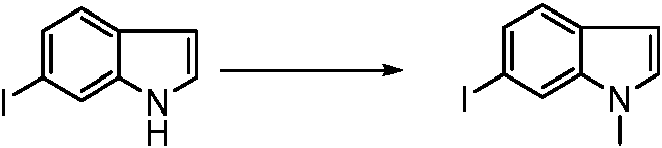
En un baño de agua enfriada con hielo, se añadió NaH (60 %, 734 mg, 18,4 mmol) a una solución de 6-yodo-lH-indol (2,00 g, 8,23 mmol) en DMF (30 ml). La mezcla se agitó durante 20 minutos a esta temperatura, seguido de la adición de una solución de Mel (1,14 ml, 18,4 mmol) en DMF (10 ml) y agitación adicional a esta temperatura durante 30 minutos. Se añadieron aproximadamente 100 ml de agua y la solución de reacción se extrajo con EtOAc. La fase de EtOAc se lavó varias veces con salmuera saturada, se secó sobre sulfato sódico anhidro, se concentró y se purificó por cromatografía en columna (eluyente: PE puro) para obtener el compuesto del título 6-yodo-1-metil-1H-indol (1,98 g, 94 %).In an ice-cold water bath, NaH (60%, 734 mg, 18.4 mmol) was added to a solution of 6-iodo-lH-indole (2.00 g, 8.23 mmol) in DMF (30 ml). The mixture was stirred for 20 minutes at this temperature, followed by the addition of a solution of Mel (1.14 mL, 18.4 mmol) in DMF (10 mL) and further stirring at this temperature for 30 minutes. About 100 mL of water was added and the reaction solution was extracted with EtOAc. The EtOAc layer was washed several times with saturated brine, dried over anhydrous sodium sulfate, concentrated and purified by column chromatography (eluent: pure PE) to obtain the title compound 6-iodo-1-methyl-1H- indole (1.98g, 94%).
EM m/z (IEN): 258,1 [M+H]+.MS m/z (ESI): 258.1 [M+H]+.
Etapa 3: preparación de 3-(2-cloropirimidin-4-il)-6-yodo-1-metil-1H-indol Step 3: Preparation of 3-(2-chloropyrimidin-4-yl)-6-iodo-1-methyl-1H-indole

Se añadió FeCh (441 mg, 2,72 mmol) a una solución de 6-yodo-1-metil-1H-indol (700 mg, 2,72 mmol) y 2,4-didoropirimidina (405 mg, 2,72 mmol) en etilenglicol dimetil éter (10 ml). La mezcla se agitó a 60 °C durante una noche. Después de un periodo de refrigeración, se añadieron una gran cantidad de EtOAc y agua y las dos fases se separaron. La sustancia sin disolver se retiró a través de celite y la fase acuosa se retiró. La fase orgánica se lavó sucesivamente con una solución acuosa saturada de bicarbonato sódico y salmuera saturada, se secó sobre sulfato sódico anhidro, se concentró y se purificó por cromatografía en columna (eluyente: EtOAc = 3: 1) para obtener el compuesto del título 3-(2-cloropirimidin-4-il)-6-yodo-1-metil-1H-indol (533 mg, 53 %).FeCh (441 mg, 2.72 mmol) was added to a solution of 6-iodo-1-methyl-1H-indole (700 mg, 2.72 mmol) and 2,4-didoropyrimidine (405 mg, 2.72 mmol ) in ethylene glycol dimethyl ether (10 mL). The mixture was stirred at 60 °C overnight. After a period of cooling, a large amount of EtOAc and water were added and the two phases were separated. Undissolved material was removed through celite and the aqueous phase was removed. The organic phase was washed successively with a saturated aqueous sodium bicarbonate solution and saturated brine, dried over anhydrous sodium sulfate, concentrated, and purified by column chromatography (eluent: EtOAc=3:1) to obtain the title compound 3 -(2-chloropyrimidin-4-yl)-6-iodo-1-methyl-1H-indole (533 mg, 53%).
EM m/z (IEN): 370,59 [M+H]+.MS m/z (ESI): 370.59 [M+H]+.
Etapa 4: preparación de N-(4-fluoro-2-metoxi-5-nitrofenil)-4-(6-yodo-1-metil-1H-indol-3-il)pirimidin-2-aminaStep 4: Preparation of N-(4-fluoro-2-methoxy-5-nitrophenyl)-4-(6-iodo-1-methyl-1H-indol-3-yl)pyrimidin-2-amine

Se mezclaron 3-(2-cloropirimidin-4-il)-6-yodo-1-metil-1H-indol (283 mg, 0,765 mmol), 4-fluoro-2-metoxi-5-nitroanilina (142 mg, 0,765 mmol) y TsOH.H2O (175 mg, 0,918 mmol) en 2-pentanol (10 ml), y la reacción se llevó a cabo a 125 °C durante 3 horas. Después de enfriar la mezcla y filtrase, el sólido resultante se disolvió en CH2Ch. Después, la solución se lavó sucesivamente con una solución acuosa saturada de bicarbonato sódico y salmuera saturada, se secó sobre sulfato sódico anhidro, se concentró para obtener el compuesto del título N-(4-fluoro-2-metoxi-5-nitrofenil)-4-(6-yodo-1- metil-1H-indol-3-il)pirimidin-2-amina (350 mg, 88%).3-(2-chloropyrimidin-4-yl)-6-iodo-1-methyl-1H-indole (283 mg, 0.765 mmol), 4-fluoro-2-methoxy-5-nitroaniline (142 mg, 0.765 mmol) were mixed ) and TsOH.H 2 O (175 mg, 0.918 mmol) in 2-pentanol (10 mL), and the reaction was carried out at 125 °C for 3 hours. After the mixture was cooled and filtered, the resulting solid was dissolved in CH 2 Ch. Then, the solution was washed successively with a saturated aqueous sodium bicarbonate solution and saturated brine, dried over anhydrous sodium sulfate, concentrated to obtain the compound title N-(4-fluoro-2-methoxy-5-nitrophenyl)-4-(6-iodo-1-methyl-1H-indol-3-yl)pyrimidin-2-amine (350 mg, 88%).
EM m/z (IEN): 520,2 [M+H]+.MS m/z (ESI): 520.2 [M+H]+.
Etapa 5: preparación de N1-(2-(dimetilamino)etil)-N4-(4-(6-yodo-1-metil-1H-indol-3-il)pirimidin-2-il)-5-metoxi-N1-metil-2- nitrobenceno-1,4-diaminaStep 5: Preparation of N1-(2-(dimethylamino)ethyl)-N4-(4-(6-iodo-1-methyl-1H-indol-3-yl)pyrimidin-2-yl)-5-methoxy-N1 -methyl-2- nitrobenzene-1,4-diamine

Se disolvieron N-(4-fluoro-2-metoxi-5-nitrofenil)-4-(6-yodo-1-metil-1H-indol-3-il)pirimidin-2-amina (100 mg, 0,192 mmol), N1,N1,N2-trimetiletano-1,2-diamina (39 mg, 0,385 mmol) y DIPEA (42 mg, 0,385 mmol) en Dm A (10 ml), y la reacción se llevó a cabo a 85 °C durante 3 horas. Después de un periodo de refrigeración, Se añadieron EtOAc y agua y las dos fases se separaron. La fase orgánica se lavó varias veces con salmuera saturada, se secó sobre sulfato sódico anhidro y se concentró para obtener 105 mg del compuesto del título en bruto, N1-(2-(dimetilamino)etil)-N4-(4-(6-yodo-1-metil-1H-indol-3-il)pirimidin-2-il)-5-metoxi-N1-metil-2-nitrobenceno-1,4-diamina que se usó directamente durante la siguiente etapa.N-(4-fluoro-2-methoxy-5-nitrophenyl)-4-(6-iodo-1-methyl-1H-indol-3-yl)pyrimidin-2-amine (100 mg, 0.192 mmol), N1,N1,N2-trimethylethane-1,2-diamine (39 mg, 0.385 mmol) and DIPEA (42 mg, 0.385 mmol) in Dm A (10 mL), and the reaction was carried out at 85 °C for 3 hours. After a period of cooling, EtOAc and water were added and the two phases were separated. The organic phase was washed several times with saturated brine, dried over anhydrous sodium sulfate, and concentrated to obtain 105 mg of the crude title compound, N1-(2-(dimethylamino)ethyl)-N4-(4-(6- iodo-1-methyl-1H-indol-3-yl)pyrimidin-2-yl)-5-methoxy-N1-methyl-2-nitrobenzene-1,4-diamine which was used directly during the next step.
EM m/z (IEN): 602,4 [M+H]+.MS m/z (ESI): 602.4 [M+H]+.
Etapa 6: preparación de N1-(2-(dimetilamino)etil)-5-metoxi-N1-metil-N4-(4-(1-metil-6-((trimetilsilil)etinil)-1H-indol-3-il)pirimidin-2-il)-2-nitrobenceno-1,4-diamina Step 6: Preparation of N1-(2-(dimethylamino)ethyl)-5-methoxy-N1-methyl-N4-(4-(1-methyl-6-((trimethylsilyl)ethynyl)-1H-indol-3-yl )pyrimidin-2-yl)-2-nitrobenzene-1,4-diamine

Se mezclaron N1-(2-(dimetilamino)etil)-N4-(4-(6-yodo-1-metiMH-indol-3-il)pirimidin-2-il)-5-metoxi-N1-metil-2-nitrobenceno-1,4-diamina (100 mg, 0,166 mmol), (trimetilsilil)acetileno (48 mg, 0,498 mmol) y trietilamina (51 mg, 0,498 mmol) en una mezcla de THF (10 ml) y DMF (5 ml), seguido de la adición de CuI (16 mg, 0,083 mmol) y tetraquis(trifenilfosfina)paladio (40 mg, 0,041 mmol). Después de purgarse tres veces con nitrógeno, la solución de reacción se calentó hasta 70 °C durante una noche en un baño de aceite. El disolvente se retiró a presión reducida y la fase acuosa se extrajo con EtOAc. La fase de EtOAc se lavó con salmuera saturada, se secó sobre sulfato sódico anhidro, se concentró y se purificó por cromatografía en columna [eluyente: CH2Ch ^ CH2Ch: MeOH = 20: 1] para obtener el compuesto del título N1-(2-(dimetilamino)etil)-5-metoxi-N1-metil-N4-(4-(1-metil-6-((trimetilsilil)etinil)-1H-indol-3-il)pirimidin-2-il)-2-nitrobenceno-1,4-diamina (65 mg, 68 %).N1-(2-(dimethylamino)ethyl)-N4-(4-(6-iodo-1-methylMH-indol-3-yl)pyrimidin-2-yl)-5-methoxy-N1-methyl-2- nitrobenzene-1,4-diamine (100 mg, 0.166 mmol), (trimethylsilyl)acetylene (48 mg, 0.498 mmol), and triethylamine (51 mg, 0.498 mmol) in a mixture of THF (10 mL) and DMF (5 mL) , followed by the addition of CuI (16 mg, 0.083 mmol) and tetrakis(triphenylphosphine)palladium (40 mg, 0.041 mmol). After purging three times with nitrogen, the reaction solution was heated to 70°C overnight in an oil bath. The solvent was removed under reduced pressure and the aqueous phase was extracted with EtOAc. The EtOAc layer was washed with saturated brine, dried over anhydrous sodium sulfate, concentrated, and purified by column chromatography [eluent: CH 2 Ch ^ CH 2 Ch: MeOH = 20: 1] to obtain the title compound N1 -(2-(dimethylamino)ethyl)-5-methoxy-N1-methyl-N4-(4-(1-methyl-6-((trimethylsilyl)ethynyl)-1H-indol-3-yl)pyrimidin-2-yl )-2-nitrobenzene-1,4-diamine (65 mg, 68%).
EM m/z (IEN): 572,7 [M+H]+.MS m/z (ESI): 572.7 [M+H]+.
Etapa 7: preparación de N1-(2-(dimetilamino)etil)-5-metoxi-N1-metil-N4-(4-(1-metil-6-((trimetilsilil)etinil)-1H-indol-3-il)pirimidin-2-il)benceno-1,2,4-triaminaStep 7: Preparation of N1-(2-(dimethylamino)ethyl)-5-methoxy-N1-methyl-N4-(4-(1-methyl-6-((trimethylsilyl)ethynyl)-1H-indol-3-yl )pyrimidin-2-yl)benzene-1,2,4-triamine

Se mezclaron N1-(2-(dimetilamino)etil)-5-metoxi-N1-metil-N4-(4-(1-metil-6-((trimetilsilil)etinil)-1H-indol-3-il)pirimidin-2-il)-2-nitrobenceno-1,4-diamina (200 mg, 0,35 mmol), polvo de hierro reducido (136 mg, 2,45 mmol) y cloruro de amonio (20,6 mg, 0,386 mmol) en una mezcla de EtOH (30 ml) y agua (10 ml) y la mezcla se calentó a reflujo durante tres horas. Después de un periodo de refrigeración, se añadió una gran cantidad de EtOH y la sustancia sin disolver se retiró por filtración a través de celite. Se retiró EtOH a presión reducida y la fase acuosa se extrajo con EtOAc. La fase de EtOAc se lavó con salmuera saturada, se secó sobre sulfato sódico anhidro, se concentró y se purificó por cromatografía en columna (eluyente: CH2Cl2^ C H 2Ch:MeOH (que contenía amoniaco concentrado al 10 %) = 17: 1] para obtener el compuesto del título N1-(2-(dimetilamino)etil)-5-metoxi-N1-metil-N4-(4-(1-metil-6-((trimetilsilil)etinil)-1H-indol-3-il)pirimidin-2-il)benceno-1,2,4-triamina (166 mg, 88 %).N1-(2-(dimethylamino)ethyl)-5-methoxy-N1-methyl-N4-(4-(1-methyl-6-((trimethylsilyl)ethynyl)-1H-indol-3-yl)pyrimidin- 2-yl)-2-nitrobenzene-1,4-diamine (200 mg, 0.35 mmol), reduced iron powder (136 mg, 2.45 mmol), and ammonium chloride (20.6 mg, 0.386 mmol) in a mixture of EtOH (30 mL) and water (10 mL), and the mixture was heated under reflux for three hours. After a period of cooling, a large amount of EtOH was added and the undissolved material was removed by filtration through celite. EtOH was removed under reduced pressure and the aqueous phase was extracted with EtOAc. The EtOAc layer was washed with saturated brine, dried over anhydrous sodium sulfate, concentrated, and purified by column chromatography (eluent: CH 2 Cl 2 ^ CH 2 Ch:MeOH (containing 10% concentrated ammonia) = 17 : 1] to give the title compound N1-(2-(dimethylamino)ethyl)-5-methoxy-N1-methyl-N4-(4-(1-methyl-6-((trimethylsilyl)ethynyl)-1H-indole -3-yl)pyrimidin-2-yl)benzene-1,2,4-triamine (166 mg, 88%).
EM m/z (IEN): 542,3 [M+H]+.MS m/z (ESI): 542.3 [M+H]+.
Etapa 8: preparación de N1-(2-(dimetilamino)etil)-N4-(4-(6-etinil-1-metil-1H-indol-3-il)pirimidin-2 -il)-5-metoxi-N1-metilbenceno-1,2,4-triaminaStep 8: Preparation of N1-(2-(dimethylamino)ethyl)-N4-(4-(6-ethynyl-1-methyl-1H-indol-3-yl)pyrimidin-2-yl)-5-methoxy-N1 -methylbenzene-1,2,4-triamine

Se disolvió N1-(2-(dimetilamino)etil)-5-metoxi-N1-metil-N4-(4-(1-metil-6-((trimetilsilil)etinil)-1H-indol-3-il)pirimidin-2-il)benceno-1,2,4-triamina (90 mg, 0,166 mmol) en una mezcla de THF (10 ml) y MeOH (10 ml), después se añadió carbonato potásico (69 mg, 0,50 mmol). La solución de reacción se agitó a temperatura ambiente durante 3 horas. El disolvente se retiró a presión reducida, y se añadieron agua y EtOAc y las dos fases se separaron. La fase orgánica se lavó varias veces con salmuera saturada, se secó sobre sulfato sódico anhidro y se concentró para obtener el compuesto del título N1-(2-(dimetilamino)etil)-N4-(4-(6-etinil-1-metil-1H-indol-3-il)pirimidin-2-il)-5-metoxi-N1-metilbenceno-1,2,4-triamina (71 mg, 91 %).N1-(2-(dimethylamino)ethyl)-5-methoxy-N1-methyl-N4-(4-(1-methyl-6-((trimethylsilyl)ethynyl)-1H-indol-3-yl)pyrimidin- 2-yl)benzene-1,2,4-triamine (90 mg, 0.166 mmol) in a mixture of THF (10 mL) and MeOH (10 mL), then potassium carbonate (69 mg, 0.50 mmol) was added. . The reaction solution was stirred at room temperature for 3 hours. The solvent was removed under reduced pressure, and water and EtOAc were added and the two phases were separated. The organic phase was washed several times with saturated brine, dried over anhydrous sodium sulfate, and concentrated to give the title compound N1-(2-(dimethylamino)ethyl)-N4-(4-(6-ethynyl-1-methyl -1H-indol-3-yl)pyrimidin-2-yl)-5-methoxy-N1-methylbenzene-1,2,4-triamine (71 mg, 91%).
EM m/z (IEN): 470,26 [M+H]+.MS m/z (ESI): 470.26 [M+H]+.
E ta p a 9: p re p a ra c ió n d e N -(2 -( (2 -(d im e t i la m in o )e t i l) (m e t i l)a m in o ) -5 -( (4 -(6 -e t in i l-1 -m e t i l-1 H - in d o l -3 - i l)p ir im id in -2 -il)a m in o ) -4 -m e to x ife n il)a c r i la m id a Step 9: P re pa ra tio n of N -(2 -( (2 -(di m ethyl m in o )ethyl) (methyl)am in o ) -5 -( (4 -(6 -et in i l-1 -meti l-1 H - in dol -3 - il)p ir im id in -2 -il)am in o ) -4 -me to x ife n il)acri la m id a

Una solución de cloruro de acriloílo (22,0 mg, 0,247 mmol) en THF (1 ml) se añadió gota a gota a una solución de N1-(2-(dimetilamino)etil)-N4-(4-(6-etinil-1-metil-1H-indol-3-il)pirimidin-2-il) -5-metoxi-N1-metil benceno-1,2,4-triamina (80 mg, 0,169 mmol) y TEA (50 mg, 0,492 mmol) en THF (2 ml) en un baño de hielo-agua. Tras completarse la adición, la mezcla se agitó durante 15 minutos a esta temperatura. La reacción se interrumpió con metanol. La solución de reacción se concentró a presión reducida, y se purificó por cromatografía de capa fina preparativa (CH2Cl2 :MeOH:amoniaco concentrado = 100: 10: 1) para obtener el compuesto del título N-(2-((2-(dimetilamino)etil)(metil)amino)-5-((4-(6-etinil-1-metil-1H-indol-3-il)pirimidin-2-il)amino)-4-metoxifenil)acrilamida (45 mg, 51 %).A solution of acryloyl chloride (22.0 mg, 0.247 mmol) in THF (1 mL) was added dropwise to a solution of N1-(2-(dimethylamino)ethyl)-N4-(4-(6-ethynyl -1-methyl-1H-indol-3-yl)pyrimidin-2-yl)-5-methoxy-N1-methylbenzene-1,2,4-triamine (80 mg, 0.169 mmol) and TEA (50 mg, 0.492 mmol) in THF (2 mL) in an ice-water bath. After the addition was complete, the mixture was stirred for 15 minutes at this temperature. The reaction was quenched with methanol. The reaction solution was concentrated under reduced pressure, and purified by preparative thin-layer chromatography (CH 2 Cl 2 :MeOH:conc. ammonia = 100:10:1) to obtain the title compound N-(2-((2 -(dimethylamino)ethyl)(methyl)amino)-5-((4-(6-ethynyl-1-methyl-1H-indol-3-yl)pyrimidin-2-yl)amino)-4-methoxyphenyl)acrylamide ( 45mg, 51%).
RMN 1H (400 MHz, CDCl3) 810,03 (s, 1H), 9,74 (d, J = 6,2 Hz, 1H), 9,07 (s, 1H), 8,31 (d, J = 5,3 Hz, 1H), 7,91 (d, J = 8,3 Hz, 1H), 7,65 (s, 1H), 7,48 (s, 1H), 7,29 (dd, J = 8,3, 1,2 Hz, 1H), 7,08 (d, J = 5,3 Hz, 1H), 6,70 (s, 1H), 6,37 (d, J = 16,3 Hz, 2H), 5,81-5,57 (m, 1H), 3,89 (d, J = 13,0 Hz, 3H), 3,81 (s, 3H), 3,02 (s, 1H), 2,85 (s, 2H), 2,62 (s, 3H), 2,24 (m, 8H); EM m/z (IEN): 524,6 [M+H]+.1H NMR (400 MHz, CDCl3) 810.03 (s, 1H), 9.74 (d, J = 6.2 Hz, 1H), 9.07 (s, 1H), 8.31 (d, J = 5.3 Hz, 1H), 7.91 (d, J = 8.3 Hz, 1H), 7.65 (s, 1H), 7.48 (s, 1H), 7.29 (dd, J = 8.3, 1.2Hz, 1H), 7.08 (d, J = 5.3Hz, 1H), 6.70 (s, 1H), 6.37 (d, J = 16.3Hz, 2H), 5.81-5.57 (m, 1H), 3.89 (d, J = 13.0 Hz, 3H), 3.81 (s, 3H), 3.02 (s, 1H), 2.85 (s, 2H), 2.62 (s, 3H), 2.24 (m, 8H); MS m/z (ESI): 524.6 [M+H]+.
Ejemplo 96: preparación de N-(2-((2-(dimetilamino)etil)(metil)amino)-4-metoxi-5-((4-(1-metil-6-vinil-1H-indol-3-il)pirimidin-2-il)amino)fenil)acrilamidaExample 96: Preparation of N-(2-((2-(dimethylamino)ethyl)(methyl)amino)-4-methoxy-5-((4-(1-methyl-6-vinyl-1H-indole-3- yl)pyrimidin-2-yl)amino)phenyl)acrylamide

El método de preparación de N-(2-((2-(dimetilamino)etil)(metil)amino)-4-metoxi-5-((4-(1-metil-6-vinil-1H -indol-3-il)pirimidin-2-il)amino)fenil)acrilamida fue similar al del Ejemplo 95.The method of preparation of N-(2-((2-(dimethylamino)ethyl)(methyl)amino)-4-methoxy-5-((4-(1-methyl-6-vinyl-1H-indole-3- yl)pyrimidin-2-yl)amino)phenyl)acrylamide was similar to that of Example 95.
RMN 1H (400 MHz, CDCla) 89,96 (s, 1H), 9,76 (d, J = 4,7 Hz, 1H), 8,99 (s, 1H), 8,30 (d, J = 5,3 Hz, 1H), 7,92 (d, J = 8,7 Hz, 1H), 7,64 (s, 1H), 7,30 (dd, J = 4,3, 2,8 Hz, 2H), 7,11 (t, J = 5,1 Hz, 1H), 6,80 (dd, J = 17,5, 10,9 Hz, 1H), 6,69 (s, 1H), 6,38 (d, J = 16,7 Hz, 2H), 5,90-5,52 (m, 2H), 5,19-5,06 (m, 1H), 3,91 (s, 3H), 3,80 (s, 3H), 2,88 (s, 2H), 2,63 (s, 3H), 2,28 (m, 8H);1H NMR (400 MHz, CDCla) 89.96 (s, 1H), 9.76 (d, J = 4.7 Hz, 1H), 8.99 (s, 1H), 8.30 (d, J = 5.3 Hz, 1H), 7.92 (d, J = 8.7 Hz, 1H), 7.64 (s, 1H), 7.30 (dd, J = 4.3, 2.8 Hz, 2H), 7.11 (t, J = 5.1 Hz, 1H), 6.80 (dd, J = 17.5, 10.9 Hz, 1H), 6.69 (s, 1H), 6, 38 (d, J = 16.7 Hz, 2H), 5.90-5.52 (m, 2H), 5.19-5.06 (m, 1H), 3.91 (s, 3H), 3 0.80 (s, 3H), 2.88 (s, 2H), 2.63 (s, 3H), 2.28 (m, 8H);
EM m/z (IEN): 526,6 [M+H]+.MS m/z (ESI): 526.6 [M+H]+.
Ejemplo 97: preparación de N-(2-((2-(dimetilamino)etil)(metil)amino)-4-metoxi-5-((4-(6-metoxi-1H-in dol-3-il)pirimidin-2-il)amino)fenil)acrilamidaExample 97: Preparation of N-(2-((2-(dimethylamino)ethyl)(methyl)amino)-4-methoxy-5-((4-(6-methoxy-1H-yn dol-3-yl)pyrimidin -2-yl)amino)phenyl)acrylamide

El método de preparación de N-(2-((2-(dimetilamino)etil)(metil)amino)-4-metoxi-5-((4-(6-metoxi-1H-indol-3-il)pirimidin-2-il)amino)fenil)acrilamida fue similar al del Ejemplo 22.The preparation method of N-(2-((2-(dimethylamino)ethyl)(methyl)amino)-4-methoxy-5-((4-(6-methoxy-1H-indol-3-yl)pyrimidin- 2-yl)amino)phenyl)acrylamide was similar to that of Example 22.
RMN 1H (400 MHz, CDCla) 8 10,29 (s, 1H), 9,85 (s, 1H), 9,70 (d, J = 14,2 Hz, 1H), 8,29 (s, 1H), 8,16 (s, 1H), 7,88 (d, J = 9,4 Hz, 1H), 7,56 (s, 1H), 6,88 (s, 1H), 6,79-6,60 (m, 3H), 6,43 (d, J = 15,5 Hz, 2H), 5,62 (d, J = 10,3 Hz, 1H), 3,81 (s, 3H), 3,62 (s, 3H), 2,84 (s, 2H), 2,64 (s, 3H), 2,21 (m, 8H);1H NMR (400 MHz, CDCla) 8 10.29 (s, 1H), 9.85 (s, 1H), 9.70 (d, J = 14.2 Hz, 1H), 8.29 (s, 1H ), 8.16 (s, 1H), 7.88 (d, J = 9.4 Hz, 1H), 7.56 (s, 1H), 6.88 (s, 1H), 6.79-6 .60 (m, 3H), 6.43 (d, J = 15.5 Hz, 2H), 5.62 (d, J = 10.3 Hz, 1H), 3.81 (s, 3H), 3 0.62 (s, 3H), 2.84 (s, 2H), 2.64 (s, 3H), 2.21 (m, 8H);
EM m/z (IEN): 516,6 [M+H]+.MS m/z (ESI): 516.6 [M+H]+.
Ejemplo 98: preparación de N-(5-((5-cloro-4-(6-metoxi-1-metil-1H-indol-3-il)pirimidin-2-il)amino)-2-((2-(dimetilamino)etil)(metil)amino)-4-metoxifenil)acrilamida Example 98: Preparation of N-(5-((5-chloro-4-(6-methoxy-1-methyl-1H-indol-3-yl)pyrimidin-2-yl)amino)-2-((2- (dimethylamino)ethyl)(methyl)amino)-4-methoxyphenyl)acrylamide

Etapa 1: preparación de 6-metoxi-1-metiMH-indolStep 1: Preparation of 6-methoxy-1-methylMH-indole

Se disolvió 6-metoxMH-indol (500 mg, 3,4 mmol) en N,N-dimetilformamida (16 ml). La solución se enfrió en un baño de hielo y se añadió hidruro sódico (320 mg, 6,8 mmol). Después de que la solución de reacción se agitase durante 15 minutos, se añadió gota a gota yoduro de metilo (0,25 ml, 3,7 mmol). La solución de reacción se calentó a temperatura ambiente de manera natural y se agitó durante 2 h y después se inactivó con una solución acuosa saturada de cloruro de amonio (20 ml) y se extrajo con acetato de etilo (30 ml x 3). La fase orgánica se secó sobre sulfato sódico anhidro y se concentró para obtener un producto en bruto que se purificó adicionalmente por cromatografía en columna para obtener 6-metoxi-1-metil-1H-indol (480 mg, 88 %).6-MethoxMH-indole (500 mg, 3.4 mmol) was dissolved in N,N-dimethylformamide (16 mL). The solution was cooled in an ice bath and sodium hydride (320 mg, 6.8 mmol) was added. After the reaction solution was stirred for 15 minutes, methyl iodide (0.25 mL, 3.7 mmol) was added dropwise. The reaction solution naturally warmed to room temperature and stirred for 2 h, and then quenched with a saturated aqueous ammonium chloride solution (20 mL) and extracted with ethyl acetate (30 mL x 3). The organic phase was dried over anhydrous sodium sulfate and concentrated to obtain a crude product which was further purified by column chromatography to obtain 6-methoxy-1-methyl-1H-indole (480 mg, 88%).
Etapa 2: preparación de 3-(2,5-dicloropirimidin-4-il)-6-metoxi-1-metil-1H-indolStep 2: Preparation of 3-(2,5-dichloropyrimidin-4-yl)-6-methoxy-1-methyl-1H-indole

Se disolvieron 6-metoxi-1-metil-1H-indol (480 mg, 3,0 mmol) y 2,4,5-tricloropirimidina (660 mg, 3,6 mmol) en etilenglicol dimetil éter (20 ml). La reacción se calentó hasta 80 °C durante 20 min y se añadió cloruro de aluminio anhidro (720 mg, 5,4 mmol). La reacción se agitó durante 1 hora en una atmósfera de nitrógeno. La reacción se interrumpió con una mezcla de hielo-agua (aproximadamente 50 ml) y la mezcla se extrajo con metil ferc-butil éter (20 mlx3). Las fases orgánicas se combinaron, se secaron sobre sulfato de magnesio, se filtraron y se concentraron para obtener el producto en bruto 3-(2,5-dicloropirimidin-4-il)-6-metoxi-1-metil-1H-indol (320 mg, 30 %) que se usó directamente en la siguiente etapa.6-Methoxy-1-methyl-1H-indole (480 mg, 3.0 mmol) and 2,4,5-trichloropyrimidine (660 mg, 3.6 mmol) were dissolved in ethylene glycol dimethyl ether (20 mL). The reaction was heated to 80 °C for 20 min and anhydrous aluminum chloride (720 mg, 5.4 mmol) was added. The reaction was stirred for 1 hour under a nitrogen atmosphere. The reaction was quenched with ice-water mixture (approximately 50 mL) and the mixture was extracted with methyl tert-butyl ether (20 mL x 3). The organic phases were combined, dried over magnesium sulfate, filtered and concentrated to give the crude product 3-(2,5-dichloropyrimidin-4-yl)-6-methoxy-1-methyl-1H-indole ( 320 mg, 30%) which was used directly in the next step.
Etapas 3 a 6: preparación de N-(5-((5-cloro-4-(6-metoxi-1-metil-1H-indol-3-il)pirimidin-2-il)amino)-2-((2-(dimetilamino)etil)(metil)amino)-4-metoxifenil)acrilamidaSteps 3 to 6: Preparation of N-(5-((5-chloro-4-(6-methoxy-1-methyl-1H-indol-3-yl)pyrimidin-2-yl)amino)-2-(( 2-(dimethylamino)ethyl)(methyl)amino)-4-methoxyphenyl)acrylamide

El m é to d o d e p re p a ra c ió n d e N -(5 -( (5 -c lo ro -4 -(6 -m e to x i-1 -m e t i l-1 H - in d o l-3 - i l) p ir im id in -2 - i l) a m in o ) -2 -( (2 -(d i metilamino)etil)(metil)amino)-4-metoxifenil)acrilamida fue similar al del Ejemplo 22.The method of preparation of N -(5 -( (5 -chloro -4 -(6 -me to x i-1 -methyl-1 H - in do l-3 - il) p ir im id in -2 - il) am in o ) -2 -( (2 -(di methylamino)ethyl)(methyl)amino)-4-methoxyphenyl)acrylamide was similar to that of Example 22.
RMN 1H (400 MHz, CD3OD) 88,48 (s, 1H), 8,29-8,21 (m, 2H), 8,19 (s, 1H), 7,01 (s, 1H), 6,96 (d, J = 2,2 Hz, 1H), 6,78 (dd, J = 8,9, 2,2 Hz, 1H), 6,49-6,44 (m, 2H), 5,84 (dd, J = 7,7, 4,1 Hz, 1H), 3,97 (s, 3H), 3,86 (d, J = 10,8 Hz, 6H), 3,53 (t, J = 5,7 Hz, 2H), 3,33-3,31 (m, 2H), 2,91 (s, 6H), 2,76 (s, 3H);1H NMR (400 MHz, CD 3 OD) 88.48 (s, 1H), 8.29-8.21 (m, 2H), 8.19 (s, 1H), 7.01 (s, 1H), 6.96 (d, J=2.2Hz, 1H), 6.78 (dd, J=8.9, 2.2Hz, 1H), 6.49-6.44 (m, 2H), 5 .84 (dd, J = 7.7, 4.1 Hz, 1H), 3.97 (s, 3H), 3.86 (d, J = 10.8 Hz, 6H), 3.53 (t, J = 5.7 Hz, 2H), 3.33-3.31 (m, 2H), 2.91 (s, 6H), 2.76 (s, 3H);
EM m/z (IEN): 564,3 [M+1]+.MS m/z (ESI): 564.3 [M+1]+.
Ejemplo 99: preparación de N-(2-((2-(dimetilamino)etil)(metil)amino)-4-metoxi-5-((4-(6-metoxi-1-metil-1H-indol-3-il)-5-(trifluorometil)pirimidin-2-il)amino)fenil)acrilamidaExample 99: Preparation of N-(2-((2-(dimethylamino)ethyl)(methyl)amino)-4-methoxy-5-((4-(6-methoxy-1-methyl-1H-indole-3- yl)-5-(trifluoromethyl)pyrimidin-2-yl)amino)phenyl)acrylamide
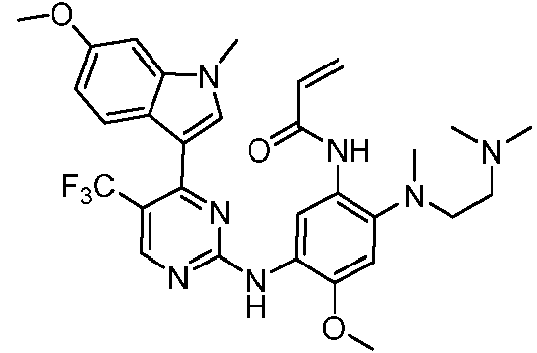
Etapa 1: preparación de 6-metoxi-1-metil-1H-indolStep 1: Preparation of 6-methoxy-1-methyl-1H-indole
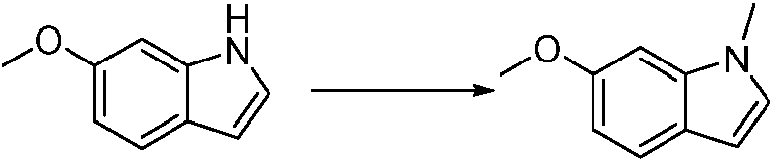
El material de partida 6-metoxi-1H-indol (1 g, 6,793 mmol) se disolvió en DMF (20 ml), y la mezcla se enfrió a 0 °C y después se añadió NaH (815 mg, 20,38 mmol). La solución de reacción se agitó a 0 °C durante diez minutos. Después se añadió yodometano (1,447 g, 10,19 mmol) al sistema de reacción. La reacción se calentó a temperatura ambiente y se agitó durante 1 hora. La solución de reacción se vertió en agua enfriada con hielo y se extrajo con acetato de etilo. Las fases orgánicas se combinaron, se lavaron con agua y salmuera saturada, se secaron sobre sulfato sódico anhidro, se filtraron y se concentraron para obtener un producto que se purificó adicionalmente por cromatografía ultrarrápida en columna sobre gel de sílice para obtener el producto 6-metoxi-1-metil-1H-indol (850 mg, 77,3 %). The starting material 6-methoxy-1H-indole (1 g, 6.793 mmol) was dissolved in DMF (20 mL), and the mixture was cooled to 0 °C, then NaH (815 mg, 20.38 mmol) was added. . The reaction solution was stirred at 0°C for ten minutes. Iodomethane (1.447 g, 10.19 mmol) was then added to the reaction system. The reaction was warmed to room temperature and stirred for 1 hour. The reaction solution was poured into ice-cold water and extracted with ethyl acetate. The organic phases were combined, washed with water and saturated brine, dried over anhydrous sodium sulfate, filtered and concentrated to obtain a product which was further purified by flash column chromatography on silica gel to obtain the 6-methoxy product. -1-methyl-1H-indole (850 mg, 77.3%).
Etapa 2: preparación de 3-(2-cloro-5-(trifluorometil)pirimidin-4-il)-6-metoxi-1-metil-1H-indolStep 2: Preparation of 3-(2-chloro-5-(trifluoromethyl)pyrimidin-4-yl)-6-methoxy-1-methyl-1H-indole

El material de partida 6-metoxi-1-metil-1H-indol (850 mg, 5,27 mmol), 2,4-dicloro-5-(trifluorometil)pirimidina (1,26 g, 5,8 mmol) y tricloruro de aluminio (1,05 g, 7,91 mmol) se disolvieron en DME (30 ml) y la reacción se agitó durante una noche a 70 °C. Después de que la reacción se completase, la solución de reacción se vertió en agua enfriada con hielo y se extrajo tres veces con metil ferc-butil éter. Las fases orgánicas se combinaron, se lavaron con agua y salmuera saturada, se secaron sobre sulfato sódico anhidro, se filtraron y se evaporaron a sequedad para obtener un producto en bruto que se purificó adicionalmente por cromatografía ultrarrápida en columna sobre gel de sílice para obtener el producto 3-(2-cloro-5-(trifluorometil)pirimidin-4-il)-6-metoxi-1-metil-1H-indol (700 mg, 39 %).Starting material 6-methoxy-1-methyl-1H-indole (850 mg, 5.27 mmol), 2,4-dichloro-5-(trifluoromethyl)pyrimidine (1.26 g, 5.8 mmol), and trichloride aluminum (1.05 g, 7.91 mmol) were dissolved in DME (30 mL) and the reaction stirred overnight at 70 °C. After the completion of the reaction, the reaction solution was poured into ice-cold water and extracted three times with methyl tert-butyl ether. The organic phases were combined, washed with water and saturated brine, dried over anhydrous sodium sulfate, filtered and evaporated to dryness to obtain a crude product which was further purified by flash column chromatography on silica gel to obtain the product 3-(2-chloro-5-(trifluoromethyl)pyrimidin-4-yl)-6-methoxy-1-methyl-1H-indole (700 mg, 39%).
Etapa 3: preparación de N-(4-fluoro-2-metoxi-5-nitrofenil)-4-(6-metoxi-1-metil-1H-indol-3-il)-5-(trifluorometil)pirimidin-2-aminaStep 3: Preparation of N-(4-fluoro-2-methoxy-5-nitrophenyl)-4-(6-methoxy-1-methyl-1H-indol-3-yl)-5-(trifluoromethyl)pyrimidin-2- amine
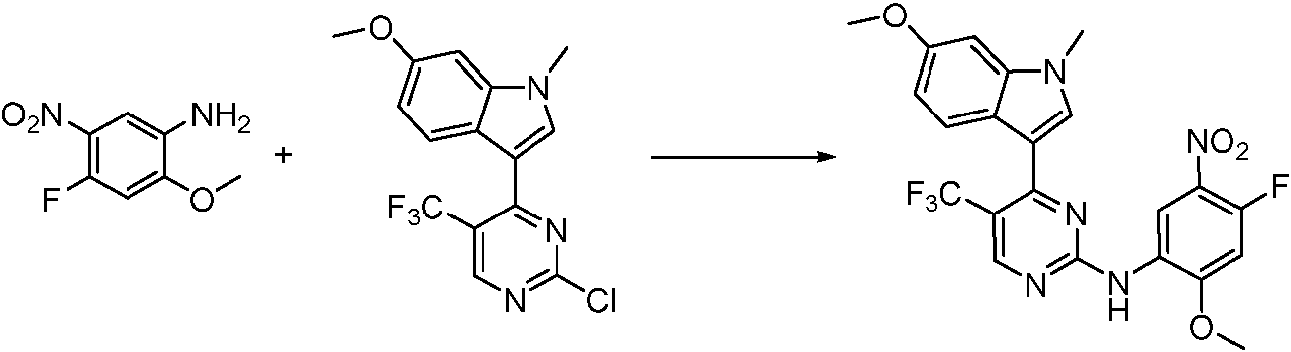
3-(2-cloro-5-(trifluorometil)pirimidin-4-il)-6-metoxi-1-metil-1H-indol (700 mg, 2,05 mmol), el material de partida 4-fluoro-2-metoxi-5-nitroanilina (419 mg, 2,25 mmol) y ácido p-toluenosulfónico monohidrato (390 mg, 2,05 mmol) se disolvieron en 2-pentanol(10 ml). La reacción se calentó hasta 120 °C y se hizo reaccionar durante una noche. Después de que la CLEM mostrase la finalización de la reacción, la solución de reacción se enfrió a temperatura ambiente de manera natural y se precipitó un sólido de color oscuro. El sólido se filtró y la torta de filtro se lavó con metanol (1 ml) y metil ferc-butil éter (1 ml) para obtener el producto N-(4-fluoro-2-metoxi-5-nitrofenil)-4-(6-metoxi-1-metil-1H-indol-3-il)-5-(trifluorometil)pirimidin-2-amina (600 mg, 60 %)3-(2-chloro-5-(trifluoromethyl)pyrimidin-4-yl)-6-methoxy-1-methyl-1H-indole (700 mg, 2.05 mmol), starting material 4-fluoro-2- methoxy-5-nitroaniline (419 mg, 2.25 mmol) and p-toluenesulfonic acid monohydrate (390 mg, 2.05 mmol) were dissolved in 2-pentanol(10 mL). The reaction was heated to 120°C and reacted overnight. After LCMS showed the completion of the reaction, the reaction solution was naturally cooled to room temperature, and a dark solid was precipitated. The solid was filtered and the filter cake washed with methanol (1 mL) and methyl tert-butyl ether (1 mL) to give the product N-(4-fluoro-2-methoxy-5-nitrophenyl)-4-( 6-methoxy-1-methyl-1H-indol-3-yl)-5-(trifluoromethyl)pyrimidin-2-amine (600mg, 60%)
Etapa 4: preparación de N1-(2-(dimetilamino)etil)-5-metoxi-N4-(4-(6-metoxi-1-metil-1H-indol-3-il)-5-(trifluorometil)pirimidin-2-il)-N1-metil-2-nitrobenceno-1,4-diaminaStep 4: Preparation of N1-(2-(dimethylamino)ethyl)-5-methoxy-N4-(4-(6-methoxy-1-methyl-1H-indol-3-yl)-5-(trifluoromethyl)pyrimidin- 2-yl)-N1-methyl-2-nitrobenzene-1,4-diamine
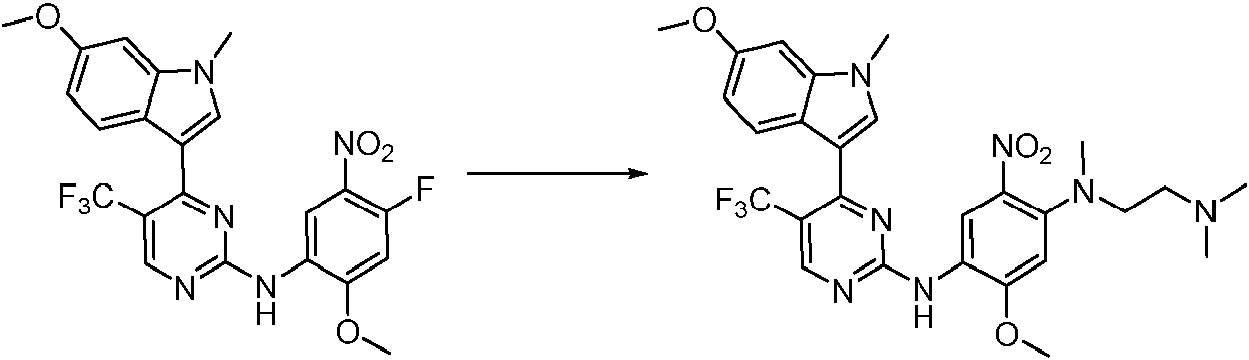
Se disolvió N-(4-fluoro-2-metoxi-5-nitrofenil)-4-(6-metoxi-1-metil-1H-indol-3-il)-5-(trifluorometil)pirimidin-2-amina (100 mg, 0,204 mmol) en DMF (5 ml). Después se añadieron trietilamina (31 mg, 0,305 mmol) y N1,N1,N2-trimetiletano-1,2-diamina (42 mg, 0,407 mmol). La reacción se calentó hasta 120 °C por microondas durante 30 minutos. Después de que la CLEM mostrase la finalización de la reacción, la solución de reacción se concentró a sequedad para obtener un producto en bruto que se purificó adicionalmente por cromatografía de capa fina preparativa para obtener el producto N1-(2-(dimetilamino)etil)-5-metoxi-N4-(4-(6-metoxi-1-metil-1H-indol-3-il)-5 -(trifluorometil)pirimidin-2-il)-N1-metil-2-nitrobenceno-1,4-diamina (90 mg, 77 %).N-(4-fluoro-2-methoxy-5-nitrophenyl)-4-(6-methoxy-1-methyl-1H-indol-3-yl)-5-(trifluoromethyl)pyrimidin-2-amine was dissolved (100 mg, 0.204 mmol) in DMF (5 mL). Triethylamine (31 mg, 0.305 mmol) and N1,N1,N2-trimethylethane-1,2-diamine (42 mg, 0.407 mmol) were then added. The reaction was heated to 120°C by microwave for 30 minutes. After LCMS showed the completion of the reaction, the reaction solution was concentrated to dryness to obtain a crude product, which was further purified by preparative thin-layer chromatography to obtain N1-(2-(dimethylamino)ethyl) product. -5-methoxy-N4-(4-(6-methoxy-1-methyl-1H-indol-3-yl)-5 -(trifluoromethyl)pyrimidin-2-yl)-N1-methyl-2-nitrobenzene-1, 4-diamine (90 mg, 77%).
Etapa 5: preparación de N1-(2-(dimetilamino)etil)-5-metoxi-N4-(4-(6-metoxi-1-metil-1H-indol-3-il)-5-(trifluorometil)pirimidin-2-il)-N1-metilbenceno-1,2,4-triaminaStep 5: Preparation of N1-(2-(dimethylamino)ethyl)-5-methoxy-N4-(4-(6-methoxy-1-methyl-1H-indol-3-yl)-5-(trifluoromethyl)pyrimidin- 2-yl)-N1-methylbenzene-1,2,4-triamine

Se disolvió N1-(2-(dimetilamino)etil)-5-metoxi-N4-(4-(6-metoxi-1-metil-1H-indol-3-il)-5-(trifluorometil)pirimidin-2-il)-N1-metil-2-nitrobenceno-1,4-diamina (90 mg, 0,157 mmol) en 10 ml de metanol y se añadió Pd/C (15 mg). La reacción se agitó en una atmósfera de hidrógeno a 24 °C durante 1 hora. Después de que la CLEM mostrase la finalización de la reacción, la solución de reacción se filtró y el filtrado se concentró. El residuo resultante se purificó por cromatografía ultrarrápida en columna sobre gel de sílice para obtener 80 mg del producto en bruto N1-(2-(dimetilamino)etil)-5-metoxi-N4-(4-(6-metoxi-1-metil-1H-indol-3-il)-5 -(trifluorometil)pirimidin-2-il)-N1-metil benceno-1,2,4-triamina.N1-(2-(dimethylamino)ethyl)-5-methoxy-N4-(4-(6-methoxy-1-methyl-1H-indol-3-yl)-5-(trifluoromethyl)pyrimidin-2-yl was dissolved )-N1-methyl-2-nitrobenzene-1,4-diamine (90 mg, 0.157 mmol) in 10 mL of methanol and Pd/C (15 mg) was added. The reaction was stirred under an atmosphere of hydrogen at 24°C for 1 hour. After LCMS showed the completion of the reaction, the reaction solution was filtered, and the filtrate was concentrated. The resulting residue was purified by flash column chromatography on silica gel to obtain 80 mg of crude N1-(2-(dimethylamino)ethyl)-5-methoxy-N4-(4-(6-methoxy-1-methyl -1H-indol-3-yl)-5 -(trifluoromethyl)pyrimidin-2-yl)-N1-methyl benzene-1,2,4-triamine.
Etapa 6: preparación de N-(2-((2-(dimetilamino)etil)(metil)amino)-4-metoxi-5-((4-(6-metoxi-1-metil-1H-indol-3-il)-5-(trifluorometil)pirimidin-2-il)amino)fenil)acrilamidaStep 6: Preparation of N-(2-((2-(dimethylamino)ethyl)(methyl)amino)-4-methoxy-5-((4-(6-methoxy-1-methyl-1H-indole-3- yl)-5-(trifluoromethyl)pyrimidin-2-yl)amino)phenyl)acrylamide

Se disolvieron N1-(2-(dimetilamino)etil)-5-metoxi-N4-(4-(6-metoxi-1-metil-1H-indol-3-il)-5-(trifluorometil)pirimidin-2-il)-N1-metilbenceno-1,2,4-triamina (80 mg, 0,147 mmol) y trietilamina (45 mg, 0,442 mmol) en tetrahidrofurano anhidro (20 ml). La solución de reacción se agitó a -78 °C durante 10 minutos, y después se añadió lentamente y gota a gota cloruro de acriloílo (0,4 ml, 1 M en THF). La reacción se agitó durante 30 minutos en un baño de hielo seco. Después de que la CLEM mostrase la finalización de la reacción, la reacción se interrumpió con metanol. La solución de reacción se concentró y el residuo resultante se purificó por cromatografía de capa fina preparativa para obtener el producto N-(2-((2-(dimetilamino)etil)(metil)amino)-4-metoxi-5-((4-(6-metoxi-1-metil-1H-indol-3-il)-5-(trifluorometil)pirimidin-2-il)amino)fenil)acrilamida (20 mg, 25 %).N1-(2-(dimethylamino)ethyl)-5-methoxy-N4-(4-(6-methoxy-1-methyl-1H-indol-3-yl)-5-(trifluoromethyl)pyrimidin-2-yl were dissolved )-N1-methylbenzene-1,2,4-triamine (80 mg, 0.147 mmol) and triethylamine (45 mg, 0.442 mmol) in anhydrous tetrahydrofuran (20 mL). The reaction solution was stirred at -78°C for 10 minutes, and then acryloyl chloride (0.4 mL, 1M in THF) was slowly added dropwise. The reaction was stirred for 30 minutes in a dry ice bath. After LCMS showed completion of the reaction, the reaction was quenched with methanol. The reaction solution was concentrated, and the resulting residue was purified by preparative thin-layer chromatography to obtain the product N-(2-((2-(dimethylamino)ethyl)(methyl)amino)-4-methoxy-5-(( 4-(6-methoxy-1-methyl-1H-indol-3-yl)-5-(trifluoromethyl)pyrimidin-2-yl)amino)phenyl)acrylamide (20mg, 25%).
RMN 1H (400 MHz, CD3OD) 88,64 (s, 1H), 8,37 (s, 1H), 8,09 (d, J = 8,6 Hz, 1H), 7,75 (s, 1H), 7,02-6,95 (m, 2H), 6,78 (dd, J = 8,8, 1,8 Hz, 1H), 6,46-6,34 (m, 2H), 5,83 (dd, J = 8,3, 3,5 Hz, 1H), 4,00 (s, 3H), 3,87 (d, J = 8,4 Hz, 6H), 3,51 (t, J = 5,7 Hz, 2H), 3,30 (t, J = 5,7 Hz, 2H), 2,88 (s, 6H), 2,72 (s, 3H);1H NMR (400 MHz, CD 3 OD) 88.64 (s, 1H), 8.37 (s, 1H), 8.09 (d, J = 8.6 Hz, 1H), 7.75 (s, 1H), 7.02-6.95 (m, 2H), 6.78 (dd, J=8.8, 1.8Hz, 1H), 6.46-6.34 (m, 2H), 5.83 (dd, J=8.3, 3.5Hz, 1H), 4.00 (s, 3H), 3.87 (d, J = 8.4 Hz, 6H), 3.51 (t, J = 5.7 Hz, 2H), 3.30 (t, J = 5 0.7 Hz, 2H), 2.88 (s, 6H), 2.72 (s, 3H);
EM m/z (IEN): 598,4 [M+H]+.MS m/z (ESI): 598.4 [M+H]+.
Ejemplo 100: preparación de N-(5-((5-doro-4-(1-ddopropil-1H-indol-3-il)pirimidm-2-il)amino)-2-((2-(dimetilamino)etil)(metil)amino)-4-metoxifenil)acrilamidaExample 100: Preparation of N-(5-((5-doro-4-(1-ddopropyl-1H-indol-3-yl)pyrimidm-2-yl)amino)-2-((2-(dimethylamino)ethyl )(methyl)amino)-4-methoxyphenyl)acrylamide

El método de preparación de N-(5-((5-doro-4-(1-cidopropil-1H-indol-3-il)pirimidin-2-il)amino)-2-((2-(di metil amino)etil)(metil)amino)-4-metoxifenil)acrilamida fue similar al del Ejemplo 98.The method of preparation of N-(5-((5-doro-4-(1-cidopropyl-1H-indol-3-yl)pyrimidin-2-yl)amino)-2-((2-(dimethyl amino )ethyl)(methyl)amino)-4-methoxyphenyl)acrylamide was similar to that of Example 98.
RMN 1H (400 MHz, CD3OD) 88,44 (s, 1H), 8,37 (d, J = 8,0 Hz, 1H), 8,31 (d, J = 10,3 Hz, 2H), 7,66 (d, J = 8,2 Hz, 1H), 7,31-7,23 (m, 1H), 7,16 (dd, J = 11,2, 4,0 Hz, 1H), 6,99 (s, 1H), 6,45 (d, J = 6,2 Hz, 2H), 5,88-5,80 (m, 1H), 3,99 (d, J = 2,8 Hz, 3H), 3,52 (dt, J = 7,1, 3,7 Hz, 3H), 3,32-3,29 (m, 2H), 2,89 (s, 6H), 2,73 (s, 3H), 1,20 (dt, J = 7,2, 3,6 Hz, 2H), 1,08-1,00 (m, 2H);1H NMR (400 MHz, CD 3 OD) 88.44 (s, 1H), 8.37 (d, J = 8.0 Hz, 1H), 8.31 (d, J = 10.3 Hz, 2H) , 7.66 (d, J = 8.2 Hz, 1H), 7.31-7.23 (m, 1H), 7.16 (dd, J = 11.2, 4.0 Hz, 1H), 6.99 (s, 1H), 6.45 (d, J = 6.2 Hz, 2H), 5.88-5.80 (m, 1H), 3.99 (d, J = 2.8 Hz , 3H), 3.52 (dt, J = 7.1, 3.7 Hz, 3H), 3.32-3.29 (m, 2H), 2.89 (s, 6H), 2.73 ( s, 3H), 1.20 (dt, J=7.2, 3.6 Hz, 2H), 1.08-1.00 (m, 2H);
EM m/z (IEN): 560,3 [M+H]+.MS m/z (ESI): 560.3 [M+H]+.
Ejemplo 101: preparación de N-(5-((4-(1-ciclopropil-1H-indol-3-il)-5-(trifluorometil)pirimidin-2-il)amino)-2 -((2-(dimetilamino)etil)(metil)amino)-4-metoxifenil)acrilamidaExample 101: Preparation of N-(5-((4-(1-cyclopropyl-1H-indol-3-yl)-5-(trifluoromethyl)pyrimidin-2-yl)amino)-2-((2-(dimethylamino )ethyl)(methyl)amino)-4-methoxyphenyl)acrylamide

El método de preparación de N-(5-((4-(1-ciclopropil-1H-indol-3-il)-5-(trifluorometil)pirimidin-2-il)amino)-2-((2 -(dimetilamino)etil)(metil)amino)-4-metoxifenil)acrilamida fue similar al del Ejemplo 98.The method of preparation of N-(5-((4-(1-cyclopropyl-1H-indol-3-yl)-5-(trifluoromethyl)pyrimidin-2-yl)amino)-2-((2 -(dimethylamino )ethyl)(methyl)amino)-4-methoxyphenyl)acrylamide was similar to that of Example 98.
RMN 1H (400 MHz, CD3OD) 88,68 (s, 1H), 8,41 (s, 1H), 8,19 (d, J = 7,8 Hz, 1H), 7,82 (s, 1H), 7,67 (d, J = 8,2 Hz, 1H), 7,26 (t, J = 7,6 Hz, 1H), 7,14 (t, J = 7,5 Hz, 1H), 6,99 (s, 1H), 6,44 (dt, J = 14,3, 7,1 Hz, 2H), 5,85 (dd, J = 9,2, 2,6 Hz, 1H), 4,01 (s, 3H), 3,60-3,44 (m, 3H), 3,29 (t, J = 5,6 Hz, 2H), 2,87 (s, 6H), 2,71 (s, 3H), 1,25-1,18 (m, 2H), 1,06-0,98 (m, 2H); EM m/z (IEN): 594,3 [M+H]+.1H NMR (400 MHz, CD 3 OD) 88.68 (s, 1H), 8.41 (s, 1H), 8.19 (d, J = 7.8 Hz, 1H), 7.82 (s, 1H), 7.67 (d, J=8.2Hz, 1H), 7.26 (t, J=7.6Hz, 1H), 7.14 (t, J=7.5Hz, 1H) , 6.99 (s, 1H), 6.44 (dt, J = 14.3, 7.1 Hz, 2H), 5.85 (dd, J = 9.2, 2.6 Hz, 1H), 4.01 (s, 3H), 3.60-3.44 (m, 3H), 3.29 (t, J = 5.6 Hz, 2H), 2.87 (s, 6H), 2.71 (s, 3H), 1.25-1.18 (m, 2H), 1.06-0.98 (m, 2H); MS m/z (ESI): 594.3 [M+H]+.
Ejemplo 102: preparación de N-(2-((2-(dimetilamino)etil)(metil)amino)-5-((4-(1-(N,N-dimetilsulfamoil)-1H-indol-3-il)pirimidin-2-il)amino)-4-metoxifenil)acrilamidaExample 102: Preparation of N-(2-((2-(dimethylamino)ethyl)(methyl)amino)-5-((4-(1-(N,N-dimethylsulfamoyl)-1H-indol-3-yl) pyrimidin-2-yl)amino)-4-methoxyphenyl)acrylamide

Etapa 1: preparación de 3-(2-cloropirimidin-4-il)-1H-indol Step 1: Preparation of 3-(2-chloropyrimidin-4-yl)-1H-indole
Se disolvieron 3-(2-cloropirimidin-4-il)-1H-indol (1 g, 4,37 mmol), 2-(difluorometoxi)-4-fluoro-5-nitroanilina (810 mg, 4,37 mmol) y ácido p-toluenosulfónico (750 mg, 4,37 mmol) en 2-pentanol (40 ml), y después la solución de reacción se calentó a 110 °C durante 3 horas. Después de que la CLEM mostrase la finalización de la reacción, la solución de reacción se enfrió a temperatura ambiente de manera natural y se precipitó un sólido de color oscuro. El sólido se filtró, y la torta de filtro se lavó con metanol y metil ferc-butil éter para obtener 3-(2-cloropirimidin-4-il)-1H-indol (1,3 g, 79 %).3-(2-chloropyrimidin-4-yl)-1H-indole (1 g, 4.37 mmol), 2-(difluoromethoxy)-4-fluoro-5-nitroaniline (810 mg, 4.37 mmol) and p-toluenesulfonic acid (750 mg, 4.37 mmol) in 2-pentanol (40 mL), and then the reaction solution was heated at 110 °C for 3 hours. After LCMS showed the completion of the reaction, the reaction solution was naturally cooled to room temperature, and a dark solid was precipitated. The solid was filtered off, and the filter cake was washed with methanol and methyl tert-butyl ether to obtain 3-(2-chloropyrimidin-4-yl)-1H-indole (1.3 g, 79%).
Etapa 2: preparación de N-(4-fluoro-2-metoxi-5-nitrofenil)-4-(1H-indol-3-il)pirimidin-2-aminaStep 2: Preparation of N-(4-fluoro-2-methoxy-5-nitrophenyl)-4-(1H-indol-3-yl)pyrimidin-2-amine
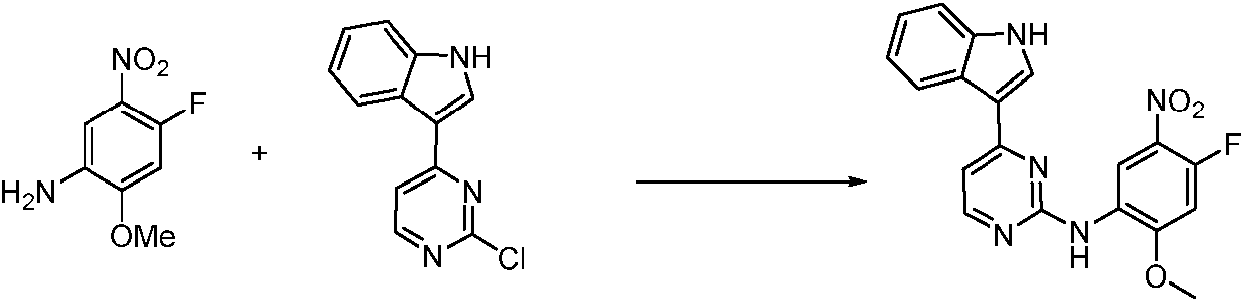
3-(2-cloropirimidin-4-il)-1H-indol (500 mg, 2,177 mmol), el material de partida 4-fluoro-2-metoxi-5-nitroanilina (445 mg, 2,394 mmol) y monohidrato de ácido p-toluenosulfónico (414 mg, 2,177 mmol) se disolvieron en 2-pentanol (20 ml). La reacción se calentó hasta 120 °C durante una noche. Después de que la CLEM mostrase la finalización de la reacción, la solución de reacción se enfrió a temperatura ambiente de manera natural y se precipitó un sólido de color oscuro. El sólido se filtró, y la torta de filtro se lavó con metanol (1 ml) y metil ferc-butil éter (1 ml) para obtener el producto N-(4-fluoro-2-metoxi-5-nitrofenil)-4-(1H-indol-3-il)pirimidin-2-amina (180 mg, 22 %).3-(2-chloropyrimidin-4-yl)-1H-indole (500 mg, 2.177 mmol), starting material 4-fluoro-2-methoxy-5-nitroaniline (445 mg, 2.394 mmol), and p-acid monohydrate -toluenesulfonic acid (414 mg, 2.177 mmol) was dissolved in 2-pentanol (20 mL). The reaction was heated to 120 °C overnight. After LCMS showed the completion of the reaction, the reaction solution was naturally cooled to room temperature, and a dark solid was precipitated. The solid was filtered off, and the filter cake was washed with methanol (1 mL) and methyl tert-butyl ether (1 mL) to give the product N-(4-fluoro-2-methoxy-5-nitrophenyl)-4- (1H-indol-3-yl)pyrimidin-2-amine (180mg, 22%).
Etapa 3: preparación de N1-(4-(1H-indol-3-il)pirimidin-2-il)-N4-(2-(dimetilamino)etil)-2-metoxi-N4-metil-5-nitrobenceno-1,4-diaminaStep 3: Preparation of N1-(4-(1H-indol-3-yl)pyrimidin-2-yl)-N4-(2-(dimethylamino)ethyl)-2-methoxy-N4-methyl-5-nitrobenzene-1 ,4-diamine
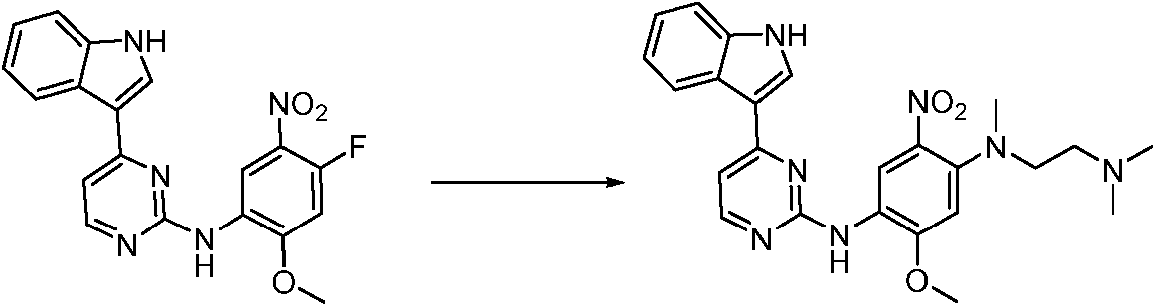
Se disolvió N-(4-fluoro-2-metoxi-5-nitrofenil)-4-(1H-indol-3-il)pirimidin-2-amina (178 mg, 0,469 mmol) en DMF (2 ml), seguido de la adición de trietilamina (142 mg, 1,41 mmol) y trimetiletilendiamina (144 mg, 1,41 mmol). La reacción se calentó hasta 120 °C por microondas y después, se hizo reaccionar durante 30 minutos. Después de que la CLEM mostrase la finalización de la reacción, la solución de reacción se concentró a sequedad para obtener un producto en bruto que se purificó adicionalmente por cromatografía de capa fina preparativa para obtener el producto N1 -(4-(1 H-indol-3-il)pirimidin-2-il)-N4-(2-(dimetilamino)etil)-2-metoxi-N4-metil-5-nitrobenceno-1,4-diamina (217 mg, 100 %). N-(4-fluoro-2-methoxy-5-nitrophenyl)-4-(1H-indol-3-yl)pyrimidin-2-amine (178 mg, 0.469 mmol) was dissolved in DMF (2 mL), followed by the addition of triethylamine (142 mg, 1.41 mmol) and trimethylethylenediamine (144 mg, 1.41 mmol). The reaction was heated to 120°C by microwave and then reacted for 30 minutes. After LCMS showed the completion of the reaction, the reaction solution was concentrated to dryness to obtain a crude product which was further purified by preparative thin-layer chromatography to obtain the product N1 -(4-(1 H-indole -3-yl)pyrimidin-2-yl)-N4-(2-(dimethylamino)ethyl)-2-methoxy-N4-methyl-5-nitrobenzene-1,4-diamine (217 mg, 100%).
Etapa 4: preparación de 3-(2-((4-((2-(dimetilamino)etil)(metil)amino) 2-metoxi-5-mtrofenil)amino)pirimidin-4-il)-N,N-dimetil-1H-indolo-1-sulfon amidaStep 4: Preparation of 3-(2-((4-((2-(dimethylamino)ethyl)(methyl)amino)2-methoxy-5-mtrophenyl)amino)pyrimidin-4-yl)-N,N-dimethyl -1H-indole-1-sulfon amide

Se disolvió N1-(4-(1H-indol-3-il)pirimidin-2-il)-N4-(2-(dimetilamino)etil)-2-metoxi-N 4-metil-5-nitrobenceno-1,4-diamina (217 mg, 0,47 mmol) en DMF (10 ml), y la mezcla se enfrió a 0 °C en un baño de hielo, después se añadió NaH (56 mg, 1,41 mmol). Después de que la reacción se llevase a cabo a 0 °C durante 10 minutos, se añadió gota a gota cloruro de dimetilsulfamoílo (74 mg, 0,52 mmol). La solución de reacción se calentó a temperatura ambiente y se agitó durante 30 minutos. Después de que la reacción se interrumpiese, se añadieron diclorometano y agua. La solución de reacción se extrajo tres veces. Las fases orgánicas se combinaron, se lavaron con bicarbonato sódico saturado, agua y salmuera saturada, se filtraron y se concentraron para obtener un producto en bruto que se purificó adicionalmente por cromatografía ultrarrápida en columna sobre gel de sílice para obtener el producto 3-(2-((4-((2-(dimetilamino)etil)(metil)amino)-2-metoxi-5-nitrofenil)amino)pirimidin-4-il)-N,N-dimetil-1H-indolo-1-sulfonamida (160 mg, 60 %).N1-(4-(1H-indol-3-yl)pyrimidin-2-yl)-N4-(2-(dimethylamino)ethyl)-2-methoxy-N 4-methyl-5-nitrobenzene-1,4 was dissolved -diamine (217 mg, 0.47 mmol) in DMF (10 mL), and the mixture was cooled to 0 °C in an ice bath, then NaH (56 mg, 1.41 mmol) was added. After the reaction was carried out at 0 °C for 10 minutes, dimethylsulfamoyl chloride (74 mg, 0.52 mmol) was added dropwise. The reaction solution was warmed to room temperature and stirred for 30 minutes. After the reaction was quenched, dichloromethane and water were added. The reaction solution was extracted three times. The organic phases were combined, washed with saturated sodium bicarbonate, water and saturated brine, filtered and concentrated to obtain a crude product which was further purified by flash column chromatography on silica gel to obtain the product 3-(2 -((4-((2-(dimethylamino)ethyl)(methyl)amino)-2-methoxy-5-nitrophenyl)amino)pyrimidin-4-yl)-N,N-dimethyl-1H-indole-1-sulfonamide (160 mg, 60%).
Etapa 5: preparación de 3-(2-((5-amino-4-((2-(dimetilamino)etil)(metil)amino)-2-metoxifenil)amin o)pirimidin-4-il)-N,N-dimetil-1H-indolo-1-sulfonamidaStep 5: Preparation of 3-(2-((5-amino-4-((2-(dimethylamino)ethyl)(methyl)amino)-2-methoxyphenyl)amin o)pyrimidin-4-yl)-N,N -dimethyl-1H-indole-1-sulfonamide

Se disolvió 3-(2-((4-((2-(dimetilamino)etil)(metil)amino) 2-metoxi-5-nitrofenil)amino)pirimidin-4-il)-N,N-dimetiMH-indolo-1-sulfonamida en metanol (5 ml), después se añadió Pd/C (15 mg) y la reacción se agitó a 24 °C durante 1 hora en una atmósfera de hidrógeno. Después de que la CLEM mostrase la finalización de la reacción, la solución de reacción se filtró y se concentró para obtener un producto en bruto que se purificó adicionalmente por cromatografía ultrarrápida en columna sobre gel de sílice para obtener el producto 3-(2-((5-amino-4-((2-(dimetilamino)etil)(metil)amino)-2-metoxifenil)amino)p yrimidin-4-il)-N,N-dimetil-1H-indolo-1-sulfonamida (90 mg, 59 %).3-(2-((4-((2-(dimethylamino)ethyl)(methyl)amino) 2-methoxy-5-nitrophenyl)amino)pyrimidin-4-yl)-N,N-dimethylMH-indolo- 1-sulfonamide in methanol (5 ml), then Pd/C (15 mg) was added and the reaction stirred at 24 °C for 1 hour under an atmosphere of hydrogen. After LCMS showed the completion of the reaction, the reaction solution was filtered and concentrated to obtain a crude product which was further purified by flash column chromatography on silica gel to obtain the product 3-(2-( (5-amino-4-((2-(dimethylamino)ethyl)(methyl)amino)-2-methoxyphenyl)amino)p yrimidin-4-yl)-N,N-dimethyl-1H-indole-1-sulfonamide ( 90mg, 59%).
Etapa 6: preparación de N-(2-((2-(dimetilamino)etil)(metil)amino)-5-((4-(1-(N,N-dimetilsulfamoil)-1H-indol-3-il)pirimidin-2-il)amino)-4-metoxifenil)acrilamidaStep 6: Preparation of N-(2-((2-(dimethylamino)ethyl)(methyl)amino)-5-((4-(1-(N,N-dimethylsulfamoyl)-1H-indol-3-yl) pyrimidin-2-yl)amino)-4-methoxyphenyl)acrylamide
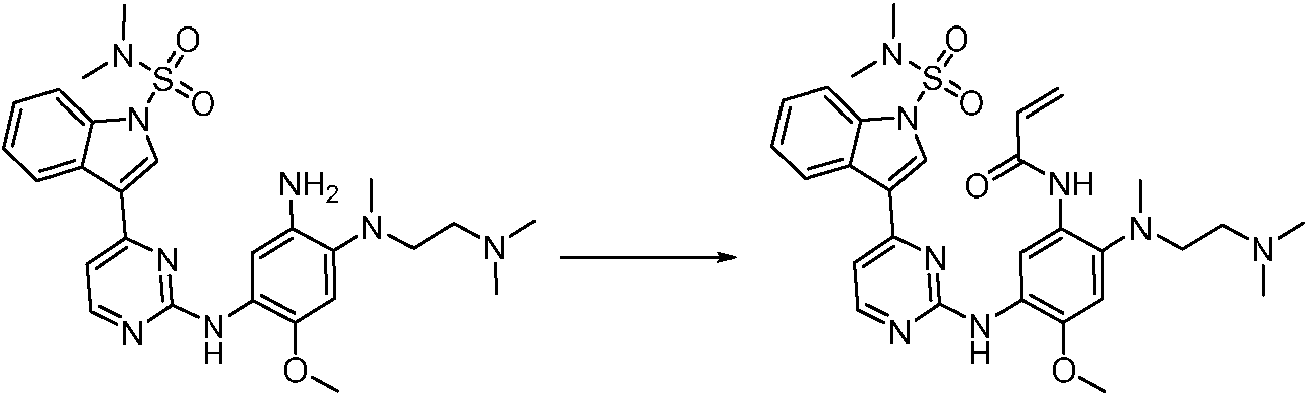
Se disolvieron 3-(2-((5-amino-4-((2-(dimetilamino)etil)(metil)amino)-2-metoxifenil)amino)pirimidin-4-il)-N,N-dimetil-1H-indolo-1-sulfonamida (90 mg, 0,167 mmol) y trietilamina (51 mg, 0,501 mmol) en tetrahidrofurano anhidro (30 ml) y la solución de reacción se agitó a -78 °C durante 10 minutos. Se añadió lentamente y gota a gota cloruro de acriloílo (0,5 ml, 1M en THF). La reacción se agitó en un baño de hielo seco durante 30 minutos. Después de que la CLEM mostrase la finalización de la reacción, la reacción se interrumpió con metanol. La solución de reacción se concentró, y el residuo resultante se purificó por cromatografía de capa fina preparativa para obtener el producto N-(2-((2-(dimetilamino)etil)(metil)amino)-5-((4-(1-(N,N-dimetilsulfamoil)-1H-indol-3-il)pirimidin-2-il)amino)-4-metoxifenil)acrilamida (10 mg, 10 %).3-(2-((5-amino-4-((2-(dimethylamino)ethyl)(methyl)amino)-2-methoxyphenyl)amino)pyrimidin-4-yl)-N,N-dimethyl-1H -indole-1-sulfonamide (90 mg, 0.167 mmol) and triethylamine (51 mg, 0.501 mmol) in anhydrous tetrahydrofuran (30 mL), and the reaction solution was stirred at -78 °C for 10 minutes. Acryloyl chloride (0.5 mL, 1M in THF) was added slowly dropwise. The reaction was stirred in a dry ice bath for 30 minutes. After LCMS showed completion of the reaction, the reaction was quenched with methanol. The reaction solution was concentrated, and the resulting residue was purified by preparative thin-layer chromatography to obtain the product N-(2-((2-(dimethylamino)ethyl)(methyl)amino)-5-((4-( 1-(N,N-dimethylsulfamoyl)-1H-indol-3-yl)pyrimidin-2-yl)amino)-4-methoxyphenyl)acrylamide (10mg, 10%).
RMN 1H (400 MHz, CD3OD) 88,62 (s, 1H), 8,44 (d, J = 7,9 Hz, 1H), 8,27 (d, J = 6,2 Hz, 1H), 8,10 (s, 1H), 8,00 (d, J = 8,3 Hz, 1H), 7,54 (d, J = 6,3 Hz, 1H), 7,37 (dt, J = 15,0, 7,3 Hz, 2H), 7,06 (s, 1H), 6,58 (dd, J = 16,9, 10,0 Hz, 1H), 6,46 (dd, J = 16,9, 1,8 Hz, 1H), 5,86 (dd, J = 10,0, 1,7 Hz, 1H), 3,98 (s, 3H), 3,55 (t, J = 5,7 Hz, 2H), 3,36 (d, J = 5,9 Hz, 2H), 2,92 (d, J = 3,7 Hz, 12H), 2,79 (s, 3H);1H NMR (400 MHz, CD 3 OD) 88.62 (s, 1H), 8.44 (d, J = 7.9 Hz, 1H), 8.27 (d, J = 6.2 Hz, 1H) , 8.10 (s, 1H), 8.00 (d, J = 8.3 Hz, 1H), 7.54 (d, J = 6.3 Hz, 1H), 7.37 (dt, J = 15.0, 7.3 Hz, 2H), 7.06 (s, 1H), 6.58 (dd, J=16.9, 10.0 Hz, 1H), 6.46 (dd, J=16 .9, 1.8Hz, 1H), 5.86 (dd, J = 10.0, 1.7Hz, 1H), 3.98 (s, 3H), 3.55 (t, J = 5, 7 Hz, 2H), 3.36 (d, J=5.9 Hz, 2H), 2.92 (d, J=3.7 Hz, 12H), 2.79 (s, 3H);
EM m/z (IEN): 593,5 [M+H]+.MS m/z (ESI): 593.5 [M+H]+.
Ejemplo 103: preparación de N-(2-((2-(dietilamino)etil)(metil)amino)-5-((4-(1-(N,N-dimetilsulfamoil)-1H -indol-3-il)pirimidin-2-il)amino)-4-metoxifenil)acrilamidaExample 103: Preparation of N-(2-((2-(diethylamino)ethyl)(methyl)amino)-5-((4-(1-(N,N-dimethylsulfamoyl)-1H-indol-3-yl) pyrimidin-2-yl)amino)-4-methoxyphenyl)acrylamide

Etapa 1: preparación de N1-(4-(1H-indol-3-il)pirimidin-2-il)-N4-(2-(dietilamino)etil)-2-metoxi-N4-metil-5-nitrobenceno-1,4-diamina Step 1: Preparation of N1-(4-(1H-indol-3-yl)pyrimidin-2-yl)-N4-(2-(diethylamino)ethyl)-2-methoxy-N4-methyl-5-nitrobenzene-1 ,4-diamine

Se disolvió N-(4-fluoro-2-metoxi-5-nitrofenil)-4-(1H-indol-3-il)pirimidin-2-amina (120 mg, 0,316 mmol) en DMF (2 ml). Se añadieron trietilamina (96 mg, 0,949 mmol) y N,N-dietil-N-metiletano-1,2-diamina (124 mg, 0,949 mmol). La reacción se calentó hasta 120 °C por microondas y se hizo reaccionar durante 30 minutos. Después de que la CLEM mostrase la finalización de la reacción, la solución de reacción se concentró a sequedad para obtener un producto en bruto que se purificó adicionalmente por cromatografía de capa fina preparativa para obtener el producto N1-(4-(1H-indol-3-il)pirimidin-2-il)-N4-(2-(dietilamino)etil)-2-metoxi-N4-metil-5-nitrobenceno-1,4-diamina (155 mg, 100 %).N-(4-Fluoro-2-methoxy-5-nitrophenyl)-4-(1H-indol-3-yl)pyrimidin-2-amine (120mg, 0.316mmol) was dissolved in DMF (2ml). Triethylamine (96 mg, 0.949 mmol) and N,N-diethyl-N-methylethane-1,2-diamine (124 mg, 0.949 mmol) were added. The reaction was heated to 120°C by microwave and reacted for 30 minutes. After LCMS showed the completion of the reaction, the reaction solution was concentrated to dryness to obtain a crude product which was further purified by preparative thin-layer chromatography to obtain the product N1-(4-(1H-indole- 3-yl)pyrimidin-2-yl)-N4-(2-(diethylamino)ethyl)-2-methoxy-N4-methyl-5-nitrobenzene-1,4-diamine (155 mg, 100%).
Etapa 2: preparación de 3-(2-((4-((2-(dietilamino)etil)(metil)amino)-2-metoxi-5-nitrofenil)amino)pirimidin-4-il)-N,N-dimetil-1H-indolo-1-sulfonamidaStep 2: Preparation of 3-(2-((4-((2-(diethylamino)ethyl)(methyl)amino)-2-methoxy-5-nitrophenyl)amino)pyrimidin-4-yl)-N,N- dimethyl-1H-indolo-1-sulfonamide

Se disolvió N1-(4-(1H-indol-3-il)pirimidin-2-il)-N4-(2-(dietilamino)etil)-2-metoxi-N4-metil-5-nitrobenceno-1,4-diamina (155 mg, 0,316 mmol) en DMF (10 ml). La reacción se enfrió a 0 °C en un baño de hielo, y después, se añadió NaH (38 mg, 0,945 mmol). Después de que la reacción se llevase a cabo durante 10 minutos a 0 °C, se añadió gota a gota cloruro de dimetilsulfamoílo (55 mg, 0,38 mmol). La solución de reacción se calentó a temperatura ambiente y se agitó durante 30 minutos. Después de que la reacción se interrumpiese, se añadieron diclorometano y agua. La solución de reacción se extrajo tres veces. Las fases orgánicas se combinaron, se lavaron con una solución acuosa saturada de bicarbonato sódico, agua y salmuera saturada, se filtraron y se evaporaron a sequedad para obtener un producto en bruto que se purificó adicionalmente por cromatografía ultrarrápida en columna sobre gel de sílice para obtener el producto 3-(2-((4-((2-(dietilamino)etil)(metil)amino)-2-metoxi-5-nitrofenil)amino)piri midin-4-il)-N,N-dimetil-1H-indolo-1-sulfonamida (130 mg, 19 %).N1-(4-(1H-indol-3-yl)pyrimidin-2-yl)-N4-(2-(diethylamino)ethyl)-2-methoxy-N4-methyl-5-nitrobenzene-1,4- diamine (155 mg, 0.316 mmol) in DMF (10 mL). The reaction was cooled to 0 °C in an ice bath, then NaH (38 mg, 0.945 mmol) was added. After the reaction was carried out for 10 minutes at 0 °C, dimethylsulfamoyl chloride (55 mg, 0.38 mmol) was added dropwise. The reaction solution was warmed to room temperature and stirred for 30 minutes. After the reaction was quenched, dichloromethane and water were added. The reaction solution was extracted three times. The organic phases were combined, washed with saturated aqueous sodium bicarbonate solution, water and saturated brine, filtered and evaporated to dryness to obtain a crude product which was further purified by flash column chromatography on silica gel to obtain the product 3-(2-((4-((2-(diethylamino)ethyl)(methyl)amino)-2-methoxy-5-nitrophenyl)amino)pyrimidin-4-yl)-N,N-dimethyl- 1H-indole-1-sulfonamide (130mg, 19%).
Etapa 3: preparación de 3-(2-((5-amino-4-((2-(dietilamino)etil)(metil)amino)-2-metoxifenil)amino) pirimidin-4-il)-N,N-dimetil-1H-indolo-1-sulfonamidaStep 3: Preparation of 3-(2-((5-amino-4-((2-(diethylamino)ethyl)(methyl)amino)-2-methoxyphenyl)amino)pyrimidin-4-yl)-N,N- dimethyl-1H-indolo-1-sulfonamide

Se disolvió 3-(2-((4-((2-(dietilamino)etil)(metil)amino)-2-metoxi-5-nitrofenil)amino) pirimidin-4-il)-N,N-dimetil-1H-indolo-1-sulfonamida en metanol (5 ml) y se añadió Pd/C (15 mg). La reacción se agitó en una atmósfera de hidrógeno a 24 °C durante 1 hora. Después de que la CLEM mostrase la finalización de la reacción, la solución de reacción se filtró y el filtrado se concentró. El residuo resultante se purificó por cromatografía ultrarrápida en columna sobre gel de sílice para obtener 118 mg del producto en bruto 3-(2-((5-amino-4-((2-(dietilamino)etil)(metil)amino)-2-metoxifenil)amino)piri midin-4-il)-N,N-dimetil-1H-indolo-1-sulfonamida.3-(2-((4-((2-(diethylamino)ethyl)(methyl)amino)-2-methoxy-5-nitrophenyl)amino)pyrimidin-4-yl)-N,N-dimethyl-1H was dissolved -indole-1-sulfonamide in methanol (5 mL) and Pd/C (15 mg) was added. The reaction was stirred under an atmosphere of hydrogen at 24°C for 1 hour. After LCMS showed the completion of the reaction, the reaction solution was filtered, and the filtrate was concentrated. The resulting residue was purified by flash column chromatography on silica gel to obtain 118 mg of crude product 3-(2-((5-amino-4-((2-(diethylamino)ethyl)(methyl)amino)- 2-methoxyphenyl)amino)pyrimidin-4-yl)-N,N-dimethyl-1H-indole-1-sulfonamide.
Etapa 4: preparación de N-(2-((2-(dietilamino)etil)(metil)amino)-5-((4-(1-(N,N-dimetilsulfamoil)-1H-indol-3-il)pirimidin-2-il)amino)-4-metoxifenil)acrilamida Step 4: Preparation of N-(2-((2-(diethylamino)ethyl)(methyl)amino)-5-((4-(1-(N,N-dimethylsulfamoyl)-1H-indol-3-yl) pyrimidin-2-yl)amino)-4-methoxyphenyl)acrylamide

Se disolvieron 3-(2-((5-amino-4-((2-(dietilamino)etil)(metil)amino)-2-metoxifenil)amino)pirimidin-4-il)-N,N-dimetil-1H-indolo-1-sulfonamida (118 mg, 0,208 mmol) y trietilamina (63 mg, 0,624 mmol) en tetrahidrofurano anhidro (30 ml). La solución de reacción se agitó a -78 °C durante 10 minutos, después se añadió lentamente y gota a gota cloruro de acriloílo (0,62 ml, 1 M en THF). La reacción se agitó durante 30 minutos en un baño de hielo seco. Después de que la CLEM mostrase la finalización de la reacción, la reacción se interrumpió con metanol. La solución de reacción se concentró, y el residuo resultante se purificó por cromatografía de capa fina preparativa para obtener el producto N-(2-((2-(dietilamino)etil)(metil)amino)-5-((4-(1-(N,N-dimetilsulfamoil)-1H-in dol-3-il)pirimidin-2-il)amino)-4-metoxifenil)acrilamida (4,8 mg, 3,7 %).3-(2-((5-amino-4-((2-(diethylamino)ethyl)(methyl)amino)-2-methoxyphenyl)amino)pyrimidin-4-yl)-N,N-dimethyl-1H -indolo-1-sulfonamide (118 mg, 0.208 mmol) and triethylamine (63 mg, 0.624 mmol) in anhydrous tetrahydrofuran (30 mL). The reaction solution was stirred at -78°C for 10 minutes, then acryloyl chloride (0.62 mL, 1M in THF) was slowly added dropwise. The reaction was stirred for 30 minutes in a dry ice bath. After LCMS showed completion of the reaction, the reaction was quenched with methanol. The reaction solution was concentrated, and the resulting residue was purified by preparative thin-layer chromatography to obtain the product N-(2-((2-(diethylamino)ethyl)(methyl)amino)-5-((4-( 1-(N,N-dimethylsulfamoyl)-1H-yn dol-3-yl)pyrimidin-2-yl)amino)-4-methoxyphenyl)acrylamide (4.8mg, 3.7%).
RMN 1H (400 MHz, CD3OD) 58,61 (s, 1H), 8,46 (d, J = 8,0 Hz, 1H), 8,33 (d, J = 6,1 Hz, 1H), 8,08 (s, 1H), 8,02 (d, J = 8.3 Hz, 1H), 7,55 (d, J = 6,1 Hz, 1H), 7,45-7,26 (m, 2H), 7,04 (s, 1H), 6,48 (cd, J = 17,0, 5,9 Hz, 2H), 5,87 (dd, J = 9,4, 2,5 Hz, 1H), 4,01 (s, 3H), 3,57 (t, J = 5,7 Hz, 2H), 3,25 (dt, J = 19,4, 7,2 Hz, 4H), 2,93 (s, 6H), 2,79 (s, 3H), 1,29 (t, J = 7.3 Hz, 6H);1H NMR (400 MHz, CD 3 OD) 58.61 (s, 1H), 8.46 (d, J = 8.0 Hz, 1H), 8.33 (d, J = 6.1 Hz, 1H) , 8.08 (s, 1H), 8.02 (d, J = 8.3 Hz, 1H), 7.55 (d, J = 6.1 Hz, 1H), 7.45-7.26 (m, 2H), 7.04 (s, 1H), 6.48 (cd, J=17.0, 5.9 Hz, 2H), 5.87 (dd, J=9.4, 2.5 Hz, 1H ), 4.01 (s, 3H), 3.57 (t, J=5.7Hz, 2H), 3.25 (dt, J=19.4, 7.2Hz, 4H), 2.93 (s, 6H), 2.79 (s, 3H), 1.29 (t, J = 7.3 Hz, 6H);
EM m/z (IEN): 621,5 [M+H]+.MS m/z (ESI): 621.5 [M+H]+.
Ejemplo 104: preparación de N-(2-((2-(dimetilamino)etil)(metil)amino)-4-metoxi-5-((4-(1-(oxetan-3-il)-1H-indol-3-il)pirimidin-2-il)amino)fenil)acrilamidaExample 104: Preparation of N-(2-((2-(dimethylamino)ethyl)(methyl)amino)-4-methoxy-5-((4-(1-(oxetan-3-yl)-1H-indol- 3-yl)pyrimidin-2-yl)amino)phenyl)acrylamide

Etapa 1: preparación de 3-(2-cloropirimidin-4-il)-1-(oxetan-3-il)-1H-indolStep 1: Preparation of 3-(2-chloropyrimidin-4-yl)-1-(oxetan-3-yl)-1H-indole

Se mezclaron 3-(2-cloropirimidin-4-il)-1H-indol (500 mg, 2,18 mmol), 3-yodo-oxetano (480 mg, 2,61 mmol) y carbonato de cesio (1,42 g, 4,36 mmol) en d Mf (5 ml). La reacción se llevó a cabo a 110 °C durante 1 hora en microondas. Después de un periodo de refrigeración, la solución de reacción se diluyó con CH2Ch. La fase orgánica se lavó tres veces con salmuera saturada, se secó sobre sulfato sódico anhidro, se concentró y se purificó por cromatografía en columna para obtener el compuesto del título 3-(2-cloropirimidin-4-il)-1-(oxetan-3-il)-1H-indol (110 mg, 18 %).3-(2-chloropyrimidin-4-yl)-1H-indole (500 mg, 2.18 mmol), 3-iodo-oxetane (480 mg, 2.61 mmol) and cesium carbonate (1.42 g) were mixed. , 4.36 mmol) in dMf (5 mL). The reaction was carried out at 110 °C for 1 hour in microwave. After a period of cooling, the reaction solution was diluted with CH 2 Ch. The organic phase was washed three times with saturated brine, dried over anhydrous sodium sulfate, concentrated and purified by column chromatography to obtain the compound of title 3-(2-chloropyrimidin-4-yl)-1-(oxetan-3-yl)-1H-indole (110 mg, 18%).
RMN 1H (400 MHz, CDCh): 58,54 (d, J = 5,2 Hz, 1H), 8,38 (m, 1H), 8,33 (s, 1H), 7,60 (d, J = 5,2 Hz, 1H), 7,54 (m, 1H), 7,38 (m, 2H), 5,66 (m, 1H), 5,26 (t, J = 7,6 Hz, 2H), 5,14 (t, J = 7,6 Hz, 2H);1H NMR (400 MHz, CDCh): 58.54 (d, J = 5.2 Hz, 1H), 8.38 (m, 1H), 8.33 (s, 1H), 7.60 (d, J = 5.2 Hz, 1H), 7.54 (m, 1H), 7.38 (m, 2H), 5.66 (m, 1H), 5.26 (t, J = 7.6 Hz, 2H ), 5.14 (t, J = 7.6 Hz, 2H);
EM m/z (IEN): 286,1 [M+H]+.MS m/z (ESI): 286.1 [M+H]+.
Etapa 2: preparación de N-(4-fluoro-2-metoxi-5-nitrofenil)-4-(1-(oxetan-3-il)-1H-indol-3-il)pirimidin-2-amina Step 2: Preparation of N-(4-fluoro-2-methoxy-5-nitrophenyl)-4-(1-(oxetan-3-yl)-1H-indol-3-yl)pyrimidin-2-amine

Se mezclaron 3-(2-cloropirimidin-4-il)-1-(oxetan-3-il)-1H-indol (110 mg, 0,385 mmol), 4-fluoro-2-metoxi-5-nitroanilina (86 mg, 0,462 mmol), acetato de paladio (9 mg, 0,0385 mmol) y carbonato de cesio (376 mg, 1,16 mmol) en una mezcla de DMA (1 ml) y 1,4-dioxano (2 ml). La mezcla de reacción se purgó con nitrógeno para retirar oxígeno durante 15 minutos. Se añadió Xantphos (45 mg, 0,0770 mmol) y la mezcla de reacción se purgó adicionalmente con nitrógeno durante 5 minutos. La reacción se llevó a cabo a 160 °C durante 30 minutos en un reactor de microondas. Después de un periodo de refrigeración, la mezcla de reacción se diluyó con CH2Ch, se lavó con salmuera saturada, se secó sobre sulfato sódico anhidro, se concentró y se purificó por cromatografía de capa fina preparativa para obtener el compuesto del título N-(4-fluoro-2-metoxi-5-nitrofenil)-4-(1-(oxetan-3-il)-1H-indol-3-il)pirimidin-2-a mine (80 mg, 46 %). EM m/z (IEN): 436,1 [M+H]+.3-(2-chloropyrimidin-4-yl)-1-(oxetan-3-yl)-1H-indole (110 mg, 0.385 mmol), 4-fluoro-2-methoxy-5-nitroaniline (86 mg, 0.462 mmol), palladium acetate (9 mg, 0.0385 mmol), and cesium carbonate (376 mg, 1.16 mmol) in a mixture of DMA (1 mL) and 1,4-dioxane (2 mL). The reaction mixture was purged with nitrogen to remove oxygen for 15 minutes. Xantphos (45 mg, 0.0770 mmol) was added and the reaction mixture was further purged with nitrogen for 5 minutes. The reaction was carried out at 160 °C for 30 minutes in a microwave reactor. After a period of cooling, the reaction mixture was diluted with CH 2 Ch, washed with saturated brine, dried over anhydrous sodium sulfate, concentrated and purified by preparative thin layer chromatography to obtain the title compound N- (4-fluoro-2-methoxy-5-nitrophenyl)-4-(1-(oxetan-3-yl)-1H-indol-3-yl)pyrimidin-2-amine (80mg, 46%). MS m/z (ESI): 436.1 [M+H]+.
Etapa 3: preparación de N1-(2-(dimetilamino)etil)-5-metoxi-N1-metil-2-mtro-N4-(4-(1-(oxetan-3-il)-1H-indol-3-il)pirimidin-2-il)benceno-1,4-diaminaStep 3: Preparation of N1-(2-(dimethylamino)ethyl)-5-methoxy-N1-methyl-2-mtro-N4-(4-(1-(oxetan-3-yl)-1H-indole-3- yl)pyrimidin-2-yl)benzene-1,4-diamine

Se añadieron trimetiletilendiamina (0,1 ml) y DIPEA (0,1 ml) a una solución de N-(4-fluoro-2-metoxi-5-nitrofenil)-4-(1-(oxetan-3-il)-1H-indol-3-il)pirimidin-2-amina (80 mg, 0,18 mmol) en DMA (1 ml). La mezcla de reacción se agitó a 85 °C durante 3 horas. Después de un periodo de refrigeración, se añadió agua y después, se precipitó un sólido. El sólido se purificó por cromatografía de capa fina preparativa para obtener el compuesto N1-(2-(dimetilamino)etil)-5-metoxi-N1-metil-2-nitro-N4-(4-(1-(oxetan-3-il)-1H -indol-3-il)pirimidin-2-il)benceno-1,4-diamina (35 mg, 38 %).Trimethylethylenediamine (0.1 mL) and DIPEA (0.1 mL) were added to a solution of N-(4-fluoro-2-methoxy-5-nitrophenyl)-4-(1-(oxetan-3-yl)- 1H-indol-3-yl)pyrimidin-2-amine (80 mg, 0.18 mmol) in DMA (1 mL). The reaction mixture was stirred at 85°C for 3 hours. After a period of cooling, water was added and then a solid precipitated. The solid was purified by preparative thin layer chromatography to obtain the compound N1-(2-(dimethylamino)ethyl)-5-methoxy-N1-methyl-2-nitro-N4-(4-(1-(oxetan-3- yl)-1 H -indol-3-yl)pyrimidin-2-yl)benzene-1,4-diamine (35 mg, 38%).
EM m/z (IEN): 518,2 [M+H]+.MS m/z (ESI): 518.2 [M+H]+.
Etapa 4: preparación de N1-(2-(dimetilamino)etil)-5-metoxi-N1-metil-N4-(4-(1-(oxetan-3-il)-1H-ind ol-3-il)pirimidin-2-il)benceno-1,2,4-triaminaStep 4: Preparation of N1-(2-(dimethylamino)ethyl)-5-methoxy-N1-methyl-N4-(4-(1-(oxetan-3-yl)-1H-ind ol-3-yl)pyrimidin -2-yl)benzene-1,2,4-triamine

Se mezclaron N1-(2-(dimetilamino)etil)-5-metoxi-N1-metil-2-nitro-N4-(4-(1-(oxetan-3-il)-1H-indol-3-il)pirimidin-2-il)benceno-1,4-diamina (28 mg, 0,054 mmol), polvo de hierro reducido (30 mg, 0,54 mmol) y cloruro de amonio (2,0 mg, 0,032 mmol) en una mezcla de etanol (3 ml) y agua (1 ml), y después la mezcla de reacción se calentó a reflujo durante una hora, después se enfrió y se filtró a través de celite. El filtrado resultante se concentró y se purificó por cromatografía de capa fina preparativa para obtener el compuesto del título N1-(2-(dimetilamino)etil)-5-metoxi-N1-metil-N4-(4-(1-(oxetan-3-il)-1H-indol-3 -il)pirimidin-2-il)benceno-1,2,4-triamina (25 mg, 95 %).N1-(2-(dimethylamino)ethyl)-5-methoxy-N1-methyl-2-nitro-N4-(4-(1-(oxetan-3-yl)-1H-indol-3-yl)pyrimidin -2-yl)benzene-1,4-diamine (28 mg, 0.054 mmol), reduced iron powder (30 mg, 0.54 mmol), and ammonium chloride (2.0 mg, 0.032 mmol) in a mixture of ethanol (3 mL) and water (1 mL), then the reaction mixture was refluxed for one hour, then cooled and filtered through celite. The resulting filtrate was concentrated and purified by preparative thin layer chromatography to obtain the title compound N1-(2-(dimethylamino)ethyl)-5-methoxy-N1-methyl-N4-(4-(1-(oxetan- 3-yl)-1H-indol-3-yl)pyrimidin-2-yl)benzene-1,2,4-triamine (25mg, 95%).
EM m/z (IEN): 488,3 [M+H]+.MS m/z (ESI): 488.3 [M+H]+.
Etapa 5: preparación de N-(2-((2-(dimetilamino)etil)(metil)amino)-4-metoxi-5-((4-(1-(oxetan-3-il)-1H-indol-3-il)pirimidin-2-il)amino)fenil)acrilamida Step 5: Preparation of N-(2-((2-(dimethylamino)ethyl)(methyl)amino)-4-methoxy-5-((4-(1-(oxetan-3-yl)-1H-indol- 3-yl)pyrimidin-2-yl)amino)phenyl)acrylamide

Una solución de cloruro de acriloílo (0,025 ml, 0,31 mmol) en THF (0,5 ml) se añadió gota a gota a una solución de N1-(2-(dimetilamino)etil)-5-metoxi-N1-metil-N4-(4-(1-(oxetan-3-il)-1H-indol-3-il)pirimidin-2-il)benceno-1,2,4-triamina (25 mg, 0,051 mmol) y trietilamina (0,050 ml, 0,36 mmol) en THF (2 ml) a -15 °C. Después de que se completara la adición, la mezcla se agitó a esta temperatura durante 5 minutos, se inactivó con metanol, y se purificó por cromatografía de capa fina preparativa para obtener el compuesto del título N-(2-((2-(dimetilamino)etil)(metil)amino)-4-metoxi-5-((4-(1-(oxetan-3-il)-1H-i ndol-3-il)pirimidin-2-il)amino)fenil)acrilamida (7 mg, 25 %).A solution of acryloyl chloride (0.025 mL, 0.31 mmol) in THF (0.5 mL) was added dropwise to a solution of N1-(2-(dimethylamino)ethyl)-5-methoxy-N1-methyl -N4-(4-(1-(oxetan-3-yl)-1H-indol-3-yl)pyrimidin-2-yl)benzene-1,2,4-triamine (25 mg, 0.051 mmol) and triethylamine ( 0.050 mL, 0.36 mmol) in THF (2 mL) at -15 °C. After the addition was complete, the mixture was stirred at this temperature for 5 minutes, quenched with methanol, and purified by preparative thin-layer chromatography to give the title compound N-(2-((2-(dimethylamino )ethyl)(methyl)amino)-4-methoxy-5-((4-(1-(oxetan-3-yl)-1H-i ndol-3-yl)pyrimidin-2-yl)amino)phenyl)acrylamide (7mg, 25%).
RMN 1H (400 MHz, CDCh): 810,2 (s a, 1H), 9,80 (s, 1H), 9,06 (s, 1H), 8,42 (d, J = 5,2 Hz, 1H), 8,10 (m, 1H), 7,73 (m, 2H), 7,30 (m, 2H), 7,23 (d, J = 5,2 Hz, 1H), 6,79 (s, 1H), 6,44 (m, 2H), 5,89 (m, 1H), 5,74 (m, 1H), 5,38 (t, J = 6,8 Hz, 2H), 5,15 (t, J = 7,6 Hz, 2H), 3,89 (s, 3H), 2,92 (m, 2H), 2,71 (s, 3H), 2,29 (m, 8H);1H NMR (400 MHz, CDCh): 810.2 (brs, 1H), 9.80 (s, 1H), 9.06 (s, 1H), 8.42 (d, J = 5.2 Hz, 1H ), 8.10 (m, 1H), 7.73 (m, 2H), 7.30 (m, 2H), 7.23 (d, J = 5.2 Hz, 1H), 6.79 (s , 1H), 6.44 (m, 2H), 5.89 (m, 1H), 5.74 (m, 1H), 5.38 (t, J = 6.8 Hz, 2H), 5.15 (t, J = 7.6 Hz, 2H), 3.89 (s, 3H), 2.92 (m, 2H), 2.71 (s, 3H), 2.29 (m, 8H);
EM m/z (IEN): 542,3 [M+H]+.MS m/z (ESI): 542.3 [M+H]+.
Ejemplo 105: preparación de N-(2-((2-(dimetilamino)etil)(metil)amino)-5-((4-(5-etoxi-1H-indazol-1-il)pirimidin-2-il)amino)-4-metoxifenil)acrilamidaExample 105: Preparation of N-(2-((2-(dimethylamino)ethyl)(methyl)amino)-5-((4-(5-ethoxy-1H-indazol-1-yl)pyrimidin-2-yl) amino)-4-methoxyphenyl)acrylamide

Etapa 1: preparación de 5-etoxi-1H-indazolStep 1: Preparation of 5-ethoxy-1H-indazole
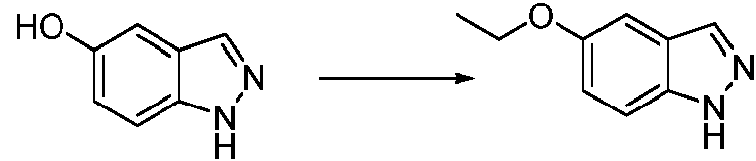
Se disolvió 5-hidroxi-1H-indazol (2,68 g, 20 mmol) en DMF (50 ml), y después se añadieron yoduro de etilo (3,28 g, 21 mmol) y carbonato potásico (4,16 g, 30 mmol). La mezcla se agitó a temperatura ambiente durante 24 horas, se extrajo con acetato de etilo y se purificó por cromatografía en columna para obtener 5-etoxi-1H-indazol (1,5 g, 46 %). RMN 1H (400 MHz, CDCla) 88,73-8,18 (m, 1H), 8,03 (d, J = 0,9 Hz, 1H), 7,42 (d, J = 8,6 Hz, 1H), 7,15-7,06 (m, 2H), 4,10 (c, J = 7,0 Hz, 2H), 1,48 (t, J = 7,0 Hz, 3H);5-Hydroxy-1H-indazole (2.68 g, 20 mmol) was dissolved in DMF (50 mL), then ethyl iodide (3.28 g, 21 mmol) and potassium carbonate (4.16 g, 30mmol). The mixture was stirred at room temperature for 24 hours, extracted with ethyl acetate and purified by column chromatography to obtain 5-ethoxy-1H-indazole (1.5 g, 46%). 1H NMR (400 MHz, CDCla) 88.73-8.18 (m, 1H), 8.03 (d, J=0.9 Hz, 1H), 7.42 (d, J=8.6 Hz, 1H), 7.15-7.06 (m, 2H), 4.10 (c, J=7.0 Hz, 2H), 1.48 (t, J=7.0 Hz, 3H);
EM m/z (IEN): 163 [M+H]+.MS m/z (ESI): 163 [M+H]+.
Etapas 2 y 3: preparación de 5-etoxi-1-(2-(metilsulfonil)pirimidin-4-il)-1H-indazolSteps 2 and 3: Preparation of 5-ethoxy-1-(2-(methylsulfonyl)pyrimidin-4-yl)-1H-indazole

El método de preparación de 5-etoxi-1-(2-(metilsulfonil)pirimidin-4-il)-1H-indazol fue similar al del Ejemplo 43.The method of preparation of 5-ethoxy-1-(2-(methylsulfonyl)pyrimidin-4-yl)-1H-indazole was similar to that of Example 43.
Etapa 4: preparación de 4-(5-etoxi-1H-indazol-1-il)-N-(4-fluoro-2-metoxi-5-nitrofenil)pirimidin-2-amina Step 4: Preparation of 4-(5-ethoxy-1H-indazol-1-yl)-N-(4-fluoro-2-methoxy-5-nitrophenyl)pyrimidin-2-amine

Se disolvió N-(4-fluoro-2-metoxi-5-nitrofenil)formamida (134 mg, 0,63 mmol) en THF (20 ml) y se añadió hidruro sódico (50 mg, 1,26 mmol) a 0 °C. Después de que la mezcla se agitara durante 10 minutos, se añadió 5-etoxi-1-(2-(metilsulfonil)pirimidin-4-il)-1H-indazol (200 mg, 0,63 mmol) y después la mezcla se agitó durante una noche. Después de añadirse una cantidad apropiada de una solución acuosa 1 N de hidróxido sódico, la mezcla se agitó durante 30 minutos, se extrajo con DCM, y se purificó por cromatografía en columna para obtener 4-(5-etoxi-1H-indazol-1-il)-N-(4-fluoro-2-metoxi-5-nitrofenil)pirimidin-2-amina (210 mg, 78 %).N-(4-fluoro-2-methoxy-5-nitrophenyl)formamide (134 mg, 0.63 mmol) was dissolved in THF (20 mL) and sodium hydride (50 mg, 1.26 mmol) was added at 0° c. After the mixture was stirred for 10 minutes, 5-ethoxy-1-(2-(methylsulfonyl)pyrimidin-4-yl)-1H-indazole (200 mg, 0.63 mmol) was added, and then the mixture was stirred. for one night. After adding an appropriate amount of 1N aqueous sodium hydroxide solution, the mixture was stirred for 30 minutes, extracted with DCM, and purified by column chromatography to obtain 4-(5-ethoxy-1H-indazole-1 -yl)-N-(4-fluoro-2-methoxy-5-nitrophenyl)pyrimidin-2-amine (210 mg, 78%).
Etapas 5 a 7: preparación de N-(2-((2-(dimetilamino)etil)(metil)amino)-5-((4-(5-etoxi-1H-indazol-1-il)pirimidin-2-il)amino)-4-metoxifenil)acrilamidaSteps 5 to 7: Preparation of N-(2-((2-(dimethylamino)ethyl)(methyl)amino)-5-((4-(5-ethoxy-1H-indazol-1-yl)pyrimidin-2- yl)amino)-4-methoxyphenyl)acrylamide

El método de preparación de N-(2-((2-(dimetilamino)etil)(metil)amino)-5-((4-(5-etoxi-1H-indazol-1-il)pirimidin-2-il)amino)-4-metoxifenil)acrilamida fue similar al del Ejemplo 43.The method of preparation of N-(2-((2-(dimethylamino)ethyl)(methyl)amino)-5-((4-(5-ethoxy-1H-indazol-1-yl)pyrimidin-2-yl) amino)-4-methoxyphenyl)acrylamide was similar to that of Example 43.
RMN 1H (400 MHz, CD3OD) 88,39 (s, 2H), 8,33-8,22 (m, 1H), 7,84 (s, 1H), 7,62 (d, J = 6,8 Hz, 1H), 7,31 (s, 1H), 7,19 7,11 (m, 1H), 7,09 (s, 1H), 6,52 (d, J = 9,4 Hz, 2H), 5,95-5,84 (m, 1H), 4,12 (d, J = 7,0 Hz, 2H), 3,97 (s, 3H), 3,58 (s, 2H), 3,37 (s, 2H), 2,94 (s, 6H), 2,82 (s, 3H), 1,45 (t, J =7,0 Hz, 3H);1H NMR (400 MHz, CD 3 OD) 88.39 (s, 2H), 8.33-8.22 (m, 1H), 7.84 (s, 1H), 7.62 (d, J = 6 0.8 Hz, 1H), 7.31 (s, 1H), 7.19 7.11 (m, 1H), 7.09 (s, 1H), 6.52 (d, J = 9.4 Hz, 2H), 5.95-5.84 (m, 1H), 4.12 (d, J = 7.0 Hz, 2H), 3.97 (s, 3H), 3.58 (s, 2H), 3.37 (s, 2H), 2.94 (s, 6H), 2.82 (s, 3H), 1.45 (t, J=7.0 Hz, 3H);
EM m/z (IEN): 531 [M+H]+.MS m/z (ESI): 531 [M+H]+.
Ejemplo 106: preparación de N-(5-((4-(5-ciano-3-metil-1H-indazol-1-il)-5-(trifluorometil)pirimidin-2-il)amino)-2-((2-(dimetilamino)etil)(metil)amino)-4-metoxifenil)acrilamidaExample 106: Preparation of N-(5-((4-(5-cyano-3-methyl-1H-indazol-1-yl)-5-(trifluoromethyl)pyrimidin-2-yl)amino)-2-(( 2-(dimethylamino)ethyl)(methyl)amino)-4-methoxyphenyl)acrylamide

Etapa 1: preparación de 5-bromo-3-metil-1H-indazolStep 1: Preparation of 5-bromo-3-methyl-1H-indazole

Se calentaron 1-(5-bromo-2-fluorofenil)etan-1-ona (5 g, 23,04 mmol) e hidrato de hidrazina (20 ml) durante 2 días. El producto se sometió a cromatografía en columna para obtener 5-bromo-3-metil-1H-indazol (2,8 g, 58 %).1-(5-Bromo-2-fluorophenyl)ethan-1-one (5 g, 23.04 mmol) and hydrazine hydrate (20 mL) were heated for 2 days. The product was subjected to column chromatography to obtain 5-bromo-3-methyl-1H-indazole (2.8 g, 58%).
Etapa 2: preparación de 5-ciano-3-metil-1H-indazolStep 2: preparation of 5-cyano-3-methyl-1H-indazole

Se añadieron 5-bromo-3-metil-1H-indazol (500 mg, 2,38 mol), cianuro de cinc (418 mg, 3,57 mmol), Pd2(dba)3 (194 mg, 0,238 mmol) y X-Phos (227 mg, 0,476 mol) a un tubo de microondas. Después de purgarse con nitrógeno para retirar oxígeno, la mezcla se calentó durante 1 hora y después se sometió a cromatografía en columna para obtener 5-ciano-3-metil-1H-indazol (430 mg, 98 %).5-Bromo-3-methyl-1H-indazole (500 mg, 2.38 mol), zinc cyanide (418 mg, 3.57 mmol), Pd 2 (dba )3 (194 mg, 0.238 mmol), and X-Phos (227 mg, 0.476 mol) to a microwave tube. After purging with nitrogen to remove oxygen, the mixture was heated for 1 hour and then subjected to column chromatography to obtain 5-cyano-3-methyl-1H-indazole (430 mg, 98%).
RMN 1H (400 MHz, CDCla) 88,12 (s, 1H), 7,61 (s, 1H), 7,56 (d, J = 8,7 Hz, 1H), 2,66 (s, 3H);1H NMR (400 MHz, CDCla) 88.12 (s, 1H), 7.61 (s, 1H), 7.56 (d, J = 8.7 Hz, 1H), 2.66 (s, 3H) ;
EM m/z (IEN): 158 [M+H]+.MS m/z (ESI): 158 [M+H]+.
Etapas 3 a 7: preparación de N-(5-((4-(5-ciano-3-metil-1H-indazol-1-il)-5-(trifluorometil)pirimidin-2-il)amino)-2-((2-(dimetilamino)etil)(metil)amino)-4-metoxifenil)acrilamidaSteps 3 to 7: Preparation of N-(5-((4-(5-cyano-3-methyl-1H-indazol-1-yl)-5-(trifluoromethyl)pyrimidin-2-yl)amino)-2- ((2-(dimethylamino)ethyl)(methyl)amino)-4-methoxyphenyl)acrylamide

Etapas 3 a 7: el método de preparación de N-(5-((4-(5-ciano-3-metil-1H-indazol-1-il)-5-(trifluorometil)pirimidin-2-il)amino) -2-((2-(dimetilamino)etil)(metil)amino)-4-metoxifenil)acrilamida fue similar al del Ejemplo 40. RMN 1H (400 MHz, CD3OD) 88,85 (s, 1H), 8,48-8,35 (m, 1H), 8,35-8,30 (m, 1H), 8,06 (s, 1H), 7,77-7,62 (m, 1H), 7,01 (s, 1H), 6,59-6,49 (m, 1H), 6,47-6,37 (m, 1H), 5,94-5,86 (m, 1H), 4,01 (s, 3H), 3,61-3,50 (m, 2H), 3,32 (s, 2H), 2,91 (s, 6H), 2,75 (s, 3H), 2,65 (s, 3H);Steps 3 to 7: the method of preparation of N-(5-((4-(5-cyano-3-methyl-1H-indazol-1-yl)-5-(trifluoromethyl)pyrimidin-2-yl)amino) -2-((2-(dimethylamino)ethyl)(methyl)amino)-4-methoxyphenyl)acrylamide was similar to Example 40. 1H NMR (400 MHz, CD 3 OD) 88.85 (s, 1H), 8 0.48-8.35 (m, 1H), 8.35-8.30 (m, 1H), 8.06 (s, 1H), 7.77-7.62 (m, 1H), 7.01 (s, 1H), 6.59-6.49 (m, 1H), 6.47-6.37 (m, 1H), 5.94-5.86 (m, 1H), 4.01 (s , 3H), 3.61-3.50 (m, 2H), 3.32 (s, 2H), 2.91 (s, 6H), 2.75 (s, 3H), 2.65 (s, 3H);
EM m/z (IEN): 594 [M+H]+.MS m/z (ESI): 594 [M+H]+.
Ejemplo 107: preparación de N-(2-((2-(dimetilamino)etil)(metil)amino)-4-metoxi-5-((4-(5-metoxi-3-metil-1H-indazol-5-(trifluorometil)pirimidin-2-il)amino)fenil)acrilamidaExample 107: Preparation of N-(2-((2-(dimethylamino)ethyl)(methyl)amino)-4-methoxy-5-((4-(5-methoxy-3-methyl-1H-indazole-5- (trifluoromethyl)pyrimidin-2-yl)amino)phenyl)acrylamide

El método de preparación de N-(2-((2-(dimetilamino)etil)(metil)amino)-4-metoxi-5-((4-(5-metoxi-3-metil-1H-indazol-5-(trifluorometil)pirimidin-2-il)amino)fenil)acrilamida fue similar al del Ejemplo 40.The preparation method of N-(2-((2-(dimethylamino)ethyl)(methyl)amino)-4-methoxy-5-((4-(5-methoxy-3-methyl-1H-indazole-5- (trifluoromethyl)pyrimidin-2-yl)amino)phenyl)acrylamide was similar to that of Example 40.
RMN 1H (400 MHz, CD3OD) 88,74 (s, 1H), 8,25-8,10 (m, 1H), 8,04 (s, 1H), 7,18 (s, 1H), 7,10-7,03 (m, 1H), 7,00 (s, 1H), 6,47 (s, 2H), 5,89-5,83 (m, 1H), 3,98 (s, 3H), 3,89 (s, 3H), 3,54 (s, 2H), 3,01 (s, 1H), 2,90 (s, 6H), 2,88 (s, 1H), 2,76 (s, 3H), 2,57 (s, 3H);1H NMR (400 MHz, CD 3 OD) 88.74 (s, 1H), 8.25-8.10 (m, 1H), 8.04 (s, 1H), 7.18 (s, 1H), 7.10-7.03 (m, 1H), 7.00 (s, 1H), 6.47 (s, 2H), 5.89-5.83 (m, 1H), 3.98 (s, 3H), 3.89 (s, 3H), 3.54 (s, 2H), 3.01 (s, 1H), 2.90 (s, 6H), 2.88 (s, 1H), 2, 76 (s, 3H), 2.57 (s, 3H);
EM m/z (IEN): 599 [M+H]+.MS m/z (ESI): 599 [M+H]+.
E je m p lo 108 : p re p a ra c ió n d e N -(5 -( (5 -c lo ro -4 -(5 -c lo ro -3 -m e to x i-1 H - in d a z o l-1 - i l) p ir im id in -2 - i l) a m in o ) -2 -( (2 -(d im e t ila m in o )e t i l) (m e t i l)a m in o ) -4 -m e to x ife n il)a c r i la m id a E x a mp le 108 : p re pa ra tio n o f N -(5 -( (5 -c lo ro -4 -(5 -c lo ro -3 -me to x i-1 H - in dazo l-1 - yl) pyr imid in -2 - yl) am in o ) -2 -( (2 -(d im ethyl m in o )ethyl) (methyl)am in o ) -4 -meth o x ife n il)acri la m id a

Etapa 1: preparación de ácido 5-cloro-2-hidrazinilbenzoicoStep 1: Preparation of 5-chloro-2-hydrazinylbenzoic acid

Se calentaron ácido 5-cloro-2-fluorobenzoico (5 g, 0,0287 mmol) e hidrato de hidrazina (10 ml, 85 %) a 100 °C durante una noche. La solución de reacción se concentró, se acidificó, se filtró y se secó para obtener ácido 5-cloro-2-hidrazinilbenzoico (2,5 g, 50 %).5-Chloro-2-fluorobenzoic acid (5 g, 0.0287 mmol) and hydrazine hydrate (10 mL, 85%) were heated at 100 °C overnight. The reaction solution was concentrated, acidified, filtered and dried to obtain 5-chloro-2-hydrazinylbenzoic acid (2.5 g, 50%).
Etapa 2: preparación de 5-cloro-1H-indazol-3-olStep 2: Preparation of 5-chloro-1H-indazol-3-ol

Se calentaron ácido 5-cloro-2-hidrazinilbenzoico (2,5 g), ácido clorhídrico concentrado (10 ml) y agua (200 ml) a 100 °C durante 3 horas. Después, la mezcla se concentró a 100 ml, se ajustó a pH 7,0 con carbonato sódico, se filtró y se secó para obtener 5-cloro-1H-indazol-3-ol (1,7 g, 60 %).5-Chloro-2-hydrazinylbenzoic acid (2.5 g), concentrated hydrochloric acid (10 ml) and water (200 ml) were heated at 100 °C for 3 hours. The mixture was then concentrated to 100 mL, adjusted to pH 7.0 with sodium carbonate, filtered and dried to obtain 5-chloro-1H-indazol-3-ol (1.7 g, 60%).
RMN 1H (400 MHz, DMSO) 811,73 (s, 1H), 10,67 (s, 1H), 7,65 (d, J = 1,3 Hz, 1H), 7,30 (dt, J =8,9, 5,1 Hz, 2H); EM m/z (IEN): 169 [M+H]+.1H NMR (400 MHz, DMSO) 811.73 (s, 1H), 10.67 (s, 1H), 7.65 (d, J = 1.3 Hz, 1H), 7.30 (dt, J = 8.9, 5.1Hz, 2H); MS m/z (ESI): 169 [M+H]+.
Etapa 3: preparación de 5-cloro-3-hidroxi-1H-indazol-1-carboxilato de etiloStep 3: Preparation of ethyl 5-chloro-3-hydroxy-1H-indazole-1-carboxylate

Se disolvió 5-cloro-1H-indazol-3-ol (1,7 g, 10,12 mmol) en piridina (10 ml), y después se añadió cloroformiato de metilo (1,31 g, 12,14 mmol). La mezcla se calentó hasta 100 °C durante 2 horas. Después de que la reacción se completase, la mezcla se enfrió y se añadieron 150 ml de agua. La solución de reacción se filtró y se secó para obtener 5-cloro-3-hidroxi-1H-indazol-1-carboxilato de etilo (2,2 g, 90 %).5-Chloro-1H-indazol-3-ol (1.7 g, 10.12 mmol) was dissolved in pyridine (10 mL), then methyl chloroformate (1.31 g, 12.14 mmol) was added. The mixture was heated to 100°C for 2 hours. After the reaction was complete, the mixture was cooled and 150 ml of water was added. The reaction solution was filtered and dried to obtain ethyl 5-chloro-3-hydroxy-1H-indazole-1-carboxylate (2.2 g, 90%).
Etapa 4: preparación de 5-cloro-3-metoxi-1H-indazol-1-carboxilato de etiloStep 4: Preparation of ethyl 5-chloro-3-methoxy-1H-indazole-1-carboxylate

Se añadieron 5-cloro-3-hidroxi-1H-indazol-1-carboxilato de etilo (2,2 g, 9,17 mmol) y carbonato de cesio (3,6 g, 11,0 mmol) a acetona (20 ml). Después, se añadió yodometano (1,56 g, 11,0 mmol) y la mezcla se calentó a 70 °C durante 2 horas, y se sometió a cromatografía en columna para obtener 5-cloro-3-metoxi-1H-indazol-1-carboxilato de etilo (0,8 g, 30 %).Ethyl 5-chloro-3-hydroxy-1H-indazole-1-carboxylate (2.2 g, 9.17 mmol) and cesium carbonate (3.6 g, 11.0 mmol) were added to acetone (20 mL ). Iodomethane (1.56 g, 11.0 mmol) was then added and the mixture was heated at 70 °C for 2 hours, and subjected to column chromatography to obtain 5-chloro-3-methoxy-1H-indazole- Ethyl 1-carboxylate (0.8 g, 30%).
E ta p a 5: p re p a ra c ió n d e 5 -c lo ro -3 -m e to x i-1 H - in d a z o l Step 5: P re pa ra tio n o f 5 -ch lo ro -3 -me to x i-1 H - in dazol

Se agitaron 5-doro-3-metoxMH-indazoM-carboxNato de etilo (610 mg, 2,40 mmol), hidróxido sódico (3,6 ml, 1 N) y etanol (20 ml) a temperatura ambiente durante 2 horas. El pH se ajustó con ácido clorhídrico concentrado, y después el producto se sometió a cromatografía en columna para obtener 5-cloro-3-metoxi-1H-indazol (360 mg, 60 %).Ethyl 5-doro-3-methoxMH-indazoM-carboxnate (610 mg, 2.40 mmol), sodium hydroxide (3.6 mL, 1N) and ethanol (20 mL) were stirred at room temperature for 2 hours. The pH was adjusted with concentrated hydrochloric acid, and then the product was subjected to column chromatography to obtain 5-chloro-3-methoxy-1H-indazole (360 mg, 60%).
RMN 1H (400 MHz, DMSO) 8 12,14 (s, 1H), 7,62 (s, 1H), 7,37 (dd, J = 27,3, 8,9 Hz, 2H), 3,99 (s, 3H);1H NMR (400 MHz, DMSO) 8 12.14 (s, 1H), 7.62 (s, 1H), 7.37 (dd, J=27.3, 8.9 Hz, 2H), 3.99 (s, 3H);
EM m/z (IEN): 183 [M+H]+.MS m/z (ESI): 183 [M+H]+.
Etapas 6 a 10: preparación de N-(5-((5-cloro-4-(5-cloro-3-metoxi-1H-indazol-1-il)pirimidin-2-il)amino)-2-((2-(dimetilamino)etil)(metil)amino)-4-metoxifenil)acrilamidaSteps 6 to 10: Preparation of N-(5-((5-chloro-4-(5-chloro-3-methoxy-1H-indazol-1-yl)pyrimidin-2-yl)amino)-2-(( 2-(dimethylamino)ethyl)(methyl)amino)-4-methoxyphenyl)acrylamide

Etapas 6 a 10: el método de preparación de N-(5-((5-cloro-4-(5-cloro-3-metoxi-1H-indazol-1-il)pirimidin-2-il)amino)-2-((2-(dimetilamino)etil)(metil)amino)-4-metoxifenil)acril amida fue similar al del Ejemplo 40.Steps 6 to 10: the method of preparation of N-(5-((5-chloro-4-(5-chloro-3-methoxy-1H-indazol-1-yl)pyrimidin-2-yl)amino)-2 -((2-(dimethylamino)ethyl)(methyl)amino)-4-methoxyphenyl)acryl amide was similar to Example 40.
RMN 1H (400 MHz, CD3OD) 8 8,41 (s, 1H), 8,13 (d, J = 7,7 Hz, 2H), 7,61 (d, J = 1,8 Hz, 1H), 7,35 (d, J = 9,0 Hz, 1H), 6,98 (s, 1H), 6,57-6,37 (m, 2H), 5,87 (dd, J = 8,2, 3,5 Hz, 1H), 4,13 (s, 3H), 3,99 (s, 3H), 3,51 (s, 2H), 3,30 (s, 2H), 2,90 (s, 6 H), 2,73 (s, 3H);1H NMR (400 MHz, CD 3 OD) 8 8.41 (s, 1H), 8.13 (d, J = 7.7 Hz, 2H), 7.61 (d, J = 1.8 Hz, 1H ), 7.35 (d, J = 9.0 Hz, 1H), 6.98 (s, 1H), 6.57-6.37 (m, 2H), 5.87 (dd, J = 8, 2, 3.5 Hz, 1H), 4.13 (s, 3H), 3.99 (s, 3H), 3.51 (s, 2H), 3.30 (s, 2H), 2.90 ( s, 6 H), 2.73 (s, 3H);
EM m/z (IEN): 585 [M+H]+.MS m/z (ESI): 585 [M+H]+.
Ejemplo 109: preparación de N-(5-((4-(5-cloro-3-metoxi-1H-indazol-1-il)-5-(trifluorometil)pirimidin-2-il)amino)-2-((2-(dimetilamino)etil)(metil)amino)-4-metoxifenil)acrilamidaExample 109: Preparation of N-(5-((4-(5-chloro-3-methoxy-1H-indazol-1-yl)-5-(trifluoromethyl)pyrimidin-2-yl)amino)-2-(( 2-(dimethylamino)ethyl)(methyl)amino)-4-methoxyphenyl)acrylamide

El método de preparación de N-(5-((4-(5-cloro-3-metoxi-1H-indazol-1-il)-5-(trifluorometil)pirimidin-2-il)amin o)-2-((2-(dimetilamino)etil)(metil)amino)-4-metoxifenil)acrilamida fue similar al del Ejemplo 108 RMN 1H (400 MHz, CD3OD) 8 8,62 (s, 1H), 8,38-8,16 (m, 1H), 8,09 (s, 1H), 7,50 (s, 1H), 7,30 (s, 1H), 6,99 (s, 1H), 6,48 (t, J = 15,4 Hz, 2H), 5,85 (d, J = 11,5 Hz, 1H), 4,05 (s, 3H), 3,96 (s, 3H), 3,52 (s, 2H), 2,91 (s, 6 H), 2,75 (s, 3H);The method of preparation of N-(5-((4-(5-chloro-3-methoxy-1H-indazol-1-yl)-5-(trifluoromethyl)pyrimidin-2-yl)amino)-2-( (2-(dimethylamino)ethyl)(methyl)amino)-4-methoxyphenyl)acrylamide was similar to Example 108 1H NMR (400 MHz, CD 3 OD) 8 8.62 (s, 1H), 8.38-8 0.16 (m, 1H), 8.09 (s, 1H), 7.50 (s, 1H), 7.30 (s, 1H), 6.99 (s, 1H), 6.48 (t, J = 15.4 Hz, 2H), 5.85 (d, J = 11.5 Hz, 1H), 4.05 (s, 3H), 3.96 (s, 3H), 3.52 (s, 2H), 2.91 (s, 6H), 2.75 (s, 3H);
EM m/z (IEN): 619 [M+H]+.MS m/z (ESI): 619 [M+H]+.
E je m p lo 110 : p re p a ra c ió n d e N -(5 -( (4 -(5 -c lo ro -3 -m e to x i-1 H - in d a z o l-1 - i l)p ir im id in -2 - i l)a m in o ) -2 -( (2 -(d im e t ila m in o )e t i l) (m e t i l)a m in o ) -4 -m e to x ife n il)a c r i la m id a E x a mp le 110 : p re pa ra tio n of N -(5 -( (4 -(5 -c lo ro -3 -me to x i-1 H - in dazo l-1 - il)p ir im id in -2 - yl)am in o ) -2 -( (2 -(dim et ila m in o )ethyl) (methyl)am in o ) -4 -me to x ife n yl)acri la m id to

El método de preparación de N-(5-((4-(5-cloro-3-metoxi-1H-indazoM-il)pirimidin-2-il)amino)-2-((2-(dimetilamino)etil)(metil)amino)-4-metoxifenil)acrilamida fue similar al del Ejemplo 108.The method of preparation of N-(5-((4-(5-chloro-3-methoxy-1H-indazoM-yl)pyrimidin-2-yl)amino)-2-((2-(dimethylamino)ethyl)( methyl)amino)-4-methoxyphenyl)acrylamide was similar to that of Example 108.
RMN 1H (400 MHz, CD3OD) 88,20 (s, 2H), 7,88 (s, 1H), 7,58 (s, 1H), 7,41 (d, J = 8,8 Hz, 1H), 7,30 (d, J = 6,9 Hz, 1H), 7,10 (s, 1H), 6,66 (dd, J = 16,9, 10,1 Hz, 1H), 6,49 (d, J = 16,9 Hz, 1H), 5,87 (d, J = 11,7 Hz, 1H), 4,15 (s, 3H), 3,96 (s, 3H), 3,56 (d, J = 5,7 Hz, 2H), 3,40 (d, J = 5,6 Hz, 2H), 2,95 (s, 6H), 2,81 (s, 3H);1H NMR (400 MHz, CD 3 OD) 88.20 (s, 2H), 7.88 (s, 1H), 7.58 (s, 1H), 7.41 (d, J = 8.8 Hz, 1H), 7.30 (d, J=6.9Hz, 1H), 7.10 (s, 1H), 6.66 (dd, J=16.9, 10.1Hz, 1H), 6, 49 (d, J = 16.9 Hz, 1H), 5.87 (d, J = 11.7 Hz, 1H), 4.15 (s, 3H), 3.96 (s, 3H), 3, 56 (d, J = 5.7 Hz, 2H), 3.40 (d, J = 5.6 Hz, 2H), 2.95 (s, 6H), 2.81 (s, 3H);
EM m/z (IEN): 551 [M+H]+.MS m/z (ESI): 551 [M+H]+.
Ejemplo 111: preparación de N-(5-((4-(3-ciclopropil-1H-indazol-1-il)pirimidin-2-il)amino)-2-((2-(dimetilamino)etil)(metil)amino)-4-metoxifenil)acrilamidaExample 111: Preparation of N-(5-((4-(3-cyclopropyl-1H-indazol-1-yl)pyrimidin-2-yl)amino)-2-((2-(dimethylamino)ethyl)(methyl) amino)-4-methoxyphenyl)acrylamide

Etapa 1: preparación de ciclopropil(2-fluorofenil)metanolStep 1: preparation of cyclopropyl(2-fluorophenyl)methanol

Se disolvió 2-fluorobenzaldehído (1,0 g, 8 mmol) en THF (20 ml) y la solución de reacción se enfrió en un baño de hielo. Con tres purgas con nitrógeno, se añadió gota a gota bromuro de ciclopropilmagnesio (32 ml, 16 mmol). Tras completarse la adición, la reacción se calentó a temperatura ambiente gradualmente, se llevó a cabo durante 16 h, se interrumpió con 20 ml de solución acuosa de cloruro de amonio y se extrajo con acetato de etilo (50 ml x 3). La fase orgánica se secó sobre sulfato sódico anhidro y se concentró para obtener un producto en bruto que se purificó adicionalmente por cromatografía en columna para obtener ciclopropil(2-fluorofenil)metanol (800 mg, 62 %).2-Fluorobenzaldehyde (1.0 g, 8 mmol) was dissolved in THF (20 mL), and the reaction solution was cooled in an ice bath. With three nitrogen purges, cyclopropylmagnesium bromide (32 mL, 16 mmol) was added dropwise. After the addition was complete, the reaction was gradually warmed to room temperature, carried out for 16 h, quenched with 20 mL of aqueous ammonium chloride solution, and extracted with ethyl acetate (50 mL x 3). The organic phase was dried over anhydrous sodium sulfate and concentrated to obtain a crude product which was further purified by column chromatography to obtain cyclopropyl(2-fluorophenyl)methanol (800mg, 62%).
Etapa 2: preparación de ciclopropil(2-fluorofenil)metanonaStep 2: preparation of cyclopropyl(2-fluorophenyl)methanone
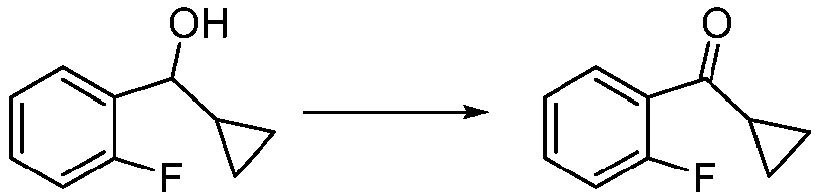
Se disolvió ciclopropil(2-fluorofenil)metanol (800 mg, 4,8 mmol) en diclorometano (20 ml), y después se añadió oxidante de Dess-Martin. La reacción se llevó a cabo a temperatura ambiente durante 5,5 h, y se interrumpió con 20 ml de solución acuosa saturada de bicarbonato sódico y 20 ml de solución acuosa al 10 % de sulfito sódico. Después de agitar durante 15 minutos, la solución se extrajo con diclorometano (30 ml x 4). La fase orgánica se secó sobre sulfato sódico anhidro y se concentró para obtener un producto en bruto que se purificó adicionalmente por cromatografía en columna para obtener ciclopropil(2-fluorofenil)metanona (430 mg, 54 %).Cyclopropyl(2-fluorophenyl)methanol (800 mg, 4.8 mmol) was dissolved in dichloromethane (20 mL), then Dess-Martin oxidant was added. The reaction was carried out at room temperature for 5.5 h, and was quenched with 20 mL of saturated aqueous sodium bicarbonate solution and 20 mL of 10% aqueous sodium sulfite solution. After stirring for 15 min, the solution was extracted with dichloromethane (30 mL x 4). The organic phase was dried over anhydrous sodium sulfate and concentrated to obtain a crude product which was further purified by column chromatography to obtain cyclopropyl(2-fluorophenyl)methanone (430mg, 54%).
E ta p a 3: p re p a ra c ió n d e 3 -c ic lo p ro p il-1 H - in d a z o l Step 3: P re pa ra tio n o f 3 -c ic lo propyl-1 H - in dazol

Se disolvió ciclopropil(2-fluorofenil)metanona (430 mg, 2,6 mmol) en 10 ml de hidrato de hidrazina. La reacción se llevó a cabo a 120 °C durante 1 h en microondas. La solución de reacción se concentró para obtener un producto en bruto que se purificó adicionalmente por cromatografía en columna para obtener 3-ciclopropiMH-indazol (250 mg, 61 %).Cyclopropyl(2-fluorophenyl)methanone (430 mg, 2.6 mmol) was dissolved in 10 mL of hydrazine hydrate. The reaction was carried out at 120 °C for 1 h in the microwave. The reaction solution was concentrated to obtain a crude product, which was further purified by column chromatography to obtain 3-cyclopropiMH-indazole (250 mg, 61%).
Etapas 4 a 9: preparación de N-(5-((4-(3-ciclopropil-2H-indazol-2-il)pirimidin-2-il)amino)-2-((2-(dimetilamino)etil)(metil)amino)-4-metoxifenil)acrilamidaSteps 4 to 9: Preparation of N-(5-((4-(3-cyclopropyl-2H-indazol-2-yl)pyrimidin-2-yl)amino)-2-((2-(dimethylamino)ethyl)( methyl)amino)-4-methoxyphenyl)acrylamide

El método de preparación de N-(5-((4-(3-ciclopropil-2H-indazol-2-il)pirimidin-2-il)amino)-2-((2-(dimetilamino) etil)(metil)amino)-4-metoxifenil)acrilamida fue similar al del Ejemplo 43.The method of preparation of N-(5-((4-(3-cyclopropyl-2H-indazol-2-yl)pyrimidin-2-yl)amino)-2-((2-(dimethylamino)ethyl)(methyl) amino)-4-methoxyphenyl)acrylamide was similar to that of Example 43.
RMN 1H (400 MHz, CD3OD) 88,43 (s, 1H), 8,19 (d, J = 6,3 Hz, 1H), 7,91 (d, J = 7,9 Hz, 1H), 7,83 (s, 1H), 7,52 (d, J = 7,0 Hz, 2H), 7,43 (t, J = 7,4 Hz, 1H), 7,10 (s, 1H), 6,63 (dd, J = 16,9, 10,2 Hz, 1H), 6,46 (dd, J = 16,9, 1,5 Hz, 1H), 5,85 (dd, J = 10,2, 1,4 Hz, 1H), 3,94 (s, 3H), 3,57 (t, J = 5,5 Hz, 2H), 3,39 (t, J = 5,5 Hz, 2H), 2,93 (s, 6H), 2,82 (s, 3H), 2,42 2,33 (m, 1H), 1,24-1,18 (m, 4H);1H NMR (400 MHz, CD 3 OD) 88.43 (s, 1H), 8.19 (d, J = 6.3 Hz, 1H), 7.91 (d, J = 7.9 Hz, 1H) , 7.83 (s, 1H), 7.52 (d, J = 7.0 Hz, 2H), 7.43 (t, J = 7.4 Hz, 1H), 7.10 (s, 1H) , 6.63 (dd, J = 16.9, 10.2 Hz, 1H), 6.46 (dd, J = 16.9, 1.5 Hz, 1H), 5.85 (dd, J = 10 0.2, 1.4Hz, 1H), 3.94 (s, 3H), 3.57 (t, J = 5.5Hz, 2H), 3.39 (t, J = 5.5Hz, 2H ), 2.93 (s, 6H), 2.82 (s, 3H), 2.42-2.33 (m, 1H), 1.24-1.18 (m, 4H);
EM m/z (IEN): 527,2 [M+H]+.MS m/z (ESI): 527.2 [M+H]+.
Ejemplo 112: preparación de N-(5-((4-(6-ciano-1H-indazol-1-il)pirimidin-2-il)amino)-2-((2-(dimetilamino)etil)(metil)amino)-4-metoxifenil)acrilamidaExample 112: Preparation of N-(5-((4-(6-cyano-1H-indazol-1-yl)pyrimidin-2-yl)amino)-2-((2-(dimethylamino)ethyl)(methyl) amino)-4-methoxyphenyl)acrylamide

El método de preparación de N-(5-((4-(6-ciano-1H-indazol-1-il)pirimidin-2-il)amino)-2-((2-(dimetilamino)etil) (metil)amino)-4-metoxifenil)acrilamida fue similar al del Ejemplo 43.The method of preparation of N-(5-((4-(6-cyano-1H-indazol-1-yl)pyrimidin-2-yl)amino)-2-((2-(dimethylamino)ethyl)(methyl) amino)-4-methoxyphenyl)acrylamide was similar to that of Example 43.
RMN 1H (400 MHz, CD3OD) 89,01 (s, 1H), 8,59 (d, J = 0,7 Hz, 1H), 8,40 (d, J = 6,5 Hz, 1H), 8,10-8,02 (m, 2H), 7,67 (dd, J = 8,2, 1,2 Hz, 1H), 7,62 (d, J = 6,5 Hz, 1H), 7,14 (s, 1H), 6,60 (dd, J = 16,9, 10,2 Hz, 1H), 6,36 (dd, J = 16,9, 1,3 Hz, 1H), 5,82 (dd, J = 10,3, 1,5 Hz, 1H), 3,98 (s, 3H), 3,57 (t, J = 6,0 Hz, 2H), 3,39 (dd, J = 11,1, 5,2 Hz, 2H), 2,94 (s, 6H), 2,81 (s, 3H);1H NMR (400 MHz, CD 3 OD) 89.01 (s, 1H), 8.59 (d, J = 0.7 Hz, 1H), 8.40 (d, J = 6.5 Hz, 1H) , 8.10-8.02 (m, 2H), 7.67 (dd, J=8.2, 1.2Hz, 1H), 7.62 (d, J=6.5Hz, 1H), 7.14 (s, 1H), 6.60 (dd, J=16.9, 10.2 Hz, 1H), 6.36 (dd, J=16.9, 1.3 Hz, 1H), 5 .82 (dd, J = 10.3, 1.5 Hz, 1H), 3.98 (s, 3H), 3.57 (t, J = 6.0 Hz, 2H), 3.39 (dd, J = 11.1, 5.2 Hz, 2H), 2.94 (s, 6H), 2.81 (s, 3H);
EM m/z (IEN): 512,2 [M+H]+.MS m/z (ESI): 512.2 [M+H]+.
E je m p lo 113 : p re p a ra c ió n d e N -(5 -( (4 -(3 -c ic lo p ro p il-5 -m e to x i-1 H - in d a z o l-1 - i l) p ir im id in -2 - i l) a m in o ) -2 -( (2 -(d im e t ila m in o )e t i l) (m e t i l)a m in o ) -4 -m e to x ife n il)a c r i la m id a E x a mp le 113 : p re pa ra tio n o f N -(5 -( (4 -(3 -c ic lo p ro p il-5 -me to x i-1 H - in dazo l-1 - il ) p ir im id in -2 - yl) am in o ) -2 -( (2 -(di methyl m in o )ethyl) (methyl)am in o ) -4 -meth o x ife n yl) acri la m id a

El método de preparación de N-(5-((4-(3-cidopropil-5-metoxi-1H-indazoM-il)pirimidin-2-il)amino)-2-((2-(dimetilamino)etil)(metil)amino)-4-metoxifenil)acrilamida fue similar al del Ejemplo 111.The method of preparation of N-(5-((4-(3-cidopropyl-5-methoxy-1H-indazoM-yl)pyrimidin-2-yl)amino)-2-((2-(dimethylamino)ethyl)( methyl)amino)-4-methoxyphenyl)acrylamide was similar to that of Example 111.
RMN 1H (400 MHz, CD3OD) 88,18 (dd, J = 40,0, 6,7 Hz, 2H), 7,85 (s, 1H), 7,40 (d, J = 7,1 Hz, 1H), 7,29 (d, J = 2,3 Hz, 1H), 7,08 (d, J = 10,5 Hz, 2H), 6,64 (dd, J = 16,9, 10,1 Hz, 1H), 6,47 (dd, J = 16,9, 1,6 Hz, 1H), 5,86 (dd, J = 10,2, 1,6 Hz, 1H), 3,95 (s, 3H), 3,89 (s, 3H), 3,57 (t, J = 5,7 Hz, 2H), 3,39 (t, J = 5,6 Hz, 2H), 2,94 (s, 6H), 2,81 (s, 3H), 2,35 2,26 (m, 1H), 1,21-1,15 (m, 4H);1H NMR (400 MHz, CD 3 OD) 88.18 (dd, J = 40.0, 6.7 Hz, 2H), 7.85 (s, 1H), 7.40 (d, J = 7.1 Hz, 1H), 7.29 (d, J = 2.3 Hz, 1H), 7.08 (d, J = 10.5 Hz, 2H), 6.64 (dd, J = 16.9, 10 0.1 Hz, 1H), 6.47 (dd, J = 16.9, 1.6 Hz, 1H), 5.86 (dd, J = 10.2, 1.6 Hz, 1H), 3.95 (s, 3H), 3.89 (s, 3H), 3.57 (t, J = 5.7 Hz, 2H), 3.39 (t, J = 5.6 Hz, 2H), 2.94 (s, 6H), 2.81 (s, 3H), 2.35-2.26 (m, 1H), 1.21-1.15 (m, 4H);
EM m/z (IEN): 557,3 [M+H]+.MS m/z (ESI): 557.3 [M+H]+.
Ejemplo 114: preparación de N-(5-((4-(3-ciclopropil-5-metoxi-1H-indazol-5-(trifluorometil)pirimidin-2-il)amino)-2-((2-(dimetilamino)etil)(metil)amino)-4-metoxifenil)acrilamidaExample 114: Preparation of N-(5-((4-(3-cyclopropyl-5-methoxy-1H-indazol-5-(trifluoromethyl)pyrimidin-2-yl)amino)-2-((2-(dimethylamino) ethyl)(methyl)amino)-4-methoxyphenyl)acrylamide

Etapas 1 a 3: preparación de 3-ciclopropil-5-metoxi-1H-indazolSteps 1 to 3: preparation of 3-cyclopropyl-5-methoxy-1H-indazole

El método de preparación de 3-ciclopropil-5-metoxi-1H-indazol fue similar al del Ejemplo 111.The preparation method of 3-cyclopropyl-5-methoxy-1H-indazole was similar to that of Example 111.
Etapas 4 a 8: preparación de N-(5-((4-(3-ciclopropil-5-metoxi-1H-indazol-1-il)-5-(trifluorometil)pirimidin-2-il)amino)-2-((2-(dimetilamino)etil)(metil)amino)-4-metoxifenil)acrilamidaSteps 4 to 8: Preparation of N-(5-((4-(3-cyclopropyl-5-methoxy-1H-indazol-1-yl)-5-(trifluoromethyl)pyrimidin-2-yl)amino)-2- ((2-(dimethylamino)ethyl)(methyl)amino)-4-methoxyphenyl)acrylamide

El método de preparación de N-(5-((4-(3-ciclopropil-5-metoxi-1H-indazol-1-il)-5-(trifluorometil)pirimidin-2-il)amino)-2-((2-(dimetilamino)etil)(metil)amino)-4-metoxifenil)acrilamida fue similar al del Ejemplo 40.The method of preparation of N-(5-((4-(3-cyclopropyl-5-methoxy-1H-indazol-1-yl)-5-(trifluoromethyl)pyrimidin-2-yl)amino)-2-(( 2-(dimethylamino)ethyl)(methyl)amino)-4-methoxyphenyl)acrylamide was similar to that of Example 40.
RMN 1H (400 MHz, CD3OD) 88,70 (s, 1H), 8,19 (s, 1H), 8,03 (s, 1H), 7,30 (d, J = 2,3 Hz, 1H), 7,09-6,97 (m, 2H), 6,47 (d, J = 5,6 Hz, 2H), 5,91-5,81 (m, 1H), 3,97 (s, 3H), 3,90 (s, 3H), 3,54 (t, J = 5,6 Hz, 2H), 3,31 (d, J = 6,0 Hz, 2H), 2,90 (s, 6H), 2,76 (s, 3H), 2,28 (ddd, J = 13,2, 6,2, 3,8 Hz, 1H), 1,11 (dt, J = 4,0, 2,8 Hz, 4H);1H NMR (400 MHz, CD 3 OD) 88.70 (s, 1H), 8.19 (s, 1H), 8.03 (s, 1H), 7.30 (d, J = 2.3 Hz, 1H), 7.09-6.97 (m, 2H), 6.47 (d, J = 5.6 Hz, 2H), 5.91-5.81 (m, 1H), 3.97 (s , 3H), 3.90 (s, 3H), 3.54 (t, J = 5.6 Hz, 2H), 3.31 (d, J = 6.0 Hz, 2H), 2.90 (s , 6H), 2.76 (s, 3H), 2.28 (ddd, J = 13.2, 6.2, 3.8 Hz, 1H), 1.11 (dt, J = 4.0, 2 0.8Hz, 4H);
EM m/z (IEN): 625,3 [M+H]+. MS m/z (ESI): 625.3 [M+H]+.
Ejemplo 115: preparación de N-(5-((5-doro-4-(3-ddopropil-5-metoxi-1H-indazoM-il)piriiT iidin-2-N)aiT iino)-2-((2-(dimetilamino)etil)(metil)amino)-4-metoxifenil)acrilamidaExample 115: Preparation of N-(5-((5-doro-4-(3-ddopropyl-5-methoxy-1H-indazoM-yl)pyriiT iidin-2-N)aiT iino)-2-((2- (dimethylamino)ethyl)(methyl)amino)-4-methoxyphenyl)acrylamide

Etapas 1 a 3: preparación de 3-ddopropN-5-metoxMH-indazolSteps 1 to 3: Preparation of 3-ddopropN-5-methoxMH-indazole

El método de preparación de 3-ciclopropil-5-metoxi-1H-indazol fue similar al del Ejemplo 111.The preparation method of 3-cyclopropyl-5-methoxy-1H-indazole was similar to that of Example 111.
Etapas 4 a 8: preparación de N-(5-((5-cloro-4-(3-ciclopropil-5-metoxi-1H-indazol-1-il)pirimidin-2-il)amino)-2-((2-(dimetilamino)etil)(metil)amino)-4-metoxifenil)acrilamidaSteps 4 to 8: Preparation of N-(5-((5-chloro-4-(3-cyclopropyl-5-methoxy-1H-indazol-1-yl)pyrimidin-2-yl)amino)-2-(( 2-(dimethylamino)ethyl)(methyl)amino)-4-methoxyphenyl)acrylamide

El método de preparación de N-(5-((5-cloro-4-(3-ciclopropil-5-metoxi-1H-indazol-1-il)pirimidin-2-il)amino)-2-((2-(dimetilamino)etil)(metil)amino)-4-metoxifenil)acrilamida fue similar al del Ejemplo 40.The method of preparation of N-(5-((5-chloro-4-(3-cyclopropyl-5-methoxy-1H-indazol-1-yl)pyrimidin-2-yl)amino)-2-((2- (dimethylamino)ethyl)(methyl)amino)-4-methoxyphenyl)acrylamide was similar to that of Example 40.
RMN 1H (400 MHz, CD3OD) 88,47 (s, 1H), 8,18 (s, 1H), 8,05 (d, J = 9,1 Hz, 1H), 7,28 (d, J = 2,3 Hz, 1H), 7,05 (dd, J = 9,1,2,4 Hz, 1H), 6,97 (s, 1H), 6,44 (dd, J = 5,8, 4,1 Hz, 2H), 5,85 (dd, J = 8,4, 3,4 Hz, 1H), 3,99 (s, 3H), 3,90 (s, 3H), 3,51 (t, J = 5,6 Hz, 2H), 3,32-3,26 (m, 2H), 2,88 (s, 6H), 2,72 (s, 3H), 2,35-2,26 (m, 1H), 1,13 (dc, J = 4,4, 2,4 Hz, 4H); EM m/z (IEN): 591,3 [M+H]+.1H NMR (400 MHz, CD 3 OD) 88.47 (s, 1H), 8.18 (s, 1H), 8.05 (d, J = 9.1 Hz, 1H), 7.28 (d, J = 2.3 Hz, 1H), 7.05 (dd, J = 9,1,2.4 Hz, 1H), 6.97 (s, 1H), 6.44 (dd, J = 5.8 , 4.1 Hz, 2H), 5.85 (dd, J = 8.4, 3.4 Hz, 1H), 3.99 (s, 3H), 3.90 (s, 3H), 3.51 (t, J = 5.6 Hz, 2H), 3.32-3.26 (m, 2H), 2.88 (s, 6H), 2.72 (s, 3H), 2.35-2, 26 (m, 1H), 1.13 (dc, J=4.4, 2.4 Hz, 4H); MS m/z (ESI): 591.3 [M+H]+.
Ejemplo 116: preparación de N-(5-((5-cloro-4-(5-ciano-3-propil-1H-indazol-1-il)pirimidin-2-il)amino)-2-((2-(dimetilamino)etil)(metil)amino)-4-metoxifenil)acrilamidaExample 116: Preparation of N-(5-((5-chloro-4-(5-cyano-3-propyl-1H-indazol-1-yl)pyrimidin-2-yl)amino)-2-((2- (dimethylamino)ethyl)(methyl)amino)-4-methoxyphenyl)acrylamide

E ta p a 1: p re p a ra c ió n d e 1 -(5 -b ro m o -2 - f lu o ro fe n il)b u ta n -1 -o l Step 1: p re pa ra tio n o f 1 -(5 -bro mo -2 - f lu o ro fe n il)but a n -1 -ol

Se disolvió 5-bromo-2-fluorobenzaldehído (5,0 g, 24,6 mmol) en THF (30 ml) y la solución de reacción se enfrió en un baño de hielo. Con tres purgas con nitrógeno, se añadió gota a gota bromuro de propilmagnesio (25 ml, 49,3 Mmol). Tras completarse la adición, la reacción se calentó a temperatura ambiente gradualmente y se llevó a cabo durante 16 h, después se interrumpió con 30 ml de solución acuosa de cloruro de amonio y se extrajo con acetato de etilo (50 ml x 4). La fase orgánica se secó sobre sulfato sódico anhidro y se concentró para obtener un producto en bruto que se purificó adicionalmente por cromatografía en columna para obtener 1-(5-bromo-2-fluorofenil)butan-1-ol (2,2 g, 36 %).5-Bromo-2-fluorobenzaldehyde (5.0 g, 24.6 mmol) was dissolved in THF (30 mL), and the reaction solution was cooled in an ice bath. With three nitrogen purges, propylmagnesium bromide (25 mL, 49.3 Mmol) was added dropwise. After the addition was complete, the reaction was gradually warmed to room temperature and carried out for 16 h, then quenched with 30 mL of aqueous ammonium chloride solution and extracted with ethyl acetate (50 mL x 4). The organic phase was dried over anhydrous sodium sulfate and concentrated to obtain a crude product which was further purified by column chromatography to obtain 1-(5-bromo-2-fluorophenyl)butan-1-ol (2.2 g, 36%).
Etapa 2: preparación de 1-(5-bromo-2-fluorofenil)butan-1-onaStep 2: Preparation of 1-(5-bromo-2-fluorophenyl)butan-1-one

Se disolvió 1-(5-bromo-2-fluorofenil)butan-1-ol (2,2 g, 8,9 mmol) en 50 ml de diclorometano y se añadió oxidante de PCC (3,8 g, 17,8 mmol). Después de que la reacción se llevase a cabo durante 16 h a temperatura ambiente, la mezcla de reacción se filtró a través de celite. La fase orgánica se secó sobre sulfato sódico anhidro y se concentró para obtener un producto en bruto que se purificó adicionalmente por cromatografía en columna para obtener 1-(5-bromo-2-fluorofenil)butan-1-ona (1,5 g, 71 %).1-(5-Bromo-2-fluorophenyl)butan-1-ol (2.2 g, 8.9 mmol) was dissolved in 50 mL dichloromethane and PCC oxidant (3.8 g, 17.8 mmol) was added. ). After the reaction was carried out for 16 h at room temperature, the reaction mixture was filtered through celite. The organic phase was dried over anhydrous sodium sulfate and concentrated to obtain a crude product which was further purified by column chromatography to obtain 1-(5-bromo-2-fluorophenyl)butan-1-one (1.5 g, 71%).
Etapa 3: preparación de (1-(5-bromo-2-fluorofenil)butilideno)hidrazinaStep 3: Preparation of (1-(5-bromo-2-fluorophenyl)butylidene)hydrazine

Se disolvió 1-(5-bromo-2-fluorofenil)butan-1-ona (1,0 g, 4,1 mmol) en 20 ml de hidrato de hidrazina y la reacción se llevó a cabo a 130 °C en microondas durante 5 h. La solución de reacción se concentró y el producto en bruto se purificó por cromatografía en columna para obtener (1-(5-bromo-2-fluorofenil)butilideno)hidrazina (800 mg, 80 %). 1-(5-Bromo-2-fluorophenyl)butan-1-one (1.0 g, 4.1 mmol) was dissolved in 20 mL of hydrazine hydrate and the reaction was carried out at 130 °C in microwave for 5 a.m. The reaction solution was concentrated, and the crude product was purified by column chromatography to obtain (1-(5-bromo-2-fluorophenyl)butylidene)hydrazine (800mg, 80%).
Etapa 4: preparación de 5-bromo-3-propil-1H-indazolStep 4: Preparation of 5-bromo-3-propyl-1H-indazole
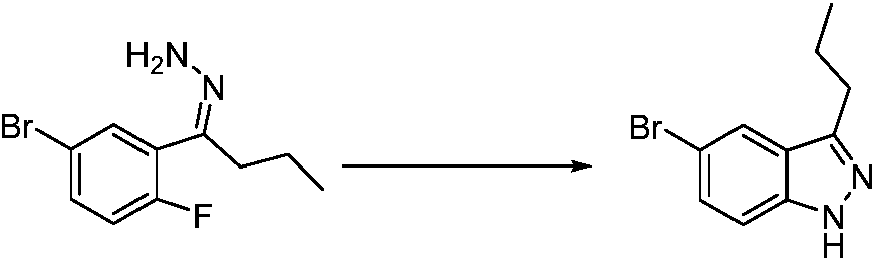
Se disolvió (1-(5-bromo-2-fluorofenil)butilideno)hidrazina (600 mg, 2,3 mmol) en 10 ml de N-metilpirrolidona, y la reacción se llevó a cabo a 150 °C en microondas durante 1 h. Se añadieron 20 ml de agua y la solución de reacción se extrajo con acetato de etilo (30 ml x 3). La fase orgánica se secó sobre sulfato sódico anhidro y se concentró para obtener un producto en bruto que se purificó adicionalmente por cromatografía en columna para obtener 5-bromo-3-propil-1H-indazol (380 mg, 69 %).(1-(5-Bromo-2-fluorophenyl)butylidene)hydrazine (600 mg, 2.3 mmol) was dissolved in 10 mL of N-methylpyrrolidone, and the reaction was carried out at 150 °C in microwave for 1 h. . 20 ml of water was added, and the reaction solution was extracted with ethyl acetate (30 ml x 3). The organic phase was dried over anhydrous sodium sulfate and concentrated to obtain a crude product which was further purified by column chromatography to obtain 5-bromo-3-propyl-1H-indazole (380 mg, 69%).
Etapa 5: preparación de 3-propil-1H-indazol-5-carbonitriloStep 5: Preparation of 3-propyl-1H-indazole-5-carbonitrile

Se disolvieron 5-bromo-3-propil-1H-indazol (380 mg, 1,6 mmol), cianuro de cinc (223 mg, 1,9 mmol), tris(dibencilidenoacetona)dipaladio (140 mg, 0,16 mmol) y 2-diciclohexilfosfino-2',4',6'-triisopropilbifenilo (150 mg, 0,32 mmol) en N,N-dimetilformamida (10 ml). La reacción se llevó a cabo a 150 °C en microondas durante 1 h, y después se añadieron 20 ml de solución acuosa saturada de cloruro sódico. La solución de reacción se extrajo con acetato de etilo (30 ml x 3). La fase orgánica se secó sobre sulfato sódico anhidro y se concentró para obtener un producto en bruto que se purificó adicionalmente por cromatografía en columna para obtener 3-propil-1H-indazol-5-carbonitrilo (110 mg, 38 %).5-Bromo-3-propyl-1H-indazole (380 mg, 1.6 mmol), zinc cyanide (223 mg, 1.9 mmol), tris(dibenzylideneacetone)dipalladium (140 mg, 0.16 mmol) were dissolved. and 2-dicyclohexylphosphino-2',4',6'-triisopropylbiphenyl (150 mg, 0.32 mmol) in N,N-dimethylformamide (10 mL). The reaction was carried out at 150 °C in microwave for 1 h, and then 20 ml of saturated aqueous sodium chloride solution was added. The reaction solution was extracted with ethyl acetate (30 ml x 3). The organic phase was dried over anhydrous sodium sulfate and concentrated to obtain crude product which was further purified by column chromatography to obtain 3-propyl-1H-indazole-5-carbonitrile (110 mg, 38%).
Etapas 6 a 10: preparación de N-(5-((5-cloro-4-(5-ciano-3-propiMH-indazol-1-il)pirimidin-2-il)amino)-2-((2-(dimetilamino)etil)(metil)amino)-4-metoxifenil)acrilamidaSteps 6 to 10: Preparation of N-(5-((5-chloro-4-(5-cyano-3-propiMH-indazol-1-yl)pyrimidin-2-yl)amino)-2-((2- (dimethylamino)ethyl)(methyl)amino)-4-methoxyphenyl)acrylamide

Etapas 6 a 10: el método de preparación de N-(5-((5-cloro-4-(5-ciano-3-propiMH-indazoM-il)pirimidin-2-il)amino)-2-((2-(di metilamino)etil)(metil)amino)-4-metoxifenil)acrilamida fue similar al del Ejemplo 40.Steps 6 to 10: the method of preparation of N-(5-((5-chloro-4-(5-cyano-3-propiMH-indazoM-yl)pyrimidin-2-yl)amino)-2-((2 -(dimethylamino)ethyl)(methyl)amino)-4-methoxyphenyl)acrylamide was similar to that of Example 40.
RMN 1H (400 MHz, CD3OD) 88,60 (s, 1H), 8,33 (s, 1H), 8,23 (d, J = 8,8 Hz, 1H), 8,19 (s, 1H), 7,62 (d, J = 8,7 Hz, 1H), 6,98 (s, 1H), 6,51 (dd, J = 16,9, 1,5 Hz, 1H), 6,40 (dd, J = 17,0, 9,9 Hz, 1H), 5,91 (dd, J = 10,0, 1,5 Hz, 1H), 4,01 (s, 3H), 3,50 (t, J = 5,5 Hz, 2H), 3,31-3,24 (m, 2H), 3,04 (t, J = 7,4 Hz, 2H), 2,89 (s, 6H), 2,71 (s, 3H), 1,91 (dd, J = 14,8, 7,4 Hz, 2H), 1,07 (t, J = 7,4 Hz, 3H);1H NMR (400 MHz, CD 3 OD) 88.60 (s, 1H), 8.33 (s, 1H), 8.23 (d, J = 8.8 Hz, 1H), 8.19 (s, 1H), 7.62 (d, J=8.7Hz, 1H), 6.98 (s, 1H), 6.51 (dd, J=16.9, 1.5Hz, 1H), 6, 40 (dd, J=17.0, 9.9Hz, 1H), 5.91 (dd, J=10.0, 1.5Hz, 1H), 4.01 (s, 3H), 3.50 (t, J = 5.5 Hz, 2H), 3.31-3.24 (m, 2H), 3.04 (t, J = 7.4 Hz, 2H), 2.89 (s, 6H) , 2.71 (s, 3H), 1.91 (dd, J = 14.8, 7.4 Hz, 2H), 1.07 (t, J = 7.4 Hz, 3H);
EM m/z (IEN): 588,3 [M+H]+.MS m/z (ESI): 588.3 [M+H]+.
Ejemplo 117: preparación de N-(5-((4-(5-ciano-3-etil-1H-indazol-1-il)-5-(trifluorometil)pirimidin-2-il)amin o)-2-((2-(dimetilamino)etil)(metil)amino)-4-metoxifenil)acrilamidaExample 117: Preparation of N-(5-((4-(5-cyano-3-ethyl-1H-indazol-1-yl)-5-(trifluoromethyl)pyrimidin-2-yl)amino)-2-( (2-(dimethylamino)ethyl)(methyl)amino)-4-methoxyphenyl)acrylamide

Etapa 1: preparación de 3-bromo-1H-indazol-5-carbonitriloStep 1: Preparation of 3-bromo-1H-indazole-5-carbonitrile

Se añadieron 1H-indazol-5-carbonitrilo (544 mg, 3,8 mmol), NBS (812 mg, 4,6 mmol) y DMF (10 ml) en un matraz de fondo redondo de 100 ml. En protección de N2 , la mezcla se agitó a temperatura ambiente durante 2 h. La solución de reacción se concentró para obtener un producto en bruto que se disolvió en 100 ml de DCM, se lavó con 50 ml de solución acuosa saturada de bicarbonato sódico, agua y salmuera saturada respectivamente. La fase orgánica se secó sobre sulfato sódico anhidro y se filtró. El filtrado resultante se concentró para obtener 3-bromo-1H-indazol-5-carbonitrilo (750 mg, 89 %).1H-indazole-5-carbonitrile (544 mg, 3.8 mmol), NBS (812 mg, 4.6 mmol), and DMF (10 mL) were added to a 100 mL round bottom flask. Under N 2 protection, the mixture was stirred at room temperature for 2 h. The reaction solution was concentrated to obtain a crude product which was dissolved in 100 ml of DCM, washed with 50 ml of saturated aqueous sodium bicarbonate solution, water and saturated brine respectively. The organic phase was dried over anhydrous sodium sulfate and filtered. The resulting filtrate was concentrated to obtain 3-bromo-1H-indazole-5-carbonitrile (750 mg, 89%).
E ta p a 2: p re p a ra c ió n d e 3 -b ro m o -1 -( (2 -( t r im e t i ls i l i l ) e to x i)m e t i l) -1 H - in d a z o l-5 -c a rb o n it r i lo Step 2: p re pa ra tio n of 3 -bro mo -1 -( (2 -( tri m eti ls ilyl ) e to xi)methyl) -1 H - in dazo l-5 -ca rb on it ri lo

Se añadieron 3-bromo-1H-indazol-5-carbonitrilo (710 mg, 3,2 mmol) y THF (15 ml) en un matraz de fondo redondo de 100 ml, y se añadió gota a gota SEM-C1 (640 mg, 3,8 mmol) en un baño de hielo-agua. La reacción se llevó a cabo a 0 °C durante 2 h, y después se interrumpió con una solución acuosa saturada de cloruro de amonio (1 ml). La solución de reacción se concentró para obtener un producto en bruto que se purificó adicionalmente por cromatografía en columna (60% DCM / p E) para obtener 3-bromo-1-((2-(trimetilsilil)etoxi)metil)-1H-indazol-5-carbonitrilo (680 mg, 61 %).3-Bromo-1H-indazole-5-carbonitrile (710 mg, 3.2 mmol) and THF (15 mL) were added to a 100 mL round bottom flask, and SEM-C1 (640 mg , 3.8 mmol) in an ice-water bath. The reaction was carried out at 0 °C for 2 h, and then was quenched with saturated aqueous ammonium chloride solution (1 mL). The reaction solution was concentrated to obtain crude product which was further purified by column chromatography (60% DCM/p E) to obtain 3-bromo-1-((2-(trimethylsilyl)ethoxy)methyl)-1H- indazole-5-carbonitrile (680 mg, 61%).
Etapa 3: preparación de 3-etil-1-((2-(trimetilsilil)etoxi)metil)-1H-indazol-5-carbonitriloStep 3: Preparation of 3-ethyl-1-((2-(trimethylsilyl)ethoxy)methyl)-1H-indazole-5-carbonitrile

Se añadieron 3-bromo-1-((2-(trimetilsilil)etoxi)metil)-1H-indazol-5-carbonitrilo (669 mg, 1,9 mmol), ácido etilborónico (281 mg, 3,8 mmol), K3PO4 (1,2 g, 5,7 mmol) y PCy3 (213 mg, 0,4 mmol) en un matraz de fondo redondo de 100 ml. Después de purgarse tres veces con nitrógeno, se añadió Pd(OAc)2 (85 mg, 0,2 mmol) y la reacción se llevó a cabo 100 °C durante 2 h. Después de enfriar a temperatura ambiente, la mezcla de reacción se diluyó con 100 ml de acetato de etilo y se lavó con agua (50 ml x 2). La fase orgánica se concentró a presión reducida y el residuo resultante se purificó por cromatografía en columna para obtener 3-etil-1-((2-(trimetilsilil)etoxi)metil)-1H-indazol-5-carbonitrilo (605 mg, 100 %).3-Bromo-1-((2-(trimethylsilyl)ethoxy)methyl)-1H-indazole-5-carbonitrile (669 mg, 1.9 mmol), ethylboronic acid (281 mg, 3.8 mmol), K 3 PO 4 (1.2 g, 5.7 mmol) and PCy 3 (213 mg, 0.4 mmol) in a 100 mL round bottom flask. After purging three times with nitrogen, Pd(OAc) 2 (85 mg, 0.2 mmol) was added and the reaction was carried out at 100 °C for 2 h. After cooling to room temperature, the reaction mixture was diluted with 100 ml of ethyl acetate and washed with water (50 ml x 2). The organic phase was concentrated under reduced pressure, and the resulting residue was purified by column chromatography to obtain 3-ethyl-1-((2-(trimethylsilyl)ethoxy)methyl)-1H-indazole-5-carbonitrile (605 mg, 100 %).
EM m/z (IEN): 302,2 [M+H]+.MS m/z (ESI): 302.2 [M+H]+.
Etapa 4: preparación de 3-etil-1H-indazol-5-carbonitriloStep 4: Preparation of 3-ethyl-1H-indazole-5-carbonitrile

Se añadieron 3-etil-1-((2-(trimetilsilil)etoxi)metil)-1H-indazol-5-carbonitrilo (603 mg, 1,9 mmol), 1M de TBAF/THF (30 ml) y etilendiamina (240 mg) en un matraz de fondo redondo de 100 ml, y la reacción se llevó a cabo a 70 °C durante 2 h. La solución de reacción se concentró para obtener un producto en bruto. se añadieron 100 ml de acetato de etilo y la solución de reacción se lavó con agua (50 ml x 2). La fase orgánica se concentró, y el residuo resultante se purificó por cromatografía en columna de fase inversa (acetonitrilo al 25 %/agua) para obtener 3-etil-1H-indazol-5-carbonitrilo (170 mg, 50 %).3-Ethyl-1-((2-(trimethylsilyl)ethoxy)methyl)-1H-indazole-5-carbonitrile (603 mg, 1.9 mmol), 1M TBAF/THF (30 mL), and ethylenediamine (240 mg) in a 100 mL round bottom flask, and the reaction was carried out at 70 °C for 2 h. The reaction solution was concentrated to obtain a crude product. 100 ml of ethyl acetate was added, and the reaction solution was washed with water (50 ml x 2). The organic phase was concentrated, and the resulting residue was purified by reverse phase column chromatography (25% acetonitrile/water) to obtain 3-ethyl-1H-indazole-5-carbonitrile (170 mg, 50%).
Etapas 5 a 8: preparación de N-(5-((4-(5-ciano-3-etil-1H-indazol-1-il)-5-(trifluorometil)pirimidin-2-il)amin o)-2-((2-(dimetilamino)etil)(metil)amino)-4-metoxifenil)acrilamida Steps 5 to 8: Preparation of N-(5-((4-(5-cyano-3-ethyl-1H-indazol-1-yl)-5-(trifluoromethyl)pyrimidin-2-yl)amino)-2 -((2-(dimethylamino)ethyl)(methyl)amino)-4-methoxyphenyl)acrylamide

Etapas 5 a 8: el método de preparación de N-(5-((4-(5-ciano-3-etiMH-indazoM-il)-5-(trifluorometil)pirimidm-2-il)amino)-2 -((2-(dimetilamino)etil)(metil)amino)-4-metoxifenil)acrilamida fue similar al del Ejemplo 106.Steps 5 to 8: the method of preparation of N-(5-((4-(5-cyano-3-ethylMH-indazoM-yl)-5-(trifluoromethyl)pyrimidm-2-yl)amino)-2-( (2-(dimethylamino)ethyl)(methyl)amino)-4-methoxyphenyl)acrylamide was similar to Example 106.
RMN 1H (400 MHz, CD3OD) 88,80 (s, 1H), 8,39 (s, 1H), 8,27 (d, J = 0,7 Hz, 1H), 8,12 (s, 1H), 7,63 (s, 1H), 7,02 (s, 1H), 6,56-6,44 (m, 2H), 5,93-5,87 (m, 1H), 4,00 (s, 3H), 3,53 (t, J = 5,7 Hz, 2H), 3,36-3,33 (m, 2H), 3,03 (c, J = 7,5 Hz, 2H), 2,92 (s, 6H), 2,75 (s, 3H), 1,44 (t, J = 7,5 Hz, 3H);1H NMR (400 MHz, CD 3 OD) 88.80 (s, 1H), 8.39 (s, 1H), 8.27 (d, J = 0.7 Hz, 1H), 8.12 (s, 1H), 7.63 (s, 1H), 7.02 (s, 1H), 6.56-6.44 (m, 2H), 5.93-5.87 (m, 1H), 4.00 (s, 3H), 3.53 (t, J = 5.7 Hz, 2H), 3.36-3.33 (m, 2H), 3.03 (c, J = 7.5 Hz, 2H) , 2.92 (s, 6H), 2.75 (s, 3H), 1.44 (t, J = 7.5 Hz, 3H);
EM m/z (IEN): 608,3 [M+H]+.MS m/z (ESI): 608.3 [M+H]+.
Ejemplo 118: preparación de N-(5-((5-cloro-4-(5-ciano-3-etil-1H-indazol-1-il)pirimidin-2-il)amino)-2-((2-(di metilamino)etil)(metil)amino)-4-metoxifenil)acrilamidaExample 118: Preparation of N-(5-((5-chloro-4-(5-cyano-3-ethyl-1H-indazol-1-yl)pyrimidin-2-yl)amino)-2-((2- (dimethylamino)ethyl)(methyl)amino)-4-methoxyphenyl)acrylamide
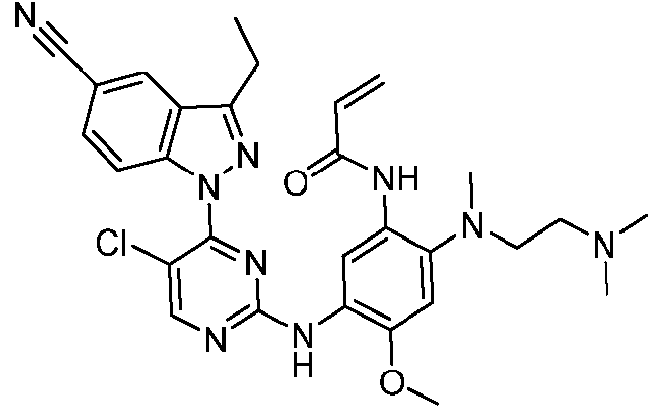
El método de preparación de N-(5-((5-cloro-4-(5-ciano-3-etiMH-mdazol-1-il)pirimidin-2-il)amino)-2-((2-(dimetilamino)etil)(metil)amino)-4-metoxifenil)acrilamida fue similar al del Ejemplo 117.The method of preparation of N-(5-((5-chloro-4-(5-cyano-3-ethylMH-mdazol-1-yl)pyrimidin-2-yl)amino)-2-((2-(dimethylamino )ethyl)(methyl)amino)-4-methoxyphenyl)acrylamide was similar to that of Example 117.
RMN 1H (400 MHz, CD3OD) 88,44 (s, 1H), 8,18 (s, 1H), 8,09 (d, J = 11,2 Hz, 2H), 7,49 (d, J = 8,7 Hz, 1H), 6,86 (s, 1H), 6,34 (cd, J = 16,9, 5,7 Hz, 2H), 5,79 (dd, J = 9,9, 1,6 Hz, 1H), 3,89 (s, 3H), 3,39 (t, J = 5,4 Hz, 2H), 3,18 (d, J = 5,3 Hz, 2H), 2,95 (c, J = 7,5 Hz, 2H), 2,78 (s, 6H), 2,60 (s, 3H), 1,33 (t, J = 7,5 Hz, 3H);1H NMR (400 MHz, CD 3 OD) 88.44 (s, 1H), 8.18 (s, 1H), 8.09 (d, J = 11.2 Hz, 2H), 7.49 (d, J = 8.7 Hz, 1H), 6.86 (s, 1H), 6.34 (cd, J = 16.9, 5.7 Hz, 2H), 5.79 (dd, J = 9.9 , 1.6Hz, 1H), 3.89 (s, 3H), 3.39 (t, J = 5.4Hz, 2H), 3.18 (d, J = 5.3Hz, 2H), 2.95 (c, J = 7.5 Hz, 2H), 2.78 (s, 6H), 2.60 (s, 3H), 1.33 (t, J = 7.5 Hz, 3H);
EM m/z (IEN): 574,3 [M+H]+.MS m/z (ESI): 574.3 [M+H]+.
Ejemplo 119: preparación de N-(5-((4-(1-ciclopropil-1H-indazol-3-il)pirimidin-2-il)amino)-2-((2-(dimetilamino)etil)(metil)amino)-4-metoxifenil)acrilamidaExample 119: Preparation of N-(5-((4-(1-cyclopropyl-1H-indazol-3-yl)pyrimidin-2-yl)amino)-2-((2-(dimethylamino)ethyl)(methyl) amino)-4-methoxyphenyl)acrylamide
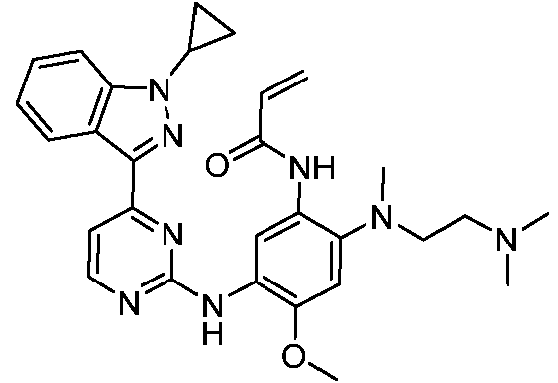
Etapa 1: preparación de (2-fluorofenil)(2-(metiltio)pirimidin-4-il)metanonaStep 1: Preparation of (2-fluorophenyl)(2-(methylthio)pyrimidin-4-yl)methanone

Se disolvieron 4-doro-2-(metiltio)pirimidina (5,00 g, 31,1 mmol), 2-fluorobenzaldehído (4,64 g, 37,4 mmol) y [mmim] [I] (2,09 g, 9,33 mmol) en 1,4-dioxano (70 ml), y después se añadió en lotes NaH (1,74 g, 60 %, 43,6 mmol). Después, la mezcla se agitó a 100 °C durante 1 hora. Después de un periodo de refrigeración, la solución de reacción se diluyó con EtOAc. La fase orgánica se lavó con salmuera saturada, se secó sobre sulfato sódico anhidro, se concentró y se purificó por cromatografía en columna para obtener el compuesto del título (2-fluorofenil)(2-(metiltio)pirimidin-4-il)metanona (4,3 g, 56 %).4-doro-2-(methylthio)pyrimidine (5.00 g, 31.1 mmol), 2-fluorobenzaldehyde (4.64 g, 37.4 mmol), and [mmim][I] (2.09 g) were dissolved , 9.33 mmol) in 1,4-dioxane (70 mL), then NaH (1.74 g, 60%, 43.6 mmol) was added in batches. The mixture was then stirred at 100°C for 1 hour. After a cooling period, the reaction solution was diluted with EtOAc. The organic phase was washed with saturated brine, dried over anhydrous sodium sulfate, concentrated and purified by column chromatography to obtain the title compound (2-fluorophenyl)(2-(methylthio)pyrimidin-4-yl)methanone ( 4.3g, 56%).
RMN 1H (400 MHz, CDCla): 88,71 (d, J = 5,2 Hz, 1H), 7,68 (m, 1H), 7,51 (m, 1H), 7,44 (d, J = 5,2 Hz, 1H), 7,20 (m, 1H), 7,07 (m, 1H), 2,38 (s, 3H);1H NMR (400 MHz, CDCla): 88.71 (d, J = 5.2 Hz, 1H), 7.68 (m, 1H), 7.51 (m, 1H), 7.44 (d, J = 5.2 Hz, 1H), 7.20 (m, 1H), 7.07 (m, 1H), 2.38 (s, 3H);
EM m/z (IEN): 249,1 [M+H]+.MS m/z (ESI): 249.1 [M+H]+.
Etapa 2: preparación de 1-ciclopropil-3-(2-(metiltio)pirimidin-4-il)-1H-indazolStep 2: Preparation of 1-cyclopropyl-3-(2-(methylthio)pyrimidin-4-yl)-1H-indazole

Se mezclaron (2-fluorofenil)(2-(metiltio)pirimidin-4-il)metanona (1,3 g, 5,24 mmol) y clorhidrato de ciclopropilhidrazina (800 mg, 7,33 mmol) en etanol. La mezcla se calentó hasta reflujo durante 2 horas, se enfrió y se concentró. El producto en bruto resultante se disolvió en 50 ml de DMF y se añadieron hidruro sódico (500 mg, 12,5 mmol) en lotes y después la solución de reacción se agitó a 80 °C durante 2 horas. Después de un periodo de refrigeración, se añadió agua, después un sólido precipito. El sólido se purificó por cromatografía en columna para obtener el compuesto del título 1-ciclopropil-3-(2-(metiltio)pirimidin-4-il)-1H-indazol (140 mg, rendimiento de dos etapas: 10 %).(2-Fluorophenyl)(2-(methylthio)pyrimidin-4-yl)methanone (1.3 g, 5.24 mmol) and cyclopropylhydrazine hydrochloride (800 mg, 7.33 mmol) in ethanol were mixed. The mixture was heated to reflux for 2 hours, cooled and concentrated. The resulting crude product was dissolved in 50 ml of DMF, and sodium hydride (500 mg, 12.5 mmol) was added in batches, and then the reaction solution was stirred at 80 °C for 2 hours. After a period of cooling, water was added, then a solid precipitated. The solid was purified by column chromatography to obtain the title compound 1-cyclopropyl-3-(2-(methylthio)pyrimidin-4-yl)-1H-indazole (140 mg, two-step yield: 10%).
EM m/z (IEN): 283,1 [M+H]+.MS m/z (ESI): 283.1 [M+H]+.
Etapa 3: preparación de 1-ciclopropil-3-(2-(metilsulfonil)pirimidin-4-il)-1H-indazolStep 3: Preparation of 1-cyclopropyl-3-(2-(methylsulfonyl)pyrimidin-4-yl)-1H-indazole

Se añadió mCPBA (231 mg, 70 %, 1,00 mmol) en un lote a una solución de 1-ciclopropil-3-(2-(metiltio)pirimidin-4-il)-1H-indazol (135 mg, 0,478 mmol) en diclorometano (3 ml) en un baño de agua enfriada con hielo. La reacción se calentó a temperatura ambiente lentamente y se agitó durante 2 horas. La solución de reacción se lavó dos veces con una solución acuosa saturada de bicarbonato sódico, se lavó una vez con salmuera saturada, se secó sobre sulfato sódico anhidro y se concentró para obtener el compuesto del título 1-ciclopropil-3-(2-(metilsulfonil)pirimidin-4-il)-1H-indazol (185 mg, 100 %).mCPBA (231 mg, 70%, 1.00 mmol) was added in one batch to a solution of 1-cyclopropyl-3-(2-(methylthio)pyrimidin-4-yl)-1H-indazole (135 mg, 0.478 mmol ) in dichloromethane (3 mL) in an ice-water bath. The reaction warmed to room temperature slowly and stirred for 2 hours. The reaction solution was washed twice with a saturated aqueous sodium bicarbonate solution, washed once with a saturated brine, dried over anhydrous sodium sulfate, and concentrated to obtain the title compound 1-cyclopropyl-3-(2-( methylsulfonyl)pyrimidin-4-yl)-1H-indazole (185mg, 100%).
EM m/z (IEN): 315,1 [M+H]+.MS m/z (ESI): 315.1 [M+H]+.
Etapa 4: preparación de 4-(1-ciclopropil-1H-indazol-3-il)-N-(4-fluoro-2-metoxi-5-nitrofenil)pirimidin -2-aminaStep 4: Preparation of 4-(1-cyclopropyl-1H-indazol-3-yl)-N-(4-fluoro-2-methoxy-5-nitrophenyl)pyrimidin-2-amine

Se añadió una solución acuosa de ácido fórmico (0,5 ml, 85 %) a una solución de 4-fluoro-2-metoxi-5-nitroanilina (1,0 g, 5,4 mmol) en tolueno (5 ml), y la mezcla se calentó a reflujo durante una noche. La solución de reacción se concentró por evaporación rotacional y se usó directamente en la siguiente reacción.An aqueous solution of formic acid (0.5 mL, 85%) was added to a solution of 4-fluoro-2-methoxy-5-nitroaniline (1.0 g, 5.4 mmol) in toluene (5 mL), and the mixture was heated under reflux overnight. The reaction solution was concentrated by rotary evaporation and directly used in the next reaction.
E L p ro d u c to e n b ru to a n te r io rm e n te m e n c io n a d o (180 m g , 0 ,840 m m o l) s e d is o lv ió e n 2 m l d e D M F y s e a ñ a d ió N a H (41 m g , 1 ,68 m m o l) e n u n b a ñ o d e h ie lo -a g u a . L a m e z c la s e a g itó a e s ta te m p e r a tu r a d u ra n te 30 m in u to s . D e s p u é s , se añadió una solución de 1-cidopropil-3-(2-(metilsulfonil)pirimidin-4-il)-1H-indazol (184 mg, 0,588 mmol) en DMF (2 ml) y la mezcla se agitó a temperatura ambiente durante una noche. La solución de reacción se agitó durante otros 30 minutos después de que se añadiesen 0,5 ml de agua. Después se añadieron 10 ml de agua y la solución de reacción se filtró. El sólido resultante se purificó por cromatografía en columna para obtener 4-(1-ciclopropil-1H-indazol-3-il)-N-(4-fluoro-2-metoxi-5-nitrofenil)pirimidin-2-amina (200 mg, 81 %).The aforementioned crude product (180 mg, 0.840 mmol) was dissolved in 2 mL of DMF and added N to H (41 mg, 1.68 mmol) in an ice-water bath. Mix the mixture at this temperature for 30 minutes. After , A solution of 1-cidopropyl-3-(2-(methylsulfonyl)pyrimidin-4-yl)-1H-indazole (184 mg, 0.588 mmol) in DMF (2 mL) was added and the mixture was stirred at room temperature for one hour. night. The reaction solution was stirred for another 30 minutes after 0.5 ml of water was added. Then 10 ml of water was added, and the reaction solution was filtered. The resulting solid was purified by column chromatography to obtain 4-(1-cyclopropyl-1H-indazol-3-yl)-N-(4-fluoro-2-methoxy-5-nitrophenyl)pyrimidin-2-amine (200 mg , 81%).
EM m/z (IEN): 421,1 [M+H]+.MS m/z (ESI): 421.1 [M+H]+.
Etapa 5: preparación de N1-(4-(1-ciclopropil-1H-indazol-3-il)pirimidin-2-il)-N4-(2-(dimetilamino)etil) -2-metoxi-N4-metil-5-nitrobenceno-1,4-diaminaStep 5: Preparation of N1-(4-(1-cyclopropyl-1H-indazol-3-yl)pyrimidin-2-yl)-N4-(2-(dimethylamino)ethyl)-2-methoxy-N4-methyl-5 -nitrobenzene-1,4-diamine

Se disolvieron 4-(1-ciclopropil-1H-indazol-3-il)-N-(4-fluoro-2-metoxi-5-nitrofenil)pirimidi n-2-amina (200 mg, 0,48 mmol), trimetiletilendiamina (58,0 mg, 0,57 mmol) y DIPEA (0,24 ml, 1,43 mmol) en 2 ml de DMA y la mezcla se agitó a 90 °C durante 2 horas. Después de un periodo de refrigeración, la solución de reacción se diluyó con EtOAc, se lavó varias veces con salmuera saturada, se secó sobre sulfato sódico anhidro, se concentró y se purificó por cromatografía de capa fina preparativa para obtener el compuesto del título N1-(4-(1-ciclopropil-1H-indazol-3-il)pirimidin-2-il)-N4-(2-(dimetilamino)etil)-2-metoxi-N4-metil-5-nitrobenceno-1,4-diamina (40 mg, 17 %).Dissolved 4-(1-cyclopropyl-1H-indazol-3-yl)-N-(4-fluoro-2-methoxy-5-nitrophenyl)pyrimidi n-2-amine (200 mg, 0.48 mmol), trimethylethylenediamine (58.0 mg, 0.57 mmol) and DIPEA (0.24 mL, 1.43 mmol) in 2 mL of DMA and the mixture was stirred at 90 °C for 2 hours. After a cooling period, the reaction solution was diluted with EtOAc, washed several times with saturated brine, dried over anhydrous sodium sulfate, concentrated and purified by preparative thin-layer chromatography to obtain the title compound N1- (4-(1-cyclopropyl-1H-indazol-3-yl)pyrimidin-2-yl)-N4-(2-(dimethylamino)ethyl)-2-methoxy-N4-methyl-5-nitrobenzene-1,4- diamine (40mg, 17%).
EM m/z (IEN): 503,2 [M+H]+.MS m/z (ESI): 503.2 [M+H]+.
Etapa 6: preparación de N4-(4-(1-ciclopropil-1H-indazol-3-il)pirimidin-2-il)-N1-(2-(dimetilamino)etil) -5-metoxi-N1-metilbenceno-1,2,4-triaminaStep 6: Preparation of N4-(4-(1-cyclopropyl-1H-indazol-3-yl)pyrimidin-2-yl)-N1-(2-(dimethylamino)ethyl)-5-methoxy-N1-methylbenzene-1 ,2,4-triamine

Se mezclaron N1-(4-(1-ciclopropil-1H-indazol-3-il)pirimidin-2-il)-N4-(2-(dimetilamino)etil)-2-metoxi-N4-metil-5-nitrobenceno-1,4-diamina (40 mg, 0,080 mmol), polvo de hierro reducido (44 mg, 0,80 mmol) y cloruro de amonio (3,4 mg, 0,064 mmol) en una mezcla de 6 ml de etanol y 2 ml de agua, y la mezcla se agitó a 70 °C durante una noche. Después de un periodo de refrigeración, la solución de reacción se filtró a través de celite, se concentró y se purificó por cromatografía de capa fina preparativa para obtener el compuesto del título N4-(4-(1-ciclopropil-1H-indazol-3-il)pirimidin-2-il)-N1-(2-(dimetilamino)etil)-5-metoxi-N1-metilbenceno-1,2,4-triamina (19 mg, 50 %).N1-(4-(1-cyclopropyl-1H-indazol-3-yl)pyrimidin-2-yl)-N4-(2-(dimethylamino)ethyl)-2-methoxy-N4-methyl-5-nitrobenzene- 1,4-diamine (40 mg, 0.080 mmol), reduced iron powder (44 mg, 0.80 mmol), and ammonium chloride (3.4 mg, 0.064 mmol) in a mixture of 6 mL ethanol and 2 mL of water, and the mixture was stirred at 70 °C overnight. After a cooling period, the reaction solution was filtered through celite, concentrated and purified by preparative thin-layer chromatography to obtain the title compound N4-(4-(1-cyclopropyl-1H-indazole-3 -yl)pyrimidin-2-yl)-N1-(2-(dimethylamino)ethyl)-5-methoxy-N1-methylbenzene-1,2,4-triamine (19 mg, 50%).
EM m/z (IEN): 473,3 [M+H]+.MS m/z (ESI): 473.3 [M+H]+.
Etapa 7: preparación de N-(5-((4-(1-ciclopropil-1H-indazol-3-il)pirimidin-2-il)amino)-2-((2-(dimetilamino)etil)(metil)amino)-4-metoxifenil)acrilamidaStep 7: Preparation of N-(5-((4-(1-cyclopropyl-1H-indazol-3-yl)pyrimidin-2-yl)amino)-2-((2-(dimethylamino)ethyl)(methyl) amino)-4-methoxyphenyl)acrylamide

En un baño de acetona con hielo seco, se añadieron gota a gota sucesivamente TEA (0,15 ml, 1,1 mmol) y una solución de cloruro de acriloílo (0,045 ml, 0,56 mmol) en THF (0,5 ml) a una solución de N4-(4-(1-ciclopropil-1H-indazol-3-il)pirimidin-2-il)-N1-(2-(dimetilamino)etil)-5-metoxi-N1-metilbenceno-1,2,4-triamina (19 mg, 0,040 mmol) en THF (2 ml). Después, la mezcla se agitó a esta temperatura durante 5 minutos y la reacción se interrumpió con 1 ml de metanol. Después del disolvente se concentró, el residuo resultante se purificó por cromatografía de capa fina preparativa para obtener el compuesto del título N-(5-((4-(1-ciclopropil-1H-indazol-3-il)pirimidin-2-il)amino)-2-((2-(dimetilamino) etil)(metil)amino)-4-metoxifenil)acrilamida (10 mg, 47 %).In a dry-ice acetone bath, TEA (0.15 mL, 1.1 mmol) and a solution of acryloyl chloride (0.045 mL, 0.56 mmol) in THF (0.5 mL) were successively added dropwise. ) to a solution of N4-(4-(1-cyclopropyl-1H-indazol-3-yl)pyrimidin-2-yl)-N1-(2-(dimethylamino)ethyl)-5-methoxy-N1-methylbenzene-1 ,2,4-triamine (19 mg, 0.040 mmol) in THF (2 mL). The mixture was then stirred at this temperature for 5 minutes, and the reaction was quenched with 1 mL of methanol. After the solvent was concentrated, the resulting residue was purified by preparative thin-layer chromatography to obtain the title compound N-(5-((4-(1-cyclopropyl-1H-indazol-3-yl)pyrimidin-2-yl )amino)-2-((2-(dimethylamino)ethyl)(methyl)amino)-4-methoxyphenyl)acrylamide (10mg, 47%).
RMN 1H (400 MHz, CDOs): 5 10,1 (s a, 1H), 9,51 (s, 1H), 8,61 (d, J = 8,0 Hz, 1H), 8,54 (d, J = 5,2 Hz, 1H), 7,60 (m, 3H), 7,41 (m, 1H), 7,22 (m, 1H), 6,79 (s, 1H), 6,38 (m, 2H), 5,66 (m, 1H), 3,89 (s, 3H), 3,68 (m, 1H), 2,95 (m, 2H), 2,72 (s, 3H), 2,40 (m, 8H), 0,88 (m, 4H);1H NMR (400 MHz, CDOs): 10.1 (brs, 1H), 9.51 (s, 1H), 8.61 (d, J = 8.0 Hz, 1H), 8.54 (d, J = 5.2Hz, 1H), 7.60 (m, 3H), 7.41 (m, 1H), 7.22 (m, 1H), 6.79 (s, 1H), 6.38 (m, 2H), 5.66 (m, 1H), 3, 89 (s, 3H), 3.68 (m, 1H), 2.95 (m, 2H), 2.72 (s, 3H), 2.40 (m, 8H), 0.88 (m, 4H );
EM m/z (IEN): 527,3 [M+H]+.MS m/z (ESI): 527.3 [M+H]+.
Ejemplo 120: preparación de N-(5-((4-(1H-benzo[d]imidazol-1-il)pirimidin-2-il)amino)-2-((2-(dimetilamino)etil)(metil)amino)-4-metoxifenil)acrilamidaExample 120: Preparation of N-(5-((4-(1H-benzo[d]imidazol-1-yl)pyrimidin-2-yl)amino)-2-((2-(dimethylamino)ethyl)(methyl) amino)-4-methoxyphenyl)acrylamide

El método de preparación de N-(5-((4-(1H-benzo[d]imidazol-1-il)pirimidin-2-il)amino)-2-((2-(dimetilamino)etil)(metil)amino)-4-metoxifenil)acrilamida fue similar al del Ejemplo 59.The method of preparation of N-(5-((4-(1H-benzo[d]imidazol-1-yl)pyrimidin-2-yl)amino)-2-((2-(dimethylamino)ethyl)(methyl) amino)-4-methoxyphenyl)acrylamide was similar to that of Example 59.
RMN 1H (400 MHz, CD3OD) 89,32 (s, 1H), 8,47 (d, J = 5,8 Hz, 1H), 8,25 (s, 2H), 7,71 (dd, J = 6,2, 2,8 Hz, 1H), 7,39 (dd, J = 6,1, 3,2 Hz, 2H), 7,27 (d, J = 5,8 Hz, 1H), 6,93 (s, 1H), 6,52 (dd, J = 16,9, 10,0 Hz, 1H), 6,40 (dd, J = 16,9, 1,7 Hz, 1H), 5,78 (dd, J = 10,0, 1,7 Hz, 1H), 3,89 (s, 3H), 3,42 (t, J = 5,5 Hz, 2H), 3,28-3,25 (m, 2H), 2,83 (s, 6H), 2,67 (s, 3H); EM m/z (IEN): 487,3 [M+H]+.1H NMR (400 MHz, CD 3 OD) 89.32 (s, 1H), 8.47 (d, J = 5.8 Hz, 1H), 8.25 (s, 2H), 7.71 (dd, J = 6.2, 2.8 Hz, 1H), 7.39 (dd, J = 6.1, 3.2 Hz, 2H), 7.27 (d, J = 5.8 Hz, 1H), 6.93 (s, 1H), 6.52 (dd, J=16.9, 10.0 Hz, 1H), 6.40 (dd, J=16.9, 1.7 Hz, 1H), 5 .78 (dd, J = 10.0, 1.7 Hz, 1H), 3.89 (s, 3H), 3.42 (t, J = 5.5 Hz, 2H), 3.28-3, 25 (m, 2H), 2.83 (s, 6H), 2.67 (s, 3H); MS m/z (ESI): 487.3 [M+H]+.
Ejemplo 121: preparación de N-(2-((2-(dimetilamino)etil)(metil)amino)-4-metoxi-5-((4-(5-(2-metoxietoxi)-1H-indazol-1-il)pirimidin-2-il)amino)fenil)acrilamidaExample 121: Preparation of N-(2-((2-(dimethylamino)ethyl)(methyl)amino)-4-methoxy-5-((4-(5-(2-methoxyethoxy)-1H-indazole-1- yl)pyrimidin-2-yl)amino)phenyl)acrylamide

El método de preparación de N-(2-((2-(dimetilamino)etil)(metil)amino)-4-metoxi-5-((4-(5-(2-metoxietoxi) -1H-indazol-1-il)pirimidin-2-il)amino)fenil)acrilamida fue similar al del Ejemplo 105.The preparation method of N-(2-((2-(dimethylamino)ethyl)(methyl)amino)-4-methoxy-5-((4-(5-(2-methoxyethoxy)-1H-indazole-1- yl)pyrimidin-2-yl)amino)phenyl)acrylamide was similar to that of Example 105.
RMN 1H (400 MHz, CD3OD) 88,37 (s, 1H), 8,27 (s, 1H), 7,84 (s, 1H), 7,59 (s, 1H), 7,32 (s, 1H), 7,15 (s, 1H), 7,09 (s, 1H), 6,70-6,53 (m, 1H), 6,50 (s, 1H), 5,88 (s, 1H), 4,18 (s, 2H), 3,96 (s, 3H), 3,80 (s, 2H), 3,57 (s, 2H), 3,46 (s, 3H), 3,38 (s, 2H), 2,94 (s, 6H), 2,81 (s, 3H);1H NMR (400 MHz, CD 3 OD) 88.37 (s, 1H), 8.27 (s, 1H), 7.84 (s, 1H), 7.59 (s, 1H), 7.32 ( s, 1H), 7.15 (s, 1H), 7.09 (s, 1H), 6.70-6.53 (m, 1H), 6.50 (s, 1H), 5.88 (s , 1H), 4.18 (s, 2H), 3.96 (s, 3H), 3.80 (s, 2H), 3.57 (s, 2H), 3.46 (s, 3H), 3 0.38 (s, 2H), 2.94 (s, 6H), 2.81 (s, 3H);
EM m/z (IEN): 561 [M+H]+.MS m/z (ESI): 561 [M+H]+.
Ejemplo 122: preparación de (E)-N-(5-((4-(1-ciclopropil-1H-indol-3-il)pirimidin-2-il)amino)-2-((2-(dimetilamino)etil)(metil)amino)-4-metoxifenil)-4-(dimetilamino)but-2-enamidaExample 122: Preparation of (E)-N-(5-((4-(1-cyclopropyl-1H-indol-3-yl)pyrimidin-2-yl)amino)-2-((2-(dimethylamino)ethyl )(methyl)amino)-4-methoxyphenyl)-4-(dimethylamino)but-2-enamide

El método de preparación de (E)-N-(5-((4-(1-ciclopropil-1H-indol-3-il)pirimidin-2-il)amino)-2-((2-(dimetilamino)etil)(metil)amino)-4-metoxifenil)-4-(dimetilamino)but-2-enamida fue similar al del Ejemplo 22.The preparation method of (E)-N-(5-((4-(1-cyclopropyl-1H-indol-3-yl)pyrimidin-2-yl)amino)-2-((2-(dimethylamino)ethyl )(methyl)amino)-4-methoxyphenyl)-4-(dimethylamino)but-2-enamide was similar to that of Example 22.
RMN 1H (400 MHz, CDCh) 89,70 (d, J = 17,4 Hz, 2H), 8,49 (d, J = 19,3 Hz, 1H), 8,32 (d, J = 5,3 Hz, 1H), 8,05 (m, 1H), 7,59 (m, 2H), 7,09 (d, J = 5,3 Hz, 1H), 6,90 (m, 1H), 6,68 (s, 1H), 6,46 (s, 1H), 3,81 (s, 3H), 3,39 (ddd, J = 10,8, 7,1, 3,8 Hz, 1H), 3,16 (d, J = 6,0 Hz, 2H), 2,89 (m, 2H), 2,63 (s, 3H), 2,46 (s, 2H), 2,31 (d, J = 23,0 Hz, 12H), 1,16 (m, 2H), 1,01 (m, 2H);1H NMR (400 MHz, CDCh) 89.70 (d, J=17.4 Hz, 2H), 8.49 (d, J=19.3 Hz, 1H), 8.32 (d, J=5, 3Hz, 1H), 8.05 (m, 1H), 7.59 (m, 2H), 7.09 (d, J = 5.3Hz, 1H), 6.90 (m, 1H), 6 .68 (s, 1H), 6.46 (s, 1H), 3.81 (s, 3H), 3.39 (ddd, J = 10.8, 7.1, 3.8 Hz, 1H), 3.16 (d, J = 6.0 Hz, 2H), 2.89 (m, 2H), 2.63 (s, 3H), 2.46 (s, 2H), 2.31 (d, J = 23.0 Hz, 12H), 1.16 (m, 2H), 1.01 (m, 2H);
EM m/z (IEN): 583,7 [M+H]+. MS m/z (ESI): 583.7 [M+H]+.
Ejemplo 123: preparación de N-(5-((4-(1-cidopropil-1H-indol-3-il)pirimidin-2-il)amino)-4-metoxi-2-(metil (2-(pirrolidin-1-il)etil)amino)fenil)acrilamidaExample 123: Preparation of N-(5-((4-(1-cidopropyl-1H-indol-3-yl)pyrimidin-2-yl)amino)-4-methoxy-2-(methyl (2-(pyrrolidin- 1-yl)ethyl)amino)phenyl)acrylamide

El método de preparación de N-(5-((4-(1-ddopropil-1H-indol-3-il)pirimidin-2-il)amino)-4-metoxi-2-(metil(2-(pirrolidin-1-il)etil)amino)fenil)acrilamida fue similar al del Ejemplo 22.The preparation method of N-(5-((4-(1-ddopropyl-1H-indol-3-yl)pyrimidin-2-yl)amino)-4-methoxy-2-(methyl(2-(pyrrolidin- 1-yl)ethyl)amino)phenyl)acrylamide was similar to that of Example 22.
RMN 1H (400 MHz, CDCh) 89,66 (s, 1H), 9,49 (s, 1H), 8,42 (s, 1H), 8,32 (d, J = 5,3 Hz, 1H), 8,04 (d, J = 6,9 Hz, 1H), 7,28 (m, 1H), 7,68-7,45 (m, 2H), 7,10 (d, J = 5,3 Hz, 1H), 6,63 (s, 1H), 6,37 (dd, J = 16,8, 1,8 Hz, 1H), 5,63 (dd, J = 10,2, 1,8 Hz, 1H), 3,80 (s, 3H), 3,47-3,16 (m, 1H), 3,07 (s, 2H), 2,82 (s, 3H), 2,62 (s, 4H), 1,92 (s, 4H), 1,30 (m, 2H), 1,18 (m, 2H), 1,06-0,96 (m, 2H);1H NMR (400 MHz, CDCh) 89.66 (s, 1H), 9.49 (s, 1H), 8.42 (s, 1H), 8.32 (d, J = 5.3 Hz, 1H) , 8.04 (d, J = 6.9 Hz, 1H), 7.28 (m, 1H), 7.68-7.45 (m, 2H), 7.10 (d, J = 5.3 Hz, 1H), 6.63 (s, 1H), 6.37 (dd, J = 16.8, 1.8 Hz, 1H), 5.63 (dd, J = 10.2, 1.8 Hz , 1H), 3.80 (s, 3H), 3.47-3.16 (m, 1H), 3.07 (s, 2H), 2.82 (s, 3H), 2.62 (s, 4H), 1.92 (s, 4H), 1.30 (m, 2H), 1.18 (m, 2H), 1.06-0.96 (m, 2H);
EM m/z (IEN): 552,7 [M+H]+.MS m/z (ESI): 552.7 [M+H]+.
Ejemplo 124: preparación de N-(5-((4-(1-ciclopropil-1H-indol-3-il)pirimidin-2-il)amino)-4-metoxi-2-(metil (2-morfolinoetil)amino)fenil)acrilamidaExample 124: Preparation of N-(5-((4-(1-cyclopropyl-1H-indol-3-yl)pyrimidin-2-yl)amino)-4-methoxy-2-(methyl(2-morpholinoethyl)amino )phenyl)acrylamide

El método de preparación de N-(5-((4-(1-ciclopropil-1H-indol-3-il)pirimidin-2-il)amino)-4-metoxi-2-(metil(2-morfolinoetil)amino)fenil)acrilamida fue similar al del Ejemplo 22.The method of preparation of N-(5-((4-(1-cyclopropyl-1H-indol-3-yl)pyrimidin-2-yl)amino)-4-methoxy-2-(methyl(2-morpholinoethyl)amino )phenyl)acrylamide was similar to that of Example 22.
RMN 1H (400 MHz, CDCla) 89,72 (s, 1H), 9,21 (s, 1H), 8,49 (s, 1H), 8,33 (d, J = 5,3 Hz, 1H), 8,04 (d, J = 7,1 Hz, 1H), 7,65-7,42 (m, 2H), 7,34-7,13 (m, 2H), 7,11 (d, J = 5,3 Hz, 1H), 6,70 (s, 1H), 6,40 (s, 2H), 5,77-5,51 (m, 1H), 3,80 (s, 3H), 3,65 (s, 4H), 3,50-3,20 (m, 1H), 3,02-2,79 (m, 2H), 2,59 (s, 3H), 2,32 (d, J = 37,1 Hz, 6H), 1,20-1,08 (m, 2H), 1,08 0,95 (m, 2H);1H NMR (400 MHz, CDCla) 89.72 (s, 1H), 9.21 (s, 1H), 8.49 (s, 1H), 8.33 (d, J = 5.3 Hz, 1H) , 8.04 (d, J = 7.1 Hz, 1H), 7.65-7.42 (m, 2H), 7.34-7.13 (m, 2H), 7.11 (d, J = 5.3 Hz, 1H), 6.70 (s, 1H), 6.40 (s, 2H), 5.77-5.51 (m, 1H), 3.80 (s, 3H), 3 0.65 (s, 4H), 3.50-3.20 (m, 1H), 3.02-2.79 (m, 2H), 2.59 (s, 3H), 2.32 (d, J = 37.1 Hz, 6H), 1.20-1.08 (m, 2H), 1.08-0.95 (m, 2H);
EM m/z (IEN): 568,6 [M+H]+.MS m/z (ESI): 568.6 [M+H]+.
Ejemplo Comparativo 125: preparación de N-(5-((4-(5,6-dihidro-4H-pirrolo[3,2,1-y]qumolin-1-il)pirimidin-2-il)ammo)-2-((2-(dimetilamino)etil)(metil)amino)-4-metoxifenil)acrilamidaComparative Example 125: Preparation of N-(5-((4-(5,6-dihydro-4H-pyrrolo[3,2,1-y]qumolin-1-yl)pyrimidin-2-yl)ammo)-2 -((2-(dimethylamino)ethyl)(methyl)amino)-4-methoxyphenyl)acrylamide

El método de preparación de N-(5-((4-(5,6-dihidro-4H-pirrolo[3,2,1-ij]quinolin-1-il)pirimidin-2-il)amino)-2-((2-(dimetilamino)etil)(metil)amino)-4-metoxifenil)acrilamida fue similar al del Ejemplo 22.The method of preparation of N-(5-((4-(5,6-dihydro-4H-pyrrolo[3,2,1-ij]quinolin-1-yl)pyrimidin-2-yl)amino)-2- ((2-(dimethylamino)ethyl)(methyl)amino)-4-methoxyphenyl)acrylamide was similar to that of Example 22.
RMN 1H (400 MHz, CD3OD): 88,47 (s, 1H), 7,99 (m, 3H), 7,36 (d, J = 6,8 Hz, 1H), 7,12 (t, J = 6,8 Hz, 1H), 7,07 (s, 1H), 7,00 (d, J = 7,2 Hz, 1H), 6,58 (m, 1H), 6,45 (m, 1H), 5,85 (m, 1H), 4,30 (t, J = 6,0 Hz, 2H), 3,95 (s, 3H), 3,54 (t, J = 6,0 Hz, 2H), 3,36 (t, J = 5,6 Hz, 2H), 3,00 (t, J = 5,6 Hz, 2H), 2,90 (s, 6H), 2,80 (s, 3H), 2,25 (m, 2H);1H NMR (400 MHz, CD 3 OD): 88.47 (s, 1H), 7.99 (m, 3H), 7.36 (d, J = 6.8 Hz, 1H), 7.12 (t , J = 6.8 Hz, 1H), 7.07 (s, 1H), 7.00 (d, J = 7.2 Hz, 1H), 6.58 (m, 1H), 6.45 (m , 1H), 5.85 (m, 1H), 4.30 (t, J = 6.0 Hz, 2H), 3.95 (s, 3H), 3.54 (t, J = 6.0 Hz , 2H), 3.36 (t, J = 5.6 Hz, 2H), 3.00 (t, J = 5.6 Hz, 2H), 2.90 (s, 6H), 2.80 (s , 3H), 2.25 (m, 2H);
EM m/z (IEN): 526,2 [M+H]+.MS m/z (ESI): 526.2 [M+H]+.
E je m p lo 126 : p re p a ra c ió n d e N -(5 -( (4 -(1 -a li l- 1 H - in d o l-3 - i l) p ir im id in -2 - i l) a m in o ) -4 -m e to x i-2 -(m e t i l(2 -(m e t i la m in o )e t i l) a m in o ) fe n il)a c r i la m id a E x a m p le 126 : p re pa ra tio n o f N -(5 -( (4 -(1 -ali l- 1 H - in do l-3 - il) p ir im id in -2 - il) am in o ) -4 -me tho x i-2 -(methyl(2 -(methyl m in o )ethyl) am in o ) phenyl)acryl m id a

Etapa 1: preparación de {2-[(4-{[4-(1H-indol-3-il)pirimidin-2-il]amino}-5-metoxi-2-mtrofenil)(metil) amino]etil}metilcarbamato de ferc-butiloStep 1: Preparation of {2-[(4-{[4-(1H-indol-3-yl)pyrimidin-2-yl]amino}-5-methoxy-2-mtrophenyl)(methyl)amino]ethyl}methylcarbamate tert-butyl

Se disolvieron N-(4-fluoro-2-metoxi-5-nitrofenil)-4-(1H-indol-3-il)pirimidin-2-amina (1,3 g, 3,43 mmol), DIPEA (2,2 gl, 7,14 mmol) y metil(2-(metilamino)etil)carbamato de ferc-butilo (0,77 g, 4,12 mmol) en DMA (15 ml). Después de calentarse hasta 100 °C durante una noche, la solución de reacción se concentró y se purificó por cromatografía en columna para obtener {2-[(4-{[4-(1H-indol-3-il)pirimidin-2-il]amino}-5-metoxi-2-nitrofenil)(metil)amino]etil}metilcarbamato de ferc-butilo (1,9 g, 80 %).N-(4-fluoro-2-methoxy-5-nitrophenyl)-4-(1H-indol-3-yl)pyrimidin-2-amine (1.3 g, 3.43 mmol), DIPEA (2, 2 gl, 7.14 mmol) and tert-butyl methyl(2-(methylamino)ethyl)carbamate (0.77 g, 4.12 mmol) in DMA (15 mL). After being heated to 100 °C overnight, the reaction solution was concentrated and purified by column chromatography to obtain {2-[(4-{[4-(1H-indol-3-yl)pyrimidin-2- tert-butyl yl]amino}-5-methoxy-2-nitrophenyl)(methyl)amino]ethyl}methylcarbamate (1.9 g, 80%).
Etapa 2: preparación de 3-(2-((ferc-butoxicarbonil)(4-((2-((ferc-butoxicarbonil)(metil)amino)etil)(metil)amino)-2-metoxi-5-nitrofenil)amino)pirimidin-4-il)-1H-indolo-1-carboxilato de ferc-butiloStep 2: Preparation of 3-(2-((tert-butoxycarbonyl)(4-((2-((tert-butoxycarbonyl)(methyl)amino)ethyl)(methyl)amino)-2-methoxy-5-nitrophenyl) tert-butyl amino)pyrimidin-4-yl)-1H-indole-1-carboxylate

Se añadieron {2-[(4-{[4-(1H-indol-3-il)pirimidin-2-il]amino}-5-metoxi-2-nitrofenil)(metil)amino]etil}metilcarbamato de ferc-butilo (1,9 g, 3,34 mol), Boc2O (1,87 g, 8,58 mmol) y DMAP (84 mg, 0,69 mmol) a tetrahidrofurano (30 ml). La solución de reacción se agitó a 50 °C durante una noche y se concentró para obtener 2,0 g de un sólido de color amarillo que se usó directamente en la siguiente reacción.Fert {2-[(4-{[4-(1H-indol-3-yl)pyrimidin-2-yl]amino}-5-methoxy-2-nitrophenyl)(methyl)amino]ethyl}methylcarbamate were added. butyl (1.9 g, 3.34 mol), Boc 2 O (1.87 g, 8.58 mmol), and DMAP (84 mg, 0.69 mmol) to tetrahydrofuran (30 mL). The reaction solution was stirred at 50 °C overnight and concentrated to obtain 2.0 g of yellow solid, which was directly used in the next reaction.
Etapa 3: preparación de (2-((4-((4-(1H-indol-3-il)pirimidin-2-il)(ferc-butoxicarbonil)amino)-5-metoxi-2-nitrofenil)(metil)amino)etil)(metil)carbamato de ferc-butiloStep 3: Preparation of (2-((4-((4-(1H-indol-3-yl)pyrimidin-2-yl)(fert-butoxycarbonyl)amino)-5-methoxy-2-nitrophenyl)(methyl) tert-butyl amino)ethyl)(methyl)carbamate

Se disolvió 3-(2-((ferc-butoxicarbonil)(4-((2-((ferc-butoxicarbonil)(metil)amino)etil)(metil)amino)-2-metoxi-5-nitrofenil)amino)pirimidin-4-il)-1H-indolo-1-carboxilato de ferc-butilo (2,0 g, 2,678 mmol) en metanol (20 ml). Después se añadió metóxido sódico (29 mg, 0,535 mmol). Después de que la mezcla se calentase hasta 50 °C durante aproximadamente 2 horas, la reacción se interrumpió con agua. La solución de reacción se concentró, se extrajo con diclorometano, se concentró y se secó para obtener (2-((4-((4-(1H-indol-3-il)pirimidin-2-il)(ferc-butoxicarbonil)amino)--metoxi-2-nitrofenil)(metil)amino)etil)(metil)carbamato de ferc-butilo (2,3 g, 90 %) 3-(2-((tert-Butoxycarbonyl)(4-((2-((tert-butoxycarbonyl)(methyl)amino)ethyl)(methyl)amino)-2-methoxy-5-nitrophenyl)amino)pyrimidine was dissolved tert-Butyl -4-yl)-1H-indolo-1-carboxylate (2.0 g, 2.678 mmol) in methanol (20 mL). Sodium methoxide (29 mg, 0.535 mmol) was then added. After the mixture was heated to 50°C for about 2 hours, the reaction was quenched with water. The reaction solution was concentrated, extracted with dichloromethane, concentrated and dried to obtain (2-((4-((4-(1H-indol-3-yl)pyrimidin-2-yl)(fert-butoxycarbonyl) tert-butyl amino)--methoxy-2-nitrophenyl)(methyl)amino)ethyl)(methyl)carbamate (2.3g, 90%)
Etapa 4: preparación de 2-((4-((4-(1-alil-1H-indol-3-il)pirimidin-2-il)(ferc-butoxicarbonil)amino)-5-meth oxi-2-nitrofenil)(metil)amino)etil)(metil)carbamato de ferc-butiloStep 4: Preparation of 2-((4-((4-(1-allyl-1H-indol-3-yl)pyrimidin-2-yl)(fert-butoxycarbonyl)amino)-5-methoxy-2-nitrophenyl tert-butyl)(methyl)amino)ethyl)(methyl)carbamate

Se añadieron (2-((4-((4-(1 H-indol-3-il)pirimidin-2-il)(ferc-butoxicarbonil)amino)-5-metoxi-2-nitrofenil)(metil)amino)etil)(metil)carbamato de ferc-butilo (200 mg, 0,309 mmol) y NaH (11 mg, 0,46 mmol) a THF (10 ml). Después se añadió bromuro de vinilo (55 mg, 0,46 mmol) y la mezcla se agitó a temperatura ambiente durante 3 horas. La reacción se interrumpió con agua. La solución de reacción se extrajo con diclorometano, se concentró y se secó para obtener 200 mg de 2-((4-((4-(1-alil-1H-indol-3-il)pirimidin-2-il)(ferc-butoxicarbonil)amino)-5-metoxi -2-nitrofenil)(metil)amino)etil)(metil)carbamato de ferc-butilo en forma de un sólido de color amarillo que se usó directamente en la siguiente etapa.(2-((4-((4-(1 H-indol-3-yl)pyrimidin-2-yl)(fert-butoxycarbonyl)amino)-5-methoxy-2-nitrophenyl)(methyl)amino) were added tert-butyl ethyl)(methyl)carbamate (200 mg, 0.309 mmol) and NaH (11 mg, 0.46 mmol) to THF (10 mL). Vinyl bromide (55 mg, 0.46 mmol) was then added and the mixture was stirred at room temperature for 3 hours. The reaction was quenched with water. The reaction solution was extracted with dichloromethane, concentrated and dried to obtain 200 mg of 2-((4-((4-(1-allyl-1H-indol-3-yl)pyrimidin-2-yl)(ferc tert-Butyl -butoxycarbonyl)amino)-5-methoxy-2-nitrophenyl)(methyl)amino)ethyl)(methyl)carbamate as a yellow solid which was used directly in the next step.
Etapa 5: preparación de (2-((4-((4-(1-alil-1H-indol-3-il)pirimidin-2-il)(ferc-butoxicarbonil)amino)-2-amino-5-metoxifenil)(metil)amino)etil)(metil)carbamato de ferc-butiloStep 5: Preparation of (2-((4-((4-(1-allyl-1H-indol-3-yl)pyrimidin-2-yl)(tert-butoxycarbonyl)amino)-2-amino-5-methoxyphenyl tert-butyl)(methyl)amino)ethyl)(methyl)carbamate

El material de partida preparado en la etapa previa (2,4 g, 3,45 mmol), polvo de hierro (2 g, 34,5 mmol) y cloruro de amonio (3,7 g, 70 mmol) se añadieron en una mezcla de etanol (60 ml) y agua (20 ml). Después de calentarse a 60 °C durante una noche, la solución de reacción se filtró, se concentró, se extrajo con diclorometano y se purificó por cromatografía en columna para obtener (2-((4-((4-(1-alil-1H-indol-3-il)pirimidin-2-il)(ferc-butoxicarbonil)amino)-2-amino-5-metoxifenil)(metil)amino)etil)(metil)carbamato de ferc-butilo (1 g, 50 %).The starting material prepared in the previous step (2.4 g, 3.45 mmol), iron powder (2 g, 34.5 mmol) and ammonium chloride (3.7 g, 70 mmol) were added in a mixture of ethanol (60 ml) and water (20 ml). After heating at 60 °C overnight, the reaction solution was filtered, concentrated, extracted with dichloromethane and purified by column chromatography to obtain (2-((4-((4-(1-allyl- 1H-indol-3-yl)pyrimidin-2-yl)(tert-butoxycarbonyl)amino)-2-amino-5-methoxyphenyl)(methyl)amino)ethyl)(methyl)carbamate (1g, 50 %).
RMN 1H (400 MHz, DMSO) 88,45 (d, J = 5,4 Hz, 1H), 8,36 (s, 1H), 8,08 (d, J = 8,0 Hz, 1H), 7,48 (dd, J = 9,3, 6,9 Hz, 2H), 7,17 (t, J = 7,1 Hz, 1H), 7,00 (t, J = 7,4 Hz, 1H), 6,79 (s, 1H), 6,47 (s, 1H), 6,09-5,97 (m, 1H), 5,19 (dd, J = 10,3, 1,4 Hz, 1H), 5,06 (dd, J = 17,1, 1,5 Hz, 1H), 4,90 (d, J = 5,3 Hz, 2H), 4,37 (s, 2H), 3,65 (s, 3H), 3,36 (d, J = 6,6 Hz, 2H), 2,96 (t, J = 6,7 Hz, 2H), 2,75 (d, J = 12,4 Hz, 3H), 2,66 (d, J = 11,3 Hz, 3H), 1,41 (s, 18H);1H NMR (400 MHz, DMSO) 88.45 (d, J = 5.4 Hz, 1H), 8.36 (s, 1H), 8.08 (d, J = 8.0 Hz, 1H), 7 .48 (dd, J = 9.3, 6.9 Hz, 2H), 7.17 (t, J = 7.1 Hz, 1H), 7.00 (t, J = 7.4 Hz, 1H) , 6.79 (s, 1H), 6.47 (s, 1H), 6.09-5.97 (m, 1H), 5.19 (dd, J = 10.3, 1.4 Hz, 1H ), 5.06 (dd, J = 17.1, 1.5 Hz, 1H), 4.90 (d, J = 5.3 Hz, 2H), 4.37 (s, 2H), 3.65 (s, 3H), 3.36 (d, J = 6.6 Hz, 2H), 2.96 (t, J = 6.7 Hz, 2H), 2.75 (d, J = 12.4 Hz , 3H), 2.66 (d, J = 11.3 Hz, 3H), 1.41 (s, 18H);
EM m/z (IEN): 658 [M+H]+.MS m/z (ESI): 658 [M+H]+.
Etapa 6: preparación de (2-((2-acrilamido-4-((4-(1-alil-1H -indol-3-il)pirimidin-2-il)(ferc-butoxicarbonil) amino)-5-metoxifenil)(metil)amino)etil)(metil)carbamato de ferc-butiloStep 6: Preparation of (2-((2-acrylamido-4-((4-(1-allyl-1 H -indol-3-yl)pyrimidin-2-yl)(fert-butoxycarbonyl)amino)-5-methoxyphenyl tert-butyl)(methyl)amino)ethyl)(methyl)carbamate

El material de partida preparado en la etapa previa (1 g, 1,52 mmol) y DIPEA (0,56 g, 4,56 mmol) se disolvieron en tetrahidrofurano (100 ml). El sistema de reacción se enfrió a -10 °C, y se añadieron gota a gota 2,3 ml de una solución de cloruro de acriloílo en tetrahidrofurano (1 M) al matraz. La reacción se agitó durante 30 minutos y se interrumpió con 1 ml de metanol. La solución de reacción se concentró, se extrajo con diclorometano y se purificó por cromatografía en columna para obtener (2-((2-acrilamido-4-((4-(1-alil-1H-indol-3-il)pirimidin-2-il)(ferc-butoxicarbonil)amino)-5-metoxifenil)(metil)amino)etil)(metil)carbamato de ferc-butilo (0,9 g, 90 %).The starting material prepared in the previous step (1 g, 1.52 mmol) and DIPEA (0.56 g, 4.56 mmol) were dissolved in tetrahydrofuran (100 ml). The reaction system was cooled to -10°C, and 2.3 ml of a solution of acryloyl chloride in tetrahydrofuran (1M) was added dropwise to the flask. The reaction was stirred for 30 min and quenched with 1 mL of methanol. The reaction solution was concentrated, extracted with dichloromethane, and purified by column chromatography to obtain (2-((2-acrylamido-4-((4-(1-allyl-1H-indol-3-yl)pyrimidin- tert-Butyl 2-yl)(fert-butoxycarbonyl)amino)-5-methoxyphenyl)(methyl)amino)ethyl)(methyl)carbamate (0.9 g, 90%).
RMN 1H (400 MHz, CDCla) 88,73-8,39 (m, 3H), 7,91 (s, 2H), 7,29 (d, J = 8,3 Hz, 2H), 7,19 (t, J = 7,6 Hz, 1H), 7,01 (t, J = 7,5 Hz, 1H), 6,87 (s, 1H), 6,36 (s, 2H), 6,00 (m, 1H), 5,69 (s, 1H), 5,26 (dd, J = 10,3, 1,0 Hz, 1H), 5,19-5,10 (m, 1H), 4,77 (d, J = 5,4 Hz, 2H), 3,80 (s, 3H), 3,44 (s, 2H), 3,00 (d, J = 25,1 Hz, 2H), 2,84 (s, 3H), 2,78 (s, 3H), 1,48 (s, 9H), 1,47 (s, 9H);1H NMR (400 MHz, CDCla) 88.73-8.39 (m, 3H), 7.91 (s, 2H), 7.29 (d, J = 8.3 Hz, 2H), 7.19 ( t, J = 7.6 Hz, 1H), 7.01 (t, J = 7.5 Hz, 1H), 6.87 (s, 1H), 6.36 (s, 2H), 6.00 (m, 1H), 5.69 (s, 1H), 5.26 ( dd, J = 10.3, 1.0 Hz, 1H), 5.19-5.10 (m, 1H), 4.77 (d, J = 5.4 Hz, 2H), 3.80 (s , 3H), 3.44 (s, 2H), 3.00 (d, J = 25.1 Hz, 2H), 2.84 (s, 3H), 2.78 (s, 3H), 1.48 (s, 9H), 1.47 (s, 9H);
EM m/z (IEN): 712 [M+H]+.MS m/z (ESI): 712 [M+H]+.
Etapa 7: preparación de N-(5-((4-(1-alil-1H-indol-3-il)pirimidin-2-il)amino)-4-metoxi-2-(metil(2-(metilamino)etil)amino)fenil)acrilamidaStep 7: Preparation of N-(5-((4-(1-allyl-1H-indol-3-yl)pyrimidin-2-yl)amino)-4-methoxy-2-(methyl(2-(methylamino) ethyl)amino)phenyl)acrylamide

El material de partida preparado en la etapa previa (0,9 g) se disolvió en una solución de diclorometano (50 ml) que contenía ácido trifluoroacético al 20 % por volumen y la mezcla se agitó a temperatura ambiente durante 6 horas. Después de que la TLC mostrase la finalización de la reacción, el pH se ajustó a alcalino con una solución acuosa saturada de bicarbonato sódico, Después, la solución de reacción se extrajo con diclorometano y se concentró para obtener N-(5-((4-(1-alil-1H-indol-3-il)pirimidin-2-il)amino)-4-metoxi-2-(metil(2-(metil amino)etil)amino)fenil)acrilamida (535 mg, 83 %).The starting material prepared in the previous step (0.9 g) was dissolved in dichloromethane solution (50 ml) containing 20% by volume trifluoroacetic acid and the mixture was stirred at room temperature for 6 hours. After TLC showed the completion of the reaction, the pH was adjusted to alkaline with saturated aqueous sodium bicarbonate solution. Then, the reaction solution was extracted with dichloromethane and concentrated to obtain N-(5-((4 -(1-allyl-1H-indol-3-yl)pyrimidin-2-yl)amino)-4-methoxy-2-(methyl(2-(methylamino)ethyl)amino)phenyl)acrylamide (535 mg, 83 %).
RMN 1H (400 MHz, CDCla) 89,74 (s, 2H), 8,99-8,92 (m, 1H), 8,38 (d, J = 5,3 Hz, 1H), 8,11 (s, 1H), 7,68 (s, 1H), 7,38 (s, 1H), 7,26-7,23 (m, 1H), 7,19 (d, J = 5,3 Hz, 1H), 6,71 (s, 1H), 6,67-6,57 (m, 1H), 6,40 (d, J = 16,9 Hz, 1H), 6,12 5,98 (m, 1H), 5,69 (d, J = 11,9 Hz, 1H), 5,23-5,13 (m, 2H), 4,97 (s, 2H), 3,87 (s, 3H), 2,96 (s, 2H), 2,70 (s, 2H), 2,66 (s, 3H), 2,45 (s, 3H);1H NMR (400 MHz, CDCla) 89.74 (s, 2H), 8.99-8.92 (m, 1H), 8.38 (d, J = 5.3 Hz, 1H), 8.11 ( s, 1H), 7.68 (s, 1H), 7.38 (s, 1H), 7.26-7.23 (m, 1H), 7.19 (d, J = 5.3 Hz, 1H ), 6.71 (s, 1H), 6.67-6.57 (m, 1H), 6.40 (d, J = 16.9 Hz, 1H), 6.12-5.98 (m, 1H ), 5.69 (d, J = 11.9 Hz, 1H), 5.23-5.13 (m, 2H), 4.97 (s, 2H), 3.87 (s, 3H), 2 0.96 (s, 2H), 2.70 (s, 2H), 2.66 (s, 3H), 2.45 (s, 3H);
EM m/z (IEN): 512 [M+H]+.MS m/z (ESI): 512 [M+H]+.
Ejemplo 127: preparación de N-(4-metoxi-5-((4-(6-metoxi-1-metil-1H-indol-3-il)pirimidin-2-il)amino)-2-(metil(2-(metilamino)etil)amino)fenil)acrilamidaExample 127: Preparation of N-(4-methoxy-5-((4-(6-methoxy-1-methyl-1H-indol-3-yl)pyrimidin-2-yl)amino)-2-(methyl(2 -(methylamino)ethyl)amino)phenyl)acrylamide

El método de preparación de N-(4-metoxi-5-((4-(6-metoxi-1-metil-1H-indol-3-il)pirimidin-2-il)amino)-2-(metil(2-(metilamino)etil)amino)fenil)acrilamida fue similar al del Ejemplo 126.The method of preparation of N-(4-methoxy-5-((4-(6-methoxy-1-methyl-1H-indol-3-yl)pyrimidin-2-yl)amino)-2-(methyl(2 -(methylamino)ethyl)amino)phenyl)acrylamide was similar to Example 126.
RMN 1H (400 MHz, CD3OD) 88,32 (s, 1H), 8,07 (s, 1H), 7,87 (d, J = 6,9 Hz, 2H), 7,25 (d, J = 7,0 Hz, 1H), 7,01-6,90 (m, 2H), 6,77 (dd, J = 8,8, 2,0 Hz, 1H), 6,48 (dd, J = 16,9, 10,1 Hz, 1H), 6,34 (dd, J = 17,0, 1,8 Hz, 1H), 5,75 (dd, J = 10,1, 1,8 Hz, 1H), 3,92-3,70 (m, 9H), 3,43-3,30 (m, 2H), 3,17-3,05 (m, 2H), 2,67 (d, J = 9,0 Hz, 6H);1H NMR (400 MHz, CD 3 OD) 88.32 (s, 1H), 8.07 (s, 1H), 7.87 (d, J = 6.9 Hz, 2H), 7.25 (d, J = 7.0 Hz, 1H), 7.01-6.90 (m, 2H), 6.77 (dd, J = 8.8, 2.0 Hz, 1H), 6.48 (dd, J = 16.9, 10.1 Hz, 1H), 6.34 (dd, J = 17.0, 1.8 Hz, 1H), 5.75 (dd, J = 10.1, 1.8 Hz, 1H), 3.92-3.70 (m, 9H), 3.43-3.30 (m, 2H), 3.17-3.05 (m, 2H), 2.67 (d, J = 9.0Hz, 6H);
EM m/z (IEN): 516,2 [M+H]+.MS m/z (ESI): 516.2 [M+H]+.
Ejemplo 128: preparación de N-(5-((4-(1-ciclopropil-1H-indol-3-il)pirimidin-2-il)amino)-4-metoxi-2-(metil (2-(metilamino)etil)amino)fenil)acrilamidaExample 128: Preparation of N-(5-((4-(1-cyclopropyl-1H-indol-3-yl)pyrimidin-2-yl)amino)-4-methoxy-2-(methyl(2-(methylamino) ethyl)amino)phenyl)acrylamide

El método de preparación de N-(5-((4-(1-ciclopropil-1H-indol-3-il)pirimidin-2-il)amino)-4-metoxi-2-(metil(2-(metilamino)etil)amino)fenil)acrilamida fue similar al del Ejemplo 126. The method of preparation of N-(5-((4-(1-cyclopropyl-1H-indol-3-yl)pyrimidin-2-yl)amino)-4-methoxy-2-(methyl(2-(methylamino) ethyl)amino)phenyl)acrylamide was similar to that of Example 126.
RMN 1H (400 MHz, CDCI3) 59,37 (s, 1H), 9,29 (s, 1H), 8,29 (d, J = 5,3 Hz, 1H), 8,18 (s, 1H), 8,07 (d, J = 7,2 Hz, 1H), 7,61-7,40 (m, 2H), 7,24-7,15 (m, 2H), 7,06 (d, J = 5,3 Hz, 1H), 6,94 (dd, J = 15,9, 9,9 Hz, 1H), 6,45 (s, 1H), 6,17 (d, J = 16,9 Hz, 1H), 5,58 (d, J = 10,2 Hz, 1H), 3,79 (s, 3H), 3,39-3,15 (m, 1H), 2,93 (s, 2H), 2,65 (s, 2H), 2,44 (s, 3H), 2,26 (s, 3H), 1,01 (d, J = 5,2 Hz, 4H);1H NMR (400 MHz, CDCl 3 ) 59.37 (s, 1H), 9.29 (s, 1H), 8.29 (d, J = 5.3 Hz, 1H), 8.18 (s, 1H ), 8.07 (d, J = 7.2 Hz, 1H), 7.61-7.40 (m, 2H), 7.24-7.15 (m, 2H), 7.06 (d, J = 5.3 Hz, 1H), 6.94 (dd, J = 15.9, 9.9 Hz, 1H), 6.45 (s, 1H), 6.17 (d, J = 16.9 Hz, 1H), 5.58 (d, J = 10.2 Hz, 1H), 3.79 (s, 3H), 3.39-3.15 (m, 1H), 2.93 (s, 2H ), 2.65 (s, 2H), 2.44 (s, 3H), 2.26 (s, 3H), 1.01 (d, J = 5.2 Hz, 4H);
EM m/z (IEN): 512,6 [M+H]+.MS m/z (ESI): 512.6 [M+H]+.
Ejemplo 129: preparación de N-(4-metoxi-2-(metil(2-(metilammo)etil)amino)-5-((4-(1-(prop-2-in-1-il)-1H-indol-3-il)pirimidin-2 -il)amino)fenil)acrilamidaExample 129: Preparation of N-(4-methoxy-2-(methyl(2-(methylammo)ethyl)amino)-5-((4-(1-(prop-2-yn-1-yl)-1H- indol-3-yl)pyrimidin- 2- yl)amino)phenyl)acrylamide

El método de preparación de N-(4-metoxi-2-(metil(2-(metilammo)etil)amino)-5-((4-(1-(prop-2-in-1-il)-1H-in dol-3-il)pirimidin-2-il)amino)fenil)acrilamida fue similar al del Ejemplo 126.The preparation method of N-(4-methoxy-2-(methyl(2-(methylammo)ethyl)amino)-5-((4-(1-(prop-2-yn-1-yl)-1H- in dol-3-yl)pyrimidin-2-yl)amino)phenyl)acrylamide was similar to that of Example 126.
RMN 1H (400 MHz, CDCla) 59,90-9,83 (m, 1H), 9,81-9,73 (m, 1H), 9,25-9,12 (m, 1H), 8,39 (d, J = 5,3 Hz, 1H), 8,12 8,05 (m, 1H), 7,70 (s, 1H), 7,61-7,53 (m, 1H), 7,30 (s, 2H), 7,20 (d, J = 5,3 Hz, 1H), 6,75 (s, 1H), 6,62-6,44 (m, 2H), 5,81-5,63 (m, 1H), 5,30 (s, 1H), 5,18 (s, 2H), 3,88 (s, 3H), 2,97-2,87 (m, 2H), 2,69 (s, 3H), 2,68-2,63 (m, 2H), 2,47 (s, 3H), 2,38 (s, 1H); EM m/z (IEN): 510 [M+H]+.1H NMR (400 MHz, CDCla) 59.90-9.83 (m, 1H), 9.81-9.73 (m, 1H), 9.25-9.12 (m, 1H), 8.39 (d, J = 5.3 Hz, 1H), 8.12 8.05 (m, 1H), 7.70 (s, 1H), 7.61-7.53 (m, 1H), 7.30 (s, 2H), 7.20 (d, J = 5.3 Hz, 1H), 6.75 (s, 1H), 6.62-6.44 (m, 2H), 5.81-5, 63 (m, 1H), 5.30 (s, 1H), 5.18 (s, 2H), 3.88 (s, 3H), 2.97-2.87 (m, 2H), 2.69 (s, 3H), 2.68-2.63 (m, 2H), 2.47 (s, 3H), 2.38 (s, 1H); MS m/z (ESI): 510 [M+H]+.
Ejemplo 130: preparación de N-(5-((5-cloro-4-(1-(oxetan-3-il)-1H-indol-3-il)pirimidin-2-il)amino)-2-((2-(dimetilamino)etil)(metil)amino)-4-metoxifenil)acrilamidaExample 130: Preparation of N-(5-((5-chloro-4-(1-(oxetan-3-yl)-1H-indol-3-yl)pyrimidin-2-yl)amino)-2-(( 2-(dimethylamino)ethyl)(methyl)amino)-4-methoxyphenyl)acrylamide

El método de preparación de N-(5-((5-doro-4-(1-(oxetan-3-il)-1H-indol-3-il)pirimidm-2-il)amino)-2-((2-(dimetilamino)etil)(metil)amino)-4-metoxifenil)acrilamida fue similar al del Ejemplo 126. The method of preparation of N-(5-((5-doro-4-(1-(oxetan-3-yl)-1H-indol-3-yl)pyrimidm-2-yl)amino)-2-(( 2-(dimethylamino)ethyl)(methyl)amino)-4-methoxyphenyl)acrylamide was similar to Example 126.

RMN 1H (400 MHz, CD3OD) 58,74 (s, 1H), 8,53 (s, 1H), 8,30-8,23 (m, 2H), 7,50 (d, J = 8,3 Hz, 1H), 7,17-7,10 (m, 1H), 7,03 (t, J = 7,2 Hz, 1H), 6,86 (s, 1H), 6,38 (dd, J = 17,0, 10,2 Hz, 1H), 6,17 (d, J = 17,0 Hz, 1H), 5,69-5,59 (m, 2H), 5,10 (t, J = 7,4 Hz, 2H), 4,99-4,93 (m, 2H), 3,81 (s, 3H), 3,02 (s, 2H), 2,59 (s, 3H), 2,47 (s, 2H), 2,27 (s, 6H);1H NMR (400 MHz, CD 3 OD) 58.74 (s, 1H), 8.53 (s, 1H), 8.30-8.23 (m, 2H), 7.50 (d, J = 8 0.3 Hz, 1H), 7.17-7.10 (m, 1H), 7.03 (t, J = 7.2 Hz, 1H), 6.86 (s, 1H), 6.38 (dd , J = 17.0, 10.2 Hz, 1H), 6.17 (d, J = 17.0 Hz, 1H), 5.69-5.59 (m, 2H), 5.10 (t, J = 7.4 Hz, 2H), 4.99-4.93 (m, 2H), 3.81 (s, 3H), 3.02 (s, 2H), 2.59 (s, 3H), 2.47 (s, 2H), 2.27 (s, 6H);
EM m/z (IEN): 576,3 [M+H]+.MS m/z (ESI): 576.3 [M+H]+.
Ejemplo 131: preparación de N-(2-((2-(dimetNamino)etil)(metN)ammo)-4-metoxi-5-((4-(1-(oxetan-3-N)-1H-indol-3-N)-5-(trifluorometil)pirimidin-2-il)amino)fenil)acrilamidaExample 131: Preparation of N-(2-((2-(dimethNamino)ethyl)(metN)ammo)-4-methoxy-5-((4-(1-(oxetan-3-N)-1H-indole- 3-N)-5-(trifluoromethyl)pyrimidin-2-yl)amino)phenyl)acrylamide

El método de preparación de N-(2-((2-(dimetilamino)etNXmetN)ammo)-4-metoxi-5-((4-(1-(oxetan-3-N)-1H-indol-3-N)-5-(trifluorometil)pirimidin-2-il)amino)fenil)acrilamida fue similar al del Ejemplo 130.The method of preparation of N-(2-((2-(dimethylamino)etNXmetN)ammo)-4-methoxy-5-((4-(1-(oxetan-3-N)-1H-indole-3-N )-5-(trifluoromethyl)pyrimidin-2-yl)amino)phenyl)acrylamide was similar to that of Example 130.
RMN 1H (400 MHz, CD3OD) 58,61 (s, 1H), 8,33 (s, 1H), 8,09 (d, J = 8,0 Hz, 1H), 7,98 (s, 1H), 7,55 (d, J = 8,3 Hz, 1H), 7,15 (t, J = 7,4 Hz, 1H), 7,05 (t, J = 7,5 Hz, 1H), 6,87 (s, 1H), 6,37-6,27 (m, 2H), 5,76-5,64 (m, 2H), 5,13 (t, J = 7,4 Hz, 2H), 4,95-4,86 (m, 2H), 3,90 (s, 3H), 3,39 (t, J = 5,5 Hz, 2H), 3,17 (t, J = 5,5 Hz, 2H), 2,75 (s, 6H), 2,59 (s, 3H);1H NMR (400 MHz, CD 3 OD) 58.61 (s, 1H), 8.33 (s, 1H), 8.09 (d, J = 8.0 Hz, 1H), 7.98 (s, 1H), 7.55 (d, J=8.3Hz, 1H), 7.15 (t, J=7.4Hz, 1H), 7.05 (t, J=7.5Hz, 1H) , 6.87 (s, 1H), 6.37-6.27 (m, 2H), 5.76-5.64 (m, 2H), 5.13 (t, J = 7.4 Hz, 2H ), 4.95-4.86 (m, 2H), 3.90 (s, 3H), 3.39 (t, J = 5.5 Hz, 2H), 3.17 (t, J = 5, 5Hz, 2H), 2.75 (s, 6H), 2.59 (s, 3H);
EM m/z (IEN): 610,3 [M+H]+.MS m/z (ESI): 610.3 [M+H]+.
Ejemplo 132: preparación de N-(4-metoxi-5-((4-(6-metoxi-3-metil-1H-indazol-1-il)pirimidin-2-il)amino)-2 -(metil(2-(pirrolidin-1-il)etil)amino)fenil)acrilamidaExample 132: Preparation of N-(4-methoxy-5-((4-(6-methoxy-3-methyl-1H-indazol-1-yl)pyrimidin-2-yl)amino)-2-(methyl(2 -(pyrrolidin-1-yl)ethyl)amino)phenyl)acrylamide

Etapa 1: preparación de N-metil-2-(pirrolidin-1-il)etan-1-amina Step 1: Preparation of N-methyl-2-(pyrrolidin-1-yl)ethan-1-amine

Se añadió lentamente y gota a gota una solución acuosa de clorhidrato de 1-(2-doroetil)pirrolidina (25 g, 0,147 mmol) (50 ml) a una solución acuosa de metilamina (114 ml). Tras completarse la adición, la mezcla se agitó durante 30 minutos, seguido de la adición de hidróxido sódico (46,25 g, 1,15 mmol). Apareció un sobrenadante de color amarillo. La solución de reacción se extrajo con metil t-butil éter, se concentró a temperatura ambiente y se secó al vacío para obtener N-metil-2-(pirrolidin-1-il)etan-1-amina (17 g, 90 %).An aqueous solution of 1-(2-doroethyl)pyrrolidine hydrochloride (25 g, 0.147 mmol) (50 mL) was slowly added dropwise to an aqueous solution of methylamine (114 mL). After the addition was complete, the mixture was stirred for 30 minutes, followed by the addition of sodium hydroxide (46.25 g, 1.15 mmol). A yellow supernatant appeared. The reaction solution was extracted with methyl t-butyl ether, concentrated at room temperature, and dried in vacuo to obtain N-methyl-2-(pyrrolidin-1-yl)ethan-1-amine (17 g, 90%) .
Etapas 2 a 7: preparación de N-(4-metoxi-5-((4-(6-metoxi-3-metil-1H-indazoM-il)pirimidin-2-il)amino)-2-(metil(2-(pirrolidin-1-il)etil)amino)fenil)acrilamidaSteps 2 to 7: Preparation of N-(4-methoxy-5-((4-(6-methoxy-3-methyl-1H-indazoM-yl)pyrimidin-2-yl)amino)-2-(methyl(2 -(pyrrolidin-1-yl)ethyl)amino)phenyl)acrylamide

Etapas 2 a 7: el método de preparación de N-(4-metoxi-5-((4-(6-metoxi-3-metil-1H-indazoM-il)pirimidin-2-il)amino)-2-(metil(2-(pirrolidin-1-il)etil)amino)fenil)acrilamida fue similar al del Ejemplo 54.Steps 2 to 7: the method of preparation of N-(4-methoxy-5-((4-(6-methoxy-3-methyl-1H-indazoM-yl)pyrimidin-2-yl)amino)-2-( methyl(2-(pyrrolidin-1-yl)ethyl)amino)phenyl)acrylamide was similar to that of Example 54.
RMN 1H (400 MHz, CD3OD) 88,19 (d, J = 7,0 Hz, 1H), 8,05 (s, 1H), 7,78-7,66 (m, 2H), 7,58 (d, J = 7,0 Hz, 1H), 7,09 (dd, J = 8,5, 2,4 Hz, 2H), 6,62 (dd, J = 16,9, 10,2 Hz, 1H), 6,39 (dd, J = 16,9, 1,5 Hz, 1H), 5,85 (dd, J = 10,2, 1,5 Hz, 1H), 3,95 (s, 3H), 3,87 (s, 3H), 3,68-3,60 (m, 2H), 3,56 (t, J = 5,7 Hz, 2H), 3,43 (t, J = 5,7 Hz, 2H), 3,13 (d, J = 8,6 Hz, 2H), 2,82 (s, 3H), 2,58 (s, 3H), 2,17 (d, J = 6,0 Hz, 4H);1H NMR (400 MHz, CD 3 OD) 88.19 (d, J = 7.0 Hz, 1H), 8.05 (s, 1H), 7.78-7.66 (m, 2H), 7, 58 (d, J=7.0 Hz, 1H), 7.09 (dd, J=8.5, 2.4 Hz, 2H), 6.62 (dd, J=16.9, 10.2 Hz , 1H), 6.39 (dd, J = 16.9, 1.5 Hz, 1H), 5.85 (dd, J = 10.2, 1.5 Hz, 1H), 3.95 (s, 3H), 3.87 (s, 3H), 3.68-3.60 (m, 2H), 3.56 (t, J = 5.7 Hz, 2H), 3.43 (t, J = 5 0.7 Hz, 2H), 3.13 (d, J = 8.6 Hz, 2H), 2.82 (s, 3H), 2.58 (s, 3H), 2.17 (d, J = 6 .0Hz, 4H);
EM m/z (IEN): 557 [M+H]+.MS m/z (ESI): 557 [M+H]+.
Ejemplo 133: preparación de N4-(4-(5-etoxi-1H-indazoM-il)pirimidin-2-il)-5-metoxi-N1-metil-N1-(2-(pirrolidin-1-il)etil)benceno-1,2,4-triaminaExample 133: Preparation of N4-(4-(5-ethoxy-1H-indazoM-yl)pyrimidin-2-yl)-5-methoxy-N1-methyl-N1-(2-(pyrrolidin-1-yl)ethyl) benzene-1,2,4-triamine

El método de preparación de N4-(4-(5-etoxi-1H-indazol-1-il)pirimidin-2-il)-5-metoxi-N1-metil-N1-(2-(pirroli din-1-il)etil)benceno-1,2,4-triamina fue similar al del Ejemplo 105.The method of preparation of N4-(4-(5-ethoxy-1H-indazol-1-yl)pyrimidin-2-yl)-5-methoxy-N1-methyl-N1-(2-(pyrroli din-1-yl )ethyl)benzene-1,2,4-triamine was similar to that of Example 105.
RMN 1H (400 MHz, CD3OD) 88,38 (s, 1H), 8,27 (d, J = 6,6 Hz, 2H), 7,76 (s, 1H), 7,60 (d, J = 6,9 Hz, 1H), 7,29 (d, J = 2,2 Hz, 1H), 7,12 (d, J = 8,9 Hz, 1H), 7,08 (s, 1H), 6,63-6,53 (m, 1H), 6,43 (dd, J = 16,9, 1,6 Hz, 1H), 5,88 (dd, J = 10,1, 1,5 Hz, 1H), 4,11 (c, J = 6,9 Hz, 2H), 3,96 (s, 3H), 3,65 (d, J = 9,9 Hz, 2H), 3,58 (t, J = 5,6 Hz, 2H), 3,43 (t, J = 5,4 Hz, 2H), 3,14 (d, J = 9,9 Hz, 2H), 2,83 (s, 3H), 2,21 (t, J = 6,6 Hz, 4H), 1,45 (t, J = 7,0 Hz, 3H);1H NMR (400 MHz, CD 3 OD) 88.38 (s, 1H), 8.27 (d, J = 6.6 Hz, 2H), 7.76 (s, 1H), 7.60 (d, J = 6.9 Hz, 1H), 7.29 (d, J = 2.2 Hz, 1H), 7.12 (d, J = 8.9 Hz, 1H), 7.08 (s, 1H) , 6.63-6.53 (m, 1H), 6.43 (dd, J=16.9, 1.6Hz, 1H), 5.88 (dd, J=10.1, 1.5Hz , 1H), 4.11 (c, J = 6.9 Hz, 2H), 3.96 (s, 3H), 3.65 (d, J = 9.9 Hz, 2H), 3.58 (t , J = 5.6 Hz, 2H), 3.43 (t, J = 5.4 Hz, 2H), 3.14 (d, J = 9.9 Hz, 2H), 2.83 (s, 3H ), 2.21 (t, J = 6.6 Hz, 4H), 1.45 (t, J = 7.0 Hz, 3H);
EM m/z (IEN): 557 [M+H]+. MS m/z (ESI): 557 [M+H]+.
Ejemplo 134: preparación de N-(4-metoxi-5-((4-(5-(2-metoxietoxi)-1H-indazoM-il)pirimidin-2-il)ammo)-2-(metil(2-(pirrolidin-1-il)etil)amino)fenil)acrilamidaExample 134: Preparation of N-(4-methoxy-5-((4-(5-(2-methoxyethoxy)-1H-indazoM-yl)pyrimidin-2-yl)ammo)-2-(methyl(2-( pyrrolidin-1-yl)ethyl)amino)phenyl)acrylamide

El método de preparación de N-(4-metoxi-5-((4-(5-(2-metoxietoxi)-1H-indazoM-il)pirimidin-2-il)ammo)-2-(metil(2-(pirrolidin-1-il)etil)amino)fenil)acrilamida fue similar al del Ejemplo 105.The method of preparation of N-(4-methoxy-5-((4-(5-(2-methoxyethoxy)-1H-indazoM-yl)pyrimidin-2-yl)ammo)-2-(methyl(2-( pyrrolidin-1-yl)ethyl)amino)phenyl)acrylamide was similar to that of Example 105.
RMN 1H (400 MHz, CD3OD) 88,35 (s, 1H), 8,28 (m, 2H), 7,79 (s, 1H), 7,55 (d, J = 6,6 Hz, 1H), 7,30 (s, 1H), 7,13 (d, J = 8,7 Hz, 1H), 7,06 (s, 1H), 6,58 (dd, J = 16,8, 10,1 Hz, 1H), 6,42 (d, J = 16,8 Hz, 1H), 5,86 (d, J = 10,1 Hz, 1H), 4,17 (m, 2H), 3,95 (s, 3H), 3,78 (m, 2H), 3,62 (m, 2H), 3,56 (m, 2H), 3,45 (s, 3H), 3,42 (m, 2H), 3,13 (m, 2H), 2,81 (s, 3H), 2,19 (m, 4H);1H NMR (400 MHz, CD 3 OD) 88.35 (s, 1H), 8.28 (m, 2H), 7.79 (s, 1H), 7.55 (d, J = 6.6 Hz, 1H), 7.30 (s, 1H), 7.13 (d, J = 8.7 Hz, 1H), 7.06 (s, 1H), 6.58 (dd, J = 16.8, 10 0.1 Hz, 1H), 6.42 (d, J = 16.8 Hz, 1H), 5.86 (d, J = 10.1 Hz, 1H), 4.17 (m, 2H), 3, 95 (s, 3H), 3.78 (m, 2H), 3.62 (m, 2H), 3.56 (m, 2H), 3.45 (s, 3H), 3.42 (m, 2H ), 3.13 (m, 2H), 2.81 (s, 3H), 2.19 (m, 4H);
EM m/z (IEN): 587 [M+H]+.MS m/z (ESI): 587 [M+H]+.
Ejemplo 135: preparación de N-(4-metoxi-5-((4-(4-metoxi-1H-indazol-1-il)pirimidin-2-il)amino)-2-(metil(2-(pirrolidin-1-il)etil)amino)fenil)acrilamidaExample 135: Preparation of N-(4-methoxy-5-((4-(4-methoxy-1H-indazol-1-yl)pyrimidin-2-yl)amino)-2-(methyl(2-(pyrrolidin- 1-yl)ethyl)amino)phenyl)acrylamide

Etapa 1: preparación de N-metil-2-(pirrolidin-1-il)etan-1-aminaStep 1: Preparation of N-methyl-2-(pyrrolidin-1-yl)ethan-1-amine

El método de preparación de N-metil-2-(pirrolidin-1-il)etan-1-amina fue similar al del Ejemplo 132.The method of preparation of N-methyl-2-(pyrrolidin-1-yl)ethan-1-amine was similar to Example 132.
Etapas 2 a 7: preparación de N-(4-metoxi-5-((4-(4-metoxi-1H-indazol-1-il)pirimidin-2-il)amino)-2-(metil(2-(pirrolidin-1-il)etil)amino)fenil)acrilamida Steps 2 to 7: Preparation of N-(4-methoxy-5-((4-(4-methoxy-1H-indazol-1-yl)pyrimidin-2-yl)amino)-2-(methyl(2-( pyrrolidin-1-yl)ethyl)amino)phenyl)acrylamide

El método de preparación de N-(4-metoxi-5-((4-(4-metoxi-1H-mdazoM-il)pirimidin-2-il)amino)-2-(metil(2-(pirrolidin-1-il)etil)amino)fenil)acrilamida fue similar al del Ejemplo 43.The preparation method of N-(4-methoxy-5-((4-(4-methoxy-1H-mdazoM-yl)pyrimidin-2-yl)amino)-2-(methyl(2-(pyrrolidin-1- yl)ethyl)amino)phenyl)acrylamide was similar to that of Example 43.
RMN 1H (400 MHz, CD3OD) 88,43 (s, 1H), 8,27 (d, J = 6,9 Hz, 1H), 7,99 (s, 1H), 7,82 (s, 1H), 7,59 (d, J = 6,9 Hz, 1H), 7,43 (t, J = 8,1 Hz, 1H), 7,07 (s, 1H), 6,85 (d, J = 8,0 Hz, 1H), 6,61 (dd, J = 16,9, 10,1 Hz, 1H), 6,42 (dd, J = 16,9, 1,6 Hz, 1H), 5,87 (dd, J = 10,2, 1,6 Hz, 1H), 3,99 (s, 3H), 3,96 (d, J = 5,1 Hz, 3H), 3,64 (d, J = 10,0 Hz, 2H), 3,56 (t, J = 5,6 Hz, 2H), 3,43 (t, J = 5,6 Hz, 2H), 3,13 (d, J = 8,9 Hz, 2H), 2,82 (s, 3H), 2,19 (s, 4H);1H NMR (400 MHz, CD 3 OD) 88.43 (s, 1H), 8.27 (d, J = 6.9 Hz, 1H), 7.99 (s, 1H), 7.82 (s, 1H), 7.59 (d, J = 6.9 Hz, 1H), 7.43 (t, J = 8.1 Hz, 1H), 7.07 (s, 1H), 6.85 (d, J = 8.0 Hz, 1H), 6.61 (dd, J = 16.9, 10.1 Hz, 1H), 6.42 (dd, J = 16.9, 1.6 Hz, 1H), 5.87 (dd, J = 10.2, 1.6 Hz, 1H), 3.99 (s, 3H), 3.96 (d, J = 5.1 Hz, 3H), 3.64 (d , J = 10.0 Hz, 2H), 3.56 (t, J = 5.6 Hz, 2H), 3.43 (t, J = 5.6 Hz, 2H), 3.13 (d, J = 8.9 Hz, 2H), 2.82 (s, 3H), 2.19 (s, 4H);
EM m/z (IEN): 543,3 [M+H]+.MS m/z (ESI): 543.3 [M+H]+.
Ejemplo 136: preparación de N-(4-metoxi-5-((4-(6-metoxi-1H-indazol-1-il)pirimidin-2-il)amino)-2-(metil(2-(pirrolidin-1-il)etil)amino)fenil)acrilamidaExample 136: Preparation of N-(4-methoxy-5-((4-(6-methoxy-1H-indazol-1-yl)pyrimidin-2-yl)amino)-2-(methyl(2-(pyrrolidin- 1-yl)ethyl)amino)phenyl)acrylamide

El método de preparación de N-(4-metoxi-5-((4-(6-metoxi-1H-mdazoM-il)pirimidin-2-il)amino)-2-(metil(2-(pirrolidin-1-il)etil)amino)fenil)acrilamida fue similar al del Ejemplo 135.The preparation method of N-(4-methoxy-5-((4-(6-methoxy-1H-mdazoM-yl)pyrimidin-2-yl)amino)-2-(methyl(2-(pyrrolidin-1- yl)ethyl)amino)phenyl)acrylamide was similar to that of Example 135.
RMN 1H (400 MHz, CD3OD) 88,24 (s, 1H), 8,17 (d, J = 5,5 Hz, 1H), 8,04 (s, 1H), 7,70 (s, 1H), 7,65 (d, J = 8,7 Hz, 1H), 7,50 (d, J = 6,5 Hz, 1H), 7,02-6,92 (m, 2H), 6,47 (dd, J = 16,9, 10,2 Hz, 1H), 6,27 (d, J = 16,9 Hz, 1H), 5,74 (d, J = 10,1 Hz, 1H), 3,84 (s, 3H), 3,76 (s, 3H), 3,49 (s, 2H), 3,46-3,42 (m, 2H), 3,31 (d, J = 5,2 Hz, 2H), 3,01 (s, 2H), 2,69 (s, 3H), 2,06 (s, 4H);1H NMR (400 MHz, CD 3 OD) 88.24 (s, 1H), 8.17 (d, J = 5.5 Hz, 1H), 8.04 (s, 1H), 7.70 (s, 1H), 7.65 (d, J=8.7Hz, 1H), 7.50 (d, J=6.5Hz, 1H), 7.02-6.92 (m, 2H), 6, 47 (dd, J=16.9, 10.2 Hz, 1H), 6.27 (d, J=16.9 Hz, 1H), 5.74 (d, J=10.1 Hz, 1H), 3.84 (s, 3H), 3.76 (s, 3H), 3.49 (s, 2H), 3.46-3.42 (m, 2H), 3.31 (d, J = 5, 2 Hz, 2H), 3.01 (s, 2H), 2.69 (s, 3H), 2.06 (s, 4H);
EM m/z (IEN): 543,3 [M+H]+.MS m/z (ESI): 543.3 [M+H]+.
Ejemplo 137: preparación de N-(4-metoxi-5-((4-(5-metoxi-1H-indazol-1-il)pirimidin-2-il)amino)-2-(metil(2-(pirrolidin-1-il)etil)amino)fenil)acrilamida Example 137: Preparation of N-(4-methoxy-5-((4-(5-methoxy-1H-indazol-1-yl)pyrimidin-2-yl)amino)-2-(methyl(2-(pyrrolidin- 1-yl)ethyl)amino)phenyl)acrylamide

El método de preparación de N-(4-metoxi-5-((4-(5-metoxMH-indazoM-il)pirimidin-2-N)amino)-2-(metN(2-(pirrolidin-1-il)etil)amino)fenil)acrilamida fue similar al del Ejemplo 135.The method of preparation of N-(4-methoxy-5-((4-(5-methoxMH-indazoM-yl)pyrimidin-2-N)amino)-2-(metN(2-(pyrrolidin-1-yl) ethyl)amino)phenyl)acrylamide was similar to that of Example 135.
RMN 1H (400 MHz, CD3OD) 88,27 (s, 1H), 8,16 (d, J = 6,2 Hz, 2H), 7,66 (s, 1H), 7,48 (d, J = 6,9 Hz, 1H), 7,19 (d, J = 2,3 Hz, 1H), 7,01 (d, J = 9,1 Hz, 1H), 6,96 (s, 1H), 6,48 (dd, J = 16,9, 10,1 Hz, 1H), 6,31 (dd, J = 16,9, 1,6 Hz, 1H), 5,75 (dd, J = 10,1, 1,6 Hz, 1H), 3,84 (s, 3H), 3,76 (s, 3H), 3,56-3,49 (m, 2H), 3,49-3,43 (m, 2H), 3,31 (t, J = 5,6 Hz, 2H), 3,01 (d, J = 9,6 Hz, 2H), 2,71 (s, 3H), 2,09 (d, J = 6,8 Hz, 4H);1H NMR (400 MHz, CD 3 OD) 88.27 (s, 1H), 8.16 (d, J = 6.2 Hz, 2H), 7.66 (s, 1H), 7.48 (d, J = 6.9 Hz, 1H), 7.19 (d, J = 2.3 Hz, 1H), 7.01 (d, J = 9.1 Hz, 1H), 6.96 (s, 1H) , 6.48 (dd, J = 16.9, 10.1 Hz, 1H), 6.31 (dd, J = 16.9, 1.6 Hz, 1H), 5.75 (dd, J = 10 0.1, 1.6 Hz, 1H), 3.84 (s, 3H), 3.76 (s, 3H), 3.56-3.49 (m, 2H), 3.49-3.43 ( m, 2H), 3.31 (t, J = 5.6 Hz, 2H), 3.01 (d, J = 9.6 Hz, 2H), 2.71 (s, 3H), 2.09 ( d, J=6.8Hz, 4H);
EM m/z (IEN): 543,3 [M+H]+.MS m/z (ESI): 543.3 [M+H]+.
Ejemplo 138: preparación de N-(4-metoxi-5-((4-(5-metoxi-1H-benzo[d]imidazol-1-il)pirimidin-2-il)amino)-2 -(metil(2-(pirrolidin-1-il)etil)amino)fenil)acrilamidaExample 138: Preparation of N-(4-methoxy-5-((4-(5-methoxy-1H-benzo[d]imidazol-1-yl)pyrimidin-2-yl)amino)-2-(methyl(2 -(pyrrolidin-1-yl)ethyl)amino)phenyl)acrylamide

El método de preparación de N-(4-metoxi-5-((4-(5-metoxi-1H-benzo[d]imidazol-1-il)pirimidin-2-il)amino)-2-(metil(2-(pirrolidin-1-il)etil)amino)fenil)acrilamida fue similar al del Ejemplo 59.The preparation method of N-(4-methoxy-5-((4-(5-methoxy-1H-benzo[d]imidazol-1-yl)pyrimidin-2-yl)amino)-2-(methyl(2 -(pyrrolidin-1-yl)ethyl)amino)phenyl)acrylamide was similar to Example 59.
RMN 1H (400 MHz, CD3OD) 89,49 (s, 1H), 8,56 (d, J = 5,8 Hz, 1H), 8,22 (d, J = 10,4 Hz, 2H), 7,34 (d, J = 5,8 Hz, 1H), 7,27 (d, J = 2,1 Hz, 1H), 7,08 (dd, J = 9,2, 1,9 Hz, 1H), 7,01 (s, 1H), 6,59 (dd, J = 16,9, 10,1 Hz, 1H), 6,43 (dd, J = 16,9, 1,6 Hz, 1H), 5,86 (dd, J = 10,1, 1,6 Hz, 1H), 3,97 (s, 3H), 3,89 (s, 3H), 3,62 (s, 2H), 3,51 (t, J = 5,5 Hz, 2H), 3,39 (t, J = 5,5 Hz, 2H), 3,11 (d, J = 8,1 Hz, 2H), 2,77 (s, 3H), 2,18 (s, 4H);1H NMR (400 MHz, CD 3 OD) 89.49 (s, 1H), 8.56 (d, J = 5.8 Hz, 1H), 8.22 (d, J = 10.4 Hz, 2H) , 7.34 (d, J = 5.8 Hz, 1H), 7.27 (d, J = 2.1 Hz, 1H), 7.08 (dd, J = 9.2, 1.9 Hz, 1H), 7.01 (s, 1H), 6.59 (dd, J=16.9, 10.1 Hz, 1H), 6.43 (dd, J=16.9, 1.6 Hz, 1H ), 5.86 (dd, J = 10.1, 1.6 Hz, 1H), 3.97 (s, 3H), 3.89 (s, 3H), 3.62 (s, 2H), 3 .51 (t, J = 5.5 Hz, 2H), 3.39 (t, J = 5.5 Hz, 2H), 3.11 (d, J = 8.1 Hz, 2H), 2.77 (s, 3H), 2.18 (s, 4H);
EM m/z (IEN): 543,3 [M+H]+.MS m/z (ESI): 543.3 [M+H]+.
Ejemplo 139: preparación de N-(4-metoxi-5-((4-(6-metoxi-1H-benzo[d|imidazol-1-il)pirimidin-2-il)amino)-2 -(metil(2-(pirrolidin-1-il)etil)amino)fenil)acrilamidaExample 139: Preparation of N-(4-methoxy-5-((4-(6-methoxy-1H-benzo[d|imidazol-1-yl)pyrimidin-2-yl)amino)-2-(methyl(2 -(pyrrolidin-1-yl)ethyl)amino)phenyl)acrylamide

El método de preparación de N-(4-metoxi-5-((4-(6-metoxi-1H-benzo[d]imidazol-1-il)pirimidin-2-il)amino)-2-(metil(2-(pirrolidin-1-il)etil)amino)fenil)acrilamida fue similar al del Ejemplo 59.The preparation method of N-(4-methoxy-5-((4-(6-methoxy-1H-benzo[d]imidazol-1-yl)pyrimidin-2-yl)amino)-2-(methyl(2 -(pyrrolidin-1-yl)ethyl)amino)phenyl)acrylamide was similar to Example 59.
RMN 1H (400 MHz, CD3OD) 89,44 (s, 1H), 8,58 (d, J = 5,2 Hz, 1H), 8,29 (s, 1H), 7,88 (s, 1H), 7,72 (s, 1H), 7,33 (d, J = 5,7 Hz, 1H), 7,14 (d, J = 5,3 Hz, 1H), 7,00 (s, 1H), 6,60 (dd, J = 16,9, 10,2 Hz, 1H), 6,39 (dd, J = 16,9, 1,4 Hz, 1H), 5,84 (dd, J = 10,2, 1,3 Hz, 1H), 3,97 (s, 3H), 3,85 (s, 3H), 3,62 (s, 2H), 3,49 (t, J = 5,5 Hz, 2H), 3,38 (dd, J = 9,6, 4,1 Hz, 2H), 3,10 (s, 2H), 2,75 (s, 3H), 2,16 (d, J = 2,9 Hz, 4H);1H NMR (400 MHz, CD 3 OD) 89.44 (s, 1H), 8.58 (d, J = 5.2 Hz, 1H), 8.29 (s, 1H), 7.88 (s, 1H), 7.72 (s, 1H), 7.33 (d, J=5.7Hz, 1H), 7.14 (d, J=5.3Hz, 1H), 7.00 (s, 1H), 6.60 (dd, J = 16.9, 10.2 Hz, 1H), 6.39 (dd, J = 16.9, 1.4 Hz, 1H), 5.84 (dd, J = 10.2, 1.3 Hz, 1H), 3.97 (s, 3H), 3.85 (s, 3H), 3.62 (s, 2H), 3.49 (t, J = 5, 5 Hz, 2H), 3.38 (dd, J = 9.6, 4.1 Hz, 2H), 3.10 (s, 2H), 2.75 (s, 3H), 2.16 (d, J=2.9Hz, 4H);
EM m/z (IEN): 543,3 [M+H]+.MS m/z (ESI): 543.3 [M+H]+.
E je m p lo 140 : p re p a ra c ió n d e N -(2 -( (2 -(d im e t i la m in o )e t i l) (m e t i l)a m in o ) -4 -m e to x i-5 -( (4 -(1 -(p ro p -2 - in -1 - i l) -1 H - in d o l-3 -il)p ir im id in -2 - i l) a m in o ) fe n il)a c r i la m id a E xa mp le 140 : p re pa ra tio n o f N -(2 -( (2 -(d im ethyl m in o )ethyl) (methyl)am in o ) -4 -meth o x i-5 - ( (4 -(1 -(pro p -2 - in -1 - il) -1 H - in do l-3 -yl)p ir im id in -2 - il) am in o ) fe n il) acri la m id a
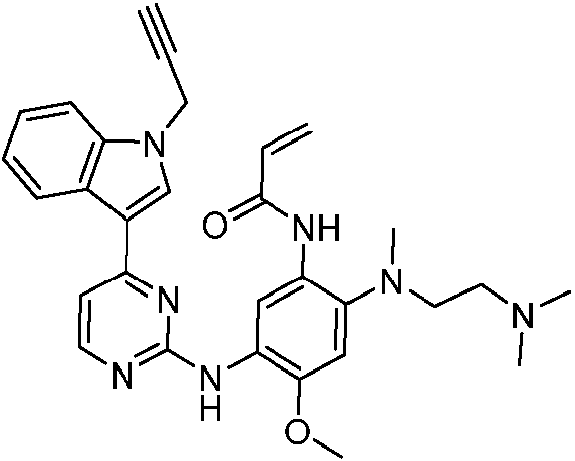
Etapa 1: preparación de N1-(4-(1H-indol-3-il)pirimidin-2-il)-N4-(2-(dimetilamino)etil)-2-metoxi-N4-metil-5-nitrobenceno-1,4-diaminaStep 1: Preparation of N1-(4-(1H-indol-3-yl)pyrimidin-2-yl)-N4-(2-(dimethylamino)ethyl)-2-methoxy-N4-methyl-5-nitrobenzene-1 ,4-diamine

El método de preparación de N1-(4-(1H-Indol-3-il)pirimidin-2-il)-N4-(2-(dimetilamino)etil)-2-metoxi-N4-metil-5-nitrobenceno-1,4-diamina fue similar al del Ejemplo 102.The method of preparation of N1-(4-(1H-Indol-3-yl)pyrimidin-2-yl)-N4-(2-(dimethylamino)ethyl)-2-methoxy-N4-methyl-5-nitrobenzene-1 ,4-diamine was similar to that of Example 102.
Etapa 2: preparación de N1-(2-(dimetilamino)etil)-5-metoxi-N1-metil-2-mtro-N4-(4-(1-(prop-2-in-1-il)-1H-indol-3-il)pirimidin-2-il)benceno-1,4-diaminaStep 2: Preparation of N1-(2-(dimethylamino)ethyl)-5-methoxy-N1-methyl-2-mtro-N4-(4-(1-(prop-2-yn-1-yl)-1H- indol-3-yl)pyrimidin-2-yl)benzene-1,4-diamine

Se disolvió N1-(4-(1H-indol-3-il)pirimidin-2-il)-N4-(2-(dimetilamino)etil)-2-metoxi-N 4-metil-5-nitrobenceno-1,4-diamina (0,51 g, 1,1 mmol) en DMF anhidra (20 ml), seguido de adición de NaH (47 mg, 1,16 mmol) a temperatura ambiente en agitación. Después de agitar durante 30 minutos, la mezcla de reacción se enfrió a 0 °C y se añadió bromuro de propargilo (137 mg, 1,16 mmol) a 0 °C. La solución de reacción se agitó durante 20 minutos. Después de que la CL-EM determinase la formación del producto, la reacción se interrumpió con una solución acuosa saturada de cloruro de amonio. El producto se purificó por cromatografía en columna inversa (eluyente: solución acuosa al 0,1 % de TFA ~ acetonitrilo) para obtener sal t Fa de N1-(2-(dimetilamino)etil)-5-metoxi-N1-metil-2-nitro-N4-(4-(1-(prop-2-in-1-il)-1H-indol-3-il)pirimidin-2-il)benceno-1,4-diamina (0,25 g, 28 %).N1-(4-(1H-indol-3-yl)pyrimidin-2-yl)-N4-(2-(dimethylamino)ethyl)-2-methoxy-N 4-methyl-5-nitrobenzene-1,4 was dissolved -diamine (0.51 g, 1.1 mmol) in anhydrous DMF (20 mL), followed by addition of NaH (47 mg, 1.16 mmol) at room temperature with stirring. After stirring for 30 min, the reaction mixture was cooled to 0 °C and propargyl bromide (137 mg, 1.16 mmol) was added at 0 °C. The reaction solution was stirred for 20 minutes. After LCMS determined product formation, the reaction was quenched with saturated aqueous ammonium chloride solution. The product was purified by reverse column chromatography (eluent: 0.1% TFA aqueous solution ~ acetonitrile) to obtain N1-(2-(dimethylamino)ethyl)-5-methoxy-N1-methyl-2 tFa salt -nitro-N4-(4-(1-(prop-2-yn-1-yl)-1H-indol-3-yl)pyrimidin-2-yl)benzene-1,4-diamine (0.25 g, 28%).
RMN 1H (400 MHz, CD3OD): 88,62 (s, 1H), 8,57 (s, 1H), 8,28 (d, J = 8,0 Hz, 1H), 8,17 (d, J = 6,8 Hz, 1H), 7,64 (d, J = 8,0 Hz, 1H), 7,48 (d, J = 6,4 Hz, 1H), 7,37 (t, J = 7,6 Hz, 1H), 7,24 (t, J = 7,2 Hz, 1H), 7,09 (s, 1H), 5,19 (d, J = 2,4 Hz, 2H), 4,06 (s, 3H), 3,62 (t, J = 6,0 Hz, 2H), 3,52 (t, J = 6,0 Hz, 2H), 3,36 (s, 1H), 3,01 (s, 6H), 2,98 (s, 3H);1H NMR (400 MHz, CD 3 OD): 88.62 (s, 1H), 8.57 (s, 1H), 8.28 (d, J = 8.0 Hz, 1H), 8.17 (d , J = 6.8 Hz, 1H), 7.64 (d, J = 8.0 Hz, 1H), 7.48 (d, J = 6.4 Hz, 1H), 7.37 (t, J = 7.6 Hz, 1H), 7.24 (t, J = 7.2 Hz, 1H), 7.09 (s, 1H), 5.19 (d, J = 2.4 Hz, 2H), 4.06 (s, 3H), 3.62 (t, J = 6.0 Hz, 2H), 3.52 (t, J = 6.0 Hz, 2H), 3.36 (s, 1H), 3.01 (s, 6H), 2.98 (s, 3H);
EM m/z (IEN): 500,2 [M+H]+.MS m/z (ESI): 500.2 [M+H]+.
Etapa 3: preparación de N1-(2-(dimetilamino)etil)-5-metoxi-Nl-metil-N 4-(4-(1-(prop-2-in-1-il)-1H-i ndol-3-il)pirimidin-2-il)benceno-1,2,4-triamina Step 3: Preparation of N1-(2-(dimethylamino)ethyl)-5-methoxy-Nl-methyl-N 4-(4-(1-(prop-2-yn-1-yl)-1H-indol- 3-yl)pyrimidin-2-yl)benzene-1,2,4-triamine
La sal TFA de N1-(2-(dimetilamino)etil)-5 -metoxi-N1-metil-2-nitro-N4-(4-(1-(prop-2-in-1-il)-1H-indol-3-il)pirimidin-2-il)benceno-1,4-diamina (0,25 g, 0,30 mmol), polvo de hierro reducido (112 mg, 2,0 mmol) y cloruro de amonio (0,015 g, 0,3 mmol) se añadieron una mezcla de etanol (8 ml) y agua (2 ml). La reacción se agitó en una atmósfera de nitrógeno a 75 °C durante una noche. Después de que la solución de reacción se enfriara a temperatura ambiente al día siguiente, se añadió etanol (60 ml). La solución de reacción se filtró a través de celite y se lavó con etanol (10 ml). El filtrado se concentró a presión reducida y se añadió DCM (60 ml). La capa de DCM se lavó con salmuera saturada (30 ml), se secó sobre sulfato sódico anhidro y se concentró para obtener N1-(2-(dimetilamino)etil)-5-metoxi-N1-metil-N4-(4-(1-(prop-2-in-1-il)-1H-ind ol-3-il)pirimidin-2-il)benceno-1,2,4-triamina (130 mg, 90 %) que se usó directamente en la siguiente etapa sin purificación adicional.The TFA salt of N1-(2-(dimethylamino)ethyl)-5-methoxy-N1-methyl-2-nitro-N4-(4-(1-(prop-2-yn-1-yl)-1H-indole -3-yl)pyrimidin-2-yl)benzene-1,4-diamine (0.25 g, 0.30 mmol), reduced iron powder (112 mg, 2.0 mmol), and ammonium chloride (0.015 g , 0.3 mmol) a mixture of ethanol (8 ml) and water (2 ml) were added. The reaction was stirred under nitrogen at 75°C overnight. After the reaction solution was cooled to room temperature the next day, ethanol (60 ml) was added. The reaction solution was filtered through celite and washed with ethanol (10 ml). The filtrate was concentrated under reduced pressure and DCM (60 mL) was added. The DCM layer was washed with saturated brine (30 mL), dried over anhydrous sodium sulfate, and concentrated to obtain N1-(2-(dimethylamino)ethyl)-5-methoxy-N1-methyl-N4-(4-( 1-(prop-2-yn-1-yl)-1H-ind ol-3-yl)pyrimidin-2-yl)benzene-1,2,4-triamine (130 mg, 90%) which was used directly in the next step without further purification.
EM m/z (IEN): 470,2 [M+H]+.MS m/z (ESI): 470.2 [M+H]+.
Etapa 4: preparación de N-(2-((2-(dimetilamino)etil)(metil)amino)-4-metoxi-5-((4-(1-(prop-2-in-1-il)-1H-indol-3-il)pirimidin-2-il)amino)fenil)acrilamidaStep 4: Preparation of N-(2-((2-(dimethylamino)ethyl)(methyl)amino)-4-methoxy-5-((4-(1-(prop-2-yn-1-yl)- 1H-indol-3-yl)pyrimidin-2-yl)amino)phenyl)acrylamide

Se disolvieron N1-(2-(dimetilamino)etil)-5-metoxi-N1-metil-N4-(4-(1-(prop-2-in-1-il)-1H-indol-3-il)pirimidin-2-il)benceno-1,2,4-triamina (130 mg, 0,28 mmol) y trietilamina (170 mg, 1,7 mmol) en THF (20 ml). La solución se enfrió a -78 °C. Se añadió gota a gota una solución de cloruro de acriloílo (75 mg, 0,84 mmol) en THF (4 ml) a la mezcla de reacción. La reacción se llevó a cabo durante 5 minutos a esta temperatura, se interrumpió con metanol (1 ml). Después de añadirse TFA (200 mg), la solución de reacción se concentró a presión reducida y se purificó por cromatografía en columna inversa (eluyente: solución acuosa al 0,1 % de TFA ~ acetonitrilo) para obtener sal de TFA de N-(2-((2-(dimetilamino)etil)(metil)amino)-4-metoxi-5-((4-(1-(prop-2-in-1-il)-1H-indol-3-il)pirimidin-2-il)amino)fenil)acrilamida (105 mg, 45 %).N1-(2-(dimethylamino)ethyl)-5-methoxy-N1-methyl-N4-(4-(1-(prop-2-yn-1-yl)-1H-indol-3-yl)pyrimidin -2-yl)benzene-1,2,4-triamine (130 mg, 0.28 mmol) and triethylamine (170 mg, 1.7 mmol) in THF (20 mL). The solution was cooled to -78°C. A solution of acryloyl chloride (75 mg, 0.84 mmol) in THF (4 mL) was added dropwise to the reaction mixture. The reaction was carried out for 5 minutes at this temperature, quenched with methanol (1 mL). After TFA (200 mg) was added, the reaction solution was concentrated under reduced pressure and purified by reverse column chromatography (eluent: 0.1% TFA aqueous solution ~ acetonitrile) to obtain N-( 2-((2-(dimethylamino)ethyl)(methyl)amino)-4-methoxy-5-((4-(1-(prop-2-yn-1-yl)-1H-indol-3-yl) pyrimidin-2-yl)amino)phenyl)acrylamide (105mg, 45%).
RMN 1H (400 MHz, CD3OD): 88,62 (s, 1H), 8,37 (a, 1H), 8,10 (d, J = 6,8 Hz, 1H), 7,96 (s, 1H), 7,64 (d, J = 8,0 Hz, 1H), 7,46 (d, J = 7,2 Hz, 1H), 7,36 (m, 1H), 7,27 (t, J = 7,2 Hz, 1H), 7,10 (s, 1H), 6,54 (m, 2H), 5,90 (m, 1H), 5,20 (d, J = 2,8 Hz, 2H), 3,99 (s, 3H), 3,57 (t, J = 6,0 Hz, 2H), 3,34 (t, J = 6,0 Hz, 2H), 3,03 (t, J = 2,8 Hz, 1H), 2,93 (s, 6H), 2,82 (s, 3H); EM m/z (IEN): 524,2 [M+H]+.1H NMR (400 MHz, CD 3 OD): 88.62 (s, 1H), 8.37 (a, 1H), 8.10 (d, J = 6.8 Hz, 1H), 7.96 (s , 1H), 7.64 (d, J = 8.0 Hz, 1H), 7.46 (d, J = 7.2 Hz, 1H), 7.36 (m, 1H), 7.27 (t , J = 7.2 Hz, 1H), 7.10 (s, 1H), 6.54 (m, 2H), 5.90 (m, 1H), 5.20 (d, J = 2.8 Hz , 2H), 3.99 (s, 3H), 3.57 (t, J = 6.0 Hz, 2H), 3.34 (t, J = 6.0 Hz, 2H), 3.03 (t , J = 2.8 Hz, 1H), 2.93 (s, 6H), 2.82 (s, 3H); MS m/z (ESI): 524.2 [M+H]+.
Ejemplo 141: preparación de N-(5-((4-(1-alil-1H-indol-3-il)pirimidin-2-il)amino)-2-((2-(dimetilamino)etil)(metil)amino)-4-metoxifenil)acrilamidaExample 141: Preparation of N-(5-((4-(1-allyl-1H-indol-3-yl)pyrimidin-2-yl)amino)-2-((2-(dimethylamino)ethyl)(methyl) amino)-4-methoxyphenyl)acrylamide

El método de preparación de N-(5-((4-(1-alil-1H-indol-3-il)pirimidin-2-il)amino)-2-((2-(dimetilamino)etil)(metil)amino)-4-metoxifenil)acrilamida fue similar al del Ejemplo 140.The method of preparation of N-(5-((4-(1-allyl-1H-indol-3-yl)pyrimidin-2-yl)amino)-2-((2-(dimethylamino)ethyl)(methyl) amino)-4-methoxyphenyl)acrylamide was similar to that of Example 140.
RMN 1H (400 MHz, CD3OD): 88,53 (s, 1H), 8,31 (a, 1H), 8,00 (d, J = 6,8 Hz, 1H), 7,94 (s, 1H), 7,49 (d, J = 8,0 Hz, 1H), 7,39 (d, J = 6,8 Hz, 1H), 7,28 (t, J = 7,2 Hz, 1H), 7,19 (t, J = 8,0 Hz, 1H), 7,05 (s, 1H), 6,57 (m, 1H), 6,42 (m, 1H), 6,07 (m, 1H), 5,82 (m, 1H), 5,25 (m, 1H), 5,23 (m, 1H), 4,92 (d, J = 5,2 Hz, 2H), 3,93 (s, 3H), 3,86 (m, 2H), 3,52 (t, J = 4,4 Hz, 2H), 3,32 (t, J = 5,6 Hz, 2H), 2,88 (s, 6H), 2,76 (s, 3H);1H NMR (400 MHz, CD 3 OD): 88.53 (s, 1H), 8.31 (a, 1H), 8.00 (d, J = 6.8 Hz, 1H), 7.94 (s , 1H), 7.49 (d, J = 8.0 Hz, 1H), 7.39 (d, J = 6.8 Hz, 1H), 7.28 (t, J = 7.2 Hz, 1H ), 7.19 (t, J = 8.0 Hz, 1H), 7.05 (s, 1H), 6.57 (m, 1H), 6.42 (m, 1H), 6.07 (m , 1H), 5.82 (m, 1H), 5.25 (m, 1H), 5.23 (m, 1H), 4.92 (d, J = 5.2 Hz, 2H), 3.93 (s, 3H), 3.86 (m, 2H), 3.52 (t, J = 4.4 Hz, 2H), 3.32 (t, J = 5.6 Hz, 2H), 2.88 (s, 6H), 2.76 (s, 3H);
EM m/z (IEN): 526,2 [M+H]+.MS m/z (ESI): 526.2 [M+H]+.
Ejemplo 142: preparación de N-(5-((4-(1-(N,N-dimetilsulfamoil)-1H-indol-3-il)pirimidin-2-il)amino)-4-metoxi-2-(metil(2-(pirrolidin-1-il)etil)amino)fenil)acrilamida Example 142: Preparation of N-(5-((4-(1-(N,N-dimethylsulfamoyl)-1H-indol-3-yl)pyrimidin-2-yl)amino)-4-methoxy-2-(methyl (2-(pyrrolidin-1-yl)ethyl)amino)phenyl)acrylamide

Etapa 1: preparación de N-(4-(1H-indol-3-il)pirimidin-2-il)-2-metoxi-N4-metil-5-nitro-N4-(2-(pirrolidin-1-il)etil)benceno-1,4-diaminaStep 1: Preparation of N-(4-(1H-indol-3-yl)pyrimidin-2-yl)-2-methoxy-N4-methyl-5-nitro-N4-(2-(pyrrolidin-1-yl) ethyl)benzene-1,4-diamine

Se disolvió N-(4-fluoro-2-metoxi-5-nitrofenil)-4-(1H-indol-3-il)pirimidin-2-amina (118 mg, 0,312 mmol) en DMF (2 ml), y después se añadieron trietilamina (95 mg, 0,936 mmol) y N-metil-2-(pirrolidin-1-il)etan-1-amina (60 mg, 0,468 mmol). La reacción se calentó hasta 120 °C por microondas y se hizo reaccionar durante 30 minutos. Después de que la CLEM mostrase la finalización de la reacción, la solución de reacción se concentró a sequedad. El producto en bruto se purificó por cromatografía de capa fina preparativa para obtener N-(4-(1H-indol-3-il)pirimidin-2-il)-2-metoxi-N4-metil-5-nitro-N4-(2-(pirrolidin-1-il)etil)benceno-1,4-diamina (122 mg, 100 %).N-(4-fluoro-2-methoxy-5-nitrophenyl)-4-(1H-indol-3-yl)pyrimidin-2-amine (118 mg, 0.312 mmol) was dissolved in DMF (2 mL), and then triethylamine (95 mg, 0.936 mmol) and N-methyl-2-(pyrrolidin-1-yl)ethan-1-amine (60 mg, 0.468 mmol) were added. The reaction was heated to 120°C by microwave and reacted for 30 minutes. After LCMS showed the completion of the reaction, the reaction solution was concentrated to dryness. The crude product was purified by preparative thin-layer chromatography to obtain N-(4-(1H-indol-3-yl)pyrimidin-2-yl)-2-methoxy-N4-methyl-5-nitro-N4-( 2-(pyrrolidin-1-yl)ethyl)benzene-1,4-diamine (122 mg, 100%).
Etapa 2: preparación de 3-(2-((2-metoxi-4-(metil(2-(pirrolidin-1-il)etil)amino)-5-nitrofenil)amino)pirimidin-4-il)-N,N-dimetil-1H-indolo-1-sulfonamidaStep 2: Preparation of 3-(2-((2-methoxy-4-(methyl(2-(pyrrolidin-1-yl)ethyl)amino)-5-nitrophenyl)amino)pyrimidin-4-yl)-N, N-dimethyl-1H-indolo-1-sulfonamide

Se disolvió N-(4-(1H-indol-3-il)pirimidin-2-il)-2-metoxi-N4-metil-5-nitro-N4-(2-(pirroli din-1-il)etil)benceno-1,4-diamina (122 mg, 0,25 mmol) en DMF (10 ml) y la mezcla se enfrió a 0 °C en un baño de hielo. Después, se añadió NaH (30 mg, 0,75 mmol) y la reacción se llevó a cabo a 0 °C durante diez minutos, y después, se añadió gota a gota cloruro de dimetilsulfamoílo (54 mg, 0,374 mmol). La solución de reacción se calentó a temperatura ambiente y se agitó durante 30 minutos. Después de que la reacción se interrumpiese, se añadieron diclorometano y agua y la solución de reacción se extrajo tres veces. Las fases orgánicas se combinaron, se lavaron con una solución acuosa saturada de bicarbonato sódico, agua y salmuera saturada, se filtraron y se concentraron para obtener un producto en bruto que se purificó adicionalmente por cromatografía ultrarrápida en columna sobre gel de sílice para obtener 3-(2-((2-metoxi-4-(metil(2-(pirrolidin-1 -il)etil)amino)-5-nitrofenil)amino)pirimidin-4-il)-N,N-dimetil-1H-indolo-1-sulfonamida (60 mg, 40 %).N-(4-(1H-indol-3-yl)pyrimidin-2-yl)-2-methoxy-N4-methyl-5-nitro-N4-(2-(pyrrolidin-1-yl)ethyl) was dissolved benzene-1,4-diamine (122 mg, 0.25 mmol) in DMF (10 mL) and the mixture cooled to 0 °C in an ice bath. NaH (30 mg, 0.75 mmol) was then added and the reaction was carried out at 0 °C for ten minutes, and then dimethylsulfamoyl chloride (54 mg, 0.374 mmol) was added dropwise. The reaction solution was warmed to room temperature and stirred for 30 minutes. After the reaction was stopped, dichloromethane and water were added, and the reaction solution was extracted three times. The organic phases were combined, washed with saturated aqueous sodium bicarbonate solution, water and saturated brine, filtered and concentrated to obtain a crude product which was further purified by flash column chromatography on silica gel to obtain 3- (2-((2-methoxy-4-(methyl(2-(pyrrolidin-1-yl)ethyl)amino)-5-nitrophenyl)amino)pyrimidin-4-yl)-N,N-dimethyl-1H-indole -1-sulfonamide (60 mg, 40%).
Etapa 3: preparación de 3-(2-((5-amino-2-metoxi-4-(metil(2-(pirrolidin-1-il)etil)amino)fenil)amino) pirimidin-4-il)-N,N-dimetil-1H-indolo-1-sulfonamida Step 3: Preparation of 3-(2-((5-amino-2-methoxy-4-(methyl(2-(pyrrolidin-1-yl)ethyl)amino)phenyl)amino)pyrimidin-4-yl)-N ,N-dimethyl-1H-indolo-1-sulfonamide

El compuesto anteriormente mencionado 3-(2-((2-metoxi-4-(metil(2-(pirrolidin-1-il)etil)amino)-5-nitrofenil)amino)piri midin-4-il)-N,N-dimetil-1H-indolo-1-sulfonamida se disolvió en metanol (5 ml) y después se añadió Pd/C (15 mg). La reacción se agitó en una atmósfera de hidrógeno a 24 °C durante 1 hora. Después de que la CLEM mostrase la finalización de la reacción, la solución de reacción se filtró y el filtrado se concentró. El residuo resultante se purificó por cromatografía ultrarrápida en columna sobre gel de sílice para obtener 15 mg del producto en bruto 3-(2-((5-amino-2-metoxi-4-(metil(2-(pirrolidin-1-il)etil)amino)fenil)amino)pirimidin-4-il)-N,N-dimetil-1H-indolo-1-sulfonamida.The aforementioned compound 3-(2-((2-methoxy-4-(methyl(2-(pyrrolidin-1-yl)ethyl)amino)-5-nitrophenyl)amino)pyrimidin-4-yl)-N, N-dimethyl-1H-indole-1-sulfonamide was dissolved in methanol (5 mL), then Pd/C (15 mg) was added. The reaction was stirred under an atmosphere of hydrogen at 24°C for 1 hour. After LCMS showed the completion of the reaction, the reaction solution was filtered, and the filtrate was concentrated. The resulting residue was purified by flash column chromatography on silica gel to obtain 15 mg of the crude product 3-(2-((5-amino-2-methoxy-4-(methyl(2-(pyrrolidin-1-yl )ethyl)amino)phenyl)amino)pyrimidin-4-yl)-N,N-dimethyl-1H-indole-1-sulfonamide.
Etapa 4: preparación de N-(5-((4-(1-(N,N-dimetilsulfamoil)-1H-indol-3-il)pirimidin-2-il)amino)-4-metoxi-2-(metil(2-(pirrolidin-1-il)etil)amino)fenil)acrilamidaStep 4: Preparation of N-(5-((4-(1-(N,N-dimethylsulfamoyl)-1H-indol-3-yl)pyrimidin-2-yl)amino)-4-methoxy-2-(methyl (2-(pyrrolidin-1-yl)ethyl)amino)phenyl)acrylamide

Se disolvieron 3-(2-((5-amino-2-metoxi-4-(metil(2-(pirrolidin-1-il)etil)amino)fenil)amino)pirimidin-4-il)-N,N-dimetil-1H-indolo-1-sulfonamida (15 mg, 0,027 mmol) y trietilamina (8 mg, 0,08 mmol) se disolvieron en tetrahidrofurano anhidro (20 ml). Después de que la solución de reacción se agitase a -78 °C durante 10 minutos, se añadió lentamente y gota a gota cloruro de acriloílo (0,05 ml, 1 M en THF). La reacción se agitó durante 30 minutos en un baño de hielo seco. Después de que la CLEM mostrase la finalización de la reacción, la reacción se interrumpió con metanol. La solución de reacción se concentró, y el residuo resultante se purificó por cromatografía de capa fina preparativa para obtener N-(5-((4-(1-(N,N-dimetilsulfamoil)-1H-indol-3-il)pirimidin-2-il)amino)-4-metoxi-2-(metil(2-(pirrolidin-1-il)etil)amino)fenil)acrilamida (7 mg, 44 %). RMN 1H (400 MHz, CD3OD) 88,63 (s, 1H), 8,46 (d, J = 7,9 Hz, 1H), 8,32 (s, 1H), 8,11-7,92 (m, 2H), 7,56 (d, J = 5,9 Hz, 1H), 7,37 (dt, J = 15,2, 7,3 Hz, 2H), 7,04 (s, 1H), 6,55 (dd, J = 16,8, 10,1 Hz, 1H), 6,42 (dd, J = 16,9, 1,7 Hz, 1H), 5,87 (dd, J = 10,0, 1,7 Hz, 1H), 3,99 (s, 3H), 3,60 (s, 2H), 3,58-3,50 (m, 2H), 3,43-3,36 (m, 2H), 3,10 (s, 2H), 2,93 (s, 6H), 2,79 (s, 3H), 2,27-2,09 (m, 4H);3-(2-((5-amino-2-methoxy-4-(methyl(2-(pyrrolidin-1-yl)ethyl)amino)phenyl)amino)pyrimidin-4-yl)-N,N- dimethyl-1H-indole-1-sulfonamide (15mg, 0.027mmol) and triethylamine (8mg, 0.08mmol) were dissolved in anhydrous tetrahydrofuran (20ml). After the reaction solution was stirred at -78°C for 10 minutes, acryloyl chloride (0.05 mL, 1M in THF) was slowly added dropwise. The reaction was stirred for 30 minutes in a dry ice bath. After LCMS showed completion of the reaction, the reaction was quenched with methanol. The reaction solution was concentrated, and the resulting residue was purified by preparative thin-layer chromatography to obtain N-(5-((4-(1-(N,N-dimethylsulfamoyl)-1H-indol-3-yl)pyrimidin -2-yl)amino)-4-methoxy-2-(methyl(2-(pyrrolidin-1-yl)ethyl)amino)phenyl)acrylamide (7mg, 44%). 1H NMR (400 MHz, CD 3 OD) 88.63 (s, 1H), 8.46 (d, J = 7.9 Hz, 1H), 8.32 (s, 1H), 8.11-7, 92 (m, 2H), 7.56 (d, J = 5.9 Hz, 1H), 7.37 (dt, J = 15.2, 7.3 Hz, 2H), 7.04 (s, 1H ), 6.55 (dd, J = 16.8, 10.1 Hz, 1H), 6.42 (dd, J = 16.9, 1.7 Hz, 1H), 5.87 (dd, J = 10.0, 1.7Hz, 1H), 3.99 (s, 3H), 3.60 (s, 2H), 3.58-3.50 (m, 2H), 3.43-3.36 (m, 2H), 3.10 (s, 2H), 2.93 (s, 6H), 2.79 (s, 3H), 2.27-2.09 (m, 4H);
EM m/z (IEN): 619,6 [M+H]+.MS m/z (ESI): 619.6 [M+H]+.
Ejemplo 143: preparación de N-(2-((2-(dimetilamino)etil)(metil)amino)-5-((4-(1-(N,N-dimetilsulfamoil)-6 -metoxi-1H-indol-3-il)-5-(trifluorometil)pirimidin-2-il)amino)-4-metoxifenilfenil)acrilamidaExample 143: Preparation of N-(2-((2-(dimethylamino)ethyl)(methyl)amino)-5-((4-(1-(N,N-dimethylsulfamoyl)-6-methoxy-1H-indole- 3-yl)-5-(trifluoromethyl)pyrimidin-2-yl)amino)-4-methoxyphenylphenyl)acrylamide
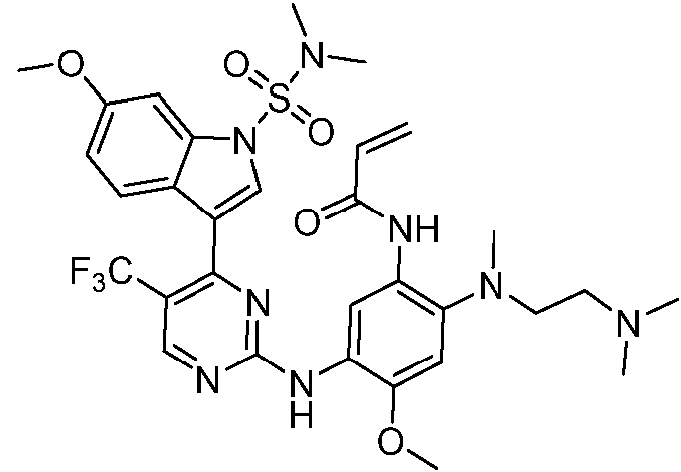
Etapa 1: preparación de 3-(2-cloro-5-(trifluorometil)pirimidin-4-il)-6-metoxi-1H-indol Step 1: Preparation of 3-(2-chloro-5-(trifluoromethyl)pyrimidin-4-yl)-6-methoxy-1H-indole

Se disolvieron 6-metoxMH-indol (5 g, 33,97 mmol), 2,4-didoro-5-(trifluorometil)pirimidina (8,1 g, 37,36 mmol) y tricloruro de aluminio (6,79 g, 50,95 mmol) en DME (50 ml) y la reacción se agitó durante una noche a 70 °C. Después de que la reacción se completase, la solución de reacción se vertió en agua enfriada con hielo y se extrajo tres veces con metil ferc-butil éter. Las fases orgánicas se combinaron, se lavaron con agua y salmuera saturada, se secaron sobre sulfato sódico anhidro, se filtraron y se evaporaron a sequedad para obtener un producto en bruto que se purificó adicionalmente por cromatografía ultrarrápida en columna sobre gel de sílice para obtener 3-(2-cloro-5-(trifluorometil)pirimidin-4-il)-6-metoxi-1H-indol (4,3 g, 39 %).6-MethoxMH-indole (5 g, 33.97 mmol), 2,4-didoro-5-(trifluoromethyl)pyrimidine (8.1 g, 37.36 mmol), and aluminum trichloride (6.79 g, 50.95 mmol) in DME (50 mL) and the reaction stirred overnight at 70 °C. After the completion of the reaction, the reaction solution was poured into ice-cold water and extracted three times with methyl tert-butyl ether. The organic phases were combined, washed with water and saturated brine, dried over anhydrous sodium sulfate, filtered and evaporated to dryness to obtain a crude product which was further purified by flash column chromatography on silica gel to obtain 3 -(2-chloro-5-(trifluoromethyl)pyrimidin-4-yl)-6-methoxy-1H-indole (4.3 g, 39%).
Etapa 2: preparación de N-(4-fluoro-2-metoxi-5-nitrofenil)-4-(6-metoxi-1H-indol-3-il)-5-(trifluorometil)pirimidin-2-aminaStep 2: Preparation of N-(4-fluoro-2-methoxy-5-nitrophenyl)-4-(6-methoxy-1H-indol-3-yl)-5-(trifluoromethyl)pyrimidin-2-amine

3-(2-cloro-5-(trifluorometil)pirimidin-4-il)-6-metoxi-1H-indol (165 mg, 0,504 mmol), el material de partida 4-fluoro-2-metoxi-5-nitroanilina (103 mg, 0,554 mmol) y monohidrato de ácido p-toluenosulfónico (96 mg, 0,504 mmol) se disolvieron en 2-pentanol (20 ml), y la reacción se calentó hasta 120 °C durante una noche. Después de que la CLEM mostrase la finalización de la reacción, la solución de reacción se enfrió de manera natural a temperatura ambiente y se precipitó un sólido de color oscuro. El sólido se filtró y la torta de filtro se lavó con metanol (1 ml) y metil ferc-butil éter (1 ml) para obtener N-(4-fluoro-2-metoxi-5-nitrofenil)-4-(6-metoxMH-indol-3-il)-5-(trifluorometil)pirimidin-2-amina (125 mg, 52 %).3-(2-chloro-5-(trifluoromethyl)pyrimidin-4-yl)-6-methoxy-1H-indole (165 mg, 0.504 mmol), starting material 4-fluoro-2-methoxy-5-nitroaniline ( 103 mg, 0.554 mmol) and p-toluenesulfonic acid monohydrate (96 mg, 0.504 mmol) were dissolved in 2-pentanol (20 mL) and the reaction heated to 120 °C overnight. After LCMS showed the completion of the reaction, the reaction solution was naturally cooled to room temperature, and a dark solid was precipitated. The solid was filtered off and the filter cake was washed with methanol (1 mL) and methyl tert-butyl ether (1 mL) to obtain N-(4-fluoro-2-methoxy-5-nitrophenyl)-4-(6- methoxMH-indol-3-yl)-5-(trifluoromethyl)pyrimidin-2-amine (125mg, 52%).
Etapa 3: preparación de Nl-(2-(dimetilamino)etil)-5-metoxi-N4-(4-(6-metoxi-1H-indol-3-il)-5-(trifluorometil)pirimidin-2-il)-N1-metil-2-nitrobenceno-1,4-diaminaStep 3: Preparation of Nl-(2-(dimethylamino)ethyl)-5-methoxy-N4-(4-(6-methoxy-1H-indol-3-yl)-5-(trifluoromethyl)pyrimidin-2-yl) -N1-methyl-2-nitrobenzene-1,4-diamine

Se disolvió N-(4-fluoro-2-metoxi-5-nitrofenil)-4-(6-metoxi-1H-indol-3-il)-5-(trifluorometil)pirimidin-2-amina (125 mg, 0,262 mmol) en 2 ml de DMF, y después se añadieron trietilamina (80 mg, 0,786 mmol) y trimetiletilendiamina (80 mg, 0,786 mmol). La reacción se calentó hasta 120 °C por microondas y se hizo reaccionar durante 30 minutos. Después de que la CLEM mostrase la finalización de la reacción, la solución de reacción se concentró a sequedad. El producto en bruto se purificó por cromatografía de capa fina preparativa para obtener N1-(2-(dimetilamino)etil)-5-metoxi-N4-(4-(6-metoxi-1H-indol-3-il)-5-(trifluoro metil)pirimidin-2-il)-N1-metil-2-nitrobenceno-1,4-diamina (146 mg, 99 %).Dissolved N-(4-fluoro-2-methoxy-5-nitrophenyl)-4-(6-methoxy-1H-indol-3-yl)-5-(trifluoromethyl)pyrimidin-2-amine (125 mg, 0.262 mmol ) in 2 mL of DMF, and then triethylamine (80 mg, 0.786 mmol) and trimethylethylenediamine (80 mg, 0.786 mmol) were added. The reaction was heated to 120°C by microwave and reacted for 30 minutes. After LCMS showed the completion of the reaction, the reaction solution was concentrated to dryness. The crude product was purified by preparative thin layer chromatography to obtain N1-(2-(dimethylamino)ethyl)-5-methoxy-N4-(4-(6-methoxy-1H-indol-3-yl)-5- (trifluoromethyl)pyrimidin-2-yl)-N1-methyl-2-nitrobenzene-1,4-diamine (146 mg, 99%).
Etapa 4: preparación de 3-(2-((4-((2-(dimetilamino)etil)(metil)amino)-2-metoxi-5-nitrofenil)amino)-5-(trifluorometil)pirimidin-4-il)-6-metoxi-N,N-dimetil-1H-indolo-1-sulfona mide Step 4: Preparation of 3-(2-((4-((2-(dimethylamino)ethyl)(methyl)amino)-2-methoxy-5-nitrophenyl)amino)-5-(trifluoromethyl)pyrimidin-4-yl )-6-methoxy-N,N-dimethyl-1H-indole-1-sulfone measures

Se disolvió N1-(2-(dimetilamino)etil)-5-metoxi-N4-(4-(6-metoxi-1H-indol-3-il)-5-(trifluorometil)pirimidin-2-il)-N1-metil-2-nitrobenceno-1,4-diamina (146 mg, 0,262 mmol) en DMF (10 ml), y la mezcla se enfrió a 0 °C en un baño de hielo antes de añadirse NaH (31 mg, 0,786 mmol). La reacción se llevó a cabo a 0 °C durante diez minutos, y después, se añadió gota a gota cloruro de dimetilsulfamoílo (41 mg, 0,288 mmol). La solución de reacción se calentó a temperatura ambiente y se agitó durante 30 minutos. Después de que la reacción se interrumpiese, se añadieron diclorometano y agua y la solución de reacción se extrajo tres veces. Las fases orgánicas se combinaron, se lavaron con una solución acuosa saturada de bicarbonato sódico, agua y salmuera saturada sucesivamente, se filtraron y se evaporaron a sequedad para obtener un producto en bruto que se purificó adicionalmente por cromatografía ultrarrápida en columna sobre gel de sílice para obtener 3-(2-((4-((2-(dimetilamino)etil)(metil)amino)-2-metoxi-5-nitrofenil)amino)-5-(trifluorometil)pirimidin-4-il)-6-metoxi-N,N-dimetil-1H-indolo-1-sulfonamida (80 mg, 46 %).N1-(2-(dimethylamino)ethyl)-5-methoxy-N4-(4-(6-methoxy-1H-indol-3-yl)-5-(trifluoromethyl)pyrimidin-2-yl)-N1- was dissolved methyl-2-nitrobenzene-1,4-diamine (146 mg, 0.262 mmol) in DMF (10 mL), and the mixture cooled to 0 °C in an ice bath before NaH (31 mg, 0.786 mmol) was added. . The reaction was carried out at 0 °C for ten minutes, and then dimethylsulfamoyl chloride (41 mg, 0.288 mmol) was added dropwise. The reaction solution was warmed to room temperature and stirred for 30 minutes. After the reaction was stopped, dichloromethane and water were added, and the reaction solution was extracted three times. The organic phases were combined, washed with saturated aqueous sodium bicarbonate solution, water and saturated brine successively, filtered and evaporated to dryness to obtain a crude product which was further purified by flash column chromatography on silica gel to obtain 3-(2-((4-((2-(dimethylamino)ethyl)(methyl)amino)-2-methoxy-5-nitrophenyl)amino)-5-(trifluoromethyl)pyrimidin-4-yl)-6- methoxy-N,N-dimethyl-1H-indolo-1-sulfonamide (80 mg, 46%).
Etapa 5: preparación de 3-(2-((5-amino-4-((2-(dimetilamino)etil)(metil)amino)-2-metoxifenil)amino)-5-(trifluorometil)pirimidin-4-il)-6-metoxi-N,N-dimetil-1H-indolo-1-sulfon amidaStep 5: Preparation of 3-(2-((5-amino-4-((2-(dimethylamino)ethyl)(methyl)amino)-2-methoxyphenyl)amino)-5-(trifluoromethyl)pyrimidin-4-yl )-6-methoxy-N,N-dimethyl-1H-indole-1-sulfon amide

El compuesto anteriormente mencionado N1-(2-(dimetilamino)etil)-5-metoxi-N4-(4-(6-metoxi-1H-indol-3-il)-5-(trifluoro metil)pirimidin-2-il)-N1-metil-2-nitrobenceno-1,4-diamina se disolvió en metanol (10 ml) y se añadió Pd/C (20 mg). La reacción se agitó en una atmósfera de hidrógeno a 24 °C durante 1 hora. Después de que la CLEM mostrase la finalización de la reacción, la solución de reacción se filtró, y el filtrado se concentró para obtener un producto en bruto que se purificó adicionalmente por cromatografía ultrarrápida en columna sobre gel de sílice para obtener 44 mg de 3-(2-((5-amino-4-((2-(dimetilamino)etil)(metil)amino)-2-metoxifenil)amino)-5 -(trifluorometil)pirimidin-4-il)-6-metoxi-N,N-dimetil-1H-indolo-1-sulfonamida.The aforementioned compound N1-(2-(dimethylamino)ethyl)-5-methoxy-N4-(4-(6-methoxy-1H-indol-3-yl)-5-(trifluoromethyl)pyrimidin-2-yl) -N1-Methyl-2-nitrobenzene-1,4-diamine was dissolved in methanol (10 mL) and Pd/C (20 mg) was added. The reaction was stirred under an atmosphere of hydrogen at 24°C for 1 hour. After LCMS showed the completion of the reaction, the reaction solution was filtered, and the filtrate was concentrated to obtain a crude product which was further purified by silica gel flash column chromatography to obtain 44 mg of 3- (2-((5-amino-4-((2-(dimethylamino)ethyl)(methyl)amino)-2-methoxyphenyl)amino)-5 -(trifluoromethyl)pyrimidin-4-yl)-6-methoxy-N ,N-dimethyl-1H-indolo-1-sulfonamide.
Etapa 6: preparación de N-(2-((2-(dimetilamino)etil)(metil)amino)-5-((4-(1-(N,N-dimetilsulfamoil)-6 -metoxi-1H-indol-3-il)-5-(trifluorometil)pirimidin-2-il)amino)-4-metoxifenilfenil)acrilamidaStep 6: Preparation of N-(2-((2-(dimethylamino)ethyl)(methyl)amino)-5-((4-(1-(N,N-dimethylsulfamoyl)-6-methoxy-1H-indole- 3-yl)-5-(trifluoromethyl)pyrimidin-2-yl)amino)-4-methoxyphenylphenyl)acrylamide

Se disolvieron 3-(2-((5-amino-4-((2-(dimetilamino)etil)(metil)amino)-2-metoxifenil)amino)-5-(trifluorometil)pirimidin-4-il)-6-metoxi-N,N-dimetil-1H-indolo-1-sulfonamisa (44 mg, 0,069 mmol) y trietilamina (21 mg, 0,207 mmol) en tetrahidrofurano anhidro (20 ml). La reacción se agitó a -78 °C durante 10 minutos antes de añadirse lentamente y gota a gota cloruro de acriloílo (0,2 ml, 1 M en THF). Después, la reacción se agitó durante 30 minutos en un baño de hielo seco. Después de que la CLEM mostrase la finalización de la reacción, la reacción se interrumpió con metanol. La solución de reacción se concentró, y el residuo resultante se purificó por cromatografía de capa fina preparativa para obtener N-(2-((2-(dimetilamino)etil)(metil)amino)-5-((4-(1-(N,N-dimetilsulfamoil)-6-m etoxi-1H-indol-3-il)-5-(trifluorometil)pirimidin-2-il)amino)-4-metoxifenil)acrilamida (16 mg, 33 %).3-(2-((5-amino-4-((2-(dimethylamino)ethyl)(methyl)amino)-2-methoxyphenyl)amino)-5-(trifluoromethyl)pyrimidin-4-yl)-6 were dissolved -methoxy-N,N-dimethyl-1H-indole-1-sulfonamise (44 mg, 0.069 mmol) and triethylamine (21 mg, 0.207 mmol) in anhydrous tetrahydrofuran (20 mL). The reaction was stirred at -78 °C for 10 min before acryloyl chloride (0.2 mL, 1 M in THF) was slowly added dropwise. The reaction was then stirred for 30 minutes in a dry ice bath. After LCMS showed completion of the reaction, the reaction was quenched with methanol. The reaction solution was concentrated, and the resulting residue was purified by preparative thin-layer chromatography to obtain N-(2-((2-(dimethylamino)ethyl)(methyl)amino)-5-((4-(1- (N,N-dimethylsulfamoyl)-6-m ethoxy-1H-indol-3-yl)-5-(trifluoromethyl)pyrimidin-2-yl)amino)-4-methoxyphenyl)acrylamide (16mg, 33%).
RMN 1H (400 MHz, CD3OD) 88,78 (s, 1H), 8,39 (s, 1H), 7,91 (d, J = 8,8 Hz, 1H), 7,82 (s, 1H), 7,50 (d, J = 2,1 Hz, 1H), 6,97 (s, 1H), 6,90 (d, J = 8,2 Hz, 1H), 6,41 (d, J = 5,3 Hz, 2H), 5,83 (t, J = 5,9 Hz, 1H), 4,00 (s, 3H), 3,88 (s, 3H), 3,49 (t, J = 5,5 Hz, 2H), 3,28 (t, J = 5,5 Hz, 2H), 2,89 (s, 6H), 2,86 (s, 6H), 2,70 (s, 3H);1H NMR (400 MHz, CD 3 OD) 88.78 (s, 1H), 8.39 (s, 1H), 7.91 (d, J = 8.8 Hz, 1H), 7.82 (s, 1H), 7.50 (d, J=2.1Hz, 1H), 6.97 (s, 1H), 6.90 (d, J=8.2Hz, 1H), 6.41 (d, J = 5.3 Hz, 2H), 5.83 (t, J = 5.9 Hz, 1H), 4.00 (s, 3H), 3.88 (s, 3H), 3.49 (t, J = 5.5 Hz, 2H), 3.28 (t, J = 5.5 Hz, 2H), 2.89 (s, 6H), 2.86 (s, 6H), 2.70 (s, 3H);
EM m/z (IEN): 691,5 [M+H]+MS m/z (ESI): 691.5 [M+H]+
Prueba y evaluación biológicaBiological testing and evaluation
1. Experimento enzimológico de EGFR de tipo mutante T790M1. T790M Mutant-like EGFR Enzymological Experiment
En este experimento, el efecto inhibidor de los compuestos sobre la enzima EGFR de tipo mutante T790M del exón 20 se probó mediante un método de transferencia de energía por resonancia de fluorescencia (TR-FRET), y se determinó la concentración inhibitoria semimáxima (CI50) de los compuestos sobre la actividad enzimática.In this experiment, the inhibitory effect of the compounds on the exon 20 T790M mutant-like EGFR enzyme was tested by a fluorescence resonance energy transfer (TR-FRET) method, and the half-maximal inhibitory concentration (IC 50 ) of the compounds on enzymatic activity.
1) Se añadió 1 ~ 5 pl de solución de enzima EGFR T790M a una placa de 384 pocillos y la concentración final de la enzima es 0,1 ~ 1 nM.1) 1 ~ 5 pl of EGFR T790M enzyme solution was added to a 384-well plate, and the final enzyme concentration is 0.1 ~ 1 nM.
2) Se añadió 1 ~ 5 pl de solución diluida en gradiente del compuesto.2) 1 ~ 5 pl of compound gradient diluted solution was added.
3) La mezcla se incubó durante 10 minutos a temperatura ambiente.3) The mixture was incubated for 10 minutes at room temperature.
4) Se añadió 1 ~ 5 pl de una mezcla de sustrato que contenía polipéptido sustrato con 5 ~ 50 nM de concentración final y ATP con 1 ~ 10 uM de concentración final.4) 1 ~ 5 µl of a substrate mixture containing substrate polypeptide with 5 ~ 50 nM final concentration and ATP with 1 ~ 10 uM final concentration was added.
5) La mezcla se incubó a temperatura ambiente durante 0,5~ 2 horas.5) The mixture was incubated at room temperature for 0.5~2 hours.
6) Se añadieron 5 pl de solución de parada de EDTA para terminar la reacción durante 5 minutos.6) 5 µl of EDTA stop solution was added to terminate the reaction for 5 minutes.
7) Se añadieron 5 pl de una solución de prueba que contenía el anticuerpo marcado y la mezcla se incubó a temperatura ambiente durante 1 hora.7) 5 µl of a test solution containing the labeled antibody was added and the mixture was incubated at room temperature for 1 hour.
8) Los valores de la señal de fluorescencia de cada placa se determinaron mediante un lector de microplacas a 665 nm.8) The values of the fluorescence signal of each plate were determined by means of a microplate reader at 665 nm.
9) Las tasas de inhibición se calcularon de acuerdo con los valores de la señal de fluorescencia.9) Inhibition rates were calculated according to fluorescence signal values.
10) La CI50 del compuesto se obtuvo ajustando la curva de acuerdo con las tasas de inhibición a diferentes concentraciones.10) The IC 50 of the compound was obtained by fitting the curve according to the inhibition rates at different concentrations.
2. Experimento enzimológico de EGFR de tipo silvestre (TS)2. Wild-type EGFR (TS) Enzymology Experiment
En este experimento, el efecto inhibidor de los compuestos sobre la enzima EGFR de tipo silvestre se probó mediante un método de transferencia de energía por resonancia de fluorescencia (TR-FRET), y se determinó la concentración inhibitoria semimáxima CI50 de los compuestos en la actividad enzimática.In this experiment, the inhibitory effect of the compounds on the wild-type EGFR enzyme was tested by a fluorescence resonance energy transfer (TR-FRET) method, and the IC 50 half-maximal inhibitory concentration of the compounds was determined in the enzymatic activity.
1) Se añadió 1 ~ 5 pl de solución de enzima EGFR de tipo silvestre a una placa de 384 pocillos y la concentración final de la enzima es 0,1 ~ 1 nM.1) 1 ~ 5 pl of wild-type EGFR enzyme solution was added to a 384-well plate, and the final enzyme concentration is 0.1 ~ 1 nM.
2) Se añadió 1 ~ 5 pl de solución diluida en gradiente del compuesto.2) 1 ~ 5 pl of compound gradient diluted solution was added.
3) La mezcla se incubó durante 10 minutos a temperatura ambiente.3) The mixture was incubated for 10 minutes at room temperature.
4) Se añadió 1 ~ 5 pl de una mezcla de sustrato que contenía polipéptido sustrato con 5 ~ 50 nM de concentración final y ATP con 0,1 ~ 5 uM de concentración final.4) 1 ~ 5 µl of a substrate mixture containing substrate polypeptide with 5 ~ 50 nM final concentration and ATP with 0.1 ~ 5 uM final concentration was added.
5) La mezcla se incubó a temperatura ambiente durante 0,5~ 2 horas.5) The mixture was incubated at room temperature for 0.5~2 hours.
6) Se añadieron 5 pl de solución de parada de EDTA para terminar la reacción durante 5 minutos.6) 5 µl of EDTA stop solution was added to terminate the reaction for 5 minutes.
7) Se añadieron 5 pl de una solución de prueba que contenía el anticuerpo marcado y la mezcla se incubó a temperatura ambiente durante 1 hora.7) 5 µl of a test solution containing the labeled antibody was added and the mixture was incubated at room temperature for 1 hour.
8) Los valores de la señal de fluorescencia de cada placa se determinaron mediante un lector de microplacas a 665 nm.8) The values of the fluorescence signal of each plate were determined by means of a microplate reader at 665 nm.
9) Las tasas de inhibición se calcularon a partir de los valores de la señal de fluorescencia.9) Inhibition rates were calculated from fluorescence signal values.
10) La CI50 del compuesto se obtuvo ajustando la curva de acuerdo con las tasas de inhibición a diferentes concentraciones.10) The IC 50 of the compound was obtained by fitting the curve according to the inhibition rates at different concentrations.
La actividad bioquímica de los compuestos de la presente invención se determinó mediante el experimento anteriormente mencionado y los valores de CI50 se muestran en la tabla siguiente.The biochemical activity of the compounds of the present invention was determined by the above-mentioned experiment, and the IC 50 values are shown in the table below.

continuacióncontinuation

continuacióncontinuation

En donde, NT significa sin actividad determinada.Wherein, NT means no determined activity.
Los valores de CI50 de EGFR de otros compuestos de ejemplo de la presente invención fueron similares al efecto de los ejemplos mencionados anteriormente, y estos compuestos exhibieron una actividad inhibitoria y regularidad similares. The EGFR IC 50 values of other example compounds of the present invention were similar to the effect of the examples mentioned above, and these compounds exhibited similar inhibitory activity and regularity.
Conclusión: los compuestos de ejemplo de la presente invención tuvieron una fuerte actividad inhibidora sobre la quinasa EGFR de tipo mutante, mientras tanto, tenían una débil actividad inhibidora en la quinasa de tipo silvestre. Por lo tanto los compuestos de la presente invención tenían muy buena selectividad.Conclusion: The example compounds of the present invention had strong inhibitory activity on mutant-type EGFR kinase, meanwhile, they had weak inhibitory activity on wild-type kinase. Therefore the compounds of the present invention had very good selectivity.
3. Experimento sobre la inhibición de la proliferación de células NCI-H19753. Experiment on inhibition of proliferation of NCI-H1975 cells
En este experimento, el efecto inhibidor de los compuestos sobre la proliferación de células NCI-H1975 se probó mediante un método CellTiter-Glo, y se determinó la concentración inhibitoria semimáxima (CI50) de los compuestos sobre la actividad de proliferación celular.In this experiment, the inhibitory effect of the compounds on the proliferation of NCI-H1975 cells was tested by a CellTiter-Glo method, and the half-maximal inhibitory concentration (IC 50 ) of the compounds on cell proliferation activity was determined.
1) Se sembró una placa de cultivo celular de 96 pocillos con 90 pl de suspensión de células H1975 a una densidad de 1~5x10³ células/ml. La placa de cultivo se incubó en una incubadora durante 16-24 horas (37 °C, CO2 al 5 %).1) A 96-well cell culture plate was seeded with 90 μl of H1975 cell suspension at a density of 1~5×10 3 cells/ml. The culture plate was incubated in an incubator for 16-24 hours (37°C, 5% CO 2 ).
2) Se añadieron diferentes concentraciones del compuesto de prueba en dilución en gradiente a las células en la placa de cultivo. La placa de cultivo se incubó en una incubadora durante 72 horas (37 °C, CO2 al 5 %).2) Different concentrations of the test compound in gradient dilution were added to the cells in the culture dish. The culture plate was incubated in an incubator for 72 hours (37°C, 5% CO 2 ).
3) Se añadieron 50-100 pl de reactivo CellTiter-Glo a cada pocillo. Después la placa de cultivo se agitó durante 10 minutos y se dejó reposar a temperatura ambiente durante 10 minutos.3) 50-100 μl of CellTiter-Glo reagent was added to each well. The culture plate was then shaken for 10 minutes and allowed to stand at room temperature for 10 minutes.
4) Los valores de la señal de quimioluminiscencia de cada placa se determinaron mediante un lector de microplacas.4) The chemiluminescence signal values of each plate were determined using a microplate reader.
5) Las tasas de inhibición se calcularon de acuerdo con los valores de la señal de quimioluminiscencia.5) Inhibition rates were calculated according to chemiluminescence signal values.
6) La CI50 del compuesto se obtuvo ajustando la curva de acuerdo con las tasas de inhibición a diferentes concentraciones.6) The IC 50 of the compound was obtained by fitting the curve according to the inhibition rates at different concentrations.
4. Experimento sobre la inhibición de la proliferación de células A4314. Experiment on inhibition of A431 cell proliferation
En este experimento, el efecto inhibidor de los compuestos sobre la proliferación de células A431 se probó mediante un método CellTiter-Glo, y se determinó la concentración inhibitoria semimáxima (CI50) de los compuestos sobre la actividad de proliferación celular. In this experiment, the inhibitory effect of the compounds on the proliferation of A431 cells was tested by a CellTiter-Glo method, and the half-maximal inhibitory concentration (IC 50 ) of the compounds on cell proliferation activity was determined.
1) Se sembró una placa de cultivo celular de 96 pocilios con 90 |jl de suspensión de células A431 a una densidad de 1~5x10³ células/ml. La placa de cultivo se incubó en la incubadora durante 16-24 horas (37 °C, CO2 al 5 %).1) A 96-well cell culture plate was seeded with 90 μl of A431 cell suspension at a density of 1~5×10 3 cells/ml. The culture plate was incubated in the incubator for 16-24 hours (37°C, 5% CO 2 ).
2) Se añadieron diferentes concentraciones del compuesto de prueba en dilución en gradiente a las células en la placa de cultivo. La placa de cultivo se incubó en una incubadora durante 72 horas (37 °C, CO2 al 5 %).2) Different concentrations of the test compound in gradient dilution were added to the cells in the culture dish. The culture plate was incubated in an incubator for 72 hours (37°C, 5% CO 2 ).
3) Se añadieron 50-100 j l de reactivo CellTiter-Glo a cada pocillo. Después la placa de cultivo se agitó durante 10 minutos y se dejó reposar a temperatura ambiente durante 10 minutos.3) 50-100 μl of CellTiter-Glo reagent was added to each well. The culture plate was then shaken for 10 minutes and allowed to stand at room temperature for 10 minutes.
4) Los valores de la señal de quimioluminiscencia de cada placa se determinaron mediante un lector de microplacas.4) The chemiluminescence signal values of each plate were determined using a microplate reader.
5) Las tasas de inhibición se calcularon de acuerdo con los valores de la señal de quimioluminiscencia.5) Inhibition rates were calculated according to chemiluminescence signal values.
6) La CI50 del compuesto se obtuvo ajustando la curva de acuerdo con las tasas de inhibición a diferentes concentraciones.6) The IC 50 of the compound was obtained by fitting the curve according to the inhibition rates at different concentrations.
La actividad bioquímica de los compuestos de la presente invención se determinó mediante el experimento anteriormente mencionado y los valores de CI50 se muestran en la tabla siguiente.The biochemical activity of the compounds of the present invention was determined by the above-mentioned experiment, and the IC 50 values are shown in the table below.

continuacióncontinuation

Los valores de CI50 de EGFR de otros compuestos de ejemplo de la presente invención fueron similares al efecto de los ejemplos mencionados anteriormente, y estos compuestos exhibieron una actividad inhibitoria y regularidad similares. The EGFR IC 50 values of other example compounds of the present invention were similar to the effect of the examples mentioned above, and these compounds exhibited similar inhibitory activity and regularity.
Conclusión: los compuestos de ejemplo de la presente invención tenían una fuerte actividad inhibitoria sobre la proliferación de células H1975 de tipo mutante con EGFR de tipo mutante, pero tuvieron un efecto inhibidor débil sobre la proliferación de células A431 de tipo silvestre, de modo que los compuestos de ejemplo tenían muy buena selectividad para células de tipo silvestre/tipo mutanteConclusion: The example compounds of the present invention had a strong inhibitory activity on the proliferation of mutant-type H1975 cells with mutant-type EGFR, but had a weak inhibitory effect on the proliferation of wild-type A431 cells, so that the Example compounds had very good selectivity for wild-type/mutant-type cells.
Ensayo farmacocinético (PK) de los compuestos de ejemploPharmacokinetic (PK) Assay of Example Compounds
I. Análisis PK en ratasI. PK analysis in rats
El ensayo farmacocinético en ratas del compuesto preferido del Ejemplo 26 de la presente invención y del compuesto de control positivo AZD-9291 se realizó con ratas SD (Shanghai Slac Laboratory Animal Co., LTD).The rat pharmacokinetic test of the preferred compound of Example 26 of the present invention and the positive control compound AZD-9291 was performed with SD rats (Shanghai Slac Laboratory Animal Co., LTD).
■ Modo de administración: una única administración intragástrica.■ Mode of administration: a single intragastric administration.
■ Dosificación: 5 mg/10 ml/kg.■ Dosage: 5 mg/10 ml/kg.
■ Formulación: 0,5 % de metil celulosa, disolución ultrasónica.■ Formulation: 0.5% methyl cellulose, ultrasonic dissolution.
■ Puntos de muestreo: 0,5, 1,2, 4, 6, 8 y 24 horas después de la administración.■ Sampling points: 0.5, 1.2, 4, 6, 8 and 24 hours after administration.
■ Tratamiento de la muestra: 12■ Sample treatment: 12
1. Se recogió 1,0 ml de sangre intravenosa y se colocó en un tubo de ensayo K2EDTA. La sangre se centrifugó a TA 6000 rpm durante 5 minutos para aislar el plasma que se almacenó a -80 °C.1. 1.0 ml of intravenous blood was collected and placed in a K2EDTA test tube. Blood was centrifuged at RT 6000 rpm for 5 min to isolate plasma which was stored at -80°C.
2. Se añadieron 160 pl de acetonitrilo a 40 pl de muestras de plasma para precipitación y después la mezcla se centrifugó a 3500 rpm durante 5 minutos. 2. 160 µl of acetonitrile was added to 40 µl of plasma samples for precipitation, and then the mixture was centrifuged at 3500 rpm for 5 minutes.
3. Se tomaron 100 pl de solución tratada y se analizó la concentración del compuesto de prueba por CL/EM/EM. El instrumento analítico de CL/EM/EM fue AB Sciex API 4000.3. 100 pl of treated solution was taken and the concentration of the test compound was analyzed by LC/MS/MS. The LC/MS/MS analytical instrument was AB Sciex API 4000.
Cromatografía líquida:Liquid Chromatography:
• Estado de la cromatografía líquida: bomba Shimadzu LC-20AD• State of liquid chromatography: Shimadzu LC-20AD pump
• Columna cromatográfica: phenomenex Gemiu 5 pm C1850 X 4,6 mm• Chromatographic column: phenomenex Gemiu 5 pm C1850 X 4.6 mm
• Fase móvil: Solución A es una solución acuosa al 0,1 % de ácido fórmico y la Solución B es acetonitrilo• Mobile phase: Solution A is a 0.1% aqueous solution of formic acid and Solution B is acetonitrile
• Caudal: 0,8 ml/min• Flow rate: 0.8ml/min
• Tiempo de elución: 0-3,5 minutos, el eluyente se usa como sigue a continuación:• Elution time: 0-3.5 minutes, the eluant is used as follows:

Espectrometría de masas:Mass spectrometry:
Estado del espectrómetro de masas: modo de ionización por electropulverización de iones positivos (IEN).Mass spectrometer status: positive ion electrospray ionization (ESI) mode.
■ Resultados de análisis de cromatografía líquida y espectrometría de masas:■ Liquid chromatography and mass spectrometry analysis results:
1. Compuesto del Ejemplo 26:1. Compound of Example 26:
RMN 1H (400 MHz, CDCb): 59,78 (s, 1H), 9,74 (s, 1H), 8,55 (s, 1H), 8,39 (d, J = 5,3 Hz, 1H), 8,11 (d, J = 7,0 Hz, 1H), 7,74-7,55 (m, 2H), 7,18 (d, J = 5,3 Hz, 1H), 6,76 (s, 1H), 6,62 (dd, J = 16,8, 10,1 Hz, 1H), 6,46 (dd, J = 16,9, 1,9 Hz, 1H), 6,24 (m, 1H), 5,80-5,59 (m, 1H), 3,88 (s, 3H), 3,55-3,34 (m, 1H), 3,02 (t, J = 5,8 Hz, 2H), 2,68 (s, 3H), 2,57 (t, J = 5,7 Hz, 2H), 2,42 (s, 6H), 1,24-1,17 (m, 2H), 1,14-1,04 (m, 2H);1H NMR (400 MHz, CDCb): 59.78 (s, 1H), 9.74 (s, 1H), 8.55 (s, 1H), 8.39 (d, J = 5.3 Hz, 1H ), 8.11 (d, J = 7.0 Hz, 1H), 7.74-7.55 (m, 2H), 7.18 (d, J = 5.3 Hz, 1H), 6.76 (s, 1H), 6.62 (dd, J = 16.8, 10.1 Hz, 1H), 6.46 (dd, J = 16.9, 1.9 Hz, 1H), 6.24 ( m, 1H), 5.80-5.59 (m, 1H), 3.88 (s, 3H), 3.55-3.34 (m, 1H), 3.02 (t, J = 5, 8 Hz, 2H), 2.68 (s, 3H), 2.57 (t, J = 5.7 Hz, 2H), 2.42 (s, 6H), 1.24-1.17 (m, 2H), 1.14-1.04 (m, 2H);
EM m/z (IEN): 526,3 [M+H]+.MS m/z (ESI): 526.3 [M+H]+.
Metabolito:Metabolite:
RMN 1H (400 MHz, CDCl3) 59,37 (s, 1H), 9,29 (s, 1H), 8,29 (d, J = 5,3 Hz, 1H), 8,18 (s, 1H), 8,07 (d, J = 7,2 Hz, 1H), 7,61-7,40 (m, 2H), 7,24-7,15 (m, 2H), 7,06 (d, J = 5,3 Hz, 1H), 6,94 (dd, J = 15,9, 9,9 Hz, 1H), 6,45 (s, 1H), 6,17 (d, J = 16,9 Hz, 1H), 5,58 (d, J = 10,2 Hz, 1H), 3,79 (s, 3H), 3,39-3,15 (m, 1H), 2,93 (s, 2H), 2,65 (s, 2H), 2,44 (s, 3H), 2,26 (s, 3H), 1,01 (d, J = 5,2 Hz, 4H);1H NMR (400 MHz, CDCl3) 59.37 (s, 1H), 9.29 (s, 1H), 8.29 (d, J = 5.3 Hz, 1H), 8.18 (s, 1H) , 8.07 (d, J = 7.2 Hz, 1H), 7.61-7.40 (m, 2H), 7.24-7.15 (m, 2H), 7.06 (d, J = 5.3 Hz, 1H), 6.94 (dd, J = 15.9, 9.9 Hz, 1H), 6.45 (s, 1H), 6.17 (d, J = 16.9 Hz , 1H), 5.58 (d, J = 10.2 Hz, 1H), 3.79 (s, 3H), 3.39-3.15 (m, 1H), 2.93 (s, 2H) , 2.65 (s, 2H), 2.44 (s, 3H), 2.26 (s, 3H), 1.01 (d, J = 5.2 Hz, 4H);
EM m/z (IEN): 512,6 [M+H]+.MS m/z (ESI): 512.6 [M+H]+.
La estructura se identificó como sigue a continuación: 2The structure was identified as follows: 2

2. La estructura del metabolito del compuesto de control positivo AZD-9291 se identificó como sigue a continuación: 2. The structure of the positive control compound metabolite AZD-9291 was identified as follows:

Los datos fueron sustancialmente consistentes con los datos divulgados en el Journal of Medicinal Chemistry (2014), 57 (20), 8249-8267).The data was substantially consistent with data reported in the Journal of Medicinal Chemistry (2014), 57(20), 8249-8267).
■ Farmacocinética:■ Pharmacokinetics:
Los parámetros principales se calcularon con WinNonlin 6.1 y los resultados experimentales de la prueba farmacocinética en ratas se muestran en la Tabla 11 a continuación:The main parameters were calculated with WinNonlin 6.1 and the experimental results of the pharmacokinetic test in rats are shown in Table 11 below:

Se puede ver en los resultados de la prueba farmacocinética en ratas en la Tabla 11 que:It can be seen from the results of the rat pharmacokinetic test in Table 11 that:
1. El compuesto de control positivo AZD-9291 tenía dos metabolitos en el plasma de rata; mientras que el compuesto del Ejemplo 26 de la presente invención tiene solo un metabolito en rata.1. Positive control compound AZD-9291 had two metabolites in rat plasma; while the compound of Example 26 of the present invention has only one metabolite in rat.
2. El compuesto del Ejemplo 26 de la presente invención no produjo Metabolito-2 del compuesto de control positivo AZD-9291, evitando así el problema resultante de la pobre selectividad del Metabolito-2 de AZD-9291 a la proteína diana de tipo mutante/salvaje T790M, y superando los defectos de la técnica anterior.2. The compound of Example 26 of the present invention did not produce Metabolite-2 of the positive control compound AZD-9291, thus avoiding the problem resulting from poor selectivity of AZD-9291 Metabolite-2 to the mutant-type target protein/ wild T790M, and overcoming the shortcomings of the prior art.
II. Análisis PK en perrosII. PK analysis in dogs
El ensayo farmacocinético en perros del compuesto preferido del Ejemplo 26 de la presente invención y del compuesto control positivo AZD-9291 se realizó con perros beagle.Dog pharmacokinetic testing of the preferred compound of Example 26 of the present invention and the positive control compound AZD-9291 was performed with beagle dogs.
■ Modo de administración: una única administración intragástrica.■ Mode of administration: a single intragastric administration.
■ Dosificación: 2 mg/2,5 ml/kg.■ Dosage: 2mg/2.5ml/kg.
■ Formulación: 0,5 % de metil celulosa, disolución ultrasónica.■ Formulation: 0.5% methyl cellulose, ultrasonic dissolution.
■ Puntos de muestreo: 0,5, 1,2, 4, 6, 8 y 24 horas después de la administración.■ Sampling points: 0.5, 1.2, 4, 6, 8 and 24 hours after administration.
■ Tratamiento de la muestra: 123■ Sample treatment: 123
1. Se recogió 1,0 ml de sangre intravenosa y se colocó en un tubo de ensayo con Heparina. La sangre se centrifugó a TA 6000 rpm durante 5 minutos para aislar el plasma que se almacenó a -80 °C.1. 1.0 ml of intravenous blood was collected and placed in a Heparin test tube. Blood was centrifuged at RT 6000 rpm for 5 min to isolate plasma which was stored at -80°C.
2. Se añadieron 160 pl de acetonitrilo a 40 pl de muestras de plasma para precipitación y después la mezcla se centrifugó a 3500 rpm durante 5 minutos.2. 160 µl of acetonitrile was added to 40 µl of plasma samples for precipitation, and then the mixture was centrifuged at 3500 rpm for 5 minutes.
3. Se tomaron 100 pl de solución tratada y se analizó la concentración del compuesto de prueba por CL/EM/EM. El instrumento analítico de CL/EM/EM fue AB Sciex API 4000.3. 100 pl of treated solution was taken and the concentration of the test compound was analyzed by LC/MS/MS. The LC/MS/MS analytical instrument was AB Sciex API 4000.
Cromatografía líquida:Liquid Chromatography:
• Estado de la cromatografía líquida: bomba Shimadzu LC-20AD• State of liquid chromatography: Shimadzu LC-20AD pump
• Columna cromatográfica: phenomenex Gemiu 5 pm C1850 X 4,6 mm• Chromatographic column: phenomenex Gemiu 5 pm C1850 X 4.6 mm
• Fase móvil: Solución A es una solución acuosa al 0,1 % de ácido fórmico y la Solución B es acetonitrilo• Mobile phase: Solution A is a 0.1% aqueous solution of formic acid and Solution B is acetonitrile
• Caudal: 0,8 ml/min• Flow rate: 0.8ml/min
• Tiempo de elución: 0-3,5 minutos, el eluyente se usa como sigue a continuación: • Elution time: 0-3.5 minutes, the eluant is used as follows:

Espectrometría de masas:Mass spectrometry:
Estado del espectrómetro de masas: modo de ionización por electropulverización de iones positivos (IEN).Mass spectrometer status: positive ion electrospray ionization (ESI) mode.
■ Los resultados del análisis de la cromatografía líquida y la espectrometría de masas están de acuerdo con los resultados del análisis de PK en ratas■ The results of the liquid chromatography and mass spectrometry analysis are in agreement with the results of the PK analysis in rats
■ Farmacocinética:■ Pharmacokinetics:
Los principales parámetros se calcularon con WinNonlin 6.1 y los resultados experimentales de la prueba farmacocinética en perros se muestran en la Tabla 12 a continuación:The main parameters were calculated with WinNonlin 6.1 and the experimental results of the pharmacokinetic test in dogs are shown in Table 12 below:

Se puede ver en los resultados de la prueba farmacocinética en perros en la Tabla 12 que: Los parámetros farmacocinéticos en perros del compuesto preferido del Ejemplo 26 de la presente invención son superiores a los del compuesto de control positivo AZD-9291. La cantidad de exposición del compuesto del Ejemplo 26 puede alcanzar más de 6 veces la del compuesto de control positivo AZD-9291. Mientras tanto, la vida media del compuesto del Ejemplo 26 también se prolonga mucho, por lo tanto, está más en línea con los requisitos médicos de administración. It can be seen from the dog pharmacokinetic test results in Table 12 that: The dog pharmacokinetic parameters of the preferred compound of Example 26 of the present invention are superior to those of the positive control compound AZD-9291. The exposure amount of the compound of Example 26 can reach more than 6 times that of the positive control compound AZD-9291. Meanwhile, the half-life of the compound of Example 26 is also greatly prolonged, thus, it is more in line with the medical requirements of administration.
Claims (13)


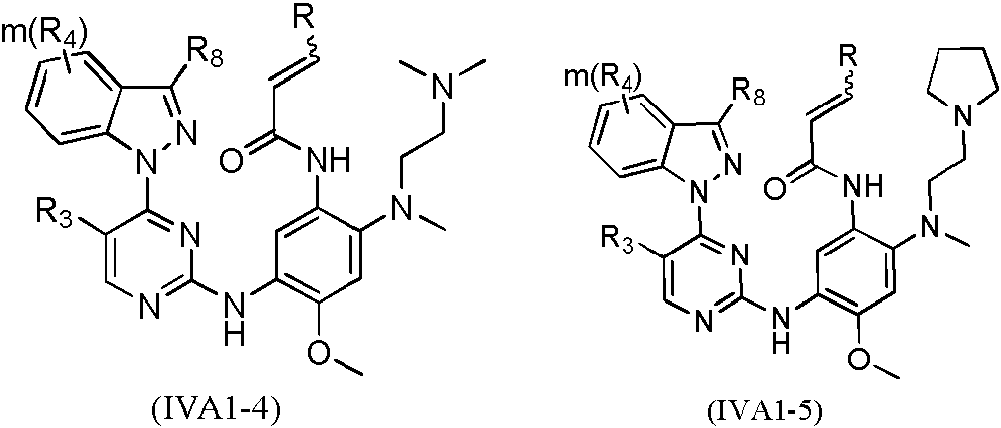
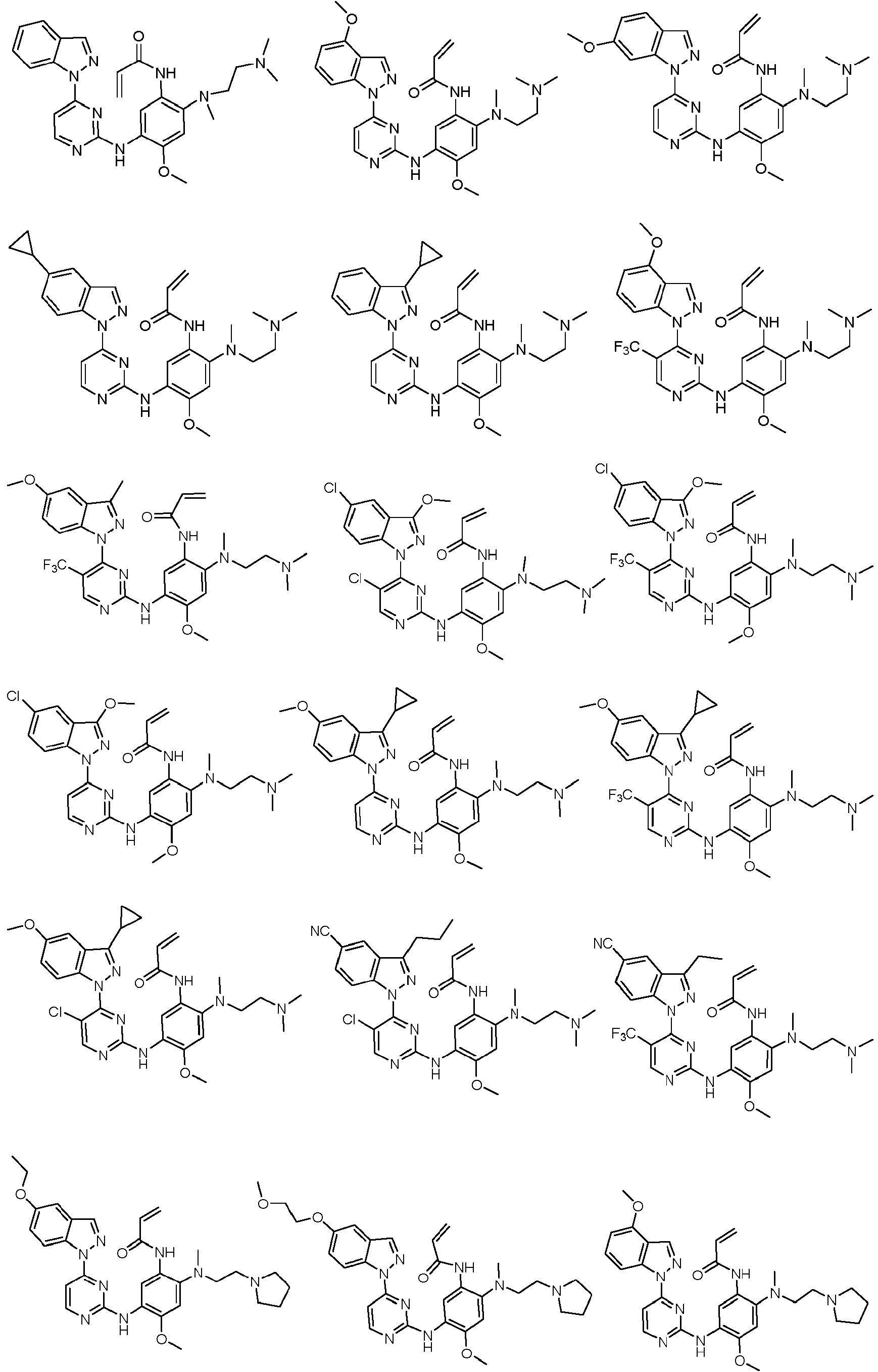


Applications Claiming Priority (2)
| Application Number | Priority Date | Filing Date | Title |
|---|---|---|---|
| CN201410534203 | 2014-10-11 | ||
| PCT/CN2015/091189 WO2016054987A1 (en) | 2014-10-11 | 2015-09-30 | Egfr inhibitor, and preparation and application thereof |
Publications (1)
| Publication Number | Publication Date |
|---|---|
| ES2886887T3 true ES2886887T3 (en) | 2021-12-21 |
Family
ID=55652583
Family Applications (1)
| Application Number | Title | Priority Date | Filing Date |
|---|---|---|---|
| ES15849629T Active ES2886887T3 (en) | 2014-10-11 | 2015-09-30 | EGFR inhibitor and preparation and application thereof |
Country Status (23)
| Country | Link |
|---|---|
| US (2) | US10259820B2 (en) |
| EP (1) | EP3205650B1 (en) |
| JP (1) | JP6691281B2 (en) |
| KR (1) | KR102589982B1 (en) |
| CN (7) | CN106661000B (en) |
| AU (1) | AU2015330506B2 (en) |
| BR (1) | BR112017006713B1 (en) |
| CY (1) | CY1124476T1 (en) |
| DK (1) | DK3205650T3 (en) |
| ES (1) | ES2886887T3 (en) |
| HR (1) | HRP20211392T1 (en) |
| HU (1) | HUE055233T2 (en) |
| LT (1) | LT3205650T (en) |
| MX (1) | MX387984B (en) |
| PL (1) | PL3205650T3 (en) |
| PT (1) | PT3205650T (en) |
| RS (1) | RS62350B1 (en) |
| RU (1) | RU2702631C2 (en) |
| SI (1) | SI3205650T1 (en) |
| SM (1) | SMT202100500T1 (en) |
| TW (1) | TWI704138B (en) |
| WO (1) | WO2016054987A1 (en) |
| ZA (1) | ZA201701465B (en) |
Families Citing this family (83)
| Publication number | Priority date | Publication date | Assignee | Title |
|---|---|---|---|---|
| EP3778584A1 (en) | 2014-06-19 | 2021-02-17 | ARIAD Pharmaceuticals, Inc. | Production process of 2-chloro-4-heteroaryl-pyrimidine derivatives |
| CN105384694B (en) * | 2014-08-22 | 2020-09-04 | 四川海思科制药有限公司 | Substituted aminopyrimidine derivative and preparation method and pharmaceutical application thereof |
| CN105085489B (en) | 2014-11-05 | 2019-03-01 | 益方生物科技(上海)有限公司 | Pyrimidine or pyridine compound, its preparation method and medical use |
| WO2016105525A2 (en) | 2014-12-23 | 2016-06-30 | Dana-Farber Cancer Institute, Inc. | Novel pyrimidines as egfr inhibitors and methods of treating disorders |
| CN106117185B (en) * | 2015-08-31 | 2017-11-07 | 广州必贝特医药技术有限公司 | 2,4 2 nitrogen-containing group substituted uracil compounds and its preparation method and application |
| CN106749193B (en) * | 2015-11-23 | 2020-11-20 | 南京圣和药业股份有限公司 | Indazole-substituted epidermal growth factor receptor inhibitors and uses thereof |
| CN106928150B (en) * | 2015-12-31 | 2020-07-31 | 恩瑞生物医药科技(上海)有限公司 | Acrylamide aniline derivative and pharmaceutical application thereof |
| TWI726968B (en) * | 2016-01-07 | 2021-05-11 | 開曼群島商Cs醫藥技術公司 | Selective inhibitors of clinically important mutants of the egfr tyrosine kinase |
| WO2017119732A1 (en) | 2016-01-08 | 2017-07-13 | Samsung Electronics Co., Ltd. | Electronic device and operating method thereof |
| US11753626B2 (en) | 2016-03-09 | 2023-09-12 | Beijing Percans Oncology Co., Ltd. | Tumor cell suspension cultures and related methods |
| CN112645932B (en) * | 2016-03-22 | 2022-01-14 | 江苏豪森药业集团有限公司 | Polymorphic forms of an EGFR inhibitor free base or an acid salt thereof, methods of making and uses thereof |
| CN107344934B (en) * | 2016-05-04 | 2019-08-23 | 江苏正大丰海制药有限公司 | The solid form of pharmaceutically active substance |
| CN107417626B (en) * | 2016-05-23 | 2020-01-24 | 江苏奥赛康药业有限公司 | Polymorphic form of 2-aminopyrimidine compound |
| MX383920B (en) * | 2016-05-26 | 2025-03-14 | Recurium Ip Holdings Llc | Egfr inhibitor compounds |
| CN106083736A (en) * | 2016-06-21 | 2016-11-09 | 郑州泰基鸿诺医药股份有限公司 | A kind of pyrimidines, EGFR inhibitor and application thereof |
| EP3492462B1 (en) * | 2016-07-26 | 2023-08-30 | Shenzhen TargetRx, Inc. | Amino pyrimidine compound for inhibiting protein tyrosine kinase activity |
| CN107793413B (en) * | 2016-09-05 | 2021-09-28 | 上海科州药物研发有限公司 | Pyrimidine heterocyclic compound and preparation method and application thereof |
| WO2018050108A1 (en) * | 2016-09-19 | 2018-03-22 | 江苏正大丰海制药有限公司 | Deuterated 3-(4,5-substituted pyrimidinamine) phenyl derivatives and applications thereof |
| CN107973783B (en) * | 2016-10-21 | 2024-09-06 | 正大天晴药业集团股份有限公司 | Aniline pyrimidine derivatives as ERK inhibitors |
| CN108057036B (en) * | 2016-11-07 | 2023-06-13 | 正大天晴药业集团股份有限公司 | Solid pharmaceutical composition of EGFR inhibitor |
| CN108503627A (en) * | 2017-04-19 | 2018-09-07 | 郑州泰基鸿诺医药股份有限公司 | 2,4- disubstituted benzenes -1,5- diamine derivatives as EGFR inhibitor and its application |
| UA126452C2 (en) * | 2017-06-02 | 2022-10-05 | Ф. Хоффманн-Ля Рош Аг | ISOINDOLE DERIVATIVES |
| WO2019023621A1 (en) * | 2017-07-28 | 2019-01-31 | Yale University | Anticancer Drugs and Methods of Making and Using Same |
| JP6985764B2 (en) | 2017-08-30 | 2021-12-22 | 深▲チェン▼市塔吉瑞生物医薬有限公司Shenzhen TargetRx, Inc. | Aminopyrimidine compounds, compositions containing this compound and their use |
| CN109503573A (en) * | 2017-09-14 | 2019-03-22 | 昆明圣加南生物科技有限公司 | 2- substituted anilinic pyrimidine derivatives and application thereof |
| TWI702205B (en) * | 2017-10-06 | 2020-08-21 | 俄羅斯聯邦商拜奧卡德聯合股份公司 | Epidermal growth factor receptor inhibitors |
| CN108017633A (en) * | 2018-01-30 | 2018-05-11 | 天津大学 | N- [5- (pyrimidine -2- amino) -2,4- di-substituted-phenyls] -2- fluoropropenes amide derivatives and application |
| WO2019177375A1 (en) * | 2018-03-13 | 2019-09-19 | 포로노이바이오 주식회사 | 2, 4, 5-substituted pyrimidine derivatives, method for preparing same, and pharmaceutical composition for preventing or treating cancer comprising same as active ingredient |
| CN110272420A (en) * | 2018-03-16 | 2019-09-24 | 江苏正大丰海制药有限公司 | Deuterated 3- (4,5- substituted-amino pyrimidine) phenyl compound list Mesylate Form and preparation method thereof |
| JP2021523208A (en) | 2018-05-14 | 2021-09-02 | アリアド ファーマシューティカルズ, インコーポレイテッド | Pyrimidine derivative pharmaceutical salts and methods of treating disorders |
| KR102942294B1 (en) | 2018-05-15 | 2026-03-23 | 장쑤 한서 파마슈티칼 그룹 캄파니 리미티드 | Pharmaceutical composition containing a small molecule EGFR inhibitor and method for preparing the same |
| US20210196719A1 (en) * | 2018-05-23 | 2021-07-01 | Jiangsu Hengrui Medicine Co., Ltd. | Use of cdk4/6 inhibitor in combination with egfr inhibitor in the preparation of medicament for treating tumor diseases |
| WO2019228330A1 (en) * | 2018-05-29 | 2019-12-05 | 深圳市塔吉瑞生物医药有限公司 | Substituted benzo[d]imidazole compound and pharmaceutical composition thereof |
| CN110652514A (en) * | 2018-06-29 | 2020-01-07 | 上海翰森生物医药科技有限公司 | Pharmaceutical uses of third-generation EGFR inhibitors |
| CN110698461B (en) * | 2018-07-09 | 2024-04-05 | 上海翰森生物医药科技有限公司 | Preparation method of third-generation EGFR inhibitor |
| WO2020052575A1 (en) * | 2018-09-12 | 2020-03-19 | 江苏恒瑞医药股份有限公司 | Use of combination of jak kinase inhibitor and egfr inhibitor in preparation of medicament for treating tumor diseases |
| CN109761960B (en) * | 2019-02-25 | 2021-08-31 | 江苏豪森药业集团有限公司 | Preparation method of anti-drug and anti-tumor EGFR inhibitor |
| CN111606889B (en) * | 2019-02-25 | 2023-03-07 | 上海翰森生物医药科技有限公司 | Preparation method of 4-(1-cyclopropyl-1H-indol-3-yl)-N-phenylpyrimidin-2-amine derivative |
| CN110041302B (en) * | 2019-03-01 | 2021-11-30 | 南方医科大学 | 2-amino-4-substituted pyridine derivative and synthesis method and application thereof |
| PT3943491T (en) * | 2019-03-19 | 2025-07-28 | Voronoi Inc | Heteroaryl derivative, method for producing same, and pharmaceutical composition comprising same as effective component |
| US12157730B2 (en) | 2019-03-19 | 2024-12-03 | Voronoi Inc. | Heteroaryl derivative, method for producing same, and pharmaceutical composition comprising same as effective component |
| EA202192575A1 (en) | 2019-03-21 | 2022-01-14 | Онксео | DBAIT COMPOUNDS IN COMBINATION WITH KINASE INHIBITORS FOR CANCER TREATMENT |
| CN111747950B (en) * | 2019-03-29 | 2024-01-23 | 深圳福沃药业有限公司 | Pyrimidine derivatives for cancer treatment |
| US20220340547A1 (en) * | 2019-05-22 | 2022-10-27 | Shanghi Hansoh Biosoh Biomedical Co., Ltd. | Indole derivative-containing inhibitor, preparation method therefor and application thereof |
| WO2020245208A1 (en) | 2019-06-04 | 2020-12-10 | INSERM (Institut National de la Santé et de la Recherche Médicale) | Use of cd9 as a biomarker and as a biotarget in glomerulonephritis or glomerulosclerosis |
| CN110183399A (en) * | 2019-06-05 | 2019-08-30 | 辽宁科隆精细化工股份有限公司 | A kind of method of synthesis 4- (2- (N, N- dimethylamino) ethyl) morpholine |
| CA3143919A1 (en) * | 2019-06-20 | 2020-12-24 | Oncobix Co., Ltd. | Pyrimidine derivative inhibiting growth of cancer cell and medicinal use thereof |
| CN112174961A (en) * | 2019-07-04 | 2021-01-05 | 微境生物医药科技(上海)有限公司 | Compound for inhibiting EGFR kinase and preparation method and application thereof |
| CN110684016A (en) * | 2019-09-27 | 2020-01-14 | 上海应用技术大学 | Fluorine-containing AZD9291 derivative and preparation method and application thereof |
| KR102383200B1 (en) * | 2019-10-18 | 2022-04-06 | 한국화학연구원 | pyrimidine derivatives, preparation method thereof, and pharmaceutical composition for use in preventing or treating cancer containing the same as an active ingredient |
| CN114761006A (en) | 2019-11-08 | 2022-07-15 | Inserm(法国国家健康医学研究院) | Methods of treating cancer resistant to kinase inhibitors |
| WO2021094379A1 (en) | 2019-11-12 | 2021-05-20 | Astrazeneca Ab | Epidermal growth factor receptor tyrosine kinase inhibitors for the treatment of cancer |
| TW202128670A (en) * | 2019-11-26 | 2021-08-01 | 大陸商上海翰森生物醫藥科技有限公司 | Nitrogen-containing polycyclic derivative inhibitor, preparation method therefor and application thereof |
| EP4087571A4 (en) * | 2020-01-07 | 2024-03-27 | Dana-Farber Cancer Institute, Inc. | CYANO-PYRIMIDINE INHIBITORS OF EGFR/HER2 |
| WO2021148396A1 (en) | 2020-01-20 | 2021-07-29 | Astrazeneca Ab | Epidermal growth factor receptor tyrosine kinase inhibitors for the treatment of cancer |
| WO2021148581A1 (en) | 2020-01-22 | 2021-07-29 | Onxeo | Novel dbait molecule and its use |
| WO2021180238A1 (en) * | 2020-03-13 | 2021-09-16 | 郑州同源康医药有限公司 | Compound used as kinase inhibitor and use thereof |
| CN113493420B (en) * | 2020-03-18 | 2025-04-25 | 南京迈晟科技有限责任公司 | EGFR tyrosine kinase inhibitors and uses thereof |
| US20210369709A1 (en) | 2020-05-27 | 2021-12-02 | Astrazeneca Ab | EGFR TKIs FOR USE IN THE TREATMENT OF NON-SMALL CELL LUNG CANCER |
| WO2021243596A1 (en) * | 2020-06-03 | 2021-12-09 | InventisBio Co., Ltd. | Aminopyrimidine compounds, preparation methods and uses thereof |
| TW202227425A (en) * | 2020-09-18 | 2022-07-16 | 南韓商沃若諾伊生物公司 | Heteroaryl derivatives, preparation method for the same, and a pharmaceutical composition comprising the same as an active ingredient |
| TW202222795A (en) * | 2020-11-19 | 2022-06-16 | 大陸商上海翰森生物醫藥科技有限公司 | The salt, crystal form and preparation method of an indole-containing derivative |
| CN114617888A (en) * | 2020-12-14 | 2022-06-14 | 江苏豪森药业集团有限公司 | Medical use of EGFR inhibitors for the treatment and prevention of ocular diseases or conditions |
| WO2022131741A1 (en) * | 2020-12-14 | 2022-06-23 | 보로노이바이오 주식회사 | Isoxazolidine derivative compound and use thereof |
| CN112457299B (en) * | 2020-12-14 | 2021-12-17 | 江苏豪森药业集团有限公司 | Purification method of EGFR inhibitor |
| WO2022146201A1 (en) * | 2020-12-30 | 2022-07-07 | Joint Stock Company "Biocad" | Epidermal growth factor receptor inhibitors |
| CN112679448B (en) * | 2020-12-31 | 2022-08-19 | 苏州昊帆生物股份有限公司 | Preparation method of N- (2-aminoethyl) morpholine |
| TW202246243A (en) * | 2021-02-26 | 2022-12-01 | 美商泰拉生物科學公司 | Aminopyrimidine compounds and methods of their use |
| EP4335847A1 (en) * | 2021-05-07 | 2024-03-13 | Voronoi Inc. | Heteroaryl derivative, method for preparing same, and pharmaceutical composition comprising same as active ingredient |
| CN117241789A (en) * | 2021-05-14 | 2023-12-15 | 南京创特医药科技有限公司 | Medicinal composition |
| CN115667251A (en) | 2021-05-17 | 2023-01-31 | 株式会社沃若诺伊生物 | Heteroaryl derivative compound and use thereof |
| CN113387935B (en) * | 2021-07-23 | 2022-06-10 | 苏州雅深智慧科技有限公司 | Compound for inhibiting triple-mutation epidermal growth factor receptor tyrosine kinase and application thereof |
| CN115677666B (en) * | 2021-07-30 | 2026-03-03 | 上海艾力斯医药科技股份有限公司 | Indolopyrimidine compound, intermediate, preparation method and application thereof |
| JP7734995B2 (en) * | 2021-08-06 | 2025-09-08 | 上海和誉生物医薬科技有限公司 | Pyrimidine or pyridine derivatives, their preparation method and pharmaceutical applications |
| JP2025510910A (en) | 2022-03-31 | 2025-04-15 | アストラゼネカ・アクチエボラーグ | EPIDERMAL GROWTH FACTOR RECEPTOR (EGFR) TYROSINE KINASE INHIBITORS IN COMBINATION WITH AKT INHIBITORS FOR THE TREATMENT OF CANCER - Patent application |
| WO2023209088A1 (en) | 2022-04-28 | 2023-11-02 | Astrazeneca Ab | Bicyclic heteroaromatic compounds and their use in the treatment of cancer |
| WO2023209086A1 (en) | 2022-04-28 | 2023-11-02 | Astrazeneca Ab | Bicyclic heteroaromatic compounds for treating cancer |
| WO2023209090A1 (en) | 2022-04-28 | 2023-11-02 | Astrazeneca Ab | Bicyclic heteroaromatic compounds and their application in the treatment of cancer |
| WO2023209084A1 (en) | 2022-04-28 | 2023-11-02 | Astrazeneca Ab | Condensed bicyclic heteroaromatic compounds and their use in the treatment of cancer |
| CA3259492A1 (en) | 2022-06-27 | 2024-01-04 | Astrazeneca Ab | Combinations involving epidermal growth factor receptor tyrosine kinase inhibitors for the treatment of cancer |
| KR20250044679A (en) | 2022-07-08 | 2025-04-01 | 아스트라제네카 아베 | Epidermal growth factor receptor tyrosine kinase inhibitors in combination with HGF-receptor inhibitors for cancer treatment |
| WO2025056055A1 (en) * | 2023-09-15 | 2025-03-20 | 上海翰森生物医药科技有限公司 | Use of new-generation egfr inhibitor single drug or combination thereof in preparing drugs for tumor diseases |
| WO2026009146A1 (en) * | 2024-07-01 | 2026-01-08 | Hetero Labs Limited | Benzimidazole compounds as egfr inhibitors |
Family Cites Families (20)
| Publication number | Priority date | Publication date | Assignee | Title |
|---|---|---|---|---|
| US8338439B2 (en) * | 2008-06-27 | 2012-12-25 | Celgene Avilomics Research, Inc. | 2,4-disubstituted pyrimidines useful as kinase inhibitors |
| NZ603525A (en) * | 2008-06-27 | 2015-02-27 | Celgene Avilomics Res Inc | Pyrimidine based compound and uses thereof |
| US9908884B2 (en) * | 2009-05-05 | 2018-03-06 | Dana-Farber Cancer Institute, Inc. | EGFR inhibitors and methods of treating disorders |
| WO2011140338A1 (en) | 2010-05-05 | 2011-11-10 | Gatekeeper Pharmaceuticals, Inc. | Compounds that modulate egfr activity and methods for treating or preventing conditions therewith |
| EP2704572B1 (en) * | 2011-05-04 | 2015-12-30 | Ariad Pharmaceuticals, Inc. | Compounds for inhibiting cell proliferation in egfr-driven cancers |
| EP4119551A1 (en) * | 2011-07-27 | 2023-01-18 | Astrazeneca AB | 2-(2,4,5-substituted-anilino)pyrimidine compounds |
| WO2013169401A1 (en) * | 2012-05-05 | 2013-11-14 | Ariad Pharmaceuticals, Inc. | Compounds for inhibiting cell proliferation in egfr-driven cancers |
| KR102173433B1 (en) * | 2013-07-11 | 2020-11-04 | 에이시아 바이오사이언시스 인코포레이티드. | Pyrimidine derivatives as kinase inhibitors |
| CN104761544B (en) * | 2014-01-03 | 2019-03-15 | 北京轩义医药科技有限公司 | The selective depressant of the important mutant of clinic of EGFR tyrosine kinase |
| CN104860941B (en) * | 2014-02-25 | 2017-03-22 | 上海海雁医药科技有限公司 | 2,4-disubstituted phenyl-1,5-diamine derivatives and use thereof, and pharmaceutical composition and medicinal composition prepared from 2,4-disubstituted phenyl-1,5-diamine derivative |
| JP6468611B2 (en) * | 2014-05-13 | 2019-02-13 | アリアド ファーマシューティカルズ, インコーポレイテッド | Heteroaryl compounds for kinase inhibition |
| WO2015188777A1 (en) * | 2014-06-12 | 2015-12-17 | Shanghai Fochon Pharmaceutical Co Ltd | Certain protein kinase inhibitors |
| EP3778584A1 (en) * | 2014-06-19 | 2021-02-17 | ARIAD Pharmaceuticals, Inc. | Production process of 2-chloro-4-heteroaryl-pyrimidine derivatives |
| CN104140418B (en) * | 2014-08-15 | 2016-08-24 | 常州润诺生物科技有限公司 | 2-(2,4,5-substituted aniline) pyrimidine derivatives and application thereof |
| CN106458969A (en) * | 2014-08-25 | 2017-02-22 | 四川海思科制药有限公司 | A kind of (substituted phenyl)(substituted pyrimidine) amino derivative and its preparation method and pharmaceutical use |
| CN105461695B (en) * | 2014-09-29 | 2018-03-27 | 齐鲁制药有限公司 | Pyrimidine or pyrrolotriazine derivatives and its production and use |
| CN105085489B (en) * | 2014-11-05 | 2019-03-01 | 益方生物科技(上海)有限公司 | Pyrimidine or pyridine compound, its preparation method and medical use |
| WO2016105525A2 (en) * | 2014-12-23 | 2016-06-30 | Dana-Farber Cancer Institute, Inc. | Novel pyrimidines as egfr inhibitors and methods of treating disorders |
| TWI739753B (en) * | 2015-07-16 | 2021-09-21 | 大陸商正大天晴藥業集團股份有限公司 | Aniline pyrimidine derivatives and their uses |
| CN106117185B (en) * | 2015-08-31 | 2017-11-07 | 广州必贝特医药技术有限公司 | 2,4 2 nitrogen-containing group substituted uracil compounds and its preparation method and application |
-
2015
- 2015-09-30 WO PCT/CN2015/091189 patent/WO2016054987A1/en not_active Ceased
- 2015-09-30 JP JP2017517797A patent/JP6691281B2/en active Active
- 2015-09-30 MX MX2017004234A patent/MX387984B/en unknown
- 2015-09-30 CN CN201580045311.2A patent/CN106661000B/en active Active
- 2015-09-30 CN CN202311030017.7A patent/CN117050062A/en active Pending
- 2015-09-30 AU AU2015330506A patent/AU2015330506B2/en active Active
- 2015-09-30 CN CN202311029815.8A patent/CN117069700B/en active Active
- 2015-09-30 EP EP15849629.9A patent/EP3205650B1/en active Active
- 2015-09-30 RU RU2017114687A patent/RU2702631C2/en active
- 2015-09-30 BR BR112017006713-7A patent/BR112017006713B1/en active IP Right Grant
- 2015-09-30 RS RS20211144A patent/RS62350B1/en unknown
- 2015-09-30 DK DK15849629.9T patent/DK3205650T3/en active
- 2015-09-30 CN CN201910210387.6A patent/CN111187221B/en active Active
- 2015-09-30 US US15/517,193 patent/US10259820B2/en active Active
- 2015-09-30 HU HUE15849629A patent/HUE055233T2/en unknown
- 2015-09-30 CN CN202311339167.6A patent/CN117402143A/en active Pending
- 2015-09-30 SI SI201531690T patent/SI3205650T1/en unknown
- 2015-09-30 HR HRP20211392TT patent/HRP20211392T1/en unknown
- 2015-09-30 PT PT158496299T patent/PT3205650T/en unknown
- 2015-09-30 SM SM20210500T patent/SMT202100500T1/en unknown
- 2015-09-30 KR KR1020177012005A patent/KR102589982B1/en active Active
- 2015-09-30 PL PL15849629T patent/PL3205650T3/en unknown
- 2015-09-30 LT LTEPPCT/CN2015/091189T patent/LT3205650T/en unknown
- 2015-09-30 CN CN201910210386.1A patent/CN111171000B/en active Active
- 2015-09-30 ES ES15849629T patent/ES2886887T3/en active Active
- 2015-09-30 CN CN201910208542.0A patent/CN111170999B/en active Active
- 2015-10-07 TW TW104133007A patent/TWI704138B/en active
-
2017
- 2017-02-27 ZA ZA2017/01465A patent/ZA201701465B/en unknown
-
2018
- 2018-12-03 US US16/207,968 patent/US10428081B2/en active Active
-
2021
- 2021-09-07 CY CY20211100794T patent/CY1124476T1/en unknown
Also Published As
Similar Documents
| Publication | Publication Date | Title |
|---|---|---|
| ES2886887T3 (en) | EGFR inhibitor and preparation and application thereof | |
| ES2954278T3 (en) | Piperidine derivatives as cyclin-dependent kinase 7 (CDK7) inhibitors | |
| ES2731216T3 (en) | New compounds | |
| CN108349896B (en) | Heterocyclic compounds as FGFR inhibitors | |
| ES2765031T3 (en) | Anti-cancer benzopyrazines through inhibition of fgfr kinases | |
| ES2688868T3 (en) | Anti-cancer pyridopyrazines through the inhibition of FGFR kinases | |
| JP2024502886A (en) | Pharmaceutical combination of SOS1 inhibitors for treating and/or preventing cancer | |
| ES2791179T3 (en) | Pyridopyrazine and naphthyridine derivatives for the treatment of cancer | |
| AU2015407300B2 (en) | 2-Arylamino pyridine, pyridine or triazine derivative, preparation method and use thereof | |
| JP2019537610A (en) | FGFR4 inhibitor, its production method and pharmaceutical application | |
| WO2018045957A1 (en) | Cdk4/6 inhibitor and preparation method therefor and application thereof | |
| CN115867539B (en) | 2, 3-Dihydro-1H-pyrrolo [3,2-b ] pyridine derivatives, preparation method and application thereof | |
| BR112014010177B1 (en) | COMPOUND, PHARMACEUTICAL COMPOSITION, AND, USE OF A COMPOUND | |
| JP2022534063A (en) | Indole derivative-containing inhibitors, preparation methods therefor and uses thereof | |
| HK40018821B (en) | Egfr inhibitor, and preparation and application thereof | |
| CA2959194C (en) | 4-substituted-2-(n-(5-substituted allyl amide)phenyl)amino)pyrimidine compound, its use as an egfr inhibitor, and preparation and application thereof | |
| CN113563341B (en) | Substituted pyrazolo [1,5-a ] pyrimidine compounds as Trk inhibitors | |
| HK40018820B (en) | Egfr inhibitor, and preparation and application thereof | |
| HK40018820A (en) | Egfr inhibitor, and preparation and application thereof | |
| HK40018821A (en) | Egfr inhibitor, and preparation and application thereof | |
| HK40018611A (en) | Egfr inhibitor, and preparation and application thereof |