ES2894202A1 - New compounds derived from benzoxazole, obtaining procedure and its use in the detection of GHB in beverages (Machine-translation by Google Translate, not legally binding) - Google Patents
New compounds derived from benzoxazole, obtaining procedure and its use in the detection of GHB in beverages (Machine-translation by Google Translate, not legally binding) Download PDFInfo
- Publication number
- ES2894202A1 ES2894202A1 ES202030840A ES202030840A ES2894202A1 ES 2894202 A1 ES2894202 A1 ES 2894202A1 ES 202030840 A ES202030840 A ES 202030840A ES 202030840 A ES202030840 A ES 202030840A ES 2894202 A1 ES2894202 A1 ES 2894202A1
- Authority
- ES
- Spain
- Prior art keywords
- compound
- ghb
- kit
- composition
- beverages
- Prior art date
- Legal status (The legal status is an assumption and is not a legal conclusion. Google has not performed a legal analysis and makes no representation as to the accuracy of the status listed.)
- Granted
Links
- DJUCKCFWIFDNGJ-UHFFFAOYSA-N Cc1ccc(C(c(ccc(O)c2)c2Oc2c3)(c2ccc3O)OC2=O)c2c1 Chemical compound Cc1ccc(C(c(ccc(O)c2)c2Oc2c3)(c2ccc3O)OC2=O)c2c1 DJUCKCFWIFDNGJ-UHFFFAOYSA-N 0.000 description 2
- ZHVPTERSBUMMHK-UHFFFAOYSA-N Nc1cc2ccccc2cc1O Chemical compound Nc1cc2ccccc2cc1O ZHVPTERSBUMMHK-UHFFFAOYSA-N 0.000 description 2
- JLABHUJWQJSVBK-UHFFFAOYSA-N Cc1ccc(C(c(c2c3)ccc3Nc3nc4cc5ccccc5cc4[o]3)(c(c(O3)c4)ccc4O)OC2=O)c3c1 Chemical compound Cc1ccc(C(c(c2c3)ccc3Nc3nc4cc5ccccc5cc4[o]3)(c(c(O3)c4)ccc4O)OC2=O)c3c1 JLABHUJWQJSVBK-UHFFFAOYSA-N 0.000 description 1
- MHMNJMPURVTYEJ-UHFFFAOYSA-N Oc1ccc(C(c(c2c3)ccc3N=C=S)(c(ccc(O)c3)c3O3)OC2=O)c3c1 Chemical compound Oc1ccc(C(c(c2c3)ccc3N=C=S)(c(ccc(O)c3)c3O3)OC2=O)c3c1 MHMNJMPURVTYEJ-UHFFFAOYSA-N 0.000 description 1
- NXHSSIGRWJENBH-UHFFFAOYSA-N [O-][N+](c(cc1)ccc1N=C=S)=O Chemical compound [O-][N+](c(cc1)ccc1N=C=S)=O NXHSSIGRWJENBH-UHFFFAOYSA-N 0.000 description 1
- VUZBOAFAOQEHBR-UHFFFAOYSA-N [O-][N+](c(cc1)ccc1Nc1nc2cc3ccccc3cc2[o]1)=O Chemical compound [O-][N+](c(cc1)ccc1Nc1nc2cc3ccccc3cc2[o]1)=O VUZBOAFAOQEHBR-UHFFFAOYSA-N 0.000 description 1
Classifications
-
- C—CHEMISTRY; METALLURGY
- C07—ORGANIC CHEMISTRY
- C07D—HETEROCYCLIC COMPOUNDS
- C07D263/00—Heterocyclic compounds containing 1,3-oxazole or hydrogenated 1,3-oxazole rings
- C07D263/52—Heterocyclic compounds containing 1,3-oxazole or hydrogenated 1,3-oxazole rings condensed with carbocyclic rings or ring systems
- C07D263/60—Naphthoxazoles; Hydrogenated naphthoxazoles
-
- C—CHEMISTRY; METALLURGY
- C07—ORGANIC CHEMISTRY
- C07D—HETEROCYCLIC COMPOUNDS
- C07D493/00—Heterocyclic compounds containing oxygen atoms as the only ring hetero atoms in the condensed system
- C07D493/02—Heterocyclic compounds containing oxygen atoms as the only ring hetero atoms in the condensed system in which the condensed system contains two hetero rings
- C07D493/10—Spiro-condensed systems
-
- G—PHYSICS
- G01—MEASURING; TESTING
- G01N—INVESTIGATING OR ANALYSING MATERIALS BY DETERMINING THEIR CHEMICAL OR PHYSICAL PROPERTIES
- G01N31/00—Investigating or analysing non-biological materials by the use of the chemical methods specified in the subgroup; Apparatus specially adapted for such methods
- G01N31/22—Investigating or analysing non-biological materials by the use of the chemical methods specified in the subgroup; Apparatus specially adapted for such methods using chemical indicators
- G01N31/222—Investigating or analysing non-biological materials by the use of the chemical methods specified in the subgroup; Apparatus specially adapted for such methods using chemical indicators for investigating moisture content
-
- G—PHYSICS
- G01—MEASURING; TESTING
- G01N—INVESTIGATING OR ANALYSING MATERIALS BY DETERMINING THEIR CHEMICAL OR PHYSICAL PROPERTIES
- G01N33/00—Investigating or analysing materials by specific methods not covered by groups G01N1/00 - G01N31/00
- G01N33/02—Food
- G01N33/14—Beverages
-
- G—PHYSICS
- G01—MEASURING; TESTING
- G01N—INVESTIGATING OR ANALYSING MATERIALS BY DETERMINING THEIR CHEMICAL OR PHYSICAL PROPERTIES
- G01N33/00—Investigating or analysing materials by specific methods not covered by groups G01N1/00 - G01N31/00
- G01N33/02—Food
- G01N33/14—Beverages
- G01N33/143—Beverages containing sugar
-
- G—PHYSICS
- G01—MEASURING; TESTING
- G01N—INVESTIGATING OR ANALYSING MATERIALS BY DETERMINING THEIR CHEMICAL OR PHYSICAL PROPERTIES
- G01N33/00—Investigating or analysing materials by specific methods not covered by groups G01N1/00 - G01N31/00
- G01N33/02—Food
- G01N33/14—Beverages
- G01N33/146—Beverages containing alcohol
-
- G—PHYSICS
- G01—MEASURING; TESTING
- G01N—INVESTIGATING OR ANALYSING MATERIALS BY DETERMINING THEIR CHEMICAL OR PHYSICAL PROPERTIES
- G01N33/00—Investigating or analysing materials by specific methods not covered by groups G01N1/00 - G01N31/00
- G01N33/48—Biological material, e.g. blood, urine; Haemocytometers
- G01N33/50—Chemical analysis of biological material, e.g. blood, urine; Testing involving biospecific ligand binding methods; Immunological testing
- G01N33/94—Chemical analysis of biological material, e.g. blood, urine; Testing involving biospecific ligand binding methods; Immunological testing involving narcotics or drugs or pharmaceuticals, neurotransmitters or associated receptors
- G01N33/9406—Neurotransmitters
-
- C—CHEMISTRY; METALLURGY
- C07—ORGANIC CHEMISTRY
- C07C—ACYCLIC OR CARBOCYCLIC COMPOUNDS
- C07C59/00—Compounds having carboxyl groups bound to acyclic carbon atoms and containing any of the groups OH, O—metal, —CHO, keto, ether, groups, groups, or groups
- C07C59/01—Saturated compounds having only one carboxyl group and containing hydroxy or O-metal groups
-
- G—PHYSICS
- G01—MEASURING; TESTING
- G01N—INVESTIGATING OR ANALYSING MATERIALS BY DETERMINING THEIR CHEMICAL OR PHYSICAL PROPERTIES
- G01N21/00—Investigating or analysing materials by the use of optical means, i.e. using sub-millimetre waves, infrared, visible or ultraviolet light
- G01N21/75—Systems in which material is subjected to a chemical reaction, the progress or the result of the reaction being investigated
- G01N21/77—Systems in which material is subjected to a chemical reaction, the progress or the result of the reaction being investigated by observing the effect on a chemical indicator
- G01N2021/7769—Measurement method of reaction-produced change in sensor
- G01N2021/7786—Fluorescence
-
- G—PHYSICS
- G01—MEASURING; TESTING
- G01N—INVESTIGATING OR ANALYSING MATERIALS BY DETERMINING THEIR CHEMICAL OR PHYSICAL PROPERTIES
- G01N21/00—Investigating or analysing materials by the use of optical means, i.e. using sub-millimetre waves, infrared, visible or ultraviolet light
- G01N21/75—Systems in which material is subjected to a chemical reaction, the progress or the result of the reaction being investigated
- G01N21/77—Systems in which material is subjected to a chemical reaction, the progress or the result of the reaction being investigated by observing the effect on a chemical indicator
- G01N21/78—Systems in which material is subjected to a chemical reaction, the progress or the result of the reaction being investigated by observing the effect on a chemical indicator producing a change of colour
-
- G—PHYSICS
- G01—MEASURING; TESTING
- G01N—INVESTIGATING OR ANALYSING MATERIALS BY DETERMINING THEIR CHEMICAL OR PHYSICAL PROPERTIES
- G01N33/00—Investigating or analysing materials by specific methods not covered by groups G01N1/00 - G01N31/00
- G01N33/48—Biological material, e.g. blood, urine; Haemocytometers
- G01N33/483—Physical analysis of biological material
- G01N33/487—Physical analysis of biological material of liquid biological material
- G01N33/493—Physical analysis of biological material of liquid biological material urine
Landscapes
- Chemical & Material Sciences (AREA)
- Life Sciences & Earth Sciences (AREA)
- Health & Medical Sciences (AREA)
- Engineering & Computer Science (AREA)
- Organic Chemistry (AREA)
- Physics & Mathematics (AREA)
- Food Science & Technology (AREA)
- Immunology (AREA)
- Analytical Chemistry (AREA)
- Biochemistry (AREA)
- General Health & Medical Sciences (AREA)
- General Physics & Mathematics (AREA)
- Pathology (AREA)
- Medicinal Chemistry (AREA)
- Molecular Biology (AREA)
- Biomedical Technology (AREA)
- Urology & Nephrology (AREA)
- Hematology (AREA)
- Chemical Kinetics & Catalysis (AREA)
- Plasma & Fusion (AREA)
- Biophysics (AREA)
- Pharmacology & Pharmacy (AREA)
- Bioinformatics & Cheminformatics (AREA)
- Biotechnology (AREA)
- Cell Biology (AREA)
- Microbiology (AREA)
- Heterocyclic Carbon Compounds Containing A Hetero Ring Having Nitrogen And Oxygen As The Only Ring Hetero Atoms (AREA)
- Investigating Or Analysing Biological Materials (AREA)
- Investigating Or Analysing Materials By The Use Of Chemical Reactions (AREA)
- Plural Heterocyclic Compounds (AREA)
Abstract
Nuevos compuestos derivados de benzoxazol, procedimiento de obtención y su uso en la detección de GHB en bebidas. La presente invención se refiere a un compuesto 1 o 2 o composición que lo comprende. La presente invención también se refiere a un procedimiento para la obtención de un compuesto 1 o 2, así como la utilización de los mismos para la detección de GHB en bebidas. También se incluye un equipo o kit para utilizar en la detección de GHB en bebidas.New compounds derived from benzoxazole, procedure for obtaining them and their use in the detection of GHB in beverages. The present invention relates to a compound 1 or 2 or a composition comprising it. The present invention also refers to a process for obtaining a compound 1 or 2, as well as the use thereof for the detection of GHB in beverages. Also included is a kit or kit for use in the detection of GHB in beverages.
Description
NUEVOS COMPUESTOS DERIVADOS DE BENZOXAZOL, PROCEDIMIENTO DE NEW COMPOUNDS DERIVED FROM BENZOXAZOLE, PROCEDURE FOR
OBTENCIÓN Y SU USO EN LA DETECCIÓN DE GHB EN BEBIDASPRODUCTION AND ITS USE IN THE DETECTION OF GHB IN BEVERAGES
Campo de la invenciónfield of invention
La presente invención se refiere a nuevos compuestos derivados de benzoxazol, a un procedimiento para su obtención y a su uso en la detección de ácido -hidroxibutírico (GHB) en bebidas.The present invention relates to new compounds derived from benzoxazole, to a process for obtaining them and to their use in the detection of -hydroxybutyric acid (GHB) in beverages.
AntecedentesBackground
El ácido -hidroxibutírico (GHB) es una de las drogas empleadas en la sumisión química. Es un compuesto inodoro, incoloro y ligeramente salado que se usa en ocasiones con fines recreativos. Sin embargo, este compuesto, suministrado sin conocimiento de la víctima, ha sido utilizado en numerosas ocasiones con la finalidad de cometer un delito. En muchas de ellas, se emplea para anular la voluntad de la víctima y llevar a cabo una agresión sexual. En general, la ingesta de la droga por parte de la víctima se produce a través de una bebida que ha sido contaminada con el producto sin que ésta lo haya advertido. El tiempo de permanencia en el organismo es de 3 a 6 horas y sus metabolitos se excretan rápidamente, por tanto, es muy difícil detectar su presencia en el organismo tras la agresión.-Hydroxybutyric acid (GHB) is one of the drugs used in chemical submission. It is an odorless, colorless, slightly salty compound that is sometimes used for recreational purposes. However, this compound, supplied without the victim's knowledge, has been used on numerous occasions for the purpose of committing a crime. In many of them, it is used to override the will of the victim and carry out a sexual assault. In general, the victim ingests the drug through a drink that has been contaminated with the product without the victim noticing it. The residence time in the body is 3 to 6 hours and its metabolites are rapidly excreted, therefore, it is very difficult to detect its presence in the body after the aggression.
En la bibliografía científica se han encontrado cuatro referencias que tratan este tema (J. Forensic. Sci. 2004, 49, pág. 379-387, Chem. Commun. 2013, 49, pág. 6170-6172, Chem. Commun. 2014, 50, pág. 2904-2906, J. Mat. Chem. B 2017, 8, pág. 2736-2742).Four references dealing with this topic have been found in the scientific literature (J. Forensic. Sci. 2004, 49, p. 379-387, Chem. Commun. 2013, 49, p. 6170-6172, Chem. Commun. 2014, 50, pp 2904-2906, J. Mat. Chem. B 2017, 8, pp 2736-2742).
En el primer caso (J. Forensic. Sci. 2004, 49, pág. 379-387) se trata de una reacción enzimática mientras que los otros tres trabajos hacen referencia a sensores químicos.In the first case (J. Forensic. Sci. 2004, 49, p. 379-387) it is an enzymatic reaction while the other three works refer to chemical sensors.
En el documento Chem. Commun. 2014, 50, 2904-2906 se describe el uso del compuesto A como quimiosensor para detectar GHB. La interacción con el analito se basó en una interacción de enlace de hidrógeno entre el grupo fenol en el sensor y la unidad de carboxilato en GHB.In the document Chem. Commun. 2014, 50, 2904-2906 describes the use of compound A as a chemosensor to detect GHB. The interaction with the analyte was based on a hydrogen bond interaction between the phenol group on the sensor and the carboxylate unit on GHB.
Además, los mismos autores también describieron en Chem. Commun. 2013, 49, 6170 6172 el uso del compuesto B para detectar la lactona correspondiente (GBL), pero nuevamente, la interacción se relacionó con la formación de un enlace de hidrógeno. Furthermore, the same authors also described in Chem. Commun. 2013, 49, 6170 6172 the use of compound B to detect the corresponding lactone (GBL), but again, the interaction was related to the formation of a hydrogen bond.
alcohólicas no se probaron como interferentes.alcoholic beverages were not tested as interferents.
Por otro lado, en J. Mat. Chem. B 2017, 8, 2736-2742 se describe la preparación de un complejo de Ir (C) capaz de detectar GHB. El complejo mostró un apagado de luminiscencia en presencia del analito que se observó usando luz UV.On the other hand, in J. Mat. Chem. B 2017, 8, 2736-2742 describes the preparation of an Ir(C) complex capable of detecting GHB. The complex showed a quenching of luminescence in the presence of the analyte which was observed using UV light.

Siguiendo un enfoque diferente, Bravo D. T.; Harris, D. O., Parsons S. M. J. Forensic. Sci. 2004, 49, pág. 379-387 describieron el uso de -hidroxibutirato deshidrogenasa (GHB-DH) para detectar GHB. La oxidación enzimática de GHB por NAD+ se combina con la reducción de un colorante que muestra un cambio de color. El etanol es un interferente que se puede evitar secando la muestra a estudiar.Following a different approach, Bravo D. T.; Harris, D.O., Parsons S.M.J. Forensic. Sci. 2004, 49, p. 379-387 described the use of -hydroxybutyrate dehydrogenase (GHB-DH) to detect GHB. Enzymatic oxidation of GHB by NAD+ is combined with reduction of a dye showing a color change. Ethanol is an interferent that can be avoided by drying the sample to be studied.
Los presentes inventores han sido capaces de desarrollar un procedimiento y un dispositivo fiable y fácil de usar que permite determinar de forma visual si una bebida, ya sea alcohólica, no alcohólica o combinada, ha sido contaminada con GHB antes de su ingesta. Adicionalmente, el dispositivo puesto a punto sólo necesita una gota de la bebida bajo análisis de forma que en el caso de que la respuesta sea negativa, esta se puede ingerir prácticamente en su totalidad sin ningún problema.The present inventors have been able to develop a reliable and easy-to-use method and device for visually determining whether a beverage, whether alcoholic, non-alcoholic or blended, has been contaminated with GHB prior to ingestion. Additionally, the developed device only needs a drop of the drink under analysis so that in the event that the answer is negative, it can be ingested practically in its entirety without any problem.
Características de la invenciónCharacteristics of the invention
En un primer aspecto, la presente invención se refiere a un compuesto 1 o 2 de acuerdo con la reivindicación 1.In a first aspect, the present invention relates to a compound 1 or 2 according to claim 1.
En un segundo aspecto, la presente invención también se refiere a una composición que comprende un compuesto 1 o 2 según el primer aspecto.In a second aspect, the present invention also relates to a composition comprising a compound 1 or 2 according to the first aspect.
En un tercer aspecto, la presente invención también se refiere a un procedimiento para la obtención de un compuesto 1 o 2 según el primer aspecto. In a third aspect, the present invention also relates to a process for obtaining a compound 1 or 2 according to the first aspect.
En un cuarto aspecto, la presente invención se refiere a la utilización de un compuesto 1 o 2, según el primer aspecto, o una composición, según el segundo aspecto, para la detección de GHB en bebidas.In a fourth aspect, the present invention relates to the use of a compound 1 or 2, according to the first aspect, or a composition, according to the second aspect, for the detection of GHB in beverages.
En un quinto aspecto, la presente invención se refiere a un procedimiento para detectar GHB en bebidas.In a fifth aspect, the present invention relates to a method for detecting GHB in beverages.
En un sexto aspecto, la presente invención se refiere a un equipo o kit para utilizar en la detección de GHB en bebidas.In a sixth aspect, the present invention relates to an equipment or kit for use in the detection of GHB in beverages.
Breve descripción de los dibujosBrief description of the drawings
Las figuras 1 y 2 muestran los resultados del ensayo real con bebidas de coca-cola®, nestea®, cerveza y vermú con los compuestos 1 y 2, respectivamente. Se observa el cambio de color en el compuesto 1 y un incremento de la fluorescencia en el compuesto 2 al añadir la alícuota de bebida contaminada más la base débil sobre la solución de los compuestos 1 o 2. El GHB en la bebida se encuentra en una concentración de 12 mM. Después del tratamiento con la base y mezcla con la disolución del compuesto 1 o 2 es 0,18 mM. En el caso del vermú, las limitaciones en la fotografía no permiten ver tan claramente la diferencia. No obstante, los inventores constatan que in vivo sí que es observable dicha diferencia y probablemente se observaría incluso mejor a mayores concentraciones de GHB que corresponderían a las que se usan con fines delictivos.Figures 1 and 2 show the results of the real test with Coca-Cola®, Nestea®, beer and vermouth beverages with compounds 1 and 2, respectively. The color change in compound 1 and an increase in fluorescence in compound 2 are observed when adding the aliquot of contaminated drink plus the weak base to the solution of compounds 1 or 2. The GHB in the drink is found in a 12mM concentration. After treatment with the base and mixture with the solution of compound 1 or 2 is 0.18 mM. In the case of vermouth, limitations in photography do not allow the difference to be seen so clearly. However, the inventors confirm that in vivo said difference is indeed observable and would probably be observed even better at higher concentrations of GHB that would correspond to those used for criminal purposes.
Las figuras 3 y 4 muestran los resultados del ensayo real con bebidas de fanta® de naranja y vino blanco con los compuestos 1 y 2, respectivamente. Se observa el cambio de color en el compuesto 1 y un incremento de la fluorescencia en el compuesto 2 al añadir la alícuota de bebida contaminada más la base débil sobre la solución de los compuestos 1 o 2. El GHB en la bebida se encuentra en una concentración de 12 mM. Después del tratamiento con la base y mezcla con la disolución del sensor de compuesto 1 o 2 es 0,18 mM. En el caso de la figura 4 para el vino blanco, las limitaciones en la fotografía no permiten ver tan claramente la diferencia. No obstante, los inventores constatan que in vivo sí que es observable dicha diferencia y probablemente se observaría incluso mejor a mayores concentraciones de GHB que corresponderían a las que se usan con fines delictivos.Figures 3 and 4 show the results of the real test with orange and white wine fanta® drinks with compounds 1 and 2, respectively. The color change in compound 1 and an increase in fluorescence in compound 2 are observed when adding the aliquot of contaminated drink plus the weak base to the solution of compounds 1 or 2. The GHB in the drink is found in a 12mM concentration. After base treatment and mixing with compound 1 or 2 sensor solution is 0.18 mM. In the case of figure 4 for white wine, limitations in photography do not allow the difference to be seen so clearly. However, the inventors confirm that in vivo said difference is indeed observable and would probably be observed even better at higher concentrations of GHB that would correspond to those used for criminal purposes.
Las figuras 5 y 6 muestran los resultados del ensayo real con bebidas de ron, ginebra, color en el compuesto 1 y un incremento de la fluorescencia en el compuesto 2 al añadir la alícuota de bebida contaminada más la base débil sobre la solución de los compuestos 1 o 2. El GHB en la bebida se encuentra en una concentración de 12 mM. Después del tratamiento con la base y mezcla con la disolución del compuesto 1 o 2 es 0,18 mM.Figures 5 and 6 show the results of the real test with drinks of rum, gin, color in compound 1 and an increase in fluorescence in compound 2 when adding the aliquot of the contaminated drink plus the weak base to the solution of compounds 1 or 2. The GHB in the drink is found at a concentration of 12 mM. After treatment with the base and mixture with the solution of compound 1 or 2 is 0.18 mM.
Las figuras 7 y 8 muestran los resultados del ensayo real con bebidas de gin tonic y whisky-cola con los compuestos 1 y 2, respectivamente. Se observa el cambio de color en el compuesto 1 y un incremento de la fluorescencia en el compuesto 2 al añadir la alícuota de bebida contaminada más la base débil sobre la solución de los compuestos 1 o 2. El GHB en la bebida se encuentra en una concentración de 12 mM. Después del tratamiento con la base y mezcla con la disolución del compuesto 1 o 2 es 0,18 mM.Figures 7 and 8 show the results of the real test with gin and tonic drinks and whiskey-cola with compounds 1 and 2, respectively. The color change in compound 1 and an increase in fluorescence in compound 2 are observed when adding the aliquot of contaminated drink plus the weak base to the solution of compounds 1 or 2. The GHB in the drink is found in a 12mM concentration. After treatment with the base and mixture with the solution of compound 1 or 2 is 0.18 mM.
Descripción detallada de la invenciónDetailed description of the invention
En un primer aspecto, la presente invención se refiere a un compuesto de fórmula:In a first aspect, the present invention relates to a compound with the formula:

en la que R esin which R is

En un segundo aspecto, la presente invención se refiere a una composición que comprende el compuesto 1 o 2, tal como se ha definido anteriormente. En una realización preferida, dicha composición comprende el compuesto 1 o 2, tal como se ha definido anteriormente y un disolvente orgánico. Como disolvente orgánico se puede utilizar, sin limitarse a los mismos, DMF (dimetilformamida) y DMSO (dimetilsulfóxido), aunque preferiblemente se utiliza DMSO. In a second aspect, the present invention relates to a composition comprising compound 1 or 2, as defined above. In a preferred embodiment, said composition comprises compound 1 or 2, as defined above, and an organic solvent. As the organic solvent, but not limited to DMF (dimethylformamide) and DMSO (dimethylsulfoxide) can be used, although DMSO is preferably used.
obtención del compuesto 1, en el que R esobtaining compound 1, in which R is

que comprende la etapa:which includes the stage:

Las condiciones de reacción no son particularmente relevantes ya que se puede llevar a cabo a P y T ambientales, aunque probablemente un aumento de la temperatura aumentaría la velocidad de reacción.The reaction conditions are not particularly relevant since it can be carried out at ambient P and T, although an increase in temperature would probably increase the reaction rate.
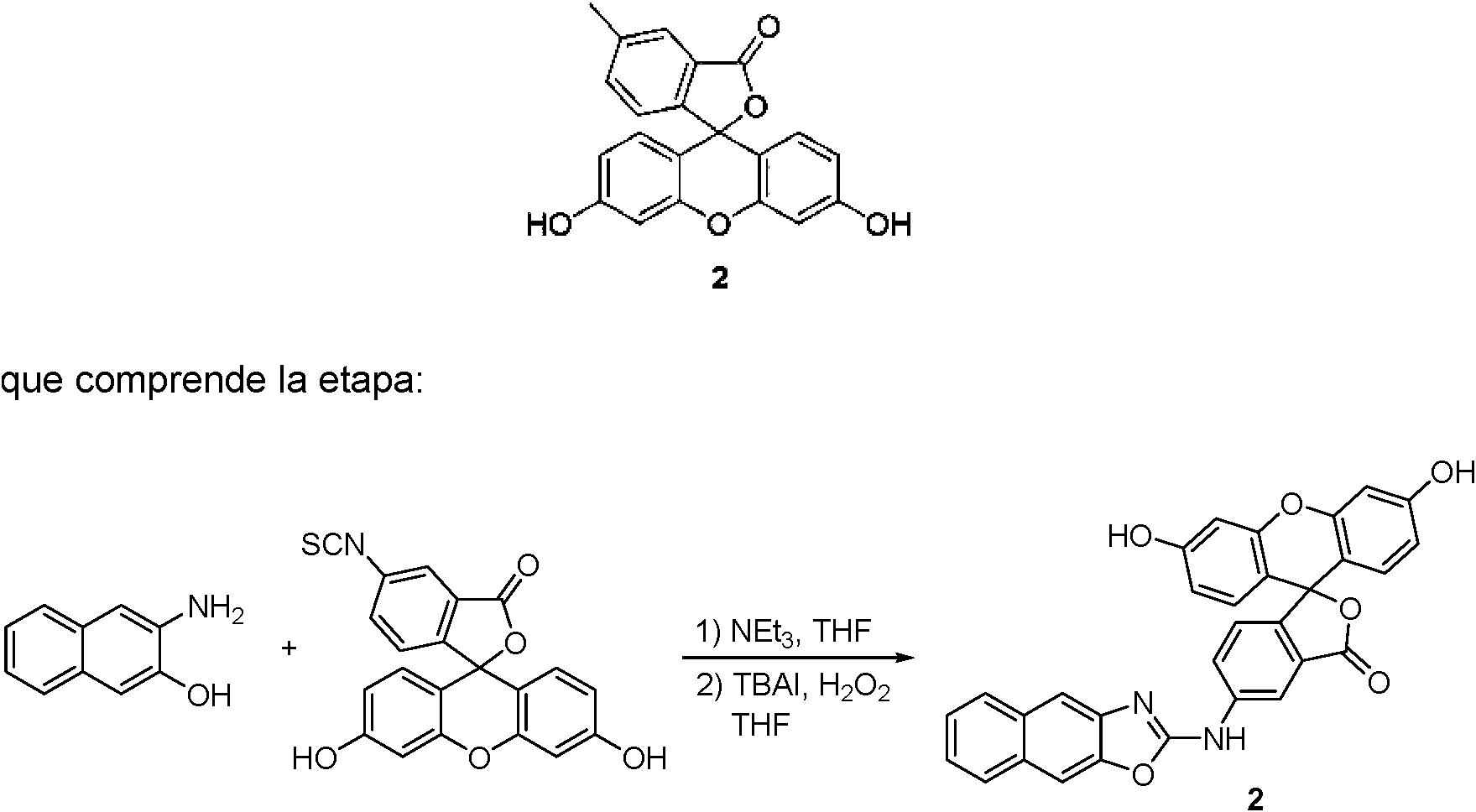
La presente invención también se refiere a un procedimiento para la obtención del compuesto 2, en el que R esThe present invention also relates to a process for obtaining compound 2, in which R is

que comprende la etapa: which includes the stage:

Las condiciones de reacción no son particularmente relevantes ya que se puede llevar a cabo a P y T ambientales.The reaction conditions are not particularly relevant since it can be carried out at ambient P and T.
En un cuarto aspecto, la presente invención se refiere a la utilización de una composición, tal como se ha definido anteriormente, o el compuesto 1 o 2, tal como se ha definido anteriormente, en la detección de ácido -hidroxibutírico (GHB) o una sal del mismo en bebidas. Entre dichas sales se pueden incluir, pero sin limitarse a las mismas, sales con metales alcalinos o alcalinotérreos, preferiblemente, sodio. En la presente invención, cuando se hace referencia a bebidas, tal como se indica posteriormente, se entenderán bebidas alcohólicas, bebidas no alcohólicas o mezclas de las mismas. Cuando se hace referencia a bebidas alcohólicas se incluyen destilados alcohólicos, tales como, por ejemplo, whisky o ginebra, y también bebidas alcohólicas que no son destilados, tales como vino y cerveza.In a fourth aspect, the present invention relates to the use of a composition, as defined above, or compound 1 or 2, as defined above, in the detection of -hydroxybutyric acid (GHB) or a salt of it in drinks. Such salts may include, but are not limited to, salts with alkali or alkaline earth metals, preferably sodium. In the present invention, when referring to beverages, as indicated below, alcoholic beverages, non-alcoholic beverages or mixtures thereof will be understood. When referring to alcoholic beverages, alcoholic distillates are included, such as, for example, whiskey or gin, and also alcoholic beverages that are not spirits, such as wine and beer.
En un quinto aspecto, la presente invención se refiere a un procedimiento para la detección de GHB o una sal del mismo en bebidas, que comprende:In a fifth aspect, the present invention relates to a method for the detection of GHB or a salt thereof in beverages, comprising:
a) tomar una gota de la bebida a analizar y disolverla en una solución acuosa de una base débil;a) take a drop of the drink to be analyzed and dissolve it in an aqueous solution of a weak base;
b) añadir una alícuota de la solución obtenida en la etapa a) a la composición, tal como se ha definido anteriormente, o, alternativamente, al compuesto 1 o 2, tal como se ha definido anteriormente,b) adding an aliquot of the solution obtained in step a) to the composition, as defined above, or, alternatively, to compound 1 or 2, as defined above,
c) observar la reacción producida; yc) observe the reaction produced; and
d) determinar cualitativamente la presencia de GHB en la bebida a analizar según la observación de la etapa c).d) qualitatively determining the presence of GHB in the drink to be analyzed according to the observation of step c).
Cabe indicar que en la etapa b) la composición del compuesto 1 o 2 y el disolvente orgánico puede estar ya preparada o se puede producir en ese momento justo antes de la adición de la alícuota de la solución obtenida en la etapa a).It should be noted that in step b) the composition of compound 1 or 2 and the organic solvent can be already prepared or can be produced at that time just before the addition of the aliquot of the solution obtained in step a).
En una realización preferida, dicha base débil en la etapa a) es bicarbonato sódico, amónico, cálcico. En otra realización preferida, la concentración de la solución acuosa de la base débil es de 0,4 mM a 1 mM, aún más preferiblemente 0,4 mM.In a preferred embodiment, said weak base in step a) is sodium bicarbonate, ammonium, calcium In another preferred embodiment, the concentration of the aqueous solution of the weak base is from 0.4 mM to 1 mM, even more preferably 0.4 mM.
En otra realización preferida, el compuesto 1 o 2 se encuentra en una concentración de 50 pM a 500 pM, preferiblemente de 50 pM a 100 pM.In another preferred embodiment, compound 1 or 2 is found in a concentration of 50 pM to 500 pM, preferably 50 pM to 100 pM.
En la etapa c) debe observarse si se produce una reacción entre los compuestos 1 o 2, solos o en la composición, con el posible componente GHB o una sal del mismo presente en la bebida a analizar. Si el compuesto 1 reacciona positivamente con GHB o una sal del mismo, se observará un cambio de color (de amarillo a rojo), mientras que si el compuesto 2 reacciona positivamente con GHB o una sal del mismo, se observará fluorescencia (de verde tenue a amarillo intenso en bebidas alcohólicas destiladas y de azul a verde en combinados, refrescos o bebidas alcohólicas no destiladas, tales como cerveza, vino o vermú). De este modo, se puede concluir en la etapa d) la presencia o no de GHB en la bebida que se está analizando.In step c), it must be observed whether a reaction occurs between compounds 1 or 2, alone or in the composition, with the possible GHB component or a salt thereof present in the beverage to be analyzed. If compound 1 reacts positively with GHB or a salt thereof, a color change (from yellow to red) will be observed, while if compound 2 reacts positively with GHB or a salt thereof, fluorescence (from faint green to red) will be observed. to intense yellow in distilled alcoholic beverages and from blue to green in mixed drinks, soft drinks or non-distilled alcoholic beverages, such as beer, wine or vermouth). In this way, it is possible to conclude in step d) the presence or not of GHB in the drink that is being analyzed.
En otra realización alternativa del procedimiento, éste se puede modificar ligeramente en el orden de mezcla, aunque el resultado final sea el mismo. En este sentido, el procedimiento alternativo comprende las etapas de:In another alternative embodiment of the procedure, the procedure can be slightly modified in the mixing order, although the final result is the same. In this sense, the alternative procedure comprises the steps of:
a) mezclar una solución acuosa de una base débil, tal como se ha definido anteriormente, con el disolvente orgánico, tal como se ha definido anteriormente; b) añadir el compuesto 1 o 2, tal como se ha definido anteriormente;a) mixing an aqueous solution of a weak base, as defined above, with the organic solvent, as defined above; b) adding compound 1 or 2, as defined above;
c) inmediatamente después de la etapa b), añadir una gota de la bebida a analizar; d) observar la reacción producida; yc) immediately after step b), add a drop of the beverage to be analyzed; d) observe the reaction produced; and
e) determinar cualitativamente la presencia de GHB en la bebida a analizar según la observación de la etapa d).e) qualitatively determining the presence of GHB in the drink to be analyzed according to the observation of step d).
En un sexto aspecto, la presente invención se refiere a un kit o equipo para utilizar en la detección de GHB o una sal del mismo en bebidas que incluyeIn a sixth aspect, the present invention relates to a kit or equipment for use in the detection of GHB or a salt thereof in beverages that includes
- un recipiente transparente con apertura y cierre que contiene una composición, tal como se ha definido anteriormente, alternativamente, un compuesto 1 o 2, tal como se han definido anteriormente, opcionalmente, en el que dicho recipiente que contiene el compuesto 1 o 2 está acompañado de otro recipiente de las mismas características pero con disolvente orgánico, tal como sea definido anteriormente,- an openable and closable transparent container containing a composition, as defined above, alternatively, a compound 1 or 2, as defined above, optionally, wherein said container containing compound 1 or 2 is accompanied by another container with the same characteristics but with organic solvent, as defined above,
- un recipiente transparente con apertura y cierre que contiene una base débil en forma de solución acuosa; - a transparent container with opening and closing containing a weak base in the form of an aqueous solution;
Opcionalmente, dicho kit o equipo comprende, además, instrucciones para su utilización.Optionally, said kit or kit also includes instructions for its use.
Tal como se ha indicado anteriormente en el presente documento, la base débil es preferiblemente bicarbonato sódico, aunque se podría utilizar cualquier base débil como, por ejemplo, bicarbonato potásico, amónico, cálcico. En otra realización preferida, la concentración de la solución acuosa de la base débil es de 0,4-1 mM, aún más preferiblemente 0,4 mM.As noted hereinabove, the weak base is preferably sodium bicarbonate, although any weak base could be used, eg potassium, ammonium, calcium bicarbonate. In another preferred embodiment, the concentration of the aqueous solution of the weak base is 0.4-1 mM, even more preferably 0.4 mM.
También, como se ha indicado anteriormente en el presente documento, el compuesto 1 o 2 se encuentra en la composición preferiblemente en una concentración de 50 pM a 500 pM, preferiblemente de 50 pM a 100 pM.Also, as stated hereinabove, compound 1 or 2 is present in the composition preferably at a concentration of 50 pM to 500 pM, preferably 50 pM to 100 pM.
En una realización preferida, dichos recipientes transparentes con apertura y cierre son microtubos graduados de polipropileno (por ejemplo, Eppendorf™).In a preferred embodiment, said open-close transparent containers are polypropylene graduated microtubes (eg Eppendorf™).
En otra realización preferida, dicho utensilio para la recogida de muestra puede ser un cuentagotas o una cucharita.In another preferred embodiment, said sample collection tool can be a dropper or a teaspoon.
En una realización más preferente, en la utilización, el procedimiento, o el kit o equipo, según se han definido en aspectos anteriores, la bebida es una bebida alcohólica. En otra realización más preferente, dicha bebida alcohólica está mezclada con una bebida no alcohólica, preferiblemente un refresco o zumo. En otra realización más preferente, dicha bebida es únicamente una bebida no alcohólica, preferiblemente un refresco o un zumo.In a more preferred embodiment, in the use, the procedure, or the kit or equipment, as defined in previous aspects, the beverage is an alcoholic beverage. In another more preferred embodiment, said alcoholic beverage is mixed with a non-alcoholic beverage, preferably a soft drink or juice. In another more preferred embodiment, said beverage is only a non-alcoholic beverage, preferably a soft drink or a juice.
Preferiblemente, dicha bebida alcohólica se selecciona, a modo de ejemplo no limitativo, entre ginebra, vodka, ron, whisky, vino blanco, vermú y cerveza.Preferably, said alcoholic beverage is selected, by way of non-limiting example, from gin, vodka, rum, whiskey, white wine, vermouth and beer.
Preferiblemente, dicho refresco o zumo se selecciona, a modo de ejemplo no limitativo, entre tónica, refresco de naranja, refresco de limón, refresco de té, refresco de cola. y cualquier zumo de frutas.Preferably, said soft drink or juice is selected, by way of non-limiting example, from tonic, orange soft drink, lemon soft drink, tea soft drink, cola soft drink. and any fruit juice.
Cabe indicar que la presente invención abarca cualquier combinación de las viable en el contexto de la presente invención.It should be noted that the present invention encompasses any combination of the viable in the context of the present invention.
Los diferentes casos o ejemplos particulares citados anteriorrnente, así corno los siguientes ejemplos, se proporcionan únicamente con fines ilustrativos y no pretenden limitar de ningún modo el alcance de la presente invención.The different cases or particular examples cited above, as well as the following examples, are provided solely for illustrative purposes and are not intended to limit the scope of the present invention in any way.
EJEMPLOSEXAMPLES
Ejemplo 1. Síntesis del compuesto 1Example 1. Synthesis of compound 1

En un matraz de fondo redondo de 50 L de dos bocas, bajo atmósfera inerte, se disolvieron 202 mg de 3-amino-2-naftol (1,256 mmol) junto con 191 mg de 4-nitrofenil isotiocianato (1,047 mmol) en 13 mL de piridina. Se dejó en agitación 8 h a temperatura ambiente. A continuación, se evaporó el disolvente, se disolvió el sólido en 35 mL de AcOEt y se lavó una vez con agua ácida (pH 5 aprox.), una vez con NaHC03 (sat) y otra con NaCl (sat). La fase orgánica se secó sobre MgS04 , se filtró y se evaporó el disolvente a vacío. El crudo se purificó por columna cromatográfica de sílica-gel empleando como eluyente una mezcla Hexano:Ac0Et 6:4. Se obtuvo un sólido amarillo (compuesto 1) ligeramente anaranjado con un rendimiento del 35 %.In a 50 L two-necked round bottom flask, under an inert atmosphere, 202 mg of 3-amino-2-naphthol (1.256 mmol) were dissolved together with 191 mg of 4-nitrophenyl isothiocyanate (1.047 mmol) in 13 mL of pyridine. It was left under stirring for 8 h at room temperature. The solvent was then evaporated, the solid was dissolved in 35 mL of AcOEt and washed once with acidic water (pH 5 approx.), once with NaHC03 (sat) and once with NaCl (sat). The organic phase was dried over MgS04, filtered and the solvent evaporated in vacuo. The crude was purified by silica-gel chromatographic column using a Hexane:Ac0Et 6:4 mixture as eluant. A slightly orange yellow solid (compound 1) was obtained in 35% yield.
Ejemplo 2. Síntesis del compuesto 2Example 2. Synthesis of compound 2

En un matraz de fondo redondo de 25 mL de una boca, se disolvieron 45 mg de 3-amino-2-naftol (0,283 mmol) junto con 98 mg fluoresceína-5-tioisocianato (0,283 mmol) en 3 temperatura ambiente 16 h. A continuación, se adicionaron 34 j L de H2O2 al 30 % (0,565 mmol) y 1 mg de yoduro de tetrabutilamonio (0,003 mmol). Se obtuvo un sólido naranja (compuesto 2) con un rendimiento del 79 %.In a 25 mL single necked round bottom flask, 45 mg 3-amino-2-naphthol (0.283 mmol) was dissolved together with 98 mg fluorescein-5-thioisocyanate (0.283 mmol) in 3 room temperature 16h. Next, 34 jL of 30% H2O2 (0.565 mmol) and 1 mg of tetrabutylammonium iodide (0.003 mmol) were added. An orange solid (compound 2) was obtained in 79% yield.
Ejemplo 3. Ensayos sobre muestras realesExample 3. Tests on real samples
Inicialmente, se contaminan las bebidas con GHB en una concentración 12 mM. Seguidamente, se toman 100 j L de bebida y se mezclan con 100 j L de NaHCO3 (1 mM o 0,4 mM). A continuación, se mezclaron 30 j L de esta disolución con 50 j L de sensor (a partir de una disolución 1 mM, en DMSO), previamente disueltos en 920 j L de DMSO. Se siguió el mismo proceso para las muestras que no tienen GHB.Initially, drinks are contaminated with GHB at a concentration of 12 mM. Next, 100 jL of drink is taken and mixed with 100 jL of NaHCO3 (1 mM or 0.4 mM). Next, 30 jL of this solution were mixed with 50 jL of sensor (from a 1 mM solution, in DMSO), previously dissolved in 920 jL of DMSO. The same process was followed for the samples that did not have GHB.
Los resultados con el compuesto 1 y el compuesto 2 se observan en la figura 1 y figura 2, respectivamente.The results with compound 1 and compound 2 are observed in figure 1 and figure 2, respectively.
Los resultados de un nuevo ensayo con el compuesto 1 y 2 en bebidas de fanta® de naranja y vino blanco se observan en las figuras 3 y 4, respectivamente.The results of a new trial with compound 1 and 2 in orange and white wine fanta® beverages are shown in figures 3 and 4, respectively.
Se aplicó de nuevo el ensayo con el compuesto 1 y 2 pero con las siguientes bebidas: ron, ginebra, vodka y whisky. Los resultados de los cambios de color se observan en las figuras 5 y 6 respectivamente.The test was applied again with compound 1 and 2 but with the following drinks: rum, gin, vodka and whisky. The results of the color changes are observed in figures 5 and 6 respectively.
Finalmente, se aplicó el ensayo con los compuestos 1 y 2 a las mezclas de gin tonic y whisky-bebida de cola. Los resultados se observan en las figuras 7 y 8, respectivamente. Finally, the test with compounds 1 and 2 was applied to the gin and tonic and whiskey-cola mixtures. The results are observed in figures 7 and 8, respectively.
Claims (23)


Priority Applications (6)
| Application Number | Priority Date | Filing Date | Title |
|---|---|---|---|
| ES202030840A ES2894202B2 (en) | 2020-08-06 | 2020-08-06 | NEW COMPOUNDS DERIVED FROM BENZOXAZOLE, OBTAINING PROCEDURE AND THEIR USE IN THE DETECTION OF GHB IN BEVERAGES |
| US18/040,532 US20230286931A1 (en) | 2020-08-06 | 2021-08-05 | Novel benzoxazole derivatives, method for producing same and use thereof to detect ghb in drinks and urine |
| PCT/ES2021/070595 WO2022029357A1 (en) | 2020-08-06 | 2021-08-05 | Novel benzoxazole derivatives, method for producing same and use thereof to detect ghb in drinks and urine |
| CA3188341A CA3188341A1 (en) | 2020-08-06 | 2021-08-05 | New benzoxazole-based compounds, process for obtaining them and use thereof for detecting ghb in beverages and urine |
| EP21852960.0A EP4194444A4 (en) | 2020-08-06 | 2021-08-05 | NEW COMPOUNDS DERIVED FROM BENZOXAZOLE, PROCESS FOR OBTAINING AND THEIR USE IN THE DETECTION OF GHB IN BEVERAGES AND IN URINE |
| AU2021322761A AU2021322761A1 (en) | 2020-08-06 | 2021-08-05 | Novel benzoxazole derivatives, method for producing same and use thereof to detect ghb in drinks and urine |
Applications Claiming Priority (1)
| Application Number | Priority Date | Filing Date | Title |
|---|---|---|---|
| ES202030840A ES2894202B2 (en) | 2020-08-06 | 2020-08-06 | NEW COMPOUNDS DERIVED FROM BENZOXAZOLE, OBTAINING PROCEDURE AND THEIR USE IN THE DETECTION OF GHB IN BEVERAGES |
Publications (2)
| Publication Number | Publication Date |
|---|---|
| ES2894202A1 true ES2894202A1 (en) | 2022-02-11 |
| ES2894202B2 ES2894202B2 (en) | 2022-11-03 |
Family
ID=80117139
Family Applications (1)
| Application Number | Title | Priority Date | Filing Date |
|---|---|---|---|
| ES202030840A Active ES2894202B2 (en) | 2020-08-06 | 2020-08-06 | NEW COMPOUNDS DERIVED FROM BENZOXAZOLE, OBTAINING PROCEDURE AND THEIR USE IN THE DETECTION OF GHB IN BEVERAGES |
Country Status (6)
| Country | Link |
|---|---|
| US (1) | US20230286931A1 (en) |
| EP (1) | EP4194444A4 (en) |
| AU (1) | AU2021322761A1 (en) |
| CA (1) | CA3188341A1 (en) |
| ES (1) | ES2894202B2 (en) |
| WO (1) | WO2022029357A1 (en) |
Families Citing this family (1)
| Publication number | Priority date | Publication date | Assignee | Title |
|---|---|---|---|---|
| ES3038535B2 (en) * | 2024-04-11 | 2026-04-17 | Univ Valencia | NEW BENZOXAZOLE DERIVATIVES, OBTAINING PROCESS AND THEIR USE IN THE DETECTION OF GHB IN BEVERAGES |
Citations (1)
| Publication number | Priority date | Publication date | Assignee | Title |
|---|---|---|---|---|
| WO2012077110A2 (en) * | 2010-12-06 | 2012-06-14 | Ramot At Tel-Aviv University Ltd. | Methods and kits for detection of drugs |
-
2020
- 2020-08-06 ES ES202030840A patent/ES2894202B2/en active Active
-
2021
- 2021-08-05 CA CA3188341A patent/CA3188341A1/en active Pending
- 2021-08-05 WO PCT/ES2021/070595 patent/WO2022029357A1/en not_active Ceased
- 2021-08-05 AU AU2021322761A patent/AU2021322761A1/en not_active Abandoned
- 2021-08-05 EP EP21852960.0A patent/EP4194444A4/en not_active Withdrawn
- 2021-08-05 US US18/040,532 patent/US20230286931A1/en active Pending
Patent Citations (1)
| Publication number | Priority date | Publication date | Assignee | Title |
|---|---|---|---|---|
| WO2012077110A2 (en) * | 2010-12-06 | 2012-06-14 | Ramot At Tel-Aviv University Ltd. | Methods and kits for detection of drugs |
Non-Patent Citations (6)
| Title |
|---|
| BAUMES, L.A. ET AL. ¿. A Colorimetric Sensor Array for the Detection of the Date-Rape Drug ¿-Hydroxybutyric Acid (GHB): A Supramolecular Approach¿. . Chemistry: A European Journal , 22.03.2010, Vol. 16, Páginas 4489-4495 0947-6539; 1521-3765 (en línea), (DOI: 10.1002/chem.200903127) Ver página 4489, resumen; página 4490, columna 2, párrafo 2; página 4491, figura 3; página 4492. * |
| GARRIDO, E. ET AL. . Chromogenic and Fluorogenic Probes for the Detection of Illicit Drugs. Chemistry Open , 28.05.2018, Vol. 7, Páginas 401-428 [en línea][recuperado el 08.06.2021]. Recuperado de Internet (URL:https://www.ncbi.nlm.nih.gov/pmc/articles/PMC5974560), 0022-328X; 1872-8561 (en línea), (DOI: 10.1002/open.201800034. ) Ver página 402, resumen; página 404, tabla 1; página 407, figuras 1 y 2. * |
| MURATA, Y. ET AL. . One-pot reaction for the synthesis of N-substituted 2-aminobenzoxazoles using triphenylbismuth dichloride as cyclodesulfurization reagent. Journal of Organometallic Chemistry , 02.02.2018, Vol. 859, Páginas 18-23 [en línea][recuperado el 03.06.2021]. Recuperado de Internet (URL:https://www.sciencedirect.com/science/article/pii/S0022328X18300500), 0022-328X; 1872-8561 (en línea), (DOI: 10.1016/j.jorganchem.2018.01.041) Ver página 18, resumen e introducción; página 20, tabla 2. * |
| QUEST, D.W. & HORSLEY, J. . Field-Test of a Date-Rape Drug Detection Device. Journal of Analytical Toxicology , 01.07.2007, Vol. 31, Páginas 354-357 [en línea][recuperado el 07.06.2021]. Recuperado de Internet (URL:https://academic.oup.com/jat/article/31/6/354/682867), 0146-4760; 1945-2403 (en línea), (DOI: 10.1093/jat/31.6.354) Ver página 354, resumen. * |
| RAPOLU, T. ET AL. . Microwave assisted one pot synthesis of 2-ethylamino benzimidazole, benzoxazole and benzothiazole derivatives. Synthetic Communications , 2019, Vol. 49, Páginas 1308-1315 0039-7911; 1532-2432 (en línea), (DOI: 10.1080/00397911.2019.1599952) Ver página 18, resumen e introducción; página 20, tabla 2. * |
| VEERMAN, A.T.E. & VEERMAN, S.R.T. . Current developments regarding GHB and GBL incidents, treatment and detection: A qualitative review. World Journal of Pharmaceutical Research , 2019, Vol. 8, Páginas 11-26 [en línea][recuperado el 07.06.2021]. Recuperado de Internet (URL:https://wjpr.net/admin/assets/article_issue/1559285152.pdf), 2277-7105, (DOI: 10.20959/wjpr20197-14980) Ver página 11, resumen; página 19, figura 6; página 20, párrafo 1; página 21. * |
Also Published As
| Publication number | Publication date |
|---|---|
| WO2022029357A1 (en) | 2022-02-10 |
| EP4194444A1 (en) | 2023-06-14 |
| US20230286931A1 (en) | 2023-09-14 |
| EP4194444A4 (en) | 2024-07-31 |
| ES2894202B2 (en) | 2022-11-03 |
| AU2021322761A1 (en) | 2023-03-30 |
| CA3188341A1 (en) | 2022-02-10 |
Similar Documents
| Publication | Publication Date | Title |
|---|---|---|
| Li et al. | Extraction and mechanism investigation of trace roxithromycin in real water samples by use of ionic liquid–salt aqueous two-phase system | |
| EP3022316B1 (en) | Means and methods for bioluminescence resonance energy transfer (bret) analysis in a biological sample | |
| Zhai et al. | Development of a fluorescent sensor for illicit date rape drug GHB | |
| Fu et al. | A novel colorimetric-fluorescent probe for Al3+ and the resultant complex for F− and its applications in cell imaging | |
| Ashour et al. | Simple extractive colorimetric determination of levofloxacin by acid–dye complexation methods in pharmaceutical preparations | |
| CN104910070B (en) | Quick high-selectivity hypochlorous acid fluorescent probe and its application | |
| Yang et al. | A sensitive and selective chemosensor for ascorbic acid based on a fluorescent nitroxide switch | |
| Kim et al. | Colorimetric determination of Cu2+ ions with a desktop scanner using silica nanoparticles via formation of a quinonediimine dye | |
| Soni et al. | A systematic review on sensing techniques for drug-facilitated sexual assaults (DFSA) monitoring | |
| KR102653164B1 (en) | Composition for Selectively Detecting Amphetamine-Type Stimulants, Colorimetric Sensor Comprising the Same, and Uses Thereof | |
| Dogra et al. | Hofmeister ions modulate the autocatalytic amyloidogenesis of an intrinsically disordered functional amyloid domain via unusual biphasic kinetics | |
| ES2894202B2 (en) | NEW COMPOUNDS DERIVED FROM BENZOXAZOLE, OBTAINING PROCEDURE AND THEIR USE IN THE DETECTION OF GHB IN BEVERAGES | |
| Feng et al. | 1, 6-Elimination reaction induced detection of fluoride ions in vitro and in vivo based on a NIR fluorescent probe | |
| Wu et al. | Determination of ofloxacin and gatifloxacin by mixed micelle-mediated cloud point extraction-fluorimetry combined methodology | |
| Mahapatra et al. | Fluorescence sensing of caffeine in aqueous solution with carbazole-based probe and imaging application in live cells | |
| Gorla et al. | Perturbation of apoptosis upon binding of tRNA to the heme domain of cytochrome c | |
| CN105784698B (en) | Rapid detection kit and detection method for saccharin sodium | |
| ES2894203B2 (en) | NEW THIOUREA-BASED COMPOUNDS, OBTAINING PROCEDURE AND THEIR USE IN THE DETECTION OF GHB IN BEVERAGES | |
| Zhou et al. | Selective detection of zwitterionic arginine with a new Zn (II)-terpyridine complex: potential application in protein labeling and determination | |
| Ghane et al. | Reversible switchable deep eutectic solvent for dispersive liquid–liquid microextraction of non-steroidal anti-inflammatory drugs in biological and wastewater samples combined with high-performance liquid chromatography | |
| Guo et al. | Micelle-enhanced and terbium-sensitized spectrofluorimetric determination of gatifloxacin and its interaction mechanism | |
| Yang et al. | Dopamine-based selective spectrophotometry p-aminosalicylic acid assay by hydrolyzate-triggered formation of azamonardine-like products | |
| Xiao et al. | Rapid detection of glutathione and spermidine by an in-situ pre-modification method based on perylene diimide derivatives | |
| Gao et al. | Multicolour colorimetric/fluorescent dual-signal sensor based on carbon dot nanoenzymes-red emitting carbon dots-TMB for highly selective detection of tannic acid | |
| Zomorodimanesh et al. | Monitoring tetracycline levels using the tetracycline monooxygenase enzyme and investigating the effects of sucrose and glycerol on enzymatic function |
Legal Events
| Date | Code | Title | Description |
|---|---|---|---|
| BA2A | Patent application published |
Ref document number: 2894202 Country of ref document: ES Kind code of ref document: A1 Effective date: 20220211 |
|
| FG2A | Definitive protection |
Ref document number: 2894202 Country of ref document: ES Kind code of ref document: B2 Effective date: 20221103 |