ES2897464T3 - Self-adhesive soil release coating composition - Google Patents
Self-adhesive soil release coating composition Download PDFInfo
- Publication number
- ES2897464T3 ES2897464T3 ES18203219T ES18203219T ES2897464T3 ES 2897464 T3 ES2897464 T3 ES 2897464T3 ES 18203219 T ES18203219 T ES 18203219T ES 18203219 T ES18203219 T ES 18203219T ES 2897464 T3 ES2897464 T3 ES 2897464T3
- Authority
- ES
- Spain
- Prior art keywords
- layer
- resin
- iii
- silicone
- soil release
- Prior art date
- Legal status (The legal status is an assumption and is not a legal conclusion. Google has not performed a legal analysis and makes no representation as to the accuracy of the status listed.)
- Active
Links
- 239000002689 soil Substances 0.000 title claims abstract description 100
- 239000000853 adhesive Substances 0.000 title claims abstract description 48
- 239000008199 coating composition Substances 0.000 title claims abstract description 13
- 239000010410 layer Substances 0.000 claims abstract description 166
- 238000000576 coating method Methods 0.000 claims abstract description 40
- 229920001296 polysiloxane Polymers 0.000 claims abstract description 39
- 229920002994 synthetic fiber Polymers 0.000 claims abstract description 39
- 239000012790 adhesive layer Substances 0.000 claims abstract description 24
- -1 polypropylene Polymers 0.000 claims abstract description 24
- 239000011248 coating agent Substances 0.000 claims abstract description 23
- 229920005989 resin Polymers 0.000 claims abstract description 16
- 239000011347 resin Substances 0.000 claims abstract description 16
- 229920002050 silicone resin Polymers 0.000 claims abstract description 14
- 239000004743 Polypropylene Substances 0.000 claims abstract description 12
- 229920001155 polypropylene Polymers 0.000 claims abstract description 12
- 229920001971 elastomer Polymers 0.000 claims abstract description 11
- XLYOFNOQVPJJNP-UHFFFAOYSA-N water Substances O XLYOFNOQVPJJNP-UHFFFAOYSA-N 0.000 claims abstract description 8
- NIXOWILDQLNWCW-UHFFFAOYSA-N acrylic acid group Chemical group C(C=C)(=O)O NIXOWILDQLNWCW-UHFFFAOYSA-N 0.000 claims abstract description 7
- 239000004927 clay Substances 0.000 claims abstract description 7
- 229920005749 polyurethane resin Polymers 0.000 claims abstract description 5
- 239000004698 Polyethylene Substances 0.000 claims abstract description 4
- 229920000573 polyethylene Polymers 0.000 claims abstract description 4
- BZHJMEDXRYGGRV-UHFFFAOYSA-N Vinyl chloride Chemical compound ClC=C BZHJMEDXRYGGRV-UHFFFAOYSA-N 0.000 claims abstract description 3
- 238000003851 corona treatment Methods 0.000 claims abstract description 3
- 229910052731 fluorine Inorganic materials 0.000 claims abstract description 3
- 239000011737 fluorine Substances 0.000 claims abstract description 3
- 238000009832 plasma treatment Methods 0.000 claims abstract description 3
- 229920006122 polyamide resin Polymers 0.000 claims abstract description 3
- 229920001225 polyester resin Polymers 0.000 claims abstract description 3
- 239000004645 polyester resin Substances 0.000 claims abstract description 3
- 229920005672 polyolefin resin Polymers 0.000 claims abstract description 3
- YCKRFDGAMUMZLT-UHFFFAOYSA-N Fluorine atom Chemical compound [F] YCKRFDGAMUMZLT-UHFFFAOYSA-N 0.000 claims abstract 2
- 239000000203 mixture Substances 0.000 claims description 78
- 239000000463 material Substances 0.000 claims description 10
- 239000000806 elastomer Substances 0.000 claims description 8
- 229920002545 silicone oil Polymers 0.000 claims description 8
- 230000009257 reactivity Effects 0.000 claims description 3
- 229920000728 polyester Polymers 0.000 claims description 2
- 125000000391 vinyl group Chemical group [H]C([*])=C([H])[H] 0.000 claims description 2
- VEXZGXHMUGYJMC-UHFFFAOYSA-M Chloride anion Chemical compound [Cl-] VEXZGXHMUGYJMC-UHFFFAOYSA-M 0.000 claims 1
- 229920002554 vinyl polymer Polymers 0.000 claims 1
- 239000003795 chemical substances by application Substances 0.000 description 13
- 239000004820 Pressure-sensitive adhesive Substances 0.000 description 12
- QTBSBXVTEAMEQO-UHFFFAOYSA-N Acetic acid Chemical compound CC(O)=O QTBSBXVTEAMEQO-UHFFFAOYSA-N 0.000 description 9
- 238000000034 method Methods 0.000 description 9
- 125000000524 functional group Chemical group 0.000 description 7
- QTBSBXVTEAMEQO-UHFFFAOYSA-M Acetate Chemical compound CC([O-])=O QTBSBXVTEAMEQO-UHFFFAOYSA-M 0.000 description 6
- 230000003373 anti-fouling effect Effects 0.000 description 6
- 239000007921 spray Substances 0.000 description 6
- 239000000758 substrate Substances 0.000 description 6
- 230000008569 process Effects 0.000 description 5
- 238000004140 cleaning Methods 0.000 description 4
- 239000003431 cross linking reagent Substances 0.000 description 4
- 238000004519 manufacturing process Methods 0.000 description 4
- 229920000642 polymer Polymers 0.000 description 4
- 230000001629 suppression Effects 0.000 description 4
- 239000004593 Epoxy Substances 0.000 description 3
- 239000002253 acid Substances 0.000 description 3
- 238000004026 adhesive bonding Methods 0.000 description 3
- 230000001070 adhesive effect Effects 0.000 description 3
- 239000003139 biocide Substances 0.000 description 3
- 229920001577 copolymer Polymers 0.000 description 3
- 230000001627 detrimental effect Effects 0.000 description 3
- 238000006073 displacement reaction Methods 0.000 description 3
- 238000010438 heat treatment Methods 0.000 description 3
- 239000003973 paint Substances 0.000 description 3
- 229920006124 polyolefin elastomer Polymers 0.000 description 3
- 229920002635 polyurethane Polymers 0.000 description 3
- 239000004814 polyurethane Substances 0.000 description 3
- 231100000331 toxic Toxicity 0.000 description 3
- 230000002588 toxic effect Effects 0.000 description 3
- SMZOUWXMTYCWNB-UHFFFAOYSA-N 2-(2-methoxy-5-methylphenyl)ethanamine Chemical compound COC1=CC=C(C)C=C1CCN SMZOUWXMTYCWNB-UHFFFAOYSA-N 0.000 description 2
- 239000004971 Cross linker Substances 0.000 description 2
- BLRPTPMANUNPDV-UHFFFAOYSA-N Silane Chemical compound [SiH4] BLRPTPMANUNPDV-UHFFFAOYSA-N 0.000 description 2
- 125000003668 acetyloxy group Chemical group [H]C([H])([H])C(=O)O[*] 0.000 description 2
- 239000003522 acrylic cement Substances 0.000 description 2
- 238000004873 anchoring Methods 0.000 description 2
- 230000004888 barrier function Effects 0.000 description 2
- 230000003115 biocidal effect Effects 0.000 description 2
- 238000011109 contamination Methods 0.000 description 2
- KPUWHANPEXNPJT-UHFFFAOYSA-N disiloxane Chemical class [SiH3]O[SiH3] KPUWHANPEXNPJT-UHFFFAOYSA-N 0.000 description 2
- 230000000694 effects Effects 0.000 description 2
- 229920001519 homopolymer Polymers 0.000 description 2
- 230000007062 hydrolysis Effects 0.000 description 2
- 238000006460 hydrolysis reaction Methods 0.000 description 2
- 230000001771 impaired effect Effects 0.000 description 2
- 230000001788 irregular Effects 0.000 description 2
- 239000012948 isocyanate Substances 0.000 description 2
- 150000002513 isocyanates Chemical class 0.000 description 2
- 239000011159 matrix material Substances 0.000 description 2
- 229920000058 polyacrylate Polymers 0.000 description 2
- 238000006116 polymerization reaction Methods 0.000 description 2
- 238000002360 preparation method Methods 0.000 description 2
- 229910000077 silane Inorganic materials 0.000 description 2
- 229920002379 silicone rubber Polymers 0.000 description 2
- 239000002904 solvent Substances 0.000 description 2
- 238000005507 spraying Methods 0.000 description 2
- 229920000178 Acrylic resin Polymers 0.000 description 1
- 239000004925 Acrylic resin Substances 0.000 description 1
- 241000700670 Bryozoa Species 0.000 description 1
- 241000195628 Chlorophyta Species 0.000 description 1
- 241000238586 Cirripedia Species 0.000 description 1
- PXGOKWXKJXAPGV-UHFFFAOYSA-N Fluorine Chemical compound FF PXGOKWXKJXAPGV-UHFFFAOYSA-N 0.000 description 1
- 241001465754 Metazoa Species 0.000 description 1
- 239000002033 PVDF binder Substances 0.000 description 1
- 239000004264 Petrolatum Substances 0.000 description 1
- 229920002125 Sokalan® Polymers 0.000 description 1
- 238000005299 abrasion Methods 0.000 description 1
- 238000010521 absorption reaction Methods 0.000 description 1
- 239000013543 active substance Substances 0.000 description 1
- 239000000654 additive Substances 0.000 description 1
- 125000003277 amino group Chemical group 0.000 description 1
- 230000003466 anti-cipated effect Effects 0.000 description 1
- 230000009286 beneficial effect Effects 0.000 description 1
- 150000001732 carboxylic acid derivatives Chemical class 0.000 description 1
- 239000003054 catalyst Substances 0.000 description 1
- 238000006243 chemical reaction Methods 0.000 description 1
- 238000009833 condensation Methods 0.000 description 1
- 230000005494 condensation Effects 0.000 description 1
- XPLSDXJBKRIVFZ-UHFFFAOYSA-L copper;prop-2-enoate Chemical class [Cu+2].[O-]C(=O)C=C.[O-]C(=O)C=C XPLSDXJBKRIVFZ-UHFFFAOYSA-L 0.000 description 1
- 238000005260 corrosion Methods 0.000 description 1
- 238000012864 cross contamination Methods 0.000 description 1
- 238000004132 cross linking Methods 0.000 description 1
- 230000001419 dependent effect Effects 0.000 description 1
- 230000006866 deterioration Effects 0.000 description 1
- 235000014113 dietary fatty acids Nutrition 0.000 description 1
- 238000001035 drying Methods 0.000 description 1
- 230000003670 easy-to-clean Effects 0.000 description 1
- 230000005489 elastic deformation Effects 0.000 description 1
- 238000005516 engineering process Methods 0.000 description 1
- 230000007613 environmental effect Effects 0.000 description 1
- 238000003912 environmental pollution Methods 0.000 description 1
- 239000003925 fat Substances 0.000 description 1
- 229930195729 fatty acid Natural products 0.000 description 1
- 239000000194 fatty acid Substances 0.000 description 1
- 150000004665 fatty acids Chemical class 0.000 description 1
- 239000000945 filler Substances 0.000 description 1
- 239000000446 fuel Substances 0.000 description 1
- 230000036541 health Effects 0.000 description 1
- PQPVPZTVJLXQAS-UHFFFAOYSA-N hydroxy-methyl-phenylsilicon Chemical class C[Si](O)C1=CC=CC=C1 PQPVPZTVJLXQAS-UHFFFAOYSA-N 0.000 description 1
- 239000003112 inhibitor Substances 0.000 description 1
- 238000009434 installation Methods 0.000 description 1
- 239000007788 liquid Substances 0.000 description 1
- 229940057995 liquid paraffin Drugs 0.000 description 1
- 231100000252 nontoxic Toxicity 0.000 description 1
- 230000003000 nontoxic effect Effects 0.000 description 1
- 150000007524 organic acids Chemical class 0.000 description 1
- 125000001181 organosilyl group Chemical group [SiH3]* 0.000 description 1
- 229940066842 petrolatum Drugs 0.000 description 1
- 235000019271 petrolatum Nutrition 0.000 description 1
- 230000000704 physical effect Effects 0.000 description 1
- 238000006068 polycondensation reaction Methods 0.000 description 1
- 229920006294 polydialkylsiloxane Polymers 0.000 description 1
- 239000013047 polymeric layer Substances 0.000 description 1
- 229920000098 polyolefin Polymers 0.000 description 1
- 239000004800 polyvinyl chloride Substances 0.000 description 1
- 229920000915 polyvinyl chloride Polymers 0.000 description 1
- 229920002981 polyvinylidene fluoride Polymers 0.000 description 1
- 125000002924 primary amino group Chemical group [H]N([H])* 0.000 description 1
- 230000001681 protective effect Effects 0.000 description 1
- 230000006798 recombination Effects 0.000 description 1
- 238000005215 recombination Methods 0.000 description 1
- 230000009467 reduction Effects 0.000 description 1
- 238000007788 roughening Methods 0.000 description 1
- 229920005573 silicon-containing polymer Polymers 0.000 description 1
- 230000003068 static effect Effects 0.000 description 1
- 239000000126 substance Substances 0.000 description 1
- 239000004094 surface-active agent Substances 0.000 description 1
- 238000010998 test method Methods 0.000 description 1
- 238000012360 testing method Methods 0.000 description 1
- 229920001169 thermoplastic Polymers 0.000 description 1
- 229920002725 thermoplastic elastomer Polymers 0.000 description 1
- 239000004416 thermosoftening plastic Substances 0.000 description 1
- 125000000101 thioether group Chemical group 0.000 description 1
- JOYRKODLDBILNP-UHFFFAOYSA-N urethane group Chemical group NC(=O)OCC JOYRKODLDBILNP-UHFFFAOYSA-N 0.000 description 1
- 239000001993 wax Substances 0.000 description 1
- 238000009736 wetting Methods 0.000 description 1
Classifications
-
- C—CHEMISTRY; METALLURGY
- C08—ORGANIC MACROMOLECULAR COMPOUNDS; THEIR PREPARATION OR CHEMICAL WORKING-UP; COMPOSITIONS BASED THEREON
- C08K—Use of inorganic or non-macromolecular organic substances as compounding ingredients
- C08K5/00—Use of organic ingredients
- C08K5/04—Oxygen-containing compounds
- C08K5/09—Carboxylic acids; Metal salts thereof; Anhydrides thereof
- C08K5/098—Metal salts of carboxylic acids
-
- C—CHEMISTRY; METALLURGY
- C08—ORGANIC MACROMOLECULAR COMPOUNDS; THEIR PREPARATION OR CHEMICAL WORKING-UP; COMPOSITIONS BASED THEREON
- C08L—COMPOSITIONS OF MACROMOLECULAR COMPOUNDS
- C08L23/00—Compositions of homopolymers or copolymers of unsaturated aliphatic hydrocarbons having only one carbon-to-carbon double bond; Compositions of derivatives of such polymers
- C08L23/02—Compositions of homopolymers or copolymers of unsaturated aliphatic hydrocarbons having only one carbon-to-carbon double bond; Compositions of derivatives of such polymers not modified by chemical after-treatment
- C08L23/10—Homopolymers or copolymers of propene
- C08L23/12—Polypropene
-
- C—CHEMISTRY; METALLURGY
- C09—DYES; PAINTS; POLISHES; NATURAL RESINS; ADHESIVES; COMPOSITIONS NOT OTHERWISE PROVIDED FOR; APPLICATIONS OF MATERIALS NOT OTHERWISE PROVIDED FOR
- C09D—COATING COMPOSITIONS, e.g. PAINTS, VARNISHES OR LACQUERS; FILLING PASTES; CHEMICAL PAINT OR INK REMOVERS; INKS; CORRECTING FLUIDS; WOODSTAINS; PASTES OR SOLIDS FOR COLOURING OR PRINTING; USE OF MATERIALS THEREFOR
- C09D183/00—Coating compositions based on macromolecular compounds obtained by reactions forming in the main chain of the macromolecule a linkage containing silicon, with or without sulfur, nitrogen, oxygen, or carbon only; Coating compositions based on derivatives of such polymers
- C09D183/04—Polysiloxanes
-
- C—CHEMISTRY; METALLURGY
- C09—DYES; PAINTS; POLISHES; NATURAL RESINS; ADHESIVES; COMPOSITIONS NOT OTHERWISE PROVIDED FOR; APPLICATIONS OF MATERIALS NOT OTHERWISE PROVIDED FOR
- C09D—COATING COMPOSITIONS, e.g. PAINTS, VARNISHES OR LACQUERS; FILLING PASTES; CHEMICAL PAINT OR INK REMOVERS; INKS; CORRECTING FLUIDS; WOODSTAINS; PASTES OR SOLIDS FOR COLOURING OR PRINTING; USE OF MATERIALS THEREFOR
- C09D5/00—Coating compositions, e.g. paints, varnishes or lacquers, characterised by their physical nature or the effects produced; Filling pastes
- C09D5/16—Antifouling paints; Underwater paints
-
- C—CHEMISTRY; METALLURGY
- C09—DYES; PAINTS; POLISHES; NATURAL RESINS; ADHESIVES; COMPOSITIONS NOT OTHERWISE PROVIDED FOR; APPLICATIONS OF MATERIALS NOT OTHERWISE PROVIDED FOR
- C09D—COATING COMPOSITIONS, e.g. PAINTS, VARNISHES OR LACQUERS; FILLING PASTES; CHEMICAL PAINT OR INK REMOVERS; INKS; CORRECTING FLUIDS; WOODSTAINS; PASTES OR SOLIDS FOR COLOURING OR PRINTING; USE OF MATERIALS THEREFOR
- C09D5/00—Coating compositions, e.g. paints, varnishes or lacquers, characterised by their physical nature or the effects produced; Filling pastes
- C09D5/16—Antifouling paints; Underwater paints
- C09D5/1656—Antifouling paints; Underwater paints characterised by the film-forming substance
- C09D5/1662—Synthetic film-forming substance
-
- C—CHEMISTRY; METALLURGY
- C09—DYES; PAINTS; POLISHES; NATURAL RESINS; ADHESIVES; COMPOSITIONS NOT OTHERWISE PROVIDED FOR; APPLICATIONS OF MATERIALS NOT OTHERWISE PROVIDED FOR
- C09D—COATING COMPOSITIONS, e.g. PAINTS, VARNISHES OR LACQUERS; FILLING PASTES; CHEMICAL PAINT OR INK REMOVERS; INKS; CORRECTING FLUIDS; WOODSTAINS; PASTES OR SOLIDS FOR COLOURING OR PRINTING; USE OF MATERIALS THEREFOR
- C09D5/00—Coating compositions, e.g. paints, varnishes or lacquers, characterised by their physical nature or the effects produced; Filling pastes
- C09D5/16—Antifouling paints; Underwater paints
- C09D5/1656—Antifouling paints; Underwater paints characterised by the film-forming substance
- C09D5/1662—Synthetic film-forming substance
- C09D5/1675—Polyorganosiloxane-containing compositions
-
- C—CHEMISTRY; METALLURGY
- C09—DYES; PAINTS; POLISHES; NATURAL RESINS; ADHESIVES; COMPOSITIONS NOT OTHERWISE PROVIDED FOR; APPLICATIONS OF MATERIALS NOT OTHERWISE PROVIDED FOR
- C09D—COATING COMPOSITIONS, e.g. PAINTS, VARNISHES OR LACQUERS; FILLING PASTES; CHEMICAL PAINT OR INK REMOVERS; INKS; CORRECTING FLUIDS; WOODSTAINS; PASTES OR SOLIDS FOR COLOURING OR PRINTING; USE OF MATERIALS THEREFOR
- C09D5/00—Coating compositions, e.g. paints, varnishes or lacquers, characterised by their physical nature or the effects produced; Filling pastes
- C09D5/16—Antifouling paints; Underwater paints
- C09D5/1693—Antifouling paints; Underwater paints as part of a multilayer system
-
- B—PERFORMING OPERATIONS; TRANSPORTING
- B32—LAYERED PRODUCTS
- B32B—LAYERED PRODUCTS, i.e. PRODUCTS BUILT-UP OF STRATA OF FLAT OR NON-FLAT, e.g. CELLULAR OR HONEYCOMB, FORM
- B32B37/00—Methods or apparatus for laminating, e.g. by curing or by ultrasonic bonding
- B32B2037/0092—Methods or apparatus for laminating, e.g. by curing or by ultrasonic bonding in which absence of adhesives is explicitly presented as an advantage
-
- B—PERFORMING OPERATIONS; TRANSPORTING
- B32—LAYERED PRODUCTS
- B32B—LAYERED PRODUCTS, i.e. PRODUCTS BUILT-UP OF STRATA OF FLAT OR NON-FLAT, e.g. CELLULAR OR HONEYCOMB, FORM
- B32B37/00—Methods or apparatus for laminating, e.g. by curing or by ultrasonic bonding
- B32B37/12—Methods or apparatus for laminating, e.g. by curing or by ultrasonic bonding characterised by using adhesives
- B32B2037/1269—Methods or apparatus for laminating, e.g. by curing or by ultrasonic bonding characterised by using adhesives multi-component adhesive
-
- B—PERFORMING OPERATIONS; TRANSPORTING
- B32—LAYERED PRODUCTS
- B32B—LAYERED PRODUCTS, i.e. PRODUCTS BUILT-UP OF STRATA OF FLAT OR NON-FLAT, e.g. CELLULAR OR HONEYCOMB, FORM
- B32B37/00—Methods or apparatus for laminating, e.g. by curing or by ultrasonic bonding
- B32B37/14—Methods or apparatus for laminating, e.g. by curing or by ultrasonic bonding characterised by the properties of the layers
- B32B37/26—Methods or apparatus for laminating, e.g. by curing or by ultrasonic bonding characterised by the properties of the layers with at least one layer which influences the bonding during the lamination process, e.g. release layers or pressure equalising layers
- B32B2037/268—Release layers
-
- B—PERFORMING OPERATIONS; TRANSPORTING
- B32—LAYERED PRODUCTS
- B32B—LAYERED PRODUCTS, i.e. PRODUCTS BUILT-UP OF STRATA OF FLAT OR NON-FLAT, e.g. CELLULAR OR HONEYCOMB, FORM
- B32B2250/00—Layers arrangement
-
- B—PERFORMING OPERATIONS; TRANSPORTING
- B32—LAYERED PRODUCTS
- B32B—LAYERED PRODUCTS, i.e. PRODUCTS BUILT-UP OF STRATA OF FLAT OR NON-FLAT, e.g. CELLULAR OR HONEYCOMB, FORM
- B32B2255/00—Coating on the layer surface
- B32B2255/28—Multiple coating on one surface
-
- B—PERFORMING OPERATIONS; TRANSPORTING
- B32—LAYERED PRODUCTS
- B32B—LAYERED PRODUCTS, i.e. PRODUCTS BUILT-UP OF STRATA OF FLAT OR NON-FLAT, e.g. CELLULAR OR HONEYCOMB, FORM
- B32B2264/00—Composition or properties of particles which form a particulate layer or are present as additives
- B32B2264/10—Inorganic particles
- B32B2264/102—Oxide or hydroxide
- B32B2264/1027—Clay
-
- B—PERFORMING OPERATIONS; TRANSPORTING
- B32—LAYERED PRODUCTS
- B32B—LAYERED PRODUCTS, i.e. PRODUCTS BUILT-UP OF STRATA OF FLAT OR NON-FLAT, e.g. CELLULAR OR HONEYCOMB, FORM
- B32B23/00—Layered products comprising a layer of cellulosic plastic substances, i.e. substances obtained by chemical modification of cellulose, e.g. cellulose ethers, cellulose esters, viscose
- B32B23/04—Layered products comprising a layer of cellulosic plastic substances, i.e. substances obtained by chemical modification of cellulose, e.g. cellulose ethers, cellulose esters, viscose comprising such cellulosic plastic substance as the main or only constituent of a layer, which is next to another layer of the same or of a different material
- B32B23/08—Layered products comprising a layer of cellulosic plastic substances, i.e. substances obtained by chemical modification of cellulose, e.g. cellulose ethers, cellulose esters, viscose comprising such cellulosic plastic substance as the main or only constituent of a layer, which is next to another layer of the same or of a different material of synthetic resin
-
- B—PERFORMING OPERATIONS; TRANSPORTING
- B32—LAYERED PRODUCTS
- B32B—LAYERED PRODUCTS, i.e. PRODUCTS BUILT-UP OF STRATA OF FLAT OR NON-FLAT, e.g. CELLULAR OR HONEYCOMB, FORM
- B32B2307/00—Properties of the layers or laminate
- B32B2307/70—Other properties
- B32B2307/746—Slipping, anti-blocking, low friction
-
- B—PERFORMING OPERATIONS; TRANSPORTING
- B32—LAYERED PRODUCTS
- B32B—LAYERED PRODUCTS, i.e. PRODUCTS BUILT-UP OF STRATA OF FLAT OR NON-FLAT, e.g. CELLULAR OR HONEYCOMB, FORM
- B32B2307/00—Properties of the layers or laminate
- B32B2307/70—Other properties
- B32B2307/748—Releasability
-
- B—PERFORMING OPERATIONS; TRANSPORTING
- B32—LAYERED PRODUCTS
- B32B—LAYERED PRODUCTS, i.e. PRODUCTS BUILT-UP OF STRATA OF FLAT OR NON-FLAT, e.g. CELLULAR OR HONEYCOMB, FORM
- B32B2383/00—Polysiloxanes
-
- B—PERFORMING OPERATIONS; TRANSPORTING
- B32—LAYERED PRODUCTS
- B32B—LAYERED PRODUCTS, i.e. PRODUCTS BUILT-UP OF STRATA OF FLAT OR NON-FLAT, e.g. CELLULAR OR HONEYCOMB, FORM
- B32B2405/00—Adhesive articles, e.g. adhesive tapes
-
- B—PERFORMING OPERATIONS; TRANSPORTING
- B32—LAYERED PRODUCTS
- B32B—LAYERED PRODUCTS, i.e. PRODUCTS BUILT-UP OF STRATA OF FLAT OR NON-FLAT, e.g. CELLULAR OR HONEYCOMB, FORM
- B32B27/00—Layered products comprising a layer of synthetic resin
-
- B—PERFORMING OPERATIONS; TRANSPORTING
- B32—LAYERED PRODUCTS
- B32B—LAYERED PRODUCTS, i.e. PRODUCTS BUILT-UP OF STRATA OF FLAT OR NON-FLAT, e.g. CELLULAR OR HONEYCOMB, FORM
- B32B37/00—Methods or apparatus for laminating, e.g. by curing or by ultrasonic bonding
- B32B37/12—Methods or apparatus for laminating, e.g. by curing or by ultrasonic bonding characterised by using adhesives
-
- B—PERFORMING OPERATIONS; TRANSPORTING
- B32—LAYERED PRODUCTS
- B32B—LAYERED PRODUCTS, i.e. PRODUCTS BUILT-UP OF STRATA OF FLAT OR NON-FLAT, e.g. CELLULAR OR HONEYCOMB, FORM
- B32B37/00—Methods or apparatus for laminating, e.g. by curing or by ultrasonic bonding
- B32B37/14—Methods or apparatus for laminating, e.g. by curing or by ultrasonic bonding characterised by the properties of the layers
- B32B37/26—Methods or apparatus for laminating, e.g. by curing or by ultrasonic bonding characterised by the properties of the layers with at least one layer which influences the bonding during the lamination process, e.g. release layers or pressure equalising layers
-
- C—CHEMISTRY; METALLURGY
- C09—DYES; PAINTS; POLISHES; NATURAL RESINS; ADHESIVES; COMPOSITIONS NOT OTHERWISE PROVIDED FOR; APPLICATIONS OF MATERIALS NOT OTHERWISE PROVIDED FOR
- C09J—ADHESIVES; NON-MECHANICAL ASPECTS OF ADHESIVE PROCESSES IN GENERAL; ADHESIVE PROCESSES NOT PROVIDED FOR ELSEWHERE; USE OF MATERIALS AS ADHESIVES
- C09J2301/00—Additional features of adhesives in the form of films or foils
-
- C—CHEMISTRY; METALLURGY
- C09—DYES; PAINTS; POLISHES; NATURAL RESINS; ADHESIVES; COMPOSITIONS NOT OTHERWISE PROVIDED FOR; APPLICATIONS OF MATERIALS NOT OTHERWISE PROVIDED FOR
- C09J—ADHESIVES; NON-MECHANICAL ASPECTS OF ADHESIVE PROCESSES IN GENERAL; ADHESIVE PROCESSES NOT PROVIDED FOR ELSEWHERE; USE OF MATERIALS AS ADHESIVES
- C09J2301/00—Additional features of adhesives in the form of films or foils
- C09J2301/10—Additional features of adhesives in the form of films or foils characterized by the structural features of the adhesive tape or sheet
- C09J2301/12—Additional features of adhesives in the form of films or foils characterized by the structural features of the adhesive tape or sheet by the arrangement of layers
-
- C—CHEMISTRY; METALLURGY
- C09—DYES; PAINTS; POLISHES; NATURAL RESINS; ADHESIVES; COMPOSITIONS NOT OTHERWISE PROVIDED FOR; APPLICATIONS OF MATERIALS NOT OTHERWISE PROVIDED FOR
- C09J—ADHESIVES; NON-MECHANICAL ASPECTS OF ADHESIVE PROCESSES IN GENERAL; ADHESIVE PROCESSES NOT PROVIDED FOR ELSEWHERE; USE OF MATERIALS AS ADHESIVES
- C09J2301/00—Additional features of adhesives in the form of films or foils
- C09J2301/30—Additional features of adhesives in the form of films or foils characterized by the chemical, physicochemical or physical properties of the adhesive or the carrier
-
- C—CHEMISTRY; METALLURGY
- C09—DYES; PAINTS; POLISHES; NATURAL RESINS; ADHESIVES; COMPOSITIONS NOT OTHERWISE PROVIDED FOR; APPLICATIONS OF MATERIALS NOT OTHERWISE PROVIDED FOR
- C09J—ADHESIVES; NON-MECHANICAL ASPECTS OF ADHESIVE PROCESSES IN GENERAL; ADHESIVE PROCESSES NOT PROVIDED FOR ELSEWHERE; USE OF MATERIALS AS ADHESIVES
- C09J2301/00—Additional features of adhesives in the form of films or foils
- C09J2301/40—Additional features of adhesives in the form of films or foils characterized by the presence of essential components
-
- C—CHEMISTRY; METALLURGY
- C09—DYES; PAINTS; POLISHES; NATURAL RESINS; ADHESIVES; COMPOSITIONS NOT OTHERWISE PROVIDED FOR; APPLICATIONS OF MATERIALS NOT OTHERWISE PROVIDED FOR
- C09J—ADHESIVES; NON-MECHANICAL ASPECTS OF ADHESIVE PROCESSES IN GENERAL; ADHESIVE PROCESSES NOT PROVIDED FOR ELSEWHERE; USE OF MATERIALS AS ADHESIVES
- C09J2483/00—Presence of polysiloxane
-
- C—CHEMISTRY; METALLURGY
- C09—DYES; PAINTS; POLISHES; NATURAL RESINS; ADHESIVES; COMPOSITIONS NOT OTHERWISE PROVIDED FOR; APPLICATIONS OF MATERIALS NOT OTHERWISE PROVIDED FOR
- C09J—ADHESIVES; NON-MECHANICAL ASPECTS OF ADHESIVE PROCESSES IN GENERAL; ADHESIVE PROCESSES NOT PROVIDED FOR ELSEWHERE; USE OF MATERIALS AS ADHESIVES
- C09J2483/00—Presence of polysiloxane
- C09J2483/003—Presence of polysiloxane in the primer coating
-
- C—CHEMISTRY; METALLURGY
- C09—DYES; PAINTS; POLISHES; NATURAL RESINS; ADHESIVES; COMPOSITIONS NOT OTHERWISE PROVIDED FOR; APPLICATIONS OF MATERIALS NOT OTHERWISE PROVIDED FOR
- C09J—ADHESIVES; NON-MECHANICAL ASPECTS OF ADHESIVE PROCESSES IN GENERAL; ADHESIVE PROCESSES NOT PROVIDED FOR ELSEWHERE; USE OF MATERIALS AS ADHESIVES
- C09J2483/00—Presence of polysiloxane
- C09J2483/005—Presence of polysiloxane in the release coating
-
- Y—GENERAL TAGGING OF NEW TECHNOLOGICAL DEVELOPMENTS; GENERAL TAGGING OF CROSS-SECTIONAL TECHNOLOGIES SPANNING OVER SEVERAL SECTIONS OF THE IPC; TECHNICAL SUBJECTS COVERED BY FORMER USPC CROSS-REFERENCE ART COLLECTIONS [XRACs] AND DIGESTS
- Y10—TECHNICAL SUBJECTS COVERED BY FORMER USPC
- Y10T—TECHNICAL SUBJECTS COVERED BY FORMER US CLASSIFICATION
- Y10T428/00—Stock material or miscellaneous articles
- Y10T428/14—Layer or component removable to expose adhesive
- Y10T428/1476—Release layer
-
- Y—GENERAL TAGGING OF NEW TECHNOLOGICAL DEVELOPMENTS; GENERAL TAGGING OF CROSS-SECTIONAL TECHNOLOGIES SPANNING OVER SEVERAL SECTIONS OF THE IPC; TECHNICAL SUBJECTS COVERED BY FORMER USPC CROSS-REFERENCE ART COLLECTIONS [XRACs] AND DIGESTS
- Y10—TECHNICAL SUBJECTS COVERED BY FORMER USPC
- Y10T—TECHNICAL SUBJECTS COVERED BY FORMER US CLASSIFICATION
- Y10T428/00—Stock material or miscellaneous articles
- Y10T428/23907—Pile or nap type surface or component
- Y10T428/23979—Particular backing structure or composition
-
- Y—GENERAL TAGGING OF NEW TECHNOLOGICAL DEVELOPMENTS; GENERAL TAGGING OF CROSS-SECTIONAL TECHNOLOGIES SPANNING OVER SEVERAL SECTIONS OF THE IPC; TECHNICAL SUBJECTS COVERED BY FORMER USPC CROSS-REFERENCE ART COLLECTIONS [XRACs] AND DIGESTS
- Y10—TECHNICAL SUBJECTS COVERED BY FORMER USPC
- Y10T—TECHNICAL SUBJECTS COVERED BY FORMER US CLASSIFICATION
- Y10T428/00—Stock material or miscellaneous articles
- Y10T428/24—Structurally defined web or sheet [e.g., overall dimension, etc.]
- Y10T428/24802—Discontinuous or differential coating, impregnation or bond [e.g., artwork, printing, retouched photograph, etc.]
- Y10T428/24851—Intermediate layer is discontinuous or differential
- Y10T428/2486—Intermediate layer is discontinuous or differential with outer strippable or release layer
-
- Y—GENERAL TAGGING OF NEW TECHNOLOGICAL DEVELOPMENTS; GENERAL TAGGING OF CROSS-SECTIONAL TECHNOLOGIES SPANNING OVER SEVERAL SECTIONS OF THE IPC; TECHNICAL SUBJECTS COVERED BY FORMER USPC CROSS-REFERENCE ART COLLECTIONS [XRACs] AND DIGESTS
- Y10—TECHNICAL SUBJECTS COVERED BY FORMER USPC
- Y10T—TECHNICAL SUBJECTS COVERED BY FORMER US CLASSIFICATION
- Y10T428/00—Stock material or miscellaneous articles
- Y10T428/24—Structurally defined web or sheet [e.g., overall dimension, etc.]
- Y10T428/24942—Structurally defined web or sheet [e.g., overall dimension, etc.] including components having same physical characteristic in differing degree
-
- Y—GENERAL TAGGING OF NEW TECHNOLOGICAL DEVELOPMENTS; GENERAL TAGGING OF CROSS-SECTIONAL TECHNOLOGIES SPANNING OVER SEVERAL SECTIONS OF THE IPC; TECHNICAL SUBJECTS COVERED BY FORMER USPC CROSS-REFERENCE ART COLLECTIONS [XRACs] AND DIGESTS
- Y10—TECHNICAL SUBJECTS COVERED BY FORMER USPC
- Y10T—TECHNICAL SUBJECTS COVERED BY FORMER US CLASSIFICATION
- Y10T428/00—Stock material or miscellaneous articles
- Y10T428/24—Structurally defined web or sheet [e.g., overall dimension, etc.]
- Y10T428/24942—Structurally defined web or sheet [e.g., overall dimension, etc.] including components having same physical characteristic in differing degree
- Y10T428/2495—Thickness [relative or absolute]
- Y10T428/24967—Absolute thicknesses specified
-
- Y—GENERAL TAGGING OF NEW TECHNOLOGICAL DEVELOPMENTS; GENERAL TAGGING OF CROSS-SECTIONAL TECHNOLOGIES SPANNING OVER SEVERAL SECTIONS OF THE IPC; TECHNICAL SUBJECTS COVERED BY FORMER USPC CROSS-REFERENCE ART COLLECTIONS [XRACs] AND DIGESTS
- Y10—TECHNICAL SUBJECTS COVERED BY FORMER USPC
- Y10T—TECHNICAL SUBJECTS COVERED BY FORMER US CLASSIFICATION
- Y10T428/00—Stock material or miscellaneous articles
- Y10T428/26—Web or sheet containing structurally defined element or component, the element or component having a specified physical dimension
-
- Y—GENERAL TAGGING OF NEW TECHNOLOGICAL DEVELOPMENTS; GENERAL TAGGING OF CROSS-SECTIONAL TECHNOLOGIES SPANNING OVER SEVERAL SECTIONS OF THE IPC; TECHNICAL SUBJECTS COVERED BY FORMER USPC CROSS-REFERENCE ART COLLECTIONS [XRACs] AND DIGESTS
- Y10—TECHNICAL SUBJECTS COVERED BY FORMER USPC
- Y10T—TECHNICAL SUBJECTS COVERED BY FORMER US CLASSIFICATION
- Y10T428/00—Stock material or miscellaneous articles
- Y10T428/27—Web or sheet containing structurally defined element or component, the element or component having a specified weight per unit area [e.g., gms/sq cm, lbs/sq ft, etc.]
-
- Y—GENERAL TAGGING OF NEW TECHNOLOGICAL DEVELOPMENTS; GENERAL TAGGING OF CROSS-SECTIONAL TECHNOLOGIES SPANNING OVER SEVERAL SECTIONS OF THE IPC; TECHNICAL SUBJECTS COVERED BY FORMER USPC CROSS-REFERENCE ART COLLECTIONS [XRACs] AND DIGESTS
- Y10—TECHNICAL SUBJECTS COVERED BY FORMER USPC
- Y10T—TECHNICAL SUBJECTS COVERED BY FORMER US CLASSIFICATION
- Y10T428/00—Stock material or miscellaneous articles
- Y10T428/28—Web or sheet containing structurally defined element or component and having an adhesive outermost layer
- Y10T428/2839—Web or sheet containing structurally defined element or component and having an adhesive outermost layer with release or antistick coating
-
- Y—GENERAL TAGGING OF NEW TECHNOLOGICAL DEVELOPMENTS; GENERAL TAGGING OF CROSS-SECTIONAL TECHNOLOGIES SPANNING OVER SEVERAL SECTIONS OF THE IPC; TECHNICAL SUBJECTS COVERED BY FORMER USPC CROSS-REFERENCE ART COLLECTIONS [XRACs] AND DIGESTS
- Y10—TECHNICAL SUBJECTS COVERED BY FORMER USPC
- Y10T—TECHNICAL SUBJECTS COVERED BY FORMER US CLASSIFICATION
- Y10T428/00—Stock material or miscellaneous articles
- Y10T428/28—Web or sheet containing structurally defined element or component and having an adhesive outermost layer
- Y10T428/2852—Adhesive compositions
-
- Y—GENERAL TAGGING OF NEW TECHNOLOGICAL DEVELOPMENTS; GENERAL TAGGING OF CROSS-SECTIONAL TECHNOLOGIES SPANNING OVER SEVERAL SECTIONS OF THE IPC; TECHNICAL SUBJECTS COVERED BY FORMER USPC CROSS-REFERENCE ART COLLECTIONS [XRACs] AND DIGESTS
- Y10—TECHNICAL SUBJECTS COVERED BY FORMER USPC
- Y10T—TECHNICAL SUBJECTS COVERED BY FORMER US CLASSIFICATION
- Y10T428/00—Stock material or miscellaneous articles
- Y10T428/29—Coated or structually defined flake, particle, cell, strand, strand portion, rod, filament, macroscopic fiber or mass thereof
- Y10T428/2913—Rod, strand, filament or fiber
- Y10T428/2933—Coated or with bond, impregnation or core
Landscapes
- Chemical & Material Sciences (AREA)
- Organic Chemistry (AREA)
- Engineering & Computer Science (AREA)
- Materials Engineering (AREA)
- Wood Science & Technology (AREA)
- Life Sciences & Earth Sciences (AREA)
- Chemical Kinetics & Catalysis (AREA)
- Health & Medical Sciences (AREA)
- Medicinal Chemistry (AREA)
- Polymers & Plastics (AREA)
- Laminated Bodies (AREA)
- Paints Or Removers (AREA)
- Adhesive Tapes (AREA)
- Adhesives Or Adhesive Processes (AREA)
- Application Of Or Painting With Fluid Materials (AREA)
Abstract
Una composición de revestimiento supresora de la suciedad autoadhesiva multicapas, que comprende: (i) un recubrimiento subyacente retirable; (ii) una capa adhesiva aplicada por encima y en el recubrimiento subyacente (i); (iii) una capa de material sintético aplicada por encima y en la capa adhesiva (ii); (iv) una capa de enlace intermedia de silicona aplicada por encima y en la capa (iii) de material sintético; (v) una capa superior supresora de la suciedad de silicona aplicada por encima de la capa de enlace intermedia (iv) de silicona; y, (vi) una película polímera retirable aplicada por encima y en la capa superior (v) supresora de la suciedad, de modo que la capa (iii) de material sintético incluye una resina de poliuretano, una resina acrílica de poliuretano, una resina de cloruro de vinilo, una resina basada en caucho, una resina de poliéster, una resina de silicona, una resina elastómera, una resina de flúor, una resina de poliamida y/o una resina de poliolefina, como polipropileno y polietileno; de modo que dicha capa (iii) de material sintético es tratada en uno o en los dos de sus lados usando un tratamiento de corona o un tratamiento de plasma; y de modo que el recubrimiento subyacente es un papel de soporte revestido con acilla revestido mediante un sistema siliconizado de tipo de adición, conteniendo del papel de soporte revestido con arcilla una humedad de 3% y más en peso de agua.A multi-layer self-adhesive soil release coating composition, comprising: (i) a removable underlying liner; (ii) an adhesive layer applied over and to the underlying coating (i); (iii) a layer of synthetic material applied above and on the adhesive layer (ii); (iv) an intermediate silicone bonding layer applied over and on layer (iii) of synthetic material; (v) a silicone soil release top layer applied over the intermediate silicone bonding layer (iv); and, (vi) a removable polymeric film applied over and in the soil release top layer (v), whereby layer (iii) of synthetic material includes a polyurethane resin, an acrylic polyurethane resin, a resin of vinyl chloride, a rubber-based resin, a polyester resin, a silicone resin, an elastomeric resin, a fluorine resin, a polyamide resin and/or a polyolefin resin, such as polypropylene and polyethylene; so that said layer (iii) of synthetic material is treated on one or both of its sides using a corona treatment or a plasma treatment; and wherein the underlying coating is a clay-coated backing paper coated by an addition-type siliconized system, the clay-coated backing paper containing a moisture content of 3% and more by weight of water.
Description
DESCRIPCIÓNDESCRIPTION
Composición de revestimiento de supresión de la suciedad autoadhesivaSelf-adhesive soil release coating composition
Campo técnicotechnical field
La presente invención se refiere a una composición de revestimiento de supresión de la suciedad autoadhesiva, en particular, una composición de revestimiento de supresión de la suciedad para ser usada en estructuras sumergidas como el casco de un barco, que pueden resultar ensuciadas por organismos acuáticos. La composición supresora de la suciedad autoadhesiva multicapas está destinada a reducir la adhesión de organismos acuáticos, en particular para prevenir la fijación de estructuras sumergidas como cascos de barcos, instalaciones portuarias, instalaciones marítimas o de campos petrolíferos, boyas, etc. Esta composición supresora de la suciedad autoadhesiva evita la contaminación de silicona de la pulverización de pintura de silicona durante la aplicación. La presente invención se refiere también a su método de preparación, así como a un método para la preparación de estructuras revestidas usando la composición de la invención, y a las estructuras así revestidas.The present invention relates to a self-adhesive soil release coating composition, in particular a soil release coating composition for use on submerged structures such as a ship's hull, which may become fouled by aquatic organisms. The multi-layer self-adhesive soil suppressing composition is intended to reduce the adhesion of aquatic organisms, in particular to prevent the attachment of submerged structures such as ship hulls, port facilities, offshore or oil field facilities, buoys, etc. This self-adhesive soil suppressant composition prevents silicone contamination of the silicone paint spray during application. The present invention also relates to its preparation method, as well as to a method for the preparation of coated structures using the composition of the invention, and to the structures thus coated.
AntecedentesBackground
La presencia de suciedad en estructuras sumergidas puede conducir a una reducción en su rendimiento, como un deterioro de las estructuras estáticas y la instalación sumergida o velocidad reducida y consumo de combustible aumentado en barcos. La suciedad en las estructuras sumergidas o bajo el agua, como un barco en contacto con agua, puede ser debida a percebes, animales de musgo, algas verdes, etc. El ensuciamiento en estructuras sumergidas o bajo el agua se conoce también que conduce a una capacidad de maniobra reducida o a una reducción de la conductividad térmica, y se conoce que necesita una operación de limpieza que dura mucho tiempo y da lugar a pérdidas económicas. Por lo tanto, se han usado sistemas anti-suciedad para combatir los efectos perjudiciales de este ensuciamiento. Aparte de esto, pueden ser usados sistemas anti suciedad para prevenir los efectos perjudiciales de este ensuciamiento.The presence of dirt in submerged structures can lead to a reduction in their performance, such as deterioration of static structures and submerged installation or reduced speed and increased fuel consumption in ships. Dirt on submerged or underwater structures, such as a ship in contact with water, can be caused by barnacles, moss animals, green algae, etc. Fouling in submerged or underwater structures is also known to lead to reduced maneuverability or reduced thermal conductivity, and is known to necessitate a time-consuming cleaning operation and result in economic loss. Therefore, antifouling systems have been used to combat the detrimental effects of this fouling. Apart from this, anti-fouling systems can be used to prevent the detrimental effects of this fouling.
Los revestimientos anti-ensuciamiento convencionales están compuestos principalmente por uno o más biocidas incorporados en una matriz de pintura. Estos biocidas son tóxicos para la vida acuática y para la salud humana. Uno de estos grupos son los revestimientos marinos, los revestimientos anti-suciedad auto-limpiables, altamente satisfactorios, basados en polímeros de organo-estaño (TBT), han sido recientemente prohibidos por la legislación. Consecuentemente, los químicos de revestimientos marinos están intentando actualmente mejorar copolímeros auto-limpiables alternativos exentos de estaño, como acrilatos de sililo o cobre, para que igualen la eficacia de los polímeros TBT.Conventional antifouling coatings are primarily composed of one or more biocides incorporated into a paint matrix. These biocides are toxic to aquatic life and human health. One of these groups is marine coatings, highly successful self-cleaning antifouling coatings based on organotin polymers (TBT) that have recently been banned by legislation. Consequently, marine coatings chemists are currently trying to improve alternative tin-free self-cleaning copolymers, such as silyl or copper acrylates, to match the efficacy of TBT polymers.
Otras legislaciones para frenar los efectos medioambientales perjudiciales provocados por loa anti-ensuciadores biocidas han conducido también al desarrollo de sistemas de revestimientos alternativos. Una propiedad común de todos los organismos ensuciadores es la capacidad de adhesión al sustrato y una alternativa al uso de biocidas es usar fenómenos superficiales físicos para alterar el procedimiento de adhesión. Los materiales de baja energía libre superficial basados en elastómeros de silicona proporcionan una solución posible y son crecientemente usados en la actualidad como revestimientos resistentes a la suciedad. En particular, los sistemas de revestimientos alternativos aceptables para el medio ambiente y exentos de biocidas, que pueden ser denominados sistemas de “supresión de la suciedad”, se obtienen usando componentes basados en silicona. Estos sistemas de supresión de la suciedad son eficaces debido a las propiedades físicas de las superficies. Una baja energía superficial y un módulo de elasticidad bajo de la superficie no son apropiados para que los organismos acuáticos se adhieran firmemente a la superficie, lo cual, por tanto, reduce el ensuciamiento.Other legislation to curb the detrimental environmental effects caused by biocidal antifoulants has also led to the development of alternative coating systems. A common property of all fouling organisms is the ability to adhere to the substrate and an alternative to the use of biocides is to use physical surface phenomena to alter the adhesion process. Low surface free energy materials based on silicone elastomers provide a possible solution and are now increasingly used as soil resistant coatings. In particular, environmentally acceptable biocide-free alternative coating systems, which may be termed "soil suppression" systems, are made using silicone-based components. These soil suppression systems are effective due to the physical properties of the surfaces. Low surface energy and low modulus of elasticity of the surface are not suitable for aquatic organisms to adhere firmly to the surface, thus reducing fouling.
Los revestimientos de baja energía libre superficial son revestimientos no contaminantes, potencialmente no tóxicos, que resisten a la adhesión de los organismos de la suciedad y son fáciles de limpiar. En teoría, esas superficies no humectantes evitan la unión de la suciedad o la limitan, de forma que pueden ser retiradas por fuerzas débiles como las debidas al movimiento a través del agua o la limpieza suave. No hay agotamiento de ninguna sustancia activa, como ocurriría con sistemas anti-suciedad biocidas convencionales, dando lugar a una vida potencialmente más larga y a ninguna liberación de materiales tóxicos al medio ambiente. Además, los antiensuciadores tóxicos a menudo son específicos para ciertos tipos de suciedad, mientras que los revestimientos de baja energía superficial libre proporcionan una protección universal contra cualquier tipo de unión.Low surface free energy coatings are non-polluting, potentially non-toxic coatings that resist adhesion of soil organisms and are easy to clean. In theory, these non-wetting surfaces prevent or limit soil attachment so that it can be removed by weak forces such as those due to movement through water or gentle wiping. There is no depletion of any active substance, as would be the case with conventional biocidal anti-fouling systems, resulting in potentially longer life and no release of toxic materials into the environment. Additionally, toxic antifoulants are often specific for certain types of fouling, while low surface free energy coatings provide universal protection against any type of bonding.
En la práctica, el sistema de revestimiento de baja energía libre superficial emplea una capa elastómera termoplástica reticulada dura (denominada en la presente memoria descriptiva “capa de enlace”) para unir una capa superior de silicona supresora de la suciedad (denominada en la presente memoria descriptiva “capa superior FR” o “capa superior supresora de la suciedad”) a la capa anticorrosiva subyacente. Las propiedades mecánicas son conferidas por esta capa de enlace, mientras que la capa superior FR proporciona las características de supresión de la suciedad. Las composiciones de revestimiento superior de supresión de la suciedad incluyen normalmente polímeros de silicona funcionalizados, materiales de cargas, reticuladores, líquidos de exudación, aditivos apropiados y catalizadores. Algunos ejemplos de patentes que describen adicionalmente esta tecnología incluyen los documentos US 4.025.693 (International Paint), EP 0521983 (Courtaulds), US 6.013.754 (Caurtaulds), WO 05/108499 (Hempel) y EP 2796522 (Nitto Denko). Hay muchos revestimientos para suciedad o supresores de la suciedad comerciales que incluyen, por ejemplo, el sistema SIGMAGLIDE® comercializado por la entidad PPG.In practice, the low surface free energy coating system employs a hard crosslinked thermoplastic elastomeric layer (referred to herein as a "tie layer") to bond a top layer of soil-releasing silicone (referred to herein as a "bond layer"). descriptive “FR top coat” or “dirt suppressant top coat”) to the underlying anti-corrosion coat. The mechanical properties are imparted by this tie layer, while the FR top layer provides the soil release characteristics. Soil release topcoat compositions typically include functionalized silicone polymers, fillers, crosslinkers, bleeders, appropriate additives, and catalysts. Some examples of patents describing additionally this technology includes documents US 4,025,693 (International Paint), EP 0521983 (Courtaulds), US 6,013,754 (Caurtaulds), WO 05/108499 (Hempel) and EP 2796522 (Nitto Denko). There are many commercial fouling coatings or fouling suppressants including, for example, the SIGMAGLIDE® system marketed by the PPG entity.
Sin embargo, la aplicación de estos revestimientos supresores de la suciedad es muy cara, requiere tiempo y es contaminante para el medio ambiente. Aparte de esto, la suciedad conduce a grandes pérdidas económicas, al necesitar operaciones de limpieza extensivas.However, the application of these soil suppressing coatings is very expensive, time consuming and environmentally polluting. Apart from this, the fouling leads to great economic losses, necessitating extensive cleaning operations.
De hecho, los revestimientos supresores de la suciedad, en particular su capa de enlace y su capa superior FR, requieren generalmente ser aplicadas en etapas sucesivas, capa a capa, usando un pulverizador exento de aire, generalmente con períodos de secado prologados entre ellas. Además, grandes cantidades del revestimiento supresor de la suciedad son pulverizadas por encima en el aire debido al viento y, por tanto, se pierden, aumentado así adicionalmente los costes de aplicación y conduciendo a la contaminación del medio ambiente. Además, la aplicación de pulverizaciones exentas de aire de revestimientos supresores de la suciedad requiere proteger todas las superficies que no van a ser revestidas, con el fin de evitar la contaminación de silicona. De hecho, las propiedades de la silicona, que dan lugar a bajas energías superficiales, dan lugar también a bajos parámetros de solubilidad y, por tanto, a una incompatibilidad con otros polímeros. Por lo tanto, se debe tener mucho cuidado para reducir la posibilidad de una contaminación cruzada de silicona con otros revestimientos superficiales durante la aplicación. Por lo tanto, los revestimientos supresores de la suciedad están siendo aplicados en muelles de suministro previo, que están generalmente sitiados en un lugar diferente, aumentado así adicionalmente los costes de aplicación.In fact, soil release coatings, particularly their tie coat and FR topcoat, generally require to be applied in successive stages, layer by layer, using an airless spray, generally with extended drying periods in between. In addition, large amounts of the soil suppressive coating are sprayed overhead into the air due to the wind and are thus lost, thus further increasing application costs and leading to environmental pollution. In addition, airless spray application of soil release coatings requires that all surfaces not to be coated be protected in order to prevent silicone contamination. In fact, the properties of silicone, which give rise to low surface energies, also give rise to low solubility parameters and, therefore, to incompatibility with other polymers. Therefore, great care must be taken to reduce the possibility of silicone cross-contamination with other surface coatings during application. Therefore, soil suppressive coatings are being applied to pre-supply docks, which are generally sited at a different location, thus further increasing application costs.
Inesperadamente, se ha encontrado ahora que los revestimientos supresores de la suciedad, que incluyen la capa suprior FR y la capa ce enlace, pueden ser afianzados aplicándolos sobre un producto autoadhesivo usando un material sintético. En un caso, los revestimientos supresores de la suciedad, que incluyen la capa FR y la capa de enlace, pueden ser afianzados a una capa adhesiva cuando se hace uso de un elastómero termoplástico polar seleccionado entre un poliuretano o una poliolefina injertados con grupos polares. Dicho de otro modo, en lugar de pulverizar los revestimientos supresores de la suciedad, incluida la capa FR y la capa de enlace, estas capas pueden ser aplicadas sobre un producto autoadhesivo usando un material sintético. Ventajosamente, esta composición de revestimiento supresora de la suciedad autoadhesiva y multicapas puede ser directamente aplicada sobre una superficie del sustrato, en particular sobre el casco de una embarcación, en una única etapa, simplemente encolando la composición autoadhesiva sobre la superficie que va a ser revestida y evitando así los inconvenientes de las composiciones supresoras de la suciedad de la técnica anterior, que requieren una aplicación mediante pulverización.Unexpectedly, it has now been found that soil release coatings, including FR topcoat and bond coat, can be secured by applying them to a self-adhesive product using a synthetic material. In one instance, the soil release coatings, including the FR layer and the tie layer, can be secured to an adhesive layer when use is made of a polar thermoplastic elastomer selected from a polar grafted polyurethane or polyolefin. In other words, instead of spraying on the soil release coatings, including the FR layer and tie layer, these layers can be applied onto a self-adhesive product using a synthetic material. Advantageously, this multilayer self-adhesive soil-removing coating composition can be directly applied to a substrate surface, in particular to a boat hull, in a single step, simply by gluing the self-adhesive composition to the surface to be coated. and thus avoiding the drawbacks of prior art soil release compositions which require spray application.
Compendio de la invenciónSummary of the invention
La invención proporciona una composición de revestimiento supresora de la suciedad autoadhesiva multicapas que comprende las siguientes capas:The invention provides a multi-layer self-adhesive soil suppressant coating composition comprising the following layers:
(i) un recubrimiento subyacente retirable;(i) a removable underlying coating;
(ii) una capa adhesiva aplicada por encima y en el recubrimiento subyacente;(ii) an adhesive layer applied over and to the underlying coating;
(iii) una capa de material sintético aplicada por encima y en la capa adhesiva (ii);(iii) a layer of synthetic material applied above and on the adhesive layer (ii);
(iv) una capa de enlace intermedia de silicona aplicada por encima y en la capa (iii) de material sintético;(iv) an intermediate silicone bonding layer applied over and on layer (iii) of synthetic material;
(v) una capa superior supresora de la sociedad de silicona aplicada por encima y en capa intermedia (vi) de enlace de silicona y,(v) a silicone bond-suppressing top layer applied above and intermediate silicone bonding layer (vi) and,
(vi) una película polímera retirable aplicada por encima y en la capa superior (v) supresora de la suciedad, como se define en la reivindicación 1.(vi) a removable polymeric film applied over and in the soil release top layer (v), as defined in claim 1.
La composición de revestimiento supresora de la suciedad autoadhesiva multicapas puede ser directamente aplicada sobre una superficie de un sustrato, como sobre el casco de una embarcación, en una única etapa, simplemente encolando la composición autoadhesiva sobre la superficie que va a ser revestida, evitando así los inconvenientes de las composiciones supresoras de la suciedad de la técnica anterior que requieren una aplicación por pulverización.The multilayer self-adhesive soil-removing coating composition can be directly applied to a substrate surface, such as a boat hull, in a single step by simply gluing the self-adhesive composition to the surface to be coated, thus avoiding the drawbacks of prior art soil release compositions that require spray application.
Descripción de las figurasDescription of the figures
La Fig. 1 es una vista seccional esquemática de una realización de una composición supresora de la suciedad autoadhesiva para prevenir y reducir la adhesión de organismos acuáticos. Fig. 1 is a schematic sectional view of one embodiment of a self-adhesive soil release composition for preventing and reducing the adhesion of aquatic organisms.
La Fig. 2 es una vista seccional esquemática de una realización de una capa (Ni) que tiene grupos funcionales en sus dos superficies, para aumentar la energía superficial.Fig. 2 is a schematic sectional view of one embodiment of a (Ni) layer having functional groups on both of its surfaces to increase surface energy.
La Fig. 3 es una vista seccional esquemática de una parte de una realización de una composición supresora de la suciedad autoadhesiva que es aplicada sobre una estructura sumergida.Fig. 3 is a schematic sectional view of a portion of one embodiment of a self-adhesive soil release composition that is applied to a submerged structure.
La Fig. 4 es una vista seccional esquemática de una parte de una realización de una composición supresora de la suciedad autoadhesiva que es enrollada después del revestimiento de una capa (iv) de enlace, haciendo posible el contacto entre un recubrimiento retirable (i) y una capa (iv) de enlace.Fig. 4 is a schematic sectional view of a part of an embodiment of a self-adhesive soil release composition that is rolled up after coating of a tie layer (iv), making possible contact between a removable coating (i) and a link layer (iv).
Descripción detallada de la invenciónDetailed description of the invention
Como se usa en la presente memoria descriptiva, la expresión “aplicada por encima y en” significa que las capas están conjuntamente unidas, es decir, están directamente en contacto una con otra.As used herein, the term "applied over and into" means that the layers are bonded together, ie, directly in contact with one another.
La invención proporciona una composición de revestimiento supresora de la suciedad autoadhesiva multicapas que comprende las siguientes capas:The invention provides a multi-layer self-adhesive soil suppressant coating composition comprising the following layers:
(i) un recubrimiento subyacente retirable;(i) a removable underlying coating;
(ii) una capa adhesiva aplicada por encima y en el recubrimiento subyacente;(ii) an adhesive layer applied over and to the underlying coating;
(iii) una capa de material sintético por encima y en la capa adhesiva (ii);(iii) a layer of synthetic material above and in the adhesive layer (ii);
(iv) una capa intermedia de silicona aplicada por encima y en la capa (iii) de material sintético;(iv) an intermediate layer of silicone applied above and on layer (iii) of synthetic material;
(v) una capa superior supresora de la sociedad de silicona aplicada por encima y en capa de enlace intermedia de silicona (iv); y(v) a silicone society suppressing top layer applied over and in intermediate silicone bonding layer (iv); and
(vi) una película polímera retirable aplica por encima y en la capa superior (v) supresora de la suciedad.(vi) a removable polymeric film is applied over and on the top layer (v) of soil suppression.
La composición de revestimiento supresora de la suciedad autoadhesiva multicapas puede ser directamente aplicada sobre una superficie de un sustrato, como sobre el casco de una embarcación, en una única etapa, simplemente encolando la composición autoadhesiva sobre la superficie que va a ser revestida, evitando así los inconvenientes de las composiciones supresoras de la suciedad de la técnica anterior que requieren una aplicación por pulverización. La composición autoadhesiva según la presente invención no debe ser considerada como obvia por un experto en la técnica, ya que este experto intentaría más bien optimizar las técnicas de pulverización conocidas para mejorar la aplicación de un producto supresor de la suciedad.The multilayer self-adhesive soil-removing coating composition can be directly applied to a substrate surface, such as a boat hull, in a single step by simply gluing the self-adhesive composition to the surface to be coated, thus avoiding the drawbacks of prior art soil release compositions that require spray application. The self-adhesive composition according to the present invention should not be considered obvious by a person skilled in the art, since this person would rather try to optimize the known spraying techniques to improve the application of a soil release product.
Una composición supresora de la suciedad para prevenir y reducir la adhesión de organismos acuáticos según una realización preferida de la presente invención está compuesta como se ilustra en la Fig. 1. Una “composición supresora de la suciedad autoadhesiva aplicada” se usa en la presente memoria descriptiva para indicar la composición supresora de la suciedad autoadhesiva multicapas, aplicada sobre una estructura, como una estructura sumergida. Una “composición supresora de la suciedad autoadhesiva aplicada” comprende, por tanto, una estructura en capas como se muestra esquemáticamente en la Fig. 3: la composición aplicada comprende capas (ii) a (v), ya que el recubrimiento retirable (i) va a ser retirado antes de la aplicación de la composición sobre una superficie del sustrato y la película polímera retirable (vi) va a ser retirada una vez que la composición ha sido aplicada sobre una superficie que va a ser revestida.A soil release composition for preventing and reducing the adhesion of aquatic organisms according to a preferred embodiment of the present invention is composed as illustrated in Fig. 1. An "applied self-adhesive soil release composition" is used herein descriptive to indicate the multilayer self-adhesive soil suppressant composition, applied on a structure, such as a submerged structure. An "applied self-adhesive soil release composition" thus comprises a layered structure as shown schematically in Fig. 3: the applied composition comprises layers (ii) to (v), since the removable coating (i) is to be removed prior to application of the composition to a surface of the substrate and the removable polymeric film (vi) is to be removed once the composition has been applied to a surface to be coated.
En algunas realizaciones, el grosor de la composición para el ensuciamiento autoadhesiva de la presente invención depende del grosor de cada capa en la composición, con la condición de que las propiedades reivindicadas en la presente invención no se vean afectadas. En realizaciones preferidas, el grosor de la composición supresora de la suciedad autoadhesiva es de 50 |jm a 5000 |jm, más preferentemente de 100 |jm a 2000 jim e incluso más preferentemente de 200 jim a 700 jim.In some embodiments, the thickness of the self-adhesive soiling composition of the present invention depends on the thickness of each layer in the composition, with the proviso that the properties claimed in the present invention are not affected. In preferred embodiments, the thickness of the self-adhesive soil release composition is from 50 µm to 5000 µm, more preferably from 100 µm to 2000 µm and even more preferably from 200 µm to 700 µm.
En realizaciones preferidas, la fuerza de adhesión de organismos acuáticos sobre la composición supresora de la suciedad autoadhesiva aplicada de la presente invención es de 0,1 N/mm2 o menos, más preferentemente 0,01 N/mm2 o menos, todavía más preferentemente 0,002 N/mm2 o menos. Cuanto menor es la resistencia de la adhesión entre la capa superior supresora de la suciedad y el organismo acuático, más eficaz es la composición en términos de propiedades supresoras de la suciedad. La baja fuerza de adhesión puede ser también beneficiosa para disminuir las propiedades de resistencia.In preferred embodiments, the adhesion force of aquatic organisms on the applied self-adhesive soil release composition of the present invention is 0.1 N/mm2 or less, more preferably 0.01 N/mm2 or less, even more preferably 0.002 N/mm2. N/mm2 or less. The lower the adhesion strength between the soil release top layer and the aquatic organism, the more effective the composition is in terms of soil release properties. Low bond strength may also be beneficial in lower strength properties.
La fuerza de adhesión de un organismo acuático sobre una composición supresora de la suciedad autoadhesiva aplicada puede ser medida con un dinamómetro como un dispositivo ADEMVA DM10. El método puede ser como sigue: aplicar una presión sobre el organismo acuático para desprenderlo de la capa superior supresora de la suciedad de una composición supresora de la suciedad autoadhesiva aplicada.The strength of adhesion of an aquatic organism on an applied self-adhesive soil release composition can be measured with a dynamometer such as an ADEMVA DM10 device. The method can be as follows: apply pressure on the aquatic organism to detach it from the upper layer suppressive of soil from an applied self-adhesive soil release composition.
En realizaciones preferidas, la composición supresora de la suciedad autoadhesiva tiene una tasa de absorción de impactos de 10% o más. Cuando el valor está en este intervalo, la composición tiene una unión eficaz para reducir y prevenir el ensuciamiento.In preferred embodiments, the self-adhesive soil release composition has an impact absorption rate of 10% or more. When the value is in this range, the composition has effective binding to reduce and prevent fouling.
En realizaciones preferidas, la composición supresora de la suciedad autoadhesiva es suficientemente flexible, para permitir una buena conformación a todas las formas irregulares de la estructura sumergida que va a cubrir. La flexibilidad puede ser medida ensayando la resistencia a la tracción de la composición, a un alargamiento de 10%, según el método ISO 527-3/2/300. La resistencia a la tracción a un alargamiento de 10% a 23°C es preferentemente 10 N/15 mm o menos, más preferentemente 80 N/15 mm o menos y todavía más preferentemente 60 N/15 mm o menos. Cuando la resistencia a la tracción a un alargamiento de 10% está dentro de uno de estos intervalos, la composición puede ser aplicada satisfactoriamente sobre las formas de la estructura sumergida. Una resistencia a la tracción elevada a un alargamiento de 10%, que esté fuera de los intervalos anteriores de la composición supresora de la suciedad autoadhesiva, puede provocar algún levantamiento de la estructura sumergida irregular y, por lo tanto, no es deseada.In preferred embodiments, the self-adhesive soil release composition is flexible enough to allow good conformability to all irregular shapes of the submerged structure it is to cover. Flexibility can be measured by testing the tensile strength of the composition, at 10% elongation, according to the ISO 527-3/2/300 method. The tensile strength at 10% elongation at 23°C is preferably 10N/15mm or less, more preferably 80N/15mm or less, and still more preferably 60N/15mm or less. When the tensile strength at 10% elongation is within one of these ranges, the composition can be successfully applied over the forms of the submerged structure. A high tensile strength at 10% elongation, which is outside the above ranges of the self-adhesive soil release composition, may cause some lifting of the irregular submerged structure and is therefore not desired.
El alargamiento a la rotura de la composición supresora de la suciedad autoadhesiva depende del alargamiento de cada capa, ilustrado en la Fig. 3. El alargamiento a la rotura a 23°C es preferentemente de 15% o más, más preferentemente de 50% o más. Cuando el alargamiento a la rotura está en el intervalo, la composición puede ser aplicada satisfactoriamente a las formas de la estructura sumergida y proporcionar una buena capacidad de retratamiento durante el tiempo de aplicación. Si el alargamiento a la rotura es menor que un 15% del alargamiento, la eficacia de funcionamiento se podría reducir, debido al bajo alargamiento y la rotura de la composición autoadhesiva.The elongation at break of the self-adhesive soil release composition depends on the elongation of each layer, illustrated in Fig. 3. The elongation at break at 23°C is preferably 15% or more, more preferably 50% or more. plus. When the elongation at break is in the range, the composition can be satisfactorily applied to the forms of the submerged structure and provide good retreatability during the application time. If the elongation at break is less than 15% of the elongation, the operating efficiency may be lowered due to the low elongation and breakage of the self-adhesive composition.
La resistencia a la tracción en la rotura de la composición supresora de la suciedad autoadhesiva depende del alargamiento de cada una de las capas ilustrada en la Fig. 3. En realizaciones preferidas, la resistencia a la tracción en la rotura a 23°C es de 10 N/15 mm o más y, más preferentemente, 20 N/15 mm o más. Cuanto mayor sea la resistencia a la tracción en la rotura en el intervalo, más composición podrá ser aplicada satisfactoriamente a las formas de la estructura sumergida y proporcionar una buena capacidad de retratamiento durante el tiempo de aplicación. Si la resistencia a la tracción en la rotura es menor que 10 N/15 mm, la eficacia de tratamiento se podría reducir debido a la rápida rotura de la composición y esto, por tanto, no es deseado. En realizaciones preferidas, la resistencia al desprendimiento de 180° de la adhesión de la composición supresora de la suciedad autoadhesiva, a una velocidad de 300 mm/min, entre la capa adhesiva (ii) y la estructura sumergida, medida según el método de ensayo de Finat FTM 1 a 23°C, es de 10 N/25 mm o más, más preferentemente 25 N/25 mm o más y, todavía más preferentemente, 40 N/25 mm o más. Cuanto mayor es la resistencia al desprendimiento, menor es el riesgo de auto-levantamientos en la superficie sumergida.The tensile strength at break of the self-adhesive soil release composition is dependent on the elongation of each of the layers illustrated in Fig. 3. In preferred embodiments, the tensile strength at break at 23°C is 10N/15mm or more, and more preferably 20N/15mm or more. The higher the tensile strength at break in the range, the more composition can be satisfactorily applied to the submerged structure forms and provide good retreatability during the application time. If the tensile strength at break is less than 10N/15mm, the treatment efficiency might be lowered due to the rapid breakage of the composition and this is therefore not desired. In preferred embodiments, the 180° peel strength of the adhesion of the self-adhesive soil release composition, at a speed of 300 mm/min, between the adhesive layer (ii) and the submerged structure, measured according to the test method of Finat FTM 1 at 23°C, is 10N/25mm or more, more preferably 25N/25mm or more, and still more preferably 40N/25mm or more. The higher the peel strength, the lower the risk of self-uplift on the submerged surface.
En lo que sigue se cubrirán realizaciones adicionales de la presente invención describiendo las capas individuales de dicha composición de revestimiento supresora de la suciedad autoadhesiva multicapas.Further embodiments of the present invention will be covered in the following by describing the individual layers of said multi-layered self-adhesive soil release coating composition.
Capa (i)Layer (i)
La composición según el primer aspecto de la invención comprende un recubrimiento retirable (i) aplicada sobre la capa adhesiva (ii), que es retirada antes de la aplicación de la composición sobre una superficie del sustrato. El recubrimiento retirable (i) es un papel de soporte revestido con arcilla que está revestido con un sistema siliconizado de tipo adición. El papel revestido de arcilla contiene una humedad de 3% y más, más preferentemente de 6% a 10% en peso de agua. La humedad, mantenida en el papel, participa en la hidrólisis del ion acetato, CH3COO-, que es un producto formado durante el curado de la capa (iv) de enlace. El ion acetato tiene que ser destruido durante el procedimiento; participando la humedad contenida en el recubrimiento en esta hidrólisis del ion acetato. La propiedad del recubrimiento retirable revestido con arcilla es importante, ya que es bien conocido que la cinética y la post-curación del último depósito que comprende la capa superior (v) supresora de la suciedad se ven afectadas por la presencia del ion acetato. Actualmente, se ha observado que el recubrimiento de papel humidificado reduce la cantidad de ácido acético residual en la capa (iv) de enlace y, por tanto, hace posible ventajosamente restaurar una buena cinética de curado de la capa superior (v) supresora de la suciedad. De hecho, en realizaciones, preferidas, durante el curado de la capa (iv) de enlace, la composición que comprende las capas (i), (ii), (iii) y (iv) es enrollada en forma de un rodillo, con lo que la capa (iv) entra en contacto con la capa (i), que puede reducir la cantidad de acetato. Cuando el rodillo se desenrolla, la capa superior (v) supresora de la suciedad puede ser aplicada como revestimiento sobre la capa (iv) de enlace que tiene una cantidad reducida de ácido acético. Cuando papel sintético siliconizado o de polietileno se usa como recubrimiento retirable, el ion acetato no es hidrolizado cuando la composición ilustrada en la Fig. 4 es enrollada como un rodillo, lo que ralentizará el curado en profundidad de la capa superior (v) supresora de la suciedad en el rodillo. The composition according to the first aspect of the invention comprises a removable coating (i) applied on the adhesive layer (ii), which is removed before the application of the composition on a surface of the substrate. The release liner (i) is a clay-coated backing paper that is coated with an addition-type siliconized system. The clay-coated paper contains a moisture content of 3% and more, more preferably 6% to 10% by weight of water. The moisture, held in the paper, participates in the hydrolysis of the acetate ion, CH 3 COO-, which is a product formed during the curing of the binding layer (iv). The acetate ion has to be destroyed during the process; the moisture contained in the coating participating in this hydrolysis of the acetate ion. The property of the clay-coated release liner is important, as it is well known that the kinetics and post cure of the ultimate deposit comprising the soil release top layer (v) is affected by the presence of the acetate ion. Currently, it has been found that the moistened paper coating reduces the amount of residual acetic acid in the tie layer (iv) and thus advantageously makes it possible to restore good curing kinetics of the crack-suppressing top layer (v). dirt. In fact, in preferred embodiments, during the curing of the binding layer (iv), the composition comprising layers (i), (ii), (iii) and (iv) is rolled in the form of a roller, with which layer (iv) comes into contact with layer (i), which can reduce the amount of acetate. When the roll is unwound, the top soil release layer (v) can be coated on the tie layer (iv) having a reduced amount of acetic acid. When siliconized synthetic or polyethylene paper is used as a release liner, the acetate ion is not hydrolyzed when the composition illustrated in Fig. 4 is rolled like a roller, which will slow down the depth cure of the anti-fouling top layer (v). dirt on the roller.
En realizaciones preferidas, el peso del recubrimiento retirable (i) es de 15 g/m2 o más, más preferentemente 25 g/m2 o más e incluso más preferentemente de 40 a 165 g/m2. Cuando el peso está dentro de este intervalo, la capacidad para la retirada del recubrimiento retirable de la capa adhesiva es satisfactoria y hace posible una buena eficacia de funcionamiento. Cuando el peso es inferior a 15 g/m2, resulta difícil retirarla, debido al desgarramiento del recubrimiento retirable, lo que puede dar lugar a que algunas partes del recubrimiento permanezcan sobre la capa adhesiva (ii).In preferred embodiments, the weight of the removable liner (i) is 15 g/m2 or more, more preferably 25 g/m2 or more, and even more preferably 40 to 165 g/m2. When the weight is within this range, the ability to remove the release liner from the adhesive layer is satisfactory and makes good operation efficiency possible. When the weight is less than 15 g/m2, it is difficult to remove due to the tearing of the release liner, which may result in some parts of the liner remaining on the adhesive layer (ii).
En realizaciones preferidas, la resistencia de adhesión del recubrimiento retirable entre el recubrimiento retirable y la capa adhesiva es de 150 g/25 mm o menos, más preferentemente de 80 g/25 mm o menos e incluso más preferentemente de 60 g/25 mm o menos. Cuando la resistencia de adhesión está dentro del intervalo, la capacidad para la retirada del recubrimiento retirable de la capa adhesiva es satisfactoria y hace posible una buena eficacia de funcionamiento. Cuando la resistencia de adhesión es mayor que 250 g/25 mm, resulta difícil retirarlo, debido al desgarramiento de recubrimiento retirable, que puede ocasionar que en algunas partes del recubrimiento permanezcan sobre la capa adhesiva (ii).In preferred embodiments, the release liner adhesion strength between the release liner and the adhesive layer is 150g/25mm or less, more preferably 80g/25mm or less, and even more preferably 60g/25mm or less. less. When the adhesion strength is within the range, the removability of the release liner from the adhesive layer is satisfactory and good operation efficiency is possible. When the adhesion strength is greater than 250g/25mm, it becomes difficult to remove due to tearing of the removable coating, which may cause some parts of the coating to remain on the adhesive layer (ii).
Capa (ii)Layer (ii)
La composición según la invención incluye adicionalmente una capa adhesiva (ii) que es capaz de afianzar la composición supresora de la suciedad a un lugar deseado. Los adhesivos convencionales incluyen, en particular, adhesivos sensibles a la presión (PSA).The composition according to the invention further includes an adhesive layer (ii) which is capable of securing the soil release composition to a desired location. Conventional adhesives include, in particular, pressure sensitive adhesives (PSA).
Los adhesivos sensibles a la presión (PSA) pueden ser cualquier adhesivo sensible a la presión que tenga al menos las siguientes características: (a) ser capaz de crear una adhesión duradera para el material que va a ser revestido, como el material del casco del barco, y la capa (iii) de material sintético de la presente invención durante al menos cinco años; (b) ser resistente a las condiciones marinas.Pressure sensitive adhesives (PSA) can be any pressure sensitive adhesive that has at least the following characteristics: (a) be capable of creating a durable bond for the material to be coated, such as the material of the hull of the ship, and layer (iii) of synthetic material of the present invention for at least five years; (b) be resistant to marine conditions.
En una realización preferida un PSA para la capa adhesiva (ii) se define para que asegure las propiedades óptimas para la presente invención. El material usado para esta aplicación podría ser, por ejemplo, resina de PSA acrílica, resina de PSA epoxídica, reina de pesa basada en grupos amino, PSA basada en grupos vinílicos, resina de PSA basada en silicona, etc. En realizaciones preferidas, el PSA es un adhesivo acrílico basado en disolventes, más preferentemente, un adhesivo acrílico basado en disolvente resistente al agua y que permita una aplicación a temperaturas bajas de -10°C a 60°C y, más preferentemente, de 3°C a 30°C. Estas características deberían permitir una aplicación durante todo el año.In a preferred embodiment a PSA for the adhesive layer (ii) is defined to ensure optimal properties for the present invention. The material used for this application could be, for example, acrylic PSA resin, epoxy PSA resin, amino group-based dumbbell, vinyl group-based PSA, silicone-based PSA resin, etc. In preferred embodiments, the PSA is a solvent-based acrylic adhesive, more preferably a solvent-based acrylic adhesive that is waterproof and allows application at temperatures as low as -10°C to 60°C, and most preferably 3 °C to 30 °C. These characteristics should allow an application throughout the year.
Los PSA de polímeros de ácido acrílico, que comprenden en particular un polímero acrílico y un agente reticulante, son particularmente estables. Ejemplos de estos polímeros acrílicos son polímeros formados a partir de ácido acrílico monómero y/o un éster acrílico. Un agente reticulante comienza la polimerización formando radicales libres que atacan los enlaces dobles en dicho ácido acrílico monómero y/o compuestos de ácido acrílico. La polimerización es detenida mediante un inhibidor o mediante una recombinación de radicales. Un agente reticulante adecuado incluye un reticulador de isocianato. En otras realizaciones, el agente reticulante incluye un agente de curado orgánico metálico, un agente de curado de isocianato u otros.Acrylic acid polymer PSAs, comprising in particular an acrylic polymer and a cross-linking agent, are particularly stable. Examples of these acrylic polymers are polymers formed from monomeric acrylic acid and/or an acrylic ester. A crosslinking agent begins polymerization by forming free radicals which attack double bonds in said monomeric acrylic acid and/or acrylic acid compounds. The polymerization is stopped by an inhibitor or by radical recombination. A suitable crosslinking agent includes an isocyanate crosslinker. In other embodiments, the crosslinking agent includes a metallic organic curing agent, an isocyanate curing agent, or others.
Ejemplo de agente de curado metálico:Example of metallic curing agent:
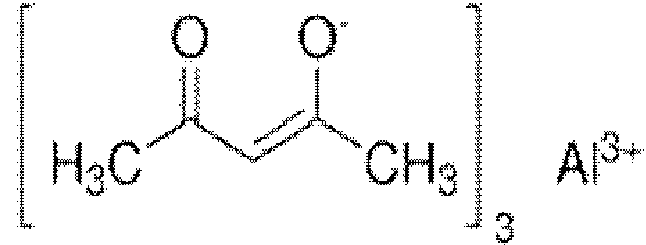
Ejemplos del procedimiento de reticulación del adhesivo usado en el supresor de la suciedad sensible la presión. Examples of the crosslinking process of the adhesive used in the pressure sensitive soil remover.

La superficie exterior de la capa adhesiva (ii) puede ser cubierta con un recubrimiento retirable (i) que es liberado antes de la aplicación.The outer surface of the adhesive layer (ii) can be covered with a removable coating (i) which is released before application.
En realizaciones preferidas, la capa (ii) tendrá generalmente un grosor entre 5 |jm y 250 |jm y, más preferentemente, entre 60 jm y 150 jm, dependiendo del tipo de adhesivo usado y de la aplicación prevista. Capa (iii)In preferred embodiments, layer (ii) will generally have a thickness between 5 µm and 250 µm, and more preferably between 60 µm and 150 µm, depending on the type of adhesive used and the intended application. Layer (iii)
La composición según la presente invención incluye adicionalmente una capa (iii) de material sintético, o capa (iii) de material sintético, que permite aplicar una capa (iv) de enlace opcional en un lado y la capa adhesiva (ii) en el otro lado. El material sintético tiene preferentemente unas excelentes propiedades de impermeabilidad, resistencia al agua, flexibilidad y alargamiento. El material polímero para la capa de material sintético incluye una resina de poliuretano, una resina acrílica de poliuretano, una resina de cloruro de vinilo, una resina basada en caucho, una resina de poliéster, una resina de silicona, una resina elastómera, una resina de flúor, una resina de poliamida y/o una resina de poliolefina, como polipropileno y polietileno. Estos materiales para la capa (iii) de material sintético pueden estar presentes en una subcapa o pueden estar presentes en dos subcapas o más. La naturaleza y componentes de cada una de dichas subcapas puede aportar un anclaje adicional y propiedades de barrera a la capa (iii) de material sintético.The composition according to the present invention additionally includes a layer (iii) of synthetic material, or layer (iii) of synthetic material, which allows an optional binding layer (iv) to be applied on one side and the adhesive layer (ii) on the other. side. The synthetic material preferably has excellent impermeability, water resistance, flexibility and elongation properties. The polymeric material for the synthetic material layer includes a polyurethane resin, a polyurethane acrylic resin, a vinyl chloride resin, a rubber-based resin, a polyester resin, a silicone resin, an elastomeric resin, a resin fluorine, a polyamide resin and/or a polyolefin resin, such as polypropylene and polyethylene. These materials for layer (iii) of synthetic material may be present in one sub-layer or may be present in two or more sub-layers. The nature and components of each of said sublayers can provide additional anchoring and barrier properties to layer (iii) of synthetic material.
Cuando la capa (iii) de material sintético contiene un elastómero, el elastómero es preferentemente un elastómero basado en olefina. En realizaciones referidas, el elastómero basado en olefina es un elastómero basado en polipropileno. En realizaciones preferidas, dicho elastómero basado en polipropileno se selecciona entre el grupo que comprende polipropileno no orientado, polipropileno biorientado y polipropileno por soplado, o cualquier combinación de los mismos. Es bien conocido que los elastómeros poseen la propiedad mecánica de experimentar deformación elástica bajo tensión, de forma que el material retorna a su tamaño previo sin deformación permanente. El uso de un elastómero basado en olefinas, por tanto, puede proporcionar una composición supresora de la suciedad autoadhesiva que puede ser aplicada sobre una superficie lisa y curvada con buena capacidad de tratamiento y sin formación de rugosidades. Dicho elastómero basado en polipropileno permite adicionalmente un buen anclaje sobre la capa (ii), la capa opcional (iv) y, cuando la capa opcional (iv) no está presente, sobre la capa (v). Mediante buen anclaje de las capas se quiere indicar que las capas (ii) y (iii), las capas (iii) y (iv) y, cuando la capa opcional (iv) no está presente, las capas (iii) y (v) no se escinden durante el período y bajo las condiciones de uso del producto previstas.When layer (iii) of synthetic material contains an elastomer, the elastomer is preferably an olefin-based elastomer. In reported embodiments, the olefin-based elastomer is a polypropylene-based elastomer. In preferred embodiments, said polypropylene-based elastomer is selected from the group consisting of nonoriented polypropylene, bioriented polypropylene, and blown polypropylene, or any combination thereof. It is well known that elastomers have the mechanical property of undergoing elastic deformation under stress, so that the material returns to its previous size without permanent deformation. The use of an olefin-based elastomer, therefore, can provide a self-adhesive soil release composition that can be applied to a smooth and curved surface with good processability and without roughening. Said elastomer based on polypropylene additionally allows good anchorage on layer (ii), optional layer (iv) and, when optional layer (iv) is not present, on layer (v). By good layer anchorage is meant that layers (ii) and (iii), layers (iii) and (iv) and, when optional layer (iv) is not present, layers (iii) and (v ) are not cleaved during the period and under the anticipated conditions of use of the product.
Para mejorar adicionalmente el anclaje de dicha (iii), la capa (iii) de material sintético es tratada en una o las dos de sus caras, preferentemente en las dos de sus caras, usando un tratamiento de corona o un tratamiento de plasma, dando lugar a grupos funcionales epoxídicos, grupos funcionales acrílicos, grupos funcionales carboxílicos, grupos funcionales amino, grupo funcionales uretano y/o grupos funcionales silicona sobre la superficie de la capa (iii) de material sintético. En otras realizaciones preferidas, dicha capa (iii) de material sintético es tratada en uno o los dos de sus lados, preferentemente en los dos de sus lados, usando un tratamiento con un imprimador. En realizaciones preferidas, la capa (iii) de material sintético comprende un elastómero basado en polipropileno y es tratada en uno o los dos de sus lados, preferentemente en los dos de sus lados, de dicha capa (iii). Una vista seccional esquemática de una realización en la que se proporciona una capa (iii) de material sintético con grupos funcionales en los dos de sus lados o superficies, con el fin de aumentar la energía superficial, como se muestra en la Fig. 2.To further improve the anchorage of said (iii), the layer (iii) of synthetic material is treated on one or both of its faces, preferably on both of its faces, using a corona treatment or a plasma treatment, giving give rise to epoxy functional groups, acrylic functional groups, carboxylic functional groups, amino functional groups, urethane functional groups and/or silicone functional groups on the surface of layer (iii) of synthetic material. In other preferred embodiments, said layer (iii) of synthetic material is treated on one or both of its sides, preferably on both of its sides, using a treatment with a primer. In preferred embodiments, layer (iii) of synthetic material comprises a polypropylene-based elastomer and is treated on one or both of its sides, preferably on both of its sides, of said layer (iii). A schematic sectional view of an embodiment in which a layer (iii) of synthetic material is provided with functional groups on both of its sides or surfaces, in order to increase the surface energy, as shown in Fig. 2.
Si la capa (iii) de material sintético es porosa para cualquier componente que se pudiera desplazar y modificar las propiedades originales de la composición, podría ser necesario ajustar el grosor de la capa (iii) de material sintético y/o añadir una capa de barrera en la capa (iii) de material sintético o a su superficie. El grosor del material sintético depende de la naturaleza de la capa (iii) de material sintético, con la condición de que las propiedades de la presente invención no se deterioren. En realizaciones preferidas, el grosor de la capa (iii) de material sintético es de 10 jm a 3000 jm, más preferentemente de 30 jm a 1000 jm e incluso más preferentemente de 50 ^m a 300 ^m. Cuando el grosor es demasiado bajo, el desplazamiento desde cualquier componente procedente de la capa opcional (IV) o la capa (v), o una molécula de agua, puede ir a través de la capa (iii) de material sintético y modificar las propiedades originales de la composición.If the layer (iii) of synthetic material is porous for any component that could be displaced and modify the original properties of the composition, it may be necessary to adjust the thickness of the layer (iii) of synthetic material and/or add a barrier layer in layer (iii) of synthetic material or to its surface. The thickness of the synthetic material depends on the nature of the layer (iii) of synthetic material, provided that the properties of the present invention are not impaired. In preferred embodiments, the thickness of the layer (iii) of synthetic material is from 10 µm to 3000 µm, more preferably from 30 µm to 1000 µm and even more. preferably 50 µm to 300 µm. When the thickness is too low, the displacement from any component coming from the optional layer (IV) or layer (v), or a water molecule, can go through the layer (iii) of synthetic material and modify the properties. composition originals.
Capa (iv)Layer (iv)
La composición según la invención incluye adicionalmente una capa (iv) de enlace que puede ser usada como un enlace entre la capa (iii) de material sintético y la capa superior (v) supresora de la suciedad. En realizaciones preferidas, la capa (iv) de enlace es un sistema de silicona de un componente, un sistema de silicona de dos componentes o un sistema de silicona de tres componentes. Los dos últimos sistemas son curables mediante un sistema de curado de tipo adición o de tipo condensación. La composición de la capa de enlace es preferentemente un polisiloxano de dos componentes o una silano-silicona, curable mediante un sistema de policondensación, lo que significa que el polisiloxano o silano contienen grupos reactivos que hacen posible el curado. En realizaciones preferidas, la capa de enlace es un silano organo-funcional que tiene la estructura química siguiente:The composition according to the invention further includes a link layer (iv) which can be used as a link between the synthetic material layer (iii) and the soil release top layer (v). In preferred embodiments, the tie layer (iv) is a one-component silicone system, a two-component silicone system, or a three-component silicone system. The latter two systems are curable by an addition-type or condensation-type curing system. The tie layer composition is preferably a two-component polysiloxane or silane-silicone, curable by a polycondensation system, which means that the polysiloxane or silane contains reactive groups that make curing possible. In preferred embodiments, the tie layer is an organofunctional silane having the following chemical structure:
X-CH 2 CH 2 CH 2 Si(OR) 3-n R' n X-CH 2 CH 2 CH 2 Si(OR) 3-n R' n
en la que n = 0, 1,2.where n = 0, 1,2.
Los grupos OR son grupo hidrolizables como, preferentemente, grupos metoxi, etoxi o acetoxi y, más preferentemente, grupos acetoxi. El grupo X es preferentemente un grupo organo-funcional como los grupos epoxi, amino, metacriloxi o sulfuro, más preferentemente grupos organo-funcionales con la adición de un ácido o un ácido orgánico. El ácido puede ser preferentemente un ácido carboxílico, particularmente ácido acético. La adición de un ácido aumenta grandemente la adhesión de un elastómero de silicona como capa superior (v) supresora de la suciedad.OR groups are hydrolyzable groups, preferably methoxy, ethoxy or acetoxy groups, and more preferably acetoxy groups. The group X is preferably an organo-functional group such as epoxy, amino, methacryloxy or sulfide groups, more preferably organo-functional groups with the addition of an acid or an organic acid. The acid may preferably be a carboxylic acid, particularly acetic acid. The addition of an acid greatly increases the adhesion of a silicone elastomer as a soil release topcoat (v).
En realizaciones preferidas, el grosor de la capa de enlace es preferentemente de 10 ^m a 120 ^m, más preferentemente de 10 ^m a 80 ^m y, todavía más preferentemente, de 30 ^m a 60 ^m. Cuando el valor está dentro del intervalo, la capa (iv) de enlace se seca después de una etapa de calentamiento durante un procedimiento para la fabricación de la composición, por ejemplo, cuando sale de una estufa durante este procedimiento de fabricación, y tiene un buen anclaje sobre la capa (iii) de material sintético. Hace posible también tener un anclaje satisfactorio de la capa superior (v) supresora de la suciedad, que está aplicada sobre la capa de enlace. Cuando el grosor es mayor que 120 ^m, la capa (iv) de enlace no está seca después de una etapa de calentamiento y la consecuencia es que se adhiere al recubrimiento retirable (i) cuando la composición ilustrada en la Fig. 4 es enrollada y entonces, la siguiente etapa, que es el revestimiento de la capa superior (v) supresora de la suciedad, no se puede hacer. Cuando el grosor es menor que 20 ^m, la combinación de capa (iv) de enlace y capa superior (v) supresora de la suciedad puede ser retirada de la composición supresora de la suciedad autoadhesiva, dando lugar a una pérdida de las propiedades supresoras de la suciedad.In preferred embodiments, the thickness of the tie layer is preferably from 10 µm to 120 µm, more preferably from 10 µm to 80 µm, and even more preferably from 30 µm to 60 µm. When the value is within the range, the binding layer (iv) dries after a heating step during a process for manufacturing the composition, for example, when it comes out of an oven during this manufacturing process, and has a good anchorage on layer (iii) of synthetic material. It also makes it possible to have a satisfactory anchoring of the soil release top layer (v), which is applied on top of the tie layer. When the thickness is greater than 120 ^m, the bonding layer (iv) is not dry after a heating step and the consequence is that it adheres to the release liner (i) when the composition illustrated in Fig. 4 is rolled. and then the next step, which is the coating of the soil release top layer (v), cannot be done. When the thickness is less than 20 µm, the combination of bonding layer (iv) and soil release top layer (v) may be removed from the self-adhesive soil release composition, resulting in loss of soil release properties. of dirt.
Capa (v)Cloak (v)
La composición según la presente invención incluye adicionalmente una capa superior (v) supresora de la suciedad de silicona. En realizaciones preferidas, la capa superior (v) supresora de la suciedad de silicona comprende una resina de silicona. El número de tipos de resinas de silicona puede ser solamente uno o dos o más. Esta resina de silicona puede ser una resina de silicona de tipo condensación o puede ser una resina de silicona de tipo adición. Además, la resina de silicona puede ser una resina de silicona de un componente que va a ser secada sola o una resina de silicona de dos componentes que va a ser combinada con un agente de curado. La resina de silicona es preferentemente una resina de silicona elastómera, más preferentemente un polisiloxano que contiene grupos reactivos que pueden reaccionar con un agente de curado mediante una reacción de tipo condensación. Este tipo de sistema de silicona proporciona buenas propiedades de baja energía superficial. Ejemplos de polisiloxano son polidialquilsiloxano, polidiarilsiloxano o polialquilarilsiloxano, normalmente de fórmula:The composition according to the present invention further includes a silicone soil release top layer (v). In preferred embodiments, the silicone soil release top layer (v) comprises a silicone resin. The number of kinds of silicone resins may be only one or two or more. This silicone resin may be a condensation type silicone resin or it may be an addition type silicone resin. Furthermore, the silicone resin may be a one-component silicone resin to be dried alone or a two-component silicone resin to be combined with a curing agent. The silicone resin is preferably an elastomeric silicone resin, more preferably a polysiloxane containing reactive groups that can react with a curing agent by a condensation-type reaction. This type of silicone system provides good low surface energy properties. Examples of polysiloxane are polydialkylsiloxane, polydiarylsiloxane or polyalkylarylsiloxane, usually with the formula:

En realizaciones preferidas, la capa superior (v) supresora de la suciedad contiene un agente supresor de la suciedad. Puede ser usado cualquier agente supresor de la suciedad apropiado como agente supresor de la suciedad en la medida en que no se perjudique el efecto supresor de la suciedad. Ejemplos de estos agentes supresores de la suciedad incluyen, pero sin limitación, aceite de silicona, parafina líquida, cera tensioactiva, petrolato, grasas animales y un ácido graso. El número de tipos deferentes de agente supresor de la suciedad puede ser uno, dos o más. Cuando la capa superior (v) supresora de la suciedad contiene un agente supresor de la suciedad, la energía superficial de la capa superior (v) supresora de la suciedad es inferior y la composición supresora de la suciedad autoadhesiva mantiene una buena propiedad supresora de la suciedad durante un período de tiempo prolongado. El agente supresor de la suciedad se desplaza hacia la superficie de la superficie de silicona como matriz y cubre la superficie de la capa superior (v) supresora de la suciedad con el componente supresor de la suciedad, para reducir y prevenir el ensuciamiento de una estructura sumergida reduciendo la energía superficial. El agente supresor de la suciedad es preferentemente un aceite de silicona, más preferentemente un aceite de silicona no hidrolizable y está preferentemente exento de reactividad con la resina de silicona. En una realización preferida, la capa superior (v) supresora de la suciedad de silicona comprende un aceite de silicona no hidrolizable que está exento de reactividad con la silicona de dicha capa superior (v) supresora de la suciedad. Esta última composición de la capa superior (v) es especialmente preferida, ya que permite que el efecto supresor de la suciedad se mantenga durante un período de tiempo prolongado. Dicho aceite de silicona está compuesto preferentemente por un aceite de siloxano homopolímero o un aceite de siloxano copolímero, como un copolímero de fenil-metil-dimetil-siloxano y un homopolímero de fenil-metilsiloxano.In preferred embodiments, the soil release top layer (v) contains a soil release agent. Any suitable soil release agent may be used as the soil release agent. dirt as long as the dirt removal effect is not impaired. Examples of these soil release agents include, but are not limited to, silicone oil, liquid paraffin, surfactant wax, petrolatum, animal fats, and a fatty acid. The number of different types of the soil release agent may be one, two or more. When the soil release top layer (v) contains a soil release agent, the surface energy of the soil release top layer (v) is lower and the self-adhesive soil release composition maintains a good soil release property. dirt for a long period of time. The soil release agent moves to the surface of the silicone surface as a matrix and coats the surface of the soil release top layer (v) with the soil release component, to reduce and prevent fouling of a structure submerged reducing the surface energy. The soil release agent is preferably a silicone oil, more preferably a non-hydrolyzable silicone oil, and is preferably free of reactivity with the silicone resin. In a preferred embodiment, the silicone soil release top layer (v) comprises a non-hydrolysable silicone oil which is free of reactivity with the silicone of said soil release top layer (v). This latter topcoat composition (v) is especially preferred as it allows the soil release effect to be maintained for a long period of time. Said silicone oil is preferably composed of a homopolymer siloxane oil or a copolymer siloxane oil, such as a copolymer of phenyl-methyl-dimethyl-siloxane and a homopolymer of phenyl-methylsiloxane.
En realizaciones preferidas, la tasa de aceite de silicona presente en la capa supresora de la suciedad es de 0,1 a 150% de peso seco, más preferentemente de 1 a 100% de peso seco y, todavía más preferentemente, de 2 a 50% de peso seco. Cuando el valor está en el intervalo, la composición supresora de la suciedad autoadhesiva tiene buenas propiedades supresoras de la suciedad para reducir y prevenir el ensuciamiento de una estructura sumergida. Cuando el valor es menor que 0,1% en peso, no se consigue la propiedad supresora de la suciedad y la cantidad de ensuciamiento no puede ser reducida o prevenida en una estructura sumergida. Cuando el valor es mayor, el aceite de silicona se desprende de la composición supresora de la suciedad autoadhesiva y puede provocar un problema para el anclaje de la capa superior (v) supresora de la suciedad sobre la capa (iv) de enlace o la capa (iii) de material sintético.In preferred embodiments, the level of silicone oil present in the soil release layer is from 0.1 to 150% dry weight, more preferably from 1 to 100% dry weight, and even more preferably from 2 to 50%. % dry weight. When the value is in the range, the self-adhesive soil release composition has good soil release properties to reduce and prevent fouling of a submerged structure. When the value is less than 0.1% by weight, the fouling suppressing property is not achieved and the amount of fouling cannot be reduced or prevented in a submerged structure. When the value is larger, the silicone oil comes off from the self-adhesive soil release composition and may cause a problem for the anchorage of the soil release top layer (v) on the tie layer (iv) or the top layer (iv). (iii) of synthetic material.
En realizaciones preferidas, el grosor de la capa superior (v) supresora de la suciedad es de 80 |jm a 800 |jm, más preferentemente de 120 a 300 jm y todavía más preferentemente de 180 a 250 jm. Cuando el valor está en el intervalo, la capa superior (v) supresora de la suciedad está seca después de una etapa de calentamiento durante un procedimiento para la fabricación de la composición, por ejemplo, cuando sale de una estufa durante este procedimiento de fabricación, y tiene propiedades supresoras de la suciedad para reducir y prevenir la aparición de organismos acuáticos sobre una estructura sumergida. Cuando el grosor es menor que 80 jm, la propiedad supresora de la suciedad puede no ser suficiente para reducir y prevenir la aparición de organismos acuáticos sobre una estructura sumergida, lo que aumentará la fricción con el agua y reducirá la velocidad de maniobrabilidad de dicha estructura sumergida.In preferred embodiments, the thickness of the soil release top layer (v) is 80 µm to 800 µm, more preferably 120 to 300 µm, and even more preferably 180 to 250 µm. When the value is in the range, the soil-removing top layer (v) is dry after a heating step during a process for manufacturing the composition, for example, when it comes out of an oven during this manufacturing process, and has fouling suppressing properties to reduce and prevent the growth of aquatic organisms on a submerged structure. When the thickness is less than 80 µm, the dirt suppressing property may not be enough to reduce and prevent the appearance of aquatic organisms on a submerged structure, which will increase the friction with the water and reduce the maneuverability speed of said structure. submerged.
Capa (vi)cloak (saw)
La composición según la presente invención puede comprender una película polímera y/o protectora polímera retirable aplicada por encima y en la capa superior (v) supresora de la suciedad, con el fin de proteger esta última y que va a ser retirada particularmente una vez que ha sido aplicada la capa adhesiva de la composición sobre la superficie que va a ser revestida, particularmente una vez que la capa adhesiva de la composición ha sido aplicada sobre la superficie que va a ser revestida. En una realización preferida, la película polímero retirable (vi) está presente en la composición según la presente invención.The composition according to the present invention may comprise a removable polymeric and/or protective polymeric film applied above and on the soil-suppressing top layer (v), in order to protect the latter and which is to be removed particularly once the adhesive layer of the composition has been applied on the surface to be coated, particularly once the adhesive layer of the composition has been applied on the surface to be coated. In a preferred embodiment, the removable polymeric film (vi) is present in the composition according to the present invention.
En realizaciones preferidas, la capa polímera retirable (vi) es una película de poliéster o polipropileno. Dicha película evita ventajosamente el desplazamiento de silicona y/o la exudación de líquido hasta la capa adhesiva (ii) cuando la composición que comprende las capas (i), (ii), (iii), (iv), (v) y (vi) son enrolladas en forma de un rodillo, de modo que la capa (v) entraría en contacto con la capa (i) cuando estuviera ausente la capa (vi). Este es probablemente el caso cuando la composición que comprende las capas (ii), (iii), opcionalmente (iv), (v) y (vi) no es enrollada en forma de un rodillo, con lo que la capa (v) entraría directamente en contacto con la capa (ii) cuando la capa (vi) no estuviera ausente. En otras realizaciones, la película polímera retirable comprende poli(fluoruro de vinilideno), poliuretano, poli(cloruro de vinilo) y otro material.In preferred embodiments, the removable polymeric layer (vi) is a polyester or polypropylene film. Said film advantageously prevents the displacement of silicone and/or the exudation of liquid to the adhesive layer (ii) when the composition comprising layers (i), (ii), (iii), (iv), (v) and ( vi) are wound in the form of a roller, so that layer (v) would come into contact with layer (i) when layer (vi) was absent. This is probably the case when the composition comprising layers (ii), (iii), optionally (iv), (v) and (vi) is not rolled into a roll, whereby layer (v) would enter directly in contact with layer (ii) when layer (vi) is not absent. In other embodiments, the removable polymeric film comprises polyvinylidene fluoride, polyurethane, polyvinyl chloride, and other material.
La capa (vi) tiene posiblemente una función o más, preferentemente dos funciones o más. Una función podría ser la protección de la capa (v) de rayados y raspaduras durante la manipulación y la aplicación. La capa (vi) de la composición supresora de la suciedad autoadhesiva tiene que ser retirada justo después de que haya sido aplicada la capa adhesiva de la composición sobre la superficie que va a ser revestida.Layer (vi) possibly has one or more functions, preferably two or more functions. One function could be the protection of the layer (v) from scratches and abrasions during handling and application. The layer (vi) of the self-adhesive soil-removing composition has to be removed right after the adhesive layer of the composition has been applied on the surface to be coated.
Una segunda función puede ser la transferencia de una película polímera retirable (vi) con una superficie definida por ingeniería a la capa (v). En una realización preferida, la película polímera retirable (vi) está estratificada sobre la parte superior de una capa superior (v) supresora de la suciedad, que no está completamente seca. En esta realización preferida, se usa posteriormente un post-curado para crear una superficie específica de la capa superior (v) de la composición supresora de la suciedad autoadhesiva. Si a apariencia de la capa (vi) es una película ultralisa, la capa (v) será extralisa. En realizaciones preferidas, la película polímera retirable (vi) está estructurada con un relieve positivo. Debido al contacto entre la película polímera retirable (vi) y la capa superior (v) supresora de la suciedad de silicona, el negativo de dicho relieve positivo es transferido a la superficie de la capa superior (v) supresora de la suciedad, proporcionando una superficie tratada por ingeniería de dicha capa superior (v). El objetivo de la superficie tratada por ingeniería es mejorar la resistencia al arrastre y la propiedad supresora de la suciedad. Una tercera función, cuando la composición de revestimiento supresora de la suciedad autoadhesiva multicapas es enrollada en forma de un rodillo, puede ser evitar el desplazamiento de componentes de las capas (iv) y (v) a través de la capa (i), que podría modificar las propiedades originales de la composición.A second function may be the transfer of a removable polymeric film (vi) with an engineered surface to layer (v). In a preferred embodiment, the removable polymeric film (vi) is laminated on top of a soil release top layer (v), which is not completely dry. In this preferred embodiment, a post cure is used to create a specific surface of the layer. top (v) of the self-adhesive soil release composition. If the appearance of layer (vi) is an ultra-smooth film, layer (v) will be extra-smooth. In preferred embodiments, the removable polymeric film (vi) is structured with a positive relief. Due to the contact between the removable polymeric film (vi) and the silicone soil release top layer (v), the negative of said positive relief is transferred to the surface of the soil release top layer (v), providing a engineered surface of said upper layer (v). The purpose of the engineered surface is to improve drag resistance and soil suppression property. A third function, when the multi-layer self-adhesive soil-releasing coating composition is wound into a roll, may be to prevent displacement of components of layers (iv) and (v) through layer (i), which could modify the original properties of the composition.
En una realización preferida, la composición según la presente invención incluye las capas (i), (ii), (iii), (iv), (v) y (vi) y puede estar enrollada y ser almacenada en forma de un rodillo. In a preferred embodiment, the composition according to the present invention includes layers (i), (ii), (iii), (iv), (v) and (vi) and may be rolled up and stored in the form of a roll.
Claims (6)
Applications Claiming Priority (1)
| Application Number | Priority Date | Filing Date | Title |
|---|---|---|---|
| EP15152553.2A EP3048141B1 (en) | 2015-01-26 | 2015-01-26 | Self adhesive fouling release coating composition |
Publications (1)
| Publication Number | Publication Date |
|---|---|
| ES2897464T3 true ES2897464T3 (en) | 2022-03-01 |
Family
ID=52391886
Family Applications (3)
| Application Number | Title | Priority Date | Filing Date |
|---|---|---|---|
| ES15152553.2T Active ES2654936T3 (en) | 2015-01-26 | 2015-01-26 | Self-adhesive composition of dirt release coating |
| ES18203219T Active ES2897464T3 (en) | 2015-01-26 | 2016-01-26 | Self-adhesive soil release coating composition |
| ES16701629T Active ES2735138T3 (en) | 2015-01-26 | 2016-01-26 | Self-adhesive dirt suppression coating composition |
Family Applications Before (1)
| Application Number | Title | Priority Date | Filing Date |
|---|---|---|---|
| ES15152553.2T Active ES2654936T3 (en) | 2015-01-26 | 2015-01-26 | Self-adhesive composition of dirt release coating |
Family Applications After (1)
| Application Number | Title | Priority Date | Filing Date |
|---|---|---|---|
| ES16701629T Active ES2735138T3 (en) | 2015-01-26 | 2016-01-26 | Self-adhesive dirt suppression coating composition |
Country Status (13)
| Country | Link |
|---|---|
| US (1) | US11339301B2 (en) |
| EP (3) | EP3048141B1 (en) |
| JP (2) | JP6740253B2 (en) |
| KR (1) | KR102779053B1 (en) |
| CN (2) | CN110684389B (en) |
| AU (2) | AU2016212197B2 (en) |
| CA (1) | CA2973792C (en) |
| ES (3) | ES2654936T3 (en) |
| HR (2) | HRP20191177T1 (en) |
| MX (1) | MX2017009647A (en) |
| PL (3) | PL3048141T3 (en) |
| TR (1) | TR201909955T4 (en) |
| WO (1) | WO2016120255A1 (en) |
Families Citing this family (13)
| Publication number | Priority date | Publication date | Assignee | Title |
|---|---|---|---|---|
| EP3330326A1 (en) * | 2016-12-02 | 2018-06-06 | PPG Coatings Europe B.V. | A fouling release coating system |
| CN111448267B (en) * | 2017-12-14 | 2022-11-04 | 阿克佐诺贝尔国际涂料股份有限公司 | Fouling release coating compositions, substrates coated with the coating compositions and uses of the coating compositions |
| WO2019240922A1 (en) * | 2018-06-11 | 2019-12-19 | Dow Global Technologies Llc | Processes for making coated films and solventless polyurethane precursors that may be used to make coated films |
| SG11202100108SA (en) * | 2018-07-13 | 2021-02-25 | Akzo Nobel Coatings Int Bv | Tie-coat composition |
| ES2945833T3 (en) * | 2018-08-30 | 2023-07-07 | Avery Dennison Corp | Method for Producing a Textured Surface Air Retaining Film and a Textured Surface Air Retaining Film |
| CN112996659A (en) * | 2018-08-30 | 2021-06-18 | 艾利丹尼森公司 | Multilayer self-adhesive fouling release film with textured surface |
| CA3118553A1 (en) * | 2018-11-09 | 2020-05-14 | Nitto Denko Corporation | Sheet body |
| EP3885134A4 (en) * | 2018-11-19 | 2022-08-17 | Chugoku Marine Paints, Ltd. | TOPCOATED GROWTH RESISTANT COATING, METHOD OF MANUFACTURE THEREOF, GROWTH RESISTANT TAPE AND METHOD OF MANUFACTURING A STRUCTURE WITH AN AGRICULTURAL COATING AND IN CONTACT WITH WATER |
| EP4036177A4 (en) * | 2019-09-27 | 2023-10-25 | Nitto Denko Corporation | COMPOSITION FOR PRODUCING A REMOVABLE COATING FILM AND REMOVABLE COATING FILM |
| CN111621182B (en) * | 2020-05-27 | 2021-11-16 | 中国船舶重工集团公司第七二五研究所 | Connecting coating matched with fouling release type antifouling paint and preparation method thereof |
| US12422250B2 (en) | 2021-02-19 | 2025-09-23 | Rtx Corporation | Systems and methods for passive ranging of objects |
| CN118119681A (en) * | 2021-10-20 | 2024-05-31 | 3M创新有限公司 | Adhesive article with recyclable or compostable release liner |
| CN118871535A (en) * | 2021-12-23 | 2024-10-29 | Ppg涂料欧洲有限责任公司 | Self-adhesive dirt release coating composition |
Family Cites Families (47)
| Publication number | Priority date | Publication date | Assignee | Title |
|---|---|---|---|---|
| USRE28459E (en) * | 1966-06-07 | 1975-07-01 | Transpiration drying and embossing of wet paper webs | |
| GB1470465A (en) | 1975-01-20 | 1977-04-14 | Int Paint Co | Coated marine surfaces |
| JPS6034969B2 (en) * | 1980-06-30 | 1985-08-12 | 豊田合成株式会社 | Pre-painting treatment method for polyolefin products |
| US4650889A (en) * | 1985-11-29 | 1987-03-17 | Dow Corning Corporation | Silane coupling agents |
| US4861670A (en) | 1987-12-15 | 1989-08-29 | General Electric Company | Marine foulant release coating |
| ES2056645T3 (en) | 1990-03-27 | 1994-10-01 | Courtaulds Coatings Holdings | COATING COMPOSITION. |
| JPH0633024A (en) * | 1992-07-16 | 1994-02-08 | Kansai Paint Co Ltd | Non-toxic stain-proofing sticking sheet |
| JPH08281877A (en) * | 1995-04-10 | 1996-10-29 | Daicel Chem Ind Ltd | Antistaining film |
| JPH09235525A (en) * | 1996-02-29 | 1997-09-09 | Sumiron:Kk | Film roll for coating film protection |
| US5906893A (en) | 1997-04-25 | 1999-05-25 | General Electric Company | Sprayable, addition curable silicone foul release coatings and articles coated therewith |
| JPH10309518A (en) | 1997-05-08 | 1998-11-24 | Kansai Paint Co Ltd | Temporary contamination preventing method of joining part of caisson element |
| US6013754A (en) | 1998-01-16 | 2000-01-11 | Courtaulds Coatings, Inc. Heavy Duty Division | Catalyst free primer coating compositions |
| JP3926117B2 (en) | 2001-07-17 | 2007-06-06 | リンテック株式会社 | Hard coat film |
| US6562414B2 (en) | 2001-10-10 | 2003-05-13 | Sport Court, Inc. | Method of coating polyolefin floor tile |
| AU2004278075B2 (en) * | 2003-10-03 | 2008-02-14 | Hempel A/S | A tie-coat composition comprising at least two types of functional polysiloxane compounds and a method for using the same for establishing a coating on a substrate |
| US7972670B2 (en) * | 2003-11-21 | 2011-07-05 | 3M Innovative Properties Company | Structured paper release liner, adhesive-backed article assembly and method of making same |
| PL1699885T3 (en) | 2003-12-12 | 2008-12-31 | Ecosea Ltd | A marine anti-bio-fouling coating and a method of applying the coating |
| WO2005108499A1 (en) | 2004-05-07 | 2005-11-17 | Kaneka Corporation | Curable composition with improved curability and adhesiveness |
| JP2006035914A (en) * | 2004-07-22 | 2006-02-09 | Bando Chem Ind Ltd | Surface protection film for automobile wheels |
| JP5127017B2 (en) * | 2004-08-23 | 2013-01-23 | ダイヤテックス株式会社 | Antifouling overlamination sheet |
| DE102004051418B4 (en) | 2004-10-22 | 2010-09-30 | Lohmann Gmbh & Co Kg | Adhesive tape and use for fastening and covering elongate components |
| JP4790258B2 (en) * | 2004-12-01 | 2011-10-12 | 矢崎総業株式会社 | Removal position display adhesive tape |
| JP5153073B2 (en) * | 2005-03-22 | 2013-02-27 | リンテック株式会社 | Release sheet and adhesive |
| CA2603446C (en) * | 2005-04-05 | 2012-03-13 | Chugoku Marine Paints, Ltd. | Tie coat for organopolysiloxane-based antifouling coating film, composite coating film, and ship and underwater structure coated with the coating film |
| EP1963394A2 (en) | 2005-12-22 | 2008-09-03 | Lubrizol Advanced Materials, Inc. | Latex with isocyanate crosslinker as binder for fibrous substrates |
| JP5244428B2 (en) * | 2007-03-22 | 2013-07-24 | 日本ポリプロ株式会社 | Propylene surface protective film |
| WO2009142074A1 (en) | 2008-05-22 | 2009-11-26 | Dic株式会社 | Aqueous composite resin composition, coating agent containing the same, and multilayer body using the coating agent |
| JP5990164B2 (en) * | 2010-07-02 | 2016-09-07 | スリーエム イノベイティブ プロパティズ カンパニー | Barrier assembly with encapsulant and photovoltaic cell |
| CN103476890B (en) | 2011-04-15 | 2015-11-25 | 日东电工株式会社 | Adhesive sheet |
| AU2012271948B2 (en) * | 2011-06-21 | 2015-10-15 | Akzo Nobel Coatings International B.V. | Biocidal foul release coating systems |
| JP2013129724A (en) | 2011-12-21 | 2013-07-04 | Nitto Denko Corp | Adhesive tape with attached antifouling layer |
| WO2013094412A1 (en) * | 2011-12-21 | 2013-06-27 | 日東電工株式会社 | Pressure sensitive adhesive tape with attached antifouling layer |
| WO2013103091A1 (en) * | 2012-01-06 | 2013-07-11 | 日東電工株式会社 | Adhesive tape for preventing aquatic biofouling |
| JP2013203925A (en) | 2012-03-29 | 2013-10-07 | Nitto Denko Corp | Adhesive tape for preventing aquatic biofouling |
| JP6087766B2 (en) | 2012-09-04 | 2017-03-01 | 日東電工株式会社 | Antifouling pressure-sensitive adhesive sheet and antifouling treatment method for structures using the same |
| DE102012220286A1 (en) * | 2012-11-07 | 2014-05-08 | Tesa Se | Increasing adhesion between pressure-sensitive adhesive layer comprising surface facing opposite to substrate and surface facing substrate, and surface of substrate, comprises treating substrate facing surface of adhesive layer with plasma |
| JP2015028154A (en) | 2013-06-26 | 2015-02-12 | 日東電工株式会社 | Aquatic organism adhesion prevention adhesive tape |
| EP3020776A4 (en) | 2013-07-09 | 2017-01-11 | Nitto Denko Corporation | Adhesive sheet and use thereof |
| US9605189B2 (en) | 2013-07-09 | 2017-03-28 | Nitto Denko Corporation | Pressure-sensitive adhesive composition |
| US20150284058A1 (en) | 2014-04-08 | 2015-10-08 | Florida Institute of Technology, Inc. | Anti-biofouling, fluid dynamic efficient surface covering for structures and method of manufacturing |
| JP2015224333A (en) | 2014-05-30 | 2015-12-14 | 日東電工株式会社 | Adhesive tape for preventing aquatic biofouling |
| JP2015224334A (en) | 2014-05-30 | 2015-12-14 | 日東電工株式会社 | Adhesive tape for preventing aquatic biofouling |
| CN104044694B (en) * | 2014-07-01 | 2016-08-17 | 中国船舶重工集团公司第七二五研究所 | A kind of self adaptation micro structure anti-fouling anti-drag material and preparation method thereof |
| US20160063900A1 (en) | 2014-09-02 | 2016-03-03 | Plasto-Sac Ltd. | Security envelope and method |
| JP6331956B2 (en) * | 2014-10-17 | 2018-05-30 | 信越化学工業株式会社 | Organopolysiloxane composition for release sheet and release sheet |
| JP2016108405A (en) | 2014-12-04 | 2016-06-20 | 日東電工株式会社 | Adhesive tape for preventing deposition of aquatic organisms |
| US20160208145A1 (en) | 2015-01-21 | 2016-07-21 | Mar-Co Packaging, Inc. | Adhesive application with intermittent dead zones |
-
2015
- 2015-01-26 ES ES15152553.2T patent/ES2654936T3/en active Active
- 2015-01-26 EP EP15152553.2A patent/EP3048141B1/en active Active
- 2015-01-26 PL PL15152553T patent/PL3048141T3/en unknown
-
2016
- 2016-01-26 US US15/546,172 patent/US11339301B2/en active Active
- 2016-01-26 PL PL16701629T patent/PL3250646T3/en unknown
- 2016-01-26 JP JP2017557492A patent/JP6740253B2/en not_active Expired - Fee Related
- 2016-01-26 CN CN201910915431.3A patent/CN110684389B/en active Active
- 2016-01-26 HR HRP20191177TT patent/HRP20191177T1/en unknown
- 2016-01-26 ES ES18203219T patent/ES2897464T3/en active Active
- 2016-01-26 MX MX2017009647A patent/MX2017009647A/en unknown
- 2016-01-26 AU AU2016212197A patent/AU2016212197B2/en not_active Ceased
- 2016-01-26 CA CA2973792A patent/CA2973792C/en active Active
- 2016-01-26 WO PCT/EP2016/051541 patent/WO2016120255A1/en not_active Ceased
- 2016-01-26 EP EP18203219.3A patent/EP3470476B1/en active Active
- 2016-01-26 ES ES16701629T patent/ES2735138T3/en active Active
- 2016-01-26 EP EP16701629.4A patent/EP3250646B1/en active Active
- 2016-01-26 TR TR2019/09955T patent/TR201909955T4/en unknown
- 2016-01-26 KR KR1020177023465A patent/KR102779053B1/en active Active
- 2016-01-26 PL PL18203219T patent/PL3470476T3/en unknown
- 2016-01-26 CN CN201680014379.9A patent/CN107406695B/en active Active
- 2016-01-26 HR HRP20211692TT patent/HRP20211692T1/en unknown
-
2019
- 2019-12-06 AU AU2019275669A patent/AU2019275669B2/en not_active Ceased
-
2020
- 2020-07-21 JP JP2020124165A patent/JP6998996B2/en active Active
Also Published As
Similar Documents
| Publication | Publication Date | Title |
|---|---|---|
| JP6998996B2 (en) | Self-adhesive antifouling coating composition | |
| JP6087766B2 (en) | Antifouling pressure-sensitive adhesive sheet and antifouling treatment method for structures using the same | |
| WO2013146718A1 (en) | Adhesive tape for preventing aquatic biofouling | |
| ES2926305T3 (en) | Antifouling coating system | |
| KR20140117436A (en) | Method for preventing fouling | |
| JP5721108B2 (en) | Aquatic organism adhesion prevention adhesive tape | |
| ES2945833T3 (en) | Method for Producing a Textured Surface Air Retaining Film and a Textured Surface Air Retaining Film | |
| JP6499431B2 (en) | Resin composition, antifouling material, and laminated film | |
| JP6369935B2 (en) | Silicone resin composition, antifouling film, and aquatic organism adhesion preventing adhesive film | |
| KR20210040170A (en) | Multi-layer self-adhesive pollution release film with textured surface | |
| JP2016023306A (en) | Aquatic organism adhesion prevention adhesive tape or sheet | |
| WO2014208590A1 (en) | Adhesive tape for preventing aquatic biofouling | |
| WO2013094443A1 (en) | Adhesive tape preventing adhesion by aquatic organisms | |
| CN118871535A (en) | Self-adhesive dirt release coating composition |