ES2897706T3 - Novel hydrophilic linkers and ligand-drug conjugates thereof - Google Patents
Novel hydrophilic linkers and ligand-drug conjugates thereof Download PDFInfo
- Publication number
- ES2897706T3 ES2897706T3 ES15885301T ES15885301T ES2897706T3 ES 2897706 T3 ES2897706 T3 ES 2897706T3 ES 15885301 T ES15885301 T ES 15885301T ES 15885301 T ES15885301 T ES 15885301T ES 2897706 T3 ES2897706 T3 ES 2897706T3
- Authority
- ES
- Spain
- Prior art keywords
- bond
- group
- groups
- ligand
- drug
- Prior art date
- Legal status (The legal status is an assumption and is not a legal conclusion. Google has not performed a legal analysis and makes no representation as to the accuracy of the status listed.)
- Active
Links
Classifications
-
- C—CHEMISTRY; METALLURGY
- C07—ORGANIC CHEMISTRY
- C07F—ACYCLIC, CARBOCYCLIC OR HETEROCYCLIC COMPOUNDS CONTAINING ELEMENTS OTHER THAN CARBON, HYDROGEN, HALOGEN, OXYGEN, NITROGEN, SULFUR, SELENIUM OR TELLURIUM
- C07F9/00—Compounds containing elements of Groups 5 or 15 of the Periodic Table
- C07F9/02—Phosphorus compounds
- C07F9/547—Heterocyclic compounds, e.g. containing phosphorus as a ring hetero atom
- C07F9/553—Heterocyclic compounds, e.g. containing phosphorus as a ring hetero atom having one nitrogen atom as the only ring hetero atom
- C07F9/572—Five-membered rings
-
- A—HUMAN NECESSITIES
- A61—MEDICAL OR VETERINARY SCIENCE; HYGIENE
- A61K—PREPARATIONS FOR MEDICAL, DENTAL OR TOILETRY PURPOSES
- A61K47/00—Medicinal preparations characterised by the non-active ingredients used, e.g. carriers or inert additives; Targeting or modifying agents chemically bound to the active ingredient
- A61K47/50—Medicinal preparations characterised by the non-active ingredients used, e.g. carriers or inert additives; Targeting or modifying agents chemically bound to the active ingredient the non-active ingredient being chemically bound to the active ingredient, e.g. polymer-drug conjugates
- A61K47/51—Medicinal preparations characterised by the non-active ingredients used, e.g. carriers or inert additives; Targeting or modifying agents chemically bound to the active ingredient the non-active ingredient being chemically bound to the active ingredient, e.g. polymer-drug conjugates the non-active ingredient being a modifying agent
- A61K47/68—Medicinal preparations characterised by the non-active ingredients used, e.g. carriers or inert additives; Targeting or modifying agents chemically bound to the active ingredient the non-active ingredient being chemically bound to the active ingredient, e.g. polymer-drug conjugates the non-active ingredient being a modifying agent the modifying agent being an antibody, an immunoglobulin or a fragment thereof, e.g. an Fc-fragment
- A61K47/6801—Drug-antibody or immunoglobulin conjugates defined by the pharmacologically or therapeutically active agent
- A61K47/6803—Drugs conjugated to an antibody or immunoglobulin, e.g. cisplatin-antibody conjugates
- A61K47/68033—Drugs conjugated to an antibody or immunoglobulin, e.g. cisplatin-antibody conjugates the drug being a maytansine
-
- A—HUMAN NECESSITIES
- A61—MEDICAL OR VETERINARY SCIENCE; HYGIENE
- A61K—PREPARATIONS FOR MEDICAL, DENTAL OR TOILETRY PURPOSES
- A61K47/00—Medicinal preparations characterised by the non-active ingredients used, e.g. carriers or inert additives; Targeting or modifying agents chemically bound to the active ingredient
- A61K47/50—Medicinal preparations characterised by the non-active ingredients used, e.g. carriers or inert additives; Targeting or modifying agents chemically bound to the active ingredient the non-active ingredient being chemically bound to the active ingredient, e.g. polymer-drug conjugates
- A61K47/51—Medicinal preparations characterised by the non-active ingredients used, e.g. carriers or inert additives; Targeting or modifying agents chemically bound to the active ingredient the non-active ingredient being chemically bound to the active ingredient, e.g. polymer-drug conjugates the non-active ingredient being a modifying agent
- A61K47/68—Medicinal preparations characterised by the non-active ingredients used, e.g. carriers or inert additives; Targeting or modifying agents chemically bound to the active ingredient the non-active ingredient being chemically bound to the active ingredient, e.g. polymer-drug conjugates the non-active ingredient being a modifying agent the modifying agent being an antibody, an immunoglobulin or a fragment thereof, e.g. an Fc-fragment
- A61K47/6801—Drug-antibody or immunoglobulin conjugates defined by the pharmacologically or therapeutically active agent
- A61K47/6803—Drugs conjugated to an antibody or immunoglobulin, e.g. cisplatin-antibody conjugates
- A61K47/6811—Drugs conjugated to an antibody or immunoglobulin, e.g. cisplatin-antibody conjugates the drug being a protein or peptide, e.g. transferrin or bleomycin
-
- A—HUMAN NECESSITIES
- A61—MEDICAL OR VETERINARY SCIENCE; HYGIENE
- A61K—PREPARATIONS FOR MEDICAL, DENTAL OR TOILETRY PURPOSES
- A61K47/00—Medicinal preparations characterised by the non-active ingredients used, e.g. carriers or inert additives; Targeting or modifying agents chemically bound to the active ingredient
- A61K47/50—Medicinal preparations characterised by the non-active ingredients used, e.g. carriers or inert additives; Targeting or modifying agents chemically bound to the active ingredient the non-active ingredient being chemically bound to the active ingredient, e.g. polymer-drug conjugates
- A61K47/51—Medicinal preparations characterised by the non-active ingredients used, e.g. carriers or inert additives; Targeting or modifying agents chemically bound to the active ingredient the non-active ingredient being chemically bound to the active ingredient, e.g. polymer-drug conjugates the non-active ingredient being a modifying agent
- A61K47/68—Medicinal preparations characterised by the non-active ingredients used, e.g. carriers or inert additives; Targeting or modifying agents chemically bound to the active ingredient the non-active ingredient being chemically bound to the active ingredient, e.g. polymer-drug conjugates the non-active ingredient being a modifying agent the modifying agent being an antibody, an immunoglobulin or a fragment thereof, e.g. an Fc-fragment
- A61K47/6835—Medicinal preparations characterised by the non-active ingredients used, e.g. carriers or inert additives; Targeting or modifying agents chemically bound to the active ingredient the non-active ingredient being chemically bound to the active ingredient, e.g. polymer-drug conjugates the non-active ingredient being a modifying agent the modifying agent being an antibody, an immunoglobulin or a fragment thereof, e.g. an Fc-fragment the modifying agent being an antibody or an immunoglobulin bearing at least one antigen-binding site
- A61K47/6849—Medicinal preparations characterised by the non-active ingredients used, e.g. carriers or inert additives; Targeting or modifying agents chemically bound to the active ingredient the non-active ingredient being chemically bound to the active ingredient, e.g. polymer-drug conjugates the non-active ingredient being a modifying agent the modifying agent being an antibody, an immunoglobulin or a fragment thereof, e.g. an Fc-fragment the modifying agent being an antibody or an immunoglobulin bearing at least one antigen-binding site the antibody targeting a receptor, a cell surface antigen or a cell surface determinant
-
- A—HUMAN NECESSITIES
- A61—MEDICAL OR VETERINARY SCIENCE; HYGIENE
- A61K—PREPARATIONS FOR MEDICAL, DENTAL OR TOILETRY PURPOSES
- A61K47/00—Medicinal preparations characterised by the non-active ingredients used, e.g. carriers or inert additives; Targeting or modifying agents chemically bound to the active ingredient
- A61K47/50—Medicinal preparations characterised by the non-active ingredients used, e.g. carriers or inert additives; Targeting or modifying agents chemically bound to the active ingredient the non-active ingredient being chemically bound to the active ingredient, e.g. polymer-drug conjugates
- A61K47/51—Medicinal preparations characterised by the non-active ingredients used, e.g. carriers or inert additives; Targeting or modifying agents chemically bound to the active ingredient the non-active ingredient being chemically bound to the active ingredient, e.g. polymer-drug conjugates the non-active ingredient being a modifying agent
- A61K47/68—Medicinal preparations characterised by the non-active ingredients used, e.g. carriers or inert additives; Targeting or modifying agents chemically bound to the active ingredient the non-active ingredient being chemically bound to the active ingredient, e.g. polymer-drug conjugates the non-active ingredient being a modifying agent the modifying agent being an antibody, an immunoglobulin or a fragment thereof, e.g. an Fc-fragment
- A61K47/6835—Medicinal preparations characterised by the non-active ingredients used, e.g. carriers or inert additives; Targeting or modifying agents chemically bound to the active ingredient the non-active ingredient being chemically bound to the active ingredient, e.g. polymer-drug conjugates the non-active ingredient being a modifying agent the modifying agent being an antibody, an immunoglobulin or a fragment thereof, e.g. an Fc-fragment the modifying agent being an antibody or an immunoglobulin bearing at least one antigen-binding site
- A61K47/6851—Medicinal preparations characterised by the non-active ingredients used, e.g. carriers or inert additives; Targeting or modifying agents chemically bound to the active ingredient the non-active ingredient being chemically bound to the active ingredient, e.g. polymer-drug conjugates the non-active ingredient being a modifying agent the modifying agent being an antibody, an immunoglobulin or a fragment thereof, e.g. an Fc-fragment the modifying agent being an antibody or an immunoglobulin bearing at least one antigen-binding site the antibody targeting a determinant of a tumour cell
-
- A—HUMAN NECESSITIES
- A61—MEDICAL OR VETERINARY SCIENCE; HYGIENE
- A61K—PREPARATIONS FOR MEDICAL, DENTAL OR TOILETRY PURPOSES
- A61K47/00—Medicinal preparations characterised by the non-active ingredients used, e.g. carriers or inert additives; Targeting or modifying agents chemically bound to the active ingredient
- A61K47/50—Medicinal preparations characterised by the non-active ingredients used, e.g. carriers or inert additives; Targeting or modifying agents chemically bound to the active ingredient the non-active ingredient being chemically bound to the active ingredient, e.g. polymer-drug conjugates
- A61K47/51—Medicinal preparations characterised by the non-active ingredients used, e.g. carriers or inert additives; Targeting or modifying agents chemically bound to the active ingredient the non-active ingredient being chemically bound to the active ingredient, e.g. polymer-drug conjugates the non-active ingredient being a modifying agent
- A61K47/68—Medicinal preparations characterised by the non-active ingredients used, e.g. carriers or inert additives; Targeting or modifying agents chemically bound to the active ingredient the non-active ingredient being chemically bound to the active ingredient, e.g. polymer-drug conjugates the non-active ingredient being a modifying agent the modifying agent being an antibody, an immunoglobulin or a fragment thereof, e.g. an Fc-fragment
- A61K47/6889—Conjugates wherein the antibody being the modifying agent and wherein the linker, binder or spacer confers particular properties to the conjugates, e.g. peptidic enzyme-labile linkers or acid-labile linkers, providing for an acid-labile immuno conjugate wherein the drug may be released from its antibody conjugated part in an acidic, e.g. tumoural or environment
-
- C—CHEMISTRY; METALLURGY
- C07—ORGANIC CHEMISTRY
- C07D—HETEROCYCLIC COMPOUNDS
- C07D207/00—Heterocyclic compounds containing five-membered rings not condensed with other rings, with one nitrogen atom as the only ring hetero atom
- C07D207/46—Heterocyclic compounds containing five-membered rings not condensed with other rings, with one nitrogen atom as the only ring hetero atom with hetero atoms directly attached to the ring nitrogen atom
-
- C—CHEMISTRY; METALLURGY
- C07—ORGANIC CHEMISTRY
- C07F—ACYCLIC, CARBOCYCLIC OR HETEROCYCLIC COMPOUNDS CONTAINING ELEMENTS OTHER THAN CARBON, HYDROGEN, HALOGEN, OXYGEN, NITROGEN, SULFUR, SELENIUM OR TELLURIUM
- C07F9/00—Compounds containing elements of Groups 5 or 15 of the Periodic Table
- C07F9/02—Phosphorus compounds
- C07F9/547—Heterocyclic compounds, e.g. containing phosphorus as a ring hetero atom
- C07F9/6558—Heterocyclic compounds, e.g. containing phosphorus as a ring hetero atom containing at least two different or differently substituted hetero rings neither condensed among themselves nor condensed with a common carbocyclic ring or ring system
- C07F9/65583—Heterocyclic compounds, e.g. containing phosphorus as a ring hetero atom containing at least two different or differently substituted hetero rings neither condensed among themselves nor condensed with a common carbocyclic ring or ring system each of the hetero rings containing nitrogen as ring hetero atom
-
- C—CHEMISTRY; METALLURGY
- C07—ORGANIC CHEMISTRY
- C07K—PEPTIDES
- C07K16/00—Immunoglobulins [IG], e.g. monoclonal or polyclonal antibodies
-
- C—CHEMISTRY; METALLURGY
- C07—ORGANIC CHEMISTRY
- C07K—PEPTIDES
- C07K16/00—Immunoglobulins [IG], e.g. monoclonal or polyclonal antibodies
- C07K16/18—Immunoglobulins [IG], e.g. monoclonal or polyclonal antibodies against material from animals or humans
- C07K16/28—Immunoglobulins [IG], e.g. monoclonal or polyclonal antibodies against material from animals or humans against receptors, cell surface antigens or cell surface determinants
- C07K16/2878—Immunoglobulins [IG], e.g. monoclonal or polyclonal antibodies against material from animals or humans against receptors, cell surface antigens or cell surface determinants against the NGF-receptor/TNF-receptor superfamily, e.g. CD27, CD30, CD40, CD95
Landscapes
- Health & Medical Sciences (AREA)
- Chemical & Material Sciences (AREA)
- Organic Chemistry (AREA)
- Bioinformatics & Cheminformatics (AREA)
- Engineering & Computer Science (AREA)
- Life Sciences & Earth Sciences (AREA)
- General Health & Medical Sciences (AREA)
- Immunology (AREA)
- Medicinal Chemistry (AREA)
- Molecular Biology (AREA)
- Pharmacology & Pharmacy (AREA)
- Veterinary Medicine (AREA)
- Epidemiology (AREA)
- Animal Behavior & Ethology (AREA)
- Public Health (AREA)
- Biochemistry (AREA)
- Biophysics (AREA)
- Cell Biology (AREA)
- Genetics & Genomics (AREA)
- Proteomics, Peptides & Aminoacids (AREA)
- Medicinal Preparation (AREA)
- Peptides Or Proteins (AREA)
- Medicines Containing Antibodies Or Antigens For Use As Internal Diagnostic Agents (AREA)
- Pharmaceuticals Containing Other Organic And Inorganic Compounds (AREA)
Abstract
Un conjugado ligando-fármaco de Fórmula (2): **(Ver fórmula)** donde: D representa un fármaco citotóxico; L representa un ligando de unión a células; V representa un grupo polar o cargado seleccionado del grupo que consiste en aminos [-N (R) -], ureas que son -N (CONR1R2) -, carboxilos [-Q (COOH) - o -Q (ZCOOH) -], carbamatos que son-N (COOR) -, guanidinas [-N (R1) C = N (COOR2)N(R3) -], sulfonamidas [-N (SO2R) -], ácidos sulfónicos [-Q (ZSO2OH) -] , ácidos sulfámicos [-N (SO2OH) -], fosfonatos {-Q [ZPO (OR)2] -}, ácidos fosfónicos {-Q [ZPO (OH)2] -}, ácidos fosforamídicos {-N[PO (OH)2] -}, ácidos fosforodiamídicos {-N [PO (NH2)(OH)] -} y triamidas fosfóricas {-N [PO (NH2)2] -}, donde R, R1, R2 y R3 son independientemente H o alquilo C1-C8; Q es CH o N; Z es 1-5 unidades de metileno; U' representa un grupo funcional que permite un enlace covalente con el fármaco citotóxico; el grupo funcional que permite un enlace covalente con el fármaco citotóxico seleccionado del grupo que consiste en tioles, disulfuros, aminos, carboxilos, aldehídos, cetonas, maleimidas, grupos haloacetilo, grupos alquenilo, grupos alquinilo, hidrazinas e hidroxilos, por lo que el enlace covalente con el fármaco citotóxico puede ser un enlace disulfuro, un enlace tioéter, un enlace tioéster, un enlace amida, un enlace éster, un enlace carbono-nitrógeno, un enlace carbono-carbono, un enlace hidrazina, un enlace hidrazida, un enlace hidrazona, un enlace éter, enlace carbamato o enlace carbonato; W' representa un grupo funcional que permite un enlace covalente con el ligando de unión a células L, donde dicho grupo funcional W' se selecciona de (a) grupos funcionales que permiten un enlace covalente con un grupo amino en el ligando de unión a células, dichos grupos funcionales W' se seleccionan del grupo que consiste en ésteres de N- hidroxisuccinimida, ésteres de N-sulfosuccinimidilo, ésteres de nitrofenilo, ésteres de dinitrofenilo, ésteres de pentafluorofenilo, ésteres de tetrafluorofenilo, cloruros de acilo, anhídridos, cloruros de sulfonilo, cloroformiatos, isocianatos, isotiocianatos, aldehídos y cetonas, y (b) grupos funcionales que permiten un enlace covalente con el grupo tiol en el ligando de unión a células, dichos grupos funcionales W' se seleccionan entre disulfuros, por ejemplo piridildisulfuros y nitropiridildisulfuros; maleimidas; cloruros de acilo; grupos haloacetilo, por ejemplo yodoacetamida y bromoacetamida; alquenil piridinas; isocianatos; e isotiocianatos; X representa un componente compuesto por una, dos o tres unidades de metileno, donde las unidades de metileno pueden estar opcionalmente sustituidas con grupos alquilo, halo, hidroxilo o alcoxi; Y representa un componente compuesto por una, dos o tres unidades de metileno, donde las unidades de metileno pueden estar opcionalmente sustituidas con grupos alquilo, halo, hidroxilo o alcoxi; n es un número entero de 1 a 100, donde si n> 1, los valores de cada V, X e Y en los corchetes repetidos de la Fórmula (2) son independientes y no tienen por qué ser idénticos.A ligand-drug conjugate of Formula (2): **(See formula)** where: D represents a cytotoxic drug; L represents a cell binding ligand; V represents a polar or charged group selected from the group consisting of aminos [-N(R)-], ureas which are -N(CONR1R2)-, carboxyls [-Q(COOH)- or -Q(ZCOOH)-], carbamates that are -N (COOR) -, guanidines [-N (R1) C = N (COOR2)N(R3) -], sulfonamides [-N (SO2R) -], sulfonic acids [-Q (ZSO2OH) -] , sulfamic acids [-N (SO2OH) -], phosphonates {-Q [ZPO (OR)2] -}, phosphonic acids {-Q [ZPO (OH)2] -}, phosphoramidic acids {-N[PO (OH )2] -}, phosphorodiamidic acids {-N [PO (NH2)(OH)] -} and phosphoric triamides {-N [PO (NH2)2] -}, where R, R1, R2 and R3 are independently H or C1-C8 alkyl; Q is CH or N; Z is 1-5 methylene units; U' represents a functional group that allows a covalent bond with the cytotoxic drug; the functional group that allows covalent bonding with the cytotoxic drug selected from the group consisting of thiols, disulfides, aminos, carboxyls, aldehydes, ketones, maleimides, haloacetyl groups, alkenyl groups, alkynyl groups, hydrazines, and hydroxyls, whereby the bond covalent with the cytotoxic drug can be a disulfide bond, a thioether bond, a thioester bond, an amide bond, an ester bond, a carbon-nitrogen bond, a carbon-carbon bond, a hydrazine bond, a hydrazide bond, a hydrazone bond , an ether bond, carbamate bond, or carbonate bond; W' represents a functional group that allows a covalent bond with the cell-binding ligand L, where said functional group W' is selected from (a) functional groups that allow a covalent bond with an amino group in the cell-binding ligand , said functional groups W' are selected from the group consisting of N-hydroxysuccinimide esters, N-sulfosuccinimidyl esters, nitrophenyl esters, dinitrophenyl esters, pentafluorophenyl esters, tetrafluorophenyl esters, acyl chlorides, anhydrides, sulfonyl chlorides , chloroformates, isocyanates, isothiocyanates, aldehydes and ketones, and (b) functional groups that allow covalent bonding with the thiol group on the cell binding ligand, said functional groups W' being selected from disulfides, for example pyridyldisulfides and nitropyridyldisulfides; maleimides; acyl chlorides; haloacetyl groups, for example iodoacetamide and bromoacetamide; alkenyl pyridines; isocyanates; and isothiocyanates; X represents a component composed of one, two or three methylene units, where the methylene units may be optionally substituted with alkyl, halo, hydroxyl or alkoxy groups; Y represents a component composed of one, two or three methylene units, where the methylene units may be optionally substituted with alkyl, halo, hydroxyl or alkoxy groups; n is an integer from 1 to 100, where if n > 1, the values of each V, X and Y in the repeated brackets of Formula (2) are independent and do not have to be identical.
Description
DESCRIPCIÓNDESCRIPTION
Nuevos enlazadores hidrófilos y conjugados ligando-fármaco de los mismosNovel hydrophilic linkers and ligand-drug conjugates thereof
Campo de la divulgaciónDisclosure field
La presente divulgación se refiere a nuevos enlazadores hidrófilos que son útiles para enlazar fármacos (por ejemplo, fármacos citotóxicos) a ligandos de unión a células (por ejemplo, anticuerpos). El uso de enlazadores hidrófilos de la divulgación aumenta la potencia y el índice terapéutico de los conjugados ligando-fármaco (por ejemplo, conjugados anticuerpo-fármaco). Esto es particularmente eficaz cuando los enlazadores hidrófilos se utilizan como no escindibles. La presente divulgación se refiere además a métodos para preparar los nuevos enlazadores hidrófilos y los conjugados ligando-fármaco de los mismos.The present disclosure relates to novel hydrophilic linkers that are useful for linking drugs (eg, cytotoxic drugs) to cell-binding ligands (eg, antibodies). The use of hydrophilic linkers of the disclosure increases the potency and therapeutic index of ligand-drug conjugates (eg, antibody-drug conjugates). This is particularly effective when hydrophilic linkers are used as non-cleavable. The present disclosure further relates to methods for preparing the novel hydrophilic linkers and drug-ligand conjugates thereof.
Antecedentes de la divulgaciónDisclosure Background
Con el fin de reducir las toxicidades sistémicas, un enfoque prometedor para lograr la administración dirigida de fármacos citotóxicos a las células tumorales es utilizar conjugados de fármaco-anticuerpo (ADCs por sus siglas en inglés) u otros tipos de conjugados de fármaco-ligando como fármacos dirigidos al tumor autodirigidos. Los conjugados anticuerpo-fármaco, que combinan la especificidad de los anticuerpos monoclonales y la potencia de los fármacos citotóxicos, han sido objeto de una intensa búsqueda durante más de 30 años. La reciente aprobación de dos ADCs, brentuximab vedotin para el tratamiento del linfoma de Hodgkin y adotrastuzumab emtansine para el tratamiento del cáncer de mama metastásico, ha impulsado las actividades de investigación en el campo a un nuevo nivel. Se ha vuelto común que una empresa de biotecnología o farmacéutica tenga programas en el campo de los conjugados de anticuerpo-fármaco.In order to reduce systemic toxicities, a promising approach to achieve targeted delivery of cytotoxic drugs to tumor cells is to use antibody-drug conjugates (ADCs) or other types of drug-ligand conjugates as drugs. self-targeting tumor targeting. Antibody-drug conjugates, which combine the specificity of monoclonal antibodies and the potency of cytotoxic drugs, have been the subject of intense research for more than 30 years. The recent approval of two ADCs, brentuximab vedotin for the treatment of Hodgkin's lymphoma and adotrastuzumab emtansine for the treatment of metastatic breast cancer, has propelled research activities in the field to a new level. It has become common for a biotech or pharmaceutical company to have programs in the field of antibody-drug conjugates.
Sin embargo, incluso con los ADCs, todavía existe un viejo problema. Se sabe que después de múltiples tratamientos de pacientes con cáncer con fármacos quimioterapéuticos, los pacientes pueden volverse resistentes a dicho tratamiento (Szakacs et al. Nat Rev Drug Discov. 2006, 5: 219-34). Existen varios mecanismos por los cuales las células tumorales pueden volverse resistentes. Entre ellas, las proteínas resistentes a múltiples fármacos (MDR por sus siglas en inglés) son bombas de membrana importantes que pueden transportar agentes quimioterapéuticos fuera de las células. Una de las bombas MDR más frecuentes es MDR1. La MDR1, que también se conoce como P-glicoproteína 1 (PGP1) o miembro 1 de la subfamilia B del casete de unión a ATP (ABCB1 por sus siglas en inglés), es la bomba de eflujo más común de fármacos contra el cáncer y las correlaciones entre la expresión de MDR1 y las malas respuestas a la quimioterapia se han demostrado para muchos tipos de cáncer (Takara et al. Curr Pharm Des 2006, 12: 273-86; Leonard et al. Oncologist 2003, 8: 411-24). Sin embargo, la mayoría de los fármacos citotóxicos que se han utilizado en los ADCs, como maitansinoides, dolastatinas, caliqueamicina, doxorrubicina, taxanos y duocarmicinas, también son sustratos del transportador MDR1, y la actividad de muchos ADCs es deficiente en las células que expresan MDR1 (Takeshita et al. Br J Haematol. 2009, 146, 34-43; Hamann et al. Bioconjug Chem. 2005, 16, 346-53).However, even with ADCs, there is still an old problem. It is known that after multiple treatments of cancer patients with chemotherapeutic drugs, patients may become resistant to such treatment (Szakacs et al. Nat Rev Drug Discov. 2006, 5: 219-34). There are several mechanisms by which tumor cells can become resistant. Among them, multidrug resistant (MDR) proteins are important membrane pumps that can transport chemotherapeutic agents out of cells. One of the most prevalent MDR pumps is MDR1. MDR1, also known as P-glycoprotein 1 (PGP1) or ATP-binding cassette subfamily B member 1 (ABCB1), is the most common efflux pump of anticancer drugs and Correlations between MDR1 expression and poor responses to chemotherapy have been shown for many cancer types (Takara et al. Curr Pharm Des 2006, 12:273-86; Leonard et al. Oncologist 2003, 8:411-24 ). However, most of the cytotoxic drugs that have been used in ADCs, such as maytansinoids, dolastatins, calicheamicin, doxorubicin, taxanes, and duocarmycins, are also substrates of the MDR1 transporter, and the activity of many ADCs is deficient in cells expressing MDR1. MDR1 (Takeshita et al. Br J Haematol. 2009, 146, 34-43; Hamann et al. Bioconjug Chem. 2005, 16, 346-53).
MDR1 causa resistencia a los fármacos quimioterapéuticos a través de dos mecanismos. Primero, expulsando fármacos que se han difundido a la membrana plasmática desde los espacios extracelulares. En tales casos, se evita que los compuestos entren en el citoplasma. En segundo lugar, expulsando los compuestos que han entrado en el citoplasma hacia el exterior de la célula (Sharom. Pharmacogenomics. 2008, 9, 105-27; Lehne. Curr Drug Targets. 2000, 1, 85-99). Debido a que los ADCs administran los fármacos citotóxicos al citoplasma mediante endocitosis mediada por antígenos, se evita el primer tipo de resistencia (Hamann et al. Bioconjug Chem. 2005, 16, 346-53; Guillemard et al. Oncogene.MDR1 causes resistance to chemotherapy drugs through two mechanisms. First, by expelling drugs that have diffused to the plasma membrane from extracellular spaces. In such cases, the compounds are prevented from entering the cytoplasm. Second, by expelling compounds that have entered the cytoplasm to the outside of the cell (Sharom. Pharmacogenomics. 2008, 9, 105-27; Lehne. Curr Drug Targets. 2000, 1, 85-99). Because ADCs deliver cytotoxic drugs to the cytoplasm by antigen-mediated endocytosis, the first type of resistance is avoided (Hamann et al. Bioconjug Chem. 2005, 16, 346-53; Guillemard et al. Oncogene.
2004, 23, 3613-21). Sin embargo, después de que los conjugados se procesan en pequeños fragmentos dentro de las células, los fármacos citotóxicos siguen siendo susceptibles al segundo tipo de resistencia, es decir, la expulsión de fármacos del citoplasma a los espacios extracelulares.2004, 23, 3613-21). However, after the conjugates are processed into small fragments within cells, cytotoxic drugs remain susceptible to the second type of resistance, ie, expulsion of drugs from the cytoplasm into extracellular spaces.
En el caso de los ADCs, el MDR1 no solo disminuye la potencia de los fármacos citotóxicos, sino que también disminuye el índice terapéutico, porque una vez transportado a los espacios extracelulares por MDR1, los fármacos citotóxicos también pueden causar daño a las células sanas normales del cuerpo. Puede comprometer significativamente los resultados de las terapias antitumorales dirigidas. Por lo tanto, incluso con conjugados de anticuerpo-fármaco, todavía existe la necesidad de superar el problema de la resistencia a múltiples fármacos. Esto ayudará a aumentar la potencia y el índice terapéutico de los conjugados anticuerpo-fármaco y permitirá que los conjugados anticuerpo-fármaco alcancen el objetivo previsto de la terapia antitumoral dirigida a un nivel mucho más alto. In the case of ADCs, MDR1 not only decreases the potency of cytotoxic drugs, but also decreases the therapeutic index, because once transported to extracellular spaces by MDR1, cytotoxic drugs can also cause damage to normal healthy cells. of the body. It can significantly compromise the results of targeted antitumor therapies. Therefore, even with antibody-drug conjugates, there is still a need to overcome the problem of multidrug resistance. This will help increase the potency and therapeutic index of the antibody-drug conjugates and allow the antibody-drug conjugates to achieve their intended goal of targeted antitumor therapy at a much higher level.
El documento WO 2014/080251 se refiere a conjugados de fármaco-agente de unión a células que comprenden enlazadores hidrófilos y métodos para usar dichos enlazadores y conjugados.WO 2014/080251 relates to drug-cell binding agent conjugates comprising hydrophilic linkers and methods of using such linkers and conjugates.
El documento WO 2015/028850 se refiere a agentes citotóxicos, derivados de pirrolo [2,1-c] [1,4] benzodiazepina (PBD), sus conjugados con un agente de unión a células, la preparación y los usos terapéuticos en el tratamiento dirigido de cánceres, trastornos autoinmunes y enfermedades infecciosas.WO 2015/028850 relates to cytotoxic agents, pyrrolo[2,1-c][1,4]benzodiazepine (PBD) derivatives, their conjugates with a cell binding agent, the preparation and therapeutic uses in the targeted treatment of cancers, autoimmune disorders, and infectious diseases.
Los documentos WO 2014/151030 A1 y WO 2012/143497 A2 también describen enlazadores y conjugados. WO 2014/151030 A1 and WO 2012/143497 A2 also describe linkers and conjugates.
Breve descripción de la invenciónBrief description of the invention
La presente divulgación mejora la potencia y el índice terapéutico de los conjugados ligando-fármaco mediante el uso de enlazadores hidrófilos que incorporan una variedad de grupos polares o cargados. Los conjugados ligando-fármaco elaborados a partir de los enlazadores hidrófilos son muy potentes contra las células tumorales. La invención actualmente reclamada se define en y por las reivindicaciones adjuntas.The present disclosure improves the potency and therapeutic index of ligand-drug conjugates through the use of hydrophilic linkers incorporating a variety of polar or charged groups. Ligand-drug conjugates made from the hydrophilic linkers are highly potent against tumor cells. The presently claimed invention is defined in and by the appended claims.
La Fórmula general de los enlazadores hidrófilos de la presente divulgación se muestra en la Fórmula (1):The general Formula of the hydrophilic linkers of the present disclosure is shown in Formula (1):
J -[ X ------V------Y-}n— WJ -[ X ------V------Y-}n— W
(Fórmula 1)(Formula 1)
donde:where:
V representa un grupo polar o cargado; Los grupos polares o cargados adecuados que se pueden usar en la Fórmula (1) incluyen, pero no se limitan a, aminos [-N (R)-], ureas [-N (R1) CON (R2) - o -N(CONR1R2) -], carboxilos [-Q (COOH) -o -Q(ZCOOH) -], carbamatos {[-N (R) COO-] o [-N (COOR)-]}, guanidinas [-N (R1) C = N (COOR2) N (R3)-], sulfonamidas [-N (SO2R)-], sulfonas (-SO2-), sulfóxidos (-SO-), ácidos sulfónicos [-Q (ZSO2OH) -], ácidos sulfámicos [ -N (SO2OH) -], fosfonatos {-Q [ZPO (Or )2] -}, ácidos fosfónicos {-Q [ZPO (OH)2] -}, ácidos fosforamídicos {-N [PO(OH)2 ] -}, ácidos fosforodiamídicos {-N [p O (NH2) (OH)] -} y triamidas fosfóricas {-N [PO (NH2)2] -}, donde R, R1, R2 y R3 son independientes pendientemente H o alquilo C1-C8; Q es CH o N; Z es 1~5 unidades de metileno.V represents a polar or charged group; Suitable polar or charged groups that may be used in Formula (1) include, but are not limited to, aminos [-N(R)-], ureas [-N( R1 )CON(R2) -o- N(CONR 1 R 2 ) -], carboxyls [-Q (COOH) -or -Q(ZCOOH) -], carbamates {[-N (R) COO-] or [-N (COOR)-]}, guanidines [-N (R 1 ) C = N (COOR 2 ) N (R 3 )-], sulfonamides [-N (SO 2 R)-], sulfones (-SO 2 -), sulfoxides (-SO-), acids sulfonic acids [-Q (ZSO 2 OH) -], sulfamic acids [ -N (SO 2 OH) -], phosphonates {-Q [ZPO (Or ) 2 ] -}, phosphonic acids {-Q [ZPO (OH) 2 ] -}, phosphoramidic acids {-N [PO(OH) 2 ] -}, phosphorodiamidic acids {-N [ p O (NH 2 ) (OH)] -} and phosphoric triamides {-N [PO (NH 2 ) 2 ]-}, where R, R 1 , R 2 and R 3 are dependently independent H or C 1 -C 8 alkyl; Q is CH or N; Z is 1~5 methylene units.
U representa un grupo funcional reactivo que permite un enlace covalente con un fármaco citotóxico; Los grupos funcionales reactivos que permiten un enlace covalente con un fármaco citotóxico incluyen, pero no se limitan a, tioles, disulfuros, aminos, carboxilos, aldehídos, cetonas, maleimidas, grupos haloacetilo, grupos alquenilo, grupos alquinilo, hidrazinas e hidroxilos. El enlace covalente con el fármaco citotóxico puede ser un enlace disulfuro, un enlace tioéter, un enlace tioéster, un enlace amida, un enlace éster, un enlace carbono-nitrógeno, un enlace carbono-carbono, un enlace hidrazina, un enlace hidrazida, un enlace enlace hidrazona, enlace éter, enlace carbamato o enlace carbonato;U represents a reactive functional group that allows a covalent bond with a cytotoxic drug; Reactive functional groups that allow covalent bonding with a cytotoxic drug include, but are not limited to, thiols, disulfides, amines, carboxyls, aldehydes, ketones, maleimides, haloacetyl groups, alkenyl groups, alkynyl groups, hydrazines, and hydroxyls. The covalent bond with the cytotoxic drug may be a disulfide bond, a thioether bond, a thioester bond, an amide bond, an ester bond, a carbon-nitrogen bond, a carbon-carbon bond, a hydrazine bond, a hydrazide bond, a hydrazone bond, ether bond, carbamate bond or carbonate bond;
W representa un grupo funcional reactivo que permite un enlace covalente con un ligando de unión a células, como un anticuerpo monoclonal. Los grupos funcionales que permiten un enlace covalente con un ligando de unión a células incluyen principalmente dos tipos. El primer tipo de grupos funcionales permite un enlace covalente con un grupo amino en el ligando de unión a células. Estos grupos funcionales incluyen, pero no se limitan a, ésteres de N-hidroxisuccinmida, ésteres de N-sulfosuccinimidilo, ésteres de nitrofenilo, ésteres de dinitrofenilo, ésteres de pentafluorofenilo, ésteres de tetrafluorofenilo, cloruros de acilo, anhídridos, cloruros de sulfonilo, cloroformatos, isocianatos, aldehídos y cetonas. El enlace covalente puede ser un enlace amida, un enlace carbamato, un enlace urea u otros tipos de enlaces carbono-nitrógeno. El segundo tipo de grupos funcionales permite un enlace covalente con un grupo tiol en el ligando de unión a células. Estos grupos funcionales incluyen, pero no se limitan a, disulfuros tales como piridildisulfuros y nitropiridildisulfuros, maleimidas, cloruros de acilo, grupos haloacetilo tales como yodoacetamida y bromoacetamida, alquenilpiridinas, isocianatos e isotiocianatos. El enlace covalente puede ser un enlace disulfuro, un enlace tioéter, un enlace tiocarbamato, un enlace ditiocarbamato o un enlace tioéster;W represents a reactive functional group that allows covalent bonding with a cell-binding ligand, such as a monoclonal antibody. Functional groups that allow covalent bonding with a cell-binding ligand mainly include two types. The first type of functional groups allow covalent bonding with an amino group on the cell-binding ligand. These functional groups include, but are not limited to, N-hydroxysuccinimide esters, N-sulfosuccinimidyl esters, nitrophenyl esters, dinitrophenyl esters, pentafluorophenyl esters, tetrafluorophenyl esters, acyl chlorides, anhydrides, sulfonyl chlorides, chloroformates , isocyanates, aldehydes and ketones. The covalent bond can be an amide bond, a carbamate bond, a urea bond, or other types of carbon-nitrogen bonds. The second type of functional groups allow covalent bonding with a thiol group on the cell-binding ligand. These functional groups include, but are not limited to, disulfides such as pyridyldisulfides and nitropyridyldisulfides, maleimides, acyl chlorides, haloacetyl groups such as iodoacetamide and bromoacetamide, alkenylpyridines, isocyanates, and isothiocyanates. The covalent bond may be a disulfide bond, a thioether bond, a thiocarbamate bond, a dithiocarbamate bond, or a thioester bond;
X representa un componente compuesto por una, dos o tres unidades de metileno. Las unidades de metileno pueden estar opcionalmente sustituidas con grupos alquilo, halo, hidroxilo o alcoxi;X represents a component composed of one, two or three methylene units. The methylene units may be optionally substituted with alkyl, halo, hydroxyl or alkoxy groups;
Y representa un componente compuesto por una, dos o tres unidades de metileno. Las unidades de metileno pueden estar opcionalmente sustituidas con grupos alquilo, halo, hidroxilo o alcoxi;Y represents a component composed of one, two or three methylene units. The methylene units may be optionally substituted with alkyl, halo, hydroxyl or alkoxy groups;
n es un número entero de 1 a 100. Si n> 1, los valores de cada V, X e Y en los corchetes repetidos de la Fórmula (1) son independientes y no tienen que ser idénticos.n is an integer from 1 to 100. If n > 1, the values of each V, X and Y in the repeated brackets of Formula (1) are independent and do not have to be identical.
Preferiblemente, n es un número entero de 1 a 50. Incluso más preferiblemente, n es un número entero de 1 a 10. Lo más preferiblemente, n es un número entero de 1 a 4.Preferably, n is an integer from 1 to 50. Even more preferably, n is an integer from 1 to 10. Most preferably, n is an integer from 1 to 4.
Un aspecto adicional de la presente divulgación se refiere a nuevos conjugados ligando-fármaco. La presente divulgación proporciona conjugados ligando-fármaco que comprenden un ligando de unión a células que se une a una población celular particular, un fármaco citotóxico que es muy potente y un enlazador hidrófilo que conecta el ligando de unión a células y el fármaco citotóxico. Los conjugados ligando-fármaco de la presente divulgación tienen una eficacia y seguridad superiores que los conjugados ligando-fármaco que comprenden enlazadores no hidrófilos.A further aspect of the present disclosure relates to new ligand-drug conjugates. The present disclosure provides ligand-drug conjugates comprising a cell-binding ligand that binds to a particular cell population, a cytotoxic drug that is highly potent, and a hydrophilic linker that connects the cell-binding ligand and the cytotoxic drug. The ligand-drug conjugates of the present disclosure have superior efficacy and safety over ligand-drug conjugates comprising non-hydrophilic linkers.
La Fórmula general de los conjugados anticuerpo-fármaco de la presente divulgación se muestra en la Fórmula (2):The general Formula of the antibody-drug conjugates of the present disclosure is shown in Formula (2):
D------ U1-}— X------V----- Y -}r^W ‘-----LD------ U1-}— X------V----- Y -}r^W ‘-----L
Fómnula 2 Formula 2
donde:where:
D representa un fármaco citotóxico;D represents a cytotoxic drug;
L representa un ligando de unión a células;L represents a cell binding ligand;
V representa un grupo polar o cargado; Los grupos polares o cargados adecuados que se pueden usar en la Fórmula (2) incluyen, pero no se limitan a, aminos [-N (R) -], ureas [-N (R1) CON (R2) - o-N (CONR1R2) -], carboxilos [-Q (COOH) - o -Q (ZCOOH) -], carbamatos {[-N (R) COO-] o [-N (COOR) -]}, guanidinas [-N (R1) C = N (COOR2) N (R3) -], sulfonamidas [-N (SO2R) -], sulfonas (-SO2-), sulfóxidos (-SO-), ácidos sulfónicos [-Q (ZSO2OH) -], ácidos sulfámicos [ -N (SO2OH) -], fosfonatos {-Q [ZPO (OR)2] -}, ácidos fosfónicos {-Q [ZPO (OH)2] -}, ácidos fosforamídicos {-N [PO(OH)2 ] -}, ácidos fosforodiamídicos {-N [PO(NH2) (OH)] -} y triamidas fosfóricas {-N [PO (NH2)2] -}, donde R, R1, R2 y R3 son independientes pendientemente H o alquilo C1-C8; Q es CH o N; Z es 1~5 unidades de metileno.V represents a polar or charged group; Suitable polar or charged groups that may be used in Formula (2) include, but are not limited to, aminos [-N(R)-], ureas [-N( R1 )CON(R2) -oN ( CONR 1 R 2 ) -], carboxyls [-Q (COOH) - or -Q (ZCOOH) -], carbamates {[-N (R) COO-] or [-N (COOR) -]}, guanidines [- N (R 1 ) C = N (COOR 2 ) N (R 3 ) -], sulfonamides [-N (SO 2 R) -], sulfones (-SO 2 -), sulfoxides (-SO-), sulfonic acids [ -Q (ZSO 2 OH) -], sulfamic acids [ -N (SO 2 OH) -], phosphonates {-Q [ZPO (OR) 2 ] -}, phosphonic acids {-Q [ZPO (OH) 2 ] - }, phosphoramidic acids {-N [PO(OH) 2 ] -}, phosphorodiamidic acids {-N [PO(NH 2 ) (OH)] -} and phosphoric triamides {-N [PO (NH 2 ) 2 ] -} , where R, R 1 , R 2 and R 3 are dependently independent H or C1-C8 alkyl; Q is CH or N; Z is 1~5 methylene units.
U' representa un grupo funcional que permite un enlace covalente con un fármaco citotóxico; Los grupos funcionales que permiten un enlace covalente con un fármaco citotóxico incluyen, pero no se limitan a, tioles, disulfuros, aminos, carboxilos, aldehídos, cetonas, maleimidas, grupos haloacetilo, grupos alquenilo, grupos alquinilo, hidrazinas e hidroxilos. El enlace covalente con el fármaco citotóxico puede ser un enlace disulfuro, un enlace tioéter, un enlace tioéster, un enlace amida, un enlace éster, un enlace carbono-nitrógeno, un enlace carbono-carbono, un enlace hidrazina, un enlace hidrazida, un enlace enlace hidrazona, enlace éter, enlace carbamato o enlace carbonato;U' represents a functional group that allows a covalent bond with a cytotoxic drug; Functional groups that allow covalent bonding with a cytotoxic drug include, but are not limited to, thiols, disulfides, amines, carboxyls, aldehydes, ketones, maleimides, haloacetyl groups, alkenyl groups, alkynyl groups, hydrazines, and hydroxyls. The covalent bond with the cytotoxic drug may be a disulfide bond, a thioether bond, a thioester bond, an amide bond, an ester bond, a carbon-nitrogen bond, a carbon-carbon bond, a hydrazine bond, a hydrazide bond, a hydrazone bond, ether bond, carbamate bond or carbonate bond;
W' representa un grupo funcional que permite un enlace covalente con un ligando de unión a células, como un anticuerpo monoclonal. Los grupos funcionales que permiten un enlace covalente con un ligando de unión a células incluyen principalmente dos tipos. El primer tipo de grupos funcionales permite un enlace covalente con un grupo amino en el ligando de unión a células. Estos grupos funcionales incluyen, pero no se limitan a, ésteres de N-hidroxisuccinmida, ésteres de N-sulfosuccinimidilo, ésteres de nitrofenilo, ésteres de dinitrofenilo, ésteres de pentafluorofenilo, ésteres de tetrafluorofenilo, cloruros de acilo, anhídridos, cloruros de sulfonilo, cloroformatos, isocianatos, aldehídos y cetonas. El enlace covalente puede ser un enlace amida, un enlace carbamato, un enlace urea u otros tipos de enlaces carbono-nitrógeno. El segundo tipo de grupos funcionales permite un enlace covalente con un grupo tiol en el ligando de unión a células. Estos grupos funcionales incluyen, pero no se limitan a, disulfuros tales como piridildisulfuros y nitropiridildisulfuros, maleimidas, cloruros de acilo, grupos haloacetilo tales como yodoacetamida y bromoacetamida, alquenilpiridinas, isocianatos e isotiocianatos. El enlace covalente puede ser un enlace disulfuro, un enlace tioéter, un enlace tiocarbamato, un enlace ditiocarbamato o un enlace tioéster;W' represents a functional group that allows covalent bonding with a cell-binding ligand, such as a monoclonal antibody. Functional groups that allow covalent bonding with a cell-binding ligand mainly include two types. The first type of functional groups allow covalent bonding with an amino group on the cell-binding ligand. These functional groups include, but are not limited to, N-hydroxysuccinimide esters, N-sulfosuccinimidyl esters, nitrophenyl esters, dinitrophenyl esters, pentafluorophenyl esters, tetrafluorophenyl esters, acyl chlorides, anhydrides, sulfonyl chlorides, chloroformates , isocyanates, aldehydes and ketones. The covalent bond can be an amide bond, a carbamate bond, a urea bond, or other types of carbon-nitrogen bonds. The second type of functional groups allow covalent bonding with a thiol group on the cell-binding ligand. These functional groups include, but are not limited to, disulfides such as pyridyldisulfides and nitropyridyldisulfides, maleimides, acyl chlorides, haloacetyl groups such as iodoacetamide and bromoacetamide, alkenylpyridines, isocyanates, and isothiocyanates. The covalent bond may be a disulfide bond, a thioether bond, a thiocarbamate bond, a dithiocarbamate bond, or a thioester bond;
X representa un componente compuesto por una, dos o tres unidades de metileno. Las unidades de metileno pueden estar opcionalmente sustituidas con grupos alquilo, halo, hidroxilo o alcoxi;X represents a component composed of one, two or three methylene units. The methylene units may be optionally substituted with alkyl, halo, hydroxyl or alkoxy groups;
Y representa un componente compuesto por una, dos o tres unidades de metileno. Las unidades de metileno pueden estar opcionalmente sustituidas con grupos alquilo, halo, hidroxilo o alcoxi;Y represents a component composed of one, two or three methylene units. The methylene units may be optionally substituted with alkyl, halo, hydroxyl or alkoxy groups;
n es un número entero de 1 a 100. Si n> 1, los valores de cada V, X e Y en los corchetes repetidos de la Fórmula (2) son independientes y no tienen que ser idénticos.n is an integer from 1 to 100. If n > 1, the values of each V, X and Y in the repeated brackets of Formula (2) are independent and do not have to be identical.
Preferiblemente, n es un número entero de 1 a 50. Incluso más preferiblemente, n es un número entero de 1 a 10. Lo más preferiblemente, n es un número entero de 1 a 4.Preferably, n is an integer from 1 to 50. Even more preferably, n is an integer from 1 to 10. Most preferably, n is an integer from 1 to 4.
Breve descripción de los dibujosBrief description of the drawings
La Figura 1 muestra los resultados de la prueba in vivo de tres conjugados anticuerpo-fármaco en un modelo de tumor de xenoinjerto de diana positiva.Figure 1 shows the results of in vivo testing of three antibody-drug conjugates in a target-positive xenograft tumor model.
Descripción detallada de la invenciónDetailed description of the invention
Aunque MDR1 expulsa una gran variedad de compuestos, en términos generales, MDR1 transporta preferentemente compuestos hidrófobos y la mayoría de los sustratos de MDR1 son hidrófobos (Loo et al. J Membr Biol. 2005, 206, 173 85). Los compuestos hidrófilos suelen ser mucho menos susceptibles al flujo de salida mediado por MDR1 y se pueden retener principalmente dentro de las células. En consecuencia, la inclusión de grupos hidrófilos en moléculas de fármacos a menudo se ha utilizado como una forma de combatir MDR1 y superar la situación de reposo de múltiples fármacos (Szokacs et al. Nature Reviews. 5, 219-235, 2006; Kovtun et al. Cancer Res. 2010, 70, 2528 - 2537; Zhao et al. J. Med. Chem. 2011, 54, 3606 - 3623).Although MDR1 ejects a wide variety of compounds, in general terms, MDR1 preferentially transports hydrophobic compounds, and most MDR1 substrates are hydrophobic (Loo et al. J Membr Biol. 2005, 206, 173-85). Hydrophilic compounds are usually much less susceptible to MDR1-mediated efflux and can be retained primarily within cells. Consequently, the inclusion of hydrophilic groups in drug molecules has often been used as a way to combat MDR1 and overcome the multidrug quiescent state (Szokacs et al. Nature Reviews. 5, 219-235, 2006; Kovtun et al Cancer Res 2010, 70, 2528-2537 Zhao et al J Med Chem 2011, 54, 3606-3623).
La presente divulgación evita el problema de la resistencia a múltiples fármacos mediante el uso de conectores hidrófilos para construir conjugados de anticuerpo-fármaco. El enlazador hidrófilo confiere la capacidad de superar la resistencia mediada por m DR1 al fármaco citotóxico enlazado. Esto es particularmente eficaz cuando el enlazador hidrófilo se usa como uno no escindible, porque el enlazador hidrófilo siempre permanecerá conectado al fármaco citotóxico (Szakacs et al. Nature Reviews Drug Discovery. 2006, 5: 219-234). Como resultado, la hidrofilia del enlazador puede hacer que el fármaco citotóxico enlazado sea de forma permanente más resistente al flujo de salida mediado por MDR1. Mantendrá el fármaco citotóxico ligado enlazado dentro de la célula diana y ejercerá su efecto citotóxico.The present disclosure avoids the problem of multidrug resistance by using hydrophilic linkers to construct antibody-drug conjugates. The hydrophilic linker confers the ability to overcome mDR1 -mediated resistance to the bound cytotoxic drug. This is particularly effective when the hydrophilic linker is used as a noncleavable one, because the hydrophilic linker will always remain connected to the cytotoxic drug (Szakacs et al. Nature Reviews Drug Discovery. 2006, 5:219-234). As a result, the hydrophilicity of the linker may render the linked cytotoxic drug permanently more resistant to MDR1-mediated efflux. It will keep the bound cytotoxic drug bound within the target cell and exert its cytotoxic effect.
Además, un enlazador altamente hidrófilo también puede evitar el problema de que algunos conjugados anticuerpofármaco pueden sufrir agregación, debido a la hidrofobicidad del enlazador o del fármaco citotóxico, o de ambos (Jeffrey et al. J Med Chem. 2005, 48: 1344-1358). Al aumentar la solubilidad de los conjugados anticuerpo-fármaco, un enlazador altamente hidrófilo minimiza eficazmente el problema. Además, también permite la incorporación de un número relativamente grande de fármacos en cada anticuerpo, aumentando así aún más la potencia de los conjugados anticuerpo-fármaco (Zhao et al. J. Med. Chem. 2011, 54, 3606 - 3623).In addition, a highly hydrophilic linker can also avoid the problem that some antibody-drug conjugates may undergo aggregation, due to the hydrophobicity of the linker or the cytotoxic drug, or both (Jeffrey et al. J Med Chem. 2005, 48: 1344-1358 ). By increasing the solubility of antibody-drug conjugates, a highly hydrophilic linker effectively minimizes the problem. In addition, it also allows the incorporation of a relatively large number of drugs in each antibody, thus further increasing the potency of antibody-drug conjugates (Zhao et al. J. Med. Chem. 2011, 54, 3606-3623).
Los enlazadores hidrofílicoshydrophilic linkers
En un aspecto de la divulgación, la presente divulgación mejora la potencia y el índice terapéutico de los conjugados ligando-fármaco mediante el uso de enlazadores hidrófilos que incorporan una variedad de grupos polares o cargados. Los conjugados ligando-fármaco, tal como los conjugados anticuerpo-fármaco, elaborados a partir de tales enlazadores hidrófilos son muy potentes para las células tumorales resistentes a múltiples fármacos.In one aspect of the disclosure, the present disclosure improves the potency and therapeutic index of ligand-drug conjugates through the use of hydrophilic linkers incorporating a variety of polar or charged groups. Ligand-drug conjugates, such as antibody-drug conjugates, made from such hydrophilic linkers are very potent for multidrug-resistant tumor cells.
La Fórmula general de los enlazadores hidrófilos de la presente divulgación se muestra en la Fórmula (1):The general Formula of the hydrophilic linkers of the present disclosure is shown in Formula (1):
J -[ X ------V------Y-}n— WJ -[ X ------V------Y-}n— W
(Fórmula 1)(Formula 1)
donde:where:
V representa un grupo polar o cargado; Los grupos polares o cargados adecuados que se pueden usar en la Fórmula (1) incluyen, pero no se limitan a, aminos [-N (R) -], ureas [-N (R1) CON (R2)- o -N(CONR1R2) -], carboxilos [-Q (COOH)-o -Q(ZCOOH) -], carbamatos {[-N (R) COO-] o [-N (COOR) -]}, guanidinas [-N (R1) C = N (COOR2) N (R3)-], sulfonamidas [-N (SO2R) -], sulfonas (-SO2-), sulfóxidos (-SO-), ácidos sulfónicos [-Q (ZSO2OH) -], ácidos sulfámicos [-N (SO2OH)-], fosfonatos {-Q [ZPO(OR)2] -}, ácidos fosfónicos {-Q [ZPO (OH)2] -}, ácidos fosforamídicos {-N [PO (OH)2] -}, ácidos fosforodiamídicos {-N [PO (NH2) (OH)] -} y triamidas fosfóricas {-N [PO (NH2)2] -}, donde R, R1, R2 y R3 son independientemente H o alquilo C1-C8; Q es CH o N; Z es 1-5 unidades de metileno.V represents a polar or charged group; Suitable polar or charged groups that may be used in Formula (1) include, but are not limited to, aminos [-N(R)-], ureas [-N(R 1 )CON(R 2 )- or - N(CONR 1 R 2 ) -], carboxyls [-Q (COOH)- or -Q(ZCOOH) -], carbamates {[-N (R) COO-] or [-N (COOR) -]}, guanidines [-N (R 1 ) C = N (COOR 2 ) N (R 3 )-], sulfonamides [-N (SO 2 R) -], sulfones (-SO 2 -), sulfoxides (-SO-), acids sulfonic acids [-Q (ZSO 2 OH) -], sulfamic acids [-N (SO 2 OH)-], phosphonates {-Q [ZPO(OR) 2 ] -}, phosphonic acids {-Q [ZPO (OH) 2 ] -}, phosphoramidic acids {-N [PO (OH) 2 ] -}, phosphorodiamidic acids {-N [PO (NH 2 ) (OH)] -} and phosphoric triamides {-N [PO (NH 2 ) 2 ] -}, where R, R 1 , R 2 and R 3 are independently H or C1-C8 alkyl; Q is CH or N; Z is 1-5 methylene units.
U representa un grupo funcional reactivo que permite un enlace covalente con un fármaco citotóxico; Los grupos funcionales reactivos que permiten un enlace covalente con un fármaco citotóxico incluyen, pero no se limitan a, tioles, disulfuros, aminos, carboxilos, aldehídos, cetonas, maleimidas, grupos haloacetilo, grupos alquenilo, grupos alquinilo, hidrazinas e hidroxilos. El enlace covalente con el fármaco citotóxico puede ser un enlace disulfuro, un enlace tioéter, un enlace tioéster, un enlace amida, un enlace éster, un enlace carbono-nitrógeno, un enlace carbono-carbono, un enlace hidrazina, un enlace hidrazida, un enlace enlace hidrazona, enlace éter, enlace carbamato o enlace carbonato;U represents a reactive functional group that allows a covalent bond with a cytotoxic drug; Reactive functional groups that allow covalent bonding with a cytotoxic drug include, but are not limited to, thiols, disulfides, amines, carboxyls, aldehydes, ketones, maleimides, haloacetyl groups, alkenyl groups, alkynyl groups, hydrazines, and hydroxyls. The covalent bond with the cytotoxic drug may be a disulfide bond, a thioether bond, a thioester bond, an amide bond, an ester bond, a carbon-nitrogen bond, a carbon-carbon bond, a hydrazine bond, a hydrazide bond, a hydrazone bond, ether bond, carbamate bond or carbonate bond;
W representa un grupo funcional reactivo que permite un enlace covalente con un ligando de unión a células, como un anticuerpo monoclonal. Los grupos funcionales que permiten un enlace covalente con un ligando de unión a células incluyen principalmente dos tipos. El primer tipo de grupos funcionales permite un enlace covalente con un grupo amino en el ligando de unión a células. Estos grupos funcionales incluyen, pero no se limitan a, ésteres de N-hidroxisuccinmida, ésteres de N-sulfosuccinimidilo, ésteres de nitrofenilo, ésteres de dinitrofenilo, ésteres de pentafluorofenilo, ésteres de tetrafluorofenilo, cloruros de acilo, anhídridos, cloruros de sulfonilo, cloroformatos, isocianatos, isotiocianatos, aldheídos, y cetonas. El enlace covalente puede ser un enlace amida, un enlace carbamato, un enlace urea u otros tipos de enlaces carbono-nitrógeno. El segundo tipo de grupos funcionales permite un enlace covalente con un grupo tiol en el ligando de unión a células. Estos grupos funcionales incluyen, pero no se limitan a, disulfuros tales como piridildisulfuros y nitropiridildisulfuros, maleimidas, cloruros de acilo, grupos haloacetilo tales como yodoacetamida y bromoacetamida, alquenilpiridinas, isocianatos e isotiocianatos. El enlace covalente puede ser un enlace disulfuro, un enlace tioéter, un enlace tiocarbamato, un enlace ditiocarbamato o un enlace tioéster;W represents a reactive functional group that allows covalent bonding with a cell-binding ligand, such as a monoclonal antibody. Functional groups that allow covalent bonding with a cell-binding ligand mainly include two types. The first type of functional groups allow covalent bonding with an amino group on the cell-binding ligand. These functional groups include, but are not limited to, N-hydroxysuccinimide esters, N-sulfosuccinimidyl esters, nitrophenyl esters, dinitrophenyl esters, pentafluorophenyl esters, tetrafluorophenyl esters, acyl chlorides, anhydrides, sulfonyl chlorides, chloroformates , isocyanates, isothiocyanates, aldehydes, and ketones. The covalent bond can be an amide bond, a carbamate bond, a urea bond, or other types of carbon-nitrogen bonds. The second type of functional groups allow covalent bonding with a thiol group on the cell-binding ligand. These functional groups include, but are not limited to, disulfides such as pyridyldisulfides and nitropyridyldisulfides, maleimides, acyl chlorides, haloacetyl groups such as iodoacetamide and bromoacetamide, alkenylpyridines, isocyanates, and isothiocyanates. The covalent bond may be a disulfide bond, a thioether bond, a thiocarbamate bond, a dithiocarbamate bond, or a thioester bond;
X representa un componente compuesto por una, dos o tres unidades de metileno. Las unidades de metileno pueden estar opcionalmente sustituidas con grupos alquilo, halo, hidroxilo o alcoxi;X represents a component composed of one, two or three methylene units. The methylene units may be optionally substituted with alkyl, halo, hydroxyl or alkoxy groups;
Y representa un componente compuesto por una, dos o tres unidades de metileno. Las unidades de metileno pueden estar opcionalmente sustituidas con grupos alquilo, halo, hidroxilo o alcoxi;Y represents a component composed of one, two or three methylene units. The methylene units may be optionally substituted with alkyl, halo, hydroxyl or alkoxy groups;
n es un número entero de 1 a 100. Si n> 1, los valores de cada V, X e Y en los corchetes repetidos de la Fórmula (1) son independientes y no tienen que ser idénticos.n is an integer from 1 to 100. If n > 1, the values of each V, X and Y in the repeated brackets of Formula (1) are independent and do not have to be identical.
Como realizaciones ejemplares de la divulgación, los compuestos (1) a (15) son algunos de los enlazadores hidrófilos que pueden usarse para preparar los conjugados ligando-fármaco de la presente divulgación.As exemplary embodiments of the disclosure, compounds (1) to (15) are some of the hydrophilic linkers that can be used to prepare the ligand-drug conjugates of the present disclosure.

En el Compuesto (1), el grupo urea en el medio del enlazador hace que el enlazador sea hidrófilo. El grupo maleimida en el extremo izquierdo del enlazador se usa como un ancla para enlazar a moléculas de ligando o fármaco. Reacciona fácilmente con los grupos tiol del ligando o del fármaco que contiene tiol para formar un enlace tioéter estable. El éster de N-hidroxisuccinimida (éster NHS) en el extremo derecho del enlazador también se usa para unirse a moléculas de ligando o fármaco. El éster NHS, que se utiliza a menudo como grupo funcional reactivo para activar ácidos carboxílicos, puede reaccionar con los grupos amino del ligando o fármaco para formar un enlace amida estable.In Compound (1), the urea group in the middle of the linker makes the linker hydrophilic. The maleimide group at the left end of the linker is used as an anchor to link to ligand or drug molecules. Reaction to readily with the thiol groups of the ligand or thiol-containing drug to form a stable thioether bond. The N-hydroxysuccinimide ester (NHS ester) at the right end of the linker is also used to bind ligand or drug molecules. The NHS ester, which is often used as a reactive functional group to activate carboxylic acids, can react with the amino groups of the ligand or drug to form a stable amide bond.

En el Compuesto (2), el grupo urea en el medio del enlazador hace que el enlazador sea hidrófilo. El grupo maleimida en el extremo izquierdo del enlazador se usa como un ancla para unirse a moléculas de ligando o fármaco. El grupo maleimida reacciona fácilmente con los grupos tiol en el ligando o fármaco que contiene tiol para formar un enlace tioéter estable. El éster de N-hidroxisuccinimida (éster NHS) en el extremo derecho del enlazador también se usa para unirse a moléculas de ligando o fármaco. El éster NHS puede reaccionar con los grupos amino del ligando o fármaco para formar un enlace amida estable.In Compound (2), the urea group in the middle of the linker makes the linker hydrophilic. The maleimide group at the left end of the linker is used as an anchor to bind ligand or drug molecules. The maleimide group readily reacts with thiol groups on the thiol-containing ligand or drug to form a stable thioether bond. The N-hydroxysuccinimide ester (NHS ester) at the right end of the linker is also used to bind ligand or drug molecules. The NHS ester can react with the amino groups of the ligand or drug to form a stable amide bond.

En el Compuesto (3), el grupo urea en el medio del enlazador hace que el enlazador sea hidrófilo. El grupo bromoacetamida en el extremo izquierdo del enlazador se usa como un ancla para enlazar a moléculas de ligando o fármaco. Reacciona fácilmente con los grupos tiol del ligando o del fármaco que contiene tiol para formar un enlace tioéter estable. El éster de N-hidroxisuccinimida (éster NHS) en el extremo derecho del enlazador también se usa para unirse a moléculas de ligando o fármaco. El éster NHS puede reaccionar con los grupos amino del ligando o fármaco para formar un enlace amida estable.In Compound (3), the urea group in the middle of the linker makes the linker hydrophilic. The bromoacetamide group at the left end of the linker is used as an anchor to link to ligand or drug molecules. It readily reacts with the thiol groups of the thiol-containing ligand or drug to form a stable thioether bond. The N-hydroxysuccinimide ester (NHS ester) at the right end of the linker is also used to bind ligand or drug molecules. The NHS ester can react with the amino groups of the ligand or drug to form a stable amide bond.

En el Compuesto (4), el grupo sulfona en el medio del enlazador hace que el enlazador sea hidrófilo. El grupo maleimida en el extremo izquierdo del enlazador se usa como un ancla para enlazar a moléculas de ligando o fármaco. Reacciona fácilmente con los grupos tiol del ligando o del fármaco que contiene tiol para formar un enlace tioéter estable. El éster de N-hidroxisuccinimida (éster NHS) en el extremo derecho del enlazador también se usa para unirse a moléculas de ligando o fármaco. El éster NHS puede reaccionar con los grupos amino del ligando o fármaco para formar un enlace amida estable.In Compound (4), the sulfone group in the middle of the linker makes the linker hydrophilic. The maleimide group at the left end of the linker is used as an anchor to link to ligand or drug molecules. It readily reacts with the thiol groups of the thiol-containing ligand or drug to form a stable thioether bond. The N-hydroxysuccinimide ester (NHS ester) at the right end of the linker is also used to bind ligand or drug molecules. The NHS ester can react with the amino groups of the ligand or drug to form a stable amide bond.

(Compuesto 5)(Compound 5)
En el Compuesto (5), el grupo sulfona en el medio del enlazador hace que el enlazador sea hidrófilo. El grupo alquenilo en el extremo izquierdo del enlazador se usa como un ancla para enlazar a moléculas de ligando o fármaco. Reacciona fácilmente con los grupos tiol del ligando o del fármaco que contiene tiol para formar un enlace tioéter estable. El éster de N-hidroxisuccinimida (éster NHS) en el extremo derecho del enlazador también se usa para unirse a moléculas de ligando o fármaco. El éster NHS puede reaccionar con los grupos amino del ligando o fármaco para formar un enlace amida estable.In Compound (5), the sulfone group in the middle of the linker makes the linker hydrophilic. The alkenyl group at the left end of the linker is used as an anchor to attach ligand or drug molecules. It readily reacts with the thiol groups of the thiol-containing ligand or drug to form a stable thioether bond. The N-hydroxysuccinimide ester (NHS ester) at the right end of the linker is also used to attach to molecules of ligand or drug. The NHS ester can react with the amino groups of the ligand or drug to form a stable amide bond.
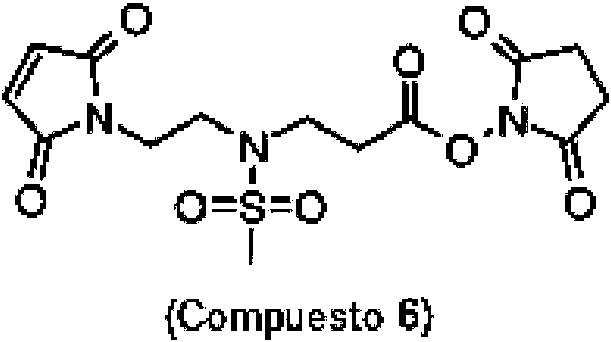
En el Compuesto (6), el grupo sulfonamida en el medio del enlazador hace que el enlazador sea hidrófilo. El grupo maleimida en el extremo izquierdo del enlazador se usa como un ancla para enlazar a moléculas de ligando o fármaco. Reacciona fácilmente con los grupos tiol del ligando o del fármaco que contiene tiol para formar un enlace tioéter estable. El éster de N-hidroxisuccinimida (éster NHS) en el extremo derecho del enlazador también se usa para unirse a moléculas de ligando o fármaco. El éster NHS puede reaccionar con los grupos amino del ligando o fármaco para formar un enlace amida estable.In Compound (6), the sulfonamide group in the middle of the linker makes the linker hydrophilic. The maleimide group at the left end of the linker is used as an anchor to link to ligand or drug molecules. It readily reacts with the thiol groups of the thiol-containing ligand or drug to form a stable thioether bond. The N-hydroxysuccinimide ester (NHS ester) at the right end of the linker is also used to bind ligand or drug molecules. The NHS ester can react with the amino groups of the ligand or drug to form a stable amide bond.
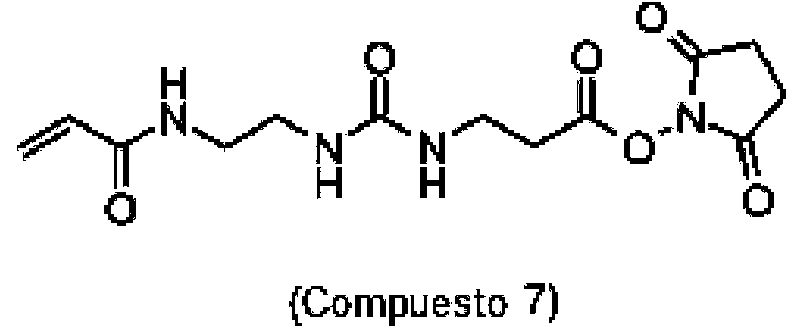
En el Compuesto (7), el grupo urea en el medio del enlazador hace que el enlazador sea hidrófilo. El grupo alquenilo en el extremo izquierdo del enlazador se usa como un ancla para enlazar a moléculas de ligando o fármaco. Reacciona fácilmente con los grupos tiol del ligando o del fármaco que contiene tiol para formar un enlace tioéter estable. El éster de N-hidroxisuccinimida (éster NHS) en el extremo derecho del enlazador también se usa para unirse a moléculas de ligando o fármaco. El éster NHS puede reaccionar con los grupos amino del ligando o fármaco para formar un enlace amida estable.In Compound (7), the urea group in the middle of the linker makes the linker hydrophilic. The alkenyl group at the left end of the linker is used as an anchor to attach ligand or drug molecules. It readily reacts with the thiol groups of the thiol-containing ligand or drug to form a stable thioether bond. The N-hydroxysuccinimide ester (NHS ester) at the right end of the linker is also used to bind ligand or drug molecules. The NHS ester can react with the amino groups of the ligand or drug to form a stable amide bond.

En el Compuesto (8), el grupo urea y el grupo sulfonamida en el medio del enlazador hacen que el enlazador sea hidrófilo. El grupo alquenilo en el extremo izquierdo del enlazador se usa como un ancla para enlazar a moléculas de ligando o fármaco. Reacciona fácilmente con los grupos tiol del ligando o del fármaco que contiene tiol para formar un enlace tioéter estable. El éster de N-hidroxisuccinimida (éster NHS) en el extremo derecho del enlazador también se usa para unirse a moléculas de ligando o fármaco. El éster NHS puede reaccionar con los grupos amino del ligando o fármaco para formar un enlace amida estable.In Compound (8), the urea group and the sulfonamide group in the middle of the linker make the linker hydrophilic. The alkenyl group at the left end of the linker is used as an anchor to attach ligand or drug molecules. It readily reacts with the thiol groups of the thiol-containing ligand or drug to form a stable thioether bond. The N-hydroxysuccinimide ester (NHS ester) at the right end of the linker is also used to bind ligand or drug molecules. The NHS ester can react with the amino groups of the ligand or drug to form a stable amide bond.

En el Compuesto (9), el grupo glicina en el medio del enlazador hace que el enlazador sea hidrófilo. El grupo maleimida en el extremo izquierdo del enlazador se usa como un ancla para enlazar a moléculas de ligando o fármaco. Reacciona fácilmente con los grupos tiol del ligando o del fármaco que contiene tiol para formar un enlace tioéter estable. El éster de N-hidroxisuccinimida (éster NHS) en el extremo derecho del enlazador también se usa para unirse a moléculas de ligando o fármaco. El éster NHS puede reaccionar con los grupos amino del ligando o fármaco para formar un enlace amida estable.In Compound (9), the glycine group in the middle of the linker makes the linker hydrophilic. The maleimide group at the left end of the linker is used as an anchor to link to ligand or drug molecules. Reaction to readily with the thiol groups of the ligand or thiol-containing drug to form a stable thioether bond. The N-hydroxysuccinimide ester (NHS ester) at the right end of the linker is also used to bind ligand or drug molecules. The NHS ester can react with the amino groups of the ligand or drug to form a stable amide bond.

En el Compuesto (10), el grupo de ácido sulfámico en el medio del enlazador hace que el enlazador sea hidrófilo. El grupo yodoacetamida en el extremo izquierdo del enlazador se usa como un ancla para unirse a moléculas de ligando o fármaco. Reacciona fácilmente con los grupos tiol del ligando o del fármaco que contiene tiol para formar un enlace tioéter estable. El éster de N-hidroxisuccinimida (éster NHS) en el extremo derecho del enlazador también se usa para unirse a moléculas de ligando o fármaco. El éster NHS puede reaccionar con los grupos amino del ligando o fármaco para formar un enlace amida estable.In Compound (10), the sulfamic acid group in the middle of the linker makes the linker hydrophilic. The iodoacetamide group at the left end of the linker is used as an anchor to bind ligand or drug molecules. It readily reacts with the thiol groups of the thiol-containing ligand or drug to form a stable thioether bond. The N-hydroxysuccinimide ester (NHS ester) at the right end of the linker is also used to bind ligand or drug molecules. The NHS ester can react with the amino groups of the ligand or drug to form a stable amide bond.

En el Compuesto (11), el grupo de ácido fosforamídico en el medio del enlazador hace que el enlazador sea hidrófilo. El grupo maleimida en el extremo izquierdo del enlazador se usa como un ancla para enlazar a moléculas de ligando o fármaco. Reacciona fácilmente con los grupos tiol del ligando o del fármaco que contiene tiol para formar un enlace tioéter estable. El éster de N-hidroxisuccinimida (éster NHS) en el extremo derecho del enlazador también se usa para unirse a moléculas de ligando o fármaco. El éster NHS puede reaccionar con los grupos amino del ligando o fármaco para formar un enlace amida estable.In Compound (11), the phosphoramidic acid group in the middle of the linker makes the linker hydrophilic. The maleimide group at the left end of the linker is used as an anchor to link to ligand or drug molecules. It readily reacts with the thiol groups of the thiol-containing ligand or drug to form a stable thioether bond. The N-hydroxysuccinimide ester (NHS ester) at the right end of the linker is also used to bind ligand or drug molecules. The NHS ester can react with the amino groups of the ligand or drug to form a stable amide bond.

En el Compuesto (12), el grupo de ácido fosforamídico en el medio del enlazador hace que el enlazador sea hidrófilo. El grupo bromoacetamida en el extremo izquierdo del enlazador se usa como un ancla para enlazar a moléculas de ligando o fármaco. Reacciona fácilmente con los grupos tiol del ligando o del fármaco que contiene tiol para formar un enlace tioéter estable. El éster de N-hidroxisuccinimida (éster NHS) en el extremo derecho del enlazador también se usa para unirse a moléculas de ligando o fármaco. El éster NHS puede reaccionar con los grupos amino del ligando o fármaco para formar un enlace amida estable. In Compound (12), the phosphoramidic acid group in the middle of the linker makes the linker hydrophilic. The bromoacetamide group at the left end of the linker is used as an anchor to link to ligand or drug molecules. It readily reacts with the thiol groups of the thiol-containing ligand or drug to form a stable thioether bond. The N-hydroxysuccinimide ester (NHS ester) at the right end of the linker is also used to bind ligand or drug molecules. The NHS ester can react with the amino groups of the ligand or drug to form a stable amide bond.
En el Compuesto (13), el grupo sulfona y el grupo amida en el medio del enlazador hacen que el enlazador sea hidrófilo. El grupo bromoacetamida en el extremo izquierdo del enlazador se usa como un ancla para enlazar a moléculas de ligando o fármaco. Reacciona fácilmente con los grupos tiol del ligando o del fármaco que contiene tiol para formar un enlace tioéter estable. El éster de N-hidroxisuccinimida (éster NHS) en el extremo derecho del enlazador también se usa para enlazar a moléculas de ligando o fármaco. El éster NHS puede reaccionar con los grupos amino del ligando o fármaco para formar un enlace amida estable.In Compound (13), the sulfone group and the amide group in the middle of the linker make the linker hydrophilic. The bromoacetamide group at the left end of the linker is used as an anchor to link to ligand or drug molecules. It readily reacts with the thiol groups of the thiol-containing ligand or drug to form a stable thioether bond. The N-hydroxysuccinimide ester (NHS ester) at the right end of the linker is also used to link to ligand or drug molecules. The NHS ester can react with the amino groups of the ligand or drug to form a stable amide bond.

En el Compuesto (14), el grupo sulfona en el medio del enlazador hace que el enlazador sea hidrófilo. El grupo maleimida en el extremo izquierdo del enlazador se usa como un ancla para enlazar a moléculas de ligando o fármaco. Reacciona fácilmente con los grupos tiol del ligando o del fármaco que contiene tiol para formar un enlace tioéter estable. El grupo alquenilo en el extremo derecho del enlazador se usa como un ancla para unirse a moléculas de ligando o fármaco. Reacciona fácilmente con los grupos tiol del ligando o del fármaco que contiene tiol para formar un enlace tioéter estable.In Compound (14), the sulfone group in the middle of the linker makes the linker hydrophilic. The maleimide group at the left end of the linker is used as an anchor to link to ligand or drug molecules. It readily reacts with the thiol groups of the thiol-containing ligand or drug to form a stable thioether bond. The alkenyl group at the right end of the linker is used as an anchor to bind ligand or drug molecules. It readily reacts with the thiol groups of the thiol-containing ligand or drug to form a stable thioether bond.

En el Compuesto (15), el grupo urea y el grupo amida en el medio del enlazador hacen que el enlazador sea hidrófilo. El grupo disulfuro en el extremo izquierdo del enlazador se usa como ancla para unirse a moléculas de ligando o fármaco. El grupo disulfuro reacciona fácilmente con los grupos tiol en el ligando o fármaco que contiene tiol para formar un nuevo enlace disulfuro. El éster de N-hidroxisuccinimida (éster NHS) en el extremo derecho del enlazador también se usa para unirse a moléculas de ligando o fármaco. El éster NHS puede reaccionar con los grupos amino del ligando o fármaco para formar un enlace amida estable.In Compound (15), the urea group and the amide group in the middle of the linker make the linker hydrophilic. The disulfide group at the left end of the linker is used as an anchor to bind ligand or drug molecules. The disulfide group readily reacts with thiol groups on the thiol-containing ligand or drug to form a new disulfide bond. The N-hydroxysuccinimide ester (NHS ester) at the right end of the linker is also used to bind ligand or drug molecules. The NHS ester can react with the amino groups of the ligand or drug to form a stable amide bond.
En las estructuras siguientes se muestran enlazadores hidrófilos más ejemplares [Compuestos (16) a (26)]:More exemplary hydrophilic linkers [Compounds (16) to (26)] are shown in the following structures:


(Compuesto 2d) (Composite 2d)

Los ejemplos de realizaciones anteriores se utilizan como ilustraciones de la divulgación.The examples of embodiments above are used as illustrations of the disclosure.

No debe entenderse que la presente divulgación se limita únicamente a los ejemplos ilustrados. La invención actualmente reclamada se define en y por las reivindicaciones adjuntas.It should not be understood that the present disclosure is limited solely to the illustrated examples. The presently claimed invention is defined in and by the appended claims.
La preparación de enlazadores hidrófilosThe preparation of hydrophilic linkers
Otro aspecto de la presente divulgación es la preparación de enlazadores hidrófilos. Los enlazadores hidrófilos de la divulgación se pueden preparar mediante muchos métodos sintéticos. Como ejemplos ilustrativos, las rutas sintéticas generales para algunos de los enlazadores hidrófilos se muestran en el Esquema (1) a (11).Another aspect of the present disclosure is the preparation of hydrophilic linkers. The hydrophilic linkers of the disclosure can be prepared by many synthetic methods. As illustrative examples, general synthetic routes for some of the hydrophilic linkers are shown in Scheme (1) through (11).
En el esquema (1), se prepara un enlazador hidrófilo que posee un grupo urea. En el primer paso, se introduce un grupo isocianato tratando un grupo amino con trifosgeno. Luego, tras In scheme (1), a hydrophilic linker having a urea group is prepared. In the first step, an isocyanate group is introduced by treating an amino group with triphosgene. Then after

el tratamiento con otro grupo amino, se forma fácilmente un grupo urea en medio del enlazador hidrófilo. Durante la síntesis, se introduce un grupo maleimido reactivo en el extremo izquierdo de los enlazadores hidrófilos al mismo tiempo. Se introduce un grupo NHS reactivo en el extremo derecho del enlazador hidrófilo en el último paso.treatment with another amino group, a urea group is easily formed in the middle of the hydrophilic linker. During the synthesis, a reactive maleimido group is introduced at the left end of the hydrophilic linkers at the same time. A reactive NHS group is introduced at the right end of the hydrophilic linker in the last step.
En el esquema (2), se prepara otro enlazador hidrófilo que posee un grupo urea. En el primer paso, se prepara un derivado de bromoacetamida que posee un grupo amino. A continuación, se introduce un grupo isocianato tratando un grupo amino de un compuesto diferente con trifosgeno. Luego, al reaccionar con el derivado de bromoacetamida preparado en el primer paso, se forma fácilmente un grupo urea en el medio del enlazador hidrófilo. Durante la síntesis, se introduce un grupo bromo reactivo en el extremo izquierdo de los enlazadores hidrófilos al mismo tiempo. Se introduce un grupo NHS reactivo en el extremo derecho del enlazador hidrófilo en el último paso. In scheme (2), another hydrophilic linker having a urea group is prepared. In the first step, a bromoacetamide derivative having an amino group is prepared. Next, an isocyanate group is introduced by treating an amino group of a different compound with triphosgene. Then, by reacting with the bromoacetamide derivative prepared in the first step, a urea group is easily formed in the middle of the hydrophilic linker. During the synthesis, a reactive bromo group is introduced at the left end of the hydrophilic linkers at the same time. A reactive NHS group is introduced at the right end of the hydrophilic linker in the last step.

En el esquema (3), se prepara un enlazador hidrófilo que posee un grupo sulfona. En el primer paso, se prepara un derivado de tioéter. A continuación, tras la oxidación, el grupo tioéter se transforma fácilmente en un grupo sulfona en el medio del enlazador hidrófilo. Luego, se introducen dos grupos funcionales reactivos (una yodoacatamida y un éster NHS) en los dos extremos del enlazador hidrófilo, respectivamente.In scheme (3), a hydrophilic linker possessing a sulfone group is prepared. In the first step, a thioether derivative is prepared. Then, after oxidation, the thioether group is easily transformed into a sulfone group in the middle of the hydrophilic linker. Then, two reactive functional groups (an iodoacatamide and an NHS ester) are introduced at the two ends of the hydrophilic linker, respectively.

En el esquema (4), se prepara un enlazador hidrófilo que posee un grupo sulfona en un enfoque alternativo. En el primer paso, se prepara un derivado de tioéter. A continuación, tras la oxidación, el grupo tioéter se transforma fácilmente en un grupo sulfona en el medio del enlazador hidrófilo. Luego, se introducen dos grupos funcionales reactivos (una maleimida y un éster NHS) en los dos extremos del enlazador hidrófilo, respectivamente.In scheme (4), a hydrophilic linker possessing a sulfone group is prepared in an alternative approach. In the first step, a thioether derivative is prepared. Then, after oxidation, the thioether group is easily transformed into a sulfone group in the middle of the hydrophilic linker. Then, two reactive functional groups are introduced (one maleimide and an NHS ester) at the two ends of the hydrophilic linker, respectively.

En el esquema (5), un enlazador hidrófilo que posee un grupo sulfona se prepara en otro enfoque. Después de que el grupo sulfona se incorpora en medio del enlazador hidrófilo, se introducen dos grupos funcionales reactivos (un alquenilo y un éster NHS) en los dos extremos del enlazador hidrófilo, respectivamente.In scheme (5), a hydrophilic linker possessing a sulfone group is prepared in another approach. After the sulfone group is incorporated in the middle of the hydrophilic linker, two reactive functional groups (an alkenyl and an NHS ester) are introduced at the two ends of the hydrophilic linker, respectively.

En el esquema (6), se prepara un enlazador hidrófilo que posee un grupo sulfona en otro enfoque alternativo. En el primer paso, se prepara un derivado de tioéter. A continuación, tras la oxidación, el grupo tioéter se transforma fácilmente en un grupo sulfona en el medio del enlazador hidrófilo. Luego, se introducen dos grupos funcionales reactivos (una maleimida y un éster NHS) en los dos extremos del enlazador hidrófilo, respectivamente. In scheme (6), a hydrophilic linker possessing a sulfone group is prepared in another alternative approach. In the first step, a thioether derivative is prepared. Then, after oxidation, the thioether group is easily transformed into a sulfone group in the middle of the hydrophilic linker. Then, two reactive functional groups (a maleimide and an NHS ester) are introduced at the two ends of the hydrophilic linker, respectively.

Esquema 7Scheme 7
En el esquema (7), se prepara un enlazador hidrófilo que posee un grupo de ácido sulfámico. En el primer paso, el grupo amino necesario se crea mediante una simple reacción de sustitución nucleofílica. A continuación, el grupo de ácido sulfámico se introduce en el medio del enlazador hidrófilo haciéndolo reaccionar con ácido sulfuroclorídico. Luego, se introducen dos grupos funcionales reactivos (una maleimida y un éster NHS) en los dos extremos del enlazador hidrófilo, respectivamente.In Scheme (7), a hydrophilic linker having a sulfamic acid group is prepared. In the first step, the necessary amino group is created by a simple nucleophilic substitution reaction. Next, the sulfamic acid group is introduced into the medium of the hydrophilic linker by reacting it with sulfurochloric acid. Then, two reactive functional groups (a maleimide and an NHS ester) are introduced at the two ends of the hydrophilic linker, respectively.

Esquema 8Scheme 8
En el esquema (8), se prepara un enlazador hidrófilo que posee un grupo de ácido fosforamídico. En el primer paso, el grupo amino necesario se crea mediante una simple reacción de adición de Michael. A continuación, se introduce el grupo de ácido fosforamídico en medio del enlazador hidrófilo haciéndolo reaccionar con cloruro de fosforilo o clorofosfato de dietilo, seguido de tratamiento con ácido clorhídrico. Luego, se introducen dos grupos funcionales reactivos (una maleimida y un éster NHS) en los dos extremos del enlazador hidrófilo, respectivamente.In scheme (8), a hydrophilic linker having a phosphoramidic acid group is prepared. In the first step, the necessary amino group is created by a simple Michael addition reaction. Next, enter the phosphoramidic acid group in the middle of the hydrophilic linker by reacting it with phosphoryl chloride or diethyl chlorophosphate, followed by treatment with hydrochloric acid. Then, two reactive functional groups (a maleimide and an NHS ester) are introduced at the two ends of the hydrophilic linker, respectively.
En el esquema (9), se prepara un enlazador hidrófilo que posee un grupo sulfonamida. En el primer paso, el grupo amino necesario se crea mediante una simple reacción de sustitución nucleofílica. A continuación, se introduce el grupo sulfonamida en medio del enlazador hidrófilo al reaccionar con cloruro de mesilo. Luego, se introducen dos grupos funcionales reactivos (una maleimida y un éster NHS) en los dos extremos del enlazador hidrófilo, respectivamente.In Scheme (9), a hydrophilic linker having a sulfonamide group is prepared. In the first step, the necessary amino group is created by a simple nucleophilic substitution reaction. Next, the sulfonamide group is introduced into the middle of the hydrophilic linker by reacting with mesyl chloride. Then, two reactive functional groups (a maleimide and an NHS ester) are introduced at the two ends of the hydrophilic linker, respectively.

EsquemaScheme
En el esquema (10), se prepara un enlazador hidrófilo que posee un grupo urea. En el primer paso, el grupo amino necesario se crea mediante una simple reacción de sustitución nucleofílica. A continuación, el grupo urea se introduce en medio del enlazador hidrófilo haciéndolo reaccionar con carbamato de 4-nitrofenil de bencilo, que se prepara a partir de bencilamina haciéndolo reaccionar con cloroformiato de 4-nitrofenilo. Luego, se introducen dos grupos funcionales reactivos (una maleimida y un éster NHS) en los dos extremos del enlazador hidrófilo, respectivamente.In scheme (10), a hydrophilic linker having a urea group is prepared. In the first step, the necessary amino group is created by a simple nucleophilic substitution reaction. Next, the urea group is introduced into the medium of the hydrophilic linker by reacting it with benzyl 4-nitrophenyl carbamate, which is prepared from benzylamine by reacting it with 4-nitrophenyl chloroformate. Then, two reactive functional groups (a maleimide and an NHS ester) are introduced at the two ends of the hydrophilic linker, respectively.
En el esquema (11), se prepara un enlazador hidrófilo que posee un grupo amino simple. En el primer paso, el grupo amino necesario se crea mediante una simple reacción de sustitución nucleofílica, seguida de aminación reductora con formaldehído o paraformaldehído. Luego, se introducen dos grupos funcionales reactivos (una maleimida y un éster NHS) en los dos extremos del enlazador hidrófilo, respectivamente.In scheme (11), a hydrophilic linker having a single amino group is prepared. In the first step, the necessary amino group is created by a simple nucleophilic substitution reaction, followed by reductive amination with formaldehyde or paraformaldehyde. Then, two reactive functional groups (a maleimide and an NHS ester) are introduced at the two ends of the hydrophilic linker, respectively.
Estas realizaciones ejemplares se utilizan como ilustraciones de la divulgación. Estos esquemas sintéticos ejemplares no pretenden limitar los métodos sintéticos de los enlazadores hidrófilos. Los enlazadores hidrófilos de la presente divulgación también se pueden preparar mediante varios otros enfoques. These exemplary embodiments are used as illustrations of the disclosure. These exemplary synthetic schemes are not intended to limit synthetic methods of hydrophilic linkers. The hydrophilic linkers of the present disclosure can also be prepared by various other approaches.

Esquema 11Scheme 11
Conjugados ligando-fármacoLigand-drug conjugates
Un aspecto adicional de la presente divulgación se refiere a nuevos conjugados ligando-fármaco. La presente divulgación proporciona conjugados ligando-fármaco que comprenden un ligando de unión a células que se une a una población celular particular, un fármaco citotóxico que es muy potente y un enlazador hidrófilo que conecta el ligando de unión a células y el fármaco citotóxico. Los conjugados ligando-fármaco de la presente divulgación tienen una eficacia y seguridad superiores que los conjugados ligando-fármaco que comprenden enlazadores no hidrófilos. A further aspect of the present disclosure relates to new ligand-drug conjugates. The present disclosure provides ligand-drug conjugates comprising a cell-binding ligand that binds to a particular cell population, a cytotoxic drug that is highly potent, and a hydrophilic linker that connects the cell-binding ligand and the cytotoxic drug. The ligand-drug conjugates of the present disclosure have superior efficacy and safety over ligand-drug conjugates comprising non-hydrophilic linkers.
La Fórmula general de los conjugados anticuerpo-fármaco de la presente divulgación se muestra en la Fórmula (2): The general Formula of the antibody-drug conjugates of the present disclosure is shown in Formula ( 2):
D------ U1-}— X----- V------Y -}r^W ‘-----LD------ U1-}— X----- V------Y -}r^W ‘-----L
Fórmula 2Formula 2
donde:where:
D representa un fármaco citotóxico;D represents a cytotoxic drug;
L representa un ligando de unión a células;L represents a cell binding ligand;
V representa un grupo polar o cargado; Los grupos polares o cargados adecuados que se pueden usar en la Fórmula (2) incluyen, pero no se limitan a, aminos [-N (R)-], ureas [-N (R1) CON (R2) - o -N(CONR1R2) -], carboxilos [-Q (COOH) -o -Q(ZCOOH) -], carbamatos {[-N (R) COO-] o [-N (COOR)-]}, guanidinas [-N (R1) C = N (COOR2) N (R3)-], sulfonamidas [-N (SO2R)-], sulfonas (-SO2-), sulfóxidos (-SO-), ácidos sulfónicos [-Q (ZSO2OH) -], ácidos sulfámicos [ -N (SO2OH) -], fosfonatos {-Q [ZPO (Or )2] -}, ácidos fosfónicos {-Q [ZPO (OH)2] -}, ácidos fosforamídicos {-N [PO(OH)2 ] -}, ácidos fosforodiamídicos {-N [p O (NH2) (OH)] -} y triamidas fosfóricas {-N [PO (NH2)2] -}, donde R, R1, R2 y R3 son independientes pendientemente H o alquilo C1-C8; Q es CH o N; Z es 1~5 unidades de metileno.V represents a polar or charged group; Suitable polar or charged groups that may be used in Formula (2) include, but are not limited to, aminos [-N(R)-], ureas [-N( R1 )CON(R2) -o- N(CONR 1 R 2 ) -], carboxyls [-Q (COOH) -or -Q(ZCOOH) -], carbamates {[-N (R) COO-] or [-N (COOR)-]}, guanidines [-N (R 1 ) C = N (COOR 2 ) N (R 3 )-], sulfonamides [-N (SO 2 R)-], sulfones (-SO 2 -), sulfoxides (-SO-), acids sulfonic acids [-Q (ZSO 2 OH) -], sulfamic acids [ -N (SO 2 OH) -], phosphonates {-Q [ZPO (Or ) 2 ] -}, phosphonic acids {-Q [ZPO (OH) 2 ] -}, phosphoramidic acids {-N [PO(OH) 2 ] -}, phosphorodiamidic acids {-N [p O (NH 2 ) (OH)] -} and phosphoric triamides {-N [PO (NH 2 ) 2 ]-}, where R, R 1 , R 2 and R 3 are dependently independent H or C 1 -C 8 alkyl; Q is CH or N; Z is 1~5 methylene units.
U' representa un grupo funcional que permite un enlace covalente con un fármaco citotóxico; Los grupos funcionales que permiten un enlace covalente con un fármaco citotóxico incluyen, pero no se limitan a, tioles, disulfuros, aminos, carboxilos, aldehídos, cetonas, maleimidas, grupos haloacetilo, grupos alquenilo, grupos alquinilo, hidrazinas e hidroxilos. El enlace covalente con el fármaco citotóxico puede ser un enlace disulfuro, un enlace tioéter, un enlace tioéster, un enlace amida, un enlace éster, un enlace carbono-nitrógeno, un enlace carbono-carbono, un enlace hidrazina, un enlace hidrazida, un enlace enlace hidrazona, enlace éter, enlace carbamato o enlace carbonato;U' represents a functional group that allows a covalent bond with a cytotoxic drug; Functional groups that allow covalent bonding with a cytotoxic drug include, but are not limited to, thiols, disulfides, amines, carboxyls, aldehydes, ketones, maleimides, haloacetyl groups, alkenyl groups, alkynyl groups, hydrazines, and hydroxyls. The covalent bond with the cytotoxic drug may be a disulfide bond, a thioether bond, a thioester bond, an amide bond, an ester bond, a carbon-nitrogen bond, a carbon-carbon bond, a hydrazine bond, a hydrazide bond, a hydrazone bond, ether bond, carbamate bond or carbonate bond;
W' representa un grupo funcional que permite un enlace covalente con un ligando de unión a células, como un anticuerpo monoclonal. Los grupos funcionales que permiten un enlace covalente con un ligando de unión a células incluyen principalmente dos tipos. El primer tipo de grupos funcionales permite un enlace covalente con un grupo amino en el ligando de unión a células. Estos grupos funcionales incluyen, pero no se limitan a, ésteres de N-hidroxisuccinmida, ésteres de N-sulfosuccinimidilo, ésteres de nitrofenilo, ésteres de dinitrofenilo, ésteres de pentafluorofenilo, ésteres de tetrafluorofenilo, cloruros de acilo, anhídridos, cloruros de sulfonilo, cloroformatos, isocianatos, aldehídos y cetonas. El enlace covalente puede ser un enlace amida, un enlace carbamato, un enlace urea u otros tipos de enlaces carbono-nitrógeno. El segundo tipo de grupos funcionales permite un enlace covalente con un grupo tiol en el ligando de unión a células. Estos grupos funcionales incluyen, pero no se limitan a, disulfuros tales como piridildisulfuros y nitropiridildisulfuros, maleimidas, cloruros de acilo, grupos haloacetilo tales como yodoacetamida y bromoacetamida, alquenilpiridinas, isocianatos e isotiocianatos. El enlace covalente puede ser un enlace disulfuro, un enlace tioéter, un enlace tiocarbamato, un enlace ditiocarbamato o un enlace tioéster;W' represents a functional group that allows covalent bonding with a cell-binding ligand, such as a monoclonal antibody. Functional groups that allow covalent bonding with a cell-binding ligand mainly include two types. The first type of functional groups allow covalent bonding with an amino group on the cell-binding ligand. These functional groups include, but are not limited to, N-hydroxysuccinimide esters, N-sulfosuccinimidyl esters, nitrophenyl esters, dinitrophenyl esters, pentafluorophenyl esters, tetrafluorophenyl esters, acyl chlorides, anhydrides, sulfonyl chlorides, chloroformates , isocyanates, aldehydes and ketones. The covalent bond can be an amide bond, a carbamate bond, a urea bond, or other types of carbon-nitrogen bonds. The second type of functional groups allow covalent bonding with a thiol group on the cell-binding ligand. These functional groups include, but are not limited to, disulfides such as pyridyldisulfides and nitropyridyldisulfides, maleimides, acyl chlorides, haloacetyl groups such as iodoacetamide and bromoacetamide, alkenylpyridines, isocyanates, and isothiocyanates. The covalent bond may be a disulfide bond, a thioether bond, a thiocarbamate bond, a dithiocarbamate bond, or a thioester bond;
X representa un componente compuesto por una, dos o tres unidades de metileno. Las unidades de metileno pueden estar opcionalmente sustituidas con grupos alquilo, halo, hidroxilo o alcoxi;X represents a component composed of one, two or three methylene units. The methylene units may be optionally substituted with alkyl, halo, hydroxyl or alkoxy groups;
Y representa un componente compuesto por una, dos o tres unidades de metileno. Las unidades de metileno pueden estar opcionalmente sustituidas con grupos alquilo, halo, hidroxilo o alcoxi;Y represents a component composed of one, two or three methylene units. The methylene units may be optionally substituted with alkyl, halo, hydroxyl or alkoxy groups;
n es un número entero de 1 a 100. Si n> 1, los valores de cada V, X e Y en los corchetes repetidos de la Fórmula (2) son independientes y no tienen que ser idénticos.n is an integer from 1 to 100. If n > 1, the values of each V, X and Y in the repeated brackets of Formula (2) are independent and do not have to be identical.
Preferiblemente, n es un número entero de 1 a 50. Incluso más preferiblemente, n es un número entero de 1 a 10. Lo más preferiblemente, n es un número entero de 1 a 4.Preferably, n is an integer from 1 to 50. Even more preferably, n is an integer from 1 to 10. Most preferably, n is an integer from 1 to 4.
El fármaco citotóxicoThe cytotoxic drug
El resto de fármaco en el conjugado ligando-fármaco de la presente divulgación es un potente agente citotóxico para el propósito de la terapia del cáncer. Los fármacos citotóxicos incluyen agentes alquilantes, antimetabolitos, agentes antimicrotúbulos, inhibidores de la topoisómeras, antibióticos citotóxicos, intercaladores de ADN y cualquier otra molécula que sea altamente citotóxica y por tanto pueda conducir a la muerte celular. Los tipos ejemplares de fármacos citotóxicos incluyen las mostazas nitrogenadas, las antraciclinas, los alcaloides de la vinca, las mitomicinas, las bleomicinas, los análogos de nucleósidos, las pteridinas, los diinenos (también denominados enediinos, biciclodiinenos o enediinos bicíclicos), las podofilotoxinas, las dolastatinas (incluidas las auristatinas), maitansinoides, tubulisinas, pirrolo [2,1-c] [1,4] benzodiazepinas (PBD) y taxanos. Los miembros ejemplares de estos tipos de fármacos citotóxicos incluyen mecloretamina, ciclofosfamida, melfalán, clorambucilo, ifosfamida, busulfán, carmustina (BCNU), lomustina (CCNU), semustina (MeCCNU), fotemustina, estreptozotocina, dacarbacins, mitozolomida, temozolomida, tiotepa, mitomicina, diaziquona (AZQ), cisplatino, carboplatino, oxaliplatino, procarbazina, hexametilmelamina, nedaplatino, satraplatino, tetranitrato de triplatino, bendamustina, uramustina, análogos de purina, análogos de pirimidina, análogos de nucleósidos, análogos de nucleótidos, metotrexato, pemetrexo, raltitrexo, fluorouracil, capecitabina, citarabina, gemcitabina, decitabina, 5-azacitidina, fludarabina, nelarabina, cladribina, clofarabina, pentostatina, tioguanina, vincristina, vinblastina, vinorelbina, vindesina, vinflunina, paclitaxel, docetaxel, dolastatinina A, dolastatinina B, dolastatina 10, dolastatina 13, dolastatina 14, dolastatina 15, dolastatina 16, dolastatina 17, dolastatina 18, auristatina E, auristatina EB (AEB), auristatina EFP (AEFP), monometil auristatina E (MMAE), monometil auristatina F (MMAF), DM1, DM3, DM4, tubulisinas, duocarmicinas, epotilonas, podofilotoxina, etopósido, fosfato de etopósido, tenipósido, irinotecán, topotecán, etopósido, mitoxantrona, tenipósido, merbarona, aclarubicina, novobiocina, plicamicina, lamellarina, elipticina, amsacrina, ácido aurintricarboxílico, bleomicina, mitomicina A, mitomicina C, daunorrubicina, doxorrubicina, epirrubicina, idarrubicina, pirarrubicina, aclarrubicina, mitoxantrona, actinomicina, dactinomicina, arabinocida citocina, metopterina, diclorometotrexato, leurosina, leurosideína, caminomicina, aminopterina, tallisomicina, podofilotoxina, ácido butírico, camptotecina, caliqueamicina, cspcramicina, dincmicina, ncocarzinostatina (NCS), kcdarcidina, C1027 y análogos de los mismos.The drug moiety in the ligand-drug conjugate of the present disclosure is a potent cytotoxic agent for the purpose of cancer therapy. Cytotoxic drugs include alkylating agents, antimetabolites, antimicrotubule agents, topoisomeric inhibitors, cytotoxic antibiotics, DNA intercalators, and any other molecule that is highly cytotoxic and thus can lead to cell death. Exemplary classes of cytotoxic drugs include nitrogen mustards, anthracyclines, vinca alkaloids, mitomycins, bleomycins, nucleoside analogs, pteridines, dienes (also called enediines, bicyclodienes, or bicyclic enediines), podophyllotoxins, dolastatins (including auristatins), maytansinoids, tubulisins, pyrrolo[2,1-c][1,4]benzodiazepines (PBDs), and taxanes. Exemplary members of these cytotoxic drug classes include mechlorethamine, cyclophosphamide, melphalan, chlorambucil, ifosfamide, busulfan, carmustine (BCNU), lomustine (CCNU), semustine (MeCCNU), fotemustine, streptozotocin, dacarbacins, mitozolomide, temozolomide, thiotepa, mitomycin , diaziquone (AZQ), cisplatin, carboplatin, oxaliplatin, procarbazine, hexamethylmelamine, nedaplatin, satraplatin, triplatin tetranitrate, bendamustine, uramustine, purine analogs, pyrimidine analogs, nucleoside analogs, nucleotide analogs, methotrexate, pemetrex, raltitrex, fluorouracil, capecitabine, cytarabine, gemcitabine, decitabine, 5-azacitidine, fludarabine, nelarabine, cladribine, clofarabine, pentostatin, thioguanine, vincristine, vinblastine, vinorelbine, vindesine, vinflunine, paclitaxel, docetaxel, dolastatinin A, dolastatinin B, dolastatin 10, dolastatin 13, dolastatin 14, dolastatin 15, dolastatin 16, dolastatin 17, dolastatin 18, auristatin AND, auristatin EB (AEB), auristatin EFP (AEFP), monomethyl auristatin E (MMAE), monomethyl auristatin F (MMAF), DM1, DM3, DM4, tubulisins, duocarmycins, epothilones, podophyllotoxin, etoposide, etoposide phosphate, teniposide, irinotecan, topotecan, etoposide, mitoxantrone, teniposide, merbarone, aclarubicin, novobiocin, plicamycin, lamellarin, ellipticin, amsacrine, aurintricarboxylic acid, bleomycin, mitomycin A, mitomycin C, daunorubicin, doxorubicin, epirubicin, idarubicin, pirarubicin, aclarubicin, mitoxantrone, actinomycin, dactinomycin, dactinomycin, aclarubicin , cytokine arabinocide, metopterin, dichloromethotrexate, leurosin, leurosidein, caminomycin, aminopterin, talisomycin, podophyllotoxin, butyric acid, camptothecin, calicheamicin, cspcramycin, dincmycin, ncocarzinostatin (NCS), kcdarcidin, C1027 and analogs thereof.
El número medio de unidades de fármaco en cada molécula de conjugado de fármaco-anticuerpo es de 1 a 8, preferiblemente de 2 a 6.The average number of drug units in each drug-antibody conjugate molecule is 1 to 8, preferably 2 to 6.
Dependiendo de la necesidad sintética del conjugado ligando-fármaco, puede ser necesario modificar la estructura del resto de fármaco para que sea más fácil o más conveniente preparar el conjugado ligando-fármaco. Por ejemplo, un grupo funcional reactivo, como un grupo amino, hidroxilo, tiol o carboxilo, puede introducirse en la estructura del fármaco en una posición adecuada. Por supuesto, tal modificación debería tener un efecto perjudicial mínimo sobre la potencia y otras propiedades del fármaco original.Depending on the synthetic need for the drug-ligand conjugate, it may be necessary to modify the structure of the drug moiety to make it easier or more convenient to prepare the drug-ligand conjugate. For example, a reactive functional group, such as an amino, hydroxyl, thiol, or carboxyl group, may be introduced into the drug structure at a suitable position. Of course, such a modification should have minimal deleterious effect on the potency and other properties of the original drug.
Algunos fármacos ya poseen grupos funcionales adecuados que pueden usarse para acoplarse al enlazador hidrófilo para la preparación de conjugados ligando-fármaco. Por ejemplo, los siguientes fármacos poseen un grupo amino inherente para dicho enlace: mitomicinas, dolastatinas (incluidas las auristatinas), daunorrubicina, doxorrubicina, aminopterina, bleomicina, actinomicina, tallisomicina, 9-amino camptotecina y citarabina. Asimismo, los siguientes fármacos poseen un grupo hidroxilo inherente que puede usarse para acoplarse al enlazador hidrófilo para la preparación de conjugados ligando-fármaco: paclitaxel, etopósido, podofilotoxina, camptotecina, esperamicina, vinblastina, vincristina y doxorrubicina; y los siguientes fármacos poseen un grupo tiol inherente o un grupo funcional que se puede transformar fácilmente en un grupo tiol para la preparación de conjugados ligando-fármaco: esperamicina, caliqueamicina, esperamicina y 6-mercaptopurina.Some drugs already possess suitable functional groups that can be used to couple to the hydrophilic linker for the preparation of drug-ligand conjugates. For example, the following drugs possess an inherent amino group for such linkage: mitomycins, dolastatins (including auristatins), daunorubicin, doxorubicin, aminopterin, bleomycin, actinomycin, talisomycin, 9-amino camptothecin, and cytarabine. Also, the following drugs possess an inherent hydroxyl group that can be used to couple to the hydrophilic linker for the preparation of ligand-drug conjugates: paclitaxel, etoposide, podophyllotoxin, camptothecin,esperamycin, vinblastine, vincristine, and doxorubicin; and the following drugs possess an inherent thiol group or a functional group that can be easily converted to a thiol group for the preparation of ligand-drug conjugates:esperamycin, calicheamicin,esperamycin, and 6-mercaptopurine.
Preferiblemente, la potencia in vitro de los fármacos citotóxicos para su uso en conjugados ligando-fármaco de la presente divulgación es mayor que la de los fármacos quimioterapéuticos tradicionales. Los fármacos citotóxicos son preferiblemente estables y adecuadamente solubles en medio acuoso.Preferably, the in vitro potency of cytotoxic drugs for use in ligand-drug conjugates of the present disclosure is greater than that of traditional chemotherapeutic drugs. Cytotoxic drugs are preferably stable and adequately soluble in aqueous medium.
Más preferiblemente, los fármacos citotóxicos para su uso en los conjugados ligando-fármaco de la presente divulgación son maitansinoides, dolastatinas (en particular auristatinas), caliqueamicinas, tubulisinas, mitomicinas, alcaloides de la vinca, antraciclinas, duocarmicinas y pirrolo [2, 1 -c] [1,4] benzodiazepinas (PBD). Estos fármacos citotóxicos poseen alta potencia para su uso en conjugados ligando-fármaco tales como conjugados anticuerpo-fármaco de la presente divulgación.More preferably, the cytotoxic drugs for use in the ligand-drug conjugates of the present disclosure are maytansinoids, dolastatins (particularly auristatins), calicheamicins, tubulisins, mitomycins, vinca alkaloids, anthracyclines, duocarmycins, and pyrrolo [2, 1- c][1,4]benzodiazepines (PBDs). These cytotoxic drugs possess high potency for use in ligand-drug conjugates such as the antibody-drug conjugates of the present disclosure.
Maitansinoides:Maytansinoids:
La maitansina se aisló por primera vez de la corteza del arbusto etíope Maytenus ovatus y es 100-1000 veces más citotóxica que los fármacos quimioterapéuticos convencionales. La maitansina y los maitansinoides se unen estrechamente a la tubulina e inhiben de forma potente la dinámica de los microtúbulos durante la mitosis. La fuerte inhibición finalmente conduce a la muerte celular por apoptosis.Maytansine was first isolated from the bark of the Ethiopian shrub Maytenus ovatus and is 100-1000 times more cytotoxic than conventional chemotherapy drugs. Maytansine and maytansinoids bind tightly to tubulin and potently inhibit microtubule dynamics during mitosis. The strong inhibition ultimately leads to cell death by apoptosis.
Los maitansinoides preferidos se muestran en la Fórmula (3), donde R1 y R2 son independientemente H o alquilo C1~C8, m es 1,2 o 3. El grupo tiol se usa para el acoplamiento covalente al enlazador hidrófilo, que a su vez se conecta a un ligando de unión a células, tal como un anticuerpo, en los conjugados ligando-fármaco de la presente divulgación. Los maitansinoides más preferidos incluyen DM1, DM3 y DM4.Preferred maytansinoids are shown in Formula (3), where R 1 and R 2 are independently H or C1~C8 alkyl, m is 1,2 or 3. The thiol group is used for covalent coupling to the hydrophilic linker, which at in turn is linked to a cell-binding ligand, such as an antibody, in the ligand-drug conjugates of the present disclosure. More preferred maytansinoids include DM1, DM3 and DM4.
Cuando se usan maitansinoides como fármacos citotóxicos para los conjugados ligando-fármaco de la presente divulgación, los enlazadores hidrófilos en los conjugados ligando-fármaco, tales como los conjugados anticuerpofármaco, son preferiblemente no escindibles. Después de unirse al antígeno en la superficie de las células tumorales y de internalizarse por endocitosis, la porción de anticuerpo del conjugado anticuerpo-fármaco se degrada proteolíticamente en el lisosoma hasta que solo un residuo de aminoácido permanece conectado al enlazador hidrófilo. El aminoácido que permanece conectado al enlazador hidrófilo es el aminoácido que se utiliza como ancla del anticuerpo para conectarse al enlazador hidrófilo. Los aminoácidos más convenientes para anclar el enlace son la lisina y la cisteína. El catabolito de aminoácido-enlazador-maitansinoide, como el catabolito lisina-enlazador-maitansinoide o el catabolito cisteína-enlazador-maitansinoide, producido mediante degradación proteolítica se une a la tubulina en el citoplasma e induce la apoptosis. El catabolito de aminoácido-enlazador-maitansinoide también es muy resistente a MDR1, porque el enlazador hidrófilo y el aminoácido adjunto harán que todo el catabolito sea altamente hidrófilo. When maytansinoids are used as cytotoxic drugs for the ligand-drug conjugates of the present disclosure, the hydrophilic linkers in the ligand-drug conjugates, such as antibody-drug conjugates, are preferably non-cleavable. After binding to antigen on the surface of tumor cells and being internalized by endocytosis, the antibody portion of the antibody-drug conjugate is proteolytically degraded in the lysosome until only one amino acid residue remains attached to the hydrophilic linker. The amino acid that remains connected to the hydrophilic linker is the amino acid that is used as the anchor of the antibody to connect to the hydrophilic linker. The most convenient amino acids to anchor the bond are lysine and cysteine. Amino acid-linker-maytansinoid catabolite, such as lysine-linker-maytansinoid catabolite or cysteine-linker-maytansinoid catabolite, produced by proteolytic degradation binds to tubulin in the cytoplasm and induces apoptosis. The amino acid-linker-maytansinoid catabolite is also very resistant to MDR1, because the hydrophilic linker and attached amino acid will make the entire catabolite highly hydrophilic.

Dolastatinas:Dolastatins:
Las dolastatinas se descubrieron por primera vez en la liebre marina Dolabella auricularia. Las dolastatinas y sus análogos peptídicos son agentes antimitóticos muy potentes que inhiben la unión de GTP dependiente de tubulina y la dinámica de los microtúbulos. Su alta potencia hace que las dolastatinas, incluidas las auristatinas, sean fármacos altamente eficaces para los conjugados ligando-fármaco de la presente divulgación.Dolastatins were first discovered in the sea hare Dolabella auricularia. Dolastatins and their peptide analogs are highly potent antimitotic agents that inhibit tubulin-dependent GTP binding and microtubule dynamics. Their high potency makes dolastatins, including auristatins, highly effective drugs for the ligand-drug conjugates of the present disclosure.
Las dolastatinas preferidas para los conjugados ligando-fármaco de la presente divulgación incluyen monometil auristatina E (MMAE) y monometil auristatina F (MMAF). Tanto MMAE como MMAF pueden unirse al enlazador hidrófilo a través del extremo N (amino) o del extremo C (carboxilo) del fármaco peptídico.Preferred dolastatins for the ligand-drug conjugates of the present disclosure include monomethyl auristatin E (MMAE) and monomethyl auristatin F (MMAF). Both MMAE and MMAF can be attached to the hydrophilic linker through the N-terminus (amino) or the C-terminus (carboxyl) of the peptide drug.
Cuando se usa MMAF como fármaco citotóxico para los conjugados ligando-fármaco de la presente divulgación, el enlazador hidrófilo en los conjugados ligando-fármaco, como los conjugados anticuerpo-fármaco, es preferiblemente no escindible. Después de internalizarse en las células tumorales, la porción de anticuerpo del ADC se degrada proteolíticamente para dar un catabolito que contiene MMAF, el enlazador hidrófilo y un aminoácido residual del anticuerpo. El aminoácido que permanece conectado al enlazador hidrófilo es el aminoácido que se utiliza como ancla del anticuerpo para conectarse al enlazador hidrófilo. Por ejemplo, si se usa cisteína como aminoácido de anclaje, el catabolito de tres componentes será cisteína-enlazador-MMAF. El catabolito de tres componentes se une a la tubulina en el citoplasma para interrumpir la dinámica de los microtúbulos e inducir la apoptosis. El catabolito también es altamente resistente a MDR1, porque el enlazador hidrófilo y el aminoácido adjunto harán que todo el catabolito sea altamente hidrófilo.When MMAF is used as the cytotoxic drug for the ligand-drug conjugates of the present disclosure, the hydrophilic linker in ligand-drug conjugates, such as antibody-drug conjugates, is preferably non-cleavable. After internalization into tumor cells, the antibody portion of the ADC is proteolytically degraded to a catabolite containing MMAF, the hydrophilic linker, and a residual amino acid from the antibody. The amino acid that remains connected to the hydrophilic linker is the amino acid that is used as the anchor of the antibody to connect to the hydrophilic linker. For example, if cysteine is used as the anchor amino acid, the three component catabolite will be cysteine-linker-MMAF. The three-component catabolite binds to tubulin in the cytoplasm to disrupt microtubule dynamics and induce apoptosis. The catabolite is also highly resistant to MDR1, because the hydrophilic linker and attached amino acid will make the entire catabolite highly hydrophilic.
El ligando de unión a célulasThe cell binding ligand
El resto de ligando en el conjugado ligando-fármaco de la presente divulgación es una molécula de unión a células que se une selectivamente a las células cancerosas diana. Los ligandos de unión a células incluyen cualquier agente molecular que se una específicamente a receptores u otros antígenos en las células diana. El ligando de unión a células se acopla al resto enlazador del conjugado ligando-fármaco mediante el uso de un grupo funcional inherente o introducido artificialmente, tal como grupos tiol, amino, aldehído o carboxilo. El ligando de unión celular actúa para administrar los fármacos citotóxicos ligados a las células tumorales. Después de unirse a las células diana, primero se internalizan los conjugados ligando-fármaco. Después de su fragmentación dentro de las células, los fármacos citotóxicos se liberan al citoplasma para matar las células tumorales. El ligando de unión a células puede ser cualquier proteína o molécula similar a una proteína que se una a, forme complejos con, o reaccione con un receptor o antígeno en la célula diana. Son aceptables tanto las proteínas inmunoglobulinas como las no inmunoglobulinas que se unen específicamente a receptores o antígenos diana en las células cancerosas. Por ejemplo, se pueden usar anticuerpos de longitud completa, fragmentos de anticuerpos, miméticos de anticuerpos, polipéptidos, ligandos peptídicos y ligandos no peptídicos para los conjugados ligando-fármaco de la presente divulgación.The ligand moiety in the ligand-drug conjugate of the present disclosure is a cell-binding molecule that selectively binds to target cancer cells. Cell-binding ligands include any molecular agent that specifically binds to receptors or other antigens on target cells. The cell-binding ligand is coupled to the linker moiety of the ligand-drug conjugate through the use of an inherent or artificially introduced functional group, such as thiol, amino, aldehyde, or carboxyl groups. The cell binding ligand functions to deliver the bound cytotoxic drugs to the tumor cells. After binding to target cells, ligand-drug conjugates are first internalized. After their fragmentation within cells, cytotoxic drugs are released into the cytoplasm to kill tumor cells. The cell-binding ligand can be any protein or protein-like molecule that binds to, complexes with, or reacts with a receptor or antigen on the target cell. Both immunoglobulin and non-immunoglobulin proteins that specifically bind to receptors or target antigens on cancer cells are acceptable. For example, full-length antibodies, antibody fragments, antibody mimetics, polypeptides, peptide ligands, and non-peptide ligands can be used for the ligand-drug conjugates of the present disclosure.
Específicamente, los ligandos de unión a células incluyen los siguientes agentes moleculares:Specifically, cell binding ligands include the following molecular agents:
(1). Anticuerpos resurgidos, quiméricos, humanizados y completamente humanos: Los anticuerpos, policlonales y en particular monoclonales, son excelentes ligandos de unión a células para los conjugados ligando-fármaco de la presente divulgación. Los anticuerpos resurgidos, quiméricos, humanizados y completamente humanos son más preferidos porque es menos probable que causen inmunogenicidad en humanos.(1). Resurfaced, Chimeric, Humanized, and Fully Human Antibodies: Antibodies, polyclonal and particularly monoclonal, are excellent cell-binding ligands for the ligand-drug conjugates of the present disclosure. Resurfaced, chimeric, humanized, and fully human antibodies are more preferred because they are less likely to cause immunogenicity in humans.
El anticuerpo para el conjugado anticuerpo-fármaco de la presente divulgación también puede ser un anticuerpo bifuncional que tiene un brazo que tiene especificidad por un sitio antigénico, mientras que el otro brazo reconoce una diana diferente. Alternativamente, cada brazo del anticuerpo bifuncional puede tener especificidad por un epítopo diferente del mismo antígeno de la célula asociado al tumor. La especificidad dual permite que los conjugados anticuerpo-fármaco posean más beneficios para el tratamiento terapéutico.The antibody for the antibody-drug conjugate of the present disclosure may also be a bifunctional antibody having one arm having specificity for an antigenic site, while the other arm recognizes a different target. Alternatively, each arm of the bifunctional antibody may have specificity for a different epitope of the same tumor-associated cell antigen. Dual specificity allows conjugates antibody-drug have more benefits for therapeutic treatment.
Los anticuerpos específicos que pueden usarse para los conjugados anticuerpo-fármaco de la presente divulgación incluyen, pero no se limitan a, anticuerpo monoclonal anti-HER2 como trastuzumab y pertuzumab, anticuerpo monoclonal anti-CD20 como rituximab, ofatumumab, tositumomab e ibritumomab, anticuerpo monoclonal anti-CA125 como oregovomab, anticuerpo monoclonal anti-EpCAM (17-1A) como edrecolomab, anticuerpo monoclonal anti-EGFR como cetuximab, panitumumab y nimotuzumab, anticuerpo monoclonal anti-CD30 como brentuximab, anticuerpo monoclonal anti-CD33 como gemtuzumab y huMy9-6, anticuerpo monoclonal anti-integrina alfa-v beta-3 vascular como etaracizumab, anticuerpo monoclonal anti-CD52 como alemtuzumab, anticuerpo monoclonal anti-CD22 como epratuzumab, anticuerpo monoclonal anti-CEA como labetuzumab, anticuerpo monoclonal anti-CD44v6 como bivatuzumab, anticuerpo monoclonal anti-FAP como sibrotuzumab, anticuerpo monoclonal anti-CD19 como huB4, anticuerpo monoclonal anti-CanAg tal como huC242, anticuerpo monoclonal anti-CD56 como huN901, anticuerpo monoclonal anti-CD38 como daratumumab, anticuerpo monoclonal anti-CA6 como DS6, anticuerpo monoclonal anti-IGF-IR como cixutumumab y 3B7, anticuerpo monoclonal anti-integrina como CNTO 95 y anticuerpo monoclonal antisindecan-1 como B-B4.Specific antibodies that can be used for the antibody-drug conjugates of the present disclosure include, but are not limited to, anti-HER2 monoclonal antibody such as trastuzumab and pertuzumab, anti-CD20 monoclonal antibody such as rituximab, ofatumumab, tositumomab, and ibritumomab, monoclonal antibody anti-CA125 such as oregovomab, anti-EpCAM (17-1A) monoclonal antibody such as edrecolomab, anti-EGFR monoclonal antibody such as cetuximab, panitumumab and nimotuzumab, anti-CD30 monoclonal antibody such as brentuximab, anti-CD33 monoclonal antibody such as gemtuzumab and huMy9-6 , vascular anti-integrin alpha-v beta-3 monoclonal antibody such as etaracizumab, anti-CD52 monoclonal antibody such as alemtuzumab, anti-CD22 monoclonal antibody such as epratuzumab, anti-CEA monoclonal antibody such as labetuzumab, anti-CD44v6 monoclonal antibody such as bivatuzumab, monoclonal antibody anti-FAP such as sibrotuzumab, anti-CD19 monoclonal antibody such as huB4, anti-CanAg monoclonal antibody such as or huC242, anti-CD56 monoclonal antibody such as huN901, anti-CD38 monoclonal antibody such as daratumumab, anti-CA6 monoclonal antibody such as DS6, anti-IGF-IR monoclonal antibody such as cixutumumab and 3B7, anti-integrin monoclonal antibody such as CNTO 95, and monoclonal antibody antisyndecan-1 such as B-B4.
(2) . Fragmentos de anticuerpos que se unen a antígenos: El uso de fragmentos de anticuerpos que se unen a antígenos, en lugar de anticuerpos completos, ofrece la ventaja de una mayor penetración del tumor debido a su tamaño más pequeño. Además, los fragmentos de anticuerpos que se unen al antígeno se distribuyen más uniformemente por toda la masa tumoral en comparación con los anticuerpos completos.(two) . Antigen-binding antibody fragments: The use of antigen-binding antibody fragments, rather than whole antibodies, offers the advantage of greater tumor penetration due to their smaller size. In addition, antibody fragments that bind to antigen are more evenly distributed throughout the tumor mass compared to whole antibodies.
Los fragmentos de unión a antígeno que pueden usarse para los conjugados ligando-fármaco de la presente divulgación incluyen, pero no se limitan a, fragmento variable de cadena sencilla (sFv o scFv), anticuerpo de dominio único (sdAb), fragmento Fab, fragmento Fab', fragmento F(ab')2 y otros tipos de fragmentos de inmunoglobulina que reconocen antígenos. Los fragmentos de inmunoglobulina se pueden preparar mediante varios métodos conocidos en la técnica, por ejemplo, mediante digestión con enzimas proteolíticas tales como pepsina o papaína, alquilación reductora o técnicas recombinantes.Antigen-binding fragments that can be used for the ligand-drug conjugates of the present disclosure include, but are not limited to, single chain variable fragment (sFv or scFv), single domain antibody (sdAb), Fab fragment, Fab', F(ab')2 fragment, and other types of antigen-recognizing immunoglobulin fragments. Immunoglobulin fragments can be prepared by various methods known in the art, for example, by digestion with proteolytic enzymes such as pepsin or papain, reductive alkylation, or recombinant techniques.
(3) . Proteínas y polipéptidos no inmunoactivos: Además de los anticuerpos y fragmentos de anticuerpos, también puede usarse cualquier otro ligando que se una a un receptor celular o antígeno de superficie como ligando de unión a células para los conjugados ligando-fármaco de la presente divulgación. Estos ligandos incluyen, pero no se limitan a, interferones como IFN-a, IFN-p e IFN-y, transferrinas, factores de crecimiento epidérmico (EGF por sus siglas en inglés) y dominios similares a EGF, péptidos liberadores de gastrina (GRP por sus siglas en inglés), factores de crecimiento derivados de plaquetas (PDGF por sus siglas en inglés), factores de crecimiento transformantes (TGF por sus siglas en inglés), factor de crecimiento de vaccinia (VGF por sus siglas en inglés), insulina y factores de crecimiento similares a la insulina (IGF por sus siglas en inglés) como IGF-1 e IGF-2, otras hormonas adecuadas como las hormonas liberadoras de tirotropina (TRH por sus siglas en inglés), hormonas estimulantes de los melanocitos (MSH por sus siglas en inglés), hormonas esteroides (por ejemplo, estrógenos y andrógenos) y somatostatina, linfocinas como IL-2, IL-3, IL-4 e IL-6, factores estimulantes de colonias (CSF por sus siglas en inglés) como G-CSF, M-CSF y GM-CSF, bombesina, gastrina y ácido fólico.(3) . Non-Immunoactive Proteins and Polypeptides: In addition to antibodies and antibody fragments, any other ligand that binds to a cell receptor or surface antigen can also be used as a cell-binding ligand for the ligand-drug conjugates of the present disclosure. These ligands include, but are not limited to, interferons such as IFN-a, IFN-p and IFN-y, transferrins, epidermal growth factors (EGF) and EGF-like domains, gastrin-releasing peptides (GRP platelet-derived growth factors (PDGF), transforming growth factors (TGF), vaccinia growth factor (VGF), insulin and insulin-like growth factors (IGFs) such as IGF-1 and IGF-2, other suitable hormones such as thyrotropin-releasing hormones (TRH), melanocyte-stimulating hormones (MSH for its acronym in English), steroid hormones (for example, estrogens and androgens) and somatostatin, lymphokines such as IL-2, IL-3, IL-4 and IL-6, colony-stimulating factors (CSF for its acronym in English) such as G-CSF, M-CSF and GM-CSF, bombesin, gastrin and acid folic.
Uno de los factores clave que determinan el resultado de un conjugado ligando-fármaco es el receptor celular o el antígeno de superficie que se selecciona como objetivo para el ligando de unión a células. Los receptores celulares y los antígenos de superficie a los que se unen los ligandos de unión celular incluyen, pero no se limitan a, antígenos asociados a tumores como HER2, HER3 y HER4, receptores del factor de crecimiento epidérmico (EGFR por sus siglas en inglés), receptor del péptido liberador de astrina (GRPR por sus siglas en inglés), receptor de proteína morfogenética ósea 1 B (BMPR1B por sus siglas en inglés), receptor de folato, metaloreductasa STEAP1, proteína transportadora de fosfato dependiente de sodio 2B (Napi3b o SLC34A2), brevican, receptores de efrina (Ephs por sus siglas en inglés) como EphB2R y receptores de EphA, antígeno de células madre de próstata (PSCA por sus siglas en inglés), factor de activación de células B del receptor de la familia TNF (BAFF-R por sus siglas en inglés), receptor de quimiocina C-X-C tipo 5 (CXC-R5, CD185 o BLR1), antígeno de histocompatibilidad HLA de clase II-cadena beta de DO (HLA-DOB), purinoceptor P2X 5 (P2X5 o P2RX5), receptores de transferrina (TfR), receptores de hormonas, receptor de hormona liberadora de hormona del crecimiento (GHRHR por sus siglas en inglés), molécula de adhesión de células epiteliales como LFA-1, Mac1, VLA-4, ICAM-1, VcAm y EpCAM, gangliósidos como Gd 3, tirosina quinasa 3 similar a FMS (FLT3), antígenos de membrana específicos de próstata (PSMA por sus siglas en inglés), mucina 1 (MUC1), mucina 16 (MUC16 o CA-125), seis antígenos epiteliales de próstata transmembrana (STEAP por sus siglas en inglés), antígeno carcinoembrionario (CEA por sus siglas en inglés), factor de aceleración de la descomposición (DAF o CD55), receptores de folato como como receptor de folato 1 (FOLR1), mesotelina, proteína de la familia críptica 1B (Cripto), integrinas como alfavbeta6 y alfa4beta1 (VLA-4), factores de crecimiento como VEGF, receptores de VEGF (VEGFR), receptores de transferrinas, proteínas de transporte, receptores de autodirección , antígenos ligados a células endoteliales como endoglina, IGF-IR, CanAg y antígenos c242, y muchas moléculas de CD como CD2, CD3, CD4, CD5, CD6, CD8, CD11 a, CD11 b, CD11c, CD14, CD18, CD19, CD20, CD21, CD22, CD23, CD25, CD26, CD28, CD30, CD33, CD36, CD37, CD38, CD40, CD44, CD52, CD56, CD59, CD70, CD72, CD79a, CD79b, CD80, CD81, CD103, CD105, CD134, CD137, CD138, y CD152.One of the key factors determining the outcome of a ligand-drug conjugate is the cell receptor or surface antigen that is targeted for the cell-binding ligand. Cell receptors and surface antigens to which cell-binding ligands bind include, but are not limited to, tumor-associated antigens such as HER2, HER3, and HER4, epidermal growth factor receptors (EGFRs), ), astrin-releasing peptide receptor (GRPR), bone morphogenetic protein receptor 1 B (BMPR1B), folate receptor, metalloreductase STEAP1, sodium-dependent phosphate transporter protein 2B (Napi3b or SLC34A2), brevican, ephrin receptors (Ephs) such as EphB2R and EphA receptors, prostate stem cell antigen (PSCA), B-cell activating factor receptor family TNF (BAFF-R), CXC chemokine receptor type 5 (CXC-R5, CD185, or BLR1), HLA class II histocompatibility antigen-DO beta chain (HLA-DOB), P2X purinoceptor 5 ( P2X5 or P2RX5), receptors of t ransferrin (TfR), hormone receptors, growth hormone-releasing hormone receptor (GHRHR), epithelial cell adhesion molecule such as LFA-1, Mac1, VLA-4, ICAM-1, VcAm, and EpCAM , gangliosides such as Gd 3, FMS-like tyrosine kinase 3 (FLT3), prostate-specific membrane antigens (PSMA), mucin 1 (MUC1), mucin 16 (MUC16 or CA-125), six epithelial antigens transmembrane prostate receptor (STEAP), carcinoembryonic antigen (CEA), breakdown accelerating factor (DAF or CD55), folate receptors such as folate receptor 1 (FOLR1), mesothelin, cryptic family 1B protein (Crypto), integrins such as alphavbeta6 and alpha4beta1 (VLA-4), growth factors such as VEGF, VEGF receptors (VEGFR), transferrin receptors, transport proteins, homing receptors, cell-bound antigens endothelial such as endoglin, IGF-IR, Ca nAg and c 242 antigens, and many CD molecules such as CD2, CD3, CD4, CD5, CD6, CD8, CD11a, CD11b, CD11c, CD14, CD18, CD19, CD20, CD21, CD22, CD23, CD25, CD26, CD28, CD30, CD33, CD36, CD37, CD38, CD40, CD44, CD52, CD56, CD59, CD70, CD72, CD79a, CD79b, CD80, CD81, CD103, CD105, CD134, CD137, CD138, and CD152.
Los ligandos de unión a células preferidos de la presente divulgación son anticuerpos monoclonales. Los anticuerpos resurgidos, quiméricos, humanizados y completamente humanos son más preferidos porque es menos probable que causen inmunogenicidad en humanos. Preferred cell-binding ligands of the present disclosure are monoclonal antibodies. Resurfaced, chimeric, humanized, and fully human antibodies are more preferred because they are less likely to cause immunogenicity in humans.
Los conjugados de anticuerpo-fármaco preferidos de la presente divulgación se muestran en las Fórmulas (4) y (5):Preferred antibody-drug conjugates of the present disclosure are shown in Formulas (4) and (5):
DM1------ U'-f— X----- V-----Y-J^-W '— mAbDM1------ U'-f— X----- V-----Y-J^-W '— mAb
Fórmula 4Formula 4
MMAF ■ LJ'[ -X---- V----'Y-]rt W' -----inAbMMAF ■ LJ'[ -X---- V----'Y-]rt W' -----inAb
Fórmula 5Formula 5
donde:where:
DM1 representa maitansinoide DM1; MMAF representa monometil auristatina F;DM1 represents maytansinoid DM1; MMAF represents monomethyl auristatin F;
mAb representa un anticuerpo monoclonal de unión a células;mAb represents a cell-binding monoclonal antibody;
V representa un grupo polar o cargado; Los grupos polares o cargados adecuados que se pueden usar en las Fórmulas (4) y (5) incluyen, pero no se limitan a, aminos [-N (R) -], ureas [-N (R1)CON(R2)- o -N (CONR1R2) -], carboxilos [-Q (COOH) - o -Q (ZCOOH) -], carbamatos {[-N (R) COO-] o [-N (COOR) -]}, guanidinas [-N (R1) C=N(COOR2)N (R3) -], sulfonamidas [-N (SO2R) -], sulfonas (-SO2-), sulfóxidos (-SO-), ácidos sulfónicos [-Q (ZSO2OH) -] , ácidos sulfámicos [-N (SO2OH) -], fosfonatos {-Q [ZPO(OR)2] -}, ácidos fosfónicos {-Q [ZPO (OH)] -}, ácidos fosforamídicos {-N [PO(OH)2] -}, ácidos fosforodiamídicos {-N [PO(NH2) (Oh)] -} y triamidas fosfóricas {-N [PO(NH2)2] -}, donde R, R1, R2 y R3 son independientemente H o alquilo C1-C8; Q es Ch o N; Z es 1~5 unidades de metileno.V represents a polar or charged group; Suitable polar or charged groups that may be used in Formulas (4) and (5) include, but are not limited to, aminos [-N(R)-], ureas [-N(R 1 )CON(R 2 )- or -N (CONR 1 R 2 ) -], carboxyls [-Q (COOH) - or -Q (ZCOOH) -], carbamates {[-N (R) COO-] or [-N (COOR) - ]}, guanidines [-N (R 1 ) C=N(COOR 2 )N (R 3 ) -], sulfonamides [-N (SO 2 R) -], sulfones (-SO 2 -), sulfoxides (-SO -), sulfonic acids [-Q (ZSO 2 OH) -] , sulfamic acids [-N (SO 2 OH) -], phosphonates {-Q [ZPO(OR) 2 ] -}, phosphonic acids {-Q [ZPO (OH)] -}, phosphoramidic acids {-N [PO(OH) 2 ] -}, phosphorodiamidic acids {-N [PO(NH 2 ) (Oh)] -} and phosphoric triamides {-N [PO(NH 2 ) 2 ] -}, where R, R 1 , R 2 and R 3 are independently H or C1-C8 alkyl; Q is C h or N; Z is 1~5 methylene units.
U' representa un grupo funcional que permite un enlace covalente con el fármaco citotóxico; Los grupos funcionales que permiten un enlace covalente con el fármaco citotóxico incluyen, pero no se limitan a, tioles, disulfuros, aminos, carboxilos, aldehídos, cetonas, maleimidas, grupos haloacetilo, grupos alquenilo, grupos alquinilo, hidrazinas e hidroxilos. El enlace covalente con el fármaco citotóxico puede ser un enlace disulfuro, un enlace tioéter, un enlace tioéster, un enlace amida, un enlace éster, un enlace carbono-nitrógeno, un enlace carbono-carbono, un enlace hidrazina, un enlace hidrazida, un enlace enlace hidrazona, enlace éter, enlace carbamato o enlace carbonato;U' represents a functional group that allows a covalent bond with the cytotoxic drug; Functional groups that allow covalent bonding with the cytotoxic drug include, but are not limited to, thiols, disulfides, amines, carboxyls, aldehydes, ketones, maleimides, haloacetyl groups, alkenyl groups, alkynyl groups, hydrazines, and hydroxyls. The covalent bond with the cytotoxic drug may be a disulfide bond, a thioether bond, a thioester bond, an amide bond, an ester bond, a carbon-nitrogen bond, a carbon-carbon bond, a hydrazine bond, a hydrazide bond, a hydrazone bond, ether bond, carbamate bond or carbonate bond;
W' representa un grupo funcional que permite un enlace covalente con un ligando de unión a células, como un anticuerpo monoclonal. Los grupos funcionales que permiten un enlace covalente con un ligando de unión a células incluyen principalmente dos tipos. El primer tipo de grupos funcionales permite un enlace covalente con un grupo amino en el ligando de unión a células. Estos grupos funcionales incluyen, pero no se limitan a, ésteres de N-hidroxisuccinmida, ésteres de N-sulfosuccinimidilo, ésteres de nitrofenilo, ésteres de dinitrofenilo, ésteres de pentafluorofenilo, ésteres de tetrafluorofenilo, cloruros de acilo, anhídridos, cloruros de sulfonilo, cloroformatos, isocianatos, aldehídos y cetonas. El enlace covalente puede ser un enlace amida, un enlace carbamato, un enlace urea u otros tipos de enlaces carbono-nitrógeno. El segundo tipo de grupos funcionales permite un enlace covalente con un grupo tiol en el ligando de unión a células. Estos grupos funcionales incluyen, pero no se limitan a, disulfuros tales como piridildisulfuros y nitropiridildisulfuros, maleimidas, cloruros de acilo, grupos haloacetilo tales como yodoacetamida y bromoacetamida, alquenilpiridinas, isocianatos e isotiocianatos. El enlace covalente puede ser un enlace disulfuro, un enlace tioéter, un enlace tiocarbamato, un enlace ditiocarbamato o un enlace tioéster;W' represents a functional group that allows covalent bonding with a cell-binding ligand, such as a monoclonal antibody. Functional groups that allow covalent bonding with a cell-binding ligand mainly include two types. The first type of functional groups allow covalent bonding with an amino group on the cell-binding ligand. These functional groups include, but are not limited to, N-hydroxysuccinimide esters, N-sulfosuccinimidyl esters, nitrophenyl esters, dinitrophenyl esters, pentafluorophenyl esters, tetrafluorophenyl esters, acyl chlorides, anhydrides, sulfonyl chlorides, chloroformates , isocyanates, aldehydes and ketones. The covalent bond can be an amide bond, a carbamate bond, a urea bond, or other types of carbon-nitrogen bonds. The second type of functional groups allow covalent bonding with a thiol group on the cell-binding ligand. These functional groups include, but are not limited to, disulfides such as pyridyldisulfides and nitropyridyldisulfides, maleimides, acyl chlorides, haloacetyl groups such as iodoacetamide and bromoacetamide, alkenylpyridines, isocyanates, and isothiocyanates. The covalent bond may be a disulfide bond, a thioether bond, a thiocarbamate bond, a dithiocarbamate bond, or a thioester bond;
X representa un componente compuesto por una, dos o tres unidades de metileno. Las unidades de metileno pueden estar opcionalmente sustituidas con grupos alquilo, halo, hidroxilo o alcoxi;X represents a component composed of one, two or three methylene units. The methylene units may be optionally substituted with alkyl, halo, hydroxyl or alkoxy groups;
Y representa un componente compuesto por una, dos o tres unidades de metileno. Las unidades de metileno pueden estar opcionalmente sustituidas con grupos alquilo, halo, hidroxilo o alcoxi;Y represents a component composed of one, two or three methylene units. The methylene units may be optionally substituted with alkyl, halo, hydroxyl or alkoxy groups;
n es un número entero de 1 a 100. Si n> 1, los valores de cada V, X e Y en los corchetes repetidos de las Fórmulas (4) y (5) son independientes y no tienen por qué ser idénticos.n is an integer from 1 to 100. If n > 1, the values of each V, X and Y in the repeated brackets of Formulas (4) and (5) are independent and do not have to be identical.
Preferiblemente, n es un número entero de 1 a 50. Incluso más preferiblemente, n es un número entero de 1 a 10. Lo más preferiblemente, n es un número entero de 1 a 4.Preferably, n is an integer from 1 to 50. Even more preferably, n is an integer from 1 to 10. Most preferably, n is an integer from 1 to 4.
Como realizaciones ejemplares de la divulgación, algunos de los conjugados anticuerpo-fármaco de la presente divulgación se muestran en las estructuras siguientes [Compuesto (27) a (98)]:As exemplary embodiments of the disclosure, some of the antibody-drug conjugates of the present disclosure are shown in the following structures [Compound (27) to (98)]:

[Compuesto 27) [Compound 27)
Tras,uZu
(Compuesto 2B.) (Compound 2B.)


bb
[Compuesto 47) [Compound 47)

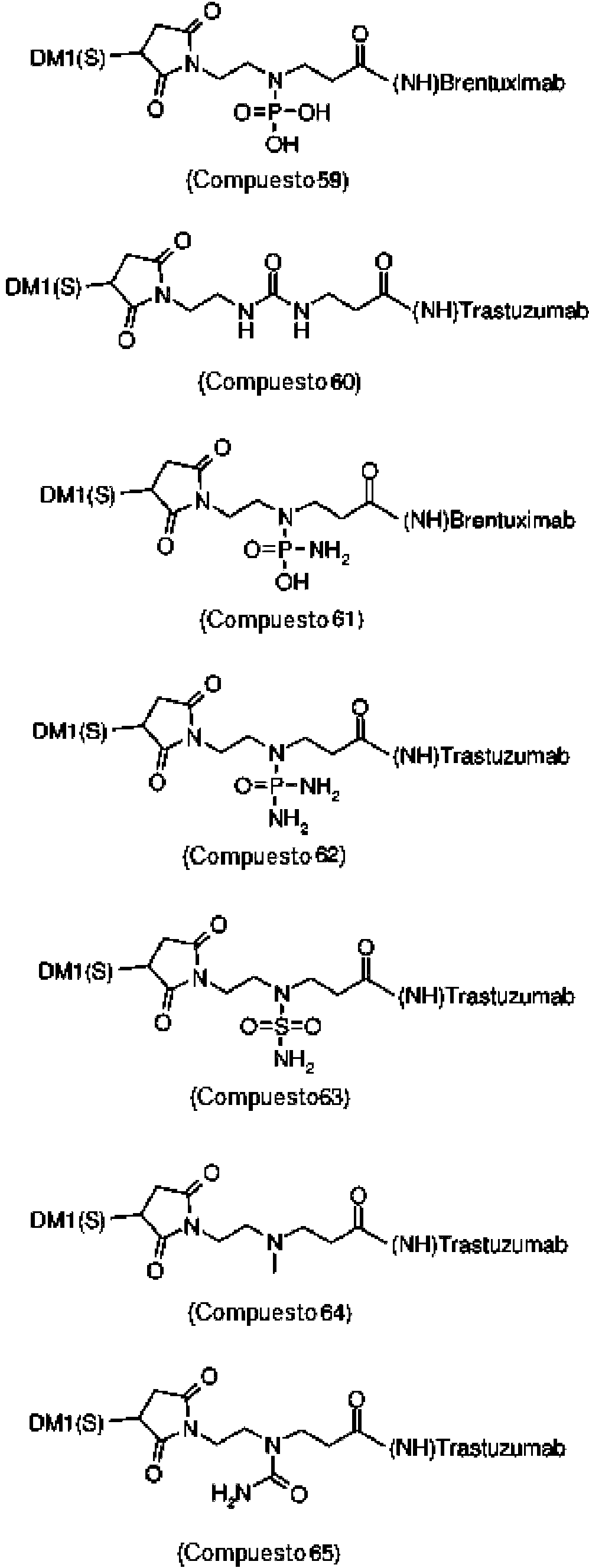
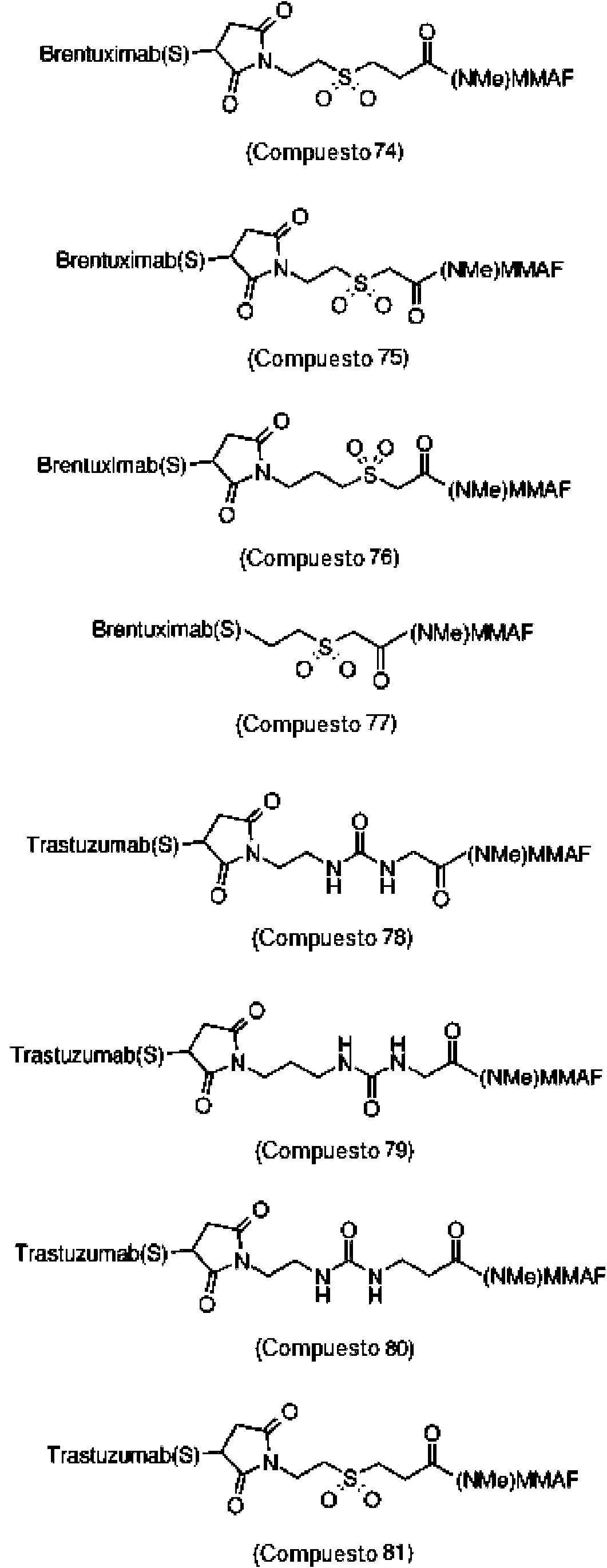

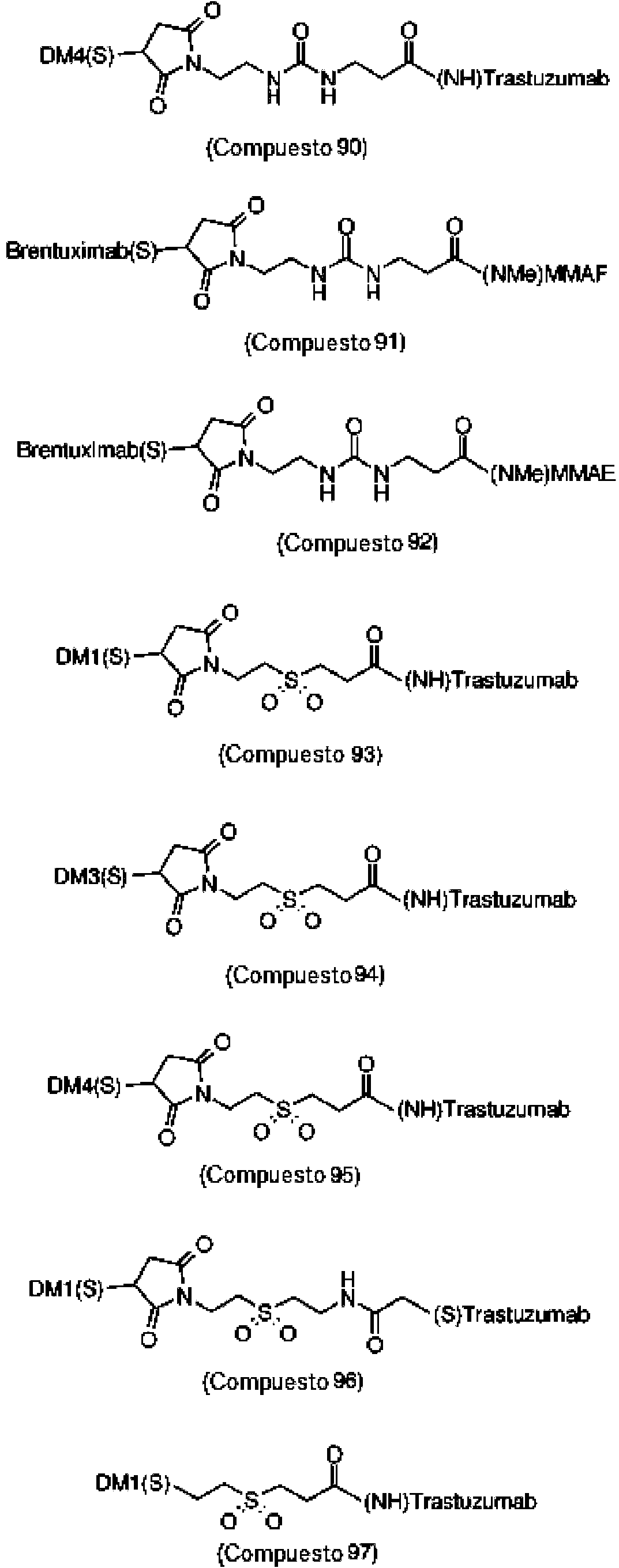

Los ejemplos de realizaciones anteriores se utilizan como ilustraciones de la divulgación. No debe entenderse que la presente divulgación se limita únicamente a los ejemplos ilustrados. La invención actualmente reclamada se define en y por las reivindicaciones adjuntas.The examples of embodiments above are used as illustrations of the disclosure. It should not be understood that the present disclosure is limited solely to the illustrated examples. The presently claimed invention is defined in and by the appended claims.
Preparación de los conjugados ligando-fármacoPreparation of ligand-drug conjugates
Los conjugados ligando-fármaco de la presente divulgación se pueden preparar uniendo el resto de fármaco, el resto de enlazador hidrófilo y el resto de ligando usando diversas técnicas sintéticas. Entre todas las aplicaciones, es ventajoso preinstalar un grupo funcional reactivo adecuado en cada extremo del enlazador hidrófilo. Los grupos funcionales preinstalados en los dos extremos del enlazador hidrófilo se utilizan para el acoplamiento covalente al resto del fármaco y al resto del ligando de unión a células. Los grupos funcionales preinstalados harán que la preparación de los conjugados ligando-fármaco sea un proceso fácilmente alcanzable.The ligand-drug conjugates of the present disclosure can be prepared by joining the drug moiety, the hydrophilic linker moiety, and the ligand moiety using various synthetic techniques. Among all applications, it is advantageous to preinstall a suitable reactive functional group at each end of the hydrophilic linker. The pre-installed functional groups at the two ends of the hydrophilic linker are used for covalent coupling to the drug moiety and the cell-binding ligand moiety. The pre-installed functional groups will make the preparation of drug-ligand conjugates an easily achievable process.
Por consiguiente, el conjugado ligando-fármaco de la presente divulgación puede construirse preparando primero el enlazador hidrófilo. En el segundo paso, el enlazador hidrófilo se acopla al fármaco citotóxico mediante un grupo funcional inherente o introducido en el fármaco, tal como un grupo amino o tiol, para dar un aducto de enlazador de fármaco. El aducto fármaco-enlazador se acopla luego al ligando de unión a células, como un anticuerpo que posee grupos funcionales adecuados, como los grupos amino en los residuos de lisina o los grupos tiol en los residuos de cisteína, para el acoplamiento covalente para dar el conjugado de ligando-fármaco deseado.Accordingly, the ligand-drug conjugate of the present disclosure can be constructed by first preparing the hydrophilic linker. In the second step, the hydrophilic linker is coupled to the cytotoxic drug via a functional group inherent in or introduced into the drug, such as an amino or thiol group, to give a drug linker adduct. The drug-linker adduct is then coupled to the cell-binding ligand, such as an antibody possessing suitable functional groups, such as amino groups on lysine residues or thiol groups on cysteine residues, for covalent coupling to give the drug. desired drug-ligand conjugate.
Alternativamente, el conjugado ligando-fármaco se puede preparar acoplando el enlazador hidrófilo al ligando de unión a células, tal como un anticuerpo que posee grupos funcionales adecuados, tales como los grupos amino en los residuos de lisina o los grupos tiol en los residuos de cisteína, para dar un aducto ligando-enlazador primero. A continuación, el aducto ligando-enlazador se acopla al fármaco citotóxico mediante un grupo funcional inherente o introducido, tal como un grupo amino o tiol en el fármaco, para dar el conjugado ligando-fármaco como producto final.Alternatively, the ligand-drug conjugate can be prepared by coupling the hydrophilic linker to the cell-binding ligand, such as an antibody, possessing suitable functional groups, such as amino groups on lysine residues or thiol groups on cysteine residues. , to give a ligand-linker adduct first. The ligand-linker adduct is then coupled to the cytotoxic drug via an inherent or introduced functional group, such as an amino or thiol group on the drug, to give the ligand-drug conjugate as the final product.
Los grupos funcionales útiles en el ligando de unión a células tales como un anticuerpo para acoplarse a un enlazador hidrófilo incluyen, pero no se limitan a, grupos tiol, amino, hidroxilo y carboxilo. Con el fin de utilizar un ligando de unión a células para la preparación de un conjugado ligando-fármaco, puede ser necesario modificar el ligando, tal como un anticuerpo, de modo que los grupos funcionales adecuados estén disponibles para acoplarse al enlazador hidrófilo. Por ejemplo, los anticuerpos generalmente no contienen tioles libres. Sin embargo, el grupo tiol puede generarse mediante la reducción de los enlaces disulfuro de cisteína intramoleculares nativos o grupos disulfuro incorporados químicamente (por ejemplo, SPDP puede usarse para incorporar grupos disulfuro) de un anticuerpo usando un agente reductor suave como DTT, derivando el grupo amino de un residuo de lisina utilizando 2-iminotiolano (reactivo de Traut), éster de metil 3-mercaptopropionimidato u otros reactivos generadores de tiol, o introduciendo residuos de cisteína no nativos adicionales en el anticuerpo utilizando técnicas de biología molecular.Useful functional groups on the cell binding ligand such as an antibody for coupling to a hydrophilic linker include, but are not limited to, thiol, amino, hydroxyl, and carboxyl groups. In order to use a cell-binding ligand for the preparation of a ligand-drug conjugate, it may be necessary to modify the ligand, such as an antibody, so that suitable functional groups are available to couple to the hydrophilic linker. For example, antibodies do not generally contain free thiols. However, the thiol group can be generated by reducing the native intramolecular cysteine disulfide bonds or chemically incorporated disulfide groups (for example, SPDP can be used to incorporate disulfide groups) of an antibody using a mild reducing agent such as DTT, derivatizing the group amino from a lysine residue using 2-iminothiolane (Traut's reagent), 3-mercaptopropionimidate methyl ester, or other thiol-generating reagents, or by introducing additional non-native cysteine residues into the antibody using molecular biology techniques.
Los grupos funcionales útiles en el ligando de unión a células tales como un anticuerpo para acoplarse a un enlazador hidrófilo también pueden ser un grupo aldehído, acetal o cetal en un residuo carbohidrato de un anticuerpo glicosilado. El residuo de carbohidrato puede oxidarse levemente usando un reactivo tal como peryodato de sodio para generar un grupo carbonilo, que puede acoplarse a un enlazador hidrófilo que contiene un grupo funcional adecuado, tal como amino, hidrazina, hidrazida, tiosemicarbazona o acilhidrazida.Useful functional groups on the cell-binding ligand such as an antibody for coupling to a hydrophilic linker may also be an aldehyde, acetal, or ketal group on a carbohydrate residue of a glycosylated antibody. The carbohydrate residue can be mildly oxidized using a reagent such as sodium periodate to generate a carbonyl group, which can be coupled to a hydrophilic linker containing a suitable functional group, such as amino, hydrazine, hydrazide, thiosemicarbazone, or acylhydrazide.
Los conjugados ligando-fármaco de la presente divulgación en los que el enlazador hidrófilo y el ligando están unidos mediante un enlace tioéter pueden prepararse acoplando un grupo tiol en el ligando a un grupo reactivo con tiol (como haloacetamida, maleimida, grupo alquenil sulfonilo, o grupo disulfuro reactivo) en el enlazador hidrófilo. Por ejemplo, para la preparación de un conjugado anticuerpo-fármaco en el que se usa MMAF como fármaco citotóxico, un anticuerpo reducido con sus grupos tiol liberados puede reaccionar con un enlazador hidrófilo que contiene maleimida para formar un enlace tioéter entre el anticuerpo y el enlazador. En el siguiente paso, el aducto anticuerpo-enlazador, que puede poseer un éster de N-hidroxisuccinimida preinstalado, puede reaccionar con MMAF para dar el conjugado de anticuerpo-fármaco deseado.Ligand-drug conjugates of the present disclosure in which the hydrophilic linker and ligand are linked via a thioether bond can be prepared by coupling a thiol group on the ligand to a thiol-reactive group (such as haloacetamide, maleimide, alkenyl sulfonyl group, or reactive disulfide group) on the hydrophilic linker. For example, for the preparation of an antibody-drug conjugate in which MMAF is used as the cytotoxic drug, a reduced antibody with its released thiol groups can be reacted with a maleimide-containing hydrophilic linker to form a thioether bond between the antibody and the linker. . In the next step, the antibody-linker adduct, which may have a preinstalled N-hydroxysuccinimide ester, can be reacted with MMAF to give the desired antibody-drug conjugate.
Los conjugados ligando-fármaco de la presente divulgación en los que el enlazador hidrófilo se acopla al ligando mediante un grupo amida pueden prepararse acoplando un grupo amino libre en el ligando a un grupo carboxilo activado en el enlazador hidrófilo. Por ejemplo, un grupo carboxilo activado formando éster de N-hidroxisuccinimida puede reaccionar con un grupo amino libre en un residuo de lisina en la reacción de acoplamiento. El enlace formado entre el ligando y el enlazador a partir de entonces es un enlace amida. Ligand-drug conjugates of the present disclosure in which the hydrophilic linker is coupled to the ligand via an amide group can be prepared by coupling a free amino group on the ligand to an activated carboxyl group on the hydrophilic linker. For example, an activated carboxyl group forming N-hydroxysuccinimide ester can react with a free amino group on a lysine residue in the coupling reaction. The bond formed between the ligand and the linker thereafter is an amide bond.
La ventaja de usar lisina o cisteína para la preparación del conjugado anticuerpo-fármaco es que es muy conveniente. Por supuesto, además de usar los grupos funcionales innatos, también se pueden usar grupos funcionales introducidos artificialmente para la preparación de conjugados de anticuerpo-fármaco de la presente divulgación. Puede usarse cualquier método para introducir un grupo funcional útil en un sitio adecuado de un anticuerpo. Estos métodos incluyen, pero no se limitan a, la incorporación de un aminoácido no natural mediante ingeniería genética (p. ej., la incorporación de un aminoácido con un grupo carbonilo y el acoplamiento al enlazador a través del grupo carbonilo), la incorporación de residuos de glutamina modificados genéticamente y acoplamiento al enlazador mediante el uso de transglutaminasa microbiana (mTG), la modificación específica del sitio de los terminales C de la cadena pesada mediante fusión de inteína y la incorporación específica del sitio de cisteínas diseñadas.The advantage of using lysine or cysteine for the preparation of the antibody-drug conjugate is that it is very convenient. Of course, in addition to using the innate functional groups, artificially introduced functional groups can also be used for the preparation of the antibody-drug conjugates of the present disclosure. Any method of introducing a useful functional group at a suitable site on an antibody can be used. These methods include, but are not limited to, incorporation of a non-natural amino acid by genetic engineering (eg, incorporation of an amino acid with a carbonyl group and coupling to the linker through the carbonyl group), incorporation of Genetically modified glutamine residues and linker coupling using microbial transglutaminase (mTG), site-specific modification of heavy chain C-terminus by intein fusion, and site-specific incorporation of engineered cysteines.
En términos generales, después de que el ligando de unión a células, como un anticuerpo, se acopla covalentemente a un enlazador hidrófilo en posiciones adecuadas, como a través de los grupos amino en los residuos de lisina o los grupos tiol en los residuos de cisteína, se necesita una etapa de purificación (p. ej., diálisis o filtración en gel) para separar el aducto ligando-enlazador deseado de la porción sin reaccionar del enlazador hidrófilo. A continuación, después de que un fármaco citotóxico que posee un grupo funcional adecuado se acopla al aducto ligando-enlazador obtenido en el primer paso, un paso de purificación adicional (p. ej., diálisis, filtración en gel, cromatografía de intercambio iónico, cromatografía de interacción hidrofóbica o combinaciones de los mismos) también pueden ser necesarios para eliminar la porción sin reaccionar del fármaco y los subproductos del conjugado anticuerpo-fármaco final.Generally speaking, after the cell-binding ligand, such as an antibody, is covalently coupled to a hydrophilic linker at suitable positions, such as through amino groups on lysine residues or thiol groups on cysteine residues , a purification step (eg, dialysis or gel filtration) is needed to separate the desired ligand-linker adduct from the unreacted portion of the hydrophilic linker. Next, after a cytotoxic drug possessing a suitable functional group is coupled to the ligand-linker adduct obtained in the first step, a further purification step (eg, dialysis, gel filtration, ion-exchange chromatography, hydrophobic interaction chromatography or combinations thereof) may also be necessary to remove the unreacted portion of the drug and by-products from the final antibody-drug conjugate.
Debido a la naturaleza hidrófoba de los fármacos citotóxicos como DM1 y DM4, puede ser necesario llevar a cabo la conjugación con el ligando de unión a células como el anticuerpo en una mezcla de tampón acuoso y disolvente orgánico. El propósito es asegurar que el fármaco citotóxico permanezca en solución durante el proceso de conjugación. Los disolventes orgánicos adecuados incluyen metanol, etanol, N, N-dimetilacetamida (DMA), N, N-dimetilformamida (DMF) y dimetilsulfóxido (DM-SO). La cantidad preferida de disolvente orgánico en el tampón acuoso es 0-30% (v / v). La conjugación se puede llevar a cabo a pH 5-9, más preferiblemente a pH 6-8. Los tampónes usados para la reacción de conjugación son tampónes con valores de pKa alrededor de este rango de pH. Se puede usar un gran exceso (5-50 veces) del resto de fármaco sobre el ligando de unión a células, como el anticuerpo, en la reacción de conjugación para obtener un conjugado con el número deseado de moléculas de fármaco en cada molécula de anticuerpo.Due to the hydrophobic nature of cytotoxic drugs such as DM1 and DM4, it may be necessary to carry out conjugation with the cell-binding ligand such as the antibody in a mixture of aqueous buffer and organic solvent. The purpose is to ensure that the cytotoxic drug remains in solution during the conjugation process. Suitable organic solvents include methanol, ethanol, N,N-dimethylacetamide (DMA), N,N-dimethylformamide (DMF), and dimethylsulfoxide (DM-SO). The preferred amount of organic solvent in the aqueous buffer is 0-30% (v/v). The conjugation can be carried out at pH 5-9, more preferably at pH 6-8. The buffers used for the conjugation reaction are buffers with pKa values around this pH range. A large excess (5-50-fold) of the drug moiety over the cell-binding ligand, such as the antibody, can be used in the conjugation reaction to obtain a conjugate with the desired number of drug molecules on each antibody molecule. .
Un proceso ejemplar para preparar los conjugados ligando-fármaco de la presente divulgación en el que el ligando es un anticuerpo es el siguiente: Primero, un enlazador hidrófilo que posee tanto un grupo éster NHS como un grupo maleimida en los dos extremos se disuelve en N, N-dimetilacetamida (DMA) a aproximadamente 20 mM. A continuación, la solución de un anticuerpo (8 mg / ml) se trata con 5-50 equiv. del enlazador hidrófilo en un tampón de fosfato de sodio (pH = 6-8, DMA al 5% en volumen). Se deja que la reacción transcurra a temperatura ambiente durante 10 min a 24 h. La porción sin reaccionar del enlazador hidrófilo se elimina del anticuerpo mediante filtración en gel usando una columna Sephadex G25 equilibrada en tampón de fosfato de potasio 150 mM que contiene NaCl 100 mM. Para la reacción de conjugación, se disuelve un maitansinoide que contiene tiol, como DM1 o DM4, en DMA a aproximadamente 10 mM. A continuación, se añade lentamente el maitansinoide (1-2 equiv. del enlazador hidrófilo) al aducto anticuerpo-enlazador (2,5 mg / ml) en tampón de fosfato de sodio (pH = 6,5-7,0, DMA al 3% en volumen) con agitación. Se deja que la reacción transcurra a temperatura ambiente durante 2-12 h. El conjugado anticuerpo-fármaco formado se purifica usando una columna Sephadex G25 equilibrada con tampón de fosfato de sodio (pH = 6,5). El número de moléculas de maitansinoide incorporadas en cada molécula de anticuerpo se evalúa midiendo A252 y A280 del conjugado anticuerpo-fármaco (Zhao, et al., J. Med. Chem., 2011, 54, 3606-3623).An exemplary process for preparing the ligand-drug conjugates of the present disclosure in which the ligand is an antibody is as follows: First, a hydrophilic linker possessing both an NHS ester group and a maleimide group at both ends is dissolved in N , N-dimethylacetamide (DMA) at about 20 mM. Next, the solution of an antibody (8 mg/ml) is treated with 5-50 equiv. of the hydrophilic linker in a sodium phosphate buffer (pH = 6-8, 5% by volume DMA). The reaction is allowed to proceed at room temperature for 10 min to 24 h. The unreacted portion of the hydrophilic linker is removed from the antibody by gel filtration using a Sephadex G25 column equilibrated in 150 mM potassium phosphate buffer containing 100 mM NaCl. For the conjugation reaction, a thiol-containing maytansinoid, such as DM1 or DM4, is dissolved in DMA at about 10 mM. Next, the maytansinoid (1-2 equiv. of the hydrophilic linker) is slowly added to the antibody-linker adduct (2.5 mg/ml) in sodium phosphate buffer (pH = 6.5-7.0, DMA al 3% by volume) with stirring. The reaction is allowed to proceed at room temperature for 2-12 h. The antibody-drug conjugate formed is purified using a Sephadex G25 column equilibrated with sodium phosphate buffer (pH = 6.5). The number of maytansinoid molecules incorporated into each antibody molecule is evaluated by measuring A252 and A280 of the antibody-drug conjugate (Zhao, et al., J. Med. Chem., 2011, 54, 3606-3623).
Un ejemplo de proceso de un paso para preparar los conjugados ligando-fármaco de la presente divulgación en el que el ligando es un anticuerpo es el siguiente: La solución de un enlazador hidrófilo (1,0 equiv.) que posee tanto un grupo éster NHS como un grupo maleimida en los dos extremos en N, N-dimetilacetamida (DMA) se agrega a un tampón PBS (pH = 6,0) que contiene un fármaco maitansinoide, como DM1 o DM4 (1,5 equiv.). La mezcla se incuba durante 45-120 min a 4-20 °C. Luego, se agrega un tampón PBS (pH = 7-8) que contiene un anticuerpo monoclonal (0,1-0,25 equiv.) al aducto de enlazador de fármaco. Después de incubar a temperatura ambiente durante 2-24 h, el conjugado anticuerpofármaco formado se purifica usando una columna Sephadex G25 equilibrada con PBS (pH = 6,5). El número de moléculas de maitansinoide incorporadas en cada molécula de anticuerpo se evalúa midiendo A252 y A280 del conjugado anticuerpo-fármaco. An example of a one-step process for preparing the ligand-drug conjugates of the present disclosure in which the ligand is an antibody is as follows: Solution of a hydrophilic linker (1.0 equiv.) possessing both an NHS ester group as a maleimide group at both N ends, N-dimethylacetamide (DMA) is added to a PBS buffer (pH = 6.0) containing a maytansinoid drug, such as DM1 or DM4 (1.5 equiv.). The mixture is incubated for 45-120 min at 4-20°C. Then, a PBS buffer (pH = 7-8) containing a monoclonal antibody (0.1-0.25 equiv.) is added to the drug linker adduct. After incubation at room temperature for 2-24 h, the antibody-drug conjugate formed is purified using a Sephadex G25 column equilibrated with PBS (pH = 6.5). The number of maytansinoid molecules incorporated into each antibody molecule is evaluated by measuring A252 and A280 of the antibody-drug conjugate.
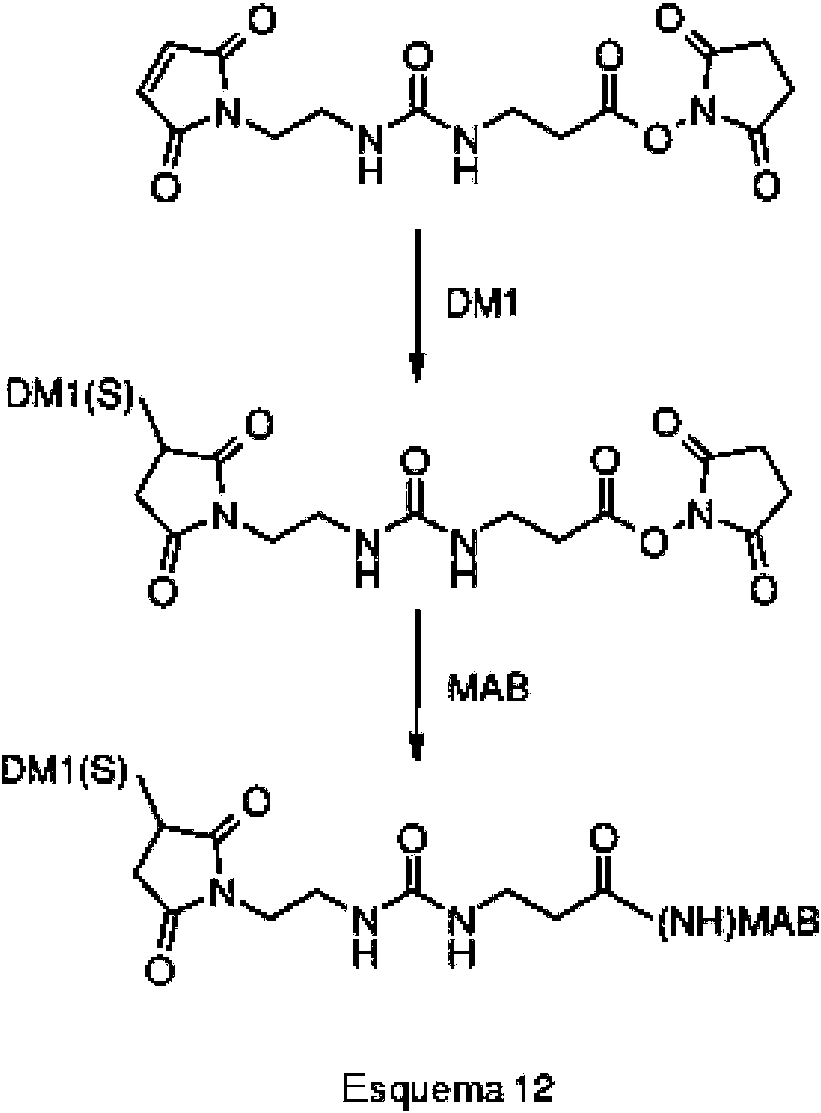
Como una realización más específica de la presente divulgación, en el primer paso, un fármaco maitansinoide que contiene tiol (DM1) reacciona con un enlazador hidrófilo para dar un aducto fármaco-enlazador formando un enlace tioéter. A continuación, el aducto fármaco-enlazador reacciona con los grupos amino de residuos de lisina en un anticuerpo (MAB) para proporcionar un conjugado anticuerpo-fármaco como producto final (Esquema 12).As a more specific embodiment of the present disclosure, in the first step, a thiol-containing maytansinoid drug (DM1) is reacted with a hydrophilic linker to give a drug-linker adduct by forming a thioether bond. The drug-linker adduct then reacts with the amino groups of lysine residues on an antibody (MAB) to provide an antibody-drug conjugate as the final product (Scheme 12).
Alternativamente, el anticuerpo (MAB) puede reaccionar primero con el enlazador hidrófilo para dar un anticuerpo unido covalentemente al enlazador mediante un enlace amida. En el siguiente paso, el fármaco maitansinoide (DM1) reacciona con el grupo funcional maleimido en el otro extremo del conector hidrófilo para dar el mismo conjugado anticuerpo-fármaco (Esquema 13). Alternatively, the antibody (MAB) may first react with the hydrophilic linker to give an antibody covalently linked to the linker via an amide bond. In the next step, the maytansinoid drug (DM1) reacts with the maleimido functional group at the other end of the hydrophilic linker to give the same antibody-drug conjugate (Scheme 13).

En otra realización de la presente divulgación (Esquema 14), se acopla un fármaco auristatina (MMAF) a un enlazador hidrófilo a través de un enlace amida en primer lugar. Luego, se conjuga un anticuerpo monoclonal (MAB) con el aducto fármaco-enlazador para dar un conjugado anticuerpo-fármaco como producto final.In another embodiment of the present disclosure (Scheme 14), an auristatin drug (MMAF) is coupled to a hydrophilic linker through an amide bond first. A monoclonal antibody (MAB) is then conjugated to the drug-linker adduct to give an antibody-drug conjugate as the final product.
En una realización alternativa de la presente divulgación (Esquema 15), un fármaco maitansinoide (DM1) reacciona primero con un enlazador hidrófilo semi-listo. Luego, después de introducir el grupo funcional necesario (éster NHS) en el otro extremo del enlazador hidrofílico, el aducto fármaco-enlazador se acopla a un anticuerpo monoclonal (MAB) a través de los grupos amino en los residuos de lisina del anticuerpo para dar el conjugado anticuerpo-fármaco como producto final. In an alternative embodiment of the present disclosure (Scheme 15), a maytansinoid drug (DM1) is first reacted with a semi-ready hydrophilic linker. Then, after introducing the necessary functional group (NHS ester) at the other end of the hydrophilic linker, the drug-linker adduct is coupled to a monoclonal antibody (MAB) through the amino groups on the lysine residues of the antibody to give the antibody-drug conjugate as the final product.

Un experto en la técnica se dará cuenta de que el mismo conjugado ligando-fármaco de la presente divulgación se puede sintetizar mediante muchos métodos diferentes. Por ejemplo, en lugar de utilizar directamente enlazadores hidrófilos que ya poseen uno o dos grupos funcionales adecuados para el propósito de reticulación, el enlazador hidrófilo también puede construirse paso a paso durante el proceso de conjugación, comenzando desde el fármaco citotóxico o el ligando de unión a células. O, el enlazador hidrófilo se puede construir paso a paso partiendo tanto del fármaco citotóxico como del ligando de unión a células. Después de unir las dos porciones en crecimiento del enlazador hidrófilo, también se completa la preparación del conjugado ligando-fármaco.One of skill in the art will appreciate that the same ligand-drug conjugate of the present disclosure can be synthesized by many different methods. For example, instead of directly using hydrophilic linkers that already possess one or two suitable functional groups for the purpose of cross-linking, the hydrophilic linker can also be built step-by-step during the conjugation process, starting from the cytotoxic drug or binding ligand. to cells. Or, the hydrophilic linker can be built step by step starting from both the cytotoxic drug and the cell-binding ligand. After joining the two growing portions of the hydrophilic linker, the preparation of the ligand-drug conjugate is also completed.
Ejemplosexamples
Los siguientes ejemplos, que son solo para ilustración detallada, no pretenden limitar el alcance de la presente divulgación.The following examples, which are for detailed illustration only, are not intended to limit the scope of this disclosure.
Ejemplo 1Example 1
Ácido 3-(2-cloro-etanosulfonil) -propiónico3-(2-Chloro-ethanesulfonyl)-propionic acid

Paso 1: Se colocó un matraz de fondo redondo de 2 L cargado con NaHSO3 (83 g, 0,80 mol) y agua (400 ml) en un baño de hielo. Se añadieron lentamente cloruro de 2-cloroetanosulfonilo (120 g, 0,74 mol) y una solución de NaOH (83 g, 2,08 mol) en agua (210 ml) al mismo tiempo que se agitaba el contenido del matraz durante 1 h. Después de 0,5 h de agitación, se añadió H2SO4 al 50% (70 ml, 0,37 mol).Step 1: A 2 L round bottom flask filled with NaHSO3 (83 g, 0.80 mol) and water (400 mL) was placed in an ice bath. 2-Chloroethanesulfonyl chloride (120 g, 0.74 mol) and a solution of NaOH (83 g, 2.08 mol) in water (210 mL) were added slowly while stirring the contents of the flask for 1 h. . After 0.5h of stirring, 50% H 2 SO 4 (70 mL, 0.37 mol) was added.
La solución se agitó durante 1 h a 0~5 °C. Luego, la mezcla de reacción se filtró y el filtrado se utilizó en la siguiente etapa.The solution was stirred for 1h at 0~5°C. The reaction mixture was then filtered and the filtrate was used in the next step.
Paso 2: Se añadió una solución de ácido acrílico (55 g, 0,76 mol) en agua (100 ml) al filtrado anterior y la mezcla se agitó durante 10 min. Se colocó en un refrigerador durante 3 días a 4 °C. La mezcla se filtró y el sólido residual se recristalizó en agua caliente para dar un polvo blanco (50 g, 0,25 mol, 33,7% de rendimiento). RMN 1H (500 MHz, MeOD): 63,96 (dd, J = 8,6, 5,4 Hz, 2H), 3,63 (t, J = 7,0 Hz, 2H), 3,49 (t, J = 7,3 Hz, 2H), 2,87-2,82 (m, 2H).Step 2: A solution of acrylic acid (55 g, 0.76 mol) in water (100 ml) was added to the above filtrate and the mixture was stirred for 10 min. It was placed in a refrigerator for 3 days at 4 °C. The mixture was filtered and the residual solid was recrystallized from hot water to give a white powder (50 g, 0.25 mol, 33.7% yield). 1H NMR (500 MHz, MeOD): 63.96 (dd, J = 8.6, 5.4 Hz, 2H), 3.63 (t, J = 7.0 Hz, 2H), 3.49 (t , J = 7.3 Hz, 2H), 2.87-2.82 (m, 2H).
Ejemplo 2Example 2
Cloruro de 3-(2-cloro-etanosulfonil) -propionilo3-(2-chloro-ethanesulfonyl)-propionyl chloride

A una solución de ácido 3-(2-cloroetilsulfonil) propionilo (16,0 g, 80,0 mmol) en cloruro de tionilo (100 ml) se le añadió DMF (0,5 ml). La mezcla se calentó a reflujo durante 2 h. Luego, se concentró para producir el compuesto del título (15,8 g, rendimiento del 90,2%) como un sólido amarillo, que se usó sin purificación adicional.To a solution of 3-(2-chloroethylsulfonyl)propionyl acid (16.0 g, 80.0 mmol) in thionyl chloride (100 mL) was added DMF (0.5 mL). The mixture was heated at reflux for 2h. It was then concentrated to give the title compound (15.8 g, 90.2% yield) as a yellow solid, which was used without further purification.
Ejemplo 3Example 3
Éster 2,5-dioxo-pirrolidin-1-ilo del ácido 3-(2-cloro-etanosulfonil) -propiónico3-(2-Chloro-ethanesulfonyl)-propionic acid, 2,5-dioxo-pyrrolidin-1-yl ester

Se añadió N-hidroxisuccinimida (6,0 g, 52,1 mmol) a trietilamina (5,5 ml, 44 mmol) y acetona (150 ml) en un baño de hielo. Después se añadió gota a gota cloruro de 3-(2-cloroetilsulfonil) propionilo (9,5 g, 43,3 mmol) en acetona (50 ml) y la suspensión resultante se agitó durante 3 h. A continuación, se retiró el baño de hielo y se agitó durante 30 min más. Se concentró hasta aproximadamente 100 ml. La mezcla resultante se vertió en agua helada (1.000 ml) y se agitó durante 3 min. El precipitado se recogió por filtración y se secó al vacío para dar el compuesto del título en forma de un polvo blanco (10,3 g, rendimiento del 80%) RMN 1H (500 MHz, MeOD): 63,94 (d, J = 6,9 Hz, 2H), 3,66 (d, J = 6,9 Hz, 2H), 3,59 (d, J = 7,5 Hz, 2 H), 3,23 (d, J = 7,5 Hz, 2 H), 2,84 (s, 4 H).N-Hydroxysuccinimide (6.0 g, 52.1 mmol) was added to triethylamine (5.5 mL, 44 mmol) and acetone (150 mL) in an ice bath. 3-(2-Chloroethylsulfonyl)propionyl chloride (9.5 g, 43.3 mmol) in acetone (50 mL) was then added dropwise and the resulting suspension stirred for 3 h. The ice bath was then removed and the mixture was stirred for an additional 30 min. It was concentrated to approximately 100 ml. The resulting mixture was poured into ice water (1,000 mL) and stirred for 3 min. The precipitate was collected by filtration and dried in vacuo to give the title compound as a white powder (10.3 g, 80% yield) 1H NMR (500 MHz, MeOD): 63.94 (d, J = 6.9 Hz, 2H), 3.66 (d, J = 6.9 Hz, 2H), 3.59 (d, J = 7.5 Hz, 2H), 3.23 (d, J = 7.5Hz, 2H), 2.84 (s, 4H).
Ejemplo 4Example 4
Éster 2,5-dioxo-pirrolidin-1-ilo del ácido 3-etenosulfonil-propiónico3-Ethenesulfonyl-propionic acid 2,5-dioxo-pyrrolidin-1-yl ester

A una solución de éster de 2,5-dioxo-pirrolidin-1-ilo del ácido 3-(2-cloro-etanosulfonil) -propiónico (2,41 g, 8,1 mmol) en acetona (50 ml) se le añadió trietilamina (1,5 ml, 10,8 mmol) en un baño de hielo. La mezcla de reacción resultante se calentó lentamente a temperatura ambiente y se agitó durante la noche. A continuación, la mezcla se concentró a presión reducida,To a solution of 3-(2-chloro-ethanesulfonyl)-propionic acid 2,5-dioxo-pyrrolidin-1-yl ester (2.41 g, 8.1 mmol) in acetone (50 mL) was added triethylamine (1.5 mL, 10.8 mmol) in an ice bath. The resulting reaction mixture slowly warmed to room temperature and stirred overnight. The mixture was then concentrated under reduced pressure,
el residuo se purificó mediante cromatografía en columna (de CH2Cl2 a CH2Cl2 / MeOH, 15: 1) para producir el compuesto del título (2,01 g, 7,69 mmol, rendimiento del 95,0%) en forma de un polvo blanco. RMN 1H (500 MHz, MeOD): 66,86 (dd, J = 16,6, 10,0 Hz, 1H), 6,42 (d,The residue was purified by column chromatography (CH 2 Cl 2 to CH 2 Cl 2 /MeOH, 15:1) to give the title compound (2.01 g, 7.69 mmol, 95.0% yield). in the form of a white powder. 1H NMR (500 MHz, MeOD): 66.86 (dd, J = 16.6, 10.0 Hz, 1H), 6.42 (d,
J = 16,6 Hz, 1 H), 6,28 (d, J = 9,9 Hz, 1H), 3,50 (t, J = 7,4 Hz, 2H), 3,12 (t, J = 4,2 Hz, 2H), 2,84 (s, 4H). MS m/z+ para [C9H11NO6S] (M+H) calculado: 262,03; encontrado: 262,0251.J = 16.6 Hz, 1H), 6.28 (d, J = 9.9 Hz, 1H), 3.50 (t, J = 7.4 Hz, 2H), 3.12 (t, J = 4.2Hz, 2H), 2.84 (s, 4H). MS m/z+ for [C 9 H 11 NO 6 S] (M+H) calcd: 262.03; found: 262.0251.
Ejemplo 5Example 5
Éster 2,5-dioxo-pirrolidin-1-ilo del ácido 3-etenosulfonil-propiónico 3-Ethenesulfonyl-propionic acid 2,5-dioxo-pyrrolidin-1-yl ester

A una solución de ácido 3- (2-cloroetilsulfonil) propionilo (3,59 g, 17,9 mmol) en DMF (50 ml) se le añadió N-hidroxisuccinimida (3,09 g, 26,8 mmol) y clorhidrato de 1 -etil-3-(3-dimetilaminopropilo) carbodiimida (6,80 g, 35,8 mmol) en un baño de hielo. La solución resultante se calentó a temperatura ambiente durante 15 min. Después de agitar durante 3 h, la mezcla se concentró a presión reducida, el residuo se purificó mediante cromatografía en columna (de CH2Cl2 a CH2Cl2 / MeOH = 15: 1) para producir éster de 2,5-dioxo-pirrolidin-1-ilo del ácido 3-etenosulfonil-propiónico (2,87 g, 11,0 mmol, rendimiento del 61,5%) como un polvo blanco. La reacción también proporcionó éster de 2,5-dioxopirrolidin-1-ilo del ácido 3- (2-cloro-etanosulfonil) -propiónico como un producto secundario (0,84 g, 2,82 mmol, rendimiento del 15,8%, véase el Ejemplo 3).To a solution of 3-(2-chloroethylsulfonyl)propionyl acid (3.59 g, 17.9 mmol) in DMF (50 mL) was added N-hydroxysuccinimide (3.09 g, 26.8 mmol) and hydrochloride 1-ethyl-3-(3-dimethylaminopropyl)carbodiimide (6.80 g, 35.8 mmol) in an ice bath. The resulting solution was warmed to room temperature for 15 min. After stirring for 3 h, the mixture was concentrated under reduced pressure, the residue was purified by column chromatography (CH 2 Cl 2 to CH 2 Cl 2 / MeOH = 15: 1) to yield 2,5-dioxo ester 3-Ethenesulfonyl-propionic acid -pyrrolidin-1-yl (2.87 g, 11.0 mmol, 61.5% yield) as a white powder. The reaction also provided 3-(2-chloro-ethanesulfonyl)-propionic acid 2,5-dioxopyrrolidin-1-yl ester as a side product (0.84 g, 2.82 mmol, 15.8% yield, see Example 3).
Ejemplo 6Example 6
Éster metílico del ácido 2,5-dioxo-2,5-dihidro-pirrol-1 -carboxílico2,5-dioxo-2,5-dihydro-pyrrole-1-carboxylic acid methyl ester

Se disolvió maleimida (12,0 g, 123,7 mmol) en acetato de etilo (150 ml) en un matraz de fondo redondo de 250 ml y la solución se enfrió a aproximadamente 0 °C. Se añadió gota a gota una solución de N-metilmorfolina (14,1 ml, 12,8 g, 126,2 mmol) en acetato de etilo (10 ml) durante 15 min. Se añadió gota a gota una solución de cloroformiato de metilo (9,60 ml, 11,5 g, 123,7 mmol) en acetato de etilo (50 ml) y la solución se calentó a temperatura ambiente y se agitó durante 2 h. La solución se diluyó con acetato de etilo (100 ml) y se lavó con una solución acuosa saturada de bicarbonato de sodio, agua y una solución saturada de cloruro de sodio. La capa orgánica se separó, se secó sobre Na2SO4 y se filtró. El sobrenadante se concentró a presión reducida para producir el compuesto del título como un sólido (15,9 g, 102,5 mmol, rendimiento del 82,9%). RMN 1H (500 MHz, CDCla): 66,84 (s, 2 H), 3,97 (s, 3 H).Maleimide (12.0 g, 123.7 mmol) was dissolved in ethyl acetate (150 mL) in a 250 mL round bottom flask and the solution cooled to ca. A solution of N-methylmorpholine (14.1 mL, 12.8 g, 126.2 mmol) in ethyl acetate (10 mL) was added dropwise over 15 min. A solution of methyl chloroformate (9.60 mL, 11.5 g, 123.7 mmol) in ethyl acetate (50 mL) was added dropwise and the solution was warmed to room temperature and stirred for 2 h. The solution was diluted with ethyl acetate (100 ml) and washed with saturated aqueous sodium bicarbonate solution, water and saturated sodium chloride solution. The organic layer was separated, dried over Na2SO4 and filtered. The supernatant was concentrated under reduced pressure to give the title compound as a solid (15.9 g, 102.5 mmol, 82.9% yield). 1H NMR (500 MHz, CDCla): 66.84 (s, 2H), 3.97 (s, 3H).
Ejemplo 7Example 7
Éster terc-butílico del ácido [2-(2,5-dioxo-2,5-dihidro-pirrol-1-il) -etil] -carbámico[2-(2,5-dioxo-2,5-dihydro-pyrrol-1-yl)-ethyl]-carbamic acid tert-butyl ester

Se disolvió N-Boc-etilendiamina (2,0 g, 12,48 mmol) en una solución saturada de NaHCO3 (50 ml) y se enfrió a 0 °C. Se añadió N-(metoxicarbonil) maleimida (1,9 g, 12,25 mmol) a la solución agitada. Después de 10 minutos, la mezcla de reacción se diluyó con agua (100 ml) y se agitó durante 30 minutos a temperatura ambiente. La mezcla de reacción se enfrió a 0 °C y la mezcla de reacción se filtró y se lavó con agua helada (100 ml). El secado a alto vacío proporcionó el compuesto del título (2,35 g, 9,78 mmol, 78,4% de rendimiento) en forma de un sólido blanco. RMN 1H (500 MHz, CDCla): 66,71 (s, 2H), 4,72 (s, 1 H), 3,69-3,62 (m, 2H), 3,34 (d, J = 5,1 Hz, 2H), 1,41 (s, 9H).N-Boc-ethylenediamine (2.0 g, 12.48 mmol) was dissolved in saturated NaHCO3 solution (50 mL) and cooled to 0 °C. N-(methoxycarbonyl)maleimide (1.9 g, 12.25 mmol) was added to the stirred solution. After 10 minutes, the reaction mixture was diluted with water (100 ml) and stirred for 30 minutes at room temperature. The reaction mixture was cooled to 0°C and the reaction mixture was filtered and washed with ice water (100 mL). High vacuum drying provided the title compound (2.35 g, 9.78 mmol, 78.4% yield) as a white solid. 1H NMR (500 MHz, CDCla): 66.71 (s, 2H), 4.72 (s, 1H), 3.69-3.62 (m, 2H), 3.34 (d, J = 5 0.1 Hz, 2H), 1.41 (s, 9H).
Ejemplo 8Example 8
Clorhidrato de 1-(2-amino-etil) -p i rrol-2,5-diona1-(2-amino-ethyl)-pyrrole-2,5-dione hydrochloride

Se disolvió N-(2 -((terc-butoxicarbonil) amino) etil) maleimida (750 mg, 3,12 mmol) en HCl 4 M en acetato de etilo (20 ml) y se agitó durante 8 h a temperatura ambiente. Luego, la adición de éter dietílico a 0 °C proporcionó el compuesto del título como un precipitado blanco (524 mg, 2,97 mmol, rendimiento del 95,2 %). RMN 1H (500 MHz, MeOD): 66,90 (s, 2H), 3,83-3,79 (m, 2H), 3,17-3,13 (m, 2H).N-(2-((tert-butoxycarbonyl)amino)ethyl)maleimide (750 mg, 3.12 mmol) was dissolved in 4M HCl in ethyl acetate (20 mL) and stirred for 8 h at room temperature. Then addition of diethyl ether at 0 °C gave the title compound as a white precipitate (524 mg, 2.97 mmol, 95.2% yield). 1H NMR (500 MHz, MeOD): 66.90 (s, 2H), 3.83-3.79 (m, 2H), 3.17-3.13 (m, 2H).
Ejemplo 9Example 9
Éster terc-butílico del ácido 3-isocianato-propiónico3-Isocyanato-propionic acid tert-butyl ester

Se añadió trifosgeno (940 mg, 3,20 mmol) a una mezcla de hidrocloruro de éster de 1, 1 -dimetiletilo (820 mg, 4,50 mmol) en CH2Cl2 (20 ml) y NaHCO3 saturado (20 ml). La reacción se agitó a 0 °C durante 30 minutos. La fase orgánica se separó y la fase acuosa se extrajo con CH2Cl2 (2 x 20 ml). La fase orgánica combinada se secó (Na2SO4), se filtró y se concentró al vacío para dar un aceite fino que se usó sin purificación para la siguiente reacción.Triphosgene (940 mg, 3.20 mmol) was added to a mixture of 1,1-dimethylethyl ester hydrochloride (820 mg, 4.50 mmol) in CH 2 Cl 2 (20 mL) and saturated NaHCO3 (20 mL). . The reaction was stirred at 0°C for 30 minutes. The organic phase was separated and the aqueous phase was extracted with CH 2 Cl 2 (2 x 20 mL). The combined organic layer was dried (Na2SO4), filtered and concentrated in vacuo to give a fine oil which was used without purification for the next reaction.
Ejemplo 10Example 10
Éster terc-butílico del ácido 3- {3-[2-(2,5-dioxo-2,5-dihidro-pirrol-1 -il) -etil] -ureido} -propiónico3-{3-[2-(2,5-dioxo-2,5-dihydro-pyrrol-1-yl)-ethyl]-ureido}-propionic acid tert-butyl ester

Se disolvió clorhidrato de N-(2-aminoetil) maleimida (635,7 mg, 3,60 mmol) en CH2Cl2 (20 ml) y DIPEA (1,5 ml, 88,1 mmol) y la solución se enfrió a aproximadamente 0 °C. Se añadió una solución de éster de 3-isocianato-1,1 -dimetiletilo (preparada en la etapa anterior) en CH2Cl2 (10 ml). La mezcla resultante se agitó durante 10 min a temperatura ambiente. La reacción se concentró al vacío. La purificación del residuo por cromatografía en columna (de CH2Cl2 a CH2Cl2 / MeOH = 15: 1) proporcionó el compuesto del título (910 mg, 2,93 mmol, rendimiento del 71,4%) en forma de un polvo blanco. RMN 1H (500 MHz, CDCla): 66,71 (s, 2H), 3,68 - 3,64 (m, 2H), 3,41-3,38 (m, 2H), 3,37 (t, J = 5,9 Hz, 2H), 2,42 (t, J = 5,7 Hz, 2H), 1,44 (s, 9 H). MS m/z+ para [C14H21N3O5] (M+H) calculado: 312,33; encontrado: 312,1590. N-(2-aminoethyl)maleimide hydrochloride (635.7 mg, 3.60 mmol) was dissolved in CH 2 Cl 2 (20 mL) and DIPEA (1.5 mL, 88.1 mmol) and the solution was cooled. at about 0°C. A solution of 3-isocyanato-1,1-dimethylethyl ester (prepared in the previous step) in CH 2 Cl 2 (10 mL) was added. The resulting mixture was stirred for 10 min at room temperature. The reaction was concentrated in vacuo. Purification of the residue by column chromatography (CH 2 Cl 2 to CH 2 Cl 2 / MeOH = 15:1) provided the title compound (910 mg, 2.93 mmol, 71.4% yield) as a white powder. 1H NMR (500 MHz, CDCla): 66.71 (s, 2H), 3.68-3.64 (m, 2H), 3.41-3.38 (m, 2H), 3.37 (t, J = 5.9 Hz, 2H), 2.42 (t, J = 5.7 Hz, 2H), 1.44 (s, 9H). MS m/z+ for [C 14 H 21 N 3 O 5 ] (M+H) calcd: 312.33; found: 312.1590.
Ejemplo 11Example 11
Ácido 3- {3-[2-(2,5-dioxo-2,5-dihidro-pirrol-1 -il) -etil] -ureido} -propiónico3-{3-[2-(2,5-dioxo-2,5-dihydro-pyrrol-1-yl)-ethyl]-ureido}-propionic acid

Se disolvió éster terc-butílico del ácido 3- {3-[2-(2,5-dioxo-2,5-dihidro-pirrol-1 -il) -etil] -ureido} -propiónico (458 mg, 1,47 mmol) en HCl 4 M en CH2Cl2 (10 ml) y se agitó durante 8 h a temperatura ambiente. Después de que la mezcla se concentró al vacío, la adición de CH2Cl2 a 0° C proporcionó el compuesto del título como un precipitado blanco (352 mg, 1,38 mmol, rendimiento del 93,9%), que se usó sin purificación para la siguiente reacción.Dissolved 3-{3-[2-(2,5-dioxo-2,5-dihydro-pyrrol-1-yl)-ethyl]-ureido}-propionic acid tert-butyl ester (458 mg, 1.47 mmol) in 4M HCl in CH 2 Cl 2 (10 mL) and stirred for 8 h at room temperature. After the mixture was concentrated in vacuo, addition of CH 2 Cl 2 at 0°C gave the title compound as a white precipitate (352 mg, 1.38 mmol, 93.9% yield), which was used without purification for the next reaction.
Ejemplo 12Example 12
Éster 2,5-dioxo-pirrolidin-1-ilo del ácido 3- {3-[2-(2,5-dioxo-2,5-dihidro-pirrol-1-il) -etil] -ureido} -propiónico3-{3-[2-(2,5-dioxo-2,5-dihydro-pyrrol-1-yl)-ethyl]-ureido}-propionic acid 2,5-dioxo-pyrrolidin-1-yl ester

A N-[[(3-maleimido) etil] amino] carbonil-p-alanina (55 mg, 0,216 mmol) en DMA (5 ml) se le añadió N-hidroxisuccimida (25 mg, 0,217 mmol) y EDC (100 mg, 0,526 mmol). La mezcla se agitó durante la noche a temperatura ambiente. La mezcla se concentró a presión reducida. El residuo se purificó mediante cromatografía en columna (de CH2Cl2 a CH2Cl2 / EtOAc = 9: 1) para producir el producto del título (69,7 mg, 198 mmol, 91,7% de rendimiento) como un sólido blanco. RMN 1H (500 MHz, CDCla): 66,70 (s, 2H), 3,64-3,59 (m, 2H), 3,53 (t, J = 5,8 Hz), 3,38 (t, J = 5,6 Hz, 2H), 2,86 (s, 4H), 2,78 (t, J = 5,8 Hz, 2H). MS m/z+ para [C14H16N4O7] (M+H) calculado: 353,30; encontrado: 353,1070. To N-[[(3-maleimido)ethyl]amino]carbonyl-p-alanine (55 mg, 0.216 mmol) in DMA (5 mL) was added N-hydroxysuccimide (25 mg, 0.217 mmol) and EDC (100 mg , 0.526mmol). The mixture was stirred overnight at room temperature. The mixture was concentrated under reduced pressure. The residue was purified by column chromatography (CH 2 Cl 2 to CH 2 Cl 2 /EtOAc=9:1) to give the title product (69.7 mg, 198 mmol, 91.7% yield) as a white solid. 1H NMR (500 MHz, CDCla): 66.70 (s, 2H), 3.64-3.59 (m, 2H), 3.53 (t, J = 5.8 Hz), 3.38 (t , J = 5.6 Hz, 2H), 2.86 (s, 4H), 2.78 (t, J = 5.8 Hz, 2H). MS m/z+ for [C 14 H 16 N 4 O 7 ] (M+H) calcd: 353.30; found: 353.1070.
Ejemplo 13Example 13
Éster terc-butílico del ácido (3-hidroxi-propilsulfanil) -acético(3-Hydroxy-propylsulfanyl)-acetic acid tert-butyl ester

Se disolvieron bromoacetato de terc-butilo (3,0 g, 15,4 mmol) y trietilamina (3,2 g, 31,8 mol) en CH2Cl2 (30 ml) bajo nitrógeno y se enfriaron a 0 °C. Se añadió lentamente 3-mercapto-1 -etanol (1,48 g, 16,0 mol) a la mezcla y la mezcla de reacción se calentó a temperatura ambiente. La reacción se agitó durante 1 hora más. La finalización de la reacción se controló mediante TLC (acetato de etilo / hexano = 1: 1 (v / v), Rf = 0,80). La solución se lavó con una solución acuosa saturada de bicarbonato de sodio (30 ml x 2), agua y una solución saturada de cloruro de sodio. La capa orgánica se separó, se secó sobre Na2SO4 y se filtró. El sobrenadante se concentró a presión reducida para producir el compuesto del título como un aceite incoloro (2,53 g, 79,8% de rendimiento). RMN 1H (500 MHz, CDCb): 6 (ppm) 3,74 (t, J = 6,0 Hz, 2H), 3,13 (s, 2H), 2,74 (t, J = 7,1 Hz, 2H), 1,87-1,82 (m, 2H), 1,45 (s, 9H).tert-Butyl bromoacetate (3.0 g, 15.4 mmol) and triethylamine (3.2 g, 31.8 mol) were dissolved in CH 2 Cl 2 (30 mL) under nitrogen and cooled to 0 °C. 3-Mercapto-1-ethanol (1.48 g, 16.0 mol) was slowly added to the mixture and the reaction mixture was warmed to room temperature. The reaction was stirred for an additional 1 hour. The completion of the reaction was monitored by TLC (ethyl acetate/hexane=1:1 (v/v), Rf=0.80). The solution was washed with a saturated aqueous sodium bicarbonate solution (30 ml x 2), water and a saturated sodium chloride solution. The organic layer was separated, dried over Na2SO4 and filtered. The supernatant was concentrated under reduced pressure to give the title compound as a colorless oil (2.53 g, 79.8% yield). 1H NMR (500 MHz, CDCb): 6 (ppm) 3.74 (t, J = 6.0 Hz, 2H), 3.13 (s, 2H), 2.74 (t, J = 7.1 Hz , 2H), 1.87-1.82 (m, 2H), 1.45 (s, 9H).
Ejemplo 14Example 14
Éster terc-butílico del ácido (3-hidroxi-propano-1-sulfonil) -acético(3-Hydroxy-propane-1-sulfonyl)-acetic acid tert-butyl ester

Se disolvió éster terc-butílico del ácido (3-hidroxi-propilsulfanil) -acético (3,70 g, 17,96 mmol) en DCM seco (70 ml) y se enfrió a -10 °C. A la mezcla de reacción agitada se le añadió mCPBA (7,4 g, 42,88 mmol) lentamente durante 30 minutos y la mezcla se agitó durante 48 h más a temperatura ambiente. A continuación, se añadieron Na2S2O3 (10 ml, sat.) y Na2CO3 (10 ml, sat.) y la reacción se agitó durante 2 h a temperatura ambiente. La solución se lavó con una solución de NaOH 1 M (30 ml x 2), una solución acuosa saturada de bicarbonato de sodio y una solución saturada de cloruro de sodio. La fase orgánica se secó sobre Na2SO4. Después de la evaporación del disolvente, el material bruto se purificó mediante cromatografía ultrarrápida en gel de sílice (DCM / MeOH = 50: 1) para dar el compuesto del título como un aceite incoloro (3,85 g, rendimiento del 89,8%). Rm N 1H (500 MHz, CDCb): 6 (ppm) 3,84 (s, 2H), 3,61 (t, J = 6,0 Hz, 2H), 3,30-3,23 (m, 2H), 1,99-1,90 (m, 2H), 1,38 (s, 9H).(3-Hydroxy-propylsulfanyl)-acetic acid tert-butyl ester (3.70 g, 17.96 mmol) was dissolved in dry DCM (70 mL) and cooled to -10 °C. To the stirred reaction mixture, mCPBA (7.4 g, 42.88 mmol) was added slowly over 30 min, and the mixture was stirred for an additional 48 h at room temperature. Na2S2O3 (10 mL, sat.) and Na2CO3 (10 mL, sat.) were then added and the reaction stirred for 2 h at room temperature. The solution was washed with 1M NaOH solution (30 mL x 2), saturated sodium bicarbonate aqueous solution and saturated sodium chloride solution. The organic phase was dried over Na2SO4. After evaporation of the solvent, the crude material was purified by flash chromatography on silica gel (DCM/MeOH=50:1) to give the title compound as a colorless oil (3.85 g, 89.8% yield). ). Rm N 1H (500 MHz, CDCb): 6 (ppm) 3.84 (s, 2H), 3.61 (t, J = 6.0 Hz, 2H), 3.30-3.23 (m, 2H ), 1.99-1.90 (m, 2H), 1.38 (s, 9H).
Ejemplo 15Example 15
Éster terc-butílico del ácido [3-(3,5-dioxo-10-oxa-4-aza-triciclo [5.2.1.02,6] dec-8-en-4-il) -propano-1-sulfonil] -acético[3-(3,5-dioxo-10-oxa-4-aza-tricyclo[5.2.1.02.6] dec-8-en-4-yl)-propane-1-sulfonyl] acid tert-butyl ester - acetic

Una mezcla de trifenilfosfina (1,57 g, 6,0 mmol), 2,2-dimetipropan-1-ol (0,3 g, 3,5 mmol), éster terc-butílico del ácido (3-hidroxi-propano-1-sulfonil) -acético (1,50 g, 6,3 mmol) y 7-oxabiciclo (2.2.1) hept-5-eno-2,3-dicarboximida (1,00 g, 5,7 mmol) se disolvió en THF (20 ml) a -78 °C bajo N2, y el resultado la mezcla se agitó durante 5 min. A la mezcla de reacción se le añadió DIAD (1,9 M en tolueno, 3,0 ml). Después de agitar durante 15 min, la mezcla de reacción se dejó calentar lentamente a temperatura ambiente y se agitó durante la noche. Luego, la mezcla se concentró a presión reducida. El residuo se purificó mediante cromatografía en columna (de CH2Cl2 a CH2Cl2 / EtOAc = 10: 1) para producir el compuesto del título (1,03 g, 46,9% de rendimiento) como un sólido blanco. RMN 1H (500 MHz, CDCb): 6 (ppm) 6,47 (s, 2H), 5,22 (s, 2H), 3,83 (s, 2H), 3,60 (t, J = 6,7 Hz, 2H), 3,23 - 3,18 (m, 2H), 2,84 (s, 2H), 2,14 - 2,07 (m, 2H), 1,46 (s, 9H).A mixture of triphenylphosphine (1.57 g, 6.0 mmol), 2,2-dimethylpropan-1-ol (0.3 g, 3.5 mmol), (3-hydroxy-propane- 1-sulfonyl)-acetic acid (1.50 g, 6.3 mmol) and 7-oxabicyclo(2.2.1)hept-5-ene-2,3-dicarboximide (1.00 g, 5.7 mmol) were dissolved in THF (20 mL) at -78 °C under N 2 , and the resulting mixture was stirred for 5 min. DIAD (1.9M in toluene, 3.0 mL) was added to the reaction mixture. After stirring for 15 min, the reaction mixture was allowed to slowly warm to room temperature and stirred overnight. Then, the mixture was concentrated under reduced pressure. The residue was purified by column chromatography (CH 2 Cl 2 to CH 2 Cl 2 /EtOAc=10:1) to give the title compound (1.03 g, 46.9% yield) as a white solid. 1H NMR (500 MHz, CDCb): 6 (ppm) 6.47 (s, 2H), 5.22 (s, 2H), 3.83 (s, 2H), 3.60 (t, J = 6, 7 Hz, 2H), 3.23-3.18 (m, 2H), 2.84 (s, 2H), 2.14-2.07 (m, 2H), 1.46 (s, 9H).
Ejemplo 16Example 16
Éster terc-butílico del ácido [3-(2,5-dioxo-2,5-dihidro-pirrol-1 -il) -propano-1-sulfonil] -acético [3-(2,5-Dioxo-2,5-dihydro-pyrrol-1-yl)-propane-1-sulfonyl]-acetic acid tert-butyl ester
Una solución agitada de éster terc-butílico del ácido [3-(3,5-dioxo-10-oxa-4-aza-triciclo [5.2.1.02,6] dec-8-en-4-il) -propano-1-sulfonil] -acético (0,50 g, 1,30 mmol) en tolueno (20 ml) se calentó a reflujo durante la noche. La mezcla se concentró a presión reducida y el residuo se purificó por cromatografía en columna (n-Hex / EtOAc = 10: 1) para proporcionar el producto deseado (0,38 g, 92,1% de rendimiento) como un sólido blanco. RMN 1H (500 MHz, CDCb): 6 (ppm) 6,73 (s, 2H), 3,85 (s, 2H), 3,69 (t, J = 6,7 Hz, 2H), 3,29 - 3,24 (m, 2H), 2,84 (s, 2H), 2,20 - 2,14 (m, 2H), 1,49 (s, 9H).A stirred solution of [3-(3,5-dioxo-10-oxa-4-aza-tricyclo[5.2.1.02.6]dec-8-en-4-yl)-propane-1 acid tert-butyl ester -sulfonyl]-acetic acid (0.50 g, 1.30 mmol) in toluene (20 mL) was refluxed overnight. The mixture was concentrated under reduced pressure and the residue was purified by column chromatography (n-Hex/EtOAc=10:1) to give the desired product (0.38 g, 92.1% yield) as a white solid. 1H NMR (500 MHz, CDCb): 6 (ppm) 6.73 (s, 2H), 3.85 (s, 2H), 3.69 (t, J = 6.7 Hz, 2H), 3.29 - 3.24 (m, 2H), 2.84 (s, 2H), 2.20 - 2.14 (m, 2H), 1.49 (s, 9H).
Ejemplo 17Example 17
Ácido [3-(2,5-dioxo-2,5-dihidro-pirrol-1-il) -propano-1-sulfonil] -acético[3-(2,5-dioxo-2,5-dihydro-pyrrol-1-yl)-propane-1-sulfonyl]-acetic acid

Se disolvió éster terc-butílico del ácido [3-(2,5-dioxo-2,5-dihidro-pirrol-1-il) -propano-1-sulfonil] -acético (0,35 g, 1,10 mmol) en TFA (5 ml) en CH2Cl2 (10 ml) y se agitó durante 8 h a temperatura ambiente. Después de que la mezcla se concentrara al vacío, la adición de CH2Cl2 a 0 °C proporcionó el compuesto del título como un precipitado blanco (0,27 g, 94,0% de rendimiento), que se usó sin purificación para la siguiente reacción. RMN 1H (500 MHz, CDCb): 6 (ppm) 6,85 (s, 2H), 4,16 (s, 2H), 3,68 (t, J = 6,7 Hz, 2H), 3,39 - 3,35 (m, 2H), 2,61 - 2,10 (m, 2H).Dissolved [3-(2,5-dioxo-2,5-dihydro-pyrrol-1-yl)-propane-1-sulfonyl]-acetic acid tert-butyl ester (0.35 g, 1.10 mmol) in TFA (5 ml) in CH 2 Cl 2 (10 ml) and stirred for 8 h at room temperature. After the mixture was concentrated in vacuo, addition of CH 2 Cl 2 at 0 °C provided the title compound as a white precipitate (0.27 g, 94.0% yield), which was used without purification for the next reaction. 1H NMR (500 MHz, CDCb): 6 (ppm) 6.85 (s, 2H), 4.16 (s, 2H), 3.68 (t, J = 6.7 Hz, 2H), 3.39 -3.35 (m, 2H), 2.61-2.10 (m, 2H).
Ejemplo 18Example 18
Éster 2,5-dioxo-pirrolidin-1-ilo del ácido [3-(2,5-Dioxo-2,5-dihidro-pirrol-1-il) -propano-1-sulfonil] -acético[3-(2,5-Dioxo-2,5-dihydro-pyrrol-1-yl)-propane-1-sulfonyl]-acetic acid 2,5-dioxo-pyrrolidin-1-yl ester

A ácido [3-(2,5-Dioxo-2,5-dihidro-pirrol-1-il) -propano-1-sulfonil] -acético (130 mg, 0,50 mmol) en DCM (5 ml) se le añadió N- hidroxisuccimida (69 mg, 0,60 mmol) y EDC (190 mg, 1,00 mmol). La mezcla se agitó durante la noche a temperatura ambiente. La mezcla se concentró a presión reducida y el residuo se purificó mediante cromatografía en columna (de CH2Cl2 a CH2Cl2 / MeOH = 10: 1) para proporcionar el producto deseado (151 mg, 84,6% de rendimiento) como un sólido blanco. RMN 1H (500 MHz, CDCla) 6 (ppm) 6,71 (s, 2H), 3,65 (t, J = 6,8 Hz, 2H), 3,38 (t, J = 5,6 Hz, 2H), 3,32 - 3,26 (m, 2H), 2,71 (s, 4H), 2,16 - 2,07 (m, 2 H).[3-(2,5-Dioxo-2,5-dihydro-pyrrol-1-yl)-propane-1-sulfonyl]-acetic acid (130 mg, 0.50 mmol) in DCM (5 mL) was added. added N-hydroxysuccimide (69 mg, 0.60 mmol) and EDC (190 mg, 1.00 mmol). The mixture was stirred overnight at room temperature. The mixture was concentrated under reduced pressure and the residue was purified by column chromatography (CH 2 Cl 2 to CH 2 Cl 2 / MeOH = 10:1) to give the desired product (151 mg, 84.6% yield). as a white solid. 1H NMR (500 MHz, CDCla) 6 (ppm) 6.71 (s, 2H), 3.65 (t, J = 6.8 Hz, 2H), 3.38 (t, J = 5.6 Hz, 2H), 3.32-3.26 (m, 2H), 2.71 (s, 4H), 2.16-2.07 (m, 2H).
Ejemplo 19Example 19
Un conjugado de anticuerpo-fármaco (DX-111)An antibody-drug conjugate (DX-111)

Éster de 2,5-dioxo-pirrolidin-1-ilo del ácido 3-13-[2-(2,5-dioxo-2,5-dihidro-pirrol-1-il) -etil] -ureido} -propiónico (Ejemplo 12) se disolvió en DMA (N, N-dimetilacetamida) a una concentración de aproximadamente 10 mM. El trastuzumab (Herceptina) se dializó en un tampón (Tampón A: NaH2PO450 mM, NaCl 50 mM, EDTA 2 mM, pH 6,5). Para acoplar el enlazador al anticuerpo, a una solución agitada del anticuerpo a 5 mg / ml se añadieron 7 equivalentes del enlazador en una concentración final de DMA al 5% (v / v). Se dejó que la reacción prosiguiera a temperatura ambiente durante 90 minutos. El enlazador sin reaccionar se eliminó mediante filtración en gel usando una columna Sephadex G25 equilibrada con Tampón A a pH 6,5. Luego, se añadió lentamente una solución 10 mM de DM1 en DMA (1,5 equiv. del enlazador hidrófilo) a una solución agitada del aducto anticuerpo-enlazador que estaba a una concentración de 2,5 mg / ml en Tampón A (pH 7,4) en una concentración final de 3% (v / v) de DMA. Se dejó que la reacción prosiguiera a temperatura ambiente durante 4 horas. El conjugado anticuerpo-fármaco formado se purificó mediante una columna Sephadex G25 equilibrada con PBS (NaH2PO4100 mM, NaCl 50 mM, pH 6,5). El número medio de fármacos en cada anticuerpo fue de 3,5, que se evaluó midiendo A254 y A280 del conjugado (Zhao, et al., J. Med. Chem., 2011, 54, 3606~3623). 3-13-[2-(2,5-dioxo-2,5-dihydro-pyrrol-1-yl)-ethyl]-ureido}-propionic acid, 2,5-dioxo-pyrrolidin-1-yl ester ( Example 12) was dissolved in DMA (N,N-dimethylacetamide) at a concentration of about 10 mM. Trastuzumab (Herceptin) was dialyzed into buffer (Buffer A: 50 mM NaH2PO, 50 mM NaCl, 2 mM EDTA, pH 6.5). To couple the linker to the antibody, 7 equivalents of the linker in a final concentration of 5% (v/v) DMA were added to a stirred 5 mg/ml solution of the antibody. The reaction was allowed to proceed at room temperature for 90 minutes. Unreacted linker was removed by gel filtration using a Sephadex G25 column equilibrated with Buffer A at pH 6.5. Then, a 10 mM solution of DM1 in DMA (1.5 equiv. of the hydrophilic linker) was added slowly to a stirred solution of the antibody-linker adduct that was at a concentration of 2.5 mg/ml in Buffer A (pH 7 ,4) in a final concentration of 3% (v/v) DMA. The reaction was allowed to proceed at room temperature for 4 hours. The antibody-drug conjugate formed was purified using a Sephadex G25 column equilibrated with PBS (100 mM NaH2PO4, 50 mM NaCl, pH 6.5). The mean number of drugs in each antibody was 3.5, which was evaluated by measuring A254 and A280 of the conjugate (Zhao, et al., J. Med. Chem., 2011, 54, 3606~3623).
Ejemplo 20Example 20
Un conjugado de anticuerpo-fármaco (DX-112)An antibody-drug conjugate (DX-112)

Se disolvió éster de 2,5-dioxo-pirrolidin-1-ilo del ácido 3-etenosulfonil-propiónico (Ejemplo 5) en DMA (N, N-dimetilacetamida) a una concentración de aproximadamente 10 mM. El trastuzumab (Herceptina) se dializó en un tampón (Tampón A: NaH2PO450 mM, NaCl 50 mM, EDTA 2 mM, pH 6,5). Para acoplar el enlazador al anticuerpo, a una solución agitada del anticuerpo a 5 mg / ml se añadieron 7 equivalentes del enlazador en una concentración final de DMA al 5% (v / v). Se dejó que la reacción prosiguiera a temperatura ambiente durante 90 minutos. El enlazador sin reaccionar se eliminó mediante filtración en gel usando una columna Sephadex G25 equilibrada con tampón de fosfato de sodio 100 mM que contenía NaCl 100 mM, pH 7,4. Luego, se añadió lentamente una solución 10 mM de DM1 en DMA (1,5 equiv. del enlazador hidrófilo) a una solución agitada del aducto anticuerpo-enlazador que estaba a una concentración de 2,5 mg / ml en Tampón A (pH 7,4) en una concentración final de 3% (v / v) de DMA. Se dejó que la reacción prosiguiera a temperatura ambiente durante 4 horas. El conjugado anticuerpo-fármaco formado se purificó mediante una columna Sephadex G25 equilibrada con PBS (NaH2PO4100 mM, NaCl 50 mM, pH 6,5). El número medio de fármacos en cada anticuerpo fue de 2,0, que se evaluó midiendo A254 y A280 del conjugado (Zhao, et al., J. Med. Chem., 2011,54, 3606~3623).3-Ethenesulfonyl-propionic acid 2,5-dioxo-pyrrolidin-1-yl ester (Example 5) was dissolved in DMA (N,N-dimethylacetamide) at a concentration of approximately 10 mM. Trastuzumab (Herceptin) was dialyzed into buffer (Buffer A: 50 mM NaH2PO, 50 mM NaCl, 2 mM EDTA, pH 6.5). To couple the linker to the antibody, 7 equivalents of the linker in a final concentration of 5% (v/v) DMA were added to a stirred 5 mg/ml solution of the antibody. The reaction was allowed to proceed at room temperature for 90 minutes. Unreacted linker was removed by gel filtration using a Sephadex G25 column equilibrated with 100 mM sodium phosphate buffer containing 100 mM NaCl, pH 7.4. Then, a 10 mM solution of DM1 in DMA (1.5 equiv. of the hydrophilic linker) was added slowly to a stirred solution of the antibody-linker adduct that was at a concentration of 2.5 mg/ml in Buffer A (pH 7 ,4) in a final concentration of 3% (v/v) DMA. The reaction was allowed to proceed at room temperature for 4 hours. The antibody-drug conjugate formed was purified using a Sephadex G25 column equilibrated with PBS (100 mM NaH2PO4, 50 mM NaCl, pH 6.5). The mean number of drugs in each antibody was 2.0, which was evaluated by measuring A254 and A280 of the conjugate (Zhao, et al., J. Med. Chem., 2011,54, 3606~3623).
Ejemplo 21Example 21
Ensayo de citotoxicidad in vitro In vitro cytotoxicity assay
Las líneas celulares utilizadas en los ensayos de citotoxicidad fueron HL-60, una línea celular de leucemia promielocítica humana; NCI-N87, una línea celular de carcinoma gástrico humano; BT-474, una línea celular de carcinoma ductal invasivo humano; y SKOV3, una línea celular de carcinoma de ovario humano. Para las células HL-60, NCI-N87 y BT-474, las células se cultivaron en RPMI-1640 con FBS al 10%. Para las células SKOV3, las células se cultivaron en medio 5A de McCoy con FBS al 10%. Para realizar el ensayo, se añadieron las células (180 ml, 6000 células) a cada pocillo en una placa de 96 pocillos y se incubaron a 37 °C con CO2 al 5% durante 24 horas. A continuación, las células se trataron con compuestos de prueba (20 ml) a diversas concentraciones en medio de cultivo celular apropiado (volumen total, 0,2 ml). Los pocillos de control contienen células y el medio, pero carecen de los compuestos de prueba. Las placas se incubaron a 37 °C con 5% de CO2 durante 120 horas. A continuación, se añadió MTT (5 mg / ml) a los pocillos (20 ml) y las placas se incubaron a 37 °C durante 1,5 h. El medio se eliminó cuidadosamente y después se añadió DMSO (180 ml). Después deThe cell lines used in the cytotoxicity assays were HL-60, a human promyelocytic leukemia cell line; NCI-N87, a human gastric carcinoma cell line; BT-474, a human invasive ductal carcinoma cell line; and SKOV3, a human ovarian carcinoma cell line. For HL-60, NCI-N87 and BT-474 cells, cells were grown in RPMI-1640 with 10% FBS. For SKOV3 cells, cells were grown in McCoy's 5A medium with 10% FBS. To perform the assay, cells (180 ml, 6000 cells) were added to each well in a 96-well plate and incubated at 37°C with 5% CO 2 for 24 hours. Cells were then treated with test compounds (20 ml) at various concentrations in appropriate cell culture medium (total volume, 0.2 ml). Control wells contain cells and medium, but lack test compounds. The plates were incubated at 37 °C with 5% CO 2 for 120 hours. MTT (5 mg/ml) was then added to the wells (20 ml) and the plates were incubated at 37 °C for 1.5 h. The medium was carefully removed and then DMSO (180 mL) was added. After
Tabla 1 Ensayo de citotoxicidad in vitro IC50 (nM)Table 1 In vitro cytotoxicity assay IC50 (nM)

agitarlo durante 15 min, la absorbancia se midió a 490 nm y 570 nm con un filtro de referencia de 620 nm. El % de inhibición se calculó de acuerdo con la siguiente ecuación: % de inhibición = [1 - (blanco de ensayo) / (blanco de control)] X 100. Para DX-111, DX-112 y T-DM1, los resultados de los ensayos de citotoxicidad in vitro se muestran en la Tabla 1.shake it for 15 min, the absorbance was measured at 490 nm and 570 nm with a reference filter of 620 nm. The % inhibition was calculated according to the following equation: % inhibition = [1 - (assay blank) / (control blank)] X 100. For DX-111, DX-112 and T-DM1, the results of the in vitro cytotoxicity assays are shown in Table 1.
Ejemplo 22Example 22
Ensayo in vivo: In vivo test:
El tumor de xenoinjerto objetivo positivo se estableció mediante inoculación subcutánea con células N87 originadas a partir de cáncer gástrico humano en ratones desnudos atímicos. Cuando los volúmenes tumorales alcanzaron aproximadamente 125 mm3, los animales se agruparon aleatoriamente (n = 5) según el tamaño de su tumor. Se trataron cinco animales del grupo de control con PBS como vehículo de control. Los ratones de los grupos de prueba se trataron con ADC a una dosis de 5 mg / kg en una única inyección de bolo a través de la vena lateral de la cola. El volumen del tumor se tomó dos veces por semana y se calculó mediante la siguiente Fórmula: largo X ancho X alto X 1/2.The positive target xenograft tumor was established by subcutaneous inoculation with N87 cells originating from human gastric cancer in athymic nude mice. When tumor volumes reached approximately 125 mm3, animals were randomly grouped (n=5) according to their tumor size. Five animals in the control group were treated with PBS as vehicle control. Mice in the test groups were treated with ADC at a dose of 5 mg/kg in a single bolus injection via the lateral tail vein. Tumor volume was taken twice a week and was calculated using the following Formula: length X width X height X 1/2.
Para DX-111, DX-112 y T-DM1, los resultados del ensayo in vivo se muestran en la Figura 1. For DX-111, DX-112, and T-DM1, the in vivo assay results are shown in Figure 1.
Claims (15)


Applications Claiming Priority (1)
| Application Number | Priority Date | Filing Date | Title |
|---|---|---|---|
| PCT/IB2015/052011 WO2016147031A2 (en) | 2015-03-19 | 2015-03-19 | Novel hydrophilic linkers and ligand-drug conjugates thereof |
Publications (1)
| Publication Number | Publication Date |
|---|---|
| ES2897706T3 true ES2897706T3 (en) | 2022-03-02 |
Family
ID=56918807
Family Applications (1)
| Application Number | Title | Priority Date | Filing Date |
|---|---|---|---|
| ES15885301T Active ES2897706T3 (en) | 2015-03-19 | 2015-03-19 | Novel hydrophilic linkers and ligand-drug conjugates thereof |
Country Status (11)
| Country | Link |
|---|---|
| US (1) | US10456479B2 (en) |
| EP (2) | EP3271329B1 (en) |
| CN (2) | CN107614488B (en) |
| AU (3) | AU2015386647A1 (en) |
| CA (1) | CA2978857C (en) |
| DK (1) | DK3271329T3 (en) |
| ES (1) | ES2897706T3 (en) |
| HU (1) | HUE056376T2 (en) |
| PL (1) | PL3271329T3 (en) |
| PT (1) | PT3271329T (en) |
| WO (1) | WO2016147031A2 (en) |
Families Citing this family (14)
| Publication number | Priority date | Publication date | Assignee | Title |
|---|---|---|---|---|
| JP5149620B2 (en) | 2004-07-23 | 2013-02-20 | エンドサイト,インコーポレイテッド | Bivalent linker and conjugate thereof |
| BRPI0812970A2 (en) | 2007-06-25 | 2019-09-24 | Endocyte Inc | conjugates containing hydrophilic spacers |
| US9877965B2 (en) | 2007-06-25 | 2018-01-30 | Endocyte, Inc. | Vitamin receptor drug delivery conjugates for treating inflammation |
| US10080805B2 (en) | 2012-02-24 | 2018-09-25 | Purdue Research Foundation | Cholecystokinin B receptor targeting for imaging and therapy |
| HUE056376T2 (en) | 2015-03-19 | 2022-02-28 | Hangzhou Dac Biotech Co Ltd | Novel hydrophilic linkers and ligand-drug conjugates thereof |
| US10975112B2 (en) * | 2015-06-16 | 2021-04-13 | Hangzhou Dac Biotech Co., Ltd. | Linkers for conjugation of cell-binding molecules |
| CN106749402B (en) * | 2016-11-25 | 2019-03-15 | 厦门大学 | A kind of stable isotope labeling chiral phosphorus reagent and preparation method and application thereof |
| US12605458B2 (en) * | 2017-06-19 | 2026-04-21 | Systimmune, Inc. | Antibody-drug conjugate having acidic self-stabilization junction |
| US10646585B2 (en) * | 2017-09-15 | 2020-05-12 | Hangzhou Dac Biotech Co., Ltd. | Hydrophilic linkers and ligand-drug conjugates thereof |
| CN110090308B (en) * | 2018-01-30 | 2023-03-24 | 四川科伦博泰生物医药股份有限公司 | Method for preparing conjugate |
| WO2019178699A1 (en) * | 2018-03-23 | 2019-09-26 | Koranex Capital | Precision glycoconjugates as therapeutic tools |
| AU2020300527B2 (en) * | 2019-07-01 | 2026-02-05 | Valitor, Inc. | Hydrophilic linkers for multivalent peptide conjugates |
| CN111228520B (en) * | 2020-01-19 | 2021-04-02 | 东华大学 | Cell membrane coated ultra-small ferroferric oxide nanocluster and preparation and application thereof |
| WO2025096716A1 (en) | 2023-11-01 | 2025-05-08 | Incyte Corporation | Anti-mutant calreticulin (calr) antibody-drug conjugates and uses thereof |
Family Cites Families (8)
| Publication number | Priority date | Publication date | Assignee | Title |
|---|---|---|---|---|
| KR100667967B1 (en) * | 2005-04-06 | 2007-01-11 | 주식회사 잉크테크 | Novel β-sulfonimide compound and preparation method thereof |
| EP2486023A4 (en) * | 2009-10-06 | 2014-05-07 | Immunogen Inc | Potent conjugates and hydrophilic linkers |
| KR102023496B1 (en) | 2011-04-21 | 2019-09-20 | 시애틀 지네틱스, 인크. | Novel binder-drug conjugates (ADCs) and their use |
| US9222943B2 (en) | 2011-05-14 | 2015-12-29 | The Regents Of The University Of California | Mass spectrometry-cleavable cross-linking agents to facilitate structural analysis of proteins and protein complexes, and method of using same |
| US10131682B2 (en) | 2012-11-24 | 2018-11-20 | Hangzhou Dac Biotech Co., Ltd. | Hydrophilic linkers and their uses for conjugation of drugs to a cell binding molecules |
| EP2968591A1 (en) * | 2013-03-15 | 2016-01-20 | Novartis AG | Cell proliferation inhibitors and conjugates thereof |
| CN115124573A (en) * | 2013-09-02 | 2022-09-30 | 杭州多禧生物科技有限公司 | Novel cytotoxic molecules for use in cell binding molecule-drug conjugates |
| HUE056376T2 (en) | 2015-03-19 | 2022-02-28 | Hangzhou Dac Biotech Co Ltd | Novel hydrophilic linkers and ligand-drug conjugates thereof |
-
2015
- 2015-03-19 HU HUE15885301A patent/HUE056376T2/en unknown
- 2015-03-19 AU AU2015386647A patent/AU2015386647A1/en not_active Abandoned
- 2015-03-19 DK DK15885301.0T patent/DK3271329T3/en active
- 2015-03-19 CN CN201580077087.5A patent/CN107614488B/en active Active
- 2015-03-19 CA CA2978857A patent/CA2978857C/en active Active
- 2015-03-19 US US15/558,917 patent/US10456479B2/en active Active
- 2015-03-19 PT PT15885301T patent/PT3271329T/en unknown
- 2015-03-19 EP EP15885301.0A patent/EP3271329B1/en active Active
- 2015-03-19 PL PL15885301T patent/PL3271329T3/en unknown
- 2015-03-19 WO PCT/IB2015/052011 patent/WO2016147031A2/en not_active Ceased
- 2015-03-19 ES ES15885301T patent/ES2897706T3/en active Active
- 2015-03-19 EP EP21184933.6A patent/EP3912982A1/en active Pending
- 2015-03-19 CN CN202110730812.1A patent/CN113456829A/en active Pending
-
2019
- 2019-05-13 AU AU2019203316A patent/AU2019203316B2/en active Active
-
2020
- 2020-01-26 AU AU2020200566A patent/AU2020200566B2/en active Active
Also Published As
| Publication number | Publication date |
|---|---|
| PL3271329T3 (en) | 2022-01-17 |
| EP3271329B1 (en) | 2021-08-18 |
| US20180110876A1 (en) | 2018-04-26 |
| EP3271329A2 (en) | 2018-01-24 |
| AU2019203316A1 (en) | 2019-05-30 |
| WO2016147031A2 (en) | 2016-09-22 |
| CA2978857A1 (en) | 2016-09-22 |
| PT3271329T (en) | 2021-10-25 |
| CA2978857C (en) | 2021-04-20 |
| WO2016147031A3 (en) | 2016-11-10 |
| CN113456829A (en) | 2021-10-01 |
| AU2020200566B2 (en) | 2020-05-21 |
| EP3912982A1 (en) | 2021-11-24 |
| AU2015386647A1 (en) | 2017-08-31 |
| AU2019203316B2 (en) | 2020-05-14 |
| DK3271329T3 (en) | 2021-11-15 |
| EP3271329A4 (en) | 2019-05-01 |
| CN107614488A (en) | 2018-01-19 |
| HUE056376T2 (en) | 2022-02-28 |
| AU2020200566A1 (en) | 2020-02-13 |
| US10456479B2 (en) | 2019-10-29 |
| CN107614488B (en) | 2021-07-16 |
Similar Documents
| Publication | Publication Date | Title |
|---|---|---|
| ES2897706T3 (en) | Novel hydrophilic linkers and ligand-drug conjugates thereof | |
| ES2952017T3 (en) | Improved antibody-oligonucleotide conjugate | |
| ES2795818T3 (en) | CD48 antibodies and conjugates thereof | |
| JP6599019B2 (en) | Eribulin-based antibody-drug conjugates and methods of use | |
| ES2826398T3 (en) | Pegylated drug-linkers for better pharmacokinetics of ligand-drug conjugates | |
| CN102083461B (en) | Effective Conjugates and Hydrophilic Linkers | |
| BR112020020466A2 (en) | CAMPTOTECIN PEPTIDE CONJUGATES | |
| KR20230008723A (en) | charge variant linker | |
| AU2018265333C1 (en) | Peptidic linkers and cryptophycin conjugates, useful in therapy, and their preparation | |
| ES2821878T3 (en) | Non-linear self-immolative connectors and their conjugates | |
| JPH0625012A (en) | Thioether conjugate | |
| WO2015195904A1 (en) | Her2 antibody-drug conjugates | |
| US20200179529A1 (en) | Cytotoxin and conjugate, uses of same and preparation method therefor | |
| US10646585B2 (en) | Hydrophilic linkers and ligand-drug conjugates thereof | |
| KR20240041969A (en) | Conjugation reagents and conjugates thereof | |
| US20250186606A1 (en) | Modular linker compound for target-binding drug conjugates | |
| WO2025207828A1 (en) | Nanocomposition comprising modified exatecan and use thereof | |
| HK40061486A (en) | Novel hydrophilic linkers and ligand-drug conjugates thereof | |
| AU2018315154B2 (en) | New targeted cytotoxic ratjadone derivatives and conjugates thereof | |
| Howard | Antibody–drug conjugates (ADCs) | |
| WO2026080716A1 (en) | Modified self-immolating moieties in antibody-drug conjugates | |
| CN121079107A (en) | Connector, antibody drug conjugate and preparation method thereof | |
| Senter et al. | Monoclonal antibody drug conjugates for cancer therapy | |
| CN120774988A (en) | Connector, antibody drug conjugate and preparation method thereof | |
| BR112020004307A2 (en) | tailanestatin analogues |