ES2900171T3 - Injectable composition - Google Patents
Injectable composition Download PDFInfo
- Publication number
- ES2900171T3 ES2900171T3 ES19733972T ES19733972T ES2900171T3 ES 2900171 T3 ES2900171 T3 ES 2900171T3 ES 19733972 T ES19733972 T ES 19733972T ES 19733972 T ES19733972 T ES 19733972T ES 2900171 T3 ES2900171 T3 ES 2900171T3
- Authority
- ES
- Spain
- Prior art keywords
- letrozole
- composition
- pla
- days
- microns
- Prior art date
- Legal status (The legal status is an assumption and is not a legal conclusion. Google has not performed a legal analysis and makes no representation as to the accuracy of the status listed.)
- Active
Links
Classifications
-
- A—HUMAN NECESSITIES
- A61—MEDICAL OR VETERINARY SCIENCE; HYGIENE
- A61K—PREPARATIONS FOR MEDICAL, DENTAL OR TOILETRY PURPOSES
- A61K31/00—Medicinal preparations containing organic active ingredients
- A61K31/33—Heterocyclic compounds
- A61K31/395—Heterocyclic compounds having nitrogen as a ring hetero atom, e.g. guanethidine or rifamycins
- A61K31/41—Heterocyclic compounds having nitrogen as a ring hetero atom, e.g. guanethidine or rifamycins having five-membered rings with two or more ring hetero atoms, at least one of which being nitrogen, e.g. tetrazole
- A61K31/4196—1,2,4-Triazoles
-
- A—HUMAN NECESSITIES
- A61—MEDICAL OR VETERINARY SCIENCE; HYGIENE
- A61K—PREPARATIONS FOR MEDICAL, DENTAL OR TOILETRY PURPOSES
- A61K31/00—Medicinal preparations containing organic active ingredients
- A61K31/33—Heterocyclic compounds
- A61K31/395—Heterocyclic compounds having nitrogen as a ring hetero atom, e.g. guanethidine or rifamycins
- A61K31/41—Heterocyclic compounds having nitrogen as a ring hetero atom, e.g. guanethidine or rifamycins having five-membered rings with two or more ring hetero atoms, at least one of which being nitrogen, e.g. tetrazole
- A61K31/425—Thiazoles
- A61K31/426—1,3-Thiazoles
-
- A—HUMAN NECESSITIES
- A61—MEDICAL OR VETERINARY SCIENCE; HYGIENE
- A61K—PREPARATIONS FOR MEDICAL, DENTAL OR TOILETRY PURPOSES
- A61K47/00—Medicinal preparations characterised by the non-active ingredients used, e.g. carriers or inert additives; Targeting or modifying agents chemically bound to the active ingredient
- A61K47/30—Macromolecular organic or inorganic compounds, e.g. inorganic polyphosphates
- A61K47/34—Macromolecular compounds obtained otherwise than by reactions only involving carbon-to-carbon unsaturated bonds, e.g. polyesters, polyamino acids, polysiloxanes, polyphosphazines, copolymers of polyalkylene glycol or poloxamers
-
- A—HUMAN NECESSITIES
- A61—MEDICAL OR VETERINARY SCIENCE; HYGIENE
- A61K—PREPARATIONS FOR MEDICAL, DENTAL OR TOILETRY PURPOSES
- A61K9/00—Medicinal preparations characterised by special physical form
- A61K9/0012—Galenical forms characterised by the site of application
- A61K9/0019—Injectable compositions; Intramuscular, intravenous, arterial, subcutaneous administration; Compositions to be administered through the skin in an invasive manner
-
- A—HUMAN NECESSITIES
- A61—MEDICAL OR VETERINARY SCIENCE; HYGIENE
- A61K—PREPARATIONS FOR MEDICAL, DENTAL OR TOILETRY PURPOSES
- A61K9/00—Medicinal preparations characterised by special physical form
- A61K9/0012—Galenical forms characterised by the site of application
- A61K9/0019—Injectable compositions; Intramuscular, intravenous, arterial, subcutaneous administration; Compositions to be administered through the skin in an invasive manner
- A61K9/0024—Solid, semi-solid or solidifying implants, which are implanted or injected in body tissue
-
- A—HUMAN NECESSITIES
- A61—MEDICAL OR VETERINARY SCIENCE; HYGIENE
- A61L—METHODS OR APPARATUS FOR STERILISING MATERIALS OR OBJECTS IN GENERAL; DISINFECTION, STERILISATION OR DEODORISATION OF AIR; CHEMICAL ASPECTS OF BANDAGES, DRESSINGS, ABSORBENT PADS OR SURGICAL ARTICLES; MATERIALS FOR BANDAGES, DRESSINGS, ABSORBENT PADS OR SURGICAL ARTICLES
- A61L2/00—Disinfection or sterilisation of materials or objects, in general; Accessories therefor
- A61L2/02—Disinfection or sterilisation of materials or objects, in general; Accessories therefor using physical processes
- A61L2/022—Filtration
-
- A—HUMAN NECESSITIES
- A61—MEDICAL OR VETERINARY SCIENCE; HYGIENE
- A61L—METHODS OR APPARATUS FOR STERILISING MATERIALS OR OBJECTS IN GENERAL; DISINFECTION, STERILISATION OR DEODORISATION OF AIR; CHEMICAL ASPECTS OF BANDAGES, DRESSINGS, ABSORBENT PADS OR SURGICAL ARTICLES; MATERIALS FOR BANDAGES, DRESSINGS, ABSORBENT PADS OR SURGICAL ARTICLES
- A61L2/00—Disinfection or sterilisation of materials or objects, in general; Accessories therefor
- A61L2/02—Disinfection or sterilisation of materials or objects, in general; Accessories therefor using physical processes
- A61L2/08—Radiation
-
- A—HUMAN NECESSITIES
- A61—MEDICAL OR VETERINARY SCIENCE; HYGIENE
- A61P—SPECIFIC THERAPEUTIC ACTIVITY OF CHEMICAL COMPOUNDS OR MEDICINAL PREPARATIONS
- A61P35/00—Antineoplastic agents
-
- A—HUMAN NECESSITIES
- A61—MEDICAL OR VETERINARY SCIENCE; HYGIENE
- A61L—METHODS OR APPARATUS FOR STERILISING MATERIALS OR OBJECTS IN GENERAL; DISINFECTION, STERILISATION OR DEODORISATION OF AIR; CHEMICAL ASPECTS OF BANDAGES, DRESSINGS, ABSORBENT PADS OR SURGICAL ARTICLES; MATERIALS FOR BANDAGES, DRESSINGS, ABSORBENT PADS OR SURGICAL ARTICLES
- A61L2103/00—Materials or objects being the target of disinfection or sterilisation
- A61L2103/05—Living organisms or biological materials
Landscapes
- Health & Medical Sciences (AREA)
- Life Sciences & Earth Sciences (AREA)
- Chemical & Material Sciences (AREA)
- Veterinary Medicine (AREA)
- General Health & Medical Sciences (AREA)
- Public Health (AREA)
- Animal Behavior & Ethology (AREA)
- Medicinal Chemistry (AREA)
- Pharmacology & Pharmacy (AREA)
- Epidemiology (AREA)
- Dermatology (AREA)
- Inorganic Chemistry (AREA)
- Proteomics, Peptides & Aminoacids (AREA)
- Engineering & Computer Science (AREA)
- Neurosurgery (AREA)
- Biomedical Technology (AREA)
- Chemical Kinetics & Catalysis (AREA)
- General Chemical & Material Sciences (AREA)
- Nuclear Medicine, Radiotherapy & Molecular Imaging (AREA)
- Organic Chemistry (AREA)
- Pharmaceuticals Containing Other Organic And Inorganic Compounds (AREA)
- Medicinal Preparation (AREA)
- Acyclic And Carbocyclic Compounds In Medicinal Compositions (AREA)
Abstract
Una composición de letrozol de liberación mantenida estable para administración por vía intramuscular adecuada para formar un implante intramuscular in situ que comprende de 10 a 500 mg de letrozol y un polímero termoplástico biodegradable estéril de poli(ácido láctico) (PLA), donde dicho PLA está molido; y/o donde dicho PLA tiene una distribución másica del tamaño de las partículas con como máximo 10 % de tamaño superior a 300 micrómetros, preferiblemente no superior a 250 micrómetros, cuando se mide mediante tamizado analítico según USP<786> y/o dicho PLA tiene una distribución volumétrica del tamaño de las partículas con un D90 no superior a 330 micrómetros, preferiblemente no superior a 280 micrómetros, cuando se mide mediante análisis de difracción láser; y/o donde dicho PLA tiene una distribución másica del tamaño de las partículas en la que como máximo 80 % de las partículas tienen un tamaño de partícula inferior a 125 micrómetros cuando se mide mediante tamizado analítico según USP<786> y/o dicho PLA tiene una distribución volumétrica del tamaño de las partículas con un D80 no inferior a 135 micrómetros cuando se mide mediante análisis de difracción láser; y donde la liberación del agente activo desde el implante es entre 2 y 30 % del agente activo cada 28 días, preferiblemente es entre 5 y 25 % del agente activo cada 28 días; y/o donde la composición libera de 0,1 a 2 miligramos de letrozol al día, preferiblemente de 0,13 a 0,80 miligramos de letrozol al día.A stable sustained release letrozole composition for intramuscular administration suitable for forming an intramuscular implant in situ comprising 10 to 500 mg of letrozole and a sterile biodegradable thermoplastic polymer of poly(lactic acid) (PLA), wherein said PLA is ground; and/or wherein said PLA has a mass particle size distribution with at most 10% particle size greater than 300 microns, preferably no greater than 250 microns, when measured by USP<786> analytical sieving and/or said PLA has a volumetric particle size distribution with a D90 of no greater than 330 microns, preferably no greater than 280 microns, when measured by laser diffraction analysis; and/or wherein said PLA has a mass particle size distribution where at most 80% of the particles have a particle size of less than 125 microns when measured by analytical sieving per USP<786> and/or said PLA has a volumetric particle size distribution with a D80 of not less than 135 microns when measured by laser diffraction analysis; and where the release of the active agent from the implant is between 2 and 30% of the active agent every 28 days, preferably it is between 5 and 25% of the active agent every 28 days; and/or where the composition releases 0.1 to 2 milligrams of letrozole per day, preferably 0.13 to 0.80 milligrams of letrozole per day.
Description
DESCRIPCIÓNDESCRIPTION
Composición inyectableInjectable composition
Campo y objeto de la invenciónField and object of the invention
La presente solicitud de patente se refiere a composiciones útiles en tratamientos contra el cáncer.This patent application refers to compositions useful in cancer treatments.
En particular, la presente invención se refiere al uso de una composición de letrozol adecuada para formar un implante intramuscular in situ que comprende un polímero termoplástico biodegradable estéril de ácido poliláctico (PLA) para administrar a una paciente con necesidad de la misma de 0,1-2 miligramos al día.In particular, the present invention relates to the use of a letrozole composition suitable for forming an intramuscular implant in situ comprising a sterile biodegradable thermoplastic polymer of polylactic acid (PLA) to administer to a patient in need thereof of 0.1 -2 milligrams a day.
AntecedentesBackground
Sin duda, se necesitan desarrollar tratamientos contra el cáncer, no solo nuevas entidades moleculares, sino también productos farmacológicos para mejorar la calidad de vida de las pacientes. En este sentido, el desarrollo de formulaciones de liberación prolongada supone un avance, ya que estas permiten reducir la dosis total administrada, aumentar la duración de cada dosis y el número de administraciones y crear de ese modo un impacto positivo sobre el estado emocional de la paciente.Undoubtedly, cancer treatments need to be developed, not only new molecular entities, but also pharmacological products to improve the quality of life of patients. In this sense, the development of prolonged-release formulations represents an advance, since these allow the total dose administered to be reduced, the duration of each dose and the number of administrations to be increased, and thus create a positive impact on the emotional state of the patient. patient.
En este sentido, en la presente invención, los principios activos letrozol y anastrozol se han seleccionado como medicamentos candidatos para este tipo de formulación de liberación prolongada porque son los principios activos de primera línea en el tratamiento posquirúrgico de mujeres posmenopáusicas con cáncer de mama positivo para los receptores hormonales, para las que no hay ninguna terapia alternativa aparte de la administración diaria de un comprimido.In this sense, in the present invention, the active ingredients letrozole and anastrozole have been selected as candidate drugs for this type of prolonged-release formulation because they are the first-line active ingredients in the post-surgical treatment of postmenopausal women with breast cancer positive for hormone receptors, for which there is no alternative therapy apart from the daily administration of one tablet.
El letrozol (4,4'-(1H,2,4-triazol-1-il)metil)dibenzonitrilo) y el anastrozol (2,2'-[5-(1H-1,2,4-triazol-1-ilmetil)-1,3-fenilen]bis(2-metilpropanonitrilo)) pertenecen a una clase de fármacos denominada inhibidores no esteroideos de la aromatasa y su mecanismo de acción consiste en reducir la cantidad de estrógeno en el cuerpo. Este efecto puede ralentizar o detener el crecimiento de muchos tipos de células productoras de cáncer en la mama que necesitan estrógeno para crecer.Letrozole (4,4'-(1H,2,4-triazol-1-yl)methyl)dibenzonitrile) and anastrozole (2,2'-[5-(1H-1,2,4-triazol-1- ylmethyl)-1,3-phenylene]bis(2-methylpropanenitrile)) belong to a class of drugs called non-steroidal aromatase inhibitors and their mechanism of action is to reduce the amount of estrogen in the body. This effect can slow or stop the growth of many types of cancer-producing cells in the breast that need estrogen to grow.
Actualmente no hay ninguna formulación de letrozol en el mercado con la capacidad de controlar la liberación del fármaco a lo largo de un periodo de tiempo prolongado. El medicamento letrozol actualmente solo está disponible actualmente en forma de comprimidos para administración diaria por vía oral (Femara®).There is currently no letrozole formulation on the market with the ability to control drug release over a prolonged period of time. The drug letrozole is currently only currently available in the form of tablets for daily oral administration (Femara®).
En el tratamiento del cáncer de mama, al igual que en el tratamiento del cáncer en general, el estado fisiológico de la paciente es muy importante; por lo tanto, el desarrollo de una formulación trimestral de letrozol y/o anastrozol significa una mejora considerable en su calidad de vida, reduciendo el impacto que se produciría como consecuencia del tratamiento diario. A su vez, los reconocimientos médicos que se llevan a cabo durante la supervisión de la enfermedad normalmente se realizan a los 3 y 6 meses durante los primeros años, por lo que la administración de la formulación podría coincidir con las consultas al médico.In the treatment of breast cancer, as in the treatment of cancer in general, the physiological state of the patient is very important; therefore, the development of a quarterly formulation of letrozole and/or anastrozole means a considerable improvement in their quality of life, reducing the impact that would occur as a result of daily treatment. In turn, the medical examinations that are carried out during the supervision of the disease are usually carried out at 3 and 6 months during the first years, so the administration of the formulation could coincide with the consultations with the doctor.
Un razonamiento similar ha conducido a la aparición en el mercado de formulaciones tales como Zoladex®, un implante preformado de goserelina para aplicación subcutánea trimestral para el tratamiento del carcinoma de próstata, e Implanon®, un implante preformado de etonogestrel usado como anticonceptivo. Sin embargo, estos implantes preformados presentan una serie de desventajas que incluyen:Similar reasoning has led to the appearance on the market of formulations such as Zoladex®, a preformed implant of goserelin for quarterly subcutaneous application for the treatment of prostate carcinoma, and Implanon®, a preformed implant of etonogestrel used as a contraceptive. However, these preformed implants have a number of disadvantages including:
- la preparación de los implantes mediante extrusión requiere el uso de temperaturas altas, que pueden causar la degradación del principio activo y la generación de impurezas potencialmente tóxicas;- the preparation of implants by extrusion requires the use of high temperatures, which can cause the degradation of the active ingredient and the generation of potentially toxic impurities;
- homogeneidad baja del producto obtenido cuando incluye principios activos en dosis bajas;- low homogeneity of the product obtained when it includes active ingredients in low doses;
- necesidad de intervenciones quirúrgicas para la implantación o inyección del implante usando agujas de diámetro grande.- need for surgical interventions for implantation or injection of the implant using large diameter needles.
También es posible encontrar en la bibliografía algunas publicaciones sobre composiciones implantables de letrozol y/o anastrozol tales como las siguientes:It is also possible to find in the bibliography some publications on implantable compositions of letrozole and/or anastrozole, such as the following:
Por ejemplo, el documento WO 2008/041245 describe composiciones implantables que comprenden un amplio abanico de principios activos tales como algunos inhibidores de la aromatasa, que incluyen anastrozol, en un amplio abanico de presentaciones, desde micropartículas preformadas suspendidas en un vehículo acuoso hasta formulaciones que gelifican in situ. Aunque es cuestionable que este documento pueda avalar de forma suficiente todas las combinaciones de principios activos y presentaciones que pueden surgir, los ejemplos se refieren siempre a micropartículas preformadas, es decir, nunca describe sistemas para formar implantes directamente "in situ". For example, document WO 2008/041245 describes implantable compositions that comprise a wide range of active ingredients such as some aromatase inhibitors, including anastrozole, in a wide range of presentations, from preformed microparticles suspended in an aqueous vehicle to formulations that gel in situ . Although it is questionable whether this document can sufficiently support all the combinations of active ingredients and presentations that may arise, the examples always refer to preformed microparticles, that is, it never describes systems for directly forming implants "in situ".
Por último, cabe señalar que ninguno de los ejemplos demuestra una duración superior a 60 días. El documento WO 2009/060473 describe que la elección y la cantidad de polímero biodegradable están regidas por la naturaleza y cantidad de principio activo usado, el tamaño deseado de las partículas de la composición, el uso previsto, la duración de uso. Anjali y col. Advanced Drug Delivery Reviews, vol. 107, (2016), 213-227, describen formulaciones inyectables de poli(ácido láctico) y sus copolímeros en el uso clínico. Kranz y col. International Journal of Pharmaceutics, vol. 332, n.° 1-2, (2007), 107-114 describen una relación entre la liberación de fármaco y el tamaño de las partículas y la degradación/erosión del polímero de los polímeros biodegradables, tales como el PLA, etc., en dimetilsulfóxido. D'Souza y col. Pharmaceutical Research, vol. 23, n.° 3, (2006), 460-474, describen métodos para evaluar la liberación in vitro de fármaco desde sistemas de partículas poliméricas. Wen Li y col. Chemical Society Reviews, vol. 47, n.° 15, (2018), 5646-5683 es un artículo de revisión sobre la preparación de micropartículas. Bassyouni Fatma y col Research on Chemical Intermediates: an Internat. Journal, vol. 41, No. 4, (2013), 2165-2200, describen en general los avances y las nuevas tecnologías aplicados en los sistemas de administración controlada de fármacos. Entre esos sistemas, se enumeran las nanopartículas coloidales como vehículos farmacológicos que permiten ser inyectados directamente en la circulación sistémica. Kissel T y col. Journal of Controlled Release, vol. 16, n.° 1-2, (1991), 27-41 describen sistemas parenterales de absorción lenta a base de poliésteres biodegradables. Habitualmente, se prefieren tamaños de las partículas de las microesferas de 50-100 micrómetros. Gomathi Thandapani y col. International Journal of Biological Macromolecules, vol. 104, (2017), 1820-1832, describen la liberación mantenida de letrozol desde nanopartículas de quitosano con un tamaño promedio de las partículas de 58 a 91 nm. P. Muralidhar, Asian Journal of Biomaterial Research, (2017), 6-15 analiza los sistemas inyectables de administración de fármacos de liberación controlada y las suspensiones acuosas y destaca la importancia del tamaño de las partículas con el fin de minimizar el dolor y la irritación del tejido, así como la idoneidad para la inyección mediante una jeringa, recomendando un tamaño de las partículas inferior a 10 micrómetros.Finally, it should be noted that none of the examples demonstrate a duration greater than 60 days. The document WO 2009/060473 describes that the choice and amount of biodegradable polymer are governed by the nature and amount of active ingredient used, the desired size of the particles of the composition, the intended use, the duration of use. Anjali et al. Advanced Drug Delivery Reviews, vol. 107, (2016), 213-227, describe injectable formulations of poly(lactic acid) and its copolymers in clinical use. Kranz et al. International Journal of Pharmaceuticals, Vol. 332, no. 1-2, (2007), 107-114 describe a relationship between drug release and particle size and polymer degradation/erosion of biodegradable polymers, such as PLA, etc., in dimethyl sulfoxide. D'Souza et al. Pharmaceutical Research, Vol. 23, no. 3, (2006), 460-474, describe methods for evaluating in vitro drug release from polymeric particle systems. Wen Li et al. Chemical Society Reviews, vol. 47, no. 15, (2018), 5646-5683 is a review article on the preparation of microparticles. Bassyouni Fatma et al Research on Chemical Intermediates: an Internat. journal, vol. 41, No. 4, (2013), 2165-2200, generally describe the advances and new technologies applied in controlled drug delivery systems. Among these systems, colloidal nanoparticles are listed as pharmacological vehicles that can be injected directly into the systemic circulation. Kissel T et al. Journal of Controlled Release, vol. 16, no. 1-2, (1991), 27-41 describe depot parenteral systems based on biodegradable polyesters. Usually, microsphere particle sizes of 50-100 microns are preferred. Gomathi Thandapani et al. International Journal of Biological Macromolecules, vol. 104, (2017), 1820-1832, describe the sustained release of letrozole from chitosan nanoparticles with an average particle size of 58 to 91 nm. P. Muralidhar, Asian Journal of Biomaterial Research, (2017), 6-15 discusses controlled release injectable drug delivery systems and aqueous suspensions and highlights the importance of particle size in order to minimize pain and discomfort. tissue irritation, as well as suitability for injection by syringe, recommending a particle size of less than 10 microns.
El documento WO 2014/019972 describe composiciones adecuadas para formar un implante intramuscular in situ que comprenden un polímero termoplástico biodegradable de ácido poliláctico (PLA), DMSO y un compuesto inhibidor de la aromatasa.WO 2014/019972 describes compositions suitable for forming an intramuscular implant in situ comprising a biodegradable thermoplastic polymer of polylactic acid (PLA), DMSO and an aromatase inhibitor compound.
El documento WO2010/065358 A1 describe composiciones para la administración de medicamentos que contienen testosterona y un inhibidor de la aromatasa para la administración continua de testosterona y para evitar su conversión a estradiol. Aunque la descripción tiene en cuenta la posibilidad de que la presentación puede ser un implante, el único ejemplo de una presentación es en miniesferas.WO2010/065358 A1 describes drug delivery compositions containing testosterone and an aromatase inhibitor for the continuous delivery of testosterone and for preventing its conversion to estradiol. Although the description takes into account the possibility that the presentation may be an implant, the only example of such a presentation is in minispheres.
Asimismo, el documento WO 2012/074883 A1 describe composiciones biodegradables para la administración de medicamentos. Estas composiciones requieren el uso de disolventes insolubles en agua, tales como benzoato de bencilo o alcohol bencílico, con el fin de mantener el implante en un estado líquido o semisólido. Se ha demostrado anteriormente que estos disolventes proporcionan liberaciones súbitas y, por lo tanto, no son adecuados para las composiciones de liberación prolongada de la presente invención.Likewise, document WO 2012/074883 A1 describes biodegradable compositions for drug delivery. These compositions require the use of water-insoluble solvents, such as benzyl benzoate or benzyl alcohol, in order to maintain the implant in a liquid or semi-solid state. These solvents have previously been shown to provide burst releases and are therefore not suitable for the sustained release compositions of the present invention.
Por último, el documento US 2008/0206303 A1 describe formulaciones de liberación prolongada de anastrozol que comprenden un polímero de PLA o PLGA que puede ir acompañado de un amplio abanico de disolventes; sin embargo, en las realizaciones de la invención, los disolventes usados son alcohol bencílico y n-metil-2-pirrolidona (NMP), disolventes que dan lugar a una liberación inmediata muy grande seguida de una liberación posterior prácticamente nula. De hecho, la liberación inmediata que era aceptable para los inventores en este documento era 25-30 % en un día, un valor muy alto, y debido a esto ninguno de sus ejemplos perduraba más de 60 días; en particular en perros, animales similares a los seres humanos, la liberación no se prolongaba más de 35 días. Por último, no se hacía mención en este documento al tamaño de las partículas de letrozol ni a la importancia de este factor en el comportamiento de la formulación.Lastly, document US 2008/0206303 A1 describes extended-release formulations of anastrozole comprising a PLA or PLGA polymer that can be accompanied by a wide range of solvents; however, in embodiments of the invention, the solvents used are benzyl alcohol and n-methyl-2-pyrrolidone (NMP), solvents that give rise to a very large immediate release followed by virtually no subsequent release. In fact, the immediate release that was acceptable to the inventors here was 25-30% in one day, a very high value, and because of this none of their examples lasted more than 60 days; in particular in dogs, animals similar to humans, the release did not last more than 35 days. Lastly, no mention was made in this document of the size of the letrozole particles or the importance of this factor in the behavior of the formulation.
Por lo tanto, sería deseable obtener una formulación trimestral de letrozol y/o anastrozol para el tratamiento posquirúrgico de primera línea del cáncer de mama en mujeres posmenopáusicas positivas para los receptores de hormonas. Por este motivo, la tecnología de implantes de la invención que se forman in situ vence la mayoría de los inconvenientes presentados por las formulaciones actuales basadas en implantes preformados. Ofrece una terapia alternativa práctica y eficaz para la paciente, que consigue perfiles terapéuticos que perduran durante al menos 60 días.Therefore, it would be desirable to obtain a quarterly formulation of letrozole and/or anastrozole for post-surgical first-line treatment of breast cancer in hormone receptor-positive postmenopausal women. For this reason, the implant technology of the invention that is formed in situ overcomes most of the drawbacks presented by current formulations based on preformed implants. It offers a practical and effective alternative therapy for the patient, achieving therapeutic profiles that last for at least 60 days.
Descripción detallada de la invenciónDetailed description of the invention
La presente invención se refiere a una composición de letrozol adecuada para formar un implante intramuscular in situ que puede mantener las concentraciones plasmáticas de letrozol requeridas para la inhibición hormonal durante al menos 6 meses.The present invention relates to a composition of letrozole suitable for forming an intramuscular implant in situ that can maintain the plasma concentrations of letrozole required for hormonal inhibition for at least 6 months.
Esta terapia de inhibición hormonal a largo plazo ha demostrado proporcionar un resultado clínico superior en seres humanos en comparación con el tratamiento con dosis diarias por vía oral. Las formulaciones de letrozol descritas en esta solicitud permiten obtener concentraciones terapéuticas del fármaco en el plasma desde el inicio y de manera continua a lo largo de un periodo de al menos seis meses, evitando la necesidad de pautas posológicas diarias y mejorando de ese modo la calidad de vida de la paciente.This long-term hormone suppression therapy has been shown to provide superior clinical outcome in humans compared to oral daily dose therapy. The letrozole formulations described in this application make it possible to obtain therapeutic concentrations of the drug in the plasma from the beginning and continuously over a period of at least six months, avoiding the need for daily dosage regimens and thus improving the quality of life of the patient.
Asimismo, las concentraciones plasmáticas de letrozol eficaces inferiores mantenidas con dosis inferiores (en comparación con el tratamiento por vía oral) reducen los efectos secundarios adversos (pérdida de masa ósea, dolor óseo/articular/muscular, dislipidemia) debido a la exposición inferior al fármaco. Además, la presente invención proporciona un perfil de seguridad mejor, que afecta positivamente al cumplimiento terapéutico durante toda la duración del tratamiento. Los presentes inventores han encontrado que la dosis necesaria para la eficacia clínica de letrozol es muy inferior a la que se pensaba. Por tanto, las composiciones de la presente invención proporcionan una terapia con letrozol eficaz para la inhibición de la aromatasa al menos tan rápida como el tratamiento por vía oral desde la administración, con dosis muy inferiores a las composiciones anteriores, que proporciona una liberación mantenida y estable de dichas dosis bajas a lo largo de periodos de tiempo prolongados (al menos 6 meses) y reduce los efectos secundarios adversos.Also, the lower effective plasma concentrations of letrozole maintained with lower doses (in compared to oral treatment) reduce adverse side effects (bone loss, bone/joint/muscle pain, dyslipidemia) due to lower drug exposure. Furthermore, the present invention provides an improved safety profile, which positively affects therapeutic compliance throughout the duration of treatment. The present inventors have found that the dose required for clinical efficacy of letrozole is much lower than previously thought. Thus, the compositions of the present invention provide effective letrozole therapy for aromatase inhibition at least as rapidly as oral treatment from administration, at much lower doses than prior compositions, providing sustained release and stable of such low doses over long periods of time (at least 6 months) and reduces adverse side effects.
Los inventores de la presente invención han encontrado que las composiciones clínicamente adecuadas y superiores preferidas se consiguen cuando se usa un tamaño de las partículas particular para el polímero. Al principio se creía que dicho tamaño de las partículas era irrelevante, ya que el polímero se disuelve en el disolvente cuando la composición se prepara antes de la administración. Sin embargo, los inventores han encontrado que el tamaño de las partículas del polímero en realidad tiene un impacto sobre la liberación del principio activo desde el implante y también tiene un impacto sobre la idoneidad clínica para la administración del implante, ya que estos tipos de composiciones necesitan ser administrados mediante inyección intramuscular poco después de la reconstitución. Como se muestra en la figuras, las presentes composiciones con el tamaño de las partículas del poli(ácido láctico) (PLA) controlado proporcionan una liberación del fármaco desde el implante que permite tener concentraciones plasmáticas del fármaco inferiores que siguen siendo eficaces en la inhibición hormonal y, por lo tanto, se pueden usar durante periodos más largos y también reducen los efectos secundarios adversos.The inventors of the present invention have found that preferred superior and clinically suitable compositions are achieved when a particular particle size is used for the polymer. Initially it was believed that such particle size was irrelevant since the polymer dissolves in the solvent when the composition is prepared prior to administration. However, the inventors have found that the size of the polymer particles actually has an impact on the release of the active ingredient from the implant and also has an impact on the clinical suitability for administration of the implant, as these types of compositions they need to be administered by intramuscular injection shortly after reconstitution. As shown in the figures, the present compositions with controlled poly(lactic acid) (PLA) particle size provide drug release from the implant that allows for lower plasma drug concentrations that remain effective in hormonal inhibition. and therefore can be used for longer periods and also reduce adverse side effects.
La presente invención se refiere a una composición de absorción lenta inyectable que comprende PLA que tiene una distribución del tamaño de las partículas como se indica a continuación: distribución másica del tamaño de las partículas con como máximo 10 % de tamaño superior a 300 micrómetros, preferiblemente no superior a 250 micrómetros, cuando se mide mediante tamizado analítico según USP<786> y/o dicho PLA tiene una distribución volumétrica del tamaño de las partículas con un D90 no superior a 330 micrómetros, preferiblemente no superior a 280 micrómetros, cuando se mide mediante análisis de difracción láser; y/o donde dicho PLA tiene una distribución másica del tamaño de las partículas en la que como máximo 80 % de las partículas tienen un tamaño de partícula inferior a 125 micrómetros cuando se mide mediante tamizado analítico según USP<786> y/o dicho PLA tiene una distribución volumétrica del tamaño de las partículas con un D80 no inferior a 135 micrómetros cuando se mide mediante análisis de difracción láser.The present invention relates to an injectable slow-absorption composition comprising PLA having a particle size distribution as follows: particle size mass distribution with a maximum of 10% larger than 300 microns, preferably not greater than 250 microns, when measured by analytical sieving per USP<786> and/or said PLA has a volumetric particle size distribution with a D90 not greater than 330 microns, preferably not greater than 280 microns, when measured by laser diffraction analysis; and/or wherein said PLA has a mass particle size distribution where at most 80% of the particles have a particle size of less than 125 microns when measured by analytical sieving per USP<786> and/or said PLA has a volumetric particle size distribution with a D80 of not less than 135 microns when measured by laser diffraction analysis.
La presente invención se refiere a una composición de letrozol que comprende un polímero termoplástico biodegradable estéril de ácido poliláctico (PLA), donde dicho PLA está molido y tiene una distribución másica del tamaño de las partículas con como máximo 10 % de tamaño superior a 300 micrómetros, preferiblemente no superior a 250 micrómetros, cuando de mide mediante tamizado analítico según USP<786>.The present invention relates to a letrozole composition comprising a sterile biodegradable thermoplastic polymer of polylactic acid (PLA), where said PLA is ground and has a mass distribution of particle size with a maximum of 10% larger than 300 micrometers. , preferably no greater than 250 microns, when measured by analytical sieving per USP<786>.
Asimismo, la presente invención se refiere a una composición de letrozol que comprende un polímero termoplástico biodegradable estéril de ácido poliláctico (PLA), donde dicho PLA está molido y tiene una distribución volumétrica del tamaño de las partículas con un D90 no superior a 330 micrómetros, preferiblemente no superior a 280 micrómetros, cuando se mide mediante análisis de difracción láser.Likewise, the present invention relates to a letrozole composition comprising a sterile biodegradable thermoplastic polymer of polylactic acid (PLA), where said PLA is ground and has a volumetric particle size distribution with a D90 not greater than 330 micrometers, preferably no greater than 280 microns, when measured by laser diffraction analysis.
Asimismo, la presente invención se refiere a una composición de letrozol que comprende un polímero termoplástico biodegradable estéril de ácido poliláctico (PLA), donde dicho PLA está molido y tiene una distribución másica del tamaño de las partículas con como máximo 10 % de tamaño superior a 300 micrómetros, preferiblemente no superior a 250 micrómetros, y en la que como máximo 80 % de las partículas tienen un tamaño de partícula inferior a 125 micrómetros, cuando de mide mediante tamizado analítico según USP<786>.Likewise, the present invention relates to a composition of letrozole comprising a sterile biodegradable thermoplastic polymer of polylactic acid (PLA), where said PLA is ground and has a mass distribution of the size of the particles with a maximum size of 10% greater than 300 microns, preferably not greater than 250 microns, and in which at most 80% of the particles have a particle size less than 125 microns, when measured by analytical sieving according to USP<786>.
Asimismo, la presente invención se refiere a una composición de letrozol que comprende un polímero termoplástico biodegradable estéril de ácido poliláctico (PLA), donde dicho PLA está molido y tiene una distribución másica del tamaño de las partículas en la que como máximo 80 % de las partículas tienen un tamaño de partícula inferior a 125 micrómetros, cuando de mide mediante tamizado analítico según USP<786>.Likewise, the present invention relates to a letrozole composition comprising a sterile biodegradable thermoplastic polymer of polylactic acid (PLA), where said PLA is ground and has a mass distribution of particle size in which a maximum of 80% of the Particles have a particle size of less than 125 microns, when measured by analytical sieving per USP<786>.
Asimismo, la presente invención se refiere a una composición de letrozol que comprende un polímero termoplástico biodegradable estéril de ácido poliláctico (PLA), donde dicho PLA está molido y tiene una distribución volumétrica del tamaño de las partículas con un D90 no superior a 330 micrómetros, preferiblemente no superior a 280 micrómetros, cuando se mide mediante difracción láser y con un D80 no inferior a 135 micrómetros cuando se mide mediante difracción láser.Likewise, the present invention relates to a letrozole composition comprising a sterile biodegradable thermoplastic polymer of polylactic acid (PLA), where said PLA is ground and has a volumetric particle size distribution with a D90 not greater than 330 micrometers, preferably not greater than 280 microns, when measured by laser diffraction and with a D80 not less than 135 microns when measured by laser diffraction.
Asimismo, la presente invención se refiere a una composición de letrozol que comprende un polímero termoplástico biodegradable estéril de ácido poliláctico (PLA), donde dicho PLA está molido y tiene un tamaño de las partículas y/o dicho PLA tiene una distribución volumétrica del tamaño de las partículas con un D80 no inferior a 135 micrómetros cuando se mide mediante análisis de difracción láser.Likewise, the present invention relates to a letrozole composition comprising a sterile biodegradable thermoplastic polymer of polylactic acid (PLA), where said PLA is ground and has a particle size and/or said PLA has a volume distribution of the size of particles with a D80 of not less than 135 microns when measured by laser diffraction analysis.
En un primer aspecto, la presente invención se refiere a una composición de letrozol de liberación mantenida estable para administración por vía intramuscular adecuada para formar un implante intramuscular in situ que comprende de 10 a 500 mg de letrozol y un polímero termoplástico biodegradable estéril de ácido poliláctico (PLA), donde dicho PLA está molido; y/o donde dicho PLA tiene una distribución másica del tamaño de las partículas con como máximo 10 % de tamaño superior a 300 micrómetros, preferiblemente no superior a 250 micrómetros, cuando se mide mediante tamizado analítico según USP<786> y/o dicho PLA tiene una distribución volumétrica del tamaño de las partículas con un D90 no superior a 330 micrómetros, preferiblemente no superior a 280 micrómetros, cuando se mide mediante análisis de difracción láser; y/o donde dicho PLA tiene una distribución másica del tamaño de las partículas en la que como máximo 80 % de las partículas tienen un tamaño de partícula inferior a 125 micrómetros cuando se mide mediante tamizado analítico según USP<786> y/o dicho PLA tiene una distribución volumétrica del tamaño de las partículas con un D80 no inferior a 135 micrómetros cuando se mide mediante análisis de difracción láser; y donde la liberación del agente activo desde el implante es entre 2 y 30 % del agente activo cada 28 días, preferiblemente es entre 5 y 25 % del agente activo cada 28 días; y/o donde la composición libera de 0,1 a 2 miligramos de letrozol al día, preferiblemente de 0,13 a 0,80 miligramos de letrozol al día.In a first aspect, the present invention relates to a stable sustained-release letrozole composition for intramuscular administration suitable for forming an in situ intramuscular implant comprising of 10 to 500 mg letrozole and a sterile biodegradable thermoplastic polymer of polylactic acid (PLA), wherein said PLA is milled; and/or wherein said PLA has a mass particle size distribution with at most 10% size greater than 300 microns, preferably no greater than 250 microns, when measured by analytical sieving according to USP<786> and/or said PLA has a volumetric particle size distribution with a D90 of no greater than 330 microns, preferably no greater than 280 microns, when measured by laser diffraction analysis; and/or wherein said PLA has a mass particle size distribution where at most 80% of the particles have a particle size of less than 125 microns when measured by analytical sieving per USP<786> and/or said PLA has a volumetric particle size distribution with a D80 of not less than 135 microns when measured by laser diffraction analysis; and where the release of the active agent from the implant is between 2 and 30% of the active agent every 28 days, preferably it is between 5 and 25% of the active agent every 28 days; and/or where the composition releases 0.1 to 2 milligrams of letrozole per day, preferably 0.13 to 0.80 milligrams of letrozole per day.
En una realización preferida, la composición comprende un disolvente miscible con agua, preferiblemente el disolvente es dimetilsulfóxido (DMSO).In a preferred embodiment, the composition comprises a water-miscible solvent, preferably the solvent is dimethylsulfoxide (DMSO).
El término “estable”, como se emplea en esta solicitud, se refiere a una composición farmacéutica que comprende letrozol donde el contenido total de impurezas procedentes de la descomposición del letrozol no supera 5 % del área, preferiblemente 3 % del área, más preferiblemente 2 % del área y lo más preferiblemente 1 % del área determinada mediante cromatografía líquida (CLAR) a 230 nm si dicha composición se almacena durante 2 meses a 40 °C y 75 % de humedad relativa (HR).The term "stable", as used in this application, refers to a pharmaceutical composition comprising letrozole where the total content of impurities from the decomposition of letrozole does not exceed 5 area %, preferably 3 area %, more preferably 2 Area % and most preferably 1 area % determined by liquid chromatography (HPLC) at 230 nm if said composition is stored for 2 months at 40°C and 75% relative humidity (RH).
Cuando el tamaño de las partículas de PLA se mide mediante tamizado analítico según USP<786>, la amplitud es 0,65 mm y el tiempo de agitación es 5 minutos. Cuando el tamaño de las partículas de PLA se mide mediante análisis de difracción láser, el tamaño de las partículas se determina mediante el método de dispersión en vía húmeda. No se aplicó pretratamiento de las muestras. La muestra se añadió directamente al medio de dispersión (agua). El mecanismo de dispersión fue agitación a 3000 rpm. En una realización preferida, la composición de letrozol de liberación mantenida estable del primer aspecto está caracterizada por que dicha composición libera hasta 30 % del letrozol en 30 días, preferiblemente hasta 25 % del letrozol en 30 días; o hasta 50 % del letrozol en 100 días, preferiblemente en 120 días y más preferiblemente en 130 días; o dicha composición libera hasta 80 % del letrozol en 140 días, preferiblemente en 180 días, más preferiblemente en 200 días; o la composición libera hasta 80 % del letrozol en 240 días, en un ensayo de disolución in vitro realizado con movimiento orbital horizontal a 50 rpm; medio: PBS pH 7,4; temperatura: 37 ± 0,5 °C; técnica analítica: CLAR/UV; longitud de onda 230 nm.When the size of the PLA particles is measured by analytical sieving according to USP<786>, the amplitude is 0.65 mm and the stirring time is 5 minutes. When PLA particle size is measured by laser diffraction analysis, the particle size is determined by the wet dispersion method. No pretreatment of the samples was applied. The sample was added directly to the dispersion medium (water). The dispersion mechanism was agitation at 3000 rpm. In a preferred embodiment, the stable sustained release letrozole composition of the first aspect is characterized in that said composition releases up to 30% of letrozole in 30 days, preferably up to 25% of letrozole in 30 days; or up to 50% of the letrozole in 100 days, preferably in 120 days and more preferably in 130 days; or said composition releases up to 80% of the letrozole in 140 days, preferably in 180 days, more preferably in 200 days; or the composition releases up to 80% of the letrozole in 240 days, in an in vitro dissolution test performed with horizontal orbital motion at 50 rpm; medium: PBS pH 7.4; temperature: 37 ± 0.5°C; analytical technique: HPLC/UV; wavelength 230nm.
En una realización preferida, la composición comprende de 10 a 450 mg de letrozol. En una realización preferida, la composición comprende de 30 a 90 mg de letrozol. En una realización preferida, la composición comprende de 80 a 150 mg de letrozol. En una realización preferida, la composición comprende de 150 a 250 mg de letrozol. En una realización preferida, la composición comprende de 350 a 450 mg de letrozol.In a preferred embodiment, the composition comprises 10 to 450 mg of letrozole. In a preferred embodiment, the composition comprises 30 to 90 mg letrozole. In a preferred embodiment, the composition comprises 80 to 150 mg letrozole. In a preferred embodiment, the composition comprises 150 to 250 mg letrozole. In a preferred embodiment, the composition comprises 350 to 450 mg letrozole.
El término “principio activo” o “agente activo” se refiere a un compuesto terapéuticamente activo, así como a cualquier profármaco del mismo y sales, hidratos y solvatos farmacéuticamente aceptables del compuesto y los profármacos. En la presente invención, el agente activo es letrozol.The term "active ingredient" or "active agent" refers to a therapeutically active compound, as well as any prodrug thereof and pharmaceutically acceptable salts, hydrates and solvates of the compound and prodrugs. In the present invention, the active agent is letrozole.
En una realización preferida, el grupo terminal del PLA es un grupo éster.In a preferred embodiment, the terminal group of PLA is an ester group.
En una realización preferida, el tamaño de las partículas de letrozol es tal que menos de 10 % de las partículas tienen un tamaño inferior a 20 micrómetros, menos de 10 % de las partículas tienen un tamaño superior a 350 micrómetros y el D50 es entre 70-200 micrómetros, cuando se mide mediante análisis de difracción láser (distribución volumétrica). In a preferred embodiment, the letrozole particle size is such that less than 10% of the particles are less than 20 microns in size, less than 10% of the particles are greater than 350 microns in size, and the D50 is between 70 -200 micrometers, when measured by laser diffraction analysis (volumetric distribution).
En una realización preferida, la composición comprende 5-40 % en peso de letrozol, 20-40 % en peso de PLA, 20 80 % en peso de DMSO, con respecto al peso total de la composición antes de la administración. Preferiblemente, la composición comprende 15-35 % en peso de letrozol, 25-35 % en peso de PLA y 30-60 % en peso de DMSO, con respecto al peso total de la composición antes de la administración. Preferiblemente, la composición comprende 18 28 % en peso de letrozol, 30-35 % en peso de PLA y 37-52 % en peso de DMSO, con respecto al peso total de la composición antes de la administración.In a preferred embodiment, the composition comprises 5-40% by weight of letrozole, 20-40% by weight of PLA, 20-80% by weight of DMSO, with respect to the total weight of the composition before administration. Preferably, the composition comprises 15-35% by weight of letrozole, 25-35% by weight of PLA and 30-60% by weight of DMSO, with respect to the total weight of the composition before administration. Preferably, the composition comprises 18-28% by weight of letrozole, 30-35% by weight of PLA and 37-52% by weight of DMSO, with respect to the total weight of the composition before administration.
Una realización preferida del primer aspecto de la invención se refiere a una composición de letrozol de liberación mantenida estable para administración por vía intramuscular adecuada para formar un implante intramuscular in situ que comprende, preferiblemente que consiste esencialmente en, preferiblemente que consiste en: de 30 a 90 mg de letrozol, DMSO y un PLA biodegradable estéril, donde el grupo terminal del PLA es un grupo éster, donde dicho PLA tiene una distribución másica del tamaño de las partículas con como máximo 10 % de tamaño superior a 300 micrómetros, preferiblemente no superior a 250 micrómetros, cuando se mide mediante tamizado analítico según USP<786> y donde dicho PLA tiene una distribución másica del tamaño de las partículas en la que como máximo 80 % de las partículas tienen un tamaño de partícula inferior a 125 micrómetros, cuando se mide mediante tamizado analítico según USP<786> y donde la liberación del agente activo desde el implante es entre 2 y 30 % del agente activo cada 28 días, preferiblemente es entre 5 y 25 % del agente activo cada 28 días; y donde el tamaño de las partículas de letrozol es tal que menos de 10 % de las partículas tienen un tamaño inferior a 20 micrómetros, menos de 10 % de las partículas tienen un tamaño superior a 350 micrómetros y el D50 es entre 70-200 micrómetros, cuando se mide mediante análisis de difracción láser (distribución volumétrica); y donde la composición comprende 15-35 % en peso de letrozol, 25-35 % en peso de PLA y 30-60 % en peso de DMSO, con respecto al peso total de la composición antes de la administración; y donde la composición libera de 0,1 a 2 miligramos de letrozol al día; y donde la composición de liberación mantenida estable proporciona una concentración plasmática de letrozol entre 1 y 40 ng/ml después de 2 días de la administración del implante.A preferred embodiment of the first aspect of the invention relates to a stable sustained-release letrozole composition for intramuscular administration suitable for forming an intramuscular implant in situ comprising, preferably consisting essentially of, preferably consisting of: from 30 to 90 mg of letrozole, DMSO and a sterile biodegradable PLA, where the terminal group of the PLA is an ester group, where said PLA has a mass distribution of the size of the particles with at most 10% of size greater than 300 microns, preferably not greater at 250 microns, when measured by analytical sieving per USP<786> and where said PLA has a mass particle size distribution where at most 80% of the particles have a particle size less than 125 microns, when measured measured by analytical screening per USP<786> and where the release of the active agent from the implant is between 2 and 30% of the ag active agent every 28 days, preferably between 5 and 25% of the active agent every 28 days; and where the particle size of letrozole is such that less than 10% of the particles are less than 20 microns in size, less 10% of the particles are larger than 350 micrometers and the D50 is between 70-200 micrometers, when measured by laser diffraction analysis (volumetric distribution); and where the composition comprises 15-35% by weight of letrozole, 25-35% by weight of PLA and 30-60% by weight of DMSO, with respect to the total weight of the composition before administration; and where the composition releases 0.1 to 2 milligrams of letrozole per day; and wherein the stable sustained release composition provides a plasma concentration of letrozole between 1 and 40 ng/ml after 2 days of implant administration.
Una realización preferida del primer aspecto de la invención se refiere a una composición de letrozol de liberación mantenida estable para administración por vía intramuscular adecuada para formar un implante intramuscular in situ que comprende, preferiblemente que consiste esencialmente en, preferiblemente que consiste en: de 80 a 150 mg de letrozol, DMSO y un PLA biodegradable estéril, donde el grupo terminal del PLA es un grupo éster, donde dicho PLA tiene una distribución másica del tamaño de las partículas con como máximo 10 % de tamaño superior a 300 micrómetros, preferiblemente no superior a 250 micrómetros, cuando se mide mediante tamizado analítico según USP<786> y donde dicho PLA tiene una distribución másica del tamaño de las partículas en la que como máximo 80 % de las partículas tienen un tamaño de partícula inferior a 125 micrómetros cuando se mide mediante tamizado analítico según USP<786> y donde la liberación del agente activo desde el implante es entre 2 y 30 % del agente activo cada 28 días, preferiblemente es entre 5 y 25 % del agente activo cada 28 días; y donde el tamaño de las partículas de letrozol es tal que menos de 10 % de las partículas tienen un tamaño inferior a 20 micrómetros, menos de 10 % de las partículas tienen un tamaño superior a 350 micrómetros y el D50 es entre 70-200 micrómetros, cuando se mide mediante análisis de difracción láser (distribución volumétrica); y donde la composición comprende 15-35 % en peso de letrozol, 25-35 % en peso de PLA y 30-60 % en peso de DMSO, con respecto al peso total de la composición antes de la administración; y donde la composición libera de 0,1 a 2 miligramos de letrozol al día; y donde la composición de liberación mantenida estable proporciona una concentración plasmática de letrozol entre 1 y 40 ng/ml después de 2 días de la administración del implante.A preferred embodiment of the first aspect of the invention relates to a stable sustained-release letrozole composition for intramuscular administration suitable for forming an intramuscular implant in situ comprising, preferably consisting essentially of, preferably consisting of: from 80 to 150 mg of letrozole, DMSO and a sterile biodegradable PLA, where the terminal group of the PLA is an ester group, where said PLA has a mass distribution of the size of the particles with at most 10% of size greater than 300 microns, preferably not greater at 250 microns, when measured by analytical sieving per USP<786> and where said PLA has a mass particle size distribution where at most 80% of the particles have a particle size less than 125 microns when measured by analytical screening according to USP<786> and where the release of the active agent from the implant is between 2 and 30% of the ag active agent every 28 days, preferably between 5 and 25% of the active agent every 28 days; and where the letrozole particle size is such that less than 10% of the particles are less than 20 microns in size, less than 10% of the particles are greater than 350 microns in size, and the D50 is between 70-200 microns , when measured by laser diffraction analysis (volumetric distribution); and where the composition comprises 15-35% by weight of letrozole, 25-35% by weight of PLA and 30-60% by weight of DMSO, with respect to the total weight of the composition before administration; and where the composition releases 0.1 to 2 milligrams of letrozole per day; and wherein the stable sustained release composition provides a plasma concentration of letrozole between 1 and 40 ng/ml after 2 days of implant administration.
Una realización preferida del primer aspecto de la invención se refiere a una composición de letrozol de liberación mantenida estable para administración por vía intramuscular adecuada para formar un implante intramuscular in situ que comprende, preferiblemente que consiste esencialmente en, preferiblemente que consiste en: de 150 a 250 mg de letrozol, DMSO y un PLA biodegradable estéril, donde el grupo terminal del PLA es un grupo éster, donde dicho PLA tiene una distribución másica del tamaño de las partículas con como máximo 10 % de tamaño superior a 300 micrómetros, preferiblemente no superior a 250 micrómetros, cuando se mide mediante tamizado analítico según USP<786> y donde dicho PLA tiene una distribución másica del tamaño de las partículas en la que como máximo 80 % de las partículas tienen un tamaño de partícula inferior a 125 micrómetros cuando se mide mediante tamizado analítico según USP<786> y donde la liberación del agente activo desde el implante es entre 2 y 30 % del agente activo cada 28 días, preferiblemente es entre 5 y 25 % del agente activo cada 28 días; y donde el tamaño de las partículas de letrozol es tal que menos de 10 % de las partículas tienen un tamaño inferior a 20 micrómetros, menos de 10 % de las partículas tienen un tamaño superior a 350 micrómetros y el D50 es entre 70-200 micrómetros, cuando se mide mediante análisis de difracción láser (distribución volumétrica); y donde la composición comprende 15-35 % en peso de letrozol, 25-35 % en peso de PLA y 30-60 % en peso de DMSO, con respecto al peso total de la composición antes de la administración; y donde la composición libera de 0,1 a 2 miligramos de letrozol al día; y donde la composición de liberación mantenida estable proporciona una concentración plasmática de letrozol entre 1 y 40 ng/ml después de 2 días de la administración del implante.A preferred embodiment of the first aspect of the invention relates to a stable sustained release letrozole composition for intramuscular administration suitable for forming an intramuscular implant in situ comprising, preferably consisting essentially of, preferably consisting of: from 150 to 250 mg of letrozole, DMSO and a sterile biodegradable PLA, where the terminal group of the PLA is an ester group, where said PLA has a mass distribution of the size of the particles with at most 10% of size greater than 300 microns, preferably not greater at 250 microns, when measured by analytical sieving per USP<786> and where said PLA has a mass particle size distribution where at most 80% of the particles have a particle size less than 125 microns when measured by analytical screening according to USP<786> and where the release of the active agent from the implant is between 2 and 30% of the a people active every 28 days, preferably between 5 and 25% of the active agent every 28 days; and where the letrozole particle size is such that less than 10% of the particles are less than 20 microns in size, less than 10% of the particles are greater than 350 microns in size, and the D50 is between 70-200 microns , when measured by laser diffraction analysis (volumetric distribution); and where the composition comprises 15-35% by weight of letrozole, 25-35% by weight of PLA and 30-60% by weight of DMSO, with respect to the total weight of the composition before administration; and where the composition releases 0.1 to 2 milligrams of letrozole per day; and wherein the stable sustained release composition provides a plasma concentration of letrozole between 1 and 40 ng/ml after 2 days of implant administration.
Una realización preferida del primer aspecto de la invención se refiere a una composición de letrozol de liberación mantenida estable para administración por vía intramuscular adecuada para formar un implante intramuscular in situ que comprende, preferiblemente que consiste esencialmente en, preferiblemente que consiste en: de 350 a 450 mg de letrozol, DMSO y un PLA biodegradable estéril, donde el grupo terminal del PLA es un grupo éster, donde dicho PLA tiene una distribución másica del tamaño de las partículas con como máximo 10 % de tamaño superior a 300 micrómetros, preferiblemente no superior a 250 micrómetros, cuando se mide mediante tamizado analítico según USP<786> y donde dicho PLA tiene una distribución másica del tamaño de las partículas en la que como máximo 80 % de las partículas tienen un tamaño de partícula inferior a 125 micrómetros cuando se mide mediante tamizado analítico según USP<786>, y donde la liberación del agente activo desde el implante es entre 2 y 30 % del agente activo cada 28 días, preferiblemente es entre 5 y 25 % del agente activo cada 28 días; y donde el tamaño de las partículas de letrozol es tal que menos de 10 % de las partículas tienen un tamaño inferior a 20 micrómetros, menos de 10 % de las partículas tienen un tamaño superior a 350 micrómetros y el D50 es entre 70-200 micrómetros, cuando se mide mediante análisis de difracción láser (distribución volumétrica); y donde la composición comprende 15-35 % en peso de letrozol, 25-35 % en peso de PLA y 30-60 % en peso de DMSO, con respecto al peso total de la composición antes de la administración; y donde la composición libera de 0,1 a 2 miligramos de letrozol al día; y donde la composición de liberación mantenida estable proporciona una concentración plasmática de letrozol entre 1 y 40 ng/ml después de 2 días de la administración del implante.A preferred embodiment of the first aspect of the invention relates to a stable sustained-release letrozole composition for intramuscular administration suitable for forming an intramuscular implant in situ comprising, preferably consisting essentially of, preferably consisting of: from 350 to 450 mg of letrozole, DMSO and a sterile biodegradable PLA, where the terminal group of the PLA is an ester group, where said PLA has a mass distribution of the size of the particles with at most 10% of size greater than 300 microns, preferably not greater at 250 microns, when measured by analytical sieving per USP<786> and where said PLA has a mass particle size distribution where at most 80% of the particles have a particle size less than 125 microns when measured by analytical screening according to USP<786>, and where the release of the active agent from the implant is between 2 and 30% of the active agent every 28 days, preferably between 5 and 25% of the active agent every 28 days; and where the letrozole particle size is such that less than 10% of the particles are less than 20 microns in size, less than 10% of the particles are greater than 350 microns in size, and the D50 is between 70-200 microns , when measured by laser diffraction analysis (volumetric distribution); and where the composition comprises 15-35% by weight of letrozole, 25-35% by weight of PLA and 30-60% by weight of DMSO, with respect to the total weight of the composition before administration; and where the composition releases 0.1 to 2 milligrams of letrozole per day; and wherein the stable sustained release composition provides a plasma concentration of letrozole between 1 and 40 ng/ml after 2 days of implant administration.
En una realización preferida, el letrozol y el PLA están en un primer componente (primera jeringa) de la composición y el disolvente es un componente independiente (segunda jeringa) de la composición.In a preferred embodiment, letrozole and PLA are in a first component (first syringe) of the composition and the solvent is a separate component (second syringe) of the composition.
En otro aspecto, la presente invención se refiere a un kit adecuado para la preparación in situ de la composición del primer aspecto, que comprende dos envases o jeringas, donde el primer envase o jeringa comprende el letrozol y el PLA y el segundo envase o jeringa comprende el disolvente, preferiblemente DMSO. In another aspect, the present invention relates to a kit suitable for the in situ preparation of the composition of the first aspect, comprising two containers or syringes, where the first container or syringe comprises letrozole and PLA and the second container or syringe comprises the solvent, preferably DMSO.
En un segundo aspecto, la presente invención se refiere a un procedimiento para preparar la composición de letrozol de liberación mantenida estable del primer aspecto, que comprende mezclar los componentes de la composición hasta 15 minutos antes de la administración, preferiblemente 10 minutos antes de la administración, más preferiblemente 5 minutos antes de la administración. En una realización preferida, el principio activo y el PLA se administran premezclados.In a second aspect, the present invention relates to a process for preparing the stable sustained-release letrozole composition of the first aspect, comprising mixing the components of the composition up to 15 minutes before administration, preferably 10 minutes before administration. , more preferably 5 minutes before administration. In a preferred embodiment, the active ingredient and the PLA are administered premixed.
En una realización preferida, la composición después de la preparación es una suspensión. Preferiblemente, el fármaco está en suspensión y el PLA está disuelto en el disolvente.In a preferred embodiment, the composition after preparation is a suspension. Preferably, the drug is in suspension and the PLA is dissolved in the solvent.
En una realización preferida, la composición se prepara mezclando el disolvente, preferiblemente DMSO, con una mezcla sólida previa de letrozol y PLA. En una realización preferida del tercer aspecto, la composición se prepara (reconstituye) mezclando primero el agente activo con el PLA y a continuación añadiendo el disolvente.In a preferred embodiment, the composition is prepared by mixing the solvent, preferably DMSO, with a previous solid mixture of letrozole and PLA. In a preferred embodiment of the third aspect, the composition is prepared (reconstituted) by first mixing the active agent with the PLA and then adding the solvent.
En un tercer aspecto, la presente invención se refiere al uso de la composición de liberación mantenida estable del primer aspecto en el tratamiento del cáncer de mama que comprende administrar a una paciente con necesidad de la misma de 0,1-2 miligramos de letrozol al día.In a third aspect, the present invention refers to the use of the stable sustained-release composition of the first aspect in the treatment of breast cancer, which comprises administering to a patient in need thereof 0.1-2 milligrams of letrozole per day.
En una realización preferida, la composición de liberación mantenida estable del primer aspecto se usa en el tratamiento del cáncer de mama para administrar a una paciente con necesidad de la misma de 0,1-1,25 miligramos (mg) de letrozol al día. Preferiblemente, la composición de liberación mantenida estable del primer aspecto se usa en el tratamiento del cáncer de mama para administrar a una paciente con necesidad de la misma de 0,1 a 1,20 mg, preferiblemente de 0,13 a 1,15 mg, más preferiblemente de 0,13 a 1,10 mg, aún más preferiblemente de 0,13 a 0,8 mg de letrozol al día.In a preferred embodiment, the stable sustained release composition of the first aspect is used in the treatment of breast cancer to administer to a patient in need thereof 0.1-1.25 milligrams (mg) of letrozole per day. Preferably, the stable sustained release composition of the first aspect is used in the treatment of breast cancer to administer to a patient in need thereof from 0.1 to 1.20 mg, preferably from 0.13 to 1.15 mg. , more preferably 0.13 to 1.10 mg, even more preferably 0.13 to 0.8 mg of letrozole per day.
En una realización preferida, la composición de liberación mantenida estable del primer aspecto proporciona una concentración plasmática de letrozol entre 1 y 40 ng/ml después de 2 días de la administración del implante. Preferiblemente, la composición de liberación mantenida estable del primer aspecto proporciona una concentración plasmática de letrozol entre 1 y 40 ng/ml después de 2 días de la administración del implante y de manera continua durante al menos seis meses, o de 6 a 12 meses, o al menos 12 meses.In a preferred embodiment, the stable sustained release composition of the first aspect provides a plasma concentration of letrozole between 1 and 40 ng/ml after 2 days of implant administration. Preferably, the stable sustained release composition of the first aspect provides a plasma concentration of letrozole between 1 and 40 ng/ml after 2 days of implant administration and continuously for at least six months, or from 6 to 12 months, or at least 12 months.
En una realización preferida, la composición de liberación mantenida estable del primer aspecto proporciona una concentración plasmática de letrozol entre 1,5 y 30 ng/ml después de 2 días de la administración del implante. Preferiblemente, la composición de liberación mantenida estable del primer aspecto proporciona una concentración plasmática de letrozol entre 1,5 y 30 ng/ml después de 2 días de la administración del implante y de manera continua durante al menos seis meses, o de 6 a 12 meses, o al menos 12 meses.In a preferred embodiment, the stable sustained release composition of the first aspect provides a plasma concentration of letrozole between 1.5 and 30 ng/ml after 2 days of implant administration. Preferably, the stable sustained release composition of the first aspect provides a plasma concentration of letrozole between 1.5 and 30 ng/ml after 2 days of implant administration and continuously for at least six months, or 6 to 12 months. months, or at least 12 months.
En una realización preferida, la composición de liberación mantenida estable del primer aspecto proporciona una concentración plasmática de letrozol entre 1,5 y 25 ng/ml después de 2 días de la administración del implante. Preferiblemente, la composición de liberación mantenida estable del primer aspecto proporciona una concentración plasmática de letrozol entre 1,5 y 25 ng/ml después de 2 días de la administración del implante y de manera continua durante al menos seis meses, o de 6 a 12 meses, o al menos 12 meses.In a preferred embodiment, the stable sustained release composition of the first aspect provides a plasma concentration of letrozole between 1.5 and 25 ng/ml after 2 days of implant administration. Preferably, the stable sustained release composition of the first aspect provides a plasma concentration of letrozole between 1.5 and 25 ng/ml after 2 days of implant administration and continuously for at least six months, or 6 to 12 months. months, or at least 12 months.
En una realización preferida, la composición de liberación mantenida estable del primer aspecto proporciona una concentración plasmática de letrozol entre 1,5 y 20 ng/ml después de 2 días de la administración del implante. Preferiblemente, la composición de liberación mantenida estable del primer aspecto proporciona una concentración plasmática de letrozol entre 1,5 y 20 ng/ml después de 2 días de la administración del implante y de manera continua durante al menos seis meses, o de 6 a 12 meses, o al menos 12 meses.In a preferred embodiment, the stable sustained release composition of the first aspect provides a plasma concentration of letrozole between 1.5 and 20 ng/ml after 2 days of implant administration. Preferably, the stable sustained release composition of the first aspect provides a plasma concentration of letrozole between 1.5 and 20 ng/ml after 2 days of implant administration and continuously for at least six months, or 6 to 12 months. months, or at least 12 months.
En una realización preferida, la composición de liberación mantenida estable del primer aspecto proporciona una concentración plasmática de letrozol entre 1,5 y 15 ng/ml después de 2 días de la administración del implante. Preferiblemente, la composición de liberación mantenida estable del primer aspecto proporciona una concentración plasmática de letrozol entre 1,5 y 15 ng/ml después de 2 días de la administración del implante y de manera continua durante al menos seis meses, o de 6 a 12 meses, o al menos 12 meses.In a preferred embodiment, the stable sustained release composition of the first aspect provides a plasma concentration of letrozole between 1.5 and 15 ng/ml after 2 days of implant administration. Preferably, the stable sustained release composition of the first aspect provides a plasma concentration of letrozole between 1.5 and 15 ng/ml after 2 days of implant administration and continuously for at least six months, or 6 to 12 months. months, or at least 12 months.
En una realización preferida, la composición de liberación mantenida estable del primer aspecto proporciona una concentración plasmática de letrozol entre 1,5 y 10 ng/ml después de 2 días de la administración del implante. Preferiblemente, la composición de liberación mantenida estable del primer aspecto proporciona una concentración plasmática de letrozol entre 1,5 y 10 ng/ml después de 2 días de la administración del implante y de manera continua durante al menos seis meses, o de 6 a 12 meses, o al menos 12 meses.In a preferred embodiment, the stable sustained release composition of the first aspect provides a plasma concentration of letrozole between 1.5 and 10 ng/ml after 2 days of implant administration. Preferably, the stable sustained release composition of the first aspect provides a plasma concentration of letrozole between 1.5 and 10 ng/ml after 2 days of implant administration and continuously for at least six months, or 6 to 12 months. months, or at least 12 months.
En una realización preferida, la composición de liberación mantenida estable del primer aspecto se usa en el tratamiento del cáncer de mama para inhibir las concentraciones plasmáticas de estradiol a menos de 1 pg/ml después de 4 días de la administración del implante.In a preferred embodiment, the stable sustained release composition of the first aspect is used in the treatment of breast cancer to inhibit plasma concentrations of estradiol to less than 1 pg/ml after 4 days of implant administration.
En una realización preferida, la composición de liberación mantenida estable del primer aspecto libera el fármaco con un comienzo inmediato de la acción y de manera continua durante al menos 1 mes, preferiblemente al menos 3 meses, más preferiblemente al menos 6 meses, aún más preferiblemente al menos 12 meses. En una realización preferida, la composición de liberación mantenida estable del primer aspecto libera el fármaco con un comienzo inmediato de la acción y de manera continua entre 1 y 12 meses o entre 9 y 12 meses, más preferiblemente entre 1 y 10 meses, aún más preferiblemente entre 1 y 6 meses.In a preferred embodiment, the stable sustained release composition of the first aspect releases the drug with an immediate onset of action and continuously for at least 1 month, preferably at least 3 months, more preferably at least 6 months, even more preferably at least 12 months. In a preferred embodiment, the stable sustained release composition of the first aspect releases the drug with an immediate onset of action and continuously between 1 and 12 months or between 9 and 12 months, more preferably between 1 and 10 months, even more preferably between 1 and 6 months.
La expresión “comienzo inmediato de la acción”, como se emplea en esta solicitud, significa que la inhibición de la concentración plasmática de estrógeno conseguida por la composición de la invención es al menos tan inmediata como la conseguida mediante la terapia por vía oral con Femara®, a saber, en el día 4, no se puede detectar estradiol (E2) (véanse las figuras 1, 6 y 7).The term "immediate onset of action" as used in this application means that the inhibition of plasma estrogen concentration achieved by the composition of the invention is at least as immediate as that achieved by oral Femara therapy. ®, namely, on day 4, estradiol (E2) cannot be detected (see Figures 1, 6 and 7).
En una realización preferida, la composición de liberación mantenida estable del primer aspecto libera el fármaco con un comienzo inmediato de la acción y de manera continua entre 3 y 6 meses.In a preferred embodiment, the stable sustained release composition of the first aspect releases the drug with an immediate onset of action and continuously for between 3 and 6 months.
En una realización preferida, la composición de liberación mantenida estable del primer aspecto es una composición intramuscular inyectable de absorción lenta y estéril adecuada para formar un implante sólido, semisólido o de gel in situ en un cuerpo.In a preferred embodiment, the stable sustained release composition of the first aspect is a sterile slow-absorbing injectable intramuscular composition suitable for forming a solid, semi-solid or gel implant in situ in a body.
Las composiciones de la invención se usan preferiblemente en seres humanos.The compositions of the invention are preferably used in humans.
En otro aspecto, la presente invención se refiere al uso de una composición de letrozol adecuada para formar un implante intramuscular in situ que comprende un polímero termoplástico biodegradable estéril de ácido poliláctico (PLA) para administrar a una paciente con necesidad de la misma de 0,1-2 miligramos al día. Preferiblemente, el uso es para administrar a una paciente con necesidad de la misma de 0,13-1,25 miligramos al día.In another aspect, the present invention relates to the use of a letrozole composition suitable for forming an intramuscular implant in situ comprising a sterile biodegradable thermoplastic polymer of polylactic acid (PLA) to administer to a patient in need thereof of 0, 1-2 milligrams a day. Preferably, the use is for administering to a patient in need thereof 0.13-1.25 milligrams per day.
En una realización preferida, la composición proporciona una concentración plasmática de letrozol entre 1 y 40 ng/ml después de 2 días de la administración del implante. Más preferiblemente, la composición proporciona una concentración plasmática de letrozol entre 1,5 y 30 ng/ml después de 2 días de la administración del implante.In a preferred embodiment, the composition provides a plasma concentration of letrozole between 1 and 40 ng/ml after 2 days of implant administration. More preferably, the composition provides a plasma concentration of letrozole between 1.5 and 30 ng/ml after 2 days of implant administration.
En una realización preferida de este aspecto, la composición se usa para el tratamiento del cáncer de mama para inhibir las concentraciones plasmáticas de estradiol a menos de 1 pg/ml después de 4 días de la administración del implante.In a preferred embodiment of this aspect, the composition is used for the treatment of breast cancer to inhibit plasma concentrations of estradiol to less than 1 pg/ml after 4 days of implant administration.
En una realización preferida de este aspecto, la composición se usa para la inhibición de la aromatasa, preferiblemente en seres humanos. En una realización preferida de este aspecto, la composición se usa para tratar el cáncer de mama. En una realización preferida de este aspecto, la composición se usa para el tratamiento posquirúrgico de mujeres menopáusicas con cáncer de mama positivo para los receptores hormonales o para el tratamiento posquirúrgico prolongado de mujeres posmenopáusicas con cáncer de mama incipiente que han recibido terapia posquirúrgica convencional con tamoxifeno previa, o para el tratamiento de primera y segunda línea de mujeres posmenopáusicas con cáncer de mama positivo para los receptores hormonales o avanzado desconocido o cualquier combinación de los mismos.In a preferred embodiment of this aspect, the composition is used for aromatase inhibition, preferably in humans. In a preferred embodiment of this aspect, the composition is used to treat breast cancer. In a preferred embodiment of this aspect, the composition is used for the post-surgical treatment of postmenopausal women with hormone receptor-positive breast cancer or for the prolonged post-surgical treatment of postmenopausal women with early-stage breast cancer who have received conventional post-surgical tamoxifen therapy. or for the first and second line treatment of postmenopausal women with hormone receptor positive or unknown advanced breast cancer or any combination thereof.
Otro aspecto de la presente invención se refiere a una composición de letrozol para administración por vía intramuscular que comprende un polímero termoplástico biodegradable estéril de ácido poliláctico (PLA), donde la composición libera de 0,1-2 miligramos al día.Another aspect of the present invention relates to a letrozole composition for intramuscular administration comprising a sterile biodegradable thermoplastic polymer of polylactic acid (PLA), where the composition releases 0.1-2 milligrams per day.
En una realización preferida de este aspecto, la composición libera el fármaco con un comienzo inmediato de la acción y de manera continua durante al menos 1 mes, preferiblemente al menos 3 meses, más preferiblemente al menos 6 meses, aún más preferiblemente al menos 12 meses. En una realización preferida de este aspecto, la composición libera el fármaco con un comienzo inmediato de la acción y de manera continua durante al menos 1 mes, al menos 2 meses, al menos 3 meses, al menos 4 meses, al menos 5 meses, al menos 6 meses, al menos 7 meses, al menos 8 meses, al menos 9 meses, al menos 10 meses, al menos 11 meses o al menos 12 meses. En una realización preferida, la composición libera el fármaco con un comienzo inmediato de la acción y de manera continua durante al menos 12 meses. En otra realización preferida, la composición libera el fármaco con un comienzo inmediato de la acción y de manera continua entre 3 y 6 meses.In a preferred embodiment of this aspect, the composition releases the drug with an immediate onset of action and continuously for at least 1 month, preferably at least 3 months, more preferably at least 6 months, even more preferably at least 12 months. . In a preferred embodiment of this aspect, the composition releases the drug with an immediate onset of action and continuously for at least 1 month, at least 2 months, at least 3 months, at least 4 months, at least 5 months, at least 6 months, at least 7 months, at least 8 months, at least 9 months, at least 10 months, at least 11 months, or at least 12 months. In a preferred embodiment, the composition releases the drug with an immediate onset of action and continuously for at least 12 months. In another preferred embodiment, the composition releases the drug with an immediate onset of action and continuously for between 3 and 6 months.
En una realización preferida de este aspecto, la composición es una composición intramuscular inyectable de absorción lenta y estéril adecuada para formar un implante sólido, semisólido o de gel in situ en un cuerpo.In a preferred embodiment of this aspect, the composition is a sterile, slow-absorbing injectable intramuscular composition suitable for forming a solid, semi-solid, or gel implant in situ in a body.
La presente invención se refiere a una composición de letrozol adecuada para formar un implante intramuscular in situ que puede mantener las concentraciones plasmáticas de letrozol requeridas para la inhibición hormonal durante al menos 6 meses.The present invention relates to a composition of letrozole suitable for forming an intramuscular implant in situ that can maintain the plasma concentrations of letrozole required for hormonal inhibition for at least 6 months.
Esta terapia de inhibición hormonal mantenida a largo plazo ha demostrado proporcionar un resultado clínico superior en seres humanos en comparación con el tratamiento de dosis diarias por vía oral.This long-term, sustained hormone suppression therapy has been shown to provide superior clinical outcome in humans compared to oral daily dose therapy.
Asimismo, la concentración plasmática de letrozol eficaz inferior mantenida con dosis inferiores (en comparación con el tratamiento por vía oral) reduce los efectos secundarios adversos (pérdida de masa ósea, dolor óseo/articular/muscular, dislipidemia) debido a la exposición inferior al fármaco. Además, la presente invención proporciona un perfil de seguridad mejor, que afecta positivamente al cumplimiento terapéutico durante toda la duración del tratamiento. Also, the lower effective letrozole plasma concentration maintained with lower doses (compared to oral therapy) reduces adverse side effects (bone loss, bone/joint/muscle pain, dyslipidemia) due to lower drug exposure. . Furthermore, the present invention provides an improved safety profile, which positively affects therapeutic compliance throughout the duration of treatment.
DESCRIPCIÓN DE LAS FIGURASDESCRIPTION OF THE FIGURES
Las figuras siguientes se proporcionan para ayudar a la interpretación del objeto de la presente invención, pero no implican ninguna limitación.The following figures are provided to help the interpretation of the object of the present invention, but do not imply any limitation.
Figura 1. Inhibición de estradiol rápida y mantenida con dosis inferiores. Concentraciones plasmáticas de estradiol (pg/ml) observadas después de administrar Femara® o la composición de la invención.Figure 1. Rapid and sustained estradiol inhibition at lower doses. Plasma concentrations of estradiol (pg/ml) observed after administering Femara® or the composition of the invention.
Figura 2. Concentraciones plasmáticas de letrozol rápidas y mantenidas. Concentraciones plasmáticas de letrozol (ng/ml) observadas después de administrar Femara® o la composición de la invención.Figure 2. Rapid and sustained plasma concentrations of letrozole. Plasma concentrations of letrozole (ng/ml) observed after administering Femara® or the composition of the invention.
Figura 3. Porcentaje acumulado de letrozol liberado en un ensayo de disolución in vitro de una composición que comprende PLA con una distribución másica del tamaño de las partículas en la que más de 10 % de las partículas tienen un tamaño de partícula de 300 micrómetros o más, cuando se mide mediante tamizado analítico según USP<786>.Figure 3. Cumulative percentage of letrozole released in an in vitro dissolution test of a composition comprising PLA with a mass particle size distribution in which more than 10% of the particles have a particle size of 300 microns or more , when measured by analytical sieving per USP<786>.
Figura 4. Porcentaje acumulado de letrozol liberado de una composición de la invención en un ensayo de disolución in vitro.Figure 4. Cumulative percentage of letrozole released from a composition of the invention in an in vitro dissolution test.
Figura 5. Porcentaje acumulado de letrozol liberado en un ensayo de disolución in vitro de una composición que comprende PLA con una distribución másica del tamaño de las partículas en la que al menos 80 % de las partículas tienen un tamaño de partícula de 125 micrómetros o menos, cuando se mide mediante tamizado analítico según USP<786>.Figure 5. Cumulative percentage of letrozole released in an in vitro dissolution test of a composition comprising PLA with a mass particle size distribution in which at least 80% of the particles have a particle size of 125 micrometers or less , when measured by analytical sieving per USP<786>.
Figura 6. Concentraciones plasmáticas de estradiol (pg/ml) observadas después de administrar Femara® o la composición de la invención de 50 mg de letrozol.Figure 6. Plasma concentrations of estradiol (pg/ml) observed after administering Femara® or the composition of the invention of 50 mg of letrozole.
Figura 7. Concentraciones plasmáticas de estradiol (pg/ml) observadas después de administrar Femara® o la composición de la invención de 100 mg de letrozol.Figure 7. Plasma concentrations of estradiol (pg/ml) observed after administering Femara® or the composition of the invention of 100 mg of letrozole.
Figura 8. Concentraciones plasmáticas medias de letrozol rápidas y mantenidas. Concentraciones plasmáticas de letrozol (ng/ml) observadas después de administrar Femara® o las composiciones de la invención.Figure 8. Fast and sustained mean plasma concentrations of letrozole. Plasma concentrations of letrozole (ng/ml) observed after administering Femara® or the compositions of the invention.
Figura 9. Distribución del tamaño de las partículas del PLA de la composición de la invención medida mediante análisis de difracción láser. Eje horizontal: tamaño de las partículas en micrómetros. Eje vertical: volumen (%), que indica el porcentaje de partículas con el tamaño de partícula correspondiente, medido mediante difracción láser por el método de dispersión en vía húmeda en agua y dispersando mediante agitación a 3000 rpm.Figure 9. Distribution of the size of the PLA particles of the composition of the invention measured by laser diffraction analysis. Horizontal axis: particle size in micrometers. Vertical axis: volume (%), which indicates the percentage of particles with the corresponding particle size, measured by laser diffraction by the wet dispersion method in water and dispersing by stirring at 3000 rpm.
EJEMPLOSEXAMPLES
Los ejemplos siguientes son ilustrativos de la invención y no se deben considerar limitantes.The following examples are illustrative of the invention and should not be considered limiting.
Ejemplo 1: ComposicionesExample 1: Compositions
Se preparan las formulaciones siguientes:The following formulations are prepared:
Se puede preparar una formulación lista para usar, por ejemplo, e incluir en una jeringa lista para usar para inyección intramuscular. La misma formulación puede formar parte, por ejemplo, de un kit de dos jeringas, una macho y una hembra o dos jeringas macho conectadas mediante un conector en el que la solución de PLA en DMSO está en una jeringa y el letrozol está en forma sólida en una segunda jeringa. Similarmente, la composición final se puede obtener, por ejemplo, manteniendo una jeringa con el PLA y letrozol en estado sólido y el disolvente (DMSO) en una segunda jeringa.A ready-to-use formulation can be prepared, for example, and included in a ready-to-use syringe for intramuscular injection. The same formulation can be part, for example, of a kit of two syringes, one male and one female or two male syringes connected by a connector in which the solution of PLA in DMSO is in a syringe and letrozole is in solid form in a second syringe. Similarly, the final composition can be obtained, for example, by keeping one syringe with the PLA and letrozole in the solid state and the solvent (DMSO) in a second syringe.
Formulación 1:Formulation 1:

Formulación 2: formulación con letrozol en suspensiónFormulation 2: formulation with letrozole in suspension

El tamaño de las partículas de letrozol en la formulación 2 se caracterizó mediante la técnica de difracción de rayos láser (Mastersizer 2000 de Malvern, suspendida en agua hasta oscurecimiento de 9,41 %) y presentó la distribución siguiente (en % en volumen): d(0,1) = 38,21 pm, d(0,5) = 141,35 pm y d(0,9) = 312,13 pm.The size of the letrozole particles in formulation 2 was characterized by laser diffraction technique (Malvern Mastersizer 2000, suspended in water until 9.41% dark) and presented the following distribution (in volume %): d(0.1) = 38.21 pm, d(0.5) = 141.35 pm, and d(0.9) = 312.13 pm.
Formulación 3:Formulation 3:

Formulación 4:Formulation 4:

Formulación 5:Formulation 5:

Formulación 6: Formulation 6:
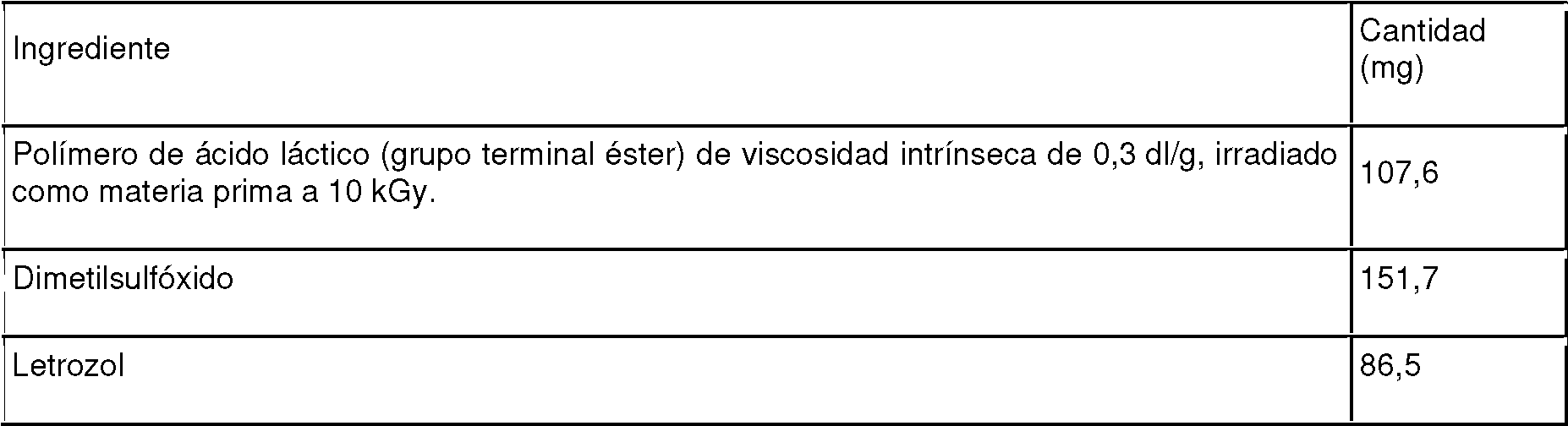
Formulaciones 7 a 12:Formulations 7 to 12:

Para las composiciones preferidas, el % p/p del agente activo en la composición estaba entre 20,0 y 27,0 %. El % p/p del PLA en la composición estaba entre 20,0 y 50,0 %. El % p/p del disolvente en la composición estaba entre 23,0 y 60,0 %. Las composiciones se mezclaron en una jeringa para formar implantes adecuados.For the preferred compositions, the w/w % of the active agent in the composition was between 20.0 and 27.0%. The w/w % of the PLA in the composition was between 20.0 and 50.0%. The w/w % of the solvent in the composition was between 23.0 and 60.0%. The compositions were mixed in a syringe to form suitable implants.
Se usaron diferentes tipos de PLA para estas composiciones:Different types of PLA were used for these compositions:
1. PLA con distribución másica del tamaño de las partículas en la que más de 10 % de las partículas tenían un tamaño de partícula de 300 micrómetros o superior cuando se medía mediante tamizado analítico según USP<786>;1. PLA with mass particle size distribution in which greater than 10% of the particles had a particle size of 300 microns or greater when measured by analytical sieving per USP<786>;
2. PLA con distribución volumétrica del tamaño de las partículas con D90 superior a 330 micrómetros cuando se medía mediante análisis de difracción láser;2. PLA with volumetric particle size distribution with D90 greater than 330 microns when measured by laser diffraction analysis;
3. PLA con distribución másica del tamaño de las partículas en la que como máximo 10 % de las partículas tenían un tamaño de partícula superior a 300 micrómetros y como máximo 80 % de las partículas tenían un tamaño de partícula inferior a 125 micrómetros cuando se media mediante tamizado analítico según USP<786>;3. PLA with mass particle size distribution where at most 10% of the particles had a particle size greater than 300 microns and at most 80% of the particles had a particle size less than 125 microns when measured by analytical screening according to USP<786>;
4. PLA con distribución volumétrica del tamaño de las partículas con D90 no superior a 330 micrómetros y D80 no inferior a 135 micrómetros cuando se medía mediante análisis de difracción láser;4. PLA with volumetric particle size distribution with D90 not greater than 330 microns and D80 not less than 135 microns when measured by laser diffraction analysis;
5. PLA con distribución másica del tamaño de las partículas en la que más de 80 % de las partículas tenían un tamaño de partícula inferior a 125 micrómetros, cuando se medía mediante tamizado analítico según USP<786>; 6. PLA con distribución volumétrica del tamaño de las partículas con D80 inferior a 135 micrómetros cuando se medía mediante análisis de difracción láser.5. PLA with mass particle size distribution in which greater than 80% of the particles had a particle size of less than 125 microns, when measured by analytical sieving per USP<786>; 6. PLA with volumetric particle size distribution with D80 less than 135 microns when measured by laser diffraction analysis.
Las composiciones de la invención se prepararon mezclando primero en seco el agente activo con el PLA y a continuación añadiendo el disolvente, preferiblemente DMSO, para disolver el PLA y tener una suspensión del agente activo. El procedimiento de reconstitución se debe llevar a cabo inmediatamente antes de la inyección, y el tiempo de preparación no supera 15 minutos, preferiblemente 10 minutos, más preferiblemente 5 minutos, antes de administrar la composición IM. The compositions of the invention were prepared by first dry mixing the active agent with the PLA and then adding the solvent, preferably DMSO, to dissolve the PLA and have a suspension of the active agent. The reconstitution procedure should be carried out immediately before injection, and the preparation time does not exceed 15 minutes, preferably 10 minutes, more preferably 5 minutes, before administering the composition IM.
Los implantes preparados de esta manera se usaron para el ensayo de disolución siguiente: movimiento orbital horizontal a 50 rpm; medio: PBS pH 7,4; temperatura: 37 ± 0,5 °C; técnica analítica CLAR/UV; longitud de onda 230 nm.The implants prepared in this way were used for the following dissolution test: horizontal orbital movement at 50 rpm; medium: PBS pH 7.4; temperature: 37 ± 0.5°C; HPLC/UV analytical technique; wavelength 230nm.
Se observó que, para los PLA 1 y 2, la liberación no se mantenía tan satisfactoriamente como se deseaba cuando se aplicaba el tiempo de preparación preferido (Fig. 3). El PLA usado en la composición de la figura 3 tenía una distribución másica del tamaño de las partículas en la que 18,1 % de las partículas eran mayores de 300 micrómetros y 28,3 % de las partículas eran menores de 125 micrómetros, medida mediante tamizado analítico según USP<786>. Dicho PLA tenía una distribución volumétrica del tamaño de las partículas con un D90 de 421 micrómetros y un D80 de 324 micrómetros cuando se medía mediante análisis de difracción láser.It was observed that for PLA 1 and 2 the release was not maintained as well as desired when the preferred brew time was applied (Fig. 3). The PLA used in the composition of Figure 3 had a mass particle size distribution in which 18.1% of the particles were larger than 300 microns and 28.3% of the particles were smaller than 125 microns, as measured by Analytical screening according to USP<786>. Said PLA had a volumetric particle size distribution with a D90 of 421 microns and a D80 of 324 microns when measured by laser diffraction analysis.
Sin embargo, para los PLA 3 y 4, la liberación mantenida fue satisfactoria (Fig. 4). El PLA usado en la composición de la figura 4 tenía una distribución másica del tamaño de las partículas en la que 0,8 % de las partículas eran mayores de 300 micrómetros y 58,5 % de las partículas eran menores de 125 micrómetros, medida mediante tamizado analítico según USP<786>. Dicho PLA tenía una distribución volumétrica del tamaño de las partículas con un D90 de 214 micrómetros y un D80 de 170 micrómetros cuando se medía mediante análisis de difracción láser.However, for PLA 3 and 4, sustained release was satisfactory (Fig. 4). The PLA used in the composition of Figure 4 had a mass particle size distribution in which 0.8% of the particles were larger than 300 microns and 58.5% of the particles were smaller than 125 microns, as measured by Analytical screening according to USP<786>. Said PLA had a volumetric particle size distribution with a D90 of 214 microns and a D80 of 170 microns when measured by laser diffraction analysis.
Cuando se usaron los PLA 5 y 6, se formaron aglomerados grandes y duros, y la composición no se podía preparar en el tiempo no superior a 15 minutos preferido. Por tanto, esta composición no se consideró clínicamente adecuada. De todos modos, el implante se ensayó y la liberación mantenida resultó satisfactoria (Fig. 5). El PLA usado en la composición de la figura 5 tenía una distribución másica del tamaño de las partículas en la que 1,6 % de las partículas eran mayores de 300 micrómetros y 88,8 % de las partículas eran menores de 125 micrómetros, medida mediante tamizado analítico según USP<786>. Dicho PLA tenía una distribución volumétrica del tamaño de las partículas con un D90 de 155 micrómetros y un D80 de 124 micrómetros cuando se medía mediante análisis de difracción láser. When PLA 5 and 6 were used, large, hard agglomerates were formed, and the composition could not be prepared in the preferred time of not more than 15 minutes. Therefore, this composition was not considered clinically appropriate. However, the implant was tested and sustained release was satisfactory (FIG. 5). The PLA used in the composition of Figure 5 had a mass particle size distribution in which 1.6% of the particles were larger than 300 microns and 88.8% of the particles were smaller than 125 microns, as measured by Analytical screening according to USP<786>. Said PLA had a volumetric particle size distribution with a D90 of 155 microns and a D80 of 124 microns when measured by laser diffraction analysis.
Determinación del tamaño de las partículasParticle size determination
Tamizado analítico según USP<786>Analytical screening according to USP<786>
La distribución másica del tamaño de las partículas de PLA se determinó mediante la técnica de apilamiento de tamices usando los tamaños siguientes: 425 > 355 > 300 > 250 > 212 > 180 > 150 > 125 > 106 > 75. La amplitud fue 0,65 mm y el tiempo de agitación 5 minutos.The mass size distribution of PLA particles was determined by the sieve stacking technique using the following sizes: 425 > 355 > 300 > 250 > 212 > 180 > 150 > 125 > 106 > 75. The amplitude was 0.65 mm and stirring time 5 minutes.
Difracción de luz láserlaser light diffraction
La distribución del tamaño de las partículas de PLA se expresa como distribución volumétrica y se determinó mediante la técnica de difracción láser por el método de dispersión en vía húmeda. No se aplicó pretratamiento de las muestras. La muestra se añadió directamente al medio de dispersión (agua). El mecanismo de dispersión fue agitación a 3000 rpm y la muestra se estabilizó durante 30 segundos antes de medir.The size distribution of the PLA particles is expressed as a volumetric distribution and was determined using the laser diffraction technique by the wet dispersion method. No pretreatment of the samples was applied. The sample was added directly to the dispersion medium (water). The dispersion mechanism was agitation at 3000 rpm and the sample was stabilized for 30 seconds before measurement.
Resultados de fase I preliminaresPreliminary phase I results
Los resultados preliminares sugieren que la terapia de inhibición hormonal (HT) mantenida a largo plazo puede obtener un resultado clínico superior en el cáncer de mama en comparación con un tratamiento de dosis diarias por vía oral. Preliminary results suggest that long-term sustained hormone suppression therapy (HT) may achieve superior clinical outcome in breast cancer compared to oral daily dose therapy.
La interrupción prematura y la falta de cumplimiento terapéutico de la HT son habituales y están asociadas al aumento de la mortalidad; el cumplimiento terapéutico mejorado con Letrozol ISM® puede mejorar el tratamiento.Premature interruption and lack of therapeutic compliance with HT are common and are associated with increased mortality; improved therapeutic compliance with Letrozole ISM® may improve treatment.
Las dosis efectivas inferiores mantenidas (en comparación con el tratamiento por vía oral) podrían reducir los efectos secundarios adversos (pérdida de masa ósea, dolor óseo/articular/muscular, dislipidemia) debido a la exposición inferior al fármaco.Sustained lower effective doses (compared to oral therapy) might reduce adverse side effects (bone loss, bone/joint/muscle pain, dyslipidemia) due to lower drug exposure.
El perfil de seguridad mejor puede afectar positivamente al cumplimiento terapéutico durante toda la duración del tratamiento.The better safety profile may positively affect therapeutic compliance throughout the duration of treatment.
Resultados de fase IPhase I results
Este es un estudio de fase I, sin ocultación, de aumento escalonado de la dosis para evaluar la farmacocinética, seguridad y tolerabilidad de inyecciones intramusculares únicas de Letrozol ISM en diferentes concentraciones realizado en aproximadamente 120 mujeres posmenopáusicas sanas voluntarias. El estudio tiene cuatro grupos: This is a Phase I, open-label, dose-escalation study to evaluate the pharmacokinetics, safety, and tolerability of single intramuscular injections of Letrozole ISM at different concentrations conducted in approximately 120 healthy postmenopausal female volunteers. The study has four groups:
Experimental: Cohorte 1: Letrozol ISM 50 mg: 14 dosis orales de Femara® 2,5 mg (una vez al día) una única inyección i.m. de Letrozol ISM 50 mg.Experimental: Cohort 1: Letrozole ISM 50 mg: 14 oral doses of Femara® 2.5 mg (once a day) a single i.m. of Letrozole ISM 50 mg.
Experimental: Cohorte 2: Letrozol ISM 100 mg: 14 dosis orales de Femara® 2,5 mg (una vez al día) una única inyección i.m. de Letrozol ISM 100 mg.Experimental: Cohort 2: Letrozole ISM 100 mg: 14 oral doses of Femara® 2.5 mg (once a day) a single i.m. of Letrozole ISM 100 mg.
Experimental: Cohorte 3: Letrozol ISM 200 mg: 14 dosis orales de Femara® 2,5 mg (una vez al día) una única inyección i.m. de Letrozol ISM 200 mg. Experimental: Cohort 3: Letrozole ISM 200 mg: 14 oral doses of Femara® 2.5 mg (once a day) a single im injection of Letrozole ISM 200 mg.
Experimental: Cohorte 4: Letrozol ISM 400 mg: 14 dosis orales de Femara® 2,5 mg (una vez al día) una única inyección i.m. de Letrozol ISM 400 mg.Experimental: Cohort 4: Letrozole ISM 400 mg: 14 oral doses of Femara® 2.5 mg (once a day) a single i.m. of Letrozole ISM 400 mg.
El objeto de este estudio es evaluar el perfil farmacocinético de dosis crecientes únicas de Letrozol ISM y, en segundo lugar, evaluar la seguridad y tolerabilidad de dosis crecientes únicas de Letrozol ISM, medir las concentraciones de estrógeno y caracterizar el perfil farmacocinético del letrozol oral que se va a usar en la comparación posterior con Letrozol ISM.The purpose of this study is to evaluate the pharmacokinetic profile of single escalating doses of Letrozole ISM and, secondly, to evaluate the safety and tolerability of single escalating doses of Letrozole ISM, measure estrogen concentrations, and characterize the pharmacokinetic profile of oral letrozole that it will be used in the subsequent comparison with Letrozole ISM.
El estudio se lleva a cabo en mujeres posmenopáusicas sanas que cumplen los criterios de inclusión y exclusión. El diseño del estudio incluye un periodo de cribado y 2 periodos de tratamiento.The study is carried out in healthy postmenopausal women who meet the inclusion and exclusion criteria. The study design includes a screening period and 2 treatment periods.
El Periodo de tratamiento 1 comprende 14 administraciones de dosis orales de Femara® 2,5 mg. El Periodo de tratamiento 2 comprende una única dosis i.m. de Letrozol ISM 50, 100. 200 y 400 mg. La duración total programada del estudio es 71 semanas, aproximadamente.Treatment Period 1 comprises 14 oral dose administrations of Femara® 2.5 mg. Treatment Period 2 comprises a single i.m. of Letrozole ISM 50, 100, 200 and 400 mg. The total scheduled duration of the study is approximately 71 weeks.
Los criterios de inclusión/exclusión para las 120 participantes son los siguientes:The inclusion/exclusion criteria for the 120 participants are as follows:
Criterios de inclusión:Inclusion criteria:
Mujeres posmenopáusicas sanas, >18 y <75 años de edad, que han alcanzado la menopausia completa, de forma natural, quirúrgica o por amenorrea, y que no han recibido hormonoterapia restitutiva en los últimos 3 meses.Healthy postmenopausal women, >18 and <75 years of age, who have reached complete menopause, naturally, surgically or due to amenorrhea, and who have not received hormone replacement therapy in the last 3 months.
Las participantes posmenopáusicas deben presentar ausencia de la menstruación durante 1 año y las participantes que se ha sometido a ovariectomía deben presentar ausencia de la menstruación durante al menos 6 semanas. Para las participantes que se han sometido a ovariectomía y aquellas que se han sometido a una histerectomía, se requiere un informe de anatomía patológica quirúrgica que demuestre la ausencia de enfermedad maligna. Además, para las participantes que se han sometido a ovariectomía, se requiere un informe quirúrgico que demuestre ovariectomía bilateral.Postmenopausal participants must be without menses for 1 year and participants who have undergone oophorectomy must be without menses for at least 6 weeks. For participants who have undergone oophorectomy and those who have undergone hysterectomy, a surgical pathology report demonstrating the absence of malignant disease is required. In addition, for participants who have undergone oophorectomy, a surgical report demonstrating bilateral oophorectomy is required.
Las concentraciones plasmáticas basales de folitropina (FSH) y 17p-estradiol deben ser coherentes con el estado posmenopáusico de la participante (FSH > 40 mUI/mL; 17p-estradiol < 31 pg/mL), confirmadas al menos 48 horas antes de la administración.Basal plasma concentrations of follitropin (FSH) and 17p-estradiol must be consistent with the participant's postmenopausal status (FSH > 40 mIU/mL; 17p-estradiol < 31 pg/mL), confirmed at least 48 hours before administration .
Peso de >50 kg e IMC > 19 y < 39 kg/m2.Weight >50 kg and BMI > 19 and < 39 kg/m2.
Las participantes deben gozar de buena salud, como se determina mediante anamnesis, exploración física, evaluación de las constantes vitales (pulso, tensión arterial sistólica y diastólica y temperatura), análisis clínicos y ECG de 12 derivaciones. Las desviaciones leves fuera de estos intervalos de referencia serán aceptables, si no son consideradas clínicamente significativas por el investigador.Participants must be in good health, as determined by history, physical examination, assessment of vital signs (pulse, systolic and diastolic blood pressure, and temperature), laboratory tests, and 12-lead ECG. Slight deviations outside these reference intervals will be acceptable, if not considered clinically significant by the investigator.
Las participantes que no se hayan hecho una mamografía en los últimos 12 meses (documentación requerida) deben estar dispuestas a realizarse una.Participants who have not had a mammogram in the past 12 months (documentation required) must be willing to have one.
Las participantes con un útero y cuello uterino intactos que no se hayan hecho una citología vaginal de Papanicolaou (pap) en los últimos 6 meses (documentación requerida) deben estar dispuestas a realizarse una.Participants with an intact uterus and cervix who have not had a Pap smear in the past 6 months (documentation required) must be willing to have one.
Las participantes deberán facilitar su consentimiento informado para participar en el estudio y respetar las restricciones del estudio.Participants must provide their informed consent to participate in the study and respect the restrictions of the study.
Las participantes podrán comunicarse con el personal clínico.Participants will be able to communicate with clinical staff.
Criterios de exclusión:Exclusion criteria:
Participantes que tienen antecedentes de alergia o hipersensibilidad a letrozol o cualquiera de los principios activos en los últimos 3 meses.Participants who have a history of allergy or hypersensitivity to letrozole or any of the active substances in the last 3 months.
Participantes que tienen antecedentes de intolerancia a la galactosa, deficiencia congénita de lactasa grave, intolerancia a la glucosa-galactosa.Participants who have a history of galactose intolerance, severe congenital lactase deficiency, glucose-galactose intolerance.
Participantes que han recibido hormonoterapia restitutiva con estrógeno o progesterona, hormonoterapia tiroidea restitutiva, anticonceptivos orales, andrógenos, análogos de luliberina (LH-RH), inhibidores de la prolactina o antiandrógenos en los 3 meses anteriores al cribado.Participants who have received hormone replacement therapy with estrogen or progesterone, thyroid hormone replacement therapy, oral contraceptives, androgens, luliberin analogs (LH-RH), prolactin inhibitors, or antiandrogens in the 3 months prior to screening.
Participantes que han consumido alimentos o complementos alimenticios que contienen concentraciones altas de isoflavinoides, lo que incluye semillas de soja, leche de soja, nueces de soja, garbanzos, alfalfa, habas, kudzu, miso y tofu en los 14 días anteriores a la administración (Periodo de tratamiento 1).Participants who have consumed foods or food supplements containing high concentrations of isoflavinoids, including soybeans, soy milk, soy nuts, chickpeas, alfalfa, fava beans, kudzu, miso, and tofu in the 14 days prior to administration ( Treatment period 1).
El investigador y el monitor del estudio determinarán en cada caso concreto si una participante que ingiere alimentos o complementos alimenticios que contienen isoflavinoides cumple los criterios para participar en el estudio. The investigator and study monitor will determine on a case-by-case basis whether a participant who ingests isoflavinoid-containing food or dietary supplements meets the criteria for study participation.
Participantes que han recibido:Participants who have received:
Cualquier medicamento que incluya hipérico, que se sabe que son inductores potentes o moderados del CYP P450 3A4, en las 3 semanas anteriores a la administración (Periodo de tratamiento 1).Any drug containing St John's wort, known to be strong or moderate inducers of CYP P450 3A4, within 3 weeks prior to administration (Treatment Period 1).
Cualquier medicamento o productos que se sabe que son inhibidores potentes o moderados del CYP P450 3A4 (p. ej., zumo de pomelo) en los 7 días anteriores a la administración del Periodo de tratamiento 1.Any medications or products known to be strong or moderate inhibitors of CYP P450 3A4 (eg, grapefruit juice) within 7 days prior to administration of Treatment Period 1.
Cualquier preparado prescrito en los 14 días anteriores a la administración (Periodo de tratamiento 1), a menos que, en opinión del investigador (o representante), el medicamento no interfiera con los procedimientos del estudio o comprometa la seguridad.Any preparation prescribed within 14 days prior to administration (Treatment Period 1), unless, in the opinion of the investigator (or designee), the drug does not interfere with study procedures or compromise safety.
Cualquier medicamento sistémico o tópico no prescrito en los 7 días anteriores a la administración (Periodo de tratamiento 1), a menos que, en opinión del investigador (o representante), el medicamento no interfiera con los procedimientos del estudio o comprometa la seguridad. No se permiten vitaminas y minerales que incluyen el uso de calcio y/o vitamina D para la prevención de la osteoporosis. Participantes a las que se les ha diagnosticado osteoporosis (anteriormente o resultados de DEXA para este estudio con una puntuación T <-2,5). Las participantes con osteopenia (con la puntuación T entre -1 y -2,5) podrán participar en este estudio.Any systemic or topical drug not prescribed within 7 days prior to administration (Treatment Period 1), unless, in the opinion of the investigator (or designee), the drug does not interfere with study procedures or compromise safety. Vitamins and minerals including the use of calcium and/or vitamin D for the prevention of osteoporosis are not permitted. Participants who have been diagnosed with osteoporosis (previously or DEXA results for this study with a T-score <-2.5). Participants with osteopenia (T-score between -1 and -2.5) will be eligible to participate in this study.
Participantes que no están recibiendo terapia con biofosfonatos de acción prolongada o rápida en una dosis estable durante al menos 3 meses antes del cribado.Participants who are not receiving long-acting or rapid-acting bisphosphonate therapy at a stable dose for at least 3 months prior to screening.
Participantes que están recibiendo terapia con raloxifeno.Participants receiving raloxifene therapy.
Participantes que tienen una anomalía en la frecuencia cardíaca, tensión arterial o temperatura en el cribado y antes de la primera dosis (Periodo de tratamiento 1) que, en opinión del investigador, aumenta el riesgo de participar en el estudio. La TAS en reposo debe ser <150 mmHg y la TAD en reposo <95 mmHg.Participants who have an abnormality in heart rate, blood pressure, or temperature at screening and before the first dose (Treatment Period 1) that, in the opinion of the investigator, increases the risk of participating in the study. Resting SBP should be <150 mmHg and resting DBP <95 mmHg.
Participantes que tienen una anomalía en el ECG de 12 derivaciones en el cribado y antes de la primera dosis (Periodo de tratamiento 1) que, en opinión del investigador, aumenta el riesgo de participar en el estudio.Participants who have a 12-lead ECG abnormality at screening and before the first dose (Treatment Period 1) that, in the opinion of the investigator, increases the risk of participating in the study.
Participantes que tienen cualquier hallazgo anómalo clínicamente significativo en la exploración física.Participants who have any clinically significant abnormal finding on physical examination.
Participantes que tienen cualquier hallazgo anómalo clínicamente significativo en los análisis clínicos en el cribado o la inscripción en el estudio, tras la realización de pruebas repetidas, como determina el investigador (1 evaluación repetida es aceptable).Participants who have any clinically significant abnormal laboratory finding at screening or study enrollment, following repeat testing, as determined by the investigator (1 repeat assessment is acceptable).
Participantes que tienen ALT o AST >1,5 x LSN. Para las participantes con bilirrubina total elevada, se evaluará la bilirrubina directa e indirecta.Participants who have ALT or AST >1.5 x ULN. For participants with elevated total bilirubin, direct and indirect bilirubin will be assessed.
Para las participantes con concentraciones de colesterol y triglicéridos elevadas superiores al LSN, el investigador debe determinar que no sean clínicamente significativas.For participants with elevated cholesterol and triglyceride concentrations above the ULN, the investigator must determine that they are not clinically significant.
Participantes que tienen enfermedades relevantes o hallazgos anómalos relevantes clínicamente significativos en el cribado, como se determina mediante anamnesis, exploración física, análisis clínicos, ECG, DEXA y exploración mamaria y pélvica.Participants who have relevant disease or clinically significant relevant abnormal findings at screening, as determined by history, physical examination, laboratory tests, ECG, DEXA, and breast and pelvic examination.
Participantes que tienen antecedentes de cualquier enfermedad crónica importante, tal como, pero no limitada a: trastornos trombóticos, cardiopatía isquémica o enfermedad cerebrovascular, disfunción/trastorno(s) de hígado, riñón o vejiga o cualquier otra enfermedad endocrina, neoplasia dependiente de estrógenos, hemorragia uterina posmenopáusica o hiperplasia endometrial. Se permitirán participantes con colecistectomía si no hay secuelas médicas posquirúrgicas. Antecedentes de cáncer en los últimos 5 años, a excepción de cáncer de piel no melanoma. Participantes que tienen antecedentes de drogodependencia y antecedentes recientes de alcoholismo o abuso del alcohol.Participants who have a history of any major chronic disease, such as, but not limited to: thrombotic disorders, ischemic heart disease or cerebrovascular disease, liver, kidney or bladder dysfunction/disorder(s) or any other endocrine disease, estrogen dependent neoplasia, postmenopausal uterine bleeding or endometrial hyperplasia. Participants with cholecystectomy will be allowed if there are no post-surgical medical sequelae. History of cancer in the last 5 years, with the exception of non-melanoma skin cancer. Participants who have a history of drug dependence and a recent history of alcoholism or alcohol abuse.
Participantes que tienen un resultado positivo para antígeno superficial de la hepatitis B (HBsAg), anticuerpo contra el antígeno central de la hepatitis B o anticuerpos contra el virus de la inmunodeficiencia humana (VIH).Participants who have a positive result for hepatitis B surface antigen (HBsAg), antibody to hepatitis B core antigen, or antibodies to human immunodeficiency virus (HIV).
Participantes con una prueba de drogas o alcoholemia positiva en el cribado (se detectará la presencia en orina de lo siguiente: anfetaminas, barbitúricos, benzodiacepinas, canabinoides, cocaína, opiáceos, fenciclidina y metadona). Participantes con antecedentes de, o dificultad de, acceso a las venas para venopunción.Participants with a positive drug or alcohol test at screening (the following will be detected in urine: amphetamines, barbiturates, benzodiazepines, cannabinoids, cocaine, opiates, phencyclidine and methadone). Participants with a history of, or difficulty in, accessing veins for venipuncture.
Participantes que han donado sangre en los 30 días anteriores a la primera dosis (Periodo de tratamiento 1).Participants who have donated blood within 30 days prior to the first dose (Treatment Period 1).
Participantes que han recibido productos sanguíneos en los 2 meses anteriores al cribado.Participants who have received blood products in the 2 months prior to screening.
Participantes que han recibido un fármaco en investigación o han participado en otros ensayos clínicos 30 días, o 5 semividas (el periodo que sea más largo), antes de la administración (Periodo de tratamiento 1). Participants who have received an investigational drug or participated in other clinical trials 30 days, or 5 half-lives (whichever is longer), prior to administration (Treatment Period 1).
Participantes que han participado anteriormente en, o se han retirado de, este estudio. (Las participantes que se han seleccionado, pero no se han incluido en una cohorte, o las participantes que no fueron seleccionadas en el cribado de una cohorte anterior por motivos no médicos pueden reunir los requisitos para ser incluidas en cohortes posteriores.)Participants who have previously participated in, or have withdrawn from, this study. (Participants who have been selected but not included in a cohort, or participants who were not screened for a previous cohort for non-medical reasons may be eligible for inclusion in subsequent cohorts.)
Cualquier otro motivo no especificado que, en opinión del investigador (o representante) o el patrocinador, haga que la participante no sea adecuada para su inscripción.Any other unspecified reason that, in the opinion of the investigator (or representative) or the sponsor, makes the participant unsuitable for enrollment.
Resultados FCHR Results
Las concentraciones plasmáticas de letrozol se han analizado hasta el Día 393 y el Día 225 después de una única inyección intramuscular (i.m.) de Letrozol ISM 50 mg y 100 mg, respectivamente. La mayoría de las participantes tenían concentraciones plasmáticas de letrozol cuantificables mantenidas hasta los últimos momentos de muestreo descritos en ambos grupos (Figura 8). La exposición máxima con normalización de la dosis (Cmáx/D) es comparable entre ambas concentraciones de las dosis de Letrozol ISM.Plasma concentrations of letrozole have been analyzed up to Day 393 and Day 225 after a single intramuscular (i.m.) injection of Letrozole ISM 50 mg and 100 mg, respectively. Most of the participants had measurable plasma concentrations of letrozole maintained until the last sampling times described in both groups (Figure 8). The maximum exposure with dose normalization (Cmax/D) is comparable between both Letrozole ISM dose concentrations.
Las concentraciones de exposición máxima media de letrozol para Femara® en estado estacionario (2,5 mg una vez al día durante 14 días) fueron aproximadamente 12 y 8 veces la observada para Letrozol 50 mg y 100 mg, respectivamente.Mean maximum letrozole exposure concentrations for Femara® at steady state (2.5 mg once daily for 14 days) were approximately 12 and 8 times that observed for Letrozole 50 mg and 100 mg, respectively.
Las concentraciones plasmáticas de estrógeno se redujeron rápidamente desde el momento basal después de la administración de letrozol. Las hormonas se redujeron a concentraciones estables inferiores a 1 pg/mL aproximadamente 4 días después del tratamiento con Femara®/Letrozol ISM (Fig. 6 y 7). La inhibición mantenida de las concentraciones de estrógeno se mantuvo durante hasta 281 días y 197 días para Letrozol ISM 50 mg y 100 mg, respectivamente. No hubo diferencias evidentes en el grado de reducción de la concentración hormonal entre Letrozol ISM 50 mg y 100 mg. Plasma estrogen concentrations decreased rapidly from baseline after administration of letrozole. Hormones fell to stable concentrations below 1 pg/mL approximately 4 days after Femara®/Letrozole ISM treatment (Figs. 6 and 7). Sustained inhibition of estrogen concentrations was maintained for up to 281 days and 197 days for Letrozole ISM 50 mg and 100 mg, respectively. There were no apparent differences in the degree of reduction in hormone concentration between Letrozole ISM 50 mg and 100 mg.
Claims (14)
Applications Claiming Priority (2)
| Application Number | Priority Date | Filing Date | Title |
|---|---|---|---|
| EP18382413 | 2018-06-12 | ||
| PCT/EP2019/065318 WO2019238740A1 (en) | 2018-06-12 | 2019-06-12 | Injectable composition |
Publications (1)
| Publication Number | Publication Date |
|---|---|
| ES2900171T3 true ES2900171T3 (en) | 2022-03-16 |
Family
ID=62716017
Family Applications (1)
| Application Number | Title | Priority Date | Filing Date |
|---|---|---|---|
| ES19733972T Active ES2900171T3 (en) | 2018-06-12 | 2019-06-12 | Injectable composition |
Country Status (33)
| Country | Link |
|---|---|
| US (2) | US12226485B2 (en) |
| EP (1) | EP3746047B1 (en) |
| JP (1) | JP7420735B2 (en) |
| KR (1) | KR102902994B1 (en) |
| CN (1) | CN112004525B (en) |
| AU (1) | AU2019286572B2 (en) |
| BR (1) | BR112020020415A2 (en) |
| CL (1) | CL2020002844A1 (en) |
| CO (1) | CO2020012526A2 (en) |
| CY (1) | CY1124772T1 (en) |
| DK (1) | DK3746047T3 (en) |
| EA (1) | EA202092021A1 (en) |
| ES (1) | ES2900171T3 (en) |
| GE (2) | GEAP202215469A (en) |
| HR (1) | HRP20211874T1 (en) |
| HU (1) | HUE057269T2 (en) |
| IL (1) | IL277802B2 (en) |
| LT (1) | LT3746047T (en) |
| MA (1) | MA52502B1 (en) |
| MD (1) | MD3746047T2 (en) |
| MX (1) | MX2020011732A (en) |
| MY (1) | MY203260A (en) |
| PE (1) | PE20210047A1 (en) |
| PH (1) | PH12020551740A1 (en) |
| PL (1) | PL3746047T3 (en) |
| PT (1) | PT3746047T (en) |
| RS (1) | RS62681B1 (en) |
| SG (1) | SG11202008744VA (en) |
| SI (1) | SI3746047T1 (en) |
| SM (1) | SMT202100678T1 (en) |
| UA (1) | UA127087C2 (en) |
| WO (1) | WO2019238740A1 (en) |
| ZA (1) | ZA202006113B (en) |
Families Citing this family (2)
| Publication number | Priority date | Publication date | Assignee | Title |
|---|---|---|---|---|
| US20230310309A1 (en) * | 2020-08-25 | 2023-10-05 | Merck Sharp & Dohme Llc | Injectable depot compositions for the delivery of antiviral agents |
| WO2025153747A1 (en) * | 2024-01-17 | 2025-07-24 | Laboratorios Farmacéuticos Rovi, S.A. | Improved aromatase inhibitor dosing schedules and compositions |
Family Cites Families (49)
| Publication number | Priority date | Publication date | Assignee | Title |
|---|---|---|---|---|
| US3773919A (en) | 1969-10-23 | 1973-11-20 | Du Pont | Polylactide-drug mixtures |
| BE758156R (en) | 1970-05-13 | 1971-04-28 | Ethicon Inc | ABSORBABLE SUTURE ELEMENT AND ITS |
| US4389330A (en) | 1980-10-06 | 1983-06-21 | Stolle Research And Development Corporation | Microencapsulation process |
| US4530840A (en) | 1982-07-29 | 1985-07-23 | The Stolle Research And Development Corporation | Injectable, long-acting microparticle formulation for the delivery of anti-inflammatory agents |
| US4523591A (en) | 1982-10-22 | 1985-06-18 | Kaplan Donald S | Polymers for injection molding of absorbable surgical devices |
| JP2670680B2 (en) * | 1988-02-24 | 1997-10-29 | 株式会社ビーエムジー | Polylactic acid microspheres containing physiologically active substance and method for producing the same |
| US4938763B1 (en) | 1988-10-03 | 1995-07-04 | Atrix Lab Inc | Biodegradable in-situ forming implants and method of producing the same |
| US5620700A (en) | 1990-10-30 | 1997-04-15 | Alza Corporation | Injectable drug delivery system and method |
| CN1074923C (en) | 1993-11-19 | 2001-11-21 | 詹森药业有限公司 | Microencapsulated 3-piperidinyl-substituted 1,2-benzisoxazoles and 1,2-benzisothiazoles |
| JP4642946B2 (en) | 1996-12-20 | 2011-03-02 | アルザ コーポレイション | Gel composition and method |
| KR100289471B1 (en) | 1998-01-19 | 2001-09-17 | 김충섭 | A controlled/sustained implant delivery containing fentanyls |
| US6565874B1 (en) | 1998-10-28 | 2003-05-20 | Atrix Laboratories | Polymeric delivery formulations of leuprolide with improved efficacy |
| US6143314A (en) | 1998-10-28 | 2000-11-07 | Atrix Laboratories, Inc. | Controlled release liquid delivery compositions with low initial drug burst |
| US6461631B1 (en) | 1999-11-16 | 2002-10-08 | Atrix Laboratories, Inc. | Biodegradable polymer composition |
| ATE355824T1 (en) | 2000-01-11 | 2007-03-15 | Roland Bodmeier | IMPLANTATION KIT CONTAINING A CARRIER PHASE AND A SOLVENT |
| US6604561B2 (en) | 2000-02-11 | 2003-08-12 | Medical Instill Technologies, Inc. | Medicament vial having a heat-sealable cap, and apparatus and method for filling the vial |
| MXPA02007938A (en) | 2000-02-17 | 2003-02-10 | 3M Innovative Properties Co | Delivery systems using preformed biodegradable polymer compositions and methods. |
| WO2002038185A2 (en) | 2000-11-13 | 2002-05-16 | Atrix Laboratories, Inc. | Injectable sustained release delivery system with loperamide |
| US20120225033A1 (en) | 2010-11-24 | 2012-09-06 | Durect Corporation | Biodegradable Drug Delivery Composition |
| US7658998B2 (en) | 2003-01-22 | 2010-02-09 | Alkermes Controlled Therapeutics, Inc. | Method of preparing sustained release microparticles |
| JP2007525429A (en) | 2003-03-11 | 2007-09-06 | キューエルティー ユーエスエー,インコーポレイテッド. | Formulations for cell schedule dependent anticancer agents |
| ES2600554T3 (en) | 2003-07-18 | 2017-02-09 | Oakwood Laboratories L.L.C. | Prevention of polymer molecular weight reduction, impurity formation and gelation in polymeric compositions |
| US8221778B2 (en) | 2005-01-12 | 2012-07-17 | The Trustees Of The University Of Pennsylvania | Drug-containing implants and methods of use thereof |
| GB0420016D0 (en) | 2004-09-09 | 2004-10-13 | Leuven K U Res & Dev | Controlled release oral delivery system |
| MX2007003789A (en) | 2004-10-04 | 2007-07-20 | Qlt Usa Inc | Ocular delivery of polymeric delivery formulations. |
| DE102005031868A1 (en) | 2005-07-04 | 2007-01-18 | Biotronik Vi Patent Ag | Drug depot for parenteral, especially intravascular drug release |
| GB0517673D0 (en) | 2005-08-31 | 2005-10-05 | Astrazeneca Ab | Formulation |
| US8852638B2 (en) | 2005-09-30 | 2014-10-07 | Durect Corporation | Sustained release small molecule drug formulation |
| UA95088C2 (en) * | 2005-10-21 | 2011-07-11 | Панасеа Биотек Лтд. | Composition comprising at least one anticancer drug and at least one polymer and reducing chemotherapy-induced alopecia, process for the preparation thereof |
| US20100098735A1 (en) | 2006-10-05 | 2010-04-22 | Rajesh Jain | Injectable depot compositions and its process of preparation |
| US8076448B2 (en) | 2006-10-11 | 2011-12-13 | Tolmar Therapeutics, Inc. | Preparation of biodegradable polyesters with low-burst properties by supercritical fluid extraction |
| FR2908775B1 (en) | 2006-11-17 | 2012-08-31 | Biomatlante | HYDROGEL AND ITS BIOMEDICAL APPLICATIONS |
| DK3660073T3 (en) | 2007-02-15 | 2023-09-18 | Tolmar International Ltd | POLY(LACTIDE-CO-GLYCOLIDE) WITH LOW BLASTING |
| EP2167039B1 (en) | 2007-05-18 | 2016-09-28 | Durect Corporation | Improved depot formulations |
| ES2562878T3 (en) | 2007-05-25 | 2016-03-08 | Indivior Uk Limited | Sustained release formulations of risperidone compounds |
| CL2008003305A1 (en) * | 2007-11-06 | 2009-06-05 | M/S Panacea Biotec Ltd | Injectable composition comprising an active agent selected from a defined group; at least one bioerodible polymer, at least one non-toxic solvent and optionally one or more excipients; Preparation process; use to treat mental illness or cancer. |
| US8629172B2 (en) | 2008-04-18 | 2014-01-14 | Warsaw Orthopedic, Inc. | Methods and compositions for treating post-operative pain comprising clonidine |
| US20100144687A1 (en) | 2008-12-05 | 2010-06-10 | Glaser Rebecca L | Pharmaceutical compositions containing testosterone and an aromatase inhibitor |
| US10285936B2 (en) | 2010-05-31 | 2019-05-14 | Laboratorios Farmacéuticos Rovi, S.A. | Injectable composition with aromatase inhibitor |
| US10335366B2 (en) | 2010-05-31 | 2019-07-02 | Laboratorios Farmacéuticos Rovi, S.A. | Risperidone or paliperidone implant formulation |
| ES2390439B1 (en) * | 2012-08-03 | 2013-09-27 | Laboratorios Farmacéuticos Rovi, S.A. | INJECTABLE COMPOSITION |
| US10350159B2 (en) | 2010-05-31 | 2019-07-16 | Laboratories Farmacéuticos Rovi, S.A. | Paliperidone implant formulation |
| PL2394664T3 (en) | 2010-05-31 | 2016-12-30 | Antipsychotic injectable depot composition | |
| US10463607B2 (en) | 2010-05-31 | 2019-11-05 | Laboratorios Farmaceutics Rofi S.A. | Antipsychotic Injectable Depot Composition |
| PL2394663T3 (en) | 2010-05-31 | 2022-02-21 | Laboratorios Farmaceuticos Rovi, S.A. | Compositions for injectable in-situ biodegradable implants |
| US10881605B2 (en) | 2010-05-31 | 2021-01-05 | Laboratorios Farmaceuticos Rovi, S.A. | Methods for the preparation of injectable depot compositions |
| PT2529756T (en) | 2011-05-31 | 2021-07-28 | Farm Rovi Lab Sa | Risperidone and/or paliperidone implant formulation |
| ES2456917T3 (en) | 2011-05-31 | 2014-04-24 | Laboratorios Farmacéuticos Rovi, S.A. | Paliperidone implant formulation |
| CN102512399B (en) * | 2011-12-31 | 2013-05-01 | 湖南赛沃药业股份有限公司 | Long-acting naltrexone implant and preparation method thereof |
-
2019
- 2019-06-06 PE PE2020001597A patent/PE20210047A1/en unknown
- 2019-06-12 WO PCT/EP2019/065318 patent/WO2019238740A1/en not_active Ceased
- 2019-06-12 ES ES19733972T patent/ES2900171T3/en active Active
- 2019-06-12 SG SG11202008744VA patent/SG11202008744VA/en unknown
- 2019-06-12 MY MYPI2020005177A patent/MY203260A/en unknown
- 2019-06-12 RS RS20211463A patent/RS62681B1/en unknown
- 2019-06-12 JP JP2020557943A patent/JP7420735B2/en active Active
- 2019-06-12 EP EP19733972.4A patent/EP3746047B1/en active Active
- 2019-06-12 GE GEAP202215469A patent/GEAP202215469A/en unknown
- 2019-06-12 BR BR112020020415-3A patent/BR112020020415A2/en unknown
- 2019-06-12 MA MA52502A patent/MA52502B1/en unknown
- 2019-06-12 GE GEAP201915469A patent/GEP20237501B/en unknown
- 2019-06-12 AU AU2019286572A patent/AU2019286572B2/en active Active
- 2019-06-12 MD MDE20201233T patent/MD3746047T2/en unknown
- 2019-06-12 UA UAA202005782A patent/UA127087C2/en unknown
- 2019-06-12 HU HUE19733972A patent/HUE057269T2/en unknown
- 2019-06-12 MX MX2020011732A patent/MX2020011732A/en unknown
- 2019-06-12 KR KR1020207028732A patent/KR102902994B1/en active Active
- 2019-06-12 EA EA202092021A patent/EA202092021A1/en unknown
- 2019-06-12 CN CN201980027406.XA patent/CN112004525B/en active Active
- 2019-06-12 PL PL19733972T patent/PL3746047T3/en unknown
- 2019-06-12 PT PT197339724T patent/PT3746047T/en unknown
- 2019-06-12 LT LTEPPCT/EP2019/065318T patent/LT3746047T/en unknown
- 2019-06-12 SM SM20210678T patent/SMT202100678T1/en unknown
- 2019-06-12 HR HRP20211874TT patent/HRP20211874T1/en unknown
- 2019-06-12 DK DK19733972.4T patent/DK3746047T3/en active
- 2019-06-12 SI SI201930141T patent/SI3746047T1/en unknown
- 2019-06-12 IL IL277802A patent/IL277802B2/en unknown
-
2020
- 2020-10-02 ZA ZA2020/06113A patent/ZA202006113B/en unknown
- 2020-10-07 CO CONC2020/0012526A patent/CO2020012526A2/en unknown
- 2020-10-20 PH PH12020551740A patent/PH12020551740A1/en unknown
- 2020-11-03 CL CL2020002844A patent/CL2020002844A1/en unknown
- 2020-11-23 US US17/101,585 patent/US12226485B2/en active Active
-
2021
- 2021-11-29 CY CY20211101043T patent/CY1124772T1/en unknown
-
2025
- 2025-01-10 US US19/016,558 patent/US20250144218A1/en active Pending
Also Published As
Similar Documents
| Publication | Publication Date | Title |
|---|---|---|
| ES2398643T3 (en) | Enhanced pharmaceutical compositions for sparingly soluble drugs | |
| EP3643298A1 (en) | In situ phase change gel sustained-release system for small molecule drug and preparation method thereof | |
| NO331686B1 (en) | Process for preparing biodegradable microspheres containing an anticancer agent and coated with a polymer, suspending these microspheres and using the microspheres to prepare a medical product for the treatment of glioblastoma. | |
| US12336979B2 (en) | Material and method for treating cancer | |
| ES2985012T3 (en) | Coadministration of mirdametinib and lifirafenib for use in the treatment of cancer | |
| US11291630B2 (en) | Gelling compositions for treating malignant tumours and/or preventing tumour recurrence | |
| US20250144218A1 (en) | Injectable composition | |
| RU2769251C2 (en) | Combination therapy for hepatocellular carcinoma | |
| KR20150120479A (en) | Pharmaceutical formulations of nitrite and uses thereof | |
| Campaña-Seoane et al. | Vaginal residence and pharmacokinetic preclinical study of topical vaginal mucoadhesive W/S emulsions containing ciprofloxacin | |
| KR20190125448A (en) | Combination Therapy for the Treatment of Breast Cancer | |
| US20250114320A1 (en) | Microspheres for extended release of fenofibrate | |
| US8148338B2 (en) | Doxorubicin formulations for anti-cancer use | |
| CA3096918C (en) | Injectable composition comprising letrozole | |
| ES2396502T3 (en) | Formulations for the therapeutic administration of thyroid stimulating hormone (TSH) | |
| Maitra et al. | Recent Advancements and Future Perspectives in Diacerein Delivery Systems for Rheumatoid Arthritis: Novel Strategies and Emerging Technologies | |
| WO2025153747A1 (en) | Improved aromatase inhibitor dosing schedules and compositions | |
| OA19845A (en) | Injectable composition. | |
| NZ767891A (en) | Injectable composition | |
| US20250288680A1 (en) | Injectable composition | |
| EA047855B1 (en) | INJECTION COMPOSITION | |
| HK40038956A (en) | Injectable composition | |
| HK40038956B (en) | Injectable composition | |
| TW200845992A (en) | Solid pharmaceutical formulations of a homogeneous dispersion of active principles having pH-dependent solubility | |
| TW202602481A (en) | Gnrh antagonist formulation |