ES2901054T3 - Resin supply material, preform and method for producing fiber reinforced resin - Google Patents
Resin supply material, preform and method for producing fiber reinforced resin Download PDFInfo
- Publication number
- ES2901054T3 ES2901054T3 ES16755534T ES16755534T ES2901054T3 ES 2901054 T3 ES2901054 T3 ES 2901054T3 ES 16755534 T ES16755534 T ES 16755534T ES 16755534 T ES16755534 T ES 16755534T ES 2901054 T3 ES2901054 T3 ES 2901054T3
- Authority
- ES
- Spain
- Prior art keywords
- resin
- fiber
- continuous porous
- porous material
- resin supply
- Prior art date
- Legal status (The legal status is an assumption and is not a legal conclusion. Google has not performed a legal analysis and makes no representation as to the accuracy of the status listed.)
- Active
Links
- 229920005989 resin Polymers 0.000 title claims abstract description 385
- 239000011347 resin Substances 0.000 title claims abstract description 385
- 239000000463 material Substances 0.000 title claims abstract description 239
- 239000000835 fiber Substances 0.000 title claims description 71
- 238000004519 manufacturing process Methods 0.000 title description 15
- 239000011148 porous material Substances 0.000 claims abstract description 151
- 238000000034 method Methods 0.000 claims description 80
- 238000000465 moulding Methods 0.000 claims description 54
- 239000012783 reinforcing fiber Substances 0.000 claims description 46
- 230000008569 process Effects 0.000 claims description 25
- 229920000049 Carbon (fiber) Polymers 0.000 claims description 12
- 239000004917 carbon fiber Substances 0.000 claims description 12
- 238000010438 heat treatment Methods 0.000 claims description 12
- 239000002184 metal Substances 0.000 claims description 10
- 230000008859 change Effects 0.000 claims description 8
- 239000004744 fabric Substances 0.000 claims description 8
- VNWKTOKETHGBQD-UHFFFAOYSA-N methane Chemical compound C VNWKTOKETHGBQD-UHFFFAOYSA-N 0.000 claims description 3
- 229910052581 Si3N4 Inorganic materials 0.000 claims 1
- HBMJWWWQQXIZIP-UHFFFAOYSA-N silicon carbide Chemical compound [Si+]#[C-] HBMJWWWQQXIZIP-UHFFFAOYSA-N 0.000 claims 1
- 229910010271 silicon carbide Inorganic materials 0.000 claims 1
- HQVNEWCFYHHQES-UHFFFAOYSA-N silicon nitride Chemical compound N12[Si]34N5[Si]62N3[Si]51N64 HQVNEWCFYHHQES-UHFFFAOYSA-N 0.000 claims 1
- 229920001187 thermosetting polymer Polymers 0.000 description 20
- 238000011156 evaluation Methods 0.000 description 19
- 239000011230 binding agent Substances 0.000 description 12
- 238000012360 testing method Methods 0.000 description 12
- 239000007788 liquid Substances 0.000 description 11
- 238000010030 laminating Methods 0.000 description 10
- 238000003475 lamination Methods 0.000 description 9
- 239000006185 dispersion Substances 0.000 description 8
- 238000005470 impregnation Methods 0.000 description 8
- 229920005992 thermoplastic resin Polymers 0.000 description 8
- -1 polypropylene Polymers 0.000 description 7
- 238000010998 test method Methods 0.000 description 7
- 238000002844 melting Methods 0.000 description 6
- 230000008018 melting Effects 0.000 description 6
- 239000004745 nonwoven fabric Substances 0.000 description 6
- 230000000052 comparative effect Effects 0.000 description 5
- 229920001577 copolymer Polymers 0.000 description 5
- 239000003822 epoxy resin Substances 0.000 description 5
- 229920000647 polyepoxide Polymers 0.000 description 5
- 229920001155 polypropylene Polymers 0.000 description 5
- 238000003825 pressing Methods 0.000 description 5
- 229920002430 Fibre-reinforced plastic Polymers 0.000 description 4
- 239000004734 Polyphenylene sulfide Substances 0.000 description 4
- 239000004743 Polypropylene Substances 0.000 description 4
- 238000005452 bending Methods 0.000 description 4
- 239000004918 carbon fiber reinforced polymer Substances 0.000 description 4
- 238000013461 design Methods 0.000 description 4
- 239000011151 fibre-reinforced plastic Substances 0.000 description 4
- 238000002347 injection Methods 0.000 description 4
- 239000007924 injection Substances 0.000 description 4
- 238000005259 measurement Methods 0.000 description 4
- 229920002239 polyacrylonitrile Polymers 0.000 description 4
- 229920000069 polyphenylene sulfide Polymers 0.000 description 4
- 238000002360 preparation method Methods 0.000 description 4
- 238000009745 resin transfer moulding Methods 0.000 description 4
- 239000011800 void material Substances 0.000 description 4
- 238000001035 drying Methods 0.000 description 3
- 229920002647 polyamide Polymers 0.000 description 3
- 229920000728 polyester Polymers 0.000 description 3
- 229920001721 polyimide Polymers 0.000 description 3
- 229920002451 polyvinyl alcohol Polymers 0.000 description 3
- 239000000126 substance Substances 0.000 description 3
- XLYOFNOQVPJJNP-UHFFFAOYSA-N water Substances O XLYOFNOQVPJJNP-UHFFFAOYSA-N 0.000 description 3
- 230000037303 wrinkles Effects 0.000 description 3
- 229920000877 Melamine resin Polymers 0.000 description 2
- 239000004952 Polyamide Substances 0.000 description 2
- 239000004697 Polyetherimide Substances 0.000 description 2
- 239000004642 Polyimide Substances 0.000 description 2
- 239000004372 Polyvinyl alcohol Substances 0.000 description 2
- 239000003677 Sheet moulding compound Substances 0.000 description 2
- PPBRXRYQALVLMV-UHFFFAOYSA-N Styrene Chemical compound C=CC1=CC=CC=C1 PPBRXRYQALVLMV-UHFFFAOYSA-N 0.000 description 2
- 229920001807 Urea-formaldehyde Polymers 0.000 description 2
- 229920006231 aramid fiber Polymers 0.000 description 2
- 238000009960 carding Methods 0.000 description 2
- 239000002131 composite material Substances 0.000 description 2
- 238000001816 cooling Methods 0.000 description 2
- 238000005520 cutting process Methods 0.000 description 2
- 230000006866 deterioration Effects 0.000 description 2
- 230000000694 effects Effects 0.000 description 2
- 125000003700 epoxy group Chemical group 0.000 description 2
- 239000006260 foam Substances 0.000 description 2
- 239000007789 gas Substances 0.000 description 2
- 239000003365 glass fiber Substances 0.000 description 2
- 239000011159 matrix material Substances 0.000 description 2
- 150000002894 organic compounds Chemical class 0.000 description 2
- 230000035699 permeability Effects 0.000 description 2
- 239000005011 phenolic resin Substances 0.000 description 2
- 229920000515 polycarbonate Polymers 0.000 description 2
- 239000004417 polycarbonate Substances 0.000 description 2
- 230000002787 reinforcement Effects 0.000 description 2
- 239000012779 reinforcing material Substances 0.000 description 2
- 239000002904 solvent Substances 0.000 description 2
- 229920003048 styrene butadiene rubber Polymers 0.000 description 2
- 229920001169 thermoplastic Polymers 0.000 description 2
- 239000004416 thermosoftening plastic Substances 0.000 description 2
- XQUPVDVFXZDTLT-UHFFFAOYSA-N 1-[4-[[4-(2,5-dioxopyrrol-1-yl)phenyl]methyl]phenyl]pyrrole-2,5-dione Chemical compound O=C1C=CC(=O)N1C(C=C1)=CC=C1CC1=CC=C(N2C(C=CC2=O)=O)C=C1 XQUPVDVFXZDTLT-UHFFFAOYSA-N 0.000 description 1
- FVCSARBUZVPSQF-UHFFFAOYSA-N 5-(2,4-dioxooxolan-3-yl)-7-methyl-3a,4,5,7a-tetrahydro-2-benzofuran-1,3-dione Chemical compound C1C(C(OC2=O)=O)C2C(C)=CC1C1C(=O)COC1=O FVCSARBUZVPSQF-UHFFFAOYSA-N 0.000 description 1
- 239000004925 Acrylic resin Substances 0.000 description 1
- 229920000178 Acrylic resin Polymers 0.000 description 1
- OKTJSMMVPCPJKN-UHFFFAOYSA-N Carbon Chemical compound [C] OKTJSMMVPCPJKN-UHFFFAOYSA-N 0.000 description 1
- 229920000742 Cotton Polymers 0.000 description 1
- IMROMDMJAWUWLK-UHFFFAOYSA-N Ethenol Chemical compound OC=C IMROMDMJAWUWLK-UHFFFAOYSA-N 0.000 description 1
- JOYRKODLDBILNP-UHFFFAOYSA-N Ethyl urethane Chemical compound CCOC(N)=O JOYRKODLDBILNP-UHFFFAOYSA-N 0.000 description 1
- 235000015842 Hesperis Nutrition 0.000 description 1
- 235000012633 Iberis amara Nutrition 0.000 description 1
- 239000004594 Masterbatch (MB) Substances 0.000 description 1
- 239000004640 Melamine resin Substances 0.000 description 1
- 229920000914 Metallic fiber Polymers 0.000 description 1
- 239000004696 Poly ether ether ketone Substances 0.000 description 1
- 229930182556 Polyacetal Natural products 0.000 description 1
- 239000004962 Polyamide-imide Substances 0.000 description 1
- 239000004695 Polyether sulfone Substances 0.000 description 1
- 239000004698 Polyethylene Substances 0.000 description 1
- 229920001328 Polyvinylidene chloride Polymers 0.000 description 1
- 229920000297 Rayon Polymers 0.000 description 1
- 239000002174 Styrene-butadiene Substances 0.000 description 1
- UCKMPCXJQFINFW-UHFFFAOYSA-N Sulphide Chemical compound [S-2] UCKMPCXJQFINFW-UHFFFAOYSA-N 0.000 description 1
- 125000004018 acid anhydride group Chemical group 0.000 description 1
- NIXOWILDQLNWCW-UHFFFAOYSA-M acrylate group Chemical group C(C=C)(=O)[O-] NIXOWILDQLNWCW-UHFFFAOYSA-M 0.000 description 1
- XECAHXYUAAWDEL-UHFFFAOYSA-N acrylonitrile butadiene styrene Chemical compound C=CC=C.C=CC#N.C=CC1=CC=CC=C1 XECAHXYUAAWDEL-UHFFFAOYSA-N 0.000 description 1
- 125000003368 amide group Chemical group 0.000 description 1
- 125000003277 amino group Chemical group 0.000 description 1
- 239000007864 aqueous solution Substances 0.000 description 1
- 239000004760 aramid Substances 0.000 description 1
- 230000005540 biological transmission Effects 0.000 description 1
- 238000007664 blowing Methods 0.000 description 1
- MTAZNLWOLGHBHU-UHFFFAOYSA-N butadiene-styrene rubber Chemical compound C=CC=C.C=CC1=CC=CC=C1 MTAZNLWOLGHBHU-UHFFFAOYSA-N 0.000 description 1
- QHIWVLPBUQWDMQ-UHFFFAOYSA-N butyl prop-2-enoate;methyl 2-methylprop-2-enoate;prop-2-enoic acid Chemical compound OC(=O)C=C.COC(=O)C(C)=C.CCCCOC(=O)C=C QHIWVLPBUQWDMQ-UHFFFAOYSA-N 0.000 description 1
- 229910052799 carbon Inorganic materials 0.000 description 1
- 125000003178 carboxy group Chemical group [H]OC(*)=O 0.000 description 1
- 150000001735 carboxylic acids Chemical class 0.000 description 1
- 239000003795 chemical substances by application Substances 0.000 description 1
- 210000000078 claw Anatomy 0.000 description 1
- 238000004140 cleaning Methods 0.000 description 1
- 239000003245 coal Substances 0.000 description 1
- 125000004122 cyclic group Chemical group 0.000 description 1
- 239000002612 dispersion medium Substances 0.000 description 1
- 238000004090 dissolution Methods 0.000 description 1
- 238000011978 dissolution method Methods 0.000 description 1
- 239000005038 ethylene vinyl acetate Substances 0.000 description 1
- 230000001747 exhibiting effect Effects 0.000 description 1
- 230000002349 favourable effect Effects 0.000 description 1
- 238000001914 filtration Methods 0.000 description 1
- 239000012530 fluid Substances 0.000 description 1
- 238000009472 formulation Methods 0.000 description 1
- 125000000524 functional group Chemical group 0.000 description 1
- LNEPOXFFQSENCJ-UHFFFAOYSA-N haloperidol Chemical compound C1CC(O)(C=2C=CC(Cl)=CC=2)CCN1CCCC(=O)C1=CC=C(F)C=C1 LNEPOXFFQSENCJ-UHFFFAOYSA-N 0.000 description 1
- 125000004435 hydrogen atom Chemical group [H]* 0.000 description 1
- 125000002887 hydroxy group Chemical group [H]O* 0.000 description 1
- 125000000879 imine group Chemical group 0.000 description 1
- 230000006872 improvement Effects 0.000 description 1
- 238000001802 infusion Methods 0.000 description 1
- 238000001746 injection moulding Methods 0.000 description 1
- 150000002484 inorganic compounds Chemical class 0.000 description 1
- 229910010272 inorganic material Inorganic materials 0.000 description 1
- 239000000155 melt Substances 0.000 description 1
- CERQOIWHTDAKMF-UHFFFAOYSA-M methacrylate group Chemical group C(C(=C)C)(=O)[O-] CERQOIWHTDAKMF-UHFFFAOYSA-M 0.000 description 1
- 238000002156 mixing Methods 0.000 description 1
- 239000000203 mixture Substances 0.000 description 1
- 239000012778 molding material Substances 0.000 description 1
- 230000003287 optical effect Effects 0.000 description 1
- 238000000643 oven drying Methods 0.000 description 1
- 230000003647 oxidation Effects 0.000 description 1
- 238000007254 oxidation reaction Methods 0.000 description 1
- 238000005498 polishing Methods 0.000 description 1
- 229920003192 poly(bis maleimide) Polymers 0.000 description 1
- 229920001643 poly(ether ketone) Polymers 0.000 description 1
- 229920006162 poly(etherimide sulfone) Polymers 0.000 description 1
- 229920001200 poly(ethylene-vinyl acetate) Polymers 0.000 description 1
- 229920002492 poly(sulfone) Polymers 0.000 description 1
- 229920002312 polyamide-imide Polymers 0.000 description 1
- 229920000412 polyarylene Polymers 0.000 description 1
- 229920005668 polycarbonate resin Polymers 0.000 description 1
- 239000004431 polycarbonate resin Substances 0.000 description 1
- 229920001225 polyester resin Polymers 0.000 description 1
- 229920006393 polyether sulfone Polymers 0.000 description 1
- 229920002530 polyetherether ketone Polymers 0.000 description 1
- 229920001601 polyetherimide Polymers 0.000 description 1
- 229920000573 polyethylene Polymers 0.000 description 1
- 229920013716 polyethylene resin Polymers 0.000 description 1
- 239000009719 polyimide resin Substances 0.000 description 1
- 229920000642 polymer Polymers 0.000 description 1
- 229920000259 polyoxyethylene lauryl ether Polymers 0.000 description 1
- 229920006324 polyoxymethylene Polymers 0.000 description 1
- 229920001955 polyphenylene ether Polymers 0.000 description 1
- 229920005749 polyurethane resin Polymers 0.000 description 1
- 229920002689 polyvinyl acetate Polymers 0.000 description 1
- 239000011118 polyvinyl acetate Substances 0.000 description 1
- 229920000915 polyvinyl chloride Polymers 0.000 description 1
- 239000004800 polyvinyl chloride Substances 0.000 description 1
- 239000005033 polyvinylidene chloride Substances 0.000 description 1
- 239000002243 precursor Substances 0.000 description 1
- 239000002964 rayon Substances 0.000 description 1
- 230000008439 repair process Effects 0.000 description 1
- 239000003566 sealing material Substances 0.000 description 1
- 238000009958 sewing Methods 0.000 description 1
- 238000007493 shaping process Methods 0.000 description 1
- 238000005549 size reduction Methods 0.000 description 1
- 239000000243 solution Substances 0.000 description 1
- 238000009987 spinning Methods 0.000 description 1
- 238000003860 storage Methods 0.000 description 1
- 238000005728 strengthening Methods 0.000 description 1
- 239000011115 styrene butadiene Substances 0.000 description 1
- 230000008093 supporting effect Effects 0.000 description 1
- 239000004094 surface-active agent Substances 0.000 description 1
- 238000010301 surface-oxidation reaction Methods 0.000 description 1
- 229920006230 thermoplastic polyester resin Polymers 0.000 description 1
- 229920002803 thermoplastic polyurethane Polymers 0.000 description 1
- 238000001721 transfer moulding Methods 0.000 description 1
- 229920001567 vinyl ester resin Polymers 0.000 description 1
- 238000009941 weaving Methods 0.000 description 1
- 230000004580 weight loss Effects 0.000 description 1
- 239000013585 weight reducing agent Substances 0.000 description 1
Classifications
-
- C—CHEMISTRY; METALLURGY
- C08—ORGANIC MACROMOLECULAR COMPOUNDS; THEIR PREPARATION OR CHEMICAL WORKING-UP; COMPOSITIONS BASED THEREON
- C08J—WORKING-UP; GENERAL PROCESSES OF COMPOUNDING; AFTER-TREATMENT NOT COVERED BY SUBCLASSES C08B, C08C, C08F, C08G or C08H
- C08J5/00—Manufacture of articles or shaped materials containing macromolecular substances
- C08J5/04—Reinforcing macromolecular compounds with loose or coherent fibrous material
-
- B—PERFORMING OPERATIONS; TRANSPORTING
- B29—WORKING OF PLASTICS; WORKING OF SUBSTANCES IN A PLASTIC STATE IN GENERAL
- B29C—SHAPING OR JOINING OF PLASTICS; SHAPING OF MATERIAL IN A PLASTIC STATE, NOT OTHERWISE PROVIDED FOR; AFTER-TREATMENT OF THE SHAPED PRODUCTS, e.g. REPAIRING
- B29C70/00—Shaping composites, i.e. plastics material comprising reinforcements, fillers or preformed parts, e.g. inserts
- B29C70/04—Shaping composites, i.e. plastics material comprising reinforcements, fillers or preformed parts, e.g. inserts comprising reinforcements only, e.g. self-reinforcing plastics
- B29C70/06—Fibrous reinforcements only
- B29C70/10—Fibrous reinforcements only characterised by the structure of fibrous reinforcements, e.g. hollow fibres
- B29C70/16—Fibrous reinforcements only characterised by the structure of fibrous reinforcements, e.g. hollow fibres using fibres of substantial or continuous length
- B29C70/18—Fibrous reinforcements only characterised by the structure of fibrous reinforcements, e.g. hollow fibres using fibres of substantial or continuous length in the form of a mat, e.g. sheet moulding compound [SMC]
-
- B—PERFORMING OPERATIONS; TRANSPORTING
- B29—WORKING OF PLASTICS; WORKING OF SUBSTANCES IN A PLASTIC STATE IN GENERAL
- B29C—SHAPING OR JOINING OF PLASTICS; SHAPING OF MATERIAL IN A PLASTIC STATE, NOT OTHERWISE PROVIDED FOR; AFTER-TREATMENT OF THE SHAPED PRODUCTS, e.g. REPAIRING
- B29C70/00—Shaping composites, i.e. plastics material comprising reinforcements, fillers or preformed parts, e.g. inserts
- B29C70/04—Shaping composites, i.e. plastics material comprising reinforcements, fillers or preformed parts, e.g. inserts comprising reinforcements only, e.g. self-reinforcing plastics
- B29C70/28—Shaping operations therefor
- B29C70/40—Shaping or impregnating by compression not applied
- B29C70/42—Shaping or impregnating by compression not applied for producing articles of definite length, i.e. discrete articles
- B29C70/46—Shaping or impregnating by compression not applied for producing articles of definite length, i.e. discrete articles using matched moulds, e.g. for deforming sheet moulding compounds [SMC] or prepregs
- B29C70/465—Shaping or impregnating by compression not applied for producing articles of definite length, i.e. discrete articles using matched moulds, e.g. for deforming sheet moulding compounds [SMC] or prepregs and impregnating by melting a solid material, e.g. sheets, powders of fibres
-
- B—PERFORMING OPERATIONS; TRANSPORTING
- B29—WORKING OF PLASTICS; WORKING OF SUBSTANCES IN A PLASTIC STATE IN GENERAL
- B29C—SHAPING OR JOINING OF PLASTICS; SHAPING OF MATERIAL IN A PLASTIC STATE, NOT OTHERWISE PROVIDED FOR; AFTER-TREATMENT OF THE SHAPED PRODUCTS, e.g. REPAIRING
- B29C70/00—Shaping composites, i.e. plastics material comprising reinforcements, fillers or preformed parts, e.g. inserts
- B29C70/04—Shaping composites, i.e. plastics material comprising reinforcements, fillers or preformed parts, e.g. inserts comprising reinforcements only, e.g. self-reinforcing plastics
- B29C70/28—Shaping operations therefor
- B29C70/54—Component parts, details or accessories; Auxiliary operations, e.g. feeding or storage of prepregs or SMC after impregnation or during ageing
- B29C70/546—Measures for feeding or distributing the matrix material in the reinforcing structure
-
- B—PERFORMING OPERATIONS; TRANSPORTING
- B29—WORKING OF PLASTICS; WORKING OF SUBSTANCES IN A PLASTIC STATE IN GENERAL
- B29C—SHAPING OR JOINING OF PLASTICS; SHAPING OF MATERIAL IN A PLASTIC STATE, NOT OTHERWISE PROVIDED FOR; AFTER-TREATMENT OF THE SHAPED PRODUCTS, e.g. REPAIRING
- B29C70/00—Shaping composites, i.e. plastics material comprising reinforcements, fillers or preformed parts, e.g. inserts
- B29C70/04—Shaping composites, i.e. plastics material comprising reinforcements, fillers or preformed parts, e.g. inserts comprising reinforcements only, e.g. self-reinforcing plastics
- B29C70/28—Shaping operations therefor
- B29C70/54—Component parts, details or accessories; Auxiliary operations, e.g. feeding or storage of prepregs or SMC after impregnation or during ageing
- B29C70/546—Measures for feeding or distributing the matrix material in the reinforcing structure
- B29C70/547—Measures for feeding or distributing the matrix material in the reinforcing structure using channels or porous distribution layers incorporated in or associated with the product
-
- B—PERFORMING OPERATIONS; TRANSPORTING
- B29—WORKING OF PLASTICS; WORKING OF SUBSTANCES IN A PLASTIC STATE IN GENERAL
- B29C—SHAPING OR JOINING OF PLASTICS; SHAPING OF MATERIAL IN A PLASTIC STATE, NOT OTHERWISE PROVIDED FOR; AFTER-TREATMENT OF THE SHAPED PRODUCTS, e.g. REPAIRING
- B29C70/00—Shaping composites, i.e. plastics material comprising reinforcements, fillers or preformed parts, e.g. inserts
- B29C70/04—Shaping composites, i.e. plastics material comprising reinforcements, fillers or preformed parts, e.g. inserts comprising reinforcements only, e.g. self-reinforcing plastics
- B29C70/28—Shaping operations therefor
- B29C70/54—Component parts, details or accessories; Auxiliary operations, e.g. feeding or storage of prepregs or SMC after impregnation or during ageing
- B29C70/546—Measures for feeding or distributing the matrix material in the reinforcing structure
- B29C70/548—Measures for feeding or distributing the matrix material in the reinforcing structure using distribution constructions, e.g. channels incorporated in or associated with the mould
-
- C—CHEMISTRY; METALLURGY
- C08—ORGANIC MACROMOLECULAR COMPOUNDS; THEIR PREPARATION OR CHEMICAL WORKING-UP; COMPOSITIONS BASED THEREON
- C08J—WORKING-UP; GENERAL PROCESSES OF COMPOUNDING; AFTER-TREATMENT NOT COVERED BY SUBCLASSES C08B, C08C, C08F, C08G or C08H
- C08J5/00—Manufacture of articles or shaped materials containing macromolecular substances
- C08J5/24—Impregnating materials with prepolymers which can be polymerised in situ, e.g. manufacture of prepregs
-
- C—CHEMISTRY; METALLURGY
- C08—ORGANIC MACROMOLECULAR COMPOUNDS; THEIR PREPARATION OR CHEMICAL WORKING-UP; COMPOSITIONS BASED THEREON
- C08J—WORKING-UP; GENERAL PROCESSES OF COMPOUNDING; AFTER-TREATMENT NOT COVERED BY SUBCLASSES C08B, C08C, C08F, C08G or C08H
- C08J5/00—Manufacture of articles or shaped materials containing macromolecular substances
- C08J5/24—Impregnating materials with prepolymers which can be polymerised in situ, e.g. manufacture of prepregs
- C08J5/241—Impregnating materials with prepolymers which can be polymerised in situ, e.g. manufacture of prepregs using inorganic fibres
- C08J5/242—Impregnating materials with prepolymers which can be polymerised in situ, e.g. manufacture of prepregs using inorganic fibres using metal fibres
-
- C—CHEMISTRY; METALLURGY
- C08—ORGANIC MACROMOLECULAR COMPOUNDS; THEIR PREPARATION OR CHEMICAL WORKING-UP; COMPOSITIONS BASED THEREON
- C08J—WORKING-UP; GENERAL PROCESSES OF COMPOUNDING; AFTER-TREATMENT NOT COVERED BY SUBCLASSES C08B, C08C, C08F, C08G or C08H
- C08J5/00—Manufacture of articles or shaped materials containing macromolecular substances
- C08J5/24—Impregnating materials with prepolymers which can be polymerised in situ, e.g. manufacture of prepregs
- C08J5/241—Impregnating materials with prepolymers which can be polymerised in situ, e.g. manufacture of prepregs using inorganic fibres
- C08J5/243—Impregnating materials with prepolymers which can be polymerised in situ, e.g. manufacture of prepregs using inorganic fibres using carbon fibres
-
- C—CHEMISTRY; METALLURGY
- C08—ORGANIC MACROMOLECULAR COMPOUNDS; THEIR PREPARATION OR CHEMICAL WORKING-UP; COMPOSITIONS BASED THEREON
- C08K—Use of inorganic or non-macromolecular organic substances as compounding ingredients
- C08K7/00—Use of ingredients characterised by shape
- C08K7/22—Expanded, porous or hollow particles
-
- B—PERFORMING OPERATIONS; TRANSPORTING
- B29—WORKING OF PLASTICS; WORKING OF SUBSTANCES IN A PLASTIC STATE IN GENERAL
- B29B—PREPARATION OR PRETREATMENT OF THE MATERIAL TO BE SHAPED; MAKING GRANULES OR PREFORMS; RECOVERY OF PLASTICS OR OTHER CONSTITUENTS OF WASTE MATERIAL CONTAINING PLASTICS
- B29B11/00—Making preforms
- B29B11/14—Making preforms characterised by structure or composition
- B29B11/16—Making preforms characterised by structure or composition comprising fillers or reinforcement
-
- B—PERFORMING OPERATIONS; TRANSPORTING
- B29—WORKING OF PLASTICS; WORKING OF SUBSTANCES IN A PLASTIC STATE IN GENERAL
- B29K—INDEXING SCHEME ASSOCIATED WITH SUBCLASSES B29B, B29C OR B29D, RELATING TO MOULDING MATERIALS OR TO MATERIALS FOR MOULDS, REINFORCEMENTS, FILLERS OR PREFORMED PARTS, e.g. INSERTS
- B29K2063/00—Use of EP, i.e. epoxy resins or derivatives thereof, as moulding material
-
- B—PERFORMING OPERATIONS; TRANSPORTING
- B29—WORKING OF PLASTICS; WORKING OF SUBSTANCES IN A PLASTIC STATE IN GENERAL
- B29K—INDEXING SCHEME ASSOCIATED WITH SUBCLASSES B29B, B29C OR B29D, RELATING TO MOULDING MATERIALS OR TO MATERIALS FOR MOULDS, REINFORCEMENTS, FILLERS OR PREFORMED PARTS, e.g. INSERTS
- B29K2905/00—Use of metals, their alloys or their compounds, as mould material
-
- C—CHEMISTRY; METALLURGY
- C08—ORGANIC MACROMOLECULAR COMPOUNDS; THEIR PREPARATION OR CHEMICAL WORKING-UP; COMPOSITIONS BASED THEREON
- C08J—WORKING-UP; GENERAL PROCESSES OF COMPOUNDING; AFTER-TREATMENT NOT COVERED BY SUBCLASSES C08B, C08C, C08F, C08G or C08H
- C08J2323/00—Characterised by the use of homopolymers or copolymers of unsaturated aliphatic hydrocarbons having only one carbon-to-carbon double bond; Derivatives of such polymers
- C08J2323/02—Characterised by the use of homopolymers or copolymers of unsaturated aliphatic hydrocarbons having only one carbon-to-carbon double bond; Derivatives of such polymers not modified by chemical after treatment
- C08J2323/10—Homopolymers or copolymers of propene
- C08J2323/12—Polypropene
-
- C—CHEMISTRY; METALLURGY
- C08—ORGANIC MACROMOLECULAR COMPOUNDS; THEIR PREPARATION OR CHEMICAL WORKING-UP; COMPOSITIONS BASED THEREON
- C08J—WORKING-UP; GENERAL PROCESSES OF COMPOUNDING; AFTER-TREATMENT NOT COVERED BY SUBCLASSES C08B, C08C, C08F, C08G or C08H
- C08J2363/00—Characterised by the use of epoxy resins; Derivatives of epoxy resins
- C08J2363/02—Polyglycidyl ethers of bis-phenols
-
- C—CHEMISTRY; METALLURGY
- C08—ORGANIC MACROMOLECULAR COMPOUNDS; THEIR PREPARATION OR CHEMICAL WORKING-UP; COMPOSITIONS BASED THEREON
- C08J—WORKING-UP; GENERAL PROCESSES OF COMPOUNDING; AFTER-TREATMENT NOT COVERED BY SUBCLASSES C08B, C08C, C08F, C08G or C08H
- C08J2423/00—Characterised by the use of homopolymers or copolymers of unsaturated aliphatic hydrocarbons having only one carbon-to-carbon double bond; Derivatives of such polymers
- C08J2423/02—Characterised by the use of homopolymers or copolymers of unsaturated aliphatic hydrocarbons having only one carbon-to-carbon double bond; Derivatives of such polymers not modified by chemical after treatment
- C08J2423/10—Homopolymers or copolymers of propene
- C08J2423/12—Polypropene
-
- C—CHEMISTRY; METALLURGY
- C08—ORGANIC MACROMOLECULAR COMPOUNDS; THEIR PREPARATION OR CHEMICAL WORKING-UP; COMPOSITIONS BASED THEREON
- C08J—WORKING-UP; GENERAL PROCESSES OF COMPOUNDING; AFTER-TREATMENT NOT COVERED BY SUBCLASSES C08B, C08C, C08F, C08G or C08H
- C08J2463/00—Characterised by the use of epoxy resins; Derivatives of epoxy resins
- C08J2463/02—Polyglycidyl ethers of bis-phenols
-
- C—CHEMISTRY; METALLURGY
- C08—ORGANIC MACROMOLECULAR COMPOUNDS; THEIR PREPARATION OR CHEMICAL WORKING-UP; COMPOSITIONS BASED THEREON
- C08K—Use of inorganic or non-macromolecular organic substances as compounding ingredients
- C08K2201/00—Specific properties of additives
- C08K2201/009—Additives being defined by their hardness
Landscapes
- Chemical & Material Sciences (AREA)
- Engineering & Computer Science (AREA)
- Materials Engineering (AREA)
- Polymers & Plastics (AREA)
- Health & Medical Sciences (AREA)
- Chemical Kinetics & Catalysis (AREA)
- Medicinal Chemistry (AREA)
- Organic Chemistry (AREA)
- Manufacturing & Machinery (AREA)
- Mechanical Engineering (AREA)
- Composite Materials (AREA)
- Inorganic Chemistry (AREA)
- Textile Engineering (AREA)
- Reinforced Plastic Materials (AREA)
- Casting Or Compression Moulding Of Plastics Or The Like (AREA)
Abstract
Un material de suministro de resina que se utiliza para moldear una resina reforzada con fibra, el material de suministro de resina comprende un material poroso continuo y una resina, en el que el material poroso continuo tiene una resistencia a la tracción σrt de 0,5 MPa o más a 23 °C, y una relación de resistencia a la tracción σr de 0,5 o más, la relación de resistencia a la tracción σr se expresa por medio de la siguiente fórmula. **(Ver fórmula)** σmt: resistencia a la tracción del material poroso continuo a 130 °CA resin supply material that is used to mold a fiber-reinforced resin, the resin supply material comprises a continuous porous material and a resin, wherein the continuous porous material has a tensile strength σrt of 0.5 MPa or more at 23 °C, and a tensile strength ratio σr of 0.5 or more, the tensile strength ratio σr is expressed by the following formula. **(See formula)** σmt: tensile strength of continuous porous material at 130 °C
Description
DESCRIPCIÓNDESCRIPTION
Material de suministro de resina, preforma y método para producir resina reforzada con fibraResin supply material, preform and method for producing fiber reinforced resin
Campo técnicotechnical field
La presente invención se refiere a un material de suministro de resina, una preforma y un procedimiento para producir una resina reforzada con fibra.The present invention relates to a resin supply material, a preform, and a process for producing a fiber-reinforced resin.
Técnica anteriorprior art
Las resinas reforzadas con fibra tienen una excelente resistencia específica y rigidez específica, por lo que se utilizan ampliamente en aplicaciones tales como aviones, automóviles, deportes y componentes eléctricos y electrónicos. En los últimos años, las resinas reforzadas con fibra se han utilizado cada vez más en campos industriales tales como las palas de los molinos de viento, los recipientes a presión y los materiales de refuerzo para la construcción. Sobre todo en aplicaciones industriales tales como los automóviles y los componentes eléctricos y electrónicos, la demanda de procesos de moldeo de alta velocidad para resinas reforzadas con fibra está creciendo. En las aplicaciones de componentes eléctricos y electrónicos, la cantidad de calor generada por los componentes ha ido aumentando con la reducción del tamaño y la mejora del rendimiento. Cuando la cantidad de calor generada por un componente electrónico aumenta, la temperatura en el componente electrónico o en un dispositivo se eleva, y el calor asociado puede deteriorar las funciones del componente electrónico o del dispositivo, o causar operaciones erróneas o daños. Por lo tanto, se desea un material que tenga una excelente conductividad térmica.Fiber-reinforced resins have excellent specific strength and specific stiffness, which is why they are widely used in applications such as aircraft, automobiles, sports, and electrical and electronic components. In recent years, fiber-reinforced resins have been increasingly used in industrial fields such as windmill blades, pressure vessels, and building reinforcement materials. Especially in industrial applications such as automobiles and electrical and electronic components, the demand for high-speed molding processes for fiber-reinforced resins is growing. In electrical and electronic component applications, the amount of heat generated by components has been increasing with size reduction and performance improvement. When the amount of heat generated by an electronic component increases, the temperature in the electronic component or a device rises, and the associated heat may deteriorate the functions of the electronic component or device, or cause erroneous operations or damage. Therefore, a material having excellent thermal conductivity is desired.
Los procedimientos para el moldeo de alta velocidad de una resina reforzada con fibra incluyen un procedimiento de RTM (moldeo por transferencia de resina) (Documento de Patente 1) y un procedimiento de RFI (infusión de película de resina) (Documento de Patente 2). En el procedimiento de RTM, primero un material de base seco (material de base de fibra de refuerzo que no contiene una resina) se forma en una forma predeterminada para producir una preforma, la preforma se dispone en un molde de metal, y una resina termoendurecible líquida que tiene una baja viscosidad se inyecta en el molde de metal, y se calienta y cura para moldear un miembro de FRP (plástico reforzado con fibra). Como se utiliza un material de base seco, se puede formar una forma tridimensional complicada. En el procedimiento de RTM, sin embargo, es necesario un proceso de inyección de una resina y, por lo tanto, se requieren materiales subsidiarios de moldeo que se utilizarán en el proceso de inyección, tales como tubos y tuberías. Además, no se consume toda la resina para la producción de un artículo moldeado, y se desperdicia una gran cantidad de la resina en un canal de inyección, etc., lo que da como resultado un aumento del coste. En el caso de una resina termoendurecible, la resina no se puede reutilizar, y la limpieza en cada lote requiere mucha mano de obra, lo que supone un aumento del coste. El procedimiento de RTM también tiene la desventaja de que un puerto de inyección o un puerto de succión deja su rastro en un miembro moldeado. Además, el procedimiento de RTM tiene el problema de que el lugar de la operación suele estar contaminado por una resina que se escapa de un recipiente o de una tubería porque se utiliza una resina que es líquida a temperatura ambiente.Methods for high-speed molding of a fiber-reinforced resin include an RTM (resin transfer molding) method (Patent Document 1) and a RFI (resin film infusion) method (Patent Document 2) . In the RTM process, first a dry base material (reinforcing fiber base material not containing a resin) is formed into a predetermined shape to produce a preform, the preform is placed in a metal mold, and a resin Liquid thermosetting material having a low viscosity is injected into the metal mold, and is heated and cured to mold an FRP (fiber-reinforced plastic) member. Since a dry base material is used, a complicated three-dimensional shape can be formed. In the RTM process, however, a resin injection process is necessary, and therefore subsidiary molding materials to be used in the injection process, such as tubes and pipes, are required. In addition, not all of the resin is consumed for the production of a molded article, and a large amount of the resin is wasted in an injection channel, etc., resulting in an increase in cost. In the case of a thermosetting resin, the resin cannot be reused, and cleaning in each batch is labor-intensive, leading to increased cost. The RTM process also has the disadvantage that an injection port or a suction port leaves its trace on a molded member. In addition, the RTM method has a problem that the operation site is often contaminated by a resin leaking from a container or a pipe because a resin which is liquid at room temperature is used.
En el procedimiento de RFI, un material de base de fibra de refuerzo y una película de resina compuesta por una resina termoendurecible no curada se disponen en un molde, y la película de resina se funde por calentamiento para impregnarse en el material de base de fibra de refuerzo, y luego se cura. A diferencia del procedimiento de RTM, el procedimiento de RFI no implica una resina termoestable que sea líquida a temperatura ambiente. Por lo tanto, en el procedimiento de RFI, rara vez se contamina el lugar de la operación, y se puede ahorrar tiempo y mano de obra para la formulación de la resina, etc. Sin embargo, el procedimiento de r Fi tiene el problema de que la resina termoendurecible que se utiliza en el procedimiento de RFI tiene una baja rigidez en forma de película, y por lo tanto es pobre en características de manejo, por lo que se requiere mucho tiempo y trabajo para disponer la película en un molde, etc.In the RFI process, a reinforcing fiber base material and a resin film composed of an uncured thermosetting resin are placed in a mold, and the resin film is melted by heating to impregnate the fiber base material. booster, and then heals. Unlike the RTM process, the RFI process does not involve a thermosetting resin that is liquid at room temperature. Therefore, in the RFI procedure, the operation site is seldom polluted, and time and labor for resin formulation, etc. can be saved. However, the rFi process has a problem that the thermosetting resin used in the RFI process has low film-form stiffness, and therefore is poor in handling characteristics, so much is required. time and labor to lay out the film in a mold, etc.
Cada uno de los Documentos de Patente 3 y 4 sugiere un procedimiento para moldear una resina reforzada con fibra mediante el uso de un cuerpo impregnado (descrito como un soporte de resina en el Documento de Patente 3 o una preforma en el Documento de Patente 4) en el que una resina termoendurecible que es líquida a temperatura ambiente se absorbe en un soporte. El Documento de Patente 5 sugiere un procedimiento para moldear una resina reforzada con fibra mediante el uso de un SMC (compuesto de moldeo de láminas).Each of Patent Documents 3 and 4 suggests a method for molding a fiber-reinforced resin by using an impregnated body (described as a resin carrier in Patent Document 3 or a preform in Patent Document 4) in which a thermosetting resin that is liquid at room temperature is absorbed on a support. Patent Document 5 suggests a method for molding a fiber-reinforced resin by using an SMC (sheet molding compound).
Documentos de la técnica anteriorPrior Art Documents
Documentos de patentepatent documents
Documento de Patente 1: Publicación de Patente Japonesa Expuesta al Público Núm. 2003-71856Patent Document 1: Japanese Patent Publication Laid-Open No. 2003-71856
Documento de Patente 2: Publicación de Patente Japonesa Expuesta al Público Núm. 2003-11231Patent Document 2: Japanese Patent Publication Laid-Open No. 2003-11231
Documento de Patente 3: Publicación de Patente Japonesa Expuesta al Público Núm. 2002-234078Patent Document 3: Japanese Patent Publication Laid-Open No. 2002-234078
Documento de Patente 4: Publicación de Patente Japonesa Expuesta al Público Núm. 2006-305867Patent Document 4: Japanese Patent Publication Laid-Open No. 2006-305867
Documento de Patente 5: Publicación de Patente Japonesa Expuesta al Público Núm. 2008-246981 Sumario de la invención Patent Document 5: Japanese Patent Publication Laid-Open No. 2008-246981 Summary of the invention
Problemas que debe resolver la invenciónProblems to be solved by the invention
En los Documentos de Patente 3 y 4, se puede producir un miembro estructural por medio de la laminación de un cuerpo impregnado que contiene resina con un material de base seco, y luego por medio del calentamiento y la presurización del laminado resultante en un molde para impregnar un material de base de fibra de refuerzo con una resina termoendurecible en el cuerpo impregnado, y también el cuerpo impregnado puede ser excelente en cuanto a la característica de manejo porque un soporte está impregnado con una resina. Sin embargo, no se especifican las características dinámicas del soporte a utilizar, existe el problema de que en la aplicación de una fuerza de tracción durante el transporte o la laminación del soporte, éste se rompa o deforme, lo que daría lugar a la generación de arrugas. Cuando un soporte de este tipo tiene características dinámicas pobres en una resina reforzada con fibra, las características dinámicas de la resina reforzada con fibra se pueden deteriorar. También existe el problema de que el cuerpo impregnado que se va a utilizar tiene una baja conductividad térmica, por lo que la resina reforzada con fibra resultante no alcanza las propiedades deseadas. Además, existe el problema de que, dado que el cuerpo impregnado que se va a utilizar tiene una baja conductividad térmica, se producen desigualdades de temperatura en el material durante el moldeo, o se requiere mucho tiempo para el moldeo de un artículo grueso.In Patent Documents 3 and 4, a structural member can be produced by laminating a resin-containing impregnated body with a dry base material, and then by heating and pressurizing the resulting laminate in a mold to impregnating a reinforcing fiber base material with a thermosetting resin in the impregnated body, and also the impregnated body can be excellent in handling characteristic because a carrier is impregnated with a resin. However, the dynamic characteristics of the support to be used are not specified, there is a problem that when a traction force is applied during transport or lamination of the support, it breaks or deforms, which would lead to the generation of wrinkles. When such a support has poor dynamic characteristics in a fiber-reinforced resin, the dynamic characteristics of the fiber-reinforced resin may deteriorate. There is also a problem that the impregnated body to be used has low thermal conductivity, so that the resulting fiber-reinforced resin does not attain desired properties. Further, there is a problem that since the impregnated body to be used has low thermal conductivity, temperature unevenness occurs in the material during molding, or a long time is required for molding a thick article.
El procedimiento de moldeo en el Documento de Patente 5 se utiliza con el propósito de obtener un artículo moldeado con una calidad de aspecto externo adecuada al interponer un material de base no impregnado de resina entre las capas de preimpregnado para suprimir la generación de depresiones en una superficie del artículo moldeado. De este modo, el preimpregnado tiene un alto contenido de fibra, y una pequeña relación de cambio de contenido de fibra antes y después del moldeo. Es difícil utilizar un material de base no impregnado con un alto peso por unidad de superficie para mejorar las características dinámicas de la resina reforzada con fibra, o aplicar un material de suministro de resina para el moldeo de espesor desigual.The molding method in Patent Document 5 is used for the purpose of obtaining a molded article with suitable external appearance quality by interposing a non-resin-impregnated base material between the prepreg layers to suppress the generation of depressions on a surface. surface of the molded article. Thus, the prepreg has a high fiber content, and a small fiber content change ratio before and after molding. It is difficult to use a non-impregnated base material with a high basis weight to improve the dynamic characteristics of the fiber-reinforced resin, or to apply a resin supply material for molding of uneven thickness.
La presente invención se ha llevado a cabo en vista de las situaciones descritas anteriormente, y un objeto de la presente invención es proporcionar un material de suministro de resina que sea excelente en cuanto a la característica de manejo, la característica de soporte de la resina y las características dinámicas como una resina reforzada con fibra, y un procedimiento para producir una resina reforzada con fibra mediante el uso del material de suministro de resina.The present invention has been made in view of the situations described above, and an object of the present invention is to provide a resin supply material which is excellent in handling property, resin support property and dynamic characteristics as a fiber-reinforced resin, and a method for producing a fiber-reinforced resin by using the resin supply material.
Otro objeto de la presente invención es proporcionar un material de suministro de resina que sea excelente en cuanto a las características de soporte de la resina, la característica de manejo y la conductividad térmica, y un procedimiento para producir una resina reforzada con fibra mediante el uso del material de suministro de resina. Soluciones a los problemas Another object of the present invention is to provide a resin supply material that is excellent in resin support characteristics, handling characteristic, and thermal conductivity, and a method for producing a fiber-reinforced resin by using of the resin supply material. solutions to problems
Un material de suministro de resina de acuerdo con la presente invención es un material de suministro de resina que se utiliza para moldear una resina reforzada con fibra, el material de suministro de resina incluye un material poroso continuo y una resina, en el que el material poroso continuo tiene una resistencia a la tracción art de 0,5 MPa o más a 23 °C, y una relación de resistencia a la tracción ar de 0,5 o más, la relación de resistencia a la tracción ar se expresa por medio de la siguiente fórmulaA resin supply material according to the present invention is a resin supply material that is used to mold a fiber-reinforced resin, the resin supply material includes a continuous porous material and a resin, wherein the material continuous porous has a tensile strength art of 0.5 MPa or more at 23 °C, and a tensile strength ratio ar of 0.5 or more, the tensile strength ratio ar is expressed by the following formula
ar - amt/artar - amt/art
amt: resistencia a la tracción del material poroso continuo a 130 °Camt: tensile strength of continuous porous material at 130 °C
Una preforma de acuerdo con la presente invención incluye el material de suministro de resina de acuerdo con la presente invención, y un material de base.A preform according to the present invention includes the resin supply material according to the present invention, and a base material.
Un procedimiento para producir una resina reforzada con fibra de acuerdo con la presente invención incluye moldear una resina reforzada con fibra por medio del calentamiento y la presurización de la preforma de acuerdo con la presente invención para suministrar la resina desde el material de suministro de resina al material de base.A method for producing a fiber reinforced resin according to the present invention includes molding a fiber reinforced resin by heating and pressurizing the preform according to the present invention to deliver the resin from the resin supply material to the base material.
Efectos de la invenciónEffects of the invention
De acuerdo con la presente invención, se puede proporcionar un material de suministro de resina que es excelente en cuanto a la característica de manejo, la característica de soporte de resina y las características dinámicas como una resina reforzada con fibra, y un procedimiento para producir una resina reforzada con fibra mediante el uso del material de suministro de resina.According to the present invention, there can be provided a resin supply material that is excellent in handling property, resin-bearing property and dynamic property as a fiber-reinforced resin, and a method for producing a fiber-reinforced resin. fiber reinforced resin by using the resin supply material.
De acuerdo con la presente invención, se puede proporcionar un material de suministro de resina que es excelente en cuanto a la característica de soporte de la resina, la característica de manejo y la conductividad térmica, y un procedimiento para producir una resina reforzada con fibra mediante el uso del material de suministro de resina. Breve descripción de los dibujos According to the present invention, there can be provided a resin supply material which is excellent in resin-bearing characteristic, handling characteristic and thermal conductivity, and a method for producing a fiber-reinforced resin by the use of the resin supply material. Brief description of the drawings
La Fig. 1 es una vista esquemática que muestra una configuración de un material de suministro de resina de la presente invención. Fig. 1 is a schematic view showing a configuration of a resin supply material of the present invention.
Las Figs. 2 son una vista esquemática que muestra una situación en la que se transporta un material poroso continuo para su uso en la presente invención, una vista esquemática que muestra un caso en el que se utiliza un material poroso continuo que cumple los requisitos de la presente invención, y una vista esquemática que muestra un caso en el que se utiliza un material poroso continuo que no cumple los requisitos de la presente invención.Figs. 2 is a schematic view showing a situation in which a continuous porous material for use in the present invention is transported, a schematic view showing a case in which a continuous porous material meeting the requirements of the present invention is used , and a schematic view showing a case using a continuous porous material that does not meet the requirements of the present invention.
Las Figs. 3 son una vista esquemática que muestra una situación en la que se transporta un material poroso continuo para su uso en la presente invención, una vista esquemática que muestra un caso en el que se utiliza un material poroso continuo que cumple los requisitos de la presente invención, y una vista esquemática que muestra un caso en el que se utiliza un material poroso continuo que no cumple los requisitos de la presente invención.Figs. 3 are a schematic view showing a situation in which a continuous porous material for use in the present invention is transported, a schematic view showing a case in which a continuous porous material meeting the requirements of the present invention is used , and a schematic view showing a case using a continuous porous material that does not meet the requirements of the present invention.
Las Figs. 4 son una vista seccional esquemática que muestra un probador de tipo voladizo para evaluar la resistencia a la flexión en la presente invención, y una vista esquemática que muestra un estado en el que se evalúa la resistencia a la flexión de un material poroso continuo en la presente invención.Figs. 4 are a schematic sectional view showing a cantilever-type tester for evaluating bending strength in the present invention, and a schematic view showing a state in which the bending strength of a continuous porous material is evaluated in the present invention.
Realizaciones de la invenciónEmbodiments of the invention
[Segundo Aspecto][Second Aspect]
La presente invención proporciona un material de suministro de resina que incluye un material poroso continuo y una resina. Como se muestra en la Fig. 1, la presente invención también proporciona una preforma 3 que incluye dicho material de suministro de resina 1 y un material de base 2, y un procedimiento para producir una resina reforzada con fibra mediante el uso de la preforma 3. En primer lugar, se describirán los materiales que lo componen.The present invention provides a resin supply material that includes a continuous porous material and a resin. As shown in Fig. 1, the present invention also provides a preform 3 including said resin supply material 1 and a base material 2, and a method for producing a fiber-reinforced resin by using the preform 3 First, the materials that compose it will be described.
<Material poroso continuo><Continuous porous material>
Para exhibir una característica de manipulación en el material de suministro de resina 1, se requiere que el material poroso continuo de la presente invención tenga una resistencia a la tracción art de 0,5 MPa o más a 23 °C, y una relación de resistencia a la tracción ar de 0,5 o más. La relación de resistencia a la tracción ar se describirá a continuación.In order to exhibit a handling characteristic in the resin supply material 1, the continuous porous material of the present invention is required to have a tensile strength art of 0.5 MPa or more at 23°C, and a strength ratio tensile ar of 0.5 or more. The tensile strength ratio ar will be described below.
El "material poroso continuo" mencionado en este caso se refiere a un material poroso en el que los poros incluidos están mutuamente conectados, y el material poroso es permeable a un gas tal como el aire o a un líquido tal como el agua en la dirección del espesor o del material poroso. La permeabilidad del material poroso a un gas o a un líquido se puede determinar de acuerdo con la norma JIS-L1096 (2010) "Method for Testing Cloths of Woven and Knitted Fabrics" y la norma JIS-R1671 (2006) "Method for Testing Water Permeability and Hydraulic Power Equivalent Diameter Test Method'. The "continuous porous material" mentioned in this case refers to a porous material in which the pores included are mutually connected, and the porous material is permeable to a gas such as air or a liquid such as water in the direction of flow. thickness or porous material. The permeability of the porous material to gas or liquid can be determined in accordance with JIS-L1096 (2010) "Method for Testing Cloths of Woven and Knitted Fabrics" and JIS-R1671 (2006) "Method for Testing Water Permeability and Hydraulic Power Equivalent Diameter Test Method'.
La resistencia a la tracción art del material poroso continuo a 23 °C es uno de los índices que indican las características dinámicas del material poroso continuo en la evaluación llevada a cabo de acuerdo con un procedimiento para la medición de una resistencia a la tracción como se especifica en la norma JIS-L1913 (2010) "Method for Testing General Non-Woven Fabrics". La "relación de resistencia a la tracción" mencionada en este caso es una relación entre una resistencia a la tracción amt a 130 °C y una resistencia a la tracción art a 23 °C, y se puede expresar por medio de la siguiente fórmulaThe tensile strength art of the continuous porous material at 23 °C is one of the indexes indicating the dynamic characteristics of the continuous porous material in the evaluation carried out according to a procedure for the measurement of a tensile strength as follows specified in JIS-L1913 (2010) "Method for Testing General Non-Woven Fabrics". The "tensile strength ratio" mentioned in this case is a ratio between an amt tensile strength at 130°C and an art tensile strength at 23°C, and can be expressed by the following formula
ar - amt/artar - amt/art
En la presente invención, se requiere que el material poroso continuo tenga una resistencia a la tracción art de 0,5 MPa o más, y para evitar que el material poroso continuo 5 se rompa por una fuerza de tracción o peso propio (Fig. 3(iii)), por ejemplo, en el transporte del material poroso continuo 5 con sus dos extremos sujetados por una abrazadera 7 como se muestra en la Fig. 3(i), la resistencia a la tracción art más preferentemente es de 1 MPa o más, aún más preferentemente de 3 MPa o más. Cuando se utiliza un material de este tipo, es posible aplicar una gran fuerza de tracción en el momento de sujetar el material poroso continuo, y en la preforma 3 que incluye el material de suministro de resina 1, es posible disponer de un gran número de materiales de base 2, por lo que se puede mejorar el grado de libertad de diseño.In the present invention, the continuous porous material is required to have a tensile strength art of 0.5 MPa or more, and to prevent the continuous porous material 5 from being broken by a tensile force or self-weight (Fig. 3 (iii)), for example, in the transportation of the continuous porous material 5 with its two ends clamped by a clamp 7 as shown in Fig. 3(i), the tensile strength art is more preferably 1 MPa or more, even more preferably 3 MPa or more. When such a material is used, it is possible to apply a large tensile force at the time of clamping the continuous porous material, and in the preform 3 including the resin supply material 1, it is possible to have a large number of base materials 2, so the degree of design freedom can be improved.
La resistencia a la tracción amt a 130 °C representa una característica dinámica del material poroso continuo durante el moldeo de la preforma 3 que incluye el material de suministro de resina 1 y el material de base 2, y se requiere que la relación de resistencia a la tracción ar (= amt/art) sea de 0,5 o más. El uso del material de suministro de resina 1 que incluye un material poroso continuo y una resina como se ha descrito anteriormente permite proporcionar el material de suministro de resina 1 que tiene todas las características requeridas en la exhibición de una alta característica de manejo durante el transporte y la laminación y la preparación de una resina reforzada con fibra que tiene altas características dinámicas por moldeo.The tensile strength amt at 130 °C represents a dynamic characteristic of the continuous porous material during the molding of the preform 3 including the resin supply material 1 and the base material 2, and the ratio of strength to the tensile ar (= amt/art) is 0.5 or more. The use of the resin supply material 1 including a continuous porous material and a resin as described above allows to provide the resin supply material 1 having all the required characteristics in exhibiting a high handling characteristic during transportation. and the laminating and preparation of a fiber-reinforced resin having high dynamic characteristics by molding.
Una relación de resistencia a la tracción artr (= art/artmáx) de la resistencia a la tracción art del material poroso continuo y la resistencia a la tracción máxima artmáx preferentemente está dentro del intervalo de 0,8 a 1. Este material poroso continuo elimina la necesidad de considerar una dirección de los materiales durante la laminación, por lo que se puede mejorar el grado de libertad de diseño y la productividad, y la resina reforzada con fibra resultante puede presentar características dinámicas isotrópicas. En este caso, la relación de resistencia a la tracción artr más preferentemente está dentro del intervalo de 0,9 a 1, y aún más preferentemente dentro del intervalo de 0,95 a 1.A ratio of tensile strength artr (= art/artmax) of the tensile strength art of the continuous porous material and the ultimate tensile strength artmax is preferably within the range of 0.8 to 1. This continuous porous material eliminates the need to consider a material direction during lamination, whereby the design degree of freedom and productivity can be improved, and the resulting fiber-reinforced resin can exhibit isotropic dynamic characteristics. In this case, the ratio of resistance to artr traction is more preferably within the range of 0.9 to 1, and even more preferably within the range of 0.95 to 1.
Una relación de elasticidad Eb del cuerpo poroso continuo en la presente invención preferentemente está dentro del intervalo de 0,8 a 1. La "relación de elasticidad" mencionada en este caso se refiere a una fuerza de restauración al aplastar el material poroso continuo, cuyos detalles se describirán más adelante. Para obtener una resina reforzada con fibra que presente unas características dinámicas elevadas, la relación de elasticidad más preferentemente está dentro del intervalo de 0,9 a 1, y aún más preferentemente dentro del intervalo de 0,95 a 1. Se prefiere que la relación de elasticidad esté dentro del intervalo mencionado porque en un proceso para mantener una resina en el material poroso continuo, el material poroso continuo absorbe la resina como una esponja en la restauración desde un estado aplastado a un espesor original, de forma que la resina fluye hacia la parte interior del material poroso continuo, y de ese modo el material poroso continuo puede absorber una mayor cantidad de resina. Cuando la relación de elasticidad Eb es inferior a 0,8, es posible que no se pueda obtener una resina reforzada con fibra que presente unas características dinámicas elevadas porque en la aplicación de una presión en un proceso para mantener una resina o un proceso para moldear una resina reforzada con fibra mediante el uso de una preforma, el material poroso continuo se colapsa bajo presión y no puede mantener una estructura original.An elasticity ratio Eb of the continuous porous body in the present invention is preferably within the range of 0.8 to 1. The "elasticity ratio" mentioned in this case refers to a restoring force upon crushing the continuous porous material, whose details will be described later. In order to obtain a fiber-reinforced resin having high dynamic characteristics, the elasticity ratio is more preferably within the range of 0.9 to 1, and even more preferably within the range of 0.95 to 1. It is preferred that the ratio of elasticity is within the mentioned range because in a process for keeping a resin in the continuous porous material, the continuous porous material absorbs the resin like a sponge into the restoration from a crushed state to an original thickness, so that the resin flows towards the inner part of the continuous porous material, and thus the continuous porous material can absorb a larger amount of resin. When the elasticity ratio Eb is less than 0.8, it is possible that a fiber-reinforced resin having high dynamic characteristics cannot be obtained because in applying a pressure in a process for holding a resin or a process for molding a fiber-reinforced resin by using a preform, the continuous porous material collapses under pressure and cannot maintain an original structure.
El material poroso continuo en la presente invención no está particularmente limitado, pero preferentemente es un material poroso continuo que no se funde o ablanda en los procesos de preparación del material de suministro de resina 1, la preforma 3 y la resina reforzada con fibra. Mediante el uso de dicho material poroso continuo, se puede obtener una resina reforzada con fibra que tiene altas características dinámicas, dado que el material poroso continuo existe en la resina reforzada con fibra como material de refuerzo, a la vez que conserva las características del material poroso continuo que tiene altas características dinámicas.The continuous porous material in the present invention is not particularly limited, but it is preferably a continuous porous material that does not melt or soften in the preparation processes of the resin supply material 1, the preform 3, and the fiber-reinforced resin. By using such a continuous porous material, a fiber-reinforced resin having high dynamic characteristics can be obtained, since the continuous porous material exists in the fiber-reinforced resin as a reinforcing material, while retaining the characteristics of the material. continuous porous having high dynamic characteristics.
Preferentemente, el material poroso continuo de la presente invención está formado por fibras de refuerzo. La fibra de refuerzo no está particularmente limitada, pero la fibra de refuerzo preferentemente es una fibra compuesta por un material que tiene características dinámicas superiores a las de una resina que sirve como una resina matriz. Algunos ejemplos específicos pueden ser las fibras de resina, tales como las fibras de sulfuro de polifenileno, poliamida, policarbonato y poliimida, fibras de vidrio, fibras de carbono, fibras de aramida y fibras metálicas. La fibra de refuerzo más preferentemente es al menos una seleccionada entre una fibra de vidrio, una fibra de carbono, una fibra de aramida y una fibra metálica entre las fibras enumeradas anteriormente. Entre estas fibras de refuerzo, las fibras de carbono siguen siendo las más preferidas. El tipo de fibras de carbono no está particularmente limitado y, por ejemplo, las fibras de carbono a base de poliacrilonitrilo (PAN), las fibras de carbono a base de brea y las fibras de carbono a base de rayón se pueden utilizar preferentemente desde el punto de vista de un efecto de reducción del peso de la resina reforzada con fibra. Se puede utilizar un tipo de fibras de carbono o una combinación de dos o más tipos de fibras de carbono. Entre ellas, se prefieren las fibras de carbono a base de PAN desde el punto de vista del equilibrio entre la resistencia y el módulo elástico de la resina reforzada con fibra resultante. El diámetro del monofilamento de las fibras de refuerzo preferentemente es de 0,5 pm o más, más preferentemente de 2 pm o más, y aún más preferentemente de 4 pm o más. El diámetro del monofilamento de las fibras de refuerzo preferentemente es de 20 pm o menos, más preferentemente de 15 pm o menos, y aún más preferentemente de 10 pm o menos. La resistencia del filamento de las fibras de refuerzo preferentemente es de 3 GPa o más, más preferentemente de 4 GPa o más, y aún más preferentemente de 4,5 GPa o más. El módulo elástico del filamento de las fibras de refuerzo preferentemente es de 200 GPa o más, más preferentemente de 220 GPa o más, y aún más preferentemente de 240 GPa o más.Preferably, the continuous porous material of the present invention is made up of reinforcing fibers. The reinforcing fiber is not particularly limited, but the reinforcing fiber is preferably a fiber composed of a material having dynamic characteristics superior to that of a resin serving as a matrix resin. Some specific examples may be resin fibers such as polyphenylene sulfide, polyamide, polycarbonate and polyimide fibers, glass fibers, carbon fibers, aramid fibers and metal fibers. The reinforcing fiber is more preferably at least one selected from a glass fiber, a carbon fiber, an aramid fiber and a metallic fiber among the fibers listed above. Among these reinforcing fibers, carbon fibers remain the most preferred. The type of carbon fibers is not particularly limited, and, for example, polyacrylonitrile (PAN)-based carbon fibers, pitch-based carbon fibers and rayon-based carbon fibers can be used preferably since the point of view of a weight reduction effect of the fiber-reinforced resin. One type of carbon fibers or a combination of two or more types of carbon fibers can be used. Among them, PAN-based carbon fibers are preferred from the viewpoint of balance between strength and elastic modulus of the resulting fiber-reinforced resin. The monofilament diameter of the reinforcing fibers is preferably 0.5 µm or more, more preferably 2 µm or more, and even more preferably 4 µm or more. The monofilament diameter of the reinforcing fibers is preferably 20 pm or less, more preferably 15 pm or less, and even more preferably 10 pm or less. The filament strength of the reinforcing fibers is preferably 3 GPa or more, more preferably 4 GPa or more, and even more preferably 4.5 GPa or more. The filament elastic modulus of the reinforcing fibers is preferably 200 GPa or more, more preferably 220 GPa or more, and even more preferably 240 GPa or more.
La fibra de refuerzo puede ser una fibra continua para ser utilizada en un material de base unidireccional, un material de base de tejido o similar, pero la fibra de refuerzo preferentemente es una fibra discontinua desde el punto de vista de una característica de suministro de resina. La fibra de refuerzo se presenta preferentemente en forma de un tejido en el que las fibras están dispersas en forma de haz o de monofilamento, y entre las fibras existen huecos para ser impregnados con una resina. La forma y el formato de la banda no están limitados y, por ejemplo, las fibras de refuerzo pueden estar mezcladas con fibras orgánicas, un compuesto orgánico o un compuesto inorgánico, las fibras de refuerzo pueden estar selladas por otro componente o las fibras de refuerzo pueden estar unidas a un componente de resina. Como forma preferida para producir fácilmente una banda en la que las fibras están dispersas, se puede mencionar, por ejemplo, un material de base que tiene la forma de una tela no tejida obtenida por un procedimiento seco o un procedimiento húmedo y en la que las fibras de refuerzo están suficientemente abiertas, y los monofilamentos están unidos por un aglutinante compuesto por un compuesto orgánico.The reinforcing fiber may be a continuous fiber to be used in a unidirectional base material, a fabric base material or the like, but the reinforcing fiber is preferably a discontinuous fiber from the viewpoint of a resin supply characteristic. . The reinforcing fiber is preferably in the form of a fabric in which the fibers are dispersed in the form of a bundle or a monofilament, and there are gaps between the fibers to be impregnated with a resin. The shape and format of the web are not limited and, for example, the reinforcing fibers may be mixed with organic fibers, an organic compound or an inorganic compound, the reinforcing fibers may be sealed by another component, or the reinforcing fibers they may be bound to a resin component. As a preferred form for easily producing a web in which the fibers are dispersed, there can be mentioned, for example, a base material which is in the form of a nonwoven fabric obtained by a dry process or a wet process and in which the fibers are dispersed. reinforcing fibers are sufficiently open, and the monofilaments are bound by a binder composed of an organic compound.
Preferentemente, las fibras del material poroso continuo formado por fibras de refuerzo que se utilizan preferentemente en la presente invención están unidas entre sí por un aglutinante. En consecuencia, se mejoran las características de manipulación y la productividad y trabajabilidad, y se puede conservar la estructura de red del material poroso continuo. El aglutinante no está particularmente limitado, y los ejemplos del aglutinante que se utiliza preferentemente incluyen resinas termoplásticas tales como alcohol polivinílico, copolímeros de etileno-propileno, copolímeros de etileno-acetato de vinilo, cloruro de polivinilo, cloruro de polivinilideno, acetato de polivinilo, resinas de policarbonato, resinas a base de estireno, resinas a base de poliamida, resinas a base de poliéster, resinas de sulfuro de polifenileno, resinas de éter de polifenileno modificado, resinas de poliacetal, resinas de polieterimida, resinas de polipropileno, resinas de polietileno, fluororesinas, resinas acrílicas termoplásticas, resinas de poliéster termoplásticas, resinas de poliamidaimida termoplástica, copolímeros de acrilonitrilo-butadieno, copolímeros de estireno-butadieno y copolímeros de acrilonitrilo-estireno-butadieno; y resinas termoendurecibles tales como resinas de uretano, resinas de melamina, resinas de urea, resinas acrílicas termoendurecibles, resinas de fenol, resinas epoxi y poliéster termoendurecible. Desde el punto de vista de las características dinámicas de la resina reforzada con fibra resultante, se utiliza preferentemente una resina que tenga al menos un grupo funcional seleccionado entre un grupo epoxi, un grupo hidroxi, un grupo acrilato, un grupo metacrilato, un grupo amida, un grupo carboxilo, un ácido carboxílico, un grupo anhídrido ácido, un grupo amino y un grupo imina. Estos aglutinantes se pueden utilizar solos, o en combinación de dos o más de ellos. La cantidad de aglutinante preferentemente es del 0,01% o más, más preferentemente del 0,1% o más, y aún más preferentemente del 1% o más. La cantidad de aglutinante preferentemente es del 20% o menos, más preferentemente del 15% o menos, aún más preferentemente del 10% o menos. Cuando la cantidad de fijación del aglutinante es superior al 20%, puede ser necesario mucho tiempo en un proceso de secado, o la impregnabilidad de la resina se puede deteriorar. Cuando la cantidad de fijación del aglutinante es inferior al 0,01%, puede ser difícil mantener la forma de una banda compuesta de fibras de refuerzo en la presente invención, lo que conduce a un deterioro de la característica de manipulación cuando la banda se utiliza en el material poroso continuo. La cantidad de fijación del aglutinante se puede medir a partir de una diferencia de masa antes y después de la aplicación del aglutinante o por medio de un procedimiento de quemado. Preferably, the fibers of the continuous porous material made up of reinforcing fibers which are preferably used in the present invention are bound together by a binder. Consequently, handling characteristics and productivity and workability are improved, and the network structure of the continuous porous material can be preserved. The binder is not particularly limited, and examples of the binder to be used preferably include thermoplastic resins such as polyvinyl alcohol, ethylene-propylene copolymer, ethylene-vinyl acetate copolymer, polyvinyl chloride, polyvinylidene chloride, polyvinyl acetate, polycarbonate resins, styrene-based resins, polyamide-based resins, polyester-based resins, polyphenylene sulfide resins, modified polyphenylene ether resins, polyacetal resins, polyetherimide resins, polypropylene resins, polyethylene resins , fluororesins, thermoplastic acrylic resins, thermoplastic polyester resins, thermoplastic polyamideimide resins, acrylonitrile-butadiene copolymers, copolymers of styrene-butadiene and acrylonitrile-styrene-butadiene copolymers; and thermosetting resins such as urethane resins, melamine resins, urea resins, acrylic thermosetting resins, phenol resins, epoxy resins, and thermosetting polyester. From the point of view of the dynamic characteristics of the resulting fiber-reinforced resin, a resin having at least one functional group selected from an epoxy group, a hydroxy group, an acrylate group, a methacrylate group, an amide group is preferably used. , a carboxyl group, a carboxylic acid, an acid anhydride group, an amino group and an imine group. These binders can be used alone, or in a combination of two or more of them. The amount of the binder is preferably 0.01% or more, more preferably 0.1% or more, and even more preferably 1% or more. The amount of binder is preferably 20% or less, more preferably 15% or less, still more preferably 10% or less. When the fixing amount of the binder is more than 20%, a long time may be required in a drying process, or the impregnability of the resin may deteriorate. When the fixing amount of the binder is less than 0.01%, it may be difficult to maintain the shape of a reinforcing fiber composite web in the present invention, which leads to deterioration in handling property when the web is used. in the continuous porous material. The amount of binding of the binder can be measured from a difference in mass before and after the application of the binder or by means of a burning process.
La longitud media de las fibras de refuerzo preferentemente es de 0,1 mm o más, más preferentemente de 1 mm o más, y aún más preferentemente de 2 mm o más. La longitud media de las fibras de refuerzo no está particularmente limitada, pero preferentemente es de 100 mm o menos, más preferentemente de 50 mm o menos, aún más preferentemente de 10 mm o menos desde el punto de vista de la isotropía del material poroso continuo y de la dispersabilidad de las fibras de refuerzo. Los ejemplos del procedimiento para medir el diámetro medio de las fibras incluyen un procedimiento en el que las fibras de refuerzo se extraen directamente de un material de base de fibra de refuerzo; y un procedimiento en el que un preimpregnado se disuelve mediante el uso de un disolvente capaz de disolver sólo una resina del preimpregnado, y las fibras de refuerzo restantes se separan por medio de filtración, y se miden por observación microscópica (procedimiento de disolución). Cuando no se dispone de un disolvente capaz de disolver una resina, se menciona, por ejemplo, un procedimiento en el que sólo se quema la resina en un intervalo de temperatura en el que no se produce la pérdida de peso por oxidación de las fibras de refuerzo, y se separan las fibras de refuerzo, y se miden por observación microscópica (procedimiento de quemado). La medición se puede llevar a cabo por medio de la selección aleatoria de 400 fibras de refuerzo, la determinación de las longitudes de las fibras de refuerzo del orden de 1 pm mediante el uso de un microscopio óptico, y la determinación de las longitudes de las fibras y sus proporciones. En la comparación entre el procedimiento en el que las fibras de refuerzo se extraen directamente de un material de base de fibra de refuerzo y el procedimiento en el que las fibras de refuerzo se extraen de un preimpregnado por medio de un procedimiento de quemado o un procedimiento de disolución, no hay diferencias significativas entre los resultados obtenidos por el primer procedimiento y el segundo siempre que las condiciones se seleccionen adecuadamente.The average length of the reinforcing fibers is preferably 0.1 mm or more, more preferably 1 mm or more, and even more preferably 2 mm or more. The average length of the reinforcing fibers is not particularly limited, but is preferably 100 mm or less, more preferably 50 mm or less, still more preferably 10 mm or less from the viewpoint of isotropy of the continuous porous material. and the dispersibility of the reinforcing fibers. Examples of the method for measuring the average fiber diameter include a method in which reinforcing fibers are drawn directly from a reinforcing fiber base material; and a method in which a prepreg is dissolved by using a solvent capable of dissolving only a resin of the prepreg, and the remaining reinforcing fibers are separated by means of filtration, and measured by microscopic observation (dissolution method). When a solvent capable of dissolving a resin is not available, a method is mentioned, for example, in which the resin is only burned in a temperature range in which weight loss by oxidation of the fiber fibers does not occur. reinforcement, and the reinforcing fibers are separated, and measured by microscopic observation (burning method). The measurement can be carried out by randomly selecting 400 reinforcing fibers, determining the lengths of the reinforcing fibers of the order of 1 pm using an optical microscope, and determining the lengths of the reinforcing fibers. fibers and their proportions. In the comparison between the process in which the reinforcing fibers are extracted directly from a reinforcing fiber base material and the process in which the reinforcing fibers are extracted from a prepreg by means of a burning process or a of dissolution, there are no significant differences between the results obtained by the first procedure and the second as long as the conditions are selected properly.
Una masa por unidad de superficie (peso por unidad de superficie) del material poroso continuo en la presente invención preferentemente es de 10 g/m2 o más, más preferentemente de 100 g/m2 o más, aún más preferentemente de 300 g/m2 o más. Cuando la masa por unidad de superficie es inferior a 1 g/m2, la característica de soporte de la resina se puede deteriorar, por lo que es incapaz de retener la cantidad de resina necesaria para el moldeo. Además, en el proceso de producción del material de suministro de resina 1, la característica de manejo puede ser pobre, lo que lleva al deterioro de la trabajabilidad.A mass per unit area (weight per unit area) of the continuous porous material in the present invention is preferably 10 g/m2 or more, more preferably 100 g/m2 or more, still more preferably 300 g/m2 or more. plus. When the mass per unit area is less than 1 g/m 2 , the supporting property of the resin may deteriorate so that it is unable to retain the amount of resin required for molding. Also, in the production process of the resin supply material 1, the handling characteristic may be poor, leading to deterioration of the workability.
<Resina><Resin>
El tipo de resina para su uso en la presente invención no está particularmente limitado, y se puede utilizar una resina termoestable o una resina termoplástica. Como la resina termoestable, al menos una seleccionada entre una resina epoxi, una resina de éster de vinilo, una resina de fenol, una resina de poliimida termoestable, una resina de poliuretano, una resina de urea, una resina de melamina y una resina de bismaleimida. Además de una sola resina epoxi, se puede utilizar un copolímero de una resina epoxi y una resina termoendurecible, un producto modificado, una resina obtenida por mezcla de dos o más tipos de resinas, etc. Como resina termoplástica, se utiliza preferentemente al menos una seleccionada entre polipropileno, polietileno, policarbonato, poliamida, poliéster, sulfuro de poliarileno, cetona de poliéter, cetona de éter de poliéter, sulfona de poliéter, poliimida, imida de poliéter y polisulfona. También se utiliza preferentemente un oligómero cíclico precursor de cualquiera de estas resinas.The type of the resin for use in the present invention is not particularly limited, and a thermosetting resin or a thermoplastic resin can be used. As the thermosetting resin, at least one selected from epoxy resin, vinyl ester resin, phenol resin, thermosetting polyimide resin, polyurethane resin, urea resin, melamine resin, and resin. bismaleimide. In addition to a single epoxy resin, a copolymer of an epoxy resin and a thermosetting resin, a modified product, a resin obtained by blending two or more kinds of resins, etc. may be used. As the thermoplastic resin, at least one selected from polypropylene, polyethylene, polycarbonate, polyamide, polyester, polyarylene sulfide, polyether ketone, polyether ether ketone, polyether sulfone, polyimide, polyether imide and polysulfone is preferably used. A precursor cyclic oligomer of any of these resins is also preferably used.
En la presente invención, el módulo elástico de la resina a 23 °C no está particularmente limitado, pero preferentemente es 1 MPa o más, y más preferentemente es 3 MPa o más, aún más preferentemente 5 MPa o más para mejorar la característica de manejo, y las características dinámicas de la resina reforzada con fibra. Por ejemplo, cuando la resina es una resina termoestable, el módulo elástico de la resina se puede evaluar mediante el uso de un módulo elástico de almacenamiento G' a 23 °C en una medición llevada a cabo a una frecuencia de 0,5 Hz y un Hueco de 1 mm con la resina dispuesta en una placa paralela de 940 mm y calentada monótonamente a una tasa de elevación de la temperatura de 1,5 °C/min desde una temperatura inicial de 10 °C mediante el uso de un aparato de medición de viscoelasticidad dinámica como un probador. Cuando la resina es una resina termoplástica, el módulo elástico de la resina se puede evaluar de la siguiente manera: la resina se seca bajo las condiciones recomendadas descritas en un catálogo de productos (es más preferente el secado de la resina por medio de un secador de vacío), y luego se moldea en una pieza de ensayo de tipo I mediante el uso de una máquina de moldeo por inyección de acuerdo con la norma ASTM D638, y la pieza de ensayo se mide mediante el uso del Probador Universal "Instron" (marca registrada) (fabricado por Instron) como un probador.In the present invention, the elastic modulus of the resin at 23 °C is not particularly limited, but it is preferably 1 MPa or more, and more preferably it is 3 MPa or more, still more preferably 5 MPa or more to improve the handling characteristic. , and the dynamic characteristics of the fiber-reinforced resin. For example, when the resin is a thermosetting resin, the elastic modulus of the resin can be evaluated by using a storage elastic modulus G' at 23°C in a measurement carried out at a frequency of 0.5 Hz and a 1 mm Gap with the resin arranged in a 940 mm parallel plate and heated monotonically at a temperature rise rate of 1.5 °C/min from an initial temperature of 10 °C using a heating apparatus. dynamic viscoelasticity measurement as a tester. When the resin is a thermoplastic resin, the elastic modulus of the resin can be evaluated as follows: the resin is dried under the recommended conditions described in a product catalog (drying the resin by means of a dryer is more preferred). vacuum), and then molded into a Type I test piece by using an injection molding machine in accordance with ASTM D638, and the test piece is measured by using the Tester Universal "Instron" (registered trademark) (manufactured by Instron) as a tester.
La resina preferentemente es una que tiene una característica de manejo favorable a 23 °C y que es lo suficientemente suave para impartir fácilmente una forma durante el impartamiento de la forma y durante el moldeo. Preferentemente, la resina tiene un módulo elástico inferior al módulo elástico a 23 °C debido al calentamiento durante el impartado de la forma y durante el moldeo.The resin is preferably one that has a favorable handling characteristic at 23°C and is soft enough to easily impart a shape during shape imparting and during molding. Preferably, the resin has an elastic modulus lower than the elastic modulus at 23°C due to heating during shaping and during molding.
En la presente invención, la viscosidad de la resina durante la impregnación (moldeo) preferentemente es 1000 Pa-s o menos, más preferentemente 100 Pa-s o menos, aún más preferentemente 10 Pa-s o menos. Cuando la viscosidad es superior a 1000 Pa-s, la resina reforzada con fibra resultante puede tener porciones no impregnadas y vacíos porque el material de base 2 descrito posteriormente no está suficientemente impregnado con la resina. <Material de suministro de resina> In the present invention, the viscosity of the resin during impregnation (molding) is preferably 1000 Pa-s or less, more preferably 100 Pa-s or less, still more preferably 10 Pa-s or less. When the viscosity is more than 1000 Pa-s, the resulting fiber-reinforced resin may have unimpregnated portions and voids because the base material 2 described later is not sufficiently impregnated with the resin. <Resin Supply Material>
En la presente invención, se requiere que el material de suministro de resina 1 sea excelente en cuanto a la característica de manipulación y la característica de transmisión de la forma durante el transporte y la laminación en un estado del material de suministro de resina 1 solo o de la preforma 3 que incluye el material de base 2, y también se requiere que el material de suministro de resina 1 contenga una resina que sirva como una resina matriz para la resina reforzada con fibra, y suministre la resina al material de base 2 durante el moldeo. Una relación de cambio de masa de resina P en el material de suministro de resina 1 antes y después del moldeo, como se expresa en la siguiente fórmula, preferentemente es 0,03 o más, más preferentemente 0,05 o más, aún más preferentemente 0,08 o más. Para hacer que la resina fluya desde el material de suministro de resina 1 al material de base 2, de forma que se obtenga una resina reforzada con fibra que tenga un número reducido de huecos, la relación de cambio P preferentemente es 0,99 o menos, más preferentemente 0,7 o menos, y aún más preferentemente 0,5 o menos. Una masa de resina Wr1 en el material de suministro de resina 1 antes del moldeo y una masa de resina Wr2 en el material de suministro de resina 1 después del moldeo se determinan de acuerdo con la norma JIS K7075 (1991) "Procedimientos de prueba del contenido de fibra y del contenido de huecos para el plástico reforzado con fibra de carbono". En el caso de la preforma 3 que incluye el material de suministro de resina 1, los pesos de la resina Wr1 y Wr2 se pueden determinar de acuerdo con la norma JIS K7075 (1991) (Procedimientos de ensayo del contenido de fibra y del contenido de huecos para el plástico reforzado con fibra de carbono) mediante el uso de únicamente el material de suministro de resina 1 extraído por medio del pulido o el corte de la preformaIn the present invention, the resin supply material 1 is required to be excellent in handling characteristic and shape transmission characteristic during transportation and lamination in a state of the resin supply material 1 alone or of the preform 3 including the base material 2, and the resin supply material 1 is also required to contain a resin that serves as a matrix resin for the fiber-reinforced resin, and supply the resin to the base material 2 during the molding. A mass change ratio of resin P in the resin supply material 1 before and after molding, as expressed in the following formula, is preferably 0.03 or more, more preferably 0.05 or more, still more preferably 0.08 or more. In order to make the resin flow from the resin supply material 1 to the base material 2 so as to obtain a fiber-reinforced resin having a reduced number of voids, the change ratio P is preferably 0.99 or less. , more preferably 0.7 or less, and even more preferably 0.5 or less. A mass of resin Wr1 in the resin supply material 1 before molding and a mass of resin Wr2 in the resin supply material 1 after molding are determined in accordance with JIS K7075 (1991) "Test procedures of the fiber content and void content for carbon fiber reinforced plastic". In the case of the preform 3 including the resin supply material 1, the resin weights Wr1 and Wr2 can be determined in accordance with JIS K7075 (1991) (Test procedures for fiber content and fiber content). voids for carbon fiber reinforced plastic) by using only the resin supply material 1 removed by polishing or cutting the preform
P - Wr2/WrlP - Wr2/Wrl
Wr1: masa de resina (g) en el material de suministro de resina antes del moldeoWr1: mass of resin (g) in the resin supply material before molding
Wr2: masa de resina (g) en el material de suministro de resina después del moldeoWr2: mass of resin (g) in the resin supply material after molding
Mediante el uso de este material de suministro de resina 1, se puede suministrar la resina a una mayor cantidad del material de base 2, de forma que se pueda mejorar el grado de libertad de diseño y las características dinámicas de la resina reforzada con fibra.By using this resin supply material 1, the resin can be supplied to a larger amount of the base material 2, so that the design degree of freedom and the dynamic characteristics of the fiber-reinforced resin can be improved.
Una relación de cambio de contenido de volumen Q en el material poroso continuo en el material de suministro de resina 1 antes y después del moldeo, como se expresa en la siguiente fórmula, preferentemente es 1,1 o más, más preferentemente 1,3 o más, aún más preferentemente 1,5 o más para hacer que la resina fluya desde el material de suministro de resina 1 al material de base 2, de forma que se moldea una resina reforzada con fibra que tiene un número reducido de huecos. Para minimizar el flujo de salida de la resina, de forma que la resina fluya eficientemente desde el material de suministro de resina 1 al material de base 2, la relación de cambio Q preferentemente es 30 o menos, más preferentemente 15 o menos, aún más preferentemente 5 o menos. El contenido volumétrico Vpt del material poroso continuo después del moldeo se determina de acuerdo con la norma JIS K7075 (1991) "Fiber Content and Void Content Test Methods for Carbón Fiber-Reinforced Plástic". En lugar del procedimiento mencionado para determinar el contenido de volumen Vpt, el contenido de volumen Vpt se puede determinar a partir de la siguiente fórmula mediante el uso de un espesor T (unidad: mm, valor medido), un peso por unidad de superficie Faw del material poroso continuo (unidad: g/m2, valor de catálogo o valor medido), y una densidad p del material poroso continuo (unidad: g/cm3, valor de catálogo o valor medido). El espesor T se determina a partir de una media de los espesores del material de suministro de resina 1 en diez puntos seleccionados al azar dentro de un área de 50 mm (longitud) * 50 mm (anchura). La dirección del espesor es una dirección ortogonal a una superficie de contacto con el material de base 2 que se utilizará en la preformaA volume content change ratio Q in the continuous porous material in the resin supply material 1 before and after molding, as expressed in the following formula, is preferably 1.1 or more, more preferably 1.3 or more, even more preferably 1.5 or more to make the resin flow from the resin supply material 1 to the base material 2, so that a fiber-reinforced resin having a reduced number of voids is molded. In order to minimize the outflow of the resin, so that the resin flows efficiently from the resin supply material 1 to the base material 2, the change ratio Q is preferably 30 or less, more preferably 15 or less, still more preferably 5 or less. The volume content Vpt of the continuous porous material after molding is determined in accordance with JIS K7075 (1991) "Fiber Content and Void Content Test Methods for Carbon Fiber-Reinforced Plastic". Instead of the above procedure for determining the volume content Vpt, the volume content Vpt can be determined from the following formula by using a thickness T (unit: mm, measured value), a weight per unit area Faw of the continuous porous material (unit: g/m2, catalog value or measured value), and a density p of the continuous porous material (unit: g/cm3, catalog value or measured value). The thickness T is determined from an average of the thicknesses of the resin supply material 1 at ten randomly selected points within an area of 50 mm (length) * 50 mm (width). The thickness direction is a direction orthogonal to a contact surface with the base material 2 to be used in the preform
Q = V p t / V p iQ = V p t / V p i
Vpi: contenido de volumen (%) del material poroso continuo antes del moldeoVpi: volume content (%) of the continuous porous material before molding
Vpt: contenido de volumen (%) del material poroso continuo después del moldeoVpt: volume content (%) of the continuous porous material after molding
En el material de suministro de resina 1 de la presente invención, también se puede preferir que tanto la relación de cambio P como la relación de cambio Q se encuentren dentro de los intervalos preferidos antes mencionados, respectivamente.In the resin supply material 1 of the present invention, it may also be preferred that both the change ratio P and the change ratio Q are within the above-mentioned preferred ranges, respectively.
El procedimiento para preparar el material de suministro de resina 1 no está particularmente limitado, y ejemplos del mismo pueden incluir un procedimiento en el que un material poroso continuo se sumerge en una resina líquida para ser impregnado con la resina; un procedimiento en el que un material poroso continuo y una resina se presurizan mediante el uso de una placa plana de prensa o un rodillo bajo una condición de calentamiento para reducir la viscosidad de la resina, de forma que el material poroso continuo se impregne con la resina; y un procedimiento enThe process for preparing the resin supply material 1 is not particularly limited, and examples of the they may include a process in which a continuous porous material is immersed in a liquid resin to be impregnated with the resin; a process in which a continuous porous material and a resin are pressurized by using a flat press platen or roller under a heated condition to reduce the viscosity of the resin so that the continuous porous material becomes impregnated with the resin; and a procedure in
el que un material poroso continuo y una resina se encierran bajo una condición de presión reducida, de forma quein which a continuous porous material and a resin are enclosed under a reduced pressure condition such that
el aire existente en el material poroso continuo es sustituido por la resina para impregnar el material poroso continuothe air existing in the continuous porous material is replaced by the resin to impregnate the continuous porous material
con la resina.with the resin.
El material de suministro de resina 1 en la presente invención preferentemente está en forma de una hoja, y el espesor de la hoja en este caso preferentemente es 0,5 mm o más, más preferentemente 1 mm o más, aún más preferentemente 1,5 mm o más desde el punto de vista de una característica de manejo, una característica de suministro de resina y características dinámicas. Desde el punto de vista del grado de libertad de diseño y de la moldeabilidad, el espesor de la lámina preferentemente es de 100 mm o menos, más preferentemente de 60 mm o menos, y aún más preferentemente de 30 mm o menos.The resin supply material 1 in the present invention is preferably in the form of a sheet, and the thickness of the sheet in this case is preferably 0.5 mm or more, more preferably 1 mm or more, even more preferably 1.5 mm. mm or more from the viewpoints of handling characteristic, resin supply characteristic and dynamic characteristics. From the viewpoint of degree of freedom of design and moldability, the thickness of the sheet is preferably 100 mm or less, more preferably 60 mm or less, and even more preferably 30 mm or less.
Un contenido en masa Wpi del material poroso continuo en el material de suministro de resina 1 en la presente invención preferentemente es 0,5% o más, más preferentemente 1,0% o más, aún más preferentemente 1,5% oA mass content Wpi of the continuous porous material in the resin supply material 1 in the present invention is preferably 0.5% or more, more preferably 1.0% or more, still more preferably 1.5% or
más. Cuando el contenido de masa Wpi es inferior al 0,5%, la cantidad de resina es excesivamente grande conplus. When the mass content Wpi is less than 0.5%, the amount of resin is excessively large with
respecto al material poroso continuo, el material poroso continuo no puede retener la resina, o una gran canti la resina fluye hacia el exterior durante el moldeo. El contenido de masa Wpi no está particularmente limitado, pero preferentemente es 30% o menos, más preferentemente 22% o menos, aún más preferentemente 15% o menos.Regarding the continuous porous material, the continuous porous material cannot retain the resin, or a large amount of the resin flows out during molding. The mass content Wpi is not particularly limited, but it is preferably 30% or less, more preferably 22% or less, still more preferably 15% or less.
Cuando el contenido en masa Wpi es superior al 30%, la resina reforzada con fibra puede tener un gran número deWhen the mass content Wpi is more than 30%, the fiber reinforced resin can have a large number of
huecos debido a una mala impregnación de la resina en el material de base 2. El contenido de masa Wpi se determina de acuerdo con la norma JIS K7075 (1991) "Fiber Content and Void Content Test Methods for Carbón voids due to poor resin impregnation in the base material 2. The mass content Wpi is determined in accordance with JIS K7075 (1991) "Fiber Content and Void Content Test Methods for Coal
Fiber-Reinforced Plástic".Fiber-Reinforced Plastic".
Un contenido de volumen Vpi del material poroso continuo en el material de suministro de resina 1 en la presente invención preferentemente es 0,3% o más, más preferentemente 0,6% o más, aún más preferentemente 1,0% oA volume content Vpi of the continuous porous material in the resin supply material 1 in the present invention is preferably 0.3% or more, more preferably 0.6% or more, still more preferably 1.0% or
más. Cuando el contenido de volumen Vpi es inferior al 0,5%, la cantidad de resina es excesivamente grande conplus. When the volume content Vpi is less than 0.5%, the amount of resin is excessively large with
respecto al material poroso continuo, el material poroso continuo no puede retener la resina, o una gran canti la resina fluye hacia el exterior durante el moldeo. El contenido de volumen Vpi no está particularmente limitado, pero preferentemente es 20% o menos, más preferentemente 15% o menos, aún más preferentemente 10% o menos. Cuando el contenido de volumen Vpi es superior al 20%, la resina reforzada con fibra puede tener un gran número de huecos debido a la mala impregnación de la resina en el material de base 2. El contenido volumétrico Vpi se determina de acuerdo con la norma JIS K7075 (1991) "Fiber Content and Void Content Test Methods for Carbon Regarding the continuous porous material, the continuous porous material cannot retain the resin, or a large amount of the resin flows out during molding. The volume content Vpi is not particularly limited, but it is preferably 20% or less, more preferably 15% or less, still more preferably 10% or less. When the volume content Vpi is more than 20%, the fiber-reinforced resin may have a large number of voids due to poor impregnation of the resin in the base material 2. The volume content Vpi is determined according to the standard JIS K7075 (1991) "Fiber Content and Void Content Test Methods for Carbon
Fiber-Reinforced Plastic".Fiber-Reinforced Plastic".
<Material de base><Base material>
El material de base 2 incluido en la preforma 3 de la presente invención es un material de base de fibra compuestoThe base material 2 included in the preform 3 of the present invention is a composite fiber base material
por fibras de refuerzo, y preferentemente es al menos uno seleccionado entre un material de base de tejido, un material de base unidireccional y un material de base de estera, cada uno de ellos compuesto por fibras de refuerzo.by reinforcing fibers, and is preferably at least one selected from a fabric base material, a unidirectional base material and a mat base material, each composed of reinforcing fibers.
Específicamente, se utiliza preferentemente un paño de base de tejido único compuesto por fibras continuas o un laminado de tales paños de base de tejido, un producto obtenido por medio de la costura e integración de los pañosSpecifically, a single weave base cloth composed of continuous fibers or a laminate of such weave base cloths, a product obtained by sewing and integrating the cloths, is preferably used.
de base de tejido por medio de un hilo de puntada, una estructura de fibra tal como un tejido tridimensional o un producto trenzado, una tela no tejida formada por fibras discontinuas, o similares. La fibra continua es una fibra de refuerzo en la que un haz de fibras de refuerzo se dibuja y alinea en un estado continuo sin cortar la fibra de refuerzobasis of weaving by means of a stitch yarn, a fiber structure such as a three-dimensional weave or a braided product, a non-woven fabric made of staple fibers, or the like. Continuous fiber is a reinforcing fiber in which a bundle of reinforcing fibers is drawn and aligned in a continuous state without cutting the reinforcing fiber
en fibras cortas. En la presente invención, la forma y la disposición de las fibras de refuerzo que se utilizarán en el material de base 2 se pueden seleccionar adecuadamente entre las formas de fibras continuas, tal como una fibrain short fibers. In the present invention, the shape and arrangement of the reinforcing fibers to be used in the base material 2 can be appropriately selected from the shapes of continuous fibers, such as a fiber
larga estirada y alineada unidireccionalmente, un tejido, una estopa y una fibra discontinua. El número de filamentoslong stretched and unidirectionally aligned, a fabric, a tow and a staple fiber. The number of filaments
de un haz de fibras a utilizar en el material de base 2 preferentemente es de 500 o más, más preferentemente deof a fiber bundle to be used in the base material 2 is preferably 500 or more, more preferably
1500 o más, y aún más preferentemente de 2500 o más. El número de filamentos en un haz de fibras preferentemente es 150000 o menos, más preferentemente 100000 o menos, aún más preferentemente 70000 o menos.1,500 or more, and even more preferably 2,500 or more. The number of filaments in a fiber bundle is preferably 150,000 or less, more preferably 100,000 or less, still more preferably 70,000 or less.
Para obtener una resina reforzada con fibra que tenga altas características dinámicas, se prefiere que se utiliceIn order to obtain a fiber-reinforced resin having high dynamic characteristics, it is preferred that
como material de base 2 un material de base de tejido o unidireccional compuesto por fibras de refuerzo continuas, yas base material 2 a woven or unidirectional base material composed of continuous reinforcing fibers, and
para aumentar la tasa de impregnación de la resina para mejorar la productividad de la resina reforzada con fibra y obtener una resina isotrópica reforzada con fibras, se prefiere que se utilice como material de base 2 un material deIn order to increase the impregnation rate of the resin to improve the productivity of the fiber-reinforced resin and to obtain an isotropic fiber-reinforced resin, it is preferred that a base material 2 be used as a base material 2.
base de estera compuesto por fibras discontinuas.mat base composed of discontinuous fibers.
El material de base 2 para su uso en la presente invención puede ser un único material de base, o uno obtenido por medio de la laminación de una pluralidad de materiales de base, o puede ser uno obtenido por medio de la laminación de parcialmente materiales de base o por medio de la laminación de diferentes materiales de base de acuerdo con las características requeridas para la preforma 3 o la resina reforzada con fibra. The base material 2 for use in the present invention may be a single base material, or one obtained by laminating a plurality of base materials, or it may be one obtained by laminating partially base or by lamination of different base materials according to the characteristics required for the preform 3 or fiber reinforced resin.
<Preforma><Preform>
Preferentemente, la preforma 3 en la presente invención incluye el material de suministro de resina 1 y el material de base 2. La preforma 3 es un laminado que se obtiene por medio de la laminación e integración del material de suministro de resina 1 y el material de base 2. Preferentemente, el material de suministro de resina 1 y el material de base 2 son adyacentes en la dirección del espesor desde el punto de vista del suministro de la resina desde el material de suministro de resina 1 al material de base 2. Los ejemplos de la preforma 3 incluyen un laminado en sándwich en el que el material de suministro de resina 1 está intercalado entre los materiales de base 2 o el material de base 2 está intercalado entre los materiales de suministro de resina 1; un laminado alterno en el que los materiales de suministro de resina 1 y los materiales de base 2 están laminados alternativamente; y una combinación de los mismos. La formación de la preforma de antemano es preferente porque el material de base 2 puede ser impregnado rápidamente y de manera más uniforme con una resina en un proceso para producir una resina reforzada con fibra.Preferably, the preform 3 in the present invention includes the resin supply material 1 and the base material 2. The preform 3 is a laminate that is obtained by laminating and integrating the resin supply material 1 and the base material 2. of base material 2. Preferably, the resin supply material 1 and the base material 2 are adjacent in the thickness direction from the viewpoint of supplying the resin from the resin supply material 1 to the base material 2. Examples of the preform 3 include a sandwich laminate in which the resin supply material 1 is sandwiched between the base materials 2 or the base material 2 is sandwiched between the resin supply materials 1; an alternate lamination in which the resin supply materials 1 and the base materials 2 are alternately laminated; and a combination thereof. Forming the preform beforehand is preferred because the base material 2 can be rapidly and more uniformly impregnated with a resin in a process for producing a fiber-reinforced resin.
<Procedimiento para producir resina reforzada con fibra><Procedure for producing fiber reinforced resin>
Los ejemplos del procedimiento para producir una resina reforzada con fibra por medio del calentamiento y la presurización de la preforma 3 en la presente invención para suministrar una resina desde el material de suministro de resina 1 al material de base 2, de forma que se moldee una resina reforzada con fibra incluyen el siguiente procedimiento. Se prepara una preforma que incluye el material de suministro de resina 1 y el material de base 2, y se coloca en un molde metálico. La resina se hace fluida por medio del calor del molde metálico (en el caso de una resina termoestable, la resina tiene una viscosidad reducida hasta el curado de la resina; y en el caso de una resina termoplástica, la resina se funde o se ablanda), y la preforma 3 se presuriza para suministrar la resina al material de base 2. El procedimiento de presurización preferentemente es el moldeo por presión o el moldeo por vacío-presión. Para la temperatura de moldeo en este caso, la temperatura durante el suministro de la resina y la temperatura durante el curado puede ser la misma, o diferente cuando la resina es una resina termoestable. Cuando la resina es una resina termoplástica, la temperatura durante el suministro de la resina preferentemente es superior al punto de fusión de la resina en 10 °C o más. La temperatura a la que se solidifica la resina tras el suministro de la misma preferentemente es inferior al punto de fusión de la resina en 10 °C o más, más preferentemente en 30 °C o más, y aún más preferentemente en 50 °C o más. El molde metálico a utilizar para el moldeo puede ser un molde de doble cara compuesto por un cuerpo rígido, o un molde de una sola cara. En el caso de este último, la preforma 3 se dispone entre una película flexible y el molde metálico de una sola cara, y la presión un espacio entre la película flexible y el molde metálico de una sola cara se hace más baja que la presión en el entorno exterior para llevar la preforma 3 a un estado presurizado). Cuando la resina es una resina termoendurecible, el calentamiento a una temperatura a la que se cura la resina termoendurecible se lleva a cabo después del moldeo, de acuerdo con lo necesario, además del calentamiento durante el moldeo, de forma que la resina termoendurecible se cure para obtener una resina reforzada con fibra. Cuando la resina es una resina termoplástica, la resina fundida por calentamiento durante el moldeo se enfría para solidificar la resina, de forma que se obtiene una resina reforzada con fibra.Examples of the method for producing a fiber-reinforced resin by heating and pressurizing the preform 3 in the present invention to supply a resin from the resin supply material 1 to the base material 2 so as to mold a fiber reinforced resin include the following procedure. A preform including the resin supply material 1 and the base material 2 is prepared and placed in a metal mold. The resin is made fluid by the heat of the metal mold (in the case of a thermosetting resin, the resin has a reduced viscosity until the resin cures; and in the case of a thermoplastic resin, the resin melts or softens). ), and the preform 3 is pressurized to supply the resin to the base material 2. The pressurization method is preferably pressure molding or vacuum-pressure molding. For the molding temperature in this case, the temperature during resin supply and the temperature during curing may be the same, or different when the resin is a thermosetting resin. When the resin is a thermoplastic resin, the temperature during the supply of the resin is preferably higher than the melting point of the resin by 10°C or more. The temperature at which the resin is solidified after the supply thereof is preferably lower than the melting point of the resin by 10°C or more, more preferably 30°C or more, and even more preferably 50°C or more. plus. The metallic mold to be used for molding can be a double-sided mold made up of a rigid body, or a single-sided mold. In the case of the latter, the preform 3 is arranged between a flexible film and the single-sided metal mold, and the pressure in a gap between the flexible film and the single-sided metal mold is made lower than the pressure in the outside environment to bring the preform 3 into a pressurized state). When the resin is a thermosetting resin, heating to a temperature at which the thermosetting resin is cured is carried out after molding, as necessary, in addition to heating during molding, so that the thermosetting resin is cured. to obtain a fiber reinforced resin. When the resin is a thermoplastic resin, the resin melted by heating during molding is cooled to solidify the resin, so that a fiber-reinforced resin is obtained.
En la presente invención, el punto de fusión o el punto de reblandecimiento del material poroso continuo preferentemente es más alto que la temperatura de moldeo, y cuando la temperatura de moldeo es más baja que el punto de fusión o el punto de reblandecimiento del material poroso continuo, el material poroso continuo se puede hacer existir en la resina reforzada con fibra como material de refuerzo mientras se conservan las altas características dinámicas del material poroso continuo, y por lo tanto se puede obtener una resina reforzada con fibra que tiene altas características dinámicas. En este caso, el punto de fusión o el punto de ablandamiento del material poroso continuo preferentemente es superior a la temperatura de moldeo en 10 °C o más, más preferentemente en 30 °C o más, y aún más preferentemente en 50 °C o más. El punto de fusión de la resina es un valor medido a una tasa de elevación de la temperatura de 10 °C/minuto por dSc de acuerdo con la norma JIS-K7121 (2012). El punto de reblandecimiento es un valor de temperatura de reblandecimiento Vicat medido de acuerdo con la norma JIS-K7206 (1999).In the present invention, the melting point or softening point of the continuous porous material is preferably higher than the molding temperature, and when the molding temperature is lower than the melting point or softening point of the porous material continuous, the continuous porous material can be made to exist in the fiber-reinforced resin as a reinforcing material while maintaining the high dynamic characteristics of the continuous porous material, and thus a fiber-reinforced resin having high dynamic characteristics can be obtained. In this case, the melting point or softening point of the continuous porous material is preferably higher than the molding temperature by 10 °C or more, more preferably by 30 °C or more, and even more preferably by 50 °C or more. plus. The melting point of the resin is a value measured at a temperature rise rate of 10 °C/minute per dSc according to JIS-K7121 (2012). The softening point is a Vicat softening temperature value measured in accordance with JIS-K7206 (1999).
EJEMPLOSEXAMPLES
En adelante en la presente memoria, la presente invención se describirá con más detalle a modo de ejemplos. En primer lugar, se describirán los procedimientos de evaluación utilizados en la presente invención.Hereinafter, the present invention will be described in more detail by way of examples. First, the evaluation methods used in the present invention will be described.
(Procedimiento de Evaluación 1) Relación de resistencia a la tracción art y resistencia máxima a la tracción artmáx del material poroso continuo(Evaluation Procedure 1) Ratio of tensile strength art and ultimate tensile strength artmax of continuous porous material
Se cortaron piezas de ensayo con una anchura de 50 mm y una longitud de 280 mm de un material poroso continuo en las direcciones de 45°, 90° y -45° con respecto a una dirección fijada en 0°, y se midió la resistencia a la tracción de acuerdo con un procedimiento para la medición de una resistencia a la tracción como se especifica en la norma JIS-L1913 (2010) "Method for Testing General Non-Woven Fabrics". Se utilizó como un probador el "Instron" (marca registrada) Universal Tester (fabricado por Instron). En la presente invención, la resistencia a la tracción es un valor que se obtiene por medio de la división de una carga en un punto de ruptura por un área de la sección transversal. Un promedio de las resistencias a la tracción de las probetas se designó como a9 (0 = 0, 45, 90, -45). El valor mínimo en este caso se definió como una resistencia a la tracción art del material poroso continuo. El valor máximo en este caso se definió como una resistencia a la tracción máxima artmáx del material poroso continuo. Test pieces with a width of 50 mm and a length of 280 mm were cut from a continuous porous material in the directions of 45°, 90° and -45° with respect to a direction set at 0°, and the strength was measured. tensile strength according to a procedure for measuring a tensile strength as specified in JIS-L1913 (2010) "Method for Testing General Non-Woven Fabrics". The "Instron" (trademark) Universal Tester (manufactured by Instron) was used as a tester. In the present invention, tensile strength is a value obtained by dividing a load at a breaking point by a cross-sectional area. An average of the tensile strengths of the specimens was designated as a9 (0 = 0, 45, 90, -45). The minimum value in this case was defined as a tensile strength art of the continuous porous material. The maximum value in this case was defined as a maximum tensile strength artmax of the continuous porous material.
(Procedimiento de Evaluación 2) Resistencia a la tracción amt del material poroso continuo a 130 °C(Evaluation Procedure 2) Tensile strength amt of continuous porous material at 130 °C
En una cámara con la temperatura interior ajustada a 130 °C, se llevó a cabo la misma evaluación de tensión que en el Procedimiento de Evaluación 1, mediante el uso de una pieza de ensayo en la misma dirección que en el caso de la resistencia a la tracción art obtenida en el Procedimiento de Evaluación 1. La resistencia a la tracción se definió en este caso como una resistencia a la tracción amt a 130 °C.In a chamber with the inside temperature set at 130 °C, the same stress evaluation as in Evaluation Procedure 1 was carried out by using a test piece in the same direction as in the case of tensile strength. the tensile art obtained in Evaluation Procedure 1. The tensile strength was defined in this case as a tensile strength amt at 130 °C.
(Procedimiento de Evaluación 3) Relación de resistencia a la tracción ar del material poroso continuo El valor calculado de acuerdo con la siguiente fórmula a partir de la resistencia a la tracción art obtenida en el Procedimiento de Evaluación 1 y la resistencia a la tracción amt a 130 °C que se obtuvo en el Procedimiento de Evaluación 2 se definió como una relación de resistencia a la tracción ar del material poroso continuo (Evaluation Procedure 3) Continuous porous material tensile strength ratio ar The value calculated according to the following formula from the tensile strength art obtained in Evaluation Procedure 1 and the tensile strength amt a 130 °C that was obtained in Evaluation Procedure 2 was defined as a ratio of tensile strength ar of the continuous porous material
ar - amt/artar - amt/art
(Procedimiento de Evaluación 4) Relación de resistencia a la tracción artr del material poroso continuo a 23 °C(Evaluation Procedure 4) Artr tensile strength ratio of continuous porous material at 23°C
El valor calculado de acuerdo con la siguiente fórmula a partir de la resistencia a la tracción art y la resistencia a la tracción máxima artmáx obtenida en el Procedimiento de Evaluación 1 se definió como una relación de resistencia a la tracción artr del material poroso continuo a 23 °CThe value calculated according to the following formula from the tensile strength art and the maximum tensile strength artmax obtained in Evaluation Procedure 1 was defined as a ratio of tensile strength artr of the continuous porous material at 23 °C
artr = crt/artmaxartr = crt/artmax
(Procedimiento de Evaluación 5) Espesor del material poroso continuo y del material de suministro de resina Se midió el espesor de cada uno de los materiales porosos continuos y de un material de suministro de resina de acuerdo con un procedimiento para la medición de un espesor como se especifica en la norma JIS-L1913 (2010) "Method for Testing General Non-Woven Fabrics". (Evaluation Procedure 5) Thickness of continuous porous material and resin supply material The thickness of each of continuous porous materials and a resin supply material was measured according to a method for measuring a thickness as is specified in JIS-L1913 (2010) "Method for Testing General Non-Woven Fabrics".
(Procedimiento de Evaluación 6) Relación de elasticidad Eb del material poroso continuo(Evaluation Procedure 6) Elasticity ratio Eb of continuous porous material
Se cortó una pieza de prueba con una longitud de 50 mm y una anchura de 50 mm de un material poroso continuo, y se midió una masa tb de la pieza de prueba por el Procedimiento de Evaluación 5. Se utilizó el Probador Universal "Instron" (marca registrada) (fabricado por Instron) como un probador, y un indentador cilindrico de 9100 mm con una superficie inferior plana como un indentador. En primer lugar, el material poroso continuo se presurizó y aplastó hasta un espesor igual al 50% del espesor tb, y se mantuvo en este estado durante 1 minuto. A continuación, se midió un espesor ta 3 minutos después de la cancelación de la presurización, de acuerdo con el Procedimiento de Evaluación 5. La relación de elasticidad Eb del material poroso continuo se calculó de acuerdo con la siguiente fórmula a partir de los espesores tb y ta.A test piece with a length of 50 mm and a width of 50 mm was cut from a continuous porous material, and a mass tb of the test piece was measured by Evaluation Procedure 5. "Instron" Universal Tester was used. (registered trademark) (manufactured by Instron) as a tester, and a 9100 mm cylindrical indenter with a flat bottom surface as an indenter. First, the continuous porous material was pressurized and crushed to a thickness equal to 50% of the thickness tb, and kept in this state for 1 minute. Next, a thickness ta was measured 3 minutes after the release of pressurization, according to Evaluation Procedure 5. The elasticity ratio Eb of the continuous porous material was calculated according to the following formula from the thicknesses tb and you
Eb - ta/tbEb - ta/tb
tb: espesor del material poroso continuotb: thickness of the continuous porous material
ta: espesor del material poroso continuo tras la presurización y el aplastamiento.ta: thickness of the continuous porous material after pressurization and crushing.
(Procedimiento de Evaluación 7) Característica de manipulación del material poroso continuo, del material de suministro de resina y de la preforma(Evaluation Procedure 7) Handling characteristic of continuous porous material, resin supply material and preform
Se evaluó si se generaban o no arrugas en un material, si se repetían las operaciones o si el material se rompía cuando se sostenía el material con la mano en una posición de 2 cm desde un extremo del mismo, o se laminaba en el momento de proporcionar cada material. Una muestra se calificó como o cuando pudo llevar a cabo con éxito las operaciones, una muestra se calificó como A cuando se generaron arrugas o se volvieron a llevar a cabo las operaciones, y una muestra se calificó como * cuando el material se rompió.It was evaluated whether or not creases were generated in a material, operations were repeated, or the material broke when the material was held by hand at a position of 2 cm from one end thereof, or laminated at the time of provide each material. One sample was graded o when it was able to perform the operations successfully, one sample was graded A when wrinkles were generated or the operations were reperformed, and one sample was graded * when the material broke.
(Procedimiento de Evaluación 8) Estado de impregnación de resina del material de base(Evaluation Procedure 8) Resin impregnation state of base material
Se cortó la resina reforzada con fibra obtenida y se observó una sección transversal en la dirección del espesor con un microscopio para examinar el estado de impregnación de la resina y la presencia/ausencia de huecos. La presencia/ausencia de huecos en el material de base se determinó por la presencia/ausencia de huecos con un diámetro de 5 pm o más en una imagen de observación microscópica. Una muestra se calificó como o cuando la impregnación se había llevado a cabo suficientemente y no había huecos, y una muestra se calificó como * cuando la impregnación era insuficiente y/o había huecos.The obtained fiber-reinforced resin was cut, and a cross section in the thickness direction was observed with a microscope to examine the impregnation state of the resin and the presence/absence of voids. The presence/absence of voids in the base material was determined by the presence/absence of voids with a diameter of 5 pm or more in a microscopic observation image. A sample was graded as o when the impregnation was sufficiently carried out and there were no voids, and one sample was graded as * when the impregnation was insufficient and/or there were voids.
(Procedimiento de Evaluación 9) Características dinámicas de la resina reforzada con fibra(Evaluation Procedure 9) Dynamic characteristics of fiber reinforced resin
De acuerdo con la norma JIS-K7074 (1988) "Procedimiento de prueba de flexión para plásticos reforzados con fibra de carbono", se cortó una pieza de prueba de la resina reforzada con fibra obtenida, y se determinó un módulo elástico de flexión. According to JIS-K7074 (1988) "Bending test procedure for carbon fiber reinforced plastics", a test piece was cut from the obtained fiber reinforced resin, and a bending elastic modulus was determined.
<Materiales utilizados><Materials used>
En la presente invención, se requiere un material que tenga una longitud de 300 mm y una anchura de 450 mm en el estado de un material de suministro de resina. Por lo tanto, el material poroso continuo y la resina se cortaron a un tamaño ligeramente mayor de 350 mm (longitud) * 500 mm (anchura).In the present invention, a material having a length of 300 mm and a width of 450 mm in the state of a resin supply material is required. Therefore, the continuous porous material and the resin were cut to a size slightly larger than 350 mm (length) * 500 mm (width).
[Material poroso continuo (a-1)][Continuous porous material (a-1)]
Se proporcionó una tela no tejida de resina PPS preparada por un procedimiento de soplado de fusión y compuesta por una resina PPS como material poroso continuo (a-1).A PPS resin nonwoven fabric prepared by a melt-blowing process and composed of a PPS resin as a continuous porous material (a-1) was provided.
[Materiales porosos continuos (a-2) y (a-3)][Continuous porous materials (a-2) and (a-3)]
Los materiales porosos continuos (a-2) y (a-3) compuestos por fibras de refuerzo se proporcionaron en las siguientes etapas.Continuous porous materials (a-2) and (a-3) composed of reinforcing fibers were provided in the following steps.
(1) A partir de un copolímero compuesto principalmente por PAN, se prepararon fibras continuas (c-1) que incluían un total de 12.000 monofilamentos por medio de la realización de un hilado, un tratamiento de cocción y un tratamiento de oxidación superficial. Las fibras continuas (c-1) tenían las características que se muestran a continuación.(1) From a copolymer mainly composed of PAN, continuous fibers (c-1) including a total of 12,000 monofilaments were prepared by performing spinning, baking treatment and surface oxidation treatment. The continuous fibers (c-1) had the characteristics shown below.
Diámetro del monofilamento: 7 pmMonofilament diameter: 7 pm
Masa por unidad de longitud: 0,8 g/mMass per unit length: 0.8 g/m
Densidad: 1,8 g/cm3Density: 1.8g/cm3
Resistencia a la tracción: 4600 MPaTensile Strength: 4600Mpa
Módulo elástico de tracción: 220 GPaTensile elastic modulus: 220 GPa
(2) Las fibras continuas (c-1) obtenidas en (1) se cortaron a una longitud de 6 mm por medio de un cortador de cartucho para preparar fibras cortadas. Se preparó un líquido de dispersión que incluía agua y un tensioactivo (polioxietilen lauril éter (marca), fabricado por nAcALAI TESQUE, INC.) y que tenía una concentración del 0,1% en masa, y se produjo un material de base para la fabricación de papel por medio de un aparato de producción de materiales de base para la fabricación de papel mediante el uso del líquido de dispersión y las fibras picadas. El aparato de producción incluye un recipiente cilíndrico como un depósito de dispersión que incluye un grifo de apertura en la parte inferior del recipiente y que tiene un diámetro de 1000 mm; y una sección de transporte lineal (ángulo de inclinación: 30 grados) que conecta el tanque de dispersión y un tanque de fabricación de papel. Un agitador está unido a una sección de apertura en la superficie superior del tanque de dispersión, y las fibras picadas y el líquido de dispersión (medio de dispersión) se pueden introducir en el agitador a través de la sección de apertura. El tanque de fabricación de papel es un tanque que incluye un transportador de malla que tiene una superficie de fabricación de papel de 500 mm de ancho en el fondo, y un transportador capaz de transportar un material de base de fibra (material de base de fabricación de papel) está conectado al transportador de malla. En la fabricación de papel, la concentración de fibra en el líquido de dispersión se ajustó para ajustar la masa por unidad de superficie. Aproximadamente el 5% en masa de una solución acuosa de alcohol polivinílico (KURARAY POVAL, fabricado por KURARAY CO., LTD.) como un aglutinante se depositó sobre el material de base de fibra sometido a la fabricación de papel, y se secó en un horno de secado a 140 °C durante 1 hora para preparar los materiales porosos continuos deseados (a-2) y (a-3). Los materiales porosos continuos (a-2) y (a-3) tenían una longitud media de fibra de 5,8 mm. Las características de los materiales porosos continuos (a-2) y (a-3) son las que se muestran en la Tabla 6.(2) The continuous fibers (c-1) obtained in (1) were cut to a length of 6 mm by means of a cartridge cutter to prepare staple fibers. A dispersion liquid including water and a surfactant (polyoxyethylene lauryl ether (brand), manufactured by n A c ALAI TESQUE, INC.) and having a concentration of 0.1% by mass was prepared, and a dispersion material was produced. papermaking base material by means of a papermaking base material production apparatus by using the dispersion liquid and the chopped fibers. The production apparatus includes a cylindrical container as a dispersion tank including an opening tap at the bottom of the container and having a diameter of 1000 mm; and a linear conveying section (inclination angle: 30 degrees) connecting the dispersion tank and a papermaking tank. An agitator is attached to an opening section on the upper surface of the dispersion tank, and the chopped fibers and dispersion liquid (dispersion medium) can be introduced into the agitator through the opening section. The papermaking tank is a tank that includes a mesh conveyor having a 500mm wide papermaking surface at the bottom, and a conveyor capable of conveying a fiber base material (papermaking base material). of paper) is connected to the mesh conveyor. In papermaking, the fiber concentration in the dispersion liquid was adjusted to adjust the mass per unit area. About 5% by mass of an aqueous solution of polyvinyl alcohol (KURARAY POVAL, manufactured by KURARAY CO., LTD.) as a binder was deposited on the fiber base material subjected to papermaking, and dried in a oven drying at 140 °C for 1 hour to prepare the desired continuous porous materials (a-2) and (a-3). The continuous porous materials (a-2) and (a-3) had an average fiber length of 5.8 mm. The characteristics of the continuous porous materials (a-2) and (a-3) are shown in Table 6.
[Material poroso continuo (a-4)][Continuous porous material (a-4)]
Se proporcionó un material poroso continuo (a-4) compuesto por fibras de refuerzo en las siguientes etapas.A continuous porous material (a-4) composed of reinforcing fibers was provided in the following steps.
Las fibras continuas (c-1) se cortaron a una longitud de 25 mm por un cortador de cartucho para preparar fibras picadas. Las fibras picadas obtenidas se introdujeron en un abridor de algodón para preparar un conjunto de fibras. Mediante el uso de un aparato de cardado que tiene un rollo de cilindro con un diámetro de 600 mm (número de rotación del rollo de cilindro: 320 rpm; velocidad de giro: 13 m/min), se preparó material poroso continuo (a-4) compuesto por fibras discontinuas con la dirección de la fibra intencionadamente hecha para coincidir con la dirección de recogida en el aparato de cardado. Las características del material poroso continuo (a-4) son las que se muestran en la Tabla 6.Continuous fibers (c-1) were cut to a length of 25 mm by a cartridge cutter to prepare chopped fibers. The obtained chopped fibers were fed into a cotton opener to prepare a fiber bundle. By using a carding apparatus having a cylinder roll with a diameter of 600 mm (cylinder roll rotation number: 320 rpm; turning speed: 13 m/min), continuous porous material (a- 4) Composed of staple fibers with the fiber direction intentionally made to coincide with the take-up direction in the carding apparatus. The characteristics of the continuous porous material (a-4) are those shown in Table 6.
[Material poroso continuo (a-5)][Continuous porous material (a-5)]
"ACHILLES BOARD" (marca registrada) fabricado por Achilles Corporation se proporcionó como material poroso continuo (a-5). Para ajustar el espesor, el material poroso continuo se procesó hasta un espesor de 1,5 mm por medio de una cortadora. Las características del material poroso continuo (a-5) son las que se muestran en la Tabla 6."ACHILLES BOARD" (registered trademark) manufactured by Achilles Corporation was provided as continuous porous material (a-5). To adjust the thickness, the continuous porous material was processed to a thickness of 1.5 mm by means of a cutter. The characteristics of the continuous porous material (a-5) are those shown in Table 6.
[Material poroso continuo (a-6)] [Continuous porous material (a-6)]
Se proporcionó una espuma de uretano a base de poliéster "MOLTOPREN (marca registrada) " ER-1 fabricada por Inoac Corporation como material poroso continuo (a-6). Las características del material poroso continuo (a-6) son las que se muestran en la Tabla 6.A polyester-based urethane foam "MOLTOPREN (Trade Mark)" ER-1 manufactured by Inoac Corporation was provided as a continuous porous material (a-6). The characteristics of the continuous porous material (a-6) are those shown in Table 6.
[Resina (b-1)][Resin (b-1)]
Se preparó una resina mediante el uso de 40 partes en masa de "jER (marca registrada)" 1007 (fabricado por Mitsubishi Chemical Corporation), 20 partes en masa de "jER (marca registrada)" 630 (fabricado por Mitsubishi Chemical Corporation), 40 partes en masa de "EPICLON (marca registrada)" 830 (fabricado por DIC Corporation), DICY7 (fabricado por Mitsubishi Chemical Corporation) como un agente de curado en una cantidad de 0,9 equivalentes en términos de grupos de hidrógeno activos basados en la cantidad de grupos epoxi en todos los componentes de la resina epoxi, y 2 partes en masa de DCMU99 (fabricado por HODo Ga YA CHEMICAL CO., LTD.) como un acelerador de curado. Mediante el uso de un recubridor de rodillo inverso, la resina preparada se aplicó sobre un papel antiadherente para preparar películas de resina con masas por unidad de superficie de 50 g/m2 y 100 g/m2, respectivamente. En este caso, cualquiera de estas películas de resina se laminó de acuerdo con un propósito, de forma que se modificara la masa por unidad de superficie de la resina. Las características de la resina (b-1) son las que se muestran en la Tabla 7.A resin was prepared by using 40 parts by mass of "jER (registered trademark)" 1007 (manufactured by Mitsubishi Chemical Corporation), 20 parts by mass of "jER (registered trademark)" 630 (manufactured by Mitsubishi Chemical Corporation), 40 parts by mass of "EPICLON (registered trademark)" 830 (manufactured by DIC Corporation), DICY7 (manufactured by Mitsubishi Chemical Corporation) as a curing agent in an amount of 0.9 equivalents in terms of active hydrogen groups based on the amount of epoxy groups in all components of the epoxy resin, and 2 parts by mass of DCMU99 (manufactured by HOD or G to YA CHEMICAL CO., LTD.) as a curing accelerator. By using a reverse roll coater, the prepared resin was coated on a release paper to prepare resin films with masses per unit area of 50 g/m2 and 100 g/m2, respectively. In this case, any of these resin films were laminated according to a purpose, so as to modify the mass per unit area of the resin. The characteristics of the resin (b-1) are those shown in Table 7.
[Resina (b-2)][Resin (b-2)]
Se preparó una resina en forma de película (b-2) con un peso por unidad de superficie de 100 g/m2 mediante el uso de un lote maestro que incluía el 90% en masa de una resina de polipropileno no modificada ("Prime Polypro (marca registrada) " J707G fabricada por Prime Polymer Co., Ltd.) y el 10% en masa de una resina de polipropileno modificada por ácido ("ADMER" (marca registrada) QB510). Las características de la resina son las que se muestran en la Tabla 7.A film-shaped resin (b-2) with a surface weight of 100 g/m2 was prepared by using a master batch including 90% by mass of an unmodified polypropylene resin ("Prime Polypro (registered trademark) "J707G manufactured by Prime Polymer Co., Ltd.) and 10% by mass of an acid-modified polypropylene resin ("ADMER" (registered trademark) QB510). The characteristics of the resin are those shown in Table 7.
[Material de Suministro de Resina (A-1)][Resin Supply Material (A-1)]
Se preparó un material de suministro de resina (A-1) por medio de la laminación del material poroso continuo (a-1) y 750 g/m2 de resina (b-1) para obtener un laminado de resina (b-1)/material poroso continuo (a-1)/resina (b-1), y el calentamiento del laminado bajo una condición de presurización a una presión superficial de 0,1 MPa durante 1,5 horas en una máquina de prensado con la temperatura ajustada a 70 °C. En el material de suministro de resina (A-1) , el contenido de volumen Vpi del material poroso continuo (a-1) era del 6,6%, y el contenido de masa Wpi del material poroso continuo (a-1) era del 7,4%. Las demás características son las que se indican en la Tabla 8.A resin supply material (A-1) was prepared by laminating the continuous porous material (a-1) and 750 g/m2 resin (b-1) to obtain a resin laminate (b-1). /continuous porous material (a-1)/resin (b-1), and heating the laminate under a pressurizing condition at a surface pressure of 0.1 MPa for 1.5 hours in a pressing machine with the temperature set at 70°C. In the resin supply material (A-1), the volume content Vpi of the continuous porous material (a-1) was 6.6%, and the mass content Wpi of the continuous porous material (a-1) was 7.4%. The other characteristics are those indicated in Table 8.
[Material de Suministro de Resina (A-2)][Resin Supply Material (A-2)]
Excepto que se utilizó el material poroso continuo (a-2), se llevó a cabo el mismo procedimiento que en el caso del material de suministro de resina (A-1) para preparar un material de suministro de resina (A-2). En el material de suministro de resina (A-2), el contenido de volumen Vpi del material poroso continuo (a-2) era del 4,3%, y el contenido de masa Wpi del material poroso continuo (a-2) era del 6,3%. Las demás características son las que se indican en la Tabla 8.Except that the continuous porous material (a-2) was used, the same procedure as in the case of the resin supply material (A-1) was carried out to prepare a resin supply material (A-2). In the resin supply material (A-2), the volume content Vpi of the continuous porous material (a-2) was 4.3%, and the mass content Wpi of the continuous porous material (a-2) was 6.3%. The other characteristics are those indicated in Table 8.
[Material de Suministro de Resina (A-3)][Resin Supply Material (A-3)]
Excepto que se utilizó el material poroso continuo (a-3), se llevó a cabo el mismo procedimiento que en el caso del material de suministro de resina (A-1) para preparar un material de suministro de resina (A-3). En el material de suministro de resina (A-3), el contenido de volumen Vpi del material poroso continuo (a-3) era del 11,9%, y el contenido de masa Wpi del material poroso continuo (a-3) era del 16,7%. Las demás características son las que se indican en la Tabla 8.Except that the continuous porous material (a-3) was used, the same procedure as in the case of the resin supply material (A-1) was carried out to prepare a resin supply material (A-3). In the resin supply material (A-3), the volume content Vpi of the continuous porous material (a-3) was 11.9%, and the mass content Wpi of the continuous porous material (a-3) was of 16.7%. The other characteristics are those indicated in Table 8.
[Material de Suministro de Resina (A-4)][Resin Supply Material (A-4)]
Se preparó un material de suministro de resina (A-4) por medio de la laminación del material poroso continuo (a-2) y 750 g/m2 de resina (b-2) para obtener un laminado de resina (b-2)/material poroso continuo (a-2)/resina (b-2), calentando el laminado bajo una condición de presurización a una presión superficial de 0,1 MPa durante 10 minutos en una máquina de prensado con la temperatura ajustada a 180 °C, y el enfriamiento del laminado bajo la condición de presurización hasta que la temperatura de la máquina de prensado alcanzó los 100 °C. En el material de suministro de resina (A-4), el contenido de volumen Vpi del material poroso continuo (a-2) era del 3,3%, y el contenido de masa Wpi del material poroso continuo (a-2) era del 6,3%. Las demás características son las que se indican en la Tabla 8.A resin supply material (A-4) was prepared by laminating the continuous porous material (a-2) and 750 g/m2 resin (b-2) to obtain a resin laminate (b-2). /continuous porous material (a-2)/resin (b-2), heating the laminate under a pressurized condition at a surface pressure of 0.1 MPa for 10 minutes in a pressing machine with the temperature set at 180 °C , and cooling of the laminate under the pressurizing condition until the temperature of the pressing machine reached 100 °C. In the resin supply material (A-4), the volume content Vpi of the continuous porous material (a-2) was 3.3%, and the mass content Wpi of the continuous porous material (a-2) was 6.3%. The other characteristics are those indicated in Table 8.
[Material de Suministro de Resina (A-5)][Resin Supply Material (A-5)]
Excepto que se utilizó el material poroso continuo (a-4), se llevó a cabo el mismo procedimiento que en el caso del material de suministro de resina (A-1) para preparar un material de suministro de resina (A-5). En el material de suministro de resina (A-5), el contenido de volumen Vpi del material poroso continuo (a-4) era del 5,8%, y el contenido de masa Wpi del material poroso continuo (a-4) era del 6,3%. Las demás características son las que se indican en la Tabla 8.Except that the continuous porous material (a-4) was used, the same procedure as in the case of the resin supply material (A-1) was carried out to prepare a resin supply material (A-5). In the resin supply material (A-5), the volume content Vpi of the continuous porous material (a-4) was 5.8%, and the mass content Wpi of the continuous porous material (a-4) was 6.3%. The other characteristics are those indicated in Table 8.
[Material de Suministro de Resina (A-6)][Resin Supply Material (A-6)]
Excepto que se utilizó el material poroso continuo (a-5), se llevó a cabo el mismo procedimiento que en el caso del material de suministro de resina (A-1) para preparar un material de suministro de resina (A-6). En el material de suministro de resina (A-6), el contenido de volumen Vpi del material poroso continuo (a-5) era del 13,6%, y el contenido de masa Wpi del material poroso continuo (a-5) era del 14,5%. Las demás características son las que se indican en la Tabla 8.Except that the continuous porous material (a-5) was used, the same procedure as in the case of the resin supply material (A-1) was carried out to prepare a resin supply material (A-6). In the resin supply material (A-6), the volume content Vpi of the continuous porous material (a-5) was 13.6%, and the mass content Wpi of the continuous porous material (a-5) was of 14.5%. The other characteristics are those indicated in Table 8.
[Material de Suministro de Resina (A-7)][Resin Supply Material (A-7)]
Excepto que se utilizó el material poroso continuo (a-6), se llevó a cabo el mismo procedimiento que en el caso del material de suministro de resina (A-1) para preparar un material de suministro de resina (A-7). En el material de suministro de resina (A-1), el contenido de volumen Vpi del material poroso continuo (a-6) era del 9,7%, y el contenido de masa Wpi del material poroso continuo (a-6) era del 10,4%. Las demás características son las que se indican en la Tabla 8.Except that the continuous porous material (a-6) was used, the same procedure as in the case of the resin supply material (A-1) was carried out to prepare a resin supply material (A-7). In the resin supply material (A-1), the volume content Vpi of the continuous porous material (a-6) was 9.7%, and the mass content Wpi of the continuous porous material (a-6) was of 10.4%. The other characteristics are those indicated in Table 8.
[Material de Base (B-1)][Base Material (B-1)]
Tela "TORAYCA" CO6343B (tejido liso, peso por unidad de superficie de fibras de carbono: 198 g/m2) fabricado por Toray Industries, Inc. se proporcionó como material de base (B-1).Fabric "TORAYCA" CO6343B (plain weave, carbon fiber area weight: 198 g/m 2 ) manufactured by Toray Industries, Inc. was provided as the base material (B-1).
(Ejemplo 1)(Example 1)
Se preparó una preforma (D-1) por medio de la laminación del material de suministro de resina (A-1) con una longitud de 300 mm y una anchura de 450 mm y el material de base (B-1) para obtener un laminado de material de base (B-1)/material de base (B-1)/material de suministro de resina (A-1)/material de base (B-1)/material de base (B-1). Se preparó una resina reforzada con fibra 1 por medio del moldeo de la preforma (D-1) por medio de un procedimiento de moldeo que incluye las siguientes etapas.A preform (D-1) was prepared by laminating the resin supply material (A-1) with a length of 300 mm and a width of 450 mm and the base material (B-1) to obtain a laminate of base material (B-1)/base material (B-1)/resin supply material (A-1)/base material (B-1)/base material (B-1). A fiber-reinforced resin 1 was prepared by molding the preform (D-1) by a molding process including the following steps.
(1) La preforma (D-1) se precalienta a una presión superficial de 0 a 70 °C durante 10 minutos mediante el uso de una máquina de prensado.(1) The preform (D-1) is preheated at a surface pressure of 0 to 70°C for 10 minutes by using a pressing machine.
(2) La preforma (D-1) se presuriza a una presión superficial de 1 MPa.(2) The preform (D-1) is pressurized to a surface pressure of 1 MPa.
(3) El laminado se calienta a 150 °C a una velocidad de 3 °C/minuto, y luego se mantiene durante 40 minutos para que se cure.(3) The laminate is heated to 150°C at a rate of 3°C/minute, and then held for 40 minutes to cure.
Las características de la resina reforzada con fibra obtenida (E-1) son las que se muestran en la Tabla 9.The characteristics of the obtained fiber-reinforced resin (E-1) are those shown in Table 9.
(Ejemplo 2)(Example 2)
Excepto que se utilizó el material de suministro de resina (A-2), se llevó a cabo el mismo procedimiento que en el Ejemplo 1 para preparar una preforma (D-2) y una resina reforzada con fibra (E-2). Las características de la resina reforzada con fibra obtenida (E-2) son las que se muestran en la Tabla 9.Except that the resin supply material (A-2) was used, the same procedure as in Example 1 was carried out to prepare a preform (D-2) and a fiber-reinforced resin (E-2). The characteristics of the fiber-reinforced resin obtained (E-2) are those shown in Table 9.
(Ejemplo 3)(Example 3)
Excepto que se utilizó el material de suministro de resina (A-3), se llevó a cabo el mismo procedimiento que en el Ejemplo 1 para preparar una preforma (D-3) y una resina reforzada con fibra (E-3). Las características de la resina reforzada con fibra obtenida (E-3) son las que se muestran en la Tabla 9.Except that the resin supply material (A-3) was used, the same procedure as in Example 1 was carried out to prepare a preform (D-3) and a fiber-reinforced resin (E-3). The characteristics of the fiber-reinforced resin obtained (E-3) are those shown in Table 9.
(Ejemplo 4)(Example 4)
Se preparó una preforma (D-4) por medio de la laminación de dos materiales de suministro de resina (A-2), que son los mismos que en el Ejemplo 3, y cuatro materiales de base (B-1) para obtener un laminado de material de suministro de resina (A-2)/material de base (B-1)/material de base (B-1)/material de base (B-1)/material de suministro de resina (A-2). Excepto que se utilizó la preforma (D-4), se llevó a cabo el mismo procedimiento que en el Ejemplo 1 para preparar una resina reforzada con fibra (E-4). Las características de la resina reforzada con fibra obtenida (E-4) son las que se muestran en la Tabla 9.A preform (D-4) was prepared by laminating two resin supply materials (A-2), which are the same as in Example 3, and four base materials (B-1) to obtain a laminate of resin supply material (A-2)/base material (B-1)/base material (B-1)/base material (B-1)/resin supply material (A-2) . Except that the preform (D-4) was used, the same procedure as in Example 1 was carried out to prepare a fiber-reinforced resin (E-4). The characteristics of the fiber-reinforced resin obtained (E-4) are those shown in Table 9.
(Ejemplo 5)(Example 5)
Se preparó una preforma (D-5) por medio de la laminación del material de suministro de resina (A-4) y el material de base (B-1) para obtener un laminado de material de base (B-1)/material de base (B-1)/material de suministro de resina (A-4)/material de base (B-1)/material de base (B-1). Se preparó una resina reforzada con fibra (E-5) por medio del moldeo de la preforma (D-5) por medio de un procedimiento de moldeo que incluye las siguientes etapas.A preform (D-5) was prepared by laminating the resin supply material (A-4) and the base material (B-1) to obtain a base material (B-1)/material laminate. base material (B-1)/resin supply material (A-4)/base material (B-1)/base material (B-1). A fiber-reinforced resin (E-5) was prepared by molding the preform (D-5) by a molding process including the following steps.
(1) La preforma (D-5) se precalienta a una presión superficial de 0 a 180 °C durante 5 minutos mediante el uso de una máquina de prensado. (1) The preform (D-5) is preheated at a surface pressure of 0 to 180°C for 5 minutes by using a pressing machine.
(2) La preforma (D-5) se presuriza a una presión superficial de 1 MPa durante 5 minutos.(2) The preform (D-5) is pressurized at a surface pressure of 1 MPa for 5 minutes.
(3) La resina se solidifica enfriando la preforma (D-5) a 100 °C mientras se mantiene la condición de presurización en (2).(3) The resin is solidified by cooling the preform (D-5) to 100°C while maintaining the pressurized condition in (2).
Las características de la resina reforzada con fibra obtenida (E-5) son las que se muestran en la Tabla 9.The characteristics of the obtained fiber-reinforced resin (E-5) are those shown in Table 9.
(Ejemplo 6)(Example 6)
La preforma (D-2) utilizada en el Ejemplo 2 se dispuso sobre una placa de metal, y se cubrió con una película, la placa de metal y la película se sellaron entre sí con un material de sellado, y un espacio cubierto por la película se llevó a un estado de vacío (10-1 Pa) mediante el uso de una bomba de vacío. La preforma se introdujo en un secador con la temperatura interior ajustada a 70 °C mientras la preforma se mantenía en este estado, y se llevó a cabo un precalentamiento durante 10 minutos. Tras el precalentamiento, la preforma se calentó a una velocidad de 3 °C/min hasta 150 °C, y luego se mantuvo durante 40 minutos para curar la resina, para de ese modo preparar una resina reforzada con fibra (E-6). Las características de la resina reforzada con fibra obtenida (E-6) son las que se muestran en la Tabla 9.The preform (D-2) used in Example 2 was placed on a metal plate, and covered with a film, the metal plate and the film were sealed together with a sealing material, and a space covered by the The film was brought to a vacuum state (10-1 Pa) by using a vacuum pump. The preform was put into a dryer with the inside temperature set at 70°C while the preform was kept in this state, and preheating was carried out for 10 minutes. After preheating, the preform was heated at a rate of 3°C/min to 150°C, and then held for 40 minutes to cure the resin, thereby to prepare a fiber-reinforced resin (E-6). The characteristics of the fiber-reinforced resin obtained (E-6) are those shown in Table 9.
En los Ejemplos 1 a 4, el material poroso continuo, el material de suministro de resina y la preforma se prepararon fácilmente. En el Ejemplo 5, se obtuvo un material que tiene una característica de manejo más alta y una mayor trabajabilidad mediante el uso de como una resina una resina termoplástica que está en un estado solidificado a 23 °C. En el Ejemplo 6, se confirmó que el material no sólo tiene una excelente característica de manipulación a 23 °C, sino que también es adecuado para un procedimiento de moldeo capaz de moldear incluso una forma complicada a baja presión, como en el moldeo por presión de vacío. Al utilizar este material, se pudo producir fácilmente una resina reforzada con fibra sin necesidad de utilizar materiales subsidiarios adicionales.In Examples 1 to 4, the continuous porous material, the resin supply material and the preform were easily prepared. In Example 5, a material having a higher handling characteristic and higher workability was obtained by using a thermoplastic resin which is in a solidified state at 23°C as a resin. In Example 6, it was confirmed that the material not only has an excellent handling characteristic at 23°C, but is also suitable for a molding process capable of molding even a complicated shape under low pressure, such as pressure molding. of emptiness. By using this material, a fiber-reinforced resin could be easily produced without the need to use additional subsidiary materials.
(Ejemplo Comparativo 1)(Comparative Example 1)
Excepto que sólo se utilizó la resina (b-1) en lugar del material de suministro de resina, se llevó a cabo el mismo procedimiento que en el Ejemplo 1. Dado que sólo se utilizó la resina (b-1) (es decir, no se utilizó el material poroso continuo), se necesitó mucho tiempo para el trabajo de laminación debido, por ejemplo, a la aparición de roturas en la película de resina en el transporte de la película para la laminación, y se generaron muchas arrugas en la película. La resina reforzada con fibra obtenida tenía porciones no impregnadas porque una gran cantidad de la resina (b-1) fluía hacia fuera en la dirección de la superficie en lugar de impregnarse en el material de base (B-1), y por lo tanto no se podía obtener una resina reforzada con fibra deseada.Except that only resin (b-1) was used instead of the resin supply material, the same procedure as in Example 1 was carried out. Since only resin (b-1) was used (i.e., the continuous porous material was not used), it took a long time for the lamination work due to, for example, the occurrence of tears in the resin film in the transport of the film for lamination, and many wrinkles were generated in the film. movie. The obtained fiber-reinforced resin had unimpregnated portions because a large amount of the resin (b-1) flowed out in the direction of the surface instead of being impregnated into the base material (B-1), and thus a desired fiber-reinforced resin could not be obtained.
(Ejemplo Comparativo 2)(Comparative Example 2)
Excepto que se utilizó el material de suministro de resina (A-5), se llevó a cabo el mismo procedimiento que en el Ejemplo 1. El material poroso continuo (a-4) se rompió durante la preparación del material de suministro de resina (A-5), por lo que fue difícil preparar el material de suministro de resina homogéneo (A-5). Se requería una manipulación cuidadosa en la laminación, por lo que se necesitaba mucho tiempo para el trabajo de laminación, aunque no tanto como en el Ejemplo Comparativo 1. Una presión durante el moldeo hizo que el material poroso continuo (a-4) fluyera hacia fuera en la dirección de la superficie, de forma que la resina no se suministró suficientemente al material de base (B-1), y por lo tanto no se pudo obtener una resina reforzada con fibra deseada.Except that the resin supply material (A-5) was used, the same procedure as in Example 1 was carried out. The continuous porous material (a-4) was broken during the preparation of the resin supply material ( A-5), so it was difficult to prepare the homogeneous resin supply material (A-5). Careful handling was required in lamination, so a long time was needed for the lamination work, although not as long as in Comparative Example 1. A pressure during molding caused the continuous porous material (a-4) to flow into out in the direction of the surface, so that the resin was not sufficiently supplied to the base material (B-1), and therefore a desired fiber-reinforced resin could not be obtained.
(Ejemplo Comparativo 3)(Comparative Example 3)
Excepto que se utilizó el material de suministro de resina (A-6), se llevó a cabo el mismo procedimiento que en el Ejemplo 1. La resina no se impregnó en la parte central del material poroso continuo (a-5) durante la preparación del material de suministro de resina (A-6), por lo que el material de suministro de resina (A-6) tenía una gran cantidad de resina en ambas superficies. Esto se puede deber a que el material poroso continuo era una espuma de celdas cerradas que tenía células aisladas, y el material poroso continuo cambiaba de espesor bajo presión como una esponja, por lo que era incapaz de absorber (retener) la resina. Además, el material poroso continuo (a-5) se colapsó bajo presión durante el moldeo, y de ese modo la resina reforzada con fibra obtenida tenía la forma de dos resinas reforzadas con fibras separadas en el interior del material poroso continuo (a-5).Except that the resin supply material (A-6) was used, the same procedure as in Example 1 was carried out. The resin was not impregnated in the central part of the continuous porous material (a-5) during the preparation. of the resin supply material (A-6), so the resin supply material (A-6) had a large amount of resin on both surfaces. This may be because the continuous porous material was a closed cell foam that had isolated cells, and the continuous porous material changed thickness under pressure like a sponge, thus being unable to absorb (retain) the resin. Furthermore, the continuous porous material (a-5) collapsed under pressure during molding, and thus the obtained fiber-reinforced resin was in the form of two separate fiber-reinforced resins inside the continuous porous material (a-5). ).
(Ejemplo Comparativo 4)(Comparative Example 4)
Excepto que se utilizó el material de suministro de resina (A-7), se llevó a cabo el mismo procedimiento que en el Ejemplo 1 para preparar una resina reforzada con fibra. Las características de la resina reforzada con fibra obtenida son las que se muestran en la Tabla 10. El material poroso continuo (a-6) en el material de suministro de resina (A-7) se fundió durante el moldeo de la preforma, de forma que no se mantuvo la forma del material poroso continuo antes del moldeo, y se colapsaron las porciones de hueco en el material poroso, de forma que el material poroso continuo tuviera una forma similar a una lámina de resina. Por lo tanto, no pudo mostrar suficientes características dinámicas. Except that the resin supply material (A-7) was used, the same procedure as in Example 1 was carried out to prepare a fiber-reinforced resin. The characteristics of the fiber-reinforced resin obtained are as shown in Table 10. The continuous porous material (a-6) in the resin supply material (A-7) was melted during the molding of the preform, so so that the shape of the continuous porous material was not maintained before molding, and the hollow portions in the porous material were collapsed, so that the continuous porous material had a shape similar to a resin sheet. Therefore, it could not display enough dynamic features.
[Tabla 6][Table 6]

[Tabla 7] [Table 7]

[Tabla 8][Table 8]

[Tabla 9][Table 9]

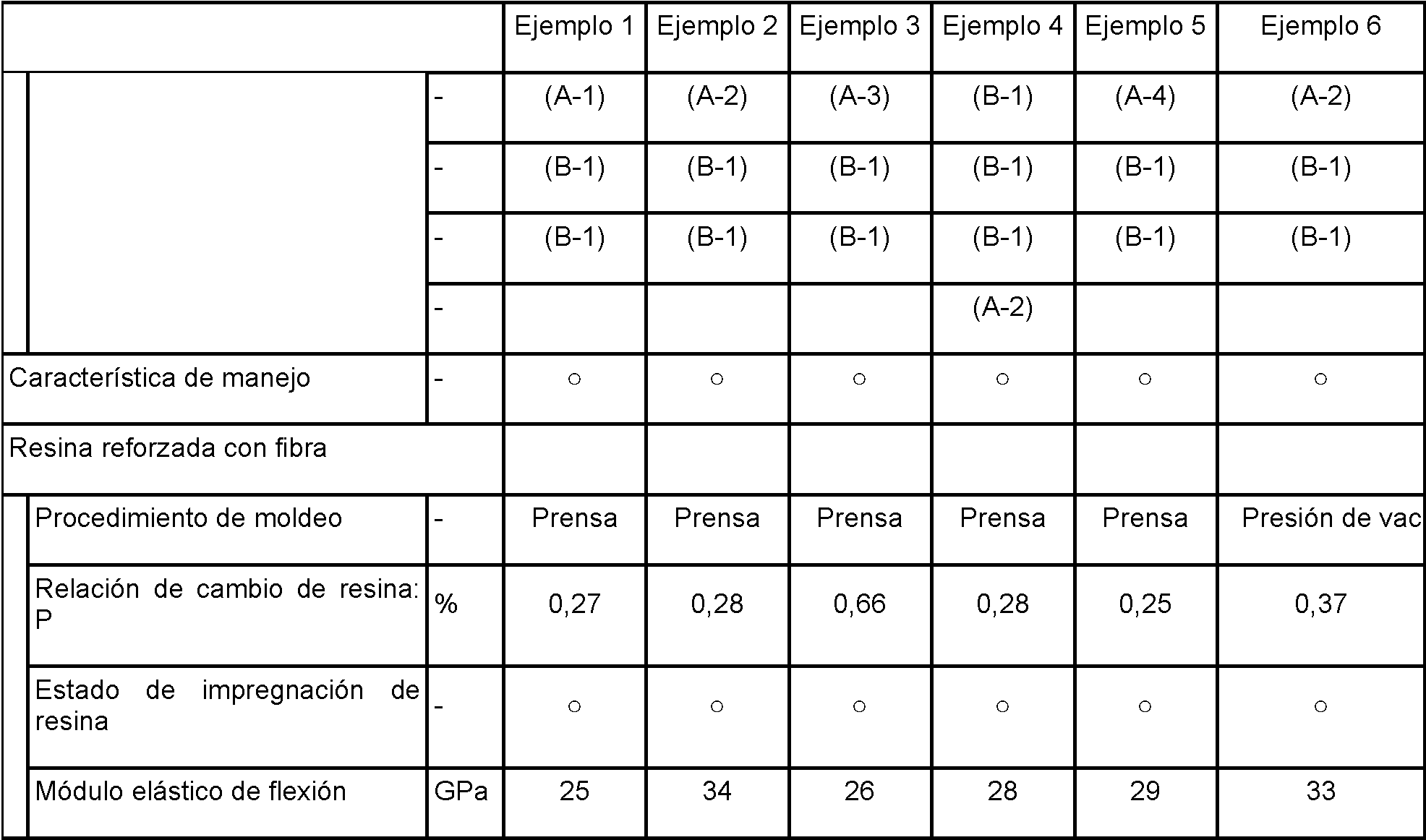
[Tabla 10][Table 10]

Aplicabilidad industrialindustrial applicability
Un material de suministro de resina de la presente invención, y un procedimiento para producir una resina reforzada con fibra mediante el uso del material de suministro de resina se utilizan adecuadamente en aplicaciones deportivas, aplicaciones industriales generales y aplicaciones aeroespaciales. Más concretamente, las aplicaciones industriales generales incluyen miembros de dispositivos electrónicos y materiales de reparación/refuerzo, tales como materiales estructurales y subestructurales para automóviles, embarcaciones, molinos de viento, etc., materiales para techos y cajas (carcasas) para bandejas de CI y ordenadores personales portátiles. Las aplicaciones aeroespaciales incluyen materiales estructurales y subestructurales para aviones, cohetes y satélites artificiales.A resin supply material of the present invention, and a method for producing a fiber-reinforced resin by using the resin supply material are suitably used in sports applications, general industrial applications, and aerospace applications. More specifically, general industrial applications include electronic device members and repair/strengthening materials, such as structural and substructural materials for automobiles, boats, windmills, etc., roofing materials and enclosures (enclosures) for IC trays and portable personal computers. Aerospace applications include structural and substructural materials for aircraft, rockets, and artificial satellites.
Descripción de los signos de referenciaDescription of reference signs
1 Material de suministro de resina1 Resin Supply Material
2 Material de base2 base material
3 Preforma3 Preform
4 Brazo4 Arm
5 Material poroso continuo5 Continuous porous material
6 Garra6 Claw
7 Abrazadera7 clamp
8 Probador de tipo voladizo8 Cantilever Type Tester
9 Plomada9 Plumb
Parte delantera de la plataforma platform front
Claims (9)
Applications Claiming Priority (4)
| Application Number | Priority Date | Filing Date | Title |
|---|---|---|---|
| JP2015038133 | 2015-02-27 | ||
| JP2015038132 | 2015-02-27 | ||
| JP2015037931 | 2015-02-27 | ||
| PCT/JP2016/055377 WO2016136790A1 (en) | 2015-02-27 | 2016-02-24 | Resin supply material, preform, and method for producing fiber-reinforced resin |
Publications (1)
| Publication Number | Publication Date |
|---|---|
| ES2901054T3 true ES2901054T3 (en) | 2022-03-21 |
Family
ID=56789311
Family Applications (1)
| Application Number | Title | Priority Date | Filing Date |
|---|---|---|---|
| ES16755534T Active ES2901054T3 (en) | 2015-02-27 | 2016-02-24 | Resin supply material, preform and method for producing fiber reinforced resin |
Country Status (8)
| Country | Link |
|---|---|
| US (1) | US10822463B2 (en) |
| EP (1) | EP3263630B1 (en) |
| JP (1) | JP6720868B2 (en) |
| KR (1) | KR20170123318A (en) |
| CN (1) | CN107250224A (en) |
| ES (1) | ES2901054T3 (en) |
| TW (2) | TWI699270B (en) |
| WO (1) | WO2016136790A1 (en) |
Families Citing this family (7)
| Publication number | Priority date | Publication date | Assignee | Title |
|---|---|---|---|---|
| EP3263632B1 (en) * | 2015-02-27 | 2019-11-27 | Toray Industries, Inc. | Resin supply material, preform, and method for producing fiber-reinforced resin |
| KR20180117143A (en) * | 2016-02-23 | 2018-10-26 | 도레이 카부시키가이샤 | Manufacturing method of fiber reinforced composite material |
| FR3059934B1 (en) * | 2016-12-14 | 2018-11-30 | Safran Aircraft Engines | A NEEDLE IMPREGNATION MOLD FOR PRODUCING A WORKPIECE FROM A WOVEN PREFORM |
| JP7180446B2 (en) * | 2018-02-28 | 2022-11-30 | 東レ株式会社 | Resin feedstock, preform, and method for producing fiber-reinforced composite material using same |
| WO2019188873A1 (en) * | 2018-03-30 | 2019-10-03 | 東レ株式会社 | Press-molded article manufacturing method |
| US12053908B2 (en) | 2021-02-01 | 2024-08-06 | Regen Fiber, Llc | Method and system for recycling wind turbine blades |
| US11873947B2 (en) * | 2021-05-26 | 2024-01-16 | Trelleborg Sealing Solutions Germany Gmbh | High pressure composite pressure vessel method of manufacture and product |
Family Cites Families (14)
| Publication number | Priority date | Publication date | Assignee | Title |
|---|---|---|---|---|
| JP2002234078A (en) | 2001-02-14 | 2002-08-20 | Toyota Motor Corp | Method for producing fiber-reinforced composite material and molded article with fiber-reinforced composite material |
| JP4856327B2 (en) | 2001-07-03 | 2012-01-18 | 富士重工業株式会社 | Method for manufacturing composite panel |
| JP2003071856A (en) | 2001-08-31 | 2003-03-12 | Toray Ind Inc | RTM method |
| JP2006305867A (en) | 2005-04-28 | 2006-11-09 | Toray Ind Inc | Manufacturing method of fiber reinforced plastic |
| JP2007260930A (en) * | 2006-03-27 | 2007-10-11 | Toho Tenax Co Ltd | Preform substrate and method for producing preform |
| JP5194453B2 (en) | 2007-01-17 | 2013-05-08 | 東レ株式会社 | Fiber reinforced resin |
| JP2008246981A (en) | 2007-03-30 | 2008-10-16 | Honda Motor Co Ltd | Manufacturing method of fiber reinforced composite material |
| US8071205B2 (en) * | 2008-07-31 | 2011-12-06 | Toray Industries, Inc. | Prepreg, preform, molded product, and method for manufacturing prepreg |
| JP2011157638A (en) | 2010-01-29 | 2011-08-18 | Toray Ind Inc | Papermaking substrate and method for producing fiber-reinforced forming substrate |
| JP2012255065A (en) * | 2011-06-08 | 2012-12-27 | Kinsei Seishi Kk | Structure having fiber-reinforcing material and method for producing the same |
| JP5841780B2 (en) | 2011-09-07 | 2016-01-13 | 阿波製紙株式会社 | Manufacturing method of prepreg and manufacturing method of fiber reinforced thermosetting resin molding |
| KR101437212B1 (en) | 2012-01-11 | 2014-09-11 | (주)엘지하우시스 | Continuous carbon fiber reinforced thermoplastic composites with well-impregnated and method for manufacturing of the same |
| EP3263332B1 (en) * | 2015-02-27 | 2022-06-08 | Toray Industries, Inc. | Resin supply material, preform, and method for producing fiber-reinforced resin |
| EP3263632B1 (en) * | 2015-02-27 | 2019-11-27 | Toray Industries, Inc. | Resin supply material, preform, and method for producing fiber-reinforced resin |
-
2016
- 2016-02-24 WO PCT/JP2016/055377 patent/WO2016136790A1/en not_active Ceased
- 2016-02-24 JP JP2016535731A patent/JP6720868B2/en active Active
- 2016-02-24 KR KR1020177025301A patent/KR20170123318A/en not_active Withdrawn
- 2016-02-24 EP EP16755534.1A patent/EP3263630B1/en active Active
- 2016-02-24 US US15/553,788 patent/US10822463B2/en active Active
- 2016-02-24 ES ES16755534T patent/ES2901054T3/en active Active
- 2016-02-24 CN CN201680012344.1A patent/CN107250224A/en active Pending
- 2016-02-25 TW TW105105586A patent/TWI699270B/en active
- 2016-02-25 TW TW109120532A patent/TWI721909B/en active
Also Published As
| Publication number | Publication date |
|---|---|
| KR20170123318A (en) | 2017-11-07 |
| WO2016136790A1 (en) | 2016-09-01 |
| JP6720868B2 (en) | 2020-07-08 |
| TW202039197A (en) | 2020-11-01 |
| US10822463B2 (en) | 2020-11-03 |
| EP3263630B1 (en) | 2021-10-27 |
| TW201714722A (en) | 2017-05-01 |
| US20180066118A1 (en) | 2018-03-08 |
| TWI721909B (en) | 2021-03-11 |
| CN107250224A (en) | 2017-10-13 |
| EP3263630A4 (en) | 2019-04-24 |
| JPWO2016136790A1 (en) | 2017-11-30 |
| TWI699270B (en) | 2020-07-21 |
| EP3263630A1 (en) | 2018-01-03 |
Similar Documents
| Publication | Publication Date | Title |
|---|---|---|
| ES2920830T3 (en) | Resin supply process, preform and process for producing fiber-reinforced resin | |
| US11034809B2 (en) | Resin supply material, preform, and method of producing fiber-reinforced resin | |
| US10800894B2 (en) | Resin supply material, preform, and method of producing fiber-reinforced resin | |
| EP3263630B1 (en) | Resin supply material, preform, and method for producing fiber-reinforced resin | |
| JP6699986B2 (en) | Preform and method for manufacturing integrated sheet material | |
| Hsiao et al. | Effect of carbon nanofiber z-threads on mode-I delamination toughness of carbon fiber reinforced plastic laminates | |
| US11001011B2 (en) | Method of producing fiber reinforced composite material | |
| CN108137839A (en) | Prepreg, layered product, fibre reinforced composites and fibre reinforced composites manufacturing method | |
| BR112017002654B1 (en) | WOVEN FABRIC, PREFORM ADAPTED TO RECEIVE LIQUID RESIN AND COMPOSITE MATERIAL |