ES2901226T3 - Combination for curing epoxy resin compositions - Google Patents
Combination for curing epoxy resin compositions Download PDFInfo
- Publication number
- ES2901226T3 ES2901226T3 ES17814198T ES17814198T ES2901226T3 ES 2901226 T3 ES2901226 T3 ES 2901226T3 ES 17814198 T ES17814198 T ES 17814198T ES 17814198 T ES17814198 T ES 17814198T ES 2901226 T3 ES2901226 T3 ES 2901226T3
- Authority
- ES
- Spain
- Prior art keywords
- curable composition
- amine
- ether
- curing
- bis
- Prior art date
- Legal status (The legal status is an assumption and is not a legal conclusion. Google has not performed a legal analysis and makes no representation as to the accuracy of the status listed.)
- Active
Links
- 239000000203 mixture Substances 0.000 title claims abstract description 113
- 239000003822 epoxy resin Substances 0.000 title claims abstract description 45
- 229920000647 polyepoxide Polymers 0.000 title claims abstract description 45
- 150000001412 amines Chemical class 0.000 claims abstract description 69
- 239000004721 Polyphenylene oxide Substances 0.000 claims abstract description 42
- 229920000570 polyether Polymers 0.000 claims abstract description 42
- 150000003512 tertiary amines Chemical class 0.000 claims abstract description 21
- ZMSQJSMSLXVTKN-UHFFFAOYSA-N 4-[2-(2-morpholin-4-ylethoxy)ethyl]morpholine Chemical compound C1COCCN1CCOCCN1CCOCC1 ZMSQJSMSLXVTKN-UHFFFAOYSA-N 0.000 claims abstract description 14
- 229910052757 nitrogen Inorganic materials 0.000 claims abstract description 12
- JAEQOSKUYPMJAT-UHFFFAOYSA-N 4-(2-methoxyethyl)morpholine Chemical compound COCCN1CCOCC1 JAEQOSKUYPMJAT-UHFFFAOYSA-N 0.000 claims abstract description 8
- LMRKVKPRHROQRR-UHFFFAOYSA-N 4-butylmorpholine Chemical compound CCCCN1CCOCC1 LMRKVKPRHROQRR-UHFFFAOYSA-N 0.000 claims abstract description 8
- HVCNXQOWACZAFN-UHFFFAOYSA-N 4-ethylmorpholine Chemical compound CCN1CCOCC1 HVCNXQOWACZAFN-UHFFFAOYSA-N 0.000 claims abstract description 8
- KKFDCBRMNNSAAW-UHFFFAOYSA-N 2-(morpholin-4-yl)ethanol Chemical compound OCCN1CCOCC1 KKFDCBRMNNSAAW-UHFFFAOYSA-N 0.000 claims abstract description 7
- GTEXIOINCJRBIO-UHFFFAOYSA-N 2-[2-(dimethylamino)ethoxy]-n,n-dimethylethanamine Chemical compound CN(C)CCOCCN(C)C GTEXIOINCJRBIO-UHFFFAOYSA-N 0.000 claims abstract description 7
- NCUPDIHWMQEDPR-UHFFFAOYSA-N 2-[2-[2-(dimethylamino)ethoxy]ethyl-methylamino]ethanol Chemical compound CN(C)CCOCCN(C)CCO NCUPDIHWMQEDPR-UHFFFAOYSA-N 0.000 claims abstract description 7
- FZQMJOOSLXFQSU-UHFFFAOYSA-N 3-[3,5-bis[3-(dimethylamino)propyl]-1,3,5-triazinan-1-yl]-n,n-dimethylpropan-1-amine Chemical compound CN(C)CCCN1CN(CCCN(C)C)CN(CCCN(C)C)C1 FZQMJOOSLXFQSU-UHFFFAOYSA-N 0.000 claims abstract description 7
- XLZMWNWNBXSZKF-UHFFFAOYSA-N 4-propan-2-ylmorpholine Chemical compound CC(C)N1CCOCC1 XLZMWNWNBXSZKF-UHFFFAOYSA-N 0.000 claims abstract description 7
- CRVGTESFCCXCTH-UHFFFAOYSA-N methyl diethanolamine Chemical compound OCCN(C)CCO CRVGTESFCCXCTH-UHFFFAOYSA-N 0.000 claims abstract description 7
- GSCCALZHGUWNJW-UHFFFAOYSA-N N-Cyclohexyl-N-methylcyclohexanamine Chemical compound C1CCCCC1N(C)C1CCCCC1 GSCCALZHGUWNJW-UHFFFAOYSA-N 0.000 claims abstract description 4
- RAXXELZNTBOGNW-UHFFFAOYSA-N imidazole Natural products C1=CNC=N1 RAXXELZNTBOGNW-UHFFFAOYSA-N 0.000 claims description 30
- 238000000034 method Methods 0.000 claims description 30
- 239000002131 composite material Substances 0.000 claims description 19
- 239000000463 material Substances 0.000 claims description 19
- ZRALSGWEFCBTJO-UHFFFAOYSA-N Guanidine Chemical compound NC(N)=N ZRALSGWEFCBTJO-UHFFFAOYSA-N 0.000 claims description 16
- 239000000758 substrate Substances 0.000 claims description 12
- 150000004982 aromatic amines Chemical class 0.000 claims description 11
- 238000002156 mixing Methods 0.000 claims description 11
- CHJJGSNFBQVOTG-UHFFFAOYSA-N N-methyl-guanidine Natural products CNC(N)=N CHJJGSNFBQVOTG-UHFFFAOYSA-N 0.000 claims description 9
- SWSQBOPZIKWTGO-UHFFFAOYSA-N dimethylaminoamidine Natural products CN(C)C(N)=N SWSQBOPZIKWTGO-UHFFFAOYSA-N 0.000 claims description 9
- 239000012783 reinforcing fiber Substances 0.000 claims description 9
- 150000005676 cyclic carbonates Chemical class 0.000 claims description 8
- 229920001971 elastomer Polymers 0.000 claims description 6
- 229920000768 polyamine Polymers 0.000 claims description 5
- 239000005060 rubber Substances 0.000 claims description 5
- 238000004519 manufacturing process Methods 0.000 claims description 3
- 239000000956 alloy Substances 0.000 claims description 2
- 229910045601 alloy Inorganic materials 0.000 claims description 2
- 239000004568 cement Substances 0.000 claims description 2
- 239000000919 ceramic Substances 0.000 claims description 2
- 239000004567 concrete Substances 0.000 claims description 2
- 239000011521 glass Substances 0.000 claims description 2
- 239000002184 metal Substances 0.000 claims description 2
- 229910052751 metal Inorganic materials 0.000 claims description 2
- 239000004033 plastic Substances 0.000 claims description 2
- 229920003023 plastic Polymers 0.000 claims description 2
- 239000002023 wood Substances 0.000 claims description 2
- 239000000835 fiber Substances 0.000 description 34
- -1 aliphatic amines Chemical class 0.000 description 25
- 150000001875 compounds Chemical class 0.000 description 25
- 239000004593 Epoxy Substances 0.000 description 19
- 239000003795 chemical substances by application Substances 0.000 description 13
- WTFAGPBUAGFMQX-UHFFFAOYSA-N 1-[2-[2-(2-aminopropoxy)propoxy]propoxy]propan-2-amine Chemical compound CC(N)COCC(C)OCC(C)OCC(C)N WTFAGPBUAGFMQX-UHFFFAOYSA-N 0.000 description 12
- IISBACLAFKSPIT-UHFFFAOYSA-N bisphenol A Chemical compound C=1C=C(O)C=CC=1C(C)(C)C1=CC=C(O)C=C1 IISBACLAFKSPIT-UHFFFAOYSA-N 0.000 description 12
- PXKLMJQFEQBVLD-UHFFFAOYSA-N bisphenol F Chemical compound C1=CC(O)=CC=C1CC1=CC=C(O)C=C1 PXKLMJQFEQBVLD-UHFFFAOYSA-N 0.000 description 12
- 150000002118 epoxides Chemical class 0.000 description 9
- 229920005989 resin Polymers 0.000 description 9
- 239000011347 resin Substances 0.000 description 9
- PEDCQBHIVMGVHV-UHFFFAOYSA-N Glycerine Chemical compound OCC(O)CO PEDCQBHIVMGVHV-UHFFFAOYSA-N 0.000 description 8
- 239000011248 coating agent Substances 0.000 description 8
- 238000000576 coating method Methods 0.000 description 8
- RNLHGQLZWXBQNY-UHFFFAOYSA-N 3-(aminomethyl)-3,5,5-trimethylcyclohexan-1-amine Chemical compound CC1(C)CC(N)CC(C)(CN)C1 RNLHGQLZWXBQNY-UHFFFAOYSA-N 0.000 description 7
- 229920000049 Carbon (fiber) Polymers 0.000 description 7
- 239000004917 carbon fiber Substances 0.000 description 7
- 238000009472 formulation Methods 0.000 description 7
- LNEPOXFFQSENCJ-UHFFFAOYSA-N haloperidol Chemical compound C1CC(O)(C=2C=CC(Cl)=CC=2)CCN1CCCC(=O)C1=CC=C(F)C=C1 LNEPOXFFQSENCJ-UHFFFAOYSA-N 0.000 description 7
- 239000001257 hydrogen Substances 0.000 description 7
- 229910052739 hydrogen Inorganic materials 0.000 description 7
- VPWNQTHUCYMVMZ-UHFFFAOYSA-N 4,4'-sulfonyldiphenol Chemical compound C1=CC(O)=CC=C1S(=O)(=O)C1=CC=C(O)C=C1 VPWNQTHUCYMVMZ-UHFFFAOYSA-N 0.000 description 6
- 238000006243 chemical reaction Methods 0.000 description 6
- 150000002148 esters Chemical class 0.000 description 6
- 239000004744 fabric Substances 0.000 description 6
- 125000003055 glycidyl group Chemical group C(C1CO1)* 0.000 description 6
- VNWKTOKETHGBQD-UHFFFAOYSA-N methane Chemical compound C VNWKTOKETHGBQD-UHFFFAOYSA-N 0.000 description 6
- 239000002253 acid Substances 0.000 description 5
- 125000001931 aliphatic group Chemical group 0.000 description 5
- 125000003118 aryl group Chemical group 0.000 description 5
- 150000002170 ethers Chemical class 0.000 description 5
- 125000002887 hydroxy group Chemical group [H]O* 0.000 description 5
- 239000007788 liquid Substances 0.000 description 5
- 238000000465 moulding Methods 0.000 description 5
- 238000003756 stirring Methods 0.000 description 5
- RTZKZFJDLAIYFH-UHFFFAOYSA-N Diethyl ether Chemical compound CCOCC RTZKZFJDLAIYFH-UHFFFAOYSA-N 0.000 description 4
- SJRJJKPEHAURKC-UHFFFAOYSA-N N-Methylmorpholine Chemical compound CN1CCOCC1 SJRJJKPEHAURKC-UHFFFAOYSA-N 0.000 description 4
- WTEOIRVLGSZEPR-UHFFFAOYSA-N boron trifluoride Chemical compound FB(F)F WTEOIRVLGSZEPR-UHFFFAOYSA-N 0.000 description 4
- 229910052799 carbon Inorganic materials 0.000 description 4
- 125000004435 hydrogen atom Chemical group [H]* 0.000 description 4
- 238000005470 impregnation Methods 0.000 description 4
- 238000001802 infusion Methods 0.000 description 4
- 229920003986 novolac Polymers 0.000 description 4
- 239000000047 product Substances 0.000 description 4
- 229910052717 sulfur Inorganic materials 0.000 description 4
- ARCGXLSVLAOJQL-UHFFFAOYSA-N trimellitic acid Chemical compound OC(=O)C1=CC=C(C(O)=O)C(C(O)=O)=C1 ARCGXLSVLAOJQL-UHFFFAOYSA-N 0.000 description 4
- BRLQWZUYTZBJKN-UHFFFAOYSA-N Epichlorohydrin Chemical class ClCC1CO1 BRLQWZUYTZBJKN-UHFFFAOYSA-N 0.000 description 3
- LYCAIKOWRPUZTN-UHFFFAOYSA-N Ethylene glycol Chemical compound OCCO LYCAIKOWRPUZTN-UHFFFAOYSA-N 0.000 description 3
- 239000002841 Lewis acid Substances 0.000 description 3
- 229920000459 Nitrile rubber Polymers 0.000 description 3
- 150000008065 acid anhydrides Chemical class 0.000 description 3
- 239000000654 additive Substances 0.000 description 3
- 125000002723 alicyclic group Chemical group 0.000 description 3
- 125000000217 alkyl group Chemical group 0.000 description 3
- 229920006231 aramid fiber Polymers 0.000 description 3
- 150000004985 diamines Chemical class 0.000 description 3
- MTHSVFCYNBDYFN-UHFFFAOYSA-N diethylene glycol Chemical compound OCCOCCO MTHSVFCYNBDYFN-UHFFFAOYSA-N 0.000 description 3
- GYZLOYUZLJXAJU-UHFFFAOYSA-N diglycidyl ether Chemical class C1OC1COCC1CO1 GYZLOYUZLJXAJU-UHFFFAOYSA-N 0.000 description 3
- 125000003700 epoxy group Chemical group 0.000 description 3
- 239000003063 flame retardant Substances 0.000 description 3
- 239000003365 glass fiber Substances 0.000 description 3
- 230000009477 glass transition Effects 0.000 description 3
- 235000011187 glycerol Nutrition 0.000 description 3
- 150000002334 glycols Chemical class 0.000 description 3
- 238000010438 heat treatment Methods 0.000 description 3
- NAQMVNRVTILPCV-UHFFFAOYSA-N hexane-1,6-diamine Chemical compound NCCCCCCN NAQMVNRVTILPCV-UHFFFAOYSA-N 0.000 description 3
- 150000007517 lewis acids Chemical class 0.000 description 3
- 125000002496 methyl group Chemical group [H]C([H])([H])* 0.000 description 3
- ISWSIDIOOBJBQZ-UHFFFAOYSA-N phenol group Chemical group C1(=CC=CC=C1)O ISWSIDIOOBJBQZ-UHFFFAOYSA-N 0.000 description 3
- 150000002989 phenols Chemical class 0.000 description 3
- RUEBPOOTFCZRBC-UHFFFAOYSA-N (5-methyl-2-phenyl-1h-imidazol-4-yl)methanol Chemical compound OCC1=C(C)NC(C=2C=CC=CC=2)=N1 RUEBPOOTFCZRBC-UHFFFAOYSA-N 0.000 description 2
- QTWJRLJHJPIABL-UHFFFAOYSA-N 2-methylphenol;3-methylphenol;4-methylphenol Chemical compound CC1=CC=C(O)C=C1.CC1=CC=CC(O)=C1.CC1=CC=CC=C1O QTWJRLJHJPIABL-UHFFFAOYSA-N 0.000 description 2
- MECNWXGGNCJFQJ-UHFFFAOYSA-N 3-piperidin-1-ylpropane-1,2-diol Chemical compound OCC(O)CN1CCCCC1 MECNWXGGNCJFQJ-UHFFFAOYSA-N 0.000 description 2
- CDBAMNGURPMUTG-UHFFFAOYSA-N 4-[2-(4-hydroxycyclohexyl)propan-2-yl]cyclohexan-1-ol Chemical compound C1CC(O)CCC1C(C)(C)C1CCC(O)CC1 CDBAMNGURPMUTG-UHFFFAOYSA-N 0.000 description 2
- PAYRUJLWNCNPSJ-UHFFFAOYSA-N Aniline Chemical compound NC1=CC=CC=C1 PAYRUJLWNCNPSJ-UHFFFAOYSA-N 0.000 description 2
- 229910015900 BF3 Inorganic materials 0.000 description 2
- LCFVJGUPQDGYKZ-UHFFFAOYSA-N Bisphenol A diglycidyl ether Chemical compound C=1C=C(OCC2OC2)C=CC=1C(C)(C)C(C=C1)=CC=C1OCC1CO1 LCFVJGUPQDGYKZ-UHFFFAOYSA-N 0.000 description 2
- UFHFLCQGNIYNRP-UHFFFAOYSA-N Hydrogen Chemical compound [H][H] UFHFLCQGNIYNRP-UHFFFAOYSA-N 0.000 description 2
- QIGBRXMKCJKVMJ-UHFFFAOYSA-N Hydroquinone Chemical compound OC1=CC=C(O)C=C1 QIGBRXMKCJKVMJ-UHFFFAOYSA-N 0.000 description 2
- 239000004698 Polyethylene Substances 0.000 description 2
- DNIAPMSPPWPWGF-UHFFFAOYSA-N Propylene glycol Chemical compound CC(O)CO DNIAPMSPPWPWGF-UHFFFAOYSA-N 0.000 description 2
- UUQQGGWZVKUCBD-UHFFFAOYSA-N [4-(hydroxymethyl)-2-phenyl-1h-imidazol-5-yl]methanol Chemical compound N1C(CO)=C(CO)N=C1C1=CC=CC=C1 UUQQGGWZVKUCBD-UHFFFAOYSA-N 0.000 description 2
- 150000007513 acids Chemical class 0.000 description 2
- WNLRTRBMVRJNCN-UHFFFAOYSA-N adipic acid Chemical compound OC(=O)CCCCC(O)=O WNLRTRBMVRJNCN-UHFFFAOYSA-N 0.000 description 2
- 150000001298 alcohols Chemical class 0.000 description 2
- NTXGQCSETZTARF-UHFFFAOYSA-N buta-1,3-diene;prop-2-enenitrile Chemical compound C=CC=C.C=CC#N NTXGQCSETZTARF-UHFFFAOYSA-N 0.000 description 2
- WERYXYBDKMZEQL-UHFFFAOYSA-N butane-1,4-diol Chemical compound OCCCCO WERYXYBDKMZEQL-UHFFFAOYSA-N 0.000 description 2
- VHRGRCVQAFMJIZ-UHFFFAOYSA-N cadaverine Chemical compound NCCCCCN VHRGRCVQAFMJIZ-UHFFFAOYSA-N 0.000 description 2
- 235000013877 carbamide Nutrition 0.000 description 2
- 125000004432 carbon atom Chemical group C* 0.000 description 2
- 239000003054 catalyst Substances 0.000 description 2
- 230000000052 comparative effect Effects 0.000 description 2
- 229930003836 cresol Natural products 0.000 description 2
- 150000001923 cyclic compounds Chemical class 0.000 description 2
- 230000003247 decreasing effect Effects 0.000 description 2
- 239000003085 diluting agent Substances 0.000 description 2
- 239000000945 filler Substances 0.000 description 2
- 125000000524 functional group Chemical group 0.000 description 2
- 230000014509 gene expression Effects 0.000 description 2
- 125000000623 heterocyclic group Chemical group 0.000 description 2
- 239000012943 hotmelt Substances 0.000 description 2
- 125000002883 imidazolyl group Chemical group 0.000 description 2
- QQVIHTHCMHWDBS-UHFFFAOYSA-N isophthalic acid Chemical compound OC(=O)C1=CC=CC(C(O)=O)=C1 QQVIHTHCMHWDBS-UHFFFAOYSA-N 0.000 description 2
- 239000003949 liquefied natural gas Substances 0.000 description 2
- 239000004850 liquid epoxy resins (LERs) Substances 0.000 description 2
- WSFSSNUMVMOOMR-NJFSPNSNSA-N methanone Chemical compound O=[14CH2] WSFSSNUMVMOOMR-NJFSPNSNSA-N 0.000 description 2
- BDJRBEYXGGNYIS-UHFFFAOYSA-N nonanedioic acid Chemical compound OC(=O)CCCCCCCC(O)=O BDJRBEYXGGNYIS-UHFFFAOYSA-N 0.000 description 2
- XNGIFLGASWRNHJ-UHFFFAOYSA-N phthalic acid Chemical compound OC(=O)C1=CC=CC=C1C(O)=O XNGIFLGASWRNHJ-UHFFFAOYSA-N 0.000 description 2
- WLJVNTCWHIRURA-UHFFFAOYSA-N pimelic acid Chemical compound OC(=O)CCCCCC(O)=O WLJVNTCWHIRURA-UHFFFAOYSA-N 0.000 description 2
- 229920002239 polyacrylonitrile Polymers 0.000 description 2
- 238000011417 postcuring Methods 0.000 description 2
- 238000012545 processing Methods 0.000 description 2
- YPFDHNVEDLHUCE-UHFFFAOYSA-N propane-1,3-diol Chemical compound OCCCO YPFDHNVEDLHUCE-UHFFFAOYSA-N 0.000 description 2
- KIDHWZJUCRJVML-UHFFFAOYSA-N putrescine Chemical compound NCCCCN KIDHWZJUCRJVML-UHFFFAOYSA-N 0.000 description 2
- CYIDZMCFTVVTJO-UHFFFAOYSA-N pyromellitic acid Chemical compound OC(=O)C1=CC(C(O)=O)=C(C(O)=O)C=C1C(O)=O CYIDZMCFTVVTJO-UHFFFAOYSA-N 0.000 description 2
- 230000005855 radiation Effects 0.000 description 2
- GHMLBKRAJCXXBS-UHFFFAOYSA-N resorcinol Chemical compound OC1=CC=CC(O)=C1 GHMLBKRAJCXXBS-UHFFFAOYSA-N 0.000 description 2
- CXMXRPHRNRROMY-UHFFFAOYSA-N sebacic acid Chemical compound OC(=O)CCCCCCCCC(O)=O CXMXRPHRNRROMY-UHFFFAOYSA-N 0.000 description 2
- 239000007787 solid Substances 0.000 description 2
- 239000002904 solvent Substances 0.000 description 2
- TYFQFVWCELRYAO-UHFFFAOYSA-N suberic acid Chemical compound OC(=O)CCCCCCC(O)=O TYFQFVWCELRYAO-UHFFFAOYSA-N 0.000 description 2
- 239000000126 substance Substances 0.000 description 2
- 239000004753 textile Substances 0.000 description 2
- XFNJVJPLKCPIBV-UHFFFAOYSA-N trimethylenediamine Chemical compound NCCCN XFNJVJPLKCPIBV-UHFFFAOYSA-N 0.000 description 2
- 239000002759 woven fabric Substances 0.000 description 2
- ZMAMKNPVAMKIIC-UHFFFAOYSA-N (5-benzyl-2-phenyl-1h-imidazol-4-yl)methanol Chemical compound OCC=1N=C(C=2C=CC=CC=2)NC=1CC1=CC=CC=C1 ZMAMKNPVAMKIIC-UHFFFAOYSA-N 0.000 description 1
- 125000003837 (C1-C20) alkyl group Chemical group 0.000 description 1
- KYVBNYUBXIEUFW-UHFFFAOYSA-N 1,1,3,3-tetramethylguanidine Chemical compound CN(C)C(=N)N(C)C KYVBNYUBXIEUFW-UHFFFAOYSA-N 0.000 description 1
- GIWQSPITLQVMSG-UHFFFAOYSA-N 1,2-dimethylimidazole Chemical compound CC1=NC=CN1C GIWQSPITLQVMSG-UHFFFAOYSA-N 0.000 description 1
- VYMPLPIFKRHAAC-UHFFFAOYSA-N 1,2-ethanedithiol Chemical compound SCCS VYMPLPIFKRHAAC-UHFFFAOYSA-N 0.000 description 1
- DEWLEGDTCGBNGU-UHFFFAOYSA-N 1,3-dichloropropan-2-ol Chemical compound ClCC(O)CCl DEWLEGDTCGBNGU-UHFFFAOYSA-N 0.000 description 1
- FBHPRUXJQNWTEW-UHFFFAOYSA-N 1-benzyl-2-methylimidazole Chemical compound CC1=NC=CN1CC1=CC=CC=C1 FBHPRUXJQNWTEW-UHFFFAOYSA-N 0.000 description 1
- RTBFRGCFXZNCOE-UHFFFAOYSA-N 1-methylsulfonylpiperidin-4-one Chemical compound CS(=O)(=O)N1CCC(=O)CC1 RTBFRGCFXZNCOE-UHFFFAOYSA-N 0.000 description 1
- VILCJCGEZXAXTO-UHFFFAOYSA-N 2,2,2-tetramine Chemical compound NCCNCCNCCN VILCJCGEZXAXTO-UHFFFAOYSA-N 0.000 description 1
- JWTVQZQPKHXGFM-UHFFFAOYSA-N 2,5-dimethylhexane-2,5-diamine Chemical compound CC(C)(N)CCC(C)(C)N JWTVQZQPKHXGFM-UHFFFAOYSA-N 0.000 description 1
- QKVROWZQJVDFSO-UHFFFAOYSA-N 2-(2-methylimidazol-1-yl)ethanamine Chemical compound CC1=NC=CN1CCN QKVROWZQJVDFSO-UHFFFAOYSA-N 0.000 description 1
- MLPBASQNOQYIGL-UHFFFAOYSA-N 2-(2-propan-2-yl-1h-imidazol-5-yl)propanenitrile Chemical compound CC(C)C1=NC=C(C(C)C#N)N1 MLPBASQNOQYIGL-UHFFFAOYSA-N 0.000 description 1
- BGYGNVSBGRDARU-UHFFFAOYSA-N 2-(oxiran-2-ylmethoxy)benzoic acid Chemical compound OC(=O)C1=CC=CC=C1OCC1OC1 BGYGNVSBGRDARU-UHFFFAOYSA-N 0.000 description 1
- WMYINDVYGQKYMI-UHFFFAOYSA-N 2-[2,2-bis(hydroxymethyl)butoxymethyl]-2-ethylpropane-1,3-diol Chemical compound CCC(CO)(CO)COCC(CC)(CO)CO WMYINDVYGQKYMI-UHFFFAOYSA-N 0.000 description 1
- SHKUUQIDMUMQQK-UHFFFAOYSA-N 2-[4-(oxiran-2-ylmethoxy)butoxymethyl]oxirane Chemical compound C1OC1COCCCCOCC1CO1 SHKUUQIDMUMQQK-UHFFFAOYSA-N 0.000 description 1
- WTYYGFLRBWMFRY-UHFFFAOYSA-N 2-[6-(oxiran-2-ylmethoxy)hexoxymethyl]oxirane Chemical compound C1OC1COCCCCCCOCC1CO1 WTYYGFLRBWMFRY-UHFFFAOYSA-N 0.000 description 1
- OJPDDQSCZGTACX-UHFFFAOYSA-N 2-[n-(2-hydroxyethyl)anilino]ethanol Chemical compound OCCN(CCO)C1=CC=CC=C1 OJPDDQSCZGTACX-UHFFFAOYSA-N 0.000 description 1
- PQAMFDRRWURCFQ-UHFFFAOYSA-N 2-ethyl-1h-imidazole Chemical compound CCC1=NC=CN1 PQAMFDRRWURCFQ-UHFFFAOYSA-N 0.000 description 1
- QFZKVFCEJRXRBD-UHFFFAOYSA-N 2-ethyl-4-[(2-ethyl-5-methyl-1h-imidazol-4-yl)methyl]-5-methyl-1h-imidazole Chemical compound N1C(CC)=NC(CC2=C(NC(CC)=N2)C)=C1C QFZKVFCEJRXRBD-UHFFFAOYSA-N 0.000 description 1
- YTWBFUCJVWKCCK-UHFFFAOYSA-N 2-heptadecyl-1h-imidazole Chemical compound CCCCCCCCCCCCCCCCCC1=NC=CN1 YTWBFUCJVWKCCK-UHFFFAOYSA-N 0.000 description 1
- LXBGSDVWAMZHDD-UHFFFAOYSA-N 2-methyl-1h-imidazole Chemical compound CC1=NC=CN1 LXBGSDVWAMZHDD-UHFFFAOYSA-N 0.000 description 1
- QXSNXUCNBZLVFM-UHFFFAOYSA-N 2-methyl-1h-imidazole;1,3,5-triazinane-2,4,6-trione Chemical compound CC1=NC=CN1.O=C1NC(=O)NC(=O)N1 QXSNXUCNBZLVFM-UHFFFAOYSA-N 0.000 description 1
- BMSUMUHITJFMQX-UHFFFAOYSA-N 2-methyl-2-[2-[(2-methyloxiran-2-yl)methoxy]ethoxymethyl]oxirane Chemical compound C1OC1(C)COCCOCC1(C)CO1 BMSUMUHITJFMQX-UHFFFAOYSA-N 0.000 description 1
- JZUHIOJYCPIVLQ-UHFFFAOYSA-N 2-methylpentane-1,5-diamine Chemical compound NCC(C)CCCN JZUHIOJYCPIVLQ-UHFFFAOYSA-N 0.000 description 1
- ZCUJYXPAKHMBAZ-UHFFFAOYSA-N 2-phenyl-1h-imidazole Chemical compound C1=CNC(C=2C=CC=CC=2)=N1 ZCUJYXPAKHMBAZ-UHFFFAOYSA-N 0.000 description 1
- RJIQELZAIWFNTQ-UHFFFAOYSA-N 2-phenyl-1h-imidazole;1,3,5-triazinane-2,4,6-trione Chemical compound O=C1NC(=O)NC(=O)N1.C1=CNC(C=2C=CC=CC=2)=N1 RJIQELZAIWFNTQ-UHFFFAOYSA-N 0.000 description 1
- FUOZJYASZOSONT-UHFFFAOYSA-N 2-propan-2-yl-1h-imidazole Chemical compound CC(C)C1=NC=CN1 FUOZJYASZOSONT-UHFFFAOYSA-N 0.000 description 1
- LLEASVZEQBICSN-UHFFFAOYSA-N 2-undecyl-1h-imidazole Chemical compound CCCCCCCCCCCC1=NC=CN1 LLEASVZEQBICSN-UHFFFAOYSA-N 0.000 description 1
- GRWFFFOEIHGUBG-UHFFFAOYSA-N 3,4-Epoxy-6-methylcyclohexylmethyl-3,4-epoxy-6-methylcyclo-hexanecarboxylate Chemical compound C1C2OC2CC(C)C1C(=O)OCC1CC2OC2CC1C GRWFFFOEIHGUBG-UHFFFAOYSA-N 0.000 description 1
- UIDDPPKZYZTEGS-UHFFFAOYSA-N 3-(2-ethyl-4-methylimidazol-1-yl)propanenitrile Chemical compound CCC1=NC(C)=CN1CCC#N UIDDPPKZYZTEGS-UHFFFAOYSA-N 0.000 description 1
- SESYNEDUKZDRJL-UHFFFAOYSA-N 3-(2-methylimidazol-1-yl)propanenitrile Chemical compound CC1=NC=CN1CCC#N SESYNEDUKZDRJL-UHFFFAOYSA-N 0.000 description 1
- BVYPJEBKDLFIDL-UHFFFAOYSA-N 3-(2-phenylimidazol-1-yl)propanenitrile Chemical compound N#CCCN1C=CN=C1C1=CC=CC=C1 BVYPJEBKDLFIDL-UHFFFAOYSA-N 0.000 description 1
- RXBBSTXUVVVWRC-UHFFFAOYSA-N 3-[3-[4,4-dimethyl-3-(oxiran-2-ylmethyl)-2,5-dioxoimidazolidin-1-yl]-2-(oxiran-2-ylmethoxy)propyl]-5,5-dimethyl-1-(oxiran-2-ylmethyl)imidazolidine-2,4-dione Chemical compound O=C1N(CC(CN2C(C(C)(C)N(CC3OC3)C2=O)=O)OCC2OC2)C(=O)C(C)(C)N1CC1CO1 RXBBSTXUVVVWRC-UHFFFAOYSA-N 0.000 description 1
- YBRVSVVVWCFQMG-UHFFFAOYSA-N 4,4'-diaminodiphenylmethane Chemical compound C1=CC(N)=CC=C1CC1=CC=C(N)C=C1 YBRVSVVVWCFQMG-UHFFFAOYSA-N 0.000 description 1
- DZIHTWJGPDVSGE-UHFFFAOYSA-N 4-[(4-aminocyclohexyl)methyl]cyclohexan-1-amine Chemical compound C1CC(N)CCC1CC1CCC(N)CC1 DZIHTWJGPDVSGE-UHFFFAOYSA-N 0.000 description 1
- WXQZLPFNTPKVJM-UHFFFAOYSA-N 4-[(4-hydroxycyclohexyl)methyl]cyclohexan-1-ol Chemical compound C1CC(O)CCC1CC1CCC(O)CC1 WXQZLPFNTPKVJM-UHFFFAOYSA-N 0.000 description 1
- IMDQDSLAUVKLAO-UHFFFAOYSA-N 4-[2-(4-carboxy-7-oxabicyclo[4.1.0]heptan-4-yl)ethyl]-7-oxabicyclo[4.1.0]heptane-4-carboxylic acid Chemical compound C1CC2OC2CC1(C(O)=O)CCC1(C(=O)O)CC2OC2CC1 IMDQDSLAUVKLAO-UHFFFAOYSA-N 0.000 description 1
- PLIKAWJENQZMHA-UHFFFAOYSA-N 4-aminophenol Chemical class NC1=CC=C(O)C=C1 PLIKAWJENQZMHA-UHFFFAOYSA-N 0.000 description 1
- YWVFNWVZBAWOOY-UHFFFAOYSA-N 4-methylcyclohexane-1,2-dicarboxylic acid Chemical compound CC1CCC(C(O)=O)C(C(O)=O)C1 YWVFNWVZBAWOOY-UHFFFAOYSA-N 0.000 description 1
- OECTYKWYRCHAKR-UHFFFAOYSA-N 4-vinylcyclohexene dioxide Chemical compound C1OC1C1CC2OC2CC1 OECTYKWYRCHAKR-UHFFFAOYSA-N 0.000 description 1
- YIROYDNZEPTFOL-UHFFFAOYSA-N 5,5-Dimethylhydantoin Chemical compound CC1(C)NC(=O)NC1=O YIROYDNZEPTFOL-UHFFFAOYSA-N 0.000 description 1
- OQAPYXJOOYQXDV-UHFFFAOYSA-N 5,5-dimethyl-3-[2-(oxiran-2-ylmethoxy)propyl]-1-(oxiran-2-ylmethyl)imidazolidine-2,4-dione Chemical compound C1OC1COC(C)CN(C(C1(C)C)=O)C(=O)N1CC1CO1 OQAPYXJOOYQXDV-UHFFFAOYSA-N 0.000 description 1
- YATKABCHSRLDGQ-UHFFFAOYSA-N 5-benzyl-2-phenyl-1h-imidazole Chemical compound C=1C=CC=CC=1CC(N=1)=CNC=1C1=CC=CC=C1 YATKABCHSRLDGQ-UHFFFAOYSA-N 0.000 description 1
- AHNGUGDMAGMLGV-UHFFFAOYSA-N 5-benzyl-3-methyl-2-phenylimidazol-4-ol Chemical compound N1=C(C=2C=CC=CC=2)N(C)C(O)=C1CC1=CC=CC=C1 AHNGUGDMAGMLGV-UHFFFAOYSA-N 0.000 description 1
- RIAHASMJDOMQER-UHFFFAOYSA-N 5-ethyl-2-methyl-1h-imidazole Chemical compound CCC1=CN=C(C)N1 RIAHASMJDOMQER-UHFFFAOYSA-N 0.000 description 1
- TYOXIFXYEIILLY-UHFFFAOYSA-N 5-methyl-2-phenyl-1h-imidazole Chemical compound N1C(C)=CN=C1C1=CC=CC=C1 TYOXIFXYEIILLY-UHFFFAOYSA-N 0.000 description 1
- SVLTVRFYVWMEQN-UHFFFAOYSA-N 5-methylcyclohex-3-ene-1,2-dicarboxylic acid Chemical compound CC1CC(C(O)=O)C(C(O)=O)C=C1 SVLTVRFYVWMEQN-UHFFFAOYSA-N 0.000 description 1
- ULKLGIFJWFIQFF-UHFFFAOYSA-N 5K8XI641G3 Chemical compound CCC1=NC=C(C)N1 ULKLGIFJWFIQFF-UHFFFAOYSA-N 0.000 description 1
- XAYDWGMOPRHLEP-UHFFFAOYSA-N 6-ethenyl-7-oxabicyclo[4.1.0]heptane Chemical compound C1CCCC2OC21C=C XAYDWGMOPRHLEP-UHFFFAOYSA-N 0.000 description 1
- RBHIUNHSNSQJNG-UHFFFAOYSA-N 6-methyl-3-(2-methyloxiran-2-yl)-7-oxabicyclo[4.1.0]heptane Chemical compound C1CC2(C)OC2CC1C1(C)CO1 RBHIUNHSNSQJNG-UHFFFAOYSA-N 0.000 description 1
- GJEZBVHHZQAEDB-UHFFFAOYSA-N 6-oxabicyclo[3.1.0]hexane Chemical group C1CCC2OC21 GJEZBVHHZQAEDB-UHFFFAOYSA-N 0.000 description 1
- NHJIDZUQMHKGRE-UHFFFAOYSA-N 7-oxabicyclo[4.1.0]heptan-4-yl 2-(7-oxabicyclo[4.1.0]heptan-4-yl)acetate Chemical compound C1CC2OC2CC1OC(=O)CC1CC2OC2CC1 NHJIDZUQMHKGRE-UHFFFAOYSA-N 0.000 description 1
- YXALYBMHAYZKAP-UHFFFAOYSA-N 7-oxabicyclo[4.1.0]heptan-4-ylmethyl 7-oxabicyclo[4.1.0]heptane-4-carboxylate Chemical compound C1CC2OC2CC1C(=O)OCC1CC2OC2CC1 YXALYBMHAYZKAP-UHFFFAOYSA-N 0.000 description 1
- DPTGFYXXFXSRIR-UHFFFAOYSA-N 7-oxabicyclo[4.1.0]heptan-4-ylmethyl prop-2-enoate Chemical compound C1C(COC(=O)C=C)CCC2OC21 DPTGFYXXFXSRIR-UHFFFAOYSA-N 0.000 description 1
- IMYZYCNQZDBZBQ-UHFFFAOYSA-M 9,10-epoxyoctadecanoate Chemical compound CCCCCCCCC1OC1CCCCCCCC([O-])=O IMYZYCNQZDBZBQ-UHFFFAOYSA-M 0.000 description 1
- 229920002748 Basalt fiber Polymers 0.000 description 1
- ADAHGVUHKDNLEB-UHFFFAOYSA-N Bis(2,3-epoxycyclopentyl)ether Chemical compound C1CC2OC2C1OC1CCC2OC21 ADAHGVUHKDNLEB-UHFFFAOYSA-N 0.000 description 1
- ZOXJGFHDIHLPTG-UHFFFAOYSA-N Boron Chemical compound [B] ZOXJGFHDIHLPTG-UHFFFAOYSA-N 0.000 description 1
- OKTJSMMVPCPJKN-UHFFFAOYSA-N Carbon Chemical compound [C] OKTJSMMVPCPJKN-UHFFFAOYSA-N 0.000 description 1
- 239000009261 D 400 Substances 0.000 description 1
- FBPFZTCFMRRESA-FSIIMWSLSA-N D-Glucitol Natural products OC[C@H](O)[C@H](O)[C@@H](O)[C@H](O)CO FBPFZTCFMRRESA-FSIIMWSLSA-N 0.000 description 1
- FBPFZTCFMRRESA-JGWLITMVSA-N D-glucitol Chemical compound OC[C@H](O)[C@@H](O)[C@H](O)[C@H](O)CO FBPFZTCFMRRESA-JGWLITMVSA-N 0.000 description 1
- VVNCNSJFMMFHPL-VKHMYHEASA-N D-penicillamine Chemical compound CC(C)(S)[C@@H](N)C(O)=O VVNCNSJFMMFHPL-VKHMYHEASA-N 0.000 description 1
- RPNUMPOLZDHAAY-UHFFFAOYSA-N Diethylenetriamine Chemical compound NCCNCCN RPNUMPOLZDHAAY-UHFFFAOYSA-N 0.000 description 1
- OTMSDBZUPAUEDD-UHFFFAOYSA-N Ethane Chemical compound CC OTMSDBZUPAUEDD-UHFFFAOYSA-N 0.000 description 1
- PIICEJLVQHRZGT-UHFFFAOYSA-N Ethylenediamine Chemical compound NCCN PIICEJLVQHRZGT-UHFFFAOYSA-N 0.000 description 1
- 229920002430 Fibre-reinforced plastic Polymers 0.000 description 1
- 239000004609 Impact Modifier Substances 0.000 description 1
- OYHQOLUKZRVURQ-HZJYTTRNSA-N Linoleic acid Chemical compound CCCCC\C=C/C\C=C/CCCCCCCC(O)=O OYHQOLUKZRVURQ-HZJYTTRNSA-N 0.000 description 1
- 239000006057 Non-nutritive feed additive Substances 0.000 description 1
- ITSNQBMLBKUQLX-UHFFFAOYSA-N OC(CCC1CC2OC2CC1)(CC1CC2OC2CC1)O Chemical compound OC(CCC1CC2OC2CC1)(CC1CC2OC2CC1)O ITSNQBMLBKUQLX-UHFFFAOYSA-N 0.000 description 1
- ALQSHHUCVQOPAS-UHFFFAOYSA-N Pentane-1,5-diol Chemical compound OCCCCCO ALQSHHUCVQOPAS-UHFFFAOYSA-N 0.000 description 1
- OAICVXFJPJFONN-UHFFFAOYSA-N Phosphorus Chemical compound [P] OAICVXFJPJFONN-UHFFFAOYSA-N 0.000 description 1
- 239000004146 Propane-1,2-diol Substances 0.000 description 1
- XUIMIQQOPSSXEZ-UHFFFAOYSA-N Silicon Chemical group [Si] XUIMIQQOPSSXEZ-UHFFFAOYSA-N 0.000 description 1
- ZJCCRDAZUWHFQH-UHFFFAOYSA-N Trimethylolpropane Chemical compound CCC(CO)(CO)CO ZJCCRDAZUWHFQH-UHFFFAOYSA-N 0.000 description 1
- 239000012963 UV stabilizer Substances 0.000 description 1
- YXEBFFWTZWGHEY-UHFFFAOYSA-N [1-(hydroxymethyl)cyclohex-3-en-1-yl]methanol Chemical compound OCC1(CO)CCC=CC1 YXEBFFWTZWGHEY-UHFFFAOYSA-N 0.000 description 1
- FDLQZKYLHJJBHD-UHFFFAOYSA-N [3-(aminomethyl)phenyl]methanamine Chemical compound NCC1=CC=CC(CN)=C1 FDLQZKYLHJJBHD-UHFFFAOYSA-N 0.000 description 1
- MSILJOYZYPRFDK-UHFFFAOYSA-N [4-[4-(sulfanylmethyl)phenoxy]phenyl]methanethiol Chemical compound C1=CC(CS)=CC=C1OC1=CC=C(CS)C=C1 MSILJOYZYPRFDK-UHFFFAOYSA-N 0.000 description 1
- 238000010521 absorption reaction Methods 0.000 description 1
- 239000003377 acid catalyst Substances 0.000 description 1
- 230000002378 acidificating effect Effects 0.000 description 1
- 239000001361 adipic acid Substances 0.000 description 1
- 235000011037 adipic acid Nutrition 0.000 description 1
- 230000002411 adverse Effects 0.000 description 1
- 230000001476 alcoholic effect Effects 0.000 description 1
- 239000003513 alkali Substances 0.000 description 1
- 125000003277 amino group Chemical group 0.000 description 1
- JFCQEDHGNNZCLN-UHFFFAOYSA-N anhydrous glutaric acid Natural products OC(=O)CCCC(O)=O JFCQEDHGNNZCLN-UHFFFAOYSA-N 0.000 description 1
- 239000003963 antioxidant agent Substances 0.000 description 1
- 239000004760 aramid Substances 0.000 description 1
- 239000002585 base Substances 0.000 description 1
- 239000011324 bead Substances 0.000 description 1
- 230000015572 biosynthetic process Effects 0.000 description 1
- DJUWPHRCMMMSCV-UHFFFAOYSA-N bis(7-oxabicyclo[4.1.0]heptan-4-ylmethyl) hexanedioate Chemical compound C1CC2OC2CC1COC(=O)CCCCC(=O)OCC1CC2OC2CC1 DJUWPHRCMMMSCV-UHFFFAOYSA-N 0.000 description 1
- LMMDJMWIHPEQSJ-UHFFFAOYSA-N bis[(3-methyl-7-oxabicyclo[4.1.0]heptan-4-yl)methyl] hexanedioate Chemical compound C1C2OC2CC(C)C1COC(=O)CCCCC(=O)OCC1CC2OC2CC1C LMMDJMWIHPEQSJ-UHFFFAOYSA-N 0.000 description 1
- 230000000903 blocking effect Effects 0.000 description 1
- 229910052796 boron Inorganic materials 0.000 description 1
- HQABUPZFAYXKJW-UHFFFAOYSA-N butan-1-amine Chemical compound CCCCN HQABUPZFAYXKJW-UHFFFAOYSA-N 0.000 description 1
- ULEAQRIQMIQDPJ-UHFFFAOYSA-N butane-1,2-diamine Chemical compound CCC(N)CN ULEAQRIQMIQDPJ-UHFFFAOYSA-N 0.000 description 1
- RGTXVXDNHPWPHH-UHFFFAOYSA-N butane-1,3-diamine Chemical compound CC(N)CCN RGTXVXDNHPWPHH-UHFFFAOYSA-N 0.000 description 1
- 239000006227 byproduct Substances 0.000 description 1
- 239000004202 carbamide Substances 0.000 description 1
- 150000001721 carbon Chemical group 0.000 description 1
- 125000005587 carbonate group Chemical group 0.000 description 1
- 125000002843 carboxylic acid group Chemical group 0.000 description 1
- 238000005266 casting Methods 0.000 description 1
- 230000015556 catabolic process Effects 0.000 description 1
- 125000002091 cationic group Chemical group 0.000 description 1
- 238000010382 chemical cross-linking Methods 0.000 description 1
- 239000007795 chemical reaction product Substances 0.000 description 1
- 239000007859 condensation product Substances 0.000 description 1
- 239000000470 constituent Substances 0.000 description 1
- 239000004035 construction material Substances 0.000 description 1
- 239000011258 core-shell material Substances 0.000 description 1
- 150000001896 cresols Chemical class 0.000 description 1
- 125000004122 cyclic group Chemical group 0.000 description 1
- IFDVQVHZEKPUSC-UHFFFAOYSA-N cyclohex-3-ene-1,2-dicarboxylic acid Chemical compound OC(=O)C1CCC=CC1C(O)=O IFDVQVHZEKPUSC-UHFFFAOYSA-N 0.000 description 1
- SSJXIUAHEKJCMH-UHFFFAOYSA-N cyclohexane-1,2-diamine Chemical compound NC1CCCCC1N SSJXIUAHEKJCMH-UHFFFAOYSA-N 0.000 description 1
- QSAWQNUELGIYBC-UHFFFAOYSA-N cyclohexane-1,2-dicarboxylic acid Chemical compound OC(=O)C1CCCCC1C(O)=O QSAWQNUELGIYBC-UHFFFAOYSA-N 0.000 description 1
- VKIRRGRTJUUZHS-UHFFFAOYSA-N cyclohexane-1,4-diamine Chemical compound NC1CCC(N)CC1 VKIRRGRTJUUZHS-UHFFFAOYSA-N 0.000 description 1
- VKONPUDBRVKQLM-UHFFFAOYSA-N cyclohexane-1,4-diol Chemical compound OC1CCC(O)CC1 VKONPUDBRVKQLM-UHFFFAOYSA-N 0.000 description 1
- ZWAJLVLEBYIOTI-UHFFFAOYSA-N cyclohexene oxide Chemical group C1CCCC2OC21 ZWAJLVLEBYIOTI-UHFFFAOYSA-N 0.000 description 1
- 238000007872 degassing Methods 0.000 description 1
- 238000006731 degradation reaction Methods 0.000 description 1
- 238000007033 dehydrochlorination reaction Methods 0.000 description 1
- CZZYITDELCSZES-UHFFFAOYSA-N diphenylmethane Chemical compound C=1C=CC=CC=1CC1=CC=CC=C1 CZZYITDELCSZES-UHFFFAOYSA-N 0.000 description 1
- 238000007598 dipping method Methods 0.000 description 1
- KPUWHANPEXNPJT-UHFFFAOYSA-N disiloxane Chemical class [SiH3]O[SiH3] KPUWHANPEXNPJT-UHFFFAOYSA-N 0.000 description 1
- 150000004662 dithiols Chemical class 0.000 description 1
- 239000000975 dye Substances 0.000 description 1
- 230000000694 effects Effects 0.000 description 1
- 239000000806 elastomer Substances 0.000 description 1
- 238000005538 encapsulation Methods 0.000 description 1
- 238000005516 engineering process Methods 0.000 description 1
- 125000001495 ethyl group Chemical group [H]C([H])([H])C([H])([H])* 0.000 description 1
- 230000008020 evaporation Effects 0.000 description 1
- 238000001704 evaporation Methods 0.000 description 1
- 239000003733 fiber-reinforced composite Substances 0.000 description 1
- 239000002657 fibrous material Substances 0.000 description 1
- 238000009730 filament winding Methods 0.000 description 1
- 238000011049 filling Methods 0.000 description 1
- 239000000446 fuel Substances 0.000 description 1
- 229910002804 graphite Inorganic materials 0.000 description 1
- 239000010439 graphite Substances 0.000 description 1
- 150000002357 guanidines Chemical class 0.000 description 1
- 238000009998 heat setting Methods 0.000 description 1
- 125000005842 heteroatom Chemical group 0.000 description 1
- WJSATVJYSKVUGV-UHFFFAOYSA-N hexane-1,3,5-triol Chemical compound CC(O)CC(O)CCO WJSATVJYSKVUGV-UHFFFAOYSA-N 0.000 description 1
- XXMIOPMDWAUFGU-UHFFFAOYSA-N hexane-1,6-diol Chemical compound OCCCCCCO XXMIOPMDWAUFGU-UHFFFAOYSA-N 0.000 description 1
- 150000001469 hydantoins Chemical class 0.000 description 1
- 125000004029 hydroxymethyl group Chemical group [H]OC([H])([H])* 0.000 description 1
- 150000002460 imidazoles Chemical class 0.000 description 1
- YAMHXTCMCPHKLN-UHFFFAOYSA-N imidazolidin-2-one Chemical compound O=C1NCCN1 YAMHXTCMCPHKLN-UHFFFAOYSA-N 0.000 description 1
- 239000012535 impurity Substances 0.000 description 1
- 239000003112 inhibitor Substances 0.000 description 1
- 239000003999 initiator Substances 0.000 description 1
- 239000012796 inorganic flame retardant Substances 0.000 description 1
- GKQPCPXONLDCMU-CCEZHUSRSA-N lacidipine Chemical compound CCOC(=O)C1=C(C)NC(C)=C(C(=O)OCC)C1C1=CC=CC=C1\C=C\C(=O)OC(C)(C)C GKQPCPXONLDCMU-CCEZHUSRSA-N 0.000 description 1
- 238000003475 lamination Methods 0.000 description 1
- CCEFMUBVSUDRLG-UHFFFAOYSA-N limonene-1,2-epoxide Chemical compound C1C(C(=C)C)CCC2(C)OC21 CCEFMUBVSUDRLG-UHFFFAOYSA-N 0.000 description 1
- OYHQOLUKZRVURQ-IXWMQOLASA-N linoleic acid Natural products CCCCC\C=C/C\C=C\CCCCCCCC(O)=O OYHQOLUKZRVURQ-IXWMQOLASA-N 0.000 description 1
- 235000020778 linoleic acid Nutrition 0.000 description 1
- RTWNYYOXLSILQN-UHFFFAOYSA-N methanediamine Chemical compound NCN RTWNYYOXLSILQN-UHFFFAOYSA-N 0.000 description 1
- 239000003607 modifier Substances 0.000 description 1
- LSHROXHEILXKHM-UHFFFAOYSA-N n'-[2-[2-[2-(2-aminoethylamino)ethylamino]ethylamino]ethyl]ethane-1,2-diamine Chemical compound NCCNCCNCCNCCNCCN LSHROXHEILXKHM-UHFFFAOYSA-N 0.000 description 1
- ZMVMYBGDGJLCHV-UHFFFAOYSA-N n-methyl-4-[[4-(methylamino)phenyl]methyl]aniline Chemical compound C1=CC(NC)=CC=C1CC1=CC=C(NC)C=C1 ZMVMYBGDGJLCHV-UHFFFAOYSA-N 0.000 description 1
- 125000004433 nitrogen atom Chemical group N* 0.000 description 1
- 239000004745 nonwoven fabric Substances 0.000 description 1
- 238000005935 nucleophilic addition reaction Methods 0.000 description 1
- 230000000269 nucleophilic effect Effects 0.000 description 1
- WXZMFSXDPGVJKK-UHFFFAOYSA-N pentaerythritol Chemical compound OCC(CO)(CO)CO WXZMFSXDPGVJKK-UHFFFAOYSA-N 0.000 description 1
- 229910052698 phosphorus Inorganic materials 0.000 description 1
- 239000011574 phosphorus Substances 0.000 description 1
- 239000000049 pigment Substances 0.000 description 1
- 229920000573 polyethylene Polymers 0.000 description 1
- 239000004848 polyfunctional curative Substances 0.000 description 1
- 238000006116 polymerization reaction Methods 0.000 description 1
- 229920005862 polyol Polymers 0.000 description 1
- 150000003077 polyols Chemical class 0.000 description 1
- 238000002360 preparation method Methods 0.000 description 1
- 125000002924 primary amino group Chemical group [H]N([H])* 0.000 description 1
- 239000001294 propane Substances 0.000 description 1
- 229960004063 propylene glycol Drugs 0.000 description 1
- 235000013772 propylene glycol Nutrition 0.000 description 1
- AOHJOMMDDJHIJH-UHFFFAOYSA-N propylenediamine Chemical compound CC(N)CN AOHJOMMDDJHIJH-UHFFFAOYSA-N 0.000 description 1
- 239000012048 reactive intermediate Substances 0.000 description 1
- 230000003014 reinforcing effect Effects 0.000 description 1
- 150000003335 secondary amines Chemical class 0.000 description 1
- 229910052710 silicon Inorganic materials 0.000 description 1
- HBMJWWWQQXIZIP-UHFFFAOYSA-N silicon carbide Chemical compound [Si+]#[C-] HBMJWWWQQXIZIP-UHFFFAOYSA-N 0.000 description 1
- 229910010271 silicon carbide Inorganic materials 0.000 description 1
- 239000000600 sorbitol Substances 0.000 description 1
- 238000005507 spraying Methods 0.000 description 1
- 239000003381 stabilizer Substances 0.000 description 1
- 238000010561 standard procedure Methods 0.000 description 1
- 238000003860 storage Methods 0.000 description 1
- 239000004094 surface-active agent Substances 0.000 description 1
- 238000003786 synthesis reaction Methods 0.000 description 1
- 238000005494 tarnishing Methods 0.000 description 1
- 238000012360 testing method Methods 0.000 description 1
- FAGUFWYHJQFNRV-UHFFFAOYSA-N tetraethylenepentamine Chemical compound NCCNCCNCCNCCN FAGUFWYHJQFNRV-UHFFFAOYSA-N 0.000 description 1
- UFDHBDMSHIXOKF-UHFFFAOYSA-N tetrahydrophthalic acid Natural products OC(=O)C1=C(C(O)=O)CCCC1 UFDHBDMSHIXOKF-UHFFFAOYSA-N 0.000 description 1
- 125000003396 thiol group Chemical group [H]S* 0.000 description 1
- 150000004992 toluidines Chemical class 0.000 description 1
- 238000012546 transfer Methods 0.000 description 1
- 230000007704 transition Effects 0.000 description 1
- UONOETXJSWQNOL-UHFFFAOYSA-N tungsten carbide Chemical compound [W+]#[C-] UONOETXJSWQNOL-UHFFFAOYSA-N 0.000 description 1
- 229920000785 ultra high molecular weight polyethylene Polymers 0.000 description 1
- 239000000080 wetting agent Substances 0.000 description 1
Classifications
-
- C—CHEMISTRY; METALLURGY
- C08—ORGANIC MACROMOLECULAR COMPOUNDS; THEIR PREPARATION OR CHEMICAL WORKING-UP; COMPOSITIONS BASED THEREON
- C08G—MACROMOLECULAR COMPOUNDS OBTAINED OTHERWISE THAN BY REACTIONS ONLY INVOLVING UNSATURATED CARBON-TO-CARBON BONDS
- C08G59/00—Polycondensates containing more than one epoxy group per molecule; Macromolecules obtained by polymerising compounds containing more than one epoxy group per molecule using curing agents or catalysts which react with the epoxy groups
- C08G59/18—Macromolecules obtained by polymerising compounds containing more than one epoxy group per molecule using curing agents or catalysts which react with the epoxy groups ; e.g. general methods of curing
- C08G59/40—Macromolecules obtained by polymerising compounds containing more than one epoxy group per molecule using curing agents or catalysts which react with the epoxy groups ; e.g. general methods of curing characterised by the curing agents used
- C08G59/50—Amines
- C08G59/56—Amines together with other curing agents
-
- C—CHEMISTRY; METALLURGY
- C08—ORGANIC MACROMOLECULAR COMPOUNDS; THEIR PREPARATION OR CHEMICAL WORKING-UP; COMPOSITIONS BASED THEREON
- C08G—MACROMOLECULAR COMPOUNDS OBTAINED OTHERWISE THAN BY REACTIONS ONLY INVOLVING UNSATURATED CARBON-TO-CARBON BONDS
- C08G59/00—Polycondensates containing more than one epoxy group per molecule; Macromolecules obtained by polymerising compounds containing more than one epoxy group per molecule using curing agents or catalysts which react with the epoxy groups
- C08G59/18—Macromolecules obtained by polymerising compounds containing more than one epoxy group per molecule using curing agents or catalysts which react with the epoxy groups ; e.g. general methods of curing
- C08G59/40—Macromolecules obtained by polymerising compounds containing more than one epoxy group per molecule using curing agents or catalysts which react with the epoxy groups ; e.g. general methods of curing characterised by the curing agents used
- C08G59/50—Amines
- C08G59/5006—Amines aliphatic
-
- C—CHEMISTRY; METALLURGY
- C08—ORGANIC MACROMOLECULAR COMPOUNDS; THEIR PREPARATION OR CHEMICAL WORKING-UP; COMPOSITIONS BASED THEREON
- C08G—MACROMOLECULAR COMPOUNDS OBTAINED OTHERWISE THAN BY REACTIONS ONLY INVOLVING UNSATURATED CARBON-TO-CARBON BONDS
- C08G59/00—Polycondensates containing more than one epoxy group per molecule; Macromolecules obtained by polymerising compounds containing more than one epoxy group per molecule using curing agents or catalysts which react with the epoxy groups
- C08G59/18—Macromolecules obtained by polymerising compounds containing more than one epoxy group per molecule using curing agents or catalysts which react with the epoxy groups ; e.g. general methods of curing
- C08G59/40—Macromolecules obtained by polymerising compounds containing more than one epoxy group per molecule using curing agents or catalysts which react with the epoxy groups ; e.g. general methods of curing characterised by the curing agents used
- C08G59/50—Amines
- C08G59/5006—Amines aliphatic
- C08G59/5013—Amines aliphatic containing more than seven carbon atoms, e.g. fatty amines
-
- C—CHEMISTRY; METALLURGY
- C08—ORGANIC MACROMOLECULAR COMPOUNDS; THEIR PREPARATION OR CHEMICAL WORKING-UP; COMPOSITIONS BASED THEREON
- C08G—MACROMOLECULAR COMPOUNDS OBTAINED OTHERWISE THAN BY REACTIONS ONLY INVOLVING UNSATURATED CARBON-TO-CARBON BONDS
- C08G59/00—Polycondensates containing more than one epoxy group per molecule; Macromolecules obtained by polymerising compounds containing more than one epoxy group per molecule using curing agents or catalysts which react with the epoxy groups
- C08G59/18—Macromolecules obtained by polymerising compounds containing more than one epoxy group per molecule using curing agents or catalysts which react with the epoxy groups ; e.g. general methods of curing
- C08G59/40—Macromolecules obtained by polymerising compounds containing more than one epoxy group per molecule using curing agents or catalysts which react with the epoxy groups ; e.g. general methods of curing characterised by the curing agents used
- C08G59/50—Amines
- C08G59/5026—Amines cycloaliphatic
-
- C—CHEMISTRY; METALLURGY
- C08—ORGANIC MACROMOLECULAR COMPOUNDS; THEIR PREPARATION OR CHEMICAL WORKING-UP; COMPOSITIONS BASED THEREON
- C08G—MACROMOLECULAR COMPOUNDS OBTAINED OTHERWISE THAN BY REACTIONS ONLY INVOLVING UNSATURATED CARBON-TO-CARBON BONDS
- C08G59/00—Polycondensates containing more than one epoxy group per molecule; Macromolecules obtained by polymerising compounds containing more than one epoxy group per molecule using curing agents or catalysts which react with the epoxy groups
- C08G59/18—Macromolecules obtained by polymerising compounds containing more than one epoxy group per molecule using curing agents or catalysts which react with the epoxy groups ; e.g. general methods of curing
- C08G59/40—Macromolecules obtained by polymerising compounds containing more than one epoxy group per molecule using curing agents or catalysts which react with the epoxy groups ; e.g. general methods of curing characterised by the curing agents used
- C08G59/50—Amines
- C08G59/5046—Amines heterocyclic
-
- C—CHEMISTRY; METALLURGY
- C08—ORGANIC MACROMOLECULAR COMPOUNDS; THEIR PREPARATION OR CHEMICAL WORKING-UP; COMPOSITIONS BASED THEREON
- C08G—MACROMOLECULAR COMPOUNDS OBTAINED OTHERWISE THAN BY REACTIONS ONLY INVOLVING UNSATURATED CARBON-TO-CARBON BONDS
- C08G59/00—Polycondensates containing more than one epoxy group per molecule; Macromolecules obtained by polymerising compounds containing more than one epoxy group per molecule using curing agents or catalysts which react with the epoxy groups
- C08G59/18—Macromolecules obtained by polymerising compounds containing more than one epoxy group per molecule using curing agents or catalysts which react with the epoxy groups ; e.g. general methods of curing
- C08G59/40—Macromolecules obtained by polymerising compounds containing more than one epoxy group per molecule using curing agents or catalysts which react with the epoxy groups ; e.g. general methods of curing characterised by the curing agents used
- C08G59/50—Amines
- C08G59/5046—Amines heterocyclic
- C08G59/5053—Amines heterocyclic containing only nitrogen as a heteroatom
- C08G59/5073—Amines heterocyclic containing only nitrogen as a heteroatom having two nitrogen atoms in the ring
-
- C—CHEMISTRY; METALLURGY
- C08—ORGANIC MACROMOLECULAR COMPOUNDS; THEIR PREPARATION OR CHEMICAL WORKING-UP; COMPOSITIONS BASED THEREON
- C08G—MACROMOLECULAR COMPOUNDS OBTAINED OTHERWISE THAN BY REACTIONS ONLY INVOLVING UNSATURATED CARBON-TO-CARBON BONDS
- C08G59/00—Polycondensates containing more than one epoxy group per molecule; Macromolecules obtained by polymerising compounds containing more than one epoxy group per molecule using curing agents or catalysts which react with the epoxy groups
- C08G59/18—Macromolecules obtained by polymerising compounds containing more than one epoxy group per molecule using curing agents or catalysts which react with the epoxy groups ; e.g. general methods of curing
- C08G59/40—Macromolecules obtained by polymerising compounds containing more than one epoxy group per molecule using curing agents or catalysts which react with the epoxy groups ; e.g. general methods of curing characterised by the curing agents used
- C08G59/50—Amines
- C08G59/5046—Amines heterocyclic
- C08G59/5053—Amines heterocyclic containing only nitrogen as a heteroatom
- C08G59/508—Amines heterocyclic containing only nitrogen as a heteroatom having three nitrogen atoms in the ring
- C08G59/5086—Triazines; Melamines; Guanamines
-
- C—CHEMISTRY; METALLURGY
- C08—ORGANIC MACROMOLECULAR COMPOUNDS; THEIR PREPARATION OR CHEMICAL WORKING-UP; COMPOSITIONS BASED THEREON
- C08G—MACROMOLECULAR COMPOUNDS OBTAINED OTHERWISE THAN BY REACTIONS ONLY INVOLVING UNSATURATED CARBON-TO-CARBON BONDS
- C08G59/00—Polycondensates containing more than one epoxy group per molecule; Macromolecules obtained by polymerising compounds containing more than one epoxy group per molecule using curing agents or catalysts which react with the epoxy groups
- C08G59/18—Macromolecules obtained by polymerising compounds containing more than one epoxy group per molecule using curing agents or catalysts which react with the epoxy groups ; e.g. general methods of curing
- C08G59/68—Macromolecules obtained by polymerising compounds containing more than one epoxy group per molecule using curing agents or catalysts which react with the epoxy groups ; e.g. general methods of curing characterised by the catalysts used
- C08G59/686—Macromolecules obtained by polymerising compounds containing more than one epoxy group per molecule using curing agents or catalysts which react with the epoxy groups ; e.g. general methods of curing characterised by the catalysts used containing nitrogen
-
- C—CHEMISTRY; METALLURGY
- C08—ORGANIC MACROMOLECULAR COMPOUNDS; THEIR PREPARATION OR CHEMICAL WORKING-UP; COMPOSITIONS BASED THEREON
- C08J—WORKING-UP; GENERAL PROCESSES OF COMPOUNDING; AFTER-TREATMENT NOT COVERED BY SUBCLASSES C08B, C08C, C08F, C08G or C08H
- C08J5/00—Manufacture of articles or shaped materials containing macromolecular substances
- C08J5/04—Reinforcing macromolecular compounds with loose or coherent fibrous material
-
- C—CHEMISTRY; METALLURGY
- C08—ORGANIC MACROMOLECULAR COMPOUNDS; THEIR PREPARATION OR CHEMICAL WORKING-UP; COMPOSITIONS BASED THEREON
- C08K—Use of inorganic or non-macromolecular organic substances as compounding ingredients
- C08K7/00—Use of ingredients characterised by shape
- C08K7/02—Fibres or whiskers
-
- C—CHEMISTRY; METALLURGY
- C09—DYES; PAINTS; POLISHES; NATURAL RESINS; ADHESIVES; COMPOSITIONS NOT OTHERWISE PROVIDED FOR; APPLICATIONS OF MATERIALS NOT OTHERWISE PROVIDED FOR
- C09D—COATING COMPOSITIONS, e.g. PAINTS, VARNISHES OR LACQUERS; FILLING PASTES; CHEMICAL PAINT OR INK REMOVERS; INKS; CORRECTING FLUIDS; WOODSTAINS; PASTES OR SOLIDS FOR COLOURING OR PRINTING; USE OF MATERIALS THEREFOR
- C09D163/00—Coating compositions based on epoxy resins; Coating compositions based on derivatives of epoxy resins
-
- F—MECHANICAL ENGINEERING; LIGHTING; HEATING; WEAPONS; BLASTING
- F03—MACHINES OR ENGINES FOR LIQUIDS; WIND, SPRING, OR WEIGHT MOTORS; PRODUCING MECHANICAL POWER OR A REACTIVE PROPULSIVE THRUST, NOT OTHERWISE PROVIDED FOR
- F03D—WIND MOTORS
- F03D1/00—Wind motors with rotation axis substantially parallel to the air flow entering the rotor
- F03D1/06—Rotors
-
- F—MECHANICAL ENGINEERING; LIGHTING; HEATING; WEAPONS; BLASTING
- F03—MACHINES OR ENGINES FOR LIQUIDS; WIND, SPRING, OR WEIGHT MOTORS; PRODUCING MECHANICAL POWER OR A REACTIVE PROPULSIVE THRUST, NOT OTHERWISE PROVIDED FOR
- F03D—WIND MOTORS
- F03D3/00—Wind motors with rotation axis substantially perpendicular to the air flow entering the rotor
- F03D3/06—Rotors
- F03D3/062—Rotors characterised by their construction elements
-
- C—CHEMISTRY; METALLURGY
- C08—ORGANIC MACROMOLECULAR COMPOUNDS; THEIR PREPARATION OR CHEMICAL WORKING-UP; COMPOSITIONS BASED THEREON
- C08J—WORKING-UP; GENERAL PROCESSES OF COMPOUNDING; AFTER-TREATMENT NOT COVERED BY SUBCLASSES C08B, C08C, C08F, C08G or C08H
- C08J2363/00—Characterised by the use of epoxy resins; Derivatives of epoxy resins
-
- Y—GENERAL TAGGING OF NEW TECHNOLOGICAL DEVELOPMENTS; GENERAL TAGGING OF CROSS-SECTIONAL TECHNOLOGIES SPANNING OVER SEVERAL SECTIONS OF THE IPC; TECHNICAL SUBJECTS COVERED BY FORMER USPC CROSS-REFERENCE ART COLLECTIONS [XRACs] AND DIGESTS
- Y02—TECHNOLOGIES OR APPLICATIONS FOR MITIGATION OR ADAPTATION AGAINST CLIMATE CHANGE
- Y02E—REDUCTION OF GREENHOUSE GAS [GHG] EMISSIONS, RELATED TO ENERGY GENERATION, TRANSMISSION OR DISTRIBUTION
- Y02E10/00—Energy generation through renewable energy sources
- Y02E10/70—Wind energy
- Y02E10/72—Wind turbines with rotation axis in wind direction
-
- Y—GENERAL TAGGING OF NEW TECHNOLOGICAL DEVELOPMENTS; GENERAL TAGGING OF CROSS-SECTIONAL TECHNOLOGIES SPANNING OVER SEVERAL SECTIONS OF THE IPC; TECHNICAL SUBJECTS COVERED BY FORMER USPC CROSS-REFERENCE ART COLLECTIONS [XRACs] AND DIGESTS
- Y02—TECHNOLOGIES OR APPLICATIONS FOR MITIGATION OR ADAPTATION AGAINST CLIMATE CHANGE
- Y02E—REDUCTION OF GREENHOUSE GAS [GHG] EMISSIONS, RELATED TO ENERGY GENERATION, TRANSMISSION OR DISTRIBUTION
- Y02E10/00—Energy generation through renewable energy sources
- Y02E10/70—Wind energy
- Y02E10/74—Wind turbines with rotation axis perpendicular to the wind direction
Landscapes
- Chemical & Material Sciences (AREA)
- Organic Chemistry (AREA)
- Health & Medical Sciences (AREA)
- Chemical Kinetics & Catalysis (AREA)
- Medicinal Chemistry (AREA)
- Polymers & Plastics (AREA)
- Engineering & Computer Science (AREA)
- Materials Engineering (AREA)
- Manufacturing & Machinery (AREA)
- Life Sciences & Earth Sciences (AREA)
- Sustainable Development (AREA)
- Sustainable Energy (AREA)
- Combustion & Propulsion (AREA)
- Mechanical Engineering (AREA)
- General Engineering & Computer Science (AREA)
- Wood Science & Technology (AREA)
- Epoxy Resins (AREA)
- Reinforced Plastic Materials (AREA)
- Compositions Of Macromolecular Compounds (AREA)
Abstract
Composición curable que comprende: (i) una resina epoxídica; y (ii) un componente de curado que comprende una poliéter amina y una amina terciaria seleccionada de N-etilmorfolina, isopropilmorfolina, N- butilmorfolina, metoxietilmorfolina, hidroxietilmorfolina, 2,2'-dimorfolinodietil éter, N,N'-dimorfolinoetano, metildietanolamina, metildiciclohexilamina, N,N,N'-trimetil-N'-(2-hidroxietil)bis(2-aminoetil)éter, bis-(2- dimetilaminoetil)éter, 1,3,5-tris(3-(dimetilamino)propil)-hexahidro-s-triazina, y combinaciones de las mismas.Curable composition comprising: (i) an epoxy resin; and (ii) a curing component comprising a polyether amine and a tertiary amine selected from N-ethylmorpholine, isopropylmorpholine, N-butylmorpholine, methoxyethylmorpholine, hydroxyethylmorpholine, 2,2'-dimorpholinodiethyl ether, N,N'-dimorpholinoethane, methyldiethanolamine, Methyldicyclohexylamine, N,N,N'-trimethyl-N'-(2-hydroxyethyl)bis(2-aminoethyl)ether, bis-(2-dimethylaminoethyl)ether, 1,3,5-tris(3-(dimethylamino)propyl )-hexahydro-s-triazine, and combinations thereof.
Description
DESCRIPCIÓNDESCRIPTION
Combinación para curar composiciones de resina epoxídicaCombination for curing epoxy resin compositions
CampoCountryside
La presente divulgación se refiere, en general, a una composición curable que incluye una resina epoxídica y un componente de curado que comprende una poliéter amina y una amina terciaria, y al uso de la composición curable para producir artículos compuestos reforzados con fibras, incluyendo, pero sin limitarse a, palas de turbinas eólicas.The present disclosure relates generally to a curable composition including an epoxy resin and a curing component comprising a polyether amine and a tertiary amine, and the use of the curable composition to produce fiber-reinforced composite articles, including, but not limited to, wind turbine blades.
AntecedentesBackground
Con el fin de convertir resinas epoxídicas en productos útiles, deben “curarse” o reticularse mediante reacción química para dar una red tridimensional infusible mediante el uso de un agente de curado. Los agentes de curado funcionan reaccionando con o provocando la reacción de los grupos epóxido o hidroxilo en la resina epoxídica. Generalmente, esto tiene lugar mediante dos posibles rutas: i) mediante la reacción de los propios grupos epóxido (homopolimerización); o ii) mediante la reacción de la funcionalidad epoxi y/o hidroxilo con un agente de curado o producto intermedio reactivo.In order to convert epoxy resins into useful products, they must be "cured" or cross-linked by chemical reaction to give an infusible three-dimensional network through the use of a curing agent. Curing agents function by reacting with or causing the reaction of the epoxide or hydroxyl groups on the epoxy resin. Generally, this takes place through two possible routes: i) through the reaction of the epoxide groups themselves (homopolymerization); or ii) by reaction of the epoxy and/or hydroxyl functionality with a curing agent or reactive intermediate.
Normalmente se emplean tres tipos químicos principales de agentes de curado en aplicaciones estructurales de resinas epoxídicas e incluyen aminas, anhídridos de ácido y ácidos de Lewis. Las aminas pueden dividirse adicionalmente en aminas alifáticas, cicloalifáticas y aromáticas. Todas las aminas, así como los anhídridos de ácido, reaccionan con el anillo epoxi mediante adición nucleófila al átomo de carbono terminal del epóxido para dar la p-hidroxiamina o el p-hidroxiéster correspondiente, respectivamente. Los ácidos de Lewis curan las resinas epoxídicas mediante la homopolimerización del epóxido.Three main chemical types of curing agents are commonly used in structural applications of epoxy resins and include amines, acid anhydrides and Lewis acids. The amines can be further divided into aliphatic, cycloaliphatic, and aromatic amines. All amines, as well as acid anhydrides, react with the epoxy ring by nucleophilic addition to the terminal carbon atom of the epoxide to give the corresponding p-hydroxyamine or p-hydroxyester, respectively. Lewis acids cure epoxy resins by homopolymerizing the epoxide.
Puesto que las aminas alifáticas son más nucleófilas que las aminas cicloalifáticas y aromáticas, reaccionarán mucho más rápidamente con las resinas epoxídicas a temperatura ambiente. Por consiguiente, ofrecen vidas útiles relativamente cortas (de aproximadamente 30 minutos con una resina epoxídica líquida). Las aminas cicloalifáticas, que están más impedidas que las aminas alifáticas lineales, reaccionan más lentamente y, por tanto, requieren un calor suave para el curado. Finalmente, las aminas aromáticas reaccionan lentamente a temperatura ambiente dando como resultado vidas útiles largas, y por tanto se usan cuando se cura a alta temperatura.Since aliphatic amines are more nucleophilic than cycloaliphatic and aromatic amines, they will react much more rapidly with epoxy resins at room temperature. Consequently, they offer relatively short pot lives (approximately 30 minutes with a liquid epoxy resin). Cycloaliphatic amines, which are more hindered than linear aliphatic amines, react more slowly and therefore require mild heat for curing. Finally, aromatic amines react slowly at room temperature resulting in long pot lives, and are therefore used when curing at high temperatures.
En comparación, los anhídridos de ácido proporcionan vidas útiles largas, sin embargo requieren un almacenamiento cuidadoso para evitar la degradación como resultado de la absorción de humedad. También requieren la aplicación de calor y una pequeña cantidad de acelerador con el fin de iniciar el curado completo.By comparison, acid anhydrides provide long shelf lives, however they require careful storage to prevent degradation as a result of moisture absorption. They also require the application of heat and a small amount of accelerator in order to initiate full cure.
Finalmente, los ácidos de Lewis, y en particular el trifluoruro de boro, cuando se añaden en pequeñas cantidades, funcionan como catalizador mediante homopolimerización catiónica de las moléculas epoxídicas para dar un poliéter. Sin embargo, dado que el trifluoruro de boro provoca una polimerización muy rápida y altamente exotérmica de la resina epoxídica, deben usarse técnicas de bloqueo para detener la reacción a temperatura ambiente cuando están curándose cantidades de resina distintas de muy pequeñas.Finally, Lewis acids, and in particular boron trifluoride, when added in small amounts, function as a catalyst by cationic homopolymerization of epoxy molecules to give a polyether. However, since boron trifluoride causes a very rapid and highly exothermic polymerization of the epoxy resin, blocking techniques must be used to stop the reaction at room temperature when other than very small amounts of resin are curing.
La mayor parte del trabajo en el área de mejorar el curado de resinas epoxídicas ha involucrado el uso de una o más aminas como agente de curado, por ejemplo:Most of the work in the area of improving the cure of epoxy resins has involved the use of one or more amines as the curing agent, for example:
la patente estadounidense n.° 7.816.581 describe el uso de al menos dos poliéter aminas para curar una resina epoxídica;US Patent No. 7,816,581 describes the use of at least two polyether amines to cure an epoxy resin;
la patente estadounidense n.° 8.741.426 describe una combinación de una poliéter amina, una segunda amina que tiene una funcionalidad de al menos 2 y un derivado de guanidina, y su uso en el curado de resinas epoxídicas; la publicación de solicitud de patente estadounidense n.° 2011/0319564 da a conocer una mezcla de una amina que tiene la fórmula R1R2R3N, en la que R1 y R2 son independientemente un grupo funcional orgánico alifático o alicíclico y R3 es un grupo alquilo que tiene una estructura principal de 2-18 átomos de carbono, y una poliéter amina, y el uso de tal mezcla para curar una resina epoxídica;US Patent No. 8,741,426 describes a combination of a polyether amine, a second amine having a functionality of at least 2, and a guanidine derivative, and its use in curing epoxy resins; US Patent Application Publication No. 2011/0319564 discloses an amine mixture having the formula R1R2R3N, wherein R1 and R2 are independently an aliphatic or alicyclic organic functional group and R3 is an alkyl group having a backbone of 2-18 carbon atoms, and a polyether amine, and the use of such a mixture to cure an epoxy resin;
la publicación de solicitud de patente estadounidense n.° 2012/0328811 da a conocer el uso de un componente de curado primario, que contiene una gran cantidad de amina cicloalifática y una pequeña cantidad de poliéter amina, y un componente de curado secundario que contiene un imidazol; yUS Patent Application Publication No. 2012/0328811 discloses the use of a primary cure component, containing a large amount of cycloaliphatic amine and a small amount of polyether amine, and a secondary cure component containing a imidazole; Y
la publicación de solicitud de patente estadounidense n.° 2013/0225788 describe una mezcla de agentes de curado que contiene al menos una amina alifática o cicloalifática, una amina aromática y un imidazol, y que puede curar una resina epoxídica a una temperatura igual o inferior a 120°C.US Patent Application Publication No. 2013/0225788 describes a mixture of curing agents containing at least one aliphatic or cycloaliphatic amine, one aromatic amine, and one imidazole, and which can cure an epoxy resin at or below a temperature at 120°C.
El documento WO 2018/144974 A1 da a conocer un agente de curado que comprende una poliéter amina, una amina terciaria seleccionada de una lista específica de aminas terciarias, y glicerina.WO 2018/144974 A1 discloses a curing agent comprising a polyether amine, a tertiary amine selected from a specific list of tertiary amines, and glycerin.
El documento WO 2013/124251 A2 se refiere a una combinación que contiene una resina epoxídica, un carbonato cíclico y un endurecedor que contiene una polialcoxipoliamina, una amina adicional y un catalizador.WO 2013/124251 A2 relates to a combination containing an epoxy resin, a cyclic carbonate and a hardener containing a polyalkoxypolyamine, an additional amine and a catalyst.
A pesar de los agentes de curado de amina del estado de la técnica, existe la necesidad de desarrollar agentes de curado nuevos y versátiles que, cuando se combinen con una resina epoxídica para formar una composición curable, no provoquen que la viscosidad de la composición curable aumente tan bruscamente como para que no mantenga una fluidez suficiente y no afecten de manera adversa al tiempo de ciclo (procesamiento y curado).Despite the prior art amine curing agents, there is a need to develop new and versatile curing agents that, when combined with an epoxy resin to form a curable composition, do not cause the viscosity of the curable composition to decrease. rise so sharply that it does not maintain sufficient fluidity and does not adversely affect cycle time (processing and curing).
SumarioSummary
La presente divulgación proporciona una composición curable que comprende (i) una resina epoxídica; y (ii) un componente de curado que comprende una poliéter amina y una amina terciaria seleccionada de la lista de aminas terciarias según la reivindicación 1, y combinaciones de las mismas.The present disclosure provides a curable composition comprising (i) an epoxy resin; and (ii) a curing component comprising a polyether amine and a tertiary amine selected from the list of tertiary amines according to claim 1, and combinations thereof.
En un aspecto, la composición curable está sustancialmente libre de un carbonato cíclico, guanidina y derivados de la misma, y una amina aromática.In one aspect, the curable composition is substantially free of a cyclic carbonate, guanidine and derivatives thereof, and an aromatic amine.
En aún otro aspecto, se proporciona un método para preparar la composición curable combinando la resina epoxídica y el componente de curado según la reivindicación 6.In yet another aspect, a method of preparing the curable composition by combining the epoxy resin and the curing component according to claim 6 is provided.
En todavía otro aspecto, se proporciona un procedimiento para producir un artículo compuesto que incluye las etapas de: (i) proporcionar una capa o un haz de fibras de refuerzo; (ii) proporcionar la composición curable; (iii) poner en contacto las fibras de refuerzo con la composición curable para recubrir y/o impregnar las fibras de refuerzo; y (iv) curar las fibras de refuerzo recubiertas y/o impregnadas a una temperatura de al menos aproximadamente 60°C.In yet another aspect, there is provided a method of producing a composite article including the steps of: (i) providing a reinforcing layer or fiber bundle; (ii) providing the curable composition; (iii) contacting the reinforcing fibers with the curable composition to coat and/or impregnate the reinforcing fibers; and (iv) curing the coated and/or impregnated reinforcing fibers at a temperature of at least about 60°C.
Breve descripción de los dibujosBrief description of the drawings
La figura 1 representa los perfiles de curado 

Descripción detalladaDetailed description
La presente divulgación proporciona, en general, una composición curable que comprende (i) una resina epoxídica; y (ii) un componente de curado que comprende una poliéter amina y una amina terciaria seleccionada de la lista de amina terciarias según la reivindicación 1, y combinaciones de las mismas. En una realización, el componente de curado está sustancialmente libre de un carbonato cíclico, guanidina y derivados de la misma, y una amina aromática.The present disclosure generally provides a curable composition comprising (i) an epoxy resin; and (ii) a curing component comprising a polyether amine and a tertiary amine selected from the list of tertiary amines according to claim 1, and combinations thereof. In one embodiment, the curing component is substantially free of a cyclic carbonate, guanidine and derivatives thereof, and an aromatic amine.
El componente de curado puede comprender además un imidazol y/o una segunda amina.The curing component may further comprise an imidazole and/or a second amine.
Sorprendentemente, se ha hallado que el componente de curado de la presente divulgación no sólo tiene la capacidad de prolongar la vida útil de la composición curable, sino que también puede curar rápidamente la resina epoxídica para proporcionar un artículo curado que tiene un excelente equilibrio de propiedades térmicas y mecánicas. Puesto que la composición curable mantiene una baja viscosidad y una vida útil larga, que normalmente se requieren para la fabricación de materiales compuestos, es particularmente adecuada para su uso en la fabricación de artículos compuestos mediante devanado de filamentos, infusión de resina, moldeo manual, procedimiento de transferencia de resina asistida por vacío, pultrusión y preimpregnados. Los artículos compuestos específicos pueden incluir, pero no se limitan a, tuberías, accesorios, tanques, recipientes de alta presión, palas de turbinas eólicas, barcos y herramientas compuestas.Surprisingly, it has been found that the curing component of the present disclosure not only has the ability to extend the shelf life of the curable composition, but can also rapidly cure the epoxy resin to provide a cured article having an excellent balance of properties. thermal and mechanical. Since the curable composition maintains low viscosity and long shelf life, which are normally required for the manufacture of composite materials, it is particularly suitable for use in the manufacture of composite articles by filament winding, resin infusion, manual molding, etc. vacuum assisted resin transfer process, pultrusion and prepregs. Specific composite items may include, but are not limited to, pipes, fittings, tanks, high pressure vessels, wind turbine blades, ships, and composite tools.
Los siguientes términos tendrán los siguientes significados.The following terms shall have the following meanings.
Tal como se usa en el presente documento, el término “curar” o “curado” se refiere al endurecimiento de una resina epoxídica mediante reticulación química. El término “curable” significa que la composición puede someterse a condiciones que harán que la composición pase a una condición o un estado curado o termoestable.As used herein, the term "cure" or "curing" refers to the hardening of an epoxy resin by chemical crosslinking. The term "curable" means that the composition can be subjected to conditions that will cause the composition to transition to a cured or heat-setting condition or state.
El término “amina aromática” se refiere a una amina primaria, secundaria o terciaria que contiene un resto arilo, refiriéndose el término “arilo” a un radical carbocíclico aromático sustituido o no sustituido que tiene de 6 a 14 átomos de carbono.The term "aromatic amine" refers to a primary, secondary or tertiary amine containing an aryl moiety, the term "aryl" referring to a substituted or unsubstituted aromatic carbocyclic radical having from 6 to 14 carbon atoms.
El término “carbonato cíclico” se refiere a un compuesto cíclico que tiene un grupo carbonato (CO3) como parte del compuesto cíclico.The term "cyclic carbonate" refers to a cyclic compound having a carbonate group (CO 3 ) as part of the cyclic compound.
El término “guanidina y derivados de la misma” se refiere a un compuesto de guanidina y a derivados de un compuesto de guanidina en los que al menos uno de los hidrógenos del amino está sustituido por un grupo alquilo C1-C20.The term "guanidine and derivatives thereof" refers to a guanidine compound and derivatives of a guanidine compound in which at least one of the amino hydrogens is replaced by a C 1 -C 20 alkyl group.
El término “sustancialmente libre” significa, cuando se usa con referencia a la ausencia sustancial de un material en una formulación, que no está presente un material de este tipo, o si lo está, como un subproducto o una impureza incidental. Dicho de otro modo, el material no afecta a las propiedades de la formulación.The term "substantially free" means, when used with reference to the substantial absence of a material in a formulation, that such a material is not present, or if it is present, as a by-product or incidental impurity. In other words, the material does not affect the properties of the formulation.
El término “vida útil” significa el tiempo de funcionamiento o la duración de tiempo que una composición curable catalizada conserva una viscosidad lo suficientemente baja como para usarse en el procesamiento.The term "pot life" means the working time or length of time that a catalyzed curable composition retains a low enough viscosity to be used in processing.
Tal como se usa en el presente documento, el término “razón estequiométrica amina/epoxi” significa la razón del número de enlaces de hidrógeno de amina (es decir, enlaces -NH) del/de los compuesto(s) que contiene(n) amina con respecto al número de grupos epoxi de la resina epoxídica. Por ejemplo, una razón estequiométrica amina/epoxi de 1:1 significa que la(s) amina(s) y la(s) resina(s) epoxídica(s) tienen el mismo número de enlaces de hidrógeno de amina y grupos epoxi.As used herein, the term "amine/epoxy stoichiometric ratio" means the ratio of the number of amine hydrogen bonds (i.e., -NH bonds) of the compound(s) containing(s). amine with respect to the number of epoxy groups of the epoxy resin. For example, an amine/epoxy stoichiometric ratio of 1:1 means that the amine(s) and epoxy resin(s) have the same number of amine hydrogen bonds and epoxy groups.
Las expresiones “en un aspecto”, “según un aspecto”, “en una realización”, “según una realización” y similares significan, en general, que el rasgo característico, la estructura o característica particular tras la expresión se incluye en al menos un aspecto o una realización de la presente divulgación, y puede incluirse en más de un aspecto o de una realización de la presente divulgación. De manera importante, tales expresiones no se refieren necesariamente al mismo aspecto ni a la misma realización.The expressions "in an aspect", "according to an aspect", "in an embodiment", "according to an embodiment" and the like generally mean that the characteristic feature, structure or particular characteristic after the expression is included in at least an aspect or embodiment of this disclosure, and may be included in more than one aspect or embodiment of this disclosure. Importantly, such terms do not necessarily refer to the same aspect or embodiment.
Composición curablecurable composition
La presente divulgación proporciona, en general, una composición curable que comprende (i) una resina epoxídica; y (ii) un componente de curado que comprende una poliéter amina y, como acelerante, una amina terciaria seleccionada de la lista de aminas terciarias según la reivindicación 1, y combinaciones de las mismas. En una realización, el componente de curado está sustancialmente libre de un carbonato cíclico, guanidina y derivados de la misma, y una amina aromática.The present disclosure generally provides a curable composition comprising (i) an epoxy resin; and (ii) a curing component comprising a polyether amine and, as an accelerator, a tertiary amine selected from the list of tertiary amines according to claim 1, and combinations thereof. In one embodiment, the curing component is substantially free of a cyclic carbonate, guanidine and derivatives thereof, and an aromatic amine.
En todavía una realización adicional, la amina terciaria se selecciona de N-etilmorfolina, isopropilmorfolina, N-butilmorfolina, metoxietilmorfolina, hidroxietilmorfolina, 2,2'-dimorfolinodietil éter, N,N'-dimorfolinoetano, metildietanolamina, N,N,N'-trimetil-N'-(2-hidroxietil)bis(2-aminoetil)éter, bis-(2-dimetilaminoetil)éter, 1,3,5-tris(3-(dimetilamino)propil)-hexahidro-s-triazina, y combinaciones de las mismas, y el componente de curado está sustancialmente libre de un carbonato cíclico, guanidina y derivados de la misma, y una amina aromática.In a still further embodiment, the tertiary amine is selected from N-ethylmorpholine, isopropylmorpholine, N-butylmorpholine, methoxyethylmorpholine, hydroxyethylmorpholine, 2,2'-dimorpholinodiethyl ether, N,N'-dimorpholinoethane, methyldiethanolamine, N,N,N'- trimethyl-N'-(2-hydroxyethyl)bis(2-aminoethyl)ether, bis-(2-dimethylaminoethyl)ether, 1,3,5-tris(3-(dimethylamino)propyl)-hexahydro-s-triazine, and combinations thereof, and the curing component is substantially free of a cyclic carbonate, guanidine and derivatives thereof, and an aromatic amine.
Según un aspecto, la composición curable comprende una resina epoxídica. En general, cualquier compuesto que contiene epoxi es adecuado para su uso como resina epoxídica en la presente divulgación, tal como los compuestos que contienen epoxi dados a conocer en la patente estadounidense n.° 5.476.748 . La resina epoxídica puede ser sólida o líquida. En una realización, la resina epoxídica se selecciona del grupo de: un compuesto epoxídico poliglicidílico; un compuesto epoxídico no glicidílico; un compuesto novolaco de epoxi-cresol; un compuesto novolaco de epoxi-fenol; y una mezcla de los mismos.According to one aspect, the curable composition comprises an epoxy resin. In general, any epoxy-containing compound is suitable for use as the epoxy resin in the present disclosure, such as the epoxy-containing compounds disclosed in US Patent No. 5,476,748. The epoxy resin can be solid or liquid. In one embodiment, the epoxy resin is selected from the group of: a polyglycidyl epoxy compound; a non-glycidyl epoxy compound; an epoxy-cresol novolac compound; an epoxy-phenol novolac compound; and a mixture thereof.
El compuesto epoxídico poliglicidílico puede ser un poliglicidil éter, poli(P-metilglicidil)éter, éster poliglicidílico o éster poli(P-metilglicidílico). La síntesis y ejemplos de poliglicidil éteres, poli(P-metilglicidil)éteres, ésteres poliglicidílicos y ésteres poli(P-metilglicidílicos) se dan a conocer en la patente estadounidense n.° 5.972.563. Por ejemplo, los éteres pueden obtenerse haciendo reaccionar un compuesto que tiene al menos un grupo hidroxilo alcohólico y/o grupo hidroxilo fenólico libre con una epiclorhidrina adecuadamente sustituida en condiciones alcalinas o en presencia de un catalizador ácido seguido de tratamiento con álcali. Los alcoholes pueden ser, por ejemplo, alcoholes acíclicos, tales como etilenglicol, dietilenglicol y poli(oxietilen)glicoles superiores, propano-1,2-diol, o poli(oxipropilen)glicoles, propano-1,3-diol, butano-1,4-diol, poli(oxitetrametilen)glicoles, pentano-1,5-diol, hexano-1,6-diol, hexano-2,4,6-triol, glicerol, 1,1,1-trimetilolpropano, bistrimetilolpropano, pentaeritritol y sorbitol. Sin embargo, también pueden obtenerse glicidil éteres adecuados a partir de alcoholes cicloalifáticos, tales como 1,3- ó 1,4-dihidroxiciclohexano, bis(4-hidroxiciclohexil)metano, 2,2-bis(4-hidroxiciclohexil)propano o 1,1-bis(hidroximetil)ciclohex-3-eno, o pueden poseer anillos aromáticos, tales como N,N-bis(2-hidroxietil)anilina o p,p'-bis(2-hidroxietilamino)difenilmetano.The polyglycidyl epoxy compound may be a polyglycidyl ether, poly(P-methylglycidyl) ether, polyglycidyl ester, or poly(P-methylglycidyl) ester. The synthesis and examples of polyglycidyl ethers, poly(P-methylglycidyl) ethers, polyglycidyl esters, and poly(P-methylglycidyl) esters are disclosed in US Patent No. 5,972,563. For example, the ethers can be obtained by reacting a compound having at least one alcoholic hydroxyl group and/or free phenolic hydroxyl group with an appropriately substituted epichlorohydrin under alkaline conditions or in the presence of an acid catalyst followed by treatment with alkali. The alcohols can be, for example, acyclic alcohols, such as ethylene glycol, diethylene glycol and higher poly(oxyethylene) glycols, propane-1,2-diol, or poly(oxypropylene) glycols, propane-1,3-diol, butane-1 ,4-diol, poly(oxytetramethylene)glycols, pentane-1,5-diol, hexane-1,6-diol, hexane-2,4,6-triol, glycerol, 1,1,1-trimethylolpropane, bistrimethylolpropane, pentaerythritol and sorbitol. However, suitable glycidyl ethers can also be obtained from cycloaliphatic alcohols, such as 1,3- or 1,4-dihydroxycyclohexane, bis(4-hydroxycyclohexyl)methane, 2,2-bis(4-hydroxycyclohexyl)propane, or 1, 1-bis(hydroxymethyl)cyclohex-3-ene, or they may possess aromatic rings, such as N,N-bis(2-hydroxyethyl)aniline or p,p'-bis(2-hydroxyethylamino)diphenylmethane.
Representantes particularmente importantes de poliglicidil éteres o poli(P-metilglicidil)éteres están basados en fenoles monocíclicos, por ejemplo, en resorcinol o hidroquinona, en fenoles policíclicos, por ejemplo, en bis(4-hidroxifenil)metano (bisfenol F), 2,2-bis(4-hidroxifenil)propano (bisfenol A), bis(4-hidroxifenil)sulfona (bisfenol S), bisfenol A, F o S alcoxilado, bisfenol A, F o S prolongado con triol, bisfenol A, F o S bromado, bisfenol A, F o S hidrogenado, glicidil éteres de fenoles y fenoles con grupos o cadenas colgantes, en productos de condensación, obtenidos en condiciones ácidas, de fenoles o cresoles con formaldehído, tales como novolacas de fenol y novolacas de cresol, o en siloxano-diglicidilos.Particularly important representatives of polyglycidyl ethers or poly(P-methylglycidyl) ethers are based on monocyclic phenols, for example on resorcinol or hydroquinone, on polycyclic phenols, for example on bis(4-hydroxyphenyl)methane (bisphenol F), 2, 2-bis(4-hydroxyphenyl)propane (bisphenol A), bis(4-hydroxyphenyl)sulfone (bisphenol S), alkoxylated bisphenol A, F or S, triol-extended bisphenol A, F or S, bisphenol A, F or S brominated, bisphenol A, F or S hydrogenated, glycidyl ethers of phenols and phenols with pendant groups or chains, in condensation products, obtained under acidic conditions, of phenols or cresols with formaldehyde, such as phenol novolacs and cresol novolacs, or in siloxane diglycidyls.
Los ésteres poliglicidílicos y ésteres poli(P-metilglicidílicos) pueden producirse haciendo reaccionar epiclorhidrina o glicerol-diclorhidrina o p-metilepiclorhidrina con un compuesto de ácido policarboxílico. La reacción se lleva a cabo convenientemente en presencia de bases. Los compuestos de ácido policarboxílico pueden ser, por ejemplo, ácido glutárico, ácido adípico, ácido pimélico, ácido subérico, ácido azelaico, ácido sebácico o ácido linoleico dimerizado o trimerizado. Del mismo modo, sin embargo, también es posible emplear ácidos policarboxílicos cicloalifáticos, por ejemplo, ácido tetrahidroftálico, ácido 4-metiltetrahidroftálico, ácido hexahidroftálico o ácido 4-metilhexahidroftálico. También es posible usar ácidos policarboxílicos aromáticos tales como, por ejemplo, ácido ftálico, ácido isoftálico, ácido trimelítico o ácido piromelítico, o incluso también pueden usarse aductos terminados con carboxilo, por ejemplo de ácido trimelítico y polioles, por ejemplo, glicerol o 2,2-bis(4-hidroxiciclohexil)propano.Polyglycidyl esters and poly(P-methylglycidyl) esters can be produced by reacting epichlorohydrin or glycerol-dichlorohydrin or p-methylepichlorohydrin with a polycarboxylic acid compound. The reaction is conveniently carried out in the presence of bases. The polycarboxylic acid compounds can be, for example, glutaric acid, adipic acid, pimelic acid, suberic acid, azelaic acid, sebacic acid or dimerized or trimerized linoleic acid. In the same way, however, it is also possible to use cycloaliphatic polycarboxylic acids, for example tetrahydrophthalic acid, 4-methyltetrahydrophthalic acid, hexahydrophthalic acid or 4-methylhexahydrophthalic acid. It is also possible to use aromatic polycarboxylic acids such as, for example, phthalic acid, isophthalic acid, trimellitic acid or pyromellitic acid, or even carboxyl-terminated adducts, for example, of trimellitic acid and polyols, for example, glycerol or 2, 2-bis(4-hydroxycyclohexyl)propane.
En otro aspecto, la resina epoxídica es un compuesto epoxídico no glicidílico. Los compuestos epoxídicos no glicidílicos pueden tener estructura lineal, ramificada o cíclica. Por ejemplo, pueden incluirse uno o más compuestos epoxídicos en los que los grupos epóxido forman parte de un sistema de anillos alicíclico o heterocíclico. Otros incluyen un compuesto que contiene epoxi con al menos un grupo epoxiciclohexilo que está unido directa o indirectamente a un grupo que contiene al menos un átomo de silicio. En la patente estadounidense n.° 5.639.413 se dan a conocer ejemplos. Todavía otros incluyen epóxidos que contienen uno o más grupos óxido de ciclohexeno y epóxidos que contienen uno o más grupos óxido de ciclopenteno.In another aspect, the epoxy resin is a non-glycidyl epoxy compound. Non-glycidyl epoxy compounds can have a linear, branched or cyclic structure. For example, one or more epoxy compounds in which the epoxide groups form part of an alicyclic or heterocyclic ring system may be included. Others include an epoxy-containing compound with at least one epoxycyclohexyl group that is directly or indirectly bonded to a group containing at least one silicon atom. Examples are disclosed in US Patent No. 5,639,413. Still others include epoxides containing one or more cyclohexene oxide groups and epoxides containing one or more cyclopentene oxide groups.
Los ejemplos particulares de compuestos epoxídicos no glicidílicos incluyen los siguientes compuestos epoxídicos no glicidílicos difuncionales en los que los grupos epóxido forman parte de un sistema de anillos alicíclico o heterocíclico: bis(2,3-epoxiciclopentil)éter, 1,2-bis(2,3-epoxiciclopentiloxi)etano, 3,4-epoxiciclohexanocarboxilato de 3,4-epoxiciclohexilmetilo, 3,4-epoxi-6-metilciclohexanocarboxilato de 3,4-epoxi-6-metilciclohexilmetilo, hexanodioato de di(3,4-epoxiciclohexilmetilo), hexanodioato de di(3,4-epoxi-6-metilciclohexilmetilo), etilenbis(3,4-epoxiciclohexanocarboxilato), etanodiol di(3,4-epoxiciclohexilmetilo.Particular examples of non-glycidyl epoxy compounds include the following difunctional non-glycidyl epoxy compounds in which the epoxide groups form part of an alicyclic or heterocyclic ring system: bis(2,3-epoxycyclopentyl)ether, 1,2-bis(2 3,4-epoxycyclohexylmethyl ,3-epoxycyclopentyloxy)ethane, 3,4-epoxycyclohexylmethyl 3,4-epoxycyclohexanecarboxylate, 3,4-epoxy-6-methylcyclohexylmethyl 3,4-epoxy-6-methylcyclohexanecarboxylate, di(3,4-epoxycyclohexylmethyl) hexanedioate, di(3,4-epoxy-6-methylcyclohexylmethyl) hexanedioate, ethylenebis(3,4-epoxycyclohexanecarboxylate), di(3,4-epoxycyclohexylmethyl) ethanediol.
En algunos aspectos particulares, los compuestos epoxídicos no glicidílicos difuncionales incluyen epóxidos no glicidílicos difuncionales cicloalifáticos, tales como 3',4'-epoxiciclohexanocarboxilato de 3,4-epoxiciclohexilmetilo y 2,2'-bis-(3,4-epoxi-ciclohexil)-propano, siendo el primero el más preferido.In some particular aspects, difunctional non-glycidyl epoxy compounds include cycloaliphatic difunctional non-glycidyl epoxides, such as 3,4-epoxycyclohexylmethyl 3',4'-epoxycyclohexanecarboxylate and 2,2'-bis-(3,4-epoxy-cyclohexyl) -propane, the former being the most preferred.
En aún otro aspecto, la resina epoxídica es un compuesto poli(N-glicidílico) o compuesto poli(S-glicidílico). Los compuestos poli(N-glicidílicos) pueden obtenerse, por ejemplo, mediante deshidrocloración de los productos de reacción de epiclorhidrina con aminas que contienen al menos dos átomos de hidrógeno de amina. Estas aminas pueden ser, por ejemplo, n-butilamina, anilina, toluidina, m-xililendiamina, bis(4-aminofenil)metano o bis(4-metilaminofenil)metano. Otros ejemplos de compuestos poli(N-glicidílicos) incluyen derivados N,N'-diglicidílicos de cicloalquilen-ureas, tales como etilen-urea o 1,3-propilen-urea, y derivados N,N'-diglicidílicos de hidantoínas, tales como de 5,5-dimetilhidantoína. Ejemplos de compuestos poli(S-glicidílicos) son derivados di-S-glicidílicos derivados de ditioles, por ejemplo, etano-1,2-ditiol o bis(4-mercaptometilfenil)éter.In yet another aspect, the epoxy resin is a poly(N-glycidyl) compound or poly(S-glycidyl) compound. Poly(N-glycidyl) compounds can be obtained, for example, by dehydrochlorination of the reaction products of epichlorohydrin with amines containing at least two amine hydrogen atoms. These amines can be, for example, n-butylamine, aniline, toluidine, m-xylylenediamine, bis(4-aminophenyl)methane or bis(4-methylaminophenyl)methane. Other examples of poly(N-glycidyl) compounds include N,N'-diglycidyl derivatives of cycloalkylene ureas, such as ethylene urea or 1,3-propylene urea, and N,N'-diglycidyl derivatives of hydantoins, such as of 5,5-dimethylhydantoin. Examples of poly(S-glycidyl) compounds are di-S-glycidyl derivatives derived from dithiols, for example, ethane-1,2-dithiol or bis(4-mercaptomethylphenyl)ether.
También es posible emplear resinas epoxídicas en las que los grupos 1,2-epóxido están unidos a heteroátomos o grupos funcionales diferentes. Los ejemplos incluyen el derivado N,N,O-triglicidílico de 4-aminofenol, el glicidil éter/éster glicidílico del ácido salicílico, N-glicidil-N'-(2-glicidiloxipropil)-5,5-dimetilhidantoína o 2-glicidiloxi-1,3-bis(5,5-dimetil-1-glicidilhidantoin-3-il)propano.It is also possible to use epoxy resins in which the 1,2-epoxide groups are attached to different heteroatoms or functional groups. Examples include the N,N,O-triglycidyl derivative of 4-aminophenol, salicylic acid glycidyl ether/glycidyl ester, N-glycidyl-N'-(2-glycidyloxypropyl)-5,5-dimethylhydantoin, or 2-glycidyloxy- 1,3-bis(5,5-dimethyl-1-glycidylhydantoin-3-yl)propane.
También pueden emplearse otros derivados epoxídicos, tales como dióxido de vinil-ciclohexeno, dióxido de limoneno, monóxido de limoneno, monóxido de vinil-ciclohexeno, acrilato de 3,4-epoxiciclohexilmetilo, 9,10-epoxiestearato de 3,4-epoxi-6-metil-ciclohexilmetilo y 1,2-bis(2,3-epoxi-2-metilpropoxi)etano.Other epoxy derivatives can also be used, such as vinyl cyclohexene dioxide, limonene dioxide, limonene monoxide, vinyl cyclohexene monoxide, 3,4-epoxycyclohexylmethyl acrylate, 3,4-epoxy-6 9,10-epoxystearate -methyl-cyclohexylmethyl and 1,2-bis(2,3-epoxy-2-methylpropoxy)ethane.
Adicionalmente, la resina epoxídica puede ser un aducto de una resina epoxídica hecho reaccionar previamente, tal como aquellos mencionados anteriormente, con compuestos que tienen un hidrógeno libre que es reactivo con un grupo epoxi. Normalmente, tales hidrógenos reactivos se encuentran en grupos ácido carboxílico, grupos hidroxilo aromáticos, grupos amino y grupos sulfhidrilo.Additionally, the epoxy resin may be an adduct of a previously reacted epoxy resin, such as those mentioned above, with compounds having a free hydrogen that is reactive with an epoxy group. Typically, such reactive hydrogens are found in carboxylic acid groups, aromatic hydroxyl groups, amino groups, and sulfhydryl groups.
En otro aspecto, la composición curable comprende un componente de curado. El componente de curado puede incluir más de 40 partes en peso, basándose en 100 partes en peso del componente de curado, de una poliéter amina.In another aspect, the curable composition comprises a curing component. The curing component may include more than 40 parts by weight, based on 100 parts by weight of the curing component, of a polyether amine.
En algunos aspectos, la poliéter amina puede seleccionarse del grupo de una poliéter monoamina, una poliéter diamina, una poliéter triamina y una mezcla de las mismas.In some aspects, the polyether amine can be selected from the group of a polyether monoamine, a polyether diamine, a polyether triamine, and a mixture thereof.
Por tanto, según un aspecto, la poliéter amina es una poliéter monoamina que tiene la fórmula (1) o (1a): Thus, according to one aspect, the polyether amine is a polyether monoamine having the formula (1) or (1a):

en la que R es hidrógeno o metilo, ywherein R is hydrogen or methyl, and
a y b son independientemente números enteros de desde aproximadamente 1 hasta aproximadamente 150; oa and b are independently integers from about 1 to about 150; either

en la que Y es hidrógeno o metilo,where Y is hydrogen or methyl,
Z es un grupo alquilo C1-C40 o un grupo (alquil C1-C40)fenol, yZ is a C1- C40 alkyl group or a (C1- C40 alkyl)phenol group, and
w es un número entero de desde aproximadamente 1 hasta aproximadamente 100.w is an integer from about 1 to about 100.
En todavía otro aspecto, la poliéter amina es una poliéter monoamina que tiene la fórmula (2) o (2a):In yet another aspect, the polyether amine is a polyether monoamine having the formula (2) or (2a):

Las poliéter monoaminas comercialmente disponibles incluyen las aminas JEFFAMINE® de la serie M y la serie XTJ, incluyendo, pero sin limitarse a, las aminas JEFFAMiNe® M-600, M-1000, M-2005, M-2070, XTJ-435 y XTJ-436, disponibles de Huntsman Petrochemical LLC.Commercially available polyether monoamines include the JEFFAMINE® M-series and XTJ-series amines, including, but not limited to, the JEFFAMINE® M-600, M-1000, M-2005, M-2070, XTJ-435 and XTJ-436, available from Huntsman Petrochemical LLC.
Según otro aspecto, la poliéter amina es una poliéter diamina que tiene la fórmula (3), (4) o (5): According to another aspect, the polyether amine is a polyether diamine having the formula (3), (4) or (5):
en la que c es un número entero de desde aproximadamente 2 hasta aproximadamente 100;where c is an integer from about 2 to about 100;
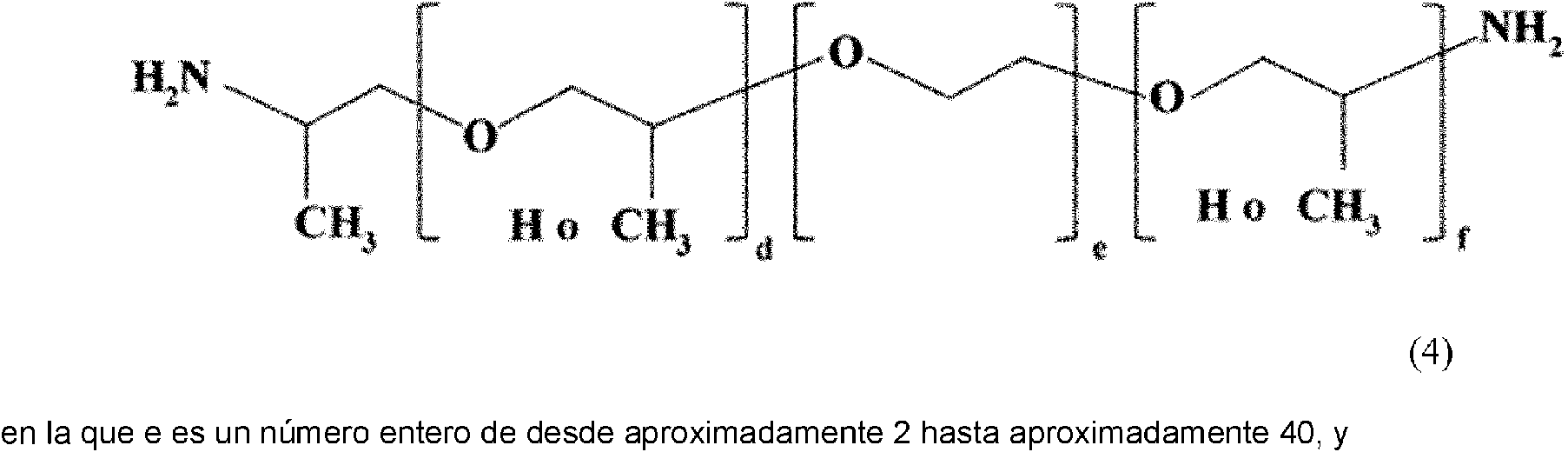
d y f son independientemente números enteros de desde aproximadamente 1 hasta aproximadamente 10; od and f are independently integers from about 1 to about 10; either

en la que g es un número entero de desde aproximadamente 2 hasta aproximadamente 3.where g is an integer from about 2 to about 3.
Las poliéter diaminas comercialmente disponibles incluyen las aminas JEFFAMINE® D, ED y EDR, incluyendo, pero sin limitarse a, las aminas JEFFAMINE® D-230, D-400, D-2000, D-4000, ED-600, ED-900, ED-20003, EDR-148 y EDR-176, disponibles de Huntsman Petrochemical LLC.Commercially available polyether diamines include JEFFAMINE® D, ED, and EDR amines, including, but not limited to, JEFFAMINE® D-230, D-400, D-2000, D-4000, ED-600, ED-900 amines , ED-20003, EDR-148 and EDR-176, available from Huntsman Petrochemical LLC.
Según otro aspecto, el componente de curado incluye una poliéter triamina que tiene la fórmula (6):According to another aspect, the curing component includes a polyether triamine having the formula (6):

n es un número entero de 0 ó 1, yn is an integer of 0 or 1, and
h, i y j son independientemente números enteros de desde aproximadamente 1 hasta aproximadamente 100.h, i, and j are independently integers from about 1 to about 100.
Las poliéter triaminas comercialmente disponibles incluyen las aminas JEFFAMINE® de la serie T, incluyendo, pero sin limitarse a, las aminas JEFFAMINE® T-403, T-3000 y T-5000, disponibles de Huntsman Petrochemical LLC. En un aspecto particular, el componente de curado incluye la poliéter amina en una cantidad de al menos 50 partes en peso, basándose en 100 partes en peso del componente de curado. En todavía otro aspecto, el componente de curado incluye la poliéter amina en una cantidad de al menos 60 partes en peso, basándose en 100 partes en peso del componente de curado. En todavía otro aspecto, el componente de curado incluye la poliéter amina en una cantidad de al menos 70 partes en peso, o en una cantidad de al menos 80 partes en peso, basándose en 100 partes en peso del componente de curado. Commercially available polyether triamines include the JEFFAMINE® T-series amines, including, but not limited to, the JEFFAMINE® T-403, T-3000 and T-5000 amines, available from Huntsman Petrochemical LLC. In a particular aspect, the curing component includes the polyether amine in an amount of at least 50 parts by weight, based on 100 parts by weight of the curing component. In yet another aspect, the curing component includes the polyether amine in an amount of at least 60 parts by weight, based on 100 parts by weight of the curing component. In yet another aspect, the curing component includes the polyether amine in an amount of at least 70 parts by weight, or in an amount of at least 80 parts by weight, based on 100 parts by weight of the curing component.
En un aspecto adicional, el componente de curado incluye la poliéter amina en una cantidad de más de 10 partes en peso a menos de 90 partes en peso, o una cantidad de más de 20 partes en peso a menos de 90 partes en peso, o una cantidad de más de 30 partes en peso a menos de 90 partes en peso, o una cantidad de más de 40 partes en peso a menos de 90 partes en peso, basándose en 100 partes en peso del componente de curado. En aún otro aspecto, el componente de curado incluye la poliéter amina en una cantidad de entre 55 partes en peso y aproximadamente 75 partes en peso, basándose en 100 partes en peso del componente de curado.In a further aspect, the curing component includes the polyether amine in an amount of more than 10 parts by weight to less than 90 parts by weight, or an amount of more than 20 parts by weight to less than 90 parts by weight, or an amount of more than 30 parts by weight to less than 90 parts by weight, or an amount of more than 40 parts by weight to less than 90 parts by weight, based on 100 parts by weight of the curing component. In yet another aspect, the curing component includes the polyether amine in an amount of between 55 parts by weight and about 75 parts by weight, based on 100 parts by weight of the curing component.
El componente de curado también puede incluir una segunda amina. Se excluyen las poliéter aminas de su inclusión como la segunda amina. Por consiguiente, en un aspecto, la segunda amina puede ser una poliamina alifática, incluyendo, pero sin limitarse a, etilendiamina, dietilentriamina, trietilentetramina, tetraetilenpentamina, pentaetilenhexamina, dipropilentriamina, tributilentetramina, hexametilendiamina, dihexametilentriamina, 1,2-propanodiamina, 1,3-propanodiamina, 1,2-butanodiamina, 1,3-butanodiamina, 1,4-butanodiamina, 1,5-pentanodiamina, 1,6-hexanodiamina, 2-metil-1,5-pentanodiamina, 2,5-dimetil-2,5-hexanodiamina y mezclas de las mismas.The curing component can also include a second amine. Polyether amines are excluded from inclusion as the second amine. Accordingly, in one aspect, the second amine can be an aliphatic polyamine, including, but not limited to, ethylenediamine, diethylenetriamine, triethylenetetramine, tetraethylenepentamine, pentaethylenehexamine, dipropylenetriamine, tributylenetetramine, hexamethylenediamine, dihexamethylenetriamine, 1,2-propanediamine, 1,3 -propanediamine, 1,2-butanediamine, 1,3-butanediamine, 1,4-butanediamine, 1,5-pentanediamine, 1,6-hexanediamine, 2-methyl-1,5-pentanediamine, 2,5-dimethyl-2 ,5-hexanediamine and mixtures thereof.
En otro aspecto, la segunda amina puede ser una poliamina cicloalifática, incluyendo, pero sin limitarse a, isoforondiamina, 4,4’-diaminodiciclohexilmetano, metanodiamina, 1,2-diaminociclohexano, 1,4-diaminociclohexano y mezclas de los mismos.In another aspect, the second amine can be a cycloaliphatic polyamine, including, but not limited to, isophoronediamine, 4,4'-diaminodicyclohexylmethane, methanediamine, 1,2-diaminocyclohexane, 1,4-diaminocyclohexane, and mixtures thereof.
Según otro aspecto, la segunda amina puede ser una poliamina que tiene la fórmula (7):According to another aspect, the second amine can be a polyamine having the formula (7):

en la que R2 y R3 son independientemente grupos alifáticos o cicloalifáticos, ywherein R 2 and R 3 are independently aliphatic or cycloaliphatic groups, and
k y p son independientemente números enteros que oscilan entre 1 y 3.k and p are independently integers ranging from 1 to 3.
Según otro aspecto, la segunda amina puede ser una poliamina que tiene la fórmula (8):According to another aspect, the second amine can be a polyamine having the formula (8):

en la que R4 es un hidrógeno, grupo metilo o etilo, yin which R4 is a hydrogen, methyl or ethyl group, and
q y t son independientemente números enteros de desde aproximadamente 1 hasta aproximadamente 10.q and t are independently integers from about 1 to about 10.
Según un aspecto, el componente de curado incluye la segunda amina en una cantidad de menos de aproximadamente 30 partes en peso, basándose en 100 partes en peso del componente de curado. En otro aspecto, el componente de curado incluye la segunda amina en una cantidad de menos de aproximadamente 25 partes en peso, e incluso menos de aproximadamente 20 partes en peso, basándose en 100 partes en peso del componente de curado.According to one aspect, the curing component includes the second amine in an amount of less than about 30 parts by weight, based on 100 parts by weight of the curing component. In another aspect, the curing component includes the second amine in an amount of less than about 25 parts by weight, and even less than about 20 parts by weight, based on 100 parts by weight of the curing component.
En todavía otro aspecto, el componente de curado incluye la segunda amina en una cantidad de entre aproximadamente 10 partes en peso y aproximadamente 30 partes en peso, basándose en 100 partes en peso del componente de curado. En todavía otro aspecto, el componente de curado incluye la segunda amina en una cantidad de entre aproximadamente 17,5 partes en peso y aproximadamente 27,5 partes en peso, basándose en 100 partes en peso del componente de curado.In yet another aspect, the curing component includes the second amine in an amount of between about 10 parts by weight and about 30 parts by weight, based on 100 parts by weight of the curing component. In yet another aspect, the curing component includes the second amine in an amount of between about 17.5 parts by weight and about 27.5 parts by weight, based on 100 parts by weight of the curing component.
En una realización, la poliéter amina y la segunda amina están presentes en el componente de curado en una razón de desde 50:50 hasta 95:5, o desde 60:40 hasta 90:10, o desde 70:30 hasta 85:15, de la poliéter amina con respecto a la segunda amina.In one embodiment, the polyether amine and the second amine are present in the curing component in a ratio of from 50:50 to 95:5, or from 60:40 to 90:10, or from 70:30 to 85:15. , of the polyether amine relative to the second amine.
El componente de curado también puede incluir un acelerante en una cantidad de más de 1 parte en peso, o más de 2 partes en peso, o más de 3 partes en peso, o más de 4 partes en peso, basándose en 100 partes en peso del componente curable.The curing component may also include an accelerator in an amount of more than 1 part by weight, or more than 2 parts by weight, or more than 3 parts by weight, or more than 4 parts by weight, based on 100 parts by weight. of the curable component.
En una realización, el componente de curado puede incluir un imidazol. En un aspecto particular, el imidazol es un compuesto que tiene un anillo de imidazol por molécula, tal como imidazol, 2-metilimidazol, 2-etil-4-metilimidazol, 2-metil-4-etilimidazol, 2-undecilimidazol, 2-heptadecilimidazol, 2-fenilimidazol, 2-fenil-4-metilimidazol, 1 -bencil-2-metilimidazol, 2-etilimidazol, 2-isopropilimidazol, 2-fenil-4-bencilimidazol, 1-cianoetil-2-metilimidazol, 1 -cianoetil-2-etil-4-metilimidazol, 1-cianoetil-2-undecilimidazol, 1-cianoetil-2-isopropilimidazol, 1-cianoetil-2-fenilimidazol, 2,4-diamino-6-[2'-metilimidazolil-(1)']-etil-s-triazina, 2,4-diamino-6-[2'-etil-4-metilimidazolil-(1)']-etil-s-triazina, 2,4-diamino-6-[2'-undecilimidazolil-(1)']-etil-s-triazina, aducto de 2-metil-imidazolio-ácido isocianúrico, aducto de 2-fenilimidazolio-ácido isocianúrico, 1-aminoetil-2-metilimidazol, 2-fenil-4,5-dihidroximetilimidazol, 2-fenil-4-metil-5-hidroximetilimidazol, 2-fenil-4-bencil-5-hidroximetilimidazol, 1,2-dimetilimidazol y mezclas de los mismos.In one embodiment, the curing component can include an imidazole. In a particular aspect, imidazole is a compound having one imidazole ring per molecule, such as imidazole, 2-methylimidazole, 2-ethyl-4-methylimidazole, 2-methyl-4-ethylimidazole, 2-undecylimidazole, 2-heptadecylimidazole , 2-phenylimidazole, 2-phenyl-4-methylimidazole, 1-benzyl-2-methylimidazole, 2-ethylimidazole, 2-isopropylimidazole, 2-phenyl-4-benzylimidazole, 1-cyanoethyl-2-methylimidazole, 1-cyanoethyl-2 -ethyl-4-methylimidazole, 1-cyanoethyl-2-undecilymidazole, 1-cyanoethyl-2-isopropylimidazole, 1-cyanoethyl-2-phenylimidazole, 2,4-diamino-6-[2'-methylimidazolyl-(1)'] -ethyl-s-triazine, 2,4-diamino-6-[2'-ethyl-4-methylimidazolyl-(1)']-ethyl-s-triazine, 2,4-diamino-6-[2'-undecylimidazolyl -(1)']-ethyl-s-triazine, 2-methyl-imidazolium-isocyanuric acid adduct, 2-phenylimidazolium-isocyanuric acid adduct, 1-aminoethyl-2-methylimidazole, 2-phenyl-4,5-dihydroxymethylimidazole , 2-phenyl-4-methyl-5-hydroxymethylimidazole, 2-phenyl-4-benzyl-5-hydroxymethylimidazole, 1,2-dimethylimidazole, and mixtures thereof.
En otro aspecto, el imidazol es un compuesto que contiene 2 o más anillos de imidazol por molécula que puede obtenerse deshidratando los compuestos de imidazol que contienen hidroximetilo anteriormente nombrados tales como 2-fenil-4,5-dihidroximetilimidazol, 2-fenil-4-metil-5-hidroximetilimidazol y 2-fenil-4-bencil-5-hidroxi-metilimidazol; y condensándolos con formaldehído, por ejemplo, 4,4'-metilen-bis-(2-etil-5-metilimidazol).In another aspect, imidazole is a compound containing 2 or more imidazole rings per molecule which can be obtained by dehydrating the aforementioned hydroxymethyl-containing imidazole compounds such as 2-phenyl-4,5-dihydroxymethylimidazole, 2-phenyl-4- methyl-5-hydroxymethylimidazole and 2-phenyl-4-benzyl-5-hydroxy-methylimidazole; and condensing them with formaldehyde, eg, 4,4'-methylene-bis-(2-ethyl-5-methylimidazole).
Según la invención, el componente de curado comprende, como acelerante, una amina terciaria. La amina terciaria se selecciona de N-etilmorfolina, isopropilmorfolina, N-butilmorfolina, metoxietilmorfolina, hidroxietilmorfolina, 2,2'-dimorfolinodietil éter, N,N'-dimorfolinoetano, metildietanolamina, metildiciclohexilamina, N,N,N'-trimetil-N'-(2-hidroxietil)bis(2-aminoetil)éter, bis-(2-dimetilaminoetil)éter, 1,3,5-tris(3-(dimetilamino)propil)-hexahidro-s-triazina, y combinaciones de las mismas.According to the invention, the curing component comprises, as accelerator, a tertiary amine. The tertiary amine is selected from N-ethylmorpholine, isopropylmorpholine, N-butylmorpholine, methoxyethylmorpholine, hydroxyethylmorpholine, 2,2'-dimorpholinodiethyl ether, N,N'-dimorpholinoethane, methyldiethanolamine, methyldicyclohexylamine, N,N,N'-trimethyl-N' -(2-hydroxyethyl)bis(2-aminoethyl)ether, bis-(2-dimethylaminoethyl)ether, 1,3,5-tris(3-(dimethylamino)propyl)-hexahydro-s-triazine, and combinations thereof .
En otra realización, el acelerante es una amina terciaria seleccionada de N-etilmorfolina, isopropilmorfolina, N-butilmorfolina, metoxietilmorfolina, hidroxietilmorfolina, 2,2'-dimorfolinodietil éter, N,N'-dimorfolinoetano, metildietanolamina, N,N,N'-trimetil-N'-(2-hidroxietil)bis(2-aminoetil)éter, bis-(2-dimetilaminoetil)éter, 1,3,5-tris(3-(dimetilamino)propil)-hexahidro-s-triazina, y combinaciones de las mismas, y el componente de curado es un componente de curado que está sustancialmente libre de un carbonato cíclico, guanidina y derivados de la misma, y una amina aromática.In another embodiment, the accelerator is a tertiary amine selected from N-ethylmorpholine, isopropylmorpholine, N-butylmorpholine, methoxyethylmorpholine, hydroxyethylmorpholine, 2,2'-dimorpholinodiethyl ether, N,N'-dimorpholinoethane, methyldiethanolamine, N,N,N'- trimethyl-N'-(2-hydroxyethyl)bis(2-aminoethyl)ether, bis-(2-dimethylaminoethyl)ether, 1,3,5-tris(3-(dimethylamino)propyl)-hexahydro-s-triazine, and combinations thereof, and the curing component is a curing component that is substantially free of a cyclic carbonate, guanidine and derivatives thereof, and an aromatic amine.
Según un aspecto, el componente de curado incluye el acelerante en una cantidad de más de aproximadamente 5 partes en peso, basándose en 100 partes en peso del componente de curado. En otro aspecto, el componente de curado incluye el acelerante en una cantidad de más de aproximadamente 7,5 partes en peso, basándose en 100 partes en peso del componente de curado. En aún otro aspecto, el componente de curado incluye el acelerante en una cantidad de más de aproximadamente 10 partes en peso, e incluso más de aproximadamente 20 partes en peso, basándose en 100 partes en peso del componente de curado.In one aspect, the curing component includes the accelerator in an amount of more than about 5 parts by weight, based on 100 parts by weight of the curing component. In another aspect, the curing component includes the accelerator in an amount of greater than about 7.5 parts by weight, based on 100 parts by weight of the curing component. In yet another aspect, the curing component includes the accelerator in an amount of greater than about 10 parts by weight, and even greater than about 20 parts by weight, based on 100 parts by weight of the curing component.
En todavía otro aspecto, el componente de curado incluye el acelerante en una cantidad menos de aproximadamente 30 partes en peso, basándose en 100 partes en peso del componente de curado. En un aspecto adicional, el componente de curado incluye el acelerante en una cantidad menos de aproximadamente 25 partes en peso, e incluso menos de aproximadamente 20 partes en peso, basándose en 100 partes en peso del componente de curado.In yet another aspect, the curing component includes the accelerator in an amount of less than about 30 parts by weight, based on 100 parts by weight of the curing component. In a further aspect, the curing component includes the accelerator in an amount of less than about 25 parts by weight, and even less than about 20 parts by weight, based on 100 parts by weight of the curing component.
En aún un aspecto adicional, el componente de curado incluye el acelerante en una cantidad de más de aproximadamente 1 parte en peso a aproximadamente 30 partes en peso, basándose en 100 partes en peso del componente de curado. En otro aspecto, el componente de curado incluye el acelerante en una cantidad de aproximadamente 7,5 partes en peso a aproximadamente 25 partes en peso, basándose en 100 partes en peso del componente de curado. En todavía otro aspecto, el componente de curado incluye el imidazol en una cantidad de aproximadamente 10 partes en peso a aproximadamente 20 partes en peso, basándose en 100 partes en peso del componente de curado.In a still further aspect, the curing component includes the accelerator in an amount of from greater than about 1 part by weight to about 30 parts by weight, based on 100 parts by weight of the curing component. In another aspect, the curing component includes the accelerator in an amount of from about 7.5 parts by weight to about 25 parts by weight, based on 100 parts by weight of the curing component. In yet another aspect, the curing component includes the imidazole in an amount of from about 10 parts by weight to about 20 parts by weight, based on 100 parts by weight of the curing component.
En todavía otro aspecto, la composición curable de la presente divulgación puede contener opcionalmente uno o más de otros aditivos que son útiles para sus usos previstos. Por ejemplo, los aditivos opcionales útiles en la composición curable pueden incluir, pero no se limitan a, diluyentes (diglicidil éter de 1,4-butanodiol (BDDGE), diglicidil éter de 1,6 hexanodiol (HDDGE), diglicidil éter de cresol (CGE), alquil C12-14 glicidil éter (AGE), triglicidil éter de trimetilolpropano (TMPTGE)), cargas inertes, fibras reforzadas, estabilizadores, tensioactivos, modificadores del flujo, pigmentos o tintes, agentes de liberación, agentes deslustradores, agentes desgasificantes, retardadores de la llama (por ejemplo, retardadores de la llama inorgánicos, retardadores de la llama halogenados y retardadores de la llama no halogenados tales como materiales que contienen fósforo), agentes endurecedores (por ejemplo, caucho de butadieno-acrilonitrilo líquido terminado con carboxilo (CTBN), caucho de butadieno-acrilonitrilo líquido terminado con grupos acrílicos (ATBN), caucho de butadieno-acrilonitrilo líquido terminado con grupos epoxi (ETBN), aductos de resina epoxídica líquida (LER) de elastómeros y cauchos de núcleo-cubierta preformados), iniciadores de curado, inhibidores de curado, agentes humectantes, adyuvantes de procesamiento, compuestos fluorescentes, estabilizadores de UV, antioxidantes, modificadores de impacto y mezclas de los mismos.In yet another aspect, the curable composition of the present disclosure may optionally contain one or more other additives that are useful for its intended uses. For example, optional additives useful in the curable composition may include, but are not limited to, diluents (1,4-butanediol diglycidyl ether (BDDGE), 1,6-hexanediol diglycidyl ether (HDDGE), cresol diglycidyl ether ( CGE), C 12-14 alkyl glycidyl ether (AGE), trimethylolpropane triglycidyl ether (TMPTGE)), inert fillers, reinforced fibers, stabilizers, surfactants, flow modifiers, pigments or dyes, release agents, tarnishing agents, degassing agents , flame retardants (for example, inorganic flame retardants, halogenated flame retardants, and non-halogenated flame retardants such as phosphorus-containing materials), curing agents (for example, carboxyl-terminated liquid acrylonitrile-butadiene rubber (CTBN), acrylic-terminated liquid butadiene-acrylonitrile rubber (ATBN), epoxy-terminated liquid butadiene-acrylonitrile rubber (ETBN), epox resin adducts Liquid Idic Acid (LER) of elastomers and preformed core-shell rubbers), cure initiators, cure inhibitors, wetting agents, processing aids, fluorescent compounds, UV stabilizers, antioxidants, impact modifiers, and mixtures thereof.
Cuando se incluyen fibras reforzadas en la composición curable, las fibras pueden tener forma continua, cortada y/o tejida. Pueden usarse fibras conocidas o habituales, y pueden incluir, pero no se limitan a, una fibra de carbono (por ejemplo, una fibra de carbono a base de poliacrilonitrilo (PAN), una fibra de carbono a base de brea y una fibra de carbono cultivada con vapor), una fibra de vidrio, una fibra de aramida, una fibra de boro, una fibra de grafito, una fibra de carburo de silicio, una fibra de polietileno de alta resistencia, una fibra de carburo de tungsteno, una fibra de poli-p-fenilenbenzoxazol (fibra de PBO) y mezclas de las mismas. Entre ellas, se prefieren una fibra de carbono, una fibra de vidrio y una fibra de aramida desde el punto de vista de las propiedades mecánicas (tales como la tenacidad). En particular, se prefiere una fibra de carbono.When reinforced fibers are included in the curable composition, the fibers may be in continuous, staple and/or staple form. woven. Known or customary fibers may be used, and may include, but are not limited to, a carbon fiber (for example, a polyacrylonitrile (PAN)-based carbon fiber, a pitch-based carbon fiber, and a carbon fiber). steam cultured), a glass fiber, an aramid fiber, a boron fiber, a graphite fiber, a silicon carbide fiber, a high strength polyethylene fiber, a tungsten carbide fiber, a poly-p-phenylenebenzoxazole (PBO fiber) and mixtures thereof. Among them, a carbon fiber, a glass fiber and an aramid fiber are preferred from the viewpoint of mechanical properties (such as toughness). In particular, a carbon fiber is preferred.
Los ejemplos de la forma de la fibra pueden incluir, pero no se limitan a, las formas de un filamento (fibra continua), una cinta de filamentos continuos, un material unidireccional que incluye cintas de filamentos continuos alineadas de manera unidireccional, un material textil tejido y un material textil no tejido. Los ejemplos de tales materiales textiles tejidos de fibras incluyen materiales textiles lisos, materiales textiles asargados, materiales textiles satinados y láminas con puntadas que están tipificadas por materiales textiles no engarzados y se producen preparando una lámina que incluye haces de fibras alineados de manera unidireccional o una lámina que incluye tales haces de fibras laminados con ángulos de laminación variables, y realizando puntadas a la lámina con el fin de crear integridad del material textil.Examples of the fiber shape may include, but are not limited to, the shapes of a filament (continuous fiber), a continuous filament ribbon, a unidirectional material including unidirectionally aligned continuous filament ribbons, a textile material woven and a non-woven textile material. Examples of such fiber woven fabrics include plain fabrics, twill fabrics, satin fabrics and stitched sheets which are typified by non-crimped fabrics and are produced by preparing a sheet including unidirectionally aligned fiber bundles or a sheet including such fiber bundles laminated with varying lamination angles, and stitching the sheet in order to create fabric integrity.
Las concentraciones de las fibras reforzadas en la composición curable de la presente divulgación pueden variar desde aproximadamente 0,2 partes en peso hasta aproximadamente 95 partes en peso; o entre aproximadamente 0,2 partes en peso y aproximadamente 70 partes en peso e incluso todavía entre aproximadamente 0,2 partes en peso y aproximadamente 60 partes en peso, basándose en 100 partes en peso de la composición curable.The concentrations of the reinforced fibers in the curable composition of the present disclosure can range from about 0.2 parts by weight to about 95 parts by weight; or between about 0.2 weight parts and about 70 weight parts and even still between about 0.2 weight parts and about 60 weight parts, based on 100 weight parts of the curable composition.
Formulación de la composición curableFormulation of the curable composition
La composición curable puede prepararse agitando y mezclando los componentes en un estado en el que los componentes se calientan si es necesario, sin particular limitación. La composición curable de la presente divulgación puede usarse como composición de tipo 1 envase usando los componentes previamente mezclados como tal. Además, la composición curable también puede usarse como composición de tipo múltiples envases (por ejemplo, de tipo 2 envases) obtenida mezclando dos o más componentes preparados por separado en una razón predeterminada antes de su uso. El método de agitación/mezclado no está particularmente limitado. Por ejemplo, puede usarse una unidad de agitación/mezclado conocida o habitual tal como una mezcladora (por ejemplo, un aparato de disolución o un homogeneizador), una amasadora, un rodillo, un molino de perlas o un aparato de agitación planetaria. La mezcla, después de agitar y mezclar, puede someterse a despumación a vacío.The curable composition can be prepared by stirring and mixing the components in a state where the components are heated if necessary, without particular limitation. The curable composition of the present disclosure can be used as a package type 1 composition using the premixed components as such. In addition, the curable composition can also be used as a multi-pack type composition (for example, 2-pack type) obtained by mixing two or more separately prepared components in a predetermined ratio before use. The stirring/mixing method is not particularly limited. For example, a known or customary stirring/mixing unit such as a mixer (eg, a dissolving apparatus or a homogenizer), a kneader, a roller, a bead mill or a planetary stirring apparatus may be used. The mixture, after stirring and mixing, can be subjected to vacuum skimming.
En un aspecto, la composición curable de la presente divulgación se logra mezclando en un recipiente los componentes, que incluyen la resina epoxídica y el componente de curado, y luego dejando que los componentes se formulen para dar una composición curable. No existe criticidad en cuanto al orden de mezcla, es decir, los componentes pueden mezclarse en cualquier orden para proporcionar la composición curable de la presente divulgación. También puede añadirse cualquiera de los aditivos opcionales anteriormente mencionados, por ejemplo, cargas o fibras de refuerzo, a la composición durante el mezclado o antes del mezclado para formar la composición curable.In one aspect, the curable composition of the present disclosure is achieved by mixing the components, including the epoxy resin and the curing component, in a container and then allowing the components to formulate into a curable composition. There is no criticality to the order of mixing, ie, the components can be mixed in any order to provide the curable composition of the present disclosure. Any of the aforementioned optional additives, eg, fillers or reinforcing fibers, may also be added to the composition during mixing or prior to mixing to form the curable composition.
En la composición curable, la razón del número de los equivalentes de hidrógenos de amina reactivos en el componente de curado con respecto al número de los equivalentes de epóxidos presentes en la composición curable (es decir, la “razón estequiométrica amina/epoxi” de la composición curable) es de desde aproximadamente 0,2 hasta aproximadamente 1,3, o desde aproximadamente 0,4 hasta aproximadamente 1, o incluso desde aproximadamente 0,4 hasta aproximadamente 0,9, o todavía incluso desde aproximadamente 0,5 hasta aproximadamente 0,85, y todavía incluso desde aproximadamente 0,6 hasta aproximadamente 0,8 y en algunos casos desde aproximadamente 0,65 hasta aproximadamente 0,75. En todavía otros aspectos, la razón en peso de resina epoxídica:componente de curado puede ser de al menos aproximadamente 1:1, y todavía incluso de al menos 1,2:1, e incluso todavía de al menos aproximadamente 1,5:1. En otros aspectos, la razón en peso de resina epoxídica:componente de curado puede ser de al menos aproximadamente 2:1, y todavía incluso de al menos 2,5:1, e incluso todavía de al menos aproximadamente 3:1.In the curable composition, the ratio of the number of equivalents of reactive amine hydrogens in the curing component to the number of equivalents of epoxides present in the curable composition (i.e., the "amine/epoxy stoichiometric ratio" of the curable composition). curable composition) is from about 0.2 to about 1.3, or from about 0.4 to about 1, or even from about 0.4 to about 0.9, or even from about 0.5 to about 0 .85, and still even from about 0.6 to about 0.8 and in some cases from about 0.65 to about 0.75. In still other aspects, the weight ratio of epoxy resin:curing component can be at least about 1:1, and still even at least 1.2:1, and even still at least about 1.5:1. . In other aspects, the weight ratio of epoxy resin:curing component can be at least about 2:1, and still even at least 2.5:1, and even still at least about 3:1.
Los componentes pueden mezclarse y dispersarse a una temperatura que permite la preparación de una composición curable eficaz que tiene una baja viscosidad para la aplicación deseada. La temperatura durante el mezclado de los componentes puede ser, en general, de desde aproximadamente 0°C hasta aproximadamente 100°C o desde aproximadamente 0°C hasta aproximadamente 50°C.The components can be mixed and dispersed at a temperature that allows the preparation of an effective curable composition having a low viscosity for the desired application. The temperature during mixing of the components can generally be from about 0°C to about 100°C or from about 0°C to about 50°C.
En otro aspecto, la presente divulgación proporciona un procedimiento para preparar un sustrato recubierto con resina. Las etapas de procedimiento incluyen poner en contacto un sustrato con la composición curable de la presente divulgación. Las composiciones de la presente divulgación pueden ponerse en contacto con el sustrato mediante cualquier método conocido por los expertos en la técnica. Los ejemplos de tales métodos de puesta en contacto incluyen, pero no se limitan a, inmersión, recubrimiento por pulverización, recubrimiento por boquilla, recubrimiento por rodillo, procedimientos de infusión de resina, y poner en contacto el sustrato con un baño que contiene la composición curable. El sustrato puede ser, por ejemplo, plástico, vidrio, aleación, metal, cerámica, madera, cemento, hormigón, caucho o material de fibra reforzada.In another aspect, the present disclosure provides a method of preparing a resin-coated substrate. The process steps include contacting a substrate with the curable composition of the present disclosure. The compositions of the present disclosure may be contacted with the substrate by any method known to those of skill in the art. Examples of such contacting methods include, but are not limited to, dipping, spray coating, nozzle coating, roll coating, resin infusion procedures, and contacting the substrate with a bath containing the composition. curable. The substrate can be, for example, plastic, glass, alloy, metal, ceramic, wood, cement, concrete, rubber or fiber reinforced material.
Según otro aspecto, la composición curable, una vez mezclada y puesta en contacto con cualquier sustrato adecuado, puede curarse según procedimientos típicos puestos en práctica por la industria para formar un producto curado. Los procedimientos típicos de curado incluyen desde curado a temperatura ambiental hasta curado a temperatura elevada usando energía térmica, radiación o una combinación de fuentes de energía. La composición curable puede curarse en una etapa o en múltiples etapas, tal como curado gradual A, B a menudo puesto en práctica en las industrias de materiales compuestos. O, la composición curable puede curarse posteriormente usando una temperatura o fuente de energía diferente después del ciclo de curado inicial.In another aspect, the curable composition, once mixed and contacted with any suitable substrate, can be cured according to typical procedures practiced by the industry to form a cured product. Typical curing procedures include room temperature curing to elevated temperature curing using thermal energy, radiation, or a combination of energy sources. The curable composition may be cured in one stage or in multiple stages, such as gradual curing A, B often practiced in the composites industries. Or, the curable composition may be post-cured using a different temperature or energy source after the initial cure cycle.
Por consiguiente, la presente divulgación también proporciona un artículo curado obtenido poniendo en contacto cualquier sustrato adecuado con la composición curable y curando la composición curable usando energía térmica, radiación o una combinación de fuentes de energía. En un aspecto, el curado puede lograrse térmicamente aplicando calor a la composición curable a una temperatura de desde aproximadamente 0°C hasta aproximadamente 230°C, o desde aproximadamente 60° C hasta aproximadamente 1l0°C, durante un periodo de tiempo de desde aproximadamente 1 minuto hasta aproximadamente 8 horas, o desde aproximadamente 30 minutos hasta aproximadamente 4 horas. Opcionalmente, las formas moldeadas del artículo curado pueden curarse posteriormente de manera adicional a una temperatura de desde aproximadamente 100°C hasta aproximadamente 200°C durante un periodo de tiempo de aproximadamente 30 minutos a aproximadamente 12 horas a vacío. Esto produce de manera deseable un artículo homogéneo, sin huecos y completamente curado. Accordingly, the present disclosure also provides a cured article made by contacting any suitable substrate with the curable composition and curing the curable composition using thermal energy, radiation, or a combination of energy sources. In one aspect, curing can be achieved thermally by applying heat to the curable composition at a temperature of from about 0°C to about 230°C, or from about 60°C to about 110°C, for a period of time of from about 1 minute to about 8 hours, or from about 30 minutes to about 4 hours. Optionally, the molded forms of the cured article may be further post-cured at a temperature of from about 100°C to about 200°C for a period of time from about 30 minutes to about 12 hours under vacuum. This desirably produces a homogeneous, void-free, fully cured article.
Además, la composición curable de la presente divulgación puede usarse en métodos para unir uno o más sustratos entre sí poniendo en contacto una o más superficies de sustratos similares o distintos que van a unirse con la composición curable en condiciones suficientes para curar la composición curable. Tales condiciones son aquellas generalmente usadas en procedimientos conocidos actuales puestos en práctica por un experto en la técnica, y pueden incluir la aplicación de presión y/o calor.In addition, the curable composition of the present disclosure can be used in methods for bonding one or more substrates together by contacting one or more surfaces of similar or dissimilar substrates to be bonded with the curable composition under conditions sufficient to cure the curable composition. Such conditions are those generally used in currently known procedures practiced by one skilled in the art, and may include the application of pressure and/or heat.
En un aspecto alternativo, curando la composición curable de la presente divulgación, puede obtenerse un artículo compuesto mediante técnicas bien conocidas en la industria, por ejemplo, mediante pultrusión, infusión, moldeo, encapsulación o recubrimiento. Por tanto, la composición curable de la presente divulgación puede usarse en métodos para fabricar artículos compuestos, tales como piezas coladas, preimpregnados, láminas de unión, laminados y laminados revestidos de láminas metálicas. Las propiedades de los artículos compuestos pueden ajustarse para determinadas aplicaciones mediante la adición de fibras reforzadas.In an alternative aspect, by curing the curable composition of the present disclosure, a composite article may be obtained by techniques well known in the industry, for example, by pultrusion, infusion, molding, encapsulation or coating. Thus, the curable composition of the present disclosure can be used in methods of making composite articles, such as castings, prepregs, tie sheets, laminates, and foil-clad laminates. The properties of composite articles can be adjusted for certain applications by adding reinforced fibers.
Por tanto, en otro aspecto, se proporciona un procedimiento para producir un artículo compuesto que incluye las etapas de: (i) proporcionar una capa o un haz de fibras reforzadas; (ii) proporcionar la composición curable; (iii) poner en contacto las fibras reforzadas con la composición curable para recubrir y/o impregnar las fibras reforzadas; y (iv) curar las fibras reforzadas recubiertas y/o impregnadas a una temperatura de al menos aproximadamente 60°C, o de al menos aproximadamente 120°C, o incluso todavía de al menos aproximadamente 195°C.Thus, in another aspect, there is provided a method of producing a composite article including the steps of: (i) providing a layer or bundle of reinforced fibers; (ii) providing the curable composition; (iii) contacting the reinforced fibers with the curable composition to coat and/or impregnate the reinforced fibers; and (iv) curing the coated and/or impregnated reinforced fibers at a temperature of at least about 60°C, or at least about 120°C, or even still at least about 195°C.
El recubrimiento y/o la impregnación pueden verse afectados o bien por un método en húmedo o bien por un método de fusión en caliente. En el método en húmedo, la composición curable se disuelve en primer lugar en un disolvente para reducir la viscosidad, después de lo cual se efectúa el recubrimiento y/o la impregnación de las fibras reforzadas y se elimina el disolvente por evaporación usando un horno o similar. En el método de fusión en caliente, el recubrimiento y/o la impregnación pueden efectuarse recubriendo y/o impregnando directamente las fibras reforzadas con la composición curable que se ha calentado para reducir su viscosidad, o alternativamente, puede producirse en primer lugar una película recubierta de la composición curable sobre un papel antiadhesivo o similar, y colocarse la película sobre uno o ambos lados de las fibras reforzadas y aplicarse calor y presión para efectuar el recubrimiento y/o la impregnación de la composición.The coating and/or impregnation can be affected by either a wet method or a hot melt method. In the wet method, the curable composition is first dissolved in a solvent to reduce viscosity, after which coating and/or impregnation of the reinforced fibers is effected and the solvent is removed by evaporation using an oven or oven. Similary. In the hot melt method, coating and/or impregnation can be accomplished by directly coating and/or impregnating the reinforced fibers with the curable composition that has been heated to reduce its viscosity, or alternatively, a coated film can be produced first. of the curable composition on release paper or the like, and the film placed on one or both sides of the reinforced fibers and heat and pressure applied to effect coating and/or impregnation of the composition.
Según otro aspecto, se proporciona un método para producir un artículo compuesto en un sistema de RTM. El procedimiento incluye las etapas de: a) introducir una preforma de fibra que comprende fibras reforzadas en un molde; b) inyectar la composición curable en el molde, c) permitir que la composición curable impregne la preforma de fibra; y d) calentar la preforma impregnada con resina a una temperatura de al menos aproximadamente 60°C, o de al menos aproximadamente 120°C, o incluso de al menos aproximadamente 195°C, durante un periodo de tiempo para producir un artículo compuesto al menos parcialmente curado; y e) opcionalmente someter el artículo sólido compuesto parcialmente a operaciones de curado posterior a una temperatura de desde aproximadamente 100°C hasta aproximadamente 250°C.According to another aspect, a method of producing a composite article in an RTM system is provided. The method includes the steps of: a) introducing a fiber preform comprising reinforced fibers into a mould; b) injecting the curable composition into the mold, c) allowing the curable composition to impregnate the fiber preform; and d) heating the resin-impregnated preform to a temperature of at least about 60°C, or at least about 120°C, or even at least about 195°C, for a period of time to produce a composite article of at least partially cured; and e) optionally subjecting the partially composite solid article to post-curing operations at a temperature of from about 100°C to about 250°C.
En un aspecto alternativo, la presente divulgación proporciona un método para formar un artículo compuesto en un sistema de VaRTM. El procedimiento incluye las etapas de a) introducir una preforma de fibra que comprende fibras reforzadas en un molde; b) inyectar la composición curable en el molde; c) reducir la presión dentro del molde; d) mantener el molde a aproximadamente la presión reducida; e) permitir que la composición curable impregne la preforma de fibra; y f) calentar la preforma impregnada con resina a una temperatura de al menos aproximadamente 60°C, o de al menos aproximadamente 120°C, o incluso de al menos aproximadamente 195°C, durante un periodo de tiempo para producir un artículo compuesto al menos parcialmente curado; y e) opcionalmente someter el artículo compuesto al menos parcialmente curado a operaciones de curado posterior a una temperatura de desde aproximadamente 100°C hasta aproximadamente 250°C.In an alternative aspect, the present disclosure provides a method of forming a composite article in a VaRTM system. The method includes the steps of a) introducing a fiber preform comprising reinforced fibers into a mould; b) injecting the curable composition into the mold; c) reducing the pressure inside the mold; d) maintaining the mold at about the reduced pressure; e) allowing the curable composition to impregnate the fiber preform; and f) heating the resin-impregnated preform to a temperature of at least about 60°C, or at least about 120°C, or even at least about 195°C, for a period of time to produce a composite article of at least partially cured; and e) optionally submit the article at least partially cured compound to post-curing operations at a temperature of from about 100°C to about 250°C.
El artículo curado y los artículos compuestos de la presente divulgación pueden usarse en diversas aplicaciones, por ejemplo, en aplicaciones aeroespaciales, donde pueden emplearse como materiales estructurales primarios de aeronaves (alas principales, cola, viga de suelo, etc.), materiales estructurales secundarios (dispositivo hipersustentador, alerón, aleta, carenado, moldura interior, etc.), carcasas de motores de cohetes, materiales estructurales para satélites artificiales, y similares. Además, pueden emplearse como materiales estructurales para cuerpos móviles tales como coches, barcos y vagones de ferrocarril, ejes de transmisión, celdas de combustible, muelles de placa, palas de turbinas eólicas, recipientes de presión, volantes, rodillos de fabricación de papel, ingeniería civil y materiales de construcción (materiales para techos, cables, barras de refuerzo, materiales de readaptación) y similares. Los artículos curados y artículos compuestos de la presente divulgación también pueden usarse como material constituyente para un tanque de alta presión tal como un tanque de hidrógeno y un tanque de gas natural licuado (GNL), por ejemplo.The cured article and composite articles of the present disclosure can be used in various applications, for example, in aerospace applications, where they can be used as aircraft primary structural materials (main wings, tail, floor beam, etc.), secondary structural materials (high lift device, spoiler, fin, fairing, interior trim, etc.), rocket motor casings, structural materials for artificial satellites, and the like. In addition, they can be used as structural materials for moving bodies such as cars, ships and railway cars, drive shafts, fuel cells, plate springs, wind turbine blades, pressure vessels, steering wheels, papermaking rollers, engineering civil and construction materials (roofing materials, cables, rebar, retrofit materials) and the like. The cured articles and composite articles of the present disclosure can also be used as a constituent material for a high pressure tank such as a hydrogen tank and a liquefied natural gas (LNG) tank, for example.
En otro aspecto, la composición curable se usa para producir palas de turbinas eólicas en una moldura. La moldura puede revestirse con un material reforzado con fibras o no, y/o también pueden añadirse adicionalmente materiales reforzados con fibras a la composición curable. Los materiales reforzados con fibras pueden ser materiales textiles tejidos, materiales textiles dispuestos de manera uniaxial y multiaxial, materiales textiles no tejidos y fibras cortas de los siguientes materiales de fibra: fibras de vidrio, fibras de carbono, fibras de aramida, fibras de PE (Dyneema) y fibras de basalto.In another aspect, the curable composition is used to produce wind turbine blades in a molding. The molding may or may not be coated with a fiber-reinforced material, and/or additional fiber-reinforced materials may also be added to the curable composition. Fiber-reinforced materials can be woven fabrics, uniaxially and multiaxially arranged fabrics, nonwoven fabrics, and short fibers of the following fiber materials: glass fibers, carbon fibers, aramid fibers, PE fibers ( Dyneema) and basalt fibers.
Las palas de turbinas eólicas se producen preferiblemente mediante un procedimiento en el que se proporciona un molde correspondiente, se introduce la composición curable en este molde y se cura la composición curable completamente sólo cuando el molde se ha llenado por completo. La composición curable se introduce en el molde correspondiente en la mayoría de las realizaciones por medio de tecnología de infusión. En este caso, se aplica vacío a la moldura. Este vacío arrastra la composición curable al molde mediante succión a temperaturas por debajo de la temperatura de curado inicial, y por tanto la viscosidad durante la operación de llenado permanece prácticamente sin cambios y se llenan todas las regiones de la moldura antes del curado completo. A esto le sigue el curado completo de la composición curable en la moldura a una temperatura de al menos 60°C, por ejemplo de entre 60°C-150°C.Wind turbine blades are preferably produced by a process in which a corresponding mold is provided, the curable composition is introduced into this mold and the curable composition is fully cured only when the mold has been completely filled. The curable composition is introduced into the corresponding mold in most embodiments by means of infusion technology. In this case, vacuum is applied to the trim. This vacuum draws the curable composition into the mold by suction at temperatures below the initial cure temperature, and therefore the viscosity during the filling operation remains substantially unchanged and all regions of the mold are filled before complete cure. This is followed by complete curing of the curable composition in the molding at a temperature of at least 60°C, for example between 60°C-150°C.
Ejemplosexamples
Para los ejemplos de referencia 1a-1f, 2a-2f y 3a-3f, se combinó una mezcla de poliéter amina JEFFAMINE® D-230 e isoforondiamina en una razón en peso de 70/30 y luego se añadió a una resina epoxídica (resina MGS™ RIMR 235 de Hexion) seguido de la adición de diversas cantidades de imidazol (véase la tabla 1 a continuación).For reference examples 1a-1f, 2a-2f and 3a-3f, a mixture of JEFFAMINE® D-230 polyether amine and isophoronediamine was blended in a weight ratio of 70/30 and then added to an epoxy resin (resin MGS™ RIMR 235 from Hexion) followed by the addition of various amounts of imidazole (see Table 1 below).
Tabla 1.Table 1.


Luego se midieron las temperaturas de transición vitrea mediante DSC, y los resultados se muestran a continuación en la tabla 2:Glass transition temperatures were then measured by DSC, and the results are shown below in Table 2:
Tabla 2Table 2

También se midieron los perfiles de curado mediante un reómetro, y los resultados se muestran en las figuras 1, 2 y 3.Cure profiles were also measured using a rheometer, and the results are shown in Figures 1, 2 and 3.
Se prepararon ejemplos adicionales (ilustrados en las tablas 3 y 4) combinando una mezcla de poliéter amina JEFFAMINE® D-230 (disponible de Huntsman Corp. o filiales de la misma) e isoforondiamina en razones en peso de 70/30 u 85/15, que luego se añadieron a una resina epoxídica (resina MGS™ RIMR 235 de Hexion) seguido de la adición de diversas cantidades de una amina terciaria seleccionada de N-metilmorfolina (“NMM”) (ejemplo de referencia), N-etilmorfolina (“NEM”), N-butilmorfolina (“NBM”), metoxietilmorfolina (“MEM”), 2,2'-dimorfolinodietil éter (“DMDEE”) y N,N'-dimorfolinoetano (“DMORE”). Se preparó una muestra comparativa que no tenía ninguna amina terciaria. En las tablas 3 y 4 se proporcionan los detalles para los ejemplos.Additional examples (illustrated in Tables 3 and 4) were prepared by combining a mixture of JEFFAMINE® D-230 polyether amine (available from Huntsman Corp. or affiliates thereof) and isophoronediamine in weight ratios of 70/30 or 85/15. , which were then added to an epoxy resin (MGS™ RIMR 235 resin from Hexion) followed by the addition of various amounts of a tertiary amine selected from N-methylmorpholine ("NMM") (reference example), N-ethylmorpholine (" NEM"), N-butylmorpholine ("NBM"), methoxyethylmorpholine ("MEM"), 2,2'-dimorpholinodiethyl ether ("DMDEE"), and N,N'-dimorpholinoethane ("DMORE"). A comparative sample was prepared which did not have any tertiary amines. Details for the examples are provided in Tables 3 and 4.
Los datos de los perfiles de curado isotérmico se enumeran en la tabla 3 para cada ejemplo que comprende una razón en peso de 70/30 de poliéter amina JEFFAMINE® D-230 e isoforondiamina y en la tabla 4 para cada ejemplo que comprende una razón en peso de 85/15 de poliéter amina JEFFAMINE® D-230 e isoforondiamina. Se obtuvieron los datos de los perfiles de curado isotérmico usando un reómetro AR 2000ex de TA Instruments a 40°C. Tal como se usa en las tablas 3-5, el término “phr” significa partes por 100 partes de resina epoxídica.Isothermal cure profile data is listed in Table 3 for each example comprising a 70/30 weight ratio of JEFFAMINE® D-230 polyether amine and isophoronediamine and in Table 4 for each example comprising a 70/30 weight ratio of JEFFAMINE® D-230 polyether amine and isophoronediamine 85/15 weight of JEFFAMINE® D-230 polyether amine and isophoronediamine. Isothermal cure profile data was obtained using a TA Instruments AR 2000ex rheometer at 40°C. As used in Tables 3-5, the term "phr" means parts per 100 parts of epoxy resin.
Tabla 3Table 3

Tabla 4Table 4

Tal como puede observarse en las tablas 3 y 4, el uso de aminas terciarias específicas ralentiza realmente el sistema (es decir, aumenta el tiempo abierto) disminuyendo la acumulación de viscosidad en el sistema de resina. En la figura 4 se representa la temperatura de transición vítrea para los ejemplos 8-11 en función de la estructura química. Tal como puede observarse en la figura 4, cuanto más voluminoso es el grupo sustituido unido al átomo de nitrógeno, más baja es la Tg obtenida.As can be seen from Tables 3 and 4, the use of specific tertiary amines actually slows down the system (ie increases open time) by decreasing viscosity build up in the resin system. Figure 4 plots the glass transition temperature for Examples 8-11 as a function of chemical structure. As can be seen in Figure 4, the larger the substituted group attached to the nitrogen atom, the lower the Tg obtained.
Se prepararon ejemplos adicionales combinando una mezcla de poliéter amina JEFFAMINE® D-230 e isoforondiamina en diversas razones en peso, que luego se añadieron a una resina epoxídica que comprendía resina epoxídica de diglicidil éter de bisfenol A (DGEBA) y un diluyente reactivo que contiene grupos glicidilo seguido de la adición de tetrametilguanidina (“TMG”) o dimorfolinodietil éter (“DMDEE”). Se prepararon ejemplos comparativos adicionales sin TMG ni DMDEE. En la tabla 5 se proporcionan los detalles para los ejemplos.Additional examples were prepared by combining a mixture of JEFFAMINE® D-230 polyether amine and isophoronediamine in various weight ratios, which were then added to an epoxy resin comprising bisphenol A diglycidyl ether epoxy resin (DGEBA) and a reactive diluent containing glycidyl groups followed by the addition of tetramethylguanidine ("TMG") or dimorpholinodiethyl ether ("DMDEE"). Additional comparative examples were prepared without TMG or DMDEE. Details for the examples are provided in Table 5.
Para la mayoría de los ejemplos, se midió el perfil de viscosidad isotérmica usando un reómetro AR 2000ex a 30°C, y en la tabla 5 se proporciona el tiempo que tardó en alcanzar 1000 mPa.s y 10.000 mPa.s.For most of the examples, the isothermal viscosity profile was measured using an AR 2000ex rheometer at 30°C, and the time it took to reach 1000 mPa.s and 10,000 mPa.s is given in Table 5.
Tabla 5Table 5


La tabla 6 demuestra las propiedades mecánicas para los productos curados de las composiciones curables de los ejemplos 15, 27, 16 y 29 expuestos en la tabla 5. Se produjeron los productos curados calentando las composiciones curables a 70°C durante 6 horas. Se midieron las propiedades mecánicas usando una máquina de ensayos Zwick según las normas ISO/ASTM. Se midió la dureza usando un medidor de dureza digital con escala de durómetro Shore D y un procedimiento convencional.Table 6 demonstrates the mechanical properties for the cured products of the curable compositions of Examples 15, 27, 16 and 29 set forth in Table 5. The cured products were produced by heating the curable compositions at 70°C for 6 hours. Mechanical properties were measured using a Zwick testing machine according to ISO/ASTM standards. Hardness was measured using a Shore D durometer scale digital hardness tester and a standard procedure.
Tabla 6Table 6

Las tablas 5 y 6 demuestran que las composiciones que comprenden DMDEE tienen un tiempo abierto aumentado en comparación con composiciones similares que no tienen acelerante ni TMG, sin embargo, las composiciones curadas resultantes de las composiciones curables que comprenden DMDEE no muestran propiedades mecánicas disminuidas en comparación con composiciones curadas similares que comprenden, por ejemplo, TMG. Tables 5 and 6 demonstrate that compositions comprising DMDEE have increased open time compared to similar compositions that have no accelerator or TMG, however, the resulting cured compositions of curable compositions comprising DMDEE do not show decreased mechanical properties compared with similar cured compositions comprising, for example, TMG.
Claims (10)
Applications Claiming Priority (2)
| Application Number | Priority Date | Filing Date | Title |
|---|---|---|---|
| US201662350985P | 2016-06-16 | 2016-06-16 | |
| PCT/US2017/037941 WO2017218934A1 (en) | 2016-06-16 | 2017-06-16 | Blend for curing epoxy resin compositions |
Publications (1)
| Publication Number | Publication Date |
|---|---|
| ES2901226T3 true ES2901226T3 (en) | 2022-03-21 |
Family
ID=60664420
Family Applications (1)
| Application Number | Title | Priority Date | Filing Date |
|---|---|---|---|
| ES17814198T Active ES2901226T3 (en) | 2016-06-16 | 2017-06-16 | Combination for curing epoxy resin compositions |
Country Status (12)
| Country | Link |
|---|---|
| US (1) | US11198756B2 (en) |
| EP (1) | EP3472221B1 (en) |
| JP (1) | JP6951355B2 (en) |
| KR (1) | KR102364545B1 (en) |
| CN (1) | CN108699219B (en) |
| BR (1) | BR112018067675B1 (en) |
| CA (1) | CA3012354C (en) |
| DK (1) | DK3472221T3 (en) |
| ES (1) | ES2901226T3 (en) |
| PL (1) | PL3472221T3 (en) |
| PT (1) | PT3472221T (en) |
| WO (1) | WO2017218934A1 (en) |
Families Citing this family (13)
| Publication number | Priority date | Publication date | Assignee | Title |
|---|---|---|---|---|
| KR101638574B1 (en) * | 2015-12-15 | 2016-07-11 | 도레이첨단소재 주식회사 | Low Viscosity Liquid Epoxy Resin Composition and Pressure Vessels Manufactured Using The Same |
| JP7106543B2 (en) * | 2016-12-21 | 2022-07-26 | エボニック オペレーションズ ゲーエムベーハー | N-Hydroxyethylpiperidine (NHEP): A New Curing Agent for Epoxy Systems |
| US11377519B1 (en) * | 2018-05-21 | 2022-07-05 | Space Exploration Technologies Corp. | High glass transition temperature epoxy formulations for cryogenic applications |
| DK3670169T3 (en) * | 2018-12-21 | 2022-11-07 | Siemens Gamesa Renewable Energy As | Process for vacuum-assisted resin injection molding |
| KR102756427B1 (en) * | 2019-05-16 | 2025-01-21 | 에보니크 오퍼레이션즈 게엠베하 | Hardening composition |
| CA3144314A1 (en) * | 2019-09-02 | 2021-03-11 | Sika Technology Ag | Latent epoxy-amine composition for cipp application |
| WO2021061263A1 (en) * | 2019-09-23 | 2021-04-01 | Ppg Industries Ohio, Inc. | Curable compositions |
| JP7682178B2 (en) | 2019-12-10 | 2025-05-23 | ハンツマン・アドバンスド・マテリアルズ・アメリカズ・エルエルシー | CURABLE RESIN COMPOSITIONS CONTAINING ALIPHATIC POLYKETONE Tougheners AND COMPOSITES MADE THEREFROM - Patent application |
| KR102731016B1 (en) * | 2021-12-29 | 2024-11-19 | 일진하이솔루스 주식회사 | Epoxy resin composition and pressure vessels manufactured using the same |
| EP4310124A1 (en) * | 2022-07-20 | 2024-01-24 | Hilti Aktiengesellschaft | Multicomponent composition for fixing purposes with non-stoichiometric eew hhew components, mortar composition prepared therefrom and chemical dowel made therefrom |
| EP4310126A1 (en) * | 2022-07-20 | 2024-01-24 | Hilti Aktiengesellschaft | Chemical anchor system |
| EP4458877A1 (en) * | 2023-05-05 | 2024-11-06 | Hilti Aktiengesellschaft | Use of a tertiary amine for improving properties of a chemical dowel |
| WO2025190675A1 (en) * | 2024-03-15 | 2025-09-18 | Huntsman Petrochemical Llc | Epoxy composition for producing an epoxy composite |
Family Cites Families (16)
| Publication number | Priority date | Publication date | Assignee | Title |
|---|---|---|---|---|
| US4528308A (en) | 1983-07-25 | 1985-07-09 | Texaco Inc. | Epoxy resin curatives |
| TW269017B (en) | 1992-12-21 | 1996-01-21 | Ciba Geigy Ag | |
| US5639413A (en) | 1995-03-30 | 1997-06-17 | Crivello; James Vincent | Methods and compositions related to stereolithography |
| KR100491736B1 (en) | 1996-07-29 | 2005-09-09 | 반티코 아게 | Radiation-curable Liquid Compositions for Stereolithography |
| US20060200878A1 (en) | 2004-12-21 | 2006-09-07 | Linda Lutfiyya | Recombinant DNA constructs and methods for controlling gene expression |
| ATE538088T1 (en) * | 2008-07-22 | 2012-01-15 | Basf Se | MIXTURES OF AMINES WITH GUANIDINE DERIVATIVES |
| WO2010010048A1 (en) | 2008-07-22 | 2010-01-28 | Basf Se | Blends containing epoxy resins and mixtures of amines with guanidine derivatives |
| US8852489B2 (en) | 2008-07-22 | 2014-10-07 | Basf Se | Process for preparing moldings using mixtures of amines with guanidine derivatives |
| MX2011006417A (en) * | 2010-06-24 | 2012-01-02 | Momentive Specialty Chem Inc | Epoxy systems for composites. |
| US20120328811A1 (en) * | 2011-06-24 | 2012-12-27 | Air Products And Chemicals, Inc. | Epoxy Resin Compositions |
| CA2860729A1 (en) * | 2012-02-22 | 2013-08-29 | Basf Se | Blends for composite materials |
| GB201203341D0 (en) | 2012-02-27 | 2012-04-11 | Cytec Technology Group | Curable resin composition and short-cure method |
| US9862798B2 (en) * | 2013-09-30 | 2018-01-09 | Evonik Degussa Gmbh | Epoxy liquid curing agent compositions |
| DE102014202609B4 (en) * | 2014-02-13 | 2020-06-04 | tooz technologies GmbH | Amine-catalyzed thiol curing of epoxy resins |
| CN105670223B (en) * | 2015-12-21 | 2021-03-19 | 上海康达新能源材料有限公司 | Epoxy resin composition for wind turbine blade and composite material |
| WO2018144974A1 (en) | 2017-02-06 | 2018-08-09 | Huntsman Petrochemical Llc | Curing agent for epoxy resins |
-
2017
- 2017-06-16 BR BR112018067675-6A patent/BR112018067675B1/en active IP Right Grant
- 2017-06-16 CA CA3012354A patent/CA3012354C/en active Active
- 2017-06-16 CN CN201780012881.0A patent/CN108699219B/en active Active
- 2017-06-16 ES ES17814198T patent/ES2901226T3/en active Active
- 2017-06-16 JP JP2018545184A patent/JP6951355B2/en active Active
- 2017-06-16 KR KR1020187025078A patent/KR102364545B1/en active Active
- 2017-06-16 DK DK17814198.2T patent/DK3472221T3/en active
- 2017-06-16 PL PL17814198T patent/PL3472221T3/en unknown
- 2017-06-16 PT PT178141982T patent/PT3472221T/en unknown
- 2017-06-16 WO PCT/US2017/037941 patent/WO2017218934A1/en not_active Ceased
- 2017-06-16 EP EP17814198.2A patent/EP3472221B1/en active Active
- 2017-06-16 US US16/069,219 patent/US11198756B2/en active Active
Also Published As
| Publication number | Publication date |
|---|---|
| PL3472221T3 (en) | 2022-03-14 |
| KR20190020288A (en) | 2019-02-28 |
| EP3472221A1 (en) | 2019-04-24 |
| PT3472221T (en) | 2021-11-30 |
| EP3472221B1 (en) | 2021-11-10 |
| DK3472221T3 (en) | 2022-01-17 |
| JP6951355B2 (en) | 2021-10-20 |
| KR102364545B1 (en) | 2022-02-21 |
| CA3012354A1 (en) | 2017-12-21 |
| US11198756B2 (en) | 2021-12-14 |
| BR112018067675B1 (en) | 2022-11-22 |
| CN108699219A (en) | 2018-10-23 |
| BR112018067675A2 (en) | 2019-04-09 |
| EP3472221A4 (en) | 2020-04-01 |
| CN108699219B (en) | 2022-04-15 |
| CA3012354C (en) | 2024-01-30 |
| JP2019519620A (en) | 2019-07-11 |
| WO2017218934A1 (en) | 2017-12-21 |
| US20190100616A1 (en) | 2019-04-04 |
Similar Documents
| Publication | Publication Date | Title |
|---|---|---|
| JP6951355B2 (en) | Curing blend of epoxy resin composition | |
| KR101562421B1 (en) | Mixtures of amines having guanidine derivatives | |
| KR101562422B1 (en) | Blends containing epoxy resins and mixtures of amines with guanidine derivatives | |
| CN104136483B (en) | Blend for composite | |
| CN109923145B (en) | Curing agent for epoxy resin | |
| JP2015108152A (en) | Epoxy resin composition including solvated solid | |
| EP3559077B1 (en) | N-hydroxyl ethyl piperidine (nhep): a novel curing agent for epoxy systems | |
| EP3577152B1 (en) | Curing agent for epoxy resins | |
| ES2376975T3 (en) | Method for producing molded bodies using amines mixtures with guanidine derivatives | |
| JP2016509120A (en) | Benzoxazine curable composition containing polysulfone toughener | |
| JP2021515833A (en) | Alicyclic amines for epoxy formulations: a novel curing agent for epoxy systems |