ES2901780T3 - Water soluble film comprising aminopolycarboxylate - Google Patents
Water soluble film comprising aminopolycarboxylate Download PDFInfo
- Publication number
- ES2901780T3 ES2901780T3 ES19703351T ES19703351T ES2901780T3 ES 2901780 T3 ES2901780 T3 ES 2901780T3 ES 19703351 T ES19703351 T ES 19703351T ES 19703351 T ES19703351 T ES 19703351T ES 2901780 T3 ES2901780 T3 ES 2901780T3
- Authority
- ES
- Spain
- Prior art keywords
- solid material
- weight
- water
- acid
- soluble
- Prior art date
- Legal status (The legal status is an assumption and is not a legal conclusion. Google has not performed a legal analysis and makes no representation as to the accuracy of the status listed.)
- Active
Links
Classifications
-
- C—CHEMISTRY; METALLURGY
- C11—ANIMAL OR VEGETABLE OILS, FATS, FATTY SUBSTANCES OR WAXES; FATTY ACIDS THEREFROM; DETERGENTS; CANDLES
- C11D—DETERGENT COMPOSITIONS; USE OF SINGLE SUBSTANCES AS DETERGENTS; SOAP OR SOAP-MAKING; RESIN SOAPS; RECOVERY OF GLYCEROL
- C11D1/00—Detergent compositions based essentially on surface-active compounds; Use of these compounds as a detergent
- C11D1/02—Anionic compounds
-
- C—CHEMISTRY; METALLURGY
- C11—ANIMAL OR VEGETABLE OILS, FATS, FATTY SUBSTANCES OR WAXES; FATTY ACIDS THEREFROM; DETERGENTS; CANDLES
- C11D—DETERGENT COMPOSITIONS; USE OF SINGLE SUBSTANCES AS DETERGENTS; SOAP OR SOAP-MAKING; RESIN SOAPS; RECOVERY OF GLYCEROL
- C11D1/00—Detergent compositions based essentially on surface-active compounds; Use of these compounds as a detergent
- C11D1/66—Non-ionic compounds
-
- C—CHEMISTRY; METALLURGY
- C11—ANIMAL OR VEGETABLE OILS, FATS, FATTY SUBSTANCES OR WAXES; FATTY ACIDS THEREFROM; DETERGENTS; CANDLES
- C11D—DETERGENT COMPOSITIONS; USE OF SINGLE SUBSTANCES AS DETERGENTS; SOAP OR SOAP-MAKING; RESIN SOAPS; RECOVERY OF GLYCEROL
- C11D11/00—Special methods for preparing compositions containing mixtures of detergents
- C11D11/0082—Special methods for preparing compositions containing mixtures of detergents one or more of the detergent ingredients being in a liquefied state, e.g. slurry, paste or melt, and the process resulting in solid detergent particles such as granules, powders or beads
-
- C—CHEMISTRY; METALLURGY
- C11—ANIMAL OR VEGETABLE OILS, FATS, FATTY SUBSTANCES OR WAXES; FATTY ACIDS THEREFROM; DETERGENTS; CANDLES
- C11D—DETERGENT COMPOSITIONS; USE OF SINGLE SUBSTANCES AS DETERGENTS; SOAP OR SOAP-MAKING; RESIN SOAPS; RECOVERY OF GLYCEROL
- C11D17/00—Detergent materials or soaps characterised by their shape or physical properties
- C11D17/0047—Detergents in the form of bars or tablets
- C11D17/0065—Solid detergents containing builders
-
- C—CHEMISTRY; METALLURGY
- C11—ANIMAL OR VEGETABLE OILS, FATS, FATTY SUBSTANCES OR WAXES; FATTY ACIDS THEREFROM; DETERGENTS; CANDLES
- C11D—DETERGENT COMPOSITIONS; USE OF SINGLE SUBSTANCES AS DETERGENTS; SOAP OR SOAP-MAKING; RESIN SOAPS; RECOVERY OF GLYCEROL
- C11D17/00—Detergent materials or soaps characterised by their shape or physical properties
- C11D17/0047—Detergents in the form of bars or tablets
- C11D17/0065—Solid detergents containing builders
- C11D17/0073—Tablets
- C11D17/0091—Dishwashing tablets
-
- C—CHEMISTRY; METALLURGY
- C11—ANIMAL OR VEGETABLE OILS, FATS, FATTY SUBSTANCES OR WAXES; FATTY ACIDS THEREFROM; DETERGENTS; CANDLES
- C11D—DETERGENT COMPOSITIONS; USE OF SINGLE SUBSTANCES AS DETERGENTS; SOAP OR SOAP-MAKING; RESIN SOAPS; RECOVERY OF GLYCEROL
- C11D17/00—Detergent materials or soaps characterised by their shape or physical properties
- C11D17/04—Detergent materials or soaps characterised by their shape or physical properties combined with or containing other objects
- C11D17/041—Compositions releasably affixed on a substrate or incorporated into a dispensing means
- C11D17/042—Water soluble or water disintegrable containers or substrates containing cleaning compositions or additives for cleaning compositions
-
- C—CHEMISTRY; METALLURGY
- C11—ANIMAL OR VEGETABLE OILS, FATS, FATTY SUBSTANCES OR WAXES; FATTY ACIDS THEREFROM; DETERGENTS; CANDLES
- C11D—DETERGENT COMPOSITIONS; USE OF SINGLE SUBSTANCES AS DETERGENTS; SOAP OR SOAP-MAKING; RESIN SOAPS; RECOVERY OF GLYCEROL
- C11D17/00—Detergent materials or soaps characterised by their shape or physical properties
- C11D17/04—Detergent materials or soaps characterised by their shape or physical properties combined with or containing other objects
- C11D17/041—Compositions releasably affixed on a substrate or incorporated into a dispensing means
- C11D17/042—Water soluble or water disintegrable containers or substrates containing cleaning compositions or additives for cleaning compositions
- C11D17/044—Solid compositions
-
- C—CHEMISTRY; METALLURGY
- C11—ANIMAL OR VEGETABLE OILS, FATS, FATTY SUBSTANCES OR WAXES; FATTY ACIDS THEREFROM; DETERGENTS; CANDLES
- C11D—DETERGENT COMPOSITIONS; USE OF SINGLE SUBSTANCES AS DETERGENTS; SOAP OR SOAP-MAKING; RESIN SOAPS; RECOVERY OF GLYCEROL
- C11D3/00—Other compounding ingredients of detergent compositions covered in group C11D1/00
- C11D3/16—Organic compounds
- C11D3/20—Organic compounds containing oxygen
- C11D3/2075—Carboxylic acids-salts thereof
-
- C—CHEMISTRY; METALLURGY
- C11—ANIMAL OR VEGETABLE OILS, FATS, FATTY SUBSTANCES OR WAXES; FATTY ACIDS THEREFROM; DETERGENTS; CANDLES
- C11D—DETERGENT COMPOSITIONS; USE OF SINGLE SUBSTANCES AS DETERGENTS; SOAP OR SOAP-MAKING; RESIN SOAPS; RECOVERY OF GLYCEROL
- C11D3/00—Other compounding ingredients of detergent compositions covered in group C11D1/00
- C11D3/16—Organic compounds
- C11D3/20—Organic compounds containing oxygen
- C11D3/2075—Carboxylic acids-salts thereof
- C11D3/2079—Monocarboxylic acids-salts thereof
-
- C—CHEMISTRY; METALLURGY
- C11—ANIMAL OR VEGETABLE OILS, FATS, FATTY SUBSTANCES OR WAXES; FATTY ACIDS THEREFROM; DETERGENTS; CANDLES
- C11D—DETERGENT COMPOSITIONS; USE OF SINGLE SUBSTANCES AS DETERGENTS; SOAP OR SOAP-MAKING; RESIN SOAPS; RECOVERY OF GLYCEROL
- C11D3/00—Other compounding ingredients of detergent compositions covered in group C11D1/00
- C11D3/16—Organic compounds
- C11D3/20—Organic compounds containing oxygen
- C11D3/2075—Carboxylic acids-salts thereof
- C11D3/2082—Polycarboxylic acids-salts thereof
-
- C—CHEMISTRY; METALLURGY
- C11—ANIMAL OR VEGETABLE OILS, FATS, FATTY SUBSTANCES OR WAXES; FATTY ACIDS THEREFROM; DETERGENTS; CANDLES
- C11D—DETERGENT COMPOSITIONS; USE OF SINGLE SUBSTANCES AS DETERGENTS; SOAP OR SOAP-MAKING; RESIN SOAPS; RECOVERY OF GLYCEROL
- C11D3/00—Other compounding ingredients of detergent compositions covered in group C11D1/00
- C11D3/16—Organic compounds
- C11D3/20—Organic compounds containing oxygen
- C11D3/2075—Carboxylic acids-salts thereof
- C11D3/2086—Hydroxy carboxylic acids-salts thereof
-
- C—CHEMISTRY; METALLURGY
- C11—ANIMAL OR VEGETABLE OILS, FATS, FATTY SUBSTANCES OR WAXES; FATTY ACIDS THEREFROM; DETERGENTS; CANDLES
- C11D—DETERGENT COMPOSITIONS; USE OF SINGLE SUBSTANCES AS DETERGENTS; SOAP OR SOAP-MAKING; RESIN SOAPS; RECOVERY OF GLYCEROL
- C11D3/00—Other compounding ingredients of detergent compositions covered in group C11D1/00
- C11D3/16—Organic compounds
- C11D3/26—Organic compounds containing nitrogen
- C11D3/33—Amino carboxylic acids
-
- C—CHEMISTRY; METALLURGY
- C11—ANIMAL OR VEGETABLE OILS, FATS, FATTY SUBSTANCES OR WAXES; FATTY ACIDS THEREFROM; DETERGENTS; CANDLES
- C11D—DETERGENT COMPOSITIONS; USE OF SINGLE SUBSTANCES AS DETERGENTS; SOAP OR SOAP-MAKING; RESIN SOAPS; RECOVERY OF GLYCEROL
- C11D3/00—Other compounding ingredients of detergent compositions covered in group C11D1/00
- C11D3/16—Organic compounds
- C11D3/37—Polymers
- C11D3/3746—Macromolecular compounds obtained by reactions only involving carbon-to-carbon unsaturated bonds
- C11D3/3757—(Co)polymerised carboxylic acids, -anhydrides, -esters in solid and liquid compositions
- C11D3/3761—(Co)polymerised carboxylic acids, -anhydrides, -esters in solid and liquid compositions in solid compositions
-
- C—CHEMISTRY; METALLURGY
- C11—ANIMAL OR VEGETABLE OILS, FATS, FATTY SUBSTANCES OR WAXES; FATTY ACIDS THEREFROM; DETERGENTS; CANDLES
- C11D—DETERGENT COMPOSITIONS; USE OF SINGLE SUBSTANCES AS DETERGENTS; SOAP OR SOAP-MAKING; RESIN SOAPS; RECOVERY OF GLYCEROL
- C11D3/00—Other compounding ingredients of detergent compositions covered in group C11D1/00
- C11D3/16—Organic compounds
- C11D3/37—Polymers
- C11D3/3746—Macromolecular compounds obtained by reactions only involving carbon-to-carbon unsaturated bonds
- C11D3/378—(Co)polymerised monomers containing sulfur, e.g. sulfonate
-
- C—CHEMISTRY; METALLURGY
- C11—ANIMAL OR VEGETABLE OILS, FATS, FATTY SUBSTANCES OR WAXES; FATTY ACIDS THEREFROM; DETERGENTS; CANDLES
- C11D—DETERGENT COMPOSITIONS; USE OF SINGLE SUBSTANCES AS DETERGENTS; SOAP OR SOAP-MAKING; RESIN SOAPS; RECOVERY OF GLYCEROL
- C11D2111/00—Cleaning compositions characterised by the objects to be cleaned; Cleaning compositions characterised by non-standard cleaning or washing processes
- C11D2111/10—Objects to be cleaned
- C11D2111/14—Hard surfaces
-
- C—CHEMISTRY; METALLURGY
- C11—ANIMAL OR VEGETABLE OILS, FATS, FATTY SUBSTANCES OR WAXES; FATTY ACIDS THEREFROM; DETERGENTS; CANDLES
- C11D—DETERGENT COMPOSITIONS; USE OF SINGLE SUBSTANCES AS DETERGENTS; SOAP OR SOAP-MAKING; RESIN SOAPS; RECOVERY OF GLYCEROL
- C11D2111/00—Cleaning compositions characterised by the objects to be cleaned; Cleaning compositions characterised by non-standard cleaning or washing processes
- C11D2111/10—Objects to be cleaned
- C11D2111/14—Hard surfaces
- C11D2111/18—Glass; Plastics
-
- C—CHEMISTRY; METALLURGY
- C11—ANIMAL OR VEGETABLE OILS, FATS, FATTY SUBSTANCES OR WAXES; FATTY ACIDS THEREFROM; DETERGENTS; CANDLES
- C11D—DETERGENT COMPOSITIONS; USE OF SINGLE SUBSTANCES AS DETERGENTS; SOAP OR SOAP-MAKING; RESIN SOAPS; RECOVERY OF GLYCEROL
- C11D3/00—Other compounding ingredients of detergent compositions covered in group C11D1/00
- C11D3/02—Inorganic compounds ; Elemental compounds
- C11D3/04—Water-soluble compounds
- C11D3/042—Acids
Landscapes
- Chemical & Material Sciences (AREA)
- Life Sciences & Earth Sciences (AREA)
- Engineering & Computer Science (AREA)
- Chemical Kinetics & Catalysis (AREA)
- Oil, Petroleum & Natural Gas (AREA)
- Wood Science & Technology (AREA)
- Organic Chemistry (AREA)
- Health & Medical Sciences (AREA)
- Emergency Medicine (AREA)
- Detergent Compositions (AREA)
Abstract
Una película soluble en agua que tiene un espesor de 30 a 1.000 μm, dicha película contiene al menos una capa de material sólido, dicho material sólido comprende: - del 25 a 88% en peso, en base al peso total del material sólido, de equivalente de ácido libre de aminopolicarboxilato; - del 10 al 65% en peso, en base al peso total del material sólido, de uno o más componentes solubles en agua; - del 2 al 25% en peso, de acuerdo con el peso total del material sólido, de agua.A water-soluble film having a thickness of 30 to 1,000 μm, said film containing at least one layer of solid material, said solid material comprising: - 25 to 88% by weight, based on the total weight of the solid material, of free acid equivalent of aminopolycarboxylate; - from 10 to 65% by weight, based on the total weight of the solid material, of one or more water-soluble components; - from 2 to 25% by weight, according to the total weight of the solid material, of water.
Description
DESCRIPCIÓNDESCRIPTION
Película soluble en agua que comprende aminopolicarboxilatoWater soluble film comprising aminopolycarboxylate
Campo de la invenciónfield of invention
La presente invención se refiere a una película soluble en agua que comprende aminopolicarboxilato. Más particularmente, la invención se refiere a una película soluble en agua que tiene un espesor de 30 a 1.000 |jm, dicha película contiene al menos una capa de material sólido, dicho material sólido comprende aminopolicarboxilato, uno o más componentes solubles en agua y agua.The present invention relates to a water soluble film comprising aminopolycarboxylate. More particularly, the invention relates to a water-soluble film having a thickness of from 30 to 1,000 µm, said film containing at least one layer of solid material, said solid material comprising aminopolycarboxylate, one or more water-soluble components and water .
Antecedentes de la invenciónBackground of the invention
Los productos de detergente suelen contener diversos componentes activos diferentes, entre los que se encuentran potenciadores, tensioactivos, enzimas y agentes blanqueadores. Los tensioactivos se emplean para eliminar las manchas y la suciedad y para dispersar los componentes liberados en el líquido limpiador. Las enzimas ayudan a eliminar las manchas persistentes de proteínas, almidón y lípidos hidrolizando estos componentes. La lejía se utiliza para eliminar las manchas por medio de la oxidación de los componentes que las forman. Para reducir los efectos negativos de los iones de calcio y magnesio en la eliminación de las manchas y la suciedad, en los productos de detergente se suelen aplicar los denominados "potenciadores" (agentes complejantes).Detergent products often contain a number of different active ingredients, including builders, surfactants, enzymes, and bleaching agents. Surfactants are used to remove stains and dirt and to disperse the released components in the cleaning liquid. Enzymes help remove stubborn protein, starch and lipid stains by hydrolyzing these components. Bleach is used to remove stains by oxidizing the components that make them up. To reduce the negative effects of calcium and magnesium ions on stain and soil removal, so-called "enhancers" (complexing agents) are often applied in detergent products.
Las películas solubles en agua y los productos de detergente sólidos envasados que las comprenden y los correspondientes procedimientos de preparación no acordes con la presente invención se desvelan en el documento EP 2380961 A1.Water-soluble films and packaged solid detergent products comprising them and corresponding methods of preparation not according to the present invention are disclosed in EP 2380961 A1.
Los productos de detergente disponibles en el mercado, especialmente los productos de detergente con forma, tales como las pastillas, suelen estar envueltos en una película protectora soluble en agua. Estas películas protectoras suelen estar hechas de alcohol polivinílico.Commercially available detergent products, especially shaped detergent products such as tablets, are often wrapped in a water-soluble protective film. These protective films are usually made from polyvinyl alcohol.
Es un objeto de la presente invención proporcionar nuevas películas solubles en agua que se puedan utilizar, por ejemplo, para envolver productos de detergente con forma, preferentemente dichas películas tienen beneficios activos detergentes.It is an object of the present invention to provide new water soluble films which can be used, for example, to wrap shaped detergent products, preferably said films having active detergent benefits.
Sumario de la invenciónSummary of the invention
Uno o más de los objetivos anteriores se consigue, en un primer aspecto de la invención, por medio de una película soluble en agua que tiene un espesor de 30 a 1.000 jm (micrómetros), dicha película contiene al menos una capa de material sólido, dicho material sólido comprende:One or more of the above objectives is achieved, in a first aspect of the invention, by means of a water-soluble film having a thickness of 30 to 1,000 µm (microns), said film containing at least one layer of solid material, said solid material comprises:
• del 25 a 88% en peso, en base al peso total del material sólido, de equivalente de ácido libre de aminopolicarboxilato;• from 25 to 88% by weight, based on the total weight of the solid material, of free acid equivalent of aminopolycarboxylate;
• del 10 al 65% en peso, en base al peso total del material sólido, de uno o más componentes solubles en agua;• 10 to 65% by weight, based on the total weight of the solid material, of one or more water-soluble components;
• del 2 al 25% en peso, de acuerdo con el peso total del material sólido, de agua.• from 2 to 25% by weight, according to the total weight of the solid material, of water.
La película soluble en agua de la presente invención, incluida la capa de material sólido, se puede proporcionar en forma translúcida o incluso transparente. La película soluble en agua de la presente invención ofrece la ventaja de que proporciona una doble funcionalidad, es decir, se puede utilizar como una película protectora y proporciona un potenciador que se libera rápidamente cuando la película entra en contacto con el agua.The water-soluble film of the present invention, including the layer of solid material, can be provided in a translucent or even transparent form. The water soluble film of the present invention offers the advantage that it provides dual functionality, ie it can be used as a protective film and provides an enhancer that is rapidly released when the film comes into contact with water.
Un segundo aspecto de la invención se refiere a un proceso para la fabricación de la película soluble en agua.A second aspect of the invention refers to a process for the manufacture of the water-soluble film.
Un tercer aspecto de la invención se refiere a un producto de detergente sólido envasado, en el que el producto de detergente sólido está envuelto por la película soluble en agua de la presente invención.A third aspect of the invention relates to a packaged solid detergent product, wherein the solid detergent product is wrapped in the water-soluble film of the present invention.
Descripción detalladaDetailed description
DefinicionesDefinitions
El porcentaje en peso (% en peso) se basa en el peso total del material sólido o de la capa o del producto de detergente como se indica, a menos que se indique lo contrario. Se apreciará que la cantidad total en peso de los ingredientes no superará el 100% en peso. Siempre que se cuantifique una cantidad o concentración de un componente en la presente memoria, a menos que se indique lo contrario, la cantidad cuantificada o la concentración cuantificada se refiere a dicho componente per se, aunque pueda ser una práctica común añadir dicho componente en forma de solución o de mezcla con uno o más ingredientes. Además, se debe entender que el verbo "comprender" y sus conjugaciones se utiliza en su sentido no limitativo para significar que se incluyen los elementos que siguen a la palabra, pero no se excluyen los elementos no mencionados específicamente. Por último, la referencia a un elemento por medio del artículo indefinido "un" o "una" no excluye la posibilidad de que esté presente más de uno de los elementos, a menos que el contexto exija claramente que haya uno y sólo uno de los elementos. De este modo, el artículo indefinido "un" o "una" suele significar "al menos uno/a". A menos que se especifique lo contrario, todas las mediciones se llevan a cabo en condiciones estándar. Cuando se dice que un parámetro, tal como una concentración o una proporción, es inferior a un determinado límite superior, se debe entender que, en ausencia de un límite inferior especificado, el límite inferior de dicho parámetro es 0.Weight percent (wt%) is based on the total weight of the solid material or layer or detergent product as indicated, unless otherwise indicated. It will be appreciated that the total amount by weight of the ingredients will not exceed 100% by weight. Whenever an amount or concentration of a component is quantified herein, unless otherwise indicated, the quantified amount or quantified concentration refers to said component per se, although it may be common practice to add said component in the form solution or mixture with one or more ingredients. Furthermore, it is to be understood that the verb "comprehend" and its conjugations is used in its non-limiting sense to mean that elements following the word are included, but elements not specifically mentioned are not excluded. Finally, the reference to an element by means of the indefinite article "a" or "an" does not exclude the possibility that more than one of the elements is present, unless the context clearly requires that there be one and only one of the elements. items. Thus, the indefinite article "un" or "una" usually means "at least one". Unless you know Otherwise, all measurements are carried out under standard conditions. When a parameter, such as a concentration or ratio, is said to be less than a specified upper limit, it should be understood that, in the absence of a specified lower limit, the lower limit of that parameter is 0.
El término "aminopolicarboxilato" incluye sus ácidos parciales y completos, a menos que se especifique lo contrario. Son más preferentes las sales, que los ácidos completos, de los aminopolicarboxilatos, y particularmente son preferentes las sales alcalinas de los mismos.The term "aminopolycarboxylate" includes its partial and complete acids, unless otherwise specified. Salts, rather than full acids, of aminopolycarboxylates are more preferred, and alkali salts thereof are particularly preferred.
En caso de que el componente soluble en agua sea un ácido soluble en agua, las concentraciones recitadas se refieren a la concentración expresada como equivalente de ácido libre.In case the water-soluble component is a water-soluble acid, the recited concentrations refer to the concentration expressed as free acid equivalent.
El término "ácido" incluye las sales alcalinas parciales o totales del mismo, a menos que se especifique lo contrario. El término "polímero de policarboxilato" incluye tanto los polímeros de ácido policarboxílico totalmente protonados como sus sales.The term "acid" includes the partial or total alkali salts thereof, unless otherwise specified. The term "polycarboxylate polymer" includes both fully protonated polycarboxylic acid polymers and their salts.
El término "sólido" de acuerdo con la invención es de acuerdo con su uso común. Por ejemplo, una copa de vino se considera un sólido en el uso común, aunque en un sentido físico estricto es un líquido extremadamente viscoso. Las concentraciones expresadas en % en peso de "equivalente de ácido libre" se refieren a la concentración de un aminopolicarboxilato o de un ácido expresado en % en peso, suponiendo que el aminopolicarboxilato del ácido está presente exclusivamente en forma totalmente protonada. La siguiente tabla muestra cómo se pueden calcular las concentraciones equivalentes de ácido libre para algaproximadamente aminopolicarboxilatos (anhidros) y sales de ácidos (anhidros).The term "solid" according to the invention is in accordance with its common usage. For example, a glass of wine is considered a solid in common usage, even though in a strict physical sense it is an extremely viscous liquid. The concentrations expressed in % by weight of "free acid equivalent" refer to the concentration of an aminopolycarboxylate or of an acid expressed in % by weight, assuming that the aminopolycarboxylate of the acid is present exclusively in fully protonated form. The following table shows how free acid equivalent concentrations can be calculated for some amino polycarboxylates (anhydrous) and acid salts (anhydrous).

La película soluble en agua de acuerdo con la invención comprende el material sólido, en el que el material sólido preferentemente tiene una transmitancia promedio dentro del intervalo de longitudes de onda de 400 a 700 nm de al menos el 10%, en base a una longitud de trayectoria de 0,5 cm a través de una muestra (aislada) del material sólido. En la presente memoria, la Transmitancia se define como la relación entre la intensidad de la luz medida después de que la luz haya pasado a través de la muestra del material sólido y la intensidad de la luz medida cuando la muestra ha sido retirada. Preferentemente, la película en su conjunto tiene una Transmitancia promedio de al menos el 10% de acuerdo con el espesor de la película real. La película de acuerdo con la invención tiene un espesor de 30 a 1.000 |jm, preferentemente se basa en un espesor de película de 50 jm.The water-soluble film according to the invention comprises the solid material, wherein the solid material preferably has an average transmittance within the wavelength range 400 to 700 nm of at least 10%, based on wavelength. of 0.5 cm path through an (isolated) sample of the solid material. Herein, Transmittance is defined as the ratio of the light intensity measured after the light has passed through the sample of solid material to the light intensity measured when the sample has been removed. Preferably, the film as a whole has an average Transmittance of at least 10% based on the actual film thickness. The film according to the invention has a thickness of 30 to 1,000 µm, preferably based on a film thickness of 50 µm.
El término "translucidez", como se utiliza en la presente memoria en relación con la película soluble en agua de la presente invención, se refiere a la capacidad de la luz en el espectro visible de pasar a través de dicha película. Se considera que la lámina es translúcida si dentro del intervalo de longitudes de onda de 400 a 700 nm tiene una transmitancia máxima de al menos el 5%. Se considera que la lámina es transparente si dentro del mencionado intervalo de longitudes de onda tiene una transmitancia máxima de al menos el 20%. En la presente memoria, la Transmitancia se define como la relación (en %) entre la intensidad de la luz medida después de que la luz haya pasado a través de una muestra de película y la intensidad de la luz medida cuando la muestra de película se ha retirado.The term "translucency" as used herein in connection with the water-soluble film of the present invention refers to the ability of light in the visible spectrum to pass through said film. The sheet is considered to be translucent if within the wavelength range of 400 to 700 nm it has a maximum transmittance of at least 5%. The sheet is considered to be transparent if within the mentioned range of wavelengths it has a maximum transmittance of at least 20%. As used herein, Transmittance is defined as the ratio (in %) between the light intensity measured after the light has passed through a film sample and the light intensity measured when the film sample is has scrapped.
El brillo es la fracción de luz que se refleja en una dirección especular (de tipo espejo). El ángulo de la luz incidente con el que se mide el brillo es de 20 grados para obtener una medición del "acabado de alto brillo", de 60 grados para el "acabado de brillo medio" y de 85 grados para el "acabado mate". Los atributos de buen brillo proporcionan un mejor atractivo visual y el rendimiento de la limpieza del vidrio de la composición sólida. Estos valores de brillo se miden con un Rhopoint IQ (Goniofotómetro; Proveedor Rhopoint Instruments) de acuerdo con las instrucciones del proveedor. Para medir el brillo de la composición sólida, se hace sobre una muestra (aislada y continua) de la composición sólida, con un espesor de 0,5 cm, una superficie plana y lisa (por ejemplo, con forma de disco o plato) y mediante el uso de papel blanco como fondo (papel 100% reciclado, blanco brillante; Proveedor: Office Depot). Ventajosamente, la película soluble en agua tiene las siguientes propiedades de brillo para proporcionar un mayor atractivo visual: Gloss is the fraction of light that is reflected in a specular (mirror-like) direction. The incident light angle at which gloss is measured is 20 degrees for a "high gloss finish" measurement, 60 degrees for a "medium gloss finish" and 85 degrees for a "matte finish" . The good gloss attributes provide better visual appeal and glass cleaning performance of the solid composition. These gloss values are measured with a Rhopoint IQ (Goniophotometer; Supplier Rhopoint Instruments) according to the supplier's instructions. To measure the brightness of the solid composition, it is done on a sample (isolated and continuous) of the solid composition, with a thickness of 0.5 cm, a flat and smooth surface (for example, in the shape of a disk or plate) and by using white paper as a background (100% recycled paper, bright white; Supplier: Office Depot). Advantageously, the water soluble film has the following gloss properties to provide increased visual appeal:
• Una reflectancia especular a 20 grados de luz incidente de al menos el 5%, 10%, 15%, 20%, 25%, 30%, 35%, 40%, 45%, 50%, 55% e incluso más preferentemente al 60%. Preferentemente, la reflectancia a 20 grados es como máximo del 95%, 90%, 85%, 80% y más preferentemente como máximo del 75%. La reflectancia más ventajosa a 20 grados es del 40 al 85%, más preferentemente del 50 al 80% y aún más preferentemente del 55 al 75%.• A specular reflectance at 20 degrees of incident light of at least 5%, 10%, 15%, 20%, 25%, 30%, 35%, 40%, 45%, 50%, 55% and even more preferably at 60%. Preferably, the reflectance at 20 degrees is at most 95%, 90%, 85%, 80%, and more preferably at most 75%. The most advantageous reflectance at 20 degrees is 40 to 85%, more preferably 50 to 80%, and most preferably 55 to 75%.
• Una reflectancia especular a 60 grados de luz incidente de al menos 5%, 10%, 15%, 20%, 25%, 30%, 35%, 40%, 45%, 50%, 55%, 60%, 65%, 70%, 75%, 80%, 85%. Preferentemente, la reflectancia a 60 grados de como máximo 99,5%, 99,0%, 98,5% y más preferentemente del 98,0%. La reflectancia más ventajosa a 60 grados es del 50 a 99,5%, más preferentemente del 70 a 99,0% y aún más preferentemente del 80 a 98,5%.• A 60 degree specular reflectance of incident light of at least 5%, 10%, 15%, 20%, 25%, 30%, 35%, 40%, 45%, 50%, 55%, 60%, 65 %, 70%, 75%, 80%, 85%. Preferably, the reflectance at 60 degrees is at most 99.5%, 99.0%, 98.5%, and more preferably 98.0%. The most advantageous reflectance at 60 degrees is 50 to 99.5%, more preferably 70 to 99.0%, and most preferably 80 to 98.5%.
• Una reflectancia especular a 85 grados de luz incidente de al menos el 5%, 10%, 15%, 20%, 25%, 30%, 35%, 40%, 45%, 50%, 55% e incluso más preferentemente al 60%. Preferentemente, la reflectancia a 85 grados es como máximo del 95%, 90%, 85%, 80% y más preferentemente como máximo del 75%. La reflectancia más ventajosa a 85 grados es del 40 al 85%, más preferentemente del 50 al 80% y aún más preferentemente del 55 al 75%.• A specular reflectance at 85 degrees of incident light of at least 5%, 10%, 15%, 20%, 25%, 30%, 35%, 40%, 45%, 50%, 55% and even more preferably at 60%. Preferably, the reflectance at 85 degrees is at most 95%, 90%, 85%, 80%, and more preferably at most 75%. The most advantageous reflectance at 85 degrees is 40 to 85%, more preferably 50 to 80%, and most preferably 55 to 75%.
Por supuesto, aún más ventajosamente la película soluble en agua tiene la reflectancia preferente a 20, 60 y 85 grados en combinación (es decir, tiene un buen acabado de alto brillo y un buen acabado de brillo medio y un buen acabado mate).Of course, even more advantageously the water soluble film has the preferred reflectance at 20, 60 and 85 degrees in combination (ie it has a good high gloss finish and a good medium gloss finish and a good matte finish).
Aminopolicarboxilatoaminopolycarboxylate
Los amopolicarboxilatos son muy conocidos en la industria de los detergentes y a veces se denominan quelantes de aminocarboxilato. En general, son apreciados como fuertes potenciadores.Amopolycarboxylates are well known in the detergent industry and are sometimes called aminocarboxylate chelators. In general, they are appreciated as strong enhancers.
De acuerdo con una realización preferente, el aminopolicarboxilato empleado de acuerdo con la presente invención es un aminopolicarboxilato quiral. La quiralidad es una propiedad geométrica de las moléculas inducida por el hecho de que éstas tienen al menos un centro quiral. Las moléculas quirales no son superponibles a su imagen especular. El aminopolicarboxilato quiral utilizado en la invención puede comprender todas sus imágenes moleculares en espejo.According to a preferred embodiment, the aminopolycarboxylate used in accordance with the present invention is a chiral aminopolycarboxylate. Chirality is a geometric property of molecules induced by the fact that they have at least one chiral center. Chiral molecules are not superimposable on their mirror image. The chiral aminopolycarboxylate used in the invention may comprise all of its molecular mirror images.
Los aminopolicarboxilatos quirales y preferentes son ácido glutámico N,N-diacético (GLDA), ácido metilglicinacético (MGDA), ácido etilendiaminadoisuccínico (EDDS), ácido iminodisuccínico (IDS), ácido iminodimálico (IDM) o una mezcla de los mismos, son más preferentes GLDA, MGDA, EDDS o una mezcla de los mismos y aún más preferentes GLDA y MGDA o una mezcla de los mismos. Preferentemente, el aminopolicarboxilato utilizado en el material sólido es esencialmente GLDA y/o MGDA. En el caso del GLDA, es preferente que esté presente predominantemente (es decir, en más del 80% molar) en una de sus formas quirales.Preferred chiral aminopolycarboxylates are glutamic N,N-diacetic acid (GLDA), methylglycineacetic acid (MGDA), ethylenediamineisuccinic acid (EDDS), iminodisuccinic acid (IDS), iminodimalic acid (IDM), or a mixture thereof, are more preferred. GLDA, MGDA, EDDS or a mixture thereof and even more preferred GLDA and MGDA or a mixture thereof. Preferably, the aminopolycarboxylate used in the solid material is essentially GLDA and/or MGDA. In the case of GLDA, it is preferred that it is present predominantly (ie, greater than 80 mol%) in one of its chiral forms.
Los ejemplos de aminopolicarboxilatos no quirales son ácido etilendiaminotetraacético (EDTA), ácido nitrilotriacético (NTA), ácido iminodiacético (IDA), ácido dietilentriaminopentaacético (DTPA), ácido hidroxietiliminodiacético (HEIDA), ácido aspártico dietoxisuccínico (AES), ácido aspártico-N,N-diacético (ASDA). ácido hidroxietilenodiaminetetraacético (HEDTA), ácido hidroxietileno-diaminetriacético (HEEDTA), iminodifumárico (IDF), ácido iminoditartárico (IDT), ácido iminodimaleico (IDMAL), ácido etilendiaminedifumárico (EDDF), ácido etilendiaminedimálico (EDDM), ácido etilendiamineditartárico (EDDT), ácido etilendiaminedimálico y (EDDMAL), ácido dipicolínico. Los aminopolicarboxilatos no quirales están preferentemente presentes en una cantidad de como máximo el 10% en peso, más preferentemente como máximo el 5% en peso y aún más preferentemente esencialmente ausentes del material sólido de la invención.Examples of non-chiral aminopolycarboxylates are ethylenediaminetetraacetic acid (EDTA), nitrilotriacetic acid (NTA), iminodiacetic acid (IDA), diethylenetriaminepentaacetic acid (DTPA), hydroxyethyliminodiacetic acid (HEIDA), diethoxysuccinic aspartic acid (ESA), N,N-aspartic acid -diacetic (ASDA). Hydroxyethylenediaminetetraacetic acid (HEDTA), Hydroxyethylenediaminetriacetic acid (HEEDTA), Iminodifumaric acid (IDF), Iminoditartaric acid (IDT), Iminodimaleic acid (IDMAL), Ethylenediaminedifumaric acid (EDDF), Ethylenediaminedimalic acid (EDDM), Ethylenediamineditartaric acid (EDDT), ethylene diamine dimalic and (EDDMAL), dipicolinic acid. The non-chiral aminopolycarboxylates are preferably present in an amount of at most 10% by weight, more preferably at most 5% by weight and even more preferably essentially absent from the solid material of the invention.
El material sólido de la película de acuerdo con la presente invención preferentemente comprende del 30 al 70% en peso de ácido libre equivalente de aminopolicarboxilato. Más preferentemente, el contenido de aminopolicarboxilato es del 32 a 68% en peso de equivalente de ácido libre y aún más preferentemente del 35 a 60% en peso de equivalente de ácido libre.The solid material of the film according to the present invention preferably comprises 30 to 70% by weight of free acid equivalent of aminopolycarboxylate. More preferably, the content of aminopolycarboxylate is from 32 to 68% by weight of free acid equivalent and even more preferably from 35 to 60% by weight of free acid equivalent.
En una realización preferente, el material sólido contiene al menos un 25% en peso, más preferentemente al menos un 30% en peso, incluso más preferentemente al menos un 35% en peso, la composición comprende al menos un 30% en peso de equivalente de ácido libre de aminopolicarboxilato seleccionado entre ácido glutámico N,N-diacético (GLDA), ácido metilglicinacético (MGDA), ácido etilendiaminadoisuccínico (EDDS), ácido iminodisuccínico (IDS), ácido iminodimálico (IDM) y combinaciones de los mismos.In a preferred embodiment, the solid material contains at least 25% by weight, more preferably at least 30% by weight, even more preferably at least 35% by weight, the composition comprises at least 30% by weight of equivalent aminopolycarboxylate free acid selected from glutamic N,N-diacetic acid (GLDA), methylglycineacetic acid (MGDA), ethylenediaminedisuccinic acid (EDDS), iminodisuccinic acid (IDS), iminodimalic acid (IDM), and combinations thereof.
En otra realización preferente, el material sólido contiene al menos un 25% en peso, más preferentemente al menos un 30% en peso, incluso más preferentemente al menos un 35% en peso de equivalente de ácido libre de aminopolicarboxilato seleccionado entre GLDA, MGDA, EDDS y combinaciones de los mismos.In another preferred embodiment, the solid material contains at least 25% by weight, more preferably at least 30% by weight, even more preferably at least 35% by weight of free acid equivalent of aminopolycarboxylate selected from GLDA, MGDA, EDDS and combinations thereof.
Componentes hidrosolublesWater-soluble components
El material sólido que está presente en la al menos una capa de material sólido preferentemente comprende del 10 al 62% en peso de uno o más componentes solubles en agua. En una realización preferente de la invención, la solución acuosa comprende del 15 al 60% en peso, más preferentemente del 20 al 58% en peso, incluso más preferentemente del 25 al 55% en peso de uno o más componentes solubles en agua.The solid material that is present in the at least one layer of solid material preferably comprises 10 to 62% by weight of one or more water-soluble components. In a preferred embodiment of the invention, the aqueous solution comprises 15 to 60% by weight, more preferably 20 to 58% by weight, even more preferably from 25 to 55% by weight of one or more water-soluble components.
De acuerdo con una realización particularmente preferente, los componentes solubles en agua empleados de acuerdo con la invención incluyen uno o más ácidos solubles en agua, distintos del aminopolicarboxilato. La inclusión de un ácido soluble en agua puede reducir la higroscopicidad del material sólido. Además, se pueden incorporar al material sólido ácidos solubles en agua, tales como ácido cítrico, como un componente potenciador adicional.According to a particularly preferred embodiment, the water-soluble components used in accordance with the invention include one or more water-soluble acids, other than the aminopolycarboxylate. The inclusion of a water-soluble acid can reduce the hygroscopicity of the solid material. In addition, water-soluble acids, such as citric acid, can be incorporated into the solid material as an additional enhancing component.
Por lo tanto, en una realización preferente, el material sólido comprende al menos un 10% en peso, más preferentemente al menos un 15% en peso, incluso más preferentemente al menos un 20% en peso de equivalente de ácido soluble en agua distinto del aminopolicarboxilato, dicho ácido se selecciona entre ácido orgánico, ácido inorgánico y combinaciones de los mismos. La cantidad de ácido en el material sólido preferentemente no supera el 55% en peso, más preferentemente no supera el 50% en peso de equivalente de ácido.Therefore, in a preferred embodiment, the solid material comprises at least 10% by weight, more preferably at least 15% by weight, even more preferably at least 20% by weight of equivalent of water-soluble acid other than aminopolycarboxylate, said acid is selected from organic acid, inorganic acid and combinations thereof. The amount of acid in the solid material preferably does not exceed 55% by weight, more preferably does not exceed 50% by weight of acid equivalent.
En una realización preferente, el ácido soluble en agua utilizado de acuerdo con la invención es un ácido orgánico. Se pueden obtener resultados especialmente buenos con los poliácidos orgánicos (es decir, los ácidos que tienen más de un grupo de ácido carboxílico), y más particularmente con los ácidos orgánicos que son di- o tri-carboxilatos. El ácido orgánico empleado de acuerdo con la invención preferentemente comprende de 3 a 25 átomos de carbono, más preferentemente de 4 a 15 átomos de carbono.In a preferred embodiment, the water-soluble acid used according to the invention is an organic acid. Especially good results can be obtained with organic polyacids (ie acids having more than one carboxylic acid group), and more particularly with organic acids that are di- or tri-carboxylates. The organic acid used according to the invention preferably comprises 3 to 25 carbon atoms, more preferably 4 to 15 carbon atoms.
En general, se puede utilizar cualquier ácido orgánico, pero en vista de la aceptación por parte de los consumidores, los ácidos orgánicos preferentemente son aquellos que también se encuentran de forma natural, tal como en las plantas. Como tales, los ácidos orgánicos a destacar son ácido acético, ácido cítrico, ácido aspártico, ácido láctico, ácido adípico, ácido succínico, ácido glutárico, ácido málico, ácido tartárico, ácido maleico, ácido fumárico, ácidos sacáricos, sus sales o mezclas de los mismos. Entre ellos, son de especial interés ácido cítrico, ácido aspártico, ácido acético, ácido láctico, ácido succínico, ácido glutárico, ácido adípico, ácido glucónico, sus sales o mezclas de los mismos. El ácido cítrico, el ácido láctico, el ácido acético y el ácido aspártico son aún más preferentes. El ácido cítrico y/o su sal son especialmente beneficiosos dado que, además de actuar como potenciador, son altamente biodegradables. Como tal, el material sólido más preferente de la invención comprende (y esencialmente es) ácido cítrico, sal de citrato o una mezcla de los mismos. En general, los ácidos de los ácidos orgánicos son más preferentes que sus equivalentes de sal alcalina.In general, any organic acid can be used, but in view of consumer acceptance, organic acids are preferably those that are also found naturally, such as in plants. As such, the organic acids to be highlighted are acetic acid, citric acid, aspartic acid, lactic acid, adipic acid, succinic acid, glutaric acid, malic acid, tartaric acid, maleic acid, fumaric acid, saccharic acids, their salts or mixtures thereof. the same. Among them, citric acid, aspartic acid, acetic acid, lactic acid, succinic acid, glutaric acid, adipic acid, gluconic acid, their salts or mixtures thereof are of special interest. Citric acid, lactic acid, acetic acid and aspartic acid are even more preferred. Citric acid and/or its salt are especially beneficial since, in addition to acting as a potentiator, they are highly biodegradable. As such, the most preferred solid material of the invention comprises (and essentially is) citric acid, citrate salt, or a mixture thereof. In general, the acids of the organic acids are more preferred than their alkali salt equivalents.
Preferentemente, el material sólido contiene al menos un 10% en peso, más preferentemente al menos un 15% en peso, incluso más preferentemente al menos un 20% en peso de equivalente de ácido libre de un ácido soluble en agua seleccionado entre ácido acético, ácido cítrico, ácido aspártico, ácido láctico, ácido adípico, ácido succínico, ácido glutárico, ácido málico, ácido tartárico, ácido maleico, ácido fumárico, ácidos sacáricos, ácido sulfúrico, ácido clorhídrico y combinaciones de los mismos.Preferably, the solid material contains at least 10% by weight, more preferably at least 15% by weight, even more preferably at least 20% by weight of free acid equivalent of a water-soluble acid selected from acetic acid, citric acid, aspartic acid, lactic acid, adipic acid, succinic acid, glutaric acid, malic acid, tartaric acid, maleic acid, fumaric acid, sugar acids, sulfuric acid, hydrochloric acid, and combinations thereof.
En una realización particularmente preferente, el material sólido contiene al menos un 10% en peso, más preferentemente al menos un 15% en peso, incluso más preferentemente al menos un 20% en peso de equivalente de ácido libre de un ácido di y/o tri-carboxílico soluble en agua que tiene un peso molecular de menos de 500 Dalton, más preferentemente de menos de 400 Dalton y más preferentemente de menos de 300 Dalton.In a particularly preferred embodiment, the solid material contains at least 10% by weight, more preferably at least 15% by weight, even more preferably at least 20% by weight of free acid equivalent of a di and/or acid. water soluble tri-carboxylic acid having a molecular weight of less than 500 Daltons, more preferably less than 400 Daltons and more preferably less than 300 Daltons.
En una realización particularmente preferente de la invención, el material sólido contiene al menos un 10% en peso, más preferentemente al menos un 15% en peso, incluso más preferentemente al menos un 20% en peso de equivalente ácido libre de ácido cítrico.In a particularly preferred embodiment of the invention, the solid material contains at least 10% by weight, more preferably at least 15% by weight, even more preferably at least 20% by weight of free acid equivalent of citric acid.
Se obtuvieron mejores resultados con determinadas proporciones de peso del aminopolicarboxilato y del ácido soluble en agua en el material sólido. Por lo tanto, se prefiere que la relación en peso entre el aminopolicarboxilato y el ácido sea de 1:2 a 1:0,15, preferentemente de 1:1,5 a 1:0,4, más preferentemente de 1:1,4 a 1:0,5, en base al peso de los equivalentes de ácido libre.Better results were obtained with certain weight ratios of the aminopolycarboxylate and the water-soluble acid in the solid material. Therefore, it is preferred that the weight ratio between the aminopolycarboxylate and the acid is from 1:2 to 1:0.15, preferably from 1:1.5 to 1:0.4, more preferably from 1:1, 4 to 1:0.5, based on weight of free acid equivalents.
Las combinaciones más preferentes de aminopolicarboxilato y ácido comprenden un aminopolicarboxilato quiral y un ácido orgánico soluble en agua.The most preferred combinations of aminopolycarboxylate and acid comprise a chiral aminopolycarboxylate and a water-soluble organic acid.
Son particularmente preferentes las combinaciones que comprenden GLDA y ácido cítrico; o MGDA y ácido cítrico. El polímero de policarboxilato es un ejemplo de otro componente soluble en agua que se aplica ventajosamente en la película de la presente invención.Combinations comprising GLDA and citric acid are particularly preferred; or MGDA and citric acid. Polycarboxylate polymer is an example of another water-soluble component that is advantageously applied in the film of the present invention.
El término "polímero de policarboxilato" se utiliza en la presente memoria para cubrir también la forma ácida y es diferente del ácido soluble en agua que puede estar presente en el material sólido.The term "polycarboxylate polymer" is used herein to cover also the acid form and is different from the water-soluble acid that may be present in the solid material.
Se demostró que la adición del polímero de policarboxilato mejoraba sorprendentemente la plasticidad del material sólido. La mejora de la plasticidad es beneficiosa, dado que hace que los materiales sólidos sean más fáciles de trabajar (mecánicamente) y facilita la fabricación del producto de detergente que comprende el material sólido. Se pueden obtener resultados especialmente buenos si el material sólido de la capa de material sólido contiene polímero de policarboxilato en una cantidad del 1 al 50% en peso, en base al peso en el equivalente de ácido libre. Más preferentemente, la composición sólida comprende del 1,5 al 15% en peso de polímero de policarboxilato y aún más preferentemente una cantidad del 2 al 8% en peso, en base al equivalente de ácido libre.The addition of the polycarboxylate polymer was shown to surprisingly improve the plasticity of the solid material. The improvement in plasticity is beneficial as it makes the solid materials easier to work (mechanically) and facilitates the manufacture of the detergent product comprising the solid material. Particularly good results can be obtained if the solid material of the solid material layer contains polycarboxylate polymer in an amount of 1 to 50% by weight, based on weight in free acid equivalent. More preferably, the solid composition comprises from 1.5 to 15% by weight of polycarboxylate polymer and even more preferably from 2 to 8% by weight, based on the free acid equivalent.
Los polímeros de policarboxilato adecuados tienen una masa molar promedio Mw de 500 a 500.000. Pueden estar modificados o no, pero preferentemente no están modificados. También pueden ser copolímeros u homopolímeros, aunque los homopolímeros se consideran más beneficiosos.Suitable polycarboxylate polymers have an average molar mass Mw of from 500 to 500,000. They may or may not be modified, but are preferably unmodified. They can also be copolymers or homopolymers, although homopolymers are considered more beneficial.
Sorprendentemente, se observó que si el material sólido comprendía polímero de policarboxilato, la higroscopicidad se reducía. Esta reducción era más pronunciada si el polímero de policarboxilato utilizado era de menor peso molecular. Tener una higroscopicidad reducida es, por supuesto, beneficioso, dado que ayuda a mejorar la estabilidad de la película y, en general, aumenta la vida útil. Los polímeros de policarboxilato que tienen una masa molar promedio (Mw) de 900 a 100.000, más preferentemente de 1100 a 10.000, dieron mejores resultados en cuanto a la mejora de la plasticidad y la higroscopicidad.Surprisingly, it was found that if the solid material comprised polycarboxylate polymer, the hygroscopicity was reduced. This reduction was more pronounced if the polycarboxylate polymer used was of lower molecular weight. Having reduced hygroscopicity is of course beneficial as it helps improve film stability and generally increases shelf life. Polycarboxylate polymers having an average molar mass (Mw) of from 900 to 100,000, more preferably from 1100 to 10,000, gave better results in improving plasticity and hygroscopicity.
En una realización preferente, el material sólido comprende al menos 0,3% en peso, más preferentemente al menos 0,6% en peso, aún más preferentemente al menos 1% en peso y más preferentemente al menos 1,8% en peso de equivalente de ácido libre de polímero de policarboxilato seleccionado entre poliacrilato, copolímeros de poliacrilato, polimaleato, copolímeros de polimaleato, polimetacrilato, copolímeros de polimetacrilato, polimetilmetacrilato, copolímeros de polimetilmetacrilato, poliaspartato, copolímeros de poliaspartato, polilactato, copolímeros de polilactato, politaconatos, copolímeros de politaconatos y combinaciones de los mismos.In a preferred embodiment, the solid material comprises at least 0.3% by weight, more preferably at least 0.6% by weight, even more preferably at least 1% by weight and more preferably at least 1.8% by weight of free acid equivalent of polycarboxylate polymer selected from polyacrylate, polyacrylate copolymers, polymaleate, polymaleate copolymers, polymethacrylate, polymethacrylate copolymers, polymethylmethacrylate, polymethylmethacrylate copolymers, polyaspartate, polyaspartate copolymers, polylactate, polylactate copolymers, polytaconates, copolymers of polytaconates and combinations thereof.
Los polímeros de policarboxilato altamente preferentes son los poliacrilatos. Los poliacrilatos adecuados están disponibles en el mercado, tales como de BASF bajo el nombre comercial de Sokalan PA 13 PN, Solakan PA 15, Sokalan PA 20 PN, Sokalan PA 20, Sokalan PA 25 Pn, Sokalan PA 30, Sokalan 30 CL, Sokalan PA 40, Sokalan PA 50, Sokalan PA 70 PN, Sokalan PA 80 S y Sokalan PA 110 S. PN significa parcialmente neutralizado, S para las formas ácidas libres. Se prefieren los poliacrilatos parcial o totalmente neutralizados. Estos poliacrilatos disponibles en el mercado difieren en otros aspectos en su masa molar promedio (los números más altos representan una mayor masa molar promedio Mw).Highly preferred polycarboxylate polymers are polyacrylates. Suitable polyacrylates are commercially available, such as from BASF under the trade name Sokalan PA 13 PN, Sokalan PA 15, Sokalan PA 20 PN, Sokalan PA 20, Sokalan PA 25 Pn, Sokalan PA 30, Sokalan 30 CL, Sokalan PA 40, Sokalan PA 50, Sokalan PA 70 PN, Sokalan PA 80 S and Sokalan PA 110 S. PN means partially neutralized, S for free acid forms. Partially or completely neutralized polyacrylates are preferred. These commercially available polyacrylates differ in other respects in their average molar mass (higher numbers represent higher average molar mass Mw).
Como tales, son muy preferentes para su uso en el material sólido los poliacrilatos que tienen las siguientes propiedades combinadas:As such, polyacrylates having the following combined properties are highly preferred for use in the solid material:
• presente en una cantidad del 2 al 25% en peso, en base al equivalente de ácido libre; y• present in an amount of 2 to 25% by weight, based on the free acid equivalent; Y
• que están parcial o totalmente neutralizados; y• that are partially or totally neutralized; Y
• que tienen una masa molar promedio (Mw) de 500 a 500.000; y• having an average molar mass (Mw) of 500 to 500,000; Y
• que son homopolímeros.• that they are homopolymers.
Teniendo en cuenta lo anterior, se deduce que son aún más preferentes los poliacrilatos que tienen las siguientes propiedades combinadas:Taking the above into account, it follows that polyacrylates having the following combined properties are even more preferred:
• utilizado en una cantidad del 3 al 15% en peso, en base al equivalente de ácido libre; y• used in an amount of 3 to 15% by weight, based on the free acid equivalent; Y
• que están parcial o totalmente neutralizados; y• that are partially or totally neutralized; Y
• que tienen una masa molar promedio (Mw) de 900 a 100.000; y• having an average molar mass (Mw) of 900 to 100,000; Y
• que son homopolímeros.• that they are homopolymers.
Otros ingredientesOther ingredients
La película de la presente invención puede contener adecuadamente ingredientes adicionales tales como colorantes, plastificantes, perfume, etc.The film of the present invention may suitably contain additional ingredients such as colorants, plasticizers, perfume, etc.
De acuerdo con una realización preferente, la película contiene un emético. La inclusión de un emético en la película debe garantizar que la ingestión de la película y de un producto envuelto en dicha película produzca emesis. De este modo, se pueden minimizar los posibles daños a la salud causados por la ingestión de ingredientes tóxicos o corrosivos de la película y/o del producto.According to a preferred embodiment, the film contains an emetic. The inclusion of an emetic in the film should ensure that ingestion of the film and a product wrapped in the film will result in emesis. In this way, possible health damage caused by the ingestion of toxic or corrosive ingredients of the film and/or the product can be minimized.
AguaWater
El material sólido de la película comprende del 2 al 30% en peso de agua. Sorprendentemente, se comprobó que el uso de dicho contenido de agua proporcionaba un buen equilibrio de dureza y plasticidad. Dependiendo del nivel de agua, el material sólido de la película puede ser un sólido duro (nivel de agua del 2 al 20% en peso), o un sólido blando (nivel de agua por encima del 20 al 30% en peso). La plasticidad general y el comportamiento termoplástico ofrecen la importante ventaja práctica de que el material sólido puede ser trabajado (a máquina) con una baja probabilidad de rotura o de formación de grietas. Además, y no menos importante, puede proporcionar una experiencia sensorial mejorada cuando el consumidor la manipula. Se obtuvieron mejores resultados con un 5 a 25% en peso de agua y mejores aún con un 6 a 20% en peso de agua. Estos últimos intervalos proporcionan un óptimo adicional entre una dureza adecuada, una fragilidad reducida y una plasticidad. La actividad del agua aw del material sólido puede ser de 0,7 o inferior. Se prefiere una actividad del agua aw de 0,6 como máximo, y más preferentemente de 0,5 como máximo. El límite inferior preferente de la actividad del agua aw puede ser de 0,15. Perfil de pH The solid material of the film comprises 2 to 30% by weight of water. Surprisingly, the use of such water content was found to provide a good balance of hardness and plasticity. Depending on the water level, the solid material of the film can be a hard solid (2 to 20 wt% water level), or a soft solid (above 20 to 30 wt% water level). The general plasticity and thermoplastic behavior offer the important practical advantage that the solid material can be machined with a low probability of breakage or crack formation. Also, and not least, it can provide an enhanced sensory experience when handled by the consumer. Best results were obtained with 5 to 25% by weight of water and even better with 6 to 20% by weight of water. These latter ranges provide a further optimum between adequate hardness, reduced brittleness and plasticity. The water activity aw of the solid material can be 0.7 or less. A water activity aw of at most 0.6 is preferred, and more preferably at most 0.5. The preferred lower limit of the water activity aw may be 0.15. pH profile
El material sólido de la película de la presente invención preferentemente tiene el siguiente perfil de pH: el pH de una solución del material sólido hecha por medio de la disolución del material sólido en agua en una proporción de peso de 1:1 es como máximo 10,0, medido a 25 grados Celsius. Este perfil de pH mejora la estabilidad del material sólido. Se obtuvieron resultados particularmente buenos para que dicho perfil de pH fuera como máximo de 9,0, más preferentemente como máximo de 7,0. Muchos productos de detergente son en general alcalinos. Por ello, por razones prácticas y para aumentar la libertad de formulación, preferentemente el pH de una solución hecha por medio de la disolución del 1% en peso del material sólido en agua es al menos 5,0 y más preferentemente al menos 6,0.The solid material of the film of the present invention preferably has the following pH profile: The pH of a solution of the solid material made by dissolving the solid material in water in a weight ratio of 1:1 is at most 10 .0, measured at 25 degrees Celsius. This pH profile improves the stability of the solid material. Particularly good results were obtained for said pH profile to be at most 9.0, more preferably at most 7.0. Many detergent products are generally alkaline. Therefore, for practical reasons and to increase the freedom of formulation, preferably the pH of a solution made by dissolving 1% by weight of the solid material in water is at least 5.0 and more preferably at least 6.0. .
Película hidrosolublewater soluble film
La película hidrosoluble de la presente invención preferentemente tiene un espesor de 35 a 500 pm, más preferentemente de 40 a 300 pm.The water-soluble film of the present invention preferably has a thickness of 35 to 500 µm, more preferably 40 to 300 µm.
La película soluble en agua de la presente invención adecuadamente puede contener una o más capas además de la capa de material sólido. Estas una u más otras capas preferentemente contienen un polímero soluble en agua, más preferentemente acetato de polivinilo.The water-soluble film of the present invention may suitably contain one or more layers in addition to the layer of solid material. These one or more other layers preferably contain a water-soluble polymer, more preferably polyvinyl acetate.
La capa de material sólido presente en la película hidrosoluble suele tener un espesor de al menos 30 pm, más preferentemente de 35 a 400 pm, incluso más preferentemente de 40 a 200 pm.The layer of solid material present in the water-soluble film usually has a thickness of at least 30 µm, more preferably 35 to 400 µm, even more preferably 40 to 200 µm.
Preferentemente, la película soluble en agua de la presente invención es altamente translúcida, como lo demuestra una Transmitancia máxima en el intervalo de longitudes de onda de 400 a 700 nm de al menos 20%, más preferentemente de al menos 30%, aún más preferentemente de al menos 40% y más preferentemente de al menos 50%.Preferably, the water-soluble film of the present invention is highly translucent, as evidenced by a Maximum Transmittance in the wavelength range 400 to 700 nm of at least 20%, more preferably at least 30%, even more preferably of at least 40% and more preferably of at least 50%.
De acuerdo con otra realización preferente, la película soluble en agua tiene una Transmitancia promedio en el intervalo de longitudes de onda de 400 a 700 nm de al menos el 10%, más preferentemente de al menos el 20%, incluso más preferentemente de al menos el 25% y más preferentemente de al menos el 30%.According to another preferred embodiment, the water-soluble film has an average transmittance in the wavelength range from 400 to 700 nm of at least 10%, more preferably at least 20%, even more preferably at least 25% and more preferably at least 30%.
Material sólidosolid material
De acuerdo con una realización particularmente preferente de la invención, el material sólido en la capa de material sólido es un sólido amorfo. El material sólido amorfo puede contener pequeñas cantidades de material cristalino, pero sólo en cantidades tan pequeñas que la fase sólida amorfa tenga una transmitancia máxima dentro del intervalo de longitudes de onda de 400 a 700 nm de al menos el 5%, más preferentemente de al menos el 20%. Lo más preferente es que el material sólido amorfo no contenga componentes cristalinos.According to a particularly preferred embodiment of the invention, the solid material in the solid material layer is an amorphous solid. The solid amorphous material may contain small amounts of crystalline material, but only in such small amounts that the solid amorphous phase has a maximum transmittance within the wavelength range 400 to 700 nm of at least 5%, more preferably at least 5%. minus 20%. Most preferably, the amorphous solid material contains no crystalline components.
Se descubrió inesperadamente que es posible preparar un material sólido amorfo que contiene aminopolicarboxilato, uno o más componentes solubles en agua y agua. Se comprobó que este material sólido estaba libre de cristales del aminopolicarboxilato y de uno o más componentes solubles en agua, como se midió por WAXS mediante el uso del procedimiento establecido en los Ejemplos. Sin querer estar limitado por la teoría, se cree que la interacción molecular del aminopolicarboxilato con los uno o más componentes solubles en agua (aunque no esté unido covalentemente a él) impide que cualquiera de estos componentes cristalice. De este modo, otra ventaja de la composición de acuerdo con la invención es que la composición puede estar libre de otros inhibidores de la formación de cristales añadidos.It was unexpectedly discovered that it is possible to prepare an amorphous solid material containing aminopolycarboxylate, one or more water-soluble components and water. This solid material was found to be free of crystals of the aminopolycarboxylate and one or more water-soluble components, as measured by WAXS using the procedure set forth in the Examples. Without wishing to be bound by theory, it is believed that the molecular interaction of the aminopolycarboxylate with the one or more water-soluble components (while not covalently bonded thereto) prevents any of these components from crystallizing. Thus, another advantage of the composition according to the invention is that the composition may be free of other added crystal formation inhibitors.
La capa de material sólido de la presente invención preferentemente es translúcida/transparente y preferentemente también brillante. De acuerdo con una realización particularmente preferente, el material sólido translúcido o transparente es amorfo y preferentemente también brillante.The solid material layer of the present invention is preferably translucent/transparent and preferably also glossy. According to a particularly preferred embodiment, the translucent or transparent solid material is amorphous and preferably also shiny.
Preferentemente, la temperatura de transición vítrea (Tg) del material sólido es inferior a 30 grados Celsius, más preferentemente inferior a 20 grados Celsius, incluso más preferentemente inferior a 15 grados Celsius y más preferentemente de 0 a 12 grados Celsius.Preferably, the glass transition temperature (Tg) of the solid material is less than 30 degrees Celsius, more preferably less than 20 degrees Celsius, even more preferably less than 15 degrees Celsius, and more preferably 0 to 12 degrees Celsius.
El material sólido de la invención puede, dependiendo del aminopolicarboxilato y del ácido utilizados, estar coloreado y, por ejemplo, tener un tinte amarillento. La translucidez de dicho material sólido se puede mejorar aún más por medio de la adición de un colorante opuesto de la rueda de color, que preferentemente es un colorante. Por ejemplo, el amarillo se opone al azul en la rueda de colores, y el violeta al verde. Esto hará que el material sólido en esencia sea más incoloro, lo que puede ser preferente. Cabe señalar que los colorantes típicos se deben añadir en cantidades relativamente pequeñas para que sean eficaces. Por lo tanto, se sugiere que su nivel no sea superior al 0,5% en peso y, preferentemente, que sea como máximo del 0,2% en peso.The solid material of the invention may, depending on the aminopolycarboxylate and acid used, be colored and, for example, have a yellowish tint. The translucency of said solid material can be further enhanced by the addition of an opposite colorant from the color wheel, which is preferably a colorant. For example, yellow opposes blue on the color wheel, and violet opposes green. This will make the solid material essentially more colorless, which may be preferred. It should be noted that typical colorants must be added in relatively small amounts to be effective. Therefore, its level is suggested to be no more than 0.5% by weight, and preferably to be at most 0.2% by weight.
Preferentemente, el material sólido no contiene más del 30% en peso de ingredientes distintos de aminopolicarboxilato, polímero de policarboxilato, ácido, colorantes y agua, más preferentemente no más del 20% en peso, aún más preferentemente no más del 10% en peso, aún más preferentemente no más del 5% en peso, aún más preferentemente no más del 2% en peso y aún más preferentemente esencialmente no hay más ingredientes presentes.Preferably, the solid material does not contain more than 30% by weight of ingredients other than aminopolycarboxylate, polycarboxylate polymer, acid, colorants and water, more preferably not more than 20% by weight, even more preferably not more than 10% by weight, even more preferably not more than 5% by weight, even more preferably not more than 2% by weight and even more preferably essentially no other ingredients are present.
Proceso de fabricación del material sólidoSolid material manufacturing process
Un segundo aspecto de la invención se refiere a un proceso de preparación de una película como el descrito anteriormente. En una realización de la presente invención, dicho proceso de preparación de una película comprende las etapas de:A second aspect of the invention relates to a process for preparing a film as described above. In an embodiment of the present invention, said film preparation process comprises the steps of:
• proporcionar un material sólido que comprenda:• provide a robust material comprising:
- del 25 a 88% en peso, en base al peso total del material sólido, de equivalente de ácido libre de aminopolicarboxilato;- from 25 to 88% by weight, based on the total weight of the solid material, of free acid equivalent of aminopolycarboxylate;
- del 10 al 65% en peso, en base al peso total del material sólido, de uno o más componentes solubles en agua;- from 10 to 65% by weight, based on the total weight of the solid material, of one or more water-soluble components;
- del 2 al 25% en peso, de acuerdo con el peso total del material sólido, de agua;- from 2 to 25% by weight, according to the total weight of the solid material, of water;
• calentar el material sólido hasta una temperatura de al menos 30 grados Celsius;• heat the solid material to a temperature of at least 30 degrees Celsius;
• formar el material sólido calentado en una película por extrusión o por medio de la deposición del material sólido calentado en una superficie.• forming the heated solid material into a film by extrusion or by deposition of the heated solid material on a surface.
De acuerdo con una realización preferente, el material sólido contiene adicionalmente polímero de policarboxilato como se ha descrito anteriormente.According to a preferred embodiment, the solid material additionally contains polycarboxylate polymer as described above.
Se pueden obtener resultados particularmente buenos con el presente proceso si el material sólido contiene un ácido soluble en agua como el descrito anteriormente.Particularly good results can be obtained with the present process if the solid material contains a water-soluble acid as described above.
El calentamiento del material sólido en el presente proceso tiene el propósito de ablandar el material sólido para que se pueda deformar. Este ablandamiento aumenta con la temperatura hasta un nivel en el que el material se convierte en un líquido bombeable (viscoso). Preferentemente, en esta realización del proceso, el material sólido se calienta a una temperatura de al menos 40 grados Celsius, más preferentemente de al menos 50 grados Celsius, incluso más preferentemente de al menos 60 grados Celsius.The heating of the solid material in the present process has the purpose of softening the solid material so that it can be deformed. This softening increases with temperature to a level where the material becomes a pumpable (viscous) liquid. Preferably, in this embodiment of the process, the solid material is heated to a temperature of at least 40 degrees Celsius, more preferably at least 50 degrees Celsius, even more preferably at least 60 degrees Celsius.
De acuerdo con una realización preferente del presente proceso, el material sólido que se proporciona es un material sólido amorfo, y este material sólido amorfo se calienta a una temperatura que está al menos 5 grados Celsius por encima de su temperatura de transición vítrea. Tras la extrusión o deposición del material sólido calentado, dicho material preferentemente vuelve a un estado amorfo.According to a preferred embodiment of the present process, the solid material that is provided is an amorphous solid material, and this amorphous solid material is heated to a temperature that is at least 5 degrees Celsius above its glass transition temperature. Upon extrusion or deposition of the heated solid material, said material preferably returns to an amorphous state.
De acuerdo con una realización particularmente preferente, la película se forma por extrusión del material sólido calentado. El endurecimiento de la película extruida se puede acelerar por medio del enfriamiento de la película extruida mediante el uso de un flujo de gas refrigerante.According to a particularly preferred embodiment, the film is formed by extrusion of the heated solid material. Curing of the extruded film can be accelerated by cooling the extruded film using a flow of cooling gas.
De acuerdo con otra realización preferente, la película se forma por medio de la deposición del material sólido calentado sobre una superficie. Preferentemente, dicha superficie es la de un producto de detergente sólido, especialmente una pastilla de detergente.According to another preferred embodiment, the film is formed by deposition of heated solid material on a surface. Preferably said surface is that of a solid detergent product, especially a detergent tablet.
En otra realización, el proceso de preparación de una película comprende las etapas de:In another embodiment, the film preparation process comprises the steps of:
• proporcionar una solución acuosa del aminocarboxilato y de uno o más componentes solubles en agua, dicha solución contiene:• provide an aqueous solution of the aminocarboxylate and one or more water-soluble components, said solution containing:
- del 5 a 45% en peso de equivalente de ácido libre de aminopolicarboxilato;- from 5 to 45% by weight of free acid equivalent of aminopolycarboxylate;
- del 2 a 40% en peso de uno o más componentes solubles en agua;- from 2 to 40% by weight of one or more components soluble in water;
- al menos un 35% en peso de agua;- at least 35% by weight of water;
• depositar una capa de la solución acuosa sobre una superficie sólida;• deposit a layer of the aqueous solution on a solid surface;
• eliminar el agua de la capa de solución acuosa por evaporación para producir una capa que tenga un contenido de agua no superior al 30% en peso, de acuerdo con el peso total de la capa.• removing water from the aqueous solution layer by evaporation to produce a layer having a water content of not more than 30% by weight, based on the total weight of the layer.
En una realización particularmente preferente, el proceso de acuerdo con la invención comprende:In a particularly preferred embodiment, the process according to the invention comprises:
• eliminar el agua de la capa de solución acuosa por evaporación a una temperatura de al menos 50 grados Celsius para producir una mezcla líquida desecada que tenga un contenido de agua no superior al 30% en peso, de acuerdo con el peso total de la mezcla desecada; y• remove water from the aqueous solution layer by evaporation at a temperature of at least 50 degrees Celsius to produce a dried liquid mixture having a water content of not more than 30% by weight, based on the total weight of the mixture desiccated; Y
• reducir la temperatura de la mezcla desecada a menos de 25 grados Celsius para obtener el material sólido. • reduce the temperature of the dried mixture to less than 25 degrees Celsius to obtain the solid material.
La solución acuosa empleada en el presente proceso debe ser homogénea al menos en lo que respecta al aminopolicarboxilato, al uno o más componentes solubles en agua y al agua. Más preferentemente, la solución acuosa es completamente homogénea. Por ello, se prefiere que la solución acuosa de la Etapa I. se someta a una mezcla física. La solución acuosa proporcionada en la Etapa I. puede ser viscosa.The aqueous solution used in the present process must be homogeneous at least with respect to the aminopolycarboxylate, the one or more water-soluble components and water. More preferably, the aqueous solution is completely homogeneous. Therefore, it is preferred that the aqueous solution of Step I. be subjected to physical mixing. The aqueous solution provided in Step I. may be viscous.
De acuerdo con una realización preferente, la solución acuosa contiene adicionalmente polímero de policarboxilato como se ha descrito anteriormente.According to a preferred embodiment, the aqueous solution additionally contains polycarboxylate polymer as described above.
Se pueden obtener resultados particularmente buenos con el presente proceso si la solución acuosa contiene un ácido soluble en agua como el descrito anteriormente.Particularly good results can be obtained with the present process if the aqueous solution contains a water-soluble acid as described above.
La solución acuosa preferentemente comprende de 35 a 93% en peso de agua, más preferentemente de 45 a 85% en peso de agua.The aqueous solution preferably comprises 35 to 93% by weight of water, more preferably 45 to 85% by weight of water.
Preferentemente, el agua se elimina de la solución acuosa por evaporación a una temperatura de al menos 50 grados Celsius, para proporcionar un contenido de agua no superior al 30% en peso. Preferentemente, el agua se elimina de la solución acuosa por evaporación a una temperatura de al menos 70 grados Celsius y más preferentemente de al menos 95 grados Celsius.Preferably, the water is removed from the aqueous solution by evaporation at a temperature of at least 50 degrees Celsius, to provide a water content of not more than 30% by weight. Preferably, the water is removed from the aqueous solution by evaporation at a temperature of at least 70 degrees Celsius and more preferably at least 95 degrees Celsius.
La forma preferente de eliminar el agua es por medio de la aplicación del calor suficiente para llevar la solución acuosa a ebullición. Esto permite una rápida eliminación del agua, lo cual es ventajoso para obtener los beneficios del material sólido de acuerdo con la invención. Como tal, la eliminación de agua se puede hacer por cualquier medio adecuado, pero preferentemente es tal que la eliminación de agua es a la par con la ebullición en condiciones ambientales estándar o más rápido.The preferred way of removing water is by applying sufficient heat to bring the aqueous solution to a boil. This allows rapid removal of water, which is advantageous for obtaining the benefits of the solid material according to the invention. As such, the removal of water can be done by any suitable means, but is preferably such that the removal of water is on a par with boiling under standard ambient conditions or faster.
Producto de detergentedetergent product
Un tercer aspecto de la invención se refiere a un producto de detergente sólido envasado, en el que el producto de detergente sólido está envuelto por una película soluble en agua de acuerdo con la presente invención.A third aspect of the invention relates to a packaged solid detergent product, wherein the solid detergent product is wrapped in a water-soluble film in accordance with the present invention.
El producto de detergente sólido preferentemente es un producto de detergente con forma, más preferentemente una pastilla de detergente.The solid detergent product is preferably a shaped detergent product, more preferably a detergent tablet.
Preferentemente, el producto de detergente sólido es un producto de detergente para lavar la vajilla a máquina, un producto de detergente para la ropa o un producto de detergente para el borde del inodoro. Lo más preferente es que el producto de detergente con forma sea un producto de detergente para lavar la vajilla a máquina.Preferably, the solid detergent product is a machine dishwashing detergent product, a laundry detergent product or a toilet rim detergent product. Most preferably, the shaped detergent product is a machine dishwashing detergent product.
El producto de detergente de la invención puede estar presente en cualquier forma o formas adecuadas, tales como en una o más capas visualmente distintas, líneas (por ejemplo, varillas, vigas), formas esféricas o cuboides o combinaciones de las mismas.The detergent product of the invention may be present in any suitable form or forms, such as in one or more visually distinct layers, lines (eg, rods, beams), spherical or cuboidal shapes, or combinations thereof.
En una realización preferente, el producto de detergente es un producto de detergente de dosis unitaria.In a preferred embodiment, the detergent product is a unit dose detergent product.
En una realización preferente, el producto de detergente envasado, incluida la película, tiene un peso unitario de 5 a 50 gramos, más preferentemente un peso unitario de 10 a 30 gramos, incluso más preferentemente un peso unitario de 12 a 25 gramos.In a preferred embodiment, the packaged detergent product, including the film, has a unit weight of 5 to 50 grams, more preferably a unit weight of 10 to 30 grams, even more preferably a unit weight of 12 to 25 grams.
El producto de detergente puede contener uno o más ingredientes detergentes seleccionados entre tensioactivos, potenciadores, enzimas, estabilizadores enzimáticos, agentes blanqueadores, activadores de la decoloración, catalizadores de la decoloración, eliminadores de la decoloración, coadyuvantes de secado, silicatos, agentes para el cuidado de los metales, colorantes, perfumes, dispersantes del jabón de cal, agentes antiespumantes, anticorrosivos, tensioactivos y otros potenciadores.The detergent product may contain one or more detergent ingredients selected from surfactants, builders, enzymes, enzyme stabilizers, bleaching agents, bleach activators, bleach catalysts, fade removers, drying aids, silicates, care agents of metals, colorants, perfumes, lime soap dispersants, antifoaming agents, anticorrosives, surfactants and other enhancers.
Potenciadoresboosters
El producto de detergente puede contener adecuadamente uno o diversos aminopolicarboxilatos como los descritos anteriormente. Estos aminopolicarboxilatos se utilizan habitualmente en los productos de detergente como reconstituyentes.The detergent product may suitably contain one or more aminopolycarboxylates as described above. These aminopolycarboxylates are commonly used in detergent products as builders.
Otros materiales potenciadores se pueden seleccionar entre 1) materiales secuestrantes de calcio, 2) materiales precipitantes, 3) materiales de intercambio iónico de calcio y 4) mezclas de los mismos. Los ejemplos de materiales potenciadores de secuestrantes de calcio incluyen polifosfatos de metales alcalinos, tales como tripolifosfato de sodio y secuestrantes orgánicos, tales como ácido etilendiaminotetraacético. Algunos ejemplos de materiales potenciadores precipitantes son ortofosfato de sodio y carbonato de sodio. Preferentemente, el producto de detergente comprende carbonato de sodio en un intervalo de 5 a 50% en peso, más preferentemente de 10 a 35% en peso.Other enhancing materials can be selected from 1) calcium sequestering materials, 2) precipitating materials, 3) calcium ion exchange materials, and 4) mixtures thereof. Examples of calcium sequestrant builder materials include alkali metal polyphosphates, such as sodium tripolyphosphate, and organic sequestrants, such as ethylenediaminetetraacetic acid. Some examples of precipitating enhancer materials are sodium orthophosphate and sodium carbonate. Preferably, the detergent product comprises sodium carbonate in a range of 5 to 50% by weight, more preferably 10 to 35% by weight.
Los ejemplos de materiales potenciadores de intercambio iónico de calcio incluyen los diversos tipos de aluminosilicatos cristalinos o amorfos insolubles en agua, de los cuales las zeolitas son los representantes más conocidos, por ejemplo, zeolita A, zeolita B (también conocida como zeolita P), zeolita C, zeolita X, zeolita Y y también la zeolita de tipo P como se describe en el documento EP-A-0.384.070.Examples of calcium ion exchange enhancing materials include the various types of water-insoluble crystalline or amorphous aluminosilicates, of which zeolites are the most representative. known, for example, zeolite A, zeolite B (also known as zeolite P), zeolite C, zeolite X, zeolite Y and also the type P zeolite as described in EP-A-0,384,070.
El producto de detergente también puede contener entre un 0 y un 65% de un formador o agente complejante, tales como ácido etilendiaminotetraacético, ácido dietilentriaminopentaacético, ácido alquil o alquenilsuccínico, ácido nitrilotriacético o los demás formadores mencionados a continuación. Muchos potenciadores también son agentes estabilizadores de la lejía en virtud de su capacidad para crear complejos de iones metálicos. La zeolita y el carbonato (incluido el bicarbonato y el sesquicarbonato) son potenciadores adicionales preferentes.The detergent product may also contain between 0 and 65% of a builder or complexing agent, such as ethylenediaminetetraacetic acid, diethylenetriaminepentaacetic acid, alkyl or alkenyl succinic acid, nitrilotriacetic acid, or the other builders mentioned below. Many boosters are also bleach stabilizing agents by virtue of their ability to complex metal ions. Zeolite and carbonate (including bicarbonate and sesquicarbonate) are preferred additional enhancers.
El potenciador puede ser un aluminosilicato cristalino, preferentemente un aluminosilicato de metales alcalinos, más preferentemente un aluminosilicato de sodio. Suele estar presente en un nivel inferior al 15% en peso. Los aluminosilicatos son materiales que tienen la fórmula general: 0,8 a 1,5 de M2O. AhO3.0,8 a 6 de SiO2, donde M es un catión monovalente, preferentemente sodio. Estos materiales contienen algo de agua ligada y se les exige una capacidad de intercambio iónico de calcio de al menos 50 mg CaO/g. Los aluminosilicatos de sodio preferentes contienen de 1,5 a 3,5 unidades de SO2 en la fórmula anterior. Se pueden preparar fácilmente por medio de la reacción entre el silicato de sodio y el aluminato de sodio, como se describe ampliamente en la bibliografía. La relación entre los tensioactivos y el aluminosilicato (si está presente) preferentemente es superior a 5:2, más preferentemente superior a 3:1.The enhancer may be a crystalline aluminosilicate, preferably an alkali metal aluminosilicate, more preferably a sodium aluminosilicate. It is usually present at a level of less than 15% by weight. Aluminosilicates are materials that have the general formula: 0.8 to 1.5 M2O. AhO3.0.8 to 6 of SiO2, where M is a monovalent cation, preferably sodium. These materials contain some bound water and are required to have a calcium ion exchange capacity of at least 50 mg CaO/g. Preferred sodium aluminosilicates contain 1.5 to 3.5 SO 2 units in the above formula. They can be easily prepared by the reaction between sodium silicate and sodium aluminate, as widely described in the literature. The ratio of surfactants to aluminosilicate (if present) is preferably greater than 5:2, more preferably greater than 3:1.
Como alternativa, o adicionalmente a los potenciadores de aluminosilicato, se pueden utilizar potenciadores de fosfato. En esta invención el término "fosfato" abarca las especies difosfato, trifosfato y fosfonato. Otras formas de potenciador son los silicatos, tal como los silicatos solubles, los metasilicatos y los silicatos en capas (por ejemplo, SKS-6 de Hoechst). Sin embargo, es preferente que el producto de detergente sea un producto de detergente sin fosfatos, es decir, que contenga menos del 1% en peso de fosfato y, preferentemente, que no contenga fosfato. En vista de las preocupaciones medioambientales asociadas con el uso de niveles elevados de agentes de construcción a base de fósforo en las composiciones detergentes, se prefiere que el producto de detergente de acuerdo con la invención comprenda como máximo un 5% en peso, más preferentemente como máximo un 1% en peso y, en particular, esencialmente ningún agente de construcción a base de fósforo. Los ejemplos de potenciadores a base de fósforo son ácido 1-hidroxietano-1,1-difosfónico (HEDP), dietilentriamina-penta (ácido metilenfosfónico) (DTPMP), etilendiaminotetra-metilenfosfonato (EDTMP), tripolifosfato, pirofosfato.As an alternative to, or in addition to, aluminosilicate builders, phosphate builders can be used. In this invention the term "phosphate" encompasses the diphosphate, triphosphate and phosphonate species. Other forms of enhancer are silicates, such as soluble silicates, metasilicates, and layered silicates (eg, SKS-6 ex Hoechst). However, it is preferred that the detergent product is a phosphate-free detergent product, ie containing less than 1% by weight of phosphate, and preferably containing no phosphate. In view of the environmental concerns associated with the use of high levels of phosphorus-based builders in detergent compositions, it is preferred that the detergent product according to the invention comprises at most 5% by weight, more preferably as maximum 1% by weight and, in particular, essentially no phosphorous-based building agents. Examples of phosphorus-based enhancers are 1-hydroxyethane-1,1-diphosphonic acid (HEDP), diethylenetriamine-penta(methylenephosphonic acid) (DTPMP), ethylenediaminetetra-methylenephosphonate (EDTMP), tripolyphosphate, pyrophosphate.
El carbonato alcalino es apreciado en vista de su doble función como potenciador y tampón y preferentemente está presente en el producto de detergente. Si está presente, la cantidad preferente de carbonato alcalino en el producto de detergente es de 2 a 75% en peso, más preferentemente de 3 a 50% en peso y aún más preferentemente de 5 a 20% en peso. Este nivel de carbonato alcalino proporciona un buen barrido de iones Ca2+ y Mg2+ para la mayoría de los tipos de niveles de dureza del agua, así como otros efectos potenciadores, tales como proporcionar una buena capacidad de amortiguación. Los carbonatos alcalinos preferentes son carbonato de sodio y/o de potasio, de los cuales especialmente se prefiere el carbonato de sodio. El carbonato alcalino presente en el producto de detergente de la invención puede estar presente como tal o como parte de un ingrediente más complejo (por ejemplo, carbonato de sodio en el percarbonato de sodio).The alkali metal carbonate is appreciated in view of its dual function as builder and buffer and is preferably present in the detergent product. If present, the preferred amount of alkali metal carbonate in the detergent product is 2 to 75% by weight, more preferably 3 to 50% by weight, and most preferably 5 to 20% by weight. This alkaline carbonate level provides a good scavenging of Ca2+ and Mg2+ ions for most types of water hardness levels, as well as other enhancing effects such as providing good buffering capacity. Preferred alkali metal carbonates are sodium and/or potassium carbonate, of which sodium carbonate is especially preferred. The alkali metal carbonate present in the detergent product of the invention may be present as such or as part of a more complex ingredient (eg sodium carbonate in sodium percarbonate).
TensioactivoSurfactant
El producto de detergente de la invención comprende un 0,5% en peso de tensioactivo, preferentemente de 1 a 70% en peso, más preferentemente de 2 a 50% en peso de tensioactivo. El tensioactivo puede ser no iónico o aniónico. En el caso de los productos de detergente para el lavado de vajilla a máquina, la cantidad particularmente preferente de tensioactivo es del 0,5 al 25% en peso, preferentemente del 2 al 15% en peso. En el caso de los productos de detergente para el borde de la taza del inodoro, la cantidad particularmente preferente de tensioactivo es del 0,5 al 55% en peso, preferentemente del 10 al 40% en peso. En el caso de los productos de detergente para la ropa, la cantidad preferente de tensioactivo es del 2 al 70% en peso, preferentemente del 10 al 35% en peso.The detergent product of the invention comprises 0.5% by weight of surfactant, preferably from 1 to 70% by weight, more preferably from 2 to 50% by weight of surfactant. The surfactant can be nonionic or anionic. In the case of machine dishwashing detergent products, the particularly preferred amount of surfactant is 0.5 to 25% by weight, preferably 2 to 15% by weight. In the case of toilet bowl rim detergent products, the particularly preferred amount of surfactant is 0.5 to 55% by weight, preferably 10 to 40% by weight. In the case of laundry detergent products, the preferred amount of surfactant is 2 to 70% by weight, preferably 10 to 35% by weight.
Los tensioactivos no iónicos y aniónicos del sistema tensioactivo se pueden elegir entre los tensioactivos descritos " Surface Active Agents" Vol. 1, por Schwartz & Perry, Interscience 1949, Vol. 2 de Schwartz, Perry & Berch, Interscience 1958en la edición actual de "McCutcheon's Emulsifiers and Detergents" publicado por Manufacturing Confectioners Company o en " Tenside-Taschenbuch", H. Stache, 2da ed., Carl Hauser Verlag, 1981. Preferentemente, los tensioactivos utilizados son saturados.The nonionic and anionic surfactants of the surfactant system can be chosen from the surfactants described in " Surface Active Agents " Vol. 1, by Schwartz & Perry, Interscience 1949, Vol. 2 by Schwartz, Perry & Berch, Interscience 1958 in the current edition of "McCutcheon's Emulsifiers and Detergents " published by the Manufacturing Confectioners Company or in " Tenside-Taschenbuch ", H. Stache, 2nd ed., Carl Hauser Verlag, 1981. Preferably, the surfactants used are saturated.
Tensioactivos no iónicosNon-ionic surfactants
Los tensioactivos no iónicos adecuados que se pueden utilizar incluyen, en particular, los productos de reacción de compuestos que tienen un grupo hidrófobo y un átomo de hidrógeno reactivo, por ejemplo, alcoholes alifáticos, ácidos, amidas o alquilfenoles con óxidos de alquileno, especialmente óxido de etileno solo o con óxido de propileno. Preferentemente se utilizan tensioactivos no iónicos poco espumosos, especialmente del grupo de los alcoholes alcoxilados. Como tensioactivos no iónicos preferentemente se utilizan alcoholes alcoxilados, ventajosamente etoxilados, en particular alcoholes primarios, con preferentemente de 8 a 18 átomos de C y un promedio de 1 a 12 mol de óxido de etileno (OE) por mol de alcohol, en los que el residuo de alcohol puede ser lineal o preferentemente ramificado de metilo en la posición 2, o puede contener residuos lineales y ramificados de metilo en la mezcla, como suelen estar presentes en los residuos de oxoalcohol. Sin embargo, en particular, se prefieren los etoxilatos de alcohol con residuos lineales preparados a partir de alcoholes de origen natural con 12 a 18 átomos de C, por ejemplo de coco, palma, grasa de sebo o alcohol oleílico, y con un promedio de 2 a 8 mol de EO por mol de alcohol. Los alcoholes etoxilados preferentes incluyen, por ejemplo, alcoholes C12-14 con 3 EO a 4 EO, alcohol C9-12 con 7 EO, alcoholes C13-15 con 3 EO, 5 EO, 7 EO u 8 EO, alcoholes C12-18 con 3 EO, 5 EO o 7 EO y mezclas de éstos, tales como las mezclas de alcohol C12-14 con 3 EO y alcohol C12-19 con 5 EO. Los alcoholes grasos de sebo preferentes con más de 12 EO tienen de 60 a 100 EO, y más preferentemente de 70 a 90 EO. Los alcoholes grasos de sebo con más de 12 EO son particularmente preferentes los alcoholes grasos de sebo con 80 EO.Suitable nonionic surfactants that can be used include, in particular, the reaction products of compounds having a hydrophobic group and a reactive hydrogen atom, for example, aliphatic alcohols, acids, amides or alkylphenols with alkylene oxides, especially alkylene oxides. of ethylene alone or with propylene oxide. Low-foaming nonionic surfactants, especially from the group of alkoxylated alcohols, are preferably used. As nonionic surfactants, alkoxylated alcohols are preferably used, advantageously ethoxylated, in particular primary alcohols, with preferably from 8 to 18 carbon atoms and an average of from 1 to 12 mole of ethylene oxide (EO) per mole of alcohol, in which the alcohol residue may be linear or preferably branched methyl in the 2-position, or may contain linear and branched methyl residues in the mixture, as is usually present in oxoalcohol residues. However, in particular, alcohol ethoxylates with linear residues prepared from naturally occurring alcohols with 12 to 18 C atoms, for example coconut, palm, tallow fat or oleyl alcohol, and with an average of 2 to 8 mol of EO per mol of alcohol. Preferred ethoxylated alcohols include, for example, C12-14 alcohols with 3 EO to 4 EO, C9-12 alcohol with 7 EO, C13-15 alcohols with 3 EO, 5 EO, 7 EO or 8 EO, C12-18 alcohols with 3 EO, 5 EO or 7 EO and mixtures of these, such as mixtures of C12-14 alcohol with 3 EO and C12-19 alcohol with 5 EO. Preferred tallow fatty alcohols with more than 12 EO have from 60 to 100 EO, and more preferably from 70 to 90 EO. Tallow fatty alcohols with more than 12 EO are particularly preferred tallow fatty alcohols with 80 EO.
También se utilizan preferentemente tensioactivos no iónicos del grupo de alcoholes alcoxilados, especialmente del grupo de los alcoholes mixtos alcoxilados y, en particular, del grupo de los tensioactivos no iónicos EO-AO-EO. Los tensioactivos no iónicos utilizados preferentemente proceden de los grupos que comprenden tensioactivos no iónicos alcoxilados, en particular alcoholes primarios etoxilados y mezclas de estos tensioactivos con tensioactivos estructuralmente complejos tales como polioxipropileno/polioxietileno/polioxipropileno (PO/EO/PO). Estos tensioactivos no iónicos (PO/EO/PO) se distinguen además por un buen control de la espuma.Nonionic surfactants from the group of alkoxylated alcohols, especially from the group of alkoxylated mixed alcohols and in particular from the group of EO-AO-EO nonionic surfactants, are also preferably used. The nonionic surfactants used preferably come from the groups comprising alkoxylated nonionic surfactants, in particular ethoxylated primary alcohols and mixtures of these surfactants with structurally complex surfactants such as polyoxypropylene/polyoxyethylene/polyoxypropylene (PO/EO/PO). These nonionic surfactants (PO/EO/PO) are further distinguished by good foam control.
Los tensioactivos no iónicos más preferentes son los que responden a la fórmulaThe most preferred non-ionic surfactants are those that correspond to the formula

en la que n es de 0 a 5 y m de 10 a 50, más preferentemente en la que n es de 0 a 3 y m es de 15 a 40, y aún más preferentemente en la que n es 0 y m es de 18 a 25. Los tensioactivos de acuerdo con esta fórmula fueron especialmente útiles para reducir las manchas en la vajilla tratada en un lavavajillas a máquina. Preferentemente, al menos el 50% en peso del tensioactivo no iónico que comprende el producto de detergente de la invención es un tensioactivo no iónico de acuerdo con esta fórmula. Dichos tensioactivos no iónicos están disponibles en el mercado, por ejemplo, bajo el nombre comercial de Dehypon WET (Proveedor: BASF) y Genapol EC50 (Proveedor Clariant). El producto de detergente moldeado de la invención preferentemente comprende del 0,5 al 15% en peso de tensioactivo no iónico. La cantidad total más preferente de tensioactivos no iónicos es de 2,0 a 8% en peso y aún más preferente es una cantidad de 2,5 a 5,0% en peso. El tensioactivo no iónico utilizado en el producto de detergente de la invención puede ser un único tensioactivo no iónico o una mezcla de dos o más tensioactivos no iónicos.where n is from 0 to 5 and m from 10 to 50, more preferably where n is from 0 to 3 and m is from 15 to 40, and even more preferably where n is 0 and m is from 18 to 25. Surfactants according to this formulation were especially useful in reducing staining on dishware treated in a machine dishwasher. Preferably, at least 50% by weight of the nonionic surfactant comprising the detergent product of the invention is a nonionic surfactant according to this formula. Said non-ionic surfactants are commercially available, for example, under the trade name Dehypon WET (Supplier: BASF) and Genapol EC50 (Supplier Clariant). The molded detergent product of the invention preferably comprises 0.5 to 15% by weight of nonionic surfactant. The most preferred total amount of nonionic surfactants is from 2.0 to 8% by weight and even more preferred is an amount from 2.5 to 5.0% by weight. The nonionic surfactant used in the detergent product of the invention may be a single nonionic surfactant or a mixture of two or more nonionic surfactants.
El tensioactivo no iónico está presente preferentemente en cantidades del 25 al 90% en peso, en base al peso total del sistema tensioactivo. Los tensioactivos aniónicos pueden estar presentes, por ejemplo, en cantidades comprendidas entre el 5 y el 40% en peso del sistema tensioactivo.The nonionic surfactant is preferably present in amounts of 25 to 90% by weight, based on the total weight of the surfactant system. Anionic surfactants may be present, for example, in amounts ranging from 5 to 40% by weight of the surfactant system.
Tensioactivos aniónicosanionic surfactants
Los tensioactivos aniónicos adecuados que se pueden utilizar preferentemente son sales de metales alcalinos solubles en agua de sulfatos y sulfonatos orgánicos que tienen radicales alquílicos que contienen de aproximadamente 8 a aproximadamente 22 átomos de carbono, utilizándose el término alquilo para incluir la porción alquílica de radicales acílicos superiores. Los ejemplos de tensioactivos aniónicos sintéticos adecuados son los alquilsulfonatos de sodio y potasio, especialmente los obtenidos por sulfatación de alcoholes superiores de C8 a C18, producidos, por ejemplo, a partir de aceite de sebo o de coco, alquilsulfonatos de sodio y potasio de C9 a C20, especialmente los alquilsulfonatos lineales de sodio de C10 a C15; y sulfatos de alquil gliceril éter de sodio, especialmente los éteres de los alcoholes superiores derivados del aceite de sebo o de coco y los alcoholes sintéticos derivados del petróleo. Los tensioactivos aniónicos preferentes son alquilbencarbonatos de sodio C11 a C15 y alquilsulfatos de sodio C12 a C18. También son aplicables los tensioactivos tales como los descritos en EP-A-328 177 (Unilever), que muestran resistencia a la salinización, los tensioactivos poliglucósidos de alquilo descritos en EP-A-070074y los monoglucósidos de alquilo.Suitable anionic surfactants that may preferably be used are water-soluble alkali metal salts of organic sulfates and sulfonates having alkyl radicals containing from about 8 to about 22 carbon atoms, the term "alkyl" being used to include the alkyl portion of acyl radicals. superiors. Examples of suitable synthetic anionic surfactants are sodium and potassium alkylsulfonates, especially those obtained by sulfation of higher C8 to C18 alcohols, produced, for example, from tallow or coconut oil, sodium and potassium C9 alkylsulfonates to C20, especially the C10 to C15 linear sodium alkylsulfonates; and sodium alkyl glyceryl ether sulfates, especially the ethers of the higher alcohols derived from tallow or coconut oil and the synthetic alcohols derived from petroleum. Preferred anionic surfactants are sodium C11 to C15 alkylbenzene carbonates and sodium C12 to C18 alkyl sulfates. Surfactants such as those described in EP-A-328 177 (Unilever), which show resistance to salinization, alkyl polyglucoside surfactants described in EP-A-070074 and alkyl monoglucosides are also applicable.
Sistema de blanqueobleaching system
Se prefiere que el producto de detergente moldeado de acuerdo con la invención comprenda al menos un 5% en peso, más preferentemente al menos un 8% en peso y aún más preferentemente al menos un 10% en peso de agente blanqueador por peso total del producto. El agente blanqueador preferentemente comprende un agente liberador de cloro o bromo o un compuesto de peroxígeno. Preferentemente, el agente blanqueador se selecciona entre peróxidos (incluidas las sales de peróxido tales como percarbonato de sodio), perácidos orgánicos, sales de perácidos orgánicos y combinaciones de los mismos. Más preferentemente, el agente blanqueador es un peróxido. Aún más preferentemente, el agente blanqueador es un percarbonato.It is preferred that the molded detergent product according to the invention comprises at least 5% by weight, more preferably at least 8% by weight and even more preferably at least 10% by weight of bleaching agent per total weight of the product. . The bleaching agent preferably comprises an agent chlorine or bromine releaser or a peroxygen compound. Preferably, the bleaching agent is selected from peroxides (including peroxide salts such as sodium percarbonate), organic peracids, organic peracid salts, and combinations thereof. More preferably, the bleaching agent is a peroxide. Even more preferably, the bleaching agent is a percarbonate.
El producto de detergente moldeado de la invención puede contener uno o más activadores de blanqueo, tales como precursores de blanqueo de peroxiácidos. Los precursores de los blanqueadores peroxiácidos son muy conocidos en la técnica. Como ejemplos no limitantes se pueden nombrar N,N,N',N'-tetraacetil etileno diamina (TAED), nonanoilobenceno sulfonato de sodio (SNOBS), benzoilobenceno sulfonato de sodio (SBOBS) y el precursor de peroxiácido catiónico (SPCC) como se describe en el documento US-A-4.751.015.The molded detergent product of the invention may contain one or more bleach activators, such as peroxyacid bleach precursors. Peroxyacid bleach precursors are well known in the art. Non-limiting examples include N,N,N',N'-tetraacetyl ethylene diamine (TAED), sodium nonanoylbenzene sulfonate (SNOBS), sodium benzoylbenzene sulfonate (SBOBS) and the cationic peroxyacid precursor (SPCC) as shown. described in US-A-4,751,015.
Preferentemente, el producto de detergente moldeado comprende un catalizador de blanqueo. Se prefiere especialmente un catalizador de blanqueo que sea un complejo de manganeso, tal como el Mn-Me TACN, como se describe en el documento EP-A-0458397y/o las sulfoniminas del documento US-A-5.041.232 y US-A-5.047.163. Es ventajoso que el catalizador de la lejía esté físicamente separado en el producto de detergente de la lejía (para evitar la activación prematura de la lejía). También se pueden utilizar catalizadores de cobalto o hierro.Preferably, the molded detergent product comprises a bleach catalyst. Especially preferred is a bleach catalyst which is a manganese complex, such as Mn-Me TACN, as described in EP-A-0458397 and/or the sulfonimines of US-A-5,041,232 and US-A -5,047,163. It is advantageous if the bleach catalyst is physically separated in the detergent product from the bleach (to avoid premature activation of the bleach). Cobalt or iron catalysts can also be used.
Enzimasenzymes
El producto de detergente conformado de la invención además comprende, preferentemente, una o más enzimas elegidas entre proteasas, alfa-amilasas, celulasas, lipasas, peroxidasas/oxidasas, pectato liasas y mananasas. Se prefiere especialmente proteasa, amilasa o una combinación de las mismas. Si está presente, el nivel de cada enzima es de 0,0001 a 1,0% en peso, más preferentemente de 0,001 a 0,8% en peso.The shaped detergent product of the invention preferably further comprises one or more enzymes selected from proteases, alpha-amylases, cellulases, lipases, peroxidases/oxidases, pectate lyases and mannanases. Protease, amylase or a combination thereof is especially preferred. If present, the level of each enzyme is from 0.0001 to 1.0% by weight, more preferably from 0.001 to 0.8% by weight.
Silicatossilicates
Los silicatos son ingredientes conocidos de los detergentes, y a menudo se incluyen para proporcionar beneficios en el cuidado de la vajilla, y reducir la corrosión de la misma. Los silicatos particularmente preferentes son disilicato de sodio, metasilicato de sodio y filosilicatos cristalinos o mezclas de los mismos. Si está presente, la cantidad total de silicatos preferentemente es del 1 al 15% en peso, más preferentemente del 2 al 10% en peso y aún más preferentemente del 2,5 al 5,0% en peso del producto de detergente conformado.Silicates are known ingredients in detergents, and are often included to provide dish care benefits and reduce dish corrosion. Particularly preferred silicates are sodium disilicate, sodium metasilicate and crystalline phyllosilicates or mixtures thereof. If present, the total amount of silicates is preferably 1 to 15% by weight, more preferably 2 to 10% by weight, and most preferably 2.5 to 5.0% by weight of the shaped detergent product.
PerfumeFragrance
Preferentemente, el producto de detergente moldeado de la invención comprende uno o más colorantes, perfumes o una mezcla de los mismos en una cantidad de 0,0001 a 8% en peso, más preferentemente de 0,001 a 4% en peso y aún más preferentemente de 0,001 a 1,5% en peso.Preferably, the molded detergent product of the invention comprises one or more colorants, perfumes or a mixture thereof in an amount of 0.0001 to 8% by weight, more preferably 0.001 to 4% by weight and even more preferably 0.001 to 1.5% by weight.
El perfume preferentemente está presente en el intervalo de 0,1 a 1% en peso. En la guía de la CTFA (Asociación de Cosméticos, Artículos de Tocador y Fragancias) de 1992, publicada por CFTA Publications, se ofrecen muchos ejemplos de perfumes adecuados CTFA (Asociación de Cosméticos, Artículos de Tocador y Fragancias) 1992 International Buyers Guide, publicada por CFTA Publications y en OPD 1993 Chemicals Buyers Directory 80th Annual Edition, publicado por Schnell Publishing Co. En las mezclas de perfumes, preferentemente del 15 al 25% en peso son notas de salida. Las notas de salida están definidas por Poucher ( Journal of the Society of Cosmetic Chemists 6(2):80 [1955]). Las notas de salida preferentes se seleccionan entre aceites de cítricos, linalol, acetato de linalilo, lavanda, dihidromircenol, óxido de rosa y cis-3-hexanol.The perfume is preferably present in the range of 0.1 to 1% by weight. Many examples of suitable perfumes are given in the CTFA (Cosmetics, Toiletries and Fragrances Association) 1992 Guide, published by CFTA Publications CTFA (Cosmetics, Toiletries and Fragrances Association) 1992 International Buyers Guide, published by CFTA Publications and in OPD 1993 Chemicals Buyers Directory 80th Annual Edition , published by Schnell Publishing Co. In perfume blends, preferably 15 to 25% by weight are top notes. Topnotes are defined by Poucher ( Journal of the Society of Cosmetic Chemists 6(2):80 [1955]). Preferred top notes are selected from citrus oils, linalool, linalyl acetate, lavender, dihydromyrcenol, rose oxide, and cis-3-hexanol.
Colorantes de sombreadoshading dyes
En particular, para las composiciones de detergente para ropa de acuerdo con la invención, se prefiere que éstas comprendan un colorante de sombreado. Los colorantes de matiz se añaden, por ejemplo, a las fórmulas de los detergentes para la ropa para aumentar la blancura de los tejidos. Los colorantes de sombreado preferentemente son azules o violetas que son sustantivos para el tejido. Se puede utilizar una mezcla de colorantes de sombreado y, de hecho, se prefiere para el tratamiento de textiles de fibras mixtas. La cantidad preferente de colorantes de sombreado es de 0,00001 a 1,0% en peso, preferentemente de 0,0001 a 0,1% en peso y, en particular, se prefiere una cantidad de 0,001 a 0,01% en peso. Los colorantes de sombreado se discuten en los documentos WO2005/003274, WO2006/032327, WO2006/032397, WO2006/045275, WO2006/027086, WOO2008/017570, WO 2008/141880, WO2009/132870, WO2009/141173, WO 2010/099997, WO 2010/102861, WO2010/148624, WO2008/087497 y WO2011/011799.In particular, for laundry detergent compositions according to the invention, it is preferred that these comprise a shading colorant. Hue dyes are added, for example, to laundry detergent formulations to increase the whiteness of fabrics. Shading dyes are preferably blue or violet which are substantive to the fabric. A mixture of shading dyes can be used and is in fact preferred for the treatment of mixed fiber textiles. The preferred amount of shading dyes is 0.00001 to 1.0% by weight, preferably 0.0001 to 0.1% by weight, and in particular, an amount of 0.001 to 0.01% by weight is preferred. . Shading colorants are discussed in WO2005/003274, WO2006/032327, WO2006/032397, WO2006/045275, WO2006/027086, WOO2008/017570, WO2008/141880, WO2009/132870, WO202971/140909/1402909 WO2010/102861, WO2010/148624, WO2008/087497 and WO2011/011799.
La invención se ilustra ahora con los siguientes ejemplos no limitantes.The invention is now illustrated by the following non-limiting examples.
Ejemplosexamples
Procedimientos analíticosAnalytical procedures
Difracción de rayos X (XRD) X-ray diffraction ( XRD)
Se utilizó la DRX para detectar la presencia de material cristalino en el material sólido mediante el uso de la técnica de dispersión de rayos X de ángulo ancho (WAXS). La DRX se llevó a cabo con un difractómetro de rayos X D8 Discover de Bruker AXS (número activo: 114175). Las mediciones de DRX se llevaron a cabo mediante el uso de los siguientes ajustes:XRD was used to detect the presence of crystalline material in the solid material using the technique wide-angle X-ray scattering (WAXS). XRD was carried out with a Bruker AXS Discover X-ray diffractometer D8 (active number: 114175). XRD measurements were carried out by using the following settings:
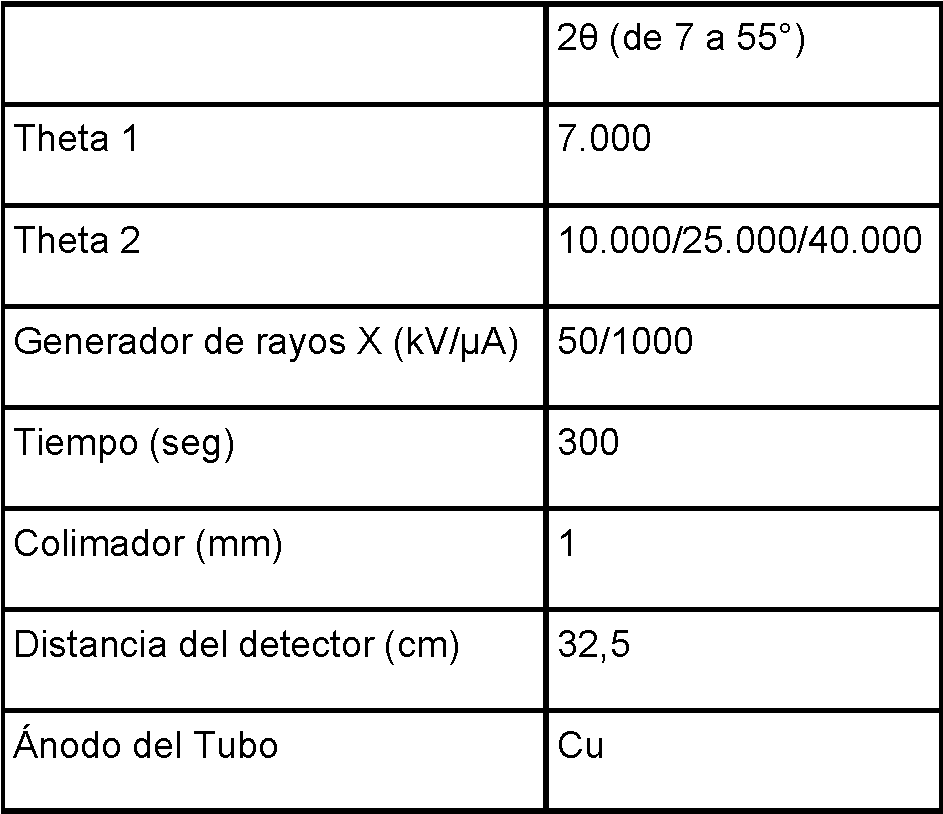
Calorimetría Diferencial de BarridoDifferential Scanning Calorimetry
Se utilizó la Calorimetría Diferencial de Barrido (DSC) para medir la temperatura de transición vítrea (Tg) del material sólido. El equipo utilizado para el análisis DSC fue un DSC8000 de Perkin Elmer con compensación de potencia y equipado con un Intracooler III como medio de refrigeración. Se utilizó el platillo de muestras de acero inoxidable que el proveedor suministra con el equipo y se llenó con el material a analizar de acuerdo con las instrucciones del proveedor. La cantidad de material añadido al platillo de la muestra (peso de la muestra) fue de 10 a 40 mg. Se utilizaron los siguientes ajustes para llevar a cabo la medición:Differential Scanning Calorimetry (DSC) was used to measure the glass transition temperature (Tg) of the solid material. The equipment used for the DSC analysis was a Perkin Elmer DSC8000 with power compensation and equipped with an Intracooler III as cooling medium. The stainless steel sample pan provided by the supplier with the equipment was used and filled with the material to be analyzed according to the supplier's instructions. The amount of material added to the sample pan (sample weight) was 10 to 40 mg. The following settings were used to carry out the measurement:

La Tg de las muestras se midió con el segundo calentamiento (es decir, la última etapa de calentamiento en el régimen de temperatura DSC).The Tg of the samples was measured with the second heating (ie, the last heating stage in the DSC temperature regime).
Ejemplo 1Example 1
Una película soluble en agua de acuerdo con la invención se hizo a partir de una solución acuosa que tenía una composición como se indica en la siguiente Tabla A.A water-soluble film according to the invention was made from an aqueous solution having a composition as indicated in Table A below.
Tabla A. Table A.

Las soluciones acuosas se calentaron hasta la ebullición en una sartén. A continuación se continuó la ebullición para permitir la evaporación del agua. El líquido se vertió en una placa de Petri totalmente transparente y se dejó enfriar pasivamente hasta la temperatura ambiente, momento en el que se formó un sólido transparente y brillante.The aqueous solutions were heated to boiling in a pan. Boiling was then continued to allow evaporation of the water. The liquid was poured into a fully clear Petri dish and passively cooled to room temperature, at which point a shiny clear solid formed.
Se utilizó la difracción de rayos X para evaluar la presencia de cristales en el material sólido. No se detectaron estructuras cristalinas. El material sólido tenía un contenido de agua del 10% en peso.X-ray diffraction was used to evaluate the presence of crystals in the solid material. Crystal structures were not detected. The solid material had a water content of 10% by weight.
El material sólido tenía una temperatura de transición vítrea de 22 grados Celsius. La temperatura de transición vítrea se puede reducir, por ejemplo, por medio del aumento del contenido de agua.The solid material had a glass transition temperature of 22 degrees Celsius. The glass transition temperature can be lowered, for example, by increasing the water content.
El material sólido antes mencionado se calentó a una temperatura de 40 a 45 grados Celsius y se cortó en un bloque de 2*2*1 cm. Este bloque caliente de material sólido se introdujo en una máquina de pasta (Pasta Perfetta, ex Gefu). Los rodillos de esta máquina se precalentaron a 45 grados Celsius.The above-mentioned solid material was heated to a temperature of 40 to 45 degrees Celsius and cut into a block of 2*2*1 cm. This hot block of solid material was fed into a pasta machine (Pasta Perfetta, ex Gefu). The rollers of this machine were preheated to 45 degrees Celsius.
Comenzando con el ajuste más alto, el proceso de extrusión se repite hasta que se alcanza un espesor de 100 micrómetros. Esta película se mantuvo a una temperatura de 45 grados Celsius y se envolvió en una pastilla de detergente común para lavar platos. La envoltura se selló por medio de la humectación de las áreas de contacto superpuestas y la aplicación de presión. Starting with the highest setting, the extrusion process is repeated until a thickness of 100 microns is reached. This film was kept at a temperature of 45 degrees Celsius and wrapped in a common dishwashing detergent tablet. The wrapper was sealed by wetting the overlapping contact areas and applying pressure.
Claims (15)
Applications Claiming Priority (12)
| Application Number | Priority Date | Filing Date | Title |
|---|---|---|---|
| EP18158269 | 2018-02-23 | ||
| EP18158265 | 2018-02-23 | ||
| EP18158256 | 2018-02-23 | ||
| EP18158266 | 2018-02-23 | ||
| EP18158260 | 2018-02-23 | ||
| EP18158262 | 2018-02-23 | ||
| EP18158267 | 2018-02-23 | ||
| EP18158259 | 2018-02-23 | ||
| EP18158258 | 2018-02-23 | ||
| EP18158264 | 2018-02-23 | ||
| EP18158268 | 2018-02-23 | ||
| PCT/EP2019/053369 WO2019162137A1 (en) | 2018-02-23 | 2019-02-12 | Water-soluble film comprising aminopolycarboxylate |
Publications (1)
| Publication Number | Publication Date |
|---|---|
| ES2901780T3 true ES2901780T3 (en) | 2022-03-23 |
Family
ID=65278391
Family Applications (11)
| Application Number | Title | Priority Date | Filing Date |
|---|---|---|---|
| ES19703345T Active ES2983188T3 (en) | 2018-02-23 | 2019-02-12 | Shaped detergent product comprising aminopolycarboxylate |
| ES19703349T Active ES2908674T3 (en) | 2018-02-23 | 2019-02-12 | Process for preparing a solid composition comprising aminopolycarboxylate |
| ES19703124T Active ES2901523T3 (en) | 2018-02-23 | 2019-02-12 | Unit dose detergent product with a thermoplastic solid part |
| ES19703346T Active ES2916726T3 (en) | 2018-02-23 | 2019-02-12 | Solid detergent composition comprising aminopolycarboxylate and inorganic acid |
| ES19703351T Active ES2901780T3 (en) | 2018-02-23 | 2019-02-12 | Water soluble film comprising aminopolycarboxylate |
| ES19703352T Active ES2902460T3 (en) | 2018-02-23 | 2019-02-12 | Solid compositions comprising aminopolycarboxylate |
| ES19703348T Active ES2914836T3 (en) | 2018-02-23 | 2019-02-12 | Solid compositions comprising aminopolycarboxylate |
| ES19703354T Active ES2902628T3 (en) | 2018-02-23 | 2019-02-12 | Unit dose detergent product with a transparent solid portion |
| ES19703353T Active ES2902361T3 (en) | 2018-02-23 | 2019-02-12 | Unit dose detergent product with a shiny solid part |
| ES19703347T Active ES2983189T3 (en) | 2018-02-23 | 2019-02-12 | Shaped detergent product composition comprising aminopolycarboxylate |
| ES19703350T Active ES2898949T3 (en) | 2018-02-23 | 2019-02-12 | Solid detergent composition comprising aminopolycarboxylate and organic acid |
Family Applications Before (4)
| Application Number | Title | Priority Date | Filing Date |
|---|---|---|---|
| ES19703345T Active ES2983188T3 (en) | 2018-02-23 | 2019-02-12 | Shaped detergent product comprising aminopolycarboxylate |
| ES19703349T Active ES2908674T3 (en) | 2018-02-23 | 2019-02-12 | Process for preparing a solid composition comprising aminopolycarboxylate |
| ES19703124T Active ES2901523T3 (en) | 2018-02-23 | 2019-02-12 | Unit dose detergent product with a thermoplastic solid part |
| ES19703346T Active ES2916726T3 (en) | 2018-02-23 | 2019-02-12 | Solid detergent composition comprising aminopolycarboxylate and inorganic acid |
Family Applications After (6)
| Application Number | Title | Priority Date | Filing Date |
|---|---|---|---|
| ES19703352T Active ES2902460T3 (en) | 2018-02-23 | 2019-02-12 | Solid compositions comprising aminopolycarboxylate |
| ES19703348T Active ES2914836T3 (en) | 2018-02-23 | 2019-02-12 | Solid compositions comprising aminopolycarboxylate |
| ES19703354T Active ES2902628T3 (en) | 2018-02-23 | 2019-02-12 | Unit dose detergent product with a transparent solid portion |
| ES19703353T Active ES2902361T3 (en) | 2018-02-23 | 2019-02-12 | Unit dose detergent product with a shiny solid part |
| ES19703347T Active ES2983189T3 (en) | 2018-02-23 | 2019-02-12 | Shaped detergent product composition comprising aminopolycarboxylate |
| ES19703350T Active ES2898949T3 (en) | 2018-02-23 | 2019-02-12 | Solid detergent composition comprising aminopolycarboxylate and organic acid |
Country Status (7)
| Country | Link |
|---|---|
| US (6) | US12134749B2 (en) |
| EP (11) | EP3755779B1 (en) |
| JP (4) | JP2021515820A (en) |
| CN (11) | CN111770984B (en) |
| AU (8) | AU2019223671B2 (en) |
| ES (11) | ES2983188T3 (en) |
| WO (11) | WO2019162135A1 (en) |
Families Citing this family (7)
| Publication number | Priority date | Publication date | Assignee | Title |
|---|---|---|---|---|
| DE102016123856A1 (en) * | 2016-12-08 | 2018-06-14 | Endress + Hauser Wetzer Gmbh + Co. Kg | Method for in situ calibration of a thermometer |
| JP2021515820A (en) * | 2018-02-23 | 2021-06-24 | ユニリーバー・ナームローゼ・ベンノートシヤープ | Molding detergent product composition containing aminopolycarboxylate |
| WO2019211170A1 (en) * | 2018-05-04 | 2019-11-07 | Basf Se | Granules or powders and methods for their manufacture |
| GB202007128D0 (en) * | 2020-05-14 | 2020-07-01 | Reckitt Benckiser Finish Bv | Solid composition |
| WO2022253730A1 (en) * | 2021-06-03 | 2022-12-08 | Unilever Ip Holdings B.V. | Machine dishwash detergent |
| GB202109205D0 (en) | 2021-06-25 | 2021-08-11 | Innospec Ltd | Compositions |
| EP4574955A1 (en) * | 2023-12-22 | 2025-06-25 | Henkel AG & Co. KGaA | Highly concentrated detergent composition with improved storage stability |
Family Cites Families (114)
| Publication number | Priority date | Publication date | Assignee | Title |
|---|---|---|---|---|
| SE374762B (en) | 1968-03-04 | 1975-03-17 | Monsanto Co | |
| AU528342B2 (en) | 1978-12-11 | 1983-04-28 | Shell Internationale Research Maatschappij B.V. | Thermosetting resinous binder compositions |
| DE3278670D1 (en) | 1981-07-13 | 1988-07-21 | Procter & Gamble | Foaming surfactant compositions |
| DE3206570A1 (en) | 1982-02-24 | 1983-09-01 | Hans Paul 7730 Villingen-Schwenningen Maier | PIPE CONNECTION |
| US4751015A (en) | 1987-03-17 | 1988-06-14 | Lever Brothers Company | Quaternary ammonium or phosphonium substituted peroxy carbonic acid precursors and their use in detergent bleach compositions |
| GB8803036D0 (en) | 1988-02-10 | 1988-03-09 | Unilever Plc | Liquid detergents |
| CA2001927C (en) | 1988-11-03 | 1999-12-21 | Graham Thomas Brown | Aluminosilicates and detergent compositions |
| US5041232A (en) | 1990-03-16 | 1991-08-20 | Lever Brothers Company, Division Of Conopco, Inc. | Sulfonimines as bleach catalysts |
| US5047163A (en) | 1990-03-16 | 1991-09-10 | Lever Brothers Company, Division Of Conopco, Inc. | Activation of bleach precursors with sulfonimines |
| DE69125310T2 (en) | 1990-05-21 | 1997-07-03 | Unilever Nv | Bleach activation |
| EP0678572A1 (en) † | 1994-04-20 | 1995-10-25 | The Procter & Gamble Company | Detergent powder compositions |
| US5500153A (en) | 1994-07-05 | 1996-03-19 | The Procter & Gamble Company | Handwash laundry detergent composition having improved mildness and cleaning performance |
| CN1200998C (en) * | 1997-10-10 | 2005-05-11 | 普罗格特-甘布尔公司 | Detergent composition |
| CA2309251C (en) | 1997-11-10 | 2003-12-30 | The Procter & Gamble Company | Detergent tablet |
| BR9914297B1 (en) | 1998-08-27 | 2010-10-19 | process for producing a free flowing stable solid chelating composition, and a free flowing solid stable aminocarboxylate chelator. | |
| JP2000143594A (en) * | 1998-11-10 | 2000-05-23 | Mitsubishi Rayon Co Ltd | Method for reducing hygroscopicity of monoamine polycarboxylate-containing material |
| DE19937345A1 (en) | 1999-08-11 | 2001-02-15 | Basf Ag | Mixed powder or mixed granules based on glycine-N, N-diacetic acid |
| EP1197546A1 (en) * | 2000-05-12 | 2002-04-17 | Unilever Plc | Unit dose cleaning product |
| AU2001254824A1 (en) * | 2000-05-12 | 2001-11-20 | Unilever Plc | Unit dose cleaning product |
| EP1156101A1 (en) | 2000-05-19 | 2001-11-21 | Deoflor S.p.A. | A cleansing device for WC pans |
| US6756460B2 (en) | 2000-08-22 | 2004-06-29 | Nippon Shokubai Co., Ltd. | Water-soluble copolymer and its production process and use |
| GB2372500B (en) | 2001-02-22 | 2003-08-20 | Reckitt Benckiser Nv | Process for Inhibition of Corrosion of Glassware during Automatic Dishwashing |
| EP1482992A1 (en) | 2002-03-06 | 2004-12-08 | Inovair Limited | Perfume gel composition |
| US20050148488A1 (en) | 2002-05-15 | 2005-07-07 | Maren Jekel | Detergent tablets with active phase |
| DE10221559B4 (en) * | 2002-05-15 | 2009-04-30 | Henkel Ag & Co. Kgaa | Detergent and detergent tablets with active phase |
| EP1405902A1 (en) * | 2002-10-01 | 2004-04-07 | Unilever N.V. | Detergent compositions |
| GB0314210D0 (en) | 2003-06-18 | 2003-07-23 | Unilever Plc | Laundry treatment compositions |
| EP1574563B1 (en) * | 2004-03-12 | 2007-06-13 | Unilever N.V. | Use of detergent tablets |
| US7442679B2 (en) † | 2004-04-15 | 2008-10-28 | Ecolab Inc. | Binding agent for solidification matrix comprising MGDA |
| DE102004032320A1 (en) | 2004-07-02 | 2006-01-19 | Basf Ag | Mixed powder or mixed granules based on MGDA |
| GB0420203D0 (en) | 2004-09-11 | 2004-10-13 | Unilever Plc | Laundry treatment compositions |
| GB0421145D0 (en) | 2004-09-23 | 2004-10-27 | Unilever Plc | Laundry treatment compositions |
| CA2575592C (en) | 2004-09-23 | 2013-11-12 | Unilever Plc | Laundry treatment compositions comprising an anthraquinone hydrophobic dye |
| DE102004052007B4 (en) | 2004-10-25 | 2007-12-06 | Müller Weingarten AG | Drive system of a forming press |
| DE102005041347A1 (en) | 2005-08-31 | 2007-03-01 | Basf Ag | Phosphate-free cleaning formulation, useful in dishwasher, comprises copolymer, chelating agent, weakly foaming non-ionic surfactant, and other optional additives such as bleaching agent and enzymes |
| GB0522658D0 (en) | 2005-11-07 | 2005-12-14 | Reckitt Benckiser Nv | Composition |
| GB0522659D0 (en) * | 2005-11-07 | 2005-12-14 | Reckitt Benckiser Nv | Delivery cartridge |
| DE102006034051A1 (en) | 2006-07-20 | 2008-01-24 | Henkel Kgaa | Process for the preparation of a solid textile-softening composition |
| JP2009527618A (en) | 2006-08-10 | 2009-07-30 | ユニリーバー・ナームローゼ・ベンノートシヤープ | Shading composition |
| CA2660193A1 (en) * | 2006-08-10 | 2008-02-14 | Basf Se | Detergent formulation for machine dishwashers |
| JP5207162B2 (en) * | 2006-11-22 | 2013-06-12 | ディバーシー株式会社 | Neutral liquid detergent composition for automatic dishwashers |
| ATE486927T1 (en) | 2007-01-19 | 2010-11-15 | Procter & Gamble | LAUNDRY CARE WITH WHITE TONER FOR CELLULOSE-CONTAINING SUBSTRATES |
| DE102007005617A1 (en) | 2007-01-31 | 2008-08-07 | Buck-Chemie Gmbh | Transparent toilet cleaner |
| US8076278B2 (en) * | 2007-04-16 | 2011-12-13 | Conopco, Inc. | Self adhesive hard surface cleaning composition |
| US20100197555A1 (en) | 2007-05-18 | 2010-08-05 | Stephen Norman Batchelor | Triphenodioxazine dyes |
| GB0716228D0 (en) | 2007-08-20 | 2007-09-26 | Reckitt Benckiser Nv | Detergent composition |
| US8198228B2 (en) | 2008-01-04 | 2012-06-12 | Ecolab Usa Inc. | Solidification matrix using an aminocarboxylate |
| UA103760C2 (en) | 2008-01-24 | 2013-11-25 | Юнилевер Н.В. | Machine dishwash detergent composition |
| GB0805879D0 (en) * | 2008-04-01 | 2008-05-07 | Reckitt Benckiser Nv | Injection moulded containers |
| WO2009132870A1 (en) | 2008-05-02 | 2009-11-05 | Unilever Plc | Reduced spotting granules |
| US8632610B2 (en) | 2008-05-20 | 2014-01-21 | Conopco Inc. | Shading composition |
| EP2154235A1 (en) | 2008-07-28 | 2010-02-17 | The Procter and Gamble Company | Process for preparing a detergent composition |
| WO2010076291A1 (en) | 2008-12-29 | 2010-07-08 | Akzo Nobel N.V. | Coated particles of a chelating agent |
| MY159509A (en) | 2009-03-05 | 2017-01-13 | Unilever Plc | Dye radical initiators |
| ES2435470T3 (en) | 2009-03-12 | 2013-12-19 | Unilever Nv | Dye polymer formulations |
| WO2010148624A1 (en) | 2009-06-26 | 2010-12-29 | Unilever Plc | Dye polymers |
| US20120149625A1 (en) | 2009-09-25 | 2012-06-14 | Novozymes A/S | Detergent Composition |
| JP2013515595A (en) | 2009-12-24 | 2013-05-09 | アクゾ ノーベル ケミカルズ インターナショナル ベスローテン フエンノートシャップ | Coated particles of glutamic acid N, N-diacetic acid chelating agent |
| US20120067373A1 (en) | 2010-04-15 | 2012-03-22 | Philip Frank Souter | Automatic Dishwashing Detergent Composition |
| ES2579217T3 (en) | 2010-04-23 | 2016-08-08 | The Procter & Gamble Company | Particle |
| ES2682051T3 (en) | 2010-04-23 | 2018-09-18 | The Procter & Gamble Company | Detergent composition |
| EP2383329A1 (en) | 2010-04-23 | 2011-11-02 | The Procter & Gamble Company | Particle |
| PL2392638T3 (en) * | 2010-06-04 | 2018-03-30 | Dalli-Werke Gmbh & Co. Kg | Low-hygroscopic particulate composition comprising one or more aminopolycarboxylate chelating compounds |
| WO2012000914A1 (en) * | 2010-06-28 | 2012-01-05 | Akzo Nobel Chemicals International B.V. | Particles coated with vinyl alcohol (co) polymer and polysaccharide |
| US8741833B2 (en) | 2010-07-16 | 2014-06-03 | Massachusetts Institute Of Technology | Self-assembling peptides incorporating modifications and methods of use thereof |
| WO2012043859A1 (en) | 2010-10-01 | 2012-04-05 | ライオン株式会社 | Particles each containing aminocarboxylic acid (salt), and granular detergent composition |
| CN103210073B (en) | 2010-11-12 | 2016-06-08 | 宝洁公司 | Thiophene azo dyes and laundry care compositions containing them |
| US8748364B2 (en) * | 2010-12-23 | 2014-06-10 | Ecolab Usa Inc. | Detergent composition containing an aminocarboxylate and a maleic copolymer |
| GB2491619B (en) | 2011-06-09 | 2014-10-01 | Pq Silicas Bv | Builder granules and process for their preparation |
| US8709990B2 (en) | 2011-10-19 | 2014-04-29 | Basf Se | Formulations, their use as or for producing dishwashing detergents and their production |
| PL2768937T3 (en) | 2011-10-19 | 2016-07-29 | Basf Se | Formulations, their use as or for the manufacture of dishwashing agents and their manufacture |
| ES2633292T3 (en) * | 2011-10-19 | 2017-09-20 | The Procter & Gamble Company | Particle |
| CA2849358A1 (en) † | 2011-10-19 | 2013-04-25 | Basf Se | Formulations, their use as or for producing dishwashing detergents and their production |
| ES2626819T3 (en) † | 2011-10-19 | 2017-07-26 | Basf Se | Formulations, their use as or for the manufacture of dishwashing detergents and their manufacture |
| US8846593B2 (en) † | 2012-04-25 | 2014-09-30 | Basf Se | Dishwashing composition comprising a covalently modified alkyleneimine polymer |
| WO2013160132A1 (en) | 2012-04-25 | 2013-10-31 | Basf Se | Solid formulations, production thereof, and use thereof |
| US9732309B2 (en) | 2012-04-25 | 2017-08-15 | Basf Se | Formulations, their use as or for producing dishwashing detergents and their production |
| US20130284210A1 (en) | 2012-04-25 | 2013-10-31 | Basf Se | Solid formulations, their preparation and use |
| CN104350139B (en) | 2012-05-25 | 2018-04-13 | 花王株式会社 | Cleaning agent for automatic cleaning machine of tableware composition |
| GB201214558D0 (en) * | 2012-08-15 | 2012-09-26 | Reckitt Benckiser Nv | Detergent granule |
| WO2014086662A1 (en) | 2012-12-03 | 2014-06-12 | Unilever N.V. | Solid glda compositions |
| EP2970830B1 (en) | 2013-03-14 | 2017-12-13 | Novozymes A/S | Enzyme and inhibitor contained in water-soluble films |
| PL2981600T3 (en) | 2013-04-02 | 2018-08-31 | Basf Se | Formulations, use as dishwashing compositions and their production |
| EP3004316B1 (en) | 2013-05-27 | 2017-03-22 | Basf Se | Aqueous solutions containing a complexing agent in high concentration |
| US20160130532A1 (en) * | 2013-06-25 | 2016-05-12 | Conopco, Inc., D/B/A Unilever | Hygroscopic detergent formulation comprising water, aminocarboxylate chelant and moisture-sensitive ingredients |
| KR20160030256A (en) | 2013-07-04 | 2016-03-16 | 바스프 에스이 | Process for cleaning dishware |
| ITMI20131535A1 (en) | 2013-09-18 | 2015-03-19 | Bolton Manitoba S P A | SOLID TABLET FOR WC |
| DE102013225584A1 (en) | 2013-12-11 | 2015-06-11 | Henkel Ag & Co. Kgaa | Machine dishwashing detergent containing N-based complexing agents |
| ES2734061T3 (en) † | 2014-02-13 | 2019-12-04 | Basf Se | Powder and granule, process for manufacturing said powder and granule, and its use |
| US20160348036A1 (en) * | 2014-02-20 | 2016-12-01 | Conopco, Inc., D/B/A Unilever | Machine dishwash composition |
| CA2955499A1 (en) * | 2014-08-07 | 2016-02-11 | The Procter & Gamble Company | Soluble unit dose comprising a laundry detergent composition |
| CN106687572A (en) * | 2014-09-10 | 2017-05-17 | 巴斯夫欧洲公司 | Encapsulated Cleansing Composition |
| KR20170066648A (en) | 2014-10-15 | 2017-06-14 | 아지노모토 가부시키가이샤 | Transparent solid detergent |
| DE102014221581A1 (en) * | 2014-10-23 | 2016-04-28 | Henkel Ag & Co. Kgaa | Dishwashing detergent containing metal complexes |
| EP3050947A1 (en) * | 2015-02-02 | 2016-08-03 | The Procter and Gamble Company | Detergent pack |
| US20180118632A1 (en) | 2015-05-11 | 2018-05-03 | Basf Se | Process for manufacturing formulations of chelating agents |
| ES2728108T3 (en) † | 2015-07-29 | 2019-10-22 | Procter & Gamble | Multistage cleaning product in unit dose |
| EP3124586A1 (en) * | 2015-07-29 | 2017-02-01 | The Procter and Gamble Company | Process for reducing malodour in a pack |
| EP3138895B1 (en) | 2015-09-02 | 2018-10-17 | Basf Se | Particles, use of the same or for manufacture of dishwashing agents and their manufacture |
| EP3365421B1 (en) | 2015-10-23 | 2021-04-21 | Basf Se | Solid solutions of odoriferous substances and flavoring agents with vinyl lactam polymers |
| JP2018536740A (en) | 2015-11-11 | 2018-12-13 | ビーエーエスエフ ソシエタス・ヨーロピアBasf Se | Aqueous formulation with good shelf life |
| WO2017097637A1 (en) † | 2015-12-08 | 2017-06-15 | Basf Se | Aqueous solution containing a complexing agent in high concentrations |
| EP3178917A1 (en) † | 2015-12-08 | 2017-06-14 | The Procter and Gamble Company | Cleaning pouch |
| WO2017102483A1 (en) | 2015-12-17 | 2017-06-22 | Basf Se | Process for making a crystalline alkali metal salt of a complexing agent, and crystalline complexing agent |
| JP2017119742A (en) | 2015-12-28 | 2017-07-06 | ライオン株式会社 | Detergent for dishwasher |
| JP6462028B2 (en) | 2016-03-31 | 2019-01-30 | 株式会社Adeka | Molten solid type cleaning composition |
| US20170369819A1 (en) * | 2016-06-27 | 2017-12-28 | The Procter & Gamble Company | Removal of hydrophilic body soils |
| DE102016212248A1 (en) | 2016-07-05 | 2018-01-11 | Henkel Ag & Co. Kgaa | Dishwashing detergent containing sugar acid and aminocarboxylic acid |
| CN109415663A (en) * | 2016-07-15 | 2019-03-01 | 巴斯夫欧洲公司 | Prepare method, the particle and application thereof of the particle containing MGDA and GLDA |
| FI3558595T3 (en) | 2016-12-22 | 2023-12-14 | Kyocera Senco Industrial Tools Inc | FASTENER OPERATING TOOL WITH OPERATING DEVICE POSITION SENSORS |
| DE102017201097A1 (en) * | 2017-01-24 | 2018-07-26 | Henkel Ag & Co. Kgaa | Washing or cleaning agent comprising at least two phases |
| AU2018227530B2 (en) | 2017-03-01 | 2020-06-25 | Ecolab Usa Inc. | Mechanism of urea/solid acid interaction under storage conditions and storage stable solid compositions comprising urea and acid |
| TWI789397B (en) | 2017-06-05 | 2023-01-11 | 美商深絕公司 | Storing hazardous material in a subterranean formation |
| JP2021515820A (en) | 2018-02-23 | 2021-06-24 | ユニリーバー・ナームローゼ・ベンノートシヤープ | Molding detergent product composition containing aminopolycarboxylate |
-
2019
- 2019-02-12 JP JP2020540375A patent/JP2021515820A/en active Pending
- 2019-02-12 CN CN201980015131.8A patent/CN111770984B/en not_active Expired - Fee Related
- 2019-02-12 CN CN201980015144.5A patent/CN111757926B/en not_active Expired - Fee Related
- 2019-02-12 ES ES19703345T patent/ES2983188T3/en active Active
- 2019-02-12 CN CN201980015147.9A patent/CN111788289B/en not_active Expired - Fee Related
- 2019-02-12 WO PCT/EP2019/053363 patent/WO2019162135A1/en not_active Ceased
- 2019-02-12 EP EP19703348.3A patent/EP3755779B1/en not_active Revoked
- 2019-02-12 WO PCT/EP2019/053357 patent/WO2019162130A1/en not_active Ceased
- 2019-02-12 EP EP19703346.7A patent/EP3755778B1/en active Active
- 2019-02-12 ES ES19703349T patent/ES2908674T3/en active Active
- 2019-02-12 WO PCT/EP2019/053361 patent/WO2019162133A1/en not_active Ceased
- 2019-02-12 AU AU2019223671A patent/AU2019223671B2/en not_active Ceased
- 2019-02-12 ES ES19703124T patent/ES2901523T3/en active Active
- 2019-02-12 AU AU2019223676A patent/AU2019223676A1/en not_active Abandoned
- 2019-02-12 EP EP19703347.5A patent/EP3755775B1/en active Active
- 2019-02-12 WO PCT/EP2019/053369 patent/WO2019162137A1/en not_active Ceased
- 2019-02-12 AU AU2019225946A patent/AU2019225946B2/en not_active Ceased
- 2019-02-12 ES ES19703346T patent/ES2916726T3/en active Active
- 2019-02-12 WO PCT/EP2019/053373 patent/WO2019162140A1/en not_active Ceased
- 2019-02-12 JP JP2020543111A patent/JP7286664B2/en active Active
- 2019-02-12 ES ES19703351T patent/ES2901780T3/en active Active
- 2019-02-12 EP EP19703352.5A patent/EP3755777B2/en active Active
- 2019-02-12 ES ES19703352T patent/ES2902460T3/en active Active
- 2019-02-12 ES ES19703348T patent/ES2914836T3/en active Active
- 2019-02-12 WO PCT/EP2019/053362 patent/WO2019162134A1/en not_active Ceased
- 2019-02-12 CN CN201980015114.4A patent/CN111788290B/en not_active Expired - Fee Related
- 2019-02-12 WO PCT/EP2019/053358 patent/WO2019162131A1/en not_active Ceased
- 2019-02-12 CN CN201980015096.XA patent/CN111788293B/en not_active Expired - Fee Related
- 2019-02-12 AU AU2019223678A patent/AU2019223678A1/en not_active Abandoned
- 2019-02-12 CN CN201980015149.8A patent/CN111770985B/en not_active Expired - Fee Related
- 2019-02-12 WO PCT/EP2019/053372 patent/WO2019162139A1/en not_active Ceased
- 2019-02-12 EP EP19703349.1A patent/EP3755780B2/en active Active
- 2019-02-12 EP EP19703353.3A patent/EP3755782B1/en active Active
- 2019-02-12 JP JP2020541420A patent/JP2021515060A/en active Pending
- 2019-02-12 EP EP19703124.8A patent/EP3755781B1/en active Active
- 2019-02-12 WO PCT/EP2019/053359 patent/WO2019162132A1/en not_active Ceased
- 2019-02-12 CN CN201980015094.0A patent/CN111757923B/en not_active Expired - Fee Related
- 2019-02-12 WO PCT/EP2019/053370 patent/WO2019162138A1/en not_active Ceased
- 2019-02-12 CN CN201980015150.0A patent/CN111770983B/en not_active Expired - Fee Related
- 2019-02-12 CN CN201980015142.6A patent/CN111757924B/en not_active Expired - Fee Related
- 2019-02-12 JP JP2020540416A patent/JP2021515057A/en active Pending
- 2019-02-12 ES ES19703354T patent/ES2902628T3/en active Active
- 2019-02-12 ES ES19703353T patent/ES2902361T3/en active Active
- 2019-02-12 AU AU2019223672A patent/AU2019223672B2/en not_active Ceased
- 2019-02-12 CN CN201980015117.8A patent/CN111788291B/en not_active Expired - Fee Related
- 2019-02-12 US US16/966,012 patent/US12134749B2/en active Active
- 2019-02-12 ES ES19703347T patent/ES2983189T3/en active Active
- 2019-02-12 EP EP19703350.9A patent/EP3755784B1/en active Active
- 2019-02-12 AU AU2019223673A patent/AU2019223673A1/en not_active Abandoned
- 2019-02-12 AU AU2019223670A patent/AU2019223670A1/en not_active Abandoned
- 2019-02-12 WO PCT/EP2019/053364 patent/WO2019162136A1/en not_active Ceased
- 2019-02-12 CN CN201980015146.4A patent/CN111757925B/en not_active Expired - Fee Related
- 2019-02-12 EP EP19703354.1A patent/EP3755783B1/en active Active
- 2019-02-12 US US16/966,013 patent/US20200377824A1/en not_active Abandoned
- 2019-02-12 EP EP19703345.9A patent/EP3755774B1/en active Active
- 2019-02-12 AU AU2019223675A patent/AU2019223675B2/en not_active Ceased
- 2019-02-12 ES ES19703350T patent/ES2898949T3/en active Active
- 2019-02-12 EP EP19703351.7A patent/EP3755776B1/en active Active
- 2019-02-12 US US16/965,615 patent/US20210040418A1/en not_active Abandoned
-
2023
- 2023-02-02 US US18/163,306 patent/US20230220316A1/en not_active Abandoned
- 2023-02-02 US US18/163,307 patent/US20230167385A1/en not_active Abandoned
-
2024
- 2024-05-31 US US18/679,605 patent/US20240318104A1/en not_active Abandoned
Also Published As
Similar Documents
| Publication | Publication Date | Title |
|---|---|---|
| ES2902460T3 (en) | Solid compositions comprising aminopolycarboxylate | |
| ES2943558T3 (en) | Solid detergent composition | |
| US20210040417A1 (en) | Detergent solid composition comprising aminopolycarboxylate and organic acid |