ES2905405T3 - Zeolitic adsorbents and their uses - Google Patents
Zeolitic adsorbents and their uses Download PDFInfo
- Publication number
- ES2905405T3 ES2905405T3 ES13802962T ES13802962T ES2905405T3 ES 2905405 T3 ES2905405 T3 ES 2905405T3 ES 13802962 T ES13802962 T ES 13802962T ES 13802962 T ES13802962 T ES 13802962T ES 2905405 T3 ES2905405 T3 ES 2905405T3
- Authority
- ES
- Spain
- Prior art keywords
- adsorbent
- weight
- zeolite
- zeolitic
- inclusive
- Prior art date
- Legal status (The legal status is an assumption and is not a legal conclusion. Google has not performed a legal analysis and makes no representation as to the accuracy of the status listed.)
- Active
Links
- 239000003463 adsorbent Substances 0.000 title claims abstract description 111
- 239000010457 zeolite Substances 0.000 claims abstract description 89
- 229910021536 Zeolite Inorganic materials 0.000 claims abstract description 77
- HNPSIPDUKPIQMN-UHFFFAOYSA-N dioxosilane;oxo(oxoalumanyloxy)alumane Chemical compound O=[Si]=O.O=[Al]O[Al]=O HNPSIPDUKPIQMN-UHFFFAOYSA-N 0.000 claims abstract description 72
- 239000013078 crystal Substances 0.000 claims abstract description 58
- QVQLCTNNEUAWMS-UHFFFAOYSA-N barium oxide Chemical compound [Ba]=O QVQLCTNNEUAWMS-UHFFFAOYSA-N 0.000 claims abstract description 27
- CHWRSCGUEQEHOH-UHFFFAOYSA-N potassium oxide Chemical compound [O-2].[K+].[K+] CHWRSCGUEQEHOH-UHFFFAOYSA-N 0.000 claims abstract description 12
- 150000002500 ions Chemical class 0.000 claims abstract description 4
- 229910001950 potassium oxide Inorganic materials 0.000 claims abstract description 4
- 239000003513 alkali Substances 0.000 claims abstract description 3
- 238000001179 sorption measurement Methods 0.000 claims description 55
- URLKBWYHVLBVBO-UHFFFAOYSA-N Para-Xylene Chemical group CC1=CC=C(C)C=C1 URLKBWYHVLBVBO-UHFFFAOYSA-N 0.000 claims description 50
- 238000000034 method Methods 0.000 claims description 48
- 239000012071 phase Substances 0.000 claims description 27
- 230000008569 process Effects 0.000 claims description 22
- 238000000926 separation method Methods 0.000 claims description 19
- 125000003118 aryl group Chemical group 0.000 claims description 16
- 239000007791 liquid phase Substances 0.000 claims description 11
- 238000001354 calcination Methods 0.000 claims description 10
- DSNHSQKRULAAEI-UHFFFAOYSA-N 1,4-Diethylbenzene Chemical compound CCC1=CC=C(CC)C=C1 DSNHSQKRULAAEI-UHFFFAOYSA-N 0.000 claims description 8
- 239000008096 xylene Substances 0.000 claims description 6
- YXFVVABEGXRONW-UHFFFAOYSA-N Toluene Natural products CC1=CC=CC=C1 YXFVVABEGXRONW-UHFFFAOYSA-N 0.000 claims description 5
- 125000004432 carbon atom Chemical group C* 0.000 claims description 5
- 150000004945 aromatic hydrocarbons Chemical class 0.000 claims description 4
- 150000003738 xylenes Chemical class 0.000 claims description 4
- 150000001896 cresols Chemical class 0.000 claims description 3
- 238000011084 recovery Methods 0.000 claims description 3
- 150000005846 sugar alcohols Polymers 0.000 claims description 3
- 150000003613 toluenes Chemical class 0.000 claims description 3
- PBWHJRFXUPLZDS-UHFFFAOYSA-N (1-Ethylpropyl)benzene Chemical compound CCC(CC)C1=CC=CC=C1 PBWHJRFXUPLZDS-UHFFFAOYSA-N 0.000 claims description 2
- VOZKAJLKRJDJLL-UHFFFAOYSA-N 2,4-diaminotoluene Chemical compound CC1=CC=C(N)C=C1N VOZKAJLKRJDJLL-UHFFFAOYSA-N 0.000 claims description 2
- VLZLOWPYUQHHCG-UHFFFAOYSA-N nitromethylbenzene Chemical compound [O-][N+](=O)CC1=CC=CC=C1 VLZLOWPYUQHHCG-UHFFFAOYSA-N 0.000 claims description 2
- SYSQUGFVNFXIIT-UHFFFAOYSA-N n-[4-(1,3-benzoxazol-2-yl)phenyl]-4-nitrobenzenesulfonamide Chemical class C1=CC([N+](=O)[O-])=CC=C1S(=O)(=O)NC1=CC=C(C=2OC3=CC=CC=C3N=2)C=C1 SYSQUGFVNFXIIT-UHFFFAOYSA-N 0.000 claims 1
- 125000003944 tolyl group Chemical group 0.000 claims 1
- 239000011230 binding agent Substances 0.000 description 32
- DSAJWYNOEDNPEQ-UHFFFAOYSA-N barium atom Chemical compound [Ba] DSAJWYNOEDNPEQ-UHFFFAOYSA-N 0.000 description 27
- 229910052788 barium Inorganic materials 0.000 description 25
- VYPSYNLAJGMNEJ-UHFFFAOYSA-N Silicium dioxide Chemical compound O=[Si]=O VYPSYNLAJGMNEJ-UHFFFAOYSA-N 0.000 description 22
- HEMHJVSKTPXQMS-UHFFFAOYSA-M Sodium hydroxide Chemical compound [OH-].[Na+] HEMHJVSKTPXQMS-UHFFFAOYSA-M 0.000 description 18
- 238000004458 analytical method Methods 0.000 description 17
- XLYOFNOQVPJJNP-UHFFFAOYSA-N water Substances O XLYOFNOQVPJJNP-UHFFFAOYSA-N 0.000 description 16
- 229910001868 water Inorganic materials 0.000 description 16
- IJGRMHOSHXDMSA-UHFFFAOYSA-N Atomic nitrogen Chemical compound N#N IJGRMHOSHXDMSA-UHFFFAOYSA-N 0.000 description 15
- 238000012546 transfer Methods 0.000 description 15
- 238000005054 agglomeration Methods 0.000 description 14
- 230000002776 aggregation Effects 0.000 description 14
- 239000000843 powder Substances 0.000 description 13
- ZLMJMSJWJFRBEC-UHFFFAOYSA-N Potassium Chemical compound [K] ZLMJMSJWJFRBEC-UHFFFAOYSA-N 0.000 description 12
- 239000011591 potassium Substances 0.000 description 12
- 239000007787 solid Substances 0.000 description 12
- 239000000243 solution Substances 0.000 description 12
- 229910052700 potassium Inorganic materials 0.000 description 11
- KKCBUQHMOMHUOY-UHFFFAOYSA-N sodium oxide Chemical compound [O-2].[Na+].[Na+] KKCBUQHMOMHUOY-UHFFFAOYSA-N 0.000 description 11
- 230000015572 biosynthetic process Effects 0.000 description 10
- 239000000463 material Substances 0.000 description 10
- 238000012512 characterization method Methods 0.000 description 9
- 238000005259 measurement Methods 0.000 description 9
- 239000000203 mixture Substances 0.000 description 9
- 239000000377 silicon dioxide Substances 0.000 description 9
- 239000011734 sodium Substances 0.000 description 9
- -1 sodium cations Chemical class 0.000 description 9
- 239000007864 aqueous solution Substances 0.000 description 8
- 239000002245 particle Substances 0.000 description 8
- 229910052708 sodium Inorganic materials 0.000 description 8
- 238000003786 synthesis reaction Methods 0.000 description 8
- 238000005406 washing Methods 0.000 description 8
- 229910001422 barium ion Inorganic materials 0.000 description 7
- 238000006243 chemical reaction Methods 0.000 description 7
- NLYAJNPCOHFWQQ-UHFFFAOYSA-N kaolin Chemical compound O.O.O=[Al]O[Si](=O)O[Si](=O)O[Al]=O NLYAJNPCOHFWQQ-UHFFFAOYSA-N 0.000 description 7
- 229910052757 nitrogen Inorganic materials 0.000 description 7
- 238000002441 X-ray diffraction Methods 0.000 description 6
- 239000012670 alkaline solution Substances 0.000 description 6
- 235000012211 aluminium silicate Nutrition 0.000 description 6
- WDIHJSXYQDMJHN-UHFFFAOYSA-L barium chloride Chemical compound [Cl-].[Cl-].[Ba+2] WDIHJSXYQDMJHN-UHFFFAOYSA-L 0.000 description 6
- 229910001626 barium chloride Inorganic materials 0.000 description 6
- 238000005341 cation exchange Methods 0.000 description 6
- 229910001414 potassium ion Inorganic materials 0.000 description 6
- 239000000047 product Substances 0.000 description 6
- 239000000126 substance Substances 0.000 description 6
- 238000012360 testing method Methods 0.000 description 6
- 239000005995 Aluminium silicate Substances 0.000 description 5
- 239000004927 clay Substances 0.000 description 5
- 238000001035 drying Methods 0.000 description 5
- 239000000499 gel Substances 0.000 description 5
- 239000012429 reaction media Substances 0.000 description 5
- 229910001948 sodium oxide Inorganic materials 0.000 description 5
- 239000002904 solvent Substances 0.000 description 5
- 238000000177 wavelength dispersive X-ray spectroscopy Methods 0.000 description 5
- DGAQECJNVWCQMB-PUAWFVPOSA-M Ilexoside XXIX Chemical compound C[C@@H]1CC[C@@]2(CC[C@@]3(C(=CC[C@H]4[C@]3(CC[C@@H]5[C@@]4(CC[C@@H](C5(C)C)OS(=O)(=O)[O-])C)C)[C@@H]2[C@]1(C)O)C)C(=O)O[C@H]6[C@@H]([C@H]([C@@H]([C@H](O6)CO)O)O)O.[Na+] DGAQECJNVWCQMB-PUAWFVPOSA-M 0.000 description 4
- 238000001994 activation Methods 0.000 description 4
- 230000004913 activation Effects 0.000 description 4
- 239000003795 chemical substances by application Substances 0.000 description 4
- 238000009792 diffusion process Methods 0.000 description 4
- 239000011521 glass Substances 0.000 description 4
- 238000002347 injection Methods 0.000 description 4
- 239000007924 injection Substances 0.000 description 4
- 238000004519 manufacturing process Methods 0.000 description 4
- 230000001105 regulatory effect Effects 0.000 description 4
- 150000003839 salts Chemical class 0.000 description 4
- 238000003756 stirring Methods 0.000 description 4
- CTQNGGLPUBDAKN-UHFFFAOYSA-N O-Xylene Chemical compound CC1=CC=CC=C1C CTQNGGLPUBDAKN-UHFFFAOYSA-N 0.000 description 3
- KWYUFKZDYYNOTN-UHFFFAOYSA-M Potassium hydroxide Chemical compound [OH-].[K+] KWYUFKZDYYNOTN-UHFFFAOYSA-M 0.000 description 3
- 239000000654 additive Substances 0.000 description 3
- 125000004429 atom Chemical group 0.000 description 3
- 239000011324 bead Substances 0.000 description 3
- 238000009835 boiling Methods 0.000 description 3
- 229910052681 coesite Inorganic materials 0.000 description 3
- 239000000470 constituent Substances 0.000 description 3
- 229910052906 cristobalite Inorganic materials 0.000 description 3
- 238000002425 crystallisation Methods 0.000 description 3
- 230000008025 crystallization Effects 0.000 description 3
- 239000006185 dispersion Substances 0.000 description 3
- 238000005553 drilling Methods 0.000 description 3
- 238000001125 extrusion Methods 0.000 description 3
- 235000012239 silicon dioxide Nutrition 0.000 description 3
- 229910052682 stishovite Inorganic materials 0.000 description 3
- 229910052905 tridymite Inorganic materials 0.000 description 3
- 238000004876 x-ray fluorescence Methods 0.000 description 3
- 101100055113 Caenorhabditis elegans aho-3 gene Proteins 0.000 description 2
- 229920002134 Carboxymethyl cellulose Polymers 0.000 description 2
- 239000004115 Sodium Silicate Substances 0.000 description 2
- 230000009471 action Effects 0.000 description 2
- 229910000323 aluminium silicate Inorganic materials 0.000 description 2
- ANBBXQWFNXMHLD-UHFFFAOYSA-N aluminum;sodium;oxygen(2-) Chemical compound [O-2].[O-2].[Na+].[Al+3] ANBBXQWFNXMHLD-UHFFFAOYSA-N 0.000 description 2
- 235000010948 carboxy methyl cellulose Nutrition 0.000 description 2
- 239000001768 carboxy methyl cellulose Substances 0.000 description 2
- 239000008112 carboxymethyl-cellulose Substances 0.000 description 2
- 239000003054 catalyst Substances 0.000 description 2
- 150000001768 cations Chemical class 0.000 description 2
- 239000003153 chemical reaction reagent Substances 0.000 description 2
- 239000008119 colloidal silica Substances 0.000 description 2
- 238000007796 conventional method Methods 0.000 description 2
- 238000009826 distribution Methods 0.000 description 2
- ICXADQHBWHLSCI-UHFFFAOYSA-N dubinine Natural products C1=CC=C2C(OC)=C(CC(O3)C(C)(O)COC(C)=O)C3=NC2=C1 ICXADQHBWHLSCI-UHFFFAOYSA-N 0.000 description 2
- 238000005516 engineering process Methods 0.000 description 2
- 239000012013 faujasite Substances 0.000 description 2
- 238000001914 filtration Methods 0.000 description 2
- 239000007789 gas Substances 0.000 description 2
- 238000001033 granulometry Methods 0.000 description 2
- 238000000227 grinding Methods 0.000 description 2
- 230000006872 improvement Effects 0.000 description 2
- 238000005342 ion exchange Methods 0.000 description 2
- IVSZLXZYQVIEFR-UHFFFAOYSA-N m-xylene Chemical group CC1=CC=CC(C)=C1 IVSZLXZYQVIEFR-UHFFFAOYSA-N 0.000 description 2
- 238000002156 mixing Methods 0.000 description 2
- 239000002808 molecular sieve Substances 0.000 description 2
- 238000002360 preparation method Methods 0.000 description 2
- 239000000700 radioactive tracer Substances 0.000 description 2
- 238000004064 recycling Methods 0.000 description 2
- 238000004626 scanning electron microscopy Methods 0.000 description 2
- 238000012216 screening Methods 0.000 description 2
- 238000007493 shaping process Methods 0.000 description 2
- 229910001388 sodium aluminate Inorganic materials 0.000 description 2
- URGAHOPLAPQHLN-UHFFFAOYSA-N sodium aluminosilicate Chemical compound [Na+].[Al+3].[O-][Si]([O-])=O.[O-][Si]([O-])=O URGAHOPLAPQHLN-UHFFFAOYSA-N 0.000 description 2
- NTHWMYGWWRZVTN-UHFFFAOYSA-N sodium silicate Chemical compound [Na+].[Na+].[O-][Si]([O-])=O NTHWMYGWWRZVTN-UHFFFAOYSA-N 0.000 description 2
- 229910052911 sodium silicate Inorganic materials 0.000 description 2
- 241000894007 species Species 0.000 description 2
- 235000000346 sugar Nutrition 0.000 description 2
- 150000008163 sugars Chemical class 0.000 description 2
- 241000206761 Bacillariophyta Species 0.000 description 1
- NHTMVDHEPJAVLT-UHFFFAOYSA-N Isooctane Chemical compound CC(C)CC(C)(C)C NHTMVDHEPJAVLT-UHFFFAOYSA-N 0.000 description 1
- 241000282376 Panthera tigris Species 0.000 description 1
- 229920002472 Starch Polymers 0.000 description 1
- 229910000831 Steel Inorganic materials 0.000 description 1
- LOWIGCOQXRPCJI-UHFFFAOYSA-M [OH-].[Ba+2].[O-2].[K+] Chemical compound [OH-].[Ba+2].[O-2].[K+] LOWIGCOQXRPCJI-UHFFFAOYSA-M 0.000 description 1
- 230000003213 activating effect Effects 0.000 description 1
- 239000011149 active material Substances 0.000 description 1
- 239000002156 adsorbate Substances 0.000 description 1
- 238000013459 approach Methods 0.000 description 1
- 229960000892 attapulgite Drugs 0.000 description 1
- 159000000009 barium salts Chemical class 0.000 description 1
- 239000002585 base Substances 0.000 description 1
- 230000008901 benefit Effects 0.000 description 1
- 239000000440 bentonite Substances 0.000 description 1
- 229910000278 bentonite Inorganic materials 0.000 description 1
- SVPXDRXYRYOSEX-UHFFFAOYSA-N bentoquatam Chemical compound O.O=[Si]=O.O=[Al]O[Al]=O SVPXDRXYRYOSEX-UHFFFAOYSA-N 0.000 description 1
- 229910052799 carbon Inorganic materials 0.000 description 1
- 125000002091 cationic group Chemical group 0.000 description 1
- 238000009614 chemical analysis method Methods 0.000 description 1
- 238000004587 chromatography analysis Methods 0.000 description 1
- 238000005056 compaction Methods 0.000 description 1
- 230000001351 cycling effect Effects 0.000 description 1
- 238000009795 derivation Methods 0.000 description 1
- 238000003795 desorption Methods 0.000 description 1
- 230000001066 destructive effect Effects 0.000 description 1
- 230000006866 deterioration Effects 0.000 description 1
- JVSWJIKNEAIKJW-UHFFFAOYSA-N dimethyl-hexane Natural products CCCCCC(C)C JVSWJIKNEAIKJW-UHFFFAOYSA-N 0.000 description 1
- 238000011156 evaluation Methods 0.000 description 1
- 230000005284 excitation Effects 0.000 description 1
- 230000001747 exhibiting effect Effects 0.000 description 1
- 238000000605 extraction Methods 0.000 description 1
- 238000011049 filling Methods 0.000 description 1
- 239000012467 final product Substances 0.000 description 1
- 239000010419 fine particle Substances 0.000 description 1
- 239000010881 fly ash Substances 0.000 description 1
- 238000005469 granulation Methods 0.000 description 1
- 230000003179 granulation Effects 0.000 description 1
- 230000005283 ground state Effects 0.000 description 1
- 239000008240 homogeneous mixture Substances 0.000 description 1
- XLYOFNOQVPJJNP-UHFFFAOYSA-M hydroxide Chemical compound [OH-] XLYOFNOQVPJJNP-UHFFFAOYSA-M 0.000 description 1
- 238000003384 imaging method Methods 0.000 description 1
- 229910052500 inorganic mineral Inorganic materials 0.000 description 1
- 238000009434 installation Methods 0.000 description 1
- 229910052622 kaolinite Inorganic materials 0.000 description 1
- 229920005610 lignin Polymers 0.000 description 1
- 239000007788 liquid Substances 0.000 description 1
- 238000004811 liquid chromatography Methods 0.000 description 1
- 239000013335 mesoporous material Substances 0.000 description 1
- 229910052751 metal Inorganic materials 0.000 description 1
- 239000002184 metal Substances 0.000 description 1
- 239000012229 microporous material Substances 0.000 description 1
- 239000011707 mineral Substances 0.000 description 1
- 238000000465 moulding Methods 0.000 description 1
- 238000010899 nucleation Methods 0.000 description 1
- 230000006911 nucleation Effects 0.000 description 1
- 230000001590 oxidative effect Effects 0.000 description 1
- 229910052625 palygorskite Inorganic materials 0.000 description 1
- 230000035515 penetration Effects 0.000 description 1
- 239000010451 perlite Substances 0.000 description 1
- 235000019362 perlite Nutrition 0.000 description 1
- 238000005191 phase separation Methods 0.000 description 1
- 238000005424 photoluminescence Methods 0.000 description 1
- 230000005855 radiation Effects 0.000 description 1
- 239000011541 reaction mixture Substances 0.000 description 1
- 230000009467 reduction Effects 0.000 description 1
- 230000003014 reinforcing effect Effects 0.000 description 1
- 230000004044 response Effects 0.000 description 1
- 239000004576 sand Substances 0.000 description 1
- 238000007873 sieving Methods 0.000 description 1
- 230000003595 spectral effect Effects 0.000 description 1
- 238000001228 spectrum Methods 0.000 description 1
- 239000012798 spherical particle Substances 0.000 description 1
- 235000019698 starch Nutrition 0.000 description 1
- 239000008107 starch Substances 0.000 description 1
- 239000010959 steel Substances 0.000 description 1
- 229910001427 strontium ion Inorganic materials 0.000 description 1
- 238000007725 thermal activation Methods 0.000 description 1
- 230000009466 transformation Effects 0.000 description 1
- 238000009849 vacuum degassing Methods 0.000 description 1
Classifications
-
- B—PERFORMING OPERATIONS; TRANSPORTING
- B01—PHYSICAL OR CHEMICAL PROCESSES OR APPARATUS IN GENERAL
- B01J—CHEMICAL OR PHYSICAL PROCESSES, e.g. CATALYSIS OR COLLOID CHEMISTRY; THEIR RELEVANT APPARATUS
- B01J20/00—Solid sorbent compositions or filter aid compositions; Sorbents for chromatography; Processes for preparing, regenerating or reactivating thereof
- B01J20/02—Solid sorbent compositions or filter aid compositions; Sorbents for chromatography; Processes for preparing, regenerating or reactivating thereof comprising inorganic material
- B01J20/10—Solid sorbent compositions or filter aid compositions; Sorbents for chromatography; Processes for preparing, regenerating or reactivating thereof comprising inorganic material comprising silica or silicate
- B01J20/16—Alumino-silicates
- B01J20/18—Synthetic zeolitic molecular sieves
-
- B—PERFORMING OPERATIONS; TRANSPORTING
- B01—PHYSICAL OR CHEMICAL PROCESSES OR APPARATUS IN GENERAL
- B01J—CHEMICAL OR PHYSICAL PROCESSES, e.g. CATALYSIS OR COLLOID CHEMISTRY; THEIR RELEVANT APPARATUS
- B01J20/00—Solid sorbent compositions or filter aid compositions; Sorbents for chromatography; Processes for preparing, regenerating or reactivating thereof
- B01J20/02—Solid sorbent compositions or filter aid compositions; Sorbents for chromatography; Processes for preparing, regenerating or reactivating thereof comprising inorganic material
- B01J20/10—Solid sorbent compositions or filter aid compositions; Sorbents for chromatography; Processes for preparing, regenerating or reactivating thereof comprising inorganic material comprising silica or silicate
- B01J20/16—Alumino-silicates
- B01J20/18—Synthetic zeolitic molecular sieves
- B01J20/183—Physical conditioning without chemical treatment, e.g. drying, granulating, coating, irradiation
-
- B—PERFORMING OPERATIONS; TRANSPORTING
- B01—PHYSICAL OR CHEMICAL PROCESSES OR APPARATUS IN GENERAL
- B01J—CHEMICAL OR PHYSICAL PROCESSES, e.g. CATALYSIS OR COLLOID CHEMISTRY; THEIR RELEVANT APPARATUS
- B01J20/00—Solid sorbent compositions or filter aid compositions; Sorbents for chromatography; Processes for preparing, regenerating or reactivating thereof
- B01J20/02—Solid sorbent compositions or filter aid compositions; Sorbents for chromatography; Processes for preparing, regenerating or reactivating thereof comprising inorganic material
- B01J20/10—Solid sorbent compositions or filter aid compositions; Sorbents for chromatography; Processes for preparing, regenerating or reactivating thereof comprising inorganic material comprising silica or silicate
- B01J20/16—Alumino-silicates
- B01J20/18—Synthetic zeolitic molecular sieves
- B01J20/186—Chemical treatments in view of modifying the properties of the sieve, e.g. increasing the stability or the activity, also decreasing the activity
-
- B—PERFORMING OPERATIONS; TRANSPORTING
- B01—PHYSICAL OR CHEMICAL PROCESSES OR APPARATUS IN GENERAL
- B01J—CHEMICAL OR PHYSICAL PROCESSES, e.g. CATALYSIS OR COLLOID CHEMISTRY; THEIR RELEVANT APPARATUS
- B01J20/00—Solid sorbent compositions or filter aid compositions; Sorbents for chromatography; Processes for preparing, regenerating or reactivating thereof
- B01J20/28—Solid sorbent compositions or filter aid compositions; Sorbents for chromatography; Processes for preparing, regenerating or reactivating thereof characterised by their form or physical properties
- B01J20/28002—Solid sorbent compositions or filter aid compositions; Sorbents for chromatography; Processes for preparing, regenerating or reactivating thereof characterised by their form or physical properties characterised by their physical properties
- B01J20/28004—Sorbent size or size distribution, e.g. particle size
-
- B—PERFORMING OPERATIONS; TRANSPORTING
- B01—PHYSICAL OR CHEMICAL PROCESSES OR APPARATUS IN GENERAL
- B01J—CHEMICAL OR PHYSICAL PROCESSES, e.g. CATALYSIS OR COLLOID CHEMISTRY; THEIR RELEVANT APPARATUS
- B01J20/00—Solid sorbent compositions or filter aid compositions; Sorbents for chromatography; Processes for preparing, regenerating or reactivating thereof
- B01J20/28—Solid sorbent compositions or filter aid compositions; Sorbents for chromatography; Processes for preparing, regenerating or reactivating thereof characterised by their form or physical properties
- B01J20/28002—Solid sorbent compositions or filter aid compositions; Sorbents for chromatography; Processes for preparing, regenerating or reactivating thereof characterised by their form or physical properties characterised by their physical properties
- B01J20/28011—Other properties, e.g. density, crush strength
-
- B—PERFORMING OPERATIONS; TRANSPORTING
- B01—PHYSICAL OR CHEMICAL PROCESSES OR APPARATUS IN GENERAL
- B01J—CHEMICAL OR PHYSICAL PROCESSES, e.g. CATALYSIS OR COLLOID CHEMISTRY; THEIR RELEVANT APPARATUS
- B01J20/00—Solid sorbent compositions or filter aid compositions; Sorbents for chromatography; Processes for preparing, regenerating or reactivating thereof
- B01J20/28—Solid sorbent compositions or filter aid compositions; Sorbents for chromatography; Processes for preparing, regenerating or reactivating thereof characterised by their form or physical properties
- B01J20/28014—Solid sorbent compositions or filter aid compositions; Sorbents for chromatography; Processes for preparing, regenerating or reactivating thereof characterised by their form or physical properties characterised by their form
- B01J20/2803—Sorbents comprising a binder, e.g. for forming aggregated, agglomerated or granulated products
-
- B—PERFORMING OPERATIONS; TRANSPORTING
- B01—PHYSICAL OR CHEMICAL PROCESSES OR APPARATUS IN GENERAL
- B01J—CHEMICAL OR PHYSICAL PROCESSES, e.g. CATALYSIS OR COLLOID CHEMISTRY; THEIR RELEVANT APPARATUS
- B01J20/00—Solid sorbent compositions or filter aid compositions; Sorbents for chromatography; Processes for preparing, regenerating or reactivating thereof
- B01J20/30—Processes for preparing, regenerating, or reactivating
- B01J20/3007—Moulding, shaping or extruding
-
- B—PERFORMING OPERATIONS; TRANSPORTING
- B01—PHYSICAL OR CHEMICAL PROCESSES OR APPARATUS IN GENERAL
- B01J—CHEMICAL OR PHYSICAL PROCESSES, e.g. CATALYSIS OR COLLOID CHEMISTRY; THEIR RELEVANT APPARATUS
- B01J20/00—Solid sorbent compositions or filter aid compositions; Sorbents for chromatography; Processes for preparing, regenerating or reactivating thereof
- B01J20/30—Processes for preparing, regenerating, or reactivating
- B01J20/3042—Use of binding agents; addition of materials ameliorating the mechanical properties of the produced sorbent
-
- B—PERFORMING OPERATIONS; TRANSPORTING
- B01—PHYSICAL OR CHEMICAL PROCESSES OR APPARATUS IN GENERAL
- B01J—CHEMICAL OR PHYSICAL PROCESSES, e.g. CATALYSIS OR COLLOID CHEMISTRY; THEIR RELEVANT APPARATUS
- B01J20/00—Solid sorbent compositions or filter aid compositions; Sorbents for chromatography; Processes for preparing, regenerating or reactivating thereof
- B01J20/30—Processes for preparing, regenerating, or reactivating
- B01J20/3071—Washing or leaching
-
- B—PERFORMING OPERATIONS; TRANSPORTING
- B01—PHYSICAL OR CHEMICAL PROCESSES OR APPARATUS IN GENERAL
- B01J—CHEMICAL OR PHYSICAL PROCESSES, e.g. CATALYSIS OR COLLOID CHEMISTRY; THEIR RELEVANT APPARATUS
- B01J20/00—Solid sorbent compositions or filter aid compositions; Sorbents for chromatography; Processes for preparing, regenerating or reactivating thereof
- B01J20/30—Processes for preparing, regenerating, or reactivating
- B01J20/3078—Thermal treatment, e.g. calcining or pyrolizing
-
- C—CHEMISTRY; METALLURGY
- C07—ORGANIC CHEMISTRY
- C07C—ACYCLIC OR CARBOCYCLIC COMPOUNDS
- C07C29/00—Preparation of compounds having hydroxy or O-metal groups bound to a carbon atom not belonging to a six-membered aromatic ring
- C07C29/74—Separation; Purification; Use of additives, e.g. for stabilisation
- C07C29/76—Separation; Purification; Use of additives, e.g. for stabilisation by physical treatment
-
- C—CHEMISTRY; METALLURGY
- C07—ORGANIC CHEMISTRY
- C07C—ACYCLIC OR CARBOCYCLIC COMPOUNDS
- C07C37/00—Preparation of compounds having hydroxy or O-metal groups bound to a carbon atom of a six-membered aromatic ring
- C07C37/68—Purification; separation; Use of additives, e.g. for stabilisation
- C07C37/70—Purification; separation; Use of additives, e.g. for stabilisation by physical treatment
- C07C37/82—Purification; separation; Use of additives, e.g. for stabilisation by physical treatment by solid-liquid treatment; by chemisorption
-
- C—CHEMISTRY; METALLURGY
- C07—ORGANIC CHEMISTRY
- C07C—ACYCLIC OR CARBOCYCLIC COMPOUNDS
- C07C7/00—Purification; Separation; Use of additives
- C07C7/12—Purification; Separation; Use of additives by adsorption, i.e. purification or separation of hydrocarbons with the aid of solids, e.g. with ion-exchangers
- C07C7/13—Purification; Separation; Use of additives by adsorption, i.e. purification or separation of hydrocarbons with the aid of solids, e.g. with ion-exchangers by molecular-sieve technique
Landscapes
- Chemical & Material Sciences (AREA)
- Organic Chemistry (AREA)
- Analytical Chemistry (AREA)
- Chemical Kinetics & Catalysis (AREA)
- Inorganic Chemistry (AREA)
- Water Supply & Treatment (AREA)
- Engineering & Computer Science (AREA)
- Oil, Petroleum & Natural Gas (AREA)
- Thermal Sciences (AREA)
- Physics & Mathematics (AREA)
- Solid-Sorbent Or Filter-Aiding Compositions (AREA)
- Silicates, Zeolites, And Molecular Sieves (AREA)
- Organic Low-Molecular-Weight Compounds And Preparation Thereof (AREA)
Abstract
Adsorbente zeolítico aglomerado, a base de cristales de zeolita X y de al menos una fase no zeolítica, adsorbente en el que: - los cristales de zeolita X presentan: i. un diámetro medio en número inferior o igual a 1,7 μm, preferiblemente inferior o igual a 1,5 μm y más preferiblemente inferior o igual a 1,2 μm, ii. una relación atómica Si/Al comprendida entre 1,00 y 1,50, preferiblemente entre 1,05 y 1,50 y aún más preferiblemente entre 1,10 y 1,50 inclusive, - el contenido en peso de fase no zeolítica (PNZ) es tal que 2,0% < PNZ < 5,0%, preferiblemente tal que 3,0% < PNZ < 5,0%, más preferiblemente tal como 3,0% < PNZ < 4,0%, ventajosamente tal que 3,2% < PNZ < 3,7% en peso de la masa total del adsorbente, - el contenido en peso de óxido de bario (BaO) es superior al 23%, preferiblemente superior al 32% y más preferiblemente superior al 33% en peso con respecto a la masa total del adsorbente, - el contenido en peso de óxido de potasio K2O es inferior al 9%, preferiblemente inferior al 8% y más preferiblemente entre el 0% y el 2% y ventajosamente entre el 0% y el 1% inclusive, con respecto a la masa total del adsorbente, y - el contenido total en peso de óxidos de iones alcalinos o alcalinotérreos distintos del BaO y el K2O es inferior al 5% y preferiblemente está comprendido entre el 0% y el 2% y ventajosamente entre el 0% y el 1% inclusive, con respecto a la masa total del adsorbente.Agglomerated zeolitic adsorbent, based on zeolite X crystals and at least one non-zeolitic phase, adsorbent in which: - the zeolite X crystals have: i. a number average diameter less than or equal to 1.7 µm, preferably less than or equal to 1.5 µm and more preferably less than or equal to 1.2 µm, ii. a Si/Al atomic ratio between 1.00 and 1.50, preferably between 1.05 and 1.50 and even more preferably between 1.10 and 1.50 inclusive, - the content by weight of non-zeolitic phase (PNZ ) is such that 2.0% < PNZ < 5.0%, preferably such that 3.0% < PNZ < 5.0%, more preferably such as 3.0% < PNZ < 4.0%, advantageously such that 3.2% < PNZ < 3.7% by weight of the total mass of the adsorbent, - the content by weight of barium oxide (BaO) is greater than 23%, preferably greater than 32% and more preferably greater than 33% by weight with respect to the total mass of the adsorbent, - the content by weight of potassium oxide K2O is less than 9%, preferably less than 8% and more preferably between 0% and 2% and advantageously between 0% and 1% inclusive, with respect to the total mass of the adsorbent, and - the total content by weight of oxides of alkali or alkaline earth ions other than BaO and K2O is less than 5% and preferably between 0% and 2 % and advantageously between 0% and 1% inclusive, with respect to the total mass of the adsorbent.
Description
DESCRIPCIÓNDESCRIPTION
Adsorbentes zeolíticos y sus usosZeolitic adsorbents and their uses
Campo técnicotechnical field
La invención se refiere a adsorbentes en forma de aglomerados (adsorbente zeolítico aglomerado) a base de pequeños cristales de zeolita X que comprenden bario o bario y potasio, su procedimiento de preparación y sus usos. The invention relates to adsorbents in the form of agglomerates (agglomerated zeolitic adsorbent) based on small crystals of zeolite X comprising barium or barium and potassium, their preparation process and their uses.
Estos adsorbentes presentan tanto una capacidad de adsorción optimizada como una resistencia mecánica optimizada y pueden utilizarse más particularmente para la producción de para-xileno muy puro a partir de una carga de hidrocarburos aromáticos que contienen 8 átomos de carbono isómeros.These adsorbents have both an optimized adsorption capacity and an optimized mechanical strength and can be used more particularly for the production of very pure para-xylene from a feedstock of aromatic hydrocarbons containing 8 isomeric carbon atoms.
Estado de la técnicaState of the art
El uso de adsorbentes zeolíticos aglomerados constituidos por zeolitas X o Y que comprenden, además de cationes sodio, iones bario, potasio o estroncio, solos o en mezclas, para adsorber selectivamente el para-xileno en una mezcla de hidrocarburos aromáticos, es bien conocido en el estado de la técnica.The use of agglomerated zeolitic adsorbents made up of zeolites X or Y that comprise, in addition to sodium cations, barium, potassium or strontium ions, alone or in mixtures, to selectively adsorb para-xylene in a mixture of aromatic hydrocarbons, is well known in the art. the state of the art.
Las patentes US 3.558.730, US 3.558.732, US 3.626.020 y US 3.663.638 muestran que los adsorbentes zeolíticos que comprenden aluminosilicatos a base de sodio y bario (documento US 3.960.774) o aluminosilicatos a base de sodio, bario y potasio son eficaces para separar el para-xileno de los cortes aromáticos C8 (cortes que comprenden hidrocarburos aromáticos con 8 átomos de carbono).US 3,558,730, US 3,558,732, US 3,626,020 and US 3,663,638 show that zeolitic adsorbents comprising sodium and barium based aluminosilicates (US 3,960,774) or sodium, barium based aluminosilicates and potassium are effective in separating para-xylene from C8 aromatic cuts (cuts comprising aromatic hydrocarbons with 8 carbon atoms).
Los adsorbentes zeolíticos descritos en la patente US 3.878.127 se utilizan como agentes de adsorción en procedimientos en fase líquida, preferiblemente de tipo contracorriente simulada, similares a los descritos en la patente US 2.985.589 y que se aplican, entre otros, a cortes aromáticos C8.The zeolitic adsorbents described in US patent 3,878,127 are used as adsorption agents in liquid phase processes, preferably of the simulated countercurrent type, similar to those described in US patent 2,985,589 and which are applied, among others, to cuts C8 aromatics.
La patente FR 2925366 describe adsorbentes zeolíticos a base de cristales de zeolita LSX utilizados en procedimientos de separación de azúcares, alcoholes polihídricos, isómeros de tolueno sustituido, cresoles o recuperación de paraxileno. En las patentes enumeradas con anterioridad, los adsorbentes zeolíticos se presentan en forma de polvo o en forma de aglomerados constituidos principalmente por zeolita y hasta un 20% en peso de aglutinante inerte.Patent FR 2925366 describes zeolitic adsorbents based on zeolite LSX crystals used in separation processes for sugars, polyhydric alcohols, substituted toluene isomers, cresols or recovery of paraxylene. In the patents listed above, the zeolitic adsorbents are presented in powder form or in the form of agglomerates consisting mainly of zeolite and up to 20% by weight of inert binder.
La síntesis de las zeolitas X se realiza habitualmente por nucleación y cristalización de geles de silicoaluminato. Muy a menudo, los cristales de zeolitas se preparan a partir de soluciones acuosas sódicas (por ejemplo, solución acuosa de hidróxido de sodio) y, si se desea, los cationes sodio se pueden reemplazar (intercambiar) en su totalidad o en parte por otros cationes, por ejemplo, bario o bario y potasio. Estos intercambios catiónicos pueden realizarse antes y/o después de la aglomeración de la zeolita pulverulenta con el aglutinante de aglomeración, según técnicas convencionales conocidas por el experto en la técnica.The synthesis of zeolites X is usually carried out by nucleation and crystallization of silicoaluminate gels. Most often, zeolite crystals are prepared from aqueous sodium solutions (for example, aqueous sodium hydroxide solution) and, if desired, the sodium cations can be replaced (exchanged) in whole or in part by others. cations, for example, barium or barium and potassium. These cation exchanges can be carried out before and/or after the agglomeration of the pulverulent zeolite with the agglomeration binder, according to conventional techniques known to those skilled in the art.
La síntesis de las zeolitas X conduce a cristales (generalmente en forma de polvo) que son particularmente difíciles de utilizar a escala industrial (pérdidas de presión importantes durante la manipulación). Se prefieren entonces las formas aglomeradas de estos cristales, en forma de granos, hilos y otros aglomerados, pudiendo obtener dichas formas por extrusión, granulación y otras técnicas de aglomeración conocidas por el experto en la técnica. Estos aglomerados no presentan los inconvenientes inherentes a los materiales pulverulentos.The synthesis of zeolites X leads to crystals (generally in powder form) that are particularly difficult to use on an industrial scale (significant pressure losses during handling). The agglomerated forms of these crystals are then preferred, in the form of grains, threads and other agglomerates, said forms being able to be obtained by extrusion, granulation and other agglomeration techniques known to those skilled in the art. These agglomerates do not have the drawbacks inherent to pulverulent materials.
Estos aglomerados, ya sea en forma de plaquetas, perlas, extruidos y otros, generalmente están constituidos por cristales de zeolita, que constituyen el elemento activo (en el sentido de adsorción) y un aglomerante destinado a asegurar la cohesión de los cristales en forma de aglomerados y dotarlos de la resistencia mecánica suficiente para soportar las vibraciones y movimientos a los que están sometidos durante las operaciones de separación de los isómeros de los cortes aromáticos C8.These agglomerates, whether in the form of platelets, beads, extrudates and others, are generally made up of zeolite crystals, which constitute the active element (in the sense of adsorption) and a binder intended to ensure the cohesion of the crystals in the form of agglomerates and provide them with sufficient mechanical resistance to withstand the vibrations and movements to which they are subjected during the separation operations of the isomers of the C8 aromatic cuts.
Sin embargo, las propiedades de adsorción de estos aglomerados son obviamente reducidas en comparación con el polvo cristalino, debido a la presencia de un aglutinante de aglomeración que es inerte con respecto a la adsorción. However, the adsorption properties of these agglomerates are obviously poor compared to crystalline powder, due to the presence of an agglomeration binder that is inert with respect to adsorption.
Ya se han propuesto varios medios para superar este inconveniente del aglutinante de aglomeración de ser inerte con respecto al rendimiento de adsorción, entre los cuales, la transformación de todo o al menos parte del aglutinante de aglomeración en zeolita activa para la adsorción. Esta operación es ahora bien conocida por los expertos en la técnica, por ejemplo, bajo el nombre de “zeolitización”. Para llevar a cabo fácilmente esta operación se utilizan aglutinantes de zeolitas, generalmente pertenecientes a la familia de las caolinitas y, de preferencia, calcinadas previamente a temperaturas generalmente comprendidas entre 500 °C y 700 °C.Various means have already been proposed to overcome this drawback of the agglomeration binder being inert with respect to adsorption performance, among which, the transformation of all or at least part of the agglomeration binder into active zeolite for adsorption. This operation is now well known to those skilled in the art, for example under the name "zeolitization". To easily carry out this operation, zeolite binders are used, generally belonging to the kaolinite family and, preferably, previously calcined at temperatures generally between 500 °C and 700 °C.
Una variante consiste en moldear granos de caolín y luego zeolitizar el caolín; el principio se expone en “Zeolite Molecular Sieves” por D. W. Breck, John Wiley and Sons, Nueva York, (1973), p. 313 y siguientes. Esta tecnología se ha aplicado con éxito a la obtención de granos de zeolita A o de zeolita X, compuestos hasta en un 95% en peso por la propia zeolita y por un residuo aglutinante no transformado (ver, por ejemplo, US 3119660, donde se constata que la obtención de zeolita X requiere la adición de una fuente de sílice en el medio de reacción).A variant consists of molding kaolin grains and then zeolitizing the kaolin; the principle is set forth in "Zeolite Molecular Sieves" by D. W. Breck, John Wiley and Sons, New York, (1973), p. 313 and following. This technology has been successfully applied to obtain grains of zeolite A or zeolite X, composed of up to 95% by weight of the zeolite itself and of an unreacted binder residue (see, for example, US 3119660, where notes that obtaining zeolite X requires the addition of a silica source to the reaction medium).
La solicitud de patente FR 2789 914 describe un procedimiento de fabricación de aglomerados a base de zeolita X, con una relación Si/Al comprendida entre 1,15 y 1,5, intercambiada con bario y opcionalmente con potasio, mediante la aglomeración de polvo de dicha zeolita X con un aglomerante, una fuente de sílice y carboximetilcelulosa, luego zeolitizando el aglutinante sumergiendo el aglomerado en un licor alcalino. Después del intercambio de los iones de zeolita con iones bario (y posiblemente potasio) y activación. Los aglomerados así obtenidos presentan, desde el punto de vista de la adsorción del para-xileno contenido en los cortes aromáticos C8, propiedades mejoradas en comparación con los adsorbentes preparados a partir de la misma cantidad de zeolita X y de aglutinante, pero cuyo aglutinante no está zeolitizado.Patent application FR 2789 914 describes a process for manufacturing agglomerates based on zeolite X, with a Si/Al ratio between 1.15 and 1.5, exchanged with barium and optionally with potassium, by agglomerating powder of said zeolite X with a binder, a source of silica and carboxymethylcellulose, then zeolitizing the binder by immersing the agglomerated in an alkaline liquor. After exchange of the zeolite ions with barium (and possibly potassium) ions and activation. The agglomerates thus obtained present, from the point of view of the adsorption of the para-xylene contained in the C8 aromatic cuts, improved properties compared to the adsorbents prepared from the same amount of zeolite X and binder, but whose binder does not it is zeolitized.
Más recientemente, la patente US 7.820.869 describe un procedimiento de separación del para-xileno contenido en cortes aromáticos, utilizando un adsorbente de tipo “binderless”, es decir, sin material amorfo o con una cantidad inferior al 2% por peso de material amorfo, a base de zeolita X, cuya pérdida por calcinación está comprendida entre el 3% y el 5%. Estos adsorbentes se obtienen tras una etapa de zeolitización del aglutinante y no contienen, o solo en una cantidad inferior al 2% en peso, y a menudo inferior al 0,5% en peso, de material amorfo o no zeolítico. Exhiben una capacidad de adsorción y propiedades de transferencia mejoradas para procedimientos de separación a baja temperatura y ciclos cortos. Por otro lado, no se da información sobre la resistencia mecánica de tales partículas “sin aglomerante”.More recently, patent US 7,820,869 describes a process for separating para-xylene contained in aromatic cuts, using a "binderless" type adsorbent, that is, without amorphous material or with an amount of less than 2% by weight of material. amorphous, based on zeolite X, whose loss on calcination is between 3% and 5%. These adsorbents are obtained after a binder zeolitization step and contain no, or only less than 2% by weight, and often less than 0.5% by weight, of amorphous or non-zeolitic material. They exhibit improved adsorption capacity and transfer properties for low-temperature, short-cycle separation processes. On the other hand, no information is given on the mechanical strength of such "binderless" particles.
Además de buenas propiedades de selectividad con respecto a las especies por separar de la mezcla de reacción, el adsorbente debe presentar buenas propiedades de transferencia de masa para garantizar un número suficiente de mesetas teóricas para lograr una separación efectiva de especies mixtas, como indica Ruthven en el trabajo titulado “Principles of Adsorption and Adsorption Processes” (Principios de Adsorción y Procesos de Adsorción), John Wiley & Sons, (1984), páginas 326 y 407. Ruthven indica (ibid. página 243) que, en el caso de un adsorbente en forma de aglomerados (adsorbente zeolítico aglomerado), la transferencia de masa global depende de la suma de la resistencia a la difusión intracristalina y la resistencia a la difusión entre cristales. La resistencia a la difusión intracristalina es proporcional al cuadrado de los radios de los cristales e inversamente proporcional a la difusividad de las moléculas intracristalinas.In addition to good selectivity properties with respect to the species to be separated from the reaction mixture, the adsorbent must have good mass transfer properties to guarantee a sufficient number of theoretical plateaus to achieve an effective separation of mixed species, as indicated by Ruthven in the work entitled “Principles of Adsorption and Adsorption Processes”, John Wiley & Sons, (1984), pages 326 and 407. Ruthven indicates (ibid. page 243) that, in the case of a adsorbent in the form of agglomerates (agglomerated zeolitic adsorbent), the overall mass transfer depends on the sum of the intracrystalline diffusion resistance and the intercrystal diffusion resistance. The resistance to intracrystalline diffusion is proportional to the square of the radii of the crystals and inversely proportional to the diffusivity of the intracrystalline molecules.
La resistencia a la difusión entre los cristales (también llamada resistencia macroporosa) es en sí misma proporcional al cuadrado de los radios de los aglomerados e inversamente proporcional a la difusividad de las moléculas en los macroporos. Para una estructura de zeolita dada, un tamaño de aglomerado dado y una temperatura de operación dada, las difusividades son fijas y la única forma de mejorar la transferencia de masa es reducir el diámetro de los cristales. Se obtendrá así una ganancia sobre la transferencia global reduciendo el tamaño de los cristales.The diffusion resistance between crystals (also called macroporous resistance) is itself proportional to the square of the radii of the agglomerates and inversely proportional to the diffusivity of the molecules in the macropores. For a given zeolite structure, given agglomerate size, and given operating temperature, the diffusivities are fixed and the only way to improve mass transfer is to reduce the diameter of the crystals. A gain on the global transfer will thus be obtained by reducing the size of the crystals.
Para estimar esta mejora en la cinética de transferencia, se puede utilizar la teoría de la meseta descrita por Ruthven en “Principles of Adsorption and Adsorption Processes”, ibíd., páginas 248-250. Este enfoque se basa en la representación de una columna por un número finito de reactores hipotéticos idealmente agitados (etapas teóricas). La altura equivalente de mesetas teóricas es una medición directa de la dispersión axial y la resistencia a la transferencia de masa del sistema.To estimate this improvement in transfer kinetics, one can use the plateau theory described by Ruthven in "Principles of Adsorption and Adsorption Processes", ibid., pages 248-250. This approach is based on the representation of a column by a finite number of hypothetical ideally stirred reactors (theoretical stages). The equivalent height of theoretical plateaus is a direct measure of the axial dispersion and mass transfer resistance of the system.
La patente US 7.812.208 describe un procedimiento de separación del para-xileno contenido en cortes aromáticos, utilizando un adsorbente del tipo “binderless”, es decir, sin material amorfo o con una cantidad inferior al 2% en peso de material amorfo, a base de zeolita X, que tiene un tamaño medio de cristal inferior a 1,8 |jm. Estos adsorbentes se obtienen tras una etapa de zeolitización del aglutinante. Estos adsorbentes presentan propiedades de transferencia y adsorción mejoradas y no contienen, o solo contienen menos del 2% en peso, y a menudo menos del 0,5% en peso, de material amorfo o no zeolítico. Por otro lado, no se da información sobre la resistencia mecánica de tales partículas “binderless”.Patent US 7,812,208 describes a process for separating para-xylene contained in aromatic cuts, using a "binderless" type adsorbent, that is, without amorphous material or with less than 2% by weight of amorphous material, at zeolite X base, which has an average crystal size of less than 1.8 µm. These adsorbents are obtained after a binder zeolitization step. These adsorbents exhibit improved adsorption and transfer properties and contain no or only less than 2% by weight, and often less than 0.5% by weight, of non-zeolitic or amorphous material. On the other hand, no information is given on the mechanical strength of such "binderless" particles.
Una tercera propiedad del adsorbente necesaria para garantizar un buen comportamiento del procedimiento de separación de fases líquidas de tipo contracorriente simulada es tener una buena resistencia mecánica. De hecho, en condiciones operativas estándar para este tipo de procedimiento, se aplica una tensión mecánica significativa al adsorbente dentro de las unidades industriales, lo que resulta en la formación de partículas finas que inducen un deterioro en el rendimiento (ver, por ejemplo, “Primary Analysis on State of Xylene Adsorption Unit”, Li et al., Jingxi Shiyou Huagong, 2004, (4), 54-55), y esto tanto más cuanto que la resistencia mecánica del adsorbente será baja. A third property of the adsorbent necessary to ensure good performance of the simulated countercurrent liquid phase separation process is to have good mechanical strength. In fact, under standard operating conditions for this type of process, significant mechanical stress is applied to the adsorbent within the industrial units, resulting in the formation of fine particles that induce a deterioration in performance (see, for example, “ Primary Analysis on State of Xylene Adsorption Unit”, Li et al., Jingxi Shiyou Huagong, 2004, (4), 54-55), and this is all the more so since the mechanical resistance of the adsorbent will be low.
Así, la solicitud de patente FR 2903978 describe un procedimiento de fabricación de aglomerados a base de zeolita X, con pequeños cristales, detallados por debajo de 1,7 jm , con una relación molar Si/Al, tal como 1,15 < Si/Al < 1,5, intercambiados con bario, y posiblemente con potasio, aglomerando polvo de zeolita X con un aglutinante, una fuente de sílice, luego zeolitizando el aglutinante por inmersión de los aglomerados en un licor alcalino. Tras el intercambio de los iones de zeolita con iones bario (y opcionalmente potasio) y activación, los aglomerados así obtenidos presentan propiedades de transferencia mejoradas en los procedimientos de separación del para-xileno contenido en los cortes aromáticos al tiempo que refuerzan sus resistencias mecánicas.Thus, patent application FR 2903978 describes a process for manufacturing agglomerates based on zeolite X, with small crystals, detailed below 1.7 jm, with a Si/Al molar ratio, such as 1.15 < Si/ Al < 1.5, exchanged with barium, and possibly potassium, by agglomerating zeolite X powder with a binder, a silica source, then zeolitizing the binder by immersing the agglomerates in an alkaline liquor. After the exchange of the zeolite ions with barium ions (and optionally potassium) and activation, the agglomerates thus obtained show improved transfer properties in the processes for separating the para-xylene contained in the aromatic cuts while reinforcing their mechanical resistance.
En consecuencia, se sabe que los adsorbentes zeolíticos aglomerados a base de zeolita X intercambiada con bario o (bario y potasio) presentan buenas propiedades de adsorción de xilenos, buena selectividad del para-xileno presente en los cortes aromáticos en C8, en fase líquida.Consequently, it is known that agglomerated zeolitic adsorbents based on zeolite X exchanged with barium or (barium and potassium) have good xylene adsorption properties, good selectivity of para-xylene present in aromatic cuts at C8, in liquid phase.
También se sabe del documento WO 2008/009845 que los cristales pequeños de zeolita(s) generalmente proporcionan una mejor transferencia de masa, pero una resistencia mecánica menos buena que los cristales de la misma zeolita de mayor tamaño.It is also known from WO 2008/009845 that small crystals of zeolite(s) generally they provide better mass transfer, but less good mechanical strength than larger crystals of the same zeolite.
Un experto en la técnica espera así que los adsorbentes zeolíticos aglomerados, a base de zeolita X de pequeños cristales, que comprenden bario o (bario y potasio) presenten buenas propiedades de adsorción de para-xileno, buena selectividad y buena transferencia de masa y, por lo tanto, espera que dichos adsorbentes muestren un buen rendimiento inicial en la separación del para-xileno contenido en los cortes aromáticos C8 en un procedimiento en fase líquida, por ejemplo, del tipo de contracorriente simulada.A person skilled in the art thus expects that agglomerated zeolitic adsorbents, based on small crystal zeolite X, comprising barium or (barium and potassium) have good para-xylene adsorption properties, good selectivity and good mass transfer and, therefore, it is expected that said adsorbents show a good initial performance in the separation of the para-xylene contained in the C8 aromatic cuts in a liquid phase process, for example, of the simulated countercurrent type.
El estado de la técnica enseña que la zeolitización de adsorbentes aglomerados permite aumentar la capacidad de adsorción. De acuerdo con el estado de la técnica, el experto en la técnica entiende que puede realizar una conversión total del aglutinante en zeolita para obtener una máxima capacidad de adsorción sin afectar a priori a las propiedades mecánicas de dichos adsorbentes aglomerados.The state of the art teaches that the zeolitization of agglomerated adsorbents makes it possible to increase the adsorption capacity. According to the state of the art, the person skilled in the art understands that a total conversion of the binder into zeolite can be carried out in order to obtain a maximum adsorption capacity without a priori affecting the mechanical properties of said agglomerated adsorbents.
Sin embargo, los inventores han descubierto ahora que, después de la conversión completa del aglutinante en zeolita, las propiedades mecánicas no siempre se conservan u optimizan. Por lo tanto, sigue existiendo la necesidad de adsorbentes zeolíticos aglomerados que tengan buenas propiedades mecánicas y buenas propiedades de selectividad, particularmente con respecto a la separación de isómeros de xileno de cortes aromáticos C8. Los inventores han descubierto así que existe un compromiso entre la adsorción óptima y la resistencia mecánica óptima. La presente invención tiene por objeto, por lo tanto, proporcionar adsorbentes zeolíticos aglomerados, a base de zeolita X de pequeños cristales, que comprenden bario o bario y potasio, combinando dichos adsorbentes:However, the inventors have now found that after complete conversion of the binder to zeolite, the mechanical properties are not always preserved or optimized. Therefore, there remains a need for agglomerated zeolitic adsorbents having good mechanical properties and good selectivity properties, particularly with respect to the separation of xylene isomers from C8 aromatic cuts. The inventors have thus discovered that there is a compromise between optimum adsorption and optimum mechanical strength. The object of the present invention, therefore, is to provide agglomerated zeolitic adsorbents, based on small crystal zeolite X, comprising barium or barium and potassium, combining said adsorbents:
- una buena selectividad,- good selectivity,
- una transferencia de material mejorada,- improved material transfer,
- una capacidad de adsorción óptima y- optimal adsorption capacity and
- una buena resistencia mecánica,- good mechanical resistance,
para separar el para-xileno contenido en los cortes aromáticos C8 en un procedimiento en fase líquida, por ejemplo, de tipo contracorriente simulada.to separate the para-xylene contained in the C8 aromatic cuts in a liquid phase process, for example, of the simulated countercurrent type.
Los inventores han constatado que los adsorbentes zeolíticos a base de zeolita X de pequeños cristales aglomerados con un aglutinante zeolitizable, y cuyo aglutinante ha sido sometido a una reacción total o casi total de zeolita para convertir total o casi totalmente respectivamente el aglutinante en materia activa, no presentan una capacidad de adsorción máxima ni una buena resistencia mecánica.The inventors have found that zeolitic adsorbents based on zeolite X of small crystals agglomerated with a zeolitizable binder, and whose binder has been subjected to a total or almost total reaction of zeolite to convert totally or almost totally, respectively, the binder into active material, they do not have a maximum adsorption capacity or good mechanical resistance.
Los inventores han descubierto que el mejor compromiso entre máxima capacidad de adsorción y alta resistencia mecánica no es para un grado máximo de zeolitización, sino para un grado de zeolitización tal que el contenido de fase no zeolítica del adsorbente esté comprendido entre el 2% y el 5% en peso con respecto al peso total de dicho adsorbente.The inventors have discovered that the best compromise between maximum adsorption capacity and high mechanical resistance is not for a maximum degree of zeolitization, but for a degree of zeolitization such that the non-zeolitic phase content of the adsorbent is between 2% and 1%. 5% by weight with respect to the total weight of said adsorbent.
Divulgación de la invenciónDisclosure of the invention
La presente invención tiene entonces como primer objeto un adsorbente zeolítico aglomerado, con propiedades optimizadas, en particular para la separación del para-xileno de los cortes aromáticos C8. El adsorbente zeolítico aglomerado presenta máximas propiedades de selectividad hacia el para-xileno y de transferencia de masa, al mismo tiempo que presenta máxima resistencia mecánica asociada con una capacidad de adsorción optimizada y es particularmente adecuado para su uso en un procedimiento de separación de para-xileno en fase líquida, preferiblemente de tipo de contracorriente simulada.The present invention therefore has as its first object an agglomerated zeolitic adsorbent, with optimized properties, in particular for the separation of para-xylene from C8 aromatic cuts. The agglomerated zeolitic adsorbent exhibits maximum para-xylene selectivity and mass transfer properties while exhibiting maximum mechanical strength associated with optimized adsorption capacity and is particularly suitable for use in a para-xylene separation process. liquid phase xylene, preferably simulated counter current type.
Así, la presente invención se refiere a un adsorbente zeolítico aglomerado, a base de cristales de zeolita X y al menos una fase no zeolítica, adsorbente en el que:Thus, the present invention refers to an agglomerated zeolitic adsorbent, based on zeolite X crystals and at least one non-zeolitic phase, adsorbent in which:
- los cristales de zeolita X presentan:- zeolite X crystals present:
i. un diámetro medio en número inferior o igual a 1,7 |jm, preferiblemente inferior o igual a 1,5 |jm y más preferiblemente inferior o igual a 1,2 jm ,i. a number average diameter less than or equal to 1.7 |jm, preferably less than or equal to 1.5 |jm and more preferably less than or equal to 1.2 jm,
ii. una relación atómica Si/Al comprendida entre 1,00 y 1,50, preferiblemente entre 1,05 y 1,50 y aún más preferiblemente entre 1,10 y 1,50 inclusive,ii. an Si/Al atomic ratio comprised between 1.00 and 1.50, preferably between 1.05 and 1.50 and even more preferably between 1.10 and 1.50 inclusive,
- el contenido en peso de fase no zeolítica (PNZ) es tal que 2,0% < PNZ < 5,0%, preferiblemente tal que 3,0% < PNZ < 5,0%, más preferiblemente tal como 3,0% < p Nz < 4,0%, ventajosamente tal que 3,2% < PNZ < 3,7% en peso de la masa total del adsorbente,- the content by weight of non-zeolitic phase (PNZ) is such that 2.0% < PNZ < 5.0%, preferably such that 3.0% < PNZ < 5.0%, more preferably such as 3.0% < p Nz < 4.0%, advantageously such that 3.2% < PNZ < 3.7% by weight of the total mass of the adsorbent,
- el contenido en peso de óxido de bario (BaO) es superior al 23%, preferiblemente superior al 32% y más preferiblemente superior al 33% con respecto a la masa total del adsorbente,- the weight content of barium oxide (BaO) is greater than 23%, preferably greater than 32% and more preferably greater than 33% with respect to the total mass of the adsorbent,
- el contenido en peso de óxido de potasio K2O es inferior al 9%, preferiblemente inferior al 8% y más preferiblemente, de entre el 0% y el 2%, ventajosamente de entre el 0% y el 1 % inclusive, con respecto a la masa total del adsorbente, y el contenido total en peso de óxidos de iones alcalinos o alcalinotérreos distintos de BaO y K2O es inferior al 5% y preferiblemente está comprendido entre el 0% y el 2% y ventajosamente entre el 0% y el 1 % inclusive, con respecto a la masa total del adsorbente.- the content by weight of potassium oxide K2O is less than 9%, preferably less than 8% and more preferably between 0% and 2%, advantageously between 0% and 1% inclusive, with respect to the total mass of the adsorbent, and the total content by weight of oxides of alkali or alkaline earth ions other than BaO and K2O is less than 5% and preferably between 0% and 2% and advantageously between 0% and 1 % inclusive, with respect to the total mass of the adsorbent.
El adsorbente zeolítico aglomerado de acuerdo con la presente invención es un adsorbente a base de cristales de zeolitas de tipo faujasita, generalmente denominadas bajo el nombre de tipo X. Por “zeolita X”, se entienden zeolitas cuya relación atómica Si/AI está comprendida entre 1,00 y 1,50 inclusive, preferiblemente entre 1,05 y 1,50 inclusive y aún más preferiblemente entre 1,10 y 1,50 inclusive.The agglomerated zeolitic adsorbent according to the present invention is an adsorbent based on faujasite-type zeolite crystals, generally referred to as type X. "Zeolite X" means zeolites whose Si/AI atomic ratio is between 1.00 and 1.50 inclusive, preferably between 1.05 and 1.50 inclusive, and even more preferably between 1.10 and 1.50 inclusive.
Entre las zeolitas X, ahora se acepta comúnmente reconocer dos subgrupos denominados zeolitas LSX y zeolitas MSX. Las zeolitas LSX presentan una relación atómica Si/Al igual a aproximadamente 1 y las zeolitas MSX presentan una relación atómica Si/Al comprendida entre aproximadamente 1,05 y aproximadamente 1,15 inclusive.Among the X zeolites, it is now commonly accepted to recognize two subgroups called LSX zeolites and MSX zeolites. The LSX zeolites have an Si/Al atomic ratio equal to approximately 1 and the MSX zeolites have an Si/Al atomic ratio between approximately 1.05 and approximately 1.15 inclusive.
De acuerdo con una realización preferida de la presente invención, los cristales de zeolita X presentan una relación atómica Si/Al comprendida entre 1,10 y 1,50 inclusive. De acuerdo con otra realización preferida, los cristales de zeolita X son cristales de zeolita LSX con una relación atómica Si/Al igual a aproximadamente 1. Sin embargo, la invención no excluye que el adsorbente contenga mezclas de dos o más tipos de zeolitas X que se acaban de definir.According to a preferred embodiment of the present invention, the zeolite X crystals have an Si/Al atomic ratio between 1.10 and 1.50 inclusive. According to another preferred embodiment, the zeolite X crystals are zeolite LSX crystals with an Si/Al atomic ratio equal to approximately 1. However, the invention does not exclude that the adsorbent contains mixtures of two or more types of zeolites X that have just been defined.
De acuerdo con aún otra realización preferida de la presente invención, el diámetro medio en número de los cristales de zeolita X está ventajosamente comprendido entre 0,1 |jm y 1,5 |jm, más ventajosamente entre 0,1 |jm y 1,2 |jm inclusive.According to yet another preferred embodiment of the present invention, the number average diameter of the zeolite X crystals is advantageously between 0.1 |jm and 1.5 |jm, more advantageously between 0.1 |jm and 1, 2 |jm inclusive.
Los adsorbentes zeolíticos según la presente invención comprenden así cristales de zeolita(s) X, y al menos una fase no zeolítica (PNZ), es decir, una fase no cristalina esencialmente inerte frente a la adsorción. El grado de cristalinidad del adsorbente según la invención se mide por análisis de difracción de rayos X, conocido por el experto en la técnica por las siglas DRX.The zeolitic adsorbents according to the present invention thus comprise crystals of zeolite(s) X, and at least one non-zeolitic phase (PNZ), that is to say, a non-crystalline phase essentially inert towards adsorption. The degree of crystallinity of the adsorbent according to the invention is measured by X-ray diffraction analysis, known to those skilled in the art by the acronym XRD.
El adsorbente zeolítico de la invención se encuentra preferiblemente en forma de aglomerados, es decir, está constituido por cristal(es) zeolítico(s) y al menos una fase no zeolítica que comprende al menos un aglutinante de aglomeración que permite la cohesión de los cristales entre sí. El adsorbente zeolítico aglomerado de la invención se denomina indiferentemente adsorbente zeolítico aglomerado, adsorbente zeolítico o incluso más simplemente aglomerado(s), en el resto de esta divulgación.The zeolitic adsorbent of the invention is preferably in the form of agglomerates, that is, it is made up of zeolitic crystal(s) and at least one non-zeolitic phase comprising at least one agglomeration binder that allows the cohesion of the crystals. each. The agglomerated zeolitic adsorbent of the invention is variously called agglomerated zeolitic adsorbent, zeolitic adsorbent or even more simply agglomerate(s), in the remainder of this disclosure.
De acuerdo con otra realización más de la invención, el adsorbente zeolítico presenta un contenido en peso de óxido de bario (BaO) comprendido entre el 33% y el 42% inclusive, y típicamente entre el 35% y el 38% inclusive, con respecto al peso total del adsorbente.According to yet another embodiment of the invention, the zeolitic adsorbent has a weight content of barium oxide (BaO) comprised between 33% and 42% inclusive, and typically between 35% and 38% inclusive, with respect to to the total weight of the adsorbent.
De acuerdo con una realización preferida, el adsorbente zeolítico según la invención presenta una pérdida por calcinación medida a 950 °C según la norma NF EN 196-2 comprendida entre el 4,0 y el 7,7%, preferiblemente entre el 4,5 y el 6,5% y ventajosamente entre el 4,8 y el 6% inclusive.According to a preferred embodiment, the zeolitic adsorbent according to the invention has a loss on calcination measured at 950 °C according to the NF EN 196-2 standard of between 4.0 and 7.7%, preferably between 4.5 and 6.5% and advantageously between 4.8 and 6% inclusive.
Como se indicó con anterioridad, el adsorbente zeolítico según la presente invención muestra sorprendentemente un compromiso óptimo entre la capacidad de adsorción y la resistencia mecánica. Esta resistencia mecánica se mide por el método Shell serie SMS1471-74 adaptado para aglomerados de tamaño inferior a 1,6 mm y en general es mayor o igual a 1,8 MPa, más generalmente mayor o igual a 2 MPa, típicamente mayor o igual a 2,1 MPa.As stated above, the zeolitic adsorbent according to the present invention surprisingly shows an optimal compromise between adsorption capacity and mechanical strength. This mechanical strength is measured by the Shell method SMS1471-74 series adapted for agglomerates smaller than 1.6 mm and is generally greater than or equal to 1.8 MPa, more generally greater than or equal to 2 MPa, typically greater than or equal to at 2.1MPa.
La propia capacidad de adsorción se cuantifica midiendo el volumen microporoso del adsorbente, volumen evaluado según la ecuación de Dubinin-Raduskevitch por adsorción de nitrógeno (N2) a una temperatura de 77K, tras desgasificación al vacío a 300 °C durante 16 horas. El volumen microporoso de los adsorbentes zeolíticos de la invención ha sido así medido como superior a 0,250 cm3/g, típicamente en un intervalo que va de 0,256 cm3/g a 0,288 cm3/g.The adsorption capacity itself is quantified by measuring the microporous volume of the adsorbent, volume evaluated according to the Dubinin-Raduskevitch equation by adsorption of nitrogen (N2) at a temperature of 77K, after vacuum degassing at 300 °C for 16 hours. The microporous volume of the zeolitic adsorbents of the invention has thus been measured as greater than 0.250 cm3/g, typically in a range from 0.256 cm3/g to 0.288 cm3/g.
Se describe un procedimiento de preparación de adsorbentes zeolíticos aglomerados tal como se acaban de definir pero no forma parte de la presente invención, procedimiento que comprende al menos las etapas de:A process for preparing agglomerated zeolitic adsorbents as just defined is described but does not form part of the present invention, a process that comprises at least the steps of:
a) aglomeración de cristales de zeolita X de diámetro medio en número inferior o igual a 1,7 |jm, preferiblemente inferior o igual a 1,5 jm , y más preferiblemente inferior o igual a 1,2 jm , con una relación atómica Si/Al comprendida entre 1,00 y 1,50, preferiblemente entre 1,05 y 1,50, y aún más preferiblemente entre 1,10 y 1,50 inclusive, con un aglomerante que contenga al menos un 80%, preferiblemente al menos un 90%, más preferiblemente al menos un 95% en peso de arcilla zeolitizable y con una fuente de sílice, luego formación de aglomerados y, finalmente, secado y calcinación de dichos aglomerados,a) agglomeration of zeolite X crystals with a number average diameter less than or equal to 1.7 |jm, preferably less than or equal to 1.5 jm, and more preferably less than or equal to 1.2 jm, with an atomic ratio Si /Al between 1.00 and 1.50, preferably between 1.05 and 1.50, and even more preferably between 1.10 and 1.50 inclusive, with a binder containing at least 80%, preferably at least 90%, more preferably at least 95% by weight of zeolitizable clay and with a silica source, then formation of agglomerates and, finally, drying and calcination of said agglomerates,
b) zeolitización de dicho aglutinante zeolitizable por puesta en contacto de los aglomerados obtenidos en la etapa a) con una solución básica alcalina, b) zeolitization of said zeolitizable binder by contacting the agglomerates obtained in step a) with a basic alkaline solution,
c) intercambio catiónico de los aglomerados de la etapa b) poniéndolos en contacto con una solución de iones bario, o iones bario e iones potasio,c) cation exchange of the agglomerates of step b) by putting them in contact with a solution of barium ions, or barium ions and potassium ions,
d) intercambio catiónico opcional por puesta en contacto de los aglomerados de la etapa c) con una solución de iones potasio,d) optional cation exchange by contacting the agglomerates of step c) with a solution of potassium ions,
e) luego lavado y secado de los aglomerados así obtenidos, ye) then washing and drying the agglomerates thus obtained, and
f) obtención del adsorbente zeolítico por activación de los aglomerados obtenidos en la etapa e).f) obtaining the zeolitic adsorbent by activating the agglomerates obtained in step e).
El tamaño de los cristales de zeolita X utilizados en la etapa a) y de los cristales de zeolita X en los aglomerados se mide por observación al microscopio electrónico de barrido (MEB). Esta observación MEB también permite confirmar la presencia de una fase no zeolítica que comprende, por ejemplo, aglutinante residual (no convertido durante la etapa de zeolitización) o cualquier otra fase amorfa en los aglomerados.The size of the zeolite X crystals used in step a) and of the zeolite X crystals in the agglomerates is measured by observation under a scanning electron microscope (SEM). This SEM observation also allows to confirm the presence of a non-zeolitic phase comprising, for example, residual binder (not converted during the zeolitization step) or any other amorphous phase in the agglomerates.
Los cristales de zeolita X comerciales más comunes tienen en general un diámetro mayor o igual a 1,8 |jm. Los cristales utilizados en el contexto de la presente invención tienen preferiblemente un diámetro medio en número inferior o igual a 1,7 |jm, de preferencia, estrictamente inferior a 1,5 |jm, y mejor aún inferior o igual a 1,2 |jm. Los cristales cuyo diámetro medio en número es estrictamente inferior a 1,2 jm se consideran cristales muy pequeños. En este documento, la expresión “diámetro medio en número” o “tamaño” se utiliza para cristales de zeolita y para aglomerados. El método para medir estas cantidades se explica más adelante en la descripción.The most common commercial zeolite X crystals generally have a diameter greater than or equal to 1.8 µm. The crystals used in the context of the present invention preferably have a number average diameter of less than or equal to 1.7 |jm, preferably strictly less than 1.5 |jm, and even better less than or equal to 1.2 | jm. Crystals whose number mean diameter is strictly less than 1.2 µm are considered very small crystals. In this document, the expression "number average diameter" or "size" is used for zeolite crystals and for agglomerates. The method for measuring these quantities is explained later in the description.
La aglomeración y conformación (etapa a) se puede realizar mediante cualquier técnica conocida por el experto en la técnica, tales como extrusión, compactación, aglomeración, y otras. Las proporciones de aglutinante de aglomeración (ver definición más abajo) y de zeolita utilizadas son típicamente las del estado de la técnica, es decir, de 5 a 20 partes en peso de aglutinante por 95 a 80 partes en peso de zeolita. Los aglomerados resultantes de la etapa a), ya sea en forma de perlas, extruidos u otros, tienen generalmente un diámetro medio en número, o su longitud (dimensión mayor cuando no son esféricos), comprendido entre 0,4 mm y 2 mm, y en particular entre 0,4 mm y 0,8 mm y preferiblemente entre 0,4 mm y 0,65 mm inclusive.The agglomeration and shaping (step a) can be carried out by any technique known to those skilled in the art, such as extrusion, compaction, agglomeration, and others. The proportions of agglomerating binder (see definition below) and zeolite used are typically those of the state of the art, ie 5 to 20 parts by weight of binder per 95 to 80 parts by weight of zeolite. The agglomerates resulting from step a), whether in the form of beads, extrudates or others, generally have a mean diameter in number, or their length (largest dimension when they are not spherical), between 0.4 mm and 2 mm, and in particular between 0.4 mm and 0.8 mm and preferably between 0.4 mm and 0.65 mm inclusive.
Al final de la etapa a), las partículas más finas de aglomerado pueden ser eliminadas por ciclado y/o tamizado y/o las partículas demasiado grandes, por tamizado o triturado, en el caso de los extruidos, por ejemplo.At the end of step a), the finest particles of agglomerate can be removed by cycling and/or screening and/or the particles that are too large, by screening or grinding, in the case of extrudates, for example.
El aglutinante de aglomeración utilizado en la etapa a) contiene al menos un 80%, preferiblemente al menos un 90%, más preferiblemente al menos un 95%, más particularmente al menos un 96% en peso de arcilla zeolitizable y puede contener también otros aglutinantes minerales tales como bentonita, atapulgita, y similares. Por arcilla zeolitizable, se entiende una arcilla o una mezcla de arcillas que pueden convertirse en material zeolítico, lo más a menudo por la acción de una solución básica alcalina. Las arcillas zeolitizables pertenecen generalmente a la familia de los caolines, caolinitas, nacritas, dickitas, haloisita y/o metacaolines. Se prefiere el caolín y se usa más comúnmente.The agglomeration binder used in step a) contains at least 80%, preferably at least 90%, more preferably at least 95%, more particularly at least 96% by weight of zeolitizable clay and may also contain other binders minerals such as bentonite, attapulgite, and the like. By zeolitizable clay is meant a clay or a mixture of clays that can be converted into a zeolitic material, most often by the action of a basic alkaline solution. Zeolitizable clays generally belong to the family of kaolins, kaolinites, nacrites, dickites, halloysites and/or metakaolins. Kaolin is preferred and is more commonly used.
El polvo de zeolita X utilizado en la etapa a) puede derivarse de la síntesis de cristales de zeolita X que comprenden principal, o incluso exclusivamente, cationes sodio, por ejemplo, zeolitas NaX (o 13X), pero no dentro del alcance de la invención mediante el uso de un polvo que ha sufrido uno o más intercambios catiónicos, entre la síntesis en forma de NaX y su realización en la etapa a). En este caso, las etapas de intercambio catiónico c) y d), por lo tanto, se vuelven innecesarios.The zeolite X powder used in step a) can be derived from the synthesis of zeolite X crystals comprising mainly, or even exclusively, sodium cations, for example NaX (or 13X) zeolites, but not within the scope of the invention by using a powder that has undergone one or more cation exchanges, between the synthesis in the form of NaX and its performance in step a). In this case, the cation exchange steps c) and d) therefore become unnecessary.
La posible fuente de sílice puede ser de cualquier tipo conocido por el experto en la técnica, especialista en la síntesis de zeolitas, por ejemplo, sílice coloidal, diatomeas, perlita, cenizas de calcinación (“fly ash” en inglés), arena, o cualquier otra forma de sílice sólida.The possible source of silica can be of any type known to the person skilled in the art, specialist in the synthesis of zeolites, for example, colloidal silica, diatoms, perlite, fly ash, sand, or any other form of solid silica.
Durante la etapa a), además del polvo de zeolita X y el aglomerante, también se pueden añadir aditivos, por ejemplo, aditivos destinados a facilitar la aglomeración o a mejorar el endurecimiento de los aglomerados formados tales como lignina, almidón, carboximetilcelulosa, y otros aditivos conocidos por los expertos en la técnica.During stage a), in addition to the zeolite X powder and the binder, additives can also be added, for example, additives intended to facilitate agglomeration or to improve the hardening of the agglomerates formed, such as lignin, starch, carboxymethylcellulose, and other additives. known to those skilled in the art.
Tras el secado en la etapa a), la calcinación se realiza a una temperatura generalmente comprendida entre 500 °C y 600 °C y permite transformar la arcilla zeolitizable, típicamente caolín, en metacaolín que puede después convirtiéndose en zeolita durante la etapa de zeolitización (etapa b)). El principio se explica en “Zeolite Molecular Sieves” por D.W. Breck, John Wiley and Sons, Nueva York, (1973), p. 314-315.After drying in stage a), calcination is carried out at a temperature generally between 500 °C and 600 °C and allows the zeolitizable clay, typically kaolin, to be transformed into metakaolin, which can then be converted into zeolite during the zeolitization stage ( step b)). The principle is explained in "Zeolite Molecular Sieves" by D.W. Breck, John Wiley and Sons, New York, (1973), p. 314-315.
La zeolitización del aglutinante de aglomeración se lleva a cabo según cualquier método ahora bien conocido por los expertos en la técnica y puede realizarse, por ejemplo, sumergiendo el producto de la etapa a) en una solución básica alcalina, generalmente acuosa, por ejemplo, una solución acuosa de hidróxido de sodio y/o hidróxido de potasio. The zeolitization of the agglomeration binder is carried out according to any method now well known to those skilled in the art and can be carried out, for example, by immersing the product of step a) in a basic, generally aqueous, alkaline solution, for example, a aqueous solution of sodium hydroxide and/or potassium hydroxide.
Los inventores han descubierto que la cantidad mínima en peso de fase no zeolítica no coincide exactamente con las propiedades mecánicas óptimas de resistencia en el lecho (REL), típicamente un REL mayor o igual a 1,8 MPa, preferiblemente mayor o igual a 2 MPa, para el tipo de adsorbente zeolítico definido con anterioridad. Además, la zeolitización debe controlarse finamente para obtener el compromiso óptimo entre la cantidad en peso de fase no zeolítica (PNZ) y la resistencia mecánica, en particular REL. Como se indicó con anterioridad, el adsorbente zeolítico aglomerado de la presente invención tiene una cantidad en peso de fase no zeolítica (PNZ) tal que 2,0% <PNZ < 5,0%. The inventors have discovered that the minimum amount by weight of non-zeolitic phase does not exactly coincide with the optimal mechanical properties of bed strength (REL), typically a REL greater than or equal to 1.8 MPa, preferably greater than or equal to 2 MPa. , for the type of zeolitic adsorbent defined above. Furthermore, the zeolitization must be finely controlled to obtain the optimal compromise between the amount by weight of non-zeolitic phase (PNZ) and the mechanical resistance, in particular REL. As stated previously, the zeolitic adsorbent The agglomerate of the present invention has an amount by weight of non-zeolitic phase (PNZ) such that 2.0% < PNZ < 5.0%.
Los parámetros que pueden influir en el grado óptimo de zeolitización para aplicar durante la síntesis del adsorbente zeolítico según la invención son, en particular, la concentración de la solución alcalina utilizada, la temperatura a la que se lleva a cabo la zeolitización, así como como la duración de la reacción de la zeolitización, es decir, el tiempo de residencia del adsorbente zeolítico en dicha solución alcalina utilizada.The parameters that can influence the optimal degree of zeolitization to apply during the synthesis of the zeolitic adsorbent according to the invention are, in particular, the concentration of the alkaline solution used, the temperature at which the zeolitization is carried out, as well as how the duration of the zeolitization reaction, ie the residence time of the zeolitic adsorbent in said alkaline solution used.
Así, la etapa de zeolitización permite conseguir un adsorbente zeolítico que alcance el compromiso óptimo entre capacidad de adsorción y resistencia mecánica, en particular REL. Los ejemplos presentados a continuación a modo de ilustración de la presente invención muestran que este compromiso óptimo se obtiene ajustando la concentración en solución básica alcalina, la temperatura y la duración de la zeolitización.Thus, the zeolitization step makes it possible to obtain a zeolitic adsorbent that achieves the optimal compromise between adsorption capacity and mechanical resistance, in particular REL. The examples presented below by way of illustration of the present invention show that this optimal compromise is obtained by adjusting the concentration in basic alkaline solution, the temperature and the duration of the zeolitization.
Por regla general, la concentración de la solución alcalina de zeolitización está comprendida preferiblemente entre 0,5 M y 5 M. La zeolitización se realiza preferiblemente en caliente, a una temperatura superior a la temperatura ambiente, y típicamente a temperaturas del orden de 80 °C a 100 °C, por ejemplo, comprendidas entre la temperatura ambiente (es decir, aproximadamente 20 °C) y la temperatura de ebullición de la solución alcalina de zeolitización. La duración del procedimiento de zeolitización está generalmente entre algunas decenas de minutos y algunas horas, de preferencia, entre aproximadamente 1 hora y 8 horas, más preferiblemente entre aproximadamente 2 horas y 6 horas. As a general rule, the concentration of the alkaline zeolitizing solution is preferably between 0.5 M and 5 M. The zeolitizing is preferably carried out hot, at a temperature above room temperature, and typically at temperatures around 80 °C. C to 100°C, for example, between room temperature (ie, about 20°C) and the boiling temperature of the alkaline zeolitizing solution. The duration of the zeolitization process is generally between a few tens of minutes and a few hours, preferably between about 1 hour and 8 hours, more preferably between about 2 hours and 6 hours.
La etapa c) de intercambio de bario de los cationes de la zeolita se lleva a cabo de acuerdo con métodos convencionales conocidos por los expertos en la técnica, y más a menudo poniendo en contacto los aglomerados de la etapa b) (o etapa d) con una sal de bario, como el cloruro de bario (BaCh), en solución acuosa a una temperatura comprendida entre temperatura ambiente y 100 °C, y preferiblemente entre 80 °C y 100 °C. Para obtener rápidamente contenidos elevados de óxido de bario, es decir, preferiblemente superiores al 32% en peso con respecto al peso total del aglomerado, y preferiblemente del 33% al 42% y ventajosamente del 35% al 38% en peso con respecto al peso total del aglomerado, se prefiere operar con un gran exceso de iones bario con respecto a los cationes de la zeolita que se desea intercambiar, típicamente un exceso del orden de 10 a 12 , ventajosamente procediendo por intercambios sucesivos.Step c) of barium exchange of the zeolite cations is carried out according to conventional methods known to those skilled in the art, and more often by contacting the agglomerates of step b) (or step d) with a barium salt, such as barium chloride (BaCh), in aqueous solution at a temperature between room temperature and 100 °C, and preferably between 80 °C and 100 °C. To quickly obtain high contents of barium oxide, that is, preferably greater than 32% by weight with respect to the total weight of the agglomerate, and preferably from 33% to 42% and advantageously from 35% to 38% by weight with respect to the weight of the agglomerate, it is preferred to operate with a large excess of barium ions with respect to the zeolite cations to be exchanged, typically an excess of the order of 10 to 12, advantageously proceeding by successive exchanges.
El posible intercambio con potasio (etapa d) puede realizarse antes y/o después del intercambio con bario (etapa c). Como se indicó con anterioridad, también es posible aglomerar en la etapa a) polvo de zeolita X que ya contiene iones potasio (preintercambio de los cationes presentes en la zeolita X inicial, típicamente cationes sodio, con iones potasio antes de la etapa a) y derivación (o no) de la etapa d).The possible exchange with potassium (step d) can be performed before and/or after the exchange with barium (step c). As indicated above, it is also possible to agglomerate in step a) zeolite X powder that already contains potassium ions (pre-exchange of the cations present in the initial zeolite X, typically sodium cations, with potassium ions before step a) and derivation (or not) of step d).
A esto le sigue un lavado, general y preferiblemente con agua, seguido de un secado del aglomerado así obtenido. This is followed by a washing, generally and preferably with water, followed by drying of the agglomerate thus obtained.
La activación que sigue al secado se realiza de manera convencional, según métodos conocidos por el experto en la técnica, por ejemplo, a una temperatura generalmente comprendida entre 100 °C y 400 °C, preferiblemente entre 200 °C y 300 °C. El propósito de esta etapa e) de activación es establecer el contenido de agua, así como la pérdida por calcinación del adsorbente de manera óptima para el uso previsto. El procedimiento se lleva a cabo generalmente por activación térmica, que se realiza preferiblemente entre 200 °C y 300 °C durante un período determinado según el contenido de agua y la pérdida por calcinación deseada, típicamente de 1 a 6 horas.Activation following drying is carried out in a conventional manner, according to methods known to those skilled in the art, for example, at a temperature generally between 100°C and 400°C, preferably between 200°C and 300°C. The purpose of this activation step e) is to establish the water content, as well as the loss on ignition of the adsorbent in an optimal way for the intended use. The process is generally carried out by thermal activation, which is preferably carried out between 200°C and 300°C for a period determined according to the water content and the desired loss on ignition, typically from 1 to 6 hours.
La presente invención también se refiere a los usos de los adsorbentes zeolíticos descritos con anterioridad como agentes de adsorción capaces de reemplazar ventajosamente a los agentes de adsorción descritos en la literatura, a base de zeolita X, que comprende óxido de bario, o a base de zeolita X que comprende óxido de bario y óxido de potasio, y en particular en los usos enumerados a continuación:The present invention also refers to the uses of the zeolitic adsorbents described above as adsorption agents capable of advantageously replacing the adsorption agents described in the literature, based on zeolite X, which comprises barium oxide, or based on zeolite X comprising barium oxide and potassium oxide, and in particular in the uses listed below:
• separación de cortes de isómeros aromáticos C8 y en particular xilenos,• separation of cuts of C8 aromatic isomers and in particular xylenes,
• separación de isómeros de tolueno sustituidos como nitrotolueno, dietiltolueno, toluenodiamina y otros,• separation of substituted toluene isomers such as nitrotoluene, diethyltoluene, toluenediamine and others,
• separación de cresoles,• separation of cresols,
• separación de alcoholes polihídricos, tales como los azúcares.• separation of polyhydric alcohols, such as sugars.
La invención se refiere en particular a una mejora en el procedimiento de recuperación de para-xileno a partir de cortes de isómeros aromáticos de 8 átomos de carbono que consiste en utilizar, como agente de adsorción del para-xileno, un adsorbente zeolítico aglomerado según la invención, implementado en procedimientos en fase líquida pero también en fase gaseosa, realizándose dicho procedimiento preferiblemente en presencia de un desorbente.The invention relates in particular to an improvement in the process for recovering para-xylene from cuts of aromatic isomers of 8 carbon atoms, which consists of using, as para-xylene adsorption agent, an agglomerated zeolitic adsorbent according to invention, implemented in processes in the liquid phase but also in the gas phase, said process being carried out preferably in the presence of a desorbent.
Por lo tanto, es posible separar el producto deseado (para-xileno) por cromatografía líquida de adsorción preparativa (en lotes), y ventajosamente de forma continua en un lecho móvil simulado, es decir, a contracorriente simulada o a cocorriente simulada, y más particularmente, a contracorriente simulada.Therefore, it is possible to separate the desired product (para-xylene) by preparative (batch) adsorption liquid chromatography, and advantageously continuously in a simulated moving bed, that is, simulated countercurrent or simulated cocurrent, and more particularly , simulated countercurrent.
Las condiciones de funcionamiento de una unidad de adsorción industrial de tipo contracorriente simulada son generalmente las siguientes:The operating conditions of a simulated countercurrent type industrial adsorption unit are generally as follows:
• número de lechos 6 a 30, • number of beds 6 to 30,
• número de zonas: al menos 4 zonas operativas, cada una ubicada entre un punto de suministro y un punto de extracción,• number of zones: at least 4 operational zones, each located between a supply point and an extraction point,
• temperatura comprendida entre 100 °C y 250 °C, preferiblemente entre 150 °C y 190 °C,• temperature between 100 °C and 250 °C, preferably between 150 °C and 190 °C,
• presión de la unidad industrial comprendida entre la presión de burbuja de los xilenos a la temperatura del procedimiento y 3 MPa,• pressure of the industrial unit between the bubble pressure of xylenes at the process temperature and 3 MPa,
• relación de caudales de carga de desorbente/carga comprendida entre 0,7 y 2,5, por ejemplo, entre 0,9 y 1,8 para una unidad de adsorción independiente y entre 0,7 y 1,4 para una unidad de adsorción combinada con una unidad de cristalización,• desorbent charge/charge flow rate ratio between 0.7 and 2.5, for example between 0.9 and 1.8 for a stand-alone adsorption unit and between 0.7 and 1.4 for a stand-alone adsorption unit. adsorption combined with a crystallization unit,
• tasa de reciclaje comprendida entre 2,5 y 12, preferiblemente entre 3,5 y 6.• recycling rate between 2.5 and 12, preferably between 3.5 and 6.
Se puede hacer referencia a este respecto a las enseñanzas de las patentes US 2985589, US 5284992 y US 5629 467.Reference may be made in this regard to the teachings of US Pat. Nos. 2,985,589, US 5,284,992 and US 5,629,467.
Las condiciones operativas de una unidad industrial de adsorción a cocorriente simulada son generalmente las mismas que las que operan a contracorriente simulada, a excepción de la tasa de reciclaje que generalmente está comprendida entre 0,8 y 7. Sobre este aspecto, se puede hacer referencia a las patentes US 4402832 y US 4498991.The operating conditions of a simulated cocurrent industrial adsorption unit are generally the same as those that operate simulated countercurrent, except for the recycling rate that is generally between 0.8 and 7. On this aspect, reference can be made to patents US 4402832 and US 4498991.
El disolvente de desorción puede ser cualquier desorbente conocido por los expertos en la técnica y cuyo punto de ebullición sea inferior al de la carga, tal como el tolueno, pero también un desorbente cuyo punto de ebullición sea superior al de la carga, como el paradietilbenceno (PDEB). La selectividad de los adsorbentes según la invención para la adsorción del para-xileno contenido en cortes aromáticos C8 es óptima cuando su pérdida por calcinación medida a 900 °C está generalmente comprendida entre el 4,0% y el 7,7%, y preferiblemente entre el 4,7% y el 6,7%.The desorption solvent can be any desorbent known to those skilled in the art and whose boiling point is lower than that of the feed, such as toluene, but also a desorbent whose boiling point is higher than that of the feed, such as paradiethylbenzene (PDEB). The selectivity of the adsorbents according to the invention for the adsorption of para-xylene contained in C8 aromatic cuts is optimal when their loss on calcination measured at 900 °C is generally between 4.0% and 7.7%, and preferably between 4.7% and 6.7%.
Descripción de las figurasDescription of the figures
La Figura 1 muestra la evolución de la resistencia mecánica en lecho (REL) y del contenido de fase no zeolítica (PNZ), en función de uno de los factores que permiten el control de la zeolitización que es aquí la duración de la reacción de zeolitización. Inesperadamente, esta figura muestra que prolongar el tiempo de zeolita, con el objetivo de reducir la tasa de fase no zeolítica, conduce, por el contrario, a una drástica reducción de la fase cristalina y al mismo tiempo de la resistencia mecánica en el lecho de la adsorbente zeolítico. Por lo tanto, la reacción de la zeolita debe controlarse finamente para obtener un adsorbente zeolítico que tenga tanto una capacidad óptima en términos de adsorción como propiedades mecánicas óptimas en términos de resistencia mecánica en el lecho.Figure 1 shows the evolution of the mechanical resistance in bed (REL) and the content of non-zeolitic phase (PNZ), depending on one of the factors that allow the control of zeolitization, which is here the duration of the zeolitization reaction. . Unexpectedly, this figure shows that prolonging the zeolite time, with the aim of reducing the rate of non-zeolitic phase, leads, on the contrary, to a drastic reduction of the crystalline phase and at the same time of the mechanical resistance in the zeolite bed. the zeolitic adsorbent. Therefore, the zeolite reaction must be finely controlled to obtain a zeolitic adsorbent having both optimal capacity in terms of adsorption and optimal mechanical properties in terms of mechanical strength in the bed.
Técnicas de caracterizaciónCharacterization techniques
Granulometría de los cristales:Crystal granulometry:
La estimación del diámetro medio en número de los cristales de zeolita X utilizados en la etapa a) y de los cristales de zeolita X contenidos en los aglomerados se realiza por observación al microscopio electrónico de barrido (MEB). The number average diameter of the zeolite X crystals used in step a) and of the zeolite X crystals contained in the agglomerates is estimated by observation with a scanning electron microscope (SEM).
Para estimar el tamaño de los cristales de zeolita en las muestras, se realiza una serie de disparos con un aumento de al menos 5000. Luego se mide el diámetro de al menos 200 cristales utilizando un software dedicado, por ejemplo, el software Smile View del editor de LoGraMi. La precisión es del orden del 3%.To estimate the size of the zeolite crystals in the samples, a series of shots are made at a magnification of at least 5000. The diameter of at least 200 crystals is then measured using dedicated software, for example, the Smile View software of the LoGraMi editor. The precision is of the order of 3%.
Análisis químico de adsorbentes zeolíticos - relación Si/Al y tasa de intercambio:Chemical analysis of zeolitic adsorbents - Si/Al ratio and exchange rate:
Un análisis químico elemental del producto final obtenido al final de las etapas a) a f) descritas con anterioridad, puede realizarse según diversas técnicas analíticas conocidas por el experto en la técnica. Entre estas técnicas, se puede citar la técnica de análisis químico por fluorescencia de rayos X tal y como se describe en la norma NF EN ISO 12677:2011 sobre un espectrómetro dispersivo de longitud de onda (WDXRF), por ejemplo, Tiger S8 de la empresa Bruker.An elemental chemical analysis of the final product obtained at the end of steps a) to f) described above, can be carried out according to various analytical techniques known to those skilled in the art. Among these techniques, we can mention the X-ray fluorescence chemical analysis technique as described in the NF EN ISO 12677:2011 standard on a wavelength dispersive spectrometer (WDXRF), for example, Tiger S8 of the bruker company.
La fluorescencia de rayos X es una técnica espectral no destructiva que aprovecha la fotoluminiscencia de los átomos en el dominio de rayos X para establecer la composición elemental de una muestra. La excitación de los átomos, generalmente por un haz de rayos X o por bombardeo de electrones, genera radiaciones específicas después de regresar al estado fundamental del átomo. El espectro de fluorescencia de rayos X tiene la ventaja de depender muy poco de la combinación química del elemento, lo que ofrece una determinación precisa, tanto cuantitativa como cualitativa. Después de la calibración, se obtiene convencionalmente para cada óxido una incertidumbre de medición inferior al 0,4% en peso.X-ray fluorescence is a non-destructive spectral technique that exploits the photoluminescence of atoms in the X-ray domain to establish the elemental composition of a sample. Excitation of atoms, usually by a beam of X-rays or by electron bombardment, generates specific radiations after returning to the ground state of the atom. The X-ray fluorescence spectrum has the advantage of very little dependence on the chemical combination of the element, which offers an accurate determination, both quantitative and qualitative. After calibration, a measurement uncertainty of less than 0.4% by weight is conventionally obtained for each oxide.
Estos análisis químicos elementales permiten tanto comprobar la relación atómica Si/Al de la zeolita dentro del aglomerado, como comprobar la calidad del intercambio iónico descrito en la etapa c) y en la etapa opcional d). En la descripción de la presente invención, la incertidumbre de medición de la relación atómica Si/Al es de ± 5%.These elemental chemical analyzes allow both to verify the Si/Al atomic ratio of the zeolite within the agglomerate, as well as to verify the quality of the ion exchange described in step c) and in the optional step d). In the description of the present invention, the measurement uncertainty of the Si/Al atomic ratio is ±5%.
La calidad del intercambio iónico está ligada al número de moles de óxido de sodio, Na2O, que quedan en el adsorbente zeolítico aglomerado después del intercambio. Más precisamente, la tasa de intercambio por iones bario se estima evaluando la relación entre el número de moles de óxido de bario, BaO, y el número de moles del conjunto (BaO Na2O). De igual forma, la tasa de intercambio por iones bario y potasio se estima evaluando la relación entre el número de moles del conjunto óxido de bario óxido de potasio (BaO K2O) y el número de moles del conjunto (BaO K2O Na2O). Cabe señalar que se dan los contenidos de varios óxidos, en porcentaje en peso con respecto al peso total del adsorbente zeolítico anhidro.The quality of the ion exchange is linked to the number of moles of sodium oxide, Na2O, remaining in the adsorbent. agglomerated zeolitic after exchange. More precisely, the exchange rate for barium ions is estimated by evaluating the relationship between the number of moles of barium oxide, BaO, and the number of moles of the whole (BaO Na2O). Similarly, the rate of exchange for barium and potassium ions is estimated by evaluating the relationship between the number of moles of the set barium oxide potassium oxide (BaO K2O) and the number of moles of the set (BaO K2O Na2O). It should be noted that the contents of various oxides are given, in percentage by weight with respect to the total weight of the anhydrous zeolitic adsorbent.
Granulometría de adsorbentes zeolíticos:Particle size of zeolitic adsorbents:
La determinación del diámetro medio en número de los adsorbentes zeolíticos obtenidos al final de la etapa a) de aglomeración y conformación se realiza mediante el análisis de la distribución granulométrica de una muestra de aglomerado por imagen según la norma ISO 13322-2:2006, utilizando una cinta transportadora que permite que la muestra pase por delante del objetivo de la cámara.The determination of the mean diameter in number of the zeolitic adsorbents obtained at the end of stage a) of agglomeration and shaping is carried out by analyzing the particle size distribution of an agglomerate sample by imaging according to ISO 13322-2:2006, using a conveyor belt that allows the sample to pass in front of the camera lens.
A continuación, se calcula el diámetro medio en número calculado a partir de la distribución granulométrica aplicando la norma ISO 9276-2:2001. En el presente documento, la expresión “diámetro medio en número” o “tamaño” se usa para adsorbentes zeolíticos aglomerados. La precisión es del orden de 0,01 mm para la gama de tamaños de aglomerados de la invención.The number mean diameter calculated from the particle size distribution is then calculated using ISO 9276-2:2001. Herein, the term "number average diameter" or "size" is used for agglomerated zeolitic adsorbents. The precision is of the order of 0.01 mm for the range of agglomerate sizes of the invention.
Resistencia mecánica de los adsorbentes zeolíticos:Mechanical resistance of zeolitic adsorbents:
La resistencia al aplastamiento de un lecho de adsorbentes zeolíticos como se describe en la presente invención se caracteriza de acuerdo con el método Shell serie SMS1471-74 (Shell Method Series SMS1471-74 “Determination of Bulk Crushing Strength of Catalysts. Compression-Sieve Method”), asociado con el dispositivo “BCS Tester” comercializado por la empresa Vinci Technologies. Este método, inicialmente destinado a la caracterización de catalizadores de 3 mm a 6 mm, se basa en el uso de un tamiz de 425 |jm que permitirá, en particular, separar los finos creados durante la trituración. El uso de un tamiz de 425 jm sigue siendo adecuado para partículas con un diámetro superior a 1,6 mm, pero debe adaptarse de acuerdo con la granulometría de los aglomerados que se busca caracterizar.The crush strength of a bed of zeolitic adsorbents as described in the present invention is characterized according to the Shell Method Series SMS1471-74 (Shell Method Series SMS1471-74 "Determination of Bulk Crushing Strength of Catalysts. Compression-Sieve Method" ), associated with the “BCS Tester” device marketed by the company Vinci Technologies. This method, initially intended for the characterization of catalysts from 3 mm to 6 mm, is based on the use of a 425 µm sieve that will allow, in particular, to separate the fines created during grinding. The use of a 425 jm sieve is still suitable for particles with a diameter greater than 1.6 mm, but it must be adapted according to the granulometry of the agglomerates that are to be characterized.
Los aglomerados de la presente invención, generalmente en forma de perlas o extruidos, tienen generalmente un diámetro medio en número o una longitud, es decir, la mayor dimensión en el caso de aglomerados no esféricos, de entre 0,4 mm y 2 mm, y en particularmente comprendido entre 0,4 mm y 0,8 mm y preferiblemente entre 0,4 mm y 0,65 mm. Por lo tanto, se usa un tamiz de 200 jm en lugar del tamiz de 425 jm mencionado en el método de Shell estándar SMS1471-74.The agglomerates of the present invention, generally in the form of beads or extrudates, generally have a number average diameter or length, that is, the largest dimension in the case of non-spherical agglomerates, between 0.4 mm and 2 mm, and in particular between 0.4 mm and 0.8 mm and preferably between 0.4 mm and 0.65 mm. Therefore, a 200-jm sieve is used instead of the 425-jm sieve mentioned in the standard Shell method SMS1471-74.
El protocolo de medición es el siguiente: una muestra de 20 cm3 de aglomerados, previamente tamizada con el tamiz adecuado (200 |jm) y previamente secada en estufa durante al menos 2 horas a 250 °C (en lugar de los 300 °C mencionados en el método Shell estándar SMS1471-74), se coloca en un cilindro de metal de sección interna conocida. Se impone una fuerza creciente sobre esta muestra por medio de un pistón, a través de un lecho de 5 cm3 de bolas de acero para distribuir mejor la fuerza ejercida por el pistón sobre los aglomerados (uso de bolas de 2 mm de diámetro para partículas esféricas con un diámetro estrictamente inferior a 1,6 mm). Los finos obtenidos a los diferentes niveles de presión se separan por tamizado (tamiz adecuado de 200 jm ) y se pesan.The measurement protocol is as follows: a 20 cm3 sample of agglomerates, previously sieved with the appropriate sieve (200 µm) and previously dried in an oven for at least 2 hours at 250 °C (instead of the 300 °C mentioned in the standard Shell method SMS1471-74), is placed in a metal cylinder of known internal section. An increasing force is imposed on this sample by means of a piston, through a bed of 5 cm3 of steel balls to better distribute the force exerted by the piston on the agglomerates (use of 2 mm diameter balls for spherical particles). with a diameter strictly less than 1.6 mm). The fines obtained at the different pressure levels are separated by sieving (appropriate 200 μm sieve) and weighed.
La resistencia al aplastamiento en lecho viene determinada por la presión en megaPascales (MPa) por lo que la cantidad de finos acumulados que pasan por el tamiz asciende al 0,5% en peso de la muestra. Este valor se obtiene representando en un gráfico la masa de finos obtenida en función de la fuerza aplicada sobre el lecho de adsorbente zeolítico e interpolando al 0,5% en masa de finos acumulados. La resistencia mecánica al aplastamiento en el lecho está típicamente entre unos pocos cientos de kPa y unas pocas decenas de MPa y generalmente entre 0,3 MPa y 3,2 MPa. La precisión suele ser inferior a 0,1 MPa.The resistance to bed crushing is determined by the pressure in megaPascals (MPa) so that the amount of accumulated fines that pass through the sieve amounts to 0.5% by weight of the sample. This value is obtained by plotting the mass of fines obtained as a function of the force applied on the zeolitic adsorbent bed and interpolating to 0.5% by mass of accumulated fines. The bed crush strength is typically between a few hundred kPa and a few tens of MPa and generally between 0.3 MPa and 3.2 MPa. The accuracy is usually less than 0.1 MPa.
Fase no zeolítica de adsorbentes zeolíticos:Non-zeolitic phase of zeolitic adsorbents:
La tasa de fase no zeolítica, por ejemplo, aglutinante residual no zeolitizado o cualquier otra fase amorfa, después de la zeolitización se calcula de acuerdo con la siguiente ecuación:The rate of non-zeolitic phase, i.e. non-zeolitized residual binder or any other amorphous phase, after zeolitization is calculated according to the following equation:

en donde PZ representa la suma de las cantidades de las fracciones zeolíticas X en el sentido de la invención. where PZ represents the sum of the amounts of the zeolitic fractions X in the sense of the invention.
La cantidad de fracciones zeolíticas X se mide por análisis de difracción de rayos X, conocido por el experto en la técnica por el acrónimo DRX. Este análisis se realiza en un dispositivo de la marca Bruker, luego se evalúa la cantidad de las fracciones zeolíticas X mediante el software TOPAS de la empresa Bruker.The amount of zeolitic fractions X is measured by X-ray diffraction analysis, known to those skilled in the art by the acronym XRD. This analysis is performed in a Bruker brand device, then the amount of zeolitic fractions X is evaluated using the TOPAS software from the Bruker company.
Volumen microporoso:Microporous volume:
La cristalinidad de los aglomerados también se evalúa midiendo su volumen microporoso comparándolo con el de una referencia adecuada (zeolita 100% cristalina en idénticas condiciones de tratamiento catiónico o zeolita teórica). Este volumen microporoso se determina a partir de la medición de la isoterma de adsorción de un gas, como el nitrógeno, a su temperatura de licuefacción. Previo a la adsorción, el adsorbente zeolítico se desgasifica entre 300 °C y 450 °C por un período de 9 horas a 16 horas, bajo vacío (P < 6,7.10-4 Pa). A continuación se realiza la medición de la isoterma de adsorción de nitrógeno a 77K en un aparato tipo ASAP 2010 M de Micromeritics, tomando al menos 35 puntos de medida a presiones relativas con relación P/P0 entre 0,002 y 1. El volumen microporoso se determina según Dubinin y Raduskevitch a partir de la isoterma obtenida, aplicando la norma ISO 15901-3:2007. El volumen microporoso evaluado según Dubinin y Raduskevitch se expresa en cm3 de adsorbato líquido por gramo de adsorbente. La incertidumbre de medida es de ± 0,003 g/cm3The crystallinity of the agglomerates is also evaluated by measuring their microporous volume compared to that of a suitable reference (100% crystalline zeolite under identical cationic treatment conditions or theoretical zeolite). This microporous volume is determined from the measurement of the adsorption isotherm of a gas, such as nitrogen, at its liquefaction temperature. Prior to adsorption, the zeolitic adsorbent is degassed between 300 °C and 450 °C for a period of 9 hours to 16 hours, under vacuum (P < 6.7.10-4 Pa). Next, the measurement of the nitrogen adsorption isotherm at 77K is carried out in a Micromeritics ASAP 2010 M type apparatus, taking at least 35 measurement points at relative pressures with a P/P0 ratio between 0.002 and 1. The microporous volume is determined according to Dubinin and Raduskevitch from the isotherm obtained, applying the ISO 15901-3:2007 standard. The microporous volume evaluated according to Dubinin and Raduskevitch is expressed in cm3 of liquid adsorbate per gram of adsorbent. Measurement uncertainty is ± 0.003 g/cm3
Pérdida por calcinación de adsorbentes zeolíticos:Loss on ignition of zeolitic adsorbents:
La pérdida por calcinación se determina en atmósfera oxidante, calcinando la muestra en aire a una temperatura de 950 °C ± 25 °C, tal como se describe en la norma NF EN 196-2 (abril de 2006). La desviación estándar de la medición es inferior al 0,1 %.Loss on ignition is determined in an oxidizing atmosphere, by calcining the sample in air at a temperature of 950 °C ± 25 °C, as described in the NF EN 196-2 standard (April 2006). The standard deviation of the measurement is less than 0.1%.
Caracterización de la adsorción en fase líquida por perforación:Characterization of adsorption in liquid phase by perforation:
La técnica utilizada para caracterizar la adsorción de moléculas en fase líquida sobre un sólido poroso es la denominada técnica de perforación, descrita por Ruthven en “Principles of Adsorption and Adsorption Processes” (capítulos 8 y 9, John Wiley & Sons, 1984) que define la técnica de curvas de ruptura (“breakthrough curves”) como el estudio de la respuesta a la inyección de un paso de constituyentes adsorbibles. El análisis del tiempo medio de salida (primer momento) de las curvas de ruptura proporciona información sobre las cantidades adsorbidas y también permite evaluar las selectividades, es decir, el factor de separación, entre dos constituyentes adsorbibles. Se recomienda la inyección de un constituyente no adsorbible utilizado como trazador para la estimación de volúmenes no selectivos. El análisis de la dispersión (segundo momento) de las curvas de perforación, permite evaluar la altura equivalente de mesetas teóricas, a partir de la representación de una columna por un número finito de reactores hipotéticos idealmente agitados (etapas teóricas), lo cual es una medición directa de la dispersión axial y de la resistencia a la transferencia de masa del sistema.The technique used to characterize the adsorption of molecules in the liquid phase on a porous solid is the so-called drilling technique, described by Ruthven in "Principles of Adsorption and Adsorption Processes" (chapters 8 and 9, John Wiley & Sons, 1984) which defines the technique of breakthrough curves ("breakthrough curves") as the study of the response to the injection of one step of adsorbable constituents. The analysis of the mean exit time (first moment) of the rupture curves provides information on the amounts adsorbed and also allows the evaluation of the selectivities, that is, the separation factor, between two adsorbable constituents. Injection of a non-adsorbable constituent used as a tracer for non-selective volume estimation is recommended. The analysis of the dispersion (second moment) of the perforation curves allows evaluating the equivalent height of theoretical plateaus, from the representation of a column by a finite number of hypothetical ideally stirred reactors (theoretical stages), which is a direct measurement of axial dispersion and mass transfer resistance of the system.
Ejemplosexamples
Ejemplo A: Síntesis de cristales de zeolita X, con relación atómica Si/Al = 1,25, diámetro medio en número de 1,0 ^m y relación atómica Na/Al = 1Example A: Synthesis of crystals of zeolite X, with Si/Al atomic ratio = 1.25, number average diameter of 1.0 ^m and Na/Al atomic ratio = 1
Se prepara un gel de composición molar 3,5 Na2O - 2,8 SiO2 - AhO3 - 130 H2O mezclando los siguientes reactivos: silicato de sodio, aluminato de sodio y agua. El gel se madura a 35 °C durante 20 horas y se cristaliza durante 4 horas a 100 °C.A gel with a molar composition of 3.5 Na2O - 2.8 SiO2 - AhO3 - 130 H2O is prepared by mixing the following reagents: sodium silicate, sodium aluminate and water. The gel is matured at 35°C for 20 hours and crystallized for 4 hours at 100°C.
Los cristales obtenidos después de la filtración y el lavado se identifican por difracción de rayos X (análisis XRD) como cristales de faujasita. El análisis químico del sólido da una relación atómica Si/Al = 1,25. El volumen microporoso evaluado según la ecuación de Dubinin-Raduskevitch tal como se describe en la parte de caracterización técnica y expresado en cm3 por gramo de adsorbente seco es de 0,345 ± 0,003 cm3/g. El análisis del tamaño de los cristales de zeolita se lleva a cabo mediante microscopia electrónica de barrido y muestra que su diámetro medio en número es de 1,0 |jm.The crystals obtained after filtration and washing are identified by X-ray diffraction (XRD analysis) as faujasite crystals. Chemical analysis of the solid gives an atomic ratio Si/Al = 1.25. The microporous volume evaluated according to the Dubinin-Raduskevitch equation as described in the technical characterization part and expressed in cm3 per gram of dry adsorbent is 0.345 ± 0.003 cm3/g. Analysis of the size of the zeolite crystals is carried out by scanning electron microscopy and shows that their number average diameter is 1.0 µm.
Ejemplo B: Síntesis de cristales de zeolita X, Si/Al = 1,20, diámetro 0,8 ^mExample B: Synthesis of crystals of zeolite X, Si/Al = 1.20, diameter 0.8 ^m
Se prepara un gel de composición molar 4 Na2O - 2,8 SiO2 - AhO3 - 130 H2O mezclando los reactivos: silicato de sodio y aluminato de sodio y agua, utilizando una turbina, se deja madurar el gel a 35 °C por 20 horas y se lleva a cabo una cristalización durante 4 horas a 100 °C.A gel with a molar composition of 4 Na2O - 2.8 SiO2 - AhO3 - 130 H2O is prepared by mixing the reagents: sodium silicate and sodium aluminate and water, using a turbine, the gel is allowed to mature at 35 °C for 20 hours and crystallization is carried out for 4 hours at 100 °C.
Los cristales obtenidos después de la filtración y el lavado se identifican por difracción de rayos X (análisis XRD) como cristales de faujasita. El análisis químico del sólido da una relación atómica Si/Al = 1,20 ± 0,03. El volumen de microporos evaluado según la ecuación de Dubinin-Raduskevitch, como se ha descrito con anterioridad, y expresado en cm3/g de adsorbente seco, es de 0,344 ± 0,003 cm3/g. El análisis del tamaño de los cristales de zeolita se realiza mediante microscopia electrónica de barrido: su diámetro medio en número es de 0,8 jm .The crystals obtained after filtration and washing are identified by X-ray diffraction (XRD analysis) as faujasite crystals. Chemical analysis of the solid gives an atomic ratio Si/Al = 1.20 ± 0.03. The volume of micropores evaluated according to the Dubinin-Raduskevitch equation, as previously described, and expressed in cm3/g of dry adsorbent, is 0.344 ± 0.003 cm3/g. The analysis of the size of the zeolite crystals is carried out by means of scanning electron microscopy: their number average diameter is 0.8 µm.
Preparación de adsorbentes zeolíticosPreparation of zeolitic adsorbents
Se prepara una mezcla homogénea y se aglomeran 800 g de cristales de zeolita NaX preparados según los procedimientos descritos en los ejemplos A o B con 105 g de caolín (expresados en equivalente calcinado) y 45 g de sílice coloidal comercializada con el nombre comercial Klebosol®30 (que contiene 30% en peso de SiO2 y 0,5% de Na2O) con la cantidad de agua que permita la extrusión de la mezcla. Los extruidos se secan, se trituran para recuperar granos cuyo diámetro medio en número es igual a 0,7 mm, luego se calcinan a 550 °C bajo corriente de nitrógeno durante 2 horas. A homogeneous mixture is prepared and 800 g of NaX zeolite crystals prepared according to the procedures described in examples A or B are agglomerated with 105 g of kaolin (expressed in calcined equivalent) and 45 g of colloidal silica marketed under the trade name Klebosol® 30 (containing 30% by weight of SiO2 and 0.5% of Na2O) with the amount of water that allows the extrusion of the mixture. The extrudates are dried, crushed to recover grains whose number average diameter is equal to 0.7 mm, then calcined at 550°C under a stream of nitrogen for 2 hours.
Ejemplo 1Example 1
200 g de aglomerados obtenidos a partir del polvo sintetizado en el Ejemplo A se colocan en un reactor de vidrio equipado con doble camisa regulada a una temperatura de 100 °C ± 1 °C, luego se añaden 1,5 L de una solución acuosa de hidróxido de sodio con una concentración de 2,5 M y el medio de reacción se deja en agitación durante un período que varía de 1 hora a 8 horas como se indica en la siguiente tabla.200 g of agglomerates obtained from the powder synthesized in Example A are placed in a glass reactor equipped with a double jacket regulated at a temperature of 100 °C ± 1 °C, then 1.5 L of an aqueous solution of sodium hydroxide with a concentration of 2.5 M and the reaction medium is left stirring for a period that varies from 1 hour to 8 hours as indicated in the following table.
Los aglomerados se lavan luego en 3 operaciones sucesivas de lavado con agua seguidas de vaciado del reactor. La eficacia del lavado se comprueba midiendo el pH final del agua de lavado entre 10,0 y 10,5.The agglomerates are then washed in 3 successive washing operations with water followed by emptying of the reactor. The effectiveness of the wash is checked by measuring the final pH of the wash water between 10.0 and 10.5.
Estos aglomerados están envueltos en una reacción de intercambio catiónico por acción de una solución acuosa de cloruro de bario 0,5 M a 95 °C en 4 etapas. En cada etapa, la relación entre el volumen de solución y la masa de sólido es de 20 mL/g y el intercambio continúa durante 4 horas cada vez. Entre cada intercambio, el sólido se lava varias veces para eliminar el exceso de sal. A continuación, los aglomerados se secan a 80 °C durante 2 horas y, finalmente, se activan a 250 °C durante 2 horas bajo una corriente de nitrógeno.These agglomerates are involved in a cation exchange reaction by the action of an aqueous solution of barium chloride 0.5 M at 95 °C in 4 stages. In each stage, the ratio between the volume of solution and the mass of solid is 20 mL/g, and the exchange continues for 4 hours each time. Between each exchange, the solid is washed several times to remove excess salt. The agglomerates are then dried at 80°C for 2 hours and finally activated at 250°C for 2 hours under a stream of nitrogen.
Los distintos productos se caracterizan para determinar mediante todas las técnicas analíticas descritas con anterioridad: el contenido de fase no zeolítica (PNZ), el volumen microporoso según Dubinin-Raduskevitch (Vol DR) y la resistencia mecánica en lecho (REL). Los resultados se brindan en la Tabla 1.The different products are characterized to determine by all the analytical techniques described above: the content of non-zeolitic phase (PNZ), the microporous volume according to Dubinin-Raduskevitch (Vol DR) and the mechanical resistance in bed (REL). The results are provided in Table 1.
La pérdida por calcinación medida, como se ha descrito con anterioridad, es del 5,4% ± 0,1% para cada muestra. La tasa de intercambio de bario de los aglomerados calculados a partir de análisis elementales de óxidos de bario y sodio por WDXRF como se describe en las técnicas de caracterización es del 99,7 ± 0,2%.The measured ignition loss, as described above, is 5.4% ± 0.1% for each sample. The barium exchange rate of the agglomerates calculated from elemental analyzes of barium and sodium oxides by WDXRF as described in the characterization techniques is 99.7 ± 0.2%.
-Tabla 1 --Table 1 -

Los valores de la Tabla 1 se representan en forma de gráfico en la Figura 1. Se puede observar que no es posible obtener adsorbentes zeolíticos aglomerados que combinen máxima capacidad de adsorción y máxima resistencia mecánica. Se obtiene entonces un compromiso de capacidad de adsorción óptima/resistencia mecánica óptima para un contenido en fase no zeolítica (PNZ) comprendida entre un 2 y un 5% en peso con respecto al peso del aglomerado y medido por DRX.The values of Table 1 are represented as a graph in Figure 1. It can be seen that it is not possible to obtain agglomerated zeolitic adsorbents that combine maximum adsorption capacity and maximum mechanical resistance. A compromise of optimal adsorption capacity/optimal mechanical strength is then obtained for a content of non-zeolitic phase (PNZ) comprised between 2 and 5% by weight with respect to the weight of the agglomerate and measured by XRD.
Ejemplo 2: Ensayos con diferentes concentraciones de hidróxido de sodioExample 2: Tests with different concentrations of sodium hydroxide
200 g de aglomerados obtenidos a partir del polvo sintetizado en el ejemplo A se colocan en un reactor de vidrio equipado con una doble camisa regulada a una temperatura de 100 °C ± 1 °C, luego 1,5 L de una solución acuosa de hidróxido de sodio con una concentración que oscila entre 0,5 M y 5,5 M, como se indica en la Tabla 2, y se deja el medio de reacción en agitación durante un período de 4 a 5 horas.200 g of agglomerates obtained from the powder synthesized in example A are placed in a glass reactor equipped with a double jacket regulated at a temperature of 100 °C ± 1 °C, then 1.5 L of an aqueous solution of hydroxide of sodium with a concentration ranging between 0.5 M and 5.5 M, as indicated in Table 2, and the reaction medium is left stirring for a period of 4 to 5 hours.
Los aglomerados se lavan luego en 3 operaciones sucesivas de lavado con agua seguidas de vaciado del reactor. La eficacia del lavado se comprueba midiendo el pH final del agua de lavado, que está comprendido entre 10,0 y 10,5. The agglomerates are then washed in 3 successive washing operations with water followed by emptying of the reactor. The effectiveness of the wash is checked by measuring the final pH of the wash water, which is between 10.0 and 10.5.
Estos aglomerados se intercambian, como se describe en el ejemplo 1, utilizando una solución de cloruro de bario 0,5 M a 95 °C en 4 etapas. En cada etapa, la relación entre el volumen de la solución y la masa de sólido es de 20 mL/g y el intercambio continúa durante 4 horas cada vez. Entre cada intercambio, el sólido se lava varias veces para eliminar el exceso de sal. A continuación, los aglomerados se secan a 80 °C durante 2 horas y, finalmente, se activan a 250 °C durante 2 horas bajo una corriente de nitrógeno.These agglomerates are exchanged, as described in example 1, using a 0.5 M barium chloride solution at 95 °C in 4 steps. In each stage, the ratio between the volume of the solution and the mass of the solid is 20 mL/g, and the exchange continues for 4 hours each time. Between each exchange, the solid is washed several times to remove excess salt. The agglomerates are then dried at 80°C for 2 hours and finally activated at 250°C for 2 hours under a stream of nitrogen.
Los distintos productos se caracterizan para determinar mediante todas las técnicas analíticas descritas con anterioridad: la pérdida por calcinación, el contenido en fase no zeolítica, el volumen microporoso y la resistencia mecánica. Los resultados se brindan en la Tabla 2 a continuación. The different products are characterized to determine by all the analytical techniques described above: loss on calcination, non-zeolitic phase content, microporous volume and mechanical strength. The results are provided in Table 2 below.
Las tasas de intercambio de bario de los aglomerados calculadas a partir de análisis elementales de óxidos de bario y sodio por WDXRF como se describe en las técnicas de caracterización son del 99,6 ± 0,2%. La pérdida por calcinación medida como se ha descrito con anterioridad es del 5,3% ± 0,1% para cada muestra.The barium exchange rates of the agglomerates calculated from elemental analyzes of barium and sodium oxides by WDXRF as described in the characterization techniques are 99.6 ± 0.2%. Loss on ignition measured as described above is 5.3% ± 0.1% for each sample.
- Tabla 2 -- Table 2 -

Se constata que no es posible obtener adsorbentes zeolíticos aglomerados que combinen a la vez una máxima capacidad de adsorción y máxima resistencia mecánica. Se obtiene entonces un compromiso de capacidad de adsorción óptima/resistencia mecánica óptima para un contenido en fase no zeolítica del orden del 3% en peso con respecto al peso del aglomerado y medido por DRX según el método descrito con anterioridad.It is found that it is not possible to obtain agglomerated zeolitic adsorbents that combine both maximum adsorption capacity and maximum mechanical strength. A compromise of optimal adsorption capacity/optimal mechanical strength is then obtained for a non-zeolitic phase content of the order of 3% by weight with respect to the weight of the agglomerate and measured by XRD according to the method described above.
Ejemplo 3: Aglomerados a base de cristales de NaX de 0,8 ^mExample 3: Agglomerates based on 0.8 ^m NaX crystals
200 g de aglomerados obtenidos a partir del polvo sintetizado en el ejemplo B se colocan en un reactor de vidrio equipado con doble camisa regulada a una temperatura de 100 °C ± 1 °C, luego se añaden 1,5 L de una solución acuosa de hidróxido de sodio con una concentración de 100 g/L y se deja el medio de reacción en agitación por un período que varía de 1 hora a 8 horas como se indica en la tabla a continuación.200 g of agglomerates obtained from the powder synthesized in example B are placed in a glass reactor equipped with a double jacket regulated at a temperature of 100 °C ± 1 °C, then 1.5 L of an aqueous solution of sodium hydroxide with a concentration of 100 g/L and the reaction medium is left stirring for a period that varies from 1 hour to 8 hours as indicated in the table below.
Los aglomerados se lavan luego en 3 operaciones sucesivas de lavado con agua seguidas de vaciado del reactor. La eficacia del lavado se asegura midiendo el pH final del agua de lavado, que está comprendido entre 10,0 y 10,5.The agglomerates are then washed in 3 successive washing operations with water followed by emptying of the reactor. The effectiveness of the wash is ensured by measuring the final pH of the wash water, which is between 10.0 and 10.5.
Estos aglomerados se intercambian, como se describe en el ejemplo 1, por medio de una solución acuosa de cloruro de bario 0,5 M a 95 °C en 4 etapas. En cada etapa, la relación entre el volumen de la solución y la masa de sólido es de 20 mL/g y el intercambio continúa durante 4 horas cada vez. Entre cada intercambio, el sólido se lava varias veces para eliminar el exceso de sal. A continuación, los aglomerados se secan a 80 °C durante 2 horas y, finalmente, se activan a 250 °C durante 2 horas bajo una corriente de nitrógeno.These agglomerates are exchanged, as described in example 1, by means of an aqueous solution of 0.5 M barium chloride at 95 °C in 4 stages. In each stage, the ratio between the volume of the solution and the mass of the solid is 20 mL/g, and the exchange continues for 4 hours each time. Between each exchange, the solid is washed several times to remove excess salt. The agglomerates are then dried at 80°C for 2 hours and finally activated at 250°C for 2 hours under a stream of nitrogen.
Los diferentes productos se caracterizan para determinar mediante todas las técnicas analíticas descritas con anterioridad: la pérdida por calcinación, el contenido de fase no zeolítica, el volumen microporoso y la resistencia mecánica. Los resultados se brindan en la Tabla 3 a continuación.The different products are characterized to determine by means of all the analytical techniques described above: loss on calcination, non-zeolitic phase content, microporous volume and mechanical resistance. The results are provided in Table 3 below.
Las tasas de intercambio de bario de los aglomerados calculadas a partir de análisis elementales de óxidos de bario y sodio por WDXRF como se describe en las técnicas de caracterización son del 99,7 ± 0,2%. La pérdida por calcinación medida como se ha descrito con anterioridad es del 5,3% ± 0,1% para cada muestra.The barium exchange rates of the agglomerates calculated from elemental analyzes of barium and sodium oxides by WDXRF as described in the characterization techniques are 99.7 ± 0.2%. Loss on ignition measured as described above is 5.3% ± 0.1% for each sample.
- Tabla 3 -- Table 3 -
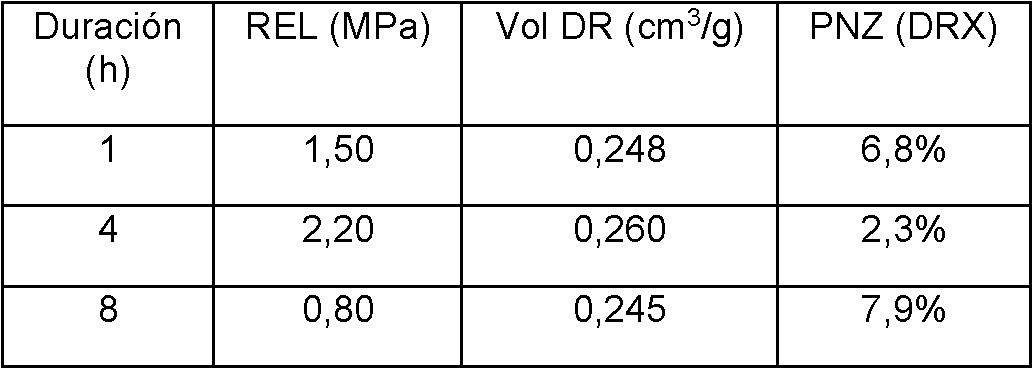
Ejemplo 4: Aglomerados a base de cristales de NaMSXExample 4: Agglomerates based on NaMSX crystals
200 g de aglomerados obtenidos a partir de polvo de NaMSX (K. Schumann et al., Microporous and Mesoporous Materials, 154, (2012), 119-123) se colocan en un reactor de vidrio equipado con doble camisa regulado a una temperatura de 100 ± 1 ° C, luego se adicionan 1,5 L de una solución acuosa de hidróxido de sodio con una concentración de 100 g/L y se deja el medio de reacción en agitación por durante un período variable de 1 a 8 horas como se muestra en la Tabla 4 a continuación.200 g of agglomerates obtained from NaMSX powder (K. Schumann et al., Microporous and Mesoporous Materials, 154, (2012), 119-123) are placed in a glass reactor equipped with a double jacket regulated at a temperature of 100 ± 1 ° C, then 1.5 L of an aqueous solution of sodium hydroxide with a concentration of 100 g/L are added and the reaction medium is left stirring for a variable period of 1 to 8 hours as shown. shown in Table 4 below.
Los aglomerados se lavan luego en 3 operaciones sucesivas de lavado con agua seguidas de vaciado del reactor. La eficacia del lavado se comprueba midiendo el pH final del agua de lavado, que está comprendido entre 10 y 10,5.The agglomerates are then washed in 3 successive washing operations with water followed by emptying of the reactor. The effectiveness of the wash is checked by measuring the final pH of the wash water, which is between 10 and 10.5.
Estos aglomerados se intercambian, como se describe en el ejemplo 1, utilizando una solución de cloruro de bario 0,5 M a 95 °C en 4 etapas. En cada etapa, la relación entre el volumen de la solución y la masa de sólido es de 20 mL/g y el intercambio continúa durante 4 horas cada vez. Entre cada intercambio, el sólido se lava varias veces para eliminar el exceso de sal. A continuación, los aglomerados se secan a 80 °C durante 2 horas y, finalmente, se activan a 250 °C durante 2 horas bajo una corriente de nitrógeno.These agglomerates are exchanged, as described in example 1, using a 0.5 barium chloride solution. M at 95 °C in 4 stages. In each stage, the ratio between the volume of the solution and the mass of the solid is 20 mL/g, and the exchange continues for 4 hours each time. Between each exchange, the solid is washed several times to remove excess salt. The agglomerates are then dried at 80°C for 2 hours and finally activated at 250°C for 2 hours under a stream of nitrogen.
Los distintos productos se caracterizan para determinar mediante todas las técnicas analíticas descritas con anterioridad: la pérdida por calcinación, el contenido en fase no zeolítica, el volumen microporoso y la resistencia mecánica. Los resultados se brindan en la Tabla 4 a continuación.The different products are characterized to determine by all the analytical techniques described above: loss on calcination, non-zeolitic phase content, microporous volume and mechanical strength. The results are given in Table 4 below.
Las tasas de intercambio de bario de los aglomerados calculadas a partir de análisis elementales de óxidos de bario y sodio por WDXRF como se describe en las técnicas de caracterización son del 99,8 ± 0,2%. La pérdida por calcinación medida como se describe arriba es del 5,4% ± 0,1% para cada muestra.The barium exchange rates of the agglomerates calculated from elemental analyzes of barium and sodium oxides by WDXRF as described in the characterization techniques are 99.8 ± 0.2%. Loss on ignition measured as described above is 5.4% ± 0.1% for each sample.
- Tabla 4 -- Table 4 -

Ejemplo 5: Prueba de perforaciónExample 5: Puncture test
A continuación, se realiza una prueba de penetración (cromatografía frontal) sobre los adsorbentes zeolíticos aglomerados descritos en los ejemplos 1 y 3 para evaluar su eficacia. La cantidad de adsorbente utilizada para estas pruebas es de aproximadamente 74 g.Next, a penetration test (forward chromatography) is carried out on the agglomerated zeolitic adsorbents described in examples 1 and 3 to evaluate their effectiveness. The amount of adsorbent used for these tests is approximately 74 g.
El procedimiento para la obtención de las curvas de perforación es el siguiente:The procedure for obtaining the drilling curves is as follows:
• Llenado de la columna a través del tamiz e instalación en el banco de pruebas.• Filling of the column through the sieve and installation on the test bench.
• Llenado con disolvente (paradietilbenceno) a temperatura ambiente.• Filled with solvent (paradiethylbenzene) at room temperature.
• Aumento gradual de la temperatura de adsorción bajo flujo de disolvente (5 cm3/min).• Gradual increase in adsorption temperature under solvent flow (5 cm3/min).
• Inyección de disolvente a 10 cm3/min cuando se alcanza la temperatura de adsorción• Solvent injection at 10 cm3/min when adsorption temperature is reached
• Permutación de disolvente/carga para inyectar la carga (10 cm3/min).• Permutation of solvent/charge to inject the charge (10 cm3/min).
• A continuación, se mantiene la inyección de la carga durante un tiempo suficiente para alcanzar el equilibrio termodinámico.• Next, the injection of the load is maintained for a sufficient time to reach thermodynamic equilibrium.
• Recolección y análisis del efluente de perforación.• Collection and analysis of drilling effluent.
La presión es suficiente para que la carga permanezca en fase líquida, es decir, 1 MPa. La temperatura de adsorción es de 175 °C.The pressure is sufficient for the load to remain in the liquid phase, that is, 1 MPa. The adsorption temperature is 175 °C.
La composición de la carga es la siguiente:The composition of the load is as follows:
• Paraxileno: 45% peso• Paraxylene: 45% weight
• Metaxileno: 45% peso• Metaxylene: 45% weight
• Isooctano: 10% en peso (se utiliza como trazador para la estimación de volúmenes no selectivos y no interviene en la separación)• Isooctane: 10% by weight (used as a tracer to estimate non-selective volumes and does not intervene in the separation)
Los resultados del análisis de las curvas de perforación tal y como se describe en las técnicas de caracterización se consignan en la Tabla 5 siguiente y se comparan con los resultados obtenidos con el adsorbente según el estado de la técnica (ejemplo 4 de la patente FR2903978) a partir de un ensayo de perforación realizado en las mismas condiciones que las descritas con anterioridad. The results of the analysis of the perforation curves as described in the characterization techniques are reported in Table 5 below and are compared with the results obtained with the adsorbent according to the state of the art (example 4 of patent FR2903978) from a perforation test carried out under the same conditions as those described above.
- Tabla 5 -- Table 5 -

Se constata que los adsorbentes zeolíticos aglomerados según la invención combinan simultáneamente capacidad, selectividad y transferencia de material mejoradas en comparación con los adsorbentes del estado de la técnica, en particular los descritos en el documento FR2903978. It is found that the agglomerated zeolitic adsorbents according to the invention simultaneously combine improved capacity, selectivity and material transfer compared to the adsorbents of the state of the art, in particular those described in document FR2903978.
Claims (10)
Applications Claiming Priority (2)
| Application Number | Priority Date | Filing Date | Title |
|---|---|---|---|
| FR1261964A FR2999098B1 (en) | 2012-12-12 | 2012-12-12 | ZEOLITHIC ADSORBENTS, THEIR PREPARATION PROCESS AND THEIR USES |
| PCT/EP2013/076021 WO2014090771A1 (en) | 2012-12-12 | 2013-12-10 | Zeolitic adsorbents, process for preparing same and uses thereof |
Publications (1)
| Publication Number | Publication Date |
|---|---|
| ES2905405T3 true ES2905405T3 (en) | 2022-04-08 |
Family
ID=47833254
Family Applications (1)
| Application Number | Title | Priority Date | Filing Date |
|---|---|---|---|
| ES13802962T Active ES2905405T3 (en) | 2012-12-12 | 2013-12-10 | Zeolitic adsorbents and their uses |
Country Status (21)
| Country | Link |
|---|---|
| US (1) | US10722862B2 (en) |
| EP (1) | EP2931417B1 (en) |
| JP (1) | JP6603581B2 (en) |
| KR (1) | KR102173543B1 (en) |
| CN (3) | CN111672459A (en) |
| AR (1) | AR093912A1 (en) |
| BR (2) | BR122019021410B1 (en) |
| CA (1) | CA2894606C (en) |
| EA (1) | EA036571B1 (en) |
| ES (1) | ES2905405T3 (en) |
| FR (1) | FR2999098B1 (en) |
| IN (1) | IN2015DN03765A (en) |
| JO (1) | JOP20130359B1 (en) |
| MY (1) | MY184509A (en) |
| PL (1) | PL2931417T3 (en) |
| PT (1) | PT2931417T (en) |
| SA (1) | SA515360403B1 (en) |
| SG (1) | SG11201504665PA (en) |
| TW (2) | TW201742669A (en) |
| WO (1) | WO2014090771A1 (en) |
| ZA (1) | ZA201503549B (en) |
Families Citing this family (22)
| Publication number | Priority date | Publication date | Assignee | Title |
|---|---|---|---|---|
| FR3009300B1 (en) | 2013-08-05 | 2022-11-25 | Ceca Sa | ZEOLITHS WITH HIERARCHIZED POROSITY |
| FR3013236B1 (en) * | 2013-11-20 | 2015-12-11 | Ceca Sa | ZEOLITHIC GRANULAR MATERIAL WITH RELATED STRUCTURE |
| FR3024667B1 (en) | 2014-08-05 | 2022-01-14 | Ceca Sa | ZEOLITHIC ADSORBENTS WITH A LOW BINDER RATE AND A HIGH EXTERNAL SURFACE, THEIR PREPARATION PROCESS AND THEIR USES |
| FR3025789B1 (en) | 2014-09-12 | 2018-04-20 | Arkema France | ZEOLITH NANOCRYSTAL AGGREGATES |
| FR3028431B1 (en) | 2014-11-13 | 2016-11-18 | Ceca Sa | ZEOLITHIC ADSORBENTS BASED ON LOW BLEED ZEOLITHEX X WITH LOW EXTERNAL SURFACE, PREPARATION METHOD AND USES THEREOF |
| FR3028429B1 (en) * | 2014-11-13 | 2016-12-09 | Ceca Sa | ZEOLITHIC ADSORBENT BASED ON MESOPOROUS ZEOLITE |
| FR3032131B1 (en) * | 2015-02-02 | 2019-12-27 | Arkema France | ZEOLITHIC ADSORBENTS WITH A HIGH EXTERNAL SURFACE, THEIR PREPARATION METHOD AND THEIR USES |
| FR3032130B1 (en) * | 2015-02-02 | 2019-12-27 | Arkema France | ZEOLITHIC ADSORBENTS WITH A HIGH EXTERNAL SURFACE, THEIR PREPARATION METHOD AND THEIR USES |
| FR3038528B1 (en) | 2015-07-09 | 2020-10-23 | Ifp Energies Now | ZEOLITHIC ADSORBANTS, THEIR PREPARATION PROCESS AND THEIR USES |
| FR3038529B1 (en) | 2015-07-09 | 2020-10-23 | Ceca Sa | ZEOLITHIC ADSORBANTS, THEIR PREPARATION PROCESS AND THEIR USES |
| WO2017116511A1 (en) | 2015-12-29 | 2017-07-06 | Uop Llc | Binderless zeolitic adsorbents and methods for producing binderless zeolitic adsorbents |
| ES3055166T3 (en) * | 2015-12-29 | 2026-02-10 | Uop Llc | Binderless zeolitic adsorbents and methods for producing binderless zeolitic adsorbents |
| FR3052986B1 (en) * | 2016-06-28 | 2021-04-09 | Ifp Energies Now | ZEOLITHIC ADSORBANT IN THE FORM OF LOW TORTUOSITY AGGLOMERS |
| DE102017207817A1 (en) | 2017-05-09 | 2018-11-15 | Clariant International Ltd | Zeolite-containing adsorbent for the selective separation of isomers from aromatic hydrocarbon mixtures, its preparation and use |
| FR3075793B1 (en) * | 2017-12-22 | 2019-11-29 | Arkema France | ZEOLITHIC ADSORBENTS BASED ON BARIUM, STRONTIUM AND POTASSIUM, PROCESS FOR PREPARING THEM AND USES THEREOF |
| FR3075792B1 (en) | 2017-12-22 | 2019-11-29 | Arkema France | ZEOLITIC ADSORBENTS CONTAINING STRONTIUM |
| FR3097855B1 (en) * | 2019-06-28 | 2021-07-23 | Ifp Energies Now | Liquid phase separation of second generation sugars by adsorption on FAU type zeolite with Si / Al atomic ratio less than 1.5 |
| FR3105021B1 (en) | 2019-12-20 | 2022-08-12 | Ifp Energies Now | Zeolite adsorbent for the separation of hydrocarbon isomers |
| FR3105020B1 (en) | 2019-12-20 | 2022-09-02 | Ifp Energies Now | Zeolite adsorbent for the separation of hydrocarbon isomers |
| FR3112289B1 (en) * | 2020-07-10 | 2022-07-22 | Arkema France | PURIFICATION OF AROMATIC LIQUIDS |
| CN113979779B (en) * | 2021-11-26 | 2022-12-16 | 江阴金属材料创新研究院有限公司 | A kind of diatom active ceramic tube and its preparation method and application |
| CN119346077B (en) * | 2024-10-09 | 2025-11-25 | 浙江大学 | Polymer composite adsorbent, synthesis method and method for separating xylene isomers |
Family Cites Families (19)
| Publication number | Priority date | Publication date | Assignee | Title |
|---|---|---|---|---|
| US2985589A (en) | 1957-05-22 | 1961-05-23 | Universal Oil Prod Co | Continuous sorption process employing fixed bed of sorbent and moving inlets and outlets |
| US3119660A (en) | 1960-09-26 | 1964-01-28 | Union Carbide Corp | Process for producing molecular sieve bodies |
| US3558730A (en) | 1968-06-24 | 1971-01-26 | Universal Oil Prod Co | Aromatic hydrocarbon separation by adsorption |
| US3626020A (en) | 1969-03-12 | 1971-12-07 | Universal Oil Prod Co | Separation of paraxylene from mixture of c aromatic utilizing crystalline aluminosilicate adsorbent |
| US3558732A (en) | 1969-05-12 | 1971-01-26 | Universal Oil Prod Co | Aromatic hydrocarbon separation by adsorption |
| US3663638A (en) | 1970-08-31 | 1972-05-16 | Universal Oil Prod Co | Aromatic hydrocarbon separation by adsorption |
| US3878127A (en) | 1973-05-02 | 1975-04-15 | Universal Oil Prod Co | Method of manufacturing a zeolitic absorbent |
| US3960774A (en) | 1973-05-02 | 1976-06-01 | Universal Oil Products Company | Zeolitic adsorbent for xylene separation |
| US4402832A (en) | 1982-08-12 | 1983-09-06 | Uop Inc. | High efficiency continuous separation process |
| US4498991A (en) | 1984-06-18 | 1985-02-12 | Uop Inc. | Serial flow continuous separation process |
| TW200454B (en) | 1991-09-05 | 1993-02-21 | Inst Of France Petroleum | |
| FR2789914B1 (en) | 1999-02-22 | 2001-04-06 | Ceca Sa | SINTERED BINDER ZEOLITIC ADSORBENTS WITH LOW INERT BINDER, PROCESS FOR OBTAINING SAME AND USES THEREOF |
| FR2903978B1 (en) | 2006-07-19 | 2010-09-24 | Ceca Sa | AGGLOMERATED ZEOLITIC ADSORBENTS, PROCESS FOR THEIR PREPARATION AND USES THEREOF |
| FR2925366B1 (en) * | 2007-12-20 | 2011-05-27 | Ceca Sa | AGGLOMERATED ZEOLITIC ADSORBENTS, PROCESS FOR THEIR PREPARATION AND USES THEREOF |
| FR2925367B1 (en) * | 2007-12-20 | 2010-01-15 | Ceca Sa | AGGLOMERATED ZEOLITIC ADSORBENTS, PROCESS FOR THEIR PREPARATION AND USES THEREOF |
| US7820869B2 (en) | 2008-06-30 | 2010-10-26 | Uop Llc | Binderless adsorbents and their use in the adsorptive separation of para-xylene |
| US7812208B2 (en) | 2008-09-22 | 2010-10-12 | Uop Llc | Binderless adsorbents with improved mass transfer properties and their use in the adsorptive separation of para-xylene |
| US8557028B2 (en) * | 2011-03-31 | 2013-10-15 | Uop Llc | Binderless zeolitic adsorbents, methods for producing binderless zeolitic adsorbents, and adsorptive separation processes using the binderless zeolitic adsorbents |
| FR2998807B1 (en) * | 2012-12-03 | 2015-10-16 | IFP Energies Nouvelles | SIMPLE BACKWATER CHROMATOGRAPHIC SEPARATION METHOD AND DEVICE FOR THE PRODUCTION OF HIGH PRODUCTIVITY PARAXYLENE |
-
2012
- 2012-12-12 FR FR1261964A patent/FR2999098B1/en active Active
-
2013
- 2013-12-10 CA CA2894606A patent/CA2894606C/en active Active
- 2013-12-10 BR BR122019021410-7A patent/BR122019021410B1/en active IP Right Grant
- 2013-12-10 MY MYPI2015001514A patent/MY184509A/en unknown
- 2013-12-10 PL PL13802962T patent/PL2931417T3/en unknown
- 2013-12-10 KR KR1020157014049A patent/KR102173543B1/en active Active
- 2013-12-10 JO JOP/2013/0359A patent/JOP20130359B1/en active
- 2013-12-10 US US14/650,780 patent/US10722862B2/en active Active
- 2013-12-10 SG SG11201504665PA patent/SG11201504665PA/en unknown
- 2013-12-10 EA EA201591106A patent/EA036571B1/en not_active IP Right Cessation
- 2013-12-10 CN CN202010272674.2A patent/CN111672459A/en active Pending
- 2013-12-10 EP EP13802962.4A patent/EP2931417B1/en active Active
- 2013-12-10 CN CN201380064806.0A patent/CN104902992A/en active Pending
- 2013-12-10 PT PT138029624T patent/PT2931417T/en unknown
- 2013-12-10 ES ES13802962T patent/ES2905405T3/en active Active
- 2013-12-10 IN IN3765DEN2015 patent/IN2015DN03765A/en unknown
- 2013-12-10 WO PCT/EP2013/076021 patent/WO2014090771A1/en not_active Ceased
- 2013-12-10 CN CN201910535272.4A patent/CN110354801A/en active Pending
- 2013-12-10 JP JP2015546971A patent/JP6603581B2/en active Active
- 2013-12-10 BR BR112015013745-8A patent/BR112015013745B1/en active IP Right Grant
- 2013-12-11 TW TW106110017A patent/TW201742669A/en unknown
- 2013-12-11 TW TW102145660A patent/TWI641419B/en active
- 2013-12-11 AR ARP130104622A patent/AR093912A1/en active IP Right Grant
-
2015
- 2015-05-07 SA SA515360403A patent/SA515360403B1/en unknown
- 2015-05-20 ZA ZA2015/03549A patent/ZA201503549B/en unknown
Also Published As
Similar Documents
| Publication | Publication Date | Title |
|---|---|---|
| ES2905405T3 (en) | Zeolitic adsorbents and their uses | |
| ES2928974T3 (en) | Zeolite adsorbents with raised external surface comprising barium and/or potassium and their use | |
| ES2823735T3 (en) | Agglomerated zeolitic adsorbents, process for their preparation and their uses | |
| ES2871076T3 (en) | Use of zeolitic adsorbents with a high external surface area | |
| ES2693056T3 (en) | Agglomerated zeolitic adsorbents, their preparation process and their uses | |
| ES2804448T3 (en) | Zeolitic adsorbents in the form of aggregates, their method of preparation and their uses | |
| CN105339082B (en) | Zeolite adsorbents including EMT zeolites, methods for their preparation, and uses thereof | |
| ES2905423T3 (en) | Zeolitic absorbents based on barium, strontium, potassium and sodium, their preparation procedure and their uses | |
| ES2719873T3 (en) | Zeolitic adsorbents of low tenor binder and high external surface, its preparation procedure and its uses | |
| US10940458B2 (en) | Zeolite adsorbent in the form of low-tortuosity agglomerates | |
| US10112173B2 (en) | Zeolite-based adsorbents based on zeolite X with a low binder content and a low outer surface area, process for preparing them and uses thereof | |
| TWI759268B (en) | Zeolite adsorbents, preparation process therefor and uses thereof | |
| ES3012083T3 (en) | Zeolite adsorbent for separating hydrocarbon isomers | |
| ES3013303T3 (en) | Zeolite adsorbent for the separation of hydrocarbon isomers | |
| ES2978885T3 (en) | Zeolitic granular material with associated structure | |
| ES2943479T3 (en) | Zeolitic absorbents containing strontium and barium | |
| BRPI0820729B1 (en) | AGGLOMERATED ZEOLITE AGENT AND PROCESSES FOR THE PREPARATION OF AN AGGLOMERATED ZEOLITE ADSORVENT AND SEPARATION OF SUGARS, POLYHYDRIC ALCOHOLS, SUBSTITUTED TOLUENE ISOMERS, CRESOLS OR PARAXYLENE RECOVERY |