ES2914311T3 - Bicyclic compounds and their use in cancer treatment - Google Patents
Bicyclic compounds and their use in cancer treatment Download PDFInfo
- Publication number
- ES2914311T3 ES2914311T3 ES18722359T ES18722359T ES2914311T3 ES 2914311 T3 ES2914311 T3 ES 2914311T3 ES 18722359 T ES18722359 T ES 18722359T ES 18722359 T ES18722359 T ES 18722359T ES 2914311 T3 ES2914311 T3 ES 2914311T3
- Authority
- ES
- Spain
- Prior art keywords
- alkyl
- cancer
- compound
- solvate
- haloalkyl
- Prior art date
- Legal status (The legal status is an assumption and is not a legal conclusion. Google has not performed a legal analysis and makes no representation as to the accuracy of the status listed.)
- Active
Links
Classifications
-
- C—CHEMISTRY; METALLURGY
- C07—ORGANIC CHEMISTRY
- C07D—HETEROCYCLIC COMPOUNDS
- C07D209/00—Heterocyclic compounds containing five-membered rings, condensed with other rings, with one nitrogen atom as the only ring hetero atom
- C07D209/02—Heterocyclic compounds containing five-membered rings, condensed with other rings, with one nitrogen atom as the only ring hetero atom condensed with one carbocyclic ring
- C07D209/04—Indoles; Hydrogenated indoles
- C07D209/08—Indoles; Hydrogenated indoles with only hydrogen atoms or radicals containing only hydrogen and carbon atoms, directly attached to carbon atoms of the hetero ring
-
- A—HUMAN NECESSITIES
- A61—MEDICAL OR VETERINARY SCIENCE; HYGIENE
- A61K—PREPARATIONS FOR MEDICAL, DENTAL OR TOILETRY PURPOSES
- A61K31/00—Medicinal preparations containing organic active ingredients
- A61K31/33—Heterocyclic compounds
- A61K31/395—Heterocyclic compounds having nitrogen as a ring hetero atom, e.g. guanethidine or rifamycins
- A61K31/40—Heterocyclic compounds having nitrogen as a ring hetero atom, e.g. guanethidine or rifamycins having five-membered rings with one nitrogen as the only ring hetero atom, e.g. sulpiride, succinimide, tolmetin, buflomedil
- A61K31/403—Heterocyclic compounds having nitrogen as a ring hetero atom, e.g. guanethidine or rifamycins having five-membered rings with one nitrogen as the only ring hetero atom, e.g. sulpiride, succinimide, tolmetin, buflomedil condensed with carbocyclic rings, e.g. carbazole
- A61K31/404—Indoles, e.g. pindolol
-
- A—HUMAN NECESSITIES
- A61—MEDICAL OR VETERINARY SCIENCE; HYGIENE
- A61K—PREPARATIONS FOR MEDICAL, DENTAL OR TOILETRY PURPOSES
- A61K31/00—Medicinal preparations containing organic active ingredients
- A61K31/33—Heterocyclic compounds
- A61K31/395—Heterocyclic compounds having nitrogen as a ring hetero atom, e.g. guanethidine or rifamycins
- A61K31/41—Heterocyclic compounds having nitrogen as a ring hetero atom, e.g. guanethidine or rifamycins having five-membered rings with two or more ring hetero atoms, at least one of which being nitrogen, e.g. tetrazole
-
- A—HUMAN NECESSITIES
- A61—MEDICAL OR VETERINARY SCIENCE; HYGIENE
- A61K—PREPARATIONS FOR MEDICAL, DENTAL OR TOILETRY PURPOSES
- A61K31/00—Medicinal preparations containing organic active ingredients
- A61K31/33—Heterocyclic compounds
- A61K31/395—Heterocyclic compounds having nitrogen as a ring hetero atom, e.g. guanethidine or rifamycins
- A61K31/41—Heterocyclic compounds having nitrogen as a ring hetero atom, e.g. guanethidine or rifamycins having five-membered rings with two or more ring hetero atoms, at least one of which being nitrogen, e.g. tetrazole
- A61K31/415—1,2-Diazoles
- A61K31/416—1,2-Diazoles condensed with carbocyclic ring systems, e.g. indazole
-
- A—HUMAN NECESSITIES
- A61—MEDICAL OR VETERINARY SCIENCE; HYGIENE
- A61K—PREPARATIONS FOR MEDICAL, DENTAL OR TOILETRY PURPOSES
- A61K31/00—Medicinal preparations containing organic active ingredients
- A61K31/33—Heterocyclic compounds
- A61K31/395—Heterocyclic compounds having nitrogen as a ring hetero atom, e.g. guanethidine or rifamycins
- A61K31/41—Heterocyclic compounds having nitrogen as a ring hetero atom, e.g. guanethidine or rifamycins having five-membered rings with two or more ring hetero atoms, at least one of which being nitrogen, e.g. tetrazole
- A61K31/4164—1,3-Diazoles
- A61K31/4184—1,3-Diazoles condensed with carbocyclic rings, e.g. benzimidazoles
-
- A—HUMAN NECESSITIES
- A61—MEDICAL OR VETERINARY SCIENCE; HYGIENE
- A61K—PREPARATIONS FOR MEDICAL, DENTAL OR TOILETRY PURPOSES
- A61K31/00—Medicinal preparations containing organic active ingredients
- A61K31/33—Heterocyclic compounds
- A61K31/395—Heterocyclic compounds having nitrogen as a ring hetero atom, e.g. guanethidine or rifamycins
- A61K31/435—Heterocyclic compounds having nitrogen as a ring hetero atom, e.g. guanethidine or rifamycins having six-membered rings with one nitrogen as the only ring hetero atom
- A61K31/4353—Heterocyclic compounds having nitrogen as a ring hetero atom, e.g. guanethidine or rifamycins having six-membered rings with one nitrogen as the only ring hetero atom ortho- or peri-condensed with heterocyclic ring systems
- A61K31/437—Heterocyclic compounds having nitrogen as a ring hetero atom, e.g. guanethidine or rifamycins having six-membered rings with one nitrogen as the only ring hetero atom ortho- or peri-condensed with heterocyclic ring systems the heterocyclic ring system containing a five-membered ring having nitrogen as a ring hetero atom, e.g. indolizine, beta-carboline
-
- A—HUMAN NECESSITIES
- A61—MEDICAL OR VETERINARY SCIENCE; HYGIENE
- A61K—PREPARATIONS FOR MEDICAL, DENTAL OR TOILETRY PURPOSES
- A61K31/00—Medicinal preparations containing organic active ingredients
- A61K31/33—Heterocyclic compounds
- A61K31/395—Heterocyclic compounds having nitrogen as a ring hetero atom, e.g. guanethidine or rifamycins
- A61K31/435—Heterocyclic compounds having nitrogen as a ring hetero atom, e.g. guanethidine or rifamycins having six-membered rings with one nitrogen as the only ring hetero atom
- A61K31/44—Non condensed pyridines; Hydrogenated derivatives thereof
- A61K31/4427—Non condensed pyridines; Hydrogenated derivatives thereof containing further heterocyclic ring systems
- A61K31/4439—Non condensed pyridines; Hydrogenated derivatives thereof containing further heterocyclic ring systems containing a five-membered ring with nitrogen as a ring hetero atom, e.g. omeprazole
-
- A—HUMAN NECESSITIES
- A61—MEDICAL OR VETERINARY SCIENCE; HYGIENE
- A61K—PREPARATIONS FOR MEDICAL, DENTAL OR TOILETRY PURPOSES
- A61K31/00—Medicinal preparations containing organic active ingredients
- A61K31/33—Heterocyclic compounds
- A61K31/395—Heterocyclic compounds having nitrogen as a ring hetero atom, e.g. guanethidine or rifamycins
- A61K31/535—Heterocyclic compounds having nitrogen as a ring hetero atom, e.g. guanethidine or rifamycins having six-membered rings with at least one nitrogen and one oxygen as the ring hetero atoms, e.g. 1,2-oxazines
- A61K31/5375—1,4-Oxazines, e.g. morpholine
- A61K31/5377—1,4-Oxazines, e.g. morpholine not condensed and containing further heterocyclic rings, e.g. timolol
-
- A—HUMAN NECESSITIES
- A61—MEDICAL OR VETERINARY SCIENCE; HYGIENE
- A61K—PREPARATIONS FOR MEDICAL, DENTAL OR TOILETRY PURPOSES
- A61K39/00—Medicinal preparations containing antigens or antibodies
- A61K39/395—Antibodies; Immunoglobulins; Immune serum, e.g. antilymphocytic serum
- A61K39/39533—Antibodies; Immunoglobulins; Immune serum, e.g. antilymphocytic serum against materials from animals
- A61K39/3955—Antibodies; Immunoglobulins; Immune serum, e.g. antilymphocytic serum against materials from animals against proteinaceous materials, e.g. enzymes, hormones, lymphokines
-
- A—HUMAN NECESSITIES
- A61—MEDICAL OR VETERINARY SCIENCE; HYGIENE
- A61P—SPECIFIC THERAPEUTIC ACTIVITY OF CHEMICAL COMPOUNDS OR MEDICINAL PREPARATIONS
- A61P35/00—Antineoplastic agents
-
- C—CHEMISTRY; METALLURGY
- C07—ORGANIC CHEMISTRY
- C07D—HETEROCYCLIC COMPOUNDS
- C07D209/00—Heterocyclic compounds containing five-membered rings, condensed with other rings, with one nitrogen atom as the only ring hetero atom
- C07D209/02—Heterocyclic compounds containing five-membered rings, condensed with other rings, with one nitrogen atom as the only ring hetero atom condensed with one carbocyclic ring
- C07D209/04—Indoles; Hydrogenated indoles
- C07D209/10—Indoles; Hydrogenated indoles with substituted hydrocarbon radicals attached to carbon atoms of the hetero ring
- C07D209/18—Radicals substituted by carbon atoms having three bonds to hetero atoms with at the most one bond to halogen, e.g. ester or nitrile radicals
-
- C—CHEMISTRY; METALLURGY
- C07—ORGANIC CHEMISTRY
- C07D—HETEROCYCLIC COMPOUNDS
- C07D231/00—Heterocyclic compounds containing 1,2-diazole or hydrogenated 1,2-diazole rings
- C07D231/54—Heterocyclic compounds containing 1,2-diazole or hydrogenated 1,2-diazole rings condensed with carbocyclic rings or ring systems
- C07D231/56—Benzopyrazoles; Hydrogenated benzopyrazoles
-
- C—CHEMISTRY; METALLURGY
- C07—ORGANIC CHEMISTRY
- C07D—HETEROCYCLIC COMPOUNDS
- C07D235/00—Heterocyclic compounds containing 1,3-diazole or hydrogenated 1,3-diazole rings, condensed with other rings
- C07D235/02—Heterocyclic compounds containing 1,3-diazole or hydrogenated 1,3-diazole rings, condensed with other rings condensed with carbocyclic rings or ring systems
- C07D235/04—Benzimidazoles; Hydrogenated benzimidazoles
- C07D235/06—Benzimidazoles; Hydrogenated benzimidazoles with only hydrogen atoms, hydrocarbon or substituted hydrocarbon radicals, directly attached in position 2
-
- C—CHEMISTRY; METALLURGY
- C07—ORGANIC CHEMISTRY
- C07D—HETEROCYCLIC COMPOUNDS
- C07D235/00—Heterocyclic compounds containing 1,3-diazole or hydrogenated 1,3-diazole rings, condensed with other rings
- C07D235/02—Heterocyclic compounds containing 1,3-diazole or hydrogenated 1,3-diazole rings, condensed with other rings condensed with carbocyclic rings or ring systems
- C07D235/04—Benzimidazoles; Hydrogenated benzimidazoles
- C07D235/06—Benzimidazoles; Hydrogenated benzimidazoles with only hydrogen atoms, hydrocarbon or substituted hydrocarbon radicals, directly attached in position 2
- C07D235/08—Radicals containing only hydrogen and carbon atoms
-
- C—CHEMISTRY; METALLURGY
- C07—ORGANIC CHEMISTRY
- C07D—HETEROCYCLIC COMPOUNDS
- C07D401/00—Heterocyclic compounds containing two or more hetero rings, having nitrogen atoms as the only ring hetero atoms, at least one ring being a six-membered ring with only one nitrogen atom
- C07D401/02—Heterocyclic compounds containing two or more hetero rings, having nitrogen atoms as the only ring hetero atoms, at least one ring being a six-membered ring with only one nitrogen atom containing two hetero rings
- C07D401/10—Heterocyclic compounds containing two or more hetero rings, having nitrogen atoms as the only ring hetero atoms, at least one ring being a six-membered ring with only one nitrogen atom containing two hetero rings linked by a carbon chain containing aromatic rings
-
- C—CHEMISTRY; METALLURGY
- C07—ORGANIC CHEMISTRY
- C07D—HETEROCYCLIC COMPOUNDS
- C07D403/00—Heterocyclic compounds containing two or more hetero rings, having nitrogen atoms as the only ring hetero atoms, not provided for by group C07D401/00
- C07D403/02—Heterocyclic compounds containing two or more hetero rings, having nitrogen atoms as the only ring hetero atoms, not provided for by group C07D401/00 containing two hetero rings
- C07D403/12—Heterocyclic compounds containing two or more hetero rings, having nitrogen atoms as the only ring hetero atoms, not provided for by group C07D401/00 containing two hetero rings linked by a chain containing hetero atoms as chain links
-
- C—CHEMISTRY; METALLURGY
- C07—ORGANIC CHEMISTRY
- C07D—HETEROCYCLIC COMPOUNDS
- C07D413/00—Heterocyclic compounds containing two or more hetero rings, at least one ring having nitrogen and oxygen atoms as the only ring hetero atoms
- C07D413/02—Heterocyclic compounds containing two or more hetero rings, at least one ring having nitrogen and oxygen atoms as the only ring hetero atoms containing two hetero rings
- C07D413/10—Heterocyclic compounds containing two or more hetero rings, at least one ring having nitrogen and oxygen atoms as the only ring hetero atoms containing two hetero rings linked by a carbon chain containing aromatic rings
-
- C—CHEMISTRY; METALLURGY
- C07—ORGANIC CHEMISTRY
- C07D—HETEROCYCLIC COMPOUNDS
- C07D471/00—Heterocyclic compounds containing nitrogen atoms as the only ring hetero atoms in the condensed system, at least one ring being a six-membered ring with one nitrogen atom, not provided for by groups C07D451/00 - C07D463/00
- C07D471/02—Heterocyclic compounds containing nitrogen atoms as the only ring hetero atoms in the condensed system, at least one ring being a six-membered ring with one nitrogen atom, not provided for by groups C07D451/00 - C07D463/00 in which the condensed system contains two hetero rings
- C07D471/04—Ortho-condensed systems
-
- C—CHEMISTRY; METALLURGY
- C07—ORGANIC CHEMISTRY
- C07K—PEPTIDES
- C07K16/00—Immunoglobulins [IG], e.g. monoclonal or polyclonal antibodies
- C07K16/18—Immunoglobulins [IG], e.g. monoclonal or polyclonal antibodies against material from animals or humans
- C07K16/28—Immunoglobulins [IG], e.g. monoclonal or polyclonal antibodies against material from animals or humans against receptors, cell surface antigens or cell surface determinants
- C07K16/2803—Immunoglobulins [IG], e.g. monoclonal or polyclonal antibodies against material from animals or humans against receptors, cell surface antigens or cell surface determinants against the immunoglobulin superfamily
- C07K16/2818—Immunoglobulins [IG], e.g. monoclonal or polyclonal antibodies against material from animals or humans against receptors, cell surface antigens or cell surface determinants against the immunoglobulin superfamily against CD28 or CD152
-
- C—CHEMISTRY; METALLURGY
- C07—ORGANIC CHEMISTRY
- C07K—PEPTIDES
- C07K16/00—Immunoglobulins [IG], e.g. monoclonal or polyclonal antibodies
- C07K16/18—Immunoglobulins [IG], e.g. monoclonal or polyclonal antibodies against material from animals or humans
- C07K16/28—Immunoglobulins [IG], e.g. monoclonal or polyclonal antibodies against material from animals or humans against receptors, cell surface antigens or cell surface determinants
- C07K16/2803—Immunoglobulins [IG], e.g. monoclonal or polyclonal antibodies against material from animals or humans against receptors, cell surface antigens or cell surface determinants against the immunoglobulin superfamily
- C07K16/2827—Immunoglobulins [IG], e.g. monoclonal or polyclonal antibodies against material from animals or humans against receptors, cell surface antigens or cell surface determinants against the immunoglobulin superfamily against B7 molecules, e.g. CD80, CD86
Landscapes
- Chemical & Material Sciences (AREA)
- Organic Chemistry (AREA)
- Health & Medical Sciences (AREA)
- Medicinal Chemistry (AREA)
- Life Sciences & Earth Sciences (AREA)
- Public Health (AREA)
- Veterinary Medicine (AREA)
- Pharmacology & Pharmacy (AREA)
- Animal Behavior & Ethology (AREA)
- General Health & Medical Sciences (AREA)
- Epidemiology (AREA)
- Nuclear Medicine, Radiotherapy & Molecular Imaging (AREA)
- General Chemical & Material Sciences (AREA)
- Chemical Kinetics & Catalysis (AREA)
- Endocrinology (AREA)
- Engineering & Computer Science (AREA)
- Bioinformatics & Cheminformatics (AREA)
- Immunology (AREA)
- Microbiology (AREA)
- Mycology (AREA)
- Pharmaceuticals Containing Other Organic And Inorganic Compounds (AREA)
- Nitrogen Condensed Heterocyclic Rings (AREA)
- Plural Heterocyclic Compounds (AREA)
- Indole Compounds (AREA)
Abstract
Un compuesto de Fórmula Ia o Fórmula Ib: **(Ver fórmula)** o una sal farmacéuticamente aceptable, un solvato, un solvato de la sal, un hidrato, un único estereoisómero, una mezcla de estereoisómeros o una mezcla racémica de estereoisómeros del mismo, en donde: Ar es fenilo y está opcionalmente sustituido con 1 a 3 sustituyentes seleccionados independientemente entre: (a) alquilo C1-C6, (b) cicloalquilo C3-C7, (c) heterociclo, (d) arilo, (e) heteroarilo, (f) halógeno, (g) CN, (h) ORb, (i) N(Rb)C(=O)Rc, (j) C(=O)N(Rb)(Rc), (k) S(=O)mRb, (l) S(=O)2N(Rb)(Rc), (m) N(Rb)S(=O)2Rc, (n) SF5; y (o) haloalquilo C1-C6 W se selecciona entre: (a) C(=O)OR5, (b) C(=O)NHOH, (c) S(=O)2NHRb, (d) S(=O)2NHC(=O)Rb, (e) NHC(=O)NHSO2Rb, (f) 1H-tetrazol, (g) 1,2,4-oxadiazol-5(4H)ona, (h) 1,2,4-tiadiazol-5(4H)ona, (i) 1,2,4-oxadiazol-5(4H)-tiona, (j) 1,2,4-triazol-5(4H)-ona, (k) tetrazol-5(4H)-ona, y (l) C(=O)NHS(=O)2Rb; X1, X2, X3, X4, y X5 son cada uno independientemente N o CRa, en donde no más de 2 de X1, X2, X3, X4, y X5 son N; Y es un enlace o -CH2-; R3 y R4 se seleccionan independientemente entre H, alquilo C1-C3 y haloalquilo C1-C3; R5 se selecciona entre: (a) H, (b) alquilo C1-C6, (c) arilo, (d) aralquilo, (e) CH(R7)OC(=O)R8, (f) CH(R7)OC(=O)OR8, y (g) un grupo (5-alquil-2-oxo-1,3-dioxolen-4-il)metilo, que tiene la siguiente fórmula: **(Ver fórmula)** en la que R6 es alquilo C1-C6; R7 es hidrógeno o alquilo C1-C6; R8 es alquilo C1-C6 o cicloalquilo C3-C6; Ra se selecciona entre: (a) H, (b) alquilo C1-C6, (c) halógeno, (d) arilo, (e) ORb, (f) ciano, (g) heteroarilo, (h) cicloalquilo C3-C6, y (i) haloalquilo C1-C6; Rb y Rc se seleccionan independientemente entre: (a) H, (b) alquilo C1-C6, (c) arilo, (d) heteroarilo,(e) cicloalquilo C3-C6, y (f) haloalquilo C1-C6; o Rb y Rc, tomados junto con el N al que están unidos, forman un heterociclo de 3 a 6 miembros, que tiene, opcionalmente, un heteroátomo adicional seleccionado entre N, O y S; m es 0, 1 o 2; y n es 1, 2 o 3.A compound of Formula Ia or Formula Ib: **(See formula)** or a pharmaceutically acceptable salt, solvate, salt solvate, hydrate, single stereoisomer, mixture of stereoisomers, or racemic mixture of stereoisomers of the same, wherein: Ar is phenyl and is optionally substituted with 1 to 3 substituents independently selected from: (a) C1-C6 alkyl, (b) C3-C7 cycloalkyl, (c) heterocycle, (d) aryl, (e) heteroaryl, (f) halogen, (g) CN, (h) ORb, (i) N(Rb)C(=O)Rc, (j) C(=O)N(Rb)(Rc), (k) S(=O)mRb, (l) S(=O)2N(Rb)(Rc), (m) N(Rb)S(=O)2Rc, (n)SF5; and (o) C1-C6 haloalkyl W is selected from: (a) C(=O)OR5, (b) C(=O)NHOH, (c) S(=O)2NHRb, (d) S(=O )2NHC(=O)Rb, (e) NHC(=O)NHSO2Rb, (f) 1H-tetrazole, (g) 1,2,4-oxadiazol-5(4H)one, (h) 1,2,4 -thiadiazol-5(4H)-one, (i) 1,2,4-oxadiazol-5(4H)-thione, (j) 1,2,4-triazol-5(4H)-one, (k) tetrazol- 5(4H)-one, and (1) C(=O)NHS(=O)2Rb; X1, X2, X3, X4, and X5 are each independently N or CRa, wherein no more than 2 of X1, X2, X3, X4, and X5 are N; Y is a bond or -CH2-; R3 and R4 are independently selected from H, C1-C3 alkyl, and C1-C3 haloalkyl; R5 is selected from: (a) H, (b) C1-C6 alkyl, (c) aryl, (d) aralkyl, (e) CH(R7)OC(=O)R8, (f) CH(R7)OC (=O)OR8, and (g) a (5-alkyl-2-oxo-1,3-dioxolen-4-yl)methyl group, having the following formula: **(See formula)** where R6 is C1-C6 alkyl; R7 is hydrogen or C1-C6 alkyl; R8 is C1-C6 alkyl or C3-C6 cycloalkyl; Ra is selected from: (a) H, (b) C1-C6 alkyl, (c) halogen, (d) aryl, (e) ORb, (f) cyano, (g) heteroaryl, (h) C3-C6 cycloalkyl , and (i) C1-C6 haloalkyl; Rb and Rc are independently selected from: (a) H, (b) C1-C6 alkyl, (c) aryl, (d) heteroaryl, (e) C3-C6 cycloalkyl, and (f) C1-C6 haloalkyl; or Rb and Rc, taken together with the N to which they are attached, form a 3 to 6 membered heterocycle, optionally having an additional heteroatom selected from N, O and S; m is 0, 1 or 2; and n is 1, 2 or 3.
Description
DESCRIPCIÓNDESCRIPTION
Compuestos bicíclicos y su uso en el tratamiento del cáncerBicyclic compounds and their use in cancer treatment
Campo técnicotechnical field
La presente invención se refiere a derivados de heteroaril carboxamida, composiciones farmacéuticas que contienen dichos compuestos, así como a aquellos compuestos para su uso en la prevención y en el tratamiento del cáncer. The present invention relates to heteroaryl carboxamide derivatives, pharmaceutical compositions containing said compounds, as well as those compounds for use in the prevention and treatment of cancer.
AntecedentesBackground
Se ha demostrado que la prostaglandina E2 (PGE2) es una molécula endógena que, mediante su agonismo del receptor EP4 y la activación de la cascada de señalización resultante, desempeña un papel clave en la resolución de la inflamación (Chen et al., British J. Pharmacol. 2010, 160, pág. 292) y en la supresión de la señalización del receptor de células T (Wiemer et al., J. Immunology 2011, 187, pág. 3663). Si bien esta amortiguación de la respuesta inflamatoria es fundamental para la prevención de un daño celular excesivo tras el aumento satisfactorio de una respuesta inflamatoria que se ha desencadenado, por ejemplo, por la invasión de un patógeno extraño, se ha demostrado que algunos tumores también pueden secuestrar este mecanismo como forma de crear un microambiente inmunosupresor en el que puedan proliferar las células tumorales (Whiteside, Expert Opin. Bio. Th. 2010, 10, pág.Prostaglandin E2 (PGE2) has been shown to be an endogenous molecule that, through its agonism of the EP4 receptor and activation of the resulting signaling cascade, plays a key role in the resolution of inflammation (Chen et al., British J Pharmacol. 2010, 160, p292) and in the suppression of T-cell receptor signaling (Wiemer et al., J. Immunology 2011, 187, p3663). While this dampening of the inflammatory response is essential for the prevention of excessive cell damage following the successful build-up of an inflammatory response that has been triggered, for example, by the invasion of a foreign pathogen, it has been shown that some tumors can also hijacking this mechanism as a way of creating an immunosuppressive microenvironment in which tumor cells can proliferate (Whiteside, Expert Opin. Bio. Th. 2010, 10, p.
1019).1019).
De hecho, uno de los principales distintivos de un microambiente tumoral inmunosupresor es la presencia de una gran cantidad de células supresoras derivadas de mieloides (MDSCs, por sus siglas en inglés) y de macrófagos asociados a tumores tipo-2 (TAMs, por sus siglas en inglés), que, a su vez, se asocian significativamente con una pobre supervivencia general en pacientes con cáncer gástrico, de ovario, de mama, de vejiga, carcinoma hepatocelular (HCC, por sus siglas en inglés), de cabeza y cuello, y otros tipos de cánceres (Qian et al., Cell. 2010, 141, pág. 39; Gabitass et al., Cancer Immunol. Immunother. 2011, 60, pág. 1419). Se ha demostrado que el acoplamiento de los receptores EP4 en los monocitos inmaduros por PGE2, que se produce en cantidades significativamente mayores por las células tumorales (Ochs et al., J. Neurochem. 2016, 136, pág. 1142; Zelenay, S. et al., Cell 2015, 162, pág. 1257), sesga la diferenciación de estos monocitos inmaduros hacia los linajes inmunosupresores de MDSC y TAM (Mao, et al., Clin. Cancer Res. 2014, 20, pág. 4096; Wang et al., Trends in Molecular Medicine 2016, 22, pág. 1).In fact, one of the main hallmarks of an immunosuppressive tumor microenvironment is the presence of large numbers of myeloid-derived suppressor cells (MDSCs) and type-2 tumor-associated macrophages (TAMs). in English), which, in turn, are significantly associated with poor overall survival in patients with gastric, ovarian, breast, bladder, hepatocellular carcinoma (HCC), head and neck, and other types of cancers (Qian et al., Cell. 2010, 141, p. 39; Gabitass et al., Cancer Immunol. Immunother. 2011, 60, p. 1419). Engagement of EP4 receptors on immature monocytes by PGE2, which is produced in significantly higher amounts by tumor cells, has been shown (Ochs et al., J. Neurochem. 2016, 136, p1142; Zelenay, S. et al., Cell 2015, 162, p1257), biases the differentiation of these immature monocytes toward immunosuppressive MDSC and TAM lineages (Mao, et al., Clin. Cancer Res. 2014, 20, p4096; Wang et al., Trends in Molecular Medicine 2016, 22, p1).
Por otra parte, estudios recientes han revelado que, en algunos casos, las células tumorales también median en la regulación al alza de la actividad de la indoleamina 2,3-dioxigenasa (IDO) y/o del triptófano 2,3-desoxigenasa (TDO) en el microambiente tumoral circundante mediante la estimulación del receptor EP4 por PGE2 (Ochs et al., J. Neurochem. 2016, 136, pág. 1142; Hung et al., Breast Cancer Research, 2014, 16, pág. 410). Dado que el triptófano, el sustrato de las enzimas IDO y TDO, es esencial para la proliferación y la activación de las células T efectoras citotóxicas, y la cineurenina, el producto de las enzimas IDO y TDO, es esencial para la proliferación y la activación de las células T reguladoras inmunosupresoras (Dounay et al., J. Med. Chem. 2015, 58, pág. 8762), la inhibición de la actividad de la IDO y/o la TDO representa una vía prometedora para el tratamiento de varios cánceres (Jochems et al., Oncotarget 2016, 7, pág. 37762). En efecto, se ha notificado un aumento de la tasa de respuesta general en pacientes con melanoma avanzado en estadio IIIB o IV con epacadostat, un potente y selectivo inhibidor de la IDO de Incyte, cuando se usa en combinación con pembrolizumab. A tenor de todas estas observaciones y estudios, es razonable, por lo tanto, que el antagonismo de EP4 represente un enfoque racional y eficaz para el tratamiento del cáncer avanzado, tanto como agente único como en combinación con otras terapias contra el cáncer.Furthermore, recent studies have revealed that, in some cases, tumor cells also mediate the upregulation of indoleamine 2,3-dioxygenase (IDO) and/or tryptophan 2,3-deoxygenase (TDO) activity. ) in the surrounding tumor microenvironment via stimulation of the EP4 receptor by PGE2 (Ochs et al., J. Neurochem. 2016, 136, p. 1142; Hung et al., Breast Cancer Research, 2014, 16, p. 410). Since tryptophan, the substrate of the enzymes IDO and TDO, is essential for the proliferation and activation of cytotoxic effector T cells, and cineurenin, the product of the enzymes IDO and TDO, is essential for the proliferation and activation of cytotoxic effector T cells. of immunosuppressive regulatory T cells (Dounay et al., J. Med. Chem. 2015, 58, p. 8762), inhibition of IDO and/or TDO activity represents a promising pathway for the treatment of various cancers (Jochems et al., Oncotarget 2016, 7, p. 37762). Indeed, an increased overall response rate in patients with advanced stage IIIB or stage IV melanoma has been reported with epacadostat, a potent and selective IDO inhibitor from Incyte, when used in combination with pembrolizumab. Based on all these observations and studies, it is therefore reasonable that EP4 antagonism represents a rational and effective approach for the treatment of advanced cancer, both as a single agent and in combination with other anticancer therapies.
Los documentos EP 2277858 A1 (Astellas Pharma; 26 de enero de 2011) y EP 2172447 A1 (Astellas Pharma; 07 de abril de 2010) describen ambos ciertos compuestos de amida que tienen actividad antagonista del receptor EP4 y que son útiles en el tratamiento de enfermedades relacionadas con EP4, incluyendo insuficiencia renal crónica y nefropatía diabética.EP 2277858 A1 (Astellas Pharma; Jan 26, 2011) and EP 2172447 A1 (Astellas Pharma; Apr 07, 2010) both describe certain amide compounds having EP4 receptor antagonist activity and being useful in the treatment of EP4-related diseases, including chronic renal failure and diabetic nephropathy.
Sumario de la invenciónSummary of the invention
Un primer aspecto de la invención es un compuesto de Fórmula Ia o Fórmula Ib:A first aspect of the invention is a compound of Formula Ia or Formula Ib:

o una sal farmacéuticamente aceptable, solvato, solvato de la sal, hidrato, un único estereoisómero, una mezcla de estereoisómeros, o una mezcla racémica de estereoisómeros del mismo, en donde:or a pharmaceutically acceptable salt, solvate, salt solvate, hydrate, a single stereoisomer, a mixture of stereoisomers, or a racemic mixture of stereoisomers thereof, wherein:
Ar es fenilo, y está opcionalmente sustituido con 1 a 3 sustituyentes seleccionados independientemente entre:Ar is phenyl, and is optionally substituted with 1 to 3 substituents independently selected from:
(a) alquilo C1-C6,( a ) C1-C6 alkyl ,
(b) cicloalquilo C3-C7,(b) C 3 -C 7 cycloalkyl,
(c) heterociclo,(c) heterocycle,
(d) arilo,(d) aryl,
(e) heteroarilo,(e) heteroaryl,
(f) halógeno,(f) halogen,
(g) CN,(g)CN,
(h) ORb,(h) OR b ,
(i) N(Rb)C(=O)Rc ,(i) N(R b )C(=O)R c ,
(j) C(=O)N(Rb)(Rc),(j) C(=O)N(R b )(R c ),
(k) S(=O)mRb,(k) S(=O) m R b ,
(l) S(=O)2N(Rb)(Rc),(l) S(=O) 2 N(R b )(R c ),
(m) N(Rb)S(=O)2Rc ,(m) N(R b )S(=O) 2 R c ,
(n) SF5; y(n) SF 5 ; Y
(o) haloalquilo C1-C6 (o) C 1 -C 6 haloalkyl
W se selecciona entre:W is selected from:
(a) C(=O)OR5 ,(a) C(=O)OR 5 ,
(b) C(=O)NHOH,(b) C(=O)NHOH,
(c) S(=O)2NHRb,( c ) S(=O) 2NHRb ,
(d) S(=O)2NHC(=O)Rb,(d) S(=O) 2 NHC(=O)R b ,
(e) NHC(=O)NHSO2Rb,(e) NHC ( =O) NHSO2Rb ,
(f) 1H-tetrazol,(f) 1H-tetrazole,
(g) 1,2,4-oxadiazol-5(4H)ona,(g) 1,2,4-oxadiazol-5(4H)one,
(h) 1,2,4-tiadiazol-5(4H)ona,(h) 1,2,4-thiadiazol-5(4H)one,
(i) 1,2,4-oxadiazol-5(4H)-tiona,(i) 1,2,4-oxadiazole-5(4H)-thione,
(j) 1,2,4-triazol-5(4H)-ona,(j) 1,2,4-triazol-5(4H)-one,
(k) tetrazol-5(4H)-ona, y(k) tetrazol-5(4H)-one, and
(l) C(=O)NHS(=O)2Rb;(l) C(=O)NHS(=O) 2 R b ;
X1, X2 , X3, X4, y X5 son cada uno independientemente N o CRa , en donde no más de 2 de X1, X2 , X3, X4 , y X5 son N; Y es un enlace o -CH2-;X 1 , X 2 , X 3 , X 4 , and X 5 are each independently N or CR a , wherein no more than 2 of X 1 , X 2 , X 3 , X 4 , and X 5 are N; Y is a bond or -CH 2 -;
R3 y R4 se seleccionan independientemente entre H, alquilo C1-C3, y haloalquilo C1-C3;R 3 and R 4 are independently selected from H, C 1 -C 3 alkyl, and C 1 -C 3 haloalkyl;
R5 se selecciona entreR 5 is selected from
(a) H,(a)H,
(b) alquilo C1-C6,(b) C1- C6 alkyl ,
(c) arilo,(c) aryl,
(d) aralquilo,(d) aralkyl,
(e) CH(R7)OC(=O)R8,(e) CH(R7)OC(=O)R8,
(f) CH(R7)OC(=O)OR8, y(f) CH(R7)OC(=O)OR8, and
(g) un grupo (5-alquil-2-oxo-1,3-dioxolen-4-il)metilo que tiene la siguiente fórmula:(g) a (5-alkyl-2-oxo-1,3-dioxolen-4-yl)methyl group having the following formula:

en donde R6 es alquilo C1-C6 ;wherein R6 is C1- C6 alkyl;
R7 es hidrógeno o alquilo C1-C6 ;R7 is hydrogen or C1- C6 alkyl ;
R8 es alquilo C1-C6 o cicloalquilo C3-C6;R8 is C1-C6 alkyl or C3 - C6 cycloalkyl ;
Ra se selecciona entre:Ra is selected from:
(a) H,(a)H,
(b) alquilo C1-C6,(b) C1- C6 alkyl ,
(c) halógeno,(c) halogen,
(d) arilo,(d) aryl,
(e) ORb, (e) ORb,
(f) ciano,(f) cyano,
(g) heteroarilo,(g) heteroaryl,
(h) cicloalquilo C3-C6, y(h) C3 - C6 cycloalkyl, and
(i) haloalquilo C1-C6;(i) C 1 -C 6 haloalkyl;
Rb y Rc se seleccionan independientemente entre:Rb and Rc are independently selected from:
(a) H,(a)H,
(b) alquilo C1-C6,(b) C1- C6 alkyl ,
(c) arilo,(c) aryl,
(d) heteroarilo,(d) heteroaryl,
(e) cicloalquilo C3-C6, y(e) C 3 -C 6 cycloalkyl, and
(f) haloalquilo C1-C6; o(f) C 1 -C 6 haloalkyl; either
Rb y Rc, tomados junto con el N al que están unidos, forman un heterociclo de 3 a 6 miembros, que tiene opcionalmente un heteroátomo adicional seleccionado entre N, O y S; m es 0, 1 o 2; yRb and Rc, taken together with the N to which they are attached, form a 3 to 6 membered heterocycle, optionally having an additional heteroatom selected from N, O and S; m is 0, 1 or 2; Y
n es 1, 2 o 3.n is 1, 2 or 3.
Un segundo aspecto de la invención es una composición farmacéutica que comprende un compuesto del primer aspecto, o una sal farmacéuticamente aceptable, solvato, solvato de la sal, hidrato, un único estereoisómero, una mezcla de estereoisómeros, o una mezcla racémica de estereoisómeros del mismo, y un vehículo farmacéuticamente aceptable.A second aspect of the invention is a pharmaceutical composition comprising a compound of the first aspect, or a pharmaceutically acceptable salt, solvate, salt solvate, hydrate, a single stereoisomer, a mixture of stereoisomers, or a racemic mixture of stereoisomers thereof. , and a pharmaceutically acceptable carrier.
Un tercer aspecto de la invención es un compuesto del primer aspecto, o una sal farmacéuticamente aceptable, solvato, solvato de la sal, hidrato, un único estereoisómero, una mezcla de estereoisómeros, o una mezcla racémica de estereoisómeros del mismo, para su uso en un método de tratamiento del cáncer.A third aspect of the invention is a compound of the first aspect, or a pharmaceutically acceptable salt, solvate, salt solvate, hydrate, a single stereoisomer, a mixture of stereoisomers, or a racemic mixture of stereoisomers thereof, for use in a method of cancer treatment.
En una realización, el cáncer se selecciona entre glioblastoma, cáncer de huesos, cáncer de cabeza y cuello, melanoma, carcinoma basocelular, carcinoma de células escamosas, adenocarcinoma, cáncer oral, cáncer de esófago, cáncer gástrico, cáncer de intestino, cáncer de colon, cáncer de vejiga, carcinoma hepatocelular, carcinoma de células renales, cáncer de páncreas, cáncer de ovario, cáncer de cuello uterino, cáncer de pulmón, cáncer de mama y cáncer de próstata.In one embodiment, the cancer is selected from glioblastoma, bone cancer, head and neck cancer, melanoma, basal cell carcinoma, squamous cell carcinoma, adenocarcinoma, oral cancer, esophageal cancer, gastric cancer, bowel cancer, colon cancer , bladder cancer, hepatocellular carcinoma, renal cell carcinoma, pancreatic cancer, ovarian cancer, cervical cancer, lung cancer, breast cancer, and prostate cancer.
En una realización, el tratamiento comprende además un agente adicional seleccionado entre un anticuerpo anti-PD-1 y un anticuerpo anti-PD-L1.In one embodiment, the treatment further comprises an additional agent selected from an anti-PD-1 antibody and an anti-PD-L1 antibody.
DescripciónDescription
Algunas realizaciones proporcionadas en el presente documento describen compuestos de Fórmula Ia o Fórmula Ib, que son antagonistas potentes y selectivos del receptor EP4, sales farmacéuticamente aceptables de Fórmula Ia o Fórmula Ib, composiciones farmacéuticamente aceptables que comprenden dichos compuestos, y el uso de dichos compuestos en el tratamiento de diversas enfermedades que pueden aliviarse con el bloqueo de la señalización mediada por PGE2, en particular, cáncer. Para el tratamiento del cáncer, los compuestos de Fórmula Ia o Fórmula Ib, en algunos ejemplos, se usan solos o en combinación con otras terapias contra el cáncer, por ejemplo, radiación, anticuerpos contra el antígeno de linfocitos t citotóxicos 4 (es decir, agentes anti-CTLA4, tales como ipilimumab, o similares), anticuerpos contra el ligando de muerte programada 1 (es decir, agentes anti-PD-L1, tales como atezolizumab, avelumab, o similares), anticuerpos contra la proteína de muerte celular programada 1 (es decir, agentes anti-PD-1, tales como nivolumab, pembrolizumab, o similares) o agentes citotóxicos (es decir, agentes alquilantes, tales como cisplatino, dacarbazina, clorambucilo, o similares; antimetabolitos, tales como metotrexato, fludarabina, gemcitabina, o similares; agentes antimicrotúbulos, tales como vinblastina, paclitaxel, o similares; inhibidores de la topoisomerasa, tales como topotecán, doxorrubicina, o similares; y otros). También se describen en el presente documento procesos para la preparación de los compuestos de Fórmula Ia o Fórmula Ib, así como para la preparación de intermedios usados en la síntesis de los compuestos descritos en el presente documento.Some embodiments provided herein describe compounds of Formula Ia or Formula Ib, which are potent and selective antagonists of the EP4 receptor, pharmaceutically acceptable salts of Formula Ia or Formula Ib, pharmaceutically acceptable compositions comprising said compounds, and the use of said compounds. in the treatment of various diseases that can be alleviated by blocking PGE2-mediated signaling, in particular, cancer. For the treatment of cancer, the compounds of Formula Ia or Formula Ib, in some examples, are used alone or in combination with other anticancer therapies, eg, radiation, antibodies to cytotoxic t-lymphocyte antigen 4 (i.e., anti-CTLA4 agents, such as ipilimumab, or the like), antibodies against programmed death ligand 1 (i.e., anti-PD-L1 agents, such as atezolizumab, avelumab, or the like), antibodies against programmed cell death protein 1 (ie, anti-PD-1 agents, such as nivolumab, pembrolizumab, or the like) or cytotoxic agents (ie, alkylating agents, such as cisplatin, dacarbazine, chlorambucil, or the like; antimetabolites, such as methotrexate, fludarabine, gemcitabine, or the like; antimicrotubule agents, such as vinblastine, paclitaxel, or the like; topoisomerase inhibitors, such as topotecan, doxorubicin, or the like; and others). Also described herein are processes for the preparation of the compounds of Formula Ia or Formula Ib, as well as for the preparation of intermediates used in the synthesis of the compounds described herein.
Algunas realizaciones proporcionadas en el presente documento describen compuestos de Fórmula Ia o Fórmula Ib: o una sal farmacéuticamente aceptable, solvato, solvato de la sal, hidrato, un único estereoisómero, una mezcla de estereoisómeros, o una mezcla racémica de estereoisómeros de los mismos; en dondeSome embodiments provided herein describe compounds of Formula Ia or Formula Ib: or a pharmaceutically acceptable salt, solvate, salt solvate, hydrate, a single stereoisomer, a mixture of stereoisomers, or a racemic mixture of stereoisomers thereof; where
Ar es fenilo, y está opcionalmente sustituido con 1 a 3 sustituyentes seleccionados independientemente entre: (a) alquilo C1-C6, (b) cicloalquilo C3-C7, (c) heterociclo, (d) arilo, (e) heteroarilo, (f) halógeno, (g) CN, (h) ORb, (i) N(Rb)C(=O)Rc, (j) C(=O)N(Rb)(Rc), (k) S(=O)mRb, (l) S(=O)2N(Rb)(Rc), (m) N(Rb)S(=O)2Rc , (n) SF5, y (o) haloalquilo C1-C6;Ar is phenyl, and is optionally substituted with 1 to 3 substituents independently selected from: (a) C1-C6 alkyl, (b) C3 -C7 cycloalkyl , (c) heterocycle, (d) aryl, (e) heteroaryl, (f) halogen, (g) CN, (h) OR b , (i) N(R b )C(=O)R c , (j) C(=O)N(R b )(R c ), (k) S(=O) m R b , (l) S(=O) 2 N(R b )(R c ), (m) N(R b )S(=O) 2 R c , (n) SF 5 , and (o) C 1 -C 6 haloalkyl;
W se selecciona entre: (a) C(=O)OR5 , (b) C(=O)NHOH, (c) S(=O)2NHRb, (d) S(=O)2NHC(=O)Rb, (e) NHC(=O)NHSO2Rb, (f) 1H-tetrazol, (g) 1,2,4-oxadiazol-5(4H)ona, (h) 1,2,4-tiadiazol-5(4H)ona, (i) 1,2,4-oxadiazol-5(4H)-tiona, (j) 1,2,4-triazol-5(4H)-ona, (k) tetrazol-5(4H)-ona, y (l) C(=O)NHS(=O)2Rb;W is selected from: (a) C(=O)OR 5 , (b) C(=O)NHOH, (c) S(=O) 2 NHR b , (d) S(=O) 2 NHC(= O)R b , (e) NHC(=O)NHSO 2 R b , (f) 1H-tetrazole, (g) 1,2,4-oxadiazol-5(4H)one, (h) 1,2,4 -thiadiazol-5(4H)-one, (i) 1,2,4-oxadiazol-5(4H)-thione, (j) 1,2,4-triazol-5(4H)-one, (k) tetrazol- 5(4H)-one, and (1) C(=O)NHS(=O) 2 R b ;
X1, X2 , X3, X4, y X5 son cada uno independientemente N o CRa , en donde no más de 2 de X1, X2 , X3, X4 , y X5 son N;X 1 , X 2 , X 3 , X 4 , and X 5 are each independently N or CR a , wherein no more than 2 of X 1 , X 2 , X 3 , X 4 , and X 5 are N;
Y es un enlace o -CH2-;Y is a bond or -CH 2 -;
R3 y R4 se seleccionan independientemente entre H, alquilo C1-C3, y haloalquilo C1-C3;R 3 and R 4 are independently selected from H, C 1 -C 3 alkyl, and C 1 -C 3 haloalkyl;
R5 se selecciona entre (a) H, (b) alquilo C1-C6, (c) arilo, (d) aralquilo, (e) CH(R7)OC(=O)R8 , (f) CH(R7)OC(=O)OR8 , y (g) un grupo (5-alquil-2-oxo-1,3-dioxolen-4-il)metilo que tiene la siguiente fórmula:R 5 is selected from (a) H, (b) C 1 -C 6 alkyl, (c) aryl, (d) aralkyl, (e) CH(R 7 )OC(=O)R 8 , (f) CH (R 7 )OC(=O)OR 8 , and (g) a (5-alkyl-2-oxo-1,3-dioxolen-4-yl)methyl group having the following formula:

en donde R6 es alquilo C1-C6 ;wherein R6 is C1- C6 alkyl;
R7 es hidrógeno o alquilo C1-C6 ;R7 is hydrogen or C1- C6 alkyl ;
R8 es alquilo C1-C6 o cicloalquilo C3-C6;R8 is C1-C6 alkyl or C3 - C6 cycloalkyl ;
Ra se selecciona entre: (a) H, (b) alquilo C1-C6 , (c) halógeno, (d) arilo, (e) ORb, (f) ciano, (g) heteroarilo, (h) cicloalquilo C3-C6 , y (i) haloalquilo C1-C6 ;Ra is selected from: (a) H, (b) C 1 -C 6 alkyl, (c) halogen, (d) aryl, (e) ORb, (f) cyano, (g) heteroaryl, (h) C cycloalkyl 3 -C 6 , and (i) C 1 -C 6 haloalkyl;
Rb y Rc se seleccionan independientemente entre: (a) H, (b) alquilo C1-C6, (c) arilo, (d) heteroarilo, (e) cicloalquilo C3-C6 , o (f) haloalquilo C1-C6; oRb and Rc are independently selected from: (a) H , (b) C1-C6 alkyl , (c) aryl, (d) heteroaryl, (e) C3 -C6 cycloalkyl , or (f) C1 haloalkyl -C6 ; either
Rb y Rc, tomados junto con el N al que están unidos, forman un heterociclo de 3 a 6 miembros, que tiene opcionalmente un heteroátomo adicional seleccionado entre N, O y S; y n es 1,2 o 3.Rb and Rc, taken together with the N to which they are attached, form a 3 to 6 membered heterocycle, optionally having an additional heteroatom selected from N, O and S; and n is 1,2 or 3.
En algunas realizaciones, Ar es fenilo, y está opcionalmente sustituido con 1 a 3 sustituyentes seleccionados independientemente entre el grupo que consiste en:In some embodiments, Ar is phenyl, and is optionally substituted with 1 to 3 substituents independently selected from the group consisting of:
(a) alquilo C1-C6,( a ) C1-C6 alkyl ,
(b) cicloalquilo C3-C7,(b) C 3 -C 7 cycloalkyl,
(c) heterociclo,(c) heterocycle,
(d) arilo,(d) aryl,
(e) heteroarilo,(e) heteroaryl,
(f) halógeno,(f) halogen,
(g) CN,(g)CN,
(h) ORb,(h) ORb,
(i) N(Rb)C(=O)Rc,(i) N(Rb)C(=O)Rc,
(j) C(=O)N(Rb)(Rc),(j) C(=O)N(Rb)(Rc),
(k) S(=O)mRb,(k) S(=O)mRb,
(l) S(=O)2N(Rb)(Rc),(l) S(=O)2N(Rb)(Rc),
(m) N(Rb)S(=O)2Rc,(m) N(Rb)S(=O) 2 Rc,
(n) SF5 y(n) SF5 and
(o) haloalquilo C1-C6.(o) C 1 -C 6 haloalkyl.
En algunas realizaciones, W se selecciona entre el grupo que consiste en:In some embodiments, W is selected from the group consisting of:
(a) CO2H,(a) CO2H ,
(b) C(=O)NHOH,(b) C(=O)NHOH,
(c) S(=O)2NHRb,(c) S(=O) 2 NHRb,
(d) S(=O)2NHC(=O)Rb,(d) S(=O)2NHC(=O)Rb,
(e) NHC(=O)NHSO2Rb,(e) NHC(=O) NHSO2Rb ,
(f) 1H-tetrazol,(f) 1H-tetrazole,
(g) 1,2,4-oxadiazol-5(4H)ona,(g) 1,2,4-oxadiazol-5(4H)one,
(h) 1,2,4-tiadiazol-5(4H)ona,(h) 1,2,4-thiadiazol-5(4H)one,
(i) 1,2,4-oxadiazol-5(4H)-tiona,(i) 1,2,4-oxadiazole-5(4H)-thione,
(j) 1,2,4-triazol-5(4H)-ona,(j) 1,2,4-triazol-5(4H)-one,
(k) tetrazol-5(4H)-ona, y (k) tetrazol-5(4H)-one, and
(l) C(=O)NHS(=O)2Rb.(l) C(=O)NHS(=O)2Rb.
En algunas realizaciones, X1, X2, X3, X4, y X5 son cada uno independientemente N o CRa, en donde no más de 2 de X1, X2, X3, X4, y X5 son N.In some embodiments, X1, X2, X3, X4, and X5 are each independently N or CRa, where no more than 2 of X1, X2, X3, X4, and X5 are N.
En algunas realizaciones, Ra se selecciona entre el grupo que consiste en:In some embodiments, Ra is selected from the group consisting of:
(a) H,(a)H,
(b) alquilo C1-C6,(b) C1- C6 alkyl ,
(c) halógeno,(c) halogen,
(d) arilo,(d) aryl,
(e) ORb,(e) ORb,
(f) ciano,(f) cyano,
(g) heteroarilo,(g) heteroaryl,
(h) cicloalquilo C3-C6, y(h) C3 - C6 cycloalkyl, and
(i) haloalquilo C1-C6.(i) C 1 -C 6 haloalkyl.
En algunas realizaciones, Rb y Rc se seleccionan independientemente entre el grupo que consiste en:In some embodiments, Rb and Rc are independently selected from the group consisting of:
(a) H,(a)H,
(b) alquilo C1-C6,(b) C1- C6 alkyl ,
(c) arilo,(c) aryl,
(d) heteroarilo,(d) heteroaryl,
(e) cicloalquilo C3-C6, y(e) C 3 -C 6 cycloalkyl, and
(f) haloalquilo C1-C6.(f) C 1 -C 6 haloalkyl.
En algunas realizaciones, Rb y Rc, tomados junto con el N al que están unidos, forman un heterociclo de 3 a 6 miembros, que tiene opcionalmente un heteroátomo adicional seleccionado entre N, O y S.In some embodiments, Rb and Rc, taken together with the N to which they are attached, form a 3- to 6-membered heterocycle, optionally having an additional heteroatom selected from N, O, and S.
n es 1, 2 o 3.n is 1, 2 or 3.
En algunas realizaciones, Ar es fenilo opcionalmente sustituido con 1 a 3 sustituyentes seleccionados independientemente entre:In some embodiments, Ar is phenyl optionally substituted with 1 to 3 substituents independently selected from:
(a) halógeno,(a) halogen,
(b) ciano,(b) cyano,
(c) alquilo C1-C6 ,(c) C1- C6 alkyl ,
(d) SF5,(d) SF5 ,
(e) haloalquilo C1-C6 ,(e) C 1 -C 6 haloalkyl,
(f) ORb en donde Rb es alquilo C1-C6, arilo, heteroarilo, cicloalquilo C3-C6 o haloalquilo C1-C6,(f) ORb where Rb is C1-C6 alkyl, aryl, heteroaryl, C3 -C6 cycloalkyl or C1- C6 haloalkyl ,
(g) heterociclo,(g) heterocycle,
(h) arilo, y(h) aryl, and
(i) heteroarilo.(i) heteroaryl.
En algunas realizaciones, Ar es fenilo opcionalmente sustituido con 1 a 3 sustituyentes seleccionados independientemente entre:In some embodiments, Ar is phenyl optionally substituted with 1 to 3 substituents independently selected from:
(a) halógeno,(a) halogen,
(b) ciano,(b) cyano,
(c) alquilo C1-C6 ,(c) C1- C6 alkyl ,
(d) SF5, y(d) SF5 , and
(e) haloalquilo C1-C6.(e) C 1 -C 6 haloalkyl.
En algunas realizaciones, cada uno de X1, X2, X3, X4 y X5 es independientemente C-Ra. En algunas realizaciones, uno de X1, X2, X3, X4 y X5 es N, y los otros son cada uno independientemente C-Ra. En algunas realizaciones, cada uno de X1, X2, X3, X4 y X5 es independientemente C-Ra. En algunas realizaciones, Ra es H o un átomo de halógeno. In some embodiments, each of X1, X2, X3, X4, and X5 is independently C-Ra. In some embodiments, one of X1, X2, X3, X4, and X5 is N, and the others are each independently C-Ra. In some embodiments, each of X1, X2, X3, X4, and X5 is independently C-Ra. In some embodiments, Ra is H or a halogen atom.
En algunas realizaciones, W se selecciona entre el grupo que consiste en: (a) CO2H y (b) 1H-tetrazol.In some embodiments, W is selected from the group consisting of: (a) CO 2 H and (b) 1H-tetrazole.
Y es un enlace o -CH2-.Y is a bond or -CH 2 -.
Algunas realizaciones proporcionadas en el presente documento describen un compuesto que tiene la estructura de Fórmula la: Some embodiments provided herein describe a compound having the structure of Formula Ia:

o una sal farmacéuticamente aceptable, solvato, solvato de la sal, hidrato, un único estereoisómero, una mezcla de estereoisómeros, o una mezcla racémica de estereoisómeros del mismo.or a pharmaceutically acceptable salt, solvate, solvate of the salt, hydrate, a single stereoisomer, a mixture of stereoisomers, or a racemic mixture of stereoisomers thereof.
En algunas realizaciones, Ar es fenilo opcionalmente sustituido con 1 a 3 sustituyentes seleccionados independientemente entre:In some embodiments, Ar is phenyl optionally substituted with 1 to 3 substituents independently selected from:
(a) halógeno,(a) halogen,
(b) ciano,(b) cyano,
(c) alquilo C1-C6,(c) C1- C6 alkyl ,
(d) SF5,(d) SF5 ,
(e) haloalquilo C1-C6,(e) C 1 -C 6 haloalkyl,
(f) ORb en donde Rb es alquilo C1-C6, arilo, heteroarilo, cicloalquilo C3-C6 o haloalquilo C1-C6,(f) OR b where R b is C 1 -C 6 alkyl, aryl, heteroaryl, C 3 -C 6 cycloalkyl or C 1 -C 6 haloalkyl,
(g) heterociclo,(g) heterocycle,
(h) arilo, y(h) aryl, and
(i) heteroarilo.(i) heteroaryl.
En algunas realizaciones, Ar es fenilo opcionalmente sustituido con 1 a 3 sustituyentes seleccionados independientemente entre:In some embodiments, Ar is phenyl optionally substituted with 1 to 3 substituents independently selected from:
(a) halógeno,(a) halogen,
(b) ciano,(b) cyano,
(c) alquilo C1-C6,(c) C1- C6 alkyl ,
(d) SF5, y(d) SF5 , and
(e) haloalquilo C1-C6.(e) C 1 -C 6 haloalkyl.
En algunas realizaciones, cada X1, X2, X3 , X4 y X5 es independientemente C-Ra . En algunas realizaciones, uno de X1, X2 , X3, X4 y X5 es N, y los otros son cada uno independientemente C-Ra .In some embodiments, each X 1 , X 2 , X 3 , X 4 and X 5 is independently CR a . In some embodiments, one of X 1 , X 2 , X 3 , X 4 and X 5 is N, and the others are each independently CR a .
En algunas realizaciones, W se selecciona entre el grupo que consiste en: (a) CO2H y (b) 1H-tetrazol.In some embodiments, W is selected from the group consisting of: (a) CO 2 H and (b) 1H-tetrazole.
Y es un enlace o -CH2-.Y is a bond or -CH 2 -.
En algunas realizaciones, n es 1 o 2.In some embodiments, n is 1 or 2.
R3 y R4 se seleccionan independientemente entre el grupo que consiste en: (a) H, (b) alquilo C1-C3, y (c) haloalquilo C1-C3.R 3 and R 4 are independently selected from the group consisting of: (a) H, (b) C 1 -C 3 alkyl, and (c) C 1 -C 3 haloalkyl.
En algunas realizaciones, Ra se selecciona entre el grupo que consiste en H y halógeno.In some embodiments, Ra is selected from the group consisting of H and halogen.
En algunas realizaciones, Y es un enlace, y n es 1.In some embodiments, Y is a bond, and n is 1.
Algunas realizaciones proporcionadas en el presente documento describen un compuesto que tiene la estructura de Fórmula Ib: Some embodiments provided herein describe a compound having the structure of Formula Ib:
o una sal farmacéuticamente aceptable, solvato, solvato de la sal, hidrato, un único estereoisómero, una mezcla de estereoisómeros, o una mezcla racémica de estereoisómeros del mismo.or a pharmaceutically acceptable salt, solvate, solvate of the salt, hydrate, a single stereoisomer, a mixture of stereoisomers, or a racemic mixture of stereoisomers thereof.
En algunas realizaciones, Ar es fenilo opcionalmente sustituido con 1 a 3 sustituyentes seleccionados independientemente entre:In some embodiments, Ar is phenyl optionally substituted with 1 to 3 substituents independently selected from:
(a) halógeno,(a) halogen,
(b) ciano,(b) cyano,
(c) alquilo C1-C6,(c) C1- C6 alkyl ,
(d) SF5,(d) SF5 ,
(e) haloalquilo C1-C6,(e) C 1 -C 6 haloalkyl,
(f) ORb en donde Rb es alquilo C1-C6, arilo, heteroarilo, cicloalquilo C3-C6 o haloalquilo C1-C6,(f) OR b where R b is C 1 -C 6 alkyl, aryl, heteroaryl, C 3 -C 6 cycloalkyl or C 1 -C 6 haloalkyl,
(g) heterociclo,(g) heterocycle,
(h) arilo, y(h) aryl, and
(i) heteroarilo.(i) heteroaryl.
En algunas realizaciones, Ar es fenilo opcionalmente sustituido con 1 a 3 sustituyentes seleccionados independientemente entre:In some embodiments, Ar is phenyl optionally substituted with 1 to 3 substituents independently selected from:
(a) halógeno,(a) halogen,
(b) ciano,(b) cyano,
(c) alquilo C1-C6,(c) C1- C6 alkyl ,
(d) SF5, y(d) SF5 , and
(e) haloalquilo C1-C6.(e) C 1 -C 6 haloalkyl.
En algunas realizaciones, cada X1, X2, X3, X4 y X5 es independientemente C-Ra , o uno de X1, X2, X3, los otros son cada uno independientemente C-Ra .In some embodiments, each X 1 , X 2 , X 3 , X 4 and X 5 is independently CR a , or one of X 1 , X 2 , X 3 , the others are each independently CR a .
En algunas realizaciones, W se selecciona entre el grupo que consiste en: (a) CO2H y (b) 1H-tetrazol.In some embodiments, W is selected from the group consisting of: (a) CO 2 H and (b) 1H-tetrazole.
En algunas realizaciones, n es 1 o 2.In some embodiments, n is 1 or 2.
R4 se selecciona entre el grupo que consiste en: (a) H, (b) C1-C3, y (c) haloalquilo C1-C3.R 4 is selected from the group consisting of: (a) H, (b) C 1 -C 3 , and (c) C 1 -C 3 haloalkyl.
En algunas realizaciones, Ra se selecciona entre el grupo que consiste en H y halógeno.In some embodiments, R a is selected from the group consisting of H and halogen.
En algunas realizaciones, n es 1.In some embodiments, n is 1.
Algunas realizaciones proporcionadas en el presente documento describen un compuesto que tiene la Fórmula Ic oSome embodiments provided herein describe a compound having Formula Ic or
Id:Id:

o una sal farmacéuticamente aceptable, solvato, solvato de la sal, hidrato, un único estereoisómero, una mezcla de estereoisómeros, o una mezcla racémica de estereoisómeros del mismo.or a pharmaceutically acceptable salt, solvate, solvate of the salt, hydrate, a single stereoisomer, a mixture of stereoisomers, or a racemic mixture of stereoisomers thereof.
En algunas realizaciones, cada X1, X2, X3, X4 y X5 es independientemente C-Ra .In some embodiments, each X 1 , X 2 , X 3 , X 4 and X 5 is independently CR a .
En algunas realizaciones, uno de X1, X2 , X3 , X4 y X5 es N, y los otros son cada uno independientemente C-Ra .In some embodiments, one of X 1 , X 2 , X 3 , X 4 and X 5 is N, and the others are each independently CR a .
En algunas realizaciones, Ra se selecciona entre el grupo que consiste en H y halógeno.In some embodiments, R a is selected from the group consisting of H and halogen.
En algunas realizaciones, Rd se selecciona entre:In some embodiments, R d is selected from:
(a) CN,(a) NC,
(b) alquilo C1-C3,(b) C 1 -C 3 alkyl,
(c) SF5, (c) SF5 ,
(d) haloalquilo C1-C3,(d) C 1 -C 3 haloalkyl,
(e) ORb en donde Rb es alquilo C1-C6, arilo, heteroarilo, cicloalquilo C3-C6 o haloalquilo C1-C6,(e) OR b where R b is C 1 -C 6 alkyl, aryl, heteroaryl, C 3 -C 6 cycloalkyl or C 1 -C 6 haloalkyl,
(f) heterociclo,(f) heterocycle,
(g) arilo, y(g) aryl, and
(h) heteroarilo.(h) heteroaryl.
En algunas realizaciones, Rd se selecciona entre el grupo que consiste en: (a) CN, (b) alquilo C1-C3, (c) SF5, y (d) haloalquilo C1-C3.In some embodiments, R d is selected from the group consisting of: (a) CN, (b) C 1 -C 3 alkyl, (c) SF 5 , and (d) C 1 -C 3 haloalkyl.
En algunas realizaciones, cada X1, X2, X3, X4 y X5 es CH; o uno de X1, X2 , X3, X4 y X5 es C-Ra y los otros son CH, y Ra es halógeno.In some embodiments, each X 1 , X 2 , X 3 , X 4 and X 5 is CH; or one of X 1 , X 2 , X 3 , X 4 and X 5 is CR a and the others are CH, and R a is halogen.
En algunas realizaciones, el compuesto se selecciona entre:In some embodiments, the compound is selected from:
ácido 2-(3-(1-(4-cianobencil)-1H-indol-7-carboxamido)biciclo[1.1.1]pentan-1-il)acético;2-(3-(1-(4-cyanobenzyl)-1H-indole-7-carboxamido)bicyclo[1.1.1]pentan-1-yl)acetic acid;
ácido 2-(3-(1-(4-(trifluorometil)bencil)-1H-indol-7-carboxamido)biciclo[1.1.1]pentan-1-il)acético;2-(3-(1-(4-(trifluoromethyl)benzyl)-1H-indole-7-carboxamido)bicyclo[1.1.1]pentan-1-yl)acetic acid;
ácido 2-(3-(1-(4-(trifluorometil)bencil)-1H-pirrolo[3,2-b]piridina-7-carboxamido)biciclo[1.1.1]pentan-1-il)acético; ácido 2-(3-(1-(4-(trifluorometil)bencil)-1H-pirrolo[3,2-c]piridina-7-carboxamido)biciclo[1.1.1]pentan-1-il)acético; ácido 2-(3-(1-(4-(trifluorometil)bencil)-1H-pirrolo[2,3-c]piridina-7-carboxamido)biciclo[1.1.1]pentan-1-il)acético; ácido 2-(3-(1-(4-(trifluorometil)bencil)-1H-indazol-7-carboxamido)biciclo[1.1.1]pentan-1-il)acético;2-(3-(1-(4-(trifluoromethyl)benzyl)-1H-pyrrolo[3,2-b]pyridine-7-carboxamido)bicyclo[1.1.1]pentan-1-yl)acetic acid; 2-(3-(1-(4-(trifluoromethyl)benzyl)-1H-pyrrolo[3,2-c]pyridine-7-carboxamido)bicyclo[1.1.1]pentan-1-yl)acetic acid; 2-(3-(1-(4-(trifluoromethyl)benzyl)-1H-pyrrolo[2,3-c]pyridine-7-carboxamido)bicyclo[1.1.1]pentan-1-yl)acetic acid; 2-(3-(1-(4-(trifluoromethyl)benzyl)-1H-indazole-7-carboxamido)bicyclo[1.1.1]pentan-1-yl)acetic acid;
ácido 2-(3-(1-((4-(trifluorometil)fenil)metil-d2)-1H-indol-7-carboxamido)biciclo[1.1.1]pentan-1-il)acético; ácido 6-(1-(4-(trifluorometil)bencil)-1H-indol-7-carboxamido)espiro[3.3]heptano-2-carboxílico;2-(3-(1-((4-(trifluoromethyl)phenyl)methyl-d 2 )-1H-indole-7-carboxamido)bicyclo[1.1.1]pentan-1-yl)acetic acid; 6-(1-(4-(trifluoromethyl)benzyl)-1H-indole-7-carboxamido)spiro[3.3]heptane-2-carboxylic acid;
ácido (R)-6-(1-(4-(trifluorometil)bencil)-1H-indol-7-carboxamido)espiro[3.3]heptano-2-carboxílico;(R)-6-(1-(4-(trifluoromethyl)benzyl)-1H-indole-7-carboxamido)spiro[3.3]heptane-2-carboxylic acid;
ácido (S)-6-(1-(4-(trifluorometil)bencil)-1H-indol-7-carboxamido)espiro[3.3]heptano-2-carboxílico;(S)-6-(1-(4-(trifluoromethyl)benzyl)-1H-indole-7-carboxamido)spiro[3.3]heptane-2-carboxylic acid;
ácido 6-(1-(4-(trifluorometil)bencil)-1H-pirrolo[3,2-b]piridina-7-carboxamido)espiro[3.3]heptano-2-carboxílico; ácido (R)-6-(1-(4-(trifluorometil)bencil)-1H-pirrolo[3,2-b]piridina-7-carboxamido)espiro[3.3]heptano-2-carboxílico; ácido (S)-6-(1-(4-(trifluorometil)bencil)-1H-pirrolo[3,2-b]piridina-7-carboxamido)espiro[3.3]heptano-2-carboxílico; ácido 6-(1-(4-(trifluorometil)bencil)-1H-pirrolo[3,2-c]piridina-7-carboxamido)espiro[3.3]heptano-2-carboxílico; ácido (R)-6-(1-(4-(trifluorometil)bencil)-1H-pirrolo[3,2-c]piridina-7-carboxamido)espiro[3.3]heptano-2-carboxílico; ácido (S)-6-(1-(4-(trifluorometil)bencil)-1H-pirrolo[3,2-c]piridina-7-carboxamido)espiro[3.3]heptano-2-carboxílico; ácido 6-(1-(4-(trifluorometil)bencil)-1H-pirrolo[2,3-c]piridina-7-carboxamido)espiro[3.3]heptano-2-carboxílico; ácido (R)-6-(1-(4-(trifluorometil)bencil)-1H-pirrolo[2,3-c]piridina-7-carboxamido)espiro[3.3]heptano-2-carboxílico; ácido (S)-6-(1-(4-(trifluorometil)bencil)-1H-pirrolo[2,3-c]piridina-7-carboxamido)espiro[3.3]heptano-2-carboxílico; ácido 6-(1-(4-(trifluorometil)bencil)-1H-indazol-7-carboxamido)espiro[3.3]heptano-2-carboxílico;6-(1-(4-(trifluoromethyl)benzyl)-1H-pyrrolo[3,2-b]pyridine-7-carboxamido)spiro[3.3]heptane-2-carboxylic acid; (R)-6-(1-(4-(trifluoromethyl)benzyl)-1H-pyrrolo[3,2-b]pyridine-7-carboxamido)spiro[3.3]heptane-2-carboxylic acid; (S)-6-(1-(4-(trifluoromethyl)benzyl)-1H-pyrrolo[3,2-b]pyridine-7-carboxamido)spiro[3.3]heptane-2-carboxylic acid; 6-(1-(4-(trifluoromethyl)benzyl)-1H-pyrrolo[3,2-c]pyridine-7-carboxamido)spiro[3.3]heptane-2-carboxylic acid; (R)-6-(1-(4-(trifluoromethyl)benzyl)-1H-pyrrolo[3,2-c]pyridine-7-carboxamido)spiro[3.3]heptane-2-carboxylic acid; (S)-6-(1-(4-(trifluoromethyl)benzyl)-1H-pyrrolo[3,2-c]pyridine-7-carboxamido)spiro[3.3]heptane-2-carboxylic acid; 6-(1-(4-(trifluoromethyl)benzyl)-1H-pyrrolo[2,3-c]pyridine-7-carboxamido)spiro[3.3]heptane-2-carboxylic acid; (R)-6-(1-(4-(trifluoromethyl)benzyl)-1H-pyrrolo[2,3-c]pyridine-7-carboxamido)spiro[3.3]heptane-2-carboxylic acid; (S)-6-(1-(4-(trifluoromethyl)benzyl)-1H-pyrrolo[2,3-c]pyridine-7-carboxamido)spiro[3.3]heptane-2-carboxylic acid; 6-(1-(4-(trifluoromethyl)benzyl)-1H-indazole-7-carboxamido)spiro[3.3]heptane-2-carboxylic acid;
ácido (R)-6-(1-(4-(trifluorometil)bencil)-1H-indazol-7-carboxamido)espiro[3.3]heptano-2-carboxílico;(R)-6-(1-(4-(trifluoromethyl)benzyl)-1H-indazole-7-carboxamido)spiro[3.3]heptane-2-carboxylic acid;
ácido (S)-6-(1-(4-(trifluorometil)bencil)-1H-indazol-7-carboxamido)espiro[3.3]heptano-2-carboxílico;(S)-6-(1-(4-(trifluoromethyl)benzyl)-1H-indazole-7-carboxamido)spiro[3.3]heptane-2-carboxylic acid;
ácido 6-(1-(4-(trifluorometil)bencil)-1H-benzo[d]imidazol-7-carboxamido)espiro[3.3]heptano-2-carboxílico; ácido (R)-6-(1-(4-(trifluorometil)bencil)-1H-benzo[d]imidazol-7-carboxamido)espiro[3.3]heptano-2-carboxílico; ácido (S)-6-(1-(4-(trifluorometil)bencil)-1H-benzo[d]imidazol-7-carboxamido)espiro[3.3]heptano-2-carboxílico; ácido 3-(3-(1-(4-(trifluorometil)bencil)-1H-indol-7-carboxamido)biciclo[1.1.1]pentan-1-il)propanoico;6-(1-(4-(trifluoromethyl)benzyl)-1H-benzo[d]imidazole-7-carboxamido)spiro[3.3]heptane-2-carboxylic acid; (R)-6-(1-(4-(trifluoromethyl)benzyl)-1H-benzo[d]imidazole-7-carboxamido)spiro[3.3]heptane-2-carboxylic acid; (S)-6-(1-(4-(trifluoromethyl)benzyl)-1H-benzo[d]imidazole-7-carboxamido)spiro[3.3]heptane-2-carboxylic acid; 3-(3-(1-(4-(trifluoromethyl)benzyl)-1H-indole-7-carboxamido)bicyclo[1.1.1]pentan-1-yl)propanoic acid;
W-(3-(2-oxo-2-(fenilsulfonamido)etil)biciclo[1.1.1]pentan-1-il)-1-(4-(trifluorometil)bencil)-1H-indol-7-carboxamida; W-(3-((3-(fenilsulfonil)ureido)metil)biciclo[1.1.1]pentan-1-il)-1-(4-(trifluorometil)bencil)-1H-indol-7-carboxamida; W-(3-((1H-tetrazol-5-il)metil)biciclo[1.1.1]pentan-1-il)-1-(4-(trifluorometil)bencil)-1H-indol-7-carboxamida; ácido 2-(4-(1-(4-(trifluorometil)bencil)-1H-indol-7-carboxamido)biciclo[2.1.1]hexan-1-il)acético;W-(3-(2-oxo-2-(phenylsulfonamido)ethyl)bicyclo[1.1.1]pentan-1-yl)-1-(4-(trifluoromethyl)benzyl)-1H-indole-7-carboxamide; W-(3-((3-(phenylsulfonyl)ureido)methyl)bicyclo[1.1.1]pentan-1-yl)-1-(4-(trifluoromethyl)benzyl)-1H-indole-7-carboxamide; W-(3-((1H-tetrazol-5-yl)methyl)bicyclo[1.1.1]pentan-1-yl)-1-(4-(trifluoromethyl)benzyl)-1H-indole-7-carboxamide; 2-(4-(1-(4-(trifluoromethyl)benzyl)-1H-indole-7-carboxamido)bicyclo[2.1.1]hexan-1-yl)acetic acid;
ácido 6-(4-fluoro-1-(4-(trifluorometil)bencil)-1H-indol-7-carboxamido)espiro[3.3]heptano-2-carboxílico;6-(4-fluoro-1-(4-(trifluoromethyl)benzyl)-1H-indole-7-carboxamido)spiro[3.3]heptane-2-carboxylic acid;
ácido (R)-6-(4-fluoro-1-(4-(trifluorometil)bencil)-1H-indol-7-carboxamido)espiro[3.3]heptano-2-carboxílico; ácido (S)-6-(4-fluoro-1-(4-(trifluorometil)bencil)-1H-indol-7-carboxamido)espiro[3.3]heptano-2-carboxílico; ácido 6-(5-fluoro-1-(4-(trifluorometil)bencil)-1H-indol-7-carboxamido)espiro[3.3]heptano-2-carboxílico;(R)-6-(4-fluoro-1-(4-(trifluoromethyl)benzyl)-1H-indole-7-carboxamido)spiro[3.3]heptane-2-carboxylic acid; (S)-6-(4-fluoro-1-(4-(trifluoromethyl)benzyl)-1H-indole-7-carboxamido)spiro[3.3]heptane-2-carboxylic acid; 6-(5-fluoro-1-(4-(trifluoromethyl)benzyl)-1H-indole-7-carboxamido)spiro[3.3]heptane-2-carboxylic acid;
ácido (R)-6-(5-fluoro-1-(4-(trifluorometil)bencil)-1H-indol-7-carboxamido)espiro[3.3]heptano-2-carboxílico; ácido (S)-6-(5-fluoro-1-(4-(trifluorometil)bencil)-1H-indol-7-carboxamido)espiro[3.3]heptano-2-carboxílico; ácido 6-(5-cloro-1-(4-(trifluorometil)bencil)-1H-indol-7-carboxamido)espiro[3.3]heptano-2-carboxílico;(R)-6-(5-fluoro-1-(4-(trifluoromethyl)benzyl)-1H-indole-7-carboxamido)spiro[3.3]heptane-2-carboxylic acid; (S)-6-(5-fluoro-1-(4-(trifluoromethyl)benzyl)-1H-indole-7-carboxamido)spiro[3.3]heptane-2-carboxylic acid; 6-(5-chloro-1-(4-(trifluoromethyl)benzyl)-1H-indole-7-carboxamido)spiro[3.3]heptane-2-carboxylic acid;
ácido (R)-6-(5-cloro-1-(4-(trifluorometil)bencil)-1H-indol-7-carboxamido)espiro[3.3]heptano-2-carboxílico; ácido (S)-6-(5-cloro-1-(4-(trifluorometil)bencil)-1H-indol-7-carboxamido)espiro[3.3]heptano-2-carboxílico; ácido 6-(6-fluoro-1-(4-(trifluorometil)bencil)-1H-indol-7-carboxamido)espiro[3.3]heptano-2-carboxílico;(R)-6-(5-chloro-1-(4-(trifluoromethyl)benzyl)-1H-indole-7-carboxamido)spiro[3.3]heptane-2-carboxylic acid; (S)-6-(5-chloro-1-(4-(trifluoromethyl)benzyl)-1H-indole-7-carboxamido)spiro[3.3]heptane-2-carboxylic acid; 6-(6-fluoro-1-(4-(trifluoromethyl)benzyl)-1H-indole-7-carboxamido)spiro[3.3]heptane-2-carboxylic acid;
ácido (R)-6-(6-fluoro-1-(4-(trifluorometil)bencil)-1H-indol-7-carboxamido)espiro[3.3]heptano-2-carboxílico; ácido (S)-6-(6-fluoro-1-(4-(trifluorometil)bencil)-1H-indol-7-carboxamido)espiro[3.3]heptano-2-carboxílico; ácido 6-(1-(4-cianobencil)-1H-indol-7-carboxamido)espiro[3.3]heptano-2-carboxílico;(R)-6-(6-fluoro-1-(4-(trifluoromethyl)benzyl)-1H-indole-7-carboxamido)spiro[3.3]heptane-2-carboxylic acid; (S)-6-(6-fluoro-1-(4-(trifluoromethyl)benzyl)-1H-indole-7-carboxamido)spiro[3.3]heptane-2-carboxylic acid; 6-(1-(4-cyanobenzyl)-1H-indole-7-carboxamido)spiro[3.3]heptane-2-carboxylic acid;
ácido (R)-6-(1-(4-cianobencil)-1H-indol-7-carboxamido)espiro[3.3]heptano-2-carboxílico;(R)-6-(1-(4-cyanobenzyl)-1H-indole-7-carboxamido)spiro[3.3]heptane-2-carboxylic acid;
ácido (S)-6-(1-(4-cianobencil)-1H-indol-7-carboxamido)espiro[3.3]heptano-2-carboxílico;(S)-6-(1-(4-cyanobenzyl)-1H-indole-7-carboxamido)spiro[3.3]heptane-2-carboxylic acid;
ácido 6-(1-(4-(difluorometil)bencil)-1H-indol-7-carboxamido)espiro[3.3]heptano-2-carboxílico;6-(1-(4-(difluoromethyl)benzyl)-1H-indole-7-carboxamido)spiro[3.3]heptane-2-carboxylic acid;
ácido (R)-6-(1-(4-(difluorometil)bencil)-1H-indol-7-carboxamido)espiro[3.3]heptano-2-carboxílico;(R)-6-(1-(4-(difluoromethyl)benzyl)-1H-indole-7-carboxamido)spiro[3.3]heptane-2-carboxylic acid;
ácido (S)-6-(1-(4-(difluorometil)bencil)-1H-indol-7-carboxamido)espiro[3.3]heptano-2-carboxílico;(S)-6-(1-(4-(difluoromethyl)benzyl)-1H-indole-7-carboxamido)spiro[3.3]heptane-2-carboxylic acid;
ácido 2-(4-(1-(4-(difluorometil)bencil)-1H-indol-7-carboxamido)biciclo[2.1.1]hexan-1-il)acético;2-(4-(1-(4-(difluoromethyl)benzyl)-1H-indole-7-carboxamido)bicyclo[2.1.1]hexan-1-yl)acetic acid;
ácido 2-(3-(4-fluoro-1 -(4-(trifluorometil)bencil)-1 H-indol-7-carboxamido)biciclo[1.1.1]pentan-1-il)acético; ácido 2-(4-(4-fluoro-1 -(4-(trifluorometil)bencil)-1 H-indol-7-carboxamido)biciclo[2.1.1]hexan-1 -il)acético; ácido 2-(4-(1-((4-(pentafluorotiol)fenil)metil)-1H-indol-7-carboxamido)biciclo[2.1.1]hexan-1-il)acético; 2-(3-(4-fluoro-1 -(4-(trifluoromethyl)benzyl)-1 H-indole-7-carboxamido)bicyclo[1.1.1]pentan-1-yl)acetic acid; 2-(4-(4-fluoro-1 -(4-(trifluoromethyl)benzyl)-1 H -indole-7-carboxamido)bicyclo[2.1.1]hexan-1 -yl)acetic acid; 2-(4-(1-((4-(pentafluorothiol)phenyl)methyl)-1H-indole-7-carboxamido)bicyclo[2.1.1]hexan-1-yl)acetic acid;
ácido 6-(1-((4-(pentafluorot¡ol)fen¡l)met¡l)-1H-¡ndol-7-carboxam¡do)esp¡ro[3.3]heptano-2-carboxíl¡co; ácido (R)-6-(1-((4-(pentafluorot¡ol)fen¡l)met¡l)-1H-¡ndol-7-carboxam¡do)esp¡ro[3.3]heptano-2-carboxíl¡co; ác¡do (S)-6-(1-((4-(pentafluorot¡ol)fen¡l)met¡l)-1H-¡ndol-7-carboxam¡do)esp¡ro[3.3]heptano-2-carboxíl¡co; ác¡do 6-(1-(4-(d¡fluoromet¡l)benc¡l)-4-fluoro-1H-¡ndol-7-carboxam¡do)esp¡ro[3.3]heptano-2-carboxíl¡co;6-(1-((4-(pentafluorothiol)phenyl)methyl)-1H-indole-7-carboxamido)spiro[3.3]heptane-2-carboxylic acid; (R)-6-(1-((4-(pentafluoroethyl)phenyl)methyl)-1H-indole-7-carboxamido)spiro[3.3]heptane-2-carboxylic acid co; (S)-6-(1-((4-(pentafluorothiol)phenyl)methyl)-1H-indole-7-carboxamide)spiro[3.3]heptane-2 -carboxylic; 6-(1-(4-(difluoromethyl)benzyl)-4-fluoro-1H-indole-7-carboxamido)spiro[3.3]heptane-2-carboxylic acid co;
ác¡do (R)-6-(1-(4-(d¡fluoromet¡l)benc¡l)-4-fluoro-1H-¡ndol-7-carboxam¡do)esp¡ro[3.3]heptano-2-carboxíl¡co; ác¡do (S)-6-(1-(4-(d¡fluoromet¡l)benc¡l)-4-fluoro-1H-¡ndol-7-carboxam¡do)esp¡ro[3.3]heptano-2-carboxíl¡co; ác¡do 2-(3-(1-(4-(d¡fluoromet¡l)benc¡l)-4-fluoro-1H-¡ndol-7-carboxam¡do)b¡c¡clo[1.1.1]pentan-1-¡l)acét¡co; ác¡do 2-(3-(5-fluoro-1 -(4-(tr¡fluoromet¡l)benc¡l)-1 H-¡ndol-7-carboxam¡do)b¡c¡clo[1.1.1]pentan-1-¡l)acét¡co;(R)-6-(1-(4-(difluoromethyl)benzyl)-4-fluoro-1H-indole-7-carboxamido)spiro[3.3]heptane- 2-carboxylic; (S)-6-(1-(4-(difluoromethyl)benzyl)-4-fluoro-1H-indole-7-carboxamido)spiro[3.3]heptane- 2-carboxylic; 2-(3-(1-(4-(difluoromethyl)benzyl)-4-fluoro-1H-indole-7-carboxamido)b¡cyclo[1.1.1 ]pentan-1-¡l)acetic; 2-(3-(5-fluoro-1 -(4-(trifluoromethyl)benzyl)-1 H-indole-7-carboxamide)bicycle[1.1. 1]pentan-1-¡l)acetic;
2-(3-(1-([l,1'-b¡fen¡l]-4-¡lmet¡l)-1 H-¡ndol-7-carboxam¡do)b¡c¡clo[1.1.1] pentan-1 -¡l)acét¡co;2-(3-(1-([l,1'-b¡fen¡l]-4-¡lmet¡l)-1 H-¡ndole-7-carboxamido)b¡c¡clo[1.1. 1] pentan-1 -¡l)acetic;
ác¡do 2-(3-(1-([1,1'-b¡fen¡l]-4-¡lmet¡l)-4-fluoro-1H-¡ndol-7-carboxam¡do)b¡c¡clo[1.1.1] pentan-1-¡l)acét¡co; ác¡do 2-(3-(l-([l,1'-b¡fen¡l]-4-¡lmet¡l)-1 H-¡ndazol-7-carboxam¡do)b¡c¡clo[1.1.1] pentan-1 -¡l)acét¡co;2-(3-(1-([1,1'-b¡phenyl]-4-¡lmethyl)-4-fluoro-1H-¡ndole-7-carboxamido)b¡ acid cyclo[1.1.1]pentan-1-¡l)acetic; 2-(3-(l-([l,1'-b¡fen¡l]-4-¡lmet¡l)-1 H-¡ndazol-7-carboxam¡do)b¡c¡clo acid [1.1.1] pentan-1 -¡l)acetic;
ác¡do 2-(3-(1-(4-(tr¡fluorometox¡)benc¡l)-1H-¡ndazol-7-carboxam¡do)b¡c¡clo[1.1.1] pentan-1-¡l)acét¡co;2-(3-(1-(4-(trifluoromethoxy)benzyl)-1H-indazole-7-carboxamido)b¡cyclo[1.1.1]pentan-1- l)acetic;
ác¡do 2-(3 -(4-fluoro-1-(4-yodobenc¡l)-1H-¡ndol-7-carboxam¡do)b¡c¡clo[1.1.1]pentan-1-¡l) acét¡co;2-(3 -(4-fluoro-1-(4-iodobenzyl)-1H-indole-7-carboxamido)b¡cyclo[1.1.1]pentan-1-¡l acid ) acetic;
2-(3-(4-fluoro-1-(4-(p¡r¡d¡na-4-¡l)benc¡l)-1H-¡ndol-7-carboxam¡do)b¡c¡clo[1.1.1]pentan-1-¡l) acét¡co;2-(3-(4-fluoro-1-(4-(p¡r¡d¡na-4-¡l)benzil)-1H-¡ndole-7-carboxam¡do)b¡c¡clo [1.1.1]pentan-1-¡l) acetic;
y ác¡do 2-(3-(4-fluoro-1 -(4-morfol¡nobenc¡l)-1 H-¡ndol-7-carboxam¡do)b¡c¡clo[1.1.1]pentan-1 -¡l) acét¡co;and 2-(3-(4-fluoro-1 -(4-morphol¡nobenzl)-1 H-¡ndol-7-carboxamido)b¡c¡clo[1.1.1]pentan- 1 -¡l) acetic;
o una sal farmacéut¡camente aceptable, solvato, solvato de la sal, h¡drato, un ún¡co estereo¡sómero, una mezcla de estereo¡sómeros, o una mezcla racém¡ca de estereo¡sómeros del m¡smo.or a pharmaceutically acceptable salt, solvate, salt solvate, hydrate, a single stereoisomer, a mixture of stereoisomers, or a racemic mixture of stereoisomers thereof.
Algunas real¡zac¡ones proporc¡onadas en el presente documento descr¡ben compos¡c¡ones farmacéut¡cas que comprenden un compuesto de cualqu¡era de Fórmula la, Ib, Ic, o Id, o una sal farmacéut¡camente aceptable, solvato, solvato de la sal, h¡drato, un ún¡co estereo¡sómero, una mezcla de estereo¡sómeros, o una mezcla racém¡ca de estereo¡sómeros del m¡smo de cualqu¡era de los anter¡ores, y un vehículo farmacéut¡camente aceptable.Some embodiments provided herein describe pharmaceutical compositions comprising a compound of any one of Formula Ia, Ib, Ic, or Id, or a pharmaceutically acceptable salt. , solvate, solvate of the salt, hydrate, a single stereoisomer, a mixture of stereoisomers, or a racemic mixture of stereoisomers of the same of any of the above , and a pharmaceutically acceptable carrier.
Tamb¡én se descr¡ben en el presente documento métodos para el tratam¡ento del cáncer que comprenden adm¡n¡strar a un pac¡ente que lo neces¡te un compuesto de cualqu¡era de Fórmula la, Ib, Ic, o Id, o una sal farmacéut¡camente aceptable, solvato, solvato de la sal, h¡drato, un ún¡co estereo¡sómero, una mezcla de estereo¡sómeros, o una mezcla racém¡ca de estereo¡sómeros del m¡smo de cualqu¡era de los anter¡ores, o una compos¡c¡ón farmacéut¡ca que comprende cualqu¡era de Fórmula la, Ib, Ic, o Id, o una sal farmacéut¡camente aceptable de cualqu¡era de las anter¡ores.Also disclosed herein are methods of treating cancer comprising administering to a patient in need thereof a compound of any of Formula la, Ib, Ic, or Id, or a pharmaceutically acceptable salt, solvate, solvate of the salt, hydrate, a single stereoisomer, a mixture of stereosomes, or a racemic mixture of stereoisomers of the m of any of the foregoing, or a pharmaceutical composition comprising any of Formula la, Ib, Ic, or Id, or a pharmaceutically acceptable salt of any of the above.
El cáncer puede selecc¡onarse entre el grupo que cons¡ste en gl¡oblastoma, cáncer de huesos, cáncer de cabeza y cuello, melanoma, carc¡noma basocelular, carc¡noma de células escamosas, adenocarc¡noma, cáncer oral, cáncer de esófago, cáncer gástr¡co, cáncer de ¡ntest¡no, cáncer de colon, cáncer de vej¡ga, carc¡noma hepatocelular, carc¡noma de células renales, cáncer de páncreas, cáncer de ovar¡o, cáncer de cuello uter¡no, cáncer de pulmón, cáncer de mama y cáncer de próstata.The cancer may be selected from the group consisting of glooblastoma, bone cancer, head and neck cancer, melanoma, basal cell carcinoma, squamous cell carcinoma, adenocarcinoma, oral cancer, cancer esophagus, gastric cancer, bowel cancer, colon cancer, bladder cancer, hepatocellular carcinoma, renal cell carcinoma, pancreatic cancer, ovarian cancer, neck cancer uterine, lung cancer, breast cancer and prostate cancer.
En algunos casos, el tratam¡ento comprende además un agente ad¡c¡onal selecc¡onado entre un ant¡cuerpo ant¡-PD-1 y un ant¡cuerpo ant¡-PD-L1.In some cases, the treatment further comprises an additional agent selected from an anti-PD-1 antibody and an anti-PD-L1 antibody.
Breve descripción de los dibujosBrief description of the drawings
Las FIGURAS 1A y 1B ¡lustran el efecto del Compuesto A sobre el volumen tumoral en un modelo de cáncer de colon mur¡no. FIGURES 1A and 1B illustrate the effect of Compound A on tumor volume in a murine colon cancer model.
Descripción detalladaDetailed description
En algunas real¡zac¡ones se proporc¡onan en el presente documento antagon¡stas select¡vos del receptor EP4 y compos¡c¡ones que comprenden estos compuestos (es dec¡r, los antagon¡stas select¡vos del receptor EP4). Los compuestos y compos¡c¡ones son út¡les para el tratam¡ento del cáncer.In some embodiments, selective EP4 receptor antagonists and compositions comprising these compounds (ie, selective EP4 receptor antagonists) are provided herein. ). The compounds and compositions are useful for the treatment of cancer.
Algunas real¡zac¡ones proporc¡onadas en el presente documento descr¡ben compuestos de Fórmula Ia o Fórmula Ib:Some embodiments provided herein describe compounds of Formula Ia or Formula Ib:

o una sal farmacéut¡camente aceptable, solvato, o solvato de la sal de los m¡smos. or a pharmaceutically acceptable salt, solvate, or solvate of the salt thereof.
En determinadas realizaciones, se proporcionan en el presente documento compuestos de Fórmula la o Fórmula Ib:In certain embodiments, compounds of Formula la or Formula Ib are provided herein:
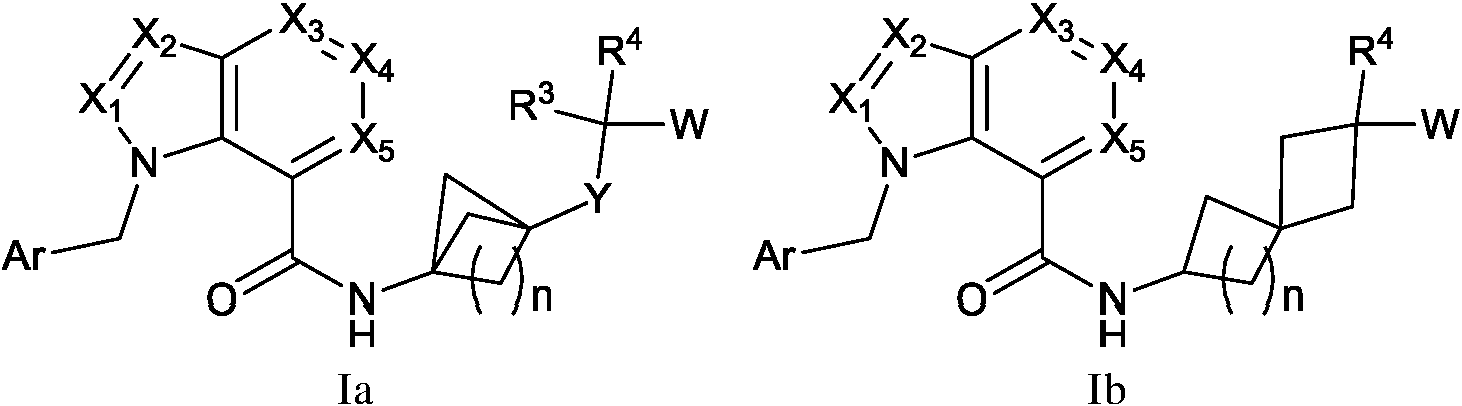
o una sal
Ar es fenilo, y está opcionalmente sustituido con 1 a 3 sustituyentes seleccionados independientemente entre el grupo que consiste en:Ar is phenyl, and is optionally substituted with 1 to 3 substituents independently selected from the group consisting of:
(a) alquilo C1-C6,( a ) C1-C6 alkyl ,
(b) cicloalquilo C3-C7,(b) C 3 -C 7 cycloalkyl,
(c) heterociclo,(c) heterocycle,
(d) arilo,(d) aryl,
(e) heteroarilo,(e) heteroaryl,
(f) halógeno,(f) halogen,
(g) CN,(g)CN,
(h) ORb,(h) OR b ,
(i) N(Rb)C(=O)Rc ,(i) N(R b )C(=O)R c ,
(j) C(=O)N(Rb)(Rc),(j) C(=O)N(R b )(R c ),
(k) S(=O)mRb,(k) S(=O)mR b ,
(l) S(=O)2N(Rb)(Rc),(l) S(=O) 2 N(R b )(R c ),
(m) N(Rb)S(=O)2Rc ,(m) N(R b )S(=O) 2 R c ,
(n) SF5; y(n) SF 5 ; Y
(o) haloalquilo C1-C6.(o) C 1 -C 6 haloalkyl.
W se selecciona entre el grupo que consiste en:W is selected from the group consisting of:
(a) CO2H,(a) CO2H ,
(b) C(=O)NHOH,(b) C(=O)NHOH,
(c) S(=O)2NHRb,( c ) S(=O) 2NHRb ,
(d) S(=O)2NHC(=O)Rb,(d) S(=O) 2 NHC(=O)R b ,
(e) NHC(=O)NHSO2Rb,(e) NHC ( =O) NHSO2Rb ,
(f) 1H-tetrazol,(f) 1H-tetrazole,
(g) 1,2,4-oxadiazol-5(4H)ona,(g) 1,2,4-oxadiazol-5(4H)one,
(h) 1,2,4-tiadiazol-5(4H)ona,(h) 1,2,4-thiadiazol-5(4H)one,
(i) 1,2,4-oxadiazol-5(4H)-tiona,(i) 1,2,4-oxadiazole-5(4H)-thione,
(j) 1,2,4-triazol-5(4H)-ona,(j) 1,2,4-triazol-5(4H)-one,
(k) tetrazol-5(4H)-ona, y(k) tetrazol-5(4H)-one, and
(l) C(=O)NHS(=O)2Rb;(l) C(=O)NHS(=O) 2 R b ;
X1, X2 , X3, X4, y X5 son cada uno independientemente N o CRa , en donde no más de 2 de X1, X2 , X3, X4 , y X5 son N; Y es un enlace o -CH2-;X 1 , X 2 , X 3 , X 4 , and X 5 are each independently N or CR a , wherein no more than 2 of X 1 , X 2 , X 3 , X 4 , and X 5 are N; Y is a bond or -CH 2 -;
R3 y R4 se seleccionan independientemente entre H, alquilo C1-C3, y haloalquilo C1-C3;R 3 and R 4 are independently selected from H, C 1 -C 3 alkyl, and C 1 -C 3 haloalkyl;
Ra se selecciona entre el grupo que consiste en:R a is selected from the group consisting of:
(a) H,(a)H,
(b) alquilo C1-C6,(b) C1- C6 alkyl ,
(c) halógeno,(c) halogen,
(d) arilo,(d) aryl,
(e) ORb,(e) ORb,
(f) ciano,(f) cyano,
(g) heteroarilo,(g) heteroaryl,
(h) cicloalquilo C3-C6,(h) C3 - C6 cycloalkyl,
(i) haloalquilo C1-C6;(i) C 1 -C 6 haloalkyl;
Rb y Rc se seleccionan independientemente entre el grupo que consiste en Rb and Rc are independently selected from the group consisting of
(a) H,(a)H,
(b) alquilo C1-C6,(b) C1- C6 alkyl ,
(c) arilo,(c) aryl,
(d) heteroarilo,(d) heteroaryl,
(e) cicloalquilo C3-C6, y(e) C 3 -C 6 cycloalkyl, and
(f) haloalquilo C1-C6; o(f) C 1 -C 6 haloalkyl; either
Rb y Rc, tomados junto con el N al que están unidos, forman un heterociclo de 3 a 6 miembros, que tiene opcionalmente un heteroátomo adicional seleccionado entre N, O y S; m es 0, 1 o 2; yRb and Rc, taken together with the N to which they are attached, form a 3 to 6 membered heterocycle, optionally having an additional heteroatom selected from N, O and S; m is 0, 1 or 2; Y
n es 1,2 o 3.n is 1,2 or 3.
En algunas realizaciones, Ar es fenilo, y está opcionalmente sustituido con 1 a 3 sustituyentes seleccionados independientemente entre el grupo que consiste en:In some embodiments, Ar is phenyl, and is optionally substituted with 1 to 3 substituents independently selected from the group consisting of:
(a) alquilo C1-C6,( a ) C1-C6 alkyl ,
(b) cicloalquilo C3-C7,(b) C 3 -C 7 cycloalkyl,
(c) heterociclo,(c) heterocycle,
(d) arilo,(d) aryl,
(e) heteroarilo,(e) heteroaryl,
(f) halógeno,(f) halogen,
(g) CN,(g)CN,
(h) ORb,(h) ORb,
(i) N(Rb)C(=O)Rc,(i) N(Rb)C(=O)Rc,
(j) C(O)N(Rb)(Rc),(j) C(O)N(Rb)(Rc),
(k) S(=O)mRb,(k) S(=O)mRb,
(l) S(=O)2N(Rb)(Rc),(l) S(=O)2N(Rb)(Rc),
(m) N(Rb)S(=O)2Rc,(m) N(Rb)S(=O)2Rc,
(n) SF5, y(n) SF5 , and
(o) haloalquilo C1-C6.(o) C 1 -C 6 haloalkyl.
En algunas realizaciones, Ar es un grupo fenilo monosustituido. En algunas realizaciones, Ar es un grupo fenilo disustituido. En algunas realizaciones, Ar es un grupo fenilo trisustituido. En algunas realizaciones, el grupo monosustituido está sustituido con CN (ciano), halógeno, CF3, CF2H, SF5, o un alquilo C1-C6 no sustituido. En algunas realizaciones, el grupo monosustituido está sustituido con CN (ciano), halógeno, haloalquilo, arilo, heteroarilo, haloalcoxi, heterociclo, o alquilo. En algunas realizaciones, el grupo monosustituido está sustituido con CN (ciano), halógeno, haloalquilo, fenilo, piridilo, haloalcoxi, o heterociclo. En algunas realizaciones, Ar es un fenilo sustituido con uno a tres sustituyentes seleccionados entre arilo, heteroarilo, cicloalquilo, heterociclo, CN (ciano), halógeno, haloalquilo, SF5, -ORb, y alquilo; y cada Rb es independientemente H, alquilo C1-C6, cicloalquilo C3-C6 , heterociclilo, o haloalquilo C1-C6.In some embodiments, Ar is a monosubstituted phenyl group. In some embodiments, Ar is a disubstituted phenyl group. In some embodiments, Ar is a trisubstituted phenyl group. In some embodiments, the monosubstituted group is substituted with CN (cyano), halogen, CF 3 , CF 2 H, SF 5 , or an unsubstituted C 1 -C 6 alkyl. In some embodiments, the monosubstituted group is substituted with CN (cyano), halogen, haloalkyl, aryl, heteroaryl, haloalkoxy, heterocycle, or alkyl. In some embodiments, the monosubstituted group is substituted with CN (cyano), halogen, haloalkyl, phenyl, pyridyl, haloalkoxy, or heterocycle. In some embodiments, Ar is phenyl substituted with one to three substituents selected from aryl, heteroaryl, cycloalkyl, heterocycle, CN (cyano), halogen, haloalkyl, SF 5 , -ORb, and alkyl; and each Rb is independently H, C 1 -C 6 alkyl, C 3 -C 6 cycloalkyl, heterocyclyl, or C 1 -C 6 haloalkyl .
En algunas realizaciones, W se selecciona entre el grupo que consiste en:In some embodiments, W is selected from the group consisting of:
(a) CO2H,(a) CO2H ,
(b) C(=O)NHOH,(b) C(=O)NHOH,
(c) S(=O)2NHRb,(c) S(=O) 2 NHRb,
(d) S(=O)2NHC(=O)Rb,(d) S(=O)2NHC(=O)Rb,
(e) NHC(=O)NHSO2Rb,(e) NHC(=O) NHSO2Rb ,
(f) 1H-tetrazol,(f) 1H-tetrazole,
(g) 1,2,4-oxadiazol-5(4H)ona,(g) 1,2,4-oxadiazol-5(4H)one,
(h) 1,2,4-tiadiazol-5(4H)ona,(h) 1,2,4-thiadiazol-5(4H)one,
(i) 1,2,4-oxadiazol-5(4H)-tiona,(i) 1,2,4-oxadiazole-5(4H)-thione,
(j) 1,2,4-triazol-5(4H)-ona,(j) 1,2,4-triazol-5(4H)-one,
(k) tetrazol-5(4H)-ona, y(k) tetrazol-5(4H)-one, and
(l) C(=O)NHS(=O)2Rb.(l) C(=O)NHS(=O)2Rb.
En algunas realizaciones, X1, X2, X3, X4, y X5 son cada uno independientemente N o CRa, con la condición de que no más de 2 de X1, X2, X3, X4, y X5 son N.In some embodiments, X1, X2, X3, X4, and X5 are each independently N or CRa, with the proviso that no more than 2 of X1, X2, X3, X4, and X5 are N.
En algunas realizaciones, R3 y R4 se seleccionan independientemente entre H, alquilo C1-C3, y haloalquilo C1-C3. In some embodiments, R3 and R4 are independently selected from H , C1- C3 alkyl, and C1- C3 haloalkyl .
En algunas realizaciones, Ra se selecciona entre el grupo que consiste en:In some embodiments, Ra is selected from the group consisting of:
(a) H,(a)H,
(b) alquilo C1-C6,(b) C1- C6 alkyl ,
(c) halógeno,(c) halogen,
(d) arilo, (d) aryl,
(e) ORb,(e) ORb,
(f) ciano,(f) cyano,
(g) heteroarilo,(g) heteroaryl,
(h) cicloalquilo C3-C6, y(h) C3 - C6 cycloalkyl, and
(i) haloalquilo C1-C6.(i) C 1 -C 6 haloalkyl.
En algunas realizaciones, Rb y Rc se seleccionan independientemente entre el grupo que consiste en:In some embodiments, Rb and Rc are independently selected from the group consisting of:
(a) H,(a)H,
(b) alquilo C1-C6,(b) C1- C6 alkyl ,
(c) arilo,(c) aryl,
(d) heteroarilo,(d) heteroaryl,
(e) cicloalquilo C3-C6, y(e) C 3 -C 6 cycloalkyl, and
(f) haloalquilo C1-C6.(f) C 1 -C 6 haloalkyl.
En algunas realizaciones, Rb y Rc, tomados junto con el N al que están unidos, forman un heterociclo de 3 a 6 miembros, que tiene opcionalmente un heteroátomo adicional seleccionado entre N, O y S.In some embodiments, Rb and Rc, taken together with the N to which they are attached, form a 3- to 6-membered heterocycle, optionally having an additional heteroatom selected from N, O, and S.
n es 1, 2 o 3.n is 1, 2 or 3.
En algunas realizaciones, Ar es fenilo opcionalmente sustituido con 1 a 3 sustituyentes seleccionados independientemente entre:In some embodiments, Ar is phenyl optionally substituted with 1 to 3 substituents independently selected from:
(a) halógeno,(a) halogen,
(b) ciano,(b) cyano,
(c) alquilo C1-C6 ,(c) C1- C6 alkyl ,
(d) SF5,(d) SF5 ,
(e) haloalquilo C1-C6 (e) C1- C6 haloalkyl
(f) ORb en donde Rb es alquilo C1-C6, arilo, heteroarilo, cicloalquilo C3-C6 o haloalquilo C1-C6;(f) ORb where Rb is C1-C6 alkyl, aryl, heteroaryl, C3 -C6 cycloalkyl , or C1- C6 haloalkyl ;
(g) heterociclo,(g) heterocycle,
(h) arilo, y(h) aryl, and
(i) heteroarilo.(i) heteroaryl.
En algunas realizaciones, Ar es fenilo opcionalmente sustituido con 1 a 3 sustituyentes seleccionados independientemente entre:In some embodiments, Ar is phenyl optionally substituted with 1 to 3 substituents independently selected from:
(a) halógeno,(a) halogen,
(b) ciano,(b) cyano,
(c) alquilo C1-C6 ,(c) C1- C6 alkyl ,
(d) SF5, y(d) SF5 , and
(e) haloalquilo C1-C6.(e) C 1 -C 6 haloalkyl.
En algunas realizaciones, cada uno de X1, X2, X3, X4 y X5 es independientemente C-Ra, o uno de X1, X2, X3, X4 y X5 es N, y los otros son cada uno independientemente C-Ra.In some embodiments, X1, X2, X3, X4, and X5 are each independently C-Ra, or one of X1, X2, X3, X4, and X5 is N, and the others are each independently C-Ra.
En algunas realizaciones, cada uno de X1, X2, X3, X4 y X5 es independientemente C-Ra.In some embodiments, each of X1, X2, X3, X4, and X5 is independently C-Ra.
En algunas realizaciones, Ra es H o un átomo de halógeno.In some embodiments, Ra is H or a halogen atom.
En algunas realizaciones, W se selecciona entre el grupo que consiste en:In some embodiments, W is selected from the group consisting of:
(a) CO2H y(a) CO 2 H and
(b) 1H-tetrazol.(b) 1H-tetrazole.
Y es un enlace o -CH2-.Y is a bond or -CH 2 -.
Algunas realizaciones proporcionan compuestos que tienen la Fórmula la: Some embodiments provide compounds having Formula Ia:

o una sal farmacéuticamente aceptable, solvato, o solvato de la sal de los mismos.or a pharmaceutically acceptable salt, solvate, or salt solvate thereof.
En algunas realizaciones, Ar es fenilo opcionalmente sustituido con 1 a 3 sustituyentes seleccionados independientemente entre:In some embodiments, Ar is phenyl optionally substituted with 1 to 3 substituents independently selected from:
(a) halógeno,(a) halogen,
(b) ciano,(b) cyano,
(c) alquilo C1-C6,(c) C1- C6 alkyl ,
(d) SF5,(d) SF5 ,
(e) haloalquilo C1-C6,(e) C 1 -C 6 haloalkyl,
(f) ORb en donde Rb es alquilo C1-C6, arilo, heteroarilo, cicloalquilo C3-C6 o haloalquilo C1-C6;(f) OR b where R b is C 1 -C 6 alkyl, aryl, heteroaryl, C 3 -C 6 cycloalkyl or C 1 -C 6 haloalkyl;
(g) heterociclo,(g) heterocycle,
(h) arilo, y(h) aryl, and
(i) heteroarilo.(i) heteroaryl.
En algunas realizaciones, Ar es fenilo opcionalmente sustituido con 1 a 3 sustituyentes seleccionados independientemente entre:In some embodiments, Ar is phenyl optionally substituted with 1 to 3 substituents independently selected from:
(a) halógeno,(a) halogen,
(b) ciano,(b) cyano,
(c) alquilo C1-C6,(c) C1- C6 alkyl ,
(d) SF5, y(d) SF5 , and
(e) haloalquilo C1-C6.(e) C 1 -C 6 haloalkyl.
En algunas realizaciones, cada X1, X2, X3, X4 y X5 es independientemente C-Ra , o uno de X1, X2, X3, X4 y X5 es N, y los otros son cada uno independientemente C-Ra .In some embodiments, each X 1 , X 2 , X 3 , X 4 and X 5 is independently CR a , or one of X 1 , X 2 , X 3 , X 4 and X 5 is N, and the others are each independently CR a .
En algunas realizaciones, W se selecciona entre el grupo que consiste en: (a) CO2H y (b) 1H-tetrazol.In some embodiments, W is selected from the group consisting of: (a) CO 2 H and (b) 1H-tetrazole.
Y es un enlace o -CH2-.Y is a bond or -CH 2 -.
En algunas realizaciones, n es 1 o 2.In some embodiments, n is 1 or 2.
R3 y R4 se seleccionan independientemente entre el grupo que consiste en: (a) H, (b) alquilo C1-C3, (c) haloalquilo C1-C3.R 3 and R 4 are independently selected from the group consisting of: (a) H, (b) C 1 -C 3 alkyl, (c) C 1 -C 3 haloalkyl.
En algunas realizaciones, Ra se selecciona entre el grupo que consiste en: (a) H y (b) halógeno.In some embodiments, R a is selected from the group consisting of: (a) H and (b) halogen.
En algunas realizaciones, Y es un enlace, y n es 1.In some embodiments, Y is a bond, and n is 1.
Algunas realizaciones proporcionan compuestos que tienen la Fórmula Ib:Some embodiments provide compounds having Formula Ib:

o una sal farmacéuticamente aceptable, solvato, o solvato de la sal de los mismos.or a pharmaceutically acceptable salt, solvate, or salt solvate thereof.
En algunas realizaciones, Ar es fenilo opcionalmente sustituido con 1 a 3 sustituyentes seleccionados independientemente entre:In some embodiments, Ar is phenyl optionally substituted with 1 to 3 substituents selected regardless between:
(a) halógeno,(a) halogen,
(b) ciano,(b) cyano,
(c) alquilo Ci -Ca ,(c) C i -C a alkyl,
(d) SF5,(d) SF5 ,
(e) haloalquilo C1-C6,(e) C 1 -C 6 haloalkyl,
(f) ORb en donde Rb es alquilo C1-C6, arilo, heteroarilo, cicloalquilo C3-C6 o haloalquilo C1-C6,(f) OR b where R b is C 1 -C 6 alkyl, aryl, heteroaryl, C 3 -C 6 cycloalkyl or C 1 -C 6 haloalkyl,
(g) heterociclo,(g) heterocycle,
(h) arilo, y(h) aryl, and
(i) heteroarilo.(i) heteroaryl.
En algunas realizaciones, Ar es fenilo opcionalmente sustituido con 1 a 3 sustituyentes seleccionados independientemente entre:In some embodiments, Ar is phenyl optionally substituted with 1 to 3 substituents independently selected from:
(a) halógeno,(a) halogen,
(b) ciano,(b) cyano,
(c) alquilo C1-C6,(c) C1- C6 alkyl ,
(d) SF5, y(d) SF5 , and
(e) haloalquilo C1-C6.(e) C 1 -C 6 haloalkyl.
En algunas realizaciones, cada X1, X2, X3, X4 y X5 es independientemente C-Ra , o uno de X1, X2, X3, X4 y X5 es N, y los otros son cada uno independientemente C-Ra .In some embodiments, each X 1 , X 2 , X 3 , X 4 and X 5 is independently CR a , or one of X 1 , X 2 , X 3 , X 4 and X 5 is N, and the others are each independently CR a .
En algunas realizaciones, W se selecciona entre el grupo que consiste en: (a) CO2H y (b) 1H-tetrazol.In some embodiments, W is selected from the group consisting of: (a) CO 2 H and (b) 1H-tetrazole.
En algunas realizaciones, n es 1 o 2.In some embodiments, n is 1 or 2.
R4 se selecciona entre el grupo que consiste en: (a) H, (b) alquilo C1-C3, y (c) haloalquilo C1-C3.R 4 is selected from the group consisting of: (a) H, (b) C 1 -C 3 alkyl, and (c) C 1 -C 3 haloalkyl.
En algunas realizaciones, n es 1 y Ra se selecciona entre el grupo que consiste en: (a) H y (b) halógeno.In some embodiments, n is 1 and R a is selected from the group consisting of: (a) H and (b) halogen.
Algunas realizaciones proporcionadas en el presente documento describen compuestos que tienen la estructura de Fórmula Ic o Id:Some embodiments provided herein describe compounds having the structure of Formula Ic or Id:

o una sal farmacéuticamente aceptable, solvato, o solvato de la sal de los mismos.or a pharmaceutically acceptable salt, solvate, or salt solvate thereof.
En algunas realizaciones, cada X1, X2, X3, X4 y X5 es independientemente C-Ra , o uno de X1, X2, X3, X4 y X5 es N, y los otros son cada uno independientemente C-Ra .In some embodiments, each X 1 , X 2 , X 3 , X 4 and X 5 is independently CR a , or one of X 1 , X 2 , X 3 , X 4 and X 5 is N, and the others are each independently CR a .
En algunas realizaciones, Ra se selecciona entre el grupo que consiste en: (a) H y (b) halógeno.In some embodiments, R a is selected from the group consisting of: (a) H and (b) halogen.
En algunas realizaciones, Rd se selecciona entre el grupo que consiste en:In some embodiments, R d is selected from the group consisting of:
(a) CN,(a) NC,
(b) alquilo C1-C3,(b) C 1 -C 3 alkyl,
(c) SF5, y(c) SF5 , and
(d) haloalquilo C1-C3,(d) C 1 -C 3 haloalkyl,
(e) ORb en donde Rb es alquilo C1-C6, arilo, heteroarilo, cicloalquilo C3-C6 o haloalquilo C1-C6,(e) OR b where R b is C 1 -C 6 alkyl, aryl, heteroaryl, C 3 -C 6 cycloalkyl or C 1 -C 6 haloalkyl,
(f) heterociclo,(f) heterocycle,
(g) arilo, y(g) aryl, and
(h) heteroarilo.(h) heteroaryl.
En algunas realizaciones, Rd se selecciona entre el grupo que consiste en: In some embodiments, R d is selected from the group consisting of:
(a) CN,(a) NC,
(b) alquilo C1-C3,(b) C 1 -C 3 alkyl,
(c) SF5, y(c) SF5 , and
(d) haloalquilo C1-C3.(d) C 1 -C 3 haloalkyl.
En algunas realizaciones, cada X1, X2, 
En algunas realizaciones, Ar es un grupo fenilo monosustituido, e Y es un enlace. En algunas realizaciones, cada X1,In some embodiments, Ar is a monosubstituted phenyl group, and Y is a bond. In some embodiments, each X 1 ,
X2 , X3 , X4 y X5 es CH, Ar es un grupo fenilo monosustituido, e Y es un enlace. En algunas realizaciones, uno de X1,X 2 , X 3 , X 4 and X 5 is CH, Ar is a monosubstituted phenyl group, and Y is a bond. In some embodiments, one of X 1 ,
X2 , X3, X4 y X5 es C-Ra y los otros son CH, Ra es halógeno, R1 y R2, tomados conjuntamente, representan CH2, Ar es un grupo fenilo monosustituido, e Y es un enlace. En algunas realizaciones, uno de X1, X2, X3, X4 y X5 es N y los otros son CH, Ar es un grupo fenilo monosustituido, e Y es un enlace. En algunas realizaciones, dos de X1, X2, X3, X4 y X5 es N y los otros son C h , R1 y R2, tomados conjuntamente, representan CH2, Ar es un grupo fenilo monosustituido, eX 2 , X 3 , X 4 and X 5 is CR a and the others are CH, R a is halogen, R 1 and R 2 , taken together, represent CH 2 , Ar is a monosubstituted phenyl group, and Y is a bond. . In some embodiments, one of X 1 , X 2 , X 3 , X 4 and X 5 is N and the others are CH, Ar is a monosubstituted phenyl group, and Y is a bond. In some embodiments, two of X1 , X2 , X3 , X4 , and X5 are N and the others are Ch, R1 , and R2, taken together, represent CH2 , Ar is a monosubstituted phenyl group, and
Y es un enlace.And it's a link.
En determinadas realizaciones, el grupo fenilo monosustituido está sustituido con fenilo, piridilo, heterociclo, CN (ciano), halógeno, haloalquilo C1-C6, SF5, o haloalcoxi.In certain embodiments, the monosubstituted phenyl group is substituted with phenyl, pyridyl, heterocycle, CN (cyano), halogen, C 1 -C 6 haloalkyl, SF 5 , or haloalkoxy.
En determinadas realizaciones, se proporcionan en el presente documento compuestos de Fórmula Ia o Fórmula Ib:In certain embodiments, compounds of Formula Ia or Formula Ib are provided herein:

o una sal farmacéuticamente aceptable, solvato, solvato de la sal, hidrato, un único estereoisómero, una mezcla de estereoisómeros, o una mezcla racémica de estereoisómeros de los mismos, en donde:or a pharmaceutically acceptable salt, solvate, salt solvate, hydrate, a single stereoisomer, a mixture of stereoisomers, or a racemic mixture of stereoisomers thereof, wherein:
Ar es fenilo, y está opcionalmente sustituido con 1 a 3 sustituyentes seleccionados independientemente entre:Ar is phenyl, and is optionally substituted with 1 to 3 substituents independently selected from:
(a) alquilo C1-C6,( a ) C1-C6 alkyl ,
(b) cicloalquilo C3-C7,(b) C 3 -C 7 cycloalkyl,
(c) heterociclo,(c) heterocycle,
(d) arilo,(d) aryl,
(e) heteroarilo,(e) heteroaryl,
(f) halógeno,(f) halogen,
(g) CN,(g)CN,
(h) ORb,(h) ORb,
(i) N(Rb)C(=O)Rc,(i) N(Rb)C(=O)Rc,
(j) C(=O)N(Rb)(Rc),(j) C(=O)N(Rb)(Rc),
(k) S(=O)mRb,(k) S(=O)mRb,
(l) S(=O)2N(Rb)(Rc),(l) S(=O)2N(Rb)(Rc),
(m) N(Rb)S(=O)2Rc,(m) N(Rb)S(=O) 2 Rc,
(n) SF5; y(n) SF 5 ; Y
(o) haloalquilo C1-C6 (o) C 1 -C 6 haloalkyl
W se selecciona entre:W is selected from:
(a) C(=O)OR5,(a) C(=O)OR5,
(b) C(=O)NHOH,(b) C(=O)NHOH,
(c) S(=O)2NHRb,(c) S(=O) 2 NHRb,
(d) S(=O)2NHC(=O)Rb,(d) S(=O)2NHC(=O)Rb,
(e) NHC(=O)NHSO2Rb,(e) NHC(=O) NHSO2Rb ,
(f) 1H-tetrazol,(f) 1H-tetrazole,
(g) 1,2,4-oxadiazol-5(4H)ona,(g) 1,2,4-oxadiazol-5(4H)one,
(h) 1,2,4-tiadiazol-5(4H)ona,(h) 1,2,4-thiadiazol-5(4H)one,
(i) 1,2,4-oxadiazol-5(4H)-tiona,(i) 1,2,4-oxadiazole-5(4H)-thione,
(j) 1,2,4-triazol-5(4H)-ona, (j) 1,2,4-triazol-5(4H)-one,
(k) tetrazol-5(4H)-ona, y(k) tetrazol-5(4H)-one, and
(l) C(=O)NHS(=O)2Rb; X1, X2 , X3, X4, y X5 son cada uno independientemente N o CRa, en donde no más de 2 de X1, X2, X3, X4 , y X5 son N;(l) C(=O)NHS(=O) 2 R b ; X 1 , X 2 , X 3 , X 4 , and X 5 are each independently N or CR a , wherein no more than 2 of X 1 , X 2 , X 3 , X 4 , and X 5 are N;
Y es un enlace o -CH2-;Y is a bond or -CH 2 -;
R3 y R4 se seleccionan independientemente entre H, alquilo C1-C3, y haloalquilo C1-C3;R 3 and R 4 are independently selected from H, C 1 -C 3 alkyl, and C 1 -C 3 haloalkyl;
R5 se selecciona entreR 5 is selected from
(a) H,(a)H,
(b) alquilo C1-C6,(b) C1- C6 alkyl ,
(c) arilo,(c) aryl,
(d) aralquilo,(d) aralkyl,
(e) CH(R7)OC(=O)R8,(e) CH(R7)OC(=O)R8,
(f) CH(R7)OC(=O)OR8, y(f) CH(R7)OC(=O)OR8, and
(g) un grupo (5-alquil-2-oxo-1,3-dioxolen-4-il)metilo que tiene la siguiente fórmula:(g) a (5-alkyl-2-oxo-1,3-dioxolen-4-yl)methyl group having the following formula:

en donde R6 es alquilo C1-C6 ;wherein R6 is C1- C6 alkyl;
R7 es hidrógeno o alquilo C1-C6 ;R7 is hydrogen or C1- C6 alkyl ;
R8 es alquilo C1-C6 o cicloalquilo C3-C6; cada Ra se selecciona independientemente entre:R8 is C1-C6 alkyl or C3 - C6 cycloalkyl ; each Ra is independently selected from:
(a) H,(a)H,
(b) alquilo C1-C6,(b) C1- C6 alkyl ,
(c) halógeno,(c) halogen,
(d) arilo,(d) aryl,
(e) ORb,(e) ORb ,
(f) ciano,(f) cyano,
(g) heteroarilo,(g) heteroaryl,
(h) cicloalquilo C3-C6, y(h) C3 - C6 cycloalkyl, and
(i) haloalquilo C1-C6;(i) C 1 -C 6 haloalkyl;
Rb y Rc se seleccionan independientemente entre:R b and R c are independently selected from:
(a) H,(a)H,
(b) alquilo C1-C6,(b) C1- C6 alkyl ,
(c) arilo,(c) aryl,
(d) heteroarilo,(d) heteroaryl,
(e) cicloalquilo C3-C6, y(e) C 3 -C 6 cycloalkyl, and
(f) haloalquilo C1-C6; o(f) C 1 -C 6 haloalkyl; either
Rb y Rc, tomados junto con el N al que están unidos, forman un heterociclo de 3 a 6 miembros, que tiene opcionalmente un heteroátomo adicional seleccionado entre N, O y S; m es 0, 1 o 2; y n es 1, 2 o 3.Rb and Rc, taken together with the N to which they are attached, form a 3 to 6 membered heterocycle, optionally having an additional heteroatom selected from N, O and S; m is 0, 1 or 2; and n is 1, 2 or 3.
En determinadas realizaciones, se proporcionan en el presente documento compuestos de Fórmula Ia o Fórmula Ib:In certain embodiments, compounds of Formula Ia or Formula Ib are provided herein:

o una sal farmacéuticamente aceptable, solvato, solvato de la sal, hidrato, un único estereoisómero, una mezcla de estereoisómeros, o una mezcla racémica de estereoisómeros de los mismos, en donde:or a pharmaceutically acceptable salt, solvate, salt solvate, hydrate, a single stereoisomer, a mixture of stereoisomers, or a racemic mixture of stereoisomers thereof, wherein:
Ar es fenilo, y está opcionalmente sustituido con 1 a 3 sustituyentes seleccionados independientemente entre: (a) alquilo C1-C6,Ar is phenyl, and is optionally substituted with 1 to 3 substituents independently selected from: ( a ) C1-C6 alkyl ,
(b) cicloalquilo C3-C7,(b) C 3 -C 7 cycloalkyl,
(c) heterociclo,(c) heterocycle,
(d) arilo,(d) aryl,
(e) heteroarilo,(e) heteroaryl,
(f) halógeno,(f) halogen,
(g) CN,(g)CN,
(h) ORb,(h) ORb,
(i) N(Rb)C(=O)Rc,(i) N(Rb)C(=O)Rc,
(j) C(=O)N(Rb)(Rc),(j) C(=O)N(Rb)(Rc),
(k) S(=O)mRb,(k) S(=O)mRb,
(l) S(=O)2N(Rb)(Rc),(l) S(=O)2N(Rb)(Rc),
(m) N(Rb)S(=O)2Rc,(m) N(Rb)S(=O)2Rc,
(n) SF5; y(n) SF 5 ; Y
(o) haloalquilo C1-C6 ;(o) C 1 -C 6 haloalkyl;
W se selecciona entre:W is selected from:
(a) C(=O)OR5,(a) C(=O)OR5,
(b) C(=O)NHOH,(b) C(=O)NHOH,
(c) S(=O)2NHRb,(c) S(=O) 2 NHRb,
(d) S(=O)2NHC(=O)Rb,(d) S(=O)2NHC(=O)Rb,
(e) NHC(=O)NHSO2Rb,(e) NHC(=O) NHSO2Rb ,
(f) 1H-tetrazol,(f) 1H-tetrazole,
(g) 1,2,4-oxadiazol-5(4H)ona,(g) 1,2,4-oxadiazol-5(4H)one,
(h) 1,2,4-tiadiazol-5(4H)ona,(h) 1,2,4-thiadiazol-5(4H)one,
(i) 1,2,4-oxadiazol-5(4H)-tiona,(i) 1,2,4-oxadiazole-5(4H)-thione,
(j) 1,2,4-triazol-5(4H)-ona,(j) 1,2,4-triazol-5(4H)-one,
(k) tetrazol-5(4H)-ona, y(k) tetrazol-5(4H)-one, and
(l) C(=O)NHS(=O)2Rb; X1, X2, X3, X4, y X5 son cada uno independientemente N o CRa, en donde no más de 2 de X1, X2, X3, X4, y X5 son N;(l) C(=O)NHS(=O) 2 Rb; X1, X2, X3, X4, and X5 are each independently N or CRa, wherein no more than 2 of X1, X2, X3, X4, and X5 are N;
Y es un enlace o -CH2-;Y is a bond or -CH 2 -;
R3 y R4 se seleccionan independientemente entre H, alquilo C1-C3 , y haloalquilo C1-C3;R3 and R4 are independently selected from H , C1- C3 alkyl, and C1- C3 haloalkyl ;
R5 se selecciona entreR5 is selected from
(a) H,(a)H,
(b) alquilo C1-C6,(b) C1- C6 alkyl ,
(c) arilo,(c) aryl,
(d) aralquilo,(d) aralkyl,
(e) CH(R7)OC(=O)R8,(e) CH(R7)OC(=O)R8,
(f) CH(R7)OC(=O)OR8, y(f) CH(R7)OC(=O)OR8, and
(g) un grupo (5-alquil-2-oxo-1,3-dioxolen-4-il)metilo que tiene la siguiente fórmula:(g) a (5-alkyl-2-oxo-1,3-dioxolen-4-yl)methyl group having the following formula:

en donde R6 es alquilo C1-C6;where R 6 is C 1 -C 6 alkyl;
R7 es hidrógeno o alquilo C1-C6;R 7 is hydrogen or C 1 -C 6 alkyl;
R8 es alquilo C1-C6 o cicloalquilo C3-C6;R 8 is C 1 -C 6 alkyl or C 3 -C 6 cycloalkyl;
cada Ra se selecciona independientemente entre:each R a is independently selected from:
(a) H,(a)H,
(b) alquilo C1-C6,(b) C1- C6 alkyl ,
(c) halógeno,(c) halogen,
(d) ORb,(d) ORb ,
(e) ciano,(e)cyano,
(f) cicloalquilo C3-C6, y(f) C3 - C6 cycloalkyl, and
(g) haloalquilo C1-C6;(g) C 1 -C 6 haloalkyl;
Rb y Rc se seleccionan independientemente entre: R b and R c are independently selected from:
(a) H,(a)H,
(b) alquilo C1-C6,(b) C1- C6 alkyl ,
(c) arilo,(c) aryl,
(d) heteroarilo,(d) heteroaryl,
(e) cicloalquilo C3-C6, y(e) C 3 -C 6 cycloalkyl, and
(f) haloalquilo C1-C6; o(f) C 1 -C 6 haloalkyl; either
Rb y Rc, tomados junto con el N al que están unidos, forman un heterociclo de 3 a 6 miembros, que tiene opcionalmente un heteroátomo adicional seleccionado entre N, O y S;Rb and Rc, taken together with the N to which they are attached, form a 3 to 6 membered heterocycle, optionally having an additional heteroatom selected from N, O and S;
m es 0, 1 o 2; ym is 0, 1 or 2; Y
n es 1, 2 o 3.n is 1, 2 or 3.
En determinadas realizaciones, X2 es C-Ra; X1, X3, X4 y X5, son cada uno independientemente N o CRa; y Ra se selecciona entre H, alquilo C1-C6, halógeno, arilo, ORb, ciano, heteroarilo, cicloalquilo C3-C6, y haloalquilo C1-C6. In certain embodiments, X2 is C-Ra; X1, X3, X4 and X5 are each independently N or CRa; and Ra is selected from H, C 1 -C 6 alkyl, halogen, aryl, ORb, cyano, heteroaryl, C 3 -C 6 cycloalkyl, and C 1 -C 6 haloalkyl.
En otras determinadas realizaciones más, X2 y X3 son C-Ra; X1, X4 y X5 son cada uno independientemente N o CRa, en donde no más de 2 de X1, X4 y X5 son N; y Ra se selecciona entre H, alquilo C1-C6, halógeno, arilo, ORb, ciano, heteroarilo, cicloalquilo C3-C6 , y haloalquilo C1-C6.In still other certain embodiments, X2 and X3 are C-Ra; X1, X4 and X5 are each independently N or CRa, where no more than 2 of X1, X4 and X5 are N; and Ra is selected from H, C 1 -C 6 alkyl, halogen, aryl, ORb, cyano, heteroaryl, C 3 -C 6 cycloalkyl, and C 1 -C 6 haloalkyl.
En otras determinadas realizaciones más, X2 es CH; y X3 es CH o C-(halógeno); X1, X4 y X5 son cada uno independientemente N o CRa, en donde no más de 2 de X1, X4 y X5 son N; y Ra se selecciona entre H, alquilo C1-C6, halógeno, arilo, ORb, ciano, heteroarilo, cicloalquilo C3-C6, y haloalquilo C1-C6. En otras determinadas realizaciones más, X2 es CH; y X3 es CH o C-(halógeno); X1, X4 y X5 son cada uno independientemente N o CH, en donde no más de 2 de X1, X4 y X5 son N.In still other certain embodiments, X2 is CH; and X3 is CH or C-(halogen); X1, X4 and X5 are each independently N or CRa, where no more than 2 of X1, X4 and X5 are N; and Ra is selected from H, C 1 -C 6 alkyl, halogen, aryl, ORb, cyano, heteroaryl, C 3 -C 6 cycloalkyl, and C 1 -C 6 haloalkyl. In still other certain embodiments, X2 is CH; and X3 is CH or C-(halogen); X1, X4, and X5 are each independently N or CH, where no more than 2 of X1, X4, and X5 are N.
En determinadas realizaciones, X1 es N o C-Ra; X2, X3, X4 y X5 son C-Ra; y Ra se selecciona entre H, alquilo C1-C6 , halógeno, arilo, ORb, ciano, heteroarilo, cicloalquilo C3-C6, y haloalquilo C1-C6. En otras determinadas realizaciones más, X1 es N o CH; X2 es CH o C-(halógeno) y X3, X4 y X5 son CH.In certain embodiments, X1 is N or C-Ra; X2, X3, X4 and X5 are C-Ra; and Ra is selected from H, C 1 -C 6 alkyl, halogen, aryl, ORb, cyano, heteroaryl, C 3 -C 6 cycloalkyl, and C 1 -C 6 haloalkyl. In still other certain embodiments, X1 is N or CH; X2 is CH or C-(halogen) and X3, X4 and X5 are CH.
En determinadas realizaciones, cada uno de X1, X2, X3, X4 y X5 es independientemente C-Ra, o uno de X1, X2, X3, X4 y X5 es N, y los otros son cada uno independientemente C-Ra.In certain embodiments, X1, X2, X3, X4, and X5 are each independently C-Ra, or one of X1, X2, X3, X4, and X5 is N, and the others are each independently C-Ra.
En determinadas realizaciones, cada uno de X1, X2, X3, X4 y X5 es independientemente C-Ra. En otras determinadas realizaciones más, cada uno de X1, X2, X3, X4 y X5 es independientemente CH.In certain embodiments, each of X1, X2, X3, X4, and X5 is independently C-Ra. In still other certain embodiments, each of X1, X2, X3, X4 and X5 is independently CH.
En determinadas realizaciones, Ra es H o un átomo de halógeno.In certain embodiments, Ra is H or a halogen atom.
Y es un enlace o -CH2-.Y is a bond or -CH 2 -.
En determinadas realizaciones, Y es -CH2-.In certain embodiments, Y is -CH 2 -.
En algunas realizaciones, Ar es fenilo, y está opcionalmente sustituido con 1 a 3 sustituyentes seleccionados independientemente entre:In some embodiments, Ar is phenyl, and is optionally substituted with 1 to 3 substituents independently selected from:
(a) halógeno,(a) halogen,
(b) ciano,(b) cyano,
(c) alquilo C1-C6 ,(c) C1- C6 alkyl ,
(d) SF5,(d) SF5 ,
(e) haloalquilo C1-C6 ,(e) C 1 -C 6 haloalkyl,
(f) ORb en donde Rb es alquilo C1-C6, arilo, heteroarilo, cicloalquilo C3-C6 o haloalquilo C1-C6,(f) ORb where Rb is C1-C6 alkyl, aryl, heteroaryl, C3 -C6 cycloalkyl or C1- C6 haloalkyl ,
(g) heterociclo,(g) heterocycle,
(h) arilo, y(h) aryl, and
(i) heteroarilo.(i) heteroaryl.
En determinadas realizaciones, W se selecciona entre:In certain embodiments, W is selected from:
(a) C(=O)OR5,(a) C(=O)OR5,
(b) C(=O)NHOH,(b) C(=O)NHOH,
(c) S(=O)2NHRb,(c) S(=O) 2 NHRb,
(d) S(=O)2NHC(=O)Rb,(d) S(=O)2NHC(=O)Rb,
(e) NHC(=O)NHSO2Rb,(e) NHC(=O) NHSO2Rb ,
(f) 1H-tetrazol,(f) 1H-tetrazole,
(g) 1,2,4-oxadiazol-5(4H)ona,(g) 1,2,4-oxadiazol-5(4H)one,
(h) 1,2,4-tiadiazol-5(4H)ona,(h) 1,2,4-thiadiazol-5(4H)one,
(i) 1,2,4-oxadiazol-5(4H)-tiona,(i) 1,2,4-oxadiazole-5(4H)-thione,
(j) 1,2,4-triazol-5(4H)-ona, (j) 1,2,4-triazol-5(4H)-one,
(k) tetrazol-5(4H)-ona, y(k) tetrazol-5(4H)-one, and
(l) C(=O)NHS(=O)2Rb,(l) C(=O)NHS(=O) 2 R b ,
R5 se selecciona entreR 5 is selected from
(a) H,(a)H,
(b) alquilo C1-C6,(b) C1- C6 alkyl ,
(c) arilo,(c) aryl,
(d) aralquilo,(d) aralkyl,
(e) CH(R7)OC(=O)R8,(e) CH(R 7 )OC(=O)R 8 ,
(f) CH(R7)OC(=O)OR8 , y(f) CH(R 7 )OC(=O)OR 8 , and
(g) un grupo (5-alquil-2-oxo-1,3-dioxolen-4-il)metilo que tiene la siguiente fórmula:(g) a (5-alkyl-2-oxo-1,3-dioxolen-4-yl)methyl group having the following formula:

en donde R6 es alquilo C1-C6 ; ywherein R6 is C1- C6 alkyl; Y
Rb se selecciona entre:Rb is selected from:
(a) H,(a)H,
(b) alquilo C1-C6,(b) C1- C6 alkyl ,
(c) arilo,(c) aryl,
(d) heteroarilo,(d) heteroaryl,
(e) cicloalquilo C3-C6, y(e) C 3 -C 6 cycloalkyl, and
(f) haloalquilo C1-C6.(f) C 1 -C 6 haloalkyl.
En determinadas realizaciones, W es CO2H o 1H-tetrazol.In certain embodiments, W is CO 2 H or 1H-tetrazole.
En algunas realizaciones, el compuesto se selecciona entre el grupo que consiste en:In some embodiments, the compound is selected from the group consisting of:
ácido 2-(3-(1-(4-cianobencil)-1H-indol-7-carboxamido)biciclo[1.1.1]pentan-1-il)acético;2-(3-(1-(4-cyanobenzyl)-1H-indole-7-carboxamido)bicyclo[1.1.1]pentan-1-yl)acetic acid;
ácido 2-(3-(1-(4-(trifluorometil)bencil)-1H-indol-7-carboxamido)biciclo[1.1.1]pentan-1-il)acético;2-(3-(1-(4-(trifluoromethyl)benzyl)-1H-indole-7-carboxamido)bicyclo[1.1.1]pentan-1-yl)acetic acid;
ácido 2-(3-(1-(4-(trifluorometil)bencil)-1H-pirrolo[3,2-b]piridina-7-carboxamido)biciclo[1.1.1]pentan-1-il)acético; ácido 2-(3-(1-(4-(trifluorometil)bencil)-1H-pirrolo[3,2-c]piridina-7-carboxamido)biciclo[1.1.1]pentan-1-il)acético; ácido 2-(3-(1-(4-(trifluorometil)bencil)-1H-pirrolo[2,3-c]piridina-7-carboxamido)biciclo[1.1.1 ]-pentan-1-il)acético; ácido 2-(3-(1-(4-(trifluorometil)bencil)-1H-indazol-7-carboxamido)biciclo[1.1.1]pentan-1-il)acético;2-(3-(1-(4-(trifluoromethyl)benzyl)-1H-pyrrolo[3,2-b]pyridine-7-carboxamido)bicyclo[1.1.1]pentan-1-yl)acetic acid; 2-(3-(1-(4-(trifluoromethyl)benzyl)-1H-pyrrolo[3,2-c]pyridine-7-carboxamido)bicyclo[1.1.1]pentan-1-yl)acetic acid; 2-(3-(1-(4-(trifluoromethyl)benzyl)-1H-pyrrolo[2,3-c]pyridine-7-carboxamido)bicyclo[1.1.1 ]-pentan-1-yl)acetic acid; 2-(3-(1-(4-(trifluoromethyl)benzyl)-1H-indazole-7-carboxamido)bicyclo[1.1.1]pentan-1-yl)acetic acid;
ácido 2-(3-(1-((4-(trifluorometil)fenil)metil-d2)-1H-indol-7-carboxamido)biciclo[1.1.1]pentan-1-il)acético; ácido 6-(1-(4-(trifluorometil)bencil)-1H-indol-7-carboxamido)espiro[3.3]heptano-2-carboxílico;2-(3-(1-((4-(trifluoromethyl)phenyl)methyl-d2)-1H-indole-7-carboxamido)bicyclo[1.1.1]pentan-1-yl)acetic acid; 6-(1-(4-(trifluoromethyl)benzyl)-1H-indole-7-carboxamido)spiro[3.3]heptane-2-carboxylic acid;
ácido (R)-6-(1-(4-(trifluorometil)bencil)-1H-indol-7-carboxamido)espiro[3.3]heptano-2-carboxílico;(R)-6-(1-(4-(trifluoromethyl)benzyl)-1H-indole-7-carboxamido)spiro[3.3]heptane-2-carboxylic acid;
ácido (S)-6-(1-(4-(trifluorometil)bencil)-1H-indol-7-carboxamido)espiro[3.3]heptano-2-carboxílico;(S)-6-(1-(4-(trifluoromethyl)benzyl)-1H-indole-7-carboxamido)spiro[3.3]heptane-2-carboxylic acid;
ácido rac-6-(1-(4-(trifluorometil)bencil)-1H-pirrolo[3,2-b]piridina-7-carboxamido)espiro[3.3]heptano-2-carboxílico; ácido (R)-6-(1-(4-(trifluorometil)bencil)-1H-pirrolo[3,2-b]piridina-7-carboxamido)espiro[3.3]heptano-2-carboxílico; ácido (S)-6-(1-(4-(trifluorometil)bencil)-1H-pirrolo[3,2-b]piridina-7-carboxamido)espiro[3.3]heptano-2-carboxílico; ácido 6-(1-(4-(trifluorometil)bencil)-1H-pirrolo[3,2-c]piridina-7-carboxamido)espiro[3.3]heptano-2-carboxílico; ácido (R)-6-(1-(4-(trifluorometil)bencil)-1H-pirrolo[3,2-c]piridina-7-carboxamido)espiro[3.3]heptano-2-carboxílico; ácido (S)-6-(1-(4-(trifluorometil)bencil)-1H-pirrolo[3,2-c]piridina-7-carboxamido)espiro[3.3]heptano-2-carboxílico; ácido rac-6-(1-(4-(trifluorometil)bencil)-1H-pirrolo[2,3-c]piridina-7-carboxamido)espiro[3.3]heptano-2-carboxílico; ácido (R)-6-(1-(4-(trifluorometil)bencil)-1H-pirrolo[2,3-c]piridina-7-carboxamido)espiro[3.3]heptano-2-carboxílico; ácido (S)-6-(1-(4-(trifluorometil)bencil)-1H-pirrolo[2,3-c]piridina-7-carboxamido)espiro[3.3]heptano-2-carboxílico; ácido rac-6-(1-(4-(trifluorometil)bencil)-1H-indazol-7-carboxamido)espiro[3.3]heptano-2-carboxílico;rac-6-(1-(4-(trifluoromethyl)benzyl)-1H-pyrrolo[3,2-b]pyridine-7-carboxamido)spiro[3.3]heptane-2-carboxylic acid; (R)-6-(1-(4-(trifluoromethyl)benzyl)-1H-pyrrolo[3,2-b]pyridine-7-carboxamido)spiro[3.3]heptane-2-carboxylic acid; (S)-6-(1-(4-(trifluoromethyl)benzyl)-1H-pyrrolo[3,2-b]pyridine-7-carboxamido)spiro[3.3]heptane-2-carboxylic acid; 6-(1-(4-(trifluoromethyl)benzyl)-1H-pyrrolo[3,2-c]pyridine-7-carboxamido)spiro[3.3]heptane-2-carboxylic acid; (R)-6-(1-(4-(trifluoromethyl)benzyl)-1H-pyrrolo[3,2-c]pyridine-7-carboxamido)spiro[3.3]heptane-2-carboxylic acid; (S)-6-(1-(4-(trifluoromethyl)benzyl)-1H-pyrrolo[3,2-c]pyridine-7-carboxamido)spiro[3.3]heptane-2-carboxylic acid; rac-6-(1-(4-(trifluoromethyl)benzyl)-1H-pyrrolo[2,3-c]pyridine-7-carboxamido)spiro[3.3]heptane-2-carboxylic acid; (R)-6-(1-(4-(trifluoromethyl)benzyl)-1H-pyrrolo[2,3-c]pyridine-7-carboxamido)spiro[3.3]heptane-2-carboxylic acid; (S)-6-(1-(4-(trifluoromethyl)benzyl)-1H-pyrrolo[2,3-c]pyridine-7-carboxamido)spiro[3.3]heptane-2-carboxylic acid; rac-6-(1-(4-(trifluoromethyl)benzyl)-1H-indazole-7-carboxamido)spiro[3.3]heptane-2-carboxylic acid;
ácido (R)-6-(1-(4-(trifluorometil)bencil)-1H-indazol-7-carboxamido)espiro[3.3]heptano-2-carboxílico;(R)-6-(1-(4-(trifluoromethyl)benzyl)-1H-indazole-7-carboxamido)spiro[3.3]heptane-2-carboxylic acid;
ácido (S)-6-(1-(4-(trifluorometil)bencil)-1H-indazol-7-carboxamido)espiro[3.3]heptano-2-carboxílico;(S)-6-(1-(4-(trifluoromethyl)benzyl)-1H-indazole-7-carboxamido)spiro[3.3]heptane-2-carboxylic acid;
ácido rac-6-(1-(4-(trifluorometil)bencil)-1H-benzo[d]imidazol-7-carboxamido)espiro[3.3]heptano-2-carboxílico; ácido (R)-6-(1-(4-(trifluorometil)bencil)-1H-benzo[d]imidazol-7-carboxamido)espiro[3.3]heptano-2-carboxílico; ácido (R)-6-(1-(4-(trifluorometil)bencil)-1H-benzo[d]imidazol-7-carboxamido)espiro[3.3]heptano-2-carboxílico; ácido 3-(3-(1-(4-(trifluorometil)bencil)-1H-indol-7-carboxamido)biciclo[1.1.1]pentan-1-il)propanoico;rac-6-(1-(4-(trifluoromethyl)benzyl)-1H-benzo[d]imidazole-7-carboxamido)spiro[3.3]heptane-2-carboxylic acid; (R)-6-(1-(4-(trifluoromethyl)benzyl)-1H-benzo[d]imidazole-7-carboxamido)spiro[3.3]heptane-2-carboxylic acid; (R)-6-(1-(4-(trifluoromethyl)benzyl)-1H-benzo[d]imidazole-7-carboxamido)spiro[3.3]heptane-2-carboxylic acid; 3-(3-(1-(4-(trifluoromethyl)benzyl)-1H-indole-7-carboxamido)bicyclo[1.1.1]pentan-1-yl)propanoic acid;
W-(3-(2-oxo-2-(fenilsulfonamido)etil)biciclo[1.1.1]pentan-1-il)-1-(4-(trifluorometil)bencil)-1H-indol-7-carboxamida; W-(3-((3-(fenilsulfonil)ureido)metil)biciclo[1.1.1]pentan-1-il)-1-(4-(trifluorometil)bencil)-1H-indol-7-carboxamida; W-(3-((1H-tetrazol-5-il)metil)biciclo[1.1.1]pentan-1-il)-1-(4-(trifluorometil)bencil)-1H-indol-7-carboxamida; ácido 2-(4-(1-(4-(trifluorometil)bencil)-1H-indol-7-carboxamido)biciclo[2.1.1]hexan-1-il)acético;W-(3-(2-oxo-2-(phenylsulfonamido)ethyl)bicyclo[1.1.1]pentan-1-yl)-1-(4-(trifluoromethyl)benzyl)-1H-indole-7-carboxamide; W-(3-((3-(phenylsulfonyl)ureido)methyl)bicyclo[1.1.1]pentan-1-yl)-1-(4-(trifluoromethyl)benzyl)-1H-indole-7-carboxamide; W-(3-((1H-tetrazol-5-yl)methyl)bicyclo[1.1.1]pentan-1-yl)-1-(4-(trifluoromethyl)benzyl)-1H-indole-7-carboxamide; 2-(4-(1-(4-(trifluoromethyl)benzyl)-1H-indole-7-carboxamido)bicyclo[2.1.1]hexan-1-yl)acetic acid;
ácido 6-(4-fluoro-1-(4-(trifluorometil)bencil)-1H-indol-7-carboxamido)espiro[3.3]heptano-2-carboxílico; ácido (R)-6-(4-fluoro-1-(4-(trifluorometil)bencil)-1H-indol-7-carboxamido)espiro[3.3]heptano-2-carboxílico; ácido (S)-6-(4-fluoro-1-(4-(trifluorometil)bencil)-1H-indol-7-carboxamido)espiro[3.3]heptano-2-carboxílico; ácido rac-6-(5-fluoro-1-(4-(trifluorometil)bencil)-1H-indol-7-carboxamido)espiro[3.3]heptano-2-carboxílico; ácido (R)-6-(5-fluoro-1-(4-(tr¡fluoromet¡l)benc¡l)-1H-¡ndol-7-carboxam¡do)esp¡ro[3.3]heptano-2-carboxíl¡co;6-(4-fluoro-1-(4-(trifluoromethyl)benzyl)-1H-indole-7-carboxamido)spiro[3.3]heptane-2-carboxylic acid; (R)-6-(4-fluoro-1-(4-(trifluoromethyl)benzyl)-1H-indole-7-carboxamido)spiro[3.3]heptane-2-carboxylic acid; (S)-6-(4-fluoro-1-(4-(trifluoromethyl)benzyl)-1H-indole-7-carboxamido)spiro[3.3]heptane-2-carboxylic acid; rac-6-(5-fluoro-1-(4-(trifluoromethyl)benzyl)-1H-indole-7-carboxamido)spiro[3.3]heptane-2-carboxylic acid; (R)-6-(5-fluoro-1-(4-(trifluoromethyl)benzyl)-1H-indole-7-carboxamido)spiro[3.3]heptane-2- carboxylic;
ácido (S)-6-(5-fluoro-1-(4-(tr¡fluoromet¡l)benc¡l)-1H-¡ndol-7-carboxam¡do)esp¡ro[3.3]heptano-2-carboxíl¡co;(S)-6-(5-fluoro-1-(4-(trifluoromethyl)benzyl)-1H-indole-7-carboxamido)spiro[3.3]heptane-2- carboxylic;
ác¡do rac-6-(5-cloro-1-(4-(tr¡fluoromet¡l)benc¡l)-1H-¡ndol-7-carboxam¡do)esp¡ro[3.3]heptano-2-carboxíl¡co;rac-6-(5-chloro-1-(4-(trifluoromethyl)benzyl)-1H-indole-7-carboxamido)spiro[3.3]heptane-2- carboxylic;
ác¡do (R)-6-(5-cloro-1-(4-(tr¡fluoromet¡l)benc¡l)-1H-¡ndol-7-carboxam¡do)esp¡ro[3.3]heptano-2-carboxíl¡co;(R)-6-(5-chloro-1-(4-(trifluoromethyl)benzyl)-1H-indole-7-carboxamido)spiro[3.3]heptane- 2-carboxylic;
ác¡do (S)-6-(5-cloro-1-(4-(tr¡fluoromet¡l)benc¡l)-1H-¡ndol-7-carboxam¡do)esp¡ro[3.3]heptano-2-carboxíl¡co;(S)-6-(5-chloro-1-(4-(trifluoromethyl)benzyl)-1H-indole-7-carboxamido)spiro[3.3]heptane- 2-carboxylic;
ác¡do rac-6-(6-fluoro-1-(4-(tr¡fluoromet¡l)benc¡l)-1H-¡ndol-7-carboxam¡do)esp¡ro[3.3]heptano-2-carboxíl¡co;rac-6-(6-fluoro-1-(4-(trifluoromethyl)benzyl)-1H-indole-7-carboxamido)spiro[3.3]heptane-2- carboxylic;
ác¡do (R)-6-(6-fluoro-1-(4-(tr¡fluoromet¡l)benc¡l)-1H-¡ndol-7-carboxam¡do)esp¡ro[3.3]heptano-2-carboxíl¡co;(R)-6-(6-fluoro-1-(4-(trifluoromethyl)benzyl)-1H-indole-7-carboxamido)spiro[3.3]heptane- 2-carboxylic;
ác¡do (S)-6-(6-fluoro-1-(4-(tr¡fluoromet¡l)benc¡l)-1H-¡ndol-7-carboxam¡do)esp¡ro[3.3]heptano-2-carboxíl¡co;(S)-6-(6-fluoro-1-(4-(trifluoromethyl)benzyl)-1H-indole-7-carboxamido)spiro[3.3]heptane- 2-carboxylic;
ác¡do rac-6-(1-(4-c¡anobenc¡l)-1H-¡ndol-7-carboxam¡do)esp¡ro[3.3]heptano-2-carboxíl¡co;rac-6-(1-(4-cyanobenzyl)-1H-indole-7-carboxamido)spiro[3.3]heptane-2-carboxylic acid;
ác¡do (R)-6-(1-(4-c¡anobenc¡l)-1H-¡ndol-7-carboxam¡do)esp¡ro[3.3]heptano-2-carboxíl¡co;(R)-6-(1-(4-cyanobenzyl)-1H-indole-7-carboxamido)spiro[3.3]heptane-2-carboxylic acid;
ác¡do (S)-6-(1-(4-c¡anobenc¡l)-1H-¡ndol-7-carboxam¡do)esp¡ro[3.3]heptano-2-carboxíl¡co;(S)-6-(1-(4-cyanobenzyl)-1H-indole-7-carboxamido)spiro[3.3]heptane-2-carboxylic acid;
ác¡do rac-6-(1-(4-(d¡fluoromet¡l)benc¡l)-1H-¡ndol-7-carboxam¡do)esp¡ro[3.3]heptano-2-carboxíl¡co;rac-6-(1-(4-(difluoromethyl)benzyl)-1H-indole-7-carboxamido)spiro[3.3]heptane-2-carboxylic acid;
ác¡do (R)-6-(1-(4-(d¡fluoromet¡l)benc¡l)-1H-¡ndol-7-carboxam¡do)esp¡ro[3.3]heptano-2-carboxíl¡co;(R)-6-(1-(4-(difluoromethyl)benzyl)-1H-indole-7-carboxamido)spiro[3.3]heptane-2-carboxylic acid co;
ác¡do (S)-6-(1-(4-(d¡fluoromet¡l)benc¡l)-1H-¡ndol-7-carboxam¡do)esp¡ro[3.3]heptano-2-carboxíl¡co;(S)-6-(1-(4-(difluoromethyl)benzyl)-1H-indole-7-carboxamido)spiro[3.3]heptane-2-carboxylic acid co;
ác¡do 2-(4-(1-(4-(d¡fluoromet¡l)benc¡l)-1H-¡ndol-7-carboxam¡do)b¡c¡clo[2.1.1]hexan-1-¡l)acét¡co;2-(4-(1-(4-(difluoromethyl)benzyl)-1H-indole-7-carboxamido)b¡cyclo[2.1.1]hexan-1 acid -¡l)acetic;
ác¡do 2-(3-(4-fluoro-1 -(4-(tr¡fluoromet¡l)benc¡l)-1 H-¡ndol-7-carboxam¡do)b¡c¡clo[1.1.1]pentan-1-¡l)acét¡co;2-(3-(4-fluoro-1 -(4-(trifluoromethyl)benzyl)-1 H-indole-7-carboxamido)bicycle[1.1. 1]pentan-1-¡l)acetic;
ác¡do 2-(4-(4-fluoro-1 -(4-(tr¡fluoromet¡l)benc¡l)-1 H-¡ndol-7-carboxam¡do)b¡c¡clo[2.1.1]hexan-1 -¡l)acét¡co;2-(4-(4-fluoro-1 -(4-(trifluoromethyl)benzyl)-1 H-indole-7-carboxamido)bicycle[2.1. 1]hexan-1-¡l)acetic;
ác¡do 2-(4-(1-((4-(pentafluorot¡ol)fen¡l)met¡l)-1H-¡ndol-7-carboxam¡do)b¡c¡clo[2.1.1]hexan-1-¡l)acét¡co;2-(4-(1-((4-(pentafluorothiol)phenyl)methyl)-1H-indole-7-carboxamide)b¡cyclo[2.1.1] hexan-1-¡l)acetic;
ác¡do rac-6-(1-((4-(pentafluorot¡ol)fen¡l)met¡l)-1H-¡ndol-7-carboxam¡do)esp¡ro[3.3]heptano-2-carboxíl¡co;rac-6-(1-((4-(pentafluorothiol)phenyl)methyl)-1H-indole-7-carboxamido)spiro[3.3]heptane-2-carboxylic acid co;
ác¡do rac-6-(1-(4-(d¡fluoromet¡l)benc¡l)-4-fluoro-1H-¡ndol-7-carboxam¡do)esp¡ro[3.3]heptano-2-carboxíl¡co;rac-6-(1-(4-(difluoromethyl)benzyl)-4-fluoro-1H-indole-7-carboxamido)spiro[3.3]heptane-2- carboxylic;
ác¡do 2-(3-(1-(4-(d¡fluoromet¡l)benc¡l)-4-fluoro-1H-¡ndol-7-carboxam¡do)b¡c¡clo[1.1.1]pentan-1-¡l)acét¡co;2-(3-(1-(4-(difluoromethyl)benzyl)-4-fluoro-1H-indole-7-carboxamido)b¡cyclo[1.1.1 ]pentan-1-¡l)acetic;
ác¡do 2-(3-(5-fluoro-1 -(4-(tr¡fluoromet¡l)benc¡l)-1 H-¡ndol-7-carboxam¡do)b¡c¡clo[1.1.1]pentan-1-¡l)acét¡co;2-(3-(5-fluoro-1 -(4-(trifluoromethyl)benzyl)-1 H-indole-7-carboxamide)bicycle[1.1. 1]pentan-1-¡l)acetic;
2-(3-(1-([1,1'-b¡fen¡l]-4-¡lmet¡l)-1 H-¡ndol-7-carboxam¡do)b¡c¡clo[1.1.1] pentan-1 -¡l)acét¡co;2-(3-(1-([1,1'-b¡phenyl]-4-¡lmethyl)-1 H-¡ndole-7-carboxamido)b¡c¡clo[1.1. 1] pentan-1 -¡l)acetic;
ác¡do 2-(3-(1-([1,1'-b¡fen¡l]-4-¡lmet¡l)-4-fluoro-1H-¡ndol-7-carboxam¡do)b¡c¡clo[1.1.1] pentan-1-¡l)acét¡co;2-(3-(1-([1,1'-b¡phenyl]-4-¡lmethyl)-4-fluoro-1H-¡ndole-7-carboxamido)b¡ acid cyclo[1.1.1]pentan-1-¡l)acetic;
ác¡do 2-(3-(l-([l,1'-b¡fen¡l]-4-¡lmet¡l)-1 H-¡ndazol-7-carboxam¡do)b¡c¡clo[1.1.1] pentan-1 -¡l)acét¡co;2-(3-(l-([l,1'-b¡fen¡l]-4-¡lmet¡l)-1 H-¡ndazol-7-carboxam¡do)b¡c¡clo acid [1.1.1] pentan-1 -¡l)acetic;
ác¡do 2-(3-(1-(4-(tr¡fluorometox¡)benc¡l)-1H-¡ndazol-7-carboxam¡do)b¡c¡clo[1.1.1] pentan-1-¡l)acét¡co;2-(3-(1-(4-(trifluoromethoxy)benzyl)-1H-indazole-7-carboxamido)b¡cyclo[1.1.1]pentan-1- l)acetic;
ác¡do 2-(3-(4-fluoro-1 -(4-yodobenc¡l)-1 H-¡ndol-7-carboxam¡do)b¡c¡clo[1.1.1]pentan-1-¡l) acét¡co;2-(3-(4-fluoro-1 -(4-iodobenzc¡l)-1 H-¡ndole-7-carboxamido)b¡c¡clo[1.1.1]pentan-1-¡ l) acetic;
2-(3-(4-fluoro-1-(4-(p¡r¡d¡na-4-¡l)benc¡l)-1H-¡ndol-7-carboxam¡do)b¡c¡clo[1.1.1]pentan-1-¡l) acét¡co; y2-(3-(4-fluoro-1-(4-(p¡r¡d¡na-4-¡l)benzil)-1H-¡ndole-7-carboxam¡do)b¡c¡clo [1.1.1]pentan-1-¡l) acetic; Y
ác¡do 2-(3-(4-fluoro-1 -(4-morfol¡nobenc¡l)-1 H-¡ndol-7-carboxam¡do)b¡c¡clo[1.1.1]pentan-1 -¡l) acét¡co;2-(3-(4-fluoro-1 -(4-morphol¡nobenzil)-1 H-¡ndol-7-carboxamido)b¡c¡clo[1.1.1]pentan-1 acid -¡l) acetic;
o una sal farmacéut¡camente aceptable, solvato, o solvato de la sal de los m¡smos.or a pharmaceutically acceptable salt, solvate, or solvate of the salt thereof.
Algunas real¡zac¡ones propordonadas en el presente documento descr¡ben compos¡c¡ones farmacéut¡cas que comprenden un compuesto de cualqu¡era de las real¡zac¡ones anter¡ores, y un vehículo farmacéut¡camente aceptable.Some embodiments provided herein describe pharmaceutical compositions comprising a compound of any of the above embodiments, and a pharmaceutically acceptable carrier.
En algunas real¡zac¡ones, la compos¡c¡ón farmacéut¡ca comprende un compuesto de Fórmula la, Fórmula Ib, FórmulaIn some embodiments, the pharmaceutical composition comprises a compound of Formula la, Formula Ib, Formula
Ic, o Fórmula Id, o una sal farmacéut¡camente aceptable, solvato, o solvato de la sal del m¡smo, y un vehículo farmacéut¡camente aceptable.Ic, or Formula Id, or a pharmaceutically acceptable salt, solvate, or solvate of the salt thereof, and a pharmaceutically acceptable carrier.
Tamb¡én se descr¡ben en el presente documento métodos para el tratam¡ento del cáncer que comprenden adm¡n¡strar a un pac¡ente que lo neces¡ta un compuesto o una compos¡c¡ón farmacéut¡ca de cualqu¡era de las real¡zac¡ones anter¡ores. El compuesto es un compuesto de Fórmula la, Fórmula Ib, Formula Ic, o Fórmula Id. En algunas real¡zac¡ones, la compos¡c¡ón comprende un vehículo farmacéut¡camente aceptable y un compuesto de Fórmula la, Fórmula Ib, Fórmula Ic, o Fórmula Id, o una sal farmacéut¡camente aceptable, solvato, o solvato de la sal de los m¡smos.Also described herein are methods of treating cancer comprising administering to a patient in need thereof a compound or pharmaceutical composition of any kind. era of previous realizations. The compound is a compound of Formula la, Formula Ib, Formula Ic, or Formula Id. In some embodiments, the composition comprises a pharmaceutically acceptable carrier and a compound of Formula la, Formula Ib, Formula Ic, or Formula Id, or a pharmaceutically acceptable salt, solvate, or solvate of the salt thereof.
En algunas real¡zac¡ones, el cáncer se selecc¡ona entre el grupo que cons¡ste en gl¡oblastoma, cáncer de huesos, cáncer de cabeza y cuello, melanoma, carc¡noma basocelular, carc¡noma de células escamosas, adenocarc¡noma, cáncer oral, cáncer de esófago, cáncer gástr¡co, cáncer de ¡ntest¡no, cáncer de colon, cáncer de vej¡ga, carc¡noma hepatocelular, carc¡noma de células renales, cáncer de páncreas, cáncer de ovar¡o, cáncer de cuello uter¡no, cáncer de pulmón, cáncer de mama y cáncer de próstata.In some embodiments, the cancer is selected from the group consisting of glooblastoma, bone cancer, head and neck cancer, melanoma, basal cell carcinoma, squamous cell carcinoma, adenocarcinoma, oral cancer, esophageal cancer, gastric cancer, bowel cancer, colon cancer, bladder cancer, hepatocellular carcinoma, renal cell carcinoma, pancreatic cancer, cancer ovarian cancer, cervical cancer, lung cancer, breast cancer, and prostate cancer.
El tratam¡ento puede comprender además un agente ad¡c¡onal selecc¡onado entre un ant¡cuerpo ant¡-PD-1 y un ant¡cuerpo ant¡-PD-L1.The treatment may further comprise an additional agent selected from an anti-PD-1 antibody and an anti-PD-L1 antibody.
En algunos casos, dentro de cualqu¡era de las real¡zac¡ones anter¡ores, para compuestos de las Fórmulas Ia e Ib, Ar es fen¡lo sust¡tu¡do. Los ejemplos de sust¡tuyentes para fen¡lo ¡ncluyen CN, halomet¡lo (tal como CF3 y CHF2) y SF5.In some instances, within any of the foregoing embodiments, for compounds of Formulas Ia and Ib, Ar is substituted phenyl. Examples of substituents for phenyl include CN, halomethyl (such as CF 3 and CHF 2 ), and SF 5 .
En algunas real¡zac¡ones, los sust¡tuyentes para fen¡lo son CN (c¡ano), halógeno, haloalqu¡lo, fen¡lo, p¡r¡d¡lo, haloalcox¡, heteroc¡clo, o SF5.In some embodiments, the substituents for phenyl are CN (cyano), halogen, haloalkyl, phenyl, pyridyl, haloalkoxy, heterocycle, or SF 5 .
En algunas real¡zac¡ones, cada X1, X2, X3, X4 y X5 es ¡ndepend¡entemente C-Ra , o uno de X1, X2, X3, X4 y los otros son cada uno ¡ndepend¡entemente C-Ra; y Ra se selecc¡ona entre H y halógeno (tal como cloro y flúor). Por tanto, cada Ra puede ser ¡gual o d¡ferente de los otros Ras. En un caso, X1, X2, X3, X4 y X5 son cada uno CH. En otro caso, uno de X1, X2, X3, X4 y X5 es - C(F)- o -C(Cl)- y los otros son cada uno CH.In some embodiments, each X1, X2, X3, X4 and X5 is independently CR a , or one of X1, X2, X3, X4 and the others are each independently CR a ; and R a is selected from H and halogen (such as chlorine and fluorine). Therefore, each R a can be the same as or different from the other R a s. In one case, X1, X2, X3, X4 and X5 are each CH. In another case, one of X1, X2, X3, X4 and X5 is -C(F)- or -C(Cl)- and the others are each CH.
En algunos casos, dentro de cualqu¡era de las real¡zac¡ones anter¡ores, para los compuestos de las Fórmulas Ia e Ib,In some instances, within any of the foregoing embodiments, for compounds of Formulas Ia and Ib,
W es -CO2H, -CONHSO2-fen¡lo, -NHCONHSO2-fen¡lo, y tetrazol¡lo. En un caso, W es -CO2H. En otro caso, W es tetrazol¡lo. W is -CO 2 H, -CONHSO 2 -phenyl, -NHCONHSO 2 -phenyl, and tetrazole. In one case, W is -CO 2 H. In another case, W is tetrazolol.
DefinicionesDefinitions
A menos que se definan de otra manera, todos los términos técnicos y científicos usados en el presente documento tienen el mismo significado que entiende habitualmente un experto en la materia. En el caso en el que exista una pluralidad de definiciones para un término en el presente documento, a menos que se indique lo contrario, prevalecen las indicadas en esta sección.Unless otherwise defined, all technical and scientific terms used herein have the same meaning as is commonly understood by one skilled in the art. In the event that there are multiple definitions for a term in this document, unless otherwise indicated, those indicated in this section prevail.
Como se usa en la memoria descriptiva y en las reivindicaciones adjuntas, las formas en singular "un", "uno/una" y "el/la" incluyen referentes en plural a menos que el contexto determine claramente lo contrario. A menos que se indique otra cosa, se emplean métodos convencionales de espectroscopia de masas, RMN, HPLC, química de proteínas, bioquímica, técnicas de ADN recombinante y farmacología. El uso de "o" o "y" significa "y/o" a menos que se manifieste lo contrario. Por otra parte, el uso de la expresión "que incluye", así como otras formas, tales como "incluyen", "incluye", e "incluido/a", no es limitante. Como se usa en la presente memoria descriptiva, ya sea en una expresión de transición o en el cuerpo de la reivindicación, el término "comprende/n" y la expresión "que comprende" deben interpretarse con un significado abierto. Es decir, los términos deben interpretarse como sinónimos de las expresiones "que tiene al menos" o "que incluye al menos". Cuando se usa en el contexto de un proceso, el término "que comprende" significa que el proceso incluye al menos las etapas citadas, pero que puede incluir etapas adicionales. Cuando se usa en el contexto de un compuesto, composición o dispositivo, el término "comprendiendo" o la expresión "que comprende" significan que el compuesto, la composición o el dispositivo incluye al menos los elementos o los componentes citados, pero que también puede incluir elementos o componentes adicionales.As used in the specification and appended claims, the singular forms "a", "a/an" and "the" include plural referents unless the context clearly dictates otherwise. Unless otherwise indicated, conventional methods of mass spectroscopy, NMR, HPLC, protein chemistry, biochemistry, recombinant DNA techniques, and pharmacology are used. The use of "or" or "and" means "and/or" unless otherwise stated. Furthermore, the use of the term "including", as well as other forms, such as "include", "includes", and "included", is not limiting. As used herein, whether in a transitional term or in the body of the claim, the term "comprises" and the term "comprising" are to be construed with an open meaning. That is, the terms should be interpreted as synonymous with the expressions "having at least" or "including at least". When used in the context of a process, the term "comprising" means that the process includes at least the recited steps, but may include additional steps. When used in the context of a compound, composition, or device, the term "comprising" or the expression "comprising" means that the compound, composition, or device includes at least the recited elements or components, but may also include additional elements or components.
El término "paciente" incluye mamíferos tales como ratones, ratas, vacas, ovejas, cerdos, conejos, cabras, caballos, monos, perros, gatos y seres humanos. En algunas realizaciones, el paciente es un ser humano.The term "patient" includes mammals such as mice, rats, cattle, sheep, pigs, rabbits, goats, horses, monkeys, dogs, cats, and humans. In some embodiments, the patient is a human.
El término "halo" o "halógeno" se refiere a cualquier radical de flúor, cloro, bromo o yodo.The term "halo" or "halogen" refers to any radical of fluorine, chlorine, bromine or iodine.
El término "alquilo" se refiere a una cadena de hidrocarburo saturada que puede ser una cadena lineal o cadena ramificada, que contiene el número indicado de átomos de carbono. Por ejemplo, alquilo C1-C6 indica que el grupo puede tener de 1 a 6 (inclusive) átomos de carbono en él. En algunas realizaciones, un alquilo es un alquilo C1-C6 que representa un radical hidrocarburo saturado de cadena lineal o ramificado que tiene de 1 a 6 átomos de carbono. Ejemplos de alquilo incluyen sin limitación metilo, etilo, n-propilo, isopropilo, n-butilo, isobutilo, sec-butilo y ferc-butilo. The term "alkyl" refers to a saturated hydrocarbon chain which may be a straight chain or branched chain, containing the indicated number of carbon atoms. For example, C 1 -C 6 alkyl indicates that the group may have from 1 to 6 (inclusive) carbon atoms in it. In some embodiments, an alkyl is a C 1 -C 6 alkyl which represents a straight or branched chain saturated hydrocarbon radical having 1 to 6 carbon atoms. Examples of alkyl include without limitation methyl, ethyl, n-propyl, isopropyl, n-butyl, isobutyl, sec-butyl, and tert-butyl.
El término "cicloalquilo" se refiere a un grupo hidrocarburo monocíclico totalmente saturado, bicíclico, tricíclico u otro grupo hidrocarburo policíclico que tenga el número indicado de átomos de carbono en el anillo. Los cicloalquilos policíclicos pueden ser sistemas de anillos fusionados, con puentes o espiro. Los grupos cicloalquilo incluyen, pero sin limitación, ciclopropilo, ciclobutilo, ciclopentilo, ciclohexilo, cicloheptilo, ciclooctilo y norbornilo. En algunas realizaciones, el cicloalquilo es un cicloalquilo C3-C8 monocíclico.The term "cycloalkyl" refers to a fully saturated monocyclic, bicyclic, tricyclic or other polycyclic hydrocarbon group having the indicated number of carbon atoms in the ring. Polycyclic cycloalkyls can be fused, bridged or spiro ring systems. Cycloalkyl groups include, but are not limited to, cyclopropyl, cyclobutyl, cyclopentyl, cyclohexyl, cycloheptyl, cyclooctyl, and norbornyl. In some embodiments, the cycloalkyl is a monocyclic C 3 -C 8 cycloalkyl.
El término "haloalquilo" se refiere a un grupo alquilo en el que al menos un átomo de hidrógeno se reemplaza por halo. En algunas realizaciones, más de un átomo de hidrógeno (por ejemplo, 2, 3, 4, 5 o 6) se reemplaza por halo. En estas realizaciones, los átomos de hidrógeno pueden ser reemplazados cada uno por el mismo halógeno (por ejemplo, flúor) o los átomos de hidrógeno pueden ser reemplazados por una combinación de diferentes halógenos (por ejemplo, flúor y cloro). "Haloalquilo" también incluye restos alquilo en los que todos los hidrógenos han sido reemplazados por halo (a veces denominado en el presente documento perhaloalquilo, por ejemplo, perfluoroalquilo, tal como trifluorometilo). The term "haloalkyl" refers to an alkyl group in which at least one hydrogen atom is replaced by halo. In some embodiments, more than one hydrogen atom (eg, 2, 3, 4, 5, or 6) is replaced by halo. In these embodiments, the hydrogen atoms can each be replaced with the same halogen (eg, fluorine) or the hydrogen atoms can be replaced with a combination of different halogens (eg, fluorine and chlorine). "Haloalkyl" also includes alkyl moieties in which all hydrogens have been replaced by halo (sometimes referred to herein as perhaloalkyl, eg, perfluoroalkyl, such as trifluoromethyl).
Como se cita en el presente documento, el término "alcoxi" se refiere a un grupo de fórmula -O-(alquilo). Alcoxi puede ser, por ejemplo, metoxi, etoxi, propoxi, isopropoxi, butoxi, iso-butoxi, sec-butoxi, pentoxi, 2-pentoxi, 3-pentoxi, o hexiloxi. De forma análoga, el término "tioalcoxi" se refiere a un grupo de fórmula -S-(alquilo). Los términos "haloalcoxi" y "tiohaloalcoxi" se refieren a -O-(haloalquilo) y -S-(haloalquilo), respectivamente.As cited herein, the term "alkoxy" refers to a group of the formula -O-(alkyl). Alkoxy can be, for example, methoxy, ethoxy, propoxy, isopropoxy, butoxy, iso-butoxy, sec-butoxy, pentoxy, 2-pentoxy, 3-pentoxy, or hexyloxy. Similarly, the term "thioalkoxy" refers to a group of the formula -S-(alkyl). The terms "haloalkoxy" and "thiohaloalkoxy" refer to -O-(haloalkyl) and -S-(haloalkyl), respectively.
El término "aralquilo" se refiere a un resto alquilo en el que un átomo de hidrógeno de alquilo está reemplazado por un grupo arilo. Uno de los carbonos del resto alquilo sirve como punto de unión del grupo aralquilo a otro resto. Los ejemplos no limitantes de "aralquilo" incluyen grupos bencilo, 2-feniletilo, y 3-fenilpropilo.The term "aralkyl" refers to an alkyl moiety in which an alkyl hydrogen atom is replaced by an aryl group. One of the carbons of the alkyl moiety serves as the point of attachment of the aralkyl group to another moiety. Non-limiting examples of "aralkyl" include benzyl, 2-phenylethyl, and 3-phenylpropyl groups.
El término "alquenilo" se refiere a una cadena de hidrocarburo lineal o ramificada que contiene el número indicado de átomos de carbono y tiene uno o más dobles enlaces carbono-carbono. Los grupos alquenilo pueden incluir, p. ej., vinilo, alilo, 1 -butenilo, y 2-hexenilo. En algunas realizaciones, un alquenilo es un alquenilo C2-C6.The term "alkenyl" refers to a straight or branched hydrocarbon chain containing the indicated number of carbon atoms and having one or more carbon-carbon double bonds. Alkenyl groups can include, e.g. g., vinyl, allyl, 1-butenyl, and 2-hexenyl. In some embodiments, an alkenyl is a C 2 -C 6 alkenyl.
El término "alquinilo" se refiere a una cadena de hidrocarburo lineal o ramificada que contiene el número indicado de átomos de carbono y tiene uno o más triples enlaces carbono-carbono. Los grupos alquinilo pueden incluir, p. ej., etinilo, propargilo, 1 -butinilo, y 2-hexinilo. En algunas realizaciones, un alquinilo es un alquinilo C2-C6.The term "alkynyl" refers to a straight or branched hydrocarbon chain containing the indicated number of carbon atoms and having one or more carbon-carbon triple bonds. Alkynyl groups can include, e.g. eg, ethynyl, propargyl, 1-butynyl, and 2-hexynyl. In some embodiments, an alkynyl is a C 2 -C 6 alkynyl.
El término "heterociclo", "heterociclilo" o "heterocíclico", como se usa en el presente documento, excepto donde se señala, representa un sistema de anillo monocíclico de 4, 5, 6 o 7 miembros estable o heterocíclico bicílico de 6, 7, 8, 9, 10, 11, o 12 miembros estable que comprende al menos un anillo no aromático (es decir, saturado o parcialmente insaturado) que consiste en átomos de carbono y de uno a cuatro, preferentemente hasta tres, heteroátomos seleccionados entre el grupo que consiste en N, O y S, en donde los átomos de nitrógeno y azufre pueden ser opcionalmente oxidados como N-óxido, sulfóxido o sulfona, y en donde el átomo de nitrógeno puede estar opcionalmente cuaternizado. Un heterociclo puede estar unido a través de un átomo de carbono en el anillo o, si está disponible, a través de un átomo de nitrógeno en el anillo. Los sistemas de anillos heterocíclicos bicíclicos puede(n) ser sistema(s) de anillos fusionados, con puentes, o heterocíclico(s) bicíclico(s) espiro. En algunas realizaciones, el heterociclilo es monocíclico que tiene de 4 a 7, preferentemente de 4 a 6, átomos en el anillo, de los cuales 1 o 2 son heteroátomos seleccionados independientemente entre el grupo que consiste en N, O y S. En algunas realizaciones, un grupo heterociclilo es bicíclico, y en cuyo caso, el segundo anillo puede ser un anillo aromático o no aromático que consiste en átomos de carbono y de uno a cuatro, preferentemente hasta tres, heteroátomos seleccionados independientemente entre el grupo que consiste en N, O y S, o el segundo anillo puede ser un anillo de benceno, o un "cicloalquilo", o un "cicloalquenilo", como se define en el presente documento. Los ejemplos de dichos grupos heterocíclicos incluyen, pero sin limitación azetidina, cromano, dihidrofurano, dihidropirano, dioxano, dioxolano, hexahidroazepina, imidazolidina, imidazolina, indolina, isocromano, isoindolina, isotiazolina, isotiazolidina, isoxazolina, isoxazolidina, morfolina, oxazolina, oxazolidina, oxetano, piperazina, piperidina, dihidropiridina, tetrahidropiridina, dihidropiridazina, pirano, pirazolidina, pirazolina, pirrolidina, pirrolina, tetrahidrofurano, tetrahidropirano, tiamorfolina, tetrahidrotiofeno, tiazolina, tiazolidina, tiomorfolina, tietano, tiolano, sulfolano, 1,3-dioxolano, 1,3-oxazolidina, 1,3-tiazolidina, tetrahidrotiopirano, tetrahidrotriazina, 1,3-dioxano, 1,4-dioxano, hexahidrotriazina, tetrahidrooxazina, tetrahidropirimidina, perhidroazepina, perhidro-1,4-diazepina, perhidro-1,4-oxazepina, 7-azabiciclo[2.2.1]heptano, 3-azabiciclo[3.2.0]heptano, 7-azabiciclo[4.1.0]heptano, 2,5-diazabiciclo[2.2.1]heptano, 2-oxa-5-azabiciclo[2.2.1]heptano, tropano, 2-oxa-6-azaespiro[3.3]heptano, dihidrobenzofurano, dihidrobenzoimidazolilo, dihidrobenzoxazol, y dihidrobenzotiazolilo, y N-óxidos o sulfonas o sulfóxidos de los mismos.The term "heterocycle", "heterocyclyl" or "heterocyclic", as used herein, except where noted, represents a stable 4-, 5-, 6-, or 7-membered monocyclic or 6, 7-bicyclic heterocyclic ring system. stable, 8, 9, 10, 11, or 12-membered ring comprising at least one non-aromatic ring (i.e., saturated or partially unsaturated) consisting of carbon atoms and one to four, preferably up to three, heteroatoms selected from the group consisting of N, O and S, wherein nitrogen and sulfur atoms may optionally be oxidized as N-oxide, sulfoxide or sulfone, and wherein the nitrogen atom may optionally be quaternized. A heterocycle may be attached via a ring carbon atom or, if available, via a ring nitrogen atom. Bicyclic heterocyclic ring systems may be fused, bridged, or spiro bicyclic heterocyclic ring system(s). In some embodiments, the heterocyclyl is monocyclic having 4 to 7, preferably 4 to 6, ring atoms, of which 1 or 2 are heteroatoms independently selected from the group consisting of N, O, and S. In some embodiments, In embodiments, a heterocyclyl group is bicyclic, and in which case, the second ring may be an aromatic or nonaromatic ring consisting of carbon atoms and one to four, preferably up to three, heteroatoms independently selected from the group consisting of N , O and S, or the second ring may be a benzene ring, or a "cycloalkyl", or a "cycloalkenyl", as defined herein. Examples of such heterocyclic groups include, but are not limited to azetidine, chroman, dihydrofuran, dihydropyran, dioxane, dioxolane, hexahydroazepine, imidazolidine, imidazoline, indoline, isochroman, isoindoline, isothiazolidine, isothiazolidine, isoxazoline, isoxazolidine, morpholine, oxazoline, oxazolidine, oxetane , piperazine, piperidine, dihydropyridine, tetrahydropyridine, dihydropyridazine, pyran, pyrazolidine, pyrazoline, pyrrolidine, pyrroline, tetrahydrofuran, tetrahydropyran, thiamorpholine, tetrahydrothiophene, thiazoline, thiazolidine, thiomorpholine, thietane, thiolane, sulfolane, 1,3-dioxolane, 1,3 -oxazolidine, 1,3-thiazolidine, tetrahydrothiopyran, tetrahydrotriazine, 1,3-dioxane, 1,4-dioxane, hexahydrotriazine, tetrahydrooxazine, tetrahydropyrimidine, perhydroazepine, perhydro-1,4-diazepine, perhydro-1,4-oxazepine, 7 -azabicyclo[2.2.1]heptane, 3-azabicyclo[3.2.0]heptane, 7-azabicyclo[4.1.0]heptane, 2,5-diazabicyclo[2.2.1]heptane, 2-oxa-5-azabicyclo[2.2 .1]heptane, tropane , 2-oxa-6-azaspiro[3.3]heptane, dihydrobenzofuran, dihydrobenzoimidazolyl, dihydrobenzoxazole, and dihydrobenzothiazolyl, and N-oxides or sulfones or sulfoxides thereof.
El término "arilo", como se usa en el presente documento, pretende indicar cualquier anillo de carbono monocíclico o bicíclico estable de hasta 6 miembros en cada anillo (es decir, de 6 a 10 átomos en el anillo en total) en donde al menos un anillo es aromático. Por ejemplo, un grupo arilo C6-C10, tal como asfenilo, naftilo, tetrahidronaftilo, indanilo, o 1H-indenilo. A menos que se indique específicamente otra cosa en la memoria descriptiva, el término "arilo" tiene por objeto incluir radicales arilo opcionalmente sustituidos por uno o más sustituyentes seleccionados independientemente entre CN (ciano), halógeno, haloalquilo, -ORx , -N(Rx)2-, o alquilo; en donde cada Rx es independientemente H, alquilo, haloalquilo, cicloalquilo o heterociclilo.The term "aryl", as used herein, is intended to mean any stable monocyclic or bicyclic carbon ring of up to 6 members in each ring (i.e., 6 to 10 ring atoms total) wherein at least one ring is aromatic. For example, a C 6 -C 10 aryl group, such as asphenyl, naphthyl, tetrahydronaphthyl, indanyl, or 1H-indenyl. Unless otherwise specifically indicated in the specification, the term "aryl" is intended to include aryl radicals optionally substituted by one or more substituents independently selected from CN (cyano), halogen, haloalkyl, -OR x , -N( R x ) 2 -, or alkyl; wherein each R x is independently H, alkyl, haloalkyl, cycloalkyl, or heterocyclyl.
El término "heteroarilo", como se usa en el presente documento excepto donde se señala, representa un sistema de anillos monocíclico de 5, 6 o 7 miembros estable o bicíclico fusionado de 9 o 10 miembros estable que comprende al menos un anillo aromático, que consiste en átomos de carbono y de uno a cuatro, preferentemente hasta tres, heteroátomos seleccionados entre el grupo que consiste en N, O y S, en donde los heteroátomos de nitrógeno y azufre pueden estar opcionalmente oxidados, y el heteroátomo de nitrógeno puede estar opcionalmente cuaternizado. En el caso de un "heteroarilo" que es un grupo bicíclico, el segundo anillo no necesita ser aromático y no necesita comprender un heteroátomo. En consecuencia, "heteroarilo" bicíclico incluye, por ejemplo, un anillo aromático monocíclico de 5 o 6 miembros estable que consiste en átomos de carbono y de uno a cuatro, preferentemente hasta tres, heteroátomos, como se ha definido anteriormente de inmediato, fusionado a un anillo de benceno, o a un segundo "heteroarilo" monocíclico, o a un "heterociclilo", a un "cicloalquilo", o a un "cicloalquenilo", como se ha definido anteriormente. Los ejemplos de grupos heteroarilo incluyen, pero sin limitación, benzimidazol, benzopirazol, benzisotiazol, benzisoxazol, benzofurano, isobenzofurano, benzotiazol, benzotiofeno, benzotriazol, benzoxazol, cinolina, furano, furazano, imidazol, indazol, indol, indolizina, isoquinolina, isotiazol, isoxazol, naftiridina, oxadiazol, oxazol, ftalazina, pteridina, purina, pirazina, pirazol, piridazina, piridina, pirimidina, pirrol, quinazolina, quinolina, quinoxalina, tetrazol, tiadiazol, tiazol, tiofeno, triazina, triazol, benzimidazol, benzotiadiazol, isoindol, pirrolopiridinas, imidazopiridinas, tales como imidazo[1,2-a]piridina, pirazolopiridina, pirrolopirimidina y N-óxidos de los mismos. A menos que se indique específicamente otra cosa en la memoria descriptiva, el término "heteroarilo" tiene por objeto incluir radicales heteroarilo opcionalmente sustituidos por uno o más sustituyentes seleccionados independientemente entre CN (ciano), halógeno, haloalquilo, -ORx, -N(Rx)2-, o alquilo; en donde cada Rx es independientemente H, alquilo, haloalquilo, cicloalquilo o heterociclilo.The term "heteroaryl", as used herein except where noted, represents a stable 5-, 6-, or 7-membered monocyclic or stable 9- or 10-membered fused bicyclic ring system comprising at least one aromatic ring, which consists of carbon atoms and one to four, preferably up to three, heteroatoms selected from the group consisting of N, O and S, wherein the nitrogen and sulfur heteroatoms may be optionally oxidized, and the nitrogen heteroatom may optionally be quaternized. In the case of a "heteroaryl" which is a bicyclic group, the second ring need not be aromatic and need not comprise a heteroatom. Accordingly, bicyclic "heteroaryl" includes, for example, a stable 5- or 6-membered monocyclic aromatic ring consisting of carbon atoms and one to four, preferably up to three, heteroatoms, as defined immediately above, fused to a benzene ring, or a second monocyclic "heteroaryl", or a "heterocyclyl", a "cycloalkyl", or a "cycloalkenyl", as defined above. Examples of heteroaryl groups include, but are not limited to, benzimidazole, benzopyrazole, benzisothiazole, benzisoxazole, benzofuran, isobenzofuran, benzothiazole, benzothiophene, benzotriazole, benzoxazole, cinnoline, furan, furazan, imidazole, indazole, indole, indolizine, isoquinoline, isothiazole, isoxazole , naphthyridine, oxadiazole, oxazole, phthalazine, pteridine, purine, pyrazine, pyrazole, pyridazine, pyridine, pyrimidine, pyrrole, quinazoline, quinoline, quinoxaline, tetrazole, thiadiazole, thiazole, thiophene, triazine, triazole, benzimidazole, benzothiadiazole, isoindole, pyrrolopyridines , imidazopyridines, such as imidazo[1,2-a]pyridine, pyrazolopyridine, pyrrolopyrimidine, and N-oxides thereof. Unless otherwise specifically indicated in the specification, the term "heteroaryl" is intended to include heteroaryl radicals optionally substituted by one or more substituents independently selected from CN (cyano), halogen, haloalkyl, -OR x , -N( R x ) 2 -, or alkyl; wherein each R x is independently H, alkyl, haloalkyl, cycloalkyl, or heterocyclyl.
El término "que trata", "tratar", o "tratamiento" se refiere generalmente a controlar, aliviar, mejorar, ralentizar el progreso de o eliminar una afección nombrada una vez que se ha establecido la afección. Además de su significado habitual, el término "que previene", "prevenir", o "prevención" también se refiere a retrasar la aparición de, o reducir el riesgo de desarrollar una afección nombrada o de un proceso que puede conducir a la afección, o la recurrencia de los síntomas de una afección.The term "treating", "treating", or "treatment" generally refers to controlling, alleviating, ameliorating, slowing the progress of, or eliminating a named condition once the condition has been established. In addition to its usual meaning, the term "preventing", "preventing", or "prevention" also refers to delaying the onset of, or reducing the risk of developing a named condition or a process that can lead to the condition, or recurrence of symptoms of a condition.
El término "cantidad terapéuticamente eficaz" o "cantidad eficaz" es una cantidad suficiente para obtener los resultados clínicos deseados o beneficiosos. Una cantidad eficaz puede administrarse en una o más administraciones. Una cantidad eficaz suele ser suficiente para paliar, mejorar, estabilizar, revertir, ralentizar o retrasar la progresión de la patología.The term "therapeutically effective amount" or "effective amount" is an amount sufficient to obtain beneficial or desired clinical results. An effective amount can be administered in one or more administrations. An effective amount is usually sufficient to palliate, ameliorate, stabilize, reverse, slow or delay the progression of the condition.
Como se usa en el presente documento, las abreviaturas para cualquier grupo protector, aminoácidos y otros compuestos, son, a menos que se indique lo contrario, de acuerdo con su uso común, abreviaturas reconocidas o la Comisión de Nomenclatura Bioquímica de la IUPAC-IUB (Véase, Biochem. 11:942-944 (1972)). As used herein, abbreviations for any protecting groups, amino acids, and other compounds, are, unless otherwise indicated, in accordance with their common usage, recognized abbreviations or the IUPAC-IUB Commission on Biochemical Nomenclature (See, Biochem. 11:942-944 (1972)).
Formas y sales del compuestoCompound forms and salts
En algunas realizaciones, los compuestos descritos en el presente documento contienen uno o más centros asimétricos y, por tanto, se presentan como racematos y mezclas racémicas, mezclas enriquecidas enantioméricamente, enantiómeros individuales, diastereómeros individuales y mezclas diastereoméricas. En algunas realizaciones, los compuestos descritos en el presente documento, ya sea por la naturaleza de los centros asimétricos o por la rotación restringida, están presentes en forma de isómeros (por ejemplo, enantiómeros, diastereómeros). In some embodiments, the compounds described herein contain one or more asymmetric centers and thus occur as racemates and racemic mixtures, enantiomerically enriched mixtures, single enantiomers, single diastereomers, and diastereomeric mixtures. In some embodiments, the compounds described herein, either due to the nature of the asymmetric centers or restricted rotation, are present as isomers (eg, enantiomers, diastereomers).
También se apreciará que cuando dos o más centros asimétricos están presentes en los compuestos de la divulgación, a menudo serán posibles varios diastereómeros y enantiómeros de las estructuras ejemplificadas, y que los diastereómeros puros y los enantiómeros puros representan realizaciones preferidas. Se pretende que los estereoisómeros puros, diastereómeros puros, enantiómeros puros, y mezclas de los mismos, estén dentro del alcance de la divulgación. Cuando los compuestos contienen estereoquímica, los compuestos se designan como "(racémicos)" o "rac" si los estereoisómeros no se han separado y "(R) o (S)"s i los estereoisómeros se han resuelto. En determinadas realizaciones, los compuestos divulgados en el presente documento contienen quiralidad axial, particularmente en el caso de los compuestos que contienen espirocíclico[3.3]heptano. Estos también se han designado como "(R) o (S)" cuando hay un estereoisómero individual, en lugar de la convención de la IUPAC de "(aR) o (aS)", donde la "a" denota quiralidad axial.It will also be appreciated that when two or more asymmetric centers are present in the compounds of the disclosure, various diastereomers and enantiomers of the exemplified structures will often be possible, and that pure diastereomers and pure enantiomers represent preferred embodiments. Pure stereoisomers, pure diastereomers, pure enantiomers, and mixtures thereof, are intended to be within the scope of the disclosure. When compounds contain stereochemistry, the compounds are designated " ( racemic)" or "rac" if the stereoisomers have not been separated and " ( R) or ( S )" if the stereoisomers have resolved. In certain embodiments, the compounds disclosed herein contain axial chirality, particularly in the case of spirocyclic[3.3]heptane-containing compounds. These have also been designated as " ( R) or ( S)" when there is a single stereoisomer, rather than the IUPAC convention of "(aR) or (aS)", where the "a" denotes axial chirality.
Todos los estereoisómeros, ya sean separados, puros, parcialmente puros, o en mezcla racémica, de los compuestos de la presente divulgación están abarcados dentro del alcance de la presente divulgación. La purificación de dichos isómeros y la separación de dichas mezclas isoméricas puede lograrse mediante técnicas convencionales conocidas en la técnica. Por ejemplo, las mezclas diastereoméricas pueden separarse en los isómeros individuales mediante procesos cromatográficos o cristalización, y los racematos pueden separarse en los respectivos enantiómeros mediante procesos cromatográficos en fases quirales o por resolución.All stereoisomers, whether separate, pure, partially pure, or in racemic mixture, of the compounds of this disclosure are encompassed within the scope of this disclosure. Purification of said isomers and separation of said isomeric mixtures can be achieved by conventional techniques known in the art. For example, diastereomeric mixtures can be separated into the individual isomers by chromatographic processes or crystallization, and racemates can be separated into the respective enantiomers by chromatographic processes on chiral phases or by resolution.
Los compuestos de la presente divulgación incluyen todos los isómeros cis, trans, syn, anti, entgegen (E) y zusammen (Z), así como las mezclas de los mismos. En algunas realizaciones, los compuestos descritos en el presente documento existen en múltiples formas tautoméricas. En dichos casos, la presente divulgación incluye expresamente todas las formas tautoméricas de los compuestos descritos en el presente documento, incluso a pesar de que se solo se pueda representar una forma tautomérica. Adicionalmente, cuando un término usado en la presente divulgación abarca un grupo que puede tautomerizarse, todas las formas tautoméricas se incluyen expresamente al respecto. Por ejemplo, el heteroarilo sustituido por hidroxi incluye 2-hidroxipiridina, así como 2-piridona, 1-hidroxisoquinolina, así como 1-oxo-1,2-dihidroisoquinolina, y similares. Todas dichas formas isoméricas de dichos compuestos están expresamente incluidas en la presente divulgación.The compounds of the present disclosure include all cis, trans, syn, anti, entgegen ( E) and zusammen ( Z) isomers, as well as mixtures thereof. In some embodiments, the compounds described herein exist in multiple tautomeric forms. In such cases, the present disclosure expressly includes all tautomeric forms of the compounds described herein, even though only one tautomeric form may be depicted. Additionally, when a term used in the present disclosure encompasses a group that can be tautomerized, all tautomeric forms are expressly included therein. For example, hydroxy-substituted heteroaryl includes 2-hydroxypyridine, as well as 2-pyridone, 1-hydroxysoquinoline, as well as 1-oxo-1,2-dihydroisoquinoline, and the like. All such isomeric forms of such compounds are expressly included in the present disclosure.
Los compuestos de la presente divulgación incluyen los propios compuestos, así como sus sales, solvato, o solvato de la sal, cuando proceda. Las sales a efectos de la presente divulgación son preferentemente sales farmacéuticamente aceptables de los compuestos de acuerdo con la presente divulgación. Las sales que no son en sí mismas adecuadas para usos farmacéuticos pero que pueden usarse, por ejemplo, para aislamiento o purificación de los compuestos de acuerdo con la divulgación también se incluyen. Una sal, por ejemplo, puede formarse entre un anión y un sustituyente cargado positivamente (por ejemplo, amino) en un compuesto descrito en el presente documento. Los aniones adecuados incluyen cloruro, bromuro, yoduro, sulfato, nitrato, fosfato, citrato, metanosulfonato, trifluoroacetato y acetato. De forma análoga, una sal también puede formarse entre un catión y un sustituyente cargado negativamente (por ejemplo, carboxilato) en un compuesto descrito en el presente documento. Los cationes adecuados incluyen ion de sodio, ion de potasio, ion de magnesio, ion de calcio y un catión de amonio, tal como ion de tetrametilamonio.The compounds of the present disclosure include the compounds themselves, as well as their salts, solvates, or salt solvates, where appropriate. Salts for purposes of the present disclosure are preferably pharmaceutically acceptable salts of the compounds according to the present disclosure. Salts which are not themselves suitable for pharmaceutical uses but which can be used, for example, for isolation or purification of the compounds according to the disclosure are also included. A salt, for example, can be formed between an anion and a positively charged substituent (eg, amino) in a compound described herein. Suitable anions include chloride, bromide, iodide, sulfate, nitrate, phosphate, citrate, methanesulfonate, trifluoroacetate, and acetate. Similarly, a salt can also be formed between a cation and a negatively charged substituent (eg, carboxylate) in a compound described herein. Suitable cations include sodium ion, potassium ion, magnesium ion, calcium ion, and an ammonium cation, such as tetramethylammonium ion.
Como se usa en el presente documento, "sales farmacéuticamente aceptables" se refieren a derivados en donde el compuesto parental se modifica fabricando sales ácidas o básicas del mismo. Los ejemplos de sales farmacéuticamente aceptables incluyen, pero sin limitación, sales de ácidos minerales u orgánicos de residuos básicos, tales como aminas; sales alcalinas u orgánicas de residuos ácidos, tales como ácidos carboxílicos; y similares. Cuando el compuesto de la presente divulgación es básico, las sales farmacéuticamente aceptables incluyen las sales no tóxicas convencionales o las sales de amonio cuaternario del compuesto parental formado, por ejemplo, a partir de ácidos orgánicos o inorgánicos no tóxicos. Por ejemplo, tales sales no tóxicas convencionales incluyen aquellas derivadas de ácidos inorgánicos tales como, clorhídrico, bromhídrico, sulfónico, sulfúrico, sulfámico, fosfórico, nítrico y similares; y las sales preparadas a partir de ácidos orgánicos, tales como acético, propiónico, succínico, glicólico, esteárico, láctico, málico, tartárico, cítrico, ascórbico, pamoico, maleico, hidroximaleico, fenilacético, glutámico, benzoico, salicílico, sulfanílico, 2-acetoxibenzoico, fumárico, bencenosulfónico, toluenosulfónico, naftalenodisulfónico, metanosulfónico, etanosulfónico, etanodisulfónico, canforsulfónico, glucónico, mandélico, múcico, pantoténico, oxálico, isetiónico y similares.As used herein, "pharmaceutically acceptable salts" refer to derivatives in which the parent compound is modified by making acidic or basic salts thereof. Examples of pharmaceutically acceptable salts include, but are not limited to, mineral or organic acid salts of basic residues, such as amines; alkali or organic salts of acid residues, such as carboxylic acids; and the like. When the compound of the present disclosure is basic, pharmaceutically acceptable salts include the conventional non-toxic salts or quaternary ammonium salts of the parent compound formed, for example, from non-toxic inorganic or organic acids. For example, such conventional non-toxic salts include those derived from inorganic acids such as hydrochloric, hydrobromic, sulfonic, sulfuric, sulfamic, phosphoric, nitric, and the like; and salts prepared from organic acids, such as acetic, propionic, succinic, glycolic, stearic, lactic, malic, tartaric, citric, ascorbic, pamoic, maleic, hydroxymaleic, phenylacetic, glutamic, benzoic, salicylic, sulfanilic, 2- acetoxybenzoic, fumaric, benzenesulfonic, toluenesulfonic, naphthalenedisulfonic, methanesulfonic, ethanesulfonic, ethanedisulfonic, camphorsulfonic, gluconic, mandelic, mucic, pantothenic, oxalic, isethionic, and the like.
Cuando el compuesto de la presente divulgación es ácido, pueden prepararse sales a partir de bases no tóxicas farmacéuticamente aceptables, incluyendo bases inorgánicas y orgánicas. En algunas realizaciones, la sal farmacéuticamente aceptable es sal de litio, sal de sodio, sal de potasio, sal de magnesio, sal de calcio, sal de diciclohexilamina, sal de A/-metil-D-glucamina, sal de tris(hidroximetil)metilamina, sal de arginina, sal de lisina, y similares.When the compound of the present disclosure is acidic, salts can be prepared from pharmaceutically acceptable non-toxic bases, including inorganic and organic bases. In some embodiments, the pharmaceutically acceptable salt is lithium salt, sodium salt, potassium salt, magnesium salt, calcium salt, dicyclohexylamine, A/-methyl-D-glucamine salt, tris(hydroxymethyl)methylamine salt, arginine salt, lysine salt, and the like.
Se pueden encontrar listas de sales adecuadas en Remington's Pharmaceutical Sciences, 17a ed., Mack Publishing Company, Easton, Pa., 1985, pág. 1418; S. M. Berge et al., "Pharmaceutical Salts", J. Pharm. Sci. 1977, 66, 1-19; y en "Pharmaceutical Salts: Properties, Selection, and Use. A Handbook"; Wermuth, C. G. y Stahl, P. H. (eds.) Verlag Helvetica Chimica Acta, Zúrich, 2002 [ISBN 3-906390-26-8].Lists of suitable salts can be found in Remington's Pharmaceutical Sciences, 17th ed., Mack Publishing Company, Easton, Pa., 1985, p. 1418; SM Berge et al., "Pharmaceutical Salts", J. Pharm. Sci. 1977, 66, 1-19; and in "Pharmaceutical Salts: Properties, Selection, and Use. A Handbook"; Wermuth, CG and Stahl, PH (eds.) Verlag Helvetica Chimica Acta, Zurich, 2002 [ISBN 3-906390-26-8].
Los solvatos en el contexto de la presente divulgación se designan como aquellas formas de los compuestos de acuerdo con la presente divulgación que forman un complejo en estado sólido o líquido por coordinación estequiométrica con moléculas de disolvente. Los hidratos son una forma específica de solvatos, en la que la coordinación tiene lugar con el agua. Los hidratos son solvatos preferidos en el contexto de la presente divulgación. La formación de solvatos se describe con mayor detalle en "Solvents and Solvent Effects in Organic Chemistry"; Reichardt, C. y Welton T.; John Wiley & Sons, 2011 [ISBN: 978-3-527-32473-6]. Una persona con conocimientos ordinarios en la materia reconocería los solvatos de la presente divulgación.Solvates in the context of the present disclosure are designated as those forms of the compounds according to the present disclosure which form a complex in the solid or liquid state by stoichiometric coordination with solvent molecules. Hydrates are a specific form of solvates, in which coordination takes place with water. Hydrates are preferred solvates in the context of the present disclosure. Solvate formation is described in greater detail in "Solvents and Solvent Effects in Organic Chemistry"; Reichardt, C. and Welton T.; John Wiley & Sons, 2011 [ISBN: 978-3-527-32473-6]. A person of ordinary skill in the art would recognize the solvates of the present disclosure.
La presente divulgación también abarca todas las variantes isotópicas adecuadas de los compuestos de acuerdo con la presente divulgación, ya sean radioactivas o no. Una variante isotópica de un compuesto de acuerdo con la presente divulgación se entiende por un compuesto en el que al menos un átomo dentro del compuesto de acuerdo con la presente divulgación ha sido intercambiado por otro átomo del mismo número atómico, pero con una masa atómica diferente a la masa atómica que se produce habitualmente o predomina en la naturaleza. Los ejemplos de isótopos que pueden incorporarse a un compuesto de acuerdo con la presente divulgación son los de hidrógeno, carbono, nitrógeno, oxígeno, flúor, cloro, bromo y yodo, tal como 2H (deuterio), 3H (tritio), 13C, 14C, 15N, 17O, 18O, 18F, 36Cl, 82Br, 123I, 124I, 125I, 129I y 131I. Las variantes isotópicas particulares de un compuesto de acuerdo con la presente divulgación, especialmente aquellas en las que se han incorporado uno o más isótopos radiactivos, pueden ser beneficiosas, por ejemplo, para el examen del mecanismo de acción o de la distribución del compuesto activo en el organismo. Debido a la facilidad comparativa de preparación y detección, especialmente los compuestos marcados con isótopos 3H, 14C y/o 18F son adecuados para este fin. Adicionalmente, la incorporación de isótopos, por ejemplo de deuterio, puede conducir a beneficios terapéuticos particulares como consecuencia de una mayor estabilidad metabólica del compuesto, por ejemplo, una prolongación de la semivida en el cuerpo o una reducción de la dosis activa necesaria. Dichas modificaciones de los compuestos de acuerdo con la presente divulgación pueden, por lo tanto, en algunos casos, constituir también una realización preferida de la presente divulgación. En algunas realizaciones, los átomos de hidrógeno de los compuestos descritos en el presente documento pueden ser reemplazados con átomos de deuterio. Las variantes isotópicas de los compuestos de acuerdo con la presente divulgación pueden prepararse mediante procesos conocidos por los expertos en la materia, por ejemplo, mediante los métodos descritos a continuación y los métodos descritos en los ejemplos prácticos, usando las correspondientes modificaciones isotópicas de los reactivos particulares y/o de los compuestos de partida.The present disclosure also encompasses all suitable isotopic variants of the compounds according to the present disclosure, whether radioactive or not. An isotopic variant of a compound according to the present disclosure is understood to mean a compound in which at least one atom within the compound according to the present disclosure has been exchanged for another atom of the same atomic number, but a different atomic mass. to the atomic mass that usually occurs or predominates in nature. Examples of isotopes that can be incorporated into a compound according to the present disclosure are hydrogen, carbon, nitrogen, oxygen, fluorine, chlorine, bromine, and iodine, such as 2H (deuterium), 3H (tritium), 13C, 14C , 15N, 17O, 18O, 18F, 36Cl, 82Br, 123I, 124I, 125I, 129I and 131I. Particular isotopic variants of a compound according to the present disclosure, especially those into which one or more radioactive isotopes have been incorporated, may be beneficial, for example, for examination of the mechanism of action or distribution of the active compound in the organism. Due to the comparative ease of preparation and detection, especially compounds labeled with 3H, 14C and/or 18F isotopes are suitable for this purpose. Additionally, the incorporation of isotopes, eg, of deuterium, may lead to particular therapeutic benefits as a consequence of increased metabolic stability of the compound, eg, a prolongation of the half-life in the body or a reduction in the active dose required. Said modifications of the compounds according to the present disclosure may therefore, in some cases, also constitute a preferred embodiment of the present disclosure. In some embodiments, the hydrogen atoms of the compounds described herein may be replaced with deuterium atoms. Isotopic variants of the compounds according to the present disclosure can be prepared by processes known to those skilled in the art, for example, by the methods described below and the methods described in the working examples, using the corresponding isotopic modifications of the reagents. particulars and/or starting compounds.
También se describen en el presente documento los profármacos de los compuestos de las Fórmulas la, Ib, Ic, e Id. Los profármacos son generalmente precursores de fármacos que, tras la administración a un sujeto se convierten en una especie activa, o más activa, mediante algún proceso, tal como una conversión mediante hidrólisis química o ruta metabólica. Por tanto, el tratamiento de las diversas afecciones descritas puede efectuarse con el compuesto específicamente divulgado o con un compuesto que puede no estar específicamente divulgado, pero que se convierte en el compuesto especificado in vivo tras la administración al paciente. Se describen procedimientos convencionales para la selección y preparación de derivados de profármaco adecuados, por ejemplo, en "Design of Prodrugs", ed. H. Bundgaard, Elsevier, 1985 (Ámsterdam, NL). Los ejemplos de profármacos incluyen ésteres alquílicos C1-C6 del grupo ácido carboxílico, que, tras la administración a un sujeto, son capaces de proporcionar compuestos activos.Also described herein are prodrugs of compounds of Formulas Ia, Ib, Ic, and Id. Prodrugs are generally drug precursors that, upon administration to a subject, are converted to an active, or more active, species. by some process, such as a conversion by chemical hydrolysis or metabolic pathway. Thus, treatment of the various conditions described can be effected with the specifically disclosed compound or with a compound which may not be specifically disclosed, but which is converted to the specified compound in vivo upon administration to the patient. Standard procedures for the selection and preparation of suitable prodrug derivatives are described, for example, in "Design of Prodrugs", ed. H. Bundgaard, Elsevier, 1985 (Amsterdam, NL). Examples of prodrugs include C 1 -C 6 alkyl esters of the carboxylic acid group, which, upon administration to a subject, are capable of providing active compounds.
Composiciones farmacéuticasPharmaceutical compositions
La expresión "composición farmacéutica", como se usa en el presente documento, pretende abarcar un producto que comprende el(los) ingrediente(s) activo(s), y el(los) ingrediente(s) inerte(s) que componen el vehículo, así como cualquier producto que sea el resultado, directa o indirectamente, de la combinación, formación de complejos o agregación de dos o más ingredientes cualesquiera o de la disociación de uno o más de los ingredientes o de otros tipos de reacciones o interacciones de uno o más de los ingredientes. En consecuencia, las composiciones farmacéuticas de la presente divulgación abarcan cualquier composición preparada mezclando un compuesto de la presente divulgación, o una sal farmacéuticamente aceptable, o solvato o solvato de la sal del mismo, y un vehículo farmacéuticamente aceptable.The term "pharmaceutical composition", as used herein, is intended to encompass a product comprising the active ingredient(s), and the inert ingredient(s) that make up the vehicle, as well as any product that is the result, directly or indirectly, of the combination, formation of complexes or aggregation of any two or more ingredients or of the dissociation of one or more of the ingredients or of other types of reactions or interactions of one or more of the ingredients. Accordingly, the pharmaceutical compositions of the present disclosure encompass any composition prepared by mixing a compound of the present disclosure, or a pharmaceutically acceptable salt, or solvate or solvate of a salt thereof, and a pharmaceutically acceptable carrier.
La expresión "vehículo farmacéuticamente aceptable" se refiere a un vehículo o adyuvante que pueda administrarse a un paciente, junto con un compuesto de la presente divulgación, o una sal farmacéuticamente aceptable, solvato, o sal del solvato del mismo, y que no destruye la actividad farmacológica del mismo y que no es tóxico cuando se administra en dosis suficientes para suministrar una cantidad terapéutica del compuesto.The term "pharmaceutically acceptable carrier" refers to a carrier or adjuvant that can be administered to a patient, together with a compound of the present disclosure, or a pharmaceutically acceptable salt, solvate, or solvate salt thereof, and that does not destroy the pharmacological activity thereof and which is non-toxic when administered in doses sufficient to deliver a therapeutic amount of the compound.
En algunas realizaciones, los compuestos de la presente solicitud se administran en una dosis de aproximadamente 1 mg a 1000 mg, de aproximadamente 2 mg a 900 mg, de aproximadamente 3 mg a 800 mg, de aproximadamente 4 mg a 700 mg, de aproximadamente 5 mg a 600 mg, de aproximadamente 10 mg a 500 mg, de aproximadamente 50 mg a 400 mg, de aproximadamente 100 mg a 300 mg, de aproximadamente 150 mg a 250 mg, o cualquier valor intermedio. En algunas realizaciones, la posología diaria total se puede dividir y administrar en porciones durante el día, por ejemplo, una vez al día, dos veces al día, tres veces al día o cuatro veces al día. En algunas realizaciones, la posología total puede administrarse una vez a la semana, dos veces a la semana, tres veces a la semana, cuatro veces por semana, cinco veces a la semana o seis veces a la semana.In some embodiments, the compounds of the present application are administered in a dose of from about 1 mg to 1000 mg, from about 2 mg to 900 mg, from about 3 mg to 800 mg, from about 4 mg to 700 mg, from about 5 mg to 600 mg, from about 10 mg to 500 mg, from about 50 mg to 400 mg, from about 100 mg to 300 mg, from about 150 mg to 250 mg, or any value in between. In some embodiments, the total daily dosage may be divided and administered in portions throughout the day, eg, once daily, twice daily, three times daily, or four times daily. In some embodiments, the total dosage can be administered once a week, twice a week, three times a week, four times a week, five times a week, or six times a week.
En algunas realizaciones, las composiciones farmacéuticas de la presente divulgación para inyección comprenden soluciones acuosas o no acuosas estériles farmacéuticamente aceptables, dispersiones, suspensiones o emulsiones, así como polvos estériles para reconstitución en soluciones o dispersiones inyectables estériles justo antes de su uso. Los ejemplos de excipientes, diluyentes, disolventes o vehículos acuosos y no acuosos adecuados incluyen agua, etanol, polioles (tales como glicerol, propilenglicol, polietilenglicol y similares) y mezclas adecuadas de los mismos, aceites vegetales (como aceite de oliva) y ésteres orgánicos inyectables como oleato de etilo. La fluidez adecuada se puede mantener, por ejemplo, mediante el uso de materiales de recubrimiento tal como lecitina, mediante el mantenimiento del tamaño de partícula necesario en caso de dispersiones y mediante el uso de tensioactivos.In some embodiments, the pharmaceutical compositions of the present disclosure for injection comprise pharmaceutically acceptable sterile aqueous or nonaqueous solutions, dispersions, suspensions, or emulsions, as well as sterile powders for reconstitution into sterile injectable solutions or dispersions just prior to use. Examples of suitable aqueous and non-aqueous excipients, diluents, solvents, or vehicles include water, ethanol, polyols (such as glycerol, propylene glycol, polyethylene glycol, and the like) and suitable mixtures thereof, vegetable oils (such as olive oil), and organic esters. injectable as ethyl oleate. Proper fluidity can be maintained, for example, by the use of coating materials such as lecithin, by the maintenance of the necessary particle size in case of dispersions, and by the use of surfactants.
En algunas realizaciones, las composiciones farmacéuticas pueden contener también adyuvantes tales como conservantes, agentes humectantes, agentes emulsionantes y agentes dispersantes. La prevención de la acción de microorganismos puede asegurarse por la inclusión de diversos agentes antibacterianos y antifúngicos, por ejemplo, parabeno, clorobutanol, fenol de ácido sórbico y similares. También puede ser deseable incluir agentes isotónicos tales como azúcares, cloruro sódico, y similares. La absorción prolongada de la forma farmacéutica inyectable se puede llevar a cabo mediante la inclusión de agentes que retarden la absorción, tales como monoestearato de aluminio y gelatina. Si se desea, y para una distribución más eficaz, los compuestos se pueden incorporar en sistemas de liberación lenta o de administración dirigida, tales como matrices poliméricas, liposomas, y microesferas.In some embodiments, the pharmaceutical compositions may also contain adjuvants such as preservatives, wetting agents, emulsifying agents, and dispersing agents. Prevention of the action of microorganisms can be ensured by the inclusion of various antibacterial and antifungal agents, for example, paraben, chlorobutanol, sorbic acid phenol, and the like. It may also be desirable to include isotonic agents such as sugars, sodium chloride, and the like. Prolonged absorption of the injectable dosage form can be achieved by the inclusion of agents that delay absorption, such as aluminum monostearate and gelatin. If desired, and for more efficient delivery, the compounds can be incorporated into slow-release or targeted delivery systems, such as polymeric matrices, liposomes, and microspheres.
En algunas realizaciones, las composiciones farmacéuticas que son formulaciones inyectables pueden ser esterilizadas, por ejemplo, mediante filtración a través de un filtro de retención de bacterias o mediante incorporación de agentes esterilizantes en forma de composiciones farmacéuticas sólidas estériles que pueden disolverse o dispersarse en agua estéril u otro medio inyectable estéril justo antes de su uso.In some embodiments, pharmaceutical compositions that are injectable formulations can be sterilized, for example, by filtration through a bacteria-retaining filter or by incorporation of sterilizing agents in the form of sterile solid pharmaceutical compositions that can be dissolved or dispersed in sterile water. or other sterile injectable medium just before use.
En algunas realizaciones, formas farmacéuticas sólidas de las composiciones farmacéuticas instantáneas para administración oral. En algunas realizaciones, las formas farmacéuticas orales incluyen cápsulas, comprimidos, píldoras, polvos y gránulos. En dichas formas farmacéuticas sólidas, el compuesto activo se mezcla con al menos un excipiente o vehículo inerte, farmacéuticamente aceptable, tal como citrato de sodio o fosfato de dicalcio y/o a) cargas o diluyentes tales como almidones, lactosa, sacarosa, glucosa, manitol y ácido silícico, b) aglutinantes, tales como, por ejemplo, carboximetilcelulosa, alginatos, gelatina, polivinilpirrolidona, sacarosa y goma arábiga, c) humectantes tales como glicerol, d) agentes disgregantes tales como agar-agar, carbonato de calcio, almidón de patata o tapioca, ácido algínico, determinados silicatos y carbonato de sodio, e) agentes retardantes de la solución, tales como parafina, f) aceleradores de la absorción, tales como compuestos de amonio cuaternario, g) agentes humectantes, tales como, por ejemplo, alcohol cetílico y monoestearato de glicerol, h) absorbentes, tales como caolín y arcilla bentonítica e i) lubricantes, tales como talco, estearato de calcio, estearato de magnesio, polietilenglicoles sólidos, lauril sulfato de sodio y mezclas de los mismos. En el caso de cápsulas, comprimidos y píldoras, la forma farmacéutica también puede comprender agentes tamponantes.In some embodiments, solid dosage forms of the instant pharmaceutical compositions for oral administration. In some embodiments, oral dosage forms include capsules, tablets, pills, powders, and granules. In said solid pharmaceutical forms, the active compound is mixed with at least one inert, pharmaceutically acceptable excipient or vehicle, such as sodium citrate or dicalcium phosphate and/or a) fillers or diluents such as starches, lactose, sucrose, glucose, mannitol and silicic acid, b) binders, such as, for example, carboxymethylcellulose, alginates, gelatin, polyvinylpyrrolidone, sucrose and gum arabic, c) humectants such as glycerol, d) disintegrating agents such as agar-agar, calcium carbonate, starch potato or tapioca, alginic acid, certain silicates and sodium carbonate, e) solution retarding agents, such as paraffin, f) absorption accelerators, such as quaternary ammonium compounds, g) wetting agents, such as, for example , cetyl alcohol and glycerol monostearate, h) absorbents, such as kaolin and bentonite clay and i) lubricants, such as talc, calcium stearate, magnesium stearate, polyethylene solid glycols, sodium lauryl sulfate and mixtures thereof. In the case of capsules, tablets and pills, the dosage form may also comprise buffering agents.
También pueden emplearse composiciones farmacéuticas sólidas de tipo similar como cargas en cápsulas de gelatina de relleno blando y duro usando dichos excipientes como lactosa o azúcar de la leche, así como polietilenglicoles de alto peso molecular y similares.Solid pharmaceutical compositions of a similar type may also be employed as fillers in hard and soft-filled gelatin capsules using such excipients as lactose or milk sugar, as well as high molecular weight polyethylene glycols and the like.
Las formas farmacéuticas sólidas de las composiciones farmacéuticas instantáneas de comprimidos, grageas, cápsulas, píldoras y gránulos pueden prepararse con recubrimientos y cubiertas, tales como recubrimientos entéricos y otros recubrimientos bien conocidos en la técnica de la formulación farmacéutica. Opcionalmente, pueden contener agentes opacificantes y también pueden tener una formulación que libere el(los) ingrediente(s) activo(s) únicamente, o preferentemente, en una parte determinada del tracto intestinal, opcionalmente, de manera retardada. Los ejemplos de composiciones farmacéuticas de inclusión que pueden usarse incluyen sustancias poliméricas y ceras.Solid dosage forms of instant pharmaceutical compositions of tablets, dragees, capsules, pills, and granules can be prepared with coatings and shells, such as enteric coatings and other coatings well known in the art of pharmaceutical formulation. Optionally, they may contain opacifying agents and may also have a formulation that releases the active ingredient(s) only, or preferentially, in a certain part of the intestinal tract, optionally, in a delayed manner. Examples of pharmaceutical embedding compositions that can be used include polymeric substances and waxes.
Los compuestos activos también puede estar en forma microencapsulada, si procede, con uno o más de los excipientes mencionados anteriormente.The active compounds may also be in microencapsulated form, if appropriate, with one or more of the excipients mentioned above.
Algunas realizaciones proporcionan formas farmacéuticas líquidas de las composiciones farmacéuticas instantáneas para administración oral. En algunas realizaciones, las dosificaciones líquidas incluyen emulsiones farmacéuticamente aceptables, soluciones, suspensiones, jarabes y elixires. Además de los compuestos activos, las formas farmacéuticas líquidas pueden contener diluyentes inertes usados habitualmente en la técnica, tales como, por ejemplo, agua u otros disolventes, agentes solubilizantes y emulsionantes tales como alcohol etílico, alcohol isopropílico, carbonato de etilo, acetato de etilo, alcohol bencílico, benzoato de bencilo, propilenglicol, 1,3-butilenglicol, dimetilformamida, aceites (en particular, aceites de semillas de algodón, cacahuete, maíz, germen, oliva, ricino y sésamo), glicerol, alcohol tetrahidrofurfurílico, polietilenglicoles y ésteres de ácidos grasos de sorbitán, y mezclas de los mismos. Some embodiments provide liquid dosage forms of the instant pharmaceutical compositions for oral administration. In some embodiments, liquid dosages include pharmaceutically acceptable emulsions, solutions, suspensions, syrups, and elixirs. In addition to the active compounds, the liquid dosage forms may contain inert diluents commonly used in the art, such as, for example, water or other solvents, solubilizing and emulsifying agents such as ethyl alcohol, isopropyl alcohol, ethyl carbonate, ethyl acetate , benzyl alcohol, benzyl benzoate, propylene glycol, 1,3-butylene glycol, dimethylformamide, oils (particularly cottonseed, peanut, corn, germ, olive, castor, and sesame oils), glycerol, tetrahydrofurfuryl alcohol, polyethylene glycols, and esters of sorbitan fatty acids, and mixtures thereof.
Además de diluyentes inertes, las composiciones farmacéuticas orales también pueden incluir adyuvantes, tales como agentes humectantes, agentes emulsionantes y de suspensión, edulcorantes, aromatizantes y perfumantes.In addition to inert diluents, oral pharmaceutical compositions may also include adjuvants, such as wetting agents, emulsifying and suspending agents, sweeteners, flavoring agents, and perfuming agents.
Las suspensiones de los compuestos instantáneos, además de los compuestos activos, pueden contener agentes de suspensión como, por ejemplo, alcoholes isoestearílicos etoxilados, polioxietilensorbitol y ésteres de sorbitán, celulosa microcristalina, metahidróxido de aluminio, bentonita, agar-agar, tragacanto y mezclas de los mismos.The suspensions of the instant compounds, in addition to the active compounds, may contain suspending agents such as, for example, ethoxylated isostearyl alcohols, polyoxyethylene sorbitol and sorbitan esters, microcrystalline cellulose, aluminum metahydroxide, bentonite, agar-agar, tragacanth and mixtures of the same.
Las composiciones farmacéuticas para administración rectal o vaginal son preferentemente supositorios que pueden prepararse mezclando los compuestos con excipientes o vehículos no irritantes adecuados, tales como manteca de cacao, polietilenglicol o una cera para supositorios que son sólidos a temperatura ambiente pero líquidos a temperatura corporal y, por lo tanto, se derretirán en el recto o en la cavidad vaginal y liberarán el compuesto activo.Pharmaceutical compositions for rectal or vaginal administration are preferably suppositories which can be prepared by admixing the compounds with suitable non-irritating excipients or vehicles, such as cocoa butter, polyethylene glycol, or a wax for suppositories that are solid at room temperature but liquid at body temperature and, therefore, they will melt in the rectum or vaginal cavity and release the active compound.
Las formas farmacéuticas para administración tópica de un compuesto o composición farmacéutica de la presente divulgación incluyen polvos, parches, pulverizaciones, ungüentos e inhalantes. El compuesto activo se mezcla en condiciones estériles con un vehículo farmacéuticamente aceptable y con cualquier conservante necesario, tampón o propelente que se pueda requerir.Dosage forms for topical administration of a compound or pharmaceutical composition of the present disclosure include powders, patches, sprays, ointments, and inhalants. The active compound is mixed under sterile conditions with a pharmaceutically acceptable carrier and with any necessary preservatives, buffers or propellants that may be required.
UsosApplications
También se describen en el presente documento métodos de tratamiento del cáncer, que comprenden administrar a un paciente que lo necesite una cantidad terapéuticamente eficaz de un compuesto de Fórmula Ia o Fórmula Ib, o una sal farmacéuticamente aceptable, solvato, o solvato de una sal, del mismo. Los cánceres pueden incluir glioblastoma, cáncer de huesos, cáncer de cabeza y cuello, melanoma, carcinoma basocelular, carcinoma de células escamosas, adenocarcinoma, cáncer oral, cáncer de esófago, cáncer gástrico, cáncer de intestino, cáncer de colon, cáncer de vejiga, carcinoma hepatocelular, carcinoma de células renales, cáncer de páncreas, cáncer de ovario, cáncer de cuello uterino, cáncer de pulmón, cáncer de mama y cáncer de próstata. El cáncer puede ser un cáncer de cabeza y cuello, cáncer oral, o cáncer de esófago, cáncer de huesos o cáncer de pulmón no microcítico.Also described herein are methods of treating cancer, comprising administering to a patient in need thereof a therapeutically effective amount of a compound of Formula Ia or Formula Ib, or a pharmaceutically acceptable salt, solvate, or solvate of a salt, of the same. Cancers may include glioblastoma, bone cancer, head and neck cancer, melanoma, basal cell carcinoma, squamous cell carcinoma, adenocarcinoma, oral cancer, esophageal cancer, gastric cancer, bowel cancer, colon cancer, bladder cancer, hepatocellular carcinoma, renal cell carcinoma, pancreatic cancer, ovarian cancer, cervical cancer, lung cancer, breast cancer, and prostate cancer. The cancer can be head and neck cancer, oral cancer, or esophageal cancer, bone cancer, or non-small cell lung cancer.
El compuesto es un compuesto de las Fórmulas la, Ib, Ic, Id, o una sal farmacéuticamente aceptable de cualquiera de los anteriores.The compound is a compound of Formulas la, Ib, Ic, Id, or a pharmaceutically acceptable salt of any of the foregoing.
También se proporcionan métodos que previenen la aparición y/o recurrencia del cáncer, que comprenden administrar a un paciente que lo necesite una cantidad terapéuticamente eficaz de un compuesto de Fórmula Ia o Fórmula Ib, o una sal farmacéuticamente aceptable, solvato, o solvato de una sal del mismo.Also provided are methods of preventing the occurrence and/or recurrence of cancer, comprising administering to a patient in need thereof a therapeutically effective amount of a compound of Formula Ia or Formula Ib, or a pharmaceutically acceptable salt, solvate, or solvate of a get out of it.
También se describen en el presente documento métodos de tratamiento del cáncer, que comprenden administrar a un paciente que lo necesite una cantidad terapéuticamente eficaz de una composición que comprende un compuesto de Fórmula Ia o Fórmula Ib, o una sal farmacéuticamente aceptable, solvato, o solvato de una sal del mismo. Los cánceres incluyen, pero sin limitación: glioblastoma, cáncer de huesos, cáncer de cabeza y cuello, melanoma, carcinoma basocelular, carcinoma de células escamosas, adenocarcinoma, cáncer oral, cáncer de esófago, cáncer gástrico, cáncer de intestino, cáncer de colon, cáncer de vejiga, carcinoma hepatocelular, carcinoma de células renales, cáncer de páncreas, cáncer de ovario, cáncer de cuello uterino, cáncer de pulmón, cáncer de mama y cáncer de próstata. El compuesto es un compuesto de las Fórmulas la, Ib, Ic, Id, o una sal farmacéuticamente aceptable de cualquiera de los anteriores.Also described herein are methods of treating cancer, comprising administering to a patient in need thereof a therapeutically effective amount of a composition comprising a compound of Formula Ia or Formula Ib, or a pharmaceutically acceptable salt, solvate, or solvate. of a salt thereof. Cancers include, but are not limited to: glioblastoma, bone cancer, head and neck cancer, melanoma, basal cell carcinoma, squamous cell carcinoma, adenocarcinoma, oral cancer, esophageal cancer, gastric cancer, bowel cancer, colon cancer, bladder cancer, hepatocellular carcinoma, renal cell carcinoma, pancreatic cancer, ovarian cancer, cervical cancer, lung cancer, breast cancer, and prostate cancer. The compound is a compound of Formulas la, Ib, Ic, Id, or a pharmaceutically acceptable salt of any of the foregoing.
También se describen métodos que previenen la aparición y/o recurrencia del cáncer, que comprenden administrar a un paciente que lo necesite una cantidad terapéuticamente eficaz de un compuesto de Fórmula Ia o Fórmula Ib, o una sal farmacéuticamente aceptable, solvato, o solvato de una sal del mismo.Also disclosed are methods that prevent the occurrence and/or recurrence of cancer, comprising administering to a patient in need thereof a therapeutically effective amount of a compound of Formula Ia or Formula Ib, or a pharmaceutically acceptable salt, solvate, or solvate of a get out of it.
Algunas realizaciones proporcionan un compuesto de Fórmula Ia o Fórmula Ib para su uso en el tratamiento del cáncer. En algunas realizaciones, los cánceres incluyen, pero sin limitación: glioblastoma, cáncer de huesos, cáncer de cabeza y cuello, melanoma, carcinoma basocelular, carcinoma de células escamosas, adenocarcinoma, cáncer oral, cáncer de esófago, cáncer gástrico, cáncer de intestino, cáncer de colon, cáncer de vejiga, carcinoma hepatocelular, carcinoma de células renales, cáncer de páncreas, cáncer de ovario, cáncer de cuello uterino, cáncer de pulmón, cáncer de mama y cáncer de próstata. En algunas realizaciones, el cáncer es glioblastoma. En algunas realizaciones, el cáncer es melanoma, carcinoma basocelular o carcinoma de células escamosas. En algunas realizaciones, el cáncer es un cáncer de cabeza y cuello, cáncer oral, o cáncer de esófago. En algunas realizaciones, el cáncer es cáncer de huesos. En algunas realizaciones, el cáncer es adenocarcinoma. En algunas realizaciones, el cáncer es cáncer gástrico, cáncer de intestino, cáncer de colon o cáncer de vejiga. En algunas realizaciones, el cáncer es carcinoma hepatocelular o carcinoma de células renales. En algunas realizaciones, el cáncer es cáncer de páncreas. En algunas realizaciones, el cáncer es cáncer de pulmón. En algunas realizaciones, el cáncer es cáncer de pulmón no microcítico. En algunas realizaciones, el cáncer es cáncer de próstata. En algunas realizaciones, el cáncer es cáncer de ovario o cáncer de cuello uterino. En algunas realizaciones, el cáncer es cáncer de mama.Some embodiments provide a compound of Formula Ia or Formula Ib for use in the treatment of cancer. In some embodiments, cancers include, but are not limited to: glioblastoma, bone cancer, head and neck cancer, melanoma, basal cell carcinoma, squamous cell carcinoma, adenocarcinoma, oral cancer, esophageal cancer, gastric cancer, bowel cancer, colon cancer, bladder cancer, hepatocellular carcinoma, renal cell carcinoma, pancreatic cancer, ovarian cancer, cervical cancer, lung cancer, breast cancer, and prostate cancer. In some embodiments, the cancer is glioblastoma. In some embodiments, the cancer is melanoma, basal cell carcinoma, or squamous cell carcinoma. In some embodiments, the cancer is head and neck cancer, oral cancer, or esophageal cancer. In some embodiments, the cancer is bone cancer. In some embodiments, the cancer is adenocarcinoma. In some embodiments, the cancer is gastric cancer, bowel cancer, colon cancer, or bladder cancer. In some embodiments, the cancer is hepatocellular carcinoma or renal cell carcinoma. In some embodiments, the cancer is pancreatic cancer. In some embodiments, the cancer is lung cancer. In some embodiments, the cancer is non-small cell lung cancer. In some embodiments, the cancer is prostate cancer. In some embodiments, the cancer is ovarian cancer or cervical cancer. In some embodiments, the cancer is breast cancer.
Algunas realizaciones proporcionan un compuesto de Fórmula Ia o Fórmula Ib para su uso en la prevención de la aparición y/o recurrencia del cáncer.Some embodiments provide a compound of Formula Ia or Formula Ib for use in the prevention of occurrence and/or recurrence of cancer.
Algunas realizaciones proporcionan un compuesto de Fórmula la o Fórmula Ib para la preparación de un medicamento para tratar el cáncer. En algunas realizaciones, los cánceres incluyen, pero sin limitación:Some embodiments provide a compound of Formula la or Formula Ib for the preparation of a medicament for treating cancer. In some embodiments, cancers include, but are not limited to:
glioblastoma, cáncer de huesos, cáncer de cabeza y cuello, melanoma, carcinoma basocelular, carcinoma de células escamosas, adenocarcinoma, cáncer oral, cáncer de esófago, cáncer gástrico, cáncer de intestino, cáncer de colon, cáncer de vejiga, carcinoma hepatocelular, carcinoma de células renales, cáncer de páncreas, cáncer de ovario, cáncer de cuello uterino, cáncer de pulmón, cáncer de mama y cáncer de próstata. En algunas realizaciones, el cáncer es glioblastoma. En algunas realizaciones, el cáncer es melanoma, carcinoma basocelular, oglioblastoma, bone cancer, head and neck cancer, melanoma, basal cell carcinoma, squamous cell carcinoma, adenocarcinoma, oral cancer, esophageal cancer, gastric cancer, bowel cancer, colon cancer, bladder cancer, hepatocellular carcinoma, carcinoma renal cell cancer, pancreatic cancer, ovarian cancer, cervical cancer, lung cancer, breast cancer, and prostate cancer. In some embodiments, the cancer is glioblastoma. In some embodiments, the cancer is melanoma, basal cell carcinoma, or
carcinoma de células escamosas. En algunas realizaciones, el cáncer es un cáncer de cabeza y cuello, cáncer oral, o cáncer de esófago. En algunas realizaciones, el cáncer es cáncer de huesos. En algunas realizaciones, el cáncer es adenocarcinoma. En algunas realizaciones, el cáncer es cáncer gástrico, cáncer de intestino, cáncer de colon o cáncer de vejiga. En algunas realizaciones, el cáncer es carcinoma hepatocelular o carcinoma de células renales. En algunas realizaciones, el cáncer es cáncer de páncreas. En algunas realizaciones, el cáncer es cáncer de pulmón. En algunas realizaciones, el cáncer es cáncer de pulmón no microcítico. En algunas realizaciones, el cáncer es cáncer de próstata. En algunas realizaciones, el cáncer es cáncer de ovarios osquamous cell carcinoma. In some embodiments, the cancer is head and neck cancer, oral cancer, or esophageal cancer. In some embodiments, the cancer is bone cancer. In some embodiments, the cancer is adenocarcinoma. In some embodiments, the cancer is gastric cancer, bowel cancer, colon cancer, or bladder cancer. In some embodiments, the cancer is hepatocellular carcinoma or renal cell carcinoma. In some embodiments, the cancer is pancreatic cancer. In some embodiments, the cancer is lung cancer. In some embodiments, the cancer is non-small cell lung cancer. In some embodiments, the cancer is prostate cancer. In some embodiments, the cancer is ovarian cancer or
cáncer de cuello uterino. En algunas realizaciones, el cáncer es cáncer de mama.cervical cancer. In some embodiments, the cancer is breast cancer.
Algunas realizaciones proporcionan un compuesto de Fórmula Ia o Fórmula Ib para la preparación de un medicamento para su uso en la prevención de la aparición y/o recurrencia del cáncer.Some embodiments provide a compound of Formula Ia or Formula Ib for the preparation of a medicament for use in preventing the occurrence and/or recurrence of cancer.
AdministraciónManagement
Los compuestos y composiciones descritos en el presente documento pueden, por ejemplo, administrarse por vía oral, por vía parenteral (por ejemplo, por vía subcutánea, por vía intracutánea, por vía intravenosa, por vía intramuscular, por vía intraarticular, por vía intraarterial, por vía intrasinovial, por vía intraesternal, por vía intratecal, por vía intralesional y mediante técnicas de inyección o infusión intracraneal), por pulverización por inhalación, por vía tópica, por vía rectal, por vía nasal, por vía bucal, por vía vaginal, por medio de un depósito implantado, mediante inyección, por vía subdérmica, por vía intraperitoneal, por vía transmucosa, o en una preparación oftálmica, con una dosificación que oscila de aproximadamente 0,01 mg/kg a aproximadamente 1000 mg/kg, o cualquier valor intermedio (por ejemplo, de aproximadamente 0,01 a aproximadamente 100 mg/kg, de aproximadamente 0,1 a aproximadamente 100 mg/kg, de aproximadamente 1 a aproximadamente 100 mg/kg, de aproximadamente 1 a aproximadamente 10 mg/kg, o cualquier valor intermedio) cada 4 a 120 horas, o cualquier valor intermedio. La interrelación de las dosificaciones para animales y seres humanos (basadas en miligramos por metro cuadrado de la superficie corporal) se describe en Freireich et al., Cancer Chemother. Rep. 50, 219-244 (1966) y es comprendida por los expertos en la materia. Los expertos en la materia pueden determinar aproximadamente el área de la superficie corporal a partir de la altura y el peso del paciente. Véase, p. ej., Scientific Tablas, Geigy Pharmaceuticals, Ardsley, N.Y., 537 (1970). Las composiciones pueden administrarse por vía oral o por inyección. Los métodos en el presente documento contemplan la administración de una cantidad eficaz de compuesto o composición de compuesto para lograr el efecto deseado o indicado. Normalmente, las composiciones farmacéuticas de la presente divulgación se administrarán de aproximadamente 1 a aproximadamente 6 veces al día o como alternativa, como una infusión continua. Dicha administración puede usarse como una terapia crónica o aguda.The compounds and compositions described herein can, for example, be administered orally, parenterally (eg, subcutaneously, intracutaneously, intravenously, intramuscularly, intraarticularly, intraarterially, intrasynovially, intrasternally, intrathecally, intralesionally, and by intracranial injection or infusion techniques), by inhalation spray, topically, rectally, nasally, buccally, vaginally, via an implanted depot, by injection, subdermally, intraperitoneally, transmucosally, or in an ophthalmic preparation, with a dosage ranging from about 0.01 mg/kg to about 1000 mg/kg, or any intermediate value (eg, from about 0.01 to about 100 mg/kg, from about 0.1 to about 100 mg/kg, from about 1 to about 100 mg/kg, from about 1 to about 10 mg/kg, or any value in between) every 4 to 120 hours, or any value in between. The interrelationship of animal and human dosages (based on milligrams per square meter of body surface area) is described in Freireich et al., Cancer Chemother. Rep. 50, 219-244 (1966) and is understood by those skilled in the art. Those skilled in the art can roughly determine the body surface area from the height and weight of the patient. See, p. eg, Scientific Tables, Geigy Pharmaceuticals, Ardsley, NY, 537 (1970). The compositions can be administered orally or by injection. The methods herein contemplate the administration of an effective amount of compound or compound composition to achieve the desired or indicated effect. Typically, the pharmaceutical compositions of the present disclosure will be administered from about 1 to about 6 times daily or alternatively, as a continuous infusion. Said administration can be used as a chronic or acute therapy.
Pueden ser necesarias dosis menores o mayores que las citadas anteriormente. La dosificación y los regímenes de tratamiento específicos para cualquier paciente concreto dependerán de varios factores, que incluyen la actividad del compuesto específico empleado, la edad, el peso corporal, el estado general de salud, el sexo, la dieta, el tiempo de administración, la tasa de excreción, la combinación de fármacos, la gravedad y la evolución de la enfermedad, la afección o los síntomas, la disposición del paciente a la enfermedad y el criterio del médico a cargo del tratamiento. Lower or higher doses than those listed above may be required. The specific dosage and treatment regimens for any particular patient will depend on a number of factors, including the activity of the specific compound employed, age, body weight, general health, gender, diet, time of administration, the rate of excretion, the combination of drugs, the severity and course of the disease, condition or symptoms, the patient's disposition to the disease, and the judgment of the treating physician.
En algunas realizaciones, las formas farmacéuticas incluyen de aproximadamente 0,001 miligramos a aproximadamente 2000 miligramos, o cualquier valor intermedio (incluyendo, de aproximadamente 0,001 miligramos a aproximadamente 1000 miligramos, de aproximadamente 0,001 milligramos a aproximadamente 500 milligramos, de aproximadamente 0,01 milligramos a aproximadamente 250 milligramos, de aproximadamente 0,01 milligramos a aproximadamente 100 milligramos, de aproximadamente 0,05 miligramos a aproximadamente 50 miligramos, y de aproximadamente 0,1 miligramos a aproximadamente 25 miligramos, o cualquier valor intermedio) de un compuesto de Fórmula Ia o Fórmula Ib (y/o un compuesto de cualquiera de las otras fórmulas descritas en el presente documento) o una sal (por ejemplo, una sal farmacéuticamente aceptable) del mismo como se define en cualquier parte del presente documento. Las formas farmacéuticas pueden incluir además un vehículo farmacéuticamente aceptable y/o un agente terapéutico adicional.In some embodiments, dosage forms include from about 0.001 milligrams to about 2,000 milligrams, or anything in between (including, from about 0.001 milligrams to about 1,000 milligrams, from about 0.001 milligrams to about 500 milligrams, from about 0.01 milligrams to about 250 milligrams, from about 0.01 milligrams to about 100 milligrams, from about 0.05 milligrams to about 50 milligrams, and from about 0.1 milligrams to about 25 milligrams, or any value in between) of a compound of Formula Ia or Formula Ib (and/or a compound of any of the other formulas described herein) or a salt (eg, a pharmaceutically acceptable salt) thereof as defined elsewhere herein. Dosage forms may further include a pharmaceutically acceptable carrier and/or an additional therapeutic agent.
Los niveles de dosificación apropiados pueden determinarse mediante cualquier método adecuado conocido por un experto en la materia del tratamiento del cáncer. Preferentemente, la sustancia activa se administra con una frecuencia de 1 a 4 veces al día para administración tópica, o con menos frecuencia si se usa un sistema de administración de fármacos. Appropriate dosage levels can be determined by any suitable method known to one of skill in the art of cancer treatment. Preferably, the active substance is administered with a frequency of 1 to 4 times a day for topical administration, or less frequently if a drug delivery system is used.
No obstante, los niveles de dosificación reales y el curso cronológico de administración de los ingredientes activos en las composiciones farmacéuticas de la presente divulgación pueden variar para obtener una cantidad del ingrediente activo que sea eficaz para lograr la respuesta terapéutica deseada para un paciente, una composición y un modo de administración particulares, sin que sea tóxico para el paciente. Por lo tanto, puede ser necesario, en su caso, desviarse de las cantidades indicadas, en particular en función de la edad, género, peso corporal, dieta y estado de salud general del paciente, vía de administración, respuesta individual al ingrediente activo, naturaleza de la preparación y el tiempo o el intervalo en el que se realiza la administración. Por tanto, en algunos casos puede ser satisfactorio administrarse con menos de la cantidad mínima mencionada, mientras que en otros casos debe superarse el límite superior indicado. En el caso de la administración de cantidades mayores, puede ser aconsejable dividirlas en múltiples dosis individuales repartidas a lo largo del día.However, the actual dosage levels and time course of administration of the active ingredients in the pharmaceutical compositions of the present disclosure may vary to obtain an amount of the active ingredient that is effective in achieving the desired therapeutic response for a patient, a composition. and a particular mode of administration, without being toxic to the patient. Therefore, it may be necessary, where appropriate, to deviate from the amounts indicated, in particular depending on the patient's age, gender, body weight, diet and general health, route of administration, individual response to the active ingredient, nature of the preparation and the time or interval in which the administration is carried out. Therefore, in some cases it may be satisfactory to be administered with less than the minimum amount mentioned, while in other cases the upper limit indicated must be exceeded. In the case of administration of larger amounts, it may be advisable to divide them into multiple individual doses spread throughout the day.
Los compuestos de la presente divulgación pueden coadministrarse con uno o más agentes adicionales usados en el tratamiento del cáncer. Los agentes adicionales incluyen, pero sin limitación: agentes alquilantes, tales como ciclofosfamida, clorambucilo, mecloretamina, ifosfamida o melfalán; antimetabolitos, tales como metotrexato, citarabina, gemcitabina, fludarabina, 6-mercaptopurina, azatiopreno o 5-fluorouracilo; agentes antimitóticos, tales como vincristina, vinblastina, vindesina, vinorelbina, paclitaxel, o docetaxel; derivados de platino, tales como cisplatino, carboplatino u oxaliplatino; terapéuticos hormonales, tales como tamoxifeno; inhibidores de la aromatasa, tales como bicalutamida, anastrozol, exemestano o letrozol; inhibidores de la señalización, tales como imatinib (inhibidor de la tirosina quinasa; Gleevac), gefitinib (inhibidor del EGFR; Iressa) o erlotinib (receptor TKI, que actúa sobre el EGFR; Tarceva); anticuerpos monoclonales, tales como trastuzumab, pertuzumab, inotuzumab, u ozogamicinas de los mismos, así como otros conjugados anticuerpo-fármaco, tales como ado-trastuzumab emtansina; agentes antiangiogénicos, tales como bevacizumab, sorafenib (proteína tirosina quinasa), pazopanib o sunitinib (inhibidor de la tirosina quinasa del receptor); tivozanib, axitinib, y cediranib; -tinib (inhibidores de la tirosina quinasa), tales como lapatinib; modificadores de la respuesta biológica, tales como interferón-alfa; inhibidores de la topoisomerasa, tales como camptotecinas (incluyendo irinotecán y topotecán), amsacrina, etopósido, etopósido fosfato, o tenipósido; antraciclinas, tales como doxorrubicina, daunorrubicina, epirrubicina, idarrubicina, sabarrubicina, aclarrubicina, carrubicina y valrrubicina; otros agentes citotóxicos, tales como actinomicina, bleomicina, plicamicina o mitomicina; inhibidores de mTOR, tales como rapamicina, temsirolimus y everolimus; y terapia con anticuerpos, tales como terapia con anticuerpos CTLA4, terapia con anticuerpos PDL1 y terapia con anticuerpos PD1.The compounds of the present disclosure may be co-administered with one or more additional agents used in the treatment of cancer. Additional agents include, but are not limited to: alkylating agents, such as cyclophosphamide, chlorambucil, mechlorethamine, ifosfamide, or melphalan; antimetabolites, such as methotrexate, cytarabine, gemcitabine, fludarabine, 6-mercaptopurine, azathioprene, or 5-fluorouracil; antimitotic agents, such as vincristine, vinblastine, vindesine, vinorelbine, paclitaxel, or docetaxel; platinum derivatives, such as cisplatin, carboplatin, or oxaliplatin; hormonal therapeutics, such as tamoxifen; aromatase inhibitors such as bicalutamide, anastrozole, exemestane, or letrozole; signaling inhibitors, such as imatinib (tyrosine kinase inhibitor; Gleevac), gefitinib (EGFR inhibitor; Iressa), or erlotinib (TKI receptor, acting on EGFR; Tarceva); monoclonal antibodies, such as trastuzumab, pertuzumab, inotuzumab, or ozogamicins thereof, as well as other antibody-drug conjugates, such as ado-trastuzumab emtansine; antiangiogenic agents, such as bevacizumab, sorafenib (protein tyrosine kinase), pazopanib, or sunitinib (receptor tyrosine kinase inhibitor); tivozanib, axitinib, and cediranib; -tinib (tyrosine kinase inhibitors), such as lapatinib; biological response modifiers, such as interferon-alpha; topoisomerase inhibitors, such as camptothecins (including irinotecan and topotecan), amsacrine, etoposide, etoposide phosphate, or teniposide; anthracyclines, such as doxorubicin, daunorubicin, epirubicin, idarubicin, sabarubicin, aclarubicin, carrubicin, and valrubicin; other cytotoxic agents, such as actinomycin, bleomycin, plicamycin, or mitomycin; mTOR inhibitors such as rapamycin, temsirolimus, and everolimus; and antibody therapy, such as CTLA4 antibody therapy, PDL1 antibody therapy, and PD1 antibody therapy.
Las expresiones "anticuerpo CTLA4" y "anti-CTLA4" se refieren a un anticuerpo o anticuerpos dirigidos al antígeno de linfocitos t citotóxicos 4 (CTLA4). Los anticuerpos ilustrativos incluyen, pero sin limitación, anticuerpos que son antagonistas de CTLA4 o los anticuerpos de CTLA4 definidos en las patentes de Estados Unidos números 8.685.394 y 8.709.417. Algunas realizaciones del anticuerpo incluyen ipilimumab (YERVOY®, Bristol-Myers Squibb) y CP-675,206 (tremelimumab, Pfizer). En una realización particular, el anticuerpo es ipilimumab.The terms "CTLA4 antibody" and "anti-CTLA4" refer to an antibody or antibodies directed to cytotoxic t-lymphocyte antigen 4 (CTLA4). Illustrative antibodies include, but are not limited to, antibodies that are antagonists of CTLA4 or the CTLA4 antibodies defined in US Patent Nos. 8,685,394 and 8,709,417. Some embodiments of the antibody include ipilimumab (YERVOY®, Bristol-Myers Squibb) and CP-675,206 (tremelimumab, Pfizer). In a particular embodiment, the antibody is ipilimumab.
"Anticuerpo PDL1" o "anti-PDL1" se refiere a un anticuerpo dirigido al ligando de muerte programada 1 (PDL1). Los anticuerpos ilustrativos incluyen, pero sin limitación, los anticuerpos definidos en las patentes de Estados Unidos números 8.217.149, 8.383.796, 8.552,154 y 8.617.546. Algunas realizaciones del anticuerpo incluyen avelumab (Merck KGA/Pfizer), durvalumab (AstraZeneca) y atezolizumab (TECENTRIQ®, Roche). En una realización particular, el anticuerpo es atezolizumab."PDL1 antibody" or "anti-PDL1" refers to an antibody directed at programmed death ligand 1 (PDL1). Illustrative antibodies include, but are not limited to, the antibodies defined in US Patent Nos. 8,217,149, 8,383,796, 8,552,154, and 8,617,546. Some embodiments of the antibody include avelumab (Merck KGA/Pfizer), durvalumab (AstraZeneca), and atezolizumab (TECENTRIQ®, Roche). In a particular embodiment, the antibody is atezolizumab.
Las expresiones "anticuerpo PD1" y "anti-PD1" se refieren a un anticuerpo dirigido a la proteína de muerte programada 1 (PD1). Los anticuerpos ilustrativos incluyen, pero sin limitación, los anticuerpos definidos en las patentes de Estados Unidos números 7.029.674, 7.488.802, 7.521.051, 8.008.449, 8.354.509, 8.617.546 y 8.709.417. Las realizaciones particulares del anticuerpo incluyen BGB-A317, nivolumab (OPDIVO®, Bristol-Myers Squibb), labrolizumab (Merck), y pembrolizumab (KEYTRUDA®, Merck).The terms "PD1 antibody" and "anti-PD1" refer to an antibody directed to the programmed death protein 1 (PD1). Illustrative antibodies include, but are not limited to, the antibodies defined in US Patent Nos. 7,029,674, 7,488,802, 7,521,051, 8,008,449, 8,354,509, 8,617,546, and 8,709,417. Particular embodiments of the antibody include BGB-A317, nivolumab (OPDIVO®, Bristol-Myers Squibb), labrolizumab (Merck), and pembrolizumab (KEYTRUDA®, Merck).
El anticuerpo, p. ej., anti-CTLA4, anti-PDL1 o anti-PD1, puede mezclarse, antes de la administración, con una sustancia portadora no tóxica farmacéuticamente aceptable (por ejemplo, solución salina normal o solución salina tamponada con fosfato), y puede administrarse mediante cualquier procedimiento médicamente apropiado, por ejemplo, incluyendo aunque sin limitación, administración intravenosa o intraarterial, e inyección en el líquido cefalorraquídeo. En determinados casos, la administración intraperitoneal, intradérmica, intracavitaria, intratecal o directa a un tumor o a una arteria que irriga el tumor puede ser ventajosa.The antibody, e.g. anti-CTLA4, anti-PDL1, or anti-PD1, may be mixed, prior to administration, with a pharmaceutically acceptable non-toxic carrier substance (eg, normal saline or phosphate-buffered saline), and may be administered by any medically appropriate procedure, for example, including but not limited to, intravenous or intra-arterial administration, and injection into the cerebrospinal fluid. In certain cases, intraperitoneal, intradermal, intracavitary, intrathecal, or direct administration to a tumor or to an artery supplying the tumor may be advantageous.
Los términos "anticuerpo" y "anticuerpos", como se usa en el presente documento, incluyen todos los tipos de inmunoglobulinas, incluyendo IgG, IgM, IgA, IgD, e IgE, o fragmentos de las mismas, que pueden ser apropiados para los usos médicos descritos en el presente documento. Los anticuerpos pueden ser monoclonales o policlonales y pueden ser de cualquier especie de origen, incluyendo, por ejemplo, ratón, rata, conejo, caballo, o ser humano. The terms "antibody" and "antibodies" as used herein include all types of immunoglobulins, including IgG, IgM, IgA, IgD, and IgE, or fragments thereof, that may be appropriate for the uses doctors described in this document. The antibodies may be monoclonal or polyclonal and may be of any species of origin, including, for example, mouse, rat, rabbit, horse, or human.
Fragmentos de anticuerpos que conservan la unión específica a la proteína o al epítopo, por ejemplo, CTLA4, PDL1 o PD1, unidos por el anticuerpo usado en la presente divulgación se incluyen en el ámbito del término "anticuerpo". Tales fragmentos se pueden producir mediante técnicas conocidas. Los anticuerpos pueden ser quiméricos o humanizados, particularmente cuando se usan con fines terapéuticos. El anticuerpo puede obtenerse o prepararse mediante métodos conocidos en la técnica. Antibody fragments that retain specific binding to the protein or epitope, eg, CTLA4, PDL1, or PD1, bound by the antibody used in the present disclosure are included within the scope of the term "antibody." Such fragments can be produced by known techniques. The antibodies can be chimeric or humanized, particularly when used for therapeutic purposes. The antibody can be obtained or prepared by methods known in the art.
Otras dianas de inmunoterapia, tales como los inhibidores de IDO, p. ej., epacadostat también pueden usarse en combinación con los compuestos de la presente divulgación.Other immunotherapy targets, such as IDO inhibitors, e.g. eg, epacadostat can also be used in combination with the compounds of the present disclosure.
Los agentes adicionales pueden administrarse por separado de los compuestos de la presente divulgación como parte de un régimen de dosis múltiples (por ejemplo, secuencialmente, o en diferentes pautas superpuestas con la administración de uno o más compuestos de Fórmula Ia o Fórmula Ib). Estos agentes pueden ser parte de una forma farmacéutica unitaria, mezclados junto con los compuestos de la presente divulgación en una única composición. Estos agentes pueden administrarse como una dosis separada que se administra aproximadamente al mismo tiempo que se administran uno o más compuestos de Fórmula Ia o Fórmula Ib (por ejemplo, simultáneamente con la administración de uno o más compuestos de Fórmula (I) (y/o un compuesto de cualquiera de las otras fórmulas, incluyendo cualquier subgénero o compuestos específicos de los mismos)). Al menos uno de los agentes terapéuticos en la terapia de combinación se puede administrar usando la misma pauta posológica (dosis, frecuencia y duración del tratamiento) que se emplea normalmente cuando el agente se usa como monoterapia para tratar el mismo cáncer. En algunos casos, el paciente recibe una cantidad total menor de al menos uno de los agentes terapéuticos en la terapia de combinación que cuando el agente se usa como monoterapia, p. ej., dosis más pequeñas, dosis menos frecuentes y/o duración del tratamiento más corta.Additional agents may be administered separately from the compounds of this disclosure as part of a multiple dose regimen (eg, sequentially, or in different schedules overlapping administration of one or more compounds of Formula Ia or Formula Ib). These agents may be part of a unit dosage form, mixed together with the compounds of this disclosure in a single composition. These agents may be administered as a separate dose that is administered at about the same time that one or more compounds of Formula Ia or Formula Ib are administered (for example, simultaneously with the administration of one or more compounds of Formula (I) (and/or a compound of any of the other formulas, including any subgenus or specific compounds thereof)). At least one of the therapeutic agents in the combination therapy can be administered using the same dosage regimen (dose, frequency, and duration of treatment) that is normally employed when the agent is used as monotherapy to treat the same cancer. In some cases, the patient receives a lower total amount of at least one of the therapeutic agents in the combination therapy than when the agent is used as monotherapy, e.g. eg, smaller doses, less frequent doses and/or shorter duration of treatment.
Cuando las composiciones de la presente divulgación incluyen una combinación de un compuesto de las fórmulas descritas en el presente documento y uno o más agentes adicionales, tanto el compuesto como el agente adicional se encontrarían presentes a niveles de dosificación de entre aproximadamente el 1 al 100 % y más preferentemente entre aproximadamente el 5 al 95 % de la dosificación normalmente administrada en un régimen de monoterapia.When the compositions of the present disclosure include a combination of a compound of the formulas described herein and one or more additional agents, both the compound and the additional agent would be present at dosage levels between about 1 to 100%. and more preferably between about 5 to 95% of the dosage normally administered in a monotherapy regimen.
Función biológicabiological function
La utilidad de la presente divulgación puede demostrarse mediante uno o más de los siguientes métodos u otros métodos conocidos en la técnica:The utility of the present disclosure may be demonstrated by one or more of the following methods or other methods known in the art:
Ensayo in vitro in vitro test
Los compuestos en la presente divulgación se analizaron en un ensayo de flujo de calcio funcional usando células HEK293 transfectadas de forma estable. Las células transfectadas con EP1, EP2, EP3 y EP4 se adquirieron en Eurofins Discovery Services (St. Charles, Missouri). Cada subtipo de receptor tiene una proteína G promiscua adicional añadida con el fin de acoplarse a la vía de señalización del calcio. La línea celular parental usada también expresa una nueva variante de clitina, una fotoproteína activada por calcio, para permitir una detección luminiscente sensible. Compounds in the present disclosure were tested in a functional calcium flux assay using stably transfected HEK293 cells. Cells transfected with EP1, EP2, EP3 and EP4 were purchased from Eurofins Discovery Services (St. Charles, Missouri). Each receptor subtype has an additional promiscuous G protein added for the purpose of coupling to the calcium signaling pathway. The parental cell line used also expresses a new variant of clitin, a calcium-activated photoprotein, to allow sensitive luminescent detection.
Las células se sembraron en placas con 50.000 células por pocillo en placas de 96 pocillos de fondo transparente negro. Las células sembradas en placas se dejaron reposar a temperatura ambiente durante 30 min antes de transferirlas a una incubadora humidificada, 37 °C, CO2 al 5 % durante 18-24 h. El tampón de ensayo (HBSS con HEPES 20 mM) y el tampón de carga (tampón de ensayo más 10 pM de Coelenterazina) se prepararon el día del ensayo. Los ensayos se realizaron aspirando el medio de la placa de ensayo y lavando una vez con tampón de ensayo, después reemplazando con el tampón de carga y dejando incubar las células durante 1,5 horas a temperatura ambiente. Los compuestos se prepararon en tampón de ensayo a una concentración final de 3x en placas que no son de unión. Los compuestos se añadieron a las placas de células y se incubaron durante 30 min a temperatura ambiente. El ligando del receptor prostanoide PGE2 se preparó en una relación de dilución 4x para una concentración final de 10 nM. Las placas se ejecutaron en una Flexstation™ usando un protocolo de luminiscencia de integración de 100 ms durante un total de 60 s con adición de ligando a los 15 s. Los datos se obtuvieron a partir de unidades de luz relativas medidas por el área bajo la curva.Cells were plated at 50,000 cells per well in black clear bottom 96-well plates. The plated cells were allowed to stand at room temperature for 30 min before being transferred to a humidified, 37°C, 5% CO 2 incubator for 18-24 h. Assay buffer (HBSS with 20 mM HEPES) and loading buffer (assay buffer plus 10 pM Coelenterazine) were prepared on the day of assay. Assays were performed by aspirating media from the assay plate and washing once with assay buffer, then replacing with loading buffer and allowing cells to incubate for 1.5 hours at room temperature. Compounds were prepared in assay buffer at 3x final concentration on non-binding plates. Compounds were added to cell plates and incubated for 30 min at room temperature. The PGE2 prostanoid receptor ligand was prepared in a 4x dilution ratio for a final concentration of 10 nM. Plates were run on a Flexstation™ using a 100ms integrating luminescence protocol for a total of 60s with ligand addition at 15s. The data was obtained from relative light units measured by the area under the curve.
Tabla 1Table 1

continuacióncontinuation
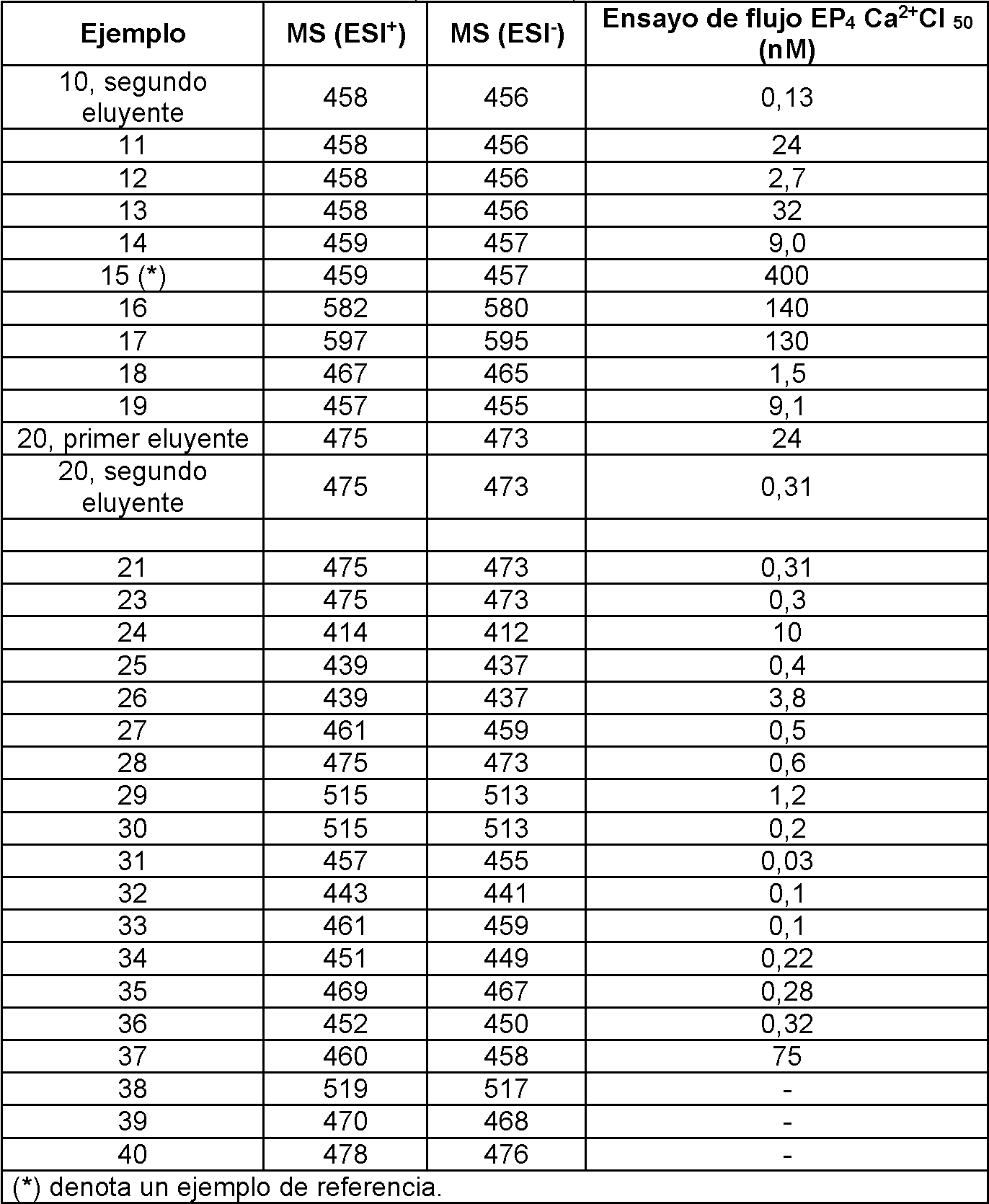
Modelo tumoral in vivo In vivo tumor model
A ratones Balb/C hembra se les implantó 1x10⁶ células de cáncer de colon CT26 (ATCC® CRL-2638™) en una solución de 2x10⁶ células/ml de +PBS. Las células se inyectaron por vía subcutánea en el flanco trasero izquierdo. Se midieron los tumores con calibradores y se calcularon los volúmenes tumorales mediante la fórmula: volumen tumoral = (longitud x anchura2)/2. Cuando los volúmenes tumorales eran de -150 mm3, los ratones se distribuyeron aleatoriamente en grupos (10 animales por grupo) y se trataron con el vehículo (0,5 % de metocel PO, dvd durante 11 días) o con el compuesto de prueba (30 mg/kg PO, dvd durante 11 días). Se determinaron los volúmenes tumorales 3 veces por semana hasta la finalización del estudio. Los resultados del compuesto A se muestran en las Figuras 1A y 1B.Female Balb/C mice were implanted with 1x10⁶ CT26 colon cancer cells (ATCC® CRL-2638™) in a solution of 2x10⁶ cells/ml +PBS. Cells were injected subcutaneously into the left hind flank. Tumors were measured with calipers and tumor volumes were calculated using the formula: tumor volume = (length x width 2 )/2. When tumor volumes were -150 mm3, mice were randomized into groups (10 animals per group) and treated with either vehicle (0.5% methocel PO, dvd for 11 days) or test compound ( 30 mg/kg PO, dvd for 11 days). Tumor volumes were determined 3 times per week until the end of the study. The results for compound A are shown in Figures 1A and 1B.
Preparación de compuestosCompound preparation
Los materiales de partida usados para la síntesis se sintetizaron o se obtuvieron de fuentes comerciales, tales como, pero sin limitación, Sigma-Aldrich, Fluka, Acros Organics, Alfa Aesar, Enamine, PharmaBlock, VWR Scientific, y similares. Las columnas de cromatografía de fase inversa y de fase normal se adquirieron en Teledyne ISCO, Inc. (NE). Los análisis de resonancia magnética nuclear (RMN) se llevaron a cabo con un espectrómetro Bruker Fourier de 300 MHz con un disolvente deuterado adecuado. Los espectros de LCMS se obtuvieron en un espectrómetro de masas Shimazu LCMS-2020 Series usando Ionización por electrospray (ESI) y una columna Luna C18 de 5 pM, de 2,0 x 50 mm, eluyendo con 95:5 a 0:100 H2O:MeCN 0,1 % de ácido fórmico a un caudal de 0,7 ml/min durante 3,5 minutos. Los métodos generales para la preparación de compuestos pueden modificarse mediante el uso de condiciones y reactivos adecuados para la introducción de los diversos restos encontrados en las estructuras según se proporcionan en el presente documento. Starting materials used for the synthesis were synthesized or obtained from commercial sources, such as, but not limited to, Sigma-Aldrich, Fluka, Acros Organics, Alfa Aesar, Enamine, PharmaBlock, VWR Scientific, and the like. Reverse phase and normal phase chromatography columns were purchased from Teledyne ISCO, Inc. (NE). Nuclear magnetic resonance (NMR) analyzes were carried out with a 300 MHz Bruker Fourier spectrometer with a suitable deuterated solvent. LCMS spectra were obtained on a Shimazu LCMS-2020 Series mass spectrometer using Electrospray Ionization (ESI) and a 5 pM Luna C18 column, 2.0 x 50 mm, eluting with 95:5 to 0:100 H2O. :MeCN 0.1% formic acid at a flow rate of 0.7 mL/min for 3.5 min. General methods for the preparation of compounds can be modified by the use of conditions and reagents suitable for the introduction of the various moieties found in the structures as provided herein.
A r vi ra r vi r

Esquema sintético generalGeneral synthetic scheme
Pueden prepararse compuestos de Fórmula la o Fórmula Ib de la presente divulgación, por ejemplo, a partir de una amina (1), o su correspondiente sal de amonio, y un ácido carboxílico (2) en presencia de un reactivo de acoplamiento apropiado, tal como HATU, CDI, o similares, y una base apropiada tal como trietilamina, etil-diisopropil-amina, o similares. Como alternativa, el ácido puede preactivarse mediante su conversión en el correspondiente cloruro de ácido usando un agente tal como cloruro de tionilo, cloruro de oxalilo, o similares. La amida 3 resultante se convierte en el compuesto diana I usando metodologías sintéticas apropiadas para la identidad del grupo funcional "G" en 3 y la identidad deseada del grupo funcional "W" en I. Los ejemplos de dichas conversiones incluyen, pero sin limitación: (a) hidrólisis de éster (es decir, "G" = CO2R, donde R puede ser metilo, etilo, bencilo, terc-butilo, o similares; y "W" = CO2H) usando condiciones bien conocidas tales como hidrólisis mediada por ácido (es decir, HCl, TFA, H2SO4, o similares), hidrólisis mediada por bases (es decir, NaOH, LiOH, Bu4NOH, o similares), hidrólisis mediada por nucleófilos (es decir, Lil, TMSI, Me3SnOH o similares), hidrólisis mediada por enzimas (esterasa de hígado de cerdo, candida antárctica lipasa, lipasa de candida rugosa, o similares), hidrogenólisis mediada por metales (Pd/C y H2, Pd(PPh3)4 y PMHS, o similares) y otros.Compounds of Formula la or Formula Ib of the present disclosure can be prepared, for example, from an amine (1), or its corresponding ammonium salt, and a carboxylic acid (2) in the presence of an appropriate coupling reagent, such as such as HATU, CDI, or the like, and an appropriate base such as triethylamine, ethyl-diisopropyl-amine, or the like. Alternatively, the acid can be preactivated by converting it to the corresponding acid chloride using an agent such as thionyl chloride, oxalyl chloride, or the like. The resulting amide 3 is converted to the target compound I using synthetic methodologies appropriate to the identity of the "G" functional group on 3 and the desired identity of the "W" functional group on I. Examples of such conversions include, but are not limited to: (a) ester hydrolysis (i.e., "G" = CO 2 R, where R may be methyl, ethyl, benzyl, tert-butyl, or the like; and "W" = CO 2 H) using well-known conditions such as acid-mediated hydrolysis (i.e., HCl, TFA, H 2 SO 4 , or the like), base-mediated hydrolysis (i.e., NaOH, LiOH, Bu 4 NOH, or the like). ), nucleophile-mediated hydrolysis (i.e., Lil, TMSI, Me 3 SnOH, or the like), enzyme-mediated hydrolysis (pig liver esterase, Candida antarctica lipase, Candida rugosa lipase, or the like), metal-mediated hydrogenolysis ( Pd/C and H 2 , Pd(PPh 3 ) 4 and PMHS, or the like) and others.
Como alternativa, el grupo éster antes mencionado puede derivarse primero (es decir, mono o bis-alquilación o arilación en el a-carbono a través del correspondiente enolato, si se aplica, o similares) antes de la hidrólisis.Alternatively, the aforementioned ester group may be first derivatized (ie, mono- or bis-alkylation or arylation at the α-carbon via the corresponding enolate, if applicable, or the like) prior to hydrolysis.
(b) reacción del nitrilo (es decir, "G" = CN) -(i) para formar un tetrazol (es decir, "W" = (b) reaction of the nitrile (i.e. "G" = CN)-(i) to form a tetrazole (i.e. "W" =

) calentando 3 con una fuente de azida apropiada (es decir, NaN3 , Bu3SnN3, BU4NN3, o similares), a menudo en presencia de un promotor apropiado (por ejemplo, ZnBr2 , Bu2Sn=O, NH4Cl, o similares);) by heating 3 with an appropriate azide source (ie, NaN 3 , Bu 3 SnN 3 , BU 4 NN 3 , or the like), often in the presence of an appropriate promoter (eg, ZnBr 2 , Bu 2 Sn=O , NH 4 Cl, or the like);
(ii) para formar una oxadiazalona (es decir, "W" =(ii) to form an oxadiazalone (i.e. "W" =

) calentando 3 con hidroxilamina y tratando después la W-hidroxiamidina resultante con CDI, o similares; y (iii) para formar un ácido carboxílico (es decir, "W" = CO2H) calentando 3 con KOH acuoso y etilenglicol, o similares.) heating 3 with hydroxylamine and then treating the resulting W-hydroxyamidine with CDI, or the like; and (iii) to form a carboxylic acid (ie, "W" = CO 2 H) by heating 3 with aqueous KOH and ethylene glycol, or the like.
(c) elaboración de un ácido carboxílico (es decir, "G" = CO2H) -(c) making a carboxylic acid (i.e. "G" = CO 2 H) -
(i) mediante la homologación Arndt-Eistert o similares, en casos donde Y es un enlace, para proporcionar el compuesto correspondiente donde Y es CH2;(i) by Arndt-Eistert homologation or the like, in cases where Y is a bond, to provide the corresponding compound where Y is CH 2 ;
(ii) en una acilsulfonamida mediante el acoplamiento de 3 con una sulfonamida en presencia de un agente de acoplamiento tal como DCC, o similares;(ii) into an acylsulfonamide by coupling 3 with a sulfonamide in the presence of a coupling agent such as DCC, or the like;
(iii) en un ácido hidroxámico mediante el acoplamiento de 3 con hidroxilamina en presencia de un agente de acoplamiento tal como T3P, o similares.(iii) into a hydroxamic acid by coupling 3 with hydroxylamine in the presence of a coupling agent such as T 3 P, or the like.

El ácido carboxílico 2 usado para el acoplamiento descrito en el Esquema 1 puede prepararse a partir del éster 5 mediante su W-alquilación inicial por un Ar-CH2-LG (es decir, 6) en donde LG es un grupo saliente tal como haluro, mesilato, tosilato, o similares, en presencia de una base apropiada (es decir NaH, Cs2CO3, KO(Bu, o similares). La hidrólisis posterior del éster 7 mediante procedimientos conocidos por los expertos en la materia, incluidos los descritos anteriormente, proporciona el ácido carboxílico 2.The carboxylic acid 2 used for the coupling described in Scheme 1 can be prepared from ester 5 by its initial W-alkylation by an Ar-CH 2 -LG (i.e., 6 ) where LG is a leaving group such as halide , mesylate, tosylate, or the like, in the presence of an appropriate base (i.e., NaH, Cs 2 CO 3 , KO(Bu, or the like). Subsequent hydrolysis of ester 7 by methods known to those skilled in the art, including those described above, provides the carboxylic acid 2 .

El compuesto 6 está disponible comercialmente, o puede prepararse convenientemente a partir del éster 8 mediante, por ejemplo, la reducción inicial de 8 usando reactivos tales como DIBAL-H, LiBH4, LiAlH4, o similares (Esquema 3) respecto al correspondiente alcohol 9. El tratamiento del alcohol 9 con cloruro de mesilo, anhídrido de tosilo, PBr3, o similares, en presencia de una base apropiada tal como NEt3, piridina, DABCO, o similares, proporciona el correspondiente compuesto 6. Por otra parte, la reducción de 8 usando agentes reductores deuterados tales como LiAlD4 permite acceder a análogos que contienen isótopos de deuterio estables en el carbono bencílico de 9. Compound 6 is commercially available, or can be conveniently prepared from ester 8 by, for example, the initial reduction of 8 using reagents such as DIBAL-H, LiBH4 , LiAlH4, or the like ( Scheme 3 ) to the corresponding alcohol 9 . Treatment of alcohol 9 with mesyl chloride, tosyl anhydride, PBr 3 , or the like, in the presence of an appropriate base such as NEt 3 , pyridine, DABCO, or the like, provides the corresponding compound 6 . On the other hand, reduction of 8 using deuterated reducing agents such as LiAlD 4 allows access to analogs containing stable deuterium isotopes at the benzylic carbon of 9 .
Esquema 3Scheme 3

Como alternativa, se puede acceder al intermedio de éster 7 mediante una arilación inicial de amina 10 con éster 11 para proporcionar el éster de anilina 12, seguido de una secuencia de anulación adecuada (Esquema 4). La arilación de 10 puede realizarse mediante el desplazamiento directo por SNAr de un fluoruro de arilo adecuadamente funcionalizado (es decir, 11 donde Hal = F) o mediante el acoplamiento catalizado por metales de un yoduro de arilo adecuadamente funcionalizado (es decir, 11 donde Hal = I). La secuencia de anulación puede implicar la heterociclación catalizada por metales del nitrógeno de anilina en el éster 12 sobre un alquino colgante (es decir, 12 donde FG = alquino) para obtener el éster biarílico fusionado 7a, o la condensación promovida por ácidos del intermedio de éster 12 con ácido fórmico, o similares, en presencia de un metal reductor (es decir, 12 donde FG = NO2) para obtener el éster biarílico fusionado 7b.Alternatively, ester intermediate 7 can be accessed by an initial arylation of amine 10 with ester 11 to provide aniline ester 12 , followed by a suitable annulation sequence ( Scheme 4 ). Arylation of 10 can be accomplished by direct SNAr displacement of an appropriately functionalized aryl fluoride (i.e., 11 where Hal = F) or by metal-catalyzed coupling of an appropriately functionalized aryl iodide (i.e., 11 where Hal = I). The annulation sequence may involve the metal-catalyzed heterocyclization of the aniline nitrogen in ester 12 onto a pendant alkyne (i.e., 12 where FG = alkyne) to obtain the fused biaryl ester 7a , or the acid-promoted condensation of the intermediate of ester 12 with formic acid, or the like, in the presence of a reducing metal (ie, 12 where FG=NO2) to obtain the fused biaryl ester 7b .

La amina 1 usada para el acoplamiento descrito en el Esquema 1 puede prepararse a partir del ácido carboxílico 13 (Esquema 5) mediante el reordenamiento de Curtius (es decir, por medio de una acil azida: 14 donde FG = N3), el reordenamiento de Hoffmann (es decir, por medio de una amida primaria: 14 donde FG = NH2), el reordenamiento de Lossen (es decir, por medio de un ácido hidroxámico: 14 donde FG = NHOH), o similares. La preparación de los precursores para las reacciones de reordenamiento (es decir, 14), así como los reactivos y las condiciones para las reacciones de reordenanamiento, son bien conocidos por los expertos en la materia, y se describen en libros de texto convencionales tales como March's Advanced Organic Chemistry, 7a Ed., John Wiley & Sons, 2013. El producto resultante, carbamato 15, puede desprotegerse directamente para revelar la amina 1 requerida usando condiciones conocidas por los expertos en la materia (es decir, por tratamiento con HCl, TFA, o similares cuando R es tere-butilo; o por hidrogenación en presencia de catalizadores tales como Pd/C, Pt/C, o similares cuando R es bencilo). Como alternativa, la eliminación del grupo protector carbamato puede posponerse hasta después de que se hayan completado todas las manipulaciones químicas deseadas del grupo(s) funcional(es) distal(es) al nitrógeno.The amine 1 used for the coupling described in Scheme 1 can be prepared from carboxylic acid 13 ( Scheme 5 ) via the Curtius rearrangement (i.e. via an acyl azide: 14 where FG = N 3 ), the rearrangement Hoffmann rearrangement (ie, via a primary amide: 14 where FG = NH 2 ), the Lossen rearrangement (ie, via a hydroxamic acid: 14 where FG = NHOH), or the like. The preparation of the precursors for the rearrangement reactions (i.e., 14 ), as well as the reagents and conditions for the rearrangement reactions, are well known to those skilled in the art, and are described in standard textbooks such as March's Advanced Organic Chemistry, 7th Ed., John Wiley & Sons, 2013. The resulting product, carbamate 15, can be directly deprotected to reveal the required amine 1 using conditions known to those skilled in the art (i.e., by treatment with HCl, TFA, or the like when R is tert-butyl; or by hydrogenation in the presence of catalysts such as Pd/C, Pt/C, or the like when R is benzyl). Alternatively, removal of the carbamate protecting group can be postponed until after all desired chemical manipulations of the functional group(s) distal to the nitrogen have been completed.

En los casos donde Ar de la amida 16 (Esquema 6) se sustituye con un halógeno tal como Br o I, puede considerarse deseable efectuar su transformación en, por ejemplo, (hetero)aril amida 17 o amida heterocíclica 18. Dicha conversión del grupo funcional puede realizarse fácilmente usando reacciones catalizadas por metales conocidas por los expertos en la materia. Los ejemplos de dichas conversiones pueden incluir, pero sin limitación: (a) reacción de Suzuki usando ácido (hetero)aril borónico o éster de (hetero)aril boronato como socio de acoplamiento, XPhos paladociclo, Pd(dppf)Cl2 o cualquier otro complejo de ligando de paladio adecuado como catalizador, y fosfato de potasio acuoso, carbonato de sodio o similares como base; (b) reacción de Buchwald-Hartwig usando amina primaria o secundaria como socio de acoplamiento, RuPhos paladociclo, BrettPhos paladociclo o cualquier otro complejo de ligando de paladio adecuado como catalizador, y tere-pentóxido de sodio, tere-butóxido de potasio o similares como base. In cases where Ar of amide 16 (Scheme 6) is substituted with a halogen such as Br or I, it may be considered desirable to effect its transformation to, for example, (hetero)aryl amide 17 or heterocyclic amide 18 . Such functional group conversion can be readily accomplished using metal-catalyzed reactions known to those skilled in the art. Examples of such conversions may include, but are not limited to: (a) Suzuki reaction using (hetero)aryl boronic acid or (hetero)aryl boronate ester as coupling partner, XPhos paladocycle, Pd(dppf)Cl 2 or any other suitable palladium ligand complex as a catalyst, and aqueous potassium phosphate, sodium carbonate or the like as a base; (b) Buchwald-Hartwig reaction using primary or secondary amine as coupling partner, RuPhos paladocycle, BrettPhos paladocycle or any other suitable palladium ligand complex as catalyst, and sodium tert-pentoxide, potassium tert-butoxide or the like as base.

Preparación de intermediosPreparation of intermediates
Ácido intermedio 1: ácido 1-(4-cianobencil)-1H-indol-7-carboxílicoIntermediate acid 1: 1-(4-cyanobenzyl)-1H-indole-7-carboxylic acid

A una solución de 1H-indol-7-carboxilato de metilo (1 eq.) en DMF (0,29 M) enfriada a 0 °C se añadió terc-butóxido de potasio (1,2 eq.) de forma que la temperatura de reacción no superara los 5 °C. La suspensión resultante se agitó a 0 °C durante 30 min y después a TA durante 30 min. La solución se volvió a enfriar a 0 °C y se añadió gota a gota 4-(bromometil)benzonitrilo (1,2 eq.) en DMF (0,69 M). Se dejó que la mezcla de reacción se calentara lentamente hasta TA durante 16 h y luego se inactivó con la adición de agua helada y se extrajo con EtOAc. Los extractos orgánicos combinados se lavaron además con agua, NaHCO3 ac. al 10 % y salmuera, se secaron sobre MgSO4 y se filtraron. La concentración del filtrado in vacuo produjo el producto de reacción crudo como un aceite viscoso de color amarillo, que se purificó por cromatografía en columna (SiO2 , elución en gradiente, 9:1 Hexano/EtOAc a EtOAc) para dar el producto como un aceite incoloro que se solidificó tras reposo (rendimiento del 75 %).To a solution of methyl 1H-indole-7-carboxylate (1 eq.) in DMF (0.29 M) cooled to 0 °C, potassium tert-butoxide (1.2 eq.) was added such that the temperature of reaction did not exceed 5 °C. The resulting suspension was stirred at 0°C for 30 min and then at RT for 30 min. The solution was recooled to 0 °C and 4-(bromomethyl)benzonitrile (1.2 eq.) in DMF (0.69 M) was added dropwise. The reaction mixture was allowed to slowly warm to RT over 16 h, then quenched with the addition of ice water and extracted with EtOAc. The combined organic extracts were further washed with water, NaHCO 3 aq. 10% and brine, dried over MgSO 4 and filtered. Concentration of the filtrate in vacuo afforded the crude reaction product as a viscous yellow oil, which was purified by column chromatography (SiO 2 , gradient elution, 9:1 Hexane/EtOAc to EtOAc) to give the product as a colorless oil that solidified on standing (75% yield).
El ácido 1-(4-cianobencil)-1H-indol-7-carboxílico (1 eq.) se disolvió en una solución 2:1 (v/v) (0,1 M) de THF y metanol. Se añadió LiOH (5 eq., solución ac. 2 N) y la solución se calentó a 50 °C durante 3 h. La mezcla de reacción se enfrió a TA y luego se neutralizó con HCl (5 eq., solución ac. 1 N). La suspensión se extrajo con EtOAc. Los extractos orgánicos combinados se lavaron además con agua y salmuera, se secaron sobre MgSO4 , y se filtraron. La concentración del filtrado in vacuo produjo el producto de reacción crudo como un aceite viscoso de color amarillo que se solidificó tras reposo. La trituración en tolueno dio el producto como un sólido cristalino de color blanco (rendimiento del 67 %).1-(4-Cyanobenzyl)-1H-indole-7-carboxylic acid (1 eq.) was dissolved in a 2:1 (v/v) (0.1M) solution of THF and methanol. LiOH (5 eq., 2N aq. solution) was added and the solution was heated at 50 °C for 3 h. The reaction mixture was cooled to RT and then neutralized with HCl (5 eq., 1N aq. solution). The suspension was extracted with EtOAc. The combined organic extracts were further washed with water and brine, dried over MgSO 4 , and filtered. Concentration of the filtrate in vacuo afforded the crude reaction product as a viscous yellow oil which solidified upon standing. Trituration in toluene gave the product as a white crystalline solid (67% yield).
Ácido intermedio 2: ácido 1-(4-(trifluorometil)bencil)-1H-indol-7-carboxílicoIntermediate acid 2: 1-(4-(trifluoromethyl)benzyl)-1H-indole-7-carboxylic acid

Preparado de forma análoga al Ácido intermedio 1, pero usando 1-(bromometil)-4-(trifluorometil)benceno (1.2 eq.) en lugar de 4-(bromometil)benzonitrilo.Prepared analogously to Acid intermediate 1 , but using 1-(bromomethyl)-4-(trifluoromethyl)benzene (1.2 eq.) in place of 4-(bromomethyl)benzonitrile.
Ácido intermedio 3: ácido 1-(4-(trifluorometil)bencil)-1H-pirrolo[3,2-blpiridina-7-carboxílicoIntermediate acid 3: 1-(4-(trifluoromethyl)benzyl)-1H-pyrrolo[3,2-bl-pyridine-7-carboxylic acid

Preparado de forma análoga al Ácido intermedio 1, pero usando 1H-pirrolo[3,2-b]piridin-7-carboxilato de metilo (1 eq.) en lugar de 1H-indol-7-carboxilato de metilo; y 1-(bromometil)-4-(trifluorometil)benceno (1.2 eq.) en lugar de 4-(bromometil)benzonitrilo.Prepared analogously to Acid intermediate 1 , but using methyl 1H-pyrrolo[3,2-b]pyridine-7-carboxylate (1 eq.) in place of methyl 1H-indole-7-carboxylate; and 1-(bromomethyl)-4-(trifluoromethyl)benzene (1.2 eq.) in place of 4-(bromomethyl)benzonitrile.
Ácido intermedio 4: ácido 1-(4-(trifluorometil)bencil)-1H-pirrolo[3,2-clpiridina-7-carboxílico Intermediate acid 4: 1-(4-(trifluoromethyl)benzyl)-1H-pyrrolo[3,2-clpyridine-7-carboxylic acid

Preparado de forma análoga al Ácido intermedio 1, pero usando 1H-pirrolo[3,2-c]pind¡na-7-carbox¡lato de metilo (1 eq.) en lugar de 1H-indol-7-carboxilato de metilo; y 1-(bromometil)-4-(trifluorometil)benceno (1.2 eq.) en lugar de 4-(bromometil)benzonitrilo.Prepared analogously to Acid Intermediate 1 , but using methyl 1H-pyrrolo[3,2-c]pindina-7-carboxylate (1 eq.) in place of methyl 1H-indole-7-carboxylate; and 1-(bromomethyl)-4-(trifluoromethyl)benzene (1.2 eq.) in place of 4-(bromomethyl)benzonitrile.
Ácido intermedio 5: ácido 1-(4-(tr¡fluoromet¡l)benc¡l)-1H-p¡rrolo12.3-c1p¡r¡d¡na-7-carboxíl¡coIntermediate acid 5: 1-(4-(trifluoromethyl)benzyl)-1H-pyrrolo12.3-c1pyridine-7-carboxylic acid

Preparado de forma análoga al Ácido intermedio 1, pero usando 1H-p¡rrolo[2,3-c]p¡^d¡na-7-carbox¡lato de metilo (1 eq.) en lugar de 1H-indol-7-carboxilato de metilo; y 1-(bromometil)-4-(trifluorometil)benceno (1.2 eq.) en lugar de 4-(bromometil)benzonitrilo.Prepared analogously to Acid intermediate 1 , but using methyl 1H-pyrrolo[2,3-c]p¡^d¡na-7-carboxylate (1 eq.) instead of 1H-indole-7 -methyl carboxylate; and 1-(bromomethyl)-4-(trifluoromethyl)benzene (1.2 eq.) in place of 4-(bromomethyl)benzonitrile.
Ácido intermedio 6: ácido 1-(4-(tr¡fluoromet¡l)benc¡l)-1H-¡ndazol-7-carboxíl¡coIntermediate acid 6: 1-(4-(trifluoromethyl)benzyl)-1H-¡ndazole-7-carboxylic acid

Una suspensión de 1H-indazol-7-carboxilato de metilo (1 eq.) y carbonato de cesio (3 eq.) en DMF (0,74 M) se enfrió a 0 °C y se añadió gota a gota 1-(bromometil)-4-(trifluorometil)benceno (1,2 eq., 0,89 M en DMF). La mezcla de reacción se dejó calentar lentamente hasta ta durante 16 h y luego se inactivó con agua helada y se extrajo con TBME. Los extractos orgánicos combinados se lavaron además con agua y salmuera, se secaron sobre MgSO4 , y se filtraron. La concentración del filtrado in vacuo produjo el producto de reacción crudo como un aceite de color amarillo dorado, que se purificó con cromatografía en columna (SO 2, 9:1 (v/v) Hex:EtOAc a EtOAc) para dar el producto como un aceite incoloro (rendimiento del 76 %).A suspension of methyl 1H-indazole-7-carboxylate (1 eq.) and cesium carbonate (3 eq.) in DMF (0.74 M) was cooled to 0 °C and 1-(bromomethyl )-4-(trifluoromethyl)benzene (1.2 eq., 0.89 M in DMF). The reaction mixture was allowed to slowly warm to rt over 16 h, then quenched with ice water and extracted with TBME. The combined organic extracts were further washed with water and brine, dried over MgSO 4 , and filtered. Concentration of the filtrate in vacuo afforded the crude reaction product as a golden yellow oil, which was purified by column chromatography (SO 2 , 9:1 (v/v) Hex:EtOAc to EtOAc) to give the product as a colorless oil (76% yield).
El producto de la etapa anterior (1 eq.) se disolvió en una solución 3:2 (v/v) (0,11 M) de THF y metanol y se añadió LiOH (3 eq., solución ac. 2 N). La solución resultante se agitó a TA durante 16 h y se neutralizó con HCl (3 eq., solución ac. 1 N). La suspensión resultante se extrajo con EtOAc y los extractos orgánicos combinados se lavaron además con agua y salmuera, se secaron sobre MgSO4 , y se filtraron. La concentración del filtrado in vacuo produjo el producto de reacción crudo como un aceite viscoso. La recristalización a partir de TBME y hexanos dio el producto como un sólido cristalino de color blanco (rendimiento del 60 %).The product from the previous step (1 eq.) was dissolved in a 3:2 (v/v) solution (0.11 M) of THF and methanol and LiOH (3 eq., 2N aq. solution) was added. The resulting solution was stirred at RT for 16 h and neutralized with HCl (3 eq., 1N aq. solution). The resulting suspension was extracted with EtOAc and the combined organic extracts were washed further with water and brine, dried over MgSO 4 , and filtered. Concentration of the filtrate in vacuo produced the crude reaction product as a viscous oil. Recrystallization from TBME and hexanes gave the product as a white crystalline solid (60% yield).
Ácido intermedio 7: ácido 1-(4-(tr¡fluoromet¡l)benc¡l)-1H-benzo[d1¡m¡dazol-7-carboxíl¡coIntermediate acid 7: 1-(4-(trifluoromethyl)benzyl)-1H-benzo[d1m-dazole-7-carboxylic acid

Se combinó 2-fluoro-3-nitrobenzoato de metilo (1 eq.), (4-(trifluorometil)fenil) metanamina (1,5 eq.) y carbonato potásico (2 eq.) en DMF (0,24 M) y la suspensión se calentó a 80 °C durante 2 h. La reacción se enfrió hasta ta, se diluyó con EtOAc y se lavó secuencialmente con NH4Cl ac. al 10 %, agua y salmuera. La capa orgánica se secó luego sobre MgSO4 y se filtró. La concentración del filtrado in vacuo produjo el producto de reacción crudo como un semisólido de color amarillo. La purificación por cromatografía en columna (SO 2, 9:1 (v/v) Hex:EtOAc a 3:7 (v/v) Hex:EtOAc) dio 3-n¡tro-2-((4-(tr¡fluoromet¡l)benc¡l)am¡no)benzoato de metilo como un aceite de color amarillo dorado (rendimiento del 56 %).Methyl 2-fluoro-3-nitrobenzoate (1 eq.), (4-(trifluoromethyl)phenyl)methanamine (1.5 eq.) and potassium carbonate (2 eq.) in DMF (0.24 M) and the suspension was heated at 80 °C for 2 h. The reaction was cooled to rt, diluted with EtOAc and washed sequentially with aq NH 4 Cl. 10%, water and brine. The organic layer was then dried over MgSO 4 and filtered. Concentration of the filtrate in vacuo afforded the crude reaction product as a yellow semi-solid. Purification by column chromatography (SO 2 , 9:1 (v/v) Hex:EtOAc to 3:7 (v/v) Hex:EtOAc) gave 3-n¡tro-2-((4-(tr¡ Methyl fluoromethyl)benzyl)amino)benzoate as a golden yellow oil (56% yield).
Se disolvió 3-n¡tro-2-((4-(tr¡fluoromet¡l)benc¡l)benzoato de metilo (1 eq.), polvo de hierro (10 eq.) y cloruro de amonio (10 eq.) en una solución 1:1 (v/v) (0,05 M) de 2-propanol y ácido fórmico. El recipiente se cerró herméticamente y se calentó a 80 °C durante 3 h. La suspensión se enfrió hasta ta, se diluyó con 2-propanol y se filtró a través de celite. El filtrado se concentró in vacuo y el residuo resultante se recogió en DCM. Después, la solución se lavó secuencialmente con NaOH ac. 1 N, agua y salmuera, se secó sobre MgSO4 , y se filtró. La concentración del filtrado in vacuo produjo el producto crudo de la reacción como un aceite de color naranja. La purificación por cromatografía en columna (SÍO2 , 9:1 (v/v) Hex:EtOAc a EtOAc) dio 1-(4-(trifluorometil)bencil)-1H-benzo[d] imidazol-7-carboxilato de metilo como un aceite de color naranja (rendimiento del 31 %).Methyl 3-nitro-2-((4-(trifluoromethyl)benzyl)benzoate (1 eq.), iron powder (10 eq.) and ammonium chloride (10 eq. ) in a 1:1 (v/v) solution (0.05 M) of 2-propanol and formic acid. The vessel was sealed and heated at 80 °C for 3 h. The suspension was cooled to rt, The solution was diluted with 2-propanol and filtered through celite.The filtrate was concentrated in vacuo and the resulting residue was taken up in DCM.The solution was then washed sequentially with 1N aq NaOH, water and brine, dried over MgSO 4 , and filtered Concentration of the filtrate in vacuo gave crude reaction product as an orange oil. Purification by column chromatography (SO 2 , 9:1 (v/v) Hex:EtOAc to EtOAc) gave methyl 1-(4-(trifluoromethyl)benzyl)-1H-benzo[d]imidazole-7-carboxylate as an orange colored oil (31% yield).
Se disolvió 1-(4-(trifluorometil)bencil)-1H-benzo[d]imidazol-7-carboxilato de metilo (1 eq.) en una solución 2:1 (v/v) (0,04 M) de THF y metanol y se añadió LiOH (3 eq., solución ac. 2 N). La solución se agitó a temperatura ambiente durante 16 h y luego se neutralizó con HCl (3 eq., solución ac. 1 N). Los volátiles se eliminaron in vacuo y el residuo sólido se trituró en agua para dar ácido 1-(4-(trifluorometil)bencil)-1H-benzo[d]imidazol-7-carboxílico como un sólido cristalino de color blanco (rendimiento del 58 %).Methyl 1-(4-(trifluoromethyl)benzyl)-1H-benzo[d]imidazole-7-carboxylate (1 eq.) was dissolved in a 2:1 (v/v) (0.04 M) solution of THF and methanol and LiOH (3 eq., 2N aq. solution) was added. The solution was stirred at room temperature for 16 h and then neutralized with HCl (3 eq., 1N aq. solution). The volatiles were removed in vacuo and the solid residue was triturated in water to give 1-(4-(trifluoromethyl)benzyl)-1H-benzo[d]imidazole-7-carboxylic acid as a white crystalline solid (58% yield). %).
Ácido intermedio 8 : ácido 1 -((4 -(trifluorometil)fenil)-metil-d2)-1 H-indol-7 -carboxílicoIntermediate acid 8 : 1 -(( 4 -(trifluoromethyl)phenyl)-methyl-d 2 )- 1 H-indole- 7 -carboxylic acid

Se disolvió 4-(trifluorometil)benzoato de metilo (1 eq.) en THF (0,3 M) y se enfrió a 0 °C. Se añadió deuteruro de aluminio y litio (1 eq.) y la suspensión resultante se calentó lentamente hasta ta durante 16 h. La reacción se enfrió hasta 0 °C y se inactivó con HCl ac. 1 N y luego se extrajo con DCM. Los extractos orgánicos combinados se lavaron además con agua y salmuera, se secaron sobre MgSO4 y se filtraron. La concentración del filtrado in vacuo produjo el producto de reacción crudo como un aceite incoloro. La purificación por cromatografía en columna (SO 2, Hex a 3:7 (v/v) Hex:EtOAc) dio (4 -(trifluorometil)fenil)-metan-d2-ol como un aceite incoloro (rendimiento del 61 %).Methyl 4-(trifluoromethyl)benzoate (1 eq.) was dissolved in THF (0.3M) and cooled to 0°C. Lithium aluminum deuteride (1 eq.) was added and the resulting suspension was slowly warmed to rt over 16 h. The reaction was cooled to 0°C and quenched with aq. HCl. 1N and then extracted with DCM. The combined organic extracts were further washed with water and brine, dried over MgSO 4 and filtered. Concentration of the filtrate in vacuo afforded the crude reaction product as a colorless oil. Purification by column chromatography (SO 2 , Hex at 3:7 (v/v) Hex:EtOAc) gave ( 4- (trifluoromethyl)phenyl)-methan-d 2 -ol as a colorless oil (61% yield). .
Se combinó (4 -(trifluorometil)fenil)-metan-d2-ol (1 eq.) y trietilamina (1,5 eq.) en DCM (0,39 M), se enfrió a 0 °C y se añadió gota a gota cloruro de metanosulfonilo (1,2 eq.). La solución resultante se agitó a 0 °C durante 30 min y luego a ta durante 1,5 h. A continuación, la mezcla de reacción se diluyó con TBME y se lavó secuencialmente con agua, NaOH ac. 1 N, HCl ac. 1 N, agua y finalmente salmuera. El extracto orgánico se secó después sobre MgSO4 y se filtró. La concentración del filtrado in vacuo produjo ((4 -(trifluorometil)fenil)-metil-d2)-metanosulfonato crudo deseado como un aceite incoloro (rendimiento >99 %).( 4- (Trifluoromethyl)phenyl)-methan-d 2 -ol (1 eq.) and triethylamine (1.5 eq.) in DCM (0.39 M) were combined, cooled to 0 °C and added dropwise. dropwise methanesulfonyl chloride (1.2 eq.). The resulting solution was stirred at 0 °C for 30 min and then at rt for 1.5 h. The reaction mixture was then diluted with TBME and washed sequentially with water, NaOH aq. 1N, HCl aq. 1 N, water and finally brine. The organic extract was then dried over MgSO 4 and filtered. Concentration of the filtrate in vacuo afforded the desired crude (( 4- (trifluoromethyl)phenyl)-methyl-d 2 )-methanesulfonate as a colorless oil (>99% yield).
Se disolvió 1H-indol-7-carboxilato de metilo (1 eq.) en DMF (0,32 M) y se enfrió a 0 °C. Se añadió ferc-butóxido de potasio (1,2 eq.) a lo largo de 20 min de forma que la temperatura interna de la reacción no superara los 5 °C. La suspensión resultante se agitó a 0 °C durante 30 min, a ta durante 30 min, y se volvió a enfriar a 0 °C. Se añadió gota a gota ((4 -(trifluorometil)fenil)-metil-d2)-metanosulfonato (1,2 eq.) de la etapa anterior como solución de DMF (0,2 M). La mezcla de reacción resultante se calentó lentamente hasta ta durante 16 h y luego se inactivó con óxido de deuterio y se extrajo con EtOAc. Los extractos orgánicos combinados se lavaron además con agua, NaHCO3 ac. al 10 % y salmuera, se secaron sobre MgSO4 y se filtraron. La concentración del filtrado in vacuo produjo el producto de reacción crudo como un aceite viscoso. La purificación por cromatografía en columna (SO 2, 9:1 (v/v) Hex: EtOAc a EtOAc) dio 1 -((4 -(trifluorometil)fenil)-metil-d2)-1 H-/ndol-7 -carboxilato de metilo como un aceite incoloro (rendimiento del 59 %). Methyl 1H-indole-7-carboxylate (1 eq.) was dissolved in DMF (0.32M) and cooled to 0°C. Potassium tert-butoxide (1.2 eq.) was added over 20 min so that the internal temperature of the reaction did not exceed 5 °C. The resulting suspension was stirred at 0 °C for 30 min, at rt for 30 min, and recooled to 0 °C. (( 4- (trifluoromethyl)phenyl)-methyl-d 2 )-methanesulfonate (1.2 eq.) from the previous step as DMF solution (0.2 M) was added dropwise. The resulting reaction mixture was slowly warmed to rt for 16 h, then quenched with deuterium oxide and extracted with EtOAc. The combined organic extracts were further washed with water, NaHCO 3 aq. 10% and brine, dried over MgSO 4 and filtered. Concentration of the filtrate in vacuo produced the crude reaction product as a viscous oil. Purification by column chromatography (SO 2 , 9:1 (v/v) Hex: EtOAc to EtOAc) gave 1 -(( 4 -(trifluoromethyl)phenyl)-methyl-d 2 )- 1 H-/ndol- 7 -methyl carboxylate as a colorless oil (59% yield).
Se disolvió 1 -((4 -(trifluorometil)fenil)-metil-d2)-1 H-indol-7 -carboxilato de metilo (1 eq.) en una solución 2:1 (v/v) (0,1 M) de THF y se añadió metanol y LiOH (3 eq., solución ac. 2 N). La solución resultante se calentó a 50 °C durante 3 h, se enfrió a ta y se neutralizó con HCl (3 eq., solución ac. 1 N). La suspensión resultante se filtró y la torta sólida se enjuagó con una solución fría 1:1 (v/v) de metanol y agua. El producto ácido 1 -((4 -(trifluorometil)fenil)-metil-d2)-1 H-indol-7 -carboxílico se secó in vacuo durante 16 h, proporcionando un sólido cristalino (rendimiento del 61 %).Methyl 1 -(( 4 -(trifluoromethyl)phenyl)-methyl-d 2 )- 1 H-indole- 7 -carboxylate (1 eq.) was dissolved in a 2:1 (v/v) solution (0.1 M) of THF and added methanol and LiOH (3 eq., 2N aq. solution). The resulting solution was heated at 50 °C for 3 h, cooled to rt and neutralized with HCl (3 eq., 1N aq. solution). The resulting suspension was filtered and the solid cake was rinsed with a cold 1:1 (v/v) solution of methanol and water. The 1 -(( 4- (trifluoromethyl)phenyl)-methyl-d 2 ) -1 H-indole- 7 -carboxylic acid product was dried in vacuo for 16 h to give a crystalline solid (61% yield).
Ácido intermedio 9: ácido 4-fluoro-1-(4-(trifluorometil)bencil)-1H-indol-7-carboxílicoIntermediate acid 9: 4-fluoro-1-(4-(trifluoromethyl)benzyl)-1H-indole-7-carboxylic acid
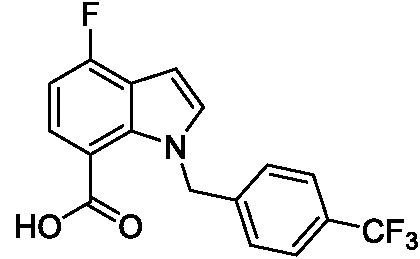
Preparado de forma análoga al Ácido intermedio 1, pero usando 4-fluoro-1H-indol-7-carboxilato de metilo (1 eq.) en lugar de 1H-indol-7-carboxilato de metilo; y 1-(bromometil)-4-(trifluorometil)benceno (1.2 eq.) en lugar de 4-(bromometil)benzonitrilo.Prepared analogously to Acid Intermediate 1 , but using methyl 4-fluoro-1H-indole-7-carboxylate (1 eq.) in place of methyl 1H-indole-7-carboxylate; and 1-(bromomethyl)-4-(trifluoromethyl)benzene (1.2 eq.) in place of 4-(bromomethyl)benzonitrile.
Ácido intermedio 10: ácido 5-fluoro-1-(4-(trifluorometil)bencil)-1H-indol-7-carboxílico Intermediate acid 10: 5-fluoro-1-(4-(trifluoromethyl)benzyl)-1H-indole-7-carboxylic acid

Preparado de forma análoga al Ácido intermedio 1, pero usando 5-fluoro-1H-indol-7-carbox¡lato de metilo (1 eq.) en lugar de 1H-indol-7-carboxilato de metilo; y 1-(bromometil)-4-(trifluorometil)benceno (1.2 eq.) en lugar de 4-(bromometil)benzonitrilo.Prepared analogously to Acid Intermediate 1 , but using methyl 5-fluoro-1H-indole-7-carboxylate (1 eq.) in place of methyl 1H-indole-7-carboxylate; and 1-(bromomethyl)-4-(trifluoromethyl)benzene (1.2 eq.) in place of 4-(bromomethyl)benzonitrile.
Ácido intermedio 11: ácido 5-cloro-1-(4-(tr¡fluoromet¡l)benc¡l)-1H-¡ndol-7-carboxíl¡coIntermediate acid 11: 5-chloro-1-(4-(trifluoromethyl)benzyl)-1H-indole-7-carboxylic acid

Preparado de forma análoga al Ácido intermedio 1, pero usando 5-cloro-1H-indol-7-carboxilato de metilo (1 eq.) en lugar de 1H-indol-7-carboxilato de metilo; y 1-(bromometil)-4-(trifluorometil)benceno (1.2 eq.) en lugar de 4-(bromometil)benzonitrilo.Prepared analogously to Acid Intermediate 1 , but using methyl 5-chloro-1H-indole-7-carboxylate (1 eq.) in place of methyl 1H-indole-7-carboxylate; and 1-(bromomethyl)-4-(trifluoromethyl)benzene (1.2 eq.) in place of 4-(bromomethyl)benzonitrile.
Ácido intermedio 12: ácido 6-fluoro-1-(4-(tr¡fluoromet¡l)benc¡l)-1H-¡ndol-7-carboxíl¡coIntermediate acid 12: 6-fluoro-1-(4-(trifluoromethyl)benzyl)-1H-indole-7-carboxylic acid

Preparado de forma análoga al Ácido intermedio 1, pero usando 6-fluoro-1H-indol-7-carboxilato de metilo (1 eq.) en lugar de 1H-indol-7-carboxilato de metilo; y 1-(bromometil)-4-(trifluorometil)benceno (1.2 eq.) en lugar de 4-(bromometil)benzonitrilo.Prepared analogously to Acid Intermediate 1 , but using methyl 6-fluoro-1H-indole-7-carboxylate (1 eq.) in place of methyl 1H-indole-7-carboxylate; and 1-(bromomethyl)-4-(trifluoromethyl)benzene (1.2 eq.) in place of 4-(bromomethyl)benzonitrile.
Ácido intermedio 13: ácido 1-(4-(d¡fluoromet¡l)benc¡l)-1H-¡ndol-7-carboxíl¡coIntermediate acid 13: 1-(4-(difluoromethyl)benzyl)-1H-indole-7-carboxylic acid

Preparado de forma análoga al Ácido intermedio 1, pero usando 1-(clorometil)-4-(difluorometil)benceno (1.2 eq.) en lugar de 4-(bromometil)benzonitrilo.Prepared analogously to Acid intermediate 1 , but using 1-(chloromethyl)-4-(difluoromethyl)benzene (1.2 eq.) in place of 4-(bromomethyl)benzonitrile.
Ácido intermedio 14: ácido 1-(4-(d¡fluoromet¡l)benc¡l)-4-fluoro-1H-¡ndol-7-carboxíl¡coIntermediate acid 14: 1-(4-(difluoromethyl)benzyl)-4-fluoro-1H-indole-7-carboxylic acid

Preparado de forma análoga al Ácido intermedio 1, pero usando 4-fluoro-1H-indol-7-carboxilato de metilo (1 eq.) en lugar de 1H-indol-7-carboxilato de metilo; y 1-(clorometil)-4-(difluorometil)benceno (1,2 eq.) en lugar de 4-(bromometil)benzonitrilo.Prepared analogously to Acid Intermediate 1 , but using methyl 4-fluoro-1H-indole-7-carboxylate (1 eq.) in place of methyl 1H-indole-7-carboxylate; and 1-(chloromethyl)-4-(difluoromethyl)benzene (1.2 eq.) in place of 4-(bromomethyl)benzonitrile.
Ácido intermedio 15: ácido 1-(4-(pentafluoro-Á6-sulfane¡l)benc¡l)-1H-¡ndol-7-carboxíl¡co Intermediate acid 15: 1-(4-(pentafluoro-Á6-sulfane¡l)benzil)-1H-¡ndole-7-carboxylic acid

Preparado de forma análoga al Ácido intermedio 1, pero usando bromuro de 4-(pentafluorotio)bencilo (1,2 eq.) en lugar de 4-(bromometil)benzonitrilo.Prepared analogously to Acid intermediate 1 , but using 4-(pentafluorothio)benzyl bromide (1.2 eq.) in place of 4-(bromomethyl)benzonitrile.
Ácido intermedio 16: ácido 1-([1.1'-bifenill-4-ilmetil)-1H-indol-7-carboxílicoIntermediate acid 16: 1-([1.1'-biphenyll-4-ylmethyl)-1H-indole-7-carboxylic acid

Preparado de forma análoga al Ácido intermedio 1. pero usando 4-(bromometil)-1.1'-bifenilo (1.2 eq.) en lugar de 4-(bromometil)benzonitrilo.Prepared analogously to Acid intermediate 1 . but using 4-(bromomethyl)-1,1'-biphenyl (1.2 eq.) instead of 4-(bromomethyl)benzonitrile.
Ácido intermedio 17: ácido 1-([1.1'-bifenill-4-ilmetil)-4-fluoro-1H-indol-7-carboxílicoIntermediate acid 17: 1-([1.1'-biphenyll-4-ylmethyl)-4-fluoro-1H-indole-7-carboxylic acid

Preparado de forma análoga al Ácido intermedio 1. pero usando 4-fluoro-1H-indol-7-carboxilato de metilo (1 eq.) en lugar de 1H-indol-7-carboxilato de metilo; y 4-(bromometil)-1.1'-bifenilo (1.2 eq.) en lugar de 4-(bromometil)benzonitrilo. Ácido intermedio 18: ácido 1-([1.1'-bifenill-4-ilmetil)-1H-indazol-7-carboxílicoPrepared analogously to Acid intermediate 1 . but using methyl 4-fluoro-1H-indole-7-carboxylate (1 eq.) instead of methyl 1H-indole-7-carboxylate; and 4-(bromomethyl)-1,1'-biphenyl (1.2 eq.) in place of 4-(bromomethyl)benzonitrile. Intermediate acid 18: 1-([1.1'-biphenyll-4-ylmethyl)-1H-indazole-7-carboxylic acid

Preparado de forma análoga al Ácido intermedio 6. pero usando 4-(bromometil)-1.1'-bifenilo (1.2 eq.) en lugar de 1-(bromometil)-4-(trifluorometil)benceno.Prepared analogously to Acid intermediate 6 . but using 4-(bromomethyl)-1,1'-biphenyl (1.2 eq.) instead of 1-(bromomethyl)-4-(trifluoromethyl)benzene.
Ácido intermedio 19: ácido 1-(4-(trifluorometoxi)bencilo)-1H-indazol-7-carboxílicoIntermediate acid 19: 1-(4-(trifluoromethoxy)benzyl)-1H-indazole-7-carboxylic acid
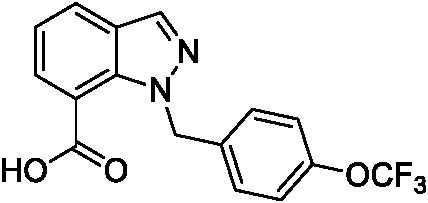
Preparado de forma análoga al Ácido intermedio 6. pero usando 1-(bromometil)-4-(trifluorometoxi)benceno (1.2 eq.) en lugar de 1-(bromometil)-4-(trifluorometil)benceno.Prepared analogously to Acid intermediate 6 . but using 1-(bromomethyl)-4-(trifluoromethoxy)benzene (1.2 eq.) instead of 1-(bromomethyl)-4-(trifluoromethyl)benzene.
Ácido intermedio 20: ácido 4-fluoro-1-(4-yodobencil)-1H-indol-7-carboxílicoIntermediate acid 20: 4-fluoro-1-(4-iodobenzyl)-1H-indole-7-carboxylic acid

Preparado de forma análoga al Ácido intermedio 1. pero usando 4-fluoro-1H-indol-7-carboxilato de metilo (1 eq.) en lugar de 1H-indol-7-carboxilato de metilo; y 1-(bromometil)-4-yodobenceno (1,2 eq.) en lugar de 4-(bromometil)benzonitrilo.Prepared analogously to Acid intermediate 1 . but using methyl 4-fluoro-1H-indole-7-carboxylate (1 eq.) in methyl 1H-indole-7-carboxylate place; and 1-(bromomethyl)-4-iodobenzene (1.2 eq.) in place of 4-(bromomethyl)benzonitrile.
Amina intermedia 1: clorhidrato de 2-(3-aminobiciclo[1.1.11pentan-1-il)acetato de etiloIntermediate amine 1: ethyl 2-(3-aminobicyclo[1.1.11pentan-1-yl)acetate hydrochloride

El ácido 3-(metoxicarbonil)biciclo[1.1.11pentan-1-carboxílico (1 eq.) se disolvió en terc-butanol (0,25 M) y se añadió secuencialmente trietilamina (1 eq.) y difenilfosforil azida (1,5 eq.). La solución resultante se agitó a TA durante 1 h y luego se calentó a 80 °C durante 22 h. A continuación, los volátiles se eliminaron in vacuo y el residuo resultante se recogió en EtOAc. La capa orgánica se lavó luego secuencialmente con agua y salmuera, se secó sobre MgSO4 y se filtró. La concentración del filtrado in vacuo produjo el producto de reacción crudo como un aceite viscoso. La purificación por cromatografía en columna (SO 2, 9:1 (v/v) Hex: EtOAc a 1:1 (v/v) Hex: EtOAc) dio 3-((terc-butoxicarbonil)amino biciclo[1.1.11pentan-1-carboxilato de metilo como un sólido cristalino de color blanco (rendimiento del 79 %).3-(Methoxycarbonyl)bicyclo[1.1.11pentane-1-carboxylic acid (1 eq.) was dissolved in tert-butanol (0.25 M) and triethylamine (1 eq.) and diphenylphosphoryl azide (1.5 M) were added sequentially. equ.). The resulting solution was stirred at RT for 1h and then heated at 80°C for 22h. The volatiles were then removed in vacuo and the resulting residue was taken up in EtOAc. The organic layer was then washed sequentially with water and brine, dried over MgSO 4 and filtered. Concentration of the filtrate in vacuo produced the crude reaction product as a viscous oil. Purification by column chromatography (SO 2 , 9:1 (v/v) Hex: EtOAc to 1:1 (v/v) Hex: EtOAc) gave 3- (( tert- butoxycarbonyl)amino bicyclo[1.1.11pentan- Methyl 1-carboxylate as a white crystalline solid (79% yield).
Se disolvió 3-((terc-butoxicarbonil)amino)biciclo[1.1.11pentan-1-carboxilato de metilo (1 eq.) en THF (0,13 M), se enfrió la solución hasta 0 °C y se añadió gota a gota LiBH4 (10 eq., solución de THF 1 M). La mezcla resultante se calentó lentamente hasta ta durante 18 h, se inactivó con NH4Cl ac. al 10 % y los volátiles se eliminaron in vacuo. El residuo acuoso resultante se diluyó además después con agua y se extrajo con EtOAc y Me-THF. Los extractos orgánicos combinados se lavaron después además con agua y salmuera, se secaron sobre MgSO4, se filtraron y el filtrado se concentró in vacuo. La purificación se realizó mediante cromatografía en columna (SiO2, 9:1 (v/v) Hex: EtOAc a 3:7 (v/v) Hex: EtOAc) dio (3-(hidroximetil)biciclo[1.1.11pentan-1-il)carbamato de terc-butilo como sólido cristalino de color blanco (rendimiento del 78 %).Methyl 3-((tert-butoxycarbonyl)amino)bicyclo[1.1.11pentane-1-carboxylate (1 eq.) was dissolved in THF (0.13 M), the solution was cooled to 0 °C and added dropwise to drop LiBH 4 (10 eq., 1M THF solution). The resulting mixture was slowly warmed to rt over 18 h, quenched with NH 4 Cl aq. 10% and the volatiles were removed in vacuo. The resulting aqueous residue was then further diluted with water and extracted with EtOAc and Me-THF. The combined organic extracts were then washed further with water and brine, dried over MgSO 4 , filtered, and the filtrate concentrated in vacuo. Purification was by column chromatography (SiO 2 , 9:1 (v/v) Hex:EtOAc to 3:7 (v/v) Hex:EtOAc) gave (3-(hydroxymethyl)bicyclo[1.1.11pentan-1 -yl)carbamate tert-butyl as white crystalline solid (78% yield).
Se combinó (3-(hidroximetil)biciclo[1.1.11pentan-1-il)carbamato de terc-butilo (1 eq.) y trietilamina (1,5 eq.) en DCM (0,21 M), se enfrió a 0 °C y se añadió gota a gota cloruro de metanosulfonilo (1,2 eq.). La solución resultante se agitó a 0 °C durante 30 min y después a ta durante 18 h. La mezcla de reacción se diluyó entonces con EtOAc y se lavó secuencialmente con agua y salmuera. El extracto orgánico se secó después sobre MgSO4 y se filtró. La concentración del filtrado in vacuo produjo metanosulfonato de (3-((terc-butoxicarbonil)amino)biciclo[1.1.11pentan-1-il)metilo crudo deseado como un sólido cristalino de color blanco (rendimiento del 99 %).Combine tert-butyl (3-(hydroxymethyl)bicyclo[1.1.11pentan-1-yl)carbamate (1 eq.) and triethylamine (1.5 eq.) in DCM (0.21 M), cool to 0 °C and methanesulfonyl chloride (1.2 eq.) was added dropwise. The resulting solution was stirred at 0 °C for 30 min and then at rt for 18 h. The reaction mixture was then diluted with EtOAc and washed sequentially with water and brine. The organic extract was then dried over MgSO 4 and filtered. Concentration of the filtrate in vacuo afforded the desired crude (3-((tert-butoxycarbonyl)amino)bicyclo[1.1.11pentan-1-yl)methyl methanesulfonate as a white crystalline solid (99% yield).
Se combinó metanosulfonato de (3-((terc-butoxicarbonil)amino)biciclo[1.1.11pentan-1-il)metilo (1 eq.) y KCN (2 eq.) en DMF (0,075 M) y se calentó a 70 °C durante 24 h. La mezcla de reacción cruda se enfrió hasta ta, se diluyó con TBME y se lavó secuencialmente con agua y salmuera. El extracto orgánico se secó después sobre MgSO4 y se filtró. La concentración del filtrado in vacuo produjo (3-(cianometil)biciclo[1.1.11pentan-1-il)carbamato de terc-butilo crudo como un aceite de color amarillo pálido (rendimiento del 92 %).Combined (3-((tert-butoxycarbonyl)amino)bicyclo[1.1.11pentan-1-yl)methyl methanesulfonate (1 eq.) and KCN (2 eq.) in DMF (0.075 M) and heated to 70° C for 24 hours. The crude reaction mixture was cooled to rt, diluted with TBME and washed sequentially with water and brine. The organic extract was then dried over MgSO 4 and filtered. Concentration of the filtrate in vacuo afforded crude tert-butyl (3-(cyanomethyl)bicyclo[1.1.11pentan-1-yl)carbamate as a pale yellow oil (92% yield).
Se disolvió (3-(cianometil)biciclo[1.1.11pentan-1-il)carbamato de terc-butilo (1 eq.) en etanol (0,14 M) y se burbujeó con HCl gaseoso (con enfriamiento) durante 10 min. A continuación, el recipiente de reacción se cerró herméticamente y se calentó a 75 °C durante 48 h, y después se enfrió a ta y se ventiló cuidadosamente. Se añadió agua (10 eq.) y la mezcla de reacción se agitó a ta durante 3 h. Los volátiles se eliminaron in vacuo y el residuo resultante se trituró en etanol y DCM durante 30 min, se filtró y el filtrado se concentró después in vacuo para producir 2-(3-aminobiciclo[1.1.11pentan-1-il)acetato de etilo crudo como un sólido higroscópico (rendimiento del 93 %).tert-Butyl (3-(cyanomethyl)bicyclo[1.1.11pentan-1-yl)carbamate (1 eq.) was dissolved in ethanol (0.14 M) and bubbled with HCl gas (with cooling) for 10 min. The reaction vessel was then sealed and heated at 75 °C for 48 h, then cooled to rt and carefully ventilated. Water (10 eq.) was added and the reaction mixture was stirred at rt for 3h. Volatiles were removed in vacuo and the resulting residue was triturated in ethanol and DCM for 30 min, filtered, and the filtrate was then concentrated in vacuo to yield ethyl 2-(3-aminobicyclo[1.1.11pentan-1-yl)acetate. crude as a hygroscopic solid (93% yield).
Amina intermedia 2: 2-(3-(cloro-Á5-azane¡l)b¡c¡clo[1.1.11pentan-1-¡l)aceton¡tr¡loIntermediate amine 2: 2-(3-(chloro-Á5-azane¡l)b¡c¡clo[1.1.11pentan-1-¡l)aceton¡l

Se disolvió (3-(cianometil)biciclo[1.1.11pentan-1-il)carbamato de terc-butilo (1 eq., Amina intermedia 1, Etapa 4) en DCM (0,071 M), se enfrió a 0 °C y se añadió gota a gota HCl (30 eq., solución de dioxano 4 M). La solución resultante se agitó a 0 °C durante 30 min and después a ta durante 2 h. Los volátiles se eliminaron in vacuo para producir el compuesto del título como una espuma de color amarillo pálido (rendimiento del 99 %).tert-Butyl (3-(cyanomethyl)bicyclo[1.1.11pentan-1-yl)carbamate (1 eq., Amine intermediate 1 , Step 4 ) was dissolved in DCM (0.071 M), cooled to 0 °C and added HCl (30 eq., 4M dioxane solution) dropwise. The resulting solution was stirred at 0 °C for 30 min and then at rt for 2 h. The volatiles were removed in vacuo to give the title compound as a pale yellow foam (99% yield).
Amina intermedia 3: clorhidrato de 2-(4-am¡nob¡c¡clo[2.1.11hexan-1-¡l)acetato de etiloIntermediate amine 3: Ethyl 2-(4-am¡nob¡cyclo[2.1.11hexan-1-¡l)acetate hydrochloride

Se disolvió ácido 4-((terc-butoxicarbonilo)amino)biciclo[2.1.11hexano-1-carboxílico (1 eq.) y trietilamina (1,5 eq.) en THF (0,22 M), se enfrió a -15 °C y se añadió gota a gota cloroformato de etilo (1,5 eq.). La mezcla resultante se agitó a -15 °C durante 3 h, se diluyó con TBME y se lavó secuencialmente con agua y salmuera. El extracto orgánico se secó después sobre MgSO4, se filtró y el filtrado se concentró in vacuo. El intermedio de anhídrido mixto crudo se recogió en metanol (0,22 M), se enfrió a 0 °C y se añadió LiBH4 (6 eq.) por partes durante un periodo de 30 min. La mezcla resultante se calentó lentamente hasta ta durante 16 h y se inactivó con NH4Cl ac. al 10 %. Los volátiles se eliminaron in vacuo y el residuo acuoso resultante se diluyó además con agua y se extrajo con EtOAc. Los extractos orgánicos combinados se lavaron después además con agua y salmuera, se secaron sobre MgSO4 , se filtraron y el filtrado se concentró in vacuo. La purificación se realizó mediante cromatografía en columna (SiO2, 9:1 (v/v) Hex: EtOAc a 3:7 (v/v) Hex: EtOAc) dio (4-(hidroximetil)biciclo[2.1.1]hexan-1-il)carbamato de ferc-butilo como un sólido cristalino de color blanco (rendimiento del 88 %).4-((tert-Butoxycarbonyl)amino)bicyclo[2.1.11hexane-1-carboxylic acid (1 eq.) and triethylamine (1.5 eq.) were dissolved in THF (0.22 M), cooled to -15 °C and ethyl chloroformate (1.5 eq.) was added dropwise. The resulting mixture was stirred at -15 °C for 3 h, diluted with TBME and washed sequentially with water and brine. The organic extract is then dried over MgSO 4 , filtered, and the filtrate concentrated in vacuo. The crude mixed anhydride intermediate was taken up in methanol (0.22M), cooled to 0°C and LiBH 4 (6 eq.) was added portionwise over a period of 30 min. The resulting mixture was slowly warmed to rt for 16 h and quenched with NH 4 Cl aq. at 10%. Volatiles were removed in vacuo and the resulting aqueous residue was further diluted with water and extracted with EtOAc. The combined organic extracts were then washed further with water and brine, dried over MgSO 4 , filtered, and the filtrate concentrated in vacuo. Purification was by column chromatography (SiO 2 , 9:1 (v/v) Hex: EtOAc to 3:7 (v/v) Hex: EtOAc) gave (4-(hydroxymethyl)bicyclo[2.1.1]hexan tert-Butyl -1-yl)carbamate as a white crystalline solid (88% yield).
Se combinó (4-(hidroximetil)biciclo[2.1.1]hexan-1-il)carbamato de ferc-butilo (1 eq.) y trietilamina (1,5 eq.) en DCM (0,13 M), se enfrió a 0 °C y se añadió gota a gota cloruro de metanosulfonilo (1,2 eq.). La solución resultante se agitó a 0 °C durante 30 min y a ta durante 18 h, se diluyó con EtOAc y se lavó secuencialmente con agua y salmuera. El extracto orgánico se secó sobre MgSO4 y se filtró. La concentración del filtrado in vacuo produjo metanosulfonato de 4-((ferc-butoxicarbonilo)amino)biciclo[2.1.1]hexano-1-il)metilo crudo como un sólido cristalino de color blanco (rendimiento del 99 %).Combined tert-butyl (4-(hydroxymethyl)bicyclo[2.1.1]hexan-1-yl)carbamate (1 eq.) and triethylamine (1.5 eq.) in DCM (0.13 M), cooled at 0 °C and methanesulfonyl chloride (1.2 eq.) was added dropwise. The resulting solution was stirred at 0 °C for 30 min and at rt for 18 h, diluted with EtOAc and washed sequentially with water and brine. The organic extract was dried over MgSO 4 and filtered. Concentration of the filtrate in vacuo afforded crude 4-((tert-butoxycarbonyl)amino)bicyclo[2.1.1]hexane-1-yl)methyl methanesulfonate as a white crystalline solid (99% yield).
Se combinó metanosulfonato de (4-((ferc-butoxicarbonil)amino)biciclo[2.1.1]hexan-1-il)metilo (1 eq.) y KCN (2 eq.) en DMF (0,055 M) y se calentó a 80 °C durante 24 h. La mezcla de reacción cruda se enfrió hasta ta, se diluyó con TBME y se lavó secuencialmente con agua y salmuera. El extracto orgánico se secó después sobre MgSO4 y se filtró. La concentración del filtrado in vacuo produjo (4-(cianometil)biciclo[2.1.1]hexano-1-il)carbamato de ferc-butilo crudo como un aceite de color amarillo pálido (rendimiento del 99 %).Combined (4-((tert-butoxycarbonyl)amino)bicyclo[2.1.1]hexan-1-yl)methyl methanesulfonate (1 eq.) and KCN (2 eq.) in DMF (0.055 M) and heated to 80°C for 24 hours. The crude reaction mixture was cooled to rt, diluted with TBME and washed sequentially with water and brine. The organic extract was then dried over MgSO 4 and filtered. Concentration of the filtrate in vacuo afforded crude tert-butyl (4-(cyanomethyl)bicyclo[2.1.1]hexane-1-yl)carbamate as a pale yellow oil (99% yield).
Se disolvió (4-(cianometil)biciclo[2.1.1]hexan-1-il)carbamato de ferc-butilo (1 eq.) en etanol (0,05 M), y se burbujeó HCl gaseoso con enfriamiento durante 10 min. El recipiente de reacción se cerró herméticamente y se calentó a 80 °C durante 48 h, se enfrió a ta y se ventiló cuidadosamente. Se añadió agua (10 eq.) y la mezcla se agitó a ta durante 2 h. Los volátiles se eliminaron in vacuo y el residuo resultante se trituró en etanol y DCM durante 30 min, se filtró y el filtrado se concentró in vacuo para dar el producto crudo deseado, como un sólido higroscópico (rendimiento del 96 %).Fert-Butyl (4-(cyanomethyl)bicyclo[2.1.1]hexan-1-yl)carbamate (1 eq.) was dissolved in ethanol (0.05M), and HCl gas was bubbled in with cooling for 10 min. The reaction vessel was sealed and heated at 80 °C for 48 h, cooled to rt and carefully ventilated. Water (10 eq.) was added and the mixture was stirred at rt for 2h. Volatiles were removed in vacuo and the resulting residue was triturated in ethanol and DCM for 30 min, filtered and the filtrate concentrated in vacuo to give the desired crude product as a hygroscopic solid (96% yield).
Ejemplosexamples
Ejemplo 1: ácido 2-(3-(1-(4-cianobencil)-1H-indol-7-carboxamido)biciclo[1.1.1]pentan-1-il) acéticoExample 1: 2-(3-(1-(4-cyanobenzyl)-1H-indole-7-carboxamido)bicyclo[1.1.1]pentan-1-yl)acetic acid

Etapa 1: 2-(3-(1-(4-cianobencil)-1H-indol-7-carboxamido)biciclo [1.1.1]pentan-1-il)acetato de etilo: Se disolvió Ácido intermedio 1 (1 eq.), Amina intermedia 1 (1,5 eq.) y HATU (1,5 eq.) en DMF (0,09 M). A ello se le añadió a continuación etil-diisopropil-amina (3 eq.) y la solución amarilla resultante se dejó agitar a TA durante 18 h. La mezcla de reacción cruda se diluyó con EtOAc y se lavó secuencialmente con agua, NaHCO3 ac. al 10 %, NH4Cl ac. al 10 %, agua y salmuera. El extracto orgánico se secó sobre MgSO4 , se filtró y el filtrado se concentró in vacuo. La purificación adicional por cromatografía en columna (S¡O2 , 1:1 (v/v) Hex: EtOAc a EtOAc) produjo el producto como un sólido de color amarillo pálido (rendimiento del 54 %).Step 1: Ethyl 2-(3-(1-(4-cyanobenzyl)-1H-indole-7-carboxamido)bicyclo[1.1.1]pentan-1-yl)acetate: Acid intermediate 1 (1 eq. ), intermediate amine 1 (1.5 eq.) and HATU (1.5 eq.) in DMF (0.09 M). Ethyl-diisopropyl-amine (3 eq.) was then added to it and the resulting yellow solution was allowed to stir at RT for 18 h. The crude reaction mixture was diluted with EtOAc and washed sequentially with water, NaHCO 3 aq. 10%, NH 4 Cl aq. 10%, water and brine. The organic extract was dried over MgSO 4 , filtered and the filtrate concentrated in vacuo. Further purification by column chromatography (SO 2 , 1:1 (v/v) Hex: EtOAc to EtOAc) afforded the product as a pale yellow solid (54% yield).
Etapa 2: ácido 2-(3-(1-(4-cianobencil)-1H-indol-7-carboxamido)biciclo[1.1.1] pentan-1-il)acético: Se disolvió 2-(3-(1-(4-cianobencil)-1H-indol-7-carboxamido)biciclo[1.1.1]pentan-1-il)acetato de etilo (1 eq.) de la etapa anterior en una solución 2:1 (v/v) (0,02 M) de THF y metanol, se añadió LiOH (5 eq., solución ac. 2 N) y la solución resultante se calentó a 50 °C durante 4 h. La mezcla de reacción se enfrió a TA y luego se neutralizó con HCl (5 eq., solución ac. 1 N). Los volátiles se eliminaron in vacuo y el residuo resultante se sometió directamente a cromatografía en columna de fase inversa (C-is, 9:1 (v/v) H2O: MeCN 0,1 % de ácido fórmico a MeCN 0,1 % de ácido fórmico). Las fracciones con el producto se combinaron y se concentraron in vacuo. La suspensión acuosa resultante se neutralizó con NaHCO3 ac. sat. y se extrajo con EtOAc. Los extractos orgánicos combinados se lavaron además con agua y salmuera, se secaron sobre MgSO4, y se filtraron. La concentración del filtrado in vacuo produjo, tras una trituración adicional en tolueno, el producto como un sólido cristalino de color blanco (rendimiento del 77 %). ESI+: M+1: 400. ESI': M-1: 398. Step 2: 2-(3-(1-(4-cyanobenzyl)-1H-indole-7-carboxamido)bicyclo[1.1.1]pentan-1-yl)acetic acid: 2-(3-(1- Ethyl (4-cyanobenzyl)-1H-indole-7-carboxamido)bicyclo[1.1.1]pentan-1-yl)acetate (1 eq.) from the previous step in a 2:1 (v/v) solution ( 0.02 M) of THF and methanol, LiOH (5 eq., 2N aq. solution) was added and the resulting solution was heated at 50 °C for 4 h. The reaction mixture was cooled to RT and then neutralized with HCl (5 eq., 1N aq. solution). The volatiles were removed in vacuo and the resulting residue was subjected directly to reverse phase column chromatography (C-is, 9:1 (v/v) H 2 O: MeCN 0.1% formic acid to MeCN 0.1 % formic acid). The product fractions were combined and concentrated in vacuo. The resulting aqueous suspension was neutralized with NaHCO 3 aq. sat and extracted with EtOAc. The combined organic extracts were further washed with water and brine, dried over MgSO 4 , and filtered. Concentration of the filtrate in vacuo afforded, after further trituration in toluene, the product as a white crystalline solid (77% yield). ESI+: M+1: 400. ESI': M-1: 398.
Ejemplo 2: ácido 2-(3-(1-(4-(trifluorometil)bencil)-1H-indol-7-carboxamido)biciclo[1.1.11 pentan-1-il)acético Example 2: 2-(3-(1-(4-(trifluoromethyl)benzyl)-1H-indole-7-carboxamido)bicyclo[1.1.11 pentan-1-yl)acetic acid

Preparado de forma análoga al Ejemplo 1, pero usando Ácido intermedio 2 (1 eq.) en lugar de Ácido intermedio 1 en la Etapa 1. ESI+: M+1: 443. ESI-: M-1: 441.Prepared analogously to Example 1 , but using Intermediate Acid 2 (1 eq.) instead of Intermediate Acid 1 in Step 1. ESI+: M+1: 443. ESI-: M-1: 441.
Ejemplo 3: ácido 2-(3-(1-(4-(tr¡fluoromet¡l)benc¡)-1H-p¡rrolo[3.2-;b1p¡r¡d¡na-7-carboxam¡do)b¡c¡clo[1.1.11pentan-1-il)acéticoExample 3: 2-(3-(1-(4-(trifluoromethyl)benzi)-1H-pyrrolo[3.2-;b1pyridine-7-carboxamido)b acid cyclo[1.1.11pentan-1-yl)acetic acid

Preparado de forma análoga al Ejemplo 1. pero usando Ácido intermedio 3 (1 eq.) en lugar de Ácido intermedio 1 en la Etapa 1. ESI+: M+1: 444. ESI': M-1: 442.Prepared analogously to Example 1 . but using Acid intermediate 3 (1 eq.) instead of Acid intermediate 1 in Step 1. ESI+: M+1: 444. ESI': M-1: 442.
Ejemplo 4: ác¡do 2-(3-(1-(4-(tr¡fluoromet¡l)benc¡l)-1H-p¡rrolo[3.2-c1p¡r¡d¡na-7-carboxam¡do)b¡c¡clo[1.1.11pentan-1-¡l)acét¡coExample 4: 2-(3-(1-(4-(trifluoromethyl)benzyl)-1H-pyrrolo[3.2-c1pyridine-7-carboxamide acid )b¡c¡clo[1.1.11pentan-1-¡l)acet¡c

Preparar de forma análoga al Ejemplo 1. pero usando Ácido intermedio 4 (1 eq.) en lugar de Ácido intermedio 1 en la Etapa 1. ESI+: M+1: 444. ESI’: M-1: 442.Prepare analogously to Example 1 . but using Acid intermediate 4 (1 eq.) instead of Acid intermediate 1 in Step 1. ESI+: M+1: 444. ESI': M-1: 442.
Ejemplo 5: ác¡do 2-(3-(1-(4-(tr¡fluoromet¡l)benc¡l)-1H-p¡rrolo[2.3-c1p¡r¡d¡na-7-carboxam¡do)b¡c¡clo[1.1.11pentan-1-¡l)acét¡coExample 5: 2-(3-(1-(4-(trifluoromethyl)benzyl)-1H-pyrrolo[2.3-c1pyridine-7-carboxamide acid )b¡c¡clo[1.1.11pentan-1-¡l)acet¡c
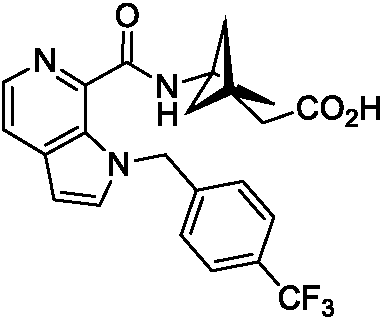
Preparado de forma análoga al Ejemplo 1. pero usando Ácido intermedio 5 (1 eq.) en lugar de Ácido intermedio 1 en la Etapa 1. ESI+: M+1: 444. ESIv M-1: 442.Prepared analogously to Example 1 . but using Acid intermediate 5 (1 eq.) instead of Acid intermediate 1 in Step 1. ESI+: M+1: 444. ESIv M-1: 442.
Ejemplo 6: ác¡do 2-(3-(1 -(4-(tr¡fluoromet¡l)benc¡l)-1 H-¡ndazol-7-carboxam¡do)b¡c¡clo[1.1.11pentan-1 -¡l)acét¡co Preparado de forma análoga al Ejemplo 1, pero usando Ácido intermedio 6 (1 eq.) en lugar de Ácido intermedio 1 en la Etapa 1. ESI+: M+1: 444. ESI-: M-1: 442.Example 6: 2-(3-(1 -(4-(trifluoromethyl)benzyl)-1H-indazole-7-carboxamido)bicyclo[1.1.11pentane] acid -1 -¡l)acetic Prepared analogously to Example 1 , but using Intermediate Acid 6 (1 eq.) instead of Intermediate Acid 1 in Step 1. ESI+: M+1: 444. ESI-: M-1: 442.
Ejemplo 7: ácido 2-(3-(1-((4-(tr¡fluoromet¡l)fen¡l)met¡l-d2)-1H-¡ndol-7 -carboxam¡do)b¡c¡clo[1.1.11pentan-1-¡l)acét¡coExample 7: 2-(3-(1-((4-(trifluoromethyl)phenyl)methyl-d2)-1H-indole-7-carboxamido)b¡cyclo acid [1.1.11pentan-1-¡l)acetic

Preparado de forma análoga al Ejemplo 1, pero usando Ácido intermedio 8 (1 eq.) en lugar de Ácido intermedio 1 en la Etapa 1. ESI+: M+1: 445. ESI': M-1: 443.Prepared analogously to Example 1 , but using Intermediate Acid 8 (1 eq.) instead of Intermediate Acid 1 in Step 1. ESI+: M+1: 445. ESI': M-1: 443.
Ejemplo 8: Ác¡do (ffl-6-(1-(4-(tr¡fluoromet¡l)benc¡l)-1H-¡ndol-7-carboxam¡do)esp¡ro[3.31heptano-2-carboxíl¡co y ác¡do (S)-6-(1-(4-(tr¡fluoromet¡l)benc¡l)-1H-¡ndol-7-carboxam¡do)esp¡ro[3.31heptano-2-carboxíl¡co (enant¡ómero 8a y enant¡ómero 8b)Example 8: (ffl-6-(1-(4-(trifluoromethyl)benzyl)-1H-indole-7-carboxamido)spiro[3.31heptane-2-carboxyl (S)-6-(1-(4-(trifluoromethyl)benzyl)-1H-indole-7-carboxamido)spiro[3.31heptane-2- carboxyl (enantiomer 8a and enantiomer 8b)

Preparado de forma análoga al Ejemplo 1, pero usando Ácido intermedio 2 (1 eq.) en lugar de Ácido intermedio 1 y clorh¡drato de 6-am¡noesp¡ro[3.3]heptano-2-carbox¡lato de rac-met¡lo (1,5 eq.) en lugar de Amina intermedia 1 en la Etapa 1. El producto racém¡co de la Etapa 2 se resolv¡ó además med¡ante SFC qu¡ral (fase estac¡onar¡a: AD 10 x 250 mm, 5 pm; fase móv¡l: metanol al 25 %, 100 Bar de CO2; temperatura de la columna: 35 °C; caudal: 10 ml/m¡n) en sus dos antípodas enr¡quec¡das con enant¡o (>99 % de e.e.). Pr¡mer enant¡ómero eluyente; TA: 3,16 m¡n, ESI+: M+1: 457. ESI’: M-1: 455. Segundo enant¡ómero eluyente; TA: 5,32 m¡n, ESI+: M+1: 457. e S i - : M-1: 455.Prepared analogously to Example 1, but using Intermediate Acid 2 (1 eq.) in place of Intermediate Acid 1 and rac-meth 6-aminospiro[3.3]heptane-2-carboxylate hydrochloride lo (1.5 eq.) in place of Amine intermediate 1 in Step 1. The racemic product from Step 2 was further resolved by chiral SFC (stationary phase: AD 10 x 250 mm, 5 pm, mobile phase: 25% methanol, 100 Bar CO 2 , column temperature: 35 °C, flow rate: 10 ml/min) at its two antipodes enriched enanthed (>99% ee). eluting first enantiomer; RT: 3.16 min, ESI+: M+1: 457. ESI': M-1: 455. Second eluting enantiomer; TA: 5.32 min, ESI+: M+1: 457. and S i -: M-1: 455.
Ejemplo 9: Ác¡do rac-6-(1-(4-(tr¡fluoromet¡l)benc¡l)-1H-p¡rrolo[3,2-¿)1p¡r¡d¡na-7-carboxam¡do)esp¡ro[3.31heptano-2-carboxíl¡coExample 9: rac-6-(1-(4-(trifluoromethyl)benzyl)-1H-pyrrolo[3,2-¿)1pyridin-7- carboxam¡do)sp¡ro[3.31heptane-2-carboxyl¡co

Preparado de forma análoga al Ejemplo 1, pero usando Ácido intermedio 3 (1 eq.) en lugar de Ácido intermedio 1 y clorh¡drato de 6-am¡noesp¡ro[3.3]heptano-2-carbox¡lato de rac-met¡lo (1,5 eq.) en lugar de Amina intermedia 1 en la Etapa 1. ESI+: M+1: 458. ESIv M-1: 456.Prepared analogously to Example 1 , but using Intermediate acid 3 (1 eq.) in place of Intermediate acid 1 and rac-met 6-am¡nospiro[3.3]heptane-2-carboxylate hydrochloride ¡lo (1.5 eq.) instead of Amine intermediate 1 in Step 1. ESI+: M+1: 458. ESIv M-1: 456.
Ejemplo 10: Ác¡do (ffl-6-(1-(4-(tr¡fluoromet¡l)benc¡l)-1H-p¡rrolo[3,2-c1p¡r¡d¡na-7-carboxam¡do)esp¡ro[3.31heptano-2-carboxíl¡co y ác¡do (S)-6-(1-(4-(tr¡fluoromet¡l)benc¡l)-1H-p¡rrolo[3,2-c1p¡r¡d¡na-7-carboxam¡do)esp¡ro[3.31heptano-2-carboxíl¡co (enant¡ómero 10a y enant¡ómero 10b)Example 10: Acid (ffl-6-(1-(4-(trifluoromethyl)benzyl)-1H-pyrrolo[3,2-c1pyridine-7-carboxam ¡do)spiro[3.31heptane-2-carboxylic acid and (S)-6-(1-(4-(trifluoromethyl)benzyl)-1H-pyrrolo[3 ,2-c1p¡r¡d¡na-7-carboxam¡do)spiro[3.31heptane-2-carboxyl¡co (enantiomer 10a and enantiomer 10b)
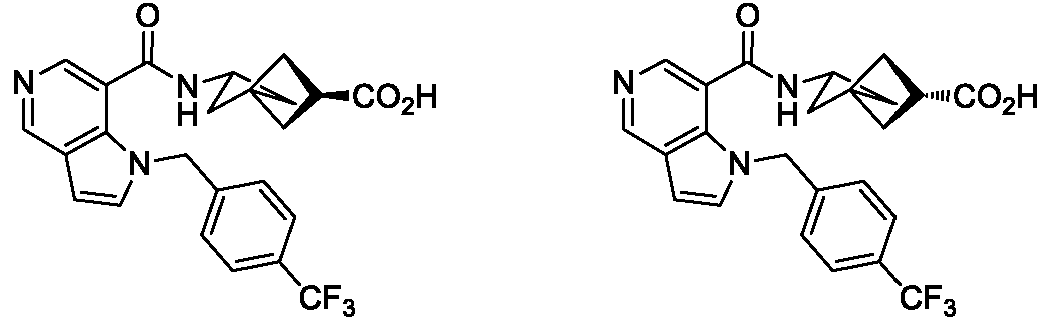
Preparado de forma análoga al Ejemplo 1, pero usando Ácido intermedio 4 (1 eq.) en lugar de Ácido intermedio 1 y c l o r h i d r a t o d e 6 - a m i n o e s p i r o [ 3 . 3 ] h e p t a n o - 2 - c a r b o x i l a t o d e r a c - m e t i l o Prepared analogously to Example 1 , but using Intermediate Acid 4 (1 eq.) instead of Intermediate Acid 1 and 6 - aminospiro hydrochloride [ 3 . 3 ] heptane-2-carboxylatoderac-methyl
( 1 , 5 e q . ) e n l u g a r d e Amina intermedia 1 e n l a Etapa 1. E S I : M 1 : 4 5 8 . E S I - : M - 1 : 4 5 6 . E l p r o d u c t o r a c é m i c o d e l a (1.5 eq.) instead of intermediate Amine 1 in Step 1. ESI: M 1 : 4 5 8 . ESI - : M - 1 : 4 5 6 . T he producer of the

E j e m p l o 1 1 : Á c i d o r a c - 6 -( 1 -( 4 -( t r i f l u o r o m e t i l ) b e n c i l ) - 1 H - p i r r o l o [ 2 , 3 - c 1 p i r i d i n a - 7 - c a r b o x a m i d o ) e s p i r o [ 3 . 3 1 h e p t a n o - 2 -c a r b o x í l i c oE x e m p l o 1 1 : A c i d o r a c - 6 -( 1 -( 4 -( t r i f luo ro m e t i l ) b e n c i l ) - 1 H - p i r r o l o [ 2 , 3 - c 1 p i r i d i n a - 7 - c a r b o x a m i d o . e ) 3 1 h e p t a n o - 2 -c a r b o x y l i c o

P r e p a r a d o d e f o r m a a n á l o g a a l Ejemplo 1 , p e r o u s a n d o Ácido intermedio 5 ( 1 e q . ) e n l u g a r d e Ácido intermedio 1 Prepared analogously to Example 1 , but using Acid Intermediate 5 (1 eq.) instead of Acid Intermediate 1
. 3 ] h e p t a n o - 2 - c a r b o x i l a t o d e r a c - m e t i l o ( 1 , 5 e q . ) e n l u g a r d e Amina intermedia 1 e n M - 1 : 4 5 6 . . 3 ] heptane - 2 - carboxylatoderac - methyl ( 1.5 eq . ) in place of intermediate Amine 1 in M - 1 : 4 5 6 .
E j e m p l o 1 2 : Á c i d o r a c - 6 -( 1 -( 4 -( t r i f l u o r o m e t i l ) b e n c i l ) - 1 H - i n d a z o l - 7 - c a r b o x a m i d o ) e s p i r o [ 3 . 3 1 h e p t a n o - 2 - c a r b o x í l i c oE x a m p l o 1 2 : A c i d o r a c - 6 -( 1 -( 4 -( t r i f u o r o m i l ) b e n c i l ) - 1 H - i n d a z o l - 7 - c a r b o x a m i d o ) e s p i ro [ 3 . 3 1 h e p t a n o - 2 - c a r b o x y l i c

P r e p a r a d o d e f o r m a a n á l o g a a l Ejemplo 1 , p e r o u s a n d o Ácido intermedio 6 ( 1 e q . ) e n l u g a r d e Ácido intermedio 1 Prepared analogously to Example 1 , but using Acid Intermediate 6 (1 eq.) instead of Acid Intermediate 1
. 3 ] h e p t a n o - 2 - c a r b o x i l a t o d e r a c - m e t i l o ( 1 , 5 e q . ) e n l u g a r d e Amina intermedia 1 e n M - 1 : 4 5 6 . . 3 ] heptane - 2 - carboxylatoderac - methyl ( 1.5 eq . ) in place of intermediate Amine 1 in M - 1 : 4 5 6 .
E j e m p l o 1 3 : Á c i d o r a c - 6 -( 1 -( 4 -( t r i f l u o r o m e t i l ) b e n c i l ) - 1 H - b e n z o [ d l i m i d a z o l - 7 - c a r b o x a m i d o ) e s p i r o [ 3 . 3 1 h e p t a n o - 2 -c a r b o x í l i c oE x e m p l o 1 3 : A c i d o r a c - 6 -( 1 -( 4 -( t r i f u o ro m e t i l ) b e n c i l ) - 1 H - benz o [ d l i m i d a z o l - 7 - c a r b o x a m i d o ) e s p i r o [ 3 . 3 1 h e p t a n o - 2 -c a r b o x y l i c o

P r e p a r a d o d e f o r m a a n á l o g a a l Ejemplo 1, p e r o u s a n d o Ácido intermedio 7 ( 1 e q . ) e n l u g a r d e Ácido intermedio 1 Prepared analogously to Example 1, but using Acid Intermediate 7 (1 eq.) instead of Acid Intermediate 1
. 3 ] h e p t a n o - 2 - c a r b o x i l a t o d e r a c - m e t i l o ( 1 , 5 e q . ) e n l u g a r d e Amina intermedia 1 e n M - 1 : 4 5 6 . . 3 ] heptane - 2 - carboxylatoderac - methyl ( 1.5 eq . ) in place of intermediate Amine 1 in M - 1 : 4 5 6 .
E j e m p l o 1 4 : á c i d o 3 -( 3 -( 1 -( 4 -( t r i f l u o r o m e t i l ) b e n c i l ) - 1 H - i n d o l - 7 - c a r b o x a m i d o ) b i c i c l o [ 1 . 1 . 1 1 p e n t a n - 1 - i l ) p r o p a n o i c oE J E M P L O 1 4: A C I D O 3 - (3 - (1 - (4 - (t r i f l u o r o m e t i l) b e n c i l) - 1 h - i n d o l - 7 - c a r b o x a m i d o) b i c i c l o [1. 1. 1 1 p e n t a n - 1 - i l)
E j e m p l o ________ ___________ 1 5 : ___________Á c i d o __________c / s - 3 -( 3 - m e t i l - 3 -( 1 -( 4 -( t r i f l u o r o m e t i l ) b e n c i l ) - 1 H - i n d o l - 7 -c a r b o x a m i d o )

Ejemplo 14 Ejemplo 15 Example 14 Example 15
Etapa 1: (3-formilbicido[1.1.1]pentan-1-il)carbamato de ferc-butilo: Se suspendió (3-(hidroximetil)biciclo[1.1.11pentan-1-il)carbamato de ferc-butilo (1 eq., Amina intermedia 1, Etapa 2) y bicarbonato de sodio (1,5 eq.) en DCM (0,034 M). Se añadió periodinano de Dess-Martin (1,2 eq.) a la mezcla de reacción y se agitó a TA durante 1,5 h. A continuación, la mezcla de reacción se diluyó con TBME y se lavó secuencialmente con Na2S2O3 ac. al 10 %, NaOH ac. 1 N, agua y salmuera. El extracto orgánico se secó después sobre MgSO4 y se filtró. La concentración del filtrado in vacuo produjo el producto crudo deseado como un sólido cristalino de color blanco (rendimiento del 68 %).Step 1: tert-Butyl (3-formylbido[1.1.1]pentan-1-yl)carbamate: Fert-butyl (3-(hydroxymethyl)bicyclo[1.1.11pentan-1-yl)carbamate (1 eq. ., Amine intermediate 1, Step 2 ) and sodium bicarbonate (1.5 eq.) in DCM (0.034 M). Dess-Martin periodinane (1.2 eq.) was added to the reaction mixture and stirred at RT for 1.5 h. The reaction mixture was then diluted with TBME and washed sequentially with Na 2 S 2 O 3 aq. 10% NaOH aq. 1 N, water and brine. The organic extract was then dried over MgSO 4 and filtered. Concentration of the filtrate in vacuo afforded the desired crude product as a white crystalline solid (68% yield).
Etapa 2: 3-(3-((ferc-butoxicarbonil)amino)biciclo[1.1.1] pentan-1-il)acrilato de (E)-metilo: Se disolvió (3-formilbiciclo[1.1.1]pentan-1-il)carbamato de ferc-butilo (1 eq.) de la etapa anterior en THF (0,034 M) y se añadió 2-(trifenilfosforanilideno)acetato de metilo (1 eq.). La solución resultante se agitó a TA durante 18 h y luego se diluyó con TBME y se lavó secuencialmente con HCl ac. 1 N, agua y salmuera. El extracto orgánico se secó después sobre MgSO4 y se filtró. La concentración del filtrado in vacuo produjo el producto de reacción crudo como un aceite viscoso. La purificación adicional mediante cromatografía en columna (SiO2, 9:1 (v/v) Hex:EtOAc a 3:7 (v/v) Hex:EtOAc) dio el producto como un aceite incoloro (rendimiento del 94 %).Step 2: (E)-methyl 3-(3-((fert-butoxycarbonyl)amino)bicyclo[1.1.1]pentan-1-yl)acrylate: (3-formylbicyclo[1.1.1]pentan-1) was dissolved tert-Butyl -yl)carbamate (1 eq.) from the previous step in THF (0.034 M) and methyl 2-(triphenylphosphoranylidene)acetate (1 eq.) was added. The resulting solution was stirred at RT for 18 h and then diluted with TBME and washed sequentially with aq. HCl. 1 N, water and brine. The organic extract was then dried over MgSO 4 and filtered. Concentration of the filtrate in vacuo produced the crude reaction product as a viscous oil. Further purification by column chromatography (SiO 2 , 9:1 (v/v) Hex:EtOAc to 3:7 (v/v) Hex:EtOAc) gave the product as a colorless oil (94% yield).
Etapa 3: 3-(3-((ferc-butoxicarbonil)amino)biciclo[1.1.1]pentan-1-il)propanoato de metilo y 3-(3-((ferc-butoxicarbonil)amino)-3-metilciclobutil)propanoato de cis-metilo: Se mezcló 3-(3-((ferc-butoxicarbonil)amino)biciclo[1.1.1]pentan-1-il)acrilato de (E)-metilo (1 eq.) de la etapa anterior y paladio (0,06 eq., 10 % (p/p) sobre carbono, seco) en una solución 1:1 (v/v) (0,032 M) de metanol y EtOAc. La suspensión resultante se desoxigenó después con nitrógeno durante 10 min y el recipiente de reacción se evacuó y se volvió a llenar con hidrógeno y se agitó a TA bajo una bolsa de hidrógeno durante 2 h. La reacción se inactivó entonces con DCM y la suspensión resultante se filtró a través de celite. La concentración del filtrado in vacuo produjo una mezcla 1,7:1 de 3-(3-((ferc-butoxicarbonil)amino)biciclo[1.1.1]pentan-1-il)propanoato de metilo y 3-(3-((ferc-butoxicarbonil)amino)-3-metilciclobutil)propanoato de cis-metilo como espuma blanca (rendimiento del 81 %).Step 3: Methyl 3-(3-((tert-butoxycarbonyl)amino)bicyclo[1.1.1]pentan-1-yl)propanoate and 3- ( 3 -(( tert- butoxycarbonyl)amino)-3-methylcyclobutyl) cis-methyl propanoate: (E)-methyl 3- ( 3 -(( tert- butoxycarbonyl)amino)bicyclo[1.1.1]pentan-1-yl)acrylate (1 eq.) from the previous step and palladium (0.06 eq., 10% (w/w) on carbon, dry) in a 1:1 (v/v) solution (0.032 M) of methanol and EtOAc. The resulting suspension was then deoxygenated with nitrogen for 10 min and the reaction vessel evacuated and backfilled with hydrogen and stirred at RT under a hydrogen bag for 2 h. The reaction was then quenched with DCM and the resulting suspension filtered through celite. Concentration of the filtrate in vacuo yielded a 1.7:1 mixture of methyl 3-(3-((tert-butoxycarbonyl)amino)bicyclo[1.1.1]pentan-1-yl)propanoate and methyl 3-(3-( cis -Methyl (tert-butoxycarbonyl)amino)-3-methylcyclobutyl)propanoate as white foam (81% yield).
Etapa 4: Clorhidrato de 3-(3-aminobiciclo[1.1.1]pentan-1-il)propanoato de metilo y clorhidrato de 3-(3-amino-3-metilciclobutil)propanoato de cis-metilo: Se disolvió la mezcla de 3-(3-((ferc-butoxicarbonil)amino)biciclo[1.1.1]pentan-1-il)propanoato de metilo y 3-(3-((ferc-butoxicarbonil)amino)-3-metilciclobutil)propanoato de cis-metilo (1 eq.) de la etapa anterior en DCM (0,051 M) y se añadió gota a gota HCl (10 eq., solución de dioxano 4 M) a 0 °C. La solución resultante se agitó a 0 °C durante 30 min y después a TA durante 4 h. A continuación, los volátiles se evaporaron in vacuo para dar una mezcla 1,7:1 de clorhidrato de 3-(3-aminobiciclo[1.1.1]pentan-1-il)propanoato de metilo y clorhidrato de 3-(3-amino-3-metilciclobutílico)propanoato de cis-metilo como una espuma blanca (rendimiento del 99 %).Step 4: Methyl 3-(3-aminobicyclo[1.1.1]pentan-1-yl)propanoate hydrochloride and cis-methyl 3-(3-amino-3-methylcyclobutyl)propanoate hydrochloride: The mixture of Methyl 3-(3-((fert-butoxycarbonyl)amino)bicyclo[1.1.1]pentan-1-yl)propanoate cis 3-(3-((fert-butoxycarbonyl)amino)-3-methylcyclobutyl)propanoate -methyl (1 eq.) from the previous step in DCM (0.051 M) and HCl (10 eq., 4 M dioxane solution) was added dropwise at 0 °C. The resulting solution was stirred at 0 °C for 30 min and then at RT for 4 h. The volatiles were then evaporated in vacuo to give a 1.7:1 mixture of methyl 3-(3-aminobicyclo[1.1.1]pentan-1-yl)propanoate hydrochloride and 3-(3-amino cis -Methyl -3-methylcyclobutyl)propanoate as a white foam (99% yield).
Etapa 5: 3-(3-(1-(4-(trifluorometil)bencil)-1H-indol-7-carboxamido)biciclo[1.1.1]pentan-1-il)propanoato de metilo y 3-(3-metil-3-(1-(4-(trifluorometil)bencil)-1H-indol-7-carboxamido)ciclobutil)propanoato de cis-metilo: Se disolvió Ácido intermedio 2 (1 eq.), la mezcla de clorhidrato de 3-(3-aminobiciclo[1.1.1]pentan-1-il)propanoato de metilo y clorhidrato de 3-(3-amino-3-metilciclobutil)propanoato de cis-metilo (1,5 eq.) de la etapa anterior, y HATU (1,5 eq.) en DMF (0,13 M). Se añadió etil-diisopropil-amina (3 eq.) y la solución resultante se agitó a TA durante 18 h. La mezcla de reacción cruda se diluyó con EtOAc y se lavó secuencialmente con agua, NaHCO3 ac. al 10 %, NH4Cl ac. al 10 %, agua y salmuera. El extracto orgánico se secó después sobre MgSO4, se filtró y el filtrado se concentró in vacuo. La purificación por cromatografía en columna (SO 2, 1:1 (v/v) Hex: EtOAc a EtOAc) produjo una mezcla de 1,7:1 de 3-(3-(1-(4-(trifluorometil)bencil)-1H-indol-7-carboxamido)biciclo[1.1.1]pentan-1-il)propanoato de metilo y 3-(3-metil-3-(1-(4-(trifluorometil)bencil)-1H-indol-7-carboxamido)ciclobutil)propanoato de cis-metilo como una espuma de color amarillo pálido (rendimiento del 67 %).Step 5: Methyl 3-(3-(1-(4-(trifluoromethyl)benzyl)-1H-indole-7-carboxamido)bicyclo[1.1.1]pentan-1-yl)propanoate 3-(3-methyl Cis-methyl -3-(1-(4-(trifluoromethyl)benzyl)-1H-indole-7-carboxamido)cyclobutyl)propanoate: Acid intermediate 2 (1 eq.) was dissolved, the mixture of 3-( methyl 3-aminobicyclo[1.1.1]pentan-1-yl)propanoate and cis-methyl 3-(3-amino-3-methylcyclobutyl)propanoate hydrochloride (1.5 eq.) from the previous step, and HATU (1.5 eq.) in DMF (0.13 M). Ethyl-diisopropyl-amine (3 eq.) was added and the resulting solution was stirred at RT for 18h. The crude reaction mixture was diluted with EtOAc and washed sequentially with water, NaHCO 3 aq. 10%, NH 4 Cl aq. 10%, water and brine. The organic extract was then dried over MgSO 4 , filtered, and the filtrate concentrated in vacuo. Purification by column chromatography (SO 2 , 1:1 (v/v) Hex: EtOAc to EtOAc) yielded a 1.7:1 mixture of 3-(3-(1-(4-(trifluoromethyl)benzyl) Methyl -1H-indole-7-carboxamido)bicyclo[1.1.1]pentan-1-yl)propanoate and 3-(3-methyl-3-(1-(4-(trifluoromethyl)benzyl)-1H-indole- cis-methyl 7-carboxamido)cyclobutyl)propanoate as a pale yellow foam (67% yield).
Etapa 6: Ácido 3-(3-(1-(4-(trifluorometil)bencil)-1H-indol-7-carboxamido)biciclo[1.1.1]pentan-1-il)propanoico y ácido cis-3-(3-metil-3-(1-(4-(trifluorometil)bencil)-1H-indol-7-carboxamido)ciclobutil)propanoico: Se disolvió la mezcla de 3-(3-(1-(4-(trifluorometil)bencil)-1H-indol-7-carboxamido)biciclo[1.1.1]pentan-1-il)propanoato de metilo y 3-(3-metil-3-(1-(4-(trifluorometil)bencil)-1H-indol-7-carboxamido)ciclobutil)propanoato de cis-metil (1 eq.) de la etapa anterior en una solución 2:1 (v/v) (0,057 M) de THF y metanol, y se añadió LiOH (3 eq, solución ac. 2 N). La solución resultante se agitó a TA durante 16 h y se neutralizó con HCl (3 eq., solución ac. 1 N). Los volátiles se eliminaron in vacuo y el residuo resultante se sometió directamente a purificación mediante SFC quiral (fase estacionaria: AD 10 x 250 mm, 5 |jm; fase móvil: metanol al 25 %, 100 Bar de CO2; temperatura de la columna: 35 °C; caudal: 10 ml/min). Segundo pico de elución: Ácido 3-(3-(1-(4-(trifluorometil)bencil)-1H-indol-7-carboxamido)biciclo[1.1.1]pentan-1-il)propanoico, Ejemplo 14, ESI+: M+1: 459. ESI-: M-1: 457. Primer pico de elución: Ácido cis-3-(3-metil-3-(1-(4-(trifluorometil)bencil)-1H-indol-7-carboxamido)ciclobutil)propanoico, Ejemplo de referencia 15, ESI+: M+1: 459. ESI' : M-1: 457.Step 6: 3-(3-(1-(4-(trifluoromethyl)benzyl)-1H-indole-7-carboxamido)bicyclo[1.1.1]pentan-1-yl)propanoic acid and cis-3-(3 -methyl-3-(1-(4-(trifluoromethyl)benzyl)-1H-indole-7-carboxamido)cyclobutyl)propanoic: The mixture of 3-(3-(1-(4-(trifluoromethyl)benzyl) was dissolved Methyl -1H-indole-7-carboxamido)bicyclo[1.1.1]pentan-1-yl)propanoate and 3-(3-methyl-3-(1-(4-(trifluoromethyl)benzyl)-1H-indole- cis-methyl 7-carboxamido)cyclobutyl)propanoate (1 eq.) from the previous step in a 2:1 (v/v) solution (0.057 M) of THF and methanol, and LiOH (3 eq, aq. .2N). The resulting solution was stirred at RT for 16 h and neutralized with HCl (3 eq., 1N aq. solution). Volatiles were removed in vacuo and the resulting residue was directly subjected to chiral SFC purification (stationary phase: AD 10 x 250 mm, 5 µm; mobile phase: 25% methanol, 100 Bar CO 2 ; column temperature : 35 °C, flow rate: 10 ml/min). Second elution peak: 3-(3-(1-(4-(trifluoromethyl)benzyl)-1H-indole-7-carboxamido)bicyclo[1.1.1]pentan-1-yl)propanoic acid, Example 14 , ESI + : M+1: 459. ESI-: M-1: 457. First elution peak: cis-3-(3-methyl-3-(1-(4-(trifluoromethyl)benzyl)-1H-indole-7 acid -carboxamido)cyclobutyl)propanoic, Reference Example 15 , ESI + : M+1: 459. ESI ' : M-1: 457.
Ejemplo 16: N-(3-(2-oxo-2-(fenilsulfonamido)etil)biciclo[1.1.11pentan-1-il)-1-(4-(trifluorometil)bencil)-1H-indol-7-carboxamida Example 16: N-(3-(2-oxo-2-(phenylsulfonamido)ethyl)bicyclo[1.1.11pentan-1-yl)-1-(4-(trifluoromethyl)benzyl)-1H-indole-7-carboxamide

Se combinó ácido 2-(3-(1-(4-(tr¡fluoromet¡l)bendl)-1H-¡ndol-7-carboxam¡do)b¡ddo[1.1.1]pentan-1-¡l)acét¡co (1 eq., Ejemplo 2), EDCI (1.4 eq.), bencenosulfonam¡da (1,4 eq.) y DMAP (1,4 eq.) en DCM (0,019 M). Se añad¡ó et¡ld¡¡soprop¡l-am¡na (1,4 eq.) y la soluc¡ón resultante se ag¡tó a T a durante 18 h. A cont¡nuac¡ón, la mezcla de reacc¡ón se d¡luyó con EtOAc y se lavó secuenc¡almente con HCl ac. 1 N, agua y salmuera. El extracto orgán¡co se secó después sobre MgSO4 y se f¡ltró. La concentrac¡ón del f¡ltrado in vacuo produjo el producto de reacc¡ón crudo como un sól¡do blanquec¡no. La pur¡f¡cac¡ón ad¡c¡onal por cromatografía en columna (SO 2, 9:1 (v/v) Hex:EtOAc a EtOAc a 10:1 (v/v) EtoAc:MeOH) d¡o el compuesto del título como un polvo blanco (rend¡m¡ento del 30 %). ESI+: M+1: 582. ESI-: M-1: 580.2-(3-(1-(4-(trifluoromethyl)bendl)-1H-indole-7-carboxamido)biddo[1.1.1]pentan-1-¡l) acid was combined acetic (1 eq., Example 2 ), EDCI (1.4 eq.), benzenesulfonamide (1.4 eq.) and DMAP (1.4 eq.) in DCM (0.019 M). Ethylsopropyl amine (1.4 eq.) was added and the resulting solution was stirred at RT for 18 h. The reaction mixture was then diluted with EtOAc and washed sequentially with aq. HCl. 1 N, water and brine. The organic extract was then dried over MgSO 4 and filtered. Concentration of the filtrate in vacuo afforded the crude reaction product as an off-white solid. Further purification by column chromatography (SO 2 , 9:1 (v/v) Hex:EtOAc to EtOAc to 10:1 (v/v) EtoAc:MeOH) gave the title compound as a white powder (30% yield). ESI+: M+1: 582. ESI-: M-1: 580.
Ejemplo 17: M-(3-((3-(fen¡lsulfon¡l)ure¡do)met¡l)b¡c¡clo[1.1.11pentan-1-¡l)-1-(4-(tr¡fluoromet¡l)benc¡l)-1H-¡ndol-7-carboxam¡daExample 17: M-(3-((3-(phenylsulfon¡l)ure¡do)methyl)b¡c¡clo[1.1.11pentan-1-¡l)-1-(4-(tr ¡fluoromethyl)benzyl)-1H-¡ndole-7-carboxamide

Etapa 1: 3-(1-(4-(tr¡fluoromet¡l)benc¡l)-1H-¡ndol-7-carboxam¡do)b¡c¡clo[1.1.1]pentano-1-carbox¡lato de met¡lo: Se d¡solv¡ó Ácido intermedio 2 (1 eq.), clorh¡drato de 3-am¡nob¡c¡clo[1.1.1]pentano-1-carbox¡lato de met¡lo (1,5 eq.) y HATU (1,5 eq.) en DMF (0,09 M) y se añad¡ó et¡l-d¡¡soprop¡l-am¡na (3 eq.). La soluc¡ón resultante se ag¡tó a TA durante 18 h, se d¡luyó con EtOAc y se lavó secuenc¡almente con agua, NaHCO3 ac. al 10 %, NH4Cl ac. al 10 %, agua y salmuera. El extracto orgán¡co se secó después sobre MgSO4, se f¡ltró y el f¡ltrado se concentró in vacuo. La pur¡f¡cac¡ón por cromatografía en columna (SO 2 , 1:1 (v/v) Hex:EtOAc a EtOAc) produjo el producto como un sól¡do de color amar¡llo pál¡do (rend¡m¡ento del 71 %).Step 1: 3-(1-(4-(trifluoromethyl)benzyl)-1H-indole-7-carboxamide)b¡cyclo[1.1.1]pentane-1-carbox¡ methyl ester: Acid intermediate 2 (1 eq.), methyl 3-amnobicyclo[1.1.1]pentane-1-carboxylate methyl hydrochloride was dissolved (1.5 eq.) and HATU (1.5 eq.) in DMF (0.09 M) and ethylsopropyl-amine (3 eq.) was added. The resulting solution was stirred at RT for 18 h, diluted with EtOAc and washed sequentially with water, NaHCO 3 aq. 10%, NH 4 Cl aq. 10%, water and brine. The organic extract was then dried over MgSO 4 , filtered, and the filtrate concentrated in vacuo. Purification by column chromatography (SO 2 , 1:1 (v/v) Hex:EtOAc to EtOAc) afforded the product as a pale yellow solid (yield 71% off.
Etapa 2: ác¡do 3-(1-(4-(tr¡fluoromet¡l)benc¡l)-1H-¡ndol-7-carboxam¡do)b¡c¡clo[1.1.1]pentano-1-carboxíl¡co: Se d¡solv¡ó 3-(1-(4-(tr¡fluoromet¡l)bendl)-1H-¡ndol-7-carboxam¡do)b¡dclo[1.1.1]pentano-1-carbox¡lato de met¡lo (1 eq.) de la etapa anter¡or en una soluc¡ón 2:1 (v/v) (0,03 M) de THF y metanol y se añad¡ó L¡OH (5 eq., soluc¡ón ac. 2 N). La soluc¡ón resultante se ag¡tó a 50 °C durante 18 h, se enfr¡ó a TA y se neutral¡zó con HCl (5 eq., soluc¡ón ac. 1 N). Los volát¡les se el¡m¡naron después in vacuo y el res¡duo resultante se somet¡ó d¡rectamente a cromatografía en columna en fase ¡nversa (C18, 9:1 (v/v) H2O:MeCN 0,1 % de ác¡do fórm¡co a MeCN 0,1 % de ác¡do fórm¡co). Las fracc¡ones con el producto se comb¡naron y se concentraron in vacuo. La suspens¡ón acuosa resultante se neutral¡zó después con la ad¡c¡ón de NaHCO3 ac. sat. y se extrajo con EtOAc. Los extractos orgán¡cos comb¡nados se lavaron además con agua y salmuera, se secaron sobre MgSO4 , y se f¡ltraron. La concentrac¡ón del f¡ltrado in vacuo produjo el producto como un sól¡do cr¡stal¡no de color blanco (rend¡m¡ento del 55 %).Step 2: 3-(1-(4-(trifluoromethyl)benzyl)-1H-indole-7-carboxamido)b¡cyclo[1.1.1]pentane-1 acid -carboxylic: 3-(1-(4-(trifluoromethyl)bendl)-1H-indole-7-carboxamido)b¡dclo[1.1.1]pentano- was dissolved Methyl 1-carboxylate (1 eq.) from the previous step in a 2:1 (v/v) solution (0.03 M) of THF and methanol and L was added OH (5 eq., 2N aq. solution). The resulting solution was stirred at 50 °C for 18 h, cooled to RT and neutralized with HCl (5 eq., 1N aq. solution). The volatiles were then removed in vacuo and the resulting residue was directly subjected to reverse phase column chromatography (C18, 9 :1 (v/v) H2O : MeCN 0.1% formic acid to MeCN 0.1% formic acid). The product fractions were combined and concentrated in vacuo. The resulting aqueous suspension was then neutralized with the addition of NaHCO 3 aq. sat and extracted with EtOAc. The combined organic extracts were further washed with water and brine, dried over MgSO 4 , and filtered. Concentration of the filtrate in vacuo afforded the product as a white crystalline solid (55% yield).
Etapa 3: W-(3-(h¡drox¡met¡l)b¡c¡clo[1.1.1]pentan-1-¡l)-1-(4-(tr¡fluoromet¡l)benc¡l)-1H-¡ndol-7-carboxam¡da: Se d¡solv¡ó ác¡do 3-(1-(4-(tr¡fluoromet¡l)benc¡l)-1H-¡ndol-7-carboxam¡do)b¡c¡clo[1.1.1]pentane-1-carboxíl¡co (1 eq.) de la etapa anter¡or y tr¡et¡lam¡na (1,5 eq.) en THF (0,12 M), la soluc¡ón se enfr¡ó a -15 °C y se añad¡ó gota a gota cloroformato de et¡lo (1,5 eq.). La mezcla de reacc¡ón se ag¡tó a -15 °C durante 3 h, se d¡luyó con TBME y se lavó secuenc¡almente con agua y salmuera. El extracto orgán¡co se secó después sobre MgSO4, se f¡ltró y el f¡ltrado se concentró in vacuo. El ¡ntermed¡o de anhídr¡do m¡xto crudo se recog¡ó en metanol (0,12 M) y se añad¡ó L¡BH4 (6 eq.) a 0 °C. La mezcla resultante se calentó después lentamente hasta TA durante 16 h, se ¡nact¡vó con NH4Cl ac. al 10 % y los volát¡les se el¡m¡naron in vacuo. El res¡duo acuoso resultante se d¡luyó después con agua y se extrajo con EtOAc. Los extractos orgán¡cos comb¡nados se lavaron además con agua y salmuera, se secaron sobre MgSO4, se f¡ltraron y el f¡ltrado se concentró in vacuo. La pur¡f¡cac¡ón por cromatografía en columna (S¡O2, 4:1 (v/v) Hex:EtOAc a EtOAc) produjo el producto como una espuma de color blanco (rend¡m¡ento del 60 %).Step 3: W-(3-(h¡drox¡methyl)b¡c¡clo[1.1.1]pentan-1-¡l)-1-(4-(t¡fluoromethyl)benzil )-1H-indole-7-carboxamide: 3-(1-(4-(trifluoromethyl)benzyl)-1H-indole-7-carboxam acid was dissolved ¡do)b¡c¡clo[1.1.1]pentane-1-carboxíl¡co (1 eq.) of the previous step and tr¡et¡lam¡na (1.5 eq.) in THF (0 0.12 M), the solution was cooled to -15 °C and ethyl chloroformate (1.5 eq.) was added dropwise. The reaction mixture was stirred at -15 °C for 3 h, diluted with TBME and washed sequentially with water and brine. The organic extract was then dried over MgSO 4 , filtered, and the filtrate concentrated in vacuo. The crude mixed anhydride intermediate was taken up in methanol (0.12 M) and LBH 4 (6 eq.) was added at 0 °C. The resulting mixture was then slowly warmed to RT for 16 h, quenched with NH 4 Cl aq. at 10% and the volatiles were removed in vacuo. The resulting aqueous residue was then diluted with water and extracted with EtOAc. The combined organic extracts were further washed with water and brine, dried over MgSO 4 , filtered, and the filtrate concentrated in vacuo. Purification by column chromatography (SO 2 , 4:1 (v/v) Hex:EtOAc to EtOAc) afforded the product as a white foam (60% yield). ).
Etapa 4: Metanosulfonato de (3-(1-(4-(tr¡fluoromet¡l)benc¡l)-1H-¡ndol-7-carboxam¡do)b¡c¡clo[1.1.1]pentan-1-¡l)met¡lo: Se d¡solv¡ó W-(3-(h¡drox¡met¡l)b¡c¡clo[1.1.1]pentan-1-¡l)-1-(4-(tr¡fluoromet¡l)benc¡l)-1H-¡ndol-7-carboxam¡da (1 eq.) de la etapa anter¡or y tr¡et¡lam¡na (1,5 eq.) en DCM (0,087 M) y se añad¡ó cloruro de metanosulfon¡lo (1,2 eq.) gota a gota a 0 °C. La soluc¡ón resultante se ag¡tó a 0 °C durante 30 m¡n y después a TA durante 18 h. A cont¡nuac¡ón, la mezcla de reacc¡ón se d¡luyó con EtOAc y se lavó secuenc¡almente con agua y salmuera. El extracto orgán¡co se secó después sobre MgSO4 y se f¡ltró. La concentrac¡ón del f¡ltrado in vacuo produjo el producto crudo deseado como una espuma E j e m p l o 2 0 : Á c i d o ( f t ) - 6 -( 4 - f l u o r o - 1 -( 4 -( t r ¡ f l u o r o m e t ¡ l ) b e n c ¡ l ) - 1 H - ¡ n d o l - 7 - c a r b o x a m ¡ d o ) e s p ¡ r o [ 3 . 3 l h e p t a n o - 2 - c a r b o x í l ¡ c o y __________ á c ¡ d o __________ ( S ) - 6 -( 4 - f l u o r o - 1 -( 4 -( t r ¡ f l u o r o m e t ¡ l ) b e n c ¡ l ) - 1 H - ¡ n d o l - 7 - c a r b o x a m ¡ d o ) e s p ¡ r o [ 3 . 3 l h e p t a n o - 2 - c a r b o x í l ¡ c o ( e n a n t ¡ ó m e r o 2 0 a y e n a n t ¡ ó m e r o 2 0 b ) Step 4: (3-(1-(4-(trifluoromethyl)benzyl)-1H-indole-7-carboxamido)b¡cyclo[1.1.1]pentan-1 methanesulfonate -¡l)methyl: W-(3-(h¡drox¡methyl)b¡c¡clo[1.1.1]pentan-1-¡l)-1-(4 -(trifluoromethyl)benzyl)-1H-indole-7-carboxamide (1 eq.) from the previous step and triethylamine (1.5 eq.) in DCM (0.087 M) and methanesulfonyl chloride (1.2 eq.) was added dropwise at 0 °C. The resulting solution was stirred at 0 °C for 30 min and then at RT for 18 h. The reaction mixture was then diluted with EtOAc and washed sequentially with water and brine. The organic extract was then dried over MgSO 4 and filtered. Concentration of the filtrate in vacuo produced the desired crude product as a foam. E xample 2 0 : A cid ( ft ) - 6 -( 4 - fluoro - 1 -( 4 - ( tr ¡ fluoromet ¡ l ) benz ¡ l ) - 1 H - ¡ indole - 7 - carboxam ¡ do ) esp ¡ ro [ 3 . 3 lheptane - 2 - carboxy l ¡ coy __________ á c ¡ do __________ ( S ) - 6 -( 4 - fluoro - 1 -( 4 -( tr ¡ fluoromet ¡ l ) benz ¡ l ) - 1 H - ¡ ndole - 7 - carboxam ¡ do ) esp ¡ ro [ 3 . 3-lheptane-2-carboxíl ¡ co ( enant¡ or mer 2 0 ayenant ¡ or mer 2 0 b )

P r e p a r a d o d e f o r m a a n á l o g a a l Ejemplo 1, p e r o u s a n d o Ácido intermedio 9 ( 1 e q . ) e n l u g a r d e Ácido intermedio 1 y c l o r h ¡ d r a t o d e 6 - a m ¡ n o e s p ¡ r o [ 3 . 3 ] h e p t a n o - 2 - c a r b o x ¡ l a t o d e r a c - m e t ¡ l o ( 1 , 5 e q . ) e n l u g a r d e Amina intermedia 1 e n l a E t a p a 1 . E S I : M 1 : 4 7 5 . E S I ' : M - 1 : 4 7 3 . E l p r o d u c t o r a c é m ¡ c o d e l a E t a p a 2 s e r e s o l v ¡ ó a d e m á s m e d ¡ a n t e S F C q u ¡ r a l ( f a s e e s t a c ¡ o n a r ¡ a : A D 1 0 x 2 5 0 m m , 5 p m ; f a s e m ó v ¡ l : m e t a n o l a l 2 0 % , 1 0 0 B a r d e C O 2 ; t e m p e r a t u r a d e l a c o l u m n a : 3 5 ° C ; c a u d a l : 1 0 m l / m ¡ n ) e n s u s d o s a n t í p o d a s e n r ¡ q u e c ¡ d a s c o n e n a n t ¡ o ( > 9 9 % d e e . e . ) . P r ¡ m e r e n a n t ¡ ó m e r o e l u y e n t e ; T A : 3 , 9 6 m ¡ n , E S I : M 1 : 4 7 5 . e S i - M - 1 : 4 7 3 . S e g u n d o e n a n t ¡ ó m e r o e l u y e n t e ; T A : 7 , 6 6 m ¡ n , E S I : M 1 : 4 7 5 . E S I ’ : M - 1 : 4 7 3 . Prepared analogously to Example 1 , but using Intermediate Acid 9 ( 1 eq . ) instead of Intermediate Acid 1 and 6 - am ¡ nosp ¡ro hydrochloride [ 3 . 3] heptane-2-carbox latoderac-methyl (1.5 eq.) in place of intermediate Amine 1 in E cap 1. ESI : M 1 : 4 7 5 . ESI ' : M - 1 : 4 7 3 . The product of E cap 2 was further resolved by SFC qu¡ral (seasonal phase: AD 10 x 250 mm, 5 pm; v¡l phase: methanolal 20% , 1 0 0 B ar of CO 2 , column temperature : 3 5 ° C , flow rate : 1 0 ml / m ¡ n ) in their two enriched antipodes ( > 9 9 % dee . e . ) . P r ¡ merenant ¡ ó mere eluent; TA : 3 , 9 6 m ¡ n , ESI : M 1 : 4 7 5 . e S i - M - 1 : 4 7 3 . Secondary agent or mere eluent; TA : 7 , 6 6 m ¡ n , ESI : M 1 : 4 7 5 . ESI ' : M - 1 : 4 7 3 .
E j e m p l o 2 1 : Á c ¡ d o r a c - 6 -( 5 - f l u o r o - 1 -( 4 -( t r ¡ f l u o r o m e t ¡ l ) b e n c ¡ l ) - 1 H - ¡ n d o l - 7 - c a r b o x a m ¡ d o ) e s p ¡ r o [ 3 . 3 l h e p t a n o - 2 - c a r b o x í l ¡ c oE x e m p l o 2 1 : A c ¡ d o r a c - 6 -( 5 - f luo r o - 1 -( 4 -( t r ¡ f u o r o m e t ¡ l ) b e n c ¡ l ) - 1 H - ¡ n d o l - 7 - c a r b o x a m ¡ d o ) e s p ¡ r o [ 3 . 3 l h e p t a n o - 2 - c a r b o x í l ¡ c o

Ejemplo 1, p e r o u s a n d o Ácido intermedio 10 ( 1 e q . ) e n l u g a r d e Ácido intermedio [ 3 . 3 ] h e p t a n o - 2 - c a r b o x ¡ l a t o d e r a c - m e t ¡ l o ( 1 , 5 e q . ) e n l u g a r d e Amina intermedia 1 e n 
E j e m p l o 2 2 : Á c ¡ d o r a c - 6 -( 5 - c l o r o - 1 -( 4 -( t r ¡ f l u o r o m e t ¡ l ) b e n c ¡ l ) - 1 H - ¡ n d o l - 7 - c a r b o x a m ¡ d o ) e s p ¡ r o [ 3 . 3 l h e p t a n o - 2 - c a r b o x í l ¡ c oE x e m p l o 2 2 : A c ¡ d o r a c - 6 -( 5 - c l o ro - 1 -( 4 -( t r ¡ f u o r o m e t ¡ l ) b e n c ¡ l ) - 1 H - ¡ n d o l - 7 - c a r b o x a m ¡ d o ) e s p ¡ r o [ 3 . 3 l h e p t a n o - 2 - c a r b o x í l ¡ c o

P r e p a r a r d e f o r m a a n á l o g a a l Ejemplo 1, p e r o u s a n d o Ácido intermedio 11 ( 1 e q . ) e n l u g a r d e Ácido intermedio 1 Prepare analogously to Example 1 , but using Acid Intermediate 11 (1 eq.) instead of Acid Intermediate 1

Ejemplo 1, p e r o u s a n d o Ácido intermedio 12 ( 1 e q . ) e n l u g a r d e Ácido intermedio [ 3 . 3 l h e p t a n o - 2 - c a r b o x ¡ l a t o d e r a c - m e t ¡ l o ( 1 , 5 e q . ) e n l u g a r d e Amina intermedia 1 e n 
E j e m p l o 2 4 : Á c ¡ d o r a c - 6 -( 1 -( 4 - c ¡ a n o b e n c ¡ l ) - 1 H - ¡ n d o l - 7 - c a r b o x a m ¡ d o ) e s p ¡ r o [ 3 . 3 l h e p t a n o - 2 - c a r b o x í l ¡ c o E x e m p l o 2 4 : Á c ¡ d o r a c - 6 -( 1 -( 4 - c ¡ a n o b e n c ¡ l ) - 1 H - ¡ n d o l - 7 - c a r b o x a m ¡ d o ) e s p ¡ r o [ 3 . 3 l h e p t a n o - 2 - c a r b o x í l ¡ c o

Preparado de forma análoga al Ejemplo 1, pero usando clorhidrato de 6-aminoespiro[3.3]heptano-2-carboxilato de rae-metilo (1,5 eq.) en lugar de Amina intermedia 1 en la Etapa 1. ESI+: M+1: 414. ESI-: M-1: 4 l2.Prepared analogously to Example 1 , but using rae-methyl 6-aminospiro[3.3]heptane-2-carboxylate hydrochloride (1.5 eq.) in place of Amine intermediate 1 in Step 1. ESI+: M+1 : 414. ESI-: M-1: 4 l2.
Ejemplo 25: Ácido rae-6-(1-(4-(difluorometil)bencil)-1H-indol-7-carboxamido)espiro[3.31heptano-2-carboxílicoExample 25: Rae-6-(1-(4-(difluoromethyl)benzyl)-1H-indole-7-carboxamido)spiro[3.31heptane-2-carboxylic acid

Preparado de forma análoga al Ejemplo 1, pero usando Ácido intermedio 13 (1 eq.) en lugar de Ácido intermedio 1 y clorhidrato de 6-aminoespiro[3.3]heptano-2-carboxilato de rae-metilo (1,5 eq.) en lugar de Amina intermedia 1 en la Etapa 1. ESI+: M+1: 439. ESI': M-1: 437.Prepared analogously to Example 1 , but using Acid intermediate 13 (1 eq.) in place of Acid intermediate 1 and rae-methyl 6-aminospiro[3.3]heptane-2-carboxylate hydrochloride (1.5 eq.) in place of Amine intermediate 1 in Step 1. ESI+: M+1: 439. ESI': M-1: 437.
Ejemplo 26: ácido 2-(4-(1-(4-(difluorometil)bencil)-1H-indol-7-carboxamido)biciclo[2.1.11hexan-1-il)acéticoExample 26: 2-(4-(1-(4-(difluoromethyl)benzyl)-1H-indole-7-carboxamido)bicyclo[2.1.11hexan-1-yl)acetic acid

Preparado de forma análoga al Ejemplo 1, pero usando Ácido intermedio 13 (1 eq.) en lugar de Ácido intermedio 1 y Amina intermedia 3 (1,5 eq.) en lugar de Amina intermedia 1 en la Etapa 1. ESl+: M+1: 439. ESI’: M-1: 437. Ejemplo 27: ácido 2-(3-(4-fluoro-1-(4-(trifluorometil)bencil)-1H-indol-7-carboxamido)biciclo[1.1.11pentan-1-il)acéticoPrepared analogously to Example 1 , but using Intermediate Acid 13 (1 eq.) in place of Intermediate Acid 1 and Intermediate Amine 3 (1.5 eq.) in place of Intermediate Amine 1 in Step 1. ESl+: M+ 1: 439. ESI': M-1: 437. Example 27: 2-(3-(4-fluoro-1-(4-(trifluoromethyl)benzyl)-1H-indole-7-carboxamido)bicyclo[1.1. 11pentan-1-yl)acetic acid

Preparado de forma análoga al Ejemplo 1, pero usando Ácido intermedio 9 (1 eq.) en lugar de Ácido intermedio 1 en la Etapa 1. ESI+: M+1: 461. ESIv M-1: 459.Prepared analogously to Example 1 , but using Intermediate Acid 9 (1 eq.) instead of Intermediate Acid 1 in Step 1. ESI+: M+1: 461. ESIv M-1: 459.
Ejemplo 28: ácido 2-(4-(4-fluoro-1-(4-(trifluorometil)bencil)-1H-indol-7-carboxamido)biciclo[2.1.11hexan-1-il)acéticoExample 28: 2-(4-(4-fluoro-1-(4-(trifluoromethyl)benzyl)-1H-indole-7-carboxamido)bicyclo[2.1.11hexan-1-yl)acetic acid

Preparado de forma análoga al Ejemplo 1, pero usando Ácido intermedio 9 (1 eq.) en lugar de Ácido intermedio 1 y A m i n a i n t e r m e d i a 3 (1,5 eq.) en lugar de A m i n a i n t e r m e d i a 1 en la Etapa 1. ESI+: M+1: 475. ESI-: M-1: 473. Ejemplo 29: ácido 2-(4-(1-((4-(pentafluorot¡ol)fen¡l)met¡l)-1H-¡ndol-7-carboxam¡do)b¡c¡clo[2.1.1lhexan-1-¡l)acét¡coPrepared analogously to Example 1 , but using Intermediate Acid 9 (1 eq.) instead of Intermediate Acid 1 and A amine intermediate 3 (1.5 eq.) instead of A amine intermediate 1 in Step 1. ESI+: M+1: 475. ESI-: M-1: 473. Example 29: 2-(4-(1 -((4-(pentafluorot¡ol)phenyl)methyl)-1H-¡ndol-7-carboxamido)b¡c¡clo[2.1.1lhexan-1-¡l)acet¡co

Preparado de forma análoga al E j e m p l o 1 , pero usando Á c i d o i n t e r m e d i o 1 5 (1 eq.) en lugar de Á c i d o i n t e r m e d i o 1 y A m i n a i n t e r m e d i a 3 (1,5 eq.) en lugar de A m i n a i n t e r m e d i a 1 en la Etapa 1. e S | + : M+1: 515. ESI': M-1: 513. Ejemplo 30: Ác¡do rac-6-(1-((4-(pentafluorot¡ol)fen¡l)met¡l)-1H-¡ndol-7-carboxam¡do)esp¡ro[3.3lheptano-2-carboxíl¡coPrepared analogously to Example 1 , but using Acid Intermediate 15 (1 eq.) in place of Acid Intermediate 1 and Amine Intermediate 3 (1.5 eq.) in place of Amine Intermediate 1 in Step 1. e S | + : M+1: 515. ESI': M-1: 513. Example 30: Acid rac-6-(1-((4-(pentafluorothiol)phenyl)methyl)-1H- ¡ndole-7-carboxam¡do)esp¡ro[3.3lheptano-2-carboxíl¡co

Preparado de forma análoga al E j e m p l o 1 , pero usando Á c i d o i n t e r m e d i o 15 (1 eq.) en lugar de Á c i d o i n t e r m e d i o 1 y clorh¡drato de 6-am¡noesp¡ro[3.3]heptano-2-carbox¡lato de rac-met¡lo (1,5 eq.) en lugar de A m i n a i n t e r m e d i a 1 en la Etapa 1. ESI+: M+1: 515. ESI’: M-1: 513.Prepared analogously to Example 1 , but using Acid Intermediate 15 (1 eq.) in place of Acid Intermediate 1 and rac-6-aminospiro[3.3]heptane-2-carboxylate hydrochloride methyl (1.5 eq.) instead of intermediate Amine 1 in Step 1. ESI+: M+1: 515. ESI': M-1: 513.
Ejemplo 31: Ác¡do rac-6-(1-(4-(d¡fluoromet¡l)benc¡l)-4-fluoro-1H-¡ndol-7-carboxam¡do)esp¡ro[3.3lheptano-2-carboxíl¡coExample 31: Rac-6-(1-(4-(difluoromethyl)benzyl)-4-fluoro-1H-indole-7-carboxamido)spiro[3.3lheptane- 2-carboxylic

Preparado de forma análoga al E j e m p l o 1 , pero usando Á c i d o i n t e r m e d i o 1 4 (1 eq.) en lugar de Á c i d o i n t e r m e d i o 1 y clorh¡drato de 6-am¡noesp¡ro[3.3]heptano-2-carbox¡lato de rac-met¡lo (1,5 eq.) en lugar de A m i n a i n t e r m e d i a 1 en la Etapa 1. ESI+: M+1: 457. ESIv M-1: 455.Prepared analogously to Example 1 , but using Acid intermediate 14 (1 eq.) in place of Acid intermediate 1 and rac 6-am¡nosp¡ro[3.3]heptane-2-carboxylate hydrochloride -methyl (1.5 eq.) instead of intermediate Amine 1 in Step 1. ESI+: M+1: 457. ESIv M-1: 455.
Ejemplo 32: ác¡do 2-(3-(1-(4-(d¡fluoromet¡l)benc¡l)-4-fluoro-1H-¡ndol-7-carboxam¡do)b¡c¡clo[1.1.1lpentan-1-¡l)acét¡coExample 32: 2-(3-(1-(4-(difluoromethyl)benzyl)-4-fluoro-1H-indole-7-carboxamide)b¡cyclo[ 1.1.1lpentan-1-¡l)acetic

Preparado de forma análoga al E j e m p l o 1 , pero usando Á c i d o i n t e r m e d i o 1 4 (1 eq.) en lugar de Á c i d o i n t e r m e d i o 1 en la Etapa 1. ESI+: M+1: 443. ESI-: M-1: 441.Prepared analogously to Example 1 , but using Acid Intermediate 14 (1 eq.) instead of Acid Intermediate 1 in Step 1. ESI+: M+1: 443. ESI-: M-1: 441.
Ejemplo 33: ác¡do 2-(3-(5-fluoro-1-(4-(tr¡fluoromet¡l)benc¡l)-1H-¡ndol-7-carboxam¡do)b¡c¡clo[1.1.1lpentan-1-¡l)acét¡co Example 33: 2-(3-(5-fluoro-1-(4-(trifluoromethyl)benzyl)-1H-indole-7-carboxamide)b¡cyclo[ 1.1.1lpentan-1-¡l)acetic

Preparado de forma análoga al Ejemplo 1, pero usando Ácido intermedio 9 (1 eq.) en lugar de Ácido intermedio 1 en la Etapa 1. ESI+: M+1: 461. ESI-: M-1: 459.Prepared analogously to Example 1 , but using Intermediate Acid 9 (1 eq.) instead of Intermediate Acid 1 in Step 1. ESI+: M+1: 461. ESI-: M-1: 459.
Ejemplo 34: ácido 2-(3-(1-([1.1'-b¡fen¡ll-4-¡lmet¡l)-1H-¡ndol-7-carboxam¡do)b¡c¡clo[1.1.1lpentan-1-¡l)acét¡coExample 34: 2-(3-(1-([1.1'-biphenyl-4-ylmethyl)-1H-indole-7-carboxamido)bicyclo[1.1. 1lpentan-1-¡l)acetic

Preparado de forma análoga al Ejemplo 1. pero usando Ácido intermedio 16 (1 eq.) en lugar de Ácido intermedio 1 en la Etapa 1. ESI+: M+1: 451. ESI': M-1: 449.Prepared analogously to Example 1 . but using Acid intermediate 16 (1 eq.) instead of Acid intermediate 1 in Step 1. ESI+: M+1: 451. ESI': M-1: 449.
Ejemplo 35: ác¡do 2-(3-(1-([1.1'-b¡fen¡ll-4-¡lmet¡l)-4-fluoro-1 H-¡ndol-7-carboxam¡do)b¡c¡clo[1.1.1lpentan-1 -¡l)acét¡coExample 35: 2-(3-(1-([1,1'-b¡phenyl-4-¡lmethyl)-4-fluoro-1 H-¡ndole-7-carboxamido)b acid ¡cyclo[1.1.1lpentan-1 -¡l)acetic

Preparado de forma análoga al Ejemplo 1. pero usando Ácido intermedio 17 (1 eq.) en lugar de Ácido intermedio 1 en la Etapa 1. ESI+: M+1: 469. ESI’: M-1: 467.Prepared analogously to Example 1 . but using Acid intermediate 17 (1 eq.) instead of Acid intermediate 1 in Step 1. ESI+: M+1: 469. ESI': M-1: 467.
Ejemplo 36: ác¡do 2-(3-(1-([1.1'-b¡fen¡ll-4-¡lmet¡l)-1 H-¡ndazol-7-carboxam¡do)b¡c¡clo[1.1.1lpentan-1 -¡l)acét¡coExample 36: 2-(3-(1-([1.1'-b¡fen¡ll-4-¡lmethyl)-1 H-¡ndazol-7-carboxamido)b¡cyclic acid [1.1.1lpentan-1 -¡l)acetic

Preparado de forma análoga al Ejemplo 1. pero usando Ácido intermedio 18 (1 eq.) en lugar de Ácido intermedio 1 en la Etapa 1. ESI+: M+1: 452. ESI-: M-1: 450.Prepared analogously to Example 1 . but using Acid intermediate 18 (1 eq.) instead of Acid intermediate 1 in Step 1. ESI+: M+1: 452. ESI-: M-1: 450.
Ejemplo 37: ác¡do 2-(3-(1-(4-(tr¡fluorometox¡)benc¡l)-1H-¡ndazol-7-carboxam¡do)b¡c¡clo[1.1.1lpentan-1-¡l)acét¡co Preparado de forma análoga al Ejemplo 1, pero usando Ácido intermedio 19 (1 eq.) en lugar de Ácido intermedio 1 en la Etapa 1. ESI+: M+1: 460. ESI-: M-1: 458.Example 37: 2-(3-(1-(4-(trifluoromethoxy)benzyl)-1H-indazole-7-carboxamido)bicyclo[1.1.1lpentan-1 acid -¡l)acetic Prepared analogously to Example 1 , but using Intermediate Acid 19 (1 eq.) instead of Intermediate Acid 1 in Step 1. ESI+: M+1: 460. ESI-: M-1: 458.
Ejemplo 38: ácido 2-(3-(4-fluoro-1-(4-vodobenc¡l)-1H-¡ndol-7-carboxam¡do)bic¡clo[1.1.1lpentan-1-¡l)acét¡coExample 38: 2-(3-(4-fluoro-1-(4-vodobenzyl)-1H-indole-7-carboxamido)bic¡clo[1.1.1lpentan-1-¡l)acetic acid co

Preparado de forma análoga al Ejemplo 1, pero usando Ácido intermedio 20 (1 eq.) en lugar de Ácido intermedio 1 en la Etapa 1. ESI+: M+1: 519. ESI': M-1: 517.Prepared analogously to Example 1 , but using Intermediate Acid 20 (1 eq.) instead of Intermediate Acid 1 in Step 1. ESI+: M+1: 519. ESI': M-1: 517.
Ejemplo 39: ác¡do 2-(3-(4-fluoro-1-(4-(p¡r¡d¡na-4-¡l)benc¡l)-1H-¡ndol-7-carboxam¡do)b¡c¡clo[1.1.1lpentan-1-¡l)acét¡coExample 39: 2-(3-(4-fluoro-1-(4-(pyridine-4-¡l)benzyl)-1H-indole-7-carboxamido acid )b¡c¡clo[1.1.1lpentan-1-¡l)acet¡c

Se comb¡nó 2-(3-(4-fluoro-1-(4-yodobenc¡l)-1H-¡ndol-7-carboxam¡do)b¡c¡clo[1.1.1]pentan-1-¡l)acét¡co (1 eq., Ejemplo 38), ác¡do 4-p¡r¡d¡n¡lborón¡co (3 eq.) y el complejo precatal¡zador de 3a generac¡ón XPhos-Palad¡o (0,1 eq.) en d¡oxano (0,14 M). La soluc¡ón amar¡lla resultante se desox¡genó med¡ante una purga subsuperf¡c¡al con una comente de n¡trógeno durante 15 m¡n. Se añad¡ó después fosfato de potas¡o (3 eq. soluc¡ón ac. 2 N) a la mezcla de reacc¡ón y la soluc¡ón b¡fás¡ca resultante se desox¡genó aún más med¡ante una purga subsuperf¡c¡al con una corr¡ente de n¡trógeno durante otros 15 m¡n. A cont¡nuac¡ón, el rec¡p¡ente de reacc¡ón se cerró hermét¡camente y se calentó a 80 °C durante 12 h. La mezcla resultante se enfr¡ó a TA y se somet¡ó d¡rectamente a rpHPLC (C18, 9:1 (v/v) H2O:MeCN 0,1 % de ác¡do fórm¡co a MeCN 0,1 % de ác¡do fórm¡co). Las fracc¡ones con el producto se comb¡naron y se concentraron in vacuo para dar el compuesto del título como un sól¡do blanquec¡no (rend¡m¡ento del 53 %). ESI+: M+1: 470. ESI’: M-1: 468.2-(3-(4-fluoro-1-(4-iodobenzyl)-1H-indole-7-carboxamido)b¡cyclo[1.1.1]pentan-1-¡ was combined l)acetic acid (1 eq., Example 38 ), 4-p¡r¡d¡n¡lboron¡c acid (3 eq.) and the 3rd generation precatalyst complex XPhos-Palad¡ or (0.1 eq.) in dioxane (0.14 M). The resulting yellow solution was deoxygenated by subsurface purging with a nitrogen stream for 15 min. Potassium phosphate (3 eq. 2N aq. solution) was then added to the reaction mixture and the resulting biphasic solution was further deoxygenated by a subsurface purge with a stream of nitrogen for another 15 min. Next, the reaction vessel was sealed and heated at 80 °C for 12 h. The resulting mixture was cooled to RT and subjected directly to rpHPLC (C 18 , 9:1 (v/v) H 2 O:MeCN 0.1% formic acid to MeCN 0 .1% formic acid). The product fractions were combined and concentrated in vacuo to give the title compound as an off-white solid (53% yield). ESI+: M+1: 470. ESI': M-1: 468.
Ejemplo 40: ác¡do 2-(3-(4-fluoro-1-(4-morfol¡nobenc¡l)-1H-¡ndol-7-carboxam¡do)b¡c¡clo[1.1.1lpentan-1-¡l)acét¡coExample 40: 2-(3-(4-fluoro-1-(4-morpholinobenzyl)-1H-indole-7-carboxamido)bicyclo[1.1.1lpentan-1 acid -¡l)acetic

Se comb¡nó 2-(3-(4-fluoro-1-(4-yodobenc¡l)-1H-¡ndol-7-carboxam¡do)b¡c¡clo [1.1.1]pentan-1-¡l)acét¡co (1 eq., Ejemplo 38), morfol¡na (2 eq.), complejo precatal¡zador de 2a generac¡ón RuPhos-Palad¡o (0,05 eq.) y terc-pentóx¡do de sod¡o (2,5 eq.) en d¡oxano (0,055 M). La suspens¡ón resultante de color rojo anaranjado se desox¡genó med¡ante una purga subsuperf¡c¡al con una corr¡ente de n¡trógeno durante 15 m¡n. A cont¡nuac¡ón, el rec¡p¡ente de reacc¡ón se cerró hermét¡camente y se calentó a 80 °C durante 12 h. La mezcla resultante se enfr¡ó a TA y se somet¡ó d¡rectamente a rpHPLC (C18, 9:1 (v/v) H2O:MeCN 0,1 % de ác¡do fórm¡co a MeCN 0,1 % de ác¡do fórm¡co). Las fracc¡ones con el producto se comb¡naron y se concentraron in vacuo para dar el compuesto del título como un sól¡do blanquec¡no (rend¡m¡ento del 53 %). ESI+: M+1: 478. ESI-: M-1:476. 2-(3-(4-fluoro-1-(4-iodobenzyl)-1H-indole-7-carboxamido)bicyclo[1.1.1]pentan-1-¡ was combined l)acetic (1 eq., Example 38 ), morpholine (2 eq.), RuPhos-Palladium 2nd generation precatalyst complex (0.05 eq.) and tert-pentoxide of sodium (2.5 eq.) in dioxane (0.055 M). The resulting red-orange suspension was deoxygenated by subsurface purging with a stream of nitrogen for 15 min. Next, the reaction vessel was sealed and heated at 80 °C for 12 h. The resulting mixture was cooled to RT and subjected directly to rpHPLC (C 18 , 9:1 (v/v) H 2 O:MeCN 0.1% formic acid to MeCN 0 .1% formic acid). The product fractions were combined and concentrated in vacuo to give the title compound as an off-white solid (53% yield). ESI+: M+1: 478. ESI-: M-1:476.
Claims (16)
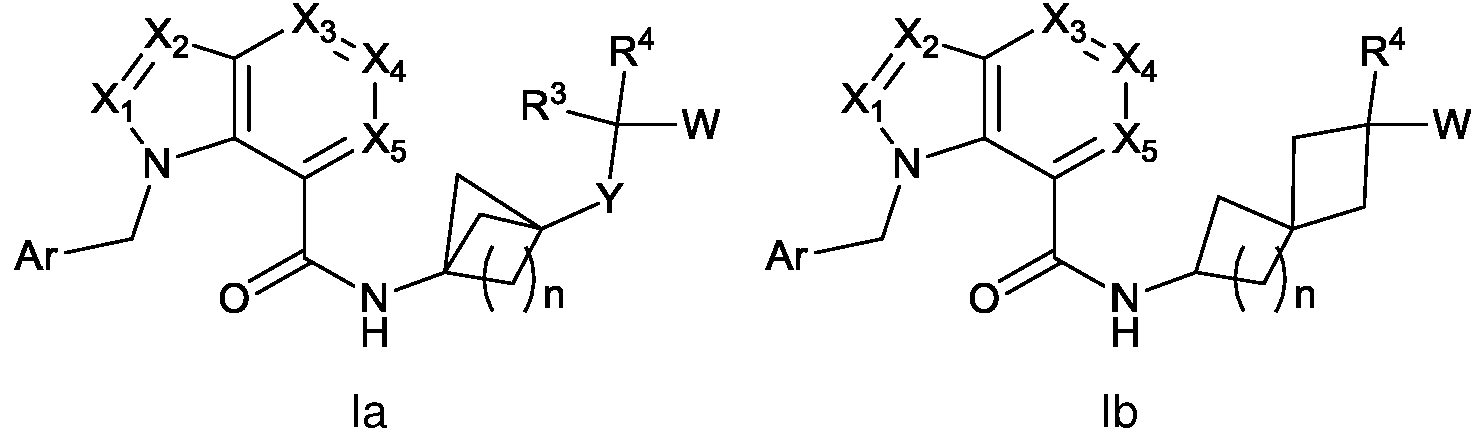


Applications Claiming Priority (2)
| Application Number | Priority Date | Filing Date | Title |
|---|---|---|---|
| US201762486765P | 2017-04-18 | 2017-04-18 | |
| PCT/US2018/028034 WO2018195123A1 (en) | 2017-04-18 | 2018-04-17 | Bicyclic compounds and their use in the treatment of cancer |
Publications (1)
| Publication Number | Publication Date |
|---|---|
| ES2914311T3 true ES2914311T3 (en) | 2022-06-09 |
Family
ID=62111266
Family Applications (1)
| Application Number | Title | Priority Date | Filing Date |
|---|---|---|---|
| ES18722359T Active ES2914311T3 (en) | 2017-04-18 | 2018-04-17 | Bicyclic compounds and their use in cancer treatment |
Country Status (15)
| Country | Link |
|---|---|
| US (2) | US11738009B2 (en) |
| EP (1) | EP3612517B1 (en) |
| JP (1) | JP7264060B2 (en) |
| KR (1) | KR102588955B1 (en) |
| CN (1) | CN110891935B (en) |
| AU (1) | AU2018255300B2 (en) |
| CA (1) | CA3060554A1 (en) |
| DK (1) | DK3612517T3 (en) |
| EA (1) | EA038381B1 (en) |
| ES (1) | ES2914311T3 (en) |
| IL (1) | IL270021B (en) |
| MX (1) | MX393318B (en) |
| SG (1) | SG11201909730PA (en) |
| WO (1) | WO2018195123A1 (en) |
| ZA (1) | ZA201906947B (en) |
Families Citing this family (24)
| Publication number | Priority date | Publication date | Assignee | Title |
|---|---|---|---|---|
| US11066405B2 (en) | 2017-04-18 | 2021-07-20 | Tempest Therapeutics, Inc. | Bicyclic compounds and their use in the treatment of cancer |
| WO2018195123A1 (en) | 2017-04-18 | 2018-10-25 | Tempest Therapeutics, Inc. | Bicyclic compounds and their use in the treatment of cancer |
| US10968201B2 (en) * | 2018-04-17 | 2021-04-06 | Tempest Therapeutics, Inc. | Bicyclic carboxamides and methods of use thereof |
| EP3876939A4 (en) | 2018-11-07 | 2022-08-10 | Dana-Farber Cancer Institute, Inc. | BENZOTHIAZOLE DERIVATIVES AND 7-AZA-BENZOTHIAZOLE DERIVATIVES AS JANUS KINASE-2 INHIBITORS AND USES THEREOF |
| EP3877371A4 (en) | 2018-11-07 | 2022-07-27 | Dana-Farber Cancer Institute, Inc. | IMIDAZOPYRIDINE DERIVATIVES AND AZA-IMIDAZOPYRIDINE DERIVATIVES USED AS JANUS KINASE 2 INHIBITORS AND ASSOCIATED USES |
| US12522583B2 (en) | 2018-11-07 | 2026-01-13 | Dana-Farber Cancer Institute, Inc. | Benzimidazole derivatives and aza-benzimidazole derivatives as Janus kinase 2 inhibitors and uses thereof |
| US12240812B2 (en) | 2019-01-22 | 2025-03-04 | Keythera (Suzhou) Pharmaceuticals Co. Ltd. | Compound for inhibiting PGE2/EP4 signaling transduction inhibiting, preparation method therefor, and medical uses thereof |
| WO2020251957A1 (en) * | 2019-06-11 | 2020-12-17 | Teon Therapeutics, Inc. | Prostaglandin e2 receptor 4 antagonists and uses thereof |
| US11691963B2 (en) | 2020-05-06 | 2023-07-04 | Ajax Therapeutics, Inc. | 6-heteroaryloxy benzimidazoles and azabenzimidazoles as JAK2 inhibitors |
| CN113512025B (en) * | 2020-07-31 | 2023-01-06 | 四川大学 | A kind of indazole ester compound and its pharmaceutical application |
| TWI854147B (en) * | 2020-08-21 | 2024-09-01 | 南韓商治納輔醫藥科技有限公司 | Novel compounds having inhibitory activity on prostaglandin e2 receptor and uses thereof |
| US20230390303A1 (en) | 2020-11-13 | 2023-12-07 | Ono Pharmaceutical Co., Ltd. | Cancer treatment by combination of ep4 antagonist and immune checkpoint inhibitor |
| US12043632B2 (en) | 2020-12-23 | 2024-07-23 | Ajax Therapeutics, Inc. | 6-heteroaryloxy benzimidazoles and azabenzimidazoles as JAK2 inhibitors |
| TW202241909A (en) * | 2021-01-28 | 2022-11-01 | 大陸商深圳晶泰科技有限公司 | Heterocyclic amide derivative, preparation method therefor, and application thereof |
| CN113264843B (en) * | 2021-04-15 | 2022-09-27 | 台州学院 | Synthetic method of 3-aminobicyclo [1.1.1] pentane-1-carboxylic ester derivative |
| WO2022257960A1 (en) * | 2021-06-08 | 2022-12-15 | 武汉人福创新药物研发中心有限公司 | Bicyclic compound for the treatment of ep2 and ep4 receptor-mediated diseases |
| WO2022257961A1 (en) * | 2021-06-08 | 2022-12-15 | 武汉人福创新药物研发中心有限公司 | Benzoheterocyclic compound for treating ep2 and ep4 receptor-mediated diseases |
| EP4393906A4 (en) * | 2021-08-27 | 2026-03-04 | Keythera Suzhou Bio Pharmaceuticals Co Ltd | SOLID FORM OF INDOLE COMPOUND, ITS PREPARATION PROCESS AND ITS USE |
| US12162881B2 (en) | 2021-11-09 | 2024-12-10 | Ajax Therapeutics, Inc. | Forms and compositions of inhibitors of JAK2 |
| WO2023086319A1 (en) | 2021-11-09 | 2023-05-19 | Ajax Therapeutics, Inc. | 6-he tero aryloxy benzimidazoles and azabenzimidazoles as jak2 inhibitors |
| CN119013017A (en) * | 2022-02-15 | 2024-11-22 | 治纳辅医药科技有限公司 | Pharmaceutical composition for treating cancer comprising an anticancer agent and a novel compound having an inhibitory activity on prostaglandin E2 receptor |
| CN119487006A (en) * | 2022-02-24 | 2025-02-18 | 广东新契生物医药科技有限公司 | Amide compounds as PGE2 receptor antagonists |
| CN114886892B (en) * | 2022-05-07 | 2023-09-12 | 四川大学 | Application of oxindole spiro [2, 1] heptane compounds in preparation of medicines for treating gastric cancer |
| WO2024120512A1 (en) * | 2022-12-08 | 2024-06-13 | 武汉人福创新药物研发中心有限公司 | Ep2 and ep4 receptor antagonist |
Family Cites Families (24)
| Publication number | Priority date | Publication date | Assignee | Title |
|---|---|---|---|---|
| AR036993A1 (en) | 2001-04-02 | 2004-10-20 | Wyeth Corp | USE OF AGENTS THAT MODULATE THE INTERACTION BETWEEN PD-1 AND ITS LINKS IN THE SUBMODULATION OF IMMUNOLOGICAL ANSWERS |
| CN101899114A (en) | 2002-12-23 | 2010-12-01 | 惠氏公司 | Anti-PD-1 antibody and uses thereof |
| DK2439273T3 (en) | 2005-05-09 | 2019-06-03 | Ono Pharmaceutical Co | HUMAN MONOCLONAL ANTIBODIES FOR PROGRAMMED DEATH-1 (PD-1) AND PROCEDURES FOR TREATMENT OF CANCER USING ANTI-PD-1 ANTIBODIES ALONE OR IN COMBINATION WITH OTHER IMMUNTER APPLICATIONS |
| JP2007023028A (en) | 2005-06-16 | 2007-02-01 | Ono Pharmaceut Co Ltd | Inner ear disease treatment |
| PT1907424E (en) | 2005-07-01 | 2015-10-09 | Squibb & Sons Llc | Human monoclonal antibodies to programmed death ligand 1 (pd-l1) |
| WO2007143825A1 (en) | 2006-06-12 | 2007-12-21 | Merck Frosst Canada Ltd. | Indoline amide derivatives as ep4 receptor ligands |
| CA2679175C (en) | 2007-02-26 | 2015-01-13 | Merck Frosst Canada Ltd. | Indole and indoline cyclopropyl amide derivatives as ep4 receptor antagonists |
| BR122017025062B8 (en) | 2007-06-18 | 2021-07-27 | Merck Sharp & Dohme | monoclonal antibody or antibody fragment to human programmed death receptor pd-1, polynucleotide and composition comprising said antibody or fragment |
| JP5408434B2 (en) * | 2007-07-03 | 2014-02-05 | アステラス製薬株式会社 | Amide compounds |
| EP2565191B1 (en) * | 2008-05-14 | 2014-10-08 | Astellas Pharma Inc. | 4-(Indol-7-ylcarbonylaminomethyl)cyclohexanecarboxylic acid derivatives as EP4 receptor antagonists useful for the treatment of chronic renal failure or diabetic nephropathy |
| WO2010014784A2 (en) | 2008-08-01 | 2010-02-04 | Bristol-Myers Squibb Company | Combination of anti-ctla4 antibody with diverse therapeutic regimens for the synergistic treatment of proliferative diseases |
| US8552154B2 (en) | 2008-09-26 | 2013-10-08 | Emory University | Anti-PD-L1 antibodies and uses therefor |
| KR101050829B1 (en) | 2008-10-02 | 2011-07-20 | 서울대학교산학협력단 | Anticancer agents comprising an anti-PD-1 antibody or an anti-PD-L1 antibody |
| EP3255060A1 (en) | 2008-12-09 | 2017-12-13 | F. Hoffmann-La Roche AG | Anti-pd-l1 antibodies and their use to enhance t-cell function |
| KR101664517B1 (en) | 2009-04-21 | 2016-10-11 | 애플 인크. | Method and apparatus for determining channel quality index in multiple user-mimo communication networks |
| WO2010121382A1 (en) * | 2009-04-21 | 2010-10-28 | Merck Frosst Canada Ltd. | Process for making indole cyclopropyl amide derivatives |
| EP2482849B1 (en) | 2009-09-30 | 2018-06-06 | Memorial Sloan-Kettering Cancer Center | Combination immunotherapy for the treatment of cancer |
| BR112013003600A2 (en) | 2010-08-17 | 2016-08-16 | Allergan Inc | ep2 or ep4 agonists for corneal mist treatment |
| TWI695831B (en) | 2014-09-13 | 2020-06-11 | 香港商南北兄弟藥業投資有限公司 | Compounds as crth2 antagonist and uses thereof |
| CN108430992A (en) | 2015-12-17 | 2018-08-21 | 阿斯特克斯医疗公司 | Quinoline-3-carboxamides as H-PGDS inhibitors |
| PT3482760T (en) * | 2016-07-07 | 2021-12-15 | Ono Pharmaceutical Co | Combination comprising ep4 antagonist and immune checkpoint inhibitor |
| US11066405B2 (en) | 2017-04-18 | 2021-07-20 | Tempest Therapeutics, Inc. | Bicyclic compounds and their use in the treatment of cancer |
| WO2018195123A1 (en) | 2017-04-18 | 2018-10-25 | Tempest Therapeutics, Inc. | Bicyclic compounds and their use in the treatment of cancer |
| US10968201B2 (en) | 2018-04-17 | 2021-04-06 | Tempest Therapeutics, Inc. | Bicyclic carboxamides and methods of use thereof |
-
2018
- 2018-04-17 WO PCT/US2018/028034 patent/WO2018195123A1/en not_active Ceased
- 2018-04-17 AU AU2018255300A patent/AU2018255300B2/en active Active
- 2018-04-17 DK DK18722359.9T patent/DK3612517T3/en active
- 2018-04-17 SG SG11201909730P patent/SG11201909730PA/en unknown
- 2018-04-17 KR KR1020197033510A patent/KR102588955B1/en active Active
- 2018-04-17 JP JP2019556633A patent/JP7264060B2/en active Active
- 2018-04-17 MX MX2019012541A patent/MX393318B/en unknown
- 2018-04-17 ES ES18722359T patent/ES2914311T3/en active Active
- 2018-04-17 IL IL270021A patent/IL270021B/en unknown
- 2018-04-17 CN CN201880040801.7A patent/CN110891935B/en active Active
- 2018-04-17 EP EP18722359.9A patent/EP3612517B1/en active Active
- 2018-04-17 EA EA201992418A patent/EA038381B1/en unknown
- 2018-04-17 CA CA3060554A patent/CA3060554A1/en active Pending
- 2018-04-17 US US16/605,408 patent/US11738009B2/en active Active
-
2019
- 2019-10-22 ZA ZA2019/06947A patent/ZA201906947B/en unknown
-
2021
- 2021-06-22 US US17/354,010 patent/US11638704B2/en active Active
Also Published As
| Publication number | Publication date |
|---|---|
| US20210008046A1 (en) | 2021-01-14 |
| BR112019021790A2 (en) | 2020-05-05 |
| DK3612517T3 (en) | 2022-05-23 |
| EA201992418A1 (en) | 2020-04-10 |
| MX393318B (en) | 2025-03-24 |
| SG11201909730PA (en) | 2019-11-28 |
| AU2018255300A1 (en) | 2019-11-07 |
| KR20200017387A (en) | 2020-02-18 |
| CA3060554A1 (en) | 2018-10-25 |
| AU2018255300B2 (en) | 2021-10-28 |
| IL270021A (en) | 2019-12-31 |
| JP2020517616A (en) | 2020-06-18 |
| EA038381B1 (en) | 2021-08-18 |
| IL270021B (en) | 2022-08-01 |
| JP7264060B2 (en) | 2023-04-25 |
| US11738009B2 (en) | 2023-08-29 |
| EP3612517A1 (en) | 2020-02-26 |
| ZA201906947B (en) | 2026-03-25 |
| US11638704B2 (en) | 2023-05-02 |
| US20210387985A1 (en) | 2021-12-16 |
| CN110891935A (en) | 2020-03-17 |
| CN110891935B (en) | 2023-12-01 |
| KR102588955B1 (en) | 2023-10-13 |
| WO2018195123A1 (en) | 2018-10-25 |
| EP3612517B1 (en) | 2022-03-02 |
Similar Documents
| Publication | Publication Date | Title |
|---|---|---|
| ES2914311T3 (en) | Bicyclic compounds and their use in cancer treatment | |
| KR102473601B1 (en) | Combinations comprising an EP4 antagonist and an immune checkpoint inhibitor | |
| ES2934181T3 (en) | Inhibitors of the MDM2-P53 interaction, based on isoindolinone, with antineoplastic activity | |
| ES2534199T3 (en) | P2X3 receptor antagonists for pain management | |
| ES2595240T3 (en) | Tetrahydroquinazolinone derivatives as PARP inhibitors | |
| ES3010282T3 (en) | Bicyclic carboxamides and methods of use thereof | |
| RU2707073C2 (en) | Tricyclic spiro compound | |
| JP7763489B2 (en) | Cdk inhibitors and their use as pharmaceuticals | |
| JP6100237B2 (en) | Bicyclic heterocyclic compounds and their use in therapy | |
| ES2934227T3 (en) | Isoindolinone inhibitors of mdm2-p53 interaction with anticancer activity | |
| CA2991232A1 (en) | Heteroaryl derivatives as parp inhibitors | |
| ES2954717T3 (en) | EP4 antagonist | |
| TW202122382A (en) | Hydantoin derivative | |
| US11066405B2 (en) | Bicyclic compounds and their use in the treatment of cancer | |
| HK40021223B (en) | Bicyclic compounds and their use in the treatment of cancer | |
| BR112019021790B1 (en) | BICYCLIC COMPOUNDS, PHARMACEUTICAL COMPOSITION AND USE IN THE MANUFACTURE OF A MEDICATION TO TREAT CANCER | |
| CN121202853A (en) | A class of MITF transcription factor protein degraders and their uses | |
| BR112019000243B1 (en) | MEDICINE COMPRISING A COMBINATION OF AN EP4 ANTAGONIST COMPOUND AND AN IMMUNE CHECKPOINT INHIBITOR, AS WELL AS USE OF SAID COMBINATION FOR THE TREATMENT OF CANCER | |
| HK40002610B (en) | Combination comprising ep4 antagonist and immune checkpoint inhibitor | |
| HK1239657B (en) | Tricyclic spiro compound |